EP2662687B1 - Mass analyzer and analytical method - Google Patents
Mass analyzer and analytical method Download PDFInfo
- Publication number
- EP2662687B1 EP2662687B1 EP11854668.8A EP11854668A EP2662687B1 EP 2662687 B1 EP2662687 B1 EP 2662687B1 EP 11854668 A EP11854668 A EP 11854668A EP 2662687 B1 EP2662687 B1 EP 2662687B1
- Authority
- EP
- European Patent Office
- Prior art keywords
- analysis object
- mass
- quantitative
- quantitative calibrator
- calibrator
- Prior art date
- Legal status (The legal status is an assumption and is not a legal conclusion. Google has not performed a legal analysis and makes no representation as to the accuracy of the status listed.)
- Active
Links
Images


Classifications
-
- H—ELECTRICITY
- H01—ELECTRIC ELEMENTS
- H01J—ELECTRIC DISCHARGE TUBES OR DISCHARGE LAMPS
- H01J49/00—Particle spectrometers or separator tubes
- H01J49/0009—Calibration of the apparatus
Definitions
- the present invention relates to an analyzing method for quantifying an analysis object in a mass analyzing apparatus and to a mass analyzing apparatus.
- the analysis object When performing a quantitative analysis of an analysis object, it is normally necessary that the analysis object is measured at two or more respectively different concentration points to form a calibration curve based on its results by a relationship between a signal intensity and a concentration. Depending on the stability of a mass analyzing apparatus, it is sometimes necessary to form the calibration curve every several hours or every day or for every analysis object.
- a calibration curve is formed by using three or more concentration points. This is because the calibration curve sometimes fails to form a straight line for the reasons of saturation of a detector, deviations in measurements and the like.
- a calibration curve is formed for quantifying an analysis object in optical measurements
- the same substance is detected as the same wavelength, it is impossible to measure multiple concentrations at the same time, and the calibration curve needs to be formed by measuring the analysis object at respectively different concentrations.
- a multi-calibrator capable of calibrating analysis objects of multiple items is used for the biochemical inspections by the optical measurements, but this corresponds to a sample in which analysis objects each at one concentration point that do not interfere with one another are mixed, and this is not a sample including the same substance at multiple concentration points.
- the mass analyzing apparatus used in the present invention in order to form a calibration curve for quantifying an analysis object with high precision, it is necessary that the analysis object is measured at least two or more respectively different concentration points to form a calibration curve based on the results of measurement by a relationship between a signal intensity and a concentration.
- a measurement intensity for ions is determined for each of the values of mass-to-charge ratio (m/z) that is a ratio of the mass number of ions and the charge thereof.
- Mass spectrum data obtained as a result include peaks of measurement intensity of the measured ions relative to each of the mass-to-charge ratios.
- the mass analyzing apparatus can simultaneously detect the substances as long as the substances have different masses.
- a tandem mass analyzing method (MS/MS method) is used.
- MS/MS method among multiple kinds of ions generated from an introduced sample, ions of a specific measurement object component are made to collide with a gas or the like to be dissociated in an analyzing apparatus and the generated ions (product ions) are measured.
- analogue structural components can be mutually distinguished with high precision. More specifically, it becomes possible to perform the measurement of only the measurement object in which foreign components that have analogous structure to the measurement object and are not desired to be measured are excluded. Thus, even if there are foreign component ions that have the same mass number as that of the measurement object ions, it is possible to distinguish the measurement object ions when the product ions are different from each other.
- a stable isotope compound of the analysis object that is isotope-labeled or a compound that is analogous thereto in chemical and physical properties (hereinafter, referred to as an analogue compound) is used as an internal standard substance.
- an analogue compound a stable isotope compound and an analogue compound whose response to the mass analyzing apparatus is analogous to the analysis object and which can be measured separately from the analysis object are selected.
- the analysis object, its stable isotope compound and analogue compound exhibit the same behaviors in fluctuations in peak intensity, and in the case where a reduction in the peak intensity, a reduction in ionization efficiency or the like occurs due to any factor such as foreign components, the increase or decrease of a peak area exhibits the same behaviors as that of the analysis object.
- the stable isotope compound to be used needs to be a compound in which an element contained in the product ions is isotope-labeled.
- Patent Document 1 in order to improve the efficiency of an analysis, measurements are performed by using one prepared high-concentration quantitative calibrator while repeating automatic dilution several times as needed, thereby reducing the time-consuming tasks for preparing a plurality of kinds of standard solutions and human errors.
- Patent Document 2 Japanese Patent Application Laid-Open Publication No. 2000-65797 (Patent Document 2) has proposed an analyzing method using a stable isotope compound, in which a calibration curve is formed by measuring an analysis object by utilizing a ratio of natural isotopes contained in the analysis object itself.
- US2010/190261 discloses a protein analysis method using a combination of two or more kinds of stable isotopes of a compound as a labeling compound to produce a difference in the mass of the same kind of protein contained in each sample.
- US2010/285593 discloses methods for quantitatively analyzing a plurality of analytes in a sample. Also described are general and specific internal standards useful in such analysis. In particular examples these standards are described as useful in liquid chromatography/mass spectroscopy systems, which are also described therein. Moreover, in certain examples the quantification methods are described as being useful in increasing the precision and/or accuracy of multiple analyte quantification for analytes contained in a single sample mixture using known analyte derivatives simultaneously analyzed, and compared to the unknown analytes.
- WO2010/100816 discloses a technique for attaining a correction using a plurality of pseudo-compounds without creating a standard curve. Also provided is a technique capable of correcting a sample in which substances of multi-components to be measured are mixed without using stable isotope-labeled substances individually as internal standards.
- an analysis apparatus equipped with a pretreatment device including a solid phase extraction mechanism, and a mass spectroscope which carries out the mass spectrometry of a sample pretreated by the pretreatment device after ionization of the sample and is further equipped with a storage section which stores the data about the concentration of a substance in the sample which inhibits ionization, the signal strength dependency of the substances to be measured and the internal standards, and the recovery rate, and a correction section which corrects the measurement results of the sample and the internal standards based on the data stored in the storage section.
- JP 2000-65797 discloses an analyzing method to prepare an analytical curve for quantitatively analyzing a substance, the analytical curve is acquired from one or more types of elements in which isotopes exist.
- Patent Document 1 measurements need to be carried out a plurality of times, and the reduction of measurement time cannot be achieved.
- an object of the present invention is to provide a mass analyzing apparatus capable of simply and quickly carrying out the formation of a calibration curve that requires the above-mentioned complicated operations and also reducing the analysis time spent for forming the calibration curve and the consumption of consumable supplies, thereby achieving the improvement of the analysis throughput.
- a quantitative calibrator in which, with respect to one analysis object, two or more kinds of compounds selected from the analysis object itself, a plurality of stable isotope compounds and a plurality of analogue compounds are mixed at respectively different concentrations is used to measure a sample at multiple concentrations at the same time.
- a multi-point calibration curve having two or more points can be formed.
- the m/z at their peaks need to be separated from each other by a mass resolving power or more of the mass analyzer used for detection. Since a normal mass analyzer generally has the mass resolving power of about 1 m/z, the m/z at mass spectrum peaks of the respective compounds are preferably separated from each other by at least 1 Da, more preferably, by 3 Da or more.
- an apparatus provided with an MS/MS method capable of detecting product ions is desirably adopted as a mass analyzer used for detection.
- MS/MS method even when the m/z of precursor ions of a plurality of calibration substances contained in a quantitative calibrator are the same, there arises no problem if the m/z of the product ions are different.
- the apparatus is provided with a database in which detailed information of the quantitative calibrator is stored or means for taking in the detailed information of the quantitative calibrator, and the apparatus is further provided with a mechanism which automatically takes in the composition and concentration of the quantitative calibrator to a database inside the apparatus by using an information medium such as an IC chip, a bar code or the like so as to make the detailed information of the quantitative calibrator linked with the results of sample measurements to form the calibration curve of the measurement sample.
- an information medium such as an IC chip, a bar code or the like
- Theophylline which is an analysis object taken as an example, serves as a medicine used as an anti-inflammatory drug or the like and has its effective blood concentration in a range of 8 to 20 ⁇ g/mL.
- the measured concentration range of 2 to 50 ⁇ g/mL can be accurately quantified by forming the calibration curve based on the three points, that is, a High concentration of 50 ⁇ g/mL that is a value twice or more of the upper limit value of therapeutic blood concentration range, a Middle concentration of 20 ⁇ g/mL that is a value within the therapeutic blood concentration range, and a Low concentration of 2 ⁇ g/mL that is a value 1/2 or less of the lower limit value of the therapeutic blood concentration range.
- the present invention utilizes a quantitative calibrator in which three kinds of compounds selected from theophylline, a plurality of stable isotope compounds of theophylline and a plurality of theophylline analogue compounds are artificially mixed at three-point concentrations required for a calibration curve with high precision.
- a quantitative calibrator in which three kinds of compounds selected from theophylline, a plurality of stable isotope compounds of theophylline and a plurality of theophylline analogue compounds are artificially mixed at three-point concentrations required for a calibration curve with high precision.
- the m/z of arbitrary two calibration substances that are mixed in the quantitative calibrator to be utilized are preferably separated from each other by the resolving power or more of the mass analyzer, that is, 1 Da or more, and more preferably, 3 Da or more, from the viewpoint of preventing the degradation in quantification precision caused by mutual interference.
- the mass analyzer that is, 1 Da or more, and more preferably, 3 Da or more, from the viewpoint of preventing the degradation in quantification precision caused by mutual interference.
- a peak 101 of an analysis object, peaks 102 and 103 of stable isotopes of the analysis object and a peak 104 of a calibration substance are separated from one another by 1 m/z or more.
- the concentration control by the use of artificial addition is facilitated.
- the natural isotope of molecular weight 184 is overlapped in the abundance ratio of the natural isotopes of theophylline, its abundance amount is so small as 0.04%, and is a negligible amount in the artificial concentration control.
- the concentration may be controlled by determining the amount of artificial addition of calibration substance by taking into account this natural isotope ratio.
- the quantitative calibrator used in the present invention is a sample in which required kinds of materials selected from an analysis object itself, a plurality of stable isotope compounds of the analysis object and a plurality of analogue compounds of the analysis object are appropriately mixed at required concentrations, and the most accurate calibration curve within a required concentration range can be formed by measuring this sample once.
- the quantitative calibrator used in the present invention is a sample in which required kinds of materials selected from an analysis object itself, a plurality of stable isotope compounds of the analysis object and a plurality of analogue compounds of the analysis object are appropriately mixed at required concentrations, and the most accurate calibration curve within a required concentration range can be formed by measuring this sample once.
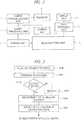
- FIG. 2 is a block diagram showing the configuration of the mass analyzing apparatus of an embodiment of the present invention.
- the mass analyzing apparatus is made up of a sample storage-dilution unit 1 in which a quantitative calibrator and other measurement samples or the like are stored and are diluted as needed, a database 2 in which detailed information of the quantitative calibrator is stored, a control unit 3 that controls the mass analyzing apparatus, a sample introducing unit 4 that introduces the quantitative calibrator and other measurement samples or the like, an ionizing unit 5 that ionizes the quantitative calibrator and other measurement samples or the like, a mass analyzing unit 6 that analyzes the quantitative calibrator and the other measurement samples, a data processing unit 7 that processes analysis results in the mass analyzing unit 6, and a display unit 8 that displays the results processed in the data processing unit 7.
- a sample storage-dilution unit 1 in which a quantitative calibrator and other measurement samples or the like are stored and are diluted as needed
- a database 2 in which detailed information of the quantitative calibrator is stored
- a control unit 3 that controls the mass analyzing apparatus
- a sample introducing unit 4 that introduces the quantitative calibrator and
- FIG. 3 is a flow chart showing a calibration curve forming process in the mass analyzing apparatus of an embodiment of the present invention
- FIG. 4 is an explanatory diagram for describing an analyzing method in the mass analyzing apparatus of an embodiment of the present invention, in which an analyzing method using phenytoin as the analysis object is shown as an example.
- an analysis object is first selected (S100), and when measurement of phenytoin as an analysis object is inputted in S100, the database is referenced (S101) to determine whether a solution of a quantitative calibrator used for quantifying phenytoin stored in a reagent storing container in the sample storage-dilution unit 1 is measurable as it is or dilution is required therefor (S102), and if it is determined in S102 that the dilution is required, the process proceeds to a diluting step (S103), and then the solution of the quantitative calibrator is measured (S104).
- the measurement of the solution of the quantitative calibrator is carried out through the process in which the solution of the quantitative calibrator introduced via the sample introducing unit 4 is ionized in the ionizing unit 5, and is then analyzed in the mass analyzing unit 6.
- a calibration curve is automatically calculated based on the measurement results in S104 (S105), and information of the calculation result is displayed on the display unit 8.
- phenytoin alias: 5,5-diphenyl hydantoin
- stable isotope compounds that are different from phenytoin by 3 and 10 in mass number can be used.
- phenytoin is a medicine used as an antiepileptic drug, and has a therapeutic blood concentration range of 5 to 20 ⁇ g/mL.
- the quantitative calibrator is stored in, for example, a reagent storing container 9 shown in FIG. 4A in the sample storage-dilution unit 1.
- An information medium 10 such as an IC chip, a bar code or the like is attached to the reagent storing container 9, and when the reagent storing container 9 is put into the sample storage-dilution unit 1, the information medium 10 is read, and components contained in a solution of the quantitative calibrator and concentrations thereof are confirmed.
- the reagent information may be stored in either the information medium 10 such as an IC chip or a bar code or the database 2, and in the case where it is stored in the database 2, it is confirmed which reagent has been put in from the information medium 10, and the corresponding information is taken out by referencing the database 2.
- the information medium 10 such as an IC chip or a bar code or the database 2
- dilution may be executed prior to each of the measurements by storing the solution of the quantitative calibrator with a concentration higher than that required for the calibration curve in the reagent storing container 9.
- the quantitative calibrator may be diluted so as to obtain a quantitative calibrator having a different concentration from that of the solution of the quantitative calibrator stored in the reagent storing container 9. In that case, by carrying out measurements of the quantitative calibrator twice in total before and after the dilution, a calibration curve with 6-point concentrations can be formed.
- the solution of a quantitative calibrator containing components at a Low concentration of 50 ⁇ g/mL, a Middle concentration of 100 ⁇ g/mL and a High concentration of 200 ⁇ g/mL is stored in the reagent storing container 9, two kinds thereof, that is, the solution of the quantitative calibrator itself and the solution obtained by diluting the solution into 1/10 are measured respectively once, so that it is possible to form the calibration curve with 6-point concentrations of 5, 10, 20, 50, 100 and 200 ⁇ g/mL.
- control unit 3 controls these dilution and measurement based on the data stored in the database 2.
- an analogue compound whose response to the mass analyzing apparatus of the quantitative calibrator is different from the analysis object is sometimes used as a calibration substance of the quantitative calibrator.
- a compound whose peak area is not equal but is detected as a certain constant ratio in the measurement of an analysis object and a quantitative calibrator each having the same concentration is sometimes used as a quantitative calibrator.
- a calibration curve can be formed in the same manner as in the case of a stable isotope compound.
- generated ions may be directly detected or specific product ions may be detected from the introduced ions.
- mass numbers of arbitrary two or more kinds of calibration substances are substantially the same or are not distinguishable by a mass analyzer
- the isotopes have product ions whose mass numbers are respectively different
- by selecting ions derived from a specific calibration substance from the introduced ions in the mass analyzing unit 6 and detecting product ions obtained from the selected ions separate measurement from the other calibration substances is possible, so that it can be used as a quantitative calibrator.
- a method for causing dissociation in place of collision dissociation there are photodissociation, electron transfer dissociation and electron capture dissociation, and any one of these may be used.
- the present invention is widely applicable to, for example, a mass analyzing apparatus for quantifying an analysis object by using a calibration curve.
- sample storage-dilution unit 1: sample storage-dilution unit, 2: database, 3: control unit, 4: sample introducing unit, 5: ionizing unit, 6: mass analyzing unit, 7: data processing unit, 8: display unit, 9: reagent storing container, 10: information medium
Landscapes
- Chemical & Material Sciences (AREA)
- Analytical Chemistry (AREA)
- Other Investigation Or Analysis Of Materials By Electrical Means (AREA)
Description
- The present invention relates to an analyzing method for quantifying an analysis object in a mass analyzing apparatus and to a mass analyzing apparatus.
- When performing a quantitative analysis of an analysis object, it is normally necessary that the analysis object is measured at two or more respectively different concentration points to form a calibration curve based on its results by a relationship between a signal intensity and a concentration. Depending on the stability of a mass analyzing apparatus, it is sometimes necessary to form the calibration curve every several hours or every day or for every analysis object.
- In order to improve the precision of a calibration curve, normally, a calibration curve is formed by using three or more concentration points. This is because the calibration curve sometimes fails to form a straight line for the reasons of saturation of a detector, deviations in measurements and the like.
- In the case where a calibration curve is formed for quantifying an analysis object in optical measurements, since the same substance is detected as the same wavelength, it is impossible to measure multiple concentrations at the same time, and the calibration curve needs to be formed by measuring the analysis object at respectively different concentrations. In general, a multi-calibrator capable of calibrating analysis objects of multiple items is used for the biochemical inspections by the optical measurements, but this corresponds to a sample in which analysis objects each at one concentration point that do not interfere with one another are mixed, and this is not a sample including the same substance at multiple concentration points.
- On the other hand, also in the mass analyzing apparatus used in the present invention, in order to form a calibration curve for quantifying an analysis object with high precision, it is necessary that the analysis object is measured at least two or more respectively different concentration points to form a calibration curve based on the results of measurement by a relationship between a signal intensity and a concentration.
- In a general mass analyzing method, after ionizing an analysis object, various kinds of generated ions are taken in a mass analyzing apparatus, and a measurement intensity for ions is determined for each of the values of mass-to-charge ratio (m/z) that is a ratio of the mass number of ions and the charge thereof. Mass spectrum data obtained as a result include peaks of measurement intensity of the measured ions relative to each of the mass-to-charge ratios. In other words, the mass analyzing apparatus can simultaneously detect the substances as long as the substances have different masses.
- Moreover, in an analysis of a sample containing many foreign components as in the case of a biological sample, in an attempt to distinguish an analysis object from its analogue structural molecules such as its metabolites or the like, a tandem mass analyzing method (MS/MS method) is used. In this MS/MS method, among multiple kinds of ions generated from an introduced sample, ions of a specific measurement object component are made to collide with a gas or the like to be dissociated in an analyzing apparatus and the generated ions (product ions) are measured. By using the MS/MS method, analogue structural components can be mutually distinguished with high precision. More specifically, it becomes possible to perform the measurement of only the measurement object in which foreign components that have analogous structure to the measurement object and are not desired to be measured are excluded. Thus, even if there are foreign component ions that have the same mass number as that of the measurement object ions, it is possible to distinguish the measurement object ions when the product ions are different from each other.
- When it is desired to accurately quantify an analysis object in a mass analyzing apparatus, in general, a stable isotope compound of the analysis object that is isotope-labeled or a compound that is analogous thereto in chemical and physical properties (hereinafter, referred to as an analogue compound) is used as an internal standard substance. As the internal standard substance, a stable isotope compound and an analogue compound whose response to the mass analyzing apparatus is analogous to the analysis object and which can be measured separately from the analysis object are selected.
- In other words, in the measurement in the mass analyzing apparatus, the analysis object, its stable isotope compound and analogue compound exhibit the same behaviors in fluctuations in peak intensity, and in the case where a reduction in the peak intensity, a reduction in ionization efficiency or the like occurs due to any factor such as foreign components, the increase or decrease of a peak area exhibits the same behaviors as that of the analysis object. Herein, when the product ions are detected, the stable isotope compound to be used needs to be a compound in which an element contained in the product ions is isotope-labeled.
- More specifically, in order to form a calibration curve for quantifying the analysis object in the mass analyzing apparatus with high precision, it is necessary to prepare two or more solutions obtained by mixing an analysis object and an internal standard substance at different concentration points, and perform the measurement at least twice or more.
- As described above, in order to form a calibration curve with high precision, multiple kinds of analysis objects having different concentrations have to be prepared, and the analysis has to be carried out at least twice or more, and consequently, time-consuming tasks are required for the preparations and analysis of those samples . Moreover, there is a possibility that human errors occur when preparing the multiple kinds of quantitative calibrators and performing the measurements thereof.
- For this reason, in Japanese Patent Application Laid-Open Publication No.
H5-79984 - Moreover, Japanese Patent Application Laid-Open Publication No.
2000-65797 -
US2010/190261 discloses a protein analysis method using a combination of two or more kinds of stable isotopes of a compound as a labeling compound to produce a difference in the mass of the same kind of protein contained in each sample. -
US2010/285593 discloses methods for quantitatively analyzing a plurality of analytes in a sample. Also described are general and specific internal standards useful in such analysis. In particular examples these standards are described as useful in liquid chromatography/mass spectroscopy systems, which are also described therein. Moreover, in certain examples the quantification methods are described as being useful in increasing the precision and/or accuracy of multiple analyte quantification for analytes contained in a single sample mixture using known analyte derivatives simultaneously analyzed, and compared to the unknown analytes. -
WO2010/100816 discloses a technique for attaining a correction using a plurality of pseudo-compounds without creating a standard curve. Also provided is a technique capable of correcting a sample in which substances of multi-components to be measured are mixed without using stable isotope-labeled substances individually as internal standards. Disclosed are an analysis apparatus equipped with a pretreatment device including a solid phase extraction mechanism, and a mass spectroscope which carries out the mass spectrometry of a sample pretreated by the pretreatment device after ionization of the sample and is further equipped with a storage section which stores the data about the concentration of a substance in the sample which inhibits ionization, the signal strength dependency of the substances to be measured and the internal standards, and the recovery rate, and a correction section which corrects the measurement results of the sample and the internal standards based on the data stored in the storage section. -
JP 2000-65797 -
- Japanese Patent Application Laid-Open Publication No.
H5-79984 - Japanese Patent Application Laid-Open Publication No.
2000-65797 - However, in
Patent Document 1, measurements need to be carried out a plurality of times, and the reduction of measurement time cannot be achieved. - Moreover, in the method of
Patent Document 2, since the isotope ratio of elements of natural origin is used, there is a problem in that the measurement concentration range of a calibration curve is uncontrollable. - Therefore, an object of the present invention is to provide a mass analyzing apparatus capable of simply and quickly carrying out the formation of a calibration curve that requires the above-mentioned complicated operations and also reducing the analysis time spent for forming the calibration curve and the consumption of consumable supplies, thereby achieving the improvement of the analysis throughput.
- The above and other objects and novel characteristics of the present invention will be apparent from the description of the present specification and the accompanying drawings.
- The following is a brief description of an outline of the typical invention disclosed in the present application.
- According to a first aspect of the present invention there is provided an analyzing method according to
claim 1. - According to a second aspect of the present invention there is provided a mass analyzing apparatus according to
claim 7. - The effects obtained by typical embodiments of the invention disclosed in the present application will be briefly described below.
- That is, as the effects obtained by the typical invention, information that ensures quantification precision in a target concentration range can be formed by just measuring one kind of a quantitative calibrator only once, without the necessity of preparing a plurality of quantitative calibrators, and it becomes possible to achieve the speed-up and simplification of the quantitative analysis in a mass analyzing apparatus.
-
-
FIG. 1 is a mass spectrum for describing a relationship between an analysis object and calibration substances in a mass analyzing apparatus of an embodiment of the present invention; -
FIG. 2 is a block diagram showing a configuration of the mass analyzing apparatus of an embodiment of the present invention; -
FIG. 3 is a flow chart showing a calibration curve forming process in the mass analyzing apparatus of an embodiment of the present invention; and -
FIG. 4 is an explanatory diagram for describing an analyzing method in the mass analyzing apparatus of an embodiment of the present invention. - Hereinafter, embodiments of the present invention will be described in detail with reference to the accompanying drawings. Note that components having the same function are denoted by the same reference symbols throughout the drawings for describing the embodiments, and the repetitive description thereof will be omitted.
- First, the outline of the present invention will be described.
- In the present invention, in order to quickly carry out calibration and also to reduce consumption of consumable supplies, a quantitative calibrator (calibration sample) in which, with respect to one analysis object, two or more kinds of compounds selected from the analysis object itself, a plurality of stable isotope compounds and a plurality of analogue compounds are mixed at respectively different concentrations is used to measure a sample at multiple concentrations at the same time.
- In other words, by measuring the quantitative calibrator once, a multi-point calibration curve having two or more points can be formed. In this case, with respect to the m/z of compounds of the plurality of calibration substances and the analysis object contained in the quantitative calibrator, the m/z at their peaks need to be separated from each other by a mass resolving power or more of the mass analyzer used for detection. Since a normal mass analyzer generally has the mass resolving power of about 1 m/z, the m/z at mass spectrum peaks of the respective compounds are preferably separated from each other by at least 1 Da, more preferably, by 3 Da or more.
- In order to carry out an accurate measurement in the measurement of a sample containing many foreign components such as, in particular, a biological sample, an apparatus provided with an MS/MS method capable of detecting product ions is desirably adopted as a mass analyzer used for detection. In the case of using the MS/MS method, even when the m/z of precursor ions of a plurality of calibration substances contained in a quantitative calibrator are the same, there arises no problem if the m/z of the product ions are different.
- Moreover, in order to appropriately carry out the input of information required for forming a calibration curve without any mistakes, the apparatus is provided with a database in which detailed information of the quantitative calibrator is stored or means for taking in the detailed information of the quantitative calibrator, and the apparatus is further provided with a mechanism which automatically takes in the composition and concentration of the quantitative calibrator to a database inside the apparatus by using an information medium such as an IC chip, a bar code or the like so as to make the detailed information of the quantitative calibrator linked with the results of sample measurements to form the calibration curve of the measurement sample.
- In the case where theophylline (molecular weight: 180, structural formula: C7H8N4O2) is measured as an analysis object, the ratio of natural isotopes are calculated as follows:
- Molecular weight 181 = 90.67%
- Molecular weight 182 = 8.56%
- Molecular weight 183 = 0.73%
- Molecular weight 184 = 0.04%
- For example, in the case of theophylline having a concentration of 100 µg/mL, natural isotopes of 90.67 µg/mL, 8.56 µg/mL, 0. 73 µg/mL and 0.04 µg/mL are contained therein in accordance with the above-mentioned ratio.
- In the case where a calibration curve is formed from four concentration points by using the above-mentioned natural isotope ratio in accordance with
Patent Document 2, five-digit quantitative dynamic range is required. Moreover, even in the case where a calibration curve is formed from three concentration points (defined as High concentration, Middle concentration and Low concentration), four-digit quantitative dynamic range is required. - Theophylline, which is an analysis object taken as an example, serves as a medicine used as an anti-inflammatory drug or the like and has its effective blood concentration in a range of 8 to 20 µg/mL. When it is desired to accurately quantify the blood concentration range thereof by using a calibration curve with three-point concentrations, the measured concentration range of 2 to 50 µg/mL can be accurately quantified by forming the calibration curve based on the three points, that is, a High concentration of 50 µg/mL that is a value twice or more of the upper limit value of therapeutic blood concentration range, a Middle concentration of 20 µg/mL that is a value within the therapeutic blood concentration range, and a Low concentration of 2 µg/mL that is a
value 1/2 or less of the lower limit value of the therapeutic blood concentration range. However, in the method of using the ratio of the natural isotopes described inPatent Document 2, it is not possible to control the concentration range required for the quantification, with the result that a calibration curve is formed at scattered intervals within a wide concentration range, and a reliable calibration curve cannot be obtained in comparison with the case where the calibration curve is formed by the use of the analyzing method of the present invention. More specifically, when the quantitative calibrator is adjusted so that the molecular weight 181 is set to 50 µg/mL, a concentration point having the next highest concentration is 4.72 µg/mL of the molecular weight 182. However, since the other molecular weights 183 and 184 substantially become the same concentration as the blank sample (concentration: 0), the obtained calibration curve is actually the same as a calibration curve based on two-point concentrations, with the result that the quantification precision is degraded. - The present invention utilizes a quantitative calibrator in which three kinds of compounds selected from theophylline, a plurality of stable isotope compounds of theophylline and a plurality of theophylline analogue compounds are artificially mixed at three-point concentrations required for a calibration curve with high precision. Thus, by using the quantitative calibrator for a three-point calibration curve that can accurately quantify a necessary concentration range, a calibration curve can be efficiently formed by the single measurement.
- In the case where a normal mass analyzer having a mass resolving power m/z of about 1 is used as a detector, as shown in
FIG. 1 , the m/z of arbitrary two calibration substances that are mixed in the quantitative calibrator to be utilized are preferably separated from each other by the resolving power or more of the mass analyzer, that is, 1 Da or more, and more preferably, 3 Da or more, from the viewpoint of preventing the degradation in quantification precision caused by mutual interference. For example, inFIG. 1 , apeak 101 of an analysis object,peaks - Moreover, preferably, when an isotope whose natural isotope ratio is small is used as the calibration substance, the concentration control by the use of artificial addition is facilitated. For example, although the natural isotope of molecular weight 184 is overlapped in the abundance ratio of the natural isotopes of theophylline, its abundance amount is so small as 0.04%, and is a negligible amount in the artificial concentration control. When the amount of the natural isotope ratio is not negligible (8.56% of molecular weight 182 in theophylline), the concentration may be controlled by determining the amount of artificial addition of calibration substance by taking into account this natural isotope ratio.
- Other than theophylline mentioned above, with respect to the abundance ratio of natural isotopes of elements constituting an organic compound, for example, as indicated by oxygen in which 16O is 99.76%, 17O is 0.038% and 18O is 0.20%, the difference in rates in the abundance ratio is large in most of elements, and it is not practical to apply the method of
Patent Document 2 to a compound with a low mass. - On the other hand, the quantitative calibrator used in the present invention is a sample in which required kinds of materials selected from an analysis object itself, a plurality of stable isotope compounds of the analysis object and a plurality of analogue compounds of the analysis object are appropriately mixed at required concentrations, and the most accurate calibration curve within a required concentration range can be formed by measuring this sample once. Moreover, of course, also in the case of two or more analysis objects other than one analysis object, by preparing calibration substance sets each composed of a plurality of stable isotopes and analogues, mixing the two or more calibration substance sets corresponding to the two or more analysis objects as one quantitative calibrator, and then measuring this mixed sample once, two or more calibration curves corresponding to the two or more analysis objects can be formed with high precision.
- Next, a configuration of a mass analyzing apparatus of an embodiment of the present invention will be described with reference to
FIG. 2. FIG. 2 is a block diagram showing the configuration of the mass analyzing apparatus of an embodiment of the present invention. - In
FIG. 2 , the mass analyzing apparatus is made up of a sample storage-dilution unit 1 in which a quantitative calibrator and other measurement samples or the like are stored and are diluted as needed, adatabase 2 in which detailed information of the quantitative calibrator is stored, acontrol unit 3 that controls the mass analyzing apparatus, asample introducing unit 4 that introduces the quantitative calibrator and other measurement samples or the like, anionizing unit 5 that ionizes the quantitative calibrator and other measurement samples or the like, amass analyzing unit 6 that analyzes the quantitative calibrator and the other measurement samples, adata processing unit 7 that processes analysis results in themass analyzing unit 6, and adisplay unit 8 that displays the results processed in thedata processing unit 7. - Next, an analyzing method in the mass analyzing apparatus of an embodiment of the present invention will be described with reference to
FIG. 3 andFIG. 4 .FIG. 3 is a flow chart showing a calibration curve forming process in the mass analyzing apparatus of an embodiment of the present invention, andFIG. 4 is an explanatory diagram for describing an analyzing method in the mass analyzing apparatus of an embodiment of the present invention, in which an analyzing method using phenytoin as the analysis object is shown as an example. - In the formation of a calibration curve, as shown in
FIG. 3 , an analysis object is first selected (S100), and when measurement of phenytoin as an analysis object is inputted in S100, the database is referenced (S101) to determine whether a solution of a quantitative calibrator used for quantifying phenytoin stored in a reagent storing container in the sample storage-dilution unit 1 is measurable as it is or dilution is required therefor (S102), and if it is determined in S102 that the dilution is required, the process proceeds to a diluting step (S103), and then the solution of the quantitative calibrator is measured (S104). - Moreover, if no dilution is required in S102, the solution of the quantitative calibrator is measured (S104).
- The measurement of the solution of the quantitative calibrator is carried out through the process in which the solution of the quantitative calibrator introduced via the
sample introducing unit 4 is ionized in theionizing unit 5, and is then analyzed in themass analyzing unit 6. - Moreover, in the
data processing unit 7, a calibration curve is automatically calculated based on the measurement results in S104 (S105), and information of the calculation result is displayed on thedisplay unit 8. - Thereafter, an actual sample is measured, and its quantitative calculation is carried out based on the calibration curve calculated in S105, so that quantitative values of the analysis object contained in the actual sample can be obtained.
- In this case, for the quantification of phenytoin (alias: 5,5-diphenyl hydantoin), stable isotope compounds that are different from phenytoin by 3 and 10 in mass number can be used.
- Phenytoin (C15H12N2O2) = 252
- Stable isotope compound different from phenytoin by 3 in mass number (*CC14H12*N2O2) = 255
- Stable isotope compound different from phenytoin by 10 in mass number (C15H2D10N2O2) = 262
- Note that phenytoin is a medicine used as an antiepileptic drug, and has a therapeutic blood concentration range of 5 to 20 µg/mL. For example, when a quantitative calibrator in which phenytoin and two kinds of stable isotope compounds of phenytoin are contained at a High concentration of 50 µg/mL that is a value twice or more of the upper limit value of therapeutic blood concentration range, a Middle concentration of 20 µg/mL that is a value within the therapeutic blood concentration range, and a Low concentration of 2 µg/mL that is a
value 1/2 or less of the lower limit value of the therapeutic blood concentration range is used, a calibration curve that can accurately quantify the therapeutic concentration range as shownFIG. 4C can be formed from the measurement results as shown by chromatograms inFIG. 4B . - The quantitative calibrator is stored in, for example, a
reagent storing container 9 shown inFIG. 4A in the sample storage-dilution unit 1. An information medium 10 such as an IC chip, a bar code or the like is attached to thereagent storing container 9, and when thereagent storing container 9 is put into the sample storage-dilution unit 1, theinformation medium 10 is read, and components contained in a solution of the quantitative calibrator and concentrations thereof are confirmed. - The reagent information may be stored in either the information medium 10 such as an IC chip or a bar code or the
database 2, and in the case where it is stored in thedatabase 2, it is confirmed which reagent has been put in from theinformation medium 10, and the corresponding information is taken out by referencing thedatabase 2. - Alternatively, dilution may be executed prior to each of the measurements by storing the solution of the quantitative calibrator with a concentration higher than that required for the calibration curve in the
reagent storing container 9. - Moreover, in the above-mentioned example, a three-point calibration curve has been described. Alternatively, when it is desired to form a calibration curve more accurately by utilizing a multi-point calibration curve from more points or it is desired to form a calibration curve having a wider concentration range for measuring a specimen whose blood concentration is an abnormal value, the quantitative calibrator may be diluted so as to obtain a quantitative calibrator having a different concentration from that of the solution of the quantitative calibrator stored in the
reagent storing container 9. In that case, by carrying out measurements of the quantitative calibrator twice in total before and after the dilution, a calibration curve with 6-point concentrations can be formed. - More specifically, in the case where the solution of a quantitative calibrator containing components at a Low concentration of 50 µg/mL, a Middle concentration of 100 µg/mL and a High concentration of 200 µg/mL is stored in the
reagent storing container 9, two kinds thereof, that is, the solution of the quantitative calibrator itself and the solution obtained by diluting the solution into 1/10 are measured respectively once, so that it is possible to form the calibration curve with 6-point concentrations of 5, 10, 20, 50, 100 and 200 µg/mL. - These dilution and measurement are controlled by the
control unit 3 based on the data stored in thedatabase 2. - Moreover, depending on analysis objects, due to such reasons as unavailability and high price of stable isotope compounds thereof, an analogue compound whose response to the mass analyzing apparatus of the quantitative calibrator is different from the analysis object is sometimes used as a calibration substance of the quantitative calibrator.
- For example, a compound whose peak area is not equal but is detected as a certain constant ratio in the measurement of an analysis object and a quantitative calibrator each having the same concentration is sometimes used as a quantitative calibrator. In this case, by retaining information about a ratio relationship in peak area value between the analysis object and the calibration substance in the
database 2 and returning a value obtained by multiplying the peak area value of the quantitative calibrator by a corresponding coefficient, a calibration curve can be formed in the same manner as in the case of a stable isotope compound. - As a matter of course, in the mass analysis, generated ions may be directly detected or specific product ions may be detected from the introduced ions. For example, in the case where the mass numbers of arbitrary two or more kinds of calibration substances are substantially the same or are not distinguishable by a mass analyzer, if the isotopes have product ions whose mass numbers are respectively different, by selecting ions derived from a specific calibration substance from the introduced ions in the
mass analyzing unit 6 and detecting product ions obtained from the selected ions, separate measurement from the other calibration substances is possible, so that it can be used as a quantitative calibrator. Incidentally, as a method for causing dissociation in place of collision dissociation, there are photodissociation, electron transfer dissociation and electron capture dissociation, and any one of these may be used. - In the foregoing, the invention made by the inventors of the present invention has been concretely described based on the embodiments. However, it is needless to say that the present invention is not limited to the foregoing embodiments and various modifications and alterations can be made within the scope of the present invention.
- For example, in the present embodiment, an example in which a calibration curve is formed has been described, but it is also possible to measure two or more concentrations by using a quantitative calibrator by means of table or calculation without forming the calibration curve, and the quantification can be carried out based on the information of the measurement.
- The present invention is widely applicable to, for example, a mass analyzing apparatus for quantifying an analysis object by using a calibration curve.
- 1: sample storage-dilution unit, 2: database, 3: control unit, 4: sample introducing unit, 5: ionizing unit, 6: mass analyzing unit, 7: data processing unit, 8: display unit, 9: reagent storing container, 10: information medium
Claims (11)
- An analyzing method for quantifying an analysis object using an analyzing apparatus, wherein the analyzing method comprises:preparing a quantitative calibrator in which, with respect to one analysis object to be quantified, two or more of the following three kinds of compounds are selected as calibration substances:the analysis object;a plurality of stable isotope compounds of the analysis object; anda plurality of analogue compounds of the analysis object, the analogue compounds being compounds having chemical and physical properties analogous to chemical and physical properties of the analysis object;are artificially mixed at respectively different concentrations for quantifying a required concentration range,measuring the quantitative calibrator by the analyzing apparatus to measure two or more concentrations from the quantitative calibrator,subsequently measuring a measurement sample containing the analysis object; andquantifying the analysis object contained in the measurement sample based on information of the measurements of the measurement sample and the quantitative calibrator.
- The analyzing method according to claim 1,
wherein the analyzing method is a mass analyzing method. - The analyzing method according to claim 2,
wherein, in the quantitative calibrator, a concentration of a calibration substance with the second highest concentration is not less than one tenth of a concentration of a calibration substance with the highest concentration. - The analyzing method according to claim 2,
wherein a difference in m/z of arbitrary two kinds of ions derived from calibration substances contained in the quantitative calibrator generated by a mass analyzing apparatus is greater than a resolving power m/z of the mass analyzing apparatus. - The analyzing method according to claim 2,
wherein arbitrary two kinds of calibration substances contained in the quantitative calibrator are analyzed by the mass analyzing apparatus as mass spectrum signals that are different from each other by 3 m/z or more. - The analyzing method according to claim 2,
wherein in order to quantify two or more kinds of analysis objects, the quantitative calibrator contains two or more kinds of calibration substance sets corresponding to the respective two or more kinds of analysis objects. - Amass analyzing apparatus for quantifying an analysis object comprising:
a sample storing unit (1) for storing a measurement sample containing an analysis object to be quantified, and for storing a quantitative calibrator in which, with respect to the analysis object to be quantified, two or more of the following three kinds of compounds are selected as calibration substances:the analysis object;a plurality of stable isotope compounds of the analysis object; anda plurality of analogue compounds of the analysis object, the analogue compounds being compounds having chemical and physical properties analogous to chemical and physical properties of the analysis object;are artificially mixed at respectively different concentrations for quantifying a required concentration range;
an ionizing unit (5) for ionizing the measurement sample and for ionizing the quantitative calibrator;
a mass analyzing unit (6) for analyzing the ionized measurement sample and for analyzing the ionized quantitative calibrator; and
a data processing unit (7) which is configured to perform the steps of:measuring the quantitative calibrator to measure two or more concentrations from the quantitative calibrator;subsequently measuring the measurement sample containing the analysis object; andquantifying the analysis object contained in the measurement sample based on information of the measurements of the measurement sample and the quantitative calibrator. - The mass analyzing apparatus according to claim 7,
wherein the mass analyzing unit (6) selects specific ions from ions generated by the ionizing unit (5) and introduced into the mass analyzing unit (6), and applies energy to the selected ions to be dissociated, thereby detecting product ions thus generated. - The mass analyzing apparatus according to claim 8,
wherein ions generated from arbitrary two calibration substances among two or more kinds of calibration substances are commonly selected and dissociated, and m/z of resultant two or more kinds of product ions are identified, thereby quantifying the arbitrary two calibration substances. - The mass analyzing apparatus according to claim 7,
wherein the quantitative calibrator is stored in a reagent storing container (9) to which an information medium (10) for identifying information of at least a name of a compound contained in the quantitative calibrator and a concentration thereof is attached. - The mass analyzing apparatus according to claim 10, further comprising:
a database (2) for storing the information of the quantitative calibrator corresponding to the information medium (10) attached to the reagent storing container (9).
Applications Claiming Priority (2)
| Application Number | Priority Date | Filing Date | Title |
|---|---|---|---|
| JP2011001655 | 2011-01-07 | ||
| PCT/JP2011/080272 WO2012093622A1 (en) | 2011-01-07 | 2011-12-27 | Mass analyzer, analytical method, and calibration sample |
Publications (3)
| Publication Number | Publication Date |
|---|---|
| EP2662687A1 EP2662687A1 (en) | 2013-11-13 |
| EP2662687A4 EP2662687A4 (en) | 2017-05-31 |
| EP2662687B1 true EP2662687B1 (en) | 2021-02-24 |
Family
ID=46457479
Family Applications (1)
| Application Number | Title | Priority Date | Filing Date |
|---|---|---|---|
| EP11854668.8A Active EP2662687B1 (en) | 2011-01-07 | 2011-12-27 | Mass analyzer and analytical method |
Country Status (5)
| Country | Link |
|---|---|
| US (1) | US8952324B2 (en) |
| EP (1) | EP2662687B1 (en) |
| JP (1) | JP5427962B2 (en) |
| CN (1) | CN103282770B (en) |
| WO (1) | WO2012093622A1 (en) |
Families Citing this family (18)
| Publication number | Priority date | Publication date | Assignee | Title |
|---|---|---|---|---|
| CA2836907C (en) * | 2011-06-06 | 2020-07-21 | Waters Technologies Corporation | Compositions, methods, and kits for quantifying target analytes in a sample |
| JP5973898B2 (en) * | 2012-12-06 | 2016-08-23 | 株式会社日立ハイテクノロジーズ | Analysis apparatus, sample analysis method, and computer-readable storage medium |
| GB201408593D0 (en) * | 2014-05-14 | 2014-06-25 | Smiths Detection Watford Ltd | Chemical calibration process, system and device |
| CN104198624B (en) * | 2014-06-12 | 2016-05-25 | 浙江好创生物技术有限公司 | A kind of opening molecule adduction isotope ion generator |
| CN106024571B (en) * | 2015-03-25 | 2018-08-24 | 萨默费尼根有限公司 | system and method for mass calibration |
| GB2544959B (en) * | 2015-09-17 | 2019-06-05 | Thermo Fisher Scient Bremen Gmbh | Mass spectrometer |
| WO2017178453A1 (en) | 2016-04-14 | 2017-10-19 | Roche Diagnostics Gmbh | Method for determining a concentration of a target analyte in a sample of bodily fluid |
| CN110234990B (en) * | 2016-11-28 | 2022-11-29 | 德克萨斯大学系统董事会 | Systems, methods, and apparatus for width-based peak trace analysis |
| CN110050186A (en) * | 2016-12-20 | 2019-07-23 | 株式会社堀场制作所 | Measurement device, bearing calibration and measurement device program |
| CN106706938B (en) * | 2017-02-14 | 2018-03-09 | 迈克医疗电子有限公司 | A kind of test sample method, test sample control device and sample testing system |
| EP3884279A1 (en) * | 2018-10-16 | 2021-09-29 | DH Technologies Development Pte. Ltd. | Multiplexed external calibrator and control for screening and diagnostic assays |
| US12529709B2 (en) * | 2019-07-04 | 2026-01-20 | Hitachi High-Tech Corporation | Automatic analysis device |
| CN112433010B (en) * | 2019-08-26 | 2025-06-24 | 湖南德米特仪器有限公司 | Chromatographic system with detector calibration |
| JP7375826B2 (en) * | 2019-11-12 | 2023-11-08 | 株式会社島津製作所 | Analytical methods, analytical equipment and programs |
| JP7372886B2 (en) * | 2020-08-13 | 2023-11-01 | 株式会社日立ハイテク | Calibration curve generation method, automatic analyzer, calibration curve generation program |
| JP7447774B2 (en) * | 2020-11-30 | 2024-03-12 | 株式会社島津製作所 | Gas analyzer and gas analyzer status detection method |
| WO2022176612A1 (en) * | 2021-02-22 | 2022-08-25 | 株式会社 島津製作所 | Calibrant for use in mass spectrometer and method for producing same |
| CN116868057A (en) * | 2021-02-25 | 2023-10-10 | 株式会社岛津制作所 | Standard solutions for quality control in peptide measurement and quality control of peptide measurement |
Citations (1)
| Publication number | Priority date | Publication date | Assignee | Title |
|---|---|---|---|---|
| JP2000065797A (en) * | 1998-08-20 | 2000-03-03 | Shimadzu Corp | Calibration curve creation method for chromatograph mass spectrometer |
Family Cites Families (14)
| Publication number | Priority date | Publication date | Assignee | Title |
|---|---|---|---|---|
| JPS5576939A (en) * | 1978-12-06 | 1980-06-10 | Toyota Motor Corp | Luminous spectroscopic analysis method |
| JPH0579984A (en) | 1991-09-20 | 1993-03-30 | Hitachi Ltd | Automatic analyzer |
| JPH05264506A (en) | 1992-03-18 | 1993-10-12 | Hitachi Ltd | Unmanned system of liquid chromatograph/mass spectrometer apparatus |
| US6974951B1 (en) * | 2001-01-29 | 2005-12-13 | Metara, Inc. | Automated in-process ratio mass spectrometry |
| GB0511083D0 (en) * | 2005-05-31 | 2005-07-06 | Thermo Finnigan Llc | Multiple ion injection in mass spectrometry |
| CN101287991B (en) * | 2005-09-15 | 2013-05-08 | 爱尔开-阿贝优公司 | A method for quantification of allergens |
| JP4835694B2 (en) * | 2006-10-31 | 2011-12-14 | 株式会社島津製作所 | Quantitative measurement method |
| US8071392B2 (en) * | 2007-06-21 | 2011-12-06 | National University Corporation University Of Fukui | Mass spectrometric analysis of proteins using stable isotopes of pyrylium derivates as labels |
| WO2009070233A1 (en) * | 2007-11-26 | 2009-06-04 | Waters Technologies Corporation | Internal standards and methods for use in quantitatively measuring analytes in a sample |
| US7799740B2 (en) * | 2007-12-21 | 2010-09-21 | Intermolecular, Inc. | Systems and methods for monitoring and controlling combinatorial processes |
| JP5325973B2 (en) * | 2009-03-05 | 2013-10-23 | 株式会社日立ハイテクノロジーズ | Analysis equipment |
| JP2010210564A (en) * | 2009-03-12 | 2010-09-24 | Sumika Chemical Analysis Service Ltd | Method for measuring desmosine and isodesmosine |
| CN101726532B (en) * | 2009-12-15 | 2013-01-02 | 中国计量科学研究院 | Preparation method of correction sample of mass spectrometer |
| CN101846651A (en) * | 2010-04-30 | 2010-09-29 | 浙江出入境检验检疫局检验检疫技术中心 | Method for measuring boric acid and borate in cosmetics by microwave digestion -ICP-MS |
-
2011
- 2011-12-27 US US13/978,445 patent/US8952324B2/en active Active
- 2011-12-27 JP JP2012551839A patent/JP5427962B2/en active Active
- 2011-12-27 WO PCT/JP2011/080272 patent/WO2012093622A1/en not_active Ceased
- 2011-12-27 CN CN201180063702.9A patent/CN103282770B/en active Active
- 2011-12-27 EP EP11854668.8A patent/EP2662687B1/en active Active
Patent Citations (1)
| Publication number | Priority date | Publication date | Assignee | Title |
|---|---|---|---|---|
| JP2000065797A (en) * | 1998-08-20 | 2000-03-03 | Shimadzu Corp | Calibration curve creation method for chromatograph mass spectrometer |
Non-Patent Citations (1)
| Title |
|---|
| CUADROS-RODRIGUEZ ET AL: "Principles of analytical calibration/quantification for the separation sciences", JOURNAL OF CHROMATOGRAPHY A, ELSEVIER, AMSTERDAM, NL, vol. 1158, no. 1-2, 27 July 2007 (2007-07-27), pages 33 - 46, XP022144800, ISSN: 0021-9673, DOI: 10.1016/J.CHROMA.2007.03.030 * |
Also Published As
| Publication number | Publication date |
|---|---|
| US20130277542A1 (en) | 2013-10-24 |
| CN103282770B (en) | 2015-08-12 |
| EP2662687A4 (en) | 2017-05-31 |
| WO2012093622A1 (en) | 2012-07-12 |
| JP5427962B2 (en) | 2014-02-26 |
| CN103282770A (en) | 2013-09-04 |
| EP2662687A1 (en) | 2013-11-13 |
| JPWO2012093622A1 (en) | 2014-06-09 |
| US8952324B2 (en) | 2015-02-10 |
Similar Documents
| Publication | Publication Date | Title |
|---|---|---|
| EP2662687B1 (en) | Mass analyzer and analytical method | |
| Chavan et al. | Analytical method validation: A brief review | |
| Moldoveanu et al. | Selection of the HPLC method in chemical analysis | |
| Thirlwall | Multicollector ICP-MS analysis of Pb isotopes using a 207Pb-204Pb double spike demonstrates up to 400 ppm/amu systematic errors in Tl-normalization | |
| Clarke | Mass spectrometry in the clinical laboratory: Determining the need and avoiding pitfalls | |
| Shibata et al. | Detection of 22 antiepileptic drugs by ultra‐performance liquid chromatography coupled with tandem mass spectrometry applicable to routine therapeutic drug monitoring | |
| Martin et al. | MRMer, an interactive open source and cross-platform system for data extraction and visualization of multiple reaction monitoring experiments | |
| Kristoffersen et al. | Determination of 12 commonly found compounds in DUID cases in whole blood using fully automated supported liquid extraction and UHPLC-MS/MS | |
| US10802000B2 (en) | Method of calibrating a chromatography system | |
| Lind et al. | The use of mass spectrometry for analysing metabolite biomarkers in epidemiology: methodological and statistical considerations for application to large numbers of biological samples | |
| Vergeynst et al. | Statistical procedures for the determination of linearity, detection limits and measurement uncertainty: a deeper look into SPE-LC-Orbitrap mass spectrometry of pharmaceuticals in wastewater | |
| US8145438B2 (en) | Method for quantitating substance to be measured | |
| EP3443352A1 (en) | Method for determining a concentration of a target analyte in a sample of bodily fluid | |
| Sommer et al. | Measurement of mercury species in human blood using triple spike isotope dilution with SPME-GC-ICP-DRC-MS | |
| EP4078168B1 (en) | Method for calibrating at least one analytic device with multiple repeated hardware components | |
| Braun et al. | Design and validation of a sensitive multisteroid LC-MS/MS assay for the routine clinical use: one-step sample preparation with phospholipid removal and comparison to immunoassays | |
| Saatchi et al. | Therapeutic drug monitoring of clozapine in human serum by high-throughput paper spray mass spectrometry | |
| US7820964B2 (en) | Method for generation and use of stable isotope patterns in mass spectral data | |
| CN118483310A (en) | Method for measuring stable isotope abundance based on tandem mass spectrometry | |
| JP2023506900A (en) | Method for calibrating at least one mass spectrometer | |
| Lappin et al. | High-performance liquid chromatography accelerator mass spectrometry: correcting for losses during analysis by internal standardization | |
| Young et al. | Chiral purity assay for Flindokalner using tandem mass spectrometry: method development, validation, and benchmarking | |
| Fleischer et al. | Innovative software solution for special data evaluation in mass spectrometry | |
| Hansen | Quantitative and qualitative chromatographic analysis | |
| Grant | High throughput automated LC-MS/MS analysis of endogenous small molecule biomarkers |
Legal Events
| Date | Code | Title | Description |
|---|---|---|---|
| PUAI | Public reference made under article 153(3) epc to a published international application that has entered the european phase |
Free format text: ORIGINAL CODE: 0009012 |
|
| 17P | Request for examination filed |
Effective date: 20130705 |
|
| AK | Designated contracting states |
Kind code of ref document: A1 Designated state(s): AL AT BE BG CH CY CZ DE DK EE ES FI FR GB GR HR HU IE IS IT LI LT LU LV MC MK MT NL NO PL PT RO RS SE SI SK SM TR |
|
| DAX | Request for extension of the european patent (deleted) | ||
| REG | Reference to a national code |
Ref country code: DE Ref legal event code: R079 Ref document number: 602011070250 Country of ref document: DE Free format text: PREVIOUS MAIN CLASS: G01N0027620000 Ipc: H01J0049000000 |
|
| RA4 | Supplementary search report drawn up and despatched (corrected) |
Effective date: 20170502 |
|
| RIC1 | Information provided on ipc code assigned before grant |
Ipc: H01J 49/00 20060101AFI20170424BHEP |
|
| STAA | Information on the status of an ep patent application or granted ep patent |
Free format text: STATUS: EXAMINATION IS IN PROGRESS |
|
| 17Q | First examination report despatched |
Effective date: 20190104 |
|
| RAP1 | Party data changed (applicant data changed or rights of an application transferred) |
Owner name: HITACHI HIGH-TECH CORPORATION |
|
| GRAP | Despatch of communication of intention to grant a patent |
Free format text: ORIGINAL CODE: EPIDOSNIGR1 |
|
| STAA | Information on the status of an ep patent application or granted ep patent |
Free format text: STATUS: GRANT OF PATENT IS INTENDED |
|
| INTG | Intention to grant announced |
Effective date: 20200916 |
|
| GRAS | Grant fee paid |
Free format text: ORIGINAL CODE: EPIDOSNIGR3 |
|
| GRAA | (expected) grant |
Free format text: ORIGINAL CODE: 0009210 |
|
| STAA | Information on the status of an ep patent application or granted ep patent |
Free format text: STATUS: THE PATENT HAS BEEN GRANTED |
|
| AK | Designated contracting states |
Kind code of ref document: B1 Designated state(s): AL AT BE BG CH CY CZ DE DK EE ES FI FR GB GR HR HU IE IS IT LI LT LU LV MC MK MT NL NO PL PT RO RS SE SI SK SM TR |
|
| REG | Reference to a national code |
Ref country code: GB Ref legal event code: FG4D |
|
| REG | Reference to a national code |
Ref country code: CH Ref legal event code: EP |
|
| REG | Reference to a national code |
Ref country code: DE Ref legal event code: R096 Ref document number: 602011070250 Country of ref document: DE |
|
| REG | Reference to a national code |
Ref country code: AT Ref legal event code: REF Ref document number: 1365545 Country of ref document: AT Kind code of ref document: T Effective date: 20210315 |
|
| REG | Reference to a national code |
Ref country code: IE Ref legal event code: FG4D |
|
| REG | Reference to a national code |
Ref country code: LT Ref legal event code: MG9D |
|
| REG | Reference to a national code |
Ref country code: NL Ref legal event code: MP Effective date: 20210224 |
|
| PG25 | Lapsed in a contracting state [announced via postgrant information from national office to epo] |
Ref country code: PT Free format text: LAPSE BECAUSE OF FAILURE TO SUBMIT A TRANSLATION OF THE DESCRIPTION OR TO PAY THE FEE WITHIN THE PRESCRIBED TIME-LIMIT Effective date: 20210624 Ref country code: LT Free format text: LAPSE BECAUSE OF FAILURE TO SUBMIT A TRANSLATION OF THE DESCRIPTION OR TO PAY THE FEE WITHIN THE PRESCRIBED TIME-LIMIT Effective date: 20210224 Ref country code: GR Free format text: LAPSE BECAUSE OF FAILURE TO SUBMIT A TRANSLATION OF THE DESCRIPTION OR TO PAY THE FEE WITHIN THE PRESCRIBED TIME-LIMIT Effective date: 20210525 Ref country code: FI Free format text: LAPSE BECAUSE OF FAILURE TO SUBMIT A TRANSLATION OF THE DESCRIPTION OR TO PAY THE FEE WITHIN THE PRESCRIBED TIME-LIMIT Effective date: 20210224 Ref country code: HR Free format text: LAPSE BECAUSE OF FAILURE TO SUBMIT A TRANSLATION OF THE DESCRIPTION OR TO PAY THE FEE WITHIN THE PRESCRIBED TIME-LIMIT Effective date: 20210224 Ref country code: BG Free format text: LAPSE BECAUSE OF FAILURE TO SUBMIT A TRANSLATION OF THE DESCRIPTION OR TO PAY THE FEE WITHIN THE PRESCRIBED TIME-LIMIT Effective date: 20210524 Ref country code: NO Free format text: LAPSE BECAUSE OF FAILURE TO SUBMIT A TRANSLATION OF THE DESCRIPTION OR TO PAY THE FEE WITHIN THE PRESCRIBED TIME-LIMIT Effective date: 20210524 |
|
| REG | Reference to a national code |
Ref country code: AT Ref legal event code: MK05 Ref document number: 1365545 Country of ref document: AT Kind code of ref document: T Effective date: 20210224 |
|
| PG25 | Lapsed in a contracting state [announced via postgrant information from national office to epo] |
Ref country code: SE Free format text: LAPSE BECAUSE OF FAILURE TO SUBMIT A TRANSLATION OF THE DESCRIPTION OR TO PAY THE FEE WITHIN THE PRESCRIBED TIME-LIMIT Effective date: 20210224 Ref country code: RS Free format text: LAPSE BECAUSE OF FAILURE TO SUBMIT A TRANSLATION OF THE DESCRIPTION OR TO PAY THE FEE WITHIN THE PRESCRIBED TIME-LIMIT Effective date: 20210224 Ref country code: NL Free format text: LAPSE BECAUSE OF FAILURE TO SUBMIT A TRANSLATION OF THE DESCRIPTION OR TO PAY THE FEE WITHIN THE PRESCRIBED TIME-LIMIT Effective date: 20210224 Ref country code: PL Free format text: LAPSE BECAUSE OF FAILURE TO SUBMIT A TRANSLATION OF THE DESCRIPTION OR TO PAY THE FEE WITHIN THE PRESCRIBED TIME-LIMIT Effective date: 20210224 Ref country code: LV Free format text: LAPSE BECAUSE OF FAILURE TO SUBMIT A TRANSLATION OF THE DESCRIPTION OR TO PAY THE FEE WITHIN THE PRESCRIBED TIME-LIMIT Effective date: 20210224 |
|
| PG25 | Lapsed in a contracting state [announced via postgrant information from national office to epo] |
Ref country code: IS Free format text: LAPSE BECAUSE OF FAILURE TO SUBMIT A TRANSLATION OF THE DESCRIPTION OR TO PAY THE FEE WITHIN THE PRESCRIBED TIME-LIMIT Effective date: 20210624 |
|
| PG25 | Lapsed in a contracting state [announced via postgrant information from national office to epo] |
Ref country code: SM Free format text: LAPSE BECAUSE OF FAILURE TO SUBMIT A TRANSLATION OF THE DESCRIPTION OR TO PAY THE FEE WITHIN THE PRESCRIBED TIME-LIMIT Effective date: 20210224 Ref country code: AT Free format text: LAPSE BECAUSE OF FAILURE TO SUBMIT A TRANSLATION OF THE DESCRIPTION OR TO PAY THE FEE WITHIN THE PRESCRIBED TIME-LIMIT Effective date: 20210224 Ref country code: CZ Free format text: LAPSE BECAUSE OF FAILURE TO SUBMIT A TRANSLATION OF THE DESCRIPTION OR TO PAY THE FEE WITHIN THE PRESCRIBED TIME-LIMIT Effective date: 20210224 Ref country code: EE Free format text: LAPSE BECAUSE OF FAILURE TO SUBMIT A TRANSLATION OF THE DESCRIPTION OR TO PAY THE FEE WITHIN THE PRESCRIBED TIME-LIMIT Effective date: 20210224 |
|
| REG | Reference to a national code |
Ref country code: DE Ref legal event code: R097 Ref document number: 602011070250 Country of ref document: DE |
|
| PG25 | Lapsed in a contracting state [announced via postgrant information from national office to epo] |
Ref country code: SK Free format text: LAPSE BECAUSE OF FAILURE TO SUBMIT A TRANSLATION OF THE DESCRIPTION OR TO PAY THE FEE WITHIN THE PRESCRIBED TIME-LIMIT Effective date: 20210224 Ref country code: ES Free format text: LAPSE BECAUSE OF FAILURE TO SUBMIT A TRANSLATION OF THE DESCRIPTION OR TO PAY THE FEE WITHIN THE PRESCRIBED TIME-LIMIT Effective date: 20210224 Ref country code: DK Free format text: LAPSE BECAUSE OF FAILURE TO SUBMIT A TRANSLATION OF THE DESCRIPTION OR TO PAY THE FEE WITHIN THE PRESCRIBED TIME-LIMIT Effective date: 20210224 Ref country code: RO Free format text: LAPSE BECAUSE OF FAILURE TO SUBMIT A TRANSLATION OF THE DESCRIPTION OR TO PAY THE FEE WITHIN THE PRESCRIBED TIME-LIMIT Effective date: 20210224 |
|
| PLBE | No opposition filed within time limit |
Free format text: ORIGINAL CODE: 0009261 |
|
| STAA | Information on the status of an ep patent application or granted ep patent |
Free format text: STATUS: NO OPPOSITION FILED WITHIN TIME LIMIT |
|
| PG25 | Lapsed in a contracting state [announced via postgrant information from national office to epo] |
Ref country code: AL Free format text: LAPSE BECAUSE OF FAILURE TO SUBMIT A TRANSLATION OF THE DESCRIPTION OR TO PAY THE FEE WITHIN THE PRESCRIBED TIME-LIMIT Effective date: 20210224 |
|
| 26N | No opposition filed |
Effective date: 20211125 |
|
| PG25 | Lapsed in a contracting state [announced via postgrant information from national office to epo] |
Ref country code: SI Free format text: LAPSE BECAUSE OF FAILURE TO SUBMIT A TRANSLATION OF THE DESCRIPTION OR TO PAY THE FEE WITHIN THE PRESCRIBED TIME-LIMIT Effective date: 20210224 |
|
| PG25 | Lapsed in a contracting state [announced via postgrant information from national office to epo] |
Ref country code: IT Free format text: LAPSE BECAUSE OF FAILURE TO SUBMIT A TRANSLATION OF THE DESCRIPTION OR TO PAY THE FEE WITHIN THE PRESCRIBED TIME-LIMIT Effective date: 20210224 |
|
| PG25 | Lapsed in a contracting state [announced via postgrant information from national office to epo] |
Ref country code: IS Free format text: LAPSE BECAUSE OF FAILURE TO SUBMIT A TRANSLATION OF THE DESCRIPTION OR TO PAY THE FEE WITHIN THE PRESCRIBED TIME-LIMIT Effective date: 20210624 |
|
| PG25 | Lapsed in a contracting state [announced via postgrant information from national office to epo] |
Ref country code: MC Free format text: LAPSE BECAUSE OF FAILURE TO SUBMIT A TRANSLATION OF THE DESCRIPTION OR TO PAY THE FEE WITHIN THE PRESCRIBED TIME-LIMIT Effective date: 20210224 |
|
| REG | Reference to a national code |
Ref country code: CH Ref legal event code: PL |
|
| GBPC | Gb: european patent ceased through non-payment of renewal fee |
Effective date: 20211227 |
|
| REG | Reference to a national code |
Ref country code: BE Ref legal event code: MM Effective date: 20211231 |
|
| PG25 | Lapsed in a contracting state [announced via postgrant information from national office to epo] |
Ref country code: LU Free format text: LAPSE BECAUSE OF NON-PAYMENT OF DUE FEES Effective date: 20211227 Ref country code: IE Free format text: LAPSE BECAUSE OF NON-PAYMENT OF DUE FEES Effective date: 20211227 Ref country code: GB Free format text: LAPSE BECAUSE OF NON-PAYMENT OF DUE FEES Effective date: 20211227 |
|
| PG25 | Lapsed in a contracting state [announced via postgrant information from national office to epo] |
Ref country code: BE Free format text: LAPSE BECAUSE OF NON-PAYMENT OF DUE FEES Effective date: 20211231 |
|
| PG25 | Lapsed in a contracting state [announced via postgrant information from national office to epo] |
Ref country code: LI Free format text: LAPSE BECAUSE OF NON-PAYMENT OF DUE FEES Effective date: 20211231 Ref country code: CH Free format text: LAPSE BECAUSE OF NON-PAYMENT OF DUE FEES Effective date: 20211231 |
|
| PG25 | Lapsed in a contracting state [announced via postgrant information from national office to epo] |
Ref country code: HU Free format text: LAPSE BECAUSE OF FAILURE TO SUBMIT A TRANSLATION OF THE DESCRIPTION OR TO PAY THE FEE WITHIN THE PRESCRIBED TIME-LIMIT; INVALID AB INITIO Effective date: 20111227 Ref country code: CY Free format text: LAPSE BECAUSE OF FAILURE TO SUBMIT A TRANSLATION OF THE DESCRIPTION OR TO PAY THE FEE WITHIN THE PRESCRIBED TIME-LIMIT Effective date: 20210224 |
|
| PG25 | Lapsed in a contracting state [announced via postgrant information from national office to epo] |
Ref country code: MK Free format text: LAPSE BECAUSE OF FAILURE TO SUBMIT A TRANSLATION OF THE DESCRIPTION OR TO PAY THE FEE WITHIN THE PRESCRIBED TIME-LIMIT Effective date: 20210224 |
|
| PG25 | Lapsed in a contracting state [announced via postgrant information from national office to epo] |
Ref country code: MT Free format text: LAPSE BECAUSE OF FAILURE TO SUBMIT A TRANSLATION OF THE DESCRIPTION OR TO PAY THE FEE WITHIN THE PRESCRIBED TIME-LIMIT Effective date: 20210224 |
|
| PG25 | Lapsed in a contracting state [announced via postgrant information from national office to epo] |
Ref country code: TR Free format text: LAPSE BECAUSE OF FAILURE TO SUBMIT A TRANSLATION OF THE DESCRIPTION OR TO PAY THE FEE WITHIN THE PRESCRIBED TIME-LIMIT Effective date: 20210224 |
|
| PGFP | Annual fee paid to national office [announced via postgrant information from national office to epo] |
Ref country code: DE Payment date: 20251126 Year of fee payment: 15 |
|
| PGFP | Annual fee paid to national office [announced via postgrant information from national office to epo] |
Ref country code: FR Payment date: 20251120 Year of fee payment: 15 |