EP2604072B1 - Doppelbetrieb eines benutzergeräts in einem lizenzierten und einem unlizenzierten frequenzband - Google Patents
Doppelbetrieb eines benutzergeräts in einem lizenzierten und einem unlizenzierten frequenzband Download PDFInfo
- Publication number
- EP2604072B1 EP2604072B1 EP10855968.3A EP10855968A EP2604072B1 EP 2604072 B1 EP2604072 B1 EP 2604072B1 EP 10855968 A EP10855968 A EP 10855968A EP 2604072 B1 EP2604072 B1 EP 2604072B1
- Authority
- EP
- European Patent Office
- Prior art keywords
- frequency
- frequency band
- radio access
- band
- access mode
- Prior art date
- Legal status (The legal status is an assumption and is not a legal conclusion. Google has not performed a legal analysis and makes no representation as to the accuracy of the status listed.)
- Not-in-force
Links
- 238000001228 spectrum Methods 0.000 title claims description 39
- 230000009977 dual effect Effects 0.000 title 1
- 235000019580 granularity Nutrition 0.000 claims description 50
- 238000000034 method Methods 0.000 claims description 49
- 238000005516 engineering process Methods 0.000 claims description 27
- 238000004891 communication Methods 0.000 description 51
- 238000005259 measurement Methods 0.000 description 23
- 230000001413 cellular effect Effects 0.000 description 15
- 238000013459 approach Methods 0.000 description 13
- 230000011664 signaling Effects 0.000 description 11
- 230000005540 biological transmission Effects 0.000 description 8
- 230000001276 controlling effect Effects 0.000 description 5
- 238000010586 diagram Methods 0.000 description 5
- 230000008569 process Effects 0.000 description 5
- 230000007774 longterm Effects 0.000 description 3
- 241000760358 Enodes Species 0.000 description 2
- 230000006870 function Effects 0.000 description 2
- 238000002360 preparation method Methods 0.000 description 2
- 238000012545 processing Methods 0.000 description 2
- 230000007727 signaling mechanism Effects 0.000 description 2
- 230000003044 adaptive effect Effects 0.000 description 1
- 238000007796 conventional method Methods 0.000 description 1
- 230000001419 dependent effect Effects 0.000 description 1
- 230000000694 effects Effects 0.000 description 1
- 238000011156 evaluation Methods 0.000 description 1
- 230000010354 integration Effects 0.000 description 1
- 239000000203 mixture Substances 0.000 description 1
- 230000003287 optical effect Effects 0.000 description 1
- 230000001105 regulatory effect Effects 0.000 description 1
- 230000004044 response Effects 0.000 description 1
- 230000008054 signal transmission Effects 0.000 description 1
Images



Classifications
-
- H—ELECTRICITY
- H04—ELECTRIC COMMUNICATION TECHNIQUE
- H04W—WIRELESS COMMUNICATION NETWORKS
- H04W88/00—Devices specially adapted for wireless communication networks, e.g. terminals, base stations or access point devices
- H04W88/02—Terminal devices
- H04W88/06—Terminal devices adapted for operation in multiple networks or having at least two operational modes, e.g. multi-mode terminals
-
- H—ELECTRICITY
- H04—ELECTRIC COMMUNICATION TECHNIQUE
- H04W—WIRELESS COMMUNICATION NETWORKS
- H04W28/00—Network traffic management; Network resource management
- H04W28/16—Central resource management; Negotiation of resources or communication parameters, e.g. negotiating bandwidth or QoS [Quality of Service]
- H04W28/18—Negotiating wireless communication parameters
-
- H—ELECTRICITY
- H04—ELECTRIC COMMUNICATION TECHNIQUE
- H04W—WIRELESS COMMUNICATION NETWORKS
- H04W8/00—Network data management
- H04W8/22—Processing or transfer of terminal data, e.g. status or physical capabilities
- H04W8/24—Transfer of terminal data
-
- H—ELECTRICITY
- H04—ELECTRIC COMMUNICATION TECHNIQUE
- H04W—WIRELESS COMMUNICATION NETWORKS
- H04W48/00—Access restriction; Network selection; Access point selection
- H04W48/16—Discovering, processing access restriction or access information
-
- H—ELECTRICITY
- H04—ELECTRIC COMMUNICATION TECHNIQUE
- H04W—WIRELESS COMMUNICATION NETWORKS
- H04W72/00—Local resource management
- H04W72/02—Selection of wireless resources by user or terminal
Definitions
- the present invention is generally related to wireless communication systems and wireless communication devices, and is more particularly related to techniques for controlling operation of wireless devices capable of operating in both licensed and unlicensed spectrum using the same or differing radio access technologies.
- wireless mobile devices including mobile phones, wireless personal digital assistants, wireless-equipped laptop computers, and the like
- 3GPP's 3 rd -Generation Partnership Project's
- LTE Long-Term Evolution
- UEs user equipment
- each UE is further characterized by a number of parameters, such as the maximum number of uplink/downlink shared channel (UL/DL SCH) transport block bits that can be received within a transmission time interval (TTI), antenna transmission modes or capabilities, the maximum number of supported layers for spatial multiplexing, support for 64 QAM modulation, radio frequency parameters, measurement parameters (capabilities), supported frequency bands, etc.
- UL/DL SCH uplink/downlink shared channel
- TTI transmission time interval
- antenna transmission modes or capabilities the maximum number of supported layers for spatial multiplexing
- support for 64 QAM modulation radio frequency parameters
- measurement parameters (capabilities), supported frequency bands, etc.
- the 3GPP has defined radio resource control (RRC) signaling procedures that allow a UE to signal its capabilities (including the supported frequency bands and radio access technologies) to the radio access network (RAN).
- RRC radio resource control
- the RAN respects the signaled UE radio access capability parameters when configuring and scheduling the UE.
- the UE capabilities are one of the main drivers (specified by 3GPP TS 36.300 Annex E) for inter-frequency and mobility between different radio access technologies (RATs), such as between LTE and W-CDMA.
- RATs radio access technologies
- the RAN signals to the UE what frequencies it should use for making signal measurements to support intra- and inter-band mobility. These frequencies can all be within the same RAT or may be between different RATs. All LTE and UTRA (Universal Terrestrial Radio Access) frequency bands are common. Hence LTE and Wideband Code-Division Multiple Access (WCDMA), and in some cases even GSM, can co-exist in the same frequency band.
- frequency (channel) numbering has a strong relation to the UE measurement capabilities.
- the frequency (channel) numbering scheme for E-UTRA is defined by means of a frequency raster with a particular granularity (e.g., 100 kHz).
- the frequency raster identifies the frequency positions of the control channel used for cell search by the UEs. It follows, then, that the frequency raster and the associated (channel) numbering scheme must be defined to support intra- and inter-band mobility. For instance, for E-UTRA (Evolved-UTRA), the frequency numbering is defined in the 3GPP specifications 3GPP TS 36.101 and 3GPP TS 36.104. Similarly, the frequency numbering for UTRA FDD is defined in the 3GPP specifications TS 25.101 and TS 25.104.
- the center frequency of each radio channel is specified to be an integer multiple of a well defined (generally fixed) number. This number is known as the channel raster or frequency raster. This enables the UE to tune its local oscillator only to multiples of the raster, while assuming it to be the center frequency of the channel being searched.
- the channel raster in WCDMA is generally 200 KHz, but is 100 KHz for certain channels and bands. In LTE, the channel raster for all channels (i.e., all bandwidths) is 100 KHz. The channel raster directly impacts the channel numbering, which is described in the next section.
- HSPA High Speed Packet Access
- WLAN wireless local area networks
- US 20090221290 A1 discloses a system and a method of signal transmission/reception by a mobile station in a wireless communication system.
- the method includes: transmitting a first sub-band preparation indicator, which indicates that the mobile station has been prepared for transmission/reception of a signal through a first sub-band, to a base station through a primary band; transmitting a first sub-band failure indicator to the base station through the primary band upon detecting failure in transmitting the first sub-band preparation indicator; receiving sub-band information on a second sub-band, which is different from the first sub-band, from the BS through the primary band; and acquiring synchronization with the second sub-band, so as to enable transmission/reception of a signal through the second sub-band based on the sub-band information.
- Table 1 indicates that sub-band information acquired from the base station may contain a frequency band index and a channel frequency step size.
- these parameters are communicated using signaling messages between the wireless communication device and the radio access network (RAN) that allow the wireless device and the RAN to exchange information regarding the device's capabilities, preferences, transmission power, etc.
- RAN radio access network
- This signaling mechanism allows the RAN and the mobile terminal to handle the tradeoff between using a potentially scarce resource (licensed spectrum bands) that can provide some assurance of good quality of service, and using unlicensed spectrum bands at lower power levels, with increased potential for exposure to uncontrolled interference sources.
- One example of the several possible embodiments is a method implemented in a wireless communication device configured to operate in at least first and second frequency bands. Either or both of the first and second frequency bands may be unlicensed frequency bands.
- This method comprises accessing a radio access network using a first radio access mode and the first frequency band, and further comprises transmitting frequency raster data to the radio access network, wherein the frequency raster data corresponds to the second band, indicates a tuning capability of the wireless communication device, and comprises at least a first frequency index and a granularity indicator.
- the granularity indicator directly indicates a raster granularity, while in others, the granularity indicator comprises an index to one or more of a plurality of pre-determined raster granularities. In still others, the granularity indicator comprises a scaling factor for application to a pre-determined raster granularity.
- the wireless communication device is configured to operate in a second radio access mode in the second frequency band, in which case the first frequency index and the granularity index correspond to the second radio access mode.
- the second frequency band corresponds to unlicensed spectrum.
- a tuning capability corresponding to the first radio access mode and the first frequency band comprises a pre-determined first frequency-step size, such that the granularity indicator corresponds to a second frequency-step size differing from the first frequency-step size.
- the first frequency index indicates a first end of the second frequency band and the frequency raster data further comprises a second frequency index indicating a second end of the second frequency band.
- the method further comprises receiving a tuning resolution parameter at the wireless communication device, from the radio access network, and applying the tuning resolution parameter to one or more operations of the wireless communication device in the second frequency band.
- These operations can include, for example, frequency synchronization, symbol level synchronization, slot synchronization, sub-frame synchronization, frame synchronization, signal strength measurement, signal quality measurement, cell identification, tuning to a common or user-specific control channel, tuning to a data channel, and tuning to an access channel.
- the method further comprises receiving a maximum-power parameter at the wireless communication device, from the radio access network, the maximum-power parameter indicating a first transmitter-power limit that corresponds to the second frequency band and that differs from a pre-determined transmitter power-limit corresponding to the first radio access mode and the first frequency band.
- the first transmitter-power limit is subsequently applied to one or more operations of the wireless communication device in the second frequency band.
- the method further comprises transmitting, from the wireless communication device to the radio access network, a band preference parameter indicating acceptability of assignment to operation in the second frequency band.
- a mode preference parameter indicating acceptability of assignment to operation in the second radio access mode may be transmitted in addition to or instead of the band preference parameter.
- the mode preference parameter or the band preference parameter, or both may be determined based on a measurement of a signal quality in the second frequency band.
- the mode preference parameter, or the band preference parameter, or both may be based on a cost factor corresponding to the second radio access mode or the second frequency band, or both.
- Another embodiment is implemented in or in connection with a radio access network, and is for controlling operation of a wireless communication device configured to communicate with the radio access network in a first radio access mode and in a first frequency band and further configured to operate in a second frequency band.
- This method comprises receiving frequency raster data from the wireless communication device, wherein the frequency raster data corresponds to the second frequency band, indicates a tuning capability of the wireless communication device, and comprises at least a first frequency index and a granularity indicator.
- the method further comprises determining one or more device configuration parameters based on the frequency raster data, and transmitting the one or more device configuration parameters to the wireless communication device.
- the wireless communication device is configured to operate in a second radio access mode in the second frequency band, in which case the first frequency index and the granularity index correspond to the second radio access mode.
- the second frequency band corresponds to unlicensed spectrum, in some embodiments.
- the one or more device configuration parameters may include a maximum-power parameter indicating a first transmitter-power limit that corresponds to the second frequency band and that differs from a pre-determined transmitter power-limit corresponding to the first radio access mode and the first frequency band.
- the one or more device configuration parameters may include a tuning resolution parameter for application by the wireless communication device to one or more operations in the second frequency band.
- the one or more device configuration parameters may comprise an assignment to operation in a second radio access mode, or an assignment to operation in the second frequency band, or both, in some embodiments.
- the wireless communication device is configured to operate in a second radio access mode in the second frequency band, in which case the method may further comprise receiving, from the wireless communication device, a mode preference parameter indicating acceptability of assignment to operation in the second radio access mode, or a band preference parameter indicating acceptability of assignment to operation in the second frequency band, or both.
- the one or more device configuration parameters transmitted by the RAN are based, at least in part, on the mode preference parameter, or the band preference parameter, or both.
- a network node is configured to maintain a database of access point capabilities for access points corresponding to the second frequency band.
- the device configuration parameters discussed above are determined based on one or more of the access point capabilities.
- a database of signal strengths for signals in the second frequency band is maintained, and the device configuration parameters are determined based on the signal strengths.
- the network node may be configured to receive availability data from one or more access points corresponding to the second frequency band, over one or more backhaul links, and to determine the device configuration parameters based on the access point availability.
- Figure 1 illustrates a wireless system that combines traditional cellular services with so-called hot-spot services.
- a single operator may provide both services within the coverage area of its PLMN (Public Land Mobile Network), providing the hot-spot coverage through several unlicensed bands and the cellular coverage with licensed bands.
- PLMN Public Land Mobile Network
- the hot-spot coverage may be provided by so-called micro base stations 140, with low transmission powers pursuant to government regulations for operation in unlicensed spectrum.
- Cellular coverage may be provided by conventional, or "macro," base stations, such as the pictured base station 120.
- a mobile terminal 150 may be able to obtain service from either a hot-spot 130 or from the macro cell 110, depending on the terminal's location.
- the X2 type of approaches for performing inter-cell interference coordination which is commonly used by 3GPP Long Term Evolution (LTE) systems, facilitate cooperation between entities under the operator's control to manage interference within the operator's licensed frequency band.
- LTE Long Term Evolution
- different types of measurements performed by the eNode B are exchanged between the eNode Bs over the X2 interface in E-UTRAN (commonly known as LTE).
- LTE E-UTRAN
- a cellular operator provides radio access to dual- (or multiple-) band UEs by means of a mixture of cellular base stations operating in one or more licensed frequency bands (e.g., using LTE technology) and micro base stations operating in the unlicensed band. Some of the micro base station coverage areas may overlap with the coverage area of the macro cellular system, while other such hot-spot areas may be out of the coverage area of the cellular system.
- the RAN acquires information about UE capabilities such as the supported band list (supportedBandListEUTR, in LTE systems).
- supportedBandListEUTR the supported band list
- a RAN supporting handsets capable of operating in the mixed scenario described above needs to get information about the capabilities of the UE applicable to the unlicensed spectrum.
- the maximum UE radiated power must typically be much lower and the interference situation can be much different in the unlicensed bands (due to unpredictable interference sources including non-communications equipments including microwave ovens, electronic devices in general, electronic medical equipment etc).
- the quality of service experienced by a UE can be drastically different depending on whether it is operating in a licensed or unlicensed band.
- yet another problem regards how the RAN and UE should communicate and take into account user preferences regarding which band the UE should operate in. For example, the RAN should be able to consider UE preferences and memberships in closed subscriber groups (CSG) when deciding which band the RAN should direct the UE to. These same factors, and others, might also be considered in determining what should be charged for that service. For instance, operating in an unlicensed band should cost less than allowing the UE to use licensed band spectrum.
- CSG closed subscriber groups
- the RAN needs sufficient information to decide on handovers between the licensed and unlicensed bands. For example, the RAN should not command a handover into an micro base station operating in an unlicensed band if the interference is too high in that band. Thus another problem regards how the RAN obtains information regarding the interference situation in the unlicensed band.
- Several embodiments of the present invention address one or more of the above-identified problems by using a combination of standardized or otherwise predefined parameters that define the frequency raster points to be used in the unlicensed band. These parameters can be used in signaling messages between the UE and the RAN that allow the UE and the RAN to exchange information regarding UE capabilities, UE preferences, UE transmission power, etc.
- this signaling mechanism allows the RAN and the UE to handle the tradeoffs between using a potentially scarce resource (licensed spectrum bands), which may provide some QoS guarantees, and using unlicensed spectrum bands, with lower power levels and a higher potential for exposure to uncontrolled interference sources.
- a potentially scarce resource (licensed spectrum bands), which may provide some QoS guarantees
- unlicensed spectrum bands with lower power levels and a higher potential for exposure to uncontrolled interference sources.
- the first step of the solution is that the HSPA and E-UTRA operating bands are extended beyond the existing licensed bands, which are currently numbered from 1 to 40 in 3GPP specifications.
- each operating band is defined in terms of the downlink and uplink E-UTRA Absolute Radio Frequency Channel Numbers (EARFCN) in a similar fashion as that used for the licensed bands.
- Figure 2 is a reproduction of the channel numbering scheme employed in E-UTRA systems (as documented in 3GPP TS 36.101, v. 9.3.0, March 2010 ).
- each carrier frequency in the uplink and downlink is designated by an "E-UTRA Absolute Radio Frequency Channel Number,” or "EARFCN,” in the range 0 - 65535.
- EARFCN E-UTRA Absolute Radio Frequency Channel Number
- F DL_LOW and N Offs-DL are given in Figure 2
- N DL is the downlink EARFCN:
- F DL F DL _ LOW + 0.1 N DL ⁇ N Offs-DL .
- the channel raster is 0.1 (100 kHz).
- this scheme can easily be extended to cover other bands, including unlicensed bands.
- this scheme or an extended scheme can also be readily adapted to other channel rasters, i.e., to channel rasters other than 100 kHz.
- a default set of channels or frequency raster points having a granularity of 100 kHz (or other spacing defined by a channel raster) is defined, such that the carrier center frequency must be an integer multiple of 100 kHz in all unlicensed bands supported by the system.
- the UE can be configured to explicitly signal the raster points on which the UE is capable of performing measurements.
- the format ⁇ lowest frequency; frequency granularity, highest frequency > might be used.
- other formats might also be used, such as ⁇ lowest frequency; frequency granularity, # of channels >.
- UEs might signal more than one set of non-standard frequency raster data in this manner, in some cases.
- the UE can inform the RAN (e.g., the base station) of its key non-licensed radio-frequency (RF) capabilities, if these capabilities are different from the default raster point capabilities, using a simple signaling format.
- RF radio-frequency
- a finer frequency raster in the event that a small guard band is required for protection outside the unlicensed band, especially if the target channel (e.g., for measurement, or for handover) is at the band edge.
- a coarser frequency raster in that same unlicensed band in the event the unlicensed band is to be implicated in some level of mobility, e.g., for purposes of cell identification, measurements required from cells operating in the unlicensed bands, etc.
- the center frequency of each channel to which the UE tunes is an integer multiple of the channel raster.
- the UE is required to identify cells, perform neighbor cell measurements, and report the performed measurements to the serving cell.
- the serving cell uses the reported measurements for performing handover.
- To identify an unknown cell the UE must find the center frequency of the channel transmitted by the cell.
- a coarser raster also reduces UE complexity (e.g., reduced processing and memory requirements) and lowers the UE power consumption.
- a channel raster with finer resolution is desirable in the event that a guard band is required for the protection outside the unlicensed band or outside the bandwidth of operation.
- finer raster gives an operator more flexibility in choosing the guard band between the operating bandwidths of its own frequency channel and other frequency channels (e.g. belonging to other operators). For example, one operator might require 250 KHz of guard band between channel C1 and channel C2. If the channel raster is 50 KHz, then the required guard band can be implemented without any wastage of the available bandwidth. However, if the channel raster is 200 KHz, then the guard band of 250 KHz would result in wastage of 150 KHz of the bandwidth. This is because the guard band requirement in this example can only be met by using 2 channel raster points. An intermediate raster or a default value might be desired in other situations.
- a more complex UE implementation (i.e., having more sophisticated tuning capabilities) will support a finer frequency raster.
- Such a UE may also support a given coarse raster, especially if it is a multiple of the smallest frequency raster supported by the UE.
- Such a UE can search an unlicensed band operating in all of the above three scenarios.
- a low-end UE supporting only a coarser frequency raster may not be able to search for unlicensed bands operating with finer frequency raster.
- the UE reports its raster capability to the serving radio network node, which in turn could provide the absolute frequency number of channels currently used in unlicensed band.
- a UE supporting coarser raster can access an unlicensed band in the first scenario described above, provided that it receives the absolute frequency number(s) of channels used in that band. This is because the UE can implement a coarser raster with lower complexity, memory requirement, processing and power consumption compared to those required for the finer raster.
- some embodiments of the invention include the dynamic setting of the frequency raster in a base station operating in an unlicensed band, where the setting depends on the scenario.
- a UE is configured to report its raster capability to the base station (or other RAN node), indicating its support for non-standard bands and/or rasters.
- the UE might signal that it supports a raster smaller than the usual one standardized for a base station operating in licensed band.
- the UE may be configured to transmit frequency raster data that indicates a tuning capability of the UE, where the frequency raster data includes a first frequency index (such as a low-end of a frequency band) and a granularity indicator that indicates a supported raster, or step size, within a particular band.
- a base station operating in a licensed band may be configured to provide assistance information to the UE about the frequency raster(s) currently used by one or more base stations operating in unlicensed bands in the proximity of the UE.
- a RAN knows of the frequency bands, including unlicensed frequency bands, that a UE is capable of accessing (and later on also of the specific frequency band that the UE uses for a specific session), it signals the actual values of the maximum transmission power levels that the UE is allowed to use in that geographical region. This signaling will often be useful, since the maximum output power can vary depending on the geographical region and the frequency band. For instance, the Federal Communications Commission (in the U.S.) and the European Communications Office each provide a differing set of limits for various unlicensed frequency bands. A table comparing some of these limits is given in Figure 3 .
- the UE may be configured to signal its preferences regarding being allocated in unlicensed and licensed bands.
- the preference can be expressed, for example, in terms of a willingness factor that indicates how willing the UE is to be allocated in licensed spectrum (potentially at the expense of higher charges) and/or a willingness factor indicating how willing the UE is to be allocated in (a specific) unlicensed spectrum.
- a willingness factor that indicates how willing the UE is to be allocated in licensed spectrum (potentially at the expense of higher charges)
- a willingness factor indicating how willing the UE is to be allocated in (a specific) unlicensed spectrum Each of these factors has a predefined meaning that the RAN takes into account when deciding on the frequency band allocation for a specific UE.
- UWF Unlicensed Willingness Factor
- the UE might be configured to signal a "Unlicensed RAT Willingness Factor,” or "URWF,” indicating the acceptability of an assignment to a particular radio access technology (RAT) in an unlicensed band.
- RAT radio access technology
- other values might be used to signal any of these conditions, and/or any given implementation might use a subset or a superset of these choices.
- the UE might use an "Unlicensed Service Willingness Factor,” or "USWF,” indicating the acceptability of an assignment to an unlicensed band for a particular type of service.
- USWF 1 indicates that the UE does not accept unlicensed allocation for a particular service under any circumstances
- USWF 2 indicates that the UE does not accept unlicensed allocation unless the interference remains under a predefined threshold for a particular service
- USWF 3 indicates that the UE can only accept unlicensed spectrum in case of congestion in the licensed band for a particular service
- USWF 5 indicates that UE prefers a particular unlicensed band for a particular service.
- UWF can be viewed as a general willingness factor.
- the RAN e.g., the serving radio network node in licensed band
- the RAN can assume that the UWF applies for all RATs and services.
- a possible deployment scenario involves physically separate base stations operating in the licensed and unlicensed bands.
- different low-power access points covering different geographical areas operate in different unlicensed bands.
- the macro base station provides assistance data to a UE about the available unlicensed bands in a given specific geographical region. This allows the UE to indicate its preferences to the RAN in view of the actual environment.
- the macro base station successively builds up and maintains a database containing information on one or more unlicensed access points in the region, and their associated frequency bands.
- the information needed to build the data base can be acquired by the macro network in several different ways.
- the macro network obtains the information via backhaul communication from each access point.
- each access point operating in an unlicensed band may be configured to send "ON" and "OFF" flags to the macro network, via a backhaul network (e.g., the Internet), when the access point is activated or turned off, respectively.
- a backhaul network e.g., the Internet
- the macro network updates its database with regard to the active access points in the region.
- the macro network may also maintain a list of potential active access points based on historical information. For instance if a given access point is frequently active then it might be included in the list of potential access points, even though it may not be currently available.
- one or more access points might also provide additional information for storing in the macro network's database, including: geographical information, such as the access point's location; an indicator of how much of the unlicensed band is currently being used by the access point; information regarding the current load in absolute terms (e.g., number of active users) or in relative terms (e.g. high load, medium load, low load, etc.); information regarding the interference level (e.g., in terms of signal strength) in the corresponding unlicensed band.
- geographical information such as the access point's location
- information regarding the current load in absolute terms (e.g., number of active users) or in relative terms (e.g. high load, medium load, low load, etc.)
- information regarding the interference level e.g., in terms of signal strength
- the database maintained by the macro network is assembled and/or updated based on measurements performed by UEs.
- UEs that performed measurements and found an operating base station or access point in an unlicensed band may be configured to report the operating frequency band and a geographical position to the macro base station, which in turn builds and maintains the data base.
- a multi-RAT capable UE may provide information about all possible base stations based on different RATs.
- the UE may also estimate the received quality (e.g. RSRQ) from the identified base stations in unlicensed bands and report them to the macro network.
- the quality measurements reflect the system load or interference level experienced under different base stations or access points operating under unlicensed bands.
- the macro network can use statistics from several UEs over a particular time period to characterize the overall interference in a particular unlicensed band.
- the macro network can also apply this load/interference situation to other base stations/access points operating in unlicensed bands, in some cases. However this information will generally need to be regularly updated from new reports.
- the macro base stations or other network nodes such as relay nodes have means to scan and perform measurements over unlicensed bands. If there are strong received signals from the unlicensed bands then this information can be used to build or update the database.
- the measurement can be quite complex and sophisticated, such as signal strength of pilot signals, or it can be a simpler measurement like total received interference over a certain unlicensed band. Of course, the former will more accurately detect the absence or presence of unlicensed operation.
- This approach can be used when the unlicensed bands are operating within the coverage of a base station, such as might occur with a pico base station or home base station.
- the interference-related data that is maintained by the macro base station can be used for handover purposes.
- the interference data that is stored in the macro base station can be used to make an interference map of the unlicensed bands in the geographical area covered by the macro base station, which might be used for long-term load balancing.
- Figure 4 provides a block diagram of the functional elements of a mobile terminal, or UE 410, as well as a base station 460. These units, or units having functional elements similar to these, can be configured to carry out one or more of the techniques described above.
- UE 410 in particular, comprises a receiver (RX) circuit 415, a transmit (TX) circuit 420, and a control processor 430.
- RX receiver
- TX transmit
- control processor 430 control processor
- These radio circuits and control circuits may be configured according to conventional means to implement one or several wireless communications standards, such as GSM/GPRS/EDGE, W-CDMA, HSPA, LTE, etc.
- these components may be configured to implement one or more of these or other standards for operation in unlicensed spectrum, such as one or more of the IEEE 802.11 family of standards for wireless local-area network (WLAN) communications.
- the UE supports at least two different radio access modes; thus, memory 440 includes program code 445, which in turn includes program instructions for access mode A 450 and access mode B 455.
- control processor 430 is configured for various additional functionalities via program code 445, such as higher layer protocols (e.g., Internet Protocol, SIP, or the like), communication applications, user interface functionality, etc.
- higher layer protocols e.g., Internet Protocol, SIP, or the like
- communication applications e.g., user interface functionality, etc.
- Base station (BS) 460 likewise includes a receiver (RX) circuit 465, transmit (TX) circuit 470, and control processor 475.
- RX receiver
- TX transmit
- Control processor 475 is configured with program code 485, stored in memory 480, and also has access to a database of access point data 490.
- Memory 480 (like memory 440 in UE 410) may comprise one or several types of physical memory units, including RAM, ROM, flash memory, optical and/or magnetic storage devices, and the like.
- UE 410 and BS 460 each support a common standard, such as LTE
- UE 410 can "attach" to BS 460 using conventional techniques, and establish communications with and through BS 460.
- the communications to and from BS 460 include control signaling, which includes conventional control signaling according to the underlying wireless standard as well as the additional signaling described herein.
- additional signaling can include, on the uplink, raster frequency data, as well as mode and/or band preference indications.
- Raster frequency data indicates a tuning capability of the wireless communication device in one or more frequency bands, such as a frequency band utilized for unlicensed communications.
- the raster frequency data can be configured to reference a tuning capability for UE 410 with regards to operating in an unlicensed frequency band using the UE's WLAN capability.
- the raster frequency data might take any one of a number of formats, as discussed above, in some embodiments it can comprise a single frequency index and a granularity indicator.
- the raster frequency data can comprise a first parameter that specifies or indexes a low-end of a frequency band (e.g., an unlicensed frequency band used for WLAN operation, such as the Industrial, Scientific, and Medical, or ISM, bands specified internationally), as well as a second parameter that specifies or indexes a step size, such as 100 kHZ.
- additional signaling data discussed herein includes device configuration parameters related to operation of the wireless device in unlicensed frequency bands.
- BS 460 can provide UE 410 with commands and configuration data related to taking measurements in one or more of these unlicensed frequency bands or operating in those bands.
- this configuration data may include power limits, in some embodiments, as unlicensed bands typically have tighter limits on emissions by portable devices, which limits can vary from jurisdiction to jurisdiction.
- Other device configuration parameters that can be signaled to the UE related to operations in unlicensed bands can include tuning resolutions, e.g., for scanning and/or measurement purposes, instructions for taking measurements, mobility-related instructions such as handovers to an unlicensed band, etc.
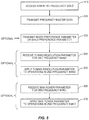
- Figure 5 will be readily understood to provide a process flow diagram for a method that involves some of the techniques previously described.
- the process flow of Figure 5 may be implemented in wireless handset like UE 410, for example, or a similar device configured to operate in at least first and second frequency bands according to at least one radio access mode. Either or both of the first and second frequency bands may be unlicensed frequency bands.
- the pictured method (and the other techniques discussed herein) are particularly useful, as discussed earlier, in the context of a device initially operating in a standards-based radio access network, using a licensed frequency band, Using the techniques described here, the wireless communication device can communicate its capabilities in other frequency bands, whether licensed or not.
- the illustrated method begins, as shown at block 510, with accessing a radio access network (RAN) using a first radio access mode and the first frequency band.
- RAN radio access network
- this is typically done according to conventional means, for example in accordance with wireless telecommunications standards such as the 3GPP LTE standards.
- the wireless communication device transmits frequency raster data to the RAN.
- This frequency raster data corresponds to the second band, indicates a tuning capability of the wireless communication device, and comprises at least a first frequency index and a granularity indicator.
- the wireless communication device is configured to operate in a second radio access mode in the second frequency band, which may be an unlicensed band; this second radio access mode may utilize a different radio access technology than that used for the first frequency band, such as a WLAN technology rather than a WAN technology. Accordingly, in these embodiments the first frequency index and the granularity indicator correspond to this second radio access mode.
- the granularity indicator may indicate a frequency-step size that differs from the frequency-step size used in the first frequency band.
- the frequency raster for E-UTRA is 100 kHz, indicating a 100 kHz step size.
- the wireless communication device may be capable of using a smaller or larger step size in an unlicensed band - this differing step size can be communicated to the RAN via the granularity indicator.
- the frequency raster data can be communicated in any of a variety of formats.
- the granularity indicator directly specifies a raster granularity.
- this value may be encoded, thus a granularity indicator of "1" may correspond to a 100kHz raster, while a "2" specifies a 200 kHz, etc.
- the granularity indicator may comprise an index to one of several pre-determined frequency rasters. For instance, four different pre-determined frequency rasters, e.g., 100 KHz, 200 KHz, 300 KHz and 400 KHz, can be identified by raster identities 0, 1, 2 and 3.
- the mobile terminal In the event the mobile terminal supports raster 200 KHz, it will report the identifier # 1 to the radio access network, using the first radio access mode and the first frequency band. In case the UE supports the all the pre-defined raster then it may send another pre-determined identifier (e.g., # 4), indicating that all possible frequency raster points are supported when operating on the second frequency band.
- a pre-determined identifier e.g., # 4
- the granularity indicator may comprise a scaling factor, allowing the UE to indicate its frequency raster (applicable to the UE operation on the second frequency band) with fewer signaling overheads.
- the UE can report only the scaling factor, which scales up or down the basic pre-defined raster.
- the scaling factor can be an integer or even non-integer value.
- these approaches may be combined, so that the wireless communication device signals two parameters, a first parameter indicating one of a pre-determined set of base raster granularities, and another indicating a scaling factor to be applied to the selected raster granularity.
- the wireless communication device may be configured to indicate a mode preference, a frequency band preference, or both, to the RAN. This is shown at block 530, where the wireless communication device transmits a mode preference parameter, a band preference parameter, or both, to the wireless network.
- these preferences may be coded in a variety of ways, and may indicate the wireless device's capabilities or preferences regarding operation in unlicensed bands, regarding use of certain radio access technologies in certain bands, and/or regarding use of unlicensed bands and/or radio access technologies with respect to particular services.
- the wireless communication device may also receive device configuration parameters and/or instructions from the wireless network.
- receives a tuning resolution parameter for the second frequency band this tuning resolution parameter may indicate, for example, a scanning step size that differs from that used in scanning the first frequency band.
- the tuning resolution parameter may indicate the resolution directly, or may comprise an index to one of a pre-determined set of tuning resolutions. Still other embodiments may employ a scaling factor, for application by the wireless communication device to a pre-defined base tuning resolution.
- the radio access network can use the same pre-defined identifiers discussed above, with respect to block 530, to configure the device to operate with a particular frequency raster provided the device supports the configured frequency raster when operating on the second frequency band.
- this tuning resolution parameter is subsequently applied to one or more operations in the second frequency band, such as scanning for pilot signals or control channels, taking signal strength (such as the reference received signal power, or RSRP, in E-UTRAN systems, or the common pilot channel received signal code power, or CPICH RSCP, in UTRAN systems) or other signal quality measurements (e.g., reference signal received quality, RSRQ, in E-UTRAN systems, or CPICH Ec/No in UTRAN systems), cell identification, handovers to a control channel or access channel, etc.
- signal strength such as the reference received signal power, or RSRP, in E-UTRAN systems, or the common pilot channel received signal code power, or CPICH RSCP, in UTRAN systems
- other signal quality measurements e.g., reference signal
- tuning resolution parameter include, but are not limited to, frequency synchronization, symbol level synchronization, slot synchronization, sub-frame synchronization, frame synchronization, tuning to a common control channel (e.g., physical broadcast channel, PBCH, in E-UTRAN) or user-specific control channel (e.g., physical downlink control channel, PDCCH, in E-UTRAN), and tuning to an access channel (e.g., PDCCH in E-URAN or Acquisition Indicator Channel, AICH, in UTRAN, containing the random access responses sent by the radio access network to the UE).
- a common control channel e.g., physical broadcast channel, PBCH, in E-UTRAN
- PDCCH physical downlink control channel
- AICH Acquisition Indicator Channel
- the wireless communication device receives a parameter indicating the maximum power allowed in the second frequency band. This maximum power parameter is subsequently applied to operations in the second frequency band, as shown at block 570.
- This approach can be used to ensure that the wireless communication device remains compliant with various limits applied to unlicensed bands, especially considering that these limits can vary from one jurisdiction to another.
- FIG. 6 is a process flow diagram illustrating a method that is carried out in a node in or attached to a radio access network, such as a base station.
- a radio access network such as a base station.
- FIG. 6 illustrates a method for controlling operation of a wireless device configured to communicate with the radio access network in a first radio access mode and in a first frequency band, as well as to operate in a second frequency band not supported by the controlling base station.
- the pictured method begins with the receiving of frequency raster data from an attached mobile terminal.
- this frequency raster data corresponds to the second band supported by the mobile terminal, indicates a tuning capability of the mobile terminal, and comprises at least a first frequency index and a granularity indicator.
- the mobile terminal is configured to operate in a second radio access mode in the second frequency band, which may be an unlicensed band; this second radio access mode may utilize a different radio access technology than that used for the first frequency band, such as a WLAN technology rather than a WAN technology. Accordingly, in these embodiments the first frequency index and the granularity indicator correspond to this second radio access mode.
- the RAN node receives a mode preference parameter, a band preference parameter, or both, from the wireless device.
- these preferences may be coded in a variety of ways, and may indicate the mobile terminal's capabilities or preferences regarding operation in unlicensed bands, regarding use of certain radio access technologies in certain bands, and/or regarding use of unlicensed bands and/or radio access technologies with respect to particular services.
- the RAN uses the frequency raster data (and the preference parameters, if available) to determine device configuration parameters, as shown at block 630. These parameters are transmitted to the mobile terminal, as shown at block 640. These parameters may include any of the configuration parameters or instructions discussed above. For instance, the RAN may transmit to the mobile terminal a tuning resolution parameter for the second frequency band; as discussed above, this tuning resolution parameter may indicate a scanning step size for use in the second frequency band that differs from that used in scanning the first frequency band.
- the RAN may transmit a parameter indicating the maximum power allowed in the second frequency band; again, this maximum power may differ (substantially, in some cases) from that allowed in the first frequency band, especially when the second frequency band corresponds to unlicensed spectrum, and/or when operation in the second frequency band is according to a different radio access technology.
- the device configuration parameters transmitted to the mobile terminal can include instructions such as an assignment to operation in the second frequency band, and/or an assignment to operate in a second radio access mode (such as according to a different radio access technology). In some embodiments, these assignments may be based on an evaluation of mode preference parameters or band preference parameters received from the mobile terminal.
- a base station or other node in or attached to the radio access network may be configured to maintain a database of access point capabilities for access points corresponding to the second frequency band (and/or a second access mode).
- a base station may be aware of WLAN hot-spots within or adjoining the base station's coverage area. Updates to the database can be handled in a number of different ways. A few examples are illustrated in Figure 6 .
- the base station or other radio access node can receive signal strength data for the second frequency band as reported by the mobile terminal. This data can be consolidated with data reported from other terminals, and may be combined with location data from the mobile terminals. Thus, the base station is able to predict the availability and potential quality of one or more access points from this data.
- Additional information may be received directly from the access points themselves, via a backhaul connection. This is shown at block 660.
- the access points can report a variety of data, including availability data (e.g., whether the access point is on or off), location data, loading/usage data, and the like. This data, along with the signal strength data reported from mobile terminals, is used to update a database of access point information. In some embodiments, the device configuration parameters discussed above are selected in view of this database.
Landscapes
- Engineering & Computer Science (AREA)
- Computer Networks & Wireless Communication (AREA)
- Signal Processing (AREA)
- Quality & Reliability (AREA)
- Databases & Information Systems (AREA)
- Mobile Radio Communication Systems (AREA)
Claims (11)
- Verfahren in einem Benutzergerät (UE) (410), das zum Betrieb mindestens in einem ersten Frequenzband unter Verwendung eines ersten Funkzugriffsmodus und in einem zweiten Frequenzband unter Verwendung eines zweiten Funkzugriffsmodus konfiguriert ist, wobei das Verfahren das Zugreifen (510) auf ein Funkzugriffsnetzwerk über eine Basisstation (460) unter Verwendung des ersten Funkzugriffsmodus und das erste Frequenzband umfasst, wobei das erste Frequenzband ein lizenziertes Frequenzband ist, dadurch gekennzeichnet, dass das Verfahren ferner umfasst:Übertragen (520) von Frequenzrasterdaten an das Funkzugriffsnetzwerk, wobei die Frequenzrasterdaten dem zweiten Frequenzband entsprechen, eine Tuning-Fähigkeit des Benutzergeräts (410) angeben und mindestens einen ersten Frequenzindex und einen Granularitätsindikator umfassen, wobei der erste Frequenzindex und der Granularitätsindikator dem zweiten Funkzugriffsmodus entsprechen, wobei der Granularitätsindikator eine Frequenzschrittgröße angibt, die sich von einer in dem ersten Frequenzband verwendeten Frequenzschrittgröße unterscheidet, wobei das zweite Frequenzband einem unlizenzierten Spektrum entspricht und nicht von der Basisstation (460) unterstützt wird, wobei der zweite Funkzugriffsmodus eine andere Funkzugriffstechnologie als die verwendet, die für das erste Frequenzband verwendet wird; undAnwenden (540, 550, 560, 570) eines oder mehrerer Gerätekonfigurationsparameter, die vom Funkzugriffsnetzwerk auf Grundlage der übertragenen Frequenzrasterdaten empfangen werden.
- Verfahren nach Anspruch 1, wobei eine dem ersten Funkzugriffsmodus und dem ersten Frequenzband entsprechende Tuning-Fähigkeit eine vorgegebene erste Frequenzschrittgröße umfasst, und wobei der Granularitätsindikator einer zweiten Frequenzschrittgröße entspricht, die sich von der ersten Frequenzschrittgröße unterscheidet.
- Verfahren nach einem der Ansprüche 1-2, wobei der Granularitätsindikator einen Index zu einer oder mehreren einer Vielzahl vorgegebener Rastergranularitäten umfasst.
- Verfahren nach einem der Ansprüche 1-2, wobei der Granularitätsindikator einen Skalierungsfaktor zur Anwendung auf eine vorgegebene Rastergranularität umfasst.
- Verfahren nach einem der Ansprüche 1-4, wobei der erste Frequenzindex ein erstes Ende des zweiten Frequenzbandes angibt und wobei die Frequenzrasterdaten ferner einen zweiten Frequenzindex umfassen, der ein zweites Ende des zweiten Frequenzbandes angibt.
- Verfahren nach einem der Ansprüche 1-5, wobei das Empfangen und Anwenden (540, 550, 560, 570) eines oder mehrerer Gerätekonfigurationsparameter Folgendes umfasst:Empfangen (540) eines Tuning-Auflösungsparameters am Benutzergerät (410) aus dem Funkzugriffsnetzwerk; undAnwenden (550) des Tuning-Auflösungsparameters auf eine oder mehrere Operationen des Benutzergeräts (410) im zweiten Frequenzband.
- Verfahren, ausgeführt durch eine Basisstation (460) in einem Funkzugriffsnetzwerk, zum Steuern des Betriebs eines Benutzergeräts (410), das zum Kommunizieren mit der Basisstation (460) in dem Funkzugriffsnetzwerk in einem ersten Funkzugriffsmodus und in einem ersten Frequenzband konfiguriert ist und ferner zum Betrieb in einem zweiten Frequenzband unter Verwendung eines zweiten Funkzugriffsmodus konfiguriert ist, wobei das erste Frequenzband ein lizenziertes Frequenzband ist, dadurch gekennzeichnet, dass das Verfahren Folgendes umfasst:Empfangen (610) von Frequenzrasterdaten vom Benutzergerät (410), wobei die Frequenzrasterdaten dem zweiten Frequenzband entsprechen, eine Tuning-Fähigkeit des Benutzergeräts (410) angeben und mindestens einen ersten Frequenzindex und einen Granularitätsindikator umfassen, wobei der erste Frequenzindex und der Granularitätsindikator dem zweiten Funkzugriffsmodus entsprechen, wobei der Granularitätsindikator eine Frequenzschrittgröße angibt, die sich von einer in dem ersten Frequenzband verwendeten Frequenzschrittgröße unterscheidet, wobei das zweite Frequenzband einem unlizenzierten Spektrum entspricht und nicht von der Basisstation (460) unterstützt wird, wobei der zweite Funkzugriffsmodus eine andere Funkzugriffstechnologie als die verwendet, die für das erste Frequenzband verwendet wird;Bestimmen (630) eines oder mehrerer Gerätekonfigurationsparameter auf Grundlage der Frequenzrasterdaten; undÜbertragen (640) des einen oder der mehreren Gerätekonfigurationsparameter an das Benutzergerät (410).
- Verfahren nach Anspruch 7, wobei der eine oder die mehreren Gerätekonfigurationsparameter einen Maximalleistungsparameter umfassen, der eine erste Sender-Leistungsgrenze angibt, die dem zweiten Frequenzband entspricht und die sich von einer vorgegebenen Sender-Leistungsgrenze unterscheidet, die dem ersten Funkzugriffsmodus und dem ersten Frequenzband entspricht.
- Verfahren nach einem der Ansprüche 7-8, wobei der eine oder die mehreren Gerätekonfigurationsparameter einen Tuning-Auflösungsparameter zur Anwendung durch das Benutzergerät (410) auf eine oder mehrere Operationen im zweiten Frequenzband umfassen.
- Benutzergerät (410), das zum Betrieb mindestens in einem ersten Frequenzband unter Verwendung eines ersten Funkzugriffsmodus und in einem zweiten Frequenzband unter Verwendung eines zweiten Funkzugriffsmodus konfiguriert ist, wobei das Benutzergerät (410) einen Empfänger (415), Sender (420) und Steuerprozessor (430) umfasst, wobei der Steuerprozessor (430) zum Zugreifen auf ein Funkzugriffsnetzwerk unter Verwendung eines ersten Funkzugriffsmodus und des ersten Frequenzbandes konfiguriert ist, wobei das erste Frequenzband ein lizenziertes Frequenzband ist, und dadurch gekennzeichnet, dass der Steuerprozessor (430) für Folgendes konfiguriert ist:Übertragen von Frequenzrasterdaten vom Benutzergerät (410) an das Funkzugriffsnetzwerk unter Verwendung des Senders (420), wobei die Frequenzrasterdaten dem zweiten Frequenzband entsprechen, eine Tuning-Fähigkeit des Benutzergeräts (410) angeben und mindestens einen ersten Frequenzindex und einen Granularitätsindikator umfassen, wobei der erste Frequenzindex und der Granularitätsindikator dem zweiten Funkzugriffsmodus entsprechen, wobei der Granularitätsindikator eine Frequenzschrittgröße angibt, die sich von einer in dem ersten Frequenzband verwendeten Frequenzschrittgröße unterscheidet, wobei das zweite Frequenzband einem unlizenzierten Spektrum entspricht und nicht von der Basisstation (460) unterstützt wird, wobei der zweite Funkzugriffsmodus eine andere Funkzugriffstechnologie als die verwendet, die für das erste Frequenzband verwendet wird; undAnwenden (540, 550, 560, 570) eines oder mehrerer Gerätekonfigurationsparameter, die vom Funkzugriffsnetzwerk auf Grundlage der übertragenen Frequenzrasterdaten empfangen werden.
- Basisstation (460) zum Steuern des Betriebs eines Benutzergeräts (410), das zum Kommunizieren mit dem Funkzugriffsnetzwerk in einem ersten Funkzugriffsmodus in einem ersten Frequenzband konfiguriert ist und ferner zum Betrieb in einem zweiten Frequenzband unter Verwendung eines zweiten Funkzugriffsmodus konfiguriert ist, wobei das erste Frequenzband ein lizenziertes Frequenzband ist, dadurch gekennzeichnet, dass die Basisstation (460) für Folgendes konfiguriert ist:Empfangen von Frequenzrasterdaten vom Benutzergerät (410), wobei die Frequenzrasterdaten dem zweiten Frequenzband entsprechen, eine Tuning-Fähigkeit des Benutzergeräts (410) angeben und mindestens einen ersten Frequenzindex und einen Granularitätsindikator umfassen, wobei der erste Frequenzindex und der Granularitätsindikator dem zweiten Funkzugriffsmodus entsprechen, wobei der Granularitätsindikator eine Frequenzschrittgröße angibt, die sich von einer in dem ersten Frequenzband verwendeten Frequenzschrittgröße unterscheidet, wobei das zweite Frequenzband einem unlizenzierten Spektrum entspricht und nicht von der Basisstation (460) unterstützt wird, wobei der zweite Funkzugriffsmodus eine andere Funkzugriffstechnologie als die verwendet, die für das erste Frequenzband verwendet wird;Bestimmen eines oder mehrerer Gerätekonfigurationsparameter auf Grundlage der Frequenzrasterdaten; undÜbertragen des einen oder der mehreren Gerätekonfigurationsparameter an das Benutzergerät (410).
Applications Claiming Priority (1)
| Application Number | Priority Date | Filing Date | Title |
|---|---|---|---|
| PCT/SE2010/050885 WO2012021098A1 (en) | 2010-08-13 | 2010-08-13 | Dual operation of user equipment in licensed and unlicensed spectrum |
Publications (3)
| Publication Number | Publication Date |
|---|---|
| EP2604072A1 EP2604072A1 (de) | 2013-06-19 |
| EP2604072A4 EP2604072A4 (de) | 2016-02-17 |
| EP2604072B1 true EP2604072B1 (de) | 2018-07-18 |
Family
ID=45567863
Family Applications (1)
| Application Number | Title | Priority Date | Filing Date |
|---|---|---|---|
| EP10855968.3A Not-in-force EP2604072B1 (de) | 2010-08-13 | 2010-08-13 | Doppelbetrieb eines benutzergeräts in einem lizenzierten und einem unlizenzierten frequenzband |
Country Status (4)
| Country | Link |
|---|---|
| US (1) | US20130143502A1 (de) |
| EP (1) | EP2604072B1 (de) |
| CN (1) | CN103069882B (de) |
| WO (1) | WO2012021098A1 (de) |
Cited By (1)
| Publication number | Priority date | Publication date | Assignee | Title |
|---|---|---|---|---|
| WO2022216518A1 (en) * | 2021-04-05 | 2022-10-13 | Idac Holdings, Inc. | Methods, architectures, apparatuses and systems directed to initial access in higher frequencies |
Families Citing this family (102)
| Publication number | Priority date | Publication date | Assignee | Title |
|---|---|---|---|---|
| WO2012106843A1 (en) * | 2011-02-11 | 2012-08-16 | Renesas Mobile Corporation | Signaling method to enable controlled tx deferring in mixed licensed and unlicensed spectrum carrier aggregation in future lte-a networks |
| WO2012162875A1 (en) * | 2011-05-30 | 2012-12-06 | Renesas Mobile Corporation | Methods and apparatus for managing wireless communication using unlicensed frequency bands |
| WO2013006988A1 (en) * | 2011-07-14 | 2013-01-17 | Renesas Mobile Corporation | Methods and apparatuses for provision of a flexible time sharing scheme on an unlicensed band of a system |
| GB2532399B (en) | 2011-09-30 | 2016-08-03 | Samsung Electronics Co Ltd | Management of spectrum emission requirements |
| US9030969B2 (en) * | 2011-11-21 | 2015-05-12 | Broadcom Corporation | Wireless communication device capable of utilizing multiple radio access technologies |
| GB2498932B (en) * | 2012-01-30 | 2013-12-18 | Renesas Mobile Corp | Method, apparatus and computer program for distributed carrier aggregation |
| WO2013179095A1 (en) * | 2012-05-31 | 2013-12-05 | Nokia Corporation | Coexistence of lte operated in unlicensed band |
| US10154368B1 (en) * | 2012-08-13 | 2018-12-11 | Sprint Spectrum L.P. | Systems and methods for providing system-acquisition parameters on standardized frequencies |
| WO2014086006A1 (zh) * | 2012-12-05 | 2014-06-12 | 华为技术有限公司 | 可缩放带宽小区的选择方法、装置和用户设备 |
| EP4280485A3 (de) * | 2013-01-18 | 2024-03-06 | Huawei Technologies Co., Ltd. | Kommunikationsverfahren und -vorrichtung |
| US9179451B2 (en) | 2013-03-04 | 2015-11-03 | Qualcomm Incorporated | Apparatus and methods of frequency spectrum usage in a wireless communication system |
| KR102253873B1 (ko) | 2013-04-25 | 2021-05-20 | 삼성전자주식회사 | 무선 통신 네트워크에서 고주파 캐리어를 획득하는 방법 및 시스템 |
| RU2631251C2 (ru) * | 2013-05-31 | 2017-09-20 | Хуавэй Текнолоджиз Ко., Лтд. | Способ обмена информацией, базовая станция и устройство пользователя |
| CN105519199B (zh) * | 2013-08-09 | 2019-05-31 | 瑞典爱立信有限公司 | 用于在通信网络中的rat间接入选择的终端和方法 |
| US9801115B2 (en) | 2013-09-04 | 2017-10-24 | Qualcomm Incorporated | Robust inter-radio access technology operations in unlicensed spectrum |
| US10299257B2 (en) * | 2013-09-12 | 2019-05-21 | Qualcomm Incorporated | Transmitter management under transmitter uncertainty |
| EP3075182B1 (de) | 2013-12-03 | 2019-10-16 | Nokia Solutions and Networks Oy | Benutzervorrichtungsunterstützter einsatz in einem unlizenzierten frequenzband |
| US10045221B2 (en) | 2013-12-18 | 2018-08-07 | Qualcomm, Incorporated | TCP enhancement with limited licensed channel usage for wireless networks |
| CN104735785B (zh) * | 2013-12-18 | 2018-12-07 | 中国移动通信集团公司 | 一种数据传输方法、装置、系统和相关设备 |
| CN104768160B (zh) * | 2014-01-03 | 2019-04-19 | 上海朗帛通信技术有限公司 | 一种非授权频谱的调度方法和装置 |
| MX355978B (es) * | 2014-01-07 | 2018-05-07 | Ericsson Telefon Ab L M | Métodos y aparatos para la habilitación de un dispositivo inalámbrico para comunicarse con el nodo de red de radio en un espectro sin licencia. |
| CN104796218B (zh) * | 2014-01-17 | 2019-02-12 | 电信科学技术研究院 | 信号传输方法和装置 |
| CN105379337B (zh) * | 2014-01-24 | 2020-01-31 | 华为技术有限公司 | 一种测量方法、配置方法、相关设备及系统 |
| EP3091799B1 (de) * | 2014-01-29 | 2020-01-01 | Huawei Technologies Co., Ltd. | Synchronisationsverfahren, basisstation und benutzervorrichtung |
| WO2015113252A1 (zh) * | 2014-01-29 | 2015-08-06 | 华为技术有限公司 | 数据的处理方法和装置 |
| EP3099103A4 (de) * | 2014-02-11 | 2017-01-25 | Huawei Technologies Co., Ltd. | Verfahren und vorrichtung zum erhalt von nichtautorisierten frequenzinformationen |
| WO2015127592A1 (zh) * | 2014-02-25 | 2015-09-03 | 华为技术有限公司 | 一种上报非授权频谱能力的方法和装置 |
| CN105308998B (zh) * | 2014-04-02 | 2019-04-05 | 华为技术有限公司 | 一种非授权频谱的使用方法和基站及终端 |
| US9706553B2 (en) | 2014-04-08 | 2017-07-11 | Qualcomm Incorporated | Methods and apparatuses for shared multioperator LTE service in unlicensed frequency bands |
| CN106233813B (zh) * | 2014-04-22 | 2020-02-14 | 华为技术有限公司 | 一种用非授权频谱进行数据通信的方法、设备及通信系统 |
| WO2015165035A1 (zh) * | 2014-04-29 | 2015-11-05 | 华为技术有限公司 | 一种网络节点及频谱资源的使用方法 |
| US20150326612A1 (en) * | 2014-05-06 | 2015-11-12 | Qualcomm Incorporated | Techniques for network selection in unlicensed frequency bands |
| US9831999B2 (en) * | 2014-05-08 | 2017-11-28 | Nvidia Corporation | Enhanced discontinued transmission and reception methods |
| CN111629387B (zh) * | 2014-05-19 | 2024-07-02 | 北京三星通信技术研究有限公司 | 在免许可频段上的干扰检测方法及设备 |
| WO2015179811A1 (en) * | 2014-05-22 | 2015-11-26 | Kyocera Corporation | Unlicensed frequency band with licensed frequency band timing |
| KR101896559B1 (ko) * | 2014-05-28 | 2018-09-07 | 후아웨이 테크놀러지 컴퍼니 리미티드 | 비면허 셀 기반 정보 획득 방법 및 장치 |
| CN105830513B (zh) * | 2014-05-29 | 2019-10-25 | 华为技术有限公司 | 测量小区信号质量的方法、装置及系统 |
| CN105282858A (zh) * | 2014-05-30 | 2016-01-27 | 中兴通讯股份有限公司 | 非授权载波的协调、协调处理方法及装置 |
| WO2015180117A1 (zh) * | 2014-05-30 | 2015-12-03 | 华为技术有限公司 | 一种频谱资源调度装置、方法及系统 |
| CN105208668B (zh) * | 2014-06-06 | 2019-06-18 | 上海诺基亚贝尔股份有限公司 | 一种载波侦听方法 |
| CN109818726B (zh) * | 2014-06-21 | 2021-03-26 | 上海朗帛通信技术有限公司 | 一种利用非授权频谱通信的方法和装置 |
| CN105393634B (zh) * | 2014-06-24 | 2019-11-15 | 华为技术有限公司 | 一种数据通信方法、设备及系统 |
| US10075864B2 (en) * | 2014-07-02 | 2018-09-11 | Intel IP Corporation | System and method for measurement reporting in an unlicensed spectrum |
| KR20160004626A (ko) * | 2014-07-03 | 2016-01-13 | 삼성전자주식회사 | 비인가 대역을 이용하는 무선 통신 시스템에서 기지국 및 단말의 동작 방법 및 장치 |
| JP6568066B2 (ja) | 2014-07-04 | 2019-08-28 | シャープ株式会社 | 移動局装置、基地局装置、および方法 |
| CN105337710B (zh) * | 2014-08-06 | 2019-09-06 | 上海朗帛通信技术有限公司 | 一种ue、基站中利用非授权频谱通信的方法和设备 |
| US10182088B2 (en) * | 2014-08-19 | 2019-01-15 | Qualcomm Incorporated | Wideband ranging in cellular using unlicensed radio frequency spectrum band |
| US10244426B2 (en) * | 2014-08-19 | 2019-03-26 | Qualcomm Incorporated | Frequency error detection with PBCH frequency hypothesis |
| US9866893B2 (en) * | 2014-08-19 | 2018-01-09 | Comcast Cable Communications, Llc | Methods and systems for accessing content |
| EP3193525B1 (de) | 2014-09-12 | 2021-02-24 | Nec Corporation | Drahtlose station, drahtloses endgerät und verfahren zur endgerätemessung |
| US11109376B2 (en) * | 2014-09-22 | 2021-08-31 | Qualcomm Incorporated | Structured channel rasters for unlicensed spectrum |
| CN105515740B (zh) | 2014-09-24 | 2019-05-31 | 上海诺基亚贝尔股份有限公司 | 一种用于快速信道测量和反馈的方法 |
| JP6310087B2 (ja) * | 2014-09-25 | 2018-04-11 | 株式会社Nttドコモ | ユーザ端末及び無線通信方法 |
| CN105850205B (zh) * | 2014-09-26 | 2020-06-16 | 华为技术有限公司 | 一种上行信号的传输方法和相关设备 |
| WO2016049915A1 (zh) * | 2014-09-30 | 2016-04-07 | 宇龙计算机通信科技(深圳)有限公司 | 数据传输方法、传输系统、控制方法、控制系统和设备 |
| US10980045B2 (en) * | 2014-10-02 | 2021-04-13 | Qualcomm Incorporated | Techniques for managing power on an uplink component carrier transmitted over a shared radio frequency spectrum band |
| CN105578600A (zh) * | 2014-10-10 | 2016-05-11 | 电信科学技术研究院 | 一种lte系统在免许可频段上通信的方法及装置 |
| TWI573412B (zh) * | 2014-10-23 | 2017-03-01 | 財團法人工業技術研究院 | 控制無線實體和用戶設備的通信模式的方法以及使用所述方法的通信系統 |
| US20160119857A1 (en) * | 2014-10-24 | 2016-04-28 | Qualcomm Incorporated | Bilateral search algorithm for lte system |
| WO2016065553A1 (zh) * | 2014-10-29 | 2016-05-06 | 华为技术有限公司 | 一种数据帧的传输方法及装置 |
| US9887822B2 (en) | 2014-11-03 | 2018-02-06 | Intel IP Corporation | System and method to address resource collision for asymmetric region allocation |
| US9800387B2 (en) | 2014-11-06 | 2017-10-24 | Intel IP Corporation | Computing apparatus with cross-subframe scheduling |
| CN105874862B (zh) * | 2014-11-07 | 2019-10-25 | 华为技术有限公司 | 一种数据发送的方法和装置 |
| US9882662B2 (en) * | 2014-11-11 | 2018-01-30 | Sharp Kabushiki Kaisha | Systems and methods for license assisted access |
| CN105682241B (zh) * | 2014-11-21 | 2020-06-16 | 中兴通讯股份有限公司 | 一种非授权载波的占用方法和设备 |
| US9930652B2 (en) | 2014-12-18 | 2018-03-27 | Intel Corporation | Evolved node-B, user equipment and methods for transition between unlicensed and licensed frequency bands |
| CN105848165B (zh) * | 2015-01-14 | 2022-01-18 | 中兴通讯股份有限公司 | 非授权资源的使用方法、系统、基站及用户设备 |
| CN106162922B (zh) * | 2015-01-27 | 2021-01-26 | 中兴通讯股份有限公司 | 发现信号的处理方法及装置 |
| CN105991262B (zh) * | 2015-01-30 | 2019-02-05 | 中国移动通信集团公司 | 一种信息传输方法及系统、基站、终端 |
| WO2016133181A1 (ja) * | 2015-02-19 | 2016-08-25 | 株式会社Nttドコモ | ユーザ端末、無線基地局及び無線通信方法 |
| US10390249B2 (en) * | 2015-04-03 | 2019-08-20 | Lg Electronics Inc. | Method for receiving or transmitting pilot signal in wireless communication system, and apparatus therefor |
| WO2016161980A1 (zh) * | 2015-04-10 | 2016-10-13 | 中兴通讯股份有限公司 | 非授权载波的竞争方法及装置 |
| WO2016181537A1 (ja) * | 2015-05-13 | 2016-11-17 | 富士通株式会社 | 無線通信システム、基地局、通信端末及び無線通信システムの制御方法 |
| CN106162898B (zh) * | 2015-05-15 | 2022-01-28 | 中兴通讯股份有限公司 | 非授权载波处理的方法及装置 |
| WO2016195751A1 (en) * | 2015-05-29 | 2016-12-08 | Intel Corporation | Evolved node-b, spectrum access system (sas) controller and method for communication in shared spectrum |
| CN106341899A (zh) * | 2015-07-14 | 2017-01-18 | 中兴通讯股份有限公司 | 基于非授权载波执行随机接入的方法及装置 |
| CN106714295B (zh) * | 2015-07-15 | 2020-11-17 | 中兴通讯股份有限公司 | 一种数据传输方法和装置 |
| US10251132B2 (en) * | 2015-07-23 | 2019-04-02 | Acer Incorporated | Device and method of handling uplink power control for unlicensed serving cell |
| CN107925928B (zh) * | 2015-08-29 | 2020-12-18 | 华为技术有限公司 | 一种无线链路监测方法、相关设备和系统 |
| EP3361793B1 (de) * | 2015-11-06 | 2021-03-03 | Huawei Technologies Co., Ltd. | Verfahren und vorrichtung zur frequenzbestimmung |
| WO2017118778A1 (en) * | 2016-01-08 | 2017-07-13 | Nokia Technologies Oy | Method and apparatus for performing frequency synchronization for carriers |
| CN110289941B (zh) * | 2016-03-16 | 2022-06-28 | 华为技术有限公司 | 数据发送方法、数据接收方法、发送端设备及接收端设备 |
| US10708953B2 (en) * | 2016-04-18 | 2020-07-07 | Qualcomm Incorporated | Random access retransmission procedure |
| US20170325174A1 (en) * | 2016-05-09 | 2017-11-09 | Ofinno Technologies, Llc | Uplink transmission power control in a wireless device and wireless network |
| US11102779B2 (en) * | 2016-07-15 | 2021-08-24 | Qualcomm Incorporated | Methods and apparatus for IOT operation in unlicensed spectrum |
| WO2018052349A1 (en) * | 2016-09-15 | 2018-03-22 | Telefonaktiebolaget Lm Ericsson (Publ) | Methods and systems for autonomous device selection of transmission resources |
| CN109792662B (zh) * | 2016-10-31 | 2020-08-14 | 华为技术有限公司 | 一种频谱资源的指示方法、装置及系统 |
| US10285120B2 (en) | 2016-12-02 | 2019-05-07 | Qualcomm Incorporated | Techniques and apparatuses for common search space determination |
| US10541771B2 (en) * | 2016-12-02 | 2020-01-21 | Qualcomm Incorporated | Techniques for transmitting or using a pull-in signal to locate a synchronization channel |
| CN106658566B (zh) * | 2016-12-06 | 2020-02-21 | 上海华为技术有限公司 | 一种小区确定的方法、相关设备以及系统 |
| CN110249651A (zh) * | 2017-02-06 | 2019-09-17 | 瑞典爱立信有限公司 | 用于指示由WiFi接入点的辅助演进型节点B在未授权频谱上承载的数据业务的方法及装置 |
| US10477552B2 (en) | 2017-02-13 | 2019-11-12 | Qualcomm Incorporated | Techniques for handling wide bandwidth communications |
| US10284999B2 (en) | 2017-05-10 | 2019-05-07 | Qualcomm Incorporated | Mobile device position determination using compatible dedicated-frequency nodes and non-dedicated-frequency nodes |
| US10270573B2 (en) | 2017-05-16 | 2019-04-23 | Qualcomm Incorporated | Techniques and apparatuses for reusing remaining minimum system information configuration bits to signal a synchronization signal block location |
| US11272460B2 (en) | 2017-06-08 | 2022-03-08 | Telefonaktiebolaget Lm Ericsson (Publ) | Communication device and method for indicating a preference based on the device power consumption or on performance of carriers |
| WO2018227569A1 (zh) * | 2017-06-16 | 2018-12-20 | 北京小米移动软件有限公司 | 传输信息的方法及装置 |
| US10966248B2 (en) * | 2017-11-01 | 2021-03-30 | Apple Inc. | Coexistence features for cellular communication in unlicensed spectrum |
| US11395262B2 (en) | 2017-11-06 | 2022-07-19 | Nokia Technologies Oy | Methods and devices for transmission by selecting between uplink resources |
| WO2019146721A1 (ja) * | 2018-01-29 | 2019-08-01 | 日本電気株式会社 | 通信装置、基地局、端末装置、方法、プログラム、及びコンピュータに読み取り可能な非一時的記録媒体 |
| WO2021064888A1 (ja) * | 2019-10-02 | 2021-04-08 | 株式会社Nttドコモ | 端末及び通信方法 |
| CN115087075B (zh) * | 2021-03-11 | 2024-10-25 | 维沃移动通信有限公司 | 使用免授权频段的方法、装置、终端及网络侧设备 |
| US12328631B2 (en) * | 2022-08-18 | 2025-06-10 | Qualcomm Incorporated | Interference mitigation techniques between wireless communications and aircraft radio altimeters |
Family Cites Families (20)
| Publication number | Priority date | Publication date | Assignee | Title |
|---|---|---|---|---|
| US5548839A (en) * | 1994-10-14 | 1996-08-20 | Caldwell; Stephen P. | Wide band radio-frequency converter having multiple use of intermediate frequency translators |
| FI107688B (fi) * | 1997-02-27 | 2001-09-14 | Nokia Networks Oy | Menetelmä dynaamisen kanavienjaon toteuttamiseksi solukkoradiojärjestelmässä |
| DE19831569A1 (de) * | 1998-07-14 | 2000-01-20 | Siemens Ag | Verfahren zur Informationsübertragung und Funkstation |
| MY128734A (en) * | 1999-03-22 | 2007-02-28 | Golden Bridge Tech Inc | Common packet channel |
| US6477156B1 (en) * | 1999-06-29 | 2002-11-05 | Nokia Corporation | Apparatus, and associated method, for selectably operating radio device in alternate operating mode |
| CA2501991C (en) * | 2002-10-18 | 2010-09-14 | Kineto Wireless, Inc. | Apparatus and method for extending the coverage area of a licensed wireless communication system using an unlicensed wireless communication system |
| DE10338485A1 (de) * | 2003-08-21 | 2005-03-24 | Siemens Ag | Verfahren zum Betrieb einer Basisstation, Basisstation und Computerprogramm |
| KR101002857B1 (ko) * | 2003-09-16 | 2010-12-21 | 삼성전자주식회사 | 이동통신 시스템에서 이동단말의 속도 추정 방법 및 장치 |
| JP4447416B2 (ja) * | 2004-09-22 | 2010-04-07 | 株式会社エヌ・ティ・ティ・ドコモ | マルチバンド移動通信システムおよび送信機 |
| CN100396151C (zh) * | 2004-12-07 | 2008-06-18 | 华为技术有限公司 | 一种基站上行负载控制方法 |
| US7925268B2 (en) * | 2005-09-14 | 2011-04-12 | Cisco Technology, Inc. | Method for optimizing up-link transmission power for a wireless terminal in a multi-carrier system |
| JP2007124578A (ja) * | 2005-10-31 | 2007-05-17 | Ntt Docomo Inc | 複数の信号帯域幅を定義する無線通信システムにおける送受信帯域幅設定方法、移動端末および基地局 |
| EP1816878A1 (de) * | 2006-02-02 | 2007-08-08 | Siemens Aktiengesellschaft | Verfahren zum Betreiben eines Mobilfunkkommunikationssystems und entsprechendes Mobilfunkkommunikationssystem |
| US8145214B2 (en) * | 2007-08-09 | 2012-03-27 | Motorola Mobility, Inc. | Raster skipping in co-banded mobile communication devices based on previous scans for any band |
| KR20090095434A (ko) * | 2008-03-03 | 2009-09-09 | 삼성전자주식회사 | 무선 통신 시스템에서 다중 주파수 밴드를 이용한 신호송수신 시스템 및 방법 |
| US8761824B2 (en) * | 2008-06-27 | 2014-06-24 | Qualcomm Incorporated | Multi-carrier operation in a wireless communication network |
| KR101643430B1 (ko) * | 2008-08-04 | 2016-07-27 | 파나소닉 인텔렉츄얼 프로퍼티 코포레이션 오브 아메리카 | 단말 장치, 수신 방법, 및 집적 회로 |
| US8532041B1 (en) * | 2009-04-24 | 2013-09-10 | Marvell International Ltd. | Method for transmitting information in a regulated spectrum and network configured to operate in the regulated spectrum |
| JP5580315B2 (ja) * | 2009-08-07 | 2014-08-27 | パナソニック インテレクチュアル プロパティ コーポレーション オブ アメリカ | 無線基地局装置および無線通信方法 |
| US9191966B2 (en) * | 2010-03-30 | 2015-11-17 | Intel Mobile Communications GmbH | Communication device and method for communicating in a communication mode using a frequency range according to a frame structure |
-
2010
- 2010-08-13 EP EP10855968.3A patent/EP2604072B1/de not_active Not-in-force
- 2010-08-13 WO PCT/SE2010/050885 patent/WO2012021098A1/en not_active Ceased
- 2010-08-13 US US13/814,971 patent/US20130143502A1/en not_active Abandoned
- 2010-08-13 CN CN201080068552.6A patent/CN103069882B/zh not_active Expired - Fee Related
Non-Patent Citations (1)
| Title |
|---|
| None * |
Cited By (1)
| Publication number | Priority date | Publication date | Assignee | Title |
|---|---|---|---|---|
| WO2022216518A1 (en) * | 2021-04-05 | 2022-10-13 | Idac Holdings, Inc. | Methods, architectures, apparatuses and systems directed to initial access in higher frequencies |
Also Published As
| Publication number | Publication date |
|---|---|
| US20130143502A1 (en) | 2013-06-06 |
| EP2604072A4 (de) | 2016-02-17 |
| CN103069882B (zh) | 2016-09-07 |
| WO2012021098A1 (en) | 2012-02-16 |
| EP2604072A1 (de) | 2013-06-19 |
| CN103069882A (zh) | 2013-04-24 |
Similar Documents
| Publication | Publication Date | Title |
|---|---|---|
| EP2604072B1 (de) | Doppelbetrieb eines benutzergeräts in einem lizenzierten und einem unlizenzierten frequenzband | |
| US12369041B2 (en) | Telecommunications apparatus and methods | |
| US10798601B2 (en) | User equipment and a radio network node, and methods therein | |
| EP2484043B1 (de) | Verrfahren und vorrichtung zur ausführung von messungen wenn mehrfachträger unterstützt werden | |
| EP3481104B1 (de) | Messverfahren für drahtloskommunikationsnetzwerk, basisstation und endgerät | |
| EP2606696B1 (de) | Verfahren und vorrichtungen in drahtlosen mobilfunksystemen | |
| US8391861B2 (en) | Flexible sharing of measurement gaps | |
| EP2954746B1 (de) | Verfahren und vorrichtung zur frequenzbegrenzung in einem drahtlosen kommunikationssystem | |
| US20170311206A1 (en) | Method and device for configuring cell in wireless communication system | |
| US20140301351A1 (en) | Centralized Control Sharing of Spectrum for Coexistence of Wireless Communication Systems in Unlicensed Bands | |
| JP2020521379A (ja) | 非スタンドアロンモードにおいてネットワークアイコンを提供するためのオプション | |
| US20230078923A1 (en) | Method and apparatus for relaxed radio resource management measurement | |
| GB2498988A (en) | Transmission power selection in a carrier aggregation system within a shared band | |
| WO2013059933A1 (en) | Performing inter-frequency measurements in a mobile network | |
| CN103503538A (zh) | 电信系统中的方法和网络节点 | |
| US10506484B2 (en) | Method and apparatus for facilitating network coexistence | |
| US11800417B2 (en) | Cell reselection in communication systems using unlicensed frequency bands | |
| CN113079711A (zh) | 新无线电非授权中进行频率间小区重选 | |
| WO2018092116A1 (en) | Discovery carriers in frequency-hopping iot systems | |
| KR101858378B1 (ko) | 우선순위화된 셀 식별 및 측정 방법 | |
| CN115529585B (zh) | 信息指示的方法和通信装置 |
Legal Events
| Date | Code | Title | Description |
|---|---|---|---|
| PUAI | Public reference made under article 153(3) epc to a published international application that has entered the european phase |
Free format text: ORIGINAL CODE: 0009012 |
|
| 17P | Request for examination filed |
Effective date: 20130218 |
|
| AK | Designated contracting states |
Kind code of ref document: A1 Designated state(s): AL AT BE BG CH CY CZ DE DK EE ES FI FR GB GR HR HU IE IS IT LI LT LU LV MC MK MT NL NO PL PT RO SE SI SK SM TR |
|
| DAX | Request for extension of the european patent (deleted) | ||
| RA4 | Supplementary search report drawn up and despatched (corrected) |
Effective date: 20160115 |
|
| RIC1 | Information provided on ipc code assigned before grant |
Ipc: H04W 8/22 20090101ALN20160111BHEP Ipc: H04W 28/18 20090101AFI20160111BHEP |
|
| 17Q | First examination report despatched |
Effective date: 20161215 |
|
| REG | Reference to a national code |
Ref country code: DE Ref legal event code: R079 Ref document number: 602010052088 Country of ref document: DE Free format text: PREVIOUS MAIN CLASS: H04W0036160000 Ipc: H04W0028180000 |
|
| GRAP | Despatch of communication of intention to grant a patent |
Free format text: ORIGINAL CODE: EPIDOSNIGR1 |
|
| RIC1 | Information provided on ipc code assigned before grant |
Ipc: H04W 28/18 20090101AFI20180328BHEP Ipc: H04W 8/22 20090101ALN20180328BHEP |
|
| INTG | Intention to grant announced |
Effective date: 20180417 |
|
| RIC1 | Information provided on ipc code assigned before grant |
Ipc: H04W 28/18 20090101AFI20180406BHEP Ipc: H04W 8/22 20090101ALN20180406BHEP |
|
| GRAS | Grant fee paid |
Free format text: ORIGINAL CODE: EPIDOSNIGR3 |
|
| GRAA | (expected) grant |
Free format text: ORIGINAL CODE: 0009210 |
|
| AK | Designated contracting states |
Kind code of ref document: B1 Designated state(s): AL AT BE BG CH CY CZ DE DK EE ES FI FR GB GR HR HU IE IS IT LI LT LU LV MC MK MT NL NO PL PT RO SE SI SK SM TR |
|
| REG | Reference to a national code |
Ref country code: GB Ref legal event code: FG4D |
|
| REG | Reference to a national code |
Ref country code: CH Ref legal event code: EP |
|
| REG | Reference to a national code |
Ref country code: IE Ref legal event code: FG4D |
|
| REG | Reference to a national code |
Ref country code: AT Ref legal event code: REF Ref document number: 1020692 Country of ref document: AT Kind code of ref document: T Effective date: 20180815 |
|
| REG | Reference to a national code |
Ref country code: DE Ref legal event code: R096 Ref document number: 602010052088 Country of ref document: DE |
|
| REG | Reference to a national code |
Ref country code: FR Ref legal event code: PLFP Year of fee payment: 9 |
|
| REG | Reference to a national code |
Ref country code: NL Ref legal event code: FP |
|
| REG | Reference to a national code |
Ref country code: LT Ref legal event code: MG4D |
|
| REG | Reference to a national code |
Ref country code: AT Ref legal event code: MK05 Ref document number: 1020692 Country of ref document: AT Kind code of ref document: T Effective date: 20180718 |
|
| PG25 | Lapsed in a contracting state [announced via postgrant information from national office to epo] |
Ref country code: FI Free format text: LAPSE BECAUSE OF FAILURE TO SUBMIT A TRANSLATION OF THE DESCRIPTION OR TO PAY THE FEE WITHIN THE PRESCRIBED TIME-LIMIT Effective date: 20180718 Ref country code: PL Free format text: LAPSE BECAUSE OF FAILURE TO SUBMIT A TRANSLATION OF THE DESCRIPTION OR TO PAY THE FEE WITHIN THE PRESCRIBED TIME-LIMIT Effective date: 20180718 Ref country code: IS Free format text: LAPSE BECAUSE OF FAILURE TO SUBMIT A TRANSLATION OF THE DESCRIPTION OR TO PAY THE FEE WITHIN THE PRESCRIBED TIME-LIMIT Effective date: 20181118 Ref country code: SE Free format text: LAPSE BECAUSE OF FAILURE TO SUBMIT A TRANSLATION OF THE DESCRIPTION OR TO PAY THE FEE WITHIN THE PRESCRIBED TIME-LIMIT Effective date: 20180718 Ref country code: GR Free format text: LAPSE BECAUSE OF FAILURE TO SUBMIT A TRANSLATION OF THE DESCRIPTION OR TO PAY THE FEE WITHIN THE PRESCRIBED TIME-LIMIT Effective date: 20181019 Ref country code: NO Free format text: LAPSE BECAUSE OF FAILURE TO SUBMIT A TRANSLATION OF THE DESCRIPTION OR TO PAY THE FEE WITHIN THE PRESCRIBED TIME-LIMIT Effective date: 20181018 Ref country code: AT Free format text: LAPSE BECAUSE OF FAILURE TO SUBMIT A TRANSLATION OF THE DESCRIPTION OR TO PAY THE FEE WITHIN THE PRESCRIBED TIME-LIMIT Effective date: 20180718 Ref country code: LT Free format text: LAPSE BECAUSE OF FAILURE TO SUBMIT A TRANSLATION OF THE DESCRIPTION OR TO PAY THE FEE WITHIN THE PRESCRIBED TIME-LIMIT Effective date: 20180718 Ref country code: BG Free format text: LAPSE BECAUSE OF FAILURE TO SUBMIT A TRANSLATION OF THE DESCRIPTION OR TO PAY THE FEE WITHIN THE PRESCRIBED TIME-LIMIT Effective date: 20181018 |
|
| PG25 | Lapsed in a contracting state [announced via postgrant information from national office to epo] |
Ref country code: LV Free format text: LAPSE BECAUSE OF FAILURE TO SUBMIT A TRANSLATION OF THE DESCRIPTION OR TO PAY THE FEE WITHIN THE PRESCRIBED TIME-LIMIT Effective date: 20180718 Ref country code: HR Free format text: LAPSE BECAUSE OF FAILURE TO SUBMIT A TRANSLATION OF THE DESCRIPTION OR TO PAY THE FEE WITHIN THE PRESCRIBED TIME-LIMIT Effective date: 20180718 Ref country code: AL Free format text: LAPSE BECAUSE OF FAILURE TO SUBMIT A TRANSLATION OF THE DESCRIPTION OR TO PAY THE FEE WITHIN THE PRESCRIBED TIME-LIMIT Effective date: 20180718 |
|
| REG | Reference to a national code |
Ref country code: CH Ref legal event code: PL |
|
| REG | Reference to a national code |
Ref country code: DE Ref legal event code: R097 Ref document number: 602010052088 Country of ref document: DE |
|
| PG25 | Lapsed in a contracting state [announced via postgrant information from national office to epo] |
Ref country code: LU Free format text: LAPSE BECAUSE OF NON-PAYMENT OF DUE FEES Effective date: 20180813 Ref country code: MC Free format text: LAPSE BECAUSE OF FAILURE TO SUBMIT A TRANSLATION OF THE DESCRIPTION OR TO PAY THE FEE WITHIN THE PRESCRIBED TIME-LIMIT Effective date: 20180718 Ref country code: RO Free format text: LAPSE BECAUSE OF FAILURE TO SUBMIT A TRANSLATION OF THE DESCRIPTION OR TO PAY THE FEE WITHIN THE PRESCRIBED TIME-LIMIT Effective date: 20180718 Ref country code: ES Free format text: LAPSE BECAUSE OF FAILURE TO SUBMIT A TRANSLATION OF THE DESCRIPTION OR TO PAY THE FEE WITHIN THE PRESCRIBED TIME-LIMIT Effective date: 20180718 Ref country code: CZ Free format text: LAPSE BECAUSE OF FAILURE TO SUBMIT A TRANSLATION OF THE DESCRIPTION OR TO PAY THE FEE WITHIN THE PRESCRIBED TIME-LIMIT Effective date: 20180718 Ref country code: EE Free format text: LAPSE BECAUSE OF FAILURE TO SUBMIT A TRANSLATION OF THE DESCRIPTION OR TO PAY THE FEE WITHIN THE PRESCRIBED TIME-LIMIT Effective date: 20180718 Ref country code: LI Free format text: LAPSE BECAUSE OF NON-PAYMENT OF DUE FEES Effective date: 20180831 Ref country code: IT Free format text: LAPSE BECAUSE OF FAILURE TO SUBMIT A TRANSLATION OF THE DESCRIPTION OR TO PAY THE FEE WITHIN THE PRESCRIBED TIME-LIMIT Effective date: 20180718 Ref country code: CH Free format text: LAPSE BECAUSE OF NON-PAYMENT OF DUE FEES Effective date: 20180831 |
|
| REG | Reference to a national code |
Ref country code: BE Ref legal event code: MM Effective date: 20180831 |
|
| PLBE | No opposition filed within time limit |
Free format text: ORIGINAL CODE: 0009261 |
|
| STAA | Information on the status of an ep patent application or granted ep patent |
Free format text: STATUS: NO OPPOSITION FILED WITHIN TIME LIMIT |
|
| REG | Reference to a national code |
Ref country code: IE Ref legal event code: MM4A |
|
| PG25 | Lapsed in a contracting state [announced via postgrant information from national office to epo] |
Ref country code: SM Free format text: LAPSE BECAUSE OF FAILURE TO SUBMIT A TRANSLATION OF THE DESCRIPTION OR TO PAY THE FEE WITHIN THE PRESCRIBED TIME-LIMIT Effective date: 20180718 Ref country code: DK Free format text: LAPSE BECAUSE OF FAILURE TO SUBMIT A TRANSLATION OF THE DESCRIPTION OR TO PAY THE FEE WITHIN THE PRESCRIBED TIME-LIMIT Effective date: 20180718 Ref country code: SK Free format text: LAPSE BECAUSE OF FAILURE TO SUBMIT A TRANSLATION OF THE DESCRIPTION OR TO PAY THE FEE WITHIN THE PRESCRIBED TIME-LIMIT Effective date: 20180718 |
|
| 26N | No opposition filed |
Effective date: 20190423 |
|
| PG25 | Lapsed in a contracting state [announced via postgrant information from national office to epo] |
Ref country code: IE Free format text: LAPSE BECAUSE OF NON-PAYMENT OF DUE FEES Effective date: 20180813 |
|
| PG25 | Lapsed in a contracting state [announced via postgrant information from national office to epo] |
Ref country code: SI Free format text: LAPSE BECAUSE OF FAILURE TO SUBMIT A TRANSLATION OF THE DESCRIPTION OR TO PAY THE FEE WITHIN THE PRESCRIBED TIME-LIMIT Effective date: 20180718 Ref country code: BE Free format text: LAPSE BECAUSE OF NON-PAYMENT OF DUE FEES Effective date: 20180831 |
|
| PG25 | Lapsed in a contracting state [announced via postgrant information from national office to epo] |
Ref country code: MT Free format text: LAPSE BECAUSE OF NON-PAYMENT OF DUE FEES Effective date: 20180813 |
|
| PG25 | Lapsed in a contracting state [announced via postgrant information from national office to epo] |
Ref country code: TR Free format text: LAPSE BECAUSE OF FAILURE TO SUBMIT A TRANSLATION OF THE DESCRIPTION OR TO PAY THE FEE WITHIN THE PRESCRIBED TIME-LIMIT Effective date: 20180718 |
|
| PG25 | Lapsed in a contracting state [announced via postgrant information from national office to epo] |
Ref country code: HU Free format text: LAPSE BECAUSE OF FAILURE TO SUBMIT A TRANSLATION OF THE DESCRIPTION OR TO PAY THE FEE WITHIN THE PRESCRIBED TIME-LIMIT; INVALID AB INITIO Effective date: 20100813 Ref country code: PT Free format text: LAPSE BECAUSE OF FAILURE TO SUBMIT A TRANSLATION OF THE DESCRIPTION OR TO PAY THE FEE WITHIN THE PRESCRIBED TIME-LIMIT Effective date: 20180718 |
|
| PG25 | Lapsed in a contracting state [announced via postgrant information from national office to epo] |
Ref country code: CY Free format text: LAPSE BECAUSE OF FAILURE TO SUBMIT A TRANSLATION OF THE DESCRIPTION OR TO PAY THE FEE WITHIN THE PRESCRIBED TIME-LIMIT Effective date: 20180718 Ref country code: MK Free format text: LAPSE BECAUSE OF NON-PAYMENT OF DUE FEES Effective date: 20180718 |
|
| PGFP | Annual fee paid to national office [announced via postgrant information from national office to epo] |
Ref country code: NL Payment date: 20200826 Year of fee payment: 11 |
|
| PGFP | Annual fee paid to national office [announced via postgrant information from national office to epo] |
Ref country code: FR Payment date: 20200825 Year of fee payment: 11 Ref country code: GB Payment date: 20200827 Year of fee payment: 11 Ref country code: DE Payment date: 20200827 Year of fee payment: 11 |
|
| REG | Reference to a national code |
Ref country code: DE Ref legal event code: R119 Ref document number: 602010052088 Country of ref document: DE |
|
| REG | Reference to a national code |
Ref country code: NL Ref legal event code: MM Effective date: 20210901 |
|
| GBPC | Gb: european patent ceased through non-payment of renewal fee |
Effective date: 20210813 |
|
| PG25 | Lapsed in a contracting state [announced via postgrant information from national office to epo] |
Ref country code: NL Free format text: LAPSE BECAUSE OF NON-PAYMENT OF DUE FEES Effective date: 20210901 |
|
| PG25 | Lapsed in a contracting state [announced via postgrant information from national office to epo] |
Ref country code: GB Free format text: LAPSE BECAUSE OF NON-PAYMENT OF DUE FEES Effective date: 20210813 Ref country code: FR Free format text: LAPSE BECAUSE OF NON-PAYMENT OF DUE FEES Effective date: 20210831 Ref country code: DE Free format text: LAPSE BECAUSE OF NON-PAYMENT OF DUE FEES Effective date: 20220301 |