EP2380881B1 - Novel bicyclic heterocyclic compound - Google Patents
Novel bicyclic heterocyclic compound Download PDFInfo
- Publication number
- EP2380881B1 EP2380881B1 EP09834989.7A EP09834989A EP2380881B1 EP 2380881 B1 EP2380881 B1 EP 2380881B1 EP 09834989 A EP09834989 A EP 09834989A EP 2380881 B1 EP2380881 B1 EP 2380881B1
- Authority
- EP
- European Patent Office
- Prior art keywords
- group
- substituted
- compound
- unsubstituted
- methyl
- Prior art date
- Legal status (The legal status is an assumption and is not a legal conclusion. Google has not performed a legal analysis and makes no representation as to the accuracy of the status listed.)
- Active
Links
- 0 CC=C*=*(C)N(*)C(CO)=C=NC Chemical compound CC=C*=*(C)N(*)C(CO)=C=NC 0.000 description 21
- XVSIMQCNEKPTMZ-UHFFFAOYSA-N CC(C=C(C(C1)F)F)=C1F Chemical compound CC(C=C(C(C1)F)F)=C1F XVSIMQCNEKPTMZ-UHFFFAOYSA-N 0.000 description 1
- OOTKSTBMZWHBHC-UHFFFAOYSA-N CC(CCC1(C)F)C=C1F Chemical compound CC(CCC1(C)F)C=C1F OOTKSTBMZWHBHC-UHFFFAOYSA-N 0.000 description 1
- WTNWMPBVOZBTNK-UHFFFAOYSA-N CCN(C1C2)C(C[N-]C(C)(C)C(N)=O)=NC1=CC=C2Oc(cc1)ccc1NC Chemical compound CCN(C1C2)C(C[N-]C(C)(C)C(N)=O)=NC1=CC=C2Oc(cc1)ccc1NC WTNWMPBVOZBTNK-UHFFFAOYSA-N 0.000 description 1
- KGADXVGZEHZVFC-UHFFFAOYSA-N CCOCCN(C1C2)C(C=O)=NC1=CC(Cl)=C2Oc(cc1)ccc1F Chemical compound CCOCCN(C1C2)C(C=O)=NC1=CC(Cl)=C2Oc(cc1)ccc1F KGADXVGZEHZVFC-UHFFFAOYSA-N 0.000 description 1
- IVIKHJIQDRNHQR-UHFFFAOYSA-N CCOCC[n]1c(cc(cc2)-c(cc3)ccc3F)c2nc1CNC(C)(C)C(N)=O Chemical compound CCOCC[n]1c(cc(cc2)-c(cc3)ccc3F)c2nc1CNC(C)(C)C(N)=O IVIKHJIQDRNHQR-UHFFFAOYSA-N 0.000 description 1
- MXWMSELIBMZSRH-UHFFFAOYSA-N CCOCC[n]1c(cc(cc2)-c(cc3)ccc3OC(F)(F)F)c2nc1CNC1(CC1)C(N)=O Chemical compound CCOCC[n]1c(cc(cc2)-c(cc3)ccc3OC(F)(F)F)c2nc1CNC1(CC1)C(N)=O MXWMSELIBMZSRH-UHFFFAOYSA-N 0.000 description 1
- SCVVGQQOVSRWBD-UHFFFAOYSA-N COCC[n]1c(cc(cc2)Oc(cc3)ccc3F)c2nc1CNC(C(N)=O)=C Chemical compound COCC[n]1c(cc(cc2)Oc(cc3)ccc3F)c2nc1CNC(C(N)=O)=C SCVVGQQOVSRWBD-UHFFFAOYSA-N 0.000 description 1
- YRGAYAGBVIXNAQ-UHFFFAOYSA-N COc(cc1)ccc1Cl Chemical compound COc(cc1)ccc1Cl YRGAYAGBVIXNAQ-UHFFFAOYSA-N 0.000 description 1
- CHLICZRVGGXEOD-UHFFFAOYSA-N Cc(cc1)ccc1OC Chemical compound Cc(cc1)ccc1OC CHLICZRVGGXEOD-UHFFFAOYSA-N 0.000 description 1
- UHIGHLGTNVYXOP-UHFFFAOYSA-N Cc(cc1F)cc(F)c1F Chemical compound Cc(cc1F)cc(F)c1F UHIGHLGTNVYXOP-UHFFFAOYSA-N 0.000 description 1
- WYBNORHIXSAFMZ-UHFFFAOYSA-N NC(CNCc1nc(ccc(Oc2ccccc2)c2)c2[n]1C1CCCC1)=O Chemical compound NC(CNCc1nc(ccc(Oc2ccccc2)c2)c2[n]1C1CCCC1)=O WYBNORHIXSAFMZ-UHFFFAOYSA-N 0.000 description 1
Classifications
-
- C—CHEMISTRY; METALLURGY
- C07—ORGANIC CHEMISTRY
- C07D—HETEROCYCLIC COMPOUNDS
- C07D471/00—Heterocyclic compounds containing nitrogen atoms as the only ring hetero atoms in the condensed system, at least one ring being a six-membered ring with one nitrogen atom, not provided for by groups C07D451/00 - C07D463/00
- C07D471/02—Heterocyclic compounds containing nitrogen atoms as the only ring hetero atoms in the condensed system, at least one ring being a six-membered ring with one nitrogen atom, not provided for by groups C07D451/00 - C07D463/00 in which the condensed system contains two hetero rings
- C07D471/04—Ortho-condensed systems
-
- C—CHEMISTRY; METALLURGY
- C07—ORGANIC CHEMISTRY
- C07D—HETEROCYCLIC COMPOUNDS
- C07D235/00—Heterocyclic compounds containing 1,3-diazole or hydrogenated 1,3-diazole rings, condensed with other rings
- C07D235/02—Heterocyclic compounds containing 1,3-diazole or hydrogenated 1,3-diazole rings, condensed with other rings condensed with carbocyclic rings or ring systems
- C07D235/04—Benzimidazoles; Hydrogenated benzimidazoles
- C07D235/06—Benzimidazoles; Hydrogenated benzimidazoles with only hydrogen atoms, hydrocarbon or substituted hydrocarbon radicals, directly attached in position 2
- C07D235/14—Radicals substituted by nitrogen atoms
-
- A—HUMAN NECESSITIES
- A61—MEDICAL OR VETERINARY SCIENCE; HYGIENE
- A61P—SPECIFIC THERAPEUTIC ACTIVITY OF CHEMICAL COMPOUNDS OR MEDICINAL PREPARATIONS
- A61P13/00—Drugs for disorders of the urinary system
-
- A—HUMAN NECESSITIES
- A61—MEDICAL OR VETERINARY SCIENCE; HYGIENE
- A61P—SPECIFIC THERAPEUTIC ACTIVITY OF CHEMICAL COMPOUNDS OR MEDICINAL PREPARATIONS
- A61P19/00—Drugs for skeletal disorders
-
- A—HUMAN NECESSITIES
- A61—MEDICAL OR VETERINARY SCIENCE; HYGIENE
- A61P—SPECIFIC THERAPEUTIC ACTIVITY OF CHEMICAL COMPOUNDS OR MEDICINAL PREPARATIONS
- A61P19/00—Drugs for skeletal disorders
- A61P19/02—Drugs for skeletal disorders for joint disorders, e.g. arthritis, arthrosis
-
- A—HUMAN NECESSITIES
- A61—MEDICAL OR VETERINARY SCIENCE; HYGIENE
- A61P—SPECIFIC THERAPEUTIC ACTIVITY OF CHEMICAL COMPOUNDS OR MEDICINAL PREPARATIONS
- A61P25/00—Drugs for disorders of the nervous system
-
- A—HUMAN NECESSITIES
- A61—MEDICAL OR VETERINARY SCIENCE; HYGIENE
- A61P—SPECIFIC THERAPEUTIC ACTIVITY OF CHEMICAL COMPOUNDS OR MEDICINAL PREPARATIONS
- A61P25/00—Drugs for disorders of the nervous system
- A61P25/04—Centrally acting analgesics, e.g. opioids
-
- A—HUMAN NECESSITIES
- A61—MEDICAL OR VETERINARY SCIENCE; HYGIENE
- A61P—SPECIFIC THERAPEUTIC ACTIVITY OF CHEMICAL COMPOUNDS OR MEDICINAL PREPARATIONS
- A61P29/00—Non-central analgesic, antipyretic or antiinflammatory agents, e.g. antirheumatic agents; Non-steroidal antiinflammatory drugs [NSAID]
-
- A—HUMAN NECESSITIES
- A61—MEDICAL OR VETERINARY SCIENCE; HYGIENE
- A61P—SPECIFIC THERAPEUTIC ACTIVITY OF CHEMICAL COMPOUNDS OR MEDICINAL PREPARATIONS
- A61P37/00—Drugs for immunological or allergic disorders
-
- A—HUMAN NECESSITIES
- A61—MEDICAL OR VETERINARY SCIENCE; HYGIENE
- A61P—SPECIFIC THERAPEUTIC ACTIVITY OF CHEMICAL COMPOUNDS OR MEDICINAL PREPARATIONS
- A61P43/00—Drugs for specific purposes, not provided for in groups A61P1/00-A61P41/00
-
- C—CHEMISTRY; METALLURGY
- C07—ORGANIC CHEMISTRY
- C07D—HETEROCYCLIC COMPOUNDS
- C07D405/00—Heterocyclic compounds containing both one or more hetero rings having oxygen atoms as the only ring hetero atoms, and one or more rings having nitrogen as the only ring hetero atom
- C07D405/02—Heterocyclic compounds containing both one or more hetero rings having oxygen atoms as the only ring hetero atoms, and one or more rings having nitrogen as the only ring hetero atom containing two hetero rings
- C07D405/04—Heterocyclic compounds containing both one or more hetero rings having oxygen atoms as the only ring hetero atoms, and one or more rings having nitrogen as the only ring hetero atom containing two hetero rings directly linked by a ring-member-to-ring-member bond
-
- C—CHEMISTRY; METALLURGY
- C07—ORGANIC CHEMISTRY
- C07D—HETEROCYCLIC COMPOUNDS
- C07D405/00—Heterocyclic compounds containing both one or more hetero rings having oxygen atoms as the only ring hetero atoms, and one or more rings having nitrogen as the only ring hetero atom
- C07D405/14—Heterocyclic compounds containing both one or more hetero rings having oxygen atoms as the only ring hetero atoms, and one or more rings having nitrogen as the only ring hetero atom containing three or more hetero rings
Definitions
- the present invention relates to a drug for the treatment or prophylaxis of pathology in general in which SNS (sensory neuron specific sodium channel) is involved, which comprises a novel compound having a benzimidazole or imidazopyridine skeleton as a bicyclic heterocycle or a pharmaceutically acceptable salt thereof as an active ingredient.
- SNS sensor neuron specific sodium channel
- the present invention relates to a drug for the treatment or prophylaxis of diseases such as neuropathic pain, nociceptive pain, dysuria, multiple sclerosis and the like.
- a sensory neuron specific sodium channel (sensory nerve-specific Na channel), i.e., SNS, is one of such Na channel ⁇ subunits, is a tetrodotoxin (TTX)-resistant Na channel localized in the small diameter cell (C fiber) of dorsal root ganglion involved in nerval perception, and is also called SCN10A, PN3 or NaVl.8 (non-patent documents 1, 2). It has been reported that SNS knockout mouse is insensitive to mechanical stimulations, and administration of antisense to SNS to neuropathic pain or inflammatory pain models attenuates hypersensitivity and abnormal perception.
- TTX tetrodotoxin
- an SNS inhibitor is considered to provide a therapeutic or prophylactic drug showing an analgesic effect for diseases such as neuropathic pain, nociceptive pain and the like, which accompany pain, numbness, burning sensation, dull pain and the like, each involving C fiber.
- a medicament that selectively inhibits SNS is considered to be a medicament free of side effects derived from nonneural tissues or central nervous system.
- a medicament that inhibits SNS mainly causing the neural activity of C fiber is expected to be a therapeutic or prophylactic drug for dysuria, which has a novel point of action.
- an SNS inhibitor is expected to be a first therapeutic or prophylactic drug toward the induction of symptoms caused by abnormal firing associated with SNS expression in the cerebellar neuron, such as ataxia and the like in multiple sclerosis.
- Neuropathic pain refers to a pain including spontaneous pain and chronic pain developed by nerve damage or nerve stimulation even when trauma is absent and tissue inflammation is absent after complete recovery. Examples thereof include neuralgia after lumbar operation, diabetic neuropathy, neuralgia after herpes zoster, reflex sympathetic dystrophy, phantom limb pain, spinal cord damage, late stage carcinomatous pain, and prolonged postoperative pain.
- NSAIDS non-steroidal anti-inflammatory drugs
- opioids such as morphine and the like are problematic in drug resistance and induction of psychological symptom.
- mexiletine a sole medicament in the market, which is allegedly effective for neuropathic pain, is mexiletine applicable to diabetic neuropathy. Since mexiletine does not have selectivity to Na channel, though it provides an analgesis effect, side effects are feared and administration at a high dose has been reported to be unavailable. Some other medicaments are clinically applied as aids.
- antidepressant sulpiride, trazodone, fluvoxatine, milnacipran
- adrenaline agonist clonidine, dexmedetomidine
- NMDA receptor antagonists ketamine hydrochloride, dextromethorphan
- antianxiety drug diazepam, lorazepam, etizolam, hydroxyzine hydrochloride
- anticonvulsant carbamazepine, phenytoin, sodium valproate, zonisamide
- calcium antagonist nifedipine, verapamil hydrochloride, lomerizine hydrochloride
- Nociceptive pain refers to a pain caused by the activation of nociceptor (A ⁇ , C fiber) by mechanical, hyperthermic or chemical noxious stimulation due to tissue injury and the like.
- Nociceptor is sensitized by endogenous chemical stimulation (algetic substance) such as serotonin, substance P, bradykinin, prostaglandin and histamine.
- endogenous chemical stimulation algetic substance
- serotonin substance
- substance P substance P
- bradykinin substance
- prostaglandin prostaglandin
- histamine endogenous chemical stimulation
- Examples of the nociceptive pain include lumbago, abdominal pain, and pain due to rheumatoid arthritis or osteoarthritis.
- NSAIDS acetylsalicylic acid, acetaminophen, diclofenac sodium, indomethacin, mofezolac, flurbiprofen, loxoprofen sodium, ampiroxicam
- steroid drugs prednisolone, methylprednisolone, dexamethasone, betamethasone
- PGE 1 prostaglandin E1
- alprostadil lipo alprostadil
- limaprost alprostadil limaprost alprostadil
- PGI 2 beraprost sodium
- Dysuria is a disease mainly showing urinary frequency, urorrhea, feeling of residual urine and urodynia as main symptoms.
- the main drug treatment of overactive bladder uses a muscarinic receptor inhibitor that suppresses the bladder parasympathetic nerve pathway.
- Capsaicin and resinifera toxin which are vanilloid receptor stimulants, have been reported to specifically act on C fiber to suppress its function.
- a medicament that acts on SNS localized in C fiber has not been found.
- Multiple sclerosis is one kind of demyelination diseases, which shows scattered foci of demyelination in the white matter of the central nervous system, with various old and new lesions.
- the lesions appear more commonly in the white matter of lateral cerebral ventricle periphery, optic nerve, brain stem, spinal cord and the like. Histologically, myelin sheath is destroyed and axon and nerve cell are not damaged.
- symptoms such as optic neuritis, double vision, eyeball motion impairments such as nystagmus, convulsive paralysis, painful tonic convulsive attack, Lhermitte's syndrome, ataxia, logopathy, bladder rectal disorder and the like appear in various combinations.
- the etiology thereof is unknown, though autoimmune disease theory, infection theory and the like are proposed. At present, an effective prophylactic or therapeutic drug for multiple sclerosis is highly desired.
- Patent document 1 to be mentioned later relates to a selective modulator of CRF1 receptor and specifically describes a compound represented by the following formula (A) (Example 5, k).
- the compounds encompassed in the patent document characteristically have an amide bond in methylene on the imidazole ring, and are different from the compound of the present invention having an amino group in methylene on the imidazole ring.
- patent document 1 does not at all contain a description suggesting the present invention.
- Patent document 2 to be mentioned later relates to a Rho kinase inhibitor, and specifically describes a compound represented by the following formula (B) (Example 321).
- the compounds encompassed in the patent document do not have a substituent on the nitrogen atom of imidazole ring, and are different from the compound of the present invention essential having the substituent.
- patent document 2 does not at all contain a description suggesting the present invention.
- Benzimidazole carboxamide derivatives are provided in Patent Document 3.
- Such compounds may be used to modulate bradykinin receptor activityin vivo or in vitro, and are particularly useful in the treatment of conditions responsive to B1 modulation in humans, domesticated companion animals and livestock animals, including inflammation and pain.
- Pharmaceutical compositions and methods for using them to treat such disorders are provided, as are methods for using such ligands for receptor localization studies and various in vitro assays.
- the problem of the present invention is to provide a drug for the prophylaxis or treatment of pathology in general in which SNS is involved, specifically, diseases such as neuropathic pain, nociceptive pain, dysuria, multiple sclerosis and the like.
- a bicyclic compound having an imidazole ring or a pharmaceutically acceptable salt thereof inhibits TTX resistant Na channel in human SNS gene expressing cell, namely, has an SNS inhibitory activity, and is useful as a therapeutic or prophylactic drug for diseases such as a neuropathic pain, a nociceptive pain, dysuria, multiple sclerosis and the like, which resulted in the completion of the present invention.
- the present invention provides the following.
- the present invention provides an SNS inhibitor comprising a novel bicyclic compound or a pharmaceutically acceptable salt thereof.
- the SNS inhibitor of the present invention is useful as a drug for the treatment or prophylaxis of pathology in general in which SNS is involved, and is specifically applicable to patients with neuropathic pain, nociceptive pain, dysuria, multiple sclerosis and the like.
- halogen atom examples include a fluorine atom, a chlorine atom, a bromine atom and an iodine atom.
- alkyl group means a straight chain or branched alkyl group having 1 to 6 carbon atoms, and specific examples thereof include methyl group, ethyl group, propyl group (1-propyl group), isopropyl group (2-propyl group), butyl group (1-butyl group), sec-butyl group (2-butyl group), isobutyl group (2-methyl-1-propyl group), tert-butyl group (2-methyl-2-propyl group), pentyl group (1-pentyl group), hexyl-group (1-hexyl group) and the like.
- the alkyl group is preferably an alkyl group having 1 to 4 carbon atoms.
- haloalkyl group means a straight chain or branched alkyl group having 1 to 6 carbon atoms, which is substituted by the same or different 1 to 5 halogen atoms, and specific examples thereof include trifluoromethyl group, 2,2-difluoroethyl group, 2,2,2-trifluoroethyl group, 2-chloroethyl group, pentafluoroethyl group, 3,3,3-trifluoropropyl group and the like.
- the haloalkyl group is preferably a haloalkyl group alkyl group having 1 to 4 carbon atoms.
- alkenyl group means a straight chain or branched alkenyl group having 2 to 6 carbon atoms, and specific examples thereof include vinyl group, 1-propenyl group, 2-propenyl group, 1-methylvinyl group, 1-butenyl group, 1-ethylvinyl group, 1-methyl-2-propenyl group, 2-butenyl group, 3-butenyl group, 2-methyl-1-propenyl group, 2-methyl-2-propenyl group, 1-pentenyl group, 1-hexenyl group and the like.
- the alkenyl group is preferably an alkenyl group having 2 to 4 carbon atoms.
- alkynyl group means a straight chain or branched alkynyl group having 2 to 6 carbon atoms, and specific examples thereof include ethynyl group, 1-propynyl group, 2-propynyl group, 1-butynyl group, 1-methyl-2-propynyl group, 3-butynyl group, 1-pentynyl group, 1-hexynyl group and the like.
- the alkynyl group is preferably an alkynyl group having 2 to 4 carbon atoms.
- alkoxy group means a straight chain or branched alkoxy group having 1 to 6 carbon atoms, and specific examples thereof include methoxy group, ethoxy group, propoxy group, 1-methylethoxy group, butoxy group, 1--methylpropoxy group, 2-methylpropoxy group, 1,1-dimethylethoxy group, pentyloxy group, hexyloxy group and the like.
- the alkoxy group is preferably an alkoxy group having 1 to 4 carbon atoms.
- haloalkoxy group means a straight chain or branched alkoxy group having 1 to 6 carbon atoms, which is substituted by the same or different 1 to 5 halogen atoms, and specific examples thereof include trifluoromethoxy group, 2,2-difluoroethoxy group, 2,2,2-trifluoroethoxy group, 2-chloroethoxy group, pentafluoroethoxy group, 3,3,3-trifluoropropoxy group and the like.
- the haloalkoxy group is preferably a haloalkoxy group having 1 to 4 carbon atoms.
- cycloalkyl group means a 3- to 8-membered monocyclic or bicyclic cycloalkyl group, and specific examples thereof include cyclopropyl group, cyclobutyl group, cyclopentyl group, cyclohexyl group, cycloheptyl group, cyclooctyl group and the like.
- the cycloalkyl group is preferably a 4- to 6-membered cycloalkyl group.
- cycloalkenyl group means a 4- to 8-membered monocyclic or bicyclic cycloalkenyl group, and specific examples thereof include cyclobutenyl group, cyclopentenyl group, cyclohexenyl group, cycloheptenyl group and cyclooctenyl group.
- the position of double bond on the ring is not particularly limited.
- the cycloalkenyl group is preferably a 5- or 6-membered cycloalkenyl group.
- the "saturated aliphatic heterocyclic group” means a 4-to 8-membered monocyclic or bicyclic saturated aliphatic heterocyclic group containing 1 to 3 hetero atoms selected from a nitrogen atom, an oxygen atom and a sulfur atom (provided that the numbers of the oxygen atom and sulfur atom contained in the saturated aliphatic heterocycle are each up to 2).
- the position of the hetero atom is not particularly limited as long as the saturated aliphatic heterocyclic group is chemically stable.
- azetidinyl group pyrrolidinyl group, piperidyl group, piperidino group, piperazinyl group, azepanyl group, azocanyl group, tetrahydrofuryl group, tetrahydrothienyl group, tetrahydropyranyl group, morpholinyl group, morpholino group, thiomorpholinyl group, 1,4-dioxanyl group, 1,2,5-thiadiazinyl group, 1,4-oxazepanyl group, 1,4-diazepanyl group and the like.
- the "unsaturated aliphatic heterocyclic group” means a 5-to 10-membered monocyclic or bicyclic unsaturated aliphatic heterocyclic group containing 1 to 3 double bonds and 1 to 3 hetero atoms selected from a nitrogen atom, an oxygen atom and a sulfur atom (provided that the numbers of the oxygen atom and sulfur atom contained in the unsaturated aliphatic heterocycle are each up to 2).
- the positions of the hetero atom and double bond are not particularly limited as long as the unsaturated aliphatic heterocyclic group is chemically stable. Specific examples thereof include pyrrolinyl group, imidazolinyl group, tetrahydroisoquinolyl group and the like, and 2-pyrrolinyl group and 2-imidazolinyl group are preferable.
- the "saturated nitrogen-containing aliphatic heterocycle” means a 4- to 8-membered monocyclic or bicyclic saturated aliphatic heterocycle containing at least one nitrogen atom and optionally further containing 1 to 3 hetero atoms selected from a nitrogen atom, an oxygen atom and a sulfur atom (provided that the numbers of the oxygen atom and sulfur atom contained in the saturated aliphatic heterocycle are each up to 2).
- the position of the hetero atom is not particularly limited as long as the saturated nitrogen-containing aliphatic heterocycle is chemically stable.
- azetidine ring examples thereof include azetidine ring, pyrrolidine ring, imidazolidine ring, pyrazolidine ring, piperidine ring, piperazine ring, azepane ring, azocane ring, morpholine ring, thiomorpholine ring, oxazolidine ring, thiazolidine ring and the like.
- the "unsaturated nitrogen-containing aliphatic heterocycle” means a 4- to 8-membered monocyclic or bicyclic unsaturated aliphatic heterocycle containing at least one nitrogen atom and optionally further containing 1 to 3 hetero atoms selected from a nitrogen atom, an oxygen atom and a sulfur atom (provided that the numbers of the oxygen atom and sulfur atom contained in the unsaturated aliphatic heterocycle are each up to 2).
- the position of the hetero atom is not particularly limited as long as the unsaturated nitrogen-containing aliphatic heterocycle is chemically stable.
- pyrroline ring piperidine ring, imidazoline ring, pyrazoline ring, oxazoline ring, thiazoline ring, tetrahydroquinoline ring, tetrahydroisoquinoline ring and the like.
- aryl group means a 6- to 10-membered monocyclic or bicyclic aryl group, and specific examples thereof include phenyl group, 1-naphthyl group, 2-naphthyl group and the like.
- aromatic heterocyclic group means a 5- to 10-membered monocyclic or bicyclic aromatic heterocyclic group containing 1 to 4 hetero atoms selected from a nitrogen atom, an oxygen atom and a sulfur atom (provided that the numbers of the oxygen atom and sulfur atom contained in the aromatic heterocyclic group are each up to 2).
- the position of the hetero atom is not particularly limited as long as the aromatic heterocyclic group is chemically stable.
- alkylthio group means a straight chain or branched alkylthio group having 1 to 6 carbon atoms, and specific examples thereof include methylthio group, ethylthio group, propylthio group, 1-methylethylthio group, butylthio group, 1-methylpropylthio group, 2-methylpropylthio group, 1,1-dimethylethylthio group, pentylthio group, hexylthio group and the like.
- the alkylthio group is preferably an alkylthio group having 1 to 4 carbon atoms.
- alkyl of the "alkylcarbonyl group” examples include those similar to the aforementioned alkyl group.
- Preferable examples of the alkylcarbonyl group include acetyl group, propionyl group, butyryl group and the like.
- alkylcarbonyloxy group means a group wherein the oxygen atom is bonded to the carbonyl carbon of the aforementioned “alkylcarbonyl group”.
- alkyl of the "alkylsulfonyl group” examples include those similar to the aforementioned "alkyl group”.
- Preferable examples of the alkylsulfonyl group include methylsulfonyl group, ethylsulfonyl group, propylsulfonyl group and the like.
- alkoxy of the "alkoxycarbonyl group” examples include those similar to the aforementioned "alkoxy group”.
- Preferable examples of the alkoxycarbonyl group include methoxycarbonyl group, ethoxycarbonyl group, propoxycarbonyl group, butoxycarbonyl group, tert-butoxycarbonyl group and the like.
- alkyl group of the "amino group optionally substituted by one alkyl group or the same or different two alkyl groups” examples include those similar to the aforementioned "alkyl group”.
- amino group optionally substituted by one alkyl group or the same or different two alkyl groups include methylamino group, ethylamino group, propylamino group, dimethylamino group, diethylamino group, methylethylamino group and the like.
- the "carbamoyl group optionally substituted by one alkyl group or the same or different two alkyl groups” include methylcarbamoyl group, ethylcarbamoyl group, propylcarbamoyl group, isopropylcarbamoyl group, dimethylcarbamoyl group, diethylcarbamoyl group, methylethylcarbamoyl group and the like.
- sulfamoyl group optionally substituted by one alkyl group or the same or different two alkyl groups include methylsulfamoyl group, ethylsulfamoyl group, propylsulfamoyl group, dimethylsulfamoyl group, diethylsulfamoyl group, methylethylsulfamoyl group and the like.
- alkoxycarbonyl group of the “amidino group optionally substituted by one alkoxycarbonyl group or the same or different two alkoxycarbonyl groups include those similar to the aforementioned "alkoxycarbonyl group”.
- Preferable examples of the "amidino group optionally substituted by one alkoxycarbonyl group or the same or different two alkoxycarbonyl groups” include methoxycarbonylamidino group, ethoxycarbonylamidino group, propoxycarbonylamidino group and the like.
- aryl group of the "aryloxy group”, “arylcarbonyl group” and “arylsulfonyl group” is as defined for the aforementioned "aryl group”.
- aromatic heterocyclic group of the "aromatic heterocyclyloxy group", “aromatic heterocyclylcarbonyl group” and “aromatic heterocyclylsulfonyl group” is as defined for the aforementioned "aromatic heterocyclic group”.
- the substituent for the "cycloalkyl group”, “cycloalkenyl group”, “saturated aliphatic heterocyclic group”, “unsaturated aliphatic heterocyclic group”, “saturated nitrogen-containing aliphatic heterocycle” and “unsaturated nitrogen-containing aliphatic heterocycle” is one substituent or the same or different two or more substituents, which are selected from the group consisting of the following (vi) to (x):
- the substituent for the "phenyl group”, “aryl group” and “aromatic heterocyclic group” is 1 to 5 substituents selected from the group consisting of the following (xi) to (xv):
- the substituent for the "amino group”, “carbamoyl group” and “sulfamoyl group” is one substituent or the same or different two substituents, which are selected from the group consisting of the following (xvi) - (xviii):
- the two substituents for the "amino group”, “carbamoyl group” or “sulfamoyl group” are optionally bonded to form, together with the adjacent nitrogen atom, a 5- to 10-membered nitrogen-containing aliphatic heterocycle.
- nitrogen-containing aliphatic heterocycle examples include pyrrolidine ring, piperidine ring, an azepane ring, an azocane ring, a piperazine ring, a morpholine ring, a thiomorpholine ring and a tetrahydroisoquinoline ring.
- the nitrogen-containing aliphatic heterocycle is optionally substituted by one or more substituents selected from halogen, a hydroxyl group, a carboxyl group, an optionally substituted alkyl group, a haloalkyl group, an alkoxy group and a haloalkoxy group.
- substituent for the alkyl group include a halogen atom, a hydroxyl group, a carboxyl group, an alkoxy group, a haloalkoxy group and a carbamoyl group.
- each of the groups is preferably as follows.
- R 1 is a hydrogen atom, a halogen atom, an alkyl group having 1 to 6 carbon atoms, a haloalkyl group having 1 to 6 carbon atoms, an alkoxy group having 1 to 6 carbon atoms or a haloalkoxy group having 1 to 6 carbon atoms, preferably a hydrogen atom, a halogen atom, an alkyl group having 1 to 6 carbon atoms or a haloalkyl group having 1 to 6 carbon atoms, more preferably a hydrogen atom, a halogen atom or an alkyl group having 1 to 6 carbon atoms, more preferably a hydrogen atom or a halogen atom, particularly preferably a hydrogen atom.
- R 1 can be present on the benzene ring or pyridine ring at any substitutable position.
- R 1 examples include a hydrogen atom, a fluorine atom, a chlorine atom, a methyl group, an ethyl group, a propyl group, a trifluoromethyl group and the like.
- a hydrogen atom, a fluorine atom and a chlorine atom are preferable, and a hydrogen atom is more preferable.
- L is a single bond, -O- or -CH 2 O-, preferably, a single bond or -O-, more preferably -O-.
- L can be present on the benzene ring or pyridine ring at any substitutable position.
- L is -CH 2 O-
- the oxygen atom of -CH 2 O- is bonded to the benzene ring or pyridine ring, and the methylene chain is bonded to R 2 .
- R 2 is a substituted or unsubstituted 6- to 10-membered aryl group, or a substituted or unsubstituted 5- to 10-membered aromatic heterocyclic group, preferably a substituted or unsubstituted 6- to 10-membered aryl group, more preferably a substituted or unsubstituted phenyl group.
- substituent of the aryl group or aromatic heterocyclic group for R 2 include a halogen atom, a substituted or unsubstituted alkyl group (preferably an unsubstituted alkyl group having 1 to 6 carbon atoms), a haloalkyl group (preferably a haloalkyl group having 1 to 6 carbon atoms), an alkoxy group (preferably an alkoxy group having 1 to 6 carbon atoms), a haloalkoxy group (preferably a haloalkoxy group having 1 to 6 carbon atoms), a cyano group and the like, specifically, a fluorine atom, a chlorine atom, a methyl group, an ethyl group, an isopropyl group, a tert-butyl group, a trifluoromethyl group, a trifluoromethoxy group, a methoxy group, an ethoxy group, a cyano group and the like.
- a fluorine atom
- substituted or unsubstituted aryl group for R 2 include a phenyl group and a phenyl group substituted by preferable substituent(s) for the aforementioned aryl group, and the like.
- aromatic heterocyclic group for R 2 examples include a pyridyl group, a furyl group, a thienyl group, a pyrimidinyl group, a pyrazinyl group and the like. Among them, a pyridyl group and a furyl group are preferable.
- R 3 is a substituted or unsubstituted alkyl group having 1 to 6 carbon atoms, a substituted or unsubstituted alkenyl group having 2 to 6 carbon atoms, a substituted or unsubstituted alkynyl group having 2 to 6 carbon atoms, a substituted or unsubstituted 3- to 8-membered cycloalkyl group, a substituted or unsubstituted 4- to 8-membered cycloalkenyl group, a substituted or unsubstituted 4- to 8-membered saturated aliphatic heterocyclic group, or a substituted or unsubstituted 5- to 10-membered unsaturated aliphatic heterocyclic group, preferably a substituted or unsubstituted alkyl group having 1 to 6 carbon atoms, a substituted or unsubstituted 3- to 8-membered cycloalkyl group, a substituted or unsubstituted 4- to
- substituent for the alkyl group for R 3 include a hydroxyl group, an alkoxy group (preferably an alkoxy group having 1 to 6 carbon atoms), a 4-to 8-membered saturated aliphatic heterocyclic group and the like, specifically, a hydroxyl group, a methoxy group, an ethoxy group, an isopropoxy group, a tetrahydrofuryl group, a tetrahydropyranyl group and the like.
- substituent for the saturated aliphatic heterocyclic group for R 3 include an alkylcarbonyl group, an alkoxycarbonyl group, an alkylsulfonyl group, a mono-alkylcarbamoyl group (the alkyl moiety has preferably 1 to 6 carbon atoms) and the like, specifically, an acetyl group, a tert-butoxycarbonyl group, a methylsulfonyl group, an isopropylcarbamoyl group and the like.
- R 3 include an ethyl group, an isopropyl group, a cyclopropyl group, a cyclobutyl group, a cyclopentyl group, a methoxyethyl group, an ethoxyethyl group, an isopropoxyethyl group, a hydroxyethyl group, a methoxypropyl group, an ethoxypropyl group, a hydroxypropyl group, a tetrahydropyranyl group, a tetrahydrofuryl group, a 2,2-dimethyl-2-hydroxyethyl group, a tetrahydropyranylmethyl group, a tetrahydrofurylmethyl group, a 4-piperidyl group, a 1-(tert-butoxycarbonyl)piperidin-4-yl group, a 1-isopropylcarbamoylpiperidin-4-yl group, a 1-acetylpiperid
- R 4 is a hydrogen atom, a substituted or unsubstituted alkyl group having 1 to 6 carbon atoms, or a substituted or unsubstituted 3- to 8-membered cycloalkyl group, preferably a hydrogen atom, or a substituted or unsubstituted alkyl group having 1 to 6 carbon atoms, more preferably a hydrogen atom.
- substituent for the alkyl group and cycloalkyl group for R 4 include a halogen atom, a hydroxyl group, an alkoxy group (preferably an alkoxy group having 1 to 6 carbon atoms), a 4- to 8-membered saturated aliphatic heterocyclic group and the like, specifically, a fluorine atom, a chlorine atom, a hydroxyl group, a methoxy group, an ethoxy group, a tetrahydrofuryl group, a tetrahydropyranyl group and the like.
- R 4 examples include a hydrogen atom, a methyl group, cyclopropyl group and the like. Among them, a hydrogen atom and a methyl group are preferable, and a hydrogen atom is more preferable.
- R 5a and R 5b are each independently a hydrogen atom, or a substituted or unsubstituted alkyl group having 1 to 6 carbon atoms, or R 4 and R 5a are optionally bonded to form, together with the nitrogen atom that R 4 is bonded to, a 4- to 8-membered saturated nitrogen-containing aliphatic heterocycle (in this case, R 5b is a hydrogen atom), preferably independently each a hydrogen atom, or a substituted or unsubstituted alkyl group having 1 to 6 carbon atoms.
- substituent for the alkyl group for R 5a or R 5b include a halogen atom, a hydroxyl group, an alkoxy group (preferably an alkoxy group having 1 to 6 carbon atoms), a 4- to 8-membered saturated aliphatic heterocyclic group and the like, specifically, a fluorine atom, a chlorine atom, a hydroxyl group, a methoxy group, an ethoxy group, tetrahydrofuryl group, tetrahydropyranyl group and the like.
- R 5a and R 5b include independently each a hydrogen atom, a methyl group, an ethyl group and an isopropyl group (preferably R 5a is a hydrogen atom, a methyl group, an ethyl group or an isopropyl group, and R 5b is a methyl group, an ethyl group or an isopropyl group).
- R 5a is a hydrogen atom, a methyl group, an ethyl group or an isopropyl group
- R 5b is a methyl group, an ethyl group or an isopropyl group.
- a hydrogen atom and a methyl group are preferable (preferably R 5a is a hydrogen atom, and R 5b is a methyl group).
- the carbon atom that they are bonded to is an asymmetric carbon atom, and the steric configuration is preferably S-configuration from the aspects of easy availability of the starting materials.
- Specific examples of the 4- to 8-membered saturated nitrogen-containing aliphatic heterocycle formed by R 4 and R 5a which are bonded to each other, together with the nitrogen atom that R 4 is bonded to, include an azetidine ring, a pyrrolidine ring, a piperidine ring and the like. Among them, pyrrolidine ring is preferable.
- R 6 and R 7 are each independently a hydrogen atom, a substituted or unsubstituted alkyl group having 1 to 6 carbon atoms, a haloalkyl group having 1 to 6 carbon atoms, a substituted or unsubstituted alkenyl group having 2 to 6 carbon atoms, a substituted or unsubstituted alkynyl group having 2 to 6 carbon atoms, a substituted or unsubstituted 3-to 8-membered cycloalkyl group, a substituted or unsubstituted 4- to 8-membered cycloalkenyl group, a substituted or unsubstituted 4- to 8-membered saturated aliphatic heterocyclic group, a substituted or unsubstituted 5- to 10-membered unsaturated aliphatic heterocyclic group, a substituted or unsubstituted 6- to 10-membered aryl group, or a substituted or unsubstituted 5- to 10-
- substituent for the alkyl group for R 6 or R 7 include a hydroxyl group, an alkoxy group (preferably an alkoxy group having 1 to 6 carbon atoms), a 4-to 8-membered saturated aliphatic heterocyclic group and the like, specifically, a hydroxyl group, a methoxy group, an ethoxy group, a tetrahydrofuryl group, a tetrahydropyranyl group, a pyrrolidinyl group, a piperidyl group, a piperidino group, a piperazinyl group, a morpholino group and the like.
- Specific examples of the substituted alkyl group for R 6 or R 7 include a methoxyethyl group, a 2,2-dimethyl-2-hydroxyethyl group, a morpholinoethyl group and the like.
- R 6 or R 7 include a hydrogen atom, a methyl group, an ethyl group, an isopropyl group and the like. Among them, a hydrogen atom and a methyl group are preferable, and a hydrogen atom is more preferable.
- substituted or unsubstituted 4-to 8-membered saturated nitrogen-containing aliphatic heterocycle and substituted or unsubstituted 5- to 10-membered unsaturated nitrogen-containing aliphatic heterocycle, which are formed by R 6 and R 7 which are bonded to each other, together with the nitrogen atom that they are bond to include a morpholine ring, a pyrrolidine ring, a piperidine ring, a piperazine ring and the like. Among them, a morpholine ring and a piperazine ring are preferable.
- substituent for the above-mentioned saturated nitrogen-containing aliphatic heterocycle and unsaturated nitrogen-containing aliphatic heterocycle include an oxo group, a cyano group, a haloalkyl group (preferably a haloalkyl group having 1 to 6 carbon atoms) and the like. Among them, an oxo group, a cyano group and a trifluoromethyl group are preferable.
- Preferable examples of compound (1) include the following compounds and a pharmaceutically acceptable salt thereof.
- R 1 is a hydrogen atom or a halogen atom
- L is a single bond or -O-
- R 2 is a substituted or unsubstituted phenyl group
- X is a carbon atom
- R 3 is a substituted or unsubstituted alkyl group having 1 to 6 carbon atoms, a substituted or unsubstituted 3- to 8-membered cycloalkyl group, a substituted or unsubstituted 4- to 8-membered saturated aliphatic heterocyclic group, or a substituted or unsubstituted 5- to 10-membered unsaturated aliphatic heterocyclic group
- R 4 is a hydrogen atom, or a substituted or unsubstituted alkyl group having 1 to 6 carbon atoms
- R 5a and R 5b are each independently a hydrogen atom, or a substituted or unsubstituted alkyl group having 1 to 6 carbon atoms
- R 1 is a hydrogen atom, a halogen atom or an alkyl group having 1 to 6 carbon atoms
- L is a single bond or -O-
- R 2 is a substituted or unsubstituted 6- to 10-membered aryl group (the substituent is preferably a halogen atom, an alkyl group having 1 to 6 carbon atoms or a haloalkoxy group having 1 to 6 carbon atoms, more preferably a fluorine atom, a methyl group or a trifluoromethoxy group)
- X is a carbon atom
- R 3 is a substituted or unsubstituted alkyl group having 1 to 6 carbon atoms (the substituent is preferably a hydroxyl group, an alkoxy group having 1 to 6 carbon atoms or a 4- to 8-membered saturated aliphatic heterocyclic group, more preferably a hydroxyl group, a methoxy group, an e
- R 1 is a hydrogen atom or a halogen atom
- L is a single bond or -O-
- R 2 is a substituted or unsubstituted phenyl group (the substituent is preferably a halogen atom, an alkyl group having 1 to 6 carbon atoms or a haloalkoxy group having 1 to 6 carbon atoms, more preferably a fluorine atom, a methyl group or a trifluoromethoxy group)
- X is a carbon atom
- R 3 is a substituted or unsubstituted alkyl group having 1 to 6 carbon atoms (the substituent is preferably a hydroxyl group, an alkoxy group having 1 to 6 carbon atoms or a 4- to 8-membered saturated aliphatic heterocyclic group, more preferably a hydroxyl group, a methoxy group, an ethoxy group, an isopropoxy group, a tetrahydrofuryl group
- the compound of the present invention is preferably compound (2) or compound (3) or a pharmaceutically acceptable salt thereof, more preferably compound (2) or a pharmaceutically acceptable salt thereof.
- Preferable specific examples thereof include the following compounds and a pharmaceutically acceptable salt thereof.
- Compound (1) can be prepared, for example, according to the method shown below. wherein R 1 , R 2 , R 3 , R 4 , R 5a , R 5b , R 6 , R 7 , L and X are as defined above.
- Compound (1) can be prepared by subjecting compound (1-1) to a reductive amination with the corresponding amine compound.
- solvent ether solvents such as tetrahydrofuran, 1,4-dioxane and the like, halogenated solvents such as dichloromethane, chloroform, 1,2-dichloroethane and the like, alcohol solvents such as methanol, ethanol and the like, ethyl acetate, N,N-dimethylformamide, acetonitrile and the like can be used.
- ether solvents such as tetrahydrofuran, 1,4-dioxane and the like
- halogenated solvents such as dichloromethane, chloroform, 1,2-dichloroethane and the like
- alcohol solvents such as methanol, ethanol and the like, ethyl acetate, N,N-dimethylformamide, acetonitrile and the like
- the reaction temperature is -20°C - the refluxing temperature of the reaction solvent, and particularly preferably 0°C - near room temperature.
- Molecular sieves or sodium sulfate may be added as a dehydrating agent.
- Acetic acid or hydrochloric acid may be added as an additive.
- Compound (1A) which is compound (1) wherein R 4 and R 5a are not bonded, can also be prepared from compound (1-1) according to the method shown in Reaction Scheme-2 below.
- R 1 , R 2 , R 3 , R 4 , R 5a , R 5b , R 6 , R 7 , L and X are as defined above except that R 4 and R 5a are not bonded
- Y is a leaving group such as a halogen atom, a mesyloxy group, a tosyloxy group and the like.
- Compound (1-1) is subjected to a reductive amination with compound (1-2) to give compound (1-3), and compound (1-3) is reacted with compound (1-4) in the presence of a base, in a solvent such as ether solvent (e.g., tetrahydrofuran, 1,4-dioxane and the like), halogenated solvent (e.g., dichloromethane, chloroform, 1,2-dichloroethane and the like), ethyl acetate, N,N-dimethylformamide, acetonitrile and the like, at 0°C - the refluxing temperature of the reaction solvent to give compound (1A).
- ether solvent e.g., tetrahydrofuran, 1,4-dioxane and the like
- halogenated solvent e.g., dichloromethane, chloroform, 1,2-dichloroethane and the like
- ethyl acetate N,N-d
- the base is not particularly limited, inorganic bases such as potassium carbonate, cesium carbonate, sodium hydroxide, sodium hydride, potassium hydride, potassium tert-butoxide and the like, and organic bases such as triethylamine, diisopropylethylamine and the like can be used.
- inorganic bases such as potassium carbonate, cesium carbonate, sodium hydroxide, sodium hydride, potassium hydride, potassium tert-butoxide and the like
- organic bases such as triethylamine, diisopropylethylamine and the like can be used.
- compound (1) can also be prepared according to the method shown in Reaction Scheme-3 below.
- R 1 , R 2 , R 3 , R 4 , R 5a , R 5b , R 6 , R 7 , L, Y and X are as defined above.
- Compound (1) can be prepared by reacting compound (1-5) with the corresponding amine compound in the presence of a base, in a solvent such as ether solvent (e.g., tetrahydrofuran, 1,4-dioxane and the like), halogenated solvent (e.g., dichloromethane, chloroform, 1,2-dichloroethane and the like), ethyl acetate, N,N-dimethylformamide, acetonitrile and the like, at 0°C - the refluxing temperature of the reaction solvent.
- ether solvent e.g., tetrahydrofuran, 1,4-dioxane and the like
- halogenated solvent e.g., dichloromethane, chloroform, 1,2-dichloroethane and the like
- ethyl acetate N,N-dimethylformamide, acetonitrile and the like
- the base is not particularly limited, inorganic bases such as potassium carbonate, cesium carbonate, sodium hydroxide, sodium hydride, potassium hydride, potassium tert-butoxide and the like, and organic bases such as triethylamine, diisopropylethylamine and the like can be used.
- inorganic bases such as potassium carbonate, cesium carbonate, sodium hydroxide, sodium hydride, potassium hydride, potassium tert-butoxide and the like
- organic bases such as triethylamine, diisopropylethylamine and the like can be used.
- Compound (1B) which is compound (1) wherein R 4 is a hydrogen atom, can be prepared, for example, by the method shown in Reaction Scheme-4 below. wherein R 1 , R 2 , R 3 , R 5a , R 5b , R 6 , R 7 , L, Y and X are as defined above.
- Compound (1B) can be prepared by reacting compound (1-7), which is obtained from compound (1-5) and compound (1-6) in the same manner as in Reaction Scheme-3, in an acidic solvent such as trifluoroacetic acid, trifluoromethanesulfonic acid, hydrochloric acid, sulfuric acid and the like, at room temperature - the refluxing temperature of the reaction solvent.
- an acidic solvent such as trifluoroacetic acid, trifluoromethanesulfonic acid, hydrochloric acid, sulfuric acid and the like.
- the reaction is more preferably performed in trifluoroacetic acid at around 50°C.
- compound (2-1) can be prepared, for example, by the method shown in Reaction Scheme-5 below. wherein R 2 and R 3 are as defined above.
- Compound (2-3) can be prepared by reacting 2,4-Difluoronitrobenzene with compound (2-2) in the presence of a base, in a solvent such as ether solvent (e.g., tetrahydrofuran, dimethoxyethane, 1,4-dioxane and the like), N,N-dimethylformamide, acetonitrile and the like, at room temperature - the refluxing temperature of the reaction solvent.
- ether solvent e.g., tetrahydrofuran, dimethoxyethane, 1,4-dioxane and the like
- N,N-dimethylformamide acetonitrile and the like
- the base potassium carbonate, cesium carbonate, sodium hydroxide, sodium hydride, potassium hydride, potassium tert-butoxide and the like can be used, and potassium carbonate is preferably used.
- 1,4-dioxane is preferable.
- Compound (2-5) can be prepared by reacting compound (2-3) with compound (2-4) in the presence of a base, in a solvent such as ether solvent (e.g., tetrahydrofuran, dimethoxyethane, 1,4-dioxane and the like), N,N-dimethylformamide, acetonitrile and the like, at room temperature - the refluxing temperature of the reaction solvent.
- a solvent such as ether solvent (e.g., tetrahydrofuran, dimethoxyethane, 1,4-dioxane and the like), N,N-dimethylformamide, acetonitrile and the like, at room temperature - the refluxing temperature of the reaction solvent.
- ether solvent e.g., tetrahydrofuran, dimethoxyethane, 1,4-dioxane and the like
- N,N-dimethylformamide acetonitrile and the like
- Compound (2-6) can be prepared by reducing the nitro group of compound (2-5) to an amino group.
- the reduction to be used in this reaction may be performed under conventional reduction conditions.
- Preferred are catalytic reduction by palladium-carbon and the like, reduction using a metal such as iron and the like, and the like.
- the solvent to be used for the reduction is preferably selected according to the reduction conditions.
- methanol, ethanol, tetrahydrofuran, ethyl acetate and the like are preferably selected and, for reduction using a metal such as iron and the like, tetrahydrofuran, acetic acid, methanol, ethanol, water and the like are selected.
- the catalytic reduction is preferably performed at room temperature, and the reduction using a metal such as iron and the like is preferably performed at 50°C - the refluxing temperature of the reaction solvent.
- Compound (2-1) can be prepared by mixing compound (2-6) with glycolic acid and heating them from 100°C to 150°C, and by oxidizing the hydroxyl group of the obtained corresponding cyclic compound.
- the oxidation to be used for this reaction may be performed under conventional oxidation conditions. Examples thereof include oxidation with manganese dioxide, chrome and the like, and oxidation with organic oxidant represented by dimethyl sulfoxide.
- the oxidation with manganese dioxide and Swern oxidation are preferable. Of these, oxidation with manganese dioxide is particularly preferable.
- the solvent to be used for the oxidation is preferably selected according to the oxidation conditions.
- halogenated solvents such as dichloromethane, chloroform and the like, and ether solvents such as tetrahydrofuran, dimethoxyethane, 1,4-dioxane and the like are preferably selected.
- halogenated solvents such as dichloromethane, chloroform and the like are preferable.
- the oxidation with metal is preferably performed at room temperature, and the oxidation with an organic oxidant is preferably performed at - 78°C - room temperature.
- compound (3-1) can also be prepared, for example, by the method shown in Reaction Scheme-6 below. wherein R 2 and R 3 are as defined above.
- Compound (3-4) can be prepared by reacting compound (3-2) with compound (3-3) in the presence of a base, in a solvent such as ether solvent (e.g., tetrahydrofuran, dimethoxyethane, 1,4-dioxane and the like), N,N-dimethylformamide, acetonitrile and the like, at room temperature - the refluxing temperature of the reaction solvent.
- a solvent such as ether solvent (e.g., tetrahydrofuran, dimethoxyethane, 1,4-dioxane and the like), N,N-dimethylformamide, acetonitrile and the like, at room temperature - the refluxing temperature of the reaction solvent.
- ether solvent e.g., tetrahydrofuran, dimethoxyethane, 1,4-dioxane and the like
- N,N-dimethylformamide acetonitrile and the like
- Compound (3-5) can be prepared by reducing the nitro group of compound (3-4) to an amino group.
- the reduction to be used in this reaction is preferably a reduction using a metal such as iron, tin etc., and the like.
- a solvent to be used for the reduction is preferably tetrahydrofuran, acetic acid, methanol, ethanol, water and the like.
- the reduction using a metal is preferably performed at 50°C - the refluxing temperature of the reaction solvent.
- Compound (3-6) can be prepared by mixing compound (3-5) with glycolic acid and heating them from 100°C to 150°C.
- Compound (3-7) can be prepared by oxidizing the hydroxyl group of compound (3-6).
- the oxidation to be used for this reaction may be performed under conventional oxidation conditions. Examples thereof include oxidation with manganese dioxide, chrome and the like, and oxidation with an organic oxidant represented by dimethyl sulfoxide.
- the oxidation with manganese dioxide and Swern oxidation are preferable. Of these, oxidation with manganese dioxide is particularly preferable.
- the solvent to be used for the oxidation is preferably selected according to the oxidation conditions.
- halogenated solvent such as dichloromethane, chloroform and the like
- ether solvent such as tetrahydrofuran, dimethoxyethane, 1,4-dioxane and the like
- halogenated solvent such as dichloromethane, chloroform and the like
- the oxidation with a metal is preferably performed at room temperature, and the oxidation with an organic oxidant is preferably performed at -78°C to room temperature.
- Compound (3-1) can be prepared by reacting compound (3-7) with the corresponding boranic acid compound by using a palladium catalyst, a ligand and a base, in a solvent such as dimethoxyethane, 1,4-dioxane, toluene, ethanol and the like, at room temperature - the refluxing temperature of the solvent.
- a palladium catalyst include, but are not particularly limited to, palladium acetate, tetrakistriphenylphosphine palladium, trisbenzylideneacetone dipalladium and the like.
- ligand is not particularly limited, examples thereof include triphenylphosphine, tri-o-tolylphosphine, tri-tert-butylphosphine and the like.
- base examples thereof include sodium carbonate, potassium carbonate, cesium carbonate and the like.
- compound (4-1) can be prepared, for example, according to the method shown in Reaction Scheme-7 below. wherein R 2 and R 3 are as defined above.
- Compound (4-3) can be prepared by reacting compound (3-6) with compound (4-2) by using a copper catalyst, a ligand and a base, in a solvent such as N-methylpyrrolidinone, 1,4-dioxane, dimethyl sulfoxide, N,N-dimethylformamide and the like, at room temperature - the refluxing temperature of the solvent.
- a copper catalyst is not particularly limited, examples thereof include copper iodide, copper bromide, copper chloride and the like.
- the ligand is not particularly limited, examples thereof include 2,2,6,6-tetramethylheptane-3,5-dione, N,N-dimethylglycine and the like.
- the base is not particularly limited, examples thereof include sodium carbonate, potassium carbonate, cesium carbonate and the like.
- Compound (4-1) can be prepared by oxidizing the hydroxyl group of compound (4-3).
- the oxidation to be used for this reaction may be performed under conventional oxidation conditions. Examples thereof include oxidation with manganese dioxide, chrome and the like, and oxidation with organic oxidant represented by dimethyl sulfoxide.
- the oxidation with manganese dioxide and Swern oxidation are preferable. Of these, oxidation with manganese dioxide is particularly preferable.
- the solvent to be used for the oxidation is preferably selected according to the oxidation conditions.
- halogenated solvents such as dichloromethane, chloroform and the like, and ether solvents such as tetrahydrofuran, dimethoxyethane, 1,4-dioxane and the like are preferably selected.
- halogenated solvents such as dichloromethane, chloroform and the like are preferable.
- the oxidation with metal is preferably performed at room temperature, and the oxidation with an organic oxidant is preferably performed at - 78°C - room temperature.
- compound (5-1) can be prepared, for example, by the method shown in Reaction Scheme-8 below. wherein R 2 , R 3 and Y are as defined above.
- Compound (5-4) can be prepared by reacting compound (5-2) with compound (5-3) in the presence of a base, in a solvent such as ether solvent (e.g., tetrahydrofuran, dimethoxyethane, 1,4-dioxane and the like), N,N-dimethylformamide and the like, at room temperature - the refluxing temperature of the reaction solvent.
- a solvent such as ether solvent (e.g., tetrahydrofuran, dimethoxyethane, 1,4-dioxane and the like), N,N-dimethylformamide and the like
- ether solvent e.g., tetrahydrofuran, dimethoxyethane, 1,4-dioxane and the like
- N,N-dimethylformamide e.g., N,N-dimethylformamide is preferable.
- Compound (5-1) can be obtained from compound (5-4) in the same manner as in Reaction Scheme-5.
- compound (6-1) can be prepared, for example, according to Reaction Scheme-9 below. wherein R 2 and R 3 are as defined above.
- Compound (6-3) can be prepared by reacting 2,6-Dichloro-3-nitropyridine with compound (6-2) in the presence of a base, in a solvent such as ether solvent (e.g., tetrahydrofuran, dimethoxyethane, 1,4-dioxane and the like), N,N-dimethylformamide, acetonitrile and the like, at room temperature - the refluxing temperature of the reaction solvent.
- ether solvent e.g., tetrahydrofuran, dimethoxyethane, 1,4-dioxane and the like
- N,N-dimethylformamide acetonitrile and the like
- Compound (6-5) can be prepared by reacting compound (6-3) with compound (6-4) in the presence of a base, in a solvent such as ether solvent (e.g., tetrahydrofuran, dimethoxyethane, 1,4-dioxane and the like), N,N-dimethylformamide, acetonitrile and the like, at room temperature - the refluxing temperature of the reaction solvent.
- a solvent such as ether solvent (e.g., tetrahydrofuran, dimethoxyethane, 1,4-dioxane and the like), N,N-dimethylformamide, acetonitrile and the like, at room temperature - the refluxing temperature of the reaction solvent.
- ether solvent e.g., tetrahydrofuran, dimethoxyethane, 1,4-dioxane and the like
- N,N-dimethylformamide acetonitrile and the like
- Compound (6-1) can be obtained from compound (6-5) in the same manner as in Reaction Scheme-5.
- compound (7-1) can be prepared, for example, by the method shown in Reaction Scheme-10 below. wherein R 2 and R 3 are as defined above.
- Compound (7-2) can be obtained from compound (6-3) in the same manner as in Reaction Scheme-6.
- Compound (7-1) can be prepared by reacting compound (7-2) with the corresponding boranic acid compound by using a palladium catalyst, a ligand and a base, in a solvent such as dimethoxyethane, 1,4-dioxane, toluene, ethanol and the like, at room temperature - the refluxing temperature of the solvent.
- a palladium catalyst include, but are not particularly limited to, palladium acetate, tetrakistriphenylphosphine palladium, trisbenzylideneacetone dipalladium and the like.
- ligand is not particularly limited, examples thereof include triphenylphosphine, tri-o-tolylphosphine, tri-tert-butylphosphine and the like.
- base examples thereof include sodium carbonate, potassium carbonate, cesium carbonate and the like.
- the above-mentioned compound (1-5) can be prepared from compound (8-1), for example, by the method shown in Reaction Scheme-11 below. wherein R 1 , R 2 , R 3 , L, X and Y are as defined above.
- a conversion step to a leaving group when the leaving group Y is a mesyloxy group or a tosyloxy group, corresponding chloride (mesyl chloride, tosyl chloride) is reacted in the presence of a base such as triethylamine, pyridine and the like to give corresponding mesyl or tosyl form.
- a base such as triethylamine, pyridine and the like
- the leaving group Y is a halogen atom
- the methods described in Comprehensive Organic Transformation [R.C. Larock, VCH Publishers Inc. (1989)], 4th Edition Jikken Kagaku Kouza (Maruzen), Shinjikken Kagaku Koza (Courses in Experimental Chemistry) (Maruzen) and the like can be employed.
- corresponding bromide can be obtained by adding phosphorus tribromide in tetrahydrofuran.
- the starting material compounds to be used in the aforementioned production methods can be appropriately prepared by using a commercially available product or according to a method known to those of ordinary skill in the art.
- a functional group such as a hydroxyl group, a carboxyl group, an amino group and the like can be protected or deprotected in any step where necessary.
- the kind of the protecting group and the method of protection and deprotection may be those well known to those of ordinary skill in the art. For example, “ Protective Groups in Organic Synthesis (T.W. Greene et al., John Wiley & Sons, Inc. published in 1991 )" and the like may be referred to.
- compound (1) When compound (1) has a group capable of forming a salt in the structure, it can be converted as necessary to an acid addition salt with inorganic acid or organic acid, or an alkali addition salt, which is acceptable as a medicament.
- the pharmaceutically acceptable acid addition salt include inorganic acid salts such as hydrochloride, hydrobromide, sulfate, phosphate and the like, salts with organic carboxylic acid such as formate, acetate, fumarate, maleate, oxalate , citrate, malate, tartrate, aspartate, glutamate and the like, salts with sulfonic acid such as methanesulfonate, benzenesulfonate, p-toluenesulfonate, hydroxybenzenesulfonate, dihydroxybenzenesulfonate and the like, and examples of the pharmaceutically acceptable alkali addition salt include ammonium salt, lithium salt, sodium salt, potassium salt, calcium salt, magnesium salt and the like.
- the present invention also encompasses a hydrate, and a solvate such as ethanolate and the like, of compound (1) or a pharmaceutically acceptable salt thereof.
- the present invention encompasses any tautomer and stereoisomer such as optical isomer and the like, and any crystalline form, of compound (1). These can be appropriately purified by a method well known to those of ordinary skill in the art, such as silica gel column chromatography, HPLC, ion exchange chromatography, recrystallization and the like.
- an optical resolution method known to those of ordinary skill in the art may be used.
- the compound of the present invention or an intermediate thereof when it has a basic functional group, it can form a salt with an optically active acid (e.g., monocarboxylic acids such as mandelic acid, N-benzyloxyalanine, lactic acid and the like, dicarboxylic acids such as tartaric acid, o-diisopropylidenetartaric acid, malic acid and the like, sulfonic acids such as camphorsulfonic acid, bromocamphorsulfonic acid and the like) in an inert solvent.
- an optically active acid e.g., monocarboxylic acids such as mandelic acid, N-benzyloxyalanine, lactic acid and the like, dicarboxylic acids such as tartaric acid, o-diisopropylidenetartaric acid, malic acid and the like, sulfonic acids such as camphorsulfonic
- the compound of the present invention or an intermediate thereof when it has an acidic functional group, it can also form a salt with optically active amine (e.g., organic amines such as ⁇ -phenethylamine, kinin, quinidine, cinchonidine, cinchonine, strychnine and the like).
- optically active amine e.g., organic amines such as ⁇ -phenethylamine, kinin, quinidine, cinchonidine, cinchonine, strychnine and the like.
- the temperature for the formation of the salt is from room temperature to the boiling point of the solvent.
- the novel compound having a bicyclic heterocycle of the present invention or a pharmaceutically acceptable salt thereof has an SNS inhibitory activity and can be used as a therapeutic or prophylactic drug for neuropathic pain and nociceptive pain.
- neuropathic pain here include neuralgia after lumbar operation, diabetic neuropathy, neuralgia after herpes zoster, reflex sympathetic dystrophy, phantom limb pain, spinal cord injury, late stage carcinomatous pain and prolonged postoperative pain.
- the nociceptive pain include lumbago, abdominal pain, rheumatoid arthritis, pain due to osteoarthritis and the like.
- the compound of the present invention or a pharmaceutically acceptable salt thereof can also be used as a therapeutic or prophylactic drug for dysuria.
- the dysuria here include frequent urination, cystalgia due to benign prostatic hyperplasia and the like.
- it can also be used as a therapeutic or prophylactic drug for suppressing abnormal nervous firing in the cerebellum in multiple sclerosis.
- a compound having an SNS-selective inhibitory activity is more preferable.
- the therapeutic or prophylactic drug of the present invention for neuropathic pain, nociceptive pain, dysuria or multiple sclerosis can contain various additional components for preparation such as conventional carrier, binder, stabilizer, excipient, diluent, pH buffering agent, disintegrant, solubilizer, dissolution aid, isotonic agent and the like, which are pharmaceutically acceptable.
- these therapeutic or prophylactic drugs can be orally or parenterally administered. That is, for oral administration, the drug can be orally administered in the form generally employed, for example, in dosage forms such as tablet, pill, powder, granule, capsule, syrup, emulsion, suspension and the like.
- parenteral administration the drug can be formulated as a preparation in the form of, for example, intravenous injection (drip infusion), intramuscular injection, subcutaneous injection, embrocation, eye drop, ophthalmic ointment and the like.
- a solid preparation such as tablet is prepared by mixing the active ingredient with generally pharmacologically acceptable carrier or excipient such as lactose, sucrose, cornstarch and the like, binder such as crystalline cellulose, hydroxypropylcellulose, polyvinylpyrrolidone, hydroxypropylmethylcellulose and the like, disintegrant such as carboxymethylcellulose sodium, starch sodium glycolate and the like, lubricant such as stearic acid, magnesium stearate and the like, preservative and the like.
- pharmacologically acceptable carrier or excipient such as lactose, sucrose, cornstarch and the like
- binder such as crystalline cellulose, hydroxypropylcellulose, polyvinylpyrrolidone, hydroxypropylmethylcellulose and the like
- disintegrant such as carboxymethylcellulose sodium, starch sodium glycolate and the like
- lubricant such as stearic acid, magnesium stearate and the like, preservative and the like.
- the active ingredient may be dissolved or suspended in physiologically acceptable carrier such as water, saline, oil, aqueous glucose solution and the like, and may be added with emulsifier, stabilizer, salt for adjusting osmotic pressure or buffering agent as aids, where necessary.
- physiologically acceptable carrier such as water, saline, oil, aqueous glucose solution and the like
- emulsifier, stabilizer, salt for adjusting osmotic pressure or buffering agent as aids, where necessary.
- the preparation of the compound of the present invention can be prepared according to a conventional method.
- a tablet can be prepared by mixing the compound of Example 1 (20 mg), lactose (100 mg), crystalline cellulose (25 mg) and magnesium stearate (1 mg), and tableting the obtained mixture.
- a method of topical administration to a disease-injury lesion part is preferable. It is also preferable to administer the drug once or twice or more per day. When administering twice or more, consecutive administration or repeat administration at suitable intervals is desirable.
- the dose is 10 ⁇ g - 2 g, preferably 1 mg - 1 g, more preferably 10 - 100 mg, in the amount of the active ingredient for an adult patient per single administration, which can be administered at once or in several portions a day.
- the dose can be 0.1 - 100 mg/day, more preferably 0.3 - 50 mg/day, for an adult patient, which can be administered at once or in several portions a day.
- a sustained-release preparation can also be used.
- the therapeutic or prophylactic drug of the present invention for neuropathic pain, nociceptive pain, dysuria or multiple sclerosis can also be utilized as an animal drug.
- the above-mentioned object product can also be prepared by the following method.
- the above-mentioned compound can also be prepared by the following method.
- the object product was obtained in the same manner as in Example 1 from the compound obtained in Reference Example 7 and 2-methylalaninamide which is a known compound.
- Trifluoroacetic acid (3 mL) was added thereto, and the mixture was further stirred at 50°C for 2 hr, neutralized with aqueous sodium hydroxide solution, and extracted with ethyl acetate. The organic layer was dried over magnesium sulfate, and concentrated under reduced pressure. The obtained residue was recrystallized from chloroform/2-propanol to give the object product (75 mg, 70%).
- the object product (31 mg, 38%) was obtained in the same manner as in Example 2 from the compound obtained in Reference Example 11 (68 mg, 0.23 mmol).
- the organic layer was washed with 0.5 mol/L hydrochloric acid, 2 mol/L aqueous sodium hydroxide solution, water and saturated brine, dried over sodium sulfate, and concentrated under reduced pressure.
- the organic layer was washed with 0.5 mol/L hydrochloric acid, 2 mol/L aqueous sodium hydroxide solution, water and saturated brine, dried over sodium sulfate, and concentrated under reduced pressure.
- the object product was obtained in the same manner as in Reference Examples 1 - 4 from 2,4-difluoronitrobenzene, 4-amino-(1-tert-butoxycarbonyl)piperidine and 4-fluorophenol.
- Example 82 tert-butyl 4-[2-( ⁇ [(2S)-1-amino-1-oxopropan-2-yl]amino ⁇ methyl)-6-(4-fluorophenoxy)-1H-benzimidazol-1-yl]piperidine-1-carboxylate
- Example 84 4-[2-( ⁇ [(2S)-1-amino-1-oxopropan-2-y1]amino ⁇ methyl)-6-(4-fluorophenoxy)-1H-benzimidazol-1-yl]-N-(propan-2-yl)piperdine-1-carboxamide
- the object product was obtained in the same manner as in Example 2 from the compound obtained in Reference Example 37 and (L)-alaninamide hydrochloride.
- the object product was obtained in the same manner as in Reference Example 40 from 4-bromo-6-fluoro-3-trifluoromethylaniline.
- the compounds were identified by LC/MS spectrum and retention time according to any of the following methods.
- the object product was obtained in the same manner as in Reference Examples 4, 5, 55 and 56.
- Example R molecular weight m/e retention time analysis conditions 227 401.1863 402 2.64 analysis conditions 1 MeCN-TFA 228 417.1568 418 2.72 analysis conditions 1 MeCN-TFA 229 397.2114 398.2 2.67 analysis conditions 1 MeCN-TFA 230 419.1769 420.2 2.68 analysis conditions 1 MeCN-TFA 231 419.1769 420.2 2.67 analysis conditions 1 MeCN-TFA 232 437.1675 438 2.68 analysis conditions 1 MeCN-TFA
- Human SNS gene-expressing cell is obtained by incorporating human SNS gene into Chinese hamster ovary cell (CHO-K1) and allowing stable expression. Since CHO-K1 cell does not inherently have a TTX resistant Na channel component, TTX resistant Na channel component of human SNS gene-expressing cell is SNS and the compound of the present invention is considered an SNS inhibitor.
- Full-length human SNS ⁇ subunit gene was incorporated into an expression plasmid (pcDNA3.1Zeo(+)) having a Zeocin resistance gene, and full-length Annexin II light chain gene was introduced into an expression plasmid (pcDNA3.1 (+)) containing a Neomycin resistance gene.
- pcDNA3.1 (+) expression plasmid
- These two genes were simultaneously introduced into CHO-K1 cell by using lipofectamine 2000, cultured in F-12 medium containing Neomycin and Zeocin, and a cell resistant to the both drugs, namely, a cell harboring the both genes, was selected.
- the two drug-resistance strain was subjected to limiting dilution twice, and the SNS gene-incorporating cell was cloned.
- Transgenic SNS was confirmed by RT-PCR, a TTX resistant component responsive to Na channel stimulation was detected by using a membrane potential sensitive fluorescent indicator, and functional expression of SNS was confirmed.
- the SNS inhibitory action of the compound of the present invention was evaluated.
- a test compound was added in advance to a human SNS-expressing cell, veratridine (50 ⁇ M), an Na channel stimulant, was added about 30 min later in the presence of TTX (1 ⁇ M), the membrane potencial was increased via the TTX resistant Na channel, and the suppressive action on the membrane potencial increase of the test compound was evaluated.
- SNS inhibitory rate of the test compound was determined by the following calculation formula.
- SNS inhibitory rate % 100 ⁇ peak value by veratridine stimulation alone without test compound ⁇ peak value by veratridine stimulation with test compound / peak value by veratridine stimulation alone without test compound ⁇ standard value without stimulation
- the compounds obtained in the Examples were evaluated for an inhibitory action (SNS inhibitory rate) on TTX resistant Na channel of human SNS-expressing cell. As a result, the compound of the present invention was observed to show an SNS inhibitory action.
- SNS inhibitory rate (%) when the compound concentration was 12.5 ⁇ M is shown in Tables 39 - 47.
- Example 39 compound SNS inhibitory rate (%) compound SNS inhibitory rate (%) Example 1 45.8 Example 16 96.2 Example 2 8.4 Example 17 89.3 Example 3 12.9 Example 18 14.2 Example 4 66.8 Example 19 100 Example 5 59.3 Example 20 7.2 Example 6 77.8 Example 21 100 Example 7 83.1 Example 22 16.4 Example 8 90.4 Example 23 0.8 Example 9 28.9 Example 24 5.8 Example 10 16.3 Example 25 0.0 Example 11 63.0 Example 26 26.6 Example 12 17.0 Example 27 78.2 Example 13 29.8 Example 28 27.4 Example 14 16.4 Example 29 27.0 Example 15 95.7 Example 30 31.5 [Table 40] compound SNS inhibitory rate (%) compound SNS inhibitory rate (%) Example 31 92.1 Example 46 95.5 Example 32 91.2 Example 47 86.6 Example 33 32.9 Example 48 96.7 Example 34 6.7 Example 49 94.8 Example 35 10.8 Example 50 86.8 Example 36 0.4 Example 51 90.5 Example 37 42.3 Example 52 89.7 Example 38 48.8 Example 53 94.0 Example 39 48.8 Example 54 95.7 Example 40 95
- novel bicyclic heterocyclic compound of the present invention can be used as a superior drug for the treatment or prophylaxis of pathology in which SNS is involved, specifically, diseases such as neuropathic pain, nociceptive pain, dysuria, multiple sclerosis and the like.
Landscapes
- Chemical & Material Sciences (AREA)
- Organic Chemistry (AREA)
- Health & Medical Sciences (AREA)
- Animal Behavior & Ethology (AREA)
- General Health & Medical Sciences (AREA)
- Chemical Kinetics & Catalysis (AREA)
- General Chemical & Material Sciences (AREA)
- Medicinal Chemistry (AREA)
- Nuclear Medicine, Radiotherapy & Molecular Imaging (AREA)
- Veterinary Medicine (AREA)
- Pharmacology & Pharmacy (AREA)
- Life Sciences & Earth Sciences (AREA)
- Public Health (AREA)
- Bioinformatics & Cheminformatics (AREA)
- Engineering & Computer Science (AREA)
- Rheumatology (AREA)
- Pain & Pain Management (AREA)
- Biomedical Technology (AREA)
- Neurology (AREA)
- Neurosurgery (AREA)
- Immunology (AREA)
- Physical Education & Sports Medicine (AREA)
- Urology & Nephrology (AREA)
- Orthopedic Medicine & Surgery (AREA)
- Pharmaceuticals Containing Other Organic And Inorganic Compounds (AREA)
- Plural Heterocyclic Compounds (AREA)
- Nitrogen Condensed Heterocyclic Rings (AREA)
Description
- The present invention relates to a drug for the treatment or prophylaxis of pathology in general in which SNS (sensory neuron specific sodium channel) is involved, which comprises a novel compound having a benzimidazole or imidazopyridine skeleton as a bicyclic heterocycle or a pharmaceutically acceptable salt thereof as an active ingredient. Specifically, the present invention relates to a drug for the treatment or prophylaxis of diseases such as neuropathic pain, nociceptive pain, dysuria, multiple sclerosis and the like.
- In 1952, Hodgkin and Huxley showed that the main body of neural activity is an Na channel, after which Na channel blockers have been developed as antiarrhythmic or topical anesthetics. In 1961, lidocain, which is one of the Na channel blockers, was found to provide an analgesic effect, and clinical application thereof as an analgesic was started. However, since Na channel is also present in nonneural tissues such as muscle, heart and the like, side effects by systemic administration remained as a problem.
- With the advance of molecular biology, subtypes of Na channel have been elucidated one after another, and Na channel α subunit that forms pore is known to include 10 kinds at present. A sensory neuron specific sodium channel (sensory nerve-specific Na channel), i.e., SNS, is one of such Na channel α subunits, is a tetrodotoxin (TTX)-resistant Na channel localized in the small diameter cell (C fiber) of dorsal root ganglion involved in nerval perception, and is also called SCN10A, PN3 or NaVl.8 (non-patent documents 1, 2). It has been reported that SNS knockout mouse is insensitive to mechanical stimulations, and administration of antisense to SNS to neuropathic pain or inflammatory pain models attenuates hypersensitivity and abnormal perception.
- Therefore, an SNS inhibitor is considered to provide a therapeutic or prophylactic drug showing an analgesic effect for diseases such as neuropathic pain, nociceptive pain and the like, which accompany pain, numbness, burning sensation, dull pain and the like, each involving C fiber. Moreover, since SNS is not expressed in nonneural tissues and central nervous system, a medicament that selectively inhibits SNS is considered to be a medicament free of side effects derived from nonneural tissues or central nervous system.
- In dysuria, moreover, it has been clarified that frequent urination, its main symptom, is caused by overactivity of the C fiber; in other words, dysfunction of afferent sensory nervous pathway from the lower urinary tract is involved in overactive bladder and cystalgia, and suppression of C fiber sensory nerve from the bladder is effective thereon (non-patent document 3). Therefore, a medicament that inhibits SNS mainly causing the neural activity of C fiber is expected to be a therapeutic or prophylactic drug for dysuria, which has a novel point of action.
- On the other hand, a recent report has documented that SNS found only in C fiber is ectopically expressed in cerebellar Purkinje cell of multiple sclerosis patients, and is involved in the occurrence of an abnormal firing pattern in the cerebellum (non-patent document 4). As such, an SNS inhibitor is expected to be a first therapeutic or prophylactic drug toward the induction of symptoms caused by abnormal firing associated with SNS expression in the cerebellar neuron, such as ataxia and the like in multiple sclerosis.
- The following shows the actual treatment state of the aforementioned diseases in clinical practice.
- Neuropathic pain refers to a pain including spontaneous pain and chronic pain developed by nerve damage or nerve stimulation even when trauma is absent and tissue inflammation is absent after complete recovery. Examples thereof include neuralgia after lumbar operation, diabetic neuropathy, neuralgia after herpes zoster, reflex sympathetic dystrophy, phantom limb pain, spinal cord damage, late stage carcinomatous pain, and prolonged postoperative pain. NSAIDS (non-steroidal anti-inflammatory drugs) such as aspirin and the like are completely ineffective for neuropathic pain, and opioids such as morphine and the like are problematic in drug resistance and induction of psychological symptom.
- At present, a sole medicament in the market, which is allegedly effective for neuropathic pain, is mexiletine applicable to diabetic neuropathy. Since mexiletine does not have selectivity to Na channel, though it provides an analgesis effect, side effects are feared and administration at a high dose has been reported to be unavailable. Some other medicaments are clinically applied as aids. Examples thereof include antidepressant (sulpiride, trazodone, fluvoxatine, milnacipran), adrenaline agonist (clonidine, dexmedetomidine), NMDA receptor antagonists (ketamine hydrochloride, dextromethorphan), antianxiety drug (diazepam, lorazepam, etizolam, hydroxyzine hydrochloride), anticonvulsant (carbamazepine, phenytoin, sodium valproate, zonisamide), calcium antagonist (nifedipine, verapamil hydrochloride, lomerizine hydrochloride) and the like, all of which are used as aids. From the above, a therapeutic drug free of side effects derived from nonneural tissue or central nervous system and specifically effective for pain is desired.
- Nociceptive pain refers to a pain caused by the activation of nociceptor (Aδ, C fiber) by mechanical, hyperthermic or chemical noxious stimulation due to tissue injury and the like. Nociceptor is sensitized by endogenous chemical stimulation (algetic substance) such as serotonin, substance P, bradykinin, prostaglandin and histamine. Examples of the nociceptive pain include lumbago, abdominal pain, and pain due to rheumatoid arthritis or osteoarthritis. In clinical practice, NSAIDS (acetylsalicylic acid, acetaminophen, diclofenac sodium, indomethacin, mofezolac, flurbiprofen, loxoprofen sodium, ampiroxicam), steroid drugs (prednisolone, methylprednisolone, dexamethasone, betamethasone), PGE1 (prostaglandin E1) (alprostadil, lipo alprostadil, limaprost alprostadil) and PGI2 (beraprost sodium) are used.
- Dysuria is a disease mainly showing urinary frequency, urorrhea, feeling of residual urine and urodynia as main symptoms. At present, the main drug treatment of overactive bladder uses a muscarinic receptor inhibitor that suppresses the bladder parasympathetic nerve pathway. However, its limitation has also been clarified. Capsaicin and resinifera toxin, which are vanilloid receptor stimulants, have been reported to specifically act on C fiber to suppress its function. However, a medicament that acts on SNS localized in C fiber has not been found.
- Multiple sclerosis is one kind of demyelination diseases, which shows scattered foci of demyelination in the white matter of the central nervous system, with various old and new lesions. The lesions appear more commonly in the white matter of lateral cerebral ventricle periphery, optic nerve, brain stem, spinal cord and the like. Histologically, myelin sheath is destroyed and axon and nerve cell are not damaged. As clinical symptoms, symptoms such as optic neuritis, double vision, eyeball motion impairments such as nystagmus, convulsive paralysis, painful tonic convulsive attack, Lhermitte's syndrome, ataxia, logopathy, bladder rectal disorder and the like appear in various combinations. The etiology thereof is unknown, though autoimmune disease theory, infection theory and the like are proposed. At present, an effective prophylactic or therapeutic drug for multiple sclerosis is highly desired.
- Patent document 1 to be mentioned later relates to a selective modulator of CRF1 receptor and specifically describes a compound represented by the following formula (A) (Example 5, k). The compounds encompassed in the patent document characteristically have an amide bond in methylene on the imidazole ring, and are different from the compound of the present invention having an amino group in methylene on the imidazole ring. In addition, patent document 1 does not at all contain a description suggesting the present invention.

- Patent document 2 to be mentioned later relates to a Rho kinase inhibitor, and specifically describes a compound represented by the following formula (B) (Example 321). The compounds encompassed in the patent document do not have a substituent on the nitrogen atom of imidazole ring, and are different from the compound of the present invention essential having the substituent. In addition, patent document 2 does not at all contain a description suggesting the present invention.

-
- Patent Document 1:
WO 02/28839 - Patent Document 2:
WO 2009/79011 - Patent Document 3:
WO 2008/033739 -
- non-Patent Document 1: Nature 379: 257, 1996
- non-Patent Document 2: Pain 78: 107, 1998
- non-Patent Document 3: Urology 57: 116, 2001
- non-Patent Document 4: Brain Research 959: 235, 2003
- The problem of the present invention is to provide a drug for the prophylaxis or treatment of pathology in general in which SNS is involved, specifically, diseases such as neuropathic pain, nociceptive pain, dysuria, multiple sclerosis and the like.
- The present inventors have conducted intensive studies in an attempt to solve the aforementioned problem and found that a bicyclic compound having an imidazole ring or a pharmaceutically acceptable salt thereof inhibits TTX resistant Na channel in human SNS gene expressing cell, namely, has an SNS inhibitory activity, and is useful as a therapeutic or prophylactic drug for diseases such as a neuropathic pain, a nociceptive pain, dysuria, multiple sclerosis and the like, which resulted in the completion of the present invention.
- Accordingly, the present invention provides the following.
-
- [1] a compound represented by the following formula (1) or a pharmaceutically acceptable salt thereof (hereinafter sometimes referred to as "the compound of the present invention"):
- a compound represented by

- R1 is a hydrogen atom, a halogen atom, an alkyl group having 1 to 6 carbon atoms, a haloalkyl group having 1 to 6 carbon atoms, an alkoxy group having 1 to 6 carbon atoms or a haloalkoxy group having 1 to 6 carbon atoms (R1 can substitute the benzene ring or pyridine ring at any substitutable position thereon),
- L is a single bond, -O- or -CH2O- (L can substitute the benzene ring or pyridine ring at any substitutable position thereon),
- R2 is a substituted or unsubstituted 6- to 10-membered aryl group, or a substituted or unsubstituted 5- to 10-membered aromatic heterocyclic group,
- X is a carbon atom or a nitrogen atom,
- R3 is a substituted or unsubstituted alkyl group having 1 to 6 carbon atoms, a substituted or unsubstituted alkenyl group having 2 to 6 carbon atoms, a substituted or unsubstituted alkynyl group having 2 to 6 carbon atoms, a substituted or unsubstituted 3- to 8-membered monocyclic or bicyclic cycloalkyl group, a substituted or unsubstituted 4- to 8-membered monocyclic or bicyclic cycloalkenyl group, a substituted or unsubstituted 4- to 8-membered saturated aliphatic heterocyclic group, or a substituted or unsubstituted 5- to 10-membered unsaturated aliphatic heterocyclic group,
- R4 is a hydrogen atom, a substituted or unsubstituted alkyl group having 1 to 6 carbon atoms, or a substituted or unsubstituted 3-to 8-membered monocyclic or bicyclic cycloalkyl group,
- R5a and R5b are each independently a hydrogen atom, or a substituted or unsubstituted alkyl group having 1 to 6 carbon atoms, or R4 and R5a are optionally bonded to form, together with the nitrogen atom that R4 is bonded to, a 4- to 8-membered saturated nitrogen-containing aliphatic heterocycle (in this case, R5b is a hydrogen atom),
- R6 and R7 are each independently a hydrogen atom, a substituted or unsubstituted alkyl group having 1 to 6 carbon atoms, a haloalkyl group having 1 to 6 carbon atoms, a substituted or unsubstituted alkenyl group having 2 to 6 carbon atoms, a substituted or unsubstituted alkynyl group having 2 to 6 carbon atoms, a substituted or unsubstituted 3- to 8-membered monocyclic or bicyclic cycloalkyl group, a substituted or unsubstituted 4- to 8-membered monocyclic or bicyclic cycloalkenyl group, a substituted or unsubstituted 4- to 8-membered saturated aliphatic heterocyclic group, a substituted or unsubstituted 5- to 10-membered unsaturated aliphatic heterocyclic group, a substituted or unsubstituted 6- to 10-membered aryl group, or a substituted or unsubstituted 5- to 10-membered aromatic heterocyclic group, or R6 and R7 are optionally bonded to form, together with the nitrogen atom that they are bond to, a substituted or unsubstituted 4- to 8-membered saturated nitrogen-containing aliphatic heterocycle, or a substituted or unsubstituted 5- to 10-membered unsaturated nitrogen-containing aliphatic heterocycle (the saturated or unsaturated nitrogen-containing aliphatic heterocycle contains 0 to 2 oxygen atoms, 0 to 2 sulfur atoms and 1 to 3 nitrogen atoms)
- a compound represented by
- [2] the compound of [1], which is represented by the following formula (2):

- [3] the compound of [1], which is represented by the following formula (3):

- [4] the compound of any one of [1] to [3], wherein R2 is a substituted or unsubstituted phenyl group, or a pharmaceutically acceptable salt thereof;
- [5] the compound of any one of [1] to [4], wherein R3 is a substituted or unsubstituted alkyl group having 1 to 6 carbon atoms, a substituted or unsubstituted 3- to 8-membered monocyclic or bicyclic cycloalkyl group, a substituted or unsubstituted 4- to 8-membered saturated aliphatic heterocyclic group, or a substituted or unsubstituted 5- to 10-membered unsaturated aliphatic heterocyclic group, or a pharmaceutically acceptable salt thereof;
- [6] the compound of any one of [1] to [5], wherein R6 and R7 are each independently a hydrogen atom, a substituted or unsubstituted alkyl group having 1 to 6 carbon atoms, a haloalkyl group having 1 to 6 carbon atoms, a substituted or unsubstituted 3- to 8-membered monocyclic or bicyclic cycloalkyl group, a substituted or unsubstituted 4- to 8-membered saturated aliphatic heterocyclic group, or a substituted or unsubstituted 5- to 10-membered unsaturated aliphatic heterocyclic group, or R6 and R7 are optionally bonded to form, together with the nitrogen atom that they are bond to, a substituted or unsubstituted 4- to 8-membered saturated nitrogen-containing aliphatic heterocycle, or a substituted or unsubstituted 5- to 10-membered unsaturated nitrogen-containing aliphatic heterocycle (the saturated or unsaturated nitrogen-containing aliphatic heterocycle contains 0 to 2 oxygen atoms, 0 to 2 sulfur atoms and 1 to 3 nitrogen atoms), or a pharmaceutically acceptable salt thereof;
- [7] the compound of any one of [1] to [6], wherein R4 is a hydrogen atom, or a substituted or unsubstituted alkyl group having 1 to 6 carbon atoms, or a pharmaceutically acceptable salt thereof;
- [8] the compound of any one of [1] to [7], wherein R5a and R5b are each independently a hydrogen atom, or a substituted or unsubstituted alkyl group having 1 to 6 carbon atoms, or a pharmaceutically acceptable salt thereof;
- [9] the compound of any one of [1] to [8], wherein X is a carbon atom, or a pharmaceutically acceptable salt thereof;
- [10] the compound of any one of [1] to [9], wherein R1 is a hydrogen atom or a halogen atom, or a pharmaceutically acceptable salt thereof;
- [11] The compound of any one of [1] to [10], wherein L is a single bond, or a pharmaceutically acceptable salt thereof;
- [12] The compound of any one of [1] to [10], wherein L is -O-, or a pharmaceutically acceptable salt thereof;
- [13] The compound of [1], which is N2-{[1-(2-ethoxyethyl)-6-(4-fluorophenoxy)-1H-benzimidazol-2-yl]methyl}glycinamide,
- N2-{[1-(2-ethoxyethyl)-6-(4--fluorophenoxy)-1H-benzimidazol-2-yl]methyl}-2-methylalaninamide,
- N2-{[1-cyclopropyl-6-(4-fluorophenoxy)-1H-benzimidazol-2-yl]methyl}-L-alaninamide,
- N2-{[1-cyclobutyl-6-(4-fluorophenoxy)-1H-benzimidazol-2-yl]methyl}-L-alaninamide,
- N2-{[6-(4-chlorophenoxy)-1-(2-ethoxyethyl)-1H-benzimidazol-2-yl]methyl}-L-alaninamide,
- N2-{[6-(4-fluorophenoxy)-1-(2-hydroxy-2-methylpropyl)-1H-benzimidazol-2-yl]methyl}-L-alaninamide,
- N2-{[1-(2-ethoxyethyl)-6-(4-fluorophenoxy)-1H-benzimidazol-2-yl]methyl}-L-alaninamide,
- N2-{[6-(4-fluorophenoxy)-1-(3-methoxypropyl)-1H-benzimidazol-2-yl]methyl}-L-alaninamide,
- N2-{[6-(2-chloxo-4-fluorophenoxy)-1-(2-ethoxyethyl)-1H-benzimidazol-2-yl]methyl}-L-alaninamide,
- N2-{[1-ethyl-6-(4-methylphenoxy)-1H-benzimidazol-2-yl]methyl}-L-alaninamide,
- N2-{[6-(2,4-difluorophenoxy)-1-(2-hydroxy-2-methylpropyl)-1H-benzimidazol-2-yl]methyl}-L-alaninamide,
- N2-{[1-(2-ethoxyethyl)-5-fluoro-6-(4-fluorophenyl)-1H-benzimidazol-2-yl]methyl}-L-alaninamide,
- N2-{[1-ethyl-5-fluoro-6-(4-fluorophenyl)-1H-benzimidazol-2-yl]methyl}-L-alaninamide,
- N2-{[1-(3-methoxypropyl)-6-(4-methylphenoxy)-1H-benzimidazol-2-11 yl]methyl}-L-alaninamide,
- N2-{[6-(4-methylphenoxy)-1-(tetrahydro-2H-pyran-4-yl)-1H-benzimidazol-2-yl]methyl}-L-alaninamide,
- N2-{[5-chloro-1-(2-ethoxyethyl)-6-(4-fluorophenyl)-1H-benzimidazol-2-yl]methyl}-L-alaninamide, or
- N2-{[5-chloro-6-(3,4-difluorophenyl)-1-(2-ethoxyethyl)-1H-benzimidazol-2-yl]methyl}-L-alaninamide,
- [14] The compound of [1], which is N2-{[1-(2-ethoxyethyl)-6-(4-fluorophenoxy)-1H-benzimidazol-2-yl]methyl}-2-methylalaninamide or a pharmaceutically acceptable salt thereof;
- [15] The compound of [1], which is N2-{ [6-(2-chloro-4-fluorophenoxy)-1-(2-ethoxyethyl)-1H-benzimidazol-2-yl]methyl}-L-alaninamide or a pharmaceutically acceptable salt thereof;
- [16] The compound of [1], which is N2-{[1-ethyl-6-(4-methylphenoxy)-1H-benzimidazol-2-yl]methyl}-L-alaninamide or a pharmaceutically acceptable salt thereof;
- [17] The compound of [1], which is N2-{[1-(3-methoxypropyl)-6-(4-methylphenoxy)-1H-benzimidazol-2-yl]methyl}-L-alaninamide or a pharmaceutically acceptable salt thereof;
- [18] The compound of [1], which is N2-{[6-(4-methylphenoxy)-1-(tetrahydro-2H-pyran-4-yl)-1H-benzimidazol-2-yl]methyl}-L-alaninamide or a pharmaceutically acceptable salt thereof;
- [19] Use of the compound of any one of [1] to [18] or a pharmaceutically acceptable salt thereof in the manufacture of a medicament for use in the treatment or prophylaxis of neuropathic pain, nociceptive pain, dysuria or multiple sclerosis;
- [20] An SNS inhibitor comprising the compound of any one of [1] to [18] or a pharmaceutically acceptable salt thereof as an active ingredient;
- [21] A pharmaceutical composition comprising the compound of any one of [1] to [18] or a pharmaceutically acceptable salt thereof, and a pharmaceutically acceptable carrier;
- [22] A compound of any one of [1] to [18] or a pharmaceutically acceptable salt thereof for use in the prophylaxis or treatment of neuropathic pain, nociceptive pain, dysuria or multiple sclerosis.
- The present invention provides an SNS inhibitor comprising a novel bicyclic compound or a pharmaceutically acceptable salt thereof. The SNS inhibitor of the present invention is useful as a drug for the treatment or prophylaxis of pathology in general in which SNS is involved, and is specifically applicable to patients with neuropathic pain, nociceptive pain, dysuria, multiple sclerosis and the like.
- In the present specification, examples of the "halogen atom" include a fluorine atom, a chlorine atom, a bromine atom and an iodine atom.
- The "alkyl group" means a straight chain or branched alkyl group having 1 to 6 carbon atoms, and specific examples thereof include methyl group, ethyl group, propyl group (1-propyl group), isopropyl group (2-propyl group), butyl group (1-butyl group), sec-butyl group (2-butyl group), isobutyl group (2-methyl-1-propyl group), tert-butyl group (2-methyl-2-propyl group), pentyl group (1-pentyl group), hexyl-group (1-hexyl group) and the like. The alkyl group is preferably an alkyl group having 1 to 4 carbon atoms.
- The "haloalkyl group" means a straight chain or branched alkyl group having 1 to 6 carbon atoms, which is substituted by the same or different 1 to 5 halogen atoms, and specific examples thereof include trifluoromethyl group, 2,2-difluoroethyl group, 2,2,2-trifluoroethyl group, 2-chloroethyl group, pentafluoroethyl group, 3,3,3-trifluoropropyl group and the like. The haloalkyl group is preferably a haloalkyl group alkyl group having 1 to 4 carbon atoms.
- The "alkenyl group" means a straight chain or branched alkenyl group having 2 to 6 carbon atoms, and specific examples thereof include vinyl group, 1-propenyl group, 2-propenyl group, 1-methylvinyl group, 1-butenyl group, 1-ethylvinyl group, 1-methyl-2-propenyl group, 2-butenyl group, 3-butenyl group, 2-methyl-1-propenyl group, 2-methyl-2-propenyl group, 1-pentenyl group, 1-hexenyl group and the like. The alkenyl group is preferably an alkenyl group having 2 to 4 carbon atoms.
- The "alkynyl group" means a straight chain or branched alkynyl group having 2 to 6 carbon atoms, and specific examples thereof include ethynyl group, 1-propynyl group, 2-propynyl group, 1-butynyl group, 1-methyl-2-propynyl group, 3-butynyl group, 1-pentynyl group, 1-hexynyl group and the like. The alkynyl group is preferably an alkynyl group having 2 to 4 carbon atoms.
- The "alkoxy group" means a straight chain or branched alkoxy group having 1 to 6 carbon atoms, and specific examples thereof include methoxy group, ethoxy group, propoxy group, 1-methylethoxy group, butoxy group, 1--methylpropoxy group, 2-methylpropoxy group, 1,1-dimethylethoxy group, pentyloxy group, hexyloxy group and the like. The alkoxy group is preferably an alkoxy group having 1 to 4 carbon atoms.
- The "haloalkoxy group" means a straight chain or branched alkoxy group having 1 to 6 carbon atoms, which is substituted by the same or different 1 to 5 halogen atoms, and specific examples thereof include trifluoromethoxy group, 2,2-difluoroethoxy group, 2,2,2-trifluoroethoxy group, 2-chloroethoxy group, pentafluoroethoxy group, 3,3,3-trifluoropropoxy group and the like. The haloalkoxy group is preferably a haloalkoxy group having 1 to 4 carbon atoms.
- The "cycloalkyl group" means a 3- to 8-membered monocyclic or bicyclic cycloalkyl group, and specific examples thereof include cyclopropyl group, cyclobutyl group, cyclopentyl group, cyclohexyl group, cycloheptyl group, cyclooctyl group and the like. The cycloalkyl group is preferably a 4- to 6-membered cycloalkyl group.
- The "cycloalkenyl group" means a 4- to 8-membered monocyclic or bicyclic cycloalkenyl group, and specific examples thereof include cyclobutenyl group, cyclopentenyl group, cyclohexenyl group, cycloheptenyl group and cyclooctenyl group. The position of double bond on the ring is not particularly limited. The cycloalkenyl group is preferably a 5- or 6-membered cycloalkenyl group.
- The "saturated aliphatic heterocyclic group" means a 4-to 8-membered monocyclic or bicyclic saturated aliphatic heterocyclic group containing 1 to 3 hetero atoms selected from a nitrogen atom, an oxygen atom and a sulfur atom (provided that the numbers of the oxygen atom and sulfur atom contained in the saturated aliphatic heterocycle are each up to 2). The position of the hetero atom is not particularly limited as long as the saturated aliphatic heterocyclic group is chemically stable. Specific examples thereof include azetidinyl group, pyrrolidinyl group, piperidyl group, piperidino group, piperazinyl group, azepanyl group, azocanyl group, tetrahydrofuryl group, tetrahydrothienyl group, tetrahydropyranyl group, morpholinyl group, morpholino group, thiomorpholinyl group, 1,4-dioxanyl group, 1,2,5-thiadiazinyl group, 1,4-oxazepanyl group, 1,4-diazepanyl group and the like.
- The "unsaturated aliphatic heterocyclic group" means a 5-to 10-membered monocyclic or bicyclic unsaturated aliphatic heterocyclic group containing 1 to 3 double bonds and 1 to 3 hetero atoms selected from a nitrogen atom, an oxygen atom and a sulfur atom (provided that the numbers of the oxygen atom and sulfur atom contained in the unsaturated aliphatic heterocycle are each up to 2). The positions of the hetero atom and double bond are not particularly limited as long as the unsaturated aliphatic heterocyclic group is chemically stable. Specific examples thereof include pyrrolinyl group, imidazolinyl group, tetrahydroisoquinolyl group and the like, and 2-pyrrolinyl group and 2-imidazolinyl group are preferable.
- The "saturated nitrogen-containing aliphatic heterocycle" means a 4- to 8-membered monocyclic or bicyclic saturated aliphatic heterocycle containing at least one nitrogen atom and optionally further containing 1 to 3 hetero atoms selected from a nitrogen atom, an oxygen atom and a sulfur atom (provided that the numbers of the oxygen atom and sulfur atom contained in the saturated aliphatic heterocycle are each up to 2). The position of the hetero atom is not particularly limited as long as the saturated nitrogen-containing aliphatic heterocycle is chemically stable. Specific examples thereof include azetidine ring, pyrrolidine ring, imidazolidine ring, pyrazolidine ring, piperidine ring, piperazine ring, azepane ring, azocane ring, morpholine ring, thiomorpholine ring, oxazolidine ring, thiazolidine ring and the like.
- The "unsaturated nitrogen-containing aliphatic heterocycle" means a 4- to 8-membered monocyclic or bicyclic unsaturated aliphatic heterocycle containing at least one nitrogen atom and optionally further containing 1 to 3 hetero atoms selected from a nitrogen atom, an oxygen atom and a sulfur atom (provided that the numbers of the oxygen atom and sulfur atom contained in the unsaturated aliphatic heterocycle are each up to 2). The position of the hetero atom is not particularly limited as long as the unsaturated nitrogen-containing aliphatic heterocycle is chemically stable. Specific examples thereof include pyrroline ring, piperidine ring, imidazoline ring, pyrazoline ring, oxazoline ring, thiazoline ring, tetrahydroquinoline ring, tetrahydroisoquinoline ring and the like.
- The "aryl group" means a 6- to 10-membered monocyclic or bicyclic aryl group, and specific examples thereof include phenyl group, 1-naphthyl group, 2-naphthyl group and the like.
- The "aromatic heterocyclic group" means a 5- to 10-membered monocyclic or bicyclic aromatic heterocyclic group containing 1 to 4 hetero atoms selected from a nitrogen atom, an oxygen atom and a sulfur atom (provided that the numbers of the oxygen atom and sulfur atom contained in the aromatic heterocyclic group are each up to 2). The position of the hetero atom is not particularly limited as long as the aromatic heterocyclic group is chemically stable. Specific examples thereof include furyl group, thienyl group, pyrrolyl group, oxazolyl group, isoxazolyl group, thiazolyl group, isothiazolyl group, imidazolyl group, pyrazolyl group, furazanyl group, oxadiazolyl group, triazolyl group, pyridyl group, pyrimidinyl group, pyrazinyl group, indolyl group, quinolyl group, isoquinolyl group, quinazolinyl group, imidazo[2,1-b][1,3]thiazolyl group and the like.
- The "alkylthio group" means a straight chain or branched alkylthio group having 1 to 6 carbon atoms, and specific examples thereof include methylthio group, ethylthio group, propylthio group, 1-methylethylthio group, butylthio group, 1-methylpropylthio group, 2-methylpropylthio group, 1,1-dimethylethylthio group, pentylthio group, hexylthio group and the like. The alkylthio group is preferably an alkylthio group having 1 to 4 carbon atoms.
- Examples of the alkyl of the "alkylcarbonyl group" include those similar to the aforementioned alkyl group. Preferable examples of the alkylcarbonyl group include acetyl group, propionyl group, butyryl group and the like.
- The "alkylcarbonyloxy group" means a group wherein the oxygen atom is bonded to the carbonyl carbon of the aforementioned "alkylcarbonyl group".
- Examples of the alkyl of the "alkylsulfonyl group" include those similar to the aforementioned "alkyl group". Preferable examples of the alkylsulfonyl group include methylsulfonyl group, ethylsulfonyl group, propylsulfonyl group and the like.
- Examples of the alkoxy of the "alkoxycarbonyl group" include those similar to the aforementioned "alkoxy group". Preferable examples of the alkoxycarbonyl group include methoxycarbonyl group, ethoxycarbonyl group, propoxycarbonyl group, butoxycarbonyl group, tert-butoxycarbonyl group and the like.
- Examples of the alkyl group of the "amino group optionally substituted by one alkyl group or the same or different two alkyl groups", "carbamoyl group optionally substituted by one alkyl group or the same or different two alkyl groups" and "sulfamoyl group optionally substituted by one alkyl group or the same or different two alkyl groups" include those similar to the aforementioned "alkyl group".
- Preferable examples of the "amino group optionally substituted by one alkyl group or the same or different two alkyl groups" include methylamino group, ethylamino group, propylamino group, dimethylamino group, diethylamino group, methylethylamino group and the like.
- Preferable examples of the "carbamoyl group optionally substituted by one alkyl group or the same or different two alkyl groups" include methylcarbamoyl group, ethylcarbamoyl group, propylcarbamoyl group, isopropylcarbamoyl group, dimethylcarbamoyl group, diethylcarbamoyl group, methylethylcarbamoyl group and the like.
- Preferable examples of the "sulfamoyl group optionally substituted by one alkyl group or the same or different two alkyl groups" include methylsulfamoyl group, ethylsulfamoyl group, propylsulfamoyl group, dimethylsulfamoyl group, diethylsulfamoyl group, methylethylsulfamoyl group and the like.
- Examples of the "alkoxycarbonyl group" of the "amidino group optionally substituted by one alkoxycarbonyl group or the same or different two alkoxycarbonyl groups" include those similar to the aforementioned "alkoxycarbonyl group". Preferable examples of the "amidino group optionally substituted by one alkoxycarbonyl group or the same or different two alkoxycarbonyl groups" include methoxycarbonylamidino group, ethoxycarbonylamidino group, propoxycarbonylamidino group and the like.
- The aryl group of the "aryloxy group", "arylcarbonyl group" and "arylsulfonyl group" is as defined for the aforementioned "aryl group".
- The aromatic heterocyclic group of the "aromatic heterocyclyloxy group", "aromatic heterocyclylcarbonyl group" and "aromatic heterocyclylsulfonyl group" is as defined for the aforementioned "aromatic heterocyclic group".
- The substituent for the "alkyl group", "alkenyl group" and "alkynyl group" is selected from the group consisting of the following (i) to (v), and the same or different plural substituents may be present:
-
- (i) a halogen atom, a hydroxyl group, a carboxyl group and a cyano group;
- (ii) a substituted or unsubstituted amino group, a substituted or unsubstituted carbamoyl group, and a substituted or unsubstituted sulfamoyl group;
- (iii) an alkoxy group, a haloalkoxy group, an alkylcarbonyl group, an alkylcarbonyloxy group, an alkoxycarbonyl group, an alkylthio group and an alkylsulfonyl group
[these groups are optionally substituted by one or more substituents selected from a halogen atom, a hydroxyl group, a carboxyl group, an amino group optionally substituted by one alkyl group or the same or different two alkyl groups, an alkoxy group, a haloalkoxy group, an alkoxycarbonyl group, an optionally substituted aryl group and an optionally substituted aromatic heterocyclic group. Examples of the substituent for the aryl group and aromatic heterocyclic group include a halogen atom, a hydroxyl group, a carboxyl group, an alkyl group, a haloalkyl group, an alkoxy group, a haloalkoxy group, an alkoxycarbonyl group, a nitro group, a cyano group and a carbamoyl group]; - (iv) a cycloalkyle group, a cycloalkenyl group, and a saturated or unsaturated aliphatic heterocyclic group [these groups are optionally substituted by one or more substituents selected from a halogen atom, a hydroxyl group, a carboxyl group, an oxo group, a thioxo group, an amino group optionally substituted by one alkyl group or the same or different two alkyl groups, a carbamoyl group optionally substituted by one alkyl group or the same or different two alkyl groups, an alkoxy group, a haloalkoxy group, an optionally substituted alkoxycarbonyl group, an optionally substituted alkylcarbonyl group, an optionally substituted alkylsulfonyl group, an optionally substituted alkyl group, an optionally substituted aryl group and an optionally substituted aromatic heterocyclic group. Examples of the substituent for the alkoxycarbonyl group, alkylcarbonyl group, alkylsulfonyl group and alkyl group include a halogen atom, a hydroxyl group, a carboxyl group, an alkoxy group, a haloalkoxy group and a carbamoyl group. Examples of the substituent for the aryl group and aromatic heterocyclic group include a halogen atom, a hydroxyl group, a carboxyl group, an alkyl group, a haloalkyl group, an alkoxy group, a haloalkoxy group, an alkoxycarbonyl group, a nitro group, a cyano group and a carbamoyl group];
- (v) an aryl group, an aromatic heterocyclic group, an aryloxy group, an aromatic heterocyclyloxy group, an arylcarbonyl group, an aromatic heterocyclylcarbonyl group, an arylsulfonyl group and an aromatic heterocyclylsulfonyl group [these groups are optionally substituted by one or more substituents selected from a halogen atom, a hydroxyl group, a carboxyl group, a substituted or unsubstituted amino group, a substituted or unsubstituted carbamoyl group, a substituted or unsubstituted sulfamoyl group, an alkoxy group, a haloalkoxy group, an alkoxycarbonyl group, an optionally substituted alkyl group, an optionally substituted aryl group and an optionally substituted aromatic heterocyclic group. Examples of the substituent for the alkyl group include a halogen atom, a hydroxyl group, a carboxyl group, an alkoxy group and a haloalkoxy group. Examples of the substituent for the aryl group and aromatic heterocyclic group include a halogen atom, a hydroxyl group, a carboxyl group, an alkyl group, a haloalkyl group, an alkoxy group, a haloalkoxy group, an alkoxycarbonyl group, a nitro group, a cyano group and a carbamoyl group].
- The substituent for the "cycloalkyl group", "cycloalkenyl group", "saturated aliphatic heterocyclic group", "unsaturated aliphatic heterocyclic group", "saturated nitrogen-containing aliphatic heterocycle" and "unsaturated nitrogen-containing aliphatic heterocycle" is one substituent or the same or different two or more substituents, which are selected from the group consisting of the following (vi) to (x):
-
- (vi) a halogen atom, a hydroxyl group, a carboxyl group, a cyano group, an oxo group, a thioxo group, and an amidino group optionally substituted by one alkoxycarbonyl group or the same or different two alkoxycarbonyl groups;
- (vii) a substituted or unsubstituted amino group, a substituted or unsubstituted carbamoyl group, and a substituted or unsubstituted sulfamoyl group;
- (viii) an alkyl group, a haloalkyl group, an alkoxy group, a haloalkoxy group, an alkylcarbonyl group, an alkylcarbonyloxy group, an alkoxycarbonyl group, an alkylthio group and an alkylsulfonyl group
[these groups are optionally substituted by one or more substituents selected from a halogen atom, a hydroxyl group, a carboxyl group, a carbamoyl group optionally substituted by one alkyl group or the same or different two alkyl groups, an alkoxy group optionally substituted by alkoxy group(s) and/or a carbamoyl group(s), a haloalkoxy group, an alkylthio group, an alkoxycarbonyl group, an optionally substituted aryloxy group, an optionally substituted aromatic heterocyclyloxy group, an optionally substituted aryl group, an optionally substituted aromatic heterocyclic group and optionally substituted amino group. Examples of the substituent for the aryloxy group, aromatic heterocyclyloxy group, aryl group and aromatic heterocyclic group include a halogen atom, a hydroxyl group, a carboxyl group, an alkyl group, a haloalkyl group, an alkoxy group, a haloalkoxy group, an alkoxycarbonyl group, a nitro group, a cyano group and a carbamoyl group. Examples of the substituent for the amino group include an optionally substituted alkyl group, an optionally substituted alkylcarbonyl group, an optionally substituted alkylsulfonyl group, and a carbamoyl group optionally substituted by one alkyl group or the same or different two alkyl groups. Examples of the substituent for the alkyl group of the alkyl group, alkylcarbonyl group, alkylsulfonyl group and carbamoyl group include a halogen atom, a hydroxyl group, a carboxyl group, an alkoxy group, a haloalkoxy group and a carbamoyl group]; - (ix) a cycloalkyl group, a cycloalkenyl group, and a saturated or unsaturated aliphatic heterocyclic group [these groups are optionally substituted by one or more substituents selected from a halogen atom, a hydroxyl group, a carboxyl group, an oxo group, a thioxo group, an amino group optionally substituted by one alkyl group or the same or different two alkyl groups, an alkoxy group, a haloalkoxy group, an alkoxycarbonyl group, an optionally substituted alkyl group, an optionally substituted aryl group and an optionally substituted aromatic heterocyclic group. Examples of the substituent for the alkyl group include a halogen atom, a hydroxyl group, a carboxyl group, an alkoxy group and a haloalkoxy group. Examples of the substituent for the aryl group and aromatic heterocyclic group include a halogen atom, a hydroxyl group, a carboxyl group, an alkyl group, a haloalkyl group, an alkoxy group, a haloalkoxy group, an alkoxycarbonyl group, a nitro group, a cyano group and a carbamoyl group];
- (x) an aryl group, an aromatic heterocyclic group, an aryloxy group, an aromatic heterocyclyloxy group, an arylcarbonyl group, an aromatic heterocyclylcarbonyl group, an arylsulfonyl group and an aromatic heterocyclylsulfonyl group
[these groups are optionally substituted by one or more substituents selected from a halogen atom, a hydroxyl group, a carboxyl group, a cyano group, a substituted or unsubstituted amino group, a substituted or unsubstituted carbamoyl group, a substituted or unsubstituted sulfamoyl group, an alkoxy group, a haloalkoxy group, an alkoxycarbonyl group, an optionally substituted alkyl group, an optionally substituted aryl group and an optionally substituted aromatic heterocyclic group. Examples of the substituent for the alkyl group include a halogen atom, a hydroxyl group, a carboxyl group, an alkoxy group and a haloalkoxy group. Examples of the substituent for the aryl group and aromatic heterocyclic group include a halogen atom, a hydroxyl group, a carboxyl group, an alkyl group, a haloalkyl group, an alkoxy group, a haloalkoxy group, an alkoxycarbonyl group, a nitro group, a cyano group and a carbamoyl group]. - The substituent for the "phenyl group", "aryl group" and "aromatic heterocyclic group" is 1 to 5 substituents selected from the group consisting of the following (xi) to (xv):
- (xi) a halogen atom, a hydroxyl group, a carboxyl group, a cyano group, a nitro group, a methylenedioxy group, an ethylenedioxy group and -(CH2)n- (n is an integer of 3 to 5); (xii) a substituted or unsubstituted amino group, a substituted or unsubstituted carbamoyl group, and a substituted or unsubstituted sulfamoyl group;
- (xiii) an alkyl group, a haloalkyl group, an alkenyl group, an alkynyl group, an alkoxy group, a haloalkoxy group, an alkylcarbonyl group, an alkylcarbonyloxy group, an alkoxycarbonyl group, an alkylthio group and an alkylsulfonyl group
[these groups are optionally substituted by one or more substituents selected from a halogen atom, a hydroxyl group, a carboxyl group, an amino group optionally substituted by one alkyl group or the same or different two alkyl groups, an optionally substituted alkoxy group, a haloalkoxy group, an alkoxycarbonyl group, an optionally substituted aryl group and an optionally substituted aromatic heterocyclic group. Examples of the substituent for the alkoxy group, aryl group and aromatic heterocyclic group include a halogen atom, a hydroxyl group, a carboxyl group, an alkyl group, a haloalkyl group, an alkoxy group, a haloalkoxy group, an alkoxycarbonyl group, a nitro group, a cyano group and a carbamoyl group]; - (xiv) a cycloalkyl group, a cycloalkenyl group, and a saturated or unsaturated aliphatic heterocyclic group [these groups are optionally substituted by one or more substituents selected from a halogen atom, a hydroxyl group, a carboxyl group, an oxo group, a thioxo group, an amino group optionally substituted by one alkyl group or the same or different two alkyl groups, an alkoxy group, a haloalkoxy group, an alkoxycarbonyl group, an optionally substituted alkyl group, an optionally substituted aryl group and an optionally substituted aromatic heterocyclic group. Examples of the substituent for the alkyl group include a halogen atom, a hydroxyl group, a carboxyl group, an alkoxy group and a haloalkoxy group. Examples of the substituent for the aryl group and aromatic heterocyclic group include a halogen atom, a hydroxyl group, a carboxyl group, an alkyl group, a haloalkyl group, an alkoxy group, a haloalkoxy group, an alkoxycarbonyl group, a nitro group, a cyano group and a carbamoyl group];
- (xv) an aryl group, an aromatic heterocyclic group, an aryloxy group, an aromatic heterocyclyloxy group, an arylcarbonyl group, an aromatic heterocyclylcarbonyl group, an arylsulfonyl group and an aromatic heterocyclylsulfonyl group
[these groups are optionally substituted by one or more substituents selected from a halogen atom, a hydroxyl group, a carboxyl group, a substituted or unsubstituted amino group, a substituted or unsubstituted carbamoyl group, a substituted or unsubstituted sulfamoyl group, an alkoxy group, a haloalkoxy group, an alkoxycarbonyl group, an optionally substituted alkyl group, an optionally substituted aryl group and an optionally substituted aromatic heterocyclic group. Examples of the substituent for the alkyl group include a halogen atom, a hydroxyl group, a carboxyl group, an alkoxy group and a haloalkoxy group. Examples of the substituent for the aryl group and aromatic heterocyclic group include a halogen atom, a hydroxyl group, a carboxyl group, an alkyl group, a haloalkyl group, an alkoxy group, a haloalkoxy group, an alkoxycarbonyl group, a nitro group, a cyano group and a carbamoyl group]. - The substituent for the "amino group", "carbamoyl group" and "sulfamoyl group" is one substituent or the same or different two substituents, which are selected from the group consisting of the following (xvi) - (xviii):
- (xvi) an alkyl group, a haloalkyl group, an alkenyl group, an alkynyl group, an alkylcarbonyl group, an alkylsulfonyl group and an alkoxycarbonyl group
[these groups are optionally substituted by one or more substituents selected from a halogen atom, a hydroxyl group, a carboxyl group, an amino group optionally substituted by one alkyl group or the same or different two alkyl groups, a carbamoyl group, an alkoxy group, a haloalkoxy group, an alkoxycarbonyl group, a saturated or unsaturated aliphatic heterocyclic group, an optionally substituted aryl group and an optionally substituted aromatic heterocyclic group. Examples of the substituent for the aryl group and aromatic heterocyclic group include a halogen atom, a hydroxyl group, a carboxyl group, an alkyl group, a haloalkyl group, an alkoxy group, a haloalkoxy group, an alkoxycarbonyl group, a nitro group, a cyano group and a carbamoyl group]; - (xvii) a cycloalkyl group, a cycloalkenyl group, and a saturated or unsaturated aliphatic heterocyclic group
[these groups are optionally substituted by one or more substituents selected from a halogen atom, a hydroxyl group, a carboxyl group, an oxo group, a thioxo group, an amino group optionally substituted by one alkyl group or the same or different two alkyl groups, an alkoxy group, a haloalkoxy group, an alkoxycarbonyl group, an optionally substituted alkyl group, an optionally substituted aryl group and an optionally substituted aromatic heterocyclic group. Examples of the substituent for the alkyl group include a halogen atom, a hydroxyl group, a carboxyl group, an alkoxy group and a haloalkoxy group. Examples of the substituent for the aryl group and aromatic heterocyclic group include a halogen atom, a hydroxyl group, a carboxyl group, an alkyl group, a haloalkyl group, an alkoxy group, a haloalkoxy group, an alkoxycarbonyl group, a nitro group, a cyano group and a carbamoyl group]; - (xviii) an aryl group, an aromatic heterocyclic group, an arylcarbonyl group, an aromatic heterocyclylcarbonyl group, an arylsulfonyl group and an aromatic heterocyclylsulfonyl group [these groups are optionally substituted by one or more substituents selected from a halogen atom, a hydroxyl group, a carboxyl group, an amino group optionally substituted by one alkyl group or the same or different two alkyl groups, a carbamoyl group optionally substituted by one alkyl group or the same or different two alkyl groups, a sulfamoyl group optionally substituted by one alkyl group or the same or different two alkyl groups, an alkoxy group, a haloalkoxy group, an alkoxycarbonyl group, an optionally substituted alkyl group, an optionally substituted aryl group and an optionally substituted aromatic heterocyclic group. Examples of the substituent for the alkyl group include a halogen atom, a hydroxyl group, a carboxyl group, an alkoxy group and a haloalkoxy group. Examples of the substituent for the aryl group and aromatic heterocyclic group include a halogen atom, a hydroxyl group, a carboxyl group, an alkyl group, a haloalkyl group, an alkoxy group, a haloalkoxy group, an alkoxycarbonyl group, a nitro group, a cyano group and a carbamoyl group].
- In addition, the two substituents for the "amino group", "carbamoyl group" or "sulfamoyl group" are optionally bonded to form, together with the adjacent nitrogen atom, a 5- to 10-membered nitrogen-containing aliphatic heterocycle.
- Examples of the nitrogen-containing aliphatic heterocycle include pyrrolidine ring, piperidine ring, an azepane ring, an azocane ring, a piperazine ring, a morpholine ring, a thiomorpholine ring and a tetrahydroisoquinoline ring. In addition, the nitrogen-containing aliphatic heterocycle is optionally substituted by one or more substituents selected from halogen, a hydroxyl group, a carboxyl group, an optionally substituted alkyl group, a haloalkyl group, an alkoxy group and a haloalkoxy group. Examples of the substituent for the alkyl group include a halogen atom, a hydroxyl group, a carboxyl group, an alkoxy group, a haloalkoxy group and a carbamoyl group.
- In the compound of the present invention represented by the formula (1), each of the groups is preferably as follows.
- R1 is a hydrogen atom, a halogen atom, an alkyl group having 1 to 6 carbon atoms, a haloalkyl group having 1 to 6 carbon atoms, an alkoxy group having 1 to 6 carbon atoms or a haloalkoxy group having 1 to 6 carbon atoms, preferably a hydrogen atom, a halogen atom, an alkyl group having 1 to 6 carbon atoms or a haloalkyl group having 1 to 6 carbon atoms, more preferably a hydrogen atom, a halogen atom or an alkyl group having 1 to 6 carbon atoms, more preferably a hydrogen atom or a halogen atom, particularly preferably a hydrogen atom. R1 can be present on the benzene ring or pyridine ring at any substitutable position.
- Specific examples of R1 include a hydrogen atom, a fluorine atom, a chlorine atom, a methyl group, an ethyl group, a propyl group, a trifluoromethyl group and the like. Among them, a hydrogen atom, a fluorine atom and a chlorine atom are preferable, and a hydrogen atom is more preferable.
- L is a single bond, -O- or -CH2O-, preferably, a single bond or -O-, more preferably -O-. L can be present on the benzene ring or pyridine ring at any substitutable position. When L is -CH2O-, the oxygen atom of -CH2O- is bonded to the benzene ring or pyridine ring, and the methylene chain is bonded to R2.
- R2 is a substituted or unsubstituted 6- to 10-membered aryl group, or a substituted or unsubstituted 5- to 10-membered aromatic heterocyclic group, preferably a substituted or unsubstituted 6- to 10-membered aryl group, more preferably a substituted or unsubstituted phenyl group.
- Preferable examples of the substituent of the aryl group or aromatic heterocyclic group for R2 include a halogen atom, a substituted or unsubstituted alkyl group (preferably an unsubstituted alkyl group having 1 to 6 carbon atoms), a haloalkyl group (preferably a haloalkyl group having 1 to 6 carbon atoms), an alkoxy group (preferably an alkoxy group having 1 to 6 carbon atoms), a haloalkoxy group (preferably a haloalkoxy group having 1 to 6 carbon atoms), a cyano group and the like, specifically, a fluorine atom, a chlorine atom, a methyl group, an ethyl group, an isopropyl group, a tert-butyl group, a trifluoromethyl group, a trifluoromethoxy group, a methoxy group, an ethoxy group, a cyano group and the like. Among them, a fluorine atom, a methyl group and a trifluoromethoxy group are preferable.
- Specific examples of the substituted or unsubstituted aryl group for R2 include a phenyl group and a phenyl group substituted by preferable substituent(s) for the aforementioned aryl group, and the like.
- Specific examples of the aromatic heterocyclic group for R2 include a pyridyl group, a furyl group, a thienyl group, a pyrimidinyl group, a pyrazinyl group and the like. Among them, a pyridyl group and a furyl group are preferable.
- R3 is a substituted or unsubstituted alkyl group having 1 to 6 carbon atoms, a substituted or unsubstituted alkenyl group having 2 to 6 carbon atoms, a substituted or unsubstituted alkynyl group having 2 to 6 carbon atoms, a substituted or unsubstituted 3- to 8-membered cycloalkyl group, a substituted or unsubstituted 4- to 8-membered cycloalkenyl group, a substituted or unsubstituted 4- to 8-membered saturated aliphatic heterocyclic group, or a substituted or unsubstituted 5- to 10-membered unsaturated aliphatic heterocyclic group, preferably a substituted or unsubstituted alkyl group having 1 to 6 carbon atoms, a substituted or unsubstituted 3- to 8-membered cycloalkyl group, a substituted or unsubstituted 4- to 8-membered saturated aliphatic heterocyclic group, or a substituted or unsubstituted 5- to 10-membered unsaturated aliphatic heterocyclic group, more preferably a substituted or unsubstituted alkyl group having 1 to 6 carbon atoms, a substituted or unsubstituted 3- to 8-membered cycloalkyl group, or a substituted or unsubstituted 4- to 8-membered saturated aliphatic heterocyclic group, still more preferably a substituted or unsubstituted alkyl group having 1 to 6 carbon atoms, or a substituted or unsubstituted 3- to 8-membered cycloalkyl group.
- Preferable examples of the substituent for the alkyl group for R3 include a hydroxyl group, an alkoxy group (preferably an alkoxy group having 1 to 6 carbon atoms), a 4-to 8-membered saturated aliphatic heterocyclic group and the like, specifically, a hydroxyl group, a methoxy group, an ethoxy group, an isopropoxy group, a tetrahydrofuryl group, a tetrahydropyranyl group and the like.
- Preferable examples of the substituent for the saturated aliphatic heterocyclic group for R3 include an alkylcarbonyl group, an alkoxycarbonyl group, an alkylsulfonyl group, a mono-alkylcarbamoyl group (the alkyl moiety has preferably 1 to 6 carbon atoms) and the like, specifically, an acetyl group, a tert-butoxycarbonyl group, a methylsulfonyl group, an isopropylcarbamoyl group and the like.
- Specific examples of R3 include an ethyl group, an isopropyl group, a cyclopropyl group, a cyclobutyl group, a cyclopentyl group, a methoxyethyl group, an ethoxyethyl group, an isopropoxyethyl group, a hydroxyethyl group, a methoxypropyl group, an ethoxypropyl group, a hydroxypropyl group, a tetrahydropyranyl group, a tetrahydrofuryl group, a 2,2-dimethyl-2-hydroxyethyl group, a tetrahydropyranylmethyl group, a tetrahydrofurylmethyl group, a 4-piperidyl group, a 1-(tert-butoxycarbonyl)piperidin-4-yl group, a 1-isopropylcarbamoylpiperidin-4-yl group, a 1-acetylpiperidin-4-yl group, a 1-methylsulfonylpiperidin-4-yl group and the like. R3 is more preferable a cyclobutyl group, a 2-ethoxyethyl group or an ethyl group.
- R4 is a hydrogen atom, a substituted or unsubstituted alkyl group having 1 to 6 carbon atoms, or a substituted or unsubstituted 3- to 8-membered cycloalkyl group, preferably a hydrogen atom, or a substituted or unsubstituted alkyl group having 1 to 6 carbon atoms, more preferably a hydrogen atom.
- Preferable examples of the substituent for the alkyl group and cycloalkyl group for R4 include a halogen atom, a hydroxyl group, an alkoxy group (preferably an alkoxy group having 1 to 6 carbon atoms), a 4- to 8-membered saturated aliphatic heterocyclic group and the like, specifically, a fluorine atom, a chlorine atom, a hydroxyl group, a methoxy group, an ethoxy group, a tetrahydrofuryl group, a tetrahydropyranyl group and the like.
- Specific examples of R4 include a hydrogen atom, a methyl group, cyclopropyl group and the like. Among them, a hydrogen atom and a methyl group are preferable, and a hydrogen atom is more preferable.
- R5a and R5b are each independently a hydrogen atom, or a substituted or unsubstituted alkyl group having 1 to 6 carbon atoms, or R4 and R5a are optionally bonded to form, together with the nitrogen atom that R4 is bonded to, a 4- to 8-membered saturated nitrogen-containing aliphatic heterocycle (in this case, R5b is a hydrogen atom), preferably independently each a hydrogen atom, or a substituted or unsubstituted alkyl group having 1 to 6 carbon atoms. Preferable examples of the substituent for the alkyl group for R5a or R5b include a halogen atom, a hydroxyl group, an alkoxy group (preferably an alkoxy group having 1 to 6 carbon atoms), a 4- to 8-membered saturated aliphatic heterocyclic group and the like, specifically, a fluorine atom, a chlorine atom, a hydroxyl group, a methoxy group, an ethoxy group, tetrahydrofuryl group, tetrahydropyranyl group and the like.
- Specific examples of R5a and R5b include independently each a hydrogen atom, a methyl group, an ethyl group and an isopropyl group (preferably R5a is a hydrogen atom, a methyl group, an ethyl group or an isopropyl group, and R5b is a methyl group, an ethyl group or an isopropyl group). Among them, a hydrogen atom and a methyl group are preferable (preferably R5a is a hydrogen atom, and R5b is a methyl group).
- When R5a and R5b are different from each other, the carbon atom that they are bonded to is an asymmetric carbon atom, and the steric configuration is preferably S-configuration from the aspects of easy availability of the starting materials.
- Specific examples of the 4- to 8-membered saturated nitrogen-containing aliphatic heterocycle formed by R4 and R5a which are bonded to each other, together with the nitrogen atom that R4 is bonded to, include an azetidine ring, a pyrrolidine ring, a piperidine ring and the like. Among them, pyrrolidine ring is preferable.
- R6 and R7 are each independently a hydrogen atom, a substituted or unsubstituted alkyl group having 1 to 6 carbon atoms, a haloalkyl group having 1 to 6 carbon atoms, a substituted or unsubstituted alkenyl group having 2 to 6 carbon atoms, a substituted or unsubstituted alkynyl group having 2 to 6 carbon atoms, a substituted or unsubstituted 3-to 8-membered cycloalkyl group, a substituted or unsubstituted 4- to 8-membered cycloalkenyl group, a substituted or unsubstituted 4- to 8-membered saturated aliphatic heterocyclic group, a substituted or unsubstituted 5- to 10-membered unsaturated aliphatic heterocyclic group, a substituted or unsubstituted 6- to 10-membered aryl group, or a substituted or unsubstituted 5- to 10-membered aromatic heterocyclic group, or R6 and R7 are optionally bonded to form, together with the nitrogen atom that they are bond to, a substituted or unsubstituted 4- to 8-membered saturated nitrogen-containing aliphatic heterocycle, or a substituted or unsubstituted 5- to 10-membered unsaturated nitrogen-containing aliphatic heterocycle (the saturated or unsaturated nitrogen-containing aliphatic heterocycle contains 0 to 2 oxygen atoms, 0 to 2 sulfur atoms and 1 to 3 nitrogen atoms), preferably independently each a hydrogen atom, a substituted or unsubstituted alkyl group having 1 to 6 carbon atoms, a haloalkyl group having 1 to 6 carbon atoms, a substituted or unsubstituted 3- to 8-membered cycloalkyl group, a substituted or unsubstituted 4- to 8-membered saturated aliphatic heterocyclic group, or a substituted or unsubstituted 5- to 10-membered unsaturated aliphatic heterocyclic group, more preferably independently each a hydrogen atom, or a substituted or unsubstituted alkyl group having 1 to 6 carbon atoms, more preferably a hydrogen atom.
- Preferable examples of the substituent for the alkyl group for R6 or R7 include a hydroxyl group, an alkoxy group (preferably an alkoxy group having 1 to 6 carbon atoms), a 4-to 8-membered saturated aliphatic heterocyclic group and the like, specifically, a hydroxyl group, a methoxy group, an ethoxy group, a tetrahydrofuryl group, a tetrahydropyranyl group, a pyrrolidinyl group, a piperidyl group, a piperidino group, a piperazinyl group, a morpholino group and the like. Specific examples of the substituted alkyl group for R6 or R7 include a methoxyethyl group, a 2,2-dimethyl-2-hydroxyethyl group, a morpholinoethyl group and the like.
- Preferable specific examples of R6 or R7 include a hydrogen atom, a methyl group, an ethyl group, an isopropyl group and the like. Among them, a hydrogen atom and a methyl group are preferable, and a hydrogen atom is more preferable.
- Specific examples of the substituted or unsubstituted 4-to 8-membered saturated nitrogen-containing aliphatic heterocycle and substituted or unsubstituted 5- to 10-membered unsaturated nitrogen-containing aliphatic heterocycle, which are formed by R6 and R7 which are bonded to each other, together with the nitrogen atom that they are bond to, include a morpholine ring, a pyrrolidine ring, a piperidine ring, a piperazine ring and the like. Among them, a morpholine ring and a piperazine ring are preferable.
- Preferable examples of the substituent for the above-mentioned saturated nitrogen-containing aliphatic heterocycle and unsaturated nitrogen-containing aliphatic heterocycle include an oxo group, a cyano group, a haloalkyl group (preferably a haloalkyl group having 1 to 6 carbon atoms) and the like. Among them, an oxo group, a cyano group and a trifluoromethyl group are preferable.
- Preferable examples of compound (1) include the following compounds and a pharmaceutically acceptable salt thereof.
- Preferable embodiments thereof include a compound wherein
R1 is a hydrogen atom or a halogen atom,
L is a single bond or -O-,
R2 is a substituted or unsubstituted phenyl group,
X is a carbon atom,
R3 is a substituted or unsubstituted alkyl group having 1 to 6 carbon atoms, a substituted or unsubstituted 3- to 8-membered cycloalkyl group, a substituted or unsubstituted 4- to 8-membered saturated aliphatic heterocyclic group, or a substituted or unsubstituted 5- to 10-membered unsaturated aliphatic heterocyclic group,
R4 is a hydrogen atom, or a substituted or unsubstituted alkyl group having 1 to 6 carbon atoms,
R5a and R5b are each independently a hydrogen atom, or a substituted or unsubstituted alkyl group having 1 to 6 carbon atoms, and
R6 and R7 are each independently a hydrogen atom, a substituted or unsubstituted alkyl group having 1 to 6 carbon atoms, a haloalkyl group having 1 to 6 carbon atoms, a substituted or unsubstituted 3- to 8-membered cycloalkyl group, a substituted or unsubstituted 4- to 8-membered saturated aliphatic heterocyclic group, or a substituted or unsubstituted 5- to 10-membered unsaturated aliphatic heterocyclic group, or R6 and R7 are optionally bonded to form, together with the nitrogen atom that they are bond to, a substituted or unsubstituted 4- to 8-membered saturated nitrogen-containing aliphatic heterocycle, or a substituted or unsubstituted 5- to 10-membered unsaturated nitrogen-containing aliphatic heterocycle (the saturated or unsaturated nitrogen-containing aliphatic heterocycle contains 0 to 2 oxygen atoms, 0 to 2 sulfur atoms and 1 to 3 nitrogen atoms). - Other preferable embodiments thereof include a compound wherein
R1 is a hydrogen atom, a halogen atom or an alkyl group having 1 to 6 carbon atoms,
L is a single bond or -O-,
R2 is a substituted or unsubstituted 6- to 10-membered aryl group (the substituent is preferably a halogen atom, an alkyl group having 1 to 6 carbon atoms or a haloalkoxy group having 1 to 6 carbon atoms, more preferably a fluorine atom, a methyl group or a trifluoromethoxy group),
X is a carbon atom,
R3 is a substituted or unsubstituted alkyl group having 1 to 6 carbon atoms (the substituent is preferably a hydroxyl group, an alkoxy group having 1 to 6 carbon atoms or a 4- to 8-membered saturated aliphatic heterocyclic group, more preferably a hydroxyl group, a methoxy group, an ethoxy group, an isopropoxy group, a tetrahydrofuryl group or a tetrahydropyranyl group), a substituted or unsubstituted 3- to 8-membered cycloalkyl group (preferably an unsubstituted 3- to 8-membered cycloalkyl group), a substituted or unsubstituted 4- to 8-membered saturated aliphatic heterocyclic group (preferably an unsubstituted 4- to 8-membered saturated aliphatic heterocyclic group), or a substituted or unsubstituted 5- to 10-membered unsaturated aliphatic heterocyclic group (preferably an unsubstituted 5- to 10-membered unsaturated aliphatic heterocyclic group), R4 is a hydrogen atom, or a substituted or unsubstituted alkyl group having 1 to 6 carbon atoms (preferably an unsubstituted alkyl group having 1 to 6 carbon atoms),
R5a and R5b are each independently a hydrogen atom, or a substituted or unsubstituted alkyl group having 1 to 6 carbon atoms (preferably an unsubstituted alkyl group having 1 to 6 carbon atoms), and
R6 and R7 are each independently a hydrogen atom, or a substituted or unsubstituted alkyl group having 1 to 6 carbon atoms (preferably an unsubstituted alkyl group having 1 to 6 carbon atoms). - Among them, a compound wherein
R1 is a hydrogen atom or a halogen atom,
L is a single bond or -O-,
R2 is a substituted or unsubstituted phenyl group (the substituent is preferably a halogen atom, an alkyl group having 1 to 6 carbon atoms or a haloalkoxy group having 1 to 6 carbon atoms, more preferably a fluorine atom, a methyl group or a trifluoromethoxy group),
X is a carbon atom,
R3 is a substituted or unsubstituted alkyl group having 1 to 6 carbon atoms (the substituent is preferably a hydroxyl group, an alkoxy group having 1 to 6 carbon atoms or a 4- to 8-membered saturated aliphatic heterocyclic group, more preferably a hydroxyl group, a methoxy group, an ethoxy group, an isopropoxy group, a tetrahydrofuryl group or a tetrahydropyranyl group), or a substituted or unsubstituted 3-to 8-membered cycloalkyl group (preferably an unsubstituted 3-to 8-membered cycloalkyl group),
R4 is a hydrogen atom or a methyl group,
R5a and R5b are each independently a hydrogen atom, a methyl group, an ethyl group or an isopropyl group (preferably R5a is a hydrogen atom, a methyl group, an ethyl group or an isopropyl, group, and R5b is a methyl group, an ethyl group or an isopropyl group), and
R6 and R7 is a hydrogen atom,
is preferable, and
a compound wherein
R1 is a hydrogen atom,
L is -O-,
R2 is a substituted or unsubstituted phenyl group (the substituent is preferably a halogen atom, an alkyl group having 1 to 6 carbon atoms or a haloalkoxy group having 1 to 6 carbon atoms, more preferably a fluorine atom, a methyl group or a trifluoromethoxy group),
X is a carbon atom,
R3 is a substituted or unsubstituted alkyl group having 1 to 6 carbon atoms (the substituent is preferably a hydroxyl group, an alkoxy group having 1 to 6 carbon atoms or a 4- to 8-membered saturated aliphatic heterocyclic group, more preferably a hydroxyl group, a methoxy group, an ethoxy group, an isopropoxy group, a tetrahydrofuryl group or a tetrahydropyranyl group), or a substituted or unsubstituted 3-to 8-membered cycloalkyl group (preferably an unsubstituted 3-to 8-membered cycloalkyl group),
R4 is a hydrogen atom or a methyl group,
R5a and R5b are each independently a hydrogen atom or a methyl group (preferably R5a is a hydrogen atom, and R5b is a methyl group), and
R6 and R7 is a hydrogen atom,
is more preferable. - The compound of the present invention is preferably compound (2) or compound (3) or a pharmaceutically acceptable salt thereof, more preferably compound (2) or a pharmaceutically acceptable salt thereof.
- Preferable specific examples thereof include the following compounds and a pharmaceutically acceptable salt thereof.
- Specific examples thereof include a compound wherein
- R1 is
- (1) a hydrogen atom,
- (2) a halogen atom (preferably a fluorine atom, a chlorine atom),
- (3) a C1-6 alkyl group (preferably methyl) or
- (4) a C1-6 haloalkyl group (preferably trifluoromethyl),
- L is
- (1) a single bond,
- (2) -O- or
- (3) -CH2O-,
- R2 is
- (1) a C6-10 aryl group (the C6-10 aryl group is optionally condensed with a C3-6 cycloalkane) (preferably phenyl, indanyl, more preferably phenyl) optionally substituted by 1 to 3 substituents selected from
- (a) a halogen atom (preferably a fluorine atom, a chlorine atom),
- (b) a C1-6 alkyl group (preferably methyl, ethyl, isopropyl, tert-butyl),
- (c) a C1-6 haloalkyl group (preferably trifluoromethyl),
- (d) a C1-6 alkoxy group (preferably methoxy, ethoxy),
- (e) a C1-6 haloalkoxy group (preferably trifluoromethoxy) and
- (f) a cyano group, or
- (2) a 5- to 10-membered aromatic heterocyclic group (preferably a 5- or 6-membered aromatic heterocyclic group, more preferably pyridyl, furyl),
- (1) a C6-10 aryl group (the C6-10 aryl group is optionally condensed with a C3-6 cycloalkane) (preferably phenyl, indanyl, more preferably phenyl) optionally substituted by 1 to 3 substituents selected from
- X is a carbon atom or a nitrogen atom,
- R3 is
- (1) a C1-6 alkyl group (preferably methyl, ethyl, propyl, isopropyl, isobutyl) optionally substituted by 1 to 3 substituents selected from
- (a) a C1-6 alkoxy group (preferably methoxy, ethoxy, isopropoxy),
- (b) a 4- to 8-membered saturated aliphatic heterocyclic group (preferably a 5- or 6-membered saturated aliphatic heterocyclic group, more preferably tetrahydropyranyl, tetrahydrofuryl), and
- (c) a hydroxyl group,
- (2) a C3-8 cycloalkyl group (preferably cyclopropyl, cyclobutyl, cyclopentyl), or
- (3) a 4- to 8-membered saturated aliphatic heterocyclic group (preferably a 5- or 6-membered saturated aliphatic heterocyclic group, more preferably tetrahydropyranyl, piperidyl) optionally substituted by 1 to 3 substituents selected from
- (a) a C1-6 alkyl-carbonyl group (preferably acetyl),
- (b) a C1-6 alkoxy-carbonyl group (preferably tert-butoxycarbonyl),
- (c) a C1-6 alkylsulfonyl group (preferably methylsulfonyl), and
- (d) a carbamoyl group optionally mono- or di-substituted by C1-6 alkyl group(s) (preferably isopropyl),
- (1) a C1-6 alkyl group (preferably methyl, ethyl, propyl, isopropyl, isobutyl) optionally substituted by 1 to 3 substituents selected from
- R4 is
- (1) a hydrogen atom, or
- (2) a C1-6 alkyl group (preferably methyl),
- R5a and R5b are each independently
- (1) a hydrogen atom, or
- (2) a C1-6 alkyl group (preferably methyl, ethyl, isopropyl), or R4 and R5a are optionally bonded to form, together with the nitrogen atom that R4 is bonded to, a 4- to 8-membered saturated nitrogen-containing aliphatic heterocycle (preferably a 5- or 6-membered saturated nitrogen-containing aliphatic heterocycle, more preferably pyrrolidine) (in this case, R5b is a hydrogen atom), and
- R6 and R7 are each independently
- (1) a hydrogen atom, or
- (2) a C1-6 alkyl group (preferably ethyl, isobutyl) optionally substituted by 1 to 3 substituents selected from
- (a) a hydroxyl group,
- (b) a C1-6 alkoxy group (preferably methoxy), and
- (c) a 4- to 8-membered saturated aliphatic heterocyclic group (preferably a 5- or 6-membered saturated aliphatic heterocyclic group, more preferably morpholinyl), or
- R6 and R7 are optionally bonded to form, together with the nitrogen atom that they are bond to, a 4- to 8-membered saturated nitrogen-containing aliphatic heterocycle (preferably a 5- or 6-membered saturated nitrogen-containing aliphatic heterocycle, more preferably morpholine, piperazine) optionally substituted by 1 to 3 substituents selected from
- (a) an oxo group,
- (b) a cyano group, and
- (c) a C1-6 haloalkyl group (preferably trifluoromethyl).
- Preferable specific examples thereof include a compound wherein
- R1 is
- (1) a hydrogen atom, or
- (2) a halogen atom (preferably a fluorine atom, a chlorine atom),
- L is
- (1) a single bond, or
- (2) -O-,
- R2 is a phenyl group optionally substituted by 1 to 3 substituents selected from
- (a) a halogen atom (preferably a fluorine atom, a chlorine atom),
- (b) a C1-6 alkyl group (preferably methyl, ethyl, isopropyl, tert-butyl),
- (c) a C1-6 haloalkyl group (preferably trifluoromethyl),
- (d) a C1-6 alkoxy group (preferably methoxy, ethoxy),
- (e) a C1-6 haloalkoxy group (preferably trifluoromethoxy), and
- (f) a cyano group,
- X is a carbon atom,
- R3 is
- (1) a C1-6 alkyl group (preferably methyl, ethyl, propyl, isopropyl, isobutyl) optionally substituted by 1 to 3 substituents selected from
- (a) a C1-6 alkoxy group (preferably methoxy, ethoxy, isopropoxy),
- (b) a 4- to 8-membered saturated aliphatic heterocyclic group (preferably a 5- or 6-membered saturated aliphatic heterocyclic group, more preferably tetrahydropyranyl, tetrahydrofuryl), and
- (c) a hydroxyl group,
- (2) a C3-8 cycloalkyl group (preferably cyclopropyl, cyclobutyl, cyclopentyl), or
- (3) a 4- to 8-membered saturated aliphatic heterocyclic group (preferably a 5- or 6-membered saturated aliphatic heterocyclic group, more preferably tetrahydropyranyl, piperidyl) optionally substituted by 1 to 3 substituents selected from
- (a) a C1-6 alkyl-carbonyl group (preferably acetyl),
- (b) a C1-6 alkoxy-carbonyl group (preferably tert-butoxycarbonyl),
- (c) a C1-6 alkylsulfonyl group (preferably methylsulfonyl), and
- (d) a carbamoyl group optionally mono- or di-substituted by C1-6 alkyl group(s) (preferably isopropyl),
- (1) a C1-6 alkyl group (preferably methyl, ethyl, propyl, isopropyl, isobutyl) optionally substituted by 1 to 3 substituents selected from
- R4 is
- (1) a hydrogen atom, or
- (2) a C1-6 alkyl group (preferably methyl),
- R5a and R5b are each independently
- (1) a hydrogen atom, or
- (2) a C1-6 alkyl group (preferably methyl, ethyl, isopropyl), and
- R6 and R7 are each independently
- (1) a hydrogen atom, or
- (2) a C1-6 alkyl group (preferably ethyl, isobutyl) optionally substituted by 1 to 3 substituents selected from
- (a) a hydroxyl group,
- (b) a C1-6 alkoxy group (preferably methoxy), and
- (c) a 4- to 8-membered saturated aliphatic heterocyclic group (preferably a 5- or 6-membered saturated aliphatic heterocyclic group, more preferably morpholinyl), or
- R6 and R7 are optionally bonded to form, together with the nitrogen atom that they are bond to, a 4- to 8-membered saturated nitrogen-containing aliphatic heterocycle (preferably a 5- or 6-membered saturated nitrogen-containing aliphatic heterocycle, more preferably morpholine, piperazine) optionally substituted by 1 to 3 substituents selected from
- (a) an oxo group,
- (b) a cyano group, and
- (c) a C1-6 haloalkyl group (preferably trifluoromethyl).
- Other preferable specific examples thereof include a compound wherein
- R1 is
- (1) a hydrogen atom,
- (2) a halogen atom (preferably a fluorine atom, a chlorine atom), or
- (3) a C1-6 alkyl group (preferably methyl),
- L is
- (1) a single bond, or
- (2) -O-,
- R2 is a C6-10 aryl group (the C6-10 aryl group is optionally condensed with a C3-6 cycloalkane) (preferably phenyl, indanyl, more preferably phenyl) optionally substituted by 1 to 3 substituents selected from
- (a) a halogen atom (preferably a fluorine atom, a chlorine atom),
- (b) a C1-6 alkyl group (preferably methyl, ethyl, isopropyl, tert-butyl).
- (c) a C1-6 haloalkyl group (preferably trifluoromethyl),
- (d) a C1-6 alkoxy group (preferably methoxy, ethoxy),
- (e) a C1-6 haloalkoxy group (preferably trifluaromethoxy), and
- (f) a cyano group,
- X is a carbon atom,
- R3 is
- (1) a C1-6 alkyl group (preferably methyl, ethyl, propyl, isopropyl, isobutyl) optionally substituted by 1 to 3 substituents selected from
- (a) a C1-6 alkoxy group (preferably methoxy, ethoxy, isopropoxy),
- (b) a 4- to 8-membered saturated aliphatic heterocyclic group (preferably a 5- or 6-membered saturated aliphatic heterocyclic group, more preferably tetrahydropyranyl, tetrahydrofuryl), and
- (c) a hydroxyl group,
- (2) a C3-8 cycloalkyl group (preferably cyclopropyl, cyclobutyl, cyclopentyl), or
- (3) a 4- to 8-membered saturated aliphatic heterocyclic group (preferably a 5- or 6-membered saturated aliphatic heterocyclic group, more preferably tetrahydropyranyl, piperidyl) optionally substituted by 1 to 3 substituents selected from
- (a) a C1-6 alkyl-carbonyl group (preferably acetyl),
- (b) a C1-6 alkoxy-carbonyl group (preferably tert-butoxycarbonyl),
- (c) a C1-6 alkylsulfonyl group (preferably methylsulfonyl), and
- (d) a carbamoyl group optionally mono- or di-substituted by C1-6 alkyl group(s) (preferably isopropyl),
- (1) a C1-6 alkyl group (preferably methyl, ethyl, propyl, isopropyl, isobutyl) optionally substituted by 1 to 3 substituents selected from
- R4 is
- (1) a hydrogen atom, or
- (2) a C1-6 alkyl group (preferably methyl),
- R5a and R5b are each independently
- (1) a hydrogen atom, or
- (2) a C1-6 alkyl group (preferably methyl, ethyl, isopropyl), and
- R6 and R7 are each independently
- (1) a hydrogen atom, or
- (2) a C1-6 alkyl group (preferably ethyl, isobutyl) optionally substituted by 1 to 3 substituents selected from
- (a) a hydroxyl group,
- (b) a C1-6 alkoxy group (preferably methoxy), and
- (c) a 4- to 8-membered saturated aliphatic heterocyclic group (preferably a 5- or 6-membered saturated aliphatic heterocyclic group, more preferably morpholinyl).
- Among them, a compound wherein
- R1 is
- (1) a hydrogen atom, or
- (2) a halogen atom (preferably a fluorine atom, a chlorine atom),
- L is
- (1) a single bond, or
- (2) -O-,
- R2 is a phenyl group optionally substituted by 1 to 3 substituents selected from
- (a) a halogen atom (preferably a fluorine atom, a chlorine atom),
- (b) a C1-6 alkyl group (preferably methyl, ethyl, isopropyl, tert-butyl),
- (c) a C1-6 haloalkyl group (preferably trifluoromethyl),
- (d) a C1-6 alkoxy group (preferably methoxy, ethoxy),
- (e) a C1-6 haloalkoxy group (preferably trifluoromethoxy), and
- (f) a cyano group,
- X is a carbon atom,
- R3 is
- (1) a C1-6 alkyl group (preferably methyl, ethyl, propyl, isopropyl, isobutyl) optionally substituted by 1 to 3 substituents selected from
- (a) a C1-6 alkoxy group (preferably methoxy, ethoxy, isopropoxy),
- (b) a 4- to 8-membered saturated aliphatic heterocyclic group (preferably a 5- or 6-membered saturated aliphatic heterocyclic group, more preferably tetrahydropyranyl, tetrahydrofuryl), and
- (c) a hydroxyl group, or
- (2) a C3-8 cycloalkyl group (preferably cyclopropyl, cyclobutyl, cyclopentyl),
- (1) a C1-6 alkyl group (preferably methyl, ethyl, propyl, isopropyl, isobutyl) optionally substituted by 1 to 3 substituents selected from
- R4 is a hydrogen atom or a methyl group,
- R5a and R5b are each independently a hydrogen atom, a methyl group, an ethyl group or an isopropyl group (preferably R5a is a hydrogen atom, a methyl group, an ethyl group or an isopropyl group, and R5b is a methyl group, an ethyl group or an isopropyl group), and
- R6 and R7 is a hydrogen atom,
- R1 is a hydrogen atom,
- L is -O-,
- R2 is a phenyl group optionally substituted by 1 to 3 substituents selected from
- (a) a halogen atom (preferably a fluorine atom, a chlorine atom),
- (b) a C1-6 alkyl group (preferably methyl, ethyl, isopropyl, tert-butyl),
- (c) a C1-6 haloalkyl group (preferably trifluoromethyl),
- (d) a C1-6 alkoxy group (preferably methoxy, ethoxy),
- (e) a C1-6 haloalkoxy group (preferably trifluoromethoxy), and
- (f) a cyano group,
- X is a carbon atom,
- R3 is
- (1) a C1-6 alkyl group (preferably methyl, ethyl, propyl, isopropyl, isobutyl) optionally substituted by 1 to 3 substituents selected from
- (a) a C1-6 alkoxy group (preferably methoxy, ethoxy, isopropoxy),
- (b) a 4- to 8-membered saturated aliphatic heterocyclic group (preferably a 5- or 6-membered saturated aliphatic heterocyclic group, more preferably tetrahydropyranyl, tetrahydrofuryl), and
- (c) a hydroxyl group, or
- (2) a C3-8 cycloalkyl group (preferably cyclopropyl, cyclobutyl, cyclopentyl),
- (1) a C1-6 alkyl group (preferably methyl, ethyl, propyl, isopropyl, isobutyl) optionally substituted by 1 to 3 substituents selected from
- R4 is a hydrogen atom or a methyl group, and
- R5a and R5b are each independently a hydrogen atom or a methyl group (preferably R5a is a hydrogen atom, and R5b is a methyl group), and
- R6 and R7 is a hydrogen atom,
- Other preferable specific examples thereof include
- N2-{[1-(2-ethoxyethyl)-6-(4-fluorophenoxy)-1H-benzimidazol-2-yl]methyl}glycinamide,
- N2-{[1-(2-ethoxyethyl)-6-(4-fluorophenoxy)-1H-benzimidazol-2-yl]methyl}-2-methylalaninamide,
- N2-{[1-cyclopropyl-6-(4-fluorophenoxy)-1H-benzimidazol-2-yl]methyl}-L-alaninamide,
- N2-{[1-cyclobutyl-6-(4-fluorophenoxy)-1H-benzimidazol-2-yl]methyl}-L-alaninamide,
- N2-{[6-(4-chlorophenoxy)-1-(2-ethoxyethyl)-1H-benzimidazol-2-yl]methyl}-L-alaninamide,
- N2-{[6-(4-fluorophenoxy)-1-(2-hydroxy-2-methylpropyl)-1H-benzimidazol-2-yl]methyl}-L-alaninamide,
- N2-{[1-(2-ethoxyethyl)-6-(4-fluorophenoxy)-1H-benzimidazol-2-yl]methyl}-L-alaninamide,
- N2-{[6-(4-fluorophenoxy)-1-(3-methoxypropyl)-1H-benzimidazol-2-yl]methyl}-L-alaninamide,
- N2-{[6-(2-chloro-4-fluorophenoxy)-1-(2-ethoxyethyl)-1H-benzimidazol-2-yl]methyl}-L-alaninamide,
- N2-{[1-ethyl-6-(4-methylphenoxy)-1H-benzimidazol-2-yl]methyl}-L-alaninamide,
- N2-{[6-(2,4-difluorophenoxy)-1-(2-hydroxy-2-methylpropyl)-1H-benzimidazol-2-yl]methyl}-L-alaninamide,
- N2-{[1-(2-ethoxyethyl)-5-fluoro-6-(4-fluorophenyl)-1H-benzimidazol-2-yl]methyl}-L-alaninamide,
- N2-{[1-ethyl-5-fluoro-6-(4-fluorophenyl)-1H-benzimidazol-2-yl]methyl}-L-alaninamide,
- N2-{[1-(3-methoxypropyl)-6-(4-methylphenoxy)-1H-benzimidazol-2-yl]methyl}-L-alaninamide,
- N2-{[6-(4-methylphenoxy)-1-(tetrahydro-2H--pyran-4-yl)-1H-benzimidazol-2-yl]methyl}-L-alaninamide,
- N2-{[5-chloro-1-(2-ethoxyethyl)-6-(4-fluorophenyl)-1H-benzimidazol-2-yl]methyl}-L-alaninamide, and
- N2-{[5-chloro-5-(3,4-difluorophenyl)-1-(2-ethoxyethyl)-1H-benzimidazol-2-yl]methyl}-L-alaninamide, and
- pharmaceutically acceptable salts thereof.
- Compound (1) can be prepared, for example, according to the method shown below.

- Compound (1) can be prepared by subjecting compound (1-1) to a reductive amination with the corresponding amine compound. As the solvent, ether solvents such as tetrahydrofuran, 1,4-dioxane and the like, halogenated solvents such as dichloromethane, chloroform, 1,2-dichloroethane and the like, alcohol solvents such as methanol, ethanol and the like, ethyl acetate, N,N-dimethylformamide, acetonitrile and the like can be used. Among them, tetrahydrofuran, dichloromethane and methanol are preferable. As the reducing agent, sodium borohydride, sodium triacetoxyborohydride, sodium cyanoborohydride and the like can be used. The reaction temperature is -20°C - the refluxing temperature of the reaction solvent, and particularly preferably 0°C - near room temperature. Molecular sieves or sodium sulfate may be added as a dehydrating agent. Acetic acid or hydrochloric acid may be added as an additive.
- Compound (1A), which is compound (1) wherein R4 and R5a are not bonded, can also be prepared from compound (1-1) according to the method shown in Reaction Scheme-2 below.


- Compound (1-1) is subjected to a reductive amination with compound (1-2) to give compound (1-3), and compound (1-3) is reacted with compound (1-4) in the presence of a base, in a solvent such as ether solvent (e.g., tetrahydrofuran, 1,4-dioxane and the like), halogenated solvent (e.g., dichloromethane, chloroform, 1,2-dichloroethane and the like), ethyl acetate, N,N-dimethylformamide, acetonitrile and the like, at 0°C - the refluxing temperature of the reaction solvent to give compound (1A). While the base is not particularly limited, inorganic bases such as potassium carbonate, cesium carbonate, sodium hydroxide, sodium hydride, potassium hydride, potassium tert-butoxide and the like, and organic bases such as triethylamine, diisopropylethylamine and the like can be used.
- In addition, compound (1) can also be prepared according to the method shown in Reaction Scheme-3 below.

- wherein R1, R2, R3, R4, R5a, R5b, R6, R7, L, Y and X are as defined above.
- Compound (1) can be prepared by reacting compound (1-5) with the corresponding amine compound in the presence of a base, in a solvent such as ether solvent (e.g., tetrahydrofuran, 1,4-dioxane and the like), halogenated solvent (e.g., dichloromethane, chloroform, 1,2-dichloroethane and the like), ethyl acetate, N,N-dimethylformamide, acetonitrile and the like, at 0°C - the refluxing temperature of the reaction solvent. While the base is not particularly limited, inorganic bases such as potassium carbonate, cesium carbonate, sodium hydroxide, sodium hydride, potassium hydride, potassium tert-butoxide and the like, and organic bases such as triethylamine, diisopropylethylamine and the like can be used.
- Compound (1B), which is compound (1) wherein R4 is a hydrogen atom, can be prepared, for example, by the method shown in Reaction Scheme-4 below.

- Compound (1B) can be prepared by reacting compound (1-7), which is obtained from compound (1-5) and compound (1-6) in the same manner as in Reaction Scheme-3, in an acidic solvent such as trifluoroacetic acid, trifluoromethanesulfonic acid, hydrochloric acid, sulfuric acid and the like, at room temperature - the refluxing temperature of the reaction solvent. The reaction is more preferably performed in trifluoroacetic acid at around 50°C.
- The above-mentioned compounds (1-1) and (1-5) can be prepared by the method shown below and a method analogous thereto.
- Of the above-mentioned compound (1-1), compound (2-1) can be prepared, for example, by the method shown in Reaction Scheme-5 below.

- Compound (2-3) can be prepared by reacting 2,4-Difluoronitrobenzene with compound (2-2) in the presence of a base, in a solvent such as ether solvent (e.g., tetrahydrofuran, dimethoxyethane, 1,4-dioxane and the like), N,N-dimethylformamide, acetonitrile and the like, at room temperature - the refluxing temperature of the reaction solvent. As the base, potassium carbonate, cesium carbonate, sodium hydroxide, sodium hydride, potassium hydride, potassium tert-butoxide and the like can be used, and potassium carbonate is preferably used. As the solvent, 1,4-dioxane is preferable.
- Compound (2-5) can be prepared by reacting compound (2-3) with compound (2-4) in the presence of a base, in a solvent such as ether solvent (e.g., tetrahydrofuran, dimethoxyethane, 1,4-dioxane and the like), N,N-dimethylformamide, acetonitrile and the like, at room temperature - the refluxing temperature of the reaction solvent. As the base, potassium carbonate, cesium carbonate, sodium hydroxide, sodium hydride, potassium hydride, potassium tert-butoxide and the like can be used, and cesium carbonate is preferably used. As the solvent, 1,4-dioxane is preferable.
- Compound (2-6) can be prepared by reducing the nitro group of compound (2-5) to an amino group. The reduction to be used in this reaction may be performed under conventional reduction conditions. Preferred are catalytic reduction by palladium-carbon and the like, reduction using a metal such as iron and the like, and the like. The solvent to be used for the reduction is preferably selected according to the reduction conditions. For example, for catalytic reduction, methanol, ethanol, tetrahydrofuran, ethyl acetate and the like are preferably selected and, for reduction using a metal such as iron and the like, tetrahydrofuran, acetic acid, methanol, ethanol, water and the like are selected. The catalytic reduction is preferably performed at room temperature, and the reduction using a metal such as iron and the like is preferably performed at 50°C - the refluxing temperature of the reaction solvent.
- Compound (2-1) can be prepared by mixing compound (2-6) with glycolic acid and heating them from 100°C to 150°C, and by oxidizing the hydroxyl group of the obtained corresponding cyclic compound. The oxidation to be used for this reaction may be performed under conventional oxidation conditions. Examples thereof include oxidation with manganese dioxide, chrome and the like, and oxidation with organic oxidant represented by dimethyl sulfoxide. The oxidation with manganese dioxide and Swern oxidation are preferable. Of these, oxidation with manganese dioxide is particularly preferable. The solvent to be used for the oxidation is preferably selected according to the oxidation conditions. For example, for oxidation with a metal, halogenated solvents such as dichloromethane, chloroform and the like, and ether solvents such as tetrahydrofuran, dimethoxyethane, 1,4-dioxane and the like are preferably selected. For oxidation with an organic oxidant, halogenated solvents such as dichloromethane, chloroform and the like are preferable. The oxidation with metal is preferably performed at room temperature, and the oxidation with an organic oxidant is preferably performed at - 78°C - room temperature.
- In the above-mentioned compound (1-1), compound (3-1) can also be prepared, for example, by the method shown in Reaction Scheme-6 below.

- Compound (3-4) can be prepared by reacting compound (3-2) with compound (3-3) in the presence of a base, in a solvent such as ether solvent (e.g., tetrahydrofuran, dimethoxyethane, 1,4-dioxane and the like), N,N-dimethylformamide, acetonitrile and the like, at room temperature - the refluxing temperature of the reaction solvent. As the base, potassium carbonate, cesium carbonate, sodium hydroxide, sodium hydride, potassium hydride, potassium tert-butoxide and the like can be used, and potassium carbonate is preferably used. As the solvent, 1,4-dioxane is preferable.
- Compound (3-5) can be prepared by reducing the nitro group of compound (3-4) to an amino group. The reduction to be used in this reaction is preferably a reduction using a metal such as iron, tin etc., and the like. A solvent to be used for the reduction is preferably tetrahydrofuran, acetic acid, methanol, ethanol, water and the like. The reduction using a metal is preferably performed at 50°C - the refluxing temperature of the reaction solvent.
- Compound (3-6) can be prepared by mixing compound (3-5) with glycolic acid and heating them from 100°C to 150°C. Compound (3-7) can be prepared by oxidizing the hydroxyl group of compound (3-6). The oxidation to be used for this reaction may be performed under conventional oxidation conditions. Examples thereof include oxidation with manganese dioxide, chrome and the like, and oxidation with an organic oxidant represented by dimethyl sulfoxide. The oxidation with manganese dioxide and Swern oxidation are preferable. Of these, oxidation with manganese dioxide is particularly preferable. The solvent to be used for the oxidation is preferably selected according to the oxidation conditions. For example, for oxidation with a metal, halogenated solvent such as dichloromethane, chloroform and the like, ether solvent such as tetrahydrofuran, dimethoxyethane, 1,4-dioxane and the like are preferable and, for oxidation with an organic oxidant, halogenated solvent such as dichloromethane, chloroform and the like are preferable. The oxidation with a metal is preferably performed at room temperature, and the oxidation with an organic oxidant is preferably performed at -78°C to room temperature.
- Compound (3-1) can be prepared by reacting compound (3-7) with the corresponding boranic acid compound by using a palladium catalyst, a ligand and a base, in a solvent such as dimethoxyethane, 1,4-dioxane, toluene, ethanol and the like, at room temperature - the refluxing temperature of the solvent. Examples of the palladium catalyst include, but are not particularly limited to, palladium acetate, tetrakistriphenylphosphine palladium, trisbenzylideneacetone dipalladium and the like. While the ligand is not particularly limited, examples thereof include triphenylphosphine, tri-o-tolylphosphine, tri-tert-butylphosphine and the like. While the base is not particularly limited, examples thereof include sodium carbonate, potassium carbonate, cesium carbonate and the like.
- In the above-mentioned compound (1-1), compound (4-1) can be prepared, for example, according to the method shown in Reaction Scheme-7 below.

- Compound (4-3) can be prepared by reacting compound (3-6) with compound (4-2) by using a copper catalyst, a ligand and a base, in a solvent such as N-methylpyrrolidinone, 1,4-dioxane, dimethyl sulfoxide, N,N-dimethylformamide and the like, at room temperature - the refluxing temperature of the solvent. While the copper catalyst is not particularly limited, examples thereof include copper iodide, copper bromide, copper chloride and the like. While the ligand is not particularly limited, examples thereof include 2,2,6,6-tetramethylheptane-3,5-dione, N,N-dimethylglycine and the like. While the base is not particularly limited, examples thereof include sodium carbonate, potassium carbonate, cesium carbonate and the like.
- Compound (4-1) can be prepared by oxidizing the hydroxyl group of compound (4-3). The oxidation to be used for this reaction may be performed under conventional oxidation conditions. Examples thereof include oxidation with manganese dioxide, chrome and the like, and oxidation with organic oxidant represented by dimethyl sulfoxide. The oxidation with manganese dioxide and Swern oxidation are preferable. Of these, oxidation with manganese dioxide is particularly preferable. The solvent to be used for the oxidation is preferably selected according to the oxidation conditions. For example, for oxidation with a metal, halogenated solvents such as dichloromethane, chloroform and the like, and ether solvents such as tetrahydrofuran, dimethoxyethane, 1,4-dioxane and the like are preferably selected. For oxidation with an organic oxidant, halogenated solvents such as dichloromethane, chloroform and the like are preferable. The oxidation with metal is preferably performed at room temperature, and the oxidation with an organic oxidant is preferably performed at - 78°C - room temperature.
- In the above-mentioned compound (1-1), compound (5-1) can be prepared, for example, by the method shown in Reaction Scheme-8 below.


- Compound (5-4) can be prepared by reacting compound (5-2) with compound (5-3) in the presence of a base, in a solvent such as ether solvent (e.g., tetrahydrofuran, dimethoxyethane, 1,4-dioxane and the like), N,N-dimethylformamide and the like, at room temperature - the refluxing temperature of the reaction solvent. As the base, potassium carbonate, cesium carbonate, sodium hydroxide, sodium hydride, potassium hydride, potassium tert-butoxide and the like can be used, and potassium carbonate is preferably used. As the solvent, N,N-dimethylformamide is preferable.
- Compound (5-1) can be obtained from compound (5-4) in the same manner as in Reaction Scheme-5.
- In the above-mentioned compound (1-1), compound (6-1) can be prepared, for example, according to Reaction Scheme-9 below.

- Compound (6-3) can be prepared by reacting 2,6-Dichloro-3-nitropyridine with compound (6-2) in the presence of a base, in a solvent such as ether solvent (e.g., tetrahydrofuran, dimethoxyethane, 1,4-dioxane and the like), N,N-dimethylformamide, acetonitrile and the like, at room temperature - the refluxing temperature of the reaction solvent. As the base, potassium carbonate, cesium carbonate, sodium hydroxide, sodium hydride, potassium hydride, potassium tert-butoxide and the like can be used, and potassium carbonate is preferably used. As the solvent, 1,4-dioxane is preferable.
- Compound (6-5) can be prepared by reacting compound (6-3) with compound (6-4) in the presence of a base, in a solvent such as ether solvent (e.g., tetrahydrofuran, dimethoxyethane, 1,4-dioxane and the like), N,N-dimethylformamide, acetonitrile and the like, at room temperature - the refluxing temperature of the reaction solvent. As the base, potassium carbonate, cesium carbonate, sodium hydroxide, sodium hydride, potassium hydride, potassium tert-butoxide and the like can be used, and cesium carbonate is preferably used. As the solvent, 1,4-dioxane is preferable.
- Compound (6-1) can be obtained from compound (6-5) in the same manner as in Reaction Scheme-5.
- In the above-mentioned compound (1-1), compound (7-1) can be prepared, for example, by the method shown in Reaction Scheme-10 below.

- Compound (7-2) can be obtained from compound (6-3) in the same manner as in Reaction Scheme-6.
- Compound (7-1) can be prepared by reacting compound (7-2) with the corresponding boranic acid compound by using a palladium catalyst, a ligand and a base, in a solvent such as dimethoxyethane, 1,4-dioxane, toluene, ethanol and the like, at room temperature - the refluxing temperature of the solvent. Examples of the palladium catalyst include, but are not particularly limited to, palladium acetate, tetrakistriphenylphosphine palladium, trisbenzylideneacetone dipalladium and the like. While the ligand is not particularly limited, examples thereof include triphenylphosphine, tri-o-tolylphosphine, tri-tert-butylphosphine and the like. While the base is not particularly limited, examples thereof include sodium carbonate, potassium carbonate, cesium carbonate and the like.
- The above-mentioned compound (1-5) can be prepared from compound (8-1), for example, by the method shown in Reaction Scheme-11 below.

- As a conversion step to a leaving group, when the leaving group Y is a mesyloxy group or a tosyloxy group, corresponding chloride (mesyl chloride, tosyl chloride) is reacted in the presence of a base such as triethylamine, pyridine and the like to give corresponding mesyl or tosyl form. When the leaving group Y is a halogen atom, the methods described in Comprehensive Organic Transformation [R.C. Larock, VCH Publishers Inc. (1989)], 4th Edition Jikken Kagaku Kouza (Maruzen), Shinjikken Kagaku Koza (Courses in Experimental Chemistry) (Maruzen) and the like can be employed. For example, corresponding bromide can be obtained by adding phosphorus tribromide in tetrahydrofuran.
- Each of the aforementioned reactions can be performed according to the methods described in the Examples of the present specification, Comprehensive Organic Transformation [R.C. Larock, VCH Publishers Inc. (1989)], 4th Edition Jikken Kagaku Kouza (Maruzen), Shinjikken Kagaku Koza (Courses in Experimental Chemistry) (Maruzen).
- In addition, the starting material compounds to be used in the aforementioned production methods can be appropriately prepared by using a commercially available product or according to a method known to those of ordinary skill in the art.
- Furthermore, when the compound of the present invention or a pharmaceutically acceptable salt thereof is prepared, a functional group such as a hydroxyl group, a carboxyl group, an amino group and the like can be protected or deprotected in any step where necessary. The kind of the protecting group and the method of protection and deprotection may be those well known to those of ordinary skill in the art. For example, "Protective Groups in Organic Synthesis (T.W. Greene et al., John Wiley & Sons, Inc. published in 1991)" and the like may be referred to.
- When compound (1) has a group capable of forming a salt in the structure, it can be converted as necessary to an acid addition salt with inorganic acid or organic acid, or an alkali addition salt, which is acceptable as a medicament. Examples of the pharmaceutically acceptable acid addition salt include inorganic acid salts such as hydrochloride, hydrobromide, sulfate, phosphate and the like, salts with organic carboxylic acid such as formate, acetate, fumarate, maleate, oxalate , citrate, malate, tartrate, aspartate, glutamate and the like, salts with sulfonic acid such as methanesulfonate, benzenesulfonate, p-toluenesulfonate, hydroxybenzenesulfonate, dihydroxybenzenesulfonate and the like, and examples of the pharmaceutically acceptable alkali addition salt include ammonium salt, lithium salt, sodium salt, potassium salt, calcium salt, magnesium salt and the like.
- In addition, the present invention also encompasses a hydrate, and a solvate such as ethanolate and the like, of compound (1) or a pharmaceutically acceptable salt thereof. Furthermore, the present invention encompasses any tautomer and stereoisomer such as optical isomer and the like, and any crystalline form, of compound (1). These can be appropriately purified by a method well known to those of ordinary skill in the art, such as silica gel column chromatography, HPLC, ion exchange chromatography, recrystallization and the like.
- To obtain the aforementioned optical isomer in a pure form, an optical resolution method known to those of ordinary skill in the art may be used. To be specific, when the compound of the present invention or an intermediate thereof has a basic functional group, it can form a salt with an optically active acid (e.g., monocarboxylic acids such as mandelic acid, N-benzyloxyalanine, lactic acid and the like, dicarboxylic acids such as tartaric acid, o-diisopropylidenetartaric acid, malic acid and the like, sulfonic acids such as camphorsulfonic acid, bromocamphorsulfonic acid and the like) in an inert solvent. In addition, when the compound of the present invention or an intermediate thereof has an acidic functional group, it can also form a salt with optically active amine (e.g., organic amines such as α-phenethylamine, kinin, quinidine, cinchonidine, cinchonine, strychnine and the like). The temperature for the formation of the salt is from room temperature to the boiling point of the solvent.
- The novel compound having a bicyclic heterocycle of the present invention or a pharmaceutically acceptable salt thereof has an SNS inhibitory activity and can be used as a therapeutic or prophylactic drug for neuropathic pain and nociceptive pain. Examples of the neuropathic pain here include neuralgia after lumbar operation, diabetic neuropathy, neuralgia after herpes zoster, reflex sympathetic dystrophy, phantom limb pain, spinal cord injury, late stage carcinomatous pain and prolonged postoperative pain. Examples of the nociceptive pain include lumbago, abdominal pain, rheumatoid arthritis, pain due to osteoarthritis and the like. In addition, the compound of the present invention or a pharmaceutically acceptable salt thereof can also be used as a therapeutic or prophylactic drug for dysuria. Examples of the dysuria here include frequent urination, cystalgia due to benign prostatic hyperplasia and the like. Furthermore, it can also be used as a therapeutic or prophylactic drug for suppressing abnormal nervous firing in the cerebellum in multiple sclerosis. As a medicament free of side effects derived from nonneural tissue or central nervous system, a compound having an SNS-selective inhibitory activity is more preferable.
- The therapeutic or prophylactic drug of the present invention for neuropathic pain, nociceptive pain, dysuria or multiple sclerosis can contain various additional components for preparation such as conventional carrier, binder, stabilizer, excipient, diluent, pH buffering agent, disintegrant, solubilizer, dissolution aid, isotonic agent and the like, which are pharmaceutically acceptable. In addition, these therapeutic or prophylactic drugs can be orally or parenterally administered. That is, for oral administration, the drug can be orally administered in the form generally employed, for example, in dosage forms such as tablet, pill, powder, granule, capsule, syrup, emulsion, suspension and the like. For parenteral administration, the drug can be formulated as a preparation in the form of, for example, intravenous injection (drip infusion), intramuscular injection, subcutaneous injection, embrocation, eye drop, ophthalmic ointment and the like.
- A solid preparation such as tablet is prepared by mixing the active ingredient with generally pharmacologically acceptable carrier or excipient such as lactose, sucrose, cornstarch and the like, binder such as crystalline cellulose, hydroxypropylcellulose, polyvinylpyrrolidone, hydroxypropylmethylcellulose and the like, disintegrant such as carboxymethylcellulose sodium, starch sodium glycolate and the like, lubricant such as stearic acid, magnesium stearate and the like, preservative and the like.
- For parenteral administration, the active ingredient may be dissolved or suspended in physiologically acceptable carrier such as water, saline, oil, aqueous glucose solution and the like, and may be added with emulsifier, stabilizer, salt for adjusting osmotic pressure or buffering agent as aids, where necessary.
- The preparation of the compound of the present invention can be prepared according to a conventional method. For example, a tablet can be prepared by mixing the compound of Example 1 (20 mg), lactose (100 mg), crystalline cellulose (25 mg) and magnesium stearate (1 mg), and tableting the obtained mixture.
- While the dose and frequency of administration vary depending on the administration method, and age, body weight, the disease state and the like of patients, a method of topical administration to a disease-injury lesion part is preferable. It is also preferable to administer the drug once or twice or more per day. When administering twice or more, consecutive administration or repeat administration at suitable intervals is desirable.
- The dose is 10 µg - 2 g, preferably 1 mg - 1 g, more preferably 10 - 100 mg, in the amount of the active ingredient for an adult patient per single administration, which can be administered at once or in several portions a day. For parenteral administration, the dose can be 0.1 - 100 mg/day, more preferably 0.3 - 50 mg/day, for an adult patient, which can be administered at once or in several portions a day. To reduce administration frequency, a sustained-release preparation can also be used.
- In addition, the therapeutic or prophylactic drug of the present invention for neuropathic pain, nociceptive pain, dysuria or multiple sclerosis can also be utilized as an animal drug.
- The present invention is explained in more detail in the following by referring to Reference Examples and Examples; however, the technical scope of the present invention is not limited to such Examples and the like. The compounds were identified by hydrogen nuclear magnetic resonance absorption spectrum (1H-NMR) and the like.
- In the following, abbreviations shown below may be used sometimes to simplify the description of the present specification.
- Me: methyl, Et: ethyl, Pr: propyl, iPr: isopropyl, Ph: phenyl, Ac: acetyl, Boc: tert-butoxycarbonyl, Bn: benzyl, TBDMS: tert-butyldimethylsilyl, PyBOP: benzotriazol-1-yl-oxy-tris(pyrrolidino)phosphonium hexafluorophosphate, J: binding constant, s: singlet, d: doublet, dd: double doublet, ddd: 4 doublets, td: 3 doublets, t: triplet, dt: double triplet, q: quartet, quint: quintet, br: broad, m: multiplet.
- Unless otherwise specified, the starting material compounds, reaction reagents and solvents used were commercially available products.
-

- To a solution of 2,4-difluoronitrobenzene (15 g, 94 mmol) in dioxane (300 mL) were added potassium carbonate (14.4 g, 104 mmol) and 2-ethoxyethylamine (8.4 g, 104 mmol), and the mixture was stirred at room temperature overnight. Water was added to the reaction mixture, and the mixture was extracted with ethyl acetate. The organic layer was washed with water and saturated brine, dried over sodium sulfate, and concentrated under reduced pressure to give the object product (21 g, 98%).
1H-NMR (CDCl3) δ 1.25 (t, J = 7.1Hz, 3H), 3.43 (q, J = 5.2Hz, 2H), 3.58 (q, J = 7.1Hz, 2H), 3.72 (t, J = 5.2Hz, 2H), 6.37 (ddd, J = 9.5, 7.3, 2.5Hz, 1H), 6.51 (dd, J = 11.5, 2.5Hz, 1H), 8.22 (dd, J = 9.5, 6.1Hz, 1H), 8.38 (br, 1H). -

- To a solution (60 mL) of the compound (3.0 g, 13.2 mmol) obtained in Reference Example 1 in dioxane were added cesium carbonate (6.4 g, 19.7 mmol) and phenol (1.5 g, 15.8 mmol), and the mixture was heated to 80°C. After stirring for 7 hr, water was added to the reaction mixture, and the mixture was extracted with ethyl acetate. The organic layer was washed with water and saturated brine, dried over sodium sulfate, and concentrated under reduced pressure to give the object product (4.1 g, 100%).
1H-NMR (CDCl3) δ 1.23 (t, J = 7.0Hz, 3H), 3.34 (q, J = 5.2Hz, 2H), 3.55 (q, J = 7.0Hz, 2H), 3.67 (t, J = 5.2Hz, 2H), 6,22 (dd, J = 9.4, 2.5Hz, 1H), 6.29 (d, J = 2.5Hz, 1H), 7.07-7.12 (m, 2H), 7.23 (m, 1H), 7.35-7.45 (m, 2H), 8.16 (d, J = 9.4Hz, 1H), 8.39 (br, 1H). -

- To a solution (50 mL) of the compound (1.8 g, 6.0 mmol) obtained in Reference Example 2 in ethanol was added 10% palladium-carbon (1 g), and the mixture was stirred at room temperature for 4 hr under a hydrogen atmosphere. The reaction mixture was filtered through celite, and the filtrate was concentrated and dried under reduced pressure to give the object product (1.4 g, 86%).
1H-NMR (CDCl3) δ 1.22 (t, J = 7.0Hz, 3H), 3.21 (t, J = 5.2Hz, 2H), 3.23 (br, 2H), 3.53 (q, J = 7.0Hz, 2H), 3.67 (t, J = 5.2Hz, 2H), 6.34 (dd, J = 8.3, 2.6Hz, 1H), 6.40 (d, J = 2.6Hz, 1H), 6.67 (d, J = 8.3Hz, 1H), 6.92-7.04 (m, 3H), 7.24-7.30 (m, 2H). - The above-mentioned object product can also be prepared by the following method.
- To a suspension (3:2:1, 120 mL) of iron (13.9 g, 0.25 mol) and ammonium chloride (6.6 g, 0.12 mol) in tetrahydrofuran-methanol-water was added dropwise a solution (60 mL) of the compound (9.8 g, 32 mmol) obtained in Reference Example 2 in a mixed solvent (3:2:1) of tetrahydrofuran-methanol-water while refluxing under heating. After stirring for 2 hr, the reaction mixture was allowed to cool, and filtered through celite. Water was added to the filtrate, and the mixture was extracted with ethyl acetate. The organic layer was washed with water and saturated brine, dried over sodium sulfate, and concentrated under reduced pressure to give the object product (8.7 g, 100%).
-

- To the compound (5.0 g, 18.4 mmol) obtained in Reference Example 3 was added glycolic acid (8 g), and the mixture was stirred at 120°C for 30 min. After cooling, water and chloroform were added to the reaction mixture, and the mixture was neutralized with 30% aqueous sodium hydroxide solution under ice-cooling. The organic layer was extracted, dried over sodium sulfate, and concentrated under reduced pressure. The residue was purified by silica gel column (chloroform:methanol=50:1 - 30:1) to give the object crude product (4.1 g).
-

- To a solution of the compound (4.1 g) obtained in Reference Example 4 in dichloromethane (100 mL) was added manganese dioxide (8 g), and the mixture was stirred at room temperature. After stirring for 2 hr, the reaction mixture was filtered through celite, and the filtrate was concentrated. The residue was purified by silica gel column (ethyl acetate:hexane=1:2) to give the object product (3.5 g, 61%, 2 steps).
1H-NMR (CDCl3) δ 1.03 (t, J = 7.0Hz, 3H), 3.37 (q, J = 7.0Hz, 2H), 3.73 (t, J = 5.3Hz, 2H), 4.66 (t, J = 5.3Hz, 2H), 7.04-7.20 (m, 5H), 7.34-7.41 (m, 2H), 7.86 (d, J = 8.8Hz, 1H), 10.05 (s, 1H). -

- The object crude product obtained from 2,4-difluoronitrobenzene (20.0 g, 126 mmol) and 4-fluorophenol in the same manner as in Reference Examples 1 - 4 was recrystallized from chloroform/hexane and further recrystallized from acetonitrile to give the object product (23.3 g, 56%, 4 steps).
1H-NMR (CDCl3) δ 1.05(t, J=7.0Hz, 3H), 3.37(q, J=7.0Hz, 2H), 3.70(t, J=5.1Hz, 2H), 4.34(t, J=5.1Hz, 2H), 4.89(s, 2H), 6.89-7.03(m, 6H), 7.58(m, 1H). -

- The object product was obtained in the same manner as in Reference Example 5 from the compound obtained in Reference Example 6.
1H-NMR (CDCl3) δ 0.99(t, J = 7.0Hz, 3H), 3.33(q, J = 7.0Hz, 2H), 3.69 (t, J = 5.1Hz, 2H), 4.62(t, J = 5.1Hz, 2H), 6.92-7.09(m, 6H), 7.81(m, 1H), 10.00(s, 1H). -

- To a solution of the compound (2.0 g, 6.5 mmol) obtained in Reference Example 5 in dichloromethane (50 mL) was added (L)-alaninamide hydrochloride (0.96 g, 7.7 mmol), and the mixture was stirred at room temperature. After stirring for 1 hr, sodium triacetoxyborohydride (1.6 g, 7.7 mmol) was added thereto, and the mixture was stirred for 2 hr. The reaction mixture was poured into saturated aqueous sodium hydrogen carbonate solution, and the mixture was extracted with ethyl acetate. The organic layer was extracted, washed with water and saturated brine, dried over sodium sulfate, and concentrated under reduced pressure. The residue was purified by silica gel column (chloroform :methanol=50:1 - 10:1) to give the object product (0.59 g, 24%).
1H-NMR (CDCl3) δ 1.08(t, J = 7.1Hz, 3H), 1. 41 (d, J = 7.0Hz, 3H), 3.33(q, J = 7.0Hz, 1H), 3.38(q, J = 7.1Hz, 2H), 3.68(t, J = 5.1Hz, 2H), 4.04(d, J = 14.7Hz, 1H), 4.12(d, J = 14.7Hz, 1H), 4.17-4.32(m, 2H), 5.50(brs, 1H), 6.98-7.02(m, 4H), 7.09(m, 1H), 7.28-7.36(m, 3H), 7.68(m, 1H). - The above-mentioned compound can also be prepared by the following method.
- To a solution of the compound (0.15 g, 0.48 mmol) obtained in Reference Example 5 in tetrahydrofuran (10 mL) were added (L)-alaninamide hydrochloride (0.18 g, 1.45 mmol), sodium sulfate (3 g) and triethylamine (0.20 mL), and the mixture was stirred at room temperature. After stirring for 30 min, sodium cyanoborohydride (45 mg, 0.72 mmol) was added thereto, and the mixture was stirred for 2 hr. The reaction mixture was poured into saturated aqueous sodium hydrogen carbonate solution, and the mixture was extracted with chloroform. The organic layer was extracted, washed with saturated brine, dried over sodium sulfate, and concentrated under reduced pressure. The residue was purified by silica gel column (chloroform:methanol=50:1 - 10:1) to give the object product (0.09 g, 49%).
-

- To a solution of the compound (44 mg, 0.14 mmol) obtained in Reference Example 5 in methanol (3 mL) was added glycinamide hydrochloride (31 mg, 0.28 mmol), and the mixture was stirred at room temperature. After stirring for 1 hr, sodium cyanoborohydride (18 mg, 0.28 mmol) was added thereto, and the mixture was stirred overnight. The reaction mixture was poured into saturated aqueous sodium hydrogen carbonate solution, and the mixture was extracted with ethyl acetate. The organic layer was extracted, washed with water and saturated brine, dried over sodium sulfate, and concentrated under reduced pressure. The residue was purified by silica gel column (chloroform:methanol=50:1 - 10:1) to give the object product (23 mg, 43%).
1H-NMR (CDCl3) δ 1.08 (t, J = 7.0Hz, 3H), 3.38(q, J = 7.0Hz, 2H), 3.42(s, 2H), 3.68(t, J = 5.1Hz, 2H), 4.10(s, 2H), 4.26(t, J = 5.1Hz, 2H), 5.72(brs, 1H), 6.96-7.02(m, 4H), 7.08(m, 1H), 7.21(brs, 1H), 7.28-7.36(m, 2H), 7.68(m, 1H). -

- The object product was obtained in the same manner as in Example 2 from the compound obtained in Reference Example 7.
1H-NMR (CDCl3) 5 1.09 (t, J = 7.0Hz, 3H), 3.39 (q, J = 7.0Hz, 2H), 3.42 (s, 2H), 3.69 (t, J = 5.0Hz, 2H), 4.10 (s, 2H), 4.26 (t, J = 5.0Hz, 2H), 5.54 (brs, 1H), 6.93-7.05 (m, 6H), 7.18 (brs, 1H), 7.67 (m, 1H). -

- The object product was obtained in the same manner as in Example 1 from the compound obtained in Reference Example 7 and (L)-valinamide hydrochloride.
1H-NMR (CDCl3) δ 0.99(d, J = 7.0Hz, 3H), 1.02 (d, J = 7.0Hz, 3H), 1.08 (t, J = 7.0Hz, 3H), 2.08 (m, 1H), 2.97(d, J = 5.5Hz, 1H), 3.38(q, J = 7.0Hz, 2H), 3.68(t, J = 5.1Hz, 2H), 3.98(d, J = 14.5Hz, 1H), 4.15(d, J = 14.5Hz, 1H), 4.17-4.40(m, 2H), 5.56(brs, 1H), 6.93-7.01(m, 7H), 7.67(m, 1H). -

- The object product was obtained in the same manner as in Example 1 from the compound obtained in Reference Example 7 and 2-methylalaninamide which is a known compound.
1H-NMR (CDCl3) 5 1.09 (t, J = 7.0Hz, 3H), 1.46(s, 6H), 3.38(q, J = 7.0Hz, 2H), 3.69(t, J = 5.1Hz, 2H), 4.02(s, 2H), 4.24(t, J = 5.1Hz, 2H), 5.43(brs, 1H), 6.93-7.05 (m, 6H), 7.48(brs, 1H), 7.68(m, 1H). - The compounds of Examples 6 - 58 shown in Table 1 - Table 9 were prepared in the same manner as in Reference Examples 1 - 7, Example 1 or Example 2 from 2,4-difluoronitrobenzene and using commercially available or known compounds.
[Table 1-1] Example structural formula 1H-NMR(CDCl3) δ 6 
1.40(d, J = 7.0Hz, 3H), 1.79-1.88(m, 2H), 2.42-2.58(m, 2H), 3.28(q, J = 7.0Hz, 1H), 3.51-3.58(m, 2H), 4.03(d, J = 14.8Hz, 1H), 4.11(d, J = 14.8Hz, 1H), 4.13-4.19(m, 2H), 4.48(m, 1H), 5.45(brs, 1H), 6.91-7.05 (m, 6H), 7.26(brs, 1H), 7.67(d, J = 8.8Hz, 1H). 7 
0.98-1.05(m, 2H), 1.15-1.27(m, 2H), 1.44(d, J = 7.0Hz, 3H), 3.18 (m, 1H), 3.35(q, J = 7.0Hz, 1H), 4.09(d, J = 15.6Hz, 1H), 4.17(d, J = 15.6Hz, 1H), 5.35(brs, 1H), 6.91-7.05(m, 5H), 7.14(d, J = 2.4Hz, 1H), 7.25(brs, 1H), 7.63(d, J = 8.8Hz, 1H). 8 
1.47(s, 6H), 1.80-1.86(m, 2H), 2.44-2.58(m, 2H), 3.50-3.59(m, 2H), 4.01(s, 2H), 4.14-4.19(m, 2H), 4.43(m, 1H), 5.84(brs, 1H), 6.90-7.04(m, 5H), 7.16(brs, 1H), 7.26(d, J = 2.0Hz, 1H), 7.66(d, J = 8.8Hz, 1H). 9 
1.40(d, J = 7.0Hz, 3H), 1.58(d, J = 7.0Hz, 6H), 3.30(q, J = 7.0Hz, 1H), 4.01(d, J = 14.7Hz, 1H), 4.08(d, J = 14.7Hz, 1H), 4.69(m, 1H), 6.10 (brs, 1H), 6.92-7.02(m, 3H), 7.07(m, 1H), 7.15 (brs, 1H), 7.21(m, 1H), 7.27-7.37 (m, 2H), 7.65(d, J = 8.6Hz, 1H). [Table 1-2] 10 
1.58(d, J = 7.0Hz, 6H), 3.43(s, 2H), 4.07 (s, 2H), 4.69(m, 1H), 6.15(brs, 1H), 6.91-7.01(m, 4H), 7.04(m, 1H), 7.11(brs, 1H), 7.20(d, J = 1.9Hz, 1H), 7.29-7.36(m, 2H), 7.64(d, J = 8.8Hz, 1H). 11 
1.42 (d, J = 7.0Hz, 3H), 1.82-2.04 (m, 2H), 2.44-2.58 (m, 2H), 2.76-2.91 (m, 2H), 3.30 (q, J = 7.0Hz, 1H), 3.99 (d, J = 14.1Hz, 1H), 4.06 (d, J = 14.1Hz, 1H), 4.87 (m, 1H), 5.52 (brs, 1H), 6.94-7.11 (m, 4H), 7.13 (brs, 1H), 7.30-7.37 (m, 3H), 7.66 (d, J = 8.8Hz, 1H). [Table 2-1] Example structural formula 1H-NMR (CDCl3) δ 12 
1.88-2.04 (m, 2H), 2.46-2.59 (m, 2H), 2.76-2.92 (m, 2H), 3.44 (s, 2H), 4.05 (s, 2H), 4.88 (m, 1H), 5.50 (brs, 1H), 6.95-7.12 (m, 5H), 7.30-7.36 (m, 3H), 7.66 (d, J = 8.8Hz, 1H). 13 
1.30-1.54 (m, 4H), 1.43 (d, J = 6.8Hz, 3H), 2.06(m, 1H), 3.22-3.37 (m, 3H), 3.86-4.10 (m, 6H), 5.51 (brs, 1H), 6.96-7.13 (m, 6H), 7.29-7.35 (m, 2H), 7.67 (m, 1H). 14 
1.32-1.54 (m, 4H), 2.06 (m, 1H), 3.30 (td, J = 11.5, 2.6Hz, 2H), 3.45 (s, 2H), 3.92-4.00 (m, 4H), 4.06 (s, 2H), 5.57 (brs, 1H), 6.96-7.12 (m, 6H), 7.30-7.37 (m, 2H), 7.67 (m, 1H). 15 
1.08 (t, J = 7.0Hz, 3H), 1.78-2.05(m, 3H), 2.29 (m, 1H), 2.60 (m, 1H), 3.16 (m, 1H), 3.28-3.42 (m, 3H), 3.70 (t, J = 5.2Hz, 2H), 3.94 (d, J = 14.3Hz, 1H), 4.21 (d, J = 14.3Hz, 1H), 4.27-4.38(m, 2H), 5.39 (brs, 1H), 6.93-7.06 (m, 6H), 7.64 (brs, 1H), 7.68 (d, J = 9.4Hz, 1H). 16 
1.32-1.52 (m, 4H), 1.80-2.35 (m, 5H), 2.59 (q, J = 8.4Hz, 1H), 3.20-3.36 (m, 4H), 3.88-4.18 (m, 6H), 5.50 (brs, 1H), 6.96-7.12 (m, 5H), 7.28-7.38 (m, 2H), 7.44 (brs, 1H), 7.68 (m, 1H). [Table 2-2] 17 
1.42 (d, J = 6.8Hz, 3H), 1.86-2.04 (m, 2H), 2.47-2.57 (m, 2H), 2.78-2.88 (m, 2H), 3.30 (q, J = 6.8Hz, 1H), 3.99 (d, J = 15.0Hz, 1H), 4.06 (d, J = 15.0Hz, 1H), 4.87 (m, 1H), 5.45 (brs, 1H), 6.90-7.06 (m, 5H), 7.12 (brs, 1H), 7.27 (d, J = 2.2Hz, 1H), 7.66 (d, J = 8.8Hz, 1H). [Table 3-1] Example structural formula 1H-NMR(CDCl3) δ 18 
1.86-2.06 (m, 2H), 2.30-2.58 (m, 2H), 2.75-2.90 (m, 2H), 3.43 (s, 2H), 4.05 (s, 2H), 4.87 (m, 1H), 5.59 (brs, 1H), 6.90-7.10 (m, 6H), 7.27 (m, 1H), 7.65 (d, J = 8.8Hz, 1H). 19 
1.56 (m, 1H), 1.80-2.06 (m, 6H), 2.29 (m, 1H), 2.58 (q, J = 8.5Hz, 1H), 3.18 (m, 1H), 3.32 (dd, J = 9.8, 5.4Hz, 1H), 3.67-3.82 (m, 2H), 3.95 (d, J = 14.4Hz, 1H), 4.11-4.34 (m, 4H), 5.28 (brs, 1H), 6.96-7.10 (m, 5H), 7.29-7.35 (m, 2H), 7.57 (brs, 1H), 7.68 (d, J = 8.5Hz, 1H). 20 
1.41 (d, J = 7.1Hz, 3H), 1.55 (m, 1H), 1.80-1.93 (m, 2H), 2.10 (m, 1H), 3.35 (q, J = 7.1Hz, 1H), 3.67-3.83 (m, 2H), 4.00-4.30 (m, 5H), 5.41 (brs, 1H), 6.85-7.10 (m, 5H), 7.25-7.35 (m, 3H), 7.67 (d, J = 8.5Hz, 1H). 21 
1.55 (m, 1H), 1.80-2.08 (m, 6H), 2.28 (m, 1H), 2.61 (q, J = 8.6Hz, 1H), 3.22 (m, 1H), 3.33 (dd, J = 9.7, 5.4Hz, 1H), 3.67-3.81 (m, 2H), 3.98 (d, J = 14.6Hz, 1H), 4.15-4.24 (m, 4H), 5.33 (brs, 1H), 6.96-7.10 (m, 5H), 7.29-7.35 (m, 2H), 7.55 (brs, 1H), 7.68 (d, J = 8.5Hz, 1H). [Table 3-2] 22 
1.41 (d, J = 6.8Hz, 3H), 1.56 (m, 1H), 1.85-1.95 (m, 2H), 2.05 (m, 1H), 3.32 (q, J = 6.8Hz, 1H), 3.67-3.84 (m, 2H), 4.03-4.22 (m, 5H), 5.36 (brs, 1H), 6.80-7.10 (m, 5H), 7.24-7.34 (m, 3H), 7.67 (d, J = 8.5Hz, 1H). 23 
2.02(m, 2H), 3.27-3.34(m, 5H), 3.45 (s, 2H), 4.07 (s, 2H), 4.21(t, J = 6.8Hz, 2H), 5.78(brs, 1H), 6.98-7.10(m, 5H), 7.21(brs, 1H), 7.30-7.35(m, 2H), 7.67 (m, 1H). [Table 4-1] Example structural formula 1H-NMR(CDCl3 ) δ 24 
1.42(d, J = 6.8Hz, 3H), 2.00-2.26 (m, 2H), 3.28(s, 3H), 3.28-3.36(m, 3H), 4.01(d, J = 14.5Hz, 1H), 4.07(d, J = 14.5Hz, 1H), 4.28(t, J = 6.8Hz, 2H), 5. 47 (brs, 1H), 6.97-7.10(m, 5H), 7.23(brs, 1H), 7.29-7.34(m, 2H), 7.67(m, 1H). 25 
1.74-2.38(m, 8H), 3.44(s, 2H), 4.09(s, 2H), 4.78(m, 1H), 5.93(brs, 1H), 6.93-7.68 (m, 9H). 26 
1.40-1.42(m, 3H), 1.74-2 .21 (m, 8H), 3.30(q, J = 6.8Hz, 1H), 4.00-4.11(m, 2H), 4.72-4.77(m, 1H), 5.76(brs, 1H), 6.94-7.68 (m, 9H). 27 
1.09 (t, J = 7.0Hz, 3H), 1.41 (d, J = 7.0Hz, 3H), 3.34 (q, J = 7.0Hz, 1H), 3.38 (q, J = 7.0Hz, 2H), 3.68 (t, J = 5.1Hz, 2H), 4.04 (d, J = 14.8Hz, 1H), 4.12 (d, J = 14.8Hz, 1H), 4.19-4.26 (m, 2H), 5.40 (brs, 1H), 6.90-7.00 (m, 4H), 7.23 (brs, 1H), 7.24-7.30 (m, 2H), 7.69 (m, 1H). 28 
1.09 (t, J = 7.0Hz, 3H), 3.39 (q, J = 7.0Hz, 1H), 3.42 (s, 2H), 3.69 (t, J = 5.0Hz, 2H), 4.10 (s, 2H), 4.27 (t, J = 5.0Hz, 2H), 6.90-7.00 (m, 4H), 7.18 (brs, 1H), 7.24-7.30 (m, 3H), 7.68 (m, 1H). [Table 4-2] 29 
1.08(t, J = 7.0Hz, 3H), 1.41(d, J = 6.8Hz, 3H), 3.30-3.42(m, 3H), 3.68-3.70(m, 2H), 4.04(d, J = 14.8Hz, 1H), 4.13(d, J = 14.8Hz, 1H), 4.21-4.32 (m, 2H), 5.73(brs, 1H), 6.86-7.05(m, 5H), 7.20-7.27(m, 2H), 7.71(m, 1H). [Table 5-1] Example structural formula 1H-NMR(CDCl3) δ 30 
1.09 (t, J = 7.0Hz, 3H), 1.47(s, 6H), 3.39(q, J = 7.0Hz, 2H), 3.70(t, J = 5.0Hz, 2H), 4.04 (s, 2H), 4.27 (t, J = 5.0Hz, 2H), 5.49(brs, 1H), 6.85-7.06(m, 5H), 7.23(t, J = 8.1Hz, 1H), 7.48(brs, 1H), 7.71(d, J = 8.4Hz, 1H). 31 
1.10(t, J = 7.0Hz, 3H), 1.41(d, J = 7.0Hz, 3H), 3.33(q, J = 7.0Hz, 1H), 3.38(q, J = 7.0Hz, 2H), 3.68(t, J = 5.0Hz, 2H), 4.03(d, J = 14.8Hz, 1H), 4.12(d, J = 14.8Hz, 1H), 4.22(dt, J = 15.1, 5.0Hz, 1H), 4.28(dt, J = 15.1, 5.0Hz, 1H), 5.63(brs, 1H), 6.89-7.19(m, 5H), 7.26(brs, 1H), 7.47(dd, J = 7.9, 1.6Hz, 1H), 7.68(dd, J = 8.4, 0.7Hz, 1H). 32 
1.09(t, J = 7.0Hz, 3H), 1.46(s, 6H), 3.38(q, J = 7.0Hz, 2H), 3.69(t, J = 5.1Hz, 2H), 4.03 (s, 2H), 4.25(t, J = 5.1Hz, 2H), 5.55(brs, 1H), 6.89-7.28(m, 5H), 7.45-7.48(m, 2H), 7.68(d, J = 8.4Hz, 1H). 33 
1.47 (s, 6H), 1.86-2.04 (m, 2H), 2.45-2.57 (m, 2H), 2.77-2.92 (m, 2H), 3.96 (s, 2H), 4.85 (m, 1H), 5.46 (brs, 1H), 6.94-7.11 (m, 4H), 7.29-7.37 (m, 4H), 7.67 (d, J = 8.8Hz, 1H). [Table 5-2] 34 
1.42 (d, J = 7.0Hz, 3H), 1.82-2.04 (m, 2H), 2.44-2.58 (m, 2H), 2.76-2.91 (m, 2H), 3.30 (q, J = 7.0Hz, 1H), 3.99 (d, J = 14.1Hz, 1H), 4.06 (d, J = 14.1Hz, 1H), 4.87 (m, 1H), 5.52 (brs, 1H), 6.94-7.11 (m, 4H), 7.13 (brs, 1H), 7.30-7.37 (m, 3H), 7.66 (d, J = 8.8Hz, 1H). 35 
1.46 (s, 6H), 1.57 (m, 1H), 1.82-2.10 (m, 3H), 3.67-3.84 (m, 2H), 3.96-4.25 (m, 5H), 5.36 (brs, 1H), 6.96-7.11 (m, 5H), 7.28-7.35 (m, 2H), 7.48 (brs, 1H), 7.68 (d, J = 8.6Hz, 1H). [Table 6-1] Example structural formula 1H-NMR(CDCl3) δ 36 
1.08 (t, J = 7.0Hz, 3H), 1.40(d, J = 7.0Hz, 3H), 3.33(q, J = 7.0Hz, 1H), 3.38(q, J = 7.0Hz, 2H), 3.68(t, J = 5.0Hz, 2H), 4.03(d, J = 14.7Hz, 1H), 4.12(d, J = 14.7Hz, 1H), 4.17-4.32(m, 2H), 5.95(brs, 1H), 6.98-7.10 (m, 5H), 7.29-7.35(m, 3H), 7.68 (m, 1H). 37 
1.01(t, J = 7.3Hz, 3H), 1.08(t, J = 7.0Hz, 3H), 1.70-1.84 (m, 2H), 3.15(t, J = 6.3Hz, 1H), 3.37(q, J = 7.3Hz, 2H), 3.68(t, J = 5.2Hz, 2H), 4.01(d, J = 14.6Hz, 1H), 4.13(d, J = 14.6Hz, 1H), 4.21(dt, J = 15.2, 5.2Hz, 1H), 4.30(dt, J = 15.2, 5.2Hz, 1H), 5.56(brs, 1H), 6.98-7.11 (m, 5H), 7.18(brs, 1H), 7.27-7.35(m, 2H), 7.68(m, 1H). 38 
0.99(d, J = 6.9Hz, 3H), 1.02(d, J = 6.9Hz, 3H), 1.08(t, J = 7.0Hz, 3H), 2.08(m, 1H), 2.97(d, J = 5.3Hz, 1H), 3.37(q, J = 7.0Hz, 2H), 3.68(t, J = 5.2Hz, 2H), 3.99(d, J = 14.4Hz, 1H), 4.14(d, J = 14.4Hz, 1H), 4.22(dt, J = 15.2, 5.2Hz, 1H), 4.35(dt, J = 15.2, 5.2Hz, 1H), 5.80(brs, 1H), 6.97-7.11(m, 6H), 7.27-7.35(m, 2H), 7.68(m, 1H). 39 
1.09(t, J = 7.0Hz, 3H), 1.46(s, 6H), 3.39 (q, J = 7.0Hz, 2H), 3.68(t, J = 5.0Hz, 2H), 4.03(s, 2H), 4.24 (t, J = 5.0Hz, 2H), 5.76 (brs, 1H), 6.97-7.10(m, 5H), 7.27-7.35(m, 2H), 7.51 (brs, 1H), 7.69 (m, 1H). [Table 6-2] 40 
1.08(t, J = 7.0Hz, 3H), 2.43(s, 3H), 3.20 (s, 2H), 3.38(q, J = 7.0Hz, 2H), 3.71(t, J = 5.2Hz, 2H), 3.96 (s, 2H), 4.37(t, J = 5.2Hz, 2H), 5.84(brs, 1H), 6.98-7.11 (m, 5H), 7.27-7.35(m, 2H), 7.38(brs, 1H), 7.69(m, 1H). 41 
1.01(t, J = 7.4Hz, 3H), 1.08(t, J = 7.0Hz, 3H), 1.69-1.86 (m, 2H), 3.15(t, J = 6.3Hz, 1H), 3.37(q, J = 7.0Hz, 2H), 3.68(t, J = 5.0Hz, 2H), 4.00(d, J = 14.6Hz, 1H), 4.12(d, J = 14.6Hz, 1H), 4.19-4.33(m, 2H), 5.79(brs, 1H), 6.94-7.05 (m, 6H), 7.18(brs, 1H), 7.67(m, 1H). [Table 7-1] Example structural formula 1H-NMR(CDCl3) δ 42 
1.08 (t, J=7.0Hz, 3H), 1.41(d, J=6.9Hz, 3H), 2.33(s, 3H), 3.33 (q, J=6.9Hz, 1H), 3.37 (q, J=7.0Hz, 2H), 3.67(t, J=5.1Hz, 2H), 4.03(d, J=14.7Hz, 1H), 4.11(d, J=14.7Hz, 1H), 4.18-4.32(m, 2H), 5.62(brs, 1H), 6.87-7.00(m, 4H), 7.09-7.16(m, 2H), 7.26(brs, 1H), 7.65(d, J=9.4Hz, 1H). 43 
1.08(t, J=7.0Hz, 3H), 1.41(d, J=6.9Hz, 3H), 3.34(q, J=6.9Hz, 1H), 3.38 (q, J=7.0Hz, 2H), 3.69(t, J=5.0Hz, 2H), 4.04(d, J=14.7Hz, 1H), 4.13(d, J=14.7Hz, 1H), 4.19-4.36(m, 2H), 5.75(brs, 1H), 6.94-7.04(m, 4H), 7.13-7.20(m, 2H), 7.25(brs, 1H), 7.69(d, J=8.6Hz, 1H). 44 
1.09(t, J=7.0Hz, 3H), 1.41(d, J=7.0Hz, 3H), 2.27(brs, 1H), 3.34(q, J=7.0Hz, 1H), 3.39(q, J=7.0Hz, 2H), 3.70(t, J=5.0Hz, 2H), 4.05(d, J=14.8Hz, 1H), 4.14(d, J=14.8Hz, 1H), 4.23-4.35(m, 2H), 5.80(brs, 1H), 6.51-6.64(m, 2H), 6.92-7.08(m, 2H), 7.21(brs, 1H), 7.72(d, J=8.6Hz, 1H). 45 
1.08(t, J=7.0Hz, 3H), 1.42(d, J=6.9Hz, 3H), 1.94(brs, 1H), 3.34(q, J=6.9Hz, 1H), 3.39(q, J=7.0Hz, 2H), 3.70(t, J=5.0Hz, 2H), 4.05(d, J=14.8Hz, 1H), 4.14(d, J=14.8Hz, 1H), 4.20-4.37(m, 2H), 5.63 (brs, 1H), 6.95-7.03(m, 3H), 7.08(d, J=1.8Hz, 1H), 7.19(brs, 1H), 7.55-7.63(m, 2H), 7.74(d, J=8.8Hz, 1H). [Table 7-2] 46 
1.08 (t, J=7.0Hz, 3H), 1.42(d, J=7.0Hz, 3H), 2.32(brs, 1H), 3.34(q, J=7.0Hz, 1H), 3.39(q, J=7.0Hz, 2H), 3.70(t, J=5.1Hz, 2H), 4.05(d, J=14.7Hz, 1H), 4.14(d, J=14.7Hz, 1H), 4.20-4.37(m, 2H), 5.64(brs, 1H), 6.97-7.08(m, 4H), 7.22(brs, 1H), 7.56(brd, J=8.4Hz, 2H), 7.72(d, J=8.6Hz, 1H). 47 
1.14 (t, J = 7.0Hz, 3H), 1.39(d, J = 7.0Hz, 3H), 1.99(m, 2H), 3.28-3.41(m, 5H), 3.99(d, J = 14.6Hz, 1H), 4.05(d, J = 14.6Hz, 1H), 4.18(t, J = 7.0Hz, 2H), 5.41(brs, 1H), 6.71-7.02(m, 6H), 7.16(brs, 1H), 7.63(d, J = 8.6Hz, 1H). [Table 8-1] Example structural formula 1H-NMR(CDCl3) δ 48 
1.09 (t, J = 7.0Hz, 3H), 1.41 (d, J = 7.0Hz, 3H), 3.33 (q, J = 7.0Hz, 1H), 3.39 (q, J = 7.0Hz, 2H), 3.69 (t, J = 5.1Hz, 2H), 4.04 (d, J = 14.8Hz, 1H), 4.12 (d, J = 14.8Hz, 1H), 4.20-4.33 (m, 2H), 5.43 (br, 1H), 6.71 (m, 1H), 6.80 (m, 1H), 6.95-7.00 (m, 2H), 7.10 (q, J = 9.0Hz, 1H), 7.22 (br, 1H), 7.69 (d, J = 8.3Hz, 1H). 49 
1.08 (t, J = 7.0Hz, 3H), 1.41 (d, J = 7.0Hz, 3H), 3.33 (q, J = 7.0Hz, 1H), 3.38 (q, J = 7.0Hz, 2H), 3.68 (t, J = 5.0Hz, 2H), 4.03 (d, J = 14.8Hz, 1H), 4.11 (d, J = 14.8Hz, 1H), 4.18-4.32 (m, 2H), 5.41 (br, 1H), 6.83 (m, 1H), 6.91-7.05 (m, 4H), 7.22 (br, 1H), 7.65 (m, 1H). 50 
1.21 (s, 3H), 1.29 (s, 3H), 1.33(d, J = 6.9Hz, 3H), 3.35(q, J = 6.9Hz, 1H), 4.04(d, J = 13.9Hz, 1H), 4.10(s, 2H), 4.11(d, J = 13.9Hz, 1H), 5.87(brs, 1H), 6.91-7.05(m, 6H), 7.09(brs, 1H), 7.63(d, J = 9.3Hz, 1H). 51 
1.40(d, J = 7.0Hz, 3H), 1.55(m, 1H), 1.77-1.94(m, 2H), 1.97-2.12(m, 2H), 3.34(q, J = 7.0Hz, 1H), 3.65-3.83(m, 2H), 3.96-4.27(m, 5H), 5.67(brs, 1H), 6.91-7.06(m, 6H), 7.24(brs, 1H), 7.66(dd, J = 8.4, 0.6Hz, 1H). [Table 8-2] 52 
1.07 (t, J = 7.0Hz, 3H), 1.41 (d, J = 7.0Hz, 3H), 3.33 (q, J = 7.0Hz, 1H), 3.38 (q, J = 7.0Hz, 2H), 3.68 (t, J = 5.1Hz, 2H), 4.03 (d, J = 14.7Hz, 1H), 4.12 (d, J = 14.7Hz, 1H), 4.18-4.32 (m, 2H), 5.43 (br, 1H), 6.95-7.23 (m, 6H), 7.25 (br, 1H), 7.66 (m, 1H). 53 
1.09 (t, J = 7.0Hz, 3H), 1.42 (d, J = 7.0Hz, 3H), 3.34 (q, J = 7.0Hz, 1H), 3.39 (q, J = 7.0Hz, 2H), 3.69 (t, J = 5.0Hz, 2H), 4.05 (d, J = 14.8Hz, 1H), 4.13 (d, J = 14.8Hz, 1H), 4.19-4.35 (m, 2H), 5.44 (br, 1H), 6.64-6.81 (m, 3H), 6.98-7.06 (m, 2H), 7.20-7.30 (m, 2H), 7.71 (d, J = 8.4Hz, 1H). [Table 9-1] Example structural formula 1H-NMR(CDCl3) δ 54 
1.09(t, J = 7.0Hz, 3H), 1.41(d, J = 6.8Hz, 3H), 3.33(q, J = 6.8Hz, 1H), 3.38(q, J = 7.0Hz, 2H), 3.68(t, J = 5.2Hz, 2H), 4.03(d, J = 14.7Hz, 1H), 4.12(d, J = 14.7Hz, 1H), 4.16-4.32(m, 2H), 5.41(brs, 1H), 6.93-7.05(m, 6H), 7.23(brs, 1H), 7.67 (m, 1H). 55 
1.09(t, J = 7.0Hz, 3H), 1.41 (d, J = 7.0Hz, 3H), 3.33 (q, J = 7.0Hz, 1H), 3.39 (q, J = 7.0Hz, 2H), 3.69 (t, J = 5.0Hz, 2H), 4.04 (d, J = 14.8Hz, 1H), 4.12 (d, J = 14.8Hz, 1H), 4.19-4.34 (m, 2H), 5.35 (br, 1H), 6.79-7.13 (m, 4H), 7.20 (br, 1H), 7.69 (d, J = 8.6Hz, 1H). 56 
1.41 (d, J = 6.8Hz, 3H), 1.50-2.10 (m, 4H), 3.32 (q, J = 6.8Hz, 1H), 3.66-3.84 (m, 2H), 4.01-4.23 (m, 5H), 5.44 (br, 1H), 6.93-7.05 (m, 6H), 7.25 (m, 1H), 7.66 (d, J = 6.4Hz, 1H). 57 
1.08 (t, J = 7.0Hz, 3H), 1.42 (d, J = 6.8Hz, 3H), 3.34 (q, J = 6.8Hz, 1H), 3.39 (q, J = 7.0Hz, 2H), 3.70 (t, J = 5.1Hz, 2H), 4.05 (d, J = 14.8Hz, 1H), 4.13 (d, J = 14.8Hz, 1H), 4.20-4.35 (m, 2H), 5.47 (br, 1H), 6.39 (m, 1H), 6.65 (m, 1H), 7.01 (dd, J = 8.8, 2.4Hz, 1H), 7.08 (d, J = 2.4Hz, 1H), 7.20(br, 1H), 7 .72 (d, J = 8.8Hz, 1H). [Table 9-2] 58 
1.08 (t, J=7.0Hz, 3H), 1.41 (d, J = 6.8Hz, 3H), 3.33 (q, J = 6.8Hz, 1H), 3.38 (q, J = 7.0Hz, 2H), 3.69 (t, J = 5.0Hz, 2H), 4.03 (d, J = 14.8Hz, 1H), 4.12 (d, J = 14.8Hz, 1H), 4.19-4.34 (m, 2H), 5.52 (br, 1H), 6.72 (m, 1H), 6.87-7.04 (m, 4H), 7.23 (br, 1H), 7.68 (d, J = 8.6Hz, 1H). -

- To a solution of the compound (0.22 g, 0.66 mmol) obtained in Reference Example 6 in tetrahydrofuran (3 mL) was added phosphorus tribromide (0.18 g, 0.66 mmol) under ice-cooling. After stirring for 1 hr, aqueous sodium hydrogen carbonate solution was added thereto, and the mixture was extracted with ethyl acetate, dried over magnesium sulfate, and concentrated under reduced pressure. The concentrate was directly used for the next reaction.
1H-NMR (CDCl3) δ 1.08 (t, J=7.0Hz, 3H), 3.39(q, J=7.0Hz, 2H), 3.70 (t, J=5.1Hz, 2H), 4.37(t, J=5.1Hz, 2H), 4.81(s, 2H), 6.95-7.05(m, 6H), 7.69(m, 1H). -

- To a solution of the compound (107 mg, 0.27 mmol) obtained in Reference Example 8 in acetonitrile (3 mL) were added diisopropylethylamine (0.10 ml, 0.55 mmol) and N-(2,4-dimethoxybenzyl)alaninamide (97.7 mg, 0.41 mmol). After stirring at 50°C for 5 hr, aqueous sodium hydrogen carbonate solution was added thereto, and the mixture was extracted with chloroform. The organic layer was dried over magnesium sulfate, and concentrated under reduced pressure. Trifluoroacetic acid (3 mL) was added thereto, and the mixture was further stirred at 50°C for 2 hr, neutralized with aqueous sodium hydroxide solution, and extracted with ethyl acetate. The organic layer was dried over magnesium sulfate, and concentrated under reduced pressure. The obtained residue was recrystallized from chloroform/2-propanol to give the object product (75 mg, 70%).
1H-NMR (CDCl3) δ1.08(t, J=7.0Hz, 3H), 1.41(d, J=6.8Hz, 3H), 3.33-3.41(m, 3H), 3.68(t, J=5.1Hz, 2H), 4.03(d, J=14.6Hz, 1H), 4.12(d, J=14.6Hz, 1H), 4.23-4.27(m, 2H), 5.58(brs, 1H), 6.94-7.05(m, 6H), 7.24(brs, 1H), 7.67(m, 1H). - The compounds of Examples 60 - 65 shown in Table 10 were prepared in the same manner as in Reference Examples 1 - 4, 8 and Example 59 from 2,4-difluoronitrobenzene and using commercially available or known compounds.
[Table 10-1] Example structural formula 1H-NMR(CDCl3) δ 60 
1.41(d, J = 7.0Hz, 3H), 3.26(s, 3H), 3.33 (q, J = 7.0Hz, 1H), 3.65 (t, J = 4.9Hz, 2H), 4.02(d, J = 14.6Hz, 1H), 4.10(d, J = 14.6Hz, 1H), 4.22-4.28(m, 2H), 5.34 (brs, 1H), 6.94-7.05(m, 6H), 7.25 (brs, 1H), 7.67(m, 1H). 61 
1.02(d, J = 6.2Hz, 6H), 3.40-3.48(m, 3H), 3.68 (t, J = 5.1Hz, 2H), 4.10(s, 2H), 4.24(t, J = 5.1Hz, 2H), 5.45(brs, 1H), 6.94-7.05(m, 6H), 7.21(brs, 1H), 7.67(m, 1H). 62 
1.01(d, J = 6.0Hz, 6H), 1.41(d, J = 7.0Hz, 3H), 3.33(q, J = 7.0Hz, 1H), 3.43 (m, 1H), 3.67 (t, J = 5.1Hz, 2H), 4.04(d, J = 14.8Hz, 1H), 4.12(d, J = 14.8Hz, 1H), 4.22(m, 2H), 5.33(brs, 1H), 6.93-7.05(m, 6H), 7.26(brs, 1H), 7.67(m, 1H). 63 
3.25 (s, 3H), 3.40(s, 2H), 3.64(t, J = 5.0Hz, 2H), 4.08(s, 2H), 4.26(t, J = 5.0Hz, 2H), 6.34(brs, 1H), 6.93-7.04 (m, 6H), 7.21 (brs, 1H), 7.65 (m, 1H). 64 
1.42(d, J = 7.0Hz, 3H), 2.02(quint, J = 6.7Hz, 2H), 3.28(s, 3H), 3.27-3.37(m, 3H), 4.01(d, J = 14.6Hz, 1H), 4.07(d, J = 14.6Hz, 1H), 4.19 (t, J = 6.7Hz, 2H), 5.36 (brs, 1H), 6.93-7.05(m, 6H), 7.21 (brs, 1H), 7.66(d, J = 8.8Hz, 1H). [Table 10-2] 65 
1.82-1.87(m, 2H), 2.43-2.57(m, 2H), 3.43(s, 2H), 3.51-3.59(m, 2H), 4.11(s, 2H), 4.14-4.19(m, 2H), 4.49(m, 1H), 5.46(brs, 1H), 6.80(brs, 1H), 6.91-7.05(m, 5H), 7.25(d, J = 2.0Hz, 1H), 7.67(d, J = 8.8Hz, 1H) . -

- The object product was obtained in the same manner as in Reference Examples 1, 3 and 4 from 2-fluoro-4-bromonitrobenzene.
1H-NMR (CDCl3) δ 1.12(t, J = 7.0Hz, 3H), 3.43(q, J = 7.0Hz, 2H), 3.75(t, J = 5.1Hz, 2H), 4.37(t, J = 5.1Hz, 2H), 4.88(s, 2H), 7.36(dd, J = 8.6, 1.8Hz, 1H), 7.49(d, J = 1.8Hz, 1H), 7.59(d, J = 8.6Hz, 1H). -

- The object product was obtained in the same manner as in Reference Example 5 from the compound obtained in Reference Example 9.
1H-NMR (CDCl3) δ 1.02(t, J = 7.0Hz, 3H), 3.35(q, J = 7.0Hz, 2H), 3.71(t, J = 5.1Hz, 2H), 4.64(t, J = 5.1Hz, 2H), 7.41(m, 1H), 7.68-7.73(m, 2H), 10.05(s, 1H). -

- To a solution (4:1, 15 mL) of the compound (200 mg, 0.67 mmol) obtained in Reference Example 10 in a mixed solvent of dioxane-water were added potassium carbonate (280 mg, 2.02 mmol), phenylboronic acid (123 mg, 1.01 mmol) and tetrakis(triphenylphosphine)palladium (154 mg, 0.13 mmol), and the mixture was heated to 110°C. After refluxing for 2 hr, water was added thereto, and the mixture was extracted with ethyl acetate. The organic layer was washed with saturated brine, dried over magnesium sulfate, and concentrated under reduced pressure. The obtained residue was purified by silica gel column (hexane:ethyl acetate=90:10 - 75:25 - 50:50) to give the object product (115 mg, 58%).
1H-NMR (CDCl3) δ 1.07(t, J=7.0Hz, 3H), 3.42(q, J=7.0Hz, 2H), 3.81(t, J=5.1Hz, 2H), 4.81(t, J=5.1Hz, 2H), 7.39(m, 1H), 7.48(t, J=7.6Hz, 2H), 7.63-7.67(m, 3H), 7.76(m, 1H), 7.96(d, J=8.6Hz, 1H), 10.11(s, 1H). -

- The object product (31 mg, 38%) was obtained in the same manner as in Example 2 from the compound obtained in Reference Example 11 (68 mg, 0.23 mmol).
1H-NMR (CDCl3) δ1.08(t, J=7.1Hz, 3H), 3.38(q, J=7.1Hz, 2H), 3.41(s, 2H), 3.75(t, J=5.1Hz, 2H), 4.11(s, 2H), 4.35(t, J=5.1Hz, 2H), 5.68(brs, 1H), 7.22(brs, 1H), 7.33(m, 1H), 7.42-7.51(m, 4H), 7.61-7.63(m, 2H), 7.76(m, 1H). - The compounds of Examples 67 - 73 shown in Table 11 and Table 12 were prepared in the same manner as in Reference Examples 9 - 11 and Example 66.
[Table 11] Example structural formula 1H-NMR (CDCl3) δ 67 
1.03(t, J = 7.1Hz, 3H), 3.29(q, J = 7.1Hz, 2H), 3.36(s, 2H), 3.70(t, J = 5.1Hz, 2H), 4.06(s, 2H), 4.30(t, J = 5.1Hz, 2H), 5.68(brs, 1H), 7.05-7.09(m, 2H), 7.16(brs, 1H), 7.37-7.39(m, 2H), 7.49-7.53(m, 2H), 7.70 (m, 1H). 68 
1.08(t, J = 7.1Hz, 3H), 1.39(d, J = 6.8Hz, 3H), 3.32(q, J = 6.8Hz, 1H), 3.37 (q, J = 7.1Hz, 2H), 3.73(t, J = 5.0Hz, 2H), 4.04(d, J = 14.8Hz, 1H), 4.13(d, J = 14.8Hz, 1H), 4.31(dt, J = 15.9, 5.0Hz, 1H), 4.36(dt, J = 15.9, 5.0Hz, 1H), 5.61(brs, 1H), 7.10-7.14(m, 2H), 7.25(brs, 1H), 7.41-7.43(m, 2H), 7.54-7.57(m, 2H), 7.74(m, 1H). 69 
1.08(t, J = 7.0Hz, 3H), 1.39(d, J = 6.9Hz, 3H), 3.30(q, J = 6.9Hz, 1H), 3.37(q, J = 7.0Hz, 2H), 3.73(t, J = 4.8Hz, 2H), 4.04(d, J = 14.8Hz, 1H), 4.13(d, J = 14.8Hz, 1H), 4.28-4.38 (m, 2H), 5.73(brs, 1H), 7.28(brs, 1H), 7.33(m, 1H), 7.41-7.50(m, 4H), 7.60-7.63 (m, 2H), 7.75 (m, 1H) . 70 
1.10(t, J = 7.0Hz, 3H), 3.40(q, J = 7.0Hz, 2H), 3.44(s, 2H), 3.75(t, J = 5.0Hz, 2H), 4.14(s, 2H), 4.36(t, J = 5.0Hz, 2H), 5.60 (brs, 1H), 7.27-7.36(m, 4H), 7.40-7.43(m, 2H), 7.50(m, 1H), 7.78(m, 1H). [Table 12] Example structural formula 1H-NMR(CDCl3) δ 71 
1.10 (t, J = 7.0Hz, 3H), 1.42(d, J = 7.0Hz, 3H), 3.35(q, J = 7.0Hz, 1H), 3.39(q, J = 7.0Hz, 2H), 3.74(t, J = 5.0Hz, 2H), 4.07(d, J = 14.7Hz, 1H), 4.16(d, J = 14.7Hz, 1H), 4.30(dt, J = 15.0, 5.0Hz, 1H), 4.37(dt, J = 15.0, 5.0Hz, 1H), 5.81(brs, 1H), 7.26-7.36(m, 4H), 7.39-7.42(m, 2H), 7.50(m, 1H), 7.78(m, 1H) . 72 
1.10(t, J = 7.0Hz, 3H), 3.40(q, J = 7.0Hz, 2H), 3.43(s, 2H), 3.77(t, J = 5.1Hz, 2H), 4.13(s, 2H), 4.38(t, J = 5.1Hz, 2H), 5.65(brs, 1H), 7.21(brs, 1H), 7.41-7.49 (m, 4H), 7.54-7.58(m, 2H), 7.78 (m, 1H). 73 
1.10(t, J = 7.0Hz, 3H), 1.41(d, J = 7.0Hz, 3H), 3.35(q, J = 7.0Hz, 1H), 3.40(q, J = 7.0Hz, 2H), 3.76(t, J = 5.0Hz, 2H), 4.06(d, J = 14.7Hz, 1H), 4.16(d, J = 14.7Hz, 1H), 4.31-4.44(m, 2H), 5.81(brs, 1H), 7.28(brs, 1H), 7.40-7.47(m, 4H), 7.53-7.57(m, 2H), 7.78(m, 1H) . -

- Under a nitrogen atmosphere, to a solution of the compound (150 mg, 0.5 mmol) obtained in Reference Example 9 in N-methylpyrrolidinone (5 mL) were added cesium carbonate (489 mg, 1.5 mmol), 4-tert-butylphenol (225 mg, 1.5 mmol), 2,2,6,6-tetramethylheptane-3,5-dione (52 µl, 0.25 mmol) and copper(I) chloride (50 mg, 0.5 mmol), and the mixture was heated to 120°C. After stirring for 6 hr, the reaction mixture was added to 2 mol/L hydrochloric acid under ice-cooling, and the mixture was extracted with ethyl acetate. The organic layer was washed with 0.5 mol/L hydrochloric acid, 2 mol/L aqueous sodium hydroxide solution, water and saturated brine, dried over sodium sulfate, and concentrated under reduced pressure. The obtained residue was purified by silica gel column (hexane:ethyl acetate=100:0 - 0:100) to give the object product (56 mg, 30%).
1H-NMR (CDCl3) δ 1.09(t, J=7.0Hz, 3H), 1.32(s, 9H), 3.41(q, J=7.0Hz, 2H), 3.72(t, J=5.1Hz, 2H), 4.35(t, J=5.1Hz, 2H), 4.89(s, 2H), 6.89-7.02(m, 4H), 7.31-7.36(m, 2H), 7.64(d, J=8.5Hz, 1H). -

- The object product was obtained in the same manner as in Reference Example 5 and Example 1 from the compound obtained in Reference Example 12.
1H-NMR (CDCl3) δ 1.09(t, J=7.0Hz, 3H), 1.32(s, 9H), 1.41(d, J=6.9Hz, 3H), 3.34(q, J=6.9Hz, 1H), 3.38(q, J=7.0Hz, 2H), 3.68(t, J=5.1Hz, 2H), 4.04(d, J=14.9Hz, 1H), 4.12(d, J=14.9Hz, 1H), 4.18-4.34(m, 2H), 5.47(brs, 1H), 6.89-6.95(m, 2H), 6.97-7.02(m, 2H), 7.29(brs, 1H), 7.31-7.36(m, 2H), 7.67(d, J=8.5 Hz, 1H) . -

- To a solution of the compound (1.20 g, 4 mmol) obtained in Reference Example 9 in N,N-dimethylformamide (15 mL) were added imidazole (1.36 g, 20 mmol) and tert-butyldimethylsilyl chloride (904 mg, 6 mmol). After stirring at room temperature for 2 hr, water was added thereto, and the mixture was extracted with ethyl acetate. The organic layer was washed with water and saturated brine, dried over sodium sulfate, and concentrated under reduced pressure. The obtained residue was purified by silica gel column (hexane:ethyl acetate=100:0 - 85:15) to give the object product (1.65 g, 100%).
1H-NMR (CDCl3) δ0.11(s, 6H), 0.91(s, 9H), 1.12(t, J=7.0Hz, 3H), 3.41 (q, J=7.0Hz, 2H), 3.74(t, J=5.5Hz, 2H), 4.44(t, J=5.5Hz, 2H), 4.99(s, 2H), 7.34(dd, J=1.9, 8.5Hz, 1H), 7.56-7.62(m, 2H). -

- Under a nitrogen atmosphere, to a solution of the compound (207 mg, 0.5 mmol) obtained in Reference Example 13 in N-methylpyrrolidinone (5 mL) were added cesium carbonate (489 mg, 1.5 mmol), 4-methoxyphenol (186 mg, 1.5 mmol), 2,2,5,6-tetramethylheptane-3,5-dione (52 µl, 0.25 mmol) and copper(I) chloride (50 mg, 0.5 mmol), and the mixture was heated to 120°C. After stirring for 4 hr, the reaction mixture was added to 2 mol/L hydrochloric acid under ice-cooling, and the mixture was extracted with ethyl acetate. The organic layer was washed with 0.5 mol/L hydrochloric acid, 2 mol/L aqueous sodium hydroxide solution, water and saturated brine, dried over sodium sulfate, and concentrated under reduced pressure. The obtained residue was purified by silica gel column (hexane:ethyl acetate=100:0 - 0:100) to give the object product (36 mg, 21%).
1H-NMR (CDCl3) δ 1.10(t, J=7.0Hz, 3H), 3.41(q, J=7.0Hz, 2H), 3.70(t, J=5.0Hz, 2H), 3.81(s, 3H), 4.32(t, J=5.0Hz, 2H), 4.88(s, 2H), 6.84-7.01(m, 6H), 7.63(d, J=8.8Hz, 1H). -

- The object product was obtained in the same manner as in Reference Example 5 and Example 1 from the compound obtained in Reference Example 14.
1H-NMR (CDCl3) δ 1.09(t, J=7.0Hz, 3H), 1.41(d, J=6.8Hz, 3H), 3.33(q, J=6.8Hz, 1H), 3.37(q, J=7.0Hz, 2H), 3.67(t, J=5.1Hz, 2H), 3.81(s, 3H), 4.03(d, J=14.7Hz, 1H), 4.10(d, J=14.7Hz, 1H), 4.17-4.30(m, 2H), 5.32(brs, 1H), 6.85-7.00(m, 6H), 7.27(brs, 1H), 7.64(d, J=8.8Hz, 1H) . -

- To a solution of 3-fluoro-4-nitrophenol (2.5 g, 16.0 mmol) in N,N-dimethylformamide (30 mL) were added potassium carbonate (3.3 g, 24.0 mmol) and benzyl bromide (2.1 ml, 17.6 mmol), and the mixture was heated at 70°C. After stirring for 1 hr, water was added thereto, and the mixture was extracted with ethyl acetate. The organic layer was washed with saturated brine, dried over magnesium sulfate, and concentrated under reduced pressure, and the obtained residue was directly used for the next reaction.
1H-NMR (CDCl3) δ5.14(s, 2H), 6.79-6.86(m, 2H), 7.38-7.43(m, 5H), 8.10(m, 1H). -

- The object product was obtained in the same manner as in Reference Examples 1 and 3 - 5 from the compound obtained in Reference Example 15.
1H-NMR (CDCl3) δ 1.08(t, J = 7.0Hz, 3H), 3.40(q, J = 7.0Hz, 2H), 3.77(t, J = 5.1Hz, 2H), 4.71(t, J = 5.1Hz, 2H), 5.15(s, 2H), 7.04(d, J = 2.4Hz, 1H), 7.11(dd, J = 9.0, 2.4Hz, 1H), 7.35-7.49(m, 5H), 7.79(d, J = 9.0Hz, 1H), 10.01(s, 1H). -

- The object product was obtained in the same manner as in Example 2 from the compound obtained in Reference Example 16 and (L)-alaninamide hydrochloride.
1H-NMR (CDCl3) δ 1.09(t, J = 7.0Hz, 3H), 1.39(d, J = 7.0Hz, 3H), 3.32(q, J = 7.0Hz, 1H), 3.37(q, J = 7.0Hz, 2H), 3.68(t, J = 5.1Hz, 2H), 4.00(d, J = 14.6Hz, 1H), 4.09(d, J = 14.6Hz, 1H), 4.16-4.32(m, 2H), 5.11(s, 2H), 5.75(brs, 1H), 6.87(d, J = 2.2Hz, 1H), 6.98(dd, J = 8.8, 2.2Hz, 1H), 7.27-7.53(m, 6H), 7.61(d, J = 8.8Hz, 1H) . -

- The object product was obtained in the same manner as in Example 2 from the compound obtained in Reference Example 16 and 2-methylalaninamide.
1H-NMR (CDCl3) δ 1.10(t, J = 7.0Hz, 3H), 1.45(s, 6H), 3.37(q, J = 7.0Hz, 2H), 3.69(t, J = 5.1Hz, 2H), 4.00(s, 2H), 4.24(t, J = 5.1Hz, 2H), 5.12(s, 2H), 5.47(brs, 1H), 6.86(d, J = 2.4Hz, 1H), 6.98(dd, J = 8.8, 2.4Hz, 1H), 7.31-7.48(m, 5H), 7.51(brs, 1H), 7.62(d, J = 8.8Hz, 1H). -

- The object product was obtained in the same manner as in Reference Examples 15, 1 and 3 - 5 from 3-fluoro-4-nitrophenol.
1H-NMR (CDCl3) δ 1.07(t, J = 7.0Hz, 3H), 3.40(q, J = 7.0Hz, 2H), 3.78(t, J = 5.3Hz, 2H), 4.71(t, J = 5.3Hz, 2H), 5.10(s, 2H), 7.03(d, J = 2.2Hz, 1H), 7.07-7.13(m, 3H), 7.42-7.47(m, 2H), 7.79(d, J = 9.0Hz, 1H), 10.01(s, 1H). -

- The object product was obtained in the same manner as in Example 2 from the compound obtained in Reference Example 17 and (L)-alaninamide hydrochloride.
1H-NMR (CDCl3) δ 1.10(t, J = 7.0Hz, 3H), 1.40(d, J = 7.0Hz, 3H), 3.32(q, J = 7.0Hz, 1H), 3.38(q, J = 7.0Hz, 2H), 3.70(t, J = 5.1Hz, 2H), 4.01(d, J = 14.6Hz, 1H), 4.09(d, J = 14.6Hz, 1H), 4.20-4.32(m, 2H), 5.08(s, 2H), 5.39(brs, 1H), 6.86(d, J = 2.2Hz, 1H), 6.96(dd, J = 8.8, 2.2Hz, 1H), 7.06-7.10(m, 2H), 7.25(brs, 1H), 7.42-7.45(m, 2H), 7.62(d, J = 8.8Hz, 1H) . -

- To a solution of 2,6-dichloro-3-nitropyridine (3.0 g, 15.5 mmol) in dioxane (50 mL) were added potassium carbonate (2.4 g, 17.0 mmol) and 2-ethoxyethylamine (1.4 g, 17.0 mmol), and the mixture was stirred at 50°C. After stirring for 3 hr, potassium carbonate (1.8 g, 13.0 mmol) and 2-ethoxyethylamine (0.9 g, 10.0 mmol) were added thereto, and the mixture was stirred at 50°C for 3 hr. Water was added to the reaction mixture, and the mixture was extracted with ethyl acetate. The organic layer was washed with water and saturated brine, dried over sodium sulfate, and concentrated under reduced pressure. The residue was purified by silica gel column (ethyl acetate:hexane=1:5) to give the object product (3.4 g, 89%).
1H-NMR (CDCl3) δ 1.24 (t, J = 7.0Hz, 3H), 3.57 (q, J = 7.0Hz, 2H), 3.67 (t, J = 5.2Hz, 2H), 3.82 (q, J = 5.2Hz, 2H), 6.61 (d, J = 8.5Hz, 1H), 8.35 (d, J = 8.5Hz, 1H), 8.59 (br, 1H) . -

- The object product was obtained in the same manner as in Reference Example 2 from the compound obtained in Reference Example 18.
1H-NMR (CDCl3) 5 1.18 (t, J = 7.0Hz, 3H), 3.39-3.50 (m, 6H), 6.20 (d, J = 9.0Hz, 1H), 7.12-7.17 (m, 2H), 7.25 (m, 1H), 7.37-7.44 (m, 2H), 8.42 (d, J = 9.0Hz, 1H), 8.66 (br, 1H). -

- The object product was obtained in the same manner as in Reference Examples 3 - 5 from the compound obtained in Reference Example 19.
1H-NMR (CDCl3) δ 1.01 (t, J = 7.0Hz, 3H), 3.38 (q, J = 7.0Hz, 2H), 3.72 (t, J = 5. 6Hz, 2H), 4.70 (t, J = 5.6Hz, 2H), 6.98 (d, J = 8.8Hz, 1H), 7.17-7.28 (m, 3H), 7.37-7.46 (m, 2H), 8.16 (d, J = 8.8Hz, 1H), 10.00 (s, 1H). -

- The object product was obtained in the same manner as in Example 1 from the compound obtained in Reference Example 20.
1H-NMR (CDCl3) δ 1.09(t, J = 7.0Hz, 3H), 1.41(d, J = 7.0Hz, 3H), 3.35(q, J = 7.0Hz, 1H), 3.38(q, J = 7.0Hz, 2H), 3.71(t, J = 5.1Hz, 2H), 4.06(d, J = 15.0Hz, 1H), 4.14(d, J = 15.0Hz, 1H), 4.32(t, J = 5.1Hz, 2H), 5.56(brs, 1H), 6.67(d, J = 8.6Hz, 1H), 7.11-7.21(m, 3H), 7.26(brs, 1H), 7.35-7.42(m, 2H), 7.95(d, J = 8.6Hz, 1H). -

- The object product was obtained in the same manner as in Example 2 from the compound obtained in Reference Example 20.
1H-NMR (CDCl3) 5 1.08(t, J = 7.0Hz, 3H), 3.38 (q, J = 7.0Hz, 2H), 3.42(s, 2H), 3.72(t, J = 4.9Hz, 2H), 4.12(s, 2H), 4.33(t, J = 4.9Hz, 2H), 5.73(brs, 1H), 6.76(d, J = 8.4Hz, 1H), 7.11-7.22(m, 3H), 7.26(brs, 1H), 7.35-7.42(m, 2H), 7.95(d, J = 8.4Hz, 1H). -

- The object product was obtained in the same manner as in Reference Example 1 from 2,4,5-trifluoronitrobenzene.
1H-NMR (CDCl3) δ 1.25(t, J = 7.1Hz, 3H), 3.43(q, J = 5.1Hz, 2H), 3.57(q, J = 7.1Hz, 2H), 3.72(t, J = 5.1Hz, 2H), 6.66(dd, J = 12.4, 6.6Hz, 1H), 8.05(dd, J = 10.2, 8.6Hz, 1H), 8.29(br, 1H). -

- The object product was obtained in the same manner as in Reference Examples 2 - 5 from the compound obtained in Reference Example 21.
1H-NMR (CDCl3) δ 0.99(t, J = 7.0Hz, 3H), 3.33(q, J = 7.0Hz, 2H), 3.72(t, J = 5.1Hz, 2H), 4.64(t, J = 5.1Hz, 2H), 7.00-7.10(m, 4H), 7.13(d, J = 7.1Hz, 1H), 7.66(d, J = 10.3Hz, 1H), 10.04(s, 1H). -

- The object product was obtained in the same manner as in Example 1 from the compound obtained in Reference Example 22.
1H-NMR (CDCl3) δ 1.07(t, J = 7.0Hz, 3H) , 1.41(d, J = 7.0Hz, 3H), 3.32(q, J = 7.0Hz, 1H), 3.37(q, J = 7.0Hz, 2H), 3.66(t, J = 5.1Hz, 2H), 4.02(d, J = 14.7Hz, 1H), 4.11(d, J = 14.7Hz, 1H), 4.17-4.32(m, 2H), 5.38(brs, 1H), 6.90-7.05(m, 5H), 7.16(brs, 1H), 7.52(d, J = 12.1Hz, 1H). -

- The object product was obtained in the same manner as in Reference Examples 1 - 4 from 2,4-difluoronitrobenzene, 4-amino-(1-tert-butoxycarbonyl)piperidine and 4-fluorophenol.
1H-NMR (CDCl3) δ 1.48(s, 9H), 1.91-1.95(m, 2H), 2.22-2.37(m, 2H), 2.76-2.93(m, 2H), 4.30(br, 2H), 4.60(m, 1H), 4.86(s, 2H), 6.86-7.05(m, 5H), 7.14(d, J = 2.0Hz, 1H), 7.58(d, J = 8.8Hz, 1H). -

- The object product was obtained in the same manner as in Reference Example 5 from the compound obtained in Reference Example 23.
1H-NMR (CDCl3) δ 1.48(s, 9H), 1.89-1.93(m, 2H), 2.23-2.38(m, 2H), 2.85-2.94(m, 2H), 4.33(br, 2H), 5.63(m, 1H), 6.99-7.10(m, 5H), 7.18(d, J = 2.0Hz, 1H), 7.86(d, J = 8.8Hz, 1H), 10.04(s, 1H). -

- The object product was obtained in the same manner as in Example 1 from the compound obtained in Reference Example 24.
1H-NMR (CDCl3) δ 1.38(d, J = 7.0Hz, 3H), 1.48(s, 9H), 1.86-1.89(m, 2H), 2.30-2.34(m, 2H), 2.81-2.89(m, 2H), 3.28(q, J = 7.0Hz, 1H), 4.02(d, J = 14.7Hz, 1H), 4.10(d, J = 14.7Hz, 1H), 4.31-4.42(m, 3H), 6.02(brs, 1H), 6.87-7.04(m, 6H), 7.15(d, J = 2.0Hz, 1H), 7.64(d, J = 8.8Hz, 1H). -

- To a solution of the compound (68 mg, 0.13 mmol) obtained in Example 82 in dichloromethane (1.3 mL) was added trifluoroacetic acid (260 µL), and the mixture was stirred at room temperature for 1 hr. Aqueous sodium hydroxide solution was added to the reaction mixture, and the mixture was extracted with chloroform. The organic layer was washed with saturated brine, dried over magnesium sulfate, and concentrated under reduced pressure. The residue was purified by silica gel column (ethyl acetate:methanol=99:1 - 80:20) to give the object product (38 mg, 71%).
1H-NMR (CDCl3) δ 1.41(d, J = 7.0Hz, 3H), 1.86-1.89(m, 2H), 2.26-2.40(m, 2H), 2.72-2.81(m, 2H), 3.26-3.33(m, 3H), 4.02(d, J = 14.7Hz, 1H), 4.10(d, J = 14.7Hz, 1H), 4.30(m, 1H), 5.89(brs, 1H), 6.89-7.07(m, 6H), 7.33(d, J = 2.0Hz, 1H), 7.65(d, J = 8.8Hz, 1H). -

- To a solution of the compound (300 mg, 0.68 mmol) obtained in Reference Example 24 in dichloromethane (6.8 mL) was added trifluoroacetic acid (1.4 mL), and the mixture was stirred at room temperature for 1 hr. Aqueous sodium hydroxide solution was added to the reaction mixture, and the mixture was extracted with chloroform. The organic layer was washed with saturated brine, dried over magnesium sulfate, and concentrated under reduced pressure. The obtained residue was dissolved in dichloromethane (6.8 mL), triethylamine (142 µL, 1.02 mmol) and isopropyl isocyanate (100 µL, 1.02 mmol) were added thereto, and the mixture was stirred at room temperature for 1 hr. Water was added to the reaction mixture, and the mixture was extracted with chloroform. The organic layer was washed with saturated brine, dried over magnesium sulfate, and concentrated under reduced pressure. The residue was purified by silica gel column (chloroform:methanol=99:1 - 85:15) to give the object product (280 mg, 97%).
1H-NMR (CDCl3) δ 1.18(d, J = 6.6Hz, 6H), 1.92-1.97(m, 2H), 2.28-2.42(m, 2H), 2.91-3.01(m, 2H), 4.01(m, 1H), 4.12-4.17(m, 2H), 4.33(m, 1H), 5.65(m, 1H), 6.97-7.10(m, 5H), 7.20(d, J = 2.0Hz, 1H), 7.86(d, J = 8.8Hz, 1H), 10.04(s, 1H). -

- The object product was obtained in the same manner as in Example 1 from the compound obtained in Reference Example 25.
1H-NMR (CDCl3) δ 1.17(d, J = 6.6Hz, 6H), 1.38(d, J = 7.0Hz, 3H), 1.90-1.92(m, 2H), 2.30-2.40(m, 2H), 2.87-2.94(m, 2H), 3.27(q, J = 7.0Hz, 1H), 3.93-4.18(m, 5H), 4.36-4.45(m, 2H), 5.73(brs, 1H), 6.89-7.03(m, 6H), 7.16(d, J = 2.0Hz, 1H), 7.65(d, J = 8.8Hz, 1H). -

- The object product was obtained in the same manner as in Reference Example 25 and Example 1 from the compound obtained in Reference Example 24 and acetyl chloride.
1H-NMR (CDCl3) 5 1.38(d, J = 7.0Hz, 3H), 1.89-2.46(m, 3H), 2.16(s, 3H), 2.67(m, 1H), 3.18-3.32(m, 2H), 3.65(m, 1H), 3.99-4.13(m, 3H), 4.52(m, 1H), 4.89(m, 1H), 5.85(brs, 1H), 6.88-7.05(m, 6H), 7.11(d, J = 2.0Hz, 1H), 7.65(d, J = 8.8Hz, 1H). -

- The object product was obtained in the same manner as in Reference Example 25 and Example 1 from the compound obtained in Reference Example 24 and methanesulfonyl chloride.
1H-NMR (CDCl3) δ 1.37(d, J = 6.8Hz, 3H), 2.00-2.16(m, 3H), 2.48-2.61(m, 2H), 2.88(m, 1H), 2.86(s, 3H), 3.25(q, J = 6.8Hz, 1H), 3.99-4.16(m, 4H), 4.46(m, 1H), 5.87(brs, 1H), 6.81(brs, 1H), 6.89-7.05(m, 5H), 7.21(d, J = 2.0Hz, 1H), 7.65(d, J = 8.8Hz, 1H). -

- To a solution of the compound (2.28 g, 6.9 mmol) obtained in Reference Example 7 in tetrahydrofuran (70 mL) were added (L)-alanine ethyl ester hydrochloride (2.15 g, 14 mmol), triethylamine (1.95 ml, 14 mmol) and sodium sulfate (10 g), and the mixture was stirred at room temperature. After stirring for 1 hr, sodium cyanoborohydride (503 mg, 8 mmol) was added thereto, and the mixture was stirred for 4 hr. The reaction mixture was poured into saturated aqueous sodium hydrogen carbonate solution, and the mixture was extracted with ethyl acetate. The organic layer was extracted, washed with water and saturated brine, dried over sodium sulfate, and concentrated under reduced pressure. The residue was purified by silica gel column (chloroform:methanol=100:0 - 95:5) to give the object product (1.78 g, 60%).
1H-NMR (CDCl3) δ 1.08(t, J = 7.0Hz, 3H), 1.28(t, J = 7.1Hz, 3H), 1.35(d, J = 7.0 Hz, 3H), 3.38(q, J = 7.0Hz, 2H), 3.48(q, J = 7.1Hz, 1H), 3.70(t, J = 5.3Hz, 2H), 4.02(d, J = 13.9Hz, 1H), 4.10-4.23(m, 3H), 4.31-4.42(m, 2H), 6.90-7.05(m, 6H), 7.66(d, J = 8.6Hz, 1H) . -

- To a solution of the compound (2.79 g, 6.5 mmol) obtained in Reference Example 26 in acetonitrile (65 mL) was added dit-butyl dicarbonate (1.64 g, 7.5 mmol), and the mixture was stirred with heating at 60°C for 3 hr and at 100°C for 3 hr. After cooling to room temperature, the mixture was concentrated under reduced pressure, and the residue was purified by silica gel column (hexane:ethyl acetate=100:0 - 70:30) to give the object product (2.24 g, 65%).
1H-NMR (CDCl3) δ 1.00-1.18(m, 6H), 1.40(d, J = 7.1Hz, 3H), 1.44(s, 9H), 3.38(q, J = 7.0Hz, 2H), 3.68(t, J = 5.9Hz, 2H), 3.86-4.12(m, 2H), 4.19-4.55(m, 3H), 4.75(d, J = 15.4Hz, 1H), 4.98(d, J = 15.4Hz, 1H), 6.90-7.08(m, 6H), 7.64(d, J = 8.8Hz, 1H) . -

- To a solution of the compound (2.24 g, 4.2 mmol) obtained in Reference Example 27 in ethanol (40 mL) was added 2 mol/L aqueous sodium hydroxide solution (4.2 ml, 8.4 mmol) in an ice bath. After stirring for 30 min under the same conditions, water was added to the reaction mixture, and the aqueous layer was washed with ether. The aqueous layer was adjusted to pH=4 with 2 mol/L hydrochloric acid, and the mixture was extracted with chloroform. The organic layer was extracted, washed with saturated brine and dried over sodium sulfate to give the object product (2.02 g, 96%).
1H-NMR (CDCl3) δ 1.11(t, J = 7.0Hz, 3H), 1.49(s, 9H), 1.55(d, J = 7.2Hz, 3H), 3.30-3.50(m, 2H), 3.63-3.75(m, 2H), 3.90(brs, 1H), 4.13-4.29(m, 2H), 4.54(brs, 1H), 5.27(brs, 1H), 6.91-7.08(m, 6H), 7.63(d, J = 8.6Hz, 1H). -

- To a solution of the compound (53 mg, 0.1 mmol) obtained in Reference Example 28 in dichloromethane (2 mL) were added 1-amino-2-methylpropan-2-ol (18 mg, 0.2 mmol) and PyBOP [registered trade mark, benzotriazol-1-yl-oxy-tris(pyrrolidino)phosphonium hexafluorophosphate (benzotriazol-1-yl-oxy-tris(pyrrolidino)phosphonium hexafluorophosphate)] (52 mg, 0.1 mmol), and the mixture was stirred at room temperature. After 16 hr, 10% aqueous citric acid solution was added to the reaction mixture, and the mixture was extracted with ethyl acetate. The organic layer was extracted, washed with water and saturated brine, and dried over sodium sulfate. After concentration under reduced pressure, the residue was purified by silica gel column (chloroform:methanol=100:0 - 98:2) to give the object product (51 mg, 89%). The product was dissolved in ethyl acetate (1 mL), 4 mol/L hydrogen chloride-ethyl acetate solution (1 ml, 4 mmol) was added thereto, and the mixture was stirred at room temperature. After 14 hr, the mixture was concentrated under reduced pressure. To the obtained residue was added 2 mol/L aqueous sodium hydroxide solution, and the mixture was extracted with chloroform. The organic layer was extracted, washed with saturated brine, and dried over sodium sulfate. After concentration under reduced pressure, the residue was purified by silica gel column (chloroform :methanol=100:0 - 95:5) to give the object product (32 mg, 76%).
1H-NMR (CDCl3) δ 1.10(t, J = 7.0Hz, 3H), 1.29(s, 6H), 1.36(d, J = 6.8Hz, 3H), 3.21(dd, J= 5.3, 3.6Hz, 1H), 3.29-3.51(m, 4H), 3.61-3.73(m, 2H), 3.97(d, J = 14.3Hz, 1H), 4.11(d, J = 14.3Hz, 1H), 4.21(dt, J = 15.3, 4.2Hz, 1H), 4.33(m, 1H), 6.90-7.07(m, 6H), 7.68(dd, J = 8.3, 0.9Hz, 1H), 7.83(brt, J = 6.0Hz, 1H) . - The compounds of Examples 88 - 90 shown in Table 13 were prepared according to the methods described in the above-mentioned Reference Examples and Examples or methods analogous thereto.
[Table 13] Example structural formula 1H-NMR (CDCl3) δ 88 
1.08(t, J = 7.0Hz, 3H), 1.37(d, J = 7.0Hz, 3H), 3.32(q, J = 7.0Hz, 1H), 3.35(s, 3H), 3.38(q, J = 7.0Hz, 2H), 3.43-3.52(m, 4H), 3.67(t, J = 5.2Hz, 2H), 3.99(d, J = 14.7Hz, 1H), 4.08(d, J = 14.7Hz, 1H), 4.26(t, J = 5.2Hz, 2H), 6.91-7.07(m, 6H), 7.53 (brs, 1H), 7.64-7.69(m, 1H) . 89 
1.08(t, J = 7.1Hz, 3H), 1.37(d, J = 6.8Hz, 3H), 2.41-2.53(m, 6H), 3.25-3.45(m, 5H), 3.62-3.72(m, 6H), 4.00(d, J = 14.9Hz, 1H), 4.08(d, J = 14.9Hz, 1H), 4.17-4.33(m, 2H), 6.94-7.05(m, 6H), 7.48(brt, J = 5.2Hz, 1H), 7.66(m, 1H). 90 
1.08(t, J = 7.1Hz, 3H), 1.19(d, J = 7.0Hz, 3H), 3.31-3.43(m, 3H), 3.44-3.80(m, 10H), 3.96(d, J = 14.1Hz, 1H), 4.11(d, J = 14.1Hz, 1H), 4.32 (m, 1H), 4.46(m, 1H), 6.90-7.06(m, 6H), 7.63(d, J = 8.6 Hz, 1H). -

- To a solution of alcohol (500 mg, 1.58 mmol) obtained in the same manner as in Reference Examples 1 - 4 in dichloromethane (16 mL) was added thionyl chloride (342 µL, 4.74 mmol), and the mixture was stirred at room temperature for 2 hr. The reaction mixture was concentrated, and the obtained residue was dissolved in chloroform, aqueous sodium hydroxide solution was added thereto. The mixture was extracted with chloroform, and the organic layer was washed with saturated brine, dried over magnesium sulfate, and concentrated under reduced pressure to give the object product (508 mg, 96%).
1H-NMR (CDCl3) δ 3.27 (s, 3H), 3.67(t, J = 5.1Hz, 2H), 4.38(t, J = 5.1Hz, 2H), 4.92(s, 2H), 6.96-7.06(m, 6H), 7.58(d, J = 8.4Hz, 1H). -

- To a solution of the compound (300 mg, 0.90 mmol) obtained in Reference Example 29 in acetonitrile (4.5 mL) were added 2,2-dimethylglycine (138 mg, 1.35 mmol), diisopropylethylamine (321 µL, 1.80 mmol) and sodium iodide (135 mg, 0.90 mmol), and the mixture was heated to 50°C and stirred overnight. Water was added thereto, the mixture was extracted with chloroform, and the organic layer was washed with saturated brine, dried over magnesium sulfate, and concentrated under reduced pressure. The residue was purified by silica gel column (ethyl acetate:methanol=99:1 - 80:20) to give the object product (169 mg, 47%).
1H-NMR (CDCl3) δ 1.45(s, 6H), 3.26(s, 3H), 3.66(t, J = 5.0Hz, 2H), 4.00(s, 2H), 4.25(t, J = 5.0Hz, 2H), 5.57(brs, 1H), 6.94-7.05(m, 6H), 7.46(brs, 1H), 7.67(m, 1H). -

- To a solution of the compound (0.84 g, 2.8 mmol) obtained in Reference Example 10 in N,N-dimethylformamide (30 mL) was added N-chlorosuccinimide (0.95 g, 7.1 mmol), and the mixture was heated to 40°C. After stirring overnight, water was added thereto, the mixture was extracted with ethyl acetate, and the organic layer was washed with saturated brine, dried over magnesium sulfate, concentrated under reduced pressure and directly used for the next reaction.
1H-NMR (CDCl3) δ 1.07(t, J=7.0Hz, 3H), 3.39(q, J=7.0Hz, 2H), 3.76(t, J=5.1Hz, 2H), 4.72(t, J=5.1Hz, 2H), 8.01-8.02(m, 2H), 10.09(s, 1H). -

- The object product was obtained in the same manner as in Reference Example 11 from the compound obtained in Reference Example 30.
1H-NMR (CDCl3) δ 1.05(t, J = 7.0Hz, 3H), 3.38(q, J = 7.0Hz, 2H), 3.77(t, J = 5.1Hz, 2H), 4.76(t, J = 5.1Hz, 2H), 7.12-7.20(m, 3H), 7.40-7.46(m, 2H), 8.02(s, 1H), 10.12(s, 1H). -

- The object product was obtained in the same manner as in Example 1 from the compound obtained in Reference Example 31.
1H-NMR (CDCl3) δ 1.09(t, J = 7.0Hz, 3H), 1.41(t, J = 7.0Hz, 3H), 3.32-3.42(m, 3H), 3.71(t, J = 5.1Hz, 2H), 4.05(d, J = 14.6Hz, 1H), 4.14(d, J = 14.6Hz, 1H), 4.23-4.38(m, 2H), 5.39(brs, 1H), 7.11-7.17(m, 3H), 7.21(brs, 1H), 7.41-7.45(m, 2H), 7.83(s, 1H) . - The compounds of Examples 93 - 108 shown in Tables 14 - 16 were prepared according to the methods described in the above-mentioned Reference Examples and Examples or methods analogous thereto.
[Table 14-1] Example structural formula 1H-NMR(CDCl3) δ 93 
1.11(t, J = 7.0Hz, 3H), 1.43(d, J = 7.0Hz, 3H), 3.32-3.45(m, 3H), 3.82(t, J = 5.1Hz, 2H), 4.07(d, J = 14.9Hz, 1H), 4.17(d, J = 14.9Hz, 1H), 4.65-4.68(m, 2H), 5.35(brs, 1H), 6.87-7.04(m, 6H), 7.58(d, J = 8.8Hz, 1H). 94 
1.09(t, J = 7.0Hz, 3H), 1.24(d, J = 7.0Hz, 6H), 1.41(d, J = 7.0Hz, 3H), 2.90(m, 1H), 3.31-3.40(m, 3H), 3.68(t, J = 5.1Hz, 2H), 4.04(d, J = 14.9Hz, 1H), 4.11(d, J = 14.9Hz, 1H), 4.20-4.29(m, 2H), 5.33(brs, 1H), 6.90-6.99(m, 4H), 7.16-7.19(m, 2H), 7.26(brs, 1H), 7.66(m, 1H) . 95 
1.09(t, J = 7.0Hz, 3H), 1.41(d, J = 7.0Hz, 3H), 2.06-2.13(m, 2H), 2.85-2.90(m, 4H), 3.31-3.40(m, 3H), 3.68(t, J = 5.1Hz, 2H), 4.03(d, J = 14.6Hz, 1H), 4.11(d, J = 14.6Hz, 1H), 4.18-4.30(m, 2H), 5.33(brs, 1H), 6.79(d, J = 8.1Hz, 1H), 6.86(m, 1H), 6.97-6.99(m, 3H), 7.15(d, J = 8.3Hz, 1H), 7.65(d, J = 9.3Hz, 1H). 96 
1.38 (t, J = 7.1Hz, 3H), 1.42 (d, J = 7.0Hz, 3H), 3.32 (q, J = 7.0Hz, 1H), 3.99 (d, J = 14.8Hz, 1H), 4.06 (d, J = 14.8Hz, 1H), 4.06-4.16 (m, 2H), 5.50 (br, 1H), 6.88-7.00 (m, 4H), 7.09-7.16 (m, 3H), 7.65 (m, 1H). [Table 14-2] 97 
1.40 (t, J = 7.3Hz, 3H), 1.42 (d, J = 7.0Hz, 3H), 3.32 (q, J = 7.0Hz, 1H), 4.00 (d, J = 15.0Hz, 1H), 4.08 (d, J = 15.0Hz, 1H), 4.09-4.20 (m, 2H), 5.52 (br, 1H), 6. 71 (m, 1H), 6.80 (m, 1H), 6.87-7.15 (m, 4H), 7.69 (d, J = 8.6Hz, 1H). [Table 15] Example structural formula 1H-NMR(CDCl3) δ 98 
1.39 (t, J = 7.1Hz, 3H), 1.42 (d, J = 6.8Hz, 3H), 3.31 (q, J = 6.8Hz, 1H), 3.99 (d, J = 14.8Hz, 1H), 4.06 (d, J = 14.8Hz, 1H), 4.07-4.17 (m, 2H), 5.48 (br, 1H), 6.80-7.12 (m, 6H), 7. 65 (m, 1H) . 99 
0.95-1.05 (m, 2H), 1.13-1.23 (m, 2H), 1.43 (d, J = 7.0Hz, 3H), 3.18 (m, 1H), 3.30 (q, J = 7.0Hz, 1H), 4.08 (d, J = 14.4Hz, 1H), 4.17 (d, J = 14.4Hz, 1H), 5.52 (br, 1H), 6.80-7.06 (m, 4H), 7.13 (d, J = 2.4Hz, 1H), 7.23 (br, 1H), 7.61 (d, J = 8.6Hz, 1H). 100 
0.98-1.08 (m, 2H), 1.15-1.25 (m, 2H), 1.44 (d, J = 6.8Hz, 3H), 3.19 (m, 1H), 3.36 (q, J = 6.8Hz, 1H), 4.10 (d, J = 15.4Hz, 1H), 4.18 (d, J = 15.4Hz, 1H), 5.44 (br, 1H), 6.93-7.00 (m, 3H), 7.14-7.26 (m, 4H), 7.66 (d, J = 8.6Hz, 1H) . 101 
1.20(s, 3H), 1.29(s, 3H), 1.32(d, J = 6.9Hz, 3H), 2.33(s, 3H), 3.34(q, J = 5.9Hz, 1H), 4.03(d, J = 13.9Hz, 1H), 4.07-4.14(m, 3H), 5.91(brs, 1H), 6.84-6.91(m, 2H), 6.94-6.99(m, 2H), 7.08-7.15(m, 3H), 7.61(m, 1H). 102 
1.06(t, J = 7.0Hz, 3H), 1.22(t, J = 7.6Hz, 3H), 1.38(d, J = 6.8Hz, 3H), 2.61(q, J = 7.6Hz, 2H), 3.30-3.38(m, 3H), 3.65(t, J = 5.1Hz, 2H), 4.03(d, J = 14.6Hz, 1H), 4.09(d, J = 14.6Hz, 1H), 4.16-4.28(m, 2H), 5.41(brs, 1H), 6.89-6.96(m, 4H), 7.11-7.13(m, 2H), 7.21(brs, 1H), 7.62(m, 1H). [Table 16-1] Example structural formula 1H-NMR(CDCl3) δ 103 
(CD3OD) 1.24(s, 3H), 1.25(s, 3H), 1.61(d, J = 7.1Hz, 3H), 4.14(q, J = 7.1Hz, 1H), 4.27(d, J = 15.3Hz, 1H), 4.32(d, J = 15.3Hz, 1H), 4.62(d, J = 15.1Hz, 1H), 4.67(d, J = 15.1Hz, 1H), 7.00-7.10(m, 3H), 7.22-7.28(m, 2H), 7.37(d, J = 2.0Hz, 1H), 7.73(d, J = 8.8Hz, 1H). 104 
1.39(t, J = 7.0Hz, 3H), 1.43(d, J = 7.0Hz, 3H), 3.33(q, J = 7.0Hz, 1H), 4.00(d, J = 14.9Hz, 1H), 4.03(d, J = 14.9Hz, 1H), 4.14(q, J = 7.0Hz, 2H), 5.63(brs, 1H), 6.94-7.03(m, 4H), 7.09(brs, 1H), 7.12-7.21(m, 2H), 7.69(d, J = 8.6Hz, 1H). 105 
(CD3OD) 1.20(s, 3H), 1.22(s, 3H), 1.30(d, J = 6.8Hz, 3H), 3.25-3.36(m, 1H), 4.03(d, J = 14.3Hz, 1H), 4.11 (d, J = 14.3Hz, 1H), 4.1(d, J = 15.0Hz, 1H), 4.25(d, J = 15.0Hz, 1H), 6.87-6.96(m, 2H), 7.03-7.18(m, 3H), 7.57(d, J = 8.8Hz, 1H). 106 
1.08(t, J = 7.1Hz, 3H), 1.21(d, J = 7.0Hz, 3H), 3.17-3.84(m, 9H), 3.91-4.35(m, 5H), 4.45(m, 1H), 6.73-7.07(m, 7H), 7.61(t, J = 8.6Hz, 1H) . [Table 16-2] 107 
1.08(t, J = 7.0Hz, 3H), 1.23-1.32(m, 3H), 2.82-4.54(m, 16H), 6.88-7.08(m, 6H), 7.63(m, 1H). 108 
1.08(t, J = 7.0Hz, 3H), 1.13-1.23(m, 3H), 2.28(m, 1H), 2.57-3.46(m, 6H), 3.58-4.61(m, 9H), 6.90-7.06(m, 6H), 7.61(m, 1H). -

- The object product was obtained in the same manner as in Reference Example 1 from 4-bromo-2,5-difluoronitrobenzene.
1H-NMR (CDCl3) δ 1.23(t, J = 7.0Hz, 3H), 3.43(q, J = 5.2Hz, 2H), 3.56(q, J = 7.0Hz, 2H), 3.70(t, J = 5.2Hz, 2H), 7.11(d, J = 5.9Hz, 1H), 7.93(d, J = 8.6Hz, 1H). -

- The object product was obtained in the same manner as in Reference Example 3-2 from the compound obtained in Reference Example 32.
1H-NMR (CDCl3) δ 1.21 (t, J = 7.3Hz, 3H), 3.51-3.58(m, 4H), 3.65(t, J = 5.1Hz, 2H), 6.49(d, J = 9.5Hz, 1H), 6.72(d, J = 6.6Hz, 1H). -

- The object product was obtained in the same manner as in Reference Example 4 from the compound obtained in Reference Example 33.
1H-NMR (CDCl3) δ 1.12 (t, J = 7.0Hz, 3H), 3.43(q, J = 7.0Hz, 2H), 3.75(t, J = 5.0Hz, 2H), 4.38(t, J = 5.0Hz, 2H), 4.88(s, 2H), 7.45(d, J = 8.8Hz, 1H), 7.53(d, J = 5. 9Hz, 1H). -

- The object product was obtained in the same manner as in Reference Example 5 from the compound obtained in Reference Example 34.
1H-NMR (CDCl3) δ 1.07(t, J = 7.0Hz, 3H), 3.40(q, J = 7.0Hz, 2H), 3.76(t, J = 5.0Hz, 2H), 4.73(t, J = 5.0Hz, 2H), 7.63(d, J = 8.5Hz, 1H), 7.87(d, J = 6.1Hz, 1H), 10.09(s, 1H). -

- The object product was obtained in the same manner as in Reference Example 11 from the compound obtained in Reference Example 35.
1H-NMR (CDCl3) δ 1.06(t, J = 7.0Hz, 3H), 3.40(q, J = 7.0Hz, 2H), 3.78(t, J = 5.1Hz, 2H), 4.78(t, J = 5.1Hz, 2H), 7.15-7.27(m, 2H), 7.54-7.66(m, 4H), 10.11(s, 1H). -

- The object product was obtained in the same manner as in Example 2 from the compound obtained in Reference Example 36 and (L)-alaninamide hydrochloride.
1H-NMR (CDCl3) δ 1.09(t, J = 7.0Hz, 3H), 1.40(d, J = 7.0Hz, 3H), 3.31-3.41(m, 3H), 3.72(t, J = 5.0Hz, 2H), 4.04(d, J = 14.8Hz, 1H), 4.12(d, J = 14.8Hz, 1H), 4.26-4.38(m, 2H), 5.82(brs, 1H), 7.11-7.15(m, 2H), 7.22(brs, 1H), 7.27(d, J = 6.6Hz, 1H), 7.47(d, J = 10.7Hz, 1H), 7.49-7.53(m, 2H). -

- The object product was obtained in the same manner as in Reference Examples 9-11 from 4-bromo-2-fluoronitrobenzene, ethylamine and 4-fluorophenylboranic acid.
1H-NMR (CDCl3) δ 1.49(t, J = 7.2Hz, 3H), 4.71(q, J = 7.2Hz, 2H), 7.18(t, J = 8.5Hz, 2H), 7.58-7.64(m, 4H), 7.98(d, J = 9.3Hz, 1H), 10.12(s, 1H). -

- The object product was obtained in the same manner as in Example 2 from the compound obtained in Reference Example 37 and (L)-alaninamide hydrochloride.
1H-NMR (CDCl3) δ 1.42-1.48 (m, 6H), 3. 32 (q, J = 7.0Hz, 1H), 4.03(d, J = 14.8Hz, 1H), 4.11(d, J = 14.8Hz, 1H), 4.24(q, J = 7.0Hz, 2H), 5.60(brs, 1H), 7.12-7.18(m, 3H), 7.43-7.46(m, 2H), 7.57-7.62(m, 2H), 7.77(m, 1H). -

- The object product was obtained in the same manner as in Reference Example 37 from 4-bromo-2,5-difluoronitrobenzene.
1H-NMR (CDCl3) δ 1.48(t, J = 7.2Hz, 3H), 4.68(q, J = 7.2Hz, 2H), 7.14-7.20(m, 2H), 7.46(d, J = 6.6Hz, 1H), 7.53-7.59(m, 2H), 7.67(d, J = 10.5Hz, 1H), 10.11(s, 1H). -

- The object product was obtained in the same manner as in Example 2 from the compound obtained in Reference Example 38 and (L)-alaninamide hydrochloride.
1H-NMR (CDCl3) δ 1.42-1.46(m, 6H), 3.31(q, J = 7.0Hz, 1H), 4.01(d, J = 14.6Hz, 1H), 4.08(d, J = 14.6Hz, 1H), 4.20(q, J = 7.0Hz, 2H), 5.41(brs, 1H), 7.04(brs, 1H), 7.13-7.18(m, 2H), 7.28(d, J = 6.6Hz, 1H), 7.49(d, J = 11.0Hz, 1H), 7.52-7.55(m, 2H). -

- To a solution of 2-chloro-6-fluoroaniline (2.5 g, 17.2 mmol) in chloroform (40 mL) was added bromine (2.75 g, 17.2 mmol), and the mixture was stirred at room temperature for 2 hr. The reaction mixture was poured into aqueous sodium thiosulfate solution, and the mixture was extracted with chloroform. The organic layer was washed with water and saturated brine, dried over sodium sulfate, and concentrated under reduced pressure. The residue was purified by silica gel column (hexane:ethyl acetate=9:1 - 3:1) to give the object product (3.21 g, 83%).
1H-NMR (CDCl3) δ 7.07 (dd, J = 10.0, 2.0Hz, 1H), 7.19(t, J = 2.0Hz, 1H). -

- A solution of sodium peroxoborate tetrahydrate (11.0 g, 71.5 mmol) in acetic acid (50 mL) was heated to 55°C, and a solution of the compound (3.21 g, 14.3 mmol) obtained in Reference Example 39 in acetic acid (30 mL) was added dropwise over 1 hr. After stirring for 3 hr, the mixture was allowed to cool to room temperature and insoluble material was filtered off. The filtrate was poured into water, and the mixture was extracted with ethyl acetate. The organic layer was washed with water and saturated brine, dried over sodium sulfate, and concentrated under reduced pressure. The residue was purified by silica gel column (hexane:ethyl acetate=90:10 - 5:1) to give the object product (1.30 g, 36%).
1H-NMR (CDCl3) δ 7.39(dd, J = 8.3, 2.0Hz, 1H), 7.50(t, J = 2.0Hz, 1H). -

- The object product was obtained in the same manner as in Reference Examples 9 - 11 from the compound obtained in Reference Example 40 and 4-fluorophenylboronic acid.
1H-NMR (CDCl3) δ 1.04(t, J = 7.0Hz, 3H), 3.38(q, J = 7.0Hz, 2H), 3.79(t, J = 5.1Hz, 2H), 4.79(t, J = 5.1Hz, 2H), 7.12-7.18(m, 2H), 7.51-7.62(m, 4H), 10.12(s, 1H). -

- The object product was obtained in the same manner as in Example 2 from the compound obtained in Reference Example 41 and (L)-alaninamide hydrochloride.
1H-NMR (CDCl3) δ 1.09(t, J = 7.0Hz, 3H), 1.40(d, J = 7.0Hz, 3H), 3.30-3.41(m, 3H), 3.74(t, J = 5.0Hz, 2H), 4.07(d, J = 14.8Hz, 1H), 4.15(d, J = 14.8Hz, 1H), 4.30-4.44(m, 2H), 5.65(brs, 1H), 7.11-7.16(m, 2H), 7.27(brs, 1H), 7.35(d, J = 1.4Hz, 1H), 7.46(d, J = 1.4Hz, 1H), 7.53-7.57(m, 2H). -

- The object product was obtained in the same manner as in Reference Example 40 from 4-bromo-2-fluoro-5-methylaniline.
1H-NMR (CDCl3) δ 2.43(s, 3H), 7.48(d, J = 10.0Hz, 1H), 7.93(d, J = 7.8Hz, 1H). -

- The object product was obtained in the same manner as in Reference Example 41 from the compound obtained in Reference Example 42.
1H-NMR (CDCl3) δ 1.05(t, J = 7.0Hz, 3H), 2.34(s, 3H), 3.40(q, J = 7.0Hz, 2H), 3.77(t, J = 5.4Hz, 2H), 4.75(t, J = 5.4Hz, 2H), 7.11-7.16(m, 2H), 7.29-7.33(m, 2H), 7.40(s, 1H), 7.70(s, 1H), 10.10(s, 1H). -

- The object product was obtained in the same manner as in Example 2 from the compound obtained in Reference Example 43 and (L)-alaninamide hydrochloride.
1H-NMR (CDCl3) δ 1.09(t, J = 7.0Hz, 3H), 1.41(d, J = 6.8Hz, 3H), 2.33(s, 3H), 3.30-3.42(m, 3H), 3.71(t, J = 5.0Hz, 2H), 4.05(d, J = 14.8Hz, 1H), 4.13(d, J = 14.8Hz, 1H), 4.22-4.38(m, 2H), 5.43(brs, 1H), 7.09-7.14(m, 3H), 7.29-7.34(m, 3H), 7.61(s, 1H). -

- The object product was obtained in the same manner as in Reference Example 40 from 4-bromo-2,6-difluoroaniline.
1H-NMR (CDCl3) 5 7.28-7.32(m, 2H). -

- The object product was obtained in the same manner as in Reference Example 41 from the compound obtained in Reference Example 44.
1H-NMR (CDCl3) δ 1.06 (t, J = 7.0Hz, 3H), 3.41(q, J = 7.0Hz, 2H), 3.81(t, J = 5.3Hz, 2H), 4.81(t, J = 5.3Hz, 2H), 7.15-7.19(m, 2H), 7.27(dd, J = 11.0, 1.6Hz, 1H), 7.51(d, J = 1.6Hz, 1H), 7.57-7.61(m, 2H), 10.16(s, 1H). -

- The object product was obtained in the same manner as in Example 2 from the compound obtained in Reference Example 45 and (L)-alaninamide hydrochloride.
1H-NMR (CDCl3) δ 1.11(t, J = 7.0Hz, 3H), 1.42(d, J = 6.8Hz, 3H), 3.32-3.45(m, 3H), 3.77(t, J = 5.0Hz, 2H), 4.08(d, J = 14.6Hz, 1H), 4.18(d, J = 14.6Hz, 1H), 4.31-4.46(m, 2H), 6.00(brs, 1H), 7.12-7.29(m, 5H), 7.52-7.59(m, 2H). -

- The object product was obtained in the same manner as in Reference Example 40 from 4-bromo-6-fluoro-3-trifluoromethylaniline.
-

- The object product was obtained in the same manner as in Reference Example 41 from the compound obtained in Reference Example 46.
1H-NMR (CDCl3) δ 1.03(t, J = 7.0Hz, 3H), 3.38 (q, J = 7.0Hz, 2H), 3.77(t, J = 5.1Hz, 2H), 4.78(t, J = 5.1Hz, 2H), 7.09-7.13(m, 2H), 7.31-7.35(m, 2H), 7.53(s, 1H), 8.32(s, 1H), 10.16(s, 1H). -

- The object product was obtained in the same manner as in Example 2 from the compound obtained in Reference Example 47 and (L)-alaninamide hydrochloride.
1H-NMR (CDCl3) δ 1.09(t, J = 7.0Hz, 3H), 1.43(d, J = 7.0Hz, 3H), 3.31-3.42(m, 3H), 3.71(t, J = 5.0Hz, 2H), 4.09(d, J = 15.0Hz, 1H), 4.18(d, J = 15.0Hz, 1H), 4.27-4.38(m, 2H), 5.34(brs, 1H), 7.10(t, J = 8.7Hz, 2H), 7.13(burs, 1H), 7.25(s, 1H), 7.31-7.36(m, 2H), 8.13(s, 1H). -

- The object product was obtained in the same manner as in Reference Examples 1, 3, 4 and 11 from 2,5-difluoro-4-bromonitrobenzene, 4-aminotetrahydropyran hydrochloride and 4-fluorophenylboronic acid.
1H-NMR (CDCl3) δ 1. 94 (m, 2H), 2.58(m, 2H), 3.62(m, 2H), 4.20 (m, 2H), 4.69(m, 1H), 4.92(s, 2H), 7.12-7.21(m, 2H), 7.45(d, 1H, J=10.6Hz), 7.48-7.57(m, 3H). -

- To a solution of the compound (0.82 g, 2.38 mmol) obtained in Reference Example 48 in dichloromethane (20 mL) were added diisopropylethylamine (2.12 ml, 11.9 mmol) and thionyl chloride (1 mol/L dichloromethane solution, 11.9 ml, 11.9 mmol). After heating under reflux for 1 hr, the mixture was cooled to 0°C and water was added thereto. The mixture was neutralized with 2 mol/L aqueous sodium hydroxide solution, and extracted with chloroform. The organic layer was washed with water and saturated brine, dried over sodium sulfate, concentrated under reduced pressure, and the obtained residue was directly used for the next reaction.
1H-NMR (CDCl3) δ 1.96-2.05(m, 2H), 2.55-2.70(m, 2H), 3.58-3.66(m, 2H), 4.19-4.24(m, 2H), 4.61(m, 1H), 4.88(s, 2H), 7.15-7.22(m, 2H), 7.50-7.57(m, 4H). -

- To a solution of the compound (0.16 g, 0.44 mmol) obtained in Reference Example 49 in tetrahydrofuran (5 mL) were added N-(2,4-dimethoxybenzyl)alaninamide (0.12 g, 0.49 mmol), diisopropylethylamine (0.12 ml, 0.66 mmol) and sodium iodide (0.07 g, 0.44 mmol). After heating under reflux for 2 hr, the mixture was allowed to cool to room temperature and water was added thereto. The mixture was extracted with chloroform, and the organic layer was washed with saturated brine, dried over sodium sulfate, and concentrated under reduced pressure. To the residue was added trifluoroacetic acid (2 mL) and the mixture was heated to 50°C. After stirring for 1 hr, the mixture was cooled to 0°C, chloroform was added thereto, and the mixture was neutralized with 2 mol/L aqueous sodium hydroxide solution, and extracted with chloroform. The organic layer was washed with saturated brine, dried over sodium sulfate, and concentrated under reduced pressure. The obtained residue was purified by silica gel column (chloroform:methanol=99:1 - 85:15) and recrystallized from ethyl acetate-hexane to give the object product (0.09 mg, 50%).
1H-NMR (CDCl3) δ 1.40(d, J = 7.0Hz, 3H), 1.86-1.89(m, 2H), 2.49-2.64(m, 2H), 3.32(m, 1H), 3.53-3.61(m, 2H), 4.11-4.20(m, 4H), 4.53(m, 1H), 5.43(brs, 1H), 7.08(brs, 1H), 7.12-7.18(m, 2H), 7.43-7.52(m, 4H). -

- The object product was obtained in the same manner as in Reference Examples 1 - 3 from 2,4-difluoronitrobenzene, 2-aminoethanol and 4-fluorophenol.
1H-NMR (CDCl3) δ 3.23 (t, J = 4.8Hz, 2H), 3.84 (t, J = 4.8Hz, 2H), 6.28 (d, J = 7.8Hz, 1H), 6.37 (d, J = 2.4Hz, 1H), 6.66 (d, J = 7.8Hz, 1H), 6.27-6.98(m, 4H). -

- To a solution of the compound (2.7 g, 10.5 mmol) obtained in Reference Example 50 in N,N-dimethylformamide (50 mL) were added t-butyl-diphenylsilyl chloride (3.6 ml, 12.6 mmol) and imidazole (1.1 g, 15.8 mmol), and the mixture was stirred at room temperature. After stirring for 1 hr, water was added thereto, and the mixture was extracted with ethyl acetate. The organic layer was washed with saturated brine, dried over magnesium sulfate, and concentrated under reduced pressure, and the obtained residue was directly used for the next reaction.
1H-NMR (CDCl3) δ 1.05 (s, 9H), 3.16 (t, J = 5.1Hz, 2H), 3.87 (t, J = 5.1Hz, 2H), 6.24-6.28(m, 2H), 6.65 (d, J = 8.1Hz, 1H), 6.82-6.94 (m, 4H), 7.31-7.43 (m, 6H), 7.62-7.72(m, 4H). -

- The object product was obtained in the same manner as in Reference Examples 4 and 5 and Example 2 from the compound obtained in Reference Example 51 and (L)-alaninamide hydrochloride.
1H-NMR (CDCl3) δ 1.02(s, 9H), 1.45(d, J = 6.8Hz, 3H), 3.34(q, J = 6.8Hz, 1H), 3.95(t, J = 5.4Hz, 2H), 4.09(d, J = 14.9Hz, 1H), 4.14(d, J = 14.9Hz, 1H), 4.23-4.36(m, 2H), 6.08(brs, 1H), 6.87-6.93(m, 3H), 7.00-7.05(m, 3H), 7.18(brs, 1H), 7.30-7.36(m, 4H), 7.41-7.47(m, 6H), 7.79(d, J = 8.8Hz, 1H). -

- To a solution (4 mL) of the compound (1.2 g, 2.0 mmol) obtained in Reference Example 52 in THF was added tetrabutylammonium fluoride (1 mol/L tetrahydrofuran solution, 3.0 ml, 3.0 mmol), and the mixture was stirred at room temperature. After stirring for 1 hr, water was added thereto, and the mixture was extracted with chloroform. The organic layer was washed with saturated brine, dried over magnesium sulfate, and concentrated under reduced pressure. The obtained residue was purified by silica gel column (chloroform:methanol=99:1 - 85:15) and recrystallized from chloroform-hexane to give the object product (300 mg, 40%).
1H-NMR (CDCl3) δ 1.32(d, J = 7.0Hz, 3H), 3.33(q, J = 7.0Hz, 1H), 3.92-3.98(m, 2H), 4.03(d, J = 13.6Hz, 1H), 4.08(d, J = 13.6Hz, 1H), 4.30(t, J = 4.6Hz, 2H), 5.50(brs, 1H), 6.78(brs, 1H), 6.92-7.03(m, 6H), 7.64(d, J = 8.8Hz, 1H). -

- To a solution of the compound (1.0 g, 4.4 mmol) obtained in Reference Example 1 in N,N-dimethylformamide (44 mL) was added N-chlorosuccinimide (0.64 g, 4.8 mmol), and the mixture was heated to 40°C. After stirring overnight, the mixture was allowed to cool to room temperature. Water was added thereto, and the mixture was extracted with ethyl acetate. The organic layer was washed with saturated brine, dried over magnesium sulfate, and concentrated under reduced pressure. The obtained residue was purified by silica gel column (hexane:ethyl acetate=95:5 - 90:10 - 75:25 - 50:50) to give the object product (0.82 g, 72%).
1H-NMR (CDCl3) δ 1.22 (t, J = 7.0Hz, 3H), 3.41 (q, J = 5.2Hz, 2H), 3.55 (q, J = 7.0Hz, 2H), 3.69 (t, J = 5.2Hz, 2H), 6.62 (d, J = 11.5Hz, 1H), 8.27 (d, J = 7.8Hz, 1H), 8.31 (brs, 1H). -

- The object product was obtained in the same manner as in Reference Examples 2 - 5 from the compound obtained in Reference Example 53.
1H-NMR (CDCl3) δ 0.95(t, J = 7.0Hz, 3H), 3.29 (q, J = 7.0Hz, 2H), 3.67 (t, J = 5.0Hz, 2H), 4.59 (t, J = 5.0Hz, 2H), 6.96-7.10 (m, 5H), 7.98 (s, 1H), 10.02 (s, 1H). -

- The object product was obtained in the same manner as in Example 2 from the compound obtained in Reference Example 54 and (L)-alaninamide hydrochloride.
1H-NMR : (CDCl3) δ 1.05 (t, J = 7.0Hz, 3H), 1.40(d, J = 6.8Hz, 3H), 3.29-3.38(m, 3H), 3.63(t, J = 5.0Hz, 2H), 4.01(d, J = 14.8Hz, 1H), 4.10(d, J = 14.8Hz, 1H), 4.15-4.28(m, 2H), 5.68(brs, 1H), 6.87-6.91(m, 2H), 6.97-7.02(m, 3H), 7.16(brs, 1H), 7.80(s, 1H). - The compounds of Examples 119 - 190 shown in Tables 17 - 31 were prepared according to the methods described in the above-mentioned Reference Examples and Examples or methods analogous thereto.
[Table 17-1] Example structural formula 1H-NMR (CDCl3) δ 119 
1.40 (d, J = 7.0 Hz, 3H), 1.55 (m, 1H), 1.80-1.95 (m, 2H), 2.03 (m, 1H), 2.33 (s, 3H), 3.32 (q, J = 7.0 Hz, 1H), 3.70 (m, 1H), 3.80 (m, 1H), 4.01-4.21 (m, 5H), 5.57 (brs, 1H), 6.87-7.01 (m, 4H), 7.12 (d, J = 8.3 Hz, 2H), 7.27 (brs, 1H), 7.65 (d, J = 8.3 Hz, 1H). 120 
1.41 (d, J = 7.0 Hz, 3H), 1.57 (m, 1H), 1.84-1.95 (m, 2H), 2.05 (m, 1H), 3.32 (q, J = 7.0 Hz, 1H), 3.71 (m, 1H), 3.80 (m, 1H), 4.03-4.25 (m, 5H), 5.61 (brs, 1H), 6.94-7.00 (m, 3H), 7.03 (d, J = 2.4 Hz, 1H), 7.16 (d, J = 8.4 Hz, 2H), 7.23 (brs, 1H), 7.69 (d, J = 8.4 Hz, 1H). 121 
1.41 (d, J = 7.0Hz, 3H), 1.57 (m, 1H), 1.80-2.10 (m, 3H), 3.31 (q, J = 7.0Hz, 1H), 3.66-3.84 (m, 2H), 4.00-4.24 (m, 5H), 5.40 (br, 1H), 6.78-7.05 (m, 5H), 7.24 (br, 1H), 7.65 (d, J = 8.6Hz, 1H). 122 
1.43 (d, J = 7.0Hz, 3H), 2.03 (m, 2H), 3.28-3.38 (m, 6H), 4.02 (d, J = 14.7Hz, 1H), 4.08 (d, J = 14.7Hz, 1H), 4.21 (t, J = 6.8Hz, 2H), 5.47 (br, 1H), 6.66-6.84 (m, 2H), 6.96 (dd, J = 8.6, 2.2Hz, 1H), 7.04 (d, J = 2.2Hz, 1H), 7.10 (m, 1H), 7.20 (br, 1H), 7.69 (d, J = 8.8Hz, 1H). [Table 17-2] 123 
1.42 (d, J = 7.0Hz, 3H), 2.02 (m, 2H), 3.25-3.36 (m, 6H), 4.00 (d, J = 14.7Hz, 1H), 4.06 (d, J = 14.7Hz, 1H), 4.19 (t, J = 6.8Hz, 2H), 5.55 (br, 1H), 6.79-7.06 (m, 5H), 7.21 (br, 1H), 7,.64 (d, J = 8.6Hz, 1H). [Table 18-1] Example structural formula 1H-NMR (CDCl3) δ 124 
1.41 (d, J = 6.8Hz, 3H), 1.55 (m, 1H), 1.75-2.10 (m, 3H), 3.35 (q, J = 6.8Hz, 1H), 3.66-3.84 (m, 2H), 4.00-4.30 (m, 5H), 5.45 (br, 1H), 6.70 (m, 1H), 6.80 (m, 1H), 6.95 (dd, J = 8.6, 2.2Hz, 1H), 7.01 (d, J = 2.2Hz, 1H), 7.09 (m, 1H), 7.21 (br, 1H), 7.68 (d, J = 8.6Hz, 1H). 125 
1.40 (d, J = 7.0Hz, 3H), 1.55 (m, 1H), 1.80-2.10 (m, 3H), 3.34 (q, J = 7.0Hz, 1H), 3.66-3.83 (m, 2H), 3.98-4.28 (m, 5H), 5.44 (br, 1H), 6.79-7.05 (m, 5H), 7.22 (br, 1H), 7.64 (d, J = 8.6Hz, 1H). 126 
1.42 (d, J = 7.0Hz, 3H), 2.01 (m, 2H), 2.33 (s, 3H), 3.28 (s, 3H), 3.28 (m, 2H), 3.33 (q, J = 7.0Hz, 1H), 4.00 (d, J = 14.7Hz, 1H), 4.07 (d, J = 14.7Hz, 1H), 4.18 (t, J = 6.8Hz, 2H), 5.50 (br, 1H), 6.87-7.02 (m, 4H), 7.12 (m, 2H), 7.23 (br, 1H), 7.64 (d, J = 8.6Hz, 1H). 127 
1.42 (d, J = 6.8Hz, 3H), 2.03 (m, 2H), 3.28 (s, 3H), 3.28-3.38 (m, 3H), 4.02 (d, J = 14.8Hz, 1H), 4.08 (d, J = 14.8Hz, 1H), 4.21 (t, J = 6.9Hz, 2H), 5.56 (br, 1H), 6.95-7.00 (m, 3H), 7.05 (d, J = 2.2 Hz, 1H), 7.14-7.25 (m, 3H), 7.69 (d, J = 8.8Hz, 1H). [Table 18-2] 128 
1.40 (d, J = 7.0Hz, 3H), 1.80-1.95 (m, 2H), 2.50 (m, 2H), 3.28 (q, J = 7.0Hz, 1H), 3.56 (m, 2H), 4.00-4.22 (m, 4H), 4.50 (m, 1H), 5.59 (br, 1H), 6.65-6.83 (m, 2H), 6.90 (br, 1H), 6.95 (dd, J = 8.8, 2.2Hz, 1H), 7.10 (m, 1H), 7.28 (d, J = 2.2Hz, 1H), 7.69 (d, J = 8.8Hz, 1H). [Table 19-1] Example structural formula 1H-NMR (CDCl3) δ 129 
1.40 (d, J = 6.9 Hz, 3H), 1.78-1.86 (m, 2H), 2.33 (s, 3H), 2.43-2.58 (m, 2H), 3.28 (q, J = 6.9 Hz, 1H), 3.50-3.59 (m, 2H), 4.00-4.19 (m, 4H), 4.47 (m, 1H), 5.72 (brs, 1H), 6.87-7.00 (m, 4H), 7.10-7.14 (m, 2H), 7.27 (d, J = 2.2 Hz, 1H), 7.65 (d, J = 8.8 Hz, 1H). 130 
1.40 (d, J = 6.9 Hz, 3H), 1.80-1.91 (m, 2H), 2.44-2.59 (m, 2H), 3.29 (q, J = 6.9 Hz, 1H), 3.50-3.60 (m, 2H), 4.01-4.21 (m, 4H), 4.50 (m, 1H), 5.86 (brs, 1H), 6.92-7.00 (m, 4H), 7.14-7.20 (m, 2H), 7.31 (d, J = 2.0 Hz, 1H), 7.69 (d, J = 8.8 Hz, 1H). 131 
1.40 (d, J = 6.9 Hz, 3H), 1.55 (m, 1H), 1.78-1.89 (m, 2H), 2.01 (m, 1H), 2.33 (s, 3H), 3.34 (q, J = 6.9 Hz, 1H), 3.71 (m, 1H), 3.79 (m, 1H), 3.98-4.27 (m, 5H), 5.57 (brs, 1H), 6.86-6.91 (m, 2H), 6.93-7.01 (m, 2H), 7.12 (d, J = 8.3 Hz, 2H), 7.27 (brs, 1H), 7.65 (d, J = 8.3 Hz, 1H). 132 
1.41 (d, J = 6.9 Hz, 3H), 1.56 (m, 1H), 1.79-1.95 (m, 2H), 2.05 (m, 1H), 3.35 (q, J = 6.9 Hz, 1H), 3.70 (m, 1H), 3.80 (m, 1H), 3.99-4.21 (m, 4H), 4.25 (dd, J = 14.8, 2.8 Hz, 1H), 5.68 (brs, 1H), 6.94-7.00 (m, 3H), 7.03 (d, J = 2.2 Hz, 1H), 7.13-7.19 (m, 2H), 7.22 (brs, 1H), 7.69 (d, J = 8.5 Hz, 1H). [Table 19-2] 133 
1.38(d, J = 6.8Hz, 3H), 2.03-2.09(m, 2H), 3.36-3.55(m, 3H), 4.06(d, J = 14.3Hz, 1H), 4.13(d, J = 14.3Hz, 1H), 4.22-4.41(m, 2H), 5.72(brs, 1H), 6.95-7.18(m, 7H), 7.68(d, J = 8.6Hz, 1H). [Table 20] Example structural formula 1H-NMR (CDCl3) δ 134 
1.32(d, J = 7.0Hz, 3H), 3.35(q, J = 7.0Hz, 1H), 3.96(t, J = 4.8Hz, 2H), 4.04(d, J = 14.0Hz, 1H), 4.10(d, J = 14.0Hz, 1H), 4.32(t, J = 4.8Hz, 2H), 5.65(brs, 1H), 6.85(brs, 1H), 6.95-7.00(m, 4H), 7.15-7.18(m, 2H), 7.65(d, J = 9.4Hz, 1H). 135 
1.38 (t, J = 7.2Hz; 3H), 1.47 (s, 6H), 2.34 (s, 3H), 3.97 (s, 2H), 4.10 (q, J = 7.2Hz, 2H), 5.45 (br, 1H), 6.85-7.00 (m, 4H), 7.13 (m, 2H), 7.32 (br, 1H), 7.65 (d, J = 8.8Hz, 1H). 136 
1.00-1.28 (m, 4H), 1.48 (s, 6H), 3.18 (m, 1H), 4.08 (s, 2H), 5.58 (br, 1H), 6.90-7.05 (m, 5H), 7.15 (d, J = 2.4Hz, 1H), 7.42 (br, 1H), 7.64 (d, J = 8.8 Hz, 1H). 137 
1.46 (s, 6H), 1.57 (m, 1H), 1.80-2.10 (m, 3H), 3.67-3.84 (m, 2H), 3.96-4.25 (m, 5H), 5.33 (br, 1H), 6.82 (m, 1H), 6.89-7.04 (m, 4H), 7.45 (br, 1H), 7.65 (d, J = 8.6Hz, 1H). 138 
1.31 (t, J = 7.3Hz, 3H), 1.47 (s, 6H), 3.97 (s, 2H), 4.11 (q, J = 7.3Hz, 2H), 5.59 (br, 1H), 6.92-7.06 (m, 6H), 7.30 (br, 1H), 7.67 (m, 1H). [Table 21] Example structural formula 1H-NMR(CDCl3) δ 139 
1.39 (t, J = 7.1Hz, 3H), 1.42 (d, J = 6.8hz, 3H), 3.32 (q, J = 6.8Hz, 1H), 3.39 (d, J = 14.8Hz, 1H), 4.06 (d, J = 14.8Hz, 1H), 4.12 (m, 2H), 5.50 (br, 1H), 6.92-7.14 (m, 7H), 7.67 (m, 1H). 140 
1.47 (s, 6H), 1.78-1.86 (m, 2H), 2.33 (s, 3H), 2.44-2.58 (m, 2H), 3.48-3.58 (m, 2H), 4.00 (s, 2H), 4.12-4.20 (m, 2H), 4.41 (m, 1H), 5.65 (brs, 1H), 6.86-6.91 (m, 2H), 6.94 (dd, J = 8.8, 2.2 Hz, 1H), 7.10-7.14 (m, 2H), 7.17 (brs, 1H), 7.26 (d, J = 2.2 Hz, 1H), 7. 65 (d, J = 8.8 Hz, 1H). 141 
1.09 (t, J = 7.0Hz, 3H), 1.47 (s, 6H), 3.39 (q, J = 7.0 Hz, 2H), 3.70 (t, J = 5.0Hz, 2H), 4.03 (s, 2H), 4.26 (t, J = 5.0Hz, 2H), 5.41 (br, 1H), 6.70 (m, 1H), 6.80 (m, 1H), 6.94-7.15 (m, 3H), 7.46 (br, 1H), 7.70 (d, J = 8.4Hz, 1H). 142 
1.47 (s, 6H), 2.02 (m, 2H), 2.33 (s, 3H), 3.28 (s, 3H), 3.28 (m, 2H), 3.98 (s, 2H), 4.18 (t, J = 6.9Hz, 2H), 5.48 (br, 1H), 6.87-7.02 (m, 4H), 7.10 (d, J = 8.2Hz, 2H), 7.44 (br, 1H), 7.65 (d, J = 8.6Hz, 1H). 143 
1.45(s, 6H), 3.96(t, J = 4.8Hz, 2H), 4.01(s, 2H), 4.30(t, J = 4.8Hz, 2H), 5.39(brs, 1H), 6.92-7.05(m, 7H), 7.65(d, J = 8.6Hz, 1H). [Table 22-1] Example structural formula 1H-NMR(CDCl3) δ 144 
1.10(t, J = 7.0Hz, 3H), 1.41(d, J = 6.8Hz, 3H), 2.38(s, 3H), 3.33-3.43(m, 3H), 3.74(t, J = 5.1Hz, 2H), 4.05(d, J = 14.8Hz, 1H), 4.15(d, J = 14.8Hz, 1H), 4.31-4.43(m, 2H), 5.89(brs, 1H), 7.26-7.32(m, 4H), 7.48-7.55(m, 3H), 7.76(d, J = 8.3Hz, 1H). 145 
1.10(t, J = 7.0Hz, 3H), 1.41(d, J = 7.0Hz, 3H), 3.32-3.42(m, 3H), 3.76(t, J = 5.1Hz, 2H), 4.07(d, J = 14.8Hz, 1H), 4.15(d, J = 14.8Hz, 1H), 4.30-4.41(m, 2H), 5.75(brs, 1H), 7.25-7.32(m, 3H), 7.45-7.47(m, 2H), 7.63-7.65(m, 2H), 7.78(d, J = 9.0Hz, 1H). 146 
1.10(t, J = 7.0Hz, 3H), 1.41(d, J = 6.8Hz, 3H), 3.32-3.42(m, 3H), 3.76(t, J = 5.0Hz, 2H), 4.07(d, J = 14.6Hz, 1H), 4.16(d, J = 14.6Hz, 1H), 4.31-4.43(m, 2H), 5.70 (brs, 1H), 7.25(brs, 1H), 7.49-7.52(m, 2H), 7.68-7.74(m, 4H), 7.80(d, J = 8.3Hz, 1H). 147 
1.10(t, J = 7.0Hz, 3H), 1.41(d, J = 7.0Hz, 3H), 3.31-3.43(m, 3H), 3.75(t, J = 5.0Hz, 2H), 4.08(d, J = 14.7Hz, 1H), 4.17(d, J = 14.7Hz, 1H), 4.30-4.43(m, 2H), 5.73(brs, 1H), 6.90-7.00(m, 2H), 7.28-7.50(m, 4H), 7.79(d, J = 8.4Hz, 1H). [Table 22-2] 148 
1.10(t, J = 7.0Hz, 3H), 1.41(d, J = 7.0Hz, 3H), 3.34-3.43(m, 3H), 3.76(t, J = 5.0Hz, 2H), 4.08(d, J = 14.8Hz, 1H), 4.15(d, J = 14.8Hz, 1H), 4.29-4.43(m, 2H), 5.98(brs, 1H), 7.18-7.44(m, 6H), 7.77(d, J = 8.4Hz, 1H). [Table 23-1] Example structural formula 1H-NMR(CDCl3) δ 149 
1.11(t, J = 7.0Hz, 3H), 1.47(s, 6H), 3.40(q, J = 7.0Hz, 2H), 3.77(t, J = 5.0Hz, 2H), 4.06(s, 2H), 4.36(t, J = 5.0Hz, 2H), 5.47(brs, 1H), 7.12-7.17(m, 2H), 7.44-7.46 (m, 2H), 7.51(brs, 1H), 7.57-7.60(m, 2H), 7.78(m, 1H). 150 
1.01(t, J = 7.4Hz, 3H), 1.10(t, J = 7.0Hz, 3H), 1.69-1.87(m, 2H), 3.16(t, J = 6.3Hz, 1H), 3.39(q, J = 7.0Hz, 2H), 3.76(t, J = 5.0Hz, 2H), 4.04(d, J = 14.6Hz, 1H), 4.16(d, J = 14.6Hz, 1H), 4.30-4.45(m, 2H), 5.96(brs, 1H), 7.11-7.16(m, 2H), 7.21(brs, 1H), 7.43-7.46(m, 2H), 7.56-7.60(m, 2H), 7.77 (m, 1H). 151 
1.00(d, J = 7.0Hz, 3H), 1.02(d, J = 7.0Hz, 3H), 1.10(t, J = 7.0Hz, 3H), 2.08(m, 1H), 2.98(d, J = 5.6Hz, 1H), 3.40(q, J = 7.0Hz, 2H), 3.76(q, J=5.2Hz, 2H), 4.02(d, J = 14.4Hz, 1H), 4.18(d, J = 14.4Hz, 1H), 4.31-4.49(m, 2H), 5.66(brs, 1H), 7.09(brs, 1H), 7.12-7.17(m, 2H), 7.44-7.46(m, 2H), 7.57-7.60(m, 2H), 7. 76 (m, 1H). 152 
1.10(t, J=7.0Hz, 3H), 1.41(d, J = 6.8Hz, 3H), 2.45(s, 3H), 3.32-3.42(m, 3H), 3.76(t, J = 5.1Hz, 2H), 4.06(d, J = 14.8Hz, 1H), 4.15(d, J = 14.8Hz, 1H), 4.30-4.42(m, 2H), 5.68(brs, 1H), 7.16-7.52(m, 7H), 7.77(m, 1H). [Table 23-2] 153 
1.10(t, J = 7.0Hz, 3H), 1.42(d, J = 7.0Hz, 3H), 2.29(s, 3H), 3.33-3.42(m, 3H), 3.73(t, J = 5.1Hz, 2H), 4.08(d, J = 14.8Hz, 1H), 4.16(d, J = 14.8Hz, 1H), 4.26-4.38(m, 2H), 5.66(brs, 1H), 7.22-7.30(m, 7H), 7.75(m, 1H). [Table 24] Example structural formula 1H-NMR (CDCl3) δ 154 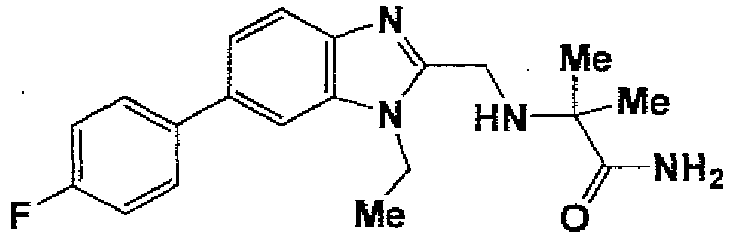
1.45(t, J = 7.0Hz, 3H), 1.48(s, 6H), 4.01(s, 2H), 4.22(q, J = 7.0Hz, 2H), 5.82(brs, 1H), 7.11-7.17(m, 2H), 7.34(brs, 1H), 7.42-7.45(m, 2H), 7.56-7.61(m, 2H), 7.77(m, 1H). 155 
1.10(t, J = 7.0Hz, 3H), 1.42(d, J = 6.8Hz, 3H), 3.32-3.42(m, 3H), 3.74(t, J=5.1Hz, 2H), 4.08(d, J = 14.6Hz, 1H), 4.16(d, J = 14.6Hz, 1H), 4.29-4.41(m, 2H), 5.41(brs, 1H), 7.06(m, 1H), 7.24-7.30(m, 3H), 7.35-7.39(m, 2H), 7.77(d, J = 8.3Hz, 1H). 156 
1.10(t, J = 7.0Hz, 3H), 1. 47 (s, 6H), 3.40(q, J = 7.0Hz, 2H), 3.75(t, J = 5.1Hz, 2H), 4.07(s, 2H), 4.34(t, J = 5.1Hz, 2H), 5.37(brs, 1H), 7,06(m, 1H), 7.24-7.39(m, 5H), 7.77(d, J = 8.3Hz, 1H). 157 
1.10(t, J= 7.0Hz, 3H), 1.42(d, J = 7.0Hz, 3H), 2.27(s, 3H), 3.33-3.42(m, 3H), 3.73(t, J = 5.4Hz, 2H), 4.08(d, J=15.4Hz, 1H), 4.15(d, J = 15.4Hz, 1H), 4.27-4.40(m, 2H), 5.35(brs, 1H), 6.92-7.01(m, 2H), 7.17-7.25(m, 3H), 7.29(brs, 1H), 7.34(d, J = 8.3Hz, 1H). 158 
1.11(t, J = 7.0Hz, 3H), 1.47(s, 6H), 2.26(s, 3H), 3.40(q, J = 7.0Hz, 2H), 3.74(t, J = 5.0Hz, 2H), 4.07(s, 2H), 4.33(t, J = 5.0Hz, 2H), 5.47(brs, 1H), 6.92-7.01(m, 2H), 7.17-7.27(m, 3H), 7.54(brs, 1H), 7.75(d, J = 8.3Hz, 1H). [Table 25-1] Example structural formula 1H-NMR(CDCl3) δ 159 
1.10(t, J = 7.0Hz, 3H), 1.41(d, J = 7.0Hz, 3H), 2.26(s, 3H), 2.38(s, 3H), 3.32-3.42(m, 3H), 3.72(t, J = 5.1Hz, 2H), 4.07(d, J = 14.6Hz, 1H), 4.15(d, J = 14.6Hz, 1H), 4.26-4.38(m, 2H), 5.81(brs, 1H), 7.07-7.27(m, 5H), 7.33(brs, 1H), 7.73(d, J = 8.3Hz, 1H). 160 
1.10(t, J = 7.0Hz, 3H), 1.47(s, 6H), 2.26(s, 3H), 2.38(s, 3H), 3.39(q, J = 7.0Hz, 2H), 3.73(t, J = 5.1Hz, 2H), 4.06(s, 2H), 4.32(t, J = 5.1Hz, 2H), 5.49(brs, 1H), 7.06-7.26(m, 5H), 7.55(brs, 1H), 7.75(d, J = 8.3Hz, 1H). 161 
1.11(t, J = 7.0Hz, 3H), 1.42(d, J = 6.8Hz, 3H), 2.32(s, 3H), 2.36(s, 3H), 3.31-3.43(m, 3H), 3.76(t, J = 5.0Hz, 2H), 4.07(d, J = 14.9Hz, 1H), 4.16(d, J = 14.9Hz, 1H), 4.29-4.44(m, 2H), 5.36(brs, 1H), 7.23(m, 1H), 7.36(brs, 1H), 7.30-7.51(m, 4H), 7.76(d, J = 9.0Hz, 1H). 162 
1.10(t, J = 7.0Hz, 3H), 1.47(s, 6H), 2.32(s, 3H), 2.36(s, 3H), 3.39(q, J = 7.0Hz, 2H), 3.77(t, J = 5.0Hz, 2H), 4.06(s, 2H), 4.36(t, J = 5.0Hz, 2H), 5.28(brs, 1H), 7.22(m, 1H), 7.37-7.51(m, 4H), 7.55(brs, 1H), 7.77(d, J = 8.6Hz, 1H). [Table 25-2] 163 
1.01(t, J = 7.5Hz, 3H), 1.10(t, J = 7.0Hz, 3H), 1.65-1.85(m, 2H), 2.32(s, 3H), 2.36(s, 3H), 3.16(t, J = 6.3Hz, 1H), 3.39(q, J = 7.0Hz, 2H), 3.76(t, J = 5.2Hz, 2H), 4.05(d, J = 14.7Hz, 1H), 4.16(d, J = 14.7Hz, 1H), 4.29-4.46(m, 2H), 5.42(brs, 1H), 7.22(m, 2H), 7.36-7.52(m, 4H), 7.76(d, J = 9.0Hz, 1H). [Table 26-1] Example structural formula 1H-NMR(CDCl3) δ 164 
1.09(t, J = 7.0Hz, 3H), 1.43(d, J = 7.1Hz, 3H), 2.01(s, 6H), 2.35(s, 3H), 3.33-3.41(m, 3H), 3.76(t, J = 5.0Hz, 2H), 4.07(d, J = 14.8Hz, 1H), 4.14(d, J = 14.8Hz, 1H), 4.24-4.36(m, 2H), 5.37(brs, 1H), 6.97(s, 2H), 7.04(dd, J = 8.0, 1.6Hz, 1H), 7.10(d, J= 1.6Hz, 1H), 7.32(brs, 1H), 7.76(d, J = 8.0Hz, 1H). 165 
1.10(t, J = 7.0Hz, 3H), 1.42(d, J = 7.0Hz, 3H), 2.41(s, 3H), 3.31-3.43(m, 3H), 3.75(t, J = 5.1Hz, 2H), 4.07(d, J=14.7Hz, 1H), 4.16(d, J = 14.7Hz, 1H), 4.28-4.42(m, 2H), 5.33(brs, 1H), 6.98-7.06(m, 2H), 7.27(brs, 1H), 7.35-7.49(m, 3H), 7.78(d, J = 8.4Hz, 1H). 166 
1.10(t, J=7.0Hz, 3H), 1.47(s, 6H), 2.41(s, 3H), 3.39(q, J = 7.0Hz, 2H), 3.76(t, J = 5.1Hz, 2H), 4.07(s, 2H), 4.35(t, J = 5.1Hz, 2H), 5.31(brs, 1H), 6.96-7.05(m, 2H), 7.35-7.49(m, 3H), 7.52(brs, 1H), 7.78(d, J = 8.4Hz, 1H). 167 
1.11(t, J = 7.0Hz, 3H), 1.42(d, J = 7.0Hz, 3H), 2.36(s, 3H), 3.31-3.44(m, 3H), 3.76(t, J = 5.2Hz, 2H), 4.07(d, J = 14.8Hz, 1H), 4.16(d, J = 14.8Hz, 1H), 4.28-4.44(m, 2H), 5.37(brs, 1H), 7.08(t, J = 8.9Hz, 1H), 7.37-7.46(m, 5H), 7.77(d, J = 9.0Hz, 1H). [Table 26-2] 168 
1.11(t, J = 7.0Hz, 3H), 1.47(s, 6H), 2.36(s, 3H), 3.40(q, J = 7.0Hz, 2H), 3.77(t, J = 5.0Hz, 2H), 4.06(s, 2H), 4.36(t, J = 5.0Hz, 2H), 5.30(brs, 1H), 7.08(t, J = 8.8Hz, 1H), 7.36-7.46(m, 4H), 7.51(brs, 1H), 7.77(d, J = 8.1Hz, 1H). [Table 27-1] Example structural formula 1H-NMR (CDCl3) δ 169 
1.11(t, J = 7.0Hz, 3H), 1.42(d, J = 7.0Hz, 3H), 2.33(s, 3H), 3.31-3.44(m, 3H), 3.76(t, J = 5.0Hz, 2H), 4.07(d, J = 14.8Hz, 1H), 4.16(d, J = 14.8Hz, 1H), 4.29-4.44(m, 2H), 5.42(brs, 1H), 7.23-7.33(m, 4H), 7.42-7.49(m, 2H), 7.77(d, J = 8.8Hz, 1H). 170 
1.11(t, J = 7.0Hz, 3H), 1.47 (s, 6H), 2.33(s, 3H), 3.40(q, J = 7.0Hz, 2H), 3.77(t, J = 5.0Hz, 2H), 4.07(s, 2H), 4.36(t, J = 5.0Hz, 2H), 5.35(brs, 1H), 7.22-7.33(m, 4H), 7.46-7.49(m, 2H), 7.78(d, J = 9.0Hz, 1H). 171 
1.09(t, J = 7.0Hz, 3H), 1.42(d, J = 6.8Hz, 3H), 3.34-3.42(m, 3H), 3.75(t, J = 5.1Hz, 2H), 4.09(d, J = 14.8Hz, 1H), 4.16(d, J = 14.8Hz, 1H), 4.29-4.41(m, 2H), 5.67 (brs, 1H), 7.14-7.16(m, 2H), 7.23-7.30(m, 2H), 7.41-7.52(m, 2H), 7.80(d, J = 8.5Hz, 1H). 172 
1.10 (t, J = 7.0Hz, 3H), 1.41(d, J = 7.0Hz, 3H), 3.31-3.42(m, 3H), 3.74(t, J = 5.1Hz, 2H), 3.81(s, 3H), 4.07(d, J = 14.8Hz, 1H), 4.15(d, J = 14.8Hz, 1H), 4.28-4.40(m, 2H), 5.37(brs, 1H), 6.73-6.78(m, 2H), 7.28-7.41(m, 4H), 7.75(d, J = 8.3Hz, 1H). [Table 27-2] 173 
1.11(t, J = 7.0Hz, 3H), 1.42(d, J = 7.0Hz, 3H), 3.32-3.43(m, 3H), 3.76 (t, J = 5.0Hz, 2H), 3.98(s, 3H), 4.08(d, J = 14.8Hz, 1H), 4.16 (d, J = 14.8Hz, 1H), 4.31-4.43(m, 2H), 5.40 (brs, 1H), 7.13-7.20(m, 4H), 7.44-7.46(m, 2H), 7.78(d, J = 9.0Hz, 1H). [Table 28] Example structural formula 1H-NMR (CDCl3) δ 174 
1.11(t, J = 7.0Hz, 3H), 1.47(s, 6H), 3.39(q, J = 7.0Hz, 2H), 3.75(t, J = 5.1Hz, 2H), 3. 81 (s, 3H), 4.06 (s, 2H), 4.33(t, J = 5.1Hz, 2H), 5.36(brs, 1H), 6.72-6.78(m, 2H), 7.28-7.40(m, 3H), 7.53(brs, 1H), 7.75(d, J = 8.3Hz, 1H). 175 
1.11(t, J = 7.0Hz, 3H), 1.48(s, 6H), 3.39(q, J = 7.0Hz, 2H), 3.77(t, J = 5.1Hz, 2H), 3.98(s, 3H), 4.07(s, 2H), 4.37(t, J = 5.1Hz, 2H), 5.29(brs, 1H), 7.14-7.20(m, 4H), 7.44-7.51(m, 2H), 7.78(d, J = 8.0Hz, 1H). 176 
1.09(t, J = 7.0Hz, 3H), 1.41(t, J = 7.0Hz, 3H), 3.32-3.42(m, 3H), 3.71(t, J = 5.1Hz, 2H), 4.05(d, J = 14.6Hz, 1H), 4.14(d, J = 14.6Hz, 1H), 4.23-4.38(m, 2H), 5.39(brs, 1H), 7.11-7.17(m, 3H), 7.21(brs, 1H), 7.41-7.45(m, 2H), 7.83(s, 1H). 177 
1.10(t, J = 7.0Hz, 3H), 1.42(d, J = 7.0Hz, 3H), 3.31-3.43(m, 3H), 3.71(t, J = 5.0Hz, 2H), 4.07(d, J = 14.8Hz, 1H), 4.17(d, J = 14.8Hz, 1H), 4.24-4.39(m, 2H), 5.60(brs, 1H), 7.24-7.47(m, 7H), 7.84(s, 1H). 178 
1.10(t, J = 7.0Hz, 3H), 1.43(d, J = 7.0Hz, 3H), 2.44(s, 3H), 3.32-3.42(m, 3H), 3.71(t, J = 5.0Hz, 2H), 4.07(d, J = 14.8Hz, 1H), 4.15(d, J = 14.8Hz, 1H), 4.25-4.38(m, 2H), 5.61(brs, 1H), 7.26-7.39(m, 6H), 7.83(s, 1H). [Table 29] Example structural formula 1H-NMR(CDCl3) δ 179 
1.08 (t, J = 7.0Hz,, 3H), 1.41(d, J = 7.0Hz, 3H), 3.30-3.41(m, 3H), 3.70(t, J = 5.0Hz, 2H), 4.05(d, J = 15.1Hz, 1H), 4.13(d, J = 15.1Hz, 1H), 4.24-4.36(m, 2H), 5.67(brs, 1H), 6.90-6.98(m, 2H), 7.21(brs, 1H), 7.28-7.34(m, 2H), 7.84(s, 1H). 180 
1.09(t, J = 7.0Hz, 3H), 1.41(d, J = 7.0Hz, 3H), 3.30-3.41(m, 3H), 3.71(t, J = 5.0Hz, 2H), 4.05(d, J = 14.8Hz, 1H), 4.13(d, J = 14.8Hz, 1H), 4.25-4.37(m, 2H), 5.68(brs, 1H), 7.15-7.30(m, 5H), 7.81(s, 1H). 181 
1.09(t, J = 7.0Hz, 3H), 1.41(d, J = 7.0Hz, 3H), 3.30-3.42(m, 3H), 3.70(t, J = 5.0Hz, 2H), 4.05(d, J = 15.0Hz, 1H), 4.14(d, J = 15.0Hz, 1H), 4.23-4.38(m, 2H), 5.63(brs, 1H), 7.20(brs, 1H), 7.26-7.30(m, 3H), 7.47-7.50(m, 2H), 7.83(s, 1H). 182 
1.10(t, J = 7.0Hz, 3H), 1.42(d, J = 7.0Hz, 3H), 3.37-3.44(m, 3H), 3.72(t, J = 5.0Hz, 2H), 4.05(d, J = 14.8Hz, 1H), 4.14(d, J = 14.8Hz, 1H), 4.25-4.35(m, 2H), 7.31(m, 1H), 7.56-7.59(m, 2H), 7.70-7.73(m, 2H), 7.84(s, 1H). 183 
1.10(t, J = 7.0Hz, 3H), 1.42(d, J = 7.0Hz, 3H), 3.31-3.43(m, 3H), 3.74(t, J = 5.0Hz, 2H), 4.05(d, J = 14.8Hz, 1H), 4.14(d, J = 14.8Hz, 1H), 4.28-4.40(m, 2H), 5.54 (brs, 1H), 7.18(brs, 1H), 7.21-7.29(m, 3H), 7.39(m, 1H), 7.49(s, 1H). [Table 30-1] Example structural formula 1H-NMR (CDCl3) δ 184 
1.10(t, J = 7.0Hz, 3H), 1.42(d, J = 7.0Hz, 3H), 2.42(s, 3H), 3.31-3.42(m, 3H), 3.73(t, J = 5.0Hz, 2H), 4.05(d, J = 14.8Hz, 1H), 4.13(d, J = 14.8Hz, 1H), 4.26-4.38(m, 2H), 5.56(brs, 1H), 7.24(brs, 1H), 7.26-7.30(m, 3H), 7.46-7.50(m, 3H). 185 
1.10(t, J = 7.0Hz, 3H), 1.42(d, J = 7.0Hz, 3H), 3.31-3.42(m, 3H), 3.73(t, J = 5.0Hz, 2H), 4.05(d, J = 14.8Hz, 1H), 4.13(d, J = 14.8Hz, 1H), 4.27-4.39(m, 2H), 5.58(brs, 1H), 7.23(brs, 1H), 7.32(d, J = 6.3Hz, 1H), 7.39(m, 1H), 7.45-7.51(m, 3H), 7.57-7.59(m, 2H). 186 
1.10(t, J = 7.0Hz, 3H), 1.42(d, J = 6.8Hz, 3H), 3.31-3.42(m, 3H), 3.73(t, J = 5.0Hz, 2H), 4.05(d, J = 14.8Hz, 1H), 4.13(d, J = 14.8Hz, 1H), 4.27-4.39(m, 2H), 5.36(brs, 1H), 7.20(brs, 1H), 7.29(d, J = 6.6Hz, 1H), 7.42-7.44(m, 3H), 7.48-7.52(m, 2H). 187 
1.45(t, J = 7.0Hz, 3H), 1.48(s, 6H), 3.99(s, 2H), 4.20(q, J = 7.0Hz, 2H), 5.50(brs, 1H), 7.13-7.18(m, 2H), 7.28(d, J = 6.6Hz, 1H), 7.49(d, J = 11.0Hz, 1H), 7.52-7.56(m, 2H). [Table 30-2] 188 
1.11(t, J = 7.0Hz, 3H), 1.42(d, J = 7.0Hz, 3H), 2.35(s, 3H), 3.30-3.43(m, 3H), 3.73(t, J = 5.0Hz, 2H), 4.05(d, J = 14.8Hz, 1H), 4.14(d, J = 14.8Hz, 1H), 4.27-4.39(m, 2H), 5.35(brs, 1H), 7.09(t, J = 8.8Hz, 1H), 7.23(brs, 1H), 7.34-7.39(m, 3H), 7.48(d, J = 10.8Hz, 1H). [Table 31] Example structural formula 1H-NMR(CDCl3) δ 189 
1.10(t, J = 7.0Hz, 3H), 1.42(d, J = 6.8Hz, 3H), 2.34(s, 3H), 3.31-3.42(m, 3H), 3.73(t, J = 5.0Hz, 2H), 4.05(d, J = 14.8Hz, 1H), 4.13(d, J = 14.8Hz, 1H), 4.28-4.40(m, 2H), 5.42(brs, 1H), 7.22-7.31(m, 5H), 7.49(d, J = 10.7Hz, 1H). 190 
1.09(t, J = 7.0Hz, 3H), 1.41(d, J = 6.8Hz, 3H), 2.33(s, 3H), 3.31-3.41(m, 3H), 3.71(t, J = 5.0Hz, 2H), 4.05(d, J = 14.8Hz, 1H), 4.13(d, J = 14.8Hz, 1H), 4.24-4.36(m, 2H), 5.41(brs, 1H), 7.07-7.26(m, 5H), 7.60(s, 1H). -

- To a solution of the compound (1.4 g, 5.0 mmol) obtained in the same manner as in Reference Examples 9 and 10 from 2-fluoro-5--bromo-nitrobenzene in tetrahydrofuran (30 mL) were added anhydrous sodium sulfate (3.8 g, 26.8 mmol), triethylamine (2.1 ml, 15.4 mmol) and (L)-alaninamide hydrochloride (1.9 g, 15.2 mmol), and the mixture was stirred at room temperature for 30 min. Sodium cyanoborohydride (0.33 g, 5.2 mmol) was added to the reaction mixture, and the mixture was stirred at room temperature overnight. The reaction mixture was poured into saturated aqueous sodium hydrogen carbonate solution, and the mixture was extracted with chloroform. The organic layer was washed with saturated brine, dried over sodium sulfate, and concentrated. The residue was purified by silica gel column (dichloromethane:methanol=99:1 - 95:5) to give the object product (0.89 g, 51%).
-

- To a solution of the compound (0.48 g, 1.3 mmol) obtained in Reference Example 55 in dichloroethane (10 mL) were added di-tert-butyl bicarbonate (1.4 g, 6.5 mmol) and diisopropylethylamine (0.33 ml, 1.95 mmol), and the mixture was stirred at 80°C for 14 hr. Dichloromethane was added to the reaction mixture, and the mixture was washed with water and saturated brine. The organic layer was dried over sodium sulfate, and concentrated. The residue was purified by silica gel column (dichloromethane:methanol=99:1 - 97:3) to give the object product (500 mg, 82%).
-

- To a solution (3:1, 4 mL) of the compound (50 mg, 0.11 mmol) obtained in Reference Example 56 in aqueous acetonitrile were added 4-chlorophenylboranic acid (34 mg, 0.22 mmol), 3 mol/L aqueous sodium hydrogen carbonate solution (90 µl) and tetrakis(triphenylphosphine)palladium (13 mg, 0.00112 mmol), and the mixture was stirred at 85°C for 5 hr under an argon atmosphere. The reaction mixture was filtered through celite, and the filtrate was concentrated. Ethyl acetate and saturated aqueous sodium hydrogen carbonate solution were added to partition the residue. The organic layer was washed with water, dried and concentrated. The residue was purified by silica gel column (ethyl acetate alone) to give the object product (48 mg, 90%).
-

- A solution (3 mL) of the compound (48 mg, 0.10 mmol) obtained in Reference Example 57 in hydrochloric acid-dioxane was stirred at room temperature for 1 hr. The reaction mixture was concentrated, and the resulting powder was washed with diethyl ether to give the object product (25 mg, 76%).
-

- To a solution (3 mL) of the compound (62 mg, 0.13 mmol) obtained in the above-mentioned Reference Example in dichloromethane was added trifluoroacetic acid (0.3 mL) under ice-cooling. The mixture was allowed to warm to room temperature and stirred for 1 hr. The reaction mixture was concentrated and crystallized from diethyl ether to give the object product (48 mg, 76%).
- The compounds shown in Table 32 were prepared according to the methods described in the above-mentioned Reference Examples and Examples or methods analogous thereto.
- The compounds were identified by LC/MS spectrum and retention time according to any of the following methods.
- analysis conditions 1
- detection instrument: LCMS/MS API2000 (manufactured by Applied Biosystems)
- column: Phenomenex Gemini C18 4.6X50 mm, 5 µm
- detection wavelength: 220 nm, 260 nm
- flow rate: 1.2 mL/min
- elution solvent composition: SOLUTION A: 0.05% aqueous TFA solution, 0.05% aqueous HCOOH solution or 10 mM aqueous ammonium acetate solution, SOLUTION B: acetonitrile gradient: 0-0.01 min B 10%, 0.01-1.50 min B 10% to 30%, 1.50-3.00 min B 30% to 90%, 3.00-4.00 min B 90%, 4.00-5.00 min B 90% to 10%
-
- analysis conditions 2
- detection instrument: LCMS/MS API2000 (manufactured by Applied Biosystems)
- column: Phenomenex Gemini C18 4.6X50 mm, 5 µm
- detection wavelength: 220 nm, 260 nm
- flow rate: 1 mL/min
- elution solvent composition: SOLUTION A: 0.05% aqueous TFA solution, 0.05% aqueous HCOOH solution or 10 mM aqueous ammonium acetate solution, SOLUTION B: acetonitrile gradient: 0-0.01 min B 5%, 0.01-1.00 min B 5%, 1.00-7.00 min B 5% to 50%, 7.00-10.00 min B 50% to 90%, 10.00-11.00 min B 90%, 11.00-12.00 min B 90% to 5%
-

- To a solution (25 mL) of iron (3.7 g, 66 mmol) and ammonium chloride (1.04 g, 19 mmol) in a mixed solvent (3:2:1) of tetrahydrofuran-methanol-water was added dropwise a solution (25 mL) of the compound (1.7 g, 6.9 mmol) obtained in Reference Example 18 in a mixed solvent (3:2:1) of tetrahydrofuran-methanol-water at 70°C. After 1.5 hr, the mixture was allowed to cool to room temperature, and the reaction mixture was filtered through celite. The filtrate was concentrated, water was added thereto, and the mixture was extracted with ethyl acetate. The organic layer was washed with water, dried and concentrated to give the object product (1.32 g, 89%). The product was used for the next reaction without purification.
-

- The object product was obtained in the same manner as in Reference Examples 4, 5, 55 and 56.
-

- To a solution of the compound (60 mg, 0.14 mmol) obtained in Reference Example 59 and 4-methylphenylboronic acid (38 mg, 0.28 mmol) in n-butanol (2 mL) were added potassium phosphate (60 mg, 0.28 mmol), palladium acetate (3.2 mg, 0.014 mmol) and S-phos (11.6 mg, 0.0038 mmol), and the mixture was stirred at 100°C for 14 hr under an argon atmosphere. After cooling, the reaction mixture was filtered through celite, and washed with methanol. The filtrate was concentrated, ethyl acetate was added thereto, and the mixture was washed with saturated aqueous sodium hydrogen carbonate solution and saturated brine, dried and concentrated. The residue was purified by silica gel column (ethyl acetate:hexane=65:35) to give the object product (43 mg, 52%).
-

- To a solution of the compound (34 mg) obtained in Reference Example 60 in dioxane (1 mL) was added 4 mol/L hydrochloric acid-dioxane (2 mL) under ice-cooling. The mixture was allowed to warm to room temperature, and stirred for 10 hr. The reaction mixture was concentrated, and the resulting powder was washed with diethyl ether to give the object product (28 mg, 95%).
- The compounds shown in Table 33 were prepared according to the methods described in the above-mentioned Reference Examples and Examples or methods analogous thereto.
- The compounds were identified by LC/MS spectrum and retention time under the conditions similar to those described above.
[Table 33-1] 
Example R salt molecular weight m/e retention time analysis conditions 209 
HCl 381.2165 382.3 6.15 analysis conditions 2 MeCN-TFA 210 
HCl 367.2008 368.5 3.04 analysis conditions 1 MeCN-NH4OAc 211 
HCl 395.2321 396.4 2.79 analysis conditions 1 MeCN-TFA 212 
HCl 409.2478 410.2 2.86 analysis conditions 1 MeCN-TFA 213 
HCl 385.1914 386.4 3.12 analysis conditions 1 MeCN-NH4OAc 214 
HCl 385.1914 386.2 2.63 analysis conditions 1 MeCN-TFA 215 
HCl 385.1914 386.2 2.63 analysis conditions 1 MeCN-TFA [Table 33-2] 216 
HCl 403.182 404.2 2.6 analysis conditions 1 MeCN-TFA 217 
HCl 403.182 404.4 2.71 analysis conditions 1 MeCN-TFA 218 
HCl 421.1726 422.2 2.71 analysis conditions 1 MeCN-TFA 219 
HCl 421.1726 422.1 6.25 analysis conditions 2 MeCN-TFA 220 
HCl 397.2114 398.2 2.67 analysis conditions 1 MeCN-TFA 221 
HCl 411.227 412.4 6.22 analysis conditions 2 MeCN-TFA 222 
HCl 435.1882 436.6 2.79 analysis conditions 1 MeCN-TFA 223 
HCl 451.1831 452.2 6.85 analysis conditions 2 MeCN-TFA 224 
HCl 392.1961 393.4 2.61 analysis conditions 1 MeCN-TFA [Table 33-3] 225 
HCl 421.1726 422 2.65 analysis conditions 1 MeCN-TFA 226 
HCl 368.1961 369.6 5.34 analysis conditions 2 MeCN-TFA - The compounds of Examples 227 - 237 shown in Table 34 and Table 35 were prepared in the same manner as in Reference Examples 18 - 20 and Example 79.
- The compounds were identified by LC/MS spectrum and retention time under the conditions similar to those described above.
[Table 34] 
Example R molecular weight m/e retention time analysis conditions 227 
401.1863 402 2.64 analysis conditions 1 MeCN-TFA 228 
417.1568 418 2.72 analysis conditions 1 MeCN-TFA 229 
397.2114 398.2 2.67 analysis conditions 1 MeCN-TFA 230 
419.1769 420.2 2.68 analysis conditions 1 MeCN-TFA 231 
419.1769 420.2 2.67 analysis conditions 1 MeCN-TFA 232 
437.1675 438 2.68 analysis conditions 1 MeCN-TFA [Table 35] 
Example R molecular weight m/e retention time analysis conditions 233 
383.1758 384.2 2.71 analysis conditions 1 MeCN-TFA 234 
379.2008 380.4 2.78 analysis conditions 1 MeCN-TFA 235 
401.1663 402.2 2.71 analysis conditions 1 MeCN-TFA 236 
401.1663 402.2 2.72 analysis conditions 1 MeCN-TFA 237 
419.1569 419.9 2.75 analysis conditions 1 MeCN-TFA - The compounds shown in Tables 36 - 38 can be prepared according to the methods described in the above-mentioned Reference Examples and Examples or methods analogous thereto.
[Table 36] 
No. R2 No. R2 No. R2 1 
2 
3 
[Table 37] 
No. R2 No. R2 No. R2 4 
5 
6 
[Table 38] 
No. R2 No. R2 No. R2 7 
12 
17 
8 
13 
18 
9 
14 
19 
10 
15 
20 
11 
16 
21 
- Human SNS gene-expressing cell is obtained by incorporating human SNS gene into Chinese hamster ovary cell (CHO-K1) and allowing stable expression. Since CHO-K1 cell does not inherently have a TTX resistant Na channel component, TTX resistant Na channel component of human SNS gene-expressing cell is SNS and the compound of the present invention is considered an SNS inhibitor.
- Full-length human SNS α subunit gene was incorporated into an expression plasmid (pcDNA3.1Zeo(+)) having a Zeocin resistance gene, and full-length Annexin II light chain gene was introduced into an expression plasmid (pcDNA3.1 (+)) containing a Neomycin resistance gene. These two genes were simultaneously introduced into CHO-K1 cell by using lipofectamine 2000, cultured in F-12 medium containing Neomycin and Zeocin, and a cell resistant to the both drugs, namely, a cell harboring the both genes, was selected. The two drug-resistance strain was subjected to limiting dilution twice, and the SNS gene-incorporating cell was cloned. Transgenic SNS was confirmed by RT-PCR, a TTX resistant component responsive to Na channel stimulation was detected by using a membrane potential sensitive fluorescent indicator, and functional expression of SNS was confirmed.
- Using the human SNS-expressing cell obtained in the aforementioned 1, the SNS inhibitory action of the compound of the present invention was evaluated. To be specific, a test compound was added in advance to a human SNS-expressing cell, veratridine (50 µM), an Na channel stimulant, was added about 30 min later in the presence of TTX (1 µM), the membrane potencial was increased via the TTX resistant Na channel, and the suppressive action on the membrane potencial increase of the test compound was evaluated.
- SNS inhibitory rate of the test compound was determined by the following calculation formula.

- The compounds obtained in the Examples were evaluated for an inhibitory action (SNS inhibitory rate) on TTX resistant Na channel of human SNS-expressing cell. As a result, the compound of the present invention was observed to show an SNS inhibitory action. The SNS inhibitory rate (%) when the compound concentration was 12.5 µM is shown in Tables 39 - 47.
[Table 39] compound SNS inhibitory rate (%) compound SNS inhibitory rate (%) Example 1 45.8 Example 16 96.2 Example 2 8.4 Example 17 89.3 Example 3 12.9 Example 18 14.2 Example 4 66.8 Example 19 100 Example 5 59.3 Example 20 7.2 Example 6 77.8 Example 21 100 Example 7 83.1 Example 22 16.4 Example 8 90.4 Example 23 0.8 Example 9 28.9 Example 24 5.8 Example 10 16.3 Example 25 0.0 Example 11 63.0 Example 26 26.6 Example 12 17.0 Example 27 78.2 Example 13 29.8 Example 28 27.4 Example 14 16.4 Example 29 27.0 Example 15 95.7 Example 30 31.5 [Table 40] compound SNS inhibitory rate (%) compound SNS inhibitory rate (%) Example 31 92.1 Example 46 95.5 Example 32 91.2 Example 47 86.6 Example 33 32.9 Example 48 96.7 Example 34 6.7 Example 49 94.8 Example 35 10.8 Example 50 86.8 Example 36 0.4 Example 51 90.5 Example 37 42.3 Example 52 89.7 Example 38 48.8 Example 53 94.0 Example 39 48.8 Example 54 95.7 Example 40 95.8 Example 55 89.4 Example 41 99.7 Example 56 82.2 Example 42 76.7 Example 57 87.6 Example 43 61.0 Example 58 71.2 Example 44 84.9 Example 59 54.8 Example 45 40.6 Example 60 75.7 [Table 41] compound SNS inhibitory rate (%) compound SNS inhibitory rate (%) Example 61 26.1 Example 76 18.8 Example 62 93.8 Example 77 16.0 Example 63 9.2 Example 78 22.2 Example 64 82.7 Example 79 3.5 Example 65 47.8 Example 80 2.5 Example 66 16.8 Example 81 69.1 Example 67 30.8 Example 82 30.7 Example 68 16.0 Example 83 0.0 Example 69 22.3 Example 84 76.8 Example 70 11.2 Example 85 24.9 Example 71 73.7 Example 86 8.3 Example 72 7.3 Example 87 90.1 Example 73 8.0 Example 88 83.5 Example 74 58.2 Example 89 83.0 Example 75 0.0 Example 90 96.1 [Table 42] compound SNS inhibitory rate (%) compound SNS inhibitory rate (%) Example 91 76.4 Example 100 72.1 Example 92 66.7 Example 101 85.2 Example 93 82.1 Example 102 96.3 Example 94 63.9 Example 103 87.9 Example 95 26.8 Example 104 83.6 Example 96 84.8 Example 105 75.1 Example 97 82.4 Example 106 86.4 Example 98 69.8 Example 107 83.7 Example 99 65.4 Example 108 85.3 [Table 43] compound SNS inhibitory rate (%) compound SNS inhibitory rate (%) Example 109 89.3 Example 124 87.8 Example 110 9.8 Example 125 95.9 Example 111 88.4 Example 126 56.9 Example 112 0 Example 127 93.9 Example 113 64.7 Example 128 85 Example 114 6.5 Example 129 90.3 Example 115 3.5 Example 130 42.1 Example 116 33.2 Example 131 55.9 Example 117 78.8 Example 132 86.4 Example 118 64.5 Example 133 91.7 Example 119 87.2 Example 134 95.7 Example 120 92.4 Example 135 57.8 Example 121 94.3 Example 136 28.7 Example 122 100 Example 137 90.7 Example 123 96.8 Example 138 93.1 [Table 44] compound SNS inhibitory rate (%) compound SNS inhibitory rate (%) Example 139 96 Example 154 11.2 Example 140 97.5 Example 155 86.1 Example 141 90.3 Example 156 71.2 Example 142 47.9 Example 157 89.9 Example 143 27.7 Example 158 86.1 Example 144 6.1 Example 159 96.1 Example 145 1.3 Example 160 97 Example 146 19.7 Example 161 76.2 Example 147 23.5 Example 162 67.3 Example 148 17 Example 163 36.5 Example 149 30.6 Example 164 3.7 Example 150 45.6 Example 165 100 Example 151 26.6 Example 166 62.7 Example 152 8.9 Example 167 82.8 Example 153 28.5 Example 168 20.2 [Table 45] compound SNS inhibitory rate (%) compound SNS inhibitory rate (%) Example 169 68.1 Example 184 87.9 Example 170 14.2 Example 185 64.6 Example 171 38.3 Example 186 55.6 Example 172 50.9 Example 187 53.3 Example 173 27.1 Example 188 87 Example 174 33.4 Example 189 97.7 Example 175 5.9 Example 190 34.3 Example 176 68.8 Example 191 23.3 Example 177 22.5 Example 192 11.9 Example 178 16 Example 193 22.3 Example 179 67.4 Example 194 19.7 Example 180 4.5 Example 195 20.1 Example 181 0 Example 196 23 Example 182 0 Example 197 9.3 Example 183 72.3 Example 198 10.2 [Table 46] compound SNS inhibitory rate (%) compound SNS inhibitory rate (%) Example 199 14.7 Example 214 0.2 Example 200 22.4 Example 215 12.4 Example 201 11.1 Example 216 0.7 Example 202 26 Example 217 3.2 Example 203 18.4 Example 218 12.5 Example 204 0 Example 219 9.7 Example 205 24.2 Example 220 12.2 Example 206 14.5 Example 221 22 Example 207 7 Example 222 10.1 Example 208 0 Example 223 0 Example 209 6.5 Example 224 0 Example 210 2.1 Example 225 25.1 Example 211 9.5 Example 226 14 Example 212 20.6 Example 227 20.4 Example 213 8.1 Example 228 31 [Table 47] compound SNS inhibitory rate (%) Example 229 10.1 Example 230 33.2 Example 231 17.9 Example 232 16.1 Example 233 49.9 Example 234 94.3 Example 235 100 Example 236 71 Example 237 100 - The novel bicyclic heterocyclic compound of the present invention can be used as a superior drug for the treatment or prophylaxis of pathology in which SNS is involved, specifically, diseases such as neuropathic pain, nociceptive pain, dysuria, multiple sclerosis and the like.
a compound wherein
 |
| Example | R | salt | molecular weight | m/e | retention time | analysis conditions |
| 191 |
 |
HCl | 400.1666 | 401.4 | 2.74 | analysis conditions 1 MeCN-TFA |
| 192 |
 |
CF3CO2H | 396.2161 | 397.4 | 2.61 | analysis conditions 1 MeCN-TFA |
| 193 |
 |
HCl | 366.2056 | 367.4 | 3.86 | analysis conditions 1 MeCN-TFA |
| 194 |
 |
CF3CO2H | 380.2212 | 381.4 | 6.29 | analysis conditions 2 MeCN-TFA |
| 195 |
 |
HCl | 394.2369 | 395.4 | 2.77 | analysis conditions 1 MeCN-TFA |
| 196 |
 |
HCl | 408.2525 | 409.4 | 2.84 | analysis conditions 1 MeCN-TFA |
| 197 |
 |
HCl | 384.1962 | 385.2 | 5.94 | analysis conditions 2 MeCN-TFA |
| 198 |
 |
HCl | 384.1962 | 385.2 | 5.94 | analysis conditions 2 MeCN-TFA |
| 199 |
 |
HCl | 402.1867 | 403.2 | 6.1 | analysis conditions 2 MeCN-TFA |
| 200 |
 |
CF3CO2H | 402.1867 | 403.4 | 2.75 | analysis conditions 1 MeCN-TFA |
| 201 |
 |
HCl | 420.1773 | 421.4 | 2.76 | analysis conditions 1 MeCN-TFA |
| 202 |
 |
HCl | 420.1773 | 421.2 | 6.25 | analysis conditions 2 MeCN-TFA |
| 203 |
 |
HCl | 410.2318 | 411.4 | 2.7 | analysis conditions 1 MeCN-TFA |
| 204 |
 |
CF3CO2H | 450.1879 | 451.2 | 2.78 | analysis conditions 1 MeCN-TFA |
| 205 |
 |
CF3CO2H | 434.193 | 435.4 | 2.79 | analysis conditions 1 MeCN-TFA |
| 206 |
 |
HCl | 420.1773 | 421.2 | 2.71 | analysis conditions 1 MeCN-TFA |
| 207 |
 |
HCl | 367.2008 | 368.6 | 5.99 | analysis conditions 2 MeCN-TFA |
| 208 |
 |
HCl | 391.2008 | 392.2 | 5.63 | analysis conditions 2 MeCN-TFA |
Claims (22)
- A compound represented by the following formula (1):
 R1 is a hydrogen atom, a halogen atom, an alkyl group having 1 to 6 carbon atoms, a haloalkyl group having 1 to 6 carbon atoms, an alkoxy group having 1 to 6 carbon atoms or a haloalkoxy group having 1 to 6 carbon atoms (R1 can substitute the benzene ring or pyridine ring at any substitutable position thereon),L is a single bond, -O- or -CH2O- (L can substitute the benzene ring or pyridine ring at any substitutable position thereon), R2 is a substituted or unsubstituted 6- to 10-membered aryl group, or a substituted or unsubstituted 5- to 10-membered aromatic heterocyclic group,X is a carbon atom or a nitrogen atom,R3 is a substituted or unsubstituted alkyl group having 1 to 6 carbon atoms, a substituted or unsubstituted alkenyl group having 2 to 6 carbon atoms, a substituted or unsubstituted alkynyl group having 2 to 6 carbon atoms, a substituted or unsubstituted 3- to 8-membered monocyclic or bicyclic cycloalkyl group, a substituted or unsubstituted 4- to 8-monocyclic or bicyclic membered cycloalkenyl group, a substituted or unsubstituted 4- to 8-membered saturated aliphatic heterocyclic group, or a substituted or unsubstituted 5- to 10-membered unsaturated aliphatic heterocyclic group,R4 is a hydrogen atom, a substituted or unsubstituted alkyl group having 1 to 6 carbon atoms, or a substituted or unsubstituted 3- to 8-membered monocyclic or bicyclic cycloalkyl group,R5a and R5b are each independently a hydrogen atom, or a substituted or unsubstituted alkyl group having 1 to 6 carbon atoms, or R4 and R5a are optionally bonded to form, together with the nitrogen atom that R4 is bonded to, a 4- to 8-membered saturated nitrogen-containing aliphatic heterocycle (in this case, R5b is a hydrogen atom),R6 and R7 are each independently a hydrogen atom, a substituted or unsubstituted alkyl group having 1 to 6 carbon atoms, a haloalkyl group having 1 to 6 carbon atoms, a substituted or unsubstituted alkenyl group having 2 to 6 carbon atoms, a substituted or unsubstituted alkynyl group having 2 to 6 carbon atoms, a substituted or unsubstituted 3- to 8-membered monocyclic or bicyclic cycloalkyl group, a substituted or unsubstituted 4- to 8-membered monocyclic or bicyclic cycloalkenyl group, a substituted or unsubstituted 4- to 8-membered saturated aliphatic heterocyclic group, a substituted or unsubstituted 5- to 10-membered unsaturated aliphatic heterocyclic group, a substituted or unsubstituted 6- to 10-membered aryl group, or a substituted or unsubstituted 5- to 10-membered aromatic heterocyclic group, or R6 and R7 are optionally bonded to form, together with the nitrogen atom that they are bond to, a substituted or unsubstituted 4- to 8-membered saturated nitrogen-containing aliphatic heterocycle, or a substituted or unsubstituted 5- to 10-membered unsaturated nitrogen-containing aliphatic heterocycle (the saturated or unsaturated nitrogen-containing aliphatic heterocycle contains 0 to 2 oxygen atoms, 0 to 2 sulfur atoms and 1 to 3 nitrogen atoms),or a pharmaceutically acceptable salt thereof.
 - The compound of claim 1, which is represented by the following formula (2):

- The compound of claim 1, which is represented by the following formula (3):

- The compound of any one of claims 1 to 3, wherein R2 is a substituted or unsubstituted phenyl group, or a pharmaceutically acceptable salt thereof.
- The compound of any one of claims 1 to 4, wherein R3 is a substituted or unsubstituted alkyl group having 1 to 6 carbon atoms, a substituted or unsubstituted 3- to 8-membered monocyclic or bicyclic cycloalkyl group, a substituted or unsubstituted 4- to 8-membered saturated aliphatic heterocyclic group, or a substituted or unsubstituted 5- to 10-membered unsaturated aliphatic heterocyclic group, or a pharmaceutically acceptable salt thereof.
- The compound of any one of claims 1 to 5, wherein R6 and R7 are each independently a hydrogen atom, a substituted or unsubstituted alkyl group having 1 to 6 carbon atoms, a haloalkyl group having 1 to 6 carbon atoms, a substituted or unsubstituted 3- to 8-membered monocyclic or bicyclic cycloalkyl group, a substituted or unsubstituted 4- to 8-membered saturated aliphatic heterocyclic group, or a substituted or unsubstituted 5- to 10-membered unsaturated aliphatic heterocyclic group, or R6 and R7 are optionally bonded to form, together with the nitrogen atom that they are bond to, a substituted or unsubstituted 4- to 8-membered saturated nitrogen-containing aliphatic heterocycle, or a substituted or unsubstituted 5- to 10-membered unsaturated nitrogen-containing aliphatic heterocycle (the saturated or unsaturated nitrogen-containing aliphatic heterocycle contains 0 to 2 oxygen atoms, 0 to 2 sulfur atoms and 1 to 3 nitrogen atoms), or a pharmaceutically acceptable salt thereof.
- The compound of any one of claims 1 to 6, wherein R4 is a hydrogen atom, or a substituted or unsubstituted alkyl group having 1 to 6 carbon atoms, or a pharmaceutically acceptable salt thereof.
- The compound of any one of claims 1 to 7, wherein R5a and R5b are each independently a hydrogen atom, or a substituted or unsubstituted alkyl group having 1 to 6 carbon atoms, or a pharmaceutically acceptable salt thereof.
- The compound of any one of claims 1 to 8, wherein X is a carbon atom, or a pharmaceutically acceptable salt thereof.
- The compound of any one of claims 1 to 9, wherein R1 is a hydrogen atom or a halogen atom, or a pharmaceutically acceptable salt thereof.
- The compound of any one of claims 1 to 10, wherein L is a single bond, or a pharmaceutically acceptable salt thereof.
- The compound of any one of claims 1 to 10, wherein L is - O-, or a pharmaceutically acceptable salt thereof.
- The compound of claim 1, which is N2-{[1-(2-ethoxyethyl)-6-(4-fluorophenoxy)-1H-benzimidazol-2-yl]methyl}glycinamide,N2-{[1-(2-ethoxyethyl)-6-(4-fluorophenoxy)-1H-benzimidazol-2-yl]methyl}-2-methylalaninamide,N2-{[1-cyclopropyl-6-(4-fluorophenoxy)-1H-benzimidazol-2-yl]methyl}-L-alaninamide,N2-{[1-cyclobutyl-6-(4-fluorophenoxy)-1H-benzimidazol-2-yl]methyl}-L-alaninamide,N2-{[6-(4-chlorophenoxy)-1-(2-ethoxyethyl)-1H-benzimidazol-2-yl]methyl}-L-alaninamide,N2-{[6-(4-fluorophenoxy)-1-(2-hydroxy-2-methylpropyl)-1H-benzimidazol-2-yl]methyl}-L-alaninamide,N2-{[1-(2-ethoxyethyl)-6-(4-fluorophenoxy)-1H-benzimidazol-2-yl]methyl}-L-alaninamide,N2-{[6-(4-fluorophenoxy)-1-(3-methoxypropyl)-1H-benzimidazol-2-yl]methyl}-L-alaninamide,N2-{[6-(2-chloro-4-fluorophenoxy)-1-(2-ethoxyethyl)-1H-benzimidazol-2-yl]methyl}-L-alaninamide,N2-{[1-ethyl-6-{4-methylphenoxy)-1H-benzimidazol-2-yl]methyl}-L-alaninamide,N2-{[6-(2,4-difluorophenoxy)-1-(2-hydroxy-2-methylpropyl)-1H-benzimidazol-2-yl]methyl}-L-alaninamide,N2-{[1-(2-ethoxyethyl)-5-fluoro-6-(4-fluorophenyl)-1H-benzimidazol-2-yl]methyl}-L-alaninamide,N2-{[1-ethyl-5-fluoro-6-(4-fluorophenyl)-1H-benzimidazol-2-yl]methyl}-L-alaninamide,N2-{[1-(3-methoxypropyl)-6-(4-methylphenoxy)-1H-benzimidazol-2-yl]methyl}-L-alaninamide,N2-{[6-(4-methylphenoxy)-1-(tetrahydro-2H-pyran-4-yl)-1H-benzimidazol-2-yl]methyl}-L-alaninamide,N2-{[5-chloro-1-(2-ethoxyethyl)-6-(4-fluorophenyl)-1H-benzimidazol-2-yl]methyl}-L-alaninamide, orN2-{[5-chloro-6-(3,4-difluorophenyl)-1-(2-ethoxyethyl)-1H-benzimidazol-2-yl]methyl}-L-alaninamide,or a pharmaceutically acceptable salt thereof.
- The compound of claim 1, which is N2-{[1-(2-ethoxyethyl)-6-(4-fluorophenoxy)-1H-benzimidazol-2-yl]methyl}-2-methylalaninamide or a pharmaceutically acceptable salt thereof.
- The compound of claim 1, which is N2-{[6-(2-chloro-4-fluorophenoxy)-1-(2-ethoxyethyl)-1H-benzimidazol-2-yl]methyl}-L-alaninamide or a pharmaceutically acceptable salt thereof.
- The compound of claim 1, which is N2-{[1-ethyl-6-(4-methylphenoxy)-1H-benzimidazol-2-yl]methyl}-L-alaninamide or a pharmaceutically acceptable salt thereof.
- The compound of claim 1, which is N2-{[1-(3-methoxypropyl)-6-(4-methylphenoxy)-1H-benzimidazol-2-yl]methyl}-L-alaninamide or a pharmaceutically acceptable salt thereof.
- The compound of claim 1, which is N2-{[6-(4-methylphenoxy)-1-(tetrahydro-2H-pyran-4-yl)-1H-benzimidazol-2-yl]methyl}-L-alaninamide or a pharmaceutically acceptable salt thereof.
- Use of the compound of any one of claims 1 to 18 or a pharmaceutically acceptable salt thereof in the manufacture of a medicament for use in the treatment or prophylaxis of neuropathic pain, nociceptive pain, dysuria or multiple sclerosis.
- An SNS inhibitor comprising the compound of any one of claims 1 to 18 or a pharmaceutically acceptable salt thereof as an active ingredient.
- A pharmaceutical composition comprising the compound of any one of claims 1 to 18 or a pharmaceutically acceptable salt thereof, and a pharmaceutically acceptable carrier.
- A compound of any one of claims 1 to 18 or a pharmaceutically acceptable salt thereof for use in the prophylaxis or treatment of neuropathic pain, nociceptive pain, dysuria or multiple sclerosis.
Priority Applications (2)
| Application Number | Priority Date | Filing Date | Title |
|---|---|---|---|
| PL09834989T PL2380881T3 (en) | 2008-12-26 | 2009-12-25 | Novel bicyclic heterocyclic compound |
| SI200931642A SI2380881T1 (en) | 2008-12-26 | 2009-12-25 | Novel bicyclic heterocyclic compound |
Applications Claiming Priority (2)
| Application Number | Priority Date | Filing Date | Title |
|---|---|---|---|
| JP2008332796 | 2008-12-26 | ||
| PCT/JP2009/071529 WO2010074193A1 (en) | 2008-12-26 | 2009-12-25 | Novel bicyclic heterocyclic compound |
Publications (3)
| Publication Number | Publication Date |
|---|---|
| EP2380881A1 EP2380881A1 (en) | 2011-10-26 |
| EP2380881A4 EP2380881A4 (en) | 2013-01-09 |
| EP2380881B1 true EP2380881B1 (en) | 2017-01-25 |
Family
ID=42287798
Family Applications (1)
| Application Number | Title | Priority Date | Filing Date |
|---|---|---|---|
| EP09834989.7A Active EP2380881B1 (en) | 2008-12-26 | 2009-12-25 | Novel bicyclic heterocyclic compound |
Country Status (20)
| Country | Link |
|---|---|
| US (2) | US8471038B2 (en) |
| EP (1) | EP2380881B1 (en) |
| JP (1) | JP5143916B2 (en) |
| KR (1) | KR101663336B1 (en) |
| CN (1) | CN102264707B (en) |
| AU (1) | AU2009331179B2 (en) |
| BR (1) | BRPI0924126B1 (en) |
| CA (1) | CA2748251C (en) |
| CY (1) | CY1118862T1 (en) |
| DK (1) | DK2380881T3 (en) |
| ES (1) | ES2620446T3 (en) |
| IL (1) | IL213690A0 (en) |
| LT (1) | LT2380881T (en) |
| MX (1) | MX2011006904A (en) |
| PL (1) | PL2380881T3 (en) |
| PT (1) | PT2380881T (en) |
| RU (1) | RU2518073C2 (en) |
| SI (1) | SI2380881T1 (en) |
| TW (1) | TWI436986B (en) |
| WO (1) | WO2010074193A1 (en) |
Families Citing this family (42)
| Publication number | Priority date | Publication date | Assignee | Title |
|---|---|---|---|---|
| MX2011006904A (en) * | 2008-12-26 | 2011-07-20 | Dainippon Sumitomo Pharma Co | Novel bicyclic heterocyclic compound. |
| JP5667934B2 (en) * | 2010-06-28 | 2015-02-12 | 大日本住友製薬株式会社 | Pharmaceuticals comprising novel bicyclic heterocyclic compounds |
| CN101985453B (en) * | 2010-10-18 | 2012-10-31 | 国家海洋局第三海洋研究所 | 4-aminopyridine derivative and preparation method and application thereof |
| CA2828456C (en) * | 2011-03-03 | 2021-05-04 | Zalicus Pharmaceuticals Ltd. | N-benzl-amino-carboxamide inhibitors of the sodium channel |
| US9006477B2 (en) * | 2011-07-07 | 2015-04-14 | Ihara Chemical Industry Co., Ltd. | Method for producing nitrobenzene compound |
| US20130172342A1 (en) * | 2011-12-28 | 2013-07-04 | Allergan, Inc. | Benzimidazole derivatives as selective blockers of persistent sodium current |
| ES2661585T3 (en) * | 2012-10-31 | 2018-04-02 | Raqualia Pharma Inc | Pyrazolopyridine derivatives as TTX-S blockers |
| JP2016169161A (en) * | 2013-07-19 | 2016-09-23 | 大日本住友製薬株式会社 | New imidazopyridine compounds |
| US9828348B2 (en) | 2013-11-08 | 2017-11-28 | Purdue Pharma L.P. | Benzimidazole derivatives and use thereof |
| CA2931550C (en) | 2013-12-13 | 2023-09-26 | Vertex Pharmaceuticals Incorporated | Prodrugs of pyridone amides useful as modulators of sodium channels |
| JP2016079168A (en) * | 2014-10-17 | 2016-05-16 | 塩野義製薬株式会社 | 9 membered condensed-ring derivative |
| KR102606737B1 (en) * | 2017-03-15 | 2023-11-24 | 스미토모 파마 가부시키가이샤 | Novel benzimidazolone compounds and their medicinal uses |
| US11242332B2 (en) | 2017-03-15 | 2022-02-08 | Sumitomo Dainippon Pharma Co., Ltd. | Method for producing benzimidazole derivative |
| EP3625214B1 (en) | 2017-05-16 | 2022-07-06 | Vertex Pharmaceuticals Incorporated | Deuterated pyridone amides and prodrugs thereof as modulators of sodium channels |
| AU2018300150A1 (en) | 2017-07-11 | 2020-01-30 | Vertex Pharmaceuticals Incorporated | Carboxamides as modulators of sodium channels |
| US11529337B2 (en) | 2018-02-12 | 2022-12-20 | Vertex Pharmaceuticals Incorporated | Method of treating pain |
| EP3824887A4 (en) * | 2018-07-19 | 2022-04-13 | Sumitomo Dainippon Pharma Co., Ltd. | MEDICINAL PREPARATION FOR EXTERNAL USE |
| WO2020146682A1 (en) | 2019-01-10 | 2020-07-16 | Vertex Pharmaceuticals Incorporated | Carboxamides as modulators of sodium channels |
| US12440481B2 (en) | 2019-01-10 | 2025-10-14 | Vertex Pharmaceuticals Incorporated | Esters and carbamates as modulators of sodium channels |
| WO2020176763A1 (en) | 2019-02-27 | 2020-09-03 | Vertex Pharmaceuticals Incorporated | Dosage form comprising prodrug of na 1.8 sodium channel inhibitor |
| WO2020219867A1 (en) | 2019-04-25 | 2020-10-29 | Vertex Pharmaceuticals Incorporated | Pyridone amide co-crystal compositions for the treatment of pain |
| BR112022010924A2 (en) | 2019-12-06 | 2022-09-06 | Vertex Pharma | SUBSTITUTED TETRAHYDROFURANS AS SODIUM CHANNEL MODULATION |
| MX2023007601A (en) | 2020-12-23 | 2023-07-10 | Sumitomo Pharma Co Ltd | Oral solid preparation. |
| HRP20260068T1 (en) | 2021-06-04 | 2026-02-27 | Vertex Pharmaceuticals Incorporated | SOLID PHARMACEUTICAL FORMS AND DOSAGE REGIME COMPRISING (2R,3S,4S,5R)-4-[[3-(3,4-DIFLUORO-2-METHOXYPHENYL)-4,5-DIMETHYL-5-(TRIFLUOROMETHYL)TETRAHYDROFURAN-2-CARBONYL]AMINO]PYRIDINE-2-CARBOXAMIDE |
| AU2022283934A1 (en) | 2021-06-04 | 2023-11-30 | Vertex Pharmaceuticals Incorporated | Substituted tetrahydrofuran-2-carboxamides as modulators of sodium channels |
| US20240400544A1 (en) | 2021-06-04 | 2024-12-05 | Vertex Pharmaceuticals Incorporated | N-(hydroxyalkyl (hetero)aryl) tetrahydrofuran carboxamide analogs as modulators of sodium channels |
| SMT202500481T1 (en) | 2021-06-04 | 2026-01-12 | Vertex Pharma | N-(hydroxyalkyl (hetero)aryl) tetrahydrofuran carboxamides as modulators of sodium channels |
| WO2022256842A1 (en) | 2021-06-04 | 2022-12-08 | Vertex Pharmaceuticals Incorporated | Hydroxy and (halo)alkoxy substituted tetrahydrofurans as modulators of sodium channels |
| CA3221938A1 (en) | 2021-06-04 | 2022-12-08 | Vertex Pharmaceuticals Incorporated | Substituted tetrahydrofuran analogs as modulators of sodium channels |
| US20230382910A1 (en) | 2022-04-22 | 2023-11-30 | Vertex Pharmaceuticals Incorporated | Heteroaryl compounds for the treatment of pain |
| CA3257285A1 (en) | 2022-04-22 | 2023-10-26 | Vertex Pharmaceuticals Incorporated | Heteroaryl compounds for the treatment of pain |
| CA3256248A1 (en) | 2022-04-22 | 2023-10-26 | Vertex Pharmaceuticals Incorporated | Heteroaryl compounds for the treatment of pain |
| WO2023205463A1 (en) | 2022-04-22 | 2023-10-26 | Vertex Pharmaceuticals Incorporated | Heteroaryl compounds for the treatment of pain |
| WO2024123815A1 (en) | 2022-12-06 | 2024-06-13 | Vertex Pharmaceuticals Incorporated | Process for the synthesis of substituted tetrahydrofuran modulators of sodium channels |
| WO2025090511A1 (en) | 2023-10-23 | 2025-05-01 | Vertex Pharmaceuticals Incorporated | Methods of preparing modulators of sodium channels and solid forms of the same for treating pain |
| WO2025090465A1 (en) | 2023-10-23 | 2025-05-01 | Vertex Pharmaceuticals Incorporated | Heteroaryl compounds for the treatment of pain |
| WO2025090480A1 (en) | 2023-10-23 | 2025-05-01 | Vertex Pharmaceuticals Incorporated | Heteroaryl compounds for the treatment of pain |
| WO2025090516A1 (en) | 2023-10-23 | 2025-05-01 | Vertex Pharmaceuticals Incorporated | Methods of preparing compounds for treating pain and solid forms thereof |
| US20250186419A1 (en) | 2023-12-07 | 2025-06-12 | Vertex Pharmaceuticals Incorporated | Dosing regimens for treating pain |
| US20260001877A1 (en) | 2024-06-28 | 2026-01-01 | Vertex Pharmaceuticals Incorporated | Heteroaryl compounds for the treatment of pain |
| WO2026013449A2 (en) | 2024-07-11 | 2026-01-15 | Sea4Us - Biotecnologia E Recursos Marinhos, Sa | Oxazolidone-derived compounds and their use in the treatment of chronic and acute pain |
| WO2026030525A1 (en) | 2024-07-31 | 2026-02-05 | Vertex Pharmaceuticals Incorporated | Zilvetrigine dosage forms and dosing regimens for treating pain |
Family Cites Families (7)
| Publication number | Priority date | Publication date | Assignee | Title |
|---|---|---|---|---|
| DE19705450A1 (en) * | 1997-02-13 | 1998-08-20 | Merck Patent Gmbh | Bicyclic aromatic amino acids |
| MXPA03003039A (en) | 2000-10-06 | 2003-10-15 | Neurogen Corp | Benzimidazole and indole derivatives as crf receptor modulators. |
| DE60127860T2 (en) * | 2000-11-21 | 2008-01-17 | Vertex Pharmaceuticals Inc., Cambridge | IMIDAZOL AND BENZIMIDAZOLE CASPASE INHIBITORS AND THEIR USE |
| WO2008033739A2 (en) * | 2006-09-12 | 2008-03-20 | Neurogen Corporation | Benzimidazole carboxamide derivatives |
| US20110052562A1 (en) | 2007-12-19 | 2011-03-03 | The Scripps Research Institute | Benzimidazoles and analogs as rho kinase inhibitors |
| MX2011006904A (en) * | 2008-12-26 | 2011-07-20 | Dainippon Sumitomo Pharma Co | Novel bicyclic heterocyclic compound. |
| EP3824887A4 (en) * | 2018-07-19 | 2022-04-13 | Sumitomo Dainippon Pharma Co., Ltd. | MEDICINAL PREPARATION FOR EXTERNAL USE |
-
2009
- 2009-12-25 MX MX2011006904A patent/MX2011006904A/en active IP Right Grant
- 2009-12-25 AU AU2009331179A patent/AU2009331179B2/en active Active
- 2009-12-25 US US13/141,301 patent/US8471038B2/en active Active
- 2009-12-25 SI SI200931642A patent/SI2380881T1/en unknown
- 2009-12-25 KR KR1020117017450A patent/KR101663336B1/en active Active
- 2009-12-25 PT PT98349897T patent/PT2380881T/en unknown
- 2009-12-25 JP JP2010544140A patent/JP5143916B2/en active Active
- 2009-12-25 LT LTEP09834989.7T patent/LT2380881T/en unknown
- 2009-12-25 CA CA2748251A patent/CA2748251C/en active Active
- 2009-12-25 DK DK09834989.7T patent/DK2380881T3/en active
- 2009-12-25 BR BRPI0924126-4A patent/BRPI0924126B1/en active IP Right Grant
- 2009-12-25 TW TW098144921A patent/TWI436986B/en active
- 2009-12-25 WO PCT/JP2009/071529 patent/WO2010074193A1/en not_active Ceased
- 2009-12-25 RU RU2011131048/04A patent/RU2518073C2/en active
- 2009-12-25 EP EP09834989.7A patent/EP2380881B1/en active Active
- 2009-12-25 CN CN200980152533.9A patent/CN102264707B/en active Active
- 2009-12-25 ES ES09834989.7T patent/ES2620446T3/en active Active
- 2009-12-25 PL PL09834989T patent/PL2380881T3/en unknown
-
2011
- 2011-06-21 IL IL213690A patent/IL213690A0/en active IP Right Grant
-
2013
- 2013-05-15 US US13/895,089 patent/US20130303535A1/en active Pending
-
2017
- 2017-03-16 CY CY20171100330T patent/CY1118862T1/en unknown
Non-Patent Citations (1)
| Title |
|---|
| None * |
Also Published As
| Publication number | Publication date |
|---|---|
| RU2518073C2 (en) | 2014-06-10 |
| BRPI0924126A2 (en) | 2020-08-11 |
| HK1163676A1 (en) | 2012-09-14 |
| RU2011131048A (en) | 2013-02-10 |
| AU2009331179B2 (en) | 2014-09-18 |
| DK2380881T3 (en) | 2017-05-08 |
| US20130303535A1 (en) | 2013-11-14 |
| AU2009331179A1 (en) | 2011-08-11 |
| EP2380881A4 (en) | 2013-01-09 |
| CN102264707B (en) | 2014-09-03 |
| WO2010074193A1 (en) | 2010-07-01 |
| JPWO2010074193A1 (en) | 2012-06-21 |
| CN102264707A (en) | 2011-11-30 |
| TW201028386A (en) | 2010-08-01 |
| LT2380881T (en) | 2017-04-10 |
| IL213690A0 (en) | 2011-07-31 |
| ES2620446T3 (en) | 2017-06-28 |
| BRPI0924126B1 (en) | 2021-07-27 |
| PT2380881T (en) | 2017-04-18 |
| PL2380881T3 (en) | 2017-07-31 |
| CA2748251C (en) | 2016-08-02 |
| US8471038B2 (en) | 2013-06-25 |
| CY1118862T1 (en) | 2018-01-10 |
| US20110294804A1 (en) | 2011-12-01 |
| AU2009331179A2 (en) | 2011-08-11 |
| TWI436986B (en) | 2014-05-11 |
| EP2380881A1 (en) | 2011-10-26 |
| KR101663336B1 (en) | 2016-10-06 |
| MX2011006904A (en) | 2011-07-20 |
| CA2748251A1 (en) | 2010-07-01 |
| SI2380881T1 (en) | 2017-05-31 |
| KR20110098971A (en) | 2011-09-02 |
| JP5143916B2 (en) | 2013-02-13 |
Similar Documents
| Publication | Publication Date | Title |
|---|---|---|
| EP2380881B1 (en) | Novel bicyclic heterocyclic compound | |
| KR20210143803A (en) | Novel small molecule inhibitors of TEAD transcription factors | |
| US9777005B2 (en) | Bicyclic heterocyclic compound containing a substituted pyrrole ring | |
| DK2998296T3 (en) | CYCLOYLIC ACID DERIVATIVE, PROCEDURE FOR PREPARING THEREOF AND PHARMACEUTICAL USE THEREOF | |
| CZ283680B6 (en) | Novel azaheterocyclylmethyl-chromans, process of their preparation, their use and pharmaceutical composition containing thereof | |
| EA019309B1 (en) | Ampk (amp-activated protein kinase) modulators | |
| WO2008069242A1 (en) | Novel bicyclic heterocyclic compound | |
| KR20220141331A (en) | P2X3 modifier | |
| JP5892550B2 (en) | Condensed imidazole derivatives | |
| JP5667934B2 (en) | Pharmaceuticals comprising novel bicyclic heterocyclic compounds | |
| JPWO2005030773A1 (en) | New pyrazolopyrimidine derivatives | |
| HK1162504B (en) | Novel bicyclic heterocyclic compound | |
| HK1162504A (en) | Novel bicyclic heterocyclic compound | |
| EP1908752A1 (en) | Novel 2-quinolone derivative | |
| HK1163676B (en) | Bicyclic heterocyclic compound | |
| GB2516818A (en) | Antiviral drug derivatives |
Legal Events
| Date | Code | Title | Description |
|---|---|---|---|
| PUAI | Public reference made under article 153(3) epc to a published international application that has entered the european phase |
Free format text: ORIGINAL CODE: 0009012 |
|
| 17P | Request for examination filed |
Effective date: 20110722 |
|
| AK | Designated contracting states |
Kind code of ref document: A1 Designated state(s): AT BE BG CH CY CZ DE DK EE ES FI FR GB GR HR HU IE IS IT LI LT LU LV MC MK MT NL NO PL PT RO SE SI SK SM TR |
|
| DAX | Request for extension of the european patent (deleted) | ||
| REG | Reference to a national code |
Ref country code: HK Ref legal event code: DE Ref document number: 1162504 Country of ref document: HK |
|
| A4 | Supplementary search report drawn up and despatched |
Effective date: 20121207 |
|
| RIC1 | Information provided on ipc code assigned before grant |
Ipc: A61P 25/04 20060101ALI20121203BHEP Ipc: A61K 31/4184 20060101ALI20121203BHEP Ipc: A61K 31/437 20060101ALI20121203BHEP Ipc: A61K 31/4439 20060101ALI20121203BHEP Ipc: A61P 19/02 20060101ALI20121203BHEP Ipc: A61K 31/496 20060101ALI20121203BHEP Ipc: C07D 405/14 20060101ALI20121203BHEP Ipc: C07D 403/12 20060101ALI20121203BHEP Ipc: A61K 31/454 20060101ALI20121203BHEP Ipc: A61P 25/00 20060101ALI20121203BHEP Ipc: C07D 405/06 20060101ALI20121203BHEP Ipc: C07D 471/04 20060101ALI20121203BHEP Ipc: A61P 43/00 20060101ALI20121203BHEP Ipc: C07D 401/04 20060101ALI20121203BHEP Ipc: A61K 31/5377 20060101ALI20121203BHEP Ipc: C07D 405/04 20060101ALI20121203BHEP Ipc: C07D 235/14 20060101AFI20121203BHEP Ipc: C07D 403/06 20060101ALI20121203BHEP Ipc: A61P 13/00 20060101ALI20121203BHEP |
|
| 17Q | First examination report despatched |
Effective date: 20140416 |
|
| RAP1 | Party data changed (applicant data changed or rights of an application transferred) |
Owner name: SUMITOMO DAINIPPON PHARMA CO., LTD. |
|
| RIN1 | Information on inventor provided before grant (corrected) |
Inventor name: TSUBOI, KATSUNORI Inventor name: KINOSHITA, HIRONORI Inventor name: WATANABE, HITOSHI Inventor name: YAMAI, YUSUKE |
|
| GRAP | Despatch of communication of intention to grant a patent |
Free format text: ORIGINAL CODE: EPIDOSNIGR1 |
|
| INTG | Intention to grant announced |
Effective date: 20160714 |
|
| GRAS | Grant fee paid |
Free format text: ORIGINAL CODE: EPIDOSNIGR3 |
|
| STAA | Information on the status of an ep patent application or granted ep patent |
Free format text: STATUS: GRANT OF PATENT IS INTENDED |
|
| GRAA | (expected) grant |
Free format text: ORIGINAL CODE: 0009210 |
|
| STAA | Information on the status of an ep patent application or granted ep patent |
Free format text: STATUS: THE PATENT HAS BEEN GRANTED |
|
| AK | Designated contracting states |
Kind code of ref document: B1 Designated state(s): AT BE BG CH CY CZ DE DK EE ES FI FR GB GR HR HU IE IS IT LI LT LU LV MC MK MT NL NO PL PT RO SE SI SK SM TR |
|
| REG | Reference to a national code |
Ref country code: GB Ref legal event code: FG4D |
|
| REG | Reference to a national code |
Ref country code: CH Ref legal event code: EP |
|
| REG | Reference to a national code |
Ref country code: AT Ref legal event code: REF Ref document number: 864025 Country of ref document: AT Kind code of ref document: T Effective date: 20170215 |
|
| REG | Reference to a national code |
Ref country code: IE Ref legal event code: FG4D |
|
| REG | Reference to a national code |
Ref country code: DE Ref legal event code: R096 Ref document number: 602009044017 Country of ref document: DE |
|
| REG | Reference to a national code |
Ref country code: CH Ref legal event code: NV Representative=s name: BOHEST AG, CH Ref country code: NL Ref legal event code: FP |
|
| REG | Reference to a national code |
Ref country code: RO Ref legal event code: EPE |
|
| REG | Reference to a national code |
Ref country code: SE Ref legal event code: TRGR Ref country code: PT Ref legal event code: SC4A Ref document number: 2380881 Country of ref document: PT Date of ref document: 20170418 Kind code of ref document: T Free format text: AVAILABILITY OF NATIONAL TRANSLATION Effective date: 20170405 |
|
| REG | Reference to a national code |
Ref country code: DK Ref legal event code: T3 Effective date: 20170502 |
|
| REG | Reference to a national code |
Ref country code: NO Ref legal event code: T2 Effective date: 20170125 |
|
| REG | Reference to a national code |
Ref country code: EE Ref legal event code: FG4A Ref document number: E013639 Country of ref document: EE Effective date: 20170424 |
|
| REG | Reference to a national code |
Ref country code: ES Ref legal event code: FG2A Ref document number: 2620446 Country of ref document: ES Kind code of ref document: T3 Effective date: 20170628 |
|
| PG25 | Lapsed in a contracting state [announced via postgrant information from national office to epo] |
Ref country code: HR Free format text: LAPSE BECAUSE OF FAILURE TO SUBMIT A TRANSLATION OF THE DESCRIPTION OR TO PAY THE FEE WITHIN THE PRESCRIBED TIME-LIMIT Effective date: 20170125 |
|
| REG | Reference to a national code |
Ref country code: GR Ref legal event code: EP Ref document number: 20170400799 Country of ref document: GR Effective date: 20170804 |
|
| REG | Reference to a national code |
Ref country code: SK Ref legal event code: T3 Ref document number: E 23873 Country of ref document: SK |
|
| REG | Reference to a national code |
Ref country code: DE Ref legal event code: R097 Ref document number: 602009044017 Country of ref document: DE |
|
| PG25 | Lapsed in a contracting state [announced via postgrant information from national office to epo] |
Ref country code: SM Free format text: LAPSE BECAUSE OF FAILURE TO SUBMIT A TRANSLATION OF THE DESCRIPTION OR TO PAY THE FEE WITHIN THE PRESCRIBED TIME-LIMIT Effective date: 20170125 |
|
| PLBE | No opposition filed within time limit |
Free format text: ORIGINAL CODE: 0009261 |
|
| STAA | Information on the status of an ep patent application or granted ep patent |
Free format text: STATUS: NO OPPOSITION FILED WITHIN TIME LIMIT |
|
| REG | Reference to a national code |
Ref country code: FR Ref legal event code: PLFP Year of fee payment: 9 |
|
| 26N | No opposition filed |
Effective date: 20171026 |
|
| REG | Reference to a national code |
Ref country code: HU Ref legal event code: AG4A Ref document number: E033883 Country of ref document: HU |
|
| REG | Reference to a national code |
Ref country code: HK Ref legal event code: GR Ref document number: 1162504 Country of ref document: HK |
|
| PG25 | Lapsed in a contracting state [announced via postgrant information from national office to epo] |
Ref country code: MK Free format text: LAPSE BECAUSE OF FAILURE TO SUBMIT A TRANSLATION OF THE DESCRIPTION OR TO PAY THE FEE WITHIN THE PRESCRIBED TIME-LIMIT Effective date: 20170125 |
|
| REG | Reference to a national code |
Ref country code: AT Ref legal event code: UEP Ref document number: 864025 Country of ref document: AT Kind code of ref document: T Effective date: 20170125 |
|
| REG | Reference to a national code |
Ref country code: EE Ref legal event code: HC1A Ref document number: E013639 Country of ref document: EE |
|
| REG | Reference to a national code |
Ref country code: NO Ref legal event code: CHAD Owner name: SUMITOMO PHARMA CO., JP |
|
| REG | Reference to a national code |
Ref country code: HU Ref legal event code: HC9C Owner name: SUMITOMO PHARMA CO.,LTD., JP Free format text: FORMER OWNER(S): SUMITOMO DAINIPPON PHARMA CO., LTD., JP Ref country code: NL Ref legal event code: HC Owner name: SUMITOMO PHARMA CO., LTD.; JP Free format text: DETAILS ASSIGNMENT: CHANGE OF OWNER(S), CHANGE OF OWNER(S) NAME; FORMER OWNER NAME: SUMITOMO DAINIPPON PHARMA CO., LTD. Effective date: 20221219 |
|
| REG | Reference to a national code |
Ref country code: SK Ref legal event code: TC4A Ref document number: E 23873 Country of ref document: SK Owner name: SUMITOMO PHARMA CO., LTD., OSAKA-SHI, OSAKA, JP Effective date: 20221219 |
|
| REG | Reference to a national code |
Ref country code: FI Ref legal event code: PCE Owner name: SUMITOMO PHARMA CO., LTD. |
|
| REG | Reference to a national code |
Ref country code: DE Ref legal event code: R081 Ref document number: 602009044017 Country of ref document: DE Owner name: SUMITOMO PHARMA CO., LTD., JP Free format text: FORMER OWNER: SUMITOMO DAINIPPON PHARMA CO., LTD., OSAKA-SHI, JP |
|
| REG | Reference to a national code |
Ref country code: BE Ref legal event code: HC Owner name: SUMITOMO PHARMA CO., LTD; JP Free format text: DETAILS ASSIGNMENT: CHANGE OF OWNER(S), CHANGE OF OWNER(S) NAME; FORMER OWNER NAME: SUMITOMO DAINIPPON PHARMA CO., LTD. Effective date: 20230123 |
|
| REG | Reference to a national code |
Ref country code: SI Ref legal event code: SP73 Owner name: SUMITOMO PHARMA CO., LTD.; JP Effective date: 20230109 |
|
| REG | Reference to a national code |
Ref country code: ES Ref legal event code: PC2A Owner name: SUMITOMO PHARMA CO., LTD. Effective date: 20230525 |
|
| REG | Reference to a national code |
Ref country code: AT Ref legal event code: HC Ref document number: 864025 Country of ref document: AT Kind code of ref document: T Owner name: SUMITOMO PHARMA CO., LTD., JP Effective date: 20230427 |
|
| P01 | Opt-out of the competence of the unified patent court (upc) registered |
Effective date: 20230529 |
|
| PGFP | Annual fee paid to national office [announced via postgrant information from national office to epo] |
Ref country code: PT Payment date: 20251121 Year of fee payment: 17 |
|
| PGFP | Annual fee paid to national office [announced via postgrant information from national office to epo] |
Ref country code: NL Payment date: 20251119 Year of fee payment: 17 Ref country code: LU Payment date: 20251119 Year of fee payment: 17 |
|
| REG | Reference to a national code |
Ref country code: CH Ref legal event code: U11 Free format text: ST27 STATUS EVENT CODE: U-0-0-U10-U11 (AS PROVIDED BY THE NATIONAL OFFICE) Effective date: 20260101 |
|
| PGFP | Annual fee paid to national office [announced via postgrant information from national office to epo] |
Ref country code: IS Payment date: 20251219 Year of fee payment: 17 Ref country code: DE Payment date: 20251126 Year of fee payment: 17 |
|
| PGFP | Annual fee paid to national office [announced via postgrant information from national office to epo] |
Ref country code: GB Payment date: 20251120 Year of fee payment: 17 Ref country code: LT Payment date: 20251119 Year of fee payment: 17 |
|
| PGFP | Annual fee paid to national office [announced via postgrant information from national office to epo] |
Ref country code: MC Payment date: 20251124 Year of fee payment: 17 Ref country code: NO Payment date: 20251121 Year of fee payment: 17 |
|
| PGFP | Annual fee paid to national office [announced via postgrant information from national office to epo] |
Ref country code: AT Payment date: 20251121 Year of fee payment: 17 |
|
| PGFP | Annual fee paid to national office [announced via postgrant information from national office to epo] |
Ref country code: IT Payment date: 20251119 Year of fee payment: 17 Ref country code: FI Payment date: 20251119 Year of fee payment: 17 Ref country code: DK Payment date: 20251119 Year of fee payment: 17 |
|
| PGFP | Annual fee paid to national office [announced via postgrant information from national office to epo] |
Ref country code: HU Payment date: 20251212 Year of fee payment: 17 Ref country code: FR Payment date: 20251120 Year of fee payment: 17 |
|
| PGFP | Annual fee paid to national office [announced via postgrant information from national office to epo] |
Ref country code: TR Payment date: 20251127 Year of fee payment: 17 Ref country code: GR Payment date: 20251121 Year of fee payment: 17 Ref country code: BE Payment date: 20251119 Year of fee payment: 17 |
|
| PGFP | Annual fee paid to national office [announced via postgrant information from national office to epo] |
Ref country code: SE Payment date: 20251119 Year of fee payment: 17 |
|
| PGFP | Annual fee paid to national office [announced via postgrant information from national office to epo] |
Ref country code: IE Payment date: 20251121 Year of fee payment: 17 Ref country code: CY Payment date: 20251120 Year of fee payment: 17 Ref country code: CZ Payment date: 20251212 Year of fee payment: 17 |
|
| PGFP | Annual fee paid to national office [announced via postgrant information from national office to epo] |
Ref country code: MT Payment date: 20251203 Year of fee payment: 17 Ref country code: LV Payment date: 20251119 Year of fee payment: 17 |
|
| PGFP | Annual fee paid to national office [announced via postgrant information from national office to epo] |
Ref country code: PL Payment date: 20251119 Year of fee payment: 17 Ref country code: BG Payment date: 20251127 Year of fee payment: 17 |
|
| PGFP | Annual fee paid to national office [announced via postgrant information from national office to epo] |
Ref country code: EE Payment date: 20251126 Year of fee payment: 17 |
|
| PGFP | Annual fee paid to national office [announced via postgrant information from national office to epo] |
Ref country code: SK Payment date: 20251125 Year of fee payment: 17 Ref country code: RO Payment date: 20251219 Year of fee payment: 17 |
|
| PGFP | Annual fee paid to national office [announced via postgrant information from national office to epo] |
Ref country code: SI Payment date: 20251125 Year of fee payment: 17 |
|
| PGFP | Annual fee paid to national office [announced via postgrant information from national office to epo] |
Ref country code: ES Payment date: 20260102 Year of fee payment: 17 |
|
| PGFP | Annual fee paid to national office [announced via postgrant information from national office to epo] |
Ref country code: CH Payment date: 20260101 Year of fee payment: 17 |