EP2288027A2 - Elastische Wellenvorrichtung - Google Patents
Elastische Wellenvorrichtung Download PDFInfo
- Publication number
- EP2288027A2 EP2288027A2 EP10006770A EP10006770A EP2288027A2 EP 2288027 A2 EP2288027 A2 EP 2288027A2 EP 10006770 A EP10006770 A EP 10006770A EP 10006770 A EP10006770 A EP 10006770A EP 2288027 A2 EP2288027 A2 EP 2288027A2
- Authority
- EP
- European Patent Office
- Prior art keywords
- elastic wave
- medium
- boundary
- wave device
- boundary elastic
- Prior art date
- Legal status (The legal status is an assumption and is not a legal conclusion. Google has not performed a legal analysis and makes no representation as to the accuracy of the status listed.)
- Withdrawn
Links
Images


Classifications
-
- H—ELECTRICITY
- H03—ELECTRONIC CIRCUITRY
- H03H—IMPEDANCE NETWORKS, e.g. RESONANT CIRCUITS; RESONATORS
- H03H9/00—Networks comprising electromechanical or electro-acoustic elements; Electromechanical resonators
- H03H9/02—Details
- H03H9/0222—Details of interface-acoustic, boundary, pseudo-acoustic or Stonely wave devices
-
- H—ELECTRICITY
- H03—ELECTRONIC CIRCUITRY
- H03H—IMPEDANCE NETWORKS, e.g. RESONANT CIRCUITS; RESONATORS
- H03H9/00—Networks comprising electromechanical or electro-acoustic elements; Electromechanical resonators
- H03H9/02—Details
- H03H9/02535—Details of surface acoustic wave devices
- H03H9/02543—Characteristics of substrate, e.g. cutting angles
- H03H9/02559—Characteristics of substrate, e.g. cutting angles of lithium niobate or lithium-tantalate substrates
Definitions
- the present invention relates to an elastic wave device, particularly, relates to a technology which is effective by being applied to a boundary elastic wave device having a piezoelectric substance and a cross-finger type Inter-Digital Transducer (IDT) for a boundary elastic wave, and constituting a solid circuit element of a resonator, a filter or the like of a communication apparatus for a high frequency.
- a boundary elastic wave device having a piezoelectric substance and a cross-finger type Inter-Digital Transducer (IDT) for a boundary elastic wave, and constituting a solid circuit element of a resonator, a filter or the like of a communication apparatus for a high frequency.
- IDT Inter-Digital Transducer
- a boundary elastic wave device is small-sized and is provided with an excellent temperature stability because the boundary elastic wave device can dispense with a hollow package, and because the boundary elastic wave device can use silicon oxide as a temperature compensating film.
- Patent document 1 there are disclosed a relationship between a propagation loss and a cut angle and a relationship between a propagation loss and a film thickness of a polycrystalline silicon film in a boundary elastic wave resonator which is provided with IDT, a silicon oxide film, and a polycrystalline silicon film above a substrate whose major component is constituted by lithium niobate piezoelectric single crystal, which is cut out in ⁇ rotation Y cut, and in which a propagation direction of an elastic wave is made to be X-axis direction (hereinafter, abbreviated as ⁇ YX-LN single-crystal piezoelectric substrate) with a leakage boundary elastic wave as an object.
- ⁇ YX-LN single-crystal piezoelectric substrate X-axis direction
- an aluminum nitride film can be used in place of the polycrystalline silicon film.
- JP-A-Hei10(1998)-84247 Patent document 2
- a relationship between a propagation loss and a cut angle in a boundary elastic wave device which is provided with IDT, a silicon oxide film, and a single-crystal silicon substrate above a ⁇ YX-LN single-crystal piezoelectric substrate with a leakage boundary elastic wave as an object.
- Patent document 3 In International Patent Publication WO 05/069485 pamphlet (Patent document 3), and International Patent Publication WO 06/114930 pamphlet (Patent document 4), there is disclosed a boundary elastic wave device having a small propagation loss with a boundary elastic wave as an object.
- a high quality factor (Q value) and an easiness of fabrication are requested for a high frequency filter.
- Q value quality factor
- a Q value equal to or higher than several thousands is requested for use of a communication apparatus represented by a portable telephone.
- a main boundary elastic wave which is excited/resonated in IDT is a leakage boundary elastic wave.
- a boundary elastic wave resonator a Stoneley wave type boundary elastic wave, a slow transverse bulk wave, a fast transverse bulk wave, and a longitudinal bulk wave are generated as spurious elastic waves.
- a leakage boundary elastic wave is provided with a sound speed between a sound speed of a slow transverse bulk wave and a sound speed of a fast transverse bulk wave.
- the leakage boundary elastic wave is provided with a sound speed substantially between 4000 through 4800 m/s.
- the slow transverse bulk wave is at a vicinity of the sound speed of 4000 m/s, therefore, the slow transverse bulk wave is generated immediately below a series resonance frequency of the leakage boundary elastic wave, and is strongly coupled with IDT.
- a main boundary elastic wave which is excited/resonated in IDT on which the inventors are investigating is a leakage boundary elastic wave, and is provided with an elastic propagation loss. Therefore, in order to achieve a sufficiently high Q value in a boundary elastic wave device, it is necessary to minimize a propagation loss of IDT (maximize an elastic Q value) by optimizing a structure of a boundary elastic wave resonator of a material, a film thickness, a cut angle, and the like.
- a branching filter having a steep filter characteristic at RF band there is needed a branching filter having a steep filter characteristic at RF band.
- band 2 having the narrowest transmission/reception interval (transmission/reception interval about 1%) to band 4 having the widest transmission/reception interval (transmission/reception interval about 17%), and there is needed a boundary elastic wave having an electromechanical coupling factor (hereinafter, abbreviated as k2) adapted to these bands..
- k2 coincides with twice as much as the transmission/reception interval, the steepest filter characteristic can be realized.
- the boundary elastic wave described in Patent documents 1 and 2, mentioned above has large k2 equal to or larger than 8%.
- the boundary elastic wave having k2 of 2 through 8% has not been realized yet.
- notation ⁇ designates a wave length of a boundary elastic wave.
- the Q value is made to be equal to or larger than a thousand as the premise, a sufficient accuracy is not achieved in a high frequency filter of, for example, 2GHz class the use of which is represented by a communication apparatus in recent times.
- the polycrystalline silicon film constituting an object in Patent document 1 described above has an electrical conductivity and a low resistance value. Therefore, even when values of the cut angle ⁇ and the film thickness h 1 of the polycrystalline silicon film shown in Fig. 25 are used as they are, the elastic Q value cannot be increased up to about several thousands through ten thousands requested in a boundary elastic wave device in recent times.
- a single-crystal silicon substrate is used at the topmost layer, the single-crystal silicon substrate has an electrical conductivity and a low resistance, and therefore, the Q value of the boundary elastic wave device cannot be increased. Further, a special fabrication apparatus is needed in order to form the single-crystal silicon substrate at the topmost layer, and therefore, there poses a problem of an increase in cost, an increase in TAT or the like in fabrication thereof.
- the embodiment is an elastic wave device which has a boundary elastic wave resonator which is provided with IDT, a silicon oxide film, and a polycrystalline silicon film above a ⁇ YX-LN single-crystal piezoelectric substrate whose major component is constituted by a lithium niobate piezoelectric single crystal, which has a plane cut out in ⁇ rotation Y cut, and in which a propagation direction of an elastic wave is constituted by a direction in parallel with X-axis.
- IDT mainly excites a boundary elastic wave, when a wave length of the boundary elastic wave is designated by a notation ⁇ , a thickness of the silicon oxide film is designated by a notation h 1 , and a thickness of IDT is designated by a notation h m , an inequality of 1% ⁇ h m / ⁇ ⁇ 8% is established, and the elastic wave device is characterized in conforming to one of a group of inequalities of 124.5° ⁇ ⁇ ⁇ 125.5° and 20% ⁇ h 1 / ⁇ ⁇ 45%, 125.5° ⁇ ⁇ ⁇ 126.5° and 20% ⁇ h1/ ⁇ ⁇ 45%, 126.5° ⁇ ⁇ ⁇ 127.5° and 20% ⁇ h 1 / ⁇ ⁇ 47%, 126.5° ⁇ ⁇ ⁇ 127.5° and 87% ⁇ h 1 / ⁇ ⁇ 100%, 127.5° ⁇ ⁇ ⁇ 128.5° and 20% ⁇ h1/ ⁇ ⁇ 100%, 128.5° ⁇ ⁇
- IDT mainly excites a boundary elastic wave
- a wave length of the boundary elastic wave is designated by a notation ⁇
- a thickness of the silicon oxide film is designated by a notation h 1
- a thickness of IDT is designated by a notation h m
- an inequality of 1% ⁇ h m / ⁇ ⁇ 8% is established, and the elastic wave device is characterized in conforming to one of a group of inequalities of 124.5° ⁇ ⁇ ⁇ 125.5° and 55% ⁇ h 1 / ⁇ ⁇ 73%, 125.5° ⁇ ⁇ ⁇ 126.5° and 59% ⁇ h 1 / ⁇ ⁇ 83%, 126.5° ⁇ ⁇ ⁇ 127.5° and 63% ⁇ h 1 / ⁇ ⁇ 100%, 127.5° ⁇ ⁇ ⁇ 128.5° and 67% ⁇ h 1 / ⁇ ⁇ 100%, 128.5° ⁇ ⁇ ⁇ 129.5° and 75% ⁇ h 1 / ⁇ ⁇ 100%, 128.5
- a boundary elastic wave device which has a high quality factor (Q value is equal to or larger than several thousands), and in which the k2 falls in a range of 2 through 6% can be realized. Further, a boundary elastic wave device which has a high quality factor (Q value is equal to or larger than several thousands), and in which k2 falls in a range of 2 through 6% can easily be fabricated.
- a constituent element thereof is not necessarily indispensable naturally, except a case of being clearly indicated particularly and a case of being conceived to be indispensable clearly in principle or the like.
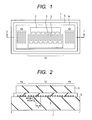
- Fig. 1 is a plane view of an essential portion of a boundary elastic wave resonator
- Fig. 2 is a sectional view of an essential portion taken along a line I-I' of Fig. 1
- Fig. 3 is a view for explaining a film thickness of an electrode finger, a film thickness of a silicon oxide film, a film thickness of an aluminum nitride film, an amount of undulations of an interface, a line width of the electrode finger, an interval of the electrode fingers, and a definition of a wave length of the boundary elastic wave excited
- Fig. 1 is a plane view of an essential portion of a boundary elastic wave resonator
- Fig. 2 is a sectional view of an essential portion taken along a line I-I' of Fig. 1
- Fig. 3 is a view for explaining a film thickness of an electrode finger, a film thickness of a silicon oxide film, a film thickness of an aluminum nitride film, an amount of undulations of an interface, a line
- FIG. 4 is a model diagram used in analyzing a boundary elastic wave resonator of a 3 media structure
- the boundary elastic wave resonator according to the first embodiment is a one opening resonator, and is constructed by a constitution the same as that of a surface elastic wave resonator of a background art except presence of two kinds of films formed above a comb-shaped electrode. That is, two comb-shaped IDT's (comb-shaped electrodes) 14 are patterned on a surface of a ⁇ YX-LN single-crystal piezoelectric substrate (first medium) 1 by a metal film whose major component is aluminum. Respective IDT's 14 are constituted by bus bars 2 and electrode fingers 3, and a high frequency signal is applied between two IDT's 14 the electrode fingers 3 of which are inserted to each other.
- An interval S of a predetermined width is provided between the contiguous electrode fingers 3.
- Reflectors 4a, and 4b formed by metal films whose major component is aluminum are installed on both sides of IDT 14.
- a silicon oxide film (second medium) 5 is formed above IDT's 14 and the reflectors 4a, and 4b, and an aluminum nitride film (third medium) 6 is formed above the silicon oxide film 5.
- a film thickness of the electrode finger 3 constituting IDT 14 is, for example, 0.070 ⁇ m
- a line width L of the electrode finger 3 is, for example, 0.5 ⁇ m
- an interval S of the electrode fingers is, for example, 0.5 ⁇ m
- an electrode pitch (a period of the electrode finger 3) ⁇ is, for example, 2 ⁇ m
- a number of pairs of the electrode fingers 3 is, for example, 100 pairs.
- an opening length is, for example, 10 ⁇ .
- a film thickness of the silicon oxide film 5 is, for example, 1.4 ⁇ m
- a film thickness of the aluminum nitride film 6 is, for example, 6 ⁇ m.
- a characteristic of the boundary elastic wave resonator according to the first embodiment resides in that a 3 media structure of the ⁇ YX-LN single-crystal piezoelectric substrate 1, the silicon oxide film 5, and the aluminum nitride film 6 is constituted, the medium to which the boundary elastic wave is confined (silicon oxide film 5), and the medium of carrying out a transformation of an electric signal and a mechanical signal ( ⁇ YX-LN single-crystal piezoelectric substrate 1) are divided, a non-piezoelectric and nonmetallic film is used for the medium to which the boundary elastic wave is confined, and the film thickness of the silicon oxide film 5, and a cut angle or the like are made to fall in predetermined ranges as described below. Further, the present invention is not naturally limited with regard to the structure or a number of pieces of IDT's 14, or the film thickness of the electrode finger 3.
- the film thickness of the electrode finger 3 of the boundary elastic wave resonator is designated by notation h m
- the line width of the electrode finger 3 is designated by notation L
- the interval between the electrode finger 3 is designated by notation S
- the film thickness of the silicon oxide film 5 is designated by notation h 1
- the film thickness of the aluminum nitride film 6 is designated by notation h 2
- an amount of undulations of an interface 7 is designated by notation h ⁇
- the wave length of the boundary elastic wave excited (coinciding with the electrode pitch) is defined as ⁇ .
- the interface 7 of the silicon oxide film 5 and the aluminum nitride film 6 is undulated depending on the film thickness h m of the electrode finger 3. Therefore, here, the film thickness h 1 of the silicon oxide film 5 is defined by a distance from an upper face of the electrode finger 3 to the bottommost face of the interface 7, and the film thickness h 2 of the aluminum nitride film 6 is defined by a distance from the topmost face of the interface 7 to the bottommost face of a surface of the aluminum nitride film 6.
- a resonance frequency of the boundary elastic wave resonator is determined by a ratio of a propagation speed of the boundary elastic wave to the electrode pitch ⁇ .
- a sound speed of the boundary elastic wave present above the ⁇ YX-LN single-crystal piezoelectric substrate 1 is around 4300 m/s, and the electrode pitch ⁇ becomes about 2 ⁇ m at 2GHz band.
- the line width L of the electrode finger 3 and the interval S of the electrode fingers 3 can comparatively freely be set at this occasion. However, in consideration of a mass production performance, it is preferable that both of the line width L of the electrode finger 3 and the interval S of the electrode finger 3 are large. That is, when the line width L of the electrode finger 3 and the interval S of the electrode finger 3 are 0.5 ⁇ m, a minimum working dimension becomes the largest, which is excellent in the mass production performance.
- the propagation loss of the boundary elastic wave is strongly effected with an influence of the interval S of the electrode fingers 3.
- the electrodes are approximated by a uniform metal film. Therefore, there pose problems that a total weight of the electrodes are doubled, and a mass load is excessively taken in, that reflection/local presence of the boundary elastic wave at end portions of the electrode fingers 3 cannot be taken into consideration, that a shape of the interface 7 of the silicon oxide film 5 and the aluminum nitride film 6 cannot be taken into consideration and the like.
- the inventors have investigated the propagation characteristic of the boundary elastic wave in details by taking all the effects of a shape of IDT 14 and the like into consideration by using a technology of simulating the boundary elastic wave resonator described in Patent document 1, mentioned above.
- the boundary elastic wave resonator achieves the high Q value in both of a series resonance frequency and a parallel resonance frequency.
- the inventors have evaluated the boundary elastic wave in Q values at frequencies of both ends thereof, that is, the series resonance Q and the parallel resonance Q by taking these points into consideration.
- the silicon oxide film 5 formed by the film forming apparatus is normally a porous film.
- a density reduction rate ⁇ described in Patent document 1, mentioned above was used.
- Elastic constants C 11 , C 44 and a density p of the silicon oxide film 5 are represented as follows.
- C 11 C ⁇ o 11 ⁇ e - 3 ⁇ ⁇
- values of elastic constants and a density of quartz glass which is the densest silicon oxide are used for Co 11 , Co 44 , and po.
- a resonance characteristic of the boundary elastic wave of the boundary elastic wave device is calculated by the technology of simulating the boundary elastic wave resonator by taking the film thickness h m of the electrode finger 3, the film thickness h 1 of the silicon oxide film 5, the cut angle ⁇ , the density reduction rate ⁇ of the silicon oxide film 5, and the undulation amount h ⁇ of the interface 7 defined as described above into consideration.
- An example of the result is shown in Fig. 5A through Fig. 12B.
- the series resonance Q is equal to or larger than 10000 in 55% ⁇ h 1 / ⁇ ⁇ 73%.
- the parallel resonance Q is equal to or larger than 10000 in 20% ⁇ h 1 / ⁇ ⁇ 45%.
- k2 is larger than 2% in all of h 1 / ⁇ .
- the series resonance Q is equal to or larger than 10000 in 59% ⁇ h 1 / ⁇ ⁇ 83%.
- the parallel resonance Q is equal to or larger than 10000 in 20% ⁇ h 1 / ⁇ ⁇ 45%.
- k2 is larger than 2% in all of h 1 / ⁇ .
- the series resonance Q is equal to or larger than 10000 in 63% ⁇ h 1 / ⁇ ⁇ 100%.
- the parallel resonance Q is equal to or larger than 10000 in 20% ⁇ h 1 / ⁇ ⁇ 47% and in 87% ⁇ h 1 / ⁇ ⁇ 100%.
- k2 is larger than 2% in all of h 1 / ⁇ .
- the series resonance Q is equal to or larger than 10000 in 67% ⁇ h 1 / ⁇ ⁇ 100%.
- the parallel resonance Q is equal to or larger than 10000 in all of h 1 / ⁇ (20% ⁇ h 1 / ⁇ ⁇ 100%).
- k2 is larger than 2% in all of h 1 / ⁇ .
- the series resonance Q is equal to or larger than 10000 in 75% ⁇ h 1 / ⁇ ⁇ 100%.
- the parallel resonance Q is equal to or larger than 10000 in all of h 1 / ⁇ (20% ⁇ h 1 / ⁇ ⁇ 100%).
- k2 is larger than 2% in all of h 1 / ⁇ .
- the series resonance Q is equal to or larger than 10000 in 85% ⁇ h 1 / ⁇ ⁇ 100%.
- the parallel resonance Q is equal to or larger than 10000 in 20% ⁇ h 1 / ⁇ ⁇ 75%.
- k2 is larger than 2% in all of h 1 / ⁇ .
- the series resonance Q is equal to or larger than 10000 in 93% ⁇ h 1 / ⁇ ⁇ 100%.
- the parallel resonance Q is equal to or larger than 10000 in 20% ⁇ h 1 / ⁇ ⁇ 61%.
- k2 is larger than 2% in all of h 1 / ⁇ .
- the series resonance Q is equal to or larger than 10000 in 95% ⁇ h 1 / ⁇ ⁇ 100%.
- the parallel resonance Q is equal to or larger than 10000 in 33% ⁇ h 1 / ⁇ ⁇ 57%.
- k2 is larger than 2% in all of h 1 / ⁇ .
- evaluation points in Fig. 5A through Fig. 12B are discrete, the Q values and k2 are continuously changed with regard to the parameters, and therefore, the Q values can easily be known by an interpolation even between the evaluation points.
- the boundary elastic wave device having the high quality factor (Q value is equal to or larger than several thousands) and k2 of 2 through 6% can be provided. Further, a general purpose fabrication apparatus or the like can be used in fabricating the boundary elastic wave resonator, and therefore, the boundary elastic wave device can easily be fabricated.
- Fig. 13 is a graph diagram showing a range of h 1 / ⁇ and a cut angle ⁇ at which a boundary elastic wave is present.
- Fig. 23 is a graph diagram comparing a reflectance of a short-circuit type reflector and a reflectance of an open type reflector.
- a boundary elastic wave resonator according to the second embodiment is constructed by a constitution the same as that of the boundary elastic wave resonator according to the first embodiment, mentioned above, except using a substrate whose major component is lithium niobate piezoelectric single crystal, which is cut in ⁇ rotation Y cut, and in which a propagation direction of an elastic wave is made to be a direction orthogonal to X-axis (hereinafter, abbreviated as ⁇ YZ'-LN single-crystal piezoelectric substrate).
- a characteristic of the boundary elastic wave resonator according to the second embodiment resides in that a 3 media structure of the ⁇ YZ'-LN single-crystal piezoelectric substrate, a silicon oxide film, and an aluminum nitride film is constituted, a medium to which the boundary elastic wave is confined (silicon oxide film), and a medium of carrying out a transformation of an electric signal and a mechanical signal ( ⁇ YZ'-LN single-crystal piezoelectric substrate) are divided, a non-piezoelectric and nonmetallic film is used for the medium to which the boundary elastic wave is confined, a film thickness of the silicon oxide film, and a cut angle or the like are made to fall in predetermined ranges described below.
- the present invention is not naturally limited with regard to a structure or a number of pieces of IDT, or a film thickness of an electrode finger.
- the ordinate designates a sound speed, in a case where the boundary elastic wave is present, a sound speed thereof is indicated by a circle (o) mark.
- Fig. 13 describes sound speeds of 2 pieces of transverse bulk waves by one-dotted broken lines. As shown by Fig.
- a range of the cut angle ⁇ in which a boundary elastic wave of a gradually high Q value is present is widened as h 1 / ⁇ becomes large. Further, all of the boundary elastic waves described in Fig. 13 are Stoneley wave type boundary elastic waves, and a leakage boundary elastic wave of a high Q value, and k2 > 2% was not present.
- Fig. 14 through Fig. 22 are graph diagrams showing a cut angle ⁇ dependency of k2 of the boundary elastic wave.
- k2 is equal to or larger than 2% in 75° ⁇ ⁇ ⁇ 85°. Further, both of the series resonance Q and the parallel resonance Q are equal to or larger than 10000 in 65° ⁇ ⁇ ⁇ 95°.
- k2 is equal to or larger than 2% in 75° ⁇ ⁇ ⁇ 85°. Further, both of the series resonance Q and the parallel resonance Q are equal to or larger than 10000 in 35° ⁇ ⁇ ⁇ 135°.
- k2 is equal to or larger than 2% in 65° ⁇ ⁇ ⁇ 95°.
- both of the series resonance Q and the parallel resonance Q are equal to or larger than 10000 in 25° ⁇ ⁇ ⁇ 145°.
- k2 is equal to or larger than 2% in 65° ⁇ ⁇ ⁇ 95°. Further, both of the series resonance Q and the parallel resonance Q are equal to or larger than 10000 in 25° ⁇ ⁇ ⁇ 145°.
- k2 is equal to or larger than 2% in 65° ⁇ ⁇ ⁇ 95°. Further, both of the series resonance Q and the parallel resonance Q are equal to or larger than 10000 in 25° ⁇ ⁇ ⁇ 145°.
- k2 is equal to or larger than 2% in 65° ⁇ ⁇ ⁇ 95°.
- both of the series resonance Q and the parallel resonance Q are equal to or larger than 10000 in 25° ⁇ ⁇ ⁇ 145°.
- k2 is equal to or larger than 2% in 65° ⁇ ⁇ ⁇ 95°. Further, both of the series resonance Q and the parallel resonance Q are equal to or larger than 10000 in 25° ⁇ ⁇ ⁇ 145°.
- k2 is equal to or larger than 2% in 65° ⁇ ⁇ ⁇ 95°. Further, both of the series resonance Q and the parallel resonance Q are equal to or larger than 10000 in 25° ⁇ ⁇ ⁇ 145°.
- k2 is equal to or larger than 2% in 65° ⁇ ⁇ ⁇ 95°. Further, both of the series resonance Q and the parallel resonance Q are equal to or larger than 10000 in 25° ⁇ ⁇ ⁇ 145°.
- the boundary elastic wave device having the high quality factor (Q value is equal to or larger than several thousands), and k2 of 2 through 6% can be provided by using the ⁇ YZ'-LN single-crystal piezoelectric substrate having the predetermined cut angle ⁇ .
- a direction of C-axis of a crystal of the aluminum nitride film is random. This is for preventing an SH (Shear Horizontal) wave component which is a major component of a mechanical vibration generated by IDT from being transformed into an SV (Shear Vertical) wave component at inside of the aluminum nitride film 6. Therefore, a quite similar effect is achieved even by a film in an amorphous state. Further, even in an oriented film or a single-crystal film, in a case where C-axis of the aluminum nitride film 6 is substantially orthogonal to a substrate face, the SV component and the SH component are orthogonal to each other, and therefore, a similar effect is achieved. The same goes with also the silicon oxide film.
- a mechanical vibration energy of a surface of the aluminum nitride film is present, and therefore, the surface elastic wave is excited.
- the mechanical vibration energy of the surface of the surface elastic wave is extremely smaller than the mechanical vibration energy of the surface of the surface elastic wave of the background art, and therefore, the mechanical vibration energy is partially provided with an excellent characteristic of the boundary elastic wave. For example, a deterioration in an electric property of a loss, a frequency shift or the like is smaller with regard to a damage of the surface of the aluminum nitride film or an adherence of impurities by a mistake in handling.
- the present invention when the present invention is applied to the surface elastic wave device, the surface elastic wave device which is more highly reliable than the surface elastic wave device of the background art can be provided.
- the aluminum nitride film is thinned, the propagation loss caused by the damage or the impurity is gradually increased, and therefore, it is preferable to make the aluminum nitride film sufficiently thick above the resonator.
- IDT is formed by a metal whose major component is aluminum
- an electrode material is not limited to aluminum.
- a similar effect is achieved even by an alloy mixing copper, silicon, titanium or the like to aluminum, or a multilayer film of these.
- Fig. 23 shows a graph diagram comparing a reflectance of an open type reflector and a reflectance of a short-circuit type reflector.
- the cut angle ⁇ of the both is 128°, further, a material of the reflectors is aluminum.
- the open type reflector shows a reflectance larger than that of the short-circuit type reflector in all of the film thicknesses.
- the reflectors 4a, and 4b of the open type reflector having larger reflectance are used in the boundary elastic wave resonator explained in the first embodiment, mentioned above, by using the short-circuit type reflector, the boundary elastic wave resonator having a smaller loss can be provided.
- the present invention is not limited to the above-described embodiments, but can naturally be changed variously within a range not deviated from a gist thereof.
- the same characteristic and effect can be achieved so far as the medium is a nitride film whose major component is a nitride substance, or an oxide film whose major component is an oxide substance having a high sound speed.
- the present invention can be applied to an elastic wave device used in a solid circuit element of a resonator, a filter or the like of a communication apparatus for a high frequency.
Landscapes
- Physics & Mathematics (AREA)
- Acoustics & Sound (AREA)
- Chemical & Material Sciences (AREA)
- Engineering & Computer Science (AREA)
- Materials Engineering (AREA)
- Surface Acoustic Wave Elements And Circuit Networks Thereof (AREA)
Applications Claiming Priority (1)
| Application Number | Priority Date | Filing Date | Title |
|---|---|---|---|
| JP2009188475A JP2011041127A (ja) | 2009-08-17 | 2009-08-17 | 弾性波装置 |
Publications (1)
| Publication Number | Publication Date |
|---|---|
| EP2288027A2 true EP2288027A2 (de) | 2011-02-23 |
Family
ID=43216734
Family Applications (1)
| Application Number | Title | Priority Date | Filing Date |
|---|---|---|---|
| EP10006770A Withdrawn EP2288027A2 (de) | 2009-08-17 | 2010-06-30 | Elastische Wellenvorrichtung |
Country Status (3)
| Country | Link |
|---|---|
| US (1) | US20110037343A1 (de) |
| EP (1) | EP2288027A2 (de) |
| JP (1) | JP2011041127A (de) |
Families Citing this family (5)
| Publication number | Priority date | Publication date | Assignee | Title |
|---|---|---|---|---|
| JP2010011440A (ja) * | 2008-05-30 | 2010-01-14 | Hitachi Ltd | 弾性波装置及びそれを用いた高周波フィルタ |
| CN103262410B (zh) * | 2010-12-24 | 2016-08-10 | 株式会社村田制作所 | 弹性波装置及其制造方法 |
| EP3068049B1 (de) * | 2015-03-12 | 2018-06-13 | Skyworks Filter Solutions Japan Co., Ltd. | Akustische wellenelemente, antennen-duplexer und elektronische vorrichtungen |
| CN110220974B (zh) * | 2019-06-10 | 2020-11-03 | 清华大学 | 适用于铝板缺陷检测的sv超声体波单侧聚焦换能器 |
| EP4032184A2 (de) * | 2019-09-18 | 2022-07-27 | Frec'n'sys | Wandlerstruktur für eine akustikwellenvorrichtung |
Citations (3)
| Publication number | Priority date | Publication date | Assignee | Title |
|---|---|---|---|---|
| WO1998052279A1 (fr) | 1997-05-12 | 1998-11-19 | Hitachi, Ltd. | Dispositif a onde elastique |
| WO2005069485A1 (ja) | 2004-01-13 | 2005-07-28 | Murata Manufacturing Co., Ltd. | 弾性境界波装置 |
| WO2006114930A1 (ja) | 2005-04-25 | 2006-11-02 | Murata Manufacturing Co., Ltd. | 弾性境界波装置 |
Family Cites Families (3)
| Publication number | Priority date | Publication date | Assignee | Title |
|---|---|---|---|---|
| DE112004001841B4 (de) * | 2003-10-03 | 2009-03-12 | Murata Mfg. Co., Ltd., Nagaokakyo-shi | Oberflächenwellenbauelement |
| KR100804407B1 (ko) * | 2004-03-29 | 2008-02-15 | 가부시키가이샤 무라타 세이사쿠쇼 | 탄성 경계파 장치의 제조방법 |
| JP5154285B2 (ja) * | 2007-05-28 | 2013-02-27 | 和彦 山之内 | 弾性境界波機能素子 |
-
2009
- 2009-08-17 JP JP2009188475A patent/JP2011041127A/ja active Pending
-
2010
- 2010-06-30 EP EP10006770A patent/EP2288027A2/de not_active Withdrawn
- 2010-07-08 US US12/832,832 patent/US20110037343A1/en not_active Abandoned
Patent Citations (3)
| Publication number | Priority date | Publication date | Assignee | Title |
|---|---|---|---|---|
| WO1998052279A1 (fr) | 1997-05-12 | 1998-11-19 | Hitachi, Ltd. | Dispositif a onde elastique |
| WO2005069485A1 (ja) | 2004-01-13 | 2005-07-28 | Murata Manufacturing Co., Ltd. | 弾性境界波装置 |
| WO2006114930A1 (ja) | 2005-04-25 | 2006-11-02 | Murata Manufacturing Co., Ltd. | 弾性境界波装置 |
Non-Patent Citations (1)
| Title |
|---|
| J. J. CAMPBELL; W. R. JONES: "A method for estimating optical cuts and propagation directions for excitation of piezoelectric surface waves", IEEE TRANS. SONICS AND ULTRASON., vol. SU-15, 1968, pages 209 - 217 |
Also Published As
| Publication number | Publication date |
|---|---|
| JP2011041127A (ja) | 2011-02-24 |
| US20110037343A1 (en) | 2011-02-17 |
Similar Documents
| Publication | Publication Date | Title |
|---|---|---|
| US12052012B2 (en) | Acoustic wave devices | |
| JP7178881B2 (ja) | 弾性表面波素子 | |
| US7489065B2 (en) | Boundary acoustic wave device | |
| US7528685B2 (en) | Lamb wave type high frequency device | |
| US20210075394A1 (en) | Guided saw device | |
| EP2139110A1 (de) | Rand-Schallwelleneinrichtung | |
| US8115561B2 (en) | Lamb-wave resonator and oscillator | |
| EP2023485A1 (de) | Rand-schallwelleneinrichtung | |
| JP5187444B2 (ja) | 弾性表面波装置 | |
| EP2211462A2 (de) | Akustikwellenvorrichtung | |
| US20090231061A1 (en) | Lamb-wave resonator and oscillator | |
| US6774536B2 (en) | Surface acoustic wave device | |
| WO2005086345A1 (ja) | 弾性境界波装置 | |
| EP2288027A2 (de) | Elastische Wellenvorrichtung | |
| JP2002100959A (ja) | 弾性表面波デバイス | |
| US20100237742A1 (en) | Lamb-wave resonator and oscillator | |
| US20230308074A1 (en) | Reflective structure for surface acoustic wave devices (saw) | |
| US20100289379A1 (en) | Surface acoustic wave (saw) device | |
| Ramli et al. | Design and modeling of MEMS SAW resonator on Lithium Niobate | |
| JP2008054163A (ja) | ラム波型高周波共振子 | |
| EP0982857A2 (de) | Resonator, Filter, Duplexer und Kommunikationsgerät mit akustischen Oberflächenwellen, akustisches Oberflächenwellengerät und Herstellungsverfahren | |
| JP4613779B2 (ja) | 弾性表面波デバイス | |
| Naumenko | Multilayered structure as a novel material for surface acoustic wave devices: Physical insight | |
| Solal et al. | Existence of harmonic metal thickness mode propagation for longitudinal leaky waves | |
| US20250070740A1 (en) | Saw resonator design method, saw filter and design method therefor, and computing device-readable recording medium having same recorded thereon |
Legal Events
| Date | Code | Title | Description |
|---|---|---|---|
| PUAI | Public reference made under article 153(3) epc to a published international application that has entered the european phase |
Free format text: ORIGINAL CODE: 0009012 |
|
| 17P | Request for examination filed |
Effective date: 20101104 |
|
| AK | Designated contracting states |
Kind code of ref document: A2 Designated state(s): AL AT BE BG CH CY CZ DE DK EE ES FI FR GB GR HR HU IE IS IT LI LT LU LV MC MK MT NL NO PL PT RO SE SI SK SM TR |
|
| AX | Request for extension of the european patent |
Extension state: BA ME RS |
|
| STAA | Information on the status of an ep patent application or granted ep patent |
Free format text: STATUS: THE APPLICATION IS DEEMED TO BE WITHDRAWN |
|
| 18D | Application deemed to be withdrawn |
Effective date: 20130103 |