EP2244853B1 - Circular saw blade with elliptical gullets - Google Patents
Circular saw blade with elliptical gullets Download PDFInfo
- Publication number
- EP2244853B1 EP2244853B1 EP09703608.1A EP09703608A EP2244853B1 EP 2244853 B1 EP2244853 B1 EP 2244853B1 EP 09703608 A EP09703608 A EP 09703608A EP 2244853 B1 EP2244853 B1 EP 2244853B1
- Authority
- EP
- European Patent Office
- Prior art keywords
- gullet
- saw blade
- circular saw
- core
- elliptical
- Prior art date
- Legal status (The legal status is an assumption and is not a legal conclusion. Google has not performed a legal analysis and makes no representation as to the accuracy of the status listed.)
- Active
Links
Images

Classifications
-
- B—PERFORMING OPERATIONS; TRANSPORTING
- B23—MACHINE TOOLS; METAL-WORKING NOT OTHERWISE PROVIDED FOR
- B23D—PLANING; SLOTTING; SHEARING; BROACHING; SAWING; FILING; SCRAPING; LIKE OPERATIONS FOR WORKING METAL BY REMOVING MATERIAL, NOT OTHERWISE PROVIDED FOR
- B23D61/00—Tools for sawing machines or sawing devices; Clamping devices for these tools
- B23D61/02—Circular saw blades
- B23D61/021—Types of set; Variable teeth, e.g. variable in height or gullet depth; Varying pitch; Details of gullet
-
- B—PERFORMING OPERATIONS; TRANSPORTING
- B23—MACHINE TOOLS; METAL-WORKING NOT OTHERWISE PROVIDED FOR
- B23D—PLANING; SLOTTING; SHEARING; BROACHING; SAWING; FILING; SCRAPING; LIKE OPERATIONS FOR WORKING METAL BY REMOVING MATERIAL, NOT OTHERWISE PROVIDED FOR
- B23D61/00—Tools for sawing machines or sawing devices; Clamping devices for these tools
- B23D61/02—Circular saw blades
- B23D61/025—Details of saw blade body
- B23D61/026—Composite body, e.g. laminated
Definitions
- the invention relates to saw blades, and more particularly, to circular saw blades having gullets designed to reduce fatigue and increase the life of the blade, as per the preambles of claims 1 and 10.
- Conventional circular saw blades typically include a circular steel core having a series of cutters or teeth spaced along its perimeter. Gullets, in the form of cutouts extending inwardly from the periphery of the blade, are often interspaced between the cutters to aid cutting, by relieving stresses in the blade and removing swarf. A variety of gullet configurations may be used. The actual gullet configuration employed for a particular blade is based on the cutting application(s) for which the blade is expected to be used.
- Saw blades having relatively narrow gullets have been found useful in sawing of construction material with portable power saws, and in other masonry cutting applications on stationary machines, where smooth cutting action is desired. It has been found that the smoothness of cutting action is enhanced when the cutters are placed relatively close to one another, such as provided by the use of relatively narrow gullets. However, cracks tend to propagate from the tightly radiused ends of these gullets, particularly if the blade is exposed to high radial pressure. This problem is exacerbated on blades in which a fatigue barrier has been surpassed.
- saw blades having relatively wide gullets may be used. These gullets typically have a relatively large radius at their inner ends, which have been found to provide the blade with relatively high fatigue strength. These gullets may thus be beneficial in relatively high-stress cutting environments, such as floor sawing of asphalt or concrete, in which other blade types tend to fail due to stress cracks propagating from the gullets.
- Keyhole-shaped gullets attempt to combine benefits of both narrow and wide gullets. These gullets enable the cutters of a blade to be positioned relatively close to one another (e.g., so as to provide a smooth cutting action) while also providing each gullet with a relatively large radius at its radially inner end (e.g., so as to help reduce crack formation). While keyhole gullets may exhibit improved characteristics over the narrow and wide gullets in some applications, they are not without drawbacks. For example, results achieved with keyhole gullets have been less than optimal in applications involving difficult to cut materials such as steel or a relatively heterogeneous mix of workpiece materials, such as steel reinforced concrete.
- WO 2006/115628 A1 relates to a circular saw blade having gullets which include a neck portion having side walls that fair divergently into base which is generally elliptical, and includes a radially innermost linear portion 30, as per the preamble of claim 1.
- the present invention provides a circular saw blade as per claim 1 or a circular saw blade as per claim 10.
- the saw blade includes a circular core having a first planar side and a second planar side, a central arbor hole, and an outer perimeter.
- a plurality of cutting elements is at the outer perimeter of the core.
- Each gullet includes a shape that includes at least one elongated curve that enlarges radii in gullet areas prone to cracking, relative to other gullet areas.
- each gullet includes three or more elliptical shapes corresponding to three different gullet areas.
- the shape of the gullet includes two curved sides, each connected to a radially inward curved bottom.
- the bottom is shaped like the elongated side of a first elliptical shape, and each of the two sides is shaped like the elongated side of a second elliptical shape.
- the gullet includes an opening that defines the two sides and the bottom.
- the gullet includes a slit that defines the two sides and the bottom.
- the first and the second elliptical shapes are symmetrical about their respective long and short axes.
- the first and the second elliptical shapes can be asymmetrical about at least one of its long and short axes.
- the first elliptical shape has short and long axes that are both shorter than respective short and long axes of the second elliptical shape.
- the core may include, for example, two or more layers operatively coupled via at least one of a bond material and a mechanical fastener (as opposed to a single layer or unitary blade).
- the core is a sandwich-type core that includes a middle layer of sound-damping material bonded between the first and second planar sides (e.g., cork, resin, copper, or soft iron).
- the core can be made, for example, of steel and/or non-metallic material, or other suitable material.
- the cutting elements may include, for example, bonded abrasive segments, a single layer of abrasives, or teeth, or a combination thereof. In one particular configuration, there is at least one gullet between neighboring cutting elements.
- the gullet design employs one or more elliptical shapes to maximize the radius at one or more "weak" regions of conventional gullet designs employing circular shapes, such as each side and bottom of the circular portion at the radially innermost point of typical gullet designs.
- Any type of circular saw blade can employ the elliptical gullets, including blades having cutting teeth, blades having abrasive segments, and blades having a core made up of one or more layers.
- Conventional saw blades typically include a steel core (e.g., single and double layer cores, as well as sandwich-type cores that include a middle or 'sandwiched' layer of a different material such as epoxy, glue, cork, resin, copper, or soft iron).
- a steel core e.g., single and double layer cores, as well as sandwich-type cores that include a middle or 'sandwiched' layer of a different material such as epoxy, glue, cork, resin, copper, or soft iron.
- gullets in the form of cutouts extending inwardly from the periphery of the blade. These gullets are often interspaced between the cutters, to aid cutting and relieve stresses during cutting operation, as well as during the manufacturing process.
- the gullets typically include circular shapes in areas that are prone to cracking.
- each elliptical gullet includes at least one elliptical shape having its long axis along weak areas associated with circular gullets.
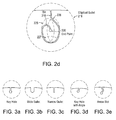
- weak areas include, for example, the sides and bottom of the radially inward circular portion of keyhole gullets having a neck portion that opens into a circle portion (such as shown in Figures 3a, 3d, and 3e ).
- the neck portion may be on an angle (as best illustrated in Figure 3d ) or have an arrow-shape (as best illustrated in Figure 3e ).
- weak gullet areas include the radially most inward semi-circle portion of narrow and wide gullets (such as shown in Figures 3b and 3c ). Maximizing the radius at one or more of these weak locations renders the gullet more resistant to fatigue and cracking.
- the short axes of the elliptical shapes are provided along gullet areas where cracks are less likely to start spontaneously.
- the cutout design of the elliptical gullet may vary as well, so long as a long axis of the gullet design is maintained at the known weak areas.
- one embodiment provides a generally open-style drop gullet that has a cutout including a pair of first elliptical shapes, each having its long axis in the radial direction of the blade so as to elongate the gullet sides, and/or a second elliptical shape having its long axis in the axial direction of the blade so as to elongate the gullet bottom (as will be discussed with reference to Figures 1a-e ).
- An alternative embodiment provides a generally slit-style gullet having a slit that essentially traces the outline of the open-style drop gullet previously described (as will be discussed with reference to Figures 2a-d ).
- the term “axial” generally refers to a direction that is substantially parallel to the saw blade's center of rotation.
- the term “radial” generally refers to a direction transverse to the axial direction.
- the elliptical gullet is not limited to any particular type of saw blade. Rather, the elliptical gullets may be implemented with blades having teeth (such as for cutting wood or plastic) or abrasive segments (such as for cutting masonry or other very hard materials). Likewise, the elliptical gullets may be implemented with blades having single layer cores, double layer cores, and sandwich-type cores (e.g., for reducing noise in various cutting applications).
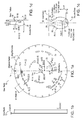
- Figures 1a through 1e illustrate a circular saw blade configured with elliptical gullets.
- the circular saw blade 10 has peripheral cutting elements 12 separated by a series of elliptical gullets 16.
- blade 10 includes a core 21, having an arbor hole 14 through which the blade 10 may be mounted and fastened to the spindle of a circular saw or other suitable machine as conventionally done (e.g., with a threaded fastener).
- the blade 10 may further include a bushing such as described in U.S. Patent Application Publication No. 2006/0185492 , and/or an assembly for accommodating multiple bore sizes such as described in U.S. Patent Application Publication No. 2006/0266176 .
- saw blades configured in accordance with embodiments of the present invention can be used in any number of applications.
- saw blade 10 can be installed on a gasoline powered handheld saw (e.g., STIHL TS760, manufactured by Andreas Stihl AG), and used to dry cut a steel plate.
- saw blade 10 can be installed onto a floor saw (e.g., Clipper CSB1 P13, manufactured by Saint-Gobain SA), and used to wet cut concrete.
- saw blade 10 can be installed onto an automatic, 14 HP (10.3kW) cut-off sawing machine (e.g., HUARD 30V53, manufactured by HUARD), and used to cut a steel or plastic tube.
- HUARD 30V53 manufactured by HUARD
- the core 21 is substantially circular in shape.
- the core includes two discrete outer layers that are mechanically fastened directly to one another (e.g., via welds, rivets, and/or nut-and-bolt arrangement).
- the core 21 may be a sandwich-type core, where two discrete outer layers sandwich an inner layer of noise-damping material such as cork, glue, epoxy or other suitable damping material (e.g., resin, copper, or soft iron).
- the core 21 may be integrally formed through a suitable metrology or molding process (e.g., metal casting, injection molding, hot-pressing, cold-pressing, etc), so long as the elliptical gullets 16 can be provided (e.g., in situ via pressure molding, machined, or otherwise formed).
- the outer layers of core 21, whether they are discrete or integral in nature, may be fabricated from substantially any material having sufficient strength for the cutting application or applications at hand. Examples of suitable core materials include steel, aluminum, titanium, bronze, their composites and alloys, and combinations thereof (e.g., ANSI 4130 steel and aluminum alloys, 2024, 6065 and 7178).
- reinforced plastics or non-metallic composites may be used to construct the core 21.
- the core 21 may have other features, in addition to cutting elements 12 and elliptical gullets 16.
- the core 21 includes one or more perforations 33 extending through the central core, along a circumference disposed concentrically with, and between, the arbor hole 14 and the periphery of blade 10.
- the perforations are arranged to form annular windows through the core 21 that corresponds to a predetermined cutting depth during rotational operation of the blade 10.
- the radially innermost set of perforations 33 form a first annular window corresponding to a first cutting depth
- the radially outermost set of perforations 33 form a second annular window corresponding to a second cutting depth.
- each gullet 16 includes a neck portion 18 defined by parallel side walls extending radially inward from the periphery of the saw blade 10. At the radially inward end of the neck portion 18, the side walls diverge (at about 45°, as best shown in Figure 1d ) from each other to form an arcuate base 20.
- the bottom of base 20 is shaped like the elongated side of elliptical shape 27.
- the left side of base 20 is shaped like the elongated side of elliptical shape 25, and the right side of base 20 is shaped like the elongated side of elliptical shape 26.
- elongating the radii of the gullet at these particular locations improves crack-resistance of blade 10.
- Example dimensions are shown for each of the elliptical shapes embodied (shown in dashed lines) in the design of gullet 16, including the radius for both long and short axes of each.
- the elliptical gullets 16 effectively enlarges the radii in the known weak gullet areas, relative to radii in the non-weak gullet areas.
- the cutting elements 12 may take the form of abrasive-laden segments spaced along the periphery or the core 21.
- the segments may include, for example, superabrasive grains suspended in a metal bond that is brazed or otherwise secured to the periphery or the core 21.
- a superabrasive tool may be manufactured by mixing superabrasive particles such as diamond and cubic boron nitride (cBN) with a suitable metal bond such as iron, copper, and tin. The mixture is then compressed in a mold to form the desired shape (e.g., segment having the desired width, length, and curvature).
- the 'green' form is then sintered at a suitable temperature to form a bonded segment with a plurality of superabrasive particles disposed therein.
- the segment is attached (e.g., by brazing, arc welding, or laser bonding) to the perimeter of core 21.
- abrasive segments can be lengthened, in proportion to the blade diameter, to reduce the number of segments, improve fracture/bend resistance, and reduce manufacturing costs.
- the ratio of abrasive segment length to blade diameter is a minimum of 0.2.
- abrasive segments can be used for relatively difficult cutting operations (e.g., for cutting concrete, asphalt, stone, and other hard materials).
- saw blade 10 may be provided with cutting elements 12 in the form of teeth, such as typical of a wide range of circular saw blades intended for cutting relatively soft materials such as wood, plastic, and the like.
- the teeth may be of any size and shape.
- the teeth may be provided with conventional hardened tips, such as fabricated from tungsten carbide, and/or may be provided with the abrasive grain bonded thereto.
- saw blade 10 is provided with a plurality of teeth having a single layer of abrasive grains chemically bonded to at least a portion of each tooth, as described in U.S. Patent Nos. 6,817,936 and 6,935,940 .
- saw blade 10 may be provided with cutting elements 12 in the form of a single layer of abrasive grain that is brazed, electroplated, or otherwise attached to the periphery of the core 21 (as opposed to attaching bonded segments or providing teeth at the perimeter).
- cutting elements 12 in the form of a single layer of abrasive grain that is brazed, electroplated, or otherwise attached to the periphery of the core 21 (as opposed to attaching bonded segments or providing teeth at the perimeter).
- Numerous cutting element 12 configurations and materials can be used in embodiments of the present invention, as will be apparent in light of this disclosure. The present invention is not intended to be limited to any particular cutting element configuration or scheme.
- Example dimensions are also shown in Figures 1a through 1e . These dimensions are merely provided as one specific example embodiment that can be fabricated. However, it will be readily apparent in light of this disclosure that numerous dimensions, as well as elliptical gullet configurations can be used to implement a saw blade in accordance with an embodiment of the present invention. The present invention is not intended to be limited to any particular set or range of blade dimensions or configurations. Rather, embodiments of the present invention are intended to cover any saw blade that can be implemented for its intended purpose and configured with elliptical gullets as described herein.
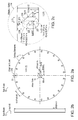
- FIGS 2a through 2e illustrate a circular saw blade configured with elliptical gullets, in accordance with another embodiment of the present invention.
- the circular saw blade 10 has a core 21 with peripheral cutting elements 12 separated by a series of elliptical gullets 216.
- the previous discussion with reference to Figures 1a through 1e including discussion relevant to cutting elements 12 and core 21, is equally applicable here, as is the general discussion relevant to elliptical gullets 16 (including example dimensions) and saw blade 10.
- the main difference of the embodiment shown in Figures 2a through 2d is the design of elliptical gullets 216. Other differences, such as the lack of a cutting depth gauge formed of perforations 33 and dimensional qualities, will be apparent.
- each gullet 216 of this example embodiment includes a slit 218 that extends radially inward from the periphery of the saw blade 10, and essentially beginning at the center of what would be the neck portion 18 of the gullet 16 design.
- the slit 218 diverges to the right (at about 45°, as best shown in Figure 2c ) and essentially traces the outline of what would be the arcuate base 20 of the gullet 16 design. At the end of the trace, slit 218 turns inward and terminates at a circular endpoint 220.
- the width (kerf) of the slit can be, for example, in the range of 50 microns to 5 millimeters (the embodiment shown is about 1 millimeter).
- the bottom of the trace formed by slit 218 is shaped like the elongated side of elliptical shape 227.
- the left side of the trace formed by slit 218 is shaped like the elongated side of elliptical shape 225, and the right side of the trace formed by slit 218 is shaped like the elongated side of elliptical shape 226.
- this gullet 216 employs elongated radii at known weak locations (bottom and sides of gullet) to improve crack-resistance of blade 10.
- Example dimensions are shown for each of the elliptical shapes embodied (shown in dashed lines) in the design of gullet 216, including the radius for both long and short axes of each.
- the elliptical gullets 216 enlarges the radii in the known weak gullet areas, relative to radii in the non-weak gullet areas.
Landscapes
- Engineering & Computer Science (AREA)
- Mechanical Engineering (AREA)
- Processing Of Stones Or Stones Resemblance Materials (AREA)
- Polishing Bodies And Polishing Tools (AREA)
Description
- The invention relates to saw blades, and more particularly, to circular saw blades having gullets designed to reduce fatigue and increase the life of the blade, as per the preambles of
claims - Conventional circular saw blades typically include a circular steel core having a series of cutters or teeth spaced along its perimeter. Gullets, in the form of cutouts extending inwardly from the periphery of the blade, are often interspaced between the cutters to aid cutting, by relieving stresses in the blade and removing swarf. A variety of gullet configurations may be used. The actual gullet configuration employed for a particular blade is based on the cutting application(s) for which the blade is expected to be used.
- Saw blades having relatively narrow gullets have been found useful in sawing of construction material with portable power saws, and in other masonry cutting applications on stationary machines, where smooth cutting action is desired. It has been found that the smoothness of cutting action is enhanced when the cutters are placed relatively close to one another, such as provided by the use of relatively narrow gullets. However, cracks tend to propagate from the tightly radiused ends of these gullets, particularly if the blade is exposed to high radial pressure. This problem is exacerbated on blades in which a fatigue barrier has been surpassed. Alternatively, saw blades having relatively wide gullets may be used. These gullets typically have a relatively large radius at their inner ends, which have been found to provide the blade with relatively high fatigue strength. These gullets may thus be beneficial in relatively high-stress cutting environments, such as floor sawing of asphalt or concrete, in which other blade types tend to fail due to stress cracks propagating from the gullets.
- Keyhole-shaped gullets attempt to combine benefits of both narrow and wide gullets. These gullets enable the cutters of a blade to be positioned relatively close to one another (e.g., so as to provide a smooth cutting action) while also providing each gullet with a relatively large radius at its radially inner end (e.g., so as to help reduce crack formation). While keyhole gullets may exhibit improved characteristics over the narrow and wide gullets in some applications, they are not without drawbacks. For example, results achieved with keyhole gullets have been less than optimal in applications involving difficult to cut materials such as steel or a relatively heterogeneous mix of workpiece materials, such as steel reinforced concrete. Under these conditions, cracks have been found to propagate from the ends or sides of the gullets, which may compromise user safety and saw performance.
WO 2006/115628 A1 relates to a circular saw blade having gullets which include a neck portion having side walls that fair divergently into base which is generally elliptical, and includes a radially innermost linear portion 30, as per the preamble ofclaim 1. - There is a need, therefore, for improved gullets suitable for circular saw blades.
- The present invention provides a circular saw blade as per
claim 1 or a circular saw blade as perclaim 10. The saw blade includes a circular core having a first planar side and a second planar side, a central arbor hole, and an outer perimeter. A plurality of cutting elements is at the outer perimeter of the core. In addition, there are one or more gullets extending radially inward from the perimeter of the core. Each gullet includes a shape that includes at least one elongated curve that enlarges radii in gullet areas prone to cracking, relative to other gullet areas. In one such embodiment, each gullet includes three or more elliptical shapes corresponding to three different gullet areas. In one specific such configuration, the shape of the gullet includes two curved sides, each connected to a radially inward curved bottom. The bottom is shaped like the elongated side of a first elliptical shape, and each of the two sides is shaped like the elongated side of a second elliptical shape. In one such case, the gullet includes an opening that defines the two sides and the bottom. In another such case, the gullet includes a slit that defines the two sides and the bottom. In another such case, the first and the second elliptical shapes are symmetrical about their respective long and short axes. Alternatively, at least one of the first and the second elliptical shapes can be asymmetrical about at least one of its long and short axes. In another such case, the first elliptical shape has short and long axes that are both shorter than respective short and long axes of the second elliptical shape. The core may include, for example, two or more layers operatively coupled via at least one of a bond material and a mechanical fastener (as opposed to a single layer or unitary blade). In one such case, the core is a sandwich-type core that includes a middle layer of sound-damping material bonded between the first and second planar sides (e.g., cork, resin, copper, or soft iron). The core can be made, for example, of steel and/or non-metallic material, or other suitable material. The cutting elements may include, for example, bonded abrasive segments, a single layer of abrasives, or teeth, or a combination thereof. In one particular configuration, there is at least one gullet between neighboring cutting elements. - The features and advantages described herein are not all-inclusive and, in particular, many additional features and advantages will be apparent to one of ordinary skill in the art in view of the drawings, specification, and claims. Moreover, it should be noted that the language used in the specification has been principally selected for readability and instructional purposes, and not to limit the scope of the inventive subject matter.
- In the accompanying drawings, reference characters refer to the same parts throughout the different views. The drawings are not necessarily to scale; emphasis has instead been placed upon illustrating the principles of the invention. Of the drawings:
-
Figures 1a and 1b illustrate a circular saw blade configured with elliptical gullets, in accordance with an embodiment of the present invention. -
Figures 1c, 1d , and1e illustrate details associated with the elliptical gullets shown inFigure 1a , in accordance with one such embodiment. -
Figures 2a and 2b illustrate a circular saw blade configured with elliptical gullets, in accordance with another embodiment of the present invention. -
Figures 2c and2d illustrate details associated with the elliptical gullets shown inFigure 2a , in accordance with one such embodiment. -
Figures 3a through 3e each illustrate conventional gullets having circular shaped portions that are prone to cracking. - An improved gullet for circular saw blades is disclosed. The gullet design employs one or more elliptical shapes to maximize the radius at one or more "weak" regions of conventional gullet designs employing circular shapes, such as each side and bottom of the circular portion at the radially innermost point of typical gullet designs. Any type of circular saw blade can employ the elliptical gullets, including blades having cutting teeth, blades having abrasive segments, and blades having a core made up of one or more layers.
- Conventional saw blades typically include a steel core (e.g., single and double layer cores, as well as sandwich-type cores that include a middle or 'sandwiched' layer of a different material such as epoxy, glue, cork, resin, copper, or soft iron). As previously discussed, such existing blades have gullets in the form of cutouts extending inwardly from the periphery of the blade. These gullets are often interspaced between the cutters, to aid cutting and relieve stresses during cutting operation, as well as during the manufacturing process. On conventional blades, the gullets typically include circular shapes in areas that are prone to cracking.
- In contrast, embodiments of the present invention employ gullets having elliptical qualities. In particular, each elliptical gullet includes at least one elliptical shape having its long axis along weak areas associated with circular gullets. These weak areas include, for example, the sides and bottom of the radially inward circular portion of keyhole gullets having a neck portion that opens into a circle portion (such as shown in
Figures 3a, 3d, and 3e ). Note that the neck portion may be on an angle (as best illustrated inFigure 3d ) or have an arrow-shape (as best illustrated inFigure 3e ). Other example weak gullet areas include the radially most inward semi-circle portion of narrow and wide gullets (such as shown inFigures 3b and 3c ). Maximizing the radius at one or more of these weak locations renders the gullet more resistant to fatigue and cracking. The short axes of the elliptical shapes are provided along gullet areas where cracks are less likely to start spontaneously. - In addition, the cutout design of the elliptical gullet may vary as well, so long as a long axis of the gullet design is maintained at the known weak areas. For instance, one embodiment provides a generally open-style drop gullet that has a cutout including a pair of first elliptical shapes, each having its long axis in the radial direction of the blade so as to elongate the gullet sides, and/or a second elliptical shape having its long axis in the axial direction of the blade so as to elongate the gullet bottom (as will be discussed with reference to
Figures 1a-e ). An alternative embodiment provides a generally slit-style gullet having a slit that essentially traces the outline of the open-style drop gullet previously described (as will be discussed with reference toFigures 2a-d ). As is known, the term "axial" generally refers to a direction that is substantially parallel to the saw blade's center of rotation. The term "radial" generally refers to a direction transverse to the axial direction. - As previously noted, the elliptical gullet is not limited to any particular type of saw blade. Rather, the elliptical gullets may be implemented with blades having teeth (such as for cutting wood or plastic) or abrasive segments (such as for cutting masonry or other very hard materials). Likewise, the elliptical gullets may be implemented with blades having single layer cores, double layer cores, and sandwich-type cores (e.g., for reducing noise in various cutting applications).
-
Figures 1a through 1e illustrate a circular saw blade configured with elliptical gullets. - As can be seen, the
circular saw blade 10 hasperipheral cutting elements 12 separated by a series ofelliptical gullets 16. - In the embodiment shown, and as best illustrated in
Figure 1a ,blade 10 includes a core 21, having anarbor hole 14 through which theblade 10 may be mounted and fastened to the spindle of a circular saw or other suitable machine as conventionally done (e.g., with a threaded fastener). In some embodiments, theblade 10 may further include a bushing such as described inU.S. Patent Application Publication No. 2006/0185492 , and/or an assembly for accommodating multiple bore sizes such as described inU.S. Patent Application Publication No. 2006/0266176 . - Saw blades configured in accordance with embodiments of the present invention can be used in any number of applications. For instance, saw
blade 10 can be installed on a gasoline powered handheld saw (e.g., STIHL TS760, manufactured by Andreas Stihl AG), and used to dry cut a steel plate. Likewise, sawblade 10 can be installed onto a floor saw (e.g., Clipper CSB1 P13, manufactured by Saint-Gobain SA), and used to wet cut concrete. Likewise, sawblade 10 can be installed onto an automatic, 14 HP (10.3kW) cut-off sawing machine (e.g., HUARD 30V53, manufactured by HUARD), and used to cut a steel or plastic tube. Numerous suitable machines and applications will be apparent in light of this disclosure. - As shown, the
core 21 is substantially circular in shape. In one example embodiment, the core includes two discrete outer layers that are mechanically fastened directly to one another (e.g., via welds, rivets, and/or nut-and-bolt arrangement). Alternatively, thecore 21 may be a sandwich-type core, where two discrete outer layers sandwich an inner layer of noise-damping material such as cork, glue, epoxy or other suitable damping material (e.g., resin, copper, or soft iron). Alternatively, thecore 21 may be integrally formed through a suitable metrology or molding process (e.g., metal casting, injection molding, hot-pressing, cold-pressing, etc), so long as theelliptical gullets 16 can be provided (e.g., in situ via pressure molding, machined, or otherwise formed). The outer layers ofcore 21, whether they are discrete or integral in nature, may be fabricated from substantially any material having sufficient strength for the cutting application or applications at hand. Examples of suitable core materials include steel, aluminum, titanium, bronze, their composites and alloys, and combinations thereof (e.g., ANSI 4130 steel and aluminum alloys, 2024, 6065 and 7178). Alternatively, for some applications, reinforced plastics or non-metallic composites may be used to construct thecore 21. - The core 21 may have other features, in addition to cutting
elements 12 andelliptical gullets 16. For example, and as best illustrated inFigure 1a , thecore 21 includes one ormore perforations 33 extending through the central core, along a circumference disposed concentrically with, and between, thearbor hole 14 and the periphery ofblade 10. The perforations are arranged to form annular windows through the core 21 that corresponds to a predetermined cutting depth during rotational operation of theblade 10. In example embodiment, the radially innermost set ofperforations 33 form a first annular window corresponding to a first cutting depth, and the radially outermost set ofperforations 33 form a second annular window corresponding to a second cutting depth. Additional details of circular saw blades having one or more cutting depth gauges are provided, for example, inU.S. Patent No. 7210474 . Other functional features, such as for balancing the blade, indicating source of the blade, reducing operating noise of the blade, and indicating proper mounting of the blade, can also be employed. - As best shown in
Figures 1c, 1d , and1e , eachgullet 16 includes aneck portion 18 defined by parallel side walls extending radially inward from the periphery of thesaw blade 10. At the radially inward end of theneck portion 18, the side walls diverge (at about 45°, as best shown inFigure 1d ) from each other to form anarcuate base 20. As shown, the bottom ofbase 20 is shaped like the elongated side ofelliptical shape 27. Likewise, the left side ofbase 20 is shaped like the elongated side ofelliptical shape 25, and the right side ofbase 20 is shaped like the elongated side ofelliptical shape 26. As will be appreciated in light of this disclosure, elongating the radii of the gullet at these particular locations (bottom and sides of gullet) improves crack-resistance ofblade 10. Example dimensions are shown for each of the elliptical shapes embodied (shown in dashed lines) in the design ofgullet 16, including the radius for both long and short axes of each. In short, theelliptical gullets 16 effectively enlarges the radii in the known weak gullet areas, relative to radii in the non-weak gullet areas. - In some embodiments, the cutting
elements 12 may take the form of abrasive-laden segments spaced along the periphery or thecore 21. The segments may include, for example, superabrasive grains suspended in a metal bond that is brazed or otherwise secured to the periphery or thecore 21. For instance, a superabrasive tool may be manufactured by mixing superabrasive particles such as diamond and cubic boron nitride (cBN) with a suitable metal bond such as iron, copper, and tin. The mixture is then compressed in a mold to form the desired shape (e.g., segment having the desired width, length, and curvature). The 'green' form is then sintered at a suitable temperature to form a bonded segment with a plurality of superabrasive particles disposed therein. The segment is attached (e.g., by brazing, arc welding, or laser bonding) to the perimeter ofcore 21. - Additional details of circular saw blades configured in accordance with embodiments of the present invention and having suitable abrasive segment designs for cutting
elements 12 are provided, for example, inU.S. Patent No. 5,518,443 (abrasive segments with alternating volume percentages of abrasive grain),U.S. Patent No. 6,033,295 (portion of the abrasive segment is hardened), andU.S. Patent No. 5,868,125 (crenelated abrasive segments). - In addition, the abrasive segments can be lengthened, in proportion to the blade diameter, to reduce the number of segments, improve fracture/bend resistance, and reduce manufacturing costs. In one such embodiment, the ratio of abrasive segment length to blade diameter is a minimum of 0.2. As previously mentioned, abrasive segments can be used for relatively difficult cutting operations (e.g., for cutting concrete, asphalt, stone, and other hard materials).
- Alternatively, saw
blade 10 may be provided with cuttingelements 12 in the form of teeth, such as typical of a wide range of circular saw blades intended for cutting relatively soft materials such as wood, plastic, and the like. As is known, the teeth may be of any size and shape. In addition, the teeth may be provided with conventional hardened tips, such as fabricated from tungsten carbide, and/or may be provided with the abrasive grain bonded thereto. In one such example embodiment, sawblade 10 is provided with a plurality of teeth having a single layer of abrasive grains chemically bonded to at least a portion of each tooth, as described inU.S. Patent Nos. 6,817,936 and6,935,940 . - Alternatively, saw
blade 10 may be provided with cuttingelements 12 in the form of a single layer of abrasive grain that is brazed, electroplated, or otherwise attached to the periphery of the core 21 (as opposed to attaching bonded segments or providing teeth at the perimeter). Numerous cuttingelement 12 configurations and materials can be used in embodiments of the present invention, as will be apparent in light of this disclosure. The present invention is not intended to be limited to any particular cutting element configuration or scheme. - Example dimensions (in millimeters, mm) are also shown in
Figures 1a through 1e . These dimensions are merely provided as one specific example embodiment that can be fabricated. However, it will be readily apparent in light of this disclosure that numerous dimensions, as well as elliptical gullet configurations can be used to implement a saw blade in accordance with an embodiment of the present invention. The present invention is not intended to be limited to any particular set or range of blade dimensions or configurations. Rather, embodiments of the present invention are intended to cover any saw blade that can be implemented for its intended purpose and configured with elliptical gullets as described herein. -
Figures 2a through 2e illustrate a circular saw blade configured with elliptical gullets, in accordance with another embodiment of the present invention. As can be seen, thecircular saw blade 10 has a core 21 with peripheral cuttingelements 12 separated by a series ofelliptical gullets 216. The previous discussion with reference toFigures 1a through 1e , including discussion relevant to cuttingelements 12 andcore 21, is equally applicable here, as is the general discussion relevant to elliptical gullets 16 (including example dimensions) and sawblade 10. The main difference of the embodiment shown inFigures 2a through 2d is the design ofelliptical gullets 216. Other differences, such as the lack of a cutting depth gauge formed ofperforations 33 and dimensional qualities, will be apparent. - As best shown in
Figures 2c and2d , eachgullet 216 of this example embodiment includes aslit 218 that extends radially inward from the periphery of thesaw blade 10, and essentially beginning at the center of what would be theneck portion 18 of thegullet 16 design. Theslit 218 diverges to the right (at about 45°, as best shown inFigure 2c ) and essentially traces the outline of what would be thearcuate base 20 of thegullet 16 design. At the end of the trace, slit 218 turns inward and terminates at acircular endpoint 220. The width (kerf) of the slit can be, for example, in the range of 50 microns to 5 millimeters (the embodiment shown is about 1 millimeter). As shown, the bottom of the trace formed byslit 218 is shaped like the elongated side ofelliptical shape 227. Likewise, the left side of the trace formed byslit 218 is shaped like the elongated side ofelliptical shape 225, and the right side of the trace formed byslit 218 is shaped like the elongated side ofelliptical shape 226. Just as withgullet 16, thisgullet 216 employs elongated radii at known weak locations (bottom and sides of gullet) to improve crack-resistance ofblade 10. Example dimensions are shown for each of the elliptical shapes embodied (shown in dashed lines) in the design ofgullet 216, including the radius for both long and short axes of each. In short, theelliptical gullets 216 enlarges the radii in the known weak gullet areas, relative to radii in the non-weak gullet areas. - The foregoing description of the embodiments of the invention has been presented for the purposes of illustration and description. It is not intended to be exhaustive or to limit the invention to the precise form disclosed. Many modifications and variations are possible in light of this disclosure. It is intended that the scope of the invention be limited not by this detailed description, but rather by the claims appended hereto.
Claims (13)
- A circular saw blade (10), comprising:a circular core (21) having a first planar side and a second planar side, a central arbor hole (14), and an outer perimeter;a plurality of cutting elements (12) at the outer perimeter of the core (21); andone or more gullets (16) extending radially inward from the perimeter of the core (21), each gullet (16) having a shape that includes at least one elongated curve that enlarges radii in gullet areas prone to cracking, relative to other gullet areas, characterized in that
the shape of the gullet (16) includes two curved sides, each connected to a radially inward curved bottom, and the bottom is shaped like the elongated side of a first elliptical shape (27), and each of the two sides is shaped like the elongated side of a second elliptical shape (25, 26). - The circular saw blade (10) of claim 1 wherein the first elliptical shape (27) has short and long axes that are both shorter than respective short and long axes of the second elliptical shape (25, 26).
- The circular saw blade (10) of claim 1 wherein the core (21) includes two or more layers operatively coupled via at least one of a bond material and a mechanical fastener.
- The circular saw blade (10) of claim 3 wherein the core (21) is a sandwich-type core that includes a middle layer of sound-damping material bonded between the first and second planar sides.
- The circular saw blade (10) of claim 1 wherein the core (21) is made of non-metallic material or steel.
- The circular saw blade (10) of claim 1 wherein the cutting elements (12) include at least one of bonded abrasive segments, a single layer of abrasives, and teeth.
- The circular saw blade (10) of claim 1 wherein there is at least one gullet (16) between neighboring cutting elements (12).
- The circular saw blade (10) of claim 1 wherein each gullet (16) includes three or more elliptical shapes (25, 26, 27) corresponding to three different gullet areas.
- The circular saw blade (10) of claim 1 or 2 wherein at least one of the first and the second elliptical shapes (25, 26, 27) is asymmetrical about at least one of its long and short axes.
- A circular saw blade (10), comprising:a circular core (21) having a first planar side and a second planar side, a central arbor hole (14);a plurality of cutting elements (12) at the outer perimeter of the core ((21); andone or more gullets (16) extending radially inward from the perimeter of the core (21), each gullet (14) having a shape that includes three or more elliptical shapes (25, 26, 27) corresponding to three different gullet areas, thereby enlarging radii of those gullet areas, relative to other gullet areas, characterized in that
the shape of the gullet (16) includes two curved sides, each connected to a radially inward curved bottom, and the bottom is shaped like the elongated side of a first elliptical shape (27), and each of the two sides is shaped like the elongated side of a second elliptical shape (25, 26). - The circular saw blade (10) of claim 1, 2 or 10 wherein the gullet (16) includes an opening that defines the two sides and the bottom, or a slit (218) that defines the two sides and the bottom.
- The circular saw blade (10) of claim 1, 2 or 10 wherein the elliptical shapes (25, 26, 27) are symmetrical about their respective long and short axes.
- The circular saw blade (10) of claim 10 wherein at least one of the elliptical shapes (25, 26, 27) is asymmetrical about at least one of its long and short axes.
Priority Applications (1)
| Application Number | Priority Date | Filing Date | Title |
|---|---|---|---|
| PL09703608T PL2244853T3 (en) | 2008-01-22 | 2009-01-21 | Saw blade with ellipsoidal notches |
Applications Claiming Priority (2)
| Application Number | Priority Date | Filing Date | Title |
|---|---|---|---|
| US1180608P | 2008-01-22 | 2008-01-22 | |
| PCT/US2009/031548 WO2009094378A1 (en) | 2008-01-22 | 2009-01-21 | Circular saw blade with elliptical gullets |
Publications (3)
| Publication Number | Publication Date |
|---|---|
| EP2244853A1 EP2244853A1 (en) | 2010-11-03 |
| EP2244853A4 EP2244853A4 (en) | 2014-09-24 |
| EP2244853B1 true EP2244853B1 (en) | 2015-09-30 |
Family
ID=40901417
Family Applications (1)
| Application Number | Title | Priority Date | Filing Date |
|---|---|---|---|
| EP09703608.1A Active EP2244853B1 (en) | 2008-01-22 | 2009-01-21 | Circular saw blade with elliptical gullets |
Country Status (9)
| Country | Link |
|---|---|
| EP (1) | EP2244853B1 (en) |
| JP (2) | JP2011509853A (en) |
| CN (1) | CN101970163B (en) |
| AU (1) | AU2009206493B2 (en) |
| BR (1) | BRPI0906499B1 (en) |
| DK (1) | DK2244853T3 (en) |
| ES (1) | ES2556953T3 (en) |
| PL (1) | PL2244853T3 (en) |
| WO (1) | WO2009094378A1 (en) |
Families Citing this family (7)
| Publication number | Priority date | Publication date | Assignee | Title |
|---|---|---|---|---|
| EP3370910B1 (en) | 2015-11-02 | 2025-09-10 | Milwaukee Electric Tool Corporation | Saw blade |
| EP3624977B1 (en) | 2017-05-18 | 2022-07-06 | Milwaukee Electric Tool Corporation | Methods of manufacturing saw blades |
| JP6903528B2 (en) * | 2017-09-08 | 2021-07-14 | 株式会社ノリタケカンパニーリミテド | Cutting blade |
| CN107598275A (en) * | 2017-09-22 | 2018-01-19 | 张家港沙工科技服务有限公司 | A kind of cutting machine circular saw bit |
| CN108004444A (en) * | 2017-12-19 | 2018-05-08 | 苏州中骏木工机械配件有限公司 | A kind of spiral cutter head blade |
| CN108015860A (en) * | 2017-12-20 | 2018-05-11 | 苏州中骏木工机械配件有限公司 | A kind of high temperature resistant wood cutter |
| CN109302908A (en) * | 2018-11-19 | 2019-02-05 | 国网冀北电力有限公司张家口供电公司 | Insulated Tall Branch Saw with Turbo Resin High Torque Electric Motor |
Family Cites Families (27)
| Publication number | Priority date | Publication date | Assignee | Title |
|---|---|---|---|---|
| IT1104926B (en) * | 1978-07-28 | 1985-10-28 | Gomex Verktyg Ab | CIRCULAR SAW BLADE |
| US4705017A (en) * | 1985-08-19 | 1987-11-10 | Federal-Mogul Corporation | Stress resistant abrasive cutting wheel |
| JPS6347067A (en) * | 1986-08-11 | 1988-02-27 | Osaka Daiyamondo Kogyo Kk | Cutting tool and manufacture therefor |
| JPH0620562Y2 (en) * | 1987-06-11 | 1994-06-01 | 天龍製鋸株式会社 | Noise suppression device for rotating saw substrate |
| JPH036901U (en) * | 1989-06-07 | 1991-01-23 | ||
| JPH0463682A (en) * | 1990-07-04 | 1992-02-28 | N K Koki Kk | Diamond circular saw |
| JPH04152069A (en) * | 1990-10-15 | 1992-05-26 | Toshiba Corp | Metal bond tool and its manufacturing method |
| JPH06226638A (en) * | 1993-02-02 | 1994-08-16 | Nippon Chuzo Kk | Diamond blade |
| DE9400182U1 (en) * | 1994-01-10 | 1994-03-10 | Ledermann Gmbh, 72160 Horb | Circular saw blade |
| US5518443A (en) | 1994-05-13 | 1996-05-21 | Norton Company | Superabrasive tool |
| JPH0847816A (en) * | 1994-08-03 | 1996-02-20 | Hashimoto Tokushu Kogyo Kk | Circular saw |
| TW316868B (en) | 1994-12-28 | 1997-10-01 | Norton Co | |
| JPH08229732A (en) * | 1995-02-28 | 1996-09-10 | Toshio Aono | Curved slit for saw blade |
| CA2243694C (en) | 1996-03-15 | 2003-04-29 | Norton Company | Metal single layer abrasive cutting tool having a contoured cutting surface |
| US5868125A (en) | 1996-11-21 | 1999-02-09 | Norton Company | Crenelated abrasive tool |
| JP2000246651A (en) * | 1999-02-26 | 2000-09-12 | Toho Titanium Co Ltd | Diamond saw blade |
| JP3444819B2 (en) * | 1999-07-05 | 2003-09-08 | 株式会社ノリタケスーパーアブレーシブ | Rotating disk whetstone |
| TW546180B (en) * | 2000-03-21 | 2003-08-11 | American Tool Comp Inc | Metal-cutting saw blade having strengthened gullet and negative tooth rake |
| KR100440869B1 (en) * | 2001-02-19 | 2004-07-19 | 이화다이아몬드공업 주식회사 | Saw blade shank |
| US6681674B2 (en) * | 2001-02-23 | 2004-01-27 | William Hakansson | Band saw blade |
| DE10124687B4 (en) * | 2001-05-18 | 2006-01-12 | Leitz Gmbh & Co. Kg | circular saw blade |
| US20060185492A1 (en) | 2005-02-18 | 2006-08-24 | Francois Chianese | Shoulder bushing for saw blades |
| US7210474B2 (en) | 2005-03-23 | 2007-05-01 | Saint-Gobain Abrasives Technology Company | Saw blade with cutting depth gauge |
| US7946907B2 (en) * | 2005-04-20 | 2011-05-24 | Saint-Gobain Abrasives, Inc. | Saw blade gullet configuration |
| US7444914B2 (en) | 2005-05-25 | 2008-11-04 | Saint-Gobain Abrasives Technology Company | Saw blade with multiple bore sizes |
| JP2007160416A (en) * | 2005-12-09 | 2007-06-28 | Hitachi Koki Co Ltd | Cutting blade |
| CN2905291Y (en) * | 2006-04-14 | 2007-05-30 | 浙江工业大学 | saw blade |
-
2009
- 2009-01-21 DK DK09703608.1T patent/DK2244853T3/en active
- 2009-01-21 ES ES09703608.1T patent/ES2556953T3/en active Active
- 2009-01-21 CN CN2009801028016A patent/CN101970163B/en active Active
- 2009-01-21 EP EP09703608.1A patent/EP2244853B1/en active Active
- 2009-01-21 AU AU2009206493A patent/AU2009206493B2/en not_active Ceased
- 2009-01-21 JP JP2010543308A patent/JP2011509853A/en active Pending
- 2009-01-21 BR BRPI0906499-0A patent/BRPI0906499B1/en active IP Right Grant
- 2009-01-21 PL PL09703608T patent/PL2244853T3/en unknown
- 2009-01-21 WO PCT/US2009/031548 patent/WO2009094378A1/en not_active Ceased
-
2012
- 2012-10-24 JP JP2012235203A patent/JP5739853B2/en not_active Expired - Fee Related
Also Published As
| Publication number | Publication date |
|---|---|
| JP5739853B2 (en) | 2015-06-24 |
| WO2009094378A1 (en) | 2009-07-30 |
| BRPI0906499A2 (en) | 2015-07-14 |
| EP2244853A4 (en) | 2014-09-24 |
| CN101970163A (en) | 2011-02-09 |
| PL2244853T3 (en) | 2016-03-31 |
| CN101970163B (en) | 2013-10-23 |
| DK2244853T3 (en) | 2016-01-11 |
| JP2011509853A (en) | 2011-03-31 |
| BRPI0906499B1 (en) | 2020-10-13 |
| ES2556953T3 (en) | 2016-01-21 |
| EP2244853A1 (en) | 2010-11-03 |
| AU2009206493B2 (en) | 2011-12-01 |
| JP2013018118A (en) | 2013-01-31 |
| AU2009206493A1 (en) | 2009-07-30 |
Similar Documents
| Publication | Publication Date | Title |
|---|---|---|
| US20090199693A1 (en) | Circular Saw Blade With Elliptical Gullets | |
| EP2296839B1 (en) | Circular saw blade with offset gullets | |
| CA2605392C (en) | Saw blade | |
| EP2244853B1 (en) | Circular saw blade with elliptical gullets | |
| EP2651601B1 (en) | A slot wear indicator for a grinding tool | |
| WO2004078440A1 (en) | Gear type machining tip and tool attaching the same thereon | |
| US6739227B2 (en) | Apparatus and method for providing an enhanced metal cutting saw blade | |
| EP1726393B1 (en) | Circular saw blade with multiple central bore sizes | |
| AU2011204845B2 (en) | Circular saw blade with offset gullets | |
| JP2015166128A (en) | Slot wear indicator for grinding tool |
Legal Events
| Date | Code | Title | Description |
|---|---|---|---|
| PUAI | Public reference made under article 153(3) epc to a published international application that has entered the european phase |
Free format text: ORIGINAL CODE: 0009012 |
|
| 17P | Request for examination filed |
Effective date: 20100817 |
|
| AK | Designated contracting states |
Kind code of ref document: A1 Designated state(s): AT BE BG CH CY CZ DE DK EE ES FI FR GB GR HR HU IE IS IT LI LT LU LV MC MK MT NL NO PL PT RO SE SI SK TR |
|
| AX | Request for extension of the european patent |
Extension state: AL BA RS |
|
| RIN1 | Information on inventor provided before grant (corrected) |
Inventor name: HEYEN, ANDRE R. G. |
|
| DAX | Request for extension of the european patent (deleted) | ||
| A4 | Supplementary search report drawn up and despatched |
Effective date: 20140827 |
|
| RIC1 | Information provided on ipc code assigned before grant |
Ipc: B27B 33/00 20060101ALI20140821BHEP Ipc: B23D 61/02 20060101AFI20140821BHEP Ipc: B27B 33/08 20060101ALI20140821BHEP Ipc: B23D 61/00 20060101ALI20140821BHEP |
|
| GRAP | Despatch of communication of intention to grant a patent |
Free format text: ORIGINAL CODE: EPIDOSNIGR1 |
|
| INTG | Intention to grant announced |
Effective date: 20150430 |
|
| GRAS | Grant fee paid |
Free format text: ORIGINAL CODE: EPIDOSNIGR3 |
|
| GRAA | (expected) grant |
Free format text: ORIGINAL CODE: 0009210 |
|
| AK | Designated contracting states |
Kind code of ref document: B1 Designated state(s): AT BE BG CH CY CZ DE DK EE ES FI FR GB GR HR HU IE IS IT LI LT LU LV MC MK MT NL NO PL PT RO SE SI SK TR |
|
| REG | Reference to a national code |
Ref country code: CH Ref legal event code: EP Ref country code: GB Ref legal event code: FG4D |
|
| REG | Reference to a national code |
Ref country code: AT Ref legal event code: REF Ref document number: 752096 Country of ref document: AT Kind code of ref document: T Effective date: 20151015 |
|
| REG | Reference to a national code |
Ref country code: IE Ref legal event code: FG4D |
|
| REG | Reference to a national code |
Ref country code: DE Ref legal event code: R096 Ref document number: 602009033905 Country of ref document: DE |
|
| REG | Reference to a national code |
Ref country code: FR Ref legal event code: PLFP Year of fee payment: 8 |
|
| REG | Reference to a national code |
Ref country code: SE Ref legal event code: TRGR |
|
| REG | Reference to a national code |
Ref country code: DK Ref legal event code: T3 Effective date: 20160107 |
|
| REG | Reference to a national code |
Ref country code: ES Ref legal event code: FG2A Ref document number: 2556953 Country of ref document: ES Kind code of ref document: T3 Effective date: 20160121 |
|
| PG25 | Lapsed in a contracting state [announced via postgrant information from national office to epo] |
Ref country code: LV Free format text: LAPSE BECAUSE OF FAILURE TO SUBMIT A TRANSLATION OF THE DESCRIPTION OR TO PAY THE FEE WITHIN THE PRESCRIBED TIME-LIMIT Effective date: 20150930 Ref country code: GR Free format text: LAPSE BECAUSE OF FAILURE TO SUBMIT A TRANSLATION OF THE DESCRIPTION OR TO PAY THE FEE WITHIN THE PRESCRIBED TIME-LIMIT Effective date: 20151231 Ref country code: FI Free format text: LAPSE BECAUSE OF FAILURE TO SUBMIT A TRANSLATION OF THE DESCRIPTION OR TO PAY THE FEE WITHIN THE PRESCRIBED TIME-LIMIT Effective date: 20150930 Ref country code: LT Free format text: LAPSE BECAUSE OF FAILURE TO SUBMIT A TRANSLATION OF THE DESCRIPTION OR TO PAY THE FEE WITHIN THE PRESCRIBED TIME-LIMIT Effective date: 20150930 |
|
| REG | Reference to a national code |
Ref country code: NL Ref legal event code: MP Effective date: 20150930 |
|
| REG | Reference to a national code |
Ref country code: NO Ref legal event code: T2 Effective date: 20150930 |
|
| REG | Reference to a national code |
Ref country code: LT Ref legal event code: MG4D |
|
| PG25 | Lapsed in a contracting state [announced via postgrant information from national office to epo] |
Ref country code: HR Free format text: LAPSE BECAUSE OF FAILURE TO SUBMIT A TRANSLATION OF THE DESCRIPTION OR TO PAY THE FEE WITHIN THE PRESCRIBED TIME-LIMIT Effective date: 20150930 |
|
| PG25 | Lapsed in a contracting state [announced via postgrant information from national office to epo] |
Ref country code: EE Free format text: LAPSE BECAUSE OF FAILURE TO SUBMIT A TRANSLATION OF THE DESCRIPTION OR TO PAY THE FEE WITHIN THE PRESCRIBED TIME-LIMIT Effective date: 20150930 Ref country code: NL Free format text: LAPSE BECAUSE OF FAILURE TO SUBMIT A TRANSLATION OF THE DESCRIPTION OR TO PAY THE FEE WITHIN THE PRESCRIBED TIME-LIMIT Effective date: 20150930 Ref country code: SK Free format text: LAPSE BECAUSE OF FAILURE TO SUBMIT A TRANSLATION OF THE DESCRIPTION OR TO PAY THE FEE WITHIN THE PRESCRIBED TIME-LIMIT Effective date: 20150930 Ref country code: IS Free format text: LAPSE BECAUSE OF FAILURE TO SUBMIT A TRANSLATION OF THE DESCRIPTION OR TO PAY THE FEE WITHIN THE PRESCRIBED TIME-LIMIT Effective date: 20160130 |
|
| PG25 | Lapsed in a contracting state [announced via postgrant information from national office to epo] |
Ref country code: PT Free format text: LAPSE BECAUSE OF FAILURE TO SUBMIT A TRANSLATION OF THE DESCRIPTION OR TO PAY THE FEE WITHIN THE PRESCRIBED TIME-LIMIT Effective date: 20160201 Ref country code: RO Free format text: LAPSE BECAUSE OF FAILURE TO SUBMIT A TRANSLATION OF THE DESCRIPTION OR TO PAY THE FEE WITHIN THE PRESCRIBED TIME-LIMIT Effective date: 20150930 |
|
| REG | Reference to a national code |
Ref country code: DE Ref legal event code: R097 Ref document number: 602009033905 Country of ref document: DE |
|
| PLBE | No opposition filed within time limit |
Free format text: ORIGINAL CODE: 0009261 |
|
| STAA | Information on the status of an ep patent application or granted ep patent |
Free format text: STATUS: NO OPPOSITION FILED WITHIN TIME LIMIT |
|
| PG25 | Lapsed in a contracting state [announced via postgrant information from national office to epo] |
Ref country code: LU Free format text: LAPSE BECAUSE OF FAILURE TO SUBMIT A TRANSLATION OF THE DESCRIPTION OR TO PAY THE FEE WITHIN THE PRESCRIBED TIME-LIMIT Effective date: 20160121 |
|
| REG | Reference to a national code |
Ref country code: CH Ref legal event code: PL |
|
| 26N | No opposition filed |
Effective date: 20160701 |
|
| PG25 | Lapsed in a contracting state [announced via postgrant information from national office to epo] |
Ref country code: MC Free format text: LAPSE BECAUSE OF FAILURE TO SUBMIT A TRANSLATION OF THE DESCRIPTION OR TO PAY THE FEE WITHIN THE PRESCRIBED TIME-LIMIT Effective date: 20150930 |
|
| PG25 | Lapsed in a contracting state [announced via postgrant information from national office to epo] |
Ref country code: CH Free format text: LAPSE BECAUSE OF NON-PAYMENT OF DUE FEES Effective date: 20160131 Ref country code: LI Free format text: LAPSE BECAUSE OF NON-PAYMENT OF DUE FEES Effective date: 20160131 |
|
| REG | Reference to a national code |
Ref country code: IE Ref legal event code: MM4A |
|
| PG25 | Lapsed in a contracting state [announced via postgrant information from national office to epo] |
Ref country code: SI Free format text: LAPSE BECAUSE OF FAILURE TO SUBMIT A TRANSLATION OF THE DESCRIPTION OR TO PAY THE FEE WITHIN THE PRESCRIBED TIME-LIMIT Effective date: 20150930 |
|
| REG | Reference to a national code |
Ref country code: FR Ref legal event code: PLFP Year of fee payment: 9 |
|
| PG25 | Lapsed in a contracting state [announced via postgrant information from national office to epo] |
Ref country code: IE Free format text: LAPSE BECAUSE OF NON-PAYMENT OF DUE FEES Effective date: 20160121 |
|
| PG25 | Lapsed in a contracting state [announced via postgrant information from national office to epo] |
Ref country code: MT Free format text: LAPSE BECAUSE OF FAILURE TO SUBMIT A TRANSLATION OF THE DESCRIPTION OR TO PAY THE FEE WITHIN THE PRESCRIBED TIME-LIMIT Effective date: 20150930 |
|
| REG | Reference to a national code |
Ref country code: AT Ref legal event code: UEP Ref document number: 752096 Country of ref document: AT Kind code of ref document: T Effective date: 20150930 |
|
| REG | Reference to a national code |
Ref country code: FR Ref legal event code: PLFP Year of fee payment: 10 |
|
| PG25 | Lapsed in a contracting state [announced via postgrant information from national office to epo] |
Ref country code: HU Free format text: LAPSE BECAUSE OF FAILURE TO SUBMIT A TRANSLATION OF THE DESCRIPTION OR TO PAY THE FEE WITHIN THE PRESCRIBED TIME-LIMIT; INVALID AB INITIO Effective date: 20090121 Ref country code: CY Free format text: LAPSE BECAUSE OF FAILURE TO SUBMIT A TRANSLATION OF THE DESCRIPTION OR TO PAY THE FEE WITHIN THE PRESCRIBED TIME-LIMIT Effective date: 20150930 |
|
| PG25 | Lapsed in a contracting state [announced via postgrant information from national office to epo] |
Ref country code: MT Free format text: LAPSE BECAUSE OF FAILURE TO SUBMIT A TRANSLATION OF THE DESCRIPTION OR TO PAY THE FEE WITHIN THE PRESCRIBED TIME-LIMIT Effective date: 20160131 Ref country code: TR Free format text: LAPSE BECAUSE OF FAILURE TO SUBMIT A TRANSLATION OF THE DESCRIPTION OR TO PAY THE FEE WITHIN THE PRESCRIBED TIME-LIMIT Effective date: 20150930 Ref country code: MK Free format text: LAPSE BECAUSE OF FAILURE TO SUBMIT A TRANSLATION OF THE DESCRIPTION OR TO PAY THE FEE WITHIN THE PRESCRIBED TIME-LIMIT Effective date: 20150930 |
|
| PG25 | Lapsed in a contracting state [announced via postgrant information from national office to epo] |
Ref country code: BG Free format text: LAPSE BECAUSE OF FAILURE TO SUBMIT A TRANSLATION OF THE DESCRIPTION OR TO PAY THE FEE WITHIN THE PRESCRIBED TIME-LIMIT Effective date: 20150930 |
|
| P01 | Opt-out of the competence of the unified patent court (upc) registered |
Effective date: 20230530 |
|
| PGFP | Annual fee paid to national office [announced via postgrant information from national office to epo] |
Ref country code: NO Payment date: 20231221 Year of fee payment: 16 Ref country code: DK Payment date: 20231219 Year of fee payment: 16 Ref country code: CZ Payment date: 20231227 Year of fee payment: 16 |
|
| PGFP | Annual fee paid to national office [announced via postgrant information from national office to epo] |
Ref country code: PL Payment date: 20231221 Year of fee payment: 16 |
|
| PGFP | Annual fee paid to national office [announced via postgrant information from national office to epo] |
Ref country code: ES Payment date: 20240202 Year of fee payment: 16 |
|
| PGFP | Annual fee paid to national office [announced via postgrant information from national office to epo] |
Ref country code: IT Payment date: 20240102 Year of fee payment: 16 |
|
| REG | Reference to a national code |
Ref country code: DK Ref legal event code: EBP Effective date: 20250131 |
|
| PG25 | Lapsed in a contracting state [announced via postgrant information from national office to epo] |
Ref country code: NO Free format text: LAPSE BECAUSE OF NON-PAYMENT OF DUE FEES Effective date: 20250131 |
|
| PG25 | Lapsed in a contracting state [announced via postgrant information from national office to epo] |
Ref country code: CZ Free format text: LAPSE BECAUSE OF NON-PAYMENT OF DUE FEES Effective date: 20250121 |
|
| PGFP | Annual fee paid to national office [announced via postgrant information from national office to epo] |
Ref country code: GB Payment date: 20251219 Year of fee payment: 18 |
|
| PG25 | Lapsed in a contracting state [announced via postgrant information from national office to epo] |
Ref country code: DK Free format text: LAPSE BECAUSE OF NON-PAYMENT OF DUE FEES Effective date: 20250131 |
|
| PG25 | Lapsed in a contracting state [announced via postgrant information from national office to epo] |
Ref country code: IT Free format text: LAPSE BECAUSE OF NON-PAYMENT OF DUE FEES Effective date: 20250121 |
|
| PGFP | Annual fee paid to national office [announced via postgrant information from national office to epo] |
Ref country code: FR Payment date: 20251217 Year of fee payment: 18 |
|
| PGFP | Annual fee paid to national office [announced via postgrant information from national office to epo] |
Ref country code: BE Payment date: 20251217 Year of fee payment: 18 |
|
| PGFP | Annual fee paid to national office [announced via postgrant information from national office to epo] |
Ref country code: SE Payment date: 20251217 Year of fee payment: 18 |
|
| REG | Reference to a national code |
Ref country code: ES Ref legal event code: FD2A Effective date: 20260227 |
|
| PG25 | Lapsed in a contracting state [announced via postgrant information from national office to epo] |
Ref country code: ES Free format text: LAPSE BECAUSE OF NON-PAYMENT OF DUE FEES Effective date: 20250122 |
|
| PGFP | Annual fee paid to national office [announced via postgrant information from national office to epo] |
Ref country code: DE Payment date: 20251217 Year of fee payment: 18 |
|
| PGFP | Annual fee paid to national office [announced via postgrant information from national office to epo] |
Ref country code: AT Payment date: 20251218 Year of fee payment: 18 |