EP2238153B1 - Semi-recombinant preparation of glp-1 analogues - Google Patents
Semi-recombinant preparation of glp-1 analogues Download PDFInfo
- Publication number
- EP2238153B1 EP2238153B1 EP08868214.1A EP08868214A EP2238153B1 EP 2238153 B1 EP2238153 B1 EP 2238153B1 EP 08868214 A EP08868214 A EP 08868214A EP 2238153 B1 EP2238153 B1 EP 2238153B1
- Authority
- EP
- European Patent Office
- Prior art keywords
- xaa
- glp
- analogue
- amino acids
- precursor molecule
- Prior art date
- Legal status (The legal status is an assumption and is not a legal conclusion. Google has not performed a legal analysis and makes no representation as to the accuracy of the status listed.)
- Active
Links
- 0 CC(C)(C)C(C(*)(*)CC(*)(*)NC(C)(C)C)=O Chemical compound CC(C)(C)C(C(*)(*)CC(*)(*)NC(C)(C)C)=O 0.000 description 2
- SIPSKOZMAJRUSQ-BUWWEWLSSA-N CC(C)(C)OC(CCCCCCCCCCCCCCCCCCC(NCC(CC1)CCC1C(N[C@@H](CCC(NCCOCCOCC(O)=O)=O)C(OC(C)(C)C)=O)=O)=O)=O Chemical compound CC(C)(C)OC(CCCCCCCCCCCCCCCCCCC(NCC(CC1)CCC1C(N[C@@H](CCC(NCCOCCOCC(O)=O)=O)C(OC(C)(C)C)=O)=O)=O)=O SIPSKOZMAJRUSQ-BUWWEWLSSA-N 0.000 description 1
Images


Classifications
-
- C—CHEMISTRY; METALLURGY
- C07—ORGANIC CHEMISTRY
- C07K—PEPTIDES
- C07K14/00—Peptides having more than 20 amino acids; Gastrins; Somatostatins; Melanotropins; Derivatives thereof
- C07K14/435—Peptides having more than 20 amino acids; Gastrins; Somatostatins; Melanotropins; Derivatives thereof from animals; from humans
- C07K14/575—Hormones
- C07K14/605—Glucagons
-
- A—HUMAN NECESSITIES
- A61—MEDICAL OR VETERINARY SCIENCE; HYGIENE
- A61P—SPECIFIC THERAPEUTIC ACTIVITY OF CHEMICAL COMPOUNDS OR MEDICINAL PREPARATIONS
- A61P3/00—Drugs for disorders of the metabolism
- A61P3/08—Drugs for disorders of the metabolism for glucose homeostasis
- A61P3/10—Drugs for disorders of the metabolism for glucose homeostasis for hyperglycaemia, e.g. antidiabetics
-
- C—CHEMISTRY; METALLURGY
- C07—ORGANIC CHEMISTRY
- C07K—PEPTIDES
- C07K1/00—General methods for the preparation of peptides, i.e. processes for the organic chemical preparation of peptides or proteins of any length
- C07K1/006—General methods for the preparation of peptides, i.e. processes for the organic chemical preparation of peptides or proteins of any length of peptides containing derivatised side chain amino acids
-
- C—CHEMISTRY; METALLURGY
- C07—ORGANIC CHEMISTRY
- C07K—PEPTIDES
- C07K1/00—General methods for the preparation of peptides, i.e. processes for the organic chemical preparation of peptides or proteins of any length
- C07K1/02—General methods for the preparation of peptides, i.e. processes for the organic chemical preparation of peptides or proteins of any length in solution
-
- C—CHEMISTRY; METALLURGY
- C07—ORGANIC CHEMISTRY
- C07K—PEPTIDES
- C07K1/00—General methods for the preparation of peptides, i.e. processes for the organic chemical preparation of peptides or proteins of any length
- C07K1/06—General methods for the preparation of peptides, i.e. processes for the organic chemical preparation of peptides or proteins of any length using protecting groups or activating agents
- C07K1/061—General methods for the preparation of peptides, i.e. processes for the organic chemical preparation of peptides or proteins of any length using protecting groups or activating agents using protecting groups
-
- C—CHEMISTRY; METALLURGY
- C07—ORGANIC CHEMISTRY
- C07K—PEPTIDES
- C07K1/00—General methods for the preparation of peptides, i.e. processes for the organic chemical preparation of peptides or proteins of any length
- C07K1/107—General methods for the preparation of peptides, i.e. processes for the organic chemical preparation of peptides or proteins of any length by chemical modification of precursor peptides
-
- C—CHEMISTRY; METALLURGY
- C07—ORGANIC CHEMISTRY
- C07K—PEPTIDES
- C07K1/00—General methods for the preparation of peptides, i.e. processes for the organic chemical preparation of peptides or proteins of any length
- C07K1/107—General methods for the preparation of peptides, i.e. processes for the organic chemical preparation of peptides or proteins of any length by chemical modification of precursor peptides
- C07K1/1072—General methods for the preparation of peptides, i.e. processes for the organic chemical preparation of peptides or proteins of any length by chemical modification of precursor peptides by covalent attachment of residues or functional groups
- C07K1/1077—General methods for the preparation of peptides, i.e. processes for the organic chemical preparation of peptides or proteins of any length by chemical modification of precursor peptides by covalent attachment of residues or functional groups by covalent attachment of residues other than amino acids or peptide residues, e.g. sugars, polyols, fatty acids
Definitions
- the present invention is related to a semi-recombinant method for the preparation of GLP-1 analogues and derivatives containing non-proteogenic amino acids in the N-terminal part combining the use of recombinant expression techniques and chemical peptide synthesis.
- GLP-1 Human glucagon-like peptide-1
- GLP-1 is a 37 amino acid residue gastrointestinal hormone involved in the regulation of blood glucose metabolism, gastrointestinal secretion and metabolism and food intake.
- GLP-1 is originating from preproglucagon which is synthesized inter alia in the L-cells in the distal ileum, in the pancreas and in the brain.
- GLP-1 stimulates insulin secretion in a glucose-dependant manner, stimulates insulin biosynthesis, promotes beta cell rescue, decreases glucagon secretion, gastric emptying and food intake.
- Human GLP-1 is hydrolysed to GLP-1 (7-37) and GLP-1 (7-36)-amide which are both insulinotropic agents.
- GLP-1 is expected to become very important in the treatment of diabetes.
- native human GLP-1 is rapidly inactivated by degradation by the plasma enzyme dipeptidyl peptidase IV (DPP-IV) to a truncated GLP-1(9-36)amide metabolite, which serves as a GLP-1 receptor antagonist. This confers the peptide with a short circulating half-life.
- DPP-IV dipeptidyl peptidase IV
- WO 2006/097538 , WO 2006/097536 , WO 2006/037810 , WO2006/005667 , WO2005/058958 , WO 2005/027978 , WO 98/08871 and US 2001/0011071 describe various GLP-1 analogues and derivatives, including GLP analogues comprising non-proteogenic amino acids (i.e. non-natural amino acids) which may confer a certain protection against hydrolysis by DPP-IV.
- Polypeptides containing only proteogenic amino acids (i.e. natural amino acids) such as native GLP-1 can be produced using recombinant techniques or via chemical synthesis.
- polypeptides also containing non-proteogenic amino acids such as N-terminally extended GLP-1 analogues, cannot currently be prepared via recombinant expression techniques in a practical way and are in general prepared via chemical synthesis.
- the most widely used method for peptide synthesis is solid phase peptide synthesis where the adequate protected amino acids are incorporated in a stepwise manner using a polymer as a solid support.
- SPPS Solid phase peptide synthesis
- polypeptides such as insulinotropic agents, GLP-1 analogues, truncated analogues of GLP-1 and derivatives of GLP-1 are synthesized using SPPS
- the formation of secondary structures during the synthesis often leads to lower efficiency of the individual synthetic steps.
- larger peptides or peptides containing certain amino acid sequences are often produced in low purity and yields.
- the impurities are often deletion peptides where one or more amino acids are missing in the final sequence. These impurities can be very difficult to separate from the desired peptide, and result in a product contaminated with deletion peptides.
- the method combines the advantage of cost-efficient production of truncated GLP-1 precursor molecules, using recombinant techniques together with chemical synthesis of N-terminal extensions comprising non-proteogenic amino acids.
- a significant reduction of the cost of producing GLP-1 analogues or derivatives is achieved.
- Less expensive GLP-1 analogues and derivatives are highly desirable for maximizing the number of patients for whom treatment is available, as well as for exploiting the advantages of alternative delivery routes which have lower bioavailability than subcutaneous injection, e.g. transdermal and pulmonal delivery.
- the present invention relates to a method for making a derivative of a GLP-1 analogue comprising one or more non-proteogenic amino acids in the N-terminal part, said method comprising the steps of:
- the present invention discloses a method for producing GLP-1 analogues and derivatives being DPP-IV protected by comprising one or more non-proteogenic amino acids in the N-terminal part.
- the present invention discloses a method for making GLP-1 analogues and derivatives comprising one or more non-proteogenic amino acids, said method comprising the following steps:
- the present inventors have developed an economic and efficient method for preparing GLP-1 analogues and derivatives comprising one or more non-proteogenic amino acids in the N-terminal part.
- recombinantly produced GLP-1 precursor molecules which contain only proteogenic amino acids can be efficiently extended in the N-terminus using a non-proteogenic amino acid or a peptide containing one ore more non-proteogenic amino acids, e.g. by reacting the precursor of the GLP-1 analogue with a carboxylic acid derivative, which is optionally activated, of the extension fragment.
- the present invention provides a semi-recombinant method for preparation of GLP-1 analogues and derivatives containing one or more non-proteogenic amino acids in the N-terminus, including the positions 7, 8, 9 and/or 10.
- a useful method for derivatization of the ⁇ -N of a lysine residue in the GLP-1 analogue precursor molecule via acylation is provided.
- the present invention combines the cost efficient production of GLP-1 analogues and derivatives using recombinant techniques with the flexibility of chemical synthesis.
- polypeptide and peptide as used herein means a compound composed of at least two constituent amino acids connected by peptide bonds.
- the constituent amino acids may be from the group of the amino acids encoded by the genetic code and they may be natural amino acids which are not encoded by the genetic code, as well as synthetic amino acids.
- Natural amino acids which are not encoded by the genetic code are e.g., ⁇ -carboxyglutamate, ornithine, phosphoserine, D-alanine and D-glutamine.
- Synthetic amino acids comprise amino acids manufactured by chemical synthesis, i.e.
- D-isomers of the amino acids encoded by the genetic code such as D-alanine and D-leucine, Aib ( ⁇ -aminoisobutyric acid), Abu ( ⁇ -aminobutyric acid), Tie (tert-butylglycine), ⁇ -alanine, 3-aminomethyl benzoic acid, anthranilic acid.
- the 22 proteogenic amino acids are: Alanine, Arginine, Asparagine, Aspartic acid, Cysteine, Cystine, Glutamine, Glutamic acid, Glycine, Histidine, Hydroxyproline, Isoleucine, Leucine, Lysine, Methionine, Phenylalanine, Proline, Serine, Threonine, Tryptophan, Tyrosine, Valine.
- non-proteogenic amino acid is a moiety which can be incorporated into a peptide via peptide bonds but is not a proteogenic amino acid.
- non-proteogenic aminoacids are, but not limited to, ⁇ -carboxyglutamate, ornithine, phosphoserine, the D-amino acids such as D-alanine and D-glutamine.
- Synthetic non-proteogenic amino acids comprise amino acids manufactured by chemical synthesis, i.e.
- D-isomers of the amino acids encoded by the genetic code such as D-alanine and D-leucine, Aib ( ⁇ -aminoisobutyric acid), Abu ( ⁇ -aminobutyric acid), Tle (tert-butylglycine), 3-aminomethyl benzoic acid, anthranilic acid, desamino-Histidine, the beta analogs of amino acids such as ⁇ -alanine etc., D-histidine, desamino-histidine, 2-amino-histidine, ⁇ -hydroxy-histidine, homohistidine, N ⁇ -acetyl-histidine, ⁇ -fluoromethyl-histidine, ⁇ -methyl-histidine, 3-pyridylalanine, 2-pyridylalanine or 4-pyridylalanine, (1-aminocyclopropyl) carboxylic acid, (1-aminocyclobutyl) carboxylic acid, (1-aminocyclopenty
- DPP-IV protected as used herein referring to a polypeptide means a polypeptide which has been chemically modified in order to render said compound resistant to the plasma peptidase dipeptidyl peptidase-4 (DPP-IV).
- the DPP-IV enzyme in plasma is known to be involved in the degradation of several peptide hormones, e.g. GLP-1, GLP-2, Exendin-4 etc.
- GLP-1 peptide dipeptidyl peptidase-4
- Exendin-4 etc.
- a considerable effort is being made to develop analogues and derivatives of the polypeptides susceptible to hydrolysis by DPP-IV in order to reduce the rate of degradation by DPP-IV.
- a DPP-IV protected peptide is more resistant to DPP-IV than GLP-1(7-37).
- Resistance of a peptide to degradation by DPP-IV is determined by the following degradation assay: Aliquots of the peptide (5 nmol) are incubated at 37 °C with 1 ⁇ L of purified DPP-IV corresponding to an enzymatic activity of 5mU for 10-180 minutes in 100 ⁇ L of 0.1 M triethylamine-HCl buffer, pH 7.4. Enzymatic reactions are terminated by the addition of 5 ⁇ L of 10% trifluoroacetic acid, and the peptide degradation products are separated and quantified using HPLC analysis.
- One method for performing this analysis is: The mixtures are applied onto a Vydac C18 widepore (30 nm pores, 5 ⁇ m particles) 250 x 4.6 mm column and eluted at a flow rate of 1 ml/min with linear stepwise gradients of acetonitrile in 0.1% trifluoroacetic acid (0% acetonitrile for 3 min, 0-24% acetonitrile for 17 min, 24-48% acetonitrile for 1 min) according to Siegel et al., Regul. Pept. 1999;79:93-102 and Mentlein et al. Eur. J. Biochem. 1993;214:829-35 .
- Peptides and their degradation products may be monitored by their absorbance at 220 nm (peptide bonds) or 280 nm (aromatic amino acids), and are quantified by integration of their peak areas related to those of standards.
- the rate of hydrolysis of a peptide by dipeptidyl peptidase DPP-IV is estimated at incubation times which result in less than 10% of the peptide being hydrolysed.
- GLP-1 analogue means an analogue of a molecule of the glucagon family of peptides or an analogue of the family of exendins.
- the glucagon family of peptides are encoded by the preproglucagon gene and encompasses three small peptides with a high degree of homology, i.e. glucagon (1-29), GLP-1 (1-37) and GLP-2 (1-33).
- Exendins are peptides expressed in lizards and like GLP-1, are insulinotropic. Examples of exendins are exendin-3 and exendin-4.
- analogue as used herein referring to a polypeptide means a modified peptide wherein one or more amino acid residues of the peptide have been substituted by other amino acid residues and/or wherein one or more amino acid residues have been deleted from the peptide and/or wherein one or more amino acid residues have been added to the peptide. Such addition or deletion of amino acid residues can take place at the N-terminal of the peptide and/or at the C-terminal of the peptide.
- a GLP-1 analogue according to the invention is an analogue of GLP-1 (1-37) according to the invention wherein wherein one or more amino acid residues of the peptide have been substituted by other amino acid residues and/or wherein one or more amino acid residues have been deleted from the peptide and/or wherein one or more amino acid residues have been added to the peptide.
- any amino acid substitution, deletion, and/or addition refers to the sequence of human GLP-1(7-37) which is included herein as SEQ ID NO: 1.
- the numbering of the amino acid residues in the sequence listing always starts with no. 1, whereas for the present purpose we want, following the established practice in the art, to start with amino acid residue no. 7 and assign number 7 to it. Therefore, generally, any reference herein to a position number of the GLP-1(7-37) sequence is to the sequence starting with His at position 7 and ending with Gly at position 37.
- [Arg 34 ]GLP-1(7-37)Lys designates a GLP-1(7-37) analogue wherein the naturally occurring lysine at position 34 has been substituted with arginine and wherein a lysine has been added to the C-terminal.
- Another example [Arg 34 ]GLP-1(11-37) designates a GLP-1 analogue wherein the naturally occurring lysine at position 34 has been substituted with arginine and the amino acids in positions 7, 8, 9 and 10 are absent.
- a position equivalent to when used herein to characterize a modified GLP-1(7-37) sequence refers to the corresponding position in the natural GLP-1(7-37) sequence (having the sequence of SEQ ID NO: 1). Corresponding positions are easily deduced, e.g. by simple handwriting and eyeballing.
- a standard protein or peptide alignment program may be used, such as “align” which is a Needleman-Wunsch alignment. The algorithm is described in Needleman, S.B. and Wunsch, C.D., (1970), Journal of Molecular Biology, 48: 443-453 , and the align program by Myers and W.
- the default scoring matrix BLOSUM50 and the default identity matrix may be used, and the penalty for the first residue in a gap may be set at -12 and the penalties for additional residues in a gap at -2.
- derivative as used herein in relation to a peptide means a chemically modified peptide or an analogue thereof, wherein at least one substituent has been attached to the unmodified peptide or an analogue thereof, i.e. a peptide which has been covalently modified.
- Typical modifications are amides, carbohydrates, alkyl groups, acyl groups, esters and the like.
- An example of a derivative of GLP-1(7-37) is N ⁇ 26 -( ⁇ -Glu(N ⁇ -hexadecanoyl)))-[Arg 34 , Lys 26 ])GLP-1(7-37).
- a maximum of 17 amino acids in the GLP-1 analogue have been modified (substituted, deleted, added or any combination thereof) relative to human GLP-1(7-37). In embodiments of the invention a maximum of 15 amino acids in the GLP-1 analogue have been modified. In embodiments of the invention a maximum of 10 amino acids in the GLP-1 analogue have been modified. In embodiments of the invention a maximum of 8 amino acids in the GLP-1 analogue have been modified. In embodiments of the invention a maximum of 7 amino acids in the GLP-1 analogue have been modified. In embodiments of the invention a maximum of 6 amino acids in the GLP-1 analogue have been modified.
- a maximum of 5 amino acids in the GLP-1 analogue have been modified. In embodiments of the invention a maximum of 4 amino acids in the GLP-1 analogue have been modified. In embodiments of the invention a maximum of 3 amino acids in the GLP-1 analogue have been modified. In embodiments of the invention a maximum of 2 amino acids in the GLP-1 analogue have been modified. In embodiments of the invention 1 amino acid in the GLP-1 analogue has been modified.
- the GLP-1 analogue is an insulinotropic agent.
- the GLP-1 analogue is a GLP-1 agonist.
- GLP-1 agonist refers to any glucagon-like peptide which fully or partially activates the human GLP-1 receptor.
- the "GLP-1 agonist” is any glucagon-like peptide that binds to a GLP-1 receptor, preferably with an affinity constant (KD) or a potency (EC 50 ) of below 1 ⁇ M, e.g., below 100nM as measured by methods known in the art (see e.g., WO 98/08871 ) and exhibits insulinotropic activity, where insulinotropic activity may be measured in vivo or in vitro assays known to those of ordinary skill in the art.
- the GLP-1 agonist may be administered to an animal and the insulin concentration measured over time.
- the GLP-1 analogue to be included in the pharmaceutical compositions of the present invention is an analogue of GLP-1, wherein the analogue comprises at least one non-proteogenic peptide.
- the insulinotropic property of a compound may be determined by in vivo or in vitro assays well known in the art. For instance, the compound may be administered to an animal and monitoring the insulin concentration over time.
- Insulinotropic analogs of exendin-4(1-39) refer to the respective molecules wherein one or more of the amino acids residues have been exchanged with other amino acid residues and/or from which one or more amino acid residues have been deleted and/or from which one or more amino acid residues have been added with the proviso that said analogue either is insulinotropic or is a prodrug of an insulinotropic compound.
- insulinotropic analog of exendin-4(1-39) is Ser 2 Asp 3 -exendin-4(1-39) wherein the amino acid residues in position 2 and 3 have been replaced with serine and aspartic acid, respectively (this particular analog also being known in the art as exendin-3).
- Insulinotropic derivatives of exendin-4(1-39) and analogs thereof are what the person skilled in the art considers to be derivatives of these peptides, i.e., having at least one substituent which is not present in the parent peptide molecule with the proviso that said derivative either is insulinotropic or is a prodrug of an insulinotropic compound.
- substituents are amides, carbohydrates, alkyl groups, esters and lipophilic substituents.
- An example of an insulinotropic derivatives of exendin-4(1-39) and analogs thereof is Tyr 31 -exendin-4(1-31)-amide.
- insulinotropic agent means a compound which is an agonist of the human GLP-1 receptor, i.e. a compound which stimulates the formation of cAMP in a suitable medium containing the human GLP-1 receptor (one such medium disclosed below).
- the potency of an insulinotropic agent is determined by calculating the EC 50 value from the dose-response curve as described below.
- Baby hamster kidney (BHK) cells expressing the cloned human GLP-1 receptor (BHK- 467-12A) were grown in DMEM media with the addition of 100 IU/mL penicillin, 100 ⁇ g/mL streptomycin, 5% fetal calf serum and 0.5 mg/mL Geneticin G-418 (Life Technologies). The cells were washed twice in phosphate buffered saline and harvested with Versene. Plasma membranes were prepared from the cells by homogenisation with an Ultraturrax in buffer 1 (20 mM HEPES-Na, 10 mM EDTA, pH 7.4). The homogenate was centrifuged at 48,000 x g for 15 min at 4°C.
- the pellet was suspended by homogenization in buffer 2 (20 mM HEPES-Na, 0.1 mM EDTA, pH 7.4), then centrifuged at 48,000 x g for 15 min at 4°C. The washing procedure was repeated one more time. The final pellet was suspended in buffer 2 and used immediately for assays or stored at -80°C.
- the functional receptor assay was carried out by measuring cyclic AMP (cAMP) as a response to stimulation by the insulinotropic agent.
- cAMP formed was quantified by the AlphaScreenTM cAMP Kit (Perkin Elmer Life Sciences). Incubations were carried out in half-area 96-well microtiter plates in a total volume of 50 ⁇ L buffer 3 (50 mM Tris-HCI, 5 mM HEPES, 10 mM MgCl 2 , pH 7.4) and with the following addiditions: 1 mM ATP, 1 ⁇ M GTP, 0.5 mM 3-isobutyl-1-methylxanthine (IBMX), 0.01 % Tween-20, 0.1% BSA, 6 ⁇ g membrane preparation, 15 ⁇ g/mL acceptor beads, 20 ⁇ g/mL donor beads preincubated with 6 nM biotinyl-cAMP.
- buffer 3 50 mM Tris-HCI, 5 mM HEPES, 10 mM
- si-recombinant refers to a method comprising the steps of preparing a first peptide fragment such as a first fragment of a GLP-1 analogue by a recombinant process, i.e. from a culture of host cells, and subsequently coupling a second fragment of a peptide to the first fragment of the peptide, wherein the second fragment is prepared chemically, i.e. in solution or on a resin using solid phase peptide chemistry.
- the coupling of the fragments may be performed either chemically or enzymatically.
- separating the expressed precursor molecule means any kind of separation, including isolation of the recombinantly produced compound and also includes disintegrating or permeabilising a host cell.
- the present invention relates to a method for making a GLP-1 analogue or derivative comprising one or more non-proteogenic amino acids in the N-terminal part, said method comprising the steps of:
- the term "precursor molecule of the GLP-1 analogue" is to be understood as a peptide derived from GLP-1, GLP-2, Exendin-3 or Exendin-4 peptides, i.e., a GLP-1 analogue sequence, before addition of an N-terminal amino acid extension.
- Examples include, but are not limited to human GLP-1 (11-37) or an analogue thereof, human GLP-1 (9-37) or an analogue thereof and human GLP-1 (8-37) or an analogue thereof.
- the precursor molecule of the GLP-1 analogue according to the invention comprises a GLP-1 peptide derived from the GLP-1 (7-37) sequence as shown in SEQ ID NO:1.
- Exendin-4 is a 39 amino acid residue peptide isolated from the venom of Gila monster lizards ( Heloderma suspectum and Heloderma horridum ). This peptide shares 52% homology with GLP-1 (7-37) in the overlapping region. Exendin-4 is a potent GLP-1 receptor agonist and has also been shown to stimulate insulin release and ensuing lowering of the blood glucose level when injected into dogs.
- the precursor molecule of the GLP-1 analogue according to the invention may in certain embodiments be derived from an exendin-4 peptide as shown in SEQ ID NO:2.
- the precursor molecules of the GLP-1 analogue may in a further aspect comprise an amino acid sequence of the general formula: wherein
- the precursor molecule of the GLP-1 analogue is selected from the list of precursor molecules comprising the amino acid sequence of the general formula: wherein
- the precursor molecule of the GLP-1 analogue is selected from the precursor molecules comprising an amino acid sequence of the general formula: wherein
- the GLP-1 analogue precursor molecules of the present invention may be prepared by means of recombinant DNA technology using general methods and principles known to the person skilled in the art, by culturing a suitable host cell comprising a nucleotide sequence encoding a precursor molecule of the GLP-1 analogue under suitable conditions for expression of the precursor molecule.
- the nucleic acid sequence encoding the precursor molecule of the GLP-1 analogue may be prepared synthetically by established standard methods well known in the art, e.g. by synthesizing oligonucleotides in an automatic DNA synthesizer, and subsequently purify, anneal, ligate and clone the nucleic acid sequences into suitable vectors.
- the cloning of the nucleic acid sequences encoding the precursor molecule of the GLP-1 analogue can be effected, e.g., by using the well known polymerase chain reaction (PCR).
- PCR polymerase chain reaction
- the nucleic acid sequence encoding the precursor molecule of the GLP-1 analogue is inserted into a recombinant expression vector which may be any vector which may conveniently be subjected to recombinant DNA procedures.
- a recombinant expression vector which may be any vector which may conveniently be subjected to recombinant DNA procedures.
- the choice of vector will often depend on the host cell into which it is to be introduced.
- the vector may be an autonomously replicating vector, i.e., a vector which exists as an extrachromosomal entity, the replication of which is independent of chromosomal replication, e.g., a plasmid.
- the vector may be one which, when introduced into a host cell, is integrated into the host cell genome and replicated together with the chromosome(s) into which it has been integrated.
- the proteinaceous components of the supernatant are isolated by filtration, column chromatography or precipitation, e. g. microfiltration, ultrafiltration, isoelectric precipitation, purification by a variety of chromatographic procedures, e. g. ion exchange chromatography, hydrophobic interaction chromatography, gel filtration chromatography, affinity chromatography, or the like, dependent on the type of polypeptide in question.
- chromatographic procedures e. g. ion exchange chromatography, hydrophobic interaction chromatography, gel filtration chromatography, affinity chromatography, or the like, dependent on the type of polypeptide in question.
- intracellular or periplasmic products the cells isolated from the culture medium are disintegrated or permeabilised and extracted to recover the product polypeptide or precursor thereof.
- the DNA sequence encoding the precursor molecule of the GLP-1 analogue may suitably be of genomic or cDNA origin, for instance obtained by preparing a genomic or cDNA library and screening for DNA sequences coding for all or part of the peptide by hybridisation using synthetic oligonucleotide probes in accordance with standard techniques (see, for example, Sambrook, J, Fritsch, EF and Maniatis, T, Molecular Cloning : A Laboratory Manual, Cold Spring Harbor Laboratory Press, New York, 1989 ).
- the DNA sequence encoding the polypeptide may also be prepared synthetically by established standard methods, e. g.
- the DNA sequence may also be prepared by polymerase chain reaction using specific primers, for instance as described in US 4,683, 202 or Saiki et al., Science 239 (1988), 487-491 .
- the DNA sequence encoding the precursor molecule of the GLP-1 analogue may be inserted into any vector which may conveniently be subjected to recombinant DNA procedures, and the choice of vector will often depend on the host cell into which it is to be introduced.
- the vector may be an autonomously replicating vector, i. e. a vector which exists as an extrachromosomal entity, the replication of which is independent of chromosomal replication, e.g. a plasmid.
- the vector may be one which, when introduced into a host cell, is integrated into the host cell genome and replicated together with the chromosome (s) into which it has been integrated.
- the vector is preferably an expression vector in which the DNA sequence encoding the precursor molecule of the GLP-1 analogue is operably linked to additional segments required for transcription of the DNA, such as a promoter.
- the promoter may be any DNA sequence which shows transcriptional activity in the host cell of choice and may be derived from genes encoding proteins either homologous or heterologous to the host cell. Examples of suitable promoters for directing the transcription of the DNA encoding the peptide of the invention in a variety of host cells are well known in the art, cf. for instance Sambrook et al., supra.
- the DNA sequence encoding the precursor molecule of the GLP-1 analogue may also, if necessary, be operably connected to a suitable terminator, polyadenylation signals, transcriptional enhancer sequences, and translational enhancer sequences.
- the recombinant vector of the invention may further comprise a DNA sequence enabling the vector to replicate in the host cell in question.
- the vector may also comprise a selectable marker, e.g. a gene the product of which complements a defect in the host cell or one which confers resistance to a drug, e. g. ampicillin, kanamycin, tetracyclin, chloramphenicol, neomycin, hygromycin or methotrexate.
- a selectable marker e.g. a gene the product of which complements a defect in the host cell or one which confers resistance to a drug, e. g. ampicillin, kanamycin, tetracyclin, chloramphenicol, neomycin, hygromycin or methotrexate.
- the selectable marker preferably is not antibiotic resistance, e. g. antibiotic resistance genes in the vector are preferably excised when the vector is used for large scale manufacture. Methods for eliminating antibiotic resistance genes from vectors are known in the art, see e.g. US 6,358 , 705 which is incorporated herein by reference.
- a secretory signal sequence (also known as a leader sequence, prepro sequence or pre sequence) may be provided in the recombinant vector.
- the secretory signal sequence is joined to the DNA sequence encoding the peptide in the correct reading frame.
- Secretory signal sequences are commonly positioned 5' to the DNA sequence encoding the peptide.
- the secretory signal sequence may be that normally associated with the peptide or may be from a gene encoding another secreted protein.
- the host cell into which the DNA sequence or the recombinant vector is introduced may be any cell which is capable of producing the precursor molecule of the GLP-1 analogue and includes, but is not limited to, mammalian host cells, avian host cells, insect host cells, plant host cells, bacterial host cells, fungal host cells and yeast host cells.
- suitable host cells well known and used in the art include, but are not limited to Saccharomyces cerevisiae, Pichia pastoris and other yeasts, E. coli, Bacillus subtilis, and Pseudomonas fluorescens or mammalian BHK or CHO cell lines.
- the methods of introducing exogenous nucleic acid into the hosts are well known in the art, and will vary with the host cell used.
- the host cell when cultured under appropriate conditions, synthesizes a GLP-1 precursor molecule which can subsequently be collected from the culture medium (if the host cell secretes it into the medium) or directly from the host cell producing it (if it is not secreted).
- GLP-1 precursor molecules are produced in yeast cells.
- Yeast expression hosts are well known in the art, and include but are not limited to Saccharomyces cerevisiae, Candida albicans and C. maltosa, Hansenula polymorpha, Kluyveromyces fragilis and K. lactis, Pichia guillerimondii, Pichia methanolica and Pichia pastoris, Schizosaccharomyces pombe, and Yarrowia lipolytica.
- GLP-1 precursor molecules are produced in bacterial systems.
- Bacterial expression hosts are well known in the art, and include but are not limited to E. coli, Bacillus subtilis, Pseudomonas fluorescens, Lactococcus lactis, Streptococcus cremoris, and Streptococcus lividans.
- GLP-1 precursor molecules are expressed in filamentous fungi.
- Filametous fungi hosts are well known in the art, and include but are not limited to Neurospora, Penicillium, Tolypocladium, and Aspergillus hosts such as Aspergillus nidulans, Aspergillus oryzea and Aspergillus niger.
- GLP-1 precursor molecules are produced in insect cells.
- Expression systems have been developed for Aedes aegypti, Autographa californica, Bombyx mori, Drosophila melangaster, Spodoptera frugiperda, and Trichoplusia ni. Each of these cell lines is known by and available to those skilled in the art of protein expression.
- GLP-1 precursor molecules are produced in other higher eukaryotic cells. These include but are not limited to avian cells and plant cells such as Chlamydomonas reinhardtii.
- GLP-1 precursor molecules are produced in mammalian host cell lines. Examples of these include, but are not limited to Baby hamster kidney (BHK), Chinese hamster ovary (CHO) and COS cells. More specific examples include, but are not limited to monkey kidney CV1 line transformed by SV40 (COS-7, ATCC CRL 1651); human embryonic kidney line (293); human liver cells (Hep G2, HB 8065).
- BHK Baby hamster kidney
- CHO Chinese hamster ovary
- COS cells More specific examples include, but are not limited to monkey kidney CV1 line transformed by SV40 (COS-7, ATCC CRL 1651); human embryonic kidney line (293); human liver cells (Hep G2, HB 8065).
- the appropriate host cell is selected by the person the skill in the art.
- the medium used to culture the host cells may be any conventional medium suitable for growing the host cells, such as minimal or complex media containing appropriate supplements. Suitable media are available from commercial suppliers or may be prepared according to published recipes (e. g. in catalogues of the American Type Culture Collection).
- the precursor molecule of the GLP-1 analogue produced by the cells may then be separated from the culture broth or culture medium by conventional procedures including separating the host cells from the medium by centrifugation or filtration.
- N-terminal amino acid extension comprising one or more non-proteogenic amino acids to the expressed GLP-1 analogue precursor molecule, in order to render the compound more resistant to the plasma peptidase dipeptidyl peptidase-4 (DPP-IV).
- Such non-proteogenic amino acids may be selected from ⁇ -carboxyglutamate, ornithine, phosphoserine, D-amino acids such as D-alanine and D-glutamine, D-alanine and D-leucine, Aib ( ⁇ -aminoisobutyric acid), Abu ( ⁇ -aminobutyric acid), Tie (tert-butylglycine), 3-aminomethyl benzoic acid, anthranilic acid, des-amino-Histidine, ⁇ -alanine, D-histidine, desamino-histidine, 2-amino-histidine, ⁇ -hydroxy-histidine, homohistidine, N ⁇ -acetyl-histidine, ⁇ -fluoromethyl-histidine, ⁇ -methyl-histidine, 3-pyridylalanine, 2-pyridylalanine, 4-pyridylalanine, (1-aminocyclopropyl) carboxylic acid,
- the length of the N-terminal amino acid extension comprising one or more non-proteogenic amino acids is 1 amino acid, 2 amino acids, 3 amino acids or 4 amino acids.
- the length of the N-terminal amino acid extension comprising one or more non-proteogenic amino acids is 2 amino acids or 4 amino acids.
- the length of the N-terminal amino acid extension comprising one or more non-proteogenic amino acids is 1 amino acid or 2 amino acids.
- the length of the N-terminal amino acid extension comprising one or more non-proteogenic amino acids is 2 amino acids.
- amino acids of the N-terminal amino acid extension necessarily are non-proteogenic amino acids.
- N-terminal amino acid extension comprising one or more non-proteogenic amino acids has the general formula Xaa 7 -Xaa 8 - Xaa 9 - Xaa 10 wherein
- the free carboxylic acid of the sequence Xaa 7 -Xaa 8 - Xaa 9 -Xaa 10 may efficiently be prepared in a solution or on a resin such as 2-chlorotritylchloride resin e.g. via an Fmoc based strategy using adequately protected building blocks using appropriate reaction conditions described in references (Organic Synthesis on solid Phase, Florencio Zaragoza Dörwald, Wiley-VCH Verlag GmbH, D-69469 Weinheim, 2000), (Novabiochem Catalog, Merck Biosciences 2006/2007) and (Fmoc Solid Phase Peptide Synthesis, Edited by W.C. Chan and P.D. White, Oxford University Press, 2000, ISBN 0-19-963724-5).
- a resin such as 2-chlorotritylchloride resin
- the amino acids in the sequence can be protected or unprotected.
- the N-terminal extension peptide of sequence Xaa 7 -Xaa 8 -Xaa 9 -Xaa 10 may be activated to an activated acylating agent.
- activated acylating agent means an acylating agent which has been activated using general techniques as e.g. described in "Amide bond formation and peptide coupling" [ Tetrahedron 61(46), 10827-10852 (2005 )].
- activated esters include, but are not limited to acid chloride, acid bromides, acid fluorides, symmetrical anhydride, mixed anhydride, carboxylic acids activated using common carbodiimides such as but not limited to diisopropylcarbodiimide (DIPCDI), N,N' -dicyclohexylcarbodiimide (DCC), 1-ethyl-3-(3'-dimethylaminopropyl)carbodiimide hydrochloride (EDC).
- DIPCDI diisopropylcarbodiimide
- DCC N,N' -dicyclohexylcarbodiimide
- EDC 1-ethyl-3-(3'-dimethylaminopropyl)carbodiimide hydrochloride
- carboxylic acids using the aforementioned carbodiimides and an additive such as but not limited to N -hydroxybenzotriazol (HOBt), 1-Hydroxy-7-azabenzotriazole, 6-chloro-N-hydroxybenzotriazol (HOAt), 3-Hydroxy-3,4-dihydro-4-oxo-1,2,3-benzotriazine (DhbtOH).
- HOBt N -hydroxybenzotriazol
- 1-Hydroxy-7-azabenzotriazole 6-chloro-N-hydroxybenzotriazol
- DhbtOH 3-Hydroxy-3,4-dihydro-4-oxo-1,2,3-benzotriazine
- carboxylic acids activated with an uronium salt or a phosphonium salt such as but not limited to O-Benzotriazole- N,N,N',N'- tetramethyluronium hexafluorophosphate (HBTU), O-(Benzotriazol-1-yl)- N,N,N',N' -tetramethyluronium tetrafluoroborate (TBTU), 2-(6-Chloro-1 H- benzotriazole-1-yl)-1,1,3,3-tetramethylaminium hexafluorophosphate (HCTU), (2-(6-Chloro-1 H -benzotriazole-1-yl)-1,1,3,3-tetramethylaminium tetrafluoroborate) (TCTU), 2-(1 H -7-Azabenzotriazol-1-yl)-1,1,3,3-tetramethyl uronium hexafluorophosphate (HBTU), O-(Benz
- activated esters include, but are not limited to esters of N-hydroxysuccinimid (NHS ester), pentafluorophenol ester (PfP-ester), 2,4-dinitrophenyl ester, 4-nitrophenyl ester, 3-Hydroxy-3,4-dihydro-4-oxo-1,2,3-benzotriazine (HODhbt) and Carbonyldiimidazole (CDI), N -ethyl-5-phenylisoxazolium-3'-sulfonate (NEPIS), preferably a N-hydroxysuccinimide ester or a HOBt ester or a derivative hereof using reaction conditions described in references ( Organic Synthesis on solid Phase, Florencio Zaragoza Dörwald, Wiley-VCH Verlag GmbH, D-69469 Weinheim, 2000 ), ( Novabiochem Catalog, Merck Biosciences 2006/2007 ) and ( Fmoc Solid Phase Peptide Synthesis, Edited by
- N-terminal extension peptide having the general formula Xaa 7 -Xaa 8 - Xaa 9 -Xaa 10 is; wherein R1 and R2 are individually chosen protecting groups such as but not limited to: Carbamates including but not limited to 9 H -fluoren-9-ylmethoxycarbonyl (Fmoc), tert-butoxycarbonyl (Boc) and Benzylcarbarmate (Cbz); Amides including but not limited to benzamide; imides including but not limited to N-Phthalimide; and alkyls including but not limited to 1-Adamantyl (1-Adoc) and triphenylmethyl (Trt).
- protecting groups such as but not limited to: Carbamates including but not limited to 9 H -fluoren-9-ylmethoxycarbonyl (Fmoc), tert-butoxycarbonyl (Boc) and Benzylcarbarmate (Cbz); Amides including but not limited to benzamide; im
- R1 is selected from the group consisting of 9 H -fluoren-9-ylmethoxycarbonyl (Fmoc), tert-butoxycarbonyl (Boc) and benzylcarbarmate (Cbz), and R2 is selected from the group consisting of tert-butoxycarbonyl (Boc) and triphenylmethyl (Trt).
- R3 is an individually chosen protecting group such as but not limited to: Esters including but not limited to methyl, ethyl, tert-butyl, benzyl and 9 H -fluoren-9-ylmethyl (Fm). In a preferred embodiment R3 is tert-butyl or benzyl.
- N-terminal extension peptide of the sequence Xaa 7 -Xaa 8 -Xaa 9 -Xaa 10 which is activated as the corresponding N-hydroxysuccinimide ester is; wherein R1, R2, and R3 are individually chosen protecting groups such as described above.
- N-terminal amino acid extension comprising one or more non-proteogenic amino acids has the general formula Xaa 7 -Xaa 8 wherein
- the free carboxylic acid of the sequence Xaa 7 -Xaa 8 may efficiently be prepared on a resin such as 2-chlorotritylchloride resin e.g. via an Fmoc based strategy using adequately protected building blocks using appropriate reaction conditions as described above or alternatively it may be prepared in solution.
- the amino acids in the sequence can be protected or unprotected.
- N-terminal extension peptide of sequence Xaa 7 -Xaa 8 may be activated to activated acylating agents as described above.
- N-terminal extension peptide with the formula Xaa 7 -Xaa 8 is: wherein R1 and R2 are individually chosen protecting groups as described above.
- N-terminal extension peptide with the sequence Xaa 7 -Xaa 8 which is activated as the corresponding N-hydroxysuccinimide ester is; wherein R1 and R2 are individually chosen protecting groups as described above.
- the GLP-1 analogue produced according to the invention is a GLP-1 analogue wherein the N-terminal amino acid extension comprising one or more non-proteogenic amino acids has the general formula Xaa 7 -Xaa 8 - Xaa 9 - Xaa 10 as defined above; and the precursor molecule of said GLP-1 analogue has the general formula
- the GLP-1 analogue produced according to the invention is a GLP-1 analogue wherein the N-terminal amino acid extension comprising one or more non-proteogenic amino acids has the general formula Xaa 7 -Xaa 8 as defined above; and the precursor molecule of said GLP-1 analogue has the general formula Xaa 9 - Xaa 10 -Thr-Phe-Thr-Ser-Asp-Xaa 16 -Ser-Xaa 18 -Xaa 19 -Xaa 20 -Glu-Xaa 22 -Xaa 23 -Ala-Xaa 25 -Xaa 26 -Xaa 27 -Phe-Ile-Xaa 30 -Trp-Leu-Xaa 33 -Xaa 34 -Xaa 35 -Xaa 36 -Xaa 37 -Xaa 38 -Xaa 39 -Xaa 40 -Xaa 41 -Xaa
- Coupling of additional amino acid analogues on an unprotected polypeptide fragment such as the GLP-1 analogue precursor molecule may not be a trivial task, due to the large number of possible side reactions that can take place under the reaction conditions used.
- An electrophilic reagent like for example an active ester such as an N-hydroxysuccinimide ester will in general react with nucleophiles present in a polypeptide.
- nucleophiles can be thiols, amines, imidazoles, phenolic hydroxy groups, alcohols, and guanidines.
- the rate of acylation on the functional groups will depend on the inherent reactivity of individual groups but also on the primary, secondary, tertiary and even quaternary structure of the polypeptide. Therefore it will often be difficult to forecast the relative reactivity of different amino acid moieties in a polypeptide.
- reactions on an unprotected polypeptide give rise to mixtures of products.
- the relative reactivity of the individual groups in a polypeptide can however in some cases partly be controlled by the conditions under which the reaction is performed. Hence, a change in pH in a reaction mixture can lead to altered reactivity of some groups. Likewise, a change in the solvent from a non-protic to a protic one can result in altered reactivity of some groups.
- the coupling of the N-terminal amino acid extension comprising one or more non-proteogenic amino acids to the GLP-1 precursor molecule may in certain useful embodiments take place in a solvent, including an organic polar solvent selected from 1-methyl-pyrrolidin-2-one, acetonitril, tetrahydrofuran, dimethylsulfoxide, N,N -dimethylformamide and N -methyl-formamide.
- a solvent including an organic polar solvent selected from 1-methyl-pyrrolidin-2-one, acetonitril, tetrahydrofuran, dimethylsulfoxide, N,N -dimethylformamide and N -methyl-formamide.
- the coupling of the N-terminal amino acid extension may take place in an aqueous solvent mixture, such as an aqueous solvent mixture that may comprise an organic polar solvent, such as a solvent selected from 1-methyl-pyrrolidin-2-one, acetonitril, tetrahydrofuran, dimethylsulfoxide, N,N -dimethylformamide and N -methyl-formamide.
- an organic polar solvent such as a solvent selected from 1-methyl-pyrrolidin-2-one, acetonitril, tetrahydrofuran, dimethylsulfoxide, N,N -dimethylformamide and N -methyl-formamide.
- the coupling of the N-terminal amino acid extension according to the invention may in useful embodiments take place in an aqueous solvent mixture, wherein the pH in the reaction mixture is between 6 and 12, such as between 7 and 10. In further embodiments the pH in the reaction mixture is in the range of 7-8, 8-9, 9-10 or 10-12.
- the amino acids in the N-terminal amino acid extension comprising one or more non-proteogenic amino acids may comprise one or more protection groups.
- the method according to the invention may further comprise one or more steps of removing one or more of these protection groups from the N-terminal amino acid extension comprising one or more non-proteogenic amino acids. Such deprotection steps are well described in the literature.
- the method according to the invention may include a further step of acylating the epsilon-amino-group of at least one lysine residue in the expressed precursor molecule or the GLP-1 analogue obtained from coubling the N-terminal extension molecule to the expressed precursor molecule, with an acylating agent.
- the GLP-1 analogue precursor molecule used in the method according to the invention may in certain embodiments be acylated with an acylating agent, optionally activated, on e.g. an epsilon-amino-group of a lysine residue.
- the present invention is related to a method for making a GLP-1 analogue or derivative comprising one or more non-proteogenic amino acids in the N-terminal part, said method comprising the steps of:
- the method according to the invention may optionally further include a step of selectively protecting the epsilon-amino-group of at least one lysine residue with an amine protecting agent as described above.
- the resulting lysine-protected GLP-1 analogue precursor molecule derivative used in the method according to said embodiment of the invention may be coupled to the N-terminal amino acid extension comprising one or more non-proteogenic amino acids.
- the protection group(s) on the epsilon amine groups of any lysine(s) may be removed using conventional techniques and the resulting epsilon-amino-group of a lysine may optionally be acylated with an acylating agent, optionally activated.
- the present invention is related to a method for making a GLP-1 analogue comprising one or more non-proteogenic amino acids in the N-terminal part, said method comprising the steps of:
- the acylating agent used in the acylation of the epsilon-amino-group of a lysine residue is a carboxylic acid analogue of the general formula: A-OH, A-C-D-OH, A-B-C-OH or A-B-C-D-OH wherein one terminal free carboxylic acid, such as the -OH group of A-OH, A-C-D-OH, A-B-C-OH or A-B-C-D-OH, optionally is activated and wherein any other contained free carboxylic acid(s) optionally are protected with appropriate protecting group(s) e.g.
- tert-butyl selected from but not limited to tert-butyl, benzyl or allyl and wherein A is selected from the group consisting of; and wherein n is selected from the group consisting of 14, 15, 16 17, 18 and 19, p is selected from the group consisting of 10, 11, 12, 13 and 14, and d is selected from the group consisting of 0, 1, 2, 3, 4 and 5, and m is selected from the group consisting of 11, 12, 13, 14, 15, 16, 17, k is selected from the group consisting of 0, 1, 2, 3, 4, 5, 11 and 27, and m is selected from the group consisting of 0, 1, 2, 3, 4, 5 and 6, and R1 is selected from the group of 9 H- fluoren-9-ylmethoxycarbonyl (Fmoc), tert-butoxycarbonyl (Boc), Benzylcarbamate (Cbz)- B is selected from the group consisting of wherein x is selected from the group consisting of 0, 1, 2, 3 and 4, and y is selected from the group consisting of 1, 2, 3, 4, 5, 6,
- fragments A-OH, A-C-D-OH, A-B-C-OH or A-B-C-D-OH used in the acylation of the ⁇ -N of a lysine moiety are carboxylic acid derivatives that are activated to activated acylating agents as described above.
- a free functional chemical group such as a contained carboxylic acid in fragment A or C of the fragments A-OH, A-C-D-OH, A-B-C-OH or A-B-C-D-OH is protected with an appropriate protecting group selected from but not limited to tert-butyl, benzyl or allyl.
- the term "contained” in connection with a peptide and/or an acylating agent about a functional chemical group, such as a carboxylic acid, shall mean a functional chemical group present in the peptide or acylating agent.
- the carboxylic acid derivatives may efficiently be prepared on a resin such as 2-chlorotritylchloride resin via an Fmoc based strategy using adequately protected building blocks using the reaction conditions described in ( Fmoc Solid Phase Peptide Synthesis, Edited by W.C. Chan and P.D. White, Oxford University Press, 2000, ISBN 0-19-963724-5 ).
- the corresponding activated analogue could be the N-hydroxysuccinimide ester
- any contained free carboxylic acid(s) may optionally be protected with an appropriate protecting group selected from but not limited to tert-butyl, benzyl or allyl.
- the fragments when one or more chiral centers are present, the fragments may be in the form of a mixture of enantiomers.
- the fragments when one or more chiral centers are present, the fragments may be in the form of a pure enantiomer, wherein each of the chiral centers are either R or S.
- the chirality is as depicted in the specifically mentioned fragments of the present invention.
- the epsilon amine protection group of a lysine amino acid residue may be selected from, but is not limited to, the following examples:
- the acylation step may in certain useful embodiments take place in a solvent, including an organic polar solvent selected from 1-methyl-pyrrolidin-2-one, acetonitril, tetrahydrofuran, dimethylsulfoxide, N,N -dimethylformamide and N -methyl-formamide.
- a solvent including an organic polar solvent selected from 1-methyl-pyrrolidin-2-one, acetonitril, tetrahydrofuran, dimethylsulfoxide, N,N -dimethylformamide and N -methyl-formamide.
- the acylation step may take place in an aqueous solvent mixture, such as an aqueous solvent mixture comprising an organic polar solvent.
- organic polar solvent may advantageously be selected from 1-methyl-pyrrolidin-2-one, acetonitril, tetrahydrofuran, dimethylsulfoxide, N,N- dimethylformamide and N -methyl-formamide.
- the acylation step may take place in aqueous solution.
- the amount of 1-methyl-pyrrolidin-2-one, acetonitril, tetrahydrofuran, dimethylsulfoxide and N,N -dimethylformamide or N -methyl-formamide may in certain embodiments be such that the amount of said solvent is less than 80% (v/v), such as less than 50% (v/v).
- the amount of 1-methyl-pyrrolidin-2-one, acetonitril, tetrahydrofuran, dimethylsulfoxide, N,N- dimethylformamide or N -methyl-formamide is in the range of about 40-80% (v/v), including the range of 40-45, 45-50, 50-60, 60-70 and 70-80% (v/v). It is furthermore contemplated that the acylating agent may be added to the reaction mixture as a solid.
- the pH value of the aqueous solvent reaction mixture wherein the acylation step takes place is in useful embodiments between 9 and 13, such as between 10 and 12, including between 10.5 and 11.5. In further embodiments the pH in the reaction mixture is in the range of 9-10, 10-11, 11-12 or 12-13.
- the acylating agent used in accordance with the invention may comprise one or more protection groups.
- the method according to the invention may further comprise one or more steps of removing one or more of these protection groups from the acylating agent once it has been coupled to the GLP-1 analogue precursor molecule. Such deprotection steps are well described in the literature.
- Efficient heterologous protein expression in host cells often require that the protein is expressed in the form of a pro-peptide, i.e. a polypeptide having a secretory signal sequence (also known as a leader sequence, prepro sequence or pre sequence).
- a secretory signal sequence also known as a leader sequence, prepro sequence or pre sequence.
- this leader sequence is normally not wanted in the desired polypeptide, and therefore the method according to the invention may in certain aspects include a further step of removing N-terminal and/or C-terminal pro-peptide extensions from the GLP-1 analogue precursor molecule.
- the method according to the invention comprises a step of isolating the resulting GLP-1 analogue or derivative by suitable means, e.g. standard purification methods known in the art.
- GLP-1 analogues or derivatives resulting from the method according to the invention in certain embodiments may be derivatized with an albumin binding moiety or be pegylated.
- the leader sequences of the present invention may be in the optimized form as listed in figure 4 .
- albumin binding moiety means a residue which binds non-covalently to human serum albumin.
- the albumin binding residue attached to the therapeutic polypeptide typically has an affinity below 10 ⁇ M to human serum albumin and preferably below 1 ⁇ M.
- a range of albumin binding residues are known among linear and branched lipohophillic moieties containing 4-40 carbon atoms having a distal acidic group.
- the peptide can be synthesized according to the Fmoc strategy on an Applied Biosystems 433 peptide synthesizer in 0.25 mmol or 1.0 mmol scale using the manufacturer supplied FastMoc UV protocols which employ HBTU (2-(1H-Benzotriazol-1-yl-)-1,1,3,3 tetramethyluronium hexafluorophosphate) or HATU (O-(7-azabenzotriazol-1-yl)-1,1,3,3-tetramethyluronium hexafluorophosphate) mediated couplings in NMP (N-methyl pyrrolidone), and UV monitoring of the deprotection of the Fmoc protection group.
- Wang or trityl based resins can be used as solid support and the protected amino acid derivatives used is standard Fmoc-amino acids (supplied from e.g. Anaspec, or Novabiochem) supplied in preweighed cartridges suitable for the ABI433A synthesizer.
- the N terminal amino acid is Boc protected at the alpha amino group (e.g. Boc-His(Boc)OH is used for peptides with His at the N-terminal).
- the synthesis of the peptides may in some cases be improved by the use of dipeptides protected on the dipeptide amide bond with a group that can be cleaved under acidic conditions such but not limited to 2-Fmoc-oxy-4-methoxybenzyl or 2,4,6-trimethoxybenzyl.
- a serine or a threonine is present in the peptide
- the use of pseudoproline dipeptides may be used (see e.g. catalogue from Novobiochem 2002/2003 or newer version, or W.R. Sampson (1999), J. Pep. Sci. 5, 403 .
- One alternative method of peptide synthesis is by Fmoc chemistry on a microwave-based Liberty peptide synthesizer (CEM Corp., North Carolina). Wang or trityl based resins can be used as solid support
- the coupling chemistry is performed with DIC/HOAt in NMP using amino acid solutions of 0.4 M in NMP and a molar excess of 8-10 fold. Coupling conditions is 5 minutes at up to 70°C. Deprotection is achieved with 5% piperidine in NMP at up to 70°C.
- the GLP-1 precursor molecules can e.g. be purified by a variety of chromatographic procedures, e. g. ion exchange chromatography, hydrophobic interaction chromatography, gel filtration chromatography, affinity chromatography, reverse phase HPLC or the like, dependent on the type of polypeptide in question.
- chromatographic procedures e. g. ion exchange chromatography, hydrophobic interaction chromatography, gel filtration chromatography, affinity chromatography, reverse phase HPLC or the like, dependent on the type of polypeptide in question.
- the necessary carboxylic acids can be prepared on a 2-chlorotritylcloride resin using standard Fmoc chemistry.
- First Fmoc protected amino carboxylic acid can be attached to the 2-chlorotritylchloride resin by swelling the resin in a suitable solvent like NMP, DCM, DMF or the like, preferably DCM.
- the adequately protected Fmoc amino carboxylic acid is added together with a suitable base such as DIPEA or TEA, and the resin is agitated for a suitable period of time such as 30 min at r.t.
- the resin is washed with a suitable solvent such as NMP, DMF or DCM.
- Fmoc deprotection is achieved using piperidine in NMP, preferably 20% piperidine in NMP at r.t. for 1 to 30 min, typically 10 min, before the resin is washed thoroughly with NMP, DMF or DCM. The step is repeated until complete deprotection is obtained, typically 3 times or more.
- Coupling of the next Fmoc protected amino carboxylic acid is achieved using standard coupling conditions; the resin is swelled in a solvent like NMP, DMF, DCM or a mixture of these. Another solution of Fmoc protected amino carboxylic acid in a solvent like NMP, DMF, DCM or a mixture of these and HOBt or HOAt is added DIC or an equivalent of such. This mixture is added to the resin and the mixture is added DIPEA or TEA and the mixture is agitated at r.t. for 1 to 16 hours typically 3 hours. Alternatively, the mixture is agitated for 1 to 60 min before DIPEA or TEA is added to the mixture. If the coupling is not completed judged by TNBS test, ninhydrine test or choranil test the step is repeated until negative test.
- activation of the Fmoc protected amino carboxylic acid can be achieved using the following coupling reagents; PyBOP, PyBrOP, HBTU, HATU, or TFFH.
- Cleavage from the resin can be achieved by treatment of the resin with 20% trifluoroethanol in DCM, DCM-TIPS-TFA (95.5:2.5:2) or hexafluoroisopropanol from 5 min to 3 hours to give the fully protected derivative.
- Cleavage from the resin can also be achieved using TFA-TIPS-Water (95:2.5:2.5) from 5 min to 3 hours to give the fully deprotected derivatives.
- the derivatives can be prepared in solution using standard procedures described in the literature.
- Xaa 7 is commercially available or can be prepared via procedures described in the literature.
- Activation of the required amino acids can be achieved using standard procedures described in the literature. If an active ester such as an N -hydroxy succinimid ester is required the carboxylic acid is dissolved in an appropriate solvent such as THF, ethyl acetate, NMP or DMF. A reagent such as O -( N -succinimidyl)- N,N,N',N '-tetramethyluronium hexafluorophosphate is added to the solution together with a base such as DIPEA or TEA. The mixture is stirred at r.t. until the reaction is complete typically from 3 to 16 hours. Alternatively the carboxylic acid can be dissolved together with N-hydroxy succinimide and treated with DIC. The product mixture can be used directly without further purification or it can be subjected an aqueous work up.
- an active ester such as an N -hydroxy succinimid ester
- a reagent such as O -( N -succinimidyl
- the crude peptide was purified by preparative HPLC on a column packed with C18 silica. After drying the crude peptide was dissolved in 50% acetic acid in H 2 O, diluted with H 2 O and injected on the column which then was eluted with a gradient of CH 3 CN in water and 0.1% TFA 10 ml/min during 50 min at 40 °C. The fractions containing the peptide were collected and lyophilized after dilution with water.
- LCMS was performed on a setup consisting of Sciex API 100 Single quadropole mass spectrometer.
- the instrument control and data acquisition were done by the Sciex Sample control software running on a Windows 2000 computer.
- the HPLC pump is connected to two eluent reservoirs containing:
- the analysis was performed at room temperature by injecting an appropriate volume of the sample (preferably 20 ⁇ l) onto the column which was eluted with a gradient of acetonitrile.
- HPLC conditions The HPLC conditions, detector settings and mass spectrometer settings used are giving in the following table:
- Method 01_B4_2 RP-analysis was performed using a Waters 600S system fitted with a Waters 996 diode array detector. UV detections at 214nm and 254nm were collected using a Symmetry 300 C18, 5 ⁇ m, 3.9 mm x 150 mm column, 42 °C. Eluted with a linear gradient of 5-95% acetonitrile, 90-0% water, and 5% trifluoroacetic acid (1.0%) in water over 15 minutes at a flow-rate of 1.0 min/min.
- Method 02_B4_4 The RP-analyses was performed using a Alliance Waters 2695 system fitted with a Waters 2487 dualband detector. UV detections at 214nm and 254nm were collected using a Symmetry300 C18 , 5 um, 3.9 mm x 150 mm column, 42 °C. Eluted with a linear gradient of 5-95% acetonitrile, 90-0% water, and 5% trifluoroacetic acid (1.0%) in water over 15 minutes at a flow-rate of 1.0 min/min.
- Expressions plasmids are of the C-POT type, similar to those described in EP 171,142 . These are 2 ⁇ -based expression vectors characterized by containing the Schizosaccharomyces pombe triose phosphate isomerase gene (POT) for the purpose of plasmid selection and stabilization in S. cerevisiae.
- the plasmids also contain the S. cerevisiae triose phosphate isomerase promoter and terminator ( Figure 1 ). These sequences are similar to the corresponding sequences in plasmid pKFN1003 (described in WO 90100075 ) as are all other sequences except the following: 1) The sequence of the EcoRI-Xbal fragment encoding the fusion protein of the leader and the insulin product.
- NcoI-Xbal fragment is simply replaced by an NcoI-Xbal fragment encoding the GLP-1 precursor molecule of interest.
- NcoI-Xbal fragments may be synthesized using synthetic oligonucleotides and PCR according to standard techniques. In addition to the alpha-leader other leaders can be used.
- Synthetic DNA fragments containing sequences encoding (R34)GLP-1(11-37), (E22,R26,R34)GLP-1(8-37)K38 and (E22,R26,R34,K37)GLP-1(8-37) were obtained form Geneart AG, BioPark, Josef-Engert-Str. 11, D-93053 Regensburg, Germany.
- the synthetic DNA encoding (E22,R26,R34)GLP-1(8-37)K38 and (E22,R26,R34,K37)GLP-1(8-37) was furnished with 3' and 5' DNA sequences encoding N- and C-terminal extension to facilitate expression in yeast ( Figure 2 ) and termed Ext1-(E22,R26,R34)GLP-1(8-37)K38-Ext2 and Ext1-(E22,R26,R34,K37)GLP-1(8-37)-Ext2.
- the synthetic DNA was digested with NcoI and XbaI and ligated to the NcoI - XbaI vector fragment of the modified cPOT type expression vector ( figure 1 ).
- the expression plasmids were propagated in E. coli, grown in the presence of ampicillin and isolated using standard techniques (Sambrook et al., 1989).
- the plasmid DNA was checked for insert by appropriate restriction nucleases (e.g. Eco RI, Nco I, Xba I) and was shown by sequence analysis to contain the proper sequence of the GLP-1 analogue precursors molecules (R34)GLP-1(11-37), Ext1-(E22,R26,R34)GLP-1(8-37)K38-Ext2 and Ext1-(E22,R26,R34,K37)GLP-1(8-37)-Ext2. ( Figure 2 ).
- the plasmids were transformed into S. cerevisiae strain ME1719 (MATa/ ⁇ leu2/leu2 pep4-3/pep4-3 ⁇ tpi::LEU2/ ⁇ tpi::LEU2 ⁇ ura3/ ⁇ ura3 ⁇ yps1::URA3 / ⁇ yps1::ura3 Cir+). This strain is described in WO 98/01535 .
- Yeast transformants harbouring the plasmid were selected by glucose utilization as carbon source on YPD (1% yeast extract, 2% peptone, 2% glucose) agar (2%) plates.
- the ME1719 yeast strains ySA251, ySA259 and ySA260 were inoculated into 5 ml of growth media, for example a medium consisting of 5 g/L (NH 4 ) 2 SO 4 , 184 mg/L (NH 4 ) 2 HPO 4 , 2.88 g/L KH 2 PO 4 , 1.42 g/L MgSO 4 ⁇ 7 H 2 O, 1.28 g/L, K 2 SO 4 , 10.00 g/L succinic acid, 10.00 g/L casamino acids, 0.0112 g/L FeSO 4 ⁇ 7H 2 O, 0.0086 g/L MnSO 4 ⁇ H 2 O, 0.0014 g/L CuSO 4 .5H 2 O, 0.00185 g/L ZnSO 4 ⁇ 7H 2 O, 0.0129 g/L CaCl2.2H 2 O, 0.071 g/L citric acid, 28.0 mg/L m-inositol, 14.0 mg/L
- the cultivation was carried out at 30°C for 3 days. After centrifugation the supernatant was removed for quantitative HPLC analysis by which method the concentration of secreted GLP-1 analogue was measured. The identity of the GLP-1 precursor molecules was confirmed by LC/MS analysis.
- the N- and C-terminal extensions employed to facilitate expression of (E22,R26,R34)GLP-1(8-37)K38 and (E22,R26,R34,K37)GLP-1(8-37) were removed by the lysine specific Achromobactor Lyticus Protease 1 according to well-established procedures.
- a synthetic DNA fragment encoding (R34)GLP-1(9-37) was constructed by standard PCR using the primers 5'-AGGGGTATCCATGGCTAAGAGAGAAGGTACCTTCACCTCTGAC-3' and 5'-AATCTTAGTTTCTAGAGCCTGCG-3' and a plasmid containing DNA sequence encoding (R34)GLP-1(7-37).
- the primers were designed an 5' NcoI site and a 3' XbaI site.
- the PCR fragment could be digested by NcoI and XbaI after purification and ligated to the NcoI - XbaI vector fragment of the modified cPOT type expression vector described in example 1.
- the resulting plasmid encoding (R34)GLP-1(9-37) was named pSA82.
- the expression plasmid was propagated in E. coli, grown in the presence of ampicillin and isolated using standard techniques (Sambrook et al., 1989). The plasmid DNA was checked for insert by appropriate restriction nucleases (e.g. Eco RI, Nco I, Xba I) and was shown by sequence analysis to contain the proper sequence of the GLP-1 analogue precursors molecule (R34)GLP-1(9-37).
- appropriate restriction nucleases e.g. Eco RI, Nco I, Xba I
- the plasmid was transformed into S. cerevisiae strain ME1719 and a yeast transformant harbouring the plasmid was selected as described in example 1.
- the resulting yeast strain expressing (R34)GLP-1(9-37) was named ySA96.
- the yeast strain was cultivated in growth media and (R34)GLP-1(9-37) was recovered from the media as described in example 1.
- the leader and Kex2p cleavage sites were optimized in order to augment expression yield of processed, secreted peptide.
- Synthetic DNA fragments encoding various leader and (R34)GLP-1(11-37), or (R34)GLP-1(9-37) constructs were amplified by standard PCR.
- the forward primers included an Nco I-site and the sequence encoding the optimized leader sequence.
- the reverse primers included an Xba I-site. Hence, allowing cloning of the Nco I -Xba I restricted PCR-fragments into the Nco I -Xba I restricted cPOT-type expression vector.
- FIG 4 for sequences, plasmid numbering of (R34)GLP-1(11-37) encoding expression construct and strain names.
- Expression plasmids were propagated in E. coli in the presence of ampicillin and isolated using standard techniques (Sambrook et al., 1989). Plasmid constructs were checked by restriction endonuclease digestion using appropriate restriction enzymes. Encoding sequences were sequence verified.
- Plasmids were transformed into the S. cerevisae strain ME1719. Yeast cells harboring the plasmid were selected as described in example 1. Cultivation of the yeast strains was essentially as described in example 1
- pISNN654 •RDLG RREALEKR (K6) n.d.
- pISNN655 •RDLG EALEKR (K7) 100 pISNN652 •RDLGKR EAEAQ (L) 253 pISNN587 SCI44 •RDLG KREAEAQKR (L2) 25 pISNN650 •RDLG RREAEAQKR (L3) n.d.
- 2-chlorotritylchloride resin 1% DVB, 1.4 mmol/g, 10 g, 14.0 mmol
- 2-chlorotritylchloride resin 1% DVB, 1.4 mmol/g, 10 g, 14.0 mmol
- Fmoc-Gly-OH 8,3 g, 28 mmol
- DIPEA 9,03 g, 70 mmol
- the resin was washed with NMP (2 x 100 mL) and 2 x 100 mL DCM-MeOH-DIPEA (80:15:5, 10 min) then NMP (3 x 100 mL), before treatment with 20% piperidine in NMP (3 x 100 mL) for 10 min each.
- the resin was washed with NMP (6 x 100 mL), DCM (2 x 100 mL) and MeOH (2 x 100 mL) and dried over night in vacuo.
- the resin was treated with 100 mL 20% piperidine in NMP for 10 min. The step was repeated twice before it was washed with NMP (5 x 100 mL).
- Fmoc-Glu(O-tBu)-OH (23.8 g, 56 mmol) was dissolved in a mixture of 100 mL NMP and 20 mL DCM. HOAt (7.62 g, 56 mmol) was added followed by drop wise addition of DIC (7.07 g, 56 mmol). The mixture was stirred for 15 min before DIPEA (9.03 g, 70 mmol) was added, and the mixture was transferred to the resin. The resin was agitated for 16 h before it was was washed with NMP (4 x 100 mL). The resin was treated with 20% piperidine in NMP (100 mL) for 10 min. The step was repeated twice before it was washed with NMP (5 x 100 mL).
- Fmoc-Aib-OH (18.22 g, 56 mmol) was dissolved in a mixture of 100 mL NMP and 20 mL DCM. HOAt (7.62 g, 56 mmol) was added followed by drop wise addition of DIC (7.07 g, 56 mmol). The mixture was stirred for 20 min before it was added to the resin. The mixture was agitated for 30 min before DIPEA was added. The mixture was agitated for 16 h before the resin was washed with NMP (4 x 100 mL). The resin was treated with 20% piperidine in NMP (100 mL)for 10 min. The step was repeated twice before it was washed with NMP (5 x 100 mL).
- Boc-His(Boc)-OH (19.9 g, 56 mmol) was dissolved in a mixture of 100 mL NMP and 20 mL DCM. HOAt (7.62 g, 56 mmol) was added followed by drop wise addition of DIC (7.07 g, 56 mmol). The mixture was stirred for 20 min before it was added to the resin. The mixture was agitated for 30 min before DIPEA was added. The mixture was agitated for 16 h before the resin was washed with NMP (3 x 100 mL), DCM (4 x 100 mL).
- GLP-1 derivative [Arg34]GLP-1-(11-37)-N-epsilon26-[2-(2- ⁇ 2-[2-(2- ⁇ 2-[(S)-4-Carboxy-4-(17-carboxyheptadecanoylamino) butyrylamino]ethoxy ⁇ ethoxy)acetylamino]ethoxy ⁇ ethoxy)acetyl]- [ Aib8,Arg34]GLP-1-(7-37)
- GLP-1 derivative N-epsilon26-[2-(2-[2-(2-[2-(2-[2-(2-[4-(17- tert- butoxycarbonylheptadecanoyl-amino)-4(S)- tert- butoxycarbonylbutyrylamino]ethoxy)ethoxy]acetylamino)ethoxy]ethoxy)acetyl]-[Arg34]GLP-1-(9-37) peptide.
- GLP-1 analogue N-epsilon26-[2-(2- ⁇ 2-[2-(2- ⁇ 2-[(S)-4-Carboxy-4-(17-carboxy-heptadecanoylamino)-butyrylamino]ethoxy ⁇ ethoxy)acetylamino]-ethoxy ⁇ ethoxy)-acetyl][Aib8,Arg34]GLP-1-(7-37) peptide.
- Boc-His(Boc)-Aib-OH 23 mg, 0.052 mmol
- NMP 2.0 ml
- 2-(1H-9-azabenzotriazole-1-yl)-1,1,3,3-tetramethyluronium hexafluorophosphate HATU, 20 mg, 0.052 mmol
- TEA 29 ⁇ l, 0.208 mmol
- GLP-1 analogue [Des amino-His7,Glu22,Arg26,34,Lys37(Lys(2- ⁇ 2-[2-(2- ⁇ 2-[2-((S)-4-Carboxy-4- ⁇ [1-(19-carboxynonadecanoyl)piperidine-4-carbonyl]amino ⁇ -butyrylamino)ethoxy]-ethoxy ⁇ -acetylamino)ethoxy]ethoxy ⁇ acetyl)]-GLP-1 (7-37)peptide
- the GLP-1 analogue was prepared using a CEM Liberty peptide synthesizer starting with a Fmoc-Lys(Mtt)-wang resin. After the Fmoc group from Ala8 was removed, the N-terminal was protected by performing a double coupling with di-tert-butyl dicarbonate. The Mtt group was removed by washing the resin with DCM, treating the resin with hexafluoroisopropanol for 15 min at r.t and washing the resin with DCM. The N-epsilon 37 modifications were prepared on the CEM Libert peptide synthesizer using Fmoc-protected reagents and eicosanedioic acid mono-tert-butyl ester.
- [Arg34]GLP-1-(11-37) prepared via recombinant technique (100 mg, 0.033 mmol) dissolved in 2 mL water was added DIPEA (113 ⁇ L, 0.66 mmol) and stirred for 10 min whereupon 17-(( S )-1-carboxy-3- ⁇ 2-[2-( ⁇ 2-[2-(2,5-dioxo-pyrrolidin-1-yloxycarbonyl-methoxy)-ethoxy]-ethylcarbamoyl ⁇ -methoxy)-ethoxy]-ethylcarbamoyl ⁇ -propyl-carbamoyl)-heptadecanoic acid (55 mg, 0.066 mmol) (Prepared in accordance with example 2,3 and 13) was added in small portions over 15 min.
- the activated sidechain 17-(( S )-1-Carboxy-3- ⁇ 2-[2-( ⁇ 2-[2-(2,5-dioxo-pyrrolidin-1-yloxycarbonylmethoxy)ethoxy]-ethylcarbamoyl ⁇ -methoxy)-ethoxy]ethylcarbamoyl ⁇ propylcarbamoyl)-heptadecanoic acid 55 mg, 66 ⁇ mol, 2 eq
- NMP 250 ⁇ L
- 250 ⁇ L 2.0 eq
- the resin was pre-swelled in DCM (1 liter, 20 min) before it was added a solution of Fmoc-Gly-OH and DIPEA in 500 mL DCM, and agitated for 60 min.
- the resin was washed with DMF (2 x 500 mL) and 2 x 500 mL DCM-MeOH-DIPEA (80:15:5, 10 min) then DMF (3 x 500 mL), DCM (500mL) and left overnight at RT.
- Fmoc-Aib-OH and TCTU were dissolved in 700 mL DMF solution, put into the reactor and DIPEA was added. The mixture was stirred for 50 min. When coupling reaction was finished (no amino groups present), resin was washed with DMF (4 x 500mL).
- Fmoc-His(Boc)-Aib-Glu(O-tBu)-Gly-OH (1.25 g, 1.56 mmol) was dissolved in THF (10 mL) and were added DIPEA (0.64 g, 3.73 mmol) and TSTU (0.56 g, 1.87 mmol, 1.2 eq). The mixture was stirred over night. LCMS: app. 95% conversion. The mixture was filtered and the solvent was removed in vacuo.
- the pH was adjusted to 7.0 by addition of 1M sulphuric acid (aq, 140 ml). 4-[2-(2,5-Dioxo-pyrrolidin-1-yloxycarbonyl)-ethyl]-1 H- imidazol-1-ium trifluoroacetate (36.99 g, 0.105 mol) was dissolved in NMP and added to the solution over 2 hr. while maintaining the pH at 7.0 - 7.1 by continuously addition of triethylamine.. The pH was adjusted to 11.2 by addtion of 1 M NaOH (aq, 500 ml) and the solution was stirred at room temperature for 7 hr.
- Arg34-GLP-1[9-37] ⁇ 4TFA (103 mg; 0.028 mmol) was dissolved in 2 mL water and transferred to a titrator reaction chamber with additional 2 x 1 mL water.
- the reaction chamber was equipped with a stirring magnet, pH electrode and a titrant tube.
- the pH of the solution was 1.9.
- Boc-His(Boc)-OH (15.64 g, 44 mmol) was dissolved in NMP (100 mL) and DCM (20 mL) and HOBt (5.95 g, 44 mmol) was added followed by slow addition of DIC (6.81 mL, 44 mmol). The mixture was stirred for 15 min before DIPEA (9.40 mL, 55 mmol) was added. The activated mixture was added to the resin and the resin was agitated for 16h before it was washed with NMP (4 x 100 mL) and DCM (10 x 100mL).
- Boc-His(Boc)-Aib-OH (0.70 g, 1.59 mmol) was dissolved in THF (5.0 mL) and TSTU (1.44 g, 4.77 mmol) and DIPEA (1.36 mL, 7.95 mmol) was added. The reaction mixture was stirred at rt. for 2 h. LCMS showed almost complete conversion into the oxazolone product. The reaction mixture was filtered and the solvent was evaporated. The residue was re-dissolved in DCM (10 mL) and N-hydroxysuccinimide (292 mg, 2.56 mmol, 1.6 eq) was added. The mixture was stirred over night at room temperature.
- UPLC show a major peak of the desired Su-ester (85%), trace of un-reacted starting material and 5% of the ring-closed oxazolone.
- the solvent was evaporated at room temperature under reduced pressure and H 2 O (25 mL) was added to dissolve unreacted N-hydroxysuccinimide. The H 2 O was decanted off and the residue was dissolved in EtOAc (100 mL) dried over MgSO 4 , filtered and evaporated to give a white foam containing 70% of the desired product.
- LCMS m/z: 538.18 (M+H) + . Calcd. 538.251 (M+H) +
- Fmoc-His(Trt)-Aib-OH (5g, 7.1 mmol) was dissolved in THF (50ml).
- DCC (1.61g, 7.8 mmol) and NHS (0.94g, 8.2 mmol) was added and the resulting solution was stirred for 16hr at room temperature.
- the DCU was filtered and the solution was evaporated in vacuo.
- the resulting oil was dissolved in DCM (34ml) and trifluoroacetic acid (34ml) and TIPS (6ml) was added.
- GLP-1(9-37) peptide ⁇ 4TFA (103 mg; 0.028 mmol) was dissolved in 0.1 M TEA(aq., 7.5ml) additional TEA was added (140 ⁇ l) to a resulting pH of 11.28.
- FmocOSu (90mg) was dissolved in NMP (1600 ⁇ l) and 334 ⁇ l (0.055 mmol) of this solution was added dropwise to the aqueous peptide solution. pH was adjusted to 7 by addition of 1M H 2 SO 4 (aq).
Landscapes
- Chemical & Material Sciences (AREA)
- Health & Medical Sciences (AREA)
- Organic Chemistry (AREA)
- Life Sciences & Earth Sciences (AREA)
- General Health & Medical Sciences (AREA)
- Medicinal Chemistry (AREA)
- Molecular Biology (AREA)
- Proteomics, Peptides & Aminoacids (AREA)
- Genetics & Genomics (AREA)
- Biophysics (AREA)
- Biochemistry (AREA)
- Analytical Chemistry (AREA)
- Chemical Kinetics & Catalysis (AREA)
- General Chemical & Material Sciences (AREA)
- Endocrinology (AREA)
- Diabetes (AREA)
- Gastroenterology & Hepatology (AREA)
- Zoology (AREA)
- Toxicology (AREA)
- Engineering & Computer Science (AREA)
- Nuclear Medicine, Radiotherapy & Molecular Imaging (AREA)
- Public Health (AREA)
- Emergency Medicine (AREA)
- Animal Behavior & Ethology (AREA)
- Pharmacology & Pharmacy (AREA)
- Obesity (AREA)
- Veterinary Medicine (AREA)
- Bioinformatics & Cheminformatics (AREA)
- Hematology (AREA)
- Peptides Or Proteins (AREA)
- Medicines That Contain Protein Lipid Enzymes And Other Medicines (AREA)
- Preparation Of Compounds By Using Micro-Organisms (AREA)
- Micro-Organisms Or Cultivation Processes Thereof (AREA)
Description
- The present invention is related to a semi-recombinant method for the preparation of GLP-1 analogues and derivatives containing non-proteogenic amino acids in the N-terminal part combining the use of recombinant expression techniques and chemical peptide synthesis.
- Human glucagon-like peptide-1 (GLP-1) is a 37 amino acid residue gastrointestinal hormone involved in the regulation of blood glucose metabolism, gastrointestinal secretion and metabolism and food intake. GLP-1 is originating from preproglucagon which is synthesized inter alia in the L-cells in the distal ileum, in the pancreas and in the brain. GLP-1 stimulates insulin secretion in a glucose-dependant manner, stimulates insulin biosynthesis, promotes beta cell rescue, decreases glucagon secretion, gastric emptying and food intake. Human GLP-1 is hydrolysed to GLP-1 (7-37) and GLP-1 (7-36)-amide which are both insulinotropic agents. Pharmacological doses of GLP-1 administered to type 2 diabetic patients have been shown to significantly raise circulating insulin levels and to lower plasma glucagon levels. The actions of GLP-1 are mediated by GLP-1 receptors in the pancreas, heart, kidney, central nervous system and gastrointestinal tract. Hence, GLP-1 is expected to become very important in the treatment of diabetes.
- However, native human GLP-1 is rapidly inactivated by degradation by the plasma enzyme dipeptidyl peptidase IV (DPP-IV) to a truncated GLP-1(9-36)amide metabolite, which serves as a GLP-1 receptor antagonist. This confers the peptide with a short circulating half-life.
- This short circulating half-life is a problem for many diabetes patients particularly in the type 2 diabetes segment who are subject to so-called "needle-phobia", i.e. a substantial fear of injecting themselves. In the type 2 diabetes segment most patients are treated with oral hypoglycaemic agents. Since GLP-1 compounds are expected to be an injectable pharmaceutical product, the fear of injections may become a serious obstacle for the widespread use of these clinically very promising compounds.
- Hence, a range of different approaches and methods have been used for modifying the structure of GLP-1 compounds in order to provide a longer duration of action in vivo. Thus, a considerable effort is e.g. being made to develop analogues and derivatives of GLP-1 compounds less susceptible to DPP-IV mediated hydrolysis in order to reduce the rate of degradation by DPP-IV.
WO 2006/097538 ,WO 2006/097536 ,WO 2006/037810 ,WO2006/005667 ,WO2005/058958 ,WO 2005/027978 ,WO 98/08871 US 2001/0011071 describe various GLP-1 analogues and derivatives, including GLP analogues comprising non-proteogenic amino acids (i.e. non-natural amino acids) which may confer a certain protection against hydrolysis by DPP-IV. - Polypeptides containing only proteogenic amino acids (i.e. natural amino acids) such as native GLP-1, can be produced using recombinant techniques or via chemical synthesis. However, polypeptides also containing non-proteogenic amino acids such as N-terminally extended GLP-1 analogues, cannot currently be prepared via recombinant expression techniques in a practical way and are in general prepared via chemical synthesis. The most widely used method for peptide synthesis is solid phase peptide synthesis where the adequate protected amino acids are incorporated in a stepwise manner using a polymer as a solid support.
- Solid phase peptide synthesis (SPPS) can be very efficient in the preparation of some peptides, but the use of protected amino acids in combination with the consistent use of excess of reactants makes this approach relatively expensive. In addition, each amino acid prolongation in a solid phase polypeptide synthesis requires a thorough washing procedure. Typically, incorporation of one amino acid involves up to 10 washings steps with solvents like NMP, DMF or DCM.
- When polypeptides, such as insulinotropic agents, GLP-1 analogues, truncated analogues of GLP-1 and derivatives of GLP-1 are synthesized using SPPS, the formation of secondary structures during the synthesis often leads to lower efficiency of the individual synthetic steps. As a consequence, larger peptides or peptides containing certain amino acid sequences are often produced in low purity and yields. The impurities are often deletion peptides where one or more amino acids are missing in the final sequence. These impurities can be very difficult to separate from the desired peptide, and result in a product contaminated with deletion peptides.
- It is the aim of the present invention to provide an efficient and economic method for the preparation of GLP-1 analogues and derivatives which are DPP-IV protected by having non-proteogenic amino acids in the N-terminal part. The method combines the advantage of cost-efficient production of truncated GLP-1 precursor molecules, using recombinant techniques together with chemical synthesis of N-terminal extensions comprising non-proteogenic amino acids. A significant reduction of the cost of producing GLP-1 analogues or derivatives is achieved. Less expensive GLP-1 analogues and derivatives are highly desirable for maximizing the number of patients for whom treatment is available, as well as for exploiting the advantages of alternative delivery routes which have lower bioavailability than subcutaneous injection, e.g. transdermal and pulmonal delivery.
- The present invention relates to a method for making a derivative of a GLP-1 analogue comprising one or more non-proteogenic amino acids in the N-terminal part, said method comprising the steps of:
- (i) culturing a host cell comprising a nucleotide sequence encoding a precursor molecule of said GLP-1 analogue under suitable conditions for expression of said precursor molecule;
- (ii) separating the expressed precursor molecule from the culture broth;
- (iii) acylating the epsilon-amino-group of one lysine residue in the expressed precursor molecule with an acylating agent, which is optionally activated, to obtain a precursor molecule derivative, and optionally isolating said precursor molecule derivative;
- (iv) coupling an N-terminal amino acid extension comprising one or more non-proteogenic amino acids to the expressed precursor molecule derivative; and
- (v) isolating the resulting derivative of a GLP-1 analogue by suitable means; wherein
- (a) said acylation step (iii) takes place in an aqueous solvent mixture with a pH between 9 and 13;
- (b) said N-terminal extension has a length of 2 or 4 amino acids, and
- (c) said resulting derivative of a GLP-1 analogue is N-epsilon26-[2-(2-{2-[2-(2-{2-[(S)-4-Carboxy-4-(17-carboxy-heptadecanoylamino)-butyrylamino]ethoxy}ethoxy)acetylamino]-ethoxy}ethoxy)-acetyl][Aib8,Arg34]GLP-1-(7-37) peptide.
-
-
Figure 1 shows the yeast plasmid pSA273. The plasmid contains an expression cassette comprising an EcoRI-XbaI fragment inserted into the plasmid between the transcription-promoter and the transcription-terminator of the S. cerevisiae TPI gene. The expression cassette encodes a fusion product composed of the MFα1* pre-pro leader, a Lys-Arg cleavage site for the dibasic processing endopeptidase Kex2, and the GLP-1 precursor (R34)GLP-1(11-37). -
Figure 2 shows the NcoI-XbaI DNA fragments encoding the GLP-1 precursors. The GLP-1 precursor amino acid sequence encoded by the DNA fragments are indicated in bold. a) (R34)GLP-1(11-37); b) Ext1-(E22,R26,R34)GLP-1(8-37)K38-Ext2 and c) Ext1-(E22,R26,R34,K37)GLP-1(8-37)-Ext2; d)(R34)GLP-1(9-37). -
Figure 3 shows the NcoI-XbaI DNA fragments encoding the GLP-1 precursors and the optimized leader sequences. (34R)GLP-1(11-37) is shown as an unlimiting example. Capital letters indicate the different sequences. Optimized amino acid sequences encoded by the DNA fragments are indicated in bold. 'KR' indicates a construct with the minimal Kex2p cleavage site LysArg. -
Figure 4 shows (34R)GLP-1(11-37) leader optimization as an example. Optimization of P1 to P6: (A-F). Incorporation of proline: (H, I). Charged amino acid incorporation into P7 to P11: (M-Z, K5-7, L2-4). Constructs for downstream processing with DAPase: (G, J, K, L). Yields are given in percent relative to a (34R)GLP-1(11-37) with the MFalpha*-leader and a simple LysArg Kex2p cleavage site. - In its broadest aspect the present invention discloses a method for producing GLP-1 analogues and derivatives being DPP-IV protected by comprising one or more non-proteogenic amino acids in the N-terminal part.
- Thus, in one aspect the present invention discloses a method for making GLP-1 analogues and derivatives comprising one or more non-proteogenic amino acids, said method comprising the following steps:
- (i) culturing a host cell comprising a nucleotide sequence encoding a precursor molecule of said GLP-1 analogue or derivative under suitable conditions for expression of said precursor molecule,
- (ii) separating the expressed precursor molecule from the culture broth,
- (iii) coupling an N-terminal amino acid extension comprising one or more non-proteogenic amino acids to the expressed precursor molecule,
- (iv) isolating the resulting GLP-1 analogue or derivative by suitable means, as known in the art.
- The present inventors have developed an economic and efficient method for preparing GLP-1 analogues and derivatives comprising one or more non-proteogenic amino acids in the N-terminal part. Thus, it has been found that recombinantly produced GLP-1 precursor molecules which contain only proteogenic amino acids can be efficiently extended in the N-terminus using a non-proteogenic amino acid or a peptide containing one ore more non-proteogenic amino acids, e.g. by reacting the precursor of the GLP-1 analogue with a carboxylic acid derivative, which is optionally activated, of the extension fragment.
- More specifically, the present invention provides a semi-recombinant method for preparation of GLP-1 analogues and derivatives containing one or more non-proteogenic amino acids in the N-terminus, including the positions 7, 8, 9 and/or 10. In addition, a useful method for derivatization of the ε-N of a lysine residue in the GLP-1 analogue precursor molecule via acylation is provided. Hence, the present invention combines the cost efficient production of GLP-1 analogues and derivatives using recombinant techniques with the flexibility of chemical synthesis.
- In the present specification, the following terms have the indicated meaning:
The term "polypeptide" and "peptide" as used herein means a compound composed of at least two constituent amino acids connected by peptide bonds. The constituent amino acids may be from the group of the amino acids encoded by the genetic code and they may be natural amino acids which are not encoded by the genetic code, as well as synthetic amino acids. Natural amino acids which are not encoded by the genetic code are e.g., γ-carboxyglutamate, ornithine, phosphoserine, D-alanine and D-glutamine. Synthetic amino acids comprise amino acids manufactured by chemical synthesis, i.e. D-isomers of the amino acids encoded by the genetic code such as D-alanine and D-leucine, Aib (α-aminoisobutyric acid), Abu (α-aminobutyric acid), Tie (tert-butylglycine), β-alanine, 3-aminomethyl benzoic acid, anthranilic acid. - The 22 proteogenic amino acids are: Alanine, Arginine, Asparagine, Aspartic acid, Cysteine, Cystine, Glutamine, Glutamic acid, Glycine, Histidine, Hydroxyproline, Isoleucine, Leucine, Lysine, Methionine, Phenylalanine, Proline, Serine, Threonine, Tryptophan, Tyrosine, Valine.
- Thus, a non-proteogenic amino acid is a moiety which can be incorporated into a peptide via peptide bonds but is not a proteogenic amino acid. Examples of non-proteogenic aminoacids are, but not limited to, γ-carboxyglutamate, ornithine, phosphoserine, the D-amino acids such as D-alanine and D-glutamine. Synthetic non-proteogenic amino acids comprise amino acids manufactured by chemical synthesis, i.e. D-isomers of the amino acids encoded by the genetic code such as D-alanine and D-leucine, Aib (α-aminoisobutyric acid), Abu (α-aminobutyric acid), Tle (tert-butylglycine), 3-aminomethyl benzoic acid, anthranilic acid, desamino-Histidine, the beta analogs of amino acids such as β-alanine etc., D-histidine, desamino-histidine, 2-amino-histidine, β-hydroxy-histidine, homohistidine, Nα-acetyl-histidine, α-fluoromethyl-histidine, α-methyl-histidine, 3-pyridylalanine, 2-pyridylalanine or 4-pyridylalanine, (1-aminocyclopropyl) carboxylic acid, (1-aminocyclobutyl) carboxylic acid, (1-aminocyclopentyl) carboxylic acid, (1-aminocyclohexyl) carboxylic acid, (1-aminocycloheptyl) carboxylic acid, or (1-aminocyclooctyl) carboxylic acid, α-methyl prolin, 1-methyl histidine, 3-methyl histidine, and 4,5,6,7-tetrahydro-1H-imidazo[4,5-C]pyridine-6-carboxylic acid β-(1,2,4-triazol-1-yl)-alanin.
- The term "DPP-IV protected" as used herein referring to a polypeptide means a polypeptide which has been chemically modified in order to render said compound resistant to the plasma peptidase dipeptidyl peptidase-4 (DPP-IV). The DPP-IV enzyme in plasma is known to be involved in the degradation of several peptide hormones, e.g. GLP-1, GLP-2, Exendin-4 etc. Thus, a considerable effort is being made to develop analogues and derivatives of the polypeptides susceptible to hydrolysis by DPP-IV in order to reduce the rate of degradation by DPP-IV. In one embodiment a DPP-IV protected peptide is more resistant to DPP-IV than GLP-1(7-37).
- Resistance of a peptide to degradation by DPP-IV is determined by the following degradation assay:
Aliquots of the peptide (5 nmol) are incubated at 37 °C with 1 µL of purified DPP-IV corresponding to an enzymatic activity of 5mU for 10-180 minutes in 100 µL of 0.1 M triethylamine-HCl buffer, pH 7.4. Enzymatic reactions are terminated by the addition of 5 µL of 10% trifluoroacetic acid, and the peptide degradation products are separated and quantified using HPLC analysis. One method for performing this analysis is: The mixtures are applied onto a Vydac C18 widepore (30 nm pores, 5 µm particles) 250 x 4.6 mm column and eluted at a flow rate of 1 ml/min with linear stepwise gradients of acetonitrile in 0.1% trifluoroacetic acid (0% acetonitrile for 3 min, 0-24% acetonitrile for 17 min, 24-48% acetonitrile for 1 min) according to Siegel et al., Regul. Pept. 1999;79:93-102 and Mentlein et al. Eur. J. Biochem. 1993;214:829-35. Peptides and their degradation products may be monitored by their absorbance at 220 nm (peptide bonds) or 280 nm (aromatic amino acids), and are quantified by integration of their peak areas related to those of standards. The rate of hydrolysis of a peptide by dipeptidyl peptidase DPP-IV is estimated at incubation times which result in less than 10% of the peptide being hydrolysed. - In its broadest sense, the term "GLP-1 analogue" as used herein means an analogue of a molecule of the glucagon family of peptides or an analogue of the family of exendins. The glucagon family of peptides are encoded by the preproglucagon gene and encompasses three small peptides with a high degree of homology, i.e. glucagon (1-29), GLP-1 (1-37) and GLP-2 (1-33). Exendins are peptides expressed in lizards and like GLP-1, are insulinotropic. Examples of exendins are exendin-3 and exendin-4.
- The term "analogue" as used herein referring to a polypeptide means a modified peptide wherein one or more amino acid residues of the peptide have been substituted by other amino acid residues and/or wherein one or more amino acid residues have been deleted from the peptide and/or wherein one or more amino acid residues have been added to the peptide. Such addition or deletion of amino acid residues can take place at the N-terminal of the peptide and/or at the C-terminal of the peptide. Thus a GLP-1 analogue according to the invention is an analogue of GLP-1 (1-37) according to the invention wherein wherein one or more amino acid residues of the peptide have been substituted by other amino acid residues and/or wherein one or more amino acid residues have been deleted from the peptide and/or wherein one or more amino acid residues have been added to the peptide.
- For the present purposes any amino acid substitution, deletion, and/or addition refers to the sequence of human GLP-1(7-37) which is included herein as SEQ ID NO: 1. However, the numbering of the amino acid residues in the sequence listing always starts with no. 1, whereas for the present purpose we want, following the established practice in the art, to start with amino acid residue no. 7 and assign number 7 to it. Therefore, generally, any reference herein to a position number of the GLP-1(7-37) sequence is to the sequence starting with His at position 7 and ending with Gly at position 37.
- A simple system is often used to describe GLP-1 analogues: for example [Arg34]GLP-1(7-37)Lys designates a GLP-1(7-37) analogue wherein the naturally occurring lysine at position 34 has been substituted with arginine and wherein a lysine has been added to the C-terminal. Another example [Arg34]GLP-1(11-37) designates a GLP-1 analogue wherein the naturally occurring lysine at position 34 has been substituted with arginine and the amino acids in positions 7, 8, 9 and 10 are absent.
- The expression "a position equivalent to" when used herein to characterize a modified GLP-1(7-37) sequence refers to the corresponding position in the natural GLP-1(7-37) sequence (having the sequence of SEQ ID NO: 1). Corresponding positions are easily deduced, e.g. by simple handwriting and eyeballing. In the alternative, a standard protein or peptide alignment program may be used, such as "align" which is a Needleman-Wunsch alignment. The algorithm is described in Needleman, S.B. and Wunsch, C.D., (1970), Journal of Molecular Biology, 48: 443-453, and the align program by Myers and W. Miller in "Optimal Alignments in Linear Space" CABIOS (computer applications in the biosciences) (1988) 4:11-17. For the alignment, the default scoring matrix BLOSUM50 and the default identity matrix may be used, and the penalty for the first residue in a gap may be set at -12 and the penalties for additional residues in a gap at -2.
- The term "derivative" as used herein in relation to a peptide means a chemically modified peptide or an analogue thereof, wherein at least one substituent has been attached to the unmodified peptide or an analogue thereof, i.e. a peptide which has been covalently modified. Typical modifications are amides, carbohydrates, alkyl groups, acyl groups, esters and the like. An example of a derivative of GLP-1(7-37) is Nε26-(γ-Glu(Nα-hexadecanoyl)))-[Arg34, Lys26])GLP-1(7-37).
- All amino acids for which the optical isomer is not stated is to be understood to mean the L-isomer.
- In embodiments of the invention a maximum of 17 amino acids in the GLP-1 analogue have been modified (substituted, deleted, added or any combination thereof) relative to human GLP-1(7-37). In embodiments of the invention a maximum of 15 amino acids in the GLP-1 analogue have been modified. In embodiments of the invention a maximum of 10 amino acids in the GLP-1 analogue have been modified. In embodiments of the invention a maximum of 8 amino acids in the GLP-1 analogue have been modified. In embodiments of the invention a maximum of 7 amino acids in the GLP-1 analogue have been modified. In embodiments of the invention a maximum of 6 amino acids in the GLP-1 analogue have been modified. In embodiments of the invention a maximum of 5 amino acids in the GLP-1 analogue have been modified. In embodiments of the invention a maximum of 4 amino acids in the GLP-1 analogue have been modified. In embodiments of the invention a maximum of 3 amino acids in the GLP-1 analogue have been modified. In embodiments of the invention a maximum of 2 amino acids in the GLP-1 analogue have been modified. In embodiments of the
invention 1 amino acid in the GLP-1 analogue has been modified. - In one embodiment the GLP-1 analogue is an insulinotropic agent.
- In one embodiment the GLP-1 analogue is a GLP-1 agonist.
- The term "GLP-1 agonist " as used herein refers to any glucagon-like peptide which fully or partially activates the human GLP-1 receptor. In a preferred embodiment, the "GLP-1 agonist" is any glucagon-like peptide that binds to a GLP-1 receptor, preferably with an affinity constant (KD) or a potency (EC50) of below 1µM, e.g., below 100nM as measured by methods known in the art (see e.g.,
WO 98/08871 - In one aspect, the GLP-1 analogue to be included in the pharmaceutical compositions of the present invention is an analogue of GLP-1, wherein the analogue comprises at least one non-proteogenic peptide.
- The insulinotropic property of a compound may be determined by in vivo or in vitro assays well known in the art. For instance, the compound may be administered to an animal and monitoring the insulin concentration over time. Insulinotropic analogs of exendin-4(1-39) refer to the respective molecules wherein one or more of the amino acids residues have been exchanged with other amino acid residues and/or from which one or more amino acid residues have been deleted and/or from which one or more amino acid residues have been added with the proviso that said analogue either is insulinotropic or is a prodrug of an insulinotropic compound. An example of an insulinotropic analog of exendin-4(1-39) is Ser2Asp3-exendin-4(1-39) wherein the amino acid residues in position 2 and 3 have been replaced with serine and aspartic acid, respectively (this particular analog also being known in the art as exendin-3). Insulinotropic derivatives of exendin-4(1-39) and analogs thereof are what the person skilled in the art considers to be derivatives of these peptides, i.e., having at least one substituent which is not present in the parent peptide molecule with the proviso that said derivative either is insulinotropic or is a prodrug of an insulinotropic compound. Examples of substituents are amides, carbohydrates, alkyl groups, esters and lipophilic substituents. An example of an insulinotropic derivatives of exendin-4(1-39) and analogs thereof is Tyr31-exendin-4(1-31)-amide.
- All amino acids for which the optical isomer is not stated is to be understood to mean the L-isomer.
- The term "insulinotropic agent" as used herein means a compound which is an agonist of the human GLP-1 receptor, i.e. a compound which stimulates the formation of cAMP in a suitable medium containing the human GLP-1 receptor (one such medium disclosed below). The potency of an insulinotropic agent is determined by calculating the EC50 value from the dose-response curve as described below.
- Baby hamster kidney (BHK) cells expressing the cloned human GLP-1 receptor (BHK- 467-12A) were grown in DMEM media with the addition of 100 IU/mL penicillin, 100 µg/mL streptomycin, 5% fetal calf serum and 0.5 mg/mL Geneticin G-418 (Life Technologies). The cells were washed twice in phosphate buffered saline and harvested with Versene. Plasma membranes were prepared from the cells by homogenisation with an Ultraturrax in buffer 1 (20 mM HEPES-Na, 10 mM EDTA, pH 7.4). The homogenate was centrifuged at 48,000 x g for 15 min at 4°C. The pellet was suspended by homogenization in buffer 2 (20 mM HEPES-Na, 0.1 mM EDTA, pH 7.4), then centrifuged at 48,000 x g for 15 min at 4°C. The washing procedure was repeated one more time. The final pellet was suspended in buffer 2 and used immediately for assays or stored at -80°C.
- The functional receptor assay was carried out by measuring cyclic AMP (cAMP) as a response to stimulation by the insulinotropic agent. cAMP formed was quantified by the AlphaScreen™ cAMP Kit (Perkin Elmer Life Sciences). Incubations were carried out in half-area 96-well microtiter plates in a total volume of 50 µL buffer 3 (50 mM Tris-HCI, 5 mM HEPES, 10 mM MgCl2, pH 7.4) and with the following addiditions: 1 mM ATP, 1 µM GTP, 0.5 mM 3-isobutyl-1-methylxanthine (IBMX), 0.01 % Tween-20, 0.1% BSA, 6 µg membrane preparation, 15 µg/mL acceptor beads, 20µg/mL donor beads preincubated with 6 nM biotinyl-cAMP. Compounds to be tested for agonist activity were dissolved and diluted in buffer 3. GTP was freshly prepared for each experiment. The plate was incubated in the dark with slow agitation for three hours at room temperature followed by counting in the Fusion™ instrument (Perkin Elmer Life Sciences). Concentration-response curves were plotted for the individual compounds and EC50 values estimated using a four-parameter logistic model with Prism v. 4.0 (GraphPad, Carlsbad, CA).
- The term "semi-recombinant" as used herein refers to a method comprising the steps of preparing a first peptide fragment such as a first fragment of a GLP-1 analogue by a recombinant process, i.e. from a culture of host cells, and subsequently coupling a second fragment of a peptide to the first fragment of the peptide, wherein the second fragment is prepared chemically, i.e. in solution or on a resin using solid phase peptide chemistry. The coupling of the fragments may be performed either chemically or enzymatically.
- The term "separating the expressed precursor molecule" as used herein means any kind of separation, including isolation of the recombinantly produced compound and also includes disintegrating or permeabilising a host cell.
- Accordingly, the present invention relates to a method for making a GLP-1 analogue or derivative comprising one or more non-proteogenic amino acids in the N-terminal part, said method comprising the steps of:
- (i) culturing a host cell comprising a nucleotide sequence encoding a precursor molecule of said GLP-1 analogue or derivative under suitable conditions for expression of said precursor molecule,
- (ii) separating the expressed precursor molecule from the culture broth,
- (iii) coupling an N-terminal amino acid extension comprising one or more non-proteogenic amino acids to the expressed precursor molecule,
- (iv) isolating the resulting GLP-1 analogue or derivative by suitable means, as known in the art.
- In the present context, the term "precursor molecule of the GLP-1 analogue ", is to be understood as a peptide derived from GLP-1, GLP-2, Exendin-3 or Exendin-4 peptides, i.e., a GLP-1 analogue sequence, before addition of an N-terminal amino acid extension. Examples include, but are not limited to human GLP-1 (11-37) or an analogue thereof, human GLP-1 (9-37) or an analogue thereof and human GLP-1 (8-37) or an analogue thereof.
- Accordingly, in one aspect the precursor molecule of the GLP-1 analogue according to the invention, comprises a GLP-1 peptide derived from the GLP-1 (7-37) sequence as shown in SEQ ID NO:1.
- Exendin-4 is a 39 amino acid residue peptide isolated from the venom of Gila monster lizards (Heloderma suspectum and Heloderma horridum). This peptide shares 52% homology with GLP-1 (7-37) in the overlapping region. Exendin-4 is a potent GLP-1 receptor agonist and has also been shown to stimulate insulin release and ensuing lowering of the blood glucose level when injected into dogs.
- Thus, due to the 52% homology with GLP-1 (7-37) in the overlapping region, the precursor molecule of the GLP-1 analogue according to the invention, may in certain embodiments be derived from an exendin-4 peptide as shown in SEQ ID NO:2.
- Accordingly, the precursor molecules of the GLP-1 analogue may in a further aspect comprise an amino acid sequence of the general formula:wherein

- Xaa16 is Val or Leu;
- Xaa18 is Ser, Lys or Arg;
- Xaa19 is Tyr or Gln;
- Xaa20 is Leu or Met;
- Xaa22 is Gly or Glu;
- Xaa23 is Gln, Glu, Lys or Arg;
- Xaa25 is Ala or Val;
- Xaa26 is Lys, Glu or Arg;
- Xaa27 is Glu or Leu;
- Xaa30 is Ala, Glu or Arg;
- Xaa33 is Val, Lys or Arg;
- Xaa34 is Lys, Glu, Asn, His or Arg;
- Xaa35 is Gly;
- Xaa36 is Arg, Gly or Lys;
- Xaa37 is Gly, Ala, Glu, Pro, Lys, or is absent;
- Xaa38 is Lys, Ser, or is absent.
- Xaa39 is Ser, Lys, or is absent;
- Xaa40 is Gly, or is absent;
- Xaa41 is Ala, or is absent;
- Xaa42 is Pro, or is absent;
- Xaa43 is Pro, or is absent;
- Xaa44 is Pro, or is absent;
- Xaa45 is Ser, or is absent;
- In other aspects, the precursor molecule of the GLP-1 analogue is selected from the list of precursor molecules comprising the amino acid sequence of the general formula:wherein

- Xaa9 is Glu or Asp
- Xaa10 is Gly or Ala
- Xaa16 is Val or Leu;
- Xaa18 is Ser, Lys or Arg;
- Xaa19 is Tyr or Gln;
- Xaa20 is Leu or Met;
- Xaa22 is Gly or Glu;
- Xaa23 is Gln, Glu, Lys or Arg;
- Xaa25 is Ala or Val;
- Xaa26 is Lys, Glu or Arg;
- Xaa27 is Glu or Leu;
- Xaa30 is Ala, Glu or Arg;
- Xaa33 is Val, Lys or Arg;
- Xaa34 is Lys, Glu, Asn, His or Arg;
- Xaa35 is Gly;
- Xaa36 is Arg, Gly or Lys;
- Xaa37 is Gly, Ala, Glu, Pro, Lys, or is absent;
- Xaa38 is Lys, Ser, or is absent.
- Xaa39 is Ser, Lys, or is absent;
- Xaa40 is Gly, or is absent;
- Xaa41 is Ala, or is absent;
- Xaa42 is Pro, or is absent;
- Xaa43 is Pro, or is absent;
- Xaa44 is Pro, or is absent;
- Xaa45 is Ser, or is absent;
- In a further aspect, the precursor molecule of the GLP-1 analogue is selected from the precursor molecules comprising an amino acid sequence of the general formula:wherein

- Xaa8 is Ala, Gly, Val, Leu, Ile or Lys;
- Xaa9 is Glu or Asp;
- Xaa10 is Gly or Ala;
- Xaa16 is Val or Leu;
- Xaa18 is Ser, Lys or Arg;
- Xaa19 is Tyr or Gln;
- Xaa20 is Leu or Met;
- Xaa22 is Gly or Glu;
- Xaa23 is Gln, Glu, Lys or Arg;
- Xaa25 is Ala or Val;
- Xaa26 is Lys, Glu or Arg;
- Xaa27 is Glu or Leu;
- Xaa30 is Ala, Glu or Arg;
- Xaa33 is Val, Lys or Arg;
- Xaa34 is Lys, Glu, Asn, His or Arg;
- Xaa35 is Gly;
- Xaa36 is Arg, Gly or Lys;
- Xaa37 is Gly, Ala, Glu, Pro, Lys, or is absent;
- Xaa38 is Lys, Ser, or is absent;
- Xaa39 is Ser, Lys, or is absent;
- Xaa40 is Gly, or is absent;
- Xaa41 is Ala, or is absent;
- Xaa42 is Pro, or is absent;
- Xaa43 is Pro, or is absent;
- Xaa44 is Pro, or is absent;
- Xaa45 is Ser, or is absent;
- The GLP-1 analogue precursor molecules of the present invention may be prepared by means of recombinant DNA technology using general methods and principles known to the person skilled in the art, by culturing a suitable host cell comprising a nucleotide sequence encoding a precursor molecule of the GLP-1 analogue under suitable conditions for expression of the precursor molecule.
- The nucleic acid sequence encoding the precursor molecule of the GLP-1 analogue may be prepared synthetically by established standard methods well known in the art, e.g. by synthesizing oligonucleotides in an automatic DNA synthesizer, and subsequently purify, anneal, ligate and clone the nucleic acid sequences into suitable vectors.
- The cloning of the nucleic acid sequences encoding the precursor molecule of the GLP-1 analogue can be effected, e.g., by using the well known polymerase chain reaction (PCR).
- The nucleic acid sequence encoding the precursor molecule of the GLP-1 analogue is inserted into a recombinant expression vector which may be any vector which may conveniently be subjected to recombinant DNA procedures. The choice of vector will often depend on the host cell into which it is to be introduced. Thus, the vector may be an autonomously replicating vector, i.e., a vector which exists as an extrachromosomal entity, the replication of which is independent of chromosomal replication, e.g., a plasmid. Alternatively, the vector may be one which, when introduced into a host cell, is integrated into the host cell genome and replicated together with the chromosome(s) into which it has been integrated.
- For extracellular products the proteinaceous components of the supernatant are isolated by filtration, column chromatography or precipitation, e. g. microfiltration, ultrafiltration, isoelectric precipitation, purification by a variety of chromatographic procedures, e. g. ion exchange chromatography, hydrophobic interaction chromatography, gel filtration chromatography, affinity chromatography, or the like, dependent on the type of polypeptide in question. For intracellular or periplasmic products the cells isolated from the culture medium are disintegrated or permeabilised and extracted to recover the product polypeptide or precursor thereof.
- The DNA sequence encoding the precursor molecule of the GLP-1 analogue may suitably be of genomic or cDNA origin, for instance obtained by preparing a genomic or cDNA library and screening for DNA sequences coding for all or part of the peptide by hybridisation using synthetic oligonucleotide probes in accordance with standard techniques (see, for example, Sambrook, J, Fritsch, EF and Maniatis, T, Molecular Cloning : A Laboratory Manual, Cold Spring Harbor Laboratory Press, New York, 1989). The DNA sequence encoding the polypeptide may also be prepared synthetically by established standard methods, e. g. the phosphoamidite method described by Beaucage and Caruthers, Tetrahedron Letters 22 (1981), 1859-1869, or the method described by Matthes et al., EMBO Journal 3 (1984), 801-805. The DNA sequence may also be prepared by polymerase chain reaction using specific primers, for instance as described in
US 4,683, 202 or Saiki et al., Science 239 (1988), 487-491. - The DNA sequence encoding the precursor molecule of the GLP-1 analogue may be inserted into any vector which may conveniently be subjected to recombinant DNA procedures, and the choice of vector will often depend on the host cell into which it is to be introduced. Thus, the vector may be an autonomously replicating vector, i. e. a vector which exists as an extrachromosomal entity, the replication of which is independent of chromosomal replication, e.g. a plasmid. Alternatively, the vector may be one which, when introduced into a host cell, is integrated into the host cell genome and replicated together with the chromosome (s) into which it has been integrated.
- The vector is preferably an expression vector in which the DNA sequence encoding the precursor molecule of the GLP-1 analogue is operably linked to additional segments required for transcription of the DNA, such as a promoter. The promoter may be any DNA sequence which shows transcriptional activity in the host cell of choice and may be derived from genes encoding proteins either homologous or heterologous to the host cell. Examples of suitable promoters for directing the transcription of the DNA encoding the peptide of the invention in a variety of host cells are well known in the art, cf. for instance Sambrook et al., supra.
- The DNA sequence encoding the precursor molecule of the GLP-1 analogue may also, if necessary, be operably connected to a suitable terminator, polyadenylation signals, transcriptional enhancer sequences, and translational enhancer sequences. The recombinant vector of the invention may further comprise a DNA sequence enabling the vector to replicate in the host cell in question.
- The vector may also comprise a selectable marker, e.g. a gene the product of which complements a defect in the host cell or one which confers resistance to a drug, e. g. ampicillin, kanamycin, tetracyclin, chloramphenicol, neomycin, hygromycin or methotrexate. For large scale manufacture the selectable marker preferably is not antibiotic resistance, e. g. antibiotic resistance genes in the vector are preferably excised when the vector is used for large scale manufacture. Methods for eliminating antibiotic resistance genes from vectors are known in the art, see e.g.
US 6,358 ,705 which is incorporated herein by reference. - To direct precursor molecule of the GLP-1 analogue of the present invention into the secretory pathway of the host cells, a secretory signal sequence (also known as a leader sequence, prepro sequence or pre sequence) may be provided in the recombinant vector. The secretory signal sequence is joined to the DNA sequence encoding the peptide in the correct reading frame. Secretory signal sequences are commonly positioned 5' to the DNA sequence encoding the peptide. The secretory signal sequence may be that normally associated with the peptide or may be from a gene encoding another secreted protein.
- The procedures used to ligate the DNA sequences coding for the precursor molecule of the GLP-1 analogue, the promoter and optionally the terminator and/or secretory signal sequence, respectively, and to insert them into suitable vectors containing the information necessary for replication, are well known to persons skilled in the art (cf., for instance, Sambrook et al., supra).
- The host cell into which the DNA sequence or the recombinant vector is introduced may be any cell which is capable of producing the precursor molecule of the GLP-1 analogue and includes, but is not limited to, mammalian host cells, avian host cells, insect host cells, plant host cells, bacterial host cells, fungal host cells and yeast host cells. Examples of suitable host cells well known and used in the art include, but are not limited to Saccharomyces cerevisiae, Pichia pastoris and other yeasts, E. coli, Bacillus subtilis, and Pseudomonas fluorescens or mammalian BHK or CHO cell lines.
- The methods of introducing exogenous nucleic acid into the hosts are well known in the art, and will vary with the host cell used. The host cell, when cultured under appropriate conditions, synthesizes a GLP-1 precursor molecule which can subsequently be collected from the culture medium (if the host cell secretes it into the medium) or directly from the host cell producing it (if it is not secreted).
- In one embodiment, GLP-1 precursor molecules are produced in yeast cells. Yeast expression hosts are well known in the art, and include but are not limited to Saccharomyces cerevisiae, Candida albicans and C. maltosa, Hansenula polymorpha, Kluyveromyces fragilis and K. lactis, Pichia guillerimondii, Pichia methanolica and Pichia pastoris, Schizosaccharomyces pombe, and Yarrowia lipolytica.
- In a one embodiment, GLP-1 precursor molecules are produced in bacterial systems. Bacterial expression hosts are well known in the art, and include but are not limited to E. coli, Bacillus subtilis, Pseudomonas fluorescens, Lactococcus lactis, Streptococcus cremoris, and Streptococcus lividans.
- In one embodiment, GLP-1 precursor molecules are expressed in filamentous fungi. Filametous fungi hosts are well known in the art, and include but are not limited to Neurospora, Penicillium, Tolypocladium, and Aspergillus hosts such as Aspergillus nidulans, Aspergillus oryzea and Aspergillus niger.
- In one embodiment, GLP-1 precursor molecules are produced in insect cells. Expression systems have been developed for Aedes aegypti, Autographa californica, Bombyx mori, Drosophila melangaster, Spodoptera frugiperda, and Trichoplusia ni. Each of these cell lines is known by and available to those skilled in the art of protein expression.
- In one embodiment, GLP-1 precursor molecules are produced in other higher eukaryotic cells. These include but are not limited to avian cells and plant cells such as Chlamydomonas reinhardtii.
- In one embodiment, GLP-1 precursor molecules are produced in mammalian host cell lines. Examples of these include, but are not limited to Baby hamster kidney (BHK), Chinese hamster ovary (CHO) and COS cells. More specific examples include, but are not limited to monkey kidney CV1 line transformed by SV40 (COS-7, ATCC CRL 1651); human embryonic kidney line (293); human liver cells (Hep G2, HB 8065).
- The appropriate host cell is selected by the person the skill in the art. The medium used to culture the host cells may be any conventional medium suitable for growing the host cells, such as minimal or complex media containing appropriate supplements. Suitable media are available from commercial suppliers or may be prepared according to published recipes (e. g. in catalogues of the American Type Culture Collection).
- The precursor molecule of the GLP-1 analogue produced by the cells may then be separated from the culture broth or culture medium by conventional procedures including separating the host cells from the medium by centrifugation or filtration.
- As mentioned above, it is an aspect of the present invention to couple an N-terminal amino acid extension comprising one or more non-proteogenic amino acids to the expressed GLP-1 analogue precursor molecule, in order to render the compound more resistant to the plasma peptidase dipeptidyl peptidase-4 (DPP-IV).
- Such non-proteogenic amino acids may be selected from γ-carboxyglutamate, ornithine, phosphoserine, D-amino acids such as D-alanine and D-glutamine, D-alanine and D-leucine, Aib (α-aminoisobutyric acid), Abu (α-aminobutyric acid), Tie (tert-butylglycine), 3-aminomethyl benzoic acid, anthranilic acid, des-amino-Histidine, β-alanine, D-histidine, desamino-histidine, 2-amino-histidine, β-hydroxy-histidine, homohistidine, Nα-acetyl-histidine, α-fluoromethyl-histidine, α-methyl-histidine, 3-pyridylalanine, 2-pyridylalanine, 4-pyridylalanine, (1-aminocyclopropyl) carboxylic acid, (1-aminocyclobutyl) carboxylic acid, (1-aminocyclopentyl) carboxylic acid, (1-aminocyclohexyl) carboxylic acid, (1-aminocycloheptyl) carboxylic acid, (1-aminocyclooctyl) carboxylic acid, α-methyl prolin, 1-methyl histidine, 3-methyl histidine, and 4,5,6,7-tetrahydro-1H-imidazo[4,5-C]pyridine-6-carboxylic acid β-(1,2,4-triazol-1-yl)-alanine. The desamino-histidine, although not containing an amino group, is thus herein referred to as a non-proteogenic amino acid, for ease in classification and nomenclature.
- In one aspect, the length of the N-terminal amino acid extension comprising one or more non-proteogenic amino acids is 1 amino acid, 2 amino acids, 3 amino acids or 4 amino acids.
- In one aspect of the invention, the length of the N-terminal amino acid extension comprising one or more non-proteogenic amino acids is 2 amino acids or 4 amino acids.
- In one aspect, the length of the N-terminal amino acid extension comprising one or more non-proteogenic amino acids is 1 amino acid or 2 amino acids.
- In one aspect of the invention, the length of the N-terminal amino acid extension comprising one or more non-proteogenic amino acids is 2 amino acids.
- It is contemplated that not all of the amino acids of the N-terminal amino acid extension necessarily are non-proteogenic amino acids.
- In other aspects of the invention the N-terminal amino acid extension comprising one or more non-proteogenic amino acids has the general formula
Xaa7-Xaa8- Xaa9- Xaa10
wherein - Xaa7 is selected from L-histidine, D-histidine, desamino-histidine, 2-amino-histidine, β-hydroxy-histidine, homohistidine, Nα-acetyl-histidine, α-fluoromethyl-histidine, α-methyl-histidine, 3-pyridylalanine, 2-pyridylalanine and 4-pyridylalanine, 1-methyl histidine, 3-methyl histidine, and 4,5,6,7-tetrahydro-1H-imidazo[4,5-C]pyridine-6-carboxylic acid β-(1,2,4-triazol-1-yl)-alanine;
- Xaa8 is selected from Ala, Gly, Val, Leu, Ile, Lys, Aib, (1-aminocyclopropyl) carboxylic acid, (1-aminocyclobutyl)carboxylic acid, (1-aminocyclopentyl) carboxylic acid, (1-aminocyclohexyl)carboxylic acid, (1-aminocycloheptyl) carboxylic acid, or (1-aminocyclooctyl)carboxylic acid and alpha-methyl proline
- Xaa9 is selected from Glu, Asp, γ,γ-dimethyl Glu, β,β-dimethyl Glu and β,β-dimethyl Asp, and
- Xaa10 is selected from Gly, Aib, (1-aminocyclopropyl)carboxylic acid, (1-aminocyclobutyl) carboxylic acid, (1-aminocyclopentyl)carboxylic acid, (1-aminocyclohexyl) carboxylic acid, (1-aminocycloheptyl)carboxylic acid, and (1-aminocyclooctyl) carboxylic acid.
- The free carboxylic acid of the sequence Xaa7-Xaa8- Xaa9-Xaa10 may efficiently be prepared in a solution or on a resin such as 2-chlorotritylchloride resin e.g. via an Fmoc based strategy using adequately protected building blocks using appropriate reaction conditions described in references (Organic Synthesis on solid Phase, Florencio Zaragoza Dörwald, Wiley-VCH Verlag GmbH, D-69469 Weinheim, 2000), (Novabiochem Catalog, Merck Biosciences 2006/2007) and (Fmoc Solid Phase Peptide Synthesis, Edited by W.C. Chan and P.D. White, Oxford University Press, 2000, ISBN 0-19-963724-5). The amino acids in the sequence can be protected or unprotected. The N-terminal extension peptide of sequence Xaa7-Xaa8-Xaa9-Xaa10 may be activated to an activated acylating agent. The term "activated" acylating agent means an acylating agent which has been activated using general techniques as e.g. described in "Amide bond formation and peptide coupling" [Tetrahedron 61(46), 10827-10852 (2005)]. Examples of activated esters include, but are not limited to acid chloride, acid bromides, acid fluorides, symmetrical anhydride, mixed anhydride, carboxylic acids activated using common carbodiimides such as but not limited to diisopropylcarbodiimide (DIPCDI), N,N'-dicyclohexylcarbodiimide (DCC), 1-ethyl-3-(3'-dimethylaminopropyl)carbodiimide hydrochloride (EDC). Furthermore, included, but not limited to, are carboxylic acids using the aforementioned carbodiimides and an additive such as but not limited to N-hydroxybenzotriazol (HOBt), 1-Hydroxy-7-azabenzotriazole, 6-chloro-N-hydroxybenzotriazol (HOAt), 3-Hydroxy-3,4-dihydro-4-oxo-1,2,3-benzotriazine (DhbtOH). Also included, but not limited to, are carboxylic acids activated with an uronium salt or a phosphonium salt, such as but not limited to O-Benzotriazole-N,N,N',N'-tetramethyluronium hexafluorophosphate (HBTU), O-(Benzotriazol-1-yl)-N,N,N',N'-tetramethyluronium tetrafluoroborate (TBTU), 2-(6-Chloro-1H-benzotriazole-1-yl)-1,1,3,3-tetramethylaminium hexafluorophosphate (HCTU), (2-(6-Chloro-1H-benzotriazole-1-yl)-1,1,3,3-tetramethylaminium tetrafluoroborate) (TCTU), 2-(1H-7-Azabenzotriazol-1-yl)-1,1,3,3-tetramethyl uronium hexafluorophosphate (HATU), 1-benzotriazolyoxytris-(dimethylamino)phosphonium hexafluorophosphate (BOP) benzotriazol-1-yl-oxytripyrrolidinophosphonium hexafluorophosphate (PYBOP). Other activated esters include, but are not limited to esters of N-hydroxysuccinimid (NHS ester), pentafluorophenol ester (PfP-ester), 2,4-dinitrophenyl ester, 4-nitrophenyl ester, 3-Hydroxy-3,4-dihydro-4-oxo-1,2,3-benzotriazine (HODhbt) and Carbonyldiimidazole (CDI), N-ethyl-5-phenylisoxazolium-3'-sulfonate (NEPIS), preferably a N-hydroxysuccinimide ester or a HOBt ester or a derivative hereof using reaction conditions described in references (Organic Synthesis on solid Phase, Florencio Zaragoza Dörwald, Wiley-VCH Verlag GmbH, D-69469 Weinheim, 2000), (Novabiochem Catalog, Merck Biosciences 2006/2007) and (Fmoc Solid Phase Peptide Synthesis, Edited by W.C. Chan and P.D. White, Oxford University Press, 2000, ISBN 0-19-963724-5).
- One example of an N-terminal extension peptide having the general formula Xaa7-Xaa8- Xaa9-Xaa10 is;

- An example of an N-terminal extension peptide of the sequence Xaa7-Xaa8-Xaa9-Xaa10 which is activated as the corresponding N-hydroxysuccinimide ester is;

- In a further aspect of the invention the N-terminal amino acid extension comprising one or more non-proteogenic amino acids has the general formula
Xaa7-Xaa8
wherein - Xaa7 is selected from L-histidine, D-histidine, desamino-histidine, 2-amino-histidine, β-hydroxy-histidine, homohistidine, Nα-acetyl-histidine, α-fluoromethyl-histidine, α-methyl-histidine, 3-pyridylalanine, 2-pyridylalanine and 4-pyridylalanine; 1-methyl histidine, 3-methyl histidine, 4,5,6,7-tetrahydro-1H-imidazo[4,5-C]pyridine-6-carboxylic acid β-(1,2,4-triazol-1-yl)-alanine; and
- Xaa8 is selected from Gly, Aib, (1-aminocyclopropyl)carboxylic acid, (1-aminocyclobutyl) carboxylic acid, (1-aminocyclopentyl)carboxylic acid, (1-aminocyclohexyl) carboxylic acid, (1-aminocycloheptyl)carboxylic acid, or (1-aminocyclooctyl) carboxylic acid and alpha-methyl proline
- The free carboxylic acid of the sequence Xaa7-Xaa8 may efficiently be prepared on a resin such as 2-chlorotritylchloride resin e.g. via an Fmoc based strategy using adequately protected building blocks using appropriate reaction conditions as described above or alternatively it may be prepared in solution. The amino acids in the sequence can be protected or unprotected.
- The N-terminal extension peptide of sequence Xaa7-Xaa8 may be activated to activated acylating agents as described above.
- An example of a N-terminal extension peptide with the formula Xaa7-Xaa8 is:

- An example of an N-terminal extension peptide with the sequence Xaa7-Xaa8 which is activated as the corresponding N-hydroxysuccinimide ester is;

- In a further aspect of the invention, the GLP-1 analogue produced according to the invention, is a GLP-1 analogue wherein the N-terminal amino acid extension comprising one or more non-proteogenic amino acids has the general formula Xaa7-Xaa8- Xaa9- Xaa10 as defined above;
and the precursor molecule of said GLP-1 analogue has the general formula - Thr-Phe-Thr-Ser-Asp-Xaa16-Ser-Xaa18-Xaa19-Xaa20-Glu-Xaa22-Xaa23-Ala-Xaa25-Xaa26-Xaa27-Phe-Ile-Xaa30-Trp-Leu-Xaa33-Xaa34-Xaa35-Xaa36-Xaa37-Xaa38-Xaa39-Xaa40-Xaa41-Xaa42-Xaa43-Xaa44-Xaa45 as defined above.
- In a further aspect of the invention, the GLP-1 analogue produced according to the invention, is a GLP-1 analogue wherein the N-terminal amino acid extension comprising one or more non-proteogenic amino acids has the general formula
Xaa7-Xaa8 as defined above;
and the precursor molecule of said GLP-1 analogue has the general formula Xaa9- Xaa10-Thr-Phe-Thr-Ser-Asp-Xaa16-Ser-Xaa18-Xaa19-Xaa20-Glu-Xaa22-Xaa23-Ala-Xaa25-Xaa26-Xaa27-Phe-Ile-Xaa30-Trp-Leu-Xaa33-Xaa34-Xaa35-Xaa36-Xaa37-Xaa38-Xaa39-Xaa40-Xaa41-Xaa42-Xaa43-Xaa44-Xaa45 as defined above. - Coupling of additional amino acid analogues on an unprotected polypeptide fragment such as the GLP-1 analogue precursor molecule may not be a trivial task, due to the large number of possible side reactions that can take place under the reaction conditions used. An electrophilic reagent like for example an active ester such as an N-hydroxysuccinimide ester will in general react with nucleophiles present in a polypeptide. Such nucleophiles can be thiols, amines, imidazoles, phenolic hydroxy groups, alcohols, and guanidines. The rate of acylation on the functional groups will depend on the inherent reactivity of individual groups but also on the primary, secondary, tertiary and even quaternary structure of the polypeptide. Therefore it will often be difficult to forecast the relative reactivity of different amino acid moieties in a polypeptide. In practice reactions on an unprotected polypeptide give rise to mixtures of products. The relative reactivity of the individual groups in a polypeptide can however in some cases partly be controlled by the conditions under which the reaction is performed. Hence, a change in pH in a reaction mixture can lead to altered reactivity of some groups. Likewise, a change in the solvent from a non-protic to a protic one can result in altered reactivity of some groups.
- In the method according to the invention, the coupling of the N-terminal amino acid extension comprising one or more non-proteogenic amino acids to the GLP-1 precursor molecule, may in certain useful embodiments take place in a solvent, including an organic polar solvent selected from 1-methyl-pyrrolidin-2-one, acetonitril, tetrahydrofuran, dimethylsulfoxide, N,N-dimethylformamide and N-methyl-formamide.
- In other useful embodiments, the coupling of the N-terminal amino acid extension may take place in an aqueous solvent mixture, such as an aqueous solvent mixture that may comprise an organic polar solvent, such as a solvent selected from 1-methyl-pyrrolidin-2-one, acetonitril, tetrahydrofuran, dimethylsulfoxide, N,N-dimethylformamide and N-methyl-formamide.
- Furthermore, it has been found that the coupling of the N-terminal amino acid extension according to the invention, may in useful embodiments take place in an aqueous solvent mixture, wherein the pH in the reaction mixture is between 6 and 12, such as between 7 and 10. In further embodiments the pH in the reaction mixture is in the range of 7-8, 8-9, 9-10 or 10-12.
- As previously mentioned, the amino acids in the N-terminal amino acid extension comprising one or more non-proteogenic amino acids may comprise one or more protection groups. Hence, it is contemplated that the method according to the invention may further comprise one or more steps of removing one or more of these protection groups from the N-terminal amino acid extension comprising one or more non-proteogenic amino acids. Such deprotection steps are well described in the literature.
- The method according to the invention may include a further step of acylating the epsilon-amino-group of at least one lysine residue in the expressed precursor molecule or the GLP-1 analogue obtained from coubling the N-terminal extension molecule to the expressed precursor molecule, with an acylating agent.
- In certain embodiments it may be advantageous to conduct this step before the coupling of the N-terminal amino acid extension comprising one or more non-proteogenic amino acids to the GLP-1 analogue precursor molecule. Hence, the GLP-1 analogue precursor molecule used in the method according to the invention may in certain embodiments be acylated with an acylating agent, optionally activated, on e.g. an epsilon-amino-group of a lysine residue.
- Thus, in one aspect the present invention is related to a method for making a GLP-1 analogue or derivative comprising one or more non-proteogenic amino acids in the N-terminal part, said method comprising the steps of:
- (i) culturing a host cell comprising a nucleotide sequence encoding a precursor molecule of said GLP-1 analogue under suitable conditions for expression of said precursor molecule,
- (ii) separating the expressed precursor molecule from the culture broth,
- (iii) optionally acylating the epsilon-amino-group of at least one lysine residue in the expressed precursor molecule with an acylating agent, which is optionally activated, to obtain a precursor molecule derivative, and optionally isolating said precursor molecule derivative,
- (iv) coupling an N-terminal amino acid extension comprising one or more non-proteogenic amino acids to the expressed precursor molecule or precursor molecule derivative,
- (v) isolating the resulting GLP-1 analogue or derivative by suitable means.
- The method according to the invention may optionally further include a step of selectively protecting the epsilon-amino-group of at least one lysine residue with an amine protecting agent as described above.
- In certain embodiments it may be advantageous to conduct this protection step prior to the coupling of the N-terminal amino acid extension comprising one or more non-proteogenic amino acids to the GLP-1 analogue precursor molecule. Hence, the resulting lysine-protected GLP-1 analogue precursor molecule derivative used in the method according to said embodiment of the invention may be coupled to the N-terminal amino acid extension comprising one or more non-proteogenic amino acids. After said coupling of the N-terminal amino acid extension to the lysine-protected GLP-1 analogue precursor molecule, the protection group(s) on the epsilon amine groups of any lysine(s) may be removed using conventional techniques and the resulting epsilon-amino-group of a lysine may optionally be acylated with an acylating agent, optionally activated.
- Thus, in one aspect the present invention is related to a method for making a GLP-1 analogue comprising one or more non-proteogenic amino acids in the N-terminal part, said method comprising the steps of:
- (i) culturing a host cell comprising a nucleotide sequence encoding a precursor molecule of said insulinotropic peptide under suitable conditions for expression of said precursor molecule,
- (ii) separating the expressed precursor molecule from the culture broth,
- (iii) protecting the epsilon-amino-group of at least one lysine residue in the expressed precursor molecule with a protecting agent to obtain a protected precursor molecule, and optionally isolating said protected precursor molecule,
- (iv) coupling an N-terminal amino acid extension comprising one or more non-proteogenic amino acids to the protected precursor molecule to obtain a protected GLP-1 analogue and optionally isolating said protected GLP-1 analogue,
- (v) deprotection of epsilon amino protection groups, and optionally isolating the resulting GLP-1 analogue,
- (vi) optionally acylating the epsilon-amino-group of at least one lysine residue in the GLP-1 analogue with an acylating agent, which is optionally activated, to obtain a precursor molecule derivative,
- (vii) isolating the resulting GLP-1 analogue or derivative by suitable means, as known in the art.
- In one aspect, the acylating agent used in the acylation of the epsilon-amino-group of a lysine residue is a carboxylic acid analogue of the general formula: A-OH, A-C-D-OH, A-B-C-OH or A-B-C-D-OH
wherein one terminal free carboxylic acid, such as the -OH group of A-OH, A-C-D-OH, A-B-C-OH or A-B-C-D-OH, optionally is activated and wherein any other contained free carboxylic acid(s) optionally are protected with appropriate protecting group(s) e.g. selected from but not limited to tert-butyl, benzyl or allyl and
wherein
A is selected from the group consisting of;

B is selected from the group consisting of
C is selected from the group consisting of


- In one aspect the fragments A-OH, A-C-D-OH, A-B-C-OH or A-B-C-D-OH used in the acylation of the ε-N of a lysine moiety are carboxylic acid derivatives that are activated to activated acylating agents as described above.
- In one aspect a free functional chemical group, such as a contained carboxylic acid in fragment A or C of the fragments A-OH, A-C-D-OH, A-B-C-OH or A-B-C-D-OH is protected with an appropriate protecting group selected from but not limited to tert-butyl, benzyl or allyl.
- When used herein the term "contained" in connection with a peptide and/or an acylating agent about a functional chemical group, such as a carboxylic acid, shall mean a functional chemical group present in the peptide or acylating agent.
- The carboxylic acid derivatives may efficiently be prepared on a resin such as 2-chlorotritylchloride resin via an Fmoc based strategy using adequately protected building blocks using the reaction conditions described in (Fmoc Solid Phase Peptide Synthesis, Edited by W.C. Chan and P.D. White, Oxford University Press, 2000, ISBN 0-19-963724-5).
- An example of a fragment A-B-C-D-OH is:

- The corresponding activated analogue could be the N-hydroxysuccinimide ester;

- Examples of fragments A-B-C-D-:


- Examples of fragments A-C-D-:


- Examples of fragments A-B-C-:


- In all the specific mentioned fragments A-OH, A-C-D-OH, A-B-C-OH or A-B-C-DOH any contained free carboxylic acid(s), may optionally be protected with an appropriate protecting group selected from but not limited to tert-butyl, benzyl or allyl.
- In all the specific mentioned fragments A-OH, A-C-D-OH, A-B-C-OH or A-B-C-DOH the chiral centers whether specified or not may be either the R or S enantiomer independent of other chiral centers in the same fragment.
- In one embodiment, when one or more chiral centers are present, the fragments may be in the form of a mixture of enantiomers.
- In another embodiment, when one or more chiral centers are present, the fragments may be in the form of a pure enantiomer, wherein each of the chiral centers are either R or S.
- In another embodiment, the chirality is as depicted in the specifically mentioned fragments of the present invention.
- In one aspect the epsilon amine protection group of a lysine amino acid residue may be selected from, but is not limited to, the following examples:

- In the method according to the invention, the acylation step may in certain useful embodiments take place in a solvent, including an organic polar solvent selected from 1-methyl-pyrrolidin-2-one, acetonitril, tetrahydrofuran, dimethylsulfoxide, N,N-dimethylformamide and N-methyl-formamide.
- In a further embodiment, the acylation step may take place in an aqueous solvent mixture, such as an aqueous solvent mixture comprising an organic polar solvent. Such organic polar solvent may advantageously be selected from 1-methyl-pyrrolidin-2-one, acetonitril, tetrahydrofuran, dimethylsulfoxide, N,N-dimethylformamide and N-methyl-formamide.
- In a further embodiment, the acylation step may take place in aqueous solution.
- The amount of 1-methyl-pyrrolidin-2-one, acetonitril, tetrahydrofuran, dimethylsulfoxide and N,N-dimethylformamide or N-methyl-formamide may in certain embodiments be such that the amount of said solvent is less than 80% (v/v), such as less than 50% (v/v). In other aspects the amount of 1-methyl-pyrrolidin-2-one, acetonitril, tetrahydrofuran, dimethylsulfoxide, N,N-dimethylformamide or N-methyl-formamide is in the range of about 40-80% (v/v), including the range of 40-45, 45-50, 50-60, 60-70 and 70-80% (v/v). It is furthermore contemplated that the acylating agent may be added to the reaction mixture as a solid.
- The pH value of the aqueous solvent reaction mixture wherein the acylation step takes place, is in useful embodiments between 9 and 13, such as between 10 and 12, including between 10.5 and 11.5. In further embodiments the pH in the reaction mixture is in the range of 9-10, 10-11, 11-12 or 12-13.
- The acylating agent used in accordance with the invention, may comprise one or more protection groups. Hence, it is contemplated that the method according to the invention may further comprise one or more steps of removing one or more of these protection groups from the acylating agent once it has been coupled to the GLP-1 analogue precursor molecule. Such deprotection steps are well described in the literature.
- Efficient heterologous protein expression in host cells, often require that the protein is expressed in the form of a pro-peptide, i.e. a polypeptide having a secretory signal sequence (also known as a leader sequence, prepro sequence or pre sequence). However, this leader sequence is normally not wanted in the desired polypeptide, and therefore the method according to the invention may in certain aspects include a further step of removing N-terminal and/or C-terminal pro-peptide extensions from the GLP-1 analogue precursor molecule.
- The method according to the invention comprises a step of isolating the resulting GLP-1 analogue or derivative by suitable means, e.g. standard purification methods known in the art.
- It is also within the scope of the invention that the GLP-1 analogues or derivatives resulting from the method according to the invention in certain embodiments may be derivatized with an albumin binding moiety or be pegylated.
- The leader sequences of the present invention may be in the optimized form as listed in
figure 4 . - The term "albumin binding moiety" as used herein means a residue which binds non-covalently to human serum albumin. The albumin binding residue attached to the therapeutic polypeptide typically has an affinity below 10 µM to human serum albumin and preferably below 1 µM. A range of albumin binding residues are known among linear and branched lipohophillic moieties containing 4-40 carbon atoms having a distal acidic group.
-
- 1. A method for making a GLP-1 analogue or derivative comprising one or more non-proteogenic amino acids in the N-terminal part, said method comprising the steps of
- (i) culturing a host cell comprising a nucleotide sequence encoding a precursor molecule of said GLP-1 analogue under suitable conditions for expression of said precursor molecule,
- (ii) separating the expressed precursor molecule from the culture broth,
- (iii) coupling an N-terminal amino acid extension comprising one or more non-proteogenic amino acids to the expressed precursor molecule,
- (iv) isolating the resulting GLP-1 analogue or derivative by suitable means.
- 2. A method for making a GLP-1 analogue or derivative comprising one or more non-proteogenic amino acids in the N-terminal part, said method comprising the steps of:
- i) culturing a host cell comprising a nucleotide sequence encoding a precursor molecule of said GLP-1 analogue under suitable conditions for expression of said precursor molecule,
- ii) separating the expressed precursor molecule from the culture broth,
- iii) protecting the lysine group(s) of the precursor molecule,
- iv) coupling an N-terminal amino acid extension comprising one or more non-proteogenic amino acids to the protected precursor molecule, to obtain a protected GLP-1 analogue,
- v) deprotecting the lysine group(s) of the said protected GLP-1 analogue,
- vi) isolating the resulting GLP-1 analogue or derivative by suitable means.
- 3. A method according to
embodiments 1 or 2, wherein the N-terminal amino acid extension is protected before its use in the coupling step, where an N-terminal amino acid extension comprising one or more non-proteogenic amino acids is coupled to the protected precursor molecule, and wherein the protected GLP-1 analogue is deprotected again after coupling of the N-terminal extension. - 4. A method for making a GLP-1 analogue or derivative comprising one or more non-proteogenic amino acids in the N-terminal part, said method comprising the steps of:
- i) culturing a host cell comprising a nucleotide sequence encoding a precursor molecule of said GLP-1 analogue under suitable conditions for expression of said precursor molecule,
- ii) separating the expressed precursor molecule from the culture broth,
- iii) coupling a protected N-terminal amino acid extension comprising one or more non-proteogenic amino acids to the expressed precursor molecule,
- iv) deprotecting any protecting group of the protected GLP-1 analogue or derivative,
- v) isolating the resulting GLP-1 analogue or derivative by suitable means.
- 5. A method for making a GLP-1 analogue or derivative comprising one or more non-proteogenic amino acids in the N-terminal part, said method comprising the steps of:
- i) culturing a host cell comprising a nucleotide sequence encoding a precursor molecule of said GLP-1 analogue under suitable conditions for expression of said precursor molecule,
- ii) separating the expressed precursor molecule from the culture broth,
- iii) protecting the lysine group(s) of the precursor molecule,
- iv) coupling a protected N-terminal amino acid extension comprising one or more non-proteogenic amino acids to the protected precursor molecule, to obtain a protected GLP-1 analogue or derivative,
- v) deprotecting any protecting group of the protected GLP-1 analogue or derivative,
- vi) isolating the resulting GLP-1 analogue or derivative by suitable means.
- 6. A method according to any of the previous embodiments, wherein the precursor molecule of said GLP-1 analogue is selected from the list of precursor molecules comprising the amino acid sequence of the general formula:
wherein

- Xaa16 is Val or Leu;
- Xaa18 is Ser, Lys or Arg;
- Xaa19 is Tyr or Gln;
- Xaa20 is Leu or Met;
- Xaa22 is Gly or Glu;
- Xaa23 is Gln, Glu, Lys or Arg;
- Xaa25 is Ala or Val;
- Xaa26 is Lys, Glu or Arg;
- Xaa27 is Glu or Leu;
- Xaa30 is Ala, Glu or Arg;
- Xaa33 is Val, Lys or Arg;
- Xaa34 is Lys, Glu, Asn, His or Arg;
- Xaa35 is Gly;
- Xaa36 is Arg, Gly or Lys;
- Xaa37 is Gly, Ala, Glu, Pro, Lys, or is absent;
- Xaa38 is Lys, Ser, or is absent.
- Xaa39 is Ser, Lys, or is absent;
- Xaa40 is Gly, or is absent;
- Xaa41 is Ala, or is absent;
- Xaa42 is Pro, or is absent;
- Xaa43 is Pro, or is absent;
- Xaa44 is Pro, or is absent;
- Xaa45 is Ser, or is absent;
- 7. A method according to any of embodiments 1-5, wherein the precursor molecule of said GLP-1 analogue is selected from the list of precursor molecules comprising the amino acid sequence of the general formula:
wherein

- Xaa9 is Glu or Asp
- Xaa10 is Gly or Ala
- Xaa16 is Val or Leu;
- Xaa18 is Ser, Lys or Arg;
- Xaa19 is Tyr or Gln;
- Xaa20 is Leu or Met;
- Xaa22 is Gly or Glu;
- Xaa23 is Gln, Glu, Lys or Arg;
- Xaa25 is Ala or Val;
- Xaa26 is Lys, Glu or Arg;
- Xaa27 is Glu or Leu;
- Xaa30 is Ala, Glu or Arg;
- Xaa33 is Val, Lys or Arg;
- Xaa34 is Lys, Glu, Asn, His or Arg;
- Xaa35 is Gly;
- Xaa36 is Arg, Gly or Lys;
- Xaa37 is Gly, Ala, Glu, Pro, Lys, or is absent;
- Xaa38 is Lys, Ser, or is absent.
- Xaa39 is Ser, Lys, or is absent;
- Xaa40 is Gly, or is absent;
- Xaa41 is Ala, or is absent;
- Xaa42 is Pro, or is absent;
- Xaa43 is Pro, or is absent;
- Xaa44 is Pro, or is absent;
- Xaa45 is Ser, or is absent;
- 8. A method according to any of embodiments 1-5, wherein the precursor molecule of said GLP-1 analogue is selected from the list of precursor molecules comprising the amino acid sequence of the general formula:
wherein

- Xaa8 is Ala, Gly, Val, Leu, Ile, Lys
- Xaa9 is Glu, Asp
- Xaa10 is Gly, Ala
- Xaa16 is Val or Leu;
- Xaa18 is Ser, Lys or Arg;
- Xaa19 is Tyr or Gln;
- Xaa20 is Leu or Met;
- Xaa22 is Gly or Glu;
- Xaa23 is Gln, Glu, Lys or Arg;
- Xaa25 is Ala or Val;
- Xaa26 is Lys, Glu or Arg;
- Xaa27 is Glu or Leu;
- Xaa30 is Ala, Glu or Arg;
- Xaa33 is Val, Lys or Arg;
- Xaa34 is Lys, Glu, Asn, His or Arg;
- Xaa35 is Gly;
- Xaa36 is Arg, Gly or Lys;
- Xaa37 is Gly, Ala, Glu, Pro, Lys, or is absent;
- Xaa38 is Lys, Ser, or is absent.
- Xaa39 is Ser, Lys, or is absent;
- Xaa40 is Gly, or is absent;
- Xaa41 is Ala, or is absent;
- Xaa42 is Pro, or is absent;
- Xaa43 is Pro, or is absent;
- Xaa44 is Pro, or is absent;
- Xaa45 is Ser, or is absent;
- 9. A method according to any of the previous embodiments, wherein the non-proteogenic amino acids in the N-terminal amino acid extension comprising one or more non-proteogenic amino acids, are selected from the group consisting of γ-carboxyglutamate, ornithine, phosphoserine, D-amino acids such as D-alanine and D-glutamine, D-alanine and D-leucine, Aib (α-aminoisobutyric acid), Abu (α-aminobutyric acid), Tie (tert-butylglycine), 3-aminomethyl benzoic acid, anthranilic acid, des-amino-Histidine, β-alanine, D-histidine, desamino-histidine, 2-amino-histidine, β-hydroxy-histidine, homohistidine, Nα-acetyl-histidine, α-fluoromethyl-histidine, α-methyl-histidine, 3-pyridylalanine, 2-pyridylalanine, 4-pyridylalanine, (1-aminocyclopropyl)carboxylic acid, (1-aminocyclobutyl) carboxylic acid, (1-aminocyclopentyl)carboxylic acid, (1-aminocyclohexyl) carboxylic acid, (1-aminocycloheptyl)carboxylic acid, (1-aminocyclooctyl) carboxylic acid, α-methyl prolin, 1-methyl histidine, 3-methyl histidine, and 4,5,6,7-tetrahydro-1H-imidazo[4,5-C]pyridine-6-carboxylic acid β-(1,2,4-triazol-1-yl)-alanine.
- 10. A method according to any of the previous embodiments, wherein the length of the N-terminal amino acid extension comprising one or more non-proteogenic amino acids is 1 amino acid.
- 11. A method according to any of embodiments 1-9, wherein the length of the N-terminal amino acid extension comprising one or more non-proteogenic amino acids is 2 amino acids.
- 12. A method according to any of embodiments 1-9, wherein the length of the N-terminal amino acid extension comprising one or more non-proteogenic amino acids is 3 amino acids.
- 13. A method according to any of embodiments 1-9, wherein the length of the N-terminal amino acid extension comprising one or more non-proteogenic amino acids is 4 amino acids.
- 14. A method according to any of the previous embodiments, wherein the N-terminal amino acid extension comprises two non-proteogenic amino acids.
- 15. A method according to any of embodiments 1-13, wherein the N-terminal amino acid extension comprises three non-proteogenic amino acids.
- 16. A method according to any of embodiments 1-13, wherein the N-terminal amino acid extension comprises four non-proteogenic amino acids.
- 17. A method according to any of the previous embodiments, wherein the N-terminal amino acid extension comprising one or more non-proteogenic amino acids has the general formula
Xaa7-Xaa8- Xaa9- Xaa10
wherein- Xaa7 is selected from L-histidine, D-histidine, desamino-histidine, 2-amino-histidine, β-hydroxy-histidine, homohistidine, Nα-acetyl-histidine, α-fluoromethyl-histidine, α-methyl-histidine, 3-pyridylalanine, 2-pyridylalanine and 4-pyridylalanine, 1-methyl histidine, 3-methyl histidine, and 4,5,6,7-tetrahydro-1H-imidazo[4,5-C]pyridine-6-carboxylic acid β-(1,2,4-triazol-1-yl)-alanine
- Xaa8 is selected from Ala, Gly, Val, Leu, Ile, Lys, Aib, (1-aminocyclopropyl) carboxylic acid, (1-aminocyclobutyl)carboxylic acid, (1-aminocyclopentyl) carboxylic acid, (1-aminocyclohexyl)carboxylic acid, (1-aminocycloheptyl) carboxylic acid, or (1-aminocyclooctyl)carboxylic acid and alpha-methyl proline
- Xaa9 is selected from Glu, Asp, γ,γ-dimethyl Glu, β,β-dimethyl Glu and β,β-dimethyl Asp, and
- Xaa10 is selected from Gly, Aib, (1-aminocyclopropyl)carboxylic acid, (1-aminocyclobutyl) carboxylic acid, (1-aminocyclopentyl)carboxylic acid, (1-aminocyclohexyl) carboxylic acid, (1-aminocycloheptyl)carboxylic acid, and (1-aminocyclooctyl) carboxylic acid.
- 18. A method according to any of embodiments 1-16, wherein the N-terminal amino acid extension comprising one or more non-proteogenic amino acids has the general formula
Xaa7-Xaa8
wherein- Xaa7 is selected from L-histidine, D-histidine, desamino-histidine, 2-amino-histidine, β-hydroxy-histidine, homohistidine, Nα-acetyl-histidine, α-fluoromethyl-histidine, α-methyl-histidine, 3-pyridylalanine, 2-pyridylalanine and 4-pyridylalanine; 1-methyl histidine, 3-methyl histidine, 4,5,6,7-tetrahydro-1H-imidazo[4,5-C]pyridine-6-carboxylic acid β-(1,2,4-triazol-1-yl)-alanine; and
- Xaa8 is selected from Gly, Aib, (1-aminocyclopropyl)carboxylic acid, (1-aminocyclobutyl) carboxylic acid, (1-aminocyclopentyl)carboxylic acid, (1-aminocyclohexyl) carboxylic acid, (1-aminocycloheptyl)carboxylic acid, or (1-aminocyclooctyl) carboxylic acid and alpha-methyl proline
- 19. A method according to any of embodiments 1-16, wherein the N-terminal amino acid extension comprising one non-proteogenic amino acid having the general formula
Xaa7
wherein
Xaa7 is selected from D-histidine, desamino-histidine, 2-amino-histidine, β-hydroxy-histidine, homohistidine, Nα-acetyl-histidine, α-fluoromethyl-histidine, α-methyl-histidine, 3-pyridylalanine, 2-pyridylalanine and 4-pyridylalanine; 1-methyl histidine, 3-methyl histidine, and 4,5,6,7-tetrahydro-1H-imidazo[4,5-C]pyridine-6-carboxylic acid β-(1,2,4-triazol-1-yl)-alanine. - 20. A method according to embodiment 19, wherein the N-terminal amino acid extension is desamino-histidine and the coupling reaction is carried out by a 4-[2-(2,5-dioxo-pyrrolidin-1-yloxycarbonyl)-ethyl]-1H-imidazol-1-ium salt, such as trifluoroacetate, with the expressed precursor molecule.
- 21. A method according to any of embodiments 1-5, wherein the N-terminal amino acid extension comprising one or more non-proteogenic amino acids has the general formula
Xaa7-Xaa8- Xaa9- Xaa10 as defined in embodiment 17;
and the GLP-1 analogue has the general formula
Thr-Phe-Thr-Ser-Asp-Xaa16-Ser-Xaa18-Xaa19-Xaa20-Glu-Xaa22-Xaa23-Ala-Xaa25-Xaa26-Xaa27-Phe-Ile-Xaa30-Trp-Leu-Xaa33-Xaa34-Xaa35-Xaa36-Xaa37-Xaa38-Xaa39-Xaa40-Xaa41-Xaa42-Xaa43-Xaa44-Xaa45 as defined in embodiment 3. - 22. A method according to any of embodiments 1-5, wherein the N-terminal amino acid extension comprising one or more non-proteogenic amino acids has the general formula
Xaa7-Xaa8 as defined in embodiment 18;
and the GLP-1 analogue has the general formula
Xaa9- Xaa10-Thr-Phe-Thr-Ser-Asp-Xaa16-Ser-Xaa18-Xaa19-Xaa20-Glu-Xaa22-Xaa23-Ala-Xaa25-Xaa26-Xaa27-Phe-Ile-Xaa30-Trp-Leu-Xaa33-Xaa34-Xaa35-Xaa36-Xaa37-Xaa38-Xaa39-Xaa40-Xaa41-Xaa42-Xaa43-Xaa44-Xaa45 as defined inembodiment 4. - 23. A method according to any of embodiments 1-5, wherein the N-terminal amino acid extension comprising one or more non-proteogenic amino acids has the general formula
Xaa7 as defined in embodiment 19;
and the GLP-1 analogue has the general formula
Xaa8- Xaa9- Xaa10-Thr-Phe-Thr-Ser-Asp-Xaa16-Ser-Xaa18-Xaa19-Xaa20-Glu-Xaa22-Xaa23-Ala-Xaa25-Xaa26-Xaa27-Phe-Ile-Xaa30-Trp-Leu-Xaa33-Xaa34-Xaa35-Xaa36-Xaa37-Xaa38-Xaa39-Xaa40-Xaa41-Xaa42-Xaa43-Xaa44-Xaa45 as defined inembodiment 4. - 24. A method according to any of embodiments 17-23, wherein the C-terminal non-proteogenic or proteogenic amino acid in the N-terminal extensions Xaa7-Xaa3-Xaa9-Xaa10 or Xaa7-Xaa8, or the non-proteogenic amino acid Xaa7 is activated.
- 25. A method according to embodiment 24, wherein the activated amino acid(s) are selected from the group consisting of: acid chloride, acid bromide, acid fluoride, symmetrical anhydride, mixed anhydride, carboxylic acids activated using common carbodiimides, carboxylic acids using carbodiimides and an additive and carboxylic acids activated with an uronium salt or a phosphonium salt.
- 26. A method according to embodiment 24, wherein the activated amino acid(s) are selected from the group consisting of: carboxylic acids activated using common carbodiimides, diisopropylcarbodiimide (DIPCDI), N,N'-dicyclohexylcarbodiimide (DCC), 1-ethyl-3-(3'-dimethylaminopropyl)-carbodiimide hydrochloride (EDC).
- 27. A method according to embodiment 24, wherein the activated amino acid(s) are selected from the group consisting of: carboxylic acids using carbodiimides and an additive selected from the group consisting of N-hydroxybenzotriazol (HOBt), 1-Hydroxy-7-azabenzotriazole, 6-chloro-N-hydroxybenzotriazol (HOAt) and 3-Hydroxy-3,4-dihydro-4-oxo-1,2,3-benzotriazine (DhbtOH),
- 28. A method according to embodiment 24, wherein the activated amino acid(s) are selected from the group consisting of: carboxylic acids activated with an uronium salt or a phosphonium salt, O-Benzotriazole-N,N,N',N'-tetramethyl-uronium-hexafluoro-phosphate (HBTU), O-(Benzotriazol-1-yl)-N,N,N',N'-tetramethyluronium tetrafluoroborate (TBTU), 2-(1H-7-Azabenzotriazol-1-yl)-1,1,3,3-tetramethyl uronium hexafluorophosphate (HATU), 1-benzotriazolyoxytris(dimethylamino)phosphonium hexafluorophosphate (BOP) benzotriazol-1-yl-oxytripyrrolidinophosphonium hexafluorophosphate (PYBOP), esters of N-hydroxysuccinimid (NHS ester), pentafluorophenol ester (PfP-ester), 2,4-dinitrophenyl ester, 4-nitrophenyl ester, 3-Hydroxy-3,4-dihydro-4-oxo-1,2,3-benzotriazine (HODhbt) Carbonyldiimidazole (CDI), N-ethyl-5-phenylisoxazolium-3'-sulfonate (NEPIS).
- 29. A method according to any of the previous embodiments, wherein the coupling of the N-terminal amino acid extension comprising one or more non-proteogenic amino acids takes place in an organic polar solvent selected from the group consisting of 1-methyl-pyrrolidin-2-one, acetonitril, tetrahydrofuran, dimethylsulfoxide N,N-dimethylformamide and N-methyl-formamide.
- 30. A method according to any of the previous embodiments, wherein the coupling of the N-terminal amino acid extension comprising one or more non-proteogenic amino acids takes place in an aqueous solvent mixture.
- 31. A method according to embodiment 30, wherein the aqueous solvent mixture comprises an organic polar solvent selected from the group consisting of 1-methyl-pyrrolidin-2-one, acetonitril, tetrahydrofuran, dimethylsulfoxide N,N-dimethylformamide and N-methyl-formamide.
- 32. A method according to embodiments 30 or 31, wherein the coupling of the N-terminal amino acid extension comprising one or more non-proteogenic amino acids takes place in an aqueous solvent mixture, wherein the pH in the reaction mixture is between 4 and 12, preferably between 6 and 10.
- 33. A method according to any of the previous embodiments, wherein the amino acids in the N-terminal amino acid extension comprising one or more non-proteogenic amino acids comprises one or more protection groups.
- 34. A method according to embodiment 33, further comprising the step of removing one or more protection groups from said N-terminal amino acid extension comprising one or more non-proteogenic amino acids.
- 35. A method according to
embodiment 1, further comprising the step of acylating the epsilon-amino-group of at least one lysine residue in the expressed precursor molecule with an acylating agent. - 36. A method according to embodiment 35, wherein the acylating agent is a carboxylic acid analogue of the general formula;
A-OH, A-C-D-OH, A-B-C-OH or A-B-C-D-OH
which is optionally activated and/or protected with one or more protection group(s),
wherein- A is selected from the group consisting of;


- wherein n is selected from the group consisting of 14, 15, 16 17, 18 and 19, p is selected from the group consisting of 10, 11, 12, 13 and 14, and d is selected from the group consisting of 0, 1, 2, 3, 4 and 5, and m is selected from the group consisting of 11, 12, 13, 14, 15, 16, 17, k is selected from the group consisting of 0, 1, 2, 3, 4, 5, 11 and 27, and m is selected from the group consisting of 0, 1, 2, 3, 4, 5 and 6, and R1 is selected from the group of 9H-fluoren-9-ylmethoxycarbonyl (Fmoc), tert-butoxycarbonyl (Boc), Benzylcarbarmate (Cbz).
- B is selected from the group consisting of


- wherein x is selected from the group consisting of 0, 1, 2, 3 and 4, and y is selected from the group consisting of 1, 2, 3, 4, 5, 6, 7, 8, 9, 10, 11 and 12,
- C is selected from the group consisting of

- wherein b and e are each independently selected from the group consisting of 0, 1 and 2, and c and f are each independently selected from the group consisting of 0, 1 and 2 with the proviso that b is 1 or 2 when c is 0, or b is 0 when c is 1 or 2, and e is 1 or 2 when f is 0, or e is 0 when f is 1 or 2, and
- D is selected from the group consisting of


- A is selected from the group consisting of;
- 37. A method according to embodiment 36, wherein the the carboxylic acid A-OH, A-C-D-OH, A-B-C-OH or A-B-C-D-OH is activated to activated acylating agent.
- 38. A method according to embodiment 35, wherein said acylation step takes place in an aqueous solvent mixture.
- 39. A method according to embodiment 38, wherein said aqueous solvent mixture comprises an organic polar solvent.
- 40. A method according to embodiment 39, wherein said organic polar solvent is selected from the group consisting of 1-methyl-pyrrolidin-2-one, acetonitril, tetrahydrofuran, dimethylsulfoxide, N,N-dimethylformamide and N-methyl-formamide.
- 41. A method according to embodiment 40, wherein the amount of 1-methylpyrrolidin-2-one, acetonitril, tetrahydrofuran, dimethylsulfoxide, N,N-dimethylformamide or N-methyl-formamide is less than 80% (v/v).
- 42. A method according to embodiment 40, wherein the amount of 1-methylpyrrolidin-2-one, acetonitril, tetrahydrofuran, dimethylsulfoxide, N,N-dimethylformamide or N-methyl-formamide is less than 50% (v/v).
- 43. A method according to embodiment 40, wherein the amount of 1-methylpyrrolidin-2-one, acetonitril, tetrahydrofuran, dimethylsulfoxide, N,N-dimethylformamide or N-methyl-formamide is in the range of about 40-80% (v/v).
- 44. A method according to embodiment 35, wherein the acylating agent is added to the reaction mixture as a solid.
- 45. A method according to embodiment 35, wherein said acylation step takes place in an aqueous solvent mixture, wherein the pH in the reaction mixture is between 9 and 13, preferably between 10 and 12 or even more preferably between 10.5 and 11.5.
- 46. A method according to embodiment 35, wherein the acylating agent, which is optionally activated, comprises one or more protection groups.
- 47. A method according to embodiment 46, further comprising the step of removing one or more protection groups from said activated acylating agent.
- 48. A method according to any of the previous embodiments, further comprising the step of removing an N-terminal pro-peptide extension from the resulting precursor molecule.
- 49. A method according to any of embodiments 1-47, further comprising the step of removing a C-terminal pro-peptide extension from the resulting precursor molecule.
- 50. A method according to any of the previous embodiments, wherein the host cell is a mammalian host cell.
- 51. A method according to any of embodiments 1-49, wherein the host cell is a bacterial host cell.
- 52. A method according to any of embodiments 1-49, wherein the host cell is a yeast host cell.
- 53. A method according to embodiment 52, wherein the yeast host cell is Saccharomyces cerivisiae.
- 54. A method according to any of the previous embodiments, wherein the GLP-1 analogue is an analogue or derivative of human GLP-1(7-37), human GLP-2, exendin-3 or exendin-4.
- 55. A method according to any of the previous embodiments, wherein the GLP-1 analogue is an analogue or derivative of human GLP-1(7-37).
- 56. A method according to any of the previous embodiments, wherein said GLP-1 analogue is selected from the group consisting of Aib8-GLP-1(7-36)-amide,
Aib8-GLP-1(7-37), Aib8,35GLP-1(7-37), [Aib8,Arg34]GLP-1-(7-37),
[DesaminoHis7,Glu22,Arg26,Arg34,Lys37]GLP-1-(7-37),
[DesaminoHis7,Glu22,Arg26,Arg34,Lys37]GLP-1-(7-37)amide,
[DesaminoHis7,Arg26,Arg34,Lys37]GLP-1-(7-37)amide,
[DesaminoHis7,Arg26,Arg34,Lys37]GLP-1-(7-37)amide,
[DesaminoHis7,Glu22,Arg26,Arg34,Lys37]GLP-1-(7-37),
[DesaminoHis7,Arg26,Arg34,Lys37]GLP-1-(7-37),
[DesaminoHis7,Glu22,Arg26,Glu30,Arg34,Lys37]GLP-1-(7-37),
[DesaminoHis7,Glu22,Arg26,Arg34,Lys37]GLP-1(7-37)amide,
[DesaminoHis7,Arg34]GLP-1-(7-37), [Aib8,Glu22,Arg26,Arg34,Lys37]GLP-1-(7-37)amide,
[DesaminoHis7,Glu22Arg26,Arg34,Phe(m-CF3)28]GLP-1-(7-37)amide,
[DesaminoHis7,Glu22,Arg26,Arg34]GLP-1-(7-37)-Lys,
[DesaminoHis7,Glu22,Arg26,Arg34]GLP-1-(7-37)-Lys,
[dDesaminoHis7,Arg26,Arg34,]GLP-1-(7-37)-Lys,
[DesaminoHis7,Glu22,Arg26,Arg34,Lys37]GLP-1-(7-37)amide,
and analogues thereof. - 57. A method according to any of the previous embodiments, wherein the GLP-1 analogue is the only biologically active substance in the pharmaceutical composition.
- 58. A method according to any of the previous embodiments, wherein the GLP-1 analogue is an exendin-4 analogue.
- 59. The method according to any of the previous embodiments comprising a step of selectively protecting the epsilon-amino-group of at least one lysine residue.
- 60. The method according to embodiment 59 wherein the step is added after step (ii) separating the expressed precursor molecule from the culture broth.
- 61. The method according to embodiment 59 wherein the step is added after step (iv) as defined in
embodiment 1 isolating the resulting GLP-1 analogue or derivative by suitable means. - 62. The method according to embodiment 19, wherein the N-terminal amino acid is desamino-histidine introduced by the activated acylating agent 4-{3-[(2,5-dioxo-1-pyrrolidinyl)oxy]-3-oxopropyl}-1Himidazol-1-ium

- 63. The method according to embodiment 19, wherein the N-terminal amino acid is desamino-histidine introduced by the use of the activated acylated agent 4-{3-[(2,5-dioxo-1-pyrrolidinyl)oxy]-3-oxopropyl}-1Himidazol-1-ium trifluoroacetate

- 64. The method according to any of the previous embodiments, wherein the coupling of the N-terminal amino acid extension comprising one or more non-proteogenic amino acids takes place in an organic polar solvent selected from the group consisting of 1-methyl-pyrrolidin-2-one, acetonitril, tetrahydrofuran, dimethylsulfoxide N,N-dimethylformamide and N-methyl-formamide.
- 65. The method according to any of embodiments 1-63, wherein the coupling of the N-terminal amino acid extension comprising one or more non-proteogenic amino acids takes place in an aqueous solvent mixture.
- 66. The method according to embodiment 65, wherein the aqueous solvent mixture comprises an organic polar solvent selected from the group consisting of 1-methyl-pyrrolidin-2-one, acetonitril, tetrahydrofuran, dimethylsulfoxide N,N-dimethylformamide and N-methyl-formamide.
- 67. The method according to any of embodiments 1-63, wherein the coupling of the N-terminal amino acid extension comprising one or more non-proteogenic amino acids takes place in an aqueous solvent mixture, wherein the pH in the reaction mixture is between 7 and 11, preferably between 8 and 10.
- 68. A method of introducing des-amino histidine in a insulinotropic agent with the use of the activated acylating agent 4-{3-[(2,5-dioxo-1-pyrrolidinyl)oxy]-3-oxopropyl}-1Himidazol-1-ium:

- 69. A method of introducing des-amino histidine in a insulinotropic agent with the use of the activated acylated agent 4-{3-[(2,5-dioxo-1-pyrrolidinyl)oxy]-3-oxopropyl}-1Himidazol-1-ium trifluoroacetate

- The present invention will now be described in more details in the following non-limiting Examples and Drawings.
-
- Adoc:
- adamantyloxycarbonyl
- Aib:
- α-aminoisobutyric acid
- Boc:
- tert butyloxycarbonyl
- CH3CN:
- acetonitrile
- DCM:
- dichloromethane
- DIC:
- Diisopropylcarbodiimide
- DIPEA:
- diisopropylethylamine
- DMF:
- N,N dimethylformamide
- EtOAc:
- Ethylacetate
- Et2O:
- diethylether
- Fmoc:
- 9 H-fluoren-9-ylmethoxycarbonyl
- HATU:
- 2-(7-azabenzotriazol-1-yl-)-1,1,3,3 tetramethyluronium hexafluorophosphate
- HBTU:
- 2-(1H-Benzotriazol-1-yl-)-1,1,3,3 tetramethyluronium hexafluorophosphate
- H2O:
- water
- HOAt:
- 1-Hydroxy-7-azabenzotriazole
- HOBt:
- 1-Hydroxybenzotriazole
- MeCN:
- acetonitrile
- Mtt:
- 4-Methyltrityl
- MW:
- Molecular weight
- NaOH:
- Sodium hydroxide
- NHS:
- N-Hydroxysuccinimide
- NMP:
- 1-Methyl-pyrrolidin-2-one
- OtBu:
- tert butyl ester
- PyBoP
- (benzotriazol-1-yloxy)tripyrrolidinophosphonium hexafluorophosphate
- PyBroP
- bromo-tris-pyrrolidinophosphonium hexafluorophosphate
- r.t:
- room temperature
- OSu:
- N-Hydroxysuccinimide ester
- tBu:
- tert-butyl
- TBME:
- tert-butylmethylether
- TEA:
- triethylamine
- TFA:
- trifluoroacetic acid
- TFFH
- Tetramethylfluoroformamidinium hexafluorophosphate
- TIPS:
- triisopropylsilane
- Trt:
- Trityl, triphenylmethyl
- TSTU:
- O-(N-succinimidyl)-1,1,3,3-tetramethyluronium tetrafluoroborate
- The peptide can be synthesized according to the Fmoc strategy on an Applied Biosystems 433 peptide synthesizer in 0.25 mmol or 1.0 mmol scale using the manufacturer supplied FastMoc UV protocols which employ HBTU (2-(1H-Benzotriazol-1-yl-)-1,1,3,3 tetramethyluronium hexafluorophosphate) or HATU (O-(7-azabenzotriazol-1-yl)-1,1,3,3-tetramethyluronium hexafluorophosphate) mediated couplings in NMP (N-methyl pyrrolidone), and UV monitoring of the deprotection of the Fmoc protection group. Wang or trityl based resins can be used as solid support and the protected amino acid derivatives used is standard Fmoc-amino acids (supplied from e.g. Anaspec, or Novabiochem) supplied in preweighed cartridges suitable for the ABI433A synthesizer. The N terminal amino acid is Boc protected at the alpha amino group (e.g. Boc-His(Boc)OH is used for peptides with His at the N-terminal). The synthesis of the peptides may in some cases be improved by the use of dipeptides protected on the dipeptide amide bond with a group that can be cleaved under acidic conditions such but not limited to 2-Fmoc-oxy-4-methoxybenzyl or 2,4,6-trimethoxybenzyl. In cases where a serine or a threonine is present in the peptide, the use of pseudoproline dipeptides may be used (see e.g. catalogue from Novobiochem 2002/2003 or newer version, or W.R. Sampson (1999), J. Pep. Sci. 5, 403.
- One alternative method of peptide synthesis is by Fmoc chemistry on a microwave-based Liberty peptide synthesizer (CEM Corp., North Carolina). Wang or trityl based resins can be used as solid support The coupling chemistry is performed with DIC/HOAt in NMP using amino acid solutions of 0.4 M in NMP and a molar excess of 8-10 fold. Coupling conditions is 5 minutes at up to 70°C. Deprotection is achieved with 5% piperidine in NMP at up to 70°C.
- The GLP-1 precursor molecules can e.g. be purified by a variety of chromatographic procedures, e. g. ion exchange chromatography, hydrophobic interaction chromatography, gel filtration chromatography, affinity chromatography, reverse phase HPLC or the like, dependent on the type of polypeptide in question.
- The necessary carboxylic acids can be prepared on a 2-chlorotritylcloride resin using standard Fmoc chemistry. First Fmoc protected amino carboxylic acid can be attached to the 2-chlorotritylchloride resin by swelling the resin in a suitable solvent like NMP, DCM, DMF or the like, preferably DCM. The adequately protected Fmoc amino carboxylic acid is added together with a suitable base such as DIPEA or TEA, and the resin is agitated for a suitable period of time such as 30 min at r.t. The resin is washed with a suitable solvent such as NMP, DMF or DCM.
- Fmoc deprotection is achieved using piperidine in NMP, preferably 20% piperidine in NMP at r.t. for 1 to 30 min, typically 10 min, before the resin is washed thoroughly with NMP, DMF or DCM. The step is repeated until complete deprotection is obtained, typically 3 times or more.
- Coupling of the next Fmoc protected amino carboxylic acid is achieved using standard coupling conditions; the resin is swelled in a solvent like NMP, DMF, DCM or a mixture of these. Another solution of Fmoc protected amino carboxylic acid in a solvent like NMP, DMF, DCM or a mixture of these and HOBt or HOAt is added DIC or an equivalent of such. This mixture is added to the resin and the mixture is added DIPEA or TEA and the mixture is agitated at r.t. for 1 to 16 hours typically 3 hours. Alternatively, the mixture is agitated for 1 to 60 min before DIPEA or TEA is added to the mixture. If the coupling is not completed judged by TNBS test, ninhydrine test or choranil test the step is repeated until negative test.
- Alternatively activation of the Fmoc protected amino carboxylic acid can be achieved using the following coupling reagents; PyBOP, PyBrOP, HBTU, HATU, or TFFH.
- Further incorporation of adequately protected Fmoc-amino carboxylic acids can be introduced using the procedure given above. The last coupling step comprising incorporation of a carboxylic acid derivative is introduced using the coupling conditions described above.
- Cleavage from the resin can be achieved by treatment of the resin with 20% trifluoroethanol in DCM, DCM-TIPS-TFA (95.5:2.5:2) or hexafluoroisopropanol from 5 min to 3 hours to give the fully protected derivative.
- Cleavage from the resin can also be achieved using TFA-TIPS-Water (95:2.5:2.5) from 5 min to 3 hours to give the fully deprotected derivatives.
- Alternatively the derivatives can be prepared in solution using standard procedures described in the literature.
- Appropriately protected building blocks are commercially available or can be prepared using procedures described in the literature.
- Xaa7 is commercially available or can be prepared via procedures described in the literature.
- Activation of the required amino acids can be achieved using standard procedures described in the literature. If an active ester such as an N-hydroxy succinimid ester is required the carboxylic acid is dissolved in an appropriate solvent such as THF, ethyl acetate, NMP or DMF. A reagent such as O-(N-succinimidyl)-N,N,N',N'-tetramethyluronium hexafluorophosphate is added to the solution together with a base such as DIPEA or TEA. The mixture is stirred at r.t. until the reaction is complete typically from 3 to 16 hours. Alternatively the carboxylic acid can be dissolved together with N-hydroxy succinimide and treated with DIC. The product mixture can be used directly without further purification or it can be subjected an aqueous work up.
- The crude peptide was purified by preparative HPLC on a column packed with C18 silica. After drying the crude peptide was dissolved in 50% acetic acid in H2O, diluted with H2O and injected on the column which then was eluted with a gradient of CH3CN in water and 0.1% TFA 10 ml/min during 50 min at 40 °C. The fractions containing the peptide were collected and lyophilized after dilution with water.
- LCMS was performed on a setup consisting of Sciex API 100 Single quadropole mass spectrometer. The instrument control and data acquisition were done by the Sciex Sample control software running on a Windows 2000 computer. The HPLC pump is connected to two eluent reservoirs containing:
- A: 0.05% Trifluoro acetic acid in water
- B: 0.05% Trifluoro acetic acid in acetonitrile
- The analysis was performed at room temperature by injecting an appropriate volume of the sample (preferably 20 µl) onto the column which was eluted with a gradient of acetonitrile.
- The HPLC conditions, detector settings and mass spectrometer settings used are giving in the following table:
- Column: Waters Xterra MS C-18 X 3 mm id 5 µm
- Gradient: 5% - 90 % acetonitrile linear during 7.5 min at 1.5ml/min
- Detection: 210 nm (analogue output from DAD)
- ELS (analogue output from ELS): 40 °C
- MS ionisation mode: API-ES
- Method 01_B4_2: RP-analysis was performed using a Waters 600S system fitted with a Waters 996 diode array detector. UV detections at 214nm and 254nm were collected using a Symmetry 300 C18, 5 µm, 3.9 mm x 150 mm column, 42 °C. Eluted with a linear gradient of 5-95% acetonitrile, 90-0% water, and 5% trifluoroacetic acid (1.0%) in water over 15 minutes at a flow-rate of 1.0 min/min.
- Method 02_B4_4: The RP-analyses was performed using a Alliance Waters 2695 system fitted with a Waters 2487 dualband detector. UV detections at 214nm and 254nm were collected using a Symmetry300 C18 , 5 um, 3.9 mm x 150 mm column, 42 °C. Eluted with a linear gradient of 5-95% acetonitrile, 90-0% water, and 5% trifluoroacetic acid (1.0%) in water over 15 minutes at a flow-rate of 1.0 min/min.
- Expressions plasmids are of the C-POT type, similar to those described in
EP 171,142 Figure 1 ). These sequences are similar to the corresponding sequences in plasmid pKFN1003 (described inWO 90100075 Figure 2 ) and is called the MFα1* pre-pro leader. Thus the NcoI-Xbal fragment is simply replaced by an NcoI-Xbal fragment encoding the GLP-1 precursor molecule of interest. Such NcoI-Xbal fragments may be synthesized using synthetic oligonucleotides and PCR according to standard techniques. In addition to the alpha-leader other leaders can be used. - Synthetic DNA fragments containing sequences encoding (R34)GLP-1(11-37), (E22,R26,R34)GLP-1(8-37)K38 and (E22,R26,R34,K37)GLP-1(8-37) were obtained form Geneart AG, BioPark, Josef-Engert-Str. 11, D-93053 Regensburg, Germany. The synthetic DNA encoding (E22,R26,R34)GLP-1(8-37)K38 and (E22,R26,R34,K37)GLP-1(8-37) was furnished with 3' and 5' DNA sequences encoding N- and C-terminal extension to facilitate expression in yeast (
Figure 2 ) and termed Ext1-(E22,R26,R34)GLP-1(8-37)K38-Ext2 and Ext1-(E22,R26,R34,K37)GLP-1(8-37)-Ext2. The synthetic DNA was digested with NcoI and XbaI and ligated to the NcoI - XbaI vector fragment of the modified cPOT type expression vector (figure 1 ). This resulted in three expression plasmids pSA273, pSA277 and pSA278 encoding (R34)GLP-1(11-37) (SEQ ID NO:6), Ext1-(E22,R26,R34)GLP-1(8-37)K38-Ext2 (SEQ ID NO:7) and Ext1-(E22,R26,R34,K37)GLP-1(8-37)-Ext2 (SEQ ID NO:8), respectively. - The expression plasmids were propagated in E. coli, grown in the presence of ampicillin and isolated using standard techniques (Sambrook et al., 1989). The plasmid DNA was checked for insert by appropriate restriction nucleases (e.g. EcoRI, NcoI, XbaI) and was shown by sequence analysis to contain the proper sequence of the GLP-1 analogue precursors molecules (R34)GLP-1(11-37), Ext1-(E22,R26,R34)GLP-1(8-37)K38-Ext2 and Ext1-(E22,R26,R34,K37)GLP-1(8-37)-Ext2. (
Figure 2 ). - The plasmids were transformed into S. cerevisiae strain ME1719 (MATa/α leu2/leu2 pep4-3/pep4-3 Δtpi::LEU2/Δtpi::LEU2 Δura3/Δura3 Δyps1::URA3 / Δyps1::ura3 Cir+). This strain is described in
WO 98/01535 - The ME1719 yeast strains ySA251, ySA259 and ySA260 were inoculated into 5 ml of growth media, for example a medium consisting of 5 g/L (NH4)2SO4, 184 mg/L (NH4)2HPO4, 2.88 g/L KH2PO4, 1.42 g/L MgSO4·7H2O, 1.28 g/L, K2SO4, 10.00 g/L succinic acid, 10.00 g/L casamino acids, 0.0112 g/L FeSO4·7H2O, 0.0086 g/L MnSO4·H2O, 0.0014 g/L CuSO4.5H2O, 0.00185 g/L ZnSO4·7H2O, 0.0129 g/L CaCl2.2H2O, 0.071 g/L citric acid, 28.0 mg/L m-inositol, 14.0 mg/L choline chloride, 2.8 mg/L thiamine, 2.8 mg/L niacinamide, 2.1 mg/L Ca-pantothenic acid, 0.14 mg/L biotin, 0.14 mg/L folic acid, 40 g/L glucose. The cultivation was carried out at 30°C for 3 days. After centrifugation the supernatant was removed for quantitative HPLC analysis by which method the concentration of secreted GLP-1 analogue was measured. The identity of the GLP-1 precursor molecules was confirmed by LC/MS analysis. The N- and C-terminal extensions employed to facilitate expression of (E22,R26,R34)GLP-1(8-37)K38 and (E22,R26,R34,K37)GLP-1(8-37) were removed by the lysine specific
Achromobactor Lyticus Protease 1 according to well-established procedures. - A synthetic DNA fragment encoding (R34)GLP-1(9-37) was constructed by standard PCR using the primers 5'-AGGGGTATCCATGGCTAAGAGAGAAGGTACCTTCACCTCTGAC-3' and 5'-AATCTTAGTTTCTAGAGCCTGCG-3' and a plasmid containing DNA sequence encoding (R34)GLP-1(7-37). The primers were designed an 5' NcoI site and a 3' XbaI site. Thus the PCR fragment could be digested by NcoI and XbaI after purification and ligated to the NcoI - XbaI vector fragment of the modified cPOT type expression vector described in example 1. The resulting plasmid encoding (R34)GLP-1(9-37) was named pSA82.
- The expression plasmid was propagated in E. coli, grown in the presence of ampicillin and isolated using standard techniques (Sambrook et al., 1989). The plasmid DNA was checked for insert by appropriate restriction nucleases (e.g. EcoRI, NcoI, XbaI) and was shown by sequence analysis to contain the proper sequence of the GLP-1 analogue precursors molecule (R34)GLP-1(9-37).
- The plasmid was transformed into S. cerevisiae strain ME1719 and a yeast transformant harbouring the plasmid was selected as described in example 1. The resulting yeast strain expressing (R34)GLP-1(9-37) was named ySA96.
- The yeast strain was cultivated in growth media and (R34)GLP-1(9-37) was recovered from the media as described in example 1.
- The leader and Kex2p cleavage sites were optimized in order to augment expression yield of processed, secreted peptide. Synthetic DNA fragments encoding various leader and (R34)GLP-1(11-37), or (R34)GLP-1(9-37) constructs were amplified by standard PCR. The forward primers included an NcoI-site and the sequence encoding the optimized leader sequence. The reverse primers included an XbaI-site. Hence, allowing cloning of the NcoI-XbaI restricted PCR-fragments into the NcoI-XbaI restricted cPOT-type expression vector. Refer to
figure 4 for sequences, plasmid numbering of (R34)GLP-1(11-37) encoding expression construct and strain names. - Expression plasmids were propagated in E. coli in the presence of ampicillin and isolated using standard techniques (Sambrook et al., 1989). Plasmid constructs were checked by restriction endonuclease digestion using appropriate restriction enzymes. Encoding sequences were sequence verified.
- Plasmids were transformed into the S. cerevisae strain ME1719. Yeast cells harboring the plasmid were selected as described in example 1. Cultivation of the yeast strains was essentially as described in example 1
- Optimization of the sequence in the vicinity of the Kex2p cleavage-site, P1 to P6, led to a modest increase in yield (
figure 4 :B ). Incorporation of a Proline in the sequence (P3 to P6) was explored as a potential means of increasing exposure of the Kex2p cleavage site to Kex2p. Although, this turned out to not to be the case for (R34)GLP-1(11-37) a beneficial effect may be observed for (R34)GLP-1(11-37) (figure 4 :H, I). Variation of residues P7 to P11 had a pronounced effect on expression yield, 2-2.5 fold increases were observed when motifs containing charged amino acids were introduced (figure 4 : M-Z, K5-7, L2-4). A series of constructs had been designed for processing with DAP-1 (dipeptidyl aminopeptidase) in the downstream process (figure 4 : G, J, K, L). Constructs J and L contain a Q in the position before Thr-11, to protect against promiscuous cleavage by DAP-1 of the GLP-1 peptide. This Gln can subsequently be removed using the enzymes Q-cyclase and pGAPase (Qiagen).Table 1. SEQUENCE SEQUENCE REF. YIELD PLASMID STRAIN NAME •RARYKR (A) 25 pISNN546 SCI50 •RDLGKR (B) 125 pISNN547 SCI51 •RDLAKR (C) 88 pISNN548 SCI52 •RARAKR (D) 58 pISNN549 SCI53 •RALDKR (E) 58 pISNN550 SCI54 •RALAKR (F) 43 pISNN551 SCI55 •PRDLGKR (H) 68 pISNN585 SCI57 •RPLGKR (I) 58 PISNN586 SCI58 •RDLGKREA (G) 200 pISNN589 SCI56 •RDLGKREAQ (J) 188 pISNN599 SCI59 •RDLGKREAEA (K) 240 pISNN590 SCI60 •RDLGKREALEKR (K5) n.d. pISNN654 •RDLGRREALEKR (K6) n.d. pISNN655 •RDLGEALEKR (K7) 100 pISNN652 •RDLGKREAEAQ (L) 253 pISNN587 SCI44 •RDLGKREAEAQKR (L2) 25 pISNN650 •RDLGRREAEAQKR (L3) n.d. pISNN656 •RDLGEAEAQKR (L4) 13 pISNN651 •ERLERDLGKR (M) 225 pISNN610 SCI63 •KERLERDLGKR (N) 100 pISNN611 SCI64 •ERLEKR (O) 138 pISNN617 SCI65 •KERLEKR (P) 125 pISNN612 SCI66 •PERLERDLGKR (Q) 73 pISNN613 SCI67 •PERLEKR (R) 125 pISNN614 SCI68 •EAEARDLGKR (S) 175 pISNN615 SCI69 •PEAEARDLGKR (T) 100 pISNN616 SCI70 •EEAEKR (U) 125 pISNN623 SCI71 •EEAERDLGKR (V) 218 pISNN624 SCI72 •RDLGEEAEKR (X) 218 pISNN625 SCI73 •EEAELAKR (Y) 165 pISNN626 SCI74 •EEAELGKR (Z) 105 pISNN627 SCI75 •KR 100 pISNN545 SCI43 -

- 2-chlorotritylchloride resin (1% DVB, 1.4 mmol/g, 10 g, 14.0 mmol) was pre-swelled in DCM before it was added a solution of Fmoc-Gly-OH (8,3 g, 28 mmol) and DIPEA (9,03 g, 70 mmol) in 100 mL DCM, and agitated for 30 min at r.t.. The resin was washed with NMP (2 x 100 mL) and 2 x 100 mL DCM-MeOH-DIPEA (80:15:5, 10 min) then NMP (3 x 100 mL), before treatment with 20% piperidine in NMP (3 x 100 mL) for 10 min each. The resin was washed with NMP (6 x 100 mL), DCM (2 x 100 mL) and MeOH (2 x 100 mL) and dried over night in vacuo. The resin was treated with 100 mL 20% piperidine in NMP for 10 min. The step was repeated twice before it was washed with NMP (5 x 100 mL).
- Fmoc-Glu(O-tBu)-OH (23.8 g, 56 mmol) was dissolved in a mixture of 100 mL NMP and 20 mL DCM. HOAt (7.62 g, 56 mmol) was added followed by drop wise addition of DIC (7.07 g, 56 mmol). The mixture was stirred for 15 min before DIPEA (9.03 g, 70 mmol) was added, and the mixture was transferred to the resin. The resin was agitated for 16 h before it was washed with NMP (4 x 100 mL). The resin was treated with 20% piperidine in NMP (100 mL) for 10 min. The step was repeated twice before it was washed with NMP (5 x 100 mL).
- Fmoc-Aib-OH (18.22 g, 56 mmol) was dissolved in a mixture of 100 mL NMP and 20 mL DCM. HOAt (7.62 g, 56 mmol) was added followed by drop wise addition of DIC (7.07 g, 56 mmol). The mixture was stirred for 20 min before it was added to the resin. The mixture was agitated for 30 min before DIPEA was added. The mixture was agitated for 16 h before the resin was washed with NMP (4 x 100 mL). The resin was treated with 20% piperidine in NMP (100 mL)for 10 min. The step was repeated twice before it was washed with NMP (5 x 100 mL).
- Boc-His(Boc)-OH (19.9 g, 56 mmol) was dissolved in a mixture of 100 mL NMP and 20 mL DCM. HOAt (7.62 g, 56 mmol) was added followed by drop wise addition of DIC (7.07 g, 56 mmol). The mixture was stirred for 20 min before it was added to the resin. The mixture was agitated for 30 min before DIPEA was added. The mixture was agitated for 16 h before the resin was washed with NMP (3 x 100 mL), DCM (4 x 100 mL).
- Trifluoroethanol-DCM (1:4, 125 mL) was added and the resin was agitated for 1 hour. The filtrate was collected and a new portion of trifluoroethanol-DCM (1:4, 125 mL) was added and agitated for 15 min. The filtrate was collected and the solvent was removed in vacuo to give a clear oil. Ice cold diethyl ether (300 mL) was added whereupon a white precipitate was formed. Light petrol ether (100 mL) was added and the precipitate was filtered off, washed with diethyl ether and dried in vacuo.
Yield: 7.3 g
HPLC (Method 01_B4): Rt = 7.8 min
LCMS:m/z = 944 (M+H)+
Calculated MW = 943.2 -

- A solution of Boc-His(Boc)-Aib-Glu(O-tBu)-Gly-OH (1.0 g, 1.47 mmol) in dry THF (60 mL), was added DIPEA (0.47 g, 3.66 mmol) and O-(N-succinimidyl)-N,N,N',N'-tetramethyluronium hexafluorophosphate (1.10 g, 3.66 mmol) and the reaction mixture was stirred for 24 h at room temperature. Dichloromethane (250 mL) was added and the solution was washed with H2O (2 x 100 mL). The organic phase was dried over MgSO4, filtered and concentrated in vacuo to give 1.1 g of Boc-His(Boc)-Aib-Glu(O-tBu)-Gly-OSu.
HPLC (Method 01_B4):Rt = 8.3 min
LCMS:m/z = 780.9 (M+H)+
Calculated MW = 779.9 -

- The title compound was prepared by the general method for the preparation and activation of acylating agents A-OH A-B-C-D-OH, A-C-D-OH, A-B-C-OH as described above and similar to example 4.
HPLC (Method 01_B4):Rt = 16.2 min
LCMS:m/z = 944 (M+H)+
Calculated MW = 943.2 -

- 17-((S)-1-tert-Butoxycarbonyl-3-{2-[2-({2-[2-(2,5-dioxopyrrolidin-1-yloxycarbonylmethoxy)ethoxy]ethylcarbamoyl}methoxy)ethoxy]-ethylcarbamoyl}propylcarbamoyl)heptadecanoic acid tert-butyl ester was dissolved in TFA and the resulting solution was stirred for 2 hr. and evaporated in vacuo to dryness. The resulting oil was coevaporated with toluene thrice to dryness resulting in an oily residue
LCMS: m/z = 831 (M+H) + -

- [Arg34]GLP-(11-37) (50 mg, 0.017 mmol) was dissolved in 2 mL water and DIPEA (89 µL, 0.51 mmol) was added. The mixture was stirred for 10 min before pH was measured to 10.6. Then a solution of 17-((S)-1-tert-butoxycarbonyl-3-{2-[2-({2-[2-(2,5-dioxopyrrolidin-1-yloxycarbonylmethoxy)-ethoxy]-ethylcarbamoyl}methoxy)ethoxy]ethylcarbamoyl}propylcarbamoyl)-heptadecanoic acid tert-butyl ester (20.5 mg, 0.022 mmol) in MeCN (1.5 mL) was added dropwise over 10 min. The reaction mixture was stirred for 1 hour before MeCN was removed in vacuo and the solution was lyophilized.
- The resulting residue was dissolved in NMP (2 mL) whereupon DIPEA (22 µL, 0.17 mmol) and Boc-His(Boc)-Aib-Glu(OtBu)-Gly-OSu (26 mg, 0.033 mmol) was added. The reaction mixture was stirred for 4 hours before an additional portion of His(Boc)-Aib-Glu(OtBu)-Gly-OSu (13 mg 0.017 mmol) was added and the reaction mixture was stirred over night. Ice cold diethyl ether (20 mL) was added whereupon a white precipitate was formed. The precipitate was isolated by centrifugation and the supernatant was decanted off. The precipitate was washed with 10 mL diethyl ether and dried in the air.
- The crude intermediate was dissolved in TFA-triisopropylsilane-H2O (95:2.5:2.5, 10 mL) and stirred for 3 h whereupon the solution was concentrated in vacuo to app. 1 mL. Ice cold diethyl ether (20 mL) was added whereupon a precipitate was formed. The precipitate was isolated by centrifugation and the supernatant was decanted off. The precipitate was washed with diethyl ether and dried. The crude compound was dissolved in acetic acid-H2O (3:7) (10 mL) and purified on HPLC.
HPLC (Method 02_B4): Rt = 9.6 min
LCMS:m/z = 1372.5 (M+3H)3+
Calculated MW = 4113.7 -

- To a solution of 17-{(S)-1-tert-butoxycarbonyl-3-[2-(2-{[2-(2-carboxymethoxyethoxy)ethylcarbamoyl]methoxy}ethoxy)ethylcarbamoyl]propyl carbamoyl}heptadecanoic acid tert-butyl ester (94.0mg, 0.112mmol) in NMP (2.0ml) was added O-(1-succinimidyl)-N,N,N',N'-tetramethyluronium hexafluorophosphate (TSTU, 41.7mg, 0.139mmol) and TEA (96.0 µl, 0.69 mmol). After stirring for 30 min. at room temperature the mixture was added drop wise to a solution of [Arg34]GLP-1-(9-37) peptide (220 mg, 0.069 mmol) in water (9 ml) and TEA (96.0 µl, 0.69 mmol). After stirring for additional 30 min at room temperature the mixture was diluted with water (30ml) and lyophilized for 16 h giving an oil/amorphous mixture which was dissolved in a mixture of acetic acid-acetonitrile-water (30:20:50, 180ml), filtered and purified by HPLC to give N-epsilon26-[2-(2-[2-(2-[2-(2-[4-(17-tert-butoxycarbonylheptadecanoyl-amino)-4(S)-tert-butoxycarbonylbutyrylamino]ethoxy)ethoxy]acetylamino)ethoxy]ethoxy)acetyl]-[Arg34]GLP-1-(9-37) peptide.
HPLC (Method 02_B4_4): Rt = 12.1 min
LCMS:m/z = 1335.5 (M+3H)3+
Calculated MW = 4003.6 -

- To a solution of Boc-His(Boc)-Aib-OH (23 mg, 0.052 mmol) in NMP (2.0 ml) were added 2-(1H-9-azabenzotriazole-1-yl)-1,1,3,3-tetramethyluronium hexafluorophosphate (HATU, 20 mg, 0.052 mmol) and TEA (29 µl, 0.208 mmol). After stirring for 45 min. the mixture was added to a solution of N-epsilon26-[2-(2-[2-(2-[2-(2-[4-(17-tert-butoxycarbonylheptadecanoylamino)-4(S)-tert-butoxycarbonylbutyrylamino]ethoxy)ethoxy]acetylamino)-ethoxy]ethoxy)acetyl]-[Arg34]GLP-1-(9-37) peptide (83mg, 0.021mmol) and TEA 3.6ul, 0.026mmol). After stirring for 14 days the reaction mixture was diluted with water (100ml) and purified by HPLC. The purified fractions were pooled and the organic solvent removed in vacuo before the residue was lyophilized for 16 h.
- To the residue was added a mixture of trifluoroacetic-triisopropylsilane-water (94:3:3,10ml). After stirring for 2 hours the reaction mixture was evaporated in vacuo, the residue was dissolved in a mixture of water-ammonia (99:1,100ml) and purified by preparative HPLC to give the title compound.
HPLC (Method 02_B4_4): Rt = 9.4 min
LCMS:m/z = 1372 (M+3H)3+
Calculated MW = 4113.7 -

- The title compound was prepared by the general method for the preparation and activation of acylating agents A-OH A-B-C-D-OH, A-C-D-OH, A-B-C-OH as described above and similar to example 4.
LCMS: m/z = 1111 (M+H)+
LCMS:m/z = 1082.6 (M+H)+
Calculated MW = 1082.4 -

- To a solution of [Glu22,Arg26,34,Lys37]GLP-1-(8-37) peptide (46 mg, 0.013 mmol) in 2 mL water was added DIPEA (50.4 mg, 0.39 mmol) and the mixture was stirred for 10 min before a solution of 20-[4-((S)-1-tert-butoxycarbonyl-3-{2-[2-({2-[2-(2,5dioxo-pyrrolidin-1-yloxycarbonylmethoxy)-ethoxy]-ethylcarbamoyl}-methoxy)-ethoxy]-ethylcarbamoyl}-propylcarbamoyl)-piperidin-1-yl]-20-oxo-icosanoic acid tert butyl ester (32.4 mg, 0.03 mmol) in 1 mL MeCN was added dropwise over the course of 15 min. The reaction mixture was stirred for 20 min before water (20 mL) was added, and the solution was freeze dried
- The resulting residue was dissolved in NMP (1 mL) and 4-[2-(2,5-dioxo-pyrrolidin-1-yloxycarbonyl)-ethyl]-imidazole-1-carboxylic acid adamantan-1-yl ester (Adoc-des amino His-OSu ester) mixture was stirred for 3 hours before it was added drop wise to ice cold diethyl ether (20 mL). The white precipitate was isolated by centrifugation and washed twice with diethyl ether (20 mL) and dried.
- The resulting residue was treated with TFA-TIPS-water (95:2.5:2.5, 1 mL) for 3 hours before it was added drop wise to ice cold diethyl ether (10 mL). The white precipitate was isolated by centrifugation and washed twice with diethyl ether (10 mL). The residue was purified by preparative HPLC to give the title compound
HPLC (Method 01_B4_2): Rt = 11.1 min
LCMS:m/z = 1484 (M+3H)3+
Calculated MW = 4452.1 -

- 4-(2-Carboxyethyl) imidazole-1-carboxylic acid adamantan-1-yl ester (1 g, 3.1 mmol) was dissolved in THF (5 mL) and DMF (10 mL). The solution was cooled to 0 °C and TSTU and DIEA were added. The solution was stirred at 0 °C for 1 h, and at room temperature for 16 h. The sample was concentrated under vacuum. EtOAc (100 mL) was added, and the solution was washed with 0.2 N HCl (2 x 50 mL), dried over MgSO4, and concentrated under vacuum to yield a sticky crystalline residue (1.18 g, 90% yield). The crude product was used without further purification.
LCMS:m/z = 416.2 (M+H)
1H-NMR (DMSO, 300 MHz) (selected signals) δ 8.22 (s, 1H), 7.37 (s, 1H), 3.02 (t, 2H), 2.82-2.88 (m, 2H), 2.81 (s, 4H), 2.19 (s-br, 9H), 1.66 (s, 6H). -

- The GLP-1 analogue was prepared using a CEM Liberty peptide synthesizer starting with a Fmoc-Lys(Mtt)-wang resin. After the Fmoc group from Ala8 was removed, the N-terminal was protected by performing a double coupling with di-tert-butyl dicarbonate. The Mtt group was removed by washing the resin with DCM, treating the resin with hexafluoroisopropanol for 15 min at r.t and washing the resin with DCM. The N-epsilon 37 modifications were prepared on the CEM Libert peptide synthesizer using Fmoc-protected reagents and eicosanedioic acid mono-tert-butyl ester. The crude peptide was cleaved from the resin TFA-TIPS-Water (95:2.5:2.5) and precipitated in ice cold ether, and isolated by centrifugation. The crude peptide was purified by preparative HPLC (4 cm dia. x 200 mm, C18, 60 ml/min, 33-53% acetonitrile).
LCMS:m/z = 1065.8 (M+4H)4+ - The GLP-1 analogue N-epsilon 37{2-[2-(2-{2-[2-((R)-3-carboxy-3-{[1-(19-carboxynonadecanoyl)piperidine-4-carbonyl]amino} propionylamino)ethoxy]ethoxy}acetylamino)ethoxy]ethoxy}acetyl [Glu22, Arg26,34, Lys 37] GLP-1 (8-37) peptide (2.1 mg, 0.001 mmol) was dissolved in NMP (105 µL). A solution of 4-[2-(2,5-dioxo-pyrrolidin-1-yloxycarbonyl)ethyl]imidazole-1-carboxylic acid adamantan-1-yl ester was prepared by dissolving 25.3 mg in 1296 µL NMP, and 25 µL of this solution was added to the peptide solution followed by DIEA (0.9 µL). The conversion to the product was followed by LCMS analysis. After 2 h at r.t, the ELS signal ratio of the product to the starting peptide was observed to be 976:28 (97% conversion).
LCMS: m/z = 1141.1 (M+4H)4+ -

- 19-{[trans-4-((S)-1-tert-Butoxycarbonyl-3-{2-[2-({2-[2-(2,5-dioxo-pyrrolidin-1-yloxycarbonylmethoxy)-ethoxy]-ethylcarbamoyl}-methoxy)-ethoxy]-ethylcarbamoyl}-propylcarbamoyl)-cyclohexylmethyl]-carbamoyl}-nonadecanoic acid tert-butyl ester (1.0 g, 0.9 mmol) was stirred in TFA (10 mL) for 1h 45min before 100 mL ice cold diethyl ether was added. The white precipitate was isolated by centrifugation and washed 3 x with diethyl ether to give the title compound.
- The precipitate was dried in vacuo for 16 hours.
LCMS:m/z = 999 (M+1)+ -

- [Glu22, Arg26, Arg34, Lys37]GLP-1-(8-37) prepared via recombinant technique (300 mg, 0.09 mmol) dissolved in 6 mL water was added DIPEA (373 µL, 2.19 mmol) and stirred for 10 min whereupon a solution of 19-{[trans-4-((S)-1-carboxy-3-{2-[2-({2-[2-(2,5-dioxo-pyrrolidin-1-yloxycarbonylmethoxy)-ethoxy]-ethylcarbamoyl}-methoxy)-ethoxy]-ethylcarbamoyl}-propylcarbamoyl)-cyclohexylmethyl]-carbamoyl}-nonadecanoic acid (175.7 mg, 0.18 mmol) in NMP (1.7 mL) was added dropwise. The mixture was stirred for 90 min before Na2HPO4x7H2O (470.6 mg, 1.76 mmol) was added and pH was adjusted to 8.4 using 1 N HCl.
- In another flask 3-(1H-Imidazol-4-yl)-propionic acid (93.2 mg, 0.53 mmol), O-(N-succinimidyl)-N,N,N'N'-tetramethyluronium tetrafluoroborate (159.0 mg, 0.53 mmol) and DIPEA (180 µL, 1.06 mmol) was mixed in NMP (0.75 mL) and the solution was stirred for 1 hour before it was added drop wise to the reaction mixture containing the peptide. The mixture was stirred for 14 hours whereupon piperidine (350 µL, 3.51 mmol) was added. The mixture was stirred for another two hours, before it was diluted with water to a total volume of 20 mL, and purified by preparative HPLC, using a gradient from 33 to 53% MeCN in water.
LCMS:m/z = 1475.8 (M+3H)3+ -

- [Arg34]GLP-1-(11-37) prepared via recombinant technique (100 mg, 0.033 mmol) dissolved in 2 mL water was added DIPEA (113 µL, 0.66 mmol) and stirred for 10 min whereupon 17-((S)-1-carboxy-3-{2-[2-({2-[2-(2,5-dioxo-pyrrolidin-1-yloxycarbonyl-methoxy)-ethoxy]-ethylcarbamoyl}-methoxy)-ethoxy]-ethylcarbamoyl}-propyl-carbamoyl)-heptadecanoic acid (55 mg, 0.066 mmol) (Prepared in accordance with example 2,3 and 13) was added in small portions over 15 min. The mixture was stirred for 60 min before Na2HPO4x7H2O (353.9 mg, 1.32 mmol) was added and pH was adjusted to 8.3 using 1 N HCl. Fmoc-His-Aib-Glu-Gly-OSu (246.2 mg, 0.33 mmol) was added to the reaction mixture containing the peptide and the mixture was stirred for 14 hours whereupon piperidine (400 µL, 4.05 mmol) was added. The mixture was stirred for another 30 min, before it was diluted with water-MeCN (9:1) to a total volume of 40 mL, and purified by preparative HPLC, using a gradient from 30 to 50% MeCN in water.
LCMS:m/z = 1372.5 (M+3H)3+ - Acylation: Recombinant [Arg34]GLP-1-(11-37) (99 mg; 33 µmol) was suspended in H2O (4 mL) in the 70 mL reaction chamber of a Metrohm 848 Titrino plus titrator. The pH was adjusted to pH=11.3 controlled by the autotitrators SET program (by addition of 3.8 mL, 0.1 M NaOH (aq)). At pH = 11.3 the peptide was fully dissolved. The activated sidechain 17-((S)-1-Carboxy-3-{2-[2-({2-[2-(2,5-dioxo-pyrrolidin-1-yloxycarbonylmethoxy)ethoxy]-ethylcarbamoyl}-methoxy)-ethoxy]ethylcarbamoyl}propylcarbamoyl)-heptadecanoic acid (55 mg, 66 µmol, 2 eq) was dissolved in NMP (250 µL) and transferred to a 250 µL Hamilton syringe. By the action of an automated syringe pump 250 µL (2.0 eq) of this solution was added over 10 minutes. After additional 60 minutes a sample (10 µL) was taken out, diluted by 90 µL MeCN-H2O (1:1) UPLC showed a major peak of N26 acylated product (appr. 95%)+ trace of unreacted peptide + trace of hydrolysed side chain.
- Ligation: Tetrapeptide NHS ester Fmoc-His-Aib-Glu-Gly-OSu (123 mg, 165 µmol, 5 eq) was dissolved in NMP (250 µL). The pH of the reaction mixture was adjusted to 6.9 with dilute acetic acid. Then pH was adjusted to 7.0 by the pH-stat function on the titrator. The 250 µL of NHS ester was added over 20 minutes. The pH was stabilized on pH=7.0 ± 0.1.
- Sample taken out after additional 30 min and UPLC showed a 1:1 ratio of the acylated intermediate and the expected product (with Fmoc protection in the N-terminal position).
- Another 5 eq of the tetrapeptide NHS ester was added as above. The solution was left stirring for 16 h. The ratio was now 2:8 of the acylated intermediate and the product.
- Another 2.5 eq (Total of 12.5 eq) of the tetrapeptide NHS ester was added as above. The solution was left stirring for 16 h. Ratio was now approx. 1:9 of the acylated intermediate and the product.
- Piperidine (1.6 mL) was added to the reaction mixture and stirring continued for 1h.
- UPLC showed full deprotection. The crude product was purified on reverse phase HPLC to yield 62 mg (45 %) of the wanted product (98% pure).
LCMS:m/z = 1372.5 (M+3H)3+ -

Name Dens [g/ml] Mw [g/mol] Mol Ratio n [mmol] W [g] V ml Product: C41H52N6O11 804.905 1 98 78.9 1st AA 2- chlorotritylchloride resin 1% DVB 1 98 140 Fmoc-Gly-OH 297.3 2 196 58.3 DIPEA 0.76 129.3 2 196 66.7 pH 9 Subst. Fmoc-Gly-resin: 0.7 mmol/g 2nd AA Fmoc-Glu(OtBu)-OH 425.5 2 196 86.9 TCTU 355.5 2 196 69.7 DIPEA 0.76 129.3 2 196 66.7 Fmoc-Glu(OtBu)-OH 425.5 0.5 49 21.7 Recoupling TCTU 355.5 0.5 49 17.4 DIPEA 0.76 129.3 0.5 49 17.6 3th AA Fmoc-Aib-OH 325.4 2 196 63.8 TCTU 355.5 2 196 69.7 DIPEA 0.76 129.3 2 196 66.7 4th AA Fmoc-His(boc)-OH 477.5 2 196 93.6 TCTU 355.5 2 196 69.7 DIPEA 0.76 129.3 2 196 66.7 - The resin was pre-swelled in DCM (1 liter, 20 min) before it was added a solution of Fmoc-Gly-OH and DIPEA in 500 mL DCM, and agitated for 60 min. The resin was washed with DMF (2 x 500 mL) and 2 x 500 mL DCM-MeOH-DIPEA (80:15:5, 10 min) then DMF (3 x 500 mL), DCM (500mL) and left overnight at RT.
- 20% piperidine in DMF (500 mL) for 50 min. was used for Fmoc deprotection, then the resin was washed with DMF (8 x 500 mL).
- Fmoc-Glu(OtBu)-OH and TCTU were dissolved in 700 mL DMF added to reactor and DIPEA was added. The mixture was stirred for 6 h. According HPLC test free amine groups was still present; coupling was repeated using ¼ of reagents. When coupling reaction was finished (no amino groups present), resin was washed with DMF (4 x 500mL)
- Fmoc-Aib-OH and TCTU were dissolved in 700 mL DMF solution, put into the reactor and DIPEA was added. The mixture was stirred for 50 min. When coupling reaction was finished (no amino groups present), resin was washed with DMF (4 x 500mL).
- 20% piperidine in DMF (500 mL) for 30 min was used for Fmoc deprotection, and then the resin was washed with DMF (8 x 500 mL).
- Fmoc-His(Boc)-OH and TCTU were dissolved in 700 mL DMF, solution put into the reactor and DIPEA was added. The mixture was stirred for 50 min. When coupling reaction was finished (no amino groups present), resin was washed with DMF (3 x 500mL) and DCM (2 x 500mL).
- The 1st cleavage was done using 1/7 of resin. Trifluoroethanol-DCM (1:4, 500 mL) was added and the resin was agitated for 70 min. The filtrate was collected and the solvent was removed in vacuum to give oil. The oil was dissolved in ethyl acetate and left stay in refrigerator to form crystals. Crystals were filtrated, washed using diethyl ether and dried on air, to give 6,1 g of product (yield 45%), purity by HPLC 99,0%.
- The 2nd cleavage was done using 3/7 of resin. Trifluoroethanol-DCM (1:4, 1000 mL) was added and the resin was agitated for 90 min. The filtrate was collected and the solvent was removed in vacuum to give oil. The oil was dissolved in ethyl acetate and left stay in refrigerator overnight to form crystals. Crystals were filtrated, washed by diethyl ether and dried on air, to give 33,1 g of product (yield 80%), purity by HPLC 98,7%.
Yield: 6,1g (45 %)
ESI+MS m/z: 805.1 (M+H)+, 1610.7 (2M+H)+.
HPLC Rt (Luna 4.6 x 250, 5ul, 100A; acetonitrile / buffer* 30:70 to 60:40, 30 min, 1 ml/min., 220nm): 23.31 min.; purity 99.0%
and 33,1 g (80 %)
ESI+MS m/z: 805.1 (M+H)+, 1610.8 (2M+H)+.
HPLC Rt (Luna 4.6 x 250, 5ul, 100A, acetonitrile / buffer* 30:70 to 60:40, 30 min, 1 ml/min., 220nm): 23.16 min.; purity 98.7%
*buffer: 2.71g KH2PO4, 7.13g NaH2PO4.2H2O dissolved in H2O (2L); -

- Fmoc-His(Boc)-Aib-Glu(O-tBu)-Gly-OH (1.25 g, 1.56 mmol) was dissolved in THF (10 mL) and were added DIPEA (0.64 g, 3.73 mmol) and TSTU (0.56 g, 1.87 mmol, 1.2 eq). The mixture was stirred over night.
LCMS: app. 95% conversion. The mixture was filtered and the solvent was removed in vacuo. EtOAc (100 mL) was added and the organic phase was washed twice with cold 0.1 N HCl and dried over Na2SO4, filtered and evaporated to give crude Fmoc-His(Boc)-Aib-Glu(OtBu)-Gly-OSu (1.1 g, 79 %). The crude product was dissolved in DCM (2 mL) and added TFA (1mL). Stirred for 1h. LCMS: 100% deprotected. After evaporation of the organic solvent ice-cold diethylether was added to the residue and the resulting precipitate was collected by filtration and dried in a vacuum oven to give Fmoc-His-Aib-Glu-Gly-OSu (430 mg)
LCMS: m/z = 746.3 (M+H)+ -

- 3-(N-Tritylimidazol-4-yl)propionic acid (Jung et al., Bioorg. Med. Chem. Lett., 6, 2317-2336, 1998) (50g, 0.13 mol) was dissolved in DCM (500 ml), N-hydroxysuccinimide (24 g, 0.209 mol) and N,N'-dicyclohexylcarbodiimide (35 g 0.170 mol) was added, while maintaining the internal temperature below 30°C with an icebath. The resulting mixture was stirred at room temperature overnight. The mixture was filtered and the resulting solution was concentrated in vacuo, re-dissolved in THF (350 ml) upon heating and mixed with 2-propanol (350ml) to a resulting temperature of 32 °C, then cooled to 5 °C. The crystalline product was filtered and washed with 2-propanol (150 ml) and dried in vacuum to afford the title compound (47.3 g, yield 75%).
1H NMR (D6 -DMSO, 400MHz): δ 7.15-6.99 (m, 9H), 6.82 (s, 1H), 6.81-6.62 (m, 6H), 6.38 (s, 1H), 2.63 (t, 3H), 2.4 (m, 6H). -

- 3-(1-Trityl-1H-imidazol-4-yl)-propionic acid 2,5-dioxo-pyrrolidin-1-yl ester (40g, 83 mmol) was dissolved in DCM (240 ml). Triisopropylsilane (42 ml) and trifluoroacetic acid (240 ml) was added and the resulting solution was stirred at room temperature for 90 min. The solution was evaporated in vacuo, redissolved in acetonitrile (120 ml), and tert-butylmethyl ether (290 ml) was added dropwise and the solution was cooled to 8 °C. The precipitate was collected by filtration and dried in vacuum to afford a white compound (24 g, 82%).
1H NMR (D6 -DMSO, 400MHz): δ 8.90 (s, 1H), 7.47 (s, 1H), 3.09 (t, 2H), 2.79 (t, 2H), 2.79 (s, 4H). -

- [Glu22,Arg26,Arg34,Lys37]GLP-1-(8-37) peptide (80 g, 0.023 mol) prepared via recombinant technique was dissolved in water (6400 ml) and triethylamine (28 ml) was added to pH 11.0. (22S)-22-{[(trans-4-{[(19-carboxynonadecanoyl)amino]methyl}-cyclohexyl)carbonyl]amino}-1-[(2,5-dioxo-1-pyrrolidinyl)oxy]-1,10,19-trioxo-3,6,12,15-tetraoxa-9,18-diazatricosan-23-oic acid (34.9 g, 0.035 mol) was dissolved in NMP (210 ml) and added to the solution over 2 hr., while maintaining the pH between 11.0 - 11.1 by continuous addition of triehylamine. The pH was adjusted to 7.0 by addition of 1M sulphuric acid (aq, 140 ml). 4-[2-(2,5-Dioxo-pyrrolidin-1-yloxycarbonyl)-ethyl]-1H-imidazol-1-ium trifluoroacetate (36.99 g, 0.105 mol) was dissolved in NMP and added to the solution over 2 hr. while maintaining the pH at 7.0 - 7.1 by continuously addition of triethylamine.. The pH was adjusted to 11.2 by addtion of 1 M NaOH (aq, 500 ml) and the solution was stirred at room temperature for 7 hr. pH was adjusted to 7.4 by addition of 1M sulphuric acid (aq, 140 ml), to a total of 7973.8 g which was purified by preparative HPLC.
LCMS: m/z = 1476 (M+3H)3+ -

- Arg34-GLP-1[9-37] ▪ 4TFA (103 mg; 0.028 mmol) was dissolved in 2 mL water and transferred to a titrator reaction chamber with additional 2 x 1 mL water. The reaction chamber was equipped with a stirring magnet, pH electrode and a titrant tube. The pH of the solution was 1.9. The titrator was programmed to a 'STAT' method at fixed pH = 11.3. The titrant, sodium hydroxide (3.27 mL, 0.1 M aq), was added by the titrator to reach pH = 11.3. (Boc)2O (186 mg, 0.85 mmol, 3 eq) was dissolved in NMP (2.500 mL) and a 250 µL Hammilton syringe was filled with this solution (i.e. 250 µL; 18.6 mg (Boc)2O, 3 eq).
- Water (1.0 mL) was added to the reaction chamber to make a total volume of 8.3 mL and the (Boc)2O NMP solution was then added over 20 min by aid of a syringe pump at room temperature. The titrator was keeping the pH = 11.3 by automatic addition of the titrant. After stirring for additional 10 minutes LCMS showed 88 % of the Lys26(NHBoc) product together with a diboc product (9%) and starting material (3%). The pH of the solution was adjusted to 6.5 with a small volume of dilute HOAc (aq) and the titrator was set at pH = 7.5 for the further reaction.
- A solution of Boc-His(Boc)-Aib-OSu (305 mg, 0.568 mmol, 20 eq) was dissolved in NMP (500 µL) giving a total volume of 715 µL. Of this solution 2 x 250 µL (2 x 7 eq) was added to the reaction mixture over 2 x 30 minutes keeping pH = 7.5. Immediate precipitation of the Boc-His(Boc)-Aib-OSu was observed, but upon stirring all dissolved. After end of addition the mixture was stirred for another 2 h at pH = 7.5 and at room temperature to allow dissolution and reaction of the reactant.
- The mixture was lyophilized and treated with TFA containing 3% TIPS and 3% water for 2 h. The solvents were evaporated and the residue was purified by HPLC to give the desired product.
LCMS m/z: 849.88 (M+4H)4+, 1132.86 (M+3H)3+. Calcd. 3396.698 (M+H)+. -

- Loading of Aib: 2-
Chlortritylchloride resin 1% DVB (Load 1.1 mmol/g) (10.0 g, 11 mmol) was pre-swelled in DCM before it was added a solution of Fmoc-Aib-OH (7.16 g, 22 mmol) and DIPEA (9.4 mL, 55 mmol) in DCM (100 mL). The mixture was agitated for 60 min. The resin was washed with NMP (2 x 100 mL) and DCM-MeOH-DIPEA (80:15:5) (2 x 100 mL, 10 minutes each), and NMP (3 x 100 mL). The washed resin was treated with 20% piperidine in NMP (3 x 100 mL, 10 min each). The resin was washed with NMP (6 x 100 mL). - Coupling : Boc-His(Boc)-OH (15.64 g, 44 mmol) was dissolved in NMP (100 mL) and DCM (20 mL) and HOBt (5.95 g, 44 mmol) was added followed by slow addition of DIC (6.81 mL, 44 mmol). The mixture was stirred for 15 min before DIPEA (9.40 mL, 55 mmol) was added. The activated mixture was added to the resin and the resin was agitated for 16h before it was washed with NMP (4 x 100 mL) and DCM (10 x 100mL).
- Cleavage: Trifluoroethanol-DCM (1:4, 100 mL) was added and the resin was agitated for 1 hour. The filtrate was collected and a new portion of trifluoroethanol-DCM (1:4, 100 mL) was added and agitated for 15 min and the filtrate was collected. The combined filtrates were evaporated in vacuo and petrolether (50 mL) was added. The resulting precipitate was washed with petrolether, collected and dried in vacuum oven for 16 h at 40 °C to give Boc-His(Boc)-Aib-OH (1.00 g, yield 21 %, purity 95%).
LCMS m/z: 441.18 (M+H)+. Calcd. 440.227 (M+H)+. -

- Boc-His(Boc)-Aib-OH (0.70 g, 1.59 mmol) was dissolved in THF (5.0 mL) and TSTU (1.44 g, 4.77 mmol) and DIPEA (1.36 mL, 7.95 mmol) was added. The reaction mixture was stirred at rt. for 2 h. LCMS showed almost complete conversion into the oxazolone product. The reaction mixture was filtered and the solvent was evaporated. The residue was re-dissolved in DCM (10 mL) and N-hydroxysuccinimide (292 mg, 2.56 mmol, 1.6 eq) was added. The mixture was stirred over night at room temperature. UPLC show a major peak of the desired Su-ester (85%), trace of un-reacted starting material and 5% of the ring-closed oxazolone. The solvent was evaporated at room temperature under reduced pressure and H2O (25 mL) was added to dissolve unreacted N-hydroxysuccinimide. The H2O was decanted off and the residue was dissolved in EtOAc (100 mL) dried over MgSO4, filtered and evaporated to give a white foam containing 70% of the desired product.
LCMS m/z: 538.18 (M+H)+. Calcd. 538.251 (M+H)+ -

- Fmoc-His(Trt)-Aib-OH (5g, 7.1 mmol) was dissolved in THF (50ml). DCC (1.61g, 7.8 mmol) and NHS (0.94g, 8.2 mmol) was added and the resulting solution was stirred for 16hr at room temperature. The DCU was filtered and the solution was evaporated in vacuo. The resulting oil was dissolved in DCM (34ml) and trifluoroacetic acid (34ml) and TIPS (6ml) was added. The solution was stirred for 2 hr at room temperature, evaporated in vacuo to 25 ml, added dropwise to TBME (200 ml), stirred for 60 min, and the resulting white percipetate is collected by filtration, and washed with additional TBME. The collected precipitate was dried in vacuum for 16 hr.
LCMS : m/z = 560 (M+H)+ -

- [Arg34] GLP-1(9-37) peptide ▪ 4TFA (103 mg; 0.028 mmol) was dissolved in 0.1 M TEA(aq., 7.5ml) additional TEA was added (140µl) to a resulting pH of 11.28. FmocOSu (90mg) was dissolved in NMP (1600 µl) and 334µl (0.055 mmol) of this solution was added dropwise to the aqueous peptide solution. pH was adjusted to 7 by addition of 1M H2SO4(aq). FmocHisAibOSu trifluroacetate salt (90mg, 0.134 mmol) was dissolved in NMP (800µl) and added dropwise to the solution while maintaining the pH between 7.0 and 7.5 by continous addition of 1M NaOH(aq). Piperidin (2ml) was added and the resulting solution was stirred for 60 min. at room temperature. TBME (5 ml) was added and the mixture was stirred for 30 min. The aqueous phase was seperated and lyophilised.
LCMS: m/z = 1134 (M+3H)3+ -
- <110> Novo Nordisk A/S
- <120> SEMI-RECOMBINANT PRODUCTION OF GLP-1 ANALOGUES
- <130> 7724.204-WO
- <160> 11
- <170> PatentIn version 3.3
- <210> 1
<211> 31
<212> PRT
<213> Homo sapiens - <400> 1

- <210> 2
<211> 40
<212> PRT
<213> Heloderma suspectum - <400> 2

- <210> 3
<211> 35
<212> PRT
<213> Artificial - <220>
<223> artificial - <220>
<221> MISC_FEATURE
<222> (6)..(6)
<223> Xaa in position 6 is Val or Leu - <220>
<221> MISC_FEATURE
<222> (8)..(8)
<223> Xaa in position 8 is Ser, Lys or Arg - <220>
<221> MISC_FEATURE
<222> (9)..(9)
<223> Xaa in position 9 is Tyr or Gln - <220>
<221> MISC_FEATURE
<222> (10)..(10)
<223> Xaa in position 10 is Leu or Met - <220>
<221> MISC_FEATURE
<222> (12)..(12)
<223> Xaa in position 12 is Gly or Glu - <220>
<221> MISC_FEATURE
<222> (13)..(13)
<223> Xaa in position 13 is Gln, Glu, Lys or Arg - <220>
<221> MISC_FEATURE
<222> (15)..(15)
<223> Xaa in position 15 is Ala or Val - <220>
<221> MISC_FEATURE
<222> (16)..(16)
<223> Xaa in position 16 is Lys, Glu or Arg - <220>
<221> MISC_FEATURE
<222> (17)..(17)
<223> Xaa in position 17 is Glu or Leu - <220>
<221> MISC_FEATURE
<222> (20)..(20)
<223> Xaa in position 20 is Ala, Glu or Arg - <220>
<221> MISC_FEATURE
<222> (23)..(23)
<223> Xaa in position 23 is Val, Lys or Arg - <220>
<221> MISC_FEATURE
<222> (24)..(24)
<223> Xaa in position 24 is Lys, Glu, Asn, His or Arg - <220>
<221> MISC_FEATURE
<222> (25)..(25)
<223> Xaa in position 25 is Gly - <220>
<221> MISC_FEATURE
<222> (26)..(26)
<223> Xaa in position 26 is Arg, Gly or Lys - <220>
<221> MISC_FEATURE
<222> (27)..(27)
<223> Xaa in position 27 is Gly, Ala, Glu, Pro, Lys, or is absent - <220>
<221> MISC_FEATURE
<222> (28)..(28)
<223> Xaa in position 28 is Lys, Ser, or is absent - <220>
<221> MISC_FEATURE
<222> (29)..(29)
<223> Xaa in position 29 is Ser, Lys, or is absent - <220>
<221> MISC_FEATURE
<222> (30)..(30)
<223> Xaa in position 30 is Gly, or is absent - <220>
<221> MISC_FEATURE
<222> (31)..(31)
<223> Xaa in position 31 is Ala, or is absent - <220>
<221> MISC_FEATURE
<222> (32)..(32)
<223> Xaa in position 32 is Pro, or is absent - <220>
<221> MISC_FEATURE
<222> (33)..(33)
<223> Xaa in position 33 is Pro, or is absent - <220>
<221> MISC_FEATURE
<222> (34)..(34)
<223> Xaa in position 34 is Pro, or is absent - <220>
<221> MISC_FEATURE
<222> (35)..(35)
<223> Xaa in position 35 is Ser, or is absent - <400> 3

- <210> 4
<211> 37
<212> PRT
<213> Artificial - <220>
<223> artificial - <220>
<221> MISC_FEATURE
<222> (1)..(1)
<223> Xaa inposition 1 is Glu or Asp - <220>
<221> MISC_FEATURE
<222> (2)..(2)
<223> Xaa in position 2 is Gly or Ala - <220>
<221> MISC_FEATURE
<222> (8)..(8)
<223> Xaa in position 8 is Val or Leu - <220>
<221> MISC_FEATURE
<222> (10)..(10)
<223> Xaa in position 10 is Ser, Lys or Arg - <220>
<221> MISC_FEATURE
<222> (11)..(11)
<223> Xaa in position 11 is Tyr or Gln - <220>
<221> MISC_FEATURE
<222> (12)..(12)
<223> Xaa in position 12 is Leu or Met - <220>
<221> MISC_FEATURE
<222> (14)..(14)
<223> Xaa in position 14 is Gly or Glu - <220>
<221> MISC_FEATURE
<222> (15)..(15)
<223> Xaa in position 15 is Gln, Glu, Lys or Arg - <220>
<221> MISC_FEATURE
<222> (17)..(17)
<223> Xaa in position 17 is Ala or Val - <220>
<221> MISC_FEATURE
<222> (18)..(18)
<223> Xaa in position 18 is Lys, Glu or Arg - <220>
<221> MISC_FEATURE
<222> (19)..(19)
<223> Xaa in position 19 is Glu or Leu - <220>
<221> MISC_FEATURE
<222> (22)..(22)
<223> Xaa in position 22 is Ala, Glu or Arg - <220>
<221> MISC_FEATURE
<222> (25)..(25)
<223> Xaa in position 25 is Val, Lys or Arg - <220>
<221> MISC_FEATURE
<222> (26)..(26)
<223> Xaa in position 26 is Lys, Glu, Asn, His or Arg - <220>
<221> MISC_FEATURE
<222> (27)..(27)
<223> Xaa in position 27 is Gly - <220>
<221> MISC_FEATURE
<222> (28)..(28)
<223> Xaa in position 28 is Arg, Gly or Lys - <220>
<221> MISC_FEATURE
<222> (29)..(29)
<223> Xaa in position 29 is Gly, Ala, Glu, Pro, Lys, or is absent - <220>
<221> MISC_FEATURE
<222> (30)..(30)
<223> Xaa in position 30 is Lys, Ser, or is absent - <220>
<221> MISC_FEATURE
<222> (31) .. (31)
<223> Xaa in position 31 is Ser, Lys, or is absent - <220>
<221> MISC_FEATURE
<222> (32)..(32)
<223> Xaa in position 32 is Gly, or is absent - <220>
<221> MISC_FEATURE
<222> (33)..(33)
<223> Xaa in position 33 is Ala, or is absent - <220>
<221> MISC_FEATURE
<222> (34)..(34)
<223> Xaa in position 34 is Pro, or is absent - <220>
<221> MISC_FEATURE
<222> (35)..(35)
<223> Xaa in position 35 is Pro, or is absent - <220>
<221> MISC_FEATURE
<222> (36)..(36)
<223> Xaa in position 36 is Pro, or is absent - <220>
<221> MISC_FEATURE
<222> (37)..(37)
<223> Xaa in position 37 is Ser, or is absent - <400> 4

- <210> 5
<211> 38
<212> PRT
<213> Artificial - <220>
<223> artificial - <220>
<221> MISC_FEATURE
<222> (1)..(1)
<223> Xaa inposition 1 is Ala, Gly, Val, Leu, Ile or Lys - <220>
<221> MISC_FEATURE
<222> (2)..(2)
<223> Xaa in position 2 is Glu or, Asp - <220>
<221> MISC_FEATURE
<222> (3)..(3)
<223> Xaa in position 3 is Gly or Ala - <220>
<221> misc_feature
<222> (9)..(9)
<223> Xaa can be any naturally occurring amino acid - <220>
<221> MISC_FEATURE
<222> (11)..(11)
<223> Xaa in position 11 is Ser, Lys or Arg - <220>
<221> MISC_FEATURE
<222> (12)..(12)
<223> Xaa in position 12 is Tyr or Gln - <220>
<221> MISC_FEATURE
<222> (13)..(13)
<223> Xaa in position 13 is Leu or Met - <220>
<221> MISC_FEATURE
<222> (15)..(15)
<223> Xaa in position 15 is Gly or Glu - <220>
<221> MISC_FEATURE
<222> (16)..(16)
<223> Xaa in position 16 is Gln, Glu, Lys or Arg - <220>
<221> MISC_FEATURE
<222> (18)..(18)
<223> Xaa in position 18 is Ala or Val - <220>
<221> MISC_FEATURE
<222> (19)..(19)
<223> Xaa in position 19 is Lys, Glu or Arg - <220>
<221> MISC_FEATURE
<222> (20)..(20)
<223> Xaa in position 20 is Glu or Leu - <220>
<221> MISC_FEATURE
<222> (23)..(23)
<223> Xaa in position 23 is Ala, Glu or Arg - <220>
<221> MISC_FEATURE
<222> (26)..(26)
<223> Xaa in position 26 is Val, Lys or Arg - <220>
<221> MISC_FEATURE
<222> (27)..(27)
<223> Xaa in position 27 is Lys, Glu, Asn, His or Arg - <220>
<221> MISC_FEATURE
<222> (28)..(28)
<223> Xaa in position 28 is Gly - <220>
<221> MISC_FEATURE
<222> (29)..(29)
<223> Xaa in position 29 is Arg, Gly or Lys - <220>
<221> MISC_FEATURE
<222> (30)..(30)
<223> Xaa in position 30 is Gly, Ala, Glu, Pro, Lys, or is absent - <220>
<221> MISC_FEATURE
<222> (31)..(31)
<223> Xaa in position 31 is Lys, Ser, or is absent - <220>
<221> MISC_FEATURE
<222> (32)..(32)
<223> Xaa in position 32 is Ser, Lys, or is absent - <220>
<221> MISC_FEATURE
<222> (33)..(33)
<223> Xaa in position 33 is Gly, or is absent - <220>
<221> MISC_FEATURE
<222> (34)..(34)
<223> Xaa in position 34 is Ala, or is absent - <220>
<221> MISC_FEATURE
<222> (35)..(35)
<223> Xaa in position 35 is Pro, or is absent - <220>
<221> MISC_FEATURE
<222> (36)..(36)
<223> Xaa in position 36 is Pro, or is absent - <220>
<221> MISC_FEATURE
<222> (37)..(37)
<223> Xaa in position 37 is Pro, or is absent - <220>
<221> MISC_FEATURE
<222> (38)..(38)
<223> Xaa in position 38 is Ser, or is absent - <400> 5
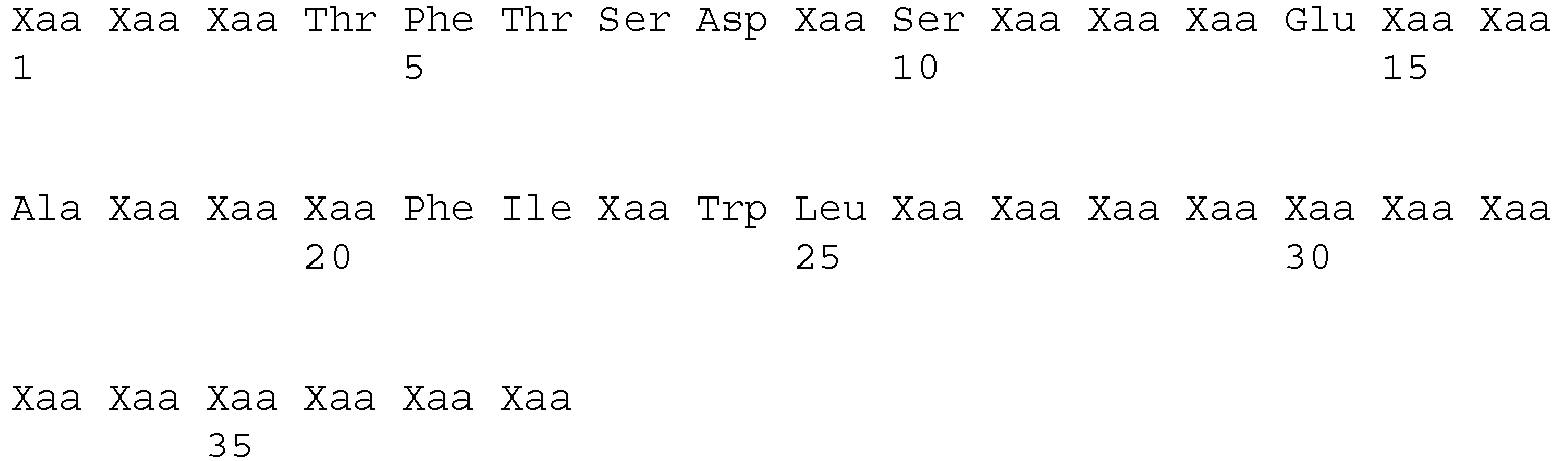
- <210> 6
<211> 81
<212> DNA
<213> Artificial - <220>
<223> Artificial - <400> 6

- <210> 7
<211> 117
<212> DNA
<213> Artificial - <220>
<223> Artificial - <400> 7

- <210> 8
<211> 114
<212> DNA
<213> Artificial - <220>
<223> artificial - <400> 8

- <210> 9
<211> 27
<212> PRT
<213> Artificial - <220>
<223> artificial - <400> 9

- <210> 10
<211> 39
<212> PRT
<213> Artificial - <220>
<223> artificial - <400> 10

- <210> 11
<211> 38
<212> PRT
<213> Artificial - <220>
<223> artificial - <400> 11

- <210> 12
<211> 31
<212> PRT
<213> ARTIFICIAL - <220>
<223> Exendin Analogue - <220>
<221> MISC_FEATURE
<222> (31)..(31)
<223> Pro or Tyr - <400> 12

- <210> 13
<211> 40
<212> PRT
<213> Heloderma sp. - <400> 13


Claims (10)
- A method for making a derivative of a GLP-1 analogue comprising one or more non-proteogenic amino acids in the N-terminal part, said method comprising the steps of:(i) culturing a host cell comprising a nucleotide sequence encoding a precursor molecule of said GLP-1 analogue under suitable conditions for expression of said precursor molecule;(ii) separating the expressed precursor molecule from the culture broth;(iii) acylating the epsilon-amino-group of one lysine residue in the expressed precursor molecule with an acylating agent, which is optionally activated, to obtain a precursor molecule derivative, and optionally isolating said precursor molecule derivative;(iv) coupling an N-terminal amino acid extension comprising one or more non-proteogenic amino acids to the expressed precursor molecule derivative; and(v) isolating the resulting derivative of a GLP-1 analogue by suitable means;wherein(a) said acylation step (iii) takes place in an aqueous solvent mixture with a pH between 9 and 13;(b) said N-terminal extension has a length of 2 or 4 amino acids, and(c) said resulting derivative of a GLP-1 analogue is N-epsilon26-[2-(2-{2-[2-(2-{2-[(S)-4-Carboxy-4-(17-carboxy-heptadecanoylamino)-butyrylamino]ethoxy}ethoxy)acetylamino]-ethoxy}ethoxy)-acetyl][Aib8,Arg34]GLP-1-(7-37) peptide.
- The method according to claim 1, wherein said precursor molecule is [Arg34]GLP-1 (11-37).
- The method according to claim 1, wherein said precursor molecule is [Arg34]GLP-1 (9-37).
- The method according to any one of the preceding claims, wherein the N-terminal amino acid extension is protected with one or more protection groups before its use in step (iv) and deprotected again after coupling of the N-terminal extension.
- The method according to any of the preceding claims, wherein the coupling of the N-terminal amino acid extension comprising one or more non-proteogenic amino acids takes place in an organic polar solvent selected from the group consisting of 1-methyl-pyrrolidin-2-one, acetonitril, tetrahydrofuran, dimethylsulfoxide N,N-dimethylformamide and N-methyl-formamide.
- The method according to any one of the preceding claims, wherein the coupling of the N-terminal amino acid extension comprising one or more non-proteogenic amino acids takes place in an aqueous solvent mixture.
- The method according to any one of the preceding claims, further comprising the step of removing (i) an N-terminal pro-peptide extension or (ii) a C-terminal pro-peptide extension from the resulting precursor molecule.
- The method according to any one of the preceding claims, wherein said acylation step (iii) takes place in an aqueous solvent mixture with a pH between 10 and 12, such as between 10.5 and 11.5.
- The method according to any one of the preceding claims, wherein said host cell is selected from a mammalian host cell, an avian host cell, an insect host cell, a plant host cell, a bacterial host cell, a fungal host cell and a yeast host cell.
- The method according to any one of the preceeding claims, wherein said acylating agent is a carboxylic acid analogue of the general formula:
A-C-D-OH
wherein
one terminal free carboxylic acid optionally is activated, and
A-C-D- is selected from the group consisting of:
Priority Applications (1)
| Application Number | Priority Date | Filing Date | Title |
|---|---|---|---|
| EP08868214.1A EP2238153B1 (en) | 2007-12-28 | 2008-12-22 | Semi-recombinant preparation of glp-1 analogues |
Applications Claiming Priority (3)
| Application Number | Priority Date | Filing Date | Title |
|---|---|---|---|
| EP07124141 | 2007-12-28 | ||
| EP08868214.1A EP2238153B1 (en) | 2007-12-28 | 2008-12-22 | Semi-recombinant preparation of glp-1 analogues |
| PCT/EP2008/068211 WO2009083549A1 (en) | 2007-12-28 | 2008-12-22 | Semi-recombinant preparation of glp-1 analogues |
Publications (2)
| Publication Number | Publication Date |
|---|---|
| EP2238153A1 EP2238153A1 (en) | 2010-10-13 |
| EP2238153B1 true EP2238153B1 (en) | 2019-02-20 |
Family
ID=40547479
Family Applications (1)
| Application Number | Title | Priority Date | Filing Date |
|---|---|---|---|
| EP08868214.1A Active EP2238153B1 (en) | 2007-12-28 | 2008-12-22 | Semi-recombinant preparation of glp-1 analogues |
Country Status (6)
| Country | Link |
|---|---|
| US (2) | US20100317057A1 (en) |
| EP (1) | EP2238153B1 (en) |
| JP (1) | JP5726532B2 (en) |
| CN (2) | CN101910193A (en) |
| ES (1) | ES2725492T3 (en) |
| WO (1) | WO2009083549A1 (en) |
Families Citing this family (70)
| Publication number | Priority date | Publication date | Assignee | Title |
|---|---|---|---|---|
| US8637647B2 (en) * | 2008-09-12 | 2014-01-28 | Novo Nordisk A/S | Method of acylating a peptide or protein |
| US8648041B2 (en) | 2009-12-16 | 2014-02-11 | Novo Nordisk A/S | Double-acylated GLP-1 derivatives |
| BR112012024379A2 (en) * | 2010-03-26 | 2017-01-10 | Novo Nordisk As | "glucagon peptides, their use as well as pharmaceutical composition" |
| WO2011131646A1 (en) * | 2010-04-20 | 2011-10-27 | Novo Nordisk A/S | Long-acting gastrin derivatives |
| BR112012029248B1 (en) | 2010-05-17 | 2021-09-28 | Betta Pharmaceuticals Co., Ltd | GLP-1 ANALOG OF FORMULA I OR ITS COMPOSITION, GLP-1 ANALOG OF FORMULA VIII OR A PHARMACEUTICALLY ACCEPTABLE SALT OR THE COMPOSITION OF THE SAME, PHARMACEUTICAL COMPOSITION AND USE OF A COMPOUND |
| JP2013533227A (en) | 2010-06-08 | 2013-08-22 | ノヴォ ノルディスク アー/エス | FGF21 analogs and derivatives |
| CN103415300B (en) | 2010-07-20 | 2018-02-23 | 诺沃—诺迪斯克有限公司 | FGF21 compounds end modified N |
| CN102203130B (en) * | 2010-08-06 | 2014-06-25 | 贝达药业股份有限公司 | GLP-1 derivatives and their applications |
| WO2012062803A1 (en) * | 2010-11-09 | 2012-05-18 | Novo Nordisk A/S | Double-acylated glp-1 derivatives |
| PT2651398T (en) | 2010-12-16 | 2018-03-09 | Novo Nordisk As | Solid compositions comprising a glp-1 agonist and a salt of n-(8-(2-hydroxybenzoyl)amino)caprylic acid |
| CN103379919A (en) | 2011-01-26 | 2013-10-30 | 诺沃—诺迪斯克有限公司 | Leptin derivatives |
| HUE031405T2 (en) | 2011-04-12 | 2017-07-28 | Novo Nordisk As | Double-acylated glp-1 derivatives |
| JP6058646B2 (en) | 2011-06-15 | 2017-01-11 | ノヴォ ノルディスク アー/エス | Multi-substituted insulin |
| JP6126097B2 (en) | 2011-09-06 | 2017-05-10 | ノヴォ ノルディスク アー/エス | GLP-1 derivative |
| JP6352806B2 (en) | 2011-09-23 | 2018-07-04 | ノヴォ ノルディスク アー/エス | New glucagon analogues |
| CN102363633B (en) * | 2011-11-16 | 2013-11-20 | 天津拓飞生物科技有限公司 | Glucagon like peptide-1 mutant polypeptide and preparation method, medicinal composition and use thereof |
| JP6046161B2 (en) * | 2011-12-29 | 2016-12-14 | ノヴォ ノルディスク アー/エス | Dipeptides containing non-proteinogenic amino acids |
| US9452225B2 (en) | 2012-03-01 | 2016-09-27 | Novo Nordisk A/S | GLP-1 prodrugs |
| ES2715308T3 (en) | 2012-03-22 | 2019-06-03 | Novo Nordisk As | Compositions comprising a supply agent and its preparation |
| HUE062740T2 (en) | 2012-03-22 | 2023-12-28 | Novo Nordisk As | Preparations of GLP-1 peptides and their production |
| SI2827845T1 (en) | 2012-03-22 | 2019-04-30 | Novo Nordisk A/S | Compositions comprising a delivery agent and preparation thereof |
| US10000542B2 (en) | 2012-05-08 | 2018-06-19 | Novo Nordisk A/S | Double-acylated GLP-1 derivatives |
| US11274135B2 (en) | 2012-05-08 | 2022-03-15 | Novo Nordisk A/S | Double-acylated GLP-1 derivatives |
| EP2863895B1 (en) | 2012-06-20 | 2021-04-14 | Novo Nordisk A/S | Tablet formulation comprising a peptide and a delivery agent |
| HRP20251088T1 (en) | 2012-07-01 | 2025-11-07 | Novo Nordisk A/S | USE OF LONG-ACTING GLP-1 PEPTIDES |
| WO2014060472A1 (en) | 2012-10-17 | 2014-04-24 | Novo Nordisk A/S | Fatty acid acylated amino acids for oral peptide delivery |
| CA2909581A1 (en) | 2013-04-18 | 2014-10-23 | Novo Nordisk A/S | Stable, protracted glp-1/glucagon receptor co-agonists for medical use |
| US20160067184A1 (en) | 2013-05-02 | 2016-03-10 | Novo Nordisk A/S | Oral Dosing of GLP-1 Compounds |
| CN105377884B (en) | 2013-07-04 | 2021-07-20 | 诺和诺德股份有限公司 | Derivatives of GLP-1-like peptides and uses thereof |
| US10570184B2 (en) | 2014-06-04 | 2020-02-25 | Novo Nordisk A/S | GLP-1/glucagon receptor co-agonists for medical use |
| WO2015193378A1 (en) | 2014-06-18 | 2015-12-23 | Novo Nordisk A/S | Novel glp-1 receptor agonists with cholesterol efflux activity |
| GR20140100479A (en) * | 2014-09-23 | 2016-05-05 | Novetide, Ltd., | Synthesis of liraglutide |
| JP6727210B2 (en) | 2014-12-23 | 2020-07-22 | ノヴォ ノルディスク アー/エス | FGF21 derivative and use thereof |
| AR103242A1 (en) * | 2015-01-09 | 2017-04-26 | Lilly Co Eli | GIP AND GLP-1 CO-AGONIST COMPOUNDS |
| GB2545395A (en) * | 2015-11-27 | 2017-06-21 | The Inst Of Food Res | Engineered lactococcus lactis producing biologically active GLP-1 |
| US10946074B2 (en) | 2016-03-03 | 2021-03-16 | Novo Nordisk A/S | GLP-1 derivatives and uses thereof |
| ES2828526T3 (en) | 2016-11-07 | 2021-05-26 | Novo Nordisk As | DCHBS Active Esters of PEG Compounds and Their Uses |
| TWI710377B (en) | 2017-05-23 | 2020-11-21 | 丹麥商諾佛 儂迪克股份有限公司 | Mic-1 compounds and uses thereof |
| CA3068956A1 (en) * | 2017-07-19 | 2019-01-24 | Novo Nordisk A/S | Bifunctional compounds |
| WO2019082138A1 (en) * | 2017-10-27 | 2019-05-02 | Lorven Biologics Private Limited | Process for preparation of liraglutide using recombinant saccharomyces cerevisiae |
| KR102647171B1 (en) | 2018-02-02 | 2024-03-15 | 노보 노르디스크 에이/에스 | Solid composition comprising a GLP-1 agonist and a salt of N-(8-(2-hydroxybenzoyl)amino)caprylic acid |
| CN111378028A (en) * | 2018-12-30 | 2020-07-07 | 万新医药科技(苏州)有限公司 | Synthesis of acylated GLP-1 compounds and modified groups thereof |
| CN110041219B (en) * | 2019-05-09 | 2020-09-25 | 南京工业大学 | Liquid phase synthesis method of side chain of Somaloutide |
| CN111909256A (en) * | 2019-05-10 | 2020-11-10 | 宁波鲲鹏生物科技有限公司 | Polypeptide derivatives and process for preparing the same |
| CN110305223B (en) | 2019-06-26 | 2022-05-13 | 重庆派金生物科技有限公司 | Method for preparing target polypeptide by recombinant tandem fusion protein |
| CN110684082B (en) * | 2019-10-08 | 2021-12-10 | 江苏诺泰澳赛诺生物制药股份有限公司 | GIP and GLP-1 dual-agonist polypeptide compound, pharmaceutically acceptable salt and application |
| CN111217901A (en) * | 2019-10-31 | 2020-06-02 | 成都圣诺生物制药有限公司 | Preparation method of Somalutide |
| EP4085077A4 (en) | 2019-12-31 | 2024-01-17 | Beijing QL Biopharmaceutical Co., Ltd. | FUSION PROTEINS FROM GLP-1 AND GDF15 AND CONJUGATES THEREOF |
| CN115322794B (en) | 2020-01-11 | 2025-09-19 | 北京质肽生物医药科技有限公司 | Conjugate of fusion protein of GLP-1 and FGF21 |
| CN111269137A (en) * | 2020-01-16 | 2020-06-12 | 浙江工业大学 | Method for preparing side chain of Somalutide by liquid phase method |
| CN111285780A (en) * | 2020-01-16 | 2020-06-16 | 浙江工业大学 | Convergent liquid phase synthesis method of side chain of Somaloutide |
| CN111253287A (en) * | 2020-01-16 | 2020-06-09 | 浙江工业大学 | Method for synthesizing side chain of Somalutide in liquid phase convergence manner |
| CN113773397B (en) * | 2020-06-10 | 2023-10-20 | 宁波鲲鹏生物科技有限公司 | A kind of preparation method of insulin degludec |
| JP2023529486A (en) * | 2020-06-11 | 2023-07-10 | ニンポー クンペン バイオテック カンパニー,リミテッド | Semaglutide derivative and method for producing and using the same |
| CN113801236A (en) * | 2020-06-11 | 2021-12-17 | 宁波鲲鹏生物科技有限公司 | Preparation method of insulin lispro |
| CN114057886B (en) * | 2020-07-24 | 2024-03-01 | 宁波鲲鹏生物科技有限公司 | A kind of semaglutide derivative and preparation method thereof |
| CN114075273A (en) * | 2020-08-17 | 2022-02-22 | 四川科伦药物研究院有限公司 | Preparation method of GLP-1 analogue fragment activated ester |
| WO2022064517A1 (en) * | 2020-09-23 | 2022-03-31 | Dr. Reddy's Laboratories Limited | A process for the preparation of semaglutide and semapeptide |
| JP2023545684A (en) | 2020-09-30 | 2023-10-31 | ベイジン キューエル バイオファーマシューティカル カンパニー,リミテッド | Polypeptide conjugates and methods of use |
| CN113278061B (en) * | 2021-06-22 | 2024-04-09 | 南京林业大学 | Method for preparing cable Ma Lutai by biochemical method |
| CN116848243B (en) | 2022-03-30 | 2024-03-19 | 北京质肽生物医药科技有限公司 | Liquid pharmaceutical compositions of polypeptide conjugates and methods of use thereof |
| CN115322250A (en) * | 2022-06-16 | 2022-11-11 | 南京汉欣医药科技有限公司 | Synthesis method of semaglutide |
| CN115197312B (en) | 2022-08-09 | 2023-06-09 | 奥锐特药业(天津)有限公司 | A kind of preparation method and intermediate of semaglutide |
| CN115975047B (en) | 2022-10-24 | 2024-05-28 | 扬州奥锐特药业有限公司 | A method for producing polypeptides by recombinant fusion protein and its application |
| MX2025014950A (en) | 2023-06-15 | 2026-02-03 | Novo Nordisk As | PHARMACEUTICAL FORMULATIONS OF AN AMYLIN RECEPTOR AGONIST AND A GLUCAGON-LIKE PEPTIDE 1 (GLP-1) RECEPTOR AGONIST COMPRISING A CYCLODEXTRIN |
| CN118620035A (en) * | 2024-06-24 | 2024-09-10 | 铭诚惠众(江苏)药物研究有限公司 | A method for semi-recombinant expression and synthesis of bivalirudin |
| WO2026013135A1 (en) | 2024-07-10 | 2026-01-15 | Ascendis Pharma A/S | Albumin-binding reagents |
| WO2026013138A1 (en) | 2024-07-10 | 2026-01-15 | Ascendis Pharma A/S | Compounds with improved albumin-binding |
| WO2026013136A1 (en) | 2024-07-10 | 2026-01-15 | Ascendis Pharma A/S | Albumin-binding compounds |
| WO2026013265A1 (en) | 2024-07-12 | 2026-01-15 | Novo Nordisk A/S | Novel dipeptide acylating agents |
Family Cites Families (21)
| Publication number | Priority date | Publication date | Assignee | Title |
|---|---|---|---|---|
| US5705483A (en) | 1993-12-09 | 1998-01-06 | Eli Lilly And Company | Glucagon-like insulinotropic peptides, compositions and methods |
| US6458924B2 (en) | 1996-08-30 | 2002-10-01 | Novo Nordisk A/S | Derivatives of GLP-1 analogs |
| US6277819B1 (en) * | 1996-08-30 | 2001-08-21 | Eli Lilly And Company | Use of GLP-1 or analogs in treatment of myocardial infarction |
| HU227021B1 (en) | 1996-08-30 | 2010-05-28 | Novo Nordisk As | Glp-1 derivatives |
| CA2283834A1 (en) | 1997-03-31 | 1998-10-08 | James Arthur Hoffmann | Glucagon-like peptide-1 analogs |
| US20060160740A1 (en) * | 1999-10-21 | 2006-07-20 | Suad Efendic | Use of GLP-1 or analogs in treatment of stroke |
| US7595172B2 (en) * | 2001-07-24 | 2009-09-29 | Novo Nordisk A/S | Method for making acylated polypeptides |
| EP1421102A2 (en) * | 2001-07-24 | 2004-05-26 | Novo Nordisk A/S | Method for making acylated polypeptides |
| IL159623A0 (en) * | 2001-07-24 | 2004-06-01 | Novo Nordisk As | Method for making acylated polypeptides |
| JP4227894B2 (en) * | 2001-08-23 | 2009-02-18 | イーライ リリー アンド カンパニー | Glucagon-like peptide 1 analog |
| DE10209821A1 (en) * | 2002-03-06 | 2003-09-25 | Biotechnologie Ges Mittelhesse | Coupling of proteins to a modified polysaccharide |
| ES2371072T3 (en) * | 2003-06-12 | 2011-12-27 | Eli Lilly And Company | GLP-1 ANALOG FUSION PROTEINS. |
| MXPA06002941A (en) | 2003-09-19 | 2006-05-31 | Novo Nordisk As | Albumin-binding derivatives of therapeutic peptides. |
| KR20060109940A (en) | 2003-12-18 | 2006-10-23 | 노보 노르디스크 에이/에스 | Novel glp-1 analogues linked to albumin-like agents |
| WO2006005667A2 (en) | 2004-07-08 | 2006-01-19 | Novo Nordisk A/S | Polypeptide protracting tags comprising a tetrazole moiety |
| JP2008515856A (en) * | 2004-10-07 | 2008-05-15 | ノボ ノルディスク アクティーゼルスカブ | Delayed GLP-1 compound |
| KR20070120112A (en) | 2005-03-18 | 2007-12-21 | 노보 노르디스크 에이/에스 | Extended LP-1 Compound |
| TWI372629B (en) | 2005-03-18 | 2012-09-21 | Novo Nordisk As | Acylated glp-1 compounds |
| WO2006097536A2 (en) | 2005-03-18 | 2006-09-21 | Novo Nordisk A/S | Dimeric peptide agonists of the glp-1 receptor |
| EP2004213A1 (en) * | 2006-04-03 | 2008-12-24 | Novo Nordisk A/S | Glp-1 peptide agonists |
| PT2035451E (en) * | 2006-06-23 | 2010-06-09 | Hoffmann La Roche | Insulinotropic peptide synthesis |
-
2007
- 2007-12-22 US US12/810,934 patent/US20100317057A1/en active Granted
-
2008
- 2008-12-22 US US12/810,934 patent/US9732137B2/en active Active
- 2008-12-22 CN CN2008801240221A patent/CN101910193A/en active Pending
- 2008-12-22 EP EP08868214.1A patent/EP2238153B1/en active Active
- 2008-12-22 CN CN201510459093.9A patent/CN105154498A/en active Pending
- 2008-12-22 WO PCT/EP2008/068211 patent/WO2009083549A1/en not_active Ceased
- 2008-12-22 JP JP2010540119A patent/JP5726532B2/en active Active
- 2008-12-22 ES ES08868214T patent/ES2725492T3/en active Active
Non-Patent Citations (1)
| Title |
|---|
| None * |
Also Published As
| Publication number | Publication date |
|---|---|
| CN101910193A (en) | 2010-12-08 |
| ES2725492T3 (en) | 2019-09-24 |
| WO2009083549A1 (en) | 2009-07-09 |
| US9732137B2 (en) | 2017-08-15 |
| US20100317057A1 (en) | 2010-12-16 |
| EP2238153A1 (en) | 2010-10-13 |
| JP5726532B2 (en) | 2015-06-03 |
| CN105154498A (en) | 2015-12-16 |
| JP2011509077A (en) | 2011-03-24 |
Similar Documents
| Publication | Publication Date | Title |
|---|---|---|
| EP2238153B1 (en) | Semi-recombinant preparation of glp-1 analogues | |
| JP5591243B2 (en) | Method for acylating peptides or proteins | |
| CN101868476B (en) | Glucagon-like peptide-1 derivatives and their pharmaceutical use | |
| EP1692168B1 (en) | Single-chain insulin | |
| JP7250814B2 (en) | Novel GLP-1 analogues | |
| US20090005312A1 (en) | Novel glp-1 analogues linked to albumin-like agents | |
| US10954267B2 (en) | Dipeptide comprising a non-proteogenic amino acid | |
| EP1704165A1 (en) | Novel glp-1 compounds | |
| EP1863839A2 (en) | Acylated glp-1 compounds | |
| AU2010353685B2 (en) | Novel glucagon like peptide analogs, composition, and method of use | |
| DK1934252T3 (en) | METHOD FOR PRODUCING insulin conjugates |
Legal Events
| Date | Code | Title | Description |
|---|---|---|---|
| PUAI | Public reference made under article 153(3) epc to a published international application that has entered the european phase |
Free format text: ORIGINAL CODE: 0009012 |
|
| 17P | Request for examination filed |
Effective date: 20100728 |
|
| AK | Designated contracting states |
Kind code of ref document: A1 Designated state(s): AT BE BG CH CY CZ DE DK EE ES FI FR GB GR HR HU IE IS IT LI LT LU LV MC MT NL NO PL PT RO SE SI SK TR |
|
| AX | Request for extension of the european patent |
Extension state: AL BA MK RS |
|
| DAX | Request for extension of the european patent (deleted) | ||
| 17Q | First examination report despatched |
Effective date: 20140613 |
|
| STAA | Information on the status of an ep patent application or granted ep patent |
Free format text: STATUS: EXAMINATION IS IN PROGRESS |
|
| GRAP | Despatch of communication of intention to grant a patent |
Free format text: ORIGINAL CODE: EPIDOSNIGR1 |
|
| STAA | Information on the status of an ep patent application or granted ep patent |
Free format text: STATUS: GRANT OF PATENT IS INTENDED |
|
| INTG | Intention to grant announced |
Effective date: 20180726 |
|
| GRAS | Grant fee paid |
Free format text: ORIGINAL CODE: EPIDOSNIGR3 |
|
| GRAA | (expected) grant |
Free format text: ORIGINAL CODE: 0009210 |
|
| STAA | Information on the status of an ep patent application or granted ep patent |
Free format text: STATUS: THE PATENT HAS BEEN GRANTED |
|
| AK | Designated contracting states |
Kind code of ref document: B1 Designated state(s): AT BE BG CH CY CZ DE DK EE ES FI FR GB GR HR HU IE IS IT LI LT LU LV MC MT NL NO PL PT RO SE SI SK TR |
|
| REG | Reference to a national code |
Ref country code: GB Ref legal event code: FG4D |
|
| REG | Reference to a national code |
Ref country code: CH Ref legal event code: EP |
|
| REG | Reference to a national code |
Ref country code: DE Ref legal event code: R096 Ref document number: 602008059071 Country of ref document: DE |
|
| REG | Reference to a national code |
Ref country code: AT Ref legal event code: REF Ref document number: 1098034 Country of ref document: AT Kind code of ref document: T Effective date: 20190315 |
|
| REG | Reference to a national code |
Ref country code: IE Ref legal event code: FG4D |
|
| REG | Reference to a national code |
Ref country code: LT Ref legal event code: MG4D |
|
| REG | Reference to a national code |
Ref country code: NL Ref legal event code: MP Effective date: 20190220 |
|
| PG25 | Lapsed in a contracting state [announced via postgrant information from national office to epo] |
Ref country code: PT Free format text: LAPSE BECAUSE OF FAILURE TO SUBMIT A TRANSLATION OF THE DESCRIPTION OR TO PAY THE FEE WITHIN THE PRESCRIBED TIME-LIMIT Effective date: 20190620 Ref country code: SE Free format text: LAPSE BECAUSE OF FAILURE TO SUBMIT A TRANSLATION OF THE DESCRIPTION OR TO PAY THE FEE WITHIN THE PRESCRIBED TIME-LIMIT Effective date: 20190220 Ref country code: NO Free format text: LAPSE BECAUSE OF FAILURE TO SUBMIT A TRANSLATION OF THE DESCRIPTION OR TO PAY THE FEE WITHIN THE PRESCRIBED TIME-LIMIT Effective date: 20190520 Ref country code: FI Free format text: LAPSE BECAUSE OF FAILURE TO SUBMIT A TRANSLATION OF THE DESCRIPTION OR TO PAY THE FEE WITHIN THE PRESCRIBED TIME-LIMIT Effective date: 20190220 Ref country code: LT Free format text: LAPSE BECAUSE OF FAILURE TO SUBMIT A TRANSLATION OF THE DESCRIPTION OR TO PAY THE FEE WITHIN THE PRESCRIBED TIME-LIMIT Effective date: 20190220 |
|
| PG25 | Lapsed in a contracting state [announced via postgrant information from national office to epo] |
Ref country code: GR Free format text: LAPSE BECAUSE OF FAILURE TO SUBMIT A TRANSLATION OF THE DESCRIPTION OR TO PAY THE FEE WITHIN THE PRESCRIBED TIME-LIMIT Effective date: 20190521 Ref country code: BG Free format text: LAPSE BECAUSE OF FAILURE TO SUBMIT A TRANSLATION OF THE DESCRIPTION OR TO PAY THE FEE WITHIN THE PRESCRIBED TIME-LIMIT Effective date: 20190520 Ref country code: NL Free format text: LAPSE BECAUSE OF FAILURE TO SUBMIT A TRANSLATION OF THE DESCRIPTION OR TO PAY THE FEE WITHIN THE PRESCRIBED TIME-LIMIT Effective date: 20190220 Ref country code: HR Free format text: LAPSE BECAUSE OF FAILURE TO SUBMIT A TRANSLATION OF THE DESCRIPTION OR TO PAY THE FEE WITHIN THE PRESCRIBED TIME-LIMIT Effective date: 20190220 Ref country code: LV Free format text: LAPSE BECAUSE OF FAILURE TO SUBMIT A TRANSLATION OF THE DESCRIPTION OR TO PAY THE FEE WITHIN THE PRESCRIBED TIME-LIMIT Effective date: 20190220 Ref country code: IS Free format text: LAPSE BECAUSE OF FAILURE TO SUBMIT A TRANSLATION OF THE DESCRIPTION OR TO PAY THE FEE WITHIN THE PRESCRIBED TIME-LIMIT Effective date: 20190620 |
|
| REG | Reference to a national code |
Ref country code: AT Ref legal event code: MK05 Ref document number: 1098034 Country of ref document: AT Kind code of ref document: T Effective date: 20190220 |
|
| REG | Reference to a national code |
Ref country code: ES Ref legal event code: FG2A Ref document number: 2725492 Country of ref document: ES Kind code of ref document: T3 Effective date: 20190924 |
|
| PG25 | Lapsed in a contracting state [announced via postgrant information from national office to epo] |
Ref country code: SK Free format text: LAPSE BECAUSE OF FAILURE TO SUBMIT A TRANSLATION OF THE DESCRIPTION OR TO PAY THE FEE WITHIN THE PRESCRIBED TIME-LIMIT Effective date: 20190220 Ref country code: RO Free format text: LAPSE BECAUSE OF FAILURE TO SUBMIT A TRANSLATION OF THE DESCRIPTION OR TO PAY THE FEE WITHIN THE PRESCRIBED TIME-LIMIT Effective date: 20190220 Ref country code: EE Free format text: LAPSE BECAUSE OF FAILURE TO SUBMIT A TRANSLATION OF THE DESCRIPTION OR TO PAY THE FEE WITHIN THE PRESCRIBED TIME-LIMIT Effective date: 20190220 Ref country code: DK Free format text: LAPSE BECAUSE OF FAILURE TO SUBMIT A TRANSLATION OF THE DESCRIPTION OR TO PAY THE FEE WITHIN THE PRESCRIBED TIME-LIMIT Effective date: 20190220 Ref country code: CZ Free format text: LAPSE BECAUSE OF FAILURE TO SUBMIT A TRANSLATION OF THE DESCRIPTION OR TO PAY THE FEE WITHIN THE PRESCRIBED TIME-LIMIT Effective date: 20190220 |
|
| REG | Reference to a national code |
Ref country code: DE Ref legal event code: R097 Ref document number: 602008059071 Country of ref document: DE |
|
| PG25 | Lapsed in a contracting state [announced via postgrant information from national office to epo] |
Ref country code: PL Free format text: LAPSE BECAUSE OF FAILURE TO SUBMIT A TRANSLATION OF THE DESCRIPTION OR TO PAY THE FEE WITHIN THE PRESCRIBED TIME-LIMIT Effective date: 20190220 |
|
| PLBE | No opposition filed within time limit |
Free format text: ORIGINAL CODE: 0009261 |
|
| STAA | Information on the status of an ep patent application or granted ep patent |
Free format text: STATUS: NO OPPOSITION FILED WITHIN TIME LIMIT |
|
| PG25 | Lapsed in a contracting state [announced via postgrant information from national office to epo] |
Ref country code: AT Free format text: LAPSE BECAUSE OF FAILURE TO SUBMIT A TRANSLATION OF THE DESCRIPTION OR TO PAY THE FEE WITHIN THE PRESCRIBED TIME-LIMIT Effective date: 20190220 |
|
| 26N | No opposition filed |
Effective date: 20191121 |
|
| PG25 | Lapsed in a contracting state [announced via postgrant information from national office to epo] |
Ref country code: SI Free format text: LAPSE BECAUSE OF FAILURE TO SUBMIT A TRANSLATION OF THE DESCRIPTION OR TO PAY THE FEE WITHIN THE PRESCRIBED TIME-LIMIT Effective date: 20190220 |
|
| PG25 | Lapsed in a contracting state [announced via postgrant information from national office to epo] |
Ref country code: TR Free format text: LAPSE BECAUSE OF FAILURE TO SUBMIT A TRANSLATION OF THE DESCRIPTION OR TO PAY THE FEE WITHIN THE PRESCRIBED TIME-LIMIT Effective date: 20190220 |
|
| REG | Reference to a national code |
Ref country code: CH Ref legal event code: PL |
|
| REG | Reference to a national code |
Ref country code: BE Ref legal event code: MM Effective date: 20191231 |
|
| PG25 | Lapsed in a contracting state [announced via postgrant information from national office to epo] |
Ref country code: MC Free format text: LAPSE BECAUSE OF FAILURE TO SUBMIT A TRANSLATION OF THE DESCRIPTION OR TO PAY THE FEE WITHIN THE PRESCRIBED TIME-LIMIT Effective date: 20190220 |
|
| PG25 | Lapsed in a contracting state [announced via postgrant information from national office to epo] |
Ref country code: IE Free format text: LAPSE BECAUSE OF NON-PAYMENT OF DUE FEES Effective date: 20191222 Ref country code: LU Free format text: LAPSE BECAUSE OF NON-PAYMENT OF DUE FEES Effective date: 20191222 |
|
| PG25 | Lapsed in a contracting state [announced via postgrant information from national office to epo] |
Ref country code: BE Free format text: LAPSE BECAUSE OF NON-PAYMENT OF DUE FEES Effective date: 20191231 Ref country code: LI Free format text: LAPSE BECAUSE OF NON-PAYMENT OF DUE FEES Effective date: 20191231 Ref country code: CH Free format text: LAPSE BECAUSE OF NON-PAYMENT OF DUE FEES Effective date: 20191231 |
|
| PG25 | Lapsed in a contracting state [announced via postgrant information from national office to epo] |
Ref country code: CY Free format text: LAPSE BECAUSE OF FAILURE TO SUBMIT A TRANSLATION OF THE DESCRIPTION OR TO PAY THE FEE WITHIN THE PRESCRIBED TIME-LIMIT Effective date: 20190220 |
|
| PG25 | Lapsed in a contracting state [announced via postgrant information from national office to epo] |
Ref country code: MT Free format text: LAPSE BECAUSE OF FAILURE TO SUBMIT A TRANSLATION OF THE DESCRIPTION OR TO PAY THE FEE WITHIN THE PRESCRIBED TIME-LIMIT Effective date: 20190220 Ref country code: HU Free format text: LAPSE BECAUSE OF FAILURE TO SUBMIT A TRANSLATION OF THE DESCRIPTION OR TO PAY THE FEE WITHIN THE PRESCRIBED TIME-LIMIT; INVALID AB INITIO Effective date: 20081222 |
|
| PGFP | Annual fee paid to national office [announced via postgrant information from national office to epo] |
Ref country code: ES Payment date: 20250102 Year of fee payment: 17 |
|
| PGFP | Annual fee paid to national office [announced via postgrant information from national office to epo] |
Ref country code: DE Payment date: 20251126 Year of fee payment: 18 |
|
| PGFP | Annual fee paid to national office [announced via postgrant information from national office to epo] |
Ref country code: GB Payment date: 20251119 Year of fee payment: 18 |
|
| PGFP | Annual fee paid to national office [announced via postgrant information from national office to epo] |
Ref country code: IT Payment date: 20251119 Year of fee payment: 18 |
|
| PGFP | Annual fee paid to national office [announced via postgrant information from national office to epo] |
Ref country code: FR Payment date: 20251119 Year of fee payment: 18 |