EP2134377B1 - Fragrance dispenser - Google Patents
Fragrance dispenser Download PDFInfo
- Publication number
- EP2134377B1 EP2134377B1 EP07726548A EP07726548A EP2134377B1 EP 2134377 B1 EP2134377 B1 EP 2134377B1 EP 07726548 A EP07726548 A EP 07726548A EP 07726548 A EP07726548 A EP 07726548A EP 2134377 B1 EP2134377 B1 EP 2134377B1
- Authority
- EP
- European Patent Office
- Prior art keywords
- methyl
- acetate
- fragrance
- dimethyl
- carrier
- Prior art date
- Legal status (The legal status is an assumption and is not a legal conclusion. Google has not performed a legal analysis and makes no representation as to the accuracy of the status listed.)
- Active
Links
Images

Classifications
-
- A—HUMAN NECESSITIES
- A61—MEDICAL OR VETERINARY SCIENCE; HYGIENE
- A61L—METHODS OR APPARATUS FOR STERILISING MATERIALS OR OBJECTS IN GENERAL; DISINFECTION, STERILISATION OR DEODORISATION OF AIR; CHEMICAL ASPECTS OF BANDAGES, DRESSINGS, ABSORBENT PADS OR SURGICAL ARTICLES; MATERIALS FOR BANDAGES, DRESSINGS, ABSORBENT PADS OR SURGICAL ARTICLES
- A61L9/00—Disinfection, sterilisation or deodorisation of air
- A61L9/015—Disinfection, sterilisation or deodorisation of air using gaseous or vaporous substances, e.g. ozone
- A61L9/04—Disinfection, sterilisation or deodorisation of air using gaseous or vaporous substances, e.g. ozone using substances evaporated in the air without heating
- A61L9/042—Disinfection, sterilisation or deodorisation of air using gaseous or vaporous substances, e.g. ozone using substances evaporated in the air without heating with the help of a macromolecular compound as a carrier or diluent
-
- A—HUMAN NECESSITIES
- A61—MEDICAL OR VETERINARY SCIENCE; HYGIENE
- A61L—METHODS OR APPARATUS FOR STERILISING MATERIALS OR OBJECTS IN GENERAL; DISINFECTION, STERILISATION OR DEODORISATION OF AIR; CHEMICAL ASPECTS OF BANDAGES, DRESSINGS, ABSORBENT PADS OR SURGICAL ARTICLES; MATERIALS FOR BANDAGES, DRESSINGS, ABSORBENT PADS OR SURGICAL ARTICLES
- A61L9/00—Disinfection, sterilisation or deodorisation of air
- A61L9/015—Disinfection, sterilisation or deodorisation of air using gaseous or vaporous substances, e.g. ozone
- A61L9/04—Disinfection, sterilisation or deodorisation of air using gaseous or vaporous substances, e.g. ozone using substances evaporated in the air without heating
- A61L9/12—Apparatus, e.g. holders, therefor
- A61L9/125—Apparatus, e.g. holders, therefor emanating multiple odours
Definitions
- the present invention describes a fragrance dispenser, particularly for use as an air-freshener system, with improved air-freshening properties compared to conventional air-freshener systems known to the art.
- Air-freshener products are known to the art in a broad variety of product forms, each of them with specific profiles of advantages and disadvantages.
- a common challenge of air-fresheners found in the market is that the more volatile components of a fragrance composition, particularly a perfume composition, evaporate faster than the less volatile components of the composition. This phenomenon often leads to a drastic shift of the fragrance composition and results in a noticeable olfactory profile change of the air-freshener product during its useful life. Especially citrus, fruity and other fresh perfume types suffer a dramatic change from fresh, citrus like smell at the beginning of product use to a more mellow smell of typical heart and base notes such as woody, musk and some heavy floral smells.
- US 3,685,734 provides for a means of controlling the evaporation of a fragrance mixture with the benefit of obtaining a more constant fragrance emission rate than entirely open systems. It fails however to address the issue of the vast volatility differences in common fragrances with the result of having a changing fragrance character during the useful life of the product.
- US 4,356,969 describes a passive air freshener consisting of a fragrance reservoir and a touch protected surface membrane from which the fragrance can evaporate and provide a room fragrancing effect. While the surface area of the surface membrane and therefore overall fragrance emission rate per time unit can be varied the invention of this document does not address the evaporation speed differences of the constituents of common air-freshener fragrance compositions.
- US 4,590,111 discloses a fragrance releasing sheet article comprising a resin member with patterns and/or colours thereon and a fragrance releasing member comprising a resin and perfume, the pattern member and the fragrance releasing member being integrally constituted, improves on the appearance and flexibility in shape of conventional passive air-freshener systems with fragrance reservoir and evaporation regulating membrane. It does improve on the shortcoming of these systems in terms of their odour character change during use of the product. However, the character of the odour released during use of the sheet article still can easily change over time.
- US 6,012,643 relates to a device for controlled release of fragrant vapour in air.
- the device includes a carrier impregnated with a volatile medium and a wrapper of a flexible material surrounding said carrier for retaining the volatile medium on the carrier.
- the wrapper has a plurality of contiguous tear strips arranged in longitudinal sequence disposed over the carrier. The strips can be successively removed to expose a further portion of the carrier.
- the downside of this invention is the required consumer interaction with the product.
- EP 1 340 513 discloses an air-freshening device having an opening covered by a breathable film.
- the fragrance dispensers of the invention should secure a constant olfactory profile during the time of fragrance dispensation of the fragrance dispenser.
- the fragrance dispenser should also be easy to produce, it should allow to be produced in a variety of shapes, it should not require a user interaction after an initial activation of fragrance dispensation, and it should be useful for dispensing various fragrances, particularly fragrance compositions for air fresheners.
- the invention thus provides a fragrance dispenser as defined in claim 1, comprising i.a. a first and a second carrier, each carrier comprising one or more fragrance substances, wherein the fragrance substances comprise one or more fragrance substances a) with a vapour pressure of at least 0.1 mmHg at 25 °C (“HVA”) and one or more fragrance substances b) with a vapour pressure of less than 0.1 mmHg at 25 °C (“LVA”), and wherein the fragrance substances are distributed to the first and second carrier such that at least 80 wt.-% of all HVA fragrance substances are carried by the first carrier.
- HVA vapour pressure of at least 0.1 mmHg at 25 °C
- LVA vapour pressure of less than 0.1 mmHg at 25 °C
- a fragrance dispenser is a device capable of and intended to dispense one or more fragrant substances ("fragrances") stored in a reservoir or in/on a carrier into air, optionally after an initial activation of the fragrance dispenser e. g. by removing or punctuating a fragrance vapour tight packaging.
- An air freshener within the terms of the present invention is a fragrance dispenser comprising a fragrance composition for eliciting a "fresh air smell", such smells being typically described by a perfumer by the attributes citrus, fruity or other fresh perfume type.
- fragrance dispensers of the present invention are preferably "passive" fragrance dispensers or air fresheners, dispensing fragrances essentially at ambient temperatures, in contrast to "active" fragrance dispensers operating by heating fragrance reservoirs or carriers or fanning air over fragrance reservoirs or carriers by a ventilator. Unless stated otherwise, all descriptions hereinafter of a fragrance dispenser shall likewise disclose corresponding air fresheners and vice versa.
- Fragrances are, according to the present invention, divided by their vapour pressure at 25 °C.
- a high volatility accord (“HVA”) fragrance substance is a substance having a vapour pressure of at least 0.1 mmHg at 25 °C and preferably not more than 100 mmHg.
- a low volatility accord (“LVA”) fragrance substance is a substance having a vapour pressure of less than 0.1 mmHg at 25 °C.
- Substances can be pure chemical substances or compositions comprising different chemical substances.
- air-fresheners comprise fragrance substances having vapour pressures from about 0.001 mmHg at 25°C to about 100 mmHg at 25°C, therefore spanning a factor of about 100000.
- fragrance and aroma chemicals and non-odoriferous compounds (solvents) with a vapour pressure ranging from 0.1 mmHg at 25°C to 100 mmHg at 25°C are particularly volatile and are rapidly lost by evaporation from an open matrix air-freshener operated at ambient temperature. It has furthermore been found that by physically separating HVA and LVA fragrance substances, fragrance substance carriers specially tailored for the dispensation of HVA and LVA fragrance substances, respective, can be employed.
- the invention allows to make use of this insight by allowing to provide HVA and LVA fragrance substances on substantially separate carriers for fragrance substances, each of which can be specially adapted to the dispensation requirements of the fragrances comprised thereon.
- HVA and LVA fragrances are, optionally after activation of the fragrance dispenser, dispensed so that they can be simultaneously presented to the nose of a user or consumer, so that a scent provided by the fragrance dispenser comprises both HVA and LVA fragrance notes.
- the invention thus obviates the need of known air fresheners for a one-fits-all carrier of fragrance substances. Instead, the invention enables the skilled person to chose carriers particularly adapted to one another and to the fragrance substances such that the olfactory profile of the dispensed fragrances remains substantially constant during the lifetime (i.e. time of usefulness) of the fragrance dispenser.
- the fragrance substances are distributed to the first and second carrier such that at least 80 wt.-%, preferably at least 90 wt.-%, more preferably at least 95 wt.-% and preferably all HVA fragrance substances are carried by the first carrier. This way, substantially all HVA fragrance substances are concentrated on the first carrier and make use of this carrier's advantageous properties for fragrance dispensation.
- the fragrance substances are distributed to the first and second carrier such that at least 80 wt.-%, preferably at least 90 wt.-%, more preferably at least 95 wt.-% and preferably all LVA fragrance substances are carried by the second carrier.
- the percentages of distribution apply to the moment when charging the first and second carrier with fragrance substances has been completed.
- the fragrance dispenser of the invention is sealed shortly after this moment, such that the distribution percentages do not change significantly, i.e. by more than 5 wt.-%, from the above values. A consumer would then remove the sealing, thus allowing the fragrances to be dispersed from their respective carriers (see below).
- the HVA and LVA fragrances can be present in the fragrance dispenser of the invention in a variety of weight ratios.
- the weight ratio of all HVA fragrance substances to all LVA fragrance substances of the first and second carrier is from 90:10 to 10:90, more preferably from 70:30 to 30:70, and most preferably from 60:40 to 40:60.
- Preferred LVA fragrance substances are selected from the group consisting of Cinammic Alcohol (3-phenyl-2-propen-1-ol), Phenoxyethylalcohol (2-phenoxy ethanol), Undecavertol (4-methyl-3-decen-5-ol), Geraniol Supra (3,7-dimethyl-2,6-octadien-1-ol), Ethyl Linalool(3,7-dimethyl-1,6-nonadien-3-ol), Tetrahydrogeraniol (3,7-dimethyl-1-octanol), Genaryl Acetate Pure (3,7-dimethyl-2,6-octadien-1-yl-acetate), Terpineol Alpha (1-methyl-4-isopropyl-1-cyclo-hexen-8-ol), Isoborneol (exo-1,7,7-trimethyl-bicyclo(2.2.1)hepta-2-ol), Aldehyde C12 MNA (Methy
- Preferred HVA fragrance substances are selected from the group consisting of Anisic Aldehyde (4-methoxy-benzaldehyde), Orivone (4-tert.-pentyl-cyclohexanone), Phenylacetaldehyde Dimethyl Methyl Acetal (Phenyl-ethanal-dimethyl-acetal), Jasmaprunat (Ethyl-2-methyl-1,3-dioxolane-2-acetate), Allyl Amyl Glycolate, Anethol NPU 21/22 Celsius (1-methoxy-4-propenyl-benzene), Aldehyde C10 (1-decanal), Benzyl Acetate, Herboxan (2-butyl-4,4,6-trimethyl-1,3-dioxane), Leafovert (Cis-3-hexenyl-methyl-carbonate), Estragole (Basil Oil Fract.(Ocimum Basilicum L.)), Allyl Heptoate (2-propenyl
- the first carrier comprises a diffusion barrier having a benzyl acetate vapour transmission rate of at most 1 g/(5 cm 2 ⁇ 24 h) at 25 °C.
- the benzyl acetate vapour transmission rate can be measured by tightly covering a glass container half filled with benzyl acetate with the diffusion barrier to be tested, preferably a polymer film, and measuring the benzyl acetate weight loss over time while storing the container in a room which is conditioned at 25°C. The measured weight loss can then be standardized to the benzyl acetate vapour transmission per 24 hours through a 5 cm 2 sized diffusion barrier, preferably a polymer film, at 25°C.
- a benzyl acetate vapour transmission rate of more than 0.02 g per 24 hours through a 5 cm 2 sized diffusion barrier and less than 1.0 g per 24 hours through a 5 cm 2 sized diffusion barrier.
- the benzyl acetate vapour transmission rate falls in the range of more than 0.05 g per 24 hours through a 5 cm 2 sized diffusion barrier and less than 0.5 g per 24 hours through a 5 cm 2 sized diffusion barrier.
- the HVA fragrance substances' emission rate can be adjusted to match the emission rate of the LVA fragrance substances. It has been found that optimal fragrance performance can be realized by combining a freely evaporating LVA with a diffusion barrier enclosed HVA.
- Preferred diffusion barriers are polymer films. While low density qualities of polyethylene or polypropylene or ethyl vinyl acetate and mixtures are preferred diffusion barrier, any other polymer could be used, given that it provides for appropriate fragrance permeability.
- Fragrance carriers of a fragrance dispenser of the present invention are materials or bodies capable of storing otherwise solid, liquid or gaseous fragrances, preferably by absorption or adsorption, and further capable of releasing the fragrances to air.
- the fragrance substances are attached to their respective carrier by absorbing them into appropriate porous substrates or are dispersed throughout a solid or semisolid gel network.
- Appropriate porous substrates can be chosen from, but are not limited to paper and/or cardboard, liquid absorbing fabrics, nonwoven fabrics, absorbing porous polymers such as polyethylene or polypropylene, porous minerals such as clay, bentonite, zeolite or spray dried sodium sulfate (Light Sulfate), or any other sufficiently inert material capable of absorbing more than its own weight in fragrance liquid, i.e. a composition comprising one ore more fragrance substances and optionally a solvent or dispersion liquid.
- the carrier of LVA fragrance substances can be a hydrous or anhydrous gel network realized by suitable thickeners.
- suitable thickeners are, but are not limited to, calcium stearate, aluminium stearate, sodium stearate, polyacrylate based polymers, polyacrylamide, polyamide derivatives, carboxymethylcellulose, polysaccharide based polymers such as carrageenan, Agar, Gellan Gum, Alginate or Xanthan Gum, waxes such as paraffin wax, petrolatum, silicas, long chain alcohols such as C8-C20 alcohols, particularly octadecyl alcohol, and long chain organic acids such as C8-C20 carboxylic acids, particularly octadecanoic acid.
- LVA Carrier HVA Carrier a) absorbent pad (e.g. cellulose) gelled fragrance (e.g. silica) b) absorbent pad (e.g. cellulose) liquid fragrance (wick evaporation) c) gelled fragrance (e.g. silica) liquid fragrance (wick evaporation) d) aqueous gelled fragrance (e.g. carrageenan) gelled fragrance (e.g. silica) e) aqueous gelled fragrance (e.g. carrageenan) absorbent pad (e.g. cellulose) f) aqueous gelled fragrance (e.g. carrageenan) liquid fragrance (wick evaporation)
- Only the compartment containing the HVA should be equipped with a diffusion barrier while the LVA containing compartment can be left open or covered with a protection film or net which does not influence the evaporation rate of the LVA fragrance substances.
- the first and second carriers are separate from one another such that blending of HVA and LVA fragrance substances is essentially minimized.
- metal such as aluminum
- very low diffusion polymer barriers are preferably used to separate LVA and HVA and thereby prevent premature blending of LVA and HVA fragrance substances.
- the first and second carriers are held together by a frame.
- a frame is a structure physically establishing and maintaining an attachment contact between the first and second carrier.
- Particularly preferred frames for connecting the first and second carrier are ropes or lines, base plates, connecting layers, moulded frames and housings.
- Another preferred execution of the invention is comprised of two reservoirs separately comprising liquid LVA and liquid HVA constituents. Both containers are closed with the exception of a first and second carrier, preferably in the form of an absorbent fleece or wick reaching into the liquid containers but also extending outside the liquid container. Capillary action of the wick/fleece carriers allows the fragrance oil to diffuse through the wick/fleece wetting the entire wick/fleece including the portion outside the container.
- the wick/fleece reaching into the HVA container is preferably outfitted with the required evaporation retarding barrier to realize a slowed down evaporation of HVA.
- the wick/fleece reaching into the LVA container is left open to allow the LVA to evaporate freely into the ambient air.
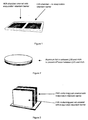
- a preferred fragrance dispenser of the invention as depicted in Figure 1 comprises a molded frame composed of glass or metal, or diffusion tight plastics such as polyethylene terephthalate (PET) and PET copolymers or polyvinylidene chloride or other sufficiently diffusion tight and inert materials.
- the frame comprises two compartments holding the LVA substances carried on a second carrier in one compartment and the HVA substances carried on a first carrier in another compartment.
- the outer frame construction physically joins the two compartments as one product.
- the HVA containing compartment is covered with an evaporation retardant diffusion barrier film of polyethylene, e. g. low density polyethylene, or polypropylene, e. g. low density polypropylene, or ethyl vinyl acetate or mixtures thereof.
- the LVA containing compartment can be covered with a net or perforated polymer film in order to prevent consumer's direct contact with the fragrance, but not to hinder the LVA evaporation.
- the fragrance dispenser preferably is packaged in a fragrance vapour tight outer packaging such as polyethylene terephthalate (PET) or polyvinylidene chloride.
- a fragrance vapour tight outer packaging such as polyethylene terephthalate (PET) or polyvinylidene chloride.
- PET polyethylene terephthalate
- both first and second carrier are separately or together covered with a vapour tight film.
- Preferred vapour tight films comprise metal foil such as aluminium, or polyethylene terephthalate (PET), or polyvinylidene chloride or composites thereof.
- the consumer activates the product by removing (peeling off) the vapour tight film(s), while the evaporation retardant diffusion barrier covering the HVA compartment and an optional perforated protective layer covering the LVA compartment remain covering the compartments.
- a fragrance vapour tight outer packaging can be generally provided for all fragrance dispensers of the present invention, as described above.
- Another preferred and very cost effective embodiment of the invention comprises two absorbent cellulose based pads, one of which is charged with LVA and the other same sized pad is charged with HVA.
- the HVA containing pad is coated with a species of the earlier described evaporation retardant polymer foil while the other cellulose pad is left uncovered.
- the two fragrance containing pads are joined using appropriate adhesive material with a diffusion barrier consisting of metal foil (such as aluminum foil) in between the fragranced pads.
- metal foil such as aluminum foil
- the air-freshener device should be packaged in a fragrance vapour tight outer packaging, as described e. g. in example 1.
- FIG. 3 Another preferred embodiment of the invention (cf. Figure 3 ) comprises two absorbent cellulose based pads, one of which is charged with LVA and the other same sized pad is charged with HVA.
- the HVA containing pad is coated with a species of the earlier described evaporation retardant polymer foil while the other cellulose pad is left uncovered.
- Both absorbent pads are mounted on a suitable stand composed of glass, or metal, or diffusion tight plastics such as polyethylene terephthalate (PET) and PET copolymers or polyvinylidene chloride or other sufficiently diffusion tight and inert materials.
- PET polyethylene terephthalate
- PET copolymers polyvinylidene chloride or other sufficiently diffusion tight and inert materials.
- the mounting stand is configured in such a manner that the fragrance charged pads do not have physical contact.
- the air-freshener device should be packaged in a fragrance vapour tight outer packaging, e. g. as described in example 1.
- the HVA compartment is outfitted with a diffusion barrier as described in Examples 1-3. Additionally, both compartments are covered with a fragrance vapour tight foil e. g. as described in example 1. Both vapour tight foils will be removed by the consumer to activate the product.
- the diffusion barrier remains on the HVA compartment to restrict evaporation and dispensation of the HVA fragrance substances.
- Another preferred embodiment of the invention comprises of 2 separate containers, one filled with the LVA in liquid form and the other one filled with the HVA in liquid form. Both containers are physically attached to each other. Each container is outfitted with an absorbing wick reaching into liquids of the respective containers while also extending outside the liquid container. The outside part of the wick reaching into the HVA container is outfitted with an evaporation retardant polymer foil, while the wick reaching into the LVA container is left uncovered. To prevent premature fragrance emission both wicks are covered with caps of fragrance vapour tight materials such as polyethylene terephthalate (PET) or or polyvinylidene chloride or metal lined polymers or other fragrance vapour tight outer packaging as described in example 1. In order to activate the air-freshening device the consumer removes by e.g. unscrewing the two wick covering caps.
- PET polyethylene terephthalate
- PKT polyvinylidene chloride
- metal lined polymers or other fragrance vapour tight outer packaging as described in example 1.
- a typical air-freshener fragrance of the fruity family was chosen. All fragrance components of the composition were listed with ascending vapour pressure. All fragrance constituents with vapour pressure value below 0.1 mmHg were attributed to the LVA while all fragrance materials with vapour pressure higher than 0.1mmHG became part of the HVA.
- All three fragrances were applied onto typical cardboard air-freshener substrates. 6 grams of the complete fragrance were applied onto a 5 cm x 10 cm sized cardboard piece while 2.86 g of the LVA was applied onto a 5 cm x 5 cm sized cardboard piece and 3.14 g of the HVA was applied onto a 5 cm x 5 cm sized cardboard piece.
- the cardboards with the complete fragrance and the LVA were left to evaporate in a large room conditioned at temperature between 20 and 25°C.
- the HVA charged cardboard was heat-sealed in a PE polymer foil with the polymer weighing 0.22 g.
- the sealed HVA charged cardboard was left to evaporate in the same room as the complete fragrance and LVA charged cardboards. Throughout a period of 17 days the weight loss of all three fragrance charged cardboards was determined gravimetrically and recorded.
- the cardboards were placed in 4m 3 sized evaluation booths and left for 1 h to evaporate into the closed booths. This test was performed at days 1, 3, 4, 5, 6, 7, 10, 12, 17 of the testing period.
- the HVA and LVA containing cardboards were placed in the same evaluation booth, while the complete fragrance containing cardboard was placed in a separate evaluation booth.
- the following table shows a composition of a typical air-freshener fragrance of the fruity family.
- the vapour pressure of each constituent was calculated by the software program "EpiWin” of Howard + Meylan. In the table these calculated vapour pressures are stated as the decadic logarithm of the calculated vapour pressure in mmHg at 25 °C.
- all fragrance constituents with log(vapour pressure) equal or greater than -1 became part of the HVA and all fragrance constituents with log (vapour pressure) less than -1 became part of the LVA.
Landscapes
- Health & Medical Sciences (AREA)
- Epidemiology (AREA)
- Life Sciences & Earth Sciences (AREA)
- Animal Behavior & Ethology (AREA)
- General Health & Medical Sciences (AREA)
- Public Health (AREA)
- Veterinary Medicine (AREA)
- Fats And Perfumes (AREA)
- Disinfection, Sterilisation Or Deodorisation Of Air (AREA)
Abstract
Description
- The present invention describes a fragrance dispenser, particularly for use as an air-freshener system, with improved air-freshening properties compared to conventional air-freshener systems known to the art.
- Air-freshener products are known to the art in a broad variety of product forms, each of them with specific profiles of advantages and disadvantages.
- A common challenge of air-fresheners found in the market is that the more volatile components of a fragrance composition, particularly a perfume composition, evaporate faster than the less volatile components of the composition. This phenomenon often leads to a drastic shift of the fragrance composition and results in a noticeable olfactory profile change of the air-freshener product during its useful life. Especially citrus, fruity and other fresh perfume types suffer a dramatic change from fresh, citrus like smell at the beginning of product use to a more mellow smell of typical heart and base notes such as woody, musk and some heavy floral smells.
- Faster evaporation of a fragrance composition's top note occurs due to its higher volatility. During usage of an e.g. conventional solid matrix air-freshener the top note will exhaust itself faster than the slower evaporating heart and bottom notes. The result is a significant composition change of the remaining fragrance composition, which leads to a pronounced change of olfactory character of the air-freshening product. This effect is undesirable since the consumer expects the product to maintain its olfactory character throughout the lifetime of the air-freshening product.
- This leaves a need for fragrance dispenser with a significantly more constant odour profile through the life of the product.
-
US 3,685,734 provides for a means of controlling the evaporation of a fragrance mixture with the benefit of obtaining a more constant fragrance emission rate than entirely open systems. It fails however to address the issue of the vast volatility differences in common fragrances with the result of having a changing fragrance character during the useful life of the product. -
US 4,356,969 describes a passive air freshener consisting of a fragrance reservoir and a touch protected surface membrane from which the fragrance can evaporate and provide a room fragrancing effect. While the surface area of the surface membrane and therefore overall fragrance emission rate per time unit can be varied the invention of this document does not address the evaporation speed differences of the constituents of common air-freshener fragrance compositions. -
US 4,590,111 discloses a fragrance releasing sheet article comprising a resin member with patterns and/or colours thereon and a fragrance releasing member comprising a resin and perfume, the pattern member and the fragrance releasing member being integrally constituted, improves on the appearance and flexibility in shape of conventional passive air-freshener systems with fragrance reservoir and evaporation regulating membrane. It does improve on the shortcoming of these systems in terms of their odour character change during use of the product. However, the character of the odour released during use of the sheet article still can easily change over time. -
US 6,012,643 relates to a device for controlled release of fragrant vapour in air. The device includes a carrier impregnated with a volatile medium and a wrapper of a flexible material surrounding said carrier for retaining the volatile medium on the carrier. The wrapper has a plurality of contiguous tear strips arranged in longitudinal sequence disposed over the carrier. The strips can be successively removed to expose a further portion of the carrier. The downside of this invention is the required consumer interaction with the product. -
EP 1 340 513 discloses an air-freshening device having an opening covered by a breathable film. - It was thus the object of the invention to provide improved fragrance dispensers and particularly air fresheners. The fragrance dispensers of the invention should secure a constant olfactory profile during the time of fragrance dispensation of the fragrance dispenser. The fragrance dispenser should also be easy to produce, it should allow to be produced in a variety of shapes, it should not require a user interaction after an initial activation of fragrance dispensation, and it should be useful for dispensing various fragrances, particularly fragrance compositions for air fresheners.
- The invention thus provides a fragrance dispenser as defined in claim 1, comprising i.a. a first and a second carrier, each carrier comprising one or more fragrance substances, wherein the fragrance substances comprise one or more fragrance substances a) with a vapour pressure of at least 0.1 mmHg at 25 °C ("HVA") and one or more fragrance substances b) with a vapour pressure of less than 0.1 mmHg at 25 °C ("LVA"), and wherein the fragrance substances are distributed to the first and second carrier such that at least 80 wt.-% of all HVA fragrance substances are carried by the first carrier.
- The invention involves the following main areas of technical detail:
- a) Definition of high volatility accord fragrance substances and low volatility accord fragrance substances,
- b) provision of substantially separate carriers for HVA and LVA carriers, and
- c) nature and technical specifications of a HVA evaporation retardant system (diffusion barrier).
- Particularly, none of the above given prior art suggest to substantially separate carriers for HVA and LVA fragrance substances.
- Within the terms of the present invention, a fragrance dispenser is a device capable of and intended to dispense one or more fragrant substances ("fragrances") stored in a reservoir or in/on a carrier into air, optionally after an initial activation of the fragrance dispenser e. g. by removing or punctuating a fragrance vapour tight packaging. An air freshener within the terms of the present invention is a fragrance dispenser comprising a fragrance composition for eliciting a "fresh air smell", such smells being typically described by a perfumer by the attributes citrus, fruity or other fresh perfume type. The fragrance dispensers of the present invention are preferably "passive" fragrance dispensers or air fresheners, dispensing fragrances essentially at ambient temperatures, in contrast to "active" fragrance dispensers operating by heating fragrance reservoirs or carriers or fanning air over fragrance reservoirs or carriers by a ventilator. Unless stated otherwise, all descriptions hereinafter of a fragrance dispenser shall likewise disclose corresponding air fresheners and vice versa.
- Fragrances are, according to the present invention, divided by their vapour pressure at 25 °C. A high volatility accord ("HVA") fragrance substance is a substance having a vapour pressure of at least 0.1 mmHg at 25 °C and preferably not more than 100 mmHg. A low volatility accord ("LVA") fragrance substance is a substance having a vapour pressure of less than 0.1 mmHg at 25 °C. Substances can be pure chemical substances or compositions comprising different chemical substances.
- Typically, air-fresheners comprise fragrance substances having vapour pressures from about 0.001 mmHg at 25°C to about 100 mmHg at 25°C, therefore spanning a factor of about 100000.
- It has been found that fragrance and aroma chemicals and non-odoriferous compounds (solvents) with a vapour pressure ranging from 0.1 mmHg at 25°C to 100 mmHg at 25°C are particularly volatile and are rapidly lost by evaporation from an open matrix air-freshener operated at ambient temperature. It has furthermore been found that by physically separating HVA and LVA fragrance substances, fragrance substance carriers specially tailored for the dispensation of HVA and LVA fragrance substances, respective, can be employed.
- The invention allows to make use of this insight by allowing to provide HVA and LVA fragrance substances on substantially separate carriers for fragrance substances, each of which can be specially adapted to the dispensation requirements of the fragrances comprised thereon. In all fragrance dispensers of the present invention, HVA and LVA fragrances are, optionally after activation of the fragrance dispenser, dispensed so that they can be simultaneously presented to the nose of a user or consumer, so that a scent provided by the fragrance dispenser comprises both HVA and LVA fragrance notes. The invention thus obviates the need of known air fresheners for a one-fits-all carrier of fragrance substances. Instead, the invention enables the skilled person to chose carriers particularly adapted to one another and to the fragrance substances such that the olfactory profile of the dispensed fragrances remains substantially constant during the lifetime (i.e. time of usefulness) of the fragrance dispenser.
- It has also been found that the presence of a small amount of LVA fragrance substances on the first carrier and a small amount of HVA fragrance substances on the second carrier can be tolerated in view of the steadyness of the olfactory profile created by the fragrance dispenser. Thus, according to the invention the fragrance substances are distributed to the first and second carrier such that at least 80 wt.-%, preferably at least 90 wt.-%, more preferably at least 95 wt.-% and preferably all HVA fragrance substances are carried by the first carrier. This way, substantially all HVA fragrance substances are concentrated on the first carrier and make use of this carrier's advantageous properties for fragrance dispensation. Likewise, it is according to the invention when the fragrance substances are distributed to the first and second carrier such that at least 80 wt.-%, preferably at least 90 wt.-%, more preferably at least 95 wt.-% and preferably all LVA fragrance substances are carried by the second carrier. In each case, it is preferred that the percentages of distribution apply to the moment when charging the first and second carrier with fragrance substances has been completed. Typically, the fragrance dispenser of the invention is sealed shortly after this moment, such that the distribution percentages do not change significantly, i.e. by more than 5 wt.-%, from the above values. A consumer would then remove the sealing, thus allowing the fragrances to be dispersed from their respective carriers (see below).
- The HVA and LVA fragrances can be present in the fragrance dispenser of the invention in a variety of weight ratios. Preferably, the weight ratio of all HVA fragrance substances to all LVA fragrance substances of the first and second carrier is from 90:10 to 10:90, more preferably from 70:30 to 30:70, and most preferably from 60:40 to 40:60.
- Preferred LVA fragrance substances are selected from the group consisting of Cinammic Alcohol (3-phenyl-2-propen-1-ol), Phenoxyethylalcohol (2-phenoxy ethanol), Undecavertol (4-methyl-3-decen-5-ol), Geraniol Supra (3,7-dimethyl-2,6-octadien-1-ol), Ethyl Linalool(3,7-dimethyl-1,6-nonadien-3-ol), Tetrahydrogeraniol (3,7-dimethyl-1-octanol), Genaryl Acetate Pure (3,7-dimethyl-2,6-octadien-1-yl-acetate), Terpineol Alpha (1-methyl-4-isopropyl-1-cyclo-hexen-8-ol), Isoborneol (exo-1,7,7-trimethyl-bicyclo(2.2.1)hepta-2-ol), Aldehyde C12 MNA (Methyl nonyl acetaldehyde), Aldehyde C11 (Undecenal), Terpinyl Acetate (2-(methyl-3-cyclohexenyl)-2-propyl-acetate), Undecylenic Aldehyde (10-undecylen-1-al), Agrunitril (3,7-dimethyl-6-octen-1-nitrile), Agrumex HC (2-tert.-butyl-cyclohexyl-acetate), Oryclon Special (4-tert.-butyl-cyclohexyl-acetate), Methyl Octin Carbonate (Methyl 2-nonynoate), Vanillin (3-methoxy-4-hydroxybenzaldehyde), Ethyl Vanillin (3-ethoxy-4-hydroxy-benzaldehyde), Galaxolide (Hexahydro-4,6,6,7,8,8-hexamethyl-cyclopenta-gamma-2-benzopyran), Iso E Super (2-acetyl-1,2,3,4,5,6,7,8-octahydro-2,3,8,8-tetramethyl-naphtalene), Globalide (Oxacyclohexadecen-2-one), Geranyl Acetate (3,7-dimethyl-2,6-octadien-1-yl-acetate), Dimethyl Anthranilate (methyl n-methyl-anthranilate), Hydroherbaflorat / Corps 553 (tricyclo-decyl-acetate), Ethyl Safranate (ethyl dehydro cyclogeranate), 2-phenylethyl-dimethyl-carbinol, Geranyl Nitrile (3,7-dimethyl-2,6-octadien-1-nitrile), Phenyl Propyl Alcohol (3-phenyl-1-propanol), Hydroxycitronellal (3,7-dimethyl-7-hydroxyoctanal), methyl cinnamic aldehyde alpha, Nerol 900 (cis-3,7-dimethyl-2,6-octadien-1-ol), 9-decen-1-ol, Lilial (4-tert.-butyl-alpha-methyl-hydrocinnamic-aldehyde), Hedione (methyl-(2-pentyl-3-oxo-1-cyclo-pentyl)-acetate), Cyclamenaldehyde (2-methyl-3-(4-isopropylphenyl)-propanal), Florazon (3-(4-Ethylphenyl)-2,2-dimethylpropanol), Citronellol (3,7-dimethyl-6-octen-1-ol), Dipropylene Glycol (oxybispropanol), Diethyl Phthalate (1,2-benzenedicarboxylic acid diethyl ester), Isopropyl Myristate (1-methylethyl tetradecanoate), Dowanol TPM (Tripropylene Glycol Monomethyl Ether) and mixtures thereof.
- Preferred HVA fragrance substances are selected from the group consisting of Anisic Aldehyde (4-methoxy-benzaldehyde), Orivone (4-tert.-pentyl-cyclohexanone), Phenylacetaldehyde Dimethyl Methyl Acetal (Phenyl-ethanal-dimethyl-acetal), Jasmaprunat (Ethyl-2-methyl-1,3-dioxolane-2-acetate), Allyl Amyl Glycolate, Anethol NPU 21/22 Celsius (1-methoxy-4-propenyl-benzene), Aldehyde C10 (1-decanal), Benzyl Acetate, Herboxan (2-butyl-4,4,6-trimethyl-1,3-dioxane), Leafovert (Cis-3-hexenyl-methyl-carbonate), Estragole (Basil Oil Fract.(Ocimum Basilicum L.)), Allyl Heptoate (2-propenyl-heptanoate), Vertocitral (2,4- And 3,5-dimethyl-3-cyclo-hexene-1-carboxaldehyde), Freesiol /Corps 119 (2,6-dimethyl-heptan-2-ol), Aldehyde C9 (1-nonanal), Cis-3-Hexenol, Allyl Caproate (2-propenyl-hexanoate), Melonal (2,6-dimethyl-5-heptenal), Hexenyl Acetate Cis-3 (Cis-3-hexenyl Acetate), Ethyl Caproate (Ethyl Hexanoate), Hexyl Acetate, Manzanate (Ethyl-2-methyl-pentanoate), Prenyl Acetate (3-methyl-2-butenyl-acetate), Ethyl-2-Methyl Butyrate, Isoamyl Acetate (3-methyl-butyl-acetate), Isododecane (C12-isoparaffines), Dowanol PNP (Propylene Glycol N-propyl Ether), Ethyl Isobutyrate, Phenyl-ethanal, Oxane (1,3-Oxathiane, 2-methyl-4-propyl-, cis-), Vertocitral (2,4- and 3,5-dimethyl-3-cyclo-hexene-1-carboxaldehyde), Allyl Heptoate (2-propenyl-heptanoate), Rose Oxide (4-methyl-2-(2-methylpropen-1-yl) -tetrahydro-pyrane), Citronellal (3,7-dimethyl-6-octen-1-al), Butyl Acetate, Isoamyl Butyrate (3-methyl-butyl-butyrate), Filbertone (5-methyl-2-hepten-4-one), Isononyl Aldehyde, 2-Octanone, Cis-3-Hexenol, D-Limonene (1-methyl-4-(1-methyl-ethenyl)-xyclohexene), Butyl Butyrate, Cresyl Methyl Ether Para (1-methoxy-4-methyl-benzene), Cyclohexyl Acetate, Ethyl Heptoate, Heptyl Acetate, Tetrahydrocitral (3,7-dimethyl-1-octanal), Tetrahydro Myrcenol (2,6-dimethyl-2-octanol), Frutinat (1,3-dimethyl-butyl-2-butenoate), Methyl Benzoate, Amarocit (1,1-dimethoxy-2,2,5-trimethyl-4-hexene), Herbac (3,3-dimethyl cyclohexyl methylketone), Neononyl Acetate (3,5,5-trimethyl hexyl acetate), Hexenyl Isobutyrate Cis Trans-3 (3-hexen-1-yl-isobutyrate), Geranyl Methyl Ether (3,7-dimethyl-2,6-octadien-1-methoxy), Methyl Acetophenone Para (1-methyl-4-acetyl-benzene), Dowanol DPM (Dipropylenglycol Monomethyl Ether), and mixtures thereof.
- In particularly preferred fragrance dispensers of the invention, the first carrier comprises a diffusion barrier having a benzyl acetate vapour transmission rate of at most 1 g/(5 cm2 · 24 h) at 25 °C. The benzyl acetate vapour transmission rate can be measured by tightly covering a glass container half filled with benzyl acetate with the diffusion barrier to be tested, preferably a polymer film, and measuring the benzyl acetate weight loss over time while storing the container in a room which is conditioned at 25°C. The measured weight loss can then be standardized to the benzyl acetate vapour transmission per 24 hours through a 5 cm2 sized diffusion barrier, preferably a polymer film, at 25°C. Particularly preferred is a benzyl acetate vapour transmission rate of more than 0.02 g per 24 hours through a 5 cm2 sized diffusion barrier and less than 1.0 g per 24 hours through a 5 cm2 sized diffusion barrier. Preferably, the benzyl acetate vapour transmission rate falls in the range of more than 0.05 g per 24 hours through a 5 cm2 sized diffusion barrier and less than 0.5 g per 24 hours through a 5 cm2 sized diffusion barrier.
- By careful choice of the diffusion barrier material and thickness, the HVA fragrance substances' emission rate can be adjusted to match the emission rate of the LVA fragrance substances. It has been found that optimal fragrance performance can be realized by combining a freely evaporating LVA with a diffusion barrier enclosed HVA.
- Preferred diffusion barriers are polymer films. While low density qualities of polyethylene or polypropylene or ethyl vinyl acetate and mixtures are preferred diffusion barrier, any other polymer could be used, given that it provides for appropriate fragrance permeability.
- It has been found that the combination of the freely evaporating low volatility accord and the evaporation speed reduced high volatility accord will provide for an air freshening effect with much less odour character change over time than a corresponding conventional air freshener system with all fragrance substances evaporating out of one single phase.
- Fragrance carriers of a fragrance dispenser of the present invention are materials or bodies capable of storing otherwise solid, liquid or gaseous fragrances, preferably by absorption or adsorption, and further capable of releasing the fragrances to air.
- Preferably, the fragrance substances are attached to their respective carrier by absorbing them into appropriate porous substrates or are dispersed throughout a solid or semisolid gel network. Appropriate porous substrates can be chosen from, but are not limited to paper and/or cardboard, liquid absorbing fabrics, nonwoven fabrics, absorbing porous polymers such as polyethylene or polypropylene, porous minerals such as clay, bentonite, zeolite or spray dried sodium sulfate (Light Sulfate), or any other sufficiently inert material capable of absorbing more than its own weight in fragrance liquid, i.e. a composition comprising one ore more fragrance substances and optionally a solvent or dispersion liquid. Particularly, the carrier of LVA fragrance substances can be a hydrous or anhydrous gel network realized by suitable thickeners. Suitable thickeners are, but are not limited to, calcium stearate, aluminium stearate, sodium stearate, polyacrylate based polymers, polyacrylamide, polyamide derivatives, carboxymethylcellulose, polysaccharide based polymers such as carrageenan, Agar, Gellan Gum, Alginate or Xanthan Gum, waxes such as paraffin wax, petrolatum, silicas, long chain alcohols such as C8-C20 alcohols, particularly octadecyl alcohol, and long chain organic acids such as C8-C20 carboxylic acids, particularly octadecanoic acid.
- Preferred LVA and HVA carrier combinations are:
LVA Carrier HVA Carrier a) absorbent pad (e.g. cellulose) gelled fragrance (e.g. silica) b) absorbent pad (e.g. cellulose) liquid fragrance (wick evaporation) c) gelled fragrance (e.g. silica) liquid fragrance (wick evaporation) d) aqueous gelled fragrance (e.g. carrageenan) gelled fragrance (e.g. silica) e) aqueous gelled fragrance (e.g. carrageenan) absorbent pad (e.g. cellulose) f) aqueous gelled fragrance (e.g. carrageenan) liquid fragrance (wick evaporation) - Only the compartment containing the HVA should be equipped with a diffusion barrier while the LVA containing compartment can be left open or covered with a protection film or net which does not influence the evaporation rate of the LVA fragrance substances.
- The first and second carriers are separate from one another such that blending of HVA and LVA fragrance substances is essentially minimized. In particularly preferred fragrance dispensers of the present invention, there is no liquid flow connection between the first and second carrier. When LVA and HVA are in very close contact glass, metal (such as aluminum) or very low diffusion polymer barriers are preferably used to separate LVA and HVA and thereby prevent premature blending of LVA and HVA fragrance substances.
- Preferably, the first and second carriers are held together by a frame. Within the scope of the present invention, a frame is a structure physically establishing and maintaining an attachment contact between the first and second carrier. Particularly preferred frames for connecting the first and second carrier are ropes or lines, base plates, connecting layers, moulded frames and housings.
- Another preferred execution of the invention is comprised of two reservoirs separately comprising liquid LVA and liquid HVA constituents. Both containers are closed with the exception of a first and second carrier, preferably in the form of an absorbent fleece or wick reaching into the liquid containers but also extending outside the liquid container. Capillary action of the wick/fleece carriers allows the fragrance oil to diffuse through the wick/fleece wetting the entire wick/fleece including the portion outside the container. For the purpose of this invention the wick/fleece reaching into the HVA container is preferably outfitted with the required evaporation retarding barrier to realize a slowed down evaporation of HVA. The wick/fleece reaching into the LVA container is left open to allow the LVA to evaporate freely into the ambient air.
- The following examples and figures are meant to describe preferred embodiments of the invention more closely, without limiting the scope of the claims.
- A preferred fragrance dispenser of the invention as depicted in
Figure 1 comprises a molded frame composed of glass or metal, or diffusion tight plastics such as polyethylene terephthalate (PET) and PET copolymers or polyvinylidene chloride or other sufficiently diffusion tight and inert materials. The frame comprises two compartments holding the LVA substances carried on a second carrier in one compartment and the HVA substances carried on a first carrier in another compartment. The outer frame construction physically joins the two compartments as one product. The HVA containing compartment is covered with an evaporation retardant diffusion barrier film of polyethylene, e. g. low density polyethylene, or polypropylene, e. g. low density polypropylene, or ethyl vinyl acetate or mixtures thereof. The LVA containing compartment can be covered with a net or perforated polymer film in order to prevent consumer's direct contact with the fragrance, but not to hinder the LVA evaporation. - To prevent premature fragrance emission the fragrance dispenser preferably is packaged in a fragrance vapour tight outer packaging such as polyethylene terephthalate (PET) or polyvinylidene chloride. Preferably, both first and second carrier are separately or together covered with a vapour tight film. Preferred vapour tight films comprise metal foil such as aluminium, or polyethylene terephthalate (PET), or polyvinylidene chloride or composites thereof. The consumer activates the product by removing (peeling off) the vapour tight film(s), while the evaporation retardant diffusion barrier covering the HVA compartment and an optional perforated protective layer covering the LVA compartment remain covering the compartments. A fragrance vapour tight outer packaging can be generally provided for all fragrance dispensers of the present invention, as described above.
- Another preferred and very cost effective embodiment of the invention comprises two absorbent cellulose based pads, one of which is charged with LVA and the other same sized pad is charged with HVA. The HVA containing pad is coated with a species of the earlier described evaporation retardant polymer foil while the other cellulose pad is left uncovered. In a three layer sandwich configuration (cf.
Figure 2 ) the two fragrance containing pads are joined using appropriate adhesive material with a diffusion barrier consisting of metal foil (such as aluminum foil) in between the fragranced pads. In use the air freshening device is kept in upright position by a simple stand holding the device upright or it can be hung, ensuring that both surfaces are allowed to emit fragrance freely. - To prevent premature fragrance emission the air-freshener device should be packaged in a fragrance vapour tight outer packaging, as described e. g. in example 1.
- Another preferred embodiment of the invention (cf.
Figure 3 ) comprises two absorbent cellulose based pads, one of which is charged with LVA and the other same sized pad is charged with HVA. The HVA containing pad is coated with a species of the earlier described evaporation retardant polymer foil while the other cellulose pad is left uncovered. Both absorbent pads are mounted on a suitable stand composed of glass, or metal, or diffusion tight plastics such as polyethylene terephthalate (PET) and PET copolymers or polyvinylidene chloride or other sufficiently diffusion tight and inert materials. The mounting stand is configured in such a manner that the fragrance charged pads do not have physical contact. - To prevent premature fragrance emission the air-freshener device should be packaged in a fragrance vapour tight outer packaging, e. g. as described in example 1.
- Another preferred embodiment of the present invention (cf.
Figure 4 ) comprises again two fragrance carriers, one located in a HVA compartment and the other located in an adjacent LVA compartment. The HVA compartment is outfitted with a diffusion barrier as described in Examples 1-3. Additionally, both compartments are covered with a fragrance vapour tight foil e. g. as described in example 1. Both vapour tight foils will be removed by the consumer to activate the product. The diffusion barrier remains on the HVA compartment to restrict evaporation and dispensation of the HVA fragrance substances. - Another preferred embodiment of the invention (cf.
Figure 5 ) comprises of 2 separate containers, one filled with the LVA in liquid form and the other one filled with the HVA in liquid form. Both containers are physically attached to each other. Each container is outfitted with an absorbing wick reaching into liquids of the respective containers while also extending outside the liquid container. The outside part of the wick reaching into the HVA container is outfitted with an evaporation retardant polymer foil, while the wick reaching into the LVA container is left uncovered. To prevent premature fragrance emission both wicks are covered with caps of fragrance vapour tight materials such as polyethylene terephthalate (PET) or or polyvinylidene chloride or metal lined polymers or other fragrance vapour tight outer packaging as described in example 1. In order to activate the air-freshening device the consumer removes by e.g. unscrewing the two wick covering caps. - A typical air-freshener fragrance of the fruity family was chosen. All fragrance components of the composition were listed with ascending vapour pressure. All fragrance constituents with vapour pressure value below 0.1 mmHg were attributed to the LVA while all fragrance materials with vapour pressure higher than 0.1mmHG became part of the HVA.
- All three fragrances (complete fragrance, HVA and LVA) were applied onto typical cardboard air-freshener substrates. 6 grams of the complete fragrance were applied onto a 5 cm x 10 cm sized cardboard piece while 2.86 g of the LVA was applied onto a 5 cm x 5 cm sized cardboard piece and 3.14 g of the HVA was applied onto a 5 cm x 5 cm sized cardboard piece. The cardboards with the complete fragrance and the LVA were left to evaporate in a large room conditioned at temperature between 20 and 25°C. The HVA charged cardboard was heat-sealed in a PE polymer foil with the polymer weighing 0.22 g. The sealed HVA charged cardboard was left to evaporate in the same room as the complete fragrance and LVA charged cardboards. Throughout a period of 17 days the weight loss of all three fragrance charged cardboards was determined gravimetrically and recorded.
- In order to evaluate the products air-freshening quality the cardboards were placed in 4m3 sized evaluation booths and left for 1 h to evaporate into the closed booths. This test was performed at days 1, 3, 4, 5, 6, 7, 10, 12, 17 of the testing period. The HVA and LVA containing cardboards were placed in the same evaluation booth, while the complete fragrance containing cardboard was placed in a separate evaluation booth.
- Strength and quality of the fragrance impression in the evaluation booths were evaluated by trained fragrance evaluators. (Evaluation scales: Strength 0 = no smell, Strength 10 = extremely strong smell; Quality 0 = Totally different smell from fragrance character emitted from freshly prepared product, Quality 10 = Fragrance character identical to character emitted from freshly prepared product.
- The following table shows a composition of a typical air-freshener fragrance of the fruity family. The vapour pressure of each constituent was calculated by the software program "EpiWin" of Howard + Meylan. In the table these calculated vapour pressures are stated as the decadic logarithm of the calculated vapour pressure in mmHg at 25 °C. For the purpose of separating the fragrance in HVA and LVA all fragrance constituents with log(vapour pressure) equal or greater than -1 became part of the HVA and all fragrance constituents with log (vapour pressure) less than -1 became part of the LVA.
- When separating the complete fragrance into HVA and LVA the quantitative proportions between the individual constituents were kept as in the complete fragrance.
Complete Fragrance "Fruity Freshener" Trade Name Chemical Name Parts log (vapour pressure) Agrumex LC 2-TERT.-BUTYL-CYCLOHEXYL-ACETATE 8.00 -1.16 Allyl Heptoate 2-PROPENYL-HEPTANOATE 2.50 -0.64 Benzyl Acetate BENZYL-ACETATE 15.00 -0.79 Calone 1951 7-METHYL-3,4-DIHYDRO 2H-1,5-BENZODIOXEPINE-3-ONE 0.20 -3.14 Citral 95 3,7-DIMETHYL-2,6-OCTADIENAL 0.60 -0.83 Coumarin 5,6-BENZO-ALPHA-PYRONE 0.60 -2.57 Damascone Delta 1-(2,6,6-TRIMETHYL-3-CYCLOHEXEN-1-YL)-2-BUTEN-1-ONE 0.40 -1.57 Decalactone Gamma 4-DECANOLIDE 1.00 -2.29 Ethyl Butyrate ETHYL BUTYRATE 0.20 1.08 Ethyl Methyl Butyrate-2 ETHYL-2-METHYL-BUTYRATE 0.30 0.90 Geranyl Acetate 60 3,7-DIMETHYL-2,6-OCTADIEN-1-YL-ACETATE 2.00 -1.54 Heliotropin 3,4-METHYLENEDIOXYBENZALDEHYDE 0.60 -2.02 Hexenyl Acetate Cis-3 CIS-3-HEXENYL ACETATE 0.20 0.06 Hexyl Acetate HEXYL-ACETATE 4.00 0.19 Isoraldeine 70 4-(2,6,6-TRIMETHYL-2-CYCLOHEXENYL-)-3-METHYL-3-BUTEN-2-ONE 1.50 -2.01 Lilial 4-TERT.-BUTYL-ALPHA-METHYL-HYDROCINNAMIC-ALDEHYDE 2.50 -2.45 Linalool 3,7-DIMETHYL-1,6-OCTADIENE-3-OL 11.00 -1.24 Manzanate ETHYL-2-METHYL-PENTANOATE 0.30 0.46 Melonal 2,6-DIMETHYL-5-HEPTENAL 0.30 -0.12 Orange Oil Brazil ORANGE OIL 3.50 0.83 Orivone 4-TERT.-PENTYL-CYCLOHEXANONE 0.50 -0.92 Phenylethyl Alcohol 2-PHENYLETHYL ALCOHOL 2.50 -1.79 Prenyl Acetate 3-METHYL-2-BUTENYL-ACETATE 4.00 0.62 Rose Oxide Inactive 4-METHYL-2-(2-METHYLPROPEN-1-YL)-TETRAHYDRO-PYRANE 0.30 -0.18 Styralyl Acetate 1-PHENYLETHYL-ACETATE 4.00 -1.02 Vertocitral 2,4- AND 3,5-DIMETHYL-3-CYCLOHEXENE-1-CARBOXALDEHYDE 6.00 -0.45 LVA of "Fruity Freshener" Trade Name Chemical Name Parts log (vapour pressure) Agrumex LC 2-TERT.-BUTYL-CYCLOHEXYL-ACETATE 8.00 -1.16 Calone 1951 7-METHYL-3,4-DIHYDRO 2H-1,5-BENZODIOXEPINE-3-ONE 0.20 -3.14 Coumarin 5,6-BENZO-ALPHA-PYRONE 0.60 -2.57 Damascone Delta 1-(2,6,6-TRIMETHYL-3-CYCLOHEXEN-1-YL)-2-BUTEN-1-ONE 0.40 -1.57 Decalactone Gamma 4-DECANOLIDE 1.00 -2.29 Geranyl Acetate 60 3,7-DIMETHYL-2,6-OCTADIEN-1-YL-ACETATE 2.00 -1.54 Heliotropin 3,4-METHYLENEDIOXYBENZALDEHYDE 0.60 -2.02 Isoraldeine 70 4-(2,6,6-TRIMETHYL-2-CYCLOHEXENYL-)-3-METHYL-3-BUTEN-2-ONE 1.50 -2.01 Lilial 4-TERT.-BUTYL-ALPHA-METHYL-HYDROCINNAMIC-ALDEHYDE 2.50 -2.45 Linalool 3,7-DIMETHYL-1,6-OCTADIENE-3-OL 11.00 -1.24 Phenylethyl Alcohol 2-PHENYLETHYL ALCOHOL 2.50 -1.79 Styralyl Acetate 1-PHENYLETHYL-ACETATE 4.00 -1.02 HVA of "Fruity Freshener" Trade Name Chemical Name Parts log (vapour pressure) Allyl Heptoate 2-PROPENYL-HEPTANOATE 2.50 -0.64 Benzyl Acetate BENZYL-ACETATE 15.00 -0.79 Citral 95 3,7-DIMETHYL-2,6-OCTADIENAL 0.60 -0.83 Ethyl Butyrate ETHYL BUTYRATE 0.20 1.08 Ethyl Methyl Butyrate-2 ETHYL-2-METHYL-BUTYRATE 0.30 0.90 Hexenyl Acetate Cis-3 CIS-3-HEXENYL ACETATE 0.20 0.06 Hexyl Acetate HEXYL-ACETATE 4.00 0.19 Manzanate ETHYL-2-METHYL-PENTANOATE 0.30 0.46 Melonal 2,6-DIMETHYL-5-HEPTENAL 0.30 -0.12 Orange Oil Brazil ORANGE OIL 3.50 0.83 Orivone 4-TERT.-PENTYL-CYCLOHEXANONE 0.50 -0.92 Prenyl Acetate 3-METHYL-2-BUTENYL-ACETATE 4.00 0.62 Rose Oxide Inactive 4-METHYL-2-(2-METHYLPROPEN-1-YL)-TETRAHYDRO-PYRANE 0.30 -0.18 Vertocitral 2,4- AND 3,5-DIMETHYL-3-CYCLOHEXENE-1-CARBOXALDEHYDE 6.00 -0.45 -
Weight loss days of evaporation LVA + HVA (no barrier) LVA (no barrier) HVA (with barrier) % fragrance left 0.0 100.0% 100.0% 100.0% 0.3 89.5% 96.8% 94.8% 3.0 55.8% 78.9% 69.2% 4.0 45.7% 71.4% 60.4% 5.3 32.0% 58.4% 49.7% 6.0 27.3% 52.3% 44.8% 7.1 21.3% 44.8% 39.3% 10.0 11.0% 30.8% 25.0% 12.0 9.2% 26.9% 18.5% 17.0 6.5% 20.1% 8.8% Air-freshening performance - Fragrance Strength in test booth days of evaporation Complete fragrance "Fruity Freshener" (no barrier) LVA and HVA separated (HVA with barrier) combined in test booth fragrance strength 0.0 8.2 7.0 0.3 7.0 6.8 3.0 5.8 6.7 4.0 5.4 6.5 5.3 5.4 6.4 6.0 4.6 6.2 7.1 4.4 5.4 10.0 4.0 5.0 12.0 3.1 4.1 17.0 1.6 1.8 Air-freshening performance - truth to original fragrance note days of evaporation Complete fragrance "Fruity Freshener" (no barrier) LVA and HVA separated (HVA with barrier) combined in test booth truth to original fragrance 0.0 10.0 9.0 0.3 7.0 8.6 3.0 5.8 8.8 4.0 4.6 8.0 5.3 4.2 8.0 6.0 4.2 8.2 7.1 3.4 7.6 10.0 3.3 7.1 12.0 2.2 6.2 17.0 2.0 3.4
Claims (6)
- Fragrance dispenser, comprising a first and a second carrier, each carrier comprising one or more fragrance substances, wherein the fragrance substances comprise one or more fragrance substancesa) with a vapour pressure of at least 0.1 mmHg at 25 °C ("HVA") and one or more fragrance substances,b) with a vapour pressure of less than 0.1 mmHg at 25 °C ("LVA"),and wherein the fragrance substances are distributed to the first and second carrier such that at least 80 wt.-% of all HVA fragrance substances are carried by the first carrier, and wherein the fragrance substances are distributed to the first and second carrier such that at least 80 wt.-% of all LVA fragrance substances are carried by the second carrier, and wherein the first carrier is enclosed with a diffusion barrier having a benzyl acetate vapour transmission rate of at most 1 g/(5 cm2. 24 h) at 25 °C.
- Fragrance dispenser of claim 1, wherein the weight ratio of all HVA fragrance substances to all LVA fragrance substances of the first and second carrier is from 90:10 to 10:90.
- Fragrance dispenser of any of claims 1 or 2, wherein the one or more HVA fragrance substances are selected from the group consisting of Anisic Aldehyde (4-methoxy-benzaldehyde), Orivone (4-tert.-pentyl-cyclohexanone), Phenylacetaldehyde Dimethyl Methyl Acetal (Phenyl-ethanal-dimethyl-acetal), Jasmaprunat (Ethyl-2-methyl-1,3-dioxolane-2-acetate), Allyl Amyl Glycolate, Anethol NPU 21/22 Celsius (1-methoxy-4-propenyl-benzene), Aldehyde C10 (1-decanal), Benzyl Acetate, Herboxan (2-butyl-4,4,6-trimethyl-1,3-dioxane), Leafovert (Cis-3-hexenyl-methyl-carbonate), Estragole (Basil Oil Fract.(Ocimum Basilicum L.)), Allyl Heptoate (2-propenyl-heptanoate), Vertocitral (2,4- And 3,5-dimethyl-3-cyclo-hexene-1-carboxaldehyde), Freesiol /Corps 119 (2,6-dimethyl-heptan-2-ol), Aldehyde C9 (1-nonanal), Cis-3-Hexenol, Allyl Caproate (2-propenyl-hexanoate), Rose Oxide HC (4-methyl-2-(2-methylpropen-1-yl)-tetrahydro-pyrane), Melonal (2,6-dimethyl-5-heptenal), Hexenyl Acetate Cis-3 (Cis-3-hexenyl Acetate), Ethyl Caproate (Ethyl Hexanoate), Hexyl Acetate, Manzanate (Ethyl-2-methyl-pentanoate), Prenyl Acetate (3-methyl-2-butenyl-acetate), Ethyl-2-Methyl Butyrate, Isoamyl Acetate (3-methyl-butyl-acetate), Isododecane (C12-isoparaffines), Dowanol PNP (Propylene Glycol N-propyl Ether), Ethyl Isobutyrate, Phenyl-ethanal, Oxane (1,3-Oxathiane, 2-methyl-4-propyl-, cis-), Vertocitral (2,4- and 3,5-dimethyl-3-cyclo-hexene-1-carboxaldehyde), Allyl Heptoate (2-propenyl-heptanoate), Rose Oxide (4-methyl-2-(2-methylpropen-1-yl) -tetrahydro-pyrane), Citronellal (3,7-dimethyl-6-octen-1-al), Butyl Acetate, Isoamyl Butyrate (3-methyl-butyl-butyrate), Filbertone (5-methyl-2-hepten-4-one), Isononyl Aldehyde, 2-Octanone, Cis-3-Hexenol, D-Limonene (1-methyl-4-(1-methyl-ethenyl)-xyclohexene), Butyl Butyrate, Cresyl Methyl Ether Para (1-methoxy-4-methylbenzene), Cyclohexyl Acetate, Ethyl Heptoate, Heptyl Acetate, Tetrahydrocitral (3,7-dimethyl-1-octanal), Tetrahydro Myrcenol (2,6-dimethyl-2-octanol), Frutinat (1,3-dimethyl-butyl-2-butenoate), Methyl Benzoate, Amarocit (1,1-dimethoxy-2,2,5-trimethyl-4-hexene), Herbac (3,3-dimethyl cyclohexyl methylketone), Neononyl Acetate (3,5,5-trimethyl hexyl acetate), Hexenyl Isobutyrate Cis Trans-3 (3-hexen-1-yl-isobutyrate), Geranyl Methyl Ether (3,7-dimethyl-2,6-octadien-1-methoxy), Methyl Acetophenone Para (1-methyl-4-acetyl-benzene), Dowanol DPM (Dipropylenglycol Monomethyl Ether), and mixtures thereof.
- Fragrance dispenser of any of claims 1 to 3, wherein the one or more LVA fragrance substances are selected from the group consisting of Cinammic Alcohol (3-phenyl-2-propen-1-ol), Phenoxyethylalcohol (2-phenoxy ethanol), Undecavertol (4-methyl-3-decen-5-ol), Geraniol Supra (3,7-dimethyl-2,6-octadien-1-ol), Ethyl Linalool(3,7-dimethyl-1,6-nonadien-3-ol), Tetrahydrogeraniol (3,7-dimethyl-1-octanol), Genaryl Acetate Pure (3,7-dimethyl-2,6-octadien-1-yl-acetate), Terpineol Alpha (1-methyl-4-isopropyl-1-cyclo-hexen-8-ol), Isoborneol (exo-1,7,7-trimethyl-bicyclo(2.2.1)hepta-2-ol), Aldehyde C12 MNA (Methyl nonyl acetaldehyde), Aldehyde C11 (Undecenal), Terpinyl Acetate (2-(methyl-3-cyclohexenyl)-2-propyl-acetate), Undecylenic Aldehyde (10-undecylen-1-al), Agrunitril (3,7-dimethyl-6-octen-1-nitrile), Agrumex HC (2-tert.-butyl-cyclohexyl-acetate), Oryclon Special (4-tert.-butyl-cyclohexyl-acetate), Methyl Octin Carbonate (Methyl 2-nonynoate), Vanillin (3-methoxy-4-hydroxybenzaldehyde), Ethyl Vanillin (3-ethoxy-4-hydroxy-benzaldehyde), Galaxolide (Hexahydro-4,6,6,7,8,8-hexamethyl-cyclopenta-gamma-2-benzopyran), Iso E Super (2-acetyl-1,2,3,4,5,6,7,8-octahydro-2,3,8,8-tetramethyl-naphtalene), Globalide (Oxacyclo-hexadecen-2-one), Geranyl Acetate (3,7-dimethyl-2,6-octadien-1-yl-acetate), Dimethyl Anthranilate (methyl n-methyl-anthranilate), Hydroherbaflorat / Corps 553 (tricyclo-decyl-acetate), Ethyl Safranate (ethyl dehydro cyclogeranate), 2-phenylethyl-dimethyl-carbinol, Geranyl Nitrile (3,7-dimethyl-2,6-octadien-1-nitrile), Phenyl Propyl Alcohol (3-phenyl-1-propanol), Hydroxycitronellal (3,7-dimethyl-7-hydroxyoctanal), methyl cinnamic aldehyde alpha, Nerol 900 (cis-3,7-dimethyl-2,6-octadien-1-ol), 9-decen-1-ol, Lilial (4-tert.-butyl-alpha-methyl-hydrocinnamic-aldehyde), Hedione (methyl-(2-pentyl-3-oxo-1-cyclo-pentyl)-acetate), Cyclamenaldehyde (2-methyl-3-(4-isopropylphenyl)-propanal), Florazon (3-(4-Ethylphenyl)-2,2-dimethylpropanol), Citronellol (3,7-dimethyl-6-octen-1-ol), Dipropylene Glycol (oxybispropanol), Diethyl Phthalate (1,2-benzenedicarboxylic acid diethyl ester), Isopropyl Myristate (1-methylethyl tetradecanoate), Dowanol TPM (Tripropylene Glycol Monomethyl Ether), and mixtures thereof.
- Fragrance dispenser of any of claims 1 to 4, wherein the first and second carrier are held to each other by a frame.
- Fragrance dispenser of any of claims 1 to 5, wherein the first and second carrier are independently from one another selected form the group consisting of paper, cardboard, porous fabrics capable of absorbing liquids, nonwovens, porous polyethylene, porous polypropylene, porous minerals, gels.
Applications Claiming Priority (1)
| Application Number | Priority Date | Filing Date | Title |
|---|---|---|---|
| PCT/EP2007/051912 WO2008104226A1 (en) | 2007-02-28 | 2007-02-28 | Fragrance dispenser |
Publications (2)
| Publication Number | Publication Date |
|---|---|
| EP2134377A1 EP2134377A1 (en) | 2009-12-23 |
| EP2134377B1 true EP2134377B1 (en) | 2012-07-18 |
Family
ID=38473388
Family Applications (1)
| Application Number | Title | Priority Date | Filing Date |
|---|---|---|---|
| EP07726548A Active EP2134377B1 (en) | 2007-02-28 | 2007-02-28 | Fragrance dispenser |
Country Status (4)
| Country | Link |
|---|---|
| US (1) | US8191796B2 (en) |
| EP (1) | EP2134377B1 (en) |
| MX (1) | MX2009009045A (en) |
| WO (1) | WO2008104226A1 (en) |
Cited By (1)
| Publication number | Priority date | Publication date | Assignee | Title |
|---|---|---|---|---|
| DE102015224343A1 (en) | 2015-12-04 | 2017-06-08 | Mahle International Gmbh | Cartridge and scenting device |
Families Citing this family (11)
| Publication number | Priority date | Publication date | Assignee | Title |
|---|---|---|---|---|
| US20110150814A1 (en) * | 2009-12-17 | 2011-06-23 | Ricky Ah-Man Woo | Malodor control composition having a mixture of volatile aldehydes and methods thereof |
| CN201712857U (en) | 2010-05-10 | 2011-01-19 | S.C.约翰逊父子公司 | Diffusing device used for volatile material and casing and diffusing piece thereof |
| US20120018529A1 (en) * | 2010-07-20 | 2012-01-26 | Gammon Frederick A | Air Freshener Device |
| USD688364S1 (en) | 2011-07-19 | 2013-08-20 | Frederick A. Gammon | Air freshener device |
| US9121621B2 (en) * | 2012-04-30 | 2015-09-01 | Thomas M. Adams | Automobile interior passive environmental moderator |
| US9205163B2 (en) | 2012-11-27 | 2015-12-08 | S.C. Johnson & Son, Inc. | Volatile material dispenser |
| US9278151B2 (en) | 2012-11-27 | 2016-03-08 | S.C. Johnson & Son, Inc. | Volatile material dispenser |
| US9522209B2 (en) * | 2013-06-28 | 2016-12-20 | S. C. Johnson & Son, Inc. | Emanation system and method for use |
| MX2015017669A (en) * | 2013-07-01 | 2016-07-05 | Takasago Perfumery Co Ltd | Fragrance delivery device, system and method. |
| US10322198B2 (en) | 2016-07-08 | 2019-06-18 | The Procter & Gamble Company | Freshening compositions comprising isopropyl myristate |
| US20230044427A1 (en) | 2020-01-20 | 2023-02-09 | Basf Se | Evaporation retardant membrane for odorant compositions |
Family Cites Families (17)
| Publication number | Priority date | Publication date | Assignee | Title |
|---|---|---|---|---|
| US3685734A (en) | 1971-02-19 | 1972-08-22 | Minnesota Mining & Mfg | Controlled fragrance release device |
| US3954964A (en) * | 1974-03-04 | 1976-05-04 | Shell Oil Company | Air reodorant compositions |
| US4356969A (en) | 1976-11-01 | 1982-11-02 | Moleculon Research Corporation | Vapor dispenser and method of making same |
| US4146566A (en) | 1976-11-17 | 1979-03-27 | Gaiser Conrad J | Self-contained volatile component dispensing package |
| US4233161A (en) * | 1976-12-25 | 1980-11-11 | Idemitsu Kosan Company Limited | Sublimable composition |
| US4094119A (en) * | 1977-03-18 | 1978-06-13 | The Risdon Manufacturing Company | Method of making a product for dispensing a volatile substance |
| US4590111A (en) | 1982-10-21 | 1986-05-20 | Hakugen, Ltd. | Fragrance releasing sheet article and method of making same |
| US4603030A (en) | 1984-09-20 | 1986-07-29 | Mccarthy Robert E | Scent-Emitting Systems |
| US4874129A (en) | 1988-06-30 | 1989-10-17 | Dow Corning Corporation | Multi-laminate fragrance release device |
| US4889286A (en) * | 1988-09-19 | 1989-12-26 | Donald Spector | Controllable air freshener unit |
| JPH02252462A (en) * | 1989-03-28 | 1990-10-11 | Nippon Petrochem Co Ltd | Method and apparatus for dissipating volatile chemical |
| US5342584A (en) * | 1989-09-13 | 1994-08-30 | Ecolab Inc. | Air freshener device and cartridge with battery |
| US6012643A (en) | 1995-12-05 | 2000-01-11 | S.C. Johnson & Son, Inc. | Dispensing device |
| US6063365A (en) * | 1998-09-10 | 2000-05-16 | International Flavors & Fragrances Inc. | Application of film forming technology to fragrance control release systems; and resultant fragrance control release systems |
| EP1340513A1 (en) * | 2002-02-28 | 2003-09-03 | Givaudan SA | Air-freshening device |
| US7379662B2 (en) * | 2005-03-08 | 2008-05-27 | Zobele España, S.A. | Device for diffusing volatile substances |
| EP2252462B1 (en) * | 2008-01-16 | 2015-01-07 | Memjet Technology Limited | Printhead with exterior surface profiled for wiping maintenance station |
-
2007
- 2007-02-28 EP EP07726548A patent/EP2134377B1/en active Active
- 2007-02-28 US US12/528,006 patent/US8191796B2/en active Active
- 2007-02-28 MX MX2009009045A patent/MX2009009045A/en active IP Right Grant
- 2007-02-28 WO PCT/EP2007/051912 patent/WO2008104226A1/en not_active Ceased
Cited By (1)
| Publication number | Priority date | Publication date | Assignee | Title |
|---|---|---|---|---|
| DE102015224343A1 (en) | 2015-12-04 | 2017-06-08 | Mahle International Gmbh | Cartridge and scenting device |
Also Published As
| Publication number | Publication date |
|---|---|
| US20100056422A1 (en) | 2010-03-04 |
| EP2134377A1 (en) | 2009-12-23 |
| WO2008104226A1 (en) | 2008-09-04 |
| MX2009009045A (en) | 2009-10-14 |
| US8191796B2 (en) | 2012-06-05 |
Similar Documents
| Publication | Publication Date | Title |
|---|---|---|
| EP2134377B1 (en) | Fragrance dispenser | |
| JP4451495B2 (en) | Air freshener distributor | |
| AU2003249108B2 (en) | A device for dispensing active volatile liquid | |
| US4913349A (en) | Device for dispensing volatile fragrances | |
| AU719319B2 (en) | Air freshener dispenser device with dual cartridge capacity | |
| US6352210B1 (en) | Fragranced rice hull air fresheners | |
| US5749520A (en) | Liquid air freshener dispenser device with capillary wicking means | |
| US20020041860A1 (en) | Fragranced hydrogel air freshener kits | |
| KR20040101277A (en) | Apparatus for dispensing volitile materials | |
| WO1998016262A1 (en) | Air freshener device with dispensing actuator feature | |
| US20070023539A1 (en) | Air freshener container and composition | |
| US20080190789A1 (en) | Air Freshener Package | |
| CA2632964A1 (en) | Aroma-releasing polymeric gel matrix | |
| AU713913B2 (en) | Plastic envelope assembly air freshener dispenser device | |
| CN103418015B (en) | Odor removal and the refrigerator with the odor removal | |
| JP6864003B2 (en) | Fragrance composition and air freshener device | |
| US20080245889A1 (en) | Container with air freshener | |
| CA2648493A1 (en) | Container with air freshener | |
| EP1584336B1 (en) | Method and device for gas odorisation and deodorisation with an alumina-based olfactory support | |
| WO2024033944A1 (en) | Fragrance composition and methods thereof | |
| CA2002126A1 (en) | Device for dispensing volatile materials | |
| HK1135574A (en) | Air freshening apparatus and method for increasing fragrance in headspace | |
| TH41602A3 (en) | Wrap a fragrance agent that can keep the fragrance for a long time. How to use it and how to do it. | |
| ITMI942314A1 (en) | DEODORANTS AND / OR SANITIZERS, IN ACTIVATED SUPPORT, FOR THE CONSTANT DISPOSAL OF AROMATIC AND / OR SANITIZING COMPOUNDS, AND PROCEDURE FOR PREPARATION |
Legal Events
| Date | Code | Title | Description |
|---|---|---|---|
| PUAI | Public reference made under article 153(3) epc to a published international application that has entered the european phase |
Free format text: ORIGINAL CODE: 0009012 |
|
| 17P | Request for examination filed |
Effective date: 20090928 |
|
| AK | Designated contracting states |
Kind code of ref document: A1 Designated state(s): AT BE BG CH CY CZ DE DK EE ES FI FR GB GR HU IE IS IT LI LT LU LV MC NL PL PT RO SE SI SK TR |
|
| DAX | Request for extension of the european patent (deleted) | ||
| 17Q | First examination report despatched |
Effective date: 20101126 |
|
| RAP1 | Party data changed (applicant data changed or rights of an application transferred) |
Owner name: SYMRISE AG |
|
| GRAP | Despatch of communication of intention to grant a patent |
Free format text: ORIGINAL CODE: EPIDOSNIGR1 |
|
| GRAS | Grant fee paid |
Free format text: ORIGINAL CODE: EPIDOSNIGR3 |
|
| GRAA | (expected) grant |
Free format text: ORIGINAL CODE: 0009210 |
|
| AK | Designated contracting states |
Kind code of ref document: B1 Designated state(s): AT BE BG CH CY CZ DE DK EE ES FI FR GB GR HU IE IS IT LI LT LU LV MC NL PL PT RO SE SI SK TR |
|
| REG | Reference to a national code |
Ref country code: GB Ref legal event code: FG4D |
|
| REG | Reference to a national code |
Ref country code: CH Ref legal event code: EP |
|
| REG | Reference to a national code |
Ref country code: AT Ref legal event code: REF Ref document number: 566784 Country of ref document: AT Kind code of ref document: T Effective date: 20120815 Ref country code: IE Ref legal event code: FG4D |
|
| REG | Reference to a national code |
Ref country code: DE Ref legal event code: R096 Ref document number: 602007024069 Country of ref document: DE Effective date: 20120913 |
|
| REG | Reference to a national code |
Ref country code: NL Ref legal event code: VDEP Effective date: 20120718 |
|
| REG | Reference to a national code |
Ref country code: AT Ref legal event code: MK05 Ref document number: 566784 Country of ref document: AT Kind code of ref document: T Effective date: 20120718 |
|
| REG | Reference to a national code |
Ref country code: LT Ref legal event code: MG4D Effective date: 20120718 |
|
| PG25 | Lapsed in a contracting state [announced via postgrant information from national office to epo] |
Ref country code: CY Free format text: LAPSE BECAUSE OF FAILURE TO SUBMIT A TRANSLATION OF THE DESCRIPTION OR TO PAY THE FEE WITHIN THE PRESCRIBED TIME-LIMIT Effective date: 20120718 Ref country code: LT Free format text: LAPSE BECAUSE OF FAILURE TO SUBMIT A TRANSLATION OF THE DESCRIPTION OR TO PAY THE FEE WITHIN THE PRESCRIBED TIME-LIMIT Effective date: 20120718 Ref country code: BE Free format text: LAPSE BECAUSE OF FAILURE TO SUBMIT A TRANSLATION OF THE DESCRIPTION OR TO PAY THE FEE WITHIN THE PRESCRIBED TIME-LIMIT Effective date: 20120718 Ref country code: IS Free format text: LAPSE BECAUSE OF FAILURE TO SUBMIT A TRANSLATION OF THE DESCRIPTION OR TO PAY THE FEE WITHIN THE PRESCRIBED TIME-LIMIT Effective date: 20121118 Ref country code: FI Free format text: LAPSE BECAUSE OF FAILURE TO SUBMIT A TRANSLATION OF THE DESCRIPTION OR TO PAY THE FEE WITHIN THE PRESCRIBED TIME-LIMIT Effective date: 20120718 Ref country code: AT Free format text: LAPSE BECAUSE OF FAILURE TO SUBMIT A TRANSLATION OF THE DESCRIPTION OR TO PAY THE FEE WITHIN THE PRESCRIBED TIME-LIMIT Effective date: 20120718 |
|
| PG25 | Lapsed in a contracting state [announced via postgrant information from national office to epo] |
Ref country code: GR Free format text: LAPSE BECAUSE OF FAILURE TO SUBMIT A TRANSLATION OF THE DESCRIPTION OR TO PAY THE FEE WITHIN THE PRESCRIBED TIME-LIMIT Effective date: 20121019 Ref country code: PT Free format text: LAPSE BECAUSE OF FAILURE TO SUBMIT A TRANSLATION OF THE DESCRIPTION OR TO PAY THE FEE WITHIN THE PRESCRIBED TIME-LIMIT Effective date: 20121119 Ref country code: SE Free format text: LAPSE BECAUSE OF FAILURE TO SUBMIT A TRANSLATION OF THE DESCRIPTION OR TO PAY THE FEE WITHIN THE PRESCRIBED TIME-LIMIT Effective date: 20120718 Ref country code: SI Free format text: LAPSE BECAUSE OF FAILURE TO SUBMIT A TRANSLATION OF THE DESCRIPTION OR TO PAY THE FEE WITHIN THE PRESCRIBED TIME-LIMIT Effective date: 20120718 Ref country code: LV Free format text: LAPSE BECAUSE OF FAILURE TO SUBMIT A TRANSLATION OF THE DESCRIPTION OR TO PAY THE FEE WITHIN THE PRESCRIBED TIME-LIMIT Effective date: 20120718 Ref country code: PL Free format text: LAPSE BECAUSE OF FAILURE TO SUBMIT A TRANSLATION OF THE DESCRIPTION OR TO PAY THE FEE WITHIN THE PRESCRIBED TIME-LIMIT Effective date: 20120718 |
|
| PG25 | Lapsed in a contracting state [announced via postgrant information from national office to epo] |
Ref country code: NL Free format text: LAPSE BECAUSE OF FAILURE TO SUBMIT A TRANSLATION OF THE DESCRIPTION OR TO PAY THE FEE WITHIN THE PRESCRIBED TIME-LIMIT Effective date: 20120718 |
|
| PG25 | Lapsed in a contracting state [announced via postgrant information from national office to epo] |
Ref country code: DK Free format text: LAPSE BECAUSE OF FAILURE TO SUBMIT A TRANSLATION OF THE DESCRIPTION OR TO PAY THE FEE WITHIN THE PRESCRIBED TIME-LIMIT Effective date: 20120718 Ref country code: EE Free format text: LAPSE BECAUSE OF FAILURE TO SUBMIT A TRANSLATION OF THE DESCRIPTION OR TO PAY THE FEE WITHIN THE PRESCRIBED TIME-LIMIT Effective date: 20120718 Ref country code: ES Free format text: LAPSE BECAUSE OF FAILURE TO SUBMIT A TRANSLATION OF THE DESCRIPTION OR TO PAY THE FEE WITHIN THE PRESCRIBED TIME-LIMIT Effective date: 20121029 Ref country code: RO Free format text: LAPSE BECAUSE OF FAILURE TO SUBMIT A TRANSLATION OF THE DESCRIPTION OR TO PAY THE FEE WITHIN THE PRESCRIBED TIME-LIMIT Effective date: 20120718 Ref country code: CZ Free format text: LAPSE BECAUSE OF FAILURE TO SUBMIT A TRANSLATION OF THE DESCRIPTION OR TO PAY THE FEE WITHIN THE PRESCRIBED TIME-LIMIT Effective date: 20120718 |
|
| PLBE | No opposition filed within time limit |
Free format text: ORIGINAL CODE: 0009261 |
|
| STAA | Information on the status of an ep patent application or granted ep patent |
Free format text: STATUS: NO OPPOSITION FILED WITHIN TIME LIMIT |
|
| PG25 | Lapsed in a contracting state [announced via postgrant information from national office to epo] |
Ref country code: SK Free format text: LAPSE BECAUSE OF FAILURE TO SUBMIT A TRANSLATION OF THE DESCRIPTION OR TO PAY THE FEE WITHIN THE PRESCRIBED TIME-LIMIT Effective date: 20120718 Ref country code: IT Free format text: LAPSE BECAUSE OF FAILURE TO SUBMIT A TRANSLATION OF THE DESCRIPTION OR TO PAY THE FEE WITHIN THE PRESCRIBED TIME-LIMIT Effective date: 20120718 |
|
| 26N | No opposition filed |
Effective date: 20130419 |
|
| PG25 | Lapsed in a contracting state [announced via postgrant information from national office to epo] |
Ref country code: BG Free format text: LAPSE BECAUSE OF FAILURE TO SUBMIT A TRANSLATION OF THE DESCRIPTION OR TO PAY THE FEE WITHIN THE PRESCRIBED TIME-LIMIT Effective date: 20121018 |
|
| REG | Reference to a national code |
Ref country code: DE Ref legal event code: R097 Ref document number: 602007024069 Country of ref document: DE Effective date: 20130419 |
|
| PG25 | Lapsed in a contracting state [announced via postgrant information from national office to epo] |
Ref country code: MC Free format text: LAPSE BECAUSE OF NON-PAYMENT OF DUE FEES Effective date: 20130228 |
|
| REG | Reference to a national code |
Ref country code: CH Ref legal event code: PL |
|
| PG25 | Lapsed in a contracting state [announced via postgrant information from national office to epo] |
Ref country code: CH Free format text: LAPSE BECAUSE OF NON-PAYMENT OF DUE FEES Effective date: 20130228 Ref country code: LI Free format text: LAPSE BECAUSE OF NON-PAYMENT OF DUE FEES Effective date: 20130228 |
|
| REG | Reference to a national code |
Ref country code: IE Ref legal event code: MM4A |
|
| PG25 | Lapsed in a contracting state [announced via postgrant information from national office to epo] |
Ref country code: IE Free format text: LAPSE BECAUSE OF NON-PAYMENT OF DUE FEES Effective date: 20130228 |
|
| PG25 | Lapsed in a contracting state [announced via postgrant information from national office to epo] |
Ref country code: TR Free format text: LAPSE BECAUSE OF FAILURE TO SUBMIT A TRANSLATION OF THE DESCRIPTION OR TO PAY THE FEE WITHIN THE PRESCRIBED TIME-LIMIT Effective date: 20120718 |
|
| PG25 | Lapsed in a contracting state [announced via postgrant information from national office to epo] |
Ref country code: HU Free format text: LAPSE BECAUSE OF FAILURE TO SUBMIT A TRANSLATION OF THE DESCRIPTION OR TO PAY THE FEE WITHIN THE PRESCRIBED TIME-LIMIT; INVALID AB INITIO Effective date: 20070228 Ref country code: LU Free format text: LAPSE BECAUSE OF NON-PAYMENT OF DUE FEES Effective date: 20130228 |
|
| REG | Reference to a national code |
Ref country code: FR Ref legal event code: PLFP Year of fee payment: 10 |
|
| REG | Reference to a national code |
Ref country code: FR Ref legal event code: PLFP Year of fee payment: 11 |
|
| REG | Reference to a national code |
Ref country code: FR Ref legal event code: PLFP Year of fee payment: 12 |
|
| PGFP | Annual fee paid to national office [announced via postgrant information from national office to epo] |
Ref country code: GB Payment date: 20260219 Year of fee payment: 20 |
|
| PGFP | Annual fee paid to national office [announced via postgrant information from national office to epo] |
Ref country code: DE Payment date: 20260217 Year of fee payment: 20 |
|
| PGFP | Annual fee paid to national office [announced via postgrant information from national office to epo] |
Ref country code: FR Payment date: 20260219 Year of fee payment: 20 |