EP2097059B1 - Reinigungs- oder pflegeprodukt - Google Patents
Reinigungs- oder pflegeprodukt Download PDFInfo
- Publication number
- EP2097059B1 EP2097059B1 EP07847341A EP07847341A EP2097059B1 EP 2097059 B1 EP2097059 B1 EP 2097059B1 EP 07847341 A EP07847341 A EP 07847341A EP 07847341 A EP07847341 A EP 07847341A EP 2097059 B1 EP2097059 B1 EP 2097059B1
- Authority
- EP
- European Patent Office
- Prior art keywords
- benefit
- acid
- und
- water
- oder
- Prior art date
- Legal status (The legal status is an assumption and is not a legal conclusion. Google has not performed a legal analysis and makes no representation as to the accuracy of the status listed.)
- Not-in-force
Links
- 239000000203 mixture Substances 0.000 claims abstract description 249
- XLYOFNOQVPJJNP-UHFFFAOYSA-N water Substances O XLYOFNOQVPJJNP-UHFFFAOYSA-N 0.000 claims abstract description 92
- 239000000758 substrate Substances 0.000 claims abstract description 26
- -1 antibacterials Substances 0.000 claims description 255
- 239000000047 product Substances 0.000 claims description 112
- 239000000126 substance Substances 0.000 claims description 70
- 150000003839 salts Chemical class 0.000 claims description 60
- 239000002253 acid Substances 0.000 claims description 44
- 239000002537 cosmetic Substances 0.000 claims description 36
- 239000007787 solid Substances 0.000 claims description 36
- 239000000843 powder Substances 0.000 claims description 29
- 238000004140 cleaning Methods 0.000 claims description 28
- 150000007513 acids Chemical class 0.000 claims description 26
- 230000036571 hydration Effects 0.000 claims description 26
- 238000006703 hydration reaction Methods 0.000 claims description 26
- 239000013543 active substance Substances 0.000 claims description 25
- 239000004094 surface-active agent Substances 0.000 claims description 25
- 239000000945 filler Substances 0.000 claims description 20
- 239000003795 chemical substances by application Substances 0.000 claims description 18
- 239000003205 fragrance Substances 0.000 claims description 17
- 239000000463 material Substances 0.000 claims description 15
- 210000004209 hair Anatomy 0.000 claims description 14
- CURLTUGMZLYLDI-UHFFFAOYSA-N Carbon dioxide Chemical compound O=C=O CURLTUGMZLYLDI-UHFFFAOYSA-N 0.000 claims description 10
- 238000000034 method Methods 0.000 claims description 10
- 239000002243 precursor Substances 0.000 claims description 8
- 102000004190 Enzymes Human genes 0.000 claims description 7
- 108090000790 Enzymes Proteins 0.000 claims description 7
- 239000007844 bleaching agent Substances 0.000 claims description 7
- 230000001225 therapeutic effect Effects 0.000 claims description 7
- BVKZGUZCCUSVTD-UHFFFAOYSA-L Carbonate Chemical compound [O-]C([O-])=O BVKZGUZCCUSVTD-UHFFFAOYSA-L 0.000 claims description 6
- 239000003963 antioxidant agent Substances 0.000 claims description 5
- 239000001569 carbon dioxide Substances 0.000 claims description 5
- 229910002092 carbon dioxide Inorganic materials 0.000 claims description 5
- 239000008187 granular material Substances 0.000 claims description 5
- BVKZGUZCCUSVTD-UHFFFAOYSA-M Bicarbonate Chemical compound OC([O-])=O BVKZGUZCCUSVTD-UHFFFAOYSA-M 0.000 claims description 4
- 239000000975 dye Substances 0.000 claims description 4
- 239000003925 fat Substances 0.000 claims description 3
- 239000000417 fungicide Substances 0.000 claims description 3
- 239000004745 nonwoven fabric Substances 0.000 claims description 3
- 239000010457 zeolite Substances 0.000 claims description 3
- 230000006750 UV protection Effects 0.000 claims description 2
- 230000000844 anti-bacterial effect Effects 0.000 claims description 2
- 230000002070 germicidal effect Effects 0.000 claims description 2
- 239000005871 repellent Substances 0.000 claims description 2
- 239000002759 woven fabric Substances 0.000 claims 2
- 229940088710 antibiotic agent Drugs 0.000 claims 1
- 230000003750 conditioning effect Effects 0.000 claims 1
- 239000004750 melt-blown nonwoven Substances 0.000 claims 1
- 230000008901 benefit Effects 0.000 abstract description 175
- 229930182478 glucoside Natural products 0.000 description 74
- 235000002639 sodium chloride Nutrition 0.000 description 66
- 239000000284 extract Substances 0.000 description 55
- 229940024606 amino acid Drugs 0.000 description 51
- 235000001014 amino acid Nutrition 0.000 description 49
- 150000001413 amino acids Chemical class 0.000 description 49
- 125000004432 carbon atom Chemical group C* 0.000 description 49
- 235000019645 odor Nutrition 0.000 description 47
- 150000002148 esters Chemical class 0.000 description 46
- 150000008131 glucosides Chemical class 0.000 description 44
- 239000000194 fatty acid Substances 0.000 description 37
- 235000014113 dietary fatty acids Nutrition 0.000 description 36
- 229930195729 fatty acid Natural products 0.000 description 36
- 239000004480 active ingredient Substances 0.000 description 30
- 125000000217 alkyl group Chemical group 0.000 description 30
- 150000004665 fatty acids Chemical class 0.000 description 27
- IAYPIBMASNFSPL-UHFFFAOYSA-N Ethylene oxide Chemical group C1CO1 IAYPIBMASNFSPL-UHFFFAOYSA-N 0.000 description 23
- 230000015572 biosynthetic process Effects 0.000 description 23
- 150000001875 compounds Chemical class 0.000 description 23
- 238000003786 synthesis reaction Methods 0.000 description 22
- OSCJHTSDLYVCQC-UHFFFAOYSA-N 2-ethylhexyl 4-[[4-[4-(tert-butylcarbamoyl)anilino]-6-[4-(2-ethylhexoxycarbonyl)anilino]-1,3,5-triazin-2-yl]amino]benzoate Chemical compound C1=CC(C(=O)OCC(CC)CCCC)=CC=C1NC1=NC(NC=2C=CC(=CC=2)C(=O)NC(C)(C)C)=NC(NC=2C=CC(=CC=2)C(=O)OCC(CC)CCCC)=N1 OSCJHTSDLYVCQC-UHFFFAOYSA-N 0.000 description 21
- 239000003531 protein hydrolysate Substances 0.000 description 21
- YBJHBAHKTGYVGT-ZKWXMUAHSA-N (+)-Biotin Chemical compound N1C(=O)N[C@@H]2[C@H](CCCCC(=O)O)SC[C@@H]21 YBJHBAHKTGYVGT-ZKWXMUAHSA-N 0.000 description 20
- OVBPIULPVIDEAO-LBPRGKRZSA-N folic acid Chemical compound C=1N=C2NC(N)=NC(=O)C2=NC=1CNC1=CC=C(C(=O)N[C@@H](CCC(O)=O)C(O)=O)C=C1 OVBPIULPVIDEAO-LBPRGKRZSA-N 0.000 description 20
- 210000003491 skin Anatomy 0.000 description 20
- 241000196324 Embryophyta Species 0.000 description 18
- DNIAPMSPPWPWGF-UHFFFAOYSA-N Propylene glycol Chemical compound CC(O)CO DNIAPMSPPWPWGF-UHFFFAOYSA-N 0.000 description 18
- 239000011734 sodium Substances 0.000 description 18
- AIPVRBGBHQDAPX-UHFFFAOYSA-N hydroxy(methyl)silane Chemical compound C[SiH2]O AIPVRBGBHQDAPX-UHFFFAOYSA-N 0.000 description 17
- 239000007788 liquid Substances 0.000 description 17
- 239000003921 oil Substances 0.000 description 17
- 235000019198 oils Nutrition 0.000 description 17
- 229910052708 sodium Inorganic materials 0.000 description 17
- 229940088594 vitamin Drugs 0.000 description 17
- 229930003231 vitamin Natural products 0.000 description 17
- 235000013343 vitamin Nutrition 0.000 description 17
- 239000011782 vitamin Substances 0.000 description 17
- GLZPCOQZEFWAFX-UHFFFAOYSA-N Geraniol Chemical compound CC(C)=CCCC(C)=CCO GLZPCOQZEFWAFX-UHFFFAOYSA-N 0.000 description 16
- 239000002775 capsule Substances 0.000 description 16
- 239000000419 plant extract Substances 0.000 description 16
- 108010009736 Protein Hydrolysates Proteins 0.000 description 15
- 239000013065 commercial product Substances 0.000 description 15
- 239000000243 solution Substances 0.000 description 15
- RTZKZFJDLAIYFH-UHFFFAOYSA-N Diethyl ether Chemical compound CCOCC RTZKZFJDLAIYFH-UHFFFAOYSA-N 0.000 description 14
- DGAQECJNVWCQMB-PUAWFVPOSA-M Ilexoside XXIX Chemical compound C[C@@H]1CC[C@@]2(CC[C@@]3(C(=CC[C@H]4[C@]3(CC[C@@H]5[C@@]4(CC[C@@H](C5(C)C)OS(=O)(=O)[O-])C)C)[C@@H]2[C@]1(C)O)C)C(=O)O[C@H]6[C@@H]([C@H]([C@@H]([C@H](O6)CO)O)O)O.[Na+] DGAQECJNVWCQMB-PUAWFVPOSA-M 0.000 description 14
- WWULHQLTPGKDAM-UHFFFAOYSA-N gamma-eudesmol Natural products CC(C)C1CC(O)C2(C)CCCC(=C2C1)C WWULHQLTPGKDAM-UHFFFAOYSA-N 0.000 description 14
- WTEVQBCEXWBHNA-JXMROGBWSA-N geranial Chemical compound CC(C)=CCC\C(C)=C\C=O WTEVQBCEXWBHNA-JXMROGBWSA-N 0.000 description 14
- SEBFKMXJBCUCAI-HKTJVKLFSA-N silibinin Chemical compound C1=C(O)C(OC)=CC([C@@H]2[C@H](OC3=CC=C(C=C3O2)[C@@H]2[C@H](C(=O)C3=C(O)C=C(O)C=C3O2)O)CO)=C1 SEBFKMXJBCUCAI-HKTJVKLFSA-N 0.000 description 14
- KQAZVFVOEIRWHN-UHFFFAOYSA-N α-thujene Chemical compound CC1=CCC2(C(C)C)C1C2 KQAZVFVOEIRWHN-UHFFFAOYSA-N 0.000 description 14
- JSNRRGGBADWTMC-UHFFFAOYSA-N (6E)-7,11-dimethyl-3-methylene-1,6,10-dodecatriene Chemical compound CC(C)=CCCC(C)=CCCC(=C)C=C JSNRRGGBADWTMC-UHFFFAOYSA-N 0.000 description 13
- 239000004599 antimicrobial Substances 0.000 description 13
- 235000019152 folic acid Nutrition 0.000 description 13
- KWIUHFFTVRNATP-UHFFFAOYSA-N glycine betaine Chemical class C[N+](C)(C)CC([O-])=O KWIUHFFTVRNATP-UHFFFAOYSA-N 0.000 description 13
- PXQPEWDEAKTCGB-UHFFFAOYSA-N orotic acid Chemical compound OC(=O)C1=CC(=O)NC(=O)N1 PXQPEWDEAKTCGB-UHFFFAOYSA-N 0.000 description 13
- 229940083542 sodium Drugs 0.000 description 13
- WMOPMQRJLLIEJV-DOMZBBRYSA-N 10-epi-eudesm-4-en-11-ol Chemical compound C1[C@H](C(C)(C)O)CC[C@]2(C)CCCC(C)=C21 WMOPMQRJLLIEJV-DOMZBBRYSA-N 0.000 description 12
- SEBFKMXJBCUCAI-UHFFFAOYSA-N NSC 227190 Natural products C1=C(O)C(OC)=CC(C2C(OC3=CC=C(C=C3O2)C2C(C(=O)C3=C(O)C=C(O)C=C3O2)O)CO)=C1 SEBFKMXJBCUCAI-UHFFFAOYSA-N 0.000 description 12
- 230000000694 effects Effects 0.000 description 12
- 239000011724 folic acid Substances 0.000 description 12
- CJWQYWQDLBZGPD-UHFFFAOYSA-N isoflavone Natural products C1=C(OC)C(OC)=CC(OC)=C1C1=COC2=C(C=CC(C)(C)O3)C3=C(OC)C=C2C1=O CJWQYWQDLBZGPD-UHFFFAOYSA-N 0.000 description 12
- 235000008696 isoflavones Nutrition 0.000 description 12
- 229920000642 polymer Polymers 0.000 description 12
- 235000013824 polyphenols Nutrition 0.000 description 12
- FSYKKLYZXJSNPZ-UHFFFAOYSA-N sarcosine Chemical compound C[NH2+]CC([O-])=O FSYKKLYZXJSNPZ-UHFFFAOYSA-N 0.000 description 12
- 150000003722 vitamin derivatives Chemical class 0.000 description 12
- DHMQDGOQFOQNFH-UHFFFAOYSA-N Glycine Chemical compound NCC(O)=O DHMQDGOQFOQNFH-UHFFFAOYSA-N 0.000 description 11
- KDXKERNSBIXSRK-YFKPBYRVSA-N L-lysine Chemical compound NCCCC[C@H](N)C(O)=O KDXKERNSBIXSRK-YFKPBYRVSA-N 0.000 description 11
- KDXKERNSBIXSRK-UHFFFAOYSA-N Lysine Natural products NCCCCC(N)C(O)=O KDXKERNSBIXSRK-UHFFFAOYSA-N 0.000 description 11
- UEJYSALTSUZXFV-SRVKXCTJSA-N Rigin Chemical compound NCC(=O)N[C@@H](CCC(N)=O)C(=O)N1CCC[C@H]1C(=O)N[C@@H](CCCN=C(N)N)C(O)=O UEJYSALTSUZXFV-SRVKXCTJSA-N 0.000 description 11
- 239000004904 UV filter Substances 0.000 description 11
- CVSVTCORWBXHQV-UHFFFAOYSA-N creatine Chemical compound NC(=[NH2+])N(C)CC([O-])=O CVSVTCORWBXHQV-UHFFFAOYSA-N 0.000 description 11
- 150000008266 deoxy sugars Chemical class 0.000 description 11
- 229930003935 flavonoid Natural products 0.000 description 11
- 150000002215 flavonoids Chemical class 0.000 description 11
- 235000017173 flavonoids Nutrition 0.000 description 11
- BXWNKGSJHAJOGX-UHFFFAOYSA-N hexadecan-1-ol Chemical class CCCCCCCCCCCCCCCCO BXWNKGSJHAJOGX-UHFFFAOYSA-N 0.000 description 11
- 125000002496 methyl group Chemical group [H]C([H])([H])* 0.000 description 11
- 229920001282 polysaccharide Polymers 0.000 description 11
- 239000005017 polysaccharide Substances 0.000 description 11
- 150000004804 polysaccharides Chemical class 0.000 description 11
- 229910052725 zinc Inorganic materials 0.000 description 11
- 239000011701 zinc Substances 0.000 description 11
- 240000007817 Olea europaea Species 0.000 description 10
- AUNGANRZJHBGPY-SCRDCRAPSA-N Riboflavin Chemical compound OC[C@@H](O)[C@@H](O)[C@@H](O)CN1C=2C=C(C)C(C)=CC=2N=C2C1=NC(=O)NC2=O AUNGANRZJHBGPY-SCRDCRAPSA-N 0.000 description 10
- HCHKCACWOHOZIP-UHFFFAOYSA-N Zinc Chemical compound [Zn] HCHKCACWOHOZIP-UHFFFAOYSA-N 0.000 description 10
- 125000002252 acyl group Chemical group 0.000 description 10
- FPIPGXGPPPQFEQ-OVSJKPMPSA-N all-trans-retinol Chemical compound OC\C=C(/C)\C=C\C=C(/C)\C=C\C1=C(C)CCCC1(C)C FPIPGXGPPPQFEQ-OVSJKPMPSA-N 0.000 description 10
- NDVASEGYNIMXJL-UHFFFAOYSA-N beta-sabinene Natural products C=C1CCC2(C(C)C)C1C2 NDVASEGYNIMXJL-UHFFFAOYSA-N 0.000 description 10
- CDOSHBSSFJOMGT-UHFFFAOYSA-N linalool Chemical compound CC(C)=CCCC(C)(O)C=C CDOSHBSSFJOMGT-UHFFFAOYSA-N 0.000 description 10
- 239000011777 magnesium Substances 0.000 description 10
- SERHXTVXHNVDKA-UHFFFAOYSA-N pantolactone Chemical compound CC1(C)COC(=O)C1O SERHXTVXHNVDKA-UHFFFAOYSA-N 0.000 description 10
- 235000020957 pantothenol Nutrition 0.000 description 10
- 150000008442 polyphenolic compounds Chemical class 0.000 description 10
- 235000018102 proteins Nutrition 0.000 description 10
- 108090000623 proteins and genes Proteins 0.000 description 10
- 102000004169 proteins and genes Human genes 0.000 description 10
- YGSDEFSMJLZEOE-UHFFFAOYSA-N salicylic acid Chemical compound OC(=O)C1=CC=CC=C1O YGSDEFSMJLZEOE-UHFFFAOYSA-N 0.000 description 10
- 235000017700 silymarin Nutrition 0.000 description 10
- 229960004245 silymarin Drugs 0.000 description 10
- ZFXYFBGIUFBOJW-UHFFFAOYSA-N theophylline Chemical compound O=C1N(C)C(=O)N(C)C2=C1NC=N2 ZFXYFBGIUFBOJW-UHFFFAOYSA-N 0.000 description 10
- GVJHHUAWPYXKBD-IEOSBIPESA-N α-tocopherol Chemical compound OC1=C(C)C(C)=C2O[C@@](CCC[C@H](C)CCC[C@H](C)CCCC(C)C)(C)CCC2=C1C GVJHHUAWPYXKBD-IEOSBIPESA-N 0.000 description 10
- NPNUFJAVOOONJE-ZIAGYGMSSA-N β-(E)-Caryophyllene Chemical compound C1CC(C)=CCCC(=C)[C@H]2CC(C)(C)[C@@H]21 NPNUFJAVOOONJE-ZIAGYGMSSA-N 0.000 description 10
- PSQYTAPXSHCGMF-BQYQJAHWSA-N β-ionone Chemical compound CC(=O)\C=C\C1=C(C)CCCC1(C)C PSQYTAPXSHCGMF-BQYQJAHWSA-N 0.000 description 10
- GHOKWGTUZJEAQD-ZETCQYMHSA-N (D)-(+)-Pantothenic acid Chemical compound OCC(C)(C)[C@@H](O)C(=O)NCCC(O)=O GHOKWGTUZJEAQD-ZETCQYMHSA-N 0.000 description 9
- MIJYXULNPSFWEK-GTOFXWBISA-N 3beta-hydroxyolean-12-en-28-oic acid Chemical compound C1C[C@H](O)C(C)(C)[C@@H]2CC[C@@]3(C)[C@]4(C)CC[C@@]5(C(O)=O)CCC(C)(C)C[C@H]5C4=CC[C@@H]3[C@]21C MIJYXULNPSFWEK-GTOFXWBISA-N 0.000 description 9
- CIWBSHSKHKDKBQ-JLAZNSOCSA-N Ascorbic acid Chemical compound OC[C@H](O)[C@H]1OC(=O)C(O)=C1O CIWBSHSKHKDKBQ-JLAZNSOCSA-N 0.000 description 9
- 102000008186 Collagen Human genes 0.000 description 9
- 108010035532 Collagen Proteins 0.000 description 9
- 108010046331 Deoxyribodipyrimidine photo-lyase Proteins 0.000 description 9
- 108010073771 Soybean Proteins Proteins 0.000 description 9
- 229920000615 alginic acid Polymers 0.000 description 9
- 229910052783 alkali metal Inorganic materials 0.000 description 9
- KRKNYBCHXYNGOX-UHFFFAOYSA-N citric acid Chemical compound OC(=O)CC(O)(C(O)=O)CC(O)=O KRKNYBCHXYNGOX-UHFFFAOYSA-N 0.000 description 9
- 229920001436 collagen Polymers 0.000 description 9
- 235000013399 edible fruits Nutrition 0.000 description 9
- 238000010438 heat treatment Methods 0.000 description 9
- 229910052739 hydrogen Inorganic materials 0.000 description 9
- 125000002887 hydroxy group Chemical group [H]O* 0.000 description 9
- 239000003112 inhibitor Substances 0.000 description 9
- 229910052749 magnesium Inorganic materials 0.000 description 9
- NUKZAGXMHTUAFE-UHFFFAOYSA-N methyl hexanoate Chemical compound CCCCCC(=O)OC NUKZAGXMHTUAFE-UHFFFAOYSA-N 0.000 description 9
- 238000002360 preparation method Methods 0.000 description 9
- 239000011257 shell material Substances 0.000 description 9
- 229940001941 soy protein Drugs 0.000 description 9
- 239000011720 vitamin B Substances 0.000 description 9
- OPFTUNCRGUEPRZ-QLFBSQMISA-N (-)-beta-elemene Chemical compound CC(=C)[C@@H]1CC[C@@](C)(C=C)[C@H](C(C)=C)C1 OPFTUNCRGUEPRZ-QLFBSQMISA-N 0.000 description 8
- UFSKIYBOKFBSOA-MLYSRARTSA-N (2r,3s,4s,5r)-2-(hydroxymethyl)-6-octadecoxyoxane-3,4,5-triol Chemical compound CCCCCCCCCCCCCCCCCCOC1O[C@H](CO)[C@@H](O)[C@H](O)[C@H]1O UFSKIYBOKFBSOA-MLYSRARTSA-N 0.000 description 8
- ULDAPNVYSDTSFM-VDWCLKJHSA-N (2r,3s,4s,5r)-2-(hydroxymethyl)-6-undecoxyoxane-3,4,5-triol Chemical compound CCCCCCCCCCCOC1O[C@H](CO)[C@@H](O)[C@H](O)[C@H]1O ULDAPNVYSDTSFM-VDWCLKJHSA-N 0.000 description 8
- ORUDEUCNYHCHPB-OUUBHVDSSA-N (2r,3s,4s,5r,6r)-2-(hydroxymethyl)-6-tetradecoxyoxane-3,4,5-triol Chemical compound CCCCCCCCCCCCCCO[C@@H]1O[C@H](CO)[C@@H](O)[C@H](O)[C@H]1O ORUDEUCNYHCHPB-OUUBHVDSSA-N 0.000 description 8
- BZANQLIRVMZFOS-ZKZCYXTQSA-N (3r,4s,5s,6r)-2-butoxy-6-(hydroxymethyl)oxane-3,4,5-triol Chemical compound CCCCOC1O[C@H](CO)[C@@H](O)[C@H](O)[C@H]1O BZANQLIRVMZFOS-ZKZCYXTQSA-N 0.000 description 8
- PAEMERHSTIDLSE-VEIQOZLZSA-N (3r,4s,5s,6r)-2-hexadecoxy-6-(hydroxymethyl)oxane-3,4,5-triol Chemical compound CCCCCCCCCCCCCCCCOC1O[C@H](CO)[C@@H](O)[C@H](O)[C@H]1O PAEMERHSTIDLSE-VEIQOZLZSA-N 0.000 description 8
- BBMCTIGTTCKYKF-UHFFFAOYSA-N 1-heptanol Chemical compound CCCCCCCO BBMCTIGTTCKYKF-UHFFFAOYSA-N 0.000 description 8
- YJCJVMMDTBEITC-UHFFFAOYSA-N 10-hydroxycapric acid Chemical compound OCCCCCCCCCC(O)=O YJCJVMMDTBEITC-UHFFFAOYSA-N 0.000 description 8
- YIWUKEYIRIRTPP-UHFFFAOYSA-N 2-ethylhexan-1-ol Chemical compound CCCCC(CC)CO YIWUKEYIRIRTPP-UHFFFAOYSA-N 0.000 description 8
- TYUXMNLCTBQWQZ-UHFFFAOYSA-N 3,4-dimethyl-1-phenylpent-3-en-2-one Chemical compound CC(C)=C(C)C(=O)CC1=CC=CC=C1 TYUXMNLCTBQWQZ-UHFFFAOYSA-N 0.000 description 8
- OIGWAXDAPKFNCQ-UHFFFAOYSA-N 4-isopropylbenzyl alcohol Chemical compound CC(C)C1=CC=C(CO)C=C1 OIGWAXDAPKFNCQ-UHFFFAOYSA-N 0.000 description 8
- BAVONGHXFVOKBV-UHFFFAOYSA-N Carveol Chemical compound CC(=C)C1CC=C(C)C(O)C1 BAVONGHXFVOKBV-UHFFFAOYSA-N 0.000 description 8
- WTEVQBCEXWBHNA-UHFFFAOYSA-N Citral Natural products CC(C)=CCCC(C)=CC=O WTEVQBCEXWBHNA-UHFFFAOYSA-N 0.000 description 8
- SNPLKNRPJHDVJA-ZETCQYMHSA-N D-panthenol Chemical compound OCC(C)(C)[C@@H](O)C(=O)NCCCO SNPLKNRPJHDVJA-ZETCQYMHSA-N 0.000 description 8
- MWAYRGBWOVHDDZ-UHFFFAOYSA-N Ethyl vanillate Chemical compound CCOC(=O)C1=CC=C(O)C(OC)=C1 MWAYRGBWOVHDDZ-UHFFFAOYSA-N 0.000 description 8
- PEDCQBHIVMGVHV-UHFFFAOYSA-N Glycerine Chemical compound OCC(O)CO PEDCQBHIVMGVHV-UHFFFAOYSA-N 0.000 description 8
- UFHFLCQGNIYNRP-UHFFFAOYSA-N Hydrogen Chemical compound [H][H] UFHFLCQGNIYNRP-UHFFFAOYSA-N 0.000 description 8
- AGPKZVBTJJNPAG-WHFBIAKZSA-N L-isoleucine Chemical compound CC[C@H](C)[C@H](N)C(O)=O AGPKZVBTJJNPAG-WHFBIAKZSA-N 0.000 description 8
- 229910019142 PO4 Inorganic materials 0.000 description 8
- 235000010443 alginic acid Nutrition 0.000 description 8
- IPZIYGAXCZTOMH-UHFFFAOYSA-N alpha-eudesmol Natural products CC1=CCCC2CCC(CC12)C(C)(C)O IPZIYGAXCZTOMH-UHFFFAOYSA-N 0.000 description 8
- 230000000845 anti-microbial effect Effects 0.000 description 8
- 229960002685 biotin Drugs 0.000 description 8
- 235000020958 biotin Nutrition 0.000 description 8
- 239000011616 biotin Substances 0.000 description 8
- 229920002678 cellulose Polymers 0.000 description 8
- JDRSMPFHFNXQRB-IBEHDNSVSA-N decyl glucoside Chemical compound CCCCCCCCCCO[C@@H]1O[C@H](CO)[C@@H](O)[C@H](O)[C@H]1O JDRSMPFHFNXQRB-IBEHDNSVSA-N 0.000 description 8
- 238000011161 development Methods 0.000 description 8
- 230000018109 developmental process Effects 0.000 description 8
- 235000013870 dimethyl polysiloxane Nutrition 0.000 description 8
- SSNZFFBDIMUILS-UHFFFAOYSA-N dodec-2-enal Chemical compound CCCCCCCCCC=CC=O SSNZFFBDIMUILS-UHFFFAOYSA-N 0.000 description 8
- HFJRKMMYBMWEAD-UHFFFAOYSA-N dodecanal Chemical compound CCCCCCCCCCCC=O HFJRKMMYBMWEAD-UHFFFAOYSA-N 0.000 description 8
- RRAFCDWBNXTKKO-UHFFFAOYSA-N eugenol Chemical compound COC1=CC(CC=C)=CC=C1O RRAFCDWBNXTKKO-UHFFFAOYSA-N 0.000 description 8
- HYBBIBNJHNGZAN-UHFFFAOYSA-N furfural Chemical compound O=CC1=CC=CO1 HYBBIBNJHNGZAN-UHFFFAOYSA-N 0.000 description 8
- ZSIAUFGUXNUGDI-UHFFFAOYSA-N hexan-1-ol Chemical compound CCCCCCO ZSIAUFGUXNUGDI-UHFFFAOYSA-N 0.000 description 8
- 150000002515 isoflavone derivatives Chemical class 0.000 description 8
- 229930013032 isoflavonoid Natural products 0.000 description 8
- 150000003817 isoflavonoid derivatives Chemical class 0.000 description 8
- 235000012891 isoflavonoids Nutrition 0.000 description 8
- PYIDGJJWBIBVIA-UYTYNIKBSA-N lauryl glucoside Chemical compound CCCCCCCCCCCCO[C@@H]1O[C@H](CO)[C@@H](O)[C@H](O)[C@H]1O PYIDGJJWBIBVIA-UYTYNIKBSA-N 0.000 description 8
- 229940048848 lauryl glucoside Drugs 0.000 description 8
- 229910052757 nitrogen Inorganic materials 0.000 description 8
- GYHFUZHODSMOHU-UHFFFAOYSA-N nonanal Chemical compound CCCCCCCCC=O GYHFUZHODSMOHU-UHFFFAOYSA-N 0.000 description 8
- NUJGJRNETVAIRJ-UHFFFAOYSA-N octanal Chemical compound CCCCCCCC=O NUJGJRNETVAIRJ-UHFFFAOYSA-N 0.000 description 8
- 239000002245 particle Substances 0.000 description 8
- 239000002304 perfume Substances 0.000 description 8
- 235000021317 phosphate Nutrition 0.000 description 8
- 229920000435 poly(dimethylsiloxane) Polymers 0.000 description 8
- 229910052700 potassium Inorganic materials 0.000 description 8
- 239000002994 raw material Substances 0.000 description 8
- SGAWOGXMMPSZPB-UHFFFAOYSA-N safranal Chemical compound CC1=C(C=O)C(C)(C)CC=C1 SGAWOGXMMPSZPB-UHFFFAOYSA-N 0.000 description 8
- 239000002904 solvent Substances 0.000 description 8
- 235000000346 sugar Nutrition 0.000 description 8
- LHYHMMRYTDARSZ-YJNKXOJESA-N t-cadinol Natural products C1CC(C)=C[C@@H]2[C@H](C(C)C)CC[C@](C)(O)[C@@H]21 LHYHMMRYTDARSZ-YJNKXOJESA-N 0.000 description 8
- YAPQBXQYLJRXSA-UHFFFAOYSA-N theobromine Chemical compound CN1C(=O)NC(=O)C2=C1N=CN2C YAPQBXQYLJRXSA-UHFFFAOYSA-N 0.000 description 8
- BJIOGJUNALELMI-ONEGZZNKSA-N trans-isoeugenol Chemical compound COC1=CC(\C=C\C)=CC=C1O BJIOGJUNALELMI-ONEGZZNKSA-N 0.000 description 8
- BGEHHAVMRVXCGR-UHFFFAOYSA-N tridecanal Chemical compound CCCCCCCCCCCCC=O BGEHHAVMRVXCGR-UHFFFAOYSA-N 0.000 description 8
- 235000019156 vitamin B Nutrition 0.000 description 8
- WTVHAMTYZJGJLJ-LSDHHAIUSA-N β-bisabolol Chemical compound CC(C)=CCC[C@H](C)[C@]1(O)CCC(C)=CC1 WTVHAMTYZJGJLJ-LSDHHAIUSA-N 0.000 description 8
- 239000001490 (3R)-3,7-dimethylocta-1,6-dien-3-ol Substances 0.000 description 7
- JMHFFDIMOUKDCZ-NTXHZHDSSA-N 61214-51-5 Chemical compound C([C@@H](C(=O)N[C@@H](CCCCN)C(=O)N[C@@H](CC(N)=O)C(=O)N[C@@H](C)C(=O)N[C@@H]([C@@H](C)CC)C(=O)N[C@@H]([C@@H](C)CC)C(=O)N[C@@H](CCCCN)C(=O)N[C@@H](CC(N)=O)C(=O)N[C@@H](C)C(=O)N[C@@H](CC=1C=CC(O)=CC=1)C(=O)N[C@@H](CCCCN)C(=O)N[C@@H](CCCCN)C(=O)NCC(=O)N[C@@H](CCC(O)=O)C(O)=O)NC(=O)[C@H](CC(C)C)NC(=O)[C@@H](NC(=O)[C@@H](NC(=O)[C@H](CC(C)C)NC(=O)[C@H]1N(CCC1)C(=O)[C@@H](NC(=O)[C@H](CCC(N)=O)NC(=O)[C@H](CO)NC(=O)[C@H](CCCCN)NC(=O)[C@H](CCC(O)=O)NC(=O)[C@H](CO)NC(=O)[C@@H](NC(=O)[C@H](CCSC)NC(=O)[C@H](CC=1C=CC=CC=1)NC(=O)CNC(=O)CNC(=O)[C@@H](N)CC=1C=CC(O)=CC=1)[C@@H](C)O)[C@@H](C)O)C(C)C)[C@@H](C)O)C1=CC=CC=C1 JMHFFDIMOUKDCZ-NTXHZHDSSA-N 0.000 description 7
- 102400000748 Beta-endorphin Human genes 0.000 description 7
- 101800005049 Beta-endorphin Proteins 0.000 description 7
- 235000013162 Cocos nucifera Nutrition 0.000 description 7
- 244000060011 Cocos nucifera Species 0.000 description 7
- WHUUTDBJXJRKMK-VKHMYHEASA-N L-glutamic acid Chemical compound OC(=O)[C@@H](N)CCC(O)=O WHUUTDBJXJRKMK-VKHMYHEASA-N 0.000 description 7
- 239000000867 Lipoxygenase Inhibitor Substances 0.000 description 7
- FYYHWMGAXLPEAU-UHFFFAOYSA-N Magnesium Chemical compound [Mg] FYYHWMGAXLPEAU-UHFFFAOYSA-N 0.000 description 7
- QPJVMBTYPHYUOC-UHFFFAOYSA-N Methyl benzoate Natural products COC(=O)C1=CC=CC=C1 QPJVMBTYPHYUOC-UHFFFAOYSA-N 0.000 description 7
- DFPAKSUCGFBDDF-UHFFFAOYSA-N Nicotinamide Chemical compound NC(=O)C1=CC=CN=C1 DFPAKSUCGFBDDF-UHFFFAOYSA-N 0.000 description 7
- 108091034117 Oligonucleotide Proteins 0.000 description 7
- GWEVSGVZZGPLCZ-UHFFFAOYSA-N Titan oxide Chemical compound O=[Ti]=O GWEVSGVZZGPLCZ-UHFFFAOYSA-N 0.000 description 7
- 229930003270 Vitamin B Natural products 0.000 description 7
- 229910052784 alkaline earth metal Inorganic materials 0.000 description 7
- 150000001408 amides Chemical class 0.000 description 7
- 239000003945 anionic surfactant Substances 0.000 description 7
- RYYVLZVUVIJVGH-UHFFFAOYSA-N caffeine Chemical compound CN1C(=O)N(C)C(=O)C2=C1N=CN2C RYYVLZVUVIJVGH-UHFFFAOYSA-N 0.000 description 7
- 235000017471 coenzyme Q10 Nutrition 0.000 description 7
- GVJHHUAWPYXKBD-UHFFFAOYSA-N d-alpha-tocopherol Natural products OC1=C(C)C(C)=C2OC(CCCC(C)CCCC(C)CCCC(C)C)(C)CCC2=C1C GVJHHUAWPYXKBD-UHFFFAOYSA-N 0.000 description 7
- MTZQAGJQAFMTAQ-UHFFFAOYSA-N ethyl benzoate Chemical compound CCOC(=O)C1=CC=CC=C1 MTZQAGJQAFMTAQ-UHFFFAOYSA-N 0.000 description 7
- 125000004435 hydrogen atom Chemical class [H]* 0.000 description 7
- 229940091250 magnesium supplement Drugs 0.000 description 7
- 229910052751 metal Inorganic materials 0.000 description 7
- 239000002184 metal Substances 0.000 description 7
- 229940101267 panthenol Drugs 0.000 description 7
- 239000011619 pantothenol Substances 0.000 description 7
- 229920001223 polyethylene glycol Polymers 0.000 description 7
- 108090000765 processed proteins & peptides Proteins 0.000 description 7
- NPCOQXAVBJJZBQ-UHFFFAOYSA-N reduced coenzyme Q9 Natural products COC1=C(O)C(C)=C(CC=C(C)CCC=C(C)CCC=C(C)CCC=C(C)CCC=C(C)CCC=C(C)CCC=C(C)CCC=C(C)CCC=C(C)C)C(O)=C1OC NPCOQXAVBJJZBQ-UHFFFAOYSA-N 0.000 description 7
- 108010091078 rigin Proteins 0.000 description 7
- 150000005846 sugar alcohols Polymers 0.000 description 7
- 229930003799 tocopherol Natural products 0.000 description 7
- 239000011732 tocopherol Substances 0.000 description 7
- OPFTUNCRGUEPRZ-UHFFFAOYSA-N (+)-beta-Elemen Natural products CC(=C)C1CCC(C)(C=C)C(C(C)=C)C1 OPFTUNCRGUEPRZ-UHFFFAOYSA-N 0.000 description 6
- RGZSQWQPBWRIAQ-CABCVRRESA-N (-)-alpha-Bisabolol Chemical compound CC(C)=CCC[C@](C)(O)[C@H]1CCC(C)=CC1 RGZSQWQPBWRIAQ-CABCVRRESA-N 0.000 description 6
- BQSLMQNYHVFRDT-CABCVRRESA-N (1r,2r)-1-ethenyl-1-methyl-4-propan-2-ylidene-2-prop-1-en-2-ylcyclohexane Chemical compound CC(C)=C1CC[C@](C)(C=C)[C@@H](C(C)=C)C1 BQSLMQNYHVFRDT-CABCVRRESA-N 0.000 description 6
- YTHRBOFHFYZBRJ-UHFFFAOYSA-N (2-methyl-5-prop-1-en-2-yl-1-cyclohex-2-enyl) acetate Chemical compound CC(=O)OC1CC(C(C)=C)CC=C1C YTHRBOFHFYZBRJ-UHFFFAOYSA-N 0.000 description 6
- IHPKGUQCSIINRJ-CSKARUKUSA-N (E)-beta-ocimene Chemical compound CC(C)=CC\C=C(/C)C=C IHPKGUQCSIINRJ-CSKARUKUSA-N 0.000 description 6
- ZCHHRLHTBGRGOT-SNAWJCMRSA-N (E)-hex-2-en-1-ol Chemical compound CCC\C=C\CO ZCHHRLHTBGRGOT-SNAWJCMRSA-N 0.000 description 6
- WEEGYLXZBRQIMU-UHFFFAOYSA-N 1,8-cineole Natural products C1CC2CCC1(C)OC2(C)C WEEGYLXZBRQIMU-UHFFFAOYSA-N 0.000 description 6
- FPIPGXGPPPQFEQ-UHFFFAOYSA-N 13-cis retinol Natural products OCC=C(C)C=CC=C(C)C=CC1=C(C)CCCC1(C)C FPIPGXGPPPQFEQ-UHFFFAOYSA-N 0.000 description 6
- OXQOBQJCDNLAPO-UHFFFAOYSA-N 2,3-Dimethylpyrazine Chemical compound CC1=NC=CN=C1C OXQOBQJCDNLAPO-UHFFFAOYSA-N 0.000 description 6
- CJKWGCWVBLTMBA-UHFFFAOYSA-N 2,3-dimethylhept-2-enal Chemical compound CCCCC(C)=C(C)C=O CJKWGCWVBLTMBA-UHFFFAOYSA-N 0.000 description 6
- MBDOYVRWFFCFHM-UHFFFAOYSA-N 2-hexenal Chemical compound CCCC=CC=O MBDOYVRWFFCFHM-UHFFFAOYSA-N 0.000 description 6
- ALHUXMDEZNLFTA-UHFFFAOYSA-N 2-methylquinoxaline Chemical compound C1=CC=CC2=NC(C)=CN=C21 ALHUXMDEZNLFTA-UHFFFAOYSA-N 0.000 description 6
- LVBXEMGDVWVTGY-SREVYHEPSA-N 2-octenal Chemical compound CCCCC\C=C/C=O LVBXEMGDVWVTGY-SREVYHEPSA-N 0.000 description 6
- WMOPMQRJLLIEJV-UHFFFAOYSA-N 7-epi-gamma-eudesmanol Natural products C1C(C(C)(C)O)CCC2(C)CCCC(C)=C21 WMOPMQRJLLIEJV-UHFFFAOYSA-N 0.000 description 6
- QGZKDVFQNNGYKY-UHFFFAOYSA-O Ammonium Chemical compound [NH4+] QGZKDVFQNNGYKY-UHFFFAOYSA-O 0.000 description 6
- 229940123208 Biguanide Drugs 0.000 description 6
- 235000009467 Carica papaya Nutrition 0.000 description 6
- XMGQYMWWDOXHJM-JTQLQIEISA-N D-limonene Natural products CC(=C)[C@@H]1CCC(C)=CC1 XMGQYMWWDOXHJM-JTQLQIEISA-N 0.000 description 6
- VGGSQFUCUMXWEO-UHFFFAOYSA-N Ethene Chemical compound C=C VGGSQFUCUMXWEO-UHFFFAOYSA-N 0.000 description 6
- KBEBGUQPQBELIU-CMDGGOBGSA-N Ethyl cinnamate Chemical compound CCOC(=O)\C=C\C1=CC=CC=C1 KBEBGUQPQBELIU-CMDGGOBGSA-N 0.000 description 6
- 239000005977 Ethylene Substances 0.000 description 6
- LYCAIKOWRPUZTN-UHFFFAOYSA-N Ethylene glycol Chemical compound OCCO LYCAIKOWRPUZTN-UHFFFAOYSA-N 0.000 description 6
- 239000005792 Geraniol Substances 0.000 description 6
- GLZPCOQZEFWAFX-YFHOEESVSA-N Geraniol Natural products CC(C)=CCC\C(C)=C/CO GLZPCOQZEFWAFX-YFHOEESVSA-N 0.000 description 6
- CKLJMWTZIZZHCS-REOHCLBHSA-N L-aspartic acid Chemical compound OC(=O)[C@@H](N)CC(O)=O CKLJMWTZIZZHCS-REOHCLBHSA-N 0.000 description 6
- ZDXPYRJPNDTMRX-VKHMYHEASA-N L-glutamine Chemical compound OC(=O)[C@@H](N)CCC(N)=O ZDXPYRJPNDTMRX-VKHMYHEASA-N 0.000 description 6
- UUIQMZJEGPQKFD-UHFFFAOYSA-N Methyl butyrate Chemical compound CCCC(=O)OC UUIQMZJEGPQKFD-UHFFFAOYSA-N 0.000 description 6
- GOOHAUXETOMSMM-UHFFFAOYSA-N Propylene oxide Chemical compound CC1CO1 GOOHAUXETOMSMM-UHFFFAOYSA-N 0.000 description 6
- VYGQUTWHTHXGQB-FFHKNEKCSA-N Retinol Palmitate Chemical compound CCCCCCCCCCCCCCCC(=O)OC\C=C(/C)\C=C\C=C(/C)\C=C\C1=C(C)CCCC1(C)C VYGQUTWHTHXGQB-FFHKNEKCSA-N 0.000 description 6
- 108010077895 Sarcosine Proteins 0.000 description 6
- QAOWNCQODCNURD-UHFFFAOYSA-L Sulfate Chemical compound [O-]S([O-])(=O)=O QAOWNCQODCNURD-UHFFFAOYSA-L 0.000 description 6
- 150000001298 alcohols Chemical class 0.000 description 6
- 125000003342 alkenyl group Chemical group 0.000 description 6
- 229910052782 aluminium Inorganic materials 0.000 description 6
- XAGFODPZIPBFFR-UHFFFAOYSA-N aluminium Chemical compound [Al] XAGFODPZIPBFFR-UHFFFAOYSA-N 0.000 description 6
- 125000003277 amino group Chemical group 0.000 description 6
- 229960003237 betaine Drugs 0.000 description 6
- 235000010980 cellulose Nutrition 0.000 description 6
- 150000001805 chlorine compounds Chemical class 0.000 description 6
- QMVPMAAFGQKVCJ-UHFFFAOYSA-N citronellol Chemical compound OCCC(C)CCC=C(C)C QMVPMAAFGQKVCJ-UHFFFAOYSA-N 0.000 description 6
- 229940079593 drug Drugs 0.000 description 6
- 239000003814 drug Substances 0.000 description 6
- 229940088598 enzyme Drugs 0.000 description 6
- 150000002170 ethers Chemical class 0.000 description 6
- 150000002191 fatty alcohols Chemical class 0.000 description 6
- 229940014144 folate Drugs 0.000 description 6
- 229940113087 geraniol Drugs 0.000 description 6
- NHCQMVNKPJAQJZ-UHFFFAOYSA-N geranyl n-butyrate Natural products CCCCOCC=C(C)CCC=C(C)C NHCQMVNKPJAQJZ-UHFFFAOYSA-N 0.000 description 6
- 229930182470 glycoside Natural products 0.000 description 6
- 230000003779 hair growth Effects 0.000 description 6
- NCDCLPBOMHPFCV-UHFFFAOYSA-N hexyl hexanoate Chemical compound CCCCCCOC(=O)CCCCC NCDCLPBOMHPFCV-UHFFFAOYSA-N 0.000 description 6
- PBGWNXWNCSSXCO-UHFFFAOYSA-N hexyl octanoate Chemical compound CCCCCCCC(=O)OCCCCCC PBGWNXWNCSSXCO-UHFFFAOYSA-N 0.000 description 6
- 239000001257 hydrogen Substances 0.000 description 6
- 150000002596 lactones Chemical class 0.000 description 6
- XMGQYMWWDOXHJM-UHFFFAOYSA-N limonene Chemical compound CC(=C)C1CCC(C)=CC1 XMGQYMWWDOXHJM-UHFFFAOYSA-N 0.000 description 6
- 150000002696 manganese Chemical class 0.000 description 6
- 238000004519 manufacturing process Methods 0.000 description 6
- VAMXMNNIEUEQDV-UHFFFAOYSA-N methyl anthranilate Chemical compound COC(=O)C1=CC=CC=C1N VAMXMNNIEUEQDV-UHFFFAOYSA-N 0.000 description 6
- 125000001419 myristoyl group Chemical group O=C([*])C([H])([H])C([H])([H])C([H])([H])C([H])([H])C([H])([H])C([H])([H])C([H])([H])C([H])([H])C([H])([H])C([H])([H])C([H])([H])C([H])([H])C([H])([H])[H] 0.000 description 6
- BDJRBEYXGGNYIS-UHFFFAOYSA-N nonanedioic acid Chemical compound OC(=O)CCCCCCCC(O)=O BDJRBEYXGGNYIS-UHFFFAOYSA-N 0.000 description 6
- GJQIMXVRFNLMTB-UHFFFAOYSA-N nonyl acetate Chemical compound CCCCCCCCCOC(C)=O GJQIMXVRFNLMTB-UHFFFAOYSA-N 0.000 description 6
- 230000003647 oxidation Effects 0.000 description 6
- 238000007254 oxidation reaction Methods 0.000 description 6
- ZRSNZINYAWTAHE-UHFFFAOYSA-N p-methoxybenzaldehyde Chemical compound COC1=CC=C(C=O)C=C1 ZRSNZINYAWTAHE-UHFFFAOYSA-N 0.000 description 6
- OSORMYZMWHVFOZ-UHFFFAOYSA-N phenethyl benzoate Chemical compound C=1C=CC=CC=1C(=O)OCCC1=CC=CC=C1 OSORMYZMWHVFOZ-UHFFFAOYSA-N 0.000 description 6
- 239000000454 talc Substances 0.000 description 6
- 229910052623 talc Inorganic materials 0.000 description 6
- 235000012222 talc Nutrition 0.000 description 6
- 229920001864 tannin Polymers 0.000 description 6
- 239000001648 tannin Substances 0.000 description 6
- 235000018553 tannin Nutrition 0.000 description 6
- 229960000278 theophylline Drugs 0.000 description 6
- LVBXEMGDVWVTGY-UHFFFAOYSA-N trans-2-octenal Natural products CCCCCC=CC=O LVBXEMGDVWVTGY-UHFFFAOYSA-N 0.000 description 6
- NFLGAXVYCFJBMK-RKDXNWHRSA-N (+)-isomenthone Natural products CC(C)[C@H]1CC[C@@H](C)CC1=O NFLGAXVYCFJBMK-RKDXNWHRSA-N 0.000 description 5
- DKBVMOJIVATKCZ-NSHDSACASA-N (2s)-2-acetamido-3-[4-[dihydroxy(methyl)silyl]oxyphenyl]propanoic acid Chemical compound CC(=O)N[C@H](C(O)=O)CC1=CC=C(O[Si](C)(O)O)C=C1 DKBVMOJIVATKCZ-NSHDSACASA-N 0.000 description 5
- CDOSHBSSFJOMGT-JTQLQIEISA-N (R)-linalool Natural products CC(C)=CCC[C@@](C)(O)C=C CDOSHBSSFJOMGT-JTQLQIEISA-N 0.000 description 5
- GOLORTLGFDVFDW-UHFFFAOYSA-N 3-(1h-benzimidazol-2-yl)-7-(diethylamino)chromen-2-one Chemical compound C1=CC=C2NC(C3=CC4=CC=C(C=C4OC3=O)N(CC)CC)=NC2=C1 GOLORTLGFDVFDW-UHFFFAOYSA-N 0.000 description 5
- KWOLFJPFCHCOCG-UHFFFAOYSA-N Acetophenone Chemical compound CC(=O)C1=CC=CC=C1 KWOLFJPFCHCOCG-UHFFFAOYSA-N 0.000 description 5
- 239000004475 Arginine Substances 0.000 description 5
- 240000006432 Carica papaya Species 0.000 description 5
- ACTIUHUUMQJHFO-UHFFFAOYSA-N Coenzym Q10 Natural products COC1=C(OC)C(=O)C(CC=C(C)CCC=C(C)CCC=C(C)CCC=C(C)CCC=C(C)CCC=C(C)CCC=C(C)CCC=C(C)CCC=C(C)CCC=C(C)C)=C(C)C1=O ACTIUHUUMQJHFO-UHFFFAOYSA-N 0.000 description 5
- 241000195493 Cryptophyta Species 0.000 description 5
- 235000010469 Glycine max Nutrition 0.000 description 5
- DCXYFEDJOCDNAF-REOHCLBHSA-N L-asparagine Chemical compound OC(=O)[C@@H](N)CC(N)=O DCXYFEDJOCDNAF-REOHCLBHSA-N 0.000 description 5
- ROHFNLRQFUQHCH-YFKPBYRVSA-N L-leucine Chemical compound CC(C)C[C@H](N)C(O)=O ROHFNLRQFUQHCH-YFKPBYRVSA-N 0.000 description 5
- NFLGAXVYCFJBMK-UHFFFAOYSA-N Menthone Chemical compound CC(C)C1CCC(C)CC1=O NFLGAXVYCFJBMK-UHFFFAOYSA-N 0.000 description 5
- OQAGVSWESNCJJT-UHFFFAOYSA-N Methyl 3-methylbutanoate Chemical compound COC(=O)CC(C)C OQAGVSWESNCJJT-UHFFFAOYSA-N 0.000 description 5
- 229920000881 Modified starch Polymers 0.000 description 5
- 229920000299 Nylon 12 Polymers 0.000 description 5
- 235000002725 Olea europaea Nutrition 0.000 description 5
- 235000010841 Silybum marianum Nutrition 0.000 description 5
- 229920002472 Starch Polymers 0.000 description 5
- 125000002777 acetyl group Chemical group [H]C([H])([H])C(*)=O 0.000 description 5
- 150000001340 alkali metals Chemical class 0.000 description 5
- 229960003121 arginine Drugs 0.000 description 5
- 125000003289 ascorbyl group Chemical group [H]O[C@@]([H])(C([H])([H])O*)[C@@]1([H])OC(=O)C(O*)=C1O* 0.000 description 5
- SESFRYSPDFLNCH-UHFFFAOYSA-N benzyl benzoate Chemical compound C=1C=CC=CC=1C(=O)OCC1=CC=CC=C1 SESFRYSPDFLNCH-UHFFFAOYSA-N 0.000 description 5
- NPNUFJAVOOONJE-UHFFFAOYSA-N beta-cariophyllene Natural products C1CC(C)=CCCC(=C)C2CC(C)(C)C21 NPNUFJAVOOONJE-UHFFFAOYSA-N 0.000 description 5
- RHDGNLCLDBVESU-UHFFFAOYSA-N but-3-en-4-olide Chemical compound O=C1CC=CO1 RHDGNLCLDBVESU-UHFFFAOYSA-N 0.000 description 5
- 239000011575 calcium Substances 0.000 description 5
- 229910052791 calcium Inorganic materials 0.000 description 5
- 125000002091 cationic group Chemical group 0.000 description 5
- 235000013339 cereals Nutrition 0.000 description 5
- 238000006243 chemical reaction Methods 0.000 description 5
- ACTIUHUUMQJHFO-UPTCCGCDSA-N coenzyme Q10 Chemical compound COC1=C(OC)C(=O)C(C\C=C(/C)CC\C=C(/C)CC\C=C(/C)CC\C=C(/C)CC\C=C(/C)CC\C=C(/C)CC\C=C(/C)CC\C=C(/C)CC\C=C(/C)CCC=C(C)C)=C(C)C1=O ACTIUHUUMQJHFO-UPTCCGCDSA-N 0.000 description 5
- 239000012141 concentrate Substances 0.000 description 5
- 235000008504 concentrate Nutrition 0.000 description 5
- 239000013078 crystal Substances 0.000 description 5
- ZQSIJRDFPHDXIC-UHFFFAOYSA-N daidzein Chemical compound C1=CC(O)=CC=C1C1=COC2=CC(O)=CC=C2C1=O ZQSIJRDFPHDXIC-UHFFFAOYSA-N 0.000 description 5
- VEVRNHHLCPGNDU-MUGJNUQGSA-O desmosine Chemical compound OC(=O)[C@@H](N)CCCC[N+]1=CC(CC[C@H](N)C(O)=O)=C(CCC[C@H](N)C(O)=O)C(CC[C@H](N)C(O)=O)=C1 VEVRNHHLCPGNDU-MUGJNUQGSA-O 0.000 description 5
- WQXNXVUDBPYKBA-YFKPBYRVSA-N ectoine Chemical compound CC1=[NH+][C@H](C([O-])=O)CCN1 WQXNXVUDBPYKBA-YFKPBYRVSA-N 0.000 description 5
- SHZIWNPUGXLXDT-UHFFFAOYSA-N ethyl hexanoate Chemical compound CCCCCC(=O)OCC SHZIWNPUGXLXDT-UHFFFAOYSA-N 0.000 description 5
- TWRQCVNFACGORI-UHFFFAOYSA-N hexane;dihydrochloride Chemical compound Cl.Cl.CCCCCC TWRQCVNFACGORI-UHFFFAOYSA-N 0.000 description 5
- 230000002401 inhibitory effect Effects 0.000 description 5
- 229960000310 isoleucine Drugs 0.000 description 5
- AGPKZVBTJJNPAG-UHFFFAOYSA-N isoleucine Natural products CCC(C)C(N)C(O)=O AGPKZVBTJJNPAG-UHFFFAOYSA-N 0.000 description 5
- 150000002617 leukotrienes Chemical class 0.000 description 5
- 229930007744 linalool Natural products 0.000 description 5
- 229930007503 menthone Natural products 0.000 description 5
- 235000019426 modified starch Nutrition 0.000 description 5
- 239000000178 monomer Substances 0.000 description 5
- 239000002736 nonionic surfactant Substances 0.000 description 5
- CXQXSVUQTKDNFP-UHFFFAOYSA-N octamethyltrisiloxane Chemical class C[Si](C)(C)O[Si](C)(C)O[Si](C)(C)C CXQXSVUQTKDNFP-UHFFFAOYSA-N 0.000 description 5
- 229910052760 oxygen Inorganic materials 0.000 description 5
- 239000011713 pantothenic acid Substances 0.000 description 5
- FJKROLUGYXJWQN-UHFFFAOYSA-N papa-hydroxy-benzoic acid Natural products OC(=O)C1=CC=C(O)C=C1 FJKROLUGYXJWQN-UHFFFAOYSA-N 0.000 description 5
- XGQJZNCFDLXSIJ-UHFFFAOYSA-N pentadecanal Chemical compound CCCCCCCCCCCCCCC=O XGQJZNCFDLXSIJ-UHFFFAOYSA-N 0.000 description 5
- 150000003904 phospholipids Chemical class 0.000 description 5
- 150000003180 prostaglandins Chemical class 0.000 description 5
- NHZMQXZHNVQTQA-UHFFFAOYSA-N pyridoxamine Chemical compound CC1=NC=C(CO)C(CN)=C1O NHZMQXZHNVQTQA-UHFFFAOYSA-N 0.000 description 5
- LXNHXLLTXMVWPM-UHFFFAOYSA-N pyridoxine Chemical compound CC1=NC=C(CO)C(CO)=C1O LXNHXLLTXMVWPM-UHFFFAOYSA-N 0.000 description 5
- 150000003254 radicals Chemical class 0.000 description 5
- 229960004889 salicylic acid Drugs 0.000 description 5
- 229940043230 sarcosine Drugs 0.000 description 5
- 229920006395 saturated elastomer Polymers 0.000 description 5
- 150000004819 silanols Chemical class 0.000 description 5
- 235000019698 starch Nutrition 0.000 description 5
- JZRWCGZRTZMZEH-UHFFFAOYSA-N thiamine Chemical compound CC1=C(CCO)SC=[N+]1CC1=CN=C(C)N=C1N JZRWCGZRTZMZEH-UHFFFAOYSA-N 0.000 description 5
- 235000010384 tocopherol Nutrition 0.000 description 5
- 229960001295 tocopherol Drugs 0.000 description 5
- XJPBRODHZKDRCB-UHFFFAOYSA-N trans-alpha-ocimene Natural products CC(=C)CCC=C(C)C=C XJPBRODHZKDRCB-UHFFFAOYSA-N 0.000 description 5
- BJIOGJUNALELMI-UHFFFAOYSA-N trans-isoeugenol Natural products COC1=CC(C=CC)=CC=C1O BJIOGJUNALELMI-UHFFFAOYSA-N 0.000 description 5
- 239000002888 zwitterionic surfactant Substances 0.000 description 5
- FQTLCLSUCSAZDY-UHFFFAOYSA-N (+) E(S) nerolidol Natural products CC(C)=CCCC(C)=CCCC(C)(O)C=C FQTLCLSUCSAZDY-UHFFFAOYSA-N 0.000 description 4
- WTVHAMTYZJGJLJ-UHFFFAOYSA-N (+)-(4S,8R)-8-epi-beta-bisabolol Natural products CC(C)=CCCC(C)C1(O)CCC(C)=CC1 WTVHAMTYZJGJLJ-UHFFFAOYSA-N 0.000 description 4
- SFEOKXHPFMOVRM-UHFFFAOYSA-N (+)-(S)-gamma-ionone Natural products CC(=O)C=CC1C(=C)CCCC1(C)C SFEOKXHPFMOVRM-UHFFFAOYSA-N 0.000 description 4
- FDBQLLMYSACLPB-UHFFFAOYSA-N (+/-)-4-Mercapto-4-methyl-2-pentanol Chemical compound CC(O)CC(C)(C)S FDBQLLMYSACLPB-UHFFFAOYSA-N 0.000 description 4
- NOOLISFMXDJSKH-KXUCPTDWSA-N (-)-Menthol Chemical compound CC(C)[C@@H]1CC[C@@H](C)C[C@H]1O NOOLISFMXDJSKH-KXUCPTDWSA-N 0.000 description 4
- LHYHMMRYTDARSZ-GBJTYRQASA-N (-)-alpha-Cadinol Natural products C1CC(C)=C[C@@H]2[C@H](C(C)C)CC[C@@](C)(O)[C@@H]21 LHYHMMRYTDARSZ-GBJTYRQASA-N 0.000 description 4
- COGPRPSWSKLKTF-CBBWQLFWSA-N (-)-cubenol Chemical compound C1CC(C)=C[C@H]2[C@H](C(C)C)CC[C@@H](C)[C@@]21O COGPRPSWSKLKTF-CBBWQLFWSA-N 0.000 description 4
- BAVONGHXFVOKBV-ZJUUUORDSA-N (-)-trans-carveol Natural products CC(=C)[C@@H]1CC=C(C)[C@@H](O)C1 BAVONGHXFVOKBV-ZJUUUORDSA-N 0.000 description 4
- CUUMXRBKJIDIAY-ZDUSSCGKSA-N (1s)-4,7-dimethyl-1-propan-2-yl-1,2-dihydronaphthalene Chemical compound C1=C(C)C=C2[C@H](C(C)C)CC=C(C)C2=C1 CUUMXRBKJIDIAY-ZDUSSCGKSA-N 0.000 description 4
- GIBQERSGRNPMEH-RYUDHWBXSA-N (1s,4s)-1,4-dimethyl-7-propan-2-ylidene-2,3,4,5,6,8-hexahydro-1h-azulene Chemical compound C1([C@H](CCC(C2)=C(C)C)C)=C2[C@@H](C)CC1 GIBQERSGRNPMEH-RYUDHWBXSA-N 0.000 description 4
- 239000000260 (2E,6E)-3,7,11-trimethyldodeca-2,6,10-trien-1-ol Substances 0.000 description 4
- 239000001500 (2R)-6-methyl-2-[(1R)-4-methyl-1-cyclohex-3-enyl]hept-5-en-2-ol Substances 0.000 description 4
- MTCFGRXMJLQNBG-REOHCLBHSA-N (2S)-2-Amino-3-hydroxypropansäure Chemical compound OC[C@H](N)C(O)=O MTCFGRXMJLQNBG-REOHCLBHSA-N 0.000 description 4
- ZHHYXNZJDGDGPJ-BSWSSELBSA-N (2e,4e)-nona-2,4-dienal Chemical compound CCCC\C=C\C=C\C=O ZHHYXNZJDGDGPJ-BSWSSELBSA-N 0.000 description 4
- WSGCRSMLXFHGRM-DEVHWETNSA-N (2s)-2-[[(2s)-6-amino-2-[[(2s,3r)-2-[[(2s,3r)-2-[[(2s)-6-amino-2-(hexadecanoylamino)hexanoyl]amino]-3-hydroxybutanoyl]amino]-3-hydroxybutanoyl]amino]hexanoyl]amino]-3-hydroxypropanoic acid Chemical group CCCCCCCCCCCCCCCC(=O)N[C@@H](CCCCN)C(=O)N[C@@H]([C@@H](C)O)C(=O)N[C@@H]([C@@H](C)O)C(=O)N[C@@H](CCCCN)C(=O)N[C@@H](CO)C(O)=O WSGCRSMLXFHGRM-DEVHWETNSA-N 0.000 description 4
- DTGKSKDOIYIVQL-CCNFQMFXSA-N (3r)-4,7,7-trimethylbicyclo[2.2.1]heptan-3-ol Chemical compound C1CC2(C)[C@H](O)CC1C2(C)C DTGKSKDOIYIVQL-CCNFQMFXSA-N 0.000 description 4
- DTCCTIQRPGSLPT-ONEGZZNKSA-N (E)-2-pentenal Chemical compound CC\C=C\C=O DTCCTIQRPGSLPT-ONEGZZNKSA-N 0.000 description 4
- BSAIUMLZVGUGKX-BQYQJAHWSA-N (E)-non-2-enal Chemical compound CCCCCC\C=C\C=O BSAIUMLZVGUGKX-BQYQJAHWSA-N 0.000 description 4
- UFLHIIWVXFIJGU-ARJAWSKDSA-N (Z)-hex-3-en-1-ol Chemical compound CC\C=C/CCO UFLHIIWVXFIJGU-ARJAWSKDSA-N 0.000 description 4
- GXANMBISFKBPEX-ONEGZZNKSA-N (e)-hex-3-enal Chemical compound CC\C=C\CC=O GXANMBISFKBPEX-ONEGZZNKSA-N 0.000 description 4
- DHKHKXVYLBGOIT-UHFFFAOYSA-N 1,1-Diethoxyethane Chemical compound CCOC(C)OCC DHKHKXVYLBGOIT-UHFFFAOYSA-N 0.000 description 4
- WOVLKKLXYZJMSN-UHFFFAOYSA-N 1-Hydroxy-2-pentanone Chemical compound CCCC(=O)CO WOVLKKLXYZJMSN-UHFFFAOYSA-N 0.000 description 4
- KBPLFHHGFOOTCA-UHFFFAOYSA-N 1-Octanol Chemical compound CCCCCCCCO KBPLFHHGFOOTCA-UHFFFAOYSA-N 0.000 description 4
- PYIPVTMVCJRGJU-UHFFFAOYSA-N 2,2-dimethyl-1,3,2-benzodioxasilin-4-one Chemical compound C1=CC=C2O[Si](C)(C)OC(=O)C2=C1 PYIPVTMVCJRGJU-UHFFFAOYSA-N 0.000 description 4
- LOOYOTLEOHYYOV-UHFFFAOYSA-N 2,3-Dehydro-1,8-cineole Chemical compound C1CC2C(C)(C)OC1(C)C=C2 LOOYOTLEOHYYOV-UHFFFAOYSA-N 0.000 description 4
- ZHHYXNZJDGDGPJ-UHFFFAOYSA-N 2,4-Nonadienal Natural products CCCCC=CC=CC=O ZHHYXNZJDGDGPJ-UHFFFAOYSA-N 0.000 description 4
- MOQGCGNUWBPGTQ-UHFFFAOYSA-N 2,6,6-trimethyl-1-cyclohexene-1-carboxaldehyde Chemical compound CC1=C(C=O)C(C)(C)CCC1 MOQGCGNUWBPGTQ-UHFFFAOYSA-N 0.000 description 4
- ZTYHGIAOVUPAAH-UHFFFAOYSA-N 2-(4-methyl-1-cyclohex-3-enyl)propan-1-ol Chemical compound OCC(C)C1CCC(C)=CC1 ZTYHGIAOVUPAAH-UHFFFAOYSA-N 0.000 description 4
- MBDOYVRWFFCFHM-SNAWJCMRSA-N 2-Hexenal Natural products CCC\C=C\C=O MBDOYVRWFFCFHM-SNAWJCMRSA-N 0.000 description 4
- NOYVOSGVFSEKPR-UHFFFAOYSA-N 2-Pentylthiophene Chemical compound CCCCCC1=CC=CS1 NOYVOSGVFSEKPR-UHFFFAOYSA-N 0.000 description 4
- WRMNZCZEMHIOCP-UHFFFAOYSA-N 2-phenylethanol Chemical compound OCCC1=CC=CC=C1 WRMNZCZEMHIOCP-UHFFFAOYSA-N 0.000 description 4
- WPPVSYVQAKQNJK-UHFFFAOYSA-N 3,3,6-trimethylhepta-1,5-dien-4-ol Chemical compound CC(C)=CC(O)C(C)(C)C=C WPPVSYVQAKQNJK-UHFFFAOYSA-N 0.000 description 4
- OTYVBQZXUNBRTK-UHFFFAOYSA-N 3,3,6-trimethylhepta-1,5-dien-4-one Chemical compound CC(C)=CC(=O)C(C)(C)C=C OTYVBQZXUNBRTK-UHFFFAOYSA-N 0.000 description 4
- JRTBBCBDKSRRCY-UHFFFAOYSA-N 3,7-dimethyloct-6-en-3-ol Chemical compound CCC(C)(O)CCC=C(C)C JRTBBCBDKSRRCY-UHFFFAOYSA-N 0.000 description 4
- YGHRJJRRZDOVPD-UHFFFAOYSA-N 3-methylbutanal Chemical compound CC(C)CC=O YGHRJJRRZDOVPD-UHFFFAOYSA-N 0.000 description 4
- CZUGFKJYCPYHHV-UHFFFAOYSA-N 3-methylthiopropanol Chemical compound CSCCCO CZUGFKJYCPYHHV-UHFFFAOYSA-N 0.000 description 4
- VKCZZKMSKYKKQB-SREVYHEPSA-N 4-[(Z)-non-3-enyl]oxetan-2-one Chemical compound CCCCC\C=C/CCC1CC(=O)O1 VKCZZKMSKYKKQB-SREVYHEPSA-N 0.000 description 4
- FWMPKHMKIJDEMJ-UHFFFAOYSA-N 4-allyl-2,6-dimethoxyphenol Chemical compound COC1=CC(CC=C)=CC(OC)=C1O FWMPKHMKIJDEMJ-UHFFFAOYSA-N 0.000 description 4
- ALYNCZNDIQEVRV-UHFFFAOYSA-N 4-aminobenzoic acid Chemical compound NC1=CC=C(C(O)=O)C=C1 ALYNCZNDIQEVRV-UHFFFAOYSA-N 0.000 description 4
- 229940124125 5 Lipoxygenase inhibitor Drugs 0.000 description 4
- OALYTRUKMRCXNH-UHFFFAOYSA-N 5-pentyloxolan-2-one Chemical compound CCCCCC1CCC(=O)O1 OALYTRUKMRCXNH-UHFFFAOYSA-N 0.000 description 4
- GHBSPIPJMLAMEP-UHFFFAOYSA-N 6-pentyloxan-2-one Chemical compound CCCCCC1CCCC(=O)O1 GHBSPIPJMLAMEP-UHFFFAOYSA-N 0.000 description 4
- LCWMKIHBLJLORW-UHFFFAOYSA-N 7,7-dimethyl-4-methylidenebicyclo[4.1.0]heptane Chemical compound C1CC(=C)CC2C(C)(C)C21 LCWMKIHBLJLORW-UHFFFAOYSA-N 0.000 description 4
- 229920001817 Agar Polymers 0.000 description 4
- VIPNQHBVIDJXJE-UHFFFAOYSA-N Bornyl butyrate Chemical compound C1CC2(C)C(OC(=O)CCC)CC1C2(C)C VIPNQHBVIDJXJE-UHFFFAOYSA-N 0.000 description 4
- VTYYLEPIZMXCLO-UHFFFAOYSA-L Calcium carbonate Chemical compound [Ca+2].[O-]C([O-])=O VTYYLEPIZMXCLO-UHFFFAOYSA-L 0.000 description 4
- 239000004215 Carbon black (E152) Substances 0.000 description 4
- NPBVQXIMTZKSBA-UHFFFAOYSA-N Chavibetol Natural products COC1=CC=C(CC=C)C=C1O NPBVQXIMTZKSBA-UHFFFAOYSA-N 0.000 description 4
- 241000192700 Cyanobacteria Species 0.000 description 4
- AUNGANRZJHBGPY-UHFFFAOYSA-N D-Lyxoflavin Natural products OCC(O)C(O)C(O)CN1C=2C=C(C)C(C)=CC=2N=C2C1=NC(=O)NC2=O AUNGANRZJHBGPY-UHFFFAOYSA-N 0.000 description 4
- RGHNJXZEOKUKBD-SQOUGZDYSA-N D-gluconic acid Chemical compound OC[C@@H](O)[C@@H](O)[C@H](O)[C@@H](O)C(O)=O RGHNJXZEOKUKBD-SQOUGZDYSA-N 0.000 description 4
- SHZGCJCMOBCMKK-UHFFFAOYSA-N D-mannomethylose Natural products CC1OC(O)C(O)C(O)C1O SHZGCJCMOBCMKK-UHFFFAOYSA-N 0.000 description 4
- AEMOLEFTQBMNLQ-VANFPWTGSA-N D-mannopyranuronic acid Chemical compound OC1O[C@H](C(O)=O)[C@@H](O)[C@H](O)[C@@H]1O AEMOLEFTQBMNLQ-VANFPWTGSA-N 0.000 description 4
- 108020004414 DNA Proteins 0.000 description 4
- 108010076525 DNA Repair Enzymes Proteins 0.000 description 4
- 102000011724 DNA Repair Enzymes Human genes 0.000 description 4
- VLSVVMPLPMNWBH-UHFFFAOYSA-N Dihydro-5-propyl-2(3H)-furanone Chemical compound CCCC1CCC(=O)O1 VLSVVMPLPMNWBH-UHFFFAOYSA-N 0.000 description 4
- YJHVMPKSUPGGPZ-UHFFFAOYSA-N Dihydro-beta-eudesmol Natural products C1CC(C(C)(C)O)CC2C(C)CCCC21C YJHVMPKSUPGGPZ-UHFFFAOYSA-N 0.000 description 4
- KRCZYMFUWVJCLI-UHFFFAOYSA-N Dihydrocarveol Chemical compound CC1CCC(C(C)=C)CC1O KRCZYMFUWVJCLI-UHFFFAOYSA-N 0.000 description 4
- WQXNXVUDBPYKBA-UHFFFAOYSA-N Ectoine Natural products CC1=NCCC(C(O)=O)N1 WQXNXVUDBPYKBA-UHFFFAOYSA-N 0.000 description 4
- BPLQKQKXWHCZSS-UHFFFAOYSA-N Elemicin Chemical compound COC1=CC(CC=C)=CC(OC)=C1OC BPLQKQKXWHCZSS-UHFFFAOYSA-N 0.000 description 4
- JKLISIRFYWXLQG-UHFFFAOYSA-N Epioleonolsaeure Natural products C1CC(O)C(C)(C)C2CCC3(C)C4(C)CCC5(C(O)=O)CCC(C)(C)CC5C4CCC3C21C JKLISIRFYWXLQG-UHFFFAOYSA-N 0.000 description 4
- LFQSCWFLJHTTHZ-UHFFFAOYSA-N Ethanol Chemical compound CCO LFQSCWFLJHTTHZ-UHFFFAOYSA-N 0.000 description 4
- XEKOWRVHYACXOJ-UHFFFAOYSA-N Ethyl acetate Chemical compound CCOC(C)=O XEKOWRVHYACXOJ-UHFFFAOYSA-N 0.000 description 4
- DULCUDSUACXJJC-UHFFFAOYSA-N Ethyl phenylacetate Chemical compound CCOC(=O)CC1=CC=CC=C1 DULCUDSUACXJJC-UHFFFAOYSA-N 0.000 description 4
- 239000005770 Eugenol Substances 0.000 description 4
- 241000134874 Geraniales Species 0.000 description 4
- WQZGKKKJIJFFOK-GASJEMHNSA-N Glucose Natural products OC[C@H]1OC(O)[C@H](O)[C@@H](O)[C@@H]1O WQZGKKKJIJFFOK-GASJEMHNSA-N 0.000 description 4
- 239000004471 Glycine Substances 0.000 description 4
- AEMRFAOFKBGASW-UHFFFAOYSA-N Glycolic acid Chemical compound OCC(O)=O AEMRFAOFKBGASW-UHFFFAOYSA-N 0.000 description 4
- QIGBRXMKCJKVMJ-UHFFFAOYSA-N Hydroquinone Chemical compound OC1=CC=C(O)C=C1 QIGBRXMKCJKVMJ-UHFFFAOYSA-N 0.000 description 4
- RRXOQHQFJOQLQR-AATRIKPKSA-N Isoelemicin Chemical compound COC1=CC(\C=C\C)=CC(OC)=C1OC RRXOQHQFJOQLQR-AATRIKPKSA-N 0.000 description 4
- CYGIJEJDYJOUAN-UHFFFAOYSA-N Isosilychristin Natural products C1=C(O)C(OC)=CC(C2C3C=C(C4C(C3=O)(O)OCC42)C2C(C(=O)C3=C(O)C=C(O)C=C3O2)O)=C1 CYGIJEJDYJOUAN-UHFFFAOYSA-N 0.000 description 4
- 108010076876 Keratins Proteins 0.000 description 4
- 102000011782 Keratins Human genes 0.000 description 4
- XUJNEKJLAYXESH-REOHCLBHSA-N L-Cysteine Chemical compound SC[C@H](N)C(O)=O XUJNEKJLAYXESH-REOHCLBHSA-N 0.000 description 4
- RHGKLRLOHDJJDR-BYPYZUCNSA-N L-citrulline Chemical compound NC(=O)NCCC[C@H]([NH3+])C([O-])=O RHGKLRLOHDJJDR-BYPYZUCNSA-N 0.000 description 4
- OUYCCCASQSFEME-QMMMGPOBSA-N L-tyrosine Chemical compound OC(=O)[C@@H](N)CC1=CC=C(O)C=C1 OUYCCCASQSFEME-QMMMGPOBSA-N 0.000 description 4
- JHWNWJKBPDFINM-UHFFFAOYSA-N Laurolactam Chemical compound O=C1CCCCCCCCCCCN1 JHWNWJKBPDFINM-UHFFFAOYSA-N 0.000 description 4
- CKZXONNJVHXSQM-UHFFFAOYSA-N Ledol Natural products CC(C)C1CCC(C)(O)C2C3CC(C)CC123 CKZXONNJVHXSQM-UHFFFAOYSA-N 0.000 description 4
- GPVKUNYYWAKDRY-UHFFFAOYSA-N Linalooloxid Natural products CC(C)C1CCC(C)(C=C)O1 GPVKUNYYWAKDRY-UHFFFAOYSA-N 0.000 description 4
- FHLGUOHLUFIAAA-UHFFFAOYSA-N Linalyl butyrate Chemical compound CCCC(=O)OC(C)(C=C)CCC=C(C)C FHLGUOHLUFIAAA-UHFFFAOYSA-N 0.000 description 4
- 239000004472 Lysine Substances 0.000 description 4
- CSNNHWWHGAXBCP-UHFFFAOYSA-L Magnesium sulfate Chemical compound [Mg+2].[O-][S+2]([O-])([O-])[O-] CSNNHWWHGAXBCP-UHFFFAOYSA-L 0.000 description 4
- LRHPLDYGYMQRHN-UHFFFAOYSA-N N-Butanol Chemical compound CCCCO LRHPLDYGYMQRHN-UHFFFAOYSA-N 0.000 description 4
- AMQJEAYHLZJPGS-UHFFFAOYSA-N N-Pentanol Chemical compound CCCCCO AMQJEAYHLZJPGS-UHFFFAOYSA-N 0.000 description 4
- OVBPIULPVIDEAO-UHFFFAOYSA-N N-Pteroyl-L-glutaminsaeure Natural products C=1N=C2NC(N)=NC(=O)C2=NC=1CNC1=CC=C(C(=O)NC(CCC(O)=O)C(O)=O)C=C1 OVBPIULPVIDEAO-UHFFFAOYSA-N 0.000 description 4
- RHGKLRLOHDJJDR-UHFFFAOYSA-N Ndelta-carbamoyl-DL-ornithine Natural products OC(=O)C(N)CCCNC(N)=O RHGKLRLOHDJJDR-UHFFFAOYSA-N 0.000 description 4
- FQTLCLSUCSAZDY-ATGUSINASA-N Nerolidol Chemical compound CC(C)=CCC\C(C)=C\CC[C@](C)(O)C=C FQTLCLSUCSAZDY-ATGUSINASA-N 0.000 description 4
- PVNIIMVLHYAWGP-UHFFFAOYSA-N Niacin Chemical compound OC(=O)C1=CC=CN=C1 PVNIIMVLHYAWGP-UHFFFAOYSA-N 0.000 description 4
- CTQNGGLPUBDAKN-UHFFFAOYSA-N O-Xylene Chemical group CC1=CC=CC=C1C CTQNGGLPUBDAKN-UHFFFAOYSA-N 0.000 description 4
- YBGZDTIWKVFICR-JLHYYAGUSA-N Octyl 4-methoxycinnamic acid Chemical compound CCCCC(CC)COC(=O)\C=C\C1=CC=C(OC)C=C1 YBGZDTIWKVFICR-JLHYYAGUSA-N 0.000 description 4
- YBRJHZPWOMJYKQ-UHFFFAOYSA-N Oleanolic acid Natural products CC1(C)CC2C3=CCC4C5(C)CCC(O)C(C)(C)C5CCC4(C)C3(C)CCC2(C1)C(=O)O YBRJHZPWOMJYKQ-UHFFFAOYSA-N 0.000 description 4
- MIJYXULNPSFWEK-UHFFFAOYSA-N Oleanolinsaeure Natural products C1CC(O)C(C)(C)C2CCC3(C)C4(C)CCC5(C(O)=O)CCC(C)(C)CC5C4=CCC3C21C MIJYXULNPSFWEK-UHFFFAOYSA-N 0.000 description 4
- NBIIXXVUZAFLBC-UHFFFAOYSA-N Phosphoric acid Chemical compound OP(O)(O)=O NBIIXXVUZAFLBC-UHFFFAOYSA-N 0.000 description 4
- 239000004952 Polyamide Substances 0.000 description 4
- ZLMJMSJWJFRBEC-UHFFFAOYSA-N Potassium Chemical compound [K] ZLMJMSJWJFRBEC-UHFFFAOYSA-N 0.000 description 4
- 102000004005 Prostaglandin-endoperoxide synthases Human genes 0.000 description 4
- 108090000459 Prostaglandin-endoperoxide synthases Proteins 0.000 description 4
- UVMRYBDEERADNV-UHFFFAOYSA-N Pseudoeugenol Natural products COC1=CC(C(C)=C)=CC=C1O UVMRYBDEERADNV-UHFFFAOYSA-N 0.000 description 4
- RADKZDMFGJYCBB-UHFFFAOYSA-N Pyridoxal Chemical compound CC1=NC=C(CO)C(C=O)=C1O RADKZDMFGJYCBB-UHFFFAOYSA-N 0.000 description 4
- MTCFGRXMJLQNBG-UHFFFAOYSA-N Serine Natural products OCC(N)C(O)=O MTCFGRXMJLQNBG-UHFFFAOYSA-N 0.000 description 4
- VYPSYNLAJGMNEJ-UHFFFAOYSA-N Silicium dioxide Chemical compound O=[Si]=O VYPSYNLAJGMNEJ-UHFFFAOYSA-N 0.000 description 4
- 206010040829 Skin discolouration Diseases 0.000 description 4
- KMJLGCYDCCCRHH-UHFFFAOYSA-N Spathulenol Natural products CC1(O)CCC2(C)C1C3C(CCC2=C)C3(C)C KMJLGCYDCCCRHH-UHFFFAOYSA-N 0.000 description 4
- 241000209140 Triticum Species 0.000 description 4
- 235000021307 Triticum Nutrition 0.000 description 4
- XSQUKJJJFZCRTK-UHFFFAOYSA-N Urea Chemical compound NC(N)=O XSQUKJJJFZCRTK-UHFFFAOYSA-N 0.000 description 4
- KZSNJWFQEVHDMF-UHFFFAOYSA-N Valine Natural products CC(C)C(N)C(O)=O KZSNJWFQEVHDMF-UHFFFAOYSA-N 0.000 description 4
- TUWWTQRJWLLWJE-UHFFFAOYSA-N Viridiflorol Natural products CC1CCC2C1C3C(CCC2(O)O)C3(C)C TUWWTQRJWLLWJE-UHFFFAOYSA-N 0.000 description 4
- XLOMVQKBTHCTTD-UHFFFAOYSA-N Zinc monoxide Chemical compound [Zn]=O XLOMVQKBTHCTTD-UHFFFAOYSA-N 0.000 description 4
- 229940022663 acetate Drugs 0.000 description 4
- 150000001242 acetic acid derivatives Chemical class 0.000 description 4
- 235000010419 agar Nutrition 0.000 description 4
- 150000001342 alkaline earth metals Chemical class 0.000 description 4
- POJWUDADGALRAB-UHFFFAOYSA-N allantoin Chemical compound NC(=O)NC1NC(=O)NC1=O POJWUDADGALRAB-UHFFFAOYSA-N 0.000 description 4
- RGZSQWQPBWRIAQ-LSDHHAIUSA-N alpha-Bisabolol Natural products CC(C)=CCC[C@@](C)(O)[C@@H]1CCC(C)=CC1 RGZSQWQPBWRIAQ-LSDHHAIUSA-N 0.000 description 4
- QMAYBMKBYCGXDH-UHFFFAOYSA-N alpha-amorphene Natural products C1CC(C)=CC2C(C(C)C)CC=C(C)C21 QMAYBMKBYCGXDH-UHFFFAOYSA-N 0.000 description 4
- LHYHMMRYTDARSZ-BYNSBNAKSA-N alpha-cadinol Chemical compound C1CC(C)=C[C@H]2[C@H](C(C)C)CC[C@@](C)(O)[C@@H]21 LHYHMMRYTDARSZ-BYNSBNAKSA-N 0.000 description 4
- DMVUUDMWVRKRFV-UHFFFAOYSA-N alpha-cadinol Natural products CC(O)C1CCC(C)(C)C2CCC(=CC12)C DMVUUDMWVRKRFV-UHFFFAOYSA-N 0.000 description 4
- XUEHVOLRMXNRKQ-KHMAMNHCSA-N alpha-cubebene Chemical compound CC(C)[C@@H]([C@H]12)CC[C@@H](C)[C@]32[C@@H]1C(C)=CC3 XUEHVOLRMXNRKQ-KHMAMNHCSA-N 0.000 description 4
- 150000001412 amines Chemical class 0.000 description 4
- 235000006708 antioxidants Nutrition 0.000 description 4
- ODKSFYDXXFIFQN-UHFFFAOYSA-N arginine Natural products OC(=O)C(N)CCCNC(N)=N ODKSFYDXXFIFQN-UHFFFAOYSA-N 0.000 description 4
- 235000009697 arginine Nutrition 0.000 description 4
- XNEFYCZVKIDDMS-UHFFFAOYSA-N avobenzone Chemical compound C1=CC(OC)=CC=C1C(=O)CC(=O)C1=CC=C(C(C)(C)C)C=C1 XNEFYCZVKIDDMS-UHFFFAOYSA-N 0.000 description 4
- UREZNYTWGJKWBI-UHFFFAOYSA-M benzethonium chloride Chemical compound [Cl-].C1=CC(C(C)(C)CC(C)(C)C)=CC=C1OCCOCC[N+](C)(C)CC1=CC=CC=C1 UREZNYTWGJKWBI-UHFFFAOYSA-M 0.000 description 4
- DTCCTIQRPGSLPT-UHFFFAOYSA-N beta-Aethyl-acrolein Natural products CCC=CC=O DTCCTIQRPGSLPT-UHFFFAOYSA-N 0.000 description 4
- WQZGKKKJIJFFOK-VFUOTHLCSA-N beta-D-glucose Chemical compound OC[C@H]1O[C@@H](O)[C@H](O)[C@@H](O)[C@@H]1O WQZGKKKJIJFFOK-VFUOTHLCSA-N 0.000 description 4
- XFSVWZZZIUIYHP-UHFFFAOYSA-N beta-Eudesmol Natural products CC(C)(O)C1CCC2CCCC(=C)C2C1 XFSVWZZZIUIYHP-UHFFFAOYSA-N 0.000 description 4
- PHWISBHSBNDZDX-UHFFFAOYSA-N beta-Sesquiphellandrene Natural products CC(C)=CCCC(C)C1CCC(=C)C=C1 PHWISBHSBNDZDX-UHFFFAOYSA-N 0.000 description 4
- 229940074775 beta-bisabolol Drugs 0.000 description 4
- BOPIMTNSYWYZOC-VNHYZAJKSA-N beta-eudesmol Chemical compound C1CCC(=C)[C@@H]2C[C@H](C(C)(O)C)CC[C@]21C BOPIMTNSYWYZOC-VNHYZAJKSA-N 0.000 description 4
- BQOFWKZOCNGFEC-UHFFFAOYSA-N carene Chemical compound C1C(C)=CCC2C(C)(C)C12 BQOFWKZOCNGFEC-UHFFFAOYSA-N 0.000 description 4
- 229930007646 carveol Natural products 0.000 description 4
- 150000001765 catechin Chemical class 0.000 description 4
- 235000005487 catechin Nutrition 0.000 description 4
- ADRVNXBAWSRFAJ-UHFFFAOYSA-N catechin Natural products OC1Cc2cc(O)cc(O)c2OC1c3ccc(O)c(O)c3 ADRVNXBAWSRFAJ-UHFFFAOYSA-N 0.000 description 4
- 229960000541 cetyl alcohol Drugs 0.000 description 4
- DTHIOPUFUOMHAY-POHAHGRESA-N cis-isogeraniol Chemical compound CC(C)=CC\C=C(\C)CCO DTHIOPUFUOMHAY-POHAHGRESA-N 0.000 description 4
- 229960002173 citrulline Drugs 0.000 description 4
- 235000013477 citrulline Nutrition 0.000 description 4
- 239000000470 constituent Substances 0.000 description 4
- 239000010949 copper Substances 0.000 description 4
- KMOUJOKENFFTPU-UHFFFAOYSA-N cosmosiin Chemical compound OC1C(O)C(O)C(CO)OC1OC1=CC(O)=C2C(=O)C=C(C=3C=CC(O)=CC=3)OC2=C1 KMOUJOKENFFTPU-UHFFFAOYSA-N 0.000 description 4
- 229960003624 creatine Drugs 0.000 description 4
- 239000006046 creatine Substances 0.000 description 4
- 229960002433 cysteine Drugs 0.000 description 4
- 235000018417 cysteine Nutrition 0.000 description 4
- XUJNEKJLAYXESH-UHFFFAOYSA-N cysteine Natural products SCC(N)C(O)=O XUJNEKJLAYXESH-UHFFFAOYSA-N 0.000 description 4
- MMFCJPPRCYDLLZ-UHFFFAOYSA-N dec-2-enal Chemical compound CCCCCCCC=CC=O MMFCJPPRCYDLLZ-UHFFFAOYSA-N 0.000 description 4
- MWKFXSUHUHTGQN-UHFFFAOYSA-N decan-1-ol Chemical compound CCCCCCCCCCO MWKFXSUHUHTGQN-UHFFFAOYSA-N 0.000 description 4
- KSMVZQYAVGTKIV-UHFFFAOYSA-N decanal Chemical compound CCCCCCCCCC=O KSMVZQYAVGTKIV-UHFFFAOYSA-N 0.000 description 4
- MXDMETWAEGIFOE-CABCVRRESA-N delta-elemene Chemical compound CC(C)C1=C[C@H](C(C)=C)[C@@](C)(C=C)CC1 MXDMETWAEGIFOE-CABCVRRESA-N 0.000 description 4
- 125000003438 dodecyl group Chemical group [H]C([H])([H])C([H])([H])C([H])([H])C([H])([H])C([H])([H])C([H])([H])C([H])([H])C([H])([H])C([H])([H])C([H])([H])C([H])([H])C([H])([H])* 0.000 description 4
- SQNZJJAZBFDUTD-UHFFFAOYSA-N durene Chemical compound CC1=CC(C)=C(C)C=C1C SQNZJJAZBFDUTD-UHFFFAOYSA-N 0.000 description 4
- WGTRJVCFDUCKCM-UHFFFAOYSA-N ent-ledene Natural products C1CC2C(C)(C)C2C2C(C)CCC2=C1C WGTRJVCFDUCKCM-UHFFFAOYSA-N 0.000 description 4
- FRMCCTDTYSRUBE-HYFYGGESSA-N ent-spathulenol Chemical compound C1CC(=C)[C@H]2CC[C@@](C)(O)[C@@H]2[C@H]2C(C)(C)[C@H]21 FRMCCTDTYSRUBE-HYFYGGESSA-N 0.000 description 4
- 125000001495 ethyl group Chemical group [H]C([H])([H])C([H])([H])* 0.000 description 4
- 229960002217 eugenol Drugs 0.000 description 4
- 229940043259 farnesol Drugs 0.000 description 4
- 229960000304 folic acid Drugs 0.000 description 4
- HKQYGTCOTHHOMP-UHFFFAOYSA-N formononetin Chemical compound C1=CC(OC)=CC=C1C1=COC2=CC(O)=CC=C2C1=O HKQYGTCOTHHOMP-UHFFFAOYSA-N 0.000 description 4
- JBHJOURGKXURIW-UHFFFAOYSA-N gamma-cadinene Natural products CC(C)C1CCC(=C2CCC(=C)CC12)C JBHJOURGKXURIW-UHFFFAOYSA-N 0.000 description 4
- 229960002989 glutamic acid Drugs 0.000 description 4
- 229960002449 glycine Drugs 0.000 description 4
- LHGVFZTZFXWLCP-UHFFFAOYSA-N guaiacol Chemical compound COC1=CC=CC=C1O LHGVFZTZFXWLCP-UHFFFAOYSA-N 0.000 description 4
- FXHGMKSSBGDXIY-UHFFFAOYSA-N heptanal Chemical compound CCCCCCC=O FXHGMKSSBGDXIY-UHFFFAOYSA-N 0.000 description 4
- NDFKTBCGKNOHPJ-UHFFFAOYSA-N hex-2-enal Natural products CCCCC=CC=O NDFKTBCGKNOHPJ-UHFFFAOYSA-N 0.000 description 4
- JARKCYVAAOWBJS-UHFFFAOYSA-N hexanal Chemical compound CCCCCC=O JARKCYVAAOWBJS-UHFFFAOYSA-N 0.000 description 4
- 229930195733 hydrocarbon Natural products 0.000 description 4
- LWIGVRDDANOFTD-UHFFFAOYSA-N hydroxy(dimethyl)silane Chemical compound C[SiH](C)O LWIGVRDDANOFTD-UHFFFAOYSA-N 0.000 description 4
- 239000004615 ingredient Substances 0.000 description 4
- 239000002563 ionic surfactant Substances 0.000 description 4
- GJRQTCIYDGXPES-UHFFFAOYSA-N isobutyl acetate Chemical compound CC(C)COC(C)=O GJRQTCIYDGXPES-UHFFFAOYSA-N 0.000 description 4
- RGXCTRIQQODGIZ-UHFFFAOYSA-O isodesmosine Chemical compound OC(=O)C(N)CCCC[N+]1=CC(CCC(N)C(O)=O)=CC(CCC(N)C(O)=O)=C1CCCC(N)C(O)=O RGXCTRIQQODGIZ-UHFFFAOYSA-O 0.000 description 4
- JVTAAEKCZFNVCJ-UHFFFAOYSA-N lactic acid Chemical compound CC(O)C(O)=O JVTAAEKCZFNVCJ-UHFFFAOYSA-N 0.000 description 4
- CZVXBFUKBZRMKR-UHFFFAOYSA-N lavandulol Chemical compound CC(C)=CCC(CO)C(C)=C CZVXBFUKBZRMKR-UHFFFAOYSA-N 0.000 description 4
- UWKAYLJWKGQEPM-LBPRGKRZSA-N linalyl acetate Chemical compound CC(C)=CCC[C@](C)(C=C)OC(C)=O UWKAYLJWKGQEPM-LBPRGKRZSA-N 0.000 description 4
- 229960003646 lysine Drugs 0.000 description 4
- CCRCUPLGCSFEDV-UHFFFAOYSA-N methyl cinnamate Chemical compound COC(=O)C=CC1=CC=CC=C1 CCRCUPLGCSFEDV-UHFFFAOYSA-N 0.000 description 4
- 230000000813 microbial effect Effects 0.000 description 4
- 244000005700 microbiome Species 0.000 description 4
- WASNIKZYIWZQIP-AWEZNQCLSA-N nerolidol Natural products CC(=CCCC(=CCC[C@@H](O)C=C)C)C WASNIKZYIWZQIP-AWEZNQCLSA-N 0.000 description 4
- 239000011570 nicotinamide Substances 0.000 description 4
- 235000005152 nicotinamide Nutrition 0.000 description 4
- 125000004433 nitrogen atom Chemical group N* 0.000 description 4
- ZWRUINPWMLAQRD-UHFFFAOYSA-N nonan-1-ol Chemical compound CCCCCCCCCO ZWRUINPWMLAQRD-UHFFFAOYSA-N 0.000 description 4
- ZCFOBLITZWHNNC-UHFFFAOYSA-N oct-3-en-2-one Chemical compound CCCCC=CC(C)=O ZCFOBLITZWHNNC-UHFFFAOYSA-N 0.000 description 4
- 229940100243 oleanolic acid Drugs 0.000 description 4
- 229940114496 olive leaf extract Drugs 0.000 description 4
- 229960005010 orotic acid Drugs 0.000 description 4
- 239000001301 oxygen Substances 0.000 description 4
- QUHIXSUMNSRNNP-UHFFFAOYSA-N p-Menth-1-en-9-ol acetate Chemical compound CC(=O)OCC(C)C1CCC(C)=CC1 QUHIXSUMNSRNNP-UHFFFAOYSA-N 0.000 description 4
- 125000000913 palmityl group Chemical group [H]C([*])([H])C([H])([H])C([H])([H])C([H])([H])C([H])([H])C([H])([H])C([H])([H])C([H])([H])C([H])([H])C([H])([H])C([H])([H])C([H])([H])C([H])([H])C([H])([H])C([H])([H])C([H])([H])[H] 0.000 description 4
- SIEVQTNTRMBCHO-UHFFFAOYSA-N pantolactone Natural products CC1(C)OC(=O)CC1O SIEVQTNTRMBCHO-UHFFFAOYSA-N 0.000 description 4
- 229940115458 pantolactone Drugs 0.000 description 4
- 235000011837 pasties Nutrition 0.000 description 4
- 229940086539 peg-7 glyceryl cocoate Drugs 0.000 description 4
- JYVLIDXNZAXMDK-UHFFFAOYSA-N pentan-2-ol Chemical compound CCCC(C)O JYVLIDXNZAXMDK-UHFFFAOYSA-N 0.000 description 4
- HGBOYTHUEUWSSQ-UHFFFAOYSA-N pentanal Chemical compound CCCCC=O HGBOYTHUEUWSSQ-UHFFFAOYSA-N 0.000 description 4
- CFNJLPHOBMVMNS-UHFFFAOYSA-N pentyl butyrate Chemical compound CCCCCOC(=O)CCC CFNJLPHOBMVMNS-UHFFFAOYSA-N 0.000 description 4
- XNGKCOFXDHYSGR-UHFFFAOYSA-N perillene Chemical compound CC(C)=CCCC=1C=COC=1 XNGKCOFXDHYSGR-UHFFFAOYSA-N 0.000 description 4
- MDHYEMXUFSJLGV-UHFFFAOYSA-N phenethyl acetate Chemical compound CC(=O)OCCC1=CC=CC=C1 MDHYEMXUFSJLGV-UHFFFAOYSA-N 0.000 description 4
- ISWSIDIOOBJBQZ-UHFFFAOYSA-N phenol group Chemical group C1(=CC=CC=C1)O ISWSIDIOOBJBQZ-UHFFFAOYSA-N 0.000 description 4
- WVDDGKGOMKODPV-ZQBYOMGUSA-N phenyl(114C)methanol Chemical compound O[14CH2]C1=CC=CC=C1 WVDDGKGOMKODPV-ZQBYOMGUSA-N 0.000 description 4
- DTUQWGWMVIHBKE-UHFFFAOYSA-N phenylacetaldehyde Chemical compound O=CCC1=CC=CC=C1 DTUQWGWMVIHBKE-UHFFFAOYSA-N 0.000 description 4
- 108010030856 phenylalanyl-glycyl-valyl-statyl-alanyl-phenylalanine methyl ester Proteins 0.000 description 4
- 239000000049 pigment Substances 0.000 description 4
- 229920002647 polyamide Polymers 0.000 description 4
- 229920001296 polysiloxane Polymers 0.000 description 4
- 239000011591 potassium Substances 0.000 description 4
- 229960003975 potassium Drugs 0.000 description 4
- 230000008569 process Effects 0.000 description 4
- 125000001436 propyl group Chemical group [H]C([*])([H])C([H])([H])C([H])([H])[H] 0.000 description 4
- HZLWUYJLOIAQFC-UHFFFAOYSA-N prosapogenin PS-A Natural products C12CC(C)(C)CCC2(C(O)=O)CCC(C2(CCC3C4(C)C)C)(C)C1=CCC2C3(C)CCC4OC1OCC(O)C(O)C1O HZLWUYJLOIAQFC-UHFFFAOYSA-N 0.000 description 4
- 150000003856 quaternary ammonium compounds Chemical class 0.000 description 4
- 230000009467 reduction Effects 0.000 description 4
- 230000002829 reductive effect Effects 0.000 description 4
- 239000002151 riboflavin Substances 0.000 description 4
- 235000019192 riboflavin Nutrition 0.000 description 4
- 229960002477 riboflavin Drugs 0.000 description 4
- IKGXIBQEEMLURG-NVPNHPEKSA-N rutin Chemical compound O[C@@H]1[C@H](O)[C@@H](O)[C@H](C)O[C@H]1OC[C@@H]1[C@@H](O)[C@H](O)[C@@H](O)[C@H](OC=2C(C3=C(O)C=C(O)C=C3OC=2C=2C=C(O)C(O)=CC=2)=O)O1 IKGXIBQEEMLURG-NVPNHPEKSA-N 0.000 description 4
- 235000017509 safranal Nutrition 0.000 description 4
- CXMXRPHRNRROMY-UHFFFAOYSA-N sebacic acid Chemical compound OC(=O)CCCCCCCCC(O)=O CXMXRPHRNRROMY-UHFFFAOYSA-N 0.000 description 4
- 229960001153 serine Drugs 0.000 description 4
- 235000004400 serine Nutrition 0.000 description 4
- BMLIIPOXVWESJG-LMBCONBSSA-N silychristin Chemical compound C1=C(O)C(OC)=CC([C@H]2[C@@H](C3=C(C(=CC(=C3)[C@@H]3[C@H](C(=O)C4=C(O)C=C(O)C=C4O3)O)O)O2)CO)=C1 BMLIIPOXVWESJG-LMBCONBSSA-N 0.000 description 4
- 159000000000 sodium salts Chemical class 0.000 description 4
- 239000008107 starch Substances 0.000 description 4
- 238000003860 storage Methods 0.000 description 4
- HLZKNKRTKFSKGZ-UHFFFAOYSA-N tetradecan-1-ol Chemical compound CCCCCCCCCCCCCCO HLZKNKRTKFSKGZ-UHFFFAOYSA-N 0.000 description 4
- 235000010215 titanium dioxide Nutrition 0.000 description 4
- KNXVOGGZOFOROK-UHFFFAOYSA-N trimagnesium;dioxido(oxo)silane;hydroxy-oxido-oxosilane Chemical compound [Mg+2].[Mg+2].[Mg+2].O[Si]([O-])=O.O[Si]([O-])=O.[O-][Si]([O-])=O.[O-][Si]([O-])=O KNXVOGGZOFOROK-UHFFFAOYSA-N 0.000 description 4
- 229960004441 tyrosine Drugs 0.000 description 4
- 235000002374 tyrosine Nutrition 0.000 description 4
- OUYCCCASQSFEME-UHFFFAOYSA-N tyrosine Natural products OC(=O)C(N)CC1=CC=C(O)C=C1 OUYCCCASQSFEME-UHFFFAOYSA-N 0.000 description 4
- 229940035936 ubiquinone Drugs 0.000 description 4
- WEYVVCKOOFYHRW-UHFFFAOYSA-N usnic acid Chemical compound CC12C(=O)C(C(=O)C)=C(O)C=C1OC1=C2C(O)=C(C)C(O)=C1C(C)=O WEYVVCKOOFYHRW-UHFFFAOYSA-N 0.000 description 4
- AYXPYQRXGNDJFU-IMNVLQEYSA-N viridiflorol Chemical compound [C@@H]1([C@@](CC[C@@H]2[C@H]3C2(C)C)(C)O)[C@H]3[C@H](C)CC1 AYXPYQRXGNDJFU-IMNVLQEYSA-N 0.000 description 4
- 239000011735 vitamin B7 Substances 0.000 description 4
- 239000001993 wax Substances 0.000 description 4
- QRPLZGZHJABGRS-UHFFFAOYSA-N xi-5-Dodecanolide Chemical compound CCCCCCCC1CCCC(=O)O1 QRPLZGZHJABGRS-UHFFFAOYSA-N 0.000 description 4
- VMYXUZSZMNBRCN-UHFFFAOYSA-N α-curcumene Chemical compound CC(C)=CCCC(C)C1=CC=C(C)C=C1 VMYXUZSZMNBRCN-UHFFFAOYSA-N 0.000 description 4
- CXENHBSYCFFKJS-UHFFFAOYSA-N α-farnesene Chemical compound CC(C)=CCCC(C)=CCC=C(C)C=C CXENHBSYCFFKJS-UHFFFAOYSA-N 0.000 description 4
- OGLDWXZKYODSOB-UHFFFAOYSA-N α-phellandrene Chemical compound CC(C)C1CC=C(C)C=C1 OGLDWXZKYODSOB-UHFFFAOYSA-N 0.000 description 4
- 229930000053 β-bisabolol Natural products 0.000 description 4
- YIRAHEODBQONHI-ZQNQSHIBSA-N β-bourbonene Chemical compound C1CC(=C)[C@@H]2[C@H]3[C@H](C(C)C)CC[C@@]3(C)[C@@H]21 YIRAHEODBQONHI-ZQNQSHIBSA-N 0.000 description 4
- CXQWRCVTCMQVQX-LSDHHAIUSA-N (+)-taxifolin Chemical compound C1([C@@H]2[C@H](C(C3=C(O)C=C(O)C=C3O2)=O)O)=CC=C(O)C(O)=C1 CXQWRCVTCMQVQX-LSDHHAIUSA-N 0.000 description 3
- FRISMOQHTLZZRP-UHFFFAOYSA-N (+-)-nerol oxide Natural products CC(C)=CC1CC(C)=CCO1 FRISMOQHTLZZRP-UHFFFAOYSA-N 0.000 description 3
- MKPMHJQMNACGDI-NXEZZACHSA-N (1s,4s)-1-methyl-4-prop-1-en-2-ylcyclohex-2-en-1-ol Chemical compound CC(=C)[C@H]1CC[C@](C)(O)C=C1 MKPMHJQMNACGDI-NXEZZACHSA-N 0.000 description 3
- CRDAMVZIKSXKFV-YFVJMOTDSA-N (2-trans,6-trans)-farnesol Chemical compound CC(C)=CCC\C(C)=C\CC\C(C)=C\CO CRDAMVZIKSXKFV-YFVJMOTDSA-N 0.000 description 3
- DBSABEYSGXPBTA-RXSVEWSESA-N (2r)-2-[(1s)-1,2-dihydroxyethyl]-3,4-dihydroxy-2h-furan-5-one;phosphoric acid Chemical compound OP(O)(O)=O.OC[C@H](O)[C@H]1OC(=O)C(O)=C1O DBSABEYSGXPBTA-RXSVEWSESA-N 0.000 description 3
- QZLXCFQVOCEKSX-NOCHOARKSA-N (2s,4r)-1-hexadecanoyl-4-hexadecanoyloxypyrrolidine-2-carboxylic acid Chemical compound CCCCCCCCCCCCCCCC(=O)O[C@@H]1C[C@@H](C(O)=O)N(C(=O)CCCCCCCCCCCCCCC)C1 QZLXCFQVOCEKSX-NOCHOARKSA-N 0.000 description 3
- WCGUUGGRBIKTOS-GPOJBZKASA-N (3beta)-3-hydroxyurs-12-en-28-oic acid Chemical compound C1C[C@H](O)C(C)(C)[C@@H]2CC[C@@]3(C)[C@]4(C)CC[C@@]5(C(O)=O)CC[C@@H](C)[C@H](C)[C@H]5C4=CC[C@@H]3[C@]21C WCGUUGGRBIKTOS-GPOJBZKASA-N 0.000 description 3
- QMVPMAAFGQKVCJ-SNVBAGLBSA-N (R)-(+)-citronellol Natural products OCC[C@H](C)CCC=C(C)C QMVPMAAFGQKVCJ-SNVBAGLBSA-N 0.000 description 3
- TYDDWHVJHGIJCW-OLKPEBQYSA-N (Z)-Ocimene Natural products O[C@@H](C(=C)C)C/C=C(/C=C)\C TYDDWHVJHGIJCW-OLKPEBQYSA-N 0.000 description 3
- JSNRRGGBADWTMC-NTCAYCPXSA-N (Z)-beta-Farnesene Natural products CC(C)=CCC\C(C)=C\CCC(=C)C=C JSNRRGGBADWTMC-NTCAYCPXSA-N 0.000 description 3
- IHPKGUQCSIINRJ-NTMALXAHSA-N (Z)-beta-ocimene Chemical compound CC(C)=CC\C=C(\C)C=C IHPKGUQCSIINRJ-NTMALXAHSA-N 0.000 description 3
- LDVVTQMJQSCDMK-UHFFFAOYSA-N 1,3-dihydroxypropan-2-yl formate Chemical compound OCC(CO)OC=O LDVVTQMJQSCDMK-UHFFFAOYSA-N 0.000 description 3
- UAJRSHJHFRVGMG-UHFFFAOYSA-N 1-ethenyl-4-methoxybenzene Chemical compound COC1=CC=C(C=C)C=C1 UAJRSHJHFRVGMG-UHFFFAOYSA-N 0.000 description 3
- FAMPSKZZVDUYOS-UHFFFAOYSA-N 2,6,6,9-tetramethylcycloundeca-1,4,8-triene Chemical compound CC1=CCC(C)(C)C=CCC(C)=CCC1 FAMPSKZZVDUYOS-UHFFFAOYSA-N 0.000 description 3
- YGYNBBAUIYTWBF-UHFFFAOYSA-N 2,6-dimethylnaphthalene Chemical compound C1=C(C)C=CC2=CC(C)=CC=C21 YGYNBBAUIYTWBF-UHFFFAOYSA-N 0.000 description 3
- MOMFXATYAINJML-UHFFFAOYSA-N 2-Acetylthiazole Chemical compound CC(=O)C1=NC=CS1 MOMFXATYAINJML-UHFFFAOYSA-N 0.000 description 3
- LNIMMWYNSBZESE-UHFFFAOYSA-N 2-Ethyl-3-methylpyrazine, 9CI Chemical compound CCC1=NC=CN=C1C LNIMMWYNSBZESE-UHFFFAOYSA-N 0.000 description 3
- IGJQUJNPMOYEJY-UHFFFAOYSA-N 2-acetylpyrrole Chemical compound CC(=O)C1=CC=CN1 IGJQUJNPMOYEJY-UHFFFAOYSA-N 0.000 description 3
- KIHBGTRZFAVZRV-UHFFFAOYSA-N 2-hydroxyoctadecanoic acid Chemical compound CCCCCCCCCCCCCCCCC(O)C(O)=O KIHBGTRZFAVZRV-UHFFFAOYSA-N 0.000 description 3
- CMPVUVUNJQERIT-UHFFFAOYSA-N 2-isobutylthiazole Chemical compound CC(C)CC1=NC=CS1 CMPVUVUNJQERIT-UHFFFAOYSA-N 0.000 description 3
- ACWQBUSCFPJUPN-UHFFFAOYSA-N 2-methylbut-2-enal Chemical compound CC=C(C)C=O ACWQBUSCFPJUPN-UHFFFAOYSA-N 0.000 description 3
- IYYUJCKJSSPXQQ-UHFFFAOYSA-N 2-pyridin-4-yl-1,3-thiazolidin-3-ium-4-carboxylate Chemical compound N1C(C(=O)O)CSC1C1=CC=NC=C1 IYYUJCKJSSPXQQ-UHFFFAOYSA-N 0.000 description 3
- BYTYEUINJPKZIB-UHFFFAOYSA-N 3,7-dimethylocta-1,6-dien-3-yl pentanoate Chemical compound CCCCC(=O)OC(C)(C=C)CCC=C(C)C BYTYEUINJPKZIB-UHFFFAOYSA-N 0.000 description 3
- NHVSYWHQWLNXPM-UHFFFAOYSA-N 3-(3-ethyl-2-methyloxiran-2-yl)-2-methylfuran Chemical compound CCC1OC1(C)C1=C(C)OC=C1 NHVSYWHQWLNXPM-UHFFFAOYSA-N 0.000 description 3
- YEJRWHAVMIAJKC-UHFFFAOYSA-N 4-Butyrolactone Chemical compound O=C1CCCO1 YEJRWHAVMIAJKC-UHFFFAOYSA-N 0.000 description 3
- MSHFRERJPWKJFX-UHFFFAOYSA-N 4-Methoxybenzyl alcohol Chemical compound COC1=CC=C(CO)C=C1 MSHFRERJPWKJFX-UHFFFAOYSA-N 0.000 description 3
- MSTNYGQPCMXVAQ-KIYNQFGBSA-N 5,6,7,8-tetrahydrofolic acid Chemical compound N1C=2C(=O)NC(N)=NC=2NCC1CNC1=CC=C(C(=O)N[C@@H](CCC(O)=O)C(O)=O)C=C1 MSTNYGQPCMXVAQ-KIYNQFGBSA-N 0.000 description 3
- WGPCZPLRVAWXPW-NSHDSACASA-N 5-octyloxolan-2-one Chemical compound CCCCCCCC[C@H]1CCC(=O)O1 WGPCZPLRVAWXPW-NSHDSACASA-N 0.000 description 3
- ODHCTXKNWHHXJC-VKHMYHEASA-N 5-oxo-L-proline Chemical compound OC(=O)[C@@H]1CCC(=O)N1 ODHCTXKNWHHXJC-VKHMYHEASA-N 0.000 description 3
- NVEQFIOZRFFVFW-UHFFFAOYSA-N 9-epi-beta-caryophyllene oxide Natural products C=C1CCC2OC2(C)CCC2C(C)(C)CC21 NVEQFIOZRFFVFW-UHFFFAOYSA-N 0.000 description 3
- LRFVTYWOQMYALW-UHFFFAOYSA-N 9H-xanthine Chemical class O=C1NC(=O)NC2=C1NC=N2 LRFVTYWOQMYALW-UHFFFAOYSA-N 0.000 description 3
- 244000215068 Acacia senegal Species 0.000 description 3
- QTBSBXVTEAMEQO-UHFFFAOYSA-M Acetate Chemical compound CC([O-])=O QTBSBXVTEAMEQO-UHFFFAOYSA-M 0.000 description 3
- QTBSBXVTEAMEQO-UHFFFAOYSA-N Acetic acid Chemical compound CC(O)=O QTBSBXVTEAMEQO-UHFFFAOYSA-N 0.000 description 3
- ROWKJAVDOGWPAT-UHFFFAOYSA-N Acetoin Chemical compound CC(O)C(C)=O ROWKJAVDOGWPAT-UHFFFAOYSA-N 0.000 description 3
- 229910002012 Aerosil® Inorganic materials 0.000 description 3
- ITYNGVSTWVVPIC-XGFWRYKXSA-N Alloaromadendrene Natural products C([C@@H]1[C@H]2C1(C)C)CC(=C)[C@@H]1[C@@H]2[C@H](C)CC1 ITYNGVSTWVVPIC-XGFWRYKXSA-N 0.000 description 3
- 239000005995 Aluminium silicate Substances 0.000 description 3
- 102000001381 Arachidonate 5-Lipoxygenase Human genes 0.000 description 3
- 108010093579 Arachidonate 5-lipoxygenase Proteins 0.000 description 3
- DCXYFEDJOCDNAF-UHFFFAOYSA-N Asparagine Natural products OC(=O)C(N)CC(N)=O DCXYFEDJOCDNAF-UHFFFAOYSA-N 0.000 description 3
- 235000007319 Avena orientalis Nutrition 0.000 description 3
- 244000075850 Avena orientalis Species 0.000 description 3
- JMGZEFIQIZZSBH-UHFFFAOYSA-N Bioquercetin Natural products CC1OC(OCC(O)C2OC(OC3=C(Oc4cc(O)cc(O)c4C3=O)c5ccc(O)c(O)c5)C(O)C2O)C(O)C(O)C1O JMGZEFIQIZZSBH-UHFFFAOYSA-N 0.000 description 3
- OYPRJOBELJOOCE-UHFFFAOYSA-N Calcium Chemical compound [Ca] OYPRJOBELJOOCE-UHFFFAOYSA-N 0.000 description 3
- OKTJSMMVPCPJKN-UHFFFAOYSA-N Carbon Chemical group [C] OKTJSMMVPCPJKN-UHFFFAOYSA-N 0.000 description 3
- YTHRBOFHFYZBRJ-RYUDHWBXSA-N Carvyl acetate Natural products CC(=O)O[C@H]1C[C@@H](C(C)=C)CC=C1C YTHRBOFHFYZBRJ-RYUDHWBXSA-N 0.000 description 3
- GHOKWGTUZJEAQD-UHFFFAOYSA-N Chick antidermatitis factor Natural products OCC(C)(C)C(O)C(=O)NCCC(O)=O GHOKWGTUZJEAQD-UHFFFAOYSA-N 0.000 description 3
- 229920001661 Chitosan Polymers 0.000 description 3
- 235000008733 Citrus aurantifolia Nutrition 0.000 description 3
- 235000005979 Citrus limon Nutrition 0.000 description 3
- 235000001938 Citrus medica Nutrition 0.000 description 3
- 240000004307 Citrus medica Species 0.000 description 3
- 244000131522 Citrus pyriformis Species 0.000 description 3
- RYGMFSIKBFXOCR-UHFFFAOYSA-N Copper Chemical compound [Cu] RYGMFSIKBFXOCR-UHFFFAOYSA-N 0.000 description 3
- 240000001980 Cucurbita pepo Species 0.000 description 3
- 235000009852 Cucurbita pepo Nutrition 0.000 description 3
- 208000001840 Dandruff Diseases 0.000 description 3
- FEWJPZIEWOKRBE-JCYAYHJZSA-N Dextrotartaric acid Chemical compound OC(=O)[C@H](O)[C@@H](O)C(O)=O FEWJPZIEWOKRBE-JCYAYHJZSA-N 0.000 description 3
- LLKXNMNOHBQSJW-UHFFFAOYSA-N Elemol Natural products CCC(=C)C1CC(C=CC1(C)C)C(C)(C)O LLKXNMNOHBQSJW-UHFFFAOYSA-N 0.000 description 3
- 241000233866 Fungi Species 0.000 description 3
- IAJILQKETJEXLJ-UHFFFAOYSA-N Galacturonsaeure Natural products O=CC(O)C(O)C(O)C(O)C(O)=O IAJILQKETJEXLJ-UHFFFAOYSA-N 0.000 description 3
- 108010010803 Gelatin Proteins 0.000 description 3
- 241000206672 Gelidium Species 0.000 description 3
- WHUUTDBJXJRKMK-UHFFFAOYSA-N Glutamic acid Natural products OC(=O)C(N)CCC(O)=O WHUUTDBJXJRKMK-UHFFFAOYSA-N 0.000 description 3
- MVORZMQFXBLMHM-QWRGUYRKSA-N Gly-His-Lys Chemical compound NCCCC[C@@H](C(O)=O)NC(=O)[C@@H](NC(=O)CN)CC1=CN=CN1 MVORZMQFXBLMHM-QWRGUYRKSA-N 0.000 description 3
- 244000068988 Glycine max Species 0.000 description 3
- 229920000084 Gum arabic Polymers 0.000 description 3
- 235000008694 Humulus lupulus Nutrition 0.000 description 3
- 244000025221 Humulus lupulus Species 0.000 description 3
- IMQLKJBTEOYOSI-GPIVLXJGSA-N Inositol-hexakisphosphate Chemical compound OP(O)(=O)O[C@H]1[C@H](OP(O)(O)=O)[C@@H](OP(O)(O)=O)[C@H](OP(O)(O)=O)[C@H](OP(O)(O)=O)[C@@H]1OP(O)(O)=O IMQLKJBTEOYOSI-GPIVLXJGSA-N 0.000 description 3
- 108010063738 Interleukins Proteins 0.000 description 3
- 102000015696 Interleukins Human genes 0.000 description 3
- LPHGQDQBBGAPDZ-UHFFFAOYSA-N Isocaffeine Natural products CN1C(=O)N(C)C(=O)C2=C1N(C)C=N2 LPHGQDQBBGAPDZ-UHFFFAOYSA-N 0.000 description 3
- FEXQDZTYJVXMOS-UHFFFAOYSA-N Isopropyl benzoate Chemical compound CC(C)OC(=O)C1=CC=CC=C1 FEXQDZTYJVXMOS-UHFFFAOYSA-N 0.000 description 3
- FFOPEPMHKILNIT-UHFFFAOYSA-N Isopropyl butyrate Chemical compound CCCC(=O)OC(C)C FFOPEPMHKILNIT-UHFFFAOYSA-N 0.000 description 3
- AMIMRNSIRUDHCM-UHFFFAOYSA-N Isopropylaldehyde Chemical compound CC(C)C=O AMIMRNSIRUDHCM-UHFFFAOYSA-N 0.000 description 3
- ONIBWKKTOPOVIA-BYPYZUCNSA-N L-Proline Chemical compound OC(=O)[C@@H]1CCCN1 ONIBWKKTOPOVIA-BYPYZUCNSA-N 0.000 description 3
- ODKSFYDXXFIFQN-BYPYZUCNSA-P L-argininium(2+) Chemical compound NC(=[NH2+])NCCC[C@H]([NH3+])C(O)=O ODKSFYDXXFIFQN-BYPYZUCNSA-P 0.000 description 3
- QAQJMLQRFWZOBN-LAUBAEHRSA-N L-ascorbyl-6-palmitate Chemical compound CCCCCCCCCCCCCCCC(=O)OC[C@H](O)[C@H]1OC(=O)C(O)=C1O QAQJMLQRFWZOBN-LAUBAEHRSA-N 0.000 description 3
- 239000011786 L-ascorbyl-6-palmitate Substances 0.000 description 3
- FSBIGDSBMBYOPN-VKHMYHEASA-N L-canavanine Chemical compound OC(=O)[C@@H](N)CCONC(N)=N FSBIGDSBMBYOPN-VKHMYHEASA-N 0.000 description 3
- HNDVDQJCIGZPNO-YFKPBYRVSA-N L-histidine Chemical compound OC(=O)[C@@H](N)CC1=CN=CN1 HNDVDQJCIGZPNO-YFKPBYRVSA-N 0.000 description 3
- FFEARJCKVFRZRR-BYPYZUCNSA-N L-methionine Chemical compound CSCC[C@H](N)C(O)=O FFEARJCKVFRZRR-BYPYZUCNSA-N 0.000 description 3
- COLNVLDHVKWLRT-QMMMGPOBSA-N L-phenylalanine Chemical compound OC(=O)[C@@H](N)CC1=CC=CC=C1 COLNVLDHVKWLRT-QMMMGPOBSA-N 0.000 description 3
- PNNNRSAQSRJVSB-UHFFFAOYSA-N L-rhamnose Natural products CC(O)C(O)C(O)C(O)C=O PNNNRSAQSRJVSB-UHFFFAOYSA-N 0.000 description 3
- AYFVYJQAPQTCCC-GBXIJSLDSA-N L-threonine Chemical compound C[C@@H](O)[C@H](N)C(O)=O AYFVYJQAPQTCCC-GBXIJSLDSA-N 0.000 description 3
- QIVBCDIJIAJPQS-VIFPVBQESA-N L-tryptophane Chemical compound C1=CC=C2C(C[C@H](N)C(O)=O)=CNC2=C1 QIVBCDIJIAJPQS-VIFPVBQESA-N 0.000 description 3
- KZSNJWFQEVHDMF-BYPYZUCNSA-N L-valine Chemical compound CC(C)[C@H](N)C(O)=O KZSNJWFQEVHDMF-BYPYZUCNSA-N 0.000 description 3
- ROHFNLRQFUQHCH-UHFFFAOYSA-N Leucine Natural products CC(C)CC(N)C(O)=O ROHFNLRQFUQHCH-UHFFFAOYSA-N 0.000 description 3
- BCTBAGTXFYWYMW-WCBMZHEXSA-N Linalool oxide III Chemical compound CC1(C)O[C@](C)(C=C)CC[C@@H]1O BCTBAGTXFYWYMW-WCBMZHEXSA-N 0.000 description 3
- 101500021084 Locusta migratoria 5 kDa peptide Proteins 0.000 description 3
- OFOBLEOULBTSOW-UHFFFAOYSA-N Malonic acid Chemical compound OC(=O)CC(O)=O OFOBLEOULBTSOW-UHFFFAOYSA-N 0.000 description 3
- 229920002774 Maltodextrin Polymers 0.000 description 3
- 235000004357 Mentha x piperita Nutrition 0.000 description 3
- 241001465754 Metazoa Species 0.000 description 3
- OCWLYWIFNDCWRZ-UHFFFAOYSA-N Methyl (S)-2-Methylbutanoate Chemical compound CCC(C)C(=O)OC OCWLYWIFNDCWRZ-UHFFFAOYSA-N 0.000 description 3
- CQOVPNPJLQNMDC-UHFFFAOYSA-N N-beta-alanyl-L-histidine Natural products NCCC(=O)NC(C(O)=O)CC1=CN=CN1 CQOVPNPJLQNMDC-UHFFFAOYSA-N 0.000 description 3
- FSBIGDSBMBYOPN-UHFFFAOYSA-N O-guanidino-DL-homoserine Natural products OC(=O)C(N)CCON=C(N)N FSBIGDSBMBYOPN-UHFFFAOYSA-N 0.000 description 3
- 240000007594 Oryza sativa Species 0.000 description 3
- 235000007164 Oryza sativa Nutrition 0.000 description 3
- IMQLKJBTEOYOSI-UHFFFAOYSA-N Phytic acid Natural products OP(O)(=O)OC1C(OP(O)(O)=O)C(OP(O)(O)=O)C(OP(O)(O)=O)C(OP(O)(O)=O)C1OP(O)(O)=O IMQLKJBTEOYOSI-UHFFFAOYSA-N 0.000 description 3
- ONIBWKKTOPOVIA-UHFFFAOYSA-N Proline Natural products OC(=O)C1CCCN1 ONIBWKKTOPOVIA-UHFFFAOYSA-N 0.000 description 3
- ODHCTXKNWHHXJC-GSVOUGTGSA-N Pyroglutamic acid Natural products OC(=O)[C@H]1CCC(=O)N1 ODHCTXKNWHHXJC-GSVOUGTGSA-N 0.000 description 3
- QNVSXXGDAPORNA-UHFFFAOYSA-N Resveratrol Natural products OC1=CC=CC(C=CC=2C=C(O)C(O)=CC=2)=C1 QNVSXXGDAPORNA-UHFFFAOYSA-N 0.000 description 3
- 244000272459 Silybum marianum Species 0.000 description 3
- CDBYLPFSWZWCQE-UHFFFAOYSA-L Sodium Carbonate Chemical compound [Na+].[Na+].[O-]C([O-])=O CDBYLPFSWZWCQE-UHFFFAOYSA-L 0.000 description 3
- 229920002385 Sodium hyaluronate Polymers 0.000 description 3
- ULUAUXLGCMPNKK-UHFFFAOYSA-N Sulfobutanedioic acid Chemical compound OC(=O)CC(C(O)=O)S(O)(=O)=O ULUAUXLGCMPNKK-UHFFFAOYSA-N 0.000 description 3
- FEWJPZIEWOKRBE-UHFFFAOYSA-N Tartaric acid Natural products [H+].[H+].[O-]C(=O)C(O)C(O)C([O-])=O FEWJPZIEWOKRBE-UHFFFAOYSA-N 0.000 description 3
- 244000269722 Thea sinensis Species 0.000 description 3
- AYFVYJQAPQTCCC-UHFFFAOYSA-N Threonine Natural products CC(O)C(N)C(O)=O AYFVYJQAPQTCCC-UHFFFAOYSA-N 0.000 description 3
- 239000004473 Threonine Substances 0.000 description 3
- IQFYYKKMVGJFEH-XLPZGREQSA-N Thymidine Natural products O=C1NC(=O)C(C)=CN1[C@@H]1O[C@H](CO)[C@@H](O)C1 IQFYYKKMVGJFEH-XLPZGREQSA-N 0.000 description 3
- 235000011941 Tilia x europaea Nutrition 0.000 description 3
- 240000006909 Tilia x europaea Species 0.000 description 3
- QIVBCDIJIAJPQS-UHFFFAOYSA-N Tryptophan Natural products C1=CC=C2C(CC(N)C(O)=O)=CNC2=C1 QIVBCDIJIAJPQS-UHFFFAOYSA-N 0.000 description 3
- FPIPGXGPPPQFEQ-BOOMUCAASA-N Vitamin A Natural products OC/C=C(/C)\C=C\C=C(\C)/C=C/C1=C(C)CCCC1(C)C FPIPGXGPPPQFEQ-BOOMUCAASA-N 0.000 description 3
- 229930003756 Vitamin B7 Natural products 0.000 description 3
- 241001135917 Vitellaria paradoxa Species 0.000 description 3
- 235000018936 Vitellaria paradoxa Nutrition 0.000 description 3
- ZSBOMYJPSRFZAL-JLHYYAGUSA-N [(2e)-3,7-dimethylocta-2,6-dienyl] butanoate Chemical compound CCCC(=O)OC\C=C(/C)CCC=C(C)C ZSBOMYJPSRFZAL-JLHYYAGUSA-N 0.000 description 3
- 235000010489 acacia gum Nutrition 0.000 description 3
- 239000000205 acacia gum Substances 0.000 description 3
- ODHCTXKNWHHXJC-UHFFFAOYSA-N acide pyroglutamique Natural products OC(=O)C1CCC(=O)N1 ODHCTXKNWHHXJC-UHFFFAOYSA-N 0.000 description 3
- 239000000783 alginic acid Substances 0.000 description 3
- 229960001126 alginic acid Drugs 0.000 description 3
- 150000004781 alginic acids Chemical class 0.000 description 3
- 125000001931 aliphatic group Chemical group 0.000 description 3
- 239000003513 alkali Substances 0.000 description 3
- 150000008051 alkyl sulfates Chemical class 0.000 description 3
- AGBQKNBQESQNJD-UHFFFAOYSA-N alpha-Lipoic acid Natural products OC(=O)CCCCC1CCSS1 AGBQKNBQESQNJD-UHFFFAOYSA-N 0.000 description 3
- 235000012211 aluminium silicate Nutrition 0.000 description 3
- 125000001124 arachidoyl group Chemical group O=C([*])C([H])([H])C([H])([H])C([H])([H])C([H])([H])C([H])([H])C([H])([H])C([H])([H])C([H])([H])C([H])([H])C([H])([H])C([H])([H])C([H])([H])C([H])([H])C([H])([H])C([H])([H])C([H])([H])C([H])([H])C([H])([H])C([H])([H])[H] 0.000 description 3
- 235000010323 ascorbic acid Nutrition 0.000 description 3
- 239000011668 ascorbic acid Substances 0.000 description 3
- 229940071097 ascorbyl phosphate Drugs 0.000 description 3
- 229960001230 asparagine Drugs 0.000 description 3
- 235000009582 asparagine Nutrition 0.000 description 3
- 235000003704 aspartic acid Nutrition 0.000 description 3
- 229960005261 aspartic acid Drugs 0.000 description 3
- QVGXLLKOCUKJST-UHFFFAOYSA-N atomic oxygen Chemical compound [O] QVGXLLKOCUKJST-UHFFFAOYSA-N 0.000 description 3
- 229960002255 azelaic acid Drugs 0.000 description 3
- 235000012216 bentonite Nutrition 0.000 description 3
- HUMNYLRZRPPJDN-UHFFFAOYSA-N benzaldehyde Chemical compound O=CC1=CC=CC=C1 HUMNYLRZRPPJDN-UHFFFAOYSA-N 0.000 description 3
- OQFSQFPPLPISGP-UHFFFAOYSA-N beta-carboxyaspartic acid Natural products OC(=O)C(N)C(C(O)=O)C(O)=O OQFSQFPPLPISGP-UHFFFAOYSA-N 0.000 description 3
- JGQFVRIQXUFPAH-UHFFFAOYSA-N beta-citronellol Natural products OCCC(C)CCCC(C)=C JGQFVRIQXUFPAH-UHFFFAOYSA-N 0.000 description 3
- YSNRTFFURISHOU-UHFFFAOYSA-N beta-farnesene Natural products C=CC(C)CCC=C(C)CCC=C(C)C YSNRTFFURISHOU-UHFFFAOYSA-N 0.000 description 3
- WUADCCWRTIWANL-UHFFFAOYSA-N biochanin A Chemical compound C1=CC(OC)=CC=C1C1=COC2=CC(O)=CC(O)=C2C1=O WUADCCWRTIWANL-UHFFFAOYSA-N 0.000 description 3
- LLEMOWNGBBNAJR-UHFFFAOYSA-N biphenyl-2-ol Chemical compound OC1=CC=CC=C1C1=CC=CC=C1 LLEMOWNGBBNAJR-UHFFFAOYSA-N 0.000 description 3
- 125000000484 butyl group Chemical group [H]C([*])([H])C([H])([H])C([H])([H])C([H])([H])[H] 0.000 description 3
- LIMQQADUEULBSO-UHFFFAOYSA-N butyl isothiocyanate Chemical compound CCCCN=C=S LIMQQADUEULBSO-UHFFFAOYSA-N 0.000 description 3
- PSXNDMJWRZYVTM-UHFFFAOYSA-N butyl octanoate Chemical compound CCCCCCCC(=O)OCCCC PSXNDMJWRZYVTM-UHFFFAOYSA-N 0.000 description 3
- 229960001948 caffeine Drugs 0.000 description 3
- VJEONQKOZGKCAK-UHFFFAOYSA-N caffeine Natural products CN1C(=O)N(C)C(=O)C2=C1C=CN2C VJEONQKOZGKCAK-UHFFFAOYSA-N 0.000 description 3
- 150000007942 carboxylates Chemical group 0.000 description 3
- ULDHMXUKGWMISQ-UHFFFAOYSA-N carvone Natural products CC(=C)C1CC=C(C)C(=O)C1 ULDHMXUKGWMISQ-UHFFFAOYSA-N 0.000 description 3
- NPNUFJAVOOONJE-UONOGXRCSA-N caryophyllene Natural products C1CC(C)=CCCC(=C)[C@@H]2CC(C)(C)[C@@H]21 NPNUFJAVOOONJE-UONOGXRCSA-N 0.000 description 3
- 239000004359 castor oil Substances 0.000 description 3
- 235000019438 castor oil Nutrition 0.000 description 3
- 239000003093 cationic surfactant Substances 0.000 description 3
- KBEBGUQPQBELIU-UHFFFAOYSA-N cinnamic acid ethyl ester Natural products CCOC(=O)C=CC1=CC=CC=C1 KBEBGUQPQBELIU-UHFFFAOYSA-N 0.000 description 3
- GFJIQNADMLPFOW-UHFFFAOYSA-N cis-Elemol Natural products CC(=C)C1CC(C(C)(C)O)CCC1(C)C=C GFJIQNADMLPFOW-UHFFFAOYSA-N 0.000 description 3
- JSNRRGGBADWTMC-QINSGFPZSA-N cis-beta-farnesene Chemical compound CC(C)=CCC\C(C)=C/CCC(=C)C=C JSNRRGGBADWTMC-QINSGFPZSA-N 0.000 description 3
- 235000015165 citric acid Nutrition 0.000 description 3
- 235000000484 citronellol Nutrition 0.000 description 3
- 108010006161 conchiolin Proteins 0.000 description 3
- 229910052802 copper Inorganic materials 0.000 description 3
- DIOQZVSQGTUSAI-UHFFFAOYSA-N decane Chemical compound CCCCCCCCCC DIOQZVSQGTUSAI-UHFFFAOYSA-N 0.000 description 3
- YOCDGWMCBBMMGJ-UHFFFAOYSA-N delta-cadinene Natural products C1C=C(C)CC2C(C(C)C)CCC(=C)C21 YOCDGWMCBBMMGJ-UHFFFAOYSA-N 0.000 description 3
- 229940008099 dimethicone Drugs 0.000 description 3
- 239000004205 dimethyl polysiloxane Substances 0.000 description 3
- HWUINYGRRJTXGE-UTLKBRERSA-L disodium;(2s)-2-(dodecanoylamino)pentanedioate Chemical compound [Na+].[Na+].CCCCCCCCCCCC(=O)N[C@H](C([O-])=O)CCC([O-])=O HWUINYGRRJTXGE-UTLKBRERSA-L 0.000 description 3
- 238000001035 drying Methods 0.000 description 3
- GFJIQNADMLPFOW-VNHYZAJKSA-N elemol Chemical compound CC(=C)[C@@H]1C[C@H](C(C)(C)O)CC[C@@]1(C)C=C GFJIQNADMLPFOW-VNHYZAJKSA-N 0.000 description 3
- RGXWDWUGBIJHDO-UHFFFAOYSA-N ethyl decanoate Chemical compound CCCCCCCCCC(=O)OCC RGXWDWUGBIJHDO-UHFFFAOYSA-N 0.000 description 3
- PPXUHEORWJQRHJ-UHFFFAOYSA-N ethyl isovalerate Chemical compound CCOC(=O)CC(C)C PPXUHEORWJQRHJ-UHFFFAOYSA-N 0.000 description 3
- YYZUSRORWSJGET-UHFFFAOYSA-N ethyl octanoate Chemical compound CCCCCCCC(=O)OCC YYZUSRORWSJGET-UHFFFAOYSA-N 0.000 description 3
- FKRCODPIKNYEAC-UHFFFAOYSA-N ethyl propionate Chemical compound CCOC(=O)CC FKRCODPIKNYEAC-UHFFFAOYSA-N 0.000 description 3
- KVFIJIWMDBAGDP-UHFFFAOYSA-N ethylpyrazine Chemical compound CCC1=CN=CC=N1 KVFIJIWMDBAGDP-UHFFFAOYSA-N 0.000 description 3
- 238000000605 extraction Methods 0.000 description 3
- 229930003944 flavone Natural products 0.000 description 3
- 150000002213 flavones Chemical class 0.000 description 3
- 235000011949 flavones Nutrition 0.000 description 3
- 239000006260 foam Substances 0.000 description 3
- 238000005187 foaming Methods 0.000 description 3
- LNTHITQWFMADLM-UHFFFAOYSA-N gallic acid Chemical class OC(=O)C1=CC(O)=C(O)C(O)=C1 LNTHITQWFMADLM-UHFFFAOYSA-N 0.000 description 3
- WGPCZPLRVAWXPW-LLVKDONJSA-N gamma-Dodecalactone Natural products CCCCCCCC[C@@H]1CCC(=O)O1 WGPCZPLRVAWXPW-LLVKDONJSA-N 0.000 description 3
- WRHGORWNJGOVQY-RRFJBIMHSA-N gamma-Muurolene Natural products C1CC(C)=C[C@@H]2[C@H](C(C)C)CCC(=C)[C@H]21 WRHGORWNJGOVQY-RRFJBIMHSA-N 0.000 description 3
- JBFHTYHTHYHCDJ-UHFFFAOYSA-N gamma-caprolactone Chemical compound CCC1CCC(=O)O1 JBFHTYHTHYHCDJ-UHFFFAOYSA-N 0.000 description 3
- WRHGORWNJGOVQY-ZNMIVQPWSA-N gamma-muurolene Chemical compound C1CC(C)=C[C@H]2[C@H](C(C)C)CCC(=C)[C@H]21 WRHGORWNJGOVQY-ZNMIVQPWSA-N 0.000 description 3
- 239000008273 gelatin Substances 0.000 description 3
- 229920000159 gelatin Polymers 0.000 description 3
- 235000019322 gelatine Nutrition 0.000 description 3
- 235000011852 gelatine desserts Nutrition 0.000 description 3
- ZCOLJUOHXJRHDI-CMWLGVBASA-N genistein 7-O-beta-D-glucoside Chemical compound O[C@@H]1[C@@H](O)[C@H](O)[C@@H](CO)O[C@H]1OC1=CC(O)=C2C(=O)C(C=3C=CC(O)=CC=3)=COC2=C1 ZCOLJUOHXJRHDI-CMWLGVBASA-N 0.000 description 3
- HIGQPQRQIQDZMP-DHZHZOJOSA-N geranyl acetate Chemical compound CC(C)=CCC\C(C)=C\COC(C)=O HIGQPQRQIQDZMP-DHZHZOJOSA-N 0.000 description 3
- 239000008103 glucose Substances 0.000 description 3
- 235000013922 glutamic acid Nutrition 0.000 description 3
- 239000004220 glutamic acid Substances 0.000 description 3
- ZDXPYRJPNDTMRX-UHFFFAOYSA-N glutamine Natural products OC(=O)C(N)CCC(N)=O ZDXPYRJPNDTMRX-UHFFFAOYSA-N 0.000 description 3
- 235000004554 glutamine Nutrition 0.000 description 3
- 229960002743 glutamine Drugs 0.000 description 3
- 235000011187 glycerol Nutrition 0.000 description 3
- ZEMPKEQAKRGZGQ-XOQCFJPHSA-N glycerol triricinoleate Natural products CCCCCC[C@@H](O)CC=CCCCCCCCC(=O)OC[C@@H](COC(=O)CCCCCCCC=CC[C@@H](O)CCCCCC)OC(=O)CCCCCCCC=CC[C@H](O)CCCCCC ZEMPKEQAKRGZGQ-XOQCFJPHSA-N 0.000 description 3
- 239000003102 growth factor Substances 0.000 description 3
- CSFWIAGTSVOEOD-UHFFFAOYSA-N heptyl 2-methylbutanoate Chemical compound CCCCCCCOC(=O)C(C)CC CSFWIAGTSVOEOD-UHFFFAOYSA-N 0.000 description 3
- OGBDBLQBNVXCJX-UHFFFAOYSA-N hexane tetrahydrochloride Chemical compound Cl.Cl.Cl.Cl.CCCCCC OGBDBLQBNVXCJX-UHFFFAOYSA-N 0.000 description 3
- AOGQPLXWSUTHQB-UHFFFAOYSA-N hexyl acetate Chemical compound CCCCCCOC(C)=O AOGQPLXWSUTHQB-UHFFFAOYSA-N 0.000 description 3
- XAPCMTMQBXLDBB-UHFFFAOYSA-N hexyl butyrate Chemical compound CCCCCCOC(=O)CCC XAPCMTMQBXLDBB-UHFFFAOYSA-N 0.000 description 3
- 229960002885 histidine Drugs 0.000 description 3
- HNDVDQJCIGZPNO-UHFFFAOYSA-N histidine Natural products OC(=O)C(N)CC1=CN=CN1 HNDVDQJCIGZPNO-UHFFFAOYSA-N 0.000 description 3
- 235000010979 hydroxypropyl methyl cellulose Nutrition 0.000 description 3
- 239000001866 hydroxypropyl methyl cellulose Substances 0.000 description 3
- 229920003088 hydroxypropyl methyl cellulose Polymers 0.000 description 3
- UFVKGYZPFZQRLF-UHFFFAOYSA-N hydroxypropyl methyl cellulose Chemical compound OC1C(O)C(OC)OC(CO)C1OC1C(O)C(O)C(OC2C(C(O)C(OC3C(C(O)C(O)C(CO)O3)O)C(CO)O2)O)C(CO)O1 UFVKGYZPFZQRLF-UHFFFAOYSA-N 0.000 description 3
- RAXXELZNTBOGNW-UHFFFAOYSA-N imidazole Natural products C1=CNC=N1 RAXXELZNTBOGNW-UHFFFAOYSA-N 0.000 description 3
- 230000005764 inhibitory process Effects 0.000 description 3
- 229910017053 inorganic salt Inorganic materials 0.000 description 3
- MLFHJEHSLIIPHL-UHFFFAOYSA-N isoamyl acetate Chemical compound CC(C)CCOC(C)=O MLFHJEHSLIIPHL-UHFFFAOYSA-N 0.000 description 3
- NLYAJNPCOHFWQQ-UHFFFAOYSA-N kaolin Chemical compound O.O.O=[Al]O[Si](=O)O[Si](=O)O[Al]=O NLYAJNPCOHFWQQ-UHFFFAOYSA-N 0.000 description 3
- 125000000400 lauroyl group Chemical group O=C([*])C([H])([H])C([H])([H])C([H])([H])C([H])([H])C([H])([H])C([H])([H])C([H])([H])C([H])([H])C([H])([H])C([H])([H])C([H])([H])[H] 0.000 description 3
- 235000010445 lecithin Nutrition 0.000 description 3
- 239000000787 lecithin Substances 0.000 description 3
- 229960003136 leucine Drugs 0.000 description 3
- 239000004571 lime Substances 0.000 description 3
- 235000019136 lipoic acid Nutrition 0.000 description 3
- 229940078752 magnesium ascorbyl phosphate Drugs 0.000 description 3
- 229930182817 methionine Natural products 0.000 description 3
- 229960004452 methionine Drugs 0.000 description 3
- 229940095102 methyl benzoate Drugs 0.000 description 3
- ZQWPRMPSCMSAJU-UHFFFAOYSA-N methyl cyclohexanecarboxylate Chemical compound COC(=O)C1CCCCC1 ZQWPRMPSCMSAJU-UHFFFAOYSA-N 0.000 description 3
- IJXHLVMUNBOGRR-UHFFFAOYSA-N methyl nonanoate Chemical compound CCCCCCCCC(=O)OC IJXHLVMUNBOGRR-UHFFFAOYSA-N 0.000 description 3
- JGHZJRVDZXSNKQ-UHFFFAOYSA-N methyl octanoate Chemical compound CCCCCCCC(=O)OC JGHZJRVDZXSNKQ-UHFFFAOYSA-N 0.000 description 3
- CCRCUPLGCSFEDV-BQYQJAHWSA-N methyl trans-cinnamate Chemical compound COC(=O)\C=C\C1=CC=CC=C1 CCRCUPLGCSFEDV-BQYQJAHWSA-N 0.000 description 3
- DFPMSGMNTNDNHN-ZPHOTFPESA-N naringin Chemical compound O[C@@H]1[C@H](O)[C@@H](O)[C@H](C)O[C@H]1O[C@H]1[C@H](OC=2C=C3O[C@@H](CC(=O)C3=C(O)C=2)C=2C=CC(O)=CC=2)O[C@H](CO)[C@@H](O)[C@@H]1O DFPMSGMNTNDNHN-ZPHOTFPESA-N 0.000 description 3
- 229960001679 octinoxate Drugs 0.000 description 3
- 125000002347 octyl group Chemical group [H]C([*])([H])C([H])([H])C([H])([H])C([H])([H])C([H])([H])C([H])([H])C([H])([H])C([H])([H])[H] 0.000 description 3
- HFPZCAJZSCWRBC-UHFFFAOYSA-N p-cymene Chemical compound CC(C)C1=CC=C(C)C=C1 HFPZCAJZSCWRBC-UHFFFAOYSA-N 0.000 description 3
- 238000004806 packaging method and process Methods 0.000 description 3
- 125000001312 palmitoyl group Chemical group O=C([*])C([H])([H])C([H])([H])C([H])([H])C([H])([H])C([H])([H])C([H])([H])C([H])([H])C([H])([H])C([H])([H])C([H])([H])C([H])([H])C([H])([H])C([H])([H])C([H])([H])C([H])([H])[H] 0.000 description 3
- 229940055726 pantothenic acid Drugs 0.000 description 3
- 235000019161 pantothenic acid Nutrition 0.000 description 3
- COLNVLDHVKWLRT-UHFFFAOYSA-N phenylalanine Natural products OC(=O)C(N)CC1=CC=CC=C1 COLNVLDHVKWLRT-UHFFFAOYSA-N 0.000 description 3
- 229960005190 phenylalanine Drugs 0.000 description 3
- SHUZOJHMOBOZST-UHFFFAOYSA-N phylloquinone Natural products CC(C)CCCCC(C)CCC(C)CCCC(=CCC1=C(C)C(=O)c2ccccc2C1=O)C SHUZOJHMOBOZST-UHFFFAOYSA-N 0.000 description 3
- 235000002949 phytic acid Nutrition 0.000 description 3
- 239000000467 phytic acid Substances 0.000 description 3
- 229940068041 phytic acid Drugs 0.000 description 3
- 229920003023 plastic Polymers 0.000 description 3
- 239000004033 plastic Substances 0.000 description 3
- 229920000058 polyacrylate Polymers 0.000 description 3
- 229920001451 polypropylene glycol Polymers 0.000 description 3
- 239000003755 preservative agent Substances 0.000 description 3
- 102000004196 processed proteins & peptides Human genes 0.000 description 3
- 229960002429 proline Drugs 0.000 description 3
- HUAZGNHGCJGYNP-UHFFFAOYSA-N propyl butyrate Chemical compound CCCOC(=O)CCC HUAZGNHGCJGYNP-UHFFFAOYSA-N 0.000 description 3
- 239000011699 pyridoxamine Substances 0.000 description 3
- 235000008151 pyridoxamine Nutrition 0.000 description 3
- 235000021283 resveratrol Nutrition 0.000 description 3
- 229940016667 resveratrol Drugs 0.000 description 3
- 229940108325 retinyl palmitate Drugs 0.000 description 3
- 235000019172 retinyl palmitate Nutrition 0.000 description 3
- 239000011769 retinyl palmitate Substances 0.000 description 3
- 235000009566 rice Nutrition 0.000 description 3
- 235000002020 sage Nutrition 0.000 description 3
- 230000028327 secretion Effects 0.000 description 3
- 125000005624 silicic acid group Chemical class 0.000 description 3
- 235000012239 silicon dioxide Nutrition 0.000 description 3
- 239000000344 soap Substances 0.000 description 3
- YRWWOAFMPXPHEJ-OFBPEYICSA-K sodium L-ascorbic acid 2-phosphate Chemical compound [Na+].[Na+].[Na+].OC[C@H](O)[C@H]1OC(=O)C(OP([O-])([O-])=O)=C1[O-] YRWWOAFMPXPHEJ-OFBPEYICSA-K 0.000 description 3
- 229940048058 sodium ascorbyl phosphate Drugs 0.000 description 3
- 229940045944 sodium lauroyl glutamate Drugs 0.000 description 3
- 125000001424 substituent group Chemical group 0.000 description 3
- 238000006467 substitution reaction Methods 0.000 description 3
- AKEJUJNQAAGONA-UHFFFAOYSA-N sulfur trioxide Inorganic materials O=S(=O)=O AKEJUJNQAAGONA-UHFFFAOYSA-N 0.000 description 3
- 150000003467 sulfuric acid derivatives Chemical class 0.000 description 3
- 229960001367 tartaric acid Drugs 0.000 description 3
- 229960004559 theobromine Drugs 0.000 description 3
- 229960002663 thioctic acid Drugs 0.000 description 3
- 229960002898 threonine Drugs 0.000 description 3
- 235000008521 threonine Nutrition 0.000 description 3
- 239000004408 titanium dioxide Substances 0.000 description 3
- 229960000984 tocofersolan Drugs 0.000 description 3
- CRDAMVZIKSXKFV-UHFFFAOYSA-N trans-Farnesol Natural products CC(C)=CCCC(C)=CCCC(C)=CCO CRDAMVZIKSXKFV-UHFFFAOYSA-N 0.000 description 3
- 230000032258 transport Effects 0.000 description 3
- HTJNEBVCZXHBNJ-XCTPRCOBSA-H trimagnesium;(2r)-2-[(1s)-1,2-dihydroxyethyl]-3,4-dihydroxy-2h-furan-5-one;diphosphate Chemical compound [Mg+2].[Mg+2].[Mg+2].[O-]P([O-])([O-])=O.[O-]P([O-])([O-])=O.OC[C@H](O)[C@H]1OC(=O)C(O)=C1O HTJNEBVCZXHBNJ-XCTPRCOBSA-H 0.000 description 3
- 229960004799 tryptophan Drugs 0.000 description 3
- 229940040064 ubiquinol Drugs 0.000 description 3
- QNTNKSLOFHEFPK-UPTCCGCDSA-N ubiquinol-10 Chemical compound COC1=C(O)C(C)=C(C\C=C(/C)CC\C=C(/C)CC\C=C(/C)CC\C=C(/C)CC\C=C(/C)CC\C=C(/C)CC\C=C(/C)CC\C=C(/C)CC\C=C(/C)CCC=C(C)C)C(O)=C1OC QNTNKSLOFHEFPK-UPTCCGCDSA-N 0.000 description 3
- 229940096998 ursolic acid Drugs 0.000 description 3
- PLSAJKYPRJGMHO-UHFFFAOYSA-N ursolic acid Natural products CC1CCC2(CCC3(C)C(C=CC4C5(C)CCC(O)C(C)(C)C5CCC34C)C2C1C)C(=O)O PLSAJKYPRJGMHO-UHFFFAOYSA-N 0.000 description 3
- 229960004295 valine Drugs 0.000 description 3
- 239000004474 valine Substances 0.000 description 3
- 235000019155 vitamin A Nutrition 0.000 description 3
- 239000011719 vitamin A Substances 0.000 description 3
- 235000011912 vitamin B7 Nutrition 0.000 description 3
- 229940045997 vitamin a Drugs 0.000 description 3
- 229940011671 vitamin b6 Drugs 0.000 description 3
- 239000012138 yeast extract Substances 0.000 description 3
- IHPKGUQCSIINRJ-UHFFFAOYSA-N β-ocimene Natural products CC(C)=CCC=C(C)C=C IHPKGUQCSIINRJ-UHFFFAOYSA-N 0.000 description 3
- VPDZRSSKICPUEY-GQRSATBHSA-N (+)-Bicyclogermacrene Natural products CC1(C)[C@@H]/2[C@H]1CC/C(/C)=C\CC/C(/C)=C\2 VPDZRSSKICPUEY-GQRSATBHSA-N 0.000 description 2
- WQZGKKKJIJFFOK-SVZMEOIVSA-N (+)-Galactose Chemical compound OC[C@H]1OC(O)[C@H](O)[C@@H](O)[C@H]1O WQZGKKKJIJFFOK-SVZMEOIVSA-N 0.000 description 2
- AZOCECCLWFDTAP-DTWKUNHWSA-N (+)-isodihydrocarvone Chemical compound C[C@H]1CC[C@@H](C(C)=C)CC1=O AZOCECCLWFDTAP-DTWKUNHWSA-N 0.000 description 2
- NDVASEGYNIMXJL-NXEZZACHSA-N (+)-sabinene Natural products C=C1CC[C@@]2(C(C)C)[C@@H]1C2 NDVASEGYNIMXJL-NXEZZACHSA-N 0.000 description 2
- QEBNYNLSCGVZOH-NFAWXSAZSA-N (+)-valencene Chemical compound C1C[C@@H](C(C)=C)C[C@@]2(C)[C@H](C)CCC=C21 QEBNYNLSCGVZOH-NFAWXSAZSA-N 0.000 description 2
- KKOXKGNSUHTUBV-CABCVRRESA-N (+)-zingiberene Chemical compound CC(C)=CCC[C@@H](C)[C@@H]1CC=C(C)C=C1 KKOXKGNSUHTUBV-CABCVRRESA-N 0.000 description 2
- LFJQCDVYDGGFCH-JTQLQIEISA-N (+)-β-phellandrene Chemical compound CC(C)[C@@H]1CCC(=C)C=C1 LFJQCDVYDGGFCH-JTQLQIEISA-N 0.000 description 2
- WTARULDDTDQWMU-RKDXNWHRSA-N (+)-β-pinene Chemical compound C1[C@H]2C(C)(C)[C@@H]1CCC2=C WTARULDDTDQWMU-RKDXNWHRSA-N 0.000 description 2
- FUCYIEXQVQJBKY-ZFWWWQNUSA-N (+)-δ-Cadinene Chemical compound C1CC(C)=C[C@H]2[C@H](C(C)C)CCC(C)=C21 FUCYIEXQVQJBKY-ZFWWWQNUSA-N 0.000 description 2
- LFJQCDVYDGGFCH-SNVBAGLBSA-N (+/-)-beta-Phellandrene Natural products CC(C)[C@H]1CCC(=C)C=C1 LFJQCDVYDGGFCH-SNVBAGLBSA-N 0.000 description 2
- GAIBLDCXCZKKJE-QRYCCKSOSA-N (-)-Germacrene D Natural products C(C)(C)[C@H]1/C=C/C(=C)CC/C=C(/C)\CC1 GAIBLDCXCZKKJE-QRYCCKSOSA-N 0.000 description 2
- WTARULDDTDQWMU-IUCAKERBSA-N (-)-Nopinene Natural products C1[C@@H]2C(C)(C)[C@H]1CCC2=C WTARULDDTDQWMU-IUCAKERBSA-N 0.000 description 2
- LHYHMMRYTDARSZ-AJNGGQMLSA-N (-)-Tau-muurolol Chemical compound C1CC(C)=C[C@H]2[C@H](C(C)C)CC[C@](C)(O)[C@H]21 LHYHMMRYTDARSZ-AJNGGQMLSA-N 0.000 description 2
- KKOXKGNSUHTUBV-GJZGRUSLSA-N (-)-Zingiberene Natural products [C@@H](CC/C=C(\C)/C)(C)[C@H]1C=CC(C)=CC1 KKOXKGNSUHTUBV-GJZGRUSLSA-N 0.000 description 2
- ITYNGVSTWVVPIC-DHGKCCLASA-N (-)-allo-Aromadendrene Chemical compound C([C@@H]1[C@H]2C1(C)C)CC(=C)[C@@H]1[C@H]2[C@H](C)CC1 ITYNGVSTWVVPIC-DHGKCCLASA-N 0.000 description 2
- ULDHMXUKGWMISQ-SECBINFHSA-N (-)-carvone Chemical compound CC(=C)[C@@H]1CC=C(C)C(=O)C1 ULDHMXUKGWMISQ-SECBINFHSA-N 0.000 description 2
- LHYHMMRYTDARSZ-ZQDZILKHSA-N (-)-delta-cadinol Chemical compound C1CC(C)=C[C@H]2[C@H](C(C)C)CC[C@@](C)(O)[C@H]21 LHYHMMRYTDARSZ-ZQDZILKHSA-N 0.000 description 2
- GEWDNTWNSAZUDX-WQMVXFAESA-N (-)-methyl jasmonate Chemical compound CC\C=C/C[C@@H]1[C@@H](CC(=O)OC)CCC1=O GEWDNTWNSAZUDX-WQMVXFAESA-N 0.000 description 2
- YSTPAHQEHQSRJD-SECBINFHSA-N (-)-piperitone Chemical compound CC(C)[C@H]1CCC(C)=CC1=O YSTPAHQEHQSRJD-SECBINFHSA-N 0.000 description 2
- GRWFGVWFFZKLTI-IUCAKERBSA-N (-)-α-pinene Chemical compound CC1=CC[C@@H]2C(C)(C)[C@H]1C2 GRWFGVWFFZKLTI-IUCAKERBSA-N 0.000 description 2
- GXEGJTGWYVZSNR-UHFFFAOYSA-N (1E,4Z)-germacrene B Chemical compound CC(C)=C1CCC(C)=CCCC(C)=CC1 GXEGJTGWYVZSNR-UHFFFAOYSA-N 0.000 description 2
- OILXMJHPFNGGTO-UHFFFAOYSA-N (22E)-(24xi)-24-methylcholesta-5,22-dien-3beta-ol Chemical class C1C=C2CC(O)CCC2(C)C2C1C1CCC(C(C)C=CC(C)C(C)C)C1(C)CC2 OILXMJHPFNGGTO-UHFFFAOYSA-N 0.000 description 2
- HZYHMHHBBBSGHB-UHFFFAOYSA-N (2E,6E)-2,6-Nonadienal Natural products CCC=CCCC=CC=O HZYHMHHBBBSGHB-UHFFFAOYSA-N 0.000 description 2
- NOPLRNXKHZRXHT-UHFFFAOYSA-N (2E,6E)-2,6-dimethyl-10-methylene-dodeca-2,6,11-trienal Natural products O=CC(C)=CCCC(C)=CCCC(=C)C=C NOPLRNXKHZRXHT-UHFFFAOYSA-N 0.000 description 2
- LWHQTPUIZGPQIW-OAMUUVBCSA-N (2E,6E)-3,7-dimethylnona-2,6-dienoic acid Chemical compound CC/C(=C/CC/C(=C/C(=O)O)/C)/C LWHQTPUIZGPQIW-OAMUUVBCSA-N 0.000 description 2
- 239000001890 (2R)-8,8,8a-trimethyl-2-prop-1-en-2-yl-1,2,3,4,6,7-hexahydronaphthalene Substances 0.000 description 2
- OGNHOGPWQTWKGQ-VGWMRTNUSA-N (2S)-5-amino-2-[[(2S)-1-[2-[[(2S)-5-amino-2-[[(2S)-1-(2-aminoacetyl)pyrrolidine-2-carbonyl]amino]-5-oxopentanoyl]amino]acetyl]pyrrolidine-2-carbonyl]amino]-5-oxopentanoic acid Chemical compound NCC(=O)N1CCC[C@H]1C(=O)N[C@@H](CCC(N)=O)C(=O)NCC(=O)N1[C@H](C(=O)N[C@@H](CCC(N)=O)C(O)=O)CCC1 OGNHOGPWQTWKGQ-VGWMRTNUSA-N 0.000 description 2
- ZHHYXNZJDGDGPJ-IGTJQSIKSA-N (2e,4z)-nona-2,4-dienal Chemical compound CCCC\C=C/C=C/C=O ZHHYXNZJDGDGPJ-IGTJQSIKSA-N 0.000 description 2
- HZYHMHHBBBSGHB-DYWGDJMRSA-N (2e,6e)-nona-2,6-dienal Chemical compound CC\C=C\CC\C=C\C=O HZYHMHHBBBSGHB-DYWGDJMRSA-N 0.000 description 2
- PDHSAQOQVUXZGQ-JKSUJKDBSA-N (2r,3s)-2-(3,4-dihydroxyphenyl)-3-methoxy-3,4-dihydro-2h-chromene-5,7-diol Chemical compound C1([C@H]2OC3=CC(O)=CC(O)=C3C[C@@H]2OC)=CC=C(O)C(O)=C1 PDHSAQOQVUXZGQ-JKSUJKDBSA-N 0.000 description 2
- GFEYWOGCSROPRT-OBXVVNIGSA-N (2s)-1-[(2s)-2-[[(2s)-1-[(2s)-2-[[(2s)-2-[[(2s)-2-amino-3-phenylpropanoyl]amino]-3-methylbutanoyl]amino]propanoyl]pyrrolidine-2-carbonyl]amino]-3-phenylpropanoyl]pyrrolidine-2-carboxylic acid Chemical compound C([C@H](N)C(=O)N[C@@H](C(C)C)C(=O)N[C@@H](C)C(=O)N1[C@@H](CCC1)C(=O)N[C@@H](CC=1C=CC=CC=1)C(=O)N1[C@@H](CCC1)C(O)=O)C1=CC=CC=C1 GFEYWOGCSROPRT-OBXVVNIGSA-N 0.000 description 2
- VEVRNHHLCPGNDU-MUGJNUQGSA-N (2s)-2-amino-5-[1-[(5s)-5-amino-5-carboxypentyl]-3,5-bis[(3s)-3-amino-3-carboxypropyl]pyridin-1-ium-4-yl]pentanoate Chemical compound OC(=O)[C@@H](N)CCCC[N+]1=CC(CC[C@H](N)C(O)=O)=C(CCC[C@H](N)C([O-])=O)C(CC[C@H](N)C(O)=O)=C1 VEVRNHHLCPGNDU-MUGJNUQGSA-N 0.000 description 2
- KYBXNPIASYUWLN-WUCPZUCCSA-N (2s)-5-hydroxypyrrolidine-2-carboxylic acid Chemical compound OC1CC[C@@H](C(O)=O)N1 KYBXNPIASYUWLN-WUCPZUCCSA-N 0.000 description 2
- RUDATBOHQWOJDD-UHFFFAOYSA-N (3beta,5beta,7alpha)-3,7-Dihydroxycholan-24-oic acid Natural products OC1CC2CC(O)CCC2(C)C2C1C1CCC(C(CCC(O)=O)C)C1(C)CC2 RUDATBOHQWOJDD-UHFFFAOYSA-N 0.000 description 2
- XJPBRODHZKDRCB-CSKARUKUSA-N (3e)-3,7-dimethylocta-1,3,7-triene Chemical compound CC(=C)CC\C=C(/C)C=C XJPBRODHZKDRCB-CSKARUKUSA-N 0.000 description 2
- NQWBFQXRASPNLB-CIUDSAMLSA-N (3s,3as,7ar)-3,6-dimethyl-3a,4,5,7a-tetrahydro-3h-1-benzofuran-2-one Chemical compound C1CC(C)=C[C@@H]2OC(=O)[C@@H](C)[C@@H]21 NQWBFQXRASPNLB-CIUDSAMLSA-N 0.000 description 2
- APFBWMGEGSELQP-AATRIKPKSA-N (3xi,5Z)-1,5-Octadien-3-ol Chemical compound CC\C=C\CC(O)C=C APFBWMGEGSELQP-AATRIKPKSA-N 0.000 description 2
- AJLNZWYOJAWBCR-OOPVGHQCSA-N (4s)-4-acetamido-5-[[(2s)-1-[[(2s)-1-[[(2s)-5-amino-1-[[(2s)-1-[[(2s)-1-amino-5-(diaminomethylideneamino)-1-oxopentan-2-yl]amino]-5-(diaminomethylideneamino)-1-oxopentan-2-yl]amino]-1,5-dioxopentan-2-yl]amino]-4-methylsulfanyl-1-oxobutan-2-yl]amino]-4-car Chemical compound OC(=O)CC[C@H](NC(C)=O)C(=C)N[C@@H](CCC(O)=O)C(=O)N[C@@H](CCSC)C(=O)N[C@@H](CCC(N)=O)C(=O)N[C@@H](CCCN=C(N)N)C(=O)N[C@@H](CCCN=C(N)N)C(N)=O AJLNZWYOJAWBCR-OOPVGHQCSA-N 0.000 description 2
- RBCOYOYDYNXAFA-UHFFFAOYSA-L (5-hydroxy-4,6-dimethylpyridin-3-yl)methyl phosphate Chemical compound CC1=NC=C(COP([O-])([O-])=O)C(C)=C1O RBCOYOYDYNXAFA-UHFFFAOYSA-L 0.000 description 2
- 239000001371 (5E)-3,5-dimethylocta-1,5,7-trien-3-ol Substances 0.000 description 2
- 239000001674 (E)-1-(2,6,6-trimethyl-1-cyclohexenyl)but-2-en-1-one Substances 0.000 description 2
- PANBRUWVURLWGY-MDZDMXLPSA-N (E)-2-undecenal Chemical compound CCCCCCCC\C=C\C=O PANBRUWVURLWGY-MDZDMXLPSA-N 0.000 description 2
- UFLHIIWVXFIJGU-ONEGZZNKSA-N (E)-3-Hexenol Natural products CC\C=C\CCO UFLHIIWVXFIJGU-ONEGZZNKSA-N 0.000 description 2
- 239000001460 (E)-3-[(2R,3S)-3-pentyloxiran-2-yl]prop-2-enal Substances 0.000 description 2
- OOCCDEMITAIZTP-QPJJXVBHSA-N (E)-cinnamyl alcohol Chemical compound OC\C=C\C1=CC=CC=C1 OOCCDEMITAIZTP-QPJJXVBHSA-N 0.000 description 2
- FPCUXOLBEQHUKP-UHFFFAOYSA-N (E)-form-6-Tetradecene-8,10,12-triyn-3-one Natural products CCC(=O)CCC=CC#CC#CC#CC FPCUXOLBEQHUKP-UHFFFAOYSA-N 0.000 description 2
- 239000000452 (E)-hept-2-enal Substances 0.000 description 2
- NDFKTBCGKNOHPJ-AATRIKPKSA-N (E)-hept-2-enal Chemical compound CCCC\C=C\C=O NDFKTBCGKNOHPJ-AATRIKPKSA-N 0.000 description 2
- 239000001707 (E,7R,11R)-3,7,11,15-tetramethylhexadec-2-en-1-ol Substances 0.000 description 2
- DVVATNQISMINCX-YTXTXJHMSA-N (E,E)-2,4-Octadienal Chemical compound CCC\C=C\C=C\C=O DVVATNQISMINCX-YTXTXJHMSA-N 0.000 description 2
- BATOPAZDIZEVQF-MQQKCMAXSA-N (E,E)-2,4-hexadienal Chemical compound C\C=C\C=C\C=O BATOPAZDIZEVQF-MQQKCMAXSA-N 0.000 description 2
- SATICYYAWWYRAM-VNKDHWASSA-N (E,E)-hepta-2,4-dienal Chemical compound CC\C=C\C=C\C=O SATICYYAWWYRAM-VNKDHWASSA-N 0.000 description 2
- PHIQHXFUZVPYII-ZCFIWIBFSA-N (R)-carnitine Chemical compound C[N+](C)(C)C[C@H](O)CC([O-])=O PHIQHXFUZVPYII-ZCFIWIBFSA-N 0.000 description 2
- CZVXBFUKBZRMKR-JTQLQIEISA-N (R)-lavandulol Natural products CC(C)=CC[C@@H](CO)C(C)=C CZVXBFUKBZRMKR-JTQLQIEISA-N 0.000 description 2
- AGBQKNBQESQNJD-SSDOTTSWSA-N (R)-lipoic acid Chemical compound OC(=O)CCCC[C@@H]1CCSS1 AGBQKNBQESQNJD-SSDOTTSWSA-N 0.000 description 2
- WUOACPNHFRMFPN-SECBINFHSA-N (S)-(-)-alpha-terpineol Chemical compound CC1=CC[C@@H](C(C)(C)O)CC1 WUOACPNHFRMFPN-SECBINFHSA-N 0.000 description 2
- ZAHLYNYJUJNNSR-FPLPWBNLSA-N (Z)-2,3-dimethylnon-4-enoic acid Chemical compound CCCC\C=C/C(C)C(C)C(O)=O ZAHLYNYJUJNNSR-FPLPWBNLSA-N 0.000 description 2
- BTSIZIIPFNVMHF-ARJAWSKDSA-N (Z)-2-penten-1-ol Chemical compound CC\C=C/CO BTSIZIIPFNVMHF-ARJAWSKDSA-N 0.000 description 2
- 239000001586 (Z)-pent-2-en-1-ol Substances 0.000 description 2
- BHAHVSKDYRPNIR-SNAWJCMRSA-N (e)-dec-6-enal Chemical compound CCC\C=C\CCCCC=O BHAHVSKDYRPNIR-SNAWJCMRSA-N 0.000 description 2
- VVGOCOMZRGWHPI-ONEGZZNKSA-N (e)-hept-4-enal Chemical compound CC\C=C\CCC=O VVGOCOMZRGWHPI-ONEGZZNKSA-N 0.000 description 2
- SBLKVIQSIHEQOF-OWOJBTEDSA-N (e)-octadec-9-enedioic acid Chemical compound OC(=O)CCCCCCC\C=C\CCCCCCCC(O)=O SBLKVIQSIHEQOF-OWOJBTEDSA-N 0.000 description 2
- JLIDRDJNLAWIKT-UHFFFAOYSA-N 1,2-dimethyl-3h-benzo[e]indole Chemical compound C1=CC=CC2=C(C(=C(C)N3)C)C3=CC=C21 JLIDRDJNLAWIKT-UHFFFAOYSA-N 0.000 description 2
- APFBWMGEGSELQP-QMMMGPOBSA-N 1,5-octadien-3-ol Natural products CCC=CC[C@@H](O)C=C APFBWMGEGSELQP-QMMMGPOBSA-N 0.000 description 2
- JLBXCKSMESLGTJ-UHFFFAOYSA-N 1-ethoxypropan-1-ol Chemical compound CCOC(O)CC JLBXCKSMESLGTJ-UHFFFAOYSA-N 0.000 description 2
- HZFQGYWRFABYSR-UHFFFAOYSA-N 1-methoxycyclohexene Chemical compound COC1=CCCCC1 HZFQGYWRFABYSR-UHFFFAOYSA-N 0.000 description 2
- GWUZGTSLKNTUPP-UHFFFAOYSA-N 1-methoxypentane-2-thiol Chemical compound CCCC(S)COC GWUZGTSLKNTUPP-UHFFFAOYSA-N 0.000 description 2
- GJOVHPKYFFGKCY-UHFFFAOYSA-N 1-nitroethylbenzene Chemical compound [O-][N+](=O)C(C)C1=CC=CC=C1 GJOVHPKYFFGKCY-UHFFFAOYSA-N 0.000 description 2
- OUIKUCSSAHOTPK-UHFFFAOYSA-N 1-sulfanylhexan-3-one Chemical compound CCCC(=O)CCS OUIKUCSSAHOTPK-UHFFFAOYSA-N 0.000 description 2
- JXBSHSBNOVLGHF-UHFFFAOYSA-N 10-cis-Dihydrofarnesen Natural products CC=C(C)CCC=C(C)CCC=C(C)C JXBSHSBNOVLGHF-UHFFFAOYSA-N 0.000 description 2
- ZDHCZVWCTKTBRY-UHFFFAOYSA-N 12-hydroxylauric acid Chemical compound OCCCCCCCCCCCC(O)=O ZDHCZVWCTKTBRY-UHFFFAOYSA-N 0.000 description 2
- JOSXCARTDOQGLV-UHFFFAOYSA-N 14-hydroxymyristic acid Chemical compound OCCCCCCCCCCCCCC(O)=O JOSXCARTDOQGLV-UHFFFAOYSA-N 0.000 description 2
- UGAGPNKCDRTDHP-UHFFFAOYSA-N 16-hydroxyhexadecanoic acid Chemical compound OCCCCCCCCCCCCCCCC(O)=O UGAGPNKCDRTDHP-UHFFFAOYSA-N 0.000 description 2
- OGUJUYCURMHXHG-UHFFFAOYSA-N 2,3-dimethyl-5-(3-methylbutyl)pyrazine Chemical compound CC(C)CCC1=CN=C(C)C(C)=N1 OGUJUYCURMHXHG-UHFFFAOYSA-N 0.000 description 2
- LPTLVYCPUWKQHN-UHFFFAOYSA-N 2,3-dimethylocta-2,4-dienal Chemical compound CCCC=CC(C)=C(C)C=O LPTLVYCPUWKQHN-UHFFFAOYSA-N 0.000 description 2
- UHZJRKGDIXMHFS-UHFFFAOYSA-N 2,5,5-trimethylhepta-1,6-dien-4-one Chemical compound CC(=C)CC(=O)C(C)(C)C=C UHZJRKGDIXMHFS-UHFFFAOYSA-N 0.000 description 2
- DPERYGDXHLPNJO-UHFFFAOYSA-N 2,7-dioxabicyclo[4.1.0]hept-3-ene Chemical compound C1C=COC2OC12 DPERYGDXHLPNJO-UHFFFAOYSA-N 0.000 description 2
- PFPQMWRASYNLMZ-LGIMBNBCSA-N 2-(3,4-dihydroxyphenyl)-3-[(2s,3r,4r,5s,6r)-3,4-dihydroxy-5-[(2r,3r,4s,5s,6r)-3,4,5-trihydroxy-6-(hydroxymethyl)oxan-2-yl]oxy-6-[[(2r,3r,4r,5r,6s)-3,4,5-trihydroxy-6-methyloxan-2-yl]oxymethyl]oxan-2-yl]oxy-5,7-dihydroxychromen-4-one Chemical compound O[C@@H]1[C@H](O)[C@@H](O)[C@H](C)O[C@H]1OC[C@@H]1[C@@H](O[C@@H]2[C@@H]([C@@H](O)[C@H](O)[C@@H](CO)O2)O)[C@H](O)[C@@H](O)[C@H](OC=2C(C3=C(O)C=C(O)C=C3OC=2C=2C=C(O)C(O)=CC=2)=O)O1 PFPQMWRASYNLMZ-LGIMBNBCSA-N 0.000 description 2
- 239000001278 2-(5-ethenyl-5-methyloxolan-2-yl)propan-2-ol Substances 0.000 description 2
- GVNVAWHJIKLAGL-UHFFFAOYSA-N 2-(cyclohexen-1-yl)cyclohexan-1-one Chemical compound O=C1CCCCC1C1=CCCCC1 GVNVAWHJIKLAGL-UHFFFAOYSA-N 0.000 description 2
- VTJXFTPMFYAJJU-UHFFFAOYSA-N 2-[(3,4-dihydroxyphenyl)methylidene]propanedinitrile Chemical compound OC1=CC=C(C=C(C#N)C#N)C=C1O VTJXFTPMFYAJJU-UHFFFAOYSA-N 0.000 description 2
- BTPKYJOVNFVMQN-BAVAKQCBSA-N 2-[[(2S)-1-[(2S)-2-[[(2S)-3-methyl-2-[[2-[[(2S)-3-methyl-2-(tetradecanoylamino)butanoyl]amino]acetyl]amino]butanoyl]amino]propanoyl]pyrrolidine-2-carbonyl]amino]acetic acid Chemical compound CCCCCCCCCCCCCC(=O)N[C@@H](C(C)C)C(=O)NCC(=O)N[C@@H](C(C)C)C(=O)N[C@@H](C)C(=O)N1CCC[C@H]1C(=O)NCC(O)=O BTPKYJOVNFVMQN-BAVAKQCBSA-N 0.000 description 2
- QDLAABKFYZVHOW-UHFFFAOYSA-N 2-bromo-3-iodonaphthalene Chemical compound C1=CC=C2C=C(I)C(Br)=CC2=C1 QDLAABKFYZVHOW-UHFFFAOYSA-N 0.000 description 2
- OKKFWHBZXCQKEM-UHFFFAOYSA-N 2-cyclododecyl-2,6,10,10-tetramethyl-1-oxacyclododeca-5,8-diene Chemical compound CC1=CCCC(C)(OCCC(C)(C)C=CC1)C1CCCCCCCCCCC1 OKKFWHBZXCQKEM-UHFFFAOYSA-N 0.000 description 2
- KSHXTPINHVBHGH-UHFFFAOYSA-N 2-ethyl-2-hydroxyhexanoic acid Chemical compound CCCCC(O)(CC)C(O)=O KSHXTPINHVBHGH-UHFFFAOYSA-N 0.000 description 2
- LYIMSMCQBKXQDK-UHFFFAOYSA-N 2-ethyl-2-methylhexanoic acid Chemical compound CCCCC(C)(CC)C(O)=O LYIMSMCQBKXQDK-UHFFFAOYSA-N 0.000 description 2
- NTWBHJYRDKBGBR-UHFFFAOYSA-N 2-ethylbenzaldehyde Chemical compound CCC1=CC=CC=C1C=O NTWBHJYRDKBGBR-UHFFFAOYSA-N 0.000 description 2
- NPSJHQMIVNJLNN-UHFFFAOYSA-N 2-ethylhexyl 4-nitrobenzoate Chemical compound CCCCC(CC)COC(=O)C1=CC=C([N+]([O-])=O)C=C1 NPSJHQMIVNJLNN-UHFFFAOYSA-N 0.000 description 2
- 239000004808 2-ethylhexylester Substances 0.000 description 2
- NRGGMCIBEHEAIL-UHFFFAOYSA-N 2-ethylpyridine Chemical compound CCC1=CC=CC=N1 NRGGMCIBEHEAIL-UHFFFAOYSA-N 0.000 description 2
- WSSJONWNBBTCMG-UHFFFAOYSA-N 2-hydroxybenzoic acid (3,3,5-trimethylcyclohexyl) ester Chemical compound C1C(C)(C)CC(C)CC1OC(=O)C1=CC=CC=C1O WSSJONWNBBTCMG-UHFFFAOYSA-N 0.000 description 2
- GHPVDCPCKSNJDR-UHFFFAOYSA-N 2-hydroxydecanoic acid Chemical compound CCCCCCCCC(O)C(O)=O GHPVDCPCKSNJDR-UHFFFAOYSA-N 0.000 description 2
- RGMMREBHCYXQMA-UHFFFAOYSA-N 2-hydroxyheptanoic acid Chemical compound CCCCCC(O)C(O)=O RGMMREBHCYXQMA-UHFFFAOYSA-N 0.000 description 2
- JGHSBPIZNUXPLA-UHFFFAOYSA-N 2-hydroxyhexadecanoic acid Chemical compound CCCCCCCCCCCCCCC(O)C(O)=O JGHSBPIZNUXPLA-UHFFFAOYSA-N 0.000 description 2
- JYZJYKOZGGEXSX-UHFFFAOYSA-N 2-hydroxymyristic acid Chemical compound CCCCCCCCCCCCC(O)C(O)=O JYZJYKOZGGEXSX-UHFFFAOYSA-N 0.000 description 2
- PDFYGSKQBHFQMT-UHFFFAOYSA-N 2-methyl-3-pent-2-en-2-ylfuran Chemical compound CCC=C(C)C=1C=COC=1C PDFYGSKQBHFQMT-UHFFFAOYSA-N 0.000 description 2
- DTFKRVXLBCAIOZ-UHFFFAOYSA-N 2-methylanisole Chemical compound COC1=CC=CC=C1C DTFKRVXLBCAIOZ-UHFFFAOYSA-N 0.000 description 2
- XHIUFYZDQBSEMF-UHFFFAOYSA-N 2-methylbutyl acetate Chemical compound CCC(C)COC(C)=O XHIUFYZDQBSEMF-UHFFFAOYSA-N 0.000 description 2
- JWUJQDFVADABEY-UHFFFAOYSA-N 2-methyltetrahydrofuran Chemical compound CC1CCCO1 JWUJQDFVADABEY-UHFFFAOYSA-N 0.000 description 2
- ZPVFWPFBNIEHGJ-UHFFFAOYSA-N 2-octanone Chemical compound CCCCCCC(C)=O ZPVFWPFBNIEHGJ-UHFFFAOYSA-N 0.000 description 2
- WLJVXDMOQOGPHL-PPJXEINESA-N 2-phenylacetic acid Chemical compound O[14C](=O)CC1=CC=CC=C1 WLJVXDMOQOGPHL-PPJXEINESA-N 0.000 description 2
- PDDMWQFBZZFOQR-UHFFFAOYSA-N 3,8-dimethyl-5-propan-2-yl-2,4a,5,6,7,8-hexahydronaphthalen-2-ol Chemical compound OC1C(C)=CC2C(C(C)C)CCC(C)C2=C1 PDDMWQFBZZFOQR-UHFFFAOYSA-N 0.000 description 2
- PFCHFHIRKBAQGU-UHFFFAOYSA-N 3-hexanone Chemical compound CCCC(=O)CC PFCHFHIRKBAQGU-UHFFFAOYSA-N 0.000 description 2
- SZFCOUIVNAMQTC-UHFFFAOYSA-N 3-hydroxy-1-hydroxysilylbutan-2-one Chemical compound CC(O)C(=O)C[SiH2]O SZFCOUIVNAMQTC-UHFFFAOYSA-N 0.000 description 2
- HNVRRHSXBLFLIG-UHFFFAOYSA-N 3-hydroxy-3-methylbut-1-ene Chemical compound CC(C)(O)C=C HNVRRHSXBLFLIG-UHFFFAOYSA-N 0.000 description 2
- ALRHLSYJTWAHJZ-UHFFFAOYSA-N 3-hydroxypropionic acid Chemical compound OCCC(O)=O ALRHLSYJTWAHJZ-UHFFFAOYSA-N 0.000 description 2
- LUGUMNKTJCNNQN-UHFFFAOYSA-N 3-methoxy-4,5-dimethyl-3h-furan-2-one Chemical compound COC1C(C)=C(C)OC1=O LUGUMNKTJCNNQN-UHFFFAOYSA-N 0.000 description 2
- GNKZMNRKLCTJAY-UHFFFAOYSA-N 4'-Methylacetophenone Chemical compound CC(=O)C1=CC=C(C)C=C1 GNKZMNRKLCTJAY-UHFFFAOYSA-N 0.000 description 2
- BGTBFNDXYDYBEY-FNORWQNLSA-N 4-(2,6,6-Trimethylcyclohex-1-enyl)but-2-en-4-one Chemical compound C\C=C\C(=O)C1=C(C)CCCC1(C)C BGTBFNDXYDYBEY-FNORWQNLSA-N 0.000 description 2
- DRGHCRKOWMAZAO-UHFFFAOYSA-N 4-(Methylthio)-2-butanone Chemical compound CSCCC(C)=O DRGHCRKOWMAZAO-UHFFFAOYSA-N 0.000 description 2
- CWRKZMLUDFBPAO-SREVYHEPSA-N 4-Decenal Chemical compound CCCCC\C=C/CCC=O CWRKZMLUDFBPAO-SREVYHEPSA-N 0.000 description 2
- SHOJXDKTYKFBRD-UHFFFAOYSA-N 4-Methyl-3-penten-2-one, 9CI Chemical compound CC(C)=CC(C)=O SHOJXDKTYKFBRD-UHFFFAOYSA-N 0.000 description 2
- VBIRCRCPHNUJAS-AFHBHXEDSA-N 4-[(1S,3aR,4S,6aR)-4-(1,3-benzodioxol-5-yl)tetrahydrofuro[3,4-c]furan-1-yl]-2-methoxyphenol Chemical compound C1=C(O)C(OC)=CC([C@@H]2[C@@H]3[C@@H]([C@H](OC3)C=3C=C4OCOC4=CC=3)CO2)=C1 VBIRCRCPHNUJAS-AFHBHXEDSA-N 0.000 description 2
- PRUMMFPRJSEJJL-UHFFFAOYSA-N 4-morpholin-4-yl-3-nitroaniline Chemical compound [O-][N+](=O)C1=CC(N)=CC=C1N1CCOCC1 PRUMMFPRJSEJJL-UHFFFAOYSA-N 0.000 description 2
- OUDFNZMQXZILJD-UHFFFAOYSA-N 5-methyl-2-furaldehyde Chemical compound CC1=CC=C(C=O)O1 OUDFNZMQXZILJD-UHFFFAOYSA-N 0.000 description 2
- NHGDVOMUDAIFJQ-UHFFFAOYSA-N 5-methyl-2-propan-2-ylcyclohex-2-ene-1-thiol Chemical compound CC(C)C1=CCC(C)CC1S NHGDVOMUDAIFJQ-UHFFFAOYSA-N 0.000 description 2
- FHVDTGUDJYJELY-UHFFFAOYSA-N 6-{[2-carboxy-4,5-dihydroxy-6-(phosphanyloxy)oxan-3-yl]oxy}-4,5-dihydroxy-3-phosphanyloxane-2-carboxylic acid Chemical compound O1C(C(O)=O)C(P)C(O)C(O)C1OC1C(C(O)=O)OC(OP)C(O)C1O FHVDTGUDJYJELY-UHFFFAOYSA-N 0.000 description 2
- OQMZNAMGEHIHNN-UHFFFAOYSA-N 7-Dehydrostigmasterol Chemical class C1C(O)CCC2(C)C(CCC3(C(C(C)C=CC(CC)C(C)C)CCC33)C)C3=CC=C21 OQMZNAMGEHIHNN-UHFFFAOYSA-N 0.000 description 2
- 239000001606 7-[(2S,3R,4S,5S,6R)-4,5-dihydroxy-6-(hydroxymethyl)-3-[(2S,3R,4R,5R,6S)-3,4,5-trihydroxy-6-methyloxan-2-yl]oxyoxan-2-yl]oxy-5-hydroxy-2-(4-hydroxyphenyl)chroman-4-one Substances 0.000 description 2
- KDMSVYIHKLZKET-UHFFFAOYSA-N 8-hydroxyoctanoic acid Chemical compound OCCCCCCCC(O)=O KDMSVYIHKLZKET-UHFFFAOYSA-N 0.000 description 2
- ODRDTKMYQDXVGG-UHFFFAOYSA-N 8-methoxycoumarin Natural products C1=CC(=O)OC2=C1C=CC=C2OC ODRDTKMYQDXVGG-UHFFFAOYSA-N 0.000 description 2
- ZKHQWZAMYRWXGA-KQYNXXCUSA-N Adenosine triphosphate Chemical compound C1=NC=2C(N)=NC=NC=2N1[C@@H]1O[C@H](COP(O)(=O)OP(O)(=O)OP(O)(O)=O)[C@@H](O)[C@H]1O ZKHQWZAMYRWXGA-KQYNXXCUSA-N 0.000 description 2
- ZKHQWZAMYRWXGA-UHFFFAOYSA-N Adenosine triphosphate Natural products C1=NC=2C(N)=NC=NC=2N1C1OC(COP(O)(=O)OP(O)(=O)OP(O)(O)=O)C(O)C1O ZKHQWZAMYRWXGA-UHFFFAOYSA-N 0.000 description 2
- 229920000936 Agarose Polymers 0.000 description 2
- 108010088751 Albumins Proteins 0.000 description 2
- 102000009027 Albumins Human genes 0.000 description 2
- POJWUDADGALRAB-PVQJCKRUSA-N Allantoin Natural products NC(=O)N[C@@H]1NC(=O)NC1=O POJWUDADGALRAB-PVQJCKRUSA-N 0.000 description 2
- 244000144725 Amygdalus communis Species 0.000 description 2
- 244000125300 Argania sideroxylon Species 0.000 description 2
- 235000016108 Argania sideroxylon Nutrition 0.000 description 2
- 244000286893 Aspalathus contaminatus Species 0.000 description 2
- 239000005711 Benzoic acid Substances 0.000 description 2
- DWRXFEITVBNRMK-UHFFFAOYSA-N Beta-D-1-Arabinofuranosylthymine Natural products O=C1NC(=O)C(C)=CN1C1C(O)C(O)C(CO)O1 DWRXFEITVBNRMK-UHFFFAOYSA-N 0.000 description 2
- BPYKTIZUTYGOLE-IFADSCNNSA-N Bilirubin Chemical compound N1C(=O)C(C)=C(C=C)\C1=C\C1=C(C)C(CCC(O)=O)=C(CC2=C(C(C)=C(\C=C/3C(=C(C=C)C(=O)N\3)C)N2)CCC(O)=O)N1 BPYKTIZUTYGOLE-IFADSCNNSA-N 0.000 description 2
- 241000195940 Bryophyta Species 0.000 description 2
- ZTQSAGDEMFDKMZ-UHFFFAOYSA-N Butyraldehyde Chemical compound CCCC=O ZTQSAGDEMFDKMZ-UHFFFAOYSA-N 0.000 description 2
- QCYFYNAOZQVNBI-UHFFFAOYSA-M C[SiH2]O.C(C(O)C)(=O)[O-].[Na+] Chemical compound C[SiH2]O.C(C(O)C)(=O)[O-].[Na+] QCYFYNAOZQVNBI-UHFFFAOYSA-M 0.000 description 2
- 108010087806 Carnosine Proteins 0.000 description 2
- 244000103926 Chamaenerion angustifolium Species 0.000 description 2
- 235000006890 Chamerion angustifolium subsp angustifolium Nutrition 0.000 description 2
- GHXZTYHSJHQHIJ-UHFFFAOYSA-N Chlorhexidine Chemical compound C=1C=C(Cl)C=CC=1NC(N)=NC(N)=NCCCCCCN=C(N)N=C(N)NC1=CC=C(Cl)C=C1 GHXZTYHSJHQHIJ-UHFFFAOYSA-N 0.000 description 2
- 101150065749 Churc1 gene Proteins 0.000 description 2
- 235000010736 Cisto canescente Nutrition 0.000 description 2
- ZGPPERKMXSGYRK-UHFFFAOYSA-N Citronellyl isobutyrate Chemical compound CC(C)=CCCC(C)CCOC(=O)C(C)C ZGPPERKMXSGYRK-UHFFFAOYSA-N 0.000 description 2
- ACBOFPQSBWBAQR-UHFFFAOYSA-N Cosmosiin Natural products OCC1OC(Oc2cc(O)c3C(=O)C=C(Oc3c2)c4cccc(O)c4)C(O)C(O)C1O ACBOFPQSBWBAQR-UHFFFAOYSA-N 0.000 description 2
- COGPRPSWSKLKTF-UHFFFAOYSA-N Cubenol Natural products C1CC(C)=CC2C(C(C)C)CCC(C)C21O COGPRPSWSKLKTF-UHFFFAOYSA-N 0.000 description 2
- VMYXUZSZMNBRCN-AWEZNQCLSA-N Curcumene Natural products CC(C)=CCC[C@H](C)C1=CC=C(C)C=C1 VMYXUZSZMNBRCN-AWEZNQCLSA-N 0.000 description 2
- QNAYBMKLOCPYGJ-UHFFFAOYSA-N D-alpha-Ala Natural products CC([NH3+])C([O-])=O QNAYBMKLOCPYGJ-UHFFFAOYSA-N 0.000 description 2
- ZAKOWWREFLAJOT-CEFNRUSXSA-N D-alpha-tocopherylacetate Chemical compound CC(=O)OC1=C(C)C(C)=C2O[C@@](CCC[C@H](C)CCC[C@H](C)CCCC(C)C)(C)CCC2=C1C ZAKOWWREFLAJOT-CEFNRUSXSA-N 0.000 description 2
- ISOIDIYKQYJGMC-UHFFFAOYSA-N D-delta-Cadinol Natural products C1CC(C)(O)CC2C(C(C)C)CC=C(C)C21 ISOIDIYKQYJGMC-UHFFFAOYSA-N 0.000 description 2
- RGHNJXZEOKUKBD-UHFFFAOYSA-N D-gluconic acid Natural products OCC(O)C(O)C(O)C(O)C(O)=O RGHNJXZEOKUKBD-UHFFFAOYSA-N 0.000 description 2
- NOOLISFMXDJSKH-UHFFFAOYSA-N DL-menthol Natural products CC(C)C1CCC(C)CC1O NOOLISFMXDJSKH-UHFFFAOYSA-N 0.000 description 2
- DKMROQRQHGEIOW-UHFFFAOYSA-N Diethyl succinate Chemical compound CCOC(=O)CCC(=O)OCC DKMROQRQHGEIOW-UHFFFAOYSA-N 0.000 description 2
- LIKYNOPXHGPMIH-UHFFFAOYSA-N Dillapiole Chemical compound C=CCC1=C(OC)C(OC)=C2OCOC2=C1 LIKYNOPXHGPMIH-UHFFFAOYSA-N 0.000 description 2
- 108010016626 Dipeptides Proteins 0.000 description 2
- SNRUBQQJIBEYMU-UHFFFAOYSA-N Dodecane Natural products CCCCCCCCCCCC SNRUBQQJIBEYMU-UHFFFAOYSA-N 0.000 description 2
- 101000877447 Enterobacteria phage T4 Endonuclease V Proteins 0.000 description 2
- JAGZUIGGHGTFHO-UHFFFAOYSA-N Ethyl 3-phenylpropanoate Chemical compound CCOC(=O)CCC1=CC=CC=C1 JAGZUIGGHGTFHO-UHFFFAOYSA-N 0.000 description 2
- OFQRUTMGVBMTFQ-UHFFFAOYSA-N Ethyl 4-methylpentanoate Chemical compound CCOC(=O)CCC(C)C OFQRUTMGVBMTFQ-UHFFFAOYSA-N 0.000 description 2
- ICMAFTSLXCXHRK-UHFFFAOYSA-N Ethyl pentanoate Chemical compound CCCCC(=O)OCC ICMAFTSLXCXHRK-UHFFFAOYSA-N 0.000 description 2
- IAFQYUQIAOWKSB-UHFFFAOYSA-N Ethyl undecanoate Chemical compound CCCCCCCCCCC(=O)OCC IAFQYUQIAOWKSB-UHFFFAOYSA-N 0.000 description 2
- 235000016622 Filipendula ulmaria Nutrition 0.000 description 2
- 244000308505 Filipendula ulmaria Species 0.000 description 2
- GAIBLDCXCZKKJE-YZJXYJLZSA-N Germacren D Chemical compound CC(C)C/1CC\C(C)=C\CCC(=C)\C=C\1 GAIBLDCXCZKKJE-YZJXYJLZSA-N 0.000 description 2
- TWVJWDMOZJXUID-SDDRHHMPSA-N Guaiol Chemical compound C1([C@H](CC[C@H](C2)C(C)(C)O)C)=C2[C@@H](C)CC1 TWVJWDMOZJXUID-SDDRHHMPSA-N 0.000 description 2
- NYHBQMYGNKIUIF-UUOKFMHZSA-N Guanosine Chemical compound C1=NC=2C(=O)NC(N)=NC=2N1[C@@H]1O[C@H](CO)[C@@H](O)[C@H]1O NYHBQMYGNKIUIF-UUOKFMHZSA-N 0.000 description 2
- 241000208681 Hamamelis virginiana Species 0.000 description 2
- XMRKUJJDDKYUHV-UHFFFAOYSA-N Helminthogermacrene Natural products CC(=C)C1CCC(C)=CCCC(C)=CC1 XMRKUJJDDKYUHV-UHFFFAOYSA-N 0.000 description 2
- XCXKZBWAKKPFCJ-UHFFFAOYSA-N Hexadecan-2-one Chemical compound CCCCCCCCCCCCCCC(C)=O XCXKZBWAKKPFCJ-UHFFFAOYSA-N 0.000 description 2
- ZJIQIJIQBTVTDY-UHFFFAOYSA-N Ho-trienol Natural products CC(=C)C=CCC(C)(O)C=C ZJIQIJIQBTVTDY-UHFFFAOYSA-N 0.000 description 2
- PMMYEEVYMWASQN-DMTCNVIQSA-N Hydroxyproline Chemical compound O[C@H]1CN[C@H](C(O)=O)C1 PMMYEEVYMWASQN-DMTCNVIQSA-N 0.000 description 2
- 235000017309 Hypericum perforatum Nutrition 0.000 description 2
- 244000141009 Hypericum perforatum Species 0.000 description 2
- 241000138806 Impages Species 0.000 description 2
- 238000012695 Interfacial polymerization Methods 0.000 description 2
- UQSXHKLRYXJYBZ-UHFFFAOYSA-N Iron oxide Chemical compound [Fe]=O UQSXHKLRYXJYBZ-UHFFFAOYSA-N 0.000 description 2
- KFZMGEQAYNKOFK-UHFFFAOYSA-N Isopropanol Chemical compound CC(C)O KFZMGEQAYNKOFK-UHFFFAOYSA-N 0.000 description 2
- JSHDAORXSNJOBA-UHFFFAOYSA-N Isopropyl hexanoate Chemical compound CCCCCC(=O)OC(C)C JSHDAORXSNJOBA-UHFFFAOYSA-N 0.000 description 2
- FDQAOULAVFHKBX-UHFFFAOYSA-N Isosilybin A Natural products C1=C(O)C(OC)=CC(C2C(OC3=CC(=CC=C3O2)C2C(C(=O)C3=C(O)C=C(O)C=C3O2)O)CO)=C1 FDQAOULAVFHKBX-UHFFFAOYSA-N 0.000 description 2
- MPYYVGIJHREDBO-UHFFFAOYSA-N Isovaleriansaeure-isobornylester Natural products C1CC2(C)C(OC(=O)CC(C)C)CC1C2(C)C MPYYVGIJHREDBO-UHFFFAOYSA-N 0.000 description 2
- PWKSKIMOESPYIA-BYPYZUCNSA-N L-N-acetyl-Cysteine Chemical compound CC(=O)N[C@@H](CS)C(O)=O PWKSKIMOESPYIA-BYPYZUCNSA-N 0.000 description 2
- QNAYBMKLOCPYGJ-REOHCLBHSA-N L-alanine Chemical compound C[C@H](N)C(O)=O QNAYBMKLOCPYGJ-REOHCLBHSA-N 0.000 description 2
- 125000000998 L-alanino group Chemical class [H]N([*])[C@](C([H])([H])[H])([H])C(=O)O[H] 0.000 description 2
- 150000000996 L-ascorbic acids Chemical class 0.000 description 2
- LEVWYRKDKASIDU-IMJSIDKUSA-N L-cystine Chemical compound [O-]C(=O)[C@@H]([NH3+])CSSC[C@H]([NH3+])C([O-])=O LEVWYRKDKASIDU-IMJSIDKUSA-N 0.000 description 2
- 125000000174 L-prolyl group Chemical group [H]N1C([H])([H])C([H])([H])C([H])([H])[C@@]1([H])C(*)=O 0.000 description 2
- SHZGCJCMOBCMKK-JFNONXLTSA-N L-rhamnopyranose Chemical compound C[C@@H]1OC(O)[C@H](O)[C@H](O)[C@H]1O SHZGCJCMOBCMKK-JFNONXLTSA-N 0.000 description 2
- GUBGYTABKSRVRQ-QKKXKWKRSA-N Lactose Natural products OC[C@H]1O[C@@H](O[C@H]2[C@H](O)[C@@H](O)C(O)O[C@@H]2CO)[C@H](O)[C@@H](O)[C@H]1O GUBGYTABKSRVRQ-QKKXKWKRSA-N 0.000 description 2
- 235000002828 Larrea divaricata Nutrition 0.000 description 2
- 244000122992 Larrea divaricata Species 0.000 description 2
- BRHDDEIRQPDPMG-UHFFFAOYSA-N Linalyl oxide Chemical compound CC(C)(O)C1CCC(C)(C=C)O1 BRHDDEIRQPDPMG-UHFFFAOYSA-N 0.000 description 2
- NDGVBBGSPLJJRM-UHFFFAOYSA-N Linden ether Chemical compound C1CC(C)=CC2OCC(C)=C21 NDGVBBGSPLJJRM-UHFFFAOYSA-N 0.000 description 2
- TWRXJAOTZQYOKJ-UHFFFAOYSA-L Magnesium chloride Chemical compound [Mg+2].[Cl-].[Cl-] TWRXJAOTZQYOKJ-UHFFFAOYSA-L 0.000 description 2
- 235000000060 Malva neglecta Nutrition 0.000 description 2
- 240000000982 Malva neglecta Species 0.000 description 2
- 241001479543 Mentha x piperita Species 0.000 description 2
- ACOBBFVLNKYODD-CSKARUKUSA-N Methyl geranate Chemical compound COC(=O)\C=C(/C)CCC=C(C)C ACOBBFVLNKYODD-CSKARUKUSA-N 0.000 description 2
- 229920000168 Microcrystalline cellulose Polymers 0.000 description 2
- 241000237852 Mollusca Species 0.000 description 2
- CMFWLOPIOWBYCM-UHFFFAOYSA-N N-Acetyl-2,3-dihydro-1H-pyrrole Chemical compound CC(=O)N1CCC=C1 CMFWLOPIOWBYCM-UHFFFAOYSA-N 0.000 description 2
- GLZPCOQZEFWAFX-JXMROGBWSA-N Nerol Natural products CC(C)=CCC\C(C)=C\CO GLZPCOQZEFWAFX-JXMROGBWSA-N 0.000 description 2
- VONGZNXBKCOUHB-UHFFFAOYSA-N Phenylmethyl butanoate Chemical compound CCCC(=O)OCC1=CC=CC=C1 VONGZNXBKCOUHB-UHFFFAOYSA-N 0.000 description 2
- BLUHKGOSFDHHGX-UHFFFAOYSA-N Phytol Natural products CC(C)CCCC(C)CCCC(C)CCCC(C)C=CO BLUHKGOSFDHHGX-UHFFFAOYSA-N 0.000 description 2
- 229920003171 Poly (ethylene oxide) Polymers 0.000 description 2
- 102100038239 Protein Churchill Human genes 0.000 description 2
- WTARULDDTDQWMU-UHFFFAOYSA-N Pseudopinene Natural products C1C2C(C)(C)C1CCC2=C WTARULDDTDQWMU-UHFFFAOYSA-N 0.000 description 2
- LCTONWCANYUPML-UHFFFAOYSA-N Pyruvic acid Chemical compound CC(=O)C(O)=O LCTONWCANYUPML-UHFFFAOYSA-N 0.000 description 2
- 244000305267 Quercus macrolepis Species 0.000 description 2
- 235000016976 Quercus macrolepis Nutrition 0.000 description 2
- WNVCMFHPRIBNCW-UHFFFAOYSA-N Quercuslactone a Chemical compound CCCCC1OC(=O)CC1C WNVCMFHPRIBNCW-UHFFFAOYSA-N 0.000 description 2
- 240000007164 Salvia officinalis Species 0.000 description 2
- 235000002912 Salvia officinalis Nutrition 0.000 description 2
- OEYQBKYISMRWQB-UHFFFAOYSA-N Santal Chemical compound C=1C(OC)=CC(O)=C(C2=O)C=1OC=C2C1=CC=C(O)C(O)=C1 OEYQBKYISMRWQB-UHFFFAOYSA-N 0.000 description 2
- 235000005318 Serenoa repens Nutrition 0.000 description 2
- 240000006661 Serenoa repens Species 0.000 description 2
- 229920001800 Shellac Polymers 0.000 description 2
- VLGROHBNWZUINI-UHFFFAOYSA-N Silybin Natural products COc1cc(ccc1O)C2OC3C=C(C=CC3OC2CO)C4Oc5cc(O)cc(O)c5C(=O)C4O VLGROHBNWZUINI-UHFFFAOYSA-N 0.000 description 2
- 241000320380 Silybum Species 0.000 description 2
- RIAZZJBPJQWPIS-UHFFFAOYSA-N Silychristin Natural products COc1cc(ccc1O)C2OC3C(C=C(C=C3O)C4Oc5cc(O)cc(O)c5C(=O)C4O)C2CO RIAZZJBPJQWPIS-UHFFFAOYSA-N 0.000 description 2
- MZBGBHVFCYCYLX-UHFFFAOYSA-N Silydianin Natural products COc1cc(ccc1O)C2C3COC4(O)C3C=C(C5Oc6cc(O)cc(O)c6C(=O)C5O)C2C4=O MZBGBHVFCYCYLX-UHFFFAOYSA-N 0.000 description 2
- FAPWRFPIFSIZLT-UHFFFAOYSA-M Sodium chloride Chemical compound [Na+].[Cl-] FAPWRFPIFSIZLT-UHFFFAOYSA-M 0.000 description 2
- 235000002595 Solanum tuberosum Nutrition 0.000 description 2
- 244000061456 Solanum tuberosum Species 0.000 description 2
- 229930182558 Sterol Natural products 0.000 description 2
- 241000192589 Synechococcus elongatus PCC 7942 Species 0.000 description 2
- GIOSSFCGQAGYSG-UHFFFAOYSA-N T-Muurolol Natural products CC(C)C1CCC(C)(O)C2CCC=CC12 GIOSSFCGQAGYSG-UHFFFAOYSA-N 0.000 description 2
- 235000017517 Tephrosia purpurea Nutrition 0.000 description 2
- 240000004429 Tephrosia purpurea Species 0.000 description 2
- HNZBNQYXWOLKBA-UHFFFAOYSA-N Tetrahydrofarnesol Natural products CC(C)CCCC(C)CCCC(C)=CCO HNZBNQYXWOLKBA-UHFFFAOYSA-N 0.000 description 2
- 244000299461 Theobroma cacao Species 0.000 description 2
- 235000009470 Theobroma cacao Nutrition 0.000 description 2
- 235000008109 Thuja occidentalis Nutrition 0.000 description 2
- 240000003243 Thuja occidentalis Species 0.000 description 2
- LUKBXSAWLPMMSZ-OWOJBTEDSA-N Trans-resveratrol Chemical compound C1=CC(O)=CC=C1\C=C\C1=CC(O)=CC(O)=C1 LUKBXSAWLPMMSZ-OWOJBTEDSA-N 0.000 description 2
- XCCTYIAWTASOJW-UHFFFAOYSA-N UDP-Glc Natural products OC1C(O)C(COP(O)(=O)OP(O)(O)=O)OC1N1C(=O)NC(=O)C=C1 XCCTYIAWTASOJW-UHFFFAOYSA-N 0.000 description 2
- XCCTYIAWTASOJW-XVFCMESISA-N Uridine-5'-Diphosphate Chemical compound O[C@@H]1[C@H](O)[C@@H](COP(O)(=O)OP(O)(O)=O)O[C@H]1N1C(=O)NC(=O)C=C1 XCCTYIAWTASOJW-XVFCMESISA-N 0.000 description 2
- LZDNBBYBDGBADK-KBPBESRZSA-N Val-Trp Chemical compound C1=CC=C2C(C[C@H](NC(=O)[C@@H](N)C(C)C)C(O)=O)=CNC2=C1 LZDNBBYBDGBADK-KBPBESRZSA-N 0.000 description 2
- 235000012036 Vanilla tahitensis Nutrition 0.000 description 2
- 244000263375 Vanilla tahitensis Species 0.000 description 2
- 241000221013 Viscum album Species 0.000 description 2
- XWCYDHJOKKGVHC-UHFFFAOYSA-N Vitamin A2 Chemical compound OCC=C(C)C=CC=C(C)C=CC1=C(C)C=CCC1(C)C XWCYDHJOKKGVHC-UHFFFAOYSA-N 0.000 description 2
- 229930003448 Vitamin K Natural products 0.000 description 2
- PFRQBZFETXBLTP-UHFFFAOYSA-N Vitamin K2 Natural products C1=CC=C2C(=O)C(CC=C(C)CCC=C(C)CCC=C(C)CCC=C(C)CCC=C(C)CCC=C(C)C)=C(C)C(=O)C2=C1 PFRQBZFETXBLTP-UHFFFAOYSA-N 0.000 description 2
- TVXBFESIOXBWNM-UHFFFAOYSA-N Xylitol Natural products OCCC(O)C(O)C(O)CCO TVXBFESIOXBWNM-UHFFFAOYSA-N 0.000 description 2
- CVSWGLSBJFKWMW-SDNWHVSQSA-N [(2e)-3,7-dimethylocta-2,6-dienyl] pentanoate Chemical compound CCCCC(=O)OC\C=C(/C)CCC=C(C)C CVSWGLSBJFKWMW-SDNWHVSQSA-N 0.000 description 2
- IPVNPUHVCZJVOI-VJSFXXLFSA-N [(3s,8s,9s,10r,13r,14s,17r)-17-[(2r,5r)-5-ethyl-6-methylheptan-2-yl]-10,13-dimethyl-2,3,4,7,8,9,11,12,14,15,16,17-dodecahydro-1h-cyclopenta[a]phenanthren-3-yl] hydrogen sulfate Chemical class C1C=C2C[C@@H](OS(O)(=O)=O)CC[C@]2(C)[C@@H]2[C@@H]1[C@@H]1CC[C@H]([C@H](C)CC[C@@H](CC)C(C)C)[C@@]1(C)CC2 IPVNPUHVCZJVOI-VJSFXXLFSA-N 0.000 description 2
- RMECSHCXTCHCPP-UHFFFAOYSA-N [Cu].C[SiH2]O Chemical compound [Cu].C[SiH2]O RMECSHCXTCHCPP-UHFFFAOYSA-N 0.000 description 2
- VXJKPSZEZMCROY-ZETCQYMHSA-N [dihydroxy(methyl)silyl] (2s)-2-acetamido-4-methylsulfanylbutanoate Chemical compound CSCC[C@H](NC(C)=O)C(=O)O[Si](C)(O)O VXJKPSZEZMCROY-ZETCQYMHSA-N 0.000 description 2
- BPZRBHCWGYQXHF-UHFFFAOYSA-N [dihydroxy(methyl)silyl] 2-(1,3-dimethyl-2,6-dioxopurin-7-yl)acetate Chemical compound O=C1N(C)C(=O)N(C)C2=C1N(CC(=O)O[Si](C)(O)O)C=N2 BPZRBHCWGYQXHF-UHFFFAOYSA-N 0.000 description 2
- 230000009471 action Effects 0.000 description 2
- 229960001456 adenosine triphosphate Drugs 0.000 description 2
- WNLRTRBMVRJNCN-UHFFFAOYSA-N adipic acid Chemical compound OC(=O)CCCCC(O)=O WNLRTRBMVRJNCN-UHFFFAOYSA-N 0.000 description 2
- 235000004279 alanine Nutrition 0.000 description 2
- 229960003767 alanine Drugs 0.000 description 2
- IAJILQKETJEXLJ-QTBDOELSSA-N aldehydo-D-glucuronic acid Chemical compound O=C[C@H](O)[C@@H](O)[C@H](O)[C@H](O)C(O)=O IAJILQKETJEXLJ-QTBDOELSSA-N 0.000 description 2
- 229940072056 alginate Drugs 0.000 description 2
- BOTWFXYSPFMFNR-OALUTQOASA-N all-rac-phytol Natural products CC(C)CCC[C@H](C)CCC[C@H](C)CCCC(C)=CCO BOTWFXYSPFMFNR-OALUTQOASA-N 0.000 description 2
- OENHQHLEOONYIE-UKMVMLAPSA-N all-trans beta-carotene Natural products CC=1CCCC(C)(C)C=1/C=C/C(/C)=C/C=C/C(/C)=C/C=C/C=C(C)C=CC=C(C)C=CC1=C(C)CCCC1(C)C OENHQHLEOONYIE-UKMVMLAPSA-N 0.000 description 2
- ANVAOWXLWRTKGA-XHGAXZNDSA-N all-trans-alpha-carotene Chemical compound CC=1CCCC(C)(C)C=1/C=C/C(/C)=C/C=C/C(/C)=C/C=C/C=C(C)C=CC=C(C)C=CC1C(C)=CCCC1(C)C ANVAOWXLWRTKGA-XHGAXZNDSA-N 0.000 description 2
- 235000019169 all-trans-retinol Nutrition 0.000 description 2
- 229960000458 allantoin Drugs 0.000 description 2
- 235000020224 almond Nutrition 0.000 description 2
- 229940087168 alpha tocopherol Drugs 0.000 description 2
- NBZANZVJRKXVBH-GYDPHNCVSA-N alpha-Cryptoxanthin Natural products O[C@H]1CC(C)(C)C(/C=C/C(=C\C=C\C(=C/C=C/C=C(\C=C\C=C(/C=C/[C@H]2C(C)=CCCC2(C)C)\C)/C)\C)/C)=C(C)C1 NBZANZVJRKXVBH-GYDPHNCVSA-N 0.000 description 2
- XCPQUQHBVVXMRQ-UHFFFAOYSA-N alpha-Fenchene Natural products C1CC2C(=C)CC1C2(C)C XCPQUQHBVVXMRQ-UHFFFAOYSA-N 0.000 description 2
- QMAYBMKBYCGXDH-RRFJBIMHSA-N alpha-Muurolene Natural products C1CC(C)=C[C@@H]2[C@H](C(C)C)CC=C(C)[C@H]21 QMAYBMKBYCGXDH-RRFJBIMHSA-N 0.000 description 2
- OVKDFILSBMEKLT-UHFFFAOYSA-N alpha-Terpineol Natural products CC(=C)C1(O)CCC(C)=CC1 OVKDFILSBMEKLT-UHFFFAOYSA-N 0.000 description 2
- FAIMMSRDTUMTQR-UHFFFAOYSA-N alpha-bourbonen Natural products C1C=C(C)C2C3C(C(C)C)CCC3(C)C21 FAIMMSRDTUMTQR-UHFFFAOYSA-N 0.000 description 2
- 229930016183 alpha-curcumene Natural products 0.000 description 2
- FJNHFUOCVLERHW-UHFFFAOYSA-N alpha-gurjunene Natural products CC1CCC2C(C3=CCCC13)C2(C)C FJNHFUOCVLERHW-UHFFFAOYSA-N 0.000 description 2
- PSVBPLKYDMHILE-UHFFFAOYSA-N alpha-humulene Natural products CC1=C/CC(C)(C)C=CCC=CCC1 PSVBPLKYDMHILE-UHFFFAOYSA-N 0.000 description 2
- UZFLPKAIBPNNCA-UHFFFAOYSA-N alpha-ionone Natural products CC(=O)C=CC1C(C)=CCCC1(C)C UZFLPKAIBPNNCA-UHFFFAOYSA-N 0.000 description 2
- UZFLPKAIBPNNCA-BQYQJAHWSA-N alpha-ionone Chemical compound CC(=O)\C=C\C1C(C)=CCCC1(C)C UZFLPKAIBPNNCA-BQYQJAHWSA-N 0.000 description 2
- QMAYBMKBYCGXDH-ZNMIVQPWSA-N alpha-muurolene Chemical compound C1CC(C)=C[C@H]2[C@H](C(C)C)CC=C(C)[C@H]21 QMAYBMKBYCGXDH-ZNMIVQPWSA-N 0.000 description 2
- OGLDWXZKYODSOB-SNVBAGLBSA-N alpha-phellandrene Natural products CC(C)[C@H]1CC=C(C)C=C1 OGLDWXZKYODSOB-SNVBAGLBSA-N 0.000 description 2
- 229940088601 alpha-terpineol Drugs 0.000 description 2
- OFTGWWXCYHSXPO-UHFFFAOYSA-N alpha-zingiberene Natural products CC(CCC=C(C)C)C1C=CC(C)C=C1 OFTGWWXCYHSXPO-UHFFFAOYSA-N 0.000 description 2
- 229910000147 aluminium phosphate Inorganic materials 0.000 description 2
- PECIYKGSSMCNHN-UHFFFAOYSA-N aminophylline Chemical compound NCCN.O=C1N(C)C(=O)N(C)C2=NC=N[C]21.O=C1N(C)C(=O)N(C)C2=NC=N[C]21 PECIYKGSSMCNHN-UHFFFAOYSA-N 0.000 description 2
- 229960003556 aminophylline Drugs 0.000 description 2
- JFCQEDHGNNZCLN-UHFFFAOYSA-N anhydrous glutaric acid Natural products OC(=O)CCCC(O)=O JFCQEDHGNNZCLN-UHFFFAOYSA-N 0.000 description 2
- 235000021120 animal protein Nutrition 0.000 description 2
- 230000001166 anti-perspirative effect Effects 0.000 description 2
- 239000003213 antiperspirant Substances 0.000 description 2
- 229940027983 antiseptic and disinfectant quaternary ammonium compound Drugs 0.000 description 2
- DFYRUELUNQRZTB-UHFFFAOYSA-N apocynin Chemical compound COC1=CC(C(C)=O)=CC=C1O DFYRUELUNQRZTB-UHFFFAOYSA-N 0.000 description 2
- 229960005070 ascorbic acid Drugs 0.000 description 2
- 235000010385 ascorbyl palmitate Nutrition 0.000 description 2
- 229940009098 aspartate Drugs 0.000 description 2
- CUFNKYGDVFVPHO-UHFFFAOYSA-N azulene Chemical compound C1=CC=CC2=CC=CC2=C1 CUFNKYGDVFVPHO-UHFFFAOYSA-N 0.000 description 2
- TZCXTZWJZNENPQ-UHFFFAOYSA-L barium sulfate Chemical compound [Ba+2].[O-]S([O-])(=O)=O TZCXTZWJZNENPQ-UHFFFAOYSA-L 0.000 description 2
- 229960001716 benzalkonium Drugs 0.000 description 2
- WPYMKLBDIGXBTP-UHFFFAOYSA-N benzoic acid Chemical compound OC(=O)C1=CC=CC=C1 WPYMKLBDIGXBTP-UHFFFAOYSA-N 0.000 description 2
- 239000012965 benzophenone Substances 0.000 description 2
- QUKGYYKBILRGFE-UHFFFAOYSA-N benzyl acetate Chemical compound CC(=O)OCC1=CC=CC=C1 QUKGYYKBILRGFE-UHFFFAOYSA-N 0.000 description 2
- 229960002903 benzyl benzoate Drugs 0.000 description 2
- CADWTSSKOVRVJC-UHFFFAOYSA-N benzyl(dimethyl)azanium;chloride Chemical class [Cl-].C[NH+](C)CC1=CC=CC=C1 CADWTSSKOVRVJC-UHFFFAOYSA-N 0.000 description 2
- FSRZGYRCMPZNJF-UHFFFAOYSA-N beta-Cubebene Natural products C12C(C(C)C)CCC(C)C32C1C(=C)CC3 FSRZGYRCMPZNJF-UHFFFAOYSA-N 0.000 description 2
- SRBFZHDQGSBBOR-UHFFFAOYSA-N beta-D-Pyranose-Lyxose Natural products OC1COC(O)C(O)C1O SRBFZHDQGSBBOR-UHFFFAOYSA-N 0.000 description 2
- IQFYYKKMVGJFEH-UHFFFAOYSA-N beta-L-thymidine Natural products O=C1NC(=O)C(C)=CN1C1OC(CO)C(O)C1 IQFYYKKMVGJFEH-UHFFFAOYSA-N 0.000 description 2
- UCMIRNVEIXFBKS-UHFFFAOYSA-N beta-alanine Chemical compound NCCC(O)=O UCMIRNVEIXFBKS-UHFFFAOYSA-N 0.000 description 2
- 235000013734 beta-carotene Nutrition 0.000 description 2
- 239000011648 beta-carotene Substances 0.000 description 2
- TUPZEYHYWIEDIH-WAIFQNFQSA-N beta-carotene Natural products CC(=C/C=C/C=C(C)/C=C/C=C(C)/C=C/C1=C(C)CCCC1(C)C)C=CC=C(/C)C=CC2=CCCCC2(C)C TUPZEYHYWIEDIH-WAIFQNFQSA-N 0.000 description 2
- FSRZGYRCMPZNJF-KHMAMNHCSA-N beta-cubebene Chemical compound CC(C)[C@@H]([C@H]12)CC[C@@H](C)[C@]32[C@@H]1C(=C)CC3 FSRZGYRCMPZNJF-KHMAMNHCSA-N 0.000 description 2
- POIARNZEYGURDG-FNORWQNLSA-N beta-damascenone Chemical compound C\C=C\C(=O)C1=C(C)C=CCC1(C)C POIARNZEYGURDG-FNORWQNLSA-N 0.000 description 2
- POIARNZEYGURDG-UHFFFAOYSA-N beta-damascenone Natural products CC=CC(=O)C1=C(C)C=CCC1(C)C POIARNZEYGURDG-UHFFFAOYSA-N 0.000 description 2
- LFJQCDVYDGGFCH-UHFFFAOYSA-N beta-phellandrene Natural products CC(C)C1CCC(=C)C=C1 LFJQCDVYDGGFCH-UHFFFAOYSA-N 0.000 description 2
- 229930006722 beta-pinene Natural products 0.000 description 2
- NOPLRNXKHZRXHT-FBXUGWQNSA-N beta-sinensal Natural products O=C/C(=C\CC/C(=C\CCC(C=C)=C)/C)/C NOPLRNXKHZRXHT-FBXUGWQNSA-N 0.000 description 2
- 229960002747 betacarotene Drugs 0.000 description 2
- VPDZRSSKICPUEY-JEPMYXAXSA-N bicyclogermacrene Chemical compound C1CC(/C)=C/CC\C(C)=C\[C@@H]2C(C)(C)[C@H]12 VPDZRSSKICPUEY-JEPMYXAXSA-N 0.000 description 2
- RXARZHLXLNWPFG-UHFFFAOYSA-N bicyclogermacrene Natural products CC1=C2C3C(CCC2=CCC1)C3(C)C RXARZHLXLNWPFG-UHFFFAOYSA-N 0.000 description 2
- 239000003613 bile acid Substances 0.000 description 2
- 229940036350 bisabolol Drugs 0.000 description 2
- 125000004063 butyryl group Chemical group O=C([*])C([H])([H])C([H])([H])C([H])([H])[H] 0.000 description 2
- CINDRKBXFXDHMX-UHFFFAOYSA-N calamendiol Natural products CC(C)C1(O)CCC(C)(O)C2CCC(=C)CC12 CINDRKBXFXDHMX-UHFFFAOYSA-N 0.000 description 2
- 229910000019 calcium carbonate Inorganic materials 0.000 description 2
- OSGAYBCDTDRGGQ-UHFFFAOYSA-L calcium sulfate Chemical compound [Ca+2].[O-]S([O-])(=O)=O OSGAYBCDTDRGGQ-UHFFFAOYSA-L 0.000 description 2
- 229960000846 camphor Drugs 0.000 description 2
- 239000004202 carbamide Substances 0.000 description 2
- 125000003178 carboxy group Chemical group [H]OC(*)=O 0.000 description 2
- 229960004203 carnitine Drugs 0.000 description 2
- CQOVPNPJLQNMDC-ZETCQYMHSA-N carnosine Chemical compound [NH3+]CCC(=O)N[C@H](C([O-])=O)CC1=CNC=N1 CQOVPNPJLQNMDC-ZETCQYMHSA-N 0.000 description 2
- NVEQFIOZRFFVFW-RGCMKSIDSA-N caryophyllene oxide Chemical compound C=C1CC[C@H]2O[C@]2(C)CC[C@H]2C(C)(C)C[C@@H]21 NVEQFIOZRFFVFW-RGCMKSIDSA-N 0.000 description 2
- YCIMNLLNPGFGHC-UHFFFAOYSA-N catechol Chemical compound OC1=CC=CC=C1O YCIMNLLNPGFGHC-UHFFFAOYSA-N 0.000 description 2
- 239000003518 caustics Substances 0.000 description 2
- DJYWGTBEZVORGE-CVWWDKSYSA-N cedr-8(15)-en-9-ol Chemical compound C1[C@]23[C@H](C)CC[C@H]3C(C)(C)[C@@H]1C(=C)C(O)C2 DJYWGTBEZVORGE-CVWWDKSYSA-N 0.000 description 2
- 239000001913 cellulose Substances 0.000 description 2
- 229920003086 cellulose ether Polymers 0.000 description 2
- NFCRBQADEGXVDL-UHFFFAOYSA-M cetylpyridinium chloride monohydrate Chemical compound O.[Cl-].CCCCCCCCCCCCCCCC[N+]1=CC=CC=C1 NFCRBQADEGXVDL-UHFFFAOYSA-M 0.000 description 2
- 230000008859 change Effects 0.000 description 2
- 239000007795 chemical reaction product Substances 0.000 description 2
- 229910052804 chromium Inorganic materials 0.000 description 2
- 239000011651 chromium Substances 0.000 description 2
- WBYWAXJHAXSJNI-UHFFFAOYSA-N cinnamic acid Chemical class OC(=O)C=CC1=CC=CC=C1 WBYWAXJHAXSJNI-UHFFFAOYSA-N 0.000 description 2
- JKKGTSUICJWEKB-SREVYHEPSA-N cis-3-Hexenyl 2-methylbutanoate Chemical compound CC\C=C/CCOC(=O)C(C)CC JKKGTSUICJWEKB-SREVYHEPSA-N 0.000 description 2
- HPOHAUWWDDPHRS-UWVGGRQHSA-N cis-Piperitol Chemical compound CC(C)[C@@H]1CCC(C)=C[C@@H]1O HPOHAUWWDDPHRS-UWVGGRQHSA-N 0.000 description 2
- ACOBBFVLNKYODD-UHFFFAOYSA-N cis-geranic acid methyl ester Natural products COC(=O)C=C(C)CCC=C(C)C ACOBBFVLNKYODD-UHFFFAOYSA-N 0.000 description 2
- 229940043350 citral Drugs 0.000 description 2
- WTEVQBCEXWBHNA-YFHOEESVSA-N citral B Natural products CC(C)=CCC\C(C)=C/C=O WTEVQBCEXWBHNA-YFHOEESVSA-N 0.000 description 2
- 150000001860 citric acid derivatives Chemical class 0.000 description 2
- JOZKFWLRHCDGJA-UHFFFAOYSA-N citronellol acetate Chemical compound CC(=O)OCCC(C)CCC=C(C)C JOZKFWLRHCDGJA-UHFFFAOYSA-N 0.000 description 2
- 238000005354 coacervation Methods 0.000 description 2
- 239000011248 coating agent Substances 0.000 description 2
- 229940073507 cocamidopropyl betaine Drugs 0.000 description 2
- 239000007859 condensation product Substances 0.000 description 2
- 229920001577 copolymer Polymers 0.000 description 2
- 238000005260 corrosion Methods 0.000 description 2
- 230000007797 corrosion Effects 0.000 description 2
- MLUCVPSAIODCQM-NSCUHMNNSA-N crotonaldehyde Chemical compound C\C=C\C=O MLUCVPSAIODCQM-NSCUHMNNSA-N 0.000 description 2
- 229960003067 cystine Drugs 0.000 description 2
- IERHLVCPSMICTF-UHFFFAOYSA-N cytidine monophosphate Natural products O=C1N=C(N)C=CN1C1C(O)C(O)C(COP(O)(O)=O)O1 IERHLVCPSMICTF-UHFFFAOYSA-N 0.000 description 2
- IERHLVCPSMICTF-ZAKLUEHWSA-N cytidine-5'-monophosphate Chemical compound O=C1N=C(N)C=CN1[C@H]1[C@H](O)[C@@H](O)[C@H](COP(O)(O)=O)O1 IERHLVCPSMICTF-ZAKLUEHWSA-N 0.000 description 2
- ZAKOWWREFLAJOT-UHFFFAOYSA-N d-alpha-Tocopheryl acetate Natural products CC(=O)OC1=C(C)C(C)=C2OC(CCCC(C)CCCC(C)CCCC(C)C)(C)CCC2=C1C ZAKOWWREFLAJOT-UHFFFAOYSA-N 0.000 description 2
- 235000007240 daidzein Nutrition 0.000 description 2
- FOTKYAAJKYLFFN-UHFFFAOYSA-N decane-1,10-diol Chemical compound OCCCCCCCCCCO FOTKYAAJKYLFFN-UHFFFAOYSA-N 0.000 description 2
- HXZCZPDFRLHDFJ-UHFFFAOYSA-N decane-3,4-dione Chemical compound CCCCCCC(=O)C(=O)CC HXZCZPDFRLHDFJ-UHFFFAOYSA-N 0.000 description 2
- GJBRTCPWCKRSTQ-UHFFFAOYSA-N decanedioic acid Chemical compound OC(=O)CCCCCCCCC(O)=O.OC(=O)CCCCCCCCC(O)=O GJBRTCPWCKRSTQ-UHFFFAOYSA-N 0.000 description 2
- 125000002704 decyl group Chemical group [H]C([H])([H])C([H])([H])C([H])([H])C([H])([H])C([H])([H])C([H])([H])C([H])([H])C([H])([H])C([H])([H])C([H])([H])* 0.000 description 2
- OYKYYOKNASFMLL-UHFFFAOYSA-N delta-Cadinol Natural products CC(C)C1CCC(=C2CCC(C)(O)CC12)C OYKYYOKNASFMLL-UHFFFAOYSA-N 0.000 description 2
- FYTRVXSHONWYNE-UHFFFAOYSA-N delta-octanolide Chemical compound CCCC1CCCC(=O)O1 FYTRVXSHONWYNE-UHFFFAOYSA-N 0.000 description 2
- 239000002781 deodorant agent Substances 0.000 description 2
- KXGVEGMKQFWNSR-UHFFFAOYSA-N deoxycholic acid Natural products C1CC2CC(O)CCC2(C)C2C1C1CCC(C(CCC(O)=O)C)C1(C)C(O)C2 KXGVEGMKQFWNSR-UHFFFAOYSA-N 0.000 description 2
- 150000001991 dicarboxylic acids Chemical class 0.000 description 2
- VKNUORWMCINMRB-UHFFFAOYSA-N diethyl malate Chemical compound CCOC(=O)CC(O)C(=O)OCC VKNUORWMCINMRB-UHFFFAOYSA-N 0.000 description 2
- COVFEVWNJUOYRL-UHFFFAOYSA-N digallic acid Chemical compound OC(=O)C1=CC(O)=C(O)C(OC(=O)C=2C=C(O)C(O)=C(O)C=2)=C1 COVFEVWNJUOYRL-UHFFFAOYSA-N 0.000 description 2
- 229930007024 dihydrocarveol Natural products 0.000 description 2
- OZRNSSUDZOLUSN-LBPRGKRZSA-N dihydrofolic acid Chemical compound N=1C=2C(=O)NC(N)=NC=2NCC=1CNC1=CC=C(C(=O)N[C@@H](CCC(O)=O)C(O)=O)C=C1 OZRNSSUDZOLUSN-LBPRGKRZSA-N 0.000 description 2
- XSNQECSCDATQEL-UHFFFAOYSA-N dihydromyrcenol Chemical compound C=CC(C)CCCC(C)(C)O XSNQECSCDATQEL-UHFFFAOYSA-N 0.000 description 2
- 229930008394 dihydromyrcenol Natural products 0.000 description 2
- RXKJFZQQPQGTFL-UHFFFAOYSA-N dihydroxyacetone Chemical compound OCC(=O)CO RXKJFZQQPQGTFL-UHFFFAOYSA-N 0.000 description 2
- 229940062933 dimethylsilanol hyaluronate Drugs 0.000 description 2
- 238000009826 distribution Methods 0.000 description 2
- PMMYEEVYMWASQN-UHFFFAOYSA-N dl-hydroxyproline Natural products OC1C[NH2+]C(C([O-])=O)C1 PMMYEEVYMWASQN-UHFFFAOYSA-N 0.000 description 2
- 239000003974 emollient agent Substances 0.000 description 2
- 238000004945 emulsification Methods 0.000 description 2
- XMOCLSLCDHWDHP-IUODEOHRSA-N epi-Gallocatechin Chemical compound C1([C@H]2OC3=CC(O)=CC(O)=C3C[C@H]2O)=CC(O)=C(O)C(O)=C1 XMOCLSLCDHWDHP-IUODEOHRSA-N 0.000 description 2
- 238000007046 ethoxylation reaction Methods 0.000 description 2
- HCRBXQFHJMCTLF-LURJTMIESA-N ethyl (2s)-2-methylbutanoate Chemical compound CCOC(=O)[C@@H](C)CC HCRBXQFHJMCTLF-LURJTMIESA-N 0.000 description 2
- LZCLXQDLBQLTDK-UHFFFAOYSA-N ethyl 2-hydroxypropanoate Chemical compound CCOC(=O)C(C)O LZCLXQDLBQLTDK-UHFFFAOYSA-N 0.000 description 2
- AISZSTYLOVXFII-UHFFFAOYSA-N ethyl 2-octenoate Chemical compound CCCCCC=CC(=O)OCC AISZSTYLOVXFII-UHFFFAOYSA-N 0.000 description 2
- OBNCKNCVKJNDBV-UHFFFAOYSA-N ethyl butyrate Chemical compound CCCC(=O)OCC OBNCKNCVKJNDBV-UHFFFAOYSA-N 0.000 description 2
- JJOYCHKVKWDMEA-UHFFFAOYSA-N ethyl cyclohexanecarboxylate Chemical compound CCOC(=O)C1CCCCC1 JJOYCHKVKWDMEA-UHFFFAOYSA-N 0.000 description 2
- TVQGDYNRXLTQAP-UHFFFAOYSA-N ethyl heptanoate Chemical compound CCCCCCC(=O)OCC TVQGDYNRXLTQAP-UHFFFAOYSA-N 0.000 description 2
- 239000004744 fabric Substances 0.000 description 2
- 229930002886 farnesol Natural products 0.000 description 2
- LTUMRKDLVGQMJU-IUBLYSDUSA-N farnesyl acetone Chemical compound CC(C)=CCC\C(C)=C\CC\C(C)=C\CCC(C)=O LTUMRKDLVGQMJU-IUBLYSDUSA-N 0.000 description 2
- 235000019197 fats Nutrition 0.000 description 2
- 210000002950 fibroblast Anatomy 0.000 description 2
- ARJWAURHQDJJAC-GQCTYLIASA-N filbertone Chemical compound CCC(C)C(=O)\C=C\C ARJWAURHQDJJAC-GQCTYLIASA-N 0.000 description 2
- HVQAJTFOCKOKIN-UHFFFAOYSA-N flavonol Chemical class O1C2=CC=CC=C2C(=O)C(O)=C1C1=CC=CC=C1 HVQAJTFOCKOKIN-UHFFFAOYSA-N 0.000 description 2
- 230000009969 flowable effect Effects 0.000 description 2
- RIKPNWPEMPODJD-UHFFFAOYSA-N formononetin Natural products C1=CC(OC)=CC=C1C1=COC2=CC=CC=C2C1=O RIKPNWPEMPODJD-UHFFFAOYSA-N 0.000 description 2
- 238000009472 formulation Methods 0.000 description 2
- OALYTRUKMRCXNH-QMMMGPOBSA-N gamma-Nonalactone Natural products CCCCC[C@H]1CCC(=O)O1 OALYTRUKMRCXNH-QMMMGPOBSA-N 0.000 description 2
- RMZHSBMIZBMVMN-UHFFFAOYSA-N gamma-Selinene Chemical compound C1CCC(=C)C2CC(=C(C)C)CCC21C RMZHSBMIZBMVMN-UHFFFAOYSA-N 0.000 description 2
- IFYYFLINQYPWGJ-UHFFFAOYSA-N gamma-decalactone Chemical compound CCCCCCC1CCC(=O)O1 IFYYFLINQYPWGJ-UHFFFAOYSA-N 0.000 description 2
- RVOXATXFYDNXRE-UHFFFAOYSA-N gamma-elemene Natural products CC(=C1CCC(C)(C(C1)C(=C)C)C(=C)C)C RVOXATXFYDNXRE-UHFFFAOYSA-N 0.000 description 2
- FOYKKGHVWRFIBD-UHFFFAOYSA-N gamma-tocopherol acetate Natural products CC(=O)OC1=C(C)C(C)=C2OC(CCCC(C)CCCC(C)CCCC(C)C)(C)CCC2=C1 FOYKKGHVWRFIBD-UHFFFAOYSA-N 0.000 description 2
- 239000000499 gel Substances 0.000 description 2
- 229940045109 genistein Drugs 0.000 description 2
- 235000006539 genistein Nutrition 0.000 description 2
- TZBJGXHYKVUXJN-UHFFFAOYSA-N genistein Natural products C1=CC(O)=CC=C1C1=COC2=CC(O)=CC(O)=C2C1=O TZBJGXHYKVUXJN-UHFFFAOYSA-N 0.000 description 2
- HIGQPQRQIQDZMP-UHFFFAOYSA-N geranil acetate Natural products CC(C)=CCCC(C)=CCOC(C)=O HIGQPQRQIQDZMP-UHFFFAOYSA-N 0.000 description 2
- HNZUNIKWNYHEJJ-UHFFFAOYSA-N geranyl acetone Natural products CC(C)=CCCC(C)=CCCC(C)=O HNZUNIKWNYHEJJ-UHFFFAOYSA-N 0.000 description 2
- HNZUNIKWNYHEJJ-FMIVXFBMSA-N geranyl acetone Chemical compound CC(C)=CCC\C(C)=C\CCC(C)=O HNZUNIKWNYHEJJ-FMIVXFBMSA-N 0.000 description 2
- HNZUNIKWNYHEJJ-XFXZXTDPSA-N geranylacetone Chemical compound CC(C)=CCC\C(C)=C/CCC(C)=O HNZUNIKWNYHEJJ-XFXZXTDPSA-N 0.000 description 2
- OJIGFVZZEVQUNV-UHFFFAOYSA-N germacrene D Natural products CC(C)C1CCC=C(/C)CCC(=C)C=C1 OJIGFVZZEVQUNV-UHFFFAOYSA-N 0.000 description 2
- GXEGJTGWYVZSNR-OMQMMEOVSA-N germacrene-B Natural products CC(C)=C1CC\C(C)=C/CC\C(C)=C/C1 GXEGJTGWYVZSNR-OMQMMEOVSA-N 0.000 description 2
- 239000000174 gluconic acid Substances 0.000 description 2
- 235000012208 gluconic acid Nutrition 0.000 description 2
- 229950006191 gluconic acid Drugs 0.000 description 2
- 229940049906 glutamate Drugs 0.000 description 2
- 229930195712 glutamate Natural products 0.000 description 2
- RWSXRVCMGQZWBV-WDSKDSINSA-N glutathione Chemical compound OC(=O)[C@@H](N)CCC(=O)N[C@@H](CS)C(=O)NCC(O)=O RWSXRVCMGQZWBV-WDSKDSINSA-N 0.000 description 2
- RBNPOMFGQQGHHO-UHFFFAOYSA-N glyceric acid Chemical compound OCC(O)C(O)=O RBNPOMFGQQGHHO-UHFFFAOYSA-N 0.000 description 2
- DXYUAIFZCFRPTH-UHFFFAOYSA-N glycitein Chemical compound C1=C(O)C(OC)=CC(C2=O)=C1OC=C2C1=CC=C(O)C=C1 DXYUAIFZCFRPTH-UHFFFAOYSA-N 0.000 description 2
- NNUVCMKMNCKPKN-UHFFFAOYSA-N glycitein Natural products COc1c(O)ccc2OC=C(C(=O)c12)c3ccc(O)cc3 NNUVCMKMNCKPKN-UHFFFAOYSA-N 0.000 description 2
- 235000008466 glycitein Nutrition 0.000 description 2
- 150000002338 glycosides Chemical class 0.000 description 2
- 108010038983 glycyl-histidyl-lysine Proteins 0.000 description 2
- 229940074774 glycyrrhizinate Drugs 0.000 description 2
- LPLVUJXQOOQHMX-QWBHMCJMSA-N glycyrrhizinic acid Chemical compound O([C@@H]1[C@@H](O)[C@H](O)[C@H](O[C@@H]1O[C@@H]1C([C@H]2[C@]([C@@H]3[C@@]([C@@]4(CC[C@@]5(C)CC[C@@](C)(C[C@H]5C4=CC3=O)C(O)=O)C)(C)CC2)(C)CC1)(C)C)C(O)=O)[C@@H]1O[C@H](C(O)=O)[C@@H](O)[C@H](O)[C@H]1O LPLVUJXQOOQHMX-QWBHMCJMSA-N 0.000 description 2
- 235000009569 green tea Nutrition 0.000 description 2
- 229960001867 guaiacol Drugs 0.000 description 2
- TWVJWDMOZJXUID-QJPTWQEYSA-N guaiol Natural products OC(C)(C)[C@H]1CC=2[C@H](C)CCC=2[C@@H](C)CC1 TWVJWDMOZJXUID-QJPTWQEYSA-N 0.000 description 2
- 150000002357 guanidines Chemical class 0.000 description 2
- 125000000268 heptanoyl group Chemical group O=C([*])C([H])([H])C([H])([H])C([H])([H])C([H])([H])C([H])([H])C([H])([H])[H] 0.000 description 2
- LIIALPBMIOVAHH-UHFFFAOYSA-N herniarin Chemical compound C1=CC(=O)OC2=CC(OC)=CC=C21 LIIALPBMIOVAHH-UHFFFAOYSA-N 0.000 description 2
- JHGVLAHJJNKSAW-UHFFFAOYSA-N herniarin Natural products C1CC(=O)OC2=CC(OC)=CC=C21 JHGVLAHJJNKSAW-UHFFFAOYSA-N 0.000 description 2
- QUQPHWDTPGMPEX-QJBIFVCTSA-N hesperidin Chemical compound C1=C(O)C(OC)=CC=C1[C@H]1OC2=CC(O[C@H]3[C@@H]([C@@H](O)[C@H](O)[C@@H](CO[C@H]4[C@@H]([C@H](O)[C@@H](O)[C@H](C)O4)O)O3)O)=CC(O)=C2C(=O)C1 QUQPHWDTPGMPEX-QJBIFVCTSA-N 0.000 description 2
- VUYDGVRIQRPHFX-UHFFFAOYSA-N hesperidin Natural products COc1cc(ccc1O)C2CC(=O)c3c(O)cc(OC4OC(COC5OC(O)C(O)C(O)C5O)C(O)C(O)C4O)cc3O2 VUYDGVRIQRPHFX-UHFFFAOYSA-N 0.000 description 2
- JHEPBQHNVNUAFL-UHFFFAOYSA-N hex-1-en-1-ol Chemical compound CCCCC=CO JHEPBQHNVNUAFL-UHFFFAOYSA-N 0.000 description 2
- YDZCHDQXPLJVBG-UHFFFAOYSA-N hex-1-enyl acetate Chemical compound CCCCC=COC(C)=O YDZCHDQXPLJVBG-UHFFFAOYSA-N 0.000 description 2
- UFLHIIWVXFIJGU-UHFFFAOYSA-N hex-3-en-1-ol Natural products CCC=CCCO UFLHIIWVXFIJGU-UHFFFAOYSA-N 0.000 description 2
- IPCSVZSSVZVIGE-UHFFFAOYSA-M hexadecanoate Chemical compound CCCCCCCCCCCCCCCC([O-])=O IPCSVZSSVZVIGE-UHFFFAOYSA-M 0.000 description 2
- 125000003104 hexanoyl group Chemical group O=C([*])C([H])([H])C([H])([H])C([H])([H])C([H])([H])C([H])([H])[H] 0.000 description 2
- 125000004051 hexyl group Chemical group [H]C([H])([H])C([H])([H])C([H])([H])C([H])([H])C([H])([H])C([H])([H])* 0.000 description 2
- ZJIQIJIQBTVTDY-VOTSOKGWSA-N hotrienol Chemical compound CC(=C)\C=C\CC(C)(O)C=C ZJIQIJIQBTVTDY-VOTSOKGWSA-N 0.000 description 2
- ZJIQIJIQBTVTDY-SNVBAGLBSA-N hotrienol Natural products CC(=C)C=CC[C@](C)(O)C=C ZJIQIJIQBTVTDY-SNVBAGLBSA-N 0.000 description 2
- 238000005984 hydrogenation reaction Methods 0.000 description 2
- 230000007062 hydrolysis Effects 0.000 description 2
- 238000006460 hydrolysis reaction Methods 0.000 description 2
- 229960004337 hydroquinone Drugs 0.000 description 2
- BJRNKVDFDLYUGJ-RMPHRYRLSA-N hydroquinone O-beta-D-glucopyranoside Chemical compound O[C@@H]1[C@@H](O)[C@H](O)[C@@H](CO)O[C@H]1OC1=CC=C(O)C=C1 BJRNKVDFDLYUGJ-RMPHRYRLSA-N 0.000 description 2
- WGCNASOHLSPBMP-UHFFFAOYSA-N hydroxyacetaldehyde Natural products OCC=O WGCNASOHLSPBMP-UHFFFAOYSA-N 0.000 description 2
- WVDDGKGOMKODPV-UHFFFAOYSA-N hydroxymethyl benzene Natural products OCC1=CC=CC=C1 WVDDGKGOMKODPV-UHFFFAOYSA-N 0.000 description 2
- 229960002591 hydroxyproline Drugs 0.000 description 2
- PANBRUWVURLWGY-UHFFFAOYSA-N intreleven aldehyde Natural products CCCCCCCCC=CC=O PANBRUWVURLWGY-UHFFFAOYSA-N 0.000 description 2
- 229910052742 iron Inorganic materials 0.000 description 2
- XEEYBQQBJWHFJM-UHFFFAOYSA-N iron Substances [Fe] XEEYBQQBJWHFJM-UHFFFAOYSA-N 0.000 description 2
- FGKJLKRYENPLQH-UHFFFAOYSA-M isocaproate Chemical compound CC(C)CCC([O-])=O FGKJLKRYENPLQH-UHFFFAOYSA-M 0.000 description 2
- GAIBLDCXCZKKJE-UHFFFAOYSA-N isogermacrene D Natural products CC(C)C1CCC(C)=CCCC(=C)C=C1 GAIBLDCXCZKKJE-UHFFFAOYSA-N 0.000 description 2
- 125000001449 isopropyl group Chemical group [H]C([H])([H])C([H])(*)C([H])([H])[H] 0.000 description 2
- 210000002510 keratinocyte Anatomy 0.000 description 2
- BEJNERDRQOWKJM-UHFFFAOYSA-N kojic acid Chemical compound OCC1=CC(=O)C(O)=CO1 BEJNERDRQOWKJM-UHFFFAOYSA-N 0.000 description 2
- 229960004705 kojic acid Drugs 0.000 description 2
- WZNJWVWKTVETCG-UHFFFAOYSA-N kojic acid Natural products OC(=O)C(N)CN1C=CC(=O)C(O)=C1 WZNJWVWKTVETCG-UHFFFAOYSA-N 0.000 description 2
- 235000014655 lactic acid Nutrition 0.000 description 2
- 239000004310 lactic acid Substances 0.000 description 2
- 239000008101 lactose Substances 0.000 description 2
- 229940087305 limonene Drugs 0.000 description 2
- 235000001510 limonene Nutrition 0.000 description 2
- UWKAYLJWKGQEPM-UHFFFAOYSA-N linalool acetate Natural products CC(C)=CCCC(C)(C=C)OC(C)=O UWKAYLJWKGQEPM-UHFFFAOYSA-N 0.000 description 2
- BCTBAGTXFYWYMW-UHFFFAOYSA-N linalool oxide pyranoside Chemical compound CC1(C)OC(C)(C=C)CCC1O BCTBAGTXFYWYMW-UHFFFAOYSA-N 0.000 description 2
- WCDGWAIZRYMVOW-UHFFFAOYSA-N linalyl isovalerate Chemical compound CC(C)CC(=O)OC(C)(C=C)CCC=C(C)C WCDGWAIZRYMVOW-UHFFFAOYSA-N 0.000 description 2
- 229940083747 low-ceiling diuretics xanthine derivative Drugs 0.000 description 2
- 229940074358 magnesium ascorbate Drugs 0.000 description 2
- AIOKQVJVNPDJKA-ZZMNMWMASA-L magnesium;(2r)-2-[(1s)-1,2-dihydroxyethyl]-4-hydroxy-5-oxo-2h-furan-3-olate Chemical compound [Mg+2].OC[C@H](O)[C@H]1OC(=O)C(O)=C1[O-].OC[C@H](O)[C@H]1OC(=O)C(O)=C1[O-] AIOKQVJVNPDJKA-ZZMNMWMASA-L 0.000 description 2
- 229910052748 manganese Inorganic materials 0.000 description 2
- 239000011572 manganese Substances 0.000 description 2
- 239000001771 mentha piperita Substances 0.000 description 2
- 229940041616 menthol Drugs 0.000 description 2
- HEBKCHPVOIAQTA-UHFFFAOYSA-N meso ribitol Natural products OCC(O)C(O)C(O)CO HEBKCHPVOIAQTA-UHFFFAOYSA-N 0.000 description 2
- 150000002739 metals Chemical class 0.000 description 2
- BDAGIHXWWSANSR-UHFFFAOYSA-N methanoic acid Natural products OC=O BDAGIHXWWSANSR-UHFFFAOYSA-N 0.000 description 2
- WSFSSNUMVMOOMR-NJFSPNSNSA-N methanone Chemical class O=[14CH2] WSFSSNUMVMOOMR-NJFSPNSNSA-N 0.000 description 2
- OHFBCDFWQFKELV-KNIQQNQGSA-N methyl (2s)-2-[[(2s)-2-[[(3s,4s)-4-[[(2s)-2-[[2-[[(2s)-2-amino-3-phenylpropanoyl]amino]acetyl]amino]-3-(1h-imidazol-5-yl)propanoyl]amino]-3-hydroxy-6-methylheptanoyl]amino]propanoyl]amino]-3-phenylpropanoate Chemical compound C([C@@H](C(=O)OC)NC(=O)[C@H](C)NC(=O)C[C@H](O)[C@H](CC(C)C)NC(=O)[C@H](CC=1NC=NC=1)NC(=O)CNC(=O)[C@@H](N)CC=1C=CC=CC=1)C1=CC=CC=C1 OHFBCDFWQFKELV-KNIQQNQGSA-N 0.000 description 2
- PEUSZTDUWXURQK-BZRHSMGTSA-N methyl (2s)-2-[[(2s)-2-[[(3s,4s)-4-[[(2s)-2-[[2-[[(2s)-2-amino-3-phenylpropanoyl]amino]acetyl]amino]-3-methylbutanoyl]amino]-3-hydroxy-6-methylheptanoyl]amino]propanoyl]amino]-3-phenylpropanoate Chemical compound C([C@@H](C(=O)OC)NC(=O)[C@H](C)NC(=O)C[C@H](O)[C@H](CC(C)C)NC(=O)[C@@H](NC(=O)CNC(=O)[C@@H](N)CC=1C=CC=CC=1)C(C)C)C1=CC=CC=C1 PEUSZTDUWXURQK-BZRHSMGTSA-N 0.000 description 2
- GEWDNTWNSAZUDX-UHFFFAOYSA-N methyl 7-epi-jasmonate Natural products CCC=CCC1C(CC(=O)OC)CCC1=O GEWDNTWNSAZUDX-UHFFFAOYSA-N 0.000 description 2
- 229940102398 methyl anthranilate Drugs 0.000 description 2
- BHIWKHZACMWKOJ-UHFFFAOYSA-N methyl isobutyrate Chemical compound COC(=O)C(C)C BHIWKHZACMWKOJ-UHFFFAOYSA-N 0.000 description 2
- UQDUPQYQJKYHQI-UHFFFAOYSA-N methyl laurate Chemical compound CCCCCCCCCCCC(=O)OC UQDUPQYQJKYHQI-UHFFFAOYSA-N 0.000 description 2
- OSWPMRLSEDHDFF-UHFFFAOYSA-N methyl salicylate Chemical compound COC(=O)C1=CC=CC=C1O OSWPMRLSEDHDFF-UHFFFAOYSA-N 0.000 description 2
- BVWTXUYLKBHMOX-UHFFFAOYSA-N methyl vanillate Chemical compound COC(=O)C1=CC=C(O)C(OC)=C1 BVWTXUYLKBHMOX-UHFFFAOYSA-N 0.000 description 2
- VBPSVYDSYVJIPX-UHFFFAOYSA-N methylbutenol Natural products CCC=C(C)O VBPSVYDSYVJIPX-UHFFFAOYSA-N 0.000 description 2
- 229940115426 methylsilanol acetylmethionate Drugs 0.000 description 2
- 239000003094 microcapsule Substances 0.000 description 2
- 235000019813 microcrystalline cellulose Nutrition 0.000 description 2
- 239000008108 microcrystalline cellulose Substances 0.000 description 2
- 229940016286 microcrystalline cellulose Drugs 0.000 description 2
- MBHXKZDTQCSVPM-BDAFLREQSA-N monoxerutin Chemical compound O[C@@H]1[C@H](O)[C@@H](O)[C@H](C)O[C@H]1OC[C@@H]1[C@@H](O)[C@H](O)[C@@H](O)[C@H](OC=2C(C3=C(O)C=C(OCCO)C=C3OC=2C=2C=C(O)C(O)=CC=2)=O)O1 MBHXKZDTQCSVPM-BDAFLREQSA-N 0.000 description 2
- 235000011929 mousse Nutrition 0.000 description 2
- 125000001421 myristyl group Chemical group [H]C([*])([H])C([H])([H])C([H])([H])C([H])([H])C([H])([H])C([H])([H])C([H])([H])C([H])([H])C([H])([H])C([H])([H])C([H])([H])C([H])([H])C([H])([H])C([H])([H])[H] 0.000 description 2
- 125000000740 n-pentyl group Chemical group [H]C([H])([H])C([H])([H])C([H])([H])C([H])([H])C([H])([H])* 0.000 description 2
- 210000000282 nail Anatomy 0.000 description 2
- 229930019673 naringin Natural products 0.000 description 2
- 229940052490 naringin Drugs 0.000 description 2
- ARGKVCXINMKCAZ-UHFFFAOYSA-N neohesperidine Natural products C1=C(O)C(OC)=CC=C1C1OC2=CC(OC3C(C(O)C(O)C(CO)O3)OC3C(C(O)C(O)C(C)O3)O)=CC(O)=C2C(=O)C1 ARGKVCXINMKCAZ-UHFFFAOYSA-N 0.000 description 2
- VKULUTKCTSMXPO-UHFFFAOYSA-N neryl isovalerate Natural products CC(C)CC(=O)OCC(=CCCC=C(C)C)C VKULUTKCTSMXPO-UHFFFAOYSA-N 0.000 description 2
- 230000007935 neutral effect Effects 0.000 description 2
- 229960003966 nicotinamide Drugs 0.000 description 2
- VKCYHJWLYTUGCC-UHFFFAOYSA-N nonan-2-one Chemical compound CCCCCCCC(C)=O VKCYHJWLYTUGCC-UHFFFAOYSA-N 0.000 description 2
- FBUKVWPVBMHYJY-UHFFFAOYSA-N nonanoic acid Chemical compound CCCCCCCCC(O)=O FBUKVWPVBMHYJY-UHFFFAOYSA-N 0.000 description 2
- 125000001402 nonanoyl group Chemical group O=C([*])C([H])([H])C([H])([H])C([H])([H])C([H])([H])C([H])([H])C([H])([H])C([H])([H])C([H])([H])[H] 0.000 description 2
- BTSIZIIPFNVMHF-UHFFFAOYSA-N nor-leaf alcohol Natural products CCC=CCO BTSIZIIPFNVMHF-UHFFFAOYSA-N 0.000 description 2
- 108020004707 nucleic acids Proteins 0.000 description 2
- 150000007523 nucleic acids Chemical class 0.000 description 2
- 102000039446 nucleic acids Human genes 0.000 description 2
- 239000002773 nucleotide Substances 0.000 description 2
- 125000003729 nucleotide group Chemical group 0.000 description 2
- GTDQGKWDWVUKTI-UHFFFAOYSA-N o-aminoacetophenone Chemical compound CC(=O)C1=CC=CC=C1N GTDQGKWDWVUKTI-UHFFFAOYSA-N 0.000 description 2
- 150000007823 ocimene derivatives Chemical class 0.000 description 2
- IWPOSDLLFZKGOW-UHFFFAOYSA-N oct-3-enoic acid Chemical compound CCCCC=CCC(O)=O IWPOSDLLFZKGOW-UHFFFAOYSA-N 0.000 description 2
- QIQXTHQIDYTFRH-UHFFFAOYSA-N octadecanoic acid Chemical class CCCCCCCCCCCCCCCCCC(O)=O QIQXTHQIDYTFRH-UHFFFAOYSA-N 0.000 description 2
- 125000002801 octanoyl group Chemical group C(CCCCCCC)(=O)* 0.000 description 2
- YLYBTZIQSIBWLI-UHFFFAOYSA-N octyl acetate Chemical compound CCCCCCCCOC(C)=O YLYBTZIQSIBWLI-UHFFFAOYSA-N 0.000 description 2
- ZQPPMHVWECSIRJ-KTKRTIGZSA-M oleate Chemical compound CCCCCCCC\C=C/CCCCCCCC([O-])=O ZQPPMHVWECSIRJ-KTKRTIGZSA-M 0.000 description 2
- 238000006384 oligomerization reaction Methods 0.000 description 2
- 229920000620 organic polymer Polymers 0.000 description 2
- IOYHCQBYQJQBSK-UHFFFAOYSA-N orobol Chemical compound C=1C(O)=CC(O)=C(C2=O)C=1OC=C2C1=CC=C(O)C(O)=C1 IOYHCQBYQJQBSK-UHFFFAOYSA-N 0.000 description 2
- XLPDVYGDNRIQFV-UHFFFAOYSA-N p-Cymen-8-ol Chemical compound CC1=CC=C(C(C)(C)O)C=C1 XLPDVYGDNRIQFV-UHFFFAOYSA-N 0.000 description 2
- ZTYHGIAOVUPAAH-UWVGGRQHSA-N p-Menth-1-en-9-ol Natural products OC[C@H](C)[C@@H]1CCC(C)=CC1 ZTYHGIAOVUPAAH-UWVGGRQHSA-N 0.000 description 2
- MMSLOZQEMPDGPI-UHFFFAOYSA-N p-Mentha-1,3,5,8-tetraene Chemical compound CC(=C)C1=CC=C(C)C=C1 MMSLOZQEMPDGPI-UHFFFAOYSA-N 0.000 description 2
- 239000006072 paste Substances 0.000 description 2
- GJYMQFMQRRNLCY-UHFFFAOYSA-N pent-3-en-2-ol Chemical compound CC=CC(C)O GJYMQFMQRRNLCY-UHFFFAOYSA-N 0.000 description 2
- XNLICIUVMPYHGG-UHFFFAOYSA-N pentan-2-one Chemical compound CCCC(C)=O XNLICIUVMPYHGG-UHFFFAOYSA-N 0.000 description 2
- 125000001147 pentyl group Chemical group C(CCCC)* 0.000 description 2
- 150000002989 phenols Chemical class 0.000 description 2
- CUQCMXFWIMOWRP-UHFFFAOYSA-N phenyl biguanide Chemical compound NC(N)=NC(N)=NC1=CC=CC=C1 CUQCMXFWIMOWRP-UHFFFAOYSA-N 0.000 description 2
- WLJVXDMOQOGPHL-UHFFFAOYSA-N phenylacetic acid Chemical compound OC(=O)CC1=CC=CC=C1 WLJVXDMOQOGPHL-UHFFFAOYSA-N 0.000 description 2
- 108010090674 phenylalanyl-glycyl-histidyl-statyl-alanyl-phenylalanine methyl ester Proteins 0.000 description 2
- NBIIXXVUZAFLBC-UHFFFAOYSA-K phosphate Chemical compound [O-]P([O-])([O-])=O NBIIXXVUZAFLBC-UHFFFAOYSA-K 0.000 description 2
- 239000010452 phosphate Substances 0.000 description 2
- 239000011772 phylloquinone Substances 0.000 description 2
- BOTWFXYSPFMFNR-PYDDKJGSSA-N phytol Chemical compound CC(C)CCC[C@@H](C)CCC[C@@H](C)CCC\C(C)=C\CO BOTWFXYSPFMFNR-PYDDKJGSSA-N 0.000 description 2
- WLJVNTCWHIRURA-UHFFFAOYSA-N pimelic acid Chemical compound OC(=O)CCCCCC(O)=O WLJVNTCWHIRURA-UHFFFAOYSA-N 0.000 description 2
- LCYXQUJDODZYIJ-UHFFFAOYSA-N pinocarveol Chemical compound C1C2C(C)(C)C1CC(O)C2=C LCYXQUJDODZYIJ-UHFFFAOYSA-N 0.000 description 2
- 229930006721 pinocarveol Natural products 0.000 description 2
- VPSRGTGHZKLTBU-UHFFFAOYSA-N piperitol Natural products COc1ccc(cc1OCC=C(C)C)C2OCC3C2COC3c4ccc5OCOc5c4 VPSRGTGHZKLTBU-UHFFFAOYSA-N 0.000 description 2
- 229920000151 polyglycol Polymers 0.000 description 2
- 239000010695 polyglycol Substances 0.000 description 2
- 229920000193 polymethacrylate Polymers 0.000 description 2
- 229920000136 polysorbate Polymers 0.000 description 2
- 229920002451 polyvinyl alcohol Polymers 0.000 description 2
- 235000019422 polyvinyl alcohol Nutrition 0.000 description 2
- 229920000036 polyvinylpyrrolidone Polymers 0.000 description 2
- 239000001267 polyvinylpyrrolidone Substances 0.000 description 2
- 235000013855 polyvinylpyrrolidone Nutrition 0.000 description 2
- 239000011148 porous material Substances 0.000 description 2
- 159000000001 potassium salts Chemical class 0.000 description 2
- HOZMBDKPRFLCKN-UHFFFAOYSA-M potassium;2-[[9-(carboxymethylamino)-9-oxononanoyl]amino]acetate Chemical compound [K+].OC(=O)CNC(=O)CCCCCCCC(=O)NCC([O-])=O HOZMBDKPRFLCKN-UHFFFAOYSA-M 0.000 description 2
- ASUAYTHWZCLXAN-UHFFFAOYSA-N prenol Chemical compound CC(C)=CCO ASUAYTHWZCLXAN-UHFFFAOYSA-N 0.000 description 2
- 230000002035 prolonged effect Effects 0.000 description 2
- 125000001325 propanoyl group Chemical group O=C([*])C([H])([H])C([H])([H])[H] 0.000 description 2
- HTUIWRWYYVBCFT-UHFFFAOYSA-N propyl hexanoate Chemical compound CCCCCC(=O)OCCC HTUIWRWYYVBCFT-UHFFFAOYSA-N 0.000 description 2
- MCSINKKTEDDPNK-UHFFFAOYSA-N propyl propionate Chemical compound CCCOC(=O)CC MCSINKKTEDDPNK-UHFFFAOYSA-N 0.000 description 2
- 230000004224 protection Effects 0.000 description 2
- 230000001681 protective effect Effects 0.000 description 2
- KQMVAGISDHMXJJ-UHFFFAOYSA-N prunetin Chemical compound C=1C(OC)=CC(O)=C(C2=O)C=1OC=C2C1=CC=C(O)C=C1 KQMVAGISDHMXJJ-UHFFFAOYSA-N 0.000 description 2
- 229960003581 pyridoxal Drugs 0.000 description 2
- 239000011674 pyridoxal Substances 0.000 description 2
- 235000008164 pyridoxal Nutrition 0.000 description 2
- 239000011677 pyridoxine Substances 0.000 description 2
- 235000008160 pyridoxine Nutrition 0.000 description 2
- WQGWDDDVZFFDIG-UHFFFAOYSA-N pyrogallol Chemical compound OC1=CC=CC(O)=C1O WQGWDDDVZFFDIG-UHFFFAOYSA-N 0.000 description 2
- 230000001698 pyrogenic effect Effects 0.000 description 2
- HNJBEVLQSNELDL-UHFFFAOYSA-N pyrrolidin-2-one Chemical compound O=C1CCCN1 HNJBEVLQSNELDL-UHFFFAOYSA-N 0.000 description 2
- 125000001453 quaternary ammonium group Chemical group 0.000 description 2
- MXDMETWAEGIFOE-UHFFFAOYSA-N rac-delta-elemene Natural products CC(C)C1=CC(C(C)=C)C(C)(C=C)CC1 MXDMETWAEGIFOE-UHFFFAOYSA-N 0.000 description 2
- KKOXKGNSUHTUBV-UHFFFAOYSA-N racemic zingiberene Natural products CC(C)=CCCC(C)C1CC=C(C)C=C1 KKOXKGNSUHTUBV-UHFFFAOYSA-N 0.000 description 2
- GHMLBKRAJCXXBS-UHFFFAOYSA-N resorcinol Chemical compound OC1=CC=CC(O)=C1 GHMLBKRAJCXXBS-UHFFFAOYSA-N 0.000 description 2
- 229960003471 retinol Drugs 0.000 description 2
- 235000020944 retinol Nutrition 0.000 description 2
- 239000011607 retinol Substances 0.000 description 2
- QGNJRVVDBSJHIZ-QHLGVNSISA-N retinyl acetate Chemical compound CC(=O)OC\C=C(/C)\C=C\C=C(/C)\C=C\C1=C(C)CCCC1(C)C QGNJRVVDBSJHIZ-QHLGVNSISA-N 0.000 description 2
- 229930006696 sabinene Natural products 0.000 description 2
- ZMQAAUBTXCXRIC-UHFFFAOYSA-N safrole Chemical compound C=CCC1=CC=C2OCOC2=C1 ZMQAAUBTXCXRIC-UHFFFAOYSA-N 0.000 description 2
- 150000003902 salicylic acid esters Chemical class 0.000 description 2
- 229940057910 shea butter Drugs 0.000 description 2
- 239000004208 shellac Substances 0.000 description 2
- 229940113147 shellac Drugs 0.000 description 2
- ZLGIYFNHBLSMPS-ATJNOEHPSA-N shellac Chemical compound OCCCCCC(O)C(O)CCCCCCCC(O)=O.C1C23[C@H](C(O)=O)CCC2[C@](C)(CO)[C@@H]1C(C(O)=O)=C[C@@H]3O ZLGIYFNHBLSMPS-ATJNOEHPSA-N 0.000 description 2
- 235000013874 shellac Nutrition 0.000 description 2
- USDOQCCMRDNVAH-UHFFFAOYSA-N sigma-cadinene Natural products C1C=C(C)CC2C(C(C)C)CC=C(C)C21 USDOQCCMRDNVAH-UHFFFAOYSA-N 0.000 description 2
- 150000004760 silicates Chemical class 0.000 description 2
- 235000014899 silybin Nutrition 0.000 description 2
- 229940043175 silybin Drugs 0.000 description 2
- BMLIIPOXVWESJG-UHFFFAOYSA-N silychristin A Natural products C1=C(O)C(OC)=CC(C2C(C3=C(C(=CC(=C3)C3C(C(=O)C4=C(O)C=C(O)C=C4O3)O)O)O2)CO)=C1 BMLIIPOXVWESJG-UHFFFAOYSA-N 0.000 description 2
- CYGIJEJDYJOUAN-JSGXPVSSSA-N silydianin Chemical compound C1=C(O)C(OC)=CC([C@H]2[C@H]3C=C([C@@H]4[C@@](C3=O)(O)OC[C@@H]42)[C@@H]2[C@H](C(=O)C3=C(O)C=C(O)C=C3O2)O)=C1 CYGIJEJDYJOUAN-JSGXPVSSSA-N 0.000 description 2
- 229960005055 sodium ascorbate Drugs 0.000 description 2
- 229940010747 sodium hyaluronate Drugs 0.000 description 2
- 229940077092 sodium myristoyl glutamate Drugs 0.000 description 2
- 229940045898 sodium stearoyl glutamate Drugs 0.000 description 2
- FCBUGCHAVCFTHW-NTISSMGPSA-N sodium;(2s)-2-(tetradecanoylamino)pentanedioic acid Chemical compound [Na].CCCCCCCCCCCCCC(=O)N[C@H](C(O)=O)CCC(O)=O FCBUGCHAVCFTHW-NTISSMGPSA-N 0.000 description 2
- YWIVKILSMZOHHF-QJZPQSOGSA-N sodium;(2s,3s,4s,5r,6r)-6-[(2s,3r,4r,5s,6r)-3-acetamido-2-[(2s,3s,4r,5r,6r)-6-[(2r,3r,4r,5s,6r)-3-acetamido-2,5-dihydroxy-6-(hydroxymethyl)oxan-4-yl]oxy-2-carboxy-4,5-dihydroxyoxan-3-yl]oxy-5-hydroxy-6-(hydroxymethyl)oxan-4-yl]oxy-3,4,5-trihydroxyoxane-2- Chemical compound [Na+].CC(=O)N[C@H]1[C@H](O)O[C@H](CO)[C@@H](O)[C@@H]1O[C@H]1[C@H](O)[C@@H](O)[C@H](O[C@H]2[C@@H]([C@@H](O[C@H]3[C@@H]([C@@H](O)[C@H](O)[C@H](O3)C(O)=O)O)[C@H](O)[C@@H](CO)O2)NC(C)=O)[C@@H](C(O)=O)O1 YWIVKILSMZOHHF-QJZPQSOGSA-N 0.000 description 2
- WNFHGZLVUQBPMA-MHFWOIHZSA-M sodium;(2s,3s,4s,5s)-2,3,4,5-tetrahydroxy-6-oxohexanoate Chemical compound [Na+].O=C[C@@H](O)[C@@H](O)[C@H](O)[C@H](O)C([O-])=O WNFHGZLVUQBPMA-MHFWOIHZSA-M 0.000 description 2
- NNWWKJZPQXRIDP-YDALLXLXSA-M sodium;(4s)-4-amino-5-decanoyloxy-5-oxopentanoate Chemical compound [Na+].CCCCCCCCCC(=O)OC(=O)[C@@H](N)CCC([O-])=O NNWWKJZPQXRIDP-YDALLXLXSA-M 0.000 description 2
- KDHFCTLPQJQDQI-BDQAORGHSA-M sodium;(4s)-4-amino-5-octadecanoyloxy-5-oxopentanoate Chemical compound [Na+].CCCCCCCCCCCCCCCCCC(=O)OC(=O)[C@@H](N)CCC([O-])=O KDHFCTLPQJQDQI-BDQAORGHSA-M 0.000 description 2
- KPTLOKOTBGOYCE-PPHPATTJSA-M sodium;(4s)-4-amino-5-octanoyloxy-5-oxopentanoate Chemical compound [Na+].CCCCCCCC(=O)OC(=O)[C@@H](N)CCC([O-])=O KPTLOKOTBGOYCE-PPHPATTJSA-M 0.000 description 2
- BATOPAZDIZEVQF-UHFFFAOYSA-N sorbic aldehyde Natural products CC=CC=CC=O BATOPAZDIZEVQF-UHFFFAOYSA-N 0.000 description 2
- 125000003696 stearoyl group Chemical group O=C([*])C([H])([H])C([H])([H])C([H])([H])C([H])([H])C([H])([H])C([H])([H])C([H])([H])C([H])([H])C([H])([H])C([H])([H])C([H])([H])C([H])([H])C([H])([H])C([H])([H])C([H])([H])C([H])([H])C([H])([H])[H] 0.000 description 2
- 125000004079 stearyl group Chemical group [H]C([*])([H])C([H])([H])C([H])([H])C([H])([H])C([H])([H])C([H])([H])C([H])([H])C([H])([H])C([H])([H])C([H])([H])C([H])([H])C([H])([H])C([H])([H])C([H])([H])C([H])([H])C([H])([H])C([H])([H])C([H])([H])[H] 0.000 description 2
- 235000003702 sterols Nutrition 0.000 description 2
- 230000004936 stimulating effect Effects 0.000 description 2
- BDHFUVZGWQCTTF-UHFFFAOYSA-M sulfonate Chemical compound [O-]S(=O)=O BDHFUVZGWQCTTF-UHFFFAOYSA-M 0.000 description 2
- 150000003871 sulfonates Chemical class 0.000 description 2
- 150000003458 sulfonic acid derivatives Chemical class 0.000 description 2
- XTHPWXDJESJLNJ-UHFFFAOYSA-N sulfurochloridic acid Chemical compound OS(Cl)(=O)=O XTHPWXDJESJLNJ-UHFFFAOYSA-N 0.000 description 2
- 230000000475 sunscreen effect Effects 0.000 description 2
- 239000000516 sunscreening agent Substances 0.000 description 2
- 239000011975 tartaric acid Substances 0.000 description 2
- 235000002906 tartaric acid Nutrition 0.000 description 2
- XOAAWQZATWQOTB-UHFFFAOYSA-N taurine Chemical compound NCCS(O)(=O)=O XOAAWQZATWQOTB-UHFFFAOYSA-N 0.000 description 2
- 239000011721 thiamine Substances 0.000 description 2
- 235000019157 thiamine Nutrition 0.000 description 2
- DPJRMOMPQZCRJU-UHFFFAOYSA-M thiamine hydrochloride Chemical compound Cl.[Cl-].CC1=C(CCO)SC=[N+]1CC1=CN=C(C)N=C1N DPJRMOMPQZCRJU-UHFFFAOYSA-M 0.000 description 2
- CWERGRDVMFNCDR-UHFFFAOYSA-N thioglycolic acid Chemical compound OC(=O)CS CWERGRDVMFNCDR-UHFFFAOYSA-N 0.000 description 2
- 229940104230 thymidine Drugs 0.000 description 2
- MGSRCZKZVOBKFT-UHFFFAOYSA-N thymol Chemical compound CC(C)C1=CC=C(C)C=C1O MGSRCZKZVOBKFT-UHFFFAOYSA-N 0.000 description 2
- 229910052718 tin Inorganic materials 0.000 description 2
- 239000011135 tin Substances 0.000 description 2
- 125000002640 tocopherol group Chemical class 0.000 description 2
- 235000019149 tocopherols Nutrition 0.000 description 2
- PGTJIOWQJWHTJJ-UHFFFAOYSA-N trans-Calamenene Natural products C1=C(C)C=C2C(C(C)C)CCC(C)C2=C1 PGTJIOWQJWHTJJ-UHFFFAOYSA-N 0.000 description 2
- FGMPLJWBKKVCDB-UHFFFAOYSA-N trans-L-hydroxy-proline Natural products ON1CCCC1C(O)=O FGMPLJWBKKVCDB-UHFFFAOYSA-N 0.000 description 2
- APEJMQOBVMLION-VOTSOKGWSA-N trans-cinnamamide Chemical compound NC(=O)\C=C\C1=CC=CC=C1 APEJMQOBVMLION-VOTSOKGWSA-N 0.000 description 2
- VVGOCOMZRGWHPI-UHFFFAOYSA-N trans-hept-4-enal Natural products CCC=CCCC=O VVGOCOMZRGWHPI-UHFFFAOYSA-N 0.000 description 2
- HPOHAUWWDDPHRS-UHFFFAOYSA-N trans-piperitol Natural products CC(C)C1CCC(C)=CC1O HPOHAUWWDDPHRS-UHFFFAOYSA-N 0.000 description 2
- 150000003626 triacylglycerols Chemical class 0.000 description 2
- 239000001226 triphosphate Substances 0.000 description 2
- OUYCCCASQSFEME-UHFFFAOYSA-L tyrosinate(2-) Chemical compound [O-]C(=O)C(N)CC1=CC=C([O-])C=C1 OUYCCCASQSFEME-UHFFFAOYSA-L 0.000 description 2
- 150000003669 ubiquinones Chemical class 0.000 description 2
- KJIOQYGWTQBHNH-UHFFFAOYSA-N undecanol Chemical compound CCCCCCCCCCCO KJIOQYGWTQBHNH-UHFFFAOYSA-N 0.000 description 2
- 125000000297 undecanoyl group Chemical group O=C([*])C([H])([H])C([H])([H])C([H])([H])C([H])([H])C([H])([H])C([H])([H])C([H])([H])C([H])([H])C([H])([H])C([H])([H])[H] 0.000 description 2
- NQAUNZZEYKWTHM-UHFFFAOYSA-N uracil-6-ylacetic acid Chemical compound OC(=O)CC1=CC(=O)NC(=O)N1 NQAUNZZEYKWTHM-UHFFFAOYSA-N 0.000 description 2
- 229940045136 urea Drugs 0.000 description 2
- 229940004858 usnic acid Drugs 0.000 description 2
- ICTZCAHDGHPRQR-UHFFFAOYSA-N usnic acid Natural products OC1=C(C)C(O)=C(C(C)=O)C2=C1C1(C)C(O)=C(C(=O)C)C(=O)C=C1O2 ICTZCAHDGHPRQR-UHFFFAOYSA-N 0.000 description 2
- WCTNXGFHEZQHDR-UHFFFAOYSA-N valencene Natural products C1CC(C)(C)C2(C)CC(C(=C)C)CCC2=C1 WCTNXGFHEZQHDR-UHFFFAOYSA-N 0.000 description 2
- 125000003774 valeryl group Chemical group O=C([*])C([H])([H])C([H])([H])C([H])([H])C([H])([H])[H] 0.000 description 2
- MWOOGOJBHIARFG-UHFFFAOYSA-N vanillin Chemical compound COC1=CC(C=O)=CC=C1O MWOOGOJBHIARFG-UHFFFAOYSA-N 0.000 description 2
- 235000012141 vanillin Nutrition 0.000 description 2
- FGQOOHJZONJGDT-UHFFFAOYSA-N vanillin Natural products COC1=CC(O)=CC(C=O)=C1 FGQOOHJZONJGDT-UHFFFAOYSA-N 0.000 description 2
- 235000013311 vegetables Nutrition 0.000 description 2
- 239000011727 vitamin B9 Substances 0.000 description 2
- 235000019168 vitamin K Nutrition 0.000 description 2
- 239000011712 vitamin K Substances 0.000 description 2
- 150000003721 vitamin K derivatives Chemical group 0.000 description 2
- MJVAVZPDRWSRRC-UHFFFAOYSA-N vitamin K3 Natural products C1=CC=C2C(=O)C(C)=CC(=O)C2=C1 MJVAVZPDRWSRRC-UHFFFAOYSA-N 0.000 description 2
- 229940046010 vitamin k Drugs 0.000 description 2
- 238000010792 warming Methods 0.000 description 2
- 210000002268 wool Anatomy 0.000 description 2
- BURBOJZOZGMMQF-UHFFFAOYSA-N xanthoxylol Natural products C1=C(O)C(OC)=CC=C1C1C(COC2C=3C=C4OCOC4=CC=3)C2CO1 BURBOJZOZGMMQF-UHFFFAOYSA-N 0.000 description 2
- PHXATPHONSXBIL-UHFFFAOYSA-N xi-gamma-Undecalactone Chemical compound CCCCCCCC1CCC(=O)O1 PHXATPHONSXBIL-UHFFFAOYSA-N 0.000 description 2
- 239000000811 xylitol Substances 0.000 description 2
- HEBKCHPVOIAQTA-SCDXWVJYSA-N xylitol Chemical compound OC[C@H](O)[C@@H](O)[C@H](O)CO HEBKCHPVOIAQTA-SCDXWVJYSA-N 0.000 description 2
- 235000010447 xylitol Nutrition 0.000 description 2
- 229960002675 xylitol Drugs 0.000 description 2
- 239000011787 zinc oxide Substances 0.000 description 2
- 235000004835 α-tocopherol Nutrition 0.000 description 2
- 239000002076 α-tocopherol Substances 0.000 description 2
- OENHQHLEOONYIE-JLTXGRSLSA-N β-Carotene Chemical compound CC=1CCCC(C)(C)C=1\C=C\C(\C)=C\C=C\C(\C)=C\C=C\C=C(/C)\C=C\C=C(/C)\C=C\C1=C(C)CCCC1(C)C OENHQHLEOONYIE-JLTXGRSLSA-N 0.000 description 2
- 229930007850 β-damascenone Natural products 0.000 description 2
- YOVSPTNQHMDJAG-QLFBSQMISA-N β-eudesmene Chemical compound C1CCC(=C)[C@@H]2C[C@H](C(=C)C)CC[C@]21C YOVSPTNQHMDJAG-QLFBSQMISA-N 0.000 description 2
- NOPLRNXKHZRXHT-PVMFERMNSA-N β-sinensal Chemical compound O=CC(\C)=C/CCC(/C)=C/CCC(=C)C=C NOPLRNXKHZRXHT-PVMFERMNSA-N 0.000 description 2
- 229940099369 (+)- limonene Drugs 0.000 description 1
- PFTAWBLQPZVEMU-DZGCQCFKSA-N (+)-catechin Chemical compound C1([C@H]2OC3=CC(O)=CC(O)=C3C[C@@H]2O)=CC=C(O)C(O)=C1 PFTAWBLQPZVEMU-DZGCQCFKSA-N 0.000 description 1
- AZOCECCLWFDTAP-RKDXNWHRSA-N (+)-dihydrocarvone Chemical compound C[C@@H]1CC[C@@H](C(C)=C)CC1=O AZOCECCLWFDTAP-RKDXNWHRSA-N 0.000 description 1
- PFTAWBLQPZVEMU-ZFWWWQNUSA-N (+)-epicatechin Natural products C1([C@@H]2OC3=CC(O)=CC(O)=C3C[C@@H]2O)=CC=C(O)C(O)=C1 PFTAWBLQPZVEMU-ZFWWWQNUSA-N 0.000 description 1
- WRHGORWNJGOVQY-KKUMJFAQSA-N (+)-gamma-cadinene Chemical compound C1CC(C)=C[C@H]2[C@H](C(C)C)CCC(=C)[C@@H]21 WRHGORWNJGOVQY-KKUMJFAQSA-N 0.000 description 1
- WMOPMQRJLLIEJV-IUODEOHRSA-N (+)-gamma-eudesmol Chemical compound C1[C@H](C(C)(C)O)CC[C@@]2(C)CCCC(C)=C21 WMOPMQRJLLIEJV-IUODEOHRSA-N 0.000 description 1
- WTOYNNBCKUYIKC-JMSVASOKSA-N (+)-nootkatone Chemical compound C1C[C@@H](C(C)=C)C[C@@]2(C)[C@H](C)CC(=O)C=C21 WTOYNNBCKUYIKC-JMSVASOKSA-N 0.000 description 1
- PUPZLCDOIYMWBV-UHFFFAOYSA-N (+/-)-1,3-Butanediol Chemical compound CC(O)CCO PUPZLCDOIYMWBV-UHFFFAOYSA-N 0.000 description 1
- PFTAWBLQPZVEMU-UKRRQHHQSA-N (-)-epicatechin Chemical compound C1([C@H]2OC3=CC(O)=CC(O)=C3C[C@H]2O)=CC=C(O)C(O)=C1 PFTAWBLQPZVEMU-UKRRQHHQSA-N 0.000 description 1
- YMBFCQPIMVLNIU-SOUVJXGZSA-N (-)-exo-alpha-bergamotene Chemical compound C1[C@@H]2[C@@](CCC=C(C)C)(C)[C@H]1CC=C2C YMBFCQPIMVLNIU-SOUVJXGZSA-N 0.000 description 1
- NFLGAXVYCFJBMK-BDAKNGLRSA-N (-)-menthone Chemical compound CC(C)[C@@H]1CC[C@@H](C)CC1=O NFLGAXVYCFJBMK-BDAKNGLRSA-N 0.000 description 1
- BQPPJGMMIYJVBR-UHFFFAOYSA-N (10S)-3c-Acetoxy-4.4.10r.13c.14t-pentamethyl-17c-((R)-1.5-dimethyl-hexen-(4)-yl)-(5tH)-Delta8-tetradecahydro-1H-cyclopenta[a]phenanthren Natural products CC12CCC(OC(C)=O)C(C)(C)C1CCC1=C2CCC2(C)C(C(CCC=C(C)C)C)CCC21C BQPPJGMMIYJVBR-UHFFFAOYSA-N 0.000 description 1
- ITYNGVSTWVVPIC-XVIXHAIJSA-N (1ar,4ar,7r,7ar,7bs)-1,1,7-trimethyl-4-methylidene-2,3,4a,5,6,7,7a,7b-octahydro-1ah-cyclopropa[e]azulene Chemical compound C([C@@H]1[C@H]2C1(C)C)CC(=C)[C@H]1[C@H]2[C@H](C)CC1 ITYNGVSTWVVPIC-XVIXHAIJSA-N 0.000 description 1
- KXSDPILWMGFJMM-AEJSXWLSSA-N (1s,4r,5r)-4-methyl-1-propan-2-ylbicyclo[3.1.0]hexan-4-ol Chemical compound C([C@]1(O)C)C[C@]2(C(C)C)[C@H]1C2 KXSDPILWMGFJMM-AEJSXWLSSA-N 0.000 description 1
- YHRUHBBTQZKMEX-YFVJMOTDSA-N (2-trans,6-trans)-farnesal Chemical compound CC(C)=CCC\C(C)=C\CC\C(C)=C\C=O YHRUHBBTQZKMEX-YFVJMOTDSA-N 0.000 description 1
- RQOCXCFLRBRBCS-UHFFFAOYSA-N (22E)-cholesta-5,7,22-trien-3beta-ol Chemical class C1C(O)CCC2(C)C(CCC3(C(C(C)C=CCC(C)C)CCC33)C)C3=CC=C21 RQOCXCFLRBRBCS-UHFFFAOYSA-N 0.000 description 1
- YHRUHBBTQZKMEX-UHFFFAOYSA-N (2E,6E)-3,7,11-trimethyl-2,6,10-dodecatrien-1-al Natural products CC(C)=CCCC(C)=CCCC(C)=CC=O YHRUHBBTQZKMEX-UHFFFAOYSA-N 0.000 description 1
- QBYIENPQHBMVBV-HFEGYEGKSA-N (2R)-2-hydroxy-2-phenylacetic acid Chemical compound O[C@@H](C(O)=O)c1ccccc1.O[C@@H](C(O)=O)c1ccccc1 QBYIENPQHBMVBV-HFEGYEGKSA-N 0.000 description 1
- CZCBTSFUTPZVKJ-ZJUUUORDSA-N (2R,4R)-rose oxide Chemical compound C[C@@H]1CCO[C@@H](C=C(C)C)C1 CZCBTSFUTPZVKJ-ZJUUUORDSA-N 0.000 description 1
- SBMYTIDEWFOIDD-YUZLPWPTSA-N (2S)-2-[[4-[(2-amino-4-oxo-5,6,7,8-tetrahydro-3H-pteridin-6-yl)methylamino]-3-methylbenzoyl]amino]pentanedioic acid Chemical compound CC1=CC(C(=O)N[C@@H](CCC(O)=O)C(O)=O)=CC=C1NCC1NC(C(=O)NC(N)=N2)=C2NC1 SBMYTIDEWFOIDD-YUZLPWPTSA-N 0.000 description 1
- OXJGXDVAEVOMGP-PPHPATTJSA-N (2S)-2-acetamido-3-(4-hydroxyphenyl)propanoic acid hydroxy(methyl)silane Chemical class C[SiH2]O.CC(=O)N[C@@H](Cc1ccc(O)cc1)C(O)=O OXJGXDVAEVOMGP-PPHPATTJSA-N 0.000 description 1
- 239000001100 (2S)-5,7-dihydroxy-2-(3-hydroxy-4-methoxyphenyl)chroman-4-one Substances 0.000 description 1
- CZCBTSFUTPZVKJ-NXEZZACHSA-N (2S,4R)-rose oxide Chemical compound C[C@@H]1CCO[C@H](C=C(C)C)C1 CZCBTSFUTPZVKJ-NXEZZACHSA-N 0.000 description 1
- 229930007775 (2S,4R)-rose oxide Natural products 0.000 description 1
- CSTRPYAGFNTOEQ-MGMRMFRLSA-N (2r)-2-[(1s)-1,2-dihydroxyethyl]-3,4-dihydroxy-2h-furan-5-one;octadecanoic acid Chemical compound OC[C@H](O)[C@H]1OC(=O)C(O)=C1O.CCCCCCCCCCCCCCCCCC(O)=O CSTRPYAGFNTOEQ-MGMRMFRLSA-N 0.000 description 1
- JNYAEWCLZODPBN-JGWLITMVSA-N (2r,3r,4s)-2-[(1r)-1,2-dihydroxyethyl]oxolane-3,4-diol Chemical group OC[C@@H](O)[C@H]1OC[C@H](O)[C@H]1O JNYAEWCLZODPBN-JGWLITMVSA-N 0.000 description 1
- DYIOSHGVFJTOAR-JGWLITMVSA-N (2r,3r,4s,5r)-6-sulfanylhexane-1,2,3,4,5-pentol Chemical compound OC[C@@H](O)[C@@H](O)[C@H](O)[C@@H](O)CS DYIOSHGVFJTOAR-JGWLITMVSA-N 0.000 description 1
- FPDYKABXINADKS-LURJTMIESA-N (2s)-2-(methylazaniumyl)hexanoate Chemical compound CCCC[C@H](NC)C(O)=O FPDYKABXINADKS-LURJTMIESA-N 0.000 description 1
- OFGVZFQUFJYSGS-CPDXTSBQSA-N (2s)-2-[[(2s)-2-[[(2s)-2-[[(2s)-6-amino-2-[[(2s,3s)-2-[[(2s)-2-amino-3-hydroxypropanoyl]amino]-3-methylpentanoyl]amino]hexanoyl]amino]-3-methylbutanoyl]amino]propanoyl]amino]-3-methylbutanoic acid Chemical compound OC[C@H](N)C(=O)N[C@@H]([C@@H](C)CC)C(=O)N[C@@H](CCCCN)C(=O)N[C@@H](C(C)C)C(=O)N[C@@H](C)C(=O)N[C@@H](C(C)C)C(O)=O OFGVZFQUFJYSGS-CPDXTSBQSA-N 0.000 description 1
- PDRMLIIIQDZDOP-UWVGGRQHSA-N (2s)-2-[[(2s)-2-acetamido-5-(carbamoylamino)pentanoyl]amino]-5-(diaminomethylideneamino)pentanoic acid Chemical compound NC(=O)NCCC[C@H](NC(=O)C)C(=O)N[C@@H](CCCN=C(N)N)C(O)=O PDRMLIIIQDZDOP-UWVGGRQHSA-N 0.000 description 1
- LDWBQGACJJOIKA-RHEFHGCGSA-N (2s)-2-[[(2s)-6-amino-2-[[(2s,3r)-2-[[(2s,3r)-2-[[(2s)-2,6-diaminohexanoyl]amino]-3-hydroxybutanoyl]amino]-3-hydroxybutanoyl]amino]hexanoyl]amino]-3-hydroxypropanoic acid Chemical compound NCCCC[C@H](N)C(=O)N[C@@H]([C@H](O)C)C(=O)N[C@@H]([C@@H](C)O)C(=O)N[C@@H](CCCCN)C(=O)N[C@@H](CO)C(O)=O LDWBQGACJJOIKA-RHEFHGCGSA-N 0.000 description 1
- WZHKXNSOCOQYQX-FUAFALNISA-N (2s)-6-amino-2-[[(2r)-2-[[(2s)-2-[[(2s)-2-[[(2r)-2-[[(2s)-2-amino-3-(1h-imidazol-5-yl)propanoyl]amino]-3-(1h-indol-3-yl)propanoyl]amino]propanoyl]amino]-3-(1h-indol-3-yl)propanoyl]amino]-3-phenylpropanoyl]amino]hexanamide Chemical compound C([C@H](N)C(=O)N[C@H](CC=1C2=CC=CC=C2NC=1)C(=O)N[C@@H](C)C(=O)N[C@@H](CC=1C2=CC=CC=C2NC=1)C(=O)N[C@H](CC=1C=CC=CC=1)C(=O)N[C@@H](CCCCN)C(N)=O)C1=CN=CN1 WZHKXNSOCOQYQX-FUAFALNISA-N 0.000 description 1
- HSINOMROUCMIEA-FGVHQWLLSA-N (2s,4r)-4-[(3r,5s,6r,7r,8s,9s,10s,13r,14s,17r)-6-ethyl-3,7-dihydroxy-10,13-dimethyl-2,3,4,5,6,7,8,9,11,12,14,15,16,17-tetradecahydro-1h-cyclopenta[a]phenanthren-17-yl]-2-methylpentanoic acid Chemical compound C([C@@]12C)C[C@@H](O)C[C@H]1[C@@H](CC)[C@@H](O)[C@@H]1[C@@H]2CC[C@]2(C)[C@@H]([C@H](C)C[C@H](C)C(O)=O)CC[C@H]21 HSINOMROUCMIEA-FGVHQWLLSA-N 0.000 description 1
- MUCMKTPAZLSKTL-UHFFFAOYSA-N (3RS)-3-hydroxydodecanoic acid Natural products CCCCCCCCCC(O)CC(O)=O MUCMKTPAZLSKTL-UHFFFAOYSA-N 0.000 description 1
- BHQCQFFYRZLCQQ-UHFFFAOYSA-N (3alpha,5alpha,7alpha,12alpha)-3,7,12-trihydroxy-cholan-24-oic acid Natural products OC1CC2CC(O)CCC2(C)C2C1C1CCC(C(CCC(O)=O)C)C1(C)C(O)C2 BHQCQFFYRZLCQQ-UHFFFAOYSA-N 0.000 description 1
- CHGIKSSZNBCNDW-UHFFFAOYSA-N (3beta,5alpha)-4,4-Dimethylcholesta-8,24-dien-3-ol Natural products CC12CCC(O)C(C)(C)C1CCC1=C2CCC2(C)C(C(CCC=C(C)C)C)CCC21 CHGIKSSZNBCNDW-UHFFFAOYSA-N 0.000 description 1
- DXVJRTIPBNBLLB-BJMVGYQFSA-N (3z)-2-amino-4-(4-hydroxyphenyl)buta-1,3-diene-1,1,3-tricarbonitrile Chemical compound N#CC(C#N)=C(N)\C(C#N)=C\C1=CC=C(O)C=C1 DXVJRTIPBNBLLB-BJMVGYQFSA-N 0.000 description 1
- FLOISDYCXINJOB-UHFFFAOYSA-N (4,7,7-trimethyl-3-bicyclo[2.2.1]heptanyl) benzoate Chemical compound CC1(C)C(C2)CCC1(C)C2OC(=O)C1=CC=CC=C1 FLOISDYCXINJOB-UHFFFAOYSA-N 0.000 description 1
- AALXZHPCKJILAZ-UHFFFAOYSA-N (4-propan-2-ylphenyl)methyl 2-hydroxybenzoate Chemical compound C1=CC(C(C)C)=CC=C1COC(=O)C1=CC=CC=C1O AALXZHPCKJILAZ-UHFFFAOYSA-N 0.000 description 1
- CCEFMUBVSUDRLG-KXUCPTDWSA-N (4R)-limonene 1,2-epoxide Natural products C1[C@H](C(=C)C)CC[C@@]2(C)O[C@H]21 CCEFMUBVSUDRLG-KXUCPTDWSA-N 0.000 description 1
- RJZNPROJTJSYLC-LLINQDLYSA-N (4s)-4-acetamido-5-[[(2s)-1-[[(2s)-1-[[(2s)-5-amino-1-[[(2s)-1-[[(2s)-1-amino-5-(diaminomethylideneamino)-1-oxopentan-2-yl]amino]-5-(diaminomethylideneamino)-1-oxopentan-2-yl]amino]-1,5-dioxopentan-2-yl]amino]-4-methylsulfanyl-1-oxobutan-2-yl]amino]-4-car Chemical compound OC(=O)CC[C@H](NC(C)=O)C(=O)N[C@@H](CCC(O)=O)C(=O)N[C@@H](CCSC)C(=O)N[C@@H](CCC(N)=O)C(=O)N[C@@H](CCCNC(N)=N)C(=O)N[C@@H](CCCNC(N)=N)C(N)=O RJZNPROJTJSYLC-LLINQDLYSA-N 0.000 description 1
- REFSKFWWLAQABA-LBPRGKRZSA-N (4s)-4-amino-5-[2-(1h-indol-2-yl)ethylamino]-5-oxopentanoic acid Chemical compound C1=CC=C2NC(CCNC(=O)[C@H](CCC(O)=O)N)=CC2=C1 REFSKFWWLAQABA-LBPRGKRZSA-N 0.000 description 1
- WAACXEZYKFZHHH-LBPRGKRZSA-N (4s)-4-amino-5-[2-(1h-indol-3-yl)ethylamino]-5-oxopentanoic acid Chemical compound C1=CC=C2C(CCNC(=O)[C@H](CCC(O)=O)N)=CNC2=C1 WAACXEZYKFZHHH-LBPRGKRZSA-N 0.000 description 1
- 239000001303 (5-methyl-2-prop-1-en-2-ylcyclohexyl) acetate Substances 0.000 description 1
- HLHIVJRLODSUCI-UHFFFAOYSA-N (5-methyl-2-prop-1-en-2-ylcyclohexyl) acetate Chemical compound CC1CCC(C(C)=C)C(OC(C)=O)C1 HLHIVJRLODSUCI-UHFFFAOYSA-N 0.000 description 1
- 239000001730 (5R)-5-butyloxolan-2-one Substances 0.000 description 1
- ILPBINAXDRFYPL-HWKANZROSA-N (E)-2-octene Chemical class CCCCC\C=C\C ILPBINAXDRFYPL-HWKANZROSA-N 0.000 description 1
- 239000001764 (E)-oct-3-en-2-one Substances 0.000 description 1
- DSSYKIVIOFKYAU-XCBNKYQSSA-N (R)-camphor Chemical compound C1C[C@@]2(C)C(=O)C[C@@H]1C2(C)C DSSYKIVIOFKYAU-XCBNKYQSSA-N 0.000 description 1
- IZFHEQBZOYJLPK-SSDOTTSWSA-N (R)-dihydrolipoic acid Chemical compound OC(=O)CCCC[C@@H](S)CCS IZFHEQBZOYJLPK-SSDOTTSWSA-N 0.000 description 1
- SERHXTVXHNVDKA-BYPYZUCNSA-N (R)-pantolactone Chemical compound CC1(C)COC(=O)[C@@H]1O SERHXTVXHNVDKA-BYPYZUCNSA-N 0.000 description 1
- BJEPYKJPYRNKOW-REOHCLBHSA-N (S)-malic acid Chemical compound OC(=O)[C@@H](O)CC(O)=O BJEPYKJPYRNKOW-REOHCLBHSA-N 0.000 description 1
- JOXCAVVZCHUVCY-CLFYSBASSA-N (Z)-3-propylnon-4-enoic acid Chemical compound CCCC\C=C/C(CCC)CC(O)=O JOXCAVVZCHUVCY-CLFYSBASSA-N 0.000 description 1
- HKHOVJYOELRGMV-XYOKQWHBSA-N (e)-2-cyano-3-(3,4-dihydroxyphenyl)-n-phenylprop-2-enamide Chemical compound C1=C(O)C(O)=CC=C1\C=C(/C#N)C(=O)NC1=CC=CC=C1 HKHOVJYOELRGMV-XYOKQWHBSA-N 0.000 description 1
- USOXQZNJFMKTKJ-XVNBXDOJSA-N (e)-2-cyano-3-(3,4-dihydroxyphenyl)prop-2-enamide Chemical compound NC(=O)C(\C#N)=C\C1=CC=C(O)C(O)=C1 USOXQZNJFMKTKJ-XVNBXDOJSA-N 0.000 description 1
- FDHNLHLOJLLXDH-JIYHLSBYSA-N (e)-3-(3-hydroxy-4-methoxyphenyl)-1-[2-hydroxy-6-methoxy-4-[(2s,3r,4s,5s,6r)-3,4,5-trihydroxy-6-[[(2r,3r,4r,5r,6s)-3,4,5-trihydroxy-6-methyloxan-2-yl]oxymethyl]oxan-2-yl]oxyphenyl]prop-2-en-1-one Chemical compound C1=C(O)C(OC)=CC=C1\C=C\C(=O)C(C(=C1)OC)=C(O)C=C1O[C@H]1[C@H](O)[C@@H](O)[C@H](O)[C@@H](CO[C@H]2[C@@H]([C@H](O)[C@@H](O)[C@H](C)O2)O)O1 FDHNLHLOJLLXDH-JIYHLSBYSA-N 0.000 description 1
- 229940115459 (r)- pantolactone Drugs 0.000 description 1
- NPQYAQHVIOYJKX-SREVYHEPSA-N (z)-3-methylnon-4-enoic acid Chemical compound CCCC\C=C/C(C)CC(O)=O NPQYAQHVIOYJKX-SREVYHEPSA-N 0.000 description 1
- WBYWAXJHAXSJNI-VOTSOKGWSA-M .beta-Phenylacrylic acid Natural products [O-]C(=O)\C=C\C1=CC=CC=C1 WBYWAXJHAXSJNI-VOTSOKGWSA-M 0.000 description 1
- 150000000182 1,3,5-triazines Chemical class 0.000 description 1
- BCMCBBGGLRIHSE-UHFFFAOYSA-N 1,3-benzoxazole Chemical compound C1=CC=C2OC=NC2=C1 BCMCBBGGLRIHSE-UHFFFAOYSA-N 0.000 description 1
- KEQGZUUPPQEDPF-UHFFFAOYSA-N 1,3-dichloro-5,5-dimethylimidazolidine-2,4-dione Chemical compound CC1(C)N(Cl)C(=O)N(Cl)C1=O KEQGZUUPPQEDPF-UHFFFAOYSA-N 0.000 description 1
- ZOBPZXTWZATXDG-UHFFFAOYSA-N 1,3-thiazolidine-2,4-dione Chemical compound O=C1CSC(=O)N1 ZOBPZXTWZATXDG-UHFFFAOYSA-N 0.000 description 1
- AKCZEKXQVYPQTC-UHFFFAOYSA-N 1,3-xylene;dihydrochloride Chemical compound Cl.Cl.CC1=CC=CC(C)=C1 AKCZEKXQVYPQTC-UHFFFAOYSA-N 0.000 description 1
- 150000000193 1,8-cineol derivatives Chemical class 0.000 description 1
- OWEGWHBOCFMBLP-UHFFFAOYSA-N 1-(4-chlorophenoxy)-1-(1H-imidazol-1-yl)-3,3-dimethylbutan-2-one Chemical compound C1=CN=CN1C(C(=O)C(C)(C)C)OC1=CC=C(Cl)C=C1 OWEGWHBOCFMBLP-UHFFFAOYSA-N 0.000 description 1
- MITNMQMWBBEWFQ-UHFFFAOYSA-N 1-(4-chlorophenyl)-1-(3,4-dichlorophenyl)urea Chemical compound C=1C=C(Cl)C(Cl)=CC=1N(C(=O)N)C1=CC=C(Cl)C=C1 MITNMQMWBBEWFQ-UHFFFAOYSA-N 0.000 description 1
- KWKODZLLAAVZBD-UHFFFAOYSA-N 1-(diaminomethylidene)-2-(2,5-diethoxyphenyl)guanidine;ethene Chemical compound C=C.CCOC1=CC=C(OCC)C(NC(=N)NC(N)=N)=C1.CCOC1=CC=C(OCC)C(NC(=N)NC(N)=N)=C1 KWKODZLLAAVZBD-UHFFFAOYSA-N 0.000 description 1
- VCTNTKOBZHAGOM-UHFFFAOYSA-N 1-(diaminomethylidene)-2-(3,5-dimethylphenyl)guanidine;ethene Chemical compound C=C.CC1=CC(C)=CC(N=C(N)N=C(N)N)=C1.CC1=CC(C)=CC(N=C(N)N=C(N)N)=C1 VCTNTKOBZHAGOM-UHFFFAOYSA-N 0.000 description 1
- PWMWNFMRSKOCEY-UHFFFAOYSA-N 1-Phenyl-1,2-ethanediol Chemical compound OCC(O)C1=CC=CC=C1 PWMWNFMRSKOCEY-UHFFFAOYSA-N 0.000 description 1
- HNAGHMKIPMKKBB-UHFFFAOYSA-N 1-benzylpyrrolidine-3-carboxamide Chemical compound C1C(C(=O)N)CCN1CC1=CC=CC=C1 HNAGHMKIPMKKBB-UHFFFAOYSA-N 0.000 description 1
- UHDGCWIWMRVCDJ-UHFFFAOYSA-N 1-beta-D-Xylofuranosyl-NH-Cytosine Natural products O=C1N=C(N)C=CN1C1C(O)C(O)C(CO)O1 UHDGCWIWMRVCDJ-UHFFFAOYSA-N 0.000 description 1
- UIEVCEQLNUHDIF-UHFFFAOYSA-N 1-chloro-2,4-dimethylbenzene Chemical group CC1=CC=C(Cl)C(C)=C1 UIEVCEQLNUHDIF-UHFFFAOYSA-N 0.000 description 1
- RTBFRGCFXZNCOE-UHFFFAOYSA-N 1-methylsulfonylpiperidin-4-one Chemical compound CS(=O)(=O)N1CCC(=O)CC1 RTBFRGCFXZNCOE-UHFFFAOYSA-N 0.000 description 1
- RZRNAYUHWVFMIP-KTKRTIGZSA-N 1-oleoylglycerol Chemical compound CCCCCCCC\C=C/CCCCCCCC(=O)OCC(O)CO RZRNAYUHWVFMIP-KTKRTIGZSA-N 0.000 description 1
- IIZPXYDJLKNOIY-JXPKJXOSSA-N 1-palmitoyl-2-arachidonoyl-sn-glycero-3-phosphocholine Chemical compound CCCCCCCCCCCCCCCC(=O)OC[C@H](COP([O-])(=O)OCC[N+](C)(C)C)OC(=O)CCC\C=C/C\C=C/C\C=C/C\C=C/CCCCC IIZPXYDJLKNOIY-JXPKJXOSSA-N 0.000 description 1
- LALVCWMSKLEQMK-UHFFFAOYSA-N 1-phenyl-3-(4-propan-2-ylphenyl)propane-1,3-dione Chemical compound C1=CC(C(C)C)=CC=C1C(=O)CC(=O)C1=CC=CC=C1 LALVCWMSKLEQMK-UHFFFAOYSA-N 0.000 description 1
- TZEKNWWWTLXBJF-UHFFFAOYSA-N 1-propoxypropane;dihydrochloride Chemical compound Cl.Cl.CCCOCCC TZEKNWWWTLXBJF-UHFFFAOYSA-N 0.000 description 1
- 150000000218 1-tetradecanols Chemical class 0.000 description 1
- HANWHVWXFQSQGJ-UHFFFAOYSA-N 1-tetradecoxytetradecane Chemical compound CCCCCCCCCCCCCCOCCCCCCCCCCCCCC HANWHVWXFQSQGJ-UHFFFAOYSA-N 0.000 description 1
- FRPZMMHWLSIFAZ-UHFFFAOYSA-N 10-undecenoic acid Chemical compound OC(=O)CCCCCCCCC=C FRPZMMHWLSIFAZ-UHFFFAOYSA-N 0.000 description 1
- XYTLYKGXLMKYMV-UHFFFAOYSA-N 14alpha-methylzymosterol Natural products CC12CCC(O)CC1CCC1=C2CCC2(C)C(C(CCC=C(C)C)C)CCC21C XYTLYKGXLMKYMV-UHFFFAOYSA-N 0.000 description 1
- MEZZCSHVIGVWFI-UHFFFAOYSA-N 2,2'-Dihydroxy-4-methoxybenzophenone Chemical compound OC1=CC(OC)=CC=C1C(=O)C1=CC=CC=C1O MEZZCSHVIGVWFI-UHFFFAOYSA-N 0.000 description 1
- LRMSQVBRUNSOJL-UHFFFAOYSA-N 2,2,3,3,3-pentafluoropropanoic acid Chemical class OC(=O)C(F)(F)C(F)(F)F LRMSQVBRUNSOJL-UHFFFAOYSA-N 0.000 description 1
- BLCJBICVQSYOIF-UHFFFAOYSA-N 2,2-diaminobutanoic acid Chemical group CCC(N)(N)C(O)=O BLCJBICVQSYOIF-UHFFFAOYSA-N 0.000 description 1
- LTMRRSWNXVJMBA-UHFFFAOYSA-L 2,2-diethylpropanedioate Chemical compound CCC(CC)(C([O-])=O)C([O-])=O LTMRRSWNXVJMBA-UHFFFAOYSA-L 0.000 description 1
- LTMRRSWNXVJMBA-UHFFFAOYSA-N 2,2-diethylpropanedioic acid Chemical compound CCC(CC)(C(O)=O)C(O)=O LTMRRSWNXVJMBA-UHFFFAOYSA-N 0.000 description 1
- TVLSKGDBUQMDPR-UHFFFAOYSA-N 2,3-Dimethoxy-5-methyl-6-(3-methyl-2-buten-1-yl)-1,4-benzenediol Chemical class COC1=C(O)C(C)=C(CC=C(C)C)C(O)=C1OC TVLSKGDBUQMDPR-UHFFFAOYSA-N 0.000 description 1
- BWZVCCNYKMEVEX-UHFFFAOYSA-N 2,4,6-Trimethylpyridine Chemical compound CC1=CC(C)=NC(C)=C1 BWZVCCNYKMEVEX-UHFFFAOYSA-N 0.000 description 1
- HCYFGRCYSCXKNQ-UHFFFAOYSA-N 2-(1,3-dimethyl-2,6-dioxo-7-purinyl)acetic acid Chemical compound O=C1N(C)C(=O)N(C)C2=C1N(CC(O)=O)C=N2 HCYFGRCYSCXKNQ-UHFFFAOYSA-N 0.000 description 1
- AYPZAZPOYROADP-UHFFFAOYSA-N 2-(2-phenylethenyl)phenol Chemical compound OC1=CC=CC=C1C=CC1=CC=CC=C1 AYPZAZPOYROADP-UHFFFAOYSA-N 0.000 description 1
- SGUPEDLSWUIQIJ-UHFFFAOYSA-N 2-(4,7-dimethyl-1,2,3,4-tetrahydronaphthalen-1-yl)propan-1-ol Chemical compound C1=C(C)C=C2C(C(CO)C)CCC(C)C2=C1 SGUPEDLSWUIQIJ-UHFFFAOYSA-N 0.000 description 1
- QQZOPKMRPOGIEB-UHFFFAOYSA-N 2-Oxohexane Chemical compound CCCCC(C)=O QQZOPKMRPOGIEB-UHFFFAOYSA-N 0.000 description 1
- PFRQBZFETXBLTP-RCIYGOBDSA-N 2-[(2e,6e,10e,14e,18e)-3,7,11,15,19,23-hexamethyltetracosa-2,6,10,14,18,22-hexaen-1-yl]-3-methyl-1,4-dihydronaphthalene-1,4-dione Chemical compound C1=CC=C2C(=O)C(C/C=C(C)/CC/C=C(C)/CC/C=C(C)/CC/C=C(C)/CC/C=C(C)/CCC=C(C)C)=C(C)C(=O)C2=C1 PFRQBZFETXBLTP-RCIYGOBDSA-N 0.000 description 1
- YZOFLYUAQDJWKV-UHFFFAOYSA-N 2-[(3,4,5-trihydroxyphenyl)methylidene]propanedinitrile Chemical compound OC1=CC(C=C(C#N)C#N)=CC(O)=C1O YZOFLYUAQDJWKV-UHFFFAOYSA-N 0.000 description 1
- DWHIUNMOTRUVPG-UHFFFAOYSA-N 2-[2-[2-[2-[2-[2-(2-dodecoxyethoxy)ethoxy]ethoxy]ethoxy]ethoxy]ethoxy]ethanol Chemical compound CCCCCCCCCCCCOCCOCCOCCOCCOCCOCCOCCO DWHIUNMOTRUVPG-UHFFFAOYSA-N 0.000 description 1
- JFSQSDAOQLNSQI-DTBJPNGVSA-N 2-[[(2s)-1-[(2s)-2-[[(2s)-2-[[2-[[(2s)-2-(hexadecanoylamino)-3-methylbutanoyl]amino]acetyl]amino]-3-methylbutanoyl]amino]propanoyl]pyrrolidine-2-carbonyl]amino]acetic acid Chemical compound CCCCCCCCCCCCCCCC(=O)N[C@@H](C(C)C)C(=O)NCC(=O)N[C@@H](C(C)C)C(=O)N[C@@H](C)C(=O)N1CCC[C@H]1C(=O)NCC(O)=O JFSQSDAOQLNSQI-DTBJPNGVSA-N 0.000 description 1
- RLCSROTYKMPBDL-USJZOSNVSA-N 2-[[(2s)-1-[(2s)-2-[[(2s)-2-[[2-[[(2s)-2-amino-3-methylbutanoyl]amino]acetyl]amino]-3-methylbutanoyl]amino]propanoyl]pyrrolidine-2-carbonyl]amino]acetic acid Chemical compound CC(C)[C@H](N)C(=O)NCC(=O)N[C@@H](C(C)C)C(=O)N[C@@H](C)C(=O)N1CCC[C@H]1C(=O)NCC(O)=O RLCSROTYKMPBDL-USJZOSNVSA-N 0.000 description 1
- JKNOYWVMHPMBEL-UHFFFAOYSA-N 2-amino-4-(3,4,5-trihydroxyphenyl)buta-1,3-diene-1,1,3-tricarbonitrile Chemical compound N#CC(C#N)=C(N)C(C#N)=CC1=CC(O)=C(O)C(O)=C1 JKNOYWVMHPMBEL-UHFFFAOYSA-N 0.000 description 1
- OYIFNHCXNCRBQI-UHFFFAOYSA-N 2-aminoadipic acid Chemical compound OC(=O)C(N)CCCC(O)=O OYIFNHCXNCRBQI-UHFFFAOYSA-N 0.000 description 1
- NCKMMSIFQUPKCK-UHFFFAOYSA-N 2-benzyl-4-chlorophenol Chemical compound OC1=CC=C(Cl)C=C1CC1=CC=CC=C1 NCKMMSIFQUPKCK-UHFFFAOYSA-N 0.000 description 1
- KXTAOXNYQGASTA-UHFFFAOYSA-N 2-benzylidenepropanedioic acid Chemical class OC(=O)C(C(O)=O)=CC1=CC=CC=C1 KXTAOXNYQGASTA-UHFFFAOYSA-N 0.000 description 1
- DHVLDKHFGIVEIP-UHFFFAOYSA-N 2-bromo-2-(bromomethyl)pentanedinitrile Chemical compound BrCC(Br)(C#N)CCC#N DHVLDKHFGIVEIP-UHFFFAOYSA-N 0.000 description 1
- TYBHZVUFOINFDV-UHFFFAOYSA-N 2-bromo-6-[(3-bromo-5-chloro-2-hydroxyphenyl)methyl]-4-chlorophenol Chemical compound OC1=C(Br)C=C(Cl)C=C1CC1=CC(Cl)=CC(Br)=C1O TYBHZVUFOINFDV-UHFFFAOYSA-N 0.000 description 1
- PDWIQYODPROSQH-PYHARJCCSA-N 2-deoxy-D-ribofuranose Chemical compound OC[C@H]1OC(O)C[C@@H]1O PDWIQYODPROSQH-PYHARJCCSA-N 0.000 description 1
- DVCHJFSLGUNEQZ-UHFFFAOYSA-M 2-ethenyl-2,6-dimethylhept-5-enoate Chemical compound CC(C)=CCCC(C)(C=C)C([O-])=O DVCHJFSLGUNEQZ-UHFFFAOYSA-M 0.000 description 1
- XDZMPRGFOOFSBL-UHFFFAOYSA-N 2-ethoxybenzoic acid Chemical compound CCOC1=CC=CC=C1C(O)=O XDZMPRGFOOFSBL-UHFFFAOYSA-N 0.000 description 1
- LHJPKLWGGMAUAN-UHFFFAOYSA-N 2-ethyl-2-methyl-butanoic acid Chemical compound CCC(C)(CC)C(O)=O LHJPKLWGGMAUAN-UHFFFAOYSA-N 0.000 description 1
- VQJIIFKECBZRSQ-UHFFFAOYSA-N 2-ethyl-2-methylheptanoic acid hex-2-enal Chemical compound C(CCCC)C(C(=O)O)(CC)C.C(C=CCCC)=O VQJIIFKECBZRSQ-UHFFFAOYSA-N 0.000 description 1
- QJPPPIFMLKUMEW-UHFFFAOYSA-N 2-ethyl-2-methyloctanoic acid Chemical compound CCCCCCC(C)(CC)C(O)=O QJPPPIFMLKUMEW-UHFFFAOYSA-N 0.000 description 1
- JGUMTYWKIBJSTN-UHFFFAOYSA-N 2-ethylhexyl 4-[[4,6-bis[4-(2-ethylhexoxycarbonyl)anilino]-1,3,5-triazin-2-yl]amino]benzoate Chemical compound C1=CC(C(=O)OCC(CC)CCCC)=CC=C1NC1=NC(NC=2C=CC(=CC=2)C(=O)OCC(CC)CCCC)=NC(NC=2C=CC(=CC=2)C(=O)OCC(CC)CCCC)=N1 JGUMTYWKIBJSTN-UHFFFAOYSA-N 0.000 description 1
- AFENDNXGAFYKQO-UHFFFAOYSA-N 2-hydroxybutyric acid Chemical compound CCC(O)C(O)=O AFENDNXGAFYKQO-UHFFFAOYSA-N 0.000 description 1
- NYHNVHGFPZAZGA-UHFFFAOYSA-N 2-hydroxyhexanoic acid Chemical compound CCCCC(O)C(O)=O NYHNVHGFPZAZGA-UHFFFAOYSA-N 0.000 description 1
- JRHWHSJDIILJAT-UHFFFAOYSA-N 2-hydroxypentanoic acid Chemical compound CCCC(O)C(O)=O JRHWHSJDIILJAT-UHFFFAOYSA-N 0.000 description 1
- LRHFWTSUYLXTPU-UHFFFAOYSA-N 2-methoxy-2h-furan-5-one Chemical compound COC1OC(=O)C=C1 LRHFWTSUYLXTPU-UHFFFAOYSA-N 0.000 description 1
- 125000000985 2-methyl-1,4-naphthoquinonyl group Chemical class CC=1C(C2=CC=CC=C2C(C1*)=O)=O 0.000 description 1
- FTHZFIZYZFJKND-UHFFFAOYSA-N 2-nitro-1-phenyl-3-(6-sulfonylcyclohexa-2,4-dien-1-yl)prop-2-en-1-one Chemical compound C=1C=CC=CC=1C(=O)C([N+](=O)[O-])=CC1C=CC=CC1=S(=O)=O FTHZFIZYZFJKND-UHFFFAOYSA-N 0.000 description 1
- QCDWFXQBSFUVSP-UHFFFAOYSA-N 2-phenoxyethanol Chemical compound OCCOC1=CC=CC=C1 QCDWFXQBSFUVSP-UHFFFAOYSA-N 0.000 description 1
- ODJQKYXPKWQWNK-UHFFFAOYSA-N 3,3'-Thiobispropanoic acid Chemical compound OC(=O)CCSCCC(O)=O ODJQKYXPKWQWNK-UHFFFAOYSA-N 0.000 description 1
- JXRYDOZRPYFBKO-UHFFFAOYSA-N 3,4-dimethoxy-cinnamic acidmethyl ester Natural products COC(=O)C=CC1=CC=C(OC)C(OC)=C1 JXRYDOZRPYFBKO-UHFFFAOYSA-N 0.000 description 1
- WNRBYZQFEBIUGD-UHFFFAOYSA-N 3,7(11)-Eudesmadiene Natural products C1CC=C(C)C2CC(=C(C)C)CCC21C WNRBYZQFEBIUGD-UHFFFAOYSA-N 0.000 description 1
- ZGIGZINMAOQWLX-NCZFFCEISA-N 3,7,11-Trimethyl-2,6,10-dodecatrienyl acetate Chemical compound CC(C)=CCC\C(C)=C\CC\C(C)=C\COC(C)=O ZGIGZINMAOQWLX-NCZFFCEISA-N 0.000 description 1
- UHPJUMDCDZJHKB-UHFFFAOYSA-N 3,7-dimethyl-11-phenylundeca-2,6,8,10-tetraenal Chemical compound O=CC=C(C)CCC=C(C)C=CC=CC1=CC=CC=C1 UHPJUMDCDZJHKB-UHFFFAOYSA-N 0.000 description 1
- QQQNPVHFBDPNNA-UHFFFAOYSA-N 3-(3-phenylphenyl)prop-2-enoic acid Chemical compound OC(=O)C=CC1=CC=CC(C=2C=CC=CC=2)=C1 QQQNPVHFBDPNNA-UHFFFAOYSA-N 0.000 description 1
- MFALFCFWBBXSCB-UHFFFAOYSA-N 3-(diaminomethylidene)-1-[3-(n-[n-(diaminomethylidene)carbamimidoyl]-2-methylanilino)propyl]-1-(2-methylphenyl)guanidine Chemical compound CC1=CC=CC=C1N(C(=N)NC(N)=N)CCCN(C(=N)NC(N)=N)C1=CC=CC=C1C MFALFCFWBBXSCB-UHFFFAOYSA-N 0.000 description 1
- KTFLGXKMXJUVDZ-UHFFFAOYSA-N 3-(hydroxymethyl)-2-pentylcyclohexene-1-carbaldehyde Chemical compound CCCCCC1=C(C=O)CCCC1CO KTFLGXKMXJUVDZ-UHFFFAOYSA-N 0.000 description 1
- YSTPAHQEHQSRJD-UHFFFAOYSA-N 3-Carvomenthenone Chemical compound CC(C)C1CCC(C)=CC1=O YSTPAHQEHQSRJD-UHFFFAOYSA-N 0.000 description 1
- JRJBVWJSTHECJK-PKNBQFBNSA-N 3-Methyl-4-(2,6,6-trimethyl-2-cyclohexen-1-yl)-3-buten-2-one Chemical compound CC(=O)C(\C)=C\C1C(C)=CCCC1(C)C JRJBVWJSTHECJK-PKNBQFBNSA-N 0.000 description 1
- ZCFOBLITZWHNNC-VOTSOKGWSA-N 3-Octen-2-one Chemical compound CCCC\C=C\C(C)=O ZCFOBLITZWHNNC-VOTSOKGWSA-N 0.000 description 1
- VAJVDSVGBWFCLW-UHFFFAOYSA-N 3-Phenyl-1-propanol Chemical compound OCCCC1=CC=CC=C1 VAJVDSVGBWFCLW-UHFFFAOYSA-N 0.000 description 1
- PECYZEOJVXMISF-UHFFFAOYSA-N 3-aminoalanine Chemical compound [NH3+]CC(N)C([O-])=O PECYZEOJVXMISF-UHFFFAOYSA-N 0.000 description 1
- IUPHTVOTTBREAV-UHFFFAOYSA-N 3-hydroxybutanoic acid;3-hydroxypentanoic acid Chemical compound CC(O)CC(O)=O.CCC(O)CC(O)=O IUPHTVOTTBREAV-UHFFFAOYSA-N 0.000 description 1
- XBQFNUDJBBFUHZ-UHFFFAOYSA-N 3-methylfuran-2-ol Chemical compound CC=1C=COC=1O XBQFNUDJBBFUHZ-UHFFFAOYSA-N 0.000 description 1
- HUQBHTLDXGAPPG-UHFFFAOYSA-N 3-phenyl-4h-chromene Chemical compound C=1OC2=CC=CC=C2CC=1C1=CC=CC=C1 HUQBHTLDXGAPPG-UHFFFAOYSA-N 0.000 description 1
- XMIIGOLPHOKFCH-UHFFFAOYSA-N 3-phenylpropionic acid Chemical compound OC(=O)CCC1=CC=CC=C1 XMIIGOLPHOKFCH-UHFFFAOYSA-N 0.000 description 1
- 125000006201 3-phenylpropyl group Chemical group [H]C1=C([H])C([H])=C(C([H])=C1[H])C([H])([H])C([H])([H])C([H])([H])* 0.000 description 1
- FPTJELQXIUUCEY-UHFFFAOYSA-N 3beta-Hydroxy-lanostan Natural products C1CC2C(C)(C)C(O)CCC2(C)C2C1C1(C)CCC(C(C)CCCC(C)C)C1(C)CC2 FPTJELQXIUUCEY-UHFFFAOYSA-N 0.000 description 1
- GUUULVAMQJLDSY-UHFFFAOYSA-N 4,5-dihydro-1,2-thiazole Chemical class C1CC=NS1 GUUULVAMQJLDSY-UHFFFAOYSA-N 0.000 description 1
- FCINNSNPGOGNMQ-UHFFFAOYSA-N 4,8,12-trimethyltrideca-3,7,11-trienoic acid Chemical compound CC(C)=CCCC(C)=CCCC(C)=CCC(O)=O FCINNSNPGOGNMQ-UHFFFAOYSA-N 0.000 description 1
- OSWFIVFLDKOXQC-UHFFFAOYSA-N 4-(3-methoxyphenyl)aniline Chemical compound COC1=CC=CC(C=2C=CC(N)=CC=2)=C1 OSWFIVFLDKOXQC-UHFFFAOYSA-N 0.000 description 1
- YDIYEOMDOWUDTJ-UHFFFAOYSA-M 4-(dimethylamino)benzoate Chemical compound CN(C)C1=CC=C(C([O-])=O)C=C1 YDIYEOMDOWUDTJ-UHFFFAOYSA-M 0.000 description 1
- UDBUKRGXKGQDQR-UHFFFAOYSA-N 4-[2,2-bis(diethoxyphosphoryl)ethyl]-2,6-ditert-butylphenol Chemical compound CCOP(=O)(OCC)C(P(=O)(OCC)OCC)CC1=CC(C(C)(C)C)=C(O)C(C(C)(C)C)=C1 UDBUKRGXKGQDQR-UHFFFAOYSA-N 0.000 description 1
- YLJOVCWVJCDPLN-UHFFFAOYSA-N 4-[2,2-bis[di(propan-2-yloxy)phosphoryl]ethyl]-2,6-ditert-butylphenol Chemical compound CC(C)OP(=O)(OC(C)C)C(P(=O)(OC(C)C)OC(C)C)CC1=CC(C(C)(C)C)=C(O)C(C(C)(C)C)=C1 YLJOVCWVJCDPLN-UHFFFAOYSA-N 0.000 description 1
- CFKMVGJGLGKFKI-UHFFFAOYSA-N 4-chloro-m-cresol Chemical compound CC1=CC(O)=CC=C1Cl CFKMVGJGLGKFKI-UHFFFAOYSA-N 0.000 description 1
- SJZRECIVHVDYJC-UHFFFAOYSA-N 4-hydroxybutyric acid Chemical compound OCCCC(O)=O SJZRECIVHVDYJC-UHFFFAOYSA-N 0.000 description 1
- YHXHKYRQLYQUIH-UHFFFAOYSA-N 4-hydroxymandelic acid Chemical compound OC(=O)C(O)C1=CC=C(O)C=C1 YHXHKYRQLYQUIH-UHFFFAOYSA-N 0.000 description 1
- 125000004172 4-methoxyphenyl group Chemical group [H]C1=C([H])C(OC([H])([H])[H])=C([H])C([H])=C1* 0.000 description 1
- GZSOSUNBTXMUFQ-NJGQXECBSA-N 5,7,3'-Trihydroxy-4'-methoxyflavone 7-O-rutinoside Natural products O(C[C@@H]1[C@@H](O)[C@H](O)[C@@H](O)[C@H](Oc2cc(O)c3C(=O)C=C(c4cc(O)c(OC)cc4)Oc3c2)O1)[C@H]1[C@H](O)[C@@H](O)[C@@H](O)[C@H](C)O1 GZSOSUNBTXMUFQ-NJGQXECBSA-N 0.000 description 1
- AARXMLGCTGYZTD-UHFFFAOYSA-N 5-(1h-imidazol-5-yl)pentanoic acid Chemical compound OC(=O)CCCCC1=CN=CN1 AARXMLGCTGYZTD-UHFFFAOYSA-N 0.000 description 1
- NSISJFFVIMQBRN-UHFFFAOYSA-N 5-(hydroxymethyl)oxolan-2-one Chemical compound OCC1CCC(=O)O1 NSISJFFVIMQBRN-UHFFFAOYSA-N 0.000 description 1
- RIAHASMJDOMQER-UHFFFAOYSA-N 5-ethyl-2-methyl-1h-imidazole Chemical compound CCC1=CN=C(C)N1 RIAHASMJDOMQER-UHFFFAOYSA-N 0.000 description 1
- QJYOEDXNPLUUAR-UHFFFAOYSA-N 5-ethyl-4-hydroxy-2-methylfuran-3-one Chemical compound CCC1=C(O)C(=O)C(C)O1 QJYOEDXNPLUUAR-UHFFFAOYSA-N 0.000 description 1
- PHOJOSOUIAQEDH-UHFFFAOYSA-N 5-hydroxypentanoic acid Chemical compound OCCCCC(O)=O PHOJOSOUIAQEDH-UHFFFAOYSA-N 0.000 description 1
- YZRXRLLRSPQHDK-UHFFFAOYSA-N 6-Hexyltetrahydro-2H-pyran-2-one Chemical compound CCCCCCC1CCCC(=O)O1 YZRXRLLRSPQHDK-UHFFFAOYSA-N 0.000 description 1
- HOSGXJWQVBHGLT-UHFFFAOYSA-N 6-hydroxy-3,4-dihydro-1h-quinolin-2-one Chemical group N1C(=O)CCC2=CC(O)=CC=C21 HOSGXJWQVBHGLT-UHFFFAOYSA-N 0.000 description 1
- IWHLYPDWHHPVAA-UHFFFAOYSA-N 6-hydroxyhexanoic acid Chemical compound OCCCCCC(O)=O IWHLYPDWHHPVAA-UHFFFAOYSA-N 0.000 description 1
- LXKCZUOSRQSRHW-UHFFFAOYSA-N 6-hydroxyoctadecanoic acid Chemical compound CCCCCCCCCCCCC(O)CCCCC(O)=O LXKCZUOSRQSRHW-UHFFFAOYSA-N 0.000 description 1
- NAKFRQULMGLXBT-UHFFFAOYSA-N 6-methoxyquinolin-8-ol Chemical compound N1=CC=CC2=CC(OC)=CC(O)=C21 NAKFRQULMGLXBT-UHFFFAOYSA-N 0.000 description 1
- OZRNSSUDZOLUSN-UHFFFAOYSA-N 7,8-Dihydrofolic acid Natural products C1NC=2NC(N)=NC(=O)C=2N=C1CNC1=CC=C(C(=O)NC(CCC(O)=O)C(O)=O)C=C1 OZRNSSUDZOLUSN-UHFFFAOYSA-N 0.000 description 1
- PNAJBOZYCFSQDJ-UHFFFAOYSA-N 7-hydroxyheptanoic acid Chemical compound OCCCCCCC(O)=O PNAJBOZYCFSQDJ-UHFFFAOYSA-N 0.000 description 1
- OYHQOLUKZRVURQ-HZJYTTRNSA-M 9-cis,12-cis-Octadecadienoate Chemical compound CCCCC\C=C/C\C=C/CCCCCCCC([O-])=O OYHQOLUKZRVURQ-HZJYTTRNSA-M 0.000 description 1
- 235000007754 Achillea millefolium Nutrition 0.000 description 1
- 240000000073 Achillea millefolium Species 0.000 description 1
- 241000254032 Acrididae Species 0.000 description 1
- NIXOWILDQLNWCW-UHFFFAOYSA-M Acrylate Chemical compound [O-]C(=O)C=C NIXOWILDQLNWCW-UHFFFAOYSA-M 0.000 description 1
- 235000009434 Actinidia chinensis Nutrition 0.000 description 1
- 244000298697 Actinidia deliciosa Species 0.000 description 1
- 235000009436 Actinidia deliciosa Nutrition 0.000 description 1
- OIRDTQYFTABQOQ-KQYNXXCUSA-N Adenosine Natural products C1=NC=2C(N)=NC=NC=2N1[C@@H]1O[C@H](CO)[C@@H](O)[C@H]1O OIRDTQYFTABQOQ-KQYNXXCUSA-N 0.000 description 1
- 241000157282 Aesculus Species 0.000 description 1
- 241001136792 Alle Species 0.000 description 1
- HAUGRYOERYOXHX-UHFFFAOYSA-N Alloxazine Chemical compound C1=CC=C2N=C(C(=O)NC(=O)N3)C3=NC2=C1 HAUGRYOERYOXHX-UHFFFAOYSA-N 0.000 description 1
- 235000019489 Almond oil Nutrition 0.000 description 1
- 235000002961 Aloe barbadensis Nutrition 0.000 description 1
- 244000144927 Aloe barbadensis Species 0.000 description 1
- 235000006578 Althaea Nutrition 0.000 description 1
- 244000208874 Althaea officinalis Species 0.000 description 1
- 235000006576 Althaea officinalis Nutrition 0.000 description 1
- DHMQDGOQFOQNFH-UHFFFAOYSA-M Aminoacetate Chemical compound NCC([O-])=O DHMQDGOQFOQNFH-UHFFFAOYSA-M 0.000 description 1
- 108010085443 Anserine Proteins 0.000 description 1
- 240000005528 Arctium lappa Species 0.000 description 1
- 235000003130 Arctium lappa Nutrition 0.000 description 1
- 235000008078 Arctium minus Nutrition 0.000 description 1
- 244000080767 Areca catechu Species 0.000 description 1
- 235000006226 Areca catechu Nutrition 0.000 description 1
- KZXPVYVSHUJCEO-ULQDDVLXSA-N Arg-Phe-Lys Chemical compound NC(=N)NCCC[C@H](N)C(=O)N[C@H](C(=O)N[C@@H](CCCCN)C(O)=O)CC1=CC=CC=C1 KZXPVYVSHUJCEO-ULQDDVLXSA-N 0.000 description 1
- 240000002900 Arthrospira platensis Species 0.000 description 1
- OMSMPWHEGLNQOD-UWVGGRQHSA-N Asn-Phe Chemical compound NC(=O)C[C@H](N)C(=O)N[C@H](C(O)=O)CC1=CC=CC=C1 OMSMPWHEGLNQOD-UWVGGRQHSA-N 0.000 description 1
- YZQCXOFQZKCETR-UWVGGRQHSA-N Asp-Phe Chemical compound OC(=O)C[C@H](N)C(=O)N[C@H](C(O)=O)CC1=CC=CC=C1 YZQCXOFQZKCETR-UWVGGRQHSA-N 0.000 description 1
- XHVAWZZCDCWGBK-WYRLRVFGSA-M Aurothioglucose Chemical compound OC[C@H]1O[C@H](S[Au])[C@H](O)[C@@H](O)[C@@H]1O XHVAWZZCDCWGBK-WYRLRVFGSA-M 0.000 description 1
- 238000004438 BET method Methods 0.000 description 1
- 229910052582 BN Inorganic materials 0.000 description 1
- 240000002999 Bacopa monnieri Species 0.000 description 1
- 235000015418 Bacopa monnieria Nutrition 0.000 description 1
- 241000894006 Bacteria Species 0.000 description 1
- 108010062877 Bacteriocins Proteins 0.000 description 1
- 235000018185 Betula X alpestris Nutrition 0.000 description 1
- 235000018212 Betula X uliginosa Nutrition 0.000 description 1
- 102100038495 Bile acid receptor Human genes 0.000 description 1
- GWZYPXHJIZCRAJ-UHFFFAOYSA-N Biliverdin Natural products CC1=C(C=C)C(=C/C2=NC(=Cc3[nH]c(C=C/4NC(=O)C(=C4C)C=C)c(C)c3CCC(=O)O)C(=C2C)CCC(=O)O)NC1=O GWZYPXHJIZCRAJ-UHFFFAOYSA-N 0.000 description 1
- RCNSAJSGRJSBKK-NSQVQWHSSA-N Biliverdin IX Chemical compound N1C(=O)C(C)=C(C=C)\C1=C\C1=C(C)C(CCC(O)=O)=C(\C=C/2C(=C(C)C(=C/C=3C(=C(C=C)C(=O)N=3)C)/N\2)CCC(O)=O)N1 RCNSAJSGRJSBKK-NSQVQWHSSA-N 0.000 description 1
- 229930191576 Biochanin Natural products 0.000 description 1
- 229920013642 Biopol™ Polymers 0.000 description 1
- LSNNMFCWUKXFEE-UHFFFAOYSA-M Bisulfite Chemical compound OS([O-])=O LSNNMFCWUKXFEE-UHFFFAOYSA-M 0.000 description 1
- 241001474374 Blennius Species 0.000 description 1
- 239000004604 Blowing Agent Substances 0.000 description 1
- 208000035985 Body Odor Diseases 0.000 description 1
- PZNSFCLAULLKQX-UHFFFAOYSA-N Boron nitride Chemical class N#B PZNSFCLAULLKQX-UHFFFAOYSA-N 0.000 description 1
- 235000004936 Bromus mango Nutrition 0.000 description 1
- ZZIQVJYNDWKVAX-UHFFFAOYSA-N C(C)(=O)OCC1=C(C(=C(C2=CC=CC=C12)COC(C)=O)C(P(O)(O)=O)O)COC(C)=O Chemical compound C(C)(=O)OCC1=C(C(=C(C2=CC=CC=C12)COC(C)=O)C(P(O)(O)=O)O)COC(C)=O ZZIQVJYNDWKVAX-UHFFFAOYSA-N 0.000 description 1
- LJARALVENGBIBO-UHFFFAOYSA-N C(C)OC1=C(C=CC(=O)OCC(CCCC)CC)C=CC=C1 Chemical compound C(C)OC1=C(C=CC(=O)OCC(CCCC)CC)C=CC=C1 LJARALVENGBIBO-UHFFFAOYSA-N 0.000 description 1
- BOJJJQTVIWZICO-UHFFFAOYSA-M C(CC)C(CNC([O-])=O)CC.[I+] Chemical compound C(CC)C(CNC([O-])=O)CC.[I+] BOJJJQTVIWZICO-UHFFFAOYSA-M 0.000 description 1
- 239000002126 C01EB10 - Adenosine Substances 0.000 description 1
- BYUQATUKPXLFLZ-UIOOFZCWSA-N CCCCCCCCCCCCCCCC(=O)NCC(=O)N[C@H](C(=O)N[C@@H](CCCCN)C(O)=O)CC1=CN=CN1 Chemical compound CCCCCCCCCCCCCCCC(=O)NCC(=O)N[C@H](C(=O)N[C@@H](CCCCN)C(O)=O)CC1=CN=CN1 BYUQATUKPXLFLZ-UIOOFZCWSA-N 0.000 description 1
- NXTGWOGJZSSREB-HJXLNUONSA-N C[SiH2]O.O[C@H]1CN[C@H](C(O)=O)C1 Chemical compound C[SiH2]O.O[C@H]1CN[C@H](C(O)=O)C1 NXTGWOGJZSSREB-HJXLNUONSA-N 0.000 description 1
- LVIDDMJSLAVTSZ-UHFFFAOYSA-N Calamenen Natural products C1CC(C)CC2=C1C(C)=CC=C2C(C)C LVIDDMJSLAVTSZ-UHFFFAOYSA-N 0.000 description 1
- PGTJIOWQJWHTJJ-CHWSQXEVSA-N Calamenene Chemical compound C1=C(C)C=C2[C@@H](C(C)C)CC[C@@H](C)C2=C1 PGTJIOWQJWHTJJ-CHWSQXEVSA-N 0.000 description 1
- UXVMQQNJUSDDNG-UHFFFAOYSA-L Calcium chloride Chemical compound [Cl-].[Cl-].[Ca+2] UXVMQQNJUSDDNG-UHFFFAOYSA-L 0.000 description 1
- 235000005881 Calendula officinalis Nutrition 0.000 description 1
- 229920002134 Carboxymethyl cellulose Polymers 0.000 description 1
- 241000219173 Carica Species 0.000 description 1
- QRYRORQUOLYVBU-VBKZILBWSA-N Carnosic acid Natural products CC([C@@H]1CC2)(C)CCC[C@]1(C(O)=O)C1=C2C=C(C(C)C)C(O)=C1O QRYRORQUOLYVBU-VBKZILBWSA-N 0.000 description 1
- 235000004032 Centella asiatica Nutrition 0.000 description 1
- 244000146462 Centella asiatica Species 0.000 description 1
- DQFBYFPFKXHELB-UHFFFAOYSA-N Chalcone Natural products C=1C=CC=CC=1C(=O)C=CC1=CC=CC=C1 DQFBYFPFKXHELB-UHFFFAOYSA-N 0.000 description 1
- 240000003538 Chamaemelum nobile Species 0.000 description 1
- 235000007866 Chamaemelum nobile Nutrition 0.000 description 1
- 241000195628 Chlorophyta Species 0.000 description 1
- BHYOQNUELFTYRT-UHFFFAOYSA-N Cholesterol sulfate Natural products C1C=C2CC(OS(O)(=O)=O)CCC2(C)C2C1C1CCC(C(C)CCCC(C)C)C1(C)CC2 BHYOQNUELFTYRT-UHFFFAOYSA-N 0.000 description 1
- 239000004380 Cholic acid Substances 0.000 description 1
- 235000007516 Chrysanthemum Nutrition 0.000 description 1
- 240000005250 Chrysanthemum indicum Species 0.000 description 1
- 235000010523 Cicer arietinum Nutrition 0.000 description 1
- 244000045195 Cicer arietinum Species 0.000 description 1
- WBYWAXJHAXSJNI-SREVYHEPSA-N Cinnamic acid Chemical compound OC(=O)\C=C/C1=CC=CC=C1 WBYWAXJHAXSJNI-SREVYHEPSA-N 0.000 description 1
- 241000723346 Cinnamomum camphora Species 0.000 description 1
- 244000223760 Cinnamomum zeylanicum Species 0.000 description 1
- JOZKFWLRHCDGJA-LLVKDONJSA-N Citronellyl acetate Natural products CC(=O)OCC[C@H](C)CCC=C(C)C JOZKFWLRHCDGJA-LLVKDONJSA-N 0.000 description 1
- 240000000560 Citrus x paradisi Species 0.000 description 1
- 241000113542 Codium tomentosum Species 0.000 description 1
- VLXDPFLIRFYIME-GZBLMMOJSA-N Copaene Natural products C1C=C(C)[C@H]2[C@]3(C)CC[C@H](C(C)C)[C@H]2[C@@H]31 VLXDPFLIRFYIME-GZBLMMOJSA-N 0.000 description 1
- OCUCCJIRFHNWBP-IYEMJOQQSA-L Copper gluconate Chemical class [Cu+2].OC[C@@H](O)[C@@H](O)[C@H](O)[C@@H](O)C([O-])=O.OC[C@@H](O)[C@@H](O)[C@H](O)[C@@H](O)C([O-])=O OCUCCJIRFHNWBP-IYEMJOQQSA-L 0.000 description 1
- 235000009917 Crataegus X brevipes Nutrition 0.000 description 1
- 235000013204 Crataegus X haemacarpa Nutrition 0.000 description 1
- 235000009685 Crataegus X maligna Nutrition 0.000 description 1
- 235000009444 Crataegus X rubrocarnea Nutrition 0.000 description 1
- 235000009486 Crataegus bullatus Nutrition 0.000 description 1
- 235000017181 Crataegus chrysocarpa Nutrition 0.000 description 1
- 235000009682 Crataegus limnophila Nutrition 0.000 description 1
- 240000000171 Crataegus monogyna Species 0.000 description 1
- 235000004423 Crataegus monogyna Nutrition 0.000 description 1
- 235000002313 Crataegus paludosa Nutrition 0.000 description 1
- 235000009840 Crataegus x incaedua Nutrition 0.000 description 1
- 241000125183 Crithmum maritimum Species 0.000 description 1
- MIKUYHXYGGJMLM-GIMIYPNGSA-N Crotonoside Natural products C1=NC2=C(N)NC(=O)N=C2N1[C@H]1O[C@@H](CO)[C@H](O)[C@@H]1O MIKUYHXYGGJMLM-GIMIYPNGSA-N 0.000 description 1
- 244000241257 Cucumis melo Species 0.000 description 1
- 235000015510 Cucumis melo subsp melo Nutrition 0.000 description 1
- 235000009854 Cucurbita moschata Nutrition 0.000 description 1
- 244000301850 Cupressus sempervirens Species 0.000 description 1
- 229920000858 Cyclodextrin Polymers 0.000 description 1
- UHDGCWIWMRVCDJ-PSQAKQOGSA-N Cytidine Natural products O=C1N=C(N)C=CN1[C@@H]1[C@@H](O)[C@@H](O)[C@H](CO)O1 UHDGCWIWMRVCDJ-PSQAKQOGSA-N 0.000 description 1
- AVGPOAXYRRIZMM-UHFFFAOYSA-N D-Apiose Natural products OCC(O)(CO)C(O)C=O AVGPOAXYRRIZMM-UHFFFAOYSA-N 0.000 description 1
- AEMOLEFTQBMNLQ-DTEWXJGMSA-N D-Galacturonic acid Natural products O[C@@H]1O[C@H](C(O)=O)[C@H](O)[C@H](O)[C@H]1O AEMOLEFTQBMNLQ-DTEWXJGMSA-N 0.000 description 1
- FBPFZTCFMRRESA-FSIIMWSLSA-N D-Glucitol Natural products OC[C@H](O)[C@H](O)[C@@H](O)[C@H](O)CO FBPFZTCFMRRESA-FSIIMWSLSA-N 0.000 description 1
- CKLJMWTZIZZHCS-UHFFFAOYSA-N D-OH-Asp Natural products OC(=O)C(N)CC(O)=O CKLJMWTZIZZHCS-UHFFFAOYSA-N 0.000 description 1
- ASNHGEVAWNWCRQ-LJJLCWGRSA-N D-apiofuranose Chemical compound OC[C@@]1(O)COC(O)[C@@H]1O ASNHGEVAWNWCRQ-LJJLCWGRSA-N 0.000 description 1
- ASNHGEVAWNWCRQ-UHFFFAOYSA-N D-apiofuranose Natural products OCC1(O)COC(O)C1O ASNHGEVAWNWCRQ-UHFFFAOYSA-N 0.000 description 1
- ZZZCUOFIHGPKAK-UHFFFAOYSA-N D-erythro-ascorbic acid Natural products OCC1OC(=O)C(O)=C1O ZZZCUOFIHGPKAK-UHFFFAOYSA-N 0.000 description 1
- DSLZVSRJTYRBFB-LLEIAEIESA-N D-glucaric acid Chemical compound OC(=O)[C@@H](O)[C@@H](O)[C@H](O)[C@@H](O)C(O)=O DSLZVSRJTYRBFB-LLEIAEIESA-N 0.000 description 1
- NYHBQMYGNKIUIF-UHFFFAOYSA-N D-guanosine Natural products C1=2NC(N)=NC(=O)C=2N=CN1C1OC(CO)C(O)C1O NYHBQMYGNKIUIF-UHFFFAOYSA-N 0.000 description 1
- DSLZVSRJTYRBFB-LDHWTSMMSA-N D-mannaric acid Chemical compound OC(=O)[C@@H](O)[C@@H](O)[C@H](O)[C@H](O)C(O)=O DSLZVSRJTYRBFB-LDHWTSMMSA-N 0.000 description 1
- XHXUANMFYXWVNG-UHFFFAOYSA-N D-menthyl acetate Natural products CC(C)C1CCC(C)CC1OC(C)=O XHXUANMFYXWVNG-UHFFFAOYSA-N 0.000 description 1
- HMFHBZSHGGEWLO-SOOFDHNKSA-N D-ribofuranose Chemical compound OC[C@H]1OC(O)[C@H](O)[C@@H]1O HMFHBZSHGGEWLO-SOOFDHNKSA-N 0.000 description 1
- XUIIKFGFIJCVMT-GFCCVEGCSA-N D-thyroxine Chemical compound IC1=CC(C[C@@H](N)C(O)=O)=CC(I)=C1OC1=CC(I)=C(O)C(I)=C1 XUIIKFGFIJCVMT-GFCCVEGCSA-N 0.000 description 1
- SRBFZHDQGSBBOR-IOVATXLUSA-N D-xylopyranose Chemical compound O[C@@H]1COC(O)[C@H](O)[C@H]1O SRBFZHDQGSBBOR-IOVATXLUSA-N 0.000 description 1
- 230000033616 DNA repair Effects 0.000 description 1
- GMTUGPYJRUMVTC-UHFFFAOYSA-N Daidzin Natural products OC(COc1ccc2C(=O)C(=COc2c1)c3ccc(O)cc3)C(O)C(O)C(O)C=O GMTUGPYJRUMVTC-UHFFFAOYSA-N 0.000 description 1
- KYQZWONCHDNPDP-UHFFFAOYSA-N Daidzoside Natural products OC1C(O)C(O)C(CO)OC1OC1=CC=C2C(=O)C(C=3C=CC(O)=CC=3)=COC2=C1 KYQZWONCHDNPDP-UHFFFAOYSA-N 0.000 description 1
- 239000000253 Denture Cleanser Substances 0.000 description 1
- 229920002307 Dextran Polymers 0.000 description 1
- GHKOFFNLGXMVNJ-UHFFFAOYSA-N Didodecyl thiobispropanoate Chemical compound CCCCCCCCCCCCOC(=O)CCSCCC(=O)OCCCCCCCCCCCC GHKOFFNLGXMVNJ-UHFFFAOYSA-N 0.000 description 1
- 108010082495 Dietary Plant Proteins Proteins 0.000 description 1
- 229920002707 Digallic acid Polymers 0.000 description 1
- XURCUMFVQKJMJP-UHFFFAOYSA-N Dihydro-alpha-guaien Natural products C1C(C(C)C)CCC(C)C2=C1C(C)CC2 XURCUMFVQKJMJP-UHFFFAOYSA-N 0.000 description 1
- TUSIZTVSUSBSQI-UHFFFAOYSA-N Dihydrocarveol acetate Chemical compound CC1CCC(C(C)=C)CC1OC(C)=O TUSIZTVSUSBSQI-UHFFFAOYSA-N 0.000 description 1
- 239000003508 Dilauryl thiodipropionate Substances 0.000 description 1
- MYMOFIZGZYHOMD-UHFFFAOYSA-N Dioxygen Chemical compound O=O MYMOFIZGZYHOMD-UHFFFAOYSA-N 0.000 description 1
- QXNVGIXVLWOKEQ-UHFFFAOYSA-N Disodium Chemical compound [Na][Na] QXNVGIXVLWOKEQ-UHFFFAOYSA-N 0.000 description 1
- 239000002656 Distearyl thiodipropionate Substances 0.000 description 1
- RPWFJAMTCNSJKK-UHFFFAOYSA-N Dodecyl gallate Chemical compound CCCCCCCCCCCCOC(=O)C1=CC(O)=C(O)C(O)=C1 RPWFJAMTCNSJKK-UHFFFAOYSA-N 0.000 description 1
- YHRUHBBTQZKMEX-FBXUGWQNSA-N E,E-Farnesal Natural products CC(C)=CCC\C(C)=C/CC\C(C)=C/C=O YHRUHBBTQZKMEX-FBXUGWQNSA-N 0.000 description 1
- KCXVZYZYPLLWCC-UHFFFAOYSA-N EDTA Chemical class OC(=O)CN(CC(O)=O)CCN(CC(O)=O)CC(O)=O KCXVZYZYPLLWCC-UHFFFAOYSA-N 0.000 description 1
- 102000016942 Elastin Human genes 0.000 description 1
- 108010014258 Elastin Proteins 0.000 description 1
- 239000004593 Epoxy Substances 0.000 description 1
- 241000195955 Equisetum hyemale Species 0.000 description 1
- DNVPQKQSNYMLRS-NXVQYWJNSA-N Ergosterol Chemical class CC(C)[C@@H](C)C=C[C@H](C)[C@H]1CC[C@H]2C3=CC=C4C[C@@H](O)CC[C@]4(C)[C@@H]3CC[C@]12C DNVPQKQSNYMLRS-NXVQYWJNSA-N 0.000 description 1
- HDOMLWFFJSLFBI-UHFFFAOYSA-N Eriocitrin Natural products CC1OC(OCC2OC(Oc3cc(O)c4C(=O)CC(Oc4c3)c5ccc(OC6OC(COC7OC(C)C(O)C(O)C7O)C(O)C(O)C6O)c(O)c5)C(O)C(O)C2O)C(O)C(O)C1O HDOMLWFFJSLFBI-UHFFFAOYSA-N 0.000 description 1
- JMVXRLMOIOTWSB-PFZAOBAISA-N Eriodictin Chemical compound C[C@@H]1O[C@@H](Oc2cc(O)c3C(=O)C[C@H](Oc3c2)c2ccc(O)c(O)c2)[C@H](O)[C@H](O)[C@H]1O JMVXRLMOIOTWSB-PFZAOBAISA-N 0.000 description 1
- JMVXRLMOIOTWSB-UYVJFODRSA-N Eriodictin Natural products O([C@H]1[C@H](O)[C@@H](O)[C@@H](O)[C@@H](C)O1)c1cc(O)c2C(=O)C[C@H](c3cc(O)c(O)cc3)Oc2c1 JMVXRLMOIOTWSB-UYVJFODRSA-N 0.000 description 1
- 241000588724 Escherichia coli Species 0.000 description 1
- 241000701533 Escherichia virus T4 Species 0.000 description 1
- WNXJCQNXNOOMDJ-UHFFFAOYSA-N Essigsaeure-citronellylester Natural products CC(=C)CCCC(C)CCOC(C)=O WNXJCQNXNOOMDJ-UHFFFAOYSA-N 0.000 description 1
- ZZSNKZQZMQGXPY-UHFFFAOYSA-N Ethyl cellulose Chemical compound CCOCC1OC(OC)C(OCC)C(OCC)C1OC1C(O)C(O)C(OC)C(CO)O1 ZZSNKZQZMQGXPY-UHFFFAOYSA-N 0.000 description 1
- 239000001856 Ethyl cellulose Substances 0.000 description 1
- GYCKQBWUSACYIF-UHFFFAOYSA-N Ethyl salicylate Chemical compound CCOC(=O)C1=CC=CC=C1O GYCKQBWUSACYIF-UHFFFAOYSA-N 0.000 description 1
- FMRHJJZUHUTGKE-UHFFFAOYSA-N Ethylhexyl salicylate Chemical compound CCCCC(CC)COC(=O)C1=CC=CC=C1O FMRHJJZUHUTGKE-UHFFFAOYSA-N 0.000 description 1
- WEEGYLXZBRQIMU-WAAGHKOSSA-N Eucalyptol Chemical compound C1C[C@H]2CC[C@]1(C)OC2(C)C WEEGYLXZBRQIMU-WAAGHKOSSA-N 0.000 description 1
- PSMFFFUWSMZAPB-UHFFFAOYSA-N Eukalyptol Natural products C1CC2CCC1(C)COCC2(C)C PSMFFFUWSMZAPB-UHFFFAOYSA-N 0.000 description 1
- 102000010834 Extracellular Matrix Proteins Human genes 0.000 description 1
- 108010037362 Extracellular Matrix Proteins Proteins 0.000 description 1
- 239000001329 FEMA 3811 Substances 0.000 description 1
- 240000000731 Fagus sylvatica Species 0.000 description 1
- 235000010099 Fagus sylvatica Nutrition 0.000 description 1
- ZGIGZINMAOQWLX-UHFFFAOYSA-N Farnesyl acetate Natural products CC(C)=CCCC(C)=CCCC(C)=CCOC(C)=O ZGIGZINMAOQWLX-UHFFFAOYSA-N 0.000 description 1
- 235000012571 Ficus glomerata Nutrition 0.000 description 1
- 240000000365 Ficus racemosa Species 0.000 description 1
- PNNNRSAQSRJVSB-SLPGGIOYSA-N Fucose Natural products C[C@H](O)[C@@H](O)[C@H](O)[C@H](O)C=O PNNNRSAQSRJVSB-SLPGGIOYSA-N 0.000 description 1
- 241000227647 Fucus vesiculosus Species 0.000 description 1
- DSLZVSRJTYRBFB-UHFFFAOYSA-N Galactaric acid Natural products OC(=O)C(O)C(O)C(O)C(O)C(O)=O DSLZVSRJTYRBFB-UHFFFAOYSA-N 0.000 description 1
- 241000237858 Gastropoda Species 0.000 description 1
- ZCOLJUOHXJRHDI-FZHKGVQDSA-N Genistein 7-O-glucoside Natural products O([C@H]1[C@H](O)[C@@H](O)[C@H](O)[C@H](CO)O1)c1cc(O)c2C(=O)C(c3ccc(O)cc3)=COc2c1 ZCOLJUOHXJRHDI-FZHKGVQDSA-N 0.000 description 1
- CJPNHKPXZYYCME-UHFFFAOYSA-N Genistin Natural products OCC1OC(Oc2ccc(O)c3OC(=CC(=O)c23)c4ccc(O)cc4)C(O)C(O)C1O CJPNHKPXZYYCME-UHFFFAOYSA-N 0.000 description 1
- SOUKTGNMIRUIQN-NTEUORMPSA-N Geranyl 3-methylbutanoate Chemical compound CC(C)CC(=O)OC\C=C(/C)CCC=C(C)C SOUKTGNMIRUIQN-NTEUORMPSA-N 0.000 description 1
- 244000194101 Ginkgo biloba Species 0.000 description 1
- LJEPDHWNQXPXMM-NHCYSSNCSA-N Gln-Arg-Val Chemical compound [H]N[C@@H](CCC(N)=O)C(=O)N[C@@H](CCCNC(N)=N)C(=O)N[C@@H](C(C)C)C(O)=O LJEPDHWNQXPXMM-NHCYSSNCSA-N 0.000 description 1
- BKLIAINBCQPSOV-UHFFFAOYSA-N Gluanol Natural products CC(C)CC=CC(C)C1CCC2(C)C3=C(CCC12C)C4(C)CCC(O)C(C)(C)C4CC3 BKLIAINBCQPSOV-UHFFFAOYSA-N 0.000 description 1
- 108010024636 Glutathione Proteins 0.000 description 1
- TVDHVLGFJSHPAX-UWVGGRQHSA-N Gly-His-Arg Chemical compound NC(N)=NCCC[C@@H](C(O)=O)NC(=O)[C@@H](NC(=O)CN)CC1=CN=CN1 TVDHVLGFJSHPAX-UWVGGRQHSA-N 0.000 description 1
- 241000208680 Hamamelis mollis Species 0.000 description 1
- 244000000182 Helichrysum angustifolium Species 0.000 description 1
- 235000018625 Helichrysum angustifolium Nutrition 0.000 description 1
- 235000013530 Helichrysum italicum Nutrition 0.000 description 1
- JPQHLIYIQARLQM-UHFFFAOYSA-N Heptyl butyrate Chemical compound CCCCCCCOC(=O)CCC JPQHLIYIQARLQM-UHFFFAOYSA-N 0.000 description 1
- MCAHMSDENAOJFZ-UHFFFAOYSA-N Herbimycin A Natural products N1C(=O)C(C)=CC=CC(OC)C(OC(N)=O)C(C)=CC(C)C(OC)C(OC)CC(C)C(OC)C2=CC(=O)C=C1C2=O MCAHMSDENAOJFZ-UHFFFAOYSA-N 0.000 description 1
- QUQPHWDTPGMPEX-UHFFFAOYSA-N Hesperidine Natural products C1=C(O)C(OC)=CC=C1C1OC2=CC(OC3C(C(O)C(O)C(COC4C(C(O)C(O)C(C)O4)O)O3)O)=CC(O)=C2C(=O)C1 QUQPHWDTPGMPEX-UHFFFAOYSA-N 0.000 description 1
- 241001456088 Hesperocnide Species 0.000 description 1
- 244000130592 Hibiscus syriacus Species 0.000 description 1
- 101000603876 Homo sapiens Bile acid receptor Proteins 0.000 description 1
- 240000005979 Hordeum vulgare Species 0.000 description 1
- 235000007340 Hordeum vulgare Nutrition 0.000 description 1
- CPELXLSAUQHCOX-UHFFFAOYSA-N Hydrogen bromide Chemical class Br CPELXLSAUQHCOX-UHFFFAOYSA-N 0.000 description 1
- AVXURJPOCDRRFD-UHFFFAOYSA-N Hydroxylamine Chemical compound ON AVXURJPOCDRRFD-UHFFFAOYSA-N 0.000 description 1
- LCWXJXMHJVIJFK-UHFFFAOYSA-N Hydroxylysine Natural products NCC(O)CC(N)CC(O)=O LCWXJXMHJVIJFK-UHFFFAOYSA-N 0.000 description 1
- 229920002153 Hydroxypropyl cellulose Polymers 0.000 description 1
- 206010020751 Hypersensitivity Diseases 0.000 description 1
- 102000004125 Interleukin-1alpha Human genes 0.000 description 1
- 108010082786 Interleukin-1alpha Proteins 0.000 description 1
- 244000017020 Ipomoea batatas Species 0.000 description 1
- 235000002678 Ipomoea batatas Nutrition 0.000 description 1
- PBVMPAHKYVXSHF-UHFFFAOYSA-N Irigenin Natural products COc1cc(OC)c(C2=COc3cc(O)cc(O)c3C2=O)c(OC)c1O PBVMPAHKYVXSHF-UHFFFAOYSA-N 0.000 description 1
- RRHGJUQNOFWUDK-UHFFFAOYSA-N Isoprene Chemical compound CC(=C)C=C RRHGJUQNOFWUDK-UHFFFAOYSA-N 0.000 description 1
- HLHIVJRLODSUCI-ADEWGFFLSA-N Isopulegol acetate Chemical compound C[C@@H]1CC[C@@H](C(C)=C)[C@H](OC(C)=O)C1 HLHIVJRLODSUCI-ADEWGFFLSA-N 0.000 description 1
- 241000721662 Juniperus Species 0.000 description 1
- QVJMXSGZTCGLHZ-VWADHSNXSA-N Juvenile hormone III Natural products O=C(OC)/C=C(\CC/C=C(\CC[C@H]1C(C)(C)O1)/C)/C QVJMXSGZTCGLHZ-VWADHSNXSA-N 0.000 description 1
- 208000007976 Ketosis Diseases 0.000 description 1
- MLSJBGYKDYSOAE-DCWMUDTNSA-N L-Ascorbic acid-2-glucoside Chemical compound OC[C@H](O)[C@H]1OC(=O)C(O[C@@H]2[C@@H]([C@@H](O)[C@H](O)[C@@H](CO)O2)O)=C1O MLSJBGYKDYSOAE-DCWMUDTNSA-N 0.000 description 1
- XMOCLSLCDHWDHP-UHFFFAOYSA-N L-Epigallocatechin Natural products OC1CC2=C(O)C=C(O)C=C2OC1C1=CC(O)=C(O)C(O)=C1 XMOCLSLCDHWDHP-UHFFFAOYSA-N 0.000 description 1
- AHLPHDHHMVZTML-BYPYZUCNSA-N L-Ornithine Chemical compound NCCC[C@H](N)C(O)=O AHLPHDHHMVZTML-BYPYZUCNSA-N 0.000 description 1
- SLRNWACWRVGMKD-UHFFFAOYSA-N L-anserine Natural products CN1C=NC(CC(NC(=O)CCN)C(O)=O)=C1 SLRNWACWRVGMKD-UHFFFAOYSA-N 0.000 description 1
- SRBFZHDQGSBBOR-HWQSCIPKSA-N L-arabinopyranose Chemical compound O[C@H]1COC(O)[C@H](O)[C@H]1O SRBFZHDQGSBBOR-HWQSCIPKSA-N 0.000 description 1
- 235000000072 L-ascorbyl-6-palmitate Nutrition 0.000 description 1
- SHZGCJCMOBCMKK-DHVFOXMCSA-N L-fucopyranose Chemical compound C[C@@H]1OC(O)[C@@H](O)[C@H](O)[C@@H]1O SHZGCJCMOBCMKK-DHVFOXMCSA-N 0.000 description 1
- JTTHKOPSMAVJFE-VIFPVBQESA-N L-homophenylalanine Chemical compound OC(=O)[C@@H](N)CCC1=CC=CC=C1 JTTHKOPSMAVJFE-VIFPVBQESA-N 0.000 description 1
- LZDNBBYBDGBADK-UHFFFAOYSA-N L-valyl-L-tryptophan Natural products C1=CC=C2C(CC(NC(=O)C(N)C(C)C)C(O)=O)=CNC2=C1 LZDNBBYBDGBADK-UHFFFAOYSA-N 0.000 description 1
- 108010060630 Lactoglobulins Chemical class 0.000 description 1
- 102000008192 Lactoglobulins Human genes 0.000 description 1
- 102100038609 Lactoperoxidase Human genes 0.000 description 1
- 108010023244 Lactoperoxidase Proteins 0.000 description 1
- LOPKHWOTGJIQLC-UHFFFAOYSA-N Lanosterol Natural products CC(CCC=C(C)C)C1CCC2(C)C3=C(CCC12C)C4(C)CCC(C)(O)C(C)(C)C4CC3 LOPKHWOTGJIQLC-UHFFFAOYSA-N 0.000 description 1
- 229920002884 Laureth 4 Polymers 0.000 description 1
- ARIWANIATODDMH-UHFFFAOYSA-N Lauric acid monoglyceride Natural products CCCCCCCCCCCC(=O)OCC(O)CO ARIWANIATODDMH-UHFFFAOYSA-N 0.000 description 1
- 241001227551 Lavandula x intermedia Species 0.000 description 1
- 241000234269 Liliales Species 0.000 description 1
- 241000144217 Limnanthes alba Species 0.000 description 1
- CCEFMUBVSUDRLG-XNWIYYODSA-N Limonene-1,2-epoxide Chemical compound C1[C@H](C(=C)C)CCC2(C)OC21 CCEFMUBVSUDRLG-XNWIYYODSA-N 0.000 description 1
- JBVVONYMRFACPQ-UHFFFAOYSA-N Linalylformate Natural products CC(=C)CCCC(C)(OC=O)C=C JBVVONYMRFACPQ-UHFFFAOYSA-N 0.000 description 1
- WHXSMMKQMYFTQS-UHFFFAOYSA-N Lithium Chemical compound [Li] WHXSMMKQMYFTQS-UHFFFAOYSA-N 0.000 description 1
- SMEROWZSTRWXGI-UHFFFAOYSA-N Lithocholsaeure Natural products C1CC2CC(O)CCC2(C)C2C1C1CCC(C(CCC(O)=O)C)C1(C)CC2 SMEROWZSTRWXGI-UHFFFAOYSA-N 0.000 description 1
- UPYKUZBSLRQECL-UKMVMLAPSA-N Lycopene Natural products CC(=C/C=C/C=C(C)/C=C/C=C(C)/C=C/C1C(=C)CCCC1(C)C)C=CC=C(/C)C=CC2C(=C)CCCC2(C)C UPYKUZBSLRQECL-UKMVMLAPSA-N 0.000 description 1
- JEVVKJMRZMXFBT-XWDZUXABSA-N Lycophyll Natural products OC/C(=C/CC/C(=C\C=C\C(=C/C=C/C(=C\C=C\C=C(/C=C/C=C(\C=C\C=C(/CC/C=C(/CO)\C)\C)/C)\C)/C)\C)/C)/C JEVVKJMRZMXFBT-XWDZUXABSA-N 0.000 description 1
- QOJDBRUCOXQSSK-AJNGGQMLSA-N Lys-Ile-Lys Chemical compound NCCCC[C@H](N)C(=O)N[C@@H]([C@@H](C)CC)C(=O)N[C@@H](CCCCN)C(O)=O QOJDBRUCOXQSSK-AJNGGQMLSA-N 0.000 description 1
- AZOFEHCPMBRNFD-BZSNNMDCSA-N Lys-Phe-Lys Chemical compound NCCCC[C@H](N)C(=O)N[C@H](C(=O)N[C@@H](CCCCN)C(O)=O)CC1=CC=CC=C1 AZOFEHCPMBRNFD-BZSNNMDCSA-N 0.000 description 1
- YSPZCHGIWAQVKQ-AVGNSLFASA-N Lys-Pro-Val Chemical compound CC(C)[C@@H](C(O)=O)NC(=O)[C@@H]1CCCN1C(=O)[C@@H](N)CCCCN YSPZCHGIWAQVKQ-AVGNSLFASA-N 0.000 description 1
- NYTDJEZBAAFLLG-IHRRRGAJSA-N Lys-Val-Lys Chemical compound NCCCC[C@H](N)C(=O)N[C@@H](C(C)C)C(=O)N[C@@H](CCCCN)C(O)=O NYTDJEZBAAFLLG-IHRRRGAJSA-N 0.000 description 1
- 108010060534 MSH (11-13) Proteins 0.000 description 1
- OFOBLEOULBTSOW-UHFFFAOYSA-L Malonate Chemical compound [O-]C(=O)CC([O-])=O OFOBLEOULBTSOW-UHFFFAOYSA-L 0.000 description 1
- MZOPWQKISXCCTP-UHFFFAOYSA-N Malonoben Chemical compound CC(C)(C)C1=CC(C=C(C#N)C#N)=CC(C(C)(C)C)=C1O MZOPWQKISXCCTP-UHFFFAOYSA-N 0.000 description 1
- 239000005913 Maltodextrin Substances 0.000 description 1
- 235000006770 Malva sylvestris Nutrition 0.000 description 1
- 240000002129 Malva sylvestris Species 0.000 description 1
- 235000014826 Mangifera indica Nutrition 0.000 description 1
- 240000007228 Mangifera indica Species 0.000 description 1
- 235000007232 Matricaria chamomilla Nutrition 0.000 description 1
- ABSPRNADVQNDOU-UHFFFAOYSA-N Menaquinone 1 Natural products C1=CC=C2C(=O)C(CC=C(C)C)=C(C)C(=O)C2=C1 ABSPRNADVQNDOU-UHFFFAOYSA-N 0.000 description 1
- 240000007707 Mentha arvensis Species 0.000 description 1
- 235000018978 Mentha arvensis Nutrition 0.000 description 1
- 235000016278 Mentha canadensis Nutrition 0.000 description 1
- 235000016257 Mentha pulegium Nutrition 0.000 description 1
- 244000246386 Mentha pulegium Species 0.000 description 1
- FEWJPZIEWOKRBE-XIXRPRMCSA-N Mesotartaric acid Chemical compound OC(=O)[C@@H](O)[C@@H](O)C(O)=O FEWJPZIEWOKRBE-XIXRPRMCSA-N 0.000 description 1
- GEWDNTWNSAZUDX-NRFYAWERSA-N Methyl epijasmonate Natural products CC\C=C/C[C@@H]1[C@H](CC(=O)OC)CCC1=O GEWDNTWNSAZUDX-NRFYAWERSA-N 0.000 description 1
- 239000004165 Methyl ester of fatty acids Substances 0.000 description 1
- 239000005641 Methyl octanoate Substances 0.000 description 1
- 102000014171 Milk Proteins Human genes 0.000 description 1
- 108010011756 Milk Proteins Proteins 0.000 description 1
- 239000004368 Modified starch Substances 0.000 description 1
- 239000004909 Moisturizer Substances 0.000 description 1
- 235000008708 Morus alba Nutrition 0.000 description 1
- 240000000249 Morus alba Species 0.000 description 1
- 108010014251 Muramidase Proteins 0.000 description 1
- 102000016943 Muramidase Human genes 0.000 description 1
- 235000021360 Myristic acid Nutrition 0.000 description 1
- 108010062010 N-Acetylmuramoyl-L-alanine Amidase Proteins 0.000 description 1
- 125000003047 N-acetyl group Chemical group 0.000 description 1
- 108010066427 N-valyltryptophan Proteins 0.000 description 1
- 241000772415 Neovison vison Species 0.000 description 1
- CAHGCLMLTWQZNJ-UHFFFAOYSA-N Nerifoliol Natural products CC12CCC(O)C(C)(C)C1CCC1=C2CCC2(C)C(C(CCC=C(C)C)C)CCC21C CAHGCLMLTWQZNJ-UHFFFAOYSA-N 0.000 description 1
- WTOYNNBCKUYIKC-UHFFFAOYSA-N Nookatone Chemical compound C1CC(C(C)=C)CC2(C)C(C)CC(=O)C=C21 WTOYNNBCKUYIKC-UHFFFAOYSA-N 0.000 description 1
- 239000004677 Nylon Substances 0.000 description 1
- 229920002292 Nylon 6 Polymers 0.000 description 1
- ILUJQPXNXACGAN-UHFFFAOYSA-N O-methylsalicylic acid Chemical compound COC1=CC=CC=C1C(O)=O ILUJQPXNXACGAN-UHFFFAOYSA-N 0.000 description 1
- 229910004727 OSO3H Inorganic materials 0.000 description 1
- 241000795633 Olea <sea slug> Species 0.000 description 1
- 108010038807 Oligopeptides Proteins 0.000 description 1
- 102000015636 Oligopeptides Human genes 0.000 description 1
- AHLPHDHHMVZTML-UHFFFAOYSA-N Orn-delta-NH2 Natural products NCCCC(N)C(O)=O AHLPHDHHMVZTML-UHFFFAOYSA-N 0.000 description 1
- UTJLXEIPEHZYQJ-UHFFFAOYSA-N Ornithine Natural products OC(=O)C(C)CCCN UTJLXEIPEHZYQJ-UHFFFAOYSA-N 0.000 description 1
- WYWZRNAHINYAEF-UHFFFAOYSA-N Padimate O Chemical compound CCCCC(CC)COC(=O)C1=CC=C(N(C)C)C=C1 WYWZRNAHINYAEF-UHFFFAOYSA-N 0.000 description 1
- 235000006484 Paeonia officinalis Nutrition 0.000 description 1
- 244000170916 Paeonia officinalis Species 0.000 description 1
- YCUNGEJJOMKCGZ-UHFFFAOYSA-N Pallidiflorin Natural products C1=CC(OC)=CC=C1C1=COC2=CC=CC(O)=C2C1=O YCUNGEJJOMKCGZ-UHFFFAOYSA-N 0.000 description 1
- 235000021314 Palmitic acid Nutrition 0.000 description 1
- QHZLMUACJMDIAE-UHFFFAOYSA-N Palmitic acid monoglyceride Natural products CCCCCCCCCCCCCCCC(=O)OCC(O)CO QHZLMUACJMDIAE-UHFFFAOYSA-N 0.000 description 1
- 240000004371 Panax ginseng Species 0.000 description 1
- 235000005035 Panax pseudoginseng ssp. pseudoginseng Nutrition 0.000 description 1
- 235000003140 Panax quinquefolius Nutrition 0.000 description 1
- 244000025272 Persea americana Species 0.000 description 1
- 235000008673 Persea americana Nutrition 0.000 description 1
- 241000199919 Phaeophyceae Species 0.000 description 1
- 235000010627 Phaseolus vulgaris Nutrition 0.000 description 1
- 244000046052 Phaseolus vulgaris Species 0.000 description 1
- 108010047657 Phe-Val-Ala-Pro-Phe-Pro Proteins 0.000 description 1
- 108090001050 Phosphoric Diester Hydrolases Proteins 0.000 description 1
- 102000004861 Phosphoric Diester Hydrolases Human genes 0.000 description 1
- 241000218657 Picea Species 0.000 description 1
- IIXHQGSINFQLRR-UHFFFAOYSA-N Piceatannol Natural products Oc1ccc(C=Cc2c(O)c(O)c3CCCCc3c2O)cc1O IIXHQGSINFQLRR-UHFFFAOYSA-N 0.000 description 1
- 235000010582 Pisum sativum Nutrition 0.000 description 1
- 240000004713 Pisum sativum Species 0.000 description 1
- 239000004698 Polyethylene Substances 0.000 description 1
- 108010020346 Polyglutamic Acid Proteins 0.000 description 1
- 239000004743 Polypropylene Substances 0.000 description 1
- 239000004793 Polystyrene Substances 0.000 description 1
- 241000210053 Potentilla elegans Species 0.000 description 1
- 240000000103 Potentilla erecta Species 0.000 description 1
- KNAHARQHSZJURB-UHFFFAOYSA-N Propylthiouracile Chemical compound CCCC1=CC(=O)NC(=S)N1 KNAHARQHSZJURB-UHFFFAOYSA-N 0.000 description 1
- 102000004022 Protein-Tyrosine Kinases Human genes 0.000 description 1
- 108090000412 Protein-Tyrosine Kinases Proteins 0.000 description 1
- 235000009827 Prunus armeniaca Nutrition 0.000 description 1
- 244000018633 Prunus armeniaca Species 0.000 description 1
- 241000508269 Psidium Species 0.000 description 1
- CZPWVGJYEJSRLH-UHFFFAOYSA-N Pyrimidine Chemical compound C1=CN=CN=C1 CZPWVGJYEJSRLH-UHFFFAOYSA-N 0.000 description 1
- 108091093078 Pyrimidine dimer Proteins 0.000 description 1
- 235000017343 Quebracho blanco Nutrition 0.000 description 1
- IWYDHOAUDWTVEP-UHFFFAOYSA-N R-2-phenyl-2-hydroxyacetic acid Natural products OC(=O)C(O)C1=CC=CC=C1 IWYDHOAUDWTVEP-UHFFFAOYSA-N 0.000 description 1
- NCYCYZXNIZJOKI-OVSJKPMPSA-N Retinaldehyde Chemical compound O=C\C=C(/C)\C=C\C=C(/C)\C=C\C1=C(C)CCCC1(C)C NCYCYZXNIZJOKI-OVSJKPMPSA-N 0.000 description 1
- VYGQUTWHTHXGQB-UHFFFAOYSA-N Retinol hexadecanoate Natural products CCCCCCCCCCCCCCCC(=O)OCC=C(C)C=CC=C(C)C=CC1=C(C)CCCC1(C)C VYGQUTWHTHXGQB-UHFFFAOYSA-N 0.000 description 1
- 241000206572 Rhodophyta Species 0.000 description 1
- 235000016954 Ribes hudsonianum Nutrition 0.000 description 1
- 240000001890 Ribes hudsonianum Species 0.000 description 1
- 235000001466 Ribes nigrum Nutrition 0.000 description 1
- OVVGHDNPYGTYIT-VHBGUFLRSA-N Robinobiose Natural products O(C[C@@H]1[C@@H](O)[C@H](O)[C@@H](O)[C@H](O)O1)[C@H]1[C@H](O)[C@@H](O)[C@@H](O)[C@@H](C)O1 OVVGHDNPYGTYIT-VHBGUFLRSA-N 0.000 description 1
- 244000178231 Rosmarinus officinalis Species 0.000 description 1
- 240000004808 Saccharomyces cerevisiae Species 0.000 description 1
- 241000124033 Salix Species 0.000 description 1
- 240000000513 Santalum album Species 0.000 description 1
- 235000008632 Santalum album Nutrition 0.000 description 1
- 241000065615 Schinopsis balansae Species 0.000 description 1
- 241000209056 Secale Species 0.000 description 1
- 235000007238 Secale cereale Nutrition 0.000 description 1
- 206010040844 Skin exfoliation Diseases 0.000 description 1
- PMZURENOXWZQFD-UHFFFAOYSA-L Sodium Sulfate Chemical compound [Na+].[Na+].[O-]S([O-])(=O)=O PMZURENOXWZQFD-UHFFFAOYSA-L 0.000 description 1
- 235000009184 Spondias indica Nutrition 0.000 description 1
- 235000021355 Stearic acid Nutrition 0.000 description 1
- VBIIFPGSPJYLRR-UHFFFAOYSA-M Stearyltrimethylammonium chloride Chemical compound [Cl-].CCCCCCCCCCCCCCCCCC[N+](C)(C)C VBIIFPGSPJYLRR-UHFFFAOYSA-M 0.000 description 1
- 235000015125 Sterculia urens Nutrition 0.000 description 1
- KDYFGRWQOYBRFD-UHFFFAOYSA-N Succinic acid Natural products OC(=O)CCC(O)=O KDYFGRWQOYBRFD-UHFFFAOYSA-N 0.000 description 1
- CZMRCDWAGMRECN-UGDNZRGBSA-N Sucrose Chemical compound O[C@H]1[C@H](O)[C@@H](CO)O[C@@]1(CO)O[C@@H]1[C@H](O)[C@@H](O)[C@H](O)[C@@H](CO)O1 CZMRCDWAGMRECN-UGDNZRGBSA-N 0.000 description 1
- 229930006000 Sucrose Natural products 0.000 description 1
- LSNNMFCWUKXFEE-UHFFFAOYSA-N Sulfurous acid Chemical class OS(O)=O LSNNMFCWUKXFEE-UHFFFAOYSA-N 0.000 description 1
- 240000000785 Tagetes erecta Species 0.000 description 1
- MOYAFQVGZZPNRA-UHFFFAOYSA-N Terpinolene Chemical compound CC(C)=C1CCC(C)=CC1 MOYAFQVGZZPNRA-UHFFFAOYSA-N 0.000 description 1
- 235000006468 Thea sinensis Nutrition 0.000 description 1
- 229940123464 Thiazolidinedione Drugs 0.000 description 1
- 239000003490 Thiodipropionic acid Substances 0.000 description 1
- 102000002933 Thioredoxin Human genes 0.000 description 1
- 102000002938 Thrombospondin Human genes 0.000 description 1
- 108060008245 Thrombospondin Proteins 0.000 description 1
- 239000005844 Thymol Substances 0.000 description 1
- 240000006001 Thymus serpyllum Species 0.000 description 1
- XEFQLINVKFYRCS-UHFFFAOYSA-N Triclosan Chemical compound OC1=CC(Cl)=CC=C1OC1=CC=C(Cl)C=C1Cl XEFQLINVKFYRCS-UHFFFAOYSA-N 0.000 description 1
- GSEJCLTVZPLZKY-UHFFFAOYSA-N Triethanolamine Chemical compound OCCN(CCO)CCO GSEJCLTVZPLZKY-UHFFFAOYSA-N 0.000 description 1
- 235000015724 Trifolium pratense Nutrition 0.000 description 1
- 239000007983 Tris buffer Substances 0.000 description 1
- 240000000377 Tussilago farfara Species 0.000 description 1
- 235000004869 Tussilago farfara Nutrition 0.000 description 1
- JXNRXNCCROJZFB-RYUDHWBXSA-N Tyr-Arg Chemical compound NC(=N)NCCC[C@@H](C(O)=O)NC(=O)[C@@H](N)CC1=CC=C(O)C=C1 JXNRXNCCROJZFB-RYUDHWBXSA-N 0.000 description 1
- UUJHRSTVQCFDPA-UFYCRDLUSA-N Tyr-Tyr-Val Chemical compound C([C@@H](C(=O)N[C@@H](C(C)C)C(O)=O)NC(=O)[C@@H](N)CC=1C=CC(O)=CC=1)C1=CC=C(O)C=C1 UUJHRSTVQCFDPA-UFYCRDLUSA-N 0.000 description 1
- YKBUNNNRNZZUID-UFYCRDLUSA-N Tyr-Val-Tyr Chemical compound [H]N[C@@H](CC1=CC=C(O)C=C1)C(=O)N[C@@H](C(C)C)C(=O)N[C@@H](CC1=CC=C(O)C=C1)C(O)=O YKBUNNNRNZZUID-UFYCRDLUSA-N 0.000 description 1
- HZYXFRGVBOPPNZ-UHFFFAOYSA-N UNPD88870 Natural products C1C=C2CC(O)CCC2(C)C2C1C1CCC(C(C)=CCC(CC)C(C)C)C1(C)CC2 HZYXFRGVBOPPNZ-UHFFFAOYSA-N 0.000 description 1
- DRTQHJPVMGBUCF-XVFCMESISA-N Uridine Natural products O[C@@H]1[C@H](O)[C@@H](CO)O[C@H]1N1C(=O)NC(=O)C=C1 DRTQHJPVMGBUCF-XVFCMESISA-N 0.000 description 1
- 235000009108 Urtica dioica Nutrition 0.000 description 1
- 101150117115 V gene Proteins 0.000 description 1
- ZNGPROMGGGFOAA-JYJNAYRXSA-N Val-Tyr-Val Chemical compound CC(C)[C@H](N)C(=O)N[C@H](C(=O)N[C@@H](C(C)C)C(O)=O)CC1=CC=C(O)C=C1 ZNGPROMGGGFOAA-JYJNAYRXSA-N 0.000 description 1
- 235000012544 Viola sororia Nutrition 0.000 description 1
- 235000004031 Viola x wittrockiana Nutrition 0.000 description 1
- 244000047670 Viola x wittrockiana Species 0.000 description 1
- 241001106476 Violaceae Species 0.000 description 1
- 229930003268 Vitamin C Natural products 0.000 description 1
- 229930003427 Vitamin E Natural products 0.000 description 1
- 235000009754 Vitis X bourquina Nutrition 0.000 description 1
- 235000012333 Vitis X labruscana Nutrition 0.000 description 1
- 240000006365 Vitis vinifera Species 0.000 description 1
- 235000014787 Vitis vinifera Nutrition 0.000 description 1
- 240000008042 Zea mays Species 0.000 description 1
- 235000005824 Zea mays ssp. parviglumis Nutrition 0.000 description 1
- 235000002017 Zea mays subsp mays Nutrition 0.000 description 1
- 229910021536 Zeolite Inorganic materials 0.000 description 1
- FAFMZORPAAGQFV-BREBYQMCSA-N [(1r,3r,4r)-4,7,7-trimethyl-3-bicyclo[2.2.1]heptanyl] propanoate Chemical compound C1C[C@@]2(C)[C@H](OC(=O)CC)C[C@@H]1C2(C)C FAFMZORPAAGQFV-BREBYQMCSA-N 0.000 description 1
- QZLJWLSUXOQTNU-ZGETZVIFSA-N [(8s,10r,13s,17s)-17-acetyl-4-hydroxy-10,13-dimethyl-2,3,4,7,8,9,11,12,14,15,16,17-dodecahydro-1h-cyclopenta[a]phenanthren-3-yl] hydrogen sulfate Chemical class C1C=C2C(O)C(OS(O)(=O)=O)CC[C@]2(C)C2[C@@H]1C1CC[C@H](C(=O)C)[C@@]1(C)CC2 QZLJWLSUXOQTNU-ZGETZVIFSA-N 0.000 description 1
- DFPAKSUCGFBDDF-ZQBYOMGUSA-N [14c]-nicotinamide Chemical compound N[14C](=O)C1=CC=CN=C1 DFPAKSUCGFBDDF-ZQBYOMGUSA-N 0.000 description 1
- JLCPHMBAVCMARE-UHFFFAOYSA-N [3-[[3-[[3-[[3-[[3-[[3-[[3-[[3-[[3-[[3-[[3-[[5-(2-amino-6-oxo-1H-purin-9-yl)-3-[[3-[[3-[[3-[[3-[[3-[[5-(2-amino-6-oxo-1H-purin-9-yl)-3-[[5-(2-amino-6-oxo-1H-purin-9-yl)-3-hydroxyoxolan-2-yl]methoxy-hydroxyphosphoryl]oxyoxolan-2-yl]methoxy-hydroxyphosphoryl]oxy-5-(5-methyl-2,4-dioxopyrimidin-1-yl)oxolan-2-yl]methoxy-hydroxyphosphoryl]oxy-5-(6-aminopurin-9-yl)oxolan-2-yl]methoxy-hydroxyphosphoryl]oxy-5-(6-aminopurin-9-yl)oxolan-2-yl]methoxy-hydroxyphosphoryl]oxy-5-(6-aminopurin-9-yl)oxolan-2-yl]methoxy-hydroxyphosphoryl]oxy-5-(6-aminopurin-9-yl)oxolan-2-yl]methoxy-hydroxyphosphoryl]oxyoxolan-2-yl]methoxy-hydroxyphosphoryl]oxy-5-(5-methyl-2,4-dioxopyrimidin-1-yl)oxolan-2-yl]methoxy-hydroxyphosphoryl]oxy-5-(4-amino-2-oxopyrimidin-1-yl)oxolan-2-yl]methoxy-hydroxyphosphoryl]oxy-5-(5-methyl-2,4-dioxopyrimidin-1-yl)oxolan-2-yl]methoxy-hydroxyphosphoryl]oxy-5-(5-methyl-2,4-dioxopyrimidin-1-yl)oxolan-2-yl]methoxy-hydroxyphosphoryl]oxy-5-(6-aminopurin-9-yl)oxolan-2-yl]methoxy-hydroxyphosphoryl]oxy-5-(6-aminopurin-9-yl)oxolan-2-yl]methoxy-hydroxyphosphoryl]oxy-5-(4-amino-2-oxopyrimidin-1-yl)oxolan-2-yl]methoxy-hydroxyphosphoryl]oxy-5-(4-amino-2-oxopyrimidin-1-yl)oxolan-2-yl]methoxy-hydroxyphosphoryl]oxy-5-(4-amino-2-oxopyrimidin-1-yl)oxolan-2-yl]methoxy-hydroxyphosphoryl]oxy-5-(6-aminopurin-9-yl)oxolan-2-yl]methoxy-hydroxyphosphoryl]oxy-5-(4-amino-2-oxopyrimidin-1-yl)oxolan-2-yl]methyl [5-(6-aminopurin-9-yl)-2-(hydroxymethyl)oxolan-3-yl] hydrogen phosphate Polymers Cc1cn(C2CC(OP(O)(=O)OCC3OC(CC3OP(O)(=O)OCC3OC(CC3O)n3cnc4c3nc(N)[nH]c4=O)n3cnc4c3nc(N)[nH]c4=O)C(COP(O)(=O)OC3CC(OC3COP(O)(=O)OC3CC(OC3COP(O)(=O)OC3CC(OC3COP(O)(=O)OC3CC(OC3COP(O)(=O)OC3CC(OC3COP(O)(=O)OC3CC(OC3COP(O)(=O)OC3CC(OC3COP(O)(=O)OC3CC(OC3COP(O)(=O)OC3CC(OC3COP(O)(=O)OC3CC(OC3COP(O)(=O)OC3CC(OC3COP(O)(=O)OC3CC(OC3COP(O)(=O)OC3CC(OC3COP(O)(=O)OC3CC(OC3COP(O)(=O)OC3CC(OC3COP(O)(=O)OC3CC(OC3COP(O)(=O)OC3CC(OC3CO)n3cnc4c(N)ncnc34)n3ccc(N)nc3=O)n3cnc4c(N)ncnc34)n3ccc(N)nc3=O)n3ccc(N)nc3=O)n3ccc(N)nc3=O)n3cnc4c(N)ncnc34)n3cnc4c(N)ncnc34)n3cc(C)c(=O)[nH]c3=O)n3cc(C)c(=O)[nH]c3=O)n3ccc(N)nc3=O)n3cc(C)c(=O)[nH]c3=O)n3cnc4c3nc(N)[nH]c4=O)n3cnc4c(N)ncnc34)n3cnc4c(N)ncnc34)n3cnc4c(N)ncnc34)n3cnc4c(N)ncnc34)O2)c(=O)[nH]c1=O JLCPHMBAVCMARE-UHFFFAOYSA-N 0.000 description 1
- FJJCIZWZNKZHII-UHFFFAOYSA-N [4,6-bis(cyanoamino)-1,3,5-triazin-2-yl]cyanamide Chemical compound N#CNC1=NC(NC#N)=NC(NC#N)=N1 FJJCIZWZNKZHII-UHFFFAOYSA-N 0.000 description 1
- AMJJLDJPDLKNJA-UHFFFAOYSA-N [hydroxy(naphthalen-2-yl)methyl]phosphonic acid Chemical compound C1=CC=CC2=CC(C(O)P(O)(O)=O)=CC=C21 AMJJLDJPDLKNJA-UHFFFAOYSA-N 0.000 description 1
- 239000002250 absorbent Substances 0.000 description 1
- 230000002745 absorbent Effects 0.000 description 1
- ASJWEHCPLGMOJE-LJMGSBPFSA-N ac1l3rvh Chemical class N1C(=O)NC(=O)[C@@]2(C)[C@@]3(C)C(=O)NC(=O)N[C@H]3[C@H]21 ASJWEHCPLGMOJE-LJMGSBPFSA-N 0.000 description 1
- 229950003769 acefylline Drugs 0.000 description 1
- WEVYAHXRMPXWCK-UHFFFAOYSA-N acetonitrile Substances CC#N WEVYAHXRMPXWCK-UHFFFAOYSA-N 0.000 description 1
- 150000008062 acetophenones Chemical class 0.000 description 1
- 229940014843 acetyl dipeptide-1 cetyl ester Drugs 0.000 description 1
- 108010006338 acetyl-glutamyl-glutamyl-methionyl-glutaminyl-arginyl-argininamide Proteins 0.000 description 1
- 108010074988 acetyltyrosyl-arginine cetyl ester Proteins 0.000 description 1
- 230000004913 activation Effects 0.000 description 1
- 239000012190 activator Substances 0.000 description 1
- 229960005305 adenosine Drugs 0.000 description 1
- 239000000853 adhesive Substances 0.000 description 1
- 230000001070 adhesive effect Effects 0.000 description 1
- 239000001361 adipic acid Substances 0.000 description 1
- 235000011037 adipic acid Nutrition 0.000 description 1
- 239000004479 aerosol dispenser Substances 0.000 description 1
- 239000008272 agar Substances 0.000 description 1
- 239000000556 agonist Substances 0.000 description 1
- 150000001299 aldehydes Chemical class 0.000 description 1
- IAJILQKETJEXLJ-RSJOWCBRSA-N aldehydo-D-galacturonic acid Chemical compound O=C[C@H](O)[C@@H](O)[C@@H](O)[C@H](O)C(O)=O IAJILQKETJEXLJ-RSJOWCBRSA-N 0.000 description 1
- PNNNRSAQSRJVSB-BXKVDMCESA-N aldehydo-L-rhamnose Chemical compound C[C@H](O)[C@H](O)[C@@H](O)[C@@H](O)C=O PNNNRSAQSRJVSB-BXKVDMCESA-N 0.000 description 1
- 150000001323 aldoses Chemical class 0.000 description 1
- 125000005210 alkyl ammonium group Chemical group 0.000 description 1
- 150000008055 alkyl aryl sulfonates Chemical class 0.000 description 1
- NWKXNIPBVLQYAB-UHFFFAOYSA-N all-trans methylfarnesoate Natural products COC(=O)C=C(C)CCC=C(C)CCC=C(C)C NWKXNIPBVLQYAB-UHFFFAOYSA-N 0.000 description 1
- SHGAZHPCJJPHSC-YCNIQYBTSA-N all-trans-retinoic acid Chemical compound OC(=O)\C=C(/C)\C=C\C=C(/C)\C=C\C1=C(C)CCCC1(C)C SHGAZHPCJJPHSC-YCNIQYBTSA-N 0.000 description 1
- 239000011717 all-trans-retinol Substances 0.000 description 1
- 230000007815 allergy Effects 0.000 description 1
- OOCCDEMITAIZTP-UHFFFAOYSA-N allylic benzylic alcohol Natural products OCC=CC1=CC=CC=C1 OOCCDEMITAIZTP-UHFFFAOYSA-N 0.000 description 1
- 239000008168 almond oil Substances 0.000 description 1
- 235000011399 aloe vera Nutrition 0.000 description 1
- WQZGKKKJIJFFOK-PHYPRBDBSA-N alpha-D-galactose Chemical compound OC[C@H]1O[C@H](O)[C@H](O)[C@@H](O)[C@H]1O WQZGKKKJIJFFOK-PHYPRBDBSA-N 0.000 description 1
- AEMOLEFTQBMNLQ-WAXACMCWSA-N alpha-D-glucuronic acid Chemical compound O[C@H]1O[C@H](C(O)=O)[C@@H](O)[C@H](O)[C@H]1O AEMOLEFTQBMNLQ-WAXACMCWSA-N 0.000 description 1
- ADIDQIZBYUABQK-UHFFFAOYSA-N alpha-Guaiene Natural products C1C(C(C)=C)CCC(C)C2=C1C(C)CC2 ADIDQIZBYUABQK-UHFFFAOYSA-N 0.000 description 1
- 239000011795 alpha-carotene Substances 0.000 description 1
- 235000003903 alpha-carotene Nutrition 0.000 description 1
- ANVAOWXLWRTKGA-HLLMEWEMSA-N alpha-carotene Natural products C(=C\C=C\C=C(/C=C/C=C(\C=C\C=1C(C)(C)CCCC=1C)/C)\C)(\C=C\C=C(/C=C/[C@H]1C(C)=CCCC1(C)C)\C)/C ANVAOWXLWRTKGA-HLLMEWEMSA-N 0.000 description 1
- PFXFABJPDNHACA-UHFFFAOYSA-N alpha-copaene Natural products CC(C)C1C2CC(=CCC2C3(C)CC13)C PFXFABJPDNHACA-UHFFFAOYSA-N 0.000 description 1
- AFVLVVWMAFSXCK-VMPITWQZSA-N alpha-cyano-4-hydroxycinnamic acid Chemical group OC(=O)C(\C#N)=C\C1=CC=C(O)C=C1 AFVLVVWMAFSXCK-VMPITWQZSA-N 0.000 description 1
- ADIDQIZBYUABQK-RWMBFGLXSA-N alpha-guaiene Chemical compound C1([C@H](CC[C@H](C2)C(C)=C)C)=C2[C@@H](C)CC1 ADIDQIZBYUABQK-RWMBFGLXSA-N 0.000 description 1
- GUUHFMWKWLOQMM-NTCAYCPXSA-N alpha-hexylcinnamaldehyde Chemical compound CCCCCC\C(C=O)=C/C1=CC=CC=C1 GUUHFMWKWLOQMM-NTCAYCPXSA-N 0.000 description 1
- 150000004136 alpha-humulene derivatives Chemical class 0.000 description 1
- YDZIJQXINJLRLL-UHFFFAOYSA-N alpha-hydroxydodecanoic acid Natural products CCCCCCCCCCC(O)C(O)=O YDZIJQXINJLRLL-UHFFFAOYSA-N 0.000 description 1
- BJEPYKJPYRNKOW-UHFFFAOYSA-N alpha-hydroxysuccinic acid Natural products OC(=O)C(O)CC(O)=O BJEPYKJPYRNKOW-UHFFFAOYSA-N 0.000 description 1
- GUUHFMWKWLOQMM-UHFFFAOYSA-N alpha-n-hexylcinnamic aldehyde Natural products CCCCCCC(C=O)=CC1=CC=CC=C1 GUUHFMWKWLOQMM-UHFFFAOYSA-N 0.000 description 1
- MVNCAPSFBDBCGF-UHFFFAOYSA-N alpha-pinene Natural products CC1=CCC23C1CC2C3(C)C MVNCAPSFBDBCGF-UHFFFAOYSA-N 0.000 description 1
- OZQAPQSEYFAMCY-UHFFFAOYSA-N alpha-selinene Natural products C1CC=C(C)C2CC(C(=C)C)CCC21C OZQAPQSEYFAMCY-UHFFFAOYSA-N 0.000 description 1
- 230000004075 alteration Effects 0.000 description 1
- DIZPMCHEQGEION-UHFFFAOYSA-H aluminium sulfate (anhydrous) Chemical compound [Al+3].[Al+3].[O-]S([O-])(=O)=O.[O-]S([O-])(=O)=O.[O-]S([O-])(=O)=O DIZPMCHEQGEION-UHFFFAOYSA-H 0.000 description 1
- AMVQGJHFDJVOOB-UHFFFAOYSA-H aluminium sulfate octadecahydrate Chemical compound O.O.O.O.O.O.O.O.O.O.O.O.O.O.O.O.O.O.[Al+3].[Al+3].[O-]S([O-])(=O)=O.[O-]S([O-])(=O)=O.[O-]S([O-])(=O)=O AMVQGJHFDJVOOB-UHFFFAOYSA-H 0.000 description 1
- 229940024548 aluminum oxide Drugs 0.000 description 1
- 230000009435 amidation Effects 0.000 description 1
- 238000007112 amidation reaction Methods 0.000 description 1
- UBNYRXMKIIGMKK-RMKNXTFCSA-N amiloxate Chemical compound COC1=CC=C(\C=C\C(=O)OCCC(C)C)C=C1 UBNYRXMKIIGMKK-RMKNXTFCSA-N 0.000 description 1
- 229960004050 aminobenzoic acid Drugs 0.000 description 1
- JINBYESILADKFW-UHFFFAOYSA-N aminomalonic acid Chemical compound OC(=O)C(N)C(O)=O JINBYESILADKFW-UHFFFAOYSA-N 0.000 description 1
- 239000002280 amphoteric surfactant Substances 0.000 description 1
- 239000010775 animal oil Substances 0.000 description 1
- 125000000129 anionic group Chemical group 0.000 description 1
- 150000001450 anions Chemical class 0.000 description 1
- MYYIAHXIVFADCU-QMMMGPOBSA-N anserine Chemical compound CN1C=NC=C1C[C@H](NC(=O)CC[NH3+])C([O-])=O MYYIAHXIVFADCU-QMMMGPOBSA-N 0.000 description 1
- 229930014669 anthocyanidin Natural products 0.000 description 1
- 235000008758 anthocyanidins Nutrition 0.000 description 1
- RWZYAGGXGHYGMB-UHFFFAOYSA-N anthranilic acid Chemical class NC1=CC=CC=C1C(O)=O RWZYAGGXGHYGMB-UHFFFAOYSA-N 0.000 description 1
- 239000003242 anti bacterial agent Substances 0.000 description 1
- 230000003712 anti-aging effect Effects 0.000 description 1
- 239000002518 antifoaming agent Substances 0.000 description 1
- 229940039089 antihidrotics Drugs 0.000 description 1
- 230000003078 antioxidant effect Effects 0.000 description 1
- 229940111121 antirheumatic drug quinolines Drugs 0.000 description 1
- 239000002216 antistatic agent Substances 0.000 description 1
- KMOUJOKENFFTPU-QNDFHXLGSA-N apigenin 7-O-beta-D-glucoside Chemical compound O[C@@H]1[C@@H](O)[C@H](O)[C@@H](CO)O[C@H]1OC1=CC(O)=C2C(=O)C=C(C=3C=CC(O)=CC=3)OC2=C1 KMOUJOKENFFTPU-QNDFHXLGSA-N 0.000 description 1
- 229940011403 apple seed extract Drugs 0.000 description 1
- 125000001204 arachidyl group Chemical group [H]C([*])([H])C([H])([H])C([H])([H])C([H])([H])C([H])([H])C([H])([H])C([H])([H])C([H])([H])C([H])([H])C([H])([H])C([H])([H])C([H])([H])C([H])([H])C([H])([H])C([H])([H])C([H])([H])C([H])([H])C([H])([H])C([H])([H])C([H])([H])[H] 0.000 description 1
- 229960000271 arbutin Drugs 0.000 description 1
- 229940070175 arnica montana flower extract Drugs 0.000 description 1
- 150000001491 aromatic compounds Chemical class 0.000 description 1
- VUEDNLCYHKSELL-UHFFFAOYSA-N arsonium Chemical group [AsH4+] VUEDNLCYHKSELL-UHFFFAOYSA-N 0.000 description 1
- 229940072107 ascorbate Drugs 0.000 description 1
- KQZNFGJQTPAURD-NBWQQBAWSA-N ascorbyl dipalmitate Chemical compound CCCCCCCCCCCCCCCC(=O)OC[C@H](OC(=O)CCCCCCCCCCCCCCC)[C@H]1OC(=O)C(O)=C1O KQZNFGJQTPAURD-NBWQQBAWSA-N 0.000 description 1
- 229940067599 ascorbyl glucoside Drugs 0.000 description 1
- 108010069205 aspartyl-phenylalanine Proteins 0.000 description 1
- 125000004429 atom Chemical group 0.000 description 1
- 238000000889 atomisation Methods 0.000 description 1
- QUQPHWDTPGMPEX-UTWYECKDSA-N aurantiamarin Natural products COc1ccc(cc1O)[C@H]1CC(=O)c2c(O)cc(O[C@@H]3O[C@H](CO[C@@H]4O[C@@H](C)[C@H](O)[C@@H](O)[C@H]4O)[C@@H](O)[C@H](O)[C@H]3O)cc2O1 QUQPHWDTPGMPEX-UTWYECKDSA-N 0.000 description 1
- 229930015036 aurone Natural products 0.000 description 1
- 150000001530 aurones Chemical class 0.000 description 1
- 229960001799 aurothioglucose Drugs 0.000 description 1
- 239000003899 bactericide agent Substances 0.000 description 1
- 239000003788 bath preparation Substances 0.000 description 1
- 125000002511 behenyl group Chemical group [H]C([*])([H])C([H])([H])C([H])([H])C([H])([H])C([H])([H])C([H])([H])C([H])([H])C([H])([H])C([H])([H])C([H])([H])C([H])([H])C([H])([H])C([H])([H])C([H])([H])C([H])([H])C([H])([H])C([H])([H])C([H])([H])C([H])([H])C([H])([H])C([H])([H])C([H])([H])[H] 0.000 description 1
- 229960000686 benzalkonium chloride Drugs 0.000 description 1
- 150000003937 benzamidines Chemical class 0.000 description 1
- VWPUAXALDFFXJW-UHFFFAOYSA-N benzenehexol Chemical compound OC1=C(O)C(O)=C(O)C(O)=C1O VWPUAXALDFFXJW-UHFFFAOYSA-N 0.000 description 1
- SRSXLGNVWSONIS-UHFFFAOYSA-N benzenesulfonic acid Chemical compound OS(=O)(=O)C1=CC=CC=C1 SRSXLGNVWSONIS-UHFFFAOYSA-N 0.000 description 1
- 229940092714 benzenesulfonic acid Drugs 0.000 description 1
- 229960001950 benzethonium chloride Drugs 0.000 description 1
- 150000001556 benzimidazoles Chemical class 0.000 description 1
- JBIROUFYLSSYDX-UHFFFAOYSA-M benzododecinium chloride Chemical compound [Cl-].CCCCCCCCCCCC[N+](C)(C)CC1=CC=CC=C1 JBIROUFYLSSYDX-UHFFFAOYSA-M 0.000 description 1
- 235000010233 benzoic acid Nutrition 0.000 description 1
- 229960004365 benzoic acid Drugs 0.000 description 1
- 150000001558 benzoic acid derivatives Chemical class 0.000 description 1
- RWCCWEUUXYIKHB-UHFFFAOYSA-N benzophenone Chemical compound C=1C=CC=CC=1C(=O)C1=CC=CC=C1 RWCCWEUUXYIKHB-UHFFFAOYSA-N 0.000 description 1
- 229940024874 benzophenone Drugs 0.000 description 1
- 150000008366 benzophenones Chemical class 0.000 description 1
- 239000001518 benzyl (E)-3-phenylprop-2-enoate Substances 0.000 description 1
- 229940007550 benzyl acetate Drugs 0.000 description 1
- 235000019445 benzyl alcohol Nutrition 0.000 description 1
- 229960004217 benzyl alcohol Drugs 0.000 description 1
- NGHOLYJTSCBCGC-QXMHVHEDSA-N benzyl cinnamate Chemical compound C=1C=CC=CC=1\C=C/C(=O)OCC1=CC=CC=C1 NGHOLYJTSCBCGC-QXMHVHEDSA-N 0.000 description 1
- AEMOLEFTQBMNLQ-UHFFFAOYSA-N beta-D-galactopyranuronic acid Natural products OC1OC(C(O)=O)C(O)C(O)C1O AEMOLEFTQBMNLQ-UHFFFAOYSA-N 0.000 description 1
- DRTQHJPVMGBUCF-PSQAKQOGSA-N beta-L-uridine Natural products O[C@H]1[C@@H](O)[C@H](CO)O[C@@H]1N1C(=O)NC(=O)C=C1 DRTQHJPVMGBUCF-PSQAKQOGSA-N 0.000 description 1
- LGJMUZUPVCAVPU-UHFFFAOYSA-N beta-Sitostanol Natural products C1CC2CC(O)CCC2(C)C2C1C1CCC(C(C)CCC(CC)C(C)C)C1(C)CC2 LGJMUZUPVCAVPU-UHFFFAOYSA-N 0.000 description 1
- 150000004181 beta-farnesene derivatives Chemical class 0.000 description 1
- YOVSPTNQHMDJAG-UHFFFAOYSA-N beta-helmiscapene Natural products C1CCC(=C)C2CC(C(=C)C)CCC21C YOVSPTNQHMDJAG-UHFFFAOYSA-N 0.000 description 1
- VBICKXHEKHSIBG-UHFFFAOYSA-N beta-monoglyceryl stearate Natural products CCCCCCCCCCCCCCCCCC(=O)OCC(O)CO VBICKXHEKHSIBG-UHFFFAOYSA-N 0.000 description 1
- PHWISBHSBNDZDX-LSDHHAIUSA-N beta-sesquiphellandrene Chemical compound CC(C)=CCC[C@H](C)[C@H]1CCC(=C)C=C1 PHWISBHSBNDZDX-LSDHHAIUSA-N 0.000 description 1
- 210000000941 bile Anatomy 0.000 description 1
- QBUVFDKTZJNUPP-UHFFFAOYSA-N biliverdin-IXalpha Natural products N1C(=O)C(C)=C(C=C)C1=CC1=C(C)C(CCC(O)=O)=C(C=C2C(=C(C)C(C=C3C(=C(C=C)C(=O)N3)C)=N2)CCC(O)=O)N1 QBUVFDKTZJNUPP-UHFFFAOYSA-N 0.000 description 1
- 239000011230 binding agent Substances 0.000 description 1
- 238000011138 biotechnological process Methods 0.000 description 1
- 150000001615 biotins Chemical class 0.000 description 1
- 235000010290 biphenyl Nutrition 0.000 description 1
- 125000006267 biphenyl group Chemical group 0.000 description 1
- 238000004061 bleaching Methods 0.000 description 1
- RDWUNORUTVEHJF-UHFFFAOYSA-N bornyl formate Chemical compound C1CC2(C)C(OC=O)CC1C2(C)C RDWUNORUTVEHJF-UHFFFAOYSA-N 0.000 description 1
- 229910052796 boron Inorganic materials 0.000 description 1
- 150000001642 boronic acid derivatives Chemical class 0.000 description 1
- 238000009395 breeding Methods 0.000 description 1
- 230000001488 breeding effect Effects 0.000 description 1
- 150000001649 bromium compounds Chemical class 0.000 description 1
- 230000005587 bubbling Effects 0.000 description 1
- 239000000872 buffer Substances 0.000 description 1
- 230000003139 buffering effect Effects 0.000 description 1
- CDQSJQSWAWPGKG-UHFFFAOYSA-N butane-1,1-diol Chemical compound CCCC(O)O CDQSJQSWAWPGKG-UHFFFAOYSA-N 0.000 description 1
- KDYFGRWQOYBRFD-NUQCWPJISA-N butanedioic acid Chemical compound O[14C](=O)CC[14C](O)=O KDYFGRWQOYBRFD-NUQCWPJISA-N 0.000 description 1
- RPRPDTXKGSIXMD-UHFFFAOYSA-N butyl hexanoate Chemical compound CCCCCC(=O)OCCCC RPRPDTXKGSIXMD-UHFFFAOYSA-N 0.000 description 1
- PAYPBTPGBHRBLY-UHFFFAOYSA-N calamenene Natural products C1=CC(C)=CC2C(C(C)C)CCC(C)C21 PAYPBTPGBHRBLY-UHFFFAOYSA-N 0.000 description 1
- 235000010410 calcium alginate Nutrition 0.000 description 1
- 239000001110 calcium chloride Substances 0.000 description 1
- 229910001628 calcium chloride Inorganic materials 0.000 description 1
- 229930008380 camphor Natural products 0.000 description 1
- 229940041514 candida albicans extract Drugs 0.000 description 1
- KHAVLLBUVKBTBG-UHFFFAOYSA-N caproleic acid Natural products OC(=O)CCCCCCCC=C KHAVLLBUVKBTBG-UHFFFAOYSA-N 0.000 description 1
- BVKZGUZCCUSVTD-UHFFFAOYSA-N carbonic acid Chemical compound OC(O)=O BVKZGUZCCUSVTD-UHFFFAOYSA-N 0.000 description 1
- 150000004649 carbonic acid derivatives Chemical class 0.000 description 1
- 125000002915 carbonyl group Chemical group [*:2]C([*:1])=O 0.000 description 1
- 150000003857 carboxamides Chemical class 0.000 description 1
- 235000010948 carboxy methyl cellulose Nutrition 0.000 description 1
- 239000001768 carboxy methyl cellulose Substances 0.000 description 1
- 150000001733 carboxylic acid esters Chemical class 0.000 description 1
- 239000008112 carboxymethyl-cellulose Substances 0.000 description 1
- 229940044199 carnosine Drugs 0.000 description 1
- 150000001746 carotenes Chemical class 0.000 description 1
- 235000005473 carotenes Nutrition 0.000 description 1
- 235000021466 carotenoid Nutrition 0.000 description 1
- 150000001747 carotenoids Chemical class 0.000 description 1
- 229940117948 caryophyllene Drugs 0.000 description 1
- RSYBQKUNBFFNDO-UHFFFAOYSA-N caryophyllene oxide Natural products CC1(C)CC2C(=C)CCC3OC3(C)CCC12C RSYBQKUNBFFNDO-UHFFFAOYSA-N 0.000 description 1
- 230000015556 catabolic process Effects 0.000 description 1
- 150000001768 cations Chemical class 0.000 description 1
- 210000004027 cell Anatomy 0.000 description 1
- 229920002301 cellulose acetate Polymers 0.000 description 1
- 229940106178 cepacol Drugs 0.000 description 1
- 229910000420 cerium oxide Inorganic materials 0.000 description 1
- 229960001927 cetylpyridinium chloride Drugs 0.000 description 1
- WOWHHFRSBJGXCM-UHFFFAOYSA-M cetyltrimethylammonium chloride Chemical compound [Cl-].CCCCCCCCCCCCCCCC[N+](C)(C)C WOWHHFRSBJGXCM-UHFFFAOYSA-M 0.000 description 1
- 235000005513 chalcones Nutrition 0.000 description 1
- 150000001789 chalcones Chemical class 0.000 description 1
- 239000002738 chelating agent Substances 0.000 description 1
- 239000003638 chemical reducing agent Substances 0.000 description 1
- RUDATBOHQWOJDD-BSWAIDMHSA-N chenodeoxycholic acid Chemical compound C([C@H]1C[C@H]2O)[C@H](O)CC[C@]1(C)[C@@H]1[C@@H]2[C@@H]2CC[C@H]([C@@H](CCC(O)=O)C)[C@@]2(C)CC1 RUDATBOHQWOJDD-BSWAIDMHSA-N 0.000 description 1
- 229960001091 chenodeoxycholic acid Drugs 0.000 description 1
- 229960003260 chlorhexidine Drugs 0.000 description 1
- HVYWMOMLDIMFJA-DPAQBDIFSA-N cholesterol group Chemical group [C@@H]1(CC[C@H]2[C@@H]3CC=C4C[C@@H](O)CC[C@]4(C)[C@H]3CC[C@]12C)[C@H](C)CCCC(C)C HVYWMOMLDIMFJA-DPAQBDIFSA-N 0.000 description 1
- BHYOQNUELFTYRT-DPAQBDIFSA-N cholesterol sulfate Chemical compound C1C=C2C[C@@H](OS(O)(=O)=O)CC[C@]2(C)[C@@H]2[C@@H]1[C@@H]1CC[C@H]([C@H](C)CCCC(C)C)[C@@]1(C)CC2 BHYOQNUELFTYRT-DPAQBDIFSA-N 0.000 description 1
- 235000019416 cholic acid Nutrition 0.000 description 1
- BHQCQFFYRZLCQQ-OELDTZBJSA-N cholic acid Chemical compound C([C@H]1C[C@H]2O)[C@H](O)CC[C@]1(C)[C@@H]1[C@@H]2[C@@H]2CC[C@H]([C@@H](CCC(O)=O)C)[C@@]2(C)[C@@H](O)C1 BHQCQFFYRZLCQQ-OELDTZBJSA-N 0.000 description 1
- 229960002471 cholic acid Drugs 0.000 description 1
- 229960001231 choline Drugs 0.000 description 1
- 150000008371 chromenes Chemical class 0.000 description 1
- KMPWYEUPVWOPIM-UHFFFAOYSA-N cinchonidine Natural products C1=CC=C2C(C(C3N4CCC(C(C4)C=C)C3)O)=CC=NC2=C1 KMPWYEUPVWOPIM-UHFFFAOYSA-N 0.000 description 1
- RFFOTVCVTJUTAD-UHFFFAOYSA-N cineole Natural products C1CC2(C)CCC1(C(C)C)O2 RFFOTVCVTJUTAD-UHFFFAOYSA-N 0.000 description 1
- 229930016911 cinnamic acid Natural products 0.000 description 1
- 235000013985 cinnamic acid Nutrition 0.000 description 1
- 150000001851 cinnamic acid derivatives Chemical class 0.000 description 1
- 235000017803 cinnamon Nutrition 0.000 description 1
- RGACQXBDYBCJCY-ALCCZGGFSA-N cis-3-Hexenyl hexanoate Chemical compound CCCCCC(=O)OCC\C=C/CC RGACQXBDYBCJCY-ALCCZGGFSA-N 0.000 description 1
- RGACQXBDYBCJCY-UHFFFAOYSA-N cis-3-Hexenyl-n-caproat Natural products CCCCCC(=O)OCCC=CCC RGACQXBDYBCJCY-UHFFFAOYSA-N 0.000 description 1
- ZCHOPXVYTWUHDS-WAYWQWQTSA-N cis-3-hexenyl butyrate Chemical compound CCCC(=O)OCC\C=C/CC ZCHOPXVYTWUHDS-WAYWQWQTSA-N 0.000 description 1
- ZCHOPXVYTWUHDS-UHFFFAOYSA-N cis-3-hexenyl n-butyrate Natural products CCCC(=O)OCCC=CCC ZCHOPXVYTWUHDS-UHFFFAOYSA-N 0.000 description 1
- NGHOLYJTSCBCGC-UHFFFAOYSA-N cis-cinnamic acid benzyl ester Natural products C=1C=CC=CC=1C=CC(=O)OCC1=CC=CC=C1 NGHOLYJTSCBCGC-UHFFFAOYSA-N 0.000 description 1
- XFTRTWQBIOMVPK-UHFFFAOYSA-N citramalic acid Chemical compound OC(=O)C(O)(C)CC(O)=O XFTRTWQBIOMVPK-UHFFFAOYSA-N 0.000 description 1
- 239000012459 cleaning agent Substances 0.000 description 1
- 238000003776 cleavage reaction Methods 0.000 description 1
- APSNPMVGBGZYAJ-GLOOOPAXSA-N clematine Natural products COc1cc(ccc1O)[C@@H]2CC(=O)c3c(O)cc(O[C@@H]4O[C@H](CO[C@H]5O[C@@H](C)[C@H](O)[C@@H](O)[C@H]5O)[C@@H](O)[C@H](O)[C@H]4O)cc3O2 APSNPMVGBGZYAJ-GLOOOPAXSA-N 0.000 description 1
- 229960003344 climbazole Drugs 0.000 description 1
- 239000003245 coal Substances 0.000 description 1
- 238000000576 coating method Methods 0.000 description 1
- MRUAUOIMASANKQ-UHFFFAOYSA-N cocamidopropyl betaine Chemical compound CCCCCCCCCCCC(=O)NCCC[N+](C)(C)CC([O-])=O MRUAUOIMASANKQ-UHFFFAOYSA-N 0.000 description 1
- 229940110767 coenzyme Q10 Drugs 0.000 description 1
- 238000004040 coloring Methods 0.000 description 1
- 230000003766 combability Effects 0.000 description 1
- 238000009833 condensation Methods 0.000 description 1
- 230000001143 conditioned effect Effects 0.000 description 1
- 235000009508 confectionery Nutrition 0.000 description 1
- VLXDPFLIRFYIME-BTFPBAQTSA-N copaene Chemical compound C1C=C(C)[C@H]2[C@]3(C)CC[C@@H](C(C)C)[C@H]2[C@@H]31 VLXDPFLIRFYIME-BTFPBAQTSA-N 0.000 description 1
- 150000001879 copper Chemical class 0.000 description 1
- 235000005822 corn Nutrition 0.000 description 1
- 239000008406 cosmetic ingredient Substances 0.000 description 1
- 239000006071 cream Substances 0.000 description 1
- 150000001896 cresols Chemical class 0.000 description 1
- MLUCVPSAIODCQM-UHFFFAOYSA-N crotonaldehyde Natural products CC=CC=O MLUCVPSAIODCQM-UHFFFAOYSA-N 0.000 description 1
- 229940097362 cyclodextrins Drugs 0.000 description 1
- JHIVVAPYMSGYDF-UHFFFAOYSA-N cyclohexanone Chemical compound O=C1CCCCC1 JHIVVAPYMSGYDF-UHFFFAOYSA-N 0.000 description 1
- 239000010639 cypress oil Substances 0.000 description 1
- OOTFVKOQINZBBF-UHFFFAOYSA-N cystamine Chemical compound CCSSCCN OOTFVKOQINZBBF-UHFFFAOYSA-N 0.000 description 1
- 229940099500 cystamine Drugs 0.000 description 1
- KYQZWONCHDNPDP-QNDFHXLGSA-N daidzein 7-O-beta-D-glucoside Chemical compound O[C@@H]1[C@@H](O)[C@H](O)[C@@H](CO)O[C@H]1OC1=CC=C2C(=O)C(C=3C=CC(O)=CC=3)=COC2=C1 KYQZWONCHDNPDP-QNDFHXLGSA-N 0.000 description 1
- 230000006378 damage Effects 0.000 description 1
- 238000006731 degradation reaction Methods 0.000 description 1
- YSMODUONRAFBET-UHFFFAOYSA-N delta-DL-hydroxylysine Natural products NCC(O)CCC(N)C(O)=O YSMODUONRAFBET-UHFFFAOYSA-N 0.000 description 1
- KXGVEGMKQFWNSR-LLQZFEROSA-N deoxycholic acid Chemical compound C([C@H]1CC2)[C@H](O)CC[C@]1(C)[C@@H]1[C@@H]2[C@@H]2CC[C@H]([C@@H](CCC(O)=O)C)[C@@]2(C)[C@@H](O)C1 KXGVEGMKQFWNSR-LLQZFEROSA-N 0.000 description 1
- 229960003964 deoxycholic acid Drugs 0.000 description 1
- 230000035614 depigmentation Effects 0.000 description 1
- 230000002951 depilatory effect Effects 0.000 description 1
- 230000035618 desquamation Effects 0.000 description 1
- 239000003599 detergent Substances 0.000 description 1
- 150000004985 diamines Chemical class 0.000 description 1
- NZZIMKJIVMHWJC-UHFFFAOYSA-N dibenzoylmethane Chemical class C=1C=CC=CC=1C(=O)CC(=O)C1=CC=CC=C1 NZZIMKJIVMHWJC-UHFFFAOYSA-N 0.000 description 1
- 150000005690 diesters Chemical class 0.000 description 1
- MTHSVFCYNBDYFN-UHFFFAOYSA-N diethylene glycol Chemical group OCCOCCO MTHSVFCYNBDYFN-UHFFFAOYSA-N 0.000 description 1
- QBSJHOGDIUQWTH-UHFFFAOYSA-N dihydrolanosterol Natural products CC(C)CCCC(C)C1CCC2(C)C3=C(CCC12C)C4(C)CCC(C)(O)C(C)(C)C4CC3 QBSJHOGDIUQWTH-UHFFFAOYSA-N 0.000 description 1
- XCGZWJIXHMSSQC-UHFFFAOYSA-N dihydroquercetin Natural products OC1=CC2OC(=C(O)C(=O)C2C(O)=C1)c1ccc(O)c(O)c1 XCGZWJIXHMSSQC-UHFFFAOYSA-N 0.000 description 1
- KQNGHARGJDXHKF-UHFFFAOYSA-N dihydrotamarixetin Natural products C1=C(O)C(OC)=CC=C1C1C(O)C(=O)C2=C(O)C=C(O)C=C2O1 KQNGHARGJDXHKF-UHFFFAOYSA-N 0.000 description 1
- 229940120503 dihydroxyacetone Drugs 0.000 description 1
- 150000005205 dihydroxybenzenes Chemical class 0.000 description 1
- 235000019304 dilauryl thiodipropionate Nutrition 0.000 description 1
- 238000010790 dilution Methods 0.000 description 1
- 239000012895 dilution Substances 0.000 description 1
- REZZEXDLIUJMMS-UHFFFAOYSA-M dimethyldioctadecylammonium chloride Chemical compound [Cl-].CCCCCCCCCCCCCCCCCC[N+](C)(C)CCCCCCCCCCCCCCCCCC REZZEXDLIUJMMS-UHFFFAOYSA-M 0.000 description 1
- GZSOSUNBTXMUFQ-YFAPSIMESA-N diosmin Chemical compound C1=C(O)C(OC)=CC=C1C(OC1=C2)=CC(=O)C1=C(O)C=C2O[C@H]1[C@H](O)[C@@H](O)[C@H](O)[C@@H](CO[C@H]2[C@@H]([C@H](O)[C@@H](O)[C@H](C)O2)O)O1 GZSOSUNBTXMUFQ-YFAPSIMESA-N 0.000 description 1
- 229960004352 diosmin Drugs 0.000 description 1
- IGBKNLGEMMEWKD-UHFFFAOYSA-N diosmin Natural products COc1ccc(cc1)C2=C(O)C(=O)c3c(O)cc(OC4OC(COC5OC(C)C(O)C(O)C5O)C(O)C(O)C4O)cc3O2 IGBKNLGEMMEWKD-UHFFFAOYSA-N 0.000 description 1
- HNPSIPDUKPIQMN-UHFFFAOYSA-N dioxosilane;oxo(oxoalumanyloxy)alumane Chemical compound O=[Si]=O.O=[Al]O[Al]=O HNPSIPDUKPIQMN-UHFFFAOYSA-N 0.000 description 1
- 235000011180 diphosphates Nutrition 0.000 description 1
- YKZPPPNXRZHVGX-PXYKVGKMSA-L dipotassium;(2s)-2-aminobutanedioate;hydron;hydrate Chemical compound [H+].[H+].O.[K+].[K+].[O-]C(=O)[C@@H](N)CC([O-])=O.[O-]C(=O)[C@@H](N)CC([O-])=O YKZPPPNXRZHVGX-PXYKVGKMSA-L 0.000 description 1
- 235000021186 dishes Nutrition 0.000 description 1
- SMVRDGHCVNAOIN-UHFFFAOYSA-L disodium;1-dodecoxydodecane;sulfate Chemical compound [Na+].[Na+].[O-]S([O-])(=O)=O.CCCCCCCCCCCCOCCCCCCCCCCCC SMVRDGHCVNAOIN-UHFFFAOYSA-L 0.000 description 1
- PWWSSIYVTQUJQQ-UHFFFAOYSA-N distearyl thiodipropionate Chemical compound CCCCCCCCCCCCCCCCCCOC(=O)CCSCCC(=O)OCCCCCCCCCCCCCCCCCC PWWSSIYVTQUJQQ-UHFFFAOYSA-N 0.000 description 1
- 235000019305 distearyl thiodipropionate Nutrition 0.000 description 1
- 239000004664 distearyldimethylammonium chloride (DHTDMAC) Substances 0.000 description 1
- LMHUUGBQXBBNIY-UHFFFAOYSA-N dodecane;dihydrochloride Chemical compound Cl.Cl.CCCCCCCCCCCC LMHUUGBQXBBNIY-UHFFFAOYSA-N 0.000 description 1
- ZZVAPPCNIIULIO-UHFFFAOYSA-N dodecane;tetrahydrochloride Chemical compound Cl.Cl.Cl.Cl.CCCCCCCCCCCC ZZVAPPCNIIULIO-UHFFFAOYSA-N 0.000 description 1
- 239000000555 dodecyl gallate Substances 0.000 description 1
- 235000010386 dodecyl gallate Nutrition 0.000 description 1
- 229940080643 dodecyl gallate Drugs 0.000 description 1
- PGQAXGHQYGXVDC-UHFFFAOYSA-N dodecyl(dimethyl)azanium;chloride Chemical compound Cl.CCCCCCCCCCCCN(C)C PGQAXGHQYGXVDC-UHFFFAOYSA-N 0.000 description 1
- 239000000890 drug combination Substances 0.000 description 1
- 239000000428 dust Substances 0.000 description 1
- 230000002500 effect on skin Effects 0.000 description 1
- VLCYCQAOQCDTCN-UHFFFAOYSA-N eflornithine Chemical compound NCCCC(N)(C(F)F)C(O)=O VLCYCQAOQCDTCN-UHFFFAOYSA-N 0.000 description 1
- 229960002759 eflornithine Drugs 0.000 description 1
- 125000004016 elaidoyl group Chemical group O=C([*])C([H])([H])C([H])([H])C([H])([H])C([H])([H])C([H])([H])C([H])([H])C([H])([H])/C([H])=C([H])/C([H])([H])C([H])([H])C([H])([H])C([H])([H])C([H])([H])C([H])([H])C([H])([H])C([H])([H])[H] 0.000 description 1
- 229920002549 elastin Polymers 0.000 description 1
- 239000003995 emulsifying agent Substances 0.000 description 1
- 239000000839 emulsion Substances 0.000 description 1
- 238000005516 engineering process Methods 0.000 description 1
- 239000003623 enhancer Substances 0.000 description 1
- UVCJGUGAGLDPAA-UHFFFAOYSA-N ensulizole Chemical compound N1C2=CC(S(=O)(=O)O)=CC=C2N=C1C1=CC=CC=C1 UVCJGUGAGLDPAA-UHFFFAOYSA-N 0.000 description 1
- IEICDHBPEPUHOB-UHFFFAOYSA-N ent-beta-selinene Natural products C1CCC(=C)C2CC(C(C)C)CCC21C IEICDHBPEPUHOB-UHFFFAOYSA-N 0.000 description 1
- 230000002255 enzymatic effect Effects 0.000 description 1
- LPTRNLNOHUVQMS-UHFFFAOYSA-N epicatechin Natural products Cc1cc(O)cc2OC(C(O)Cc12)c1ccc(O)c(O)c1 LPTRNLNOHUVQMS-UHFFFAOYSA-N 0.000 description 1
- 235000012734 epicatechin Nutrition 0.000 description 1
- DZYNKLUGCOSVKS-UHFFFAOYSA-N epigallocatechin Natural products OC1Cc2cc(O)cc(O)c2OC1c3cc(O)c(O)c(O)c3 DZYNKLUGCOSVKS-UHFFFAOYSA-N 0.000 description 1
- 210000000981 epithelium Anatomy 0.000 description 1
- SIHZWGODIRRSRA-ONEGZZNKSA-N erbstatin Chemical compound OC1=CC=C(O)C(\C=C\NC=O)=C1 SIHZWGODIRRSRA-ONEGZZNKSA-N 0.000 description 1
- DNVPQKQSNYMLRS-SOWFXMKYSA-N ergosterol Chemical class C1[C@@H](O)CC[C@]2(C)[C@H](CC[C@]3([C@H]([C@H](C)/C=C/[C@@H](C)C(C)C)CC[C@H]33)C)C3=CC=C21 DNVPQKQSNYMLRS-SOWFXMKYSA-N 0.000 description 1
- IVTMALDHFAHOGL-UHFFFAOYSA-N eriodictyol 7-O-rutinoside Natural products OC1C(O)C(O)C(C)OC1OCC1C(O)C(O)C(O)C(OC=2C=C3C(C(C(O)=C(O3)C=3C=C(O)C(O)=CC=3)=O)=C(O)C=2)O1 IVTMALDHFAHOGL-UHFFFAOYSA-N 0.000 description 1
- YSMODUONRAFBET-UHNVWZDZSA-N erythro-5-hydroxy-L-lysine Chemical compound NC[C@H](O)CC[C@H](N)C(O)=O YSMODUONRAFBET-UHNVWZDZSA-N 0.000 description 1
- UQPHVQVXLPRNCX-UHFFFAOYSA-N erythrulose Chemical compound OCC(O)C(=O)CO UQPHVQVXLPRNCX-UHFFFAOYSA-N 0.000 description 1
- 125000002573 ethenylidene group Chemical group [*]=C=C([H])[H] 0.000 description 1
- 125000001033 ether group Chemical group 0.000 description 1
- RAVLTUCAFRTDRY-UHFFFAOYSA-N ethyl 3,7,11-trimethyldodeca-2,6,10-trienoate Chemical compound CCOC(=O)C=C(C)CCC=C(C)CCC=C(C)C RAVLTUCAFRTDRY-UHFFFAOYSA-N 0.000 description 1
- 235000019325 ethyl cellulose Nutrition 0.000 description 1
- 229920001249 ethyl cellulose Polymers 0.000 description 1
- 229940116333 ethyl lactate Drugs 0.000 description 1
- 229940005667 ethyl salicylate Drugs 0.000 description 1
- SFNALCNOMXIBKG-UHFFFAOYSA-N ethylene glycol monododecyl ether Chemical compound CCCCCCCCCCCCOCCO SFNALCNOMXIBKG-UHFFFAOYSA-N 0.000 description 1
- 125000000816 ethylene group Chemical group [H]C([H])([*:1])C([H])([H])[*:2] 0.000 description 1
- 210000002744 extracellular matrix Anatomy 0.000 description 1
- 230000001815 facial effect Effects 0.000 description 1
- LTUMRKDLVGQMJU-UHFFFAOYSA-N famesylacetone Natural products CC(C)=CCCC(C)=CCCC(C)=CCCC(C)=O LTUMRKDLVGQMJU-UHFFFAOYSA-N 0.000 description 1
- 229940007703 farnesyl acetate Drugs 0.000 description 1
- 235000019387 fatty acid methyl ester Nutrition 0.000 description 1
- 238000000855 fermentation Methods 0.000 description 1
- 230000004151 fermentation Effects 0.000 description 1
- 239000003337 fertilizer Substances 0.000 description 1
- 238000011049 filling Methods 0.000 description 1
- 210000004905 finger nail Anatomy 0.000 description 1
- 150000002206 flavan-3-ols Chemical class 0.000 description 1
- 229930003949 flavanone Natural products 0.000 description 1
- 150000002208 flavanones Chemical class 0.000 description 1
- 235000011981 flavanones Nutrition 0.000 description 1
- 150000002216 flavonol derivatives Chemical class 0.000 description 1
- 235000011957 flavonols Nutrition 0.000 description 1
- NWKFECICNXDNOQ-UHFFFAOYSA-N flavylium Chemical compound C1=CC=CC=C1C1=CC=C(C=CC=C2)C2=[O+]1 NWKFECICNXDNOQ-UHFFFAOYSA-N 0.000 description 1
- 150000002222 fluorine compounds Chemical class 0.000 description 1
- 239000004088 foaming agent Substances 0.000 description 1
- 150000002224 folic acids Chemical class 0.000 description 1
- 235000019253 formic acid Nutrition 0.000 description 1
- 239000012634 fragment Substances 0.000 description 1
- 238000004108 freeze drying Methods 0.000 description 1
- VZCYOOQTPOCHFL-OWOJBTEDSA-L fumarate(2-) Chemical class [O-]C(=O)\C=C\C([O-])=O VZCYOOQTPOCHFL-OWOJBTEDSA-L 0.000 description 1
- 230000006870 function Effects 0.000 description 1
- 230000001408 fungistatic effect Effects 0.000 description 1
- DSLZVSRJTYRBFB-DUHBMQHGSA-N galactaric acid Chemical compound OC(=O)[C@H](O)[C@@H](O)[C@@H](O)[C@H](O)C(O)=O DSLZVSRJTYRBFB-DUHBMQHGSA-N 0.000 description 1
- 229930182830 galactose Natural products 0.000 description 1
- IFYYFLINQYPWGJ-VIFPVBQESA-N gamma-Decalactone Natural products CCCCCC[C@H]1CCC(=O)O1 IFYYFLINQYPWGJ-VIFPVBQESA-N 0.000 description 1
- PHXATPHONSXBIL-JTQLQIEISA-N gamma-Undecalactone Natural products CCCCCCC[C@H]1CCC(=O)O1 PHXATPHONSXBIL-JTQLQIEISA-N 0.000 description 1
- NSISJFFVIMQBRN-SCSAIBSYSA-N gamma-hydroxymethyl-gamma-butyrolactone Natural products OC[C@H]1CCC(=O)O1 NSISJFFVIMQBRN-SCSAIBSYSA-N 0.000 description 1
- IPBFYZQJXZJBFQ-UHFFFAOYSA-N gamma-octalactone Chemical compound CCCCC1CCC(=O)O1 IPBFYZQJXZJBFQ-UHFFFAOYSA-N 0.000 description 1
- 229920000370 gamma-poly(glutamate) polymer Polymers 0.000 description 1
- WIGCFUFOHFEKBI-UHFFFAOYSA-N gamma-tocopherol Natural products CC(C)CCCC(C)CCCC(C)CCCC1CCC2C(C)C(O)C(C)C(C)C2O1 WIGCFUFOHFEKBI-UHFFFAOYSA-N 0.000 description 1
- 229940020436 gamma-undecalactone Drugs 0.000 description 1
- 239000007789 gas Substances 0.000 description 1
- 238000010353 genetic engineering Methods 0.000 description 1
- 235000008434 ginseng Nutrition 0.000 description 1
- 239000011521 glass Substances 0.000 description 1
- 229940097043 glucuronic acid Drugs 0.000 description 1
- 229960003180 glutathione Drugs 0.000 description 1
- 125000005908 glyceryl ester group Chemical group 0.000 description 1
- 150000002332 glycine derivatives Chemical class 0.000 description 1
- 125000000267 glycino group Chemical class [H]N([*])C([H])([H])C(=O)O[H] 0.000 description 1
- 150000002334 glycols Chemical class 0.000 description 1
- 125000003147 glycosyl group Chemical group 0.000 description 1
- 108010023364 glycyl-histidyl-arginine Proteins 0.000 description 1
- 238000000227 grinding Methods 0.000 description 1
- 229940029575 guanosine Drugs 0.000 description 1
- RQFCJASXJCIDSX-UUOKFMHZSA-N guanosine 5'-monophosphate Chemical class C1=2NC(N)=NC(=O)C=2N=CN1[C@@H]1O[C@H](COP(O)(O)=O)[C@@H](O)[C@H]1O RQFCJASXJCIDSX-UUOKFMHZSA-N 0.000 description 1
- 230000037308 hair color Effects 0.000 description 1
- 239000000118 hair dye Substances 0.000 description 1
- 230000003699 hair surface Effects 0.000 description 1
- 150000002366 halogen compounds Chemical class 0.000 description 1
- 230000009931 harmful effect Effects 0.000 description 1
- 125000003187 heptyl group Chemical group [H]C([*])([H])C([H])([H])C([H])([H])C([H])([H])C([H])([H])C([H])([H])C([H])([H])[H] 0.000 description 1
- MCAHMSDENAOJFZ-BVXDHVRPSA-N herbimycin Chemical compound N1C(=O)\C(C)=C\C=C/[C@H](OC)[C@@H](OC(N)=O)\C(C)=C\[C@H](C)[C@@H](OC)[C@@H](OC)C[C@H](C)[C@@H](OC)C2=CC(=O)C=C1C2=O MCAHMSDENAOJFZ-BVXDHVRPSA-N 0.000 description 1
- 235000008216 herbs Nutrition 0.000 description 1
- 229940025878 hesperidin Drugs 0.000 description 1
- 229940076640 hesperidin methylchalcone Drugs 0.000 description 1
- 150000002398 hexadecan-1-ols Chemical class 0.000 description 1
- JFHZXDZUXGBFAQ-KYJUHHDHSA-N hexadecyl (2s)-2-[[(2s)-2-acetamido-3-(4-hydroxyphenyl)propanoyl]amino]-5-(diaminomethylideneamino)pentanoate Chemical compound CCCCCCCCCCCCCCCCOC(=O)[C@H](CCCN=C(N)N)NC(=O)[C@@H](NC(C)=O)CC1=CC=C(O)C=C1 JFHZXDZUXGBFAQ-KYJUHHDHSA-N 0.000 description 1
- VLKZOEOYAKHREP-UHFFFAOYSA-N hexane Substances CCCCCC VLKZOEOYAKHREP-UHFFFAOYSA-N 0.000 description 1
- 210000003630 histaminocyte Anatomy 0.000 description 1
- 235000010181 horse chestnut Nutrition 0.000 description 1
- 235000001050 hortel pimenta Nutrition 0.000 description 1
- 150000003840 hydrochlorides Chemical class 0.000 description 1
- 239000008172 hydrogenated vegetable oil Substances 0.000 description 1
- 230000002209 hydrophobic effect Effects 0.000 description 1
- 125000004356 hydroxy functional group Chemical group O* 0.000 description 1
- QJHBJHUKURJDLG-UHFFFAOYSA-N hydroxy-L-lysine Natural products NCCCCC(NO)C(O)=O QJHBJHUKURJDLG-UHFFFAOYSA-N 0.000 description 1
- WPFVBOQKRVRMJB-UHFFFAOYSA-N hydroxycitronellal Chemical compound O=CCC(C)CCCC(C)(C)O WPFVBOQKRVRMJB-UHFFFAOYSA-N 0.000 description 1
- TUJKJAMUKRIRHC-UHFFFAOYSA-N hydroxyl Chemical compound [OH] TUJKJAMUKRIRHC-UHFFFAOYSA-N 0.000 description 1
- CBOIHMRHGLHBPB-UHFFFAOYSA-N hydroxymethyl Chemical compound O[CH2] CBOIHMRHGLHBPB-UHFFFAOYSA-N 0.000 description 1
- 235000010977 hydroxypropyl cellulose Nutrition 0.000 description 1
- 239000001863 hydroxypropyl cellulose Substances 0.000 description 1
- 150000002460 imidazoles Chemical class 0.000 description 1
- 150000004693 imidazolium salts Chemical class 0.000 description 1
- 125000001841 imino group Chemical group [H]N=* 0.000 description 1
- NBZBKCUXIYYUSX-UHFFFAOYSA-N iminodiacetic acid Chemical class OC(=O)CNCC(O)=O NBZBKCUXIYYUSX-UHFFFAOYSA-N 0.000 description 1
- 210000000987 immune system Anatomy 0.000 description 1
- 238000011065 in-situ storage Methods 0.000 description 1
- 238000010348 incorporation Methods 0.000 description 1
- 229910052738 indium Inorganic materials 0.000 description 1
- 150000002475 indoles Chemical class 0.000 description 1
- 239000000976 ink Substances 0.000 description 1
- 230000003993 interaction Effects 0.000 description 1
- 229940047122 interleukins Drugs 0.000 description 1
- 229940079865 intestinal antiinfectives imidazole derivative Drugs 0.000 description 1
- PNDPGZBMCMUPRI-UHFFFAOYSA-N iodine Chemical compound II PNDPGZBMCMUPRI-UHFFFAOYSA-N 0.000 description 1
- MGFYSGNNHQQTJW-UHFFFAOYSA-N iodonium Chemical compound [IH2+] MGFYSGNNHQQTJW-UHFFFAOYSA-N 0.000 description 1
- TUGWPJJTQNLKCL-UHFFFAOYSA-N irigenin Chemical compound OC1=C(OC)C(OC)=CC(C=2C(C3=C(O)C(OC)=C(O)C=C3OC=2)=O)=C1 TUGWPJJTQNLKCL-UHFFFAOYSA-N 0.000 description 1
- 229940117955 isoamyl acetate Drugs 0.000 description 1
- DIICMQCJAQLQPI-UHFFFAOYSA-N isobornyl propionate Natural products CCC(=O)C1CC2CCC1(C)C2(C)C DIICMQCJAQLQPI-UHFFFAOYSA-N 0.000 description 1
- QVJMXSGZTCGLHZ-HONBPKQLSA-N juvenile hormone III Chemical compound COC(=O)\C=C(/C)CC\C=C(/C)CC[C@H]1OC1(C)C QVJMXSGZTCGLHZ-HONBPKQLSA-N 0.000 description 1
- 229930000772 juvenile hormones III Natural products 0.000 description 1
- 150000002584 ketoses Chemical class 0.000 description 1
- 108010053037 kyotorphin Proteins 0.000 description 1
- 229940057428 lactoperoxidase Drugs 0.000 description 1
- 229940058690 lanosterol Drugs 0.000 description 1
- CAHGCLMLTWQZNJ-RGEKOYMOSA-N lanosterol Chemical compound C([C@]12C)C[C@@H](O)C(C)(C)[C@H]1CCC1=C2CC[C@]2(C)[C@H]([C@H](CCC=C(C)C)C)CC[C@@]21C CAHGCLMLTWQZNJ-RGEKOYMOSA-N 0.000 description 1
- 229940031726 laureth-10 Drugs 0.000 description 1
- 229940061515 laureth-4 Drugs 0.000 description 1
- 229940031674 laureth-7 Drugs 0.000 description 1
- 239000000171 lavandula angustifolia l. flower oil Substances 0.000 description 1
- 229940067606 lecithin Drugs 0.000 description 1
- 229940069445 licorice extract Drugs 0.000 description 1
- 239000004611 light stabiliser Substances 0.000 description 1
- 229920005610 lignin Polymers 0.000 description 1
- SDQFDHOLCGWZPU-UHFFFAOYSA-N lilial Chemical compound O=CC(C)CC1=CC=C(C(C)(C)C)C=C1 SDQFDHOLCGWZPU-UHFFFAOYSA-N 0.000 description 1
- 229940049918 linoleate Drugs 0.000 description 1
- 150000002632 lipids Chemical class 0.000 description 1
- 239000002502 liposome Substances 0.000 description 1
- 229910052744 lithium Inorganic materials 0.000 description 1
- SMEROWZSTRWXGI-HVATVPOCSA-N lithocholic acid Chemical compound C([C@H]1CC2)[C@H](O)CC[C@]1(C)[C@@H]1[C@@H]2[C@@H]2CC[C@H]([C@@H](CCC(O)=O)C)[C@@]2(C)CC1 SMEROWZSTRWXGI-HVATVPOCSA-N 0.000 description 1
- 230000005923 long-lasting effect Effects 0.000 description 1
- 229960004999 lycopene Drugs 0.000 description 1
- 235000012661 lycopene Nutrition 0.000 description 1
- 239000001751 lycopene Substances 0.000 description 1
- OAIJSZIZWZSQBC-GYZMGTAESA-N lycopene Chemical compound CC(C)=CCC\C(C)=C\C=C\C(\C)=C\C=C\C(\C)=C\C=C\C=C(/C)\C=C\C=C(/C)\C=C\C=C(/C)CCC=C(C)C OAIJSZIZWZSQBC-GYZMGTAESA-N 0.000 description 1
- 239000004325 lysozyme Substances 0.000 description 1
- 235000010335 lysozyme Nutrition 0.000 description 1
- 229960000274 lysozyme Drugs 0.000 description 1
- 108010057952 lysyl-phenylalanyl-lysine Proteins 0.000 description 1
- 108010028869 lysyl-threonyl-threonyl-lysyl-serine Proteins 0.000 description 1
- 210000002540 macrophage Anatomy 0.000 description 1
- 229960001983 magnesium aspartate Drugs 0.000 description 1
- 229910001629 magnesium chloride Inorganic materials 0.000 description 1
- PFGPOPYOCNOUMS-KXAAMTCKSA-J magnesium dipotassium (2S)-2-aminobutanedioate (3S)-3-amino-4-hydroxy-4-oxobutanoate pentahydrate Chemical compound O.O.O.O.O.[Mg++].[K+].[K+].N[C@@H](CC([O-])=O)C(O)=O.N[C@@H](CC([O-])=O)C(O)=O.N[C@@H](CC([O-])=O)C([O-])=O PFGPOPYOCNOUMS-KXAAMTCKSA-J 0.000 description 1
- 229910052943 magnesium sulfate Inorganic materials 0.000 description 1
- 235000019341 magnesium sulphate Nutrition 0.000 description 1
- CRSJYWPXKKSOCQ-CBAPHJFVSA-L magnesium;(2s)-2-aminobutanedioate;hydron;tetrahydrate Chemical compound O.O.O.O.[Mg+2].[O-]C(=O)[C@@H](N)CC(O)=O.[O-]C(=O)[C@@H](N)CC(O)=O CRSJYWPXKKSOCQ-CBAPHJFVSA-L 0.000 description 1
- 238000012423 maintenance Methods 0.000 description 1
- 150000002688 maleic acid derivatives Chemical class 0.000 description 1
- 239000001630 malic acid Substances 0.000 description 1
- 235000011090 malic acid Nutrition 0.000 description 1
- 229940035034 maltodextrin Drugs 0.000 description 1
- 229960002510 mandelic acid Drugs 0.000 description 1
- 125000002960 margaryl group Chemical group [H]C([*])([H])C([H])([H])C([H])([H])C([H])([H])C([H])([H])C([H])([H])C([H])([H])C([H])([H])C([H])([H])C([H])([H])C([H])([H])C([H])([H])C([H])([H])C([H])([H])C([H])([H])C([H])([H])C([H])([H])[H] 0.000 description 1
- 235000001035 marshmallow Nutrition 0.000 description 1
- 230000007246 mechanism Effects 0.000 description 1
- 230000010534 mechanism of action Effects 0.000 description 1
- DKHGMERMDICWDU-GHDNBGIDSA-N menaquinone-4 Chemical compound C1=CC=C2C(=O)C(C/C=C(C)/CC/C=C(C)/CC/C=C(C)/CCC=C(C)C)=C(C)C(=O)C2=C1 DKHGMERMDICWDU-GHDNBGIDSA-N 0.000 description 1
- RAKQPZMEYJZGPI-LJWNYQGCSA-N menaquinone-7 Chemical compound C1=CC=C2C(=O)C(C/C=C(C)/CC/C=C(C)/CC/C=C(C)/CC/C=C(C)/CC/C=C(C)/CC/C=C(C)/CCC=C(C)C)=C(C)C(=O)C2=C1 RAKQPZMEYJZGPI-LJWNYQGCSA-N 0.000 description 1
- 235000009464 menaquinone-7 Nutrition 0.000 description 1
- 239000011700 menaquinone-7 Substances 0.000 description 1
- 239000001699 mentha arvensis leaf oil Substances 0.000 description 1
- BRMYZIKAHFEUFJ-UHFFFAOYSA-L mercury diacetate Chemical compound CC(=O)O[Hg]OC(C)=O BRMYZIKAHFEUFJ-UHFFFAOYSA-L 0.000 description 1
- 229910021645 metal ion Inorganic materials 0.000 description 1
- 229910044991 metal oxide Inorganic materials 0.000 description 1
- 150000004706 metal oxides Chemical class 0.000 description 1
- OETHQSJEHLVLGH-UHFFFAOYSA-N metformin hydrochloride Chemical compound Cl.CN(C)C(=N)N=C(N)N OETHQSJEHLVLGH-UHFFFAOYSA-N 0.000 description 1
- 125000000956 methoxy group Chemical group [H]C([H])([H])O* 0.000 description 1
- GEWDNTWNSAZUDX-KWKBKKAHSA-N methyl (+)-7-isojasmonate Chemical compound CC\C=C/C[C@H]1[C@@H](CC(=O)OC)CCC1=O GEWDNTWNSAZUDX-KWKBKKAHSA-N 0.000 description 1
- KVWWIYGFBYDJQC-MNOVXSKESA-N methyl 2-[(1r,2s)-3-oxo-2-pentylcyclopentyl]acetate Chemical compound CCCCC[C@H]1[C@@H](CC(=O)OC)CCC1=O KVWWIYGFBYDJQC-MNOVXSKESA-N 0.000 description 1
- HOVAGTYPODGVJG-UHFFFAOYSA-N methyl beta-galactoside Natural products COC1OC(CO)C(O)C(O)C1O HOVAGTYPODGVJG-UHFFFAOYSA-N 0.000 description 1
- OCNYGKNIVPVPPX-HWKANZROSA-N methyl caffeate Chemical compound COC(=O)\C=C\C1=CC=C(O)C(O)=C1 OCNYGKNIVPVPPX-HWKANZROSA-N 0.000 description 1
- NWKXNIPBVLQYAB-VDQVFBMKSA-N methyl farnesoate Chemical compound COC(=O)\C=C(/C)CC\C=C(/C)CCC=C(C)C NWKXNIPBVLQYAB-VDQVFBMKSA-N 0.000 description 1
- 229930002227 methyl farnesoate Natural products 0.000 description 1
- 229960001047 methyl salicylate Drugs 0.000 description 1
- 229940102728 methylbenzethonium Drugs 0.000 description 1
- UIUXUFNYAYAMOE-UHFFFAOYSA-N methylsilane Chemical compound [SiH3]C UIUXUFNYAYAMOE-UHFFFAOYSA-N 0.000 description 1
- MJVGBKJNTFCUJM-UHFFFAOYSA-N mexenone Chemical compound OC1=CC(OC)=CC=C1C(=O)C1=CC=C(C)C=C1 MJVGBKJNTFCUJM-UHFFFAOYSA-N 0.000 description 1
- 235000013336 milk Nutrition 0.000 description 1
- 239000008267 milk Substances 0.000 description 1
- 210000004080 milk Anatomy 0.000 description 1
- 235000021239 milk protein Nutrition 0.000 description 1
- 230000001333 moisturizer Effects 0.000 description 1
- 239000002808 molecular sieve Substances 0.000 description 1
- RZRNAYUHWVFMIP-UHFFFAOYSA-N monoelaidin Natural products CCCCCCCCC=CCCCCCCCC(=O)OCC(O)CO RZRNAYUHWVFMIP-UHFFFAOYSA-N 0.000 description 1
- 150000002772 monosaccharides Chemical class 0.000 description 1
- PJUIMOJAAPLTRJ-UHFFFAOYSA-N monothioglycerol Chemical compound OCC(O)CS PJUIMOJAAPLTRJ-UHFFFAOYSA-N 0.000 description 1
- 229960003443 monoxerutin Drugs 0.000 description 1
- 239000004570 mortar (masonry) Substances 0.000 description 1
- 210000000214 mouth Anatomy 0.000 description 1
- PHGLPDURIUEELR-UHFFFAOYSA-N n-hydroxy-2-[(4-phenylphenyl)sulfonyl-propan-2-yloxyamino]acetamide Chemical compound C1=CC(S(=O)(=O)N(CC(=O)NO)OC(C)C)=CC=C1C1=CC=CC=C1 PHGLPDURIUEELR-UHFFFAOYSA-N 0.000 description 1
- 239000002077 nanosphere Substances 0.000 description 1
- ARGKVCXINMKCAZ-UZRWAPQLSA-N neohesperidin Chemical compound C1=C(O)C(OC)=CC=C1[C@H]1OC2=CC(O[C@H]3[C@@H]([C@@H](O)[C@H](O)[C@@H](CO)O3)O[C@H]3[C@@H]([C@H](O)[C@@H](O)[C@H](C)O3)O)=CC(O)=C2C(=O)C1 ARGKVCXINMKCAZ-UZRWAPQLSA-N 0.000 description 1
- ITVGXXMINPYUHD-CUVHLRMHSA-N neohesperidin dihydrochalcone Chemical compound C1=C(O)C(OC)=CC=C1CCC(=O)C(C(=C1)O)=C(O)C=C1O[C@H]1[C@H](O[C@H]2[C@@H]([C@H](O)[C@@H](O)[C@H](C)O2)O)[C@@H](O)[C@H](O)[C@@H](CO)O1 ITVGXXMINPYUHD-CUVHLRMHSA-N 0.000 description 1
- 229940089953 neohesperidin dihydrochalcone Drugs 0.000 description 1
- 235000010434 neohesperidine DC Nutrition 0.000 description 1
- HIGQPQRQIQDZMP-FLIBITNWSA-N neryl acetate Chemical compound CC(C)=CCC\C(C)=C/COC(C)=O HIGQPQRQIQDZMP-FLIBITNWSA-N 0.000 description 1
- 235000001968 nicotinic acid Nutrition 0.000 description 1
- 229960003512 nicotinic acid Drugs 0.000 description 1
- 239000011664 nicotinic acid Substances 0.000 description 1
- IJGRMHOSHXDMSA-UHFFFAOYSA-N nitrogen Substances N#N IJGRMHOSHXDMSA-UHFFFAOYSA-N 0.000 description 1
- 125000001196 nonadecyl group Chemical group [H]C([*])([H])C([H])([H])C([H])([H])C([H])([H])C([H])([H])C([H])([H])C([H])([H])C([H])([H])C([H])([H])C([H])([H])C([H])([H])C([H])([H])C([H])([H])C([H])([H])C([H])([H])C([H])([H])C([H])([H])C([H])([H])C([H])([H])[H] 0.000 description 1
- WPBWJEYRHXACLR-UHFFFAOYSA-N nonanedioic acid Chemical compound OC(=O)CCCCCCCC(O)=O.OC(=O)CCCCCCCC(O)=O WPBWJEYRHXACLR-UHFFFAOYSA-N 0.000 description 1
- 125000001400 nonyl group Chemical group [H]C([*])([H])C([H])([H])C([H])([H])C([H])([H])C([H])([H])C([H])([H])C([H])([H])C([H])([H])C([H])([H])[H] 0.000 description 1
- 239000002777 nucleoside Substances 0.000 description 1
- 125000003835 nucleoside group Chemical group 0.000 description 1
- 235000015097 nutrients Nutrition 0.000 description 1
- 229920001778 nylon Polymers 0.000 description 1
- 229940078552 o-xylene Drugs 0.000 description 1
- LWRKMRFJEUFXIB-UHFFFAOYSA-N octa-3,5-dien-2-one Chemical compound CCC=CC=CC(C)=O LWRKMRFJEUFXIB-UHFFFAOYSA-N 0.000 description 1
- GLDOVTGHNKAZLK-UHFFFAOYSA-N octadecan-1-ol Chemical class CCCCCCCCCCCCCCCCCCO GLDOVTGHNKAZLK-UHFFFAOYSA-N 0.000 description 1
- BEADUOQTPMBSBR-UHFFFAOYSA-N octan-2-yl 4-(dimethylamino)benzoate Chemical compound CCCCCCC(C)OC(=O)C1=CC=C(N(C)C)C=C1 BEADUOQTPMBSBR-UHFFFAOYSA-N 0.000 description 1
- WWZKQHOCKIZLMA-UHFFFAOYSA-N octanoic acid Chemical compound CCCCCCCC(O)=O WWZKQHOCKIZLMA-UHFFFAOYSA-N 0.000 description 1
- SMGTYJPMKXNQFY-UHFFFAOYSA-N octenidine dihydrochloride Chemical compound Cl.Cl.C1=CC(=NCCCCCCCC)C=CN1CCCCCCCCCCN1C=CC(=NCCCCCCCC)C=C1 SMGTYJPMKXNQFY-UHFFFAOYSA-N 0.000 description 1
- FMJSMJQBSVNSBF-UHFFFAOYSA-N octocrylene Chemical group C=1C=CC=CC=1C(=C(C#N)C(=O)OCC(CC)CCCC)C1=CC=CC=C1 FMJSMJQBSVNSBF-UHFFFAOYSA-N 0.000 description 1
- 229960000601 octocrylene Drugs 0.000 description 1
- 239000000574 octyl gallate Substances 0.000 description 1
- 235000010387 octyl gallate Nutrition 0.000 description 1
- 229940049964 oleate Drugs 0.000 description 1
- 125000001117 oleyl group Chemical group [H]C([*])([H])C([H])([H])C([H])([H])C([H])([H])C([H])([H])C([H])([H])C([H])([H])C([H])([H])/C([H])=C([H])\C([H])([H])C([H])([H])C([H])([H])C([H])([H])C([H])([H])C([H])([H])C([H])([H])C([H])([H])[H] 0.000 description 1
- 229920001542 oligosaccharide Polymers 0.000 description 1
- 150000002482 oligosaccharides Chemical class 0.000 description 1
- 239000004006 olive oil Substances 0.000 description 1
- 235000008390 olive oil Nutrition 0.000 description 1
- 229960003104 ornithine Drugs 0.000 description 1
- 235000010292 orthophenyl phenol Nutrition 0.000 description 1
- 239000007800 oxidant agent Substances 0.000 description 1
- TWNQGVIAIRXVLR-UHFFFAOYSA-N oxo(oxoalumanyloxy)alumane Chemical compound O=[Al]O[Al]=O TWNQGVIAIRXVLR-UHFFFAOYSA-N 0.000 description 1
- BMMGVYCKOGBVEV-UHFFFAOYSA-N oxo(oxoceriooxy)cerium Chemical compound [Ce]=O.O=[Ce]=O BMMGVYCKOGBVEV-UHFFFAOYSA-N 0.000 description 1
- DXGLGDHPHMLXJC-UHFFFAOYSA-N oxybenzone Chemical compound OC1=CC(OC)=CC=C1C(=O)C1=CC=CC=C1 DXGLGDHPHMLXJC-UHFFFAOYSA-N 0.000 description 1
- SOQBVABWOPYFQZ-UHFFFAOYSA-N oxygen(2-);titanium(4+) Chemical class [O-2].[O-2].[Ti+4] SOQBVABWOPYFQZ-UHFFFAOYSA-N 0.000 description 1
- RVTZCBVAJQQJTK-UHFFFAOYSA-N oxygen(2-);zirconium(4+) Chemical compound [O-2].[O-2].[Zr+4] RVTZCBVAJQQJTK-UHFFFAOYSA-N 0.000 description 1
- 125000003854 p-chlorophenyl group Chemical group [H]C1=C([H])C(*)=C([H])C([H])=C1Cl 0.000 description 1
- BJRNKVDFDLYUGJ-UHFFFAOYSA-N p-hydroxyphenyl beta-D-alloside Natural products OC1C(O)C(O)C(CO)OC1OC1=CC=C(O)C=C1 BJRNKVDFDLYUGJ-UHFFFAOYSA-N 0.000 description 1
- 239000003973 paint Substances 0.000 description 1
- IPCSVZSSVZVIGE-UHFFFAOYSA-N palmitic acid group Chemical group C(CCCCCCCCCCCCCCC)(=O)O IPCSVZSSVZVIGE-UHFFFAOYSA-N 0.000 description 1
- QNGNSVIICDLXHT-UHFFFAOYSA-N para-ethylbenzaldehyde Natural products CCC1=CC=C(C=O)C=C1 QNGNSVIICDLXHT-UHFFFAOYSA-N 0.000 description 1
- 239000008188 pellet Substances 0.000 description 1
- 230000035515 penetration Effects 0.000 description 1
- 125000002958 pentadecyl group Chemical group [H]C([*])([H])C([H])([H])C([H])([H])C([H])([H])C([H])([H])C([H])([H])C([H])([H])C([H])([H])C([H])([H])C([H])([H])C([H])([H])C([H])([H])C([H])([H])C([H])([H])C([H])([H])[H] 0.000 description 1
- TZMFJUDUGYTVRY-UHFFFAOYSA-N pentane-2,3-dione Chemical compound CCC(=O)C(C)=O TZMFJUDUGYTVRY-UHFFFAOYSA-N 0.000 description 1
- 150000002972 pentoses Chemical class 0.000 description 1
- SNGREZUHAYWORS-UHFFFAOYSA-N perfluorooctanoic acid Chemical class OC(=O)C(F)(F)C(F)(F)C(F)(F)C(F)(F)C(F)(F)C(F)(F)C(F)(F)F SNGREZUHAYWORS-UHFFFAOYSA-N 0.000 description 1
- 229940083251 peripheral vasodilators purine derivative Drugs 0.000 description 1
- 150000002978 peroxides Chemical class 0.000 description 1
- ZQHYKVKNPWDQSL-KNXBSLHKSA-N phenazocine Chemical compound C([C@@]1(C)C2=CC(O)=CC=C2C[C@@H]2[C@@H]1C)CN2CCC1=CC=CC=C1 ZQHYKVKNPWDQSL-KNXBSLHKSA-N 0.000 description 1
- 229960000897 phenazocine Drugs 0.000 description 1
- 229960005323 phenoxyethanol Drugs 0.000 description 1
- GKSCDAAEBDVKTF-UHFFFAOYSA-N phenyl 2-ethylbenzoate Chemical compound CCC1=CC=CC=C1C(=O)OC1=CC=CC=C1 GKSCDAAEBDVKTF-UHFFFAOYSA-N 0.000 description 1
- 229960001553 phloroglucinol Drugs 0.000 description 1
- QCDYQQDYXPDABM-UHFFFAOYSA-N phloroglucinol Chemical compound OC1=CC(O)=CC(O)=C1 QCDYQQDYXPDABM-UHFFFAOYSA-N 0.000 description 1
- ACVYVLVWPXVTIT-UHFFFAOYSA-N phosphinic acid Chemical class O[PH2]=O ACVYVLVWPXVTIT-UHFFFAOYSA-N 0.000 description 1
- AQSJGOWTSHOLKH-UHFFFAOYSA-N phosphite(3-) Chemical class [O-]P([O-])[O-] AQSJGOWTSHOLKH-UHFFFAOYSA-N 0.000 description 1
- XYFCBTPGUUZFHI-UHFFFAOYSA-O phosphonium Chemical compound [PH4+] XYFCBTPGUUZFHI-UHFFFAOYSA-O 0.000 description 1
- 229910052698 phosphorus Inorganic materials 0.000 description 1
- 230000003711 photoprotective effect Effects 0.000 description 1
- XKJCHHZQLQNZHY-UHFFFAOYSA-N phthalimide Chemical class C1=CC=C2C(=O)NC(=O)C2=C1 XKJCHHZQLQNZHY-UHFFFAOYSA-N 0.000 description 1
- MBWXNTAXLNYFJB-LKUDQCMESA-N phylloquinone Chemical compound C1=CC=C2C(=O)C(C/C=C(C)/CCCC(C)CCCC(C)CCCC(C)C)=C(C)C(=O)C2=C1 MBWXNTAXLNYFJB-LKUDQCMESA-N 0.000 description 1
- MBWXNTAXLNYFJB-NKFFZRIASA-N phylloquinone Chemical compound C1=CC=C2C(=O)C(C/C=C(C)/CCC[C@H](C)CCC[C@H](C)CCCC(C)C)=C(C)C(=O)C2=C1 MBWXNTAXLNYFJB-NKFFZRIASA-N 0.000 description 1
- 235000019175 phylloquinone Nutrition 0.000 description 1
- 235000017807 phytochemicals Nutrition 0.000 description 1
- 229930195732 phytohormone Natural products 0.000 description 1
- 229960001898 phytomenadione Drugs 0.000 description 1
- 229940068065 phytosterols Drugs 0.000 description 1
- CDRPUGZCRXZLFL-OWOJBTEDSA-N piceatannol Chemical compound OC1=CC(O)=CC(\C=C\C=2C=C(O)C(O)=CC=2)=C1 CDRPUGZCRXZLFL-OWOJBTEDSA-N 0.000 description 1
- 235000010204 pine bark Nutrition 0.000 description 1
- 229930006968 piperitone Natural products 0.000 description 1
- BTSZTGGZJQFALU-UHFFFAOYSA-N piroctone olamine Chemical compound NCCO.CC(C)(C)CC(C)CC1=CC(C)=CC(=O)N1O BTSZTGGZJQFALU-UHFFFAOYSA-N 0.000 description 1
- 229940081510 piroctone olamine Drugs 0.000 description 1
- 229930000223 plant secondary metabolite Natural products 0.000 description 1
- 229920003229 poly(methyl methacrylate) Polymers 0.000 description 1
- 239000004417 polycarbonate Substances 0.000 description 1
- 229920000515 polycarbonate Polymers 0.000 description 1
- 229920000728 polyester Polymers 0.000 description 1
- 229920000573 polyethylene Polymers 0.000 description 1
- 229920000223 polyglycerol Chemical group 0.000 description 1
- 108091033319 polynucleotide Proteins 0.000 description 1
- 102000040430 polynucleotide Human genes 0.000 description 1
- 239000002157 polynucleotide Substances 0.000 description 1
- 229920005862 polyol Polymers 0.000 description 1
- 229920000098 polyolefin Polymers 0.000 description 1
- 229920001155 polypropylene Polymers 0.000 description 1
- 229950008882 polysorbate Drugs 0.000 description 1
- 229940068965 polysorbates Drugs 0.000 description 1
- 229920002223 polystyrene Polymers 0.000 description 1
- 229920002635 polyurethane Polymers 0.000 description 1
- 239000004814 polyurethane Substances 0.000 description 1
- 229940116905 potassium ascorbyl tocopheryl phosphate Drugs 0.000 description 1
- 229940068988 potassium aspartate Drugs 0.000 description 1
- XAEFZNCEHLXOMS-UHFFFAOYSA-M potassium benzoate Chemical compound [K+].[O-]C(=O)C1=CC=CC=C1 XAEFZNCEHLXOMS-UHFFFAOYSA-M 0.000 description 1
- VIHIKSJKXIMMLV-FZTHFCCHSA-M potassium;[(2r)-2-[(1s)-1,2-dihydroxyethyl]-3-hydroxy-5-oxo-2h-furan-4-yl] [(2r)-2,5,7,8-tetramethyl-2-[(4r,8r)-4,8,12-trimethyltridecyl]-3,4-dihydrochromen-6-yl] phosphate Chemical compound [K+].C([C@@](OC1=C(C)C=2C)(C)CCC[C@H](C)CCC[C@H](C)CCCC(C)C)CC1=C(C)C=2OP([O-])(=O)OC1=C(O)[C@@H]([C@@H](O)CO)OC1=O VIHIKSJKXIMMLV-FZTHFCCHSA-M 0.000 description 1
- 235000012015 potatoes Nutrition 0.000 description 1
- 239000002244 precipitate Substances 0.000 description 1
- 238000003825 pressing Methods 0.000 description 1
- 230000003449 preventive effect Effects 0.000 description 1
- 239000011164 primary particle Substances 0.000 description 1
- 238000007639 printing Methods 0.000 description 1
- 125000004368 propenyl group Chemical group C(=CC)* 0.000 description 1
- WZXKPNYMUZGZIA-RMKNXTFCSA-N propyl (e)-3-(4-methoxyphenyl)prop-2-enoate Chemical compound CCCOC(=O)\C=C\C1=CC=C(OC)C=C1 WZXKPNYMUZGZIA-RMKNXTFCSA-N 0.000 description 1
- 239000000473 propyl gallate Substances 0.000 description 1
- 235000010388 propyl gallate Nutrition 0.000 description 1
- 229960002662 propylthiouracil Drugs 0.000 description 1
- CPNGPNLZQNNVQM-UHFFFAOYSA-N pteridine Chemical group N1=CN=CC2=NC=CN=C21 CPNGPNLZQNNVQM-UHFFFAOYSA-N 0.000 description 1
- 238000010298 pulverizing process Methods 0.000 description 1
- 150000003222 pyridines Chemical class 0.000 description 1
- 150000003223 pyridoxals Chemical class 0.000 description 1
- ZUFQODAHGAHPFQ-UHFFFAOYSA-N pyridoxine hydrochloride Chemical compound Cl.CC1=NC=C(CO)C(CO)=C1O ZUFQODAHGAHPFQ-UHFFFAOYSA-N 0.000 description 1
- 229940083082 pyrimidine derivative acting on arteriolar smooth muscle Drugs 0.000 description 1
- 239000013635 pyrimidine dimer Substances 0.000 description 1
- 229940079877 pyrogallol Drugs 0.000 description 1
- 229940107700 pyruvic acid Drugs 0.000 description 1
- UKHVLWKBNNSRRR-TYYBGVCCSA-M quaternium-15 Chemical compound [Cl-].C1N(C2)CN3CN2C[N+]1(C/C=C/Cl)C3 UKHVLWKBNNSRRR-TYYBGVCCSA-M 0.000 description 1
- 229940079053 quaternium-27 Drugs 0.000 description 1
- FDRQPMVGJOQVTL-UHFFFAOYSA-N quercetin rutinoside Natural products OC1C(O)C(O)C(CO)OC1OCC1C(O)C(O)C(O)C(OC=2C(C3=C(O)C=C(O)C=C3OC=2C=2C=C(O)C(O)=CC=2)=O)O1 FDRQPMVGJOQVTL-UHFFFAOYSA-N 0.000 description 1
- 150000003248 quinolines Chemical class 0.000 description 1
- GRWFGVWFFZKLTI-UHFFFAOYSA-N rac-alpha-Pinene Natural products CC1=CCC2C(C)(C)C1C2 GRWFGVWFFZKLTI-UHFFFAOYSA-N 0.000 description 1
- 230000005855 radiation Effects 0.000 description 1
- 235000013526 red clover Nutrition 0.000 description 1
- 235000020095 red wine Nutrition 0.000 description 1
- 238000006479 redox reaction Methods 0.000 description 1
- 230000002940 repellent Effects 0.000 description 1
- 229960001755 resorcinol Drugs 0.000 description 1
- 235000020945 retinal Nutrition 0.000 description 1
- 239000011604 retinal Substances 0.000 description 1
- 229930002330 retinoic acid Natural products 0.000 description 1
- 229960000342 retinol acetate Drugs 0.000 description 1
- 235000019173 retinyl acetate Nutrition 0.000 description 1
- 239000011770 retinyl acetate Substances 0.000 description 1
- ALABRVAAKCSLSC-UHFFFAOYSA-N rutin Natural products CC1OC(OCC2OC(O)C(O)C(O)C2O)C(O)C(O)C1OC3=C(Oc4cc(O)cc(O)c4C3=O)c5ccc(O)c(O)c5 ALABRVAAKCSLSC-UHFFFAOYSA-N 0.000 description 1
- 235000005493 rutin Nutrition 0.000 description 1
- OVVGHDNPYGTYIT-BNXXONSGSA-N rutinose Chemical compound O[C@@H]1[C@H](O)[C@@H](O)[C@H](C)O[C@H]1OC[C@@H]1[C@@H](O)[C@H](O)[C@@H](O)[C@H](O)O1 OVVGHDNPYGTYIT-BNXXONSGSA-N 0.000 description 1
- 229960004555 rutoside Drugs 0.000 description 1
- ZCTQGTTXIYCGGC-UHFFFAOYSA-N salicylic acid benzyl ester Natural products OC1=CC=CC=C1C(=O)OCC1=CC=CC=C1 ZCTQGTTXIYCGGC-UHFFFAOYSA-N 0.000 description 1
- 229940084038 salix alba bark extract Drugs 0.000 description 1
- 239000004576 sand Substances 0.000 description 1
- 230000007017 scission Effects 0.000 description 1
- 238000005201 scrubbing Methods 0.000 description 1
- 230000035807 sensation Effects 0.000 description 1
- 235000019615 sensations Nutrition 0.000 description 1
- 230000037307 sensitive skin Effects 0.000 description 1
- 239000003001 serine protease inhibitor Substances 0.000 description 1
- 239000002453 shampoo Substances 0.000 description 1
- 238000007493 shaping process Methods 0.000 description 1
- 238000005029 sieve analysis Methods 0.000 description 1
- SCPYDCQAZCOKTP-UHFFFAOYSA-N silanol Chemical compound [SiH3]O SCPYDCQAZCOKTP-UHFFFAOYSA-N 0.000 description 1
- RMAQACBXLXPBSY-UHFFFAOYSA-N silicic acid Chemical class O[Si](O)(O)O RMAQACBXLXPBSY-UHFFFAOYSA-N 0.000 description 1
- 150000003377 silicon compounds Chemical class 0.000 description 1
- 239000000377 silicon dioxide Substances 0.000 description 1
- 229920005573 silicon-containing polymer Polymers 0.000 description 1
- NLQLSVXGSXCXFE-UHFFFAOYSA-N sitosterol Natural products CC=C(/CCC(C)C1CC2C3=CCC4C(C)C(O)CCC4(C)C3CCC2(C)C1)C(C)C NLQLSVXGSXCXFE-UHFFFAOYSA-N 0.000 description 1
- 239000000779 smoke Substances 0.000 description 1
- 235000010413 sodium alginate Nutrition 0.000 description 1
- URGAHOPLAPQHLN-UHFFFAOYSA-N sodium aluminosilicate Chemical compound [Na+].[Al+3].[O-][Si]([O-])=O.[O-][Si]([O-])=O URGAHOPLAPQHLN-UHFFFAOYSA-N 0.000 description 1
- 229940004052 sodium beta-sitosteryl sulfate Drugs 0.000 description 1
- 229910000029 sodium carbonate Inorganic materials 0.000 description 1
- 239000011780 sodium chloride Substances 0.000 description 1
- 229940079776 sodium cocoyl isethionate Drugs 0.000 description 1
- 229940045635 sodium pyroglutamate Drugs 0.000 description 1
- 229910052938 sodium sulfate Inorganic materials 0.000 description 1
- 235000011152 sodium sulphate Nutrition 0.000 description 1
- CRPCXAMJWCDHFM-DFWYDOINSA-M sodium;(2s)-5-oxopyrrolidine-2-carboxylate Chemical compound [Na+].[O-]C(=O)[C@@H]1CCC(=O)N1 CRPCXAMJWCDHFM-DFWYDOINSA-M 0.000 description 1
- QXVTUXGXNLUDJZ-AVUMXBEWSA-M sodium;[(3s,8s,9s,10r,13r,14s,17r)-17-[(2r,5r)-5-ethyl-6-methylheptan-2-yl]-10,13-dimethyl-2,3,4,7,8,9,11,12,14,15,16,17-dodecahydro-1h-cyclopenta[a]phenanthren-3-yl] sulfate Chemical compound [Na+].C1C=C2C[C@@H](OS([O-])(=O)=O)CC[C@]2(C)[C@@H]2[C@@H]1[C@@H]1CC[C@H]([C@H](C)CC[C@@H](CC)C(C)C)[C@@]1(C)CC2 QXVTUXGXNLUDJZ-AVUMXBEWSA-M 0.000 description 1
- 239000013042 solid detergent Substances 0.000 description 1
- 239000012265 solid product Substances 0.000 description 1
- 210000002023 somite Anatomy 0.000 description 1
- 239000000600 sorbitol Substances 0.000 description 1
- 229940071440 soy protein isolate Drugs 0.000 description 1
- 238000001228 spectrum Methods 0.000 description 1
- 239000004458 spent grain Substances 0.000 description 1
- 235000013599 spices Nutrition 0.000 description 1
- 238000001694 spray drying Methods 0.000 description 1
- 235000020354 squash Nutrition 0.000 description 1
- 239000003381 stabilizer Substances 0.000 description 1
- 230000000087 stabilizing effect Effects 0.000 description 1
- 238000001256 steam distillation Methods 0.000 description 1
- 229940032091 stigmasterol Drugs 0.000 description 1
- HCXVJBMSMIARIN-PHZDYDNGSA-N stigmasterol Chemical compound C1C=C2C[C@@H](O)CC[C@]2(C)[C@@H]2[C@@H]1[C@@H]1CC[C@H]([C@H](C)/C=C/[C@@H](CC)C(C)C)[C@@]1(C)CC2 HCXVJBMSMIARIN-PHZDYDNGSA-N 0.000 description 1
- 235000016831 stigmasterol Nutrition 0.000 description 1
- BFDNMXAIBMJLBB-UHFFFAOYSA-N stigmasterol Natural products CCC(C=CC(C)C1CCCC2C3CC=C4CC(O)CCC4(C)C3CCC12C)C(C)C BFDNMXAIBMJLBB-UHFFFAOYSA-N 0.000 description 1
- 150000001629 stilbenes Chemical class 0.000 description 1
- 235000021286 stilbenes Nutrition 0.000 description 1
- 229940086735 succinate Drugs 0.000 description 1
- KDYFGRWQOYBRFD-UHFFFAOYSA-L succinate(2-) Chemical compound [O-]C(=O)CCC([O-])=O KDYFGRWQOYBRFD-UHFFFAOYSA-L 0.000 description 1
- 239000005720 sucrose Substances 0.000 description 1
- 150000008163 sugars Chemical class 0.000 description 1
- 125000000446 sulfanediyl group Chemical group *S* 0.000 description 1
- RWSOTUBLDIXVET-UHFFFAOYSA-O sulfonium Chemical compound [SH3+] RWSOTUBLDIXVET-UHFFFAOYSA-O 0.000 description 1
- 125000005555 sulfoximide group Chemical group 0.000 description 1
- 229910052717 sulfur Inorganic materials 0.000 description 1
- CXVGEDCSTKKODG-UHFFFAOYSA-N sulisobenzone Chemical compound C1=C(S(O)(=O)=O)C(OC)=CC(O)=C1C(=O)C1=CC=CC=C1 CXVGEDCSTKKODG-UHFFFAOYSA-N 0.000 description 1
- 210000004243 sweat Anatomy 0.000 description 1
- 229920002994 synthetic fiber Polymers 0.000 description 1
- 239000003760 tallow Substances 0.000 description 1
- 150000003899 tartaric acid esters Chemical class 0.000 description 1
- 229960003080 taurine Drugs 0.000 description 1
- 125000000999 tert-butyl group Chemical group [H]C([H])([H])C(*)(C([H])([H])[H])C([H])([H])[H] 0.000 description 1
- UHUFTBALEZWWIH-UHFFFAOYSA-N tetradecanal Chemical compound CCCCCCCCCCCCCC=O UHUFTBALEZWWIH-UHFFFAOYSA-N 0.000 description 1
- 229960003495 thiamine Drugs 0.000 description 1
- 239000011747 thiamine hydrochloride Substances 0.000 description 1
- 229960000344 thiamine hydrochloride Drugs 0.000 description 1
- 235000019190 thiamine hydrochloride Nutrition 0.000 description 1
- 150000003567 thiocyanates Chemical class 0.000 description 1
- 235000019303 thiodipropionic acid Nutrition 0.000 description 1
- 229940035024 thioglycerol Drugs 0.000 description 1
- 108060008226 thioredoxin Proteins 0.000 description 1
- 229940094937 thioredoxin Drugs 0.000 description 1
- 229960000790 thymol Drugs 0.000 description 1
- 229940034208 thyroxine Drugs 0.000 description 1
- XUIIKFGFIJCVMT-UHFFFAOYSA-N thyroxine-binding globulin Natural products IC1=CC(CC([NH3+])C([O-])=O)=CC(I)=C1OC1=CC(I)=C(O)C(I)=C1 XUIIKFGFIJCVMT-UHFFFAOYSA-N 0.000 description 1
- 210000001519 tissue Anatomy 0.000 description 1
- 230000008467 tissue growth Effects 0.000 description 1
- 230000017423 tissue regeneration Effects 0.000 description 1
- 150000003611 tocopherol derivatives Chemical class 0.000 description 1
- 239000000606 toothpaste Substances 0.000 description 1
- CZCBTSFUTPZVKJ-UHFFFAOYSA-N trans-Rosenoxid Natural products CC1CCOC(C=C(C)C)C1 CZCBTSFUTPZVKJ-UHFFFAOYSA-N 0.000 description 1
- ZCIHMQAPACOQHT-ZGMPDRQDSA-N trans-isorenieratene Natural products CC(=C/C=C/C=C(C)/C=C/C=C(C)/C=C/c1c(C)ccc(C)c1C)C=CC=C(/C)C=Cc2c(C)ccc(C)c2C ZCIHMQAPACOQHT-ZGMPDRQDSA-N 0.000 description 1
- KXSDPILWMGFJMM-UHFFFAOYSA-N trans-sabinene hydrate Natural products CC1(O)CCC2(C(C)C)C1C2 KXSDPILWMGFJMM-UHFFFAOYSA-N 0.000 description 1
- LOIYMIARKYCTBW-OWOJBTEDSA-N trans-urocanic acid Chemical compound OC(=O)\C=C\C1=CNC=N1 LOIYMIARKYCTBW-OWOJBTEDSA-N 0.000 description 1
- 238000012546 transfer Methods 0.000 description 1
- 125000002889 tridecyl group Chemical group [H]C([*])([H])C([H])([H])C([H])([H])C([H])([H])C([H])([H])C([H])([H])C([H])([H])C([H])([H])C([H])([H])C([H])([H])C([H])([H])C([H])([H])C([H])([H])[H] 0.000 description 1
- UFTFJSFQGQCHQW-UHFFFAOYSA-N triformin Chemical compound O=COCC(OC=O)COC=O UFTFJSFQGQCHQW-UHFFFAOYSA-N 0.000 description 1
- FAGMGMRSURYROS-UHFFFAOYSA-M trihexadecyl(methyl)azanium;chloride Chemical compound [Cl-].CCCCCCCCCCCCCCCC[N+](C)(CCCCCCCCCCCCCCCC)CCCCCCCCCCCCCCCC FAGMGMRSURYROS-UHFFFAOYSA-M 0.000 description 1
- 235000011178 triphosphate Nutrition 0.000 description 1
- UNXRWKVEANCORM-UHFFFAOYSA-N triphosphoric acid Chemical class OP(O)(=O)OP(O)(=O)OP(O)(O)=O UNXRWKVEANCORM-UHFFFAOYSA-N 0.000 description 1
- 150000003648 triterpenes Chemical class 0.000 description 1
- 238000001665 trituration Methods 0.000 description 1
- WGIWBXUNRXCYRA-UHFFFAOYSA-H trizinc;2-hydroxypropane-1,2,3-tricarboxylate Chemical compound [Zn+2].[Zn+2].[Zn+2].[O-]C(=O)CC(O)(CC([O-])=O)C([O-])=O.[O-]C(=O)CC(O)(CC([O-])=O)C([O-])=O WGIWBXUNRXCYRA-UHFFFAOYSA-H 0.000 description 1
- 229960004418 trolamine Drugs 0.000 description 1
- 229960003232 troxerutin Drugs 0.000 description 1
- 150000003667 tyrosine derivatives Chemical class 0.000 description 1
- GFNNBHLJANVSQV-UHFFFAOYSA-N tyrphostin AG 1478 Chemical compound C=12C=C(OC)C(OC)=CC2=NC=NC=1NC1=CC=CC(Cl)=C1 GFNNBHLJANVSQV-UHFFFAOYSA-N 0.000 description 1
- TUCIOBMMDDOEMM-RIYZIHGNSA-N tyrphostin B42 Chemical compound C1=C(O)C(O)=CC=C1\C=C(/C#N)C(=O)NCC1=CC=CC=C1 TUCIOBMMDDOEMM-RIYZIHGNSA-N 0.000 description 1
- SOECUQMRSRVZQQ-UHFFFAOYSA-N ubiquinone-1 Chemical compound COC1=C(OC)C(=O)C(CC=C(C)C)=C(C)C1=O SOECUQMRSRVZQQ-UHFFFAOYSA-N 0.000 description 1
- KMPQYAYAQWNLME-UHFFFAOYSA-N undecanal Chemical compound CCCCCCCCCCC=O KMPQYAYAQWNLME-UHFFFAOYSA-N 0.000 description 1
- 125000002948 undecyl group Chemical group [H]C([*])([H])C([H])([H])C([H])([H])C([H])([H])C([H])([H])C([H])([H])C([H])([H])C([H])([H])C([H])([H])C([H])([H])C([H])([H])[H] 0.000 description 1
- 229960002703 undecylenic acid Drugs 0.000 description 1
- 150000004670 unsaturated fatty acids Chemical class 0.000 description 1
- 235000021122 unsaturated fatty acids Nutrition 0.000 description 1
- DRTQHJPVMGBUCF-UHFFFAOYSA-N uracil arabinoside Natural products OC1C(O)C(CO)OC1N1C(=O)NC(=O)C=C1 DRTQHJPVMGBUCF-UHFFFAOYSA-N 0.000 description 1
- 150000003672 ureas Chemical class 0.000 description 1
- 229940045145 uridine Drugs 0.000 description 1
- RUDATBOHQWOJDD-UZVSRGJWSA-N ursodeoxycholic acid Chemical compound C([C@H]1C[C@@H]2O)[C@H](O)CC[C@]1(C)[C@@H]1[C@@H]2[C@@H]2CC[C@H]([C@@H](CCC(O)=O)C)[C@@]2(C)CC1 RUDATBOHQWOJDD-UZVSRGJWSA-N 0.000 description 1
- 229960001661 ursodiol Drugs 0.000 description 1
- 239000003981 vehicle Substances 0.000 description 1
- NCYCYZXNIZJOKI-UHFFFAOYSA-N vitamin A aldehyde Natural products O=CC=C(C)C=CC=C(C)C=CC1=C(C)CCCC1(C)C NCYCYZXNIZJOKI-UHFFFAOYSA-N 0.000 description 1
- 239000011691 vitamin B1 Substances 0.000 description 1
- 239000011716 vitamin B2 Substances 0.000 description 1
- 239000011708 vitamin B3 Substances 0.000 description 1
- 239000011675 vitamin B5 Substances 0.000 description 1
- 239000011726 vitamin B6 Substances 0.000 description 1
- 235000019154 vitamin C Nutrition 0.000 description 1
- 239000011718 vitamin C Substances 0.000 description 1
- 229940046009 vitamin E Drugs 0.000 description 1
- 235000019165 vitamin E Nutrition 0.000 description 1
- 239000011709 vitamin E Substances 0.000 description 1
- 235000019143 vitamin K2 Nutrition 0.000 description 1
- 239000011728 vitamin K2 Substances 0.000 description 1
- 229940046001 vitamin b complex Drugs 0.000 description 1
- 239000000341 volatile oil Substances 0.000 description 1
- 238000005406 washing Methods 0.000 description 1
- 229940118846 witch hazel Drugs 0.000 description 1
- DFKDOZMCHOGOBR-UHFFFAOYSA-N zaragozic acid A Natural products O1C(C(O)(C(O2)C(O)=O)C(O)=O)(C(O)=O)C(OC(=O)C=CC(C)CC(C)CC)C(O)C21CCC(=C)C(OC(C)=O)C(C)CC1=CC=CC=C1 DFKDOZMCHOGOBR-UHFFFAOYSA-N 0.000 description 1
- 239000011746 zinc citrate Substances 0.000 description 1
- 235000006076 zinc citrate Nutrition 0.000 description 1
- 229940068475 zinc citrate Drugs 0.000 description 1
- NWONKYPBYAMBJT-UHFFFAOYSA-L zinc sulfate Chemical compound [Zn+2].[O-]S([O-])(=O)=O NWONKYPBYAMBJT-UHFFFAOYSA-L 0.000 description 1
- 229960001763 zinc sulfate Drugs 0.000 description 1
- 229910000368 zinc sulfate Inorganic materials 0.000 description 1
- OWVLYQRCCIEOPF-QHTZZOMLSA-L zinc;(2s)-5-oxopyrrolidine-2-carboxylate Chemical compound [Zn+2].[O-]C(=O)[C@@H]1CCC(=O)N1.[O-]C(=O)[C@@H]1CCC(=O)N1 OWVLYQRCCIEOPF-QHTZZOMLSA-L 0.000 description 1
- PICXIOQBANWBIZ-UHFFFAOYSA-N zinc;1-oxidopyridine-2-thione Chemical compound [Zn+2].[O-]N1C=CC=CC1=S.[O-]N1C=CC=CC1=S PICXIOQBANWBIZ-UHFFFAOYSA-N 0.000 description 1
- 229910001928 zirconium oxide Inorganic materials 0.000 description 1
- 229930000038 α-guaiene Natural products 0.000 description 1
- 150000004120 α-guaiene derivatives Chemical class 0.000 description 1
- 239000004711 α-olefin Substances 0.000 description 1
- YHQGMYUVUMAZJR-UHFFFAOYSA-N α-terpinene Chemical compound CC(C)C1=CC=C(C)CC1 YHQGMYUVUMAZJR-UHFFFAOYSA-N 0.000 description 1
Classifications
-
- C—CHEMISTRY; METALLURGY
- C11—ANIMAL OR VEGETABLE OILS, FATS, FATTY SUBSTANCES OR WAXES; FATTY ACIDS THEREFROM; DETERGENTS; CANDLES
- C11D—DETERGENT COMPOSITIONS; USE OF SINGLE SUBSTANCES AS DETERGENTS; SOAP OR SOAP-MAKING; RESIN SOAPS; RECOVERY OF GLYCEROL
- C11D3/00—Other compounding ingredients of detergent compositions covered in group C11D1/00
- C11D3/02—Inorganic compounds ; Elemental compounds
- C11D3/04—Water-soluble compounds
- C11D3/046—Salts
-
- A—HUMAN NECESSITIES
- A61—MEDICAL OR VETERINARY SCIENCE; HYGIENE
- A61K—PREPARATIONS FOR MEDICAL, DENTAL OR TOILETRY PURPOSES
- A61K8/00—Cosmetics or similar toiletry preparations
- A61K8/02—Cosmetics or similar toiletry preparations characterised by special physical form
- A61K8/0208—Tissues; Wipes; Patches
-
- A—HUMAN NECESSITIES
- A61—MEDICAL OR VETERINARY SCIENCE; HYGIENE
- A61K—PREPARATIONS FOR MEDICAL, DENTAL OR TOILETRY PURPOSES
- A61K8/00—Cosmetics or similar toiletry preparations
- A61K8/18—Cosmetics or similar toiletry preparations characterised by the composition
- A61K8/19—Cosmetics or similar toiletry preparations characterised by the composition containing inorganic ingredients
- A61K8/23—Sulfur; Selenium; Tellurium; Compounds thereof
-
- A—HUMAN NECESSITIES
- A61—MEDICAL OR VETERINARY SCIENCE; HYGIENE
- A61K—PREPARATIONS FOR MEDICAL, DENTAL OR TOILETRY PURPOSES
- A61K8/00—Cosmetics or similar toiletry preparations
- A61K8/18—Cosmetics or similar toiletry preparations characterised by the composition
- A61K8/19—Cosmetics or similar toiletry preparations characterised by the composition containing inorganic ingredients
- A61K8/25—Silicon; Compounds thereof
-
- A—HUMAN NECESSITIES
- A61—MEDICAL OR VETERINARY SCIENCE; HYGIENE
- A61Q—SPECIFIC USE OF COSMETICS OR SIMILAR TOILETRY PREPARATIONS
- A61Q19/00—Preparations for care of the skin
- A61Q19/10—Washing or bathing preparations
-
- C—CHEMISTRY; METALLURGY
- C11—ANIMAL OR VEGETABLE OILS, FATS, FATTY SUBSTANCES OR WAXES; FATTY ACIDS THEREFROM; DETERGENTS; CANDLES
- C11D—DETERGENT COMPOSITIONS; USE OF SINGLE SUBSTANCES AS DETERGENTS; SOAP OR SOAP-MAKING; RESIN SOAPS; RECOVERY OF GLYCEROL
- C11D17/00—Detergent materials or soaps characterised by their shape or physical properties
- C11D17/04—Detergent materials or soaps characterised by their shape or physical properties combined with or containing other objects
- C11D17/041—Compositions releasably affixed on a substrate or incorporated into a dispensing means
-
- C—CHEMISTRY; METALLURGY
- C11—ANIMAL OR VEGETABLE OILS, FATS, FATTY SUBSTANCES OR WAXES; FATTY ACIDS THEREFROM; DETERGENTS; CANDLES
- C11D—DETERGENT COMPOSITIONS; USE OF SINGLE SUBSTANCES AS DETERGENTS; SOAP OR SOAP-MAKING; RESIN SOAPS; RECOVERY OF GLYCEROL
- C11D17/00—Detergent materials or soaps characterised by their shape or physical properties
- C11D17/04—Detergent materials or soaps characterised by their shape or physical properties combined with or containing other objects
- C11D17/049—Cleaning or scouring pads; Wipes
-
- C—CHEMISTRY; METALLURGY
- C11—ANIMAL OR VEGETABLE OILS, FATS, FATTY SUBSTANCES OR WAXES; FATTY ACIDS THEREFROM; DETERGENTS; CANDLES
- C11D—DETERGENT COMPOSITIONS; USE OF SINGLE SUBSTANCES AS DETERGENTS; SOAP OR SOAP-MAKING; RESIN SOAPS; RECOVERY OF GLYCEROL
- C11D3/00—Other compounding ingredients of detergent compositions covered in group C11D1/00
- C11D3/0005—Other compounding ingredients characterised by their effect
- C11D3/0052—Gas evolving or heat producing compositions
-
- C—CHEMISTRY; METALLURGY
- C11—ANIMAL OR VEGETABLE OILS, FATS, FATTY SUBSTANCES OR WAXES; FATTY ACIDS THEREFROM; DETERGENTS; CANDLES
- C11D—DETERGENT COMPOSITIONS; USE OF SINGLE SUBSTANCES AS DETERGENTS; SOAP OR SOAP-MAKING; RESIN SOAPS; RECOVERY OF GLYCEROL
- C11D3/00—Other compounding ingredients of detergent compositions covered in group C11D1/00
- C11D3/02—Inorganic compounds ; Elemental compounds
- C11D3/04—Water-soluble compounds
- C11D3/06—Phosphates, including polyphosphates
-
- C—CHEMISTRY; METALLURGY
- C11—ANIMAL OR VEGETABLE OILS, FATS, FATTY SUBSTANCES OR WAXES; FATTY ACIDS THEREFROM; DETERGENTS; CANDLES
- C11D—DETERGENT COMPOSITIONS; USE OF SINGLE SUBSTANCES AS DETERGENTS; SOAP OR SOAP-MAKING; RESIN SOAPS; RECOVERY OF GLYCEROL
- C11D3/00—Other compounding ingredients of detergent compositions covered in group C11D1/00
- C11D3/02—Inorganic compounds ; Elemental compounds
- C11D3/04—Water-soluble compounds
- C11D3/10—Carbonates ; Bicarbonates
-
- C—CHEMISTRY; METALLURGY
- C11—ANIMAL OR VEGETABLE OILS, FATS, FATTY SUBSTANCES OR WAXES; FATTY ACIDS THEREFROM; DETERGENTS; CANDLES
- C11D—DETERGENT COMPOSITIONS; USE OF SINGLE SUBSTANCES AS DETERGENTS; SOAP OR SOAP-MAKING; RESIN SOAPS; RECOVERY OF GLYCEROL
- C11D3/00—Other compounding ingredients of detergent compositions covered in group C11D1/00
- C11D3/02—Inorganic compounds ; Elemental compounds
- C11D3/12—Water-insoluble compounds
- C11D3/124—Silicon containing, e.g. silica, silex, quartz or glass beads
- C11D3/1246—Silicates, e.g. diatomaceous earth
- C11D3/128—Aluminium silicates, e.g. zeolites
-
- C—CHEMISTRY; METALLURGY
- C11—ANIMAL OR VEGETABLE OILS, FATS, FATTY SUBSTANCES OR WAXES; FATTY ACIDS THEREFROM; DETERGENTS; CANDLES
- C11D—DETERGENT COMPOSITIONS; USE OF SINGLE SUBSTANCES AS DETERGENTS; SOAP OR SOAP-MAKING; RESIN SOAPS; RECOVERY OF GLYCEROL
- C11D3/00—Other compounding ingredients of detergent compositions covered in group C11D1/00
- C11D3/16—Organic compounds
- C11D3/20—Organic compounds containing oxygen
- C11D3/2075—Carboxylic acids-salts thereof
-
- C—CHEMISTRY; METALLURGY
- C11—ANIMAL OR VEGETABLE OILS, FATS, FATTY SUBSTANCES OR WAXES; FATTY ACIDS THEREFROM; DETERGENTS; CANDLES
- C11D—DETERGENT COMPOSITIONS; USE OF SINGLE SUBSTANCES AS DETERGENTS; SOAP OR SOAP-MAKING; RESIN SOAPS; RECOVERY OF GLYCEROL
- C11D3/00—Other compounding ingredients of detergent compositions covered in group C11D1/00
- C11D3/50—Perfumes
-
- A—HUMAN NECESSITIES
- A61—MEDICAL OR VETERINARY SCIENCE; HYGIENE
- A61K—PREPARATIONS FOR MEDICAL, DENTAL OR TOILETRY PURPOSES
- A61K2800/00—Properties of cosmetic compositions or active ingredients thereof or formulation aids used therein and process related aspects
- A61K2800/20—Chemical, physico-chemical or functional or structural properties of the composition as a whole
- A61K2800/24—Thermal properties
- A61K2800/242—Exothermic; Self-heating; Heating sensation
-
- A—HUMAN NECESSITIES
- A61—MEDICAL OR VETERINARY SCIENCE; HYGIENE
- A61Q—SPECIFIC USE OF COSMETICS OR SIMILAR TOILETRY PREPARATIONS
- A61Q1/00—Make-up preparations; Body powders; Preparations for removing make-up
- A61Q1/14—Preparations for removing make-up
-
- A—HUMAN NECESSITIES
- A61—MEDICAL OR VETERINARY SCIENCE; HYGIENE
- A61Q—SPECIFIC USE OF COSMETICS OR SIMILAR TOILETRY PREPARATIONS
- A61Q17/00—Barrier preparations; Preparations brought into direct contact with the skin for affording protection against external influences, e.g. sunlight, X-rays or other harmful rays, corrosive materials, bacteria or insect stings
- A61Q17/04—Topical preparations for affording protection against sunlight or other radiation; Topical sun tanning preparations
-
- A—HUMAN NECESSITIES
- A61—MEDICAL OR VETERINARY SCIENCE; HYGIENE
- A61Q—SPECIFIC USE OF COSMETICS OR SIMILAR TOILETRY PREPARATIONS
- A61Q5/00—Preparations for care of the hair
- A61Q5/02—Preparations for cleaning the hair
Definitions
- the invention relates to a cleaning and / or care product comprising a substrate, such as pouches, pads, cloths, in particular nonwovens, nets and sponges, in combination with a cosmetic or dermatological composition which develops hydration heat on contact with water, but no Releases carbon dioxide.
- a substrate such as pouches, pads, cloths, in particular nonwovens, nets and sponges
- the products according to the invention are suitable for personal body care.
- US 5747004 discloses toothpastes containing hydration heat-releasing salt containing anhydrous sodium carbonate which hydrolyzes in water and sets a strongly basic pH (pH 9.36-10.7). Such high pH levels are less suitable for use on the skin, especially the facial skin, and even unsuitable for sensitive skin.
- Self-heating care compositions which are based not on the development of heat of hydration, but on the heat of reaction from redox reactions are also known in the art, for example from US 6287580 , These compositions also require water to initiate the reaction, such systems in which individual components are exothermic with water react to form reaction products of water whose redox state changes with respect to the H 2 O molecule (for example, in the formation of hydrogen or oxygen), but do not fall under the present claimed, by heat of hydration self-heating systems.
- DE 102 34 257 A1 discloses substrates, in particular wipes impregnated or impregnated with liquid under normal conditions, anhydrous solutions based on polyalcohols, which release heat on contact with water and are suitable for cosmetic cleaning. Such substrates, however, must be impregnated or impregnated with a relatively high amount of polyalcohols so that the heat effect is actually perceivable to the consumer. Moreover, a single substrate can be charged with only a limited amount of heat-releasing polyhydric alcohol, so that the heat-developing capacity of such a substrate is very limited from the outset. Furthermore, some liquid polyhydric alcohols, such as 1,2-propylene glycol, can cause skin intolerance. Liquid polyhydric alcohols are also known to have a very sticky feel on the skin. A equipped with larger amounts of polyalcohol substrate according to DE 10234257 A1 feels uncomfortably moist and sticky and is not attractive to the consumer.
- the heat development of a "self-warming" product achieves better cleaning performance, for example through better dirt buildup and detachment.
- a further advantage is that heat development can expand the skin pores for a short time and increase the caring effects of cosmetic and dermatological active ingredients.
- Another advantage of self-heating compositions is that a heat cleaning can also be done where only cold water is available, for example when traveling or in public washrooms. Where, in principle, hot water is available, the product according to the invention saves the preheating of the water.
- the packaging as a dry product also offers numerous advantages.
- Anhydrous or water-reduced products reduce transport and packaging costs.
- anhydrous or water-reduced products are less susceptible to microbial spoilage. This is particularly important for nonwoven cloth substrates and sponges, which are easily colonized by microbes and fungi due to their pore structure and the associated very large wet surface, and often difficult to preserve are.
- the low water content of the substrates also avoids the problem that some substrate materials, such as celluloses, upon prolonged storage in a wet state may affect the pH of the benefit composition, requiring as a preventive measure sufficient pH buffering of the benefit composition.
- a dry product at the first contact with the hands gives the consumer a more pleasant feeling than a moist-cool product.
- US 6063390 discloses a cleansing product comprising a preferably pulverized cleansing composition comprising an acid and a carbonate containing material contained in an air / water pervious pouch or sachet. Upon contact with water, carbon dioxide develops from the reaction of an acid with a carbonate or bicarbonate-containing material, causing the composition to foam and make the cleaning pad similar to a body cleansing sponge.
- the cleaning pads according to US 6063390 show no perceptible to the consumer heat effect on contact with water.
- CA 2325037 A1 and other publications disclose tablets containing an acid, a carbonate-containing material, and a salt which develop hydration heat upon contact with water. These tablets develop in contact with water in addition to heat and carbon dioxide. In the development of the products according to the invention, however, it has been observed that this coupled CO 2 / heat development on a substrate, for example a cloth, sponge or pad, does not lead to a significant heat sensation of the consumer and does not give a satisfactory product.
- Normal conditions in the sense of the present application, a temperature of 20 ° C and a pressure of 1013.25 mbar.
- the benefit composition should only contain a limited amount of water.
- Cleaning and care products according to the invention are therefore characterized in that the benefit composition is 0-10% by weight, preferably 0.5-7% by weight, more preferably 1-5% by weight and most preferably 2-3% by weight .-% water, in each case based on the total weight of the benefit composition contains.
- Crystal water is not considered water for the purpose of defining the water content. However, it is preferred to also minimize the water content of the crystals, preferably to remove them.
- a preferred method for determining water content is drying the benefit composition at 110 ° C to constant weight.
- the cleaning or care products according to the invention are characterized in that the at least one substance which is solid under normal conditions and dissolves in water with negative solution enthalpy or releases heat of hydration in contact with water is selected from inorganic salts, organic salts and mixtures thereof.
- Preferred inorganic salts according to the invention which dissolve in water with negative solution enthalpy or release heat of hydration in contact with water, are selected from the ortho- and pyrophosphates, carbonates, sesquicarbonates, borates, chlorides and sulphates of the alkali metals, alkaline earth metals and earth metals as well as the zinc , in each case in completely or partially dehydrated form, provided that they release heat of hydration in contact with water.
- Sodium chloride for example, has a positive solution enthalpy and is therefore not suitable according to the invention. Even in water rather difficult to dissolve salts such as calcium sulfate and calcium carbonate are not suitable according to the invention.
- Preference according to the invention is given to sodium carbonate, calcium chloride (only completely dehydrated CaCl 2 ), magnesium chloride (particularly preferably MgCl 2 , also MgCl 2 .6H 2 O), magnesium sulfate (particularly preferably MgSO 4 , also MgSO 4 .H 2 O, unsuitable for MgSO 4 6 H 2 O), zinc sulfate (particularly preferably ZnSO 4 , also ZnSO 4 .H 2 O, unsuitable ZnSO 4 .7H 2 O) and aluminum sulfate (particularly preferably Al 2 (SO 4 ) 3 .6H 2 O, also Al 2 (SO 4 ) 3 .18H 2 O).
- At least partially dehydrated magnesium sulfate is particularly preferred, most preferred is completely dehydrated magnesium sulfate.
- Organic salts which are preferred according to the invention and which dissolve in water with negative solution enthalpy or release heat of hydration in contact with water are selected from the citrates and acetates of the alkali, alkaline earth and earth metals and zinc, in each case in completely or partially dehydrated form, if these in contact with water release heat of hydration.
- Particularly preferred are the alkali metal citrates and acetates and zinc citrate, in each case in completely or partially dehydrated form.
- the heat of hydration or solution enthalpy is tabulated in physical chemistry manuals, for example, in Lange's Handbook of Chemistry, 11th Edition, 1973, pages 9-106 to 9-115 ,
- inorganic and organic salts of weak acids hydrolyze when dissolved in water, thereby affecting the pH of the cosmetic composition when applied with water. Under certain circumstances, this may be undesirable according to the invention. Moreover, for example, acetates and acetic acid resulting from the hydrolysis are less preferred because of the odor, at least for use in cosmetic or dermatological products. Therefore, according to the invention, particularly preferred salts are selected from the salts of strong acids, in particular selected from the sulfates and chlorides.
- the benefit compositions comprise at least one substance which is solid under standard conditions and dissolves in water with negative solution enthalpy or releases heat of hydration in contact with water, in a total amount of 5 to 90% by weight, preferably 8 - 70 wt .-%, more preferably 10 - 30 wt .-% and most preferably 15 - 25 wt .-%, contain.
- Solution enthalpy dissolves or releases heat of hydration in contact with water, in a total amount of 5-90% by weight, preferably 8-70% by weight, more preferably 10-30% by weight and most preferably 15-25% by weight , contain.
- the benefit compositions comprise the at least one organic salt which dissolves in water with negative solution enthalpy or releases heat of hydration in contact with water, in a total amount of 5 to 90% by weight, preferably 8 - 70 wt .-%, more preferably 10 - 30 wt .-% and most preferably 15 - 25 wt .-%, contain.
- the benefit compositions comprise a mixture of at least one inorganic salt which dissolves in water with negative solution enthalpy or releases heat of hydration in contact with water and at least one organic salt resulting in water with negative solution enthalpy dissolves or releases heat of hydration in contact with water, in a total amount of 5 to 90% by weight, preferably 8 to 70% by weight, more preferably 10 to 30% by weight and most preferably 15 to 25% by weight, contain.
- the cleaning or care products according to the invention are characterized in that the benefit composition does not simultaneously comprise one or more acids and a carbonate and / or bicarbonate-containing material.
- Acid / (hydrogen) carbonate combinations are used in the art to generate CO 2 in situ as a foaming agent and / or blowing agent. It has been found, however, that the teachings of the present invention of consumer perceivable heat build-up can not be satisfactorily implemented when combined with simultaneous CO 2 production.
- the benefit composition according to the invention is in powder form and / or agglomerated and / or granulated.
- powder is the general term for a form of the division of dry solids, which is obtained by crushing, that is trituration or crushing in the mortar (pulverization), grinding in mills or as a result of spray drying or freeze drying according to the invention.
- a particularly fine division is often called atomization or micronization.
- Powders can behave quite differently physically: in the form of dust or smoke, they resemble gases, in flow behavior (sand), in pneumatic transport in pipelines or in the bubbling of the fluidized bed remind powder on liquids, and very dense powders can show properties of solids ( Tablets, powder metallurgical products, coal briquettes etc.).
- a granule is an asymmetric aggregate of powder particles (whole crystals, crystal fragments or drug particles). It has - in contrast to the pellet, but similar to an agglomerate - no harmonious geometric shape; the shape of a sphere, a rod, a cylinder, etc. is only roughly and implicitly preserved.
- the surface is usually uneven and jagged, the mass in many cases more or less porous.
- Granulating is understood as meaning the transfer of powder particles into granules, which is important, for example, for the preparation of pharmaceutical forms in the pharmaceutical industry, for the fertilizer industry, the plastics industry and the detergent industry.
- Technical designs often make use of fluidized bed processes - today one often speaks of prills - use.
- the determination of the bulk density according to DIN-ISO 697: 1984-01 and the determination of the angle of repose according to DIN ISO 4324: 1983-12 can be used.
- Powdered and / or agglomerated and / or granulated benefit compositions according to the invention particularly preferably contain at least one inorganic salt and / or at least one organic salt as a self-heating component, which is present under normal conditions as a solid, in particular as a powdery solid.
- An additional content of anhydrous polyvalent C 2 -C 9 -alkanols having 2 to 6 hydroxyl groups and / or anhydrous polyethylene glycols having 3 to 20 ethylene oxide units is less preferred since these compounds are usually present under normal conditions as a liquid. With too high a proportion of liquid compounds, however, no benefit compositions with satisfactory powdery and / or agglomerated and / or granulated properties can be produced.
- Powdered and / or agglomerated and / or granulated benefit compositions are particularly preferably combined according to the invention with a bag as carrier substrate.
- Bags or pillows as a carrier substrate are discussed in more detail below.
- Preferred benefit compositions according to the invention are characterized in that they contain at least one surfactant.
- the surfactant contained is anhydrous.
- the at least one surfactant is in solid form under normal conditions.
- the contained surfactant is selected from anionic, nonionic, zwitterionic, ampholytic or cationic surfactants as well as compatible mixtures thereof.
- the anionic surfactants are each used in the form of their salts.
- the salts of these surfactants are preferably selected from the sodium, potassium and ammonium and the mono-, di- and Trialkanolammoniumsalzen with 2-4 C-atoms in the alkanol group.
- the sodium salts of said anionic surfactants are solid under normal conditions, whereas the mono-, di- and Trialkanolammoniumsalze with 2-4 C-atoms in the alkanol group are usually liquid under normal conditions or in pasty, flowable form.
- Particularly preferred are the sodium salts of said anionic surfactants, since these are usually present in solid form under normal conditions.
- alkanolammonium salts of said anionic surfactants are particularly preferred.
- Particularly preferred according to the invention are the sulfosuccinic acid monoalkyl ester salts, in particular the sodium salts and in particular having a linear alkyl radical having 10 to 18, preferably 12 carbon atoms, furthermore the acyl isethionates, in particular sodium cocoyl isethionate, the alkyl sulfates, the alkyl ether sulfates, in particular the sodium alkyl ether sulfates having preferably 1 to 4 ethylene oxide units, more preferably 3 ethylene oxide units, especially sodium lauryl ether sulfate, the ether carboxylic acids having 10 to 18 carbon atoms in the alkyl group and up to 12 glycol ether groups in the molecule, sulfosuccinic monoalkylpolyoxyethyl ester having 8 to 18 carbon atoms in the alkyl
- Zwitterionic surfactants are those surface-active compounds which carry in the molecule at least one quaternary ammonium group and at least one -COO (-) or -SO 3 (-) group.
- Particularly preferred zwitterionic surfactants which are particularly preferred for cosmetic and / or dermatological applications are the so-called betaines, such as the N-alkyl-N, N-dimethylammonium glycinates, for example the cocoalkyldimethylammonium glycinate, N-acylaminopropyl-N, N- Dimethylammoniumglycinate, for example, the Kokosacylaminopropyldimethylammoniumglycinat, 2-alkyl-3-carboxymethyl-3-hydroxyethyl-imidazoline and sulfobetaines each having 8 to 18 carbon atoms in the - preferably linear - alkyl or acyl group and Kokosacylaminoethylhydroxyethylcarboxy
- Ampholytic surfactants are meant those surface-active compounds which, apart from a C 8 - C 24 - alkyl or C 8 - C 24 - group in the molecule at least one free amino group and at least one -COOH or -SO 3 H group contained and capable of forming internal salts.
- preferred ampholytic surfactants are N-alkylglycines, N-alkylpropionic, N-alkylaminobutyric, N-alkyliminodipropionic, N-hydroxyethyl-N-alkylamidopropylglycine, N-alkyltaurines, N-alkylsarcosines , 2-Alkylaminopropion Acid and Alkylaminoessigklaren each having about 8 to 24 carbon atoms in the alkyl group.
- ampholytic surfactants are N-cocoalkylaminopropionate, cocoacylaminoethylaminopropionate and C 12 -C 18 acylsarcosine.
- Preferred products according to the invention are characterized in that they comprise at least one zwitterionic or amphoteric surfactant selected from the betaines, preferably N-alkyl-N, N-dimethylammonium glycinates, N-acylaminopropyl-N, N-dimethylammonium glycinates, 2 Alkyl-3-carboxymethyl-3-hydroxyethyl-imidazolinen each having 8 to 18 carbon atoms in the alkyl or acyl group and the known under the INCl designation cocamidopropyl betaine fatty acid amide derivatives and / or the N-alkylglycines, N-alkylpropionic acids , N-alkylaminobutyric acids, N-alkyliminodipropi
- Suitable nonionic surfactants are only those which are available in anhydrous form. Due to their foaming and / or skin-compatible properties, the addition products of ethylene oxide to fatty alcohols, to fatty acids, to fatty acid mono- or diglycerides, to fatty acid alkanolamides, to methylglucoside fatty acid esters or to alkyl- and alkenyloligoglycosides and to the alkyl and alkenyl oligoglycosides themselves, furthermore to amine oxides and Amidoalkylamine oxides, wherein the fatty chains are linear or branched alkyl or alkenyl groups having 5 or 6 to 30, preferably 7 or 8 to 22 and particularly preferably 11 or 12 to 17 or 18 carbon atoms.
- Corresponding preferred commercial products are, for example, Dehydol 100 or Dehydol LT 7 from Cognis.
- alkyl and Alkenyloligoglycoside are also preferred, more preferably the Alkyloligoglucoside, in particular C 10 -C 16 - alkylglucosides with a mixture of alkylglucosides having alkyl chain lengths of 10-16 carbon atoms.
- Particularly preferred sugar surfactants of the alkyl and alkenyl oligoglycoside type according to the above formula R 15 O- [G] p have an alkyl or alkenyl radical having 4 to 22 carbon atoms, while G is glucose.
- the average degrees of oligomerization p are preferably between 1.1 and 3.0, more preferably less than 1.7.
- Cationic surfactants preferred according to the invention are selected from surfactants of the quaternary ammonium compound type, the esterquats and the amidoamines.
- Preferred quaternary ammonium compounds are ammonium halides, in particular chlorides and bromides, such as alkyltrimethylammonium chlorides, dialkyldimethylammonium chlorides and trialkylmethylammonium chlorides.
- the long alkyl chains of said surfactants preferably have 10 to 18 carbon atoms, for.
- cetyltrimethylammonium chloride stearyltrimethylammonium chloride, distearyldimethylammonium chloride, lauryldimethylammonium chloride, lauryldimethylbenzylammonium chloride and tricetylmethylammonium chloride, as well as the imidazolium compounds known under the INCl designations quaternium-27 and quaternium-83.
- ester quats are compounds which contain both at least one ester function and at least one quaternary ammonium group as structural element.
- Preferred esterquats according to the invention are quaternized ester salts of C 10 -C 18 fatty acids with triethanolamine, quaternized ester salts of C 10 -C 18 fatty acids with diethanolalkylamines and quaternized ester salts of C 10 -C 18 fatty acids with 1,2-dihydroxypropyldialkylamines.
- Such products are marketed for example under the trade names Stepantex® ®, ® and Dehyquart® Armocare® ®.
- the alkylamidoamines are usually prepared by amidation of natural or synthetic fatty acids and fatty acid cuts with dialkylaminoamines.
- An inventively particularly preferred compound from this group of substances under the name Tegoamid ® S 18 stearamidopropyl commercially represent.
- the benefit compositions comprise at least one surfactant in a total amount of 0.01-95 wt.%, Preferably 0.5-70 wt.%, Particularly preferably 3-50 wt.% And extraordinarily preferably 10 to 30% by weight, based in each case on the weight of the benefit composition.
- compositions according to the invention are characterized in that a proportion by weight of at least 70%, preferably at least 80%, particularly preferably at least 90%, of the total amount of surfactant is present under normal conditions of solid and / or granulated and / or supported form.
- granulated and / or supported surfactants according to the invention has the advantage that even such surfactants can be used in anhydrous, free-flowing and / or powdered form, which are pasty or waxy under normal conditions during production and difficult in this form in individual portions for a Substrate benefit composition are to dose.
- An inventively preferred example of a supported surfactant is the raw material Glucopon 50 G from Cognis, containing 45-55 wt .-% Alkylpolyglucoside, 27- 32 wt .-% sodium sulfate and at most 5 wt .-% water.
- Preferred alpha-hydroxycarboxylic acids and alpha-ketocarboxylic acids according to the invention are selected from glycolic acid, lactic acid, tartaric acid, citric acid, 2-hydroxybutanoic acid, 2,3-dihydroxypropanoic acid, 2-hydroxypentanoic acid, 2-hydroxyhexanoic acid, 2-hydroxyheptanoic acid, 2-hydroxyoctanoic acid, 2-hydroxydecanoic acid, 2-hydroxydodecanoic acid, 2-hydroxytetradecanoic acid, 2-hydroxyhexadecanoic acid, 2-hydroxyoctadecanoic acid, mandelic acid, 4-hydroxymandelic acid, malic acid, erythraric acid, threaric acid, glucaric acid, galactaric acid, mannaric acid, gular acid, 2-hydroxy-2-methylsuccinic acid, gluconic acid, pyruvic acid, glucuronic acid and galacturonic.
- a particularly preferred beta-hydroxycarboxylic acid is salicylic acid.
- Preferred omega-hydroxycarboxylic acids according to the invention are selected from 3-hydroxypropanoic acid, 4-hydroxybutanoic acid, 5-hydroxypentanoic acid, 6-hydroxyhexanoic acid, 7-hydroxyheptanoic acid, 8-hydroxyoctanoic acid, 10-hydroxydecanoic acid, 12-hydroxydodecanoic acid, 14-hydroxytetradecanoic acid, 16-hydroxyhexadecanoic acid and Hydroxyoctadecanoic acid, wherein 10-hydroxydecanoic acid is particularly preferred according to the invention.
- Linear dicarboxylic acids are preferably selected according to the invention from malonic acid, succinic acid, glutaric acid, adipic acid, pimelic acid, nonanedioic acid (azelaic acid), decanedioic acid (sebacic acid) and 8-hexadecene-1,16-dicarboxylic acid, azelaic acid, decanedioic acid (sebacic acid) and 8-hexadecene-1 , 16-dicarboxylic acid are particularly preferred according to the invention.
- esters of the acids mentioned are preferably selected according to the invention from the methyl, ethyl, propyl, isopropyl, butyl, amyl, pentyl, hexyl, 2-ethylhexyl, octyl, decyl, dodecyl and hexadecyl esters ,
- Salts of the abovementioned acids which are preferred according to the invention are selected from the physiologically acceptable salts, particularly preferably from the ammonium, alkali metal, magnesium, calcium, aluminum, zinc, copper and manganese salts.
- Extremely preferred according to the invention are the sodium, potassium, magnesium, aluminum, zinc and manganese salts.
- Benefit compositions which are particularly preferred according to the invention are characterized in that they contain at least one alpha-hydroxycarboxylic acid, alpha-ketocarboxylic acid, beta-hydroxycarboxylic acid, omega-hydroxycarboxylic acid and / or linear dicarboxylic acid and / or an ester, a lactone, an amide and / or a salt thereof in a total amount of 0.0001 - 10 wt .-%, preferably 0.1 - 5 wt .-%, particularly preferably 0.5 - 1 - 2 wt .-%, each based on the total benefit composition included ,
- compositions preferred according to the invention are characterized in that they contain at least one plant extract.
- Plant extracts which are preferred according to the invention are usually prepared by extraction of the entire plant, but in some cases also exclusively from flowers and / or leaves and / or seeds and / or other parts of plants. Particularly preferred according to the invention are the extracts from the meristem, ie the divisible educated tissue of the plants, and special plants such as green tea, witch hazel, chamomile, marigold, pansy, peony, aloe vera, horse chestnut, sage, willow bark, cinnamon tree, chrysanthemums , Oak bark, stinging nettle, hops, burdock root, horsetail, hawthorn, lime blossom, almonds, spruce needles, sandalwood, juniper, coconut, kiwi, guava, lime, mango, apricot, wheat, melon, orange, grapefruit, avocado, rosemary, birch, beech shoots , Mallow, Meadowfoam, Yarrow, Quendel, Thyme, Melissa, Grass
- Algae extracts can also be used to advantage.
- the algae extracts used according to the invention are derived from green algae, brown algae, red algae or blue-green algae (cyanobacteria).
- the algae used for extraction can be obtained both from natural sources as well as by biotechnological processes and, if desired, be modified from the natural form.
- the alteration of the organisms may be by genetic engineering, by breeding or by cultivation in media enriched with selected nutrients.
- Preferred algae extracts are from seaweed, blue-green algae, from the green alga Codium tomentosum and from the brown algae Fucus vesiculosus.
- a particularly preferred algae extract is derived from blue-green algae of the species Spirulina, which were cultured in a magnesium-enriched medium.
- the extracts can be obtained by pressing out the plants or individual plant parts. Furthermore, they can be obtained with the aid of extractants.
- extracting agents for the production of said plant extracts it is possible, inter alia, to use water, alcohols and mixtures thereof.
- the alcohols are lower alcohols such as ethanol and isopropanol, but especially polyhydric alcohols such as ethylene glycol, propylene glycol and butylene glycol both as sole extractant as well as in admixture with water, preferred.
- Plant extracts based on water / propylene glycol in a ratio of 1:10 to 10: 1 have proven to be particularly suitable.
- the steam distillation according to the invention falls under the preferred extraction method.
- the plant extracts can be used according to the invention both in pure, dried as well as in diluted or dissolved form. If used in dilute or dissolved form, they usually contain about 2 to 80% by weight of active substance and an anhydrous solvent, for example anhydrous alcohols and / or glycols or, more preferably, at least one oil. Depending on the choice of solvent, it may be preferable to stabilize the plant extract by adding a solubilizer. Suitable solubilizers are, for. B. Ethoxylation products of optionally hydrogenated vegetable and animal oils. Preferred solubilizers are ethoxylated mono-, di- and triglycerides of C 8-22 fatty acids having from 4 to 50 ethylene oxide units, e.g.
- Hydrogenated ethoxylated castor oil olive oil ethoxylate, almond oil ethoxylate, mink oil ethoxylate, polyoxyethylene glycol caprylic / capric acid glycerides, polyoxyethylene glycerol monolaurate and polyoxyethylene glycol coconut fatty acid glycerides.
- compositions according to the invention may be preferable to use in the benefit compositions according to the invention mixtures of several, especially two, three or four different plant extracts. Particularly preferred is the use of dried, powdered plant extracts.
- compositions are characterized in that they contain at least one monomer, oligomer or polymer of amino acids, NC 2 -C 24 -acylamino acids, the esters and / or the physiologically acceptable metal salts of these substances.
- the monomers of the amino acids and / or the NC 2 -C 24 -acylamino acids are preferably selected according to the invention from alanine, arginine, asparagine, aspartic acid, canavanine, citrulline, cysteine, cystine, desmosine, dipalmitoylhydroxyproline, glutamine, glutamic acid, glycine, histidine, homophenylalanine, Hydroxylysine, hydroxyproline, isodesmosine, isoleucine, leucine, lysine, methionine, methylnorleucine, ornithine, phenylalanine, proline, pyroglutamic acid, sarcosine, serine, taurine, threonine, thyroxine, tryptophan, tyrosine, valine, N-acetyl-L-cysteine, zinc pyroglutamate, Sodium octanoyl glutamate, sodium de
- the C 2 -C 24 -acyl radical with which the said amino acids are derivatized on the amino group is selected from an acetyl, propanoyl, butanoyl, pentanoyl, hexanoyl, heptanoyl, octanoyl, nonanoyl, decanoyl- , Undecanoyl, lauroyl, tridecanoyl, myristoyl, pentadecanoyl, cetoyl, palmitoyl, stearoyl, elaidoyl, arachidoyl or behenoyl radical.
- Mixtures of C 8 -C 18 acyl radicals are also referred to as cocoyl radical and are likewise preferred substituents.
- the amino acids which carry an OH group can also be esterified at this OH group.
- a preferred example of this according to the invention is hydroxyproline, which is N-acylated and esterified with two, preferably linear, C 2 -C 22 fatty acid residues, more preferably dipalmitoylhydroxyproline, which is e.g. B. Sepilift DPHP available from the company Seppic.
- physiologically acceptable salts of the inventively preferred active ingredients containing acid groups and can form salts are selected from the ammonium, alkali metal, magnesium, calcium, aluminum, zinc and manganese salts. Preferred are the sodium, potassium, magnesium, aluminum, zinc and manganese salts.
- amino acid oligomers are peptides having 2 to 30, preferably 2 to 15, amino acids.
- the oligomers of the amino acids and / or the NC 2 -C 24 -acylamino acids are preferably selected from di-, tri-, tetra-, penta-, hexa- or pentadecapeptides which may be N-acylated and / or esterified.
- amino acid oligomers stimulate collagen synthesis or are able to recruit immune system cells, such as mast cells and macrophages, which then induce tissue repair processes via the release of growth factors, eg collagen synthesis, or are able to sequence them To bind Arg-Phe-Lys in thrombospondin I (TSP-1) and thus to release active TGF- ⁇ ( tissue growth factor ), which induces the synthesis of collagen in dermal fibroblasts.
- TSP-1 thrombospondin I
- TGF- ⁇ tissue growth factor
- N-acylated and / or esterified dipeptides are acetyl-citrullyl-arginine (eg Exsy-algins of exsymol with the INCl designation Acetyl Citrull Amido Arginine), Tyr-Arg (dipeptide-1), Val- Trp (dipeptide-2), Asn-Phe, Asp-Phe, N-palmitoyl- ⁇ -Ala-His, N-acetyl-Tyr-Arghexyldecylester (eg Calmosensine from Sederma), Carnosine ( ⁇ -Ala-His) and N-palmitoyl-Pro-Arg.
- acetyl-citrullyl-arginine eg Exsy-algins of exsymol with the INCl designation Acetyl Citrull Amido Arginine
- Tyr-Arg dipeptide-1
- Val- Trp dipeptide-2
- Asn-Phe Asp-Phe
- N-acylated and / or esterified tripeptides are Gly-His-Lys, z. B. under the name "Omega-CH activator" from GfN or in acylated form (N-palmitoyl-Gly-His-Lys) under the name Biopeptide CL is available from Sederma, but (in acylated form) also a component of the product Matrixyl 3000 from Sederma.
- the tripeptide Gly-His-Lys can also be used as a copper salt (Cu 2+ ) and is available as such from ProCyte Corporation.
- analogues of Gly-His-Lys can be used, wherein a maximum of two amino acids are substituted by suitable other amino acids.
- suitable other amino acids For the substitution of Gly, Ala, Leu and Ile are suitable according to the invention.
- the inventively preferred amino acids that can replace His or Lys include a side chain with a nitrogen atom that is predominantly charged at pH 6, eg. Pro, Lys, Arg, His, desmosine and isodesmosine. Most preferably, Lys is replaced by Arg, Orn or citrulline.
- a further preferred tripeptide according to the invention is Gly-His-Arg (INCI name: tripeptide-3) and its derivative N-myristoyl-Gly-His-Arg, which, for. B.
- N-acylated and / or esterified tetrapeptides are selected from Rigin and Rigin-based tetrapeptides and ALAMCAT tetrapeptides.
- Rigin has the sequence Gly-Gln-Pro-Arg.
- Rigin-based tetrapeptides include the Rigin analogs and Rigin derivatives, in particular the inventively particularly preferred N-palmitoyl-Gly-Gln-Pro-Arg, the z. B. is available under the name Eyeliss of Sederma, but also forms part of the product Matrixyl 3000 of Sederma.
- the Rigin analogs include those in which the four amino acids are rearranged and / or in which a maximum of two amino acids are substituted to Rigin, z.
- the sequence Ala-Gln-Thr-Arg.
- at least one of the amino acids of the sequence has a Pro or Arg, and more preferably, the Tetrapeptide includes both Pro and Arg, and their order and position may vary.
- the substituting amino acids can be selected from any amino acid defined below.
- Particularly preferred rigin-based tetrapetides include: Xaa-Xbb-Arg-Xcc, Xaa-Xbb-Xcc-Pro, Xaa-Xbb-Pro-Arg, Xaa-Xbb-Pro-Xcc, Xaa-Xbb-Xcc-Arg, where Xaa , Xbb and Xcc may be the same or different amino acids and wherein Xaa is selected from Gly and the amino acids that can substitute Gly, Xbb is selected from Gln and the amino acids that can substitute for Gln, Xcc is selected from Pro or Arg and the Amino acids that can substitute Pro and Arg.
- the preferred amino acids that can replace Gly include an aliphatic side chain, e.g. ⁇ -ala, Ala, Val, Leu, Pro, sarcosine (Sar) and isoleucine (Ile).
- an aliphatic side chain e.g. ⁇ -ala, Ala, Val, Leu, Pro, sarcosine (Sar) and isoleucine (Ile).
- the preferred amino acids which can replace Gln include a side chain having an amino group predominantly uncharged at neutral pH (pH 6-7), e.g. Asn, Lys, Orn, 5-hydroxyproline, citrulline and canavanine.
- the preferred amino acids which can replace Arg include a side chain having a nitrogen atom predominantly charged at pH 6, e.g. Pro, Lys, His, Desmosin and Isodesmosin.
- ALAMCAT tetrapeptides are tetrapeptides containing at least one amino acid with an aliphatic side chain, e.g. ⁇ -Ala, Ala, Val, Leu, Pro, sarcosine (Sar) and isoleucine (Ile). Furthermore, ALAMCAT tetrapeptides include at least one amino acid having a side chain with an amino group predominantly uncharged at neutral pH (pH 6-7), e.g. Gln, Asn, Lys, Orn, 5-hydroxyproline, citrulline and canavanine. Furthermore, ALAMCAT tetrapeptides include at least one amino acid having a side chain with a nitrogen atom predominantly charged at pH 6, e.g.
- ALAMCAT tetrapeptides may contain any amino acid; however, preferably the fourth amino acid is also selected from the three abovementioned groups.
- N-acylated and / or esterified pentapeptides which are preferred according to the invention are selected from Lys-Thr-Thr-Lys-Ser and its N-acylated derivatives, particularly preferably N-palmitoyl-Lys-Thr-Thr-Lys-Ser, which can be obtained under the Matrixyl is available from Sederma, further N-palmitoyl-Tyr-Gly-Gly-Phe-Met, Val-Val-Arg-Pro-Pro, N-palmitoyl-Tyr-Gly-Gly-Phe-Leu, Gly- Pro-Phe-Pro-Leu and N-benzyloxycarbonyl-Gly-Pro-Phe-Pro-Leu (the latter two are serine proteinase inhibitors for desquamation inhibition).
- N-acylated and / or esterified hexapeptides according to the invention are Val-Gly-Val-Ala-Pro-Gly and its N-cyclized derivatives, particularly preferably N-palmitoyl-Val-Gly-Val-Ala-Pro-Gly Acetyl-Hexapeptide-3 (Argireline from Lipotec), also available under the name Biopeptide EL from Sederma, Hexapeptide-4 (e.g., Collasyn 6KS from Therapeutic Peptide Inc.
- hexapeptide-5 e.g., Collasyn 6VY from TPI
- myristoyl hexapeptide-5 e.g., Collasyn 614VY from TPI
- myristoyl Hexapeptide-6 e.g., Collasyn 614VG from TPI
- hexapeptide-8 e.g., Collasyn 6KS from TPI
- myristoyl hexapeptide-8 e.g., Collasyn Lipo-6KS from TPI
- hexapeptide-9 e.g. B.
- hexapeptides-10 eg, Collaxyl from Vincience or Seriseline from Lipotec
- Ala-Arg-His-Leu-Phe-Trp hexapeptide-1
- acetyl hexapeptide-1 e.g.
- acetyl glutamyl hexapeptide-1 eg SNAP-7 from Centerchem
- hexapeptide-2 eg melanostatine-DM from Vincience
- Ala-Asp-Leu-Lys-Pro-Thr Hexapeptide-3, e.g., peptides 02 from Vincience
- hexapeptide-7 e.g Collasyn 6VY from TPI
- myristoyl hexapeptide-5 eg Collasyn 614VY from TPI
- myristoyl hexapeptide-6 eg Collasyn 614VG from TPI
- Ala-Arg-His- Methylnorleucine homophenylalanine Trp hexapeptide-7
- hexapeptide-8 e.g.
- collasyn 6KS from TPI myristoyl hexapeptide-8 (eg Collasyn Lipo-6KS from TPI), hexapeptide-9 (eg Collaxyl from Vincience), hexapeptide-10 (eg Collaxyl from Vincience or Seriseline from Lipotec) and hexapeptide-11 (eg, Peptamide-6 from Arch Personal Care).
- An inventively preferred pentadecapeptide is z. As the raw material Vinci 01 by Vincience (Pentadecapeptide-1). Another preferred amino acid oligomer is the peptide derivative L-glutamylaminoethyl-indole (glistine exsymol).
- Particularly preferred according to the invention is the combination of N-palmitoyl-Gly-His-Lys and N-palmitoyl-Gly-Gln-Pro-Arg, as obtainable, for example, in the raw material Matrixyl 3000 from Sederma.
- the polymers of the amino acids and / or the NC 2 -C 24 -acylamino acids are preferably selected from vegetable and animal protein hydrolysates and / or proteins.
- Animal protein hydrolysates are z.
- Vegetable protein hydrolysates eg. Soy, wheat, almonds, peas, potato and rice protein hydrolysates.
- Corresponding commercial products are z. B. DiaMin® ® (Diamalt) Gluadin ® (Cognis), Lexein ® (Inolex) and Crotein ® (Croda).
- soy protein hydrolysates more preferably soy protein hydrolysates having an average molecular weight in the range of 1200 to 1800 daltons, preferably in the range of 1400 to 1700 daltons, e.g. B. under the trade name Ridulisse C ® available from the company Silab, and soy protein hydrolysates having an average molecular weight in the range of 600 - 1000 daltons, preferably 800 daltons, z. B. under the trade name Phytokine ® from Coletica available with coconut fatty acids N-acylated and / or esterified soy protein hydrolysates in the form of their alkali metal salts.
- coconut fatty acids include predominantly alkanecarboxylic acids having a number of carbon atoms of 8-18, especially caprylic, capric, lauric, myristic, palmitic and stearic acids.
- Preferred alkali metal salts are selected from lithium, sodium and potassium salts, with the potassium salts being particularly preferred.
- soy protein hydrolyzate is an N-acylated and / or esterified soy protein hydrolyzate with coconut fatty acids in the form of the potassium salt, which is available from Sinerga under the trade name Coccopolipeptide di Soya.
- keratin hydrolysates in particular wool keratin hydrolysates.
- a particularly preferred wool keratin hydrolyzate is available under the name Keratec Pep from Croda. Keratec Pep has a smaller molecular weight fraction having an average molecular weight of 150 daltons and a larger molecular weight fraction having an average molecular weight of 1265 daltons.
- conchiolin hydrolyzates in particular those which are obtainable under the names Pearl Protein Extract and Pearl Protein Extract BG from the company Maruzen.
- Conchiolin is a complex protein produced from the outer epithelium of molluscs, in particular pearl shells and various types of snails, and forms the very stable shell of these molluscs by incorporation of calcium carbonate crystals.
- protein hydrolysates may also contain monomeric amino acids and oligopeptides; their composition is usually undefined.
- acyl derivatives of protein hydrolysates are also preferred.
- Corresponding commercial products are z.
- Lamepon ® (Cognis), Gluadin ® (Cognis), Lexein ® (Inolex), Crolastin ® ® or Crotein (Croda).
- cationic protein hydrolysates are particularly preferred. Particularly preferred are cationic protein hydrolysates whose underlying protein content has a molecular weight of 100 to 25,000 daltons, preferably 250 to 5000 daltons. Furthermore, cationic protein hydrolyzates are to be understood as meaning quaternized amino acids and mixtures thereof. Furthermore, the cationic protein hydrolysates may also be further derivatized.
- inventively used cationic protein hydrolysates and derivatives are some of the under the INCI names in the "International Cosmetic Ingredient Dictionary and Handbook" (seventh edition 1997, The Cosmetic, Toiletry, and Fragrance Association 1101 17 th Street, NW, Suite 300, Washington, DC 20036-4702) and listed on the market: Cocodimonium Hydroxypropyl Hydrolyzed Collagen, Steardimonium Hydroxypropyl Hydrolyzed Collagen, Cocodimonium Hydroxypropyl Hydrolyzed Rice Protein, Cocodimonium Hydroxypropyl Hydrolyzed Silk, Cocodimonium Hydroxypropyl Hydrolyzed Soy Protein, Cocodimonium Hydroxypropyl Hydrolyzed Wheat Protein, Cocodimonium Hydroxypropyl Silk Amino Acids, Hydroxypropyl Arginine Lauryl / Myristyl Ether HCl. Very particular preference is given to the cationic protein hydrolysates and derivatives based on plants.
- the polymers of the amino acids are selected from DNA repair enzymes.
- DNA repair enzymes preferred according to the invention are photolyase and T4 endonuclease V, the latter being abbreviated to "T4N5" below. These two enzymes are already known in the art as so-called DNA repair enzymes. DNA repair is defined as the cleavage or removal of UV-induced pyrimidine dimers from the DNA.
- Photolyase is the abbreviation for deoxyribodipyrimidine photolyase or DNA photolyase, an enzyme with the classification number EC 4.1.99.3.
- a particularly efficient photolyase is derived from Anacystis nidulans, a phototrophic marine microorganism. The photolyase from A. nidulans will in technically relevant quantities meanwhile extracted from E. coli. Photolyase relies on light for activation.
- T4 endonuclease V is produced by the V gene of the bacteriophage T4 and belongs to the phosphodiesterases, which hydrolytically cleave the nucleic acids at the (5'-3 ') bond.
- T4N5 is also active without the influence of light.
- Liposome-encapsulated DNA repair enzymes are commercially available for. B. under the product name Photosome TM, liposome-encapsulated T4N5 z. B. under the name Ultrasome TM from AGI Dermatics, USA, available.
- Benefit compositions which are particularly preferred according to the invention are characterized in that they comprise at least one of the commercial products Photosomes TM or Ultrasomes TM in total amounts of 0.1-10% by weight, preferably 0.5-5.0% by weight and more preferably 1% , 0 - 4.0 wt .-%, based on the total Benefit composition according to the invention, included.
- Benefit compositions which are particularly preferred according to the invention are characterized in that they contain at least one monomer, oligomer or polymer of amino acids, NC 2 -C 24 -acylamino acids and / or the esters and / or the physiologically tolerable metal salts of these substances in total amounts of 0.0000001 - 10 wt .-%, preferably 0.001 - 5 wt .-% and particularly preferably 0.01 - 1 - 2 - 3 wt .-%, each based on the active ingredient content in the entire benefit composition according to the invention, included.
- the benefit compositions according to the invention comprise at least one DNA oligonucleotide or at least one RNA oligonucleotide.
- an oligonucleotide is understood as meaning polymers of from 2 to 20, preferably from 2 to 10, mononucleotides which, like polynucleotides and nucleic acids, are linked by phosphoric diester bridges.
- the nucleotides consist of nucleobases (usually pyrimidine or purine derivatives), pentoses (usually D-ribofuranose or 2-deoxy-D-ribofuranose in ⁇ -N-glycosidic bond to the nucleobase) and phosphoric acid.
- the mononucleotides are, for example, adenosine phosphates, cytidine phosphates, guanosine phosphates, uridine phosphates and thymidine phosphates, in particular CMP (cytidine 5'-monophosphate), UDP (uridine 5'-diphosphate), ATP (adenosine 5'-triphosphate) and GTP (guanosine). 5'-triphosphate).
- CMP cytidine 5'-monophosphate
- UDP uridine 5'-diphosphate
- ATP adenosine 5'-triphosphate
- GTP guanosine
- An oligonucleotide particularly preferred according to the invention is the thymidine dinucleotide.
- Benefit compositions which are particularly preferred according to the invention are characterized in that they contain at least one DNA oligonucleotide and / or one RNA oligonucleotide in total amounts of 0.000001-5 wt.%, Preferably 0.0001-0.5 wt more preferably 0.001-0.05% by weight, based on the total benefit composition.
- the benefit compositions according to the invention comprise at least one natural betaine compound.
- Natural betaine compounds of the invention are naturally occurring compounds having the atomic group R 3 N + -CH 2 -X-COO - according to IUPAC Rule C-816.1. So-called betaine surfactants (synthetic) do not fall under the betaine compounds used in the invention, nor any other zwitterionic compounds in which the positive Charge to N or P and the negative charge formally located at O, S, B or C, but not conforming to IUPAC Rule C-816.1.
- Benefit compositions which are particularly preferred according to the invention are characterized in that they contain at least one natural betaine compound in a total amount of 0.05-5 wt.%, Preferably 0.1-3 wt.%, Particularly preferably 0.5-2 wt. -%, in each case related to the entire benefit composition.
- the benefit compositions according to the invention comprise at least one vitamin, provitamin or a compound designated as vitamin precursor from the vitamin groups A, B, C, E, H and K and the esters of the abovementioned substances.
- vitamin A includes retinol (vitamin A 1 ) and 3,4-didehydroretinol (vitamin A 2 ).
- the ⁇ -carotene is the provitamin of retinol.
- Particularly preferred vitamin A components according to the invention are vitamin A acid and its esters, vitamin A aldehyde and vitamin A alcohol, and also esters thereof, such as retinyl palmitate and retinyl acetate.
- compositions according to the invention are characterized in that they comprise at least one vitamin, provitamin or a compound designated as vitamin precursor from the vitamin group A or at least one ester thereof in total amounts of 0.001-2% by weight, preferably 0.05-0, 05 - 1 wt .-%, based on the total benefit composition included.
- Vitamin H is another name for biotin or vitamin B 7 (see above).
- the fat-soluble vitamins of the vitamin K group that underlie the skeleton of 2-methyl-1,4-naphthoquinone include phylloquinone (vitamin K 1 ), farnoquinone or menaquinone-7 (vitamin K2) and menadione (vitamin K 3 ).
- Particularly preferred benefit compositions according to the invention characterized in that it contains at least one vitamin K in a total amount of from 0001 to 1.0% by weight, preferably 0.05 to 0.01% by weight, particularly preferably 0.1 to 0.5% by weight, in each case based on the entire benefit composition.
- Vitamin A palmitate (retinyl palmitate), pantolactone, nicotinamide, pyridoxine, pyridoxamine, pyridoxal, biotin, folic acid, ascorbyl palmitate, ascorbyl acetate, Mg ascorbyl phosphate, Na ascorbyl phosphate, sodium and magnesium ascorbate, and the tocopherol esters, especially tocopheryl acetate, are particularly preferred in the present invention.
- the benefit compositions according to the invention contain at least one flavonoid and / or at least one flavonoid-rich plant extract.
- the flavonoids preferred according to the invention include the glycosides of the flavones, the flavanones, the 3-hydroxyflavones (flavonols), the aurones and the isoflavones.
- Particularly preferred flavonoids are selected from naringin (aurantiine, naringenin-7-rhamnoglucoside), ⁇ -glucosylrutin, ⁇ -glucosylmyricetin, ⁇ -glucosylisoquercetin, ⁇ -glucosylquercetin, dihydroquercetin (taxifolin), hesperidin (3 ', 5,7-trihydroxy-4 '-methoxyflavanone-7-rhamnoglucoside, hesperetin-7-O-rhamnoglucoside), neohesperidin, rutin (3,3', 4 ', 5,7-pentahydroxy-flavone-3-rhamnoglucoside, quercetin-3-r
- Extremely preferred flavonoids according to the invention are ⁇ -glucosylrutin, naringin and apigenin-7-glucoside.
- flavonoids are constructed from two flavonoid biflavonoids, z. B. occur in gingko species.
- Other preferred flavonoids are the chalcones, especially phloricin, hesperidin methyl chalcone and neohesperidin dihydrochalcone.
- Benefit compositions which are particularly preferred according to the invention are characterized in that they contain at least one flavonoid in a total amount of from 0.0001 to 1% by weight, preferably from 0.0005 to 0.5% by weight and more preferably from 0.001 to 0.1% by weight .-%, each based on the Flavonoiditsubstanz in the entire benefit composition included.
- the benefit compositions according to the invention contain at least one isoflavonoid and / or at least one isoflavonoid-rich plant extract.
- the isoflavones and the isoflavone glycosides are counted at this point as isoflavonoids.
- isoflavones are to be understood as meaning substances which are hydrogenation, oxidation or substitution products of 3-phenyl-4H-1-benzopyran, hydrogenation of which may be in the 2,3-position of the carbon skeleton, oxidation under Formation of a carbonyl group in the 4-position may be present, and by substitution of the replacement of one or more hydrogen atoms by hydroxy or methoxy groups to understand.
- preferred isoflavones according to the invention include daidzein, genistein, prunetin, biochanin, orobol, santal, pratense, Irigenin, Glycitein, Biochanin A and Formononetin.
- Particularly preferred isoflavones are daidzein, genistein, glycitein and formononetin.
- the isoflavones are glycosidically linked via at least one hydroxy group to at least one sugar.
- Suitable sugars are mono- or oligosaccharides, in particular D-glucose, D-galactose, D-glucuronic acid, D-galacturonic acid, D-xylose, D-apiose, L-rhamnose, L-arabinose and rutinose.
- Particularly preferred isoflavone glycosides according to the invention are daidzin and genistin.
- the isoflavones and / or their glycosides are contained in the preparations as constituents of a substance mixture obtained from a plant, in particular a plant extract.
- a substance mixture obtained from a plant in particular a plant extract.
- Such vegetable substance mixtures can be obtained in a manner familiar to the person skilled in the art, for example by squeezing or extracting from plants such as soya, red clover or chickpeas.
- Isoflavones or isoflavone glycosides in the form of extracts obtained from soybean are particularly preferably used in the benefit compositions according to the invention, as described, for example, under the product name Soy Protein Isolate SPI (Protein Technology International, St.
- isoflavonoid-rich plant extract is apple seed extract, in particular the commercial product Ederline from Seporga.
- Ederline contains phytohormones, isoflavonoids, phytosterols, triterpenoids, tocopherols and natural waxes.
- Benefit compositions which are particularly preferred according to the invention are characterized in that they contain at least one isoflavonoid in a total amount of 0.00001-1% by weight, preferably 0.0005-0.5% by weight and more preferably 0.001-0.1% by weight .-%, each based on the Isoflavonoid2011substanz in the entire Benefit composition included.
- the benefit compositions according to the invention contain at least one polyphenol or a polyphenol-rich plant extract.
- polyphenols are aromatic compounds which contain at least two phenolic hydroxyl groups in the molecule. These include the three dihydroxybenzenes catechol, resorcinol and hydroquinone, phloroglucin, pyrogallol and hexahydroxybenzene.
- free and etherified polyphenols occur, for example, in floral dyes (anthocyanidins, flavones), in tannins (catechins, tannins), as lichen or fern ingredients (usnic acid, acylpolyphenols), in lignins and as gallic acid derivatives.
- Preferred polyphenols are flavones, catechins, usnic acid, and as tannins the derivatives of gallic acid, digallic acid and digalloylgallic acid.
- Particularly preferred polyphenols are the monomeric catechins, ie the derivatives of flavan-3-ols, and leucoanthocyanidins, ie the derivatives of leucoanthocyanidins which preferably carry phenolic hydroxyl groups in the 5,7,3 ', 4', 5 'position, preferably epicatechin and epigallocatechin, as well as the tannins resulting from self-condensation.
- Such tannins are preferably not used in isolated pure substance, but as extracts of tanning-rich plant parts, eg. Extracts of catechu, quebracho, oak bark and pine bark, as well as other tree bark, leaves of green tea (camellia sinensis) and mate. Also particularly preferred are the tannins.
- a particularly preferred polyphenol-rich cosmetic active ingredient is the commercial product Sepivinol R, an extract of red wine, available from Seppic.
- Another particularly preferred polyphenol-rich cosmetic active ingredient is the commercial product Crodarom Chardonnay L, an extract from the cores of the Chardonnay grape, available from Croda.
- the polyphenols are preferred in amounts of 0.001 to 10% by weight, more preferably 0.005 to 5% by weight and very preferably 0.01 to 3% by weight, based in each case on the weight of the commercial product, of at least one polyphenol contains, used in the entire benefit composition according to the invention.
- the benefit compositions according to the invention comprise at least one ubiquinone or a ubiquinol or derivatives thereof.
- Ubiquinols are the reduced form of ubiquinones.
- ubiquinone of the formula (UBI-I) with n 10, also known as coenzyme Q10.
- Benefit compositions which are particularly preferred according to the invention are characterized in that they contain at least one ubiquinone, ubiquinol or a derivative thereof in a total amount of from 0.0001 to 1% by weight, preferably from 0.001 to 0.5% by weight and more preferably from 0.005 to 0.1% by weight, based in each case on the entire benefit composition.
- the benefit compositions according to the invention contain silymarin.
- silymarin is an active substance concentrate from the fruits of the milk thistle (Silybum marianum) which was formerly regarded as a uniform substance.
- the main constituents of silymarin are silybin (silymarin I), silychristin (silymarin II) and silydianin, which belong to the group of flavanolignans.
- Benefit compositions which are particularly preferred according to the invention are characterized in that they contain silymarin in amounts of 0.00001 to 1% by weight, preferably 0.0001 to 0.01% by weight and particularly preferably 0.005 to 0.1% by weight. , each referring to the entire benefit composition included.
- the benefit compositions according to the invention comprise at least one naturally occurring xanthine derivative selected from caffeine, theophylline, theobromine and aminophylline.
- the naturally occurring xanthine derivatives are preferred in amounts of 0.0001 to 1 wt .-%, particularly preferably 0.001 to 0.5 wt .-% and extraordinary preferably 0.005 to 0.1 wt .-%, each based on the total benefit composition included.
- the benefit compositions of the invention contain ectoine.
- Ectoin is the common name for 2-methyl-1,4,5,6-tetrahydropyrimidine-4-carboxylate.
- ectoine is preferred in amounts of from 0.0001 to 1% by weight, more preferably from 0.001 to 0.5% by weight and most preferably from 0.005 to 0.01% by weight, based in each case on the entire benefit composition, contain.
- the benefit compositions according to the invention contain creatine.
- Creatine is the common name for N-methyl-guanidino-acetic acid or N-amidinosarcosine.
- creatine is preferred in amounts of from 0.0001 to 1% by weight, more preferably from 0.001 to 0.5% by weight and most preferably from 0.01 to 0.1% by weight, based in each case on the entire benefit. Composition, included.
- compositions according to the invention contain at least one olive leaf extract (Olea Europaea (Olive) Leaf Extract).
- An inventively particularly preferred olive leaf extract is available under the trade name Oleanoline DPG from the company Vincience.
- Another invention particularly preferred olive leaf extract is under the trade name Olea europ Fol extr. S. sicc. available from Fruitarom.
- Benefit compositions which are particularly preferred according to the invention are characterized in that they contain at least one olive leaf extract in a total amount of 0.01 to 5% by weight, preferably 0.1 to 3% by weight and more preferably 0.5 to 1 to 2% by weight .-%, in each case based on the benefit composition included.
- Olive leaf extracts may have a high content of oleanolic acid and / or oleanol.
- the benefit compositions according to the invention contain oleanolic acid and / or oleanol.
- Benefit compositions particularly preferred according to the invention are characterized in that they contain oleanolic acid and / or oleanol in a total amount of 0.00001 to 2% by weight, preferably 0.001 to 1% by weight and more preferably 0.05 to 0.1% by weight .-%, each based on the total benefit composition according to the invention, included.
- the benefit compositions according to the invention contain ursolic acid.
- Benefit compositions which are particularly preferred according to the invention are characterized in that they contain ursolic acid in a total amount of 0.00001 to 2% by weight, preferably 0.001 to 1% by weight and particularly preferably 0.05 to 0.1% by weight, in each case based on the entire benefit composition according to the invention.
- the benefit compositions according to the invention contain at least one active substance which is selected from the mono- and polyhydroxystilbenes and their esters.
- polyhydroxystilbenes are understood to mean stilbenes which are substituted by 2, 3, 4, 5, 6, 7, 8, 9 or 10 hydroxyl groups on the two phenyl radicals, it being possible for these to be esterified.
- Mono- and polyhydroxystilbenes and their esters increase and / or enhance the interaction between the extracellular matrix and the fibroblasts.
- Hydroxystilbene particularly preferred according to the invention and their esters are selected from resveratrol (trans-stilbene-3,4'-5-triol), the Resveratrol mono-, di- and triphosphoric acid esters and their salts.
- An inventively particularly preferred Resveratrolphosphorklareester is trisodium resveratrol triphosphates, z. Available from Ajinomoto.
- Benefit compositions which are particularly preferred according to the invention are characterized in that they contain at least one active substance selected from the mono- and polyhydroxystilbenes and their esters, in a total amount of 0.000001-5% by weight, preferably 0.00001-1% by weight %, more preferably 0.0001 to 0.1% by weight and most preferably 0.005 to 0.05% by weight, based in each case on the content of active substance in the entire benefit composition.
- the benefit compositions according to the invention comprise at least one derivative of methylated silanol in total amounts of 0.001-5% by weight, preferably 0.005-1% by weight and particularly preferably 0.01-0.5% by weight, in each case based on the active substance in the entire benefit composition according to the invention.
- the benefit compositions according to the invention contain phytic acid.
- Particularly preferred cosmetic or dermatological compositions according to the invention are characterized in that they contain phytic acid in a total amount of 0.001-1% by weight, preferably 0.01-0.5% by weight and particularly preferably 0.05-0.1% by weight. -%, in each case based on the entire benefit composition.
- the benefit compositions according to the invention comprise at least one active substance which stimulates the beta-endorphin synthesis in keratinocytes.
- Stimulators of the beta-endorphin synthesis which are particularly preferred according to the invention are selected from mixtures of at least one extract from the leaves of Mentha piperita and at least one extract from cocoa beans, aqueous, glycolic or aqueous-glycolic preparations of these extract mixtures, which are sold under the trade names Caomint, Caophenol , Caobromine, Caospice and Caoorange available from the company Solabia, are particularly preferred.
- Another particularly preferred stimulator of beta-endorphin synthesis is the dipeptide derivative N-acetyl-Tyr-Arg-hexyldecylester with the INCI name acetyl dipeptide-1 cetyl ester, z. B. as an aqueous preparation under the trade name Calmosensine from the company Sederma is available.
- Further preferred stimulators of beta-endorphin synthesis are extracts of Helichrysum italicum, available, for example, under the trade name Areaumat Perpetua from Codif, extracts from Crithmum Maritimum, e.g. B. available under the trade names Areaumat Samphira and Aroleat Samphira by Codif, extracts of Lavendula stoechas, z. B. available under the trade name Areaumat Lavanda by the company Codif, extracts of Mentha piperita, as z. Available under the trade names Authenticals of Peppermint (Solabia) and Calmiskin (Silab), glutamylamidoethyl indoles, e.g. B.
- Glistin exsymol a obtained by microbial fermentation branched polysaccharide with rhamnose, galactose and glucuronic acid units with the INCl designation Biosaccharides Gum-2, z. B. available under the trade name Rhamnosoft from the company Solabia, extracts from the seeds of Tephrosia Purpurea with the INCI name Tephrosia Purpurea Seed Extract, z. B.
- Tephroline available under the trade name Tephroline from Vincience, mixtures of the oil of Mentha arvensis leaves, lime skin oil, cypress oil, lavender oil and Cistus Ladaniferus oil with the INCI name Mentha Arvensis Leaf Oil and Citrus Medica Limonum (Lemon) Peel Oil and Cupressus Sempervirens Oil and Lavandula Hybrida Oil and Cistus Ladaniferus Oil, eg. B. available under the trade name V-Tonic (Gattefossé), and hexasaccharides according to FR 2842201 as well as any mixtures of these active ingredients.
- Benefit compositions which are particularly preferred according to the invention are characterized in that they contain at least one active substance for stimulating beta-endorphin synthesis in total amounts of 0.01-10% by weight, preferably 0.1-5% by weight and particularly preferably 1% - 3 wt .-%, each based on the commercial product containing the active ingredient, in the entire benefit composition according to the invention, contain.
- Benefit compositions which are particularly preferred according to the invention are characterized in that they contain at least one active substance for stimulating beta-endorphin synthesis in total amounts of 0.00001-1% by weight, preferably 0.0001-0.1% by weight, and especially preferably 0.001-0.05% by weight, in each case based on the content of active substance in the entire benefit composition according to the invention.
- the benefit compositions according to the invention contain at least one self-tanning active ingredient.
- Self-tanning active ingredients preferred according to the invention are selected from dihydroxyacetone, tyrosine, tyrosine derivatives and erythrulose.
- Benefit compositions which are particularly preferred according to the invention are characterized in that they contain at least one self-tanning active ingredient in a total amount of 0.1-15% by weight, preferably 0.5-10% by weight, particularly preferably 1.0-5% by weight. % and most preferably 2.0-4.0% by weight, based in each case on the entire benefit composition.
- the benefit compositions according to the invention comprise at least one skin-lightening active ingredient.
- Skin-lightening active ingredients preferred according to the invention are selected from ascorbic acid, the esters of ascorbic acid with phosphoric acid and / or organic C 2 -C 20 -carboxylic acids and their alkali and alkaline earth metal salts, kojic acid, hydroquinone, arbutin, mulberry extract and licorice extract, and mixtures thereof.
- the ascorbic acid derivatives and kojic acid are preferred, preferably as individual substance as well as in mixture.
- the invention extraordinarily preferred ascorbic acid derivatives are sodium ascorbyl phosphate and magnesium ascorbyl phosphate.
- Benefit compositions which are particularly preferred according to the invention are characterized in that they contain at least one skin-lightening active ingredient in a total amount of from 0.05 to 5% by weight, preferably from 0.1 to 2% by weight, based in each case on the entire benefit composition, contain.
- the benefit compositions according to the invention comprise at least one active substance which inhibits prostaglandin synthesis and / or leukotriene synthesis.
- Preferred drugs that inhibit prostaglandin synthesis are selected from drugs that inhibit the enzyme cyclooxygenase and drugs that inhibit the secretion of interleukins, particularly interleukin-1-alpha.
- the inhibition of cyclooxygenase can be understood as meaning both a reduction in the amount of this enzyme and a reduction in its activity, as well as both.
- Preferred drugs that inhibit leukotriene synthesis are selected from drugs that inhibit the enzyme 5-lipoxygenase.
- the inhibition of 5-lipoxygenase can be understood as meaning both a reduction in the amount of this enzyme and a reduction in its activity and both.
- Inhibitors of prostaglandin synthesis which are preferred according to the invention, in particular inhibitors of cyclooxygenase and / or interleukin secretion, are selected from silymarin, which is particularly preferably used in liposome-encapsulated form (obtainable, for example, under the trade name silymarin phytosome (INCI: Silybum Marianum Extract and phospholipids) from the company Indena SpA.
- silymarin is an active substance concentrate from the fruits of the milk thistle (Silybum marianum) which was formerly regarded as a uniform substance.
- silybin silybin I
- silychristin silymarin II
- silydianin Other preferred inhibitors of prostagladin synthesis according to the invention, in particular inhibitors of cyclooxygenase and / or interleukin secretion, are selected from extracts of Centella asiatica, for example available under the name Madecassicoside from DSM, glycyrrethine acid, which is particularly preferably encapsulated in liposomes and in this form z.
- Vanirea Vanilla Tahitensis Fruit Extract
- Solabia extracts of olive leaves
- Olea Europaea (Olive) Leaf Extract are available from the company Solabia, extracts of olive leaves (INCI: Olea Europaea (Olive) Leaf Extract), as they are in particular under the trade name Oleanoline DPG available from the company Vincience , continue Alginhydrolysaten as z.
- B. under the trade name phycosaccharides, especially phycosaccharides Al, are available from Codif, extracts of Bacopa Monniera, as described for.
- Bacocalmine available from the company Sederma, extracts from the Rooibos plant, as described, for. B.
- Benefit compositions which are particularly preferred according to the invention are characterized in that they contain at least one inhibitor of prostaglandin synthesis in a total amount of 0.0001-10.0% by weight, preferably 0.001-2.0% by weight, particularly preferably 0, 05-1.0 wt .-% and most preferably 0.1-0.5 wt .-%, each based on the total benefit composition included.
- Inhibitors of leukotriene synthesis which are preferred according to the invention, in particular inhibitors of 5-lipoxygenase, are selected from algin hydrolyzates, amino dicarboxylic acids having a C chain length of 3 to 6 carbon atoms and their physiologically tolerated salts, N-alkylated C 2 -C 11 amino acids with C 1 C 22 alkyl radicals and their physiologically acceptable salts, N-acylated C 2 -C 11 amino acids with C 2 -C 22 acyl radicals and their physiologically acceptable salts, yeast extracts, ⁇ -bisabolol, ⁇ -lipoic acid, allantoin and any mixtures thereof agents.
- particularly preferred algin hydrolyzates according to the invention are selected from the products which, for. B. under the trade name phycosaccharides, especially phycosaccharides Al, are available from Codif.
- aminodicarboxylic acids having a C chain length of from 3 to 6 carbon atoms and salts thereof in amounts of from 0.01 to 5% by weight, preferably from 0.1 to 2% by weight and more preferably from 0.5 to 1% by weight .-%, in each case based on the total benefit composition according to the invention, used.
- the inventively preferred N-alkylated C 2 -C 11 -amino acids having a C 1 -C 22 -alkyl radical selected from alanine, glutamic acid, pyroglutamic acid, lysine, arginine, histidine, valine, leucine, isoleucine, proline, Tryptophan, phenylalanine, methionine, glycine, serine, tyrosine, threonine, cysteine, asparagine and glutamine and their physiologically acceptable salts, which on the nitrogen atom of the amino group is a C 1 -C 22 alkyl radical selected from a group of methyl, ethyl, propyl, butyl , Pentyl, hexyl, heptyl, octyl, nonyl, decyl, undecyl, dodecyl (lauryl), tridecyl, tetradecyl, a
- Preference according to the invention is given to the N-alkylated C 2 -C 11 -amino acids having a C 1 -C 22 -alkyl radical and their physiologically tolerable salts in amounts of from 0.01 to 10% by weight, preferably from 0.1 to 5% by weight. % and particularly preferably 0.5 to 2 wt .-%, each based on the total benefit composition according to the invention, used.
- the inventively preferred N-acylated C 2 -C 11 amino acids having a C 2 -C 22 acyl radical selected from glutamic acid, pyroglutamic acid, lysine, arginine, histidine, valine, leucine, isoleucine, proline, tryptophan, Phenylalanine, methionine, glycine, serine, tyrosine, threonine, cysteine, asparagine and glutamine and their physiologically acceptable salts.
- the amino acids can be used individually or in a mixture. Particularly suitable according to the invention are amino acid mixtures which have been obtained from plants, in particular cereal plants.
- the C 2 -C 22 -acyl radical with which the said amino acids are derivatized on the amino group is selected from an acetyl, propanoyl, butanoyl, pentanoyl, hexanoyl, heptanoyl, octanoyl, nonanoyl, decanoyl- , Undecanoyl, lauroyl, tridecanoyl, myristoyl, pentadecanoyl, cetoyl, palmitoyl, stearoyl, arachidoyl or behenoyl radical.
- Mixtures of C 8 -C 18 acyl radicals are also referred to as cocoyl radical and are likewise preferred substituents.
- the cereal plants from which the amino acids preferred according to the invention are obtained are subject to no restriction. Suitable are, for example, oats, wheat, barley and rye; oat is particularly suitable.
- a particularly preferred 5-lipoxygenase inhibitor is the trade product Seppicalm from Seppic with the INCI name "Sodium Cocoyl Aminoacids, Sarcosine, Potassium Aspartate, Magnesium Aspartate".
- the yeast extracts preferred according to the invention as 5-lipoxygenase inhibitors are in amounts of from 0.001 to 5% by weight, preferably from 0.01 to 2% by weight and particularly preferably from 0.1 to 1% by weight, in each case based on the extract tel quel in the entire benefit composition according to the invention, used.
- a particularly preferred commercial product is Drieline (INCI name "Sorbitol, Yeast Extract”), available from Lanatech.
- the preferred 5-lipoxygenase inhibitor ⁇ -bisabolol according to the invention is used in amounts of 0.001 to 5% by weight, preferably 0.01 to 2% by weight and particularly preferably 0.1 to 1% by weight. , in each case based on the entire benefit composition used.
- the 5-lipoxygenase inhibitor preferred according to the invention is ⁇ -lipoic acid in amounts of 0.001 to 5% by weight, preferably 0.01 to 2% by weight and particularly preferably 0.1 to 1% by weight. , in each case based on the entire benefit composition used.
- the preferred 5-lipoxygenase inhibitor allantoin according to the invention in amounts of 0.001 to 5 wt .-%, preferably 0.01 to 2 wt .-% and particularly preferably 0.1 to 1 wt .-%, respectively based on the entire benefit composition.
- the physiologically tolerated salts of the sterol sulfates which are preferred according to the invention as 5-lipoxygenase inhibitors are selected from the salts of ⁇ -sitosterol sulfate, ergosterol sulfate, stigmasterol sulfate, cholesterol sulfate and lanosterol sulfate.
- Particularly preferred are the salts of ⁇ -sitosterol sulfate.
- the sterol sulphate salts are used in amounts of from 0.001 to 5% by weight, preferably from 0.01 to 2% by weight and more preferably from 0.1 to 1% by weight, based in each case on the entire benefit composition.
- the Sterolsulfatsalze can be used both individually and in any mixtures.
- a particularly preferred commercial product is phytocohesins (INCl designation "Sodium Beta-Sitosteryl Sulfate”), available from Vincience.
- physiologically acceptable salts of the abovementioned 5-lipoxygenase inhibitors are selected from the ammonium, alkali metal, magnesium, calcium, aluminum, zinc and manganese salts. Preferred are the sodium, potassium, magnesium, aluminum, zinc and manganese salts.
- Particularly preferred cosmetic or dermatological benefit compositions according to the invention are characterized in that they contain at least one inhibitor of leukotriene synthesis in a total amount of 0.0001-10.0% by weight, preferably 0.001-2.0% by weight, especially preferably 0.05 to 1.0 wt .-% and most preferably 0.1 to 0.5 wt .-%, each based on the total benefit composition.
- the benefit compositions according to the invention contain at least one sebum-regulating active ingredient.
- Sebum-regulating active ingredients preferred according to the invention are selected from 10-hydroxydecanoic acid, sebacic acid, azelaic acid and the esters of azelaic acid, in particular potassium azeloyl diglycinate, 1,10-decanediol and at least one extract of Spiraea ulmaria and mixtures of the abovementioned substances.
- Preferred mixtures are, for example available as a commercial product Acnacidol PG (propylene glycol, 10-hydroxydecanoic acid, sebacic acid, 1,10-decanediol) from Vincience.
- a preferred extract of Spiraea ulmaria is z. B. contained in the product Seboregul 2 Silab.
- Kaliumazeloyldiglycinat is z. B. contained in the product Azeloglicina Sinerga.
- Particularly preferred benefit compositions according to the invention are characterized in that they contain at least one sebum-regulating active ingredient in total amounts of 0.00001 to 10% by weight, preferably 0.01 to 5% by weight and more preferably 0.1 to 1 to 2% by weight .-%, in each case based on the active substance in the entire benefit composition according to the invention, included.
- the benefit compositions according to the invention comprise at least one hair growth inhibiting substance.
- Suitable substances which inhibit hair growth are in particular selected from eflornithine, active ingredient combinations of soy protein hydrolyzate, urea, menthol, salicylic acid and extracts of Hypericum perforatum, Hamamelis Virginiana, Amica Montana and the bark of Salix Alba, as for example and preferably in the raw material Pilinhib ® Veg LS 9109 from Laboratoires Sérobiologiques with the INCI declaration "Propylene Glycol, Hydrolyzed Soy Protein, Hypericum Perforatum Extract, Hamamelis Virginiana Extract, Arnica Montana Flower Extract, Urea, Salix Alba Bark Extract, Menthol, Salicylic Acid", continues to contain drug combinations from extracts of Epilobium angustifolium, the seeds of Cucurbita pepo (squash) and the fruits of Serenoa serrulata, as for example and preferably in the raw material ARP 100
- Other preferred hair growth inhibiting agents are selected from the substances that inhibit the protein tyrosine kinase, in particular, lavendustine A, erbstatin, tyrphosfin, piceatannol, 4-hydroxybenxylidene-malononitrile, 3,5-di-tert-butyl-4-hydroxybenzylidenemalononitrile, ⁇ Cyano (3,4-dihydroxy) cinnamonitrile, ⁇ -cyano- (3,4,5-trihydroxy) cinnamonitrile, ⁇ -cyano- (3,4-dihydroxy) cinnamide, ⁇ -cyano- (3,4-) dihydroxy) thiocinnamide, 2-amino-4- (4'-hydroxyphenyl) -1,1,3-tricyanobuta-1,3-diene, 2-amino-4- (3,4,5'-trihydroxyphenyl) -1, 1,3-tricyanobuta-1,3-diene, 2-amino-4- (1HA-indol-5
- agonists of the farnesoid X receptor preferably selected from bile acids, in particular lithocholic acid, cholic acid, deoxycholic acid, chenodeoxycholic acid, ursodeoxycholic acid and 6-alpha-Ethylchenodeoxycholklare, further from farnesoids, in particular farnesol (3,7,11-trimethyl-2 , 6,10-dodecatrien-1-ol), farnesal, farnesyl acetate, 3,7,11-trimethyl-2,6,10-dodecatriene-1-carboxylic acid, methyl farnesyl ether, methyl farnesoate, ethyl farnesyl ether, ethyl farnesoate, furthermore from 7-methyl- Methyl 9- (3,3-dimethyloxivanyl) -3-methyl-2,6-nona
- Preferred benefit compositions according to the invention preferably contain at least one hair growth inhibiting substance in an amount of 0.1-10% by weight, more preferably 0.5-5% by weight and most preferably 1-4% by weight, respectively based on the weight of the raw material tel quel and the total weight of the benefit composition according to the invention.
- the benefit compositions according to the invention comprise at least one deoxy sugar or a polysaccharide containing at least one deoxy sugar building block.
- Preferred deoxysugars according to the invention are selected from rhamnose and fucose.
- An inventively particularly preferred, containing deoxy sugar blocks polysaccharide carries the INCI name Biosaccharide Gum-1 and is included for example in the commercial product Fucogel ® from Solabia.
- Another inventively particularly preferred, containing deoxy sugar blocks polysaccharide carries the INCI name Biosaccharides Gum-2 and is included for example in the commercial product Rhamnosoft ® of Solabia.
- Another particularly preferred according to the invention, containing deoxy sugar blocks polysaccharide carries the INCI name Biosaccharides Gum-3 and is included for example in the commercial product Fucogenol ® from Solabia.
- deoxy sugar blocks polysaccharide carries the INCI name Biosaccharides Gum-4 and is for example in the commercial product Glycofilm ® of Solabia included.
- containing at least one deoxy-block polysaccharides for example the mixture of Biosaccharide Gum-2 and Biosaccharide Gum-3, available as a commercial product Elastinol plus ® from Solabia are.
- Benefit compositions which are particularly preferred according to the invention are characterized in that they contain at least one polysaccharide containing deoxy sugar and / or at least one deoxy sugar building block in total amounts of from 0.001 to 5% by weight, preferably 0.01 to 2% by weight and more preferably 0 , 1 to 1 wt .-%, each based on the total benefit composition according to the invention, included.
- compositions preferred according to the invention are characterized in that they contain at least one antidandruff active ingredient.
- Particularly preferred antidandruff active ingredients are selected from Piroctone olamine, zinc Omadine and climbazole.
- Benefit compositions which are particularly preferred according to the invention are characterized in that they contain at least one antidandruff active ingredient in a total amount of 0.01-5% by weight, preferably 0.1-2% by weight, based on the benefit composition.
- the product according to the invention may preferably contain one or more antimicrobial agents or preservatives in an amount of usually 0.0001 to 3 wt.%, Preferably 0.0001 to 2 wt.%, In particular 0.0002 to 1 wt. particularly preferably 0.0002 to 0.2 wt .-%, most preferably 0.0003 to 0.1 wt .-%, each based on the total benefit composition included.
- Antimicrobial agents or preservatives are differentiated depending on the antimicrobial spectrum and mechanism of action between bacteriostats and bactericides, fungistatics and fungicides, etc. Important substances from these groups are, for example, benzalkonium chlorides, alkylarylsulfonates, halophenols and phenol mercuriacetate.
- the terms antimicrobial action and antimicrobial agent have the usual meaning within the scope of the teaching according to the invention.
- Suitable antimicrobial agents are preferably selected from the groups of the alcohols, amines, aldehydes, antimicrobial acids or their salts, carboxylic acid esters, acid amides, phenols, phenol derivatives, diphenyls, Diphenylalkanes, urea derivatives, oxygen, nitrogen acetals and formals, benzamidines, isothiazolines, phthalimide derivatives, pyridine derivatives, antimicrobial surface-active compounds, guanidines, antimicrobial amphoteric compounds, quinolines, 1,2-dibromo-2,4-di-cyanobutane, iodine 2-propyl-butyl-carbamate, iodine, iodophores, peroxo compounds, halogen compounds and any mixtures of the abovementioned substances.
- the antimicrobial agent is preferably selected from phenoxyethanol, undecylenic acid, benzoic acid, salicylic acid, dihydracetic acid, o-phenylphenol, N-methylmorpholine-acetonitrile (MMA), 2-benzyl-4-chlorophenol, 2,2'-methylene-bis ( 6-bromo-4-chlorophenol), 4,4'-di-chloro-2'-hydroxydiphenyl ether (dichlosan), 2,4,4'-trichloro-2'-hydroxydiphenyl ether (trichlosan), chlorhexidine, N- (4- Chlorophenyl) -N- (3,4-dichlorophenyl) -urea, N, N '- (1,10-decanediyldi-1-pyridinyl-4-ylidene) bis (1-octanamine) dihydrochloride, N, N'-bis (4-chlorophenyl) -3,12-diimino-2
- halogenated xylene and cresol derivatives such as p-chlorometacresol or p-chlorometaxylene, as well as natural antimicrobial agents of plant origin (eg from spices or herbs), of animal and microbial origin.
- antimicrobial active surface-active quaternary compounds a natural antimicrobial agent of plant origin and / or a natural antimicrobial agent of animal origin, most preferably at least one natural antimicrobial agent of plant origin from the group comprising caffeine, theobromine and theophylline and essential oils such as eugenol, thymol and geraniol, and / or at least one natural antimicrobial agent of animal origin from the group, comprising enzymes such as protein from milk, lysozyme and lactoperoxidase, and / or at least one antimicrobial surface-active quaternary compound having an ammonium, sulfonium, phosphonium, iodonium or arsonium group , Peroxotagen and chlorine compounds are used. Also substances of microbial origin, so-called bacteriocins, can be used. Glycine, glycine derivatives, formaldehyde, compounds which readily split off formaldehyde, formic acid and peroxid
- quaternary ammonium compounds have been described above. Particularly preferred is, for example, benzalkonium chloride. Benzalkonium halides and / or substituted benzalkonium halides are for example commercially available as Barquat ® ex Lonza, Marquat® ® ex Mason, Variquat ® ex Witco / Sherex and Hyamine ® ex Lonza and as Bardac ® ex Lonza.
- N- (3-chloroallyl) hexaminium chloride such as Dowicide and Dowicil ® ® ex Dow
- benzethonium chloride such as Hyamine ® 1622 ex Rohm & Haas
- methylbenzethonium as Hyamine ® 10X ex Rohm & Haas
- cetylpyridinium chloride such as Cepacol ex Merrell Labs.
- the fragrances are contained in derivatized form, from which they are released with a time delay when applied with water.
- Particularly preferred perfume derivatives for these purposes are silicon compounds as described in US Pat US 3215719 .
- DE 10 2004 028018 A1 and in DE 102005059935 A1 are disclosed.
- other fragrance derivatives which release fragrance molecules by hydrolysis or other reaction mechanisms are preferred according to the invention.
- the fragrances are contained in encapsulated form, from which they are released with a time delay when used with water and / or in the mechanical application of the product according to the invention.
- At least one non-encapsulated and non-derivatized fragrance in combination with at least one encapsulated and / or at least one derivatized fragrance. This allows a staggered release of different fragrances and an exceptional fragrance experience for the consumer.
- the benefit composition according to the invention contains certain minimum values of perfume oil, namely at least 0.00001% by weight, advantageously at least 0.0001% by weight, most advantageously at least 0.001% by weight, more preferably at least 0.01 wt .-%, more preferably at least 0.1 wt .-%, more preferably at least 0.2 wt .-%, in a very advantageous manner at least 0.3 wt .-%, in particular advantageously at least 0.4 wt .-%, in a particularly advantageous manner at least 0.45 wt .-%, in a significantly advantageous manner at least 0.5 wt .-%, in a very advantageous manner, at least 0.55 wt.
- the perfume oils contain less than 8, advantageously less than 7, more preferably less than 6, more preferably less than 5, more preferably less than 4, even more preferably less than 3, preferably less than 2, in particular, no fragrances from the list amylcinnamal, amylcinnamyl alcohol, benzyl alcohol, benzyl salicylate, cinnamyl alcohol, cinnamal, citral, coumarin, eugenol, geraniol, hydroxycitronellal, hydroxymethylpentylcyclohexencarboxaldehyde, isoeugenol, anisyl alcohol, benzyl benzoate, benzyl cinnamate, citronellol, farnesol, hexylcinnamaldehyde, lilial, d-limonene, Linalool, methylheptincarbonate, 3-methyl-4- (2,6,6-trimethyl-2-cyclohexen-1-yl)
- the benefit compositions according to the invention contain the perfume oil (s) in supported or encapsulated form.
- the (powdery) carrier for perfume oils talc, starches, celluloses, maltodextrin and cyclodextrins are particularly preferred.
- the product according to the invention may be free of perfume oil. This is especially recommended for consumers who are prone to allergies.
- the benefit compositions according to the invention contain at least one inorganic and / or at least one organic UV filter substance.
- the UV filter substances are substances which are liquid or crystalline at room temperature and which are capable of absorbing ultraviolet rays and of absorbing the absorbed energy in the form of longer-wave radiation, eg. B. heat, again.
- the UVA and UVB filters can be used individually or in mixtures. The use of filter mixtures is preferred according to the invention.
- the benefit compositions according to the invention may contain the UV filter substances either as product protection (for the protection of light-sensitive substances) or as a cosmetic or dermatological sunscreen or sunscreen composition for the skin and the hair.
- the inventively preferred organic UV filters are selected from the physiologically acceptable derivatives of dibenzoylmethane, cinnamic acid esters, diphenylacrylic esters, benzophenone, camphor, p-aminobenzoic acid esters, o-aminobenzoic acid esters, salicylic acid esters, benzimidazoles, symmetrically or asymmetrically substituted 1,3,5-triazines, monomers and oligomeric 4,4-diarylbutadienecarboxylic esters and carboxamides, ketotricyclo (5.2.1.0) decane, benzalmalonic acid esters, benzoxazole, and any mixtures of said components.
- the organic UV filters can be oil-soluble or water-soluble.
- oil-soluble UV filters are 1- (4-tert-butylphenyl) -3- (4'-methoxyphenyl) propane-1,3-dione (Parsol ® 1789), 1-phenyl-3- (4'- isopropylphenyl) -propane-1,3-dione, 3- (4'-methylbenzylidene) -D, L-camphor, 4- (dimethylamino) benzoic acid 2-ethylhexyl ester, 4- (dimethylamino) benzoic acid 2-octyl ester, 4 - (dimethylamino) benzoate, 4-methoxycinnamic acid 2-ethylhexyl ester, propyl 4-methoxycinnamate, isopentyl 4-methoxycinnamate, 2-cyano-3,3-phenylcinnamic acid 2-ethylhexyl ester (octocrylene), 2-ethyl
- Preferred water-soluble UV filters are 2-phenylbenzimidazole-5-sulfonic acid, phenylene-1,4-bis (2-benzimidazyl) -3,3'-5,5'-tetrasulfonic acid and their alkali metal, alkaline earth metal, ammonium, Alkylammonium-, Alkanolammonium- and Glucammoniumsalze, sulfonic acid derivatives of benzophenones, preferably 2-hydroxy-4-methoxybenzophenone-5-sulfonic acid and its salts, sulfonic acid derivatives of 3-Benzylidencamphers, such as. B. 4- (2-oxo-3-bomylidenemethyl) benzenesulfonic acid and 2-methyl-5- (2-oxo-3-bomylidene) sulfonic acid and salts thereof.
- solutions of the UV-A-filter 1 can be, for example, (4-tert-butylphenyl) -3- (4'-methoxyphenyl) propane-1,3-dione (z. B. Parsol ® 1789) in various UV- Make B filters.
- compositions according to the invention contain 1- (4-tert-butylphenyl) -3- (4'-methoxyphenyl) propane-1,3-dione in combination with at least one UV-B filter selected from 4 2-ethylhexyl 2-ethoxycinnamate, 2-ethylhexyl 2-cyano-3,3-phenylcinnamate, 2-ethylhexyl salicylate and 3,3,5-trimethylcyclohexylsalicylate.
- UV-B filter selected from 4 2-ethylhexyl 2-ethoxycinnamate, 2-ethylhexyl 2-cyano-3,3-phenylcinnamate, 2-ethylhexyl salicylate and 3,3,5-trimethylcyclohexylsalicylate.
- the weight ratio of UV-B filter to 1- (4-tert-butylphenyl) -3- (4'-methoxyphenyl) propane-1,3-dione is between 1: 1 and 10: 1, preferably between 2 : 1 and 8: 1, the molar ratio is between 0.3 and 3.8, preferably between 0.7 and 3.0.
- the inventively preferred inorganic photoprotective pigments are finely dispersed or colloidally disperse metal oxides and metal salts, for example titanium dioxide, zinc oxide, iron oxide, aluminum oxide, cerium oxide, zirconium oxide, silicates (talc) and barium sulfate.
- the particles should have an average diameter of less than 100 nm, preferably between 5 and 50 nm and in particular between 15 and 30 nm, so-called nanopigments. They may have a spherical shape, but it is also possible to use those particles which have an ellipsoidal or otherwise deviating shape from the spherical shape.
- the pigments can also be surface-treated, ie hydrophilized or hydrophobized.
- Typical examples are coated titanium dioxides, such as. Example, titanium dioxide T 805 (Degussa) or Eusotex ® T2000 (Merck).
- Suitable hydrophobic coating agents are in particular silicones and in particular trialkoxyoctylsilanes or simethicones. Particularly preferred are titanium dioxide and zinc oxide.
- Benefit compositions which are particularly preferred according to the invention are characterized in that they contain at least one organic UV filter substance in a total amount of 0.1-30% by weight, preferably 0.5-20% by weight, particularly preferably 1.0-15% by weight. % and most preferably 3.0-10% by weight, based in each case on the entire benefit composition.
- compositions are characterized in that they contain at least one inorganic UV filter substance in a total amount of 0.1-15% by weight, preferably 0.5-10% by weight, particularly preferably 1.0. 5 wt .-% and most preferably 2.0 - 4.0 wt .-%, each based on the total benefit composition included.
- the benefit compositions contain at least one solid, particulate inert filler which is solid under normal conditions.
- About the filler content can be - in a surprising manner - in particular regulate the heat.
- the filler content can also regulate the moisture content and quality of the benefit composition during prolonged storage.
- said filler is selected from optionally modified starches (for. Example, of corn, rice, potatoes) and starch derivatives, which are, if desired, pregelatinized, in particular starch derivatives of type DRY FLO ®, cellulose and cellulose derivatives, silica, amorphous Silicas, especially precipitated silicas, more preferably pyrogenic silicas, eg. B.
- starch derivatives for. Example, of corn, rice, potatoes
- starch derivatives which are, if desired, pregelatinized, in particular starch derivatives of type DRY FLO ®, cellulose and cellulose derivatives, silica, amorphous Silicas, especially precipitated silicas, more preferably pyrogenic silicas, eg. B.
- Aerosil ® spherical Polyalkylsesquisiloxan particles (especially Aerosil ® R972 and Aerosil ® 200V from Degussa), silica gels, talc, kaolin, clays, especially bentonites, magnesium aluminum silicates, boron nitride, lactoglobulin derivatives, eg. As sodium C 8-16 -Isoalkylsuccinyllactoglobulinsulfonat from Brooks Industries available as a commercial product Biopol ® OE, glass powders, organic polymer powders, in particular of polyolefins, polycarbonates, polyurethanes, polyamides, z. As nylon, polyesters, polystyrenes, polyacrylates, (meth) acrylate or (meth) acrylate-vinylidene copolymers, which may be crosslinked, or silicones, and mixtures of these substances.
- Aerosil ® spherical Polyalkylsesquis
- fillers according to the invention preferred polymer powder based on a polymethacrylate copolymer are, for. B. as a commercial product Polytrap ® 6603 (Dow Corning) available. Suitable fillers according to the invention preferred polymer powders based on polyamides are available, for example under the name Orgasol ® 1002 (polyamide-6) and Orgasol ® 2002 (polyamide-12) from Elf Atochem. Further polymer powders preferred as fillers according to the invention are crosslinked polymethacrylates and polymethyl methacrylates (of SEPPIC, in particular Covabead LH 85), eg.
- Micro Pearl ® M series Micro Pearl ® 305 and Micro Pearl ® 310 from SEPPIC, Covabead from Cognis or Plastic Powder A of NIKKOL), styrene-divinylbenzene copolymers (e.g., B. Plastic Powder FP of NIKKOL), polyethylene and polypropylene powder (z. B. ACCUREL EP ® 400 from AKZO), or silicone polymers (eg. B. silicone powder X2-1605 from Dow Corning).
- Particularly preferred fillers are selected from water-insoluble fillers, in particular selected from amorphous silicic acids, in particular precipitated silicas, particularly preferably fumed silicas, talc, kaolin, clays, in particular bentonites, magnesium aluminum silicates and organic polymer powders, extraordinarily preferred are amorphous silicic acids, in particular precipitated silicas, more preferably pyrogenic silicic acids , Talc, kaolin, clays, in particular bentonites, talc being particularly noteworthy for its outstanding properties.
- amorphous silicic acids in particular precipitated silicas, particularly preferably fumed silicas, talc, kaolin, clays, in particular bentonites, magnesium aluminum silicates and organic polymer powders
- amorphous silicic acids in particular precipitated silicas, more preferably pyrogenic silicic acids , Talc, kaolin, clays, in particular bentonites, talc being particularly noteworthy for its outstanding properties.
- the benefit compositions comprise at least one solid particulate inert filler in a total amount of from 0.01 to 80% by weight, preferably from 1 to 75% by weight, particularly preferably from 5 to 70% by weight, exceptionally preferably 10 to 65% by weight, based in each case on the benefit composition.
- the benefit compositions at least one solid, water-insoluble particulate inert filler in a total amount of 0.01 to 80 wt .-%, preferably 1-75 wt .-%, particularly preferably 5-70 wt .-%, most preferably 10 to 65 wt .-%, each based on the benefit composition included.
- the benefit composition contains at least one encapsulated benefit active ingredient.
- the term "encapsulated benefit agent” is understood to mean aggregates which contain at least one solid or liquid benefit agent-containing core, which is enclosed by at least one continuous shell. Particularly preferred are finely dispersed liquid or solid benefit-containing phases coated with film-forming polymers, the polymers of which, after emulsification and coacervation or interfacial polymerization, precipitate on the material to be enveloped.
- the capsules can be dried like powder.
- mononuclear capsules and multinuclear aggregates which contain two or more cores distributed in the continuous shell material.
- Mono- or polynuclear capsules can also be enclosed by an additional second, third, etc., sheath. Preferred are mononuclear capsules with a continuous shell.
- the shell may be made of natural, semi-synthetic or synthetic materials.
- Natural shell materials include gum arabic, agar agar, agarose, maltodextrins, alginic acid and its salts, e.g. For example, sodium or calcium alginates, fats and fatty acids, cetyl alcohol, collagen, chitosan, phospholipids, especially lecithins which may be hydrogenated or uncured (not hydrogenated), gelatin, albumin, shellac, polysaccharides such as starch or dextran, sucrose and waxes.
- Semisynthetic shell materials include chemically modified celluloses, especially cellulose esters and ethers, e.g.
- Synthetic fillers are, for example, polymers such as polyacrylates, polyamides, polyvinyl alcohols or polyvinylpyrrolidone.
- the benefit composition contains capsules whose shell substance is selected from the group of gum arabic, agar, agarose, maltodextrins, alginic acid, alginates, fats, fatty acids, cetyl alcohol, collagen, chitosan, phospholipids, especially lecithins , which may be hydrogenated or uncured (not hydrogenated), gelatin, albumin, shellac, polysaccharides, celluloses, cellulose esters, cellulose ethers, starch ethers, starch esters, polyacrylates, polyamides, polyvinyl alcohols and polyvinylpyrrolidone.
- the shell substance is selected from the group of gum arabic, agar, agarose, maltodextrins, alginic acid, alginates, fats, fatty acids, cetyl alcohol, collagen, chitosan, phospholipids, especially lecithins , which may be hydrogenated or uncured (not hydrogenated), gelatin, albumin, shella
- the benefit agent-containing capsules may have any shape in the production-related framework, but they are preferably approximately spherical. Their diameter along their largest spatial extent may be between 10 nm (not visually recognizable as a capsule) and 10 mm, depending on the substances contained within them and the application. Preferred are visible microcapsules having a diameter in the range of 0.1 mm to 7 mm, in particular from 0.4 mm to 5 mm. Capsules no longer perceptible to the naked eye preferably have a diameter in the range from 20 to 500 nm, preferably 50 to 200 nm. Particularly preferred products according to the invention are characterized in that the benefit composition comprises capsules containing a diameter along its largest spatial extent of 0.01 to 10,000 microns.
- the capsules are accessible by methods known in the art, with coacervation and interfacial polymerization being the most important.
- all surfactant-stable capsules available on the market can be used, for example the commercial products (in each case the filling material is indicated) Hallcrest Microcapsules (gelatin, gum arabic), Coletica Thalaspheres (marine collagen), Lipotec Millicapseln (alginic acid, agar-agar) , Unibheres (lactose, microcrystalline cellulose, hydroxypropylmethylcellulose), Unicerin C30 (lactose, microcrystalline cellulose, hydroxypropylmethylcellulose), Kobo Glycospheres (modified starch, fatty acid esters, phospholipids), Softspheres (modified agar-agar) and Kuhs Probiol Nanospheres (phospholipids).
- the release of the substances from the capsules is usually carried out during the application of the preparations containing them by destruction of the shell due to mechanical, thermal, chemical or enzymatic action.
- the release in the products according to the invention preferably takes place by mechanical action, in particular by mechanical forces, to which the capsules are exposed when treating the surfaces with the product according to the invention.
- the thermal action of the heat released in contact with water may also preferably contribute to the opening of the capsules.
- the products contain identical or different capsules in a total amount of from 0.1 to 60% by weight, in particular from 0.2 to 30% by weight, very preferably from 0.5 to 20% by weight, each based on the weight of the benefit composition.
- compositions contain at least one antioxidant.
- Preferred antioxidants are selected from the group consisting of imidazole and imidazole derivatives (eg, urocaninic acid), D, L-carnosine, D-camosine, L-carnosine and their derivatives (eg, anserine), carotenoids, carotenes (e.g. B.
- bile acid Pmol / kg to ⁇ mol / kg
- bile extracts gallic acid esters (eg, propyl, octyl and dodecyl gallate), 6,7-disubstituted 2,2-dialkylchromans or chromenes, especially 4-dihydro-7 -methoxy-2,2-dimethyl-2H-1-benzopyran-6-ol, flavonoids, catechins, bilirubin, biliverdin, and their derivatives, folic acid and derivatives thereof.
- gallic acid esters eg, propyl, octyl and dodecyl gallate
- 6,7-disubstituted 2,2-dialkylchromans or chromenes especially 4-dihydro-7 -methoxy-2,2-dimethyl-2H-1-benzopyran-6-ol, flavonoids, catechins, bilirubin, biliverdin, and their derivatives, folic acid and derivatives thereof
- vitamin C and its derivatives
- the total amount of the at least one antioxidant in the products according to the invention is preferably from 0.001 to 10% by weight, more preferably from 0.05 to 5% by weight and most preferably from 0.1 to 2% by weight, based in each case on the total weight of Benefit composition.
- the benefit composition contains at least one bleaching or bleaching active ingredient.
- An important bleaching or bleaching component is hydrogen peroxide. Since the benefit compositions according to the invention should be anhydrous, the hydrogen peroxide can according to the invention only in the form of a solid addition compound of hydrogen peroxide to inorganic or organic compounds such as Natriumperborattetrahydrat, Natriumperboratmonohydrat, sodium percarbonate, magnesium, sodium percarbamide, polyvinylpyrrolidone ⁇ H 2 O 2 (n is a positive integer greater than 0), urea peroxide and melamine peroxide are used.
- the at least one hydrogen peroxide addition product is preferably present in a total amount of 0.1-12% by weight, more preferably in 1-6% by weight, based in each case on the weight of the benefit composition.
- Such inventively preferred products can be used after moistening with water for Haarblondmaschine.
- the application with the substrate allows especially the bleaching of individual strands of hair.
- the effect of the hydrogen peroxide addition product can be further increased by a so-called bleach booster.
- These are usually solid peroxo compounds which are not adducts of hydrogen peroxide to other components.
- Typical peroxo compounds known to the person skilled in the art are, for example, ammonium peroxodisulfate, potassium peroxodisulfate, sodium peroxodisulfate, ammonium persulfate, potassium persulfate, sodium persulfate, potassium peroxydiphosphate and peroxides such as magnesium and barium peroxide.
- the inorganic compounds are preferred according to the invention. Particularly preferred are the peroxydisulfates, in particular ammonium peroxydisulfate.
- the bleach booster peroxo compounds are present in the bleaching products according to the invention preferably in total amounts of from 1 to 40% by weight, in particular from 2 to 30% by weight, based on the weight of the benefit composition.
- the benefit composition contains at least one enzyme.
- the enzyme may be contained in encapsulated form and / or directly in the benefit composition.
- enzymes are in particular those from the classes of hydrolases such as proteases, esterases, lipases or lipolytic enzymes, amylases, cellulases or other Glykosylhydrolasen, hemicellulase, cutinases, ⁇ -glucanases, oxidases, peroxidases, perhydrolases and / or laccases and mixtures the said enzymes are preferred.
- Oxireductases can also be used for bleaching or inhibiting color transfer.
- laccases are preferably suitable.
- Particularly suitable are bacterial strains or fungi such as Bacillus subtilis, Bacillus licheniformis, Streptomyceus griseus and Humicola insolens derived enzymatic agents.
- Bacillus subtilis Bacillus subtilis
- Bacillus licheniformis Bacillus licheniformis
- Streptomyceus griseus and Humicola insolens derived enzymatic agents.
- subtilisin-type proteases and in particular proteases derived from Bacillus lentus are used.
- enzyme mixtures for example from protease and amylase or protease and lipase or lipolytic enzymes or protease and cellulase or from cellulase and lipase or lipolytic enzymes or from protease, amylase and lipase or lipolytic enzymes or protease, lipase or lipolytic enzymes and cellulase, but in particular protease and / or lipase-containing mixtures or mixtures with lipolytic enzymes of particular interest.
- lipolytic enzymes are the known cutinases. Peroxidases or oxidases have also proved suitable in some cases.
- Suitable amylases include, in particular, alpha-amylases, iso-amylases, pullulanases and pectinases.
- As cellulases are preferably cellobiohydrolases, endoglucanases and beta-glucosidases, which are also called cellobiases, or mixtures thereof used. Since different cellulase types differ by their CMCase and avicelase activities, the desired activities can be set by targeted mixtures of the cellulases.
- the enzymes may be adsorbed to carriers to protect against premature degradation.
- the proportion of the enzymes in the benefit composition is preferably from 0.01 to 5 wt .-%, particularly preferably 0.12 to 2.5 wt .-%, based on the benefit composition.
- the product according to the invention may also be preferred, for example in the case of special products according to the invention for consumers with allergies, that the product according to the invention contains no enzymes.
- Developer type oxidation dye precursors are typically primary aromatic amines having another para or ortho position free or substituted hydroxy or amino group, diaminopyridine derivatives, heterocyclic hydrazones, 4-aminopyrazole derivatives and 2,4,5,6-tetraaminopyrimidine and its derivatives used.
- Suitable developer components are for example, p-phenylenediamine, p-toluenediamine, p-aminophenol, o-aminophenol, 1- (2'-hydroxyethyl) -2,5-diaminobenzene, N, N-bis (2-hydroxy-ethyl) -p-phenylenediamine, 2- (2,5-diaminophenoxy) ethanol, 4-amino-3-methylphenol, 2,4,5,6-tetraaminopyrimidine, 2-hydroxy-4,5,6-triaminopyrimidine, 4-hydroxy-2,5, 6-triaminopyrimidine, 2,4-dihydroxy-5,6-diaminopyrimidine, 2-dimethylamino-4,5,6-triaminopyrimidine, 2-hydroxymethylamino-4-amino-phenol, bis (4-aminophenyl) amine, 4-amino 3-fluorophenol, 2-aminomethyl-4-aminophenol, 2-hydroxymethyl-4
- WO 94/08970 such as B. 4,5-diamino-1- (2'-hydroxyethyl) pyrazole.
- Particularly advantageous developer components are p-phenylenediamine, p-toluenediamine, p-aminophenol, 1- (2'-hydroxyethyl) -2,5-diaminobenzene, 4-amino-3-methylphenol, 2-aminomethyl-4-aminophenol, 2,4 , 5,6-tetraaminopyrimidine, 2-hydroxy-4,5,6-triaminopyrimidine, 4-hydroxy-2,5,6-triaminopyrimidine.
- coupler components are 1-naphthol, 1,5-, 2,7- and 1,7-dihydroxynaphthalene, 3-aminophenol, 5-amino-2-methylphenol, 2-amino-3-hydroxypyridine, resorcinol, 4-chlororesorcinol, 2-chloro-6-methyl-3-aminophenol, 2-methylresorcinol, 5-methylresorcinol, 2,5-dimethylresorcinol and 2,6-dihydroxy-3,4-dimethylpyridine.
- Direct dyes are usually nitrophenylenediamines, nitroaminophenols, azo dyes, anthraquinones or indophenols.
- Particularly suitable substantive dyes are those under the international designations or trade names HC Yellow 2, HC Yellow 4, HC Yellow 5, HC Yellow 6, Basic Yellow 57, Disperse Orange 3, HC Red 3, HC Red BN, Basic Red 76, HC Blue 2, HC Blue 12, Disperse Blue 3, Basic Blue 99, HC Violet 1, Disperse Volet 1, Disperse Violet 4, Disperse Black 9, Basic Brown 16 and Basic Brown 17 known compounds as well as 1,4-bis- ( ⁇ -) hydroxyethyl) amino-2-nitrobenzene, 4-amino-2-nitrodiphenylamine-2'-carboxylic acid, 6-nitro-1,2,3,4-tetrahydroquinoxaline, hydroxyethyl-2-nitro-toluidine, picramic acid, 2-amino- 6-chloro-4-nitrophenol, 4-ethylamino-3
- Direct dyes found in nature include, for example, henna red, henna neutral, henna black, chamomile flower, sandalwood, black tea, buckthorn bark, sage, sawnwood, madder root, catechu, sedre and alcano root.
- oxidation dye precursors or the direct dyes it is not necessary for the oxidation dye precursors or the direct dyes to be in each case homogeneous compounds. Rather, in the hair colorants according to the invention, due to the production process for the individual dyes, in minor amounts, other components may be included, as far as they do not adversely affect the dyeing result or for other reasons, eg. As toxicological, must be excluded.
- indoles and indolines and their physiologically acceptable salts are used as precursors of naturally-analogous dyes.
- such indoles and indolines are used which have at least one hydroxyl or amino group, preferably as a substituent on the six-membered ring.
- These groups may carry further substituents, e.g. Example in the form of etherification or esterification of the hydroxy group or alkylation of the amino group.
- Particularly advantageous properties have 5,6-dihydroxyindoline, N-methyl-5,6-dihydroxyindoline, N-ethyl-5,6-dihydroxyindoline, N-propyl-5,6-dihydroxyindoline, N-butyl-5,6-dihydroxyindoline, 5,6-dihydroxyindoline-2-carboxylic acid, 6-hydroxyindoline, 6-aminoindoline and 4-aminoindoline and 5,6-dihydroxyindole, N-methyl-5,6-dihydroxyindole, N-ethyl-5,6-dihydroxyindole, N- Propyl 5,6-dihydroxyindole, N-butyl-5,6-dihydroxyindole, 5,6-dihydroxyindole-2-carboxylic acid, 6-hydroxyindole, 6-aminoindole and 4-aminoindole.
- N-methyl-5,6-dihydroxyindoline N-ethyl-5,6-dihydroxyindoline, N-propyl-5,6-dihydroxyindoline, N-butyl-5,6-dihydroxyindoline and especially 5, 6-dihydroxyindoline and N-methyl-5,6-dihydroxyindole, N-ethyl-5,6-dihydroxyindole, N-propyl-5,6-dihydroxyindole, N-butyl-5,6-dihydroxyindole, and especially the 5,6-dihydroxyindole.
- indoline and indole derivatives can be used both as free bases and in the form of their physiologically acceptable salts with inorganic or organic acids, eg. As the hydrochlorides, sulfates and hydrobromides are used.
- amino acids are aminocarboxylic acids, especially alpha-aminocarboxylic acids and omega-aminocarboxylic acids.
- Arginine, lysine, ornithine and histidine are again particularly preferred among the alpha-aminocarboxylic acids.
- a very particularly preferred amino acid is arginine, especially in free form, but also used as the hydrochloride.
- Hair dyes especially if the dyeing is oxidative, be it with atmospheric oxygen or other oxidizing agents such as hydrogen peroxide, are usually weakly acidic to alkaline, d. H. adjusted to pH values in the range of about 5 to 11.
- the preferred benefit compositions used as colorants contain at least one anhydrous alkalizing agent, usually alkali or alkaline earth hydroxides or organic amines.
- Preferred alkalizing agents are monoethanolamine, monoisopropanolamine, 2-amino-2-methyl-propanol, 2-amino-2-methyl-1,3-propanediol, 2-amino-2-ethyl-1,3-propanediol, 2-amino-2 -methylbutanol and triethanolamine and alkali and alkaline earth metal hydroxides.
- monoethanolamine, triethanolamine and 2-amino-2-methyl-propanol and 2-amino-2-methyl-1,3-propanediol are preferred within the scope of this group.
- omega-amino acids such as omega-aminocaproic acid as an alkalizing agent is also possible.
- customary oxidizing agents in particular hydrogen peroxide or the adducts of hydrogen peroxide with urea, melamine or sodium borate.
- the water content of a hydrogen peroxide solution can be used simultaneously for the heat-releasing activation of the dye (precursor) -containing benefit composition.
- oxidation with atmospheric oxygen as the sole oxidant may be preferred.
- Oxidases such as tyrosinase, ascorbate oxidase and laccase but also glucose oxidase, uricase or pyruvate oxidase are preferred.
- the procedure may be mentioned, the effect of small amounts (eg 1% and less, based on the total colorant, which optionally comprises the hydrogen peroxide solution and possibly further water in addition to the benefit composition) to reinforce hydrogen peroxide by peroxidases.
- the preparation of the oxidizing agent is mixed immediately before the dyeing of the hair with the Benefit composition with the dye precursors.
- the resulting ready-to-use hair dye preparation should preferably have a pH in the range of 6 to 10. Particularly preferred is the use of the hair dye in a weakly alkaline medium.
- the increased by the released heat of hydration application temperature causes excellent staining results.
- After a contact time of about 5 to 45, especially 15 to 30, minutes, the hair dye is removed by rinsing of the hair to be dyed. The re-washing with a shampoo is omitted if a strong surfactant Benefit composition was used.
- the benefit composition with the dye precursors can be applied to the hair without prior mixing with the oxidation component.
- the benefit composition with the dye precursors is in powder form, it must be moistened ready for use with a solvent. This may preferably be water, with the thus-heated dye precursor composition being absorbed well by the hair.
- the oxidation component is then applied, if appropriate after an intermediate rinse.
- the oxidation component can also be applied in the form of a further product according to the invention, after it has been moistened beforehand with water. After a further exposure time of 10 to 20 minutes is then rinsed and nachshampooniert if desired.
- the corresponding agent is adjusted to a pH of about 4 to 7.
- an air oxidation is initially desired, wherein the applied agent preferably has a pH of 7 to 10.
- the use of acidified peroxidisulfate preparations may be preferred as the oxidizing agent.
- the formation of the coloration can be assisted and increased by adding certain metal ions to the coloring benefit composition.
- metal ions are preferably Zn 2+ , Cu 2+ , Fe 2+ , Fe 3+ , Mn 2+ , Mn 4+ , Li + , Mg 2+ , Ca 2+ and Al 3+ .
- Zn 2+ , Cu 2+ and Mn 2+ are particularly preferred.
- the metal ions can in principle be used in the form of any physiologically acceptable salt.
- Preferred salts are the acetates, sulfates, halides, lactates and tartrates.
- Particularly preferred embodiments according to the invention are characterized in that the benefit composition does not simultaneously contain oxidizing agents and reducing agents (other than those).
- the cleaning, care, washing or conditioning product according to the invention contains at least one complexing agent.
- Complexing agents are ingredients capable of complexing and inactivating metal ions, for example, to prevent their adverse effects on the stability or appearance of the agents, for example clouding.
- IRCl chelating agents also called sequestering agents
- complexing agents are ingredients capable of complexing and inactivating metal ions, for example, to prevent their adverse effects on the stability or appearance of the agents, for example clouding.
- the complexation of the ions of heavy metals such as iron or copper retards the oxidative decomposition of the finished benefit composition.
- the following complexing agents designated according to INCI are suitable: Aminotrimethylene Phosphonic Acid, Beta-Alanine Diacetic Acid, Calcium Disodium EDTA, Citric Acid, Cyclodextrin, Cyclohexanediamine Tetraacetic Acid, Diammonium Citrate, Diammonium EDTA, Diethylenetriamine Pentamethylene Phosphonic Acid, Dipotassium EDTA, Disodium Azacycloheptane Diphosphonate, Disodium EDTA, Disodium Pyrophosphate, EDTA, Etidronic Acid, Galactic Acid, Gluconic Acid, Glucuronic Acid, HEDTA, Hydroxypropyl Cyclodextrin, Methyl Cyclodextrin, Pentapotassium Triphosphate, Pentasodium Aminotrimethylene Phosphonate, Pentasodium Ethylene Diamines Tetramethylene Phosphonates, Pentasodium Pentetates, Pentasodium
- Preferred complexing agents are tertiary amines, in particular tertiary alkanolamines (amino alcohols).
- the alkanolamines have both amino and hydroxy and / or ether groups as functional groups.
- Particularly preferred tertiary alkanolamines are tri-ethanolamine and tetra-2-hydroxypropylethylenediamine (N, N, N ', N'-tetrakis (2-hydroxy-propyl) ethylenediamine).
- Particularly preferred combinations of tertiary amines with Zinkricinoleat and one or more ethoxylated fatty alcohols as nonionic solubilizers and optionally solvents are described in the prior art.
- a particularly preferred complexing agent is etidronic acid (1-hydroxyethylidene-1,1-diphosphonic acid, 1-hydroxy-ethane-1,1-diphosphonic acid, HEDP, acetophosphonic acid, INCI Etidronic Acid) including their salts.
- the benefit composition according to the invention accordingly contains etidronic acid and / or one or more of its salts as complexing agent.
- the benefit composition according to the invention contains a complexing agent combination of one or more tertiary amines and one or more further complexing agents, preferably one or more complexing acids or salts thereof, in particular triethanolamine and / or tetra-2-hydroxypropylethylenediamine and etidronic acid and / or one or more of their salts.
- Preferred cleaning, care, washing or conditioning products according to the invention comprise at least one complexing agent in a total amount of from 0.1 to 20% by weight, preferably 0.2 to 20% by weight. 15 wt .-%, in particular 0.5 to 10 wt .-%, particularly preferably 1-8 wt .-%, most preferably 1.5 to 6 wt .-%, based on the total benefit composition.
- the benefit composition contains at least one silicone compound in a total amount of from 0.05 to 5% by weight, preferably from 0.2 to 3% by weight, based in each case on the benefit composition ,
- the benefit compositions comprise at least one silicone of the formula (Si-1) (CH 3 ) 3 Si [O-Si (CH 3 ) 2 ] x -O-Si (CH 3 ) 3 (Si-1), in which x is a number from 0 to 100, preferably from 1 to 50, more preferably from 2 to 20 and especially from 3 to 10.
- the silicones of the formula (Si-1) are referred to as dimethicones according to the INCI nomenclature.
- the compounds are preferably: (CH 3 ) 3 Si-O-Si (CH 3 ) 3 (CH 3 ) 3 Si-O- (CH 3 ) 2 Si-O-Si (CH 3 ) 3 (CH 3 ) 3 Si [O- (CH 3 ) 2 Si] 2 -O-Si (CH 3 ) 3 (CH 3 ) 3 Si [O- (CH 3 ) 2 Si] 3 -O-Si (CH 3 ) 3 (CH 3 ) 3 Si [O- (CH 3 ) 2 Si] 4 -O-Si (CH 3 ) 3 (CH 3 ) 3 Si [O- (CH 3 ) 2 Si] 5 -O-Si (CH 3 ) 3 (CH 3 ) 3 Si [O- (CH 3 ) 2 Si] 6 -O-Si (CH 3 )
- Non-limiting examples of the groups represented by R in formula (Si-2) include alkyl groups such as methyl, ethyl, propyl, isopropyl, isopropyl, butyl, isobutyl, amyl, isoamyl, hexyl, isohexyl and the like; Alkenyl radicals such as vinyl, halovinyl, alkylvinyl, allyl, haloallyl, alkylallyl; Cycloalkyl radicals such as cyclobutyl, cyclopentyl, cyclohexyl and the like; Phenyl radicals, benzyl radicals, halohydrocarbon radicals such as 3-chloropropyl, 4-bromobutyl, 3,3,3-trifluoropropyl, chlorocyclohexyl, bromophenyl, chlorophenyl and the like, and sulfur-containing radicals such as mercaptoethyl, mer
- R 1 examples include methylene, ethylene, propylene, hexamethylene, decamethylene, -CH 2 CH (CH 3 ) CH 2 -, phenylene, naphthylene, -CH 2 CH 2 SCH 2 CH 2 -, -CH 2 CH 2 OCH 2 - , -OCH 2 CH 2 -, -OCH 2 CH 2 CH 2 -, -CH 2 CH (CH 3 ) C (O) OCH 2 -, - (CH 2 ) 3 CC (O) OCH 2 CH 2 -, C 6 H 4 C 6 H 4 -, -C 6 H 4 CH 2 C 6 H 4 - and - (CH 2 ) 3 C (O) SCH 2 CH 2 -.
- Z is according to formula (Si-2) an organic, amino-functional radical containing at least one functional amino group.
- a possible formula for said Z is NH (CH 2 ) z NH 2 , where z is an integer greater than or equal to 1.
- Another possible formula for said Z is -NH (CH 2 ) z (CH 2 ) zz NH, wherein both z and zz independently of one another are an integer greater than or equal to 1, this structure comprising diamino ring structures, such as piperazinyl.
- Said Z is most preferably an -NHCH 2 CH 2 NH 2 radical.
- Z is -N (CH 2 ) z CH 2 ) zz NX 2 or -NX 2 , wherein each X of X 2 is independently selected from the group consisting of hydrogen and alkyl groups of 1 to 12 carbon atoms, and zz is 0.
- Q according to formula (Si-2) is most preferably a polar amino-functional radical of formula -CH 2 CH 2 CH 2 NHCH 2 CH 2 NH 2 .
- ⁇ assumes values in the range of 0 to 2
- b takes values in the range of 2 to 3
- a + b is less than or equal to 3
- c is a number in the range of 1 to 3.
- the molar ratio of the R a Q b SiO (4-ab) / 2 units to the R c SiO (4-c) / 2 units in formula (Si-2) is in the range of about 1: 2 to 1: 65, preferably from about 1: 5 to about 1: 65, and most preferably from about 1: 15 to about 1: 20.
- the various variable substituents in the above formula may be different for the various silicone components present in the silicone blend.
- silicones are according to the INCI declaration as Amodimethicone, or as functionalized Amodimethicone, such as bis (C13-15 alkoxy) PG Amodimethicone (for example, as a commercial product: DC 8500 Dow Corning available), trideceth-9 PG-amodimethicones (for example as a commercial product Silcare Silicone SEA available from Clariant).
- Amodimethicone or as functionalized Amodimethicone, such as bis (C13-15 alkoxy) PG Amodimethicone (for example, as a commercial product: DC 8500 Dow Corning available), trideceth-9 PG-amodimethicones (for example as a commercial product Silcare Silicone SEA available from Clariant).
- preferred benefit compositions according to the invention which contain an amino-functional silicone whose amine number is above 0.25 meq / g, preferably above 0.3 meq / g and in particular above 0.4 meq / g is.
- the amine number stands for the milliequivalents of amine per gram of the amino-functional silicone. It can be determined by titration and also expressed in mg KOH / g.
- Preferred benefit compositions according to the invention are characterized in that they contain, based on their weight, 0.01 to 10% by weight, preferably 0.1 to 8% by weight, particularly preferably 0.25 to 7.5% by weight and in particular 0.5 to 5 wt.% Of amino-functional silicone (s) included.
- cyclic dimethicones designated as cyclomethicones according to INCI are also preferably used according to the invention.
- Benefit compositions according to the invention which comprise at least one silicone of the formula (Si-4) are preferred here. in which x represents a number from 4 to 200, preferably from 5 to 10, more preferably from 6 to 9 and in particular 7 or 8.
- this preparation process comprises the emulsifying mixture of components, one of which contains at least one polysiloxane, the other of which contains at least one organo-silicone material which reacts with the polysiloxane in a chain extension reaction, wherein at least one metal ion-containing catalyst for the chain extension reaction, at least one surfactant and Water are present.
- the chain extension reaction may also include the reaction of an Si-OH group (e.g., a hydroxy-terminated polysiloxane) with an alkoxy group (e.g., alkoxysilanes, silicates, or alkoxysiloxanes) in the presence of a metal-containing catalyst to form polysiloxanes.
- an Si-OH group e.g., a hydroxy-terminated polysiloxane
- an alkoxy group e.g., alkoxysilanes, silicates, or alkoxysiloxanes
- the polysiloxanes used in the chain extension reaction comprise a substantially linear polymer of the following structure: R-Si (R 2 ) - [- O-Si (R 2 ) -] n -O-SiR 3
- each R independently represents a hydrocarbon radical having up to 20 carbon atoms, preferably having 1 to 6 carbon atoms, such as an alkyl group (for example, methyl, ethyl, propyl or butyl), an aryl group (for example, phenyl), or group required for the chain extension reaction ("reactive group", for example, Si-bonded H atoms, aliphatically unsaturated groups such as vinyl, allyl or hexenyl, hydroxy, alkoxy such as methoxy, ethoxy or propoxy, alkoxy-alkoxy, acetoxy, amino, etc.), with the proviso that on average one to two reactive groups are present per polymer, n is an integer> 1.
- n represents numbers which describe polysiloxanes having viscosities of between 1 and 1,000,000 mm 2 / s, more preferably viscosities of between 1,000 and 100,000 mm 2 / s.
- the polysiloxanes may be branched to a low degree (for example, ⁇ 2 mol% of the siloxane units), but the polymers are substantially linear, more preferably fully linear.
- the substituents R may in turn be substituted, for example with N-containing groups (for example amino groups), epoxy groups, S-containing groups, Si-containing groups, O-containing groups, etc.
- N-containing groups for example amino groups
- epoxy groups for example amino groups
- S-containing groups for example amino groups
- Si-containing groups for example O-containing groups
- O-containing groups etc.
- at least 80% of the radicals R are alkyl radicals, especially preferably methyl groups.
- the organosilicone material that reacts with the polysiloxane in the chain extension reaction may be either a second polysiloxane or a molecule that acts as a chain extender.
- the organosilicone material is a polysiloxane, it has the general structure mentioned above. In these cases, one polysiloxane in the reaction has (at least) one reactive group, and a second polysiloxane has (at least) a second reactive group that reacts with the first.
- the organosilicone material comprises a chain-extending agent
- it may be a material such as a silane, a siloxane (e.g. disiloxane or trisiloxane) or a silazane.
- a composition comprising a polysiloxane according to the general structure described above having at least one Si-OH group can be chain extended by reacting with an alkoxysilane (for example, a dialkoxysilane or trialkoxysilane) in the presence of tin or titanium-containing catalysts is reacted.
- an alkoxysilane for example, a dialkoxysilane or trialkoxysilane
- the metal-containing catalysts in the chain extension reaction are usually specific for a particular reaction.
- Such catalysts are known in the art and include, for example, metals such as platinum, rhodium, tin, titanium, copper, lead, etc.
- a polysiloxane having at least one aliphatically unsaturated group, preferably an end group is reacted with an organosilicone material
- a hydrosilylation catalyst which is a siloxane or polysiloxane having at least one (preferably terminal) Si-H group.
- the polysiloxane has at least one aliphatically unsaturated group and satisfies the general formula given above in which R and n are as defined above, with an average of between 1 and 2 groups R having one aliphatically unsaturated group per polymer.
- the organosilicone material having at least one Si-H group preferably has the above-mentioned structure, wherein R and n are as defined above and wherein, on average, between 1 and 2 groups R is hydrogen and n is 0 or a positive integer.
- This material may be a polymer or a low molecular weight material such as a siloxane (for example, a disiloxane or a trisiloxane).
- a siloxane for example, a disiloxane or a trisiloxane
- the polysiloxane having at least one aliphatic unsaturated group and the organosilicone material having at least one Si-H group react in the presence of a hydrosilylation catalyst.
- a hydrosilylation catalyst include, for example, platinum and rhodium-containing materials.
- the catalysts may take any known form, for example platinum or rhodium coated on support materials (such as silica gel or activated carbon) or other suitable compounds such as platinum chloride, salts of platinum or chloroplatinic acids.
- Chloroplatinic acid either as a commercially available hexahydrate or in anhydrous form, is a preferred catalyst because of its good dispersibility in organosilicone systems and its low color change.
- a polysiloxane having at least one Si-OH group, preferably an end group is reacted with an organosilicone material having at least one alkoxy group, preferably a siloxane having at least one Si-OR group or an alkoxysilane having at least two alkoxy groups ,
- the catalyst used is again a metal-containing catalyst.
- organometallic compounds such as organotin salts, titanates or titanium chelates or complexes.
- organometallic compounds such as organotin salts, titanates or titanium chelates or complexes.
- organometallic compounds such as organotin salts, titanates or titanium chelates or complexes.
- organometallic compounds such as organotin salts, titanates or titanium chelates or complexes.
- organometallic compounds such as organotin salts, titanates or titanium chelates or complexes.
- organometallic compounds such as organotin salts, titanates or titanium chelates or complexes.
- organometallic compounds such as organotin salts, titanates or titanium chelates or complexes.
- examples include stannous octoate, dibutyltin dilaurate, dibutyltin diacetate, dimethyltin dineodecanoate, dibutyltin dimethoxide, is
- Benefit compositions which are likewise preferred according to the invention are characterized in that they contain at least one silicone of the formula (Si-5) R 3 Si [O-SiR 2 ] x - (CH 2 ) n - [O-SiR 2 ] y -O-SiR 3 (Si-5), in which R is identical or different radicals from the group -H, -phenyl, -benzyl, -CH 2 -CH (CH 3 ) Ph, the C 1-20 -alkyl radicals, preferably -CH 3 , -CH 2 CH 3 , -CH 2 CH 2 CH 3 , -CH (CH 3 ) 2 , -CH 2 CH 2 CH 2 H 3 , -CH 2 CH (CH 3 ) 2 , -CH (CH 3 ) CH 2 CH 3 , - C (CH 3 ) 3 , x and y are a number from 0 to 200, preferably from 0 to 10, more preferably from 0 to 7 and especially 0,
- the silicones are preferably water-soluble. According to preferred means of the embodiment with a silicone are characterized in that the silicone is water-soluble.
- Corresponding hydrophilic silicones are selected, for example, from the compounds of the formulas (Si-6) and / or (Si-7).
- Particularly preferred water-soluble surfactants based on silicone are selected from the group of dimethicone copolyols which are preferably alkoxylated, in particular polyethoxylated or polypropoxylated.
- dimethicone copolyols according to the invention are, for example, the products sold commercially under the trade name SILWET (Union Carbide Corporation), Abil (Goldschmidt) and DOW CORNING (Dow).
- SILWET Union Carbide Corporation
- Abil Goldschmidt
- DOW CORNING DOW CORNING
- dimethicone copolyols according to the invention are Dow Corning 190, Dow Corning 193 (Dow), Abil EM 97 and Abil EM 90.
- the benefit composition comprises at least one fatty substance in a total amount of 0.1-50% by weight, preferably 0.5-20% by weight and particularly preferably 1.0-10% by weight, in each case based on the benefit composition.
- Antimicrobial agents or preservatives are differentiated depending on the antimicrobial spectrum and mechanism of action between bacteriostats and bactericides, fungistatics and fungicides, etc.
- Important substances from these groups are, for example, benzalkonium chlorides, alkylarylsulfonates, halophenols and phenol mercuriacetate.
- Odor-complexing substances preferred according to the invention are selected from silicates, zinc ricinoleate, cyclodextrins, aluminum oxide and chlorophyll.
- silicates which are particularly preferred according to the invention are, in particular, phyllosilicates and, among these, in particular montmorillonite, kaolinite, illite, beidellite, nontronite, saponite, hectorite, bentonite and smectite.
- Preferred products according to the invention are characterized in that the benefit composition comprises at least one odor-complexing substance in an amount of 0.1-10% by weight, preferably 0.5-7% by weight and in particular 1-5% by weight, based in each case on the weight of the benefit composition.
- the benefit composition in addition to the at least 1 wt .-% of at least one solid under normal conditions substance which dissolves in water with negative solution enthalpy or releases hydration heat in contact with water, and the at least one active ingredient selected from surfactants, cosmetic and dermatological active ingredients, antibacterial agents, antioxidants, bleaching or bleaching agents, ironing auxiliaries, enzymes, dye (precursors), fatty substances, fungicides, germicides, odor-decomposing substances, water repellents, fragrances, UV protection substances and or plasticizing components, furthermore containing at least one adjuvant selected from acidifying agents, alkalizing agents, anti redeposition agents, antistatic agents, bleach activators, bleach boosters, bleach catalysts, builders, cobuilders, dispersants, Inlet inhibitors, colorants, rinse aids, anti-wrinkling agents, complexing agents, preservatives, corrosion inhibitors, optical brighteners, perfume carriers, swelling and anti-slip agents, foam inhibitors, soil-re
- textile fabrics in particular of rayon, rayon, cotton and their mixtures, can tend to wrinkle, because the individual fibers are sensitive to bending, buckling, pressing and squeezing transverse to the fiber direction
- further preferred products according to the invention which are designed as textile care agents, at least contain a synthetic anti-crease agent.
- synthetic products include preferably synthetic products based on fatty acids, fatty acid esters, fatty acid amides, alkylol esters, -alkylolamides or fatty alcohols, which are usually reacted with ethylene oxide, or products based on lecithin or modified phosphoric acid ester.
- the benefit composition according to the invention contains as auxiliary agent at least one thickener, more preferably at least one organic synthetic polymeric thickener.
- the effect can be further increased with polymers.
- polymers are meant both natural and synthetic polymers which may be anionic, cationic, amphoteric or nonionic.
- Cationic polymers are polymers which have groups in the main and / or side chain which may be “temporary” or “permanent” cationic.
- “permanently cationic” refers to those polymers which have a cationic group, irrespective of the pH of the agent. These are usually polymers containing a quaternary nitrogen atom, for example in the form of an ammonium group.
- Preferred cationic groups are quaternary ammonium groups.
- those polymers in which the quaternary ammonium group is bonded via a C 1-4 hydrocarbon group to a polymer main chain constructed from acrylic acid, methacrylic acid or derivatives thereof have proven to be particularly suitable.
- Suitable physiologically tolerated counterions X - include, for example, halide ions, sulfate ions, phosphate ions, methosulfate ions and organic ions such as lactate, citrate, tartrate and acetate ions. Preference is given to halide ions, in particular chloride.
- a particularly suitable homopolymer is the, if desired crosslinked, poly (methacryloyloxy-ethyltrimethylammonium chloride) with the INCl designation Polyquaternium-37.
- the crosslinking can be carried out with the aid of poly olefinically unsaturated compounds, for example divinylbenzene, tetraallyloxyethane, methylenebisacrylamide, diallyl ether, polyallylpolyglyceryl ethers, or allyl ethers of sugars or sugar derivatives such as erythritol, pentaerythritol, arabitol, mannitol, sorbitol, sucrose or glucose.
- Methylenebisacrylamide is a preferred crosslinking agent.
- the homopolymer is preferably used in the form of a nonaqueous polymer dispersion which should not have a polymer content of less than 30% by weight.
- Such polymer dispersions are (under the names Salcare ® SC 95 about 50% polymer content, additional components: mineral oil (INCI name: Mineral Oil) and tridecyl-polyoxypropylene-polyoxyethylene-ether (INCI name: PPG-1 trideceth-6) ) and Salcare ® SC 96 (about 50% polymer content, additional components: mixture of diesters of propylene glycol with a mixture of caprylic and capric acid (INCI name: Propylene glycol Dicaprylate / Dicaprate) and tridecyl-polyoxypropylene-polyoxyethylene-ether (INCI Designation: PPG-1-trideceth-6)) are commercially available.
- Copolymers with monomer units of the formula (III) contain as nonionic monomer units preferably acrylamide, methacrylamide, acrylic acid-C 1-4 -alkyl esters and methacrylic acid-C 1-4 -alkyl esters.
- nonionic monomers preferably acrylamide, methacrylamide, acrylic acid-C 1-4 -alkyl esters and methacrylic acid-C 1-4 -alkyl esters.
- the acrylamide is particularly preferred.
- These copolymers can also be crosslinked, as described above in the case of the homopolymers.
- a copolymer preferred according to the invention is the crosslinked acrylamide-methacryloyloxyethyltrimethylammonium chloride copolymer.
- Such copolymers in which the monomers are present in a weight ratio of about 20:80, are commercially available as approximately 50% non-aqueous polymer dispersion 92 under the name Salcare ® SC.
- Can be used as cationic polymers are sold under the names Polyquaternium-24 (commercial product z. B. Quatrisoft ® LM 200), known polymers.
- Gaffix ® VC 713 manufactured by ISP:
- the copolymers of vinylpyrrolidone such as the commercial products Copolymer 845 (ISP manufacturer) are Gafquat ® ASCP 1011, Gafquat ® HS 110, Luviquat ® 8155 and Luviquat ® MS 370 available are.
- cationic polymers are the so-called "temporary cationic" polymers. These polymers usually contain an amino group which, at certain pH values, is present as quaternary ammonium group and thus cationic.
- chitosan and its derivatives are preferred as Hydagen CMF ®, Hydagen HCMF ®, Kytamer ® PC and Chitolam ® NB / 101 are freely available commercially, for example under the trade names.
- Chitosans are deacetylated chitins, which are commercially available in different degrees of deacetylation and different degrees of degradation (molecular weights). Particularly preferred chitosans have a degree of deacetylation of at least 80%, preferably at least 90%, and a relative molecular weight of 5 10 5 to 5 10 6 (g / mol).
- the chitosan must be converted into the salt form. This can be done by dissolving in dilute aqueous acids. Suitable acids are both mineral acids such as hydrochloric acid, sulfuric acid and phosphoric acid and organic acids, for example low molecular weight carboxylic acids, polycarboxylic acids and hydroxycarboxylic acids. Furthermore you can also higher molecular weight alkyl sulfonic acids or alkyl sulfuric acids or organophosphoric acids are used, provided that they have the required physiological compatibility.
- Suitable acids for converting the chitosan into the salt form are, for example, acetic acid, glycolic acid, tartaric acid, malic acid, citric acid, lactic acid, 2-pyrrolidinone-5-carboxylic acid, benzoic acid or salicylic acid. Preference is given to using low molecular weight hydroxycarboxylic acids, for example glycolic acid or lactic acid.
- the anionic polymers which can support the action of the active ingredient according to the invention are anionic polymers which have carboxylate and / or sulfonate groups. Examples of anionic monomers from which such polymers may consist are acrylic acid, methacrylic acid, crotonic acid, maleic anhydride and 2-acrylamido-2-methylpropanesulfonic acid.
- the acidic groups may be wholly or partly present as sodium, potassium, ammonium, mono- or triethanolammonium salt.
- Preferred monomers are 2-acrylamido-2-methylpropanesulfonic acid and acrylic acid.
- Anionic polymers which contain 2-acrylamido-2-methylpropanesulfonic acid as sole or Co monomer have been found to be particularly effective, it being possible for all or part of the sulfonic acid group to be in the form of sodium, potassium, ammonium, mono- or triethanolammonium salt.
- compositions according to the invention could be further improved by the addition of at least one polymeric thickener in the form of a branched or crosslinked polyelectrolyte, wherein the polyelectrolyte is selected from a copolymer of at least two monomeric Types wherein at least one monomer contains a strong acid function which is partially or completely neutralized, and at least one monomer is either neutral or contains a weak acid function.
- a further preferred embodiment of the invention is characterized in that at least one polymeric thickener in the form of a branched or crosslinked polyelectrolyte is contained, wherein the polyelectrolyte is selected from a copolymer of at least two monomer types, wherein at least one monomer contains a strong acid function is partially or completely neutralized, and at least one monomer is either neutral or contains a weak acid function.
- the polyelectrolyte monomers which contain a weak acid function are selected from the monomers containing a carboxyl group -COOH which is partially or completely neutralized.
- Particularly preferred examples of such weakly acidic polyelectrolyte monomers are acrylic acid, methacrylic acid, itaconic acid and maleic acid.
- the polyelectrolyte monomers having a strong acid group are selected from monomers which are functionalized with a sulfonic acid group -SO 3 H or a phosphonic acid group.
- a particularly preferred strong acid polyelectrolyte monomer is 2-methyl-2 [(1-oxo-2-propenyl) amino] -1-propanesulfonic acid which is partially or completely neutralized.
- thickening polymers which are particularly preferred according to the invention are partially or completely neutralized, crosslinked copolymers of 2-methyl-2 [(1-oxo-2-propenyl) amino] -1-propanesulfonic acid (AMPS) and hydroxyethyl acrylate.
- Extremely preferred according to the invention are partially or fully neutralized, crosslinked copolymers of 2-methyl-2 [(1-oxo-2-propenyl) amino] -1-propanesulfonic acid (AMPS) and hydroxyethyl acrylate.
- Further thickening polymers which are particularly preferred according to the invention are partially or completely neutralized, crosslinked copolymers of 2-methyl-2 [(1-oxo-2-propenyl) amino] -1-propanesulfonic acid (AMPS) and acrylic acid.
- AMPS 2-methyl-2 [(1-oxo-2-propenyl) amino] -1-propanesulfonic acid
- acrylic acid is extremely preferred according to the invention.
- Further thickening polymers which are particularly preferred according to the invention are partially or completely neutralized, crosslinked copolymers of 2-methyl-2 [(1-oxo-2-propenyl) amino] -1-propanesulfonic acid (AMPS) and acrylamide.
- AMPS 2-methyl-2 [(1-oxo-2-propenyl) amino] -1-propanesulfonic acid
- acrylamide is extraordinarily preferred according to the invention.
- a further preferred embodiment of the invention is characterized in that the polyelectrolyte monomers functionalized with a weak or strong acid group are partially or completely neutralized as sodium, potassium, ammonium, ethanolamine or amino acid. Particularly preferred are the sodium salts and the ammonium salts.
- a further preferred embodiment of the invention is characterized in that the neutral polyelectrolyte monomer is selected from 2-hydroxyethyl acrylate, 2,3-dihydroxypropyl acrylate, 2-hydroxyethyl methacrylate, 2,3-dihydroxypropyl methacrylate, the ethoxylated derivatives of the abovementioned esters having a molecular weight between 400 and 1000 g / mol, acrylamide and vinylpyrrolidone.
- Particularly preferred thickening polymers according to the invention are partially or completely neutralized, crosslinked copolymers of 2-methyl-2 [(1-oxo-2-propenyl) amino] -1-propanesulfonic acid (AMPS) and vinylpyrrolidone.
- Extremely preferred according to the invention are partially or completely neutralized, crosslinked copolymers of 2-methyl-2 [(1-oxo-2-propenyl) amino] -1-propanesulfonic acid (AMPS) and vinylpyrrolidone, which are commercially available in the form of the ammonium salt, for. B. under the trade name Aristoflex ® AVC from Clariant.
- AMPS 2-methyl-2 [(1-oxo-2-propenyl) amino] -1-propanesulfonic acid
- vinylpyrrolidone which are commercially available in the form of the ammonium salt, for. B. under the trade name Aristoflex ® AVC from Clariant.
- copolymers of at least one anionic monomer and at least one nonionic monomer are preferable to use copolymers of at least one anionic monomer and at least one nonionic monomer.
- anionic monomers reference is made to the substances listed above.
- Preferred nonionic monomers are acrylamide, methacrylamide, acrylic esters, methacrylic esters, vinylpyrrolidone, vinyl ethers and vinyl esters.
- Preferred anionic copolymers are acrylic acid-acrylamide copolymers and in particular polyacrylamide copolymers with sulfonic acid-containing monomers.
- a particularly preferred anionic copolymer consists of 70 to 55 mol% of acrylamide and 30 to 45 mol% of 2-acrylamido-2-methylpropanesulfonic acid, wherein the sulfonic acid group is wholly or partly in the form of sodium, potassium, ammonium, mono- or triethanolammonium Salt is present.
- This copolymer may also be crosslinked, with crosslinking agents preferably polyolefinically unsaturated compounds such as tetraallyloxyethane, allylsucrose, allylpentaerythritol and methylene-bisacrylamide are used.
- crosslinking agents preferably polyolefinically unsaturated compounds such as tetraallyloxyethane, allylsucrose, allylpentaerythritol and methylene-bisacrylamide are used.
- crosslinking agents preferably polyolefinically unsaturated compounds such as tetraallyloxyethane, allylsucrose, allylpentaerythritol and methylene-bisacrylamide are used.
- Such a polymer is contained in the commercial product Sepigel ® 305 from SEPPIC.
- This compound which contains, in addition to the polymer component, a hydrocarbon mixture (C 13 -C 14 isoparaffin) and
- anionic homopolymers are uncrosslinked and crosslinked polyacrylic acids. Allyl ethers of pentaerythritol, sucrose and propylene may be preferred crosslinking agents. Such compounds are for example available under the trademark Carbopol ® commercially. Copolymers of maleic anhydride and methyl vinyl ether, especially those with crosslinks, are also color-retaining polymers. A 1.9-decadienes crosslinked maleic acid-methyl copolymer available under the name Stabileze® ® QM.
- amphoteric polymers can be used as constituents as polymers to increase the effect of the teaching according to the invention.
- amphoteric polymers includes both those polymers which contain in the molecule both free amino groups and free -COOH or SO 3 H groups and are capable of forming internal salts, as well as zwitterionic polymers which in the molecule have quaternary ammonium groups and -COO - or -SO 3 - groups, and those polymers comprising -COOH or SO 3 H groups and quaternary ammonium groups.
- amphopolymer suitable is the acrylic resin commercially available as Amphomer ® is a copolymer of tert-butylaminoethyl methacrylate, N- (1,1,3,3-tetramethylbutyl) -acrylamide and two or more monomers from the group of acrylic acid, Represents methacrylic acid and its simple esters.
- These compounds can be used both directly and in salt form, which is obtained by neutralization of the polymers, for example with an alkali metal hydroxide, according to the invention.
- Very particular preference is given to those polymers in which monomers of the type (a) are used in which R 24 , R 25 and R 26 are methyl groups, Z is an NH group and A (-) is a halide, methoxysulfate or ethoxy sulfate Ion is; Acrylamidopropyl trimethyl ammonium chloride is a particularly preferred monomer (a).
- Acrylic acid is preferably used as monomer (b) for the stated polymers.
- the products according to the invention may further comprise at least one nonionic polymer as auxiliary, in particular as thickener, but also as grayness inhibitor, dispersant or cobuilder.
- the benefit compositions according to the invention comprise a plurality of, in particular two, different polymers of the same charge and / or in each case an ionic and an amphoteric and / or nonionic polymer.
- the total amount of solid substances which dissolve in water at negative solution enthalpy or release heat of hydration in contact with water, and the total amount of surfactant in a weight ratio to one another is from 0.1 to 100, preferably 0, 2-50, more preferably 0.5-20 and exceptionally preferably 1-10, also most preferably 1.5-3 used to provide optimum heat development in conjunction with optimal benefit performance, in particular optimum washing and cleaning performance and optionally an optimal benefit performance of other active ingredients contained to ensure the products of the invention.
- the total amount of solid substances which dissolve in water at negative solution enthalpy or release heat of hydration in contact with water and the total amount of cosmetic or dermatological active compounds in a weight ratio to one another is from 1 to 1000, preferably 2 500, more preferably 5-100, and most preferably 10-50, also most preferably 15-30 are used to provide optimum heat development in conjunction with optimal benefit performance, especially optimal anti-wrinkle, anti-aging, anti-oxidant, skin moisturizing Skin tanning, skin lightening, skin calming, anti-inflammatory, sebum-regulating, hair growth-inhibiting and / or anti-dandruff performance, and optionally optimal benefit performance of other active ingredients contained to ensure the products of the invention.
- the total amount of solids solid under normal conditions which dissolve in water with negative solution enthalpy or release heat of hydration in contact with water and the total amount of solid particulate inert fillers in a weight ratio of 0.01 to 50 are , preferably 0.1 to 20, more preferably 0.2 to 10 and exceptionally preferably 0.3 to 5, also very preferably 0.5 to 1 used to achieve optimum heat development in conjunction with optimum benefit performance, in particular optimal Cleaning, conditioning, bleaching, disinfecting, hair dyeing or skin care performance, to ensure the products of the invention. substratum
- Products preferred according to the invention are characterized in that the carrier substrate is selected from a bag, a pad, a sponge, a porous sponge, a sponge containing mesh, a cloth, a plaster or a pad.
- Products preferred according to the invention whose substrate may be formed as a "pillow”, “pouch” or “bag”, comprise a bag which is permeable to air and water.
- This bag can be made from per se water-impermeable materials that have been made waterproof by suitable manufacturing.
- films can be provided with openings.
- woven, knitted or nonwoven webs of natural or synthetic fibers are preferred as the bag materials.
- cellulose-based natural fibers such as cotton, kapok, flax, linen, hemp, jute, ramie
- natural protein-based fibers wool and other animal hairs such as angora, alpaca, camel hair, cashmere, llama, mohair, cashoora and Wikunja, silk
- synthetic fibers synthetic fibers based on cellulose such as viscose, cupro, modal, lyocell, acetate, triacetate and fully synthetic fibers perlon or nylon or other polyamides, polyacrylic, polyester, polypropylene, polyurethane, modacrylic, elastane.
- Particularly preferred according to the invention may be those water-permeable bags whose bag material is structured or studded in order to simultaneously achieve a mechanical-abrasive effect during cleaning.
- the structure can be achieved by pores, depressions, embossments and elevations of the surface of the bag material. If embossed materials, in particular nonwovens, are used, large cavities facilitate the absorption of dirt and impurities when treating the surface (skin, hair, hard surfaces) with the product according to the invention.
- the cleaning effect can be increased many times over unembossed substrates. For substrates in pad or sponge form of porous material, improved dirt absorption takes place analogously by larger pores on the surface of the substrate.
- Suitable nubs are preferably obtained by the (for example) punctiform (or small-area) application of small amounts of a molten plastic, which solidifies to abrasive structures, on the surface of the bag material.
- a molten plastic which solidifies to abrasive structures, on the surface of the bag material.
- Suitable nubs are also obtained by the application, in particular the sticking, of (for example mineral) abrasive particles to the surface of the bag material.
- nonwoven denotes coherent ones Fiber masses, which consist of many individual stacks of different length and fineness.
- Carrier substrates in particular wipes and pouches, which are preferred according to the invention may consist of both water-soluble (such as hygiene and toilet paper) and water-insoluble materials (for example a non-woven). Water-insoluble materials are preferred according to the invention.
- "dry" substrates are preferably used, which preferably consist of paper, cellulose, wadding, foam or nonwoven, in particular hydroentangled, spun-lace and / or water-jet-embossed (“hydroembossed”) ") Fleece.
- Such nonwovens may have macro embossings of any desired pattern. The choice to be made depends firstly on the benefit composition to be applied and secondly on the field of application of the product according to the invention.
- the substrates may preferably also be designed as a pad, perforated nonwoven or net.
- the product according to the invention comprises an embossed nonwoven as the substrate
- the thickness of the nonwoven with the protuberances produced by the embossing is approximately twice as thick.
- the embossed web is between 5% and 50%, most preferably between 10% and 25% thicker than the unembossed blanket.
- the cloth substrate has a basis weight of 20 to 120 g / m 2 , preferably 30 to 80 g / m 2 , more preferably 40 to 60 g / m 2 , most preferably 45-55 g / m 2 (measured at 20 ° C ⁇ 2 ° C and at room humidity of 65% ⁇ 5% for 24 hours).
- the preferred thickness of nonwoven or paper materials for cloth or bag substrates according to the invention is 0.2 mm to 2 mm, in particular 0.4 mm to 1.5 mm, very particularly preferably 0.6 mm to 0.9 mm.
- the product according to the invention comprises a perforated substrate as the substrate, it is preferred according to the invention if the number of holes per square centimeter of substrate is at least 10, preferably at least 15. Preferred hole numbers are 15-80 per cm 2 , more preferred are 24-60 holes per cm 2 , extremely preferred are 30-49 holes per cm 2 .
- the product according to the invention comprises a perforated nonwoven as the substrate, it is preferred according to the invention if the number of holes per square centimeter of nonwoven is at least 10, preferably at least 15. Preferred hole numbers are 15-80 per cm 2 , more preferred are 24-60 holes per cm 2 , extremely preferred are 30-49 holes per cm 2 .
- Perforated nonwovens are preferably produced by water jet embossing, which is preferably carried out simultaneously with the water jet entanglement. It may also be preferable for the nonwovens, preferably water-entangled, to be subsequently punched.
- Preferred substrate webs are single-layered. A multilayer embodiment is also possible.
- all natural and synthetic organic and inorganic fibers can generally be used. exemplary are viscose, cotton, cellulose, jute, hemp, sisal, silk, wool, polypropylene, polyester, polyethylene terephthalate (PET), aramid, nylon, polyvinyl derivatives, polyurethanes, polylactide, polyhydroxyalkanoate, cellulose esters and / or polyethylene as well as mineral fibers such as glass fibers or Cited carbon fibers.
- PET polyethylene terephthalate
- aramid nylon
- polyvinyl derivatives polyurethanes
- polyurethanes polyurethanes
- polylactide polyhydroxyalkanoate
- cellulose esters polyhydroxyalkanoate
- / or polyethylene as well as mineral fibers such as glass fibers or Cited carbon fibers.
- the present invention is not limited to the materials mentioned, but it can be used a variety of other fiber
- the fibers consist of a mixture of 60% to 80% viscose and 40% to 20% PET. Particularly preferred is a mixture of 70% viscose and 30% PET.
- fibers of high-strength polymers such as polyamide, polyester and / or navalerecktem polyethylene.
- the fibers may also be colored in order to emphasize and / or increase the optical attractiveness of the substrate.
- the fibers may additionally contain UV stabilizers and / or preservatives.
- the fibers used to form the preferred substrates according to the invention preferably have a water uptake rate of more than 60 mm / 10 min (measured with the EDANA test 10.1-72), in particular more than 80 mm / 10 min. Furthermore, the fibers used for the formation according to the invention preferred substrates preferably have a water absorption capacity of more than 5 g of water / g fibers (measured with the EDANA test 10.1-72), in particular more than 8 g / g, particularly preferably from 8.5-10 g / g, up.
- Further particularly preferred substrates in the context of the present invention have a tensile strength of at least 60 Newton / 50 mm, preferably at least 80 Newton / 50 mm (dry, in the machine direction) and / or at least 20 Newton / 50 mm, preferably at least 30 Newton / 50 mm (dry, in the transverse direction) and / or at least 4 Newtons / 50 mm, preferably at least 60 Newton / 50 mm (wet state, in the machine direction) and / or at least 10 Newton / 50 mm, preferably at least 20 Newton / 50 mm (in moist-wetted state, in the transverse direction).
- substrates in the context of the present invention have an extensibility of from 15 to 100%, preferably from 20 to 50% (dry, in the machine direction) and / or from 40 to 120%, preferably from 50 to 85% (dry, in the transverse direction) and / or 15-100%, preferably 20-40% (in the wetted state, in the machine direction) and / or 40-120%, preferably 50-85% (in the wetted state, in the transverse direction).
- non-volatile and mechanically stable components of the benefit composition are placed in a dry mill or similar mixing apparatus and mixed until a uniformly distributed composition results. Subsequently, volatile or mechanically sensitive benefit agents, such as fragrances or encapsulated agents, are sprayed as a phase B into the dry mill while simultaneously moving (not grinding) the entire composition.
- volatile or mechanically sensitive benefit agents such as fragrances or encapsulated agents
- the perfume is not sprayed on, but added as a supported perfume.
- Ultrasonic welding can be used as an alternative to heat sealing the first and second substrates together. Thread sewing, glueing or other sealing mechanisms can also be used.
- Also preferred according to the invention is the use of the products according to the invention for cleansing and care of the skin and the use of products according to the invention as facial tissues, baby wipes, intimate wipes, handkerchiefs, sunscreens (or analogously as a pad, sponge, bag, pad or plaster) and / or care and / or cleansing sensitive skin.
- the products according to the invention are preferably used for cleaning, polishing and care of daily necessities (eg, tableware, table and cabinet surfaces, cars, floors, tiles, sanitary facilities, windows, glass).
- a further preferred product according to the invention is characterized in that the benefit composition is a cleaning composition, preferably for hair, face or body cleansing or for the removal of make-up.
- Another preferred product of the invention is characterized in that the benefit composition is a conditioning composition.
- a further preferred product according to the invention is characterized in that the carrier substrate comprises first and second water-insoluble substrates, at least one of which is permeable to water, the first and second water-insoluble substrates forming therebetween an area receiving the benefit composition
- the first substrate comprises a spun lace or a carded chemically bonded nonwoven material
- the second substrate is a high loft cloth bonded to a nonwoven sheet selected from the group consisting of meltblown, spunbonded, and meltblown / spunbonded nonwoven webs, includes.
- a water insoluble high loft film forms at least a second portion of the second substrate having a high loft surface on the outward side of the second substrate.
- the first substrate is of a different construction than the second one.
- the first substrate is a spun-lace (water-needled, "hydroentangled") nonwoven fabric or a carded / chemically bonded nonwoven.
- Meltblown or spunbonded materials have the advantage of being less adversely affected in their closeability when contaminating benefit composition particles inadvertently enter the machinery during the bag making process.
- meltblown and spun-bonded nonwovens allow better closeability when sandwiched between the first substrate and each high loft film forming portion of the second substrate.
- the high loft film gives the second substrate increased ventilation and improved foamability properties. In the bags where a high loft side is preferred, it is necessary to disperse the meltblown and / or spun-bonded substrate for the additional purpose of preventing powder losses or loss of benefit composition through the high loft film to prevent.
- Preferred products according to the invention comprising a pouch, a sponge, a cloth, a pad or a pad as carrier substrate are characterized in that they have an oval shape with a size that adapts to the human hand.
- Preferred cross-sectional diameters of the substrate are in the range of 2 to 15 cm, more preferably 5 to 10 cm.
- Preferred products according to the invention comprising a pouch and a powdery benefit composition are characterized in that the pouch comprises at least one film consisting of at least one layer of a meltblown or spun-bonded nonwoven material.
- Particularly preferred films for the bag material include at least two layers, at least three or even at least four layers of nonwoven materials that are meltblown or spun bonded.
- the film may be a single meltblown layer, but preferably it is a combination of different layers.
- the meltblown nonwoven material may be combined or laminated with other nonwoven load-bearing materials such as spun-bonded nonwoven materials to impart strength to the support substrate, for example.
- Spun-bonded nonwoven materials are characterized by a high strength / weight ratio, isotropic strength, high porosity and good abrasion resistance.
- a preferred embodiment has a three-layer spun-bonded / spun-bonded (SMS) material.
- Another preferred embodiment has a four-layer spun-bonded / meltblown / spun-bonded (SMMS) material.
- the meltblown fibers are very compact and act as a barrier to loss of benefit composition prior to use.
- the spun-bonded layers are preferred because of their strength and softness.
- the meltblown nonwoven material may be any meltblown nonwoven material made from a thermoplastic polymer having a melting point greater than about 50 ° C.
- An extremely preferred polymer is polypropylene.
- Other preferred thermoplastic polymers are selected from poly (butylene terephthalate), polycaprolactam, poly (ethylene terephthalate) and polyethylene.
- Spunbonding requires extruding a plurality of continuous thermoplastic polymer strands through a plurality of nozzle orifices in a downward direction onto a moving surface where the extruded strands are collected randomly. The randomly deposited strands are then bonded together in a heated nip to provide sufficient integrity for the resulting nonwoven web of continuous fibers.
- Meltblowing differs from spunbonding in that the extruded polymer strands are broken up and dispersed into individual fibers by a stream of compressed air before being deposited on the collected surface. In addition, the fibers are substantially cooled by the air so that they do not substantially crystallize and / or bind to each other. The bonding of the fabric to maintain integrity and strength takes place as a separate downstream process.
- Preferred meltblown nonwoven materials are characterized by a basis weight in the range of 20 to 300 g / m 2 , preferably 80 to 250 and particularly preferably 100 to 200 g / m 2 .
- a particularly preferred nonwoven material is a meltblown spun-bonded nonwoven substrate available from Polyprop Corporation.
- a particularly preferred nonwoven material is a spun lace or a carded / chemically bonded nonwoven material made of water.
- Particularly preferred is a cloth NC008 (Image Spun Lace) available from PGI Corporation.
- the high-loft film is progressively fluid-permeable.
- "high loft" means that the film has a density of 0.00005 g / cm 3 to 0.1 g / cm 3 , preferably 0.001 g / m 3 to 0.09 g / cm 3 and a thickness of 1 5 mm.
- carrier substrates in accordance with the invention are selected from formed films, sponges, foams, light cotton fabrics, etc.
- the carrier substrate comprises fibers
- the fibers may either be randomly arranged or they may be carded (i.e., combed to be predominantly unidirectional).
- the most preferred high loft material is a needle punched composite sold by the Union Wadding Corporation.
- the carrier substrate materials are not easily torn when rubbing the article off the consumer.
- the bags according to the invention should not be torn open. Instead, it is preferred according to the invention that all composition components reach the outside by dissolution through the permeable walls of the bag.
- Skin surfaces for which the articles of the invention are useful include the face, body, scalp, underarms, and also legs / feet.
- the backing substrate it is advantageous for the backing substrate to be coarse on one of its sides while the second side of the substrate can be soft and mild.
- step (i) takes place for a maximum of 10 minutes, preferably for a maximum of 5 minutes, particularly preferably for a maximum of 1 minute, before step (ii).
- Another object of the present application is the use of a product according to any one of claims 1-10 for non-therapeutic or therapeutic personal cleansing and / or for non-therapeutic or therapeutic personal care, wherein the product is moistened with water before the treatment step.
- the product is moistened for a maximum of 10 minutes, more preferably for a maximum of 5 minutes, most preferably for a maximum of 1 minute before the treatment step.
- a benefit composition was prepared according to the formulation in Table I. Phase A was dry blended in a high speed shear mixer. The perfume was then sprayed onto the resulting powder as a Phase B. 3g of the resulting powder was then placed in a packet from a 5cm x 8cm bag. The walls of the bag are sealed to a fleece bag by heat sealing at the edge of the spun-lace nonwoven. Table I: Cleaning product component Amount (% by weight), based on the benefit composition Phase A: talc 65,00 disodium 19,00 Magnesium sulfate (anhydrous) 15.00 Phase B Perfume 1.00
- Example 2 Another benefit composition was made with the ingredients listed in Table II. The composition was then sealed in a bag as described in Example 1. In contrast to Example 1, the perfume was not sprayed on, but used as a supported perfume powder Table II component Amount (% by weight), based on the benefit composition Phase A: talc 73,00 Elfan AT 84 G 5.00 Tego Betain CK D 8.00 Magnesium sulfate (anhydrous) 13,00 perfume powder 1.00
- the product of Example 1 according to the invention is a preferred example of a cleansing product for the skin.
- the product is moistened with a little water and whipped until a cleansing foam develops. Then you rub with the product on the surfaces to be treated (facial skin, body skin). It is also possible to leave the product as a mask on the skin for a moment (half to 10, preferably up to 5 minutes as needed) to enjoy the warming effect.
- the benefit composition is rinsed with water.
- the product according to the invention from Example 2 is likewise a preferred example of a cleansing product for the skin, containing a particularly skin-mild surfactant combination.
- the product is moistened with a little water and whipped until a cleansing foam develops. Then you rub with the product on the surfaces to be treated (facial skin, Korpernaut). It is also possible to use the product as a mask for a moment (depending on the need half to 10, preferably 5 Minutes) on the skin to enjoy the warming effect.
- the benefit composition is rinsed with water.
- the product according to the invention from Example 3 is likewise a preferred example of a cleansing product for the skin, comprising a particularly skin-mild surfactant combination and additionally an active ingredient against aging of the skin.
- the product is moistened with a little water and whipped until a cleansing foam develops. Then you rub with the product on the surfaces to be treated (facial skin, body skin). It is also possible to leave the product as a mask on the skin for a moment (as needed for half to 10, preferably 5 minutes) to enjoy the warming effect.
- the benefit composition is rinsed with water.
- the product according to the invention from Example 3 is likewise a preferred example of a cleansing product for the skin and the hair, comprising a particularly skin-mild surfactant combination and additionally a conditioning, moisturizing active ingredient.
- the product is moistened with a little water and whipped until a cleansing foam develops. Then you rub with the product over the surfaces to be treated (facial skin, body skin, hair). It is also possible to leave the product as a mask on the skin for a moment (half to 5 minutes, as needed) to enjoy the warming effect.
- the benefit composition is rinsed with water.
- All sample products can of course also be used for the cleaning of the hair. Of course, all sample products can also be used for cleaning hard surfaces.
Landscapes
- Chemical & Material Sciences (AREA)
- Life Sciences & Earth Sciences (AREA)
- Health & Medical Sciences (AREA)
- Engineering & Computer Science (AREA)
- Chemical Kinetics & Catalysis (AREA)
- Wood Science & Technology (AREA)
- Organic Chemistry (AREA)
- Oil, Petroleum & Natural Gas (AREA)
- Inorganic Chemistry (AREA)
- Veterinary Medicine (AREA)
- Public Health (AREA)
- Animal Behavior & Ethology (AREA)
- General Health & Medical Sciences (AREA)
- Epidemiology (AREA)
- Birds (AREA)
- Biomedical Technology (AREA)
- Emergency Medicine (AREA)
- Dermatology (AREA)
- Cosmetics (AREA)
- Detergent Compositions (AREA)
Description
- Die Erfindung betrifft ein Reinigungs- und/oder Pflegeprodukt, umfassend ein Substrat, wie beispielsweise Beutel, Pads, Tücher, insbesondere Vliese, Netze und Schwämme, in Kombination mit einer kosmetischen oder dermatologischen Zusammensetzung, die bei Kontakt mit Wasser Hydratationswärme entwickelt, dabei aber kein Kohlendioxid freisetzt.
- Die erfindungsgemäßen Produkte sind für die persönliche Körperpflege geeignet.
- Der Markt kennt eine Vielzahl von Reinigungs- und Pflegeprodukten. Für die persönliche Hygiene werden diese in Form von Seifenriegeln, Duschgelen und Moussen vermarktet, wobei die Moussen durch mechanische Spender oder Aerosolspender erzeugt werden. Für die Reinigung harter Oberflächen in Haushalt, Industrie und institutioneller Reinigung werden die Reinigungszusammensetzungen häufig in Kombination mit einem mechanischen Hilfsmittel, beispielsweise einem Schwamm oder Lappen, verwendet, um die Schaumbildung und physikalische Entfernung von Schmutz durch Schrubben zu unterstützen. Auch Pflegezusammensetzungen für harte Oberflächen, beispielsweise Möbel- oder Lackpolituren, werden meist mit einem Lappen oder Schwamm aufgetragen. Üblicherweise werden beide Reinigungsgegenstände - Reinigungszusammensetzung und Träger - im Handel getrennt vertrieben. Erst im Bedarfsfall appliziert der Verbraucher die Reinigungszusammensetzung auf den Träger bzw. tränkt den Träger mit einer Reinigungszusammensetzung.
- Mittlerweile haben sich im Markt Reinigungs- und Pflegeprodukte etabliert, die als vorgefertigte, mit der Reinigungs- oder Pflegezusammensetzung imprägnierte Trägersubstrate vorliegen.
US 5980931 beschreibt ein trockenes Körperpflegeprodukt, umfassend ein in Wasser unlösliches Vlies oder ähnliches Substrat, das mit einer Tensidlösung getränkt, anschließend getrocknet und in getrockneter Form mit der Anweisung an den Verbraucher vermarktet wird, das trockene Trägersubstrat direkt vor Gebrauch mit Wasser zu benetzen. Eine Wärmeentwicklung ist nicht offenbart. Für die Reinigung von Geschirr und Töpfen im Haushalt sind trockene, mit Tensiden und/oder Abrasivpartikeln ausgerüstete Schwämme ebenfalls schon seit langem bekannt. InUS 3250680 sind creme- oder pastenförmige Hautreinigungsmittel offenbart, die als Wärme freisetzende Komponente ein entwässertes Molekularsieb, das heißt einen Zeolith, in einem wasserfreien Träger enthalten.US 5747004 offenbart Zahnpasten, die als Hydratationswärme freisetzendes Salz wasserfreies Natriumcarbonat enthalten, das in Wasser hydrolysiert und einen stark basischen pH-Wert einstellt (pH 9,36 - 10,7). Derart hohe pH-Werte sind für die Anwendung auf der Haut, insbesondere der Gesichtshaut, weniger geeignet und für empfindliche Haut sogar ungeeignet. - Selbsterwärmende Pflegezusammensetzungen, die nicht auf der Entwicklung von Hydratationswärme, sondern auf der Reaktionswärme aus Redoxreaktionen beruhen, sind im Stand der Technik ebenfalls bekannt, beispielsweise aus
US 6287580 . Diese Zusammensetzungen benötigen zur Ingangsetzung der Reaktion ebenfalls Wasser, derartige Systeme, in denen einzelne Komponenten exotherm mit Wasser reagieren unter Bildung von Reaktionsprodukten aus Wasser, deren Redoxstatus sich dabei gegenüber dem H2O-Molekül ändert (beispielsweise bei der Bildung von Wasserstoff oder Sauerstoff), fallen aber nicht unter die vorliegend beanspruchten, durch Hydratationswärme selbsterwärmenden Systeme. -
DE 102 34 257 A1 offenbart Substrate, insbesondere Tücher, die mit unter Normalbedingungen flüssigen, wasserfreien Lösungen auf der Basis von Polyalkoholen getränkt oder imprägniert sind, die beim Kontakt mit Wasser Wärme freisetzen und zur kosmetischen Reinigung geeignet sind. Derartige Substrate müssen allerdings mit einer relativ hohen Menge an Polyalkoholen getränkt oder imprägniert sein, damit der Wärmeeffekt für den Verbraucher tatsächlich wahrmehmbar ist. Ein einzelnes Substrat kann außerdem nur mit einer begrenzten Menge an Wärme freisetzendem Polyalkohol beaufschlagt werden, so dass die Wärmeentwicklungskapazität eines solchen Substrates von vornherein sehr begrenzt ist. Weiterhin können einige flüssige Polyalkohole, beispielsweise das 1,2-Propylenglycol, Hautunverträglichkeiten hervorrufen. Flüssige Polyalkohole weisen außerdem bekanntermaßen ein sehr klebriges Hautgefühl auf. Ein mit größeren Mengen Polyalkohol ausgerüstetes Substrat gemäßDE 10234257 A1 fühlt sich unangenehm feucht und klebrig an und ist für den Verbraucher nicht attraktiv. - Durch die Wärmeentwicklung eines "self-warming" Produktes wird eine bessere Reinigungsleistung erzielt, beispielsweise durch eine bessere Schmutzan- und ablösung. Bei Anwendungen auf der menschlichen Haut ist ein weiterer Vorteil, dass sich durch die Wärmeentwicklung die Hautporen kurzzeitig erweitern und die pflegenden Effekte kosmetischer und dermatologischer Wirkstoffe gesteigert werden können. Ein weiterer Vorteil selbsterwärmender Zusammensetzungen ist, dass eine Wärmereinigung auch dort erfolgen kann, wo nur kaltes Wasser bereitsteht, beispielsweise unterwegs auf Reisen oder in öffentlichen Waschräumen. Dort, wo im Prinzip auch warmes Wasser zur Verfügung steht, erspart das erfindungsgemäße Produkt das Vorheizen des Wassers.
- Die Konfektionierung als trockenes Produkt bietet ebenfalls zahlreiche Vorteile. Wasserfreie oder wasserreduzierte Produkte senken Transport- und Verpackungskosten. Außerdem sind wasserfreie oder wasserreduzierte Produkte wenig anfällig gegenüber mikrobiellem Verderb- Dies ist bedeutsam insbesondere für Nonwoven-Tuchsubstrate und Schwämme, die aufgrund ihrer Porenstruktur und der damit verbundenen sehr großen Oberfläche im feuchten Zustand leicht von Mikroben und Pilzen besiedelt werden und oft nur schwierig zu konservieren sind. Der geringe Wassergehalt der Substrate vermeidet auch das Problem, dass einige Substratmaterialien, beispielsweise Cellulosen, bei längerer Lagerung im feuchten Zustand den pH der Benefit-Zusammensetzung beeinflussen können, was als Präventivmaßnahme eine ausreichende pH-Pufferung der Benefit-Zusammensetzung erfordert. Außerdem ruft ein trockenes Produkt beim ersten Kontakt mit den Händen beim Verbraucher ein angenehmeres Gefühl hervor als ein feucht-kühles Produkt.
- Bekannte selbsterwärmende Zusammensetzungen in Form flüssiger oder pastenförmiger Zubereitungen vom Typ einer Flüssigseife oder einer Waschpaste, die in Tuben verpackt sind, können nach den Beobachtungen, die dieser Anmeldung zugrunde liegen, formulierungstechnische Schwierigkeiten aufwerfen, beispielsweise nachträglich so stark verdicken, dass sie nicht mehr aus der Verpackung entnehmbar sind. Dieses Problem kann insbesondere bei Lagerung unter höheren Temperaturen auftreten, einem Problem, das z. B. beim Vertrieb in wärmeren Ländern, während der warmen Jahreszeiten, bei Transport und Lagerung unter unzureichend klimatisierten Bedingungen relevant ist.
- Eine weitere Form eines kosmetischen Reinigungsproduktes, das in der letzten Zeit stark an Bedeutung gewonnen hat, ist das bei Kontakt mit Wasser aufschäumende Reinigungskissen oder Reinigungssachet ("pouch, pillow"). Diese für den Verbraucher hochinteressante Applikationsform hat den Vorteil, dass eine fein dosierte Abgabe des Reinigungsmittels während der Anwendung möglich ist.
- Aus
US 6063390 sind solche Reinigungskissen bekannt.US 6063390 offenbart ein Reinigungsprodukt, das eine, vorzugsweise pulverisierte, Reinigungszusammensetzung mit einer Säure und einem Carbonathaltigen Material, die in einem für Luft/Wasser durchlässigen Beutel oder Sachet enthalten ist, umfasst. Bei Kontakt mit Wasser entwickelt sich aus der Reaktion einer Säure mit einem Carbonat- bzw. Hydrogencarbonat-haltigen Material Kohlendioxid, wodurch die Zusammensetzung aufschäumt und das Reinigungskissen ähnlich einem Schwamm zur Körperreinigung verwendet werden kann. Die Reinigungskissen gemäßUS 6063390 zeigen allerdings keinen für den Verbraucher wahrnehmbaren Wärmeeffekt beim Kontakt mit Wasser.CA 2325037 A1 sowie weitere Schriften offenbaren Tabletten, die eine Säure, ein Carbonat-haltiges Material und ein Salz enthalten, das im Kontakt mit Wasser Hydratationswärme entwickelt. Diese Tabletten entwickeln beim Kontakt mit Wasser neben Wärme auch Kohlendioxd. Bei der Entwicklung der erfindungsgemäßen Produkte wurde jedoch beobachtet, dass diese gekoppelte CO2/Wärmeentwicklung auf einem Substrat, beispielsweise einem Tuch, Schwamm oder Pad, nicht zu einem signifikanten Wärmeempfinden des Verbrauchers führt und kein zufriedenstellendes Produkt ergibt. - Eine Aufgabe der vorliegenden Erfindung war es, die für den Verbraucher attraktiven Angebotsformen der Pads, Tücher und "Reinigungskissen" weiter zu optimieren und ihre Akzeptanz durch den Anwender zu erhöhen. Eine weitere Aufgabe der vorliegenden Erfindung war es, die verbraucherattraktive Angebotsform der Pads, Tücher und "Reinigungskissen" mit dem Benefit des "self-warming"-Effekts auszustatten. Hierbei sollten insbesondere das Hautgefühl und/oder die Lagerstabilität erhöht werden. In Verbesserung bekannter Produkte sollte weiterhin eine lang anhaltende, ausreichend hohe, aber dennoch kontrollierte und als angenehm zu empfindende Wärmeentwicklung erzielt werden.
- Überraschenderweise wurden nun Produkte gefunden, die die Nachteile des Standes der Technik überwinden. Die Konfektionierung einer selbsterwärmenden Zusammensetzung als gebrauchsfertiges Produkt mit Träger (Beutel, Pad, Schwamm etc.) und Reinigungszusammensetzung erleichtert dem Verbraucher die Anwendung und vermeidet darüber hinaus formulierungstechnische Probleme, die bei einer Darreichung in Bulk-Form auftreten können.
- Ein erster Gegenstand der vorliegenden Anmeldung ist ein Produkt zur persönlichen Reinigung und/oder zur persönlichen Pflege, umfassend
- a) eine Benefit-Zusammensetzung, die bei Kontakt mit Wasser Hydratationswärme freisetzt und die bei Kontakt mit Wasser kein Kohlendioxid freisetzt, enthaltend
- i) mindestens 1 Gew.-% mindestens einer unter Normalbedingungen festen Substanz, die sich in Wasser mit negativer Lösungsenthalpie löst oder in Kontakt mit Wasser Hydratationswärme freisetzt, ausgewählt aus
- A) anorganischen Salzen,
- B) organischen Salzen,
- C) sowie Mischungen hiervon,
- ii) und mindestens einen Wirkstoff, ausgewählt aus Tensiden, kosmetischen Wirkstoffen und dermatologischen Wirkstoffen, antibakteriellen Stoffen, Antioxidantien, Blondier- oder Bleichwirkstoffen, Enzymen, Farbstoff(vorprodukt)en, Fettstoffen, Fungiziden, Germiziden, geruchskomplexierenden Substanzen, Hydrophobiermitteln, Riechstoffen, UV-Schutz-Substanzen und/oder weichmachenden Komponenten,
- iii) 0 - 10 Gew.-%, bevorzugt 0,5 - 7 Gew.-%, besonders bevorzugt 1 - 5 Gew.-% und außerordentlich bevorzugt 2 - 3 Gew.-% Wasser, jeweils bezogen auf das Gesamtgewicht der Benefit-Zusammensetzung,
- iv) mindestens einen unter Normalbedingungen festen, teilchenförmigen inerten Füllstoff, wobei in der Benefit-Zusammensetzung die Gesamtmenge an unter Normalbedingungen festen Substanzen, die sich in Wasser mit negativer Lösungsenthalpie lösen oder in Kontakt mit Wasser Hydratationswärme freisetzen, und die Gesamtmenge an festen, teilchenförmigen inerten Füllstoffen in einem Gewichtsverhältnis zueinander von 0,1 - 20 enthalten sind; und
- i) mindestens 1 Gew.-% mindestens einer unter Normalbedingungen festen Substanz, die sich in Wasser mit negativer Lösungsenthalpie löst oder in Kontakt mit Wasser Hydratationswärme freisetzt, ausgewählt aus
- b) ein Trägersubstrat,
dadurch gekennzeichnet, dass die Benefit-Zusammensetzung pulverförmig und/oder agglomeriert und/oder granuliert vorliegt und weiterhin dadurch gekennzeichnet, dass die Benefit-Zusammensetzung nicht gleichzeitig eine oder mehrere Säuren und ein Carbonat- und/oder Hydrogencarbonat-haltiges Material umfasst, und weiterhin dadurch gekennzeichnet, dass die Benefit-Zusammensetzung keine Zeolithe enthält. - "Normalbedingungen" sind im Sinne der vorliegenden Anmeldung eine Temperatur von 20 °C und ein Druck von 1013,25 mbar.
- Damit der Effekt der Selbsterwärmung optimal zu Tage tritt, sollte die Benefit-Zusammensetzung nur einen begrenzten Anteil an Wasser enthalten. Erfindungsgemäße Reinigungs- und Pflegeprodukte sind daher dadurch gekennzeichnet, dass die Benefit-Zusammensetzung 0 - 10 Gew.-%, bevorzugt 0,5 - 7 Gew.-%, besonders bevorzugt 1 - 5 Gew.-% und außerordentlich bevorzugt 2 - 3 Gew.-% Wasser, jeweils bezogen auf das Gesamtgewicht der Benefit-Zusammensetzung, enthält. Kristallwasser wird nicht als Wasser für die Zwecke der Definition des Wassergehaltes angesehen. Jedoch ist es bevorzugt, auch den Kristallwassergehalt zu minimieren, vorzugsweise zu entfernen. Eine bevorzugte Methode zur Wassergehaltsbestimmung ist das Trocknen der Benefit-Zusammensetzung bei 110° C bis zur Gewichtskonstanz.
- Die erfindungsgemäßen Reinigungs- oder Pflegeprodukte sind dadurch gekennzeichnet, dass die mindestens eine unter Normalbedingungen feste Substanz, die sich in Wasser mit negativer Lösungsenthalpie löst oder in Kontakt mit Wasser Hydratationswärme freisetzt, ausgewählt ist aus anorganischen Salzen, organischen Salzen sowie Mischungen hiervon.
- Erfindungsgemäß bevorzugte anorganische Salze, die sich in Wasser mit negativer Lösungsenthalpie lösen oder in Kontakt mit Wasser Hydratationswärme freisetzen, sind ausgewählt aus den Ortho- und Pyrophosphaten, Carbonaten, Sesquicarbonaten, Boraten, Chloriden und Sulfaten der Alkali-, Erdalkali- und Erdmetalle sowie des Zinks, jeweils in ganz oder teilweise dehydratisierter Form, sofern diese in Kontakt mit Wasser Hydratationswärme freisetzen. Natriumchlorid beispielsweise weist eine positive Lösungsenthalpie auf und ist daher erfindungsgemäß nicht geeignet. Auch die in Wasser eher schwer löslichen Salze wie Calciumsulfat und Calciumcarbonat sind erfindungsgemäß nicht geeignet. Erfindungsgemäß bevorzugt sind Natriumcarbonat, Calciumchlorid (nur vollständig dehydratisiertes CaCl2), Magnesiumchlorid (besonders bevorzugt MgCl2, auch MgCl2 · 6 H2O), Magnesiumsulfat (besonders bevorzugt MgSO4, auch MgSO4 · H2O, nicht geeignet MgSO4 · 6 H2O), Zinksulfat (besonders bevorzugt ZnSO4, auch ZnSO4 · H2O, nicht geeignet ZnSO4 · 7 H2O) und Aluminiumsulfat (besonders bevorzugt Al2(SO4)3 · 6 H2O, auch Al2(SO4)3 · 18 H2O). Besonders bevorzugt ist zumindest teilweise dehydratisiertes Magnesiumsulfat, außerordentlich bevorzugt ist vollständig dehydratisiertes Magnesiumsulfat. Erfindungsgemäß bevorzugte organische Salze, die sich in Wasser mit negativer Lösungsenthalpie lösen oder in Kontakt mit Wasser Hydratationswärme freisetzen, sind ausgewählt aus den Citraten und Acetaten der Alkali-, Erdalkali- und Erdmetalle sowie des Zinks, jeweils in ganz oder teilweise dehydratisierter Form, sofern diese in Kontakt mit Wasser Hydratationswärme freisetzen. Besonders bevorzugt sind die Alkalimetall-citrate und -acetate sowie Zinkcitrat, jeweils in ganz oder teilweise dehydratisierter Form. Für die meisten Substanzen ist die Hydratationswärme oder Lösungsenthalpie in Handbüchern der physikalischen Chemie tabelliert, beispielsweise in Lange's Handbook of Chemistry, 11. Auflage, 1973, Seiten 9-106 bis 9-115.
- Die oben erwähnten anorganischen und organischen Salze von schwachen Säuren hydrolysieren beim Lösen in Wasser und beeinflussen damit den pH-Wert der kosmetischen Zusammensetzung bei der Anwendung mit Wasser. Dies kann unter Umständen erfindungsgemäß unerwünscht sein. Darüber hinaus sind beispielsweise Acetate und die bei der Hydrolyse entstehende Essigsäure wegen des Geruchs zumindest für die Anwendung in kosmetischen oder dermatologischen Produkten weniger bevorzugt. Daher sind erfindungsgemäß besonders bevorzugte Salze ausgewählt aus den Salzen starker Säuren, insbesondere ausgewählt aus den Sulfaten und Chloriden.
- Besonders bevorzugte erfindungsgemäße Produkte sind dadurch gekennzeichnet, dass die Benefit-Zusammensetzungen mindestens eine unter Normalbedingungen feste Substanz, die sich in Wasser mit negativer Lösungsenthalpie löst oder in Kontakt mit Wasser Hydratationswärme freisetzt, in einer Gesamtmenge von 5 - 90 Gew.-%, bevorzugt 8 - 70 Gew.-%, besonders bevorzugt 10 - 30 Gew.-% und außerordentlich bevorzugt 15 - 25 Gew.-%, enthalten.
- Weitere besonders bevorzugte erfindungsgemäße Produkte sind dadurch gekennzeichnet, dass die Benefit-Zusammensetzungen das mindestens eine anorganische Salze, das sich in Wasser mit negativer
- Lösungsenthalpie löst oder in Kontakt mit Wasser Hydratationswärme freisetzt, in einer Gesamtmenge von 5 - 90 Gew.-%, bevorzugt 8 - 70 Gew.-%, besonders bevorzugt 10 - 30 Gew.-% und außerordentlich bevorzugt 15 - 25 Gew.-%, enthalten.
- Weitere besonders bevorzugte erfindungsgemäße Produkte sind dadurch gekennzeichnet, dass die Benefit-Zusammensetzungen das mindestens eine organische Salze, das sich in Wasser mit negativer Lösungsenthalpie löst oder in Kontakt mit Wasser Hydratationswärme freisetzt, in einer Gesamtmenge von 5 - 90 Gew.-%, bevorzugt 8 - 70 Gew.-%, besonders bevorzugt 10 - 30 Gew.-% und außerordentlich bevorzugt 15 - 25 Gew.-%, enthalten.
- Weitere besonders bevorzugte erfindungsgemäße Produkte sind dadurch gekennzeichnet, dass die Benefit-Zusammensetzungen eine Mischung aus mindestens einem anorganischen Salz, das sich in Wasser mit negativer Lösungsenthalpie löst oder in Kontakt mit Wasser Hydratationswärme freisetzt und mindestens einem organischen Salz, das sich in Wasser mit negativer Lösungsenthalpie löst oder in Kontakt mit Wasser Hydratationswärme freisetzt, in einer Gesamtmenge von 5 - 90 Gew.-%, bevorzugt 8 - 70 Gew.-%, besonders bevorzugt 10 - 30 Gew.-% und außerordentlich bevorzugt 15 - 25 Gew.-%, enthalten.
- Die erfindungsgemäßen Reinigungs- oder Pflegeprodukte sind dadurch gekennzeichnet, dass die Benefit-Zusammensetzung nicht gleichzeitig eine oder mehrere Säuren und ein Carbonat- und/oder Hydrogencarbonat-haltiges Material umfasst. Säure/(Hydrogen)Carbonat-Kombinationen werden im Stand der Technik eingesetzt, um in situ CO2 als Schaumbildner und/oder Treibmittel zu erzeugen. Es wurde jedoch festgestellt, dass die erfindungsgemäße Lehre der für den Verbraucher wahrnehmbaren Wärmeentwicklung nicht zufriedenstellend umgesetzt werden kann, wenn sie mit einer gleichzeitigen CO2-Erzeugung einhergeht.
- Die erfindungsgemäße Benefit-Zusammensetzung liegt pulverförmig und/oder agglomeriert und/oder granuliert vor.
- Unter "Pulver" ist erfindungsgemäß die allgemeine Bezeichnung für eine Form der Zerteilung trockener fester Stoffe, die man durch Zerkleinern, das heißt Zerreiben oder Zerstoßen in der Reibschale (Pulverisieren), Mahlen in Mühlen oder als Folge von Zerstäubungstrocknungen oder Gefriertrocknungen erhält, zu verstehen. Eine besonders feine Zerteilung nennt man oft Atomisierung oder Mikronisierung. Pulver können sich physikalisch recht unterschiedlich verhalten: in Form von Staub oder Rauch ähneln sie Gasen, im Fließverhalten (Sand), beim pneumatischen Transport in Rohrleitungen oder beim Brodeln der Wirbelschicht erinnern Pulver an Flüssigkeiten, und sehr dicht gepackte Pulver können Eigenschaften von Festkörpern zeigen (Tabletten, pulvermetallurgische Produkte, Kohlebriketts etc.). Nach der Korngröße ist eine grobe Einteilung der Pulver in Grobpulver, Feinpulver und Feinstpulver üblich; eine genauere Klassifizierung pulverförmiger Schüttgüter erfolgt über ihre Schüttdichte und durch Siebanalyse. Auch zur Bestimmung der Pulveroberfläche existieren Methoden, z. B. die BET-Methode. Zur Kontrolle der Gleichmäßigkeit von Pulvern bestimmt man die Schüttdichte nach DIN ISO 697: 1984-01. Agglomerate sind Zusammenballungen aus Primärteilchen, Aggregaten oder einer Mischung aus beiden deren Zusammenhalt so gering ist, dass sie mit den üblichen Verfahren der Herstellung von Beschichtungsstoffen oder Druckfarben zerteilt werden können. Sie sind über Kanten und Ecken brückenartig miteinander verbunden. Ihre Oberfläche unterscheidet sich nicht wesentlich von der Summe der Oberflächen aller sie aufbauenden Teilchen (DIN 53206-1: 1972-08). Agglomerate von Pigmenten und Füllstoffen entstehen vornehmlich bei der Trocknung im Verlauf der Pigment- oder Füllstoffherstellung.
- Ein Granulatkorn (Granalie) ist ein asymmetrisches Aggregat aus Pulverpartikeln (ganzen Kristallen, Kristallbruchstücken oder Drogenpartikeln). Es weist - im Gegensatz zum Pellet, aber ähnlich wie ein Agglomerat - keine harmonisch geometrische Form auf; die Form einer Kugel, eines Stäbchens, eines Zylinders usw. ist nur ungefähr und andeutungsweise erhalten. Die Oberfläche ist in der Regel uneben und zackig, die Masse in vielen Fällen mehr oder weniger porös. Unter Granulieren versteht man das Überführen von Pulverteilchen in Granulatkörner, was z.B. zur Konfektionierung der Arzneiformen in der pharmazeutischen Industrie, für die Düngemittelindustrie, die Kunststoffindustrie und die Waschmittelindustrie wichtig ist. Technische Ausführungen machen häufig von Wirbelschichtverfahren - man spricht heute oft von Prills - Gebrauch. Als Kriterium für den Gebrauchswert von Granulaten können die Bestimmung der Schüttdichte nach DIN-ISO 697: 1984-01 und die Bestimmung des Schüttwinkels nach DIN ISO 4324: 1983-12 herangezogen werden.
- Pulverförmige und/oder agglomerierte und/oder granulierte erfindungsgemäße Benefit-Zusammensetzungen enthalten besonders bevorzugt mindestens ein anorganisches Salz und/oder mindestens ein organisches Salz als selbsterwärmende Komponente, die unter Normalbedingungen als Feststoff, insbesondere als pulverförmiger Feststoff, vorliegt. Ein zusätzlicher Gehalt an wasserfreien mehrwertigen C2 - C9-Alkanolen mit 2 - 6 Hydroxylgruppen und/oder wasserfreien Polyethylenglycolen mit 3 - 20 Ethylenoxid-Einheiten ist hierbei weniger bevorzugt, da diese Verbindungen unter Normalbedingungen üblicherweise als Flüssigkeit vorliegen. Mit einem zu hohen Anteil an flüssigen Verbindungen lassen sich jedoch keine Benefit-Zusammensetzungen mit zufrieden stellenden pulverförmigen und/oder agglomerierten und/oder granulierten Eigenschaften herstellen.
- Pulverförmige und/oder agglomerierte und/oder granulierte Benefit-Zusammensetzungen werden erfindungsgemäß besonders bevorzugt mit einem Beutel als Trägersubstrat kombiniert. Beutel oder auch Kissen ("pouch") als Trägersubstrat werden weiter unten ausführlicher diskutiert.
- Bevorzugte erfindungsgemäße Benefit-Zusammensetzungen sind dadurch gekennzeichnet, dass sie mindestens ein Tensid enthalten. Besonders bevorzugt ist das enthaltene Tensid wasserfrei. In einer weiteren bevorzugten Ausführungsform liegt das mindestens eine Tensid unter Normalbedingungen in fester Form vor. Das enthaltene Tensid ist ausgewählt aus anionischen, nichtionischen, zwitterionischen, ampholytischen oder kationischen Tensiden sowie kompatiblen Mischungen hiervon.
- Als anionische Tenside eignen sich alle oberflächenaktiven Stoffe, deren Oberflächenaktivität durch ein Anion bedingt ist, das sich durch eine lineare oder verzweigte Alkyl- oder Acylgruppe mit 8 - 20, bevorzugt 10 - 18, besonders bevorzugt 12,13, 14 oder 16 Kohlenstoffatomen auszeichnet, die mit einer Sulfat-, Sulfonat-, Phosphat- oder Carboxylat-Gruppe verknüpft ist, wobei die linearen Alkyl- oder Acylgruppen besonders bevorzugt sind. Weiterhin ist es bevorzugt, dass (technische) Mischungen von Verbindungen mit unterschiedlich langen Alkyl- oder Acylgruppen eingesetzt werden. Ein herausragendes Beispiel sind die von Kokosfettsäuren bzw. Kokosfettalkoholen abgeleiteten Tenside mit einer C-Zahl-Verteilung von 8 - 18. Bevorzugt, insbesondere für kosmetische und/oder dermatologische Anwendungen, eignen sich schäumende anionische Tenside wie z. B.
- lineare und verzweigte Fettsäuren mit 8 bis 30 C-Atomen (Seifen),
- Ethercarbonsäuren der Formel R-O-(CH2-CH2O)x-CH2-COOH, in der R eine lineare Alkylgruppe mit 8 bis 30 C-Atomen und x = 0 oder 1 bis 16 ist,
- Acylsarcoside mit 8 bis 24 C-Atomen in der Acylgruppe,
- Acyltauride mit 8 bis 24 C-Atomen in der Acylgruppe,
- Acylisethionate mit 8 bis 24 C-Atomen in der Acylgruppe,
- Sulfobernsteinsäuremono- und -dialkylester mit 8 bis 24 C-Atomen in der Alkylgruppe und Sulfobemsteinsäuremono-alkylpolyoxyethylester mit 8 bis 24 C-Atomen in der Alkylgruppe und 1 bis 6 Oxyethylgruppen,
- lineare Alkansulfonate mit 8 bis 24 C-Atomen,
- lineare Alpha-Olefinsulfonate mit 8 bis 24 C-Atomen,
- Alpha-Sulfofettsäuremethylester von Fettsäuren mit 8 bis 30 C-Atomen,
- Alkylsulfate und Alkylpolyglycolethersulfate der Formel R-O(CH2-CH2O)x-OSO3H, in der R eine bevorzugt lineare Alkylgruppe mit 8 bis 30 C-Atomen und x = 0 oder 1 bis 12 ist,
- sulfatierte Hydroxyalkylpolyethylen- und/oder Hydroxyalkylenpropylenglycolether
- Sulfonate ungesättigter Fettsäuren mit 8 bis 24 C-Atomen und 1 bis 6 Doppelbindungen
- Ester der Weinsäure und Zitronensäure mit Alkoholen, die Anlagerungsprodukte von etwa 2-15 Molekülen Ethylenoxid und/oder Propylenoxid an Fettalkohole mit 8 bis 22 C-Atomen darstellen,
- Alkyl- und/oder Alkenyletherphosphate der Formel R1(OCH2CH2)n-O-P(O)(OX)-OR2 ,
in der R1 bevorzugt für einen aliphatischen Kohlenwasserstoffrest mit 8 bis 30 Kohlenstoffatomen, R2 für Wasserstoff, einen Rest (CH2CH2O)nR2 oder X, n für Zahlen von 1 bis 10 und X für Wasserstoff, ein Alkali- oder Erdalkalimetall oder NR3R4R5R6, mit R3 bis R6 unabhängig voneinander stehend für Wasserstoff oder einen C1 bis C4 - Kohlenwasserstoffrest, steht, - sulfatierte Fettsäurealkylenglycolester der Formel R7CO(AlkO)nSO3M, in der R7CO- für einen linearen oder verzweigten,aliphatischen, gesättigten und/oder ungesättigten Acylrest mit 6 bis 22 C-Atomen, Alk für CH2CH2, CHCH3CH2 und/oder CH2CHCH3, n für Zahlen von 0,5 bis 5 und M für ein Kation steht,
- Monoglyceridsulfate und Monoglyceridethersulfate der Formel (E1-III)

- Amidethercarbonsäuren,
- Kondensationsprodukte aus C8 - C30 - Fettalkoholen mit Proteinhydrolysaten und/oder Aminosäuren und deren Derivaten, welche dem Fachmann als Eiweißfettsäurekondensate bekannt sind, wie beispielsweise die Lamepon® - Typen, Gluadin® - Typen, Hostapon® KCG oder die Amisoft® - Typen.
- Die Aniontenside werden jeweils in Form ihrer Salze eingesetzt. Die Salze dieser Tenside sind bevorzugt ausgewählt aus den Natrium-, Kalium- und Ammonium- sowie den Mono-, Di- und Trialkanolammoniumsalzen mit 2 - 4 C-Atomen in der Alkanolgruppe. In der Regel sind die Natriumsalze der genannten Aniontenside unter Normalbedingungen fest, wohingegen die Mono-, Di- und Trialkanolammoniumsalze mit 2 - 4 C-Atomen in der Alkanolgruppe in der Regel unter Normalbedingungen flüssig oder in pastöser, fließfähiger Form vorliegen. Besonders bevorzugt sind die Natriumsalze der genannten Aniontenside, da diese meistens in unter Normalbedingungen fester Form vorliegen. Weniger bevorzugt sind die Alkanolammoniumsalze der genannten Aniontenside, da diese meistens nicht in unter Normalbedingungen fester Form vorliegen. Erfindungsgemäß besonders bevorzugt sind die Sulfobernsteinsäuremonoalkylester-Salze, insbesondere die Natriumsalze und insbesondere mit einem linearen Alkylrest mit 10 - 18, bevorzugt 12 Kohlenstoffatomen, weiterhin die Acylisethionate, insbesondere Natriumcocoylisethionat, die Alkylsulfate, die Alkylethersulfate, insbesondere die Natriumalkylethersulfate mit bevorzugt 1 - 4 Ethylenoxideinheiten, besonders bevorzugt 3 Ethylenoxideinheiten, insbesondere Natriumlaurylethersulfat, die Ethercarbonsäuren mit 10 bis 18 C-Atomen in der Alkylgruppe und bis zu 12 Glycolethergruppen im Molekül, Sulfobernsteinsäuremonoalkylpolyoxyethylester mit 8 bis 18 C-Atomen in der Alkylgruppe und 1 bis 6 Oxyethylgruppen, Monoglyceridsulfate, Alkyl- und Alkenyletherphosphate sowie Eiweißfettsäurekondensate.
- Als zwitterionische Tenside (E2) werden solche oberflächenaktiven Verbindungen bezeichnet, die im Molekül mindestens eine quartäre Ammoniumgruppe und mindestens eine -COO(-) - oder -SO3 (-) -Gruppe tragen. Besonders bevorzugte, insbesondere für kosmetische und/oder dermatologische Anwendungen bevorzugte, zwitterionische Tenside sind die sogenannten Betaine, wie die N-Alkyl-N,N-dimethylammonium-glycinate, beispielsweise das Kokosalkyl-dimethylammoniumglycinat, N-Acyl-aminopropyl-N,N-dimethylammoniumglycinate, beispielsweise das Kokosacylaminopropyldimethylammoniumglycinat, 2-Alkyl-3-carboxymethyl-3-hydroxyethyl-imidazoline und Sulfobetaine mit jeweils 8 bis 18 C-Atomen in der - bevorzugt linearen - Alkyl- oder Acylgruppe sowie das Kokosacylaminoethylhydroxyethylcarboxymethylglycinat. Ein außerordentlich bevorzugtes zwitterionisches Tensid ist das unter der INCl-Bezeichnung Cocamidopropyl Betaine bekannte Fettsäureamid-Derivat.
- Unter ampholytischen Tensiden (E3) werden solche oberflächenaktiven Verbindungen verstanden, die außer einer C8 - C24 - Alkyl- oder C8 - C24 - Acylgruppe im Molekül mindestens eine freie Aminogruppe und mindestens eine -COOH- oder -SO3H-Gruppe enthalten und zur Ausbildung innerer Salze befähigt sind. Beispiele für erfindungsgemäß bevorzugte, insbesondere für kosmetische und/oder dermatologische Anwendungen erfindungsgemäß bevorzugte, ampholytische Tenside sind N-Alkylglycine, N-Alkylpropionsäuren, N-Alkylaminobuttersäuren, N-Alkyliminodipropionsäuren, N-Hydroxyethyl-N-alkylamidopropylglycine, N-Alkyltaurine, N-Alkylsarcosine, 2-Alkylaminopropionsäuren und Alkylaminoessigsäuren mit jeweils etwa 8 bis 24 C-Atomen in der Alkylgruppe. Besonders bevorzugte ampholytische Tenside sind das N-Kokosalkylaminopropionat, das Kokosacylaminoethylaminopropionat und das C12 - C18 - Acylsarcosin. Bevorzugte erfindungsgemäße Produkte sind dadurch gekennzeichnet, dass sie mindestens ein zwitterionisches oder amphoteres Tensid enthalten, das ausgewählt ist aus den Betainen, vorzugsweise N-Alkyl-N,N-dimethylammonium-glycinaten, N-Acyl-aminopropyl-N,N-dimethylammoniumglycinaten, 2-Alkyl-3-carboxymethyl-3-hydroxyethyl-imidazolinen mit jeweils 8 bis 18 C-Atomen in der Alkyl- oder Acylgruppe sowie den unter der INCl-Bezeichnung Cocamidopropyl Betaine bekannten Fettsäureamid-Derivaten und/oder den N-Alkylglycinen, N-Alkylpropionsäuren, N-Alkylaminobuttersäuren, N-Alkyliminodipropionsäuren, N-Hydroxyethyl-N-alkylamidopropylglycinen, N-Alkyltaurinen, N-Alkylsarcosinen, 2-Alkylaminopropionsäuren und Alkylaminoessigsäuren mit jeweils 8 bis 24 C-Atomen in der Alkylgruppe.
- Unter nichtionischen Tensiden werden solche Tenside verstanden, die eine lipophile, bevorzugt lineare Alkyl- oder Acylgruppe mit 8-22 C-Atomen und als hydrophile Gruppe einen Glucosid- oder Polyglucosidrest, einen Glycerin- oder Polyglycerinrest, einen Sorbitanrest oder einen Polyglycoletherrest oder mehrere dieser Reste enthalten. Erfindungsgemäß bevorzugte nichtionische Tenside sind beispielsweise
- Anlagerungsprodukte von 2 bis 50 Mol Ethylenoxid und/oder 0 bis 5 Mol Propylenoxid an lineare und verzweigte Fettalkohole mit 8 bis 30 C-Atomen, wie beispielsweise die unter der Verkaufsbezeichnung Dehydol® LT (Cognis) erhältlichen Typen, an Fettsäuren mit 8 bis 30 C-Atomen und an Alkylphenole mit 8 bis 15 C-Atomen in der Alkylgruppe,
- mit einem Methyl- oder C2 - C6 - Alkylrest endgruppenverschlossene Anlagerungsprodukte von 2 bis 50 Mol Ethylenoxid und/oder 0 bis 5 Mol Propylenoxid an lineare und verzweigte Fettalkohole mit 8 bis 30 C-Atomen, an Fettsäuren mit 8 bis 30 C-Atomen und an Alkylphenole mit 8 bis 15 C-Atomen in der Alkylgruppe, wie beispielsweise die unter der Verkaufsbezeichnung Dehydol® LS (Cognis) erhältlichen Typen,
- C12-C30-Fettsäuremono- und -diester von Anlagerungsprodukten von 1 bis 30 Mol Ethylenoxid an Glycerin,
- Anlagerungsprodukte von 5 bis 60 Mol Ethylenoxid an Rizinusöl und gehärtetes Rizinusöl,
- Polyolfettsäureester, wie beispielsweise das Handelsprodukt Hydagen® HSP (Cognis) oder Sovermol-Typen (Cognis),
- alkoxylierte Triglyceride,
- alkoxylierte Fettsaurealkylester der Formel R12CO-(OCH2CHR13)wOR14, in der R12CO für einen linearen oder verzweigten, gesättigten und/oder ungesättigten Acylrest mit 6 bis 22 Kohlenstoffatomen, R13 für Wasserstoff oder Methyl, R14 für lineare oder verzweigte Alkylreste mit 1 bis 4 Kohlenstoffatomen und w für Zahlen von 1 bis 20 steht,
- Aminoxide, z. B. N,N-Dimethyl-N-kokosalkylaminoxid,
- Amidoalkylaminoxide, z. B. Cocamidopropyldimethylaminoxid,
- Hydroxymischether, beispielsweise gemäß US 2005/0130865 A1,
- Sorbitanfettsäureester und Anlagerungsprodukte von Ethylenoxid an Sorbitanfettsäureester wie beispielsweise die Polysorbate,
- Zuckerfettsäureester und Anlagerungsprodukte von Ethylenoxid an Zuckerfettsäureester,
- Anlagerungsprodukte von Ethylenoxid an Fettsäurealkanolamide und Fettamine,
- Zuckertenside vom Typ der Alkyl- und Alkenyloligoglycoside gemäß Formel R15O-[G]p, in der R15 für einen Alkyl- oder Alkenylrest mit 4 bis 22 Kohlenstoffatomen, G für einen Zuckerrest mit 5 oder 6 Kohlenstoffatomen und p für Zahlen von 1 bis 10 steht. Die Alkyl- und Alkenyloligoglycoside können sich von Aldosen bzw. Ketosen mit 5 oder 6 Kohlenstoffatomen, vorzugsweise von Glucose, ableiten. Vorzugsweise werden Alkyl- und/oder Alkenyloligoglycoside mit einem mittleren Oligomerisierungsgrad p von 1,1 bis 3,0, bevorzugt kleiner als 1,7, insbesondere 1,2 -1,4 eingesetzt.
- Zuckertenside vom Typ der Fettsäure-N-alkylpolyhydroxyalkylamide der Formel R16CO-NR17Z, in der R16CO für einen aliphatischen Acylrest mit 6 bis 22 Kohlenstoffatomen, R17 für Wasserstoff, einen Alkyl- oder Hydroxyalkylrest mit 1 bis 4 Kohlenstoffatomen und Z für einen linearen oder verzweigten Polyhydroxyalkylrest mit 3 bis 12 Kohlenstoffatomen und 3 bis 10 Hydroxylgruppen steht.
- Als nichtionische Tenside sind nur solche geeignet, die in wasserfreier Form zur Verfügung stehen. Aufgrund ihrer schäumenden und/oder hautverträglichen Eigenschaften besonders bevorzugt sind die Anlagerungsprodukte von Ethylenoxid an Fettalkohole, an Fettsäuren, an Fettsäuremono- oder -diglyceride, an Fettsäurealkanolamide, an Methylglucosidfettsäureester oder an Alkyl- und Alkenyloligoglycoside sowie die Alkyl- und Alkenyloligoglycoside selbst, weiterhin Aminoxide und Amidoalkylaminoxide, wobei die Fettketten lineare oder verzweigte Alkyl- oder Alkenylgruppen mit 5 oder 6 bis 30, bevorzugt 7 oder 8 bis 22 und besonders bevorzugt 11 oder 12 bis 17 oder 18 Kohlenstoffatomen darstellen. Besonders bevorzugt sind die Anlagerungsprodukte von Ethylenoxid an C12-C18-Fettalkohole, die einen durchschnittlichen Ethoxylierungsgrad von 7 - 10 aufweisen, insbesondere Laureth-4, Laureth-7 und Laureth-10 sowie Mischungen dieser Substanzen mit entsprechend ethoxylierten C12 -C18-Fettalkoholen, insbesondere mit ethoxyliertem Myristylalkohol, ethoxyliertem Palmitylalkohol, ethoxyliertem Cetylalkohol und ethoxyliertem Stearylalkohol. Diese Substanzen liegen bei 20°C in flüssiger oder pastöser, fließfähiger Form vor. Entsprechende bevorzugte Handelsprodukte sind beispielsweise Dehydol 100 oder Dehydol LT 7 von Cognis. Weiterhin bevorzugt sind die Alkyl- und Alkenyloligoglycoside, besonders bevorzugt die Alkyloligoglucoside, insbesondere C10-C16- Alkylglucoside mit einer Mischung von Alkylglucosiden mit Alkylkettenlängen mit 10 - 16 Kohlenstoffatomen.
- Besonders bevorzugte Zuckertenside vom Typ der Alkyl- und Alkenyloligoglykoside gemäß der vorstehenden Formel R15O-[G]p weisen einen Alkyl- oder Alkenylrest mit 4 bis 22 Kohlenstoffatomen auf, während G für Glucose steht. Die mittleren Oligomerisierungsgrade p liegen vorzugsweise zwischen 1,1 bis 3,0, besonders bevorzugt kleiner 1,7. Besonders bevorzugte feste Reinigungsmittel a) sind Butylglucosid [dp = 1,0], Capronylglucosid [dp = 1,0], Caprylglucosid [dp = 1,0], Caprinylglucosid [dp = 1,0] und Undecylglucosid [dp = 1,0], Laurylglucosid [dp = 1,0], Myristylglucosid [dp = 1,0]. Cetylglucosid [dp = 1,0], Palmitoleylglucosid [dp = 1,0], Stearylglucosid [dp = 1,0], Isostearylglucosid [dp = 1,0], Oleylglucosid [dp = 1,0], Elaidylglucosid [dp = 1,0], Petroselinylglucosid [dp = 1,0], Arachylglucosid [dp = 1,0], Gadoleylglucosid [dp = 1,0], Behenylglucosid [dp = 1,0], Erucylglucosid [dp = 1,0], Brassidylglucosid [dp = 1,0], Butylglucosid [dp = 1,1], Capronylglucosid [dp = 1,1], Caprylglucosid [dp = 1,1], Caprinylglucosid [dp = 1,1] und Undecylglucosid [dp = 1,1], Laurylglucosid [dp = 1,1], Myristylglucosid [dp = 1,1], Cetylglucosid [dp = 1,1], Palmitoleylglucosid [dp = 1,1], Stearylglucosid [dp = 1,1], Isostearylglucosid [dp = 1,1], Oleylglucosid [dp = 1,1], Elaidylglucosid [dp = 1,1], Petroselinylglucosid [dp = 1,1], Arachylglucosid [dp = 1,1], Gadoleylglucosid [dp = 1,1], Behenylglucosid [dp = 1,1], Erucylglucosid [dp = 1,1], Brassidylglucosid [dp = 1,1], Butylglucosid [dp = 1,2], Capronylglucosid [dp = 1,2], Caprylglucosid [dp = 1,2], Caprinylglucosid [dp = 1,2] und Undecylglucosid [dp = 1,2], Laurylglucosid [dp = 1,2], Myristylglucosid [dp = 1,2], Cetylglucosid [dp = 1,2], Palmitoleylglucosid [dp = 1,2], Stearylglucosid [dp = 1,2], Isostearylglucosid [dp = 1,2], Oleylglucosid [dp = 1,2], Elaidylglucosid [dp = 1,2], Petroselinylglucosid [dp = 1,2], Arachylglucosid [dp = 1,2], Gadoleylglucosid [dp = 1,2], Behenylglucosid [dp = 1,2], Erucylglucosid [dp = 1,2], Brassidylglucosid [dp = 1,2], Butylglucosid [dp = 1,3], Capronylglucosid [dp = 1,3], Caprylglucosid [dp = 1,3], Caprinylglucosid [dp = 1,3] und Undecylglucosid [dp = 1,3], Laurylglucosid [dp = 1,3], Myristylglucosid [dp = 1,3], Cetylglucosid [dp = 1,3], Palmitoleylglucosid [dp = 1,3], Stearylglucosid [dp = 1,3], Isostearylglucosid [dp = 1,3], Oleylglucosid [dp = 1,3], Elaidylglucosid [dp = 1,3], Petroselinylglucosid [dp = 1,3], Arachylglucosid [dp = 1,3], Gadoleylglucosid [dp = 1,3], Behenylglucosid [dp = 1,3], Erucylglucosid [dp = 1,3], Brassidylglucosid [dp = 1,3], Butylglucosid [dp = 1,4], Capronylglucosid [dp = 1,4], Caprylglucosid [dp = 1,4], Caprinylglucosid [dp = 1,4] und Undecylglucosid [dp = 1,4], Laurylglucosid [dp = 1,4], Myristylglucosid [dp = 1,4], Cetylglucosid [dp = 1,4], Palmitoleylglucosid [dp = 1,4], Stearylglucosid [dp = 1,4], Isostearylglucosid [dp = 1,4], Oleylglucosid [dp = 1,4], Elaidylglucosid [dp = 1,4], Petroselinylglucosid [dp = 1,4], Arachylglucosid [dp = 1,4], Gadoleylglucosid [dp = 1,4], Behenylglucosid [dp = 1,4], Erucylglucosid [dp = 1,4], Brassidylglucosid [dp = 1,4], Butylglucosid [dp = 1,5], Capronylglucosid [dp = 1,5], Caprylglucosid [dp = 1,5], Caprinylglucosid [dp = 1,5] und Undecylglucosid [dp = 1,5], Laurylglucosid [dp = 1,5], Myristylglucosid [dp = 1,5], Cetylglucosid [dp = 1,5], Palmitoleylglucosid [dp = 1,5], Stearylglucosid [dp = 1,5], Isostearylglucosid [dp = 1,5], Oleylglucosid [dp = 1,5], Elaidylglucosid [dp = 1,5], Petroselinylglucosid [dp = 1,5], Arachylglucosid [dp = 1,5], Gadoleylglucosid [dp = 1,5], Behenylglucosid [dp = 1,5], Erucylglucosid [dp = 1,5], Brassidylglucosid [dp = 1,5], Butylglucosid [dp = 1,6], Capronylglucosid [dp = 1,6], Caprylglucosid [dp = 1,6], Caprinylglucosid [dp = 1,6] und Undecylglucosid [dp = 1,6], Laurylglucosid [dp = 1,6], Myristylglucosid [dp = 1,6], Cetylglucosid [dp = 1,6], Palmitoleylglucosid [dp = 1,6], Stearylglucosid [dp = 1,6], Isostearylglucosid [dp = 1,6], Oleylglucosid [dp = 1,6], Elaidylglucosid [dp = 1,6], Petroselinylglucosid [dp = 1,6], Arachylglucosid [dp = 1,6], Gadoleylglucosid [dp = 1,6], Behenylglucosid [dp = 1,6], Erucylglucosid [dp = 1,6], Brassidylglucosid [dp = 1,6], Butylglucosid [dp = 1,7], Capronylglucosid [dp = 1,7], Caprylglucosid [dp = 1,7], Caprinylglucosid [dp = 1,7] und Undecylglucosid [dp = 1,7], Laurylglucosid [dp = 1,7], Myristylglucosid [dp = 1,7], Cetylglucosid [dp = 1,7], Palmitoleylglucosid [dp = 1,7], Stearylglucosid [dp = 1,7], Isostearylglucosid [dp = 1,7], Oleylglucosid [dp = 1,7], Elaidylglucosid [dp = 1,7], Petroselinylglucosid [dp = 1,7], Arachylglucosid [dp = 1,7], Gadoleylglucosid [dp = 1,7], Behenylglucosid [dp = 1,7], Erucylglucosid [dp = 1,7], Brassidylglucosid [dp = 1,7].
- Eine weitere besonders geeignete Gruppe nichtionischer Tenside sind die Poly-(C2-C3)-alkylenglycol-modifizierten Silicone, deren frühere INCl-Bezeichnung Dimethicone Copolyol lautete, mit den aktuellen INCl-Bezeichnungen PEG-x Dimethicone (mit x = 2 - 20, bevorzugt 3 - 17, besonders bevorzugt 11 - 12), Bis-PEG-y Dimethicone (mit y = 3 - 25, bevorzugt 4 - 20), PEG/PPG a/b Dimethicone (wobei a und b unabhängig voneinander für Zahlen von 2 - 30, bevorzugt 3 - 30 und besonders bevorzugt 12 - 20, insbesondere 14 - 18, stehen), Bis-PEG/PPG-c/d Dimethicone (wobei c und d unabhängig voneinander für Zahlen von 10 - 25, bevorzugt 14 - 20 und besonders bevorzugt 14 - 16, stehen) und Bis-PEG/PPGe/f PEG/PPG g/h Dimethicone (wobei e, f, g und h unabhängig voneinander für Zahlen von 10 - 20, bevorzugt 14 - 18 und besonders bevorzugt 16 stehen), die z. B. unter den Handelsbezeichnungen Dow Corning 193 (PEG-12 Dimethicone von Dow Corning) oder Abil Care 85 (Bis-PEG/PPG-16/16 PEG/PPG 16/16 Dimethicone von Goldschmidt) im Handel sind.
- Erfindungsgemäß bevorzugte kationische Tenside sind ausgewählt aus Tensiden vom Typ der quaternären Ammoniumverbindungen, der Esterquats und der Amidoamine. Bevorzugte quaternäre Ammoniumverbindungen sind Ammoniumhalogenide, insbesondere Chloride und Bromide, wie Alkyltrimethylammoniumchloride, Dialkyldimethylammoniumchloride und Trialkylmethylammoniumchloride. Die langen Alkylketten der genannten Tenside weisen bevorzugt 10 bis 18 Kohlenstoffatome auf, z. B. Cetyltrimethylammoniumchlorid, Stearyltrimethylammoniumchlorid, Distearyldimethylammoniumchlorid, Lauryldimethylammoniumchlorid, Lauryldimethylbenzylammoniumchlorid und Tricetylmethylammoniumchlorid, sowie die unter den INCl-Bezeichnungen Quaternium-27 und Quaternium-83 bekannten Imidazolium-Verbindungen.
- Besonders bevorzugte kationische Tenside sind sogenannte Esterquats. Hierbei handelt es sich um Verbindungen, die sowohl mindestens eine Esterfunktion als auch mindestens eine quartäre Ammoniumgruppe als Strukturelement enthalten. Erfindungsgemäß bevorzugte Esterquats sind quaternierte Estersalze von C10-C18-Fettsäuren mit Triethanolamin, quaternierte Estersalze von C10-C18-Fettsäuren mit Diethanolalkylaminen und quaternierten Estersalzen von C10-C18-Fettsäuren mit 1,2-Dihydroxypropyldialkylaminen. Solche Produkte werden zum Beispiel unter den Handelsnamen Stepantex®, Dehyquart® und Armocare® vertrieben.
- Die Alkylamidoamine werden üblicherweise durch Amidierung natürlicher oder synthetischer Fettsäuren und Fettsäureschnitte mit Dialkylaminoaminen hergestellt. Eine erfindungsgemäß besonders bevorzugte Verbindung aus dieser Substanzgruppe stellt das unter der Bezeichnung Tegoamid® S 18 im Handel erhältliche Stearamidopropyldimethylamin dar.
- Bevorzugte erfindungsgemäße Produkte sind dadurch gekennzeichnet, dass die Benefit-Zusammensetzungen mindestens ein Tensid in einer Gesamtmenge von 0,01 - 95 Gew.-%, bevorzugt 0,5 - 70 Gew.-%, besonders bevorzugt 3 - 50 Gew -% und außerordentlich bevorzugt 10 - 30 Gew.-% jeweils bezogen auf das Gewicht der Benefit-Zusammensetzung, enthalten. Tensidmengen von 15 - 25 Gew.-% oder auch 16 - 20 Gew.-%, jeweils bezogen auf das Gewicht der Benefit-Zusammensetzung, können ebenfalls bevorzugt sein.
- Weitere bevorzugte erfindungsgemäße Benefit-Zusammensetzungen sind dadurch gekennzeichnet, dass ein Gewichtsanteil von mindestens 70 %, bevorzugt mindestens 80 %, besonders bevorzugt mindestens 90 % der gesamten Tensidmenge in unter Normalbedingungen fester und/oder granulierter und/oder geträgerter Form vorliegt.
- Der Einsatz granulierter und/oder geträgerter Tenside hat erfindungsgemäß den Vorteil, dass so auch solche Tenside in wasserfreier, rieselfähiger und/oder pulverförmiger Form eingesetzt werden können, die unter Normalbedingungen bei der Herstellung pastös oder wachsartig anfallen und in dieser Form schwierig in Einzelportionen für eine Substrat-Benefitzusammensetzung zu dosieren sind. Ein erfindungsgemäß bevorzugtes Beispiel für ein geträgertes Tensid ist der Rohstoff Glucopon 50 G der Firma Cognis, enthaltend 45 - 55 Gew.-% Alkylpolyglucoside, 27 - 32 Gew.-% Natriumsulfat und maximal 5 Gew.-% Wasser.
- Weitere bevorzugte erfindungsgemäße Benefit-Zusammensetzungen sind dadurch gekennzeichnet, dass der mindestens eine kosmetische oder dermatologische Wirkstoff ausgewählt ist aus
- a) alpha-Hydroxycarbonsäuren, ihren Salzen, Lactonen, Amiden und Estern,
- b) beta-Hydroxycarbonsäuren, ihren Salzen, Lactonen, Amiden und Estern,
- c) alpha-Ketocarbonsäuren, ihren Salzen, Lactonen, Amiden und Estern,
- d) omega-Hydroxycarbonsäuren, ihren Salzen, Lactonen, Amiden und Estern,
- e) linearen Dicarbonsäuren, ihren Salzen, Lactonen, Amiden und Estern,
- f) Pflanzenextrakten,
- g) Monomeren, Oligomeren und Polymeren von Aminosäuren, N-C2-C24-Acylaminosäuren, den Estern und/oder den physiologisch verträglichen Metallsalzen dieser Substanzen,
- h) DNA- oder RNA-Oligonucleotiden,
- i) natürlichen Betainverbindungen,
- j) Vitaminen, Provitaminen und Vitaminvorstufen der Gruppen A, B, C, E, H und K und den Estern der vorgenannten Substanzen,
- k) Flavonoiden und Flavonoid-reichen Pflanzenextrakten,
- l) Isoflavonoiden und Isoflavonoid-reichen Pflanzenextrakten,
- m) Ubichinon und Ubichinol sowie deren Derivaten,
- n) Silymarin,
- o) natürlich vorkommenden Xanthin-Derivaten, ausgewählt aus Coffein, Theophyllin, Theobromin und Aminophyllin,
- p) Ectoin,
- q) Kreatin,
- r) Olivenblattextrakten, Ursolsäure, Oleanol und/oder Oleanolsäure,
- s) Mono- und Polyhydroxystilbenen und deren Estern,
- t) Derivaten von methyliertem Silanol,
- u) Phytinsäure,
- v) Wirkstoffen, die die beta-Endorphinsynthese in Keratinozyten stimulieren,
- w) selbstbräunenden Wirkstoffen,
- x) hautaufhellenden Wirkstoffen,
- y) Wirkstoffen, die die Prostaglandinsynthese und/oder die Leukotrien-Synthese inhibieren,
- z) sebumregulierenden Wirkstoffen,
- aa) haarwuchsinhibierenden Wirkstoffen,
- bb) Desoxyzuckern oder Desoxyzucker-Bausteine enthaltenden Polysacchariden,
- cc) Antischuppenwirkstoffen, sowie
- dd) hautberuhigenden Wirkstoffen.
- Überraschend zeigte sich, dass die Kombination mit einem durch Wasserzusatz aktivierbaren Selbsterwärmungssystem auf Basis fester Komponenten zu einer unerwarteten Wirksamkeitssteigerung der genannten Wirkstoffe führt. Ohne an diese Hypothese gebunden sein zu wollen, wird vermutet, dass bei der Verwendung flüssiger Wärme entwickelnder Komponenten störende Verdünnungs- oder Kompatibilitätseffekte auftreten, die die Effizienz der Wirkstoffe gegenüber einer Verwendung fester Wärme entwickelnder Komponenten beeinträchtigen. Andererseits ist die geringere Wirksamkeit tatsächlich überraschend, da einige der flüssigen Wärme entwickelnden Komponenten dem Fachmann üblicherweise als Penetrationsverstärker bekannt sind; sie hätten also die Effizienz der Wirkstoffe nicht beeinträchtigen, sondern eher fördern sollen. Anmerkung: die Attribute "fest" und "flüssig" beziehen sich auf den Aggregatzustand bei Normalbedingungen.
- Erfindungsgemäß bevorzugte alpha-Hydroxycarbonsäuren und alpha-Ketocarbonsäuren sind ausgewählt aus Glycolsäure, Milchsäure, Weinsäure, Citronensäure, 2-Hydroxybutansäure, 2,3-Dihydroxypropansäure, 2-Hydroxypentansäure, 2-Hydroxyhexansäure, 2-Hydroxyheptansäure, 2-Hydroxyoctansäure, 2-Hydroxydecansäure, 2-Hydroxydodecansäure, 2-Hydroxytetradecansäure, 2-Hydroxyhexadecansäure, 2-Hydroxyoctadecansäure, Mandelsäure, 4-Hydroxymandelsäure, Äpfelsäure, Erythrarsäure, Threarsäure, Glucarsäure, Galactarsäure, Mannarsäure, Gularsäure, 2-Hydroxy-2-methylbernsteinsäure, Gluconsäure, Brenztraubensäure, Glucuronsäure und Galacturonsäure. Besonders bevorzugte alpha-Hydroxycarbonsäuren sind Milchsäure, Citronensäure, Glycolsäure und Gluconsäure.
- Eine besonders bevorzugte beta-Hydroxycarbonsäure ist Salicylsäure.
- Erfindungsgemäß bevorzugte omega-Hydroxycarbonsäuren sind ausgewählt aus 3-Hydroxypropansäure, 4-Hydroxybutansäure, 5-Hydroxypentansäure, 6-Hydroxyhexansäure, 7-Hydroxyheptansäure, 8-Hydroxyoctansäure, 10-Hydroxydecansäure, 12-Hydroxydodecansäure, 14-Hydroxytetradecansäure, 16-Hydroxyhexadecansäure und 18-Hydroxyoctadecansäure, wobei 10-Hydroxydecansäure erfindungsgemäß besonders bevorzugt ist.
- Lineare Dicarbonsäuren sind erfindungsgemäß bevorzugt ausgewählt aus Malonsäure, Bernsteinsäure, Glutarsäure, Adipinsäure, Pimelinsäure, Nonandisäure (Azelainsäure), Decandisäure (Sebacinsäure) und 8-Hexadecen-1,16-dicarbonsäure, wobei Azelainsäure, Decandisäure (Sebacinsäure) und 8-Hexadecen-1,16-dicarbonsäure erfindungsgemäß besonders bevorzugt sind.
- Die Ester der genannten Säuren sind erfindungsgemäß bevorzugt ausgewählt aus den Methyl-, Ethyl-, Propyl-, Isopropyl-, Butyl-, Amyl-, Pentyl-, Hexyl-, 2-Ethylhexyl-, Octyl-, Decyl-, Dodecyl- und Hexadecylestern.
- Erfindungsgemäß bevorzugte Salze der vorgenannten Säuren sind ausgewählt aus den physiologisch verträglichen Salzen, besonders bevorzugt aus den Ammonium-, Alkalimetall-, Magnesium-, Calcium-, Aluminium-, Zink-, Kupfer- und Mangan-Salzen. Erfindungsgemäß außerordentlich bevorzugt sind die Natrium-, Kalium-, Magnesium-, Aluminium-, Zink- und Mangan-Salze.
- Erfindungsgemäß besonders bevorzugte Benefit-Zusammensetzungen sind dadurch gekennzeichnet, dass sie mindestens eine alpha-Hydroxycarbonsäure, alpha-Ketocarbonsäure, beta-Hydroxycarbonsäure, omega-Hydroxycarbonsäure und/oder lineare Dicarbonsäure und/oder einen Ester, ein Lacton, ein Amid und/oder ein Salz hiervon in einer Gesamtmenge von 0,0001 - 10 Gew.-%, bevorzugt 0,1 - 5 Gew.-%, besonders bevorzugt 0,5 - 1 - 2 Gew.-%, jeweils bezogen auf die gesamte Benefit-Zusammensetzung, enthalten.
- Weitere erfindungsgemäß bevorzugte Benefit-Zusammensetzungen sind dadurch gekennzeichnet, dass sie mindestens einen Pflanzenextrakt enthalten.
- Erfindungsgemäß bevorzugte Pflanzenextrakte werden üblicherweise durch Extraktion der gesamten Pflanze, in einzelnen Fällen aber auch ausschließlich aus Blüten und/oder Blättern und/ oder Samen und/oder anderen Pflanzenteilen, hergestellt. Erfindungsgemäß besonders bevorzugt sind die Extrakte aus dem Meristem, also dem teilungsfähigen Bildungsgewebe der Pflanzen, und speziellen Pflanzen wie Grünem Tee, Hamamelis, Kamille, Ringelblume, Stiefmütterchen, Paeonie, Aloe Vera, Rosskastanie, Salbei, Weidenrinde, Zimtbaum (cinnamon tree), Chrysanthemen, Eichenrinde, Brennessel, Hopfen, Klettenwurzel, Schachtelhalm, Weißdorn, Lindenblüten, Mandeln, Fichtennadeln, Sandelholz, Wacholder, Kokosnuß, Kiwi, Guave, Limette, Mango, Aprikose, Weizen, Melone, Orange, Grapefruit, Avocado, Rosmarin, Birke, Buchensprossen, Malve, Wiesenschaumkraut, Schafgarbe, Quendel, Thymian, Melisse, Hauhechel, Eibisch (Althaea), Malve (Malva sylvestris), Veilchen, Blättern der Schwarzen Johannisbeere, Huflattich, Fünffingerkraut, Ginseng, Ingwerwurzel und Süßkartoffel. Vorteilhaft eingesetzt werden können auch Algenextrakte. Die erfindungsgemäß verwendeten Algenextrakte stammen aus Grünalgen, Braunalgen, Rotalgen oder Blaualgen (Cyanobakterien). Die zur Extraktion eingesetzten Algen können sowohl natürlichen Ursprungs als auch durch biotechnologische Prozesse gewonnen und gewünschtenfalls gegenüber der natürlichen Form verändert sein. Die Veränderung der Organismen kann gentechnisch, durch Züchtung oder durch die Kultivation in mit ausgewählten Nährstoffen angereicherten Medien erfolgen. Bevorzugte Algenextrakte stammen aus Seetang, Blaualgen, aus der Grünalge Codium tomentosum sowie aus der Braunalge Fucus vesiculosus. Ein besonders bevorzugter Algenextrakt stammt aus Blaualgen der Species Spirulina, die in einem Magnesium-angereicherten Medium kultiviert wurden.
- Die Extrakte können durch Auspressen der Pflanzen oder einzelner Pflanzenteile gewonnen werden. Weiterhin können sie mit Hilfe von Extraktionsmitteln gewonnen werden. Als Extraktionsmittel zur Herstellung der genannten Pflanzenextrakte können u. a. Wasser, Alkohole sowie deren Mischungen verwendet werden. Unter den Alkoholen sind dabei niedere Alkohole wie Ethanol und Isopropanol, insbesondere aber mehrwertige Alkohole wie Ethylenglycol, Propylenglycol und Butylenglycol und zwar sowohl als alleiniges Extraktionsmittel als auch in Mischung mit Wasser, bevorzugt. Pflanzenextrakte auf Basis von Wasser/Propylenglycol im Verhältnis 1:10 bis 10:1 haben sich als besonders geeignet erwiesen. Die Wasserdampfdestillation fällt erfindungsgemäß unter die bevorzugten Extraktionsverfahren.
- Die Pflanzenextrakte können erfindungsgemäß sowohl in reiner, getrockneter als auch in verdünnter oder gelöster Form eingesetzt werden. Sofern sie in verdünnter oder gelöster Form eingesetzt werden, enthalten sie üblicherweise ca. 2 - 80 Gew.-% Aktivsubstanz und ein wasserfreies Lösemittel, beispielsweise wasserfreie Alkohole und/oder Glycole oder, besonders bevorzugt, mindestens ein Öl. Je nach Wahl des Lösemittels kann es bevorzugt sein, den Pflanzenextrakt durch Zugabe eines Lösungsvermittlers zu stabilisieren. Als Lösungsvermittler geeignet sind z. B. Ethoxylierungsprodukte von gegebenenfalls gehärteten pflanzlichen und tierischen Ölen. Bevorzugte Lösungsvermittler sind ethoxylierte Mono-, Di- und Triglyceride von C8-22-Fettsäuren mit 4 bis 50 Ethylenoxid-Einheiten, z. B. hydriertes ethoxyliertes Castoröl, Olivenölethoxylat, Mandelölethoxylat, Nerzölethoxylat, Polyoxyethylenglycolcapryl-/caprinsäureglyceride, Polyoxyethylenglycerinmonolaurat und Polyoxyethylenglycolkokosfettsäureglyceride.
- Weiterhin kann es bevorzugt sein, in den erfindungsgemäßen Benefit-Zusammensetzungen Mischungen aus mehreren, insbesondere aus zwei, drei oder vier verschiedenen Pflanzenextrakten einzusetzen. Besonders bevorzugt ist der Einsatz getrockneter, pulverförmiger Pflanzenextrakte.
- Weitere erfindungsgemäß bevorzugte Benefit-Zusammensetzungen sind dadurch gekennzeichnet, dass sie mindestens ein Monomer, Oligomer oder Polymer von Aminosäuren, N-C2-C24-Acylaminosäuren, den Estern und/oder den physiologisch verträglichen Metallsalzen dieser Substanzen, enthalten.
- Die Monomere der Aminosäuren und/oder der N-C2-C24-Acylaminosäuren sind erfindungsgemäß bevorzugt ausgewählt aus Alanin, Arginin, Asparagin, Asparaginsäure, Canavanin, Citrullin, Cystein, Cystin, Desmosin, Dipalmitoylhydroxyprolin, Glutamin, Glutaminsäure, Glycin, Histidin, Homophenylalanin, Hydroxylysin, Hydroxyprolin, Isodesmosin, Isoleucin, Leucin, Lysin, Methionin, Methylnorleucin, Ornithin, Phenylalanin, Prolin, Pyroglutaminsäure, Sarcosin, Serin, Taurin, Threonin, Thyroxin, Tryptophan, Tyrosin, Valin, N-Acetyl-L-cystein, Zinkpyroglutamat, Natriumoctanoylglutamat, Natriumdecanoylglutamat, Natriumlauroylglutamat, Natriummyristoylglutamat, Natriumcetoylglutamat und Natriumstearoylglutamat. Besonders bevorzugt sind Lysin, Serin, N-Acetyl-L-cystein, Zink- und Natriumpyroglutamat und Natriumlauroylglutamat.
- Der C2 - C24-Acylrest, mit dem die genannten Aminosäuren an der Aminogruppe derivatisiert sind, ist ausgewählt aus einem Acetyl-, Propanoyl-, Butanoyl-, Pentanoyl-, Hexanoyl-, Heptanoyl-, Octanoyl-, Nonanoyl-, Decanoyl-, Undecanoyl-, Lauroyl-, Tridecanoyl-, Myristoyl-, Pentadecanoyl-, Cetoyl-, Palmitoyl-, Stearoyl-, Elaidoyl-, Arachidoyl- oder Behenoyl-Rest. Mischungen von C8-C18-Acylresten werden auch als Cocoyl-Rest bezeichnet und sind ebenfalls bevorzugte Substituenten.
- Mit den vorgenannten C2 - C24-Acylresten können die Aminosäuren, die eine OH-Gruppe tragen, auch an dieser OH-Gruppe verestert sein. Ein erfindungsgemäß bevorzugtes Beispiel hierfür ist Hydroxyprolin, das mit zwei, bevorzugt linearen, C2-C22-Fettsäureresten N-acyliert und verestert ist, besonders bevorzugt Dipalmitoylhydroxyprolin, das z. B. unter der Bezeichnung Sepilift DPHP von der Firma Seppic erhältlich ist.
- Die physiologisch verträglichen Salze der erfindungsgemäß bevorzugten Wirkstoffe, die Säuregruppen enthalten und Salze bilden können, sind ausgewählt aus den Ammonium-, Alkalimetall-, Magnesium-, Calcium-, Aluminium-, Zink- und Mangan-Salzen. Bevorzugt sind die Natrium-, Kalium-, Magnesium-, Aluminium-, Zink- und Mangan-Salze.
- Unter Aminosäureoligomeren werden erfindungsgemäß Peptide mit 2 - 30, bevorzugt 2 - 15, Aminosäuren, verstanden. Die Oligomere der Aminosäuren und/oder der N-C2-C24-Acylaminosäuren sind bevorzugt ausgewählt aus Di-, Tri-, Tetra-, Penta-, Hexa- oder Pentadecapeptiden, die N-acyliert und/oder verestert sein können. Zahlreiche dieser Aminosäureoligomere stimulieren die Collagensynthese beziehungsweise sind in der Lage, Zellen des Immunsystems, wie Mastzellen und Makrophagen, zu rekrutieren, die dann über die Freisetzung von Wachstumsfaktoren Reparaturprozesse im Gewebe, z.B. die Collagensynthese, induzieren, beziehungsweise sind in der Lage, an die Sequenz Arg-Phe-Lys in Thrombospondin I (TSP-1) zu binden und damit aktives TGF-β (tissue growth factor), der die Synthese von Collagen in dermalen Fibroblasten induziert, freizusetzen. Derartige Aminosäureoligomere können als Wirkstoffe gegen die Hautalterung verwendet werden.
- Erfindungsgemäß bevorzugte, gegebenenfalls N-acylierte und/oder veresterte Dipeptide sind Acetyl-Citrullyl-Arginin (z. B. Exsy-Algine von Exsymol mit der INCl-Bezeichnung Acetyl Citrull Amido Arginine), Tyr-Arg (Dipeptide-1), Val-Trp (Dipeptide-2), Asn-Phe, Asp-Phe, N-Palmitoyl-β-Ala-His, N-Acetyl-Tyr-Arghexyldecylester (z. B. Calmosensine von Sederma), Carnosin (ß-Ala-His) und N-Palmitoyl-Pro-Arg. Erfindungsgemäß bevorzugte, gegebenenfalls N-acylierte und/oder veresterte Tripeptide sind Gly-His-Lys, das z. B. unter der Bezeichnung "Omega-CH-Aktivator" von der Firma GfN oder in acylierter Form (N-Palmitoyl-Gly-His-Lys) unter der Bezeichnung Biopeptide CL von Sederma erhältlich ist, aber (in acylierter Form) auch einen Bestandteil des Produktes Matrixyl 3000 von Sederma darstellt. Das Tripeptid Gly-His-Lys kann auch als Kupfersalz (Cu2+) eingesetzt werden und ist als solches über ProCyte Corporation zu beziehen. Weiterhin können Analoga von Gly-His-Lys eingesetzt werden, wobei maximal zwei Aminosäuren durch geeignete andere Aminosäuren substituiert sind. Zur Substitution von Gly sind erfindungsgemäß Ala, Leu und Ile geeignet. Die erfindungsgemäß bevorzugten Aminosäuren, die His oder Lys ersetzen können, beinhalten eine Seitenkette mit einem Stickstoffatom, das bei pH 6 überwiegend geladen vorliegt, z. B. Pro, Lys, Arg, His, Desmosin und Isodesmosin. Besonders bevorzugt wird Lys durch Arg, Orn, oder Citrullin ersetzt. Ein weiteres erfindungsgemäß bevorzugtes Tripeptid ist Gly-His-Arg (INCI-Bezeichnung: Tripeptide-3) sowie dessen Derivat N-Myristoyl-Gly-His-Arg, das z. B. unter der Bezeichnung Collasyn 314-GR von Therapeutic Peptide Inc. erhältlich ist; weitere erfindungsgemäß bevorzugte Tripeptide sind ausgewählt aus Lys-Val-Lys, Lys-Val-Dab (Dab = Diaminobuttersäure), Lys-Phe-Lys, Lys-Ile-Lys, Dab-Val-Lys, Lys-Val-Orn, Lys-Val-Dap (Dap = Diaminopropionsäure), Dap-Val-Lys, Palmitoyl-Lys-Val-Lys, z. B. erhältlich von der Firma Pentapharm unter der Bezeichnung SYN®-COLL, Lys-Pro-Val, Tyr-Tyr-Val, Tyr-Val-Tyr, Val-Tyr-Val (Tripeptide-2), Tripeptide-4 (z. B. ATPeptide, zu beziehen über IMPAG), His-Ala-Orn N-Elaidoyl-Lys-Phe-Lys und N-Acetyl-Arg-Lys-Arg-NH2.
- Erfindungsgemäß bevorzugte, gegebenenfalls N-acylierte und/oder veresterte Tetrapeptide sind ausgewählt aus Rigin und Rigin-basierten Tetrapeptiden sowie ALAMCAT-Tetrapeptiden. Rigin weist die Sequenz Gly-Gln-Pro-Arg auf. Rigin-basierte Tetrapeptide umfassen die Rigin-Analoga und Rigin-Derivate, insbesondere das erfindungsgemäß besonders bevorzugte N-Palmitoyl-Gly-Gln-Pro-Arg, das z. B. unter der Bezeichnung Eyeliss von Sederma erhältlich ist, aber auch einen Bestandteil des Produktes Matrixyl 3000 von Sederma darstellt. Zu den Rigin-Analoga zählen solche, bei denen die vier Aminosäuren umarrangiert sind und/oder bei denen gegenüber Rigin maximal zwei Aminosäuren substituiert sind, z. B. die Sequenz Ala-Gln-Thr-Arg. Bevorzugt hat mindestens eine der Aminosäuren der Sequenz ein Pro oder Arg und besonders bevorzugt beinhaltet das Tetrapeptid sowohl Pro als auch Arg, wobei ihre Reihenfolge und Position variieren können. Die substituierenden Aminosäuren können aus jeder Aminosäure, die im folgenden definiert ist, ausgewählt werden. Besonders bevorzugte Rigin-basierte Tetrapetide umfassen: Xaa-Xbb-Arg-Xcc, Xaa-Xbb-Xcc-Pro, Xaa-Xbb-Pro-Arg, Xaa-Xbb-Pro-Xcc, Xaa-Xbb-Xcc-Arg, wobei Xaa, Xbb und Xcc gleiche oder voneinander verschiedene Aminosäuren sein können und wobei Xaa ausgewählt ist aus Gly und den Aminosäuren, die Gly substituieren können, Xbb ausgewählt ist aus Gln und den Aminosäuren, die Gln substituieren können, Xcc ausgewählt ist aus Pro oder Arg und den Aminosäuren, die Pro und Arg substituieren können.
- Die bevorzugten Aminosäuren, die Gly ersetzen können, beinhalten eine aliphatische Seitenkette, z. B. β-ala, Ala, Val, Leu, Pro, Sarcosin (Sar) und Isoleucin (Ile).
- Die bevorzugten Aminosäuren, die Gln ersetzen können, beinhalten eine Seitenkette mit einer Aminogruppe, die bei neutralem pH (pH 6-7) überwiegend ungeladen vorliegt, z.B. Asn, Lys, Orn, 5-Hydroxyprolin, Citrullin und Canavanin.
- Die bevorzugten Aminosäuren, die Arg ersetzen können, beinhalten eine Seitenkette mit einem Stickstoffatom, das bei pH 6 überwiegend geladen vorliegt, z.B. Pro, Lys, His, Desmosin und Isodesmosin.
- Als Rigin-Analoga sind erfindungsgemäß Gly-Gln-Arg-Pro und Val-Val-Arg-Pro bevorzugt.
- ALAMCAT-Tetrapeptide sind Tetrapeptide, die mindestens eine Aminosäure mit einer aliphatischen Seitenkette enthalten, z. B. β-Ala, Ala, Val, Leu, Pro, Sarcosin (Sar) und Isoleucin (Ile). Weiterhin beinhalten ALAMCAT-Tetrapeptide mindestens eine Aminosäure mit einer Seitenkette mit einer Aminogruppe, die bei neutralem pH (pH 6-7) überwiegend ungeladen vorliegt, z.B. Gln, Asn, Lys, Orn, 5-Hydroxyprolin, Citrullin und Canavanin. Weiterhin beinhalten ALAMCAT-Tetrapeptide mindestens eine Aminosäure mit einer Seitenkette mit einem Stickstoffatom, das bei pH 6 überwiegend geladen vorliegt, z. B. Arg, Pro, Lys, His, Desmosin und Isodesmosin. Als vierte Aminosäure können ALAMCAT-Tetrapeptide jede beliebige Aminosäure enthalten; bevorzugt ist jedoch auch die vierte Aminosäure aus den drei vorstehend genannten Gruppen ausgewählt.
- Erfindungsgemäß bevorzugte, gegebenenfalls N-acylierte und/oder veresterte Pentapeptide sind ausgewählt aus Lys-Thr-Thr-Lys-Ser und seinen N-acylierten Derivaten, besonders bevorzugt N-Palmitoyl-Lys-Thr-Thr-Lys-Ser, das unter der Bezeichnung Matrixyl von der Firma Sederma erhältlich ist, weiterhin N-Palmitoyl-Tyr-Gly-Gly-Phe-Met, Val-Val-Arg-Pro-Pro, N-Palmitoyl-Tyr-Gly-Gly-Phe-Leu, Gly-Pro-Phe-Pro-Leu und N-Benzyloxycarbonyl-Gly-Pro-Phe-Pro-Leu (die beiden letztgenannten stellen Serinproteinase-Inhibitoren zur Inhibition der Desquamation dar). Erfindungsgemäß bevorzugte, gegebenenfalls N-acylierte und/oder veresterte Hexapeptide sind Val-Gly-Val-Ala-Pro-Gly und seine N-acvlierten Derivate, besonders bevorzugt N-Palmitoyl-Val-Gly-Val-Ala-Pro-Gly, das unter der Bezeichnung Biopeptide EL von der Firma Sederma erhältlich ist, weiterhin Acetyl-Hexapeptide-3 (Argireline von Lipotec), Hexapeptide-4 (z. B. Collasyn 6KS von Therapeutic Peptide Inc. (TPI)), Hexapeptide-5 (z. B. Collasyn 6VY von TPI), Myristoyl Hexapeptide-5 (z. B. Collasyn 614VY von TPI), Myristoyl Hexapeptide-6 (z. B. Collasyn 614VG von TPI), Hexapeptide-8 (z. B. Collasyn 6KS von TPI), Myristoyl Hexapeptide-8 (z. B. Collasyn Lipo-6KS von TPI), Hexapeptide-9 (z. B. Collaxyl von Vincience) und Hexapeptide-10 (z. B. Collaxyl von Vincience oder Seriseline von Lipotec), Ala-Arg-His-Leu-Phe-Trp (Hexapeptide-1), Acetyl Hexapeptide-1 (z. B. Modulene von Vincience), Acetyl Glutamyl Hexapeptide-1 (z. B. SNAP-7 von Centerchem), Hexapeptide-2 (z. B. Melanostatine-DM von Vincience), Ala-Asp-Leu-Lys-Pro-Thr (Hexapeptide-3, z. B. Peptide 02 von Vincience), Val-Val-Arg-Pro-Pro-Pro, Hexapeptide-4 (z. B. Collasyn 6KS von Therapeutic Peptide Inc. (TPI)), Hexapeptide-5 (z. B. Collasyn 6VY von TPI), Myristoyl Hexapeptide-5 (z. B. Collasyn 614VY von TPI), Myristoyl Hexapeptide-6 (z. B. Collasyn 614VG von TPI), Ala-Arg-His-Methylnorleucin-Homophenylalanin-Trp (Hexapeptide-7), Hexapeptide-8 (z. B. Collasyn 6KS von TPI), Myristoyl Hexapeptide-8 (z. B. Collasyn Lipo-6KS von TPI), Hexapeptide-9 (z. B. Collaxyl von Vincience), Hexapeptide-10 (z. B. Collaxyl von Vincience oder Seriseline von Lipotec) und Hexapeptide-11 (z. B. Peptamide-6 von Arch Personal Care). Ein erfindungsgemäß bevorzugtes Pentadecapeptid ist z. B. der Rohstoff Vinci 01 von Vincience (Pentadecapeptide-1). Ein weiteres bevorzugtes Aminosäureoligomer ist das Peptidderivat L-Glutamylaminoethyl-indol (Glistin von Exsymol).
- Erfindungsgemäß besonders bevorzugt ist die Kombination aus N-Palmitoyl-Gly-His-Lys und N-Palmitoyl-Gly-Gln-Pro-Arg, wie sie beispielsweise in dem Rohstoff Matrixyl 3000 von der Firma Sederma erhältlich ist.
- Die Polymere der Aminosäuren und/oder der N-C2-C24-Acylaminosäuren sind bevorzugt ausgewählt aus pflanzlichen und tierischen Proteinhydrolysaten und/oder Proteinen. Tierische Proteinhydrolysate sind z. B. Elastin-, Collagen-, Keratin-, Seiden-, Conchiolin- und Milcheiweiß-Proteinhydrolysate, die auch in Form von Salzen vorliegen können. Erfindungsgemäß bevorzugt sind pflanzliche Proteinhydrolysate, z. B. Soja-, Weizen-, Mandel-, Erbsen-, Kartoffel- und Reisproteinhydrolysate. Entsprechende Handelsprodukte sind z. B. DiaMin® (Diamalt), Gluadin® (Cognis), Lexein® (Inolex) und Crotein® (Croda). Besonders bevorzugt sind Sojaproteinhydrolysate, besonders bevorzugt Sojaproteinhydrolysate mit einem mittleren Molekulargewicht im Bereich von 1200 - 1800 Dalton, bevorzugt im Bereich von 1400 - 1700 Dalton, z. B. unter dem Handelsnamen Ridulisse C® von der Firma Silab erhältlich, und Sojaproteinhydrolysate mit einem mittleren Molekulargewicht im Bereich von 600 - 1000 Dalton, bevorzugt 800 Dalton, z. B. unter dem Handelsnamen Phytokine® von Coletica erhältlich mit Kokosfettsäuren N-acylierten und/oder veresterten Sojaproteinhydrolysaten in Form ihrer Alkalimetallsalze. Kokosfettsäuren umfassen überwiegend Alkancarbonsäuren mit einer Anzahl an Kohlenstoffatomen von 8 - 18, insbesondere Caprylsäure, Caprinsäure, Laurinsäure, Myristinsäure, Palmitinsäure und Stearinsäure. Bevorzugte Alkalimetallsalze sind ausgewählt aus Lithium-, Natrium- und Kaliumsalzen, wobei die Kaliumsalze besonders bevorzugt sind.
- Ein weiteres, erfindungsgemäß besonders bevorzugtes Sojaproteinhydrolysat ist ein mit Kokosfettsäuren N-acyliertes und/oder verestertes Sojaproteinhydrolysat in Form des Kaliumsalzes, das unter der Handelsbezeichnung Coccopolipeptide di Soja von der Firma Sinerga erhältlich ist.
- Weiterhin erfindungsgemäß bevorzugt sind Keratinhydrolysate, insbesondere Wollkeratinhydrolysate. Ein besonders bevorzugtes Wollkeratinhydrolysat ist unter der Bezeichnung Keratec Pep von der Firma Croda erhältlich. Keratec Pep weist eine kleinere Molekulargewichtsfraktion mit einem durchschnittlichen Molekulargewicht von 150 Dalton und eine größere Molekulargewichtsfraktion mit einem durchschnittlichen Molekulargewicht von 1265 Dalton auf. Weiterhin erfindungsgemäß bevorzugt sind Conchiolinhydrolysate, insbesondere solche, die unter den Bezeichnungen Pearl Protein Extract und Pearl Protein Extract BG von der Firma Maruzen erhältlich sind. Conchiolin ist ein komplexes Protein, das aus dem äußeren Epithelium von Mollusken, insbesondere von Perlmuscheln und diversen Schneckenarten, erzeugt wird und das durch Einlagerung von Calciumcarbonat-Kristallen die sehr stabile Schale dieser Mollusken bildet.
- Proteinhydrolysate können naturgemäß auch monomere Aminosäuren und Oligopeptide enthalten; ihre Zusammensetzung ist normalerweise nicht definiert.
- Ebenfalls bevorzugt ist der Einsatz von Acylderivaten der Proteinhydrolysate, z. B. in Form ihrer Fettsäure-Kondensationsprodukte. Entsprechende Handelsprodukte sind z. B. Lamepon® (Cognis), Gluadin® (Cognis), Lexein® (Inolex), Crolastin® oder Crotein® (Croda).
- Erfindungsgemäß bevorzugt sind auch kationisierte Proteinhydrolysate. Besondes bevorzugt sind kationische Proteinhydrolysate, deren zugrunde liegender Proteinanteil ein Molekulargewicht von 100 bis zu 25000 Dalton, bevorzugt 250 bis 5000 Dalton aufweist. Weiterhin sind unter kationischen Proteinhydrolysaten quaternierte Aminosäuren und deren Gemische zu verstehen. Weiterhin können die kationischen Proteinhydrolysate auch noch weiter derivatisiert sein. Als typische Beispiele für erfindungsgemäß verwendete kationische Proteinhydrolysate und -derivate sind einige der unter den INCI- Bezeichnungen im "International Cosmetic Ingredient Dictionary and Handbook", (seventh edition 1997, The Cosmetic, Toiletry, and Fragrance Association 1101 17th Street, N.W., Suite 300, Washington, DC 20036-4702) genannten und im Handel erhältlichen Produkte aufgeführt: Cocodimonium Hydroxypropyl Hydrolyzed Collagen, Steardimonium Hydroxypropyl Hydrolyzed Collagen, Cocodimonium Hydroxypropyl Hydrolyzed Rice Protein, Cocodimonium Hydroxypropyl Hydrolyzed Silk, Cocodimonium Hydroxypropyl Hydrolyzed Soy Protein, Cocodimonium Hydroxypropyl Hydrolyzed Wheat Protein, Cocodimonium Hydroxypropyl Silk Amino Acids, Hydroxypropyl Arginine Lauryl/Myristyl Ether HCl. Ganz besonders bevorzugt sind die kationischen Proteinhydrolysate und -derivate auf pflanzlicher Basis.
- In einer weiteren bevorzugten Ausführungsform sind die Polymeren der Aminosäuren ausgewählt aus DNA-Reparaturenzymen.
- Erfindungsgemäß bevorzugte DNA-Reparaturenzyme sind Photolyase und T4 Endonuclease V, letztere im Weiteren mit "T4N5" abgekürzt. Diese beiden Enzyme sind im Stand der Technik bereits als sogenannte DNA-Reparatur-Enzyme bekannt. Unter DNA-Reparatur ist definitionsgemäß die Spaltung bzw. Entfernung von UV-induzierten Pyrimidindimeren aus der DNA zu verstehen.
- Photolyase ist die Kurzbezeichnung für Desoxyribodipyrimidin-Photolyase bzw. DNA-Photolyase, ein Enzym mit der Klassifizierungsnummer EC 4.1.99.3. Eine besonders effiziente Photolyase stammt aus Anacystis nidulans, einem phototrophen marinen Mikroorganismus. Die Photolyase aus A. nidulans wird in technisch relevanten Mengen mittlerweile aus E. coli gewonnen. Photolyase ist zur Aktivierung auf Licht angewiesen.
- Das Enzym T4 Endonuclease V wird vom denV-Gen der Bakteriophage T4 produziert und gehört zu den Phosphodiesterasen, die die Nucleinsäuren an der (5'-3')-Bindung hydrolytisch spalten. T4N5 ist auch ohne Lichteinfluss aktiv.
- Erfindungsgemäß besonders bevorzugt ist der Einsatz von liposomenverkapselten DNA-Reparaturenzymen. Liposomenverkapselte Photolyase ist im Handel z. B. unter der Produktbezeichnung Photosome™, liposomenverkapselte T4N5 z. B. unter der Bezeichnung Ultrasome™ von der Firma AGI Dermatics, USA, erhältlich.
- Erfindungsgemäß besonders bevorzugte Benefit-Zusammensetzungen sind dadurch gekennzeichnet, dass sie mindestens eines der Handelsprodukte Photosomes™ oder Ultrasomes™ in Gesamtmengen von 0,1 - 10 Gew.-%, bevorzugt 0,5 - 5,0 Gew.-% und besonders bevorzugt 1,0 - 4,0 Gew.-%, bezogen auf die gesamte erfindungsgemäße Benefit-Zusammensetzung, enthalten.
- Erfindungsgemäß besonders bevorzugte Benefit-Zusammensetzungen sind dadurch gekennzeichnet, dass sie mindestens ein Monomer, Oligomer oder Polymer von Aminosäuren, N-C2-C24-Acylaminosäuren und/oder den Estern und/ oder den physiologisch verträglichen Metallsalzen dieser Substanzen in Gesamtmengen von 0,0000001 - 10 Gew.-%, bevorzugt 0,001 - 5 Gew.-% und besonders bevorzugt 0,01 - 1 - 2 - 3 Gew.-%, jeweils bezogen auf den Aktivsubstanzgehalt in der gesamten erfindungsgemäßen Benefit-Zusammensetzung, enthalten.
- In einer weiteren bevorzugten Ausführungsform enthalten die erfindungsgemäßen Benefit-Zusammensetzungen mindestens ein DNA-Oligonucleotid oder mindestens ein RNA-Oligonucleotid.
- Erfindungsgemäß werden unter einem Oligonucleotid Polymerisate aus 2 bis 20, bevorzugt 2 bis 10 Mononucleotiden verstanden, die ebenso wie bei Polynucleotiden und Nucleinsäuren durch Phosphorsäurediester-Brücken verknüpft sind. Die Nucleotide bestehen aus Nucleobasen (meist Pyrimidin- oder Purin-Derivaten), Pentosen (meist D-Ribofuranose oder 2-Desoxy-D-ribofuranose in β-N-glykosidischer Bindung an die Nucleobase) und Phosphorsäure. Die Mononucleotide sind zum Beispiel Adenosinphosphate, Cytidinphosphate, Guanosinphosphate, Uridinphosphate und Thymidinphosphate, insbesondere CMP (Cytidin-5'-monophosphat), UDP (Uridin-5'-diphosphat), ATP (Adenosin-5 '-triphosphat) und GTP (Guanosin-5'-triphosphat).
- Ein erfindungsgemäß besonders bevorzugtes Oligonucleotid ist das Thymidin-Dinucleotid.
- Erfindungsgemäß besonders bevorzugte Benefit-Zusammensetzungen sind dadurch gekennzeichnet, dass sie mindestens ein DNA-Oligonucleotid und/oder ein RNA-Oligonucleotid in Gesamtmengen von 0,000001 - 5 Gew.-%, bevorzugt 0,0001 - 0,5 Gew.-% und besonders bevorzugt 0,001 - 0,05 Gew.-%, bezogen auf die gesamte Benefit-Zusammensetzung, enthalten.
- In einer weiteren bevorzugten Ausführungsform enthalten die erfindungsgemäßen Benefit-Zusammensetzungen mindestens eine natürliche Betainverbindung. Erfindungsgemäße natürliche Betainverbindungen sind natürlich vorkommende Verbindungen mit der Atomgruppierung R3N+-CH2-X-COO- gemäß IUPAC-Regel C-816.1. Sogenannte Betaintenside (synthetisch) fallen nicht unter die erfindungsgemäß verwendeten Betainverbindungen, ebenso wenig andere zwitterionische Verbindungen, in denen sich die positive Ladung an N oder P und die negative Ladung formal an O, S, B oder C befindet, die aber nicht der IUPAC-Regel C-816.1 entsprechen. Erfindungsgemäß bevorzugte Betainverbindungen sind Betain (Me3N+-CH2-COO-) und Carnitin (Me3N+-CH2-CHOH-CH2-COO-), jeweils mit Me = Methyl und X = C-C-Einfachbindung (im Falle des Betains) oder X = -CHOH-CH2- (im Falle des Carnitins). Erfindungsgemäß besonders bevorzugte Benefit-Zusammensetzungen sind dadurch gekennzeichnet, dass sie mindestens eine natürliche Betainverbindung in einer Gesamtmenge von 0,05 - 5 Gew.-%, bevorzugt 0,1 bis 3 Gew.-%, besonders bevorzugt 0,5 bis 2 Gew.-%, jeweils bezogen auf die gesamte Benefit-Zusammensetzung, enthalten.
- In einer weiteren bevorzugten Ausführungsform enthalten die erfindungsgemäßen Benefit-Zusammensetzungen mindestens ein Vitamin, Provitamin oder eine als Vitaminvorstufe bezeichnete Verbindung aus den Vitamingruppen A, B, C, E, H und K und den Estern der vorgenannten Substanzen.
- Zur Gruppe der als Vitamin A bezeichneten Substanzen gehören das Retinol (Vitamin A1) sowie das 3,4-Didehydroretinol (Vitamin A2). Das β-Carotin ist das Provitamin des Retinols. Als Vitamin A-Komponente erfindungsgemäß besonders bevorzugt sind Vitamin A-Säure und deren Ester, Vitamin A-Aldehyd und Vitamin A-Alkohol sowie dessen Ester, wie Retinylpalmitat und Retinylacetat. Erfindungsgemäß besonders bevorzugte Benefit-Zusammensetzungen sind dadurch gekennzeichnet, dass sie mindestens ein Vitamin, Provitamin oder eine als Vitaminvorstufe bezeichnete Verbindung aus den Vitamingruppe A oder mindestens einen Ester hiervon in Gesamtmengen von 0,001 - 2 Gew.-%, bevorzugt 0,05 - 0,05 - 1 Gew.-%, bezogen auf die gesamte Benefit-Zusammensetzung, enthalten.
- Zur Vitamin B-Gruppe oder zu dem Vitamin B-Komplex gehören unter anderem
- Vitamin B1, Trivialname Thiamin, chemische Bezeichung 3-[(4'-Amino-2'-methyl-5'-pyrimidinyl)-methyl]-5-(2-hydroxyethyl)-4-methylthiazoliumchlorid. Bevorzugt wird Thiaminhydrochlorid in Mengen von 0,0005 bis 0,1 - 1 Gew.-%, bezogen auf die gesamte erfindungsgemäße Benefit-Zusammensetzung, eingesetzt.
- Vitamin B2, Trivialname Riboflavin, chemische Bezeichung 7,8-Dimethyl-10-(1-D-ribityl)-benzo[g]pteridin-2,4(3H,10H)-dion. Bevorzugt werden Riboflavin oder seine Derivate in Mengen von 0,0005 bis 0,1 - 1 Gew.-%, bezogen auf die gesamte erfindungsgemäße Benefit-Zusammensetzung, eingesetzt.
- Vitamin B3. Unter dieser Bezeichnung werden die Verbindungen Nicotinsäure und Nicotinsäureamid (Niacinamid) geführt. Erfindungsgemäß bevorzugt ist das Nicotinsäureamid, das in den erfndungsgemäßen Benefit-Zusammensetzungen bevorzugt in Mengen von 0,0005 bis 0,1 - 1 Gew.-%, bezogen auf die gesamte erfindungsgemäße Benefit-Zusammensetzung, enthalten ist.
- Vitamin B5 (Pantothensäure und Panthenol). Bevorzugt wird Panthenol eingesetzt. Erfindungsgemäß bevorzugte Derivate des Panthenols sind insbesondere die Ester und Ether des Panthenols sowie kationisch derivatisierte Panthenole. In einer weiteren bevorzugten Ausführungsform der Erfindung werden an Stelle von sowie zusätzlich zu Pantothensäure oder Panthenol auch Derivate des 2-Furanon mit der allgemeinen Strukturformel (VIT-I) eingesetzt
- Besonders bevorzugt sind die 2-Furanon-Derivate, in denen die Substituenten R1 bis R6 unabhängig voneinander ein Wasserstoffatom, einen Hydroxylrest, einen Methyl-, Methoxy-, Aminomethyl- oder Hydroxymethylrest, einen gesättigten oder ein- oder zweifach ungesättigten, linearen oder verzweigten C2-C4 - Kohlenwasserstoffrest, einen gesättigten oder ein- oder zweifach ungesättigten, verzweigten oder linearen Mono-, Di- oder Trihydroxy-C1-C4 - Kohlenwasserstoffrest oder einen gesättigten oder ein- oder zweifach ungesättigten, verzweigten oder linearen Mono-, Di- oder Tri- amino-C2-C4 - Kohlenwasserstoffrest darstellen. Besonders bevorzugte Derivate sind die auch im Handel erhältlichen Substanzen Dihydro-3-hydroxy-4,4-dimethyl-2(3H)-furanon mit dem Trivialnamen Pantolacton (Merck), 4-Hydroxymethyl-γ-butyrolacton (Merck), 3,3-Dimethyl-2-hydroxy-γ-butyrolacton (Aldrich) und 2,5-Dihydro-5-methoxy-2-furanon (Merck), wobei ausdrücklich alle Stereoisomeren eingeschlossen sind. Das erfindungsgemäß außerordentlich bevorzugte 2-Furanon-Derivat ist Pantolacton (Dihydro-3-hydroxy-4,4-dimethyl-2(3H)-furanon), wobei in Formel (VIT-I) R1 für eine Hydroxylgruppe, R2 für ein Wasserstoffatom, R3 und R4 für eine Methylgruppe und R5 und R6 für ein Wasserstoffatom stehen. Das Stereoisomer (R)-Pantolacton entsteht beim Abbau von Pantothensäure. Erfindungsgemäß besonders bevorzugte Benefit-Zusammensetzungen sind dadurch gekennzeichnet, dass sie mindestens eine der genannten Verbindungen des Vitamin B5-Typs sowie der 2-Furanon-derivate in einer Gesamtmenge von 0,05 - 5 Gew.-%, bevorzugt 0,1 - 3 Gew.-%, besonders bevorzugt 0,5 bis 2 Gew.-%, jeweils bezogen auf die gesamte Benefit-Zusammensetzung, enthalten.
- Vitamin B6, wobei man hierunter keine einheitliche Substanz, sondern die unter den Trivialnamen Pyridoxin, Pyridoxamin und Pyridoxal bekannten Derivate des 5-Hydroxymethyl-2-methylpyridin-3-ols versteht. Erfindungsgemäß besonders bevorzugte Benefit-Zusammensetzungen sind dadurch gekennzeichnet, dass sie mindestens eine Vitamin B6-Komponente in einer Gesamtmenge von 0,0001 - 1,0 Gew.-%, insbesondere in Mengen von 0,001 - 0,01 Gew.-%, bezogen auf die Benefit-Zusammensetzung, enthalten.
- Vitamin B7 (Biotin), auch als Vitamin H oder "Hautvitamin" bezeichnet. Bei Biotin handelt es sich um (3aS,4S, 6aR)-2-Oxohexahydrothienol[3,4-d]-imidazol-4-valeriansäure. Erfindungsgemäß besonders bevorzugte Benefit-Zusammensetzungen sind dadurch gekennzeichnet, dass sie mindestens eine Komponente, ausgewählt aus Biotin und den Biotinestern, in einer Gesamtmenge von 0,0001 bis 1,0 Gew.-%, insbesondere 0,001 bis 0,01 Gew.-%, bezogen auf die Benefit-Zusammensetzung, enthalten.
- Folsäure (Vitamin B9, Vitamin Bc). Internationaler Freiname für N-[4-(2-Amino-3,4-dihydro-4-oxo-6-pteridinylmethylamino)-benzoyl]-L-glutaminsäure (N-Pteroyl-L-glutaminsäure, PteGlu). Folat wird synonym zu Pteroylglutamat gebraucht, Folate ist der Sammeibegriff für alle Folsäure-wirksamen Verbindungen und bezeichnet eine Substanzklasse, die einen mit 4-Aminobenzoesäure und L-Glutaminsäure verbundenen Pteridin-Ring enthält. Folsäure ist ein Wachstumsfaktor für verschiedene Mikroorganismen und eine Verbindung mit Vitamincharakter, die in der Natur meist als Polyglutamat und in reduzierter Form (7,8-Dihydrofolsäure, H2Folat, DHF; Tetrahydrofolsäure, H4Folat, THF; 5'-Methyl-Tetrahydrofolsäure, CH3-H4Folat, MeTHF) vorkommt. Erfindungsgemäß besonders bevorzugte Benefit-Zusammensetzungen sind dadurch gekennzeichnet, dass sie mindestens eine Komponente, ausgewählt aus Folsäure, Folaten und deren Estern, in einer Gesamtmenge von 0,0001 bis 1,0 Gew.-%, insbesondere 0,01 bis 0,5 Gew.-%, bezogen auf die Benefit-Zusammensetzung, enthalten.
- Orotsäure (Vitamin B13, 1,2,3,6-Tetrahydro-2,6-dioxo-4-pyrimidin-carbonsäure, Uracil-6-carbonsäure, Molkensäure). Orotsäure, ihr Cholinester oder Orotsäure-Metallsalze (Orotate von Ca, Cr, Fe, K, Co, Cu, Li, Mg, Mn, Na, Zn, Sn) sind erfindungsgemäß besonders bevorzugt. Erfindungsgemäß besonders bevorzugte Benefit-Zusammensetzungen sind dadurch gekennzeichnet, dass sie mindestens eine Komponente, ausgewählt aus Orotsäure, Orotaten und deren Estern, in einer Gesamtmenge von 0,0001 - 1,0 Gew.-%, insbesondere 0,01 - 0,5 Gew.-%, bezogen auf die Benefit-Zusammensetzung, enthalten.
- In einer weiteren bevorzugten Ausführungsform enthalten die erfindungsgemäßen Benefit-Zusammensetzungen mindestens eine Substanz, die ausgewählt ist aus den Vitaminen, Provitaminen und Vitaminvorstufen der Gruppe B1, B2, B3, B6, B7, B9, B13 und deren Estern und/oder Salzen und aus Pantolacton. Bevorzugte Vitamine, Provitamine und Vitaminvorstufen der Gruppe C und deren Ester sind Vitamin C (Ascorbinsäure) und die Derivate Ascorbylpalmitat, -stearat, -dipalmitat, -acetat, Magnesiumascorbylphosphat, Natriumascorbylphosphat, Natrium- und Magnesiumascorbat, Dinatriumascorbylphosphat und
- sulfat, Kaliumascorbyltocopherylphosphat, Chitosanascorbat oder Ascorbylglucosid. Die Kombination mit Tocopherolen kann ebenfalls bevorzugt sein. Erfindungsgemäß besonders bevorzugte Benefit-Zusammensetzungen sind dadurch gekennzeichnet, dass sie mindestens eine der genannten Verbindungen des Vitamin C-Typs in einer Gesamtmenge von 0,05 bis 5 Gew.-%, bevorzugt 0,1 bis 3 Gew.-%, besonders bevorzugt 0,5 bis 1 - 2 Gew.-%, jeweils bezogen auf die gesamte Benefit-Zusammensetzung, enthalten. Zur Vitamin E-Gruppe zählen Tocopherol, insbesondere α-Tocopherol, und seine Derivate. Bevorzugte Derivate sind insbesondere die Ester, wie Tocopherylacetat, -nicotinat, -phosphat, -succinat, -linoleat,
- oleat, Tocophereth-5, Tocophereth-10, Tocophereth-12, Tocophereth-18, Tocophereth-50 und Tocophersolan. Erfindungsgemäß besonders bevorzugte Benefit-Zusammensetzungen sind dadurch gekennzeichnet, dass sie mindestens eine Substanz, ausgewählt aus Tocopherol und seinen Derivaten, in einer Gesamtmenge von 0,05 bis 5 Gew.-%, bevorzugt 0,1 bis 3 Gew.-%, besonders bevorzugt 0,5 bis 1 - 2 Gew.-%, jeweils bezogen auf die gesamte Benefit-Zusammensetzung, enthalten.
- Vitamin H ist eine andere Bezeichnung für Biotin oder Vitamin B7 (siehe oben).
- Zu den fettlöslichen Vitaminen der Vitamin K-Gruppe, denen das Grundgerüst des 2-Methyl-1.4-naphthochinons zugrunde liegt, gehören Phyllochinon (Vitamin K1), Farnochinon oder Menachinon-7 (Vitamin K2) und Menadion (Vitamin K3). Erfindungsgemäß besonders bevorzugte Benefit-Zusammensetzungen sind dadurch gekennzeichnet, dass sie mindestens ein Vitamin K in einer Gesamtmenge von 0001 bis 1,0 Gew.-%, bevorzugt 0,05 bis 0,01 Gew.-%, besonders bevorzugt 0,1 bis 0,5 Gew.-%, jeweils bezogen auf die gesamte Benefit-Zusammensetzung, enthalten.
- Vitamin A-palmitat (Retinylpalmitat), Pantolacton, Nicotinsäureamid, Pyridoxin, Pyridoxamin, Pyridoxal, Biotin, Folsäure, Ascorbylpalmitat, Ascorbylacetat, Mg-Ascorbylphosphat, Na-Ascorbylphosphat, Natrium- und Magnesiumascorbat und die Tocopherolester, besonders Tocopherylacetat, sind erfindungsgemäß besonders bevorzugt.
- In einer weiteren bevorzugten Ausführungsform enthalten die erfindungsgemäßen Benefit-Zusammensetzungen mindestens ein Flavonoid und/oder mindestens einen Flavonoid-reichen Pflanzenextrakt.
- Die erfindungsgemäß bevorzugten Flavonoide umfassen die Glycoside der Flavone, der Flavanone, der 3-Hydroxyflavone (Flavonole), der Aurone und der Isoflavone. Besonders bevorzugte Flavonoide sind ausgewählt aus Naringin (Aurantiin, Naringenin-7-rhamnoglucosid), α-Glucosylrutin, α-Glucosylmyricetin, α-Glucosylisoquercetin, α-Glucosylquercetin, Dihydroquercetin (Taxifolin), Hesperidin (3',5,7-Trihydroxy-4'-methoxyflavanon-7-rhamnoglucosid, Hesperitin-7-O-rhamnoglucosid), Neohesperidin, Rutin (3,3',4',5,7-Pentahydroxyflavon-3-rhamnoglucosid, Quercetin-3-rhamnoglucosid), Troxerutin (3,5-Dihydroxy-3',4',7-tris(2-hydroxyethoxy)-flavon-3-(6-O-(6-deoxy-α-L-mannopyranosyl)-β-D-glucopyranosid)), Monoxerutin (3,3',4',5-Tetrahydroxy-7-(2-hydroxyethoxy)-flavon-3-(6-O-(6-deoxy-α-L-mannopyranosyl)-β-D-glucopyranosid)), Diosmin (3',4',7-Trihydroxy-5-methoxyflavanon-7-rhamnoglucosid), Eriodictin und Apigenin-7-glucosid (4',5,7-Trihydroxyflavon-7-glucosid).
- Erfindungsgemäß außerordentlich bevorzugte Flavonoide sind α-Glucosylrutin, Naringin und Apigenin-7-glucosid.
- Ebenfalls bevorzugt sind die aus zwei Flavonoideinheiten aufgebauten Biflavonoide, die z. B. in Gingko-Arten vorkommen. Weitere bevorzugte Flavonoide sind die Chalkone, vor allem Phloricin, Hesperidinmethylchalkon und Neohesperidindihydrochalkon.
- Erfindungsgemäß besonders bevorzugte Benefit-Zusammensetzungen sind dadurch gekennzeichnet, dass sie mindestens ein Flavonoid in einer Gesamtmenge von 0,0001 bis 1 Gew.-%, bevorzugt 0,0005 bis 0,5 Gew.-% und besonders bevorzugt 0,001 bis 0,1 Gew.-%, jeweils bezogen auf die Flavonoidaktivsubstanz in der gesamten Benefit-Zusammensetzung, enthalten.
- In einer weiteren bevorzugten Ausführungsform enthalten die erfindungsgemäßen Benefit-Zusammensetzungen mindestens ein Isoflavonoid und/oder mindestens einen Isoflavonoid-reichen Pflanzenextrakt. Zu den Isoflavonoiden werden an dieser Stelle die Isoflavone und die Isoflavon-Glycoside gezählt.
- Unter Isoflavonen sind im Sinne der vorliegenden Erfindung Stoffe zu verstehen, die Hydrierungs-, Oxidations- oder Substitutionsprodukte des 3-Phenyl-4H-1-benzopyrans darstellen, wobei eine Hydrierung in der 2,3-Stellung des Kohlenstoffgerüsts vorliegen kann, eine Oxidation unter Ausbildung einer Carbonylgruppe in der 4-Stellung vorliegen kann, und unter Substitution der Ersatz eines oder mehrerer Wasserstoffatome durch Hydroxy- oder Methoxy-Gruppen zu verstehen ist. Zu den erfindungsgemäß bevorzugten Isoflavonen zählen beispielsweise Daidzein, Genistein, Prunetin, Biochanin, Orobol, Santal, Pratensein, Irigenin, Glycitein, Biochanin A und Formononetin. Als Isoflavone besonders bevorzugt sind Daidzein, Genistein, Glycitein und Formononetin.
- In den erfindungsgemäß bevorzugten Isoflavon-Glycosiden sind die Isoflavone über mindestens eine Hydroxygruppe mit mindestens einem Zucker glycosidisch verknüpft. Als Zucker kommen Mono- oder Oligosaccharide, insbesondere D-Glucose, D-Galactose, D-Glucuronsäure, D-Galacturonsäure, D-Xylose, D-Apiose, L-Rhamnose, L-Arabinose und Rutinose in Betracht. Erfindungsgemäß besonders bevorzugte Isoflavon-Glycoside sind Daidzin und Genistin.
- Erfindungsgemäß weiterhin bevorzugt ist es, wenn die Isoflavone und/oder deren Glycoside als Bestandteile eines aus einer Pflanze gewonnenen Substanzgemisches, insbesondere eines pflanzlichen Extraktes, in den Zubereitungen enthalten sind. Solche pflanzlichen Substanzgemische können in dem Fachmann geläufiger Weise beispielsweise durch Auspressen oder Extrahieren aus Pflanzen wie Soja, Rotklee oder Kichererbsen gewonnen werden. Besonders bevorzugt werden in den erfindungsgemäßen Benefit-Zusammensetzungen Isoflavone oder Isoflavon-Glycoside in Form von aus Soja gewonnenen Extrakten eingesetzt, wie sie beispielsweise unter der Produktbezeichnung Soy Protein Isolate SPI (Protein Technology International, St. Louis) oder Soy Phytochemicals Concentrate SPC (Archer Daniels Midland, Decatur) im Handel erhältlich sind. Ein weiterer besonders bevorzugter Isoflavonoid-reicher Pflanzenextrakt ist Apfelkernextrakt, insbesondere das Handelsprodukt Ederline von Seporga. Ederline enthält Phytohormone, Isoflavonoide, Phytosterole, Triterpenoide, Tocopherole und natürliche Wachse. Erfindungsgemäß besonders bevorzugte Benefit-Zusammensetzungen sind dadurch gekennzeichnet, dass sie mindestens ein Isoflavonoid in einer Gesamtmenge von 0,00001 - 1 Gew.-%, bevorzugt 0,0005 - 0,5 Gew.-% und besonders bevorzugt 0,001 - 0,1 Gew.-%, jeweils bezogen auf die Isoflavonoidaktivsubstanz in der gesamten Benefit-Zusammensetzung, enthalten.
- In einer weiteren bevorzugten Ausführungsform enthalten die erfindungsgemäßen Benefit-Zusammensetzungen mindestens ein Polyphenol oder einen Polyphenol-reichen Pflanzenextrakt.
- Unter Polyphenolen sind erfindungsgemäß aromatische Verbindungen zu verstehen, die mindestens zwei phenolische Hydroxy-Gruppen im Molekül enthalten. Hierzu zählen die drei Dihydroxybenzole Brenzcatechin, Resorcin und Hydrochinon, weiterhin Phloroglucin, Pyrogallol und Hexahydroxybenzol. In der Natur treten freie und veretherte Polyphenole beispielsweise in Blütenfarbstoffen (Anthocyanidine, Flavone), in Gerbstoffen (Catechine, Tannine), als Flechten- oder Farn-Inhaltsstoffe (Usninsäure, Acylpolyphenole), in Ligninen und als Gallussäure-Derivate auf. Bevorzugte Polyphenole sind Flavone, Catechine, Usninsäure, und als Tannine die Derivate der Gallussäure, Digallussäure und Digalloylgallussäure. Besonders bevorzugte Polyphenole sind die monomeren Catechine, das heißt die Derivate der Flavan-3-ole, und Leukoanthocyanidine, das heißt die Derivate der Leukoanthocyanidine, die bevorzugt in 5,7,3',4',5'-Stellung phenolische Hydroxygruppen tragen, bevorzugt Epicatechin und Epigallocatechin, sowie die daraus durch Selbstkondensation entstehenden Gerbstoffe. Solche Gerbstoffe werden bevorzugt nicht in isolierter Reinsubstanz, sondern als Extrakte gerbstoffreicher Pflanzenteile eingesetzt, z. B. Extrakte von Catechu, Quebracho, Eichenrinde und Pinienrinde sowie anderen Baumrinden, Blättern von Grünem Tee (camellia sinensis) und Mate. Ebenfalls besonders bevorzugt sind die Tannine.
- Ein besonders bevorzugter Polyphenol-reicher kosmetischer Wirkstoff ist das Handelsprodukt Sepivinol R, ein Extrakt aus Rotwein, erhältlich von der Firma Seppic. Ein weiterer besonders bevorzugter Polyphenol-reicher kosmetischer Wirkstoff ist das Handelsprodukt Crodarom Chardonnay L, ein Extrakt aus den Kernen der Chardonnay-Traube, erhältlich von der Firma Croda.
- Erfindungsgemäß bevorzugt werden die Polyphenole in Mengen von 0,001 bis 10 Gew.-%, besonders bevorzugt 0,005 bis 5 Gew.-% und außerordentlich bevorzugt 0,01 bis 3 Gew.-%, jeweils bezogen auf das Gewicht des Handelsproduktes, das mindestens ein Polyphenol enthält, in der gesamten erfindungsgemäßen Benefit-Zusammensetzung, eingesetzt.
- In einer weiteren bevorzugten Ausführungsform enthalten die erfindungsgemäßen Benefit-Zusammensetzungen mindestens ein Ubichinon oder ein Ubichinol oder deren Derivate. Ubichinole sind die reduzierte Form der Ubichinone. Die erfindungsgemäß bevorzugten Ubichinone weisen die Formel (UBI-I) auf:

- Besonders bevorzugt ist das Ubichinon der Formel (UBI-I) mit n = 10, auch bekannt als Coenzym Q10.
- Erfindungsgemäß besonders bevorzugte Benefit-Zusammensetzungen sind dadurch gekennzeichnet, dass sie mindestens ein Ubichinon, Ubichinol oder ein Derivat hiervon in einer Gesamtmenge von 0,0001 bis 1 Gew.-%, bevorzugt 0,001 bis 0,5 Gew.-% und besonders bevorzugt 0,005 bis 0,1 Gew.-%, jeweils bezogen auf die gesamte Benefit-Zusammensetzung, enthalten.
- In einer weiteren bevorzugten Ausführungsform enthalten die erfindungsgemäßen Benefit-Zusammensetzungen Silymarin. Silymarin stellt erfingdungsgemäß ein früher als einheitliche Substanz angesehenes Wirkstoff-Konzentrat aus den Früchten der Mariendistel (Silybum marianum) dar. Die Hauptbestandteile des Silymarins sind Silybin (Silymarin I), Silychristin (Silymarin II) und Silydianin, die zur Gruppe der Flavanolignane gehören.
- Erfindungsgemäß besonders bevorzugte Benefit-Zusammensetzungen sind dadurch gekennzeichnet, dass sie Silymarin in Mengen von 0,00001 bis 1 Gew.-%, bevorzugt 0,0001 bis 0,01 Gew.-% und besonders bevorzugt 0,005 bis 0,1 Gew.-%, jeweils bezogen auf die gesamte Benefit-Zusammensetzung, enthalten.
- In einer weiteren bevorzugten Ausführungsform enthalten die erfindungsgemäßen Benefit-Zusammensetzungen mindestens ein natürlich vorkommendes Xanthin-Derivat, ausgewählt aus Coffein, Theophyllin, Theobromin und Aminophyllin. Erfindungsgemäß bevorzugt sind die natürlich vorkommenden Xanthin-Derivate in Mengen von 0,0001 bis 1 Gew.-%, besonders bevorzugt 0,001 bis 0,5 Gew.-% und außerordentlich bevorzugt 0,005 bis 0,1 Gew.-%, jeweils bezogen auf die gesamte Benefit-Zusammensetzung, enthalten.
- In einer weiteren bevorzugten Ausführungsform enthalten die erfindungsgemäßen Benefit-Zusammensetzungen Ectoin. Ectoin ist der Trivialname für 2-Methyl-1,4,5,6-tetrahydropyrimidin-4-carboxylat. Erfindungsgemäß bevorzugt ist Ectoin in Mengen von 0,0001 bis 1 Gew.-%, besonders bevorzugt 0,001 bis 0,5 Gew.-% und außerordentlich bevorzugt 0,005 bis 0,01 Gew.-%, jeweils bezogen auf die gesamte Benefit-Zusammensetzung, enthalten.
- In einer weiteren bevorzugten Ausführungsform enthalten die erfindungsgemäßen Benefit-Zusammensetzungen Kreatin. Kreatin ist der Trivialname für N-Methyl-guanidino-essigsäure bzw. N-Amidinosarkosin. Erfindungsgemäß bevorzugt ist Kreatin in Mengen von 0,0001 bis 1 Gew.-%, besonders bevorzugt 0,001 bis 0,5 Gew.-% und außerordentlich bevorzugt 0,01 bis 0,1 Gew.-%, jeweils bezogen auf die gesamte Benefit-Zusammensetzung, enthalten.
- In einer weiteren bevorzugten Ausführungsform enthalten die erfindungsgemäßen Zusammensetzungen mindestens einen Olivenblattextrakt (Olea Europaea (Olive) Leaf Extract). Ein erfindungsgemäß besonders bevorzugter Olivenblattextrakt ist unter der Handelsbezeichnung Oleanoline DPG von der Firma Vincience erhältlich. Ein weiterer erfindungsgemäß besonders bevorzugter Olivenblattextrakt ist unter der Handelsbezeichnung Olea europ Fol extr. S. sicc. von der Firma Fruitarom erhältlich.
- Erfindungsgemäß besonders bevorzugte Benefit-Zusammensetzungen sind dadurch gekennzeichnet, dass sie mindestens einen Olivenblattextrakt in einer Gesamtmenge von 0,01 bis 5 Gew.-%, bevorzugt 0,1 bis 3 Gew.-% und besonders bevorzugt 0,5 bis 1 - 2 Gew.-%, jeweils bezogen auf die Benefit-Zusammensetzung, enthalten.
- Olivenblattextrakte können einen hohen Gehalt an Oleanolsäure und/oder Oleanol aufweisen. In einer weiteren bevorzugten Ausführungsform enthalten die erfindungsgemäßen Benefit-Zusammensetzungen Oleanolsäure und/oder Oleanol. Erfindungsgemäß besonders bevorzugte Benefit-Zusammensetzungen sind dadurch gekennzeichnet, dass sie Oleanolsäure und/oder Oleanol in einer Gesamtmenge von 0,00001 bis 2 Gew.-%, bevorzugt 0,001 bis 1 Gew.-% und besonders bevorzugt 0,05 bis 0,1 Gew.-%, jeweils bezogen auf die gesamte erfindungsgemäße Benefit-Zusammensetzung, enthalten.
- In einer weiteren bevorzugten Ausführungsform enthalten die erfindungsgemäßen Benefit-Zusammensetzungen Ursolsäure. Erfindungsgemäß besonders bevorzugte Benefit-Zusammensetzungen sind dadurch gekennzeichnet, dass sie Ursolsäure in einer Gesamtmenge von 0,00001 bis 2 Gew.-%, bevorzugt 0,001 bis 1 Gew.-% und besonders bevorzugt 0,05 bis 0,1 Gew.-%, jeweils bezogen auf die gesamte erfindungsgemäße Benefit-Zusammensetzung, enthalten.
- In einer weiteren bevorzugten Ausführungsform enthalten die erfindungsgemäßen Benefit-Zusammensetzungen mindestens einen Wirkstoff, der ausgewählt ist aus den Mono- und Polyhydroxystilbenen und deren Estern. Unter Polyhydroxystilbenen werden erfindungsgemäß Stilbene verstanden, die mit 2, 3, 4, 5, 6, 7, 8, 9 oder 10 Hydroxygruppen an den beiden Phenylresten substituiert sind, wobei diese verestert sein können. Mono- und Polyhydroxystilbene und deren Ester erhöhen und/oder verbessern die Interaktion zwischen der extrazellulären Matrix und den Fibroblasten. Erfindungsgemäß besonders bevorzugte Hydroxystilbene und deren Ester sind ausgewählt aus Resveratrol (trans-Stilben-3,4'-5-triol), den Resveratrolmono-, -di- und -triphosphorsäureestern und deren Salzen. Ein erfindungsgemäß besonders bevorzugter Resveratrolphosphorsäureester ist Trisodium Resveratrol Triphosphate, z. B. erhältlich von Ajinomoto.
- Erfindungsgemäß besonders bevorzugte Benefit-Zusammensetzungen sind dadurch gekennzeichnet, dass sie mindestens einen Wirkstoff, der ausgewählt ist aus den Mono- und Polyhydroxystilbenen und deren Estern, in einer Gesamtmenge von 0,000001 - 5 Gew.-%, bevorzugt 0,00001 - 1 Gew.-%, besonders bevorzugt 0,0001 - 0,1 Gew.-% und außerordentlich bevorzugt 0,005 - 0,05 Gew.-%, enthalten, jeweils bezogen auf den Gehalt an Aktivsubstanz in der gesamten Benefit-Zusammensetzung.
- In einer weiteren bevorzugten Ausführungsform enthalten die erfindungsgemäßen Benefit-Zusammensetzungen mindestens ein Derivat von methyliertem Silanol, vorzugsweise mindestens einen Ester von methyliertem Silanol. Bevorzugte Derivate von methyliertem Silanol sind ausgewählt aus:
- sodium mannuronate methylsilanol (Algisium, Exsymol)
- methylsilanol mannuronate (Algisium C®, Exsymol)
- methylsilanol mannuronate Nylon-12 (Algisium C powder®, Exsymol)
- ascorbylmethylsilanol (Ascorbosilane concentrate C®. Exsymol)
- ascorbylmethylsilanol pectinate (Ascorbosilane C®, Exsymol)
- dimethyl oxobenzodioxasilane (Pro-DSB® 10/palmitate octyle, Exsymol)
- dimethyl oxobenzodioxasilane Nylon-12 (DSBC powder®, Exsymol)
- sodium hyaluronate dimethylsilanol (DSH®, Exsymol)
- dimethylsilanol hyaluronate (DSHC®, Exsymol)
- methysilanol glycyrrhizinate (Glysinol®, Exsymol)
- methylsilanolhydroxyproline (Hydroxyprolisilane®, Exsymol)
- methylsilanolhydroxyproline aspartate (Hydroxyprolisilane C®, Exsymol)
- sodium lactate methylsilanol (Lasilium®, Exsymol)
- lactoylmethylsilanol elastinate (Lasilium C®, Exsymol)
- dioleyl tocopheryl methylsilanol (Liposiliol C®, Exsymol)
- methylsilanol acetylmethionate (Methiosilane®, Exsymol)
- acetylmethionylmethylsifanol elastinate (Methiosilane C®, Exsymol)
- methylsilanol PEG 7 glyceryl cocoate (Monosiliol®, Exsymol)
- methylsilanol tri PEG 7 glyceryl cocoate (Monosiliol C®, Exsymol)
- methylsilanol elastinate (Proteosilane C®, Exsymol)
- pyrollidone carboxylate caustic methylsilanol (Silhydrate®, Exsymol)
- pyrollidone carboxylate copper methylsilanol (Silhydrate C®, Exsymol)
- methylsilanolcarboxymethyl theophylline (Theophyllisilane®, Exsymol)
- methylsilancarboxymethyl theophylline alginate (Theophyllisilane C® Exsymol)
- methylsilanol acetyltyrosine (Tyrosilane®, Exsymol)
- copper acetyl tyrosinate methylsilanol (Tyrosilane C®, Exsymol).
- Besonders bevorzugt sind Sodium Hyaluronate Dimethylsilanol, Dimethylsilanol Hyaluronate, Methylsilanol Mannuronate, Methylsilanol Hydroxyproline und Methylsilanol Hydroxyproline Aspartate. In einer weiteren bevorzugten Ausführungsform enthalten die erfindungsgemäßen Benefit-Zusammensetzungen mindestens ein Derivat von methyliertem Silanol in Gesamtmengen von 0,001 - 5 Gew.-%, bevorzugt 0,005 - 1 Gew.-% und besonders bevorzugt 0,01 - 0,5 Gew.-%, jeweils bezogen auf die Aktivsubstanz in der gesamten erfindungsgemäßen Benefit-Zusammensetzung.
- In einer weiteren bevorzugten Ausführungsform enthalten die erfindungsgemäßen Benefit-Zusammensetzungen Phytinsäure. Erfindungsgemäß besonders bevorzugte kosmetische oder dermatologische Zusammensetzungen sind dadurch gekennzeichnet, dass sie Phytinsäure in einer Gesamtmenge von 0,001 - 1 Gew.-%, bevorzugt 0,01 - 0,5 Gew.-% und besonders bevorzugt 0,05 - 0,1 Gew.-% enthalten, jeweils bezogen auf die gesamte Benefit-Zusammensetzung.
- In einer weiteren bevorzugten Ausführungsform enthalten die erfindungsgemäßen Benefit-Zusammensetzungen mindestens einen Wirkstoff, der die beta-Endorphinsynthese in Keratinozyten stimuliert.
- Erfindungsgemäß besonders bevorzugte Stimulatoren der beta-Endorphin-Synthese sind ausgewählt aus Mischungen aus mindestens einem Extrakt aus den Blättern der Mentha piperita und mindestens einem Extrakt aus Kakaobohnen, wobei wässrige, glycolische oder wässrig-glycolische Zubereitungen dieser Extraktmischungen, die unter den Handelsbezeichnungen Caomint, Caophenol, Caobromine, Caospice und Caoorange von der Firma Solabia erhältlich sind, besonders bevorzugt sind. Ein weiterer besonders bevorzugter Stimulator der beta-Endorphin-Synthese ist das Dipeptidderivat N-Acetyl-Tyr-Arg-hexyldecylester mit der INCI-Bezeichnung Acetyl Dipeptide-1 Cetyl Ester, das z. B. als wässrige Zubereitung unter der Handelsbezeichnung Calmosensine von der Firma Sederma erhältlich ist.
- Weitere bevorzugte Stimulatoren der beta-Endorphin-Synthese sind Extrakte aus Helichrysum italicum, z.B. erhältlich unter der Handelsbezeichnung Areaumat Perpetua von der Firma Codif, Extrakte aus Crithmum Maritimum, z. B. erhältlich unter den Handelsbezeichnungen Areaumat Samphira und Aroleat Samphira von der Firma Codif, Extrakte aus Lavendula stoechas, z. B. erhältlich unter der Handelsbezeichnung Areaumat Lavanda von der Firma Codif, Extrakte aus Mentha piperita, wie sie z. B. unter den Handelsbezeichnungen Authenticals of Peppermint (Solabia) und Calmiskin (Silab) erhältlich sind, Glutamylamidoethyl Indole, z. B. erhältlich unter der Handelsbezeichnung Glistin von der Firma Exsymol, ein durch mikrobielle Fermentation gewonnenes verzweigtes Polysaccharid mit Rhamnose-, Galactose- und Glucuronsäure-Einheiten mit der INCl-Bezeichnung Biosaccharide Gum-2, z. B. erhältlich unter der Handelsbezeichnung Rhamnosoft von der Firma Solabia, Extrakte aus den Samen von Tephrosia Purpurea mit der INCI-Bezeichnung Tephrosia Purpurea Seed Extract, z. B. erhältlich unter der Handelsbezeichnung Tephroline von der Firma Vincience, Mischungen aus dem Öl von Mentha arvensis-Blättern, Limonenschalenöl, Zypressenöl, Lavendelöl und Cistus Ladaniferus-Öl mit der INCI-Bezeichnung Mentha Arvensis Leaf Oil and Citrus Medica Limonum (Lemon) Peel Oil and Cupressus Sempervirens Oil and Lavandula Hybrida Oil and Cistus Ladaniferus Oil, z. B. erhältlich unter der Handelsbezeichnung V-Tonic (Gattefossé), und Hexasaccharide gemäß
FR 2842201 - In einer weiteren bevorzugten Ausführungsform enthalten die erfindungsgemäßen Benefit-Zusammensetzungen mindestens einen selbstbräunenden Wirkstoff. Erfindungsgemäß bevorzugte selbstbräunende Wirkstoffe sind ausgewählt aus Dihydroxyaceton, Tyrosin, Tyrosinderivaten und Erythrulose. Erfindungsgemäß besonders bevorzugte Benefit-Zusammensetzungen sind dadurch gekennzeichnet, dass sie mindestens einen selbstbräunenden Wirkstoff in einer Gesamtmenge von 0,1 - 15 Gew.-%, bevorzugt 0,5 - 10 Gew.-%, besonders bevorzugt 1,0 - 5 Gew.-% und außerordentlich bevorzugt 2,0 - 4,0 Gew.-%, jeweils bezogen auf die gesamte Benefit-Zusammensetzung, enthalten.
- In einer weiteren bevorzugten Ausführungsform enthalten die erfindungsgemäßen Benefit-Zusammensetzungen mindestens einen hautaufhellenden Wirkstoff. Erfindungsgemäß bevorzugte hautaufhellende Wirkstoffe sind ausgewählt aus Ascorbinsäure, den Estern der Ascorbinsäure mit Phosphorsäure und/oder organischen C2-C20-Carbonsäuren sowie deren Alkali- und Erdalkalimetallsalzen, Kojisäure, Hydrochinon, Arbutin, Maulbeerbaumextrakt und Süßholzextrakt sowie Mischungen hiervon. Sowohl als Einzelsubstanz wie auch in Mischung bevorzugt sind die Ascorbinsäurederivate sowie Kojisäure bevorzugt Besonders bevorzugt sind Natriumascorbylphosphat, Magnesiumascorbylphosphat, Ascorbylmonopalmitat, Ascorbyldipalmitat, Ascorbylmonostearat, Ascorbyldistearat, Ascorbylmonoethylhexanoat, Ascorbyldiethylhexanoat, Ascorbylmonooctanoat, Ascorbyldioctanoat, Ascorbylmonoisostearat und Ascorbyldiisostearat. Die erfindungsgemäß außerordentlich bevorzugten Ascorbinsäurederivate sind Natriumascorbylphosphat und Magnesiumascorbylphosphat.
- Erfindungsgemäß besonders bevorzugte Benefit-Zusammensetzungen sind dadurch gekennzeichnet, dass sie mindestens einen hautaufhellenden Wirkstoff in einer Gesamtmenge von 0,05 bis 5 Gew.-%, bevorzugt von 0,1 - 2 Gew-%, jeweils bezogen auf die gesamte Benefit-Zusammensetzung, enthalten.
- In einer weiteren bevorzugten Ausführungsform enthalten die erfindungsgemäßen Benefit-Zusammensetzungen mindestens einen Wirkstoff, der die Prostaglandinsynthese und/oder die Leukotrien-Synthese inhibiert.
- Bevorzugte Wirkstoffe, die die Prostaglandinsynthese inhibieren, sind ausgewählt aus Wirkstoffen, die das Enzym Cyclooxygenase inhibieren und Wirkstoffen, die die Ausschüttung von Interleukinen, insbesondere von Interleukin-1-alpha, inhibieren. Im Sinne der vorliegenden Erfindung kann unter der Inhibierung der Cyclooxygenase sowohl eine Senkung der Menge dieses Enzyms als auch eine Minderung seiner Aktivität sowie beides hiervon verstanden werden.
- Bevorzugte Wirkstoffe, die die Leukotrien-Synthese inhibieren, sind ausgewählt aus Wirkstoffen, die das Enzym 5-Lipoxygenase inhibieren. Im Sinne der vorliegenden Erfindung kann unter der Inhibierung der 5-Lipoxygenase sowohl eine Senkung der Menge dieses Enzyms als auch eine Minderung seiner Aktivität sowie beides hiervon verstanden werden.
- Erfindungsgemäß bevorzugte Inhibitoren der Prostaglandin-Synthese, insbesondere Inhibitoren der Cyclooxygenase und/oder der Interleukin-Ausschüttung, sind ausgewählt aus Silymarin, das besonders bevorzugt in liposomenverkapselter Form eingesetzt wird (erhältlich z. B. unter der Handelsbezeichnung Silymarin Phytosome (INCI: Silybum Marianum Extract and Phospholipids) von der Firma Indena SpA. Silymarin stellt ein früher als einheitliche Substanz angesehenes Wirkstoff-Konzentrat aus den Früchten der Mariendistel (Silybum marianum) dar. Die Hauptbestandteile des Silymarins sind Silybin (Silymarin I), Silychristin (Silymarin II) und Silydianin, die zur Gruppe der Flavanolignane gehören. Weitere erfindungsgemäß bevorzugte Inhibitoren der Prostagladin-Synthese, insbesondere Inhibitoren der Cyclooxygenase und/oder der Interleukin-Ausschüttung, sind ausgewählt aus Extrakten aus Centella asiatica, beispielsweise erhältlich unter der Bezeichnung Madecassicoside von DSM, Glycyrrethinsäure, die besonders bevorzugt in Liposomen verkapselt vorliegt und in dieser Form z. B. unter der Handelsbezeichnung Calmsphere von Soliance erhältlich ist, Mischungen aus Getreidewachsen, Extrakten aus Schibutter und Argania Spinosa-Öl mit der INCI-Bezeichnung "Spent grain wax and butyrospermum parkii (shea butter) extract and Argania Spinosa Kernel Oil", wie sie z. B. unter der Handelsbezeichnung Stimu-Tex AS von der Firma Pentapharm erhältlich sind, Extrakten aus Vanilla Tahitensis, wie sie z. B. unter der Handelsbezeichnung Vanirea (INCI : Vanilla Tahitensis Fruit Extract) von der Firma Solabia erhältlich sind, Extrakten aus Olivenblättern (INCI: Olea Europaea (Olive) Leaf Extract), wie sie insbesondere unter der Handelsbezeichnung Oleanoline DPG von der Firma Vincience erhältlich sind, weiterhin Alginhydrolysaten, wie sie z. B. unter der Handelsbezeichnung Phycosaccharide, insbesondere Phycosaccharide Al, von der Firma Codif erhältlich sind, Extrakten aus Bacopa Monniera, wie sie z. B. unter der Handelsbezeichnung Bacocalmine von der Firma Sederma erhältlich sind, Extrakten aus der Rooibos-Pflanze, wie sie z. B. unter der Handelsbezeichnung Rooibos Herbasec MPE von der Firma Cosmetochem erhältlich sind, den physiologisch verträglichen Salzen von Sterolsulfaten, wie sie z. B. unter der Handelsbezeichnung Phytocohesine (INCl: Sodium Beta-Sitosterylsulfate) von der Firma Vincience erhältlich sind, sowie beliebigen Mischungen dieser Wirkstoffe.
- Erfindungsgemäß besonders bevorzugte Benefit-Zusammensetzungen sind dadurch gekennzeichnet, dass sie mindestens einen Inhibitor der Prostaglandin-Synthese in einer Gesamtmenge von 0,0001 - 10,0 Gew.-%, bevorzugt 0,001 - 2,0 Gew.-%, besonders bevorzugt 0,05 - 1,0 Gew.-% und außerordentlich bevorzugt 0,1 - 0,5 Gew.-%, jeweils bezogen auf die gesamte Benefit-Zusammensetzung, enthalten. Erfindungsgemäß bevorzugte Inhibitoren der Leukotrien-Synthese, insbesondere Inhibitoren der 5-Lipoxygenase, sind ausgewählt aus Alginhydrolysaten, Aminodicarbonsäuren mit einer C-Kettenlänge von 3 - 6 Kohlenstoffatomen sowie deren physiologisch verträglichen Salzen, N-alkylierten C2-C11-Aminosäuren mit C1-C22-Alkylresten sowie deren physiologisch verträglichen Salzen, N-acylierten C2-C11-Aminosäuren mit C2-C22-Acylresten sowie deren physiologisch verträglichen Salzen, Hefeextrakten, α-Bisabolol, α-Liponsäure, Allantoin sowie beliebigen Mischungen dieser Wirkstoffe.
- In einer bevorzugten Ausführungsform sind erfindungsgemäß besonders bevorzugte Alginhydrolysate ausgewählt aus den Produkten, die z. B. unter der Handelsbezeichnung Phycosaccharide, insbesondere Phycosaccharide Al, von der Firma Codif erhältlich sind.
- In einer weiteren bevorzugten Ausführungsform sind die erfindungsgemäß bevorzugten Aminodicarbonsäuren mit einer C-Kettenlänge von 3 - 6 Kohlenstoffatomen ausgewählt aus Aminomalonsäure, Aminobernsteinsäure (= Asparaginsäure), Aminoglutarsäure und Aminoadipinsäure sowie deren physiologisch verträglichen Salzen. Besonders bevorzugt sind Asparaginsäure und ihre physiologisch verträglichen Salze, insbesondere Kaliumaspartat und Magnesiumaspartat.
- Erfindungsgemäß bevorzugt werden die Aminodicarbonsäuren mit einer C-Kettenlänge von 3 - 6 Kohlenstoffatomen sowie deren Salze in Mengen von 0,01 bis 5 Gew.-%, bevorzugt 0,1 bis 2 Gew.-% und besonders bevorzugt 0,5 bis 1 Gew.-%, jeweils bezogen auf die gesamte erfindungsgemäße Benefit-Zusammensetzung, eingesetzt.
- In einer weiteren bevorzugten Ausführungsform sind die erfindungsgemäß bevorzugten N-alkylierten C2-C11-Aminosäuren mit einem C1-C22-Alkylrest ausgewählt aus Alanin, Glutaminsäure, Pyroglutaminsäure, Lysin, Arginin, Histidin, Valin, Leucin, Isoleucin, Prolin, Tryptophan, Phenylalanin, Methionin, Glycin, Serin, Tyrosin, Threonin, Cystein, Asparagin und Glutamin sowie deren physiologisch verträglichen Salzen, die am Stickstoffatom der Aminogruppe einen C1-C22-Alkylrest, ausgewählt aus einer Gruppe Methyl, Ethyl, Propyl, Butyl, Pentyl, Hexyl, Heptyl, Octyl, Nonyl, Decyl, Undecyl, Dodecyl (Lauryl), Tridecyl, Tetradecyl (Myristyl), Pentadecyl, Hexadecyl (Palmityl, Cetyl), Heptadecyl, Octadecyl (Stearyl), Nonadecyl, Eicosanyl (Arachidyl) und Behenyl, aufweisen. Besonders bevorzugt ist N-Methylglycin (= Sarcosin).
- Erfindungsgemäß bevorzugt werden die N-alkylierten C2-C11-Aminosäuren mit einem C1-C22-Alkylrest sowie deren physiologisch verträglichen Salze in Mengen von 0,01 - 10 Gew.-%, bevorzugt 0,1 - 5 Gew.-% und besonders bevorzugt 0,5 bis 2 Gew.-%, jeweils bezogen auf die gesamte erfindungsgemäße Benefit-Zusammensetzung, eingesetzt.
- In einer weiteren bevorzugten Ausführungsform sind die erfindungsgemäß bevorzugten N-acylierten C2-C11-Aminosäuren mit einem C2-C22-Acylrest ausgewählt aus Glutaminsäure, Pyroglutaminsäure, Lysin, Arginin, Histidin, Valin, Leucin, Isoleucin, Prolin, Tryptophan, Phenylalanin, Methionin, Glycin, Serin, Tyrosin, Threonin, Cystein, Asparagin und Glutamin sowie deren physiologisch verträglichen Salzen. Die Aminosäuren können einzeln oder im Gemisch eingesetzt werden. Erfindungsgemäß geeignet sind insbesondere Aminosäuren-Gemische, die aus Pflanzen, insbesondere Getreidepflanzen, gewonnen wurden. Der C2 - C22-Acylrest, mit dem die genannten Aminosäuren an der Aminogruppe derivatisiert sind, ist ausgewählt aus einem Acetyl-, Propanoyl-, Butanoyl-, Pentanoyl-, Hexanoyl-, Heptanoyl-, Octanoyl-, Nonanoyl-, Decanoyl-, Undecanoyl-, Lauroyl-, Tridecanoyl-, Myristoyl-, Pentadecanoyl-, Cetoyl-, Palmitoyl-, Stearoyl-, Arachidoyl- oder Behenoyl-Rest. Mischungen von C8-C18-Acylresten werden auch als Cocoyl-Rest bezeichnet und sind ebenfalls bevorzugte Substituenten. Besonders bevorzugt sind Natriumcocoylaminosäuren, Natriumoctanoylglutamat, Natriumdecanoylglutamat, Natriumlauroylglutamat, Natriummyristoylglutamat, Natriumcetoylglutamat und Natriumstearoylglutamat und die Lauroyl-Derivate von aus Getreidepflanzen gewonnenen Aminosäuren.
- Die Getreidepflanzen, aus denen die erfindungsgemäß bevorzugten Aminosäuren gewonnen werden, unterliegen keiner Einschränkung. Geeignet sind beispielsweise Hafer, Weizen, Gerste und Roggen; besonders geeignet ist Hafer.
- Ein besonders bevorzugter 5-Lipoxygenase-Inhibitor ist das Handelsprodukt Seppicalm von der Firma Seppic mit der INCI-Bezeichnung "Sodium Cocoyl Aminoacids, Sarcosine, Potassium Aspartate, Magnesium Aspartate".
- In einer weiteren bevorzugten Ausführungsform werden die erfindungsgemäß als 5-Lipoxygenase-Inhibitoren bevorzugten Hefeextrakte in Mengen von 0,001 bis 5 Gew.-%, bevorzugt 0,01 bis 2 Gew.-% und besonders bevorzugt 0,1 bis 1 Gew.-%, jeweils bezogen auf den Extrakt tel quel in der gesamten erfindungsgemäßen Benefit-Zusammensetzung, eingesetzt. Ein besonders bevorzugt verwendetes Handelsprodukt ist Drieline (INCI-Bezeichnung "Sorbitol, Yeast Extract"), erhältlich von der Firma Lanatech.
- In einer weiteren bevorzugten Ausführungsform wird der erfindungsgemäß bevorzugte 5-Lipoxygenase-Inhibitor α-Bisabolol in Mengen von 0,001 bis 5 Gew.-%, bevorzugt 0,01 bis 2 Gew.-% und besonders bevorzugt 0,1 bis 1 Gew.-%, jeweils bezogen auf die gesamte Benefit-Zusammensetzung, eingesetzt.
- In einer weiteren bevorzugten Ausführungsform wird der erfindungsgemäß bevorzugte 5-Lipoxygenase-Inhibitor α-Liponsäure in Mengen von 0,001 bis 5 Gew.-%, bevorzugt 0,01 bis 2 Gew.-% und besonders bevorzugt 0,1 bis 1 Gew.-%, jeweils bezogen auf die gesamte Benefit-Zusammensetzung, eingesetzt.
- In einer weiteren bevorzugten Ausführungsform wird der erfindungsgemäß bevorzugte 5-Lipoxygenase-Inhibitor Allantoin in Mengen von 0,001 bis 5 Gew.-%, bevorzugt 0,01 bis 2 Gew.-% und besonders bevorzugt 0,1 bis 1 Gew.-%, jeweils bezogen auf die gesamte Benefit-Zusammensetzung, eingesetzt.
- In einer weiteren bevorzugten Ausführungsform sind die erfindungsgemäß als 5-Lipoxygenase-Inhibitoren bevorzugten physiologisch verträglichen Salze der Sterolsulfate ausgewählt aus den Salzen von β-Sitosterolsulfat, Ergosterolsulfat, Stigmasterolsulfat, Cholesterolsulfat und Lanosterolsulfat. Besonders bevorzugt sind die Salze von β-Sitosterolsulfat. Die Sterolsulfatsalze werden in Mengen von 0,001 bis 5 Gew.-%, bevorzugt 0,01 bis 2 Gew.-% und besonders bevorzugt 0,1 bis 1 Gew.-%, jeweils bezogen auf die gesamte Benefit-Zusammensetzung, eingesetzt. Die Sterolsulfatsalze können dabei sowohl einzeln als auch in beliebigen Mischungen eingesetzt werden. Ein besonders bevorzugt eingesetztes Handelsprodukt ist Phytocohesine (INCl-Bezeichnung "Sodium Beta-Sitosteryl Sulfate"), erhältlich von der Firma Vincience.
- Die physiologisch verträglichen Salze der vorgenannten 5-Lipoxygenase-Inhibitoren sind ausgewählt aus den Ammonium-, Alkalimetall-, Magnesium-, Calcium-, Aluminium-, Zink- und Mangan-Salzen. Bevorzugt sind die Natrium-, Kalium-, Magnesium-, Aluminium-, Zink- und Mangan-Salze.
- Erfindungsgemäß besonders bevorzugte kosmetische oder dermatologische Benefit-Zusammensetzungen sind dadurch gekennzeichnet, dass sie mindestens einen Inhibitor der Leukotrien-Synthese in einer Gesamtmenge von 0,0001 - 10,0 Gew.-%, bevorzugt 0,001 - 2,0 Gew.-%, besonders bevorzugt 0,05 - 1,0 Gew.-% und außerordentlich bevorzugt 0,1 - 0,5 Gew.-%, jeweils bezogen auf die gesamte Benefit-Zusammensetzung, enthalten.
- In einer weiteren bevorzugten Ausführungsform enthalten die erfindungsgemäßen Benefit-Zusammensetzungen mindestens einen sebumregulierenden Wirkstoff. Erfindungsgemäß bevorzugte sebumregulierende Wirkstoffe sind ausgewählt aus 10-Hydroxydecansäure, Sebacinsäure, Azelainsäure und den Estern der Azelainsäure, insbesondere Kaliumazeloyldiglycinat, 1,10-Decandiol und mindestens einem Extrakt aus Spiraea Ulmaria sowie Mischungen der vorgenannten Substanzen. Bevorzugte Mischungen sind beispielsweise erhältlich als Handelsprodukt Acnacidol PG (Propylene Glycol, 10-Hydroxydecanoic acid, Sebacic acid, 1,10-Decandiol) von Vincience erhältlich. Ein bevorzugter Extrakt aus Spiraea Ulmaria ist z. B. im Produkt Seboregul 2 der Firma Silab enthalten. Kaliumazeloyldiglycinat ist z. B. in dem Produkt Azeloglicina der Firma Sinerga enthalten. Erfindungsgemäß besonders bevorzugte Benefit-Zusammensetzungen sind dadurch gekennzeichnet, dass sie mindestens einen sebumregulierenden Wirkstoff in Gesamtmengen von 0,00001 bis 10 Gew.-%, bevorzugt 0,01 bis 5 Gew.-% und besonders bevorzugt 0,1 bis 1 bis 2 Gew.-%, jeweils bezogen auf Aktivsubstanz in der gesamten erfindungsgemäßen Benefit-Zusammensetzung, enthalten.
- In einer weiteren bevorzugten Ausführungsform enthalten die erfindungsgemäßen Benefit-Zusammensetzungen mindestens eine den Haarwuchs inhibierende Substanz. Geeignete Substanzen, die den Haarwuchs inhibieren, sind insbesondere ausgewählt aus Eflornithin, Wirkstoffkombinationen aus Sojaproteinhydrolysat, Harnstoff, Menthol, Salicylsäure und Extrakten aus Hypericum Perforatum, Hamamelis Virginiana, Amica Montana und der Rinde von Salix Alba, wie sie beispielsweise und bevorzugt in dem Rohstoff Pilinhib® Veg LS 9109 von Laboratoires Sérobiologiques mit der INCI-Deklaration "Propylene glycol, Hydrolyzed Soy Protein, Hypericum Perforatum Extract, Hamamelis Virginiana Extract, Arnica Montana Flower Extract, Urea, Salix Alba Bark Extract, Menthol, Salicylic acid" enthalten ist, weiterhin Wirkstoffkombinationen aus Extrakten aus Epilobium Angustifolium, den Samen von Cucurbita pepo (Kürbis) und den Früchten von Serenoa serrulata, wie sie beispielsweise und bevorzugt in dem Rohstoff ARP 100 von Greentech S.A./ Rahn mit der INCI-Deklaration "Water, Alcohol, Serenoa Serrulata Fruit Extract, Epilobium Angustifolium Extract, Cucurbita Pepo (Pumpkin) Seed Extract" enthalten sind, weiterhin Wirkstoffkombinationen aus Xylitol und Extrakten von Citrus Medica Limonum (Lemon) Fruit, Carica Papaya (Papaya) und Olivenblättern, wie sie beispielsweise und bevorzugt in dem Rohstoff Xyleine von Impag / Seporga mit der INCI-Deklaration "Xylitol and Citrus Medica Limonum (Lemon) Fruit Extract and Carica Papaya (Papaya) Fruit Extract and Olea europaea (olive) leaf extract" enthalten sind, weiterhin Wirkstoffkombinationen aus Humulus Lupulus, Viscum Album, Salvia Officinalis, Carica Papaya und Thuya Occidentalis, wie sie beispielsweise und bevorzugt in dem Rohstoff Plantafluid Komplex AH der Firma Plantapharm mit der INCI-Deklaration "Aqua, Propylene Glycol, Humulus Lupulus, Viscum Album, Salvia Officinalis, Carica Papaya, Thuya Occidentalis" enthalten sind, sowie Extrakten aus Larrea divaricata, wie sie beispielsweise in dem Rohstoff Capislow von Sederma, der Lecithinvesikel mit einem hydroglycolischen Extrakt aus Larrea divaricata enthält, enthalten sind.
- Weitere bevorzugte Haarwuchs-inhibierende Wirkstoffe sind ausgewählt aus den Substanzen, die die Protein-Tyrosinkinase hemmen, insbesondere aus Lavendustin-A, Erbstatin, Tyrphosfin, Piceatannol, 4-Hydroxybenxylidenmalononitril, 3,5-Di-tert-butyl-4-hydroxybenzylidenmalononitril, α-Cyano-(3,4-dihydroxy)-cinnamonitril, α-Cyano-(3,4,5-trihydroxy)cinnamonitril, α-Cyano-(3,4-dihydroxy)cinnamid, α-Cyano-(3,4-dihydroxy)thiocinnamid, 2- Amino-4-(4'-hydroxyphenyl)-1,1,3-tricyanobuta-1,3-dien, 2-Amino-4-(3,4,5'- trihydroxyphenyl)-1,1,3-tricyanobuta-1,3-dien, 2-Amino-4-(1HA-indol-5-yl)-1,1,3-tricyanotuta-1,3-dien, 4-Hydroxy-3-methoxy-5-(benzothiazolylthiomethyl)benzylidencyanoacetamid, 4-Amino-N-(2,5-dihydroxybenzyl)methylbenzoat, α-Cyano-(3,4-dihydroxy)-cinnamonitril, 4-(3-Chloranilino)-6,7-dimethoxy-chinazolin, α-Cyano-(3,4-dihydroxy)-N-benzylcinnamid, (-)-R-N-(a-Methylbenzyl)-3,4-dihydroxybenzylidencyanoacetamid, α-Cyano-(3,4-dihydroxy)-N-(3- phenylpropyl)-cinnamid, α-Cyano-(3,4-dihydroxy)-N-phenylcinnamid, α-Cyano-(+)-(S)-N-(alpha-phenethyl)-(3,4-dihydroxy)cinnamid,α-Cyano-(3,4-dihydroxy)-N-(phenylbutyl)cinnamid, Herbimycin A, Thiazolidindion, Phenazocin, 2,3-Dihydro-2-thioxo-1H-indol-3-Alkansäuren, 2,2'-Dithiobis-(1H-indol-3-Alkansäuren), ein Sulfonylbenzoylnitrostyrol, Methylcaffeat, HNMPA(AM)3 (hydroxy-2-naphthalenylmethylphosphonsäure-tris-acetoxymethylester) und N-Acetyl-Asp-Tyr-(2-malonyl)-Val-Pro-Met-Leu-NH2.
- Weitere bevorzugte Haarwuchs-inhibierende Wirkstoffe sind ausgewählt aus den Substanzen, die in
WO 2006/130330 A2 offenbart sind, nämlich Agonisten des Farnesoid X-Rezeptors, bevorzugt ausgewählt aus Gallensäuren, wie insbesondere Lithocholsäure, Cholsäure, Deoxycholsäure, Chenodeoxycholsäure, Ursodeoxycholsäure und 6-alpha-Ethylchenodeoxycholsäure, weiterhin aus Farnesoiden, insbesondere Farnesol (3,7,11-Trimethyl-2,6,10-dodecatrien-1-ol), Farnesal, Farnesylacetat, 3,7,11-Trimethyl-2,6,10-dodecatrien-1-carbonsäure, Methylfarnesylether, Methylfarnesoat, Ethylfarnesylether, Ethylfarnesoat, weiterhin aus 7-Methyl-9-(3,3-dimethyloxivanyl)-3-methyl-2,6-nonadiensäuremethylester (Juvenilhormon III), 7-Methyl-9-(3,3-dimethyloxivanyl)-3-methyl-2,6-nonadiensäureethylester, 3-alpha,7-alpha-Dihydroxy-6-alpha-ethyl-5p-cholan-24-säure, 7-alpha-Dihydroxy-6-alpha-propyl-5p-cholan-24-säure, 7-alpha-Dihydroxy-6-alpha-allyl-5p-cholan-24-säure, N-(2,2,2-trifluoroethyl)-N-[4-[2,2,2-trifluoro-1-hydroxy-1-(trifluoromethyl)-ethyl]phenyl]-benzolsulfonanilid, 3-[2-[2-Chloro-4-[3-(2,6-dichlorophenyl)-5-(1-methyl-ethyl)-4-isoxazolyl]methoxyl-phenylethenyll-benzoesäure, [3,5-bis(1,1-dimethylethyl)-4-hydroxyphenyl]-ethenyliden]bisphosphonsäuretetraethylester, [2-[3,5-bis(1,1-dimethylethyl)-4-hydroxyphenyl]ethyliden]-bisphosphonsäuretetrakis(1-methylethyl)ester, [2-[3,5-bis(1,1-dimethylethyl)-4-hydroxyphenyl]-ethyliden]-bisphosphonsäuretetraethylester und [3,5-bis(1,1-dimethylethyl-4-hydroxyphenyl]ethenyliden]bisphosphonsäuretetrakis(1-methylethyl)ester. - Bevorzugte erfindungsgemäße Benefit-Zusammensetzungen enthalten mindestens eine den Haarwuchs inhibierende Substanz vorzugsweise in einer Menge von 0,1 - 10 Gew.-%, besonders bevorzugt 0,5 - 5 Gew.-% und außerordentlich bevorzugt 1 - 4 Gew.-%, jeweils bezogen auf das Gewicht des Rohstoffs tel quel und das Gesamtgewicht der erfindungsgemäßen Benefit-Zusammensetzung.
- In einer weiteren bevorzugten Ausführungsform enthalten die erfindungsgemäßen Benefit-Zusammensetzungen mindestens einen Desoxyzucker oder ein mindestens einen Desoxyzucker-Baustein enthaltendes Polysaccharid.
- Erfindungsgemäß bevorzugte Desoxyzucker sind ausgewählt aus Rhamnose und Fucose. Ein erfindungsgemäß besonders bevorzugtes, Desoxyzucker-Bausteine enthaltendes Polysaccharid trägt die INCI-Bezeichnung Biosaccharide Gum-1 und ist beispielsweise in dem Handelsprodukt Fucogel® von Solabia enthalten. Ein weiteres erfindungsgemäß besonders bevorzugtes, Desoxyzucker-Bausteine enthaltendes Polysaccharid trägt die INCI-Bezeichnung Biosaccharide Gum-2 und ist beispielsweise in dem Handelsprodukt Rhamnosoft® von Solabia enthalten. Ein weiteres erfindungsgemäß besonders bevorzugtes, Desoxyzucker-Bausteine enthaltendes Polysaccharid trägt die INCI-Bezeichnung Biosaccharide Gum-3 und ist beispielsweise in dem Handelsprodukt Fucogenol® von Solabia enthalten. Ein weiteres erfindungsgemäß besonders bevorzugtes, Desoxyzucker-Bausteine enthaltendes Polysaccharid trägt die INCI-Bezeichnung Biosaccharide Gum-4 und ist beispielsweise in dem Handelsprodukt Glycofilm® von Solabia enthalten. Erfindungsgemäß bevorzugt sind weiterhin Mischungen der vorgenannten, mindestens einen Desoxyzucker-Baustein enthaltenden Polysaccharide, beispielsweise die Mischung aus Biosaccharide Gum-2 und Biosaccharide Gum-3, erhältlich als Handelsprodukt Elastinol plus® von Solabia. Erfindungsgemäß besonders bevorzugte Benefit-Zusammensetzungen sind dadurch gekennzeichnet, dass sie mindestens einen Desoxyzucker und/oder mindestens ein Desoxyzucker-Bausteine enthaltendes Polysaccharid in Gesamtmengen von 0,001 bis 5 Gew.-%, bevorzugt 0,01 bis 2 Gew.-% und besonders bevorzugt 0,1 bis 1 Gew.-%, jeweils bezogen auf die gesamte erfindungsgemäße Benefit-Zusammensetzung, enthalten.
- Weitere erfindungsgemäß bevorzugte Benefit-Zusammensetzungen sind dadurch gekennzeichnet, dass sie mindestens einen Antischuppenwirkstoff enthalten. Besonders bevorzugte Antischuppenwirkstoffe sind ausgewählt aus Piroctone Olamine, Zink Omadine und Climbazol. Erfindungsgemäß besonders bevorzugte Benefit-Zusammensetzungen sind dadurch gekennzeichnet, dass sie mindestens einen Antischuppenwirkstoff in einer Gesamtmenge von 0,01 - 5 Gew.-%, bevorzugt 0,1 - 2 Gew.-%, bezogen auf die Benefit-Zusammensetzung, enthalten.
- Bevorzugte erfindungsgemäße kosmetische Produkte sind vorzugsweise
- (a) kosmetische Produkte zur Hautpflege, insbesondere Badepräparate, Hautwasch- u. -reinigungsmittel, Hautpflegemittel, Augenkosmetika, Lippenpflegemittel, Nagelpflegemittel, Intimpflegemittel, Fußpflegemittel, Hautbleichmittel,
- (b) kosmetische Produkte mit spezieller Pflegewirkung, insbesondere Lichtschutzmittel, Hautbräunungsmittel, Depigmentierungsmittel, Desodorantien, Antihidrotika, Haarentfemungsmittel, Rasiermittel, Duftmittel, Fingernagelbleichmittel,
- (c) kosmetische Produkte zur Zahnpflege, insbesondere Zahn- und Mundpflegemittel, Gebisspflegemittel, Zahnprothesenreinigungsmittel, Zahnprothesenhaftmittel, Zahnbleichmittel, Zahnprothesenbleichmittel
- (d) kosmetische Produkte zur Haarpflege, insbesondere Haarwaschmittel, Haarpflegemittel, Haarverfestigungsmittel, Haarverformungsmittel, Haarfärbemittel, Haarbleichmittel.
- Bevorzugte Inhaltsstoffe der erfindungsgemäßen Mittel, insbesondere der kosmetischen Mittel, können über ihre Funktion definiert werden. Natürlich können manche Inhaltsstoffe auch multifunktionell sein. Bevorzugte Inhaltsstoffe der erfindungsgemäßen Mittel, vorzugsweise Kosmetikprodukte, können sein:
- a) Absorptionsmittel
Diese haben vorzugsweise die Aufgabe, wasser- und/oder öllösliche aufgelöste oder feinverteilte Substanzen aufzunehmen. - b) Antimikrobielle Stoffe
Diese können den Produkten zugesetzt werden, um ganz allgemein die Aktivitäten von Mikroorganismen, z.B. auf der Haut und in der Mundhöhle, zu verringern. - c) Antioxidantien
Diese sollen dazu dienen, durch Sauerstoff ausgelöste Reaktionen wie Oxidation zu verhindern und somit die Haltbarkeit der Produkte verlängern, d.h. die Qualität der Produkte erhalten. - d) Antiperspirantien
Diese werden vorzugsweise in Kosmetika eingesetzt und verringern die Schweißabgabe. - e) Antischaummittel
Diese können zugesetzt werden, z.B. um Schaum während der Herstellung zu beseitigen oder um
die Neigung von Fertigprodukten zur überschießenden Schaumbildung zu verringern. - f) Antischuppenwirkstoffe
Diese werden in erster Linie in Haarpflegeprodukten eingesetzt, da sie der Schuppenbildung entgegenwirken können. - g) Antistatika
Das sind z.B. Kämmbarkeitshilfen in Haarpflegeprodukten. Sie verringern allgemein die elektrostatische Aufladung von Objekten, beispielsweise der Haaroberfläche. Haare lassen sich so deutlich
leichter kämmen. - h) Bindemittel
Sie gewährleisten z.B. den Zusammenhalt pulver- und puderhaltiger Produkte, wie z.B. kosmetischer Zubereitungen. - i) Bleichmittel
Diese können z.B. dazu dienen, den Farbton des Haares oder der Haut aufzuhellen. - j) Chelatbildner
Diese werden z.B. kosmetischen Mitteln zugesetzt, damit sie Komplexe mit Metallionen bilden, um so beispielsweise die Stabilität und/oder das Aussehen der Mittel zu manipulieren - k) Desodorierungsmittel/Antitranspirantien
Diese können dazu beitragen, dass das Entstehen unangenehmer Körpergerüche verhindert oder verringert wird. Sie können solche Gerüche überdecken und ggf. die Schweißbildung reduzieren - l) Emollients
Diese haben z.B. im kosmetischen Bereich die Aufgabe, die Haut geschmeidig zu machen und zu glätten. - m) Emulsionsstabilisatoren
Diese können den Prozeß der Emulgierung (vgl. Emulgatoren) noch weiter unterstützen und auf diese Weise die Stabilität und Haltbarkeit des Produktes weiter verbessern. - n) Enthaarungsmittel
Diese dienen der vorzugsweise selektiven Entfernung von Körperbehaarung. - o) Feuchtigkeitsspender
Diese können einen Beitrag zur Erhaltung oder Wiederherstellung der Hautfeuchtigkeit leisten und dem Austrocknen der Haut entgegenwirken. - p) Filmbildner
Diese sind dazu im Stande, beispielsweise in kosmetischen Mitteln einen schützenden, stabilisierenden Film auf Oberflächen. Vorzugsweise Haut, Haar oder Nägeln zu erzeugen - q) Farbstoff(vorprodukt)e
Diese werden z.B. auch kosmetischen Produkten zugesetzt, um eine Produktfärbung zu erzeugen
oder aber auch um eine mittelbare Objektfärbung zu bewirken, z.B. Haarfärbung - r) Konservierungsstoffe
Diese werden z.B. kosmetischen Mitteln zugesetzt, um sie vor der schadhaften Einwirkung von
Mikroorganismen (Bakterien, Pilze, Hefen) zu bewahren und damit ihren Verderb zu vermeiden. - s) Korrosionsschutzmittel
Diese können z.B. dazu dienen, die Korrosion von Teilen, die mit dem efindungsgemäßen Produkt
behandelt werden, zu verhindern. - t) Lösungsmittel (wasserfrei)
Sie können z.B. die Grundlage für beispielsweise flüssige kosmetische Zubereitungen, aber auch
Bestandteil fester Produkte sein. - u) Mundpflegestoffe
Diese können der Pflege von Zähnen und Zahnfleisch dienen. - v) Oxidationsmittel
Sie können dazu dienen, die chemische Beschaffenheit anderer Substanz durch Oxidation zu ändern. - w) pH-Wert-Regler/Puffersubstanzen
Diese können z.B. in Kosmetika dazu dienen, um einen gewünschten pH-Wert einzustellen bzw. zu stabilisieren. - x) Reduktionsmittel
Diese sind im Stande, die chemische Beschaffenheit einer anderen Substanz durch Redoxprozesse zu ändern. - y) Schleifmittel
Diese können dazu dienen, um Materialien von verschiedenen (Körper-)Oberflächen zu entfernen, beispielsweise um die mechanische Zahnreinigung zu unterstützen oder um den Zahnglanz zu verbessern. - Das erfindungsgemäße Produkt kann vorzugsweise einen oder mehrere antimikrobielle Wirkstoffe bzw. Konservierungsmittel in einer Menge von üblicherweise 0,0001 bis 3 Gew.-%, vorzugsweise 0,0001 bis 2 Gew.-%, insbesondere 0,0002 bis 1 Gew.-%, besonders bevorzugt 0,0002 bis 0,2 Gew.-%, äußerst bevorzugt 0,0003 bis 0,1 Gew.-%, jeweils bezogen auf die gesamte Benefit-Zusammensetzung, enthalten.
- Antimikrobielle Wirkstoffe bzw. Konservierungsmittel unterscheidet man je nach antimikrobiellem Spektrum und Wirkungsmechanismus zwischen Bakteriostatika und Bakteriziden, Fungistatika und Fungiziden usw. Wichtige Stoffe aus diesen Gruppen sind beispielsweise Benzalkoniumchloride, Alkylarylsulfonate, Halogenphenole und Phenolmercuriacetat. Die Begriffe antimikrobielle Wirkung und antimikrobieller Wirkstoff haben im Rahmen der erfindungsgemäßen Lehre die fachübliche Bedeutung. Geeignete antimikrobielle Wirkstoffe sind vorzugsweise ausgewählt aus den Gruppen der Alkohole, Amine, Aldehyde, antimikrobiellen Säuren bzw. deren Salze, Carbonsäureester, Säureamide, Phenole, Phenolderivate, Diphenyle, Diphenylalkane, Harnstoffderivate, Sauerstoff-, Stickstoff-acetale sowie -formale, Benzamidine, Isothiazoline, Phthalimidderivate, Pyridinderivate, antimikrobiellen oberflächenaktiven Verbindungen, Guanidine, antimikrobiellen amphoteren Verbindungen, Chinoline, 1,2-Dibrom-2,4-di-cyanobutan, lodo-2-propyl-butyl-carbamat, Iod, lodophore, Peroxoverbindungen, Halogenverbindungen sowie beliebigen Gemischen der vorstehend genannten Substanzen.
- Der antimikrobielle Wirkstoff ist dabei bevorzugt ausgewählt aus Phenoxyethanol, Undecylensäure, Benzoesäure, Salicylsäure, Dihydracetsäure, o-Phenylphenol, N-Methylmorpholin-aceto-nitril (MMA), 2 Benzyl-4-chlorphenol, 2,2'-Methylen-bis-(6-brom-4-chlorphenol), 4,4'-Di-chlor-2'-hydroxydiphenylether (Dichlosan), 2,4,4'-Trichlor-2'-hydroxydiphenylether (Trichlosan), Chlorhexidin, N-(4-Chlorphenyl)-N-(3,4-dichlorphenyl)-hamstoff, N,N'-(1,10-decan-diyldi-1-pyridinyl-4-yliden)-bis-(1-octanamin)-dihydrochlorid, N,N'-Bis-(4-chlorphenyl)-3,12-diimino-2,4,11,13-tetraaza-tetradecandiimidamid, Glucoprotaminen, antimikrobiellen oberflächenaktiven quaternären Verbindungen, Guanidinen einschließlich den Bi- und Polyguani-dinen, wie beispielsweise 1,6-Bis-(2-ethylhexyl-biguanido-hexan)-dihydrochlorid, 1,6-Di-(N1,N1'-phenyldiguanido-N5,N5')-hexan-tetrahydochlorid, 1,6-Di-(N1,N1'-phenyl-N1,N1-methyldiguanido-N5,N5')-hexan-dihydro-chlorid, 1,6-Di-(N1,N1'-o-chlorophenyldiguanido- N5,N5')-hexan-dihydrochlorid, 1,6-Di-(N1,N1'-2,6-dichlorophenyldiguanido-N5,N5')hexan-dihydrochlorid, 1,6-Di-[N1,N1'-beta-(p-methoxyphenyl) diguanido-N5,N5']-hexan-dihydrochlorid, 1,6-Di-(N1,N1'-alpha-methyl-.beta.-phenyldiguanido-N5,N5')-hexan-dihydro-chlorid, 1,6-Di-(N1,N1'-p-nitrophenyldiguanido-N5,N5')hexan-dihydrochlorid, omega:omega-Di-(N1,N1'-phenyldiguanido-N5,N5')-di-n-propylether-dihydrochlorid, omega:omega'-Di-(N1,N1'-p-chlorophenyldiguanido-N5,N5')-di-n-propylether-tetrahydrochlorid, 1,6-Di-(N1,N1'-2,4-dichlorophenyldiguanido-N5,N5')hexan-tetrahydrochlorid, 1,6-Di-(N1,N1'-p-methylphenyldiguanido-N5,N5')hexan-dihydrochlorid, 1,6-Di-(N1,N1'-2,4,5-trichlorophenyldiguanido-N5,N5')hexantetrahydrochlorid, 1,6-Di-[N1,N1'-alpha-(p-chlorophenyl) ethyldiguanido-N5,N5'] hexan-dihydrochlorid, omega:omega-Di-(N1,N1'-p-chlorophe-nyldiguanido-N5,N5')m-xylene-dihydrochlorid, 1,12-Di-(N1,N1'-p-chlorophenyldiguanido-N5,N5') dodecan-dihydrochlorid, 1,10-Di-(N1,N1'-phenyldiguanido-N5,N5')-decan-tetrahydrochlorid, 1,12-Di-(N1,N1'-phenyldiguanido- N5,N5') dodecan-tetrahydrochlorid, 1,6-Di-(N1,N1'-o-chlorophenyldi-guanido-N5,N5') hexan-dihydrochlorid, 1,6-Di-(N1,N1'-o-chlorophenyldiguanido- N5,N5') hexan-tetrahydrochlorid, Ethylen-bis-(1-tolyl biguanid), Ethylen-bis-(p-tolyl biguanide), Ethylen-bis-(3,5-dimethylphenylbiguanid), Ethylen-bis-(p-tert-amylphenylbiguanid), Ethylen-bis-(nonylphenylbiguanid), Ethylen-bis-(phenylbi-guanid), Ethylen-bis-(N-butylphenylbi-guanid), Ethylen-bis (2,5-diethoxyphenylbiguanid), Ethylen-bis (2,4-dimethylphenyl biguanid), Ethylen-bis (o-diphenylbiguanid), Ethylen-bis (mixed amyl naphthylbiguanid), N-Bu- tyl-ethylen-bis-(phenylbiguanid), Trimethylen-bis-(o-tolylbiguanid), N-Butyl-trimethylenbis-(phenyl biguanide) und die entsprechenden Salze wie Acetate, Gluconate, Hydrochloride, Hydrobromide, Citrate, Bisulfite, Fluoride, Polymaleate, N-Cocosalkylsarcosinate, Phosphite, Hypophosphite, Perfluorooctanoate, Silicate, Sorbate, Salicylate, Maleate, Tartrate, Fumarate, Ethylendiamintetraacetate, Iminodiacetate, Cinnamate, Thiocyanate, Arginate, Pyromellitate, Tetracarboxybutyrate, Benzoate, Glutarate, Monofluorphosphate, Perfluorpropionate sowie beliebige Mischungen davon. Weiterhin eignen sich halogenierte Xylol- und Kresolderivate, wie p-Chlormetacresol oder p-Chlormetaxylol, sowie natürliche antimikrobielle Wirkstoffe pflanzlicher Herkunft (z.B. aus Gewürzen oder Kräutern), tierischer sowie mikrobieller Herkunft. Vorzugsweise können antimikrobiell wirkende oberflächenaktive quaternäre Verbindungen, ein natürlicher antimikrobieller Wirkstoff pflanzlicher Herkunft und/oder ein natürlicher antimikrobieller Wirkstoff tierischer Herkunft, äußerst bevorzugt mindestens ein natürlicher antimikrobieller Wirkstoff pflanzlicher Herkunft aus der Gruppe, umfassend Coffein, Theobromin und Theophyllin sowie etherische Öle wie Eugenol, Thymol und Geraniol, und/ oder mindestens ein natürlicher antimikrobieller Wirkstoff tierischer Herkunft aus der Gruppe, umfassend Enzyme wie Eiweiß aus Milch, Lysozym und Lactoperoxidase, und/ oder mindestens eine antimikrobiell wirkende oberflächenaktive quaternäre Verbindung mit einer Ammonium-, Sulfonium-, Phosphonium-, lodonium- oder Arsoniumgruppe, Peroxoverbindungen und Chlorverbindungen eingesetzt werden. Auch Stoffe mikrobieller Herkunft, sogenannte Bakteriozine, können eingesetzt werden. Vorzugsweise finden Glycin, Glycinderivate, Formaldehyd, Verbindungen, die leicht Formaldehyd abspalten, Ameisensäure und Peroxide Verwendung.
- Die als antimikrobielle Wirkstoffe bevorzugten quaternären Ammoniumverbindungen (QAV) sind oben schon beschrieben worden. Besonders bevorzugt ist beispielsweise Benzalkoniumchlorid. Benzalkoniumhalogenide und/ oder substituierte Benzalkoniumhalogenide sind beispielsweise kommerziell erhältlich als Barquat® ex Lonza, Marquat® ex Mason, Variquat® ex Witco/ Sherex und Hyamine® ex Lonza, sowie Bardac® ex Lonza. Weitere kommerziell erhältliche bevorzugte antimikrobielle Wirkstoffe sind N-(3-Chlorallyl)-hexaminiumchlorid wie Dowicide® und Dowicil® ex Dow, Benzethoniumchlorid wie Hyamine® 1622 ex Rohm & Haas, Methylbenzethoniumchlorid wie Hyamine® 10X ex Rohm & Haas, Cetylpyridiniumchlorid wie Cepacolchlorid ex Merrell Labs.
- Das erfindungsgemäße Produkt kann nach einer weiteren bevorzugten Ausführungsform mindestens einen Riechstoff enthalten. Dabei kann der Riechstoff in der Benefit-Zusammensetzung enthalten sein, er kann aber auch direkt auf das Substrat aufgetragen sein. Die Erwärmung der Benefit-Zusammensetzung beim Kontakt mit Wasser sorgt für eine schnelle Freisetzung der Riechstoffe und damit für ein besonders intensives Dufterlebnis des Verbrauchers. Erfindungsgemäß besonders bevorzugt enthalten sind insbesondere Riechstoffe mit
- (a) mandelartigem Geruch, wie vorzugsweise Benzaldehyd, Pentanal, Heptenal, 5-Methylfurfural, Methylbutanal, Furfural und/oder Acetophenon oder
- (b) apfelartigem Geruch, wie vorzugsweise (S)-(+)-Ethyl-2-methylbutanoat, Diethylmalonat, Ethylbutyrat, Geranylbutyrat, Geranylisopentanoat, Isobutylacetat, Linalylisopentanoat, (E)-β-Damascone, Heptyl-2-methylbutyrat, Methyl-3-methylbutanoat, 2-Hexenal-pentyl-methylbutyrat, Ethylmethylbutyrate und/oder Methyl-2-Methylbutanoat oder
- (c) apfelschalenartigem Geruch, wie vorzugsweise Ethylhexanoat, Hexylbutanoat und/oder Hexylhexanoat oder
- (d) aprikosenartigem Geruch wie vorzugsweise γ-Undecalacton oder
- (e) bananenartigem Geruch, wie vorzugsweise Isobutylacetat, Isoamylacetat, Hexenylacetat und/oder Pentylbutanoat oder
- (f) bittermandelartigem Geruch wie vorzugsweise 4-Acetyltoluol oder
- (g) schwarze Johannisbeere-artigem Geruch wie vorzugsweise Mercaptomethylpentanon und/oder Methoxymethylbutanethiol oder
- (h) zitrusartigem Geruch wie vorzugsweise Linalylpentanoat, Heptanal, Linalylisopentanoat, Dodecanal, Linalylformiat, α-p-Dimethylstyrol, p-Cymenol, Nonanal, β-Cubebene, (Z)-Limonenoxid, cis-6-Ethenyltetrahydro-2,2,6-trimethylpyran-3-ol, cis-Pyranoidlinalooloxid, Dihydrolinalool, 6(10)-Dihydromyrcenol, Dihydromyrcenol, β-Farnesen, (Z)-β-Farnesen, (Z)-Ocimen, (E)-Limonenoxid, Dihydroterpinylacetat, (+)-Limonen, (Epoxymethylbutyl)-methylfuran und/oder p-Cymen oder
- (i) kakaoartigem Geruch wie vorzugsweise Dimethylpyrazin, Butylmethylbutyrat und/oder Methylbutanal oder
- (j) kokusnußartigem Geruch, wie vorzugsweise γ-Octalacton, γ-Nonalacton, Methyllaurat, Tetradecanol, Methylnonanoat, (3S,3aS,7aR)-3a,4,5,7a-tetrahydro-3,6-dimethylbenzofuran-2(3H)-on, 5-Butyl-dihydro-4-methyl- 2(3H)-Furanon, Ethylundecanoat und/oder δ-Decalacton oder
- (k) sahneartigem Geruch wie vorzugsweise Diethylacetal, 3-Hydroxy-2-butanon, 2,3-Pentadion und/oder 4-Heptenal oder
- (l) blumenartigem Geruch wie vorzugsweise Benzylalcohol, Phenylessigsäure, Tridecanal, p-Anisylalcohol, Hexanol, (E,E)-Farnesylaceton, Methylgeranat, trans-Crotonaldehyd, Tetradecylaldehyd, Methylanthranilat, Linalooloxid, Epoxylinalool, Phytol, 10-epi-γ-Eudesmol, Neroloxid, Ethyldihydrocinnamat, γ-Dodecalacton, Hexadecanol, 4-Mercapto-4-methyl-2-pentanol, (Z)-Ocimene, Cetylalcohol, Nerolidol, Ethyl-(E)-cinnamat, Elemicin, Pinocarveol, α-Bisabolol, (2R,4R)-Tetrahydro-4-methyl-2-(2-methyl-1-propenyl)-2H-pyran, (E)-Isoelemicin, Methyl-2- methylpropanoat, Trimethylphenylbutenon, 2-Methylanisol, β-Farnesol, (E)-Isoeugenol, Nitro-phenylethan, Ethylvanillat, 6-Methoxyeugenol, Linalool, β-Ionon, Trimethylphenylbutenon, Ethylbenzoat, Phenylethylbenzoat; Isoeugenol und/oder Acetophenone oder
- (m) Frische-Geruch wie vorzugsweise Methylhexanoat, Undecanon, (Z)-Limonenoxid, Benzylacetat, Ethylhydroxyhexanoat, Isopropylhexanoat, Pentadecanal, β-Elemene, α-Zingiberene, (E)-Limonenoxid, (E)-p-Mentha-2,8-dien-1-ol, Menthon, Piperiton, (E)-3-Hexenol und/oder Carveol oder
- (n) Frucht-Geruch wie verzugsweise Ethylphenylacetat, Geranylvalerat, γ-Heptalacton, Ethylpropionat, Diethylacetal, Geranylbutyrat, Ethylheptylat, Ethyloctanoat, Methylhexanoat, Dimethylheptenal, Pentanon, Ethyl-3-methylbutanoat, Geranylisovalerat, lobutylacetat, Ethoxypropanol, Mthyl-2-butenal, Methylnonanedion, Linalylacetat, Mthylgeranat, Limonenoxid, Hydrozimtalkohol, Diethylsuccinat, Ehylhexanoat, Ehylmethylpyrazin, Neryletat, Citronellylbutyrat, Heylacetat, Nonylacetat, Butylmethylbutyrat, Pentenal, Isopentyldimethylpyrazin, p-menth-1-en-9-ol, Hexadecanon, Octylacetat, γ-Dodecalacton, Epoxy-β-ionon, Ethyloctenoat, Ethylisohexanoat, Isobornylpropionat, Cedrenol, p-menth-1-en-9-yl acetat, Cadinadien, (Z)-3-Hexenylhexanoat, Ethylcyclohexanoat, 4-Methylthio-2-butanon, 3,5-Octadienon, Methylcyclohexancarboxylat, 2-pentylthiophen, α-Ocimene, Butandiol, Ethylvalerat, Pentanol, Isopiperiton, Butyloctanoat, Ethylvanillat, Methylbutanoat, 2-Methylbutylacetat, Propylhexanoat, Butylhexanoat, Isopropylbutanoat, Spathulenol, Butanol, δ-Dodecalacton, Methylquinoxalin, Sesquiphellandren, 2-Hexenol, Ethylbenzoate,lsopropylbenzoat, Ethyllactat und/oder Citronellylisobutyrat oder
- (o) Geranium-artigen Geruch, wie vorzugsweise Geraniol, (E,Z)-2,4-Nonadienal, Octadienon und/oder o-Xylen oder
- (p) weintraubenartigem Geruch wie vorzugsweise Ethyldecanoat und/oder Hexanon oder
- (q) grapefruitartigem Geruch wie vorzugsweise (+)-5,6-Dimethyl-8-isopropenylbicyclo[4.4.0]dec-1-en-3-on und/oder p-Menthenethiol oder
- (r) grasartigem Geruch wie vorzugsweise 2-Ethylpyridin, 2,6-Dimethylnaphthalen, Hexanal und/oder (Z)-3-Hexenol oder
- (s) grüner Note, vorzugsweise 2-Ethylhexanol, 6-Decenal, Dimethylheptenal, Hexanol, Heptanol, Methyl-2-butenal, Hexyloctanoate, Nonansäure, Undecanon, Methylgeranat, Isobornylformiate, Butanal, Octanal, Nonanal, Epoxy-2-decenal, cis-Linalool, Pyranoxid, Nonanol, alpha, γ-dimethylallylalcohol, (Z)-2-penten-1-ol, (Z)-3-hexenylbutanoat, Isobutylthiazol, (E)-2-nonenal, 2-dodecenal, (Z)-4-decenal, 2-octenal, 2-hepten-1-al, Bicyclogermacrene, 2-Octenal, α-Thujene, (Z)-β-Farnesene, (-)-γ-Elemene, 2,4-Octadienal, Fucoserraten, Hexenylacetat, Geranylaceton, Valencene, β-Eudesmol, 1-Hexenol, (E)-2-Undecenal, Artemisia keton, Viridiflorol, 2,6-Nonadienal, Trimethylphenylbutenon, 2,4-Nonadienal, Butylisothiocyanat, 2-Pentanol, Elemol, 2-Hexenal, 3-Hexenal, (+)-(E)- Limonenoxid, cis-Isocitral, Dimethyloctadienal, Bornylformiat, Bornylisovalerat, Isobutyraldehyd, 2,4-Hexadienal, Trimethylphenylbutenon, Nonanon, (E)-2-Hexenal, (+)-cis-Rosenoxide, Menthone, Coumarin, (Epoxymethylbutyl)-methylfuran, 2-Hexenol, (E)-2-hexenol und/oder Carvylacetat oder
- (t) Grüner Tee-artigem Geruch, vorzugsweise (-)-Cubenol oder
- (u) kräuterartigem Geruch, vorzugsweise Octanon, Hexyloctanoat, Caryophyllenoxide, Methylbutenol, Safranal, Benzylbenzoat, Bornylbutyrat, Hexylacetat, β-Bisabolol, Piperitol, β-Selinene, α-Cubebene, p-Menth-l-en-9-ol, 1,5,9,9-Tetramethyl-12-oxabicyclododeca-4,7-dien, T-muurolol, (-)-Cubenol, Levomenol, Ocimene, α-Thujene, p-Menth-1-en-9-yl acetat, Dehydrocarveol, Artemisia alcohol, γ-Muurolene, Hydroxypentanon, (Z)-Ocimene, β-Elemene, δ-Cadinol, (E)-β-Ocimene, (Z)-Dihydrocarvone, α-Cadinol, Calamenen, (Z)-Piperitol, Lavandulol, β-Bourbonene, (Z)-3-Hexenyl-2-methylbutanoat, 4-(1-Methylethyl)-benzenemethanol, Artemisia keton, Methyl-2-butenol, Heptanol, (E)-Dihydrocarvon, p-2-Menthen-1-ol, α-Curcumene, Spathulenol, Sesquiphellandren, Citronellylvalerat, Bornylisovalerat, 1,5-Octadien-3-ol, Methylbenzoat, 2,3,4,5-Tetrahydroanisol und/oder Hydroxycalamenen oder
- (v) honigartigem Geruch, vorzugsweise Ethylcinnamate, β-Phenethylacetat, Phenylessigsäure, Phenylethanal, Methylanthranilat, Zimtsäure, β-Damascenone, Ethyl-(E)-cinnamat, 2-Phenylethylalkohol, Citronellylvalerate, Phenylethylbenzoate und/oder Eugenol oder
- (w) Hyazinthen-artigem Geruch, vorzugsweise Hotrienol oder
- (x) jasminartigem Geruch, vorzugsweise Methyljasmonate, Methyldihydroepijasmonat und/oder Methylepijasmonat oder
- (y) lavendelartigem Geruch, vorzugsweise Linalylvalerate und/oder Linalool oder
- (z) zitronenartigem Geruch, vorzugsweise Neral, Octanal, δ-3-Carene, Limonen, Geranial, 4-Mercapto-4-methyl-2-pentanol, Citral, 2,3-Dehydro-1,8-cineol und/oder α-Terpinen oder
- (aa) lilienartigem Geruch, vorzugsweise Dodecanal oder
- (bb) magnolienartigem Geruch, vorzugsweise Geranylaceton oder
- (cc) mandarinenartigem Geruch, vorzugsweise Undecanol oder
- (dd) melonenartigem Geruch, vorzugsweise Dimethylheptenal oder
- (ee) Minze-artigem Geruch, vorzugsweise Menthone, Ethylsalicylat, p-Anisaldehyd, 2,4,5,7a-tetrahydro-3,6-dimethyl-benzofuran, Epoxy-p-menthene, Geranial, (Methylbutenyl)-methylfuran, Dihydrocarvylacetat, β-Cyclocitral, 1,8-Cineol, β-Phellandrene, Methylpentanon, (+)-Limonen, Dihydrocarveol (-)-Carvon, (E)-p-Mentha-2,8-dien-l-ol, Isopulegylacetat, Piperiton, 2,3-Dehydro-1,8-cineol, α-Terpineol, DL-carvon und/oder α-Phellandrene oder
- (ff) nußartigem Geruch, vorzugsweise 5-methyl-(E)-2-hepten-4-on, γ-Heptalacton, 2-Acetylpyrrol, 3-Octen-2-on, Dihydromethylcyclopentapyrazin, Acetylthiazol, 2-Octenal, 2,4-Heptadienal, 3-Octenon, Hydroxypentanon, Octanol, Dimethylpyrazin, Methylquinoxalin und/oder Acetylpyrrolin oder
- (gg) orangenartigem Geruch, vorzugsweise Methyloctanoat, Undecanon, Decylalcohol, Limonen
und/oder 2-Decenal oder - (hh) Orangenschalen-artigem Geruch, vorzugsweise Decanal und/oder β-Carene oder
- (ii) pfirsichartigem Geruch, vorzugsweise γ-Nonalacton, (Z)-6-Dodecene-y-lacton, δ-Decalacton, R-δ-Decenolacton, Hexylhexanoat, 5-Octanolid, γ-Decalacton und/oder δ-Undecalacton oder
- (jj) Pfeffertninze-artigem Geruch, vorzugsweise Methylsalicylat und/oder I-Menthol oder
- (kk) Kiefer-artigem Geruch, vorzugsweise α-p-Dimethylstyrol, β-Pinene, Bornylbenzoat, δ-Terpinen,
Dihydroterpinylacetat und/oder α-Pinen oder - (ll) ananasartigem Geruch, vorzugsweise Propylbutyrat, Propylpropanoat und/oder Ethylacetat oder
- (mm)pflaumenartigem Geruch, vorzugsweise Benzylbutanoat, oder
- (nn) himbeerartigem Geruch, vorzugsweise β-Ionone oder
- (oo) Rosen-artigem Geruch, vorzugsweise β-Phenethylacetat, 2-Ethylhexanol, Geranylvalerat, Geranylacetat, Citronellol, Geraniol, Geranylbutyrat, Geranylisovalerat, Citronellylbutyrat, Citronellylacetat, Isogeraniol, Tetrahydro-4-methyl-2-(2-methyl-1-propenyl)-2,5-cis-2H-pyran, Isogeraniol, 2-Phenylethylalcohol, Citronellylvalerat und/oder Citronellylisobutyrat, oder
- (pp) Grüne Minze-artigem Geruch, vorzugsweise Carvylacetate und/oder Carveol, oder
- (qq) erdbeerenartigem Geruch, vorzugsweise Hexylmethylbutyrat, Methylcinnamat, Pentenal, Methylcinnamate oder
- (rr) süßlichem Geruch, vorzugsweise Benzylalcohol, Ethylphenylacetat, Tridecanal, Nerol, Methylhexanoat, Linalylisovalerat, Undecanaldehyd, Caryophyllenoxid, Linalylacetat, Safranal, Uncineol, Phenylethanal, p-Anisaldehyd, Eudesmol, Ethylmethylpyrazin, Citronellylbutyrat, 4-Methyl-3-penten-2-on, Nonylacetat, 10-Epi-γ-eudesmol, β-Bisabolol, (Z)-6-Dodecen-y-lacton, β-Famesene, 2-Dodecenal, γ-Dodecalacton, Epoxy-β-ionon, 2-Undecenal, Styrenglycol, Methylfuraneol, (-)-cis-Rosenoxid, (E)-β-Ocimene, Dimethylmethoxyfuranon, 1,8-Cineole, Ethylbenzaldehyd, 2-Pentylthiophen, o-Farnesene, Methionol, 7-Methoxycoumarin, (Z)-3-Hexenyl-2-methylbutanoat, o-Aminoacetophenon, Viridiflorol, Isopiperitone, β-Sinensal, Ethylvanillat, Methylbutanoat, p-Methoxystyrol, 6-Methoxyeugenol, 4-Hexanolid, δ-Dodecalacton, Sesquiphellandren, Diethylmalat, Linalylbutyrat, Guaiacol, Coumarin, Methylbenzoat, Isopropylbenzoat, Safrole, Durene, γ-Butyrolacton, Ethylisobutvrat und/oder Furfural oder
- (ss) Vanille-artigem Geruch, vorzugsweise Vanillin, Methylvanillat, Acetovanillon und/oder Ethylvanillat oder
- (tt) wassermelonenartigem Geruch, vorzugsweise 2,4-Nonadienal oder
- (uu) holzartigem Geruch, vorzugsweise α-Muurolene, Cadina-1,4-dien-3-ol, Isocaryophyllene, Eudesmol, α-Ionon, Bornylbutyrat, (E)-α-Bergamoten, Linalooloxid, Ethylpyrazin, 10-epi-γ-Eudesmol, Germacrene B, trans-Sabinenhydrat, Dihydrolinalool, Isodihydrocarveol, β-Farnesene, β-Sesquiphellandren, δ-Elemene, α-Calacorene, Epoxy-β-ionon, Germacrene D, Bicyclogermacrene, Alloaromadendrene, α-Thujene, oxo-β-Ionon, (-)-γ-Elemene, γ-Muurolene, Sabinene, α-Guaiene, α-Copaene, γ-Cadinene, Nerolidol, β-Eudesmol, α-Cadinol, δ-Cadinene, 4,5-Dimethoxy-6-(2-propenyl)-1,3-benzodioxol, [1ar-(1aalpha,4aalpha,7alpha, 7abeta,7balpha)]-decahydro-1,1,7-trimethyl-4-methylene-1H-cycloprop[e]azulen, α-Gurjunen, Guaiol, α-Farnesene, γ-Selinene, 4-(1-Methylethyl)-benzenemethanol, Perillen, Elemol, α-Humulene, β-Caryophyllene und/oder β-Guaiene oder
- (vv) Mischungen aus vorgenannten.
- In einer weiteren bevorzugten erfindungsgemäßen Ausführungsform sind die Riechstoffe in derivatisierter Form enthalten, aus der sie bei der Anwendung mit Wasser zeitverzögert freigesetzt werden. Für diese Zwecke besonders bevorzugte Riechstoff-Derivate sind Siliciumverbindungen, wie sie in
US 3215719 ,GB 2041964 A GB 2319527 A US 20040072704 A1 ,DE 10 2004 028018 A1 und inDE 102005059935 A1 offenbart sind. Aber auch andere Riechstoffderivate, die durch Hydrolyse oder andere Reaktionsmechanismen Riechstoffmoleküle freisetzen, sind erfindungsgemäß bevorzugt. - In einer weiteren bevorzugten erfindungsgemäßen Ausführungsform sind die Riechstoffe in verkapselter Form enthalten, aus der sie bei der Anwendung mit Wasser und/oder bei der mechanischen Anwendung des erfindungsgemäßen Produktes zeitverzögert freigesetzt werden.
- Es kann erfindungsgemäß besonders bevorzugt sein, mindestens einen unverkapselten und nicht-derivatisierten Riechstoff in Kombination mit mindestens einem verkapselten und/oder mindestens einem derivatisierten Riechstoff einzusetzen. Dies ermöglicht eine zeitlich gestaffelte Freisetzung verschiedener Riechstoffe und ein außergewöhnlichea Dufterlebnis für den Verbraucher.
- In einer bevorzugten Ausführungsform enthält die erfindungsgemäße Benefit-Zusammensetzung bestimmte Minimalwerte an Parfümöl, nämlich zumindest 0,00001 Gew.-%, vorteilhafterweise zumindest 0,0001 Gew.-%, in beträchtlich vorteilhafter Weise zumindest 0,001 Gew.-%, in vorteilhafterer Weise zumindest 0,01 Gew.-%, in weiter vorteilhafter Weise zumindest 0,1 Gew.-%, in noch weiter vorteilhafter Weise zumindest 0,2 Gew.-%, in sehr vorteilhafter Weise zumindest 0,3 Gew.-%, in besonders vorteilhafter Weise zumindest 0,4 Gew.-%, in ganz besonders vorteilhafter Weise zumindest 0,45 Gew.-%, in erheblich vorteilhafter Weise zumindest 0,5 Gew.-%, in ganz erheblich vorteilhafter Weise zumindest 0,55 Gew.-%, in äußerst vorteilhafter Weise zumindest 0,6 Gew.-%, in höchst vorteilhafterweise zumindest 0,65 Gew.-%, in überaus vorteilhafterweise zumindest 0,7 Gew.-%, in ausnehmend vorteilhafter Weise zumindest 0,75 Gew.-%, in außergewöhnlich vorteilhafter Weise zumindest 0,8 Gew.-%, in außerordentlich vorteilhafter Weise zumindest 0,85 Gew.-%, insbesondere zumindest 0,9 Gew.-% an Parfümöl, bezogen auf die Benefit-Zusammensetzung.
- In einer weiteren bevorzugten Ausführungsform enthalten die Parfümöle weniger als 8, vorteilhafterweise weniger als 7, in vorteilhafterer Weise weniger als 6, in wiederum vorteilhafterer Weise weniger als 5, in weiter vorteilhafterweise weniger als 4, noch vorteilhafter weniger als 3, vorzugsweise weniger als 2, insbesondere keine Duftstoffe aus der Liste Amylcinnamal, Amylcinnamylalkohol, Benzylalkohol, Benzylsalicylat, Cinnamylalkohol, Cinnamal, Citral, Cumarin, Eugenol, Geraniol, Hydroxycitronellal, Hydroxymethylpentylcyclohexencarboxaldehyd, Isoeugenol, Anisylalkohol, Benzylbenzoat, Benzylcinnamat, Citronellol, Farnesol, Hexylcinnamaldehyd, Lilial, d-Limonen, Linalool, Methylheptincarbonat, 3-Methyl-4-(2,6,6-trimethyl-2-cyclohexen-1-yl)-3-buten-2-on, Eichenmoosextrakt, Baummoosextrakt.
- In einer besonders bevorzugten Ausführungsform enthalten die erfindungsgemäßen Benefit-Zusammensetzungen das/die Parfümöl/e in geträgerter oder verkapselter Form. Als (pulverförmiger) Träger für Parfümöle sind insbesondere Talkum, Stärken, Cellulosen, Maltodextrin und Cyclodextrine bevorzugt. Nach einer weiteren bevorzugten Ausführungsform kann das erfindungsgemäße Produkt frei von Parfümöl sein. Dies ist insbesondere empfehlenswert für Verbraucher, die zu Allergien neigen.
- UV-Schutz-Substanzen
- In einer weiteren bevorzugten Ausführungsform enthalten die erfindungsgemäßen Benefit-Zusammensetzungen mindestens eine anorganische und/oder mindestens eine organische UV-Filtersubstanz.
- Bei den UV-Filtersubstanzen handelt es sich um bei Raumtemperatur flüssig oder kristallin vorliegende Substanzen, die in der Lage sind, ultraviolette Strahlen zu absorbieren und die aufgenommene Energie in Form längerwelliger Strahlung, z. B. Wärme, wieder abzugeben. Man unterscheidet UVA-Filter und UVB-Filter. Die UVA- und UVB-Filter können sowohl einzeln als auch in Mischungen eingesetzt werden. Der Einsatz von Filtermischungen ist erfindungsgemäß bevorzugt.
- Die erfindungsgemäßen Benefit-Zusammensetzungen können die UV-Filtersubstanzen entweder als Produktschutz (zum Schutz lichtempfindlicher Substanzen) oder als kosmetische oder dermatologische Sonnen- oder Lichtschutzzusammensetzung für das Haut und die Haare enthalten.
- Die erfindungsgemäß bevorzugten organischen UV-Filter sind ausgewählt aus den physiologisch verträglichen Derivaten von Dibenzoylmethan, Zimtsäureestern, Diphenylacrylsäureestern, Benzophenon, Campher, p-Aminobenzoesäureestern, o-Aminobenzoesäureestern, Salicylsäureestern, Benzimidazolen, symmetrisch oder unsymmetrisch substituierten 1,3,5-Triazinen, monomeren und oligomeren 4,4-Diarylbutadiencarbonsäureestem und -carbonsäureamiden, Ketotricyclo(5.2.1.0)decan, Benzalmalonsäureestern, Benzoxazol sowie beliebigen Mischungen der genannten Komponenten. Die organischen UV-Filter können öllöslich oder wasserlöslich sein. Erfindungsgemäß besonders bevorzugte öllösliche UV-Filter sind 1-(4-tert.-Butylphenyl)-3-(4'-methoxyphenyl)propan-1,3-dion (Parsol® 1789), 1-Phenyl-3-(4'-isopropylphenyl)-propan-1,3-dion, 3-(4'-Methylbenzyliden)-D,L-campher, 4-(Dimethylamino)-benzoesäure-2-ethylhexylester, 4-(Dimethylamino) benzoesäure-2-octylester, 4-(Dimethylamino)-benzoesäureamylester, 4-Methoxyzimtsäure-2-ethylhexylester, 4-Methoxyzimtsäurepropylester, 4-Methoxyzimtsäureisopentylester, 2-Cyano-3,3-phenylzimtsäure-2-ethylhexylester (Octocrylene), Salicylsäure-2-ethylhexylester, Salicylsäure-4-isopropylbenzylester, Salicylsäurehomomenthylester (3,3,5-Trimethyl-cyclohexylsalicylat), 2-Hydroxy-4-methoxybenzophenon, 2-Hydroxy-4-methoxy-4'-methylbenzophenon, 2,2'-Dihydroxy-4-methoxybenzophenon, 4-Methoxybenzmalonsäuredi-2-ethylhexylester, 2,4,6-Trianilino-(p-carbo-2'-ethyl-1'-hexyloxy)-1,3,5-triazin (Octyl Triazone, Uvinul® T 150), Dimethicodiethylbenzal malonate (CAS-Nr. 207574-74-1, Parsol® SLX), Dioctyl Butamido Triazone (Uvasorb® HEB), 2,4-bis-[5-1(di-methylpropyl)benzoxazol-2-yl-(4-phenyl)-imino]-6-(2-ethylhexyl)-imino-1,3,5-triazin (CAS Nr. 288254-16-0, Uvasorb® K2A) und sowie beliebige Mischungen der genannten Komponenten.
- Bevorzugte wasserlösliche UV-Filter sind 2-Phenylbenzimidazol-5-sulfonsäure, Phenylen-1,4-bis-(2-benzimidazyl)-3,3'-5,5'-tetrasulfonsäure und deren Alkali-, Erdalkali-, Ammonium-, Alkylammonium-, Alkanolammonium- und Glucammoniumsalze, Sulfonsäurederivate von Benzophenonen, vorzugsweise 2-Hydroxy-4-methoxybenzophenon-5-sulfonsäure und ihre Salze, Sulfonsäurederivate des 3-Benzylidencamphers, wie z. B. 4-(2-Oxo-3-bornylidenmethyl)benzolsulfonsäure und 2-Methyl-5-(2-oxo-3-bornyliden)sulfonsäure und deren Salze.
- Einige der öllöslichen UV-Filter können selbst als Lösungsmittel oder Lösungsvermittler für andere UV-Filter dienen. So lassen sich beispielsweise Lösungen des UV-A-Filters 1-(4-tert.-Butylphenyl)-3-(4'-methoxyphenyl)propan-1,3-dion (z. B. Parsol® 1789) in verschiedenen UV-B-Filtern herstellen. Die erfindungsgemäßen Zusammensetzungen enthalten daher in einer weiteren bevorzugten Ausführungsform 1-(4-tert.-Butylphenyl)-3-(4'-methoxyphenyl)propan-1,3-dion in Kombination mit mindestens einem UV-B-Filter, ausgewählt aus 4-Methoxyzimtsäure-2-ethylhexylester, 2-Cyano-3,3-phenylzimtsäure-2-ethylhexylester, Salicylsäure-2-ethylhexylester und 3,3,5-Trimethyl-cyclohexylsalicylat. In diesen Kombinationen liegt das Gewichtsverhältnis von UV-B-Filter zu 1-(4-tert.-Butylphenyl)-3-(4'methoxyphenyl)propan-1,3-dion zwischen 1:1 und 10:1, bevorzugt zwischen 2:1 und 8:1, das molare Verhältnis liegt entsprechend zwischen 0,3 und 3,8, bevorzugt zwischen 0,7 und 3,0.
- Bei den erfindungsgemäß bevorzugten anorganischen Lichtschutzpigmenten handelt es sich um feindisperse oder kolloiddisperse Metalloxide und Metallsalze, beispielsweise Titandioxid, Zinkoxid, Eisenoxid, Aluminiumoxid, Ceroxid, Zirkoniumoxid, Silicate (Talk) und Bariumsulfat. Die Partikel sollten dabei einen mittleren Durchmesser von weniger als 100 nm, vorzugsweise zwischen 5 und 50 nm und insbesondere zwischen 15 und 30 nm aufweisen, so genannte Nanopigmente. Sie können eine sphärische Form aufweisen, es können jedoch auch solche Partikel zum Einsatz kommen, die eine ellipsoide oder in sonstiger Weise von der sphärischen Gestalt abweichende Form besitzen. Die Pigmente können auch oberflächenbehandelt, d.h. hydrophilisiert oder hydrophobiert vorliegen. Typische Beispiele sind gecoatete Titandioxide, wie z. B. Titandioxid T 805 (Degussa) oder Eusotex® T2000 (Merck). Als hydrophobe Coatingmittel kommen dabei vor allem Silicone und dabei speziell Trialkoxyoctylsilane oder Simethicone in Frage. Besonders bevorzugt sind Titandioxid und Zinkoxid.
- Erfindungsgemäß besonders bevorzugte Benefit-Zusammensetzungen sind dadurch gekennzeichnet, dass sie mindestens eine organische UV-Filtersubstanz in einer Gesamtmenge von 0,1 - 30 Gew.%, bevorzugt 0,5 - 20 Gew.%, besonders bevorzugt 1,0 - 15 Gew.-% und außerordentlich bevorzugt 3,0 - 10 Gew.-%, jeweils bezogen auf die gesamte Benefit-Zusammensetzung, enthalten.
- Weitere erfindungsgemäß besonders bevorzugte Benefit-Zusammensetzungen sind dadurch gekennzeichnet, dass sie mindestens eine anorganische UV-Filtersubstanz in einer Gesamtmenge von 0,1 - 15 Gew.-%, bevorzugt 0,5 - 10 Gew.-%, besonders bevorzugt 1,0 - 5 Gew.-% und außerordentlich bevorzugt 2,0 - 4,0 Gew.-%, jeweils bezogen auf die gesamte Benefit-Zusammensetzung, enthalten.
- Bevorzugte erfindungsgemäße Produkte sind dadurch gekennzeichnet, dass in den Benefit-Zusammensetzungen mindestens ein unter Normalbedingungen fester, teilchenförmiger inerter Füllstoff enthalten ist. Über den Füllstoffgehalt lässt sich - in überraschender Weise - insbesondere die Wärmeentwicklung regulieren. Der Füllstoffgehalt kann darüber hinaus den Feuchtegehalt und die Qualität der Benefit-Zusammensetzung bei längerer Lagerung regulieren.
- In einer außerordentlich bevorzugten Ausführungsform der Erfindung ist dieser Füllstoff ausgewählt aus gegebenenfalls modifizierten Stärken (z. B. aus Mais, Reis, Kartoffeln) und Stärkederivaten, die gewünschtenfalls vorverkleistert sind, insbesondere Stärkederivaten vom Typ DRY FLO®, Cellulose und Cellulosederivaten, Siliciumdioxid, amorphen Kieselsäuren, insbesondere Fällungskieselsäuren, besonders bevorzugt pyrogenen Kieselsäuren, z. B. erhältlich unter der Handelsbezeichnung Aerosil®, sphärischen Polyalkylsesquisiloxan-Partikeln (insbesondere Aerosil® R972 und Aerosil® 200V von Degussa), Kieselgelen, Talkum, Kaolin, Tonen, insbesondere Bentoniten, Magnesiumaluminiumsilikaten, Bornitrid, Lactoglobulinderivaten, z. B. Natrium-C8-16-Isoalkylsuccinyllactoglobulinsulfonat, von Brooks Industries erhältlich als Handelsprodukt Biopol® OE, Glaspulvern, organischen Polymerpulvern, insbesondere aus Polyolefinen, Polycarbonaten, Polyurethanen, Polyamiden, z. B. Nylon, Polyestern, Polystyrolen, Polyacrylaten, (Meth)acrylat- oder (Meth)acrylat-Vinyliden-Copolymeren, die vernetzt sein können, oder Siliconen, sowie Mischungen dieser Substanzen.
- Als Füllstoffe erfindungsgemäß bevorzugte Polymerpulver auf Basis eines Polymethacrylat-Copolymers sind z. B. als Handelsprodukt Polytrap® 6603 (Dow Corning) erhältlich. Als Füllstoffe erfindungsgemäß bevorzugte Polymerpulver auf Basis von Polyamiden sind beispielsweise unter der Bezeichnung Orgasol® 1002 (Polyamid-6) und Orgasol® 2002 (Polyamid-12) von Elf Atochem erhältlich. Weitere als Füllstoffe erfindungsgemäß bevorzugte Polymerpulver sind vernetzte Polymethacrylate und Polymethylmethacrylate (von SEPPIC insbesondere Covabead LH 85), z. B. die Produkte der Serie Micropearl® M, Micropearl® 305 und Micropearl® 310 von SEPPIC, Covabead von Cognis oder Plastic Powder A von NIKKOL), Styrol-Divinylbenzol-Copolymere (z. B. Plastic Powder FP von NIKKOL), Polyethylen- und Polypropylen-Pulver (z. B. ACCUREL® EP 400 von AKZO) oder auch Siliconpolymere (z. B. Silicone Powder X2-1605 von Dow Corning).
- Besonders bevorzugte Füllstoffe sind ausgewählt aus wasserunlöslichen Füllstoffen, insbesondere ausgewählt aus amorphen Kieselsäuren, insbesondere Fällungskieselsäuren, besonders bevorzugt pyrogenen Kieselsäuren, Talkum, Kaolin, Tonen, insbesondere Bentoniten, Magnesiumaluminiumsilikaten und organischen Polymerpulvern, außerordentlich bevorzugt sind amorphen Kieselsäuren, insbesondere Fällungskieselsäuren, besonders bevorzugt pyrogenen Kieselsäuren, Talkum, Kaolin, Tonen, insbesondere Bentoniten, wobei Talkum aufgrund seiner herausragenden Eigenschaften besonders hervorzuheben ist.
- Besonders bevorzugte erfindungsgemäße Produkte sind dadurch gekennzeichnet, dass die Benefit-Zusammensetzungen mindestens einen festen teilchenförmigen inerten Füllstoff in einer Gesamtmenge von 0,01 bis 80 Gew-%, bevorzugt 1 - 75 Gew. %, besonders bevorzugt 5 - 70 Gew.-%, außerordentlich bevorzugt 10 - 65 Gew.-%, jeweils bezogen auf die Benefit-Zusammensetzung, enthalten.
- Besonders bevorzugte erfindungsgemäße Produkte sind dadurch gekennzeichnet, dass die Benefit-Zusammensetzungen mindestens einen festen, wasserunlöslichen teilchenförmigen inerten Füllstoff in einer Gesamtmenge von 0,01 bis 80 Gew.-%, bevorzugt 1 - 75 Gew.-%, besonders bevorzugt 5 - 70 Gew.-%, außerordentlich bevorzugt 10 - 65 Gew.-%, jeweils bezogen auf die Benefit-Zusammensetzung, enthalten.
- Weitere erfindungsgemäß bevorzugte Produkte sind dadurch gekennzeichnet, dass die Benefit-Zusammensetzung mindestens einen verkapselten Benefit-Wirkstoff enthält.
- Unter dem Begriff "verkapselter Benefit-Wirkstoff" werden Aggregate verstanden, die mindestens einen festen oder flüssige Benefit-Wirkstoff-haltigen Kern enthalten, der von mindestens einer kontinuierlichen Hülle umschlossen ist. Besonders bevorzugt handelt es sich um mit filmbildenden Polymeren umhüllte feindisperse flüssige oder feste Benefit-haltige Phasen, bei deren Herstellung sich die Polymere nach Emulgierung und Koazervation oder Grenzflächenpolymerisation auf dem einzuhüllenden Material niederschlagen. Die Kapseln lassen sich wie Pulver trocknen. Neben einkernigen Kapseln sind auch mehrkernige Aggregate bekannt, die zwei oder mehr Kerne im kontinuierlichen Hüllmaterial verteilt enthalten. Ein- oder mehrkernige Kapseln können zudem von einer zusätzlichen zweiten, dritten etc. Hülle umschlossen sein. Bevorzugt sind einkernige Kapseln mit einer kontinuierlichen Hülle. Die Hülle kann aus natürlichen, halbsynthetischen oder synthetischen Materialien bestehen. Natürliche Hüllmaterialien sind beispielsweise Gummi arabicum, Agar Agar, Agarose, Maltodextrine, Alginsäure bzw. ihre Salze, z. B. Natrium- oder Calciumalginate, Fette und Fettsäuren, Cetylalkohol, Collagen, Chitosan, Phospholipide, insbesondere Lecithine, die gehärtet (hydriert) oder ungehärtet (nicht hydriert) sein können, Gelatine, Albumin, Schellack, Polysaccharide, wie Stärke oder Dextran, Sucrose und Wachse. Halbsynthetische Hüllmaterialien sind unter anderem chemisch modifizierte Cellulosen, insbesondere Celluloseester und -ether, z.B. Celluloseacetat, Ethylcellulose, Hydroxypropylcellulose, Hydroxypropylmethylcellulose und Carboxymethylcellulose, sowie Stärkederivate, insbesondere Stärkeether und -ester. Synthetische Füllmaterialien sind beispielsweise Polymere wie Polyacrylate, Polyamide, Polyvinylalkohole oder Polyvinylpyrrolidon. Besonders bevorzugte erfindungsgemäße Produkte sind dadurch gekennzeichnet, dass die Benefit-Zusammensetzung Kapseln enthält, deren Hüllsubstanz ausgewählt ist aus der Gruppe Gummi arabicum, Agar, Agarose, Maltodextrine, Alginsäure, Alginate, Fette, Fettsäuren, Cetylalkohol, Collagen, Chitosan, Phospholipide, insbesondere Lecithine, die gehärtet (hydriert) oder ungehärtet (nicht hydriert) sein können, Gelatine, Albumin, Schellack, Polysaccharide, Cellulosen, Celluloseester, Celluloseether, Stärkeether, Stärkeester, Polyacrylate, Polyamide, Polyvinylalkohole und Polyvinylpyrrolidon.
- Die Benefit-Wirkstoff-haltigen Kapseln können im herstellungsbedingten Rahmen eine beliebige Form aufweisen, sie sind jedoch bevorzugt näherungsweise kugelförmig. Ihr Durchmesser entlang ihrer größten räumlichen Ausdehnung kann je nach den in ihrem Inneren enthaltenen Substanzen und der Anwendung zwischen 10 nm (visuell nicht als Kapsel erkennbar) und 10 mm liegen. Bevorzugt sind sichtbare Mikrokapseln mit einem Durchmesser im Bereich von 0,1 mm bis 7 mm, insbesondere von 0,4 mm bis 5 mm. Nicht mehr mit bloßem Auge wahrnehmbare Kapseln haben vorzugsweise einen Durchmesser im Bereich von 20 bis 500 nm, vorzugsweise 50 bis 200 nm. Besonders bevorzugte erfindungsgemäße Produkte sind dadurch gekennzeichnet, dass die Benefit-Zusammensetzung Kapseln enthält, die einen Durchmesser entlang ihrer größten räumlichen Ausdehnung von 0,01 bis 10.000 µm aufweisen.
- Die Kapseln sind nach im Stand der Technik bekannten Verfahren zugänglich, wobei der Koazervation und der Grenzflächenpolymerisation die größte Bedeutung zukommt. Als Kapseln lassen sich sämtliche auf dem Markt angebotenen tensidstabilen Kapseln einsetzen, beispielsweise die Handelsprodukte (in Klammern angegeben ist jeweils das Füllmaterial) Hallcrest Microcapsules (Gelatine, Gummi Arabicum), Coletica Thalaspheres (maritimes Collagen), Lipotec Millicapseln (Alginsäure, Agar-Agar), Induchem Unispheres (Lactose, mikrokristalline Cellulose, Hydroxypropylmethylcellulose), Unicerin C30 (Lactose, mikrokristalline Cellulose, Hydroxypropylmethylcellulose), Kobo Glycospheres (modifizierte Stärke, Fettsäureester, Phospholipide), Softspheres (modifiziertes Agar-Agar) und Kuhs Probiol Nanospheres (Phospholipide).
- Die Freisetzung der Substanzen aus den Kapseln erfolgt üblicherweise während der Anwendung der sie enthaltenden Zubereitungen durch Zerstörung der Hülle infolge mechanischer, thermischer, chemischer oder enzymatischer Einwirkung. Vorzugsweise erfolgt die Freisetzung bei den erfindungsgemäßen Produkten durch mechanische Einwirkung, insbesondere durch mechanische Kräfte, denen die Kapseln beim Behandeln der Oberflächen mit dem erfindungsgemäßen Produkt ausgesetzt werden. Aber auch die thermische Einwirkung durch die im Kontakt mit Wasser freigesetzte Wärme kann bevorzugt zur Öffnung der Kapseln beitragen. In einer bevorzugten Ausführungsform der Erfindung enthalten die Produkte gleiche oder verschiedene Kapseln in einer Gesamtmenge von 0,1 bis 60 Gew.-%, insbesondere 0,2 bis 30 Gew.-%, äußerst bevorzugt 0,5 bis 20 Gew.-%, jeweils bezogen auf das Gewicht der Benefit-Zusammensetzung.
- Weitere bevorzugte erfindungsgemäße Produkte sind dadurch gekennzeichnet, dass die Benefit-Zusammensetzungen mindestens ein Antioxidans enthalten.
- Bevorzugte Antioxidantien sind ausgewählt aus der Gruppe, bestehend aus Imidazol und Imidazolderivate (z. B. Urocaninsäure), D,L-Carnosin, D-Camosin, L-Carnosin und deren Derivaten (z. B. Anserin), Carotinoiden, Carotinen (z. B. α-Carotin, β-Carotin, Lycopin) und deren Derivaten, Liponsäure und deren Derivaten (z. B. Dihydroliponsäure), Aurothioglucose, Propylthiouracil und weitere Thioverbindungen (z. B. Thioglycerin, Thiosorbitol, Thioglycolsäure, Thioredoxin, Glutathion, Cystein, Cystin, Cystamin und deren Glycosyl-, N-Acetyl-, Methyl-, Ethyl-, Propyl-, Amyl-, Butyl-, Lauryl-, Palmitoyl-, Oleyl-, γ-Linoleyl-, Cholesteryl- und Glycerylester) sowie deren Salzen, Dilaurylthiodipropionat, Distearylthiodipropionat, Thiodipropionsäure und deren Derivaten (Ester, Ether, Peptide, Lipide, Nukleotide, Nukleoside und Salze) sowie Sulfoximinverbindungen (z. B. Buthioninsulfoximine, Homocysteinsulfoximin, Buthioninsulfone, Penta-, Hexa-, Heptathioninsulfoximin) in sehr geringen verträglichen Dosierungen (z. B. pmol/kg bis µmol/kg), Gallensäure, Gallenextrakten, Gallussäureestern (z. B. Propyl-, Octyl- und Dodecylgallat), 6,7-disubstituierten 2,2-Dialkylchromanen oder -chromenen, insbesondere 4-Dihydro-7-methoxy-2,2-dimethyl-2H-1-benzopyran-6-ol, Flavonoiden, Catechinen, Bilirubin, Biliverdin, und deren Derivaten, Folsäure und deren Derivaten. Hydrochinon und dessen Derivaten (7 R Arbutin), Ubichinon und Ubichinol sowie deren Derivaten, Vitamin C und dessen Derivaten (z. B. Ascorbylpalmitat, -stearat, -dipalmitat, -acetat, Mg-Ascorbylphosphate, Natrium- und Magnesiumascorbat, Dinatriumascorbylphosphat und -sulfat, Kaliumascorbyltocopherylphosphat, Chitosanascorbat), Isoascorbinsäure und deren Derivaten, Tocopherolen und deren Derivaten (z. B. Tocopherylacetat, -linoleat, -oleat und -succinat, Tocophereth-5, Tocophereth-10, Tocophereth-12, Tocophereth-18, Tocophereth-50, Tocophersolan), Tocotrienolen und deren Derivaten, insbesondere den Tocotrienolestern, Vitamin A und Derivaten, insbesondere den Estern, z. B. Vitamin-A-Palmitat, dem Coniferylbenzoat des Benzoeharzes, Rutin, Rutinsäure und deren Derivaten, Dinatriumrutinyldisulfat, Kojisäure, Chitosanglycolat und -salicylat, Butylhydroxytoluol, Butylhydroxyanisol, Nordihydroguajakharzsäure, Nordihydroguajaretsäure und Trihydroxybutyrophenon.
Die Gesamtmenge des mindestens einen Antioxidans in den efindungsgemäßen Produkten beträgt bevorzugt 0,001 - 10 Gew.-%, besonders bevorzugt 0,05 - 5 Gew.-% und außerordentlich bevorzugt 0,1 - 2 Gew.-%, jeweils bezogen auf das Gesamtgewicht der Benefit-Zusammensetzung. - Weitere erfindungsgemäß bevorzugte Produkte sind dadurch gekennzeichnet, dass die Benefit-Zusammensetzung mindestens einen Blondier- oder Bleichwirkstoff enthält. Eine wichtige Blondier- oder Bleichkomponente ist Wasserstoffperoxid. Da die erfindungsgemäßen Benefit-Zusammensetzungen wasserfrei sein sollten, kann das Wasserstoffperoxid erfindungsgemäß nur in Form einer festen Anlagerungsverbindung von Wasserstoffperoxid an anorganische oder organische Verbindungen, wie beispielsweise Natriumperborattetrahydrat, Natriumperboratmonohydrat, Natriumpercarbonat, Magnesiumpercarbonat, Natriumpercarbamid, Polyvinylpyrrolidon · n H2O2 (n ist eine positive ganze Zahl größer 0), Harnstoffperoxid und Melaminperoxid, eingesetzt werden.
- Das mindestens eine Wasserstoffperoxid-Anlagerungsprodukt ist bevorzugt in einer Gesamtmenge von 0,1 - 12 Gew.-%, besonders bevorzugt in 1 - 6 Gew.-%, jeweils bezogen auf das Gewicht der Benefit-Zusammensetzung, enthalten.
- Derartige erfindungsgemäß bevorzugte Produkte können nach dem Anfeuchten mit Wasser zur Haarblondierung eingesetzt werden. Die Auftragung mit dem Substrat ermöglicht dabei vor allem das Blondieren einzelner Haarsträhnen.
- In einer weiteren bevorzugten erfindungsgemäßen Ausführung als Blondierprodukt kann die Wirkung des Wasserstoffperoxid-Anlagerungsprodukts durch einen sogenannten Bleich-Booster weiter gesteigert werden. Dies sind in der Regel feste Peroxoverbindungen, die keine Anlagerungsprodukte von Wasserstoffperoxid an andere Komponenten darstellen. Die Auswahl der in den erfindungsgemäßen Mitteln enthaltenen Peroxoverbindungen unterliegt prinzipiell keinen Beschränkungen; übliche, dem Fachmann bekannte Peroxoverbindungen sind beispielsweise Ammoniumperoxidisulfat, Kaliumperoxidisulfat, Natriumperoxidisulfat, Ammoniumpersulfat, Kaliumpersulfat, Natriumpersulfat, Kaliumperoxidiphosphat und Peroxide wie Magnesium- und Bariumperoxid. Unter diesen Peroxoverbindungen, die auch in Kombination eingesetzt werden können, sind erfindungsgemäß die anorganischen Verbindungen bevorzugt. Besonders bevorzugt sind die Peroxidisulfate, insbesondere Ammoniumperoxidisulfat.
- Die Bleich-Booster-Peroxoverbindungen sind in den erfindungsgemäßen Blondierprodukten bevorzugt in Gesamtmengen von 1 - 40 Gew.-%, insbesondere 2-30 Gew.-%, bezogen auf das Gewicht der Benefit-Zusammensetzung, enthalten.
- In einer weiteren bevorzugten Ausführungsform der erfindungsgemäßen Produkte Reinigungsmittel enthält die Benefit-Zusammensetzung mindestens ein Enzym. Das Enzym kann in verkapselter Form und/oder direkt in der Benefit-Zusammensetzung enthalten sein. Als Enzyme sind insbesondere solche aus der Klassen der Hydrolasen wie der Proteasen, Esterasen, Lipasen bzw. lipolytisch wirkende Enzyme, Amylasen, Cellulasen bzw. andere Glykosylhydrolasen, Hemicellulase, Cutinasen, β-Glucanasen, Oxidasen, Peroxidasen, Perhydrolasen und/oder Laccasen und Gemische der genannten Enzyme bevorzugt. Zur Bleiche bzw. zur Hemmung der Farbübertragung können auch Oxireduktasen eingesetzt werden. Als Oxidationsmittel in oxidativen Haarfärbemitteln sind bevorzugt Laccasen geeignet. Besonders gut geeignet sind aus Bakterienstämmen oder Pilzen wie Bacillus subtilis, Bacillus licheniformis, Streptomyceus griseus und Humicola insolens gewonnene enzymatische Wirkstoffe. Vorzugsweise werden Proteasen vom Subtilisin-Typ und insbesondere Proteasen, die aus Bacillus lentus gewonnen werden, eingesetzt. Dabei sind Enzymmischungen, beispielsweise aus Protease und Amylase oder Protease und Lipase bzw. lipolytisch wirkenden Enzymen oder Protease und Cellulase oder aus Cellulase und Lipase bzw. lipolytisch wirkenden Enzymen oder aus Protease, Amylase und Lipase bzw. lipolytisch wirkenden Enzymen oder Protease, Lipase bzw. lipolytisch wirkenden Enzymen und Cellulase, insbesondere jedoch Protease und/oder Lipase-haltige Mischungen bzw. Mischungen mit lipolytisch wirkenden Enzymen von besonderem Interesse. Beispiele für derartige lipolytisch wirkende Enzyme sind die bekannten Cutinasen. Auch Peroxidasen oder Oxidasen haben sich in einigen Fällen als geeignet erwiesen. Zu den geeigneten Amylasen zählen insbesondere alpha-Amylasen, Iso-Amylasen, Pullulanasen und Pektinasen. Als Cellulasen werden vorzugsweise Cellobiohydrolasen, Endoglucanasen und beta-Glucosidasen, die auch Cellobiasen genannt werden, bzw. Mischungen aus diesen eingesetzt. Da sich verschiedene Cellulase-Typen durch ihre CMCase- und Avicelase-Aktivitäten unterscheiden, können durch gezielte Mischungen der Cellulasen die gewünschten Aktivitäten eingestellt werden.
- Die Enzyme können an Trägerstoffe adsorbiert sein, um sie gegen vorzeitige Zersetzung zu schützen. Der Anteil der Enzyme in der Benefit-Zusammensetzung beträgt bevorzugt 0,01 - 5 Gew.-%, besonders bevorzugt 0,12 - 2,5 Gew.-%, bezogen auf die Benefit-Zusammensetzung.
- Es kann, beispielsweise bei speziellen erfindungsgemäßen Produkten für Konsumenten mit Allergien, aber auch bevorzugt sein, dass das erfindungsgemäße Produkt keine Enzyme enthält.
- In einer weiteren bevorzugten erfindungsgemäßen Ausführungsform enthält die Benefit-Zusammensetzung mindestens ein Farbstoffvorprodukt und/oder mindestens einen Farbstoff zur Färbung keratinischer Fasern, insbesondere zur Färbung menschlicher Haare. Als Farbstoff(vorprodukt)e können
- Oxidationsfarbstoffvorprodukte vom Entwickler- und Kuppler-Typ,
- natürliche und synthetische direktziehende Farbstoffe und
- Vorstufen naturanaloger Farbstoffe, wie Indol- und Indolin-Derivate, sowie Mischungen von Vertretern einer oder mehrerer dieser Gruppen eingesetzt werden.
- Als Oxidationsfarbstoffvorprodukte vom Entwickler-Typ werden üblicherweise primäre aromatische Amine mit einer weiteren, in para- oder ortho-Position befindlichen, freien oder substituierten Hydroxy- oder Aminogruppe, Diaminopyridinderivate, heterocyclische Hydrazone, 4-Aminopyrazolderivate sowie 2,4,5,6-Tetraaminopyrimidin und dessen Derivate eingesetzt. Geeignete Entwicklerkomponenten sind beispielsweise p-Phenylendiamin, p-Toluylendiamin, p-Aminophenol, o-Aminophenol, 1-(2'-Hydroxyethyl)-2,5-diaminobenzol, N,N-Bis-(2-hydroxy-ethyl)-p-phenylendiamin, 2-(2,5-Diaminophenoxy)-ethanol, 4-Amino-3-methylphenol, 2,4,5,6-Tetraaminopyrimidin, 2-Hydroxy-4,5,6-triaminopyrimidin, 4-Hydroxy-2,5,6-triaminopyrimidin, 2,4-Dihydroxy-5,6-diaminopyrimidin, 2-Dimethylamino-4,5,6-triaminopyrimidin, 2-Hydroxymethylamino-4-amino-phenol, Bis-(4-aminophenyl)amin, 4-Amino-3-fluorphenol, 2-Aminomethyl-4-aminophenol, 2-Hydroxymethyl-4-aminophenol, 4-Amino-2-((diethylamino)-methyl)-phenol, Bis-(2-hydroxy-5-aminophenyl)-methan, 1,4-Bis-(4-aminophenyl)-diazacycloheptan, 1,3-Bis(N(2-hydroxyethyl)-N(4-aminophenylamino))-2-propanol, 4-Amino-2-(2-hydroxyethoxy)-phenol, 1,10-Bis-(2,5-diaminophenyl)-1,4,7,10-tetraoxadecan sowie 4,5-Diaminopyrazol-Derivate nach
EP 0 740 741 bzw.WO 94/08970 - Als Oxidationsfarbstoffvorprodukte vom Kuppler-Typ werden in der Regel m-Phenylendiaminderivate, Naphthole, Resorcin und Resorcinderivate, Pyrazolone und m-Aminophenolderivate verwendet. Beispiele für solche Kupplerkomponenten sind
- m-Aminophenol und dessen Derivate wie beispielsweise 5-Amino-2-methylphenol, 5-(3-Hydroxy-propylamino)-2-methylphenol, 3-Amino-2-chlor-6-methylphenol, 2-Hydroxy-4-aminophenoxyethanol, 2,6-Dimethyl-3-aminophenol, 3-Trifluoroacetylamino-2-chlor-6-methylphenol, 5-Amino-4-chlor-2-methylphenol, 5-Amino-4-methoxy-2-methylphenol, 5-(2'-Hydroxyethyl)-amino-2-methylphenol, 3-(Diethylamino)-phenol, N-Cyclopentyl-3-aminophenol, 1,3-Dihydroxy-5-(methylamino)-benzol, 3-(Ethylamino)-4-methylphenol und 2,4-Dichlor-3-aminophenol,
- o-Aminophenol und dessen Derivate,
- m-Diaminobenzol und dessen Derivate wie beispielsweise 2,4-Diaminophenoxyethanol, 1,3-Bis-(2,4-diaminophenoxy)-propan, 1-Methoxy-2-amino-4-(2'-hydroxyethylamino)benzol, 1,3-Bis-(2,4-diamino-phenyl)-propan, 2,6-Bis-(2-hydroxyethylamino)-1-methylbenzol und 1-Amino-3-bis-(2'-hydroxyethyl)-aminobenzol,
- o-Diaminobenzol und dessen Derivate wie beispielsweise 3,4-Diaminobenzoesäure und 2,3-Diamino-1-methylbenzol,
- Di- beziehungsweise Trihydroxybenzolderivate wie beispielsweise Resorcin, Resorcinmonomethylether, 2-Methylresorcin, 5-Methylresorcin, 2,5-Dimethylresorcin, 2-Chlorresorcin, 4-Chlorresorcin, Pyrogallol und 1,2,4-Trihydroxybenzol,
- Pyridinderivate wie beispielsweise 2,6-Dihydroxypyridin, 2-Amino-3-hydroxypyridin, 2-Amino-5-chlor-3-hydroxypyridin, 3-Amino-2-methylamino-6-methoxypyridin, 2,6-Dihydroxy-3,4-dimethylpyridin, 2,6-Dihydroxy-4-methylpyridin, 2,6-Diaminopyridin, 2,3-Diamino-6-methoxypyridin und 3,5-Diamino-2,6-dimethoxypyridin,
- Naphthalinderivate wie beispielsweise 1-Naphthol, 2-Methyl-1-naphthol, 2-Hydroxymethyl-1-naphthol, 2-Hydroxyethyl-1-naphthol, 1,5-Dihydroxynaphthalin, 1,6-Dihydroxynaphthalin, 1,7-Dihydroxynaphthalin, 1,8-Dihydroxynaphthalin, 2,7-Dihydroxynaphthalin und 2,3-Dihydroxynaphthalin,
- Morpholinderivate wie beispielsweise 6-Hydroxybenzomorpholin und 6-Amino-benzomorpholin,
- Chinoxalinderivate wie beispielsweise 6-Methyl-1,2,3,4-tetrahydrochinoxalin,
- Pyrazolderivate wie beispielsweise 1-Phenyl-3-methylpyrazol-5-on,
- Indolderivate wie beispielsweise 4-Hydroxyindol, 6-Hydroxyindol und 7-Hydroxyindol,
- Methylendioxybenzolderivate wie beispielsweise 1-Hydroxy-3,4-methylendioxybenzol, 1-Amino-3,4-methylendioxybenzol und 1-(2'-Hydroxyethyl)-amino-3,4-methylendioxybenzol.
- Besonders geeignete Kupplerkomponenten sind 1-Naphthol, 1,5-, 2,7- und 1,7-Dihydroxynaphthalin, 3-Aminophenol, 5-Amino-2-methylphenol, 2-Amino-3-hydroxypyridin, Resorcin, 4-Chlorresorcin, 2-Chlor-6-methyl-3-aminophenol, 2-Methylresorcin, 5-Methylresorcin, 2,5-Dimethylresorcin und 2,6-Dihydroxy-3,4-dimethylpyridin.
- Direktziehende Farbstoffe sind üblicherweise Nitrophenylendiamine, Nitroaminophenole, Azofarbstoffe, Anthrachinone oder Indophenole. Besonders geeignete direktziehende Farbstoffe sind die unter den internationalen Bezeichnungen bzw. Handelsnamen HC Yellow 2, HC Yellow 4, HC Yellow 5, HC Yellow 6, Basic Yellow 57, Disperse Orange 3, HC Red 3, HC Red BN, Basic Red 76, HC Blue 2, HC Blue 12, Disperse Blue 3, Basic Blue 99, HC Violet 1, Disperse Volet 1, Disperse Violet 4, Disperse Black 9, Basic Brown 16 und Basic Brown 17 bekannten Verbindungen sowie 1,4-Bis-(β-hydroxyethyl)-amino-2-nitrobenzol, 4-Amino-2-nitrodiphenylamin-2'-carbonsäure, 6-Nitro-1,2,3,4-tetrahydrochinoxalin, Hydroxyethyl-2-nitro-toluidin, Pikraminsäure, 2-Amino-6-chloro-4-nitrophenol, 4-Ethylamino-3-nitrobenzoesäure und 2-Chloro-6-ethylamino-1-hydroxy-4-nitrobenzol.
- In der Natur vorkommende direktziehende Farbstoffe sind beispielsweise Henna rot, Henna neutral, Henna schwarz, Kamillenblüte, Sandelholz, schwarzen Tee, Faulbaumrinde, Salbei, Blauholz, Krappwurzel, Catechu, Sedre und Alkannawurzel enthalten.
- Es ist nicht erforderlich, dass die Oxidationsfarbstoffvorprodukte oder die direktziehenden Farbstoffe jeweils einheitliche Verbindungen darstellen. Vielmehr können in den erfindungsgemäßen Haarfärbemitteln, bedingt durch die Herstellungsverfahren für die einzelnen Farbstoffe, in untergeordneten Mengen noch weitere Komponenten enthalten sein, soweit diese nicht das Färbeergebnis nachteilig beeinflussen oder aus anderen Gründen, z. B. toxikologischen, ausgeschlossen werden müssen.
- Als Vorstufen naturanaloger Farbstoffe werden beispielsweise Indole und Indoline sowie deren physiologisch verträgliche Salze verwendet. Bevorzugt werden solche Indole und Indoline eingesetzt, die mindestens eine Hydroxy- oder Aminogruppe, bevorzugt als Substituent am Sechsring, aufweisen. Diese Gruppen können weitere Substituenten tragen, z. B. in Form einer Veretherung oder Veresterung der Hydroxygruppe oder eine Alkylierung der Aminogruppe. Besonders vorteilhafte Eigenschaften haben 5,6-Dihydroxyindolin, N-Methyl-5,6-dihydroxyindolin, N-Ethyl-5,6-dihydroxyindolin, N-Propyl-5,6-dihydroxyindolin, N-Butyl-5,6-dihydroxyindolin, 5,6-Dihydroxyindolin-2-carbonsäure, 6-Hydroxyindolin, 6-Aminoindolin und 4-Aminoindolin sowie 5,6-Dihydroxyindol, N-Methyl-5,6-dihydroxyindol, N-Ethyl-5,6-dihydroxyindol, N-Propyl-5,6-dihydroxyindol, N-Butyl-5,6-dihydroxyindol, 5,6-Dihydroxyindol-2-carbonsäure, 6-Hydroxyindol, 6-Aminoindol und 4-Aminoindol. Besonders hervorzuheben sind innerhalb dieser Gruppe N-Methyl-5,6-dihydroxyindolin, N-Ethyl-5,6-dihydroxyindolin, N-Propyl-5,6-dihydroxyindolin, N-Butyl-5,6-dihydroxyindolin und insbesondere das 5,6-Dihydroxyindolin sowie N-Methyl-5,6-dihydroxyindol, N-Ethyl-5,6-dihydroxyindol, N-Propyl-5,6-dihydroxyindol, N-Butyl-5,6-dihydroxyindol sowie insbesondere das 5,6-Dihydroxyindol.
- Die Indolin- und Indol-Derivate können sowohl als freie Basen als auch in Form ihrer physiologisch verträglichen Salze mit anorganischen oder organischen Säuren, z. B. der Hydrochloride, der Sulfate und Hydrobromide, eingesetzt werden.
- Bei der Verwendung von Farbstoff-Vorstufen vom Indolin- oder Indol-Typ kann es bevorzugt sein, diese zusammen mit mindestens einer Aminosäure und/oder mindestens einem Oligopeptid einzusetzen. Bevorzugte Aminosäuren sind Aminocarbonsäuren, insbesondere alpha-Aminocarbonsäuren und omega-Aminocarbonsäuren. Unter den alpha-Aminocarbonsäuren sind wiederum Arginin, Lysin, Ornithin und Histidin besonders bevorzugt. Eine ganz besonders bevorzugte Aminosäure ist Arginin, insbesondere in freier Form, aber auch als Hydrochlorid eingesetzt.
- Haarfärbemittel, insbesondere wenn die Ausfärbung oxidativ, sei es mit Luftsauerstoff oder anderen Oxidationsmitteln wie Wasserstoffperoxid, erfolgt, werden üblicherweise schwach sauer bis alkalisch, d. h. auf pH-Werte im Bereich von etwa 5 bis 11, eingestellt. Zu diesem Zweck enthalten die als Färbemittel verwendeten bevorzugten Benefit-Zusammensetzungen mindestens ein wasserfreies Alkalisierungsmittel, üblicherweise Alkali- oder Erdalkalihydroxide oder organische Amine. Bevorzugte Alkalisierungsmittel sind Monoethanolamin, Monoisopropanolamin, 2-Amino-2-methyl-propanol, 2-Amino-2-methyl-1,3-propandiol, 2-Amino-2-ethyl-1,3-propandiol, 2-Amino-2-methylbutanol und Triethanolamin sowie Alkali- und Erdalkalimetallhydroxide. Insbesondere Monoethanolamin, Triethanolamin sowie 2-Amino-2-methyl-propanol und 2-Amino-2-methyl-1,3-propandiol sind im Rahmen dieser Gruppe bevorzugt. Auch die Verwendung von omega-Aminosäuren wie omega-Aminocapronsäure als Alkalisierungsmittel ist möglich.
- Erfolgt die Ausbildung der eigentlichen Haarfarben im Rahmen eines oxidativen Prozesses, so können übliche Oxidationsmittel, wie insbesondere Wasserstoffperoxid oder die Anlagerungsprodukte von Wasserstoffperoxid an Harnstoff, Melamin oder Natriumborat verwendet werden.
- Besonders bevorzugt kann hierbei der Wassergehalt einer Wasserstoffperoxid-Lösung gleichzeitig zur Wärme freisetzenden Aktivierung der Farbstoff(vorprodukt)-haltigen Benefit-Zusammensetzung verwendet werden. Die Oxidation mit Luftsauerstoff als einzigem Oxidationsmittel kann allerdings bevorzugt sein. Weiterhin ist es möglich, die Oxidation mit Hilfe von Enzymen durchzuführen, wobei die Enzyme sowohl zur Erzeugung von oxidierenden Per-Verbindungen eingesetzt werden als auch zur Verstärkung der Wirkung einer geringen Menge vorhandener Oxidationsmittel, oder auch Enzyme die Elektronen aus geeigneten Entwicklerkomponenten (Reduktionsmittel) auf Luftsauerstoff übertragen. Bevorzugt sind dabei Oxidasen wie Tyrosinase, Ascorbatoxidase und Laccase aber auch Glucoseoxidase, Uricase oder Pyruvatoxidase. Weiterhin sei das Vorgehen genannt, die Wirkung geringer Mengen (z. B. 1% und weniger, bezogen auf das gesamte Färbemittel, das gegebenenfalls außer der Benefit-Zusammensetzung die Wasserstoffperoxid-Lösung und gegebenenfalls weiteres Wasser umfasst) Wasserstoffperoxid durch Peroxidasen zu verstärken.
- Zweckmäßigerweise wird die Zubereitung des Oxidationsmittels unmittelbar vor dem Färben der Haare mit der Benefit-Zusammenssetzung mit den Farbstoffvorprodukten vermischt. Das dabei entstehende gebrauchsfertige Haarfärbepräparat sollte bevorzugt einen pH-Wert im Bereich von 6 bis 10 aufweisen. Besonders bevorzugt ist die Anwendung der Haarfärbemittel in einem schwach alkalischen Milieu. Die durch die freigesetzte Hydratationswärme erhöhte Anwendungstemperatur bewirkt hervorragende Färbeergebnisse. Nach einer Einwirkungszeit von ca. 5 bis 45, insbesondere 15 bis 30, Minuten wird das Haarfärbemittel durch Ausspülen von dem zu färbenden Haar entfernt. Das Nachwaschen mit einem Shampoo entfällt, wenn eine stark tensidhaltige Benefit-Zusammensetzung verwendet wurde. Insbesondere bei schwer färbbarem Haar kann die Benefit-Zusammensetzung mit den Farbstoffvorprodukten ohne vorherige Vermischung mit der Oxidationskomponente auf das Haar aufgebracht werden. Falls die Benefit-Zusammensetzung mit den Farbstoffvorprodukten pulverförmig vorliegt, muss sie mit einem Lösemittel gebrauchsfertig angefeuchtet werden. Dies kann bevorzugt Wasser sein, wobei die so erwärmte Farbstoffvorproduktzusammensetzung hervorragend auf das Haar aufzieht. Nach einer Einwirkdauer von 20 bis 30 Minuten wird dann - gegebenenfalls nach einer Zwischenspülung - die Oxidationskomponente aufgebracht. Auch die Oxidationskomponente kann in Form eines weiteren erfindungsgemäßen Produktes aufgebracht werden, nachdem dieses zuvor mit Wasser befeuchtet wurde. Nach einer weiteren Einwirkdauer von 10 bis 20 Minuten wird dann gespült und gewünschtenfalls nachshampooniert. Bei dieser Ausführungsform wird gemäß einer ersten Variante, bei der das vorherige Aufbringen der Farbstoffvorprodukte eine bessere Penetration in das Haar bewirken soll, das entsprechende Mittel auf einen pH-Wert von etwa 4 bis 7 eingestellt. Gemäß einer zweiten Variante wird zunächst eine Luftoxidation angestrebt, wobei das aufgebrachte Mittel bevorzugt einen pH-Wert von 7 bis 10 aufweist. Bei der anschließenden beschleunigten Nachoxidation kann die Verwendung von sauer eingestellten Peroxidisulfat-Zubereitungen als Oxidationsmittel bevorzugt sein.
- Weiterhin kann die Ausbildung der Färbung dadurch unterstützt und gesteigert werden, dass der färbenden Benefit-Zusammensetzung bestimmte Metallionen zugesetzt werden. Solche Metallionen sind bevorzugt Zn2+, Cu2+, Fe2+, Fe3+, Mn2+, Mn4+, Li+, Mg2+, Ca2+ und Al3+. Besonders bevorzugt sind dabei Zn2+, Cu2+ und Mn2+. Die Metallionen können prinzipiell in der Form eines beliebigen, physiologisch verträglichen Salzes eingesetzt werden. Bevorzugte Salze sind die Acetate, Sulfate, Halogenide, Lactate und Tartrate. Durch Verwendung dieser Metallsalze kann sowohl die Ausbildung der Färbung beschleunigt als auch die Farbnuance gezielt beeinflusst werden.
- Besonders bevorzugte erfindungsgemäße Ausführungsformen sind dadurch gekennzeichnet, dass die Benefit-Zusammensetzung nicht gleichzeitig Oxidationsmittel und (davon verschiedene) Reduktionsmittel enthält.
- In einer bevorzugten Ausführungsform enthält das erfindungsgemäße Reinigungs-, Pflege-, Wasch- oder Konditionierprodukt mindestens einen Komplexbildner.
- Komplexbildner (INCl Chelating Agents), auch Sequestriermittel genannt, sind Inhaltsstoffe, die Metallionen zu komplexieren und inaktivieren vermögen, beispielsweise um ihre nachteiligen Wirkungen auf die Stabilität oder das Aussehen der Mittel, beispielsweise Trübungen, zu verhindern. Einerseits ist es dabei wichtig, die mit zahlreichen Inhaltsstoffen inkompatiblen Calcium- und Magnesiumionen der Wasserhärte zu komplexieren. Die Komplexierung der Ionen von Schwermetallen wie Eisen oder Kupfer verzögert die oxidative Zersetzung der fertigen Benefit-Zusammensetzung.
- Geeignet sind beispielsweise die folgenden gemäß INCI bezeichneten Komplexbildner, die beispielsweise im International Cosmetic Ingredient Dictionary and Handbook näher beschrieben sind: Aminotrimethylene Phosphonic Acid, Beta-Alanine Diacetic Acid, Calcium Disodium EDTA, Citric Acid, Cyclodextrin, Cyclohexanediamine Tetraacetic Acid, Diammonium Citrate, Diammonium EDTA, Diethylenetriamine Pentamethylene Phosphonic Acid, Dipotassium EDTA, Disodium Azacycloheptane Diphosphonate, Disodium EDTA, Disodium Pyrophosphate, EDTA, Etidronic Acid, Galactaric Acid, Gluconic Acid, Glucuronic Acid, HEDTA, Hydroxypropyl Cyclodextrin, Methyl Cyclodextrin, Pentapotassium Triphosphate, Pentasodium Aminotrimethylene Phosphonate, Pentasodium Ethylenediamine Tetramethylene Phosphonate, Pentasodium Pentetate, Pentasodium Triphosphate, Pentetic Acid, Phytic Acid, Potassium Citrate, Potassium EDTMP, Potassium Gluconate, Potassium Polyphosphate, Potassium Trisphosphonomethylamine Oxide, Ribonic Acid, Sodium Chitosan Methylene Phosphonate, Sodium Citrate, Sodium Diethylenetriamine Pentamethylene Phosphonate, Sodium Dihydroxyethylglycinate, Sodium EDTMP, Sodium Gluceptate, Sodium Gluconate, Sodium Glycereth-1 Polyphosphate, Sodium Hexametaphosphate, Sodium Metaphosphate, Sodium Metasilicate, Sodium Phytate, Sodium Polydimethylglycinophenolsulfonate, Sodium Trimetaphosphate, TEA-EDTA, TEA-Polyphos-phate, Tetrahydroxyethyl Ethylenediamine, Tetrahydroxypropyl Ethylenediamine, Tetrapotassium Etidronate, Tetrapotassium Pyrophosphate, Tetrasodium EDTA, Tetrasodium Etidronate, Tetrasodium Pyrophosphate, Tripotassium EDTA, Trisodium Dicarboxymethyl Alaninate, Trisodium EDTA, Trisodium HEDTA, Trisodium NTA und Trisodium Phosphate.
- Bevorzugte Komplexbildner sind tertiäre Amine, insbesondere tertiäre Alkanolamine (Aminoalkohole). Die Alkanolamine besitzen sowohl Amino- als auch Hydroxy- und/oder Ethergruppen als funktionelle Gruppen. Besonders bevorzugte tertiäre Alkanolamine sind Tri-ethanolamin und Tetra-2-hydroxypropylethylendiamin (N,N,N',N'-Tetrakis-(2-hydroxy-pro-pyl)ethylendiamin). Besonders bevorzugte Kombinationen tertiärer Amine mit Zinkricinoleat und einem oder mehreren ethoxylierten Fettalkoholen als nichtionische Lösungsvermittler sowie ggf. Lösungsmittel sind im Stand der Technik beschrieben.
- Ein besonders bevorzugter Komplexbildner ist die Etidronsäure (1-Hydroxyethyliden-1,1-diphosphonsäure, 1-Hydroxyethyan-1,1-diphosphonsäure, HEDP, Acetophosphonsäure, INCI Etidronic Acid) einschließlich ihrer Salze. In einer bevorzugten Ausführungsform enthält die erfindungsgemäße Benefit-Zusammensetzung demgemäß als Komplexbildner Etidronsäure und/oder eines oder mehrere ihrer Salze.
- In einer besonderen Ausführungsform enthält die erfindungsgemäße Benefit-Zusammensetzung eine Komplexbildnerkombination aus einem oder mehreren tertiären Aminen und einer oder mehreren weiteren Komblexbildnem, vorzugsweise einer oder mehreren Komplexbildnersäuren oder deren Salzen, insbesondere aus Triethanolamin und/oder Tetra-2-hydroxypropylethylendiamin und Etidronsäure und/oder einem oder mehrerer ihrer Salze.
- Bevorzugte erfindungsgemäße Reinigungs-, Pflege-, Wasch- oder Konditionierprodukte enthalten mindestens einen Komplexbildner in einer Gesamtmenge von 0,1 - 20 Gew.-%, vorzugsweise 0,2 - 15 Gew.-%, insbesondere 0,5 - 10 Gew.-%, besonders bevorzugt 1 - 8 Gew.-%, äußerst bevorzugt 1,5 bis 6 Gew.-%, bezogen auf die gesamte Benefit-Zusammensetzung.
- In einer weiteren bevorzugten Ausführungsform der Erfindung kann die Wirkung der erfindungsgemäßen Produkte durch Fettstoffe weiter optimiert werden. Bevorzugte Fettstoffe sind insbesondere:
- pflanzliche Öle, wie Sonnenblumenöl, Olivenöl, Sojaöl, Rapsöl, Mandelöl, Jojobaöl, Orangenöl, Weizenkeimöl, Pfirsichkernöl und die flüssigen Anteile des Kokosöls,
- flüssige Paraffinöle, Isoparaffinöle und synthetische Kohlenwasserstoffe, z. B. 1,3-Di-(2-ethylhexyl)-cyclohexan (Cetiol® S) oder Polydecene,
- Di-n-alkylether mit insgesamt 12 bis 36, insbesondere 12 bis 24 C-Atomen, z. B. Di-n-octylether (Cetiol® OE), Di-n- n-Hexyl-n-octylether und n-Octyl-n-decylether,
- Fettsäuren, besonders lineare und/oder verzweigte, gesättigte und/oder ungesättigte C8-30-Fettsäuren. Bevorzugt sind C10-22-Fettsäuren. Beispiele sind die Isostearinsäuren und Isopalmitinsäuren wie die unter der Handelsbezeichnung Edenor® vertriebenen Fettsäuren. Weitere typische Beispiele für solche Fettsäuren sind Capronsäure, Caprylsäure, 2-Ethylhexansäure, Caprinsäure, Laurinsäure, Isotridecansäure, Myristinsäure, Palmitinsäure, Palmitoleinsäure, Stearinsäure, Isostearinsäure, Ölsäure, Elaidinsäure, Petroselinsäure, Linolsäure, Linolensäure, Elaeostearinsäure, Arachidonsäure, Gadoleinsäure, Behensäure und Erucasäure sowie deren technische Mischungen. Besonders bevorzugt sind üblicherweise die Fettsäureschnitte, die aus Kokosöl oder Palmöl erhältlich sind; insbesondere bevorzugt ist der Einsatz von Stearinsäure.
- Fettalkohole, besonders gesättigte, ein- oder mehrfach ungesättigte, verzweigte oder unverzweigte Fettalkohole mit 6 - 30, bevorzugt 10 - 22 und ganz besonders bevorzugt 12 - 22 Kohlenstoffatomen. Einsetzbar im Sinne der Erfindung sind z. B. Decanol, Octanol, Octenol, Dodecenol, Decenol, Octadienol, Dodecadienol, Decadienol, Oleylalkohol, Erucaalkohol, Ricinolalkohol, Stearylalkohol, Isostearylalkohol, Cetylalkohol, Laurylalkohol, Myristylalkohol, Arachidylalkohol, Caprylalkohol, Caprinalkohol, Linoleylalkohol, Linolenylalkohol und Behenylalkohol, sowie deren Guerbetalkohole, z. B. 2-Ethylhexanol, wobei diese Aufzählung beispielhaften und nicht limitierenden Charakter haben soll.
- Esteröle, das heißt, Ester von C6-30-Fettsäuren mit C2-30-Fettalkoholen. Bevorzugt sind die Monoester der Fettsäuren mit Alkoholen mit 2 bis 24 C-Atomen. Als Alkohol- und Säurekomponenten der Esteröle können die vorstehend genannten Substanzen verwendet werden. Erfindungsgemäß besonders bevorzugt sind Isopropylmyristat, Isononansäure-C16-18-alkylester, 2-Ethylhexylpalmitat, Stearinsäure-2-ethylhexylester, Cetyloleat, Glycerintricaprylat, Kokosfettalkoholcaprinat/-caprylat, n-Butylstearat, Oleylerucat, Isopropylpalmitat, Oleyloleat, Hexyllaurat, Di-n-butyladipat, Myristylmyristat und Ölsäuredecylester.
- Hydroxycarbonsäurealkylester, wobei die Vollester der Glycolsäure, Milchsäure, Äpfelsäure, Weinsäure oder Citronensäure bevorzugt sind, aber auch Ester der β-Hydroxypropionsäure, der Tartronsäure, der D-Gluconsäure, Zuckersäure, Schleimsäure oder Glucuronsäure geeignet sind und besonders bevorzugt die Ester von C12-C15-Fettalkoholen, z. B. die Handelsprodukte Cosmacol® der EniChem, Augusta Industriale, sind,
- Dicarbonsäureester wie Di-n-butyladipat, Di-(2-ethylhexyl)-adipat, Di-(2-ethylhexyl)-succinat und Di-isotridecylacelaat sowie Diolester wie Ethylenglycoldioleat, Ethylenglycol-di-isotridecanoat, Propylenglycoldi(2-ethylhexanoat), Propylenglycol-di-isostearat, Propylenglycol-di-pelargonat, Butandiol-di-isostearat, Neopentylglycoldicaprylat,
- symmetrische, unsymmetrische oder cyclische Ester der Kohlensäure mit Fettalkoholen, z. B.
Glycerincarbonat oder Dicaprylylcarbonat (Cetiol® CC), - Mono,- Di- und Trifettsäureester von gesättigten und/oder ungesättigten linearen und/oder verzweigten Fettsäuren mit Glycerin, z. B. Monomuls® 90-018, Monomuls® 90-L12 oder Cutina® MD,
- Wachse, insbesondere Insektenwachse wie Bienenwachs und Hummelwachs, Pflanzenwachse wie Candelillawachs und Carnaubawachs, Fruchtwachse, Ozokerit, Mikrowachs, Ceresin, Paraffin, Triglyceride gesättigter und gegebenenfalls hydroxylierter C16-30-Fettsäuren, wie z. B. gehärtete Triglyceridfette (hydriertes Palmöl, hydriertes Kokosöl, hydriertes Rizinusöl), Glyceryltribehenat oder Glyceryltri-12-hydroxystearat, synthetische Vollester aus Fettsäuren und Glycolen (z. B. Syncrowachs®) oder Polyolen mit 2 - 6 C-Atomen, Ester von gegebenenfalls hydroxylierten C2-4-Carbonsäuren mit Lanolinalkoholen und C12-18-Fettalkoholen, Cholesterol- oder Lanosterolester von C10-30-Fettsäuren und ethoxylierten C12-20-Fettsäureglycolestern, Fettsäuremonoalkanolamiden mit einem C12-22-Acylrest und einem C2-4-Alkanolrest, synthetischen Fettsäure-Fettalkoholestern, z. B. Stearylstearat oder Cetylpalmitat, Esterwachse aus natürlichen Fettsäuren und synthetischen C20-40-Fettalkoholen (INCl-Bezeichnung C20-40 Alkyl Stearate), Ozokerit und Paraffin,
- Siliconverbindungen, bevorzugt ausgewählt aus Decamethylcyclopentasiloxan, Dodecamethylcyclohexasiloxan und Siliconpolymeren, die gewünschtenfalls quervernetzt sein können, z. B. Polydialkylsiloxane, Polyalkylarylsiloxane, ethoxylierte Polydialkylsiloxane, bevorzugt die Substanzen mit der INCI-Bezeichnung Dimethicone Copolyol, sowie Polydialkylsiloxane, die Amin- und/oder Hydroxy-Gruppen enthalten.
- Bevorzugte erfindungsgemäße Produkte sind dadurch gekennzeichnet, dass die Benefit-Zusammensetzung mindestens eine Siliconverbindung in einer Gesamtmenge von 0,05 bis 5 Gew.-%, vorzugsweise von 0,2 bis 3 Gew.-%, jeweils bezogen auf die Benefit-Zusammensetzung, enthält.
- Insbesondere bevorzugt werden die Siliconverbindungen ausgewählt aus mindestens einem Vertreter aus der Liste, die gebildet wird aus:
- (i) Polyalkylsiloxanen, Polyarylsiloxanen, Polyalkylarylsiloxanen, die flüchtig oder nicht flüchtig, geradkettig, verzweigt oder cyclisch, vernetzt oder nicht vernetzt sind;
- (ii) Polysiloxanen, die in ihrer allgemeinen Struktur eine oder mehrere organofunktionelle Gruppen enthalten, die ausgewählt sind unter;
- a) substituierten oder unsubstituierten aminierten Gruppen;
- b) (per)fluorierten Gruppen;
- c) Thiolgruppen;
- d) Carboxylatgruppen;
- e) hydroxylierten Gruppen;
- f) alkoxylierten Gruppen;
- g) Acyloxyalkylgruppen;
- h) amphoteren Gruppen;
- i) Bisulfitgruppen;
- j) Hydroxyacylaminogruppen;
- k) Carboxygruppen;
- l) Sulfonsäuregruppen; und
- m) Sulfat- oder Thiosulfatgruppen;
- (iii) linearen Polysiloxan(A)- Polyoxyalkylen(B)- Blockcopoylmeren vom Typ (A-B)n mit n > 3;
- (iv) gepfropften Silicon polymeren mit nicht Siliconhaltigem, organischen Grundgerüst, die aus einer organischen Hauptkette bestehen, welche aus organischen Monomeren gebildet wird, die kein Silicon enthalten, auf die in der Kette sowie gegebenenfalls an mindestens einem Kettenende mindestens ein Polysiloxanmakromer gepfropft wurde;
- (v) gepfropften Silicon polymeren mit Polysiloxan-Grundgerüst, auf das nicht-Siliconhaltige, organische Monomere gepfropft wurden, die eine Polysiloxan-Hauptkette aufweisen, auf die in der Kette sowie gegebenenfalls an mindestens einem ihrer Enden mindestens ein organisches Makromer gepfropft wurde, das kein Silicon enthält, wie beispielsweise das unter der INCI-Bezeichnung Bis-PEG/PPG-20/20 Dimethicone vertriebene Handelsprodukt Abil B 8832 der Firma Degussa;
- (vi) oder deren Gemischen.
- Besonders bevorzugte erfindungsgemäße Produkte sind dadurch gekennzeichnet, dass die Benefit-Zusammensetzungen mindestens ein Silicon der Formel (Si-1)
(CH3)3Si-[O-Si(CH3)2]x-O-Si(CH3)3 (Si-1),
enthalten, in der x für eine Zahl von 0 bis 100, vorzugsweise von 1 bis 50, weiter bevorzugt von 2 bis 20 und insbesondere 3 bis 10, steht. - Die Silicone der Formel (Si-1) werden nach der INCI-Nomenklatur als Dimethicone bezeichnet. Es werden im Rahmen der vorliegenden Erfindung als Silicon der Formel (Si-1) vorzugsweise die Verbindungen:
(CH3)3Si-O-Si(CH3)3
(CH3)3Si-O-(CH3)2Si-O-Si(CH3)3
(CH3)3Si-[O-(CH3)2Si]2-O-Si(CH3)3
(CH3)3Si-[O-(CH3)2Si]3-O-Si(CH3)3
(CH3)3Si-[O-(CH3)2Si]4-O-Si(CH3)3
(CH3)3Si-[O-(CH3)2Si]5-O-Si(CH3)3
(CH3)3Si-[O-(CH3)2Si]6-O-Si(CH3)3
(CH3)3Si-[O-(CH3)2Si]7-O-Si(CH3)3
(CH3)3Si-[O-(CH3)2Si]8-O-Si(CH3)3
(CH3)3Si-[O-(CH3)2Si]9-O-Si(CH3)3
(CH3)3Si-[O-(CH3)2Si]10-O-Si(CH3)3
(CH3)3Si-[O-(CH3)2Si]11-O-Si(CH3)3
(CH3)3Si-[O-(CH3)2Si]12-O-Si(CH3)3
(CH3)3Si-[O-(CH3)2Si]13-O-Si(CH3)3
(CH3)3Si-[O-(CH3)2Si]14-O-Si(CH3)3
(CH3)3Si-[O-(CH3)2Si]15-O-Si(CH3)3
(CH3)3Si-[O-(CH3)2Si]16-O-Si(CH3)3
(CH3)3Si-[O-(CH3)2Si]17-O-Si(CH3)3
(CH3)3Si-[O-(CH3)2Si]18-O-Si(CH3)3
(CH3)3Si-[O-(CH3)2Si]19-O-Si(CH3)3
(CH3)3Si-[O-(CH3)2Si]20-O-Si(CH3)3
eingesetzt, wobei (CH3)3Si-O-Si(CH3)3, (CH3)3Si-O-(CH3)2Si-O-Si(CH3)3 und/oder (CH3)3Si-[O-(CH3)2Si]2-O-Si(CH3)3 besonders bevorzugt sind. - Selbstverständlich können auch Mischungen der o.g. Silicone in den bevorzugten erfindungsgemäßen Benefit-Zusammensetzungen enthalten sein.
- Bevorzugte erfindungsgemäß einsetzbare Silicone weisen bei 20°C Viskositäten von 0,2 bis 2 mm2s-1 auf, wobei Silicone mit Viskositäten von 0,5 bis 1 mm2s-1 besonders bevorzugt sind. Besonders bevorzugte erfindungsgemäße Produkte enthalten ein oder mehrere aminofunktionelle Silicone. Solche Silicone können z.B. durch die Formel (Si-2)
M(RaQbSiO(4-a-b)/2)x(RcSiO(4-c)/2)yM (Si-2)
beschrieben werden, wobei in der obigen Formel - R
- ein Kohlenwasserstoff oder ein Kohlenwasserstoffrest mit 1 bis 6 Kohlenstoffatomen ist,
- Q
- ein polarer Rest der allgemeinen Formel -R1HZ ist, worin
R1 eine zweiwertige, verbindende Gruppe ist, die an Wasserstoff und den Rest Z gebunden ist, zusammengesetzt aus Kohlenstoff- und Wasserstoffatomen, Kohlenstoff-, Wasserstoff- und Sauerstoffatomen oder Kohlenstoff-, Wasserstoff- und Stickstoffatomen, und
Z ein organischer, aminofunktioneller Rest ist, der mindestens eine aminofunktionelle Gruppe enthält;
a Werte im Bereich von etwa 0 bis etwa 2 annimmt,
b Werte im Bereich von etwa 1 bis etwa 3 annimmt, - a + b
- kleiner als oder gleich 3 ist, und
- c
- eine Zahl im Bereich von etwa 1 bis etwa 3 ist, und
- x
- eine Zahl im Bereich von 1 bis etwa 2.000, vorzugsweise von etwa 3 bis etwa 50 und am bevorzugtesten von etwa 3 bis etwa 25 ist, und
- y
- eine Zahl im Bereich von etwa 20 bis etwa 10.000, vorzugsweise von etwa 125 bis etwa 10.000 und am bevorzugtesten von etwa 150 bis etwa 1.000 ist, und
- M
- eine geeignete Silicon-Endgruppe ist, wie sie im Stande der Technik bekannt ist, vorzugsweise Trimethylsiloxy.
- Nicht einschränkende Beispiele der in Formel (Si-2) durch R repräsentierten Reste schließen Alkylreste, wie Methyl, Ethyl, Propyl, Isopropyl, Isopropyl, Butyl, Isobutyl, Amyl, Isoamyl, Hexyl, Isohexyl und ähnliche; Alkenylreste, wie Vinyl, Halogenvinyl, Alkylvinyl, Allyl, Halogenallyl, Alkylallyl; Cycloalkylreste, wie Cyclobutyl, Cyclopentyl, Cyclohexyl und ähnliche; Phenylreste, Benzylreste, Halogenkohlenwasserstoffreste, wie 3-Chlorpropyl, 4-Brombutyl, 3,3,3-Trifluorpropyl, Chlorcyclohexyl, Bromphenyl, Chlorphenyl und ähnliche sowie schwefelhaltige Reste, wie Mercaptoethyl, Mercaptopropyl, Mercaptohexyl, Mercaptophenyl und ähnliche ein; vorzugsweise ist R ein Alkylrest, der 1 bis 6 Kohlenstoffatomen enthält, und am bevorzugtesten ist R Methyl. Beispiele von R1 schließen Methylen, Ethylen, Propylen, Hexamethylen, Decamethylen, -CH2CH(CH3)CH2-, Phenylen, Naphthylen, -CH2CH2SCH2CH 2-, -CH2CH2OCH2-, -OCH2CH2-, -OCH2 CH2CH2-, -CH2CH(CH3)C(O)OCH2-, -(CH2)3CC(O)OCH2CH2-, -C6H4C6H4-, -C6H4CH2C6H4- und -(CH2)3C(O)SCH2CH2- ein.
- Z ist gemäß Formel (Si-2) ein organischer, aminofunktioneller Rest, enthaltend mindestens eine funktionelle Aminogruppe. Eine mögliche Formel für besagtes Z ist NH(CH2)zNH2, worin z eine ganze Zahl von größer gleich 1 ist. Eine andere mögliche Formel für besagtes Z ist -NH(CH2)z(CH2)zzNH, worin sowohl z als auch zz unabhängig voneinander eine ganze Zahl von größer gleich 1 sind, wobei diese Struktur Diamino-Ringstrukturen umfasst, wie Piperazinyl. Besagtes Z ist am bevorzugtesten ein -NHCH2CH2NH2-Rest. Eine andere mögliche Formel für besagtes Z ist -N(CH2)zCH2)zzNX2 oder -NX2, worin jedes X von X2 unabhängig ausgewählt ist aus der Gruppe bestehend aus Wasserstoff und Alkylgruppen mit 1 bis 12 Kohlenstoffatomen, und zz 0 ist.
- Q gemäß Formel (Si-2) ist am bevorzugtesten ein polarer aminofunktioneller Rest der Formel -CH2CH2CH2NHCH2CH2NH2.
- In der Formel (Si-2) nimmt a Werte im Bereich von 0 bis 2 an, b nimmt Werte im Bereich von 2 bis 3 an, a + b ist kleiner als oder gleich 3, und c ist eine Zahl im Bereich von 1 bis 3. Das molare Verhältnis der RaQb SiO(4-a-b)/2-Einheiten zu den RcSiO(4-c)/2-Einheiten in Formel (Si-2) liegt im Bereich von etwa 1 : 2 bis 1 : 65, vorzugsweise von etwa 1 : 5 bis etwa 1 : 65 und am bevorzugtesten von etwa 1 : 15 bis etwa 1 : 20. Werden ein oder mehrere Silicone der obigen Formel (Si-2) eingesetzt, dann können die verschiedenen variablen Substituenten in der obigen Formel bei den verschiedenen Siliconkomponenten, die in der Siliconmischung vorhanden sind, verschieden sein.
- Bevorzugte erfindungsgemäße Benefit-Zusammensetzungen enthalten ein aminofunktionelles Silicon der Formel (Si-3)
R'aG3-a-Si(OSiG2)n-(OSiGbR'2-b)m-O-SiG3-a-R'a (Si-3),
worin bedeutet: - G
- ist -H, eine Phenylgruppe, -OH, -O-CH3, -CH3, -O-CH2CH3, -CH2CH3, -O-CH2CH2CH3, -CH2CH2CH3, -O-CH(CH3)2, -CH(CH3)2, -O-CH2CH2CH2CH3, -CH2CH2CH2CH3, -O-CH2CH(CH3)2, -CH2CH(CH3)2, -O-CH(CH3)CH2CH3, CH(CH3)CH2CH3, -O-C(CH3)3, -C(CH3)3;
- a
- steht für eine Zahl zwischen 0 und 3, insbesondere 0;
- b
- steht für eine Zahl zwischen 0 und 1, insbesondere 1,
- m und n
- sind Zahlen, deren Summe (m + n) zwischen 1 und 2000, vorzugsweise zwischen 50 und 150 beträgt, wobei n vorzugsweise Werte von 0 bis 1999 und insbesondere von 49 bis 149 und m vorzugsweise Werte von 1 bis 2000, insbesondere von 1 bis 10 annimmt,
- R'
- ist ein monovalenter Rest ausgewählt aus -Q-N(R")-CH2-CH2-N(R")2
-Q-N(R")2
-Q-N+(R")3A-
-Q-N+H(R")2 A-
-Q-N+H2(R")A-
-Q-N(R")-CH2-CH2-N+R"H2A-,
wobei jedes Q für eine chemische Bindung, -CH2-, -CH2-CH2-, -CH2CH2CH2-, -C(CH3)2-, -CH2CH2CH2CH2-, -CH2C(CH3)2-, -CH(CH3)CH2CH2- steht, R" für gleiche oder verschiedene Reste aus der Gruppe -H, -Phenyl, -Benzyl, -CH2-CH(CH3)Ph, der C1-20-Alkylreste, vorzugsweise -CH3, -CH2CH3, -CH2CH2CH3, -CH(CH3)2, -CH2CH2CH2H3, -CH2CH(CH3)2, -CH(CH3)CH2CH3, -C(CH3)3, steht und A ein Anion repräsentiert, welches vorzugsweise ausgewählt ist aus Chlorid, Bromid, Iodid oder Methosulfat. - Erfindungsgemäß ebenfalls bevorzugt sind kationische Siliconöle wie beispielsweise ein hydroxylaminomodifiziertes Silicon, das als Amodimethicone bezeichnet wird, DC 2-2078 (Hersteller Dow Corning, INCI-Bezeichung: Aminopropyl Phenyl Trimethicone), DC 5-7113 (Hersteller Dow Corning, INCI-Bezeichung:
- Silicone Quaternium 16), SM-2059 (Hersteller: General Electric), SLM-55067 (Hersteller: Wacker) sowie Abil®-Quat 3270 und 3272 (Hersteller: Th. Goldschmidt; diquaternäre Polydimethylsiloxane, Quaternium-80).
- Besonders bevorzugte erfindungsgemäße Benefit-Zusammensetzungen sind dadurch gekennzeichnet,
- dass sie mindestens ein aminofunktionelles Silicon der Formel (Si3-a)

- Besonders bevorzugt sind auch erfindungsgemäße Benefit-Zusammensetzungen, die mindestens ein aminofunktionelles Silicon der Formel (Si-3b)

- R
- für -OH, eine (gegebenenfalls ethoxylierte und/oder propoxylierte) (C1 bis C20)-Alkoxygruppe oder eine -CH3-Gruppe steht,
- R'
- für -OH, eine (C1 bis C20)-Alkoxygruppe oder eine -CH3-Gruppe und
- m, n1 und n2
- Zahlen sind, deren Summe (m + n1 + n2) zwischen 1 und 2000, vorzugsweise zwischen 50 und 150 beträgt, wobei die Summe (n1 + n2) vorzugsweise Werte von 0 bis 1999 und insbesondere von 49 bis 149 und m vorzugsweise Werte von 1 bis 2000, insbesondere von 1 bis 10 annimmt.
- Diese Silicone werden nach der INCI-Deklaration als Amodimethicone, bzw. als funktionalisierte Amodimethicone, wie beispielsweise Bis(C13-15 Alkoxy) PG Amodimethicone (beispielsweise als Handelsprodukt: DC 8500 der Firma Dow Corning erhältlich), Trideceth-9 PG-Amodimethicone (beispielsweise als Handelsprodukt Silcare Silicone SEA der Firma Clariant erhältlich) bezeichnet.
- Unabhängig davon, welche aminofunktionellen Silicone eingesetzt werden, sind erfindungsgemäß solche Benefit-Zusammensetzungen bevorzugt, die ein aminofunktionelles Silicon enthalten, dessen Aminzahl oberhalb von 0,25 meq/g, vorzugsweise oberhalb von 0,3 meq/g und insbesondere oberhalb von 0,4 meq/g liegt. Die Aminzahl steht dabei für die Milli-Äquivalente Amin pro Gramm des aminofunktionellen Silicons. Sie kann durch Titration ermittelt und auch in der Einheit mg KOH/g angegeben werden. Erfindungsgemäß bevorzugte Benefit-Zusammensetzungen sind dadurch gekennzeichnet, dass sie, bezogen auf ihr Gewicht, 0,01 bis 10 Gew.%, vorzugsweise 0,1 bis 8 Gew.%, besonders bevorzugt 0,25 bis 7,5 Gew.% und insbesondere 0,5 bis 5 Gew.% aminofunktionelle(s) Silicon(e) enthalten.
- Auch die nach INCI als Cyclomethicone bezeichneten cyclischen Dimethicone sind erfindungsgemäß mit Vorzug einsetzbar. Hier sind erfindungsgemäße Benefit-Zusammensetzungen bevorzugt, die mindestens ein Silicon der Formel (Si-4)

- Die vorstehend beschriebenen Silicone weisen ein Rückgrat auf, welches aus -Si-O-Si-Einheiten aufgebaut ist. Selbstverständlich können diese Si-O-Si-Einheiten auch durch Kohlenstoffketten unterbrochen sein. Entsprechende Moleküle sind durch Kettenverlängerungsreaktionen zugänglich. Zusammenfassend umfasst dieses Herstellungsverfahren die emulgierende Mischung von Komponenten, deren eine mindestens ein Polysiloxane enthält, deren andere mindestens ein Organo-Siliconmaterial enthält, das mit dem Polysiloxane in einer Kettenverlängerungsreaktion reagiert, wobei mindestens ein Metallion-enthaltender Katalysator für die Kettenverlängerungsreaktion, mindestens ein Tensid und Wasser zugegen sind.
- Kettenverlängerungsreaktionen mit Polysiloxanen sind bekannt und können beispielsweise die Hydrosilylierungsreaktion umfassen, in der eine Si-H Gruppe mit einer aliphatisch ungesättigten Gruppe in Gegenwart eines Platin/Rhodium-Katalysators unter Bildung von Polysiloxanes mit einigen Si-(C)p-Si Bindungen (p = 1-6) reagiert, wobei die Polysiloxane auch als Polysiloxane-Polysilalkylene-Copolymere bezeichnet werden.
- Die Kettenverlängerungsreaktion kann auch die Reaktion einer Si-OH Gruppe (beispielsweise eines Hydroxy-terminierten Polysiloxans) mit einer Alkoxygruppe (beispielsweise Alkoxysilanen, Silikaten oder Alkoxysiloxanen) in Gegenwart eines metallhaltigen Katalysators unter Bildung von Polysiloxanen umfassen.
- Die Polysiloxane, die in der Kettenverlängerungsreaktion eingesetzt werden, umfassen ein substantiell lineares Polymer der folgenden Struktur:
R-Si(R2)-[-O-Si(R2)-]n-O-SiR3
- In dieser Struktur steht jedes R unabhängig voneinander für einen Kohlenwasserstoffrest mit bis zu 20 Kohlenstoffatomen, vorzugsweise mit 1 bis 6 C-Atomen, wie beispielsweise einer Alkylgruppe (beispielsweise Methyl, Ethyl, Propyl oder Butyl), eine Arylgruppe (beispielsweise Phenyl), oder die für die Kettenverlängerungsreaktion benötigte Gruppe ("reaktive Gruppe", beispielsweise Si-gebundene H-Atome, aliphatisch ungesättigte Gruppen wie Vinyl, Allyl oder Hexenyl, Hydroxy, Alkoxy wie Methoxy, Ethoxy oder Propoxy, Alkoxy-Alkoxy, Acetoxy, Amino usw.), mit der Maßgabe, dass durchschnittlich ein bis zwei reaktive Gruppen pro Polymer vorliegen, n ist eine ganze Zahl > 1. Vorzugsweise ist eine Mehrzahl der reaktiven Gruppen, besonders bevorzugt > 90%, und insbesondere > 98% der reaktiven Gruppen, an den endständigen Si-Atomen im Siloxan gebunden. Vorzugsweise steht n für Zahlen, die Polysiloxane beschreiben, die Viskositäten zwischen 1 und 1.000.000 mm2/s besitzen, besonders bevorzugt Viskositäten zwischen 1.000 und 100.000 mm2/s.
- Die Polysiloxane können zu einem geringen Grad verzweigt sein (beispielsweise < 2 Mol-% der Siloxaneinheiten), bzw. sind die Polymere aber substantiell linear, besonders bevorzugt vollständig linear. Zudem können die Substituenten R ihrerseits substituiert sein, beispielsweise mit N-haltigen Gruppen (beispielsweise Aminogruppen), Epoxygruppen, S-haltige Gruppen, Si-haltige Gruppen, O-haltige Gruppen usw.. Vorzugsweise sind mindestens 80% der Reste R Alkylreste, besonders bevorzugt Methylgruppen.
- Das Organosiliconmaterial, das mit dem Polysiloxan in der Kettenverlängerungsreaktion reagiert, kann entweder ein zweites Polysiloxan sein, oder ein Molekül, das als Kettenverlängerer agiert. Wenn das Organosiliconmaterial ein Polysiloxan ist, hat es die vorstehend erwähnte generelle Struktur. In diesen Fällen besitzt ein Polysiloxan in der Reaktion (mindestens) eine reaktive Gruppe, und ein zweites Polysiloxan besitzt (mindestens) eine zweite reaktive Gruppe, die mit der ersten reagiert.
- Falls das Organosiliconmaterial ein Kettenverlängerungs-Agens umfasst, kann dies ein Material sein wie beispielsweise ein Silan, ein Siloxan (beispielsweise Disiloxane oder Trisiloxan) oder ein Silazan. So kann beispielsweise eine Zusammensetzung, die ein Polysiloxan gemäß der vorstehend beschriebenen generellen Struktur umfasst, welches mindestens eine Si-OH Gruppe aufweist, ketteverlängert werden, indem mit einem Alkoxysilan (beispielsweise einem Dialkoxysilan oder Trialkoxysilan) in Gegenwart von Zinn- oder Titan-haltigen Katalysatoren reagiert wird.
- Die metallhaltigen Katalysatoren in der Kettenverlängerungsreaktion sind meist spezifisch für eine bestimmte Reaktion. Solche Katalysatoren sind im Stand der Technik bekannt und enthalten beispielsweise Metalle wie Platin, Rhodium, Zinn, Titan, Kupfer, Blei, etc.. In einer bevorzugten Kettenverlängerungsreaktion wird ein Polysiloxan mit mindestens einer aliphatisch ungesättigten Gruppe, vorzugsweise einer Endgruppe, mit einem OrganoSiliconmaterial in Gegenwart eines Hydrosilylierungskatalysators zur Reaktion gebracht, das ein Siloxan oder Polysiloxan mit mindestens einer (vorzugsweise endständigen) Si-H Gruppe ist. Das Polysiloxan besitzt mindestens eine aliphatisch ungesättigte Gruppe und genügt der allgemeinen oben angegeben Formel, in der R und n wie vorstehend definiert sind, wobei im Durchschnitt zwischen 1 und 2 Gruppen R eine aliphatisch ungesättigte Gruppe pro Polymer besitzen. Repräsentative aliphatisch ungesättigte Gruppen sind beispielsweise Vinyl, Allyl, Hexenyl und Cyclohexenyl oder eine Gruppe R2CH=CHR3, in der R2 für eine divalente aliphatische an das Silicium gebundene Kette und R3 für ein Wasserstoffatom oder eine Alkylgruppe steht. Das OrganoSiliconmaterial mit mindestens einer Si-H Gruppe hat vorzugsweise die oben genannte Struktur, in der R und n wie vorstehend definiert sind und wobei im Durchschnitt zwischen 1 und 2 Gruppen R ein Wasserstoff bedeuten und n 0 oder eine positive ganze Zahl ist.
- Dieses Material kann ein Polymer oder ein niedermolekulares Material wie ein Siloxan sein (beispielsweise ein Disiloxane oder ein Trisiloxan).
- Das Polysiloxan mit mindestens einer aliphatisch ungesättigten Gruppe und das Organosiliconmaterial mit mindestens einer Si-H Gruppe reagieren in Gegenwart eines Hydrosilylierungskatalysators. Solche Katalysatoren sind aus dem Stand der Technik bekannt und umfassen beispielsweise Platin- und Rhodium-enthaltende Materialien. Die Katalysatoren können jede bekannte Form annehmen, beispielsweise auf Trägermaterialien (wie beispielsweise Silica Gel oder Aktivkohle) aufgebrachtes Platin oder Rhodium oder andere geeignete Compounds wie Platinchlorid, Salze von Platin- oder Chloroplatinsäuren. Ein wegen der guten Dispergierbarkeit in Organosiliconsystemen und der geringen Farbveränderung bevorzugter Katalysator ist Chloroplatinsäure entweder als kommerziell verfügbares Hexahydrat oder in wasserfreier Form.
- Bei einer weiteren bevorzugten Kettenerweiterungsreaktion wird ein Polysiloxan mit mindestens einer Si-OH Gruppe, vorzugsweise einer Endgruppe, mit einem Organosiliconmaterial zur Reaktion gebracht, das mindestens eine Alkoxygruppe besitzt, vorzugsweise ein Siloxan mit mindestens einer Si-OR Gruppe oder ein Alkoxysilan mit mindestens zwei Alkoxygruppen. Hierbei wird als Katalysator wieder ein metallhaltiger Katalysator eingesetzt.
- Für die Reaktion einer Si-OH Gruppe mit einer Si-OR Gruppe existieren viele literaturbekannte Katalysatoren, beispielsweise Organometallverbindungen wie Organozinnsalze, Titanate oder Titanchelate bzw. -komplexe. Beispiele umfassen Zinn-octoat, Dibutylzinndilaurat, Dibutylzinn-diacetat, Dimethylzinn-dineodecanoat, Dibutylzinn-dimethoxid, Isobutylzinntriceroat, Dimethylzinn-dibutyrat, Dimethylzinn-dineodecanoat, Triethylzinn-tartrat, Zinnoleat, Zinnnaphthenat, Zinnbutyrat, Zinnacetat, Zinnbenzoat, Zinnsebacat, Zinnsuccinat, Tetrabutyltitanat, Tetraisopropyltitanat, Tetraphenyltitanat, Tetraoctadecyltitanat, Titannaphthanat, Ethyltriethanolamin-Titanat, Titan-diisopropyl-diethyl-acetoacetat, Titan-diisopropoxy-diacetyl-acetonat und Titantetra-Alkoxide, bei denen das Alkoxid Butoxy oder Propoxy ist.
- Erfindungsgemäß ebenfalls bevorzugte Benefit-Zusammensetzungen sind dadurch gekennzeichnet, dass sie mindestens ein Silicon der Formel (Si-5)
R3Si-[O-SiR2]x-(CH2)n-[O-SiR2]y-O-SiR3 (Si-5),
enthalten, in der R für gleiche oder verschiedene Reste aus der Gruppe -H, -Phenyl, -Benzyl, -CH2-CH(CH3)Ph, der C1-20-Alkylreste, vorzugsweise -CH3, -CH2CH3, -CH2CH2CH3, -CH(CH3)2, -CH2CH2CH2H3, -CH2CH(CH3)2, -CH(CH3)CH2CH3, -C(CH3)3, steht, x bzw. y für eine Zahl von 0 bis 200, vorzugsweise von 0 bis 10, weiter bevorzugt von 0 bis 7 und insbesondere 0, 1, 2, 3, 4, 5 oder 6, stehen, und n für eine Zahl von 0 bis 10, bevorzugt von 1 bis 8 und insbesondere für 2, 3, 4, 5, 6 steht. - Mit Vorzug sind die Silicone wasserlöslich. Erfindungsgemäß bevorzugte Mittel der Ausführungsform mit einem Silicon sind dadurch gekennzeichnet, dass das Silicon wasserlöslich ist.
- Entsprechende hydrophile Silicone werden beispielsweise aus den Verbindungen der Formeln (Si-6) und/oder (Si-7) ausgewählt. Insbesondere bevorzugte wasserlösliche Tenside auf Siliconbasis sind ausgewählt aus der Gruppe der Dimethiconecopolyole die bevorzugt alkoxyliert, insbesondere polyethoxyliert oder polypropoxyliert sind.
- Unter Dimethiconecopolyolen werden erfindungsgemäß bevorzugt Polyoxyalkylen-modifizierte Dimethylpolysiloxane der allgemeinen Formeln (Si-6) oder (Si-7) verstanden:
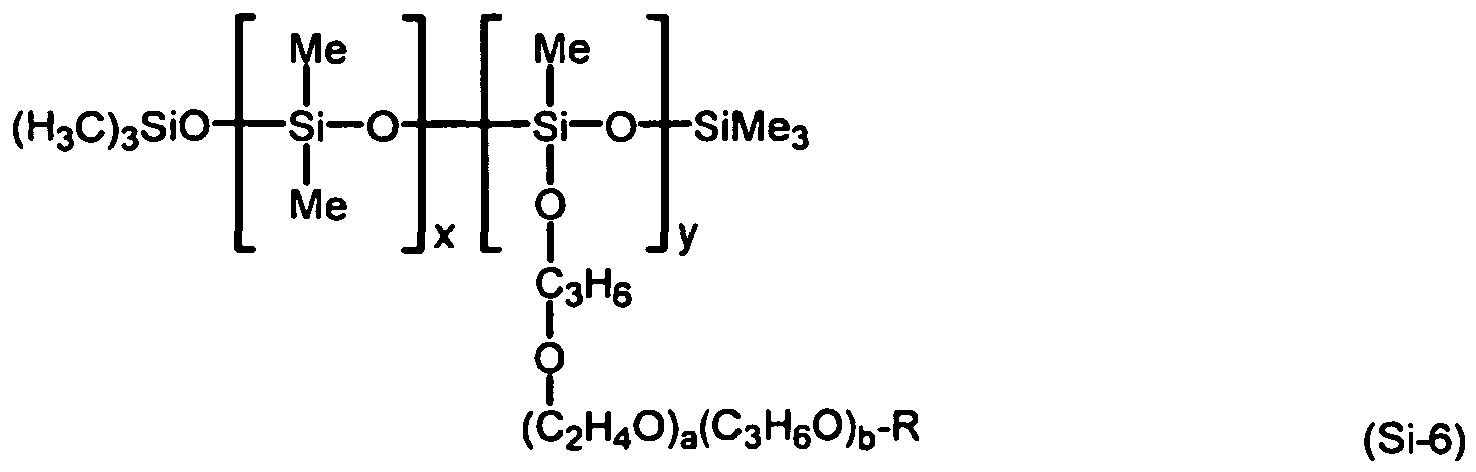

- der Rest R steht für ein Wasserstoffatom, eine Alkylgruppe mit 1 bis 12 C-Atomen, eine Alkoxygruppe mit 1 bis 12 C-Atomen oder eine Hydroxylgruppe,
- die Reste R' und R" bedeuten Alkylgruppen mit 1 bis 12 C-Atomen,
- x steht für eine ganze Zahl von 1 bis 100, bevorzugt von 20 bis 30,
- y steht für eine ganze Zahl von 1 bis 20, bevorzugt von 2 bis 10 und
- a und b stehen für ganze Zahlen von 0 bis 50, bevorzugt von 10 bis 30.
- Besonders bevorzugte Dimethiconcopolyole im Sinne der Erfindung sind beispielsweise die kommerziell unter dem Handelsnamen SILWET (Union Carbide Corporation), Abil (Goldschmidt) und DOW CORNING (Dow) vertriebenen Produkte.
- Erfindungsgemäß besonders bevorzugte Dimethiconcopolyole sind Dow Corning 190, Dow Corning 193 (Dow), Abil EM 97 und Abil EM 90.
- Bevorzugte erfindungsgemäße Produkte sind dadurch gekennzeichnet, dass die Benefit-Zusammensetzung mindestens einen Fettstoff in einer Gesamtmenge von 0,1-50 Gew.%, bevorzugt 0,5 - 20 Gew.% und besonders bevorzugt 1,0 - 10 Gew.%, jeweils bezogen auf die Benefit-Zusammensetzung, enthält.
- Antimikrobielle Wirkstoffe bzw. Konservierungsmittel unterscheidet man je nach antimikrobiellem Spektrum und Wirkungsmechanismus zwischen Bakteriostatika und Bakteriziden, Fungistatika und Fungiziden usw. Wichtige Stoffe aus diesen Gruppen sind beispielsweise Benzalkoniumchloride, Alkylarylsulfonate, Halogenphenole und Phenolmercuriacetat.
- Erfindungsgemäß bevorzugte geruchskomplexierende Substanzen sind ausgewählt aus Silicaten, Zinkricinoleat, Cyclodextrinen, Aluminiumoxid sowie Chlorophyll. Zu den erfindungsgemäß besonders bevorzugten Silicaten zählen vor allem Schichtsilicate und unter diesen insbesondere Montmorillonit, Kaolinit, Illit, Beidellit, Nontronit, Saponit, Hectorit, Bentonit und Smectit. Bevorzugte erfindungsgemäße Produkte sind dadurch gekennzeichnet, dass die Benefit-Zusammensetzung mindestens eine geruchskomplexierende Substanz in einer Menge von 0,1 - 10 Gew.%, vorzugsweise 0,5 - 7 Gew.% und insbesondere 1-5 Gew.%, jeweils bezogen auf das Gewicht der Benefit-Zusammensetzung, enthält. Weitere erfindungsgemäß bevorzugte Produkte sind dadurch gekennzeichnet, dass die Benefit-Zusammensetzung zusätzlich zu den mindestens 1 Gew.-% mindestens einer unter Normalbedingungen festen Substanz, die sich in Wasser mit negativer Lösungsenthalpie löst oder in Kontakt mit Wasser Hydratationswärme freisetzt, und dem mindestens einen Wirkstoff, ausgewählt aus Tensiden, kosmetischen Wirkstoffen und dermatologischen Wirkstoffen, antibakteriellen Stoffen, Antioxidantien, Blondier- oder Bleichwirkstoffen, Bügelhilfsmitteln, Enzymen, Farbstoff(vorprodukt)en, Fettstoffen, Fungiziden, Germiziden, geruchskomplexierenden Substanzen, Hydrophobiermitteln, Riechstoffen, UV-Schutz-Substanzen und/oder Weichmachenden Komponenten, weiterhin mindestens einen Hilfsstoff enthält, der ausgewählt ist aus Acidifizierungsmitteln, Alkalisierungsmitteln, Antiredepositionsmitteln, Antistatika, Bleichaktivatoren, Bleich-Boostern, Bleichkatalysatoren, Buildersubstanzen, Cobuildern, Dispergiermitteln, Einlaufverhinderern, Farbschutzstoffen, Klarspülern, Knitterschutzmitteln, Komplexbildnern, Konservierungsmitteln, Korrosionsinhibitoren, optischen Aufhellern, Parfümträgern, Quell- und Schiebefestmitteln, Schauminhibitoren, schmutzabweisenden Stoffen, Silberschutzmitteln, Verdickungsmitteln, Verfärbungsinhibitoren und/oder Vergrauungsinhibitoren.
- Da textile Flächengebilde, insbesondere aus Rayon, Zellwolle, Baumwolle und deren Mischungen, zum Knittern neigen können, weil die Einzelfasern gegen Durchbiegen, Knicken, Pressen und Quetschen quer zur Faserrichtung empfindlich sind, können weitere bevorzugte erfindungsgemäße Produkte, die als Textilpflegemittel ausgebildet sind, mindestens ein synthetisches Knitterschutzmittel enthalten. Hierzu zählen bevorzugt synthetische Produkte auf der Basis von Fettsäuren, Fettsäureestern, Fettsäureamiden, -alkylolestern, -alkylolamiden oder Fettalkoholen, die meist mit Ethylenoxid umgesetzt sind, oder Produkte auf der Basis von Lecithin oder modifizierter Phosphorsäureester.
- In einer weiteren bevorzugten Ausführungsform der Erfindung enthält die erfindungsgemäße Benefit-Zusammensetzung als Hilfsstoff mindestens ein Verdickungsmittel, besonders bevorzugt mindestens ein organisches synthetisches polymeres Verdickungsmittel.
- In einer bevorzugten Ausführungsform der erfindungsgemäßen Lehre kann die Wirkung mit Polymeren weiter gesteigert werden. Unter Polymeren sind sowohl natürliche als auch synthetische Polymere, welche anionisch, kationisch, amphoter geladen oder nichtionisch sein können, zu verstehen.
- Unter kationischen Polymeren sind Polymere zu verstehen, welche in der Haupt- und/oder Seitenkette Gruppen aufweisen, welche "temporär" oder "permanent" kationisch sein kann. Als "permanent kationisch" werden erfindungsgemäß solche Polymere bezeichnet, die unabhängig vom pH-Wert des Mittels eine kationische Gruppe aufweisen. Dies sind in der Regel Polymere, die ein quartäres Stickstoffatom, beispielsweise in Form einer Ammoniumgruppe, enthalten. Bevorzugte kationische Gruppen sind quartäre Ammoniumgruppen. Insbesondere solche Polymere, bei denen die quartäre Ammoniumgruppe über eine C1-4-Kohlenwasserstoffgruppe an eine aus Acrylsäure, Methacrylsäure oder deren Derivaten aufgebaute Polymerhauptkette gebunden sind, haben sich als besonders geeignet erwiesen.
- Homopolymere der allgemeinen Formel (POL-III),

- R18 steht für eine Methylgruppe
- R19, R20 und R21 stehen für Methylgruppen
- m hat den Wert 2.
- Als physiologisch verträgliches Gegenionen X- kommen beispielsweise Halogenidionen, Sulfationen, Phosphationen, Methosulfationen sowie organische Ionen wie Lactat-, Citrat-, Tartrat- und Acetationen in Betracht. Bevorzugt sind Halogenidionen, insbesondere Chlorid.
- Ein besonders geeignetes Homopolymer ist das, gewünschtenfalls vernetzte, Poly(methacryloyloxy-ethyltrimethylammoniumchlorid) mit der INCl-Bezeichnung Polyquaternium-37. Die Vernetzung kann gewünschtenfalls mit Hilfe mehrfach olefinisch ungesättigter Verbindungen, beispielsweise Divinylbenzol, Tetraallyloxyethan, Methylenbisacrylamid, Diallylether, Polyallylpolyglycerylether, oder Allylethern von Zuckern oder Zuckerderivaten wie Erythritol, Pentaerythritol, Arabitol, Mannitol, Sorbitol, Sucrose oder Glucose erfolgen. Methylenbisacrylamid ist ein bevorzugtes Vernetzungsagens.
- Das Homopolymer wird bevorzugt in Form einer nichtwäßrigen Polymerdispersion, die einen Polymeranteil nicht unter 30 Gew.-% aufweisen sollte, eingesetzt. Solche Polymerdispersionen sind unter den Bezeichnungen Salcare® SC 95 (ca. 50 % Polymeranteil, weitere Komponenten: Mineralöl (INCI-Bezeichnung: Mineral Oil) und Tridecyl-polyoxypropylen-polyoxyethylen-ether (INCI-Bezeichnung: PPG-1-Trideceth-6)) und Salcare® SC 96 (ca. 50 % Polymeranteil, weitere Komponenten: Mischung von Diestern des Propylenglycols mit einer Mischung aus Capryl- und Caprinsäure (INCI-Bezeichnung: Propylene Glycol Dicaprylate/Dicaprate) und Tridecyl-polyoxypropylen-polyoxyethylen-ether (INCI-Bezeichnung: PPG-1-Trideceth-6)) im Handel erhältlich.
- Copolymere mit Monomereinheiten gemäß Formel (III) enthalten als nichtionogene Monomereinheiten bevorzugt Acrylamid, Methacrylamid, Acrylsäure-C1-4-alkylester und Methacrylsäure-C1-4-alkylester. Unter diesen nichtionogenen Monomeren ist das Acrylamid besonders bevorzugt. Auch diese Copolymere können, wie im Falle der Homopolymere oben beschrieben, vernetzt sein. Ein erfindungsgemäß bevorzugtes Copolymer ist das vernetzte Acrylamid-Methacryloyloxyethyltrimethylammoniumchlorid-Copolymer. Solche Copolymere, bei denen die Monomere in einem Gewichtsverhältnis von etwa 20:80 vorliegen, sind im Handel als ca. 50 %ige nichtwässrige Polymerdispersion unter der Bezeichnung Salcare® SC 92 erhältlich.
- Weitere bevorzugte kationische Polymere sind beispielsweise
- quaternisierte Cellulose-Derivate, wie sie unter den Bezeichnungen Celquat® und Polymer JR® im Handel erhältlich sind. Die Verbindungen Celquat® H 100, Celquat® L 200 und Polymer JR®400 sind bevorzugte quaternierte Cellulose-Derivate,
- kationische Alkylpolyglycoside gemäß
US 5773595 , - kationisierter Honig, beispielsweise das Handelsprodukt Honeyquat® 50,
- kationische Guar-Derivate, wie insbesondere die unter den Handelsnamen Cosmedia®Guar und Jaguar® vertriebenen Produkte,
- Polysiloxane mit quaternären Gruppen, wie beispielsweise die im Handel erhältlichen Produkte Q2-7224 (Hersteller: Dow Corning; ein stabilisiertes Trimethylsilylamodimethicon), Dow Corning® 929 Emulsion (enthaltend ein hydroxyl-amino-modifiziertes Silicon, das auch als Amodimethicone bezeichnet wird), SM-2059 (Hersteller: General Electric), SLM-55067 (Hersteller: Wacker) sowie Abil®-Quat 3270 und 3272 (Hersteller: Th. Goldschmidt; diquaternäre Polydimethylsiloxane, Quaternium-80),
- polymere Dimethyldiallylammoniumsalze und deren Copolymere mit Estern und Amiden von Acrylsäure und Methacrylsäure. Die unter den Bezeichnungen Merquat®100 (Poly(dimethyldiallylammoniumchlorid)) und Merquat®550 (Dimethyldiallylammoniumchlorid-Acrylamid-Copolymer) im Handel erhältlichen Produkte sind Beispiele für solche kationischen Polymere,
- Copolymere des Vinylpyrrolidons mit quaternierten Derivaten des Dialkylaminoalkylacrylats und -methacrylats, wie beispielsweise mit Diethylsulfat quaternierte Vinylpyrrolidon-Dimethylaminoethylmethacrylat-Copolymere. Solche Verbindungen sind unter den Bezeichnungen Gafquat®734 und Gafquat®755 im Handel erhältlich,
- Vinylpyrrolidon-Vinylimidazoliummethochlorid-Copolymere, wie sie unter den Bezeichnungen Luviquat® FC 370, FC 550, FC 905 und HM 552 angeboten werden.
- quatemierter Polyvinylalkohol,
- sowie die unter den Bezeichnungen
- Polyquaternium 2,
- Polyquaternium 17,
- Polyquaternium 18 und
- Polyquaternium 27 bekannten Polymeren mit quartären Stickstoffatomen in der Polymerhauptkette.
- Gleichfalls als kationische Polymere eingesetzt werden können die unter den Bezeichnungen Polyquaternium-24 (Handelsprodukt z. B. Quatrisoft® LM 200), bekannten Polymere. Ebenfalls erfindungsgemäß bevorzugt sind die Copolymere des Vinylpyrrolidons, wie sie als Handelsprodukte Copolymer 845 (Hersteller: ISP), Gaffix® VC 713 (Hersteller: ISP), Gafquat®ASCP 1011, Gafquat®HS 110, Luviquat®8155 und Luviquat® MS 370 erhältlich sind.
- Weitere erfindungsgemäße kationische Polymere sind die sogenannten "temporär kationischen" Polymere. Diese Polymere enthalten üblicherweise eine Aminogruppe, die bei bestimmten pH-Werten als quartäre Ammoniumgruppe und somit kationisch vorliegt. Bevorzugt sind beispielsweise Chitosan und dessen Derivate, wie sie beispielsweise unter den Handelsbezeichnungen Hydagen® CMF, Hydagen® HCMF, Kytamer® PC und Chitolam® NB/101 im Handel frei verfügbar sind. Chitosane sind deacetylierte Chitine, die in unterschiedlichen Deacetylierungsgraden und unterschiedlichen Abbaugraden (Molekulargewichten) im Handel erhältlich sind. Besonders bevorzugte Chitosane weisen einen Deacetylierungsgrad von wenigstens 80 %, bevorzugt wenigstens 90 %, und eine relative Molmasse von 5 105 bis 5 106 (g/mol) auf.
- Zur Herstellung erfindungsgemäßer Zubereitungen muß das Chitosan in die Salzform überführt werden. Dies kann durch Auflösen in verdünnten wässrigen Säuren erfolgen. Als Säuren sind sowohl Mineralsäuren wie z.B. Salzsäure, Schwefelsäure und Phosphorsäure als auch organische Säuren, z.B. niedermolekulare Carbonsäuren, Polycarbonsäuren und Hydroxycarbonsäuren geeignet. Weiterhin können auch höhermolekulare Alkylsulfonsäuren oder Alkylschwefelsäuren oder Organophosphorsäuren verwendet werden, soweit diese die erforderliche physiologische Verträglichkeit aufweisen. Geeignete Säuren zur Überführung des Chitosans in die Salzform sind z.B. Essigsäure, Glycolsäure, Weinsäure, Apfelsäure, Citronensäure, Milchsäure, 2-Pyrrolidinon-5-carbonsäure, Benzoesäure oder Salicylsäure. Bevorzugt werden niedermolekulare Hydroxycarbonsäuren wie z.B. Glycolsäure oder Milchsäure verwendet. Bei den anionischen Polymeren, welche die Wirkung des erfindungsgemäßen Wirkstoffes unterstützen können, handelt es sich um ein anionische Polymere, welche Carboxylat- und/oder Sulfonatgruppen aufweisen. Beispiele für anionische Monomere, aus denen derartige Polymere bestehen können, sind Acrylsäure, Methacrylsäure, Crotonsäure, Maleinsäureanhydrid und 2-Acrylamido-2-methylpropansulfonsäure. Dabei können die sauren Gruppen ganz oder teilweise als Natrium-, Kalium-, Ammonium-, Mono- oder Triethanolammonium-Salz vorliegen. Bevorzugte Monomere sind 2-Acrylamido-2-methylpropansulfonsäure und Acrylsäure.
- Als ganz besonders wirkungsvoll haben sich anionische Polymere erwiesen, die als alleiniges oder CoMonomer 2-Acrylamido-2-methylpropansulfonsäure enthalten, wobei die Sulfonsäuregruppe ganz oder teilweise als Natrium-, Kalium-, Ammonium-, Mono- oder Triethanolammonium-Salz vorliegen kann. Weiterhin hat sich überraschend gezeigt, dass die Stabilitätseigenschaften und/oder die sensorischen Eigenschaften der erfindungsgemäßen Zusammensetzungen weiter verbessert werden konnten durch den Zusatz mindestens eines polymeren Verdickers in Form eines verzweigten oder vernetzten Polyelektrolyten, wobei der Polyelektrolyt ausgewählt ist aus einem Copolymer aus mindestens zwei Monomer-Typen, wobei mindestens ein Monomer eine starke Säurefunktion enthält, die teilweise oder vollständig neutralisiert ist, und mindestens ein Monomer entweder neutral ist oder eine schwache Säurefunktion enthält. Eine weitere bevorzugte Ausführungsform der Erfindung ist dadurch gekennzeichnet, dass mindestens ein polymerer Verdicker in Form eines verzweigten oder vernetzten Polyelektrolyten enthalten ist, wobei der Polyelektrolyt ausgewählt ist aus einem Copolymer aus mindestens zwei Monomer-Typen, wobei mindestens ein Monomer eine starke Säurefunktion enthält, die teilweise oder vollständig neutralisiert ist, und mindestens ein Monomer entweder neutral ist oder eine schwache Säurefunktion enthält.
- In einer bevorzugten Ausführungsform der Erfindung sind die Polyelektrolytmonomeren, die eine schwache Säurefunktion enthalten, ausgewählt aus den Monomeren, die eine Carboxylgruppe -COOH enthalten, die teilweise oder vollständig neutralisiert ist. Besonders bevorzugte Beispiele für solche schwach sauren Polyelektrolytmonomeren sind Acrylsäure, Methacrylsäure, Itaconsäure und Maleinsäure.
- In einer weiteren bevorzugten Ausführungsform der vorliegenden Erfindung sind die Polyelektrolytmonomere mit einer starken Säuregruppe ausgewählt aus Monomeren, die mit einer Sulfonsäuregruppe -SO3H oder einer Phosphonsäuregruppe funktionalisiert sind. Ein besonders bevorzugtes Polyelektrolytmonomer mit starker Säurefunktion ist 2-Methyl-2[(1-oxo-2-propenyl)amino]-1-propansulfonsäure, die teilweise oder vollständig neutralisiert ist.
- Weitere erfindungsgemäß besonders bevorzugte verdickende Polymere sind teilweise oder vollstandig neutralisierte, vernetzte Copolymere aus 2-Methyl-2[(1-oxo-2-propenyl)amino]-1-propansulfonsäure (AMPS) und Hydroxyethylacrylat. Erfindungsgemäß außerordentlich bevorzugt sind teilweise oder vollständig neutralisierte, vernetzte Copolymere aus 2-Methyl-2[(1-oxo-2-propenyl)amino]-1-propansulfonsäure (AMPS) und Hydroxyethylacrylat.
- Weitere erfindungsgemäß besonders bevorzugte verdickende Polymere sind teilweise oder vollständig neutralisierte, vernetzte Copolymere aus 2-Methyl-2[(1-oxo-2-propenyl)amino]-1-propansulfonsäure (AMPS) und Acrylsäure. Erfindungsgemäß außerordentlich bevorzugt sind teilweise oder vollständig neutralisierte, vernetzte Copolymere aus 2-Methyl-2[(1-oxo-2-propenyl)amino]-1-propansulfonsäure (AMPS) und Acrylsäure.
- Weitere erfindungsgemäß besonders bevorzugte verdickende Polymere sind teilweise oder vollständig neutralisierte, vernetzte Copolymere aus 2-Methyl-2[(1-oxo-2-propenyl)amino]-1-propansulfonsäure (AMPS) und Acrylamid. Erfindungsgemäß außerordentlich bevorzugt sind teilweise oder vollständig neutralisierte, vernetzte Copolymere aus 2-Methyl-2[(1-oxo-2-propenyl)amino]-1-propansulfonsäure (AMPS) und Acrylamid.
- Eine weitere bevorzugte Ausführungsform der Erfindung ist dadurch gekennzeichnet, dass die Polyelektrolytmonomere, die mit einer schwachen oder starken Säuregruppe funktionalisiert sind, teilweise oder vollständig neutralisiert als Natrium-, Kalium-, Ammonium-, Ethanolamin- oder Aminosäure-Satz vorliegen. Besonders bevorzugt sind die Natriumsalze und die Ammoniumsalze.
- Eine weitere bevorzugte Ausführungsform der Erfindung ist dadurch gekennzeichnet, dass das neutrale Polyelektrolytmonomer ausgewählt ist aus 2-Hydroxyethylacrylat, 2,3-Dihydroxypropylacrylat, 2-Hydroxyethylmethacrylat, 2,3-Dihydroxypropylmethacrylat, den ethoxylierten Derivaten der vorstehend genannten Ester mit einem Molekulargewicht zwischen 400 und 1000 g/mol, Acrylamid sowie Vinylpyrrolidon. Erfindungsgemäß besonders bevorzugte verdickende Polymere sind teilweise oder vollständig neutralisierte, vernetzte Copolymere aus 2-Methyl-2[(1-oxo-2-propenyl)amino]-1-propansulfonsäure (AMPS) und Vinylpyrrolidon. Erfindungsgemäß außerordentlich bevorzugt sind teilweise oder vollständig neutralisierte, vernetzte Copolymere aus 2-Methyl-2[(1-oxo-2-propenyl)amino]-1-propansulfonsäure (AMPS) und Vinylpyrrolidon, die in Form des Ammoniumsalzes kommerziell erhältlich sind, z. B. unter dem Handelsnamen Aristoflex® AVC von der Firma Clariant.
- Innerhalb dieser Ausführungsform kann es bevorzugt sein, Copolymere aus mindestens einem anionischen Monomer und mindestens einem nichtionogenen Monomer einzusetzen. Bezüglich der anionischen Monomere wird auf die oben aufgeführten Substanzen verwiesen. Bevorzugte nichtionogene Monomere sind Acrylamid, Methacrylamid, Acrylsäureester, Methacrylsäureester, Vinylpyrrolidon, Vinylether und Vinylester.
- Bevorzugte anionische Copolymere sind Acrylsäure-Acrylamid-Copolymere sowie insbesondere Polyacrylamidcopolymere mit Sulfonsäuregruppen-haltigen Monomeren. Ein besonders bevorzugtes anionisches Copolymer besteht aus 70 bis 55 Mol-% Acrylamid und 30 bis 45 Mol-% 2-Acrylamido-2-methylpropansulfonsäure, wobei die Sulfonsäuregruppe ganz oder teilweise als Natrium-, Kalium-, Ammonium-, Mono- oder Triethanolammonium-Salz vorliegt. Dieses Copolymer kann auch vernetzt vorliegen, wobei als Vernetzungsagentien bevorzugt polyolefinisch ungesättigte Verbindungen wie Tetraallyloxyethan, Allylsucrose, Allylpentaerythrit und Methylen-bisacrylamid zum Einsatz kommen. Ein solches Polymer ist in dem Handelsprodukt Sepigel®305 der Firma SEPPIC enthalten. Die Verwendung dieses Compounds, das neben der Polymerkomponente eine Kohlenwasserstoffmischung (C13-C14-Isoparaffin) und einen nichtionogenen Emulgator (Laureth-7) enthält, hat sich im Rahmen der erfindungsgemäßen Lehre als besonders vorteilhaft erwiesen.
- Ebenfalls bevorzugte anionische Homopolymere sind unvernetzte und vernetzte Polyacrylsäuren. Dabei können Allylether von Pentaerythrit, von Sucrose und von Propylen bevorzugte Vemetzungsagentien sein. Solche Verbindungen sind beispielsweise unter dem Warenzeichen Carbopol® im Handel erhältlich. Copolymere aus Maleinsäureanhydrid und Methylvinylether, insbesondere solche mit Vernetzungen, sind ebenfalls farberhaltende Polymere. Ein mit 1,9-Decadiene vernetztes Maleinsäure-Methylvinylether-Copolymer ist unter der Bezeichnung Stabileze® QM im Handel erhältlich.
- Weiterhin können als Polymere zur Steigerung der Wirkung der erfindungsgemäßen Lehre amphotere Polymere als Bestandteil eingesetzt. Unter dem Begriff amphotere Polymere werden sowohl solche Polymere, die im Molekül sowohl freie Aminogruppen als auch freie -COOH- oder SO3H-Gruppen enthalten und zur Ausbildung innerer Salze befähigt sind, als auch zwitterionische Polymere, die im Molekül quartäre Ammoniumgruppen und -COO-- oder -SO3 --Gruppen enthalten, und solche Polymere zusammengefasst, die -COOH- oder SO3H-Gruppen und quartäre Ammoniumgruppen enthalten.
- Ein Beispiel für ein erfindungsgemäß einsetzbares Amphopolymer ist das unter der Bezeichnung Amphomer® erhältliche Acrylharz, das ein Copolymeres aus tert.-Butylaminoethylmethacrylat, N-(1,1,3,3-Tetramethylbutyl)acrylamid sowie zwei oder mehr Monomeren aus der Gruppe Acrylsäure, Methacrylsäure und deren einfachen Estern darstellt.
- Bevorzugt eingesetzte amphotere Polymere sind solche Polymerisate, die sich im wesentlichen zusammensetzen aus
- (a) Monomeren mit quartären Ammoniumgruppen der allgemeinen Formel (IV),
R22-CH=CR23-CO-Z-(CnH2n)-N(+)R24R25R26 A(-) (IV)
in der R22 und R23 unabhängig voneinander stehen für Wasserstoff oder eine Methylgruppe und R24, R25 und R26 unabhängig voneinander für Alkylgruppen mit 1 bis 4 Kohlenstoff-Atomen, Z eine NH-Gruppe oder ein Sauerstoffatom, n eine ganze Zahl von 2 bis 5 und A(-) das Anion einer organischen oder anorganischen Säure ist
und - (b) monomeren Carbonsäuren der allgemeinen Formel (V),
R27-CH=CR28-COOH (V)
in denen R27 und R28 unabhängig voneinander Wasserstoff oder Methylgruppen sind. - Diese Verbindungen können sowohl direkt als auch in Salzform, die durch Neutralisation der Polymerisate, beispielsweise mit einem Alkalihydroxid, erhalten wird, erfindungsgemäß eingesetzt werden. Ganz besonders bevorzugt sind solche Polymerisate, bei denen Monomere des Typs (a) eingesetzt werden, bei denen R24, R25 und R26 Methylgruppen sind, Z eine NH-Gruppe und A(-) ein Halogenid-, Methoxysulfat- oder Ethoxysulfat-Ion ist; Acrylamidopropyl-trimethyl-ammoniumchlorid ist ein besonders bevorzugtes Monomeres (a). Als Monomeres (b) für die genannten Polymerisate wird bevorzugt Acrylsäure verwendet.
- Die erfindungsgemäßen Produkte können in einer weiteren bevorzugten Variante weiterhin mindestens ein nichtionogenes Polymer als Hilfsstoff, insbesondere als Verdickungsmittel, aber auch als Vergrauungsinhibitor, Dispergiermittel oder Cobuilder, enthalten.
- Bevorzugte nichtionogene Polymere sind beispielsweise:
- VinylpyrrolidonNinylester-Copolymere, wie sie beispielsweise unter dem Warenzeichen Luviskol® (BASF) vertrieben werden. Luviskol® VA 64 und Luviskol® VA 73, jeweils VinylpyrrolidonNinylacetat-Copolymere,
- sind ebenfalls bevorzugte nichtionische Polymere; Celluloseether, wie Hydroxypropylcellulose, Hydroxyethylcellulose und Methylhydroxypropylcellulose, wie sie beispielsweise unter den Warenzeichen Culminal® und Benecel® (AQUALON) vertrieben werden; Schellack; Polyvinylpyrrolidone, wie sie beispielsweise unter der Bezeichnung Luviskol® (BASF) vertrieben werden.
- Es kann erfindungsgemäß besonders bevorzugt sein, dass die erfindungsgemäßen Benefit-Zusammensetzungen mehrere, insbesondere zwei verschiedene Polymere gleicher Ladung und/oder jeweils ein ionisches und ein amphoteres und/oder nicht ionisches Polymer enthalten.
- In einer weiteren erfindungsgemäß bevorzugten Ausführungsform wird die Gesamtmenge an unter Normalbedingungen festen Substanzen, die sich in Wasser mit negativer Lösungsenthalpie lösen oder in Kontakt mit Wasser Hydratationswärme freisetzen, und die Gesamtmenge an Tensid in einem Gewichtsverhältnis zueinander von 0,1 - 100, bevorzugt 0,2 - 50, besonders bevorzugt 0,5 - 20 und außerordentlich bevorzugt 1-10, ebenfalls außerordentlich bevorzugt 1,5-3 eingesetzt, um eine optimale Wärmeentwicklung in Verbindung mit einer optimalen Benefit-Leistung, insbesondere einer optimalen Wasch- und Reinigungsleistung und gegebenenfalls einer optimalen Benefit-Leistung weiterer enthaltener Wirkstoffe, der erfindungsgemäßen Produkte zu gewährleisten.
- In einer weiteren erfindungsgemäß bevorzugten Ausführungsform wird die Gesamtmenge an unter Normalbedingungen festen Substanzen, die sich in Wasser mit negativer Lösungsenthalpie lösen oder in Kontakt mit Wasser Hydratationswärme freisetzen, und die Gesamtmenge an kosmetischen oder dermatologischen Wirkstoffen in einem Gewichtsverhältnis zueinander von 1 - 1000, bevorzugt 2 - 500, besonders bevorzugt 5-100 und außerordentlich bevorzugt 10-50, ebenfalls außerordentlich bevorzugt 15 - 30 eingesetzt, um eine optimale Wärmeentwicklung in Verbindung mit einer optimalen Benefit-Leistung, insbesondere einer optimalen Antifalten-, Antiageing-, Antioxidans-, Hautbefeuchtungs-, Hautbräunungs-, Hautaufhellungs-, Hautberuhigungs-, entzündungshemmenden, sebumregulierenden, Haarwuchs inhibierenden und/oder Antischuppen-Leistung und gegebenenfalls einer optimalen Benefit-Leistung weiterer enthaltener Wirkstoffe, der erfindungsgemäßen Produkte zu gewährleisten.
- In einer weiteren erfindungsgemäß bevorzugten Ausführungsform wird die Gesamtmenge an unter Normalbedingungen festen Substanzen, die sich in Wasser mit negativer Lösungsenthalpie lösen oder in Kontakt mit Wasser Hydratationswärme freisetzen, und die Gesamtmenge an festen, teilchenförmigen inerten Füllstoffen in einem Gewichtsverhältnis zueinander von 0,01 - 50, bevorzugt 0,1 - 20, besonders bevorzugt 0,2-10 und außerordentlich bevorzugt 0,3 - 5, ebenfalls außerordentlich bevorzugt 0,5 - 1 eingesetzt, um eine optimale Wärmeentwicklung in Verbindung mit einer optimalen Benefit-Leistung, insbesondere einer optimalen Reinigungs-, Konditionier-, Bleich-, Desinfektions-, Haarfärbe- oder Hautpflegeleistung, der erfindungsgemäßen Produkte zu gewährleisten. Substrat
- Erfindungsgemäß bevorzugte Produkte sind dadurch gekennzeichnet, dass das Trägersubstrat ausgewählt ist aus einem Beutel, einem Pad, einem Schwamm, einem porenhaltigen Schwamm, einem maschenhaltigen Schwamm, einem Tuch, einem Pflaster oder einem Bausch.
- Erfindungsgemäß bevorzugte Produkte, deren Substrat als "Kissen", "pouch" oder "Beutel" ausgebildet sein können, umfassen einen Beutel, der für Luft und Wasser durchlässig ist. Dieser Beutel kann aus an sich wasserundurchlässigen Materialien gefertigt werden, die durch geeignete Fertigung wasserpermeabel gemacht wurden. So können beispielsweise Folien mit Öffnungen versehen werden. Im Hinblick auf die bevorzugte kosmetische Ausführungsform, bei der der Konsument das erfindungsgemäße Kissen über seine Haut reiben soll, sind allerdings Gewebe, Gewirke oder Vliese aus natürlichen oder synthetischen Fasern als Beutelmaterialien bevorzugt. Besonders bevorzugte Materialien für diese Gewebe, Gewirke oder Vliese sind als natürliche Fasern auf Cellulosebasis Baumwolle, Kapok, Flachs, Leinen, Hanf, Jute, Ramie; als natürliche Fasern auf Eiweißbasis Wolle und andere Tierhaare wie Angora, Alpaka, Kamelhaar, Kaschmir, Lama, Mohair, Cashoora und Wikunja, Seide; und als synthetische Fasern Kunstfasern auf Cellulosebasis wie Viskose, Cupro, Modal, Lyocell, Acetat, Triacetat sowie als vollsynthetische Fasern Perlon oder Nylon bzw. andere Polyamide, Polyacryl, Polyester, Polypropylen, Polyurethan, Modacryl, Elastan.
- Erfindungsgemäß besonders bevorzugt können solche wasserdurchlässigen Beutel sein, deren Beutelmaterial strukturiert oder genoppt ist, um bei der Reinigung gleichzeitig einen mechanisch-abrasiven Effekt zu erzielen. Die Struktur kann durch Poren, Vertiefungen, Prägungen und Erhöhungen der Oberfläche des Beutelmaterials erzielt werden. Werden geprägte Materialien, insbesondere Vliese, verwendet, so erleichtern große Kavitäten die Aufnahme von Schmutz und Verunreinigungen beim Behandeln der Oberfläche (Haut, Haar, hard surfaces) mit dem erfindungsgemäßen Produkt Die Reinigungswirkung kann gegenüber ungeprägten Substraten um ein Vielfaches gesteigert werden. Bei Substraten in Pad- oder Schwammform aus porösem Material erfolgt eine verbesserte Schmutzaufnahme analog durch größere Poren an der Oberfläche des Substrates.
- Geeignete Noppen werden bevorzugt durch das (beispielsweise) punktförmige (bzw. kleinflächige) Aufbringen von kleinen Mengen eines geschmolzenen Kunststoffs, der zu abrasiv wirkenden Strukturen erstarrt, auf die Oberfläche des Beutelmaterials erhalten. Hierzu wird ausdrücklich Bezug genommen auf die Offenbarung in der Research Disclosure 1996-382014 A, publiziert am 20.01.1996, sowie auf
EP 1283019 A1 . - Geeignete Noppen werden auch durch das Aufbringen, insbesondere das Aufkleben, von (beispielsweise mineralischen) Abrasivpartikeln, auf die Oberfläche des Beutelmaterials erhalten.
- Entsprechende Strukturierungen und Noppen sind nicht nur für die Substratform "Beutel", sondern auch für Pads, Tücher und Bäusche möglich und, je nach Anwendungsgebiet des erfindungsgemäßen Produkts, erfindungsgemäß bevorzugt.
- Weitere erfindungsgemäß bevorzugte Produkte sind dadurch gekennzeichnet, dass der Beutel oder das Tuch aus Vlies besteht. Im Rahmen der vorliegenden Erfindung kennzeichnet der Begriff "Vlies" zusammenhängende Fasermassen, die aus vielen einzelnen Stapeln unterschiedlicher Länge und Feinheit bestehen.
- Erfindungsgemäß bevorzugte Trägersubstrate, insbesondere Tücher und Beutel, können sowohl aus wasserlöslichen (wie z. B. Hygiene- und Toilettenpapier) als auch aus wasserunlöslichen Materialien (z.B. einem Vlies) bestehen. Wasserunlösliche Materialien sind erfindungsgemäß bevorzugt. Erfindungsgemäß bevorzugt werden in Kombination mit den erfindungsgemäßen Benefit-Zusammensetzungen "trockene" Substrate eingesetzt, die bevorzugt aus Papier, Zellstoff, Watte, Schaumstoff oder Vlies bestehen, insbesondere aus wasserstrahlverfestigtem ("hydroentangled, spun-lace") und/oder wasserstrahlgeprägtem ("hydroembossed") Vlies. Derartige Vliese können Makroprägungen jeden gewünschten Musters aufweisen. Die zu treffende Auswahl richtet sich zum einen nach der aufzubringenden Benefit-Zusammensetzung und zum anderen nach dem Einsatzgebiet des erfindungsgemäßen Produktes.
- Die Substrate können bevorzugt auch als Bausch, gelochtes Vlies oder Netz ausgeführt sein.
- Falls das erfindungsgemäße Produkt als Substrat ein geprägtes Vlies umfasst, ist es erfindungsgemäß bevorzugt, wenn, bezogen auf das ungeprägte Vlies, die Dicke des Vlieses mit den durch die Prägung erzeugten Erhebungen ungefähr doppelt so dick ist. In weiteren bevorzugten erfindungsgemäßen Ausführungsformen ist das geprägte Vlies zwischen 5 % und 50 %, ganz besonders bevorzugt zwischen 10 % und 25 % dicker als das ungeprägte Tuch.
- Es hat sich weiterhin als erfindungsgemäß bevorzugt herausgestellt, wenn das Tuch-Substrat ein Flächengewicht von 20 bis 120 g/m2, bevorzugt 30 bis 80 g/m2, besonders bevorzugt 40 bis 60 g/m2, außerordentlich bevorzugt 45 - 55 g / m2, aufweist (gemessen bei 20 °C ± 2 °C und bei einer Feuchtigkeit der Raumluft von 65 % ± 5 % für 24 Stunden).
- Die bevorzugte Dicke erfindungsgemäß bevorzugter Vlies- oder Papiermaterialien für Tuch- oder Beutelsubstrate beträgt 0,2 mm bis 2 mm, insbesondere 0,4 mm bis 1,5 mm, ganz besonders bevorzugt 0,6 mm bis 0,9 mm.
- Falls das erfindungsgemäße Produkt als Substrat ein gelochtes Substrat umfasst, ist es erfindungsgemäß bevorzugt, wenn die Anzahl der Löcher pro Quadratzentimeter Substrat mindestens 10, bevorzugt mindestens 15 beträgt. Bevorzugte Lochzahlen sind 15-80 pro cm2, besonders bevorzugt sind 24 - 60 Löcher pro cm2, außerordentlich bevorzugt sind 30 - 49 Löcher pro cm2.
- Falls das erfindungsgemäße Produkt als Substrat ein gelochtes Vlies umfasst, ist es erfindungsgemäß bevorzugt, wenn die Anzahl der Löcher pro Quadratzentimeter Vlies mindestens 10, bevorzugt mindestens 15 beträgt. Bevorzugte Lochzahlen sind 15-80 pro cm2, besonders bevorzugt sind 24 - 60 Löcher pro cm2, außerordentlich bevorzugt sind 30 - 49 Löcher pro cm2.
- Gelochte Vliese werden bevorzugt durch Wasserstrahlprägung, die bevorzugt gleichzeitig mit der Wasserstrahlverfilzung erfolgt, hergestellt. Ebenfalls bevorzugt kann es sein, dass die - bevorzugt wasserstrahlverfilzten - Vliese nachträglich gestanzt werden.
- Bevorzugte Substrat-Vliese sind einlagig. Eine mehrlagige Ausführungsform ist aber ebenfalls möglich. Als Ausgangsmaterialien für den Vliesstoff des Tuches oder Beutels können generell alle organischen und anorganischen Faserstoffe auf natürlicher und synthetischer Basis verwendet werden. Beispielhaft seien Viskose, Baumwolle, Zellulose, Jute, Hanf, Sisal, Seide, Wolle, Polypropylen, Polyester, Polyethylenterephthalat (PET), Aramid, Nylon, Polyvinylderivate, Polyurethane, Polylactid, Polyhydroxyalkanoat, Celluloseester und/oder Polyethylen sowie auch mineralische Fasern wie Glasfasern oder Kohlenstofffasern angeführt. Die vorliegende Erfindung ist aber nicht auf die genannten Materialien beschränkt, sondern es können eine Vielzahl weiterer Fasern zur Vliesherstellung eingesetzt werden. Es ist erfindungsgemäß besonders bevorzugt, wenn die eingesetzten Fasern nicht wasserlöslich sind.
- In einer bevorzugten Ausführungsform des Vlieses oder Beutels bestehen die Fasern aus einer Mischung aus 60 % bis 80 % Viskose und 40% bis 20 % PET. Besonders bevorzugt ist eine Mischung aus 70 % Viskose und 30 % PET.
- Besonders bevorzugt sind auch Fasern aus hochfesten Polymeren wie Polyamid, Polyester und/oder hochgerecktem Polyethylen. Darüber hinaus können die Fasern auch eingefärbt sein, um die optische Attraktivität des Substrates betonen und/oder erhöhen zu können. Die Fasern können zusätzlich UV-Stabilisatoren und/oder Konservierungsmittel enthalten.
- Die zur Bildung erfindungsgemäß bevorzugter Substrate eingesetzten Fasern weisen vorzugsweise eine Wasseraufnahmerate von mehr als 60 mm/10 min (gemessen mit dem EDANA Test 10.1-72), insbesondere mehr als 80 mm/10 min auf. Ferner weisen die zur Bildung erfindungsgemäß bevorzugter Substrate eingesetzten Fasern vorzugsweise ein Wasseraufnahmevermögen von mehr als 5 g Wasser/g Fasern (gemessen mit dem EDANA Test 10.1-72), insbesondere mehr als 8 g/g, besonders bevorzugt von 8,5-10 g/g, auf.
- Weitere besonders bevorzugte Substrate im Sinne der vorliegenden Erfindung weisen eine Reißkraft auf von mindestens 60 Newton/50 mm, bevorzugt mindestens 80 Newton/50 mm (trocken, in Maschinenrichtung) und/oder mindestens 20 Newton/50 mm, bevorzugt mindestens 30 Newton/ 50 mm (trocken, in Querrichtung) und/oder mindestens 4 Newton/50 mm, bevorzugt mindestens 60 Newton/50 mm (in feucht-beaufschlagtem Zustand, in Maschinenrichtung) und/oder mindestens 10 Newton/50 mm, bevorzugt mindestens 20 Newton/50 mm (in feucht-beaufschlagtem Zustand, in Querrichtung).
- Weitere besonders bevorzugte Substrate im Sinne der vorliegenden Erfindung weisen eine Dehnfähigkeit auf von 15 - 100%, bevorzugt 20 - 50 % (trocken, in Maschinenrichtung) und/oder 40 - 120 %, bevorzugt 50 - 85 % (trocken, in Querrichtung) und/oder 15 - 100%, bevorzugt 20 - 40 % (in feucht-beaufschlagtem Zustand, in Maschinenrichtung) und/oder 40-120 %, bevorzugt 50 - 85 % (in feucht-beaufschlagtem Zustand, in Querrichtung).
- Erfindungsgemäß bevorzugte Verfahren zur Herstellung der erfindungsgemäßen Produkte sind dadurch gekennzeichnet, dass folgende Verfahren Anwendung finden können:
- Herstellen der Benefit-Zusammensetzung
- Die nicht-flüchtigen und mechanisch stabilen Bestandteile der Benefit-Zusammensetzung werden in eine Trockenmühle oder ähnliche Mischapparatur gegeben und vermischt, bis sich eine gleichförmig verteilte Zusammensetzung ergibt. Anschließend werden flüchtige oder mechanisch empfindliche Benefit-Wirkstoffe, beispielsweise Duftstoffe oder verkapselte Wirkstoffe, als eine Phase B in die trockene Mühle unter gleichzeitigem Bewegen (nicht Mahlen) der gesamten Zusammensetzung gesprüht.
- In einer anderen bevorzugten Herstellvariante wird das Parfüm nicht aufgesprüht, sondern als geträgertes Parfüm zugemischt.
- 2. Beaufschlagung des Trägersubstrates mit der Benefit-Zusammensetzung
- a) Beschichtung durch Abstreifung. Einer Abstreifvorrichtung (Abstreifbalken, gegenläufiges Rollensystem o.a.) wird kontinuierlich eine fließfähige Imprägnierung zugeführt. Diese wird durch den Kontakt auf ein vorbeilaufendes Substrat übertragen. Anschließend kann eine Trocknung erfolgen.
- b) Beschichtung durch Aufsprühung. Die sprühfähige Imprägnierung wird auf das vorbeilaufende Substrat aufgesprüht. Anschließend kann eine Trocknung erfolgen.
- c) Beschichtung durch Tauchen. Das Substratmaterial, insbesondere in Tuchform, durchläuft ein mit der flüssigen Imprägnierung gefülltes Bad, oder eine komplette Tuchrolle wird in die Imprägnierung eingetaucht. Anschließend kann eine Trocknung erfolgen.
- d) Beschichtung mit einem Pulver. Es kann eine Einarbeitung durch anschließendes Erhitzen oder mechanische Einarbeitung nachgeschaltet sein. Das Pulver kann auch mit einer Klebesubstanz (Polymer, geschmolzenes und wiedererstarrtes Lipid etc.) am Substrat fixiert werden.
- e) Verpackung der pulverförmigen Benefit-Zusammensetzung in einem Beutel. Hierzu werden bevorzugt Rollen von ersten und zweiten Substratfolien der verschiedenen Seiten von einer Beschickungsposition abgewickelt. Die Benefit-Zusammensetzung wird in einen Trichter, der über der Beschickungsposition angeordnet ist, gegeben und zwischen die Substratfolien gespeist. Eine für ein erfindungsgemäßes Pouch geeignete Dosis an Benefit-Zusammensetzung wird direkt zwischen den Folien freigesetzt und in einem teilweise gebildeten Beutel oder Säckchen eingefangen. An diesem Punkt werden alle Kanten, die den Beutel definieren, im Schiebewerk verschlossen unter Einschließen der Benefit-Zusammensetzung darin. Schneidwerke trennen dann einen verschlossenen Abschnitt von einem weiteren, wodurch die erfindungsgemäßen Produkte gebildet werden. Eines oder mehrere der erfindungsgemäßen Produkte werden dann in eine Feuchtigkeits-undurchlässige äußere Verpackung, beispielsweise einen laminierten Folienbeutel oder eine verschließbare, insbesondere eine wiederverschließbare, Dose, zur Verhinderung einer Aktivierung des Wärme erzeugenden Systems während der Lagerung, verpackt.
- Ultraschallschweißen kann als eine Alternative zum Wärmeverschließen der ersten und zweiten Substrate miteinander angewendet werden. Fadenvernähen, Kleberauftrag oder andere Verschlussmechanismen können ebenfalls angewendet werden.
- Erfindungsgemäß bevorzugt ist die Verwendung der erfindungsgemäßen Produkte als Reinigungs-, Hygiene- oder Erfrischungstücher, -pads,- schwämme, -beutel, -bausch oder -pflaster.
- Erfindungsgemäß bevorzugt ist auch die Verwendung der erfindungsgemäßen Produkte zur Reinigung und Pflege der Haut sowie die Verwendung von erfindungsgemäßen Produkten als Gesichtstücher, Babytücher, Intimpflegetücher, Deotücher, Sonnenschutztücher (oder analog als Pad, Schwamm, Beutel, Bausch oder Pflaster) und/oder zur Pflege und/oder Reinigung sensibler Haut. Darüber hinaus werden die erfindungsgemäßen Produkte bevorzugt zur Reinigung, Politur und Pflege von Bedarfsgegenständen des täglichen Lebens (z.B. Geschirr, Tisch- und Schrankflächen, Autos, Fußböden, Kacheln, sanitäre Einrichtungen, Fenster, Glas) verwendet.
- Ein weiteres bevorzugtes erfindungsgemäßes Produkt ist dadurch gekennzeichnet, dass die Benefit-Zusammensetzung eine Reinigungszusammensetzung, bevorzugt zur Haar-, Gesichts- oder Körperreinigung oder zum Entfernen von Make-up, darstellt.
- Ein weiteres bevorzugtes erfindungsgemäßes Produkt ist dadurch gekennzeichnet, dass die Benefit-Zusammensetzung eine konditionierende Zusammensetzung darstellt.
- Ein weiteres bevorzugtes erfindungsgemäßes Produkt ist dadurch gekennzeichnet, dass die konditionierende Zusammensetzung eine Zusammensetzung für die persönliche Pflege ist, ausgewählt aus:
- 2-in1-Zusammensetzungen zur Reinigung und gleichzeitigen Pflege der Gesichts- und/oder Körperhaut und/oder der Haare,
- Sonnenschutzzusammensetzungen,
- Anti-Akne-Zusammensetzungen,
- Desinfektionszusammensetzungen,
- Schmink- oder Abdeckzusammensetzungen,
- Zusammensetzungen zur Veränderung der Haarfarbe.
- Ein weiteres bevorzugtes erfindungsgemäßes Produkt ist dadurch gekennzeichnet, dass das Trägersubstrat erste und zweite in Wasser unlösliche Substrate umfasst, wobei mindestens eines für Wasser permeabel ist, wobei die ersten und zweiten wasserunlöslichen Substrate dazwischen einen Bereich bilden, der die Benefit-Zusammensetzung aufnimmt, wobei das erste Substrat ein Spun-Lace- oder ein kardierteslchemisch gebundenes Vliesmaterial umfasst, und das zweite Substrat ein High-Loft-Tuch, das an eine Vliesfolie gebunden ist, die ausgewählt ist aus der Gruppe, bestehend aus schmelzgeblasenen, spunbonded und schmelzgeblasenen/spunbonded Vliesen, umfasst.
- Eine in Wasser unlösliche High-Loft-Folie bildet mindestens einen zweiten Teil des zweiten Substrats mit einer High-Loft-Oberfläche an der Auswärtsseite des zweiten Substrats. Das erste Substrat ist von einem anderen Aufbau als von dem zweiten. Insbesondere ist das erste Substrat ein Spun-Lace (wasservernadeltes, "hydroentangled") Vliestextil oder ein kardiertes/chemisch gebundenes Vlies. Schmelzgeblasene oder spunbonded Materialien weisen den Vorteil auf, dass sie in ihrer Verschließbarkeit weniger negativ beeinflusst werden, wenn verunreinigende Teilchen der Benefit-Zusammensetzung unabsichtlich während des Beutelherstellungsverfahrens in die Maschinerie gelangen. Darüber hinaus erlauben schmelzgeblasene und spun-bonded Vliese bessere Verschließbarkeit, wenn sie sandwichartig zwischen dem ersten Substrat und jedem High-Loft-Folien-bildenden Teil des zweiten Substrates angeordnet sind. Die High-Loft-Folie verleiht dem zweiten Substrat erhöhte Belüftung und verbesserte Schäumbarkeitseigenschaften. In den Beuteln, wo eine High-Loft-Seite bevorzugt ist, ist es notwendig, das schmelzgeblasene und/oder spun-bonded Substrat für den zusätzlichen Zweck zu verteilen, um Pulververluste oder Verluste der Benefit-Zusammensetzung durch die High-Loft-Folie hindurch zu verhindern.
- Bevorzugte erfindungsgemäße Produkte, die einen Beutel, einen Schwamm, ein Tuch, ein Pad oder einen Bausch als Trägersubstrat umfassen, sind dadurch gekennzeichnet dass sie eine ovale Form mit einer Größe aufweisen, die sich der menschlichen Hand anpasst. Bevorzugte Querschnittsdurchmesser des Substrats liegen im Bereich von 2 - 15 cm, besonders bevorzugt 5-10 cm.
- Bevorzugte erfindungsgemäße Produkte, die einen Beutel und eine pulverförmige Benefit-Zusammensetzung umfassen, sind dadurch gekennzeichnet, dass der Beutel mindestens eine Folie aufweist, die aus mindestens einer Schicht eines schmelzgeblasenen oder spun-bonded Vliesmaterials besteht. Besonders bevorzugte Folien für das Beutelmaterial umfassen mindestens zwei Schichten, mindestens drei oder sogar mindestens vier Schichten von Vliesmaterialien, die schmelzgeblasen oder spun-bonded sind. Dabei kann die Folie eine einzige schmelzgeblasene Schicht sein, jedoch stellt sie vorzugsweise eine Kombination von verschiedenen Schichten dar. Das schmelzgeblasene Vliesmaterial kann mit anderen tragenden Vliesmaterialien kombiniert oder laminiert werden, wie spun-bonded Vliesmaterialien, um dem Trägersubstrat beispielsweise Festigkeit zu verleihen. Spun-bonded Vliesmaterialien zeichnen sich durch ein hohes Festigkeits-/ Gewichtsverhältnis, isotrope Festigkeit, hohe Porosität und gute Abriebbeständigkeit aus. Eine bevorzugte Ausführungsform weist ein dreischichtiges Material spun-bonded/schmelzgeblasen/ spun-bonded (SMS) auf. Eine weitere bevorzugte Ausführungsform weist ein vierschichtiges Material spun-bonded/schmelzgeblasen/schmelzgeblasen/spun-bonded (SMMS) auf. In diesen Systemen sind die schmelzgeblasenen Fasern sehr kompakt und wirken als eine Sperre gegen den Verlust an Benefit-Zusammensetzung vor Ingebrauchnahme. Die spun-bonded Schichten sind dabei wegen ihrer Festigkeit und Weichheit bevorzugt.
- Das schmelzgeblasene Vliesmaterial kann jedes schmelzgeblasene Vliesmaterial sein, das aus einem thermoplastischen Polymer mit einem Schmelzpunkt größer als etwa 50°C hergestellt ist. Ein außerordentlich bevorzugtes Polymer ist Polypropylen. Andere bevorzugte thermoplastische Polymere sind ausgewählt aus Poly(butylenterephthalat), Polycaprolactam, Poly(ethylenterephthalat) und Polyethylen. Spunbonding erfordert Extrudieren einer Vielzahl von kontinuierlichen thermoplastischen Polymersträngen durch eine Vielzahl von Düsenöffnungen in einer Abwärtsrichtung auf eine bewegte Oberfläche, wo die extrudierten Stränge statistisch verteilt gesammelt werden. Die statistisch abgeschiedenen Stränge werden dann miteinander in einem erhitzten Walzspalt verbunden, um ausreichende Integrität für das erhaltene Vliesmaterial von kontinuierlichen Fasern bereitzustellen.
- Schmelzblasen unterscheidet sich von Spunbonding dahin gehend, dass die extrudierten Polymerstränge aufgebrochen werden und durch einen Druckluftstrom in einzelne Fasern verteilt werden, bevor sie auf der gesammelten Oberfläche abgeschieden werden. Zusätzlich werden die Fasern im Wesentlichen durch die Luft gekühlt, so dass sie nicht wesentlich kristallisieren und/ oder aneinander binden. Das Binden des Flächengebildes, um Integrität und Festigkeit beizubehalten, findet als ein getrennter Stromabwärtsvorgang statt.
- Bevorzugte schmelzgeblasene Vliesmaterialien sind durch ein Flächengewicht im Bereich von 20 bis 300 g/m2, bevorzugt 80 bis 250 und besonders bevorzugt 100 bis 200 g/m2 gekennzeichnet.
- Ein besonders bevorzugtes Vliesmaterial ist ein schmelzgeblaseneslspun-bonded Vliessubstrat, das von Polyprop Corporation erhältlich ist.
- Ein besonders bevorzugtes Vliesmaterial ist ein Spun-Lace- oder ein kardiertes/chemisch gebundenes Vlies aus in Wasser unlöslichem Material. Besonders bevorzugt ist ein Tuch NC008 (Image Spun Lace), erhältlich von der PGI Corporation.
- Falls verwendet, ist die High-Loft-Folie schrittweise fluidpermeabel. Erfindungsgemäß bedeutet "High-Loft", dass die Folie eine Dichte von 0,00005 g/cm3 bis 0,1 g/cm3, vorzugsweise 0,001 g/m3 bis 0,09 g/cm3 und eine Dicke von 1-5 mm aufweist.
- Weitere erfindungsgemäß bevorzugte Trägersubstrate sind ausgewählt aus geformten Filmen, Schwämmen, Schäumen, leichten Baumwollstoffen usw. Wenn das Trägersubstrat Fasern umfasst, können die Fasern entweder statistisch angeordnet sein oder sie können kardiert sein (das heißt gekämmt, um vorwiegend in einer Richtung orientiert zu sein).
- Für die erfindungsgemäßen Zwecke ist das am meisten bevorzugte High-Loft-Material ein vernadelter Verbundwerkstoff, der von der Union Wadding Corporation vertrieben wird.
- Es ist wichtig, dass die Trägersubstratmaterialien beim Reiben des Gegenstands vom Verbraucher nicht leicht zerrissen werden. Bei der erfindungsgemäßen Ausführungsform als Säckchen oder Sachet sollten die erfindungsgemäßen Beutel nicht aufreißen. Stattdessen ist es erfindungsgemäß bevorzugt, dass alle Zusammensetzungskomponenten durch Auflösung durch die permeablen Wände des Beutels nach außen gelangen.
- Hautoberflächen, für die die erfindungsgemäßen Gegenstände verwendbar sind, schließen Gesicht, Körper, Kopfhaut, Achseln und auch Beine/Füße ein. Wenn der Gegenstand ein Fußreinigungsprodukt ist, ist es für das Trägersubstrat vorteilhaft, auf einer seiner Seiten grob zu sein, während die zweite Seite des Substrats weich und mild sein kann.
- Ein weiterer Gegenstand der vorliegenden Anmeldung ist ein nicht-therapeutisches oder therapeutisches Verfahren zur persönlichen Reinigung und/oder zur persönlichen Pflege, gekennzeichnet durch folgende Verfahrensschritte:
- (i) Anfeuchten eines Produkts gemäß einem der Patentansprüche 1-25 mit Wasser und
- (ii) Auftragen des angefeuchteten Produkts auf die zu reinigende und/oder pflegende Haut- und/oder Haaroberfläche,
- (iii) gegebenenfalls Abspülen und/oder Abwischen und/oder Aussspülen der Benefit-Zusammensetzung.
- Bei dem Verfahren ist es erfindungsgemäß bevorzugt, dass Schritt (i) maximal 10 Minuten, bevorzugt maximal 5 Minuten, besonders bevorzugt maximal 1 Minute, vor Schritt (ii) erfolgt.
- Ein weiterer Gegenstand der vorliegenden Anmeldung ist die Verwendung eines Produkts gemäß einem der Ansprüche 1 - 10 zur nicht-therapeutischen oder therapeutischen persönlichen Reinigung und/oder zur nicht-therapeutischen oder therapeutischen persönlichen Pflege, wobei das Produkt vor dem Behandlungsschritt mit Wasser angefeuchtet wird.
- Bei den Verwendungen ist es erfindungsgemäß bevorzugt, dass das Produkt maximal 10 Minuten, besonders bevorzugt maximal 5 Minuten, außerordentlich bevorzugt maximal 1 Minute vor dem Behandlungsschritt angefeuchtet wird.
- Die nachstehenden Beispiele dienen dazu, die erfindungsgemäßen Ausführungsformen näher zu erläutern, ohne sie hierauf zu beschränken.
- Alle Teil-, Prozent- und Verhältnisangaben, auf die hierin und in den Patentansprüchen Bezug genommen wird, sind, sofern nicht anders ausgewiesen, auf das Gewicht der Benefit-Zusammensetzung bezogen.
- Eine Benefit-Zusammensetzung wurde gemäß der Formulierung in Tabelle I hergestellt. Phase A wurde in einem Hochgeschwindigkeitsschermischer trocken vermischt. Das Parfüm wurde dann auf das erhaltene Pulver als eine Phase B gesprüht. 3 g von dem erhaltenen Pulver wurden dann in ein Päckchen von einem 5 cm × 8 cm-Beutel gegeben. Die Wände des Beutels werden durch Heißversiegelung am Rand des Spun-Lace-Vlieses zu einem Vlies-Säckchen versiegelt.
Tabelle I: Reinigungsprodukt Bestandteil Menge (Gew.-%), bezogen auf die Benefit-Zusammensetzung Phase A: Talkum 65,00 Dinatriumlaurylsulfosuccinat 19,00 Magnesiumsulfat (wasserfrei) 15,00 Phase B Parfüm 1,00 - Eine weitere Benefit-Zusammensetzung wurde mit den in Tabelle II genannten Bestandteilen hergestellt. Die Zusammensetzung wurde dann in einem wie in Beispiel 1 beschriebenen Beutel verschlossen. Im Unterschied zu Beispiel 1 wurde das Parfüm nicht aufgesprüht, sondern als geträgertes Parfümpulver eingesetzt
Tabelle II Bestandteil Menge (Gew.-%), bezogen auf die Benefit-Zusammensetzung Phase A: Talkum 73,00 Elfan AT 84 G 5,00 Tego Betain CK D 8,00 Magnesiumsulfat (wasserfrei) 13,00 Parfümpulver 1,00 - Weitere Benefit-Zusammensetzungen wurden gemäß den in Tabelle III und IV genannten Bestandteilen hergestellt. Die Zusammensetzungen wurden dann in einem wie in Beispiel 1 beschriebenen Beutel verschlossen.
Tabelle III Bestandteil Menge (Gew.-%), bezogen auf die Benefit-Zusammensetzung Phase A: Talkum 72,50 Elfan AT 84 G 5,00 Tego Betain CK D 8,00 Magnesiumsulfat (wasserfrei) 13,00 Parfümpulver 1,00 Herbasec White Tea COS-249/560-C 0,50 Tabelle IV Bestandteil Menge (Gew.-%), bezogen auf die Benefit-Zusammensetzung Phase A: Talkum 70,00 REWOPOL SB F 12 P 5,00 Tego Betain CK D 8,00 Magnesiumsulfat (wasserfrei) 13,00 Parfümpulver 1,00 Gluadin AGP 3,00 - Das erfindungsgemäße Produkt aus Beispiel 1 ist ein bevorzugtes Beispiel für ein Reinigungsprodukt für die Haut. Das Produkt wird mit etwas Wasser angefeuchtet und durchgewalkt, bis sich ein reinigender Schaum entwickelt. Anschließend reibt man mit dem Produkt über die zu behandelnden Oberflächen (Gesichtshaut, Körperhaut). Es ist auch möglich, das Produkt als Maske einen Moment lang (je nach Bedarf eine halbe bis 10, bevorzugt bis 5 Minuten) auf der Haut zu belassen, um den Wärmeeffekt zu genießen. Am Schluss des Reinigungsprozesses wird die Benefit-Zusammensetzung mit Wasser abgespült.
- Das erfindungsgemäße Produkt aus Beispiel 2 ist ebenfalls ein bevorzugtes Beispiel für ein Reinigungsprodukt für die Haut, enthaltend eine besonders hautmilde Tensidkombination. Das Produkt wird mit etwas Wasser angefeuchtet und durchgewalkt, bis sich ein reinigender Schaum entwickelt. Anschließend reibt man mit dem Produkt über die zu behandelnden Oberflächen (Gesichtshaut, Korpernaut). Es ist auch möglich, das Produkt als Maske einen Moment lang (je nach Bedarf eine halbe bis 10, bevorzugt 5 Minuten) auf der Haut liegen zu lassen, um den Wärmeeffekt zu genießen. Am Schluss des Reinigungsprozesses wird die Benefit-Zusammensetzung mit Wasser abgespült.
- Das erfindungsgemäße Produkt aus Beispiel 3 ist ebenfalls ein bevorzugtes Beispiel für ein Reinigungsprodukt für die Haut, enthaltend eine besonders hautmilde Tensidkombination und zusätzlich einen Wirkstoff gegen die Hautalterung. Das Produkt wird mit etwas Wasser angefeuchtet und durchgewalkt, bis sich ein reinigender Schaum entwickelt. Anschließend reibt man mit dem Produkt über die zu behandelnden Oberflächen (Gesichtshaut, Körperhaut). Es ist auch möglich, das Produkt als Maske einen Moment lang (je nach Bedarf eine halbe bis 10, bevorzugt 5 Minuten) auf der Haut zu belassen, um den Wärmeeffekt zu genießen. Am Schluss des Reinigungsprozesses wird die Benefit-Zusammensetzung mit Wasser abgespült.
- Das erfindungsgemäße Produkt aus Beispiel 3 ist ebenfalls ein bevorzugtes Beispiel für ein Reinigungsprodukt für die Haut und das Haar, enthaltend eine besonders hautmilde Tensidkombination und zusätzlich einen konditionierenden, feuchtigkeitsspendenden Wirkstoff. Das Produkt wird mit etwas Wasser angefeuchtet und durchgewalkt, bis sich ein reinigender Schaum entwickelt. Anschließend reibt man mit dem Produkt über die zu behandelnden Oberflächen (Gesichtshaut, Körperhaut, Haupthaar). Es ist auch möglich, das Produkt als Maske einen Moment lang (je nach Bedarf eine halbe bis 5 Minuten) auf der Haut liegen zu lassen, um den Wärmeeffekt zu genießen. Am Schluss des Reinigungsprozesses wird die Benefit-Zusammensetzung mit Wasser abgespült.
- Alle Beispielprodukte können selbstverständlich auch für die Reinigung des Haars eingesetzt werden. Alle Beispielprodukte können selbstverständlich auch für die Reinigung harter Oberflächen eingesetzt werden.
-
Rohstoffname lNCl Hersteller/Lieferant Elfan AT 84 G SODIUM COCOYL ISETHIONATE, Aktivsubstanz 82 - 86 Gew.%, Wassergehalt max. 2 Gew.-% Akzo Nobel Tego Betain CK D COCAMIDOPROPYL BETAINE, Aktivsubstanz min. 82 Gew.%, Wassergehalt max. 3 Gew.-% Degussa REWOPOL SB F 12 P Disodium lauryl sulfosuccinate, mind. 95 Gew.-% Feststoffgehalt Degussa Herbasec White Tea COS-249/560-C MALTODEXTRIN, CAMELLIA SINENSIS LEAF EXTRACT (pulverförmig) Cosmetochem Gluadin AGP HYDROLYZED WHEAT PROTEIN, Trockenrückstand mind. 94 Gew.-% Cognis

Claims (12)
- Produkt zur persönlichen Reinigung und/oder zur persönlichen Pflege, umfassend:a) eine Benefit-Zusammensetzung, die bei Kontakt mit Wasser Hydratationswärme freisetzt und die bei Kontakt mit Wasser kein Kohlendioxid freisetzt, enthaltendi) mindestens 1 Gew.-% mindestens einer unter Normalbedingungen festen Substanz, die sich in Wasser mit negativer Lösungsenthalpie löst oder in Kontakt mit Wasser Hydratationswärme freisetzt, ausgewählt ausA. anorganischen Salzen,B. organischen Salzen,C. sowie Mischungen hiervon,ii) und mindestens einen Wirkstoff, ausgewählt aus Tensiden, kosmetischen Wirkstoffen und dermatologischen Wirkstoffen, antibakteriellen Stoffen, Antioxidantien, Blondier- oder Bleichwirkstoffen, Enzymen, Farbstoff(vorprodukt)en, Fettstoffen, Fungiziden, Germiziden, geruchskomplexierenden Substanzen, Hydrophobiermitteln, Riechstoffen, UV-Schutz-Substanzen und/oder weichmachenden Komponenten,iii) 0-10 Gew.-%, bevorzugt 0,5-7 Gew.%, besonders bevorzugt 1-5 Gew.-% und außerordentlich bevorzugt 2-3 Gew.-% Wasser, jeweils bezogen auf das Gesamtgewicht der Benefit-Zusammensetzung,iv) mindestens einen unter Normalbedingungen festen, teilchenförmigen inerten Füllstoff, wobei in der Benefit-Zusammensetzung die Gesamtmenge an unter Normalbedingungen festen Substanzen, die sich in Wasser mit negativer Lösungsenthalpie lösen oder in Kontakt mit Wasser Hydratationswärme freisetzen, und die Gesamtmenge an festen, teilchenförmigen inerten Füllstoffen in einem Gewichtsverhältnis zueinander von 0,1-20 enthalten sind; undb) ein Trägersubstrat,
dadurch gekennzeichnet, dass die Benefit-Zusammensetzung pulverförmig und/oder agglomeriert und/oder granuliert vorliegt und weiterhin dadurch gekennzeichnet, dass die Benefit-Zusammensetzung nicht gleichzeitig eine oder mehrere Säuren und ein Carbonat- und/oder Hydrogencarbonat-haltiges Material umfasst, und weiterhin dadurch gekennzeichnet, dass die Benefit-Zusammensetzung keine Zeolithe enthält. - Produkt gemäß einem der vorstehenden Ansprüche, dadurch gekennzeichnet, dass die Benefit-Zusammensetzung 0,01 bis 95 Gew.-%, bevorzugt 0,5 - 70 Gew.%, besonders bevorzugt 3-50 Gew.-% und außerordentlich bevorzugt 10-30 Gew.%, jeweils bezogen auf das Gewicht der Benefit-Zusammensetzung, mindestens eines Tensids enthält.
- Produkt gemäß einem der vorstehenden Ansprüche, dadurch gekennzeichnet, dass die Benefit-Zusammensetzung mindestens einen unter Normalbedingungen festen, teilchenförmigen inerten Füllstoff enthält, dadurch gekennzeichnet, dass in der Benefit-Zusammensetzung die Gesamtmenge an unter Normalbedingungen festen Substanzen, die sich in Wasser mit negativer Lösungsenthalpie lösen oder in Kontakt mit Wasser Hydratationswärme freisetzen, und die Gesamtmenge an festen, teilchenförmigen inerten Füllstoffen in einem Gewichtsverhältnis zueinander von 0,2 - 10, bevorzugt 0,3 - 5, besonders bevorzugt 0,5-1, enthalten sind.
- Produkt gemäß einem der vorstehenden Ansprüche, dadurch gekennzeichnet, dass die Benefit-Zusammensetzung mindestens einen verkapselten Benefit-Wirkstoff enthält.
- Produkt gemäß einem der vorstehenden Ansprüche, dadurch gekennzeichnet, dass in der Benefit-Zusammensetzung die Gesamtmenge an unter Normalbedingungen festen Substanzen, die sich in Wasser mit negativer Lösungsenthalpie lösen oder in Kontakt mit Wasser Hydratationswärme freisetzen, und die Gesamtmenge an Tensid in einem Gewichtsverhältnis zueinander von 0,1 - 100, bevorzugt 0,2 - 50, besonders bevorzugt 0,5 - 20 und außerordentlich bevorzugt 1-10, ebenfalls außerordentlich bevorzugt 1,5-3, enthalten sind.
- Produkt gemäß einem der vorstehenden Ansprüche, dadurch gekennzeichnet, dass in der Benefit-Zusammensetzung die Gesamtmenge an unter Normalbedingungen festen Substanzen, die sich in Wasser mit negativer Lösungsenthalpie lösen oder in Kontakt mit Wasser Hydratationswärme freisetzen, und die Gesamtmenge an kosmetischen oder dermatologischen Wirkstoffen in einem Gewichtsverhältnis zueinander von 1 - 1000, bevorzugt 2 - 500, besonders bevorzugt 5-100 und außerordentlich bevorzugt 10-50, ebenfalls außerordentlich bevorzugt 15-30, enthalten sind.
- Produkt gemäß einem der vorstehenden Ansprüche, dadurch gekennzeichnet, dass die Benefit-Zusammensetzung eine Reinigungszusammensetzung, bevorzugt zur Haar-, Gesichts- oder Körperreinigung und/oder zum Entfernen von Make-up, darstellt.
- Produkt gemäß einem der vorstehenden Ansprüche, dadurch gekennzeichnet, dass die Benefit-Zusammensetzung eine konditionierende Zusammensetzung darstellt.
- Produkt gemäß einem der vorstehenden Ansprüche, dadurch gekennzeichnet, dass das Trägersubstrat ausgewählt ist aus einem Beutel, der für Wasser und Luft durchlässig ist, einem Pad, einem Schwamm, einem maschenhaltigen Schwamm, einem Tuch, einem Pflaster, einer Maske oder einem Bausch, oder dadurch gekennzeichnet, dass das Trägersubstrat erste und zweite in Wasser unlösliche Substrate umfasst, wobei mindestens eines für Wasser permeabel ist, wobei die ersten und zweiten Substrate dazwischen einen Bereich bilden, der die Reinigungszusammensetzung aufnimmt, wobei das erste Substrat ein Spun-Lace- oder ein kardiertes/chemisch gebundenes Vliesmaterial umfasst, und das zweite Substrat ein High-Loft-Tuch, das an eine Vliesfolie gebunden ist, die ausgewählt ist aus der Gruppe, bestehend aus schmelzgeblasenen Vliesen, spun-bonded Vliesen und schmelzgeblasenenispun-bonded Vliesen, umfasst.
- Produkt gemäß einem der vorstehenden Ansprüche, dadurch gekennzeichnet, dass die Benefit-Zusammensetzung mindestens eine unter Normalbedingungen feste Substanz, die sich in Wasser mit negativer Lösungsenthalpie löst oder in Kontakt mit Wasser Hydratationswärme freisetzt, in einer Gesamtmenge von 10-30 Gew.-% und bevorzugt 15-25 Gew.-%, enthält
- Verfahren zur nicht-therapeutischen persönlichen Reinigung und/oder zur nicht-therapeutischen persönlichen Pflege, gekennzeichnet durch folgende Verfahrensschritte:(i) Anfeuchten eines Produkts gemäß einem der Ansprüche 1 - 10 mit Wasser und(ii) Auftragen des angefeuchteten Produkts auf die zu reinigende und/oder pflegende Haut- und/oder Haaroberfläche,(iii) gegebenenfalls Abspülen und/oder Abwischen und/oder Ausspülen der Benefit-Zusammensetzung.
- Verwendung eines Produkts gemäß einem der Ansprüche 1-10 zur nicht-therapeutischen persönlichen Reinigung und/oder zur nicht-therapeutischen persönlichen Pflege, wobei das Produkt vor dem Behandlungsschritt mit Wasser angefeuchtet wird.
Applications Claiming Priority (2)
| Application Number | Priority Date | Filing Date | Title |
|---|---|---|---|
| DE102006056249A DE102006056249A1 (de) | 2006-11-27 | 2006-11-27 | Reinigungs- oder Pflegeprodukt |
| PCT/EP2007/062808 WO2008065072A1 (de) | 2006-11-27 | 2007-11-26 | Reinigungs- oder pflegeprodukt |
Publications (2)
| Publication Number | Publication Date |
|---|---|
| EP2097059A1 EP2097059A1 (de) | 2009-09-09 |
| EP2097059B1 true EP2097059B1 (de) | 2012-04-18 |
Family
ID=38973159
Family Applications (1)
| Application Number | Title | Priority Date | Filing Date |
|---|---|---|---|
| EP07847341A Not-in-force EP2097059B1 (de) | 2006-11-27 | 2007-11-26 | Reinigungs- oder pflegeprodukt |
Country Status (5)
| Country | Link |
|---|---|
| EP (1) | EP2097059B1 (de) |
| AT (1) | ATE553741T1 (de) |
| DE (1) | DE102006056249A1 (de) |
| ES (1) | ES2382757T3 (de) |
| WO (1) | WO2008065072A1 (de) |
Cited By (1)
| Publication number | Priority date | Publication date | Assignee | Title |
|---|---|---|---|---|
| US11312922B2 (en) | 2019-04-12 | 2022-04-26 | Ecolab Usa Inc. | Antimicrobial multi-purpose cleaner comprising a sulfonic acid-containing surfactant and methods of making and using the same |
Families Citing this family (11)
| Publication number | Priority date | Publication date | Assignee | Title |
|---|---|---|---|---|
| DE102008004862A1 (de) * | 2008-01-17 | 2009-07-23 | Beiersdorf Ag | Schäumbare selbsterwärmende kosmetische Zubereitungen |
| DE202009010918U1 (de) * | 2009-08-12 | 2010-05-06 | Chen, Li | Fester Grundstoff für Pharmazeutika und Kosmetika mit Aminosalzen von natürlichen Fettsäuren |
| DE102012211790A1 (de) * | 2012-07-06 | 2014-01-09 | Beiersdorf Ag | Lichtstabile kosmetische Zubereitung |
| AT512655B1 (de) | 2013-01-16 | 2013-10-15 | Hairdreams Haarhandels Gmbh | Kopfhaut-Pflegepräparation |
| DE102014015554A1 (de) * | 2014-10-22 | 2016-04-28 | Beiersdorf Ag | Polysaccharid-haltige Sonnenschutzmittel mit reduzierter Neigung zur Textilverfleckung |
| WO2016096792A1 (en) | 2014-12-19 | 2016-06-23 | L'oreal | Solid anhydrous cosmetic composition, preparation process, cosmetic treatment processes and associated kit |
| BR112018015897B1 (pt) | 2016-02-04 | 2022-03-03 | Alastin Skincare, Inc | Composição tópica anidra para promover a reparação da pele, composições tópicas para promover a restauração da pele, composição tópica para aliviar contusões causadas por um procedimento cosmético e uso das mesmas |
| KR102757675B1 (ko) | 2017-08-03 | 2025-01-20 | 앨러스틴 스킨케어, 인크. | 피부 이완 및 신체 윤곽의 개선을 위한 조성물 및 방법 |
| US11103455B2 (en) | 2018-08-02 | 2021-08-31 | ALASTIN Skincare, Inc. | Liposomal compositions and methods of use |
| CN111840164A (zh) * | 2020-08-14 | 2020-10-30 | 中山市川林生物科技有限公司 | 一种抑菌保湿提神湿巾水及其调试方法 |
| CN118421188B (zh) * | 2024-05-24 | 2025-01-24 | 优立美(湖北)科技有限公司 | 一种卫生棉条外导管用防滑握柄材料及其制备方法和应用 |
Family Cites Families (22)
| Publication number | Priority date | Publication date | Assignee | Title |
|---|---|---|---|---|
| US3215719A (en) | 1961-09-01 | 1965-11-02 | Dan River Mills Inc | Silicate esters of essential alcohols |
| IT1209302B (it) | 1979-02-01 | 1989-07-16 | Dow Corning Ltd | Composizione saponificante contenente composti al silicio quali ingredienti profumati di lunga durata |
| DE4413686C2 (de) | 1994-04-20 | 1996-10-24 | Henkel Kgaa | Kationische Zuckertenside, Verfahren zu ihrer Herstellung und deren Verwendung |
| AU6515296A (en) | 1995-07-10 | 1997-02-10 | Unilever N.V. | Self-heating dentifrice |
| JPH10237175A (ja) | 1996-11-22 | 1998-09-08 | General Electric Co <Ge> | 芳香放出性の非揮発性ポリマー状シロキサン |
| DE19738866A1 (de) | 1997-09-05 | 1999-03-11 | Henkel Kgaa | Schaumarme Tensidmischungen mit Hydroxymischethern |
| CN1286625A (zh) | 1998-03-20 | 2001-03-07 | 宝洁公司 | 释放香味的组合物 |
| US6063390A (en) | 1998-08-07 | 2000-05-16 | Chesebrough-Pond's Usa Co., A Division Of Conopco, Inc. | Cosmetic effervescent cleansing pillow |
| US6818606B1 (en) * | 1999-06-16 | 2004-11-16 | Kao Corporation | Article for use in washing in sheet form |
| US6306412B1 (en) * | 1999-08-13 | 2001-10-23 | Unilever Home & Personal Care Usa, Division Of Conopco, Inc. | Cosmetic strip with an agent for inducing a temperature change |
| US6287580B1 (en) * | 1999-08-13 | 2001-09-11 | Unilever Home & Personal Care Usa, A Division Of Conopco, Inc. | Cosmetic compositions with self-warming component |
| DE10012949A1 (de) | 2000-03-16 | 2001-09-27 | Henkel Kgaa | Kieselsäureester-Mischungen |
| FR2811557B1 (fr) * | 2000-07-11 | 2003-04-18 | Oreal | Composition cosmetique exothermique |
| AU2002257724A1 (en) * | 2001-04-02 | 2002-10-15 | Unilever N.V. | Cleaning device and its use |
| US20030031703A1 (en) | 2001-08-07 | 2003-02-13 | Mcmeekin Linda J. | Textured article |
| DE10234257A1 (de) | 2002-07-27 | 2004-02-05 | Beiersdorf Ag | Selbstwärmende Substrate |
| US20040063603A1 (en) * | 2002-09-30 | 2004-04-01 | Vipul Dave | Exothermic article and the use thereof |
| US20070027049A1 (en) * | 2003-05-27 | 2007-02-01 | Richard Rigg | Anhydrous self-warming composition |
| DE102004028018A1 (de) | 2004-06-08 | 2006-06-08 | Henkel Kgaa | Verwendung von Stoffen, die Terpene und/oder Duftstoffalkohole freisetzen, zur Hemmung der Adhäsion von Mikroorganismen |
| DE102004038771A1 (de) * | 2004-08-09 | 2005-08-04 | Henkel Kgaa | Selbsterwärmende Hautreinigungszusammensetzung |
| US7618956B2 (en) | 2005-05-31 | 2009-11-17 | The Gillette Company | Reduction of hair growth |
| DE102005059935A1 (de) | 2005-12-13 | 2007-06-14 | Henkel Kgaa | Kosmetisches Mittel mit gesteigerter Duftintensität und -persistenz |
-
2006
- 2006-11-27 DE DE102006056249A patent/DE102006056249A1/de not_active Withdrawn
-
2007
- 2007-11-26 WO PCT/EP2007/062808 patent/WO2008065072A1/de not_active Ceased
- 2007-11-26 EP EP07847341A patent/EP2097059B1/de not_active Not-in-force
- 2007-11-26 ES ES07847341T patent/ES2382757T3/es active Active
- 2007-11-26 AT AT07847341T patent/ATE553741T1/de active
Cited By (3)
| Publication number | Priority date | Publication date | Assignee | Title |
|---|---|---|---|---|
| US11312922B2 (en) | 2019-04-12 | 2022-04-26 | Ecolab Usa Inc. | Antimicrobial multi-purpose cleaner comprising a sulfonic acid-containing surfactant and methods of making and using the same |
| US11891586B2 (en) | 2019-04-12 | 2024-02-06 | Ecolab Usa Inc. | Highly acidic antimicrobial multi-purpose cleaner and methods of making and using the same |
| US12480071B2 (en) | 2019-04-12 | 2025-11-25 | Ecolab Usa Inc. | Acidic antimicrobial multi-purpose cleaner with a sulfonate anionic surfactant and phenoxyethanol mixture |
Also Published As
| Publication number | Publication date |
|---|---|
| EP2097059A1 (de) | 2009-09-09 |
| ATE553741T1 (de) | 2012-05-15 |
| DE102006056249A1 (de) | 2008-05-29 |
| WO2008065072A1 (de) | 2008-06-05 |
| ES2382757T3 (es) | 2012-06-13 |
Similar Documents
| Publication | Publication Date | Title |
|---|---|---|
| EP2097059B1 (de) | Reinigungs- oder pflegeprodukt | |
| JP6184484B2 (ja) | 界面活性剤系のためのアルキルグリコシドベースのミセル増粘剤 | |
| US8716214B2 (en) | Compositions for the targetted release of fragrances and aromas | |
| EP3290020B1 (de) | Milde zubereitungen mit alkoxylierten fettsäureamiden | |
| US20040170670A1 (en) | Cosmetic sponges | |
| WO2016134994A1 (de) | Stabile dispersionen | |
| DE102005014687A1 (de) | Zusammensetzung enthaltend ß-Defensin 2 | |
| DE102007024384A1 (de) | Kosmetische und dermatologische Zusammensetzungen gegen trockene Haut | |
| EP1902704A1 (de) | Kosmetische Zusammensetzungen mit einer Siliconelastomer- Kombination | |
| CN105219527A (zh) | 四氢呋喃衍生物作为芳香物质 | |
| DE102009027199A1 (de) | UV-Schutz-Kosmetikum | |
| DE102007022448A1 (de) | Mittel zur Hautaufhellung | |
| DE102008053883A1 (de) | neues Verdickungssystem | |
| DE102006004955A1 (de) | Kosmetischer Stift auf Basis einer Öl-in-Wasser-Dispersion/Emulsion | |
| CA3228529A1 (en) | Composition | |
| DE102008053884A1 (de) | Anti Pickel Hautbehandlungsmittel | |
| DE102009026414A1 (de) | Hautbehandlung zur Porenverfeinerung | |
| EP2011476A2 (de) | Feuchtigkeitsspendende kosmetische und dermatologische Zusammensetzungen mit Enhancern | |
| EP3547992A1 (de) | Mischungen mit einem phenyl-alkanol und einem linearen alkohol mit 8 bis 12 kohlenstoffatomen | |
| DE102011118016A1 (de) | Kosmetische Mittel enthaltend Oxytocin und Riechstoffe | |
| DE102009017612A1 (de) | Hautbehandlungsmittel gegen Hautalterung I | |
| DE102010026465A1 (de) | Kosmetikum zur Verbesserung der Struktur gealterter Haut | |
| DE102009029813A1 (de) | Antifalten-Kosmetikum | |
| EP1894994A1 (de) | Zwei- oder mehrphasiges Gesichtsreinigungsmittel mit verbessertem reversiblen Mischungs- und Entmischungsverfahren | |
| DE102007024381A1 (de) | Antibakterielle Hautbehandlungsmittel |
Legal Events
| Date | Code | Title | Description |
|---|---|---|---|
| PUAI | Public reference made under article 153(3) epc to a published international application that has entered the european phase |
Free format text: ORIGINAL CODE: 0009012 |
|
| 17P | Request for examination filed |
Effective date: 20090325 |
|
| AK | Designated contracting states |
Kind code of ref document: A1 Designated state(s): AT BE BG CH CY CZ DE DK EE ES FI FR GB GR HU IE IS IT LI LT LU LV MC MT NL PL PT RO SE SI SK TR |
|
| 17Q | First examination report despatched |
Effective date: 20091228 |
|
| DAX | Request for extension of the european patent (deleted) | ||
| GRAP | Despatch of communication of intention to grant a patent |
Free format text: ORIGINAL CODE: EPIDOSNIGR1 |
|
| RIC1 | Information provided on ipc code assigned before grant |
Ipc: A61K 8/25 20060101ALI20111027BHEP Ipc: C11D 3/10 20060101ALI20111027BHEP Ipc: C11D 3/20 20060101ALI20111027BHEP Ipc: C11D 3/50 20060101ALI20111027BHEP Ipc: C11D 17/04 20060101ALI20111027BHEP Ipc: A61Q 19/10 20060101ALI20111027BHEP Ipc: C11D 3/04 20060101ALI20111027BHEP Ipc: C11D 3/06 20060101ALI20111027BHEP Ipc: A61K 8/02 20060101AFI20111027BHEP Ipc: A61Q 5/02 20060101ALI20111027BHEP Ipc: C11D 3/12 20060101ALI20111027BHEP Ipc: C11D 3/02 20060101ALI20111027BHEP Ipc: A61K 8/23 20060101ALI20111027BHEP Ipc: C11D 3/00 20060101ALI20111027BHEP |
|
| GRAS | Grant fee paid |
Free format text: ORIGINAL CODE: EPIDOSNIGR3 |
|
| GRAA | (expected) grant |
Free format text: ORIGINAL CODE: 0009210 |
|
| AK | Designated contracting states |
Kind code of ref document: B1 Designated state(s): AT BE BG CH CY CZ DE DK EE ES FI FR GB GR HU IE IS IT LI LT LU LV MC MT NL PL PT RO SE SI SK TR |
|
| REG | Reference to a national code |
Ref country code: GB Ref legal event code: FG4D Free format text: NOT ENGLISH |
|
| REG | Reference to a national code |
Ref country code: CH Ref legal event code: EP |
|
| REG | Reference to a national code |
Ref country code: IE Ref legal event code: FG4D Free format text: LANGUAGE OF EP DOCUMENT: GERMAN |
|
| REG | Reference to a national code |
Ref country code: AT Ref legal event code: REF Ref document number: 553741 Country of ref document: AT Kind code of ref document: T Effective date: 20120515 |
|
| REG | Reference to a national code |
Ref country code: ES Ref legal event code: FG2A Ref document number: 2382757 Country of ref document: ES Kind code of ref document: T3 Effective date: 20120613 |
|
| REG | Reference to a national code |
Ref country code: DE Ref legal event code: R096 Ref document number: 502007009748 Country of ref document: DE Effective date: 20120614 |
|
| REG | Reference to a national code |
Ref country code: NL Ref legal event code: VDEP Effective date: 20120418 |
|
| LTIE | Lt: invalidation of european patent or patent extension |
Effective date: 20120418 |
|
| PG25 | Lapsed in a contracting state [announced via postgrant information from national office to epo] |
Ref country code: PL Free format text: LAPSE BECAUSE OF FAILURE TO SUBMIT A TRANSLATION OF THE DESCRIPTION OR TO PAY THE FEE WITHIN THE PRESCRIBED TIME-LIMIT Effective date: 20120418 Ref country code: LT Free format text: LAPSE BECAUSE OF FAILURE TO SUBMIT A TRANSLATION OF THE DESCRIPTION OR TO PAY THE FEE WITHIN THE PRESCRIBED TIME-LIMIT Effective date: 20120418 Ref country code: SE Free format text: LAPSE BECAUSE OF FAILURE TO SUBMIT A TRANSLATION OF THE DESCRIPTION OR TO PAY THE FEE WITHIN THE PRESCRIBED TIME-LIMIT Effective date: 20120418 Ref country code: CY Free format text: LAPSE BECAUSE OF FAILURE TO SUBMIT A TRANSLATION OF THE DESCRIPTION OR TO PAY THE FEE WITHIN THE PRESCRIBED TIME-LIMIT Effective date: 20120418 Ref country code: FI Free format text: LAPSE BECAUSE OF FAILURE TO SUBMIT A TRANSLATION OF THE DESCRIPTION OR TO PAY THE FEE WITHIN THE PRESCRIBED TIME-LIMIT Effective date: 20120418 Ref country code: IS Free format text: LAPSE BECAUSE OF FAILURE TO SUBMIT A TRANSLATION OF THE DESCRIPTION OR TO PAY THE FEE WITHIN THE PRESCRIBED TIME-LIMIT Effective date: 20120818 |
|
| PG25 | Lapsed in a contracting state [announced via postgrant information from national office to epo] |
Ref country code: PT Free format text: LAPSE BECAUSE OF FAILURE TO SUBMIT A TRANSLATION OF THE DESCRIPTION OR TO PAY THE FEE WITHIN THE PRESCRIBED TIME-LIMIT Effective date: 20120820 Ref country code: LV Free format text: LAPSE BECAUSE OF FAILURE TO SUBMIT A TRANSLATION OF THE DESCRIPTION OR TO PAY THE FEE WITHIN THE PRESCRIBED TIME-LIMIT Effective date: 20120418 Ref country code: GR Free format text: LAPSE BECAUSE OF FAILURE TO SUBMIT A TRANSLATION OF THE DESCRIPTION OR TO PAY THE FEE WITHIN THE PRESCRIBED TIME-LIMIT Effective date: 20120719 Ref country code: SI Free format text: LAPSE BECAUSE OF FAILURE TO SUBMIT A TRANSLATION OF THE DESCRIPTION OR TO PAY THE FEE WITHIN THE PRESCRIBED TIME-LIMIT Effective date: 20120418 |
|
| PG25 | Lapsed in a contracting state [announced via postgrant information from national office to epo] |
Ref country code: EE Free format text: LAPSE BECAUSE OF FAILURE TO SUBMIT A TRANSLATION OF THE DESCRIPTION OR TO PAY THE FEE WITHIN THE PRESCRIBED TIME-LIMIT Effective date: 20120418 Ref country code: SK Free format text: LAPSE BECAUSE OF FAILURE TO SUBMIT A TRANSLATION OF THE DESCRIPTION OR TO PAY THE FEE WITHIN THE PRESCRIBED TIME-LIMIT Effective date: 20120418 Ref country code: CZ Free format text: LAPSE BECAUSE OF FAILURE TO SUBMIT A TRANSLATION OF THE DESCRIPTION OR TO PAY THE FEE WITHIN THE PRESCRIBED TIME-LIMIT Effective date: 20120418 Ref country code: NL Free format text: LAPSE BECAUSE OF FAILURE TO SUBMIT A TRANSLATION OF THE DESCRIPTION OR TO PAY THE FEE WITHIN THE PRESCRIBED TIME-LIMIT Effective date: 20120418 Ref country code: DK Free format text: LAPSE BECAUSE OF FAILURE TO SUBMIT A TRANSLATION OF THE DESCRIPTION OR TO PAY THE FEE WITHIN THE PRESCRIBED TIME-LIMIT Effective date: 20120418 Ref country code: RO Free format text: LAPSE BECAUSE OF FAILURE TO SUBMIT A TRANSLATION OF THE DESCRIPTION OR TO PAY THE FEE WITHIN THE PRESCRIBED TIME-LIMIT Effective date: 20120418 |
|
| PLBE | No opposition filed within time limit |
Free format text: ORIGINAL CODE: 0009261 |
|
| STAA | Information on the status of an ep patent application or granted ep patent |
Free format text: STATUS: NO OPPOSITION FILED WITHIN TIME LIMIT |
|
| PG25 | Lapsed in a contracting state [announced via postgrant information from national office to epo] |
Ref country code: IT Free format text: LAPSE BECAUSE OF FAILURE TO SUBMIT A TRANSLATION OF THE DESCRIPTION OR TO PAY THE FEE WITHIN THE PRESCRIBED TIME-LIMIT Effective date: 20120418 |
|
| 26N | No opposition filed |
Effective date: 20130121 |
|
| REG | Reference to a national code |
Ref country code: DE Ref legal event code: R097 Ref document number: 502007009748 Country of ref document: DE Effective date: 20130121 |
|
| BERE | Be: lapsed |
Owner name: HENKEL K.G.A.A. Effective date: 20121130 |
|
| PG25 | Lapsed in a contracting state [announced via postgrant information from national office to epo] |
Ref country code: BG Free format text: LAPSE BECAUSE OF FAILURE TO SUBMIT A TRANSLATION OF THE DESCRIPTION OR TO PAY THE FEE WITHIN THE PRESCRIBED TIME-LIMIT Effective date: 20120718 |
|
| REG | Reference to a national code |
Ref country code: IE Ref legal event code: MM4A |
|
| PG25 | Lapsed in a contracting state [announced via postgrant information from national office to epo] |
Ref country code: BE Free format text: LAPSE BECAUSE OF NON-PAYMENT OF DUE FEES Effective date: 20121130 |
|
| PG25 | Lapsed in a contracting state [announced via postgrant information from national office to epo] |
Ref country code: IE Free format text: LAPSE BECAUSE OF NON-PAYMENT OF DUE FEES Effective date: 20121126 |
|
| PG25 | Lapsed in a contracting state [announced via postgrant information from national office to epo] |
Ref country code: MT Free format text: LAPSE BECAUSE OF FAILURE TO SUBMIT A TRANSLATION OF THE DESCRIPTION OR TO PAY THE FEE WITHIN THE PRESCRIBED TIME-LIMIT Effective date: 20120418 |
|
| PG25 | Lapsed in a contracting state [announced via postgrant information from national office to epo] |
Ref country code: MC Free format text: LAPSE BECAUSE OF NON-PAYMENT OF DUE FEES Effective date: 20121130 Ref country code: TR Free format text: LAPSE BECAUSE OF FAILURE TO SUBMIT A TRANSLATION OF THE DESCRIPTION OR TO PAY THE FEE WITHIN THE PRESCRIBED TIME-LIMIT Effective date: 20120418 |
|
| PG25 | Lapsed in a contracting state [announced via postgrant information from national office to epo] |
Ref country code: LU Free format text: LAPSE BECAUSE OF NON-PAYMENT OF DUE FEES Effective date: 20121126 |
|
| PG25 | Lapsed in a contracting state [announced via postgrant information from national office to epo] |
Ref country code: HU Free format text: LAPSE BECAUSE OF FAILURE TO SUBMIT A TRANSLATION OF THE DESCRIPTION OR TO PAY THE FEE WITHIN THE PRESCRIBED TIME-LIMIT Effective date: 20071126 |
|
| REG | Reference to a national code |
Ref country code: FR Ref legal event code: PLFP Year of fee payment: 9 |
|
| PGFP | Annual fee paid to national office [announced via postgrant information from national office to epo] |
Ref country code: GB Payment date: 20151118 Year of fee payment: 9 Ref country code: CH Payment date: 20151118 Year of fee payment: 9 Ref country code: DE Payment date: 20151119 Year of fee payment: 9 |
|
| PGFP | Annual fee paid to national office [announced via postgrant information from national office to epo] |
Ref country code: AT Payment date: 20151119 Year of fee payment: 9 Ref country code: FR Payment date: 20151119 Year of fee payment: 9 Ref country code: ES Payment date: 20151111 Year of fee payment: 9 |
|
| REG | Reference to a national code |
Ref country code: DE Ref legal event code: R119 Ref document number: 502007009748 Country of ref document: DE |
|
| REG | Reference to a national code |
Ref country code: CH Ref legal event code: PL |
|
| REG | Reference to a national code |
Ref country code: AT Ref legal event code: MM01 Ref document number: 553741 Country of ref document: AT Kind code of ref document: T Effective date: 20161126 |
|
| GBPC | Gb: european patent ceased through non-payment of renewal fee |
Effective date: 20161126 |
|
| PG25 | Lapsed in a contracting state [announced via postgrant information from national office to epo] |
Ref country code: LI Free format text: LAPSE BECAUSE OF NON-PAYMENT OF DUE FEES Effective date: 20161130 Ref country code: CH Free format text: LAPSE BECAUSE OF NON-PAYMENT OF DUE FEES Effective date: 20161130 |
|
| REG | Reference to a national code |
Ref country code: FR Ref legal event code: ST Effective date: 20170731 |
|
| PG25 | Lapsed in a contracting state [announced via postgrant information from national office to epo] |
Ref country code: AT Free format text: LAPSE BECAUSE OF NON-PAYMENT OF DUE FEES Effective date: 20161126 |
|
| PG25 | Lapsed in a contracting state [announced via postgrant information from national office to epo] |
Ref country code: FR Free format text: LAPSE BECAUSE OF NON-PAYMENT OF DUE FEES Effective date: 20161130 |
|
| PG25 | Lapsed in a contracting state [announced via postgrant information from national office to epo] |
Ref country code: DE Free format text: LAPSE BECAUSE OF NON-PAYMENT OF DUE FEES Effective date: 20170601 Ref country code: GB Free format text: LAPSE BECAUSE OF NON-PAYMENT OF DUE FEES Effective date: 20161126 |
|
| PG25 | Lapsed in a contracting state [announced via postgrant information from national office to epo] |
Ref country code: ES Free format text: LAPSE BECAUSE OF NON-PAYMENT OF DUE FEES Effective date: 20161127 |
|
| REG | Reference to a national code |
Ref country code: ES Ref legal event code: FD2A Effective date: 20181121 |