EP2032556B1 - Anthranilsäurediamid-derivate mit heteroaromatischen und heterocyclischen substituenten - Google Patents
Anthranilsäurediamid-derivate mit heteroaromatischen und heterocyclischen substituenten Download PDFInfo
- Publication number
- EP2032556B1 EP2032556B1 EP07764582.8A EP07764582A EP2032556B1 EP 2032556 B1 EP2032556 B1 EP 2032556B1 EP 07764582 A EP07764582 A EP 07764582A EP 2032556 B1 EP2032556 B1 EP 2032556B1
- Authority
- EP
- European Patent Office
- Prior art keywords
- spp
- alkyl
- formula
- cyano
- methyl
- Prior art date
- Legal status (The legal status is an assumption and is not a legal conclusion. Google has not performed a legal analysis and makes no representation as to the accuracy of the status listed.)
- Active
Links
- 0 **c1n[n]c(C(O)=O)c1 Chemical compound **c1n[n]c(C(O)=O)c1 0.000 description 26
- AXLKRXWNAFFPDB-UHFFFAOYSA-N Cc1n[n](C)cc1N Chemical compound Cc1n[n](C)cc1N AXLKRXWNAFFPDB-UHFFFAOYSA-N 0.000 description 2
- LTUJROARXNSEDF-UHFFFAOYSA-N Bc1c(C)[n](C)nc1C Chemical compound Bc1c(C)[n](C)nc1C LTUJROARXNSEDF-UHFFFAOYSA-N 0.000 description 1
- YGZGFTCKDAGTCB-UHFFFAOYSA-N CC1=N[IH][IH]C=C1C(F)(F)F Chemical compound CC1=N[IH][IH]C=C1C(F)(F)F YGZGFTCKDAGTCB-UHFFFAOYSA-N 0.000 description 1
- IESUDXCQEICOGP-VMPITWQZSA-N CCC(/C=C(/C(F)(F)F)\C(C)=C)=[IH] Chemical compound CCC(/C=C(/C(F)(F)F)\C(C)=C)=[IH] IESUDXCQEICOGP-VMPITWQZSA-N 0.000 description 1
- ZETPAZLTRCSVKM-UHFFFAOYSA-N CN1N(C)C(C(F)(F)F)=NC1C(F)(F)F Chemical compound CN1N(C)C(C(F)(F)F)=NC1C(F)(F)F ZETPAZLTRCSVKM-UHFFFAOYSA-N 0.000 description 1
- XXXQRNGKVKOPSZ-UHFFFAOYSA-N CN1NC(C(F)(F)F)C=C1 Chemical compound CN1NC(C(F)(F)F)C=C1 XXXQRNGKVKOPSZ-UHFFFAOYSA-N 0.000 description 1
- GUQJAZMGHZPJKB-UHFFFAOYSA-N C[n](c(C(F)(F)F)n1)nc1I Chemical compound C[n](c(C(F)(F)F)n1)nc1I GUQJAZMGHZPJKB-UHFFFAOYSA-N 0.000 description 1
- MQSLINQSJFALSP-UHFFFAOYSA-N C[n]1nc(C(F)(F)F)cc1 Chemical compound C[n]1nc(C(F)(F)F)cc1 MQSLINQSJFALSP-UHFFFAOYSA-N 0.000 description 1
- UQFQONCQIQEYPJ-UHFFFAOYSA-N C[n]1nccc1 Chemical compound C[n]1nccc1 UQFQONCQIQEYPJ-UHFFFAOYSA-N 0.000 description 1
- TWGNOYAGHYUFFR-UHFFFAOYSA-N Cc1cncnc1 Chemical compound Cc1cncnc1 TWGNOYAGHYUFFR-UHFFFAOYSA-N 0.000 description 1
- PWFNJTBKGLWTAZ-UHFFFAOYSA-N Cc1n[n](C)c(C(F)(F)F)n1 Chemical compound Cc1n[n](C)c(C(F)(F)F)n1 PWFNJTBKGLWTAZ-UHFFFAOYSA-N 0.000 description 1
- NGDDUAYSWPUSLX-UHFFFAOYSA-N FC(c1cc(C(F)(F)F)n[nH]1)(F)F Chemical compound FC(c1cc(C(F)(F)F)n[nH]1)(F)F NGDDUAYSWPUSLX-UHFFFAOYSA-N 0.000 description 1
- QAIFTADLSZDKEI-UHFFFAOYSA-N FC(c1nc(C(F)(F)F)n[n]1I)(F)F Chemical compound FC(c1nc(C(F)(F)F)n[n]1I)(F)F QAIFTADLSZDKEI-UHFFFAOYSA-N 0.000 description 1
- NJFRBMFEAGFNDC-UHFFFAOYSA-N Nc1cncc(C(F)(F)F)c1 Chemical compound Nc1cncc(C(F)(F)F)c1 NJFRBMFEAGFNDC-UHFFFAOYSA-N 0.000 description 1
Classifications
-
- C—CHEMISTRY; METALLURGY
- C07—ORGANIC CHEMISTRY
- C07D—HETEROCYCLIC COMPOUNDS
- C07D231/00—Heterocyclic compounds containing 1,2-diazole or hydrogenated 1,2-diazole rings
- C07D231/02—Heterocyclic compounds containing 1,2-diazole or hydrogenated 1,2-diazole rings not condensed with other rings
- C07D231/10—Heterocyclic compounds containing 1,2-diazole or hydrogenated 1,2-diazole rings not condensed with other rings having two or three double bonds between ring members or between ring members and non-ring members
- C07D231/14—Heterocyclic compounds containing 1,2-diazole or hydrogenated 1,2-diazole rings not condensed with other rings having two or three double bonds between ring members or between ring members and non-ring members with hetero atoms or with carbon atoms having three bonds to hetero atoms with at the most one bond to halogen, e.g. ester or nitrile radicals, directly attached to ring carbon atoms
-
- A—HUMAN NECESSITIES
- A01—AGRICULTURE; FORESTRY; ANIMAL HUSBANDRY; HUNTING; TRAPPING; FISHING
- A01N—PRESERVATION OF BODIES OF HUMANS OR ANIMALS OR PLANTS OR PARTS THEREOF; BIOCIDES, e.g. AS DISINFECTANTS, AS PESTICIDES OR AS HERBICIDES; PEST REPELLANTS OR ATTRACTANTS; PLANT GROWTH REGULATORS
- A01N43/00—Biocides, pest repellants or attractants, or plant growth regulators containing heterocyclic compounds
- A01N43/48—Biocides, pest repellants or attractants, or plant growth regulators containing heterocyclic compounds having rings with two nitrogen atoms as the only ring hetero atoms
- A01N43/54—1,3-Diazines; Hydrogenated 1,3-diazines
-
- A—HUMAN NECESSITIES
- A01—AGRICULTURE; FORESTRY; ANIMAL HUSBANDRY; HUNTING; TRAPPING; FISHING
- A01N—PRESERVATION OF BODIES OF HUMANS OR ANIMALS OR PLANTS OR PARTS THEREOF; BIOCIDES, e.g. AS DISINFECTANTS, AS PESTICIDES OR AS HERBICIDES; PEST REPELLANTS OR ATTRACTANTS; PLANT GROWTH REGULATORS
- A01N43/00—Biocides, pest repellants or attractants, or plant growth regulators containing heterocyclic compounds
- A01N43/48—Biocides, pest repellants or attractants, or plant growth regulators containing heterocyclic compounds having rings with two nitrogen atoms as the only ring hetero atoms
- A01N43/56—1,2-Diazoles; Hydrogenated 1,2-diazoles
-
- A—HUMAN NECESSITIES
- A01—AGRICULTURE; FORESTRY; ANIMAL HUSBANDRY; HUNTING; TRAPPING; FISHING
- A01N—PRESERVATION OF BODIES OF HUMANS OR ANIMALS OR PLANTS OR PARTS THEREOF; BIOCIDES, e.g. AS DISINFECTANTS, AS PESTICIDES OR AS HERBICIDES; PEST REPELLANTS OR ATTRACTANTS; PLANT GROWTH REGULATORS
- A01N43/00—Biocides, pest repellants or attractants, or plant growth regulators containing heterocyclic compounds
- A01N43/64—Biocides, pest repellants or attractants, or plant growth regulators containing heterocyclic compounds having rings with three nitrogen atoms as the only ring hetero atoms
- A01N43/647—Triazoles; Hydrogenated triazoles
- A01N43/653—1,2,4-Triazoles; Hydrogenated 1,2,4-triazoles
-
- A—HUMAN NECESSITIES
- A01—AGRICULTURE; FORESTRY; ANIMAL HUSBANDRY; HUNTING; TRAPPING; FISHING
- A01N—PRESERVATION OF BODIES OF HUMANS OR ANIMALS OR PLANTS OR PARTS THEREOF; BIOCIDES, e.g. AS DISINFECTANTS, AS PESTICIDES OR AS HERBICIDES; PEST REPELLANTS OR ATTRACTANTS; PLANT GROWTH REGULATORS
- A01N43/00—Biocides, pest repellants or attractants, or plant growth regulators containing heterocyclic compounds
- A01N43/713—Biocides, pest repellants or attractants, or plant growth regulators containing heterocyclic compounds having rings with four or more nitrogen atoms as the only ring hetero atoms
-
- A—HUMAN NECESSITIES
- A01—AGRICULTURE; FORESTRY; ANIMAL HUSBANDRY; HUNTING; TRAPPING; FISHING
- A01N—PRESERVATION OF BODIES OF HUMANS OR ANIMALS OR PLANTS OR PARTS THEREOF; BIOCIDES, e.g. AS DISINFECTANTS, AS PESTICIDES OR AS HERBICIDES; PEST REPELLANTS OR ATTRACTANTS; PLANT GROWTH REGULATORS
- A01N43/00—Biocides, pest repellants or attractants, or plant growth regulators containing heterocyclic compounds
- A01N43/72—Biocides, pest repellants or attractants, or plant growth regulators containing heterocyclic compounds having rings with nitrogen atoms and oxygen or sulfur atoms as ring hetero atoms
- A01N43/80—Biocides, pest repellants or attractants, or plant growth regulators containing heterocyclic compounds having rings with nitrogen atoms and oxygen or sulfur atoms as ring hetero atoms five-membered rings with one nitrogen atom and either one oxygen atom or one sulfur atom in positions 1,2
-
- C—CHEMISTRY; METALLURGY
- C07—ORGANIC CHEMISTRY
- C07D—HETEROCYCLIC COMPOUNDS
- C07D401/00—Heterocyclic compounds containing two or more hetero rings, having nitrogen atoms as the only ring hetero atoms, at least one ring being a six-membered ring with only one nitrogen atom
- C07D401/14—Heterocyclic compounds containing two or more hetero rings, having nitrogen atoms as the only ring hetero atoms, at least one ring being a six-membered ring with only one nitrogen atom containing three or more hetero rings
-
- C—CHEMISTRY; METALLURGY
- C07—ORGANIC CHEMISTRY
- C07D—HETEROCYCLIC COMPOUNDS
- C07D403/00—Heterocyclic compounds containing two or more hetero rings, having nitrogen atoms as the only ring hetero atoms, not provided for by group C07D401/00
- C07D403/02—Heterocyclic compounds containing two or more hetero rings, having nitrogen atoms as the only ring hetero atoms, not provided for by group C07D401/00 containing two hetero rings
- C07D403/06—Heterocyclic compounds containing two or more hetero rings, having nitrogen atoms as the only ring hetero atoms, not provided for by group C07D401/00 containing two hetero rings linked by a carbon chain containing only aliphatic carbon atoms
-
- C—CHEMISTRY; METALLURGY
- C07—ORGANIC CHEMISTRY
- C07D—HETEROCYCLIC COMPOUNDS
- C07D405/00—Heterocyclic compounds containing both one or more hetero rings having oxygen atoms as the only ring hetero atoms, and one or more rings having nitrogen as the only ring hetero atom
- C07D405/14—Heterocyclic compounds containing both one or more hetero rings having oxygen atoms as the only ring hetero atoms, and one or more rings having nitrogen as the only ring hetero atom containing three or more hetero rings
-
- C—CHEMISTRY; METALLURGY
- C07—ORGANIC CHEMISTRY
- C07D—HETEROCYCLIC COMPOUNDS
- C07D413/00—Heterocyclic compounds containing two or more hetero rings, at least one ring having nitrogen and oxygen atoms as the only ring hetero atoms
- C07D413/14—Heterocyclic compounds containing two or more hetero rings, at least one ring having nitrogen and oxygen atoms as the only ring hetero atoms containing three or more hetero rings
Definitions
- the present invention relates to novel insecticides, to a plurality of processes for their preparation and to their use as active ingredients, in particular their use as pesticides.
- the compounds of the formula (I) according to the invention have very good insecticidal properties and can be used both in crop protection and in the protection of materials for controlling unwanted pests, such as insects.
- the compounds of the invention may optionally be used as mixtures of various possible isomeric forms, in particular of stereoisomers, such as. B. E and Z, threo and erythro, and optical isomers, but optionally also of tautomers. Both the E and the Z isomers, as well as the threo and erythro, and the optical isomers, any mixtures of these isomers, as well as the possible tautomeric forms claimed.
- Halogen substituted radicals e.g. Haloalkyl
- Halogen substituted radicals are halogenated once or several times up to the maximum possible number of substituents.
- the halogen atoms may be the same or different.
- Halogen is fluorine, chlorine, bromine or iodine, in particular fluorine, chlorine or bromine.
- Preferred, particularly preferred, very particularly preferred and particularly preferred are compounds which in each case carry the substituents mentioned under preferred, particularly preferred, very particularly preferred and particularly preferred.
- Saturated or unsaturated hydrocarbon radicals such as alkyl or alkenyl
- heteroatoms e.g. in alkoxy, as far as possible, in each case straight-chain or branched.
- Optionally substituted radicals may be monosubstituted or polysubstituted, with multiple substituents the substituents may be the same or different.
- the aminobenzamides required as starting materials for carrying out the process (A) according to the invention are generally defined by the formula (II).
- A, R 1, R 2, R 3, R 4, R 5 and n are preferred, particularly preferred, very particularly preferred or especially preferred for those meanings which the invention in connection with the description Substances of the formula (I) have been mentioned as preferred, particularly preferred etc. for these radicals.
- the process (A) according to the invention is carried out in the presence of an acid binder.
- an acid binder Suitable for this purpose are all customary for such coupling reactions inorganic or organic bases.
- the process (A) according to the invention can be carried out in the presence of an inert organic diluent customary for such reactions.
- organic diluent customary for such reactions.
- these are preferably aliphatic, alicyclic or aromatic hydrocarbons, such as, for example, petroleum ether, hexane, heptane, cyclohexane, methylcyclohexane, benzene, toluene, xylene or decalin; halogenated hydrocarbons, such as chlorobenzene, dichlorobenzene, dichloromethane, chloroform, carbon tetrachloride, dichloroethane or trichloroethane; Ethers, such as diethyl ether, diisopropyl ether, methyl t-butyl ether, methyl t-amyl ether, dioxane, tetrahydrofuran, 1,2-dimethoxyethane,
- reaction temperatures can be varied within a substantial range. In general, one works at temperatures of 0 ° C to 150 ° C, preferably at temperatures of 20 ° C to 100 ° C.
- the process according to the invention is generally carried out under normal pressure. However, it is also possible to carry out the process according to the invention under elevated or reduced pressure-generally between 0.1 bar and 10 bar.
- Aminobenzamides of the formula (II) are known (cf., for example MJ Kornet, J. Heterocyl. Chem. 1992, 29, 103-105 ; GP Lahm et al., Bioorg. Med. Chem. Letters 2005, 15, 4898-4906 ; WO 2003/016284 . WO 2006/062978 ).
- Hydrazines or their corresponding salts of the formula (XII) are known, some of which are commercially available or can be prepared by general synthesis methods (cf., for example, US Pat Advanced Organic Chemistry, Fourth Edition, Jerry March, John Wiley & Sons, Inc. New York, 1992, page 1288 ).
- Triketones of the formula (XIII) are known and can be prepared by general synthesis methods (cf., for example Cvetovich, Raymond J .; Pipik, Brenda; Hartner, Frederick W .; Grabowski, Edward JJ; Tetrahedron Lett 2003, 44, 5867-5870 ).
- reaction temperatures can be varied within a substantial range when carrying out the process (I) according to the invention. In general, one works at temperatures of 0 ° C to 80 ° C, preferably at temperatures of 40 ° C to 60 ° C.
- R 6 , A and Q are preferably, more preferably, very particularly preferably or particularly preferably for those meanings which are already preferred in connection with the description of the compounds of the formula (I) according to the invention, particularly preferably etc were named for these radicals.
- the process (B) according to the invention is carried out in the presence of a condensing agent.
- a condensing agent All agents customary for such coupling reactions are suitable for this purpose. Examples which may be mentioned are acid halide formers such as phosgene, phosphorus tribromide, phosphorus trichloride, phosphorus pentachloride, phosphorus oxychloride or thionyl chloride; Anhydride formers such as ethyl chloroformate, methyl chloroformate, isopropyl chloroformate, isobutyl chloroformate or methanesulfonyl chloride; Carbodiimides, such as N, N'-dicyclohexylcarbodiimide (DCC) or other conventional condensing agents, such as phosphorus pentoxide, polyphosphoric acid, 1,1'-carbonyldiimidazole, 2-ethoxy-N-ethoxycarbonyl-1,2-dihydro
- the process (B) according to the invention is optionally carried out in the presence of a catalyst.
- a catalyst examples which may be mentioned are 4-dimethylaminopyridine, 1-hydroxybenzotriazole or dimethylformamide.
- the process (B) according to the invention can be carried out in the presence of an inert organic diluent customary for such reactions.
- organic diluent customary for such reactions.
- these are preferably aliphatic, alicyclic or aromatic hydrocarbons, such as, for example, petroleum ether, hexane, heptane, cyclohexane, methylcyclohexane, benzene, toluene, xylene or decalin; halogenated hydrocarbons, such as chlorobenzene, dichlorobenzene, dichloromethane, chloroform, carbon tetrachloride, dichloroethane or trichloroethane; Ethers, such as diethyl ether, diisopropyl ether, methyl t-butyl ether, methyl t-amyl ether, dioxane, tetrahydrofuran, 1,2-dimethoxyethane,
- reaction temperatures can be varied within a relatively wide range when carrying out process (B) according to the invention. In general, one works at temperatures of 0 ° C to 150 ° C, preferably at temperatures from 0 ° C to 80 ° C.
- the process according to the invention is generally carried out under normal pressure. However, it is also possible to carry out the process according to the invention under elevated or reduced pressure-generally between 0.1 bar and 10 bar.
- benzoxazinones required as starting materials in carrying out the process (C) according to the invention are generally defined by the formula (V). Included in this formula (V) R 4, R 5, R 6 A, Q and n are preferred, particularly preferred, very particularly preferred or especially preferred for those meanings which the invention in connection with the description Substances of the formula (I) have been mentioned as preferred, particularly preferred etc. for these radicals.
- anthranilic acids are generally defined by the formula (XIV). Included in this formula (XIV) R 4, R 5 and n are preferred, particularly preferred, very particularly preferred or especially preferred for those meanings already mentioned in connection with the description of the substances of the formula (I) as being preferred, particularly preferably etc. were named for these radicals.
- Anthranilic acids of the formula (XIV) are known and can be prepared by general synthesis methods (cf. Baker et al. J. Org. Chem. 1952, 149-153 ; G. Reissenweber et al. Angew. Chem 1981, 93, 914-915 . PJ. Montoya-Pelaez, J. Org. Chem. 2006, 71, 5921-5929 ; FE Sheibley, J. Org. Chem. 1938, 3, 414-423 . WO 2006023783 ).
- the compounds of formula (I) may optionally be present in different polymorphic forms or as a mixture of different polymorphic forms. Both the pure polymorphs and the polymorph mixtures are the subject of the invention and can be used according to the invention.
- arachnids e.g. Acarus siro, Aceria sheldoni, Aculops spp., Aculus spp., Amblyomma spp., Argas spp., Boophilus spp., Brevipalpus spp., Bryobia praetiosa, Chorioptes spp., Dermanyssus gallinae, Eotetranychus spp., Epitrimerus pyri, Eutetranychus spp.
- Eriophyes spp. Hemitarsonemus spp., Hyalomma spp., Ixodes spp., Latrodectus mactans, Metatetranychus spp., Oligonychus spp., Ornithodoros spp., Panonychus spp., Phyllocoptruta oleivora, Polyphagotarsonemus latus, Psoroptes spp., Rhipicephalus spp. Rhizoglyphus spp., Sarcoptes spp., Scorpio maurus, Stenotarsonemus spp., Tarsonemus spp., Tetranychus spp., Vasates lycopersici.
- Gastropoda e.g. Arion spp., Biomphalaria spp., Bulinus spp., Deroceras spp., Galba spp., Lymnaea spp., Oncomelania spp., Succinea spp.
- helminths e.g. Ancylostoma duodenale, Ancylostoma ceylanicum, Acylostoma braziliensis, Ancylostoma spp., Ascaris lubricoides, Ascaris spp., Brugia malayi, Brugia timori, Bunostomum spp., Chabertia spp., Clonorchis spp., Cooperia spp., Dicrocoelium spp, Dictyocaulus filaria, Diphyllobothrium latum , Dracunculus medinensis, Echinococcus granulosus, Echinococcus multilocularis, Enterobius vermicularis, Faciola spp., Haemonchus spp., Heterakis spp., Hymenolepis nana, Hyostrongulus spp., Loa Loa, Ne
- protozoa such as Eimeria
- Eimeria protozoa
- Stictocephala festina Tenalaphara malayensis, Tinocallis caryaefoliae, Tomaspis spp., Toxoptera spp., Trialeurodes vaporariorum, Trioza spp., Typhlocyba spp., Unaspis spp., Viteus vitif OLII.
- Hymenoptera e.g. Diprion spp., Hoplocampa spp., Lasius spp., Monomorium pharaonis, Vespa spp.
- Lepidoptera From the order of Lepidoptera, for example, Acronicta major, Aedia leucomelas, Agrotis spp., Alabama argillacea, Anticarsia spp., Barathra brassicae, Bucculatrix thurberiella, Bupalus piniarius, Cacoecia podana, Capua reticulana, Carpocapsa pomonella, Cheimatobia brumata, Chilo spp., Choristoneura fumiferana, Clysia ambiguella, Cnaphalocerus spp., Earias insulana, Ephestia kuehniella, Euproctis chrysorrhoea, Euxoa spp., Feltia spp., Galleria mellonella, Helicoverpa spp., Heliothis Spp., Hofmannophila pseudospretella, Homona mag
- Orthoptera e.g. Acheta domesticus, Blatta orientalis, Blattella germanica, Gryllotalpa spp., Leucophaea maderae, Locusta spp., Melanoplus spp., Periplaneta americana, Schistocerca gregaria.
- siphonaptera e.g. Ceratophyllus spp., Xenopsylla cheopis.
- Symphyla e.g. Scutigerella immaculata.
- Thysanoptera e.g. Basothrips biformis, Enneothrips flavens, Frankliniella spp., Heliothrips spp., Hercinothrips femoralis, Kakothrips spp., Rhipiphorothrips cruentatus, Scirtothrips spp., Taeniothrips cardamoni, Thrips spp.
- Thysanura e.g. Lepisma saccharina.
- the plant parasitic nematodes include e.g. Anguina spp., Aphelenchoides spp., Belonoaimus spp., Bursaphelenchus spp., Ditylenchus dipsaci, Globodera spp., Heliocotylenchus spp., Heterodera spp., Longidorus spp., Meloidogyne spp., Pratylenchus spp., Radopholus similis, Rotylenchus spp. Trichodorus spp., Tylenchorhynchus spp., Tylenchulus spp., Tylenchulus semipenetrans, Xiphinema spp.
- Anguina spp. Aphelenchoides spp., Belonoaimus spp., Bursaphelenchus spp., Ditylenchus dipsaci, Globodera
- the compounds according to the invention may also be used in certain concentrations or application rates as herbicides, safeners, growth regulators or agents for improving plant properties, or as microbicides, for example as fungicides, antimycotics, bactericides, viricides (including anti-viral agents) or as anti-MLO agents ( Mycoplasmalike organism) and RLO (Rickettsia-like-organism). If appropriate, they can also be used as intermediates or precursors for the synthesis of further active ingredients.
- the active compounds can be converted into the customary formulations, such as solutions, emulsions, wettable powders, water- and oil-based suspensions, powders, dusts, pastes, soluble Powders, soluble granules, granulated granules, suspension-emulsion concentrates, active substance-impregnated natural substances, active substance-impregnated synthetic substances, fertilizers and microencapsulation in polymeric substances.
- customary formulations such as solutions, emulsions, wettable powders, water- and oil-based suspensions, powders, dusts, pastes, soluble Powders, soluble granules, granulated granules, suspension-emulsion concentrates, active substance-impregnated natural substances, active substance-impregnated synthetic substances, fertilizers and microencapsulation in polymeric substances.
- formulations are prepared in a known manner, e.g. by mixing the active compounds with extenders, ie liquid solvents and / or solid carriers, if appropriate using surface-active agents, ie emulsifiers and / or dispersants and / or foam-forming agents.
- extenders ie liquid solvents and / or solid carriers
- surface-active agents ie emulsifiers and / or dispersants and / or foam-forming agents.
- Excipients which can be used are those which are suitable for imparting special properties to the composition itself and / or preparations derived therefrom (for example spray liquor, seed dressing), such as certain technical properties and / or specific biological properties.
- Typical auxiliaries are: extenders, solvents and carriers.
- polar and non-polar organic chemical liquids e.g. from the classes of aromatic and non-aromatic hydrocarbons (such as paraffins, alkylbenzenes, alkylnaphthalenes, chlorobenzenes), alcohols and polyols (which may also be substituted, etherified and / or esterified), ketones (such as acetone, cyclohexanone), Esters (including fats and oils) and (poly) ethers, simple and substituted amines, amides, lactams (such as N-alkylpyrrolidones) and lactones, sulfones and sulfoxides (such as dimethyl sulfoxide).
- aromatic and non-aromatic hydrocarbons such as paraffins, alkylbenzenes, alkylnaphthalenes, chlorobenzenes
- alcohols and polyols which may also be substituted, etherified and / or esterified
- ketones such
- Suitable liquid solvents are essentially: aromatics, such as xylene, toluene, or alkylnaphthalenes, chlorinated aromatics and chlorinated aliphatic hydrocarbons, such as chlorobenzenes, chloroethylenes or methylene chloride, aliphatic hydrocarbons, such as cyclohexane or paraffins, e.g.
- Petroleum fractions mineral and vegetable oils, alcohols such as butanol or glycol and their ethers and esters, ketones such as acetone, methyl ethyl ketone, methyl isobutyl ketone or cyclohexanone, strongly polar solvents such as dimethyl sulfoxide, and water.
- Adhesives such as carboxymethyl cellulose, natural and synthetic powdery, granular or latex polymers such as gum arabic, polyvinyl alcohol, polyvinyl acetate, and natural phospholipids such as cephalins and lecithins and synthetic phospholipids may be used in the formulations.
- Dyes such as inorganic pigments, e.g. Iron oxide, titanium oxide, ferrocyan blue and organic dyes such as alizarin, azo and metal phthalocyanine dyes and trace nutrients such as salts of iron, manganese, boron, copper, cobalt, molybdenum and zinc.
- inorganic pigments e.g. Iron oxide, titanium oxide, ferrocyan blue and organic dyes such as alizarin, azo and metal phthalocyanine dyes and trace nutrients such as salts of iron, manganese, boron, copper, cobalt, molybdenum and zinc.
- additives may be fragrances, mineral or vegetable optionally modified oils, waxes and nutrients (also trace nutrients), such as salts of iron, manganese, boron, copper, cobalt, molybdenum and zinc.
- Stabilizers such as cold stabilizers, preservatives, antioxidants, light stabilizers or other chemical and / or physical stability-improving agents may also be present.
- the formulations generally contain between 0.01 and 98% by weight of active ingredient, preferably between 0.5 and 90%.
- the active ingredient according to the invention may be present in its commercial formulations as well as in the formulations prepared from these formulations in admixture with other active ingredients such as insecticides, attractants, sterilants, bactericides, acaricides, nematicides, fungicides, growth regulators, herbicides, safeners, fertilizers or semiochemicals.
- active ingredients such as insecticides, attractants, sterilants, bactericides, acaricides, nematicides, fungicides, growth regulators, herbicides, safeners, fertilizers or semiochemicals.
- a mixture with other known active ingredients, such as herbicides, fertilizers, growth regulators, safeners, semiochemicals, or with agents for improving the plant properties is possible.
- the active compounds according to the invention can furthermore be present in the form of insecticides in their commercial formulations and in the formulations prepared from these formulations in admixture with synergists.
- Synergists are compounds which increase the effect of the active ingredients without the added synergist itself having to be active.
- ammonium or phosphonium salts and / or penetration promoters can be added to increase the effect.
- the active compounds according to the invention may furthermore, when used as insecticides in their commercial formulations and in the forms of use prepared from these formulations, be present in mixtures with inhibitors which reduce degradation of the active ingredient after application in the environment of the plant, on the surface of plant parts or in plant tissues ,
- the active substance content of the application forms prepared from the commercial formulations can vary within wide ranges.
- the active ingredient concentration of the use forms may be from 0.00000001 up to 95% by weight of active compound, preferably between 0.00001 and 1% by weight.
- the application is done in a custom forms adapted to the application.
- plants and parts of plants can be treated.
- plants are understood as meaning all plants and plant populations, such as desired and undesired wild plants or crop plants (including naturally occurring crop plants).
- Crop plants can be plants which can be obtained by conventional breeding and optimization methods or by biotechnological and genetic engineering methods or combinations of these methods, including the transgenic plants and including the plant varieties which can or can not be protected by plant breeders' rights.
- Plant parts are to be understood as meaning all aboveground and underground parts and organs of the plants, such as shoot, leaf, flower and root, by way of example leaves, needles, stems, stems, flowers, fruiting bodies, fruits and seeds and roots, tubers and rhizomes.
- the plant parts also include crops and vegetative and generative propagation material, such as cuttings, tubers, rhizomes, offshoots and seeds.
- the treatment according to the invention of the plants and plant parts with the active ingredients is carried out directly or by acting on their environment, habitat or storage space according to the usual treatment methods, e.g. by dipping, spraying, evaporating, atomizing, spreading, brushing, injecting and in propagating material, in particular in seeds, further by single or multilayer coating.
- plants and their parts can be treated.
- wild-type or plant species obtained by conventional biological breeding methods such as crossing or protoplast fusion
- plant cultivars and their parts are treated.
- transgenic plants and plant cultivars obtained by genetic engineering if appropriate in combination with conventional methods (Genetically Modified Organisms), and parts thereof are treated.
- the terms "parts” or “parts of plants” or “plant parts” have been explained above.
- Plant varieties are understood as meaning plants having new traits which have been bred by conventional breeding, by mutagenesis or by recombinant DNA techniques. These can be varieties, biotypes and genotypes.
- the treatment according to the invention may also give rise to superadditive ("synergistic") effects.
- superadditive for example, reduced application rates and / or extensions of the spectrum of action and / or an increase in the effect of the substances and agents used according to the invention, better plant growth, increased tolerance to high or low temperatures, increased tolerance to drought or to water or soil salt content, increased flowering power facilitated harvesting, acceleration of ripeness, higher crop yields, higher quality and / or higher harvest value of the harvested products, higher shelf life and / or workability of the harvested products, which go beyond the actual expected effects.
- the preferred plants or plant varieties to be treated according to the invention to be treated include all plants which, as a result of the genetic engineering modification, obtained genetic material which gives these plants particularly advantageous valuable properties ("traits").
- traits are better plant growth, increased tolerance to high or low temperatures, increased tolerance to dryness or to water or soil salinity, increased flowering power, facilitated harvest, acceleration of ripeness, higher crop yields, higher quality and / or higher nutritional value of the harvested products, higher shelf life and / or workability of the harvested products.
- Further and particularly emphasized examples of such properties are an increased defense of the plants against animal and microbial pests, as against insects, mites, phytopathogenic fungi, bacteria and / or viruses as well as an increased tolerance of the plants against certain herbicidal active substances.
- transgenic plants are the important crops, such as cereals (wheat, rice), corn, soy, potatoes, sugar beet, tomatoes, peas and other vegetables, cotton wool, tobacco, oilseed rape, and fruit plants (with the fruits apples, pears, citrus fruits and Grapes), with special emphasis on maize, soya, potato, cotton, tobacco and oilseed rape.
- Traits which are particularly emphasized are the increased defense of the plants against insects, arachnids, nematodes and snails by toxins which are formed in the plants, in particular those which are produced by the genetic material from Bacillus thuringiensis (for example by the genes CryIA (a) , CryIA (b), CryIA (c), CryIIA, CryIIIA, CryIIIB2, Cry9c Cry2Ab, Cry3Bb and CryIF and their combinations) in the plants (hereinafter "Bt plants”).
- Traits also highlight the increased resistance of plants to fungi, bacteria and viruses by systemic acquired resistance (SAR), systemin, phytoalexins, elicitors and resistance genes and correspondingly expressed proteins and toxins. Traits which are furthermore particularly emphasized are the increased tolerance of the plants to certain herbicidally active compounds, for example imidazolinones, sulfonylureas, glyphosate or phosphinotricin (eg "PAT" gene). The genes which confer the desired properties (“traits”) can also occur in combinations with one another in the transgenic plants.
- SAR systemic acquired resistance
- PAT phosphinotricin
- Bt plants are maize varieties, cotton varieties, soybean varieties and potato varieties which are sold under the trade names YIELD GARD® (eg corn, cotton, soya), KnockOut® (eg maize), StarLink® (eg maize), Bollgard® ( Cotton), Nucotn® (cotton) and NewLeaf® (potato).
- YIELD GARD® eg corn, cotton, soya
- KnockOut® eg maize
- StarLink® eg maize
- Bollgard® Cotton
- Nucotn® cotton
- NewLeaf® potato
- herbicide-tolerant plants are maize varieties, cotton varieties and soybean varieties which are sold under the trade names Roundup Ready® (tolerance to glyphosate eg maize, cotton, soya), Liberty Link® (tolerance to phosphinotricin, eg rapeseed), IMI® ( Tolerance to imidazolinone) and STS® (tolerance to sulfonylureas eg corn).
- Roundup Ready® tolerance to glyphosate eg maize, cotton, soya
- Liberty Link® tolerance to phosphinotricin, eg rapeseed
- IMI® Tolerance to imidazolinone
- STS® tolerance to sulfonylureas eg corn
- ClearHeld® varieties eg corn
- the listed plants can be treated particularly advantageously according to the invention with the compounds of the general formula I or the active substance mixtures according to the invention.
- the at The active substances or mixtures specified above ranges also apply to the treatment of these plants. Particularly emphasized is the plant treatment with the compounds or mixtures specifically mentioned in the present text.
- Trimenopon spp. Menopon spp., Trinoton spp., Bovicola spp., Wemeckiella spp., Lepikentron spp., Damalina spp., Trichodectes spp., Felicola spp.
- Nematocerina and Brachycerina e.g. Aedes spp., Anopheles spp., Culex spp., Simulium spp., Eusimulium spp., Phlebotomus spp., Lutzomyia spp., Culicoides spp., Chrysops spp., Hybomitra spp., Atylotus spp., Tabanus spp., Haematopata spp , Philipomyia spp., Braula spp., Musca spp., Hydrotaea spp., Stomoxys spp., Haernatobia spp., Morellia spp., Fannia spp., Glossina spp., Calliphora spp., Glossina spp., Calliphora spp., Glossina s
- siphonaptrida e.g. Pulex spp., Ctenocephalides spp., Xenopsylla spp., Ceratophyllus spp.
- heteropterid e.g. Cimex spp., Triatoma spp., Rhodnius spp., Panstrongylus spp.
- Actinedida Prostigmata
- Acaridida e.g. Acarapis spp., Cheyletiella spp., Ornitrocheyletia spp., Myobia spp., Psorergates spp., Demodex spp., Trombicula spp., Listrophorus spp., Acarus spp., Tyrophagus spp., Caloglyphus spp., Hypodectes spp., Pterolichus spp , Psoroptes spp., Chorioptes spp., Otodectes spp., Sarcoptes spp., Notoedres spp., Knemidocoptes spp., Cytodites spp., Laminosioptes spp.
- the active compounds of the formula (I) according to the invention are also suitable for controlling arthropods, the livestock, such as cattle, sheep, goats, horses, pigs, donkeys, camels, buffalos, rabbits, chickens, turkeys, ducks, geese, bees, other pets such as dogs, cats, caged birds, aquarium fish and so-called experimental animals, such as hamsters, guinea pigs, rats and mice infested.
- livestock such as cattle, sheep, goats, horses, pigs, donkeys, camels, buffalos, rabbits, chickens, turkeys, ducks, geese, bees, other pets such as dogs, cats, caged birds, aquarium fish and so-called experimental animals, such as hamsters, guinea pigs, rats and mice infested.
- the use of the active compounds according to the invention is carried out in the veterinary sector and in animal husbandry in a known manner by enteral administration in the form of, for example, tablets, capsules, infusions, drenches, granules, pastes, boluses, the feed-through procedure, suppositories, by parenteral administration, as by injections (intramuscular, subcutaneous, intravenous, intraperitoneal, etc.), implants, by nasal application, by dermal application in the form of, for example, diving or bathing (dipping), spraying, pouring (pour-on and spot-on ), washing, powdering and with the aid of active substance-containing moldings, such as collars, ear tags, tail marks, limb bands, halters, marking devices, etc.
- enteral administration in the form of, for example, tablets, capsules, infusions, drenches, granules, pastes, boluses, the feed-through procedure, suppositories
- parenteral administration as by
- the active ingredients of formula (I) may be used as formulations (for example, powders, emulsions, sealants) containing the active ingredients in an amount of 1 to 80% by weight, directly or apply after 100 to 10,000 times dilution or use as a chemical bath.
- the compounds according to the invention show a high insecticidal activity against insects which destroy industrial materials.
- Non-living materials such as preferably plastics, adhesives, glues, papers and cardboard, leather, wood, wood processing products and paints.
- the ready-to-use agents may optionally contain further insecticides and optionally one or more fungicides.
- the compounds according to the invention can be used to protect against fouling of objects, in particular hulls, sieves, nets, structures, quay systems and signal systems, which come into contact with seawater or brackish water.
- the compounds according to the invention can be used alone or in combinations with other active substances as antifouling agents.
- Acarina for example, Argas persicus, Argas reflexus, Bryobia ssp., Dermanyssus gallinae, Glyciphagus domesticus, Ornithodorus moubat, Rhipicephalus sanguineus, Trombicula alfreddugesi, Neutrombicula autumnalis, Dermatophagoides pteronissimus, Dermatophagoides forinae.
- Opiliones e.g. Pseudoscorpiones chelifer, Pseudoscorpiones cheiridium, Opiliones phalangium.
- Zygentoma e.g. Ctenolepisma spp., Lepisma saccharina, Lepismodes inquilinus.
- Diptera e.g. Aedes aegypti, Aedes albopictus, Aedes taeniorhynchus, Anopheles spp., Calliphora erythrocephala, Chrysozona pluvialis, Culex quinquefasciatus, Culex pipiens, Culex tarsalis, Drosophila spp., Fannia canicularis, Musca domestica, Phlebotomus spp., Sarcophaga carnaria, Simulium spp., Stomoxys Calcitrans, Tipula paludosa.
- Ctenocephalides canis Ctenocephalides felis, Pulex irritans, Tunga penetrans, Xenopsylla cheopis.
- Hymenoptera e.g. Camponotus herculeanus, Lasius fuliginosus, Lasius niger, Lasius umbratus, Monomorium pharaonis, Paravespula spp., Tetramorium caespitum.
- Heteroptera e.g. Cimex hemipterus, Cimex lectularius, Rhodinus prolixus, Triatoma infestans.
- the application is carried out in aerosols, pressureless spray straws, e.g. Pump and atomizer sprays, fog machines, foggers, foams, gels, evaporator products with cellulose or plastic evaporator plates, liquid evaporators, gel and membrane evaporators, propeller-driven evaporators, energy-less or passive evaporation systems, moth papers, moth cushions and moth gels, as granules or dusts, in litter or bait stations.
- Pump and atomizer sprays fog machines, foggers, foams, gels, evaporator products with cellulose or plastic evaporator plates, liquid evaporators, gel and membrane evaporators, propeller-driven evaporators, energy-less or passive evaporation systems, moth papers, moth cushions and moth gels, as granules or dusts, in litter or bait stations.
- the determination with the LC-MS in the acidic range is carried out at pH 2.7 with 0.1% aqueous formic acid and acetonitrile (containing 0.1% formic acid) as eluent; linear gradient from 10% acetonitrile to 95% acetonitrile
- the calibration is carried out with unbranched alkan-2-ones (with 3 to 16 carbon atoms), whose logP values are known (determination of the logP values by means of the retention times by linear interpolation between two consecutive alkanones).
- the lambda-max values are determined on the basis of the UV spectra from 200 nm to 400 nm in the maxima of the chromatographic signals.
- the combined aqueous phases are adjusted with ice-cooling with concentrated hydrochloric acid to a pH of about 3 and extracted three times with 50 ml of ethyl acetate.
- the combined organic phases are dried over magnesium sulfate and then the solvent is removed in a rotary evaporator Yield: 560 mg (logP: 2.86)
- the active compound is mixed with the indicated amounts of solvent and the concentrate is diluted with stained water to the desired concentration.
- the Heliothis virescens eggs are treated with an active compound preparation of the desired concentration.
- the effect is determined in%. 100% means that all eggs / larvae have been killed; 0% means that no eggs / larvae have been killed.
- the active compound is mixed with the indicated amounts of solvent and the concentrate is diluted with stained water to the desired concentration.
- the Myzus persicae is provided with an active compound preparation of the desired concentration for uptake.
- the effect is determined in%. 100% means that all aphids have been killed; 0% means that no aphids have been killed.
- the Aedes aegypti larvae are treated with an active compound preparation of the desired concentration.
- the effect is determined in%. 100% means that all Aedes aegypti have been killed; 0% means that no Aedes aegypti have been killed.
- the active compound is mixed with the indicated amounts of solvent and the concentrate is diluted with stained water to the desired concentration.
- the Diabrotica undecimpunctata eggs are treated with an active compound preparation of the desired concentration.
- the effect is determined in%. 100% means that all eggs / larvae have been killed; 0% means that no eggs / larvae have been killed.
- Solvent 78.0 Parts by weight acetone 1.5 Parts by weight of dimethylformamide emulsifier: 0.5 Parts by weight of alkylaryl polyglycol ether
- active compound 1 part by weight of active compound is mixed with the indicated amounts of solvent and emulsifier, and the concentrate is diluted with emulsifier-containing water to the desired concentration.
- Chinese cabbage leaf discs (Brassica pekinensis) are sprayed with a preparation of active compound of the desired concentration and, after drying, are populated with larvae of the horseradish leaf beetle (Phaedon cochleariae)
- the effect is determined in%. 100% means that all beetle larvae have been killed; 0% means that no beetle larvae have been killed.
- Solvent 7 Parts by weight of dimethylformamide emulsifier: 2 Parts by weight of alkylaryl polyglycol ether
- active compound 1 part by weight of active compound is mixed with the indicated amounts of solvent and emulsifier, and the concentrate is diluted with emulsifier-containing water to the desired concentration.
- Cabbage leaves (Brassica oleracea) are treated by being dipped into the preparation of active compound of the desired concentration and are populated with caterpillars of the armyworm (Spodoptera frugiperda) while the leaves are still moist.
- the kill is determined in%. 100% means that all caterpillars have been killed; 0% means that no caterpillars have been killed.
- z. B the following compounds of the preparation examples good activity: see table Spodoptera frugiperda test active substance Drug concentration in g / ha Kill rate after 7 in% I-1-1 100 100 I-1-2 100 100 I-1-3 100 100 I-1-4 100 100 I-1-5 100 100 I-1-6 100 100 I-1-7 100 100 I-1-8 100 100 I-1-10 100 100 I-1-11 100 100 I-1-12 100 100 I-1-13 100 100 I-1-14 100 100 I-1-15 100 100 I-1-16 100 100 I-1-17 100 100 I-1-18 100 100 I-1-19 100 100 I-1-20 100 100 I-1-21 100 100 I-1-22 100 100 I-1-23 100 100 I-1-24 100 100 I-1-25 100 100 I-1-26 100 100 I-1-27 20 83 I-1-28 100 100 I-1-29 100 100 I-1-30 100 100 I-1-31 100 100 I-1-32 100 100 I-1-33 100 100 I-1-34 100 100 I-1-35 100 100 I-1-36 100 100 I-1-37 100 100 I-1-39 100 100 I-1-40 100 100 100
- Solvent 7 parts by weight of dimethylformamide emulsifier: 2 parts by weight of alkylaryl polyglycol ether
- active compound 1 part by weight of active compound is mixed with the indicated amounts of solvent and emulsifier, and the concentrate is diluted with emulsifier-containing water to the desired concentration.
- emulsifier-containing water 1 part by weight of active compound is mixed with the indicated amounts of solvent and emulsifier, and the concentrate is diluted with emulsifier-containing water to the desired concentration.
- ammonium salts, penetration enhancers or ammonium salts and penetration promoters these are pipetted in each case to the finished preparation solution in a concentration of 1000 ppm after dilution.
- Examples I-1-3, I-1-5, I-1-6, I-1-8, I-1-22 are tested without addition of ammonium salts or Penetrations wornem.
- Cabbage plants Brassica oleracea
- Cabbage plants are treated by spraying the preparation of active compound at the desired concentration and are infested with caterpillars of the sugar beet owl (Spodoptera exigua) while the leaves are still moist.
- the kill is determined in%. 100% means that all caterpillars have been killed; 0% means that no caterpillars have been killed.
- Solvent 7 parts by weight of dimethylformamide emulsifier: 2 parts by weight of alkylaryl polyglycol ether
- active compound 1 part by weight of active compound is mixed with the indicated amounts of solvent and emulsifier, and the concentrate is diluted with emulsifier-containing water to the desired concentration.
- emulsifier-containing water 1 part by weight of active compound is mixed with the indicated amounts of solvent and emulsifier, and the concentrate is diluted with emulsifier-containing water to the desired concentration.
- ammonium salts, penetration enhancers or ammonium salts and penetration promoters these are in each case pipetted to the finished preparation solution in each case in a concentration of 1000 ppm after dilution.
- Examples I-1-3, I-1-5, I-1-6, I-1-8, I-1-22 are tested without addition of ammonium salts or Penetrations wornem.
- Cabbage leaves (Brassica oleracea) are treated by spraying the preparation of active compound at the desired concentration and are populated with caterpillars of the cabbage (Plutella xylostella) while the leaves are still moist.
- the kill is determined in%. 100% means that all caterpillars have been killed; 0% means that no caterpillars have been killed.
- Solvent 7 parts by weight of dimethylformamide emulsifier: 2 parts by weight of alkylaryl polyglycol ether
- active compound 1 part by weight of active compound is mixed with the indicated amounts of solvent and emulsifier, and the concentrate is diluted with emulsifier-containing water to the desired concentration.
- Cabbage leaves (Brassica oleracea) are treated by being dipped into the preparation of active compound of the desired concentration and are populated with caterpillars of the armyworm (Spodoptera frugiperda) while the leaves are still moist.
- the kill is determined in%. 100% means that all caterpillars have been killed; 0% means that no caterpillars have been killed.
- Solvent 7 parts by weight of dimethylformamide emulsifier: 2 parts by weight of alkylaryl polyglycol ether
- active compound 1 part by weight of active compound is mixed with the indicated amounts of solvent and emulsifier, and the concentrate is diluted with emulsifier-containing water to the desired concentration.
- emulsifier-containing water 1 part by weight of active compound is mixed with the indicated amounts of solvent and emulsifier, and the concentrate is diluted with emulsifier-containing water to the desired concentration.
- ammonium salts, penetration enhancers or ammonium salts and penetration promoters these are pipetted in each case to the finished preparation solution in a concentration of 1000 ppm after dilution.
- Examples I-1-3, I-1-5, I-1-6, I-1-8 and I-1-22 are tested without addition of ammonium salts or penetrants.
- Cotton plants are treated by spraying the preparation of active compound at the desired concentration and are populated with caterpillars of the cotton bollworm (Heliothis armigera) while the leaves are still moist.
- the kill is determined in%. 100% means that all caterpillars have been killed; 0% means that no caterpillars have been killed.
- Solvent 7 parts by weight of dimethylformamide emulsifier: 2 parts by weight of alkylaryl polyglycol ether
- active compound 1 part by weight of active compound is mixed with the indicated amounts of solvent and emulsifier, and the concentrate is diluted with emulsifier-containing water to the desired concentration.
- ammonium salts, penetration enhancers or ammonium salts and penetration enhancers they are pipetted to the finished preparation solution in each case at a concentration of 1000 ppm after dilution.
- Examples I-1-5, I-1-6, I-1-22 are added without addition of Ammonium salts or penetration promoters tested.
- Cabbages Brassica oleracea
- Cabbages Brassica oleracea
- caterpillars of the sugar beet owl Spodoptera exigua, resistant strain
- the kill is determined in%. 100% means that all caterpillars have been killed; 0% means that no caterpillars have been killed.
- Solvent 78 parts by weight of acetone 1.5 parts by weight of dimethylformamide emulsifier: 0.5 part by weight of alkylaryl polyglycol ether
- active compound 1 part by weight of active compound is mixed with the indicated amounts of solvent and emulsifier, and the concentrate is diluted with emulsifier-containing water to the desired concentration.
- Bean leaf discs (Phoseolus vulgaris). which are attacked by larvae Minierfliege (Liriomyza trifolii) are sprayed with an active compound preparation of the desired concentration
- the effect is determined in%. 100% means that all miner flies have been killed; 0% means that no miner fly was killed.
- Vessels containing horsemeat treated with the preparation of active compound of the desired concentration are infested with Lucilia cuprina larvae.
- the kill is determined in%. 100% means that all larvae have been killed; 0% means that no larvae have been killed.
- the drug solution is injected into the abdomen (Boophilus microplus) , the animals are transferred to trays and stored in an air-conditioned room.
- the effect is determined in%. 100% means that no ticks have laid fertile eggs.
- Vessels containing a sponge treated with the preparation of active compound of the desired concentration are mated with Musca domestica adults .
- the kill is determined in%. 100% means that all flies have been killed; 0% means that no flies have been killed. Examples I-1-16,1-1-19 and I-1-30 are a knock-down effect.
- Solvent 78.0 Parts by weight acetone 1.5 Parts by weight of dimethylformamide emulsifier: 0.5 Parts by weight of alkylaryl polyglycol ether
- active compound 1 part by weight of active compound is mixed with the indicated amounts of solvent and emulsifier, and the concentrate is diluted with emulsifier-containing water to the desired concentration.
- Maize leaf discs (Zea mays) are sprayed with an active compound preparation of the desired concentration and, after drying, are infested with caterpillars of the armyworm (Spodoptera frugiperda ).
- the effect is determined in%. 100% means that all caterpillars have been killed; 0% means that no caterpillar has been killed.
- Solvent 78.0 Parts by weight acetone 1.5 Parts by weight of dimethylformamide emulsifier: 0.5 Parts by weight of alkylaryl polyglycol ether
- active compound 1 part by weight of active compound is mixed with the indicated amounts of solvent and emulsifier, and the concentrate is diluted with emulsifier-containing water to the desired concentration.
- the effect is determined in%. 100% means that all aphids have been killed; 0% means that no aphids have been killed.
- Solvent 7 Parts by weight of dimethylformamide emulsifier: 2 Parts by weight of alkylaryl polyglycol ether
- active compound 1 part by weight of active compound is mixed with the indicated amounts of solvent and emulsifier, and the concentrate is diluted with emulsifier-containing water to the desired concentration.
- emulsifier-containing water 1 part by weight of active compound is mixed with the indicated amounts of solvent and emulsifier, and the concentrate is diluted with emulsifier-containing water to the desired concentration.
- ammonium salts, penetration enhancers or ammonium salts and penetration promoters these are pipetted in each case to the finished preparation solution in a concentration of 1000 ppm after dilution
- Cotton leaves (Gossypium hirsutum ) heavily infested with the cotton aphid (Aphis gossypii) are sprayed with a preparation of active compound of the desired concentration.
- the kill is determined in%. 100% means that all aphids have been killed; 0% means that no aphids have been killed.
Landscapes
- Organic Chemistry (AREA)
- Chemical & Material Sciences (AREA)
- Life Sciences & Earth Sciences (AREA)
- Health & Medical Sciences (AREA)
- Environmental Sciences (AREA)
- Engineering & Computer Science (AREA)
- Dentistry (AREA)
- General Health & Medical Sciences (AREA)
- Wood Science & Technology (AREA)
- Zoology (AREA)
- Plant Pathology (AREA)
- Pest Control & Pesticides (AREA)
- Agronomy & Crop Science (AREA)
- Agricultural Chemicals And Associated Chemicals (AREA)
- Plural Heterocyclic Compounds (AREA)
- Organic Low-Molecular-Weight Compounds And Preparation Thereof (AREA)
- Pyridine Compounds (AREA)
Description
- Die vorliegende Erfindung betrifft neue Insektizide, mehrere Verfahren zu ihrer Herstellung und ihre Verwendung als Wirkstoffe, insbesondere ihre Verwendung als Schädlingshekämpfungsmittel.
- Es ist bereits bekannt, dass bestimmte Anthranilamide (z.B.
WO 01/70671 WO 03/015519 WO 03/016284 WO 03/015518 WO 03/024222 WO 03/016282 WO 03/016283 WO 03/062226 WO 03/027099 WO 04/027042 WO 04/033468 WO 2004/046129 ,WO 2004/067528 ,WO 2005/118552 ,WO 2005/077934 ,WO 2005/085234 ,WO 2006/023783 ,WO 2006/000336 ,WO 2006/040113 ,WO 2006/111341 ,WO 2007/006670 ,WO 2007/024833 ,WO2007/020877 ) insektizide Eigenschaften besitzen. - Die Wirksamkeit dieser Stoffe ist gut, lässt aber in manchen Fällen zu wünschen übrig.
- Es wurden nun neue Anthranilamide der Formel (I)

die Verbindungen der allgemeinen Formel (I) außerdem N-Oxide und Salze umfassen. - Schließlich wurde gefunden, dass die erfindungsgemäßen Verbindungen der Formel (I) sehr gute insektizide Eigenschaften besitzen und sich sowohl im Pflanzenschutz als auch im Materialschutz zur Bekämpfung unerwünschter Schädlinge, wie Insekten, verwenden lassen.
- Die erfindungsgemaßen Verbindungen können gegebenenfalls als Mischungen verschiedener möglicher isomerer Formen, insbesondere von Stereoisomeren, wie z. B. E- und Z-, threo- und erythro-, sowie optischen Isomeren, gegebenenfalls aber auch von Tautomeren vorliegen. Es werden sowohl die E- als auch die Z-Isomeren, wie auch die threo- und erythro-, sowie die optischen Isomeren, beliebige Mischungen dieser Isomeren, sowie die möglichen tautomeren Formen beansprucht.
- Die Anthranilamide sind durch die Fonnel (I) allgemein definiert. Bevorzugte Restedefinitionen der vorstehenden und nachfolgend genannten Formeln sind im Folgenden angegeben. Diese Definitionen gelten für die Endprodukte der Formel (I) wie für alle Zwischenprodukte gleichermaßen.
- R1
- steht für Wasserstoff, Methyl, Cyclopropyl, Cyanomethyl, Methoxymethyl, Methylthiomethyl, Methylsulfinylmethyl oder Methylsulfonylmethyl.
- R1
- steht besonders bevorzugt für Wasserstoff.
- R2
- steht für Wasserstoff oder C1-C6-Alkyl.
- R2
- steht für Wasserstoff oder Methyl.
- R2
- steht besonders bevorzugt für Wasserstoff.
- R5
- steht für Wasserstoff oder für jeweils gegebenenfalls einfach oder mehrfach, gleich oder verschieden substituiertes C1-C6-Alkyl, C1-C6-Alkoxy, wobei die Substituenten unabhängig voneinander ausgewählt sein können aus Halogen, Cyano, Nitro, Hydroxy, C1-C6-Alkyl, C3-C6-Cycloalkyl, C1-C4-Alkoxy, C1-C4-Haloalkoxy, C1-C4-Alkylthio, C1-C4-Alkylsulfinyl, C1-C4-Alkylsulfonyl, C1-C4-Alkylsulfimino, C1-C4-Alkylsulfimino-C1-C4-alkyl, C1-C4-Alkylsulfimino-C2-C5-alkylcarbonyl, C1-C4-Alkylsulfoximino, C1-C4-Alkylsulfoximino-C1-C4-alkyl, C1-C4-Alkylsulfoximino-C2-C5-alkylcarbonyl, C2-C6-Alkoxycarbonyl, C1-C6-Alkylcarbonyl oder C3-C6-Trialkylsilyl,
- R3
- steht weiterhin für gegebenenfalls einfach oder mehrfach, gleich oder verschieden substituiertes C3-C6-Cycloalkyl wobei die Substituenten unabhängig voneinander ausgewählt sein können aus Halogen, Cyano, Nitro, Hydroxy, C1-C6-Alkyl, C3-C6-Cycloalkyl, C1-C4-Alkoxy, C1-C4-Haloalkoxy, C1-C4-Alkylthio, C1-C4-Alkylsulfinyl, C1-C4-Alkylsulfonyl, C1-C4-Alkylsulfimino, C1-C4-Alkylsulfimino-C1-C4-alkyl C1-C4-Alkylsulfimino-C2-C5-alkylcarbonyl C1-C4-Alkylsulfoximino, C1-C4-Alkylsulfoximino-C1-C4-alkyl, C1-C4-Alkylsulfoximino-C2-C5-alkylcarbonyl, C2-C6-Alkoxycarbonyl, C2-C6-Alkylcarbonyl oder C3-C6-Trialkylsilyl,
- R3
- steht besonders bevorzugt für C1-C4-Alkyl (Methyl, Ethyl, n-Propyl, iso-Propyl, n-Butyl, iso-Butyl, sec-Butyl oder tert-Butyl) oder Cyano-C1-C3-Alkyl (Cyanomethyl, 1-Cyanoethyl, 2-Cyanoethyl, 1-Cyano-n-Propyl, 2-Cyano-n-Propyl, 3-Cyano-n-Propyl, 1-Cyano-iso-Propyl, 2-Cyano-iso-Propyl).
- R3
- steht insbesondere bevorzugt für Methyl, iso-Propyl oder Cyanomethyl.
- R4
- steht für Wasserstoff, C1-C4-Alkyl, C1-C2-Haloalkyl, Halogen, Cyano oder C1-C2-Haloalkoxy.
Besonders bevorzugt stehen ausserdem zwei benachbarte Reste R4 für -(CH2)4-, -(CH=CH-)2-, -O(CH2)2O-, -O(CF2)2O-, -(CH=CH-CH=N)- oder -(CH=CH-N=CH)-. - R4
- steht besonders bevorzugt für Wasserstoff, Methyl, Trifluormethyl, Cyano, Fluor, Chlor, Brom, lod oder Trifluormethoxy. Ganz besonders bevorzugt stehen ausserdem zwei benachbarte Reste R4 für-(CH2)4-, oder -(CH=CH-)2-.
- R4
- steht insbesondere bevorzugt für Chlor oder Brom,
- R1
- steht weiterhin insbesondere bevorzugt für Iod oder Cyano. Insbesondere bevorzugt stehen ausserdem zwei benachbarte Reste R4 für -(CH=CH-)2-.
- R5
- steht für C1-C4-Alkyl, C3-C6-Cycloalkyl, C1-C4-Haloalkyl, C1-C6-Halocycloalkyl, C2-C6-Alkenyl, C2-C4-Haloalkenyl, C2-C4Alkinyl, C2-C4-Haloalkinyl, C1-C4-Alkoxy, C1-C4-Haloalkoxy, Fluor, Chlor, Brom, Iod, Cyano, Nitro oder C3-C6-Trialkylsityl.
- R5
- steht besonders bevorzugt für Methyl, Fluor, Chlor, Brom oder Iod.
- R5
- steht insbesondere bevorzugt für Methyl oder Chlor.
- R6
- steht bevorzugt für oder
- R6
- steht weiterhin bevorzugt für cycloalkoxy,
- R6
- steht besonders bevorzugt für Methyl oder

- R7
- steht unabhängig voneinander für Wasserstoff Halogen oder C1-C4-Haloalkyl,
- R7
- steht besonders bevorzugt für Fluor, Chlor oder Brom,
- R7
- steht insbesondere bevorzugt für Chlor.
- m
- steht bevorzugt 3,
- m
- steht für 1 oder 2,
- m
- steht besonders bevorzugt für 1,
- X
- steht bevorzugt für N, CCl, CBr oder Cl,
- X
- steht für N, CH, CF, CCI oder CBr,
- X
- steht besonders bevorzugt für N, CCI oder CH.
- A
- steht besonders bevorzugt für -CH2-, -CH(CH3), C(CH3)2 oder CH2CH2,
- A
- steht weiterhin besonders bevorzugt für -CH(CN)-,
- A
- steht ganz besonders bevorzugt für CH2 oder CH(CH3),
- A
- steht insbesondere bevorzugt für CH2,
- Q
- steht für einen gegebenenfalls cinfach oder mehrfach substituierten 5-oder 6-gliedrigen aromatischen heterocyclischen Ring der Reihe Q-36 bis Q-40 oder ein aromatisches 9-gliedriges annelliertes heterobicyclisches Ringsystem Q-54 bis Q-56, wobei die Substituenten unabhängig voneinander ausgewählt sein können aus C1-C3-Alkyl, C1-C3-Haloalkyl, C1-C2-Alkoxy, Halogen, Cyano, Hydroxy, Nitro oder C1-C2-Haloalkoxy.
- Q
- steht weiterhin für einen gegebenenfalls einfach oder mehrfach, substituierten 5- oder 6-gliedrigen aromatischen heterocyclischen Ring der Reihe Q-36 bis Q-40 und Q-58 bis Q-59, einen aromatisches 9-gliedriges annelliertes heterobicyclisches Ringsystem Q-54 bis Q-56 sowie für ein 5-gliedrigen heterocyclischen Ring Q-60 bis Q-61, wobei die Substituenten unabhängig voneinander ausgewählt sein können aus C1-C3-Alkyl, C1-C3-Haloalkyl, C1-C2-Alkoxy, Halogen, Cyano, Hydroxy, Nitro oder C1-C2-Haloalkoxy, oder wobei die Substituenten unabhängig voneinander ausgewählt sein können aus Phenyl oder einem 5- oder 6-gliedrigen heteroaromatischen Ring, wobei Phenyl oder der Ring gegebenenfalls einfach oder mehrfach, gleich oder verschieden mit C1-C6-Alkyl, C2-C6-Alkenyl, C2-C6-Alkinyl, C1-C6-Cycloalkyl, C1-C6-Haloalkyl, C2-C6-Haloalkenyl, C2-C6-Haloalkinyl, C3-C6-Halocycloalkyl, Halogen, CN, NO2, C1-C4-Alkoxy, C1-C4-Haloalkoxy substituiert sein können,
- Q
- steht besonders bevorzugt für einen gegebenenfalls einfach oder mehrfach substituierten aromatischen heterocyclischen Ring der Reihe Q-37, Q-38, Q-39, Q-40, Q-58 und Q-59, sowie für ein 5-gliedrigen heterocyclischen Ring Q-60, wobei die Substituenten unabhängig voneinander ausgewählt sein können aus C1-C3-Alkyl, C1-C3-Haloalkyl, C1-C2-Alkoxy, Halogen, Cyano, Hydroxy, Nitro oder C1-C2-Haloalkoxy,
oder wobei die Substituenten unabhängig voneinander ausgewählt sein können aus Phenyl oder einem 5- oder 6-gliedrigen heteroaromatischen Ring, wobei Phenyl oder der Ring gegebenenfalls einfach oder mehrfach, gleich oder verschieden mit C1-C6-Alkyl, C2-C6-Alkenyl, C2-C6-Alkinyl, C3-C6-Cycloalkyl, C1-C6-Haloalkyl, C2-C6-Haloalkenyl, C2-C6-Haloalkinyl, C3-C6-Halocycloalkyl, Halogen, CN, NO2, C1-C4-Alkoxy, C1-C4-Haloalkoxy substituiert sein können, - Q
- steht weiterhin besonders bevorzugt für einen gegebenenfalls einfach oder mehrfach substituierten aromatischen heterocyclischen Ring der Reihe Q-37, Q-38, Q-39, Q-40, Q-58 und Q-59, sowie für ein 5-gliedrigen heterocyclischen Ring Q-60, wobei die Substituenten unabhängig voneinander ausgewählt sein können aus C1-C3-Alkyl, C1-C3-Haloalkyl, Halogen, Cyano, Nitro oder C1-C2-Haloalkoxy,
oder wobei die Substituenten unabhängig voneinander ausgewählt sein können aus Phenyl oder einem 5- oder 6-gliedrigen heteroaromatischen Ring, wobei Phenyl oder der Ring gegebenenfalls einfach oder mehrfach, gleich oder verschieden mit C1-C6-Alkyl, C2-C6-Alkenyl, C2-C6-Alkinyl, C3-C6-Cycloalkyl, C1-C6-Haloalkyl, C2-C6-Haloalkenyl, C2-C6-Haloalkinyl, C3-C6-Halocycloalkyl, Halogen, CN, NO2, C1-C4-Alkoxy, C1-C4-Haloalkoxy substituiert sein können, - Q
- steht insbesondere bevorzugt für einen gegebenenfalls einfach, zweifach oder dreifach an Kohlenstoffatomen substituierten aromatischen hetero-cyclischen Ring Q-37, Q-40, Q-58 und Q-59, sowie für ein 5-gliedrigen heterocyclischen Ring Q-60, wobei die Substituenten unabhängig voneinander ausgewählt sein können aus Chlor, Fluor, Iod, Brom, Cyano, Trifluormethyl und Pentafluorethyl,
oder wobei die Substituenten unabhängig voneinander ausgewählt sein können aus Phenyl, wobei der Phenyl-Ring gegebenenfalls einfach oder mehrfach, gleich oder verschieden mit C1-C6-Alkyl, C2-C6-Alkenyl, C2-C6-Alkinyl, C3-C6-Cycloalkyl, C1-C6-Haloalkyl, C2-C6-Haloalkenyl, C2-C6-Haloalkinyl, C3-C6-Halocycloalkyl, Halogen, CN, NO2, C1-C4-Haloalkoxy substituiert sein können, - Q
- steht weiterhin insbesondere bevorzugt für einen gegebenenfalls einfach oder mehrfach substituierten aromatischen heterocyclischen Ring der Reihe Q-37, Q-40, Q-58 und Q-59, sowie für ein 5-gliedrigen heterocyclischen Ring Q-60, wobei die Substituenten unabhängig voneinander ausgewählt sein können aus Chlor, Fluor, Iod, Cyano, Trifluormethyl und Pentafluorethyl,
oder wobei die Substituenten unabhängig voneinander ausgewählt sein können aus Phenyl, wobei der Phenyl-Ring gegebenenfalls einfach oder mehrfach, gleich oder verschieden mit Chlor, Fluor, Iod, Brom, Cyano, Trifluormethyl und Pentafluorethyl. - Hervorgehoben sind Verbindungen der Formel (I-1),

- Durch Halogen substituierte Reste, z.B. Haloalkyl, sind einfach oder mehrfach bis zur maximal möglichen Substituentenzahl halogeniert. Bei mehrfacher Halogenierung können die Halogenatome gleich oder verschieden sein. Halogen steht dabei für Fluor, Chlor, Brom oder lod, insbesondere für Fluor, Chlor oder Brom.
- Bevorzugt, besonders bevorzugt, ganz besonders bevorzugt und insbesondere bevorzugt sind Verbindungen, welche jeweils die unter bevorzugt, besonders bevorzugt, ganz besonders bevorzugt und insbesondere bevorzugt genannten Substituenten tragen.
- Gesättigte oder ungesättigte Kohlenwasserstoffreste wie Alkyl oder Alkenyl können, auch in Verbindung mit Heteroatomen, wie z.B. in Alkoxy, soweit möglich, jeweils geradkettig oder verzweigt sein.
- Gegebenenfalls substituierte Reste können einfach oder mehrfach substituiert sein, wobei bei Mehrfachsubstitutionen die Substituenten gleich oder verschieden sein können.
- Die oben aufgeführten allgemeinen oder in Vorzugsbereichen aufgeführten Restedefinitionen bzw. Erläuterungen können jedoch auch untereinander, also zwischen den jeweiligen Bereichen und Vorzugsbereichen beliebig kombiniert werden. Sie gelten für die Endprodukte sowie für die Vor- und Zwischenprodukte entsprechend.
- Weiterhin wurde gefunden, dass man Anthranilamide der Formel (I) nach einem der folgenden Verfahren erhält.
- Anthranilamide der Formel (I)

- (A) Aniline der Formel (II)
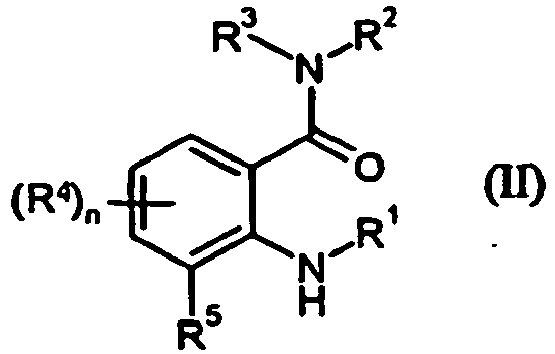
mit Carbonsäurechloriden der Formel (III)
- (B) Aniline der Formel (II)

mit einer Carbonsäure der Formel (IV)
in Gegenwart eines Kondensationsmittels umsetzt oder indem man - (C) zur Synthese von Anthranilamiden der Formel (I), in welcher R1 für Wasserstoff steht, Benzoxazinone der Formel (V)

mit einem Amin der Formel (XV)
in Gegenwart eines Verdünnungsmittels umsetzt. - Verwendet man beispielsweise 2-Amino-5-chlor-3,N-dimethyl-benzamid und 5-(3,5-Bis-trifluormethyl-pyrazol-1-ylmethyl)-2-(3-chlor-pyridin-2-yl)-2H-pyrazol-3-carbonsäurechlorid als Ausgangsstoffe, so kann der Verlauf des erfindungsgemäßen Verfahrens (A) durch das folgende Formelschema veranschaulicht werden.

- Die bei der Durchführung des erfindungsgemäßen Verfahrens (A) als Ausgangsstoffe benötigten Aminobenzamide sind durch die Formel (II) allgemein definiert. In dieser Formel (II) stehen A, R1, R2, R3, R4, R5 und n bevorzugt, besonders bevorzugt, ganz besonders bevorzugt bzw. insbesondere bevorzugt für diejenigen Bedeutungen, die bereits im Zusammenhang mit der Beschreibung der erfindungsgemäßen Stoffe der Formel (I) als bevorzugt, besonders bevorzugt usw. für diese Reste genannt wurden.
- Das erfindungsgemäße Verfahren (A) wird in Gegenwart eines Säurebindemittels durchgeführt. Hierzu eignen sich alle für solche Kupplungsreaktionen üblichen anorganischen oder organischen Basen. Vorzugsweise verwendbar sind Erdalkalimetall- oder Alkalimetallhydride, -hydroxide, -amide, -alkoholate, -acetate, -carbonate oder -hydrogencarbonate, wie beispielsweise Natriumhydrid, Natriumamid, Lithiumdiisopropylamid, Natrium-methylat, Natrium-ethylat, Kalium-tert.-butylat, Natriumhydroxid, Kaliumhydroxid, Natriumacetat, Natriumcarbonat, Kaliumcarbonat, Kaliumhydrogencarbonat, Natriumhydrogencarbonat oder Ammoniumcarbonat, sowie tertiäre Amine, wie Trimethylamin, Triethylamin, Tributylamin, Diisopropylethylamin, N,N-Dimethylanilin, N,N-Dimethyl-benzylamin, Pyridin, N-Methylpiperidin, N-Methylmorpholin, N,N-Dimethylamino-pyridin, Diazabicyclooctan (DABCO), Diazabicyclononen (DBN) oder Diazabicycloundecen (DBU). Ebenso lassen sich gegebenenfalls polymer-gestützte Säurebindemittel, wie z.B. polymer-gebundenes Diisopropylamin und polymer-gebundenes Dimethylaminopyridin einsetzen.
- Das erfindungsgemäße Verfahren (A) kann gegebenenfalls in Gegenwart eines für solche Reaktionen üblichen inerten organischen Verdünnungsmittel durchgeführt werden. Hierzu gehören vorzugsweise aliphatische, alicyclische oder aromatische Kohlenwasserstoffe, wie beispielsweise Petrolether, Hexan, Heptan, Cyclohexan, Methylcyclohexan, Benzol, Toluol, Xylol oder Decalin; halogenierte Kohlenwasserstoffe, wie beispielsweise Chlorbenzol, Dichlorbenzol, Dichlormethan, Chloroform, Tetrachlormethan, Dichlorethan oder Trichlorethan; Ether, wie Diethylether, Diisopropylether, Methyl-t-butylether, Methyl-t-amylether, Dioxan, Tetrahydrofuran, 1,2- Dimethoxyethan, 1,2-Diethoxyethan oder Anisol; Ketone, wie Aceton, Butanon, Methyl-isobutylketon oder Cyclohexanon; Nitrile, wie Acetonitril, Propionitril, n- oder i-Butyronitril oder Benzonitril; Amide, wie N,N-Dimethylformamid, N,N-Dimethylacetamid, N-Methylformanilid, N-Methylpyrrolidon oder Hexamethylphosphorsäuretriamid; deren Gemische mit Wasser oder reines Wasser. Besonders bevorzugt verwendbar sind Toluol, Tetrahydrofuran und N,N-Dimethylformamid.
- Die Reaktionstemperaturen können bei der Durchführung des erfindungsgemäßen Verfahrens (A) in einem größeren Bereich variiert werden. Im Allgemeinen arbeitet man bei Temperaturen von 0°C bis 150°C, vorzugsweise bei Temperaturen von 20°C bis 100°C.
- Das erfindungsgemäße Verfahren wird im Allgemeinen unter Normaldruck durchgeführt. Es ist jedoch auch möglich, das erfindungsgemäße Verfahren unter erhöhtem oder vermindertem Druck - im allgemeinen zwischen 0,1 bar und 10 bar - durchzuführen.
- Aminobenzamide der Formel (II) sind bekannt (vgl. z.B. M. J. Kornet, J. Heterocyl. Chem. 1992, 29, 103-105; G. P. Lahm et al., Bioorg. Med. Chem. Letters 2005, 15, 4898-4906;
WO 2003/016284 ,WO 2006/062978 ). - Pyrazolcarbonsäurechloride der Formel (III) sind neu. Sie lassen sich beispielsweise herstellen, indem man
- (D) Pyrazolcarbonsäure-Derivate der Formel (IV)

mit einem Chlorierungsmittel (z.B. Thionylchlorid und Oxalylchlorid) in Gegenwart eines inerten Verdünnungsmittels (z.B. Toluol und Dichlormethan) in Gegenwart von einer katalytischen Menge von N,N-Dimethylformamid umsetzt.
Pyrazolcarbonsäure-Derivate der Formel (IV) sind neu. Sie lassen sich beispielsweise herstellen, indem man - (E) Pyrazolcarbonsäureester der Formel (VI)

mit einem Alkalimetallhydroxid (z.B. Natriumhydroxid oder Kaliumhydroxid) in Gegenwart eines inerten Verdünnungsmittels (z.B. Dioxan/Wasser oder Ethanol/Wasser) umsetzt.
Pyrazolcarbonsäureester der Formel (VI) sind neu. Sie lassen sich beispielsweise herstellen, indem man - (F) Pyrazolcarbonsäureester-Derivate der Formel (VII)

Q-H (VIII)

Heteroaromaten und Heterocyclen der Formel (VIII) sind bekannt, teilweise sogar kommerziell erhältlich oder können nach bekannten Verfahren erhalten werden (vgl. z. B. H. V. Dias et al., Organometallics 1996, 15, 5374-5379; M. D. Threadgill et al., J. Fluorine Chem. 1993, 65, 21-23; M. Abdul-Ghani et al., J. Fluorine Chem. 1990, 48, 149-152; T. Khazaki, Chem. Pharm. Bull. 1996, 44, 314-327;DE 1995-19504627 ;WO 2004080984 ,WO 2005495351 ).
Heterocyclische Boronsäuren oder Boronate der Formel (IX) sind bekannt, teilweise sogar kommerziell erhältlich oder können nach bekannten Verfahren erhalten werden (vgl. z. B. W. Li, D. P. Nelson, M. S. Jensen, R. S. Hoermer, D. Cai, R. D. Larsen, P. J. Reider, J. Org. Chem. 2002, 67, 5394-5397).
Pyrazolcarbonsäureester-Derivate der Formel (VII) lassen sich beispielsweise herstellen, indem man - (G) Alkohole der Formel (X)

Die Reaktionstemperaturen können bei der Durchführung des erfindungsgemäßen Verfahrens (G) in einem größeren Bereich variiert werden. Im Allgemeinen arbeitet man bei Temperaturen von 0°C bis 150°C, vorzugsweise bei Temperaturen von 0°C bis 60°C.
Alkohole der Formel (X) lassen sich beispielsweise herstellen, indem man - (H) Pyrazoldicarbonsäureester der Formel (XI)

Die Reaktionstemperaturen können bei der Durchführung des erfindungsgemäßen Verfahrens (H) in einem größeren Bereich variiert werden. Im Allgemeinen arbeitet man bei Temperaturen von -100°C bis 20°C, vorzugsweise bei Temperaturen von -78°C bis 0°C.
Pyrazoldicarbonsäureester der Formel (XI) lassen sich beispielsweise herstellen, indem man - (I) Hydrazine oder deren entsprechenden Salze der Formel (XII)


- Hydrazine oder deren entsprechenden Salze der Formel (XII) sind bekannt, teilweise kommerziell erhältlich oder können nach allgemeinen Synthesemethoden hergestellt werden (vgl. z.B. Advanced Organic Chemistry, Vierte Ausgabe, Jerry March, John Wiley &Sons, Inc. New York, 1992, Seite 1288).
- Triketone der Formel (XIII) sind bekannt und können nach allgemeinen Synthesemethoden hergestellt werden (vgl. z.B. Cvetovich, Raymond J.; Pipik, Brenda; Hartner, Frederick W.; Grabowski, Edward J. J.; Tetrahedron Lett 2003, 44, 5867 - 5870).
- Die Reaktionstemperaturen können bei der Durchführung des erfindungsgemäßen Verfahrens (I) in einem größeren Bereich variiert werden. Im Allgemeinen arbeitet man bei Temperaturen von 0°C bis 80°C, vorzugsweise bei Temperaturen von 40°C bis 60°C.
- Verwendet man beispielsweise 2-Amino-5-chlor-3,N-dimethyl-benzamid und 5-(3,5-Bis-trifluormethyl-pyrazol-1-ylmethyl)-2-(3-chlor-pyridin-2-yl)-2H-pyrazol-3-carbonsäure als Ausgangsstoffe, so kann der Verlauf des erfindungsgemäßen Verfahrens (B) durch das folgende Formelschema veranschaulicht werden.

- Die bei der Durchführung des erfindungsgemäßen Verfahrens (B) als Ausgangsstoffe benötigten Anthranilamide der Formel (II) sind bereits in Zusammenhang mit dem erfindungsgemäßen Verfahren (A) beschrieben worden.
- Die bei der Durchführung des erfindungsgemäßen Verfahrens (B) weiterhin als Ausgangsstoffe benötigten heterocyclischen Carbonsäuren sind durch die Formel (IV) allgemein definiert. In dieser Formel (IV) stehen R6, A und Q bevorzugt, besonders bevorzugt, ganz besonders bevorzugt bzw. insbesondere bevorzugt für diejenigen Bedeutungen, die bereits im Zusammenhang mit der Beschreibung der erfindungsgemäßen Stoffe der Formel (I) als bevorzugt, besonders bevorzugt usw. für diese Reste genannt wurden.
- Das erfindungsgemäße Verfahren (B) wird in Gegenwart eines Kondensationsmittels durchgeführt. Hierzu eignen sich alle für solche Kupplungsreaktionen üblichen Mittel. Beispielhaft genannt seien Säurehalogenidbildner wie Phosgen, Phosphortribromid, Phosphortrichlorid, Phosphorpentachlorid, Phosphoroxychlorid oder Thionylchlorid; Anhydridbildner wie Chlorameisensäureethylester, Chlorameisensäuremethylester, Chlorameisensäureisopropylester, Chlorameisensäureisobutylester oder Methansulfonylchlorid; Carbodiimide, wie N,N'-Dicyclohexylcarbodiimid (DCC) oder andere übliche Kondensationsmittel, wie Phosphorpentoxid, Polyphosphorsäure, 1,1'-Carbonyldiimidazol, 2-Ethoxy-N-ethoxycarbonyl-1,2-dihydrochinolin (EEDQ), Triphenylphosphin/Tetrachlorkohlenstoff, Brom-tripyrrolidinophosphonium-hexafluorophosphat, Bis(2-oxo-3-oxazolidinyl)phosphinchlorid oder Benzotriazol-1-yloxytris(dimethylamino)-phosphonium-hexafluorphosphat. Auf Polymer gestützte Reagenzien, wie z.B. polymer-gebundenes Cyclohexylcarbodiimid, können ebenfalls verwendet werden.
- Das erfindungsgemäße Verfahren (B) wird gegebenenfalls in Gegenwart eines Katalysators durchgeführt. Beispielsweise genannt seien 4-Dimethylaminopyridin, 1-Hydroxy-benzotriazol oder Dimethylformamid.
- Das erfindungsgemäße Verfahren (B) kann gegebenenfalls in Gegenwart eines für solche Reaktionen üblichen inerten organischen Verdünnungsmittel durchgeführt werden. Hierzu gehören vorzugsweise aliphatische, alicyclische oder aromatische Kohlenwasserstoffe, wie beispielsweise Petrolether, Hexan, Heptan, Cyclohexan, Methylcyclohexan, Benzol, Toluol, Xylol oder Decalin; halogenierte Kohlenwasserstoffe, wie beispielsweise Chlorbenzol, Dichlorbenzol, Dichlormethan, Chloroform, Tetrachlormethan, Dichlorethan oder Trichlorethan; Ether, wie Diethylether, Diisopropylether, Methyl-t-butylether, Methyl-t-amylether, Dioxan, Tetrahydrofuran, 1,2- Dimethoxyethan, 1,2-Diethoxyethan oder Anisol; Ketone, wie Aceton, Butanon, Methyl-isobutylketon oder Cyclohexanon; Nitrile, wie Acetonitril, Propionitril, n- oder i-Butyronitril oder Benzonitril; Amide, wie N,N-Dime-thylformamid, N,N-Dimethylacetamid, N-Methylformanilid, N-Methylpyrrolidon oder Hexamethylphosphorsäuretriamid; deren Gemische mit Wasser oder reines Wasser. Besonders bevorzugt verwendbar sind Dichlormethan und N,N-Dimethylformamid.
- Die Reaktionstemperaturen können bei der Durchführung des erfindungsgemäßen Verfahrens (B) in einem größeren Bereich variiert werden. Im Allgemeinen arbeitet man bei Temperaturen von 0°C bis 150°C, vorzugsweise bei Temperaturen von 0°C bis 80°C.
- Das erfindungsgemäße Verfahren wird im Allgemeinen unter Normaldruck durchgeführt. Es ist jedoch auch möglich, das erfindungsgemäße Verfahren unter erhöhtem oder vermindertem Druck - im Allgemeinen zwischen 0,1 bar und 10 bar - durchzuführen.
- Verwendet man 2-[3-{[3,5-bis(trifluoromethyl)-1H-pyrazol-1-yl]methyl}-1-(3-chloropyridin-2-yl)-1H-pyazol-5-yl]-6-chlor-8-methyl-1H-3,1-benzoxazin-4-on und Methylamin so kann der Verlauf des erfindungsgemäßen Verfahrens (C) durch das folgende Formelschema veranschaulicht werden.

- Die bei der Durchführung des erfindungsgemäßen Verfahrens (C) als Ausgangsstoffe benötigten Benzoxazinone sind durch die Formel (V) allgemein definiert. In dieser Formel (V) stehen R4, R5, R6 A, Q und n bevorzugt, besonders bevorzugt, ganz besonders bevorzugt bzw. insbesondere bevorzugt für diejenigen Bedeutungen, die bereits im Zusammenhang mit der Beschreibung der erfindungsgemäßen Stoffe der Formel (I) als bevorzugt, besonders bevorzugt usw. für diese Reste genannt wurden.
- Benzoxazinone der Formel (V) sind neu. Sie werden beispielsweise erhalten, indem man
- (J) Pyrazolcarbonsäure-Derivate der Formel (IV)

mit Anthranilsäuren der Formel (XIV)
- Die bei der Durchführung des erfindungsgemäßen Verfahrens (J) als Ausgangsstoffe benötigten Pyrazolcarbonsäure-Derivate der Formel (IV) sind bereits oben in Zusammenhang mit dem erfindungsgemäßen Verfahren (A) beschrieben worden.
- Die bei der Durchführung des erfindungsgemäßen Verfahrens (J) weiterhin als Ausgangsstoffe benötigten Anthranilsäuren sind durch die Formel (XIV) allgemein definiert. In dieser Formel (XIV) stehen R4, R5 und n bevorzugt, besonders bevorzugt, ganz besonders bevorzugt bzw. insbesondere bevorzugt für diejenigen Bedeutungen, die bereits im Zusammenhang mit der Beschreibung der erfindungsgemäßen Stoffe der Formel (I) als bevorzugt, besonders bevorzugt usw. für diese Reste genannt wurden.
- Anthranilsäuren der Formel (XIV) sind bekannt und können nach allgemeinen Synthesemethoden hergestellt werden (vgl. z. B. Baker et al. J. Org. Chem. 1952, 149-153; G. Reissenweber et al., Angew. Chem 1981, 93, 914-915, PJ. Montoya-Pelaez, J. Org. Chem. 2006, 71, 5921-5929; F. E. Sheibley, J. Org. Chem. 1938, 3, 414-423,
WO 2006023783 ). - Die Verbindungen der Formel (I) können gegebenenfalls in verschiedenen polymorphen Formen oder als Mischung verschiedener polymorpher Formen vorliegen. Sowohl die reinen Polymorphe als auch die Polymorphgemische sind Gegenstand der Erfindung und können erfindungsgemäß verwendet werden.
- Die erfindungsgemäßen Wirkstoffe eignen sich bei guter Pflanzenverträglichkeit, günstiger Warmblütertoxizität und guter Umweltverträglichkeit zum Schutz von Pflanzen und Pflanzenorganen, zur Steigerung der Ernteerträge, Verbesserung der Qualität des Erntegutes und zur Bekämpfung von tierischen Schädlingen, insbesondere Insekten, Spinnentieren, Helminthen, Nematoden und Mollusken, die in der Landwirtschaft, im Gartenbau, bei der Tierzucht, in Forsten, in Gärten-und Freizeiteinrichtungen, im Vorrats- und Materialschutz sowie auf dem Hygienesektor vorkommen. Sie können vorzugsweise als Pflanzenschutzmittel eingesetzt werden. Sie sind gegen normal sensible und resistente Arten sowie gegen alle oder einzelne Entwicklungsstadien wirksam. Zu den oben erwähnten Schädlingen gehören:
- Aus der Ordnung der Anoplura (Phthiraptera) z.B. Damalinia spp., Haematopinus spp., Linognathus spp., Pediculus spp., Trichodectes spp..
- Aus der Klasse der Arachnida z.B. Acarus siro, Aceria sheldoni, Aculops spp., Aculus spp., Amblyomma spp., Argas spp., Boophilus spp., Brevipalpus spp., Bryobia praetiosa, Chorioptes spp., Dermanyssus gallinae, Eotetranychus spp., Epitrimerus pyri, Eutetranychus spp., Eriophyes spp., Hemitarsonemus spp., Hyalomma spp., Ixodes spp., Latrodectus mactans, Metatetranychus spp., Oligonychus spp., Ornithodoros spp., Panonychus spp., Phyllocoptruta oleivora, Polyphagotarsonemus latus, Psoroptes spp., Rhipicephalus spp., Rhizoglyphus spp., Sarcoptes spp., Scorpio maurus, Stenotarsonemus spp., Tarsonemus spp., Tetranychus spp., Vasates lycopersici.
- Aus der Klasse der Bivalva z.B. Dreissena spp..
- Aus der Ordnung der Chilopoda z.B. Geophilus spp., Scutigera spp..
- Aus der Ordnung der Coleoptera z.B. Acanthoscelides obtectus, Adoretus spp., Agelastica alni, Agriotes spp., Amphimallon solstitialis, Anobium punctatum, Anoplophora spp., Anthonomus spp., Anthrenus spp., Apogonia spp., Atomaria spp., Attagenus spp., Bruchidius obtectus, Bruchus spp., Ceuthorhynchus spp., Cleonus mendicus, Conoderus spp., Cosmopolites spp., Costelytra zealandica, Curculio spp., Cryptorhynchus lapathi, Dermestes spp., Diabrotica spp., Epilachna spp., Faustinus cubae, Gibbium psylloides, Heteronychus arator, Hylamorpha elegans, Hylotrupes bajulus, Hypera postica, Hypothenemus spp., Lachnosterna consanguinea, Leptinotarsa decemlineata, Lissorhoptrus oryzophilus, Lixus spp., Lyctus spp., Meligethes aeneus, Melolontha melolontha, Migdolus spp., Monochamus spp., Naupactus xanthographus, Niptus hololeucus, Oryctes rhinoceros, Oryzaephilus surinamensis, Otiorrhynchus sulcatus, Oxycetonia jucunda, Phaedon cochleariae, Phyllophaga spp., Popillia japonica, Premnotrypes spp., Psylliodes chrysocephala, Ptinus spp., Rhizobius ventralis, Rhizopertha dominica, Sitophilus spp., Sphenophorus spp., Sternechus spp., Symphyletes spp., Tenebrio molitor, Tribolium spp., Trogoderma spp., Tychius spp., Xylotrechus spp., Zabrus spp..
- Aus der Ordnung der Collembola z.B. Onychiurus armatus.
- Aus der Ordnung der Dermaptera z.B. Forficula auricularia.
- Aus der Ordnung der Diplopoda z.B. Blaniulus guttulatus.
- Aus der Ordnung der Diptera z.B. Aedes spp., Anopheles spp., Bibio hortulanus, Calliphora erythrocephala, Ceratitis capitata, Chrysomyia spp., Cochliomyia spp., Cordylobia anthropophaga, Culex spp., Cuterebra spp., Dacus oleae, Dermatobia hominis, Drosophila spp., Fannia spp., Gastrophilus spp., Hylemyia spp., Hyppobosca spp., Hypoderma spp., Liriomyza spp.. Lucilia spp., Musca spp., Nezara spp., Oestrus spp., Oscinella frit, Pegomyia hyoscyami, Phorbia spp., Stomoxys spp., Tabanus spp., Tannia spp., Tipula paludosa, Wohlfahrtia spp.
- Aus der Klasse der Gastropoda z.B. Arion spp., Biomphalaria spp., Bulinus spp., Deroceras spp., Galba spp., Lymnaea spp., Oncomelania spp., Succinea spp..
- Aus der Klasse der Helminthen z.B. Ancylostoma duodenale, Ancylostoma ceylanicum, Acylostoma braziliensis, Ancylostoma spp., Ascaris lubricoides, Ascaris spp., Brugia malayi, Brugia timori, Bunostomum spp., Chabertia spp., Clonorchis spp., Cooperia spp., Dicrocoelium spp, Dictyocaulus filaria, Diphyllobothrium latum, Dracunculus medinensis, Echinococcus granulosus, Echinococcus multilocularis, Enterobius vermicularis, Faciola spp., Haemonchus spp., Heterakis spp., Hymenolepis nana, Hyostrongulus spp., Loa Loa, Nematodirus spp., Oesophagostomum spp., Opisthorchis spp., Onchocerca volvulus, Ostertagia spp., Paragonimus spp., Schistosomen spp, Strongyloides fuelleborni, Strongyloides stercoralis, Stronyloides spp., Taenia saginata, Taenia solium, Trichinella spiralis, Trichinella nativa, Trichinella britovi, Trichinella nelsoni, Trichinella pseudopsiralis, Trichostrongulus spp., Trichuris trichuria, Wuchereria bancrofti.
- Weiterhin lassen sich Protozoen, wie Eimeria, bekämpfen.
- Aus der Ordnung der Heteroptera z.B. Anasa tristis, Antestiopsis spp., Blissus spp., Calocoris spp., Campylomma livida, Cavelerius spp., Cimex spp., Creontiades dilutus, Dasynus piperis, Dichelops furcatus, Diconocoris hewetti, Dysdercus spp., Euschistus spp., Eurygaster spp., Heliopeltis spp., Horcias nobilellus, Leptocorisa spp., Leptoglossus phyllopus, Lygus spp., Macropes excavatus, Miridae, Nezara spp., Oebalus spp., Pentomidae, Piesma quadrata, Piezodorus spp., Psallus seriatus, Pseudacysta persea, Rhodnius spp., Sahlbergella singularis, Scotinophora spp., Stephanitis nashi, Tibraca spp., Triatoma spp.
- Aus der Ordnung der Homoptera z.B. Acyrthosipon spp., Aeneolamia spp., Agonoscena spp., Aleurodes spp., Aleurolobus barodensis, Aleurothrixus spp., Amrasca spp., Anuraphis cardui, Aonidiella spp., Aphanostigma piri, Aphis spp., Arboridia apicalis, Aspidiella spp., Aspidiotus spp., Atanus spp., Aulacorthum solani, Bemisia spp., Brachycaudus helichrysii, Brachycolus spp., Brevicoryne brassicae, Calligypona marginata, Carneocephala fulgida, Ceratovacuna lanigera, Cercopidae, Ceroplastes spp., Chaetosiphon fragaefolii, Chionaspis tegalensis, Chlorita onukii, Chromaphis juglandicola, Chrysomphalus ficus, Cicadulina mbila, Coccomytilus halli, Coccus spp., Cryptomyzus ribis, Dalbulus spp., Dialeurodes spp., Diaphorina spp., Diaspis spp., Doralis spp., Drosicha spp., Dysaphis spp., Dysmicoccus spp., Empoasca spp., Eriosoma spp., Erythroneura spp., Euscelis bilobatus, Geococcus coffeae, Homalodisca coagulata, Hyalopterus arundinis, Icerya spp., Idiocerus spp., Idioscopus spp., Laodelphax striatellus, Lecanium spp., Lepidosaphes spp., Lipaphis erysimi, Macrosiphum spp., Mahanarva fimbriolata, Melanaphis sacchari, Metcalfiella spp., Metopolophium dirhodum, Monellia costalis, Monelliopsis pecanis, Myzus spp., Nasonovia ribisnigri, Nephotettix spp., Nilaparvata lugens, Oncometopia spp., Orthezia praelonga, Parabemisia myricae, Paratrioza spp., Parlatoria spp., Pemphigus spp., Peregrinus maidis, Phenacoccus spp., Phloeomyzus passerinii, Phorodon humuli, Phylloxera spp., Pinnaspis aspidistrae, Planococcus spp., Protopulvinaria pyriformis, Pseudaulacaspis pentagona, Pseudococcus spp., Psylla spp., Pteromalus spp., Pyrilla spp., Quadraspidiotus spp., Quesada gigas, Rastrococcus spp., Rhopalosiphum spp., Saissetia spp., Scaphoides titanus, Schizaphis graminum, Selenaspidus articulatus, Sogata spp., Sogatella furcifera, Sogatodes spp., Stictocephala festina, Tenalaphara malayensis, Tinocallis caryaefoliae, Tomaspis spp., Toxoptera spp., Trialeurodes vaporariorum, Trioza spp., Typhlocyba spp., Unaspis spp., Viteus vitifolii.
- Aus der Ordnung der Hymenoptera z.B. Diprion spp., Hoplocampa spp., Lasius spp., Monomorium pharaonis, Vespa spp..
- Aus der Ordnung der Isopoda z.B. Armadillidium vulgare, Oniscus asellus, Porcellio scaber.
- Aus der Ordnung der Isoptera z.B. Reticulitermes spp., Odontotermes spp..
- Aus der Ordnung der Lepidoptera z.B. Acronicta major, Aedia leucomelas, Agrotis spp., Alabama argillacea, Anticarsia spp., Barathra brassicae, Bucculatrix thurberiella, Bupalus piniarius, Cacoecia podana, Capua reticulana, Carpocapsa pomonella, Cheimatobia brumata, Chilo spp., Choristoneura fumiferana, Clysia ambiguella, Cnaphalocerus spp., Earias insulana, Ephestia kuehniella, Euproctis chrysorrhoea, Euxoa spp., Feltia spp., Galleria mellonella, Helicoverpa spp., Heliothis spp., Hofmannophila pseudospretella, Homona magnanima, Hyponomeuta padella, Laphygma spp., Lithocolletis blancardella, Lithophane antennata, Loxagrotis albicosta, Lymantria spp., Malacosoma neustria, Mamestra brassicae, Mocis repanda, Mythimna separata, Oria spp., Oulema oryzae, Panolis flammea, Pectinophora gossypiella, Phyllocnistis citrella, Pieris spp., Plutella xylostella, Prodenia spp., Pseudaletia spp., Pseudoplusia includens, Pyrausta nubilalis, Spodoptera spp., Thermesia gemmatalis, Tinea pellionella, Tineola bisselliella, Tortrix viridana, Trichoplusia spp..
- Aus der Ordnung der Orthoptera z.B. Acheta domesticus, Blatta orientalis, Blattella germanica, Gryllotalpa spp., Leucophaea maderae, Locusta spp., Melanoplus spp., Periplaneta americana, Schistocerca gregaria.
- Aus der Ordnung der Siphonaptera z.B. Ceratophyllus spp., Xenopsylla cheopis.
- Aus der Ordnung der Symphyla z.B. Scutigerella immaculata.
- Aus der Ordnung der Thysanoptera z.B. Baliothrips biformis, Enneothrips flavens, Frankliniella spp., Heliothrips spp., Hercinothrips femoralis, Kakothrips spp., Rhipiphorothrips cruentatus, Scirtothrips spp., Taeniothrips cardamoni, Thrips spp..
- Aus der Ordnung der Thysanura z.B. Lepisma saccharina.
- Zu den pflanzenparasitären Nematoden gehören z.B. Anguina spp., Aphelenchoides spp., Belonoaimus spp., Bursaphelenchus spp., Ditylenchus dipsaci, Globodera spp., Heliocotylenchus spp., Heterodera spp., Longidorus spp., Meloidogyne spp., Pratylenchus spp., Radopholus similis, Rotylenchus spp., Trichodorus spp., Tylenchorhynchus spp., Tylenchulus spp., Tylenchulus semipenetrans, Xiphinema spp..
- Die erfindungsgemäßen Verbindungen können gegebenenfalls in bestimmten Konzentrationen bzw. Aufwandmengen auch als Herbizide, Safener, Wachstumsregulatoren oder Mittel zur Verbesserung der Pflanzeneigenschaften, oder als Mikrobizide, beispielsweise als Fungizide, Antimykotika, Bakterizide, Virizide (einschließlich Mittel gegen Viroide) oder als Mittel gegen MLO (Mycoplasmalike-organism) und RLO (Rickettsia-like-organism) verwendet werden. Sie lassen sich gegebenenfalls auch als Zwischen- oder Vorprodukte für die Synthese weiterer Wirkstoffe einsetzen.
- Die Wirkstoffe können in die üblichen Formulierungen überführt werden, wie Lösungen, Emulsionen, Spritzpulver, wasser- und ölbasierte Suspensionen, Pulver, Stäubemittel, Pasten, lösliche Pulver, lösliche Granulate, Streugranulate, Suspensions-Emulsions-Konzentrate, Wirkstoff-imprägnierte Naturstoffe, Wirkstoff-imprägnierte synthetische Stoffe, Düngemittel sowie Feinstverkapselungen in polymeren Stoffen.
- Diese Formulierungen werden in bekannter Weise hergestellt, z.B. durch Vermischen der Wirkstoffe mit Streckmitteln, also flüssigen Lösungsmitteln und/oder festen Trägerstoffen, gegebenenfalls unter Verwendung von oberflächenaktiven Mitteln, also Emulgiermitteln und/oder Dispergiermitteln und/oder schaumerzeugenden Mitteln. Die Herstellung der Formulierungen erfolgt entweder in geeigneten Anlagen oder auch vor oder während der Anwendung.
- Als Hilfsstoffe können solche Stoffe Verwendung finden, die geeignet sind, dem Mittel selbst oder und/oder davon abgeleitete Zubereitungen (z.B. Spritzbrühen, Saatgutbeizen) besondere Eigenschaften zu verleihen, wie bestimmte technische Eigenschaften und/oder auch besondere biologische Eigenschaften. Als typische Hilfsmittel kommen in Frage: Streckmittel, Lösemittel und Trägerstoffe.
- Als Streckmittel eignen sich z.B. Wasser, polare und unpolare organische chemische Flüssigkeiten z.B. aus den Klassen der aromatischen und nicht-aromatischen Kohlenwasserstoffe (wie Paraffine, Alkylbenzole, Alkylnaphthaline, Chlorbenzole), der Alkohole und Polyole (die ggf. auch substituiert, verethert und/oder verestert sein können), der Ketone (wie Aceton, Cyclohexanon), Ester (auch Fette und Öle) und (poly-)Ether, der einfachen und substituierten Amine, Amide, Lactame (wie N-Alkylpyrrolidone) und Lactone, der Sulfone und Sulfoxide (wie Dimethylsysulfoxid).
- Im Falle der Benutzung von Wasser als Streckmittel können z.B. auch organische Lösemittel als Hilfslösangsmittel verwendet werden. Als flüssige Lösemittel kommen im wesentlichen in Frage: Aromaten, wie Xylol, Toluol, oder Alkylnaphthaline, chlorierte Aromaten und chlorierte aliphatische Kohlenwasserstoffe, wie Chlorbenzole, Chlorethylene oder Methylenchlorid, aliphatische Kohlenwasserstoffe, wie Cyclohexan oder Paraffine, z.B. Erdölfraktionen, mineralische und pflanzliche Öle, Alkohole, wie Butanol oder Glykol sowie deren Ether und Ester, Ketone wie Aceton, Methylethylketon, Methylisobutylketon oder Cyclohexanon, stark polare Lösungsmittel, wie Dimethylsulfoxid, sowie Wasser.
- Als feste Trägerstoffe kommen in Frage:
- z.B. Ammoniumsalze und natürliche Gesteinsmehle, wie Kaoline, Tonerden, Talkum, Kreide, Quarz, Attapulgit, Montmorillonit oder Diatomeenerde und synthetische Gesteinsmehle, wie hochdisperse Kieselsäure, Aluminiumoxid und Silikate, als feste Trägerstoffe für Granulate kommen in Frage: z.B. gebrochene und fraktionierte natürliche Gesteine wie Calcit, Marmor, Bims, Sepiolith, Dolomit sowie synthetische Granulate aus anorganischen und organischen Mehlen sowie Granulate aus organische Material wie Papier, Sägemehl, Kokosnußschalen, Maiskolben und Tabakstengeln, als Emulgier- und/oder schaumerzeugende Mittel kommen in Frage: z.B. nichtionogene und anionische Emulgatoren, wie Polyoxyethylen-Fettsäure-Ester, Polyoxyethylen-Fettalkohol-Ether, z.B. Alkylarylpolyglykolether, Alkylsulfonate, Alkylsulfate, Arylsulfonate sowie Eiweißhydrolysate; als Dispergiermittel kommen in Frage nicht-ionische und/oder ionische Stoffe, z.B. aus den Klassen der Alkohol-POE- und/oder POP-Ether, Säure- und/oder POP- POE-Ester, Alkyl-Aryl- und/oder POP-POE-Ether, Fett- und/oder POP- POE-Addukte, POE- und/oder POP-Polyol Derivate, POE- und/oder POP-Sorbitan- oder-Zucker-Addukte, Alky- oder Aryl-Sulfate, Sulfonate und Phosphate oder die entsprechenden PO-Ether-Addukte. Ferner geeignete Oligo- oder Polymere, z.B. ausgehend von vinylischen Monomeren, von Acrylsäure, aus EO und/oder PO allein oder in Verbindung mit z.B. (poly-) Alkoholen oder (poly-) Aminen. Ferner können Einsatz finden Lignin und seine Sulfonsäure-Derivate, einfache und modifizierte Cellulosen, aromatische und/oder aliphatische Sulfonsäuren sowie deren Addukte mit Formaldehyd.
- Es können in den Formulierungen Haftmittel wie Carboxymethylcellulose, natürliche und synthetische pulvrige, körnige oder latexförmige Polymere verwendet werden, wie Gummiarabicum, Polyvinylalkohol, Polyvinylacetat, sowie natürliche Phospholipide, wie Kephaline und Lecithine und synthetische Phospholipide.
- Es können Farbstoffe wie anorganische Pigmente, z.B. Eisenoxid, Titanoxid, Ferrocyanblau und organische Farbstoffe, wie Alizarin-, Azo- und Metallphthalocyaninfarbstoffe und Spurennährstoffe wie Salze von Eisen, Mangan, Bor, Kupfer, Kobalt, Molybdän und Zink verwendet werden.
- Weitere Additive können Duftstoffe, mineralische oder vegetabile gegebenenfalls modifizierte Öle, Wachse und Nährstoffe (auch Spurennährstoffe), wie Salze von Eisen, Mangan, Bor, Kupfer, Kobalt, Molybdän und Zink sein.
- Weiterhin enthalten sein können Stabilisatoren wie Kältestabilisatoren, Konservierungsmittel, Oxidationsschutzmittel, Lichtschutzmittel oder andere die chemische und / oder physikalische Stabilität verbessernde Mittel.
- Die Formulierungen enthalten im allgemeinen zwischen 0,01 und 98 Gew.-% Wirkstoff, vorzugsweise zwischen 0,5 und 90 %.
- Der erfindungsgemäße Wirkstoff kann in seinen handelsüblichen Formulierungen sowie in den aus diesen Formulierungen bereiteten Anwendungsformen in Mischung mit anderen Wirkstoffen wie Insektiziden, Lockstoffen, Sterilantien, Bakteriziden, Akariziden, Nematiziden, Fungiziden, wachstumsregulierenden Stoffen, Herbiziden, Safenern, Düngemitteln oder Semiochemicals vorliegen.
- Besonders günstige Mischpartner sind z.B. die folgenden:
- Fungizide:
- Inhibitoren der Nucleinsäure Synthese
- Benalaxyl, Benalaxyl-M, Bupirimat, Chiralaxyl, Clozylacon, Dimethirimol, Ethirimol, Furalaxyl, Hymexazol, Metalaxyl, Metalaxyl-M, Ofurace, Oxadixyl, Oxolinsäure
- Inhibitoren der Mitose und Zellteilung
- Benomyl, Carbendazim, Diethofencarb, Fuberidazole, Pencycuron, Thiabendazol, Thiophanat-methyl, Zoxamid
- Inhibitoren der Atmungskette Komplex I
- Diflumetorim
- Inhibitoren der Atmungskette Komplex II
- Boscalid, Carboxin, Fenfuram, Flutolanil, Furametpyr, Mepronil, Oxycarboxin, Penthiopyrad, Thifluzamid
- Inhibitoren der Atmungskette Komplex III
- Azoxystrobin, Cyazofamid, Dimoxystrobin, Enestrobin, Famoxadon, Fenamidon, Fluoxastrobin, Kresoximmethyl, Metominostrobin, Orysastrobin, Pyraclostrobin, Picoxystrobin, Trifloxystrobin
- Entkoppler
- Dinocap, Fluazinam
- Inhibitoren der ATP Produktion
- Fentinacetat, Fentinchlorid, Fentinhydroxid, Silthiofam
- Inhibitoren der Aminosäure- und Proteinbiosynthese
- Andoprim, Blasticidin-S, Cyprodinil, Kasugamycin, Kasugamycinhydrochlorid Hydrat, Mepanipyrim, Pyrimethanil
- Inhibitoren der Signal-Transduktion
- Fenpiclonil, Fludioxonil, Quinoxyfen
- Inhibitoren der Fett- und Membran Synthese
- Chlozolinat, Iprodion, Procymidon, Vinclozolin
- Ampropylfos, Kalium-Ampropylfos, Edifenphos, Iprobenfos (IBP), Isoprothiolan, Pyrazophos Tolclofos-methyl, Biphenyl
- Iodocarb, Propamocarb, Propamocarb hydrochlorid
- Inhibitoren der Ergosterol Biosynthese
- Fenhexamid,
- Azaconazol, Bitertanol, Bromuconazol, Cyproconazol, Diclobutrazol, Difenoconazol, Diniconazol, Diniconazol-M, Epoxiconazol, Etaconazol, Fenbuconazol, Fluquinconazol. Flusilazol, Flutriafol, Furconazol, Furconazol-cis, Hexaconazol, Imibenconazol, Ipconazol, Metconazol, Myclobutanil, Paclobutrazol, Penconazol, Propiconazol, Prothioconazol, Simeconazol, Tebuconazol, Tetraconazol, Triadnmefon, Triadimenol, Triticonazol, Uniconazol, Voriconazol, Imazalil, Imazalilsulfat, Oxpoconazol, Fenarimol, Flurprimidol, Nuarimol, Pyrifenox, Triforin, Pefurazoat, Prochloraz, Triflumizol, Viniconazol,
- Aldimorph, Dodemorph, Dodemorphacetat, Fenpropimorph, Tridemorph, Fenpropidin, Spiroxamin,
- Naftifin, Pyributicarb, Terbinafin
- Inhibitoren der Zellwand Synthese
- Benthiavalicarb, Bialaphos, Dimethomorph, Flumorph, Iprovalicarb, Polyoxins, Polyoxorim, Validamycin A
- Inhibitoren der Melanin Biosynthese
- Capropamid, Diclocymet, Fenoxanil, Phtalid, Pyroquilon, Tricyclazol
- Resistenzinduktion
- Acibenzolar-S-methyl, Probenazol, Tiadinil
- Multisite
- Captafol, Captan, Chlorothalonil, Kupfersalze wie: Kupferhydroxid, Kupfernaphthenat, Kupferoxychlorid, Kupfersulfat, Kupferoxid, Oxin-Kupfer und Bordeaux Mischung, Dichlofluanid, Dithianon, Dodin, Dodin freie Base, Ferbam, Folpet, Fluorofolpet, Guazatin, Guazatinacetat, Iminoctadin, Iminoctadinalbesilat, Iminoctadintriacetat, Mankupfer, Mancozeb, Maneb, Metiram, Metiram Zink, Propineb, Schwefel und Schwefelpräparate enthaltend Calciumpolysulphid, Thiram, Tolylfluanid, Zineb, Ziram
- Unbekannter Mechanismus
- Amibromdol, Benthiazol, Bethoxazin, Capsimycin, Carvon, Chinomethionat, Chloropicrin, Cufraneb, Cyflufenamid, Cymoxanil, Dazomet, Debacarb, Diclomezine, Dichlorophen, Dicloran, Difenzoquat, Difenzoquat Methylsulphat, Diphenylamin, Ethaboxam, Ferimzon, flumetover, Flusulfamid, Fluopicolid, Fluoroimid, Hexachlorobenzol, 8-Hydroxychinolinsulfat, Irumamycin, Methasulphocarb, Metrafenon, Methyl Isothiocyanat, Mildiomycin, Natamycin, Nickel dimethyldithiocaibamat, Nitrothal-isopropyl, Octhilinon, Oxamocarb, Oxyfenthiin, Pentachlorophenol und Salze, 2-Phenylphenol und Salze, Piperalin, Propanosin -Natrium, Proquinazid, Pyrrolnitrin, Quintozen, Tecloftalam, Tecnazen, Triazoxid, Trichlamid, Zarilamid und 2,3,5,6-Tetrachlor-4-(methylsulfonyl)-pyridin, N-(4-Chlor-2-nitrophenyl)-N-ethyl-4-methyl-benzenesulfonamid, 2-Amino-4-methyl-N-phenyl-5-thiazolecarboxamid, 2-Chlor-N-(2,3-dihydro-1,1,3-trimethyl-1H-inden-4-yl)-3-pyridincarboxamid, 3-[5-(4-Chlorphenyl)-2,3-dimethylisoxazolidin-3-yl]pyridin, cis-1-(4-Chlorphenyl)-2-(1H-1,2,4 triazol-1-yl)-cycloheptanol, 2,4-Dihydro-5-methoxy-2-methyl-4-[[[[1-[3-(trifluoromethyl)-phenyl]-ethyliden]-amino]-oxy]-methyl]-phenyl]-3H-1,2,3-triazol-3-on (185336-79-2), Methyl 1-(2,3-dihydro-2,2-dimethyl-1H-inden-1-yl)-1H-imidazole-5-carboxylat, 3,4,5-Trichlor-2,6-pyridindicarbonitril, Methyl 2-[[[cyclopropyl[(4-methoxyphenyl) imino]methyl]thio]methyl]-.alpha.-(methoxymethylen)- benzacetat, 4-Chlor-alpha-propinyloxy-N-[2-[3-methoxy-4-(2-propinyloxy)phenyl]ethyl]-benzacetamide, (2S)-N-[2-[4-[[3-(4-chlorophenyl)-2-propinyl]oxy]-3-methoxyphenyl]ethyl]- 3-methyl-2-[(methylsulfonyl)amino]-butanamid, 5-Chlor-7-(4-methylpiperidin-1-yl)-6-(2,4,6-trifluoro-phenyl)[1,2,4]triazolo[1,5-a]pyrimidin, 5-Chlor-6-(2,4,6-trifluorophenyl)-N-[(1R)-1,2,2-trimethylpropyl][1,2,4]triazolo[1,5-a]pyrimidin-7-amin, 5-Chlor-N-[(1R)-1,2-dimethyl-propyl]-6-(2,4,6-trifluorophenyl) [1,2,4]triazolo[1,5-a]pyrimidin-7-aimne, N-[1-(5-Brom-3-chloropyridin-2-yl)ethyl]-2,4-dichloronicotinamid, N-(5-Brom-3-chlorpyridin-2-yl)methyl-2,4-dichlornicotinamid, 2-Butoxy-6-iod-3-propyl-benzopyranon-4-on, N-{(Z)-[(cyclopropyl-methoxy) imino][6-(difluormethoxy)-2,3-difluorphenyl]methyl}-2-benzacetamid, N-(3-Ethyl-3,5,5-trimethyl-cyclohexyl)-3-formylamino-2-hydroxy-benzamid, 2-[[[[1-[3(1Fluor-2-phenylethyl)oxy] phenyl] ethyliden]amino]oxy]methyl]-alpha-(methoxyimino)-N-methyl-alphaE-benzacetamid, N-{2-[3-Chlor-5-(trifluormethyl)pyridin-2-yl]ethyl}-2-(trifluoro-methyl)benzamid, N-(3',4'dichlor-5-fluorbiphenyl-2-yl)-3(difluormethyl)-1-methyt-1H-pyrazol-4carboxamid, N-(6-Methoxy-3-pyridinyl)-cyclopropan carboxamid, 1-[(4-Methoxyphenoxy)methyl]-2,2-dimethylpropyl-1H-imidazol-1- carbonsäure, 0-[1-[(4-Methoxyphenoxy)methyl]-2,2-dimethylpropyl]-1H-imidazol- 1- carbothioic acid, 2-(2-{[6-(3-Chlor-2-methylphenoxy)-S-fluorpyrimidin-4-yl]oxy}phenyl)-2-(methoxyimino)-N-methylacetamid
- Inhibitoren der Nucleinsäure Synthese
- Bakterizide:
- Bronopol, Dichlorophen, Nitrapyrin, Nickel-Dimethyldithiocarbamat, Kasugamycin, Octhilinon, Furancarbonsäure, Oxytetracyclin, Probenazol, Streptomycin, Tecloftalam, Kupfersulfat und andere Kupfer-Zubereitungen.
- Insektizide / Akarizide / Nematizide:
- Acetylcholinesterase (AChE) Inhibitoren
- Carbamate,
zum Beispiel Alanycarb, Aldicarb, Aldoxycarb, Allyxycarb, Aminocarb, Bendiocarb, Benfuracarb, Bufencarb, Butacarb, Butocarboxim, Butoxycarboxim, Carbaryl, Carbofuran, Carbosulfan, Cloethocarb, Dimetilan, Ethiofencarb, Fenobucarb, Fenothiocarb, Formetanate, Furathiocarb, Isoprocarb, Metam-sodium, Methiocarb, Methomyl, Metolcarb, Oxamyl, Pirimicarb, Promecarb, Propoxur, Thiodicarb, Thiofanox, Trimethacarb, XMC, Xylylcarb, Triazamate - Organophosphate,
zum Beispiel Acephate, Azamethiphos, Azinphos (-methyl, -ethyl), Bromophos-ethyl, Bromfenvinfos (-methyl), Butathiofos, Cadusafos, Carbophenothion, Chlorethoxyfos, Chlorfenvinphos, Chlormephos, Chlorpyrifos (-methyl/-ethyl), Coumaphos, Cyanofenphos, Cyanophos, Chlorfenvinphos, Demeton-S-methyl, Demeton-S-methylsulphon, Dialifos, Diazinon, Dichlofenthion, Dichlorvos/DDVP, Dicrotophos, Dimethoate, Dimethylvinphos, Dioxabenzofos, Disulfoton, EPN, Ethion, Ethoprophos, Etrimfos, Famphur, Fenamiphos, Fenitrothion, Fensulfothion, Fenthion, Flupyrazofos, Fonofos, Formothion, Fosmethilan, Fosthiazate, Heptenophos, Iodofenphos, Iprobenfos, Isazofos, Isofenphos, Isopropyl O-salicylate, Isoxathion, Malathion, Mecarbam, Methacrifos, Methamidophos, Methidathion, Mevinphos, Monocrotophos, Naled, Omethoate, Oxydemeton-methyl, Parathion (-methyl/ -ethyl), Phenthoate, Phorate, Phosalone, Phosmet, Phosphamidon, Phosphocarb, Phoxim, Pirimiphos (-methyl/-ethyl), Profenofos, Propaphos, Propetamphos, Prothiofos, Prothoate, - Pyraclofos, Pyridaphenthion, Pyridathion, Quinalphos, Sebufos, Sulfotep, Sulprofos, Tebupirimfos, Temephos, Terbufos, Teorachlorvinphos, Thiometon, Triazophos, Triclorfon, Vamidothion
- Carbamate,
- Natrium-Kanal-Moduiatoren / Spannungsabhängige Natrium-Kanal-Blocker
- Pyrethroide,
zum Beispiel Acrinathrin, Allethrin (d-cis-trans, d-trans), Beta-Cyfluthrin, Bifenthrin, Bioallethrin, Bioallethrin-S-cyclopentyl-isomer, Bioethanomethrin, Biopermethrin, Bioresmethrin, Chlovaporthrin, Cis-Cypermethrin, Cis-Resmethrin, Cis-Permethrin, Clocythrin, Cycloprothrin, Cyfluthrin, Cyhalothrin, Cypermethrin (alpha-, beta-, theta-, zeta-), Cyphenothrin, Deltamethrin, Empenthrin (IR-isomer), Esfenvaleraie, Etofenprox, Fenfluthrin, Fenpropathrin, Fenpyrithrin, Fenvalerate, Flubrocythrinate, Flucythrinate, Flufenprox. Flumethrin, Fluvalinate, Fubfenprox, Gamma-Cyhalothrin, Imiprothrin, Kadethrin, Lambda- Cyhalothrin, Metofluthrin, Permethrin (cis-, trans-), Phenothrin (IR-trans isomer), Prallethrin, Profluthrin, Protrifenbute, Pyresmethrin, Resmethrin, RU 15525, Silafluofen, Tau-Fluvalinate, Tefluthrin, Terallethrin, Tetramethrin (-1R- isomer), Tralomethrin, Transfluthrin, ZXI 8901, Pyrethrins (pyrethrum) - DDT
- Oxadiazine,
zum Beispiel Indoxacarb - Semicarbazon,
zum Beispiel Metafhunizon (BAS3201)
- Pyrethroide,
- Acetylcholin-Rezeptor-Agonisten/-Antagonisten
- Chloronicotinyle,
zum Beispiel Acetamiprid, Clothianidin, Dinotefuran, Imidacloprid, Nitenpyram, Nithiazine, Thiacloprid, Thiamethoxam - Nicotine, Bensultap, Cartap
- Chloronicotinyle,
- Acetylcholin-Rezeptor-Modulatoren
- Spinosyne,
zum Beispiel Spinosad
- Spinosyne,
- GABA-gesteuerte Chlorid-Kanal-Antagonisten
- Organochlorine,
zum Beispiel Camphechlor, Chlordane, Endosulfan, Gamma-HCH, HCH, Heptachlor, Lindane, Methoxychlor - Fiprole,
zum Beispiel Acetoprole, Ethiprole, Fipronil, Pyrafluprole, Pyriprole, Vaniliprole
- Organochlorine,
- Chlorid-Kanal-Aktivatoren
- Mectine,
zum Beispiel Abamectin, Emamectin, Emamectin-benzoate, Ivermectin, Lepimectin, Milbemycin
- Mectine,
- Juvenilhormon-Mimetika,
- zum Beispiel Diofenolan, Epofenonane, Fenoxycarb, Hydroprene, Kinoprene, Methoprene, Pyriproxifen, Triprene
- Ecdysonagonisten/disruptoren
- Diacylhydrazine,
zum Beispiel Chromafenozide, Halofenozide, Methoxyfenozide, Tebufenozide
- Diacylhydrazine,
- Inhibitoren der Chitinbiosynthese
- Benzoylharnstoffe,
zum Beispiel Bistrifhiron, Chlofluazuron, Diflubenzuron, Fluazuron, Flucycloxuron, Flufenoxuron, Hexaflumuron, Lufenuron, Novaluron, Noviflumuron, Penfluron, Teflubenzuron, Triflumuron - Buprofezin
- Cyromazine
- Benzoylharnstoffe,
- Inhibitoren der oxidativen Phosphorylierung, ATP-Disraptoren
- Diafenthiuron
- Organozinriverbindungen,
zum Beispiel Azocyclotin, Cyhexatin, Fenbutatin-oxide
- Entkoppler der oxidativen Phoshorylierung durch Unterbrechung des H-Protongradienten
- Pyrrole,
zum Beispiel Chlorfenapyr - Dinitrophenole,
zum Beispiel Binapacyrl, Dinobuton, Dinocap, DNOC
- Pyrrole,
- Site-I-Elektronentransportinhibitoren
- METI's,
zum Beispiel Fenazaquin, Fenpyroximate, Pyrimidifen, Pyridaben, Tebufenpyrad, Tolfenpyrad - Hydrameihylnon
- Dicofol
- METI's,
- Site-II-Elektronentransportinhibitoren
- Rotenone
- Site-III-Elektronentransportinhibitoren
- Acequinocyl, Fluacrypyrim
- Mikrobielle Disruptoren der Insektendarmmembran
- Bacillus thuringiensis-Stämme
- Inhibitoren der Fettsynthese
- Tetronsäuren,
- zum Beispiel Spirodiclofen, Spiromesifen,
- Tetramsäuren,
- zum Beispiel Spirotetramat, cis-3-(2,5-dimethylphenyl)-4-hydroxy-8-methoxy-1-azaspiro[4.5]dec-3-en-2-on
- Carboxamide,
- zum Beispiel Flonicamid
- Oktopaminerge Agonisten,
- zum Beispiel Amitraz
- Inhibitoren der Magnesium-stimulierten ATPase,
- Propargite
- Nereistoxin-Analoge,
- zum Beispiel Thiocyclam hydrogen oxalate, Thiosultap-sodium
- Agonisten des Ryanodin-Rezeptors,
- Benzoesäuredicarboxamide,
- zum Beispiel Flubendiamid
- Anthranilamide,
- zum Beispiel Rynaxypyr (3-bromo-N-{4-chloro-2-methyl-6-[(methylamino)carbonyl]phenyl}-1-(3-chloropyridin-2-yl)-1H-pyrazole-5-carboxamide)
- Biologika, Hormone oder Pheromone
- Azadirachtin, Bacillus spec., Beauveria spec., Codlemone, Metarrhizium spec., Paecilomyces spec., Thuringiensin, Verticillium spec.
- Wirkstoffe mit unbekannten oder nicht spezifischen Wirkmechanismen
- Begasungsmittel,
zum Beispiel Aluminium phosphide, Methyl bromide, Sulfuryl fluoride - Fraßhemmer,
zum Beispiel Cryolite, Flonicamid, Pymetrozine - Milbenwachstumsinhibitoren,
zum Beispiel Clofentezine, Etoxazole, Hexythiazox - Amidoflumet, Benclothiaz, Benzoximate, Bifenazate, Bromopropylate, Buprofezin, Chinomethionat, Chlordimeform, Chlorobenzilate, Chloropicrin, Clothiazoben, Cycloprene, Cyflumetofen, Dicyclanil, Fenoxacrim, Fentrifanil, Flubenzimine, Flufenerim, Flutenzin, Gossyplure, Hydramethylnone, Japonilure, Metoxadiazone, Petroleum, Piperonyl butoxide, Potassium oleate, Pyridalyl, Sulfluramid, Tetradifon, Tetrasul, Triarathene,Verbutin
- Begasungsmittel,
- Acetylcholinesterase (AChE) Inhibitoren
- Auch eine Mischung mit anderen bekannten Wirkstoffen, wie Herbiziden, Düngemitteln, Wachstumsregulatoren, Safenern, Semiochemicals, oder auch mit Mitteln zur Verbesserung der Pflanzeneigenschaften ist möglich.
- Die erfindungsgemäßen Wirkstoffe können ferner beim Einsatz als Insektizide in ihren handelsüblichen Formulierungen sowie in den aus diesen Formulierungen bereiteten Anwendungsformen in Mischung mit Synergisten vorliegen. Synergisten sind Verbindungen, durch die die Wirkung der Wirkstoffe gesteigert wird, ohne daß der zugesetzte Synergist selbst aktiv wirksam sein muß. Insbesondere können Ammonium- oder Phosphoniumsalze und/oder Penetrationsforderer zur Wirkungssteigerung zugegeben werden.
- Die erfindungsgemäßen Wirkstoffe können ferner beim Einsatz als Insektizide in ihren handelsüblichen Formulierungen sowie in den aus diesen Formulierungen bereiteten Anwendungsformen in Mischungen mit Hemmstoffen vorliegen, die einen Abbau des Wirkstoffes nach Anwendung in der Umgebung der Pflanze, auf der Oberfläche von Pflanzenteilen oder in pflanzlichen Geweben vermindern.
- Der Wirkstoffgehalt der aus den handelsüblichen Formulierungen bereiteten Anwendungsformen kann in weiten Bereichen variieren. Die Wirkstoffkonzentration der Anwendungsformen kann von 0,00000001 bis zu 95 Gew.-% Wirkstoff, vorzugsweise zwischen 0,00001 und 1 Gew.-% liegen.
- Die Anwendung geschieht in einer den Anwendungsformen angepaßten üblichen Weise.
- Erfindungsgemäß können alle Pflanzen und Pflanzenteile behandelt werden. Unter Pflanzen werden hierbei alle Pflanzen und Pflanzenpopulationen verstanden, wie erwünschte und unerwünschte Wildpflanzen oder Kulturpflanzen (einschließlich natürlich vorkommender Kulturpflanzen). Kulturpflanzen können Pflanzen sein, die durch konventionelle Züchtungs- und Optimierungsmethoden oder durch biotechnologische und gentechnologische Methoden oder Kombinationen dieser Methoden erhalten werden können, einschließlich der transgenen Pflanzen und einschließlich der durch Sortenschutzrechte schützbaren oder nicht schützbaren Pflanzensorten. Unter Pflanzenteilen sollen alle oberirdischen und unterirdischen Teile und Organe der Pflanzen, wie Sproß, Blatt, Blüte und Wurzel verstanden werden, wobei beispielhaft Blätter, Nadeln, Stengel, Stämme, Blüten, Fruchtkörper, Früchte und Saatgut sowie Wurzeln, Knollen und Rhizome aufgeführt werden. Zu den Pflanzenteilen gehört auch Erntegut sowie vegetatives und generatives Vermehrungsmaterial, beispielsweise Stecklinge, Knollen, Rhizome, Ableger und Saatgut.
- Die erfindungsgemäße Behandlung der Pflanzen und Pflanzenteile mit den Wirkstoffen erfolgt direkt oder durch Einwirkung auf deren Umgebung, Lebensraum oder Lagerraum nach den üblichen Behandlungsmethoden, z.B. durch Tauchen, Sprühen, Verdampfen, Vernebeln, Streuen, Aufstreichen, Injizieren und bei Vermehrungsmaterial, insbesondere bei Saatgut, weiterhin durch ein- oder mehrschichtiges Umhüllen.
- Wie bereits oben erwähnt, können erfindungsgemäß alle Pflanzen und deren Teile behandelt werden. In einer bevorzugten Ausführungsform werden wild vorkommende oder durch konventionelle biologische Zuchtmethoden, wie Kreuzung oder Protoplastenfusion erhaltenen Pflanzenarten und Pflanzensorten sowie deren Teile behandelt. In einer weiteren bevorzugten Ausf-uhrungsform werden transgene Pflanzen und Pflanzensorten, die durch gentechnologische Methoden gegebenenfalls in Kombination mit konventionellen Methoden erhalten wurden (Genetically Modified Organisms) und deren Teile behandelt. Die Begriffe "Teile" bzw. "Teile von Pflanzen" oder "Pflanzenteile" wurden oben erläutert.
- Besonders bevorzugt werden erfindungsgemäß Pflanzen der jeweils handelsüblichen oder in Gebrauch befindlichen Pflanzensorten behandelt. Unter Pflanzensorten versteht man Pflanzen mit neuen Eigenschaften ("Traits"), die sowohl durch konventionelle Züchtung, durch Mutagenese oder durch rekombinante DNA-Techniken gezüchtet worden sind. Dies können Sorten, Bio- und Genotypen sein.
- Je nach Pflanzenarten bzw. Pflanzensorten, deren Standort und Wachstumsbedingungen (Böden, Klima, Vegetationsperiode, Ernährung) können durch die erfindungsgemäße Behandlung auch überadditive ("synergistische") Effekte auftreten. So sind beispielsweise erniedrigte Aufwandmengen und/oder Erweiterungen des Wirkungsspektrums und/oder eine Verstärkung der Wirkung der erfindungsgemäß verwendbaren Stoffe und Mittel, besseres Pflanzenwachstum, erhöhte Toleranz gegenüber hohen oder niedrigen Temperaturen, erhöhte Toleranz gegen Trockenheit oder gegen Wasser- bzw. Bodensalzgehalt, erhöhte Blühleistung, erleichterte Ernte, Beschleunigung der Reife, höhere Ernteerträge, höhere Qualität und/oder höherer Emährungswert der Ernteprodukte, höhere Lagerfähigkeit und/oder Bearbeitbarkeit der Ernteprodukte möglich, die über die eigentlich zu erwartenden Effekte hinausgehen.
- Zu den bevorzugten erfindungsgemäß zu behandelnden transgenen (gentechnologisch erhaltenen) Pflanzen bzw. Pflanzensorten gehören alle Pflanzen, die durch die gentechnologische Modifikation genetisches Material erhielten, welches diesen Pflanzen besondere vorteilhafte wertvolle Eigenschaften ("Traits") verleiht. Beispiele für solche Eigenschaften sind besseres Pflanzenwachstum, erhöhte Toleranz gegenüber hohen oder niedrigen Temperaturen, erhöhte Toleranz gegen Trockenheit oder gegen Wasser- bzw. Bodensalzgehalt, erhöhte Blühleistung, erleichterte Ernte, Beschleunigung der Reife, höhere Ernteerträge, höhere Qualität und/oder höherer Ernährungswert der Ernteprodukte, höhere Lagerfähigkeit und/oder Bearbeitbarkeit der Ernteprodukte. Weitere und besonders hervorgehobene Beispiele für solche Eigenschaften sind eine erhöhte Abwehr der Pflanzen gegen tierische und mikrobielle Schädlinge, wie gegenüber Insekten, Milben, pflanzenpathogenen Pilzen, Bakterien und/oder Viren sowie eine erhöhte Toleranz der Pflanzen gegen bestimmte herbizide Wirkstoffe. Als Beispiele transgener Pflanzen werden die wichtigen Kulturpflanzen, wie Getreide (Weizen, Reis), Mais, Soja, Kartoffel, Zuckerrüben, Tomaten, Erbsen und andere Gemüsesorten, Baurnwolle, Tabak, Raps, sowie Obstpflanzen (mit den Früchten Äpfel, Birnen, Zitrusfrüchten und Weintrauben) erwähnt, wobei Mais, Soja, Kartoffel, Baumwolle, Tabak und Raps besonders hervorgehoben werden. Als Eigenschaften ("Traits") werden besonders hervorgehoben die erhöhte Abwehr der Pflanzen gegen Insekten, Spinnentiere, Nematoden und Schnecken durch in den Pflanzen entstehende Toxine, insbesondere solche, die durch das genetische Material aus Bacillus Thuringiensis (z.B. durch die Gene CryIA(a), CryIA(b), CryIA(c), CryIIA, CryIIIA, CryIIIB2, Cry9c Cry2Ab, Cry3Bb und CryIF sowie deren Kombinationen) in den Pflanzen erzeugt werden (im folgenden "Bt Pflanzen"). Als Eigenschaften ("Traits") werden auch besonders hervorgehoben die erhöhte Abwehr von Pflanzen gegen Pilze, Bakterien und Viren durch Systemische Akquirierte Resistenz (SAR), Systemin, Phytoalexine, Elicitoren sowie Resistenzgene und entsprechend exprimierte Proteine und Toxine. Als Eigenschaften ("Traits") werden weiterhin besonders hervorgehoben die erhöhte Toleranz der Pflanzen gegenüber bestimmten herbiziden Wirkstoffen, beispielsweise Imidazolinonen, Sulfonylharnstoffen, Glyphosate oder Phosphinotricin (z.B. "PAT"-Gen). Die jeweils die gewünschten Eigenschaften ("Traits") verleihenden Gene können auch in Kombinationen miteinander in den transgenen Pflanzen vorkommen. Als Beispiele für "Bt Pflanzen" seien Maissorten, Baumwollsorten, Sojasorten und Kartoffelsorten genannt, die unter den Handelsbezeichnungen YIELD GARD® (z.B. Mais, Baumwolle, Soja), KnockOut® (z.B. Mais), StarLink® (z.B. Mais), Bollgard® (Baumwolle), Nucotn® (Baumwolle) und NewLeaf® (Kartoffel) vertrieben werden. Als Beispiele für Herbizid-tolerante Pflanzen seien Maissorten, Baumwollsorten und Sojasorten genannt, die unter den Handelsbezeichnungen Roundup Ready® (Toleranz gegen Glyphosate z.B. Mais, Baumwolle, Soja), Liberty Link® (Toleranz gegen Phosphinotricin, zB. Raps), IMI® (Toleranz gegen Imidazolinone) und STS® (Toleranz gegen Sulfonylharnstoffe z.B. Mais) vertrieben werden. Als Herbizid- resistente (konventionell auf Herbizid-Toleranz gezüchtete) Pflanzen seien auch die unter der Bezeichnung ClearHeld® vertriebenen Sorten (z.B. Mais) erwähnt. Selbstverständlich gelten diese Aussagen auch für in der Zukunft entwickelte bzw. zukünftig auf den Markt kommende Pflanzensorten mit diesen oder zukünftig entwickelten genetischen Eigenschaften ("Traits").
- Die aufgeführten Pflanzen können besonders vorteilhaft erfindungsgemäß mit den Verbindungen der allgemeinen Formel I bzw. den erfindungsgemäßen Wirkstoffmischungen behandelt werden. Die bei den Wirkstoffen bzw. Mischungen oben angegebenen Vorzugsbereiche gelten auch für die Behandlung dieser Pflanzen. Besonders hervorgehoben sei die Pflanzenbehandlung mit den im vorliegenden Text speziell aufgeführten Verbindungen bzw. Mischungen.
- Die erfindungsgemäßen Wirkstoffe wirken nicht nur gegen Pflanzen-, Hygiene- und Vorratsschädlinge, sondern auch auf dem veterinärmedizinischen Sektor gegen tierische Parasiten (Ekto- und Endoparasiten) wie Schildzecken, Lederzecken, Räudemilben, Laufmilben, Fliegen (stechend und leckend), parasitierende Fliegenlarven, Läuse, Haarlinge, Federlinge und Flöhe. Zu diesen Parasiten gehören:
- Aus der Ordnung der Anoplurida z.B. Haematopinus spp., Linognathus spp., Pediculus spp., Phtirus spp., Solenopotes spp..
- Aus der Ordnung der Mallophagida und den Unterordnungen Amblycerina sowie Ischnocerina z.B. Trimenopon spp., Menopon spp., Trinoton spp., Bovicola spp., Wemeckiella spp., Lepikentron spp., Damalina spp., Trichodectes spp., Felicola spp..
- Aus der Ordnung Diptera und den Unterordnungen Nematocerina sowie Brachycerina z.B. Aedes spp., Anopheles spp., Culex spp., Simulium spp., Eusimulium spp., Phlebotomus spp., Lutzomyia spp., Culicoides spp., Chrysops spp., Hybomitra spp., Atylotus spp., Tabanus spp., Haematopata spp., Philipomyia spp., Braula spp., Musca spp., Hydrotaea spp., Stomoxys spp., Haernatobia spp., Morellia spp., Fannia spp., Glossina spp., Calliphora spp., Lucilia spp., Chrysomyia spp., Wohlfahrtia spp., Sarcophaga spp., Oestrus spp., Hypoderma spp., Gasterophilus spp., Hippobosca spp., Lipoptena spp., Melophagus spp..
- Aus der Ordnung der Siphonapterida z.B. Pulex spp., Ctenocephalides spp., Xenopsylla spp., Ceratophyllus spp..
- Aus der Ordnung der Heteropterida z.B. Cimex spp., Triatoma spp., Rhodnius sps., Panstrongylus spp..
- Aus der Ordnung der Blattarida z.B. Blatta orientalis, Periplaneta americana, Blattela germanica, Supella spp..
- Aus der Unterklasse der Acari (Acarina) und den Ordnungen der Meta- sowie Mesostigmata z.B. Argas spp., Omithodorus spp., Otobius spp., Ixodes spp., Amblyomma spp., Boophilus spp., Dermacentor spp., Haemophysalis spp., Hyalomma spp., Rhipicephalus spp., Dermanyssus spp., Raillietia sps, Pneumonyssus spp., Sternostoma spp., Varroa spp..
- Aus der Ordnung der Actinedida (Prostigmata) und Acaridida (Astigmata) z.B. Acarapis spp., Cheyletiella spp., Ornithocheyletia spp., Myobia spp., Psorergates spp., Demodex spp., Trombicula spp., Listrophorus spp., Acarus spp., Tyrophagus spp., Caloglyphus spp., Hypodectes spp., Pterolichus spp., Psoroptes spp., Chorioptes spp., Otodectes spp., Sarcoptes spp., Notoedres spp., Knemidocoptes spp., Cytodites spp., Laminosioptes spp..
- Die erfindungsgemäßen Wirkstoffe der Formel (I) eignen sich auch zur Bekämpfung von Arthropoden, die landwirtschaftliche Nutztiere, wie z.B. Rinder, Schafe, Ziegen, Pferde, Schweine, Esel, Kamele, Büffel, Kaninchen, Hühner, Puten, Enten, Gänse, Bienen, sonstige Haustiere wie z.B. Hunde, Katzen, Stubenvögel, Aquarienfische sowie sogenannte Versuchstiere, wie z.B. Hamster, Meerschweinchen, Ratten und Mäuse befallen. Durch die Bekämpfung dieser Arthropoden sollen Todesfälle und Leistungsminderungen (bei Fleisch, Milch, Wolle, Häuten, Eiern, Honig usw.) vermindert werden, so daß durch den Einsatz der erfindungsgemäßen Wirkstoffe eine wirtschaftlichere und einfachere Tierhaltimg möglich ist
- Die Anwendung der erfindungsgemäßen Wirkstoffe geschieht im Veterinärsektor und bei der Tierhaltung in bekannter Weise durch enterale Verabreichung in Form von beispielsweise Tabletten, Kapseln, Tränken, Drenchen, Granulaten, Pasten, Boli, des feed-through-Verfahrens, von Zäpfchen, durch parenterale Verabreichung, wie zum Beispiel durch Injektionen (intramuskulär, subcutan, intravenös, intraperitonal u.a.), Implantate, durch nasale Applikation, durch dermale Anwendung in Form beispielsweise des Tauchens oder Badens (Dippen), Sprühens (Spray), Aufgießens (Pour-on und Spot-on), des Waschens, des Einpuderns sowie mit Hilfe von wirkstoffhaltigen Formkörpern, wie Halsbändern, Ohrmarken, Schwanzmarken, Gliedmaßenbändem, Halftern, Markierungsvorrichtungen usw.
- Bei der Anwendung für Vieh, Geflügel, Haustiere etc. kann man die Wirkstoffe der Formel (I) als Formulierungen (beispielsweise Pulver, Emulsionen, Sießfähige Mittel), die die Wirkstoffe in einer Menge von 1 bis 80 Gew.-% enthalten, direkt oder nach 100 bis 10 000-facher Verdünnung anwenden oder sie als chemisches Bad verwenden.
- Außerdem wurde gefunden, daß die erfindungsgemäßen Verbindungen eine hohe insektizide Wirkung gegen Insekten zeigen, die technische Materialien zerstören.
- Beispielhaft und vorzugsweise - ohne jedoch zu limitieren - seien die folgenden Insekten genannt:
- Käfer wie Hylotrupes bajulus, Chlorophorus pilosis, Anobium punctatum, Xestobium rufovillosum, Ptilinus pecticornis, Dendrobium pertinex, Ernobius mollis, Priobium carpini, Lyctus brunneus, Lyctus africanus, Lyctus planicollis, Lyctus linearis, Lyctus pubescens, Trogoxylon aequale, Minthes rugicollis, Xyleborus spec. Tryptodendron spec. Apate monachus, Bostrychus capucins, Heterobostrychus brunneus, Sinoxylon spec. Dinoderus minutus;
- Hautflügler wie Sirex juvencus, Urocerus gigas, Urocerus gigas taignus, Urocerus augur;
- Termiten wie Kalotermes flavicollis, Cryptotermes brevis, Heterotermes indicola, Reticulitermes flavipes, Reticulitermes santonensis, Reticulitermes lucifugus, Mastotermes darwiniensis, Zootermopsis nevadensis, Coptotermes formosanus;
- Borstenschwänze wie Lepisma saccharina.
- Unter technischen Materialien sind im vorliegenden Zusammenhang nicht-lebende Materialien zu verstehen, wie vorzugsweise Kunststoffe, Klebstoffe, Leime, Papiere und Kartone, Leder, Holz, Holzverarbeitungsprodukte und Anstrichmittel.
- Die anwendungsfertigen Mittel können gegebenenfalls noch weitere Insektizide und gegebenenfalls noch ein oder mehrere Fungizide enthalten.
- Hinsichtlich möglicher zusätzlicher Zumischpartner sei auf die oben genannten Insektizide und Fungizide verwiesen.
- Zugleich können die erfindungsgemäßen Verbindungen zum Schutz vor Bewuchs von Gegenständen, insbesondere von Schiffskörpern, Sieben, Netzen, Bauwerken, Kaianlagen und Signalanlagen, welche mit See- oder Brackwasser in Verbindung kommen, eingesetzt werden.
- Weiter können die erfindungsgemäßen Verbindungen allein oder in Kombinationen mit anderen Wirkstoffen als Antifouling-Mittel eingesetzt werden.
- Die Wirkstoffe eignen sich auch zur Bekämpfung von tierischen Schädlingen im Haushalts-, Hygiene- und Vorratsschutz, insbesondere von Insekten, Spinnentieren und Milben, die in geschlossenen Räumen, wie beispielsweise Wohnungen, Fabrikhallen, Büros, Fahrzeugkabinen u.ä. vorkommen. Sie können zur Bekämpfung dieser Schädlinge allein oder in Kombination mit anderen Wirk- und Hilfsstoffen in Haushaltsinsektizid-Produkten verwendet werden. Sie sind gegen sensible und resistente Arten sowie gegen alle Entwicklungsstadien wirksam. Zu diesen Schädlingen gehören:
- Aus der Ordnung der Scorpionidea z.B. Buthus occitanus.
- Aus der Ordnung der Acarina z.B. Argas persicus, Argas reflexus, Bryobia ssp., Dermanyssus gallinae, Glyciphagus domesticus, Ornithodorus moubat, Rhipicephalus sanguineus, Trombicula alfreddugesi, Neutrombicula autumnalis, Dermatophagoides pteronissimus, Dermatophagoides forinae.
- Aus der Ordnung der Araneae z.B. Aviculariidae, Araneidae.
- Aus der Ordnung der Opiliones z.B. Pseudoscorpiones chelifer, Pseudoscorpiones cheiridium, Opiliones phalangium.
- Aus der Ordnung der Isopoda z.B. Oniscus asellus, Porcellio scaber.
- Aus der Ordnung der Diplopoda z.B. Blaniulus guttulatus, Polydesmus spp..
- Aus der Ordnung der Chilopoda z.B. Geophilus spp..
- Aus der Ordnung der Zygentoma z.B. Ctenolepisma spp., Lepisma saccharina, Lepismodes inquilinus.
- Aus der Ordnung der Blattaria z.B. Blatta orientalies, Blattella germanica, Blattella asahinai, Leucophaea maderae, Panchlora spp., Parcoblatta spp., Periplaneta australasiae, Periplaneta americana, Periplaneta brunnea, Periplaneta fuliginosa, Supella longipalpa.
- Aus der Ordnung der Saltatoria z.B. Acheta domesticus.
- Aus der Ordnung der Dermaptera z.B. Forficula auricularia.
- Aus der Ordnung der Isoptera z.B. Kalotermes spp., Reticulitermes spp.
- Aus der Ordnung der Psocoptera z.B. Lepinatus spp., Liposcelis spp.
- Aus der Ordnung der Coleoptera z.B. Anthrenus spp., Attagenus spp., Dermestes spp., Latheticus oryzae, Necrobia spp., Ptinus spp., Rhizopertha dominica, Sitophilus granarius, Sitophilus oryzae. Sitophilus zeamais, Stegobium paniceum.
- Aus der Ordnung der Diptera z.B. Aedes aegypti, Aedes albopictus, Aedes taeniorhynchus, Anopheles spp., Calliphora erythrocephala, Chrysozona pluvialis, Culex quinquefasciatus, Culex pipiens, Culex tarsalis, Drosophila spp., Fannia canicularis, Musca domestica, Phlebotomus spp., Sarcophaga carnaria, Simulium spp., Stomoxys calcitrans, Tipula paludosa.
- Aus der Ordnung der Lepidoptera z.B. Achroia grisella, Galleria mellonella, Plodia interpunctella, Tinea cloacella, Tinea pellionella, Tineola bisselliella.
- Aus der Ordnung der Siphonaptera z.B. Ctenocephalides canis, Ctenocephalides felis, Pulex irritans, Tunga penetrans, Xenopsylla cheopis.
- Aus der Ordnung der Hymenoptera z.B. Camponotus herculeanus, Lasius fuliginosus, Lasius niger, Lasius umbratus, Monomorium pharaonis, Paravespula spp., Tetramorium caespitum.
- Aus der Ordnung der Anoplura z.B. Pediculus humanus capitis, Pediculus humanus corporis, Pemphigus spp., Phylloera vastatrix, Phthirus pubis.
- Aus der Ordnung der Heteroptera z.B. Cimex hemipterus, Cimex lectularius, Rhodinus prolixus, Triatoma infestans.
- Die Anwendung im Bereich der Haushaltsinsektizide erfolgt allein oder in Kombination mit anderen geeigneten Wirkstoffen wie Phosphorsänreestern, Carbamaten, Pyrethroiden, Neo-nicotinoiden, Wachstumsregulatoren oder Wirkstoffen aus anderen bekannten Insektizidklassen.
- Die Anwendung erfolgt in Aerosolen, drucklosen Sprührrutteln, z.B. Pump- und Zerstäubersprays, Nebelautomaten, Foggern, Schäumen, Gelen, Verdampferprodukten mit Verdampferplättchen aus Cellulose oder Kunststoff, Flüssigverdampfern, Gel- und Membranverdampfern, propellergetriebenen Verdampfern, energielosen bzw. passiven Verdampfungssystemen, Mottenpapieren, Mottensäckchen und Mottengelen, als Granulate oder Stäube, in Streuködern oder Köderstationen.
- Die folgenden Herstellungs- und Verwendungsbeispiele illustrieren die Erfindung, ohne sie zu beschränken.
- Man legt 300 mg (509 µmol) 2-[5-(3,5-Bis-trifluoromethyl-pyrazol-1-ylmethyl)-2-(3-chlor-pyridin-2-yl)-2H-pyrazol-3-yll-6-chlor-8-methyl-benzo[d][1,3]oxazin-4-on in 3.3 ml Tetrahydrofuran vor und tropft 764 µl (1.53 mmol) einer 2 M Lösung aus Methylamin in Tetrahydrofuran hinzu. Es wird 1h bei 50°C gerührt, nach dem Abkühlen das Lösungsmittel i. Vak. entfernt und der Rückstand an Kieselgel (Cyclohexan/Ethylacetat = 2 : 1 → 1 :1) gereinigt.
Ausbeute: 200 mg (logP: 3.67) - Analog zu dem oben aufgefuhrten Beispiel (I-1-1) sowie der allgemeinen Beschreibung werden folgende Verbindungen der Formel (I-1) erhalten.

Tabelle 1 Nr. R1 R2 R3 R4 R5 A Q X R7 logP I-1-2 H H i-Pr Cl CH3 CH2 
N Cl 4.08 I-1-3 H H CH3 Cl CH3 CH2 
N Cl 4.39 I-1-4 H H CH3 Cl CH3 CH2 
N Cl 2.54 I-1-5 H H i-Pr Cl CH3 CH2 
N Cl 3.88 I-1-6 H H i-Pr Cl CH3 CH2 
N Cl 3.27 I-1-7 H H i-Pr Cl CH3 CH2 
N Cl 2.70 I-1-8 H H i-Pr Cl CH3 CH2 
N Cl 2.57 I-1-9 H H i-Pr Cl CH3 CH2 
N Cl 2.45 I-1-10 H H i-Pr Cl CH3 CH2 
CH Cl 4.70 I-1-11 H H CH3 Cl CH3 CH2 
CH Cl 4.12 I-1-12 H H i-Pr Cl CH3 CH2 
N Cl 4.89 I-1-13 H H i-Pr Br CH3 CH2 
N Cl 4.98 I-1-14 H H i-Pr Cl CH3 CH2 
N Cl 4.29 I-1-15 H H i-Pr Cl CH3 CH2 
N Cl 3.85 I-1-16 H H CH3 Cl CH3 CH2 
N Cl 3.79 I-1-17 H H CH3 Cl CH3 CH2 
N Cl 3.35 I-1-18 H H i-Pr Cl CH3 CH2 
N Cl 3.75 I-1-19 H H CH3 Cl CH3 CH2 
N Cl 3.29 I-1-20 H H i-Pr Br CH3 CH2 
N Cl 4.16 I-1-21 H H i-Pr Cl CH3 CH2 
N Cl 2.02 I-1-22 H H i-Pr Br CH3 CH2 
N Cl 3.91 I-1-23 H H i-Pr Cl CH3 CH2 
N Cl 4.25 I-1-24 H H CH3 Br CH3 CH2 
N Cl 4.49 I-1-25 H H CH3 Br CH3 CH2 
N Cl 4.39 I-1-26 H H CH3 Cl CH3 CH2 
N Cl 4.17 I-1-27 H H CH3 Cl CH3 CH2 
N Cl 4.45 I-1-28 H H i-Pr Cl CH3 CH2 
N Cl 4.63 I-1-29 H H i-Pr Cl CH3 CH2 
N Cl 4.64 I-1-30 H H CH3 Cl CH3 CH2 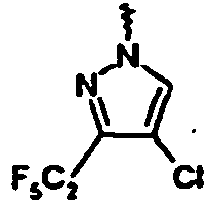
N Cl 3.77 I-1-31 H H i-Pr Cl CH3 CH2 
N Cl 4.21 I-1-32 H H CH2CN Cl CH3 CH2 
N Cl 3.70 I-1-33 H H CH2CN Br CH3 CH2 
N Cl 4.28 I-1-34 H H CH3 Cl CH3 CH2 
N Cl 3,80 I-1-35 H H CH3 Cl CH3 CH2 
N Cl 3,43 I-1-36 H H CH3 Br CH3 CH2 
N Cl 3,52 I-1-37 H H i-Pr Br CH3 CH2 
N Cl 4,73 I-1-38 H H CH3 Cl CH3 CH2 
N Cl 3,28 I-1-39 H H CH3 Br CH3 CH2 
N Cl 4,31 I-1-40 H H i-Pr Cl CH3 CH2 
CCl Cl 4,58 I-1-41 H H CH3 Cl CH3 CH2 
CCl Cl 4,13 I-1-42 H H CH3 Cl CH3 CH2 
N Cl 2,76 I-1-43 H H i-Pr Cl CH3 CH2 
N Cl 3,20 I-1-44 H H CH3 Cl CH3 CH2 
N Cl 2,92 I-1-45 H H CH3 Cl CH3 CH2 
N Cl 2,67 I-1-46 H H c-Pr Cl CH3 CH2 
N Cl 4,58 I-1-47 H H CH2CN Cl CH3 CH2 
N Cl 4,31 I-1-48 H H H Cl CH3 CH2 
N Cl 4,15 I-1-49 H H CH2CN Cl CH3 CH2 
N Cl 3,97 I-1-50 H H H Cl CH3 CH2 
N Cl 3,88 I-1-51 H H i-Pr Cl CH3 CH2 
N Cl 3,52 I-1-52 H H c-Pr Br CH3 CH2 
N Cl 4,59 I-1-53 H H H Br CH3 CH2 
N Cl 4,17 I-1-54 H H c-Pr Cl CH3 CH2 
N Cl 3,61 I-1-55 H H CH2CN Cl CH3 CH2 
N Cl 3,40 I-1-56 H H CH2CN Br CH3 CH2 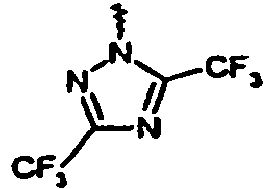
N Cl 3,44 I-1-57 H H c-Pr Br CH3 CH2 
N Cl 3,67 I-1-58 H H CH3 Br CH3 CH2 
N Cl 3,76 I-1-59 H H CH2CN Br CH3 CH2 
N Cl 3,65 I-1-60 H H c-Pr Br CH3 CH2 
N Cl 3,91 I-1-61 H H H Br CH3 CH2 
N Cl 3,53 I-1-62 H H CH3 Cl CH3 CH2 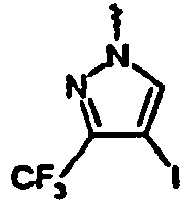
N Cl 3,41 I-1-63 H H i-Pr Cl CH3 CH2 
N Cl 3,85 I-1-64 H H CH3 Cl CH3 CH2 
N Cl 3,21 I-1-65 H H i-Pr Cl CH3 CH2 
N Cl 3,67 I-1-66 H H CH3 Cl CH3 CH2 
N Cl 3,38 I-1-67 H H i-Pr Cl CH3 CH2 
N Cl 3,78 I-1-68 H H CH3 Br CH3 CH2 
N Cl 3,46 I-1-69 H H i-Pr Br CH3 CH2 
N Cl 3,92 I-1-70 H H CH3 Br CH3 CH2 
N Cl 3,94 I-1-71 H H i-Pr Br CH3 CH2 
N Cl 4,40 I-1-72 H H c-Pr Br CH3 CH2 
N Cl 4,14 I-1-73 H H CH2CN Br CH3 CH2 
N Cl 3,87 I-1-74 H H H Br CH3 CH2 
N Cl 3,68 I-1-75 H H (S)-CH(CH3) CH2SCH3 Cl CH3 CH2 
N Cl 4,04 I-1-76 H H C(CH3)2 CH2SCH3 Cl CH3 CH2 
N Cl 4,49 I-1-77 H H (S)-CH(CH3) CH2O(C=O) NHC2H5 Cl CH3 CH2 
N Cl 3,58 I-1-78 H H (S)-CH(CH3) CH2O(C=O) NHCH3 Cl CH3 CH2 
N Cl 3,36 I-1-79 H H CH2CN Cl CH3 CH2 
N Cl 3,62 I-1-80 H H CH3 Br CH3 CH2 
N Cl 2,99 I-1-81 H H i-Pr Br CH3 CH2 
N Cl 3,46 I-1-82 H H c-Pr Br CH3 CH2 
N Cl 3,18 I-1-83 H H H Br CH3 CH2 
N Cl 2,75 I-1-84 H H (S)-CH(CH3) CH2SCH3 H CH3 CH2 
N Cl 3,62 I-1-85 H H CH2CN Br CH3 CH2 
N Cl 2,98 I-1-86 H H CH3 Cl CH3 CH2 
N Cl 3,78 I-1-87 H H (S)-CH(CH3) CH2SO2CH3 H CH3 CH2 
N Cl 2,92 I-1-88 H H CH3 Cl CH3 CH2 
N Cl 3,61 I-1-89 H H i-Pr Cl CH3 CH2 
N Cl 3,96 I-1-90 H H CH3 Cl CH3 CH2 
N Cl 4,08 I-1-91 H H i-Pr Cl CH3 CH2 
N Cl 4,51 I-1-92 H H (S)-CH(CH3) CH2SOCH3 H CH3 CH2 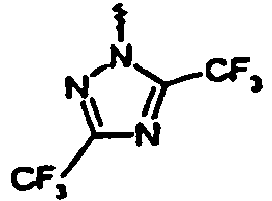
N Cl 2,65 I-1-93 H H c-Pr Br CH3 CH2 
N Cl 3,69 I-1-94 H H H Cl CH3 CH2 
N Cl 3,85 I-1-95 H H CH2CN Cl CH3 CH2 
N Cl 4,01 I-1-96 H H CH3 Cl CH3 CH2 
N Cl 3,90 I-1-97 H H CH2CN Br CH3 CH2 
N Cl 3,45 I-1-98 H H C(CH3)2 CH2SCH3 Br CH3 CH2 
N Cl 4,47 I-1-99 H H (S)-CH(CH3) CH2SCH3 Br CH3 CH2 
N Cl 4,10 I-1-100 H H H Br CH3 CH2 
N Cl 3,24 I-1-101 H H (S)-CH(CH3) CH2SO2CH3 Br CH3 CH2 
N Cl 3,32 I-1-102 H H CH3 Cl CH3 CH2 
N Cl 2,51 I-1-103 H H i-Pr Cl CH3 CH2 
N Cl 2,96 I-1-104 H H CH3 Cl CH3 CH2 
N Cl 3,79 I-1-105 H H i-Pr Cl CH3 CH2 
N Cl 4,14 I-1-106 H H H Cl CH3 CH2 
N Cl 3,46 I-1-107 H H CH2CN Cl CH3 CH2 
N Cl 3,65 I-1-108 H H CH3 Cl CH3 CH2 
N Cl 3,90 I-1-109 H H CH3 Cl CH3 CH2 
N Cl 3,51 I-1-110 H H CH3 Cl CH3 CH2 
N Cl 3,13 I-1-111 H H i-Pr Cl CH3 CH2 
N Cl 3,58 I-1-112 H H CH3 Cl CH3 CH2 
N Cl 4,28 I-1-113 H H (S)-CH(CH3) CH2SOCH3 Br CH3 CH2 
N Cl 2,97 I-1-114 H H H Cl CH3 CH2 
N Cl 4,03 I-1-115 H H i-Pr Cl CH3 CH2 
N Cl 2,31 I-1-116 H H CH3 Cl CH3 CH2 
N Cl 2,44 I-1-117 H H i-Pr Cl CH3 CH2 
N Cl 2,85 I-1-118 H H CH3 Cl CH3 CH2 
N Cl 3,10 I-1-119 H H i-Pr Cl CH3 CH2 
N Cl 3,54 I-1-120 H H (S)-CH(CH3) CH2SO(=NH) CH3 Cl CH3 CH2 
N Cl 2,75 I-1-121 H H C(CH3)2 CH2SO2CH3 Br CH3 CH2 
N Cl 3,57 I-1-122 H H CH3 Cl CH3 CH2 
N Cl 2,51 I-1-123 H H i-Pr Cl CH3 CH2 
N Cl 2,92 I-1-124 H H (S)-CH(CH3) CH2SCH3 Cl CH3 CH2 
N Cl 3,13 I-1-125 H H CH3 Cl CH3 CH2 
N Cl 2,56 I-1-126 H H i-Pr Cl CH3 CH2 
N Cl 3,18 I-1-127 H H CH3 Cl CH3 CH2 
N Cl 2,74 I-1-128 H H C(CH3)2 CH2SOCH3 Cl CH3 CH2 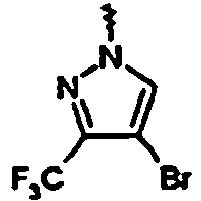
N Cl 3,25 I-1-129 H H (S)-CH(CH3) CH2SO2CH3 Cl CH3 CH2 
N Cl 3,27 I-1-130 H H (S)-CH(CH3) CH2SCH3 Cl CH3 CH2 
N Cl 4,11 I-1-131 H H C(CH3)2 CH2SCH3 Cl CH3 CH2 
N Cl 4,48 I-1-132 H H CH3 Cl CH3 CH2 
N Cl 2,39 I-1-133 H H i-Pr Cl CH3 CH2 
N Cl 2,77 I-1-134 H H C(CH3)2 CH2SCH3 Br CH3 CH2 
N Cl 4,63 I-1-135 H H (S)-CH(CH3) CH2SCH3 Br CH3 CH2 
N Cl 4,24 I-1-136 H H C(CH3)2 CH2SOCH3 Cl CH3 CH2 
N Cl 3,23 I-1-137 H H C(CH3)2 CH2SOCH3 Cl CH3 CH2 
N Cl 3,22 I-1-138 H H (S)-CH(CH3) CH2SOCH3 Cl CH3 CH2 
N Cl 2,91 I-1-139 H H C(CH3)2 CH2SO2CH3 Cl CH3 CH2 
N Cl 3,50 I-1-140 H H (S)-CH(CH3) CH2SOCH3 Br CH3 CH2 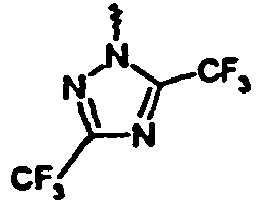
N Cl 3,05 I-1-141 H H (S)-CH(CH3) CH2SO2CH3 Cl CH3 CH2 
N Cl 3,26 I-1-142 H H C(CH3)2 CH2SO2CH3 Br CH3 CH2 
N Cl 3,67 I-1-143 H H C(CH3)2 CH2SOCH3 Br CH3 CH2 
N Cl 3,20 I-1-144 H H C(CH3)2 CH2SOCH3 Br CH3 CH2 
N Cl 3,38 I-1-145 H H C(CH3)2 CH2SO2CH3 Cl CH3 CH2 
N Cl 3,56 I-1-146 H H (S)-CH(CH3) CH2SO2CH3 Br CH3 CH2 
N Cl 3,36 I-1-147 H H (S)-CH(CH3) CH2SOCH3 Cl CH3 CH2 
N Cl 2,95 I-1-148 H H CH3 Cl CH3 CH2 
N Cl 2,91 I-1-149 H H i-Pr Cl CH3 CH2 
N Cl 3,41 I-1-150 H H CH3 Cl CH3 CH2 
N ci 3,70 I-1-151 H H i-Pr Cl CH3 CH2 
N Cl 4,20 I-1-152 H H (S)-CH(CH3) CH2SCH3 Cl CH3 CH2 
N Cl 4,41 I-1-153 H H CH3 Cl CH3 CH2 
N Cl 3,07 I-1-154 H H i-Pr Cl CH3 CH2 
N Cl 3,56 I-1-155 H H CH3 Cl CH3 CH2 
N Cl 3,69 I-1-156 H H i-Pr Cl CH3 CH2 
N Cl 4,17 I-1-157 H H (S)-CH(CH3) CH2SCH3 Cl CH3 CH2 
N Cl 4,36 I-1-158 H H (S)-CH(CH3) CH2SCH3 Cl CH3 CH2 
N Cl 3,67 I-1-159 H H (S)-CH(CH3) CH2SCH3 Cl CH3 CH2 
N Cl 3,78 I-1-160 H H CH3 Cl CH3 CH2 
N Cl 2,39 I-1-161 H H i-Pr Cl CH3 CH2 
N Cl 2,87 I-1-162 H H (S)-CH(CH3) CH2SCH3 Cl CH3 CH2 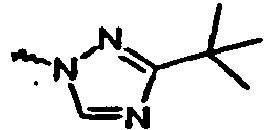
N Cl 3,10 I-1-163 H H CH3 Cl CH3 CH2 
N Cl 3,15 I-1-164 H H NH[S(=O)2] N(CH3)2 Cl CH3 CH2 
N Cl 3,35 I-1-165 H H CH3 Cl CH3 CH2 
N Cl 3,09 I-1-166 H H i-Pr Cl CH3 CH2 
N Cl 3,60 I-1-167 H =S(i-Pr)2 Cl CH3 CH2 
N Cl 4,44 I-1-168 H H i-Pr Cl CH3 CH2 
N Cl 3,79 I-1-169 H H i-Pr CN CH3 CH2 
N Cl 4,55 I-1-170 H H CH3 CN CH3 CH2 
N Cl 4,08 I-1-171 H H CH3 CN CH3 CH2 
N Cl 3,44 I-1-172 H H i-Pr CN CH3 CH2 
N Cl 3,87 I-1-173 H H c-Pr CN CH3 CH2 
N Cl 3,59 I-1-174 H H H CN CH3 CH2 
N Cl 3,20 I-1-175 H H CH2CN CN CH3 CH2 
N Cl 3,40 I-1-176 H H CH3 CN CH3 CH2 
N Cl 3,11 I-1-177 H H i-Pr CN CH3 CH2 
N Cl 3,53 I-1-178 H H c-Pr CN CH3 CH2 
N Cl 3,31 I-1-179 H H H CN CH3 CH2 
N Cl 2,91 I-1-180 H H CH2CN CN CH3 CH2 
N Cl 3,11 I-1-181 H H CH3 CN CH3 CH2 
N Cl 2,57 I-1-182 H H i-Pr CN CH3 CH2 
N Cl 2,96 I-1-183 H H c-Pr CN CH3 CH2 
N Cl 2,75 I-1-184 H H H CN CH3 CH2 
N Cl 2,42 I-1-185 H H CH2CN CN CH3 CH2 
N Cl 2,62 I-1-186 H H CH3 CN CH3 CH2 
N Cl 3,35 I-1-187 H H i-Pr CN CH3 CH2 
N Cl 3,80 I-1-188 H H c-Pr CN CH3 CH2 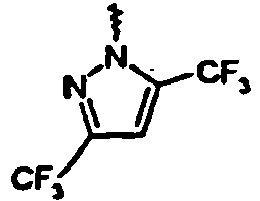
N Cl 3,56 I-1-189 H H H CN CH3 CH2 
N Cl 3,15 I-1-190 H H CH2CN CN CH3 CH2 
N Cl 3,28 I-1-191 H H c-Pr CN CH3 CH2 
N Cl 4,29 I-1-192 H H H CN CH3 CH2 
N Cl 3,91 I-1-193 H H CH2CN CN CH3 CH2 
N Cl 4,04 I-1-194 H 
CN CH3 CH2 
N Cl 2,18 I-1-195 H H (S)-CH(CH3) CH2SCH3 F CH3 CH2 
N Cl 4,13 I-1-196 H H 
F CH3 CH2 
N Cl 3,90 I-1-197 H H 
CN CH3 CH2 
N Cl 4,50 I-1-198 H H 
CN CH3 CH2 
N Cl 3,11 I-1-199 H H 
F CH3 CH2 
N Cl 4,55 I-1-200 H 
F CH3 CH2 
N Cl 2,19 I-1-201 H H 
Cl CH3 CH2 
N Cl 4,21 I-1-202 H H 
Cl CH3 CH2 
N Cl 2,30 I-1-203 H H 
F CH3 CH2 
N Cl 3,14 I-1-204 H H (S)-CH(CH3) CH2SO2CH3 F CH3 CH2 
N Cl 3,34 I-1-205 H H 
Cl CH3 CH2 
N Cl 4,88 I-1-206 H H (S)-CH(CH3) CH2SCH3 Cl CH3 CH2 
N Cl 4,41 I-1-207 H H 
Cl CH3 CH2 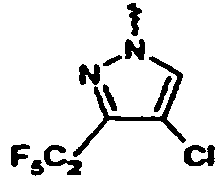
N Cl 3,37 I-1-208 H H 
CN CH3 CH2 
N Cl 3,90 I-1-209 H H (S)-CH(CH3) CH2SCH3 CN CH3 CH2 
N Cl 4,05 I-1-210 H H (S)-CH(CH3) CH2SO2CH3 CN CH3 CH2 
N Cl 3,34 I-1-211 H H (S)-CH(CH3) CH2SOCH3 CN CH3 CH2 
N Cl 3,02 I-1-212 H H (S)-CH(CH3) CH2SOCH3 Cl CH3 CH2 
N Cl 3,25 I-1-213 H H (S)-CH(CH3) CH2SO2CH3 Cl CH3 CH2 
N Cl 3,60 I-1-214 H H 
Cl CH3 CH2 
N Cl 2,77 I-1-215 H H 
Cl CH3 CH2 
N Cl 2,62 I-1-216 H H (S)-CH(CH3) CH2SOCH3 F CH3 CH2 
N Cl 3,03 I-1-217 H H i-Pr F CH3 CH2 
N Cl 4,47 I-1-218 H H i-Pr F CH3 CH2 
N Cl 3,55 I-1-219 H H CH3 F CH3 CH2 
N Cl 3,12 I-1-220 H H CH3 F CH3 CH2 
N Cl 4,06 I-1-221 H H CH3 F CH3 CH2 
N Cl 3,32 I-1-222 H H CH3 F CH3 CH2 
N Cl 2,58 I-1-223 H H CH3 F CH3 CH2 
N Cl 3,47 I-1-224 H H i-Pr F CH3 CH2 
N Cl 3,89 I-1-225 H H i-Pr F CH3 CH2 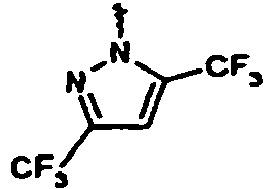
N Cl 3,77 I-1-226 H H i-Pr F CH3 CH2 
N Cl 3,00 I-1-227 H H CH3 I CH3 CH2 
N Cl 3,87 I-1-228 H H C2H5 I CH3 CH2 
N Cl 4,06 I-1-229 H H n-Pr I CH3 CH2 
N Cl 4,33 I-1-230 H H i-Pr I CH3 CH2 
N Cl 4,29 I-1-231 H H c-Pr I CH3 CH2 
N Cl 4,01 I-1-232 H H CH2CF3 I CH3 CH2 
N Cl 5,28 I-1-233 H H 
I CH3 CH2 
N Cl 4,55 I-1-234 H H H I CH3 CH2 
N Cl 3,56 I-1-235 H H 
I CH3 CH2 
N Cl 4,34 I-1-236 H H 
I CH3 CH2 
N Cl 4,80 I-1-237 H H CH3 I CH3 CH2 
N Cl 3,60 I-1-238 H H i-Pr I CH3 CH2 
N Cl 4,06 I-1-239 H H CH3 I CH3 CH2 
N Cl 4,51 I-1-240 H H i-Pr I CH3 CH2 
N Cl 4,96 I-1-241 H H CH2CN I CH3 CH2 
N Cl 3,73 I-1-242 H H i-Pr I CH3 CH2 
N Cl 4,40 I-1-243 H H CH3 I CH3 CH2 
N Cl 3,96 I-1-244 H H C2H5 I CH3 CH2 
N Cl 3,83 I-1-245 H H CH2CN I CH3 CH2 
N Cl 3,53 I-1-246 H H CH2CN I CH3 CH2 
N Cl 3,85 I-1-247 H H CH3 I CH3 CH2 
N Cl 3,05 I-1-248 H H i-Pr I CH3 CH2 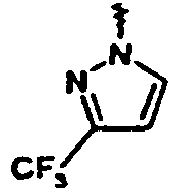
N Cl 3,51 I-1-249 H H c-Pr I CH3 CH2 
N Cl 3,27 I-1-250 H H C2H5 I CH3 CH2 
N. Cl 3,28 I-1-251 H H CH2CN I CH3 CH2 
N Cl 3,04 I-1-252 H H c-Pr I CH3 CH2 
N Cl 3,81 I-1-253 H H 
I CH3 CH2 
N Cl 4,13 I-1-254 H H 
I CH3 CH2 
N Cl 4,47 I-1-255 H H 
I CH3 CH2 
N Cl 3,60 I-1-256 H CH3 CH3 I CH3 CH2 
N Cl 3,84 I-1-257 H H CH3 Cl CH3 CH2 
N Cl 2,92 I-1-258 H H i-Pr Cl CH3 CH2 
N Cl 3,32 I-1-259 H H i-Pr Cl Cl CH2 
N Cl 3,27 I-1-260 H H c-Pr Cl CH3 CH2 
N Cl 3,12 I-1-261 H H c-Pr Cl Cl CH2 
N Cl 3,08 I-1-262 H H i-Pr Cl CH3 CH2 
N Cl 2,31 I-1-263 H H c-Pr Cl CH3 CH2 
N Cl 2,13 I-1-264 H H 
Cl CH3 CH2 
N Cl 2,39 I-1-265 H H CH3 Cl CH3 CH2 
N Cl 1,94 I-1-266 H H CH3 Cl Cl CH2 
N Cl 2,99 I-I-267 H H i-Pr I CH3 CH2 
N Cl 3,67 I-1-268 H H c-Pr I CH3 CH2 
N Cl 3,44 I-1-269 H H i-Pr Cl CH3 CH2 
N Cl 3,4 I-1-270 H H CH3 Cl CH3 CH2 
N Cl 2,95 I-1-271 H H c-Pr Cl CH3 CH2 
N Cl 3,17 I-1-272 H H H I CH3 CH2 
N Cl 3,38 I-1-273 H H H I CH3 CH2 
N Cl 2,84 I-1-274 H H C2H5 I CH3 CH2 
N Cl 4,74 I-1-275 H H c-Pr I CH3 CH2 
N Cl 4,71 I-1-276 H H c-Pr I CH3 CH2 
N Cl 4,15 I-1-277 H H C2H5 I CH3 CH2 
N Cl 4,17 I-1-278 H H CH3 I CH3 CH2 
N Cl 3,25 I-1-279 H H 
I CH3 CH2 
N Cl 4,47 I-1-280 H H 
I CH3 CH2 
N Cl 6,56 I-1-281 H H 
I CH3 CH2 
N Cl 4,54 I-1-282 H H 
I CH3 CH2 
N Cl 4,18 I-1-283 H H C2H5 I CH3 CH2 
N Cl 3,89 I-1-284 H H 
I CH3 CH2 
N Cl 4,16 I-1-285 H H 
I CH3 ° CH2 
N Cl 4,23 I-1-286 H H 
I CH3 CH2 
N Cl 4,52 I-1-287 H H 
I CH3 CH2 
N Cl 4,69 I-1-288 H H 
I CH3 CH2 
N Cl 4,79 I-1-289 H H 
I CH3 CH2 
N Cl 4,63 I-1-290 H H CH3 Cl Cl CH2 
N Cl 3,40 I-1-291 H H i-Pr Cl Cl CH2 
N Cl 3,76 I-1-292 H H CH2CN Cl Cl CH2 
N Cl 2,83 I-1-293 H H 
Cl Cl CH2 
N Cl 3.22 I-1-294 H H i-Pr Cl Cl CH2 
N Cl 4,00 I-1-295 H H c-Pr Cl Cl CH2 
N Cl 2,95 I-1-296 H H H Cl Cl CH2 
N Cl 3,43 I-1-297 H H CH3 Cl Cl CH2 
N Cl 3,59 I-1-298 H H H Cl Cl CH2 
N Cl 2,61 I-1-299 H H CH2CN Cl Cl CH2 
N Cl 3,53 I-1-300 H H c-Pr Cl Cl CH2 
N Cl 3,19 I-1-301 H H i-Pr Cl Cl CH2 
N Cl 2,60 I-1-302 H H H Cl Cl CH2 
N Cl 2,80 I-1-303 H H CH2CN Cl Cl CH2 
N Cl 2,98 I-1-304 H H CH3 Cl Cl CH2 
N Cl 3,01 I-1-305 H H i-Pr Cl Cl CH2 
N Cl 3,40 I-1-306 H H CH3 Cl Cl CH2 
N Cl 2,18 I-1-307 H H H Cl Cl CH2 
N Cl 2,95 I-1-308 H H CH3 Cl Cl CH2 
N Cl 3,18 I-1-309 H H i-Pr Cl Cl CH2 
N Cl 3,53 I-1-310 H H CH2CN Cl Cl CH2 
N Cl 3,13 I-1-311 H H H Cl Cl CH2 
N Cl 2,21 I-1-312 H H CH3 Cl Cl CH2 
N Cl 2,37 I-1-313 H H CH2CN Cl Cl CH2 
N Cl 2,43 I-1-314 H H i-Pr Cl Cl CH2 
N Cl 2,77 I-1-315 H H c-Pr Cl Cl CH2 
N Cl 2,54 I-1-316 H H CH3 Cl Cl CH2 
N Cl 1,03 I-1-317 H H i-Pr Cl Cl CH2 
N Cl 1,31 I-1-318 H H i-Pr Cl Cl CH2 
N Cl 1,62 I-1-319 H H H Cl Cl CH2 
N Cl 2,02 I-1-320 H H CH2CN Cl Cl CH2 
N Cl 1,49 I-1-321 H H CH3 Cl Cl CH2 
N Cl 1,41 I-1-322 H H CH3 Cl Cl CH2 
N Cl 1,94 I-1-323 H H i-Pr Cl CH3 CH2 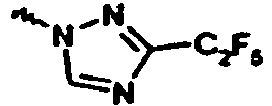
N Cl 3,01 I-1-324 -H H (S)-CH(CH3) CH2SCH3 Cl Cl CH2 
N Cl * I-1-325 H H (S)-CH(CH3) CH2SOCH3 Cl Cl CH2 
N Cl 3,54 I-1-326 H H CH3 Cl Cl CH2 
N Cl 2,55 I-1-327 H H i-Pr Cl Cl CH2 
N Cl 2,97 I-1-328 H H (S)-CH(CH3) CH2SO2CH3 Cl Cl CH2 
N Cl 3,63 I-1-329 H H CH3 Cl CH3 CH2 
N Cl 2,57 I-1-330 H H H Cl CH3 CH2 
N Cl 2,39 I-1-331 H H c-Pr Cl CH3 CH2 
N Cl 2,78 I-1-332 H H CH2CN Cl CH2 CH2 
N Cl 2,59 I-1-333 H H CH3 CN CH3 CH2 
N Cl 2,25 I-1-334 H H i-Pr Cl CH3 CH2 
N Cl 2,66 I-1-335 H H c-Pr Cl Cl CH2 
N Cl 2,69 I-1-336 H H H Cl Cl CH2 
N Cl 2,32 I-1-337 H H CH2CN Cl Cl CH2 
N Cl 2,56 I-1-338 H H c-Pr CN CH3 CH2 
N Cl 2,45 I-1-339 H H H CN CH3 CH2 
N Cl 2,11 I-1-340 H H i-Pr Cl Cl CH2 
N Cl 2,55 I-1-341 H H i-Pr Cl CH3 CH2 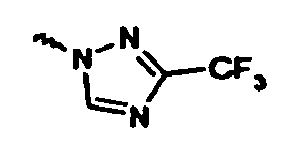
N Cl 2,63 I-1-342 H H CH3 Cl Cl CH2 
N Cl 2,15 I-1-343 H H H Cl CH3 CH2 
N Cl 2,02 I-1-344 H H c-Pr Cl Cl CH2 
N Cl 2,37 I-1-345 H H c-Pr Cl CH3 CH2 
N Cl 2,42 I-1-346 H H H Cl Cl CH2 
N Cl 2,01 I-1-347 H H CH3 Cl CH3 CH2 
N Cl 2,19 I-1-348 H H CH2CN Cl CH3 CH2 
N Cl 2,21 I-1-349 H H CH2CN Cl Cl CH2 
N Cl 2,19 I-1-350 H H H CN CH3 CH2 
N Cl 1,75 I-1-351 H H CH2CN CN CH3 CH2 
N Cl 1,96 I-1-352 H H CH3 CN CH3 CH2 
N Cl 1,91 I-1-353 H H c-Pr CN CH3 CH2 
N Cl 2,08 I-1-354 H H i-Pr CN CH3 CH2 
N Cl 2,23 I-1-355 H H CH3 Cl CH3 C=NOCH3 
N Cl 4,07 - Analog zu den oben aufgeführten Beispielen sowie der allgemeinen Beschreibung werden folgende Verbindungen der Formel (I-2) erhalten.

Tabelle 2 Nr. R1 R2 R3 R4 R5 R6 A Q logP I-2-1 H H i-Pr Cl CH3 CH3 CH2 
4,08 I-2-2 H H i-Pr Cl Cl i-Pr CH2 
3,85 I-2-3 H H CH3 Cl Cl i-Pr CH2 
3,31 I-2-4 H H CH3 Cl Cl 
CH2 
* I-2-5 H H CH3 Cl Cl 
CH2 
2,83 I-2-6 H H CH3 Cl Cl 
CH2 
2,99 I-2-7 H H i-Pr Cl Cl 
CH2 
* I-2-8 H H i-Pr Cl Cl 
CH2 
4,68 I-2-9 H H i-Pr I CH3 
CH2 
4,98 I-2-10 H H c-Pr I CH3 
CH2 
4,73 I-2-11 H H i-Pr Cl CH3 
CH2 
4,78 I-2-12 H H c-Pr Cl CH3 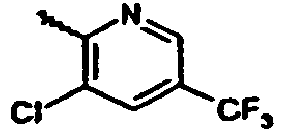
CH2 
4,52 I-2-13 H H c-Pr Cl Cl 
CH2 
4,46 I-2-14 H H 
Cl CH3 
CH2 
5,27 I-2-15 H H 
Cl CH3 
CH2 
4,04 I-2-16 H H t-Bu Cl CH3 
CH2 
5,12 I-2-17 H H H Cl CH3 
CH2 
4,09 I-2-18 H H CH2CN Cl CH3 
CH2 
4,23 I-2-19 H H c-Pr F CH3 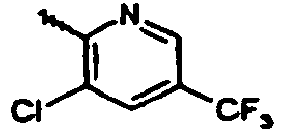
CH2 
4,11 I-2-20 H H i-Pr F CH3 
CH2 
4,47 I-2-21 H H i-Pr Br CH3 
CH2 
4,75 I-2-22 H H CH3 Cl CH3 
CH2 
3,53 I-2-23 H H CH3 Cl Cl 
CH2 
3,54 I-2-24 H H c-Pr Br CH3 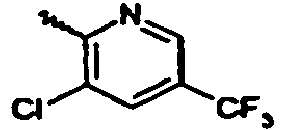
CH2 
4,63 - Analog zu den oben aufgeführten Beispielen sowie der allgemeinen Beschreibung werden folgende Verbindungen der Formel (I-3) erhalten.

Tabelle 3 Nr. R1 R2 R3 R4-R4 R5 A Q logP I-3-1 H H i-Pr -CH=CH-CH=CH- Cl CH2 
4.08 - 1H-NMR-Daten ausgewählter Verbindungen:
- 1-1-21 (400 MHz, DMSO): 1.11 (d, 6 H), 2.14 (s, 3 H), 3.91 (m, 1 H), 5.55 (s, 2 H), 7.12 (s, 1 H), 7.28 (s, 1 H), 7.39 (s, 1 H), 7.55 (dd, 1 H), 7.76 (d, 1 H), 7.99 (s, 1 H), 8.08 (d, 1 H), 8.43 (d, 1 H), 8.61 (s, 1 H), 10.12 (s, 1 H).
- I-1-22 (400 MHz, DMSO): 1.18 (d, 6 H), 2.14 (s, 3 H), 3.90 (m, 1 H), 5.87 (s, 2 H), 7.24 (s, 1 H), 7.42 (s, 1 H), 7.53 (s, 1 H), 7.55 (dd, 1 H), 7.80 (d, 1 H), 8.08 (d, 1 H), 8.44 (d, 1 H), 10.07 (s, 1 H).
- I-1-26 (400 MHz, DMSO): 2.14 (s, 3 H), 2.67 (d, 3 H), 5.93 (s, 2 H), 7.21 (s, 1 H), 7.33 (s, 1 H), 7.40 (s, 1 H), 7.55 (dd, 1 H), 8.00 (d, 1 H), 8.08 (d, 1 H), 8.45 (d, 1 H), 10.12 (s, 1 H).
- I-1-48 (400 MHz, DMSO): 2.13 (s, 3 H), 5.69 (s, 2 H), 7.18 (s, 1 H), 7.41 (s, 2 H), 7.55 (dd, 1 H), 8.10 (d, 1 H), 8.45 (d, 1 H), 8.80 (s, 1 H), 10.19 (s, 1 H).
- I-1-65 (400 MHz, DMSO): 1.06 (d, 6 H), 2.17 (s, 3 H), 3.95 (m, 1 H), 5.58 (s, 2 H), 7.15 (s, 1 H), 7.31 (s, 1 H), 7.42 (s, 1 H), 7.58 (dd, 1 H), 7.78 (d, 1 H), 7.92 (s, 1 H), 8.09 (d, 1 H), 8.46 (d, 1 H), 8.47 (s, 1 H), 10.04 (s, 1 H).
- I-1-75 (400 MHz, DMSO): 1.09 (d, 6 H), 2.00 (s, 3 H), 2.15 (s, 3 H), 2.44 (dd, 1 H), 2.53 (dd, 1 H), 3.99 (m, 1 H), 5.86 (s, 2 H), 7.23 (s, 1 H), 7.33 (s, 1 H), 7.42 (s, 1 H), 7.55 (dd, 1 H), 7.92 (d, 1 H), 8.09 (d, 1 H), 8.44 (d, 1 H), 10.04 (s, 1 H).
- 1-1-88 (400 MHz, DMSO): 2.14 (s, 3 H), 2.67 (d, 3 H), 5.38 (s, 2 H), 7.28 (s, 1 H), 7.33 (s, 1 H), 7.40 (s, 1 H), 7.55 (dd, 1 H), 7.96 (d, 2 H), 8.00 (d, 1 H), 8.08 (d, 1 H), 8.17 (d, 2 H), 8.46 (d, 1 H), 10.10 (s, 1 H).
- I-1-104 (400 MHz, DMSO): 2.13 (s, 3 H), 2.64 (d, 3 H), 6.18 (s, 2 H), 7.28 (s, 1 H), 7.32 (s, 1 H), 7.40 (s, 1 H), 7.55 (dd, 1 H), 7.92 (d, 2 H), 8.00 (d, 1 H), 8.09 (d, 1 H), 8.30 (d, 2 H), 8.45 (d, 1 H), 10.10 (s, 1 H).
- I-1-117 (400 MHz, DMSO): 1.02 (d, 6 H), 2.15 (s, 3 H), 3.34 (s, 3 H), 3:92 (m, 1 H), 5.10 (s, 2 H), 7.17 (s, 1 H), 7.29 (s, 1 H), 7.39 (s, 1 H), 7.55 (dd, 1 H), 7.78 (d, 1 H), 8.09 (d, 1 H), 8.44 (d, 1 H), 10.01 (s, 1 H).
- I-1-126 (400 MHz, DMSO): 0.99-1.10 (m, 4 H), 1.03 (d, 6 H), 2.15 (s, 3 H), 3.00-3.08 (m, 1 H), 3.92 (m, 1 H), 5.05 (s, 2 H), 7.16 (s, 1 H), 7.29 (s, 1 H), 7.40 (s, 1 H), 7.55 (dd, 1 H), 7.78 (d, 1 H), 8.09 (d, 1 H), 8.44 (d, 1 H), 10.01 (s, 1 H).
- I-1-139 (400 MHz, DMSO): 1.38 (s, 6 H), 2.14 (s, 3 H), 2.89 (s, 3 H), 3.68 (s, 2 H), 5.87 (s, 2 H), 7.21 (s, 1 H), 7.31 (s, 1 H), 7.40 (s, 1 H), 7.55 (dd, 1 H), 7.79 (s, 1 H), 8.09 (d, 1 H 8.44 (d, 1 H), 9.93 (s, 1 H).
- I-1-148 (400 MHz, DMSO): 2.14 (s, 3 H), 2.66 (d, 3 H), 6.18 (s, 2 H), 7.29 (s, 1 H), 7.32 (s, 1 H), 7.40 (s, 1 H), 7.55 (dd, 1 H), 7.70 (d, 1 H), 8.09 (d, 1 H), 8.11 (d, 1 H), 8.45 (s, 1 H), 8.46 (d, 1 H), 9.07 (s, 1 H), 10.10 (s, 1 H).
- I-1-161 (400 MHz, DMSO): 1.04 (d, 6 H), 1.31 (s, 9 H), 2.14 (s, 3 H), 3.90 (m, 1 H), 5.46 (s, 2 H), 7.11 (s, 1 H), 7.29 (s, 1 H), 7.39 (s, 1 H), 7.55 (dd, 1 H), 7.78 (d, 1 H), 8.09 (d, 1 H), 8.40 (s, 1 H), 8.44 (d, 1 H), 10.10 (s, 1 H).
- I-1-172 (400 MHz, DMSO): 1.04 (d, 6 H), 2.15 (s, 3 H), 3.90 (m, 1 H), 5.58 (s, 2 H), 7.16 (s, 1 H), 7.55 (dd, 1 H), 7.70 (s, 1 H), 7.78 (s, 1 H), 7.93 (d, 1 H), 8.09 (d, 1 H), 8.38 (s, 1 H), 8.45 (d, 1 H), 10.32 (s, 1 H).
- I-1-175 (400 MHz, DMSO): 2.21 (s, 3 H), 4.16 (d, 1 H), 5.57 (s, 2 H), 7.16 (s, 1 H), 7.55 (dd, 1 H), 7.70 (s, 1 H), 7.78 (s, 1 H), 7.86 (d, 1 H), 8.09 (d, 1 H), 8.37 (s, 1 H), 8.46 (d, 1 H), 10.32 (s, 1 H).
- I-1-176 (400 MHz, DMSO): 2.19 (s, 3 H), 2.68 (d, 1 H), 5.88 (s, 2 H), 7.25 (s, 1 H), 7.55 (dd, 1 H), 7.80 (s, 1 H), 7.97 (s, 1 H), 8.09 (d, 1 H), 8.15 (d, 1H), 8.44 (d, 1 H), 10.40 (s, 1 H).
- I-1-180 (400 MHz, DMSO): 2.21 (s, 3 H), 4.16 (d, 1 H), 5.87 (s, 2 H), 7.27 (s, 1 H), 7.55 (dd, 1 H), 7.77 (s, 1 H), 7.86 (s, 1 H), 8.09 (d, 1 H), 8.46 (d, 1 H), 8.96 (d, 1 H), 10.34 (s, 1 H).
- I-1-182 (400 MHz, DMSO): 1.04 (d, 6 H), 2.19 (s, 3 H), 3.92 (m, 1 H), 5.57 (s, 2 H), 6.74 (s, 1 H), 7.15 (s, 1 H), 7.55 (dd, 1 H), 7.70 (s, 1 H), 7.78 (s, 1 H), 7.91 (d, 1 H), 8.06 (s, 1 H), 8.09 (d, 1 H), 8.45 (d, 1 H), 10.30 (s, 1 H).
- I-1-190 (400 MHz, DMSO): 2.21 (s, 3 H), 4.15 (d, 1 H), 5.69 (s, 2 H), 7.18 (s, 1 H), 7.53 (s, 1 H), 7.55 (dd, 1 H), 7.76 (s, 1 H), 7.85 (s, 1 H), 8.07 (d,1 1 H), 8.45 (d, 1 H), 8.95 (s, 1 H), 10.30 (s, 1 H).
- I-1-195 (400 MHz, DMSO): 1.11 (d, 6 H), 2.00 (s, 3 H), 2.15 (s, 3 H), 2.44 (dd, 1 H), 2.53 (dd, 1 H), 4.02 (m, 1 H), 5.57 (s, 2 H), 7.08 (d, 1 H), 7.15 (s, 1 H), 7.20 (d, 1 H), 7.55 (dd, 1 H), 7.84 (d, 1 H), 8.09 (d, 1 H), 8.37 (s, 1 H), 8.45 (d, 1 H), 10.30 (s, 1 H).
- I-1-196 (400 MHz, DMSO): 2.15 (s, 3 H), 4.34 (d, 1 H), 5.57 (s, 2 H), 6.19 (d, 1 H), 6.29 (d, 1 H), 7.10 (s, 1 H), 7.13 (d, 1 H), 7.22 (d, 1 H), 7.43 (s, 1 H), 7.55 (dd, 1 H), 8.08 (d, 1 H), 8.38 (s, 1 H), 8.46 (d, 1 H), 8.55 (t, 1 H), 10.30 (s, 1 H).
- I-1-201 (400 MHz, DMSO): 2.14 (s, 3 H), 4.33 (d, 1 H), 5.57 (s, 2 H), 6.19 (d, 1 H), 6.29 (d, 1 H), 7.10 (s, 1 H), 7.33 (s, 1 H), 7.44 (2 d, 2 H), 7.55 (dd, 1 H), 8.08 (d, 1 H), 8.37 (s, 1 H), 8.45 (d, 1 H), 8.55 (t, 1 H), 10.34 (s, 1 H).
- I-1-208 (400 MHz, DMSO): 2.14 (s, 3 H), 4.33 (d, 1 H), 5.57 (s, 2 H), 6.19 (d, 1 H), 6.29 (d, 1 H), 7.13 (s, 1 H), 7.45 (s, 1 H), 7.55 (dd, 1 H), 7.75 (s, 1 H), 7.80 (s, 1 H), 8.08 (d, 1 H), 8.38 (s, 1 H), 8.69 (br s, 1 H), 8.55 (t, 1 H), 10.34 (s, 1 H).
- I-1-241 (400 MHz, DMSO): 1.02 (d, 3 H), 2.11 (s, 3 H), 3.91 (m, 1 H), 5.57 (s, 2 H), 7.12 (s, 1 H), 7.55 (dd, 1 H), 7.57 (s, 1 H), 7.69 (s, 1 H), 7.76 (d, 1 H), 8.08 (d, 1 H), 8.37 (s, 1 H), 8.45 (d, 1 H), 10.02 (s, 1 H).
- I-1-243 (400 MHz, DMSO): 2.10 (s, 3 H), 2.67 (d, 3 H), 3.07 (q, 2 H), 5.57 (s, 2 H), 7.13 (s, 1 H), 7.55 (dd, 1 H), 7.60 (s, 1 H), 7.70 (s, 1 H), 7.98 (d, 1 H), 8.10 (d, 1 H), 8.38 (s, 1 H), 8.45 (d, 1 H), 10.09 (s, 1 H).
- I-1-244 (400 MHz, DMSO): 0.99 (t, 3 H), 2.11 (s, 3 H), 3.07 (q, 2 H), 5.87 (s, 2 H), 7.21 (s, 1 H), 7.55 (dd, 1 H), 7.59 (s, 1 H), 7.70 (s, 1 H), 7.98 (s, 1 H), 8.09 (d, 1 H), 8.45 (d, 1 H), 10.05 (s, 1 H).
- I-1-248 (400 MHz, DMSO): 1.01 (d, 6 H), 2.10 (s, 3 H), 3.89 (m, 1 H), 5.56 (s, 2 H), 6.73 (s, 1 H), 7.11 (s, 1 H), 7.55 (dd, 1 H), 7.56 (s, 1 H), 7.76 (s, 1 H), 7.75 (d, 1 H), 8.04 (s, 1 H), 8.09 (d, 1 H), 8.45 (d, 1 H), 10.01 (s, 1 H).
- I-1-274 (400 MHz, DMSO): 0.99 (t, 3 H), 2.10 (s, 3 H), 3.07 (q, 2 H), 5.68 (s, 2 H), 7.15 (s, 1 H), 7.55 (dd, 1 H), 7.60 (s, 1 H), 7.97 (s, 1 H), 8.08 (d, 1 H), 8.45 (d, 1 H), 10.09 (s, 1 H).
- I-1-275 (400 MHz, DMSO): 0.40-0.47 (m, 2 H), 0.55-0.60 (m, 2 H), 2.10 (s, 3 H), 2.65-2.71 (m, 1 H), 5.69 (s, 2 H), 7.17 (s, 1 H), 7.55 (dd, 1 H), 7.56 (s, 1 H), 7.69 (s, 1 H), 8.00 (d, 1 H), 8.08 (d, 1 H), 8.45 (s, 1 H), 8.79 (d, 1 H), 10.05 (s, 1 H).
- I-1-276 (400 MHz, DMSO): 0.41-0.45 (m, 2 H), 0.56-0.61 (m, 2 H), 2.10 (s, 3 H), 2.65-2.71 (m, 1 H), 5.57 (s, 2 H), 7.14 (s, 1 H), 7.55 (dd, 1 H), 7.55 (s, 1 H), 7.69 (s, 1 H), 8.01 (d, 1 H), 8.08 (d, 1 H), 8.38 (s, 1 H), 8.46 (d, 1 H), 10.02 (s, 1 H).
- I-1-279 (400 MHz, DMSO): 1.34-1.60 (m, 6 H), 1.71-1.78 (m, 2 H), 2.10 (s, 3 H), 4.01-4.08 (m, 1 H), 5.87 (s, 2 H), 7.21 (s, 1 H), 7.55 (dd, 1 H), 7.57 (s, 1 H), 7.70 (s, 1 H), 7.85 (d, 1 H), 8.07 (d, 1 H), 8.43 (s, 1 H), 10.02 (s, 1 H).
- I-1-280 (400 MHz, DMSO): 1.13-1.51 (m, 20 H), 1.71-1.78 (m, 2 H), 2.07 (s, 3 H), 3.93-3.96 (m, 1 H), 5.83 (s, 2 H), 7.13 (s, 1 H), 7.55 (dd, 1 H), 7.61 (s, 1 H), 7.68 (d, 1 H), 8.02 (s, 1 H), 8.07 (d, 1 H), 8.43 (s, 1 H), 10.02 (s, 1 H).
- I-1-282 (400 MHz, DMSO): 1.36 (s, 2 H), 1.56-1.65 (m, 2 H), 1.84-1.94 (m, 2 H), 2.07 (s, 3 H), 4.18-4.24 (m, 1 H), 5.87 (s, 2 H), 7.18 (s, 1 H), 7.55 (dd, 1 H), 7.59 (s, 1 H), 7.70 (d, 1 H), 8.07 (s, 1 H), 8.19 (d, 1 H), 8.43 (s, 1 H), 10.02 (s, 1 H).
- I-1-290 (400 MHz, CDCl3): 2.90 (d, 3 H), 5.74 (s, 2 H), 6.10 (d, 1 H), 7.23 (s, 1 H), 7.23 (s, 1 H), 7.28 (s, 1 H), 7.40 (dd, 1 H), 7.87 (d, 1 H), 8.46 (d, 1 H), 9.74 (s, 1 H).
- 1-1-296 (400 MHz, CDCl3): 5.54 (s, 2 H), 5.62 (s, 1 H), 6.11 (s, 1 H), 7.12 (s, 1 H), 7.39 (s, 1 H), 7.40 (dd, 1 H), 7.48 (s, 1 H), 7.90 (d, 1 H), 7.94 (s, 1 H), 8.48 (d, 1 H), 9.45 (s, 1 H).
- I-1-310 (400 MHz, CDCl3): 4.18 (d, 2 H), 5.48 (s, 2 H), 6.74 (t, 1 H), 7.08 (s, 1 H), 7.32 (s, 1 H), 7.43 (dd, 1 H), 7.48 (s, 1 H), 7.92 (d, 1 H), 7.94 (s, 1 H), 8.50 (d, 1 H), 8.93 (s, 1 H).
- I-1-314 (400 MHz, CDCl3): 1.10 (d, 6 H), 4.08 (m, 1 H), 5.50 (s, 2 H), 5.92 (d, 1 H), 6.57 (s, 1 H), 7.15 (s, 1 H), 7.28 (s, 1 H), 7.39 (s, 1 H), 7.40 (dd, 1 H), 7.57 (s, 1 H), 7.87 (d, 1 H), 8.48 (d, 1 H), 9.65 (s, 1 H).
- I-1-324 (400 MHz, CDCl3): 1.24 (d, 3 H), 2.10 (s, 3 H), 2.60 (m, 2 H), 4.22 (m, 1 H), 5.51 (d, 1 H), 5.58 (d, 1 H), 6.13 (d, 1 H), 7.17 (s, 1 H), 7.35 (s, 1 H), 7.39 (s, 1 H), 7.40 (dd, 1 H), 7.87 (d, 1 H), 7.90 (s, 1 H), 8.48 (d, 1 H), 9.60 (s, 1 H).
- 1-1-331 (400 MHz, CDCl3): 0.55 (m, 2 H), 0.85 (m, 2 H), 2.16 (s, 3 H), 2.77 (m, 1 H), 5.57 (s, 2 H), 6.18 (d, 1 H), 7.12 (s, 1 H), 7.18 (s, 1 H), 7.24 (s, 1 H), 7.41 (dd, 1 H), 7.88 (d, 1 H), 8.35 (s, 1 H), 8.48 (d, 1 H), 10.15 (s, 1 H).
- I-1-334 (400 MHz, CDCl3): 1.24 (d, 6 H), 2.23 (s, 3 H), 4.18 (m, 1 H), 5.58 (s, 2 H), 5.99 (d, 1 H), 7.12 (s, 1 H), 7.28 (s, 1 H), 7.40 (dd, 1 H), 7.58 (d, 1 H), 7.88 (d, 1 H), 8.36 (s, 1 H), 8.48 (d, 1 H), 10.62 (s, 1 H).
- I-1-340 (400 MHz, CDCl3): 1.24 (d, 6 H), 4.08 (m, 1 H), 5.58 (s, 2 H), 5.92 (d, 1 H), 7.21 (s, 1 H), 7.30 (s, 1 H), 7.32 (s, 1 H), 7.40 (dd, 1 H), 7.77 (d, 1 H), 8.36 (s, 1 H), 8.48 (d, 1 H), 10.06 (s, 1 H).
- I-1-345 (400 MHz, CDCl3): 0.55 (m, 2 H), 0.85 (m, 2 H), 2.77 (m, 1 H), 5.58 (s, 2 H), 6.20 (d, 1 H), 7.14 (s, 1 H), 7.20 (s, 1 H), 7.22 (s, 1 H), 7.40 (dd, 1 H), 7.88 (d, 1 H), 8.32 (s, 1 H), 8.45 (d, 1 H), 10.12 (s, 1 H).
- I-1-354 (400 MHz, CDCl3): 1.21 (d, 6 H), 4.15 (m, 1 H), 5.58 (s, 2 H), 7.16 (s, 1 H), 7.18 (s, 1 H), 7.40 (dd, 1 H), 7.58 (s, 1 H), 7.75 (s, 1 H), 7.84 (d, 1 H), 8.38 (s, 1 H), 8.48 (d, 1 H), 10.95 (s, 1 H).
- I-2-4 (400 MHz, CDCl3): 1.74 (m, 3 H), 2.16 (m, 2 H), 2.40 (m, 1 H), 2.86 (d, 3 H), 3.70 (m, 1 H), 3.88 (m, 1 H), 5.75 (s, 2 H), 5.80 (m, 1 H), 6.45 (s, 1 H), 6.80 (s, 1 H), 7.16 (s, 1 H), 7.42 (s, 1 H), 7.56 (s, 1 H), 9.08 (s, 1 H).
- I-2-7 (400 MHz, CDCl3): 1.24 (m, 6 H), 1.74 (m, 3 H), 2.20 (m, 2 H), 2.40 (m, 1 H), 3.70 (m, 1 H), 3.88 (m, 1 H), 4.10 (m, 1 H), 5.80 (m, 3 H), 6.25 (s, 1 H), 6.80 (s, 1 H), 7.40 (s, 1 H), 7.52 (s, 1 H), 8.85 (s, 1 H).
- Die Bestimmung der voranstehend angegebenen 1H-NMR-Daten erfolgt mit einem Bruker Avance 400, ausgestattet mit einem BEST System (60 ul Volumenzelle), oder einem Bruker Avance 400, mit Tetramethylsilan als Referenz (0.0 ppm) und den Lösungsmitteln CDCl3 bei 298 Kelvin oder d6-DMSO bei 304 Kelvin. Die Charakterisierung der Signalaufspaltung erfolgt mit s = Singulett, d = Dublett, t = Triplett, q = Quartett, m = Multiplett, dd = doppeltes Dublett.
- Die Bestimmung der in den voranstehenden Tabellen und Herstellungsbeispielen angegebenen logP-Werte erfolgt gemäß EEC-Directive 79/831 Annex V.A8 durch HPLC (High Performance Liquid Chromatography) an einer Phasenumkehrsäule (C 18). Temperatur: 43°C.
- Die Bestimmung mit der LC-MS im sauren Bereich erfolgt bei pH 2,7 mit 0,1 % wässriger Ameisensäure und Acetonitril (enthält 0,1% Ameisensäure) als Eluenten; linearer Gradient von 10% Acetonitril bis 95% Acetonitril
- Die Eichung erfolgt mit unverzweigten Alkan-2-onen (mit 3 bis 16 Kohlenstoffatomen), deren logP-Werte bekannt sind (Bestimmung der logP-Werte anhand der Retentionszeiten durch lineare Interpolation zwischen zwei aufeinander folgenden Alkanonen).
- Die lambda-max-Werte werden an Hand der UV-Spektren von 200 nm bis 400 nm in den Maxima der chromatographischen Signale ermittelt.
- Unter Argon werden 0.12 ml (1.60 mmol) Methansulfonsäurechlorid in 3 ml Acetonitril auf 0°C abgekühlt und anschließend eine Lösung aus 540 mg (1.228 mmol) 5-(3,5-Bis-trifluormethyl-pyrazol-1-ylmethyl)-2-(3-chlor-pyridin-2-yl)-2H-pyrazol-3-carbonsäure in 0.17 ml (2.09 mmol) Pyridin und 6 ml Acetonitril zugetropft. Man läßt 15 min bei dieser Temperatur nachrühren und tropft anschießend eine Lösung aus 228 mg (1.228 mmol) 2-Amino-5-chlor-3,N-dimethyl-benzamid in 0.35 ml (4.30 mmol) Pyridin und 6 ml Acetonitril hinzu. Nach weiteren 15 min bei 0°C wird mit 0.12 ml (1.60 mmol) Methansulfonsäurechlorid versetzt und über Nacht langsam auf Raumtemperatur erwärmt. Man entfernt das Lösungsmittel i. Vak., versetzt mit 15 ml Wasser und saugt die entstandenen Kristalle ab.
Ausbeute: 500 mg (logP: 5.11) - Zu einer Lösung aus 610 mg (1.34 mmol) 5-(3,5-Bis-trifluormethyl-pyrazol-1-ylmethyl)-2-(3-chlor-pyridin-2-yl)-2H-pyrazol-3-carbonsäuremethylester in 9 ml Ethanol wird eine Lösung aus 699 mg (1.78 mmol) Natriumhydroxid in 7 ml Wasser zugetropft. Man läßt. 2 Stunden bei Raumtemperatur rühren, engt am Rotationsverdampfer auf ca. 5 ml ein. Es wird mit 5 ml tert-Butylmethylether versetzt und die organische Phase anschließend mit Wasser gewaschen. Die vereinigten wäßrigen Phasen werden unter Eiskühlung mit konzentrierter Salzsäure auf einen pH-Wert von etwa 3 eingestellt und dreimal mit je 50 ml Ethylacetat extrahiert. Die vereinigten organischen Phasen werden über Magnesiumsulfat getrocknet und anschließend wird das Lösungsmittel im Rotationsverdampfer entfernt
Ausbeute: 560 mg (logP: 2.86) - Eine Lösung aus 700 mg (2.03 mmol) 2-(3-Chlorpyridin-2-yl)-5-methansulfonyloxymethyl-2H-pyrazol-3-carbonsäuremethylester in 15 ml Acetonitril wird nacheinander mit 336 mg (2.43 mmol) Kaliumcarbonat und 413 mg (2.03 mmol) 3,5-Bis(trifluormethyl)pyrazol versetzt, und es wird anschließend 1 h bei 60°C gerührt. Nach dem Abkühlen auf Raumtemperatur engt man das Lösungsmittel am Rotationsverdampfer ein, versetzt mit Wasser und extrahiert dreimal mit je 50 ml Ethylacetat. Die vereinigten organischen Phasen werden über Magnesiumsulfat getrocknet, und anschließend wird das Lösungsmittel im Rotationsverdampfer entfernt.
Ausbeute: 970 mg (logP: 3.71) - Unter Argon werden 2.10 g (7.85 mmol) 2-(3-Chlorpyridin-2-yl)-5-hydroxymethyl-2H-pyrazole-3-carbonsäuremethylester in 13 ml Dichlormethan vorgelegt, auf 0°C abgekühlt und nacheinander tropfenweise mit 1.64 ml (11.8 mmol) Triethylamin und 0.67 ml (8.63 mmol) Methansulfonsäurechlorid versetzt Man läßt 30 min bei dieser Temperatur nachrühren, verdünnt mit 50 ml Dichlormethan und wäscht sukzessive mit jeweils 50 ml ges. wäßriger Natriumhydrogensulfat-Lösung, 10-prozentiger wäßriger Salzsäure und ges. wäßriger Natriumchlorid-Lösung. Die organische Phase wird über Magnesiumsulfat getrocknet, und anschließend wird das Lösungsmittel im Rotationsverdampfer entfernt.
Ausbeute: 2.65 g (logP: 1.55) - Unter Argon werden 12.3 g (41.7 mmol) 1-(3-Chlorpyridin-2-yl)-1H-pyrazol-3,5-dicarbonsäuredimethylester in 430 ml Tetrahydrofuran vorgelegt, auf -72°C abgekühlt und tropfenweise mit 100 ml (100 mmol einer 1 M Lösung in Hexan) Diisobutylaluminiumhydrid versetzt Man läßt über Nacht auf 0°C erwärmen und gibt vorsichtig 65 ml Wasser hinzu. Die Lösungsmittel werden im Rotationsverdampfer entfernt und der Rückstand am Soxlet mit Methanol erschöpfend extrahiert Nach Entfernen des Lösungsmittels wird der Rückstand an Kieselgel (Cyclohexan/Ethylacetat = 2 : 1 → 1 : 1) gereinigt.
Ausbeute: 9.26 g (logP: 1.26) - Zu einer Lösung aus 15.6 g (64.8 mmol) 2-Pyrrolidino-4-oxo-2-pentendicarbonsäuredimethylester und 20.4 g (64.8 mmol) 3-Chlor-2-pyridin-2-ylhydrazin Toluolsulfonsäuresalz im 84 ml Methanol wird eine Spatelspize Toluolsulfonsäure gegeben und 5 h auf 50°C erhitzt. Anschließend wird mit 12.3 g (64.8 mmol) Toluolsulfonsäure Monohydrat versetzt und zuerst 1 h bei 50°C und 1 h unter Rückfluß gerührt Nach dem Abkühlen auf 0°C werden die ausgefallenen Kristalle abgesaugt und über Kieselgel (Cyclohexan/Ethylacetat = 1 : 1) filtriert.
Ausbeute: 8.56 g (logP: 1.97) - Beispiele zur biologischen Wirksamkeit der erfindungsgemässen Verbindungen
-
Lösungsmittel: 1 % N-Methylpyrolidon (NMP) 1 % Diacetonalkohol - Zur Herstellung einer zweckmäßigen Wirkstoffzubereitung vermischt man den Wirkstoff mit den angegebenen Mengen Lösungsmittel und verdünnt das Konzentrat mit angefärbtem Wasser auf die gewünschte Konzentration.
- Die Heliothis virescens Eier werden mit einer Wirkstoffzubereitung der gewünschten Konzentration behandelt.
- Nach der gewünschten Zeit wird die Wirkung in % bestimmt. Dabei bedeutet 100 %, dass alle Eier/Larven abgetötet wurden; 0 % bedeutet, dass keine Eier/Larven abgetötet wurden.
- Bei diesem Test zeigen z. B. die folgenden Verbindungen der Herstellungsbeispiele gute Wirksamkeit: siehe Tabelle
Heliothis virescens -Test Wirkstoff Wirkstoffkonzentration in ppm Abtötungsgrad nach 6-7d in % I-1-13 300 100 I-1-14 300 100 I-1-15 300 100 -
Lösungsmittel: 1 % N-methylpyrolidon (NMP) 1 % Diacetonalkohol - Zur Herstellung einer zweckmäßigen Wirkstoffzubereitung vermischt man den Wirkstoff mit den angegebenen Mengen Lösungsmittel und verdünnt das Konzentrat mit angefärbtem Wasser auf die gewünschte Konzentration.
- Den Myzus persicae wird eine Wirkstoffzubereitung der gewünschten Konzentration zur Aufnahme zur Verfügung gestellt.
- Nach der gewünschten Zeit wird die Wirkung in % bestimmt. Dabei bedeutet 100 %, dass alle Blattläuse abgetötet wurden; 0 % bedeutet, dass keine Blattläuse abgetötet wurden.
- Bei diesem Test zeigen z. B. die folgenden Verbindungen der Herstellungsbeispiele gute Wirksamkeit: siehe Tabelle
Myzus persicae -Test Wirkstoff Wirkstoffkanzentration in ppm Abtötungsgrad nach 6-7d in % I-1-13 30 100 I-1-14 30 100 I-1-15 30 100 -
Lösungsmittel: 1 % N-methylpyrolidon (NMP) 1 % Diacetonalkohol - Zur. Herstellung einer zweckmäßigen Wirkstoffzubereitung vermischt man den Wirkstoff mit den angegebenen Mengen Lösungsmittel und verdünnt das Konzentrat mit angefärbtem Wasser auf die gewünschte Konzentration.
- Die Aedes aegypti Larven werden mit einer Wirkstoffzubereitung der gewünschten Konzentration behandelt.
- Nach der gewünschten Zeit wird die Wirkung in % bestimmt. Dabei bedeutet 100 %, dass alle Aedes aegypti abgetötet wurden; 0 % bedeutet, dass keine Aedes aegypti abgetötet wurden.
- Bei diesem Test zeigen z. B. die folgenden Verbindungen der Herstellungsbeispiele gute Wirksamkeit: siehe Tabelle
Aedes Aegypti -Test Wirkstoff Wirkstoffkonzentration in ppm Abtötungsgrad nach 2-4d in % I-1-13 30 100 I-1-14 30 100 I-1-15 30 100 -
Lösungsmittel: 1 % N-methylpyrolidon (NMP) 1 % Diacetonalkohol - Zur Herstellung einer zweckmäßigen Wirkstoffzubereitung vermischt man den Wirkstoff mit den angegebenen Mengen Lösungsmittel und verdünnt das Konzentrat mit angefärbtem Wasser auf die gewünschte Konzentration.
- Die Diabrotica undecimpunctata Eier werden mit einer Wirkstoffzubereitung der gewünschten Konzentration behandelt.
- Nach der gewünschten Zeit wird die Wirkung in % bestimmt. Dabei bedeutet 100 %, dass alle Eier/Larven abgetötet wurden; 0 % bedeutet, dass keine Eier/Larven abgetötet wurden.
- Bei diesem Test zeigen z. B. die folgenden Verbindungen der Herstellungsbeispiele gute Wirksamkeit: siehe Tabelle
Diabrotica undecimpunctata -Test Wirkstoff Wirkstoffkonzentration in ppm Abtötungsgrad nach 2-5d in % I-1-13 300 100 I-1-14 300 100 I-1-15 300 100 -
Lösungsmittel: 78,0 Gewichtsteile Aceton 1,5 Gewichtsteile Dimethylformamid Emulgator: 0,5 Gewichtsteile Alkylarylpolyglykolether - Zur Herstellung einer zweckmäßigen Wirkstoffzubereitung vermischt man 1 Gewichtsteil Wirkstoff mit den angegebenen Mengen Lösungsmittel und Emulgator und verdünnt das Konzentrat mit emulgatorhaltigem Wasser auf die gewünschte Konzentration.
- Chinakohlblattscheiben (Brassica pekinensis) werden mit einer Wirkstoffzubereitung der gewünschten Konzentration gespritzt und nach dem Abtrocknen mit Larven des Meerrettichblattkäfers (Phaedon cochleariae) besetzt
- Nach der gewünschten Zeit wird die Wirkung in % bestimmt. Dabei bedeutet 100 %, dass alle Käferlarven abgetötet wurden; 0 % bedeutet, dass keine Käferlarven abgetötet wurden.
- Bei diesem Test zeigen z. B. die folgenden Verbindungen der Herstellungsbeispiele eine Wirkung von ≥ 80 % bei einer Aufwandmenge von 100 g/ha:
- Bsp. Nr. I-1-2, I-1-3, I-1-4, I-1-5, I-1-6, I-1-10, I-1-11, I-1-12, I-1-13, I-1-14, I-1-15, I-1-16, I-1-17, I-I-18, I-1-19, I-1-22, I-1-23, I-1-24, I-1-25, I-1-28, I-1-29, I-1-30, I-1-31, I-1-32, I-1-33, I-1-34, I-1-35, I-1-36, I-1-37, I-1-38, I-1-39, I-1-40, I-1-217, I-1-218, I-1-219, I-1-220, I-1-222, I-1-223, I-1-224, I-1-225, I-1-226, I-1-38, I-1-42, I-1-43, I-1-44, I-1-45, I-1-46, I-1-47, I-1-48, I-1-49, I-1-50, I-1-51, I-1-52, 1-1-53, I-1-54, I-1-55, I-1-56, I-1-57, I-1-58, I-1-59, I-1-60, I-1-61, I-1-62, I-1-63, I-1-64, I-1-65, I-1-66, I-1-68, I-1-69, I-1-70, I-1-71, I-1-72, I-1-73, I-1-74, I-1-75, I-1-76, I-1-77, I-1-78, I-1-79, I-1-80, I-1-81, I-1-82, I-1-83, I-1-84, I-1-85, I-1-86, I-1-87, I-1-92, I-1-93, I-1-97, I-1-99, I-1-100, I-I-101, I-1-113, I-1-120, I-1-121, I-1-125, I-1-128, I-1-129, I-1-130, I-1-131, I-1-134, I-1-135, I-1-I37, I-1-138, I-1-139, I-1-140, I-1-141, I-1-142, I-1-144, I-1-145, I-1-146, I-1-147, I-1-148, I-1-149, I-1-150, I-1-151, I-1-152, I-1-155, I-1-156, I-1-157, I-1-158, I-1-163, I-1-165, I-1-166, I-1-167, I-1-168, I-1-169, I-1-170, I-1-171, I-1-172, I-1-173, I-1-174, I-1-175, I-1-176, I-1-177, I-1-178, I-1-179, I-1-180, I-1-181, I-1-182, I-1-183, I-1-184, I-1-185, I-1-186, I-1-187, I-1-188, I-1-189, I-1-190, I-1-191, I-1-192, I-1-193, I-1-195, I-1-196, I-1-199, I-1-201, I-1-203, I-1-204, I-1-206, I-1-207, I-1-208, I-1-209, I-1-210, I,1-211, I-1-212, I-1-213, I-1-214, I-1-215, I-1-216, I-1-227, I-1-228, I-1-230, I-1-231, I-1-233, I-1-234, I-1-235, I-1-236, I-1-237, I-1-238, I-1-239, I-1-240, I-1-241, I-1-242, I-1-243, I-1-244, I-1-245, I-1-246, I-1-247, I-1-248, I-1-251, I-1-252, I-1-253, I-1-255, I-1-258, I-1-259, I-1-260, I-1-267, I-1-272, I-1-273, I-1-274, I-1-275, I-1-276, I-1-277, I-1-279, I-1-282, I-1-283, I-1-284, I-1-285, I-1-286, I-1-287, I-1-288, I-1-289, I-1-290, I-1-291, I-1-292, I-1-293, I-1-294, I-1-295, I-1-296, I-1-297, I-1-298, I-1-299, I-1-300, I-1-302, I-1-303, I-1-304, I-1-305, I-1-307, I-1-308, I-1-309, I-1-310, I-1-312, I-1-313, I-1-324, I-1-326, I-1-327, I-1-328, I-1-329, I-1-330, I-1-331, I-1-332, I-1-333, I-1-334, I-1-335, I-1-336, I-1-337, I-1-338, I-1-339, I-1-340, I-1-342, I-1-343, I-1-346, I-1-347, I-1-348, I-1-349, I-1-350, I-1-352, I-1-353, I-1-354, I-1-355, I-2-2
-
Lösungsmittel: 7 Gewichtsteile Dimethylformamid Emulgator: 2 Gewichtsteile Alkylarylpolyglykolether - Zur Herstellung einer zweckmäßigen Wirkstoffzubereitung vermischt man 1 Gewichtsteil Wirkstoff mit den angegebenen Mengen Lösungsmittel und Emulgator und verdünnt das Konzentrat mit emulgatorhaltigem Wasser auf die gewünschte Konzentration.
- Kohlblätter (Brassica oleracea) werden durch Tauchen in die Wirkstoffzubereitung der gewünschten Konzentration behandelt und mit Raupen des Heerwurms (Spodoptera frugiperda) besetzt, solange die Blätter noch feucht sind.
- Nach der gewünschten Zeit wird die Abtötung in % bestimmt. Dabei bedeutet 100 %, dass alle Raupen abgetötet wurden; 0 % bedeutet, dass keine Raupen abgetötet wurden.
- Bei diesem Test zeigt z. B. die folgenden Verbindungen der Herstellungsbeispiele gute Wirksamkeit: siehe Tabelle
Spodoptera frugiperda -Test Wirkstoff Wirkstoffkonzentration in g/ha Abtötungsgrad nach 7 in % I-1-1 100 100 I-1-2 100 100 I-1-3 100 100 I-1-4 100 100 I-1-5 100 100 I-1-6 100 100 I-1-7 100 100 I-1-8 100 100 I-1-10 100 100 I-1-11 100 100 I-1-12 100 100 I-1-13 100 100 I-1-14 100 100 I-1-15 100 100 I-1-16 100 100 I-1-17 100 100 I-1-18 100 100 I-1-19 100 100 I-1-20 100 100 I-1-21 100 100 I-1-22 100 100 I-1-23 100 100 I-1-24 100 100 I-1-25 100 100 I-1-26 100 100 I-1-27 20 83 I-1-28 100 100 I-1-29 100 100 I-1-30 100 100 I-1-31 100 100 I-1-32 100 100 I-1-33 100 100 I-1-34 100 100 I-1-35 100 100 I-1-36 100 100 I-1-37 100 100 I-1-39 100 100 I-1-40 100 100 -
Lösungsmittel: 7 Gewichtsteile Dimethylformamid Emulgator: 2 Gewichtsteile Alkylarylpolyglykolether - Zur Herstellung einer zweckmäßigen Wirkstoffzubereitung vermischt man 1 Gewichtsteil Wirkstoff mit den angegebenen Mengen Lösungsmittel und Emulgator und verdünnt das Konzentrat mit emulgatorhaltigem Wasser auf die gewünschte Konzentration. Bei erforderlicher Zugabe von Ammoniumsalzen, Penetrationsförderer oder Ammoniumsalzen und Penetrationsförderer werden diese in einer Konzentration von 1000 ppm nach dem Verdünnen jeweils der fertigen Präparatelösung zupipettiert. Die Beispiele I-1-3, I-1-5, I-1-6, I-1-8, I-1-22 werden ohne Zugabe von Ammoniumsalzen oder Penetrationsförderem geprüft.
- Kohlpflanzen (Brassica oleracea) werden durch Spritzen der Wirkstoffzubereitung mit der gewünschten Konzentration behandelt und mit Raupen der Zuckerrübeneule (Spodoptera exigua) besetzt, solange die Blätter noch feucht sind.
- Nach der gewünschten Zeit wird die Abtötung in % bestimmt. Dabei bedeutet 100 %, dass alle Raupen abgetötet wurden; 0 % bedeutet, dass keine Raupen abgetötet wurden.
- Bei diesem Test zeigen z. B. die folgenden Verbindungen der Herstellungsbeispiele eine Wirkung von ≥ 80 % bei einer Aufwandmenge von 4 ppm:
- Bsp. Nr. I-1-3, I-1-5, I-1-6, I-1-8, I-1-22, I-1-31, I-1-35, I-1-47, I-1-48, I-1-52, I-1-53, I-1-55, I-1-57, I-1-170, I-1-291, I-1-295, I-1-296, I-1-297, I-1-299, I-1-54
-
Lösungsmittel: 7 Gewichtsteile Dimethylformamid Emulgator: 2 Gewichtsteil Alkylarylpolyglykolether - Zur Herstellung einer zweckmäßigen Wirkstoffzubereitung vermischt man 1 Gewichtsteil Wirkstoff mit den angegebenen Mengen Lösungsmittel und Emulgator und verdünnt das Konzentrat mit emulgatorhaltigem Wasser auf die gewünschte Konzentration. Bei erforderlicher Zugabe von Ammoniumsalzen, Penetrationsförderer oder Ammoniumsalzen und Penetrationsförderer werden diese jeweils in einer Konzentration von 1000 ppm nach dem Verdünnen jeweils der fertigen Präparatelösung zupipettiert. Die Beispiele I-1-3, I-1-5, I-1-6, I-1-8, I-1-22 werden ohne Zugabe von Ammoniumsalzen oder Penetrationsförderem geprüft.
- Kohlblätter (Brassica oleracea) werden durch Spritzen der Wirkstoffzubereitung mit der gewünschten Konzentration behandelt und mit Raupen der Kohlschabe (Plutella xylostella) besetzt, solange die Blätter noch feucht sind.
- Nach der gewünschten Zeit wird die Abtötung in % bestimmt. Dabei bedeutet 100 %, dass alle Raupen abgetötet wurden; 0 % bedeutet, dass keine Raupen abgetötet wurden.
- Bei diesem Test zeigen z. B. die folgenden Verbindungen der Herstellungsbeispiele eine Wirkung von ≥ 80 % bei einer Aufwandmenge von 20 ppm:
- Bsp. Nr. I-1-3, I-1-5, I-1-6, I-1-8, I-1-22, I-1-65, I-1-239, I-1-240, I-1-245, I-1-217, I-1-220, I-1-223, I-1-224, I-1-31, I-1-55, I-1-56, I-1-57, I-1-63, I-1-66, I-1-68, I-1-69, I-1-76, I-1-92, I-1-97, I-1-98, I-I-101, I-1-113, I-1-121, I-1-147, I-1-170, I-1-192, I-1-195, I-1-204, I-1-206, I-1-209, I-1-210, I-1-212, I-1-215, I-1-238, I-1-244, I-1-247, I-1-248, I-1-249, I-1-250, I-1-251, I-1-274, I-1-275, I-1-276, I-1-291, I-1-295, I-1-296, I-1-297, I-1-299, I-1-25, I-1-35, I-1-36, I-1-38, I-1-43, I-1-146, I-1-47, I-1-48, I-1-52, I-1-53, I-1-54, I-1-104, I-1-106, I-1-107, I-1-108, I-1-143, I-1-88, I-1-139
-
Lösungsmittel: 7 Gewichtsteile Dimethylformamid Emulgator: 2 Gewichtsteile Alkylarylpolyglykolether - Zur Herstellung einer zweckmäßigen Wirkstoffzubereitung vermischt man 1 Gewichtsteil Wirkstoff mit den angegebenen Mengen Lösungsmittel und Emulgator und verdünnt das Konzentrat mit emulgatorhaltigem Wasser auf die gewünschte Konzentration.
- Kohlblätter (Brassica oleracea) werden durch Tauchen in die Wirkstoffzubereitung der gewünschten Konzentration behandelt und mit Raupen des Heerwurms (Spodoptera frugiperda) besetzt, solange die Blätter noch feucht sind.
- Nach der gewünschten Zeit wird die Abtötung in % bestimmt. Dabei bedeutet 100 %, dass alle Raupen abgetötet wurden; 0 % bedeutet, dass keine Raupen abgetötet wurden.
- Bei diesem Test zeigen z. B. die folgenden Verbindungen der Herstellungsbeispiele gute Wirksamkeit: siehe Tabelle
Spodoptera frugiperda-Test Wirkstoff Wirkstoffkonzentration in ppm Abtötungsgrad nach 7d in % I-1-3 0,8 100 I-1-5 0,8 100 I-1-6 0,8 100 I-1-8 0,8 100 I-1-9 100 100 I-1-22 4 100 -
Lösungsmittel: 7 Gewichtsteile Dimethylformamid Emulgator: 2 Gewichtsteile Alkylarylpolyglykolether - Zur Herstellung einer zweckmäßigen Wirkstoffzubereitung vermischt man 1 Gewichtsteil Wirkstoff mit den angegebenen Mengen Lösungsmittel und Emulgator und verdünnt das Konzentrat mit emulgatorhaltigem Wasser auf die gewünschte Konzentration. Bei erforderlicher Zugabe von Ammoniumsalzen, Penetrationsförderer oder Ammoniumsalzen und Penetrationsförderer werden diese in einer Konzentration von 1000 ppm nach dem Verdünnen jeweils der fertigen Präparatelösung zupipettiert. Die Beispiele I-1-3, I-1-5, I-1-6, I-1-8 und I-1-22 werden ohne Zugabe von Ammoniumsalzen oder Penetrationsförderern geprüft.
- Baumwollpflanzen (Gossypium hirsutum), werden durch Spritzen der Wirkstoffzubereitung mit der gewünschten Konzentration behandelt und mit Raupen des Baumwollkapselwurms (Heliothis armigera) besetzt, solange die Blätter noch feucht sind.
- Nach der gewünschten Zeit wird die Abtötung in % bestimmt. Dabei bedeutet 100 %, dass alle Raupen abgetötet wurden; 0 % bedeutet, dass keine Raupen abgetötet wurden.
- Bei diesem Test zeigen z. B. die folgenden Verbindungen der Herstellungsbeispiele eine Wirkung von ≥ 80 % bei einer Aufwandmenge von 20 ppm:
- Bsp. Nr. I-1-3, I-1-5, I-1-6, I-1-8, I-1-22, I-1-63, I-1-65, I-1-66, I-1-68, I-1-69, I-1-192, I-1-240, I-1-245, I-1-217, I-1-220, I-1-223, I-1-224, I-1-31, I-1-35, I-1-36, I-1-38, I-1-43, I-1-46, I-1-47, I-1-48, I-1-52, I-1-53, I-1-54, I-1-55, I-1-56, I-1-57, I-1-76, I-1-88, I-1-131, I-1-139, I-1-92, I-1-97, I-1-98, I-1-100, I-1-101, I-1-113, I-1-121, I-1-147, I-1-170, I-1-195, I-1-204, I-1-206, I-1-212, I-1-215, I-1-238, I-1-244, I-1-247, I-1-248, I-1-249, I-1-250, I-1-251, I-1-274, I-1-275, I-1-276, I-1-291, I-1-295, I-1-296, I-1-297, I-1-299, I-1-104, I-1-106, I-1-107, I-1-108, I-1-143
-
Lösungsmittel: 7 Gewichtsteile Dimethylformamid Emulgator: 2 Gewichtsteile Alkylarylpolyglykolether - Zur Herstellung einer zweckmäßigen Wirkstoffzubereitung vermischt man 1 Gewichtsteil Wirkstoff mit den angegebenen Mengen Lösungsmittel und Emulgator und verdünnt das Konzentrat mit emulgatorhaltigem Wasser auf die gewünschte Konzentration. Bei erforderlicher Zugabe von Ammoniumsalzen, Penetrationsförderer oder Ammoniumsalzen und Penetrationsförderer werden diese in einer Konzentration von 1000 ppm nach dem Verdünnen jeweils der fertigen Präparatelösung zupipettiert Die Beispiele I-1-5, I-1-6, I-1-22 werden ohne Zugabe von Ammoniumsalzen oder Penetrationsförderern geprüft.
- Kohlpflanzen(Brassica oleracea) werden durch Spritzen der Wirkstoffzubereitung mit der gewünschten Konzentration behandelt und mit Raupen der Zuckerrübeneule (Spodoptera exigua, resistenter Stamm) besetzt, solange die Blätter noch feucht sind.
- Nach der gewünschten Zeit wird die Abtötung in % bestimmt. Dabei bedeutet 100 %, dass alle Raupen abgetötet wurden; 0 % bedeutet, dass keine Raupen abgetötet wurden.
- Bei diesem Test zeigen z. B. die folgenden Verbindungen der Herstellungsbeispiele eine Wirkung von ≥ 80 % bei einer Aufwandmenge von 4 ppm:
- Bsp. Nr. I-1-5, I-1-6, I-1-22, I-1-31, I-1-35, I-1-38, I-1-46, I-1-47, I-1-48, I-1-52, I-1-53, I-1-54, I-1-56, I-1-57, I-1-170, I-1-295, I-1-296, I-1-297, I-1-299
-
Lösungsmittel: 78 Gewichtsteile Aceton 1,5 Gewichtsteile Dimethylformamid Emulgator: 0,5 Gewichtsteile Alkylarylpolyglykolether - Zur Herstellung einer zweckmäßigen Wirkstoffzubereitung vermischt man 1 Gewichtsteil Wirkstoff mit den angegebenen Mengen Lösungsmittel und Emulgator und verdünnt das Konzentrat mit emulgatorhaltigem Wasser auf die gewünschte Konzentration.
- Bohnenblattscheiben (Phoseolus vulgaris). die von Larven Minierfliege (Liriomyza trifolii) befallen sind, werden mit einer Wirkstoffzubereitung der gewünschten Konzentration gespritzt
- Nach der gewünschten Zeit wird die Wirkung in % bestimmt. Dabei bedeutet 100 %, dass alle Minierfliegen abgetötet wurden; 0 % bedeutet, dass keine Minierfliege abgetötet wurde.
- Bei diesem Test zeigen z. B. die folgenden Verbindungen der Herstellungsbeispiele gute Wirksamkeit: siehe Tabelle
Liriomyza trifolii -Test Wirkstoff Wirkstoffkonzentration in ppm Abtötungsgrad nach 7 in % I-1-3 500 98 I-1-4 500 95 I-1-22 500 98 -
Lösungsmittel: Dimethylsulfoxid - Zur Herstellung einer zweckmäßigen Wirkstoffzubereitung vermischt man 1 Gewichtsteil Wirkstoff mit der angegebenen Menge Wasser und verdünnt das Konzentrat mit Wasser auf die gewünschten Konzentration.
- Gefäße, die Pferdefleisch enthalten, das mit der Wirkstoffzubereitung der gewünschten Konzentration behandelt wurde, werden mit Lucilia cuprina Larven besetzt.
- Nach der gewünschten Zeit wird die Abtötung in % bestimmt. Dabei bedeutet 100 %, dass alle Larven abgetötet wurden; 0 % bedeutet, dass keine Larven abgetötet wurden.
- Bei diesem Test zeigen z. B. die folgenden Verbindungen der Herstellungsbeispiele eine Wirkung von ≥ 80 % bei einer Aufwandmenge von 100 ppm:
- Bsp. Nr. I-1-1, I-1-2, I-1-3, I-1-4, I-1-5, I-1-6, I-1-7, I-1-8, I-1-9, I-1-12, I-1-14, I-1-15, I-1-16, I-1-17, I-1-18, I-1-19, I-1-21, I-1-22, I-1-29, I-1-30, I-1-31, I-1-217, I-1-220, I-1-223, I-1-224, I-1-42, I-1-43, I-1-46, I-1-47, I-1-48, I-1-52, I-1-53, I-1-54, I-1-55, I-1-56, I-1-57, I-1-64, I-1-65, I-1-66, I-1-67, I-1-68, I-1-74, I-1-88, I-1-92, I-1-97, I-1-104, I-1-107, I-1-108, I-1-109, I-1-111, I-1-114, I-1-122, I-1-123, I-1-192, I-1-238, I-1-239, I-1-240, I-1-244, I-1-247, I-1-274, I-1-275, I-1-291, I-1-295, I-1-296, I-1-297, I-1-299, I-1-323
-
Lösungsmittel: Dimethylsulfoxid - Zur Herstellung einer zweckmäßigen Wirkstoffzubereitung vermischt man 1 Gewichtsteil Wirkstoff mit der angegebenen Menge Lösungsmittel und verdünnt das Konzentrat mit Lösungsmittel auf die gewünschte Konzentration.
- Die Wirkstofflösung wird in das Abdomen (Boophilus microplus) injiziert, die Tiere werden in Schalen überführt und in einem klimatisierten Raum aufbewahrt.
- Nach der gewünschten Zeit wird die Wirkung in % bestimmt. Dabei bedeutet 100%, dass keine Zecke fertile Eier gelegt hat.
- Bei diesem Test zeigen z. B. die folgenden Verbindungen der Herstellungsbeispiele eine Wirkung von ≥ 80 % bei einer Aufwandmenge von 20 µg/Tier:
- Bsp. Nr. I-1-1, I-1-2, I-1-3, I-1-4, I-1-5, I-1-6, I-1-7, I-1-8, I-1-9, I-1-12, I-1-14, I-1-15, I-1-16, I-1-17, I-1-18, I-1-19, I-1-21, I-1-29, I-1-30, I-1-31, I-1-217, I-1-222, I-1-223, I-1-224, I-1-42, I-1-43, I-1-46, I-1-47, I-1-48, I-1-52, I-1-53, I-1-54, I-1-55, I-1-56, I-1-57, I-1-64, I-1-65, I-1-66, I-1-67, I-1-68, I-1-74, I-1-88, I-1-92, I-1-97, I-1-104, I-1-107, I-1-108, I-1-109, I-1-111, I-1-114, I-1-122, I-1-123, I-1-192, I-1-238, I-1-239, I-1-240, I-1-244, I-1-247, I-1-274, I-1-275, I-1-291, I-1-295, I-1-296, I-1-297, I-1-299, I-1-323
-
Lösungsmittel: Dimethylsulfoxid - Zur Herstellung einer zweckmäßigen Wirkstoffzubereitung vermischt man 1 Gewichtsteil Wirkstoff mit der angegebenen Menge Wasser und verdünnt das Konzentrat mit Wasser auf die gewünschten Konzentration.
- Gefäße, die einen Schwamm enthalten, der mit der Wirkstoffzubereitung der gewünschten Konzentration behandelt wurde, werden mit Musca domestica Adulten besetzt.
- Nach der gewünschten Zeit wird die Abtötung in % bestimmt. Dabei bedeutet 100 %, dass alle Fliegen abgetötet wurden; 0 % bedeutet, dass keine Fliegen abgetötet wurden. Bei den Beispielen I-1-16,1-1-19 und I-1-30 handelt es sich um einen Knock-down-effect.
- Bei diesem Test zeigen z. B. die folgenden Verbindungen der Herstellungsbeispiele eine Wirkung von ≥80 % bei einer Aufwandmenge von 100 ppm:
- Bsp. Nr. I-1-16 I-1-19, I-1-30, I-1-217, I-1-42, I-1-43, I-1-46, I-1-47, I-1-48, I-1-52, I-1-53, I-1-55, I-1-64, I-1-66, I-1-107, I-1-114, I-1-192, I-1-274, I-1-275, I-1-296, I-1-297, I-1-299
-
Lösungsmittel: 78,0 Gewichtsteile Aceton 1,5 Gewichtsteile Dimethylformamid Emulgator: 0,5 Gewichtsteile Alkylarylpolyglykolether - Zur Herstellung einer zweckmäßigen Wirkstoffzubereitung vermischt man 1 Gewichtsteil Wirkstoff mit den angegebenen Mengen Lösungsmittel und Emulgator und verdünnt das Konzentrat mit emulgatorhaltigem Wasser auf die gewünschte Konzentration.
- Maisblattscheiben (Zea mays) werden mit einer Wirkstoffzubereitung der gewünschten Konzentration gespritzt und nach dem Abtrocknen mit Raupen des Heerwurms (Spodoptera frugiperda) besetzt.
- Nach der gewünschten Zeit wird die Wirkung in % bestimmt. Dabei bedeutet 100 %, dass alle Raupen abgetötet wurden; 0 % bedeutet, dass keine Raupe abgetötet wurde.
- Bei diesem Test zeigen z. B. die folgenden Verbindungen der Herstellungsbeispiele eine Wirkung von ≥ 80 % bei einer Aufwandmenge von 100 g/ha:
- Bsp. Nr. I-1-217, I-1-218, I-1-219, I-1-220, I-1-221, I-1-222, I-1-223, I-1-224, I-1-38, I-1-42, I-1-43, I-1-44, I-1-45, I-1-46, I-1-47, I-1-48, I-1-49, I-1-50, I-1-51, I-1-52, I-1-53, I-1-54, I-1-55, I-1-56, I-1-57, I-1-58, I-1-59, I-1-60, I-1-61, I-1-62, I-1-63, I-1-64, I-1-65, I-1-66, I-1-68, I-1-69, I-1-70, I-1-71, I-1-72, I-1-73, I-1-74, I-1-75, I-1-76, I-1-77, I-1-78, I-1-79, I-1-80, I-1-81, I-1-82, I-1-83, I-1-84, I-1-85, I-1-86. I-1-87, I-1- 92, I-1-93, I-1-97, I-1-99, I-1-100, I-1-101, I-1-102, I-1-103, I-1-113, I-1-116, I-1-117, I-1-118, I-1-119, I-1-I20, I-1-121, I-1-125, I-1-126, I-1-127, I-1-128, I-1-129, I-1-130, I-1-131, I-1-134, I-1-135, I-1-136, I-1-137, I-1-138, I-1-139, I-1-140, I-1-141, I-1-142, I-1-144, I-1-145, I-1-146, I-1-147, I-1-148, I-1-149, I-1-150, I-1-151, I-1-152, I-1-153. I-1-154, I-1-155, I-1-156, I-1-157, I-1-158, I-1-160, I-1-161, I-1-163, I-1-165, I-1-166, I-1-167, I-1-168, I-3-1, I-1-169, I-1-170, I-1-171, I-1-172, I-1-173, I-1-174, I-1-175, I-1-176, I-1-177, I-1-178, I-1-179, I-1-180, I-1-181, I-1-182, I-1-183, I-1-184, I-1-185, I-1-186, I-1-187, I-1-188, I-1-189, I-1-190, I-1-191, I-1-192, I-1-193, I-1-195, I-1-196, I-1-199, I-1-200, I-1-201, I-1-202, I-1-203, I-1-204, I-1-205, I-1-206, I-1-207, I-1-208, I-1-209, I-1-210, I-1-211, I-1-212, I-1-213, I-1-214, I-1-215, I-1-216, I-1-225, I-1-226, I-1-227, I-1-228, I-1-231, I-1-233, I-1-234, I-1-235, I-1-237, I-1-238, I-1-239, I-1-240, I-1-241, I-1-242, I-1-243, I-1-244, I-1-245, I-1-246, I-1-247, I-1-248, I-1-249, I-1-250, I-1-251, I-1-252, I-1-253, I-1-255, I-1-257, I-1-258, I-1-259, I-1-260, I-1-261, I-1-262, I-1-263, I-1-264, I-1-266, I-1-267, I-1-268, I-1-269, I-1-270, I-1-271, I-1-272, I-1-273, I-1-274, I-1-275, I-1-276, I-1-277, I-1-279, I-1-282, I-1-283, I-1-284, I-1-285, I-1-286, I-1-287, I-1-289, I-2-8, I-2-12, I-2-17, I-2-19, I-1-290, I-1-291, I-1-292, I-1-293, I-1-294, I-1-295, I-1-296, I-1-297, I-1-298, I-1-299, I-1-300, I-1-301, I-1-302, I-1-303, 1-1-304, I-1-305, I-1-307, I-1-308, I-1-309, I-1-310, I-1-311, I-1-312, I-1-313, I-1-314, I-1-315, I-1-318, I-1-324, I-1-326, I-1-327, I-1-328, I-1-329, I-1-330, I-1-331, I-1-332, I-1-333, I-1-334, I-1-335, I-1-336, I-1-337, I-1-338, I-1-339, I-1-341, I-1-343, I-1-344, I-1-346, I-1-347, I-1-348, I-1-349, I-1-350, I-1-351, I-1-352, I-1-353, I-1-354, I-1-355, I-2-2 , I-2-3
-
Lösungsmittel: 78,0 Gewichtsteile Aceton 1,5 Gewichtsteile Dimethylformamid Emulgator: 0,5 Gewichtsteile Alkylarylpolyglykolether - Zur Herstellung einer zweckmäßigen Wirkstoffzubereitung vermischt man 1 Gewichtsteil Wirkstoff mit den angegebenen Mengen Lösungsmittel und Emulgator und verdünnt das Konzentrat mit emulgatorhaltigem Wasser auf die gewünschte Konzentration.
- Chinakohlblattscheiben (Brassica pekinensis), die von allen Studien der Grünen Pfirsichblattlaus (Myzus persicae) befallen sind, werden mit einer Wirkstoffzubereitung der gewünschten Konzentration gespritzt
- Nach der gewünschten Zeit wird die Wirkung in % bestimmt. Dabei bedeutet 100 %, dass alle Blattläuse abgetötet wurden; 0 % bedeutet, dass keine Blattläuse abgetötet wurden.
- Bei diesem Test zeigen z. B. die folgenden Verbindungen der Herstellungsbeispiele eine Wirkung von ≥ 80 % bei einer Aufwandmenge von 100 g/ha:
- Bsp. Nr. I-1-64, I-1-68, I-1-74, I-1-75, I-1-,76, I-1-77, I-1-78, I-1-80, I-1-81, I-1-83, I-1-84, I-1-92, I-1-97, I-1-99, I-1-100, I-1-101, I-1-113, I-1-116, I-1-117, I-1-118, I-1-120, I-1-121, I-1-126, I-1-127, I-1-128, I-1-130, I-1-131, I-1-134, I-1-135, I-1-36, I-1-137, I-1-138, I-1-139, I-1-142, I-1-144, I-1-145, I-1-146, I-1-150, I-1-152, I-1-163, I-1-174, I-1-176, I-1-177, I-1-178, I-1-179, I-1-180, I-1-184, I-1-185, I-1-186, I-1-198, I-1-203, I-1-207, I-1-209, I-1-211, I-1-212, I-1-216, I-1-272, I-2-10, I-1-308, I-1-326, I-1-327, I-1-329, I-1-330, I-1-331, I-1-332, I-1-333, I-1-336, I-1-338, I-1-339, I-1-354
-
Lösungsmittels: 7 Gewichtsteile Dimethylformamid Emulgator: 2 Gewichtsteile Alkylarylpolyglykolether - Zur Herstellung einer zweckmäßigen Wirkstoffzubereitung vermischt man 1 Gewichtsteil Wirkstoff mit den angegebenen Mengen Lösungsmittel und Emulgator und verdünnt das Konzentrat mit emulgatorhaltigem Wasser auf die gewünschte Konzentration. Bei erforderlicher Zugabe von Ammoniumsalzen, Penetrationsförderer oder Ammoniumsalzen und Penetrationsförderer werden diese in einer Konzentration von 1000 ppm nach dem Verdünnen jeweils der fertigen Präparatelösung zupipettiert
- Baumwollblätter (Gossypium hirsutum), die stark von der Baumwollblattlaus (Aphis gossypii) befallen sind, werden mit einer Wirkstoffzubereitung mit der gewünschten Konzentration gespritzt.
- Nach der gewünschten Zeit wird die Abtötung in % bestimmt. Dabei bedeutet 100 %, dass alle Blattläuse abgetötet wurden; 0 % bedeutet, dass keine Blattläuse abgetötet wurden.
- Bei diesem Test zeigen z. B. die folgenden Verbindungen der Herstellungsbeispiele eine Wirkung von ≥ 80 % bei einer Aufwandmenge von 100 ppm:
- Bsp. Nr. I-1-68, I-1-75, I-1-76, I-1-88, I-1-98, I-1-99, I-1-104, I-1-108, I-1-113, I-1-131, I-1-139, I-1-143, I-1-176, I-1-251


Claims (11)
- Verbindungen der Formel (I)
 R1 für Wasserstoff, Methyl, Cyclopropyl, Cyanomethyl, Methoxymethyl, Methylthiomethyl, Methylsulfinylmethyl oder Methylsulfonylmethyl steht,R2 für Wasserstoff oder Methyl steht,R3 für Wasserstoff oder für jeweils gegebenenfalls einfach oder mehrfach, gleich oder verschieden substituiertes C1-C6-Alkyl, C1-C6-Alkoxy steht, wobei die Substituenten unabhängig voneinander ausgewählt sein können aus Halogen, Cyano, Nitro, Hydroxy, C1-C6-Alkyl, C3-C6-Cycloalkyl, C1-C4-Alkoxy, C1-C4-Haloalkoxy, C1-C4-Alkylthio, C1-C4-Alkyl-sulfinyl, C1-C4-Alkylsulfonyl, C1-C4-Alkylsulfimino, C1-C4-Alkylsulfimino-C1-C4-alkyl, C1-C4-Alkylsulfimino-C2-C5-alkylcarbonyl, C1-C4-Alkylsulfoximino, C1-C4-Alkylsulfoximino-C1-C4-alkyl, C1-C4-Alkylsulfoximino-C2-C5-alkylcarbonyl, C2-C6-Alkoxycarbonyl, C2-C6-Alkylcarbonyl oder C3-C6-Trialkylsilyl,R3 weiterhin für gegebenenfalls einfach oder mehrfach, gleich oder verschieden substituiertes C3-C6-Cycloalkyl steht, wobei die Substituenten unabhängig voneinander ausgewählt sein können aus Halogen, Cyano, Nitro, Hydroxy, C1-C6-Alkyl, C3-C6-Cycloalkyl, C1-C4-Alkoxy, C1-C4-Haloalkoxy, C1-C4-Alkylthio, C1-C4-Alkylsulfinyl, C1-C4-Alkylsulfonyl, C1-C4-Alkylsulfimino, C1-C4-Alkylsulfimino-C1-C4-alkyl, C1-C4-Alkylsulfimino-C2-C5-alkylcarbonyl, C1-C4-Alkylsulfoximino, C1-C4-Alkylsulfoximino-C1-C4-alkyl, C1-C4-Alkylsulfoximino-C2-C5-alkylcarbonyl, C2-C6-Alkoxycarbonyl, C2-C6-Alkylcarbonyl oder C3-C6-Tri-alkylsilyl,R4 für Wasserstoff, C1-C4-Alkyl, C1-C2-Haloalkyl, Halogen, Cyano oder C1-C2-Haloalkoxy steht,
zwei benachbarte Reste R4 ausserdem für -(CH2)4-, -(CH=CH-)2-, -O(CH2)2O-, -O(CF2)2O-,-(CH=CH-CH=N)- oder -(CH=CH-N=CH stehen,n für 0 bis 3 steht,R5 für C1-C4-Alkyl, C3-C6-Cycloalkyl, C1-C4-Haloalkyl, C1-C6-Halocycloalkyl, C2-C6-Alkenyl, C2-C4-Haloalkenyl, C2-C4-Alkinyl, C2-C4-Haloalkinyl, C1-C4-Alkoxy, C1-C4-Haloalkoxy, Fluor, Chlor, Brom, Iod, Cyano, Nitro oder C3-C6-Trialkylsilyl steht,R 6 für Methyl oder R7 unabhängig voneinander für Wasserstoff, Halogen oder C1-C4-Haloalkyl steht,m für 1 oder 2 steht,X für N, CH, CF, CCl oder CBr steht,A für CH2, CH(CH3), C(CH3)2 oder CH2CH2 steht,A weiterhin für -CH(CN)- steht,Q für einen gegebenenfalls einfach oder mehrfach substituierten 5- oder 6-gliedrigen aromatischen heterocyclischen Ring der Reihe Q-36 bis Q-40 oder ein aromatisches 9-gliedriges annelliertes heterobicyclisches Ringsystem Q-54 bis Q-56 steht, wobei die Substituenten unabhängig voneinander ausgewählt sein können aus C1-C3-Alkyl, C1-C3-Haloalkyl, C1-C2-Alkoxy , Halogen, Cyano, Hydroxy, Nitro oder C1-C2-Haloalkoxy,Q weiterhin für einen gegebenenfalls einfach oder mehrfach substituierten 5- oder 6-gliedrigen aromatischen heterocyclischen Ring der Reihe Q-36 bis Q-40 und Q-58 bis Q-59, einen aromatisches 9-gliedriges annelliertes heterobicyclisches Ringsystem Q-54 bis Q-56 sowie für ein 5-gliedrigen heterocyclischen Ring Q-60 bis Q-61 steht, wobei die Substituenten unabhängig voneinander ausgewählt sein können aus C1-C3-Alkyl, C1-C3-Haloalkyl, C1-C2-Alkoxy, Halogen, Cyano, Hydroxy, Nitro oder C1-C2-Haloalkoxy,sowie ihre N-Oxide und Salze.
oder wobei die Substituenten unabhängig voneinander ausgewählt sein können aus Phenyl oder einem 5- oder 6-gliedrigen heteroaromatischen Ring, wobei Phenyl oder der Ring gegebenenfalls einfach oder mehrfach, gleich oder verschieden mit C1-C6-Alkyl, C2-C6-Alkenyl, C2-C6-Alkinyl, C3-C6-Cycloalkyl, C1-C6-Haloalkyl, C2-C6-Haloalkenyl, C2-C6-Haloalkinyl, C3-C6-Halocycloalkyl, Halogen, CN, NO2, C1-C4-Alkoxy, C1-C4-Haloalkoxy substituiert sein können,


- Verbindungen der Formel (1) gemäß Anspruch 1, in welcherA für CH2, CH(CH3), C(CH3)2 oder CH2CH2 steht,R3 für Wasserstoff oder für jeweils gegebenenfalls einfach oder mehrfach, gleich oder verschieden substituiertes C1-C6-Alkyl, C1-C6-Alkoxy steht, wobei die Substituenten unabhängig voneinander ausgewählt sein können aus Halogen, Cyano, Nitro, Hydroxy, C1-C6-Alkyl, C3-C6-Cycloalkyl, C1-C4-Alkoxy, C1-C4-Haloalkoxy, C1-C4-Alkylthio, C1-C4-Alkylsulfinyl, C1-C4-Alkylsulfonyl, C1-C4-Alkylsulfimino, C1-C4-Alkylsulfimino-C1-C4-alkyl, C1-C4-Alkylsulfimino-C2-C5-alkylcarbonyl, C1-C4-Alkylsulfoximino, C1-C4-Alkylsulfoximino-C1-C4-alkyl, C1-C4-Alkylsulfoximino-C2-C5-alkylcarbonyl, C2-C6-Alkoxycarbonyl, C2-C6-Alkylcarbonyl oder C3-C6-Trialkylsilyl,Q für einen gegebenenfalls einfach oder mehrfach substituierten 5- oder 6-gliedrigen aromatischen heterocyclischen Ring der Reihe Q-36 bis Q-40 oder ein aromatisches 9-gliedriges annelliertes heterobicyclisches Ringsystem Q-54 bis Q-56 steht, wobei die Substituenten unabhängig voneinander ausgewählt sein können aus C1-C3-Alkyl, C1-C3-Haloalkyl, C1-C2-Alkoxy , Halogen, Cyano, Hydroxy, Nitro oder C1-C2-Haloalkoxy.
- Verbindungen der Formel (I-1) gemäß Anspruch 1
 R1 für Wasserstoff steht,R2 für Wasserstoff steht,R3 for C1-C4-Alkyl (Methyl, Ethyl, n-Propyl, iso-Propyl, n-Butyl, iso-Butyl, sec-Butyl oder tert-Butyl) oder Cyano-C1-C3-Alkyl (Cyanomethyl, 1-Cyanoethyl, 2-Cyanoethyl, 1-Cyano-n-Propyl, 2-Cyano-n-Propyl, 3-Cyano-n-Propyl, 1-Cyano-iso-Propyl, 2-Cyano-iso-Propyl) steht,R4 für Wasserstoff, Methyl, Trifluormethyl, Cyano, Fluor, Chlor, Brom, Iod oder Trifluormethoxy steht,R5 für Methyl, Fluor, Chlor, Brom oder Iod steht,R7 für Fluor, Chlor oder Brom stehtX für N, CCl oder CH steht,A für CH2 oder CH(CH3) steht,Q für einen gegebenenfalls einfach oder mehrfach substituierten aromatischen heterocyclischen Ring der Reihe Q-37, Q-38, Q-39, Q-40, Q-58 und Q-59, sowie für ein 5-gliedrigen heterocyclischen Ring Q-60 steht, wobei die Substituenten unabhängig voneinander ausgewählt sein können aus C1-C3-Alkyl, C1-C3-Haloalkyl, C1-C2-Alkoxy, Halogen, Cyano, Hydroxy, Nitro oder C1-C2-Haloalkoxy,sowie ihre N-Oxide und Salze.
oder wobei die Substituenten unabhängig voneinander ausgewählt sein können aus Phenyl oder einem 5- oder 6-gliedrigen heteroaromatischen Ring, wobei Phenyl oder der Ring gegebenenfalls einfach oder mehrfach, gleich oder verschieden mit C1-C6-Alkyl, C2-C6-Alkenyl, C2-C6-Alkinyl, C3-C6-Cycloalkyl, C1-C6-Haloalkyl, C2-C6-Haloalkenyl, C2-C6-Haloalkinyl, C3-C6-Halocycloalkyl, Halogen, CN, NO2, C1-C4-Alkoxy, C1-C4-Haloalkoxy substituiert sein können, - Verfahren zur Herstellung von Verbindungen der allgemeinen Formel (I) gemäß Anspruch 1, dadurch gekennzeichnet, dass(A) Aniline der Formel (II)

mit Carbonsäurechloriden der Formel (III) (B) Aniline der Formel (II)
mit einer Carbonsäure der Formel (IV)
in Gegenwart eines Kondensationsmittels umsetzt oder indem man(C) zur Synthese von Verbindungen der Formel (I), in welcher R1 für Wasserstoff steht, Benzoxazinone der Formel (V)
mit einem Amin der Formel (XV)
in Gegenwart eines Verdünnungsmittels umsetzt. - Verwendung von Verbindungen der Formel (I) oder (1-1) gemäß den Ansprüchen 1 bis 3 zur Bekämpfung tierischer Schädlinge ausgenommen zur therapeutischen Behandlung des tierischen oder menschlichen Körpers.
- Verfahren zur Bekämpfung tierischer Schädlinge, dadurch gekennzeichnet, dass man Verbindungen der Formel (I) oder (I-1) gemäß den Ansprüchen 1 bis 3 auf tierische Schädlinge und/oder phytopathogene Pilze und/oder deren Lebensraum und/oder Saatgut einwirken lässt ausgenommen zur therapeutischen Behandlung des tierischen oder menschlichen Körpers.
- Verfahren zur Herstellung agrochemischer Zusammensetzungen, dadurch gekennzeichnet, dass man Verbindungen der Formel (I) oder (I-1) gemäß den Ansprüchen 1 bis 3 mit Streckmitteln und/oder oberflächenaktiven Stoffen vermischt.
- Verwendung von Verbindungen der Formel (I) oder (I-1) gemäß den Ansprüchen 1 bis 3 zur Behandlung von Saatgut.
- Verwendung von Verbindungen der Formel (I) oder (I-1) gemäß den Ansprüchen 1 bis 3 zur Behandlung von transgenen Pflanzen.
- Verwendung von Verbindungen der Formel (I) oder (I-1) gemäß den Ansprüchen 1 bis 3 zur Behandlung von Saatgut transgener Pflanzen.
- Saatgut, welches mit einer Verbindung der Formel (I) oder (I-1) gemäß den Ansprüchen 1 bis 3 umhüllt ist.
Priority Applications (2)
| Application Number | Priority Date | Filing Date | Title |
|---|---|---|---|
| PL07764582T PL2032556T3 (pl) | 2006-06-13 | 2007-06-06 | Pochodne diamidu kwasu antranilowego z podstawnikami heteroaromatycznymi i heterocyklicznymi |
| SI200731693T SI2032556T1 (sl) | 2006-06-13 | 2007-06-06 | Antranilska kislina diamid derivata s heteroaromatskimi in heterocikličnimi substituenti |
Applications Claiming Priority (3)
| Application Number | Priority Date | Filing Date | Title |
|---|---|---|---|
| DE102006027336 | 2006-06-13 | ||
| DE102006032168A DE102006032168A1 (de) | 2006-06-13 | 2006-07-12 | Anthranilsäurediamid-Derivate mit heteroaromatischen Substituenten |
| PCT/EP2007/005016 WO2007144100A1 (de) | 2006-06-13 | 2007-06-06 | Anthranilsäurediamid-derivate mit heteroaromatischen und heterocyclischen substituenten |
Publications (2)
| Publication Number | Publication Date |
|---|---|
| EP2032556A1 EP2032556A1 (de) | 2009-03-11 |
| EP2032556B1 true EP2032556B1 (de) | 2015-07-22 |
Family
ID=38472986
Family Applications (1)
| Application Number | Title | Priority Date | Filing Date |
|---|---|---|---|
| EP07764582.8A Active EP2032556B1 (de) | 2006-06-13 | 2007-06-06 | Anthranilsäurediamid-derivate mit heteroaromatischen und heterocyclischen substituenten |
Country Status (19)
| Country | Link |
|---|---|
| US (3) | US8101550B2 (de) |
| EP (1) | EP2032556B1 (de) |
| JP (1) | JP5628517B2 (de) |
| KR (2) | KR20090016514A (de) |
| AR (1) | AR061374A1 (de) |
| AU (1) | AU2007260270C1 (de) |
| CL (1) | CL2007001722A1 (de) |
| DE (1) | DE102006032168A1 (de) |
| DK (1) | DK2032556T3 (de) |
| ES (1) | ES2547383T3 (de) |
| HU (1) | HUE027959T2 (de) |
| MX (1) | MX2008015707A (de) |
| NZ (1) | NZ573510A (de) |
| PL (1) | PL2032556T3 (de) |
| PT (1) | PT2032556E (de) |
| SI (1) | SI2032556T1 (de) |
| TW (1) | TWI394751B (de) |
| WO (1) | WO2007144100A1 (de) |
| ZA (1) | ZA200810396B (de) |
Families Citing this family (57)
| Publication number | Priority date | Publication date | Assignee | Title |
|---|---|---|---|---|
| DE102006032168A1 (de) | 2006-06-13 | 2007-12-20 | Bayer Cropscience Ag | Anthranilsäurediamid-Derivate mit heteroaromatischen Substituenten |
| CN101597278B (zh) * | 2008-06-04 | 2013-04-17 | 中国中化股份有限公司 | 酰胺类化合物及其制备与应用 |
| MX2011006319A (es) | 2008-12-18 | 2011-06-24 | Bayer Cropscience Ag | Amidas del acido antranilico sustituidas con tetrazol como plaguicidas. |
| EP2243777A1 (de) * | 2009-04-03 | 2010-10-27 | Bayer CropScience AG | Verfahren zum Herstellen von Pyridyl-substituierten Pyrazolen |
| JP5735962B2 (ja) * | 2009-07-23 | 2015-06-17 | バイエル・インテレクチュアル・プロパティ・ゲゼルシャフト・ミット・ベシュレンクテル・ハフツングBayer Intellectual Property GmbH | 新規なアルコキシエノンおよびエナミノケトンおよびその調製方法 |
| JP5872467B2 (ja) * | 2009-07-23 | 2016-03-01 | バイエル・インテレクチュアル・プロパティ・ゲゼルシャフト・ミット・ベシュレンクテル・ハフツングBayer Intellectual Property GmbH | アリール置換ピラゾールの調製方法 |
| US8242313B2 (en) | 2009-07-23 | 2012-08-14 | Bayer Cropscience Ag | Alkoxy enones and enamino ketones and a process for preparation thereof |
| EP2488510B1 (de) | 2009-10-12 | 2017-03-29 | Bayer Intellectual Property GmbH | Amide und Thioamide als Schädlingsbekämpfungsmittel |
| KR101736522B1 (ko) * | 2009-12-15 | 2017-05-16 | 바이엘 크롭사이언스 악티엔게젤샤프트 | 신규 디옥솔란 및 디옥산 유도체, 및 그의 제조 방법 |
| BR112012014683B1 (pt) | 2009-12-15 | 2017-11-07 | Bayer Cropscience Ag | Process for the production of 5-pyrazolcarboxylic acid derivatives 1-alkyl- / 1-aryl-substituted and compound acid |
| EP2354135B1 (de) | 2009-12-23 | 2013-09-18 | Semiconductor Energy Laboratory Co., Ltd. | Benzimidazol-2-yl-Phenyl-Verbindung, lichtemittierendes Element, lichtemittierende Vorrichtung, elektronische Vorrichtung und Beleuchtungsvorrichtung |
| BR112012019973B1 (pt) * | 2010-02-09 | 2019-02-05 | Bayer Cropscience Ag | Derivados de ácido antranílico hidrazina-substituídos, misturas, compostos precursores,composições agroquímicas, processos para preparação dos referidos compostos e composições, uso dos compostos, das misturas ou das composições, e método para o controle de pragas animais |
| BR112012026523B1 (pt) * | 2010-04-16 | 2018-11-27 | Bayer Intellectual Property Gmbh | antranilamidas substituídas com triazol, composições agroquímicas para controlar insetos prejudiciais e composições para controlar insetos prejudiciais as compreendendo, seu processo para preparar composições agroquímicas e uso, bem como método para controlar pragas animais ou fungos fitopatogênicos |
| MX2012014958A (es) * | 2010-06-15 | 2013-02-12 | Bayer Ip Gmbh | Derivados de diamida antranilica. |
| EP2955176B1 (de) | 2010-06-15 | 2017-12-06 | Bayer Intellectual Property GmbH | Zusammensetzung enthaltend kristalline modifikation b von (3-chloropyridin-2-yl)-n-[4-cyano-2-methyl-6-(methylcarbamoyl)phenyl]-3-([5-(trifluormethyl)-2h- tetrazol-2-yl]methyl)-1h-pyrazol-5-carboxamid und ihre verwendung |
| CN103249729B (zh) * | 2010-06-15 | 2017-04-05 | 拜耳知识产权有限责任公司 | 具有环状侧链的邻甲酰胺基苯甲酰胺衍生物 |
| CN103068820A (zh) * | 2010-06-15 | 2013-04-24 | 拜耳知识产权有限责任公司 | 新的邻位取代的芳基酰胺衍生物 |
| CN103068814B (zh) * | 2010-06-15 | 2015-11-25 | 拜耳知识产权有限责任公司 | 邻氨基苯甲酸衍生物 |
| AU2015224451B2 (en) * | 2010-06-18 | 2017-03-02 | Bayer Cropscience Aktiengesellschaft | Active substance combinations with insecticide and acaricide properties |
| JP6069193B2 (ja) * | 2010-06-18 | 2017-02-01 | バイエル・インテレクチュアル・プロパティ・ゲゼルシャフト・ミット・ベシュレンクテル・ハフツングBayer Intellectual Property GmbH | 殺虫特性及び殺ダニ特性を有する活性物質組合せ |
| UA111593C2 (uk) | 2010-07-07 | 2016-05-25 | Баєр Інтеллекчуел Проперті Гмбх | Аміди антранілової кислоти у комбінації з фунгіцидами |
| BR112013000583B1 (pt) | 2010-07-09 | 2018-06-12 | Bayer Intellectual Property Gmbh | Derivados de antranilamida como pesticidas, misturas dos referidos compostos, processo para preparar os compostos, composições, composições agroquímicas, processo para produzir as composições agroquímicas, uso do composto e método para controlar pragas animais |
| AU2013204353B2 (en) * | 2010-07-20 | 2015-12-17 | Bayer Intellectual Property Gmbh | Use of anthranilic acid amide derivatives for controlling insects and spider mites by watering, mixing with soil, drench treatment, droplet application, injection into the soil, stems or blossoms, in hydroponic systems, by treating the planting hole or immersion application, floating or seed box application or by the treatment of seeds, and for increasing the stress tolerance in plants to abiotic stress |
| CA2805806A1 (en) * | 2010-07-20 | 2012-01-26 | Ruediger Fischer | Use of anthranilic acid amide derivatives for increasing the stress tolerance in plants to abiotic stress |
| JP5970065B2 (ja) * | 2011-07-08 | 2016-08-17 | バイエル・インテレクチュアル・プロパティ・ゲゼルシャフト・ミット・ベシュレンクテル・ハフツングBayer Intellectual Property GmbH | ピラゾール酸をアントラニル酸エステルと反応させる工程によってテトラゾール置換アントラニル酸ジアミド誘導体を製造する方法 |
| ES2555463T3 (es) | 2011-08-26 | 2016-01-04 | Bayer Intellectual Property Gmbh | Procedimiento de preparación de derivados de diamida de ácido antranílico sustituida con tetrazol mediante reacción de benzoxazinonas con aminas |
| EP2606732A1 (de) * | 2011-12-19 | 2013-06-26 | Bayer CropScience AG | Verwendung von Anthranildiamidderivaten mit heteroaromatischen und heterocyclischen Substituenten in Verbindung mit einem biologischen Steuermittel |
| WO2013092519A1 (en) * | 2011-12-19 | 2013-06-27 | Bayer Cropscience Ag | Use of anthranilic acid diamide derivatives for pest control in transgenic crops |
| KR102038905B1 (ko) | 2012-02-01 | 2019-10-31 | 바이엘 인텔렉쳐 프로퍼티 게엠베하 | 메틸렌-1,3-디옥솔란의 제조 방법 |
| CN109970707A (zh) | 2012-02-07 | 2019-07-05 | 拜耳知识产权有限责任公司 | 取代的邻氨基苯甲酸衍生物的制备方法 |
| WO2014053398A1 (en) | 2012-10-01 | 2014-04-10 | Basf Se | Pesticidal mixtures comprising jasmonic acid or a derivative thereof |
| WO2014079772A1 (en) | 2012-11-22 | 2014-05-30 | Basf Se | Pesticidal mixtures |
| WO2014079766A1 (en) | 2012-11-22 | 2014-05-30 | Basf Se | Pesticidal mixtures |
| CN105101797A (zh) | 2012-11-22 | 2015-11-25 | 巴斯夫公司 | 农药混合物 |
| EP2922399B1 (de) | 2012-11-22 | 2020-02-26 | Basf Corporation | Pestizidgemische |
| WO2014079804A1 (en) | 2012-11-22 | 2014-05-30 | Basf Se | Pesticidal mixtures |
| WO2014079841A1 (en) | 2012-11-22 | 2014-05-30 | Basf Se | Pesticidal mixtures |
| WO2014079770A1 (en) | 2012-11-22 | 2014-05-30 | Basf Se | Pesticidal mixtures |
| CN104936445B (zh) | 2012-11-22 | 2017-07-04 | 巴斯夫公司 | 农药混合物 |
| WO2014079728A1 (en) | 2012-11-22 | 2014-05-30 | Basf Se | Pesticidal mixtures |
| WO2014079774A1 (en) | 2012-11-22 | 2014-05-30 | Basf Se | Pesticidal mixtures |
| WO2014079813A1 (en) | 2012-11-23 | 2014-05-30 | Basf Se | Pesticidal mixtures |
| WO2014079752A1 (en) | 2012-11-23 | 2014-05-30 | Basf Se | Pesticidal mixtures |
| BR112015020830A2 (pt) | 2013-03-06 | 2017-07-18 | Bayer Cropscience Ag | diamidas de ácido antranílico substituídas com alcoximino como pesticidas |
| WO2016128261A2 (en) | 2015-02-11 | 2016-08-18 | Basf Se | Pesticidal mixture comprising a pyrazole compound, an insecticide and a fungicide |
| KR102689157B1 (ko) | 2016-02-19 | 2024-07-26 | 바스프 에스이 | 안트라닐아미드 화합물을 포함하는 살충적 활성 혼합물 |
| WO2017174430A1 (en) | 2016-04-06 | 2017-10-12 | Bayer Cropscience Aktiengesellschaft | Combination of nuclear polyhedrosis virus and diamides |
| WO2019123194A1 (en) | 2017-12-20 | 2019-06-27 | Pi Industries Ltd. | Anthranilamides, their use as insecticide and processes for preparing the same. |
| BR112020012455B1 (pt) | 2017-12-20 | 2024-04-30 | Pi Industries Ltd | Pirazolopiridina-diamidas, seu uso como inseticida e processos para sua preparação |
| JP7307079B2 (ja) | 2018-01-30 | 2023-07-11 | ピーアイ インダストリーズ リミテッド | 新規アントラニルアミド、殺虫剤としてのその使用およびその製造方法 |
| MX2020011671A (es) * | 2018-05-21 | 2020-12-10 | Pi Industries Ltd | Nuevo proceso para la preparacion de diamidas antranilicas. |
| KR102790425B1 (ko) * | 2018-07-20 | 2025-04-04 | 피아이 인더스트리스 엘티디. | 안트라닐산 디아미드의 새로운 제조 방법 |
| US12234217B2 (en) | 2018-12-03 | 2025-02-25 | Fmc Corporation | Method for preparing N-phenylpyrazole-1-carboxamides |
| US12490740B2 (en) | 2019-08-08 | 2025-12-09 | Bayer Aktiengesellschaft | Active compound combinations having insecticidal properties |
| CN116508767B (zh) * | 2019-09-29 | 2024-08-30 | 江苏龙灯化学有限公司 | 一种杀虫组合物 |
| EP4380363A1 (de) * | 2021-08-05 | 2024-06-12 | Syngenta Crop Protection AG | Verfahren zur bekämpfung von diamidresistenten schädlingen und verbindungen dafür |
| WO2024133426A1 (en) | 2022-12-21 | 2024-06-27 | Syngenta Crop Protection Ag | Method for controlling diamide resistant pests and compounds therefor |
Family Cites Families (36)
| Publication number | Priority date | Publication date | Assignee | Title |
|---|---|---|---|---|
| MY138097A (en) | 2000-03-22 | 2009-04-30 | Du Pont | Insecticidal anthranilamides |
| TWI356822B (en) | 2001-08-13 | 2012-01-21 | Du Pont | Novel substituted dihydro 3-halo-1h-pyrazole-5-car |
| TWI312274B (en) * | 2001-08-13 | 2009-07-21 | Du Pont | Method for controlling particular insect pests by applying anthranilamide compounds |
| AR036872A1 (es) | 2001-08-13 | 2004-10-13 | Du Pont | Compuesto de antranilamida, composicion que lo comprende y metodo para controlar una plaga de invertebrados |
| US7038057B2 (en) | 2001-08-13 | 2006-05-02 | E.I. Du Pont De Nemours And Company | Substituted 1H-dihydropyrazoles, their preparation and use |
| BR0212183B1 (pt) | 2001-08-16 | 2014-10-21 | Du Pont | composto de antranilamida substituída, seus n-óxidos e sais, método para o controle de uma praga invertebrada e composição para o controle de uma praga invertebrada |
| TWI283164B (en) | 2001-09-21 | 2007-07-01 | Du Pont | Anthranilamide arthropodicide treatment |
| WO2003027099A1 (en) | 2001-09-21 | 2003-04-03 | E. I. Du Pont De Nemours And Company | Arthropodicidal anthranilamides |
| BR0307178A (pt) | 2002-01-22 | 2004-12-07 | Du Pont | Composto, composição e método para controle de pragas invertebradas |
| US7498408B2 (en) | 2002-09-23 | 2009-03-03 | E. I. Du Pont De Nemours And Company | Ryanodine receptor polypeptides |
| AU2003282711A1 (en) | 2002-10-04 | 2004-05-04 | E.I. Du Pont De Nemours And Company | Anthranilamide insecticides |
| MXPA05005025A (es) * | 2002-11-15 | 2005-08-03 | Du Pont | Nuevos insecticidas de antranilamida. |
| ES2424840T3 (es) | 2003-01-28 | 2013-10-09 | E.I. Du Pont De Nemours And Company | Insecticidas tipo ciano antranilamida |
| JP2004277333A (ja) * | 2003-03-14 | 2004-10-07 | Bayer Cropscience Ag | 殺虫性フタラミド誘導体 |
| CL2004002050A1 (es) * | 2003-08-13 | 2005-06-03 | Pharmacia Corp Sa Organizada B | Compuestos derivados de piridinonas sustituidas; su uso en el tratamiento de afecciones causadas o exacerbadas por actividad p38 map kinasa y/o tnf no regulada, tales como inflamaciones, tumores, sida y otros. |
| HRP20110021T1 (hr) | 2004-02-18 | 2011-03-31 | Ishihara Sangyo Kaisha | Antranilamidi, postupak njihove priprave i suzbijači štetočina koji ih sadrže |
| AR048669A1 (es) * | 2004-03-03 | 2006-05-17 | Syngenta Ltd | Derivados biciclicos de bisamida |
| JP2006076990A (ja) * | 2004-03-12 | 2006-03-23 | Bayer Cropscience Ag | 殺虫性ベンゼンジカルボキサミド類 |
| KR20060135881A (ko) | 2004-04-13 | 2006-12-29 | 이 아이 듀폰 디 네모아 앤드 캄파니 | 안트라닐아미드 살충제 |
| DE102004031100A1 (de) | 2004-06-28 | 2006-01-12 | Bayer Cropscience Ag | Anthranilamide |
| EP1789411A1 (de) | 2004-08-17 | 2007-05-30 | E.I. Dupont De Nemours And Company | Neue zur bekämpfung von wirbellosen schädlingen geeignete anthranilamide |
| GB0419420D0 (en) * | 2004-09-01 | 2004-10-06 | Syngenta Participations Ag | Novel insecticides |
| GB0422556D0 (en) | 2004-10-11 | 2004-11-10 | Syngenta Participations Ag | Novel insecticides |
| GB0427008D0 (en) * | 2004-12-09 | 2005-01-12 | Syngenta Participations Ag | Novel insecticides |
| AR054187A1 (es) | 2005-04-20 | 2007-06-06 | Syngenta Participations Ag | Derivados de antranilamida con propiedades insecticidas |
| JP5474346B2 (ja) | 2005-07-07 | 2014-04-16 | ビーエーエスエフ ソシエタス・ヨーロピア | N−チオ−アントラニルアミド化合物及びその農薬としての使用 |
| WO2007020877A1 (ja) | 2005-08-12 | 2007-02-22 | Ishihara Sangyo Kaisha, Ltd. | アントラニルアミド系化合物、それらの製造方法及びそれらを含有する有害生物防除剤 |
| AU2006283181A1 (en) | 2005-08-24 | 2007-03-01 | E. I. Du Pont De Nemours And Company | Anthranilamides for controlling invertebrate pests |
| DE102006032168A1 (de) * | 2006-06-13 | 2007-12-20 | Bayer Cropscience Ag | Anthranilsäurediamid-Derivate mit heteroaromatischen Substituenten |
| MX2011006319A (es) * | 2008-12-18 | 2011-06-24 | Bayer Cropscience Ag | Amidas del acido antranilico sustituidas con tetrazol como plaguicidas. |
| BR112012026523B1 (pt) * | 2010-04-16 | 2018-11-27 | Bayer Intellectual Property Gmbh | antranilamidas substituídas com triazol, composições agroquímicas para controlar insetos prejudiciais e composições para controlar insetos prejudiciais as compreendendo, seu processo para preparar composições agroquímicas e uso, bem como método para controlar pragas animais ou fungos fitopatogênicos |
| CN103068814B (zh) * | 2010-06-15 | 2015-11-25 | 拜耳知识产权有限责任公司 | 邻氨基苯甲酸衍生物 |
| CN103068820A (zh) * | 2010-06-15 | 2013-04-24 | 拜耳知识产权有限责任公司 | 新的邻位取代的芳基酰胺衍生物 |
| CN103249729B (zh) * | 2010-06-15 | 2017-04-05 | 拜耳知识产权有限责任公司 | 具有环状侧链的邻甲酰胺基苯甲酰胺衍生物 |
| BR112013000583B1 (pt) * | 2010-07-09 | 2018-06-12 | Bayer Intellectual Property Gmbh | Derivados de antranilamida como pesticidas, misturas dos referidos compostos, processo para preparar os compostos, composições, composições agroquímicas, processo para produzir as composições agroquímicas, uso do composto e método para controlar pragas animais |
| CA2805806A1 (en) * | 2010-07-20 | 2012-01-26 | Ruediger Fischer | Use of anthranilic acid amide derivatives for increasing the stress tolerance in plants to abiotic stress |
-
2006
- 2006-07-12 DE DE102006032168A patent/DE102006032168A1/de not_active Withdrawn
-
2007
- 2007-06-06 KR KR1020097000357A patent/KR20090016514A/ko not_active Ceased
- 2007-06-06 KR KR1020157005314A patent/KR101732924B1/ko active Active
- 2007-06-06 WO PCT/EP2007/005016 patent/WO2007144100A1/de not_active Ceased
- 2007-06-06 HU HUE07764582A patent/HUE027959T2/en unknown
- 2007-06-06 JP JP2009514677A patent/JP5628517B2/ja active Active
- 2007-06-06 US US12/304,630 patent/US8101550B2/en active Active
- 2007-06-06 SI SI200731693T patent/SI2032556T1/sl unknown
- 2007-06-06 ES ES07764582.8T patent/ES2547383T3/es active Active
- 2007-06-06 PT PT77645828T patent/PT2032556E/pt unknown
- 2007-06-06 DK DK07764582.8T patent/DK2032556T3/en active
- 2007-06-06 PL PL07764582T patent/PL2032556T3/pl unknown
- 2007-06-06 AU AU2007260270A patent/AU2007260270C1/en active Active
- 2007-06-06 EP EP07764582.8A patent/EP2032556B1/de active Active
- 2007-06-06 NZ NZ573510A patent/NZ573510A/en not_active IP Right Cessation
- 2007-06-06 MX MX2008015707A patent/MX2008015707A/es active IP Right Grant
- 2007-06-12 CL CL200701722A patent/CL2007001722A1/es unknown
- 2007-06-13 TW TW096121247A patent/TWI394751B/zh active
- 2007-06-13 AR ARP070102599A patent/AR061374A1/es active IP Right Grant
-
2008
- 2008-12-09 ZA ZA2008/10396A patent/ZA200810396B/en unknown
-
2011
- 2011-12-14 US US13/325,100 patent/US8536092B2/en active Active
-
2013
- 2013-08-07 US US13/961,765 patent/US8946236B2/en active Active
Also Published As
| Publication number | Publication date |
|---|---|
| EP2032556A1 (de) | 2009-03-11 |
| HUE027959T2 (en) | 2016-11-28 |
| US8536092B2 (en) | 2013-09-17 |
| PT2032556E (pt) | 2015-10-19 |
| PL2032556T3 (pl) | 2015-12-31 |
| AU2007260270B2 (en) | 2013-09-05 |
| TW200815406A (en) | 2008-04-01 |
| KR20150031492A (ko) | 2015-03-24 |
| DK2032556T3 (en) | 2015-10-26 |
| KR20090016514A (ko) | 2009-02-13 |
| US20130324560A1 (en) | 2013-12-05 |
| CL2007001722A1 (es) | 2008-05-09 |
| NZ573510A (en) | 2012-02-24 |
| MX2008015707A (es) | 2008-12-19 |
| US8946236B2 (en) | 2015-02-03 |
| AU2007260270A1 (en) | 2007-12-21 |
| US20100029478A1 (en) | 2010-02-04 |
| AR061374A1 (es) | 2008-08-20 |
| ES2547383T3 (es) | 2015-10-05 |
| SI2032556T1 (sl) | 2015-11-30 |
| KR101732924B1 (ko) | 2017-05-08 |
| US20120094830A1 (en) | 2012-04-19 |
| JP2009539902A (ja) | 2009-11-19 |
| US8101550B2 (en) | 2012-01-24 |
| TWI394751B (zh) | 2013-05-01 |
| WO2007144100A1 (de) | 2007-12-21 |
| DE102006032168A1 (de) | 2007-12-20 |
| ZA200810396B (en) | 2010-02-24 |
| AU2007260270C1 (en) | 2017-03-16 |
| JP5628517B2 (ja) | 2014-11-19 |
Similar Documents
| Publication | Publication Date | Title |
|---|---|---|
| EP2032556B1 (de) | Anthranilsäurediamid-derivate mit heteroaromatischen und heterocyclischen substituenten | |
| EP2004606B1 (de) | Substituierte enaminocarbonylverbindungen | |
| EP2004636B1 (de) | Substituierte Enaminocarbonylverbindungen als Insektizide | |
| EP2049488B1 (de) | N'-cyano-n-halogenalkyl-imidamid derivate | |
| EP2125789B1 (de) | Pyrimidinylpyrazole als insektizide und parasitizide wirkstoffe | |
| EP2111398B1 (de) | Spirocyclische tetronsäure-derivative | |
| US8486934B2 (en) | Oxadiazine-substituted arylamides | |
| CN101466702B (zh) | 具有杂芳族和杂环族取代基的邻氨基苯甲酰二胺衍生物 | |
| DE102006015467A1 (de) | Substituierte Enaminocarbonylverbindungen | |
| EP2065370A1 (de) | 2-Cyanobenzolsulfonamide als Pestizide | |
| EP1814874A1 (de) | N-heterocyclyl-phthalsäurediamide als insektizide | |
| AU2013203791B2 (en) | Anthranilic acid diamide derivative with hetero-aromatic and hetero-cyclic substituents | |
| EP2184280A1 (de) | Substituierte Oxyguanidine | |
| DE102006039255A1 (de) | Insektizide heterocyclische Carbonsäurederivate | |
| DE102006050794A1 (de) | Verwendung 7A-substituierter Hexahydro-1H-pyrrolizinverbindungen zur Bekämpfung tierischer Schädlinge |
Legal Events
| Date | Code | Title | Description |
|---|---|---|---|
| PUAI | Public reference made under article 153(3) epc to a published international application that has entered the european phase |
Free format text: ORIGINAL CODE: 0009012 |
|
| 17P | Request for examination filed |
Effective date: 20090113 |
|
| AK | Designated contracting states |
Kind code of ref document: A1 Designated state(s): AT BE BG CH CY CZ DE DK EE ES FI FR GB GR HU IE IS IT LI LT LU LV MC MT NL PL PT RO SE SI SK TR |
|
| AX | Request for extension of the european patent |
Extension state: AL BA HR MK RS |
|
| 17Q | First examination report despatched |
Effective date: 20090330 |
|
| DAX | Request for extension of the european patent (deleted) | ||
| GRAP | Despatch of communication of intention to grant a patent |
Free format text: ORIGINAL CODE: EPIDOSNIGR1 |
|
| RIC1 | Information provided on ipc code assigned before grant |
Ipc: A01N 43/54 20060101ALI20140922BHEP Ipc: A01N 43/80 20060101ALI20140922BHEP Ipc: A01N 43/56 20060101ALI20140922BHEP Ipc: C07D 401/14 20060101AFI20140922BHEP Ipc: A01N 43/653 20060101ALI20140922BHEP Ipc: C07D 405/14 20060101ALI20140922BHEP Ipc: C07D 413/14 20060101ALI20140922BHEP Ipc: C07D 403/06 20060101ALI20140922BHEP Ipc: A01N 43/713 20060101ALI20140922BHEP Ipc: C07D 231/14 20060101ALI20140922BHEP |
|
| INTG | Intention to grant announced |
Effective date: 20141014 |
|
| RAP1 | Party data changed (applicant data changed or rights of an application transferred) |
Owner name: BAYER INTELLECTUAL PROPERTY GMBH |
|
| GRAP | Despatch of communication of intention to grant a patent |
Free format text: ORIGINAL CODE: EPIDOSNIGR1 |
|
| GRAS | Grant fee paid |
Free format text: ORIGINAL CODE: EPIDOSNIGR3 |
|
| INTG | Intention to grant announced |
Effective date: 20150417 |
|
| GRAA | (expected) grant |
Free format text: ORIGINAL CODE: 0009210 |
|
| AK | Designated contracting states |
Kind code of ref document: B1 Designated state(s): AT BE BG CH CY CZ DE DK EE ES FI FR GB GR HU IE IS IT LI LT LU LV MC MT NL PL PT RO SE SI SK TR |
|
| REG | Reference to a national code |
Ref country code: GB Ref legal event code: FG4D Free format text: NOT ENGLISH |
|
| REG | Reference to a national code |
Ref country code: CH Ref legal event code: EP |
|
| REG | Reference to a national code |
Ref country code: IE Ref legal event code: FG4D Free format text: LANGUAGE OF EP DOCUMENT: GERMAN |
|
| REG | Reference to a national code |
Ref country code: AT Ref legal event code: REF Ref document number: 737823 Country of ref document: AT Kind code of ref document: T Effective date: 20150815 |
|
| REG | Reference to a national code |
Ref country code: DE Ref legal event code: R096 Ref document number: 502007014081 Country of ref document: DE |
|
| REG | Reference to a national code |
Ref country code: ES Ref legal event code: FG2A Ref document number: 2547383 Country of ref document: ES Kind code of ref document: T3 Effective date: 20151005 |
|
| REG | Reference to a national code |
Ref country code: RO Ref legal event code: EPE |
|
| REG | Reference to a national code |
Ref country code: PT Ref legal event code: SC4A Free format text: AVAILABILITY OF NATIONAL TRANSLATION Effective date: 20150916 |
|
| REG | Reference to a national code |
Ref country code: DK Ref legal event code: T3 Effective date: 20151020 |
|
| REG | Reference to a national code |
Ref country code: SE Ref legal event code: TRGR |
|
| REG | Reference to a national code |
Ref country code: EE Ref legal event code: FG4A Ref document number: E011145 Country of ref document: EE Effective date: 20151014 |
|
| REG | Reference to a national code |
Ref country code: NL Ref legal event code: FP |
|
| REG | Reference to a national code |
Ref country code: PL Ref legal event code: T3 |
|
| REG | Reference to a national code |
Ref country code: SK Ref legal event code: T3 Ref document number: E 19530 Country of ref document: SK |
|
| PG25 | Lapsed in a contracting state [announced via postgrant information from national office to epo] |
Ref country code: IS Free format text: LAPSE BECAUSE OF FAILURE TO SUBMIT A TRANSLATION OF THE DESCRIPTION OR TO PAY THE FEE WITHIN THE PRESCRIBED TIME-LIMIT Effective date: 20151122 |
|
| REG | Reference to a national code |
Ref country code: GR Ref legal event code: EP Ref document number: 20150402181 Country of ref document: GR Effective date: 20151209 |
|
| REG | Reference to a national code |
Ref country code: DE Ref legal event code: R097 Ref document number: 502007014081 Country of ref document: DE |
|
| REG | Reference to a national code |
Ref country code: FR Ref legal event code: PLFP Year of fee payment: 10 |
|
| PLBE | No opposition filed within time limit |
Free format text: ORIGINAL CODE: 0009261 |
|
| STAA | Information on the status of an ep patent application or granted ep patent |
Free format text: STATUS: NO OPPOSITION FILED WITHIN TIME LIMIT |
|
| 26N | No opposition filed |
Effective date: 20160425 |
|
| PGFP | Annual fee paid to national office [announced via postgrant information from national office to epo] |
Ref country code: GR Payment date: 20160527 Year of fee payment: 10 Ref country code: CZ Payment date: 20160602 Year of fee payment: 10 Ref country code: IE Payment date: 20160609 Year of fee payment: 10 Ref country code: BG Payment date: 20160610 Year of fee payment: 10 |
|
| PGFP | Annual fee paid to national office [announced via postgrant information from national office to epo] |
Ref country code: LV Payment date: 20160531 Year of fee payment: 10 Ref country code: SE Payment date: 20160613 Year of fee payment: 10 Ref country code: RO Payment date: 20160603 Year of fee payment: 10 Ref country code: SI Payment date: 20160603 Year of fee payment: 10 Ref country code: LT Payment date: 20160530 Year of fee payment: 10 Ref country code: EE Payment date: 20160530 Year of fee payment: 10 Ref country code: PL Payment date: 20160601 Year of fee payment: 10 Ref country code: SK Payment date: 20160606 Year of fee payment: 10 Ref country code: PT Payment date: 20160602 Year of fee payment: 10 |
|
| REG | Reference to a national code |
Ref country code: HU Ref legal event code: AG4A Ref document number: E027959 Country of ref document: HU |
|
| PGFP | Annual fee paid to national office [announced via postgrant information from national office to epo] |
Ref country code: HU Payment date: 20160610 Year of fee payment: 10 |
|
| PG25 | Lapsed in a contracting state [announced via postgrant information from national office to epo] |
Ref country code: MC Free format text: LAPSE BECAUSE OF FAILURE TO SUBMIT A TRANSLATION OF THE DESCRIPTION OR TO PAY THE FEE WITHIN THE PRESCRIBED TIME-LIMIT Effective date: 20150722 |
|
| REG | Reference to a national code |
Ref country code: FR Ref legal event code: PLFP Year of fee payment: 11 |
|
| REG | Reference to a national code |
Ref country code: LT Ref legal event code: MM4D Effective date: 20170606 |
|
| REG | Reference to a national code |
Ref country code: EE Ref legal event code: MM4A Ref document number: E011145 Country of ref document: EE Effective date: 20170630 |
|
| REG | Reference to a national code |
Ref country code: SE Ref legal event code: EUG |
|
| PG25 | Lapsed in a contracting state [announced via postgrant information from national office to epo] |
Ref country code: RO Free format text: LAPSE BECAUSE OF NON-PAYMENT OF DUE FEES Effective date: 20170606 Ref country code: LT Free format text: LAPSE BECAUSE OF NON-PAYMENT OF DUE FEES Effective date: 20170606 Ref country code: CZ Free format text: LAPSE BECAUSE OF NON-PAYMENT OF DUE FEES Effective date: 20170606 |
|
| PG25 | Lapsed in a contracting state [announced via postgrant information from national office to epo] |
Ref country code: LV Free format text: LAPSE BECAUSE OF NON-PAYMENT OF DUE FEES Effective date: 20170606 Ref country code: SE Free format text: LAPSE BECAUSE OF NON-PAYMENT OF DUE FEES Effective date: 20170607 Ref country code: PT Free format text: LAPSE BECAUSE OF NON-PAYMENT OF DUE FEES Effective date: 20171206 |
|
| REG | Reference to a national code |
Ref country code: SK Ref legal event code: MM4A Ref document number: E 19530 Country of ref document: SK Effective date: 20170606 |
|
| REG | Reference to a national code |
Ref country code: IE Ref legal event code: MM4A |
|
| REG | Reference to a national code |
Ref country code: SI Ref legal event code: KO00 Effective date: 20180214 |
|
| PG25 | Lapsed in a contracting state [announced via postgrant information from national office to epo] |
Ref country code: IE Free format text: LAPSE BECAUSE OF NON-PAYMENT OF DUE FEES Effective date: 20170606 Ref country code: HU Free format text: LAPSE BECAUSE OF NON-PAYMENT OF DUE FEES Effective date: 20170607 |
|
| REG | Reference to a national code |
Ref country code: FR Ref legal event code: PLFP Year of fee payment: 12 |
|
| PG25 | Lapsed in a contracting state [announced via postgrant information from national office to epo] |
Ref country code: SI Free format text: LAPSE BECAUSE OF NON-PAYMENT OF DUE FEES Effective date: 20170607 Ref country code: EE Free format text: LAPSE BECAUSE OF NON-PAYMENT OF DUE FEES Effective date: 20170630 Ref country code: SK Free format text: LAPSE BECAUSE OF NON-PAYMENT OF DUE FEES Effective date: 20170606 Ref country code: CY Free format text: LAPSE BECAUSE OF FAILURE TO SUBMIT A TRANSLATION OF THE DESCRIPTION OR TO PAY THE FEE WITHIN THE PRESCRIBED TIME-LIMIT Effective date: 20150722 Ref country code: GR Free format text: LAPSE BECAUSE OF NON-PAYMENT OF DUE FEES Effective date: 20180111 |
|
| PG25 | Lapsed in a contracting state [announced via postgrant information from national office to epo] |
Ref country code: LU Free format text: LAPSE BECAUSE OF NON-PAYMENT OF DUE FEES Effective date: 20160606 Ref country code: MT Free format text: LAPSE BECAUSE OF FAILURE TO SUBMIT A TRANSLATION OF THE DESCRIPTION OR TO PAY THE FEE WITHIN THE PRESCRIBED TIME-LIMIT Effective date: 20150722 |
|
| REG | Reference to a national code |
Ref country code: DE Ref legal event code: R081 Ref document number: 502007014081 Country of ref document: DE Owner name: BAYER CROPSCIENCE AKTIENGESELLSCHAFT, DE Free format text: FORMER OWNER: BAYER INTELLECTUAL PROPERTY GMBH, 40789 MONHEIM, DE |
|
| REG | Reference to a national code |
Ref country code: ES Ref legal event code: PC2A Owner name: BAYER CROPSCIENCE AKTIENGESELLSCHAFT Effective date: 20190123 |
|
| PG25 | Lapsed in a contracting state [announced via postgrant information from national office to epo] |
Ref country code: BG Free format text: LAPSE BECAUSE OF NON-PAYMENT OF DUE FEES Effective date: 20180105 Ref country code: PL Free format text: LAPSE BECAUSE OF NON-PAYMENT OF DUE FEES Effective date: 20170606 |
|
| REG | Reference to a national code |
Ref country code: CH Ref legal event code: PUE Owner name: BAYER CROPSCIENCE AKTIENGESELLSCHAFT, DE Free format text: FORMER OWNER: BAYER INTELLECTUAL PROPERTY GMBH, DE |
|
| REG | Reference to a national code |
Ref country code: GB Ref legal event code: 732E Free format text: REGISTERED BETWEEN 20190124 AND 20190130 |
|
| REG | Reference to a national code |
Ref country code: AT Ref legal event code: PC Ref document number: 737823 Country of ref document: AT Kind code of ref document: T Owner name: BAYER CROPSCIENCE AKTIENGESELLSCHAFT, DE Effective date: 20190131 |
|
| REG | Reference to a national code |
Ref country code: BE Ref legal event code: PD Owner name: BAYER CROPSCIENCE AKTIENGESELLSCHAFT; DE Free format text: DETAILS ASSIGNMENT: CHANGE OF OWNER(S), CESSION; FORMER OWNER NAME: BAYER INTELLECTUAL PROPERTY GMBH Effective date: 20190117 |
|
| REG | Reference to a national code |
Ref country code: NL Ref legal event code: PD Owner name: BAYER CROPSCIENCE AKTIENGESELLSCHAFT; DE Free format text: DETAILS ASSIGNMENT: CHANGE OF OWNER(S), ASSIGNMENT; FORMER OWNER NAME: BAYER INTELLECTUAL PROPERTY GMBH Effective date: 20190114 |
|
| PGFP | Annual fee paid to national office [announced via postgrant information from national office to epo] |
Ref country code: NL Payment date: 20250526 Year of fee payment: 19 |
|
| PGFP | Annual fee paid to national office [announced via postgrant information from national office to epo] |
Ref country code: FI Payment date: 20250620 Year of fee payment: 19 |
|
| PGFP | Annual fee paid to national office [announced via postgrant information from national office to epo] |
Ref country code: DE Payment date: 20250521 Year of fee payment: 19 |
|
| PGFP | Annual fee paid to national office [announced via postgrant information from national office to epo] |
Ref country code: GB Payment date: 20250522 Year of fee payment: 19 Ref country code: DK Payment date: 20250618 Year of fee payment: 19 |
|
| PGFP | Annual fee paid to national office [announced via postgrant information from national office to epo] |
Ref country code: BE Payment date: 20250526 Year of fee payment: 19 Ref country code: IT Payment date: 20250528 Year of fee payment: 19 |
|
| PGFP | Annual fee paid to national office [announced via postgrant information from national office to epo] |
Ref country code: FR Payment date: 20250523 Year of fee payment: 19 |
|
| PGFP | Annual fee paid to national office [announced via postgrant information from national office to epo] |
Ref country code: AT Payment date: 20250528 Year of fee payment: 19 |
|
| PGFP | Annual fee paid to national office [announced via postgrant information from national office to epo] |
Ref country code: TR Payment date: 20250602 Year of fee payment: 19 |
|
| PGFP | Annual fee paid to national office [announced via postgrant information from national office to epo] |
Ref country code: ES Payment date: 20250704 Year of fee payment: 19 |
|
| PGFP | Annual fee paid to national office [announced via postgrant information from national office to epo] |
Ref country code: CH Payment date: 20250701 Year of fee payment: 19 |