EP1887340A1 - Method and device for cutting and collecting dissected specimens - Google Patents
Method and device for cutting and collecting dissected specimens Download PDFInfo
- Publication number
- EP1887340A1 EP1887340A1 EP06016816A EP06016816A EP1887340A1 EP 1887340 A1 EP1887340 A1 EP 1887340A1 EP 06016816 A EP06016816 A EP 06016816A EP 06016816 A EP06016816 A EP 06016816A EP 1887340 A1 EP1887340 A1 EP 1887340A1
- Authority
- EP
- European Patent Office
- Prior art keywords
- sample
- microscope
- optical axis
- adhesive device
- collective
- Prior art date
- Legal status (The legal status is an assumption and is not a legal conclusion. Google has not performed a legal analysis and makes no representation as to the accuracy of the status listed.)
- Withdrawn
Links
- 238000000034 method Methods 0.000 title claims abstract description 29
- 238000002224 dissection Methods 0.000 claims abstract description 20
- 239000000523 sample Substances 0.000 claims description 47
- 239000000853 adhesive Substances 0.000 claims description 41
- 230000001070 adhesive effect Effects 0.000 claims description 40
- 230000003287 optical effect Effects 0.000 claims description 32
- 239000012472 biological sample Substances 0.000 claims description 13
- 239000002131 composite material Substances 0.000 claims description 8
- 210000004027 cell Anatomy 0.000 description 11
- 238000004458 analytical method Methods 0.000 description 3
- 238000001001 laser micro-dissection Methods 0.000 description 3
- 239000002245 particle Substances 0.000 description 3
- 210000001519 tissue Anatomy 0.000 description 3
- 238000005286 illumination Methods 0.000 description 2
- 229910000980 Aluminium gallium arsenide Inorganic materials 0.000 description 1
- 238000003491 array Methods 0.000 description 1
- 238000001574 biopsy Methods 0.000 description 1
- 230000001419 dependent effect Effects 0.000 description 1
- 238000010586 diagram Methods 0.000 description 1
- 230000009881 electrostatic interaction Effects 0.000 description 1
- 238000000295 emission spectrum Methods 0.000 description 1
- 230000005484 gravity Effects 0.000 description 1
- 230000002452 interceptive effect Effects 0.000 description 1
- 210000003463 organelle Anatomy 0.000 description 1
- 238000004886 process control Methods 0.000 description 1
- 230000000284 resting effect Effects 0.000 description 1
- 229920006352 transparent thermoplastic Polymers 0.000 description 1
- 239000002699 waste material Substances 0.000 description 1
Images


Classifications
-
- G—PHYSICS
- G01—MEASURING; TESTING
- G01N—INVESTIGATING OR ANALYSING MATERIALS BY DETERMINING THEIR CHEMICAL OR PHYSICAL PROPERTIES
- G01N1/00—Sampling; Preparing specimens for investigation
- G01N1/28—Preparing specimens for investigation including physical details of (bio-)chemical methods covered elsewhere, e.g. G01N33/50, C12Q
- G01N1/2813—Producing thin layers of samples on a substrate, e.g. smearing, spinning-on
-
- G—PHYSICS
- G02—OPTICS
- G02B—OPTICAL ELEMENTS, SYSTEMS OR APPARATUS
- G02B21/00—Microscopes
- G02B21/32—Micromanipulators structurally combined with microscopes
-
- G—PHYSICS
- G01—MEASURING; TESTING
- G01N—INVESTIGATING OR ANALYSING MATERIALS BY DETERMINING THEIR CHEMICAL OR PHYSICAL PROPERTIES
- G01N1/00—Sampling; Preparing specimens for investigation
- G01N1/28—Preparing specimens for investigation including physical details of (bio-)chemical methods covered elsewhere, e.g. G01N33/50, C12Q
- G01N1/2813—Producing thin layers of samples on a substrate, e.g. smearing, spinning-on
- G01N2001/282—Producing thin layers of samples on a substrate, e.g. smearing, spinning-on with mapping; Identification of areas; Spatial correlated pattern
-
- G—PHYSICS
- G01—MEASURING; TESTING
- G01N—INVESTIGATING OR ANALYSING MATERIALS BY DETERMINING THEIR CHEMICAL OR PHYSICAL PROPERTIES
- G01N1/00—Sampling; Preparing specimens for investigation
- G01N1/28—Preparing specimens for investigation including physical details of (bio-)chemical methods covered elsewhere, e.g. G01N33/50, C12Q
- G01N1/2813—Producing thin layers of samples on a substrate, e.g. smearing, spinning-on
- G01N2001/2833—Collecting samples on a sticky, tacky, adhesive surface
- G01N2001/284—Collecting samples on a sticky, tacky, adhesive surface using local activation of adhesive, i.e. Laser Capture Microdissection
Definitions
- the present invention relates to a method for cutting and collecting dissected specimens, and to a laser dissecting microscope suitable for use in this method.
- a generally 5-10 ⁇ m thick sample is placed on a slide of a laser dissection microscope and then with the aid of a finely focused laser beam of an IR laser diode (Eg, an AlGaAs laser diode) Dissected from the sample.
- an IR laser diode Eg, an AlGaAs laser diode
- a transparent thermoplastic transfer film is placed over the sample, which selectively absorbs in the infrared emission spectrum of the laser diode.
- the film is melted by the laser beam at well-defined locations and adheres to the desired portion of the sample to be cut (dissectate).
- the dissectate may consist of individual cells or a group of cells which must be extracted from the sample for further analysis.
- the dissectates about 1-10 ⁇ m in size, must be suitably collected after cutting.
- problems arise when a large number of dissected data has to be cut and collected.
- this leads to a thermal influence of the sample, since the used for cutting IR laser beam heat transfers to the sample, thereby damaging the sample, cells in this example.
- the US 5,998,129 describes a laser microdissection method in which a desired region, for example cell organelles or a single cell, is cut out of the surrounding tissue by laser beam from a tissue sample applied to a planar slide.
- the isolated cell still on the slide is catapulted with an additional laser pulse along the laser beam and collected in a reaction vessel.
- the dissected particles also fly in an uncontrolled manner into the reaction vessel and can no longer be referenced.
- large dissectates can not be catapulted and must first be disassembled.
- Another known method involves the use of a collective adhesive device, a so-called cap.
- a collective adhesive device a so-called cap.
- the cap is lowered to the sample and the dissectates attached to the cap.
- the cap with the attached dissecting data is lifted in the microscope and taken out.
- the cap can absorb multiple dissections and thus work faster, but due to the different size and shape of the dissected, the limited receiving surface and adhesiveness of the cap and the possible tilting when sticking, the problem is that the cap surface is insufficient exploited, which leads to an unavoidable waste of expensive caps.
- the dissectats are stacked on top of each other, there is a risk that the dissected particles will fall off uncontrollably and be lost. As a result, the amount of sample on the cap is severely limited, which is disadvantageous because in some applications, the dissectates are insufficient for the analysis.
- This object is achieved by the method having the features of the following claim 1 and by a device having the features of claim 7. Further advantageous embodiments will become apparent from the dependent claims.
- a method for cutting and collecting dissectates comprises the following steps: applying a biological sample to a support of a laser dissection microscope which is movable in its plane; Lowering a bulk-adhesive device centered on the optical axis to the biological sample, wherein the Collective adhesive device in the lowered state adheres to the sample, freely movable with the carrier and decoupled from the optical axis of the microscope and is fixed in the raised state relative to the optical axis; Cutting one or more dissectates from the biological sample, wherein, when the next dissectate to be cut is outside a predetermined collection radius of the composite adhesive device, the following steps are performed: lifting the collection adhesive; Moving the carrier to a particular position relative to the optical axis of the microscope to decenter the center of the next dissected disk to be cut from the optical axis of the microscope; Lowering the collection tack to the biological sample; and cutting one or more next dissectates, wherein after each lift, the predetermined position is away from all previously determined positions by
- the method for cutting and collecting dissectates comprises the following steps: applying a biological sample to a support of a laser dissection microscope which is movable in its plane, cutting the dissectates out of the biological sample, and collecting the dissectates Lowering a composite on the optical axis collecting device on the biological sample, wherein the composite adhesive device in the lowered state adheres to the sample, freely movable with the carrier and decoupled from the optical axis of the microscope and is fixed in the raised state relative to the optical axis, wherein
- the following steps are performed: raising the composite adhesive device, moving the carrier to a specific position relative to the optical axis of the microscope, around the center of the nä next decentering dissecting matter from the optical axis of the microscope, lowering the collective adhesive device to the biological sample, and adhering one or more next dissectates to the collection adhesive device, wherein after each lifting,
- the predetermined distance is defined by the size of the dissectates.
- the predetermined distance can be defined by the average size of the dissectates to be cut.
- the maximum size can be used for this purpose.
- the positions lie successively on a spiral path. This facilitates unambiguous identification of the dissectates and allows a high dissecting density on the collection adhesive device.
- the collection adhesive device preferably lies flat on the biological sample in the lowered state. This improves the adhesion of the dissectate to the bulkhead device, provides a larger adhesive area and thus allows for greater collection capacity.
- the composite adhesive device in the lowered state with a controlled contact pressure rests on the biological sample.
- the collecting capacity can be increased, at the same time avoiding damage to the sample or the dissectates.
- the planarity of the sample is not disturbed, so that the sample remains in the image plane of the microscope and the cutting plane of the laser.
- the free movement in the lowered state enables the microscope to position the collective adhesive device targeted and controlled relative to the carrier with the sample and thus to efficiently use the collective adhesive device.
- the laser dissecting microscope according to the invention further comprises a magnet for controlling the contact pressure of the collecting adhesive device.
- a particularly fine dosage of the contact pressure can be realized in this way.
- the magnet is freely metered, so that the relative distance of the collecting adhesive device to the sample can be adjusted.
- the collected dissectats on the cap can be lowered to just above the sample and observed visually without sticking to the sample.
- the distance between the collecting adhesive device and the sample is adjustable.
- the distance between the collecting adhesive device and the sample is adjustable.
- the laser dissecting microscope comprise a plurality of collection adhesives or one or more collection adhesive arrays. It is thereby possible to process a plurality of groups of dissectates in succession without any user intervention to change the collective adhesive device interrupting the dissection.
- FIGS. 1a and 1b show a laser microdissection microscope according to an embodiment of the present invention. It comprises a microscope illumination unit 10 which consists of a lighting arm 11, a lamp housing 12 with filter and lamp and a condenser holder 13 with condenser 14 mounted on the lighting arm. In the lower part of the microscope there is a table 20, which can be displaced in the xy plane, on which the slide 21 with the sample 22 is fastened. The optical axis of the microscope is shown in phantom and designated by the reference numeral 15.
- the Caplift module Under the Kondensorhalter 13 is the Caplift module containing as essential elements the Caplift 120, the Caplift arm 110 and the actual Cap 111 (collective adhesive device).
- the caplift 120 is attached via the cap lift holder 130 to the illumination arm 11 of the microscope.
- Figures 2a, 2b and 2c show in detail the structure of the Caplift module.
- the reference numeral 122 denotes the adjustment mechanism for centering the cap on the optical axis 15 of the microscope and the reference numeral 123 denotes the control means of the contact pressure of the cap on the sample, which adjusts the position of the magnets 124.
- the caplift arm 110 can assume at least two different positions, on the one hand an upper raised position and on the other hand a lower, lowered position, and one or more hovering positions in which the cap the sample is not touched.
- the caplift arm 110 In the upper position, the caplift arm 110 is fixed relative to the optical axis 15 of the microscope, while in the lower position and in the floating positions it is decoupled from the optical axis.
- the caplift arm 110 is freely movable in this position in the x and y directions. This is necessary so that the caplift arm 110 can ride undisturbed with the cap 111 when cutting and moving the xy table 20.
- the adjustable free play (maximum travel) is up to +/- 10 mm. Within this free game, the Cap 111 always rests on the sample 22 or hovers over it in parallel. If the set free game is exceeded, a controller (not shown) can automatically raise Cap 111.
- the controller At the beginning of the process (S100), it is first checked whether a new, unused cap is used, and if so, the center positions and cut lines of one or more groups of dissectates to be cut are input to the controller.
- the controller also knows other parameters such as the collection radius S of the cap. Within a user defined collection radius S, all samples are cut without lifting the cap. If there are still other dissected specimens to be cut on the sample but outside the collection radius S, the caplift must be raised and repositioned.
- a virtual grid with grid width G is now superimposed on the cap (S101).
- the cap must be repositioned.
- the (next) object to be cut is moved to a new grid cell position PD (S102).
- the distance D grid offset
- the condition for this is that the dissecting does not hit an already taken cut on the cap 111, so that the new position is removed by the lattice constant from the old one.
- the cap 111 is then lowered to the lower position (S103). Only now is the center of the dissectate moved by moving the xy table 20 into the optical axis 15 (laser) and cutting the next objects with the cap resting (S104). This will decenter the cap at exactly the controlled distance D from the center of the dissect.
- the cap needs to be traversed by more than the usable cap capacity to realize the grid offset, it is assumed that the cap is full (see S106). In this case, the cap must be raised and a new cap attached to the caplift arm 110 (S111). The new cap is then centered again in the optical axis (S112).
- multi-tap systems can be used which consist of several caps held simultaneously on the caplift arm 110. If the cap currently in use is full (S106), or the last dissect of a group has been cut (S107) and the last group has not yet been processed (S109), the existing multicap system (S110) can create a new cap for the next group to be cut use (5114). Here too it is checked whether all caps of the multicap system are already full (S113), and if so, it is requested to insert a new multicap system (S115).
- the positions (grid cells) are traveled along a helical path from the slide. This is shown by way of example in FIG.
- the current cell indices Z (Zx, Zy) are calculated
Landscapes
- Physics & Mathematics (AREA)
- Chemical & Material Sciences (AREA)
- Analytical Chemistry (AREA)
- General Physics & Mathematics (AREA)
- Life Sciences & Earth Sciences (AREA)
- Health & Medical Sciences (AREA)
- Biochemistry (AREA)
- General Health & Medical Sciences (AREA)
- Immunology (AREA)
- Pathology (AREA)
- Optics & Photonics (AREA)
- Sampling And Sample Adjustment (AREA)
- Microscoopes, Condenser (AREA)
Abstract
Description
Die vorliegende Erfindung betrifft ein Verfahren zum Schneiden und Sammeln von Dissektaten aus Proben, sowie ein Laser-Dissektions-Mikroskop, das zum Einsatz dieses Verfahrens geeignet ist.The present invention relates to a method for cutting and collecting dissected specimens, and to a laser dissecting microscope suitable for use in this method.
Bei der Laser-Mikrodissektion von insbesondere biologischen oder medizinischen Proben, wie zum Beispiel Gewebebiopsie-Proben, wird eine im allgemeinen 5-10 µm dicke Probe auf einen Objektträger eines Laser-Dissektions-Mikroskops gelegt und dann mithilfe eines fein fokussierten Laserstrahls einer IR-Laserdiode (z.B. einer AlGaAs-Laserdiode) Dissektate aus der Probe geschnitten. Hierzu wird ein transparenter thermoplastischer Übertragungsfilm über die Probe gelegt, der selektiv im infraroten Emissionsspektrum der Laserdiode absorbiert. Der Film wird vom Laserstrahl an wohl definierten Stellen aufgeschmolzen und haftet auf dem gewünschten zu schneidenden Teil der Probe (Dissektat) an. Das Dissektat kann beispielsweise aus einzelnen Zellen oder einer Gruppe von Zellen bestehen, die zur weiteren Analyse aus der Probe extrahiert werden müssen. In anderen Worten müssen die Dissektate, deren Größenordnung etwa 1-10 µm beträgt, nach dem Schneiden geeignet gesammelt werden. Hierbei ergeben sich insbesondere dann Probleme, wenn eine Vielzahl von Dissektaten geschnitten und gesammelt werden muss. Außerdem kommt es hierbei zu einer thermischen Beeinflussung der Probe, da der zum Schneiden eingesetzte IR-Laserstrahl Wärme auf die Probe überträgt und dadurch die Probe, in diesem Beispiel Zellen, beschädigen kann.In laser microdissection of particular biological or medical samples, such as tissue biopsy specimens, a generally 5-10 μm thick sample is placed on a slide of a laser dissection microscope and then with the aid of a finely focused laser beam of an IR laser diode (Eg, an AlGaAs laser diode) Dissected from the sample. For this purpose, a transparent thermoplastic transfer film is placed over the sample, which selectively absorbs in the infrared emission spectrum of the laser diode. The film is melted by the laser beam at well-defined locations and adheres to the desired portion of the sample to be cut (dissectate). For example, the dissectate may consist of individual cells or a group of cells which must be extracted from the sample for further analysis. In other words, the dissectates, about 1-10 μm in size, must be suitably collected after cutting. In particular, problems arise when a large number of dissected data has to be cut and collected. In addition, this leads to a thermal influence of the sample, since the used for cutting IR laser beam heat transfers to the sample, thereby damaging the sample, cells in this example.
Im Stand der Technik sind verschiedene Verfahren bekannt, um die geschnittenen Dissektate aufzusammeln. So beschreibt zum Beispiel die
Die
Ein weiteres bekanntes Verfahren umfasst die Verwendung einer Sammelhaftvorrichtung, eines so genannten Caps. Zunächst werden mehrere Dissektate aus der Probe geschnitten, dann wird das Cap auf die Probe abgesenkt und die Dissektate an dem Cap angehaftet. Das Cap mit den angehafteten Dissektaten wird im Mikroskop angehoben und herausgenommen. Zwar kann bei diesem Verfahren das Cap mehrere Dissektate aufnehmen und damit schneller arbeiten, jedoch besteht aufgrund der unterschiedlichen Größe und Form der Dissektate, der begrenzten Aufnahmefläche und Haftfähigkeit des Caps und der eventuellen Verkippung beim Anhaften, das Problem, dass die Cap-Fläche nur unzureichend ausgenutzt, was zu einer unvermeidlichen Verschwendung der teuren Caps führt. Werden andererseits mehrere Dissektate übereinander gestapelt, besteht die Gefahr, dass die Dissektate unkontrolliert herabfallen und verloren gehen. Hierdurch wird die Probenmenge auf dem Cap stark limitiert, was von Nachteil ist, da bei einigen Applikationen dann die Dissektate für die Analyse nicht ausreichen.Another known method involves the use of a collective adhesive device, a so-called cap. First, several dissects are cut out of the sample, then The cap is lowered to the sample and the dissectates attached to the cap. The cap with the attached dissecting data is lifted in the microscope and taken out. Although in this method the cap can absorb multiple dissections and thus work faster, but due to the different size and shape of the dissected, the limited receiving surface and adhesiveness of the cap and the possible tilting when sticking, the problem is that the cap surface is insufficient exploited, which leads to an unavoidable waste of expensive caps. On the other hand, if several dissectats are stacked on top of each other, there is a risk that the dissected particles will fall off uncontrollably and be lost. As a result, the amount of sample on the cap is severely limited, which is disadvantageous because in some applications, the dissectates are insufficient for the analysis.
Es ist somit eine Aufgabe der vorliegenden Erfindung, ein Verfahren sowie eine Vorrichtung zu entwickeln, welche die genannten Probleme löst, und somit ein kontaminationsfreies, sicheres, effizientes und kostengünstigen Sammeln von Dissektaten unterschiedlicher Größen ermöglicht, ohne die Probe zu beschädigen oder ein kompliziertes Konzept oder einen komplizierten Aufbau zu haben. Diese Aufgabe wird mit dem Verfahren mit den Merkmalen des folgenden Anspruchs 1 sowie mit einer Vorrichtung mit den Merkmalen des Anspruchs 7 gelöst. Weitere vorteilhafte Ausführungsformen ergeben sich aus den Unteransprüchen.It is therefore an object of the present invention to develop a method and a device which solves the problems mentioned, and thus enables a contamination-free, safe, efficient and cost-effective collection of dissectates of different sizes, without damaging the sample or a complicated concept or to have a complicated structure. This object is achieved by the method having the features of the following claim 1 and by a device having the features of claim 7. Further advantageous embodiments will become apparent from the dependent claims.
Ein erfindungsgemäßes Verfahren zum Schneiden und Sammeln von Dissektaten umfasst die folgenden Schritte: Aufbringen einer biologischen Probe auf einen Träger eines Laser-Dissektions-Mikroskops, der in seiner Ebene verfahrbar ist; Absenken einer auf der optischen Achse zentrierten Sammelhaftvorrichtung auf die biologische Probe, wobei die Sammelhaftvorrichtung im abgesenkten Zustand auf der Probe anhaftet, frei mit dem Träger verfahrbar und von der optischen Achse des Mikroskops entkoppelt ist und im angehobenen Zustand relativ zur optischen Achse festgelegt ist; Schneiden eines oder mehrerer Dissektate aus der biologischen Probe, wobei, wenn das nächste zu schneidende Dissektat sich außerhalb eines vorbestimmten Sammelradius der Sammelhaftvorrichtung befindet, die folgenden Schritte durchgeführt werden: Anheben der Sammelhaftvorrichtung; Verfahren des Trägers an eine bestimmte Position relativ zur optischen Achse des Mikroskops, um die Mitte des nächsten zu schneidenden Dissektats von der optischen Achse des Mikroskops zu dezentrieren; Absenken der Sammelhaftvorrichtung auf die biologische Probe; und Schneiden eines oder mehrerer nächster Dissektate, wobei nach jedem Anheben die vorbestimmte Position von sämtlichen zuvor bestimmten Positionen um mindestens einen vorbestimmten Abstand entfernt ist.A method according to the invention for cutting and collecting dissectates comprises the following steps: applying a biological sample to a support of a laser dissection microscope which is movable in its plane; Lowering a bulk-adhesive device centered on the optical axis to the biological sample, wherein the Collective adhesive device in the lowered state adheres to the sample, freely movable with the carrier and decoupled from the optical axis of the microscope and is fixed in the raised state relative to the optical axis; Cutting one or more dissectates from the biological sample, wherein, when the next dissectate to be cut is outside a predetermined collection radius of the composite adhesive device, the following steps are performed: lifting the collection adhesive; Moving the carrier to a particular position relative to the optical axis of the microscope to decenter the center of the next dissected disk to be cut from the optical axis of the microscope; Lowering the collection tack to the biological sample; and cutting one or more next dissectates, wherein after each lift, the predetermined position is away from all previously determined positions by at least a predetermined distance.
Alternativ umfasst das erfindungsgemäße Verfahren zum Schneiden und Sammeln von Dissektaten, die folgenden Schritte: Aufbringen einer biologischen Probe auf einen Träger eines Laser-Dissektions-Mikroskops, der in seiner Ebene verfahrbar ist, Schneiden der Dissektate aus der biologischen Probe, und Sammeln der Dissektate durch Absenken einer auf der optischen Achse zentrierten Sammelhaftvorrichtung auf die biologische Probe, wobei die Sammelhaftvorrichtung im abgesenkten Zustand auf der Probe anhaftet, frei mit dem Träger verfahrbar und von der optischen Achse des Mikroskops entkoppelt ist und im angehobenen Zustand relativ zur optischen Achse festgelegt ist, wobei, wenn ein nächstes zu sammelndes Dissektat sich außerhalb eines vorbestimmten Sammelradius der Sammelhaftvorrichtung befindet, die folgenden Schritte durchgeführt werden: Anheben der Sammelhaftvorrichtung, Verfahren des Trägers an eine bestimmte Position relativ zur optischen Achse des Mikroskops, um die Mitte des nächsten zu sammelnden Dissektats von der optischen Achse des Mikroskops zu dezentrieren, Absenken der Sammelhaftvorrichtung auf die biologische Probe, und Anhaften eines oder mehrerer nächster Dissektate an die Sammelhaftvorrichtung, wobei nach jedem Anheben die vorbestimmte Position von sämtlichen zuvor bestimmten Positionen um mindestens einen vorbestimmten Abstand entfernt ist. 'Alternatively, the method for cutting and collecting dissectates according to the invention comprises the following steps: applying a biological sample to a support of a laser dissection microscope which is movable in its plane, cutting the dissectates out of the biological sample, and collecting the dissectates Lowering a composite on the optical axis collecting device on the biological sample, wherein the composite adhesive device in the lowered state adheres to the sample, freely movable with the carrier and decoupled from the optical axis of the microscope and is fixed in the raised state relative to the optical axis, wherein When a next dissectate to be collected is outside of a predetermined collection radius of the composite adhesive device, the following steps are performed: raising the composite adhesive device, moving the carrier to a specific position relative to the optical axis of the microscope, around the center of the nä next decentering dissecting matter from the optical axis of the microscope, lowering the collective adhesive device to the biological sample, and adhering one or more next dissectates to the collection adhesive device, wherein after each lifting, the predetermined position is away from all previously determined positions by at least a predetermined distance. '
Mit beiden Verfahren ist es möglich, die gesamte Haftfläche der Sammelhaftvorrichtung effizient zu nutzen, eine Dissektatstapelung zu vermeiden, und die Sammeleffizienz insgesamt zu erhöhen. Außerdem werden die oben genannten Nachteile des Stands der Technik, wie die thermische Beaufschlagung der Probe und das unkontrollierte Fliegen oder Fallen der Dissektate, mit den beiden Verfahren vermieden.With both methods, it is possible to efficiently use the entire sticking surface of the composite sticking device, to avoid dissecting stacking, and to increase the collecting efficiency as a whole. In addition, the above-mentioned disadvantages of the prior art, such as the thermal loading of the sample and the uncontrolled flying or falling of the dissectates, are avoided with the two methods.
Bei den erfindungsgemäßen Verfahren ist es bevorzugt, dass der vorbestimmte Abstand durch die Größe der Dissektate definiert ist. Da die Dissektate zumeist verschiedene Größen besitzen, kann zum Beispiel der vorbestimmte Abstand durch die mittlere Größe der zu schneidenden Dissektate definiert werden. Ebenso kann die maximale Größe hierzu verwendet werden. Mit dem erfindungsgemäßen Verfahren können somit alle Probengrößen geschnitten werden.In the methods according to the invention, it is preferred that the predetermined distance is defined by the size of the dissectates. For example, since the dissectates are generally different sizes, the predetermined distance can be defined by the average size of the dissectates to be cut. Likewise, the maximum size can be used for this purpose. Thus, with the method according to the invention, all sample sizes can be cut.
In einer vorteilhaften Ausgestaltung der erfindungsgemäßen Verfahren liegen die Positionen nacheinander auf einem spiralförmigen Weg. Dies erleichtert eine eindeutige Identifizierung der Dissektate und erlaubt eine hohe Dissektatdichte auf der Sammelhaftvorrichtung.In an advantageous embodiment of the method according to the invention, the positions lie successively on a spiral path. This facilitates unambiguous identification of the dissectates and allows a high dissecting density on the collection adhesive device.
Die Sammelhaftvorrichtung liegt bevorzugt im abgesenkten Zustand plan auf der biologischen Probe auf. Dies verbessert die Haftung des Dissektats an der Sammelhaftvorrichtung, sorgt für eine größere Haftfläche und ermöglicht somit eine größere Sammelkapazität.The collection adhesive device preferably lies flat on the biological sample in the lowered state. This improves the adhesion of the dissectate to the bulkhead device, provides a larger adhesive area and thus allows for greater collection capacity.
Es ist bevorzugt, dass die Sammelhaftvorrichtung im abgesenkten Zustand mit einem kontrollierten Anpressdruck auf der biologischen Probe aufliegt. Dadurch kann die Sammelleistung erhöht werden, wobei gleichzeitig Beschädigungen der Probe bzw. der Dissektate vermieden werden. Des weiteren wird die Planarität der Probe nicht gestört, so dass die Probe in der Bildebene des Mikroskops und der Schneidebene des Lasers bleibt.It is preferred that the composite adhesive device in the lowered state with a controlled contact pressure rests on the biological sample. As a result, the collecting capacity can be increased, at the same time avoiding damage to the sample or the dissectates. Furthermore, the planarity of the sample is not disturbed, so that the sample remains in the image plane of the microscope and the cutting plane of the laser.
Ein erfindungsgemäßes Laser-Dissektations-Mikroskop zum Schneiden und Sammeln von Dissektaten umfasst einen Träger zur Aufnahme einer biologischen Probe, wobei der Träger in seiner Ebene frei verfahrbar ist, eine Sammelhaftvorrichtung, die auf die biologische Probe auf dem Träger absenkbar und davon anhebbar ist, die im abgesenkten Zustand frei mit dem Träger verfahrbar und von der optischen Achse des Mikroskops entkoppelt ist und im angehobenen Zustand relativ zur optischen Achse festgelegt ist.A laser dissecting microscope according to the invention for cutting and collecting dissectates comprises a carrier for receiving a biological sample, wherein the carrier is freely movable in its plane, a collective adhesive device which can be lowered onto and raised from the biological sample on the carrier in the lowered state is freely movable with the carrier and decoupled from the optical axis of the microscope and is fixed in the raised state relative to the optical axis.
Durch die freie Verfahrbarkeit im abgesenkten Zustand wird es dem Mikroskop ermöglicht, die Sammelhaftvorrichtung relativ zum Träger mit der Probe gezielt und kontrolliert zu positionieren und somit die Sammelhaftvorrichtung effizient auszunutzen.The free movement in the lowered state enables the microscope to position the collective adhesive device targeted and controlled relative to the carrier with the sample and thus to efficiently use the collective adhesive device.
Bevorzugt umfasst das erfindungsgemäße Laser-Dissektations-Mikroskop ferner einen Magneten zum Steuern des Anpressdrucks der Sammelhaftvorrichtung. Eine besonders feine Dosierung des Anpressdrucks kann auf diese Weise realisiert werden.Preferably, the laser dissecting microscope according to the invention further comprises a magnet for controlling the contact pressure of the collecting adhesive device. A particularly fine dosage of the contact pressure can be realized in this way.
In einer besonders vorteilhaften Ausführungsform ist der Magnet frei dosierbar, so dass der relative Abstand der Sammelhaftvorrichtung zur Probe eingestellt werden kann. Die gesammelten Dissektate auf dem Cap können so zum Beispiel im Zuge der Prozesskontrolle bis knapp über die Probe abgesenkt werden und visuell ohne Anhaften an die Probe beobachtet werden.In a particularly advantageous embodiment, the magnet is freely metered, so that the relative distance of the collecting adhesive device to the sample can be adjusted. For example, during the course of the process control, the collected dissectats on the cap can be lowered to just above the sample and observed visually without sticking to the sample.
Es ist vorteilhaft, wenn beim erfindungsgemäßen Laser-Dissektions-Mikroskop der Abstand zwischen Sammelhaftvorrichtung und Probe einstellbar ist. Somit ist es möglich, zum Beispiel zu Kontrollzwecken die Sammelhaftvorrichtung knapp über die Probe abzusenken, ohne diese jedoch zu berühren. Die Sammelhaftvorrichtung kann dann praktisch in Fokus mit dem Mikroskop visuell beobachtet werden, ohne dass ein Kontakt mit der Probe die Beobachtung beeinträchtigt.It is advantageous if, in the laser dissection microscope according to the invention, the distance between the collecting adhesive device and the sample is adjustable. Thus, it is possible, for example for control purposes, to lower the bulk stick just above the sample without, however, touching it. The collection adhesive device can then be visually observed in virtually focus with the microscope without contact with the sample interfering with the observation.
Weiter ist bevorzugt, dass das Laser-Dissektions-Mikroskop mehrere Sammelhaftvorrichtungen oder ein oder mehrere Sammelhaftvorrichtungs-Arrays umfasst. Es können dadurch mehrere Gruppen von Dissektaten nacheinander abgearbeitet werden, ohne dass ein Benutzereingriff zum Wechseln der Sammelhaftvorrichtung die Dissektion unterbricht.Further, it is preferred that the laser dissecting microscope comprise a plurality of collection adhesives or one or more collection adhesive arrays. It is thereby possible to process a plurality of groups of dissectates in succession without any user intervention to change the collective adhesive device interrupting the dissection.
- Figur 1a zeigt eine Seitenansicht eines Laser-Dissektions-Mikroskops entsprechend einer Ausführungsform der Erfindung;Figure 1a shows a side view of a laser dissection microscope according to an embodiment of the invention;
- Figur 1b zeigt eine Vorderansicht des Mikroskops der Figur 1;Figure 1b shows a front view of the microscope of Figure 1;
- Figur 2a zeigt eine Teil-Schnittansicht von oben eines Caplift-Moduls des Mikroskops der Figur 1;Figure 2a shows a partial sectional view from above of a caplift module of the microscope of Figure 1;
- Figur 2b zeigt seitliche Teil-Schnittansicht des Caplift-Moduls der Figur 2a;Figure 2b shows a partial side sectional view of the caplift module of Figure 2a;
- Figur 2c zeigt eine Teil-Schnittansicht von vorne des Caplift-Moduls der Figur 2a;Figure 2c shows a partial sectional front view of the caplift module of Figure 2a;
- Figur 3 zeigt ein Flussdiagramm, das das eine Ausführungsform der erfindungsgemäßen Verfahrens darstellt; undFIG. 3 is a flowchart illustrating one embodiment of the method according to the invention; and
- Figur 4 zeigt ein Schema eines Gitterrasters, mit dem der Cap zur Aufnahme der Dissektate der unterteilt wird.Figure 4 shows a scheme of a grid with which the cap for receiving the dissected is subdivided.
In Figur 1a und 1b ist ein Laser-Mikrodissektions-Mikroskop entsprechend einer Ausführungsform der vorliegenden Erfindung gezeigt. Es umfasst eine Mikroskop-Beleuchtungseinheit 10, die aus einem Beleuchtungsarm 11, einem Lampengehäuse 12 mit Filter und Lampe sowie einem am Beleuchtungsarm angebrachten Kondensorhalter 13 mit Kondensor 14 besteht. Im unteren Teil des Mikroskops befindet sich ein in der xy-Ebene verschiebbarer Tisch 20, auf dem der Objektträger 21 mit der Probe 22 befestigt ist. Die optische Achse des Mikroskops ist strichpunktiert gezeigt und mit der Bezugsziffer 15 bezeichnet.FIGS. 1a and 1b show a laser microdissection microscope according to an embodiment of the present invention. It comprises a
Unter dem Kondensorhalter 13 befindet sich das Caplift-Modul, das als wesentliche Elemente den Caplift 120, den Caplift-Arm 110 und den eigentlichen Cap 111 (Sammelhaftvorrichtung) enthält. Der Caplift 120 ist über den Caplifthalter 130 am Beleuchtungsarm 11 des Mikroskops angebracht.Under the
Die Figuren 2a, 2b und 2c zeigen im Detail den Aufbau des Caplift-Moduls. Im Inneren des Caplifts 120 befinden sich die Höhenverstellung 121, mit Hilfe derer der Caplift-Arm 110 in Bezug auf xy-Tisch 20 höhenverstellt werden kann. Die Bezugsziffer 122 bezeichnet den Einstellmechanismus zur Zentrierung des Caps auf die optische Achse 15 des Mikroskops und die Bezugsziffer 123 bezeichnet die Steuereinrichtung des Anpressdrucks des Caps auf die Probe, welche die Position der Magnete 124 einstellt.Figures 2a, 2b and 2c show in detail the structure of the Caplift module. Inside the
Der Caplift-Arm 110 kann mindestens zwei unterschiedliche Positionen einnehmen, einerseits eine obere, angehobene Position und anderseits eine untere, abgesenkte Position, sowie eine oder mehrere Schwebepositionen, in denen das Cap die Probe nicht berührt. In der oberen Position ist der Caplift-Arm 110 relativ zur optischen Achse 15 des Mikroskops fixiert, während er in der unteren Position und in den Schwebepositionen von der optischen Achse entkoppelt ist. Der Caplift-Arm 110 ist in dieser Position in der x und y-Richtung frei beweglich. Dies ist notwendig damit der Caplift-Arm 110 mit dem Cap 111 beim Schneiden und Bewegen des xy-Tisches 20 ungestört mitfahren kann. Das einstellbare Freispiel (maximaler Verfahrweg) beträgt bis zu +/-10 mm. Innerhalb dieses Freispiels liegt der Cap 111 immer Plan auf der Probe 22 auf bzw. schwebt parallel über ihr. Wird das eingestellte Freispiel überschritten, kann eine Steuerung (nicht gezeigt) den Cap 111 automatisch anheben.The
Im folgenden wird eine Ausführungsform des erfindungsgemäßen Verfahrens anhand des Flussdiagramms der Figur 3 dargestellt.In the following an embodiment of the method according to the invention will be illustrated with reference to the flow chart of FIG.
Zu Beginn des Verfahrens (S100) wird zunächst geprüft, ob ein neues, unbenutztes Cap verwendet wird, und wenn ja werden in die Steuerung die Mittenpositionen und Schnittlinien einer oder mehrerer Gruppen zu schneidender Dissektate eingegeben. Die Steuerung kennt außerdem weitere Parameter wie z.B. den Sammelradius S des Caps. Innerhalb eines vom Benutzer definierten Sammelradius S werden alle Proben ohne Anheben des Caps geschnitten. Befinden sich noch weitere zu schneidende Dissektate auf der Probe, sind jedoch außerhalb des Sammelradius S, muss der Caplift angehoben und neu positioniert werden.At the beginning of the process (S100), it is first checked whether a new, unused cap is used, and if so, the center positions and cut lines of one or more groups of dissectates to be cut are input to the controller. The controller also knows other parameters such as the collection radius S of the cap. Within a user defined collection radius S, all samples are cut without lifting the cap. If there are still other dissected specimens to be cut on the sample but outside the collection radius S, the caplift must be raised and repositioned.
Es wird nun ein virtuelles Gitter mit Gitterweite G dem Cap überlagert (S101). Die Gitterkonstante G richtet sich nach der mittleren Größe der zu schneidenden Objekte (Dissektate) in der jeweiligen Gruppe und wird festgelegt als ein vom Benutzer gewähltes Vielfaches Q der Summe aus mittleren Durchmesser dave der in der Gruppe definierten Dissektate und der doppelten Varianz der Durchmesser, σd : 
Bei einem noch unbenutzten Cap, an dem noch keine Dissektate anhaften, wird der angehobene Cap 111 auf die optische Achse 15 des Mikroskops zentriert, d.h. man setzt die Distanz D = (0;0) und nutzt die Gitterzelle (0,0). In anderen Worten wird das erste Dissektate im Zentrum des Caps angehaftet. Der Objektträger wird nun entsprechend den Schnittlinien und Mittenpositionen auf die den Dissektaten entsprechenden Dissektatpositionen P gefahren (S102 mit D = (0;0)). In a still unused cap, to which no dissectates are still attached, the raised
Befindet sich eine Position P jedoch außerhalb des Sammelradius S, so muss der Cap neu positioniert werden. In diesem Falle wird das (nächste) zu schneidende Objekt auf eine neue Gitterzellenposition P-D bewegt (S102). Die Mitte des Dissektats liegt nun nicht in der optischen Achse 15, sondern ist von ihr um eine Distanz D = (Dx;Dy) beabstandet. Der Abstand D (Gitterversatz) kann auf verschiedene Weisen bestimmt werden, von denen eine weiter unten dargestellt ist. Bedingung hierfür ist, dass das Dissektat nicht auf einen schon entnommenen Schnitt auf dem Cap 111 trifft, also dass die neue Position um die Gitterkonstante von der alten entfernt ist. Der Capversatz D wird hierbei entsprechend der Zellenindices (Zx; Zy) berechnet, 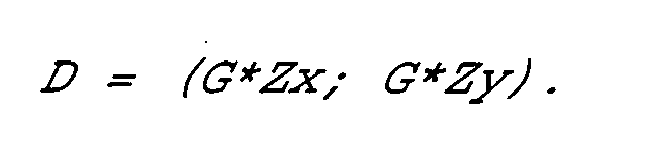
Der Cap 111 wird dann in die untere Position abgesenkt (S103). Jetzt erst wird das Zentrum des Dissektats durch Bewegen des xy-Tischs 20 in die optische Achse 15 (Laser) verfahren und die nächsten Objekte mit aufliegenden Cap geschnitten (S104). Damit wird der Cap genau um die kontrollierte Distanz D von der Mitte des Dissektats dezentriert.The
Wenn das nächste zu schneidende Dissektat außerhalb des Sammelradius des Caps liegt, d.h. wenn |P-D| > S (S105), dann wird, falls das Cap noch nicht voll ist, |D| + S > CC (S106), und das letzte Dissektat der Gruppe noch nicht geschnitten wurde (S107), das Cap angehoben und die nächste Gitterzelle verwendet (S108). Der Parameter CC entspricht hierbei der Kapazität des Caps. Diese Cap Capacity ist ein Maß für die maximal nutzbare Fläche des Caps und wird bestimmt durch das Minimum des Freispiels FR des Caps und der nutzbaren Klebefläche KF des Caps (CC = min(FR, KF)). In anderen Worten, wenn der Cap um mehr als die nutzbare Cap Capacity verfahren werden muss, um den Gitterversatz zu realisieren, wird angenommen, dass der Cap voll ist (siehe S106). In diesem Fall muss das Cap angehoben werden und ein neues Cap am Caplift-Arm 110 angebracht werden (S111). Das neue Cap wird dann wieder in die optische Achse zentriert (S112).If the next dissectate to be cut is outside the collection radius of the cap, ie if | PD | > S (S105), then if the cap is not full, | D | + S> CC (S106), and the last dissectate of the group has not yet been cut (S107), the cap raised and the next grid cell used (S108). The parameter CC corresponds to the capacity of the cap. This cap capacity is a measure of the maximum usable area of the cap and is determined by the minimum of the free play FR of the cap and the usable adhesive surface KF of the cap (CC = min (FR, KF)) . In other words, if the cap needs to be traversed by more than the usable cap capacity to realize the grid offset, it is assumed that the cap is full (see S106). In this case, the cap must be raised and a new cap attached to the caplift arm 110 (S111). The new cap is then centered again in the optical axis (S112).
In weiteren Ausgestaltungsmöglichkeiten der Erfindung, die ebenfalls im Diagramm der Figur 3 berücksichtigt sind, werden mehrere Gruppen von Dissektaten geschnitten. Hierbei können so genannte Multicapsysteme eingesetzt werden, die aus mehreren gleichzeitig auf dem Caplift-Arm 110 gehaltenen Caps bestehen. Ist das gerade im Einsatz befindliche Cap voll (S106), oder das letzte Dissektat einer Gruppe geschnitten (S107) und die letzte Gruppe noch nicht abgearbeitet (S109), so kann das vorhandene Multicapsystem (S110) für die nächste zu schneidende Gruppe ein neues Cap verwenden (5114). Auch hier wird geprüft, ob sämtliche Caps des Multicapsystems bereits voll sind (S113), und falls ja, wird aufgefordert, ein neues Multicapsystem einzulegen (S115).In further embodiments of the invention, which are also taken into account in the diagram of Figure 3, several groups of dissecting are cut. In this case, so-called multi-tap systems can be used which consist of several caps held simultaneously on the
In der hier dargestellten Ausführungsform des Verfahrens werden die Positionen (Gitterzellen) entlang eines spiralförmigen Wegs vom Objektträger abgefahren. Dies ist beispielhaft in Figur 4 gezeigt. Hierbei berechnen sich die aktuellen Zellenindizes Z=(Zx,Zy) zu


Der Fachmann wird zweifelsfrei weitere vorteilhafte Ausführungsformen anhand des hier dargestellten Beispiels erkennen können, die ebenso im Umfang dieser Erfindung liegen.The skilled person will undoubtedly be able to recognize further advantageous embodiments with reference to the example shown here, which are also within the scope of this invention.
Claims (11)
einen Träger zur Aufnahme einer bevorzugt biologischen Probe, wobei der Träger in seiner Ebene frei verfahrbar ist,
eine Sammelhaftvorrichtung, die auf die Probe auf dem Träger absenkbar und davon anhebbar ist, die im abgesenkten Zustand frei mit dem Träger verfahrbar und von der optischen Achse des Mikroskops entkoppelt ist und im angehobenen Zustand relativ zur optischen Achse festgelegt ist.Laser dissection microscope for cutting and collecting dissectates, comprising
a carrier for receiving a preferably biological sample, wherein the carrier is freely movable in its plane,
a collective adhesive device which can be lowered onto and raised from the support on the support, which in the lowered state is freely movable with the support and decoupled from the optical axis of the microscope and fixed in the raised state relative to the optical axis.
Priority Applications (6)
| Application Number | Priority Date | Filing Date | Title |
|---|---|---|---|
| EP06016816A EP1887340A1 (en) | 2006-08-11 | 2006-08-11 | Method and device for cutting and collecting dissected specimens |
| EP07015491.9A EP1890126B1 (en) | 2006-08-11 | 2007-08-07 | Method and device for cutting and collecting dissected specimens |
| US11/837,006 US8945866B2 (en) | 2006-08-11 | 2007-08-10 | Method and apparatus for cutting and collecting dissected specimens |
| JP2007232058A JP5101956B2 (en) | 2006-08-11 | 2007-08-10 | Method and apparatus for cutting a specimen and collecting the cut specimen |
| CN 200710141192 CN101122548B (en) | 2006-08-11 | 2007-08-13 | Method and device for cutting and collecting dissected specimens |
| US13/080,843 US8828683B2 (en) | 2006-08-11 | 2011-04-06 | Method and apparatus for cutting and collecting dissected specimens |
Applications Claiming Priority (1)
| Application Number | Priority Date | Filing Date | Title |
|---|---|---|---|
| EP06016816A EP1887340A1 (en) | 2006-08-11 | 2006-08-11 | Method and device for cutting and collecting dissected specimens |
Publications (1)
| Publication Number | Publication Date |
|---|---|
| EP1887340A1 true EP1887340A1 (en) | 2008-02-13 |
Family
ID=37560992
Family Applications (1)
| Application Number | Title | Priority Date | Filing Date |
|---|---|---|---|
| EP06016816A Withdrawn EP1887340A1 (en) | 2006-08-11 | 2006-08-11 | Method and device for cutting and collecting dissected specimens |
Country Status (4)
| Country | Link |
|---|---|
| US (2) | US8945866B2 (en) |
| EP (1) | EP1887340A1 (en) |
| JP (1) | JP5101956B2 (en) |
| CN (1) | CN101122548B (en) |
Families Citing this family (4)
| Publication number | Priority date | Publication date | Assignee | Title |
|---|---|---|---|---|
| FI20115057A7 (en) * | 2011-01-21 | 2012-07-22 | Wallac Oy | Method and device for cutting off one or more sample regions from a sample carrier |
| DE102013209880A1 (en) * | 2013-05-28 | 2014-12-04 | Leica Microsystems Cms Gmbh | Method for laser microdissection and laser microdissection system |
| WO2021186577A1 (en) * | 2020-03-17 | 2021-09-23 | 国立大学法人東海国立大学機構 | Laser microdissection device, laser microdissection method, and quantitative analysis system |
| CN119120182B (en) * | 2024-09-30 | 2025-05-30 | 广东省农业科学院植物保护研究所 | Melon crop seed embryo rapid splitting device and application method |
Citations (5)
| Publication number | Priority date | Publication date | Assignee | Title |
|---|---|---|---|---|
| WO1998035216A1 (en) * | 1997-02-07 | 1998-08-13 | Arcturus Engineering, Inc. | Laser capture microdissection method and apparatus |
| WO1999000658A1 (en) * | 1997-06-27 | 1999-01-07 | The Government Of The United States Of America, | Convex geometry adhesive film system for laser capture microdissection |
| WO2001033190A2 (en) * | 1999-11-04 | 2001-05-10 | Arcturus Engineering, Inc. | Automated laser capture microdissection |
| US20060087643A1 (en) * | 2004-09-09 | 2006-04-27 | Donovan Brian W | Laser microdissection apparatus and method |
| US20060139621A1 (en) * | 2001-11-05 | 2006-06-29 | Baer Thomas M | Automated microdissection instrument |
Family Cites Families (6)
| Publication number | Priority date | Publication date | Assignee | Title |
|---|---|---|---|---|
| JPH07210049A (en) * | 1994-01-25 | 1995-08-11 | Fujitsu Ltd | Media processing device |
| JPH0968499A (en) * | 1995-08-31 | 1997-03-11 | Nkk Corp | A quick method for determining seam slab quality in continuous casting operations. |
| WO1997029354A1 (en) | 1996-02-05 | 1997-08-14 | Bayer Aktiengesellschaft | Process and device for sorting and for extraction of biological objects arranged on planar means, such as biological cells or cell organelles, histological sections, chromosome particles etc. using laser beams |
| CA2409826C (en) * | 2000-06-01 | 2010-02-02 | Science Applications International Corporation | Systems and methods for monitoring health and delivering drugs transdermally |
| DE20100866U1 (en) | 2001-01-18 | 2001-04-05 | Leica Microsystems | Slide and microdissection device with slide |
| JP3820227B2 (en) * | 2002-01-23 | 2006-09-13 | オリンパス株式会社 | Cell isolation method |
-
2006
- 2006-08-11 EP EP06016816A patent/EP1887340A1/en not_active Withdrawn
-
2007
- 2007-08-10 JP JP2007232058A patent/JP5101956B2/en active Active
- 2007-08-10 US US11/837,006 patent/US8945866B2/en active Active
- 2007-08-13 CN CN 200710141192 patent/CN101122548B/en active Active
-
2011
- 2011-04-06 US US13/080,843 patent/US8828683B2/en active Active
Patent Citations (5)
| Publication number | Priority date | Publication date | Assignee | Title |
|---|---|---|---|---|
| WO1998035216A1 (en) * | 1997-02-07 | 1998-08-13 | Arcturus Engineering, Inc. | Laser capture microdissection method and apparatus |
| WO1999000658A1 (en) * | 1997-06-27 | 1999-01-07 | The Government Of The United States Of America, | Convex geometry adhesive film system for laser capture microdissection |
| WO2001033190A2 (en) * | 1999-11-04 | 2001-05-10 | Arcturus Engineering, Inc. | Automated laser capture microdissection |
| US20060139621A1 (en) * | 2001-11-05 | 2006-06-29 | Baer Thomas M | Automated microdissection instrument |
| US20060087643A1 (en) * | 2004-09-09 | 2006-04-27 | Donovan Brian W | Laser microdissection apparatus and method |
Also Published As
| Publication number | Publication date |
|---|---|
| JP5101956B2 (en) | 2012-12-19 |
| US8945866B2 (en) | 2015-02-03 |
| CN101122548A (en) | 2008-02-13 |
| CN101122548B (en) | 2013-06-05 |
| US8828683B2 (en) | 2014-09-09 |
| US20110181866A1 (en) | 2011-07-28 |
| JP2008046135A (en) | 2008-02-28 |
| US20080064077A1 (en) | 2008-03-13 |
Similar Documents
| Publication | Publication Date | Title |
|---|---|---|
| EP1269143B1 (en) | Collecting device for collecting objects that are dissolved out of a mass, especially by means of laser radiation | |
| EP1186879B1 (en) | Method and device for Laser Microdissection | |
| EP1562709B1 (en) | Sample holder for a reception device receiving biological objects and microscope system designed to operate using one such sample holder | |
| EP1745270B1 (en) | Method for machining a material by using laser irradiation, and control system | |
| DE10152404B4 (en) | Laser microdissection | |
| EP3017296B1 (en) | Laser microdissection system and examination method for samples containing nucleic acid | |
| EP2238426B1 (en) | Method and device for transferring a microscopic, insulated sample, micro-dissection system comprising such a device and method for the production of a nano-vacuum | |
| DE19616216A1 (en) | Laser beam process and assembly separates individual cells from tissue mass | |
| EP1985987B1 (en) | Laser micro-dissection procedure and device | |
| EP1537401A1 (en) | Carrier device for a biological preparation which can be cut by means of laser micro-dissection | |
| EP1946173A1 (en) | Sample manipulation device | |
| DE102009029078A1 (en) | Holder for a catching device | |
| EP1890126B1 (en) | Method and device for cutting and collecting dissected specimens | |
| EP2067013A1 (en) | Apparatus and method for picking up, transporting and depositing microscopic samples | |
| EP1887340A1 (en) | Method and device for cutting and collecting dissected specimens | |
| DE19740324C2 (en) | Device for manipulating cytotechnical instruments | |
| WO2005033669A1 (en) | Laser micro-dissection method | |
| EP2283337B1 (en) | Carrier system for the laser microdissection and the laser-induced transport of biological material and living cells | |
| DE20214835U1 (en) | New carrier for a biological sample, to be cut by laser micro-dissection, comprises film which is absorbent to laser light forming the base of a Petri dish | |
| DE10346130B4 (en) | Apparatus and method for isolating a portion of a layer of biological material or a preparation | |
| DE10358565A1 (en) | Receiving element for receiving an object liberated from a biological mass by means of laser radiation | |
| DE102007035582A1 (en) | Method and device for processing a biological object with laser radiation | |
| DE102006051460A1 (en) | Apparatus, methods and tape material for collecting and transporting sample material | |
| HK1118094A (en) | Method and apparatus for cutting and collecting microtome sections |
Legal Events
| Date | Code | Title | Description |
|---|---|---|---|
| PUAI | Public reference made under article 153(3) epc to a published international application that has entered the european phase |
Free format text: ORIGINAL CODE: 0009012 |
|
| AK | Designated contracting states |
Kind code of ref document: A1 Designated state(s): AT BE BG CH CY CZ DE DK EE ES FI FR GB GR HU IE IS IT LI LT LU LV MC NL PL PT RO SE SI SK TR |
|
| AX | Request for extension of the european patent |
Extension state: AL BA HR MK YU |
|
| AKX | Designation fees paid | ||
| STAA | Information on the status of an ep patent application or granted ep patent |
Free format text: STATUS: THE APPLICATION IS DEEMED TO BE WITHDRAWN |
|
| 18D | Application deemed to be withdrawn |
Effective date: 20080814 |
|
| REG | Reference to a national code |
Ref country code: DE Ref legal event code: 8566 |