EP1791565B1 - Cysteine engineered antibodies and conjugates - Google Patents
Cysteine engineered antibodies and conjugates Download PDFInfo
- Publication number
- EP1791565B1 EP1791565B1 EP05811919.9A EP05811919A EP1791565B1 EP 1791565 B1 EP1791565 B1 EP 1791565B1 EP 05811919 A EP05811919 A EP 05811919A EP 1791565 B1 EP1791565 B1 EP 1791565B1
- Authority
- EP
- European Patent Office
- Prior art keywords
- antibody
- seq
- frac acc
- cysteine engineered
- cysteine
- Prior art date
- Legal status (The legal status is an assumption and is not a legal conclusion. Google has not performed a legal analysis and makes no representation as to the accuracy of the status listed.)
- Expired - Lifetime
Links
- 0 C*(CCc(cc1)ccc1O)I Chemical compound C*(CCc(cc1)ccc1O)I 0.000 description 7
- DEZOKKOZDXFZIK-UHFFFAOYSA-N CC(CC(N1CCOCCOCC(C)=O)=O)C1=O Chemical compound CC(CC(N1CCOCCOCC(C)=O)=O)C1=O DEZOKKOZDXFZIK-UHFFFAOYSA-N 0.000 description 1
- WOWDZACBATWTAU-BWECFARHSA-N CC[C@H](C)[C@@H]([C@@H](CC(N(CCC1)[C@@H]1C([C@@H](C)C(N[C@H](C)[C@H](c1ccccc1)O)=O)OC)=O)OC)N(C)C([C@H](C(C)C)NC(C(C(C)C)N(C)C)=O)=O Chemical compound CC[C@H](C)[C@@H]([C@@H](CC(N(CCC1)[C@@H]1C([C@@H](C)C(N[C@H](C)[C@H](c1ccccc1)O)=O)OC)=O)OC)N(C)C([C@H](C(C)C)NC(C(C(C)C)N(C)C)=O)=O WOWDZACBATWTAU-BWECFARHSA-N 0.000 description 1
Images


Classifications
-
- A—HUMAN NECESSITIES
- A61—MEDICAL OR VETERINARY SCIENCE; HYGIENE
- A61K—PREPARATIONS FOR MEDICAL, DENTAL OR TOILETRY PURPOSES
- A61K47/00—Medicinal preparations characterised by the non-active ingredients used, e.g. carriers or inert additives; Targeting or modifying agents chemically bound to the active ingredient
- A61K47/50—Medicinal preparations characterised by the non-active ingredients used, e.g. carriers or inert additives; Targeting or modifying agents chemically bound to the active ingredient the non-active ingredient being chemically bound to the active ingredient, e.g. polymer-drug conjugates
-
- C—CHEMISTRY; METALLURGY
- C07—ORGANIC CHEMISTRY
- C07K—PEPTIDES
- C07K16/00—Immunoglobulins [IG], e.g. monoclonal or polyclonal antibodies
-
- A—HUMAN NECESSITIES
- A61—MEDICAL OR VETERINARY SCIENCE; HYGIENE
- A61K—PREPARATIONS FOR MEDICAL, DENTAL OR TOILETRY PURPOSES
- A61K39/00—Medicinal preparations containing antigens or antibodies
- A61K39/395—Antibodies; Immunoglobulins; Immune serum, e.g. antilymphocytic serum
-
- A—HUMAN NECESSITIES
- A61—MEDICAL OR VETERINARY SCIENCE; HYGIENE
- A61K—PREPARATIONS FOR MEDICAL, DENTAL OR TOILETRY PURPOSES
- A61K45/00—Medicinal preparations containing active ingredients not provided for in groups A61K31/00 - A61K41/00
- A61K45/06—Mixtures of active ingredients without chemical characterisation, e.g. antiphlogistics and cardiaca
-
- A—HUMAN NECESSITIES
- A61—MEDICAL OR VETERINARY SCIENCE; HYGIENE
- A61K—PREPARATIONS FOR MEDICAL, DENTAL OR TOILETRY PURPOSES
- A61K47/00—Medicinal preparations characterised by the non-active ingredients used, e.g. carriers or inert additives; Targeting or modifying agents chemically bound to the active ingredient
- A61K47/50—Medicinal preparations characterised by the non-active ingredients used, e.g. carriers or inert additives; Targeting or modifying agents chemically bound to the active ingredient the non-active ingredient being chemically bound to the active ingredient, e.g. polymer-drug conjugates
- A61K47/51—Medicinal preparations characterised by the non-active ingredients used, e.g. carriers or inert additives; Targeting or modifying agents chemically bound to the active ingredient the non-active ingredient being chemically bound to the active ingredient, e.g. polymer-drug conjugates the non-active ingredient being a modifying agent
- A61K47/68—Medicinal preparations characterised by the non-active ingredients used, e.g. carriers or inert additives; Targeting or modifying agents chemically bound to the active ingredient the non-active ingredient being chemically bound to the active ingredient, e.g. polymer-drug conjugates the non-active ingredient being a modifying agent the modifying agent being an antibody, an immunoglobulin or a fragment thereof, e.g. an Fc-fragment
- A61K47/6801—Drug-antibody or immunoglobulin conjugates defined by the pharmacologically or therapeutically active agent
- A61K47/6803—Drugs conjugated to an antibody or immunoglobulin, e.g. cisplatin-antibody conjugates
- A61K47/68031—Drugs conjugated to an antibody or immunoglobulin, e.g. cisplatin-antibody conjugates the drug being an auristatin
-
- A—HUMAN NECESSITIES
- A61—MEDICAL OR VETERINARY SCIENCE; HYGIENE
- A61K—PREPARATIONS FOR MEDICAL, DENTAL OR TOILETRY PURPOSES
- A61K47/00—Medicinal preparations characterised by the non-active ingredients used, e.g. carriers or inert additives; Targeting or modifying agents chemically bound to the active ingredient
- A61K47/50—Medicinal preparations characterised by the non-active ingredients used, e.g. carriers or inert additives; Targeting or modifying agents chemically bound to the active ingredient the non-active ingredient being chemically bound to the active ingredient, e.g. polymer-drug conjugates
- A61K47/51—Medicinal preparations characterised by the non-active ingredients used, e.g. carriers or inert additives; Targeting or modifying agents chemically bound to the active ingredient the non-active ingredient being chemically bound to the active ingredient, e.g. polymer-drug conjugates the non-active ingredient being a modifying agent
- A61K47/68—Medicinal preparations characterised by the non-active ingredients used, e.g. carriers or inert additives; Targeting or modifying agents chemically bound to the active ingredient the non-active ingredient being chemically bound to the active ingredient, e.g. polymer-drug conjugates the non-active ingredient being a modifying agent the modifying agent being an antibody, an immunoglobulin or a fragment thereof, e.g. an Fc-fragment
- A61K47/6801—Drug-antibody or immunoglobulin conjugates defined by the pharmacologically or therapeutically active agent
- A61K47/6803—Drugs conjugated to an antibody or immunoglobulin, e.g. cisplatin-antibody conjugates
- A61K47/68033—Drugs conjugated to an antibody or immunoglobulin, e.g. cisplatin-antibody conjugates the drug being a maytansine
-
- A—HUMAN NECESSITIES
- A61—MEDICAL OR VETERINARY SCIENCE; HYGIENE
- A61K—PREPARATIONS FOR MEDICAL, DENTAL OR TOILETRY PURPOSES
- A61K47/00—Medicinal preparations characterised by the non-active ingredients used, e.g. carriers or inert additives; Targeting or modifying agents chemically bound to the active ingredient
- A61K47/50—Medicinal preparations characterised by the non-active ingredients used, e.g. carriers or inert additives; Targeting or modifying agents chemically bound to the active ingredient the non-active ingredient being chemically bound to the active ingredient, e.g. polymer-drug conjugates
- A61K47/51—Medicinal preparations characterised by the non-active ingredients used, e.g. carriers or inert additives; Targeting or modifying agents chemically bound to the active ingredient the non-active ingredient being chemically bound to the active ingredient, e.g. polymer-drug conjugates the non-active ingredient being a modifying agent
- A61K47/68—Medicinal preparations characterised by the non-active ingredients used, e.g. carriers or inert additives; Targeting or modifying agents chemically bound to the active ingredient the non-active ingredient being chemically bound to the active ingredient, e.g. polymer-drug conjugates the non-active ingredient being a modifying agent the modifying agent being an antibody, an immunoglobulin or a fragment thereof, e.g. an Fc-fragment
- A61K47/6801—Drug-antibody or immunoglobulin conjugates defined by the pharmacologically or therapeutically active agent
- A61K47/6803—Drugs conjugated to an antibody or immunoglobulin, e.g. cisplatin-antibody conjugates
- A61K47/6811—Drugs conjugated to an antibody or immunoglobulin, e.g. cisplatin-antibody conjugates the drug being a protein or peptide, e.g. transferrin or bleomycin
- A61K47/6817—Toxins
-
- A—HUMAN NECESSITIES
- A61—MEDICAL OR VETERINARY SCIENCE; HYGIENE
- A61K—PREPARATIONS FOR MEDICAL, DENTAL OR TOILETRY PURPOSES
- A61K47/00—Medicinal preparations characterised by the non-active ingredients used, e.g. carriers or inert additives; Targeting or modifying agents chemically bound to the active ingredient
- A61K47/50—Medicinal preparations characterised by the non-active ingredients used, e.g. carriers or inert additives; Targeting or modifying agents chemically bound to the active ingredient the non-active ingredient being chemically bound to the active ingredient, e.g. polymer-drug conjugates
- A61K47/51—Medicinal preparations characterised by the non-active ingredients used, e.g. carriers or inert additives; Targeting or modifying agents chemically bound to the active ingredient the non-active ingredient being chemically bound to the active ingredient, e.g. polymer-drug conjugates the non-active ingredient being a modifying agent
- A61K47/68—Medicinal preparations characterised by the non-active ingredients used, e.g. carriers or inert additives; Targeting or modifying agents chemically bound to the active ingredient the non-active ingredient being chemically bound to the active ingredient, e.g. polymer-drug conjugates the non-active ingredient being a modifying agent the modifying agent being an antibody, an immunoglobulin or a fragment thereof, e.g. an Fc-fragment
- A61K47/6835—Medicinal preparations characterised by the non-active ingredients used, e.g. carriers or inert additives; Targeting or modifying agents chemically bound to the active ingredient the non-active ingredient being chemically bound to the active ingredient, e.g. polymer-drug conjugates the non-active ingredient being a modifying agent the modifying agent being an antibody, an immunoglobulin or a fragment thereof, e.g. an Fc-fragment the modifying agent being an antibody or an immunoglobulin bearing at least one antigen-binding site
- A61K47/6851—Medicinal preparations characterised by the non-active ingredients used, e.g. carriers or inert additives; Targeting or modifying agents chemically bound to the active ingredient the non-active ingredient being chemically bound to the active ingredient, e.g. polymer-drug conjugates the non-active ingredient being a modifying agent the modifying agent being an antibody, an immunoglobulin or a fragment thereof, e.g. an Fc-fragment the modifying agent being an antibody or an immunoglobulin bearing at least one antigen-binding site the antibody targeting a determinant of a tumour cell
-
- A—HUMAN NECESSITIES
- A61—MEDICAL OR VETERINARY SCIENCE; HYGIENE
- A61K—PREPARATIONS FOR MEDICAL, DENTAL OR TOILETRY PURPOSES
- A61K47/00—Medicinal preparations characterised by the non-active ingredients used, e.g. carriers or inert additives; Targeting or modifying agents chemically bound to the active ingredient
- A61K47/50—Medicinal preparations characterised by the non-active ingredients used, e.g. carriers or inert additives; Targeting or modifying agents chemically bound to the active ingredient the non-active ingredient being chemically bound to the active ingredient, e.g. polymer-drug conjugates
- A61K47/51—Medicinal preparations characterised by the non-active ingredients used, e.g. carriers or inert additives; Targeting or modifying agents chemically bound to the active ingredient the non-active ingredient being chemically bound to the active ingredient, e.g. polymer-drug conjugates the non-active ingredient being a modifying agent
- A61K47/68—Medicinal preparations characterised by the non-active ingredients used, e.g. carriers or inert additives; Targeting or modifying agents chemically bound to the active ingredient the non-active ingredient being chemically bound to the active ingredient, e.g. polymer-drug conjugates the non-active ingredient being a modifying agent the modifying agent being an antibody, an immunoglobulin or a fragment thereof, e.g. an Fc-fragment
- A61K47/6889—Conjugates wherein the antibody being the modifying agent and wherein the linker, binder or spacer confers particular properties to the conjugates, e.g. peptidic enzyme-labile linkers or acid-labile linkers, providing for an acid-labile immuno conjugate wherein the drug may be released from its antibody conjugated part in an acidic, e.g. tumoural or environment
-
- A—HUMAN NECESSITIES
- A61—MEDICAL OR VETERINARY SCIENCE; HYGIENE
- A61P—SPECIFIC THERAPEUTIC ACTIVITY OF CHEMICAL COMPOUNDS OR MEDICINAL PREPARATIONS
- A61P35/00—Antineoplastic agents
-
- C—CHEMISTRY; METALLURGY
- C07—ORGANIC CHEMISTRY
- C07K—PEPTIDES
- C07K16/00—Immunoglobulins [IG], e.g. monoclonal or polyclonal antibodies
- C07K16/18—Immunoglobulins [IG], e.g. monoclonal or polyclonal antibodies against material from animals or humans
- C07K16/32—Immunoglobulins [IG], e.g. monoclonal or polyclonal antibodies against material from animals or humans against translation products of oncogenes
-
- A—HUMAN NECESSITIES
- A01—AGRICULTURE; FORESTRY; ANIMAL HUSBANDRY; HUNTING; TRAPPING; FISHING
- A01K—ANIMAL HUSBANDRY; AVICULTURE; APICULTURE; PISCICULTURE; FISHING; REARING OR BREEDING ANIMALS, NOT OTHERWISE PROVIDED FOR; NEW BREEDS OF ANIMALS
- A01K2267/00—Animals characterised by purpose
- A01K2267/03—Animal model, e.g. for test or diseases
- A01K2267/0331—Animal model for proliferative diseases
-
- C—CHEMISTRY; METALLURGY
- C07—ORGANIC CHEMISTRY
- C07K—PEPTIDES
- C07K2317/00—Immunoglobulins specific features
- C07K2317/20—Immunoglobulins specific features characterized by taxonomic origin
- C07K2317/21—Immunoglobulins specific features characterized by taxonomic origin from primates, e.g. man
-
- C—CHEMISTRY; METALLURGY
- C07—ORGANIC CHEMISTRY
- C07K—PEPTIDES
- C07K2317/00—Immunoglobulins specific features
- C07K2317/50—Immunoglobulins specific features characterized by immunoglobulin fragments
- C07K2317/51—Complete heavy chain or Fd fragment, i.e. VH + CH1
-
- C—CHEMISTRY; METALLURGY
- C07—ORGANIC CHEMISTRY
- C07K—PEPTIDES
- C07K2317/00—Immunoglobulins specific features
- C07K2317/50—Immunoglobulins specific features characterized by immunoglobulin fragments
- C07K2317/52—Constant or Fc region; Isotype
-
- C—CHEMISTRY; METALLURGY
- C07—ORGANIC CHEMISTRY
- C07K—PEPTIDES
- C07K2317/00—Immunoglobulins specific features
- C07K2317/50—Immunoglobulins specific features characterized by immunoglobulin fragments
- C07K2317/55—Fab or Fab'
-
- C—CHEMISTRY; METALLURGY
- C07—ORGANIC CHEMISTRY
- C07K—PEPTIDES
- C07K2317/00—Immunoglobulins specific features
- C07K2317/60—Immunoglobulins specific features characterized by non-natural combinations of immunoglobulin fragments
- C07K2317/62—Immunoglobulins specific features characterized by non-natural combinations of immunoglobulin fragments comprising only variable region components
- C07K2317/624—Disulfide-stabilized antibody (dsFv)
Definitions
- the present invention relates to processes for producing cysteine engineered antibodies, antibody-drug conjugates formed between a cysteine engineered antibody and a drug moiety, to pharmaceutical compostions and medical uses of antibody-drug conjugates and to methods of screening cysteine engineered antibodies for thiol reactivity.
- Antibody therapy has been established for the targeted treatment of patients with cancer, immunological and angiogenic disorders.
- researchers have sought to identify transmembrane or otherwise tumor-associated polypeptides that are specifically expressed on the surface of cancer cells as compared to normal, non-cancerous cell(s).
- TAA tumor associated antigens
- ADC antibody-drug conjugates
- cytotoxic or cytostatic agents i.e. drugs to kill or inhibit tumor cells in the treatment of cancer
- cytotoxic or cytostatic agents i.e. drugs to kill or inhibit tumor cells in the treatment of cancer
- Efforts to design and refine ADC have focused on the selectivity of monoclonal antibodies (mAbs) as well as drug-linking and drug-releasing properties ( Lambert, J. (2005) Curr. Opinion in Pharmacology 5:543-549 ;. Both polyclonal antibodies and monoclonal antibodies have been reported as useful in these strategies ( Rowland et al (1986) Cancer Immunol. Immunother., 21:183-87 ). Drugs used in these methods include daunomycin, doxorubicin, methotrexate, and vindesine (Rowland et al (1986) supra ).
- Toxins used in antibody-toxin conjugates include bacterial toxins such as diphtheria toxin, plant toxins such as ricin, small molecule toxins such as geldanamycin ( Mandler et al (2000) J. of the NaL Cancer Inst. 92(19):1573-1581 ; Mandler et al (2000) Bioorganic & Med. Chem. Letters 10:1025-1028 ; Mandler et al (2002) Bioconjugate Chem. 13:786-791 ), maytansinoids ( EP 1391213 ; Liu et al (1996) Proc. Natl. Acad. Sci.
- the toxins may effect their cytotoxic and cytostatic effects by mechanisms including tubulin binding, DNA binding, or topoisomerase inhibition. Some cytotoxic drugs tend to be inactive or less active when conjugated to large antibodies or protein receptor ligands.
- ZEVALIN® ibritumomab tiuxetan, Biogen/Idec
- ZEVALIN® is composed of a murine IgG1 kappa monoclonal antibody directed against the CD20 antigen found on the surface of normal and malignant B lymphocytes and 111 In or 90 Y radioisotope bound by a thiourea linker-chelator ( Wiseman et al (2000) Eur. J. Nucl. Med. 27(7):766-77 ; Wiseman et al (2002) Blood 99(12):4336-42 ; Witzig et al (2002) J. Clin. Oncol.
- ZEVALIN® has activity against B-cell non-Hodgkin's Lymphoma (NHL), administration results in severe and prolonged cytopenias in most patients.
- MYLOTARGTM (gemtutzumab ozogamicin, Wyeth Pharmaceuticals), an antibody-drug conjugate composed of a hu CD33 antibody linked to calicheamicin, was approved in 2000 for the treatment of acute myeloid leukemia by injection ( Drugs of the Future (2000) 25(7):686 ; US Patent Nos.
- Cantuzumab mertansine (Immunogen, Inc.), an antibody-drug conjugate composed of the huC242 antibody linked via the disulfide linker SPP to the maytansinoid drug moiety, DM1 ( Xie et al (2004) J. of Pharm. and Exp. Ther. 308(3):1073-1082 ), is advancing into Phase II trials for the treatment of cancers that express CanAg, such as colon, pancreatic, gastric, and others.
- MLN-2704 (Millennium Pharm., BZL Biologics, Immunogen Inc.), an antibody-drug conjugate composed of the anti-prostate specific membrane antigen (PSMA) monoclonal antibody linked to the maytansinoid drug moiety, DM1, is under development for the potential treatment of prostate tumors.
- PSMA anti-prostate specific membrane antigen
- auristatin peptides auristatin E (AE) and monomethylauristatin (MMAE), synthetic analogs of dolastatin ( WO 02/088172 ), have been conjugated to: (i) chimeric monoclonal antibodies cBR96 (specific to Lewis Y on carcinomas); (ii) cAC10 which is specific to CD30 on hematological malignancies ( Klussman, et al (2004), Bioconjugate Chemistry 15(4):765-773 ; Doronina et al (2003) Nature Biotechnology 21(7):778-784 ; Francisco et al (2003) Blood 102(4):1458-1465 ; US 2004/0018194 ; (iii) anti-CD20 antibodies such as rituxan ( WO 04/032828 ) for the treatment of CD20-expressing cancers and immune disorders; (iv) anti-EphB2R antibodies 2H9 and anti-IL-8 for treatment of colorectal cancer ( Mao et al (2004) Cancer Research
- auristatin E variants of auristatin E are disclosed in US 5767237 and US 6124431 . Monomethyl auristatin E conjugated to monoclonal antibodies are disclosed in Senter et al, Proceedings of the American Association for Cancer Research, Volume 45, Abstract Number 623, presented March 28, 2004 . Auristatin analogs MMAE and MMAF have been conjugated to various antibodies ( WO 2005/081711 ).
- Analytical and preparative methods are inadequate to separate and characterize the antibody-drug conjugate species molecules within the heterogeneous mixture resulting from a conjugation reaction.
- Antibodies are large, complex and structurally diverse biomolecules, often with many reactive functional groups. Their reactivities with linker reagents and drug-linker intermediates are dependent on factors such as pH, concentration, salt concentration, and co-solvents. Furthermore, the multistep conjugation process may be nonreproducible due to difficulties in controlling the reaction conditions and characterizing reactants and intermediates.
- Cysteine thiols are reactive at neutral pH, unlike most amines which are protonated and less nucleophilic near pH 7. Since free thiol (RSH, sulfhydryl) groups are relatively reactive, proteins with cysteine residues often exist in their oxidized form as disulfide-linked oligomers or have internally bridged disulfide groups. Extracellular proteins generally do not have free thiols ( Garman, 1997, Non-Radioactive Labelling: A Practical Approach, Academic Press, London, at page 55 ). The amount of free thiol in a protein may be estimated by the standard Ellman's assay.
- Immunoglobulin M is an example of a disulfide-linked pentamer
- immunoglobulin G is an example of a protein with internal disulfide bridges bonding the subunits together.
- a reagent such as dithiothreitol (DTT) or selenol ( Singh et al (2002) Anal. Biochem. 304:147-156 ) is required to generate the reactive free thiol. This approach may result in loss of antibody tertiary structure and antigen binding specificity.
- Antibody cysteine thiol groups are generally more reactive, i.e. more nucleophilic, towards electrophilic conjugation reagents than antibody amine or hydroxyl groups.
- Cysteine residues have been introduced into proteins by genetic engineering techniques to form covalent attachments to ligands or to form new intramolecular disulfide bonds ( Better et al (1994) J. Biol. Chem. 13:9644-9650 ; Bernhard et al (1994) Bioconjugate Chem. 5:126-132 ; Greenwood et al (1994) Therapeutic Immunology 1:247-255 ; Tu et al (1999) Proc. Natl. Acad. Sci USA 96:4862-4867 ; Kanno et al (2000) J.
- cysteine thiol groups by the mutation of various amino acid residues of a protein to cysteine amino acids is potentially problematic, particularly in the case of unpaired (free Cys) residues or those which are relatively accessible for reaction or oxidation.
- unpaired Cys residues on the surface of the protein can pair and oxidize to form intermolecular disulfides, and hence protein dimers or multimers.
- Disulfide dimer formation renders the new Cys unreactive for conjugation to a drug, ligand, or other label. Furthermore, if the protein oxidatively forms an intramolecular disulfide bond between the newly engineered Cys and an existing Cys residue, both Cys groups are unavailable for active site participation and interactions. Furthermore, the protein may be rendered inactive or non-specific, by misfolding or loss of tertiary structure ( Zhang et al (2002) Anal. Biochem. 311:1-9 ).
- WO 2004/050849 relates to immunotoxins and their use in treating tumours.
- WO 03/049704 relates to antibodies to treat cancer.
- WO 03/060080 relates to canine immunoglobulin variable domains, caninized antibodies, and methods for making and using them.
- WO 94/06474 relates to antibody treatment of Helicobacter pylori.
- Hafner F. T. et al., 2000, Analytical Chemistry, 72(23): 5779-5786 relates to a non-competitive immunoassay of small analytes at the femtomolar level by affinity probe capillary electrophoresis and its use in the direct analysis of digoxin using a uniform-labeled scFv immunoreagent.
- Corneillie T. M. et al., 2004, Bioconjugate Chemistry, 15(6): 1389-1391 relates to a G54C mutant of monoclonal antibody 2D12.5 that has increased affinity for weakly electrophilic metal complexes.
- the present invention provides a process for producing a cysteine engineered antibody comprising one or more free cysteine amino acids having a thiol reactivity value in the range of 0.6 to 1.0, and a sequence in the heavy chain selected from SEQ ID NOS: 10, 11, 13, 14, 31, 34, 37, 38 and 42:
- the cysteine engineered antibody may be more reactive than the parent antibody with the thiol reactive reagent.
- the free cysteine amino acid residues may be located in the heavy or light chains, or in the constant or variable domains.
- Antibody fragments e.g. Fab, may also be engineered with one or more cysteine amino acids replacing amino acids of the antibody fragment, to form cysteine engineered antibody fragments.
- the process for producing a cysteine engineered antibody may comprise:
- the process for producing a cysteine engineered antibody may comprise expressing the cysteine engineered antibody on a viral particle selected from a phage or a phagemid particle.
- the present invention provides a method of screening cysteine engineered antibodies for thiol reactivity comprising:
- an antibody-drug conjugate compound comprising a cysteine engineered antibody (Ab) comprising a free cysteine amino acid having a thiol reactivity value in the range of 0.6 to 1.0; and a drug moiety (D) selected from a maytansinoid, an auristatin, a dolastatin, and a calicheamicin, wherein the cysteine engineered antibody is attached through one or more free cysteine amino acids by a linker moiety (L) to D; the compound having Formula I: Ab-(L-D)p I where p is 1, 2, 3, or 4; and wherein the cysteine engineered antibody is prepared by a process comprising replacing one or more amino acid residues of a parent antibody with the one or more free cysteine amino acids, where the parent antibody selectively binds to an antigen and the cysteine engineered antibody selectively binds to the same antigen as the parent antibody, wherein the antibody-drug conjugate compound comprises:
- Exemplary drug moieties include DM1, MMAE, and MMAF.
- the antibody-drug conjugate of Formula I may further comprise an albumin-binding peptide (ABP) sequence; the composition having Formula Ia: ABP-Ab-(L-D) p Ia
- compositions comprising a cysteine engineered antibody or a cysteine engineered antibody-drug conjugate and a physiologically or pharmaceutically acceptable carrier or diluent.
- This composition for therapeutic use is sterile and may be lyophilized.
- compositions include combinations of Formula I compounds and one or more chemotherapeutic agents.
- the present invention includes medical uses of the antibody-drug conjugates for treating cancer, for example where the cancer is characterized by the overexpression of an ErbB receptor through the use of an antibody-drug conjugate of an anti-ErbB antibody.
- the present invention includes medical uses of the conjugates of the present invention for treating cancer, for example by inhibiting the growth of tumor cells that overexpress a growth factor receptor selected from the group consisting of HER2 receptor and EGF receptor comprising administering to a patient an antibody-drug conjugate compound which binds specifically to said growth factor receptor and a chemotherapeutic agent wherein said antibody-drug conjugate and said Alternatively or additionally, the present invention include medical uses of the conjugates of the present invention for treating a human patient cancer, for example a human patient susceptible to or diagnosed with a disorder characterized by overexpression of ErbB2 receptor, comprising administering an effective amount of a combination of an antibody-drug conjugate compound and a chemotherapeutic agent
- antibody herein is used in the broadest sense and specifically covers monoclonal antibodies, polyclonal antibodies, dimers, multimers, multispecific antibodies (e.g., bispecific antibodies), and antibody fragments, so long as they exhibit the desired biological activity ( Miller et al (2003) Jour. of Immunology 170:4854-4861 ).
- Antibodies may be murine, human, humanized, chimeric, or derived from other species.
- An antibody is a protein generated by the immune system that is capable of recognizing and binding to a specific antigen. ( Janeway, C., Travers, P., Walport, M., Shlomchik (2001) Immuno Biology, 5th Ed., Garland Publishing, New York ).
- a target antigen generally has numerous binding sites, also called epitopes, recognized by CDRs on multiple antibodies. Each antibody that specifically binds to a different epitope has a different structure. Thus, one antigen may have more than one corresponding antibody.
- An antibody includes a full-length immunoglobulin molecule or an immunologically active portion of a full-length immunoglobulin molecule, i.e., a molecule that contains an antigen binding site that immunospecifically binds an antigen of a target of interest or part thereof, such targets including but not limited to, cancer cell or cells that produce autoimmune antibodies associated with an autoimmune disease.
- the immunoglobulin disclosed herein can be of any type (e.g., IgG, IgE, IgM, IgD, and IgA), class (e.g., IgG, IgG2, IgG3, IgG4, IgA1 and IgA2) or subclass of immunoglobulin molecule.
- the immunoglobulins can be derived from any species. In one aspect, however, the immunoglobulin is of human, murine, or rabbit origin.
- Antibody fragments comprise a portion of a full length antibody, generally the antigen binding or variable region thereof.
- Examples of antibody fragments include Fab, Fab', F(ab') 2 , and Fv fragments; diabodies; linear antibodies; minibodies ( Olafsen et al (2004) Protein Eng. Design & Sel. 17(4):315-323 ), fragments produced by a Fab expression library, anti-idiotypic (anti-Id) antibodies, CDR (complementary determining region), and epitope-binding fragments of any of the above which immunospecifically bind to cancer cell antigens, viral antigens or microbial antigens, single-chain antibody molecules; and multispecific antibodies formed from antibody fragments.
- monoclonal antibody refers to an antibody obtained from a population of substantially homogeneous antibodies, i.e., the individual antibodies comprising the population are identical except for possible naturally occurring mutations that may be present in minor amounts. Monoclonal antibodies are highly specific, being directed against a single antigenic site. Furthermore, in contrast to polyclonal antibody preparations which include different antibodies directed against different determinants (epitopes), each monoclonal antibody is directed against a single determinant on the antigen. In addition to their specificity, the monoclonal antibodies are advantageous in that they may be synthesized uncontaminated by other antibodies.
- the modifier "monoclonal” indicates the character of the antibody as being obtained from a substantially homogeneous population of antibodies, and is not to be construed as requiring production of the antibody by any particular method.
- the monoclonal antibodies to be used in accordance with the present invention may be made by the hybridoma method first described by Kohler et al (1975) Nature 256:495 , or may be made by recombinant DNA methods (see for example: US 4816567 ; US 5807715 ).
- the monoclonal antibodies may also be isolated from phage antibody libraries using the techniques described in Clackson et al (1991) Nature, 352:624-628 ; Marks et al (1991) J. Mol. Biol., 222:581-597 ; for example.
- the monoclonal antibodies herein specifically include "chimeric" antibodies in which a portion of the heavy and/or light chain is identical with or homologous to corresponding sequences in antibodies derived from a particular species or belonging to a particular antibody class or subclass, while the remainder of the chain(s) is identical with or homologous to corresponding sequences in antibodies derived from another species or belonging to another antibody class or subclass, as well as fragments of such antibodies, so long as they exhibit the desired biological activity ( US 4816567 ; and Morrison et al (1984) Proc. Natl. Acad. Sci. USA, 81:6851-6855 ).
- Chimeric antibodies of interest herein include "primatized" antibodies comprising variable domain antigen-binding sequences derived from a non-human primate (e.g ., Old World Monkey, Ape etc) and human constant region sequences.
- an “intact antibody” herein is one comprising a VL and VH domains, as well as a light chain constant domain (CL) and heavy chain constant domains, CH1, CH2 and CH3.
- the constant domains may be native sequence constant domains (e.g., human native sequence constant domains) or amino acid sequence variant thereof.
- the intact antibody may have one or more "effector functions" which refer to those biological activities attributable to the Fc constant region (a native sequence Fc region or amino acid sequence variant Fc region) of an antibody. Examples of antibody effector functions include Clq binding; complement dependent cytotoxicity; Fc receptor binding; antibody-dependent cell-mediated cytotoxicity (ADCC); phagocytosis; and down regulation of cell surface receptors such as B cell receptor and BCR.
- immunoglobulin antibodies can be assigned to different "classes.” There are five major classes of intact immunoglobulin antibodies: IgA, IgD, IgE, IgG, and IgM, and several of these may be further divided into “subclasses” (isotypes), e.g., IgG1, IgG2, IgG3, IgG4, IgA, and IgA2.
- the heavy-chain constant domains that correspond to the different classes of antibodies are called ⁇ , ⁇ , ⁇ , ⁇ , and ⁇ , respectively.
- the subunit structures and three-dimensional configurations of different classes of immunoglobulins are well known.
- Ig forms include hinge-modifications or hingeless forms ( Roux et al (1998) J. Immunol. 161:4083-4090 ; Lund et al (2000) Eur. J. Biochem. 267:7246-7256 ; US 2005/0048572 ; US 2004/0229310 ).
- ErbB receptor is a receptor protein tyrosine kinase which belongs to the ErbB receptor family whose members are important mediators of cell growth, differentiation and survival.
- the ErbB receptor family includes four distinct members including epidermal growth factor receptor (EGFR, ErbB1, HER1), HER2 (ErbB2 or p185neu), HER3 (ErbB3) and HER4 (ErbB4 or tyro2).
- EGFR epidermal growth factor receptor
- HER2 ErbB2 or p185neu
- HER3 ErbB3
- HER4 ErbB4 or tyro2
- a panel of anti-ErbB2 antibodies has been characterized using the human breast tumor cell line SKBR3 ( Hudziak et al (1989) Mol. Cell. BioL 9(3):1165-1172 . Maximum inhibition was obtained with the antibody called 4D5 which inhibited cellular proliferation by 56%.
- the antibody 4D5 was further found to sensitize ErbB2-overexpressing breast tumor cell lines to the cytotoxic effects of TNF- ⁇ ( US 5677171 ).
- the anti-ErbB2 antibodies discussed in Hudziak et al. are further characterized in Fendly et al (1990) Cancer Research 50:1550-1558 ; Kotts et al. (1990) In Vitro 26(3)59A ; Sarup et aL (1991) Growth Regulation 1:72-82 ; Shepard et al. J. (1991) Clin. Immunol. 11(3):117-127 ; Kumar et al. (1991) Mol. Cell. Biol.
- the ErbB receptor will generally comprise an extracellular domain, which may bind an ErbB ligand; a lipophilic transmembrane domain; a conserved intracellular tyrosine kinase domain; and a carboxyl-terminal signaling domain harboring several tyrosine residues which can be phosphorylated.
- the ErbB receptor may be a "native sequence” ErbB receptor or an "amino acid sequence variant" thereof.
- the ErbB receptor is native sequence human ErbB receptor. Accordingly, a "member of the ErbB receptor family" is EGFR (ErbB 1), ErbB2, ErbB3, ErbB4 or any other ErbB receptor currently known or to be identified in the future.
- ErbB1 "epidermal growth factor receptor", “EGFR” and “HER1” are used interchangeably herein and refer to EGFR as disclosed, for example, in Carpenter et al (1987) Ann. Rev. Biochem, 56:881-914 , including naturally occurring mutant forms thereof (e.g. , a deletion mutant EGFR as in Humphrey et al (1990) Proc. Nat. Acad. Sci. (USA) 87:4207-4211 ).
- the term erbB1 refers to the gene encoding the EGFR protein product. Antibodies against HER1 are described, for example, in Murthy et al (1987) Arch. Biochem. Biophys., 252:549-560 and in WO 9525167 .
- ERRP epidermal growth factor receptor
- EGF epidermal growth factor receptor
- ErbB2 and "HER2” are used interchangeably herein and refer to human HER2 protein described, for example, in Semba et al (1985) Proc. Nat. Acad. Sci. (USA) 82:6497-6501 and Yamamoto et al (1986) Nature, 319:230-234 (Genebank accession number X03363).
- the term “erbB2” refers to the gene encoding human ErbB2 and "neu” refers to the gene encoding rat p185neu.
- Preferred ErbB2 is native sequence human ErbB2.
- ErbB3 and "HER3” refer to the receptor polypeptide as disclosed, for example, in U.S. Patent Nos. 5183884 and 5480968 as well as Kraus et al (1989) Proc. Nat Acad. Sci. (USA) 86:9193-9197 .
- Antibodies against ErbB3 are known in the art and are described, for example, in U.S. Patent Nos. 5183884 , 5480968 and in WO 97/35885 .
- ErbB4 and "HER4" herein refer to the receptor polypeptide as disclosed, for example, in EP Pat Application No 599,274 ; Plowman et al (1993) Proc. Natl. Acad. Sci. USA 90:1746-1750 ; and Plowman et al (1993) Nature 366:473-475 , including isoforms thereof, e.g., as disclosed in WO 99/19488 .
- Antibodies against HER4 are described, for example, in WO 02/18444 .
- Antibodies to ErbB receptors are available commercially from a number of sources, including, for example, Santa Cruz Biotechnology, Inc., California, USA.
- amino acid sequence variant refers to polypeptides having amino acid sequences that differ to some extent from a native sequence polypeptide. Ordinarily, amino acid sequence variants will possess at least about 70% sequence identity with at least one receptor binding domain of a native ErbB ligand or with at least one ligand binding domain of a native ErbB receptor, and preferably, they will be at least about 80%, more preferably, at least about 90% homologous by sequence with such receptor or ligand binding domains. The amino acid sequence variants possess substitutions, deletions, and/or insertions at certain positions within the amino acid sequence of the native amino acid sequence. Amino acids are designated by the conventional names, one-letter and three-letter codes.
- Sequence identity is defined as the percentage of residues in the amino acid sequence variant that are identical after aligning the sequences and introducing gaps, if necessary, to achieve the maximum percent sequence identity. Methods and computer programs for the alignment are well known in the art. One such computer program is "Align 2,” authored by Genentech, Inc., which was filed with user documentation in the United States Copyright Office, Washington, DC 20559, on December 10, 1991.
- Antibody-dependent cell-mediated cytotoxicity and “ADCC” refer to a cell-mediated reaction in which nonspecific cytotoxic cells that express Fc receptors (FcRs) (e.g., Natural Killer (NK) cells, neutrophils, and macrophages) recognize bound antibody on a target cell and subsequently cause lysis of the target cell.
- FcRs Fc receptors
- FcR expression on hematopoietic cells in summarized is Table 3 on page 464 of Ravetch and Kinet, (1991) "Annu. Rev.
- ADCC activity of a molecule of interest may be assessed in vitro, such as that described in US 5500362 and US 5821337.
- Useful effector cells for such assays include peripheral blood mononuclear cells (PBMC) and Natural Killer (NK) cells.
- PBMC peripheral blood mononuclear cells
- NK Natural Killer
- ADCC activity of the molecule of interest may be assessed in vivo, e.g., in a animal model such as that disclosed in Clynes et al (1998) PROC. NAT. ACAD. SCL (USA) (USA) 95:652-656 .
- Human effector cells are leukocytes which express one or more constant region receptors (FcRs) and perform effector functions. Preferably, the cells express at least Fc ⁇ RIII and perform ADCC effector function. Examples of human leukocytes which mediate ADCC include peripheral blood mononuclear cells (PBMC), natural killer (NK) cells, monocytes, cytotoxic T cells and neutrophils; with PBMCs and NK cells being preferred.
- the effector cells may be isolated from a native source thereof, e.g., from blood or PBMCs as described herein.
- Fc receptor or “FcR” are used to describe a receptor that binds to the Fc constant region of an antibody.
- the preferred FcR is a native sequence human FcR.
- a preferred FcR is one which binds an IgG antibody (a gamma receptor) and includes receptors of the Fc ⁇ RI, Fc ⁇ RII, and Fc ⁇ RIII subclasses, including allelic variants and alternatively spliced forms of these receptors.
- Fc ⁇ RII receptors include Fc ⁇ RIIA (an "activating receptor") and Fc ⁇ RIIB (an “inhibiting receptor", which have similar amino acid sequences that differ primarily in the cytoplasmic domains thereof.
- Activating receptor Fc ⁇ RIIA contains an immunoreceptor tyrosine-based activation motif (ITAM) in its cytoplasmic domain.
- Inhibiting receptor Fc ⁇ RIIB contains an immunoreceptor tyrosine-based inhibition motif (ITIM) in its cytoplasmic domain.
- ITAM immunoreceptor tyrosine-based activation motif
- ITIM immunoreceptor tyrosine-based inhibition motif
- FcR FcR
- FcRn neonatal receptor
- “Complement dependent cytotoxicity” or “CDC” refers to the ability of a molecule to lyse a target in the presence of complement.
- the complement activation pathway is initiated by the binding of the first component of the complement system (C1q) to a molecule (e.g., an antibody) complexed with a cognate antigen.
- a CDC assay e.g., as described in Gazzano-Santoro et al J. Immunol Methods, 202:163 (1996 ), may be performed.
- “Native antibodies” are usually heterotetrameric glycoproteins of about 150,000 daltons, composed of two identical light (L) chains and two identical heavy (H) chains. Each light chain is linked to a heavy chain by one covalent disulfide bond, while the number of disulfide linkages varies among the heavy chains of different immunoglobulin isotypes. Each heavy and light chain also has regularly spaced invachain disulfide bridges. Each heavy chain has at one end a variable domain (V H ) followed by a number of constant domains. Each light chain has a variable domain at one end (V L ) and a constant domain at its other end. The constant domain of the light chain is aligned with the first constant domain of the heavy chain, and the light-chain variable domain is aligned with the variable domain of the heavy chain. Particular amino acid residues are believed to form an interface between the light chain and heavy chain variable domains.
- variable refers to the fact that certain portions of the variable domains differ extensively in sequence among antibodies and are used in the binding and specificity of each particular antibody for its particular antigen. However, the variability is not evenly distributed throughout the variable domains of antibodies. It is concentrated in three segments called hypervariable regions both in the light chain and the heavy chain variable domains. The more highly conserved portions of variable domains are called the framework regions (FRs).
- the variable domains of native heavy and light chains each comprise four FRs, largely adopting a ⁇ -sheet configuration, connected by three hypervariable regions, which form loops connecting, and in some cases forming part of, the ⁇ -sheet structure.
- the hypervariable regions in each chain are held together in close proximity by the FRs and, with the hypervariable regions from the other chain, contribute to the formation of the antigen-binding site of antibodies (see Kabat et al (1991) Sequences of Proteins of Immunological Interest, 5th Ed. Public Health Service, National Institutes of Health, Bethesda, MD).
- the constant domains are not involved directly in binding an antibody to an antigen, but exhibit various effector functions, such as participation of the antibody in antibody dependent cellular cytotoxicity (ADCC).
- hypervariable region when used herein refers to the amino acid residues of an antibody which are responsible for antigen-binding.
- the hypervariable region generally comprises amino acid residues from a “complementarity determining region” or "CDR" ( e .
- Papain digestion of antibodies produces two identical antigen-binding fragments, called “Fab” fragments, each with a single antigen-binding site, and a residual "Fc” fragment, whose name reflects its ability to crystallize readily. Pepsin treatment yields an F(ab')2 fragment that has two antigen-binding sites and is still capable of cross-linking antigen.
- Fv is the minimum antibody fragment which contains a complete antigen-recognition and antigen-binding site. This region consists of a dimer of one heavy chain and one light chain variable domain in tight, non-covalent association. It is in this configuration that the three hypervariable regions of each variable domain interact to define an antigen-binding site on the surface of the V H -V L dimer. Collectively, the six hypervariable regions confer antigen-binding specificity to the antibody. However, even a single variable domain (or half of an Fv comprising only three hypervariable regions specific for an antigen) has the ability to recognize and bind antigen, although at a lower affinity than the entire binding site.
- the Fab fragment also contains the constant domain of the light chain and the first constant domain (CH1) of the heavy chain.
- Fab' fragments differ from Fab fragments by the addition of a few residues at the carboxy terminus of the heavy chain CH1 domain including one or more cysteines from the antibody hinge region.
- Fab'-SH is the designation herein for Fab' in which the cysteine residue(s) of the constant domains bear at least one free thiol group.
- F(ab')2 antibody fragments originally were produced as pairs of Fab' fragments which have hinge cysteines between them. Other chemical couplings of antibody fragments are also known.
- the "light chains" of antibodies from any vertebrate species can be assigned to one of two clearly distinct types, called kappa ( ⁇ ) and lambda ( ⁇ ), based on the amino acid sequences of their constant domains.
- Single-chain Fv or “scFv” antibody fragments comprise the V H and V L domains of antibody, wherein these domains are present in a single polypeptide chain.
- the Fv polypeptide further comprises a polypeptide linker between the VH and VL domains which enables the scFv to form the desired structure for antigen binding.
- diabodies refers to small antibody fragments with two antigen-binding sites, which fragments comprise a variable heavy domain (VH) connected to a variable light domain (VL) in the same polypeptide chain (VH - VL).
- VH variable heavy domain
- VL variable light domain
- linker that is too short to allow pairing between the two domains on the same chain, the domains are forced to pair with the complementary domains of another chain and create two antigen-binding sites.
- Diabodies are described more fully in, for example, EP 404,097 ; WO 93/11161 ; and Hollinger et al (1993) Proc. Natl. Acad. Sci. USA 90:6444-6448 .
- “Humanized” forms of non-human (e.g., rodent) antibodies are chimeric antibodies that contain minimal sequence derived from non-human immunoglobulin. Humanization is a method to transfer the murine antigen binding information to a non-immunogenic human antibody acceptor, and has resulted in many therapeutically useful drugs. The method of humanization generally begins by transferring all six murine complementarity determining regions (CDRs) onto a human antibody framework ( Jones et al, (1986) Nature 321:522-525 ). These CDR-grafted antibodies generally do not retain their original affinity for antigen binding, and in fact, affinity is often severely impaired.
- CDRs complementarity determining regions
- humanized antibodies are human immunoglobulins (recipient antibody) in which residues from a hypervariable region of the recipient are replaced by residues from a hypervariable region of a non-human species (donor antibody) such as mouse, rat, rabbit or nonhuman primate having the desired specificity, affinity, and capacity.
- donor antibody such as mouse, rat, rabbit or nonhuman primate having the desired specificity, affinity, and capacity.
- framework region (FR) residues of the human immunoglobulin are replaced by corresponding non-human residues.
- humanized antibodies may comprise residues that are not found in the recipient antibody or in the donor antibody. These modifications are made to further refine antibody performance.
- the humanized antibody will comprise substantially all of at least one, and typically two, variable domains, in which all or substantially all of the hypervariable loops correspond to those of a non-human immunoglobulin and all or substantially all of the FRs are those of a human immunoglobulin sequence.
- the humanized antibody optionally also will comprise at least a portion of an immunoglobulin constant region (Fc), typically that of a human immunoglobulin.
- Fc immunoglobulin constant region
- a “free cysteine amino acid” refers to a cysteine amino acid residue which has been engineered into a parent antibody, has a thiol functional group (-SH), and is not paired as an intramolecular or intermolecular disulfide bridge.
- thiol reactivity value is a quantitative characterization of the reactivity of free cysteine amino acids.
- the thiol reactivity value is the percentage of a free cysteine amino acid in a cysteine engineered antibody which reacts with a thiol-reactive reagent, and converted to a maximum value of 1.
- a free cysteine amino acid on a cysteine engineered antibody which reacts in 100% yield with a thiol-reactive reagent, such as a biotin-maleimide reagent, to form a biotin-labelled antibody has a thiol reactivity value of 1.0.
- Another cysteine amino acid engineered into the same or different parent antibody which reacts in 80% yield with a thiol-reactive reagent has a thiol reactivity value of 0.8.
- Another cysteine amino acid engineered into the same or different parent antibody which fails totally to react with a thiol-reactive reagent has a thiol reactivity value of 0. Determination of the thiol reactivity value of a particular cysteine may be conducted by ELISA assay, mass spectroscopy, liquid chromatography, autoradiography, or other quantitative analytical tests.
- a “parent antibody” is an antibody comprising an amino acid sequence from which one or more amino acid residues are replaced by one or more cysteine residues.
- the parent antibody may comprise a native or wild type sequence.
- the parent antibody may have pre-existing amino acid sequence modifications (such as additions, deletions and/or substitutions) relative to other native, wild type, or modified forms of an antibody.
- a parent antibody may be directed against a target antigen of interest, e.g. a biologically important polypeptide.
- Antibodies directed against nonpolypeptide antigens are also contemplated.
- Exemplary parent antibodies include antibodies having affinity and selectivity for cell surface and transmembrane receptors and tumor-associated antigens (TAA).
- TAA tumor-associated antigens
- exemplary parent antibodies include those selected from, and without limitation, anti-estrogen receptor antibody, anti-progesterone receptor antibody, anti-p53 antibody, anti-HER-2/neu antibody, anti-EGFR antibody, anti-cathepsin D antibody, anti-Bcl-2 antibody, anti-E-cadherin antibody, anti-CA125 antibody, and-CA15-3 antibody, anti-CAI9-9 antibody, anti-c-erbB-2 antibody, anti-P-glycoprotein antibody, anti-CEA antibody, anti-retinoblastotna protein antibody, anti-ras oncoprotein antibody, anti-Lewis X antibody, anti-Ki-67 antibody, anti-PCNA antibody, anti-CD3 antibody, anti-CD4 antibody, anti-CD5 antibody, anti-CD7 antibody, anti-CD8 antibody, anti-CD9/p24 antibody, anti-CD10 antibody, anti-CD11c antibody, anti-CD13 antibody, anti-CD14 antibody, anti-CD15 antibody, anti-CD19 antibody, anti-CD20 antibody, anti
- an “isolated” antibody is one which has been identified and separated and/or recovered from a component of its natural environment Contaminant components of its natural environment are materials which would interfere with diagnostic or therapeutic uses for the antibody, and may include enzymes, hormones, and other proteinaceous or nonproteinaceous solutes.
- the antibody will be purified (1) to greater than 95% by weight of antibody as determined by the Lowry method, and most preferably more than 99% by weight, (2) to a degree sufficient to obtain at least 15 residues of N-terminal or internal amino acid sequence by use of a spinning cup sequenator, or (3) to homogeneity by SDS-PAGE under reducing or nonreducing conditions using Coomassie blue or, preferably, silver stain.
- Isolated antibody includes the antibody in situ within recombinant cells since at least one component of the antibody's natural environment will not be present. Ordinarily, however, isolated antibody will be prepared by at least one purification step.
- an antibody "which binds" a molecular target or an antigen of interest is one capable of binding that antigen with sufficient affinity such that the antibody is useful in targeting a cell expressing the antigen.
- the antibody is one which binds ErbB2
- it will usually preferentially bind ErbB2 as opposed to other ErbB receptors, and may be one which does not significantly cross-react with other proteins such as EGFR, ErbB3 or ErbB4.
- the extent of binding of the antibody to these non-ErbB2 proteins will be less than 10% as determined by fluorescence activated cell sorting (FACS) analysis or radioimmunoprecipitation (RIA).
- FACS fluorescence activated cell sorting
- RIA radioimmunoprecipitation
- the anti-ErbB2 antibody will not significantly cross-react with the rat neu protein, e.g., as described in Schecter et al. (1984) Nature 312:513 and Drebin et al (1984) Nature 312:545-548 .
- CD proteins and their ligands such as, but not limited to: (i) CD3, CD4, CD8, CD19, CD20, CD22, CD34, CD40, CD79 ⁇ (CD79a), and CD79 ⁇ (CD79b); (ii) members of the ErbB receptor family such as the EGF receptor, HER2, HER3 or HER4 receptor; (iii) cell adhesion molecules such as LFA-1, Macl, p150,95, VLA-4, ICAM-1, VCAM and ⁇ v/ ⁇ 3 integrin, including either alpha or beta subunits thereof (e.g.
- anti-CD11a, anti-CD18 or anti-CD11b antibodies include growth factors such as VEGF; IgE; blood group antigens; flk2/flt3 receptor; obesity (OB) receptor; mpl receptor, CTLA-4; protein C, BR3, c-met, tissue factor, ⁇ 7 etc; and (v) cell surface and transmembrane tumor-associated antigens (TAA).
- growth factors such as VEGF; IgE; blood group antigens; flk2/flt3 receptor; obesity (OB) receptor; mpl receptor, CTLA-4; protein C, BR3, c-met, tissue factor, ⁇ 7 etc; and TAA).
- the term “monoclonal antibody 4D5" refers to an antibody that has antigen binding residues of, or derived from, the murine 4D5 antibody (ATCC CRL 10463).
- the monoclonal antibody 4D5 may be murine monoclonal antibody 4D5 or a variant thereof, such as a humanized 4D5.
- Exemplary humanized 4D5 antibodies include huMAb4D5-1, huMAb4D5-2, huMAb4D5-3, huMAb4D5-4, huMAb4D5-5, huMAb4D5-6, huMAb4D5-7 and huMAb4D5-8 (trastuzumab, HERCEPTIN®) as in US Patent No. 5821337 .
- beneficial or desired clinical results include, but are not limited to, alleviation of symptoms, diminishment of extent of disease, stabilized ( i.e., not worsening) state of disease, delay or slowing of disease progression, amelioration or palliation of the disease state, and remission (whether partial or total), whether detectable or undetectable.
- Treatment can also mean prolonging survival as compared to expected survival if not receiving treatment.
- Those in need of treatment include those already with the condition or disorder as well as those prone to have the condition or disorder or those in which the condition or disorder is to be prevented.
- the term "therapeutically effective amount” refers to an amount of a drug effective to treat a disease or disorder in a mammal.
- the therapeutically effective amount of the drug may reduce the number of cancer cells; reduce the tumor size; inhibit ( i.e., slow to some extent and preferably stop) cancer cell infiltration into peripheral organs; inhibit ( i.e., slow to some extent and preferably stop) tumor metastasis; inhibit, to some extent, tumor growth; and/or relieve to some extent one or more of the symptoms associated with the cancer.
- the drug may prevent growth and/or kill existing cancer cells, it may be cytostatic and/or cytotoxic.
- efficacy can, for example, be measured by assessing the time to disease progression (TTP) and/or determining the response rate (RR).
- bioavailability refers to the systemic availability (i.e., blood/plasma levels) of a given amount of drug administered to a patient. Bioavailability is an absolute term that indicates measurement of both the time (rate) and total amount (extent) of drug that reaches the general circulation from an administered dosage form.
- cancer and “cancerous” refer to or describe the physiological condition in mammals that is typically characterized by unregulated cell growth.
- a “tumor” comprises one or more cancerous cells. Examples of cancer include, but are not limited to, carcinoma, lymphoma, blastoma, sarcoma, and leukemia or lymphoid malignancies.
- cancers include squamous cell cancer (e.g., epithelial squamous cell cancer), lung cancer including small- cell lung cancer, non-small cell lung cancer ("NSCLC”), adenocarcinoma of the lung and squamous carcinoma of the lung, cancer of the peritoneum, hepatocellular cancer, gastric or stomach cancer including gastrointestinal cancer, pancreatic cancer, glioblastoma, cervical cancer, ovarian cancer, liver cancer, bladder cancer, hepatoma, breast cancer, colon cancer, rectal cancer, colorectal cancer, endometrial or uterine carcinoma, salivary gland carcinoma, kidney or renal cancer, prostate cancer, vulval cancer, thyroid cancer, hepatic carcinoma, anal carcinoma, penile carcinoma, as well as head and neck cancer.
- NSCLC non-small cell lung cancer
- adenocarcinoma of the lung and squamous carcinoma of the lung cancer of the peritoneum, hepatocellular cancer, gastric or stomach cancer including
- An "ErbB-expressing cancer” is one comprising cells which have ErbB protein present at their cell surface.
- An "ErbB2-expressing cancer” is one which produces sufficient levels of ErbB2 at the surface of cells thereof, such that an anti-ErbB2 antibody can bind thereto and have a therapeutic effect with respect to the cancer.
- a cancer which "overexpresses" an antigenic receptor is one which has significantly higher levels of the receptor, such as ErbB2, at the cell surface thereof, compared to a noncanoerous cell of the same tissue type.
- Such overexpression may be caused by gene amplification or by increased transcription or translation.
- Receptor overexpression may be determined in a diagnostic or prognostic assay by evaluating increased levels of the receptor protein present on the surface of a cell (e.g., via an immunohistochemistry assay; IHC).
- FISH fluorescent in situ hybridization
- PCR polymerase chain reaction
- Overexpression of HER2 at the 3+ level which leads to ligand-independent activation of the tyrosine kinase ( Hudziak et al (1987) Proc. Natl Acad Sci.
- cytotoxic agent refers to a substance that inhibits or prevents the function of cells and/or causes destruction of cells.
- the term is intended to include radioactive isotopes (e.g. , 211 At, 131 I, 125 I, 90 Y, 186 Re, 188 Re, 153 Sm, 212 Bi, 32 P, 60 C, and radioactive isotopes of Lu), chemotherapeutic agents, and toxins such as small molecule toxins or enzymatically active toxins of bacterial, fungal, plant or animal origin, including synthetic analogs and derivatives thereof.
- autoimmune disease herein is a disease or disorder arising from and directed against an individual's own tissues or organs or a co-segregate or manifestation thereof or resulting condition therefrom.
- a number of clinical and laboratory markers may exist, including, but not limited to, hypergammaglobulinemia, high levels of.autoantibodies, antigen-antibody complex deposits in tissues, benefit from corticosteroid or immunosuppressive treatments, and lymphoid cell aggregates in affected tissues.
- B-cell mediated autoimmune disease Without being limited to any one theory regarding B-cell mediated autoimmune disease, it is believed that B cells demonstrate a pathogenic effect in human autoimmune diseases through a multitude of mechanistic pathways, including autoantibody production, immune complex formation, dendritic and T-cell activation, cytokine synthesis, direct chemokine release, and providing a nidus for ectopic neo-lymphogenesis. Each of these pathways may participate to different degrees in the pathology of autoimmune diseases.
- An autoimmune disease can be an organ-specific disease (i.e., the immune response is specifically directed against an organ system such as the endocrine system, the hematopoietic system, the skin, the cardiopulmonary system, the gastrointestinal and liver systems, the renal system, the thyroid, the ears, the neuromuscular system, the central nervous system, etc .) or a systemic disease which can affect multiple organ systems (for example, systemic lupus erythematosus (SLE), rheumatoid arthritis, polymyositis, etc .) .
- organ system such as the endocrine system, the hematopoietic system, the skin, the cardiopulmonary system, the gastrointestinal and liver systems, the renal system, the thyroid, the ears, the neuromuscular system, the central nervous system, etc .
- a systemic disease which can affect multiple organ systems (for example, systemic lupus erythematosus (SLE), rheumatoid arthritis, polymyositis
- cytostatic refers to the effect of limiting the function of cells, such as limiting cellular growth or proliferation of cells.
- a "chemotherapeutic agent” is a chemical compound useful in the treatment of cancer.
- chemotherapeutic agents include Erlotinib (TARCEVA®, Genentech/OSI Pharm.), Bortezomib (VELCADE®, Millenium Pharm.), Fulvestrant (FASLODEX®, Astrazeneca), Sutent (SU11248, Pfizer), Letrozole (FEMARA®, Novartis), Imatinib mesylate (GLEEVEC®, Novartis), PTK787/ZK 222584 (Novartis), Oxaliplatin (Eloxatin®, Sanofi), 5-FU (5-fluorouracil), Leucovorin, Rapamycin (Sirolimus, RAPAMUNE®, Wyeth), Lapatinib (GSK572016, GlaxoSmithKline).
- Lonafarnib (SCH 66336), Sorafenib (BAY43-9006, Bayer Labs.), and Gefitinib (IRESSA®, Astrazeneca), AG1478, AG1571 (SU 5271; Sugen), alkylating agents such as thiotepa and CYTOXAN® cyclosphosphamide; alkyl sulfonates such as busulfan, improsulfan and piposulfan; aziridines such as benzodopa, carboquone, meturedopa, and uredopa; ethylenimines and methylamelamines including altretamine, triethylenemelamine, triethylenephosphoramide, triethylenethiophosphoramide and trimethylomelamine; acetogenins (especially bullatacin and bullatacinone); a camptothecin (including the synthetic analogue topotecan); bryostatin; callystatin; CC-1065 (including its
- calicheamicin especially calicheamicin gamma1I and calicheamicin omegaI1 ( Angew Chem Intl. Ed. Engl. (1994) 33:183-186 ); dynemicin, including dynemicin A; bisphosphonates, such as clodronate; an esperamicin; as well as neocarzinostatin chromophore and related chromoprotein enediyne antibiotic chromophores), aclacinomysins, actinomycin, anthramycin, azaserine, bleomycins, cactinomycin, carabicin, carminomycin, carzinophilin, chromomycinis, dactinomycin, daunorubicin, detorubicin, 6-diazo-5-oxo-L-norleucine, ADRIAMYCIN® doxorubicin (including morpholino-doxorubicin,
- chemotherapeutic agent include: (i) anti-hormonal agents that act to regulate or inhibit hormone action on tumors such as anti-estrogens and selective estrogen receptor modulators (SERMs), including, for example, tamoxifen (including NOLVADEX® tamoxifen), raloxifene, droloxifene, 4-hydroxytamoxifen, trioxifene, keoxifene, LY117018, onapristone, and FARESTON.
- SERMs selective estrogen receptor modulators
- aromatase inhibitors that inhibit the enzyme aromatase, which regulates estrogen production in the adrenal glands, such as, for example, 4(5)-imidazoles, aminoglutethimide, MEGASE® megestrol acetate, AROMASIN® exemestane, formestanie, fadrozole, RIVISOR® vorozole, FIMERA® letrozole, and ARIMIDEX® anastrozole;
- anti-androgens such as flutamide, nilutamide, bicalutamide, leuprolide, and goserelin; as well as troxacitabine (a 1,3-dioxolane nucleoside cytosine analog);
- aromatase inhibitors such as flutamide, nilutamide, bicalutamide, leuprolide, and goserelin; as well as troxacitabine (a 1,3-dioxolane nucleoside cytosine analog
- EGFR-targeted drug refers to a therapeutic agent that binds to EGFR and, optionally, inhibits EGFR activation.
- agents include antibodies and small molecules that bind to EGFR.
- antibodies which bind to EGFR include MAb 579 (ATCC CRL HB 8506), MAb 455 (ATCC CRL HB8507), MAb 225 (ATCC CRL 8508), MAb 528 (ATCC CRL 8509) (see, US 4943533 , Mendelsohn et al.
- chimerized 225 C225 or Cetuximab; ERBITUX®
- human 225 H225
- chimerized 225 C225 or Cetuximab
- ERBITUX® reshaped human 225
- H225 human 225
- WO 96/40210 Imclone Systems Inc.
- antibodies that bind type II mutant EGFR U.S. Patent No. 5,212,290
- humanized and chimeric antibodies that bind EGFR as described in US 5891996 and human antibodies that bind EGFR, such as ABX-EGF (see WO 98/50433 , Abgenix).
- the anti-EGFR antibody may be conjugated with a cytotoxic agent, thus generating an immunoconjugate (see, e.g ., EP 659,439A2 , Merck Patent GmbH).
- a cytotoxic agent see, e.g ., EP 659,439A2 , Merck Patent GmbH.
- small molecules that bind to EGFR include ZD1839 or Gefitinib (IRESSATM; Astra Zeneca), Erlotinib HCl (CP-358774, TARCEVATM; Genentech/OSI) and AG1478, AG1571 (SU 5271; Sugen).
- Protein kinase inhibitors include tyrosine kinase inhibitors which inhibits to some extent tyrosine kinase activity of a tyrosine kinase such as an ErbB receptor.
- tyrosine kinase inhibitors include the EGFR-targeted drugs noted in the preceding paragraph as well as quinazolines such as PD 153035.4-(3-chloroanilino) quinazoline, pyridopyrimidines, pyrimidopyrimidines, pyrrolopyrimidines, such as CGP 59326.
- an "anti-angiogenic agent” refers to a compound which blocks, or interferes with to some degree, the development of blood vessels.
- the anti-angiogenic factor may, for instance, be a small molecule or antibody that binds to a growth factor or growth factor receptor involved in promoting angiogenesis.
- the preferred anti-angiogenic factor herein is an antibody that binds to Vascular Endothelial Growth Factor (VEGF).
- VEGF Vascular Endothelial Growth Factor
- cytokine is a generic term for proteins released by one cell population which act on another cell as intercellular mediators.
- cytokines are lymphokines, monokines, and traditional polypeptide hormones. Included among the cytokines are growth hormone such as human growth hormone, N-methionyl human growth hormone, and bovine growth hormone; parathyroid hormone; thyroxine; insulin; proinsulin; relaxin; prorelaxin; glycoprotein hormones such as follicle stimulating hormone (FSH), thyroid stimulating hormone (TSH), and luteinizing hormone (LH); hepatic growth factor; fibroblast growth factor; prolactin; placental lactogen; tumor necrosis factor- ⁇ and - ⁇ ; mullerian-inhibiting substance; mouse gonadotropin-associated peptide; inhibin; activin; vascular endothelial growth factor; integrin; thrombopoietin (TPO); nerve growth factors such as NGF- ⁇ ; platelet-growth factor,
- prodrug refers to a precursor or derivative form of a pharmaceutically active substance that is less cytotoxic to tumor cells compared to the parent drug and is capable of being enzymatically or hydrolytically activated or converted into the more active parent form. See, e.g., Wilman, "Prodrugs in Cancer Chemotherapy” Biochemical Society Transactions, 14, pp. 375-382, 615th Meeting Harbor (1986 ) and Stella et al “Prodrugs: A Chemical Approach to Targeted Drug Delivery,” Directed Drug Delivery, Borchardt et al (ed.), pp. 247-267, Humana Press (1985 ).
- the prodrugs of this invention include, but are not limited to, phosphate-containing prodrugs, thiophosphate-containing prodrugs, sulfate-containing prodrugs, peptide-containing prodrugs, D-amino acid-modified prodrugs, glycosylated prodrugs, ⁇ -lactam-containing prodrugs, optionally substituted phenoxyacetamide-containing prodrugs or optionally substituted phenylacetamide-containing prodrugs, 5-fluorocytosine and other 5-fluorouridine prodrugs which can be converted into the more active cytotoxic free drug.
- cytotoxic drugs that can be derivatized into a prodrug form for use in this invention include, but are not limited to, those chemotherapeutic agents described above.
- a “liposome” is a small vesicle composed of various types of lipids, phospholipids and/or surfactant which is useful for delivery of a drug (such as the anti-ErbB2 antibodies disclosed herein and, optionally, a chemotherapeutic agent) to a mammal.
- a drug such as the anti-ErbB2 antibodies disclosed herein and, optionally, a chemotherapeutic agent
- the components of the liposome are commonly arranged in a bilayer formation, similar to the lipid arrangement of biological membranes.
- package insert is used to refer to instructions customarily included in commercial packages of therapeutic products, that contain information about the indications, usage, dosage, administration, contraindications and/or warnings concerning the use of such therapeutic products.
- Phage display is a technique by which variant polypeptides are displayed as fusion proteins to a coat protein on the surface of phage, e.g ., filamentous phage, particles.
- phage display One utility of phage display lies in the fact that large libraries of randomized protein variants can be rapidly and efficiently sorted for those sequences that bind to a target molecule with high affinity. Display of peptide and protein libraries on phage has been used for screening millions of polypeptides for ones with specific binding properties. Polyvalent phage display methods have been used for displaying small random peptides and small proteins, typically through fusions to either pIII or pVIII of filamentous phage ( Wells and Lowman, (1992) Curr. Opin. Struct.
- phagemid vectors are used, which simplify DNA manipulations. Lowman and Wells, Methods: A companion to Methods in Enzmology, 3:205-0216 (1991 ).
- Phage display includes techniques for producing antibody-like molecules ( Janeway, C., Travers, P., Walport, M., Shlomchik (2001) Immunobiology, 5th Ed., Garland Publishing, New York, p627-628 ; Lee et al).
- a "phagemid” is a plasmid vector having a bacterial origin of replication, e.g., Co1E1. and a copy of an intergenic region of a bacteriophage.
- the phagemid may be used on any known bacteriophage, including filamentous bacteriophage and lambdoid bacteriophage.
- the plasmid will also generally contain a selectable marker for antibiotic resistance. Segments of DNA cloned into these vectors can be propagated as plasmids. When cells harboring these vectors are provided with all genes necessary for the production of phage particles, the mode of replication of the plasmid changes to rolling circle replication to generate copies of one strand of the plasmid DNA and package phage particles.
- the phagemid may form infectious or non-infectious phage particles.
- This term includes phagemids which contain a phage coat protein gene or fragment thereof linked to a heterologous polypeptide gene as a gene fusion such that the heterologous polypeptide is displayed on the surface of the phage particle.
- Linker means a chemical moiety comprising a covalent bond or a chain of atoms that covalently attaches an antibody to a drug moiety.
- a linker is specified as L.
- Linkers include a divalent radical such as an alkyldiyl, an arylene, a heteroarylene, moieties such as: -(CR 2 ) n O(CR 2 ) n -, repeating units of alkyloxy (e.g. polyethylenoxy, PEG, polymethyleneoxy) and alkylamino (e.g. polyethyleneamino, JeffamineTM); and diacid ester and amides including succinate, succinamide, diglycolate, malonate, and caproamide.
- label means any moiety which can be covalently attached to an antibody and that functions to: (i) provide a detectable signal; (ii) interact with a second label to modify the detectable signal provided by the first or second label, e.g. FRET (fluorescence resonance energy transfer); (iii) stabilize interactions or increase affinity of binding, with antigen or ligand; (iv) affect mobility, e.g. electrophoretic mobility, or cell-permeability, by charge, hydrophobicity, shape, or other physical parameters, or (v) provide a capture moiety, to modulate ligand affinity, antibody/antigen binding, or ionic complexation.
- FRET fluorescence resonance energy transfer
- d and l or (+) and (-) are employed to designate the sign of rotation of plane-polarized light by the compound, with (-) or 1 meaning that the compound is levorotatory.
- a compound prefixed with (+) or d is dextrorotatory.
- these stereoisomers are identical except that they are mirror images of one another.
- a specific stereoisomer may also be referred to as an enantiomer, and a mixture of such isomers is often called an enantiomeric mixture.
- a 50:50 mixture of enantiomers is referred to as a racemic mixture or a racemate, which may occur where there has been no stereoselection or stereospecificity in a chemical reaction or process.
- racemic mixture and “racemate” refer to an equimolar mixture of two enantiomeric species, devoid of optical activity.
- phrases "pharmaceutically acceptable salt,” as used herein, refers to pharmaceutically acceptable organic or inorganic salts of an ADC.
- Exemplary salts include, but are not limited, to sulfate, citrate, acetate, oxalate, chloride, bromide, iodide, nitrate, bisulfate, phosphate, acid phosphate, isonicotinate, lactate, salicylate, acid citrate, tartrate, oleate, tannate, pantothenate, bitartrate, ascorbate, succinate, maleate, gentisinate, fumarate, gluconate, glucuronate, saccharate, formate, benzoate, glutamate, methanesulfonate, ethanesulfonate, benzenesulfonate, p -toluenesulfonate, and pamoate ( i.e., 1,1'-methylene-bis -(2-hydroxy-3
- a pharmaceutically acceptable salt may involve the inclusion of another molecule such as an acetate ion, a succinate ion or other counterion.
- the counterion may be any organic or inorganic moiety that stabilizes the charge on the parent compound.
- a pharmaceutically acceptable salt may have more than one charged atom in its structure. Instances where multiple charged atoms are part of the pharmaceutically acceptable salt can have multiple counter ions. Hence, a pharmaceutically acceptable salt can have one or more charged atoms and/or one or more counterion.
- “Pharmaceutically acceptable solvate” refers to an association of one or more solvent molecules and an ADC.
- solvents that form pharmaceutically acceptable solvates include, but are not limited to, water, isopropanol, ethanol, methanol, DMSO, ethyl acetate, acetic acid, and ethanolamine.
- BME beta-mercaptoethanol
- Boc N -( t -butoxycarbonyl)
- cit is citrulline (2-amino-5-ureido pentanoic acid)
- dap is dolaproine
- DCC 1,3-dicyclohexylcarbodiimide
- DCM dichloromethane
- DEA diethylamine
- DEAD is diethylazodicarboxylate
- DEPC diethylphosphorylcyanidate
- DIAD diisopropylazodicarboxylate
- DIEA N , N -diisopropylethylamine
- dil is dolaisoleucine
- DMA is dimethylacetamide
- DMAP 4-dimethylaminopyridine
- DME is ethyleneglycol dimethyl ether (or 1,2-dimethoxyethane)
- DMF is N,N- dimethylformamide
- DMSO dimethylsulfoxide
- the compounds of the disclosure include cysteine engineered antibodies where one or more amino acids of a wild-type or parent antibody are replaced with a cysteine amino acid.
- Any form of antibody may be so engineered, i.e. mutated.
- a parent Fab antibody fragment may be engineered to form a cysteine engineered Fab, referred to herein as "ThioFab.”
- a parent monoclonal antibody may be engineered to form a "ThioMab.” It should be noted that a single site mutation yields a single engineered cysteine residue in a ThioFab, while a single site mutation yields two engineered cysteine residues in a ThioMab, due to the dimeric nature of the IgG antibody.
- thiol reactivity value is a relative, numerical term in the range of 0 to 1.0 and can be measured for any cysteine engineered antibody.
- Thiol reactivity values of cysteine engineered antibodies of the disclosure are in the ranges of 0.6 to 1.0; 0.7 to 1.0; or 0.8 to 1.0.
- the design, selection, and preparation methods of the invention enable cysteine engineered antibodies which are reactive with electrophilic functionality. These methods further enable antibody conjugate compounds such as antibody-drug conjugate (ADC) compounds with drug molecules at designated, designed, selective sites.
- Reactive cysteine residues on an antibody surface allow specifically conjugating a drug moiety through a thiol reactive group such as maleimide or haloacetyl.
- the nucleophilic reactivity of the thiol functionality of a Cys residue to a maleimide group is about 1000 times higher compared to any other amino acid functionality in a protein, such as amino group of lysine residues or the N-terminal amino group.
- Thiol specific functionality in iodoacetyl and maleimide reagents may react with amine groups, but higher pH (>9.0) and longer reaction times are required ( Garman, 1997, Non-Radioactive Labelling: A Practical Approach .
- cysteine engineered antibodies of the disclosure preferably retain the antigen binding capability of their wild type, parent antibody counterparts.
- cysteine engineered antibodies are capable of binding, preferably specifically, to antigens.
- antigens include, for example, tumor-associated antigens (TAA), cell surface receptor proteins and other cell surface molecules, transmembrane proteins, signalling proteins, cell survival regulatory factors, cell proliferation regulatory factors, molecules associated with (for e.g., known or suspected to contribute functionally to) tissue development or differentiation, lymphokines, cytokines, molecules involved in cell cycle regulation, molecules involved in vasculogenesis and molecules associated with (for e.g., known or suspected to contribute functionally to) angiogenesis.
- TAA tumor-associated antigens
- cell surface receptor proteins and other cell surface molecules include, for example, tumor-associated antigens (TAA), cell surface receptor proteins and other cell surface molecules, transmembrane proteins, signalling proteins, cell survival regulatory factors, cell proliferation regulatory factors, molecules associated with (for e.g., known or
- the tumor-associated antigen may be a cluster differentiation factor (i.e., a CD protein).
- An antigen to which a cysteine engineered antibody is capable of binding may be a member of a subset of one of the above-mentioned categories, wherein the other subset(s) of said category comprise other molecules/antigens that have a distinct characteristic (with respect to the antigen of interest).
- the parent antibody may also be a humanized antibody selected from huMAb4D5-1, huMAb4D5-2, huMAb4D5-3, huMAb4D5-4, huMAb4D5-5, huMAb4D5-6, huMAb4D5-7 and huMAb4D5-8 (Trastuzumab, HERCEPTIN®) as described in Table 3 of US 5821337 , humanized 520C9 ( WO 93/21319 ) and humanized 2C4 antibodies as described herein.
- Cysteine engineered antibodies of the disclosure may be site-specifically and efficiently coupled with a thiol-reactive reagent.
- the thiol-reactive reagent may be a multifunctional linker reagent, a capture, i.e. affinity, label reagent (e.g. a biotin-linker reagent), a detection label (e.g. a fluorophore reagent), a solid phase immobilization reagent (e.g. SEPHAROSETM, polystyrene, or glass), or a drug-linker intermediate.
- label reagent e.g. a biotin-linker reagent
- detection label e.g. a fluorophore reagent
- solid phase immobilization reagent e.g. SEPHAROSETM, polystyrene, or glass
- a drug-linker intermediate e.g. SEPHAROSETM, polystyrene, or glass
- NEM N
- reaction of a ThioFab with a biotin-linker reagent provides a biotinylated ThioFab by which the presence and reactivity of the engineered cysteine residue may be detected and measured.
- reaction of a ThioFab with a multifunctional linker reagent provides a ThioFab with a functionalized linker which may be further reacted with a drug moiety reagent or other label.
- Reaction of a ThioFab with a drug-linker intermediate provides a ThioFab drug conjugate.
- the exemplary methods described here may be applied generally to the identification and production of antibodies, and more generally, to other proteins through application of the design and screening steps described herein.
- Such an approach may be applied to the conjugation of other thiol-reactive agents in which the reactive group is, for example, a maleimide, an iodoacetamide, a pyridyl disulfide, or other thiol-reactive conjugation partner
- the reactive group is, for example, a maleimide, an iodoacetamide, a pyridyl disulfide, or other thiol-reactive conjugation partner
- the partner may be a cytotoxic agent (e.g. a toxin such as doxorubicin or pertussis toxin), a fluorophore such as a fluorescent dye like fluorescein or rhodamine, a chelating agent for an imaging or radiotherapeutic metal, a peptidyl or non-peptidyl label or detection tag, or a clearance-modifying agent such as various isomers of polyethylene glycol, a peptide that binds to a third component, or another carbohydrate or lipophilic agent.
- a cytotoxic agent e.g. a toxin such as doxorubicin or pertussis toxin
- a fluorophore such as a fluorescent dye like fluorescein or rhodamine
- a chelating agent for an imaging or radiotherapeutic metal e.g. a chelating agent for an imaging or radiotherapeutic metal
- the sites identified on the exemplary antibody fragment, hu4D5Fabv8, herein are primarily in the constant domain of an antibody which is well conserved across all species of antibodies. These sites should be broadly applicable to other antibodies, without further need of structural design or knowledge of specific antibody structures, and without interference in the antigen binding properties inherent to the variable domains of the antibody.
- Cysteine engineered antibodies which may be useful in the treatment of cancer include, but are not limited to, antibodies against cell surface receptors and tumor-associated antigens (TAA). Such antibodies may be used as naked antibodies (unconjugated to a drug or label moiety) or as Formula I antibody-drug conjugates (ADC).
- Tumor-associated antigens are known in the art, and can prepared for use in generating antibodies using methods and information which are well known in the art.
- TAA tumor-associated antigens
- ADC antibody-drug conjugates
- Tumor-associated antigens are known in the art, and can prepared for use in generating antibodies using methods and information which are well known in the art.
- researchers In attempts to discover effective cellular targets for cancer diagnosis and therapy, researchers have sought to identify transmembrane or otherwise tumor-associated polypeptides that are specifically expressed on the surface of one or more particular type(s) of cancer cell as compared to on one or more normal non-cancerous cell(s).
- tumor-associated polypeptides are more abundantly expressed on the surface of the cancer cells as compared to on the surface of the non-cancerous cells.
- the identification of such tumor-associated cell surface antigen polypeptides has given rise to the ability to specifically target cancer cells for destruction via antibody-based therapies.
- TAA examples include, but are not limited to, TAA (1)-(36) listed below.
- TAA (1)-(36) listed below.
- NCBI National Center for Biotechnology Information
- Nucleic acid and protein sequences corresponding to TAA (1)-(36) are available in public databases such as GenBank Tumor-associated antigens targeted by antibodies include all amino acid sequence variants and isoforms possessing at least about 70%, 80%, 85%, 90%, or 95% sequence identity relative to the sequences identified in the cited references, or which exhibit substantially the same biological properties or characteristics as a TAA having a sequence found in the cited references.
- a TAA having a variant sequence generally is able to bind specifically to an antibody that binds specifically to the TAA with the corresponding sequence listed.
- the parent antibody may also be a fusion protein comprising an albumin-binding peptide (ABP) sequence ( Dennis et al. (2002) “Albumin Binding As A General Strategy For Improving The Pharmacokinetics Of Proteins” J Biol Chem. 277:35035-35043 ; WO 01/45746 ).
- Antibodies of the invention include fusion proteins with ABP sequences taught by: (i) Dennis et al (2002) J Biol Chem. 277:35035-35043 at Tables III and IV, page 35038; (ii) US 20040001827 at [0076] SEQ ID NOS: 9-22; and (iii) WO 01/45746 at pages 12-13, SEQ ID NOS: z1-z14, .
- ABP albumin-binding peptide
- DNA encoding an amino acid sequence variant of the starting polypeptide is prepared by a variety of methods known in the art. These methods include, but are not limited to, preparation by site-directed (or oligonucleotide-mediated) mutagenesis, PCR mutagenesis, and cassette mutagenesis of an earlier prepared DNA encoding the polypeptide. Variants of recombinant antibodies may be constructed also by restriction fragment manipulation or by overlap extension PCR with synthetic oligonucleotides. Mutagenic primers encode the cysteine codon replacement(s). Standard mutagenesis techniques can be employed to generate DNA encoding such mutant cysteine engineered antibodies.
- Site-directed mutagenesis is one method for preparing substitution variants, i.e. mutant proteins. This technique is well known in the art (see for example, Carter (1985) et al Nucleic Acids Res. 13:4431-4443 ; Ho et al (1989) Gene (Amst.) 77:51-59 ; and Kunkel et al (1987) Proc. Natl. Acad. Sci. USA 82:488 ). Briefly, in carrying out site-directed mutagenesis of DNA, the starting DNA is altered by first hybridizing an oligonucleotide encoding the desired mutation to a single strand of such starting DNA.
- a DNA polymerase is used to synthesize an entire second strand, using the hybridized oligonucleotide as a primer, and using the single strand of the starting DNA as a template.
- the oligonucleotide encoding the desired mutation is incorporated in the resulting double-stranded DNA.
- Site-directed mutagenesis may be carried out within the gene expressing the protein to be mutagenized in an expression plasmid and the resulting plasmid may be sequenced to confirm the introduction of the desired cysteine replacement mutations ( Liu et al (1998) J. Biol. Chem. 273:20252-20260 ).
- Site-directed of protocols and formats including those commercially available, e.g. QuikChange® Multi Site-Directed Mutagenesis Kit (Stratagene, La Jolla, CA).
- PCR mutagenesis is also suitable for making amino acid sequence variants of the starting polypeptide. See Higuchi, (1990) in PCR Protocols, pp.177-183, Academic Press ; Ito et al (1991) Gene 102:67-70 ; Bernhard et al (1994) Bioconjugate Chem. 5:126-132 ; and Vallette et al (1989) Nuc. Acids Res. 17:723-733 . Briefly, when small amounts of template DNA are used as starting material in a PCR, primers that differ slightly in sequence from the corresponding region in a template DNA can be used to generate relatively large quantities of a specific DNA fragment that differs from the template sequence only at the positions where the primers differ from the template.
- the starting material is the plasmid (or other vector) comprising the starting polypeptide DNA to be mutated.
- the codon(s) in the starting DNA to be mutated are identified. There must be a unique restriction endonuclease site on each side of the identified mutation site(s). If no such restriction sites exist, they may be generated using the above described oligonucleotide-mediated mutagenesis method to introduce them at appropriate locations in the starting polypeptide DNA.
- the plasmid DNA is cut at these sites to linearize it
- a double-stranded oligonucleotide encoding the sequence of the DNA between the restriction sites but containing the desired mutation(s) is synthesized using standard procedures, wherein the two strands of the oligonucleotide are synthesized separately and then hybridized together using standard techniques.
- This double-stranded oligonucleotide is referred to as the cassette.
- This cassette is designed to have 5' and 3' ends that are compatible with the ends of the linearized plasmid, such that it can be directly ligated to the plasmid.
- This plasmid now contains the mutated DNA sequence. Mutant DNA containing the encoded cysteine replacements can be confirmed by DNA sequencing.
- Single mutations are also generated by oligonucleotide directed mutagenesis using double stranded plasmid DNA as template by PCR based mutagenesis ( Sambrook and Russel, (2001) Molecular Cloning: A Laboratory Manual, 3rd editi on; Zoller et al (1983) Methods Enzymol. 100:468-500 ; Zoller, MJ. and Smith, M. (1982) Nucl. Acids Res. 10:6487-6500 ).
- hu4D5Fabv8 displayed on M13 phage ( Gerstner et al (2002) "Sequence Plasticity In The Antigen-Binding Site Of A Therapeutic Anti-HER2 Antibody", J Mol Biol. 321:851-62 ) was used for experiments as a model system. Cysteine mutations were introduced in hu4D5Fabv8-phage, hu4D5Fabv8, and ABP-hu4D5Fabv8 constructs. The hu4D5-ThioFab-Phage preps were carried out using the polyethylene glycol (PEG) precipitation method as described earlier (Lowman, Henry B. (1998) Methods in Molecular Biology (Totowa, New Jersey) 87 (Combinatorial Peptide Library Protocols) 249-264).
- PEG polyethylene glycol
- Oligonucleotides are prepared by the phosphoramidite synthesis method ( US 4415732 ; US 4458066 ; Beaucage, S. and Iyer, R. (1992) "Advances in the synthesis of oligonucleotides by the phosphoramidite approach", Tetrahedron 48:2223-2311 ).
- the phosphoramidite method entails cyclical addition of nucleotide monomer units with a reactive 3' phosphoramidite moiety to an oligonucleotide chain growing on a solid-support comprised of controlled-pore glass or highly crosslinked polystyrene, and most commonly in the 3' to 5' direction in which the 3' terminus nucleoside is attached to the solid-support at the beginning of synthesis ( US 5047524 ; US 5262530 ).
- the method is usually practiced using automated, commercially available synthesizers (Applied Biosystems, Foster City, CA).
- Oligonucleotides can be chemically labelled with non-isotopic moieties for detection, capture, stabilization, or other purposes ( Andrus, A.
- the PHESELECTOR Phage ELISA for Selection of Reactive Thiols assay allows for detection of reactive cysteine groups in antibodies in an ELISA phage format.
- the process of coating the protein (e.g. antibody) of interest on well surfaces, followed incubation with phage particles and then HRP labeled secondary antibody with absorbance detection is detailed in Example 2.
- Mutant proteins displayed on phage may be screened in a rapid, robust, and high-throughput manner. Libraries of cysteine engineered antibodies can be produced and subjected to binding selection using the same approach to identify appropriately reactive sites of free Cys incorporation from random protein-phage libraries of antibodies or other proteins.
- FIG. 8 illustrates the PHESELECTOR Assay by a schematic representation depicting the binding of Fab or ThioFab to HER2 (top) and biotinylated ThioFab to streptavidin (bottom).
- DNA encoding the cysteine engineered antibodies is readily isolated and sequenced using conventional procedures (e . g ., by using oligonucleotide probes that are capable of binding specifically to genes encoding the heavy and light chains of murine antibodies).
- the hybridomacells serve as a source of such DNA. Once isolated, the DNA may be placed into expression vectors, which are then transfected into host cells such as E.
- coli cells simian COS cells, Chinese Hamster Ovary (CHO)cells, or other mammalian host cells, such as myeloma cells ( US 5807715 ; US 2005/0048572 ; US 2004/0229310 ) that do not otherwise produce the antibody protein, to obtain the synthesis of monoclonal antibodies in the recombinant host cells.
- myeloma cells US 5807715 ; US 2005/0048572 ; US 2004/0229310
- the yields of hu4D5Fabv8 cysteine engineered antibodies were similar to wild type hu4D5Fabv8 .
- Review articles on recombinant expression in bacteria of DNA encoding the antibody include Skerra et al (1993) Curr. Opinion in Immunol. 5:256-262 and Pluckthun (1992) Immunol. Revs. 130:151-188 .
- cysteine engineered antibodies e.g. ThioFabs, with highly reactive unpaired Cys residues
- cysteine engineered antibodies may be produced by: (i) expression in a bacterial, e.g. E. coli, system or a mammalian cell culture system ( WO 01/00245 ), e.g. Chinese Hamster Ovary cells (CHO); and (ii) purification using common protein purification techniques ( Lowman et al (1991)J. Biol. Chem. 266(17):10982-10988 ).
- ThioFabs were expressed upon induction in 34B8, a non-suppressor E. coli strain ( Baca et al (1997) Journal Biological Chemistry 272(16):10678-84 ). See Example 3a.
- the harvested cell pellet was resuspended in PBS (phosphate buffered saline), total cell lysis was performed by passing through a microfluidizer and the ThioFabs were purified by affinity chromatography with protein G SEPHAROSETM (Amersham).
- ThioFabs were conjugated with biotin-PEO-maleimide as described above and the biotinylated-ThioFabs were further purified by Superdex-200TM (Amersham) gel filtration chromatography, which eliminated the free biotin-PEO-maleimide and the oligomeric fraction of ThioFabs.
- LC-ESI-MS Liquid chromatography electrospray ionization mass spectrometric analysis was employed for the accurate molecular weight determination of biotin conjugated Fab( Cole, R.B. Electro Spray Ionization Mass Spectrometry: Fundamentals, Instrumentation And Applications. (1997) Wiley, New York ).
- the antibody Fab fragment hu4D5Fabv8 contains about 445 amino acid residues, including 10 Cys residues (five on the light and five on the heavy chain).
- the high-resolution structure of the humanized 4D5 variable fragment (Fv4D5) has been established, see: Eigenbrot et al "X-Ray Structures Of The Antigen-Binding Domains From Three Variants Of Humanized Anti-P185her2 Antibody 4D5 And Comparison With Molecular Modeling" (1993) J Mol Biol. 229:969-995 ). All the Cys residues are present in the form of disulfide bonds, therefore these residues do not have any reactive thiol groups to conjugate with drug-maleimide (unless treated with a reducing agent).
- FIG. 1A shows a three-dimensional representation of the hu4D5Fabv8 antibody fragment derived by X-ray crystal coordinates.
- the structure positions of the engineered Cys residues of the heavy and light chains are numbered according to a sequential numbering system. This sequential numbering system is correlated to the Kabat numbering system ( Kabat et al., (1991) Sequences of Proteins of Immunological Interest, 5th Ed.
- the cysteine engineered heavy chain variant sites are identified by the sequential numbering and Kabat numbering schemes in the following chart: 4D5Fab Heavy chain variants Sequential Numbering Kabat Numbering A40C Ala-40 Ala-40 A88C Ala-88 Ala-84 S119C Ser-119 Ser-112 S120C Ser-120 Ser-113 A121C Ala-121 Ala-114 S122C Ser-122 Ser-115 A175C Ala-175 Ala-168
- M13 phagemid-Cys mutant Fabs ( Figures 3A and 3B ) can be rapidly screened compared to Fab proteins.
- Phagemid-ThioFab binding to antigen and to streptavidin can be tested by coating HER2 and streptavidin, respectively, onto ELISA plates followed by probing with anti-Fab-HRP (Horse radish peroxidase) as described in Example 2 and depicted in Figure 8 .
- This method allowed simultaneous monitoring of the effect on the antigen binding and the reactivity of the thiol group by the engineered Cys residue/conjugated biotin molecule.
- the method can be applied to screen the reactive thiol groups for any protein displayed on M13 phage.
- Conjugated or unconjugated phagemid-ThioFabs are purified by simple PEG precipitation.
- FIG. 8 is a graphical representation of the PHESELECTOR assay, depicting binding of a biotinylated ThioFab phage and an anti-phage HRP antibody to HER2 (top) and Streptavidin (bottom).
- Biotin conjugated and unconjugated variants were tested for HER2 and streptavidin binding using an ELISA based PHESELECTOR assay ( Figure 8 , Example 2) with an HRP (horseradish peroxidase)-conjugated anti-phage antibody.
- the ThioFabs-phage samples showed varying levels of streptavidin binding activity. From all the tested phage-ThioFabs, the A121C cysteine engineered antibody exhibited maximal thiol reactivity. Even though wild type hu4D5Fabv8-phage was incubated with the same amounts of biotin-maleimide, these phage had little streptavidin binding indicating that preexisting cysteine residues (involved in disulfide bond formation) from the hu4D5Fabv8 and M13 phage coat proteins did not interfere with the site-specific conjugation of biotin-maleimide. These results demonstrate that the phage ELISA assay can be used successfully to screen reactive thiol groups on the Fab surface.
- the PHESELECTOR assay allows screening of reactive thiol groups in antibodies. Identification of the A121C variant by this method is exemplary. The entire Fab molecule may be effectively searched to identify more ThioFabs variants with reactive thiol groups.
- a parameter, fractional surface accessibility was employed to identify and quantitate the accessibility of solvent to the amino acid residues in a polypeptide.
- the surface accessibility can be expressed as the surface area ( ⁇ 2 ) that can be contacted by a solvent molecule, e.g. water. The occupied space of water is approximated as a 1.4 A radius sphere.
- AREAIMOL defines the solvent accessible surface of a protein as the locus of the centre of a probe sphere (representing a solvent molecule) as it rolls over the Van der Waals surface of the protein.
- AREAIMOL calculates the solvent accessible surface area by generating surface points on an extended sphere about each atom (at a distance from the atom centre equal to the sum of the atom and probe radii), and eliminating those that lie within equivalent spheres associated with neighboring atoms.
- AREAIMOL finds the solvent accessible area of atoms in a PDB coordinate file, and summarizes the accessible area by residue, by chain and for the whole molecule. Accessible areas (or area differences) for individual atoms can be written to a pseudo-PDB output file. AREAIMOL assumes a single radius for each element, and only recognizes a limited number of different elements. Unknown atom types (i.e. those not in AREAIMOL's internal database) will be assigned the default radius of 1.8 A. The list of recognized atoms is: Atom Atomic no. Van der Waals rad. ( ⁇ ) C 6 1.80 N 7 1.65 O 8 1.60 Mg 12 1.60 S 16 1.85 P 15 1.90 Cl 17 1.80 Co 27 1.80
- AREAIMOL and SURFACE report absolute accessibilities, i.e. the number of square Angstroms (A).
- Fractional surface accessibility is calculated by reference to a standard state relevant for an amino acid within a polypeptide.
- the reference state is tripeptide Gly-X-Gly, where X is the amino acid of interest, and the reference state should be an'extended' conformation, i.e. like those in beta-strands.
- the extended conformation maximizes the accessibility of X.
- a calculated accessible area is divided by the accessible area in a Gly-X-Gly tripeptide reference state and reports the quotient, which is the fractional Accessibility. Percent accessibility is fractional accessibility multiplied by 100.
- Another exemplary algorithm for calculating surface accessibility is based on the SOLV module of the program xsae (Broger, C., F. Hoffman-LaRoche, Basel) which calculates fractional accessibility of an amino acid residue to a water sphere based on the X-ray coordinates of the polypeptide.
- Thiol reactivity may be generalized to any antibody where substitution of amino acids with reactive cysteine amino acids may be made within the ranges in the light chain selected from: L-10 to L-20; L-38 to L-48; L-105 to L-115; L-139 to L-149; L-163 to L-173; and within the ranges in the heavy chain selected from: H-35 to H-45; H-83 to H-93; H-114 to H-127; and H-170 to H-184, and in the Fc region within the ranges selected from H-268 to H-291; H-319 to H-344; H-370 to H-380; and H-395 to H-405.
- Thiol reactivity may also be generalized to certain domains of an antibody, such as the light chain constant domain (CL) and heavy chain constant domains, CH1, CH2 and CH3. Cysteine replacements resulting in thiol reactivity values of 0.6 and higher may be made in the heavy chain constant domains a, ⁇ , ⁇ , ⁇ , and ⁇ of intact antibodies: IgA, IgD, IgE, IgG, and IgM, respectively, including the IgG subclasses: IgG1, IgG2, IgG3, IgG4. IgA, and IgA2.
- Thiol reactivity data is shown in Figures 3A and 3B for amino acid residues of 4D5 ThioFab Cys mutants: (3A) non-biotinylated (control) and (3B) biotinylated phage-ThioFabs.
- Reactive thiol groups on antibody/Fab surface were identified by PHESELECTOR assay analyses for the interaction of non-biotinylated phage-hu4D5Fabv8 (3A) and biotinylated phage-hu4D5Fabv8 (3B) with BSA (open box), HER2 (grey box) or streptavidin (solid box). The assay was carried out as described in Example 2.
- Light chain variants are on the left side and heavy chain variants are on the right side.
- the binding of non-biotinylated 4D5 ThioFab Cys mutants is low as expected, but strong binding to HER2 is retained.
- the ratio of binding to streptavidin and to HER2 of the biotinylated 4D5 ThioFab Cys mutants gives the thiol reactivity values in Table 2.
- Background absorbance at 450 nm or small amounts of non-specific protein binding of the biotinylated 4D5 ThioFab Cys mutants to BSA is also evident in Figure 3B .
- Fractional Surface Accessibility values of the selected amino acid residues that were replaced with a Cys residue are shown in Figure 4A .
- Amino acids at positions L-15, L-43, L-110, L-144, L-168, H-40, H-88, H-119, H-121, H-122, H-175, and H-179 of an antibody may generally be mutated (replaced) with free cysteine amino acids. Ranges within about 5 amino acid residues on each side of these positions may also be replaced with free cysteine acids, i.e.
- Fab preparation may require 2-3 days, depending on the scale of production. During this time, thiol groups may lose reactivity due to oxidation.
- stability of the thiol reactivity of phage-thioFabs was measured ( Figure 4B ).
- ThioFab-phage purification on day 1, day 2 and day 4, all the samples were conjugated with biotin-PEO-maleimide and probed with phage ELISA assay (PHESELECTOR) to test HER2 and streptavidin binding.
- PESELECTOR phage ELISA assay
- the cysteine engineered antibodies of the invention may be conjugated with any label moiety which can be covalently attached to the antibody through a reactive cysteine thiol group ( Singh et al (2002) Anal. Biochem. 304:147-15 ; Harlow E. and Lane, D. (1999) Using Antibodies: A Laboratory Manual, Cold Springs Harbor Laboratory Press, Cold Spring Harbor, NY ; Lundblad R.L. (1991) Chemical Reagents for Protein Modification, 2nd ed. CRC Press, Boca Raton, FL ).
- the attached label may function to: (i) provide a detectable signal; (ii) interact with a second label to modify the detectable signal provided by the first or second label, e.g.
- FRET fluorescence resonance energy transfer
- stabilize interactions or increase affinity of binding, with antigen or ligand
- affect mobility e.g. electrophoretic mobility or cell-permeability, by charge, hydrophobicity, shape, or other physical parameters, or
- provide a capture moiety to modulate ligand affinity, antibody/antigen binding, or ionic complexation.
- Labelled cysteine engineered antibodies may be useful in diagnostic assays, e.g ., for detecting expression of an antigen of interest in specific cells, tissues, or serum.
- the antibody will typically be labeled with a detectable moiety.
- Numerous labels are available which can be generally grouped into the following categories:
- enzyme-substrate combinations include, for example:
- a label may be indirectly conjugated with a cysteine engineered antibody.
- the antibody can be conjugated with biotin and any of the three broad categories of labels mentioned above can be conjugated with avidin or streptavidin, or vice versa. Biotin binds selectively to streptavidin and thus, the label can be conjugated with the antibody in this indirect manner.
- the polypeptide variant is conjugated with a small hapten (e.g., digoxin) and one of the different types of labels mentioned above is conjugated with an anti-hapten polypeptide variant (e.g ., anti-digoxin antibody).
- a small hapten e.g., digoxin
- an anti-hapten polypeptide variant e.g ., anti-digoxin antibody
- polypeptide variant of the present invention may be employed in any known assay method, such as ELISA, competitive binding assays, direct and indirect sandwich assays, and immunoprecipitation assays ( Zola, (1987) Monoclonal Antibodies: A Manual of Techniques, pp.147-158, CRC Press, Inc. ).
- a detection label may be useful for localizing, visualizing, and quantitating a binding or recognition event.
- the labelled antibodies of the invention can detect cell-surface receptors.
- Another use for detectably labelled antibodies is a method of bead-based immunocapture comprising conjugating a bead with a fluorescent labelled antibody and detecting a fluorescence signal upon binding of a ligand. Similar binding detection methodologies utilize the surface plasmon resonance (SPR) effect to measure and detect antibody-antigen interactions.
- SPR surface plasmon resonance
- Detection labels such as fluorescent dyes and chemiluminescent dyes (risegs et al (1997) “Synthesis of Functionalised Fluorescent Dyes and Their Coupling to Amines and Amino Acids," J. Chem. Soc., Perkin-Trans.1:1051-1058 ) provide a detectable signal and are generally applicable for labelling antibodies, preferably with the following properties: (i) the labelled antibody should produce a very high signal with low background so that small quantities of antibodies can be sensitively detected in both cell-free and cell-based assays; and (ii) the labelled antibody should be photostable so that the fluorescent signal may be observed, monitored and recorded without significant photo bleaching.
- the labels preferably (iii) have good water-solubility to achieve effective conjugate concentration and detection sensitivity and (iv) are non-toxic to living cells so as not to disrupt the normal metabolic processes of the cells or cause premature cell death.
- Direct quantification of cellular fluorescence intensity and enumeration of fluorescently labelled events may be conducted on an system (FMAT® 8100 HTS System, Applied Biosystems, Foster City, Calif.) that automates mix-and-read, non-radioactive assays with live cells or beads ( Miraglia, "Homogeneous cell- and bead-based assays for high throughput screening using fluorometric microvolume assay technology", (1999) J. of Biomolecular Screening 4:193-204 ).
- FMAT® 8100 HTS System Applied Biosystems, Foster City, Calif.
- labelled antibodies also include cell surface receptor binding assays, inmmunocapture assays, fluorescence linked immunosorbent assays (FLISA), caspase-cleavage ( Zheng, "Caspase-3 controls both cytoplasmic and nuclear events associated with Fas-mediated apoptosis in vivo", (1998) Proc. Natl. Acad. Sci. USA 95:618-23 ; US 6372907 ), apoptosis ( Vermes, "A novel assay for apoptosis. Flow cytometric detection of phosphatidylserine expression on early apoptotic cells using fluorescein labelled Annexin V" (1995) J. Immunol.
- Fluorometric microvolume assay technology can be used to identify the up or down regulation by a molecule that is targeted to the cell surface ( Swartzman, "A homogeneous and multiplexed immunoassay for high-throughput screening using fluorometric microvolume assay technology", (1999) Anal. Biochem. 271:143-51 ).
- Labelled cysteine engineered antibodies of the invention are useful as imaging biomarkers and probes by the various methods and techniques of biomedical and molecular imaging such as: (i) MRI(magnetic resonance imaging); (ii) MicroCT (computerized tomography); (iii) SPECT (single photon emission computed tomography); (iv) PET (positron emission tomography) Chen et al (2004) Bioconjugate Chem. 15:41-49 ; (v) bioluminescence; (vi) fluorescence; and (vii) ultrasound.
- MRI magnetic resonance imaging
- MicroCT computerized tomography
- SPECT single photon emission computed tomography
- PET positron emission tomography
- Imaging biomarkers may be objectively measured and evaluated as an indicator of normal biological processes, pathogenic processes, or pharmacological responses to a therapeutic intervention.
- Biomarkers may be of several types: Type 0 are natural history markers of a disease and correlate longitudinally with known clinical indices, e.g.
- Imaging biomarkers thus can provide pharatacodynamic (PD) therapeutic information about (i) expression of a target protein, (ii) binding of a therapeutic to the target protein, i.e. selectivity, and (iii) clearance and half-life pharmacokinetic data.
- PD pharatacodynamic
- in vivo imaging biomarkers relative to lab-based biomarkers include: non-invasive treatment, quantifiable, whole body assessment, repetitive dosing and assessment, i.e. multiple time points, and potentially transferable effects from preclinical (small animal) to clinical (human) results. For some applications, bioimaging supplants or minimizes the number of animal experiments in preclinical studies.
- Radionuclide imaging labels include radionuclides such as 3 H, 11 C, 14 C, 18 F, 32 P, 35 S, 64 Cu, 68 Ga, 86 Y, 99 Tc, 111 In, 123 I, 24 I, 125 I, 131 I, 133 Xe, 177 Lu, 211 At, or 213 Bi.
- the radionuclide metal ion can be complexed with a chelating linker such as DOTA.
- Linker reagents such as DOTA-maleimide (4-maleimidobutyramidobenzyl-DOTA) can be prepared by the reaction of aminobenzyl-DOTA with 4-maleimidobutyric acid (Fluka) activated with isopropylchloroformate (Aldrich), following the procedure of Axworthy et al (2000) Proc. Natl. Acad. Sci. USA 97(4):1802-1807 ). DOTA-maleimide reagents react with the free cysteine amino acids of the cysteine engineered antibodies and provide a metal complexing ligand on the antibody ( Lewis et al (1998) Bioconj. Chem. 9:72-86 ).
- Chelating linker labelling reagents such as DOTA-NHS (1,4,7,10-tetraazacyclododecane-1,4,7,10-tetraacetic acid mono ( N -hydroxysuccinimide ester) are commercially available (Macrocyclics, Dallas, TX).
- Receptor target imaging with radionuclide labelled antibodies can provide a marker of pathway activation by detection and quantitation of progressive accumulation of antibodies in tumor tissue ( Albert et al (1998) Bioorg. Med. Chem. Lett. 8:1207-1210 ).
- the conjugated radio-metals may remain intracellular following lysosomal degradation.
- FRET fluorescence resonance energy transfer
- Reporter groups are typically fluorescent dyes that are excited by light at a certain wavelength and transfer energy to an acceptor, or quencher, group, with the appropriate Stokes shift for emission at maximal brightness.
- Fluorescent dyes include molecules with extended aromaticity, such as fluorescein and rhodamine, and their derivatives.
- the fluorescent reporter may be partially or significantly quenched by the quencher moiety in an intact peptide. Upon cleavage of the peptide by a peptidase or protease, a detectable increase in fluorescence may be measured ( Knight, C. (1995) "Fluorimetric Assays of Proteolytic Enzymes", Methods in Enzymology, Academic Press, 248:18-34 ).
- the labelled antibodies of the invention may also be used as an affinity purification agent.
- the labelled antibody is immobilized on a solid phase such a Sephadex resin or filter paper, using methods well known in the art
- the immobilized antibody is contacted with a sample containing the antigen to be purified, and thereafter the support is washed with a suitable solvent that will remove substantially all the material in the sample except the antigen to be purified, which is bound to the immobilized polypeptide variant. Finally, the support is washed with another suitable solvent, such as glycine buffer, pH 5.0, that will release the antigen from the polypeptide variant.
- Labelling reagents typically bear reactive functionality which may react (i) directly with a cysteine thiol of a cysteine engineered antibody to form the labelled antibody, (ii) with a linker reagent to form a linker-label intermediate, or (iii) with a linker antibody to form the labelled antibody.
- Reactive functionality of labelling reagents include: maleimide, haloacetyl, iodoacetamide succinimidyl ester (e.g. NHS.
- N-hydroxysuccinimide isothiocyanate, sulfonyl chloride, 2,6-dichlorotriazinyl, pentafluorophenyl ester, and phosphoramidite, although other functional groups can also be used.
- An exemplary reactive functional group is N-hydroxysuccinimidyl ester (NHS) of a carboxyl group substituent of a detectable label, e.g. biotin or a fluorescent dye.
- the NHS ester of the label may be preformed, isolated, purified, and/or characterized, or it may be formed in situ and reacted with a nucleophilic group of an antibody.
- the carboxyl form of the label is activated by reacting with some combination of a carbodiimide reagent, e.g. dicyclohexylcarbodiimide, diisopropylcarbodiimide, or a uronium reagent, e.g.
- TSTU O-(N-Succinimidyl)-N,N,N',N'-tetramethyluronium tetrafluoroborate
- HBTU O-benzobiazol-1-yl
- HATU O-7-azabenzotriazol-1-yl)-N,N,N'.N'-tetramethyluronium hexafluorophosphate
- an activator such as 1-hydroxybenzotriazole (HOBt)
- HOBt 1-hydroxybenzotriazole
- N-hydroxysuccinimide N-hydroxysuccinimide
- the label and the antibody may be coupled by in situ activation of the label and reaction with the antibody to form the label-antibody conjugate in one step.
- Other activating and coupling reagents include TBTU (2-(1H-benzotriazo-1-yl)-1-1,3,3-tetramethylaronium hexafluorophosphate), TFFH (N,N',N",N"'-tetramethyluronium 2-fluoro-hexafluorophosphate), PyBOP (benzotriazole-1-yl-oxy-tris-pyrrolidino-phosphonium hexafluorophosphate, EEDQ (2-ethoxy-l-ethoxycarbonyl-1,2-dihydro-quinoline), DCC (dicyclohexylcarbodiimide); DIPCDI (diisopropylcarbodiimide), MSNT (1-(mesitylene-2-sulfonyl-3-nitro-1H-1,2,4-triazole
- ThioFab constructs were cloned into an expression vector under alkaline phosphatase promoter ( Chang et al (1987) Gene 55:189-196 ) and the ThioFab expression was induced by growing E. coli cells in the phosphate-free medium.
- ThioFabs were purified on a Protein G SEPHAROSETM column and analyzed on reducing and non-reducing SDS-PAGE gels.
- ThioFabs L-V15C, L-V110C, H-A88C, and H-A121C were expressed and purified by Protein-G SEPHAROSETM column chromatography (see methods sections for details). Purified proteins were analyzed on SDS-PAGE gel in reducing (with DTT) and non-reducing (without DTT) conditions. Other reducing agents such as BME (beta-mercaptoethanol) can used in the gel to cleave interchain disulfide groups. It is evident from SDS-PAGE gel analysis that the major (-90%) fraction of ThioFab is in the monomeric form, while wild type hu4D5Fabv8 is essentially in the monomeric form (47 kDa).
- ThioFab (A121C) and wild type hu4D5Fabv8 were incubated with 100 fold excess of biotin-maleimide for 3 hours at room temperature and the biotinylated Fabs were loaded onto a Superdex-200TM gel filtration column. This purification step was useful in separating monomeric Fab from oligomeric Fab and also from excess free biotin-maleimide (or free cytotoxic drug).
- FIG. 5 shows validation of the properties of ThioFab variants in the absence of the phage context.
- the proteins without phage fusion, hu4D5Fabv8 and hu4D5Fabv8-A121C (ThioFab-A121C) were expressed and purified using protein-G agarose beads followed by incubation with 100 fold molar excess of biotin-maleimide.
- Streptavidin and HER2 binding of a biotinylated cys engineered ThioFab and a non-biotinylated wild type Fab was compared.
- the extent of biotin conjugation (interaction with streptavidin) and their binding ability to HER2 were monitored by ELISA analyses. Each Fab was tested at 2ng and 20ng.
- Biotinylated A121C ThioFab retained comparable HER2 binding to that of wild type hu4D5Fabv8 ( Figure 5 ).
- Wild type Fab and A121C-ThioFab were purified by gel filtration column chromatography. The two samples were tested for HER2 and streptavidin binding by ELISA using goat anti-Fab-HRP as secondary antibody. Both wild type (open box) and ThioFab (dotted box) have similar binding to HER2 but only ThioFab retained streptavidin binding. Only a background level of interaction with streptavidin was observed with non-biotinylated wild type hu4D5Fabv8 ( Figure 5 ).
- Plasma-protein binding can be an effective means of improving the pharmacokinetic properties of short lived molecules.
- Albumin is the most abundant protein in plasma.
- Serum albumin binding peptides (ABP) can alter the pharmacodynamics of fused active domain proteins, including alteration of tissue uptake, penetration, and diffusion. These pharmacodynamic parameters can be modulated by specific selection of the appropriate serum albumin binding peptide sequence ( US 20040001827 ).
- a series of albumin binding peptides were identified by phage display screening ( Dennis et al. (2002) "Albumin Binding As A General Strategy For Improving The Pharmacokinetics Of Proteins” J Biol Chem 277:35035-35043 ; WO 01/45746 ).
- Compounds of the invention include ABP sequences taught by: (i) Dennis et al (2002) J Biol Chem. 277:35035-35043 at Tables III and IV, page 35038; (ii) US 20040001827 at [0076] SEQ ID NOS: 9-22; and (iii) WO 01/45746 at pages 12-13, SEQ ID NOS: z1-z14.
- Albumin Binding (ABP)-Fabs were engineered by fusing an albumin binding peptide to the C-terminus of Fab heavy chain in 1:1 stoichiometric ratio (1 ABP / 1 Fab). It was shown that association of these ABP-Fabs with albumin increased their half life by more than 25 fold in rabbits and mice. The above described reactive Cys residues can therefore be introduced in these ABP-Fabs and used for site-specific conjugation with cytotoxic drugs followed by in vivo animal studies.
- Figure 9 shows a graphical albumin binding peptide-Fab fusion (ABP-Fab) linker drug conjugate.
- Exemplary albumin binding peptide sequences include, but are not limited to the amino acid sequences listed in SEQ ID NOS: 1-5:
- the albumin binding peptide does not compete with ligands known to bind albumin and has a half life (T1 ⁇ 2) in rabbit of 2.3 hr.
- ABP-ThioFab proteins were purified on BSA-SEPHAROSETM followed by biotin-maleimide conjugation and purification on Superdex-S200 column chromatography as described in previous sections. Purified biotinylated proteins were homogeneous and devoid of any oligomeric forms (Example 4).
- FIG. 6 shows the properties of Albumin Binding Peptide (ABP)-ThioFab variants.
- ELISA analyses were carried out to test the binding ability of ABP-hu4D5Fabv8-wt, ABP-hu4D5Fabv8-V110C and ABP-hu4D5Fabv8-A121C with rabbit albumin, streptavidin and HER2.
- Biotinylated ABP-ThioFabs are capable of binding to albumin and HER2 with similar affinity to that of wild type ABP-hu4D5Fabv8 as confirmed by ELISA ( Figure 6 ) and BIAcore binding kinetics analysis (Table 3).
- An ELISA plate was coated with albumin, HER2 and SA as described.
- Biotinylated ABP-ThioFabs were capable of binding to streptavidin compared to non biotinylated control ABP-hu4D5Fabv8-wt indicating that ABP-ThioFabs were conjugated with biotin maleimide like ThioFabs in a site specific manner as the same Cys mutants were used for both the variants ( Figure 6 ).
- Table 3
- an albumin-binding peptide may be linked to the antibody by covalent attachment through a linker moiety.
- HER2/Fab, 10 SA/Fab and SA/SA indicate that their interactions were monitored by anti-Fab-HRP, SA-HRP, respectively.
- SA/Fab monitors the presence of single biotin per Fab and more than one biotin per Fab is monitored by SA/SA analysis. Binding of HER2 with double cys mutants is similar to that of single Cys variants ( Figure 7 ). However the extent of biotinylation on double Cys mutants was higher compared to single Cys variants due to more than one free thiol group per Fab molecule ( Figure 7 ).
- Cysteine was introduced into the full-length monoclonal antibody, trastuzumab (HERCEPTIN®, Genentech Inc.) at certain residues.
- the single cys mutants H-A88C, H-A121C and L-V110C of trastuzumab, and double cys mutants V110C-A121C and V110C-A121C of trastuzumab were expressed in CHO (Chinese Hamster Ovary) cells by transient fermentation in media containing 1 mM cysteine.
- the A88C mutant heavy 20 chain sequence (450 aa) is SEQ ID NO:6.
- the A121C mutant heavy chain sequence (450 aa) is SEQ ID NO:7.
- the V110C mutant light chain sequence (214 aa) is SEQ ID NO:8.
- the cysteine engineered thio-trastuzumab antibodies comprise one or more of the following variable region heavy chain sequences with a free cysteine amino acid (SEQ ID NOS: 9-16).
- Mutant Sequence SEQ ID NO: A40C WVRQCPGKGL SEQ ID NO:9 A88C NSLRCEDTAV SEQ ID NO:10 S119C LVTVCSASTKGPS SEQ ED NO:11 S120C LVTVSCASTKGPS SEQ ID NO:12 A121C LVTVSSCSTKGPS SEQ ID NO:13 S122C LVTVSSACTKGPS SEQ ID NO:14 A175C HTFPCVLQSSGLYS SEQ ID NO:15 S179C HTFPAVLQCSGLYS SEQ ID NO:16
- the cysteine engineered thio-trastuzumab antibodies comprise one or more of the following variable region light chain sequences with a free cysteine amino acid (SEQ ID NOS: 17-27).
- Mutant Sequence SEQ ID NO: V15C SLSASCGDRVT SEQ ID NO:17 A43C QKPGKCPKLLI SEQ ID NO:18 V110C EIKRTCAAPSV SEQ ID NO:19 S114C TCAAPCVFIFPP SEQ ID NO:20 S121C FIFPPCDEQLK SEQ ID NO:21 S127C DEQLKCGTASV SEQ ID NO:22 A144C FYPRECKVQWK SEQ ID NO:23 A153C WKVDNCLQSGN SEQ ID NO:24 N158C ALQSGCSQESV SEQ ID NO:25 S168C VTEQDCKDSTY SEQ ID NO:26 V205C GLSSPCTKSFN SEQ ID NO:27
- FIG. 13A shows a cartoon depiction of biotinylated antibody binding to immobilized HER2 and HRP labeled secondary antibody for absorbance detection.
- Figure 13B shows binding measurements to immobilized HER2 with detection of absorbance at 450 nm of (left to right): non-biotinylated wild type trastuzumab (Wt), biotin-maleimide conjugated thio-trastuzumab variants V110C (single cys), A121C (single cys), and V110C-A121C (double cys).
- Wt non-biotinylated wild type trastuzumab
- V110C single cys
- A121C single cys
- V110C-A121C double cys
- Figure 14A shows a cartoon depiction of a biotinylated antibody binding to immobilized HER2 with binding of biotin to anti-IgG-HRP for absorbance detection.
- Figure 14B shows binding measurements with detection of absorbance at 450 nm of biotin-maleimide conjugated thio-trastuzumab variants and non-biotinylated wild type trastuzumab in binding to streptavidin. From left to right: V110C (single cys), A121C (single cys), V110C/A121C (double cys), and trastuzumab. Each thio IgG trastuzumab variant and parent trastuzumab was tested at 1, 10, and 100 ng. The measurements show that the HER2 ThioMabs have high thiol reactivity.
- Cysteine was introduced into the full-length 2H9 anti-EphB2R antibody at certain residues.
- the single cys mutant H-A121C of 2H9 was expressed in CHO (Chinese Hamster Ovary) cells by transient fermentation in media containing 1 mM cysteine.
- the A121C 2H9 mutant heavy chain sequence (450 aa) is SEQ ID NO:28.
- Cysteine engineered thio-2H9 antibodies comprise the following Fc constant region heavy chain sequences with a free cysteine amino acid (SEQ ID NOS: 29-38).
- Mutant Sequence SEQ ID NO: V273C HEDPECKFNWYVDGVEVHNAKTKPR SEQ ID NO:29 V279C HEDPEVKFNWYCDG ⁇ /EVHNAKTKPR SEQ ID NO:30 V282C HEDPEVKFNWYVDGCEVHNAKTKPR SEQ ID NO:31 V284C HEDPEVKFNWYVDGVECHNAKTKPR SEQ ID NO:32 A287C HEDPEVKFNWYVDGVEVHNCKTKPR SEQ ID NO:33 S324C YKCKVCNKALP SEQ ID NO:34 S337C IEKTICKAKGQPR SEQ ID NO:35 A339C IEKTISKCKGQPR SEQ ID NO:36 S375C KGFYPCDIAVE SEQ ID
- Figure 16 shows non-reducing (top) and reducing (bottom) denaturing SDS-PAGE (polyacrylamide gel electrophoresis) analysis of 2H9 ThioMab Fc variants (left to right, lanes 1-9): A339C; S337C; S324C; A287C; V284C; V282C; V279C; and V273C, with 2H9 wild type, after purification on immobilized Protein A.
- the lane on the right is a size marker ladder, indicating the intact proteins are about 150 kDa, heavy chain fragments about 50 kDa, and light chain fragments about 25 kDa.
- Figure 17A shows non-reducing (left) and reducing (right) denaturing polyacrylamide gel electrophoresis analysis of 2H9 ThioMab variants (left to right, lanes 1-4): L-V15C; S179C; S375C; S400C, after purification on immobilized Protein A.
- Figure 17B shows non-reducing (left) and reducing (+DTT) (right) denaturing polyacrylamide gel electrophoresis analysis of additional 2H9 and 3A5 ThioMab variants after purification on immobilized Protein A.
- the 2H9 ThioMab variants (in the Fab as well as Fc region) were expressed and purified as described.
- Figures 16 , 17A and 17B all the proteins are homogenous on SDS-PAGE followed by the reduction and oxidation procedure of Example 11 to prepare reactive ThioMabs for conjugation (Example 12).
- Cysteine was introduced into the full-length 3A5 anti-MUC16 antibody at certain residues.
- the single cys mutant H-A121C of 3A5 was expressed in CHO (Chinese Hamster Ovary) cells by transient fermentation in media containing 1 mM cysteine.
- the A121C 3A5 mutant heavy chain sequence (446 aa) comprises SEQ ID NO:39.
- Cysteine engineered thio-3A5 anti-MUC16 antibodies comprise the following variable region heavy chain sequences with a free cysteine amino acid (SEQ ID NOS: 40-44). Mutant Sequence SEQ ID NO: F45C NWIRQCPGNK SEQ ID NO:40 A90C LNSCTTEDTAT SEQ ID NO:41 A121C GQGTLVTVSACSTKGPSVFPL SEQ ID NO:42 A175C HTFPCVLQSSGLYS SEQ ID NO:43 V176C HTFPACLQSSGLYS SEQ ID NO:44
- Cysteine engineered thio-3A5 anti-MUC16 antibodies comprise the following variable region light chain sequences with a free cysteine amino acid (SEQ ID NOS: 45-49). Mutant Sequence SEQ ID NO: L15C FLSVSCGGRVT SEQ ID NO:45 A43C QKPGNCPRLLI SEQ ID NO:46 V110C EIKRTCAAPSV SEQ ID NO:47 A144C FYPRECKVQWK SEQ ID NO:48 S168C VTEQDCKDSTY SEQ ID NO:49
- the thiol reactivity of full length, IgG cysteine engineered antibodies was measured by biotinylation and streptavidin binding.
- a western blot assay was set up to screen the ThioMab that is specifically conjugated with biotin-maleimide.
- the antibodies are analyzed on reducing SDS-PAGE and the presence of Biotin is specifically probed by incubating with streptavidin-HRP.
- streptavidin-HRP interaction is either observed in heavy chain or light chain depending on which engineered cys variant is being used and no interaction is seen with wild type, indicating that ThioMab variants specifically conjugated the biotin at engineered Cys residue.
- Figure 18 shows denaturing gel analysis of reduced, biotinylated Thio-IgG variants after capture on immobilized anti-IgG-HRP (top gel) and streptavidin-HRP (bottom gel).
- Lane 1 3A5 H-A121C.
- Lane 2 3A5 L-V110C.
- Lane 3 2H9 H-A121C.
- Lane 4 ZH9 L-V110C.
- Lane 5 anti-EphB2R 2H9 parent, wild type.
- Each mutant (lanes 1-4) was captured by anti-IgG with HRP detection (top) indicating that selectivity and affinity were retained.
- Capture by immobilized streptavidin with HRP detection (bottom) confirmed the location of biotin on heavy and light chains.
- the location of cysteine mutation on the cysteine engineered antibodies in lanes 1 and 3 is the heavy chain.
- the location of cysteine mutation on the cysteine engineered antibodies in lanes 2 and 4 is the light chain.
- the cysteine mutation site undergoes conjugation with the biotin-maleimide reagent.
- Cysteine engineering was conducted in the constant domain, i.e. Fc region, of IgG antibodies. A variety of amino acid sites were converted to cysteine sites and the expressed mutants, i.e. cysteine engineered antibodies, were assessed for their thiol reactivity. Biotinylated 2H9 ThioMab Fc variants were assessed for thiol reactivity by HRP quantitation by capture on immobilized streptavidin in an ELISA assay ( Figure 19 ). An ELISA assay was established to rapidly screen the Cys residues with reactive Thiol groups.
- cysteine engineered antibodies of the invention may be conjugated with any therapeutic agent. i.e. drug moiety, which can be covalently attached to the antibody through a reactive cysteine thiol group.
- an exemplary embodiment of an antibody-drug conjugate (ADC) compound comprises a cysteine engineered antibody (Ab), and a drug moiety (D) wherein the antibody has one or more free cysteine amino acids having a thiol reactivity value in the range of 0.6 to 1.0, and the antibody is attached through the one or more free cysteine amino acids by a linker moiety (L) to D; the composition having Formula L Ab-(L-D) p I where p is 1, 2, 3, or 4.
- the number of drug moieties which may be conjugated via a thiol reactive linker moiety to an antibody molecule is limited by the number of cysteine residues which are introduced by the methods described herein.
- Exemplary ADC of Formula I therefore comprise antibodies which have 1, 2, 3, or 4 engineered cysteine amino acids.
- an antibody-drug conjugate compound comprises a cysteine engineered antibody (Ab), an albumin-binding peptide (ABP) and a drug moiety (D) wherein the antibody is attached to the drug moiety by a linker moiety (L) and the antibody is attached to the albumin-binding peptide by an amide bond or a second linker moiety; the composition having Formula Ia: ABP-Ab-(L-D) p Ia where p is 1, 2, 3, or 4.
- the ADC compounds of the invention include those with utility for anticancer activity.
- the compounds include a cysteine-engineered antibody conjugated, i.e. covalently attached by a linker, to a drug moiety, i.e. toxin.
- a drug moiety i.e. toxin.
- the antibody-drug conjugates (ADC) of the invention selectively deliver an effective dose of a cytotoxic agent to tumor tissue whereby greater selectivity, i.e. a lower efficacious dose, may be achieved.
- the bioavailability of the ADC of the invention, or an intracellular metabolite of the ADC is improved in a mammal when compared to a drug compound comprising the drug moiety of the ADC. Also, the bioavailability of the ADC, or an intracellular metabolite of the ADC is improved in a mammal when compared to the analog of the ADC not having the drug moiety.
- the drug moiety (D) of the antibody-drug conjugates (ADC) includes any compound, moiety or group which has a cytotoxic or cytostatic effect.
- Drug moieties include: (i) chemotherapeutic agents, which may function as microtubulin inhibitors, mitosis inhibitors, topoisomerase inhibitors, or DNA intercalators; (ii) protein toxins, which may function enzymatically; and (iii) radioisotopes.
- Exemplary drug moieties include, but are not limited to, a maytansinoid, an auristatin, a dolastatin, a trichothecene, CC1065, a calicheamicin and other enediyne antibiotics, a taxane, an anthracycline, and stereoisomers, isosteres, analogs or derivatives thereof.
- Maytansine compounds suitable for use as maytansinoid drug moieties are well known in the art, and can be isolated from natural sources according to known methods, produced using genetic engineering techniques (see Yu et al (2002) PROC. NAT. ACAD. SCL (USA) 99:7968-7973 ), or maytansinol and maytansinol analogues prepared synthetically according to known methods.
- Exemplary maytansinoid drug moieties include those having a modified aromatic ring, such as: C-19-dechloro ( US 4256746 ) (prepared by lithium aluminum hydride reduction of ansamytocin P2); C-20-hydroxy (or C-20-demethyl) +/-C-19-dechloro ( US Pat. Nos. 4361650 and 4307016 ) (prepared by demethylation using Strepwmyces or Actinomyces or dechlorination using LAH); and C-20-demethoxy,C-20-acyloxy (-OCOR), +/-dechloro ( U.S. Pat. No. 4,294,757 ) (prepared by acylation using acyl chlorides), and those having modifications at other positions
- Exemplary maytansinoid drug moieties also include those having modifications such as: C-9-SH ( US 4424219 ) (prepared by the reaction of maytansinol with H 2 S or P 2 S 5 ); C-14-alkoxymethyl(demethoxy/CH 2 OR)( US 4331598 ); C-14-hydroxymethyl or acyloxymethyl (CH 2 OH or CH 2 OAc) ( US 4450254 ) (prepared from Nocardia); C-15-hydroxy/acyloxy ( US 4364866 ) (prepared by the conversion of maytansinol by Streptomyces); C-15-methoxy ( US Pat Nos.
- the drug moiety (D) of the antibody-drug conjugates (ADC) of Formula I include maytansinoids having the structure: where the wavy line indicates the covalent attachment of the sulfur atom of D to a linker (L) of an antibody-drug conjugate (ADC).
- R may independently be H or a C 1 -C 6 alkyl selected from methyl, ethyl, 1-propyl, 2-propyl,1-butyl, 2-methyl-1-propyl, 2-butyl, 2-methyl-2-propyl, 1-pentyl, 2-pentyl, 3-pentyl, 2-methyl-2-butyl, 3-methyl-2-butyl, 3-methyl-1-butyl, 2-methyl-1-butyl, 1-hexyl, 2-hexyl, 3-hexyl, 2-methyl-2-pentyl, 3-methyl-2-pentyl, 4-methyl-2-pentyl, 3-methyl-3-pentyl, 2-methyl-3-pentyl, 2,3-dimethyl-2-butyl, and 3,3-dimethyl-2-butyl.
- the alkylene chain attaching the amide group to the sulfur atom may be methanyl, ethanyl, or propel i.e. m is 1, 2, or 3.
- Maytansine compounds inhibit cell proliferation by inhibiting the formation of microtubules during mitosis through inhibition of polymerization of the microtubulin protein, tubulin ( Remillard et al (1975) Science 189:1002-1005 ). Maytansine and maytansinoids are highly cytotoxic but their clinical use in cancer therapy has been greatly limited by their severe systemic side-effects primarily attributed to their poor selectivity for tumors. Clinical trials with maytansine had been discontinued due to serious adverse effects on the central nervous system and gastrointestinal system ( Issel et al (1978) Can. Treatment Rev. 5:199-207 ).
- Maytansinoid drug moieties are attractive drug moieties in antibody-drug conjugates because they are: (i) relatively accessible to prepare by fermentation or chemical modification, derivatization of fermentation products, (ii) amenable to derivatization with functional groups suitable for conjugation through the non-disulfide linkers to antibodies, (iii) stable in plasma, and (iv) effective against a variety of tumor cell lines ( US 2005/0169933 ; WO 2005/037992 ; US 5208020 ).
- the maytansinoid drug moiety (D) will have the following stereochemistry:
- the linker may be attached to the maytansinoid molecule at various positions, depending on the type of the link.
- an ester linkage may be formed by reaction with a hydroxyl group using conventional coupling techniques. The reaction may occur at theC-3 position having a hydroxyl group, the C-14 position modified with hydroxymethyl, the C-15 position modified with a hydroxyl group, and the C-20 position having a hydroxyl group.
- the linkage is formed at the C-3 position of maytansinol or a maytansinol analogue.
- the drug moiety (D) of the antibody-drug conjugates (ADC) of Formula I also include dolastatins and their peptidic analogs and derivatives, the auristatins ( US Patent Nos. 5635483 ; 5780588 ). Dolastatins and auristatins have been shown to interfere with microtubule dynamics, GTP hydrolysis, and nuclear and cellular division ( Woyke et al (2001) Antimicrob. Agents and Chemother. 45(12):3580-3584 ) and have anticancer ( US 5663149 ) and antifungal activity ( Pettit et al (1998) Antimicrob. Agents Chemother. 42:2961-2965 ).
- a dolastatin or auristatin drug moiety may be covalently attached to an antibody through the N (amino) terminus or the C (carboxyl) terminus of the peptidic drug moiety ( WO 02/088172 ; Doronina et al (2003) Nature Biotechnology 21(7):778-784 ; Francisco et al (2003) Blood 102(4):1458-1465 ).
- Drug moieties include dolastatins, auristatins ( US 5635483 ; US 5780588 ; US 5767237 ; US 6124431 ), and analogs and derivatives thereof.
- Dolastatins and auristatins have been shown to interfere with microtubule dynamics, GTP hydrolysis, and nuclear and cellular division ( Woyke et al (2001) Antimicrob. Agents and Chemother. 45(12):3580-3584 ) and have anticancer ( US 5663149 ) and antifungal activity ( Pettit et al (1998) Antimicrob. Agents Chemother. 42:2961-2965 ).
- the dolastatin or auristatin drug moiety may be attached to the antibody through the N (amino) terminus or the C (carboxyl) terminus of the peptidic drug moiety ( WO 02/088172 ).
- Exemplary auristatin embodiments include the N-terminus linked monomethylauristatin drug moieties DE and DF, disclosed in: WO 2005/081711 ; Senter et al, Proceedings of the American Association for Cancer Research, Volume 45, Abstract Number 623, presented March 28,2004 , the disclosure of each which are expressly incorporated by reference in their entirety.
- the drug moiety (D) of the antibody-drug conjugates (ADC) of Formula I include the monomethylauristatin drug moieties MMAE and MMAF linked through the N-terminus to the antibody, and having the structures:
- peptide-based drug moieties can be prepared by forming a peptide bond between two or more amino acids and/or peptide fragments.
- Such peptide bonds can be prepared, for example, according to the liquid phase synthesis method (see E. Schröder and K. Lübke, "The Peptides", volume 1, pp 76-136,1965, Academic Press ) that is well known in the field of peptide chemistry.
- the drug moiety includes calicheamicin, and analogs and derivatives thereof.
- the calicheamicin family of antibiotics are capable of producing double-stranded DNA breaks at sub-picomolar concentrations.
- For the preparation of conjugates of the calicheamicin family see US 5712374 ; US 5714586 ; US 5739116 ; US 5767285 ; US 5770701 , US 5770710 ; US 5773001 ; US 5877296 .
- Structural analogues of calicheamicin which may be used include, but are not limited to, ⁇ 1 I , ⁇ 2 I , ⁇ 3 I , N-acetyl- ⁇ 1 I , PSAG and ⁇ I 1 ( Hinman et al Cancer Research 53:3336-3342 (1993 ), Lode et al Cancer Research 58:2925-2928 (1998 ).
- Protein toxins include: diphtheria A chain, nonbinding active fragments of diphtheria toxin, exotoxin A chain (from Pseudomonas aeruginosa), ricin A chain ( Vitetta et al (1987) Science, 238:1098 ), abrin A chain, modeccin A chain, alpha-sarcin, Aleurites fordii proteins, dianthin proteins, Phytolaca americana proteins (PAPI, PAPII, and PAP-S), momordica charantia inhibitor, curcin, crotin, sapaonaria officinalis inhibitor, gelonin, mitogellin, restrictocin, phenomycin, enomycin, and the tricothecenes ( WO 93/21232 ).
- Therapeutic radioisotopes include: 32 P, 33 P, 90 Y, 125 I, 131 I, 131 In, 153 Sm, 186 Re, 188 Re, 211 At, 212 Bi, 212 Pb, and radioactive isotopes of Lu.
- radioisotope or other labels may be incorporated in the conjugate in known ways ( Fraker et al (1978) Biochem. Biophys. Res. Commun. 80:49-57 ; " Monoclonal Antibodies in Immunoscintigraphy” Chatal, CRC Press 1989 ).
- Carbon-14-labeled 1-isothiocyanatobenzyl-3-methyldiethylene triaminepentaacetic acid (MX-DTPA) is an exemplary chelating agent for conjugation of a radionuclide to the antibody ( WO 94/11026 ).
- a “Linker” (L) is a bifunctional or multifunctional moiety which can be used to link one or more Drug moieties (D) and an antibody unit (Ab) to form antibody-drug conjugates (ADC) of Formula I.
- Antibody-drug conjugates (ADC) can be conveniently prepared using a Linker having reactive functionality for binding to the Drug and to the Antibody.
- a cysteine thiol of a cysteine engineered antibody (Ab) can form a bond with a functional group of a linker reagent, a drug moiety or drug-linker intermediate.
- a Linker has a reactive site which has an electrophilic group that is reactive to a nucleophilic cysteine present on an antibody.
- the cysteine thiol of the antibody is reactive with an electrophilic group on a Linker and forms a covalent bond to a Linker.
- Useful electrophilic groups include, but are not limited to, maleimide and haloacetamide groups.
- Cysteine engineered antibodies react with linker reagents or drug-linker intermediates, with electrophilic functional groups such as maleimide or ⁇ -halo carbonyl, according to the conjugation method at page 766 of Klussman, et al (2004), Bioconjugate Chemistry 15(4):765-773 , and according to the protocol of Example 4.
- linker L of an ADC has the formula: -A a -W w Y y - wherein:
- the Stretcher unit (-A-), when present, is capable of linking an antibody unit to an amino acid unit (-W-).
- an antibody (Ab) has a free cysteine thiol group that can form a bond with an electrophilic functional group of a Stretcher Unit.
- Stretcher units of this embodiment are depicted within the square brackets of Formulas IIIa and IIIb , wherein Ab-, -W-, -Y-, -D, w and y are as defined above, and R 17 is a divalent radical selected from (CH 2 ) r , C 3 -C 8 carbocyclyl, O-(CH 2 ) n arylene, (CH 2 ) r -arylene, -arylene-(CH 2 ) r -, (CH 2 ) r -(C 3 -C 8 carbocyclyl), (C 3 -C 8 carbocyclyl)-(CH 2 ) r , C 3 -C 8 heterocyclyl, (CH 2 ) r -(C 3 -C 8 heterocyclyl), -(C 3 -C 8 heterocyclyl)-(CH 2 ) r -, -(CH 2 ) r C(O)NR b -(CH 2 ) r
- Arylene includes divalent aromatic hydrocarbon radicals of 6-20 carbon atoms derived by the removal of two hydrogen atoms from a parent aromatic ring system.
- Typical arylene groups include, but are not limited to, radicals derived from benzene, substituted benzene, naphthalene, anthracene, biphenyl, and the like.
- Heterocyclyl groups include a ring system in which one or more ring atoms is a heteroatom, e.g. nitrogen, oxygen, and sulfur.
- the heterocycle radical comprises 1 to 20 carbon atoms and 1 to 3 heteroatoms selected from N, O, P, and S.
- a heterocycle may be a monocycle having 3 to 7 ring members (2 to 6-carbon atoms and 1 to 3 heteroatoms selected from N, O, P, and S) or a bicycle having 7 to 10 ring members (4 to 9 carbon atoms and 1 to 3 heteroatoms selected from N, O, P, and S), for example: a bicyclo [4,5], [5,5], [5,6], or [6,6] system.
- Heterocycles are described in Paquette, Leo A.; "Principles of Modem Heterocyclic Chemistry” (W.A. Benjamin, New York, 1968), particularly Chapters 1, 3, 4, 6, 7, and 9 ; “ The Chemistry of Heterocyclic Compounds, A series of Monographs” (John Wiley & Sons, New York, 1950 to present), in particular Volumes 13, 14, 16,19, and 28 ; and J. Am. Chem. Soc. (1960) 82:5566 .
- heterocycles include by way of example and not limitation pyridyl, dihydroypyridyl, tetrahydropyridyl (piperidyl), thiazolyl, tetrahydrothiophenyl, sulfur oxidized tetrahydrothiophenyl, pyrimidinyl, furanyl, thienyl, pyrrolyl, pyrazolyl, imidazolyl, tetrazolyl, benzofuranyl, thianaphthalenyl, indolyl, indolenyl, quinolinyl, isoquinolinyl, benzimidazolyl, piperidinyl, 4-piperidonyl, pyrrolidinyl, 2-pyrrolidonyl, pyrrolinyl, tetrahydrofuranyl, bis-tetrahydrofuranyl, tetrahydropyranyl, bis-tetrahydropyranyl, tetra
- Carbocyclyl groups include a saturated or unsaturated ring having 3 to 7 carbon atoms as a monocycle or 7 to 12 carbon atoms as a bicycle.
- Monocyclic carbocycles have 3 to 6 ring atoms, still more typically 5 or 6 ring atoms.
- Bicyclic carbocycles have 7 to 12 ring atoms, e.g. arranged as a bicyclo [4,5], [5,5], [5,6] or [6,6] system, or 9 or 10 ring atoms arranged as a bicyclo [5,6] or [6,6] system.
- Examples of monocyclic carbocycles include cyclopropyl, cyclobutyl, cyclopentyl, 1-cyclopent-1-enyl, 1-cyclopent-2-enyl, 1-cyclopent-3-enyl, cyclohexyl, 1-cyclohex-1-enyl, 1-cyclohex-2-enyl, 1-cyclohex-3-enyl, cycloheptyl, and cyclooctyl.
- An illustrative Stretcher unit is that of Formula IIIa, and is derived from maleimido-caproyl (MC) wherein R 17 is -(CH 2 ) 5 -:
- An illustrative Stretcher unit is that of Formula IIIa, and is derived from maleimido-propanoyl (MP) wherein R 17 is -(CH 2 ) 2 -:
- Stretcher unit is that of Formula IIIa wherein R 17 is -(CH 2 CH 2 O) r -CH 2 - and r is 2:
- Stretcher unit is that of Formula IIIa wherein R 17 is -(CH 2 ) r C(O)NR b (CH 2 CH 2 O) r -CH 2 - where R b is H and each r is 2:
- Another illustrative Stretcher unit is that of Formula IIIb wherein R 17 is -(CH 2 ) 5 -:
- the Stretcher unit is linked to the Antibody unit via a disulfide bond between a sulfur atom of the Antibody unit and a sulfur atom of the Stretcher unit.
- a representative Stretcher unit of this embodiment is depicted within the square brackets of Formula IV, wherein R 17 , Ab-, -W-, -Y-, -D, w and y are as defined above.
- the reactive group of the Stretcher contains a thiol-reactive functional group that can form a bond with a free cysteine thiol of an antibody.
- thiol-reaction functional groups include, but are not limited to, maleimide, ⁇ -haloacetyl, activated esters such as succinimide esters, 4-nitrophenyl esters, pentafluorophenyl esters, tetrafluorophenyl esters, anhydrides, acid chlorides, sulfonyl chlorides, isocyanates and isothiocyanates.
- Representative Stretcher units of this embodiment are depicted within the square brackets of Formulas Va and Vb, wherein -R 17 -, Ab-, -W-, -Y-, -D, w and y are as defined above;
- the linker may be a dendritic type linker for covalent attachment of more than one drug moiety through a branching, multifunctional linker moiety to an antibody
- Dendritic linkers can increase the molar ratio of drug to antibody, i.e. loading, which is related to the potency of the ADC.
- a cysteine engineered antibody bears only one reactive cysteine thiol group, a multitude of drug moieties may be attached through a dendritic linker.
- the linker may comprise amino acid residues.
- the Amino Acid unit(-Ww-) when present, links the antibody (Ab) to the drug moiety (D) of the cysteine engineered antibody-drug conjugate (ADC) of the invention.
- Amino acid residues which comprise the Amino Acid unit include those occurring naturally, as well as minor amino acids and non-naturally occurring amino acid analogs, such as citrulline.
- the Amino Acid unit can be enzymatically cleaved by one or more enzymes, including a tumor-associated protease, to liberate the Drug moiety(-D), which in one embodiment is protonated in vivo upon release to provide a Drug (D).
- one or more enzymes including a tumor-associated protease, to liberate the Drug moiety(-D), which in one embodiment is protonated in vivo upon release to provide a Drug (D).
- Useful -W w - units can be designed and optimized in their selectivity for enzymatic cleavage by a particular enzymes, for example, a tumor-associated protease.
- a -W w - unit is that whose cleavage is catalyzed by cathepsin B, C and D, or a plasmin protease.
- Exemplary -W w - Amino Acid units include a dipeptide, a tripeptide, a tetrapeptide or a pentapeptide.
- Exemplary dipeptides include: valine-citrulline (vc or val-cit), alanine-phenylalanine (af or alaphe).
- Exemplary tripeptides include: glycine-valine-citrulline (gly-val-cit) and glycine-glycine-glycine (gly-gly-gly).
- R 19 When R 19 is other than hydrogen, the carbon atom to which R 19 is attached is chiral. Each carbon atom to which R 19 is attached is independently in the (S) or (R) configuration, or a racemic mixture. Amino acid units may thus be enantiomerically pure, racemic, or diastereomeric.
- a non self-immolative Spacer unit is one in which part or all of the Spacer unit remains bound to the Drug moiety after cleavage, particularly enzymatic, of an Amino Acid unit from the antibody-drug conjugate or the Drug moiety-linker.
- an ADC containing a glycine-glycine Spacer unit or a glycine Spacer unit undergoes enzymatic cleavage via a tumor-cell associated-protease, a cancer-cell-associated protease or a lymphocyte-associated protease, a glycine-glycine-Drug moiety or a glycine-Drug moiety is cleaved from Ab-A a -Ww-.
- an independent hydrolysis reaction takes place within the target cell, cleaving the glycine-Drug moiety bond and liberating the Drug.
- -Y y - is a p-aminobenzylcarbamoyl (PAB) unit (see Schemes 2 and 3) whose phenylene portion is substituted with Q m wherein Q is -C 1 -C 8 alkyl, -O-(C 1 -C 8 alkyl), -halogen,- nitro or-cyano; and m is an integer ranging from 0-4.
- PAB p-aminobenzylcarbamoyl
- Exemplary embodiments of a non self-immolative Spacer unit are: -Gly-Gly- ; -Gly- ; -Ala-Phe- ; -Val-Cit-.
- an ADC containing a self-immolative Spacer unit can release -D.
- an ADC containing a self-immolative Spacer unit can release -D.
- -Y- is a PAB group that is linked to -W w - via the amino nitrogen atom of the PAB group, and connected directly to -D via a carbonate, carbamate or ether group, where the ADC has the exemplary structure: wherein Q is -C 1 -C 8 alkyl, -O-(C 1 -C 8 alkyl), -halogen, -nitro or -cyano; m is an integer ranging from 0-4; and p ranges from 1 to 4.
- self-immolative spacers include, but are not limited to, aromatic compounds that are electronically similar to the PAB group such as 2-aminoimidazol-5-methanol derivatives ( Hay et al. (1999) Bioorg. Med. Chem. Lett. 9:2237 ) and ortho or para-aminobenzylacetals.
- Spacers can be used that undergo cyclization upon amide bond hydrolysis, such as substituted and unsubstituted 4-aminobutyric acid amides ( Rodrigues et al (1995) Chemistry Biology 2:223 ), appropriately substituted bicyclo[2.2.1] and bicyclo[2.2.2] ring systems ( Storm et al (1972) J. Amer. Chem. Soc.
- the Spacer unit is a branched bis(hydroxymethyl)styrene (BHMS), which can be used to incorporate and release multiple drugs, having the structure: comprising a 2-(4-aminobenzylidene)propane-1,3-diol dendrimer unit ( WO 2004/043493 ; de Groot et al (2003) Angew. Chem. Int. Ed. 42:4490-4494 ), wherein Q is -C 1 -C8 alkyl, -O-(C 1 -C 8 alkyl), -halogen, -nitro or -cyano; m is an integer ranging from 0-4; n is 0 or 1; and p ranges ranging from 1 to 4.
- BHMS branched bis(hydroxymethyl)styrene
- linker L may be a dendritic type linker for covalent attachment of more than one drug moiety through a branching, multifunctional linker moiety to an antibody ( Sun et al (2002) Bioorganic & Medicinal Chemistry Letters 12:2213-2215 ; Sun et al (2003) Bioorganic & Medicinal Chemistry 11:1761-1768 ).
- Dendritic linkers can increase the molar ratio of drug to antibody, i.e. loading, which is related to the potency of the ADC.
- a cysteine engineered antibody bears only one reactive cysteine thiol group, a multitude of drug moieties may be attached through a dendritic linker.
- dendritic linker reagents allow up to nine nucleophilic drug moiety reagents to be conjugated by reaction with the chloroethyl nitrogen mustard functional groups: or
- branched, dendritic linkers with self-immolative 2,6-bis(hydroxymethyl)-p-cresol and 2,4,6-tris(hydroxymethyl)-phenol dendrimer units ( WO 2004/01993 ; Szalai et al (2003) J. Amer. Chem. Soc. 125:15688-15689 ; Shamis et al (2004) J. Amer. Chem. Soc. 126:1726-1731 ; Amir et al (2003) Angew. Chem. Int. Ed. 42:4494-4499 ) may be employed as linkers in the compounds of the invention.
- the D moieties are the same.
- the D moieties are different.
- Spacer units (-Y y -) are represented by Formulas (X)-(XII): wherein Q is -C 1 -C 8 alkyl, -O-(C 1 -C 8 alkyl), -halogen, -nitro or -cyano; and m is an integer ranging from 0-4;
- Embodiments of the Formula I antibody-drug conjugate compounds include XIIIa (val-cit), XIIIb (MC-val-cit), XIIIc (MC-val-cit-PAB):
- Formula Ia antibody-drug conjugate compounds include XIVa- e: where X is: Y is: and R is independently H or C 1 -C 6 alkyl; and n is 1 to 12.
- a Linker has a reactive functional group which has a nucleophilic group that is reactive to an electrophilic group present on an antibody.
- Useful electrophilic groups on an antibody include, but are not limited to, aldehyde and ketone carbonyl groups.
- the heteroatom of a nucleophilic group of a Linker can react with an electrophilic group on an antibody and form a covalent bond to an antibody unit.
- Useful nucleophilic groups on a Linker include, but are not limited to, hydrazide, oxime, amino, hydrazine, thiosemicarbazone, hydrazine carboxylate, and arylhydrazide.
- the electrophilic group on an antibody provides a convenient site for attachment to a Linker.
- peptide-type Linkers can be prepared by forming a peptide bond between two or more amino acids and/or peptide fragments.
- Such peptide bonds can be prepared, for example, according to the liquid phase synthesis method ( E. Schroder and K. Lübke (1965) "The Peptides", volume 1, pp 76-136, Academic Press ) which is well known in the field of peptide chemistry.
- Linker intermediates may be assembled with any combination or sequence of reactions including Spacer, Stretcher, and Amino Acid units.
- the Spacer, Stretcher, and Amino Acid units may employ reactive functional groups which are electrophilic, nucleophilic, or free radical in nature.
- Reactive functional groups include, but are not limited to: where X is a leaving group, e.g. O-mesyl, O-tosyl, -Cl, -Br, -I; or maleimide.
- the Linker may be substituted with groups which modulated solubility or reactivity.
- a charged substituent such as sulfonate (-SO 3 - ) or ammonium, may increase water solubility of the reagent and facilitate the coupling reaction of the linker reagent with the antibody or the drug moiety, or facilitate the coupling reaction of Ab-L (antibody-linker intermediate) with D, or D-L (drug-linker intermediate) with Ab, depending on the synthetic route employed to prepare the ADC.
- the compounds of the invention expressly contemplate, but are not limited to, ADC prepared with linker reagents: BMPEO, BMPS, EMCS, GMBS, HBVS, LC-SMCC, MBS, MPBH, SBAP, SIA, SIAB, SMCC, SMPB, SMPH, sulfo-EMCS, sulfo-GMBS, sulfo-KMUS, sulfo-MBS, sulfo-SIAB, sulfo-SMCC, and sulfo-SMPB, and SVSB (succinimidyl-(4-vinylsulfone)benzoate), and including bis-maleimide reagents: DTME, BMB, BMDB, BMH, BMOE, BM(PEO) 3 , and BM(PEO) 4 , which are commercially available from Pierce Biotechnology, Inc., Customer Service Department, P.O.
- Bis-maleimide reagents allow the attachment of the thiol group of a cysteine engineered antibody to a thiol-containing drug moiety, label, or linker intermediate, in a sequential or concurrent fashion.
- Useful linker reagents can also be obtained via other commercial sources, such as Molecular Biosciences Inc.(Boulder, CO), or synthesized in accordance with procedures described in Toki et al (2002) J. Org. Chem. 67:1866-1872 ; Walker, M.A. (1995) J. Org. Chem. 60:5352-5355 ; Frisch et al (1996) Bioconjugate Chem. 7:180-186 ; US 6214345 ; WO 02/088172 ; US 2003130189 ; US2003096743 ; WO 03/026577 ; WO 03/043583 ; and WO 04/032828 .
- Stretchers of formula (IIIa) can be introduced into a Linker by reacting the following linker reagents with the N-terminus of an Amino Acid unit: where n is an integer ranging from 1-10 and T is -H or -SO 3 Na; where n is an integer ranging from 0-3; and
- Stretcher units of can be introduced into a Linker by reacting the following bifunctional reagents with the N-terminus of an Amino Acid unit: where X is Br or I. Stretcher units of formula can also be introduced into a Linker by reacting the following bifunctional reagents with the N-terminus of an Amino Acid unit: and
- Stretcher units of formula (Va) can be introduced into a Linker by reacting the following intermediates with the N-terminus of an Amino Acid unit:
- Isothiocyanate Stretchers of the formula shown below may be prepared from isothiocyanatocarboxylic acid chlorides as described in Angew. Chem., (1975) 87(14), 517 . wherein -R 17 - is as described herein.
- valine-citrulline (val-cit or vc) dipeptide linker reagent having a maleimide Stretcher and a para-aminobenzylcarbamoyl (PAB) self-immolative Spacer has the structure: where Q is -C 1 -C 8 alkyl, -O-(C 1 -C 8 alkyl), -halogen, -nitro or -cyano; and m is an integer ranging from 0-4.
- An exemplary phe-lys(Mtr) dipeptide linker reagent having a maleimide Stretcher unit and a p-aminobenzyl self-immolative Spacer unit can be prepared according to Dubowchik, et aL (1997) Tetrahedron Letters, 38:5257-60 , and has the structure: where Mtr is mono-4-methoxytrityl, Q is -C 1 -C 8 alkyl, -O-(C 1 -C 8 alkyl), -halogen, -nitro or -cyano; and m is an integer ranging from 0-4.
- Exemplary antibody-drug conjugate compounds of the invention include: where Val is valine; Cit is citrulline; p is 1, 2, 3, or 4; and Ab is a cysteine engineered antibody.
- Other exemplary antibody drug conjugates where maytansinoid drug moiety DM1 is linked through a BMPEO linker to a thiol group of trastuzumab have the structure: where Ab is a cysteine engineered antibody; n is 0, 1, or 2; and p is 1,2,3, or 4.
- the ADC of Formula I may be prepared by several routes, employing organic chemistry reactions, conditions, and reagents known to those skilled in the art, including: (1) reaction of a cysteine group of a cysteine engineered antibody with a linker reagent, to form antibody-linker intermediate Ab-L, via a covalent bond, followed by reaction with an activated drug moiety D; and (2) reaction of a nucleophilic group of a drug moiety with a linker reagent, to form drug-linker intermediate D-L, via a covalent bond, followed by reaction with a cysteine group of a cysteine engineered antibody. Conjugation methods (1) and (2) may be employed with a variety of cysteine engineered antibodies, drug moieties, and linkers to prepare the antibody-drug conjugates of Formula I.
- Antibody cysteine thiol groups are nucleophilic and capable of reacting to form covalent bonds with electrophilic groups on linker reagents and drug-linker intermediates including: (i) active esters such as NHS esters, HOBt esters, haloformates, and acid halides; (ii) alkyl and benzyl halides, such as haloacetamides; (iii) aldehydes, ketones, carboxyl, and maleimide groups; and (iv) disulfides, including pyridyl disulfides, via sulfide exchange.
- active esters such as NHS esters, HOBt esters, haloformates, and acid halides
- alkyl and benzyl halides such as haloacetamides
- aldehydes ketones, carboxyl, and maleimide groups
- disulfides including pyridyl disulfides, via sulfide exchange.
- Nucleophilic groups on a drug moiety include, but are not limited to: amine, thiol, hydroxyl, hydrazide, oxime, hydrazine, thiosemicarbazone, hydrazine carboxylate, and arylhydrazide groups capable of reacting to form covalent bonds with electrophilic groups on linker moieties and linker reagents.
- Maytansine may, for example, be converted to May-SSCH 3 , which can be reduced to the free thiol, May-SH, and reacted with a modified antibody ( Chari et al (1992) Cancer Research 52:127-131 ) to generate a maytansinoid-antibody immunoconjugate with a disulfide linker.
- Antibody-maytansinoid conjugates with disulfide linkers have been reported ( WO 04/016801 ; US 6884874 ; US 2004/039176 A1 ; WO 03/068144 ; US 2004/001838 A1 ; US Patent Nos. 6441163 , 5208020 , 5416064 ; WO 01/024763 ).
- the disulfide linker SPP is constructed with linker reagent N-succinimidyl 4-(2-pyridylthio) pentanoate.
- cysteine engineered antibodies may be made reactive for conjugation with linker reagents by treatment with a reducing agent such as DTT (Cleland's reagent, dithiothreitol) or TCEP (tris(2-carboxyethyl)phosphine hydrochloride; Getz et al (1999) Anal. Biochem. Vol 273:73-80 ; Soltec Ventures, Beverly, MA).
- a reducing agent such as DTT (Cleland's reagent, dithiothreitol) or TCEP (tris(2-carboxyethyl)phosphine hydrochloride; Getz et al (1999) Anal. Biochem. Vol 273:73-80 ; Soltec Ventures, Beverly, MA).
- ThioMabs Full length, cysteine engineered monoclonal antibodies (ThioMabs) expressed in CHO cells were reduced with about a 50 fold excess of TCEP for 3 hrs at 37 °C to reduce disulfide bonds which may form between the newly introduced cysteine residues and the cysteine present in the culture media.
- the reduced ThioMab was diluted and loaded onto HiTrap S column in 10 mM sodium acetate, pH 5, and eluted with PBS containing 0.3M sodium chloride. Disulfide bonds were reestablished between cysteine residues present in the parent Mab with dilute (200 nM) aqueous copper sulfate (CuSO 4 ) at room temperature, overnight.
- Other oxidants i.e.
- oxidizing agents and oxidizing conditions, which are known in the art may be used. Ambient air oxidation is also effective. This mild, partial reoxidation step forms intrachain disulfides efficiently with high fidelity.
- An approximate 10 fold excess of drug-linker intermediate, e.g. BM(PEO) 4 -DM1 was added, mixed, and let stand for about an hour at room temperature to effect conjugation and form the ThioMab antibody-drug conjugate.
- the conjugation mixture was gel filtered and loaded and eluted through a HiTrap S column to remove excess drug-linker intermediate and other impurities.
- FIG. 15 shows the general process to prepare a cysteine engineered antibody expressed from cell culture for conjugation.
- Cysteine adducts presumably along with various interchain disulfide bonds, are reductively cleaved to give a reduced form of the antibody.
- the interchain disulfide bonds between paired cysteine residues are reformed under partial oxidation conditions, such as exposure to ambient oxygen.
- the newly introduced, engineered, and unpaired cysteine residues remain available for reaction with linker reagents or drug-linker intermediates to form the antibody conjugates of the invention.
- the ThioMabs expressed in mammalian cell lines result in externally conjugated Cys adduct to an engineered Cys through-S-S- bond formation. Hence the purified ThioMabs have to be treated with reduction and oxidation procedures as described in Example 11 to produce reactive ThioMabs. These ThioMabs are used to conjugate with maleimide containing cytotoxic drugs, fluorophores, and other labels.
- the cytotoxic or cytostatic activity of an antibody-drug conjugate is measured by: exposing mammalian cells having receptor proteins, e.g. HER2, to the antibody of the ADC in a cell culture medium; culturing the cells for a period from about 6 hours to about 5 days; and measuring cell viability.
- Cell-based in vitro assays were used to measure viability (proliferation), cytotoxicity, and induction of apoptosis (caspase activation) of the ADC of the invention.
- the in vitro potency of antibody-drug conjugates was measured by a cell proliferation assay ( Figures 10 and 11 , Example 9).
- the CellTiter-Glo ® Luminescent Cell Viability Assay is a commercially available (Promega Corp., Madison, WI), homogeneous assay method based on the recombinant expression of Coleoptera luciferase ( US Patent Nos. 5583024 ; 5674713 and 5700670 ).
- This cell proliferation assay determines the number of viable cells in culture based on quantitation of the ATP present, an indicator of metabolically active cells ( Crouch et al (1993) J. Immunol. Meth. 160:81-88 ; US 6602677 ).
- the CellTiter-Glo ® Assay was conducted in 96 well format, making it amenable to automated high-throughput screening (HTS) ( Cree et al (1995) AntiCancer Drugs 6:398-404 ).
- the homogeneous assay procedure involves adding the single reagent (CellTiter-Glo ® Reagent) directly to cells cultured in serum-supplemented medium. Cell washing, removal of medium and multiple pipetting steps are not required.
- the system detects as few as 15 cells/well in a 384-well format in 10 minutes after adding reagent and mixing.
- the cells may be treated continuously with ADC, or they may be treated and separated from ADC. Generally, cells treated briefly, i.e. 3 hours, showed the same potency effects as continuously treated cells.
- the homogeneous "add-mix-measure” format results in cell lysis and generation of a luminescent signal proportional to the amount of ATP present.
- the amount of ATP is directly proportional to the number of cells present in culture.
- the CellTiter-Glo ® Assay generates a "glow-type" luminescent signal, produced by the luciferase reaction, which has a half-life generally greater than five hours, depending on cell type and medium used. Viable cells are reflected in relative luminescence units (RLU).
- the substrate, Beetle Luciferin is oxidatively decarboxylated by recombinant firefly luciferase with concomitant conversion of ATP to AMP and generation of photons.
- This cell proliferation assay can be used with various multi well formats, e.g. 96 or 384 well format. Data can be recorded by luminometer or CCD camera imaging device. The luminescence output is presented as relative light units (RLU), measured over time. Alternatively, photons from luminescence can be counted in a scintillation counter in the presence of a scintillant. The light units can be represented then as CPS - counts per second. ATP + Luciferin + O 2 ⁇ Mg + 2 Luciferase Oxyluciferin + AMP + PPI + CO 2 + light
- the anti-proliferative effects of antibody-drug conjugates were measured by the cell proliferation, in vitro cell killing assay above against the SK-BR-3 breast tumor cell line ( Figures 10 and 11 ).
- IC 50 values of the ADC were established against SK-BR-3 cells, which are known to overexpress HER2 receptor protein.
- Drug loading for trastuzumab-SMCC-DM1 was 2.8 DM1/Ab and for hu4D5Fabv8 (A121C)-BMPEO-DM1 was 0.6 DM1/Ab.
- Drug loading for trastuzumab-SMCC-DM1 was 2.8 DM1/Ab and for hu4D5Fabv8 (V110C)-BMPEO-DM1 was 0.9 DM1/Ab.
- Figure 20 shows the results of an assay of SK-BR-3 cells treated with: parent antibody trastuzumab (HERCEPTIN®, Genentech, Inc.); trastuzumab-SMCC-DM1 with a drug loading of about 3.4 DM1/Ab; and thio-trastuzumab (A121C)-BMPEO-DM1 with a drug loading of about 1.6 DM1/Ab.
- trastuzumab HERCEPTIN®, Genentech, Inc.
- trastuzumab-SMCC-DM1 with a drug loading of about 3.4 DM1/Ab
- thio-trastuzumab (A121C)-BMPEO-DM1 with a drug loading of about 1.6 DM1/Ab.
- trastuzumab-SMCC-DM1 conjugate is linked to the antibody via the amino reactive, NHS ester SMCC linker reagent, whereas the thio-trastuzumab (A121C) -BMPEO-DM1 conjugates is linked via the thiol reactive, maleimide BMPEO linker reagent. Both conjugates were potent against SK-BR-3 cells and showed comparable activity, whereas trastuzumab did not exert a cytotoxic effect.
- Figure 21A shows the results of an assay of HT 1080EphB2 cells treated with: parent 2H9 anti-EphB2R; and thio 2H9 (A121C) BMPEO-DM1 conjugate.
- Figure 21B shows the results of an assay of BT 474 cells treated with: parent 2H9 anti-EphB2R; and thio 2H9 (A121C) BMPEO-DM1 conjugate.
- the 2H9 ThioMab conjugate was more potent than the parent 2H9 antibody conjugate.
- the conjugate Thio-2H9-BMPEO-DM1 showed functional cell killing activity in EphB2 specific cell line (HT1080EphH2) compared to a non EphB2 cell line, BT474 in which only marginal activity is observed.
- Antibody drug conjugates were compared where the antibody is a parent antibody and where the antibody is a cysteine engineered antibody.
- Figure 22 shows the results of an assay of PC3/neo cells treated with: 3A5 anti MUC16-SMCC-DM1; and thio 3A5 (A121C) BMPEO-DM1.
- Figure 23 shows the results of an assay of PC3/MUC16 cells treated with: 3A5 anti MUC16-SMCC-DM1; and thio 3A5 (A121C) BMPEO-DM1.
- Figure 24 shows the results of an assay of OVCAR-3 cells treated with: 3A5 anti MUC16-SMCC-DM1; and thio 3A5 (A121C) BMPEO-DM1.
- Thio-3A5-BMPEO-DM1 did not show any significant cell killing activity in the control PC3/neo cell line, whereas it showed comparable activity to 3A5-SMCC-DM1 in the PC3/MUC16 cell line.
- Thio-3A5-DM1 conjugate also showed activity in the OVCAR-3 that expresses endogenous MUC16 antigen.
- albumin binding peptide-DM1 maytansinoid-antibody-drug conjugates (ADC) of the invention was measured by a high expressing HER2 transgenic explant mouse model ( Figure 12 , Example 10).
- An allograft was propagated from the Fo5 mmtv transgenic mouse which does not respond to, or responds poorly to, HERCEPTlN® therapy.
- Subjects were treated once with ABP-rhuFab4D5-cys(light chain)-DM1; ABP-rhuFab4D5-cys(heavy chain)-DM1; and placebo PBS buffer control (Vehicle) and monitored over 3 weeks to measure the time to tumor doubling, log cell kill, and tumor shrinkage.
- TDV is the tumor doubling time, i.e. time in days for the control tumor volume to double.
- mice treated with 25 mg per kg (1012 ug/m 2 of DM1) of ABP-rhuFab4D5-cys(light chain)-DM1 were all tumor-positive and gave one animal with partial remission after 20 days.
- the seven mice treated with 37.5 mg per kg (1012 ug/m 2 of DM1) of ABP-rhuFab4D5-cys(heavy chain)-DM1 were all tumor-positive and gave four animals with partial remission after 20 days.
- the full length IgG ThioMab antibody variant with the A121C cysteine mutation and conjugated to the BMPEO linker and DM1 drug moiety was tested against the parent trastuzumab-SMCC-DM1 conjugate in MMTV-HER2 Fo5 tumor-bearing mice. Tumor size at day 0 of injection was about 100-200 mm in size.
- Figure 25 shows the mean tumor volume change over 21 days in athymic nude mice with MMTV-HER2 Fo5 mammary tumor allografts, after a single dose on Day 0 with: Vehicle (Buffer); trastuzumab-SMCC-DM1 10 mg/kg; thio trastuzumab (A121C)-SMCC-DM1 21 mg/kg and thio trastuzumab (A121C)-SMCC-DM1 10 mg/kg.
- each conjugate exerts a significant effect of retarding tumor growth relative to placebo (Vehicle).
- the effective amount of DM1 was thus approximately equal between parent trastuzumab-SMCC-DM1 and the higher dose (21 mg Ab) thio-trastuzumab (A121C)-BMPEO-DM1.
- thio-trastuzumab (A121C)-BMPEO-DM1 sample confirmed a DM1 dose-related response.
- Thio-Trastuzumab-DM1 either dosed in equivalent antibody (10mg/kg) or DM1 drug (21mg/kg) quantity to that of control trastuzumab-SMCC-DM1 conjugate.
- Thio-BMPEO-DM1 (21 mg/kg) showed slightly better response than that of trastuzumab-SMCC-DM1 group as some of the animals showed complete response with Thiomab-DM1 whereas there was only partial response with trastuzumab-SMCC-DM1.
- the antibody-drug conjugates (ADC) of the invention may be administered by any route appropriate to the condition to be treated.
- the ADC will typically be administered parenterally, i.e. infusion, subcutaneous, intramuscular, intravenous, intradermal, intrathecal and epidural.
- compositions of therapeutic antibody-drug conjugates (ADC) of the invention are typically prepared for parenteral administration, i.e. bolus, intravenous, intratumor injection with a pharmaceutically acceptable parenteral vehicle and in a unit dosage injectable form.
- An antibody-drug conjugate (ADC) having the desired degree of purity is optionally mixed with pharmaceutically acceptable diluents, carriers, excipients or stabilizers ( Remington's Pharmaceutical Sciences (1980) 16th edition, Osol, A. Ed .), in the form of a lyophilized formulation or an aqueous solution.
- Acceptable diluents, carriers, excipients, and stabilizers are nontoxic to recipients at the dosages and concentrations employed, and include buffers such as phosphate, citrate, and other organic acids; antioxidants including ascorbic acid and methionine; preservatives (such as octadecyldimethylbenzyl ammonium chloride; hexamethonium chloride; benzalkonium chloride, benzethonium chloride; phenol, butyl or benzyl alcohol; alkyl parabens such as methyl or propyl paraben; catechol; resorcinol; cyclohexanol; 3-pentanol; and m-cresol); low molecular weight (less than about 10 residues) polypeptides; proteins, such as serum albumin, gelatin, or immunoglobulins; hydrophilic polymers such as polyvinylpyrrolidone; amino acids such as glycine, glutamine, asparag
- Zn-protein complexes Zn-protein complexes
- non-ionic surfactants such as TWEENTM, PLURONICSTM or polyethylene glycol (PEG).
- TWEENTM TWEENTM
- PLURONICSTM polyethylene glycol
- PEG polyethylene glycol
- the active pharmaceutical ingredients may also be entrapped in microcapsules prepared, for example, by coacervation techniques or by interfacial polymerization, for example, hydroxymethylcellulose or gelatin-microcapsules and poly-(methylmethacylate) microcapsules, respectively, in colloidal drug delivery systems (for example, liposomes, albumin microspheres, microemulsions, nano-particles and nanocapsules) or in macroemulsions.
- colloidal drug delivery systems for example, liposomes, albumin microspheres, microemulsions, nano-particles and nanocapsules
- Sustained-release preparations may be prepared. Suitable examples of sustained-release preparations include semi permeable matrices of solid hydrophobic polymers containing the ADC, which matrices are in the form of shaped articles, e.g. films, or microcapsules.
- sustained-release matrices include polyesters, hydrogels (for example, poly(2-hydroxyethyl-methacrylate), or poly(vinyl alcohol)), polylactides ( US 3773919 ), copolymers of L-glutamic acid and gamma-ethyl-L-glutamate, non-degradable ethylene-vinyl acetate, degradable lactic acid-glycolic acid copolymers such as the LUPRON DEPOTTM (injectable microspheres composed of lactic acid-glycolic acid copolymer and leuprolide acetate), and poly-D-(-)-3-hydroxybutyric acid.
- polyesters for example, poly(2-hydroxyethyl-methacrylate), or poly(vinyl alcohol)
- polylactides US 3773919
- copolymers of L-glutamic acid and gamma-ethyl-L-glutamate non-degradable ethylene-vinyl acetate
- the formulations to be used for in vivo administration must be sterile, which is readily accomplished by filtration through sterile filtration membranes.
- the formulations include those suitable for the foregoing administration routes.
- the formulations may conveniently be presented in unit dosage form and may be prepared by any of the methods well known in the art of pharmacy. Techniques and formulations generally are found in Remington's Pharmaceutical Sciences (Mack Publishing Co., Easton, PA ). Such methods include the step of bringing into association the active ingredient with the carrier which constitutes one or more accessory ingredients.
- the formulations are prepared by uniformly and intimately bringing into association the active ingredient with liquid carriers or finely divided solid carriers or both, and then, if necessary, shaping the product.
- Aqueous suspensions of the invention contain the active materials in admixture with excipients suitable for the manufacture of aqueous suspensions.
- excipients include a suspending agent, such as sodium carboxymethylcellulose, croscarmellose, povidone, methylcellulose, hydroxypropyl methylcelluose, sodium alginate, polyvinylpyrrolidone, gum tragacanth and gum acacia, and dispersing or wetting agents such as a naturally occurring phosphatide (e.g., lecithin), a condensation product of an alkylene oxide with a fatty acid (e.g., polyoxyethylene stearate), a condensation product of ethylene oxide with a long chain aliphatic alcohol (e.g., heptadecaethyleneoxycetanol), a condensation product of ethylene oxide with a partial ester derived from a fatty acid and a hexitol anhydride (e.g., polyoxyethylene sorbitan mono
- the aqueous suspension may also contain one or more preservatives such as ethyl or n-propyl p-hydroxy-benzoate, one or more coloring agents, one or more flavoring agents and one or more sweetening agents, such as sucrose or saccharin.
- compositions of ADC may be in the form of a sterile injectable preparation, such as a sterile injectable aqueous or oleaginous suspension.
- a sterile injectable preparation such as a sterile injectable aqueous or oleaginous suspension.
- This suspension may be formulated according to the known art using those suitable dispersing or wetting agents and suspending agents which have been mentioned above.
- the sterile injectable preparation may also be a sterile injectable solution or suspension in a non-toxic parenterally acceptable diluent or solvent, such as a solution in 1,3-butane-diol or prepared as a lyophilized powder.
- the acceptable vehicles and solvents that may be employed are water, Ringer's solution and isotonic sodium chloride solution.
- sterile fixed oils may conventionally be employed as a solvent or suspending medium.
- any bland fixed oil may be employed including synthetic mono- or diglycerides.
- fatty acids such as oleic
- an aqueous solution intended for intravenous infusion may contain from about 3 to 500 ⁇ g of the active ingredient per milliliter of solution in order that infusion of a suitable volume at a rate of about 30 mL/hr can occur.
- Formulations suitable for parenteral administration include aqueous and non-aqueous sterile injection solutions which may contain anti-oxidants, buffers, bacteriostats and solutes which render the formulation isotonic with the blood of the intended recipient; and aqueous and non-aqueous sterile suspensions which may include suspending agents and thickening agents.
- formulations of ADC suitable for oral administration may be prepared as discrete units such as capsules, cachets or tablets each containing a predetermined amount of the ADC.
- the formulations may be packaged in unit-dose or multi-dose containers, for example sealed ampoules and vials, and may be stored in a freeze-dried (lyophilized) condition requiring only the addition of the sterile liquid carrier, for example water, for injection immediately prior to use.
- sterile liquid carrier for example water
- Extemporaneous injection solutions and suspensions are prepared from sterile powders, granules and tablets of the kind previously described.
- Preferred unit dosage formulations are those containing a daily dose or unit daily sub-dose, as herein above recited, or an appropriate fraction thereof, of the active ingredient.
- the invention further provides veterinary compositions comprising at least one active ingredient as above defined together with a veterinary carrier therefore.
- Veterinary carriers are materials useful for the purpose of administering the composition and may be solid, liquid or gaseous materials which are otherwise inert or acceptable in the veterinary art and are compatible with the active ingredient. These veterinary compositions may be administered parenterally, orally or by any other desired route.
- the antibody-drug conjugates (ADC) of the present invention may be used to treat various diseases or disorders, e.g. characterized by the overexpression of a tumor antigen.
- exemplary conditions or hyperproliferative disorders include benign or malignant tumors; leukemia and lymphoid malignancies.
- Others include neuronal, glial, astrocytal, hypothalamic, glandular, macrophagal, epithelial, stromal, blastocoelic, inflammatory, angiogenic and immunologic, including autoimmune, disorders.
- the ADC compounds which are identified in the animal models and cell-based assays can be further tested in tumor-bearing higher primates and human clinical trials.
- Human clinical trials can be designed similar to the clinical trials testing the efficacy of the anti-HER2 monoclonal antibody HERCEPTIN® in patients with HER2 overexpressing metastatic breast cancers that had received extensive prior anti-cancer therapy as reported by Baselga et al. (1996) J. Clin. Oncol. 14:737-744 .
- the clinical trial may be designed to evaluate the efficacy of an ADC in combinations with known therapeutic regimens, such as radiation and/or chemotherapy involving known chemotherapeutic and/or cytotoxic agents.
- the disease or disorder to be treated is a hyperproliferative disease such as cancer.
- cancer to be treated herein include, but are not limited to, carcinoma, lymphoma, blastoma, sarcoma, and leukemia or lymphoid malignancies. More particular examples of such cancers include squamous cell cancer (e.g.
- lung cancer including small-cell lung cancer, non-small cell lung cancer, adenocarcinoma of the lung and squamous carcinoma of the lung, cancer of the peritoneum, hepatocellular cancer, gastric or stomach cancer including gastrointestinal cancer, pancreatic cancer, glioblastoma, cervical cancer, ovarian cancer, liver cancer, bladder cancer, hepatoma, breast cancer, colon cancer, rectal cancer, colorectal cancer, endometrial or uterine carcinoma, salivary gland-carcinoma, kidney or renal cancer, prostate cancer, vulval cancer, thyroid cancer, hepatic carcinoma, anal carcinoma, penile carcinoma, as well as head and neck cancer.
- lung cancer including small-cell lung cancer, non-small cell lung cancer, adenocarcinoma of the lung and squamous carcinoma of the lung, cancer of the peritoneum, hepatocellular cancer, gastric or stomach cancer including gastrointestinal cancer, pancreatic cancer, glioblastoma, cervical cancer, ovarian cancer
- the cancer may comprise HER2-expressing cells, such that the ADC of the present invention are able to bind to the cancer cells.
- various diagnostic/prognostic assays are available.
- ErbB2 overexpression may be analyzed by IHC, e.g. using the HERCEPTEST (Dako).
- Parrafin embedded tissue sections from a tumor biopsy may be subjected to the IHC assay and accorded a ErbB2 protein staining intensity criteria as follows: Score 0, no staining is observed or membrane staining is observed in less than 10% of tumor cells; Score 1+, a faint/barely perceptible membrane staining is detected in more than 10% of the tumor cells, the cells are only stained in part of their membrane; Score 2+, a weak to moderate complete membrane staining is observed in more than 10% of the tumor cells; Score 3+, a moderate to strong complete membrane staining is observed in more than 10% of the tumor cells. Those tumors with 0 or 1+ scores for ErbB2 overexpression assessment may be characterized as not overexpressing ErbB2, whereas those tumors with 2+ or 3+ scores may be characterized as overexpressing ErbB2.
- FISH assays such as the INFORMTM (Ventana Co., Ariz.) or PATHVISIONTM (Vysis, Ill.) may be carried out on formalin-fixed, paraffin-embedded tumor tissue to determine the extent (if any) of ErbB2 overexpression in the tumor.
- Autoimmune diseases for which the ADC compounds may be used in treatment include rheumatologic disorders (such as, for example, rheumatoid arthritis, Sjögren's syndrome, scleroderma, lupus such as SLE and lupus nephritis, polymyositis/dermatomyositis, cryoglobulinemia, anti-phospholipid antibody syndrome, and psoriatic arthritis), osteoarthritis, autoimmune gastrointestinal and liver disorders (such as, for example, inflammatory bowel diseases (e.g., ulcerative colitis and Crohn's disease), autoimmune gastritis and pernicious anemia, autoimmune hepatitis, primary biliary cirrhosis, primary sclerosing cholangitis, and celiac disease), vasculitis (such as, for example, ANCA-associated vasculitis, including Churg-Strauss vasculitis, Wegener's granulomatosis, and polyart
- More preferred such diseases include, for example, rheumatoid arthritis, ulcerative colitis, ANCA-associated vasculitis, lupus, multiple sclerosis, Sjögren's syndrome, Graves' disease, IDDM, pernicious anemia, thyroiditis, and glomerulonephritis.
- an ADC for the prevention or treatment of disease, the appropriate dosage of an ADC will depend on the type of disease to be treated, as defined above, the severity and course of the disease, whether the molecule is administered for preventive or therapeutic purposes, previous therapy, the patient's clinical history and response to the antibody, and the discretion of the attending physician.
- the molecule is suitably administered to the patient at one time or over a series of treatments.
- about 1 ⁇ g/kg to 15 mg/kg (e.g. 0.1-20 mg/kg) of molecule is an initial candidate dosage for administration to the patient, whether, for example, by one or more separate administrations, or by continuous infusion.
- a typical daily dosage might range from about 1 ⁇ g/kg to 100 mg/kg or more, depending on the factors mentioned above.
- An exemplary dosage of ADC to be administered to a patient is in the range of about 0.1 to about 10 mg/kg of patient weight.
- An exemplary dosing regimen comprises administering an initial loading dose of about 4 mg/kg, followed by a weekly maintenance dose of about 2 mg/kg of an anti-ErbB2 antibody. Other dosage regimens may be useful. The progress of this therapy is easily monitored by conventional techniques and assays.
- An antibody-drug conjugate (ADC) of the invention may be combined in a pharmaceutical combination formulation, or dosing regimen as combination therapy, with a second compound having anti-cancer properties.
- the second compound of the pharmaceutical combination formulation or dosing regimen preferably has complementary activities to the ADC of the combination such that they do not adversely affect each other.
- the second compound may be a chemotherapeutic agent, cytotoxic agent, cytokine, growth inhibitory agent, anti-hormonal agent, and/or cardioprotectant.
- chemotherapeutic agent such as a tubulin-forming inhibitor, a topoisomerase inhibitor, or a DNA binder.
- the combination therapy may be administered as a simultaneous or sequential regimen.
- the combination may be administered in two or more administrations.
- the combined administration includes coadministration, using separate formulations or a single pharmaceutical formulation, and consecutive administration in either order, wherein preferably there is a time period while both (or all) active agents simultaneously exert their biological activities.
- treatment with an ADC involves the combined administration of an anticancer agent identified herein, and one or more chemotherapeutic agents or growth inhibitory agents, including coadministration of cocktails of different chemotherapeutic agents.
- Chemotherapeutic agents include taxanes (such as paclitaxel and docetaxel) and/or anthracycline antibiotics. Preparation and dosing schedules for such chemotherapeutic agents may be used according to manufacturer's instructions or as determined empirically by the skilled practitioner. Preparation and dosing schedules for such chemotherapy are also described in " Chemotherapy Service", (1992) Ed., M.C. Perry, Williams & Wilkins, Baltimore, Md .
- the ADC may be combined with an anti-hormonal compound; e.g., an anti-estrogen compound such as tamoxifen; an anti-progesterone such as onapristone ( EP 616812 ); or an anti-androgen such as flutamide, in dosages known for such molecules.
- an anti-hormonal compound e.g., an anti-estrogen compound such as tamoxifen; an anti-progesterone such as onapristone ( EP 616812 ); or an anti-androgen such as flutamide
- an anti-hormonal compound such as tamoxifen
- an anti-progesterone such as onapristone ( EP 616812 )
- an anti-androgen such as flutamide
- Suitable dosages for any of the above coadministered agents are those presently used and may be lowered due to the combined action (synergy) of the newly identified agent and other chemotherapeutic agents or treatments.
- the combination therapy may provide "synergy” and prove “synergistic", i.e. the effect achieved when the active ingredients used together is greater than the sum of the effects that results from using the compounds separately.
- a synergistic effect may be attained when the active ingredients are: (1) co-formulated and administered or delivered simultaneously in a combined, unit dosage formulation; (2) delivered by alternation or in parallel as separate formulations; or (3) by some other regimen.
- a synergistic effect may be attained when the compounds are administered or delivered sequentially, e.g. by different injections in separate syringes.
- an effective dosage of each active ingredient is administered sequentially, i.e. serially, whereas in combination therapy, effective dosages of two or more active ingredients are administered together.
- the invention includes novel and unobvious compounds produced by a process comprising contacting a compound of this invention with a mammal for a period of time sufficient to yield a metabolic product thereof.
- Metabolite products typically are identified by preparing a radiolabelled (e.g. 14 C or 3 H) ADC, administering it parenterally in a detectable dose (e.g. greater than about 0.5 mg/kg) to an animal such as rat, mouse, guinea pig, monkey, or to man, allowing sufficient time for metabolism to occur (typically about 30 seconds to 30 hours) and isolating its conversion products from the urine, blood or other biological samples.
- a detectable dose e.g. greater than about 0.5 mg/kg
- cysteine engineered antibodies may be labelled through the cysteine thiol with radionuclides, fluorescent dyes, bioluminescence-triggering substrate moieties, chemiluminescence-triggering substrate moieties, enzymes, and other detection labels for imaging experiments with diagnostic, pharmacodynamic, and therapeutic applications.
- the labelled cysteine engineered antibody i.e. "biomarker” or "probe”
- a living organism e.g. human, rodent, or other small animal, a perfused organ, or tissue sample.
- the distribution of the probe is detected over a time course and represented by an image.
- an article of manufacture containing materials useful for the treatment of the disorders described above.
- the article of manufacture comprises a container and a label or package insert on or associated with the container.
- Suitable containers include, for example, bottles, vials, syringes, blister pack, etc.
- the containers may be formed from a variety of materials such as glass or plastic.
- the container holds an antibody-drug conjugate (ADC) composition which is effective for treating the condition and may have a sterile access port (for example the container may be an intravenous solution bag or a vial having a stopper pierceable by a hypodermic injection needle).
- ADC antibody-drug conjugate
- At least one active agent in the composition is an ADC.
- the label or package insert indicates that the composition is used for treating the condition of choice, such as cancer.
- the article of manufacture may further comprise a second (or third) container comprising a pharmaceutically-acceptable buffer, such as bacteriostatic water for injection (BWFI), phosphate-buffered saline, Ringer's solution and dextrose solution. It may further include other materials desirable from a commercial and user standpoint, including other buffers, diluents, filters, needles, and syringes.
- biotinylation reagents with electrophilic groups which are reactive with cysteine thiol groups may be used, including Biotin-BMCC, PEO-Iodoacetyl Biotin, Iodoacetyl-LC-Biotin, and Biotin-HPDP (Pierce Biotechnology, Inc.), and N ⁇ -(3-malcimidylpropionyl)biocytin (MPB, Molecular Probes, Eugene, OR).
- Other commercial sources for biotinylation, bifunctional and multifunctional linker reagents include Molecular Probes, Eugene, OR, and Sigma, St. Louis, MO.
- Bovine serum albumin (BSA), erbB2 extracellular domain (HER2) and streptavidin (100 ⁇ l of 2 ⁇ g/ml) were separately coated on Maxisorp 96 well plates. After blocking with 0.5% Tween-20 (in PBS), biotinylated and non-biotinylated hu4D5Fabv8-ThioFab-Phage (2x10 10 phage particles) were incubated for 1 hour at room temperature followed by incubation with horseradish peroxidase (HRP) labeled secondary antibody (anti-M 13 phage coat protein, pVIII protein antibody).
- HRP horseradish peroxidase
- Figure 8 illustrates the PHESELECTOR Assay by a schematic representation depicting the binding of Fab or ThioFab to HER2 (top) and biotinylated ThioFab to streptavidin (bottom).
- ThioFabs were expressed upon induction in 34B8, a non-suppressor E. coli strain ( Baca et al (1997) Journal Biological Chemistry 272(16):10678-84 ).
- the harvested cell pellet was resuspended in PBS (phosphate buffered saline), total cell lysis was performed by passing through a microfluidizer and the ThioFabs were purified by affinity chromatography with protein G SEPHAROSETM (Amersham).
- ThioFabs L-V15C, L-V110C, H-A88C, and H-A121C were expressed and purified by Protein-G SEPHAROSETM column chromatography. Oligomeric-Fab was present in fractions 26 to 30, and most of the monomeric form was in fractions 31-34. Fractions consisting of the monomeric form were pooled and analyzed by SDS-PAGE along with wild type hu4D5Fabv8and analyzed on SDS-PAGE gel in reducing (with DTT or BME) and non-reducing (without DTT or BME) conditions. Gel filtration fractions of A121C-ThioFab were analyzed on non-reducing SDS-PAGE.
- ThioFabs were conjugated with biotin-PEO-maleimide as described above and the Biotinylated-ThioFabs were further purified by Superdex-200TM (Amersham) gel filtration chromatography, which eliminated the free biotin-PEO-maleimide and the oligomeric fraction of ThioFabs.
- Wild type hu4D5Fabv8 and hu4D5Fabv8 A121C-ThioFab (0.5 mg in quantity) were each and separately incubated with 100 fold molar excess of biotin-PEO-maleimide for 3 hours at room temperature and loaded onto a Superdex-200 gel filtration column to separate free biotin as well as oligomeric Fabs from the monomeric form.
- Enzymatic digest fragments of biotinylated hu4D5Fabv8 (A121C) ThioFab and Wild type hu4D5Fabv8 were analyzed by liquid chromatography electrospray ionization mass spectroscopy (LS-ESI-MS) The difference between the 482945 primary mass of biotinylated hu4D5Fabv8 (A121C) and the 47737.0 primary mass of wild type hu4D5Fabv8 was 557.5 mass units. This fragment indicates the presence of a single biotin-PEO-maleimide moiety (C 23 H 36 N 5 O 7 S 2 ). Table 4 shows assignment of the fragmentation values which confirms the sequence. Table 4.
- the drug linker reagent maleimidocaproyl-monomethyl auristatin E (MMAE), i.e. MC-MMAE, dissolved in DMSO, is diluted in acetonitrile and water at known concentration, and added to chilled ABP-hu4D5Fabv8-(V110C) ThioFab in phosphate buffered saline (PBS). After about one hour, an excess of maleimide is added to quench the reaction and cap any unreacted antibody thiol groups.
- MMAE maleimidocaproyl-monomethyl auristatin E
- PBS phosphate buffered saline
- reaction mixture is concentrated by centrifugal ultrafiltration and ABP-hu4D5Fabv8-(V110C)-MC-MMAE is purified and desalted by elution through G25 resin in PBS, filtered through 0.2 ⁇ m filters under sterile conditions, and frozen for storage.
- ABP-hu4D5Fabv8-(V110C)-MC-MMAF is prepared by conjugation of ABP-hu4D5Fabv8-(V110C) ThioFab and MC-MMAF following the procedure of Example 4.
- ABP-hu4D5Fabv8-(A121C)-MC-val-cit-PAB-MMAE is prepared by conjugation of ABP-hu4D5Fabv8-(A121C) and MC-val-cit-PAB-MMAE following the procedure of Example 4.
- Example 7 Preparation of ABP-A121C-ThioFab-MC- val-cit-PAB-MMAF by conjugation of ABP-A121C-ThioFab and MC-val-cit-PAB-MMAF
- ABP-hu4D5Fabv8-(A121C)-MC-val-cit-PAB-MMAF is prepared by conjugation of ABP-hu4D5Fabv8-(A121C) and MC-val-cit-PAB-MMAF following the procedure of Example 4.
- BM(PEO)4 bis-maleimido reagent BM(PEO)4 (Pierce Chemical), leaving an unreacted maleimido group on the surface of the antibody. This was accomplished by dissolving BM(PEO)4 in a 50% ethanol/water mixture to a concentration of 10 mM and adding a tenfold molar excess of BM(PEO)4 to a solution containing hu4D5Fabv8-(V110C) ThioFab in phosphate buffered saline at a concentration of approximately 1.6 mg/ml (10 micromolar) and allowing it to react for 1 hour.
- Efficacy of ADC were measured by a cell proliferation assay employing the following protocol ( CellTiter Glo Luminiscent Cell Viability Assay, Promega Corp. Technical Bulletin TB288; Mendoza et al (2002) Cancer Res. 62:5485-5488 ):
- Certain cells are seeded at 1000-2000/well (PC3 lines) or 2000-3000/well (OVCAR-3) in a 96-well plate, 50 uL/well. After one (PC3) or two (OVCAR-3) days, ADC are added in 50 ⁇ L volumes to final concentration of 9000, 3000, 1000, 333, 111, 37, 12.4, 4.1, or 1.4 nglmL, with "no ADC" control wells receiving medium alone. Conditions are in duplicate or triplicate After 3 (PC3) or 4-5 (OVCAR-3) days, 100 ⁇ L/well Cell TiterGlo II is added (luciferase-based assay; proliferation measured by ATP levels) and cell counts are determined using a luminometer. Data are plotted as the mean of luminescence for each set of replicates, with standard deviation error bars. The protocol is a modification of the CellTiter Glo Luminiscent Cell Viability Assay (Promega):
- Example 10 Tumor growth inhibition, in vivo efficacy in high expressing HER2 transgenic explant mice
- mice suitable for transgenic experiments can be obtained from standard commercial sources such as Taconic (Germantown, N.Y.). Many strains are suitable, but FVB female mice are preferred because of their higher susceptibility to tumor formation. FVB males were used for mating and vasectomized CD.1 studs were used to stimulate pseudopregnancy. Vasectomized mice can be obtained from any commercial supplier. Founders were bred with either FVB mice or with 129/BL6 x FVB p53 heterozygous mice. The mice with heterozygosity at p53 allele were used to potentially increase tumor formation. However, this has proven unnecessary. Therefore, some F1 tumors are of mixed strain. Founder tumors are FVB only. Six founders were obtained with some developing tumors without having litters.
- Animals having tumors were treated with a single or multiple dose by IV injection of ADC. Tumor volume was assessed at various time points after injection.
- transgenic mice were produced using a HER2 cDNA plasmid in which an upstream ATG was deleted in order to prevent initiation of translation at such upstream ATG codons, which would otherwise reduce the frequency of translation initiation from the downstream authentic initiation codon of HER2 (for example, see Child et al (1999) J. Biol. Chem. 274: 24335-24341 ). Additionally, a chimeric intron was added to the 5' end, which should also enhance the level of expression as reported earlier ( Neuberger and Williams (1988) Nucleic Acids Res. 16:6713 ; Buchman and Berg (1988) Mol. Cell. Biol. 8:4395 ; Brinster et al (1988) Proc.
- the chimeric intron was derived from a Promega vector, Pci-neo mammalian expression vector (bp 890-1022).
- the cDNA 3'-end is flanked by human growth hormone exons 4 and 5, and polyadenylation sequences.
- FVB mice were used because this strain is more susceptible to tumor development.
- the promoter from MMTV-LTR was used to ensure tissue-specific HER2 expression in the mammary gland. Animals were fed the AIN 76A diet in order to increase susceptibility to tumor formation ( Rao et al (1997) Breast Cancer Res. and Treatment 45:149-158 ).
- ThioMabs Full length, cysteine engineered monoclonal antibodies (ThioMabs) expressed in CHO cells were reduced with about a 50 fold excess of TCEP (tris(2-carboxyethyl)phosphine hydrochloride; Getz et al (1999) Anal. Biochem Vol 273:73-80 ; Soltec Ventures, Beverly, MA) for 3 hrs at 37 °C.
- the reduced ThioMab ( Figure 15 ) was diluted and loaded onto a HiTrap S column in 10 mM sodium acetate, pH 5, and eluted with PBS containing 0.3M sodium chloride.
- the eluted reduced ThioMab was treated with 200 nM aqueous copper sulfate (CuSO 4 ) at room temperature, overnight. Ambient air oxidation was also effective.
- the conjugation mixture was gel filtered, or loaded and eluted through a HiTrap S column to remove excess drug-linker intermediate and other impurities.
Landscapes
- Health & Medical Sciences (AREA)
- Bioinformatics & Cheminformatics (AREA)
- Engineering & Computer Science (AREA)
- Chemical & Material Sciences (AREA)
- Life Sciences & Earth Sciences (AREA)
- Medicinal Chemistry (AREA)
- General Health & Medical Sciences (AREA)
- Animal Behavior & Ethology (AREA)
- Pharmacology & Pharmacy (AREA)
- Public Health (AREA)
- Veterinary Medicine (AREA)
- Immunology (AREA)
- Epidemiology (AREA)
- Organic Chemistry (AREA)
- Molecular Biology (AREA)
- Genetics & Genomics (AREA)
- Biophysics (AREA)
- Proteomics, Peptides & Aminoacids (AREA)
- Biochemistry (AREA)
- Cell Biology (AREA)
- Oncology (AREA)
- Toxicology (AREA)
- Chemical Kinetics & Catalysis (AREA)
- Microbiology (AREA)
- Mycology (AREA)
- General Chemical & Material Sciences (AREA)
- Nuclear Medicine, Radiotherapy & Molecular Imaging (AREA)
- Peptides Or Proteins (AREA)
- Medicines Containing Antibodies Or Antigens For Use As Internal Diagnostic Agents (AREA)
- Medicinal Preparation (AREA)
- Medicines That Contain Protein Lipid Enzymes And Other Medicines (AREA)
- Pharmaceuticals Containing Other Organic And Inorganic Compounds (AREA)
- Investigating Or Analysing Biological Materials (AREA)
- Investigating Or Analysing Materials By The Use Of Chemical Reactions (AREA)
- Preparation Of Compounds By Using Micro-Organisms (AREA)
- Micro-Organisms Or Cultivation Processes Thereof (AREA)
Description
- The present invention relates to processes for producing cysteine engineered antibodies, antibody-drug conjugates formed between a cysteine engineered antibody and a drug moiety, to pharmaceutical compostions and medical uses of antibody-drug conjugates and to methods of screening cysteine engineered antibodies for thiol reactivity.
- Antibody therapy has been established for the targeted treatment of patients with cancer, immunological and angiogenic disorders. In attempts to discover effective cellular targets for cancer diagnosis and therapy with antibodies, researchers have sought to identify transmembrane or otherwise tumor-associated polypeptides that are specifically expressed on the surface of cancer cells as compared to normal, non-cancerous cell(s). The identification of such tumor-associated cell surface antigen polypeptides, i.e. tumor associated antigens (TAA), has given rise to the ability to specifically target cancer cells for destruction via antibody-based therapies.
- The use of antibody-drug conjugates (ADC), i.e. immunoconjugates, for the local delivery of cytotoxic or cytostatic agents, i.e. drugs to kill or inhibit tumor cells in the treatment of cancer (Lambert, J. (2005) Curr. Opinion in Pharmacology 5:543-549; Wu et al (2005) Nature Biotechnology 23(9):1137-1146; Payne, G. (2003) Cancer Cell 3:207-212; Syrigos and Epenetos (1999) Anticancer Research 19:605-614; Niculescu-Duvaz and Springer (1997) Adv. Drug Del. Rev. 26:151-172;
US 4975278 ) theoretically allows targeted delivery of the drug moiety to tumors, and intracellular accumulation therein, where systemic administration of these unconjugated drug agents may result in unacceptable levels of toxicity to normal cells as well as the tumor cells sought to be eliminated (Baldwin et al (1986) Lancet pp. (Mar. 15, 1986):603-05; Thorpe, (1985) Antibody Carriers Of Cytotoxic Agents In Cancer Therapy: A Review," in Monoclonal Antibodies '84: Biological And Clinical Applications, A. Pinchera et al (ed.s), pp. 475-506). Maximal efficacy with minimal toxicity is sought thereby. Efforts to design and refine ADC have focused on the selectivity of monoclonal antibodies (mAbs) as well as drug-linking and drug-releasing properties (Lambert, J. (2005) Curr. Opinion in Pharmacology 5:543-549;. Both polyclonal antibodies and monoclonal antibodies have been reported as useful in these strategies (Rowland et al (1986) Cancer Immunol. Immunother., 21:183-87). Drugs used in these methods include daunomycin, doxorubicin, methotrexate, and vindesine (Rowland et al (1986) supra). Toxins used in antibody-toxin conjugates include bacterial toxins such as diphtheria toxin, plant toxins such as ricin, small molecule toxins such as geldanamycin (Mandler et al (2000) J. of the NaL Cancer Inst. 92(19):1573-1581; Mandler et al (2000) Bioorganic & Med. Chem. Letters 10:1025-1028; Mandler et al (2002) Bioconjugate Chem. 13:786-791), maytansinoids (EP 1391213 ; Liu et al (1996) Proc. Natl. Acad. Sci. USA 93:8618-8623), and calicheamicin (Lode et al (1998) Cancer Res. 58:2928; Hinman et al (1993) Cancer Res. 53:3336-3342). The toxins may effect their cytotoxic and cytostatic effects by mechanisms including tubulin binding, DNA binding, or topoisomerase inhibition. Some cytotoxic drugs tend to be inactive or less active when conjugated to large antibodies or protein receptor ligands. - An antibody-radioisotope conjugate has been approved. ZEVALIN® (ibritumomab tiuxetan, Biogen/Idec) is composed of a murine IgG1 kappa monoclonal antibody directed against the CD20 antigen found on the surface of normal and malignant B lymphocytes and 111In or 90Y radioisotope bound by a thiourea linker-chelator (Wiseman et al (2000) Eur. J. Nucl. Med. 27(7):766-77; Wiseman et al (2002) Blood 99(12):4336-42; Witzig et al (2002) J. Clin. Oncol. 20(10):2453-63; Witzig et al (2002) J. Clin. OncoL 20(15):3262-69). Although ZEVALIN® has activity against B-cell non-Hodgkin's Lymphoma (NHL), administration results in severe and prolonged cytopenias in most patients. MYLOTARG™ (gemtutzumab ozogamicin, Wyeth Pharmaceuticals), an antibody-drug conjugate composed of a hu CD33 antibody linked to calicheamicin, was approved in 2000 for the treatment of acute myeloid leukemia by injection (Drugs of the Future (2000) 25(7):686;
US Patent Nos. 4970198 ;5079233 ;5585089 ;5606040 ;5693762 ;5739116 ;5767285 ;5773001 ). Cantuzumab mertansine (Immunogen, Inc.), an antibody-drug conjugate composed of the huC242 antibody linked via the disulfide linker SPP to the maytansinoid drug moiety, DM1 (Xie et al (2004) J. of Pharm. and Exp. Ther. 308(3):1073-1082), is advancing into Phase II trials for the treatment of cancers that express CanAg, such as colon, pancreatic, gastric, and others. MLN-2704 (Millennium Pharm., BZL Biologics, Immunogen Inc.), an antibody-drug conjugate composed of the anti-prostate specific membrane antigen (PSMA) monoclonal antibody linked to the maytansinoid drug moiety, DM1, is under development for the potential treatment of prostate tumors. - The auristatin peptides, auristatin E (AE) and monomethylauristatin (MMAE), synthetic analogs of dolastatin (
WO 02/088172 US 2004/0018194 ; (iii) anti-CD20 antibodies such as rituxan (WO 04/032828 WO 03/043583 US 5767237 andUS 6124431 . Monomethyl auristatin E conjugated to monoclonal antibodies are disclosed in Senter et al, Proceedings of the American Association for Cancer Research, Volume 45, Abstract Number 623, presented March 28, 2004. Auristatin analogs MMAE and MMAF have been conjugated to various antibodies (WO 2005/081711 ). - Conventional means of attaching, i.e. linking through covalent bonds, a drug moiety to an antibody generally leads to a heterogeneous mixture of molecules where the drug moieties are attached at a number of sites on the antibody. For example, cytotoxic drugs have typically been conjugated to antibodies through the often-numerous lysine residues of an antibody, generating a heterogeneous antibody-drug conjugate mixture. Depending on reaction conditions, the heterogeneous mixture typically contains a distribution of antibodies with from 0 to about 8, or more, attached drug moieties. In addition, within each subgroup of conjugates with a particular integer ratio of drug moieties to antibody, is a potentially heterogeneous mixture where the drug moiety is attached at various sites on the antibody. Analytical and preparative methods are inadequate to separate and characterize the antibody-drug conjugate species molecules within the heterogeneous mixture resulting from a conjugation reaction. Antibodies are large, complex and structurally diverse biomolecules, often with many reactive functional groups. Their reactivities with linker reagents and drug-linker intermediates are dependent on factors such as pH, concentration, salt concentration, and co-solvents. Furthermore, the multistep conjugation process may be nonreproducible due to difficulties in controlling the reaction conditions and characterizing reactants and intermediates.
- Cysteine thiols are reactive at neutral pH, unlike most amines which are protonated and less nucleophilic near
pH 7. Since free thiol (RSH, sulfhydryl) groups are relatively reactive, proteins with cysteine residues often exist in their oxidized form as disulfide-linked oligomers or have internally bridged disulfide groups. Extracellular proteins generally do not have free thiols (Garman, 1997, Non-Radioactive Labelling: A Practical Approach, Academic Press, London, at page 55). The amount of free thiol in a protein may be estimated by the standard Ellman's assay. Immunoglobulin M is an example of a disulfide-linked pentamer, while immunoglobulin G is an example of a protein with internal disulfide bridges bonding the subunits together. In proteins such as this, reduction of the disulfide bonds with a reagent such as dithiothreitol (DTT) or selenol (Singh et al (2002) Anal. Biochem. 304:147-156) is required to generate the reactive free thiol. This approach may result in loss of antibody tertiary structure and antigen binding specificity. - Antibody cysteine thiol groups are generally more reactive, i.e. more nucleophilic, towards electrophilic conjugation reagents than antibody amine or hydroxyl groups. Cysteine residues have been introduced into proteins by genetic engineering techniques to form covalent attachments to ligands or to form new intramolecular disulfide bonds (Better et al (1994) J. Biol. Chem. 13:9644-9650; Bernhard et al (1994) Bioconjugate Chem. 5:126-132; Greenwood et al (1994) Therapeutic Immunology 1:247-255; Tu et al (1999) Proc. Natl. Acad. Sci USA 96:4862-4867; Kanno et al (2000) J. of Biotechnology, 76:207-214; Chmura et al (2001) Proc. Nat. Acad. Sci. USA 98(15):8480-8484;
US 6248564 ). However, designing in cysteine thiol groups by the mutation of various amino acid residues of a protein to cysteine amino acids is potentially problematic, particularly in the case of unpaired (free Cys) residues or those which are relatively accessible for reaction or oxidation. In concentrated solutions of the protein, whether in the periplasm of E. coli, culture supernatants, or partially or completely purified protein, unpaired Cys residues on the surface of the protein can pair and oxidize to form intermolecular disulfides, and hence protein dimers or multimers. Disulfide dimer formation renders the new Cys unreactive for conjugation to a drug, ligand, or other label. Furthermore, if the protein oxidatively forms an intramolecular disulfide bond between the newly engineered Cys and an existing Cys residue, both Cys groups are unavailable for active site participation and interactions. Furthermore, the protein may be rendered inactive or non-specific, by misfolding or loss of tertiary structure (Zhang et al (2002) Anal. Biochem. 311:1-9). -
WO 2004/050849 relates to immunotoxins and their use in treating tumours. -
WO 03/049704 -
WO 03/060080 -
WO 94/06474 - Shopes B., 1993, Molecular Immunology, Elmsford, NY, US, 30(6): 603-609, relates to a genetically engineered human IgG with limited flexibility that fully initiates cytoloysis via complement.
- Hafner F. T. et al., 2000, Analytical Chemistry, 72(23): 5779-5786, relates to a non-competitive immunoassay of small analytes at the femtomolar level by affinity probe capillary electrophoresis and its use in the direct analysis of digoxin using a uniform-labeled scFv immunoreagent.
- Renard M. et al., 2003, Journal of Molecular Biology, London, GB, 326(1): 167-175, relates to derviation of topological constraints from functional data for the design of reagentless fluorescent immunosensors.
- Corneillie T. M. et al., 2004, Bioconjugate Chemistry, 15(6): 1389-1391 relates to a G54C mutant of monoclonal antibody 2D12.5 that has increased affinity for weakly electrophilic metal complexes.
- Trail P. A. et al., 2003, Cancer Immunology, Immunotherapy: CII, 52(5): 328-337, relates to monoclonal antibody drug immunoconjugates for targeted treatment of cancer.
- Schelte P. et al., 2000, Bioconjugate Chemistry, ACS, Washington, DC, US, 11(1): 118-123, relates to the differential reactivity of maleimide and bromoacetyl functions with thiols and their application to the preparation of liposomal diepitope constructs.
- Lyons A. et al., 1990, Protein Engineering, Oxford University Press, Surrey, GB, 3(8): 703-709, relates to site-specific attachment to recombinant antibodies via introduced surface cysteine residues.
- Wright S.K. et al., 1998, Analytical Biochemsitry, 265(1): 8-14, relates to an evaluation of methods for the quantitation of cysteines in proteins.
- Accordingly, in one embodiment, the present invention provides a process for producing a cysteine engineered antibody comprising one or more free cysteine amino acids having a thiol reactivity value in the range of 0.6 to 1.0, and a sequence in the heavy chain selected from SEQ ID NOS: 10, 11, 13, 14, 31, 34, 37, 38 and 42:
- NSLRCEDTAV (SEQ ID NO:10)
- LVTVCSASTKGPS (SEQ ID NO:11)
- LVTVSSCSTKGPS (SEQ ID NO:13)
- LVTVSSACTKGPS (SEQ ID NO:14)
- HEDPEVKFNWYVDGCEVHNAKTKPR (SEQ ID NO:31)
- YKCKVCNKALP (SEQ ID NO:34)
- KGFYPCDIAVE (SEQ ID NO:37)
- PPVLDCDGSFF (SEQ ID NO:38)
- GQGTLVTVSACSTKGPSVFPL (SEQ ID NO:42)
- SLSASCGDRVT (SEQ ID NO:17)
- EIKRTCAAPSV (SEQ ID NO:19)
- TCAAPCVFIFPP (SEQ ID NO:20)
- FIFPPCDEQLK (SEQ ID NO:21)
- DEQLKCGTASV (SEQ ID NO:22)
- WKVDNCLQSGN (SEQ ID NO:24)
- ALQSGCSQESV (SEQ ID NO:25)
- GLSSPCTKSFN (SEQ ID NO:27)
- The cysteine engineered antibody may be more reactive than the parent antibody with the thiol reactive reagent.
- The free cysteine amino acid residues may be located in the heavy or light chains, or in the constant or variable domains. Antibody fragments, e.g. Fab, may also be engineered with one or more cysteine amino acids replacing amino acids of the antibody fragment, to form cysteine engineered antibody fragments.
- The process for producing a cysteine engineered antibody may comprise:
- (i) mutagenizing a nucleic acid sequence encoding the cysteine engineered antibody;
- (ii) expressing the cysteine engineered antibody; and
- (iii) isolating and purifying the cysteine engineered antibody.
- The process for producing a cysteine engineered antibody may comprise expressing the cysteine engineered antibody on a viral particle selected from a phage or a phagemid particle.
- In a further aspect, the present invention provides a method of screening cysteine engineered antibodies for thiol reactivity comprising:
- (a) introducing one or more cysteine amino acids into a parent antibody in order to generate a cysteine engineered antibody;
- (b) reacting the cysteine engineered antibody with a thiol-reactive affinity reagent to generate an affinity labelled, cysteine engineered antibody, wherein the thiol-reactive affinity reagent comprises a biotin moiety; and
- (c) measuring the binding of the affinity labelled, cysteine engineered antibody to a capture media, wherein the capture media comprises streptavidin.
- In a further aspect, the present invention provide an antibody-drug conjugate compound comprising a cysteine engineered antibody (Ab) comprising a free cysteine amino acid having a thiol reactivity value in the range of 0.6 to 1.0; and a drug moiety (D) selected from a maytansinoid, an auristatin, a dolastatin, and a calicheamicin, wherein the cysteine engineered antibody is attached through one or more free cysteine amino acids by a linker moiety (L) to D; the compound having Formula I:
Ab-(L-D)p I
where p is 1, 2, 3, or 4; and wherein the cysteine engineered antibody is prepared by a process comprising replacing one or more amino acid residues of a parent antibody with the one or more free cysteine amino acids, where the parent antibody selectively binds to an antigen and the cysteine engineered antibody selectively binds to the same antigen as the parent antibody, wherein the antibody-drug conjugate compound comprises: - one or more sequences in the heavy chain selected from SEQ ID NOS: 10, 11, 13, 14, 31, 34, 37, 38 and 42:
- NSLRCEDTAV (SEQ ID NO:10)
- LVTVCSASTKGPS (SEQ ID NO:11)
- LVTVSSCSTKGPS (SEQ ID NO:13)
- LVTVSSACTKGPS (SEQ ID NO:14)
- HEDPEVKFNWYVDGCEVHNAKTKPR (SEQ ID NO:31)
- YKCKVCNKALP (SEQ ID NO:34)
- KGFYPCDIAVE (SEQ ID NO:37)
- PPVLDCDGSFF (SEQ ID NO:38)
- GQGTLVTVSACSTKGPSVFPL (SEQ ID NO:42)
- where the cysteine in SEQ ID NOS: 10, 11,13, 14, 31, 34, 37, 38 and 42 is the free cysteine amino acid; or
- one or more sequences in the light chain selected from SEQ ID NOS: 17, 19, 20, 21, 22, 24, 25 and 27:
- SLSASCGDRVT (SEQ ID NO:17)
- EIKRTCAAPSV (SEQ ID NO:19)
- TCAAPCVFIFPP (SEQ ID NO:20)
- FIFPPCDEQLK (SEQ ID NO:21)
- DEQLKCGTASV (SEQ ID NO:22)
- WKVDNCLQSGN (SEQ ID NO:24)
- ALQSGCSQESV (SEQ ID NO:25)
- GLSSPCTKSFN (SEQ ID NO:27)
- where the cysteine in SEQ ID NOS: 17, 19, 20, 21, 22, 24, 25 and 27 is the free cysteine amino acid, and wherein the cysteine engineered antibody is a human, chimeric or humanized antibody.
- Exemplary drug moieties include DM1, MMAE, and MMAF.
- The antibody-drug conjugate of Formula I may further comprise an albumin-binding peptide (ABP) sequence; the composition having Formula Ia:
ABP-Ab-(L-D)p Ia
- Another aspect of the invention is a composition comprising a cysteine engineered antibody or a cysteine engineered antibody-drug conjugate and a physiologically or pharmaceutically acceptable carrier or diluent. This composition for therapeutic use is sterile and may be lyophilized.
- Another aspect of the invention includes the medical uses of the antibody-drug conjugates and compositions disclosed herein. Pharmaceutical compositions include combinations of Formula I compounds and one or more chemotherapeutic agents.
- In some aspects, the present invention includes medical uses of the antibody-drug conjugates for treating cancer, for example where the cancer is characterized by the overexpression of an ErbB receptor through the use of an antibody-drug conjugate of an anti-ErbB antibody.
- Alternatively or additionally, the present invention includes medical uses of the conjugates of the present invention for treating cancer, for example by inhibiting the growth of tumor cells that overexpress a growth factor receptor selected from the group consisting of HER2 receptor and EGF receptor comprising administering to a patient an antibody-drug conjugate compound which binds specifically to said growth factor receptor and a chemotherapeutic agent wherein said antibody-drug conjugate and said Alternatively or additionally, the present invention include medical uses of the conjugates of the present invention for treating a human patient cancer, for example a human patient susceptible to or diagnosed with a disorder characterized by overexpression of ErbB2 receptor, comprising administering an effective amount of a combination of an antibody-drug conjugate compound and a chemotherapeutic agent
-
-
Figure 1A shows a three-dimensional representation of the hu4D5Fabv7 antibody fragment derived by X-ray crystal coordinates. The structure positions of the exemplary engineered Cys residues of the heavy and light chains are numbered (according to a sequential numbering system). -
Figure 1B shows a sequential numbering scheme (top row), starting at the N-terminus in comparison with the Kabat numbering scheme (bottom row) for 4D5v7fabH. Kabat numbering insertions are noted by a,b,c. -
Figures 2A and 2B show binding measurements with detection of absorbance at 450nm of hu4D5Fabv8 and hu4D5Fabv8 Cys mutant (ThioFab) phage variants: (A) non-biotinylated phage-hu4D5Fabv8 and (B) biotinylated phage-hu4D5Fabv8 (B) by the PHESELECTOR assay for interactions with BSA (open bar), HER2 (striped bar) or streptavidin (solid bar). -
Figures 3A and 3B show binding measurements with detection of absorbance at 450nm of hu4D5Fabv8 (left) and hu4D5Fabv8 Cys mutant (ThioFab) variants: (A) non-biotinylated phage-hu4D5Fabv8 and (B) biotinylated phage-hu4D5Fabv8 by the PHESELECTOR assay for interactions with: BSA (open bar), HER2 (striped bar) and streptavidin (solid bar). Light chain variants are on the left side and heavy chain variants are on the right side. Thiol reactivity = OD450 nm for streptavidin binding + OD450 nm for HER2 (antibody) binding -
Figure 4A shows Fractional Surface Accessibility values of residues on wild type hu4D5Fabv8. Light chain sites are on the left side and heavy chain sites are on the right side. -
Figure 4B shows binding measurements with detection of absorbance at 450nm of biotinylated hu4D5Fabv8 (left) and hu4D5Fabv8 Cys mutant (ThioFab) variants for interactions with HER2 (day 2), streptavidin (SA) (day 2), HER2 (day 4), and SA (day 4). Phage-hu4D5Fabv8 Cys variants were isolated and stored at 4°C. Biotin conjugation was carried out either atday 2 orday 4 followed by PHESELECTOR analyses to monitor their interaction with Her2 and streptavidin as described in Example 2, and probe the stability of reactive thiol groups on engineered ThioFab variants. -
Figure 5 shows binding measurements with detection of absorbance at 450nm of biotin-maleimide conjugated-hu4D5Fabv8 (A121C) and non-biotinylated wild type hu4D5Fabv8 for binding to streptavidin and HER2. Each Fab was tested at 2 ng and 20 ng. -
Figure 6 shows ELISA analysis with detection of absorbance at 450nm of biotinylated ABP-hu4DSFabv8 wild type (wt), and ABP-hu4D5Fabv8 cysteine mutants V110C and A121C for binding with rabbit albumin, streptavidin (SA), and HER2. -
Figure 7 shows ELISA analysis with detection of absorbance at 450nm of biotinylated ABP-hu4D5Fabv8 cysteine mutants (ThioFab variants): (left to right) single Cys variants ABP-V110C, ABP-A121C, and double Cys variants ABP-V110C-A88C and ABP-V110C-A121C for binding with rabbit albumin, HER2 and streptavidin (SA), and probing with Fab-HRP or SA-HRP. -
Figure 8 shows binding of biotinylated ThioFab phage and an anti-phage HRP antibody to HER2 (top) and Streptavidin (bottom). -
Figure 9 shows an exemplary representation of an ABP-ThioFab fusion protein drug conjugate binding to a HER2 receptor antigen. ABP = albumin binding protein. -
Figure 10 shows an in vitro, cell proliferation assay of SK-BR-3 cells treated with -•-trastuzumab;-▲-trastuzumab-SMCC-DM1; and -◆- hu4D5Fabv8 cysteine mutant-(A121C)-BMPEO-DM1. -
Figure 11 shows an in vitro, cell proliferation assay of SK-BR-3 cells treated with: -o- trastuzumab; -●-trastuzumab-SMCC-DM1; and -□- hu4D5Fabv8 cysteine mutant (V110C) -BMPEO-DM1. -
Figure 12 shows the mean tumor volume change over time in athymic nude mice with MMTV-HER2 Fo5 mammary tumor allografts, dosed onDray 0 with:Vehicle (Buffer); -■- ABP-hu4D5Fabv8 cysteine mutant (V110C light chain)-DM1; and -●- ABP- hu4D5Fabv8 cysteine mutant (A121C heavy chain)-DM1.
-
Figure 13A shows a cartoon depiction of biotinylated antibody binding to immobilized HER2 with binding of HRP labeled secondary antibody for absorbance detection. -
Figure 13B shows binding measurements with detection of absorbance at 450nm of biotin-maleimide conjugated thio-trastuzumab variants and non-biotinylated wild type trastuzumab in binding to immobilized HER2. From left to right: V110C (single cys), A121C (single cys). V110C1A121C (double cys), and trastuzumab. Each thio IgG variant and trastuzumab was tested at 1,10, and 100 ng. -
Figure 14A shows a cartoon depiction of biotinylated antibody binding to immobilized HER2 with binding of biotin to anti-IgG-HRP for absorbance detection. -
Figure 14B shows binding measurements with detection of absorbance at 450nm of biotin-maleimide conjugated-thio trastuzumab variants and non-biotinylated wild type trastuzumab in binding to immobilized streptavidin. From left to right V110C (single cys), A121C (single cys), V110C/A121C (double cys), and trastuzumab. Each thio IgG variant and trastuzumab was tested at 1,10, and 100 ng. -
Figure 15 shows the general process to prepare a cysteine engineered antibody (ThioMab) expressed from cell culture for conjugation. -
Figure 16 shows non-reducing (top) and reducing (bottom) denaturing polyacrylamide gel electrophoresis analysis of 2H9 ThioMab Fc variants (left to right, lanes 1-9): A339C; S337C; S324C; A287C; V284C; V282C; V279C; V273C, and 2H9 wild type after purification on immobilized Protein A. The lane on the right is a size marker ladder, indicating the intact proteins are about 150 kDa, heavy chain fragments about 50 kDa, and light chain fragments about 25 kDa. -
Figure 17A shows non-reducing (left) and reducing (+DTT) (right) denaturing polyacrylamide gel electrophoresis analysis of 2H9 ThioMab variants (left to right, lanes 1-4): L-V15C; S179C; S375C; S400C, after purification on immobilized Protein A. -
Figure 17B shows non-reducing (left) and reducing (+DTT) (right) denaturing polyacrylamide gel electrophoresis analysis of 2H9 and 3A5 ThioMab variants after purification on immobilized Protein A. -
Figure 18 shows western blot analysis of biotinylated Thio-IgG variants. 2H9 and 3A5 ThioMab variants were analyzed on reduced denaturing polyacrylamide gel electrophoresis, the proteins were transferred to nitrocellulose membrane. The presence of antibody and conjugated biotin were probed with anti-IgG-HRP (top) and streptavidin-HRP (bottom), respectively. Lane 1: 3A5 H-A121C. Lane 2: 3A5 L-V110C. Lane 3: 2H9H-A121C. Lane 4: 2H9 L-V110C. Lane 5: 2H9 wild type. -
Figure 19 shows ELISA analysis for the binding of biotinylated 2H9 variants to streptavidin by probing with anti-IgG-HRP and measuring the absorbance at 450 nm of (top bar diagram). Bottom schematic diagram depicts the experimental design used in the ELISA analysis. -
Figure 20 shows an in vitro, cell proliferation assay of SK-BR-3-cells treated with: -●- trastuzumab; -▲-trastuzumab-SMCC-DM1 with a drug loading of 3.4 DM1/Ab; and -◆- thio-trastuzumab (A121C)-BMPEO-DM1 with a drug loading of 1.6 DM1/Ab. -
Figure 21A shows an in vitro, cell proliferation assay of HT 1080EphB2 cells treated with: -O- parent 2H9 anti-EphB2R; and -0- thio 2H9 (A121C) BMPEO-DM1. -
Figure 21B shows an in vitro, cell proliferation assay ofBT 474 cells treated with: -O- parent 2H9 anti-EphB2R; and -□- thio 2H9 (A121C) BMPEO-DM1. -
Figure 22 shows an in vitro, cell proliferation assay of PC3/neo cells treated with: -◆- 3A5 anti MUC16-SMCC-DM1; and -■- thio 3A5 (A121C) BMPEO-DM1. -
Figure 23 shows an in vitro, cell proliferation assay of PC3/MUC16 cells treated with: -◆- 3A5 anti MUC16-SMCC-DM1; and -■- thio 3A5 (A121C) BMPEO-DM1. -
Figure 24 shows an in vitro, cell proliferation assay of OVCAR-3 cells treated with: -◆- 3A5 anti MUC16-SMCC-DM1; and -■- thio 3A5 (A121C) BMPEO-DM1. -
Figure 25 shows the mean tumor volume change over 21 days in athymic nude mice with MMTV-HER2 Fo5 mammary tumor allografts, after a single dose onDay 0 with:Vehicle (Buffer); -●- trastuzumab-SMCC-DM1 10 mg/kg, with a drug loading of 3.4 DM1/Ab; -■- thio trastuzumab (A121C)-SMCC-DM1 21 mg/kg, with a drug loading of 1.6 DM1/Ab; and -□- thio trastuzumab (A121C)-SMCC-DM1 10 mg/kg, with a drug loading of 1.6 DM1/Ab. - Reference will now be made in detail to certain embodiments of the invention, examples of which are illustrated in the accompanying structures and formulas. While the invention will be described in conjunction with the enumerated embodiments, it will be understood that they are not intended to limit the invention to those embodiments. On the contrary, the invention is intended to cover all alternatives, modifications, and equivalents, which may be included within the scope of the present invention as defined by the claims.
- One skilled in the art will recognize many methods and materials similar or equivalent to those described herein, which could be used in the practice of the present invention. The present invention is in no way limited to the methods and materials described.
- Unless defined otherwise, technical and scientific terms used herein have the same meaning as commonly understood by one of ordinary skill in the art to which this invention belongs, and are consistent with: Singleton et al (1994) Dictionary of Microbiology and Molecular Biology, 2nd Ed., J. Wiley & Sons, New York, NY; and Janeway, C., Travers, P., Walport, M., Shlomchik (2001) Immunobiology, 5th Ed., Garland Publishing, New York
- Unless stated otherwise, the following terms and phrases as used herein are intended to have the following meanings:
- When trade names are used herein, applicants intend to independently include the trade name product formulation, the generic drug, and the active pharmaceutical ingredient(s) of the trade name product.
- The term "antibody" herein is used in the broadest sense and specifically covers monoclonal antibodies, polyclonal antibodies, dimers, multimers, multispecific antibodies (e.g., bispecific antibodies), and antibody fragments, so long as they exhibit the desired biological activity (Miller et al (2003) Jour. of Immunology 170:4854-4861). Antibodies may be murine, human, humanized, chimeric, or derived from other species. An antibody is a protein generated by the immune system that is capable of recognizing and binding to a specific antigen. (Janeway, C., Travers, P., Walport, M., Shlomchik (2001) Immuno Biology, 5th Ed., Garland Publishing, New York). A target antigen generally has numerous binding sites, also called epitopes, recognized by CDRs on multiple antibodies. Each antibody that specifically binds to a different epitope has a different structure. Thus, one antigen may have more than one corresponding antibody. An antibody includes a full-length immunoglobulin molecule or an immunologically active portion of a full-length immunoglobulin molecule, i.e., a molecule that contains an antigen binding site that immunospecifically binds an antigen of a target of interest or part thereof, such targets including but not limited to, cancer cell or cells that produce autoimmune antibodies associated with an autoimmune disease. The immunoglobulin disclosed herein can be of any type (e.g., IgG, IgE, IgM, IgD, and IgA), class (e.g., IgG, IgG2, IgG3, IgG4, IgA1 and IgA2) or subclass of immunoglobulin molecule. The immunoglobulins can be derived from any species. In one aspect, however, the immunoglobulin is of human, murine, or rabbit origin.
- "Antibody fragments" comprise a portion of a full length antibody, generally the antigen binding or variable region thereof. Examples of antibody fragments include Fab, Fab', F(ab')2, and Fv fragments; diabodies; linear antibodies; minibodies (Olafsen et al (2004) Protein Eng. Design & Sel. 17(4):315-323), fragments produced by a Fab expression library, anti-idiotypic (anti-Id) antibodies, CDR (complementary determining region), and epitope-binding fragments of any of the above which immunospecifically bind to cancer cell antigens, viral antigens or microbial antigens, single-chain antibody molecules; and multispecific antibodies formed from antibody fragments.
- The term "monoclonal antibody" as used herein refers to an antibody obtained from a population of substantially homogeneous antibodies, i.e., the individual antibodies comprising the population are identical except for possible naturally occurring mutations that may be present in minor amounts. Monoclonal antibodies are highly specific, being directed against a single antigenic site. Furthermore, in contrast to polyclonal antibody preparations which include different antibodies directed against different determinants (epitopes), each monoclonal antibody is directed against a single determinant on the antigen. In addition to their specificity, the monoclonal antibodies are advantageous in that they may be synthesized uncontaminated by other antibodies. The modifier "monoclonal" indicates the character of the antibody as being obtained from a substantially homogeneous population of antibodies, and is not to be construed as requiring production of the antibody by any particular method. For example, the monoclonal antibodies to be used in accordance with the present invention may be made by the hybridoma method first described by Kohler et al (1975) Nature 256:495, or may be made by recombinant DNA methods (see for example:
US 4816567 ;US 5807715 ). The monoclonal antibodies may also be isolated from phage antibody libraries using the techniques described in Clackson et al (1991) Nature, 352:624-628; Marks et al (1991) J. Mol. Biol., 222:581-597; for example. - The monoclonal antibodies herein specifically include "chimeric" antibodies in which a portion of the heavy and/or light chain is identical with or homologous to corresponding sequences in antibodies derived from a particular species or belonging to a particular antibody class or subclass, while the remainder of the chain(s) is identical with or homologous to corresponding sequences in antibodies derived from another species or belonging to another antibody class or subclass, as well as fragments of such antibodies, so long as they exhibit the desired biological activity (
US 4816567 ; and Morrison et al (1984) Proc. Natl. Acad. Sci. USA, 81:6851-6855). Chimeric antibodies of interest herein include "primatized" antibodies comprising variable domain antigen-binding sequences derived from a non-human primate (e.g., Old World Monkey, Ape etc) and human constant region sequences. - An "intact antibody" herein is one comprising a VL and VH domains, as well as a light chain constant domain (CL) and heavy chain constant domains, CH1, CH2 and CH3. The constant domains may be native sequence constant domains (e.g., human native sequence constant domains) or amino acid sequence variant thereof. The intact antibody may have one or more "effector functions" which refer to those biological activities attributable to the Fc constant region (a native sequence Fc region or amino acid sequence variant Fc region) of an antibody. Examples of antibody effector functions include Clq binding; complement dependent cytotoxicity; Fc receptor binding; antibody-dependent cell-mediated cytotoxicity (ADCC); phagocytosis; and down regulation of cell surface receptors such as B cell receptor and BCR.
- Depending on the amino acid sequence of the constant domain of their heavy chains, intact antibodies can be assigned to different "classes." There are five major classes of intact immunoglobulin antibodies: IgA, IgD, IgE, IgG, and IgM, and several of these may be further divided into "subclasses" (isotypes), e.g., IgG1, IgG2, IgG3, IgG4, IgA, and IgA2. The heavy-chain constant domains that correspond to the different classes of antibodies are called α, δ, ε, γ, and µ, respectively. The subunit structures and three-dimensional configurations of different classes of immunoglobulins are well known. Ig forms include hinge-modifications or hingeless forms (Roux et al (1998) J. Immunol. 161:4083-4090; Lund et al (2000) Eur. J. Biochem. 267:7246-7256;
US 2005/0048572 ;US 2004/0229310 ). - An "ErbB receptor" is a receptor protein tyrosine kinase which belongs to the ErbB receptor family whose members are important mediators of cell growth, differentiation and survival. The ErbB receptor family includes four distinct members including epidermal growth factor receptor (EGFR, ErbB1, HER1), HER2 (ErbB2 or p185neu), HER3 (ErbB3) and HER4 (ErbB4 or tyro2). A panel of anti-ErbB2 antibodies has been characterized using the human breast tumor cell line SKBR3 (Hudziak et al (1989) Mol. Cell. BioL 9(3):1165-1172. Maximum inhibition was obtained with the antibody called 4D5 which inhibited cellular proliferation by 56%. Other antibodies in the panel reduced cellular proliferation to a lesser extent in this assay. The antibody 4D5 was further found to sensitize ErbB2-overexpressing breast tumor cell lines to the cytotoxic effects of TNF-α (
US 5677171 ). The anti-ErbB2 antibodies discussed in Hudziak et al. are further characterized in Fendly et al (1990) Cancer Research 50:1550-1558; Kotts et al. (1990) In Vitro 26(3)59A; Sarup et aL (1991) Growth Regulation 1:72-82; Shepard et al. J. (1991) Clin. Immunol. 11(3):117-127; Kumar et al. (1991) Mol. Cell. Biol. 11(2):979-986; Lewis et al. (1993) Cancer ImmunoL Immunother. 37:255-263; Pietras et al. (1994) Oncogene 9:1829-1838; Vitetta et al. (1994) Cancer Research 545301-5309; Sliwkowski et aL (1994) J. Biol. Chem. 269(20):14661-14665; Scott et al. (1991) J. BioL Chem. 266:14300-5; - D'souza et al. Proc. Natl. Acad. Sci. (1994) 91:7202-7206; Lewis et al. (1996) Cancer Research 56:1457-1465; and Schaefer et al. (1997) Oncogene 15:1385-1394.
- The ErbB receptor will generally comprise an extracellular domain, which may bind an ErbB ligand; a lipophilic transmembrane domain; a conserved intracellular tyrosine kinase domain; and a carboxyl-terminal signaling domain harboring several tyrosine residues which can be phosphorylated. The ErbB receptor may be a "native sequence" ErbB receptor or an "amino acid sequence variant" thereof. Preferably, the ErbB receptor is native sequence human ErbB receptor. Accordingly, a "member of the ErbB receptor family" is EGFR (ErbB 1), ErbB2, ErbB3, ErbB4 or any other ErbB receptor currently known or to be identified in the future.
- The terms "ErbB1", "epidermal growth factor receptor", "EGFR" and "HER1" are used interchangeably herein and refer to EGFR as disclosed, for example, in Carpenter et al (1987) Ann. Rev. Biochem, 56:881-914, including naturally occurring mutant forms thereof (e.g., a deletion mutant EGFR as in Humphrey et al (1990) Proc. Nat. Acad. Sci. (USA) 87:4207-4211). The term erbB1 refers to the gene encoding the EGFR protein product. Antibodies against HER1 are described, for example, in Murthy et al (1987) Arch. Biochem. Biophys., 252:549-560 and in
WO 9525167 - The term "ERRP", "EGF-Receptor Related Protein", "EGFR Related Protein" and "epidermal growth factor receptor related protein" are used interchangeably herein and refer to ERRP as disclosed, for example in
US 6399743 andUS Publication No. 2003/0096373 . - The expressions "ErbB2" and "HER2" are used interchangeably herein and refer to human HER2 protein described, for example, in Semba et al (1985) Proc. Nat. Acad. Sci. (USA) 82:6497-6501 and Yamamoto et al (1986) Nature, 319:230-234 (Genebank accession number X03363). The term "erbB2" refers to the gene encoding human ErbB2 and "neu" refers to the gene encoding rat p185neu. Preferred ErbB2 is native sequence human ErbB2.
- "ErbB3" and "HER3" refer to the receptor polypeptide as disclosed, for example, in
U.S. Patent Nos. 5183884 and5480968 as well as Kraus et al (1989) Proc. Nat Acad. Sci. (USA) 86:9193-9197. Antibodies against ErbB3 are known in the art and are described, for example, inU.S. Patent Nos. 5183884 ,5480968 and inWO 97/35885 - The terms "ErbB4" and "HER4" herein refer to the receptor polypeptide as disclosed, for example, in
EP Pat Application No 599,274 WO 99/19488 WO 02/18444 - Antibodies to ErbB receptors are available commercially from a number of sources, including, for example, Santa Cruz Biotechnology, Inc., California, USA.
- The term "amino acid sequence variant" refers to polypeptides having amino acid sequences that differ to some extent from a native sequence polypeptide. Ordinarily, amino acid sequence variants will possess at least about 70% sequence identity with at least one receptor binding domain of a native ErbB ligand or with at least one ligand binding domain of a native ErbB receptor, and preferably, they will be at least about 80%, more preferably, at least about 90% homologous by sequence with such receptor or ligand binding domains. The amino acid sequence variants possess substitutions, deletions, and/or insertions at certain positions within the amino acid sequence of the native amino acid sequence. Amino acids are designated by the conventional names, one-letter and three-letter codes.
- "Sequence identity" is defined as the percentage of residues in the amino acid sequence variant that are identical after aligning the sequences and introducing gaps, if necessary, to achieve the maximum percent sequence identity. Methods and computer programs for the alignment are well known in the art. One such computer program is "
Align 2," authored by Genentech, Inc., which was filed with user documentation in the United States Copyright Office, Washington, DC 20559, on December 10, 1991. - "Antibody-dependent cell-mediated cytotoxicity" and "ADCC" refer to a cell-mediated reaction in which nonspecific cytotoxic cells that express Fc receptors (FcRs) (e.g., Natural Killer (NK) cells, neutrophils, and macrophages) recognize bound antibody on a target cell and subsequently cause lysis of the target cell. The primary cells for mediating ADCC, NK cells, express FcγRIII only, whereas monocytes express FcγRI, FcγRII and FcγRIII. FcR expression on hematopoietic cells in summarized is Table 3 on page 464 of Ravetch and Kinet, (1991) "Annu. Rev. Immunol." 9:457-92 To assess ADCC activity of a molecule of interest, an in vitro ADCC assay, such as that described in
US 5500362 andUS 5821337 may be performed. Useful effector cells for such assays include peripheral blood mononuclear cells (PBMC) and Natural Killer (NK) cells. Alternatively, or additionally, ADCC activity of the molecule of interest may be assessed in vivo, e.g., in a animal model such as that disclosed in Clynes et al (1998) PROC. NAT. ACAD. SCL (USA) (USA) 95:652-656. - "Human effector cells" are leukocytes which express one or more constant region receptors (FcRs) and perform effector functions. Preferably, the cells express at least FcγRIII and perform ADCC effector function. Examples of human leukocytes which mediate ADCC include peripheral blood mononuclear cells (PBMC), natural killer (NK) cells, monocytes, cytotoxic T cells and neutrophils; with PBMCs and NK cells being preferred. The effector cells may be isolated from a native source thereof, e.g., from blood or PBMCs as described herein.
- The terms "Fc receptor" or "FcR" are used to describe a receptor that binds to the Fc constant region of an antibody. The preferred FcR is a native sequence human FcR. Moreover, a preferred FcR is one which binds an IgG antibody (a gamma receptor) and includes receptors of the FcγRI, FcγRII, and Fcγ RIII subclasses, including allelic variants and alternatively spliced forms of these receptors. FcγRII receptors include FcγRIIA (an "activating receptor") and FcγRIIB (an "inhibiting receptor", which have similar amino acid sequences that differ primarily in the cytoplasmic domains thereof. Activating receptor FcγRIIA contains an immunoreceptor tyrosine-based activation motif (ITAM) in its cytoplasmic domain. Inhibiting receptor FcγRIIB contains an immunoreceptor tyrosine-based inhibition motif (ITIM) in its cytoplasmic domain. (See review M. in Daëron, "Annu. Rev. Immunol." 15:203-234 (1997)). FcRs are reviewed in Ravetch and Kinet, "Annu. Rev. Immunol"., 9:457-92 (1991); Capel et al (1994) Immunomethods 4:25-34; and de Haas et al (1995) J. Lab. Clin. Med. 126:330-41. Other FcRs, including those to be identified in the future, are encompassed by the term "FcR" herein. The term also includes the neonatal receptor, FcRn, which is responsible for the transfer of maternal IgGs to the fetus (Guyer et al (1976) J. ImmunoL. 117:587 and Kim et al (1994) J. ImmunoL 24:249).
- "Complement dependent cytotoxicity" or "CDC" refers to the ability of a molecule to lyse a target in the presence of complement. The complement activation pathway is initiated by the binding of the first component of the complement system (C1q) to a molecule (e.g., an antibody) complexed with a cognate antigen. To assess complement activation, a CDC assay, e.g., as described in Gazzano-Santoro et al J. Immunol Methods, 202:163 (1996), may be performed.
- "Native antibodies" are usually heterotetrameric glycoproteins of about 150,000 daltons, composed of two identical light (L) chains and two identical heavy (H) chains. Each light chain is linked to a heavy chain by one covalent disulfide bond, while the number of disulfide linkages varies among the heavy chains of different immunoglobulin isotypes. Each heavy and light chain also has regularly spaced invachain disulfide bridges. Each heavy chain has at one end a variable domain (VH) followed by a number of constant domains. Each light chain has a variable domain at one end (VL) and a constant domain at its other end. The constant domain of the light chain is aligned with the first constant domain of the heavy chain, and the light-chain variable domain is aligned with the variable domain of the heavy chain. Particular amino acid residues are believed to form an interface between the light chain and heavy chain variable domains.
- The term "variable" refers to the fact that certain portions of the variable domains differ extensively in sequence among antibodies and are used in the binding and specificity of each particular antibody for its particular antigen. However, the variability is not evenly distributed throughout the variable domains of antibodies. It is concentrated in three segments called hypervariable regions both in the light chain and the heavy chain variable domains. The more highly conserved portions of variable domains are called the framework regions (FRs). The variable domains of native heavy and light chains each comprise four FRs, largely adopting a β-sheet configuration, connected by three hypervariable regions, which form loops connecting, and in some cases forming part of, the β-sheet structure. The hypervariable regions in each chain are held together in close proximity by the FRs and, with the hypervariable regions from the other chain, contribute to the formation of the antigen-binding site of antibodies (see Kabat et al (1991) Sequences of Proteins of Immunological Interest, 5th Ed. Public Health Service, National Institutes of Health, Bethesda, MD). The constant domains are not involved directly in binding an antibody to an antigen, but exhibit various effector functions, such as participation of the antibody in antibody dependent cellular cytotoxicity (ADCC).
- The term "hypervariable region" when used herein refers to the amino acid residues of an antibody which are responsible for antigen-binding. The hypervariable region generally comprises amino acid residues from a "complementarity determining region" or "CDR" (e.g., residues 24-34(L1), 50-56 (L2) and 89-97 (L3) in the light chain variable domain and 31-35 (H1), 50-65 (H2) and 95-102 (H3) in the heavy chain variable domain; Kabat et al supra) and/or those residues from a "hypervariable loop" (e.g., residues 26-32 (L1), 50-52 (L2) and 91-96 (L3) in the light chain variable domain and 26-32 (H1). 53-55 (H2) and 96-101 (H3) in the heavy chain variable domain; Chothia and Lesk (1987) J. Mol. Biol., 196:901-917). "Framework Region" or "FR" residues are those variable domain residues other than the hypervariable region residues as herein defined.
- Papain digestion of antibodies produces two identical antigen-binding fragments, called "Fab" fragments, each with a single antigen-binding site, and a residual "Fc" fragment, whose name reflects its ability to crystallize readily. Pepsin treatment yields an F(ab')2 fragment that has two antigen-binding sites and is still capable of cross-linking antigen.
- "Fv" is the minimum antibody fragment which contains a complete antigen-recognition and antigen-binding site. This region consists of a dimer of one heavy chain and one light chain variable domain in tight, non-covalent association. It is in this configuration that the three hypervariable regions of each variable domain interact to define an antigen-binding site on the surface of the VH-VL dimer. Collectively, the six hypervariable regions confer antigen-binding specificity to the antibody. However, even a single variable domain (or half of an Fv comprising only three hypervariable regions specific for an antigen) has the ability to recognize and bind antigen, although at a lower affinity than the entire binding site.
- The Fab fragment also contains the constant domain of the light chain and the first constant domain (CH1) of the heavy chain. Fab' fragments differ from Fab fragments by the addition of a few residues at the carboxy terminus of the heavy chain CH1 domain including one or more cysteines from the antibody hinge region. Fab'-SH is the designation herein for Fab' in which the cysteine residue(s) of the constant domains bear at least one free thiol group. F(ab')2 antibody fragments originally were produced as pairs of Fab' fragments which have hinge cysteines between them. Other chemical couplings of antibody fragments are also known.
- The "light chains" of antibodies from any vertebrate species can be assigned to one of two clearly distinct types, called kappa (κ) and lambda (λ), based on the amino acid sequences of their constant domains.
- "Single-chain Fv" or "scFv" antibody fragments comprise the VH and VL domains of antibody, wherein these domains are present in a single polypeptide chain. Preferably, the Fv polypeptide further comprises a polypeptide linker between the VH and VL domains which enables the scFv to form the desired structure for antigen binding. For a review of scFv, see Pluckthun in The Pharmacology of Monoclonal Antibodies, vol. 113, Rosenburg and Moore eds., Springer-Verlag, New York, pp. 269-315 (1994). Anti-ErbB2 antibody scFv fragments are described in
WO 93/16185 US Patent Nos. 5571894 ; and5587458 . - The term "diabodies" refers to small antibody fragments with two antigen-binding sites, which fragments comprise a variable heavy domain (VH) connected to a variable light domain (VL) in the same polypeptide chain (VH - VL). By using a linker that is too short to allow pairing between the two domains on the same chain, the domains are forced to pair with the complementary domains of another chain and create two antigen-binding sites. Diabodies are described more fully in, for example,
EP 404,097 WO 93/11161 - "Humanized" forms of non-human (e.g., rodent) antibodies are chimeric antibodies that contain minimal sequence derived from non-human immunoglobulin. Humanization is a method to transfer the murine antigen binding information to a non-immunogenic human antibody acceptor, and has resulted in many therapeutically useful drugs. The method of humanization generally begins by transferring all six murine complementarity determining regions (CDRs) onto a human antibody framework (Jones et al, (1986) Nature 321:522-525). These CDR-grafted antibodies generally do not retain their original affinity for antigen binding, and in fact, affinity is often severely impaired. Besides the CDRs, select non-human antibody framework residues must also be incorporated to maintain proper CDR conformation (Chothia et al (1989) Nature 342:877). The transfer of key mouse framework residues to the human acceptor in order to support the structural conformation of the grafted CDRs has been shown to restore antigen binding and affinity (Riechmann et al (1992) J. Mol. Biol. 224, 487-499; Foote and Winter, (1992) J. Mol. Biol. 224:487-499; Presta et al (1993) J. Immunol. 151,2623-2632; Werther et al (1996) J. Immunol. Methods 157:4986-4995; and Presta et al (2001) Thromb. Haemost 85:379-389). For the most part, humanized antibodies are human immunoglobulins (recipient antibody) in which residues from a hypervariable region of the recipient are replaced by residues from a hypervariable region of a non-human species (donor antibody) such as mouse, rat, rabbit or nonhuman primate having the desired specificity, affinity, and capacity. In some instances, framework region (FR) residues of the human immunoglobulin are replaced by corresponding non-human residues. Furthermore, humanized antibodies may comprise residues that are not found in the recipient antibody or in the donor antibody. These modifications are made to further refine antibody performance. In general, the humanized antibody will comprise substantially all of at least one, and typically two, variable domains, in which all or substantially all of the hypervariable loops correspond to those of a non-human immunoglobulin and all or substantially all of the FRs are those of a human immunoglobulin sequence. The humanized antibody optionally also will comprise at least a portion of an immunoglobulin constant region (Fc), typically that of a human immunoglobulin. For further details, see
US 6407213 ; Jones et al (1986) Nature, 321:522-525; Riechmann et al (1988) Nature 332:323-329; and Presta, (1992) Curr. Op. Struct. Biol., 2:593-596. - A "free cysteine amino acid" refers to a cysteine amino acid residue which has been engineered into a parent antibody, has a thiol functional group (-SH), and is not paired as an intramolecular or intermolecular disulfide bridge.
- The term "thiol reactivity value" is a quantitative characterization of the reactivity of free cysteine amino acids. The thiol reactivity value is the percentage of a free cysteine amino acid in a cysteine engineered antibody which reacts with a thiol-reactive reagent, and converted to a maximum value of 1. For example, a free cysteine amino acid on a cysteine engineered antibody which reacts in 100% yield with a thiol-reactive reagent, such as a biotin-maleimide reagent, to form a biotin-labelled antibody has a thiol reactivity value of 1.0. Another cysteine amino acid engineered into the same or different parent antibody which reacts in 80% yield with a thiol-reactive reagent has a thiol reactivity value of 0.8. Another cysteine amino acid engineered into the same or different parent antibody which fails totally to react with a thiol-reactive reagent has a thiol reactivity value of 0. Determination of the thiol reactivity value of a particular cysteine may be conducted by ELISA assay, mass spectroscopy, liquid chromatography, autoradiography, or other quantitative analytical tests.
- A "parent antibody" is an antibody comprising an amino acid sequence from which one or more amino acid residues are replaced by one or more cysteine residues. The parent antibody may comprise a native or wild type sequence. The parent antibody may have pre-existing amino acid sequence modifications (such as additions, deletions and/or substitutions) relative to other native, wild type, or modified forms of an antibody. A parent antibody may be directed against a target antigen of interest, e.g. a biologically important polypeptide. Antibodies directed against nonpolypeptide antigens (such as tumor-associated glycolipid antigens; see
US 5091178 ) are also contemplated. - Exemplary parent antibodies include antibodies having affinity and selectivity for cell surface and transmembrane receptors and tumor-associated antigens (TAA).
- Other exemplary parent antibodies include those selected from, and without limitation, anti-estrogen receptor antibody, anti-progesterone receptor antibody, anti-p53 antibody, anti-HER-2/neu antibody, anti-EGFR antibody, anti-cathepsin D antibody, anti-Bcl-2 antibody, anti-E-cadherin antibody, anti-CA125 antibody, and-CA15-3 antibody, anti-CAI9-9 antibody, anti-c-erbB-2 antibody, anti-P-glycoprotein antibody, anti-CEA antibody, anti-retinoblastotna protein antibody, anti-ras oncoprotein antibody, anti-Lewis X antibody, anti-Ki-67 antibody, anti-PCNA antibody, anti-CD3 antibody, anti-CD4 antibody, anti-CD5 antibody, anti-CD7 antibody, anti-CD8 antibody, anti-CD9/p24 antibody, anti-CD10 antibody, anti-CD11c antibody, anti-CD13 antibody, anti-CD14 antibody, anti-CD15 antibody, anti-CD19 antibody, anti-CD20 antibody, anti-CD22 antibody, anti-CD23 antibody, anti-CD30 antibody, anti-CD31 antibody, anti-CD33 antibody, anti-CD34 antibody, anti-CD35 antibody, anti-CD38 antibody, anti-CD41 antibody, anti-LCA/CD45 antibody, anti-CD45RO antibody, anti-CD45RA antibody, anti-CD39 antibody, anti-CD100 antibody, anti-CD95/Fas antibody, anti-CD99 antibody, anti-CD106 antibody, anti-ubiquitin antibody, anti-CD71 antibody, anti-c-myc antibody, anti-cytokeratins antibody, anti-vimentins antibody, anti-HPV proteins antibody, anti-kappa light chains antibody, anti-lambda light chains antibody, anti-melanosomes antibody, anti-prostate specific antigen antibody, anti-S-100 antibody, anti-tau antigen antibody, anti-fibrin antibody, anti-keratins antibody and anti-Tn-antigen antibody.
- An "isolated" antibody is one which has been identified and separated and/or recovered from a component of its natural environment Contaminant components of its natural environment are materials which would interfere with diagnostic or therapeutic uses for the antibody, and may include enzymes, hormones, and other proteinaceous or nonproteinaceous solutes. In preferred embodiments, the antibody will be purified (1) to greater than 95% by weight of antibody as determined by the Lowry method, and most preferably more than 99% by weight, (2) to a degree sufficient to obtain at least 15 residues of N-terminal or internal amino acid sequence by use of a spinning cup sequenator, or (3) to homogeneity by SDS-PAGE under reducing or nonreducing conditions using Coomassie blue or, preferably, silver stain. Isolated antibody includes the antibody in situ within recombinant cells since at least one component of the antibody's natural environment will not be present. Ordinarily, however, isolated antibody will be prepared by at least one purification step.
- An antibody "which binds" a molecular target or an antigen of interest, e.g., ErbB2 antigen, is one capable of binding that antigen with sufficient affinity such that the antibody is useful in targeting a cell expressing the antigen. Where the antibody is one which binds ErbB2, it will usually preferentially bind ErbB2 as opposed to other ErbB receptors, and may be one which does not significantly cross-react with other proteins such as EGFR, ErbB3 or ErbB4. In such embodiments, the extent of binding of the antibody to these non-ErbB2 proteins (e.g., cell surface binding to endogenous receptor) will be less than 10% as determined by fluorescence activated cell sorting (FACS) analysis or radioimmunoprecipitation (RIA). Sometimes, the anti-ErbB2 antibody will not significantly cross-react with the rat neu protein, e.g., as described in Schecter et al. (1984) Nature 312:513 and Drebin et al (1984) Nature 312:545-548.
- Molecular targets for antibodies encompassed by the present invention include CD proteins and their ligands, such as, but not limited to: (i) CD3, CD4, CD8, CD19, CD20, CD22, CD34, CD40, CD79α (CD79a), and CD79β (CD79b); (ii) members of the ErbB receptor family such as the EGF receptor, HER2, HER3 or HER4 receptor; (iii) cell adhesion molecules such as LFA-1, Macl, p150,95, VLA-4, ICAM-1, VCAM and αv/β3 integrin, including either alpha or beta subunits thereof (e.g. anti-CD11a, anti-CD18 or anti-CD11b antibodies); (iv) growth factors such as VEGF; IgE; blood group antigens; flk2/flt3 receptor; obesity (OB) receptor; mpl receptor, CTLA-4; protein C, BR3, c-met, tissue factor, β7 etc; and (v) cell surface and transmembrane tumor-associated antigens (TAA).
- Unless indicated otherwise, the term "monoclonal antibody 4D5" refers to an antibody that has antigen binding residues of, or derived from, the murine 4D5 antibody (ATCC CRL 10463). For example, the monoclonal antibody 4D5 may be murine monoclonal antibody 4D5 or a variant thereof, such as a humanized 4D5. Exemplary humanized 4D5 antibodies include huMAb4D5-1, huMAb4D5-2, huMAb4D5-3, huMAb4D5-4, huMAb4D5-5, huMAb4D5-6, huMAb4D5-7 and huMAb4D5-8 (trastuzumab, HERCEPTIN®) as in
US Patent No. 5821337 . - The terms "treat" or "treatment" refer to both therapeutic treatment and prophylactic or preventative measures, wherein the object is to prevent or slow down (lessen) an undesired physiological change or disorder, such as the development or spread of cancer. For purposes of this invention, beneficial or desired clinical results include, but are not limited to, alleviation of symptoms, diminishment of extent of disease, stabilized (i.e., not worsening) state of disease, delay or slowing of disease progression, amelioration or palliation of the disease state, and remission (whether partial or total), whether detectable or undetectable. "Treatment" can also mean prolonging survival as compared to expected survival if not receiving treatment. Those in need of treatment include those already with the condition or disorder as well as those prone to have the condition or disorder or those in which the condition or disorder is to be prevented.
- The term "therapeutically effective amount" refers to an amount of a drug effective to treat a disease or disorder in a mammal. In the case of cancer, the therapeutically effective amount of the drug may reduce the number of cancer cells; reduce the tumor size; inhibit (i.e., slow to some extent and preferably stop) cancer cell infiltration into peripheral organs; inhibit (i.e., slow to some extent and preferably stop) tumor metastasis; inhibit, to some extent, tumor growth; and/or relieve to some extent one or more of the symptoms associated with the cancer. To the extent the drug may prevent growth and/or kill existing cancer cells, it may be cytostatic and/or cytotoxic. For cancer therapy, efficacy can, for example, be measured by assessing the time to disease progression (TTP) and/or determining the response rate (RR).
- The term "bioavailability" refers to the systemic availability (i.e., blood/plasma levels) of a given amount of drug administered to a patient. Bioavailability is an absolute term that indicates measurement of both the time (rate) and total amount (extent) of drug that reaches the general circulation from an administered dosage form.
- The terms "cancer" and "cancerous" refer to or describe the physiological condition in mammals that is typically characterized by unregulated cell growth. A "tumor" comprises one or more cancerous cells. Examples of cancer include, but are not limited to, carcinoma, lymphoma, blastoma, sarcoma, and leukemia or lymphoid malignancies. More particular examples of such cancers include squamous cell cancer (e.g., epithelial squamous cell cancer), lung cancer including small- cell lung cancer, non-small cell lung cancer ("NSCLC"), adenocarcinoma of the lung and squamous carcinoma of the lung, cancer of the peritoneum, hepatocellular cancer, gastric or stomach cancer including gastrointestinal cancer, pancreatic cancer, glioblastoma, cervical cancer, ovarian cancer, liver cancer, bladder cancer, hepatoma, breast cancer, colon cancer, rectal cancer, colorectal cancer, endometrial or uterine carcinoma, salivary gland carcinoma, kidney or renal cancer, prostate cancer, vulval cancer, thyroid cancer, hepatic carcinoma, anal carcinoma, penile carcinoma, as well as head and neck cancer.
- An "ErbB-expressing cancer" is one comprising cells which have ErbB protein present at their cell surface. An "ErbB2-expressing cancer" is one which produces sufficient levels of ErbB2 at the surface of cells thereof, such that an anti-ErbB2 antibody can bind thereto and have a therapeutic effect with respect to the cancer.
- A cancer which "overexpresses" an antigenic receptor is one which has significantly higher levels of the receptor, such as ErbB2, at the cell surface thereof, compared to a noncanoerous cell of the same tissue type. Such overexpression may be caused by gene amplification or by increased transcription or translation. Receptor overexpression may be determined in a diagnostic or prognostic assay by evaluating increased levels of the receptor protein present on the surface of a cell (e.g., via an immunohistochemistry assay; IHC). Alternatively, or additionally, one may measure levels of receptor-encoding nucleic acid in the cell, e.g., via fluorescent in situ hybridization (FISH; see
WO 98/45479 - The tumors overexpressing ErbB2 (HER2) are rated by immunohistochemical scores corresponding to the number of copies of HER2 molecules expressed per cell, and can been determined biochemically: 0=0-10,000 copies/cell, 1+ = at least about 200,000 copies/cell, 2+ = at least about 500,000 copies/cell, 3+ = about 1-2
x 106 copies/cell. Overexpression of HER2 at the 3+ level, which leads to ligand-independent activation of the tyrosine kinase (Hudziak et al (1987) Proc. Natl Acad Sci. USA, 84:7159-7163), occurs in approximately 30% of breast cancers, and in these patients, relapse-free survival and overall survival are diminished (Slamon et al (1989) Science, 244:707-712; Slamon et al (1987) Science, 235:177-182). - The term "cytotoxic agent" as used herein refers to a substance that inhibits or prevents the function of cells and/or causes destruction of cells. The term is intended to include radioactive isotopes (e.g., 211At, 131I, 125I, 90Y, 186Re, 188Re, 153Sm, 212Bi, 32P, 60C, and radioactive isotopes of Lu), chemotherapeutic agents, and toxins such as small molecule toxins or enzymatically active toxins of bacterial, fungal, plant or animal origin, including synthetic analogs and derivatives thereof.
- An "autoimmune disease" herein is a disease or disorder arising from and directed against an individual's own tissues or organs or a co-segregate or manifestation thereof or resulting condition therefrom. In many of these autoimmune and inflammatory disorders, a number of clinical and laboratory markers may exist, including, but not limited to, hypergammaglobulinemia, high levels of.autoantibodies, antigen-antibody complex deposits in tissues, benefit from corticosteroid or immunosuppressive treatments, and lymphoid cell aggregates in affected tissues. Without being limited to any one theory regarding B-cell mediated autoimmune disease, it is believed that B cells demonstrate a pathogenic effect in human autoimmune diseases through a multitude of mechanistic pathways, including autoantibody production, immune complex formation, dendritic and T-cell activation, cytokine synthesis, direct chemokine release, and providing a nidus for ectopic neo-lymphogenesis. Each of these pathways may participate to different degrees in the pathology of autoimmune diseases. An autoimmune disease can be an organ-specific disease (i.e., the immune response is specifically directed against an organ system such as the endocrine system, the hematopoietic system, the skin, the cardiopulmonary system, the gastrointestinal and liver systems, the renal system, the thyroid, the ears, the neuromuscular system, the central nervous system, etc.) or a systemic disease which can affect multiple organ systems (for example, systemic lupus erythematosus (SLE), rheumatoid arthritis, polymyositis, etc.).
- The term "cytostatic" refers to the effect of limiting the function of cells, such as limiting cellular growth or proliferation of cells.
- A "chemotherapeutic agent" is a chemical compound useful in the treatment of cancer. Examples of chemotherapeutic agents include Erlotinib (TARCEVA®, Genentech/OSI Pharm.), Bortezomib (VELCADE®, Millenium Pharm.), Fulvestrant (FASLODEX®, Astrazeneca), Sutent (SU11248, Pfizer), Letrozole (FEMARA®, Novartis), Imatinib mesylate (GLEEVEC®, Novartis), PTK787/ZK 222584 (Novartis), Oxaliplatin (Eloxatin®, Sanofi), 5-FU (5-fluorouracil), Leucovorin, Rapamycin (Sirolimus, RAPAMUNE®, Wyeth), Lapatinib (GSK572016, GlaxoSmithKline). Lonafarnib (SCH 66336), Sorafenib (BAY43-9006, Bayer Labs.), and Gefitinib (IRESSA®, Astrazeneca), AG1478, AG1571 (SU 5271; Sugen), alkylating agents such as thiotepa and CYTOXAN® cyclosphosphamide; alkyl sulfonates such as busulfan, improsulfan and piposulfan; aziridines such as benzodopa, carboquone, meturedopa, and uredopa; ethylenimines and methylamelamines including altretamine, triethylenemelamine, triethylenephosphoramide, triethylenethiophosphoramide and trimethylomelamine; acetogenins (especially bullatacin and bullatacinone); a camptothecin (including the synthetic analogue topotecan); bryostatin; callystatin; CC-1065 (including its adozelesin, carzelesin and bizelesin synthetic analogues); cryptophycins (particularly cryptophycin 1 and cryptophycin 8); dolastatin; duocarmycin (including the synthetic analogues, KW-2189 and CB1-TM1); eleutherobin; pancratistatin; a sarcodictyin; spongistatin; nitrogen mustards such as chlorambucil, chlornaphazine, cholophosphamide, estramustine, ifosfamide, mechlorethamine, mechlorethamine oxide hydrochloride, melphalan, novembichin, phenesterine, prednimustine, trofosfamide, uracil mustard; nitrosureas such as carmustine, chlorozotocin, fotemustine, lomustine, nimustine, and ranimnustine; antibiotics such as the enediyne antibiotics (e. g., calicheamicin, especially calicheamicin gamma1I and calicheamicin omegaI1 (Angew Chem Intl. Ed. Engl. (1994) 33:183-186); dynemicin, including dynemicin A; bisphosphonates, such as clodronate; an esperamicin; as well as neocarzinostatin chromophore and related chromoprotein enediyne antibiotic chromophores), aclacinomysins, actinomycin, anthramycin, azaserine, bleomycins, cactinomycin, carabicin, carminomycin, carzinophilin, chromomycinis, dactinomycin, daunorubicin, detorubicin, 6-diazo-5-oxo-L-norleucine, ADRIAMYCIN® doxorubicin (including morpholino-doxorubicin, cyanomorpholino-doxorubicin, 2-pyrrolino-doxorubicin and deoxydoxorubicin), epirubicin, esorubicin, idarubicin, marcellomycin, mitomycins such as mitomycin C, mycophenolic acid, nogalamycin, olivomycins, peplomycin, potfiromycin, puromycin, quelamycin, rodorubicin, streptonigrin, streptozocin, tubercidin, ubenimex, zinostatin, zorubicin; anti-metabolites such as methotrexate and 5-fluorouracil (5-FU); folic acid analogues such as denopterin, methotrexate, pteropterin, trimetrexate; purine analogs such as fludarabine, 6-mercaptopurine, thiamiprine, thioguanine; pyrimidine analogs such as ancitabine, azacitidine, 6-azauridine, carmofur, cytarabine, dideoxyuridine, doxifluridine, enocitabine, floxuridine; androgens such as calusterone, dromostanolone propionate, epitiostanol, mepitiostane, testolactone; anti- adrenals such as aminoglutethimide, mitotane, trilostane; folic acid replenisher such as frolinic acid; aceglatone; aldophosphamide glycoside; aminolevulinic acid; eniluracil; amsacrine; bestrabucil; bisantrene; edatraxate; defofamine; demecolcine; diaziquone; elfornithine; elliptinium acetate; an epothilone; etoglucid; gallium nitrate; hydroxyurea; lentinan; lonidainine; maytansinoids such as maytansine and ansamitocins; mitoguazone; mitoxantrone; mopidanmol; nitraerine; pentostatin; phenamet; pirarubicin; losoxantrone; podophyllinic acid; 2- ethylhydrazide; procarbazine; PSK® polysaccharide complex (JHS Natural Products, Eugene, OR); razoxane; rhizoxin; sizofiran; spirogermanium; tenuazonic acid; triaziquone; 2,2',2°-trichlorotriethylamine; trichothecenes (especially T-2 toxin, verracurin A, roridin A and anguidine); urethan; vindesine; dacarbazine; mannomustine; mitobronitol; mitolactol; pipobroman; gacytosine; arabinoside ("Ara-C"); cyclophosphamide; thiotepa; taxoids, e.g., TAXOL® paclitaxel (Bristol- Myers Squibb Oncology, Princeton, N.J.), ABRAXANETM Cremophor-free, albumin-engineered nanoparticle formulation of paclitaxel (American Pharmaceutical Partners, Schaumberg, Illinois), and TAXOTERE® doxetaxel (Rhône- Poulenc Rorer, Antony, France); chloranbucil; GEMZAR® gemcitabine; 6- thioguanine; mercaptopurine; methotrexate; platinum analogs such as cisplatin and carboplatin; vinblastine; platinum; etoposide (VP-16); ifosfamide; mitoxantrone; vincristine; NAVELBINE® vinorelbine; novantrone; teniposide; edatrexate; daunomycin; aminopterin; xeloda; ibandronate; CPT-11; topoisomerase inhibitor RFS 2000; difluorometlhylornithine (DMFO); retinoids such as retinoic acid; capecitabine; and pharmaceutically acceptable salts, acids or derivatives of any of the above.
- Also included in this definition of "chemotherapeutic agent" are: (i) anti-hormonal agents that act to regulate or inhibit hormone action on tumors such as anti-estrogens and selective estrogen receptor modulators (SERMs), including, for example, tamoxifen (including NOLVADEX® tamoxifen), raloxifene, droloxifene, 4-hydroxytamoxifen, trioxifene, keoxifene, LY117018, onapristone, and FARESTON. toremifene; (ii) aromatase inhibitors that inhibit the enzyme aromatase, which regulates estrogen production in the adrenal glands, such as, for example, 4(5)-imidazoles, aminoglutethimide, MEGASE® megestrol acetate, AROMASIN® exemestane, formestanie, fadrozole, RIVISOR® vorozole, FIMERA® letrozole, and ARIMIDEX® anastrozole; (iii) anti-androgens such as flutamide, nilutamide, bicalutamide, leuprolide, and goserelin; as well as troxacitabine (a 1,3-dioxolane nucleoside cytosine analog); (iv) aromatase inhibitors; (v) protein kinase inhibitors; (vi) lipid kinase inhibitors; (vii) antisense oligonucleotides, particularly those which inhibit expression of genes in signaling pathways implicated in abherant cell proliferation, such as, for example, PKC-alpha, Ralf and H-Ras; (viii) ribozymes such as a VEGF expression inhibitor (e.g., ANGIOZYME® ribozyme) and a HER2 expression inhibitor; (ix) vaccines such as gene therapy vaccines, for example, ALLOVECTIN® vaccine, LEUVECTIN® vaccine, and VAXID® vaccine; PROLEUKIN® rII-2; LURTOTECAN® topoisomerase 1 inhibitor; ABARELIX® rmRH; (x) anti-angiogenic agents such as bevacizumab (AVASTIN®, Genentech); and (xi) pharmaceutically acceptable salts, acids or derivatives of any of the above.
- As used herein, the term "EGFR-targeted drug" refers to a therapeutic agent that binds to EGFR and, optionally, inhibits EGFR activation. Examples of such agents include antibodies and small molecules that bind to EGFR. Examples of antibodies which bind to EGFR include MAb 579 (ATCC CRL HB 8506), MAb 455 (ATCC CRL HB8507), MAb 225 (ATCC CRL 8508), MAb 528 (ATCC CRL 8509) (see,
US 4943533 , Mendelsohn et al.) and variants thereof, such as chimerized 225 (C225 or Cetuximab; ERBITUX®) and reshaped human 225 (H225) (see,WO 96/40210 U.S. Patent No. 5,212,290 ); humanized and chimeric antibodies that bind EGFR as described inUS 5891996 ; and human antibodies that bind EGFR, such as ABX-EGF (seeWO 98/50433 EP 659,439A2 - Protein kinase inhibitors include tyrosine kinase inhibitors which inhibits to some extent tyrosine kinase activity of a tyrosine kinase such as an ErbB receptor. Examples of such inhibitors include the EGFR-targeted drugs noted in the preceding paragraph as well as quinazolines such as PD 153035.4-(3-chloroanilino) quinazoline, pyridopyrimidines, pyrimidopyrimidines, pyrrolopyrimidines, such as CGP 59326. CGP 60261 and CGP 62706, and pyrazolopyrimidines, 4-(phenylamino)-7H-pyrrolo[2,3-d] pyrimidines, curcumin (diferuloyl methane, 4,5-bis (4-fluoroanilino)phthalimide), tyrphostines containing nitrothiophene moieties; PD-0183805 (Warner-Lambert); antisense molecules (e.g., those that bind to ErbB-encoding nucleic acid); quinoxalines (
US 5804396 ); tryphostins (US 5804396 ); ZD6474 (Astra Zeneca); PTK-787 (Novartis/Schering AG); pan-ErbB inhibitors such as CI-1033 (Pfizer); Affinitac (ISIS 3521; Isis/Lilly); Imatinib mesylate (Gleevec; Novartis); PKI 166 (Novartis); GW2016 (Glaxo SmithKline); CI-1033 (Pfizer); EKB-569 (Wyeth); Semaxanib (Sugen); ZD6474 (AstraZeneca); PTK-787 (Novartis/Schering AG); INC-1C11 (Imclone); or as described in any of the following patent publications:WO 99/09016 WO 98/43960 WO 97/38983 WO 99/06378 WO 99/06396 WO 96/30347 WO 96/33978 WO 96/3397 WO 96/33980 - An "anti-angiogenic agent" refers to a compound which blocks, or interferes with to some degree, the development of blood vessels. The anti-angiogenic factor may, for instance, be a small molecule or antibody that binds to a growth factor or growth factor receptor involved in promoting angiogenesis. The preferred anti-angiogenic factor herein is an antibody that binds to Vascular Endothelial Growth Factor (VEGF).
- The term "cytokine" is a generic term for proteins released by one cell population which act on another cell as intercellular mediators. Examples of such cytokines are lymphokines, monokines, and traditional polypeptide hormones. Included among the cytokines are growth hormone such as human growth hormone, N-methionyl human growth hormone, and bovine growth hormone; parathyroid hormone; thyroxine; insulin; proinsulin; relaxin; prorelaxin; glycoprotein hormones such as follicle stimulating hormone (FSH), thyroid stimulating hormone (TSH), and luteinizing hormone (LH); hepatic growth factor; fibroblast growth factor; prolactin; placental lactogen; tumor necrosis factor-α and -β; mullerian-inhibiting substance; mouse gonadotropin-associated peptide; inhibin; activin; vascular endothelial growth factor; integrin; thrombopoietin (TPO); nerve growth factors such as NGF-β; platelet-growth factor, transforming growth factors (TGFs) such as TGF-α and TGF-β; insulin-like growth factor-I and -II; erythropoietin (EPO); osteoinductive factors; interferons such as interferon-α, -β, and -γ; colony stimulating factors (CSFs) such as macrophage-CSF (M-CSF); granulocyte-macrophage-CSF (GM-CSF); and granulocyte-CSF (G-CSF); interleukins (ILs) such as IL-1, IL-1α, IL-2, IL-3, IL-4, IL5, IL.6, IL-7, IL-8, IL-9, IL-10,IL-11, IL-12; a tumor necrosis factor such as TNF-α or TNF-β; and other polypeptide factors including LIF and kit ligand (KL). As used herein, the term cytokine includes proteins from natural sources or from recombinant cell culture and biologically active equivalents of the native sequence cytokines.
- The term "prodrug" as used in this application refers to a precursor or derivative form of a pharmaceutically active substance that is less cytotoxic to tumor cells compared to the parent drug and is capable of being enzymatically or hydrolytically activated or converted into the more active parent form. See, e.g., Wilman, "Prodrugs in Cancer Chemotherapy" Biochemical Society Transactions, 14, pp. 375-382, 615th Meeting Belfast (1986) and Stella et al "Prodrugs: A Chemical Approach to Targeted Drug Delivery," Directed Drug Delivery, Borchardt et al (ed.), pp. 247-267, Humana Press (1985). The prodrugs of this invention include, but are not limited to, phosphate-containing prodrugs, thiophosphate-containing prodrugs, sulfate-containing prodrugs, peptide-containing prodrugs, D-amino acid-modified prodrugs, glycosylated prodrugs, β-lactam-containing prodrugs, optionally substituted phenoxyacetamide-containing prodrugs or optionally substituted phenylacetamide-containing prodrugs, 5-fluorocytosine and other 5-fluorouridine prodrugs which can be converted into the more active cytotoxic free drug. Examples of cytotoxic drugs that can be derivatized into a prodrug form for use in this invention include, but are not limited to, those chemotherapeutic agents described above.
- A "liposome" is a small vesicle composed of various types of lipids, phospholipids and/or surfactant which is useful for delivery of a drug (such as the anti-ErbB2 antibodies disclosed herein and, optionally, a chemotherapeutic agent) to a mammal. The components of the liposome are commonly arranged in a bilayer formation, similar to the lipid arrangement of biological membranes.
- The term "package insert" is used to refer to instructions customarily included in commercial packages of therapeutic products, that contain information about the indications, usage, dosage, administration, contraindications and/or warnings concerning the use of such therapeutic products.
- "Phage display" is a technique by which variant polypeptides are displayed as fusion proteins to a coat protein on the surface of phage, e.g., filamentous phage, particles. One utility of phage display lies in the fact that large libraries of randomized protein variants can be rapidly and efficiently sorted for those sequences that bind to a target molecule with high affinity. Display of peptide and protein libraries on phage has been used for screening millions of polypeptides for ones with specific binding properties. Polyvalent phage display methods have been used for displaying small random peptides and small proteins, typically through fusions to either pIII or pVIII of filamentous phage (Wells and Lowman, (1992) Curr. Opin. Struct. Biol., 3:355-362, and references cited therein). In monovalent phage display, a protein or peptide library is fused to a phage coat protein or a portion thereof, and expressed at low levels in the presence of wild type protein. Avidity effects are reduced relative to polyvalent phage so that sorting is on the basis of intrinsic ligand affinity, and phagemid vectors are used, which simplify DNA manipulations. Lowman and Wells, Methods: A companion to Methods in Enzmology, 3:205-0216 (1991). Phage display includes techniques for producing antibody-like molecules (Janeway, C., Travers, P., Walport, M., Shlomchik (2001) Immunobiology, 5th Ed., Garland Publishing, New York, p627-628; Lee et al).
- A "phagemid" is a plasmid vector having a bacterial origin of replication, e.g., Co1E1. and a copy of an intergenic region of a bacteriophage. The phagemid may be used on any known bacteriophage, including filamentous bacteriophage and lambdoid bacteriophage. The plasmid will also generally contain a selectable marker for antibiotic resistance. Segments of DNA cloned into these vectors can be propagated as plasmids. When cells harboring these vectors are provided with all genes necessary for the production of phage particles, the mode of replication of the plasmid changes to rolling circle replication to generate copies of one strand of the plasmid DNA and package phage particles. The phagemid may form infectious or non-infectious phage particles. This term includes phagemids which contain a phage coat protein gene or fragment thereof linked to a heterologous polypeptide gene as a gene fusion such that the heterologous polypeptide is displayed on the surface of the phage particle.
- "Linker", "Linker Unit", or "link" means a chemical moiety comprising a covalent bond or a chain of atoms that covalently attaches an antibody to a drug moiety. In various embodiments, a linker is specified as L. Linkers include a divalent radical such as an alkyldiyl, an arylene, a heteroarylene, moieties such as: -(CR2)nO(CR2)n-, repeating units of alkyloxy (e.g. polyethylenoxy, PEG, polymethyleneoxy) and alkylamino (e.g. polyethyleneamino, Jeffamine™); and diacid ester and amides including succinate, succinamide, diglycolate, malonate, and caproamide.
- The term "label" means any moiety which can be covalently attached to an antibody and that functions to: (i) provide a detectable signal; (ii) interact with a second label to modify the detectable signal provided by the first or second label, e.g. FRET (fluorescence resonance energy transfer); (iii) stabilize interactions or increase affinity of binding, with antigen or ligand; (iv) affect mobility, e.g. electrophoretic mobility, or cell-permeability, by charge, hydrophobicity, shape, or other physical parameters, or (v) provide a capture moiety, to modulate ligand affinity, antibody/antigen binding, or ionic complexation.
- Stereochemical definitions and conventions used herein generally follow S. P. Parker, Ed., McGraw-Hill Dictionary of Chemical Terms (1984) McGraw-Hill Book Company, New York; and Eliel, E. and Wilen, S., Stereochemistry of Organic Compounds (1994) John Wiley & Sons, Inc., New York. Many organic compounds exist in optically active forms, i.e., they have the ability to rotate the plane of plane-polarized light. In describing an optically active compound, the prefixes D and L, or R and S, are used to denote the absolute configuration of the molecule about its chiral center(s). The prefixes d and l or (+) and (-) are employed to designate the sign of rotation of plane-polarized light by the compound, with (-) or 1 meaning that the compound is levorotatory. A compound prefixed with (+) or d is dextrorotatory. For a given chemical structure, these stereoisomers are identical except that they are mirror images of one another. A specific stereoisomer may also be referred to as an enantiomer, and a mixture of such isomers is often called an enantiomeric mixture. A 50:50 mixture of enantiomers is referred to as a racemic mixture or a racemate, which may occur where there has been no stereoselection or stereospecificity in a chemical reaction or process. The terms "racemic mixture" and "racemate" refer to an equimolar mixture of two enantiomeric species, devoid of optical activity.
- The phrase "pharmaceutically acceptable salt," as used herein, refers to pharmaceutically acceptable organic or inorganic salts of an ADC. Exemplary salts include, but are not limited, to sulfate, citrate, acetate, oxalate, chloride, bromide, iodide, nitrate, bisulfate, phosphate, acid phosphate, isonicotinate, lactate, salicylate, acid citrate, tartrate, oleate, tannate, pantothenate, bitartrate, ascorbate, succinate, maleate, gentisinate, fumarate, gluconate, glucuronate, saccharate, formate, benzoate, glutamate, methanesulfonate, ethanesulfonate, benzenesulfonate, p-toluenesulfonate, and pamoate (i.e., 1,1'-methylene-bis -(2-hydroxy-3-naphthoate)) salts. A pharmaceutically acceptable salt may involve the inclusion of another molecule such as an acetate ion, a succinate ion or other counterion. The counterion may be any organic or inorganic moiety that stabilizes the charge on the parent compound. Furthermore, a pharmaceutically acceptable salt may have more than one charged atom in its structure. Instances where multiple charged atoms are part of the pharmaceutically acceptable salt can have multiple counter ions. Hence, a pharmaceutically acceptable salt can have one or more charged atoms and/or one or more counterion.
- "Pharmaceutically acceptable solvate" refers to an association of one or more solvent molecules and an ADC. Examples of solvents that form pharmaceutically acceptable solvates include, but are not limited to, water, isopropanol, ethanol, methanol, DMSO, ethyl acetate, acetic acid, and ethanolamine.
- The following abbreviations are used herein and have the indicated definitions: BME is beta-mercaptoethanol, Boc is N-(t-butoxycarbonyl), cit is citrulline (2-amino-5-ureido pentanoic acid), dap is dolaproine, DCC is 1,3-dicyclohexylcarbodiimide, DCM is dichloromethane, DEA is diethylamine, DEAD is diethylazodicarboxylate, DEPC is diethylphosphorylcyanidate, DIAD is diisopropylazodicarboxylate, DIEA is N,N-diisopropylethylamine, dil is dolaisoleucine, DMA is dimethylacetamide, DMAP is 4-dimethylaminopyridine, DME is ethyleneglycol dimethyl ether (or 1,2-dimethoxyethane), DMF is N,N-dimethylformamide, DMSO is dimethylsulfoxide, doe is dolaphenine, dov is N,N-dimethylvaline, DTNB is 5,5'-dithiobis(2-nitrobenzoic acid), DTPA is diethylenetriaminepentaacetic acid, DTT is dithiothreitol, EDCI is 1-(3-dimethylaminopropyl)-3-ethylcarbodiimide hydrochloride, EEDQ is 2-ethoxy-1-ethoxycarbonyl-1,2-dihydroquinoline, ES-MS is electrospray mass spectrometry, EtOAc is ethyl acetate, Fmoc is N-(9-fluorenylmethoxycarbonyl), gly is glycine, HATU is O-(7-azabenzotriazol-1-yl)-N,N,N',N'-tetramethyluronium hexafluorophosphate, HOBt is 1-hydroxybenzotriazole, HPLC is high pressure liquid chromatography, ile is isoleucine, lys is lysine, MeCN (CH3CN) is acetonitrile, MeOH is methanol, Mtr is 4-anisyldiphenylmethyl (or 4-methoxytrityl),nor is (1S, 2R)-(+)-norephedrine, PAB is p-aminobenzylcarbamoyl, PBS is phosphate-buffered saline (pH 7), PEG is polyethylene glycol, Ph is phenyl, Pnp is p-nitrophenyl, MC is 6-maleimidocaproyl, phe is L-phenylalanine, PyBrop is bromo tris-pyrrolidino phosphonium hexafluorophosphate, SEC is size-exclusion chromatography, Su is succinimide, TFA is trifluoroacetic acid, TLC is thin layer chromatography. UV is ultraviolet, and val is valine.
- The compounds of the disclosure include cysteine engineered antibodies where one or more amino acids of a wild-type or parent antibody are replaced with a cysteine amino acid. Any form of antibody may be so engineered, i.e. mutated. For example, a parent Fab antibody fragment may be engineered to form a cysteine engineered Fab, referred to herein as "ThioFab." Similarly, a parent monoclonal antibody may be engineered to form a "ThioMab." It should be noted that a single site mutation yields a single engineered cysteine residue in a ThioFab, while a single site mutation yields two engineered cysteine residues in a ThioMab, due to the dimeric nature of the IgG antibody. Mutants with replaced ("engineered") cysteine (Cys) residues are evaluated for the reactivity of the newly introduced, engineered cysteine thiol groups. The thiol reactivity value is a relative, numerical term in the range of 0 to 1.0 and can be measured for any cysteine engineered antibody. Thiol reactivity values of cysteine engineered antibodies of the disclosure are in the ranges of 0.6 to 1.0; 0.7 to 1.0; or 0.8 to 1.0.
- The design, selection, and preparation methods of the invention enable cysteine engineered antibodies which are reactive with electrophilic functionality. These methods further enable antibody conjugate compounds such as antibody-drug conjugate (ADC) compounds with drug molecules at designated, designed, selective sites. Reactive cysteine residues on an antibody surface allow specifically conjugating a drug moiety through a thiol reactive group such as maleimide or haloacetyl. The nucleophilic reactivity of the thiol functionality of a Cys residue to a maleimide group is about 1000 times higher compared to any other amino acid functionality in a protein, such as amino group of lysine residues or the N-terminal amino group. Thiol specific functionality in iodoacetyl and maleimide reagents may react with amine groups, but higher pH (>9.0) and longer reaction times are required (Garman, 1997, Non-Radioactive Labelling: A Practical Approach.
- Academic Press, London).
- Cysteine engineered antibodies of the disclosure preferably retain the antigen binding capability of their wild type, parent antibody counterparts. Thus, cysteine engineered antibodies are capable of binding, preferably specifically, to antigens. Such antigens include, for example, tumor-associated antigens (TAA), cell surface receptor proteins and other cell surface molecules, transmembrane proteins, signalling proteins, cell survival regulatory factors, cell proliferation regulatory factors, molecules associated with (for e.g., known or suspected to contribute functionally to) tissue development or differentiation, lymphokines, cytokines, molecules involved in cell cycle regulation, molecules involved in vasculogenesis and molecules associated with (for e.g., known or suspected to contribute functionally to) angiogenesis. The tumor-associated antigen may be a cluster differentiation factor (i.e., a CD protein). An antigen to which a cysteine engineered antibody is capable of binding may be a member of a subset of one of the above-mentioned categories, wherein the other subset(s) of said category comprise other molecules/antigens that have a distinct characteristic (with respect to the antigen of interest).
- The parent antibody may also be a humanized antibody selected from huMAb4D5-1, huMAb4D5-2, huMAb4D5-3, huMAb4D5-4, huMAb4D5-5, huMAb4D5-6, huMAb4D5-7 and huMAb4D5-8 (Trastuzumab, HERCEPTIN®) as described in Table 3 of
US 5821337 , humanized 520C9 (WO 93/21319 - Cysteine engineered antibodies of the disclosure may be site-specifically and efficiently coupled with a thiol-reactive reagent. The thiol-reactive reagent may be a multifunctional linker reagent, a capture, i.e. affinity, label reagent (e.g. a biotin-linker reagent), a detection label (e.g. a fluorophore reagent), a solid phase immobilization reagent (e.g. SEPHAROSE™, polystyrene, or glass), or a drug-linker intermediate. One example of a thiol-reactive reagent is N-ethyl maleimide (NEM). In an exemplary embodiment, reaction of a ThioFab with a biotin-linker reagent provides a biotinylated ThioFab by which the presence and reactivity of the engineered cysteine residue may be detected and measured. Reaction of a ThioFab with a multifunctional linker reagent provides a ThioFab with a functionalized linker which may be further reacted with a drug moiety reagent or other label. Reaction of a ThioFab with a drug-linker intermediate provides a ThioFab drug conjugate.
- The exemplary methods described here may be applied generally to the identification and production of antibodies, and more generally, to other proteins through application of the design and screening steps described herein.
- Such an approach may be applied to the conjugation of other thiol-reactive agents in which the reactive group is, for example, a maleimide, an iodoacetamide, a pyridyl disulfide, or other thiol-reactive conjugation partner (Haugland, 2003, Molecular Probes Handbook of Fluorescent Probes and Research Chemicals, Molecular Probes, Inc.; Brinkley, 1992, Bioconjugate Chem. 3:2; Garman, 1997, Non-Radioactive Labelling: A Practical Approach, Academic Press, London; Means (1990) Bioconjugate Chem. 1:2; Hermanson, G. in Bioconjugate Techniques (1996) Academic Press, San Diego, pp. 40-55, 643-671). The partner may be a cytotoxic agent (e.g. a toxin such as doxorubicin or pertussis toxin), a fluorophore such as a fluorescent dye like fluorescein or rhodamine, a chelating agent for an imaging or radiotherapeutic metal, a peptidyl or non-peptidyl label or detection tag, or a clearance-modifying agent such as various isomers of polyethylene glycol, a peptide that binds to a third component, or another carbohydrate or lipophilic agent.
- The sites identified on the exemplary antibody fragment, hu4D5Fabv8, herein are primarily in the constant domain of an antibody which is well conserved across all species of antibodies. These sites should be broadly applicable to other antibodies, without further need of structural design or knowledge of specific antibody structures, and without interference in the antigen binding properties inherent to the variable domains of the antibody.
- Cysteine engineered antibodies which may be useful in the treatment of cancer include, but are not limited to, antibodies against cell surface receptors and tumor-associated antigens (TAA). Such antibodies may be used as naked antibodies (unconjugated to a drug or label moiety) or as Formula I antibody-drug conjugates (ADC). Tumor-associated antigens are known in the art, and can prepared for use in generating antibodies using methods and information which are well known in the art. In attempts to discover effective cellular targets for cancer diagnosis and therapy, researchers have sought to identify transmembrane or otherwise tumor-associated polypeptides that are specifically expressed on the surface of one or more particular type(s) of cancer cell as compared to on one or more normal non-cancerous cell(s). Often, such tumor-associated polypeptides are more abundantly expressed on the surface of the cancer cells as compared to on the surface of the non-cancerous cells. The identification of such tumor-associated cell surface antigen polypeptides has given rise to the ability to specifically target cancer cells for destruction via antibody-based therapies.
- Examples of TAA include, but are not limited to, TAA (1)-(36) listed below. For convenience, information relating to these antigens, all of which are known in the art, is listed below and includes names, alternative names, Genbank accession numbers and primary reference(s), following nucleic acid and protein sequence identification conventions of the National Center for Biotechnology Information (NCBI). Nucleic acid and protein sequences corresponding to TAA (1)-(36) are available in public databases such as GenBank Tumor-associated antigens targeted by antibodies include all amino acid sequence variants and isoforms possessing at least about 70%, 80%, 85%, 90%, or 95% sequence identity relative to the sequences identified in the cited references, or which exhibit substantially the same biological properties or characteristics as a TAA having a sequence found in the cited references. For example, a TAA having a variant sequence generally is able to bind specifically to an antibody that binds specifically to the TAA with the corresponding sequence listed.
-
- (1) BMPR1B (bone morphogenetic protein receptor-type IB, Genbank accession no. NM_001203) ten Dijke,P., et al Science 264 (5155):101-104 (1994), Oncogene 14 (11):1377-1382 (1997));
WO2004063362 (Claim 2);WO2003042661 (Claim 12);US2003134790-A1 (Page 38-39);
WO2002102235 (Claim 13; Page 296);WO2003055443 (Page 91-92);WO200299122 WO2003029421 (Claim 6);WO2003024392 (Claim 2; Fig 112);
WO200298358 Claim 1; Page 183);WO200254940 WO200259377 WO200230268 WO200148204 Fig 4 ) NP_001194 bone morphogenetic protein receptor, type IB /pid=NP_001194.1-Cross-references: MIM:603248; NP_001194.1; AY065994 - (2) E16 (LAT1, SLC7A5, Genbank accession no. NM_003486) Biochem. Biophys. Res. Commun. 255 (2), 283-288 (1999), Nature 395 (6699):288-291 (1998), Gaugitsch, H.W., et al (1992) J. Biol. Chem. 267 (16):11267-11273);
WO2004048938 (Example 2);WO2004032842 (Example IV);WO2003042661 (Claim 12);WO2063016475 (Claim 1);WO200278524
WO200299074 WO200286443 WO2003003906 (Claim 10; Page 293);WO200264798 WO200014228 Claim 5; Page 133-136);US2003224454 (Fig 3 );WO2003025138 (Claim 12; Page 150);
NP_003477 solute carrier family 7 (cationic amino acid transporter, y+ system),member 5 /pid=NP_003477.3 - Homo sapiens Cross-references: MIM:600182; NP_003477.3; NM_015923; NM_003486_1 - (3) STEAP1 (six transmembrane epithelial antigen of prostate, Genbank accession no. NM_012449) Cancer Res. 61 (15), 5857-5860 (2001), Hubert, R.S., et al (1999) Proc. Natl. Acad. Sci. U.S.A. 96 (25):14523-14528);
WO004065577 WO2004027049 (Fig 1L);EP1394274 (Example 11);
WO2004016225 (Claim 2);WO2003042661 (Claim 12);US2003157089 (Example 5);US2003185830 (Example 5);US2003064397 (Fig 2 );WO200289747 WO2003022995 (Example 9;Fig 13A , Example 53; Page 173, Example 2;Fig 2A );
NP_036581 six transmembrane epithelial antigen of the prostate Cross-references: MIM:604415; NP_036581.1; NM_012449_1 - (4) 0772P (CA125, MUC16, Genbank accession no. AF361486) J. Biol. Chem. 276 (29):27371-27375 (2001));
WO2004045553 (Claim 14);WO200292836 Claim 6;Fig 12 );WO200283866 Claim 15; Page 116-121);US2003124140 (Example 16); Cross-references: GI:34501467; AAK741203; AF361486_1 - (5) MPF (MPF, MSLN, SMR, megakaryocyte potentiating factor, mesothelin, Genbank accession no. NM_005823) Yamaguchi, N., et al Biol. Chem. 269 (2), 805-808 (1994), Proc. Natl. Acad. Sci. U.S.A. 96 (20):11531-11536 (1999), Proc. Natl. Acad. Sci. U.S.A 93 (1):136-140 (1996), J. BioL Chem. 270 (37):21984-21990 (1995));
WO2003101283 (Claim 14); (WO2002102235 (Claim 13; Page 287-288);WO2002101075 (Claim 4; Page 308-309);WO200271928 WO9410312 - (6) Napi3b (NAPI-3B, NPTIIb, SLC34A2, solute carrier family 34 (sodium phosphate),
member 2, type II sodium-dependent phosphate transporter 3b,Genbank accession no. NM_006424) J. Biol. Chem. 277 (22):19665-19672 (2002), Genomics 62 (2):281-284 (1999), Feild, J.A., et al (1999) Biochem. Biophys. Res. Commun. 258 (3):578-582);WO2004022778 (Claim 2);EP1394274 (Example 11);
WO2002102235 (Claim 13; Page 326);EP875569 Claim 1; Page 17-19);WO200157188 Claim 20; Page 329);WO2004032842 (Example IV);WO200175177 - (7) Sema 5b (FLJ10372, KIAA1445, Mm.42015, SEMA5B, SEMAG, Semaphorin 5b Hlog, sema domain, seven thrombospondin repeats (
type 1 and type 1-like), transmembrane domain (TM) and short cytoplasmic domain, (semaphorin) 5B, Genbank accession no. AB040878) Nagase T., et al (2000) DNA Res. 7 (2):143-150);WO2004000997 (Claim 1);WO2003003984 (Claim 1);WO200206339 Claim 1; Page 50);WO200188133 Claim 1; Page 41-43, 48-58);WO2003054152 (Claim 20);WO2003101400 (Claim 11);
Accession: Q9P283; EMBL; AB040878; BAA95969.1. Genew; HGNC:10737; - (8) PSCA hlg (2700050C12Rik, C530008O16Rik, RIKEN cDNA 2700050C12, RIKEN cDNA 2700050C12 gene, Genbank accession no. AY358628); Ross et al (2002) Cancer Res. 62:2546-2553;
US2003129192 (Claim 2);US2004044180 (Claim 12);US2004044179 (Claim 11);US2003096961 (Claim 11);US2003232056 (Example 5);WO2003105758 (Claim 12);US2003206918 (Example 5);EP1347046 (Claim 1);WO2003025148 (Claim 20);
Cross-references: GI:37182378; AAQ88991.1; AY358628_1 - (9) ETBR (Endothelin type B receptor, Genbank accession no. AY275463);
Nakamuta M., et al Biochem. Biophys. Res. Commun. 177, 34-39, 1991; Ogawa Y., et al Biochem. Biophys. Res. Commun. 178,248-255, 1991; Arai H., et al Jpn. Circ. J. 56, 1303-1307, 1992; Arai H., et al J. Biol. Chem. 268, 3463-3470, 1993; Sakamoto A., Yanagisawa M., et al Biochem. Biophys. Res. Commun.178, 656-663,1991; Elshourbagy N.A., et al J. Biol. Chem. 268, 3873-3879,1993; Haendler B., et al J. Cardiovasc. Pharmacol. 20, s1-S4, 1992; Tsutsumi M., et al Gene 228, 43-49, 1999; Strausberg R.L., et al Proc. Natl. Acad. Sci. U.S.A. 99, 16899-16903, 2002; Bourgeois C., et al J. Clin. Endocrinol. Metab. 82, 3116-3123, 1997; Okamoto Y., et al Biol. Chem. 272, 21589-21596, 1997; Verheij JB., et al Am. J. Med. Genet. 108, 223-225, 2002; Hofstra R.M.W., et al Eur. J. Hum. Genet. 5.180-185, 1997; Puffenberger E.G., et al Cell 79,1257-1266,1994; Attie T., et al, Hum. Mol. Genet. 4, 2407-2409, 1995; Auricchio A., et al Hum. Mol. Genet. 5:351-354,1996; Amiel J., et al Hum. Mol. ; Hofstra R.M.W., et al Nat. Genet. 12, 445-447,1996; Svensson PJ., et al Hum. Genet. 103,145-148,1998; Fuchs S., et al Mol. Med. 7,115-124, 2001; Pingault V., et al (2002) Hum. Genet. 111,198-206;WO004045516 WO2004048938 (Example 2);WO2004040000 (Claim 151);WO2003087768 (Claim 1);WO200301647 WO2003016475 (Claim 1);WO200261087 Fig 1 );WO200301649 Fig 6 );WO2003025138 (Claim 12; Page 144);WO200198351 Claim 1; Page 124-125);EP522868 Claim 8;Fig 2 );WO200177172 Claim 1; Page 297-299);US2003109676 ;US6518404 (Fig 3 );US5773223 (Claim la; Col 31-34);WO004001004 - (10) MSG783 (RNF124, hypothetical protein FLJ20315, Genbank accession no. NM_017763);
WO2003104275 (Claim 1);WO2004046342 (Example 2);WO2003042661 (Claim 12);WO2003083074 (Claim 14; Page 61);WO2003018621 (Claim 1);WO2003024392 (Claim 2; Fig 93);WO200166689 - (11) STEAP2 (HGNC_8639, IPCA-1, PCANAP1, STAMP1, STEAP2, STMP, prostate cancer associated
gene 1. prostate cancer associatedprotein 1, six transmembrane epithelial antigen ofprostate 2, six transmembrane prostate protein, Genbank accession no. AF455138)
Lab. Invest. 82 (11):1573-1582 (2002));WO2003087306 ;US2003064397 (Claim 1;Fig 1 );WO200272596 WO200172962 Claim 1;Fig 4B );WO2003104270 (Claim 11);WO2003104270 (Claim 16);US2004005598 (Claim 22);WO2003042661 (Claim 12);US2003060612 (Claim 12;Fig 10 );WO200226822 Claim 23;Fig 2 );WO200216429 Claim 12;Fig 10 );
Cross-references: GI:22655488; AAN04080.1; AF455138_1 - (12) TrpM4 (BR22450, FLJ20041, TRPM4, TRPM4B, transient receptor potential cation channel, subfamily M,
member 4, Genbank accession no. NM_017636)
Xu, X.Z, et al Proc. Natl. Acad. Sci. U.S.A. 98 (19):10692-10697 (2001), Cell 109 (3):397-407 (2002), J. Biol. Chem. 278 (33):30813-30820 (2003));US2003143557 (Claim 4);WO200040614 WO200210382 Claim 1;Fig 9A );WO2003042661 (Claim 12);WO200230268 US2003219806 (Claim 4);WO200162794 Fig 1A-D );
Cross-references: MIM:606936; NP_060106.2; NM_017636_1 - (13) CRIPTO (CR, CR1, CRGF, CRIPTO, TDGF1, teratocarcinoma-derived growth factor, Genbank accession no. NP_003203 or NM_003212)
Ciccodicola, A., et al EMBO J. 8 (7):1987-1991 (1989), Am. J. Hum. Genet. 49 43):555-565 (1991));US2003224411 (Claim 1);WO2003083041 (Example 1);WO2003034984 (Claim 12);WO200288170 Claim 2; Page 52-53);WO2003024392 (Claim 2; Fig 58);WO200216413 Claim 1; Page 94-95, 105);WO200222808 Claim 2;Fig 1 );US5854399 (Example 2; Col 17-18);US5792616 (Fig 2 ); Cross-references: MIM:187395; NP_003203.1; NM_003212_1 - (14) CD21 (CR2 (Complement receptor 2) or C3DR (C3d/Epstein Barr virus receptor) or Hs.73792 Genbank accession no. M26004)
Fujisaku et al (1989) J. Biol. Chem. 264 (4):2118-2125); Weis J.J., et al J. Exp. Med. 167,1047-1066,1988; Moore M., et al Proc. Natl. Acad. Sci. U.S.A. 84,9194-9198,1987; Barel M., et al Mol. Immunol. 35,1025-1031,1998; Weis JJ., et al Proc. Natl. Acad. Sci. U.S.A. 83, 5639-5643, 1986; Sinha S.K., et al (1993) J. Immunol.150, 5311-5320;WO2004045520 (Example 4);
US2004005538 (Example 1);WO2003062401 (Claim 9);WO2004045520 (Example 4);
WO9102536 Fig 9.1.-9.9 );WO2004020595 (Claim 1);
Accession: P20023; Q13866; Q14212; EMBL; M26004; AAA35786.1. - (15) CD79b (CD79B, CD79β, IGb (immunoglobulin-associated beta), B29, Genbank accession no. NM_000626 or 11038674)
Proc. Natl. Acad. Sci. U.S.A. (2003) 100 (7):4126-4131, Blood (2002) 100 (9):3068-3076, Muller et al (1992) Eur.J. Immunol. 22 (6):1621-1625);WO2004016225 (claim 2, Fig 140);WO2003087768 .US2004101874 (claim 1. page 102);WO2003062401 (claim 9);WO200278524 US2002150573 (claim 5, page 15);US5644033 ;WO2003048202 (claim 1, pages 306 and 309);WO 99/558658 US6534482 (claim 13,Fig 17A/B );WO200055351 - (16) FcRH2 (IFGP4, IRTA4, SPAP1A (SH2 domain containing phosphatase anchor protein 1a), SPAP1B, SPAP1C, Genbank accession no. NM_030764, AY358130)
Genome Res. 13 (10):2265-2270 (2003), Immunogenetics 54 (2):87-95 (2002), Blood 99 (8):2662-2669 (2002), Proc. Natl. Acad. Sci. U.S.A. 98 (17):9772-9777 (2001), Xu, MJ., et al (2001) Biochem. Biophys. Res. Commun. 280 (3):768-775;WO2004016225 (Claim 2);WO2003077836 ;WO200138490 Claim 5;Fig 18D-1-18D-2 );WO2003097803 (Claim 12);WO2003089624 (Claim 25);
Cross-references: MIM:606509; NP_1103912; NM_030764_1 - (17) HER2 (ErbB2, Genbank accession no. M11730)
Coussens L., et al Science (1985) 230(4730):1132-1139); Yamamoto T., et al Nature 319, 230-234,1986; Semba K., et al Proc. Natl. Acad. Sci. U.S.A. 82, 6497-6501, 1985; Swiercz J.M., et al J. Cell Biol. 165, 869-880, 2004; Kuhns JJ., et al J. Biol. Chem. 274, 36422-36427, 1999; Cho H.-S., et al Nature 421, 756-760, 2003; Ehsani A., et al (1993) ;
WO2004048938 (Example 2);WO2004027049 (Fig 1I);WO2004009622 ;WO2003081210 WO2003089904 (Claim 9);WO2003016475 (Claim 1);US2003118592 ;WO2003008537 (Claim 1);WO2003055439 (Claim 29;Fig 1A-B );WO2003025228 (Claim 37;Fig 5C );WO200222636 WO200212341 Fig 7 );WO200213847
WO200214503 WO200153463 Claim 2; Page 41-46);WO200141787
WO200044899 Fig 7 );WO200020579 Claim 3;Fig 2 );US5869445 .(Claim 3; Col 31-38);WO9630514 Claim 2; Page 56-61);EP1439393 (Claim 7);WO2004043361 (Claim 7);
WO2004022709 ;WO200100244 Fig 4 );
Accession: P04626; EMBL; M11767; AAA35808.1. EMBL; M11761; AAA35808.1. - (18) NCA (CEACAM6, Genbank accession no. M18728);
Barnett T., et al ; Tawaragi Y., et al Biochem. Biophys. Res. Commun. 150, 89-96, 1988; Strausberg R.L., et al Proc. Natl. Acad. Sci. U.S.A. 99:16899-16903,2002;WO2004063709 ;
EP1439393 (Claim 7);WO2004044178 (Example 4);WO2004031238 ;WO2003042661 (Claim 12);
WO200278524 WO200286443 WO200260317
Accession: P40199; Q14920; EMBL; M29541; AAA59915.1. EMBL; M18728; - (19) MDP (DPEP1, Genbank accession no. BC017023)
Proc. Natl. Acad. Sci. U.S.A. 99 (26):16899-16903 (2002));WO2003016475 (Claim 1);
WO200264798 JP05003790 Fig 6-8 );WO9946284 Fig 9 );
Cross-references: MIM:179780; AAH17023.1; BC017023_1 - (20) IL20Rα (IL20Ra, ZCYTOR7, Genbank accession no. AF184971);
Clark H.F., et al Genome Res. 13, 2265-2270, 2003; Mungall A.J., et al Nature 425, 805-811, 2003; Blumberg H., et al Cell 104, 9-19, 2001; Dumoutier L., et al J. Immunol. 167, 3545-3549. 2001; Parrish-Novak J., et al J. Biol. Chem. 277, 47517-47523, 2002; Pletnev S., et al (2003) Biochemistry 42:12617-12624; Sheikh F., et al (2004) J. Immunol. 172, 2006-2010;EP1394274 (Example 11);US2004005320 (Example 5);WO2003029262 (Page 74-75);WO2003002717 (Claim 2; Page 63);WO200222153 US2002042366 (Page 20-21);WO200146261 WO200146232 WO9837193 Claim 1; Page 55-59);
Accession: Q9UHF4; Q6UWA9; Q96SH8; EMBL; AF184971; AAF01320.1. - (21) Brevican (BCAN, BEHAB, Genbank accession no. AF229053) Gary S.C.. et al Gene 256, 139-147, 2000; Clark H.F., et al Genome Res. 13, 2265-2270, 2003;
Strausberg RL., et al Proc. Natl. Acad. Sci. U.S.A. 99, 16899-16903, 2002;US2003186372 (Claim 11);US2003186373 (Claim 11);US2003119131 (Claim 1; Fig 52);US2003119122 (Claim 1; Fig 52);US2003119126 (Claim 1);US2003119121 (Claim 1; Fig 52);US2003119129 (Claim 1);US2003119130 (Claim 1);US2003119128 (Claim 1; Fig 52);US2003119125 (Claim 1);WO2003016475 (Claim 1);WO200202634 - (22) EphB2R (DRT, ERK, Hek5, EPHT3, Tyro5. Genbank accession no. NM_04442) Chan,J. and Watt, V.M., Oncogene 6 (6), 1057-1061 (1991) Oncogene 10 (5):897-905 (1995), Annu. Rev. Neurosci. 21:309-345 (1998), Int. Rev. Cytol. 196:177-244 (2000));
WO2003042661 (Claim 12);
WO200053216 Claim 1; Page 41);WO2004065576 (Claim 1);WO2004020583 (Claim 9);WO2003004529 (Page 128-132);WO200053216 Claim 1; Page 42);
Cross-references: MIM:600997; NP_004433.2; No_004442_1 - (23) ASLG659 (B7h, Genbank accession no. AX092328)
US20040101899 (Claim 2);WO2003104399 (Claim 11);WO2004000221 (Fig 3 );US2003165504 (Claim 1);US2003124140 (Example 2);US2003065143 (Fig 60);WO2002102235 (Claim 13; Page 299);
US2003091580 (Example 2);WO200210187 Claim 6;Fig 10 );WO200194641 Claim 12;Fig 7b );
WO200202624 Fig 1A-1B );US2002034749 (Claim 54; Page 45-46);WO200206317
Page 320-321, Claim 34; Page 321-322);WO200271928 WO200202587 Fig 1 );WO200140269 WO200036107 WO2004053079 (Claim 12);WO2003004989 (Claim 1);WO200271928 WO 0116318 - (24) PSCA (Prostate stem cell antigen precursor, Genbank accession no. AJ297436) Reiter RE., et al Proc. Natl. Acad. Sci. U.S.A. 95,1735-1740,1998;Gu Z, et al Oncogene 19, 1288-1296,2000; Biochem. Biophys. Res. Commun. (2000) 275(3):783-788;
WO2004022709 ,
EP1394274 (Example 11);US2004018553 (Claim 17);WO2003008537 (Claim 1);
WO200281646 Claim 1; Page 164);WO2003003906 (Claim 10; Page 288):WO200140309 Fig 17 );US2001055751 (Example 1;Fig 1b );WO200032752 Fig 1 );WO9851805 WO9851824 Claim 10; Page 94);WO9840403 Claim 2;Fig 1B );
Accession: 043653; EMBL; AF043498; AAC39607.1. - (25) GEDA (Genbank accession No. AY260763);
AAP14954 lipoma HMGIC fusion-partner-like protein /pid=AAP14954.1 - Homo sapiens Species: Homo sapiens (human)
WO2003054152 (Claim 20);WO2003000842 (Claim 1);WO2003023013 (Example 3, Claim 20);US2003194704 (Claim 45);
Cross-references: GI:30102449; AAP14954.1; AY260763_1 - (26) BAFF-R (B cell -activating factor receptor,
BLyS receptor 3, BR3, Genbank accession No. AF116456); BAFF receptor /pid=NP_443177.1 - Homo sapiens Thompson, J.S., et al Science 293 (5537), 2108-2111 (2001);WO2004058309 ;WO2004011611 ;
WO2003045422 (Example; Page 32-33);WO2003014294 (Claim 35;Fig 6B );WO2003035846 (Claim 70; Page 615-616);WO200294852 WO200238766 Claim 3; Page 133);WO200224909 Fig 3 );
Cross-references: MIM:606269; NP_443177.1; NM_052945_1; AF132600 - (27) CD22 (B-cell receptor CD22-B isoform, BL-CAM, Lyb-8, Lyb8, SIGLEC-2, FLJ22814, Genbank accession No. AK026467);
Wilson et al (1991) J. Exp. Med. 173:137-146;WO2003072036 (Claim 1;Fig 1 );
Cross-references: MIM:107266; NP_001762.1; NM_001771_1 - (28) CD79a (CD79A, CD79α, immunoglobulin-associated alpha, a B cell-specific protein that covalently interacts with Ig beta (CD79B) and forms a complex on the surface with Ig M molecules, transduces a signal involved in B-cell differentiation), pI: 4.84, MW: 25028 TM: 2 [P] Gene Chromosome: 19q13.2, Genbank accession No. NP_001774.10)
WO2003088808 ,US20030228319 ;WO2003062401 (claim 9);US2002150573 (claim 4, pages 13-14);
WO9958658 Fig 16 );WO9207574 Fig 1 );US5644033 ; Ha et al (1992) J. Immunol. 148(5):1526-1531; Mueller et al (1992) Eur. J. Biochem. 22:1621-1625; Hashimoto et al (1994) Immunogenetics 40(4):287-295; Preud'homme et al (1992) Clin. Exp. Immunol. 90(1):141-146; Yu et al (1992) J. Immunol. 148(2) 633-637; Sakaguchi et al (1988) EMBO J. 7(11):3457-3464; - (29) CXCR5 (Burkitt's
lymphoma receptor 1, a G protein-coupled receptor that is activated by the CXCL13 chemokine, functions in lymphocyte migration and humoral defense, plays a role in HIV-2 infection and perhaps development of AIDS, lymphoma, myeloma, and leukemia); 372 aa, pI: 854 MW: 41959 TM: 7 [P] Gene Chromosome: 11q23.3, Genbank accession No. NP_001707.1)
WO2004040000 ;WO2004015426 ;US2003105292 (Example 2);US6555339 (Example 2);WO200261087 Fig 1 );WO200157188 Claim 20, page 269);WO200172830 WO200022129 WO9928468 claim 1, page 38);US5440021 (Example 2, col 49-52);WO9428931 WO9217497 claim 7,Fig 5 ); Dobner et al (1992) Eur. J. Immunol. 22:2795-2799; Barella et al (1995) Biochem. J. 309:773-779; - (30) HLA-DOB (Beta subunit of MHC class II molecule (Ia antigen) that binds peptides and presents them to CD4+ T lymphocytes); 273 aa, pI: 656 MW: 30820 TM: 1 [P] Gene Chromosome: 6p21.3, Genbank accession No. NP_002111.1)
Tonnelle et al (1985) EMBOJ. 4(11):2839-2847; Jonsson et al (1989) Immunogenetics 29(6):411-413; Beck et al (1992) J. Mol. Biol. 228:433-441; Strausberg et al (2002) Proc. Natl. Acad. Sci USA 99:16899-16903; Servenius et al (1987) J. Biol. Chem. 262:8759-8766; Beck et al (1996) J. Mol. Biol. 255:1-13; Naruse et al (2002) Tissue Antigens 59:512-519;WO9958658 Fig 15 );US6153408 (Col 35-38);US5976551 (col 168-170);US6011146 (col 145-146); Kasahara et al (1989) Immunogenetics 30(1):66-68; Larhammar et al (1985) J. Biol. Chem. 260(26):14111-14119; - (31) P2X5 (Purinergic receptor P2X ligand-gated
ion channel 5, an ion channel gated by extracellular ATP, may be involved in synaptic transmission and neurogenesis, deficiency may contribute to the pathophysiology of idiopathic detrusor instability); 422 aa), pI: 7.63, MW: 47206 TM: 1 [P] Gene Chromosome: 17p13.3, Genbank accession No. NP_002552.2)
Le et al (1997) FEBS Lett. 418(1-2):195-199;WO2004047749 ;WO2003072035 (claim 10); Touchman et al (2000) Genome Res. 10:165-173;WO200222660 WO2003093444 (claim 1);WO2003087768 (claim 1);WO2003029277 (page 82); - (32) CD72 (B-cell differentiation antigen CD72, Lyb-2) PROTEIN SEQUENCE Full maeaity...tafrfpd (1..359; 359 aa), pI: 8.66, MW: 40225 TM: 1 [P] Gene Chromosome: 9p13.3, Genbank accession No. NP_001773.1)
WO2004042346 (claim 65);WO2003026493 (pages 51-52, 57-58);WO200075655 - (33) LY64 (Lymphocyte antigen 64 (RP105), type I membrane protein of the leucine rich repeat (LRR) family, regulates B-cell activation and apoptosis, loss of function is associated with increased disease activity in patients with systemic lupus erythematosis); 661 aa, pI: 6.20, MW: 74147 TM: [P] Gene Chromosome: 5q12, Genbank accession No. NP_005573.1)
US2002193567 ;WO9707198 WO2003083047 ;WO9744452 claim 8, pages 57-61);WO200012130 - (34) FcRH1 (Fc receptor-
like protein 1, a putative receptor for the immunoglobulin Fc domain that contains C2 type Ig-like and ITAM domains, may have a role in B-lymphocyte differentiation); 429 aa, pI: 5.28, MW: 46925 TM: 1 [P] Gene Chromosome: 1q21-1q22, Genbank accession No. NP_443170.1)WO2003077836 ;WO200138490 claim 6,Fig 18E-1-18-E-2 ); Davis et al (2001) Proc. Natl. Acad. Sci USA 98(17):9772-9777;WO2003089624 (claim 8);EP1347046 (claim 1);WO2003089624 (claim 7); - (35) IRTA2 (Immunoglobulin superfamily receptor translocation associated 2, a putative immunoreceptor with possible roles in B cell development and lymphomagenesis; deregulation of the gene by translocation occurs in some B cell malignancies); 977 aa, pI: 6.88 MW: 106468 TM: 1 [P] Gene Chromosome: Iq21, Genbank accession No. Human:AF343662, AF343663, AF343664, AF343665, AF369794, AF397453, AK090423, AK090475, AL834187, AY358085; Mouse:AK089756, AY158090, AY506558; NP_112571.1
WO2003024392 (claim 2, Fig 97); Nakayama et al (2000) Biochem. Biophys. Res. Commun. 277(1):124-127;WO2003077836 ;WO200138490 claim 3,Fig 18B-1-18B-2 ); - (36) TENB2 (TMEFF2, tomoregulin, TPEF, HPP1, TR, putative transmembrane proteoglycan, related to the EGF/heregulin family of growth factors and follistatin); 374 aa, NCBI Accession: AAD55776, AAF91397, AAG49451, NCBI RefSeq: NP_057276; NCBI Gene: 23671; OMIM: 605734; SwissProt Q9UIK5; Genbank accession No. AF179274; AY358907, CAF85723, CQ782436
WO2004074320 (SEQ ID NO 810);JP2004113151 SEQ ID NOS WO2003042661 (SEQ ID NO 580);WO2003009814 (SEQ ID NO 411);EP1295944 (pages 69-70);WO200230268 WO200190304 US2004249130 ;US2004022727 ;WO2004063355 ;US2004197325 ;US2003232350 ;US2004005563 ;US2003124579 ; Horie et al (2000) Genomics 67:146-152; Uchida et al (1999) Biochem. Biophys. Res. Commun. 266:593-602; Liang et al (2000) Cancer Res. 60:4907-12; Glynne-Jones et al (2001) Int J Cancer. . - The parent antibody may also be a fusion protein comprising an albumin-binding peptide (ABP) sequence (Dennis et al. (2002) "Albumin Binding As A General Strategy For Improving The Pharmacokinetics Of Proteins" J Biol Chem. 277:35035-35043;
WO 01/45746 US 20040001827 at [0076] SEQ ID NOS: 9-22; and (iii)WO 01/45746 - DNA encoding an amino acid sequence variant of the starting polypeptide is prepared by a variety of methods known in the art. These methods include, but are not limited to, preparation by site-directed (or oligonucleotide-mediated) mutagenesis, PCR mutagenesis, and cassette mutagenesis of an earlier prepared DNA encoding the polypeptide. Variants of recombinant antibodies may be constructed also by restriction fragment manipulation or by overlap extension PCR with synthetic oligonucleotides. Mutagenic primers encode the cysteine codon replacement(s). Standard mutagenesis techniques can be employed to generate DNA encoding such mutant cysteine engineered antibodies. General guidance can be found in Sambrook et al Molecular Cloning, A Laboratory Manual, Cold Spring Harbor Laboratory Press, Cold Spring Harbor, N.Y.,1989; and Ausubel et al Current Protocols in Molecular Biology, Greene Publishing and Wiley-Interscience, New York, N.Y., 1993.
- Site-directed mutagenesis is one method for preparing substitution variants, i.e. mutant proteins. This technique is well known in the art (see for example, Carter (1985) et al Nucleic Acids Res. 13:4431-4443; Ho et al (1989) Gene (Amst.) 77:51-59; and Kunkel et al (1987) Proc. Natl. Acad. Sci. USA 82:488). Briefly, in carrying out site-directed mutagenesis of DNA, the starting DNA is altered by first hybridizing an oligonucleotide encoding the desired mutation to a single strand of such starting DNA. After hybridization, a DNA polymerase is used to synthesize an entire second strand, using the hybridized oligonucleotide as a primer, and using the single strand of the starting DNA as a template. Thus, the oligonucleotide encoding the desired mutation is incorporated in the resulting double-stranded DNA. Site-directed mutagenesis may be carried out within the gene expressing the protein to be mutagenized in an expression plasmid and the resulting plasmid may be sequenced to confirm the introduction of the desired cysteine replacement mutations (Liu et al (1998) J. Biol. Chem. 273:20252-20260). Site-directed of protocols and formats, including those commercially available, e.g. QuikChange® Multi Site-Directed Mutagenesis Kit (Stratagene, La Jolla, CA).
- PCR mutagenesis is also suitable for making amino acid sequence variants of the starting polypeptide. See Higuchi, (1990) in PCR Protocols, pp.177-183, Academic Press; Ito et al (1991) Gene 102:67-70; Bernhard et al (1994) Bioconjugate Chem. 5:126-132; and Vallette et al (1989) Nuc. Acids Res. 17:723-733. Briefly, when small amounts of template DNA are used as starting material in a PCR, primers that differ slightly in sequence from the corresponding region in a template DNA can be used to generate relatively large quantities of a specific DNA fragment that differs from the template sequence only at the positions where the primers differ from the template.
- Another method for preparing variants, cassette mutagenesis, is based on the technique described by Wells et al (1985) Gene 34:315-323. The starting material is the plasmid (or other vector) comprising the starting polypeptide DNA to be mutated. The codon(s) in the starting DNA to be mutated are identified. There must be a unique restriction endonuclease site on each side of the identified mutation site(s). If no such restriction sites exist, they may be generated using the above described oligonucleotide-mediated mutagenesis method to introduce them at appropriate locations in the starting polypeptide DNA. The plasmid DNA is cut at these sites to linearize it A double-stranded oligonucleotide encoding the sequence of the DNA between the restriction sites but containing the desired mutation(s) is synthesized using standard procedures, wherein the two strands of the oligonucleotide are synthesized separately and then hybridized together using standard techniques. This double-stranded oligonucleotide is referred to as the cassette. This cassette is designed to have 5' and 3' ends that are compatible with the ends of the linearized plasmid, such that it can be directly ligated to the plasmid. This plasmid now contains the mutated DNA sequence. Mutant DNA containing the encoded cysteine replacements can be confirmed by DNA sequencing.
- Single mutations are also generated by oligonucleotide directed mutagenesis using double stranded plasmid DNA as template by PCR based mutagenesis (Sambrook and Russel, (2001) Molecular Cloning: A Laboratory Manual, 3rd edition; Zoller et al (1983) Methods Enzymol. 100:468-500; Zoller, MJ. and Smith, M. (1982) Nucl. Acids Res. 10:6487-6500).
- In the present invention, hu4D5Fabv8 displayed on M13 phage (Gerstner et al (2002) "Sequence Plasticity In The Antigen-Binding Site Of A Therapeutic Anti-HER2 Antibody", J Mol Biol. 321:851-62) was used for experiments as a model system. Cysteine mutations were introduced in hu4D5Fabv8-phage, hu4D5Fabv8, and ABP-hu4D5Fabv8 constructs. The hu4D5-ThioFab-Phage preps were carried out using the polyethylene glycol (PEG) precipitation method as described earlier (Lowman, Henry B. (1998) Methods in Molecular Biology (Totowa, New Jersey) 87 (Combinatorial Peptide Library Protocols) 249-264).
- Oligonucleotides are prepared by the phosphoramidite synthesis method (
US 4415732 ;US 4458066 ; Beaucage, S. and Iyer, R. (1992) "Advances in the synthesis of oligonucleotides by the phosphoramidite approach", Tetrahedron 48:2223-2311). The phosphoramidite method entails cyclical addition of nucleotide monomer units with a reactive 3' phosphoramidite moiety to an oligonucleotide chain growing on a solid-support comprised of controlled-pore glass or highly crosslinked polystyrene, and most commonly in the 3' to 5' direction in which the 3' terminus nucleoside is attached to the solid-support at the beginning of synthesis (US 5047524 ;US 5262530 ). The method is usually practiced using automated, commercially available synthesizers (Applied Biosystems, Foster City, CA). Oligonucleotides can be chemically labelled with non-isotopic moieties for detection, capture, stabilization, or other purposes (Andrus, A. "Chemical methods for 5' non-isotopic labelling of PCR probes and primers" (1995) in PCR 2: A Practical Approach, Oxford University Press, Oxford, pp. 39-54; Hermanson, G. in Bioconjugate Techniques (1996) Academic Press, San Diego, pp. 40-55, 643-671; Keller, G. and Manak, M. in DNA Probes Second Edition (1993), Stockton Press, New York, pp. 121-23). - The PHESELECTOR (Phage ELISA for Selection of Reactive Thiols) assay allows for detection of reactive cysteine groups in antibodies in an ELISA phage format. The process of coating the protein (e.g. antibody) of interest on well surfaces, followed incubation with phage particles and then HRP labeled secondary antibody with absorbance detection is detailed in Example 2. Mutant proteins displayed on phage may be screened in a rapid, robust, and high-throughput manner. Libraries of cysteine engineered antibodies can be produced and subjected to binding selection using the same approach to identify appropriately reactive sites of free Cys incorporation from random protein-phage libraries of antibodies or other proteins. This technique includes reacting cysteine mutant proteins displayed on phage with an affinity reagent or reporter group which is also thiol-reactive.
Figure 8 illustrates the PHESELECTOR Assay by a schematic representation depicting the binding of Fab or ThioFab to HER2 (top) and biotinylated ThioFab to streptavidin (bottom). - DNA encoding the cysteine engineered antibodies is readily isolated and sequenced using conventional procedures (e.g., by using oligonucleotide probes that are capable of binding specifically to genes encoding the heavy and light chains of murine antibodies). The hybridomacells serve as a source of such DNA. Once isolated, the DNA may be placed into expression vectors, which are then transfected into host cells such as E. coli cells, simian COS cells, Chinese Hamster Ovary (CHO)cells, or other mammalian host cells, such as myeloma cells (
US 5807715 ;US 2005/0048572 ;US 2004/0229310 ) that do not otherwise produce the antibody protein, to obtain the synthesis of monoclonal antibodies in the recombinant host cells. The yields of hu4D5Fabv8 cysteine engineered antibodies were similar to wild type hu4D5Fabv8. Review articles on recombinant expression in bacteria of DNA encoding the antibody include Skerra et al (1993) Curr. Opinion in Immunol. 5:256-262 and Pluckthun (1992) Immunol. Revs. 130:151-188. - After design and selection, cysteine engineered antibodies, e.g. ThioFabs, with highly reactive unpaired Cys residues, may be produced by: (i) expression in a bacterial, e.g. E. coli, system or a mammalian cell culture system (
WO 01/00245 - ThioFabs were expressed upon induction in 34B8, a non-suppressor E. coli strain (Baca et al (1997) Journal Biological Chemistry 272(16):10678-84). See Example 3a. The harvested cell pellet was resuspended in PBS (phosphate buffered saline), total cell lysis was performed by passing through a microfluidizer and the ThioFabs were purified by affinity chromatography with protein G SEPHAROSE™ (Amersham). ThioFabs were conjugated with biotin-PEO-maleimide as described above and the biotinylated-ThioFabs were further purified by Superdex-200™ (Amersham) gel filtration chromatography, which eliminated the free biotin-PEO-maleimide and the oligomeric fraction of ThioFabs.
- Liquid chromatography electrospray ionization mass spectrometric (LC-ESI-MS) analysis was employed for the accurate molecular weight determination of biotin conjugated Fab(Cole, R.B. Electro Spray Ionization Mass Spectrometry: Fundamentals, Instrumentation And Applications. (1997) Wiley, New York). The amino acid sequence of biotinylated hu4D5Fabv8 (A121C) peptide was determined by tryptic digestion followed by LC-ESI-Tandem MS analysis (Table 4, Example 3b).
- The antibody Fab fragment hu4D5Fabv8 contains about 445 amino acid residues, including 10 Cys residues (five on the light and five on the heavy chain). The high-resolution structure of the humanized 4D5 variable fragment (Fv4D5) has been established, see: Eigenbrot et al "X-Ray Structures Of The Antigen-Binding Domains From Three Variants Of Humanized Anti-P185her2 Antibody 4D5 And Comparison With Molecular Modeling" (1993) J Mol Biol. 229:969-995). All the Cys residues are present in the form of disulfide bonds, therefore these residues do not have any reactive thiol groups to conjugate with drug-maleimide (unless treated with a reducing agent). Hence, the newly engineered Cys residue, can remain unpaired, and able to react with, i.e. conjugate to, an electrophilic linker reagent or drug-linker intermediate, such as a drug-maleimide.
Figure 1A shows a three-dimensional representation of the hu4D5Fabv8 antibody fragment derived by X-ray crystal coordinates. The structure positions of the engineered Cys residues of the heavy and light chains are numbered according to a sequential numbering system. This sequential numbering system is correlated to the Kabat numbering system (Kabat et al., (1991) Sequences of Proteins of Immunological Interest, 5th Ed. Public Health Service, National Institutes of Health, Bethesda, MD) for the 4d5v7fabH variant of trastuzumab according toFigure 1B which shows the sequential numbering scheme (top row), starting at the N-terminus, differs from the Kabat numbering scheme (bottom row) by insertions noted by a,b,c. Using the Kabat numbering system, the actual linear amino acid sequence may contain fewer or additional amino acids corresponding to a shortening of, or insertion into, a FR or CDR of the variable domain. The cysteine engineered heavy chain variant sites are identified by the sequential numbering and Kabat numbering schemes in the following chart:4D5Fab Heavy chain variants Sequential Numbering Kabat Numbering A40C Ala-40 Ala-40 A88C Ala-88 Ala-84 S119C Ser-119 Ser-112 S120C Ser-120 Ser-113 A121C Ala-121 Ala-114 S122C Ser-122 Ser-115 A175C Ala-175 Ala-168 - M13 phagemid-Cys mutant Fabs (
Figures 3A and 3B ) can be rapidly screened compared to Fab proteins. Phagemid-ThioFab binding to antigen and to streptavidin can be tested by coating HER2 and streptavidin, respectively, onto ELISA plates followed by probing with anti-Fab-HRP (Horse radish peroxidase) as described in Example 2 and depicted inFigure 8 . This method allowed simultaneous monitoring of the effect on the antigen binding and the reactivity of the thiol group by the engineered Cys residue/conjugated biotin molecule. Also, the method can be applied to screen the reactive thiol groups for any protein displayed on M13 phage. Conjugated or unconjugated phagemid-ThioFabs are purified by simple PEG precipitation. - The antigen-binding fragment of humanized 4D5 (hu4D5Fab) is well expressed in E. Coli and has been displayed on bacteriophage (Garrard et al (1993) Gene 128:103-109). The antibody Fab fragment hu4D5Fabv8 was displayed on M13 phage as a model system in the ELISA based assay to probe thiol reactivity.
Figure 8 is a graphical representation of the PHESELECTOR assay, depicting binding of a biotinylated ThioFab phage and an anti-phage HRP antibody to HER2 (top) and Streptavidin (bottom). Five amino acid residues (L-Ala43, H-Ala40, H-Ser119, H-Ala121 and H-Ser122) were initially selected from crystal structure information as remote from the antigen binding surface (Eigenbrot et aL (1993) J Mol Biol. 229:969-995). The Protein Database X-ray crystal structure was designated as 1FVC. Cys residues were engineered at these positions by site directed mutagenesis. ThioFab-phage preparations were isolated and reacted with the biotinylation reagent - Biotin conjugated and unconjugated variants were tested for HER2 and streptavidin binding using an ELISA based PHESELECTOR assay (
Figure 8 , Example 2) with an HRP (horseradish peroxidase)-conjugated anti-phage antibody. The interaction of non-biotinylated phage-hu4D5Fabv8 (Figure 2A ) and biotinylated phage-hu4D5Fabv8 (Figure 2B ) with BSA (open box), HER2 (grey box) or streptavidin (solid box) were monitored through anti-M13-horseradish peroxidase (HRP) antibody by developing a standard HRP reaction and measuring absorbance at 450 nm. The absorbance produced by turnover of a colorimetric substrate was measured at 450 nm. The reactivity of ThioFab with HER2 measures antigen binding. The reactivity of ThioFab with streptavidin measures the extent of biotinylation. The reactivity of ThioFab with BSA is a negative control for nonspecific interaction. As seen inFigure 2A , all the ThioFab-phage variants have similar binding to HER2 compared to that of wild type hu4D5Fabv8-phage. Furthermore, conjugation with biotin did not interfere in the ThioFab binding to HER2 (Figure 2B ). - Surprisingly and unexpectedly, the ThioFabs-phage samples showed varying levels of streptavidin binding activity. From all the tested phage-ThioFabs, the A121C cysteine engineered antibody exhibited maximal thiol reactivity. Even though wild type hu4D5Fabv8-phage was incubated with the same amounts of biotin-maleimide, these phage had little streptavidin binding indicating that preexisting cysteine residues (involved in disulfide bond formation) from the hu4D5Fabv8 and M13 phage coat proteins did not interfere with the site-specific conjugation of biotin-maleimide. These results demonstrate that the phage ELISA assay can be used successfully to screen reactive thiol groups on the Fab surface.
- The PHESELECTOR assay allows screening of reactive thiol groups in antibodies. Identification of the A121C variant by this method is exemplary. The entire Fab molecule may be effectively searched to identify more ThioFabs variants with reactive thiol groups. A parameter, fractional surface accessibility, was employed to identify and quantitate the accessibility of solvent to the amino acid residues in a polypeptide. The surface accessibility can be expressed as the surface area (Å2) that can be contacted by a solvent molecule, e.g. water. The occupied space of water is approximated as a 1.4 A radius sphere. Software is freely available or licensable (Secretary to CCP4, Daresbury Laboratory, Warrington, WA4 4AD, United Kingdom, Fax: (+44) 1925 603825, or by internet: www.ccp4.ac.uk/dist/html/INDEX.html) as the CCP4 Suite of crystallography programs which employ algorithms to calculate the surface accessibility of each amino acid of a protein with known x-ray crystallography derived coordinates ("The CCP4 Suite: Programs for Protein Crystallography" (1994) Acta. Cryst. D50:760-763). Two exemplary software modules that perform surface accessibility calculations are "AREAIMOL" and "SURFACE", based on the algorithms of B.Lee and F.M.Richards (1971) J.Mol.Biol. 55:379-400. AREAIMOL defines the solvent accessible surface of a protein as the locus of the centre of a probe sphere (representing a solvent molecule) as it rolls over the Van der Waals surface of the protein. AREAIMOL calculates the solvent accessible surface area by generating surface points on an extended sphere about each atom (at a distance from the atom centre equal to the sum of the atom and probe radii), and eliminating those that lie within equivalent spheres associated with neighboring atoms. AREAIMOL finds the solvent accessible area of atoms in a PDB coordinate file, and summarizes the accessible area by residue, by chain and for the whole molecule. Accessible areas (or area differences) for individual atoms can be written to a pseudo-PDB output file. AREAIMOL assumes a single radius for each element, and only recognizes a limited number of different elements. Unknown atom types (i.e. those not in AREAIMOL's internal database) will be assigned the default radius of 1.8 A. The list of recognized atoms is:
Atom Atomic no. Van der Waals rad. (Å) C 6 1.80 N 7 1.65 O 8 1.60 Mg 12 1.60 S 16 1.85 P 15 1.90 Cl 17 1.80 Co 27 1.80 - AREAIMOL and SURFACE report absolute accessibilities, i.e. the number of square Angstroms (A). Fractional surface accessibility is calculated by reference to a standard state relevant for an amino acid within a polypeptide. The reference state is tripeptide Gly-X-Gly, where X is the amino acid of interest, and the reference state should be an'extended' conformation, i.e. like those in beta-strands. The extended conformation maximizes the accessibility of X. A calculated accessible area is divided by the accessible area in a Gly-X-Gly tripeptide reference state and reports the quotient, which is the fractional Accessibility. Percent accessibility is fractional accessibility multiplied by 100.
- Another exemplary algorithm for calculating surface accessibility is based on the SOLV module of the program xsae (Broger, C., F. Hoffman-LaRoche, Basel) which calculates fractional accessibility of an amino acid residue to a water sphere based on the X-ray coordinates of the polypeptide.
- The fractional surface accessibility for every amino acid in hu4D5Fabv7 was calculated using the crystal structure information (Eigenbrot et al. (1993) J Mol Biol. 229:969-995). The fractional surface accessibility values for the amino acids of the light chain and heavy chain of hu4D5Fabv7 are shown in descending order in Table 1.
Table 1. hu4D5Fabv7-light chain SER A 202 frac acc= 101.236 ASP A 151 frac acc= 41.586 GLY A 41 frac acc= 90.775 SER A 12 frac acc= 40.633 GLY A 157 frac acc= 88.186 ASN A 210 frac acc= 40.158 ASP A 1 frac acc= 87.743 SER A 63 frac acc= 39.872 SER A 156 frac acc= 83.742 ARG A 66 frac acc= 39.669 GLY A 57 frac acc= 81.611 PRO A 8 frac acc= 39.297 SER A 168 f rac acc= 79.680 SER A 65 frac acc= 39.219 SER A 56 frac acc= 79.181 SER A 77 frac acc= 38.820 LYS A 169 frac acc= 77.591 THR A 180 frac acc= 38.296 SER A 60 frac acc= 75.291 ASP A 185 frac acc= 38.234 THR A 109 frac acc= 74.603 THR A 31 frac acc= 38.106 CYS A 214 frac acc= 72.021 THR A 94 frac acc= 37.452 LYS A 126 frac acc= 71.002 THR A 93 frac acc= 37.213 SER A 67 frac acc= 66.694 THR A 197 frac acc= 36.709 ARG A 18 frac acc= 66.126 SER A 182 f rac acc= 36.424 ASN A 152 frac acc= 65.415 GLY A 128 frac acc= 35.779 SER A 127 frac acc= 65.345 LYS A 207 frac acc= 35.638 LYS A 190 frac acc= 65.189 ASP A 17 frac acc= 35.413 LYS A 145 frac acc= 63.342 GLY A 200 frac acc= 35.274 GLN A 199 frac acc= 62.470 GLU A 165 frac acc= 35.067 GLU A 143 frac acc= 61.681 ALA A 112 frac acc= 34.912 GLN A 3 frac acc= 59.976 GLN A 79 frac acc= 34.601 LYS A 188 frac acc= 59.680 VAL A 191 frac acc= 33.935 ARG A 24 frac acc= 59.458 SER A 208 frac acc= 33.525 PHB A 53 frac acc= 58.705 LYS A 39 frac acc= 33.446 SER A 9 frac acc= 58.446 GLU A 123 frac acc= 32.486 GLN A 27 frac acc= 57.247 THR A 69 frac acc= 32.276 ALA A 153 frac acc= 56.538 SER A 76 frac acc= 32.108 SER A 203 frac acc= 55.864 HIS A 189 frac acc= 31.984 LYS A 42 frac acc= 54.730 ARG A 108 frac acc= 31.915 GLY A 16 frac acc= 54.612 ASN A 158 frac acc= 31.447 LYS A 45 frac acc= 54.464 VAL A 205 frac acc= 31.305 PRO A 204 frac acc= 53.172 SER A 14 frac acc= 31.094 GLU A 213 frac acc= 53.084 GLN A 155 frac acc= 30.630 ALA A 184 frac acc= 52.556 GLU A 187 frac acc= 30.328 VAL A 15 frac acc= 52.460 ARG A 211 frac acc= 30.027 SER A 7 frac acc= 51.936 LYS A 183 frac acc= 29.751 LEU A 154 frac acc= 51.525 ASN A 138 frac acc= 29.306 GLN A 100 frac acc= 51.195 ASP A 170 frac acc= 29.041 SER A 10 frac acc= 49.907 SER A 159 frac acc= 27.705 THR A 5 frac acc= 48.879 GLN A 147 frac acc= 27.485 THR A 206 frac acc= 48.853 THR A 22 frac acc= 27.121 ASP A 28 frac acc= 48.758 ALA A 43 frac acc= 26.801 GLY A 68 frac acc= 48.690 ARG A 142 frac acc= 26.447 THR A 20 frac acc= 48.675 LEU A 54 frac acc= 25.882 ASP A 122 frac acc= 47.359 ASP A 167 frac acc= 25.785 PRO A 80 frac acc= 46.984 THR A 129 frac aoc= 23.880 SER A 52 frac acc= 46.917 ALA A 144 frac acc= 23.652 SER A 26 frac acc= 46.712 VAL A 163 frac acc= 22.261 TYR A 92 frac acc= 46.218 PRO A 95 f rac acc= 20.607 LYS A 107 frac acc= 45.912 ALA A 111 frac acc= 19.942 GLU A 161 frac acc= 45.100 LYS A 103 frac acc= 18.647 VAL A 110 frac acc= 44.844 LEU A 181 frac acc= 18.312 GLU A 81 frac acc= 44.578 THR A 72 frac acc= 18.226 PRO A 59 frac acc= 44.290 GLU A 195 frac acc= 18.006 ASN A 30 frac acc= 42.721 THR A 178 frac acc= 17.499 GLN A 160 frac acc= 42.692 THR A 85 frac acc= 17.343 SER A 114 frac acc= 42.374 ASP A 70 frac acc= 17.194 PRO A 40 frac acc= 41.928 LEU A 11 frac acc= 16.568 PHE A 116 frac acc= 16.406 LEU A 125 frac acc= 2.398 THR A 97 frac acc= 16.204 PRO A 96 frac acc= 2.387 ARG A 61 frac acc= 16.192 LEU A 47 frac acc= 2.180 TYR A 49 frac acc= 16.076 ALA A 51 frac acc= 1.837 SER A 50 frac acc= 15.746 PHE A 118 frac acc= 1.779 LYS A 149 frac acc= 15.510 PHE A 62 frac acc= 1.581 GLU A 55 frac acc= 14.927 ALA A 25 frac acc= 1.538 LEU A 201 frac acc= 14.012 VAL A 133 frac acc= 1.315 GLY A 64 frac acc= 13.735 ASP A 82 frac acc= 1.141 GLY A 212 frac acc= 13.396 LEU A 179 frac acc= 0.872 PHE A 98 frac acc= 12.852 GLN A 124 frac acc= 0.787 THR A 74 frac acc= 12.169 MET A 4 frac acc= 0.778 SER A 171 frac acc= 11.536 SER A 177 frac acc= 0.693 PRO A 141 frac acc= 11.073 SER A 131 frac acc= 0.693 PHE A 83 frac acc= 10.871 LEU A 135 frac acc= 0.654 THR A 164 frac acc= 10.325 PHE A 71 frac acc= 0.593 ALA A 32 frac acc= 9.971 TRP A 35 frac acc= 0.448 HIS A 198 frac acc= 9.958 PHE A 209 frac acc= 0.395 VAL A 146 frac acc= 9.861 TYR A 186 frac acc= 0.259 SER A 121 frac acc= 9.833 LEU A 78 frac acc= 0.157 ALA A 13 frac acc= 9.615 VAL A 196 frac acc= 0.000 GLU A 105 frac acc= 9.416 VAL A 132 frac acc= 0.000 SER A 162 frac acc= 9.304 VAL A 104 frac acc= 0.000 ILE A 117 frac acc= 8.780 VAL A 33 frac acc= 0.000 HIS A 91 frac acc= 8.557 VAL A 29 frac acc= 0.000 ALA A 193 frac acc= 8.547 TYR A 192 frac acc= 0.000 GLN A 37 frac acc= 8.442 TYR A 86 frac acc= 0.000 VAL A 58 frac acc= 8.281 TYR A 36 frac acc= 0.000 PRO A 120 frac acc= 8.095 THR A 102 frac acc= 0.000 GLN A 38 frac acc= 6.643 SER A 174 frac acc= 0.000 PRO A 113 frac acc= 6.594 PHE A 139 frac acc= 0.000 GLY A 101 frac acc= 6.558 LEU A 136 frac acc= 0.000 TYR A 140 frac acc= 5.894 LEU A 73 frac acc= 0.000 VAL A 115 frac acc= 5.712 ILE A 75 frac acc= 0.000 TYR A 87 frac acc= 4.539 ILE A 48 frac acc= 0.000 SER A 176 frac acc= 4.106 ILE A 21 frac acc= 0.000 ILE A 2 frac acc= 4.080 GLN A 90 frac acc= 0.000 ASN A 137 frac acc= 3.906 GLN A 89 frac acc= 0.000 TRP A 148 frac acc= 3.676 CYS A 194 frac acc= 0.000 GLY A 99 frac acc= 3.550 CYS A 134 frac acc= 0.000 PRO A 44 frac acc= 3.543 CYS A 88 frac acc= 0.000 LEU A 175 frac acc= 3.488 CYS A 23 frac acc= 0.000 VAL A 19 frac acc= 3.420 ALA A 130 frac acc= 0.000 ILE A 106 frac acc= 3.337 ALA A 84 frac acc= 0.000 PRO A 119 frac acc= 2.953 ALA A 34 frac acc= 0.000 LEU A 46 frac acc= 2.887 GLN A 6 frac acc= 2.860 TYR A 173 frac acc= 2.825 VAL A 150 frac acc= 2.525 GLN A 166 frac acc= 2.525 THR A 172 frac acc= 2.436 hu4D5Fabv7-heavy chain SER B 179 frac acc= 99.479 PRO B 14 frac acc= 45.729 GLY B 42 frac acc= 95.850 THR B 54 frac acc= 45.503 GLU B 1 frac acc= 87.276 THR B 200 frac acc= 45.369 GLY B 66 frac acc= 84.541 LEU B 177 frac acc= 45.337 ASP B 102 frac acc= 83.794 GLY B 8 frac acc= 44.898 SER B 75 frac acc= 80.567 SER B 7 frac acc= 43.530 GLY B 140 frac acc= 80.344 THR B 69 frac acc= 43.503 ASN B 211 frac acc= 79.588 PRO B 220 frac acc= 43.378 GLY B 197 frac acc= 78.676 LYS B 208 frac acc= 43.138 ASP B 62 frac acc= 77.716 LYS B 30 frac acc= 42.380 GLY B 103 frac acc= 77.176 ALA B 23 frac acc= 41.952 SER B 163 frac acc= 76.664 GLU B 46 frac acc= 41.430 SER B 139 frac acc= 74.946 SER B 25 frac acc= 41.323 LYS B 213 frac acc= 74.442 ARG B 87 frac acc= 41.282 ALA B 165 frac acc= 74.339 LYS B 124 frac acc= 40.888 THR B 167 frac acc= 73.934 ASN B 28 frac acc= 40.529 SER B 122 frac acc= 72.870 GLN B 3 frac acc= 39.824 SER B 194 frac acc= 71.959 THR B 123 frac acc= 39.306 PRO B 41 frac acc= 71.540 SER B 63 frac acc= 38.867 THR B 198 frac acc= 68.668 GLY B 56 frac acc= 38.582 SER B 222 frac acc= 68.128 GLY B 169 frac acc= 38.469 LYS B 43 frac acc= 67.782 THR B 172 frac acc= 38.421 GLY B 26 frac acc= 67.782 PRO B 209 frac acc= 38.309 THR B 138 frac acc= 65.826 GLY B 101 frac acc= 38.040 ASP B 31 frac acc= 64.222 TYR B 109 frac acc= 36.829 GLY B 15 frac acc= 64.172 LYS B 221 frac acc= 36.520 SER B 168 frac acc= 62.100 GLY B 44 frac acc= 35.147 SER B 120 frac acc= 61.332 GLY B 181 frac acc= 34.735 LYS B 76 frac acc= 61.092 THR B 58 frac acc= 34.457 GLY B 141 frac acc= 59.419 GLY B 9 frac acc= 34.254 SER B 137 frac acc= 59.179 VAL B 5 frac acc= 34.198 TYR B 57 frac acc= 58.916 ALA B 121 frac acc= 33.049 GLU B 89 frac acc= 58.483 SER B 127 frac acc= 32.390 SER B 180 frac acc= 56.289 GLY B 10 frac acc= 32.230 LYS B 65 frac acc= 55.044 SER B 71 frac acc= 30-659 ASP B 215 frac acc= 54.656 ASP B 73 frac acc= 30.245 GLN B 13 frac acc= 53.719 LEU B 115 frac acc= 29.867 GLN B 112 frac acc= 53.215 LEU B 11 frac acc= 29.825 TYR B 105 frac acc= 51.940 ASN B 84 frac acc= 29.765 ALA B 88 frac acc= 51.602 SER B 210 frac acc= 28.656 GLY B 164 frac acc= 50.259 GLU B 155 frac acc= 28.162 PRO B 192 frac acc= 49.826 SER B 160 frac acc= 26.526 THR B 158 frac acc= 49.694 CYS B 223 frac acc= 26.270 THR B 142 frac acc= 48.896 GLY B 16 frac acc= 26.158 ASN B 55 frac acc= 48.344 ILE B 202 frac acc= 26.068 LYS B 136 frac acc= 48.312 GLN B 82 frac acc= 25.836 ARG B 19 frac acc= 48.082 SER B 193 frac acc= 25 .550 PRO B 156 frac acc= 47.366 ASN B 77 frac acc= 25.418 PRO B 174 frac acc= 47.157 ARG B 59 frac acc= 25.301 LYS B 217 frac acc= 47.102 VAL B 93 frac acc= 25.254 GLN B 199 frac acc= 46.650 THR B 74 frac acc= 24.902 SER B 17 frac acc= 45.980 GLU B 219 frac acc= 24.778 SER B 85 frac acc= 45.824 ASN B 206 frac acc= 24.647 VAL B 170 frac acc= 24.549 PRO B 154 frac acc= 6.767 TYR B 52 frac acc= 24.298 PRO B 133 frac acc= 6.767 ALA B 175 frac acc= 23.804 TRP B 99 frac acc= 6.502 LYS B 216 frac acc= 23.277 THR B 32 frac acc= 6.291 VAL B 214 frac acc= 23.150 LEU B 45 frac acc= 4.649 GLY B 125 frac acc= 22.802 VAL B 128 frac acc= 4.515 ASN B 162 frac acc= 22.245 ILE B 51 frac acc= 4.307 ALA B 72 frac acc= 22.166 SER B 186 frac acc= 4.084 ALA B 40 frac acc= 21.974 PHE B 173 frac acc= 3.969 LEU B 18 frac acc= 20.273 ARG B 38 frac acc= 3.734 THR B 212 frac acc= 20.170 TRP B 47 frac acc= 3.561 LEU B 182 frac acc= 19.619 VAL B 118 frac acc= 3.409 TYR B 33 frac acc= 19.398 ALA B 24 frac acc= 3.376 THR B 190 frac acc= 19.365 TYR B 95 frac acc= 3.242 VAL B 176 frac acc= 18.941 GLU B 6 frac acc= 3.216 SER B 21 frac acc= 18.929 ALA B 144 frac acc= 3.167 SER B 119 frac acc= 18.877 ILE B 70 frac acc= 1.958 THR B 91 frac acc= 18.237 GLY B 111 frac acc= 1.868 ASP B 151 frac acc= 17.849 LEU B 4 frac acc= 1.808 THR B 114 frac acc= 17.601 TYR B 201 frac acc= 1.758 SER B 134 frac acc= 17.571 LEU B 148 frac acc= 1.744 LEU B 196 frac acc= 17.090 PHE B 68 frac acc= 1.708 TYR B 60 frac acc= 16.575 VAL B 188 frac acc= 1.315 TYR B 183 frac acc= 15.968 CYS B 22 frac acc= 0.935 VAL B 2 frac acc= 15.901 TRP B 161 frac acc= 0.876 PRO B 130 frac acc= 15.342 LEU B 131 frac acc= 0.654 LEU B 166 frac acc= 15.268 VAL B 205 frac acc= 0.495 GLY B 100 frac acc= 15.003 ALA B 92 frac acc= 0.356 PHE B 27 frac acc= 14.383 ALA B 79 frac acc= 0.356 ASN B 204 frac acc= 13.873 VAL B 64 frac acc= 0.263 PHE B 104 frac acc= 13.836 ILE B 29 frac acc= 0.227 TYR B 80 frac acc= 13.490 VAL B 218 frac acc= 0.000 VAL B 159 frac acc= 12.782 VAL B 189 frac acc= 0.000 ARG B 67 frac acc= 12.362 VAL B 149 frac acc= 0.000 GLN B 178 frac acc= 12.131 VAL B 116 frac acc= 0.000 HIS B 171 frac acc= 11.412 VAL B 48 frac acc= 0.000 SER B 184 frac acc= 11.255 VAL B 37 frac acc= 0.000 ARG B 98 frac acc= 11.115 TYR B 152 frac acc= 0.000 PRO B 53 frac acc= 11.071 TYR B 94 frac acc= 0.000 GLN B 39 frac acc= 11.037 TRP B 36 frac acc= 0.000 SER B 195 frac acc= 10.909 SER B 187 frac acc= 0.000 ASP B 108 frac acc= 10.525 SER B 97 frac acc= 0.000 LEU B 185 frac acc= 10.464 MET B 107 frac acc= 0.000 GLY B 113 frac acc= 10.406 MET B 83 frac acc= 0.000 THR B 78 frac acc= 10.213 LEU B 145 frac acc= 0.000 THR B 117 frac acc= 9.990 LEU B 86 frac acc= 0.000 LYS B 150 frac acc= 9.447 LEU B 81 frac acc= 0.000 VAL B 157 frac acc= 9.323 LEU B 20 frac acc= 0.000 VAL B 12 frac acc= 9.207 ILE B 34 frac acc= 0.000 TRP B 110 frac acc= 9.069 HIS B 207 frac acc= 0.000 ALA B 143 frac acc= 8.903 HIS B 35 frac acc= 0.000 SER B 135 frac acc= 8.897 GLY B 146 frac acc= 0.000 PHE B 129 frac acc= 8.895 CYS B 203 frac acc= 0.000 ARG B 50 frac acc= 8.639 CYS B 147 frac acc= 0.000 ALA B 61 frac acc= 8.547 CYS B 96 frac acc= 0.000 ALA B 132 frac acc= 7.882 ASP B 90 frac acc= 0.000 VAL B 191 frac acc= 7.366 ALA B 106 frac acc= 0.000 PRO B 126 frac acc= 7.258 ALA B 49 frac acc= 0.0000 PHE B 153 frac acc= 6.918 - The following two criteria were applied to identify the residues of hu4D5Fabv8 that can be engineered to replace with Cys residues:
- 1. Amino acid residues that are completely buried are eliminated, i.e. less than 10% fractional surface accessibility. Table 1 shows there are 134 (light chain) and 151 (heavy chain) residues of hu4D5Fabv8 that are more than 10% accessible (fractional surface accessibility). The top ten most accessible Ser, Ala and Val residues were selected due to their close structural similarity toCys over other amino acids, introducing only minimal structural constraints in the antibody by newly engineered Cys. Other cysteine replacement sites can also be screened, and may be useful for conjugation.
- 2. Residues are sorted based on their role in functional and structural interactions of Fab. The residues which are not involved in antigen interactions and distant from the existing disulfide bonds were further selected. The newly engineered Cys residues should be distinct from, and not interfere with, antigen binding nor mispair with cysteines involved in disulfide bond formation.
- The following residues of hu4D5Fabv8 possessed the above criteria and were selected to be replaced with Cys: L-V15,LA43, L-V110, L-A144, L-S168, H-A88, H-A121, H-S122, H-A175 and H-S179 (shown in
Figure 1 ). - Thiol reactivity may be generalized to any antibody where substitution of amino acids with reactive cysteine amino acids may be made within the ranges in the light chain selected from: L-10 to L-20; L-38 to L-48; L-105 to L-115; L-139 to L-149; L-163 to L-173; and within the ranges in the heavy chain selected from: H-35 to H-45; H-83 to H-93; H-114 to H-127; and H-170 to H-184, and in the Fc region within the ranges selected from H-268 to H-291; H-319 to H-344; H-370 to H-380; and H-395 to H-405.
- Thiol reactivity may also be generalized to certain domains of an antibody, such as the light chain constant domain (CL) and heavy chain constant domains, CH1, CH2 and CH3. Cysteine replacements resulting in thiol reactivity values of 0.6 and higher may be made in the heavy chain constant domains a, δ, ε, γ, and µ of intact antibodies: IgA, IgD, IgE, IgG, and IgM, respectively, including the IgG subclasses: IgG1, IgG2, IgG3, IgG4. IgA, and IgA2.
- It is evident from the crystal structure data that the selected 10 Cys mutants are far away from the antigen-combining site, such as the interface with HER2 in this case. These mutants can be tested experimentally for indirect effects on functional interactions. The thiol reactivities of all the Cys Fab variants were measured and calculated as described in Examples 1 and 2, and presented in Table 2. The residues L-V15C, L-V110C, H-A88C and H-A121C have reactive and stable thiol groups (
Figures 3A and 3B ). Mutants V15C, V110C, A144C, S168C are light chain Cys variants. Mutants A88C, A121C, A175C, S179C are heavy chain Cys variants. It was surprising and unexpected that the sites with high fractional surface accessibility did not have the highest thiol reactivity as calculated by the PHESELECTOR assay (Table 2). In other words, fiactional surface accessibility (Tables 1, 2) did not correlate with thiol reactivity (Table 2). In fact, the Cys residues engineered at the sites with moderate surface accessibility of 20% to 80% (Figure 4A , Table 1), or partially exposed sites, like Ala or Val residues, exhibited better thiol reactivity, i.e. >0.6, (Figure 3B , Table 2) than the Cys introduced at Ser residues, thus necessitating the use of PHESELECTOR assay in the screening of thiol reactive sites since the crystal structure information alone is not sufficient to select these sites (Figure 3B and4A ). - Thiol reactivity data is shown in
Figures 3A and 3B for amino acid residues of 4D5 ThioFab Cys mutants: (3A) non-biotinylated (control) and (3B) biotinylated phage-ThioFabs. Reactive thiol groups on antibody/Fab surface were identified by PHESELECTOR assay analyses for the interaction of non-biotinylated phage-hu4D5Fabv8 (3A) and biotinylated phage-hu4D5Fabv8 (3B) with BSA (open box), HER2 (grey box) or streptavidin (solid box). The assay was carried out as described in Example 2. Light chain variants are on the left side and heavy chain variants are on the right side. The binding of non-biotinylated 4D5 ThioFab Cys mutants is low as expected, but strong binding to HER2 is retained. The ratio of binding to streptavidin and to HER2 of the biotinylated 4D5 ThioFab Cys mutants gives the thiol reactivity values in Table 2. Background absorbance at 450 nm or small amounts of non-specific protein binding of the biotinylated 4D5 ThioFab Cys mutants to BSA is also evident inFigure 3B . Fractional Surface Accessibility values of the selected amino acid residues that were replaced with a Cys residue are shown inFigure 4A . Fractional surface accessibility was calculated from the available hu4D5Fabv7 structure and shown on Table 1 (Eigenbrot et al. (1993) J Mol Biol. 229:969-995). The conformational parameters of the hu4D5Fabv7 and hu4D5Fabv8 structures are highly consistent and allow for determination of any correlation between fractional surface accessibility calculations of hu4D5Fabv7 and thiol reactivity of hu4D5Fabv8 cysteine mutants. The measured thiol reactivity of phage ThioFab Cys residues introduced at partially exposed residues (Ala or Val) have better thiol reactivity compared to the ones introduced at Ser residues (Table 2). It can be seen from the ThioFab Cys mutants of Table 2 that there is little or no correlation between thio reactivity values and fractional surface accessibility. - Amino acids at positions L-15, L-43, L-110, L-144, L-168, H-40, H-88, H-119, H-121, H-122, H-175, and H-179 of an antibody may generally be mutated (replaced) with free cysteine amino acids. Ranges within about 5 amino acid residues on each side of these positions may also be replaced with free cysteine acids, i.e. L-10 to L-20; L-38 to L-48; L-105 to L-115; L-139 to L-149; L-163 to L-173; H-35 to H-45; H-83 to H-93; H-114 to H-127; and H-170 to H-184, as well as the ranges in the Fc region selected from H-268 to H-291; H-319 to H-344; H-370 to H-380; and H-395 to H-405, to yield the cysteine engineered antibodies of the invention.
Table 2. Thiol reactivity of phage-ThioFabs Phage-ThioFab construct Thiol Reactivity Fractional Surface Accessibility (%) (from Table 1) hu4D5Fabv8-wt 0.125 - L-V15C 0.934 52.46 L-A43C 0.385 26.80 L-V110C 0.850 44.84 L-A144C 0.373 23.65 L-S168C 0.514 79.68 H-A40C 0.450 21.97 H-A88C 0.914 51.60 H-S119C 0.680 18.88 H-A121C 0.925 33.05 H-S122C 0.720 72.87 H-A175C 0.19 23.80 H-S179C 0.446 99.48 L = light chain, H = heavy chain, A = alanine, S = serine, V = valine, C = cysteine
Thiol reactivity is measured as the ratio of OD450 nm for streptavidin binding to OD450 nm for HER2 (antibody) binding (Example 2). Thiol reactivity value of 1 indicates complete biotinylation of the cysteine thiol. - Two Cys variants from light chain (L-V15C and L-V110C) and two from heavy chain (H-A88C and H-A121C) were selected for further analysis as these variants showed the highest thiol reactivity (Table 2).
- Unlike phage purification, Fab preparation may require 2-3 days, depending on the scale of production. During this time, thiol groups may lose reactivity due to oxidation. To probe the stability of thiol groups on hu4D5Fabv8-phage, stability of the thiol reactivity of phage-thioFabs was measured (
Figure 4B ). After ThioFab-phage purification, onday 1,day 2 andday 4, all the samples were conjugated with biotin-PEO-maleimide and probed with phage ELISA assay (PHESELECTOR) to test HER2 and streptavidin binding. L-V15C, L-V110C, H-A88C and H-A121C retain significant amounts of thiol reactivity compared to other ThioFab variants (Figure 4B ). - The cysteine engineered antibodies of the invention may be conjugated with any label moiety which can be covalently attached to the antibody through a reactive cysteine thiol group (Singh et al (2002) Anal. Biochem. 304:147-15; Harlow E. and Lane, D. (1999) Using Antibodies: A Laboratory Manual, Cold Springs Harbor Laboratory Press, Cold Spring Harbor, NY; Lundblad R.L. (1991) Chemical Reagents for Protein Modification, 2nd ed. CRC Press, Boca Raton, FL). The attached label may function to: (i) provide a detectable signal; (ii) interact with a second label to modify the detectable signal provided by the first or second label, e.g. to give FRET (fluorescence resonance energy transfer); (iii) stabilize interactions or increase affinity of binding, with antigen or ligand; (iv) affect mobility, e.g. electrophoretic mobility or cell-permeability, by charge, hydrophobicity, shape, or other physical parameters, or (v) provide a capture moiety, to modulate ligand affinity, antibody/antigen binding, or ionic complexation.
- Labelled cysteine engineered antibodies may be useful in diagnostic assays, e.g., for detecting expression of an antigen of interest in specific cells, tissues, or serum. For diagnostic applications, the antibody will typically be labeled with a detectable moiety. Numerous labels are available which can be generally grouped into the following categories:
- (a) Radioisotopes (radionuclides), such as3H, 11C, 14C, 18F, 32P, 35S, 64Cu, 68Ga, 86Y,99Tc, 111In, 123I, 124I, 125I, 131I, 133Xe, 177Lu, 211At, or 213Bi. Radioisotope labelled antibodies are useful in receptor targeted imaging experiments. The antibody can be labeled with ligand reagents that bind, chelate or otherwise complex a radioisotope metal where the reagent is reactive with the engineered cysteine thiol of the antibody, using the techniques described in Current Protocols in Immunology, ). Chelating ligands which may complex a metal ion include DOTA, DOTP, DOTMA, DTPA and TETA (Macrocyclics, Dallas, TX). Radionuclides can be targetted via complexation with the antibody-drug conjugates of the invention (Wu et al (2005) Nature Biotechnology 23(9):1137-1146).
Metal-chelate complexes suitable as antibody labels for imaging experiments are disclosed:US 5342606 ;US 5428155 ;US 5316757 ;US 5480990 ;US 5462725 ;US 5428139 ;US 5385893 ;US 5739294 ;US 5750660 ;US 5834456 ; Hnatowich et al (1983) J. Immunol. Methods 65:147-157; Meares et al (1984) Anal. Biochem. 142:68-78; Mirzadeh et al (1990) Bioconjugate Chem.1:59-65; Meares et al (1990) J. Cancer1990, Suppl. 10:21-26; Izard et al (1992) Bioconjugate Chem. 3:346-350; Nikula et al (1995) Nucl. Med. Biol. 22:387-90; Camera et al (1993) Nucl. Med. Biol. 20:955-62; Kukis et al (1998) J. NucL Med. 39:2105-2110; Verel et al (2003) J. Nucl. Med. 44:1663-1670; Camera et al (1994) J. Nucl. Med. 21:640-646; Ruegg et al (1990) Cancer Res. 50:4221-4226; Verel et al (2003) J. Nucl. Med. 44:1663-1670; Lee et al (2001) Cancer Res. 61:4474-4482; Mitchell, et al (2003) J. Nucl. Med. 44:1105-1112; Kobayashi et al (1999) Bioconjugate Chem. 10:103-111; Miederer et al (2004) J. Nucl. Med. 45:129-137; DeNardo et al(1998) Clinical Cancer Research 4:2483-90; Blend et al (2003) Cancer Biotherapy & Radiopharmaceuticals 18:355-363; Nikula et al (1999) J. Nucl. Med. 40:166-76; Kobayashi et al (1998) J. NucL Med. 39:829-36; Mardirossian et al (1993) Nucl. Med. Biol. 20:65-74; Roselli et al (1999) Cancer Biotherapy & Radiopharmaceuticals, 14:209-20. - (b) Fluorescent labels such as rare earth chelates (europium chelates), fluorescein types including FITC, 5-carboxyfluorescein, 6-carboxy fluorescein; rhodamine types including TAMRA; dansyl; Lissamine; cyanines; phycoerythrins; Texas Red; and analogs thereof. The fluorescent labels can be conjugated to antibodies using the techniques disclosed in Current Protocols in Immunology, supra, for example. Fluorescent dyes and fluorescent label reagents include those which are commercially available from Invitrogen/Molecular Probes (Eugene, OR) and Pierce Biotechnology, Inc. (Rockford, IL).
- (c) Various enzyme-substrate labels are available or disclosed (
US 4275149 ). The enzyme generally catalyzes a chemical alteration of a chromogenic substrate that can be measured using various techniques. For example, the enzyme may catalyze a color change in a substrate, which can be measured spectrophotometrically. Alternatively, the enzyme may alter the fluorescence or chemiluminescence of the substrate. Techniques for quantifying a change in fluorescence are described above. The chemiluminescent substrate becomes electronically excited by a chemical reaction and may then emit light which can be measured (using a chemiluminometer, for example) or donates energy to a fluorescent acceptor. Examples of enzymatic labels include luciferases (e.g., firefly luciferase and bacterial luciferase;US 4737456 ), luciferin, 2,3-dihydrophthalazinediones, malate dehydrogenase, urease, peroxidase such as horseradish peroxidase (HRP), alkaline phosphatase (AP), β-galactosidase, glucoamylose, lysozyme, saccharide oxidases (e.g., glucose oxidase, galactose oxidase, and glucose-6-phosphate dehydrogenase), heterocyclic oxidases (such as uricase and xanthine oxidase), lactoperoxidase, microperoxidase, and the like. Techniques for conjugating enzymes to antibodies are described in O'Sullivan et al (1981) "Methods for the Preparation of Enzyme-Antibody Conjugates for use in Enzyme Immunoassay", in Methods in Enzym. (ed J. Langone & H. Van Vunakis), Academic Press, New York, 73:147-166. - Examples of enzyme-substrate combinations include, for example:
- (i) Horseradish peroxidase (HRP) with hydrogen peroxidase as a substrate, wherein the hydrogen peroxidase oxidizes a dye precursor (e.g., orthophenylene diamine (OPD) or 3,3',5,5'-tetramethylbenzidine hydrochloride (TMB));
- (ii) alkaline phosphatase (AP) with para-nitrophenyl phosphate as chromogenic substrate; and
- (iii) β-D-galactosidase (β-D-Gal) with a chromogenic substrate (e.g., p-nitrophenyl-β-D-galactosidase) or fluorogenic substrate 4-methylumbelliferyl-β-D-galactosidase.
- Numerous other enzyme-substrate combinations are available to those skilled in the art. For a general review, see
US 4275149 andUS 4318980 . - A label may be indirectly conjugated with a cysteine engineered antibody. For example, the antibody can be conjugated with biotin and any of the three broad categories of labels mentioned above can be conjugated with avidin or streptavidin, or vice versa. Biotin binds selectively to streptavidin and thus, the label can be conjugated with the antibody in this indirect manner. Alternatively, to achieve indirect conjugation of the label with the polypeptide variant, the polypeptide variant is conjugated with a small hapten (e.g., digoxin) and one of the different types of labels mentioned above is conjugated with an anti-hapten polypeptide variant (e.g., anti-digoxin antibody). Thus, indirect conjugation of the label with the polypeptide variant can be achieved (Hermanson, G. (1996) in Bioconjugate Techniques Academic Press, San Diego).
- The polypeptide variant of the present invention may be employed in any known assay method, such as ELISA, competitive binding assays, direct and indirect sandwich assays, and immunoprecipitation assays (Zola, (1987) Monoclonal Antibodies: A Manual of Techniques, pp.147-158, CRC Press, Inc.).
- A detection label may be useful for localizing, visualizing, and quantitating a binding or recognition event. The labelled antibodies of the invention can detect cell-surface receptors. Another use for detectably labelled antibodies is a method of bead-based immunocapture comprising conjugating a bead with a fluorescent labelled antibody and detecting a fluorescence signal upon binding of a ligand. Similar binding detection methodologies utilize the surface plasmon resonance (SPR) effect to measure and detect antibody-antigen interactions.
- Detection labels such as fluorescent dyes and chemiluminescent dyes (Briggs et al (1997) "Synthesis of Functionalised Fluorescent Dyes and Their Coupling to Amines and Amino Acids," J. Chem. Soc., Perkin-Trans.1:1051-1058) provide a detectable signal and are generally applicable for labelling antibodies, preferably with the following properties: (i) the labelled antibody should produce a very high signal with low background so that small quantities of antibodies can be sensitively detected in both cell-free and cell-based assays; and (ii) the labelled antibody should be photostable so that the fluorescent signal may be observed, monitored and recorded without significant photo bleaching. For applications involving cell surface binding of labelled antibody to membranes or cell surfaces, especially live cells, the labels preferably (iii) have good water-solubility to achieve effective conjugate concentration and detection sensitivity and (iv) are non-toxic to living cells so as not to disrupt the normal metabolic processes of the cells or cause premature cell death.
- Direct quantification of cellular fluorescence intensity and enumeration of fluorescently labelled events, e.g. cell surface binding of peptide-dye conjugates may be conducted on an system (FMAT® 8100 HTS System, Applied Biosystems, Foster City, Calif.) that automates mix-and-read, non-radioactive assays with live cells or beads (Miraglia, "Homogeneous cell- and bead-based assays for high throughput screening using fluorometric microvolume assay technology", (1999) J. of Biomolecular Screening 4:193-204). Uses of labelled antibodies also include cell surface receptor binding assays, inmmunocapture assays, fluorescence linked immunosorbent assays (FLISA), caspase-cleavage (Zheng, "Caspase-3 controls both cytoplasmic and nuclear events associated with Fas-mediated apoptosis in vivo", (1998) Proc. Natl. Acad. Sci. USA 95:618-23;
US 6372907 ), apoptosis (Vermes, "A novel assay for apoptosis. Flow cytometric detection of phosphatidylserine expression on early apoptotic cells using fluorescein labelled Annexin V" (1995) J. Immunol. Methods 184:39-51) and cytotoxicity assays. Fluorometric microvolume assay technology can be used to identify the up or down regulation by a molecule that is targeted to the cell surface (Swartzman, "A homogeneous and multiplexed immunoassay for high-throughput screening using fluorometric microvolume assay technology", (1999) Anal. Biochem. 271:143-51). - Labelled cysteine engineered antibodies of the invention are useful as imaging biomarkers and probes by the various methods and techniques of biomedical and molecular imaging such as: (i) MRI(magnetic resonance imaging); (ii) MicroCT (computerized tomography); (iii) SPECT (single photon emission computed tomography); (iv) PET (positron emission tomography) Chen et al (2004) Bioconjugate Chem. 15:41-49; (v) bioluminescence; (vi) fluorescence; and (vii) ultrasound. Immunoscintigraphy is an imaging procedure in which antibodies labeled with radioactive substances are administered to an animal or human patient and a picture is taken of sites in the body where the antibody localizes (
US 6528624 ). Imaging biomarkers may be objectively measured and evaluated as an indicator of normal biological processes, pathogenic processes, or pharmacological responses to a therapeutic intervention. Biomarkers may be of several types:Type 0 are natural history markers of a disease and correlate longitudinally with known clinical indices, e.g. MRI assessment of synovial inflammation in rheumatoid arthritis; Type I markers capture the effect of an intervention in accordance with a mechanism-of-action, even though the mechanism may not be associated with clinical outcome; Type II markers function as surrogate endpoints where the change in, or signal from, the biomarker predicts a clinical benefit to "validate" the targeted response, such as measured bone erosion in rheumatoid arthritis by CT. Imaging biomarkers thus can provide pharatacodynamic (PD) therapeutic information about (i) expression of a target protein, (ii) binding of a therapeutic to the target protein, i.e. selectivity, and (iii) clearance and half-life pharmacokinetic data. Advantages of in vivo imaging biomarkers relative to lab-based biomarkers include: non-invasive treatment, quantifiable, whole body assessment, repetitive dosing and assessment, i.e. multiple time points, and potentially transferable effects from preclinical (small animal) to clinical (human) results. For some applications, bioimaging supplants or minimizes the number of animal experiments in preclinical studies. - Radionuclide imaging labels include radionuclides such as 3H, 11C, 14C, 18F, 32P, 35S, 64Cu, 68Ga, 86Y, 99Tc, 111In, 123I, 24I, 125I, 131I, 133Xe, 177Lu, 211At, or 213Bi. The radionuclide metal ion can be complexed with a chelating linker such as DOTA. Linker reagents such as DOTA-maleimide (4-maleimidobutyramidobenzyl-DOTA) can be prepared by the reaction of aminobenzyl-DOTA with 4-maleimidobutyric acid (Fluka) activated with isopropylchloroformate (Aldrich), following the procedure of Axworthy et al (2000) Proc. Natl. Acad. Sci. USA 97(4):1802-1807). DOTA-maleimide reagents react with the free cysteine amino acids of the cysteine engineered antibodies and provide a metal complexing ligand on the antibody (Lewis et al (1998) Bioconj. Chem. 9:72-86). Chelating linker labelling reagents such as DOTA-NHS (1,4,7,10-tetraazacyclododecane-1,4,7,10-tetraacetic acid mono (N-hydroxysuccinimide ester) are commercially available (Macrocyclics, Dallas, TX). Receptor target imaging with radionuclide labelled antibodies can provide a marker of pathway activation by detection and quantitation of progressive accumulation of antibodies in tumor tissue (Albert et al (1998) Bioorg. Med. Chem. Lett. 8:1207-1210). The conjugated radio-metals may remain intracellular following lysosomal degradation.
- Peptide labelling methods are well known. See Haugland, 2003, Molecular Probes Handbook of Fluorescent Probes and Research Chemicals, Molecular Probes, Inc.; Brinkley, 1992, Bioconjugate Chem. 3:2; Garman, (1997) Non-Radioactive Labelling: A Practical Approach, Academic Press, London; Means (1990) Bioconjugate Chem. 1:2; Glazer et al (1975) Chemical Modification of Proteins Laboratory Techniques in Biochemistry and Molecular Biology (T. S. Work and E. Work, Eds.) American Elsevier Publishing Co., New York; Lundblad, R. L. and Noyes, C. M. (1984) Chemical Reagents for Protein Modification, Vols. I and it, CRC Press, New York; Pfleiderer, G. (1985) "Chemical Modification of Proteins", Modern Methods in Protein Chemistry, H. Tschesche, Ed., Walter DeGryter, Berlin and New York; and Wong (1991) Chemistry of Protein Conjugation and Cross-linking, CRC Press, Boca Raton, Fla.); De Leon-Rodriguez et al (2004) Chem.Eur. J. 10:1149-1155; Lewis et al (2001) Bioconjugate Chem. 12:320-324; Li et al (2002) Bioconjugate Chem. 13:110-115; Mier et al (2005) BioconjugateChem. 16:240-237.
- Peptides and proteins labelled with two moieties, a fluorescent reporter and quencher in sufficient proximity undergo fluorescence resonance energy transfer (FRET). Reporter groups are typically fluorescent dyes that are excited by light at a certain wavelength and transfer energy to an acceptor, or quencher, group, with the appropriate Stokes shift for emission at maximal brightness. Fluorescent dyes include molecules with extended aromaticity, such as fluorescein and rhodamine, and their derivatives. The fluorescent reporter may be partially or significantly quenched by the quencher moiety in an intact peptide. Upon cleavage of the peptide by a peptidase or protease, a detectable increase in fluorescence may be measured (Knight, C. (1995) "Fluorimetric Assays of Proteolytic Enzymes", Methods in Enzymology, Academic Press, 248:18-34).
- The labelled antibodies of the invention may also be used as an affinity purification agent. In this process, the labelled antibody is immobilized on a solid phase such a Sephadex resin or filter paper, using methods well known in the art The immobilized antibody is contacted with a sample containing the antigen to be purified, and thereafter the support is washed with a suitable solvent that will remove substantially all the material in the sample except the antigen to be purified, which is bound to the immobilized polypeptide variant. Finally, the support is washed with another suitable solvent, such as glycine buffer, pH 5.0, that will release the antigen from the polypeptide variant.
- Labelling reagents typically bear reactive functionality which may react (i) directly with a cysteine thiol of a cysteine engineered antibody to form the labelled antibody, (ii) with a linker reagent to form a linker-label intermediate, or (iii) with a linker antibody to form the labelled antibody. Reactive functionality of labelling reagents include: maleimide, haloacetyl, iodoacetamide succinimidyl ester (e.g. NHS. N-hydroxysuccinimide), isothiocyanate, sulfonyl chloride, 2,6-dichlorotriazinyl, pentafluorophenyl ester, and phosphoramidite, although other functional groups can also be used.
- An exemplary reactive functional group is N-hydroxysuccinimidyl ester (NHS) of a carboxyl group substituent of a detectable label, e.g. biotin or a fluorescent dye. The NHS ester of the label may be preformed, isolated, purified, and/or characterized, or it may be formed in situ and reacted with a nucleophilic group of an antibody. Typically, the carboxyl form of the label is activated by reacting with some combination of a carbodiimide reagent, e.g. dicyclohexylcarbodiimide, diisopropylcarbodiimide, or a uronium reagent, e.g. TSTU (O-(N-Succinimidyl)-N,N,N',N'-tetramethyluronium tetrafluoroborate, HBTU (O-benzobiazol-1-yl)-N,N,N',N'-tetramethyluronium hexafluorophosphate), or HATU (O-7-azabenzotriazol-1-yl)-N,N,N'.N'-tetramethyluronium hexafluorophosphate), an activator, such as 1-hydroxybenzotriazole (HOBt), and N-hydroxysuccinimide to give the NHS ester of the label. In some cases, the label and the antibody may be coupled by in situ activation of the label and reaction with the antibody to form the label-antibody conjugate in one step. Other activating and coupling reagents include TBTU (2-(1H-benzotriazo-1-yl)-1-1,3,3-tetramethylaronium hexafluorophosphate), TFFH (N,N',N",N"'-tetramethyluronium 2-fluoro-hexafluorophosphate), PyBOP (benzotriazole-1-yl-oxy-tris-pyrrolidino-phosphonium hexafluorophosphate, EEDQ (2-ethoxy-l-ethoxycarbonyl-1,2-dihydro-quinoline), DCC (dicyclohexylcarbodiimide); DIPCDI (diisopropylcarbodiimide), MSNT (1-(mesitylene-2-sulfonyl-3-nitro-1H-1,2,4-triazole, and aryl sulfonyl halides, e.g. triisopropylbenzenesulfonyl chloride.
- The above-described ThioFab properties were established in the presence of phage because fusion of the Fab to the phage coat protein could potentially alter Cys thiol accessibility or reactivity. Therefore, the ThioFab constructs were cloned into an expression vector under alkaline phosphatase promoter (Chang et al (1987) Gene 55:189-196) and the ThioFab expression was induced by growing E. coli cells in the phosphate-free medium. ThioFabs were purified on a Protein G SEPHAROSE™ column and analyzed on reducing and non-reducing SDS-PAGE gels. These analyses allow assessment of whether ThioFabs retained their reactive thiol group or were rendered inactive by forming intramolecular or intermolecular disulfide bonds. ThioFabs L-V15C, L-V110C, H-A88C, and H-A121C were expressed and purified by Protein-G SEPHAROSE™ column chromatography (see methods sections for details). Purified proteins were analyzed on SDS-PAGE gel in reducing (with DTT) and non-reducing (without DTT) conditions. Other reducing agents such as BME (beta-mercaptoethanol) can used in the gel to cleave interchain disulfide groups. It is evident from SDS-PAGE gel analysis that the major (-90%) fraction of ThioFab is in the monomeric form, while wild type hu4D5Fabv8 is essentially in the monomeric form (47 kDa).
- ThioFab (A121C) and wild type hu4D5Fabv8 were incubated with 100 fold excess of biotin-maleimide for 3 hours at room temperature and the biotinylated Fabs were loaded onto a Superdex-200™ gel filtration column. This purification step was useful in separating monomeric Fab from oligomeric Fab and also from excess free biotin-maleimide (or free cytotoxic drug).
-
Figure 5 shows validation of the properties of ThioFab variants in the absence of the phage context. The proteins without phage fusion, hu4D5Fabv8 and hu4D5Fabv8-A121C (ThioFab-A121C), were expressed and purified using protein-G agarose beads followed by incubation with 100 fold molar excess of biotin-maleimide. Streptavidin and HER2 binding of a biotinylated cys engineered ThioFab and a non-biotinylated wild type Fab was compared. The extent of biotin conjugation (interaction with streptavidin) and their binding ability to HER2 were monitored by ELISA analyses. Each Fab was tested at 2ng and 20ng. - Biotinylated A121C ThioFab retained comparable HER2 binding to that of wild type hu4D5Fabv8 (
Figure 5 ). Wild type Fab and A121C-ThioFab were purified by gel filtration column chromatography. The two samples were tested for HER2 and streptavidin binding by ELISA using goat anti-Fab-HRP as secondary antibody. Both wild type (open box) and ThioFab (dotted box) have similar binding to HER2 but only ThioFab retained streptavidin binding. Only a background level of interaction with streptavidin was observed with non-biotinylated wild type hu4D5Fabv8 (Figure 5 ). Mass spectral (LC-ESI-MS) analysis of biotinylated-ThioFab (A121C) resulted in a major peak with 48294.5 daltons compared to the wild type hu4D5Fabv8 (47737 daltons). The 537.5 daltons difference between the two molecules exactly corresponds to a single biotin-maleimide conjugated to the ThioFab. Mass spec protein sequencing (LC-ESI-Tandem mass spec analysis) results further confirmed that the conjugated biotin molecule was at the newly engineered Cys residue (Table 4, Example 3). - Plasma-protein binding can be an effective means of improving the pharmacokinetic properties of short lived molecules. Albumin is the most abundant protein in plasma. Serum albumin binding peptides (ABP) can alter the pharmacodynamics of fused active domain proteins, including alteration of tissue uptake, penetration, and diffusion. These pharmacodynamic parameters can be modulated by specific selection of the appropriate serum albumin binding peptide sequence (
US 20040001827 ). A series of albumin binding peptides were identified by phage display screening (Dennis et al. (2002) "Albumin Binding As A General Strategy For Improving The Pharmacokinetics Of Proteins" J Biol Chem 277:35035-35043;WO 01/45746 US 20040001827 at [0076] SEQ ID NOS: 9-22; and (iii)WO 01/45746 - Albumin Binding (ABP)-Fabs were engineered by fusing an albumin binding peptide to the C-terminus of Fab heavy chain in 1:1 stoichiometric ratio (1 ABP / 1 Fab). It was shown that association of these ABP-Fabs with albumin increased their half life by more than 25 fold in rabbits and mice. The above described reactive Cys residues can therefore be introduced in these ABP-Fabs and used for site-specific conjugation with cytotoxic drugs followed by in vivo animal studies.
Figure 9 shows a graphical albumin binding peptide-Fab fusion (ABP-Fab) linker drug conjugate. - Exemplary albumin binding peptide sequences include, but are not limited to the amino acid sequences listed in SEQ ID NOS: 1-5:
- CDKTHTGGGSQRLMEDICLPRWGCLWEDDF SEQ ID NO:1
- QRLMEDICLPRWGCLWEDDF SEQ ID NO:2
- QRLIEDICLPRWGCLWEDDF SEQ ID NO:3
- RLIEDICLPRWGCLWEDD SEQ ID NO:4
- DICLPRWGCLW SEQ ID NO:5
- The albumin binding peptide (ABP) sequences bind albumin from multiple species (mouse, rat, rabbit, bovine, rhesus, baboon, and human) with Kd (rabbit) = 0.3 µM. The albumin binding peptide does not compete with ligands known to bind albumin and has a half life (T½) in rabbit of 2.3 hr. ABP-ThioFab proteins were purified on BSA-SEPHAROSE™ followed by biotin-maleimide conjugation and purification on Superdex-S200 column chromatography as described in previous sections. Purified biotinylated proteins were homogeneous and devoid of any oligomeric forms (Example 4).
-
Figure 6 shows the properties of Albumin Binding Peptide (ABP)-ThioFab variants. ELISA analyses were carried out to test the binding ability of ABP-hu4D5Fabv8-wt, ABP-hu4D5Fabv8-V110C and ABP-hu4D5Fabv8-A121C with rabbit albumin, streptavidin and HER2. Biotinylated ABP-ThioFabs are capable of binding to albumin and HER2 with similar affinity to that of wild type ABP-hu4D5Fabv8 as confirmed by ELISA (Figure 6 ) and BIAcore binding kinetics analysis (Table 3). An ELISA plate was coated with albumin, HER2 and SA as described. Binding of biotinylated ABP-ThioFabs to albumin, HER2 and SA was probed with anti-Fab HRP. Biotinylated ABP-ThioFabs were capable of binding to streptavidin compared to non biotinylated control ABP-hu4D5Fabv8-wt indicating that ABP-ThioFabs were conjugated with biotin maleimide like ThioFabs in a site specific manner as the same Cys mutants were used for both the variants (Figure 6 ).Table 3. BIAcore kinetic analysis for HER2 and rabbit albumin binding to biotinylated ABP-hu4D5Fabv8 wild type and ThioFabs Antibody kon (M-1s-1) koff (s-1) (nM) HER2 binding wild type 4.57 x 10⁵ 4.19 x 10⁻⁵ 0.0917 V110C 4.18 x 10⁵ 4.05 x 10⁻⁵ 0.097 A121C 3.91 x 10⁵ 4.15 x 10⁻⁵ 0.106 Rabbit albumin binding wild type 1.66 x 10⁵ 0.0206 124 V110C 2.43 x 165 0.0331 136 A121C 1.70 x 10⁵ 0.0238 140 ABP = albumin binding peptide - Alternatively, an albumin-binding peptide may be linked to the antibody by covalent attachment through a linker moiety.
- The above results indicate that all four (L-V15C, L-V110C, H-A88C and H-A121C) thioFab (cysteine engineered Fab antibodies) variants have reactive thiol groups that can be used for site specific conjugation with a label reagent, linker reagent, or drug-linker intermediate. L-V15C can be expressed and purified but with relatively low yields. However the expression and purification yields of L-V110C, H-A88C and H-A121C variants were similar to that of hu4D5Fabv8. Therefore these mutants can be used for further analysis and recombined to get more than one thiol group per Fab. Towards this objective, one thiol group on the light and one on heavy chain were constructed to obtain two thiol groups per Fab molecule (L-V110C/HA88C and L-V110C/H-A121C). These two double Cys variants were expressed in an E. coli expression system and purified. The homogeneity of purified biotinylated ABP-ThioFabs was found to be similar to that of single Cys variants.
- The effects of engineering two reactive Cys residues per Fab was investigated (
Figure 7 ). The presence of a second biotin was tested by probing the binding of biotinylated ABP-ThioFab to SA using streptavidin-HRP (Figure 7 ). For HER2/Fab analysis, an ELISA plate was coated with HER2 and probed with anti-Fab HRP. For SA/Fab analysis, an ELISA plate was coated with SA and probed with anti-Fab HRP. For SA/SA analysis, an ELISA plate was coated with SA and probed with SA-HRP.Figure 7 . ELISA analyses for the interaction of biotinylated ABP-hu4D5Fabv8 cys variants with HER2, streptavidin (SA). HER2/Fab, 10 SA/Fab and SA/SA indicate that their interactions were monitored by anti-Fab-HRP, SA-HRP, respectively. SA/Fab monitors the presence of single biotin per Fab and more than one biotin per Fab is monitored by SA/SA analysis. Binding of HER2 with double cys mutants is similar to that of single Cys variants (Figure 7 ). However the extent of biotinylation on double Cys mutants was higher compared to single Cys variants due to more than one free thiol group per Fab molecule (Figure 7 ). - Cysteine was introduced into the full-length monoclonal antibody, trastuzumab (HERCEPTIN®, Genentech Inc.) at certain residues. The single cys mutants H-A88C, H-A121C and L-V110C of trastuzumab, and double cys mutants V110C-A121C and V110C-A121C of trastuzumab were expressed in CHO (Chinese Hamster Ovary) cells by transient fermentation in media containing 1 mM cysteine. The A88C mutant heavy 20 chain sequence (450 aa) is SEQ ID NO:6. The A121C mutant heavy chain sequence (450 aa) is SEQ ID NO:7. The V110C mutant light chain sequence (214 aa) is SEQ ID NO:8.


- According to one embodiment, the cysteine engineered thio-trastuzumab antibodies comprise one or more of the following variable region heavy chain sequences with a free cysteine amino acid (SEQ ID NOS: 9-16).
Mutant Sequence SEQ ID NO: A40C WVRQCPGKGL SEQ ID NO:9 A88C NSLRCEDTAV SEQ ID NO:10 S119C LVTVCSASTKGPS SEQ ED NO:11 S120C LVTVSCASTKGPS SEQ ID NO:12 A121C LVTVSSCSTKGPS SEQ ID NO:13 S122C LVTVSSACTKGPS SEQ ID NO:14 A175C HTFPCVLQSSGLYS SEQ ID NO:15 S179C HTFPAVLQCSGLYS SEQ ID NO:16 - According to another embodiment, the cysteine engineered thio-trastuzumab antibodies comprise one or more of the following variable region light chain sequences with a free cysteine amino acid (SEQ ID NOS: 17-27).
Mutant Sequence SEQ ID NO: V15C SLSASCGDRVT SEQ ID NO:17 A43C QKPGKCPKLLI SEQ ID NO:18 V110C EIKRTCAAPSV SEQ ID NO:19 S114C TCAAPCVFIFPP SEQ ID NO:20 S121C FIFPPCDEQLK SEQ ID NO:21 S127C DEQLKCGTASV SEQ ID NO:22 A144C FYPRECKVQWK SEQ ID NO:23 A153C WKVDNCLQSGN SEQ ID NO:24 N158C ALQSGCSQESV SEQ ID NO:25 S168C VTEQDCKDSTY SEQ ID NO:26 V205C GLSSPCTKSFN SEQ ID NO:27 - The resulting full-length, thio-trastuzumab IgG variants were assayed for thiol reactivity and HER2 binding activity.
Figure 13A shows a cartoon depiction of biotinylated antibody binding to immobilized HER2 and HRP labeled secondary antibody for absorbance detection.Figure 13B shows binding measurements to immobilized HER2 with detection of absorbance at 450 nm of (left to right): non-biotinylated wild type trastuzumab (Wt), biotin-maleimide conjugated thio-trastuzumab variants V110C (single cys), A121C (single cys), and V110C-A121C (double cys). Each thio IgG variant and trastuzumab was tested at 1,10, and 100 ng. The measurements show that biotinylated anti-HER2 ThioMabs retain HER2 binding activity. -
Figure 14A shows a cartoon depiction of a biotinylated antibody binding to immobilized HER2 with binding of biotin to anti-IgG-HRP for absorbance detection.Figure 14B shows binding measurements with detection of absorbance at 450 nm of biotin-maleimide conjugated thio-trastuzumab variants and non-biotinylated wild type trastuzumab in binding to streptavidin. From left to right: V110C (single cys), A121C (single cys), V110C/A121C (double cys), and trastuzumab. Each thio IgG trastuzumab variant and parent trastuzumab was tested at 1, 10, and 100 ng. The measurements show that the HER2 ThioMabs have high thiol reactivity. - Cysteine was introduced into the full-length 2H9 anti-EphB2R antibody at certain residues. The single cys mutant H-A121C of 2H9 was expressed in CHO (Chinese Hamster Ovary) cells by transient fermentation in media containing 1 mM cysteine. The A121C 2H9 mutant heavy chain sequence (450 aa) is SEQ ID NO:28.

- Cysteine engineered thio-2H9 antibodies comprise the following Fc constant region heavy chain sequences with a free cysteine amino acid (SEQ ID NOS: 29-38).
Mutant Sequence SEQ ID NO: V273C HEDPECKFNWYVDGVEVHNAKTKPR SEQ ID NO:29 V279C HEDPEVKFNWYCDG\/EVHNAKTKPR SEQ ID NO:30 V282C HEDPEVKFNWYVDGCEVHNAKTKPR SEQ ID NO:31 V284C HEDPEVKFNWYVDGVECHNAKTKPR SEQ ID NO:32 A287C HEDPEVKFNWYVDGVEVHNCKTKPR SEQ ID NO:33 S324C YKCKVCNKALP SEQ ID NO:34 S337C IEKTICKAKGQPR SEQ ID NO:35 A339C IEKTISKCKGQPR SEQ ID NO:36 S375C KGFYPCDIAVE SEQ ID NO:37 S400C PPVLDCDGSFF SEQ ID NO:38 -
Figure 16 shows non-reducing (top) and reducing (bottom) denaturing SDS-PAGE (polyacrylamide gel electrophoresis) analysis of 2H9 ThioMab Fc variants (left to right, lanes 1-9): A339C; S337C; S324C; A287C; V284C; V282C; V279C; and V273C, with 2H9 wild type, after purification on immobilized Protein A. The lane on the right is a size marker ladder, indicating the intact proteins are about 150 kDa, heavy chain fragments about 50 kDa, and light chain fragments about 25 kDa.Figure 17A shows non-reducing (left) and reducing (right) denaturing polyacrylamide gel electrophoresis analysis of 2H9 ThioMab variants (left to right, lanes 1-4): L-V15C; S179C; S375C; S400C, after purification on immobilized Protein A.Figure 17B shows non-reducing (left) and reducing (+DTT) (right) denaturing polyacrylamide gel electrophoresis analysis of additional 2H9 and 3A5 ThioMab variants after purification on immobilized Protein A. The 2H9 ThioMab variants (in the Fab as well as Fc region) were expressed and purified as described. As seen inFigures 16 ,17A and 17B , all the proteins are homogenous on SDS-PAGE followed by the reduction and oxidation procedure of Example 11 to prepare reactive ThioMabs for conjugation (Example 12). - Cysteine was introduced into the full-length 3A5 anti-MUC16 antibody at certain residues. The single cys mutant H-A121C of 3A5 was expressed in CHO (Chinese Hamster Ovary) cells by transient fermentation in media containing 1 mM cysteine. The A121C 3A5 mutant heavy chain sequence (446 aa) comprises SEQ ID NO:39.

- Cysteine engineered thio-3A5 anti-MUC16 antibodies comprise the following variable region heavy chain sequences with a free cysteine amino acid (SEQ ID NOS: 40-44).
Mutant Sequence SEQ ID NO: F45C NWIRQCPGNK SEQ ID NO:40 A90C LNSCTTEDTAT SEQ ID NO:41 A121C GQGTLVTVSACSTKGPSVFPL SEQ ID NO:42 A175C HTFPCVLQSSGLYS SEQ ID NO:43 V176C HTFPACLQSSGLYS SEQ ID NO:44 - Cysteine engineered thio-3A5 anti-MUC16 antibodies comprise the following variable region light chain sequences with a free cysteine amino acid (SEQ ID NOS: 45-49).
Mutant Sequence SEQ ID NO: L15C FLSVSCGGRVT SEQ ID NO:45 A43C QKPGNCPRLLI SEQ ID NO:46 V110C EIKRTCAAPSV SEQ ID NO:47 A144C FYPRECKVQWK SEQ ID NO:48 S168C VTEQDCKDSTY SEQ ID NO:49 - The thiol reactivity of full length, IgG cysteine engineered antibodies (ThioMabs) was measured by biotinylation and streptavidin binding. A western blot assay was set up to screen the ThioMab that is specifically conjugated with biotin-maleimide. In this assay, the antibodies are analyzed on reducing SDS-PAGE and the presence of Biotin is specifically probed by incubating with streptavidin-HRP. As seen from
figure 18 , the streptavidin-HRP interaction is either observed in heavy chain or light chain depending on which engineered cys variant is being used and no interaction is seen with wild type, indicating that ThioMab variants specifically conjugated the biotin at engineered Cys residue.Figure 18 shows denaturing gel analysis of reduced, biotinylated Thio-IgG variants after capture on immobilized anti-IgG-HRP (top gel) and streptavidin-HRP (bottom gel). Lane 1: 3A5 H-A121C. Lane 2: 3A5 L-V110C. Lane 3: 2H9 H-A121C. Lane 4: ZH9 L-V110C. Lane 5: anti-EphB2R 2H9 parent, wild type. Each mutant (lanes 1-4) was captured by anti-IgG with HRP detection (top) indicating that selectivity and affinity were retained. Capture by immobilized streptavidin with HRP detection (bottom) confirmed the location of biotin on heavy and light chains. The location of cysteine mutation on the cysteine engineered antibodies inlanes lanes - Analysis of the ThioMab cysteine engineered antibodies of
Figure 18 and a 2H9 V15C variant by LC/MS gave quantitative indication of thiol reactivity (Table 5).Table 5 LC/MS quantitation of biotinylation of ThioMabs - Thiol reactivity ThioMab variant number of biotin per ThioMab 2H9 wt 0.0 2H9 L-V15C 0.6 2H9 L-V110C 0.5 2H9 H-A121C 2.0 3A5 L-V110C 1.0 3A5 H-A121C 2.0 - Cysteine engineering was conducted in the constant domain, i.e. Fc region, of IgG antibodies. A variety of amino acid sites were converted to cysteine sites and the expressed mutants, i.e. cysteine engineered antibodies, were assessed for their thiol reactivity. Biotinylated 2H9 ThioMab Fc variants were assessed for thiol reactivity by HRP quantitation by capture on immobilized streptavidin in an ELISA assay (
Figure 19 ). An ELISA assay was established to rapidly screen the Cys residues with reactive Thiol groups. As depicted inFigure 19 schematic diagram, the streptavidin-biotin interaction is monitored by probing with anti-IgG-HRP followed by measuring absorbance at 450 nm. These results confirmed 2H9-ThioFc variants V282C, A287C, A339C. S375C and S400C had moderate to highest Thiol reactivity. The extent of biotin conjugation of 2H9 ThioMab Fc variants was quantitated by LS/MS analysis as reported in Table 6. The LS/MS analysis confirmed that the A282C, S375C and S400C variants had 100% biotin conjugation and V284C and A339C had 50% conjugation, indicating the presence of a reactive cysteine thiol group. The other ThioFc variants, and the parent, wild type 2H9, had either very little biotinylation or none.Table 6 LC/MS quantitation of biotinylation of 2H9 Fc ThioMabs 2H9 ThioMab Fc variant % biotinylation V273C 0 V279C 31 V282C 100 V284C 50 A287C 0 S324C 71 S337C 0 A339C 54 S375C 100 S400C 100 (wild type 2H9) 0 - Screening of a variety of cysteine engineered light chain variant Fabs of the antiErbB2 antibody 4D5 gave a number of variants with a thiol reactivity value of 0.6 and higher (Table 7), as measured by the PHESELECTOR assay of
Figure 8 . The thiol reactivity values of Table 7 are normalized to the heavy chain 4D5 ThioFab variant (HC-A121C) which is set at 100%, assuming complete biotinylation of HC-A121C variant, and represented as per cent values.Table 7 Thiol reactivity per cent values of 4D5 ThioFab light chain variants 4D5 ThioFab variant Thiol reactivity value (%) V15C 100 V110C 95 S114C 78 S121C 75 S127C 75 A153C 82 N158C 77 V205C 78 (HC-A121C) 100 (4D5 wild type) 25 - The cysteine engineered antibodies of the invention may be conjugated with any therapeutic agent. i.e. drug moiety, which can be covalently attached to the antibody through a reactive cysteine thiol group.
- An exemplary embodiment of an antibody-drug conjugate (ADC) compound comprises a cysteine engineered antibody (Ab), and a drug moiety (D) wherein the antibody has one or more free cysteine amino acids having a thiol reactivity value in the range of 0.6 to 1.0, and the antibody is attached through the one or more free cysteine amino acids by a linker moiety (L) to D; the composition having Formula L
Ab-(L-D)p I
where p is 1, 2, 3, or 4. The number of drug moieties which may be conjugated via a thiol reactive linker moiety to an antibody molecule is limited by the number of cysteine residues which are introduced by the methods described herein. Exemplary ADC of Formula I therefore comprise antibodies which have 1, 2, 3, or 4 engineered cysteine amino acids. - Another exemplary embodiment of an antibody-drug conjugate compound (ADC) comprises a cysteine engineered antibody (Ab), an albumin-binding peptide (ABP) and a drug moiety (D) wherein the antibody is attached to the drug moiety by a linker moiety (L) and the antibody is attached to the albumin-binding peptide by an amide bond or a second linker moiety; the composition having Formula Ia:
ABP-Ab-(L-D)p Ia
where p is 1, 2, 3, or 4. - The ADC compounds of the invention include those with utility for anticancer activity. In particular, the compounds include a cysteine-engineered antibody conjugated, i.e. covalently attached by a linker, to a drug moiety, i.e. toxin. When the drug is not conjugated to an antibody, the drug has a cytotoxic or cytostatic effect. The biological activity of the drug moiety is thus modulated by conjugation to an antibody. The antibody-drug conjugates (ADC) of the invention selectively deliver an effective dose of a cytotoxic agent to tumor tissue whereby greater selectivity, i.e. a lower efficacious dose, may be achieved.
- In one embodiment, the bioavailability of the ADC of the invention, or an intracellular metabolite of the ADC, is improved in a mammal when compared to a drug compound comprising the drug moiety of the ADC. Also, the bioavailability of the ADC, or an intracellular metabolite of the ADC is improved in a mammal when compared to the analog of the ADC not having the drug moiety.
- The drug moiety (D) of the antibody-drug conjugates (ADC) includes any compound, moiety or group which has a cytotoxic or cytostatic effect. Drug moieties include: (i) chemotherapeutic agents, which may function as microtubulin inhibitors, mitosis inhibitors, topoisomerase inhibitors, or DNA intercalators; (ii) protein toxins, which may function enzymatically; and (iii) radioisotopes.
- Exemplary drug moieties include, but are not limited to, a maytansinoid, an auristatin, a dolastatin, a trichothecene, CC1065, a calicheamicin and other enediyne antibiotics, a taxane, an anthracycline, and stereoisomers, isosteres, analogs or derivatives thereof.
- Maytansine compounds suitable for use as maytansinoid drug moieties are well known in the art, and can be isolated from natural sources according to known methods, produced using genetic engineering techniques (see Yu et al (2002) PROC. NAT. ACAD. SCL (USA) 99:7968-7973), or maytansinol and maytansinol analogues prepared synthetically according to known methods.
- Exemplary maytansinoid drug moieties include those having a modified aromatic ring, such as: C-19-dechloro (
US 4256746 ) (prepared by lithium aluminum hydride reduction of ansamytocin P2); C-20-hydroxy (or C-20-demethyl) +/-C-19-dechloro (US Pat. Nos. 4361650 and4307016 ) (prepared by demethylation using Strepwmyces or Actinomyces or dechlorination using LAH); and C-20-demethoxy,C-20-acyloxy (-OCOR), +/-dechloro (U.S. Pat. No. 4,294,757 ) (prepared by acylation using acyl chlorides), and those having modifications at other positions - Exemplary maytansinoid drug moieties also include those having modifications such as: C-9-SH (
US 4424219 ) (prepared by the reaction of maytansinol with H2S or P2S5); C-14-alkoxymethyl(demethoxy/CH2 OR)(US 4331598 ); C-14-hydroxymethyl or acyloxymethyl (CH2OH or CH2OAc) (US 4450254 ) (prepared from Nocardia); C-15-hydroxy/acyloxy (US 4364866 ) (prepared by the conversion of maytansinol by Streptomyces); C-15-methoxy (US Pat Nos. 4313946 and4315929 ) (isolated from Trewia nudlflora); C-18-N-demethyl (US Pat. Nos. 4362663 and4322348 ) (prepared by the demethylation of maytansinol by Streptomyces); and 4,5-deoxy (US 4371533 ) (prepared by the titanium trichloride/LAH reduction of maytansinol). Many positions on maytansine compounds are known to be useful as the linkage position, depending upon the type of link. For example, for forming an ester linkage, the C-3 position having a hydroxyl group, the C-14 position modified with hydroxymethyl, the C-15 position modified with a hydroxyl group and the C-20 position having a hydroxyl group are all suitable. - The drug moiety (D) of the antibody-drug conjugates (ADC) of Formula I include maytansinoids having the structure:

- Maytansine compounds inhibit cell proliferation by inhibiting the formation of microtubules during mitosis through inhibition of polymerization of the microtubulin protein, tubulin (Remillard et al (1975) Science 189:1002-1005). Maytansine and maytansinoids are highly cytotoxic but their clinical use in cancer therapy has been greatly limited by their severe systemic side-effects primarily attributed to their poor selectivity for tumors. Clinical trials with maytansine had been discontinued due to serious adverse effects on the central nervous system and gastrointestinal system (Issel et al (1978) Can. Treatment Rev. 5:199-207).
- Maytansinoid drug moieties are attractive drug moieties in antibody-drug conjugates because they are: (i) relatively accessible to prepare by fermentation or chemical modification, derivatization of fermentation products, (ii) amenable to derivatization with functional groups suitable for conjugation through the non-disulfide linkers to antibodies, (iii) stable in plasma, and (iv) effective against a variety of tumor cell lines (
US 2005/0169933 ;WO 2005/037992 ;US 5208020 ). - As with other drug moieties, all stereoisomers of the maytansinoid drug moiety are contemplated for the compounds of the invention, i.e. any combination of R and S configurations at the chiral carbons of D. In one embodiment, the maytansinoid drug moiety (D) will have the following stereochemistry:

- Exemplary embodiments of maytansinoid drug moieties include: DM1, (CR2)m = CH2CH2; DM3, (CR2)m = CH2CH2CH(CH3); and DM4. (CR2)m = CH2CH2C(CH3)2, having the structures:


- The linker may be attached to the maytansinoid molecule at various positions, depending on the type of the link. For example, an ester linkage may be formed by reaction with a hydroxyl group using conventional coupling techniques. The reaction may occur at theC-3 position having a hydroxyl group, the C-14 position modified with hydroxymethyl, the C-15 position modified with a hydroxyl group, and the C-20 position having a hydroxyl group. In a preferred embodiment, the linkage is formed at the C-3 position of maytansinol or a maytansinol analogue.
- The drug moiety (D) of the antibody-drug conjugates (ADC) of Formula I also include dolastatins and their peptidic analogs and derivatives, the auristatins (
US Patent Nos. 5635483 ;5780588 ). Dolastatins and auristatins have been shown to interfere with microtubule dynamics, GTP hydrolysis, and nuclear and cellular division (Woyke et al (2001) Antimicrob. Agents and Chemother. 45(12):3580-3584) and have anticancer (US 5663149 ) and antifungal activity (Pettit et al (1998) Antimicrob. Agents Chemother. 42:2961-2965). Various forms of a dolastatin or auristatin drug moiety may be covalently attached to an antibody through the N (amino) terminus or the C (carboxyl) terminus of the peptidic drug moiety (WO 02/088172 - Drug moieties include dolastatins, auristatins (
US 5635483 ;US 5780588 ;US 5767237 ;US 6124431 ), and analogs and derivatives thereof. Dolastatins and auristatins have been shown to interfere with microtubule dynamics, GTP hydrolysis, and nuclear and cellular division (Woyke et al (2001) Antimicrob. Agents and Chemother. 45(12):3580-3584) and have anticancer (US 5663149 ) and antifungal activity (Pettit et al (1998) Antimicrob. Agents Chemother. 42:2961-2965). The dolastatin or auristatin drug moiety may be attached to the antibody through the N (amino) terminus or the C (carboxyl) terminus of the peptidic drug moiety (WO 02/088172 - Exemplary auristatin embodiments include the N-terminus linked monomethylauristatin drug moieties DE and DF, disclosed in:
WO 2005/081711 ; Senter et al, Proceedings of the American Association for Cancer Research, Volume 45, Abstract Number 623, presented March 28,2004, the disclosure of each which are expressly incorporated by reference in their entirety. - The drug moiety (D) of the antibody-drug conjugates (ADC) of Formula I include the monomethylauristatin drug moieties MMAE and MMAF linked through the N-terminus to the antibody, and having the structures:


- Typically, peptide-based drug moieties can be prepared by forming a peptide bond between two or more amino acids and/or peptide fragments. Such peptide bonds can be prepared, for example, according to the liquid phase synthesis method (see E. Schröder and K. Lübke, "The Peptides", ) that is well known in the field of peptide chemistry.
- The drug moiety includes calicheamicin, and analogs and derivatives thereof. The calicheamicin family of antibiotics are capable of producing double-stranded DNA breaks at sub-picomolar concentrations. For the preparation of conjugates of the calicheamicin family, see
US 5712374 ;US 5714586 ;US 5739116 ;US 5767285 ;US 5770701 ,US 5770710 ;US 5773001 ;US 5877296 . Structural analogues of calicheamicin which may be used include, but are not limited to, γ1 I, α2 I, α3 I, N-acetyl-γ1 I, PSAG and θI 1 (Hinman et al Cancer Research 53:3336-3342 (1993), Lode et al Cancer Research 58:2925-2928 (1998). - Protein toxins include: diphtheria A chain, nonbinding active fragments of diphtheria toxin, exotoxin A chain (from Pseudomonas aeruginosa), ricin A chain (Vitetta et al (1987) Science, 238:1098), abrin A chain, modeccin A chain, alpha-sarcin, Aleurites fordii proteins, dianthin proteins, Phytolaca americana proteins (PAPI, PAPII, and PAP-S), momordica charantia inhibitor, curcin, crotin, sapaonaria officinalis inhibitor, gelonin, mitogellin, restrictocin, phenomycin, enomycin, and the tricothecenes (
WO 93/21232 - Therapeutic radioisotopes include: 32P, 33P, 90Y, 125I, 131I, 131In, 153Sm, 186Re, 188Re, 211At, 212Bi, 212Pb, and radioactive isotopes of Lu.
- The radioisotope or other labels may be incorporated in the conjugate in known ways (Fraker et al (1978) Biochem. Biophys. Res. Commun. 80:49-57; "Monoclonal Antibodies in Immunoscintigraphy" Chatal, CRC Press 1989). Carbon-14-labeled 1-isothiocyanatobenzyl-3-methyldiethylene triaminepentaacetic acid (MX-DTPA) is an exemplary chelating agent for conjugation of a radionuclide to the antibody (
WO 94/11026 - A "Linker" (L) is a bifunctional or multifunctional moiety which can be used to link one or more Drug moieties (D) and an antibody unit (Ab) to form antibody-drug conjugates (ADC) of Formula I. Antibody-drug conjugates (ADC) can be conveniently prepared using a Linker having reactive functionality for binding to the Drug and to the Antibody. A cysteine thiol of a cysteine engineered antibody (Ab) can form a bond with a functional group of a linker reagent, a drug moiety or drug-linker intermediate.
- In one aspect, a Linker has a reactive site which has an electrophilic group that is reactive to a nucleophilic cysteine present on an antibody. The cysteine thiol of the antibody is reactive with an electrophilic group on a Linker and forms a covalent bond to a Linker. Useful electrophilic groups include, but are not limited to, maleimide and haloacetamide groups.
- 20 Cysteine engineered antibodies react with linker reagents or drug-linker intermediates, with electrophilic functional groups such as maleimide or α-halo carbonyl, according to the conjugation method at page 766 of Klussman, et al (2004), Bioconjugate Chemistry 15(4):765-773, and according to the protocol of Example 4.
- In one embodiment, linker L of an ADC has the formula:
-Aa-WwYy-
wherein: - -A- is a Stretcher unit covalently attached to a cysteine thiol of the antibody (Ab);
- a is 0 or 1;
- each -W- is independently an Amino Acid unit;
- w is independently an integer ranging from 0 to 12;
- -Y- is a Spacer unit covalently attached to the drug moiety; and
- y is 0, 1 or 2.
- The Stretcher unit (-A-), when present, is capable of linking an antibody unit to an amino acid unit (-W-). In this regard an antibody (Ab) has a free cysteine thiol group that can form a bond with an electrophilic functional group of a Stretcher Unit. Representative Stretcher units of this embodiment are depicted within the square brackets of Formulas IIIa and IIIb, wherein Ab-, -W-, -Y-, -D, w and y are as defined above, and R17 is a divalent radical selected from (CH2)r, C3-C8 carbocyclyl, O-(CH2)n arylene, (CH2)r-arylene, -arylene-(CH2)r-, (CH2)r-(C3-C8 carbocyclyl), (C3-C8 carbocyclyl)-(CH2)r, C3-C8 heterocyclyl, (CH2)r-(C3-C8 heterocyclyl), -(C3-C8 heterocyclyl)-(CH2)r-, -(CH2)rC(O)NRb-(CH2)r-, -(CH2CH2O)r-, -(CH2CH2O)r-CH2-, -(CH2)rC(O)NRb(CH2CH2O)r-, -(CH2)rC-(O)NRb(CH2CH2O)r-CH2-, -(CH2CH2O)rC(O)NRb(CH2CH2O)r-, -(CH2CH2O)rC(O)NRb(CH2CH2O)r-CH2-, and -(CH2CH2O)rC(O)NRb(CH2)r- ; where Rb is H, C1-C6 alkyl, phenyl, or benzyl; and r is independently an integer ranging from 1-10.
- Arylene includes divalent aromatic hydrocarbon radicals of 6-20 carbon atoms derived by the removal of two hydrogen atoms from a parent aromatic ring system. Typical arylene groups include, but are not limited to, radicals derived from benzene, substituted benzene, naphthalene, anthracene, biphenyl, and the like.
- Heterocyclyl groups include a ring system in which one or more ring atoms is a heteroatom, e.g. nitrogen, oxygen, and sulfur. The heterocycle radical comprises 1 to 20 carbon atoms and 1 to 3 heteroatoms selected from N, O, P, and S. A heterocycle may be a monocycle having 3 to 7 ring members (2 to 6-carbon atoms and 1 to 3 heteroatoms selected from N, O, P, and S) or a bicycle having 7 to 10 ring members (4 to 9 carbon atoms and 1 to 3 heteroatoms selected from N, O, P, and S), for example: a bicyclo [4,5], [5,5], [5,6], or [6,6] system. Heterocycles are described in Paquette, Leo A.; "Principles of Modem Heterocyclic Chemistry" (W.A. Benjamin, New York, 1968), particularly ; "The Chemistry of Heterocyclic Compounds, A series of Monographs" (John Wiley & Sons, New York, 1950 to present), in ; and J. Am. Chem. Soc. (1960) 82:5566.
- Examples of heterocycles include by way of example and not limitation pyridyl, dihydroypyridyl, tetrahydropyridyl (piperidyl), thiazolyl, tetrahydrothiophenyl, sulfur oxidized tetrahydrothiophenyl, pyrimidinyl, furanyl, thienyl, pyrrolyl, pyrazolyl, imidazolyl, tetrazolyl, benzofuranyl, thianaphthalenyl, indolyl, indolenyl, quinolinyl, isoquinolinyl, benzimidazolyl, piperidinyl, 4-piperidonyl, pyrrolidinyl, 2-pyrrolidonyl, pyrrolinyl, tetrahydrofuranyl, bis-tetrahydrofuranyl, tetrahydropyranyl, bis-tetrahydropyranyl, tetrahydroquinolinyl, tetrahydroisoquinolinyl, decahydroquinolinyl, octahydroisoquinolinyl, azocinyl, triazinyl, 6H-1,2,5-thiadiazinyl, 2H,6H-1,5,2-dithiazinyl, thienyl, thianthrenyl, pyranyl, isobenzofuranyl, chromenyl, xanthenyl, phenoxathinyl, 2H-pyrrolyl, isothiazolyl, isoxazolyl, pyrazinyl, pyridazinyl, indolizinyl, isoindolyl, 3H-indolyl, 1H-indazolyl, purinyl, 4H-quinolizinyl, phthalazinyl, naphthyridinyl, quinoxalinyl, quinazolinyl, cinnolinyl, pteridinyl, 4Ah-carbazolyl, carbazolyl, β-carbolinyl, phenanthridinyl, acridinyl, pyrimidinyl, phenanthrolinyl, phenazinyl, phenothiazinyl, furazanyl, phenoxazinyl, isochromanyl, chromanyl, imidazolidinyl, imidazolinyl, pyrazolidinyl, pyrazolinyl, piperazinyl, indolinyl, isoindolinyl, quinuclidinyl, morpholinyl, oxazolidinyl, benzotriazolyl, benzisoxazolyl, oxindolyl, benzoxazolinyl, and isatinoyl.
- Carbocyclyl groups include a saturated or unsaturated ring having 3 to 7 carbon atoms as a monocycle or 7 to 12 carbon atoms as a bicycle. Monocyclic carbocycles have 3 to 6 ring atoms, still more typically 5 or 6 ring atoms. Bicyclic carbocycles have 7 to 12 ring atoms, e.g. arranged as a bicyclo [4,5], [5,5], [5,6] or [6,6] system, or 9 or 10 ring atoms arranged as a bicyclo [5,6] or [6,6] system. Examples of monocyclic carbocycles include cyclopropyl, cyclobutyl, cyclopentyl, 1-cyclopent-1-enyl, 1-cyclopent-2-enyl, 1-cyclopent-3-enyl, cyclohexyl, 1-cyclohex-1-enyl, 1-cyclohex-2-enyl, 1-cyclohex-3-enyl, cycloheptyl, and cyclooctyl.
- It is to be understood from all the exemplary embodiments of Formula I ADC such as III-VI, that even where not denoted expressly, from 1 to 4 drug moieties are linked to an antibody (p = 1-4), depending on the number of engineered cysteine residues.


- An illustrative Stretcher unit is that of Formula IIIa, and is derived from maleimido-caproyl (MC) wherein R17 is -(CH2)5-:
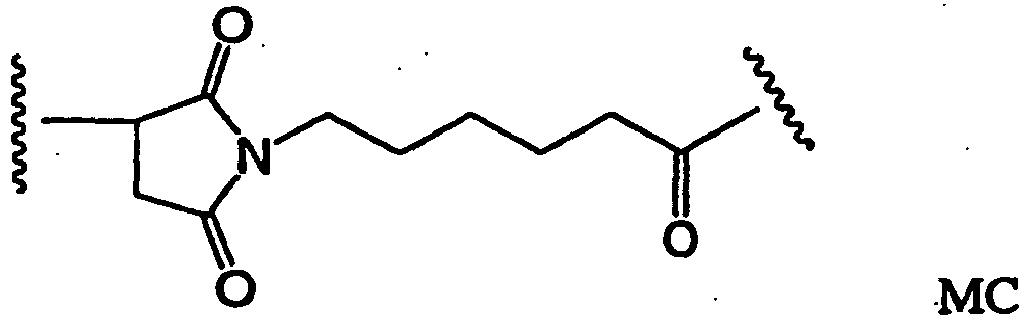
- An illustrative Stretcher unit is that of Formula IIIa, and is derived from maleimido-propanoyl (MP) wherein R17 is -(CH2)2-:

- Another illustrative Stretcher unit is that of Formula IIIa wherein R17 is -(CH2CH2O)r-CH2- and r is 2:

- Another illustrative Stretcher unit is that of Formula IIIa wherein R17 is -(CH2)rC(O)NRb(CH2CH2O)r-CH2- where Rb is H and each r is 2:

- Another illustrative Stretcher unit is that of Formula IIIb wherein R17 is -(CH2)5-:

- In another embodiment, the Stretcher unit is linked to the Antibody unit via a disulfide bond between a sulfur atom of the Antibody unit and a sulfur atom of the Stretcher unit. A representative Stretcher unit of this embodiment is depicted within the square brackets of Formula IV, wherein R17, Ab-, -W-, -Y-, -D, w and y are as defined above.

- In yet another embodiment, the reactive group of the Stretcher contains a thiol-reactive functional group that can form a bond with a free cysteine thiol of an antibody. Examples of thiol-reaction functional groups include, but are not limited to, maleimide, α-haloacetyl, activated esters such as succinimide esters, 4-nitrophenyl esters, pentafluorophenyl esters, tetrafluorophenyl esters, anhydrides, acid chlorides, sulfonyl chlorides, isocyanates and isothiocyanates. Representative Stretcher units of this embodiment are depicted within the square brackets of Formulas Va and Vb, wherein -R17-, Ab-, -W-, -Y-, -D, w and y are as defined above;


- In another embodiment, the linker may be a dendritic type linker for covalent attachment of more than one drug moiety through a branching, multifunctional linker moiety to an antibody (Sun et al (2002) Bioorganic & Medicinal Chemistry Letters 12:2213-2215; Sun et al (2003) Bioorganic & Medicinal Chemistry 11:1761-1768; King (2002) Tetrahedron Letters 43:1987-1990). Dendritic linkers can increase the molar ratio of drug to antibody, i.e. loading, which is related to the potency of the ADC. Thus, where a cysteine engineered antibody bears only one reactive cysteine thiol group, a multitude of drug moieties may be attached through a dendritic linker.
- The linker may comprise amino acid residues. The Amino Acid unit(-Ww-), when present, links the antibody (Ab) to the drug moiety (D) of the cysteine engineered antibody-drug conjugate (ADC) of the invention.
- -Ww- is a dipeptide, tripeptide, tetrapeptide, pentapeptide, hexapeptide, heptapeptide, octapeptide, nonapeptide, decapeptide, undecapeptide or dodecapeptide unit. Amino acid residues which comprise the Amino Acid unit include those occurring naturally, as well as minor amino acids and non-naturally occurring amino acid analogs, such as citrulline. Each -W- unit independently has the formula denoted below in the square brackets, and w is an integer ranging from 0 to 12:


- The Amino Acid unit can be enzymatically cleaved by one or more enzymes, including a tumor-associated protease, to liberate the Drug moiety(-D), which in one embodiment is protonated in vivo upon release to provide a Drug (D).
- Useful -Ww- units can be designed and optimized in their selectivity for enzymatic cleavage by a particular enzymes, for example, a tumor-associated protease. In one embodiment, a -Ww- unit is that whose cleavage is catalyzed by cathepsin B, C and D, or a plasmin protease.
- Exemplary -Ww- Amino Acid units include a dipeptide, a tripeptide, a tetrapeptide or a pentapeptide. Exemplary dipeptides include: valine-citrulline (vc or val-cit), alanine-phenylalanine (af or alaphe). Exemplary tripeptides include: glycine-valine-citrulline (gly-val-cit) and glycine-glycine-glycine (gly-gly-gly).
- When R19 is other than hydrogen, the carbon atom to which R19 is attached is chiral. Each carbon atom to which R19 is attached is independently in the (S) or (R) configuration, or a racemic mixture. Amino acid units may thus be enantiomerically pure, racemic, or diastereomeric.
- The Spacer unit (-Yy-), when present (y = 1 or 2), links an Amino Acid unit (-Ww-) to the drug moiety (D) when an Amino Acid unit is present (w = 1-12). Alternately, the Spacer unit links the Stretcher unit to the Drug moiety when the Amino Acid unit is absent. The Spacer unit also links the drug moiety to the antibody unit when both the Amino Acid unit and Stretcher unit are absent (w, y = 0). Spacer units are of two general types: self-immolative and non self-immolative. A non self-immolative Spacer unit is one in which part or all of the Spacer unit remains bound to the Drug moiety after cleavage, particularly enzymatic, of an Amino Acid unit from the antibody-drug conjugate or the Drug moiety-linker. When an ADC containing a glycine-glycine Spacer unit or a glycine Spacer unit undergoes enzymatic cleavage via a tumor-cell associated-protease, a cancer-cell-associated protease or a lymphocyte-associated protease, a glycine-glycine-Drug moiety or a glycine-Drug moiety is cleaved from Ab-Aa-Ww-. In one embodiment, an independent hydrolysis reaction takes place within the target cell, cleaving the glycine-Drug moiety bond and liberating the Drug.
- In another embodiment, -Yy- is a p-aminobenzylcarbamoyl (PAB) unit (see
Schemes 2 and 3) whose phenylene portion is substituted with Qm wherein Q is -C1-C8 alkyl, -O-(C1-C8 alkyl), -halogen,- nitro or-cyano; and m is an integer ranging from 0-4. - Exemplary embodiments of a non self-immolative Spacer unit (-Y-) are: -Gly-Gly- ; -Gly- ; -Ala-Phe- ; -Val-Cit-.
- In one embodiment, a Drug moiety-linker or an ADC is provided in which the Spacer unit is absent (y=0), or a pharmaceutically acceptable salt or solvate thereof.
- Alternatively, an ADC containing a self-immolative Spacer unit can release -D. In one embodiment,
- -Y- is a PAB group that is linked to -Ww- via the amino nitrogen atom of the PAB group, and connected directly to -D via a carbonate, carbamate or ether group, where the ADC has the exemplary structure:

- Other examples of self-immolative spacers include, but are not limited to, aromatic compounds that are electronically similar to the PAB group such as 2-aminoimidazol-5-methanol derivatives (Hay et al. (1999) Bioorg. Med. Chem. Lett. 9:2237) and ortho or para-aminobenzylacetals. Spacerscan be used that undergo cyclization upon amide bond hydrolysis, such as substituted and unsubstituted 4-aminobutyric acid amides (Rodrigues et al (1995) Chemistry Biology 2:223), appropriately substituted bicyclo[2.2.1] and bicyclo[2.2.2] ring systems (Storm et al (1972) J. Amer. Chem. Soc. 94:5815) and 2-aminophenylpropionic acid amides (Amsberry, et al (1990) J. Org. Chem. 55:5867). Elimination of amine-containing drugs that are substituted at glycine (Kingsbury et al (1984) J. Med. Chem. 27:1447) are also examples of self-immolative spacer useful in ADCs.
- In one embodiment, the Spacer unit is a branched bis(hydroxymethyl)styrene (BHMS), which can be used to incorporate and release multiple drugs, having the structure:

WO 2004/043493 ; de Groot et al (2003) Angew. Chem. Int. Ed. 42:4490-4494), wherein Q is -C1-C8 alkyl, -O-(C1-C8 alkyl), -halogen, -nitro or -cyano; m is an integer ranging from 0-4; n is 0 or 1; and p ranges ranging from 1 to 4. - In another embodiment, linker L may be a dendritic type linker for covalent attachment of more than one drug moiety through a branching, multifunctional linker moiety to an antibody (Sun et al (2002) Bioorganic & Medicinal Chemistry Letters 12:2213-2215; Sun et al (2003) Bioorganic & Medicinal Chemistry 11:1761-1768). Dendritic linkers can increase the molar ratio of drug to antibody, i.e. loading, which is related to the potency of the ADC. Thus, where a cysteine engineered antibody bears only one reactive cysteine thiol group, a multitude of drug moieties may be attached through a dendritic linker.
- The following exemplary embodiments of dendritic linker reagents allow up to nine nucleophilic drug moiety reagents to be conjugated by reaction with the chloroethyl nitrogen mustard functional groups:


- In another embodiment of a Spacer unit, branched, dendritic linkers with self-
immolative 2,6-bis(hydroxymethyl)-p-cresol and 2,4,6-tris(hydroxymethyl)-phenol dendrimer units (WO 2004/01993 - In another embodiment, the D moieties are the same.
- In yet another embodiment, the D moieties are different.
- In one aspect, Spacer units (-Yy-) are represented by Formulas (X)-(XII):


- Embodiments of the Formula I antibody-drug conjugate compounds include XIIIa (val-cit), XIIIb (MC-val-cit), XIIIc (MC-val-cit-PAB):


- Other exemplary embodiments of the Formula Ia antibody-drug conjugate compounds include XIVa-e:


- In another embodiment, a Linker has a reactive functional group which has a nucleophilic group that is reactive to an electrophilic group present on an antibody. Useful electrophilic groups on an antibody include, but are not limited to, aldehyde and ketone carbonyl groups. The heteroatom of a nucleophilic group of a Linker can react with an electrophilic group on an antibody and form a covalent bond to an antibody unit. Useful nucleophilic groups on a Linker include, but are not limited to, hydrazide, oxime, amino, hydrazine, thiosemicarbazone, hydrazine carboxylate, and arylhydrazide. The electrophilic group on an antibody provides a convenient site for attachment to a Linker.
- Typically, peptide-type Linkers can be prepared by forming a peptide bond between two or more amino acids and/or peptide fragments. Such peptide bonds can be prepared, for example, according to the liquid phase synthesis method (E. Schroder and K. Lübke (1965) "The Peptides", ) which is well known in the field of peptide chemistry.
- Linker intermediates may be assembled with any combination or sequence of reactions including Spacer, Stretcher, and Amino Acid units. The Spacer, Stretcher, and Amino Acid units may employ reactive functional groups which are electrophilic, nucleophilic, or free radical in nature. Reactive functional groups include, but are not limited to:


- In another embodiment, the Linker may be substituted with groups which modulated solubility or reactivity. For example, a charged substituent such as sulfonate (-SO3 -) or ammonium, may increase water solubility of the reagent and facilitate the coupling reaction of the linker reagent with the antibody or the drug moiety, or facilitate the coupling reaction of Ab-L (antibody-linker intermediate) with D, or D-L (drug-linker intermediate) with Ab, depending on the synthetic route employed to prepare the ADC.
- The compounds of the invention expressly contemplate, but are not limited to, ADC prepared with linker reagents: BMPEO, BMPS, EMCS, GMBS, HBVS, LC-SMCC, MBS, MPBH, SBAP, SIA, SIAB, SMCC, SMPB, SMPH, sulfo-EMCS, sulfo-GMBS, sulfo-KMUS, sulfo-MBS, sulfo-SIAB, sulfo-SMCC, and sulfo-SMPB, and SVSB (succinimidyl-(4-vinylsulfone)benzoate), and including bis-maleimide reagents: DTME, BMB, BMDB, BMH, BMOE, BM(PEO)3, and BM(PEO)4, which are commercially available from Pierce Biotechnology, Inc., Customer Service Department, P.O. Box 117, Rockford, IL. 61105 U.S.A, U.S.A 1-800-874-3723, International +815-968-0747. See pages 467-498,2003-2004 Applications Handbook and Catalog. Bis-maleimide reagents allow the attachment of the thiol group of a cysteine engineered antibody to a thiol-containing drug moiety, label, or linker intermediate, in a sequential or concurrent fashion. Other functional groups besides maleimide, which are reactive with a thiol group of a cysteine engineered antibody, drug moiety, label, or linker intermediate include iodoacetamide, bromoacetamide, vinyl pyridine, disulfide, pyridyl disulfide, isocyanate, and isothiocyanate.

- Useful linker reagents can also be obtained via other commercial sources, such as Molecular Biosciences Inc.(Boulder, CO), or synthesized in accordance with procedures described in Toki et al (2002) J. Org. Chem. 67:1866-1872; Walker, M.A. (1995) J. Org. Chem. 60:5352-5355; Frisch et al (1996) Bioconjugate Chem. 7:180-186;
US 6214345 ;WO 02/088172 US 2003130189 ;US2003096743 ;WO 03/026577 WO 03/043583 WO 04/032828 - Stretchers of formula (IIIa) can be introduced into a Linker by reacting the following linker reagents with the N-terminus of an Amino Acid unit:


- Stretcher units of can be introduced into a Linker by reacting the following bifunctional reagents with the N-terminus of an Amino Acid unit:


- Stretcher units of formula (Va) can be introduced into a Linker by reacting the following intermediates with the N-terminus of an Amino Acid unit:


- Isothiocyanate Stretchers of the formula shown below may be prepared from isothiocyanatocarboxylic acid chlorides as described in Angew. Chem., (1975) 87(14), 517.

- An exemplary valine-citrulline (val-cit or vc) dipeptide linker reagent having a maleimide Stretcher and a para-aminobenzylcarbamoyl (PAB) self-immolative Spacer has the structure:

- An exemplary phe-lys(Mtr) dipeptide linker reagent having a maleimide Stretcher unit and a p-aminobenzyl self-immolative Spacer unit can be prepared according to Dubowchik, et aL (1997) Tetrahedron Letters, 38:5257-60, and has the structure:

- Exemplary antibody-drug conjugate compounds of the invention include:


- The ADC of Formula I may be prepared by several routes, employing organic chemistry reactions, conditions, and reagents known to those skilled in the art, including: (1) reaction of a cysteine group of a cysteine engineered antibody with a linker reagent, to form antibody-linker intermediate Ab-L, via a covalent bond, followed by reaction with an activated drug moiety D; and (2) reaction of a nucleophilic group of a drug moiety with a linker reagent, to form drug-linker intermediate D-L, via a covalent bond, followed by reaction with a cysteine group of a cysteine engineered antibody. Conjugation methods (1) and (2) may be employed with a variety of cysteine engineered antibodies, drug moieties, and linkers to prepare the antibody-drug conjugates of Formula I.
- Antibody cysteine thiol groups are nucleophilic and capable of reacting to form covalent bonds with electrophilic groups on linker reagents and drug-linker intermediates including: (i) active esters such as NHS esters, HOBt esters, haloformates, and acid halides; (ii) alkyl and benzyl halides, such as haloacetamides; (iii) aldehydes, ketones, carboxyl, and maleimide groups; and (iv) disulfides, including pyridyl disulfides, via sulfide exchange. Nucleophilic groups on a drug moiety include, but are not limited to: amine, thiol, hydroxyl, hydrazide, oxime, hydrazine, thiosemicarbazone, hydrazine carboxylate, and arylhydrazide groups capable of reacting to form covalent bonds with electrophilic groups on linker moieties and linker reagents.
- Maytansine may, for example, be converted to May-SSCH3, which can be reduced to the free thiol, May-SH, and reacted with a modified antibody (Chari et al (1992) Cancer Research 52:127-131) to generate a maytansinoid-antibody immunoconjugate with a disulfide linker. Antibody-maytansinoid conjugates with disulfide linkers have been reported (
WO 04/016801 US 6884874 ;US 2004/039176 A1 ;WO 03/068144 US 2004/001838 A1 ;US Patent Nos. 6441163 ,5208020 ,5416064 ;WO 01/024763 - Under certain conditions, the cysteine engineered antibodies may be made reactive for conjugation with linker reagents by treatment with a reducing agent such as DTT (Cleland's reagent, dithiothreitol) or TCEP (tris(2-carboxyethyl)phosphine hydrochloride; Getz et al (1999) Anal. Biochem. Vol 273:73-80; Soltec Ventures, Beverly, MA). Full length, cysteine engineered monoclonal antibodies (ThioMabs) expressed in CHO cells were reduced with about a 50 fold excess of TCEP for 3 hrs at 37 °C to reduce disulfide bonds which may form between the newly introduced cysteine residues and the cysteine present in the culture media. The reduced ThioMab was diluted and loaded onto HiTrap S column in 10 mM sodium acetate,
pH 5, and eluted with PBS containing 0.3M sodium chloride. Disulfide bonds were reestablished between cysteine residues present in the parent Mab with dilute (200 nM) aqueous copper sulfate (CuSO4) at room temperature, overnight. Other oxidants, i.e. oxidizing agents, and oxidizing conditions, which are known in the art may be used. Ambient air oxidation is also effective. This mild, partial reoxidation step forms intrachain disulfides efficiently with high fidelity. An approximate 10 fold excess of drug-linker intermediate, e.g. BM(PEO)4-DM1 was added, mixed, and let stand for about an hour at room temperature to effect conjugation and form the ThioMab antibody-drug conjugate. The conjugation mixture was gel filtered and loaded and eluted through a HiTrap S column to remove excess drug-linker intermediate and other impurities. -
Figure 15 shows the general process to prepare a cysteine engineered antibody expressed from cell culture for conjugation. Cysteine adducts, presumably along with various interchain disulfide bonds, are reductively cleaved to give a reduced form of the antibody. The interchain disulfide bonds between paired cysteine residues are reformed under partial oxidation conditions, such as exposure to ambient oxygen. The newly introduced, engineered, and unpaired cysteine residues remain available for reaction with linker reagents or drug-linker intermediates to form the antibody conjugates of the invention. The ThioMabs expressed in mammalian cell lines result in externally conjugated Cys adduct to an engineered Cys through-S-S- bond formation. Hence the purified ThioMabs have to be treated with reduction and oxidation procedures as described in Example 11 to produce reactive ThioMabs. These ThioMabs are used to conjugate with maleimide containing cytotoxic drugs, fluorophores, and other labels. - A variety of ThioFab and ThioMab antibody-drug conjugates were prepared (Examples 4-8). Cysteine mutant hu4D5Fabv8 (V110C) was conjugated with the maytansinoid drug moiety DM1 with a bis-maleimido linker reagent BMPEO to form hu4D5Fabv8 (V110C) -BMPEO-DM1 (Example 8).
- Generally, the cytotoxic or cytostatic activity of an antibody-drug conjugate (ADC) is measured by: exposing mammalian cells having receptor proteins, e.g. HER2, to the antibody of the ADC in a cell culture medium; culturing the cells for a period from about 6 hours to about 5 days; and measuring cell viability. Cell-based in vitro assays were used to measure viability (proliferation), cytotoxicity, and induction of apoptosis (caspase activation) of the ADC of the invention.
- The in vitro potency of antibody-drug conjugates was measured by a cell proliferation assay (
Figures 10 and11 , Example 9). The CellTiter-Glo® Luminescent Cell Viability Assay is a commercially available (Promega Corp., Madison, WI), homogeneous assay method based on the recombinant expression of Coleoptera luciferase (US Patent Nos. 5583024 ;5674713 and5700670 ). This cell proliferation assay determines the number of viable cells in culture based on quantitation of the ATP present, an indicator of metabolically active cells (Crouch et al (1993) J. Immunol. Meth. 160:81-88;US 6602677 ). The CellTiter-Glo® Assay was conducted in 96 well format, making it amenable to automated high-throughput screening (HTS) (Cree et al (1995) AntiCancer Drugs 6:398-404). The homogeneous assay procedure involves adding the single reagent (CellTiter-Glo® Reagent) directly to cells cultured in serum-supplemented medium. Cell washing, removal of medium and multiple pipetting steps are not required. The system detects as few as 15 cells/well in a 384-well format in 10 minutes after adding reagent and mixing. The cells may be treated continuously with ADC, or they may be treated and separated from ADC. Generally, cells treated briefly, i.e. 3 hours, showed the same potency effects as continuously treated cells. - The homogeneous "add-mix-measure" format results in cell lysis and generation of a luminescent signal proportional to the amount of ATP present. The amount of ATP is directly proportional to the number of cells present in culture. The CellTiter-Glo® Assay generates a "glow-type" luminescent signal, produced by the luciferase reaction, which has a half-life generally greater than five hours, depending on cell type and medium used. Viable cells are reflected in relative luminescence units (RLU). The substrate, Beetle Luciferin, is oxidatively decarboxylated by recombinant firefly luciferase with concomitant conversion of ATP to AMP and generation of photons. The extended half-life eliminates the need to use reagent injectors and provides flexibility for continuous or batch mode processing of multiple plates. This cell proliferation assay can be used with various multi well formats, e.g. 96 or 384 well format. Data can be recorded by luminometer or CCD camera imaging device. The luminescence output is presented as relative light units (RLU), measured over time. Alternatively, photons from luminescence can be counted in a scintillation counter in the presence of a scintillant. The light units can be represented then as CPS - counts per second.

- The anti-proliferative effects of antibody-drug conjugates were measured by the cell proliferation, in vitro cell killing assay above against the SK-BR-3 breast tumor cell line (
Figures 10 and11 ). IC50 values of the ADC were established against SK-BR-3 cells, which are known to overexpress HER2 receptor protein. -
Figure 10 shows that trastuzumab-SMCC-DM1 (IC50=0.008-0.015 µg/ml) was more potent than the heavy chain cysteine mutant conjugate hu4D5Fabv8 -(A121C)-BMPEO-DM1 (IC50 = 0.04µg/ml). Both conjugates were significantly more potent in cell killing than naked trastuzumab (IC50 = 0.1 µg/ml). Drug loading for trastuzumab-SMCC-DM1 was 2.8 DM1/Ab and for hu4D5Fabv8 (A121C)-BMPEO-DM1 was 0.6 DM1/Ab. -
Figure 11 shows that trastuzumab-SMCC-DM1 (IC50 = 0.008-0.015 µg/ml) was more potent than the light chain cysteine mutant hu4D5Fabv8 (V110C)-BMPEO-DM1 (IC50 = 0.07 µg/ml). Both conjugates were more potent in cell killing than naked trastuzumab (IC50 = 0.1 µg/ml). Drug loading for trastuzumab-SMCC-DM1 was 2.8 DM1/Ab and for hu4D5Fabv8 (V110C)-BMPEO-DM1 was 0.9 DM1/Ab. - Full-length IgG ThioMab conjugates were tested for in vitro, cell proliferation efficacy and compared with parent antibodies.
Figure 20 shows the results of an assay of SK-BR-3 cells treated with: parent antibody trastuzumab (HERCEPTIN®, Genentech, Inc.); trastuzumab-SMCC-DM1 with a drug loading of about 3.4 DM1/Ab; and thio-trastuzumab (A121C)-BMPEO-DM1 with a drug loading of about 1.6 DM1/Ab. The trastuzumab-SMCC-DM1 conjugate is linked to the antibody via the amino reactive, NHS ester SMCC linker reagent, whereas the thio-trastuzumab (A121C) -BMPEO-DM1 conjugates is linked via the thiol reactive, maleimide BMPEO linker reagent. Both conjugates were potent against SK-BR-3 cells and showed comparable activity, whereas trastuzumab did not exert a cytotoxic effect.Figure 21A shows the results of an assay of HT 1080EphB2 cells treated with: parent 2H9 anti-EphB2R; and thio 2H9 (A121C) BMPEO-DM1 conjugate.Figure 21B shows the results of an assay ofBT 474 cells treated with: parent 2H9 anti-EphB2R; and thio 2H9 (A121C) BMPEO-DM1 conjugate. Against both HT 1080EphB2 andBT 474 cells, the 2H9 ThioMab conjugate was more potent than the parent 2H9 antibody conjugate. The conjugate Thio-2H9-BMPEO-DM1 showed functional cell killing activity in EphB2 specific cell line (HT1080EphH2) compared to a non EphB2 cell line, BT474 in which only marginal activity is observed. - Antibody drug conjugates were compared where the antibody is a parent antibody and where the antibody is a cysteine engineered antibody.
Figure 22 shows the results of an assay of PC3/neo cells treated with: 3A5 anti MUC16-SMCC-DM1; and thio 3A5 (A121C) BMPEO-DM1.Figure 23 shows the results of an assay of PC3/MUC16 cells treated with: 3A5 anti MUC16-SMCC-DM1; and thio 3A5 (A121C) BMPEO-DM1.Figure 24 shows the results of an assay of OVCAR-3 cells treated with: 3A5 anti MUC16-SMCC-DM1; and thio 3A5 (A121C) BMPEO-DM1. Thio-3A5-BMPEO-DM1 did not show any significant cell killing activity in the control PC3/neo cell line, whereas it showed comparable activity to 3A5-SMCC-DM1 in the PC3/MUC16 cell line. Thio-3A5-DM1 conjugate also showed activity in the OVCAR-3 that expresses endogenous MUC16 antigen. - The in vivo efficacy of two albumin binding peptide-DM1 (maytansinoid)-antibody-drug conjugates (ADC) of the invention was measured by a high expressing HER2 transgenic explant mouse model (
Figure 12 , Example 10). An allograft was propagated from the Fo5 mmtv transgenic mouse which does not respond to, or responds poorly to, HERCEPTlN® therapy. Subjects were treated once with ABP-rhuFab4D5-cys(light chain)-DM1; ABP-rhuFab4D5-cys(heavy chain)-DM1; and placebo PBS buffer control (Vehicle) and monitored over 3 weeks to measure the time to tumor doubling, log cell kill, and tumor shrinkage.Sample Dose Ti PR CR TDV (days) Vehicle (PBS buffer) 7/7 0/7 0/7 3 ABP-rhuFab4D5-V110C (light chain)-DM1 (0.9 DM1/Ab) 25 mg per kg (1012 µg/m2 of DM1) 7/7 7/7 0/7 14 ABP-rhuFab4D5-A121C(heavy chain)-DM1 (0.6 DM1/Ab) 37.5 mg per kg (1012 µg/m2 of DM1) 7/7 4/7 0/7 16 - The term Ti is the number of animals in the study group with tumor at T = 0 + total animals in group.
- The term PR is the number of animals attaining partial remission of tumor + animals with tumor at T = 0 in the group. The term CR is the number of animals attaining complete remission of tumor + animals with tumor at T = 0 in the group. The term TDV is the tumor doubling time, i.e. time in days for the control tumor volume to double.
- The seven mice treated with 25 mg per kg (1012 ug/m2 of DM1) of ABP-rhuFab4D5-cys(light chain)-DM1 were all tumor-positive and gave one animal with partial remission after 20 days. The seven mice treated with 37.5 mg per kg (1012 ug/m2 of DM1) of ABP-rhuFab4D5-cys(heavy chain)-DM1 were all tumor-positive and gave four animals with partial remission after 20 days.
- The full length IgG ThioMab antibody variant with the A121C cysteine mutation and conjugated to the BMPEO linker and DM1 drug moiety was tested against the parent trastuzumab-SMCC-DM1 conjugate in MMTV-HER2 Fo5 tumor-bearing mice. Tumor size at
day 0 of injection was about 100-200 mm in size.Figure 25 shows the mean tumor volume change over 21 days in athymic nude mice with MMTV-HER2 Fo5 mammary tumor allografts, after a single dose onDay 0 with: Vehicle (Buffer); trastuzumab-SMCC-DM1 10 mg/kg; thio trastuzumab (A121C)-SMCC-DM1 21 mg/kg and thio trastuzumab (A121C)-SMCC-DM1 10 mg/kg.Sample Dose Ti PR CR Vehicle (PBS buffer) - 10/10 0/10 0/10 trastuzumab-SMCC-DM1 3.4 DM1/ Ab 10 mg Ab per kg mouse (490 µg/m2 of DM1) 10/10 7/10 0/10 thio-trastuzumab (A121C)-BMPEO-DM1 1.6 DM1/Ab 21 mg Ab per kg mouse (496 µg/m2 of DM1) 8/10 6/10 4/10 thio-trastuzumab (A121C)-BMPEO-DM1 1.6 DM1/ Ab 10 mg Ab per kg mouse (236 µg/m2 of DM1) 10/10 0/10 0/10 - It can be seen from
Figure 25 that each conjugate exerts a significant effect of retarding tumor growth relative to placebo (Vehicle). Each of the ten mice in the four groups above received a single injection atday 1. The parent trastuzumab-SMCC-DM1 conjugate was loaded with more than twice (3.4 DM1/Ab) the number of drug moieties than the cysteine engineered thio-trastuzumab (A121C)-BMPEO-DM1 conjugate (1.6 DM1/Ab). The effective amount of DM1 was thus approximately equal between parent trastuzumab-SMCC-DM1 and the higher dose (21 mg Ab) thio-trastuzumab (A121C)-BMPEO-DM1. These two sample showed the most potency. After 14 days post-injection, most of the animals receiving these conjugates were in partial or complete remission. The lower efficacy of the lower dose thio-trastuzumab (A121C)-BMPEO-DM1 sample confirmed a DM1 dose-related response. Thio-Trastuzumab-DM1 either dosed in equivalent antibody (10mg/kg) or DM1 drug (21mg/kg) quantity to that of control trastuzumab-SMCC-DM1 conjugate. As seen from theFigure 25 , Thio-BMPEO-DM1 (21 mg/kg) showed slightly better response than that of trastuzumab-SMCC-DM1 group as some of the animals showed complete response with Thiomab-DM1 whereas there was only partial response with trastuzumab-SMCC-DM1. - The antibody-drug conjugates (ADC) of the invention may be administered by any route appropriate to the condition to be treated. The ADC will typically be administered parenterally, i.e. infusion, subcutaneous, intramuscular, intravenous, intradermal, intrathecal and epidural.
- Pharmaceutical formulations of therapeutic antibody-drug conjugates (ADC) of the invention are typically prepared for parenteral administration, i.e. bolus, intravenous, intratumor injection with a pharmaceutically acceptable parenteral vehicle and in a unit dosage injectable form. An antibody-drug conjugate (ADC) having the desired degree of purity is optionally mixed with pharmaceutically acceptable diluents, carriers, excipients or stabilizers (Remington's Pharmaceutical Sciences (1980) 16th edition, Osol, A. Ed.), in the form of a lyophilized formulation or an aqueous solution.
- Acceptable diluents, carriers, excipients, and stabilizers are nontoxic to recipients at the dosages and concentrations employed, and include buffers such as phosphate, citrate, and other organic acids; antioxidants including ascorbic acid and methionine; preservatives (such as octadecyldimethylbenzyl ammonium chloride; hexamethonium chloride; benzalkonium chloride, benzethonium chloride; phenol, butyl or benzyl alcohol; alkyl parabens such as methyl or propyl paraben; catechol; resorcinol; cyclohexanol; 3-pentanol; and m-cresol); low molecular weight (less than about 10 residues) polypeptides; proteins, such as serum albumin, gelatin, or immunoglobulins; hydrophilic polymers such as polyvinylpyrrolidone; amino acids such as glycine, glutamine, asparagine, histidine, arginine, or lysine; monosaccharides, disaccharides, and other carbohydrates including glucose, mannose, or dextrins; chelating agents such as EDTA; sugars such as sucrose, mannitol, trehalose or sorbitol; salt-forming counter-ions such as sodium; metal complexes (e.g. Zn-protein complexes); and/or non-ionic surfactants such as TWEEN™, PLURONICS™ or polyethylene glycol (PEG). For example, lyophilized anti-ErbB2 antibody formulations are described in
WO 97/04801 - The active pharmaceutical ingredients may also be entrapped in microcapsules prepared, for example, by coacervation techniques or by interfacial polymerization, for example, hydroxymethylcellulose or gelatin-microcapsules and poly-(methylmethacylate) microcapsules, respectively, in colloidal drug delivery systems (for example, liposomes, albumin microspheres, microemulsions, nano-particles and nanocapsules) or in macroemulsions. Such techniques are disclosed in Remington's Pharmaceutical Sciences 16th edition, Osol, A. Ed. (1980).
- Sustained-release preparations may be prepared. Suitable examples of sustained-release preparations include semi permeable matrices of solid hydrophobic polymers containing the ADC, which matrices are in the form of shaped articles, e.g. films, or microcapsules. Examples of sustained-release matrices include polyesters, hydrogels (for example, poly(2-hydroxyethyl-methacrylate), or poly(vinyl alcohol)), polylactides (
US 3773919 ), copolymers of L-glutamic acid and gamma-ethyl-L-glutamate, non-degradable ethylene-vinyl acetate, degradable lactic acid-glycolic acid copolymers such as the LUPRON DEPOT™ (injectable microspheres composed of lactic acid-glycolic acid copolymer and leuprolide acetate), and poly-D-(-)-3-hydroxybutyric acid. - The formulations to be used for in vivo administration must be sterile, which is readily accomplished by filtration through sterile filtration membranes.
- The formulations include those suitable for the foregoing administration routes. The formulations may conveniently be presented in unit dosage form and may be prepared by any of the methods well known in the art of pharmacy. Techniques and formulations generally are found in Remington's Pharmaceutical Sciences (Mack Publishing Co., Easton, PA). Such methods include the step of bringing into association the active ingredient with the carrier which constitutes one or more accessory ingredients. In general the formulations are prepared by uniformly and intimately bringing into association the active ingredient with liquid carriers or finely divided solid carriers or both, and then, if necessary, shaping the product.
- Aqueous suspensions of the invention contain the active materials in admixture with excipients suitable for the manufacture of aqueous suspensions. Such excipients include a suspending agent, such as sodium carboxymethylcellulose, croscarmellose, povidone, methylcellulose, hydroxypropyl methylcelluose, sodium alginate, polyvinylpyrrolidone, gum tragacanth and gum acacia, and dispersing or wetting agents such as a naturally occurring phosphatide (e.g., lecithin), a condensation product of an alkylene oxide with a fatty acid (e.g., polyoxyethylene stearate), a condensation product of ethylene oxide with a long chain aliphatic alcohol (e.g., heptadecaethyleneoxycetanol), a condensation product of ethylene oxide with a partial ester derived from a fatty acid and a hexitol anhydride (e.g., polyoxyethylene sorbitan monooleate). The aqueous suspension may also contain one or more preservatives such as ethyl or n-propyl p-hydroxy-benzoate, one or more coloring agents, one or more flavoring agents and one or more sweetening agents, such as sucrose or saccharin.
- The pharmaceutical compositions of ADC may be in the form of a sterile injectable preparation, such as a sterile injectable aqueous or oleaginous suspension. This suspension may be formulated according to the known art using those suitable dispersing or wetting agents and suspending agents which have been mentioned above. The sterile injectable preparation may also be a sterile injectable solution or suspension in a non-toxic parenterally acceptable diluent or solvent, such as a solution in 1,3-butane-diol or prepared as a lyophilized powder. Among the acceptable vehicles and solvents that may be employed are water, Ringer's solution and isotonic sodium chloride solution. In addition, sterile fixed oils may conventionally be employed as a solvent or suspending medium. For this purpose any bland fixed oil may be employed including synthetic mono- or diglycerides. In addition, fatty acids such as oleic acid may likewise be used in the preparation of injectables.
- The amount of active ingredient that may be combined with the carrier material to produce a single dosage form will vary depending upon the host treated and the particular mode of administration. For example, an aqueous solution intended for intravenous infusion may contain from about 3 to 500 µg of the active ingredient per milliliter of solution in order that infusion of a suitable volume at a rate of about 30 mL/hr can occur.
- Formulations suitable for parenteral administration include aqueous and non-aqueous sterile injection solutions which may contain anti-oxidants, buffers, bacteriostats and solutes which render the formulation isotonic with the blood of the intended recipient; and aqueous and non-aqueous sterile suspensions which may include suspending agents and thickening agents.
- Although oral administration of protein therapeutics are disfavored due to hydrolysis or denaturation in the gut, formulations of ADC suitable for oral administration may be prepared as discrete units such as capsules, cachets or tablets each containing a predetermined amount of the ADC.
- The formulations may be packaged in unit-dose or multi-dose containers, for example sealed ampoules and vials, and may be stored in a freeze-dried (lyophilized) condition requiring only the addition of the sterile liquid carrier, for example water, for injection immediately prior to use. Extemporaneous injection solutions and suspensions are prepared from sterile powders, granules and tablets of the kind previously described. Preferred unit dosage formulations are those containing a daily dose or unit daily sub-dose, as herein above recited, or an appropriate fraction thereof, of the active ingredient.
- The invention further provides veterinary compositions comprising at least one active ingredient as above defined together with a veterinary carrier therefore. Veterinary carriers are materials useful for the purpose of administering the composition and may be solid, liquid or gaseous materials which are otherwise inert or acceptable in the veterinary art and are compatible with the active ingredient. These veterinary compositions may be administered parenterally, orally or by any other desired route.
- It is contemplated that the antibody-drug conjugates (ADC) of the present invention may be used to treat various diseases or disorders, e.g. characterized by the overexpression of a tumor antigen. Exemplary conditions or hyperproliferative disorders include benign or malignant tumors; leukemia and lymphoid malignancies. Others include neuronal, glial, astrocytal, hypothalamic, glandular, macrophagal, epithelial, stromal, blastocoelic, inflammatory, angiogenic and immunologic, including autoimmune, disorders.
- The ADC compounds which are identified in the animal models and cell-based assays can be further tested in tumor-bearing higher primates and human clinical trials. Human clinical trials can be designed similar to the clinical trials testing the efficacy of the anti-HER2 monoclonal antibody HERCEPTIN® in patients with HER2 overexpressing metastatic breast cancers that had received extensive prior anti-cancer therapy as reported by Baselga et al. (1996) J. Clin. Oncol. 14:737-744. The clinical trial may be designed to evaluate the efficacy of an ADC in combinations with known therapeutic regimens, such as radiation and/or chemotherapy involving known chemotherapeutic and/or cytotoxic agents.
- Generally, the disease or disorder to be treated is a hyperproliferative disease such as cancer. Examples of cancer to be treated herein include, but are not limited to, carcinoma, lymphoma, blastoma, sarcoma, and leukemia or lymphoid malignancies. More particular examples of such cancers include squamous cell cancer (e.g. epithelial squamous cell cancer), lung cancer including small-cell lung cancer, non-small cell lung cancer, adenocarcinoma of the lung and squamous carcinoma of the lung, cancer of the peritoneum, hepatocellular cancer, gastric or stomach cancer including gastrointestinal cancer, pancreatic cancer, glioblastoma, cervical cancer, ovarian cancer, liver cancer, bladder cancer, hepatoma, breast cancer, colon cancer, rectal cancer, colorectal cancer, endometrial or uterine carcinoma, salivary gland-carcinoma, kidney or renal cancer, prostate cancer, vulval cancer, thyroid cancer, hepatic carcinoma, anal carcinoma, penile carcinoma, as well as head and neck cancer.
- The cancer may comprise HER2-expressing cells, such that the ADC of the present invention are able to bind to the cancer cells. To determine ErbB2 expression in the cancer, various diagnostic/prognostic assays are available. In one embodiment, ErbB2 overexpression may be analyzed by IHC, e.g. using the HERCEPTEST (Dako). Parrafin embedded tissue sections from a tumor biopsy may be subjected to the IHC assay and accorded a ErbB2 protein staining intensity criteria as follows:
Score 0, no staining is observed or membrane staining is observed in less than 10% of tumor cells;Score 1+, a faint/barely perceptible membrane staining is detected in more than 10% of the tumor cells, the cells are only stained in part of their membrane;Score 2+, a weak to moderate complete membrane staining is observed in more than 10% of the tumor cells;Score 3+, a moderate to strong complete membrane staining is observed in more than 10% of the tumor cells. Those tumors with 0 or 1+ scores for ErbB2 overexpression assessment may be characterized as not overexpressing ErbB2, whereas those tumors with 2+ or 3+ scores may be characterized as overexpressing ErbB2. - Alternatively, or additionally, FISH assays such as the INFORM™ (Ventana Co., Ariz.) or PATHVISION™ (Vysis, Ill.) may be carried out on formalin-fixed, paraffin-embedded tumor tissue to determine the extent (if any) of ErbB2 overexpression in the tumor.
- Autoimmune diseases for which the ADC compounds may be used in treatment include rheumatologic disorders (such as, for example, rheumatoid arthritis, Sjögren's syndrome, scleroderma, lupus such as SLE and lupus nephritis, polymyositis/dermatomyositis, cryoglobulinemia, anti-phospholipid antibody syndrome, and psoriatic arthritis), osteoarthritis, autoimmune gastrointestinal and liver disorders (such as, for example, inflammatory bowel diseases (e.g., ulcerative colitis and Crohn's disease), autoimmune gastritis and pernicious anemia, autoimmune hepatitis, primary biliary cirrhosis, primary sclerosing cholangitis, and celiac disease), vasculitis (such as, for example, ANCA-associated vasculitis, including Churg-Strauss vasculitis, Wegener's granulomatosis, and polyarteriitis), autoimmune neurological disorders (such as, for example, multiple sclerosis, opsoclonus myoclonus syndrome, myasthenia gravis, neuromyelitis optica, Parkinson's disease, Alzheimer's disease, and autoimmune polyneuropathies), renal disorders (such as, for example, glomerulonephritis, Goodpasture's syndrome, and Berger's disease), autoimmune dermatologic disorders (such as, for example, psoriasis, urticaria, hives, pemphigus vulgaris, bullous pemphigoid, and cutaneous lupus erythematosus), hematologic disorders (such as, for example, thrombocytopenic purpura, thrombotic thrombocytopenic purpura, post-transfusion purpura, and autoimmune hemolytic anemia), atherosclerosis, uveitis, autoimmune hearing diseases (such as, for example, inner ear disease and hearing loss), Behcet's disease, Raynaud's syndrome, organ transplant, and autoimmune endocrine disorders (such as, for example, diabetic-related autoimmune diseases such as insulin-dependent diabetes mellitus (IDDM), Addison's disease, and autoimmune thyroid disease (e.g., Graves' disease and thyroiditis)). More preferred such diseases include, for example, rheumatoid arthritis, ulcerative colitis, ANCA-associated vasculitis, lupus, multiple sclerosis, Sjögren's syndrome, Graves' disease, IDDM, pernicious anemia, thyroiditis, and glomerulonephritis.
- For the prevention or treatment of disease, the appropriate dosage of an ADC will depend on the type of disease to be treated, as defined above, the severity and course of the disease, whether the molecule is administered for preventive or therapeutic purposes, previous therapy, the patient's clinical history and response to the antibody, and the discretion of the attending physician. The molecule is suitably administered to the patient at one time or over a series of treatments. Depending on the type and severity of the disease, about 1 µg/kg to 15 mg/kg (e.g. 0.1-20 mg/kg) of molecule is an initial candidate dosage for administration to the patient, whether, for example, by one or more separate administrations, or by continuous infusion. A typical daily dosage might range from about 1 µg/kg to 100 mg/kg or more, depending on the factors mentioned above. An exemplary dosage of ADC to be administered to a patient is in the range of about 0.1 to about 10 mg/kg of patient weight.
- For repeated administrations over several days or longer, depending on the condition, the treatment is sustained until a desired suppression of disease symptoms occurs. An exemplary dosing regimen comprises administering an initial loading dose of about 4 mg/kg, followed by a weekly maintenance dose of about 2 mg/kg of an anti-ErbB2 antibody. Other dosage regimens may be useful. The progress of this therapy is easily monitored by conventional techniques and assays.
- An antibody-drug conjugate (ADC) of the invention may be combined in a pharmaceutical combination formulation, or dosing regimen as combination therapy, with a second compound having anti-cancer properties. The second compound of the pharmaceutical combination formulation or dosing regimen preferably has complementary activities to the ADC of the combination such that they do not adversely affect each other.
- The second compound may be a chemotherapeutic agent, cytotoxic agent, cytokine, growth inhibitory agent, anti-hormonal agent, and/or cardioprotectant. Such molecules are suitably present in combination in amounts that are effective for the purpose intended. A pharmaceutical composition containing an ADC of the invention may also have a therapeutically effective amount of a chemotherapeutic agent such as a tubulin-forming inhibitor, a topoisomerase inhibitor, or a DNA binder.
- Other therapeutic regimens may be combined with the administration of an anticancer agent identified in accordance with this invention. The combination therapy may be administered as a simultaneous or sequential regimen. When administered sequentially, the combination may be administered in two or more administrations. The combined administration includes coadministration, using separate formulations or a single pharmaceutical formulation, and consecutive administration in either order, wherein preferably there is a time period while both (or all) active agents simultaneously exert their biological activities.
- In one embodiment, treatment with an ADC involves the combined administration of an anticancer agent identified herein, and one or more chemotherapeutic agents or growth inhibitory agents, including coadministration of cocktails of different chemotherapeutic agents. Chemotherapeutic agents include taxanes (such as paclitaxel and docetaxel) and/or anthracycline antibiotics. Preparation and dosing schedules for such chemotherapeutic agents may be used according to manufacturer's instructions or as determined empirically by the skilled practitioner. Preparation and dosing schedules for such chemotherapy are also described in "Chemotherapy Service", (1992) Ed., M.C. Perry, Williams & Wilkins, Baltimore, Md.
- The ADC may be combined with an anti-hormonal compound; e.g., an anti-estrogen compound such as tamoxifen; an anti-progesterone such as onapristone (
EP 616812 - Suitable dosages for any of the above coadministered agents are those presently used and may be lowered due to the combined action (synergy) of the newly identified agent and other chemotherapeutic agents or treatments.
- The combination therapy may provide "synergy" and prove "synergistic", i.e. the effect achieved when the active ingredients used together is greater than the sum of the effects that results from using the compounds separately. A synergistic effect may be attained when the active ingredients are: (1) co-formulated and administered or delivered simultaneously in a combined, unit dosage formulation; (2) delivered by alternation or in parallel as separate formulations; or (3) by some other regimen. When delivered in alternation therapy, a synergistic effect may be attained when the compounds are administered or delivered sequentially, e.g. by different injections in separate syringes. In general, during alternation therapy, an effective dosage of each active ingredient is administered sequentially, i.e. serially, whereas in combination therapy, effective dosages of two or more active ingredients are administered together.
- Also falling within the scope of this invention are the in vivo metabolic products of the ADC compounds described herein, to the extent such products are novel and unobvious over the prior art. Such products may result for example from the oxidation, reduction, hydrolysis, amidation, esterification, enzymatic cleavage, and the like, of the administered compound. Accordingly, the invention includes novel and unobvious compounds produced by a process comprising contacting a compound of this invention with a mammal for a period of time sufficient to yield a metabolic product thereof.
- Metabolite products typically are identified by preparing a radiolabelled (e.g. 14C or 3H) ADC, administering it parenterally in a detectable dose (e.g. greater than about 0.5 mg/kg) to an animal such as rat, mouse, guinea pig, monkey, or to man, allowing sufficient time for metabolism to occur (typically about 30 seconds to 30 hours) and isolating its conversion products from the urine, blood or other biological samples. These products are easily isolated since they are labeled (others are isolated by the use of antibodies capable of binding epitopes surviving in the metabolite). The metabolite structures are determined in conventional fashion, e.g. by MS, LC/MS or NMR analysis. In general, analysis of metabolites is done in the same way as conventional drug metabolism studies well-known to those skilled in the art The conversion products, so long as they are not otherwise found in vivo, are useful in diagnostic assays for therapeutic dosing of the ADC compounds of the invention.
- In another embodiment of the invention, cysteine engineered antibodies may be labelled through the cysteine thiol with radionuclides, fluorescent dyes, bioluminescence-triggering substrate moieties, chemiluminescence-triggering substrate moieties, enzymes, and other detection labels for imaging experiments with diagnostic, pharmacodynamic, and therapeutic applications. Generally, the labelled cysteine engineered antibody, i.e. "biomarker" or "probe", is administered by injection, perfusion, or oral ingestion to a living organism, e.g. human, rodent, or other small animal, a perfused organ, or tissue sample. The distribution of the probe is detected over a time course and represented by an image.
- In another embodiment of the invention, an article of manufacture, or "kit", containing materials useful for the treatment of the disorders described above is provided. The article of manufacture comprises a container and a label or package insert on or associated with the container. Suitable containers include, for example, bottles, vials, syringes, blister pack, etc. The containers may be formed from a variety of materials such as glass or plastic. The container holds an antibody-drug conjugate (ADC) composition which is effective for treating the condition and may have a sterile access port (for example the container may be an intravenous solution bag or a vial having a stopper pierceable by a hypodermic injection needle). At least one active agent in the composition is an ADC. The label or package insert indicates that the composition is used for treating the condition of choice, such as cancer. Alternatively, or additionally, the article of manufacture may further comprise a second (or third) container comprising a pharmaceutically-acceptable buffer, such as bacteriostatic water for injection (BWFI), phosphate-buffered saline, Ringer's solution and dextrose solution. It may further include other materials desirable from a commercial and user standpoint, including other buffers, diluents, filters, needles, and syringes.
- ThioFab-phage (5 x 10¹² phage particles) were reacted with 150 fold excess of biotin-PEO-maleimide ((+)-biotinyl-3-maleimidopropionamidyl-3,6-dioxaoctainediamine, Oda et al (2001) Nature Biotechnology 19:379-382, Pierce Biotechnology, Inc.) for 3 hours at room temperature. Excess biotin-PEO-maleimide was removed from biotin-conjugated phage by repeated PEG precipitations (3-4 times). Other commercially available biotinylation reagents with electrophilic groups which are reactive with cysteine thiol groups may be used, including Biotin-BMCC, PEO-Iodoacetyl Biotin, Iodoacetyl-LC-Biotin, and Biotin-HPDP (Pierce Biotechnology, Inc.), and Nα -(3-malcimidylpropionyl)biocytin (MPB, Molecular Probes, Eugene, OR). Other commercial sources for biotinylation, bifunctional and multifunctional linker reagents include Molecular Probes, Eugene, OR, and Sigma, St. Louis, MO.

- Bovine serum albumin (BSA), erbB2 extracellular domain (HER2) and streptavidin (100 µl of 2 µg/ml) were separately coated on Maxisorp 96 well plates. After blocking with 0.5% Tween-20 (in PBS), biotinylated and non-biotinylated hu4D5Fabv8-ThioFab-Phage (2x10¹⁰ phage particles) were incubated for 1 hour at room temperature followed by incubation with horseradish peroxidase (HRP) labeled secondary antibody (anti-M 13 phage coat protein, pVIII protein antibody).
Figure 8 illustrates the PHESELECTOR Assay by a schematic representation depicting the binding of Fab or ThioFab to HER2 (top) and biotinylated ThioFab to streptavidin (bottom). - Standard HRP reaction was carried out and the absorbance was measured at 450 nm. Thiol reactivity was measured by calculating the ratio between OD450 for streptavidin/OD450 for HER2. A thiol reactivity value of 1 indicates complete biotinylation of the cysteine thiol. In the case of Fab protein binding measurements, hu4D5Fabv8 (2-20 ng) was used followed by incubation with HRP labeled goat polyclonal anti-Fab antibodies.
- ThioFabs were expressed upon induction in 34B8, a non-suppressor E. coli strain (Baca et al (1997) Journal Biological Chemistry 272(16):10678-84). The harvested cell pellet was resuspended in PBS (phosphate buffered saline), total cell lysis was performed by passing through a microfluidizer and the ThioFabs were purified by affinity chromatography with protein G SEPHAROSE™ (Amersham).
- ThioFabs L-V15C, L-V110C, H-A88C, and H-A121C were expressed and purified by Protein-G SEPHAROSE™ column chromatography. Oligomeric-Fab was present in fractions 26 to 30, and most of the monomeric form was in fractions 31-34. Fractions consisting of the monomeric form were pooled and analyzed by SDS-PAGE along with wild type hu4D5Fabv8and analyzed on SDS-PAGE gel in reducing (with DTT or BME) and non-reducing (without DTT or BME) conditions. Gel filtration fractions of A121C-ThioFab were analyzed on non-reducing SDS-PAGE.
- ThioFabs were conjugated with biotin-PEO-maleimide as described above and the Biotinylated-ThioFabs were further purified by Superdex-200™ (Amersham) gel filtration chromatography, which eliminated the free biotin-PEO-maleimide and the oligomeric fraction of ThioFabs. Wild type hu4D5Fabv8 and hu4D5Fabv8 A121C-ThioFab (0.5 mg in quantity) were each and separately incubated with 100 fold molar excess of biotin-PEO-maleimide for 3 hours at room temperature and loaded onto a Superdex-200 gel filtration column to separate free biotin as well as oligomeric Fabs from the monomeric form.
- Enzymatic digest fragments of biotinylated hu4D5Fabv8 (A121C) ThioFab and Wild type hu4D5Fabv8 were analyzed by liquid chromatography electrospray ionization mass spectroscopy (LS-ESI-MS) The difference between the 482945 primary mass of biotinylated hu4D5Fabv8 (A121C) and the 47737.0 primary mass of wild type hu4D5Fabv8 was 557.5 mass units. This fragment indicates the presence of a single biotin-PEO-maleimide moiety (C23H36N5O7S2). Table 4 shows assignment of the fragmentation values which confirms the sequence.
Table 4. LC-ESI-Mass spec analysis of biotinylated hu4D5Fabv8 ThioFab A121C after tryptic digestion Amino acid b Fragment y Fragment A (Alanine) 72 M (Methionine) 203 2505 D (Aspartic acid) 318 2374 Y (Tyrosine) 481 2259 W (Tryptophan) 667 2096 G (Glycine) 724 1910 Q (glutamine) 852 1853 G (Glycine) 909 1725 T (Threonine) 1010 1668 L (Leucine) 1123 1567 V (Valine) 1222 1454 T (Threonine) 1323 1355 V (Valine) 1422 1254 S (Serine) 1509 1155 S (Serine) 1596 1068 C (Cysteine) + biotin 2242 981 S (Serine) 2329 335 T (Threonine) 2430 248 K (Lysine) 175 - Before and after Superdex-200 gel filtration, SDS-PAGE gel analyses, with and without reduction by DTT or BME, of biotinylated ABP- hu4D5Fabv8-A121C, biotinylated ABP- hu4D5Fabv8-V110C, biotinylated double Cys ABP-hu4D5Fabv8-(V110C-A88C), and biotinylated double Cys ABP-hu4D5Fabv8-(V110C-A121C) were conducted.
- Mass spectroscopy analysis (MS/MS) of of hu4D5Fabv8-(V110C)-BMPEO-DM1 (after Superdex-200 gel filtration purification): Fab+1 516075, Fab 50515.5. This data shows 91.2% conjugation. MS/MS analysis of hu4D5Fabv8-(V110C)-BMPEO-DM1 (reduced): LC 23447.2, LC+1 24537.3, HC (Fab) 27072.5. This data shows that all DM1 conjugation is on the light chain of the Fab.
- The drug linker reagent, maleimidocaproyl-monomethyl auristatin E (MMAE), i.e. MC-MMAE, dissolved in DMSO, is diluted in acetonitrile and water at known concentration, and added to chilled ABP-hu4D5Fabv8-(V110C) ThioFab in phosphate buffered saline (PBS). After about one hour, an excess of maleimide is added to quench the reaction and cap any unreacted antibody thiol groups. The reaction mixture is concentrated by centrifugal ultrafiltration and ABP-hu4D5Fabv8-(V110C)-MC-MMAE is purified and desalted by elution through G25 resin in PBS, filtered through 0.2 µm filters under sterile conditions, and frozen for storage.
- ABP-hu4D5Fabv8-(V110C)-MC-MMAF is prepared by conjugation of ABP-hu4D5Fabv8-(V110C) ThioFab and MC-MMAF following the procedure of Example 4.
- ABP-hu4D5Fabv8-(A121C)-MC-val-cit-PAB-MMAE is prepared by conjugation of ABP-hu4D5Fabv8-(A121C) and MC-val-cit-PAB-MMAE following the procedure of Example 4.
- ABP-hu4D5Fabv8-(A121C)-MC-val-cit-PAB-MMAF is prepared by conjugation of ABP-hu4D5Fabv8-(A121C) and MC-val-cit-PAB-MMAF following the procedure of Example 4.

- The free cysteine on hu4D5Fabv8-(V110C) ThioFab was modified by the bis-maleimido reagent BM(PEO)4 (Pierce Chemical), leaving an unreacted maleimido group on the surface of the antibody. This was accomplished by dissolving BM(PEO)4 in a 50% ethanol/water mixture to a concentration of 10 mM and adding a tenfold molar excess of BM(PEO)4 to a solution containing hu4D5Fabv8-(V110C) ThioFab in phosphate buffered saline at a concentration of approximately 1.6 mg/ml (10 micromolar) and allowing it to react for 1 hour. Excess BM(PEO)4 was removed by gel filtration (HiTrap column, Pharmacia) in 30 mM citrate,
pH 6 with 150 mM NaCl buffer. An approximate 10 fold molar excess DM1 dissolved in dimethyl acetamide (DMA) was added to the hu4D5Fabv8-(V110C) ThioFab-BMPEO intermediate. Dimethylformamide (DMF) may also be employed to dissolve the drug moiety reagent. The reaction mixture was allowed to react overnight before gel filtration or dialysis into PBS to remove unreacted drug. Gel filtration on S200 columns in PBS was used to remove high molecular weight aggregates and furnish purified hu4D5Fabv8-(V110C) ThioFab-BMPEO-DM1. - By the same protocol, hu4D5Fabv8 (A121C) ThioFab-BMPEO-DM1 was prepared.
- Efficacy of ADC were measured by a cell proliferation assay employing the following protocol (CellTiter Glo Luminiscent Cell Viability Assay, Promega Corp. Technical Bulletin TB288; Mendoza et al (2002) Cancer Res. 62:5485-5488):
- 1. An aliquot of 100 of cell culture containing about 104 cells (SKBR-3, BT474, MCF7 or MDA-MB-468) in medium was deposited in each well of a 96-well, opaque-walled plate.
- 2. Control wells were prepared containing medium and without cells.
- 3. ADC was added to the experimental wells and incubated for 3-5 days.
- 4. The plates were equilibrated to room temperature for approximately 30 minutes.
- 5. A volume of CellTiter-Glo Reagent equal to the volume of cell culture medium present in each well was added.
- 6. The contents were mixed for 2 minutes on an orbital shaker to induce cell lysis.
- 7. The plate was incubated at room temperature for 10 minutes to stabilize the luminescence signal.
- 8. Luminescence was recorded and reported in graphs as RLU = relative luminescence units.
- Certain cells are seeded at 1000-2000/well (PC3 lines) or 2000-3000/well (OVCAR-3) in a 96-well plate, 50 uL/well. After one (PC3) or two (OVCAR-3) days, ADC are added in 50 µL volumes to final concentration of 9000, 3000, 1000, 333, 111, 37, 12.4, 4.1, or 1.4 nglmL, with "no ADC" control wells receiving medium alone. Conditions are in duplicate or triplicate After 3 (PC3) or 4-5 (OVCAR-3) days, 100 µL/well Cell TiterGlo II is added (luciferase-based assay; proliferation measured by ATP levels) and cell counts are determined using a luminometer. Data are plotted as the mean of luminescence for each set of replicates, with standard deviation error bars. The protocol is a modification of the CellTiter Glo Luminiscent Cell Viability Assay (Promega):
- 1.
Plate 1000 cells/ well of PC3/Muc16, PC3/neo (in 50 µL/well) of media. Ovcar3 cells should be plated at 2000 cells/ well (in 50 µL) of their media (recipes below) Allow cells to attach overnight. - 2. ADC is serially diluted 1:3 in media beginning at at working concentration 18 µg/ml (this results in a final concentration of 9 µg/ml). 50 µL of diluted ADC is added to the 50 µL of cells and media already in the well.
- 3. Incubate 72-96 hrs (the standard is 72 hours, but watch the 0 ug/mL concentration to stop assay when the cells are 85-95% confluent).
- 4. Add 100 µL/well of Promega Cell Titer Glo reagent, shake 3 min. and read on luminometer Media: PC3/ neo and PC3/MUC16 grow in 50/50/10%FBS/glutamine/250 µg/mL G-4180VCAR-3 grow in RFMI/20%FBS/glutamine
- Animals suitable for transgenic experiments can be obtained from standard commercial sources such as Taconic (Germantown, N.Y.). Many strains are suitable, but FVB female mice are preferred because of their higher susceptibility to tumor formation. FVB males were used for mating and vasectomized CD.1 studs were used to stimulate pseudopregnancy. Vasectomized mice can be obtained from any commercial supplier. Founders were bred with either FVB mice or with 129/BL6 x FVB p53 heterozygous mice. The mice with heterozygosity at p53 allele were used to potentially increase tumor formation. However, this has proven unnecessary. Therefore, some F1 tumors are of mixed strain. Founder tumors are FVB only. Six founders were obtained with some developing tumors without having litters.
- Animals having tumors (allograft propagated from Fo5 mmtv transgenic mice) were treated with a single or multiple dose by IV injection of ADC. Tumor volume was assessed at various time points after injection.
- Tumors arise readily in transgenic mice that express a mutationally activated form of neu, the rat homolog of HER2, but the HER2 that is overexpressed in human breast cancers is not mutated and tumor formation is much less robust in transgenic mice that overexpress nonmutated HER2 (Webster et al (1994) Semin. Cancer BioL 5:69-76).
- To improve tumor formation with nonmutated HER2, transgenic mice were produced using a HER2 cDNA plasmid in which an upstream ATG was deleted in order to prevent initiation of translation at such upstream ATG codons, which would otherwise reduce the frequency of translation initiation from the downstream authentic initiation codon of HER2 (for example, see Child et al (1999) J. Biol. Chem. 274: 24335-24341). Additionally, a chimeric intron was added to the 5' end, which should also enhance the level of expression as reported earlier (Neuberger and Williams (1988) Nucleic Acids Res. 16:6713; Buchman and Berg (1988) Mol. Cell. Biol. 8:4395; Brinster et al (1988) Proc. Natl. Acad. Sci. USA 85:836). The chimeric intron was derived from a Promega vector, Pci-neo mammalian expression vector (bp 890-1022). The cDNA 3'-end is flanked by human
growth hormone exons - Full length, cysteine engineered monoclonal antibodies (ThioMabs) expressed in CHO cells were reduced with about a 50 fold excess of TCEP (tris(2-carboxyethyl)phosphine hydrochloride; Getz et al (1999) Anal. Biochem Vol 273:73-80; Soltec Ventures, Beverly, MA) for 3 hrs at 37 °C. The reduced ThioMab (
Figure 15 ) was diluted and loaded onto a HiTrap S column in 10 mM sodium acetate,pH 5, and eluted with PBS containing 0.3M sodium chloride. The eluted reduced ThioMab was treated with 200 nM aqueous copper sulfate (CuSO4) at room temperature, overnight. Ambient air oxidation was also effective. - The reoxidized ThioMabs from Example 11, including thio-trastuzumab (A121C), thio-2H9 (A121C), and thio-3A5 (A121C), were combined with a 10 fold excess of drug-linker intermediate, BM(PEO)4-DM1, mixed, and let stand for about an hour at room temperature to effect conjugation and form the ThioMab antibody-drug conjugates, including thio-trastuzumab (A121C)-BMPEO-DM1, thio-2H9 (A121C)-BMPEO-DM1, and thio-3A5 (A121C)-BMPEO-DM1. The conjugation mixture was gel filtered, or loaded and eluted through a HiTrap S column to remove excess drug-linker intermediate and other impurities.
- The present invention is not to be limited in scope by the specific embodiments disclosed in the examples which are intended as illustrations of a few aspects of the invention and any embodiments that are functionally equivalent are within the scope of this invention.
wherein the process comprises replacing one or more amino acid residues of a parent antibody with the free cysteine amino acid residue, where the parent antibody selectively binds to an antigen and the cysteine engineered antibody selectively binds to the same antigen as the parent antibody; and wherein the cysteine engineered antibody is a human, chimeric or humanized antibody.
Claims (52)
- A process for producing a cysteine engineered antibody comprising one or more free cysteine amino acids having a thiol reactivity value in the range of 0.6 to 1.0, and
a sequence in the heavy chain selected from SEQ ID NOS: 10, 11, 13, 14, 31, 34, 37, 38 and 42:NSLRCEDTAV (SEQ ID NO:10) LVTVCSASTKGPS (SEQ ID NO:11) LVTVSSCSTKGPS (SEQ ID NO:13) LVTVSSACTKGPS (SEQ ID NO:14) HEDPEVKFNWYVDGCEVHNAKTKPR (SEQ ID NO:31) YKCKVCNKALP (SEQ ID NO:34) KGFYPCDIAVE (SEQ ID NO:37) PPVLDCDGSFF (SEQ ID NO:38) GQGTLVTVSACSTKGPSVFPL (SEQ ID NO:42)
a sequence in the light chain selected from SEQ ID NOS: 17, 19, 20, 21, 22, 24, 25 and 27:SLSASCGDRVT (SEQ ID NO:17) EIKRTCAAPSV (SEQ ID NO:19) TCAAPCVFIFPP (SEQ ID NO:20) FIFPPCDEQLK (SEQ ID NO:21) DEQLKCGTASV (SEQ ID NO:22) WKVDNCLQSGN (SEQ ID NO:24) ALQSGCSQESV (SEQ ID NO:25) GLSSPCTKSFN (SEQ ID NO:27)
wherein the process comprises replacing one or more amino acid residues of a parent antibody with the free cysteine amino acid residue, where the parent antibody selectively binds to an antigen and the cysteine engineered antibody selectively binds to the same antigen as the parent antibody, and wherein the cysteine engineered antibody is a human, chimeric or humanized antibody. - The process for producing a cysteine engineered antibody of claim 1 prepared by a process comprising:(i) mutagenizing a nucleic acid sequence encoding the cysteine engineered antibody;(ii) expressing the cysteine engineered antibody; and(iii) isolating and purifying the cysteine engineered antibody.
- The process for producing a cysteine engineered antibody of claim 2, further comprising:(i) reacting the cysteine engineered antibody with a thiol-reactive affinity reagent to generate an affinity labelled, cysteine engineered antibody; and(ii) measuring the binding of the affinity labelled, cysteine engineered antibody to a capture media.
- The process for producing a cysteine engineered antibody of claim 3, wherein the thiol-reactive affinity reagent comprises a biotin moiety and a maleimide moiety.
- The process for producing a cysteine engineered antibody of claim 3, wherein the capture media comprises streptavidin.
- The process for producing a cysteine engineered antibody of any one of the preceding claims, wherein the parent antibody is a fusion protein comprising the albumin-binding peptide (ABP) selected from CDKTHTGGGSQRLMEDICLPRWGCLWEDDF (SEQ ID NO: 1), QRLMEDICLPRWGCLWEDDF (SEQ ID NO: 2), QRLIEDICLPRWGCLWEDDF (SEQ ID NO: 3), RLIEDICLPRWGCLWEDD (SEQ ID NO: 4), and DICLPRWGCLW (SEQ ID NO: 5).
- The process for producing a cysteine engineered antibody of any one of the preceding claims, wherein the parent antibody is selected from a monoclonal antibody, a bispecific antibody, and an antibody fragment.
- The process for producing a cysteine engineered antibody of claim 7 wherein the parent antibody is selected from huMAb4D5-8 (trastuzumab), an anti-EphB2R antibody, and an anti-MUC16 antibody.
- The process for producing a cysteine engineered antibody of any one of the preceding claims comprising an amino acid sequence selected from:SEQ ID NO:6:

 SEQ ID NO:7:
 SEQ ID NO:8:
 SEQ ID NO:28:
 and SEQ ID NO:39:
- The process for producing a cysteine engineered antibody of any one of claims 1-7, wherein the parent antibody is an intact antibody selected from IgA, IgD, IgE, IgG, and IgM.
- The process for producing a cysteine engineered antibody of claim 10 wherein the IgG is selected from subclasses IgG1, IgG2, IgG3, and IgG4.
- The process for producing a cysteine engineered antibody of any one of claims 1-7 or 10-11, wherein the cysteine engineered antibody or the parent antibody binds to one or more of receptors (1)-(36):(1) BMPR1B (bone morphogenetic protein receptor-type IB);(2) E16 (LAT1, SLC7A5);(3) STEAP1 (six transmembrane epithelial antigen of prostate);(4) 0772P (CA125, MUC16);(5) MPF (MPF, MSLN, SMR, megakaryocyte potentiating factor, mesothelin);(6) Napi3b (NAPI-3B, NPTIIb, SLC34A2, solute carrier family 34 (sodium phosphate), member 2, type II sodium-dependent phosphate transporter 3b);(7) Sema 5b (FLJ10372, KIAA1445, Mm.42015, SEMA5B, SEMAG, Semaphorin 5b Hlog, sema domain, seven thrombospondin repeats (type 1 and type 1-like), transmembrane domain (TM) and short cytoplasmic domain, (semaphorin) 5B);(8) PSCA hlg (2700050C12Rik, C530008O16Rik, RIKEN cDNA 2700050C12, RIKEN cDNA 2700050C12 gene);(9) ETBR (Endothelin type B receptor);(10) MSG783 (RNF124, hypothetical protein FLJ20315);(11) STEAP2 (HGNC_8639, IPCA-1, PCANAP1, STAMP1, STEAP2, STMP, prostate cancer associated gene 1, prostate cancer associated protein 1, six transmembrane epithelial antigen of prostate 2, six transmembrane prostate protein);(12) TrpM4 (BR22450, FLJ20041, TRPM4, TRPM4B, transient receptor potential cation channel, subfamily M, member 4);(13) CRIPTO (CR, CR1, CRGF, CRIPTO, TDGF1, teratocarcinoma-derived growth factor);(14) CD21 (CR2 (Complement receptor 2) or C3DR (C3d/Epstein Barr virus receptor) or Hs.73792);(15) CD79b (CD79B, CD79β, IGb (immunoglobulin-associated beta), B29);(16) FcRH2 (IFGP4, IRTA4, SPAP1A (SH2 domain containing phosphatase anchor protein 1a), SPAP1B, SPAP1C);(17) HER2;(18) NCA;(19) MDP;(20) IL20Rα;(21) Brevican;(22) EphB2R;(23) ASLG659;(24) PSCA;(25) GEDA;(26) BAFF-R (B cell -activating factor receptor, BLyS receptor 3, BR3;(27) CD22 (B-cell receptor CD22-B isoform);(28) CD79a (CD79A, CD79α, immunoglobulin-associated alpha, a B cell-specific protein that covalently interacts with Ig beta (CD79B) and forms a complex on the surface with IgM molecules, transduces a signal involved in B-cell differentiation);(29) CXCR5 (Burkitt's lymphoma receptor 1, a G protein-coupled receptor that is activated by the CXCL13 chemokine, functions in lymphocyte migration and humoral defense, plays a role in HIV-2 infection and perhaps development of AIDS, lymphoma, myeloma, and leukemia);(30) HLA-DOB (Beta subunit of MHC class II molecule (Ia antigen) that binds peptides and presents them to CD4+ T lymphocytes);(31) P2X5 (Purinergic receptor P2X ligand-gated ion channel 5, an ion channel gated by extracellular ATP, may be involved in synaptic transmission and neurogenesis, deficiency may contribute to the pathophysiology of idiopathic detrusor instability);(32) CD72 (B-cell differentiation antigen CD72, Lyb-2);(33) LY64 (Lymphocyte antigen 64 (RP105), type I membrane protein of the leucine rich repeat (LRR) family, regulates B-cell activation and apoptosis, loss of function is associated with increased disease activity in patients with systemic lupus erythematosis);(34) FcRH1 (Fc receptor-like protein 1, a putative receptor for the immunoglobulin Fc domain that contains C2 type Ig-like and ITAM domains, may have a role in B-lymphocyte differentiation);(35) IRTA2 (Immunoglobulin superfamily receptor translocation associated 2, a putative immunoreceptor with possible roles in B cell development and lymphomagenesis; deregulation of the gene by translocation occurs in some B cell malignancies); and(36) TENB2 (putative transmembrane proteoglycan, related to the EGF/heregulin family of growth factors and follistatin).
- The process for producing a cysteine engineered antibody of any one of the preceding claims, wherein the antibody is covalently attached to a capture label, a detection label, or a solid support.
- The process for producing a cysteine engineered antibody of claim 13 wherein the antibody is covalently attached to a fluorescent dye detection label selected from a fluorescein type, a rhodamine type, dansyl, Lissamine, a cyanine, a phycoerythrin, Texas Red, and an analog thereof.
- The process for producing a cysteine engineered antibody of claim 13 wherein the antibody is covalently attached to a radionuclide detection label selected from 3H, 11C, 14C, 18F, 32P, 35S, 64Cu, 68Ga, 86Y, 99Tc, 111In, 123I, 124I, 125I, 131I, 133Xe, 177Lu, 211At, and 213Bi.
- The process for producing a cysteine engineered antibody of claim 13 wherein the antibody is covalently attached to a detection label by a chelating ligand selected from DOTA, DOTP, DOTMA, DTPA and TETA.
- An antibody-drug conjugate compound comprising a cysteine engineered antibody (Ab) comprising a free cysteine amino acid having a thiol reactivity value in the range of 0.6 to 1.0; and a drug moiety (D) selected from a maytansinoid, an auristatin, a dolastatin, and a calicheamicin, wherein the cysteine engineered antibody is attached through one or more free cysteine amino acids by a linker moiety (L) to D; the compound having Formula I:
Ab-(L-D)p I
where p is 1, 2, 3, or 4; and wherein the cysteine engineered antibody is prepared by a process comprising replacing one or more amino acid residues of a parent antibody with the one or more free cysteine amino acids, where the parent antibody selectively binds to an antigen and the cysteine engineered antibody selectively binds to the same antigen as the parent antibody, wherein the antibody-drug conjugate compound comprises:one or more sequences in the heavy chain selected from SEQ ID NOS: 10, 11, 13, 14, 31, 34, 37, 38 and 42:where the cysteine in SEQ ID NOS: 10, 11, 13, 14, 31, 34, 37, 38 and 42 is the free cysteine amino acid; orNSLRCEDTAV (SEQ ID NO: 10) LVTVCSASTKGPS (SEQ ID NO: 11) LVTVSSCSTKGPS (SEQ ID NO: 13) LVTVSSACTKGPS (SEQ ID NO: 14) HEDPEVKFNWYVDGCEVHNAKTKPR (SEQ ID NO: 31) YKCKVCNKALP (SEQ ID NO: 34) KGFYPCDIAVE (SEQ ID NO: 37) PPVLDCDGSFF (SEQ ID NO: 38) GQGTLVTVSACSTKGPSVFPL (SEQ ID NO: 42)
one or more sequences in the light chain selected from SEQ ID NOS: 17, 19, 20, 21, 22, 24, 25 and 27:SLSASCGDRVT (SEQ ID NO:17) EIKRTCAAPSV (SEQ ID NO:19) TCAAPCVFIFPP (SEQ ID NO:20) FIFPPCDEQLK (SEQ ID NO:21) DEQLKCGTASV (SEQ ID NO:22) WKVDNCLQSGN (SEQ ID NO:24) ALQSGCSQESV (SEQ ID NO:25) GLSSPCTKSFN (SEQ ID NO:27) - The antibody-drug conjugate compound of claim 17 wherein the cysteine engineered antibody is prepared by a process comprising:(a) replacing one or more amino acid residues of a parent antibody by cysteine; and(b) determining the thiol reactivity of the cysteine engineered antibody by reacting the cysteine engineered antibody with a thiol-reactive reagent;wherein the cysteine engineered antibody is more reactive than the parent antibody with the thiol-reactive reagent.
- The antibody-drug conjugate compound of claim 17 further comprising an albumin-binding peptide (ABP) sequence selected from SEQ ID NO: 1, SEQ ID NO: 2, SEQ ID NO: 3, SEQ ID NO: 4, and SEQ ID NO: 5.
- The antibody-drug conjugate compound of claim 17 wherein the cysteine engineered antibody binds to an ErbB receptor selected from EGFR, HER2, HER3, and HER4.
- The antibody-drug conjugate compound of claim 17 wherein the cysteine engineered antibody or the parent antibody binds to one or more of receptors (1)-(36):(1) BMPR1B (bone morphogenetic protein receptor-type IB);(2) E16 (LAT1, SLC7A5);(3) STEAP1 (six transmembrane epithelial antigen of prostate);(4) 0772P (CA125, MUC16);(5) MPF (MPF, MSLN, SMR, megakaryocyte potentiating factor, mesothelin);(6) Napi3b (NAPI-3B, NPTIIb, SLC34A2, solute carrier family 34 (sodium phosphate), member 2, type II sodium-dependent phosphate transporter 3b);(7) Sema 5b (FLJ10372, KIAA1445, Mm.42015, SEMA5B, SEMAG, Semaphorin 5b Hlog, sema domain, seven thrombospondin repeats (type 1 and type 1-like), transmembrane domain (TM) and short cytoplasmic domain, (semaphorin) 5B);(8) PSCA hlg (2700050C12Rik, C530008O16Rik, RIKEN cDNA 2700050C12, RIKEN cDNA 2700050C12 gene);(9) ETBR (Endothelin type B receptor);(10) MSG783 (RNF124, hypothetical protein FLJ20315);(11) STEAP2 (HGNC_8639, IPCA-1, PCANAP1, STAMP1, STEAP2, STMP, prostate cancer associated gene 1, prostate cancer associated protein 1, six transmembrane epithelial antigen of prostate 2, six transmembrane prostate protein);(12) TrpM4 (BR22450, FLJ20041, TRPM4, TRPM4B, transient receptor potential cation channel, subfamily M, member 4);(13) CRIPTO (CR, CR1, CRGF, CRIPTO, TDGF1, teratocarcinoma-derived growth factor);(14) CD21 (CR2 (Complement receptor 2) or C3DR (C3d/Epstein Barr virus receptor) or Hs.73792);(15) CD79b (CD79B, CD79β, IGb (immunoglobulin-associated beta), B29);(16) FcRH2 (IFGP4, IRTA4, SPAP1A (SH2 domain containing phosphatase anchor protein 1a), SPAP1B, SPAP1C);(17) HER2;(18) NCA;(19) MDP;(20) IL20Rα;(21) Brevican;(22) EphB2R;(23) ASLG659;(24) PSCA;(25) GEDA;(26) BAFF-R (B cell -activating factor receptor, BLyS receptor 3, BR3;(27) CD22 (B-cell receptor CD22-B isoform);(28) CD79a (CD79A, CD79α, immunoglobulin-associated alpha, a B cell-specific protein that covalently interacts with Ig beta (CD79B) and forms a complex on the surface with IgM molecules, transduces a signal involved in B-cell differentiation);(29) CXCR5 (Burkitt's lymphoma receptor 1, a G protein-coupled receptor that is activated by the CXCL13 chemokine, functions in lymphocyte migration and humoral defense, plays a role in HIV-2 infection and perhaps development of AIDS, lymphoma, myeloma, and leukemia);(30) HLA-DOB (Beta subunit of MHC class II molecule (Ia antigen) that binds peptides and presents them to CD4+ T lymphocytes);(31) P2X5 (Purinergic receptor P2X ligand-gated ion channel 5, an ion channel gated by extracellular ATP, may be involved in synaptic transmission and neurogenesis, deficiency may contribute to the pathophysiology of idiopathic detrusor instability);(32) CD72 (B-cell differentiation antigen CD72, Lyb-2);(33) LY64 (Lymphocyte antigen 64 (RP105), type I membrane protein of the leucine rich repeat (LRR) family, regulates B-cell activation and apoptosis, loss of function is associated with increased disease activity in patients with systemic lupus erythematosis);(34) FcRH1 (Fc receptor-like protein 1, a putative receptor for the immunoglobulin Fc domain that contains C2 type Ig-like and ITAM domains, may have a role in B-lymphocyte differentiation);(35) IRTA2 (Immunoglobulin superfamily receptor translocation associated 2, a putative immunoreceptor with possible roles in B cell development and lymphomagenesis; deregulation of the gene by translocation occurs in some B cell malignancies); and(36) TENB2 (putative transmembrane proteoglycan, related to the EGF/heregulin family of growth factors and follistatin).
- The antibody-drug conjugate compound of claim 17 wherein p is 1 or 2.
- The antibody-drug conjugate compound of claim 17 wherein L has the formula:
-Aa-Ww-Yy-
where:A is a Stretcher unit covalently attached to a cysteine thiol of the cysteine engineered antibody (Ab);a is 0 or 1;each W is independently an Amino Acid unit;w is an integer ranging from 0 to 12;Y is a Spacer unit covalently attached to the drug moiety; andy is 0, 1 or 2. - The antibody-drug conjugate compound of claim 23 having the formula:

- The antibody-drug conjugate compound of claim 24 wherein Ww is valine-citrulline.
- The antibody-drug conjugate compound of claim 24 wherein R17 is (CH2)5 or (CH2)2.
- The antibody-drug conjugate compound of claim 24 having the formula:

- The antibody-drug conjugate compound of claim 27 wherein R17 is (CH2)5 or (CH2)2.
- The antibody-drug conjugate compound of claim 24 having the formula:

- The antibody-drug conjugate compound of claim 17 wherein L is formed from linker reagent SMCC or BMPEO.
- The antibody-drug conjugate compound of claim 17 wherein the drug moiety D is selected from a microtubulin inhibitor, a mitosis inhibitor, a topoisomerase inhibitor, and a DNA intercalator.
- The antibody-drug conjugate compound of claim 17 wherein the drug moiety D is selected from a maytansinoid, an auristatin, a dolastatin, and a calicheamicin.
- The antibody-drug conjugate compound of claim 17 wherein D is MMAE, having the structure:

- The antibody-drug conjugate compound of claim 17 wherein D is MMAF, having the structure:

- The antibody-drug conjugate compound of claim 17 wherein D is DM1, having the structure:


- The antibody-drug conjugate compound of claim 17 wherein the parent antibody is selected from a monoclonal antibody, a bispecific antibody, and an antibody fragment.
- The antibody-drug conjugate compound of claim 17 wherein the parent antibody is selected from huMAb4D5-8 (trastuzumab), an anti-ErbB2 antibody, an anti-EphB2R antibody, an anti-CD22 antibody, and an anti-MUC16 antibody.
- The antibody-drug conjugate compound of claim 17 wherein the parent antibody is an intact antibody selected from IgA, IgD, IgE, IgG, and IgM.
- The antibody-drug conjugate compound of claim 38 wherein the IgG is selected from subclasses: IgG1, IgG2, IgG3, and IgG4.
- The antibody-drug conjugate compound of claim 17 having the structure:

- The antibody-drug conjugate compound of claim 17 selected from the structures:


- A pharmaceutical composition comprising the antibody-drug conjugate compound of any one of claims 17 to 41 or a pharmaceutically acceptable salt thereof, and a pharmaceutically acceptable diluent, carrier or excipient.
- The pharmaceutical composition of claim 42 further comprising a therapeutically effective amount of an additional chemotherapeutic agent.
- Use of the antibody-drug conjugate compound of claim any one of claims 17 to 41, or a pharmaceutically acceptable salt thereof, in the preparation of a medicament for the treatment of cancer.
- An the antibody-drug conjugate compound of claim any one of claims 17 to 41, or a pharmaceutically acceptable salt thereof, for use in a method of treating cancer.
- A method of screening cysteine engineered antibodies for thiol reactivity comprising:(a) introducing one or more cysteine amino acids into a parent antibody in order to generate a cysteine engineered antibody;(b) reacting the cysteine engineered antibody with a thiol-reactive affinity reagent to generate an affinity labelled, cysteine engineered antibody, wherein the thiol-reactive affinity reagent comprises a biotin moiety; and(c) measuring the binding of the affinity labelled, cysteine engineered antibody to a capture media, wherein the capture media comprises streptavidin; the method further comprising determining the thiol reactivity of the cysteine engineered antibody with the thiol-reactive reagent.
- The method of screening according to claim 46, wherein step (a) of the process comprises:(i) site-directed mutagenesis of a gene encoding the cysteine engineered antibody in a double-stranded (ds) plasmid; and(ii) expressing the cysteine engineered antibody.
- The method of screening according to claim 47 further comprising isolating and purifying the expressed cysteine engineered antibody.
- The method of screening according to claim 46, wherein the thiol-reactive reagent comprises a maleimide moiety.
- The method of screening according to claim 46, wherein the parent antibody is a fusion protein comprising an albumin-binding peptide (ABP).
- The method of screening according to claim 50, wherein the ABP comprises a sequence selected from SEQ ID NO: 1, SEQ ID NO: 2, SEQ ID NO: 3, SEQ ID NO: 4, and SEQ ID NO: 5.
- The method of screening according to claim 46, wherein the parent antibody is an antibody fragment Fab.
Priority Applications (2)
| Application Number | Priority Date | Filing Date | Title |
|---|---|---|---|
| SI200532080A SI1791565T1 (en) | 2004-09-23 | 2005-09-22 | Cysteine engineered antibodies and conjugates |
| EP16158429.7A EP3088004B1 (en) | 2004-09-23 | 2005-09-22 | Cysteine engineered antibodies and conjugates |
Applications Claiming Priority (3)
| Application Number | Priority Date | Filing Date | Title |
|---|---|---|---|
| US61246804P | 2004-09-23 | 2004-09-23 | |
| US69635305P | 2005-06-30 | 2005-06-30 | |
| PCT/US2005/034353 WO2006034488A2 (en) | 2004-09-23 | 2005-09-22 | Cysteine engineered antibodies and conjugates |
Related Child Applications (2)
| Application Number | Title | Priority Date | Filing Date |
|---|---|---|---|
| EP16158429.7A Division EP3088004B1 (en) | 2004-09-23 | 2005-09-22 | Cysteine engineered antibodies and conjugates |
| EP16158429.7A Division-Into EP3088004B1 (en) | 2004-09-23 | 2005-09-22 | Cysteine engineered antibodies and conjugates |
Publications (2)
| Publication Number | Publication Date |
|---|---|
| EP1791565A2 EP1791565A2 (en) | 2007-06-06 |
| EP1791565B1 true EP1791565B1 (en) | 2016-04-20 |
Family
ID=36090710
Family Applications (2)
| Application Number | Title | Priority Date | Filing Date |
|---|---|---|---|
| EP05811919.9A Expired - Lifetime EP1791565B1 (en) | 2004-09-23 | 2005-09-22 | Cysteine engineered antibodies and conjugates |
| EP16158429.7A Expired - Lifetime EP3088004B1 (en) | 2004-09-23 | 2005-09-22 | Cysteine engineered antibodies and conjugates |
Family Applications After (1)
| Application Number | Title | Priority Date | Filing Date |
|---|---|---|---|
| EP16158429.7A Expired - Lifetime EP3088004B1 (en) | 2004-09-23 | 2005-09-22 | Cysteine engineered antibodies and conjugates |
Country Status (18)
| Country | Link |
|---|---|
| US (6) | US7521541B2 (en) |
| EP (2) | EP1791565B1 (en) |
| JP (2) | JP4948413B2 (en) |
| KR (1) | KR101270829B1 (en) |
| CN (2) | CN104447992A (en) |
| AU (1) | AU2005286607B2 (en) |
| BR (1) | BRPI0516284A (en) |
| CA (1) | CA2580141C (en) |
| DK (1) | DK1791565T3 (en) |
| ES (2) | ES2669510T3 (en) |
| HU (1) | HUE030079T2 (en) |
| IL (1) | IL181584A (en) |
| NZ (2) | NZ580115A (en) |
| PL (1) | PL1791565T3 (en) |
| RU (1) | RU2412947C2 (en) |
| SI (1) | SI1791565T1 (en) |
| TR (1) | TR201808537T4 (en) |
| WO (1) | WO2006034488A2 (en) |
Cited By (1)
| Publication number | Priority date | Publication date | Assignee | Title |
|---|---|---|---|---|
| US10973826B2 (en) | 2015-10-29 | 2021-04-13 | Novartis Ag | Antibody conjugates comprising toll-like receptor agonist |
Families Citing this family (1304)
| Publication number | Priority date | Publication date | Assignee | Title |
|---|---|---|---|---|
| US6136311A (en) | 1996-05-06 | 2000-10-24 | Cornell Research Foundation, Inc. | Treatment and diagnosis of cancer |
| US6833438B1 (en) | 1999-06-01 | 2004-12-21 | Agensys, Inc. | Serpentine transmembrane antigens expressed in human cancers and uses thereof |
| US20060052321A1 (en) | 2002-04-05 | 2006-03-09 | Raitano Arthur B | Nucleic acid and corresponding protein entitled 98P4B6 useful in treatment and detection of cancer |
| US20040141975A1 (en) | 1998-06-01 | 2004-07-22 | Raitano Arthur B. | Nucleic acid and corresponding protein entitled 98P4B6 useful in treatment and detection of cancer |
| US6329503B1 (en) | 1998-06-01 | 2001-12-11 | Agensys, Inc. | Serpentine transmembrane antigens expressed in human cancers and uses thereof |
| US20030149531A1 (en) | 2000-12-06 | 2003-08-07 | Hubert Rene S. | Serpentine transmembrane antigens expressed in human cancers and uses thereof |
| US20060073150A1 (en) | 2001-09-06 | 2006-04-06 | Mary Faris | Nucleic acid and corresponding protein entitled STEAP-1 useful in treatment and detection of cancer |
| EP2266607A3 (en) | 1999-10-01 | 2011-04-20 | Immunogen, Inc. | Immunoconjugates for treating cancer |
| US7097840B2 (en) * | 2000-03-16 | 2006-08-29 | Genentech, Inc. | Methods of treatment using anti-ErbB antibody-maytansinoid conjugates |
| EP1392359B2 (en) | 2001-05-11 | 2013-03-13 | Ludwig Institute for Cancer Research Ltd. | Specific binding proteins and uses thereof |
| US20100056762A1 (en) | 2001-05-11 | 2010-03-04 | Old Lloyd J | Specific binding proteins and uses thereof |
| US7494646B2 (en) | 2001-09-06 | 2009-02-24 | Agensys, Inc. | Antibodies and molecules derived therefrom that bind to STEAP-1 proteins |
| US20110045005A1 (en) | 2001-10-19 | 2011-02-24 | Craig Crowley | Compositions and methods for the treatment of tumor of hematopoietic origin |
| US20070207142A1 (en) * | 2002-05-08 | 2007-09-06 | Genentech, Inc. | Compositions and methods for the treatment of tumor of hematopoietic origin |
| US20090068178A1 (en) * | 2002-05-08 | 2009-03-12 | Genentech, Inc. | Compositions and Methods for the Treatment of Tumor of Hematopoietic Origin |
| DK2357006T3 (en) | 2002-07-31 | 2015-12-21 | Seattle Genetics Inc | Drug conjugates and their use for treating cancer, an autoimmune disease or an infectious disease |
| US9701754B1 (en) | 2002-10-23 | 2017-07-11 | City Of Hope | Covalent disulfide-linked diabodies and uses thereof |
| US20110042260A1 (en) * | 2003-04-10 | 2011-02-24 | Craig Crowley | Compositions and methods for the treatment of tumor of hematopoietic origin |
| US8088387B2 (en) | 2003-10-10 | 2012-01-03 | Immunogen Inc. | Method of targeting specific cell populations using cell-binding agent maytansinoid conjugates linked via a non-cleavable linker, said conjugates, and methods of making said conjugates |
| NZ583292A (en) | 2003-11-06 | 2012-03-30 | Seattle Genetics Inc | Monomethylvaline compounds capable of conjugation to ligands |
| CA2556752C (en) * | 2004-02-23 | 2016-02-02 | Genentech, Inc. | Heterocyclic self-immolative linkers and conjugates |
| ES2533695T3 (en) | 2004-03-02 | 2015-04-14 | Seattle Genetics, Inc. | Partially charged antibodies and methods for conjugation |
| MXPA06012187A (en) | 2004-04-22 | 2007-03-28 | Agensys Inc | Antibodies and molecules derived therefrom that bind to steap-1 proteins. |
| US20100111856A1 (en) * | 2004-09-23 | 2010-05-06 | Herman Gill | Zirconium-radiolabeled, cysteine engineered antibody conjugates |
| EP2332985A3 (en) | 2004-11-12 | 2012-01-25 | Xencor, Inc. | Fc variants with altered binding to FcRn |
| CA2586909A1 (en) | 2004-11-12 | 2006-12-14 | Seattle Genetics, Inc. | Auristatins having an aminobenzoic acid unit at the n terminus |
| US8367805B2 (en) | 2004-11-12 | 2013-02-05 | Xencor, Inc. | Fc variants with altered binding to FcRn |
| WO2006105062A2 (en) * | 2005-03-29 | 2006-10-05 | Verenium Corporation | Altered antibody fc regions and uses thereof |
| USRE47223E1 (en) | 2005-06-20 | 2019-02-05 | Genentech, Inc. | Compositions and methods for the diagnosis and treatment of tumor |
| US8871720B2 (en) | 2005-07-07 | 2014-10-28 | Seattle Genetics, Inc. | Monomethylvaline compounds having phenylalanine carboxy modifications at the C-terminus |
| EP1917020B1 (en) | 2005-07-07 | 2016-05-25 | Seattle Genetics, Inc. | Monomethylvaline compounds having phenylalanine side-chain modifications at the c-terminus |
| GB0514779D0 (en) | 2005-07-19 | 2005-08-24 | Celltech R&D Ltd | Biological products |
| WO2008020827A2 (en) * | 2005-08-01 | 2008-02-21 | Biogen Idec Ma Inc. | Altered polypeptides, immunoconjugates thereof, and methods related thereto |
| US8008453B2 (en) * | 2005-08-12 | 2011-08-30 | Amgen Inc. | Modified Fc molecules |
| US7750116B1 (en) | 2006-02-18 | 2010-07-06 | Seattle Genetics, Inc. | Antibody drug conjugate metabolites |
| WO2007109321A2 (en) | 2006-03-20 | 2007-09-27 | The Regents Of The University Of California | Engineered anti-prostate stem cell antigen (psca) antibodies for cancer targeting |
| PL2032606T3 (en) | 2006-05-30 | 2014-04-30 | Genentech Inc | Antibodies and immunoconjugates and uses therefor |
| GB0619291D0 (en) | 2006-09-29 | 2006-11-08 | Ucb Sa | Altered antibodies |
| AU2013202022B2 (en) * | 2006-10-27 | 2015-06-11 | Genentech, Inc. | Antibodies and immunoconjugates and uses therefor |
| SI2061814T1 (en) * | 2006-10-27 | 2012-09-28 | Genentech Inc | Antibodies and immunoconjugates and uses therefor |
| NZ576132A (en) | 2006-10-27 | 2012-04-27 | Genentech Inc | Antibodies and immunoconjugates and uses therefor |
| EP2099823B2 (en) | 2006-12-01 | 2022-02-09 | Seagen Inc. | Variant target binding agents and uses thereof |
| US9090693B2 (en) | 2007-01-25 | 2015-07-28 | Dana-Farber Cancer Institute | Use of anti-EGFR antibodies in treatment of EGFR mutant mediated disease |
| NZ578701A (en) | 2007-02-09 | 2012-02-24 | Genentech Inc | Anti-robo4 antibodies and uses therefor |
| CN101688229B (en) | 2007-03-15 | 2013-06-12 | 路德维格癌症研究所 | Compositions comprising EGFR antibodies and SRC inhibitors and their use in the preparation of medicaments for treating cancer in mammals |
| JP5394246B2 (en) * | 2007-03-30 | 2014-01-22 | ジェネンテック, インコーポレイテッド | Antibodies and immunoconjugates and methods for their use |
| CA2683568A1 (en) * | 2007-05-08 | 2008-11-20 | Genentech, Inc. | Cysteine engineered anti-muc16 antibodies and antibody drug conjugates |
| HUE061746T2 (en) | 2007-07-09 | 2023-08-28 | Genentech Inc | Prevention of disulfide bond reduction during recombinant production of polypeptides |
| AU2008274941A1 (en) | 2007-07-12 | 2009-01-15 | Tragara Pharmaceuticals, Inc. | Methods and compositions for the treatment of cancer, tumors, and tumor-related disorders |
| RU2511410C3 (en) | 2007-07-16 | 2021-06-15 | Дженентек, Инк. | ANTI-CD79b ANTIBODIES AND IMMUNOCONJUGATES AND METHODS OF THEIR APPLICATION |
| US9845355B2 (en) * | 2007-07-16 | 2017-12-19 | Genentech, Inc. | Humanized anti-CD79b antibodies and immunoconjugates and methods of use |
| WO2009018386A1 (en) | 2007-07-31 | 2009-02-05 | Medimmune, Llc | Multispecific epitope binding proteins and uses thereof |
| US9901567B2 (en) | 2007-08-01 | 2018-02-27 | Syntarga B.V. | Substituted CC-1065 analogs and their conjugates |
| CN101835801B (en) * | 2007-08-08 | 2014-09-10 | 诺维信生物制药丹麦公司 | Transferrin variants and conjugates |
| ES2609915T3 (en) | 2007-08-14 | 2017-04-25 | Ludwig Institute For Cancer Research Ltd. | Monoclonal antibody 175 addressed to the EGF receptor and derivatives and uses thereof |
| US8865875B2 (en) | 2007-08-22 | 2014-10-21 | Medarex, L.L.C. | Site-specific attachment of drugs or other agents to engineered antibodies with C-terminal extensions |
| WO2009032949A2 (en) | 2007-09-04 | 2009-03-12 | The Regents Of The University Of California | High affinity anti-prostate stem cell antigen (psca) antibodies for cancer targeting and detection |
| US10457719B2 (en) * | 2007-09-18 | 2019-10-29 | The Jackson Laboratory | Antibodies and FC fusion protein modifications with enhanced persistence or pharmacokinetic stability in vivo and methods of use thereof |
| US7959861B2 (en) * | 2007-09-19 | 2011-06-14 | Stc.Unm | Integrated affinity microcolumns and affinity capillary electrophoresis |
| US20120052061A1 (en) * | 2007-09-24 | 2012-03-01 | Tragara Pharmaceuticals Inc. | Therapies for treating cancer using combinations of cox-2 inhibitors and anti-her2(erbb2) antibodies or combinations of cox-2 inhibitors and her2(erbb2) receptor tyrosine kinase inhibitors |
| SG193868A1 (en) | 2007-09-26 | 2013-10-30 | Chugai Pharmaceutical Co Ltd | Modified antibody constant region |
| CA2700410C (en) * | 2007-10-03 | 2020-10-06 | Cornell University | Treatment of proliferative disorders using antibodies to psma |
| HUE031533T2 (en) | 2007-10-19 | 2017-07-28 | Seattle Genetics Inc | Cd19 binding agents and uses thereof |
| EP2209808B1 (en) | 2007-10-19 | 2014-01-15 | Genentech, Inc. | Cysteine engineered anti-tenb2 antibodies and antibody drug conjugates |
| US9266967B2 (en) | 2007-12-21 | 2016-02-23 | Hoffmann-La Roche, Inc. | Bivalent, bispecific antibodies |
| US20090162359A1 (en) | 2007-12-21 | 2009-06-25 | Christian Klein | Bivalent, bispecific antibodies |
| DK2235059T3 (en) | 2007-12-26 | 2015-03-30 | Xencor Inc | FC-VERSIONS OF MODIFIED BINDING TO FcRn |
| US20110033378A1 (en) * | 2008-01-18 | 2011-02-10 | Medlmmune, Llc. | Cysteine Engineered Antibodies For Site-Specific Conjugation |
| CA2713504A1 (en) * | 2008-01-31 | 2009-08-13 | Genentech, Inc. | Anti-cd79b antibodies and immunoconjugates and methods of use |
| ES2547552T3 (en) * | 2008-02-01 | 2015-10-07 | Genentech, Inc. | Nemorubicin metabolite and similar reagents, antibody-drug conjugates and methods |
| US12492253B1 (en) | 2008-02-25 | 2025-12-09 | Xencor, Inc. | Anti-human C5 antibodies |
| EP2254571B1 (en) | 2008-03-18 | 2015-07-01 | Genentech, Inc. | Combinations of an anti-her2 antibody-drug conjugate and chemotherapeutic agents, and methods of use |
| EP2842575B1 (en) | 2008-03-18 | 2017-09-27 | Seattle Genetics, Inc. | Auristatin drug linker conjugates |
| AU2015202204A1 (en) * | 2008-04-30 | 2015-05-14 | Immunogen, Inc. | Cross-linkers and their uses |
| DK2281006T3 (en) * | 2008-04-30 | 2017-11-06 | Immunogen Inc | CROSS-BONDING AGENTS AND APPLICATIONS THEREOF |
| JP2011523628A (en) * | 2008-04-30 | 2011-08-18 | イミュノジェン・インコーポレーテッド | Effective conjugates and hydrophilic linkers |
| PL2310970T3 (en) | 2008-06-20 | 2013-10-31 | Novartis Ag | Methods of identifying macromolecular binding regions and aggregation susceptibility regions in proteins and their application |
| ES2669591T3 (en) | 2008-06-20 | 2018-05-28 | Novartis Ag | Immunoglobulins with reduced aggregation |
| JP5438922B2 (en) * | 2008-06-25 | 2014-03-12 | 日東電工株式会社 | Method for producing nucleic acid |
| DE202008009713U1 (en) * | 2008-06-26 | 2009-08-06 | InBio Prof. Jürgen Büddefeld Dr. Peter Klauth Prof. Manfred Rietz GbR (vertretungsberechtigter Gesellschafter: Dr. Peter Klauth, 41189 Mönchengladbach) | Distance-controlled energy transfer dye complexes |
| EP2304033B1 (en) | 2008-06-30 | 2016-09-07 | ESBATech, an Alcon Biomedical Research Unit LLC | Functionalized polypeptides |
| EP2303230A2 (en) * | 2008-07-10 | 2011-04-06 | ESBATech, an Alcon Biomedical Research Unit LLC | Methods and compositions for enhanced delivery of macromolecules |
| MX2011000509A (en) | 2008-07-15 | 2011-04-05 | Genentech Inc | Anthracycline derivative conjugates, process for their preparation and their use as antitumor compounds. |
| US20100069616A1 (en) * | 2008-08-06 | 2010-03-18 | The Regents Of The University Of California | Engineered antibody-nanoparticle conjugates |
| AU2009316592B2 (en) * | 2008-11-20 | 2016-01-07 | Genentech, Inc. | Therapeutic protein formulations |
| CA3051090C (en) | 2009-01-09 | 2022-04-12 | Seattle Genetics, Inc. | Weekly dosing regimens for anti-cd30 vc-pab-mmae antibody drug-conjugates |
| JP5851842B2 (en) | 2009-01-12 | 2016-02-03 | サイトムエックス セラピューティクス, インク.CytomX Therapeutics, Inc. | Modified antibody composition and methods of making and using the same |
| JP5936112B2 (en) * | 2009-02-11 | 2016-06-15 | アルブミディクス アクティーゼルスカブ | Albumin variants and complexes |
| ES2712732T3 (en) * | 2009-02-17 | 2019-05-14 | Cornell Res Foundation Inc | Methods and kits for the diagnosis of cancer and the prediction of therapeutic value |
| WO2010096394A2 (en) * | 2009-02-17 | 2010-08-26 | Redwood Biosciences, Inc. | Aldehyde-tagged protein-based drug carriers and methods of use |
| US8435488B2 (en) * | 2009-02-27 | 2013-05-07 | Genentech, Inc. | Methods and compositions for protein labelling |
| CN102341412B (en) | 2009-03-05 | 2018-01-05 | 梅达雷克斯有限责任公司 | Fully human antibody specific to CADM1 |
| WO2010108127A1 (en) | 2009-03-20 | 2010-09-23 | Genentech, Inc. | Bispecific anti-her antibodies |
| AR075925A1 (en) | 2009-03-25 | 2011-05-04 | Genentech Inc | ANTI-ALFA5BETA1 ANTIBODIES (ALFA5BETA1: INTEGRINE GLICOPROTEIN) AND ITS USES |
| WO2010111691A2 (en) | 2009-03-27 | 2010-09-30 | Life Technologies Corp | Conjugates of biomolecules to nanoparticles |
| TW201038286A (en) * | 2009-04-01 | 2010-11-01 | Genentech Inc | Anti-FcRH5 antibodies and immunoconjugates and methods of use |
| WO2010114940A1 (en) | 2009-04-01 | 2010-10-07 | Genentech, Inc. | Anti-fcrh5 antibodies and immunoconjugates and methods of use |
| JP5501439B2 (en) | 2009-04-02 | 2014-05-21 | ロシュ グリクアート アクチェンゲゼルシャフト | Multispecific antibody comprising a full-length antibody and a single chain Fab fragment |
| SG175077A1 (en) | 2009-04-07 | 2011-11-28 | Roche Glycart Ag | Trivalent, bispecific antibodies |
| WO2010126551A1 (en) | 2009-04-30 | 2010-11-04 | Immunogen, Inc. | Potent conjugates and hydrophilic linkers |
| HUE043645T2 (en) | 2009-06-03 | 2019-08-28 | Immunogen Inc | Conjugation methods |
| EP2896404B1 (en) * | 2009-06-04 | 2017-08-02 | Novartis AG | Methods for identification of sites for IgG conjugation |
| US9676845B2 (en) | 2009-06-16 | 2017-06-13 | Hoffmann-La Roche, Inc. | Bispecific antigen binding proteins |
| WO2011005481A1 (en) | 2009-06-22 | 2011-01-13 | Medimmune, Llc | ENGINEERED Fc REGIONS FOR SITE-SPECIFIC CONJUGATION |
| AU2010268690B2 (en) | 2009-07-03 | 2011-11-10 | Avipep Pty Ltd | Immuno-conjugates and methods for producing them |
| CA2768204A1 (en) | 2009-07-15 | 2011-01-20 | Aimm Therapeutics B.V. | Gram-positive bacteria specific binding compounds |
| US8394922B2 (en) | 2009-08-03 | 2013-03-12 | Medarex, Inc. | Antiproliferative compounds, conjugates thereof, methods therefor, and uses thereof |
| WO2011028952A1 (en) | 2009-09-02 | 2011-03-10 | Xencor, Inc. | Compositions and methods for simultaneous bivalent and monovalent co-engagement of antigens |
| US20120283415A1 (en) | 2009-09-10 | 2012-11-08 | Ucb Pharma S.A. | Multivalent Antibodies |
| SG10201408401RA (en) | 2009-09-16 | 2015-01-29 | Genentech Inc | Coiled coil and/or tether containing protein complexes and uses thereof |
| CA2778673A1 (en) | 2009-10-27 | 2011-05-05 | Karen Margrete Miller | Function modifying nav 1.7 antibodies |
| GB0922434D0 (en) | 2009-12-22 | 2010-02-03 | Ucb Pharma Sa | antibodies and fragments thereof |
| GB0922435D0 (en) | 2009-12-22 | 2010-02-03 | Ucb Pharma Sa | Method |
| US9234037B2 (en) | 2009-10-27 | 2016-01-12 | Ucb Biopharma Sprl | Method to generate antibodies to ion channels |
| BR112012009450A2 (en) | 2009-10-30 | 2017-05-23 | Novozymes Biopharma Dk As | albumin variants |
| GB0920127D0 (en) | 2009-11-17 | 2009-12-30 | Ucb Pharma Sa | Antibodies |
| GB0920324D0 (en) | 2009-11-19 | 2010-01-06 | Ucb Pharma Sa | Antibodies |
| MX354143B (en) | 2009-12-02 | 2018-02-14 | Imaginab Inc | J591 minibodies and cys-diabodies for targeting human prostate specific membrane antigen (psma) and methods for their use. |
| KR20120123299A (en) * | 2009-12-04 | 2012-11-08 | 제넨테크, 인크. | Multispecific antibodies, antibody analogs, compositions, and methods |
| WO2011069074A2 (en) * | 2009-12-04 | 2011-06-09 | Genentech, Inc. | Methods of treating metastatic breast cancer with trastuzumab-mcc-dm1 |
| WO2011084496A1 (en) * | 2009-12-16 | 2011-07-14 | Abbott Biotherapeutics Corp. | Anti-her2 antibodies and their uses |
| US8765432B2 (en) | 2009-12-18 | 2014-07-01 | Oligasis, Llc | Targeted drug phosphorylcholine polymer conjugates |
| WO2011075786A1 (en) * | 2009-12-23 | 2011-06-30 | Avipep Pty Ltd | Immuno-conjugates and methods for producing them 2 |
| US20110159588A1 (en) | 2009-12-30 | 2011-06-30 | Kui Lin | Methods for Modulating a PDGF-AA Mediated Biological Response |
| MX2012008884A (en) | 2010-02-08 | 2012-08-31 | Agensys Inc | Antibody drug conjugates (adc) that bind to 161p2f10b proteins. |
| US9556249B2 (en) | 2010-02-18 | 2017-01-31 | Genentech, Inc. | Neuregulin antagonists and use thereof in treating cancer |
| NZ601293A (en) | 2010-02-23 | 2014-10-31 | Genentech Inc | Compositions and methods for the diagnosis and treatment of tumor |
| RU2587625C2 (en) | 2010-03-24 | 2016-06-20 | Дженентек, Инк. | Anti-lrp6 antibodies |
| GB201005064D0 (en) * | 2010-03-25 | 2010-05-12 | Ucb Pharma Sa | Biological products |
| WO2011118739A1 (en) * | 2010-03-26 | 2011-09-29 | 協和発酵キリン株式会社 | Novel antibody having modification site introduced therein, and antibody fragment |
| AR080793A1 (en) | 2010-03-26 | 2012-05-09 | Roche Glycart Ag | BISPECIFIC ANTIBODIES |
| DK2552959T3 (en) | 2010-03-26 | 2017-05-01 | Memorial Sloan Kettering Cancer Center | ANTIBODIES FOR MUC16 AND PROCEDURES FOR USE THEREOF |
| US8927695B2 (en) | 2010-03-30 | 2015-01-06 | The Board Of Trustees Of The Leland Stanford Junior University | Protein-based assays for screening of the IgE-receptor interaction |
| US10233228B2 (en) | 2010-04-09 | 2019-03-19 | Albumedix Ltd | Albumin derivatives and variants |
| KR101687054B1 (en) | 2010-04-15 | 2016-12-15 | 메디뮨 리미티드 | Pyrrolobenzodiazepines used to treat proliferative diseases |
| WO2011130613A1 (en) | 2010-04-15 | 2011-10-20 | Seattle Genetics, Inc. | Targeted pyrrolobenzodiazapine conjugates |
| PH12012501836A1 (en) | 2010-04-15 | 2013-02-04 | Medimmune Ltd | Pyrrolobenzodiazepines and conjugates thereof |
| EP2560645B1 (en) | 2010-04-21 | 2016-07-13 | Syntarga B.V. | Conjugates of cc-1065 analogs and bifunctional linkers |
| WO2011139792A2 (en) * | 2010-04-27 | 2011-11-10 | Ventana Medical Systems, Inc. | Antibody-nanoparticle conjugates and methods for making and using such conjugates |
| WO2011138392A1 (en) | 2010-05-06 | 2011-11-10 | Novartis Ag | Compositions and methods of use for therapeutic low density lipoprotein -related protein 6 (lrp6) antibodies |
| MA34287B1 (en) | 2010-05-06 | 2013-06-01 | Novartis Ag | COMPOSITIONS AND METHODS OF USING LOW DENSITY THERAPEUTIC MULTIVALENT ANTIBODIES OF LIPOPROTEIN 6-RELATED PROTEIN (LRP6) |
| WO2011146568A1 (en) | 2010-05-19 | 2011-11-24 | Genentech, Inc. | Predicting response to a her inhibitor |
| EP3299380B1 (en) | 2010-05-25 | 2024-08-28 | F. Hoffmann-La Roche AG | Methods of purifying polypeptides |
| WO2011147834A1 (en) | 2010-05-26 | 2011-12-01 | Roche Glycart Ag | Antibodies against cd19 and uses thereof |
| EP2575897A4 (en) * | 2010-06-01 | 2016-06-01 | Advanced Proteome Therapeutics Inc | Crosslinking of proteins and other entities via conjugates of alpha-haloacetophenones, benzyl halides, quinones, and their derivatives |
| RU2613886C2 (en) | 2010-06-03 | 2017-03-21 | Дженентек, Инк. | Antibodies and immunoconjugates rendered by immuno-positron emission tomography, methods of application |
| KR101839163B1 (en) * | 2010-06-08 | 2018-03-15 | 제넨테크, 인크. | Cysteine engineered antibodies and conjugates |
| KR101885388B1 (en) | 2010-06-18 | 2018-08-03 | 제넨테크, 인크. | Anti-axl antibodies and methods of use |
| WO2011161119A1 (en) | 2010-06-22 | 2011-12-29 | F. Hoffmann-La Roche Ag | Antibodies against insulin-like growth factor i receptor and uses thereof |
| WO2011161189A1 (en) | 2010-06-24 | 2011-12-29 | F. Hoffmann-La Roche Ag | Anti-hepsin antibodies and methods of use |
| CN103097418A (en) | 2010-07-09 | 2013-05-08 | 霍夫曼-拉罗奇有限公司 | Anti-neuropilin antibodies and methods of use |
| WO2012010582A1 (en) | 2010-07-21 | 2012-01-26 | Roche Glycart Ag | Anti-cxcr5 antibodies and methods of use |
| US8637641B2 (en) | 2010-07-29 | 2014-01-28 | Xencor, Inc. | Antibodies with modified isoelectric points |
| BR112013002535A2 (en) | 2010-08-03 | 2019-09-24 | F. Hoffmann - La Roche Ag | biomarkers of chronic lymphocytic leukemia (cll) |
| EA034742B1 (en) | 2010-08-13 | 2020-03-16 | Роше Гликарт Аг | Anti-fap antibodies, polynucleotide, vector and cell for production thereof and uses thereof |
| KR101653030B1 (en) | 2010-08-13 | 2016-08-31 | 로슈 글리카트 아게 | Anti-tenascin-c a2 antibodies and methods of use |
| WO2012025530A1 (en) | 2010-08-24 | 2012-03-01 | F. Hoffmann-La Roche Ag | Bispecific antibodies comprising a disulfide stabilized - fv fragment |
| AR082518A1 (en) | 2010-08-25 | 2012-12-12 | Hoffmann La Roche | ANTIBODIES AGAINST IL-18R1 AND USES OF THE SAME |
| JP2013537966A (en) | 2010-08-31 | 2013-10-07 | ジェネンテック, インコーポレイテッド | Biomarkers and methods of treatment |
| TW201302793A (en) | 2010-09-03 | 2013-01-16 | Glaxo Group Ltd | Novel antigen binding protein |
| US8637642B2 (en) | 2010-09-29 | 2014-01-28 | Seattle Genetics, Inc. | Antibody drug conjugates (ADC) that bind to 191P4D12 proteins |
| US9228023B2 (en) | 2010-10-01 | 2016-01-05 | Oxford Biotherapeutics Ltd. | Anti-ROR1 antibodies and methods of use for treatment of cancer |
| HRP20181438T1 (en) | 2010-10-29 | 2018-11-16 | Perseus Proteomics Inc. | CDH3 AGAINST HIGH INTERNAL ABILITY |
| CN106349254A (en) | 2010-11-03 | 2017-01-25 | 伊缪诺金公司 | Cytotoxic agents comprising new ansamitocin derivatives |
| CA2813411C (en) | 2010-11-05 | 2016-08-02 | Rinat Neuroscience Corporation | Engineered polypeptide conjugates and methods for making thereof using transglutaminase |
| WO2012058726A1 (en) | 2010-11-05 | 2012-05-10 | Transbio Ltd | Markers of endothelial progenitor cells and uses thereof |
| EP2638066A4 (en) * | 2010-11-09 | 2015-06-03 | Medimmune Llc | Antibody scaffold for homogenous conjugation |
| EA201390669A1 (en) | 2010-11-10 | 2013-11-29 | Дженентек, Инк. | METHODS AND COMPOSITIONS FOR IMMUNOTHERAPY DISEASES OF THE NERVOUS SYSTEM |
| US20120121615A1 (en) | 2010-11-17 | 2012-05-17 | Flygare John A | Alaninyl maytansinol antibody conjugates |
| CA2820630A1 (en) * | 2010-12-09 | 2012-06-14 | Bayer Healthcare Llc | Dimeric molecular complexes with free cysteine residues and conjugates thereof |
| KR101615420B1 (en) | 2010-12-16 | 2016-04-26 | 제넨테크, 인크. | Diagnosis and treatments relating to th2 inhibition |
| MA34881B1 (en) | 2010-12-20 | 2014-02-01 | Genentech Inc | ANTIBODIES AND ANTI-MESOTHELIN IMMUNOCONJUGATES |
| JP2014511106A (en) | 2010-12-22 | 2014-05-08 | ジェネンテック, インコーポレイテッド | Anti-PCSK9 antibody and method of use |
| EP2655413B1 (en) | 2010-12-23 | 2019-01-16 | F.Hoffmann-La Roche Ag | Polypeptide-polynucleotide-complex and its use in targeted effector moiety delivery |
| JOP20210044A1 (en) | 2010-12-30 | 2017-06-16 | Takeda Pharmaceuticals Co | Anti-CD38 . antibody |
| AU2012205301B2 (en) | 2011-01-14 | 2017-01-05 | Redwood Bioscience, Inc. | Aldehyde-tagged immunoglobulin polypeptides and method of use thereof |
| CA2826251A1 (en) * | 2011-02-03 | 2012-08-09 | Integrated Diagnostics, Inc. | Psa capture agents, compositions, methods and preparation thereof |
| ES2708662T3 (en) | 2011-02-10 | 2019-04-10 | Deutsches Krebsforschungszentrum Stiftung Des Oeffentlichen Rechts | Modified hydrophobic peptides for specific liver diagnosis |
| UA120696C2 (en) | 2011-02-15 | 2020-01-27 | Імуноген, Інк. | METHOD OF OBTAINING CONJUGATES |
| ES2549638T3 (en) | 2011-02-28 | 2015-10-30 | F. Hoffmann-La Roche Ag | Antigen binding proteins |
| CN103403025B (en) | 2011-02-28 | 2016-10-12 | 弗·哈夫曼-拉罗切有限公司 | Monovalent antigen binding protein |
| HUE041335T2 (en) | 2011-03-29 | 2019-05-28 | Roche Glycart Ag | Antibody fc variants |
| JP2014516511A (en) | 2011-04-07 | 2014-07-17 | ジェネンテック, インコーポレイテッド | Anti-FGFR4 antibody and method of use |
| JP5980202B2 (en) | 2011-05-09 | 2016-08-31 | 株式会社ペルセウスプロテオミクス | Antibodies that can specifically recognize transferrin receptor |
| CA2833212C (en) | 2011-05-12 | 2020-06-09 | Genentech, Inc. | Multiple reaction monitoring lc-ms/ms method to detect therapeutic antibodies in animal samples using framework signature peptides |
| TWI547500B (en) | 2011-05-16 | 2016-09-01 | 建南德克公司 | FGFR1 agonist and method of use thereof |
| ES2704038T3 (en) | 2011-05-24 | 2019-03-13 | Zyngenia Inc | Multivalent and monovalent multispecific complexes and their uses |
| KR20140037208A (en) | 2011-06-21 | 2014-03-26 | 이뮤노젠 아이엔씨 | Novel maytansinoid derivatives with peptide linker and conjugates thereof |
| US20130004484A1 (en) | 2011-06-30 | 2013-01-03 | Genentech, Inc. | Anti-c-met antibody formulations |
| WO2013022855A1 (en) | 2011-08-05 | 2013-02-14 | Xencor, Inc. | Antibodies with modified isoelectric points and immunofiltering |
| US20140363438A1 (en) | 2011-08-17 | 2014-12-11 | Genentech, Inc. | Neuregulin antibodies and uses thereof |
| RU2014109038A (en) | 2011-08-23 | 2015-09-27 | Рош Гликарт Аг | ANTIBODIES TO CHONDROITINSULFATE PROTEOGLYCAN MELANOMA |
| BR112014004168A2 (en) | 2011-08-23 | 2017-12-12 | Roche Glycart Ag | bispecific antibody, pharmaceutical composition, use of bispecific antibody, prokaryotic or eukaryotic host cell, antibody production method and invention |
| KR101886983B1 (en) | 2011-08-23 | 2018-08-08 | 로슈 글리카트 아게 | Fc-free antibodies comprising two fab fragments and methods of use |
| UY34317A (en) | 2011-09-12 | 2013-02-28 | Genzyme Corp | T cell antireceptor antibody (alpha) / ß |
| BR112014005720A2 (en) | 2011-09-15 | 2017-12-12 | Genentech Inc | method of selecting and / or identifying a usp1 antagonist, uaf1 antagonist and / or an id antagonist that promotes a change in the cellular fate of said method |
| US20150079075A1 (en) * | 2011-09-15 | 2015-03-19 | Cytodyn Inc. | Anti-CD11A Antibodies and Uses Thereof |
| AR087918A1 (en) | 2011-09-19 | 2014-04-23 | Genentech Inc | COMBINED TREATMENTS INCLUDING C-MET ANTAGONISTS AND B-RAF ANTAGONISTS |
| BR112014006703A8 (en) | 2011-09-20 | 2018-01-09 | Spirogen Sarl | "pyrrolobenzodiazepines |
| US20130089562A1 (en) | 2011-10-05 | 2013-04-11 | Genenthech, Inc. | Methods of treating liver conditions using notch2 antagonists |
| DK2766392T3 (en) | 2011-10-10 | 2019-10-07 | Xencor Inc | PROCEDURE FOR CLEANING ANTIBODIES |
| US12466897B2 (en) | 2011-10-10 | 2025-11-11 | Xencor, Inc. | Heterodimeric human IgG1 polypeptides with isoelectric point modifications |
| US10851178B2 (en) | 2011-10-10 | 2020-12-01 | Xencor, Inc. | Heterodimeric human IgG1 polypeptides with isoelectric point modifications |
| CN108164551A (en) | 2011-10-14 | 2018-06-15 | 西雅图基因公司 | Pyrrolobenzodiazepines Zhuo and targeting conjugate |
| SI2766393T1 (en) | 2011-10-14 | 2018-10-30 | F. Hoffmann-La Roche Ag | ANTI-HtrA1 ANTIBODIES AND METHODS OF USE |
| BR122021017842B1 (en) | 2011-10-14 | 2021-12-14 | Medimmune Limited | PYROLOBENZODIAZEPINE COMPOUNDS AND TARGET CONJUGATES |
| CN103998449A (en) | 2011-10-14 | 2014-08-20 | 斯皮罗根有限公司 | Pyrrolobenzodiazepines |
| EA026827B1 (en) * | 2011-10-14 | 2017-05-31 | Медимьюн Лимитед | Pyrrolobenzodiazepines and conjugates thereof |
| BR112014008888A2 (en) | 2011-10-14 | 2017-04-18 | Seattle Genetics Inc | pyrrolobenzodiazepines |
| WO2013056148A2 (en) | 2011-10-15 | 2013-04-18 | Genentech, Inc. | Methods of using scd1 antagonists |
| WO2013059531A1 (en) | 2011-10-20 | 2013-04-25 | Genentech, Inc. | Anti-gcgr antibodies and uses thereof |
| WO2013059740A1 (en) | 2011-10-21 | 2013-04-25 | Foundation Medicine, Inc. | Novel alk and ntrk1 fusion molecules and uses thereof |
| EP2776051A4 (en) | 2011-10-28 | 2015-06-17 | Hoffmann La Roche | THERAPEUTIC ASSOCIATIONS AND METHODS FOR TREATING MELANOMA |
| PT3257564T (en) | 2011-11-02 | 2019-03-22 | Hoffmann La Roche | ELUTION AND OVERLOAD CHROMATOGRAPHY |
| JP2014533249A (en) | 2011-11-07 | 2014-12-11 | メディミューン,エルエルシー | Multispecific binding proteins with multispecificity and uses thereof |
| HK1200842A1 (en) | 2011-11-18 | 2015-08-14 | Albumedix Ltd | Proteins with improved half-life and other properties |
| CN104066748A (en) | 2011-11-21 | 2014-09-24 | 霍夫曼-拉罗奇有限公司 | Purification of anti-c-met antibody |
| RU2014124530A (en) | 2011-11-23 | 2015-12-27 | Идженика, Инк. | ANTIBODIES TO CD98 AND WAYS OF THEIR APPLICATION |
| MX2014006739A (en) * | 2011-12-05 | 2015-06-05 | Igenica Biotherapeutics Inc | Antibody-drug conjugates and related compounds, compositions, and methods. |
| US20140335084A1 (en) | 2011-12-06 | 2014-11-13 | Hoffmann-La Roche Inc. | Antibody formulation |
| WO2013096791A1 (en) | 2011-12-23 | 2013-06-27 | Genentech, Inc. | Process for making high concentration protein formulations |
| CA3111357A1 (en) * | 2011-12-23 | 2013-06-27 | Pfizer Inc. | Engineered antibody constant regions for site-specific conjugation and methods and uses therefor |
| JP2015506944A (en) | 2012-01-18 | 2015-03-05 | ジェネンテック, インコーポレイテッド | Methods of using FGF19 modifiers |
| PE20141561A1 (en) | 2012-01-18 | 2014-11-12 | Genentech Inc | ANTI-LRP5 ANTIBODIES AND METHODS OF USE |
| WO2013109994A1 (en) | 2012-01-20 | 2013-07-25 | Sea Lane Biotechnologies, Llc | Surrobody cojugates |
| CN104105711B (en) | 2012-02-10 | 2018-11-30 | 弗·哈夫曼-拉罗切有限公司 | Single-chain antibody and other heteromultimerics |
| SG11201404703WA (en) | 2012-02-11 | 2014-09-26 | Genentech Inc | R-spondin translocations and methods using the same |
| PL2814829T3 (en) | 2012-02-13 | 2017-06-30 | Bristol-Myers Squibb Company | Enediyne compounds, conjugates thereof, and uses and methods therefor |
| ES2676031T3 (en) | 2012-02-15 | 2018-07-16 | F. Hoffmann-La Roche Ag | Affinity chromatography based on the Fc receptor |
| EP2818480B1 (en) * | 2012-02-24 | 2020-08-26 | Alteogen Inc. | Modified antibody in which motif comprising cysteine residue is bound, modified antibody-drug conjugate comprising the modified antibody, and production method for same |
| US9676850B2 (en) | 2012-02-24 | 2017-06-13 | Abbvie Stemcentrx Llc | Anti SEZ6 antibodies and methods of use |
| CA2865404C (en) | 2012-02-24 | 2019-08-27 | Stem Centrx, Inc. | Dll3-binding antibodies and drug conjugates thereof to treat cancer |
| CN104736559B (en) | 2012-03-16 | 2022-04-08 | 阿尔布梅迪克斯医疗有限公司 | Albumin variants |
| AU2013240261A1 (en) | 2012-03-27 | 2014-09-18 | Genentech, Inc. | Diagnosis and treatments relating to HER3 inhibitors |
| AR090549A1 (en) | 2012-03-30 | 2014-11-19 | Genentech Inc | ANTI-LGR5 AND IMMUNOCATE PLAYERS |
| WO2013150623A1 (en) | 2012-04-04 | 2013-10-10 | 株式会社ペルセウスプロテオミクス | Conjugate of anti-cdh3 (p-cadherin) antibody and drug |
| US10385395B2 (en) | 2012-04-11 | 2019-08-20 | The Regents Of The University Of California | Diagnostic tools for response to 6-thiopurine therapy |
| AR090903A1 (en) | 2012-05-01 | 2014-12-17 | Genentech Inc | ANTI-PMEL ANTIBODIES AND IMMUNOCADES17 |
| WO2013170191A1 (en) | 2012-05-11 | 2013-11-14 | Genentech, Inc. | Methods of using antagonists of nad biosynthesis from nicotinamide |
| EP2849797B1 (en) | 2012-05-15 | 2019-12-18 | Concortis Biosystems, Corp | Drug-conjugates, conjugation methods, and uses thereof |
| US20130309223A1 (en) | 2012-05-18 | 2013-11-21 | Seattle Genetics, Inc. | CD33 Antibodies And Use Of Same To Treat Cancer |
| TWI614265B (en) | 2012-05-21 | 2018-02-11 | 建南德克公司 | Anti-ly6e antibodies and immunoconjugates and methods of use |
| CA2870876C (en) | 2012-05-23 | 2019-10-01 | Genentech, Inc. | Selection method for therapeutic agents |
| WO2013177481A1 (en) | 2012-05-25 | 2013-11-28 | Immunogen, Inc. | Benzodiazepines and conjugates thereof |
| CA2875096A1 (en) | 2012-06-15 | 2013-12-19 | Genentech, Inc. | Anti-pcsk9 antibodies, formulations, dosing, and methods of use |
| MX2014014804A (en) | 2012-06-27 | 2015-02-12 | Hoffmann La Roche | Method for making antibody fc-region conjugates comprising at least one binding entity that specifically binds to a target and uses thereof. |
| HK1207864A1 (en) | 2012-06-27 | 2016-02-12 | F. Hoffmann-La Roche Ag | Method for selection and production of tailor-made highly selective and multi-specific targeting entities containing at least two different binding entities and uses thereof |
| BR112014030844A2 (en) | 2012-07-04 | 2019-10-15 | Hoffmann La Roche | humanized anti-biotin antibody, pharmaceutical formulation and antibody use |
| WO2014006124A1 (en) | 2012-07-04 | 2014-01-09 | F. Hoffmann-La Roche Ag | Covalently linked antigen-antibody conjugates |
| MX353951B (en) | 2012-07-04 | 2018-02-07 | Hoffmann La Roche | Anti-theophylline antibodies and methods of use. |
| CA2877009C (en) | 2012-07-05 | 2023-10-03 | Devin TESAR | Expression and secretion system |
| AR091702A1 (en) | 2012-07-09 | 2015-02-25 | Genentech Inc | ANTI-CD79B ANTIBODIES AND IMMUNOCATE PLAYERS |
| JP6297549B2 (en) | 2012-07-09 | 2018-03-20 | ジェネンテック, インコーポレイテッド | Anti-CD22 antibodies and immune complexes |
| BR112015000437A2 (en) | 2012-07-09 | 2017-06-27 | Genentech Inc | immunoconjugates, pharmaceutical formulation, methods of treating and inhibiting cell proliferation |
| MX2015000357A (en) | 2012-07-09 | 2015-05-12 | Genentech Inc | Immunoconjugates comprising anti-cd22 antibodies. |
| WO2014009465A1 (en) | 2012-07-13 | 2014-01-16 | Roche Glycart Ag | Bispecific anti-vegf/anti-ang-2 antibodies and their use in the treatment of ocular vascular diseases |
| JP6578206B2 (en) | 2012-07-19 | 2019-09-18 | レッドウッド バイオサイエンス, インコーポレイテッド | Antibodies specific for CD22 and methods of use thereof |
| CN104797270A (en) | 2012-08-02 | 2015-07-22 | 基因泰克公司 | Anti-ETBR antibodies and immunoconjugates |
| KR20150039818A (en) | 2012-08-02 | 2015-04-13 | 제넨테크, 인크. | Anti-etbr antibodies and immunoconjugates |
| US10431325B2 (en) | 2012-08-03 | 2019-10-01 | Novartis Ag | Methods to identify amino acid residues involved in macromolecular binding and uses therefor |
| HK1211208A1 (en) | 2012-08-22 | 2016-05-20 | Immunogen, Inc. | Cytotoxic benzodiazepine derivative |
| UA118251C2 (en) * | 2012-08-23 | 2018-12-26 | Ейдженсіс, Інк. | Antibody drug conjugates (adc) that bind to 158p1d7 proteins |
| US20150218220A1 (en) * | 2012-09-12 | 2015-08-06 | Brian Alan MENDELSOHN | Amatoxin derivatives and cell-permeable conjugates thereof as inhibitors of rna polymerase |
| US9790268B2 (en) | 2012-09-12 | 2017-10-17 | Genzyme Corporation | Fc containing polypeptides with altered glycosylation and reduced effector function |
| NZ739573A (en) | 2012-09-26 | 2019-11-29 | Immunogen Inc | Improved methods for the acylation of maytansinol |
| WO2014052713A2 (en) | 2012-09-27 | 2014-04-03 | Massachusetts Institute Of Technology | Her2-and vegf-a-binding proteins with enhanced stability |
| WO2014056783A1 (en) | 2012-10-08 | 2014-04-17 | Roche Glycart Ag | Fc-free antibodies comprising two fab-fragments and methods of use |
| WO2014059028A1 (en) | 2012-10-09 | 2014-04-17 | Igenica, Inc. | Anti-c16orf54 antibodies and methods of use thereof |
| LT2906296T (en) | 2012-10-12 | 2018-06-11 | Adc Therapeutics Sa | Pyrrolobenzodiazepine-antibody conjugates |
| WO2014057114A1 (en) | 2012-10-12 | 2014-04-17 | Adc Therapeutics Sàrl | Pyrrolobenzodiazepine-anti-psma antibody conjugates |
| RS56520B1 (en) | 2012-10-12 | 2018-02-28 | Adc Therapeutics Sa | Pyrrolobenzodiazepine-anti-cd22 antibody conjugates |
| CA2885340C (en) | 2012-10-12 | 2016-11-08 | Spirogen Sarl | Pyrrolobenzodiazepines and conjugates thereof |
| ES2660029T3 (en) | 2012-10-12 | 2018-03-20 | Medimmune Limited | Antibody-pyrrolobenzodiazepine conjugates |
| HUE042731T2 (en) | 2012-10-12 | 2019-07-29 | Adc Therapeutics Sa | Pyrrolobenzodiazepine antibody conjugates |
| TR201902494T4 (en) | 2012-10-12 | 2019-03-21 | Medimmune Ltd | Pyrrolobenzodiazepines and their conjugates. |
| US10751346B2 (en) | 2012-10-12 | 2020-08-25 | Medimmune Limited | Pyrrolobenzodiazepine—anti-PSMA antibody conjugates |
| JP6367204B2 (en) | 2012-10-12 | 2018-08-01 | メドイミューン・リミテッドMedImmune Limited | Synthesis and intermediates of pyrrolobenzodiazepine derivatives for conjugation |
| ES2949394T3 (en) | 2012-11-05 | 2023-09-28 | Found Medicine Inc | Novel fusion molecules and their uses |
| WO2014071358A2 (en) | 2012-11-05 | 2014-05-08 | Foundation Medicine, Inc. | Novel ntrk1 fusion molecules and uses thereof |
| CN105452290A (en) | 2012-11-08 | 2016-03-30 | 诺维信生物制药丹麦公司 | Albumin variants |
| AU2013343667A1 (en) | 2012-11-08 | 2015-04-02 | F. Hoffmann-La Roche Ag | HER3 antigen binding proteins binding to the beta-hairpin of HER3 |
| AU2013342432A1 (en) | 2012-11-08 | 2015-07-02 | Perseus Proteomics Inc. | Antibody capable of specifically recognizing transferrin receptor |
| US9284365B2 (en) | 2012-11-13 | 2016-03-15 | Genentech, Inc. | Anti-hemagglutinin antibodies and methods of use |
| JP2015537212A (en) | 2012-11-15 | 2015-12-24 | ジェネンテック, インコーポレイテッド | Ionic strength mediated PH gradient ion exchange chromatography |
| CN105229029B (en) * | 2012-11-19 | 2020-07-14 | 巴利奥医药股份公司 | Recombinant bispecific antibodies that bind to CD20 and CD95 |
| CN104870019A (en) | 2012-11-27 | 2015-08-26 | 阿特根公司 | Composition for stabilizing fusion protein in which protein and fc domain are fused |
| US9353150B2 (en) | 2012-12-04 | 2016-05-31 | Massachusetts Institute Of Technology | Substituted pyrazino[1′,2′:1 ,5]pyrrolo[2,3-b]-indole-1,4-diones for cancer treatment |
| CA3177936A1 (en) | 2012-12-13 | 2014-06-19 | Immunomedics, Inc. | Dosages of immunoconjugates of antibodies and sn-38 for improved efficacy and decreased toxicity |
| WO2014100095A1 (en) | 2012-12-19 | 2014-06-26 | Genentech, Inc. | Methods and compositions for radiohalogen protein labeling |
| US9943610B2 (en) | 2012-12-21 | 2018-04-17 | Bioalliance C.V. | Hydrophilic self-immolative linkers and conjugates thereof |
| US9562049B2 (en) | 2012-12-21 | 2017-02-07 | Medimmune Limited | Pyrrolobenzodiazepines and conjugates thereof |
| EP2935273A1 (en) | 2012-12-21 | 2015-10-28 | MedImmune Limited | Unsymmetrical pyrrolobenzodiazepines-dimers for use in the treatment of proliferative and autoimmune diseases |
| JP6262768B2 (en) * | 2013-01-03 | 2018-01-17 | セルトリオン, インク. | Antibody-linker-drug conjugate, method for producing the same, and anticancer agent composition containing the same |
| US11053316B2 (en) | 2013-01-14 | 2021-07-06 | Xencor, Inc. | Optimized antibody variable regions |
| US9605084B2 (en) | 2013-03-15 | 2017-03-28 | Xencor, Inc. | Heterodimeric proteins |
| US9701759B2 (en) | 2013-01-14 | 2017-07-11 | Xencor, Inc. | Heterodimeric proteins |
| US10968276B2 (en) | 2013-03-12 | 2021-04-06 | Xencor, Inc. | Optimized anti-CD3 variable regions |
| US10487155B2 (en) | 2013-01-14 | 2019-11-26 | Xencor, Inc. | Heterodimeric proteins |
| LT2943511T (en) | 2013-01-14 | 2019-11-11 | Xencor Inc | Novel heterodimeric proteins |
| US10131710B2 (en) | 2013-01-14 | 2018-11-20 | Xencor, Inc. | Optimized antibody variable regions |
| EP2945969A1 (en) | 2013-01-15 | 2015-11-25 | Xencor, Inc. | Rapid clearance of antigen complexes using novel antibodies |
| CA3150658A1 (en) | 2013-01-18 | 2014-07-24 | Foundation Medicine, Inc. | Methods of treating cholangiocarcinoma |
| WO2014116749A1 (en) | 2013-01-23 | 2014-07-31 | Genentech, Inc. | Anti-hcv antibodies and methods of using thereof |
| CN103933575B (en) | 2013-01-23 | 2017-09-29 | 上海新理念生物医药科技有限公司 | A kind of three flute profile connexons and its application |
| PT2953976T (en) * | 2013-02-08 | 2021-06-23 | Novartis Ag | Specific sites for modifying antibodies to make immunoconjugates |
| EA030830B1 (en) | 2013-02-14 | 2018-10-31 | Бристол-Майерс Сквибб Компани | Tubulysin compounds, methods of making and use thereof |
| BR112015019328A2 (en) | 2013-02-15 | 2017-08-22 | Perseus Proteomics Inc | HUMANIZED ANTI-CDH3 ANTIBODY, HUMANIZED ANTI-CDH3 ANTIBODY DRUG CONJUGATE, AND THEIR USE |
| MX2015010682A (en) | 2013-02-22 | 2016-05-31 | Stemcentrx Inc | Novel antibody conjugates and uses thereof. |
| HK1211235A1 (en) | 2013-02-22 | 2016-05-20 | 霍夫曼-拉罗奇有限公司 | Methods of treating cancer and preventing drug resistance |
| EP2961772A1 (en) | 2013-02-26 | 2016-01-06 | Roche Glycart AG | Anti-mcsp antibodies |
| HK1219423A1 (en) * | 2013-02-28 | 2017-04-07 | Immunogen, Inc. | Conjugates comprising cell-binding agents and cytotoxic agents |
| EP3566750A3 (en) | 2013-02-28 | 2020-04-08 | ImmunoGen, Inc. | Conjugates comprising cell-binding agents and cytotoxic agents |
| JP2016510751A (en) | 2013-03-06 | 2016-04-11 | ジェネンテック, インコーポレイテッド | Methods of treating and preventing anticancer drug resistance |
| EP3424956A1 (en) | 2013-03-11 | 2019-01-09 | Genzyme Corporation | Hyperglycosylated binding polypeptides |
| TWI680766B (en) | 2013-03-13 | 2020-01-01 | 英商梅迪繆思有限公司 | Pyrrolobenzodiazepines and conjugates thereof |
| KR102066318B1 (en) | 2013-03-13 | 2020-01-14 | 메디뮨 리미티드 | Pyrrolobenzodiazepines and conjugates thereof |
| KR102066319B1 (en) | 2013-03-13 | 2020-01-14 | 메디뮨 리미티드 | Pyrrolobenzodiazepines and conjugates thereof |
| US9546203B2 (en) * | 2013-03-14 | 2017-01-17 | Amgen Inc. | Aglycosylated Fc-containing polypeptides with cysteine substitutions |
| HK1220916A1 (en) | 2013-03-14 | 2017-05-19 | 基因泰克公司 | Methods of treating cancer and preventing cancer drug resistance |
| US9562099B2 (en) | 2013-03-14 | 2017-02-07 | Genentech, Inc. | Anti-B7-H4 antibodies and immunoconjugates |
| EA201591750A1 (en) | 2013-03-14 | 2016-05-31 | Дженентек, Инк. | ANTIBODIES AGAINST B7-H4 AND IMMUNOCONJUGATES |
| BR112015022576A2 (en) | 2013-03-14 | 2017-10-24 | Genentech Inc | pharmaceutical product and its use, kit and method for treating hyperproliferative dysfunction |
| CN110433139A (en) * | 2013-03-15 | 2019-11-12 | 艾伯维德国有限责任两合公司 | Anti-egfr antibodies drug conjugates preparation |
| US10106624B2 (en) | 2013-03-15 | 2018-10-23 | Xencor, Inc. | Heterodimeric proteins |
| JP6397479B2 (en) | 2013-03-15 | 2018-09-26 | エータイアー ファーマ, インコーポレイテッド | Histidyl-tRNA synthetase Fc conjugate |
| PL2972373T3 (en) | 2013-03-15 | 2020-03-31 | F. Hoffmann-La Roche Ag | Biomarkers and methods of treating conditions associated with PD-1 and PD-L1 |
| HK1220470A1 (en) * | 2013-03-15 | 2017-05-05 | Abbvie Biotechnology Ltd. | Anti-cd25 antibodies and their uses |
| MA38495A1 (en) | 2013-03-15 | 2017-08-31 | Genentech Inc | Compositions and methods for the diagnosis and treatment of liver cancers |
| ES2676023T3 (en) | 2013-03-15 | 2018-07-16 | F. Hoffmann-La Roche Ag | IL-22 polypeptides and IL-22 Fc fusion proteins and methods of use |
| KR20150131177A (en) | 2013-03-15 | 2015-11-24 | 제넨테크, 인크. | Anti-crth2 antibodies and their use |
| US9260527B2 (en) | 2013-03-15 | 2016-02-16 | Sdix, Llc | Anti-human CXCR4 antibodies and methods of making same |
| US10858417B2 (en) | 2013-03-15 | 2020-12-08 | Xencor, Inc. | Heterodimeric proteins |
| EP3936521B1 (en) | 2013-03-15 | 2026-02-11 | Xencor, Inc. | Heterodimeric proteins |
| EP2968537A1 (en) | 2013-03-15 | 2016-01-20 | Genentech, Inc. | Methods of treating cancer and preventing cancer drug resistance |
| MX368665B (en) * | 2013-03-15 | 2019-10-10 | Abbvie Biotherapeutics Inc | Fc variants. |
| WO2014144600A2 (en) | 2013-03-15 | 2014-09-18 | Viktor Roschke | Multivalent and monovalent multispecific complexes and their uses |
| US10519242B2 (en) | 2013-03-15 | 2019-12-31 | Xencor, Inc. | Targeting regulatory T cells with heterodimeric proteins |
| MX374811B (en) | 2013-03-15 | 2025-03-06 | Ac Immune Sa | ANTI-TAU ANTIBODIES AND METHODS OF USE. |
| US10544187B2 (en) | 2013-03-15 | 2020-01-28 | Xencor, Inc. | Targeting regulatory T cells with heterodimeric proteins |
| UA118028C2 (en) | 2013-04-03 | 2018-11-12 | Рош Глікарт Аг | Bispecific antibodies specific for fap and dr5, antibodies specific for dr5 and methods of use |
| CN105164158A (en) | 2013-04-29 | 2015-12-16 | 豪夫迈·罗氏有限公司 | Fcrn-binding abolished ANTI-IGF-1R antibodies and their use in the treatment of vascular eye diseases |
| US20160068613A1 (en) | 2013-04-29 | 2016-03-10 | Hoffmann-La Roche Inc. | Fc-receptor binding modified asymmetric antibodies and methods of use |
| SG11201508911PA (en) | 2013-04-29 | 2015-11-27 | Hoffmann La Roche | Human fcrn-binding modified antibodies and methods of use |
| EP4324480A3 (en) | 2013-05-20 | 2024-05-08 | F. Hoffmann-La Roche AG | Anti-transferrin receptor antibodies and methods of use |
| WO2014194030A2 (en) | 2013-05-31 | 2014-12-04 | Immunogen, Inc. | Conjugates comprising cell-binding agents and cytotoxic agents |
| LT3004162T (en) | 2013-05-31 | 2020-06-10 | Genentech, Inc. | Anti-wall teichoic antibodies and conjugates |
| RU2687044C2 (en) | 2013-05-31 | 2019-05-06 | Дженентек, Инк. | Antibodies against teichoic acid conjugate and their conjugates |
| US9803002B2 (en) | 2013-05-31 | 2017-10-31 | Genentench, Inc. | Anti-wall teichoic antibodies and conjugates |
| WO2014197866A1 (en) | 2013-06-06 | 2014-12-11 | Igenica Biotherapeutics, Inc. | Modified antibodies and related compounds, compositions, and methods of use |
| TWI725931B (en) | 2013-06-24 | 2021-05-01 | 美商建南德克公司 | Anti-fcrh5 antibodies |
| AU2014284809B2 (en) * | 2013-07-03 | 2016-12-15 | Seoul National University R&Db Foundation | Chicken antibody transformed into cysteine and site-specific conjugation using same |
| BR112016000231A8 (en) | 2013-07-12 | 2019-12-31 | Genentech Inc | methods for identifying separation conditions with ion exchange chromatography and for analysis of polypeptide compositions |
| EP3027224B1 (en) | 2013-07-31 | 2020-06-03 | Rinat Neuroscience Corp. | Engineered polypeptide conjugates using transglutaminase |
| EP3027220A1 (en) | 2013-08-01 | 2016-06-08 | Agensys, Inc. | Antibody drug conjugates (adc) that bind to cd37 proteins |
| US10093978B2 (en) | 2013-08-12 | 2018-10-09 | Genentech, Inc. | Compositions for detecting complement factor H (CFH) and complement factor I (CFI) polymorphisms |
| EP3033111B1 (en) | 2013-08-12 | 2019-03-13 | Genentech, Inc. | 1-(chloromethyl)-2,3-dihydro-1h-benzo[e]indole dimer antibody-drug conjugate compounds, and methods of use and treatment |
| HRP20211129T1 (en) | 2013-08-26 | 2021-10-15 | Biontech Research And Development, Inc. | Nucleic acids encoding human antibodies to sialyl-lewis a |
| CA2922544A1 (en) * | 2013-08-28 | 2015-03-05 | Stemcentrx, Inc. | Engineered anti-dll3 conjugates and methods of use |
| JP2016531915A (en) * | 2013-08-28 | 2016-10-13 | ステムセントリックス, インコーポレイテッド | Site-specific antibody conjugation methods and compositions |
| EP3038634A4 (en) | 2013-08-28 | 2017-10-11 | AbbVie Stemcentrx LLC | Novel sez6 modulators and methods of use |
| CA2922832A1 (en) | 2013-09-05 | 2015-03-12 | Genentech, Inc. | Method for chromatography reuse |
| EP3760639B1 (en) | 2013-09-08 | 2025-10-22 | Kodiak Sciences Inc. | Zwitterionic polymers for use as conjugates with factor viii |
| RU2016107435A (en) | 2013-09-13 | 2017-10-18 | Дженентек, Инк. | COMPOSITIONS AND METHODS FOR DETECTING AND QUANTITATIVE DETERMINATION OF THE PROTEIN OF CELLS-OWNERS IN CELL LINES AND RECOMBINANT POLYPEPTIDE PRODUCTS |
| RU2016109247A (en) | 2013-09-17 | 2017-10-19 | Дженентек, Инк. | WAYS OF APPLICATION OF ANTIBODIES TO LGR5 |
| EP3049437A1 (en) | 2013-09-27 | 2016-08-03 | F. Hoffmann-La Roche AG | Thermus thermophilus slyd fkbp domain specific antibodies |
| CA2926084A1 (en) | 2013-10-11 | 2015-04-16 | Genentech, Inc. | Nsp4 inhibitors and methods of use |
| US10010624B2 (en) | 2013-10-11 | 2018-07-03 | Medimmune Limited | Pyrrolobenzodiazepine-antibody conjugates |
| KR20160044060A (en) | 2013-10-11 | 2016-04-22 | 에프. 호프만-라 로슈 아게 | Multispecific domain exchanged common variable light chain antibodies |
| CU24320B1 (en) | 2013-10-11 | 2018-02-08 | Berlin Chemie Ag | CONJUGATED ANTIBODIES AGAINST LYMPHOCYTARY ANTIGEN 75 FOR THE TREATMENT OF CANCER |
| WO2015052534A1 (en) | 2013-10-11 | 2015-04-16 | Spirogen Sàrl | Pyrrolobenzodiazepine-antibody conjugates |
| EP3054986B1 (en) | 2013-10-11 | 2019-03-20 | Medimmune Limited | Pyrrolobenzodiazepine-antibody conjugates |
| GB201317982D0 (en) | 2013-10-11 | 2013-11-27 | Spirogen Sarl | Pyrrolobenzodiazepines and conjugates thereof |
| GB201317981D0 (en) | 2013-10-11 | 2013-11-27 | Spirogen Sarl | Pyrrolobenzodiazepines and conjugates thereof |
| TWI658052B (en) | 2013-10-18 | 2019-05-01 | 美商建南德克公司 | Anti-rspo antibodies and methods of use |
| EP3060253B1 (en) | 2013-10-21 | 2018-12-19 | Genentech, Inc. | Anti-ly6e antibodies and methods of use |
| MX2016005159A (en) | 2013-10-23 | 2016-07-05 | Genentech Inc | Methods of diagnosing and treating eosinophilic disorders. |
| BR112016010169A2 (en) | 2013-11-06 | 2017-12-05 | Stemcentrx Inc | anticlaudin antibodies and methods of use |
| EP2873680A1 (en) * | 2013-11-13 | 2015-05-20 | F.Hoffmann-La Roche Ag | Oligopeptide and methods for producing conjugates thereof |
| MY176237A (en) | 2013-11-21 | 2020-07-24 | Hoffmann La Roche | Anti-alpha-synuclein antibodies and methods of use |
| JP2017500028A (en) | 2013-12-12 | 2017-01-05 | アッヴィ・ステムセントルクス・エル・エル・シー | Novel anti-DPEP3 antibody and method of use |
| AR098743A1 (en) | 2013-12-13 | 2016-06-08 | Genentech Inc | ANTI-CD33 ANTIBODIES AND IMMUNOCATION |
| KR102405762B1 (en) | 2013-12-16 | 2022-06-07 | 제넨테크, 인크. | Peptidomimetic compounds and antibody-drug conjugates thereof |
| SG11201604905WA (en) | 2013-12-16 | 2016-07-28 | Genentech Inc | Peptidomimetic compounds and antibody-drug conjugates thereof |
| KR102354207B1 (en) | 2013-12-16 | 2022-01-20 | 제넨테크, 인크. | Peptidomimetic compounds and antibody-drug conjugates thereof |
| CN105828840B (en) | 2013-12-16 | 2020-08-04 | 基因泰克公司 | 1-(Chloromethyl)-2,3-dihydro-1H-benzo[e]indole dimer antibody-drug conjugate compounds and methods of use and treatment |
| US9914769B2 (en) | 2014-07-15 | 2018-03-13 | Kymab Limited | Precision medicine for cholesterol treatment |
| KR102357961B1 (en) | 2013-12-17 | 2022-02-08 | 제넨테크, 인크. | Anti-cd3 antibodies and methods of use |
| US8992927B1 (en) | 2014-07-15 | 2015-03-31 | Kymab Limited | Targeting human NAV1.7 variants for treatment of pain |
| US9067998B1 (en) | 2014-07-15 | 2015-06-30 | Kymab Limited | Targeting PD-1 variants for treatment of cancer |
| US9045545B1 (en) | 2014-07-15 | 2015-06-02 | Kymab Limited | Precision medicine by targeting PD-L1 variants for treatment of cancer |
| US8986694B1 (en) | 2014-07-15 | 2015-03-24 | Kymab Limited | Targeting human nav1.7 variants for treatment of pain |
| PT3083680T (en) | 2013-12-20 | 2020-03-17 | Hoffmann La Roche | Humanized anti-tau(ps422) antibodies and methods of use |
| TWI728373B (en) | 2013-12-23 | 2021-05-21 | 美商建南德克公司 | Antibodies and methods of use |
| CN105873616B (en) | 2014-01-03 | 2020-06-05 | 豪夫迈·罗氏有限公司 | Covalently linked polypeptide toxin-antibody conjugates |
| MX373097B (en) | 2014-01-03 | 2020-04-27 | Hoffmann La Roche | Bispecific anti-hapten/anti-blood-brain barrier receptor antibodies, their complexes, and their use as carriers across the blood-brain barrier. |
| CA2930154A1 (en) | 2014-01-03 | 2015-07-09 | F. Hoffmann-La Roche Ag | Covalently linked helicar-anti-helicar antibody conjugates and uses thereof |
| CA2932547C (en) | 2014-01-06 | 2023-05-23 | F. Hoffmann-La Roche Ag | Monovalent blood brain barrier shuttle modules |
| EP2891664A1 (en) * | 2014-01-07 | 2015-07-08 | Technische Universität München | Novel methods for the stabilisation of immunoglobulin constant domains |
| JP2017503803A (en) * | 2014-01-10 | 2017-02-02 | シャンハイ バーディー バイオテック インコーポレイテッド | Compounds and compositions for treating EGFR expressing tumors |
| PL2948184T3 (en) | 2014-01-10 | 2016-11-30 | Duocarmycin adcs showing improved in vivo antitumor activity | |
| CN104861064A (en) * | 2014-01-10 | 2015-08-26 | 博笛生物科技有限公司 | EGFR-expressing tumor targeting compound and composition thereof |
| CN104861063A (en) * | 2014-01-10 | 2015-08-26 | 博笛生物科技有限公司 | HER2 positive tumor targeting compound and composition thereof |
| CN104861067A (en) * | 2014-01-10 | 2015-08-26 | 博笛生物科技有限公司 | Compound for immunotherapy, and composition |
| DK2948183T3 (en) | 2014-01-10 | 2016-06-27 | Synthon Biopharmaceuticals Bv | DUOCARMYCIN ADCS USED IN TREATMENT OF ENDOMETRY CANCER |
| CA2931986A1 (en) | 2014-01-15 | 2015-07-23 | F. Hoffmann-La Roche Ag | Fc-region variants with modified fcrn- and maintained protein a-binding properties |
| WO2015112597A1 (en) * | 2014-01-21 | 2015-07-30 | Belmont Biosciences, Inc. | Variants of igg fc with limited amine groups that retain functional properties |
| WO2015112909A1 (en) | 2014-01-24 | 2015-07-30 | Genentech, Inc. | Methods of using anti-steap1 antibodies and immunoconjugates |
| EP3102231B1 (en) | 2014-02-08 | 2019-09-11 | F.Hoffmann-La Roche Ag | Methods of treating alzheimer's disease |
| AU2015213741B2 (en) | 2014-02-08 | 2020-10-08 | Genentech, Inc. | Methods of treating Alzheimer's Disease |
| KR102532137B1 (en) | 2014-02-11 | 2023-05-12 | 씨젠 인크. | Selective reduction of proteins |
| CN111499741A (en) | 2014-02-12 | 2020-08-07 | 豪夫迈·罗氏有限公司 | Anti-jagged 1 antibodies and methods of use |
| PE20161171A1 (en) | 2014-02-21 | 2016-11-08 | Genentech Inc | ANTI-IL-13 / IL-17 Biospecific ANTIBODIES AND THEIR USES CROSS REFERENCE TO RELATED APPLICATIONS |
| WO2015127407A1 (en) | 2014-02-21 | 2015-08-27 | Stemcentrx, Inc. | Anti-dll3 antibodies and drug conjugates for use in melanoma |
| GB201403775D0 (en) | 2014-03-04 | 2014-04-16 | Kymab Ltd | Antibodies, uses & methods |
| CN104788566A (en) * | 2014-03-11 | 2015-07-22 | 南京任诺药业有限公司 | Modification antibody IgG1-CH-V280C for constructing radioisotope coupling labeled ADC drug |
| CN104672330A (en) * | 2014-03-11 | 2015-06-03 | 南京任诺药业有限公司 | Engineered antibody IgG1-CH-N267C of ADC (antibody-drug conjugate) for building radioactive isotope conjugation label |
| AU2015229463A1 (en) * | 2014-03-12 | 2016-09-15 | Novartis Ag | Specific sites for modifying antibodies to make immunoconjugates |
| NZ724904A (en) | 2014-03-14 | 2023-04-28 | Biomolecular Holdings Llc | Hybrid immunoglobulin containing non-peptidyl linkage |
| MX2016011637A (en) | 2014-03-14 | 2017-04-13 | Genentech Inc | Methods and compositions for secretion of heterologous polypeptides. |
| HUE061339T2 (en) | 2014-03-19 | 2023-06-28 | Genzyme Corp | Site-specific glycoengineering of targeting moieties |
| JP6744855B2 (en) | 2014-03-21 | 2020-08-19 | エフ.ホフマン−ラ ロシュ アーゲーF. Hoffmann−La Roche Aktiengesellschaft | Prediction of half-life of antibodies in vivo in vitro |
| CA2943329A1 (en) | 2014-03-24 | 2015-10-01 | Genentech, Inc. | Cancer treatment with c-met antagonists and correlation of the latter with hgf expression |
| AU2015237184B2 (en) | 2014-03-28 | 2020-11-26 | Xencor, Inc. | Bispecific antibodies that bind to CD38 and CD3 |
| HUE046767T2 (en) | 2014-03-31 | 2020-03-30 | Hoffmann La Roche | Anti-ox40 antibodies and methods of use |
| KR20160146747A (en) | 2014-03-31 | 2016-12-21 | 제넨테크, 인크. | Combination therapy comprising anti-angiogenesis agents and ox40 binding agonists |
| CA3194672A1 (en) | 2014-04-10 | 2015-10-15 | Af Chemicals, Llc | Affinity medicant conjugates |
| US11135182B2 (en) | 2014-04-10 | 2021-10-05 | Af Chemicals, Llc | Affinity medicant conjugates |
| US10285955B2 (en) | 2014-04-10 | 2019-05-14 | Af Chemicals, Llc | Affinity medicant conjugate |
| SG11201608192SA (en) | 2014-04-11 | 2016-10-28 | Medimmune Llc | Bispecific her2 antibodies |
| GB201406767D0 (en) | 2014-04-15 | 2014-05-28 | Cancer Rec Tech Ltd | Humanized anti-Tn-MUC1 antibodies anf their conjugates |
| EP3808778A1 (en) | 2014-04-18 | 2021-04-21 | Acceleron Pharma Inc. | Methods for increasing red blood cell levels and treating sickle-cell disease |
| HRP20192254T1 (en) | 2014-04-25 | 2020-03-06 | Pierre Fabre Medicament | Antibody-drug-conjugate and its use for the treatment of cancer |
| PT3134124T (en) | 2014-04-25 | 2019-06-03 | Pf Medicament | Igf-1r antibody-drug-conjugate and its use for the treatment of cancer |
| BR112016024575B1 (en) | 2014-04-25 | 2024-02-27 | Pierre Fabre Medicament | INTERNALIZING MONOCLONAL ANTIBODY, OR AN INTERNALIZING IGF-1R BINDING FRAGMENT THEREOF, ITS USES, MURINE HYBRIDOMA, ANTIBODY-DRUG CONJUGATE, AND PHARMACEUTICAL COMPOSITION AND THEIR USES |
| KR20160145790A (en) | 2014-04-25 | 2016-12-20 | 리나트 뉴로사이언스 코프. | Antibody-drug conjugates with high drug loading |
| WO2015168468A1 (en) | 2014-05-01 | 2015-11-05 | Genentech, Inc. | Anti-factor d antibody variants and uses thereof |
| RU2670157C2 (en) | 2014-05-22 | 2018-10-18 | Синтон Байофармасьютикалс Б. В. | Site-specific conjugation of linker drugs to antibodies and resulting adcs |
| RU2016150370A (en) | 2014-05-22 | 2018-06-26 | Дженентек, Инк. | Antibodies and immunoconjugates against GPC3 |
| BR112016025040A2 (en) | 2014-05-23 | 2018-02-20 | Genentech, Inc. | methods to determine mit biomarker expression, to treat cancer, to identify an individual with cancer, to predict whether an individual with cancer is more or less likely to respond effectively to treatment, to inhibit cell proliferation, and to treat nccrcc in an individual |
| US9856324B2 (en) | 2014-06-04 | 2018-01-02 | MabVax Therapeutics, Inc. | Human monoclonal antibodies to ganglioside GD2 |
| KR102486180B1 (en) | 2014-06-06 | 2023-01-11 | 레드우드 바이오사이언스 인코포레이티드 | Anti-her2 antibody-maytansine conjugates and methods of use thereof |
| EP3155015A1 (en) | 2014-06-11 | 2017-04-19 | F. Hoffmann-La Roche AG | Anti-lgr5 antibodies and uses thereof |
| CN107073121A (en) | 2014-06-13 | 2017-08-18 | 基因泰克公司 | Methods of treating and preventing cancer drug resistance |
| CN114699529A (en) | 2014-06-13 | 2022-07-05 | 阿塞勒隆制药公司 | Methods and compositions for treating ulcers |
| BR112016029860A2 (en) | 2014-06-20 | 2017-10-24 | Abgenomics Int Inc | alpha-folate (fra) -receptor anti-receptor antibody conjugates and methods of use |
| EP3164419B1 (en) | 2014-06-26 | 2024-07-24 | F. Hoffmann-La Roche AG | Anti-brdu antibodies and methods of use |
| AR100978A1 (en) | 2014-06-26 | 2016-11-16 | Hoffmann La Roche | ANTI-Tau HUMANIZED ANTIBODY BRAIN LAUNCHERS (pS422) AND USES OF THE SAME |
| US9840553B2 (en) | 2014-06-28 | 2017-12-12 | Kodiak Sciences Inc. | Dual PDGF/VEGF antagonists |
| ES2916923T3 (en) | 2014-07-11 | 2022-07-06 | Ventana Med Syst Inc | Anti-PD-L1 antibodies and diagnostic uses thereof |
| EP3166627A1 (en) | 2014-07-11 | 2017-05-17 | Genentech, Inc. | Notch pathway inhibition |
| US9139648B1 (en) | 2014-07-15 | 2015-09-22 | Kymab Limited | Precision medicine by targeting human NAV1.9 variants for treatment of pain |
| US20160060360A1 (en) | 2014-07-24 | 2016-03-03 | Xencor, Inc. | Rapid clearance of antigen complexes using novel antibodies |
| EP3473271B1 (en) | 2014-07-31 | 2022-07-20 | The Government of the United States of America as represented by the Secretary of the Department of Health and Human Services | Human monoclonal antibodies against epha4 and their use |
| ES3034398T3 (en) | 2014-08-28 | 2025-08-18 | Bioatla Inc | Conditionally active chimeric antigen receptors for modified t-cells |
| TWI751102B (en) | 2014-08-28 | 2022-01-01 | 美商奇諾治療有限公司 | Antibodies and chimeric antigen receptors specific for cd19 |
| CN112546238A (en) * | 2014-09-01 | 2021-03-26 | 博笛生物科技有限公司 | anti-PD-L1 conjugates for the treatment of tumors |
| TW201613930A (en) | 2014-09-03 | 2016-04-16 | Immunogen Inc | Cytotoxic benzodiazepine derivatives |
| SG11201701455SA (en) | 2014-09-03 | 2017-03-30 | Immunogen Inc | Cytotoxic benzodiazepine derivatives |
| TW201617368A (en) | 2014-09-05 | 2016-05-16 | 史坦森特瑞斯公司 | Novel anti-MFI2 antibody and method of use |
| CN106687141A (en) | 2014-09-10 | 2017-05-17 | 麦迪穆有限责任公司 | Pyrrolobenzodiazepines and conjugates thereof |
| GB201416112D0 (en) | 2014-09-12 | 2014-10-29 | Medimmune Ltd | Pyrrolobenzodiazepines and conjugates thereof |
| CA2957354A1 (en) | 2014-09-12 | 2016-03-17 | Genentech, Inc. | Cysteine engineered antibodies and conjugates |
| EP3191518B1 (en) | 2014-09-12 | 2020-01-15 | Genentech, Inc. | Anti-b7-h4 antibodies and immunoconjugates |
| SG11201701627PA (en) | 2014-09-12 | 2017-03-30 | Genentech Inc | Anti-cll-1 antibodies and immunoconjugates |
| TWI758784B (en) | 2014-09-12 | 2022-03-21 | 美商建南德克公司 | Anti-her2 antibodies and immunoconjugates |
| JP6622293B2 (en) | 2014-09-12 | 2019-12-18 | ジェネンテック, インコーポレイテッド | Anthracycline disulfide intermediates, antibody-drug conjugates, and methods |
| CR20170099A (en) | 2014-09-17 | 2017-07-19 | Genentech Inc | PIRROLOBENZODIAZEPINAS AND CONJUGADOS DE ANTIBERPOS-DISULFURO DE LAS SISAS |
| HK1243629A1 (en) | 2014-09-17 | 2018-07-20 | 基因泰克公司 | Immunoconjugates comprising anti-her2 antibodies and pyrrolobenzodiazepines |
| WO2016049214A1 (en) | 2014-09-23 | 2016-03-31 | Genentech, Inc. | METHOD OF USING ANTI-CD79b IMMUNOCONJUGATES |
| WO2016057769A2 (en) | 2014-10-09 | 2016-04-14 | Genzyme Corporation | Glycoengineered antibody drug conjugates |
| EP3543226B1 (en) * | 2014-10-16 | 2024-03-06 | The University of Melbourne | Novel imaging composition and uses thereof |
| WO2016061389A2 (en) | 2014-10-16 | 2016-04-21 | Genentech, Inc. | Anti-alpha-synuclein antibodies and methods of use |
| KR102210104B1 (en) | 2014-10-17 | 2021-02-01 | 코디악 사이언시스 인코포레이티드 | Butyrylcholinesterase zwitterionic polymer conjugates |
| US9821059B2 (en) | 2014-10-17 | 2017-11-21 | Alteogen Inc. | Composition for stabilizing protein and pharmaceutical formulation comprising the same |
| GB201419108D0 (en) | 2014-10-27 | 2014-12-10 | Glythera Ltd | Materials and methods relating to linkers for use in antibody drug conjugates |
| GB201419185D0 (en) * | 2014-10-28 | 2014-12-10 | Adc Biotechnology Ltd | Method of synthesising ADCs using affinity resin |
| KR101969121B1 (en) * | 2014-10-28 | 2019-04-15 | 에스케이텔레콤 주식회사 | Cysteine-engineered antibody |
| JP2017537893A (en) | 2014-10-31 | 2017-12-21 | アッヴィ・バイオセラピューティクス・インコーポレイテッド | Anti-CS1 antibody and antibody drug conjugate |
| US20160160290A1 (en) | 2014-11-03 | 2016-06-09 | Genentech, Inc. | Methods and biomarkers for predicting efficacy and evaluation of an ox40 agonist treatment |
| CN106796235B (en) | 2014-11-03 | 2021-01-29 | 豪夫迈·罗氏有限公司 | Assays for detecting T cell immune subsets and methods of use thereof |
| DK3215528T3 (en) | 2014-11-06 | 2019-10-07 | Hoffmann La Roche | Fc region variants with modified FcRn binding and methods of use |
| WO2016073157A1 (en) | 2014-11-06 | 2016-05-12 | Genentech, Inc. | Anti-ang2 antibodies and methods of use thereof |
| EP3842453A1 (en) | 2014-11-06 | 2021-06-30 | F. Hoffmann-La Roche AG | Fc-region variants with modified fcrn- and protein a-binding properties |
| TWI705976B (en) | 2014-11-10 | 2020-10-01 | 美商建南德克公司 | Anti-interleukin-33 antibodies and uses thereof |
| WO2016077369A1 (en) | 2014-11-10 | 2016-05-19 | Genentech, Inc. | Animal model for nephropathy and agents for treating the same |
| US10077287B2 (en) | 2014-11-10 | 2018-09-18 | Bristol-Myers Squibb Company | Tubulysin analogs and methods of making and use |
| EA037557B1 (en) | 2014-11-14 | 2021-04-14 | Ф. Хоффманн-Ля Рош Аг | Antigen binding molecules comprising a tnf family ligand trimer |
| US11008403B2 (en) | 2014-11-19 | 2021-05-18 | Genentech, Inc. | Anti-transferrin receptor / anti-BACE1 multispecific antibodies and methods of use |
| RU2730668C2 (en) | 2014-11-19 | 2020-08-24 | Аксон Ньюросайенс Се | Humanised tau antibodies in alzheimer disease |
| CN107001473B (en) | 2014-11-19 | 2021-07-09 | 豪夫迈·罗氏有限公司 | Anti-transferrin receptor antibodies and methods of use |
| EP3221364B1 (en) | 2014-11-19 | 2020-12-16 | Genentech, Inc. | Antibodies against bace1 and use thereof for neural disease immunotherapy |
| DK3789402T3 (en) | 2014-11-20 | 2022-09-19 | Hoffmann La Roche | Combination therapy with T-cell-activating bispecific antigen-binding molecules and PD-1 axis-binding antagonists |
| US10780096B2 (en) | 2014-11-25 | 2020-09-22 | Adc Therapeutics Sa | Pyrrolobenzodiazepine-antibody conjugates |
| MA41019A (en) | 2014-11-26 | 2021-05-05 | Xencor Inc | HETERODIMERIC ANTIBODIES BINDING TO CD3 AND CD38 ANTIGENS |
| US10259887B2 (en) | 2014-11-26 | 2019-04-16 | Xencor, Inc. | Heterodimeric antibodies that bind CD3 and tumor antigens |
| KR102689285B1 (en) | 2014-11-26 | 2024-07-31 | 젠코어 인코포레이티드 | Heterodimeric antibodies that bind cd3 and tumor antigens |
| WO2016090050A1 (en) | 2014-12-03 | 2016-06-09 | Genentech, Inc. | Quaternary amine compounds and antibody-drug conjugates thereof |
| WO2016090040A1 (en) | 2014-12-03 | 2016-06-09 | Genentech, Inc. | Anti-staphylococcus aureus antibody rifamycin conjugates and uses thereof |
| HK1243931A1 (en) | 2014-12-03 | 2018-07-27 | F. Hoffmann-La Roche Ag | Anti-staphylococcus aureus antibody rifamycin conjugates and uses thereof |
| MA41119A (en) | 2014-12-03 | 2017-10-10 | Acceleron Pharma Inc | METHODS OF TREATMENT OF MYELODYSPLASIC SYNDROMES AND SIDEROBLASTIC ANEMIA |
| ES2764111T3 (en) | 2014-12-03 | 2020-06-02 | Hoffmann La Roche | Multispecific antibodies |
| NZ732570A (en) | 2014-12-05 | 2022-12-23 | Memorial Sloan Kettering Cancer Center | Chimeric antigen receptors targeting fc receptor-like 5 and uses thereof |
| AR102918A1 (en) | 2014-12-05 | 2017-04-05 | Genentech Inc | ANTI-CD79B ANTIBODIES AND METHODS OF USE |
| CN107207591A (en) | 2014-12-10 | 2017-09-26 | 豪夫迈·罗氏有限公司 | Blood-brain barrier receptor antibody and application method |
| WO2016098356A1 (en) | 2014-12-19 | 2016-06-23 | Chugai Seiyaku Kabushiki Kaisha | Anti-c5 antibodies and methods of use |
| KR102650420B1 (en) | 2014-12-19 | 2024-03-21 | 추가이 세이야쿠 가부시키가이샤 | Anti-myostatin antibodies, polypeptides containing variant fc regions, and methods of use |
| US10428155B2 (en) | 2014-12-22 | 2019-10-01 | Xencor, Inc. | Trispecific antibodies |
| PE20171185A1 (en) | 2015-01-14 | 2017-08-22 | Bristol Myers Squibb Co | BENZODIAZEPINE DIMERS UNITED WITH HETEROARYLENE BRIDGES, CONJUGATES OF THESE, AND THEIR METHODS OF PREPARATION AND USE |
| US20160208018A1 (en) | 2015-01-16 | 2016-07-21 | Juno Therapeutics, Inc. | Antibodies and chimeric antigen receptors specific for ror1 |
| JP2018511557A (en) | 2015-01-22 | 2018-04-26 | 中外製薬株式会社 | Combination and use of two or more anti-C5 antibodies |
| CN112142844B (en) | 2015-02-05 | 2025-07-25 | 中外制药株式会社 | Antibodies comprising ion concentration-dependent antigen binding domains, variants of the FC region, IL-8-binding antibodies and uses thereof |
| EP3259285A2 (en) * | 2015-02-16 | 2017-12-27 | Lonza Ltd | Cl and/or ch1 mutated antibodies for drug conjugation |
| MA41645A (en) * | 2015-03-04 | 2018-01-09 | Abbvie Stemcentrx Llc | SITE-SPECIFIC GENETICALLY ENGINEERED ANTIBODIES AND METHODS OF USE |
| US10227411B2 (en) | 2015-03-05 | 2019-03-12 | Xencor, Inc. | Modulation of T cells with bispecific antibodies and FC fusions |
| JP6865689B2 (en) | 2015-03-06 | 2021-04-28 | ジェネンテック, インコーポレイテッド | Ultra-purified DsbA and DsbC, and how to make and use them |
| CA2978631C (en) | 2015-03-09 | 2023-06-27 | Agensys, Inc. | Antibody drug conjugates (adc) that bind to flt3 proteins |
| HRP20240075T1 (en) | 2015-03-09 | 2024-03-29 | Heidelberg Pharma Research Gmbh | Amatoxin-antibody conjugates |
| CA2977285A1 (en) | 2015-03-16 | 2016-09-22 | F. Hoffmann-La Roche Ag | Methods of detecting and quantifying il-13 and uses in diagnosing and treating th2-associated diseases |
| AU2016233309B2 (en) * | 2015-03-17 | 2021-11-18 | Memorial Sloan Kettering Cancer Center | Anti-MUC16 antibodies and uses thereof |
| WO2016146833A1 (en) | 2015-03-19 | 2016-09-22 | F. Hoffmann-La Roche Ag | Biomarkers for nad(+)-diphthamide adp ribosyltransferase resistance |
| SG10201913158PA (en) | 2015-04-03 | 2020-02-27 | Eureka Therapeutics Inc | Constructs targeting afp peptide/mhc complexes and uses thereof |
| MA41920B1 (en) | 2015-04-06 | 2021-05-31 | Acceleron Pharma Inc | Single-arm type i and type ii receptor fusion proteins and their uses |
| MA41919A (en) | 2015-04-06 | 2018-02-13 | Acceleron Pharma Inc | ALK4 HETEROMULTIMERS: ACTRIIB AND THEIR USES |
| JP6957035B2 (en) | 2015-04-10 | 2021-11-02 | トーマス・ジェファーソン・ユニバーシティ | Immunogenic diffusion chamber for transplantation into a subject and its preparation method |
| EA201792250A1 (en) | 2015-04-10 | 2018-05-31 | Эмджен Инк. | INTERLEUKIN-2 MUTEINS FOR GROWTH OF REGULATORY T-CELLS |
| GB201506411D0 (en) | 2015-04-15 | 2015-05-27 | Bergenbio As | Humanized anti-axl antibodies |
| GB201506389D0 (en) | 2015-04-15 | 2015-05-27 | Berkel Patricius H C Van And Howard Philip W | Site-specific antibody-drug conjugates |
| GB201506402D0 (en) | 2015-04-15 | 2015-05-27 | Berkel Patricius H C Van And Howard Philip W | Site-specific antibody-drug conjugates |
| KR20170138494A (en) | 2015-04-17 | 2017-12-15 | 엘살리스 비오떼끄 | Anti-TYR03 antibodies and uses thereof |
| WO2016172160A1 (en) * | 2015-04-21 | 2016-10-27 | Genentech, Inc. | Compositions and methods for prostate cancer analysis |
| PL3286315T3 (en) | 2015-04-24 | 2021-11-02 | F. Hoffmann-La Roche Ag | METHODS OF IDENTIFICATION OF BACTERIA CONTAINING BINDING POLYPEPTIDES |
| KR102462811B1 (en) | 2015-04-27 | 2022-11-04 | 에이비온 주식회사 | Dendron conjugated antibody and use thereof |
| EP3778640A1 (en) | 2015-05-01 | 2021-02-17 | Genentech, Inc. | Masked anti-cd3 antibodies and methods of use |
| CN116196414A (en) | 2015-05-11 | 2023-06-02 | 豪夫迈·罗氏有限公司 | Compositions and methods for treating lupus nephritis |
| JP7048319B2 (en) | 2015-05-12 | 2022-04-05 | ジェネンテック, インコーポレイテッド | Treatment and diagnosis methods for cancer |
| CN107646038B (en) | 2015-05-28 | 2021-08-20 | 基因泰克公司 | Cell-based assay for the detection of anti-CD3 homodimers |
| CN106267225B (en) * | 2015-05-29 | 2020-03-06 | 上海新理念生物医药科技有限公司 | Trimaleimide-type linker and use thereof |
| PL3303632T5 (en) | 2015-05-29 | 2023-07-03 | F. Hoffmann-La Roche Ag | Therapeutic and diagnostic methods for cancer |
| WO2016196343A1 (en) | 2015-05-29 | 2016-12-08 | Genentech, Inc. | Humanized anti-ebola virus glycoprotein antibodies and methods of use |
| EP3302552A1 (en) | 2015-06-02 | 2018-04-11 | H. Hoffnabb-La Roche Ag | Compositions and methods for using anti-il-34 antibodies to treat neurological diseases |
| AU2016272045B2 (en) | 2015-06-04 | 2018-04-19 | Ospedale San Raffaele Srl | Inhibitor of IGFBP3/TMEM219 axis and diabetes |
| CN107921094B (en) | 2015-06-04 | 2022-03-01 | 圣拉斐尔医院有限公司 | IGFBP3 and uses thereof |
| CA3258972A1 (en) | 2015-06-05 | 2025-04-17 | Ac Immune Sa | Anti-tau antibodies and methods of use |
| WO2016200835A1 (en) | 2015-06-08 | 2016-12-15 | Genentech, Inc. | Methods of treating cancer using anti-ox40 antibodies and pd-1 axis binding antagonists |
| CA2985483A1 (en) | 2015-06-08 | 2016-12-15 | Genentech, Inc. | Methods of treating cancer using anti-ox40 antibodies |
| AR104987A1 (en) | 2015-06-15 | 2017-08-30 | Genentech Inc | ANTIBODY-DRUG IMMUNOCUJADOS UNITED BY NON-PEPTIDIC LINKERS |
| EP3310378B1 (en) | 2015-06-16 | 2024-01-24 | F. Hoffmann-La Roche AG | Anti-cll-1 antibodies and methods of use |
| JP2018526972A (en) | 2015-06-16 | 2018-09-20 | ジェネンテック, インコーポレイテッド | Anti-CD3 antibody and method of use |
| CA2986928A1 (en) | 2015-06-16 | 2016-12-22 | Genentech, Inc. | Humanized and affinity matured antibodies to fcrh5 and methods of use |
| CN107787331B (en) | 2015-06-17 | 2022-01-11 | 豪夫迈·罗氏有限公司 | anti-HER 2 antibodies and methods of use |
| PL3310816T3 (en) | 2015-06-19 | 2020-12-14 | Eisai R&D Management Co., Ltd. | Cys80 conjugated immunoglobulins |
| JP6691144B2 (en) | 2015-06-24 | 2020-04-28 | エフ.ホフマン−ラ ロシュ アーゲーF. Hoffmann−La Roche Aktiengesellschaft | Anti-transferrin receptor antibody with a tailored affinity |
| JP7021955B2 (en) | 2015-06-24 | 2022-03-03 | エフ・ホフマン-ラ・ロシュ・アクチェンゲゼルシャフト | Trispecific antibodies specific for HER2 and blood-brain barrier receptors and how to use them |
| EP3744732B1 (en) | 2015-06-24 | 2025-09-10 | F. Hoffmann-La Roche AG | Humanized anti-tau(ps422) antibodies and methods of use |
| CN108473573A (en) | 2015-06-29 | 2018-08-31 | 豪夫迈·罗氏有限公司 | II type anti-CD 20 antibodies are used in organ transplant |
| WO2017001350A1 (en) | 2015-06-29 | 2017-01-05 | Ventana Medical Systems, Inc. | Materials and methods for performing histochemical assays for human pro-epiregulin and amphiregulin |
| JP6843080B2 (en) | 2015-06-29 | 2021-03-17 | イミュノジェン・インコーポレーテッド | Cysteine-modified antibody complex |
| FI3319936T3 (en) | 2015-07-12 | 2026-03-12 | Hangzhou Dac Biotech Co Ltd | Crosslinkers for conjugating cell-binding molecules |
| US9839687B2 (en) | 2015-07-15 | 2017-12-12 | Suzhou M-Conj Biotech Co., Ltd. | Acetylenedicarboxyl linkers and their uses in specific conjugation of a cell-binding molecule |
| AU2016301380B2 (en) | 2015-08-04 | 2021-07-01 | Acceleron Pharma Inc. | Methods for treating myeloproliferative disorders |
| KR102749049B1 (en) | 2015-08-07 | 2025-01-02 | 이미지냅 인코포레이티드 | Antigen binding constructs for targeting molecules |
| CN105384825B (en) | 2015-08-11 | 2018-06-01 | 南京传奇生物科技有限公司 | A kind of bispecific chimeric antigen receptor and its application based on single domain antibody |
| EP4470648A3 (en) | 2015-08-13 | 2025-03-05 | Amgen Inc. | Charged depth filtration of antigen-binding proteins |
| CN106467575B (en) * | 2015-08-18 | 2020-07-31 | 四川百利药业有限责任公司 | Cysteine-engineered antibody-toxin conjugates |
| WO2017030156A1 (en) | 2015-08-19 | 2017-02-23 | 国立研究開発法人理化学研究所 | Antibody with non-natural amino acid introduced therein |
| MX2018001825A (en) | 2015-08-20 | 2018-05-07 | Albumedix As | Albumin variants and conjugates. |
| GB201514928D0 (en) | 2015-08-21 | 2015-10-07 | King S College London | PDD compounds |
| EP3341415B1 (en) | 2015-08-28 | 2021-03-24 | H. Hoffnabb-La Roche Ag | Anti-hypusine antibodies and uses thereof |
| EP3353206A1 (en) | 2015-09-22 | 2018-08-01 | Spring Bioscience Corporation | Anti-ox40 antibodies and diagnostic uses thereof |
| UA125432C2 (en) | 2015-09-23 | 2022-03-09 | Дженентек, Інк. | Optimized variants of anti-vegf antibodies |
| EP3352791B1 (en) | 2015-09-24 | 2019-10-30 | AbVitro LLC | Hiv antibody compositions and methods of use |
| CN113912724B (en) | 2015-09-25 | 2025-03-14 | 豪夫迈·罗氏有限公司 | Anti-TIGIT antibodies and methods of use |
| AR106188A1 (en) | 2015-10-01 | 2017-12-20 | Hoffmann La Roche | ANTI-CD19 HUMANIZED HUMAN ANTIBODIES AND METHODS OF USE |
| AR106189A1 (en) | 2015-10-02 | 2017-12-20 | Hoffmann La Roche | BIESPECTIFIC ANTIBODIES AGAINST HUMAN A-b AND THE HUMAN TRANSFERRINE RECEIVER AND METHODS OF USE |
| MY198560A (en) | 2015-10-02 | 2023-09-05 | Hoffmann La Roche | Bispecific antibodies specific for a costimulatory tnf receptor |
| EP3356406A1 (en) | 2015-10-02 | 2018-08-08 | H. Hoffnabb-La Roche Ag | Bispecific anti-human cd20/human transferrin receptor antibodies and methods of use |
| AU2016331931C1 (en) | 2015-10-02 | 2020-01-16 | Genentech, Inc. | Pyrrolobenzodiazepine antibody drug conjugates and methods of use |
| MY192202A (en) | 2015-10-02 | 2022-08-06 | Hoffmann La Roche | Bispecific antibodies specific for pd1 and tim3 |
| RS62450B1 (en) | 2015-10-02 | 2021-11-30 | Hoffmann La Roche | Anti-pd1 antibodies and methods of use |
| KR20180054877A (en) | 2015-10-07 | 2018-05-24 | 에프. 호프만-라 로슈 아게 | Bispecific antibodies with tetravalent to the co-stimulated TNF receptor |
| JP6621919B2 (en) | 2015-10-16 | 2019-12-18 | ジェネンテック, インコーポレイテッド | Constrained disulfide drug conjugate |
| JP6852065B2 (en) * | 2015-10-20 | 2021-03-31 | ジェネンテック, インコーポレイテッド | Calicaremycin-Antibody-Drug Conjugate and How to Use |
| US9669106B2 (en) | 2015-10-26 | 2017-06-06 | Pierre Fabre Medicament | Conjugate of monomethyl auristatin F and trastuzumab and its use for the treatment of cancer |
| US10858423B2 (en) | 2015-10-26 | 2020-12-08 | Pierre Fabre Medicament | Composition for the treatment of IGF-1R expressing cancer |
| MX2018005036A (en) | 2015-10-29 | 2018-08-01 | Hoffmann La Roche | Anti-variant fc-region antibodies and methods of use. |
| EP3184547A1 (en) | 2015-10-29 | 2017-06-28 | F. Hoffmann-La Roche AG | Anti-tpbg antibodies and methods of use |
| ES2772696T3 (en) | 2015-10-30 | 2020-07-08 | Hoffmann La Roche | Procedures for measuring factor D activity and the potency of factor D inhibitors |
| CN108289951A (en) | 2015-10-30 | 2018-07-17 | 豪夫迈·罗氏有限公司 | Anti-Factor D Antibodies and Conjugates |
| JP2018536650A (en) | 2015-10-30 | 2018-12-13 | ジェネンテック, インコーポレイテッド | Anti-factor D antibody variant conjugates and uses thereof |
| PE20181009A1 (en) | 2015-10-30 | 2018-06-26 | Genentech Inc | ANTI-HtrA1 ANTIBODIES AND METHODS OF USE OF THEM |
| US20170137535A1 (en) | 2015-10-30 | 2017-05-18 | Genentech, Inc. | Anti-factor d antibody formulations |
| EP3370754A4 (en) | 2015-11-04 | 2019-10-23 | Acceleron Pharma Inc. | METHODS FOR INCREASING ERYTHROCYTE RATES AND TREATING INEFFECTIVE ERYTHROPOISIS |
| CN108602884B (en) | 2015-11-08 | 2024-06-25 | 豪夫迈·罗氏有限公司 | Methods for screening multispecific antibodies |
| IL259186B2 (en) | 2015-11-09 | 2023-03-01 | Scherer Technologies Llc R P | Anti-cd22 antibody-maytansine conjugates and methods of use thereof |
| JP7072507B2 (en) | 2015-11-23 | 2022-05-20 | アクセルロン ファーマ インコーポレイテッド | Methods for treating eye disorders |
| WO2017089447A1 (en) | 2015-11-24 | 2017-06-01 | Synthon Biopharmaceuticals B.V. | Anti-5t4 antibodies and antibody-drug conjugates |
| TWI778491B (en) | 2015-11-30 | 2022-09-21 | 美商輝瑞股份有限公司 | Site specific her2 antibody drug conjugates |
| JP2019501124A (en) | 2015-11-30 | 2019-01-17 | アッヴィ・インコーポレイテッド | Anti-huLRRC15 antibody drug conjugate and method of use thereof |
| WO2017095805A1 (en) | 2015-11-30 | 2017-06-08 | Abbvie Inc. | ANTI-huLRRC15 ANTIBODY DRUG CONJUGATES AND METHODS FOR THEIR USE |
| CN109071654B (en) | 2015-12-04 | 2022-09-23 | 纪念斯隆-凯特琳癌症中心 | Antibodies targeting Fc receptor-like 5 and methods of use |
| WO2017100372A1 (en) | 2015-12-07 | 2017-06-15 | Xencor, Inc. | Heterodimeric antibodies that bind cd3 and psma |
| CA3002422C (en) | 2015-12-18 | 2024-04-16 | Chugai Seiyaku Kabushiki Kaisha | Anti-myostatin antibodies, polypeptides containing variant fc regions, and methods of use |
| RU2742606C2 (en) | 2015-12-18 | 2021-02-09 | Чугаи Сейяку Кабусики Кайся | C5 antibodies and methods for using them |
| BR112018012524A2 (en) | 2015-12-21 | 2018-12-11 | Bristol Myers Squibb Co | variant antibodies for site-specific conjugation |
| SG11201805420SA (en) | 2015-12-30 | 2018-07-30 | Kodiak Sciences Inc | Antibodies and conjugates thereof |
| US10472422B2 (en) | 2016-01-08 | 2019-11-12 | Abgenomics International Inc. | Tetravalent anti-PSGL-1 antibodies and uses thereof |
| US11583593B2 (en) * | 2016-01-14 | 2023-02-21 | Synthis Therapeutics, Inc. | Antibody-ALK5 inhibitor conjugates and their uses |
| CA3011739A1 (en) | 2016-01-20 | 2017-07-27 | Genentech, Inc. | High dose treatments for alzheimer's disease |
| US11513127B2 (en) | 2016-01-25 | 2022-11-29 | Genentech, Inc. | Methods for assaying T-cell dependent bispecific antibodies |
| GB201601431D0 (en) | 2016-01-26 | 2016-03-09 | Medimmune Ltd | Pyrrolobenzodiazepines |
| US20190031743A1 (en) | 2016-01-29 | 2019-01-31 | Achaogen, Inc. | Screening methods for identifying antibodies that bind cell surface epitopes |
| GB201602356D0 (en) | 2016-02-10 | 2016-03-23 | Medimmune Ltd | Pyrrolobenzodiazepine Conjugates |
| GB201602359D0 (en) | 2016-02-10 | 2016-03-23 | Medimmune Ltd | Pyrrolobenzodiazepine Conjugates |
| HUE050726T2 (en) | 2016-02-12 | 2021-01-28 | Byondis Bv | Selective reduction of cysteine-engineered antibodies |
| JP7152309B2 (en) | 2016-02-17 | 2022-10-12 | シージェン インコーポレイテッド | BCMA antibiotics and their use to treat cancer and immunological disorders |
| JP2019510000A (en) * | 2016-02-26 | 2019-04-11 | ジエンス ヘンルイ メデイシンカンパニー リミテッドJiangsu Hengrui Medicine Co.,Ltd. | Method for producing novel toxin and intermediate thereof |
| CN114395624A (en) | 2016-02-29 | 2022-04-26 | 基因泰克公司 | Methods for treatment and diagnosis of cancer |
| DK3423105T3 (en) | 2016-03-02 | 2021-07-26 | Eisai R&D Man Co Ltd | ANTIBODY-Drug Conjugates Based on ERIBULIN AND PROCEDURES FOR USE |
| WO2017151947A1 (en) * | 2016-03-02 | 2017-09-08 | George Robert Pettit | 4-azapodophylotoxins compounds |
| MX2018010491A (en) | 2016-03-04 | 2018-11-09 | Genentech Inc | Process for the preparation of an antibody-rifamycin conjugate. |
| AU2017238172B2 (en) | 2016-03-21 | 2024-06-27 | Marengo Therapeutics, Inc. | Multispecific and multifunctional molecules and uses thereof |
| CN121431692A (en) | 2016-03-25 | 2026-01-30 | 豪夫迈·罗氏有限公司 | Quantitative assay of total antibodies and antibody conjugates |
| WO2017176007A1 (en) * | 2016-04-06 | 2017-10-12 | (주)알테오젠 | Antibody-drug conjugate comprising modified antibody |
| CA3018691C (en) | 2016-04-06 | 2021-11-30 | Alteogen, Inc. | Antibody-drug conjugates comprising antibodies modified with metal ion-binding motifs |
| WO2017177013A1 (en) | 2016-04-06 | 2017-10-12 | Acceleron Pharma Inc. | Alk7 antagonists and uses thereof |
| EP3443004A1 (en) | 2016-04-14 | 2019-02-20 | H. Hoffnabb-La Roche Ag | Anti-rspo3 antibodies and methods of use |
| KR20190003958A (en) | 2016-04-15 | 2019-01-10 | 제넨테크, 인크. | Treatment and monitoring of cancer |
| KR102836360B1 (en) | 2016-04-15 | 2025-07-23 | 베크만 컬터, 인코포레이티드 | Photoactive macromolecules and uses thereof |
| CN109154027A (en) | 2016-04-15 | 2019-01-04 | 豪夫迈·罗氏有限公司 | For monitoring and the method for the treatment of cancer |
| AU2017248644B2 (en) | 2016-04-15 | 2019-10-31 | Bioatla, Llc | Anti-Axl antibodies, antibody fragments and their immunoconjugates and uses thereof |
| EP3454864A4 (en) | 2016-04-21 | 2021-01-13 | Abbvie Stemcentrx LLC | NOVEL ANTI-BMPR1B ANTIBODIES AND METHOD OF USING |
| CA3019398A1 (en) | 2016-04-26 | 2017-11-02 | R.P. Scherer Technologies, Llc | Antibody conjugates and methods of making and using the same |
| GB201607478D0 (en) | 2016-04-29 | 2016-06-15 | Medimmune Ltd | Pyrrolobenzodiazepine Conjugates |
| EP3889175A1 (en) | 2016-05-02 | 2021-10-06 | F. Hoffmann-La Roche AG | The contorsbody - a single chain target binder |
| AR108377A1 (en) | 2016-05-06 | 2018-08-15 | Medimmune Llc | BISPECIFIC UNION PROTEINS AND ITS USES |
| JP7089483B2 (en) | 2016-05-11 | 2022-06-22 | エフ・ホフマン-ラ・ロシュ・アクチェンゲゼルシャフト | Modified anti-tenascin antibody and usage |
| EP3243836A1 (en) | 2016-05-11 | 2017-11-15 | F. Hoffmann-La Roche AG | C-terminally fused tnf family ligand trimer-containing antigen binding molecules |
| WO2017194442A1 (en) | 2016-05-11 | 2017-11-16 | F. Hoffmann-La Roche Ag | Antigen binding molecules comprising a tnf family ligand trimer and a tenascin binding moiety |
| US10918627B2 (en) | 2016-05-11 | 2021-02-16 | Massachusetts Institute Of Technology | Convergent and enantioselective total synthesis of Communesin analogs |
| EP3243832A1 (en) | 2016-05-13 | 2017-11-15 | F. Hoffmann-La Roche AG | Antigen binding molecules comprising a tnf family ligand trimer and pd1 binding moiety |
| LT3455261T (en) | 2016-05-13 | 2022-11-10 | Bioatla, Inc. | ANTI-ROR2 ANTIBODIES, ANTIBODY FRAGMENTS, IMMUNOCONJUGATS THEREOF AND USES |
| EP3626273B1 (en) | 2016-05-17 | 2020-12-30 | AbbVie Biotherapeutics Inc. | Anti-cmet antibody drug conjugates and methods for their use |
| EP3458101B1 (en) | 2016-05-20 | 2020-12-30 | H. Hoffnabb-La Roche Ag | Protac antibody conjugates and methods of use |
| CN109313200B (en) | 2016-05-27 | 2022-10-04 | 豪夫迈·罗氏有限公司 | Bioanalytical methods for characterizing site-specific antibody-drug conjugates |
| JP7043425B2 (en) | 2016-06-06 | 2022-03-29 | ジェネンテック, インコーポレイテッド | Silvestrol Antibodies-Drug Conjugates and Usage |
| KR102838691B1 (en) | 2016-06-14 | 2025-07-25 | 젠코어 인코포레이티드 | Bispecific checkpoint inhibitor antibodies |
| KR102680483B1 (en) | 2016-06-17 | 2024-07-01 | 추가이 세이야쿠 가부시키가이샤 | Anti-myostatin antibodies and methods of use |
| ES2988363T3 (en) | 2016-06-17 | 2024-11-20 | Hoffmann La Roche | Purification of multispecific antibodies |
| KR102379464B1 (en) | 2016-06-20 | 2022-03-29 | 키맵 리미티드 | anti-PD-L1 antibody |
| EP3475298A1 (en) | 2016-06-24 | 2019-05-01 | H. Hoffnabb-La Roche Ag | Anti-polyubiquitin multispecific antibodies |
| CN116063545A (en) | 2016-06-28 | 2023-05-05 | Xencor股份有限公司 | Heterodimeric antibody that binds to somatostatin receptor 2 |
| EP3484518B1 (en) | 2016-07-07 | 2024-08-14 | The Board of Trustees of the Leland Stanford Junior University | Antibody adjuvant conjugates |
| JP2019524706A (en) | 2016-07-08 | 2019-09-05 | ジェネンテック, インコーポレイテッド | Use of human epididymis protein 4 (HE4) to assess responsiveness of MUC16 positive cancer treatment |
| EP3928784A1 (en) | 2016-07-15 | 2021-12-29 | Acceleron Pharma Inc. | Compositions comprising actriia polypeptides for use in treating pulmonary hypertension |
| WO2018014260A1 (en) | 2016-07-20 | 2018-01-25 | Nanjing Legend Biotech Co., Ltd. | Multispecific antigen binding proteins and methods of use thereof |
| SI3490582T1 (en) | 2016-07-27 | 2024-09-30 | Acceleron Pharma Inc. | Compositions for use in treating myelofibrosis |
| KR20230107408A (en) | 2016-07-29 | 2023-07-14 | 주노 쎄러퓨티크스 인코퍼레이티드 | Anti-idiotypic antibodies against anti-cd19 antibodies |
| WO2018027204A1 (en) | 2016-08-05 | 2018-02-08 | Genentech, Inc. | Multivalent and multiepitopic anitibodies having agonistic activity and methods of use |
| MX2019001448A (en) | 2016-08-05 | 2019-09-13 | Chugai Pharmaceutical Co Ltd | COMPOSITION FOR PROPHYLAXIS OR TREATMENT OF DISEASES RELATED TO INTERLEUKIN 8 (IL-8). |
| RS64925B1 (en) | 2016-08-10 | 2023-12-29 | Legend Biotech Ireland Ltd | Chimeric antigen receptors targeting bcma and methods of use thereof |
| WO2018031662A1 (en) | 2016-08-11 | 2018-02-15 | Genentech, Inc. | Pyrrolobenzodiazepine prodrugs and antibody conjugates thereof |
| HRP20250718T1 (en) | 2016-08-15 | 2025-08-15 | F. Hoffmann-La Roche Ag | CHROMATOGRAPHIC METHOD FOR QUANTIFICATION OF NON-IONIC SURFACTANT IN A COMPOSITION CONTAINING NON-IONIC SURFACTANT AND POLYPEPTIDE |
| ES2902179T3 (en) | 2016-08-19 | 2022-03-25 | Bristol Myers Squibb Co | Seco-cyclopropapyrroloindole compounds, antibody-drug conjugates thereof, and methods of making and use |
| CN110139828B (en) | 2016-08-25 | 2021-05-28 | 豪夫迈·罗氏有限公司 | Polyfunctionalized silicon nanoparticles, methods for their preparation and their use in electrochemiluminescence-based detection methods |
| UY37376A (en) | 2016-08-26 | 2018-03-23 | Amgen Inc | ARNI CONSTRUCTIONS TO INHIBIT EXPRESSION OF ASGR1 AND METHODS FOR USE |
| US10793632B2 (en) | 2016-08-30 | 2020-10-06 | Xencor, Inc. | Bispecific immunomodulatory antibodies that bind costimulatory and checkpoint receptors |
| SG10201607778XA (en) | 2016-09-16 | 2018-04-27 | Chugai Pharmaceutical Co Ltd | Anti-Dengue Virus Antibodies, Polypeptides Containing Variant Fc Regions, And Methods Of Use |
| CN109689682B (en) | 2016-09-19 | 2022-11-29 | 豪夫迈·罗氏有限公司 | Complement factor-based affinity chromatography |
| JP6995844B2 (en) | 2016-09-23 | 2022-02-04 | ジェネンテック, インコーポレイテッド | Use of IL-13 antagonists to treat atopic dermatitis |
| CN110139873A (en) | 2016-10-03 | 2019-08-16 | 朱诺治疗学股份有限公司 | HPV specific binding molecules |
| AU2017340504A1 (en) | 2016-10-05 | 2019-04-11 | Acceleron Pharma, Inc. | Compositions and method for treating kidney disease |
| JP7050770B2 (en) | 2016-10-05 | 2022-04-08 | エフ・ホフマン-ラ・ロシュ・アクチェンゲゼルシャフト | Method for preparing antibody drug conjugate |
| AU2017339517B2 (en) | 2016-10-06 | 2024-03-14 | Foundation Medicine, Inc. | Therapeutic and diagnostic methods for cancer |
| CN107789630A (en) | 2016-10-08 | 2018-03-13 | 四川百利药业有限责任公司 | Antibody-toxin conjugate modified by cysteine and preparation method thereof |
| WO2018068201A1 (en) | 2016-10-11 | 2018-04-19 | Nanjing Legend Biotech Co., Ltd. | Single-domain antibodies and variants thereof against ctla-4 |
| US10550185B2 (en) | 2016-10-14 | 2020-02-04 | Xencor, Inc. | Bispecific heterodimeric fusion proteins containing IL-15-IL-15Rα Fc-fusion proteins and PD-1 antibody fragments |
| GB201617466D0 (en) | 2016-10-14 | 2016-11-30 | Medimmune Ltd | Pyrrolobenzodiazepine conjugates |
| WO2018075842A1 (en) | 2016-10-20 | 2018-04-26 | Bristol-Myers Squibb Company | Condensed benzodiazepine derivatives and conjugates made therefrom |
| CN114773471A (en) | 2016-10-20 | 2022-07-22 | 天境生物科技(上海)有限公司 | Novel CD47 monoclonal antibody and application thereof |
| JOP20190095A1 (en) * | 2016-10-27 | 2019-04-28 | Janssen Pharmaceutica Nv | Cyclic peptide tyrosine tyrosine compounds as modulators of neuropeptide y receptors |
| US11555076B2 (en) | 2016-10-29 | 2023-01-17 | Genentech, Inc. | Anti-MIC antibodies and methods of use |
| EP3534947A1 (en) | 2016-11-03 | 2019-09-11 | Kymab Limited | Antibodies, combinations comprising antibodies, biomarkers, uses & methods |
| JP7073363B2 (en) * | 2016-11-07 | 2022-05-23 | シージェン インコーポレイテッド | Distributing engineered cysteine caps |
| KR20220147721A (en) | 2016-11-14 | 2022-11-03 | 항저우 디에이씨 바이오테크 씨오, 엘티디 | Conjugation linkers, cell binding molecule-drug conjugates containing the likers, methods of making and uses such conjugates with the linkers |
| MX2019005438A (en) | 2016-11-15 | 2019-08-16 | Genentech Inc | Dosing for treatment with anti-cd20/anti-cd3 bispecific antibodies. |
| TW201829463A (en) | 2016-11-18 | 2018-08-16 | 瑞士商赫孚孟拉羅股份公司 | anti-HLA-G antibody and use thereof |
| JOP20190100A1 (en) | 2016-11-19 | 2019-05-01 | Potenza Therapeutics Inc | Anti-gitr antigen-binding proteins and methods of use thereof |
| CA3036983A1 (en) | 2016-11-21 | 2018-05-24 | Cureab Gmbh | Anti-gp73 antibodies and immunoconjugates |
| WO2018098258A2 (en) | 2016-11-23 | 2018-05-31 | Immunogen, Inc. | Selective sulfonation of benzodiazepine derivatives |
| KR102611270B1 (en) | 2016-12-01 | 2023-12-08 | 리제너론 파마슈티칼스 인코포레이티드 | Radiolabeled anti-PD-L1 antibody for immuno-PET imaging |
| UA128383C2 (en) | 2016-12-07 | 2024-07-03 | Дженентек, Інк. | ANTIBODY TO TAU PROTEIN AND METHOD OF ITS APPLICATION |
| CN117820467A (en) | 2016-12-07 | 2024-04-05 | 基因泰克公司 | Anti-TAU antibodies and methods of use |
| KR20190095921A (en) | 2016-12-12 | 2019-08-16 | 제넨테크, 인크. | How to Treat Cancer Using Anti-PD-L1 Antibody and Antiandrogen |
| JP2020511501A (en) | 2016-12-13 | 2020-04-16 | ボルト バイオセラピューティクス、インコーポレーテッド | Antibody adjuvant complex |
| KR102669762B1 (en) | 2016-12-19 | 2024-05-30 | 에프. 호프만-라 로슈 아게 | Combination therapy with targeted 4-1BB (CD137) agonists |
| MX2019006954A (en) | 2016-12-20 | 2019-08-01 | Hoffmann La Roche | COMBINATION THERAPY OF ANTI-CD20 / ANTI-CD3 BISPECIFIC ANTIBODIES AND 4-1BB (CD137) AGONISTS. |
| JOP20190134A1 (en) | 2016-12-23 | 2019-06-02 | Potenza Therapeutics Inc | Anti-neuropilin antigen-binding proteins and methods of use thereof |
| BR112019013189A2 (en) | 2017-01-03 | 2019-12-10 | Hoffmann La Roche | bispecific antigen binding molecules, polynucleotide, host cell, bispecific antigen binding molecule production method, pharmaceutical composition, use, methods for inhibiting tumor cell growth in an individual and for treating cancer or an infectious disease |
| US11274157B2 (en) | 2017-01-12 | 2022-03-15 | Eureka Therapeutics, Inc. | Constructs targeting histone H3 peptide/MHC complexes and uses thereof |
| HRP20210979T1 (en) | 2017-02-08 | 2021-09-17 | Adc Therapeutics Sa | PYROLOBENZODIAZEPINE-ANTIBODY CONJUGATES |
| WO2018147960A1 (en) | 2017-02-08 | 2018-08-16 | Imaginab, Inc. | Extension sequences for diabodies |
| GB201702031D0 (en) | 2017-02-08 | 2017-03-22 | Medlmmune Ltd | Pyrrolobenzodiazepine-antibody conjugates |
| AU2018219654B2 (en) | 2017-02-08 | 2019-10-10 | Adc Therapeutics Sa | Pyrrolobenzodiazepine-antibody conjugates |
| MY197534A (en) | 2017-02-10 | 2023-06-21 | Genentech Inc | Anti-tryptase antibodies, compositions thereof, and uses thereof |
| WO2018151820A1 (en) | 2017-02-16 | 2018-08-23 | Elstar Therapeutics, Inc. | Multifunctional molecules comprising a trimeric ligand and uses thereof |
| WO2018160683A1 (en) | 2017-02-28 | 2018-09-07 | Seattle Genetics, Inc. | Cysteine mutated antibodies for conjugation |
| MX2019010295A (en) | 2017-03-01 | 2019-11-21 | Genentech Inc | DIAGNOSTIC AND THERAPEUTIC METHODS FOR CANCER. |
| GB201703876D0 (en) | 2017-03-10 | 2017-04-26 | Berlin-Chemie Ag | Pharmaceutical combinations |
| MX2019011141A (en) | 2017-03-22 | 2019-11-05 | Genentech Inc | Optimized antibody compositions for treatment of ocular disorders. |
| SG10201911225WA (en) | 2017-03-28 | 2020-01-30 | Genentech Inc | Methods of treating neurodegenerative diseases |
| JP7205995B2 (en) | 2017-03-29 | 2023-01-17 | エフ・ホフマン-ラ・ロシュ・アクチェンゲゼルシャフト | Bispecific antigen-binding molecules for co-stimulatory TNF receptors |
| JP7196094B2 (en) | 2017-03-29 | 2022-12-26 | エフ・ホフマン-ラ・ロシュ・アクチェンゲゼルシャフト | Bispecific Antigen Binding Molecules for Costimulatory TNF Receptors |
| JOP20190203A1 (en) | 2017-03-30 | 2019-09-03 | Potenza Therapeutics Inc | Anti-tigit antigen-binding proteins and methods of use thereof |
| BR112019018767A2 (en) | 2017-04-03 | 2020-05-05 | Hoffmann La Roche | antibodies, bispecific antigen binding molecule, one or more isolated polynucleotides, one or more vectors, host cell, method for producing an antibody, pharmaceutical composition, uses, method for treating a disease in an individual and invention |
| KR102461885B1 (en) | 2017-04-03 | 2022-11-03 | 에프. 호프만-라 로슈 아게 | Immunoconjugates of an anti-pd-1 antibody with a mutant il-2 or with il-15 |
| KR102364599B1 (en) | 2017-04-04 | 2022-02-21 | 에프. 호프만-라 로슈 아게 | Novel bispecific antigen binding molecule capable of specifically binding CD40 and FAP |
| US11285207B2 (en) | 2017-04-05 | 2022-03-29 | Hoffmann-La Roche Inc. | Bispecific antibodies specifically binding to PD1 and LAG3 |
| TW201836647A (en) | 2017-04-06 | 2018-10-16 | 美商艾伯維有限公司 | Anti-prlr antibody-drug conjugates (adc) and uses thereof |
| WO2018191548A2 (en) | 2017-04-14 | 2018-10-18 | Kodiak Sciences Inc. | Complement factor d antagonist antibodies and conjugates thereof |
| PL3609540T3 (en) | 2017-04-14 | 2023-03-27 | Bolt Biotherapeutics, Inc. | Immunoconjugate synthesis method |
| CA3058478A1 (en) | 2017-04-14 | 2018-10-18 | Genentech, Inc. | Diagnostic and therapeutic methods for cancer |
| PT3612537T (en) | 2017-04-18 | 2022-08-29 | Medimmune Ltd | Pyrrolobenzodiazepine conjugates |
| AU2018256435B2 (en) | 2017-04-20 | 2025-03-13 | Atyr Pharma, Inc. | Compositions and methods for treating lung inflammation |
| WO2018195243A1 (en) | 2017-04-20 | 2018-10-25 | Immunogen, Inc. | Cytotoxic benzodiazepine derivatives and conjugates thereof |
| MX2019012464A (en) | 2017-04-20 | 2019-12-11 | Adc Therapeutics Sa | Combination therapy with an anti-axl antibody-drug conjugate. |
| SG11201909048TA (en) | 2017-04-21 | 2019-11-28 | Genentech Inc | Use of klk5 antagonists for treatment of a disease |
| IL270138B2 (en) | 2017-04-26 | 2025-08-01 | Eureka Therapeutics Inc | Constructs specifically recognizing glypican 3 and uses thereof |
| KR102769634B1 (en) | 2017-04-27 | 2025-02-19 | 테사로, 인코포레이티드 | Antibody agonists to lymphocyte activation gene-3 (LAG-3) and uses thereof |
| CN110891614A (en) | 2017-05-05 | 2020-03-17 | 融合制药公司 | IGF-1R monoclonal antibody and application thereof |
| RU2019139432A (en) | 2017-05-05 | 2021-06-07 | Сентр фор Проуб Девелопмент энд Коммерсиализэйшн | PHARMACOKINETIC OPTIMIZATION OF BIFUNCTIONAL CHELATES AND THEIR APPLICATION |
| US10093741B1 (en) | 2017-05-05 | 2018-10-09 | Fusion Pharmaceuticals Inc. | IGF-1R monoclonal antibodies and uses thereof |
| KR102755136B1 (en) | 2017-05-09 | 2025-01-17 | 심리스 바이오로직스 게엠베하 | Modified microcystin and nodularin |
| WO2018219619A1 (en) | 2017-05-09 | 2018-12-06 | Cyano Biotech Gmbh | Method for modifying microcystins and nodularins |
| US11116835B2 (en) | 2017-05-10 | 2021-09-14 | Fred Hutchinson Cancer Research Center | Epstein Barr virus antibodies, vaccines, and uses of the same |
| US11932650B2 (en) | 2017-05-11 | 2024-03-19 | Massachusetts Institute Of Technology | Potent agelastatin derivatives as modulators for cancer invasion and metastasis |
| US11655307B2 (en) | 2017-05-30 | 2023-05-23 | The Board Of Regents Of The University Of Oklahoma | Anti-doublecortin-like kinase 1 antibodies and methods of use |
| US20210246227A1 (en) | 2017-05-31 | 2021-08-12 | Elstar Therapeutics, Inc. | Multispecific molecules that bind to myeloproliferative leukemia (mpl) protein and uses thereof |
| JP2020523319A (en) * | 2017-06-07 | 2020-08-06 | シルバーバック セラピューティックス インコーポレイテッド | Antibody conjugates of immunomodulatory compounds and uses thereof |
| BR112019026564A2 (en) | 2017-06-14 | 2020-06-30 | Adc Therapeutics Sa | dosing regimens for administration of an anti-cd19 adc |
| WO2018232088A1 (en) | 2017-06-16 | 2018-12-20 | Eli Lilly And Company | Engineered antibody compounds and conjugates thereof |
| JP2020529832A (en) | 2017-06-30 | 2020-10-15 | ゼンコア インコーポレイテッド | Targeted heterodimer Fc fusion protein containing IL-15 / IL-15Rα and antigen binding domain |
| AU2018304458B2 (en) | 2017-07-21 | 2021-12-09 | Foundation Medicine, Inc. | Therapeutic and diagnostic methods for cancer |
| JP2020531430A (en) | 2017-08-16 | 2020-11-05 | ブリストル−マイヤーズ スクイブ カンパニーBristol−Myers Squibb Company | Anti-CTLA4 probody therapy targeting antibodies |
| WO2019035938A1 (en) | 2017-08-16 | 2019-02-21 | Elstar Therapeutics, Inc. | Multispecific molecules that bind to bcma and uses thereof |
| US10494370B2 (en) | 2017-08-16 | 2019-12-03 | Bristol-Myers Squibb Company | Toll-like receptor 7 (TLR7) agonists having a pyridine or pyrazine moiety, conjugates thereof, and methods and uses therefor |
| US10508115B2 (en) | 2017-08-16 | 2019-12-17 | Bristol-Myers Squibb Company | Toll-like receptor 7 (TLR7) agonists having heteroatom-linked aromatic moieties, conjugates thereof, and methods and uses therefor |
| US10472361B2 (en) | 2017-08-16 | 2019-11-12 | Bristol-Myers Squibb Company | Toll-like receptor 7 (TLR7) agonists having a benzotriazole moiety, conjugates thereof, and methods and uses therefor |
| US10457681B2 (en) | 2017-08-16 | 2019-10-29 | Bristol_Myers Squibb Company | Toll-like receptor 7 (TLR7) agonists having a tricyclic moiety, conjugates thereof, and methods and uses therefor |
| US10487084B2 (en) | 2017-08-16 | 2019-11-26 | Bristol-Myers Squibb Company | Toll-like receptor 7 (TLR7) agonists having a heterobiaryl moiety, conjugates thereof, and methods and uses therefor |
| SMT202200225T1 (en) | 2017-08-18 | 2022-07-21 | Medimmune Ltd | Pyrrolobenzodiazepine conjugates |
| WO2019060398A1 (en) | 2017-09-20 | 2019-03-28 | Ph Pharma Co., Ltd. | Thailanstatin analogs |
| CN109535257B (en) | 2017-09-22 | 2021-05-28 | 同润生物医药(上海)有限公司 | Novel bispecific CD3/CD19 polypeptide complex |
| SG11202001401TA (en) | 2017-09-22 | 2020-04-29 | Immunogen Inc | Separation of triple-light chain antibodies using cation exchange chromatography |
| CN111108202B (en) | 2017-09-29 | 2024-10-22 | 中外制药株式会社 | Multispecific antigen binding molecules with FVIII cofactor function replacement activity and pharmaceutical preparations containing the molecules as active ingredients |
| US11364303B2 (en) | 2017-09-29 | 2022-06-21 | Pfizer Inc. | Cysteine engineered antibody drug conjugates |
| MA50613A (en) | 2017-10-03 | 2020-08-12 | Editas Medicine Inc | HPV-SPECIFIC BINDING MOLECULES |
| US11623963B2 (en) | 2017-10-03 | 2023-04-11 | Merck Patent Gmbh | Cysteine engineered antigen-binding molecules |
| JP2020536967A (en) | 2017-10-12 | 2020-12-17 | イミュノウェイク インコーポレイテッド | VEGFR-antibody light chain fusion protein |
| US10640508B2 (en) | 2017-10-13 | 2020-05-05 | Massachusetts Institute Of Technology | Diazene directed modular synthesis of compounds with quaternary carbon centers |
| EP3694889A1 (en) | 2017-10-13 | 2020-08-19 | Boehringer Ingelheim International GmbH | Human antibodies to thomsen-nouvelle (tn) antigen |
| JP2021500391A (en) | 2017-10-24 | 2021-01-07 | マジェンタ セラピューティクス インコーポレイテッドMagenta Therapeutics, Inc. | Compositions and Methods for Decreasing CD117 + Cells |
| US12227594B2 (en) | 2017-11-01 | 2025-02-18 | Hoffmann-La Roche Inc. | Bispecific 2+1 contorsbodies |
| CN111246884A (en) | 2017-11-01 | 2020-06-05 | 豪夫迈·罗氏有限公司 | Novel Antigen Binding Molecules Containing Trimers of TNF Family Ligands |
| EP3704155A2 (en) | 2017-11-01 | 2020-09-09 | F. Hoffmann-La Roche AG | Combination therapy with targeted ox40 agonists |
| SG11202003501XA (en) | 2017-11-01 | 2020-05-28 | Juno Therapeutics Inc | Antibodies and chimeric antigen receptors specific for b-cell maturation antigen |
| US11673963B2 (en) | 2017-11-02 | 2023-06-13 | Oxford Biotherapeutics Ltd | CRTAM antibodies and methods of treating cancer |
| CN107789631B (en) * | 2017-11-03 | 2021-03-16 | 合肥瀚科迈博生物技术有限公司 | Anti-human ErbB2 double-epitope antibody-drug conjugate and application thereof |
| JP7544597B2 (en) | 2017-11-06 | 2024-09-03 | ジェネンテック, インコーポレイテッド | Cancer diagnosis and therapy |
| US11312770B2 (en) | 2017-11-08 | 2022-04-26 | Xencor, Inc. | Bispecific and monospecific antibodies using novel anti-PD-1 sequences |
| US10981992B2 (en) | 2017-11-08 | 2021-04-20 | Xencor, Inc. | Bispecific immunomodulatory antibodies that bind costimulatory and checkpoint receptors |
| US20200289660A1 (en) | 2017-11-14 | 2020-09-17 | Medimmune Limited | Pyrrolobenzodiazepine conjugates |
| EP3710589A4 (en) | 2017-11-14 | 2021-11-10 | Chugai Seiyaku Kabushiki Kaisha | ANTI-C1S ANTIBODIES AND METHODS OF USE |
| CN119857155A (en) | 2017-11-29 | 2025-04-22 | 海德堡医药研究有限责任公司 | Compositions and methods for depleting CD5+ cells |
| KR20200110745A (en) | 2017-12-15 | 2020-09-25 | 주노 쎄러퓨티크스 인코퍼레이티드 | Anti-CCT5 binding molecule and method of use thereof |
| IL275426B2 (en) | 2017-12-19 | 2025-03-01 | Xencor Inc | Engineered FC fusion proteins containing IL-2 |
| EP3502140A1 (en) | 2017-12-21 | 2019-06-26 | F. Hoffmann-La Roche AG | Combination therapy of tumor targeted icos agonists with t-cell bispecific molecules |
| CA3084105A1 (en) | 2017-12-21 | 2019-06-27 | F. Hoffmann-La Roche Ag | Antibodies binding to hla-a2/wt1 |
| EP3728321A1 (en) | 2017-12-22 | 2020-10-28 | F. Hoffmann-La Roche AG | Use of pilra binding agents for treatment of a disease |
| WO2019133652A1 (en) | 2017-12-28 | 2019-07-04 | Immunogen, Inc. | Benzodiazepine derivatives |
| SG11202004158QA (en) | 2017-12-28 | 2020-06-29 | Nanjing Legend Biotech Co Ltd | Single-domain antibodies and variants thereof against tigit |
| AU2018396964C1 (en) | 2017-12-28 | 2024-10-03 | Nanjing Legend Biotech Co., Ltd. | Antibodies and variants thereof against PD-L1 |
| JP2021508471A (en) | 2017-12-29 | 2021-03-11 | エフ.ホフマン−ラ ロシュ アーゲーF. Hoffmann−La Roche Aktiengesellschaft | How to Improve VEGF Receptor Blocking Selectivity of Anti-VEGF Antibodies |
| MX2020007077A (en) | 2018-01-04 | 2020-10-28 | Iconic Therapeutics Inc | ANTI-TISSUE FACTOR ANTIBODIES, ANTIBODY-DRUG CONJUGATES AND RELATED METHODS. |
| MX2020006956A (en) | 2018-01-05 | 2020-11-06 | Ac Immune Sa | Misfolded tdp-43 binding molecules. |
| US12247060B2 (en) | 2018-01-09 | 2025-03-11 | Marengo Therapeutics, Inc. | Calreticulin binding constructs and engineered T cells for the treatment of diseases |
| US11713353B2 (en) | 2018-01-15 | 2023-08-01 | Nanjing Legend Biotech Co., Ltd. | Single-domain antibodies and variants thereof against PD-1 |
| AU2019212709A1 (en) | 2018-01-26 | 2020-08-13 | Genentech, Inc. | IL-22 Fc fusion proteins and methods of use |
| KR20200125590A (en) | 2018-01-26 | 2020-11-04 | 제넨테크, 인크. | Composition and method of use |
| PE20211116A1 (en) | 2018-02-08 | 2021-06-23 | Genentech Inc | BISPECIFIC ANTIGEN BINDING MOLECULES AND METHODS OF USE |
| US12364736B2 (en) | 2018-02-09 | 2025-07-22 | Acceleron Pharma Inc. | Methods for treating heterotopic ossification |
| SG11202007564VA (en) | 2018-02-09 | 2020-09-29 | Genentech Inc | Therapeutic and diagnostic methods for mast cell-mediated inflammatory diseases |
| TWI829667B (en) | 2018-02-09 | 2024-01-21 | 瑞士商赫孚孟拉羅股份公司 | Antibodies binding to gprc5d |
| WO2019158645A1 (en) | 2018-02-14 | 2019-08-22 | Abba Therapeutics Ag | Anti-human pd-l2 antibodies |
| KR20200123118A (en) | 2018-02-21 | 2020-10-28 | 제넨테크, 인크. | Dosing for treatment with IL-22 Fc fusion protein |
| CN111836831A (en) | 2018-02-26 | 2020-10-27 | 豪夫迈·罗氏有限公司 | Administration for Anti-TIGIT Antagonist Antibody and Anti-PD-L1 Antagonist Antibody Therapy |
| GB201803342D0 (en) | 2018-03-01 | 2018-04-18 | Medimmune Ltd | Methods |
| EP3533460A1 (en) | 2018-03-02 | 2019-09-04 | Diaccurate | Therapeutic anti-spla2-gib antibodies and the uses thereof |
| CA3092588A1 (en) | 2018-03-02 | 2019-09-06 | Kodiak Sciences Inc. | Il-6 antibodies and fusion constructs and conjugates thereof |
| CA3093295A1 (en) | 2018-03-06 | 2019-09-12 | Imcare Biotech, Llc | Serine protease inhibitor kazal (spik) compositions and methods |
| TWI841551B (en) | 2018-03-13 | 2024-05-11 | 瑞士商赫孚孟拉羅股份公司 | Combination therapy with targeted 4-1bb (cd137) agonists |
| US20210260210A1 (en) | 2018-03-13 | 2021-08-26 | Zymeworks Inc. | Anti-her2 biparatopic antibody-drug conjugates and methods of use |
| IL277174B2 (en) | 2018-03-13 | 2025-12-01 | Hoffmann La Roche | Therapeutic combination of 1–4 bb agonists with anti-CD20 antibodies |
| US20210009711A1 (en) | 2018-03-14 | 2021-01-14 | Elstar Therapeutics, Inc. | Multifunctional molecules and uses thereof |
| CA3087423A1 (en) | 2018-03-14 | 2019-09-19 | Beijing Xuanyi Pharmasciences Co., Ltd. | Anti-claudin 18.2 antibodies |
| US20200040103A1 (en) | 2018-03-14 | 2020-02-06 | Genentech, Inc. | Anti-klk5 antibodies and methods of use |
| WO2019178362A1 (en) | 2018-03-14 | 2019-09-19 | Elstar Therapeutics, Inc. | Multifunctional molecules that bind to calreticulin and uses thereof |
| CN116327926A (en) | 2018-03-15 | 2023-06-27 | 中外制药株式会社 | Anti-dengue virus antibodies cross-reactive to Zika virus and methods of use |
| EP3768725A4 (en) | 2018-03-20 | 2021-06-02 | Wuxi Biologics Ireland Limited | NEW ANTI-TIM-3 ANTIBODIES |
| EP3768720A4 (en) | 2018-03-20 | 2022-01-05 | Wuxi Biologics Ireland Limited | NEW ANTI-LAG-3 ANTIBODY POLYPEPTIDE |
| EP3774887A2 (en) | 2018-03-28 | 2021-02-17 | Axon Neuroscience SE | Antibody-based methods of detecting and treating alzheimer's disease |
| US20210017222A1 (en) | 2018-03-29 | 2021-01-21 | Abbvie Inc. | Selective reduction of antibodies |
| EP3775184B1 (en) | 2018-03-29 | 2025-12-10 | F. Hoffmann-La Roche AG | Modulating lactogenic activity in mammalian cells |
| US11958903B2 (en) | 2018-03-30 | 2024-04-16 | Nanjing Legend Biotech Co., Ltd. | Single-domain antibodies against LAG-3 and uses thereof |
| EP3773911A2 (en) | 2018-04-04 | 2021-02-17 | Xencor, Inc. | Heterodimeric antibodies that bind fibroblast activation protein |
| TW202011029A (en) | 2018-04-04 | 2020-03-16 | 美商建南德克公司 | Methods for detecting and quantifying FGF21 |
| US11471489B2 (en) | 2018-04-05 | 2022-10-18 | Juno Therapeutics, Inc. | T cell receptors and engineered cells expressing same |
| GB201806022D0 (en) | 2018-04-12 | 2018-05-30 | Medimmune Ltd | Pyrrolobenzodiazepines and conjugates thereof |
| SG11202007961QA (en) | 2018-04-13 | 2020-09-29 | Hoffmann La Roche | Her2-targeting antigen binding molecules comprising 4-1bbl |
| AR115052A1 (en) | 2018-04-18 | 2020-11-25 | Hoffmann La Roche | MULTI-SPECIFIC ANTIBODIES AND THE USE OF THEM |
| WO2019204665A1 (en) | 2018-04-18 | 2019-10-24 | Xencor, Inc. | Pd-1 targeted heterodimeric fusion proteins containing il-15/il-15ra fc-fusion proteins and pd-1 antigen binding domains and uses thereof |
| US11505595B2 (en) | 2018-04-18 | 2022-11-22 | Xencor, Inc. | TIM-3 targeted heterodimeric fusion proteins containing IL-15/IL-15RA Fc-fusion proteins and TIM-3 antigen binding domains |
| AR114789A1 (en) | 2018-04-18 | 2020-10-14 | Hoffmann La Roche | ANTI-HLA-G ANTIBODIES AND THE USE OF THEM |
| US11485741B2 (en) | 2018-04-24 | 2022-11-01 | Bristol-Myers Squibb Company | Macrocyclic toll-like receptor 7 (TLR7) agonists |
| CN110464842B (en) | 2018-05-11 | 2022-10-14 | 信达生物制药(苏州)有限公司 | Formulations comprising anti-PCSK 9 antibodies and uses thereof |
| UY38251A (en) | 2018-06-01 | 2019-12-31 | Novartis Ag | BINDING MOLECULES AGAINST BCMA AND USES OF THEM |
| BR112020023505A2 (en) | 2018-06-01 | 2021-03-30 | Tayu Huaxia Biotech Medical Group Co., Ltd. | COMPOSITIONS AND USES OF THE SAME FOR TREATING DISEASE OR CONDITION |
| CN119405832A (en) | 2018-06-01 | 2025-02-11 | 卫材R&D管理有限公司 | Splicing modulating antibody-drug conjugates and methods of use thereof |
| WO2019227490A1 (en) | 2018-06-01 | 2019-12-05 | Tayu Huaxia Biotech Medical Group Co., Ltd. | Compositions and methods for imaging |
| US20210238308A1 (en) | 2018-06-04 | 2021-08-05 | Chugai Seiyaku Kabushiki Kaisha | Antigen-binding molecule showing changed half-life in cytoplasm |
| TWI851577B (en) | 2018-06-07 | 2024-08-11 | 美商思進公司 | Camptothecin conjugates |
| GB201809746D0 (en) | 2018-06-14 | 2018-08-01 | Berlin Chemie Ag | Pharmaceutical combinations |
| US11912763B2 (en) | 2018-06-17 | 2024-02-27 | L & L Biopharma Co., Ltd. | Antibody targeting CLDN18.2, bispecific antibody, ADC, and CAR, and applications thereof |
| CN112469440B (en) | 2018-06-18 | 2024-09-06 | 优瑞科生物技术公司 | Constructs targeting prostate-specific membrane antigen (PSMA) and uses thereof |
| WO2019243825A1 (en) | 2018-06-21 | 2019-12-26 | Curadev Pharma Limited | Small molecule modulators of human sting, conjugates and therapeutic applications |
| CR20210047A (en) | 2018-07-02 | 2021-05-21 | Amgen Inc | ANTI-STEAP1 ANTIGEN BINDING PROTEIN |
| JP7554742B2 (en) | 2018-07-03 | 2024-09-20 | マレンゴ・セラピューティクス,インコーポレーテッド | Anti-TCR antibody molecules and uses thereof |
| JP2021528988A (en) | 2018-07-04 | 2021-10-28 | エフ・ホフマン−ラ・ロシュ・アクチェンゲゼルシャフト | New bispecific agonist 4-1BB antigen-binding molecule |
| MY204773A (en) | 2018-07-20 | 2024-09-12 | Surface Oncology Inc | Anti-cd112r compositions and methods |
| WO2020023561A1 (en) | 2018-07-23 | 2020-01-30 | Magenta Therapeutics, Inc. | Use of anti-cd5 antibody drug conjugate (adc) in allogeneic cell therapy |
| CA3107019A1 (en) | 2018-07-23 | 2020-01-30 | Magenta Therapeutics, Inc. | Use of anti-cd137 antibody drug conjugate (adc) in allogeneic cell therapy |
| CN112512559B (en) | 2018-07-26 | 2025-02-28 | Atyr医药公司 | Compositions and methods for treating NRP2-related diseases |
| EP3829648A1 (en) | 2018-07-27 | 2021-06-09 | Promega Corporation | Quinone-containing conjugates |
| US11554120B2 (en) | 2018-08-03 | 2023-01-17 | Bristol-Myers Squibb Company | 1H-pyrazolo[4,3-d]pyrimidine compounds as toll-like receptor 7 (TLR7) agonists and methods and uses therefor |
| SG11202101152QA (en) | 2018-08-03 | 2021-03-30 | Chugai Pharmaceutical Co Ltd | Antigen-binding molecule containing two antigen-binding domains that are linked to each other |
| PE20210343A1 (en) | 2018-08-10 | 2021-02-23 | Chugai Pharmaceutical Co Ltd | ANTIGEN BINDING MOLECULE ANTI DIFFERENTIATION GROUP 137 (CD137) AND ITS USE |
| TW202021618A (en) | 2018-08-17 | 2020-06-16 | 美商23與我有限公司 | Anti-il1rap antibodies and methods of use thereof |
| GB201814281D0 (en) | 2018-09-03 | 2018-10-17 | Femtogenix Ltd | Cytotoxic agents |
| KR102353086B1 (en) * | 2018-09-07 | 2022-01-20 | 아주대학교산학협력단 | Novel Method for Preparing Immunotoxin |
| WO2020052542A1 (en) | 2018-09-10 | 2020-03-19 | Nanjing Legend Biotech Co., Ltd. | Single-domain antibodies against cll1 and constructs thereof |
| KR20210063330A (en) | 2018-09-19 | 2021-06-01 | 제넨테크, 인크. | Methods of treatment and diagnosis for bladder cancer |
| CN112654641A (en) | 2018-10-01 | 2021-04-13 | 豪夫迈·罗氏有限公司 | Bispecific antigen binding molecules with trivalent binding to CD40 |
| CR20210154A (en) | 2018-10-01 | 2021-04-21 | Hoffmann La Roche | Bispecific antigen binding molecules comprising anti-fap clone 212 |
| EP3632929A1 (en) | 2018-10-02 | 2020-04-08 | Ospedale San Raffaele S.r.l. | Antibodies and uses thereof |
| JP7612571B2 (en) | 2018-10-03 | 2025-01-14 | ゼンコア インコーポレイテッド | IL-12 heterodimer FC-fusion protein |
| WO2020081493A1 (en) | 2018-10-16 | 2020-04-23 | Molecular Templates, Inc. | Pd-l1 binding proteins |
| MX2021004348A (en) | 2018-10-18 | 2021-05-28 | Genentech Inc | DIAGNOSTIC AND THERAPEUTIC PROCEDURES FOR SARCOMATOID KIDNEY CANCER. |
| AU2019363153A1 (en) | 2018-10-19 | 2021-05-06 | Medimmune Limited | Pyrrolobenzodiazepine conjugates |
| WO2020079239A1 (en) | 2018-10-19 | 2020-04-23 | Medimmune Limited | Pyrrolobenzodiazepine conjugates |
| EP3873534A1 (en) | 2018-10-29 | 2021-09-08 | Mersana Therapeutics, Inc. | Cysteine engineered antibody-drug conjugates with peptide-containing linkers |
| MA54052A (en) | 2018-10-29 | 2022-02-09 | Hoffmann La Roche | ANTIBODY FORMULATION |
| KR20210087951A (en) | 2018-10-30 | 2021-07-13 | 이뮤노젠 아이엔씨 | Methods of treatment using anti-CD123 immunoconjugates |
| SG11202105010UA (en) | 2018-11-16 | 2021-06-29 | Memorial Sloan Kettering Cancer Center | Antibodies to mucin-16 and methods of use thereof |
| JP7517999B2 (en) | 2018-11-27 | 2024-07-17 | イノベント バイオロジックス (スウツォウ) カンパニー,リミテッド | Anti-IL-23p19 antibodies and uses thereof |
| CA3120729A1 (en) | 2018-11-27 | 2020-06-04 | Staidson (Beijing) Biopharmaceuticals Co., Ltd. | Antibodies specifically recognizing granulocyte-macrophage colony stimulating factor receptor alpha and uses thereof |
| SG11202105689XA (en) | 2018-12-03 | 2021-06-29 | Agensys Inc | Pharmaceutical compositions comprising anti-191p4d12 antibody drug conjugates and methods of use thereof |
| EP3891185A2 (en) | 2018-12-05 | 2021-10-13 | F. Hoffmann-La Roche AG | Diagnostic methods and compositions for cancer immunotherapy |
| MX2021006573A (en) | 2018-12-06 | 2021-07-15 | Genentech Inc | Combination therapy of diffuse large b-cell lymphoma comprising an anti-cd79b immunoconjugates, an alkylating agent and an anti-cd20 antibody. |
| JP2022513198A (en) | 2018-12-10 | 2022-02-07 | ジェネンテック, インコーポレイテッド | Photocrosslinkable peptide for site-specific conjugation to Fc-containing proteins |
| US11160807B1 (en) | 2018-12-11 | 2021-11-02 | Af Chemicals, Llc | Methods, compositions and devices for treating cancer with illudofulvenes |
| CA3114931A1 (en) | 2018-12-13 | 2020-06-18 | Eisai R&D Management Co., Ltd. | Herboxidiene antibody-drug conjugates and methods of use |
| US11584825B2 (en) | 2018-12-14 | 2023-02-21 | Beckman Coulter, Inc. | Polymer dye modification and applications |
| JP2022514290A (en) | 2018-12-20 | 2022-02-10 | ジェネンテック, インコーポレイテッド | Modified antibody FC and usage |
| AR117327A1 (en) | 2018-12-20 | 2021-07-28 | 23Andme Inc | ANTI-CD96 ANTIBODIES AND METHODS OF USE OF THEM |
| CN119708246A (en) | 2018-12-21 | 2025-03-28 | 豪夫迈·罗氏有限公司 | Antibodies that bind VEGF and IL-1 beta and methods of use thereof |
| AR117727A1 (en) | 2018-12-21 | 2021-08-25 | Hoffmann La Roche | ANTIBODIES THAT JOIN CD3 |
| PH12021551476A1 (en) | 2018-12-21 | 2022-04-25 | Regeneron Pharma | Rifamycin analogs and antibody-drug conjugates thereof |
| EP3898673A1 (en) | 2018-12-21 | 2021-10-27 | 23Andme, Inc. | Anti-il-36 antibodies and methods of use thereof |
| WO2020127628A1 (en) | 2018-12-21 | 2020-06-25 | F. Hoffmann-La Roche Ag | Tumor-targeted superagonistic cd28 antigen binding molecules |
| SG11202105093RA (en) | 2018-12-21 | 2021-06-29 | Hoffmann La Roche | Tumor-targeted agonistic cd28 antigen binding molecules |
| CN113272327A (en) | 2018-12-30 | 2021-08-17 | 豪夫迈·罗氏有限公司 | Anti-rabbit CD19 antibodies and methods of use thereof |
| CA3126359A1 (en) | 2019-01-22 | 2020-07-30 | Genentech, Inc. | Immunoglobulin a antibodies and methods of production and use |
| WO2020151572A1 (en) | 2019-01-23 | 2020-07-30 | Tayu Huaxia Biotech Medical Group Co., Ltd. | Anti-pd-l1 diabodies and the use thereof |
| JPWO2020153467A1 (en) | 2019-01-24 | 2021-12-02 | 中外製薬株式会社 | New cancer antigens and antibodies against those antigens |
| AU2020215576A1 (en) | 2019-01-29 | 2021-07-08 | Juno Therapeutics, Inc. | Antibodies and chimeric antigen receptors specific for receptor tyrosine kinase like orphan receptor 1 (ROR1) |
| GB201901197D0 (en) | 2019-01-29 | 2019-03-20 | Femtogenix Ltd | G-A Crosslinking cytotoxic agents |
| EP3693063A1 (en) | 2019-02-06 | 2020-08-12 | Diaccurate | Methods and compositions for treating cancer |
| CN117679532A (en) | 2019-02-15 | 2024-03-12 | 上海药明合联生物技术有限公司 | Methods for preparing antibody-drug conjugates with improved homogeneity |
| US12109273B2 (en) | 2019-02-15 | 2024-10-08 | Wuxi Xdc Singapore Private Limited | Process for preparing antibody-drug conjugates with improved homogeneity |
| SG11202109122SA (en) | 2019-02-21 | 2021-09-29 | Marengo Therapeutics Inc | Anti-tcr antibody molecules and uses thereof |
| GB2597851B (en) | 2019-02-21 | 2024-05-29 | Marengo Therapeutics Inc | Antibody molecules that bind to NKP30 and uses thereof |
| AU2020226893B2 (en) | 2019-02-21 | 2025-02-27 | Marengo Therapeutics, Inc. | Multifunctional molecules that bind to T cell related cancer cells and uses thereof |
| EP3927745A1 (en) | 2019-02-21 | 2021-12-29 | Marengo Therapeutics, Inc. | Multifunctional molecules that bind to t cells and uses thereof to treat autoimmune disorders |
| WO2020172601A1 (en) | 2019-02-21 | 2020-08-27 | Elstar Therapeutics, Inc. | Multifunctional molecules that bind to calreticulin and uses thereof |
| CN113710229B (en) | 2019-02-25 | 2026-01-06 | 芝加哥大学 | Methods and compositions for treating inflammatory and autoimmune diseases with ECM affinity peptides linked to anti-inflammatory agents. |
| CN113710706A (en) | 2019-02-27 | 2021-11-26 | 豪夫迈·罗氏有限公司 | Administration for anti-TIGIT antibody and anti-CD 20 antibody or anti-CD 38 antibody treatment |
| BR112021016955A2 (en) | 2019-03-01 | 2021-11-23 | Xencor Inc | Composition, nucleic acid composition, expression vector composition, expression vector, host cell, methods of producing an ectonucleotide pyrophosphatase/phosphodiesterase family 3 member binding domain and of treating a cancer, anti-enpp3 antibody , and, heterodimeric antibody |
| KR102866290B1 (en) | 2019-03-08 | 2025-10-01 | 제넨테크, 인크. | Method for detecting and quantifying membrane-associated proteins on extracellular vesicles |
| CN117843795A (en) * | 2019-03-11 | 2024-04-09 | 凯惠科技发展(上海)有限公司 | Cysteine-containing antibody, drug conjugate and application thereof |
| MY206650A (en) | 2019-03-14 | 2024-12-30 | Genentech Inc | Treatment of cancer with her2xcd3 bispecific antibodies in combination with anti-her2 mab |
| EP3938372B1 (en) | 2019-03-15 | 2023-10-25 | MedImmune Limited | Azetidobenzodiazepine dimers and conjugates comprising them for use in the treatment of cancer |
| JP2022527449A (en) | 2019-03-21 | 2022-06-02 | イミュノジェン・インコーポレーテッド | How to prepare a cell binder-drug complex |
| HRP20221280T1 (en) | 2019-03-29 | 2022-12-23 | Medimmune Limited | Compounds and conjugates thereof |
| JP7575401B2 (en) | 2019-04-03 | 2024-10-29 | ジェンザイム・コーポレーション | Anti-alpha beta TCR binding polypeptides with reduced fragmentation - Patents.com |
| JP7535060B2 (en) | 2019-04-10 | 2024-08-15 | ナンカイ ユニバーシティ | Anti-CD40 Antibodies and Uses Thereof |
| CN113677403B (en) | 2019-04-12 | 2024-12-27 | 豪夫迈·罗氏有限公司 | Bispecific antigen-binding molecules comprising lipocalin muteins |
| JP7593939B2 (en) | 2019-04-19 | 2024-12-03 | ジェネンテック, インコーポレイテッド | Anti-MERTK antibodies and methods of use thereof |
| SG11202110287QA (en) | 2019-04-24 | 2021-10-28 | Heidelberg Pharma Res Gmbh | Amatoxin antibody-drug conjugates and uses thereof |
| JP7550794B2 (en) | 2019-05-14 | 2024-09-13 | ジェネンテック, インコーポレイテッド | Methods of using anti-cd79b immunoconjugates to treat follicular lymphoma - Patents.com |
| AU2020275348A1 (en) | 2019-05-15 | 2021-12-09 | Chugai Seiyaku Kabushiki Kaisha | An antigen-binding molecule, a pharmaceutical composition, and a method |
| WO2020236825A2 (en) | 2019-05-20 | 2020-11-26 | Novartis Ag | Mcl-1 inhibitor antibody-drug conjugates and methods of use |
| PH12021552938A1 (en) | 2019-05-23 | 2022-07-25 | Ac Immune Sa | Anti-tdp-43 binding molecules and uses thereof |
| US11535634B2 (en) | 2019-06-05 | 2022-12-27 | Massachusetts Institute Of Technology | Compounds, conjugates, and compositions of epipolythiodiketopiperazines and polythiodiketopiperazines and uses thereof |
| TWI870412B (en) | 2019-06-05 | 2025-01-21 | 美商建南德克公司 | A method for regeneration of an overload chromatography column |
| GB201908128D0 (en) | 2019-06-07 | 2019-07-24 | Adc Therapeutics Sa | Pyrrolobenzodiazepine-antibody conjugates |
| MX2021015221A (en) | 2019-06-13 | 2022-03-17 | Bolt Biotherapeutics Inc | AMINOBENZAZEPINE COMPOUNDS, IMMUNOCONJUGATES AND USES OF THESE. |
| CN114127123A (en) | 2019-06-26 | 2022-03-01 | 豪夫迈·罗氏有限公司 | Fusion of CEA-binding antibodies to 4-1BBL |
| JP7354306B2 (en) | 2019-06-27 | 2023-10-02 | エフ・ホフマン-ラ・ロシュ・アクチェンゲゼルシャフト | Novel ICOS antibodies and tumor-targeting antigen-binding molecules containing them |
| CA3145050A1 (en) | 2019-06-29 | 2021-01-07 | Robert Zhao | Conjugates of tubulysin derivatives and cell binding molecules and methods of making |
| AU2020298833A1 (en) | 2019-07-03 | 2022-01-20 | Oxford Biotherapeutics Ltd | Antibodies and methods of use |
| EP3996816A1 (en) | 2019-07-08 | 2022-05-18 | Imcare Biotech, LLC | Anti-serine protease inhibitor kazal (spik) antibodies, immunoconjugates, and methods of use |
| JP7478807B2 (en) | 2019-07-09 | 2024-05-07 | 北京三▲諾▼佳邑生物技▲術▼有限▲責▼任公司 | Antibody specifically recognizing Pseudomonas pcrV and use thereof |
| AR119393A1 (en) | 2019-07-15 | 2021-12-15 | Hoffmann La Roche | ANTIBODIES THAT BIND NKG2D |
| JP7576779B2 (en) | 2019-07-19 | 2024-11-01 | イミューンセンサー セラピューティクス、インコーポレイテッド | Antibody-STING agonist conjugates and their use in immunotherapy - Patents.com |
| WO2021014415A2 (en) | 2019-07-25 | 2021-01-28 | Curadev Pharma Pvt. Ltd. | Small molecule inhibitors of acetyl coenzyme a synthetase short chain 2 (acss2) |
| BR112022001460A2 (en) | 2019-07-31 | 2022-03-22 | Hoffmann La Roche | Bispecific antigen-binding molecules, one or more isolated polynucleotides, host cell, method for producing a bispecific antigen-binding molecule and for treating a disease in an individual, pharmaceutical composition, use of the bispecific antigen-binding molecule and invention |
| WO2021018925A1 (en) | 2019-07-31 | 2021-02-04 | F. Hoffmann-La Roche Ag | Antibodies binding to gprc5d |
| WO2021024209A1 (en) | 2019-08-06 | 2021-02-11 | Aprinoia Therapeutics Inc. | Antibodies that bind to pathological tau species and uses thereof |
| US12516096B2 (en) * | 2019-08-08 | 2026-01-06 | Navrogen, Inc. | Composition and use of humoral immune suppressor antagonists for the treatment of humoral immune suppressed diseases |
| EP4019544A4 (en) * | 2019-08-19 | 2023-10-18 | Shenyang Pharmaceutical University | ANTIBODY MUTANT AND APPLICATION THEREOF |
| EP3786180A1 (en) | 2019-08-27 | 2021-03-03 | Diaccurate | Antibodies and the uses thereof |
| EP4025254A1 (en) | 2019-09-03 | 2022-07-13 | Bolt Biotherapeutics, Inc. | Aminoquinoline compounds, immunoconjugates, and uses thereof |
| CN114901699A (en) | 2019-09-11 | 2022-08-12 | 英凯尔生物科技有限责任公司 | Epitopes of anti-Serine Protease Inhibitor KAZAL (SPIK) antibodies |
| AU2020345913B2 (en) | 2019-09-12 | 2026-02-12 | Genentech, Inc. | Compositions and methods of treating lupus nephritis |
| US12312414B2 (en) | 2019-09-18 | 2025-05-27 | Genentech, Inc. | Anti-KLK7 antibodies, anti-KLK5 antibodies, multispecific anti-KLK5/KLK7 antibodies, and methods of use |
| CR20220149A (en) | 2019-09-20 | 2022-05-23 | Genentech Inc | Dosing for anti-tryptase antibodies |
| CR20220127A (en) | 2019-09-27 | 2022-05-27 | Genentech Inc | DOSE ADMINISTRATION FOR TREATMENT WITH ANTI-TIGIT AND ANTI-PD-L1 ANTAGONIST ANTIBODIES |
| US11760801B2 (en) | 2019-09-27 | 2023-09-19 | Janssen Biotech, Inc. | Anti-CEACAM antibodies and uses thereof |
| JP2022549510A (en) | 2019-09-30 | 2022-11-25 | ボルト バイオセラピューティクス、インコーポレーテッド | Amide-linked aminobenzazepine immunoconjugates and uses thereof |
| EP4017542A1 (en) | 2019-10-04 | 2022-06-29 | Tae Life Sciences | Antibody compositions comprising fc mutations and site-specific conjugation properties |
| AU2020364071A1 (en) | 2019-10-10 | 2022-05-26 | Kodiak Sciences Inc. | Methods of treating an eye disorder |
| AU2020365836A1 (en) | 2019-10-18 | 2022-04-28 | F. Hoffmann-La Roche Ag | Methods of using anti-CD79b immunoconjugates to treat diffuse large B-cell lymphoma |
| KR102235549B1 (en) * | 2019-10-22 | 2021-04-02 | 주식회사 바이오맥스 | Novel bio-conjugation kit using bifunctional linker and Cys-tagged SpyTag/Catcher for ADC |
| US20240123081A1 (en) | 2019-10-25 | 2024-04-18 | Medimmune, Llc | Branched moiety for use in conjugates |
| AU2020369652A1 (en) | 2019-10-25 | 2022-05-12 | Bolt Biotherapeutics, Inc. | Thienoazepine immunoconjugates, and uses thereof |
| CA3155922A1 (en) | 2019-11-06 | 2021-05-14 | Huang Huang | Diagnostic and therapeutic methods for treatment of hematologic cancers |
| TWI895295B (en) | 2019-11-12 | 2025-09-01 | 美商方得生醫療公司 | Methods of detecting a fusion gene encoding a neoantigen |
| CN116478292A (en) | 2019-11-15 | 2023-07-25 | 恩瑟拉有限责任公司 | TMEM219 antibodies and therapeutic uses thereof |
| WO2021097220A1 (en) | 2019-11-15 | 2021-05-20 | Seagen Inc. | Methods of treating her2 positive breast cancer with tucatinib in combination with an anti-her2 antibody-drug conjugate |
| JP7781746B2 (en) | 2019-11-21 | 2025-12-08 | エンテラ・エッセ・エッレ・エッレ | IGFBP3 antibodies and their therapeutic uses |
| US11591295B2 (en) | 2019-11-25 | 2023-02-28 | Af Chemicals Llc | Affinity illudofulvene conjugates |
| US20250340623A1 (en) | 2019-12-04 | 2025-11-06 | Ac Immune Sa | Novel Molecules for Therapy and Diagnosis |
| CN112898414B (en) | 2019-12-04 | 2024-05-10 | 珠海泰诺麦博制药股份有限公司 | Anti-human cytomegalovirus antibodies and uses thereof |
| CN115916817A (en) | 2019-12-06 | 2023-04-04 | 朱诺治疗学股份有限公司 | Anti-idiotypic antibodies directed against BCMA targeting binding domains and related compositions and methods |
| US12570749B2 (en) | 2019-12-06 | 2026-03-10 | Juno Therapeutics, Inc. | Anti-idiotypic antibodies to GPRC5D-targeted binding domains and related compositions and methods |
| IL293423A (en) | 2019-12-13 | 2022-07-01 | Genentech Inc | Anti-ly6g6d antibodies and methods of use |
| CN110922476A (en) * | 2019-12-16 | 2020-03-27 | 蓝怡科技集团股份有限公司 | Biotin coupled antibody and preparation method and application thereof |
| CR20220256A (en) | 2019-12-18 | 2022-08-31 | Hoffmann La Roche | ANTIBODIES THAT BIND HLA-A2/MAGE-A4 |
| IL293751A (en) | 2019-12-18 | 2022-08-01 | Teneofour Inc | Heavy chain antibodies that bind to cd38 |
| AU2020414996A1 (en) | 2019-12-23 | 2022-07-14 | Eisai R&D Management Co., Ltd. | Method for producing eribulin-based antibody-drug conjugate |
| CR20220357A (en) | 2019-12-27 | 2022-08-24 | Chugai Pharmaceutical Co Ltd | CYTOTOXIC T-LYMPHOCYTE ASSOCIATED ANTIGEN-4 ANTIBODY (CTLA-4) AND USE OF THE SAME |
| CN113045655A (en) | 2019-12-27 | 2021-06-29 | 高诚生物医药(香港)有限公司 | anti-OX 40 antibodies and uses thereof |
| EP4085077A4 (en) | 2019-12-31 | 2024-01-17 | Beijing QL Biopharmaceutical Co., Ltd. | FUSION PROTEINS FROM GLP-1 AND GDF15 AND CONJUGATES THEREOF |
| WO2021138407A2 (en) | 2020-01-03 | 2021-07-08 | Marengo Therapeutics, Inc. | Multifunctional molecules that bind to cd33 and uses thereof |
| GB2609554B (en) | 2020-01-03 | 2025-08-20 | Marengo Therapeutics Inc | Anti-TCR antibody molecules and uses thereof |
| EP4087657A1 (en) | 2020-01-08 | 2022-11-16 | Synthis Therapeutics, Inc. | Alk5 inhibitor conjugates and uses thereof |
| CA3162009A1 (en) | 2020-01-09 | 2021-07-15 | F. Hoffmann-La Roche Ag | New 4-1bbl trimer-containing antigen binding molecules |
| CN110818795B (en) | 2020-01-10 | 2020-04-24 | 上海复宏汉霖生物技术股份有限公司 | anti-TIGIT antibodies and methods of use |
| CN115322794B (en) | 2020-01-11 | 2025-09-19 | 北京质肽生物医药科技有限公司 | Conjugate of fusion protein of GLP-1 and FGF21 |
| BR112022014391A2 (en) | 2020-01-22 | 2022-09-13 | Medimmune Ltd | COMPOUNDS AND CONJUGATIONS THEREOF |
| TW202140076A (en) | 2020-01-22 | 2021-11-01 | 英商梅迪繆思有限公司 | Compounds and conjugates thereof |
| JP7710450B2 (en) * | 2020-01-23 | 2025-07-18 | アダジーン アーゲー | Heterodimeric proteins having FC mutations |
| WO2021194481A1 (en) | 2020-03-24 | 2021-09-30 | Genentech, Inc. | Dosing for treatment with anti-tigit and anti-pd-l1 antagonist antibodies |
| WO2022050954A1 (en) | 2020-09-04 | 2022-03-10 | Genentech, Inc. | Dosing for treatment with anti-tigit and anti-pd-l1 antagonist antibodies |
| TWI895351B (en) | 2020-02-12 | 2025-09-01 | 日商中外製藥股份有限公司 | Anti-CD137 antigen binding molecules for the treatment of cancer |
| EP3868396A1 (en) | 2020-02-20 | 2021-08-25 | Enthera S.R.L. | Inhibitors and uses thereof |
| JP7735291B2 (en) | 2020-02-21 | 2025-09-08 | エーアールエス ファーマシューティカルズ、インコーポレイテッド | Nectin-4 antibody conjugates and uses thereof |
| CA3169521A1 (en) | 2020-02-28 | 2021-09-02 | Marie-Priscille Brun | Modified binding polypeptides for optimized drug conjugation |
| JP7791826B2 (en) | 2020-02-28 | 2025-12-24 | 上海復宏漢霖生物技術股▲フン▼有限公司 | Anti-CD137 constructs, multispecific antibodies and uses thereof |
| CN115066440A (en) | 2020-02-28 | 2022-09-16 | 上海复宏汉霖生物技术股份有限公司 | anti-CD 137 constructs and uses thereof |
| EP4114860A1 (en) | 2020-03-06 | 2023-01-11 | Go Therapeutics, Inc. | Anti-glyco-cd44 antibodies and their uses |
| CN115551894A (en) | 2020-03-12 | 2022-12-30 | 以明生物免疫医疗公司 | Novel Anti-LILRB4 Antibodies and Derivatives |
| AU2021236306A1 (en) | 2020-03-13 | 2022-09-15 | Genentech, Inc. | Anti-interleukin-33 antibodies and uses thereof |
| US11919948B2 (en) | 2020-03-19 | 2024-03-05 | Genentech, Inc. | Isoform-selective anti-TGFβ antibodies and methods of use |
| US11365239B2 (en) | 2020-03-20 | 2022-06-21 | Tsb Therapeutics (Beijing) Co., Ltd. | Anti-SARS-COV-2 antibodies and uses thereof |
| WO2021194913A1 (en) | 2020-03-24 | 2021-09-30 | Genentech, Inc. | Tie2-binding agents and methods of use |
| JP2023518841A (en) | 2020-03-26 | 2023-05-08 | ジェネンテック, インコーポレイテッド | Modified mammalian cells with reduced host cell proteins |
| WO2021198034A1 (en) | 2020-03-30 | 2021-10-07 | F. Hoffmann-La Roche Ag | Antibody that binds to vegf and pdgf-b and methods of use |
| AR121706A1 (en) | 2020-04-01 | 2022-06-29 | Hoffmann La Roche | OX40 AND FAP-TARGETED BSPECIFIC ANTIGEN-BINDING MOLECULES |
| US12523662B2 (en) | 2020-04-02 | 2026-01-13 | Seattle Children's Hospital | Antibodies that specifically bind peptides associated with the primary immunodeficiencies: Wiskott-Aldrich syndrome and x-linked agammaglobulinemia |
| EP4127724A1 (en) | 2020-04-03 | 2023-02-08 | Genentech, Inc. | Therapeutic and diagnostic methods for cancer |
| WO2021207662A1 (en) | 2020-04-10 | 2021-10-14 | Genentech, Inc. | Use of il-22fc for the treatment or prevention of pneumonia, acute respiratory distress syndrome, or cytokine release syndrome |
| IL297541A (en) | 2020-04-24 | 2022-12-01 | Genentech Inc | Methods of using anti-cd79b immunoconjugates |
| JP2023523011A (en) | 2020-04-24 | 2023-06-01 | マレンゴ・セラピューティクス,インコーポレーテッド | Multifunctional molecules that bind to T cell-associated cancer cells and uses thereof |
| WO2021222167A1 (en) | 2020-04-28 | 2021-11-04 | Genentech, Inc. | Methods and compositions for non-small cell lung cancer immunotherapy |
| JP2023524271A (en) | 2020-05-08 | 2023-06-09 | ボルト バイオセラピューティクス、インコーポレーテッド | Elastase-substrate peptide linker immunoconjugates and uses thereof |
| WO2021231976A1 (en) | 2020-05-14 | 2021-11-18 | Xencor, Inc. | Heterodimeric antibodies that bind prostate specific membrane antigen (psma) and cd3 |
| WO2021239666A1 (en) | 2020-05-26 | 2021-12-02 | Diaccurate | Therapeutic methods |
| US20230220057A1 (en) | 2020-05-27 | 2023-07-13 | Staidson (Beijing) Biopharmaceuticals Co., Ltd. | Antibodies specifically recognizing nerve growth factor and uses thereof |
| CA3178417A1 (en) | 2020-05-29 | 2021-12-02 | Yu Chen | Anti-cd200r1 antibodies and methods of use thereof |
| US20230235075A1 (en) | 2020-06-02 | 2023-07-27 | Dynamicure Biotechnology Llc | Anti-cd93 constructs and uses thereof |
| CN116529260A (en) | 2020-06-02 | 2023-08-01 | 当康生物技术有限责任公司 | anti-CD 93 constructs and uses thereof |
| AR122546A1 (en) | 2020-06-05 | 2022-09-21 | Eisai R&D Man Co Ltd | ANTI-BCMA-DRUG ANTIBODY CONJUGATES AND METHODS OF USE |
| US20230340081A1 (en) | 2020-06-08 | 2023-10-26 | Hoffmann-La Roche Inc. | Anti-hbv antibodies and methods of use |
| WO2021252977A1 (en) | 2020-06-12 | 2021-12-16 | Genentech, Inc. | Methods and compositions for cancer immunotherapy |
| CA3181672A1 (en) | 2020-06-18 | 2021-12-23 | Shi Li | Treatment with anti-tigit antibodies and pd-1 axis binding antagonists |
| PH12022500027A1 (en) | 2020-06-19 | 2024-03-25 | Hoffmann La Roche | Antibodies binding to cd3 |
| TW202216767A (en) | 2020-06-19 | 2022-05-01 | 瑞士商赫孚孟拉羅股份公司 | Antibodies binding to cd3 and folr1 |
| TWI811703B (en) | 2020-06-19 | 2023-08-11 | 瑞士商赫孚孟拉羅股份公司 | Antibodies binding to cd3 and cd19 |
| WO2021255146A1 (en) | 2020-06-19 | 2021-12-23 | F. Hoffmann-La Roche Ag | Antibodies binding to cd3 and cea |
| US20230312741A1 (en) | 2020-06-22 | 2023-10-05 | Innovent Biologics (Suzhou) Co., Ltd. | Anti-cd73 antibody and uses thereof |
| CA3183475A1 (en) | 2020-06-22 | 2021-12-30 | Thomas Huber | Anti-il-36 antibodies and methods of use thereof |
| US12049515B2 (en) | 2020-06-23 | 2024-07-30 | Hoffmann-La Roche Inc. | Agonistic CD28 antigen binding molecules targeting Her2 |
| US20220041672A1 (en) | 2020-06-24 | 2022-02-10 | Genentech, Inc. | Apoptosis resistant cell lines |
| JP2023531067A (en) | 2020-06-25 | 2023-07-20 | エフ・ホフマン-ラ・ロシュ・アクチェンゲゼルシャフト | Anti-CD3/Anti-CD28 Bispecific Antigen Binding Molecules |
| EP4175673A1 (en) | 2020-07-01 | 2023-05-10 | ARS Pharmaceuticals Inc. | Anti-asgr1 antibody conjugates and uses thereof |
| CN115812149A (en) | 2020-07-13 | 2023-03-17 | 基因泰克公司 | A cell-based method for predicting the immunogenicity of polypeptides |
| PH12023550112A1 (en) | 2020-07-17 | 2024-06-24 | Genentech Inc | Anti-notch2 antibodies and methods of use |
| GB2597532A (en) | 2020-07-28 | 2022-02-02 | Femtogenix Ltd | Cytotoxic compounds |
| CA3190328A1 (en) | 2020-07-29 | 2022-02-03 | Dynamicure Biotechnology Llc | Anti-cd93 constructs and uses thereof |
| GB202011993D0 (en) | 2020-07-31 | 2020-09-16 | Adc Therapeutics Sa | ANTI-IL 13Ra2 antibodies |
| EP4189121A1 (en) | 2020-08-03 | 2023-06-07 | Genentech, Inc. | Diagnostic and therapeutic methods for lymphoma |
| KR20230095918A (en) | 2020-08-05 | 2023-06-29 | 주노 쎄러퓨티크스 인코퍼레이티드 | Anti-idiotype antibodies to the ROR1-target binding domain and related compositions and methods |
| CN115836122A (en) | 2020-08-07 | 2023-03-21 | 基因泰克公司 | T cell-based methods for predicting immunogenicity of polypeptides |
| KR20230051189A (en) | 2020-08-13 | 2023-04-17 | 볼트 바이오테라퓨틱스 인코퍼레이티드 | Pyrazolozepine Immunoconjugates and Uses Thereof |
| JP2023537761A (en) | 2020-08-14 | 2023-09-05 | エイシー イミューン ソシエテ アノニム | Humanized anti-TDP-43 binding molecules and uses thereof |
| US11197910B1 (en) * | 2020-08-19 | 2021-12-14 | Vitruviae LLC | Fusion proteins for the diagnosis, prophylaxis and treatment of infectious diseases |
| KR20230166150A (en) | 2020-08-19 | 2023-12-06 | 젠코어 인코포레이티드 | Anti-cd28 compositions |
| GB2616354A (en) | 2020-08-26 | 2023-09-06 | Marengo Therapeutics Inc | Methods of detecting TRBC1 or TRBC2 |
| JP2023542080A (en) | 2020-08-26 | 2023-10-05 | マレンゴ・セラピューティクス,インコーポレーテッド | Multifunctional molecules that bind to calreticulin and their uses |
| EP4204096A4 (en) | 2020-08-26 | 2024-10-02 | Marengo Therapeutics, Inc. | ANTIBODY MOLECULES BINDING TO NKP30 AND RELATED USES |
| EP4204448A2 (en) | 2020-08-27 | 2023-07-05 | cureab GmbH | Anti-golph2 antibodies for macrophage and dendritic cell differentiation |
| JP2023539201A (en) | 2020-08-28 | 2023-09-13 | ジェネンテック, インコーポレイテッド | CRISPR/Cas9 multiplex knockout of host cell proteins |
| CR20230114A (en) | 2020-09-04 | 2023-05-18 | Hoffmann La Roche | Antibody that binds to vegf-a and ang2 and methods of use |
| CR20230146A (en) | 2020-09-11 | 2023-06-07 | Medimmune Ltd | THERAPEUTIC B7-H4 BINDING MOLECULES |
| WO2022053715A1 (en) | 2020-09-14 | 2022-03-17 | Ichnos Sciences SA | Antibodies that bind to il1rap and uses thereof |
| CN116323674A (en) | 2020-09-21 | 2023-06-23 | 基因泰克公司 | Purification of multispecific antibodies |
| CN118126189A (en) | 2020-09-28 | 2024-06-04 | 安济盛生物医药有限公司 | Anti-sclerostin constructs and uses thereof |
| JP2023545684A (en) | 2020-09-30 | 2023-10-31 | ベイジン キューエル バイオファーマシューティカル カンパニー,リミテッド | Polypeptide conjugates and methods of use |
| TWI836278B (en) | 2020-10-05 | 2024-03-21 | 美商建南德克公司 | Dosing for treatment with anti-fcrh5/anti-cd3 bispecific antibodies |
| WO2022079297A1 (en) | 2020-10-16 | 2022-04-21 | Ac Immune Sa | Antibodies binding to alpha-synuclein for therapy and diagnosis |
| TW202233671A (en) | 2020-10-20 | 2022-09-01 | 美商建南德克公司 | Peg-conjugated anti-mertk antibodies and methods of use |
| AU2021366287A1 (en) | 2020-10-20 | 2023-04-13 | Kantonsspital St. Gallen | Antibodies or antigen-binding fragments specifically binding to Gremlin-1 and uses thereof |
| MX2023004342A (en) | 2020-10-20 | 2023-05-04 | Hoffmann La Roche | Combination therapy of pd-1 axis binding antagonists and lrrk2 inhitibors. |
| KR20230092982A (en) | 2020-10-22 | 2023-06-26 | 니혼 메디피직스 가부시키가이샤 | Method for producing radioactive zirconium complexes |
| MX2023005132A (en) | 2020-11-04 | 2023-05-25 | Genentech Inc | Dosing for treatment with anti-cd20/anti-cd3 bispecific antibodies. |
| KR20230095113A (en) | 2020-11-04 | 2023-06-28 | 제넨테크, 인크. | Dosing for Treatment with Anti-CD20/Anti-CD3 Bispecific Antibodies and Anti-CD79B Antibody Drug Conjugates |
| WO2022098628A2 (en) | 2020-11-04 | 2022-05-12 | Genentech, Inc. | Subcutaneous dosing of anti-cd20/anti-cd3 bispecific antibodies |
| WO2022101458A1 (en) | 2020-11-16 | 2022-05-19 | F. Hoffmann-La Roche Ag | Combination therapy with fap-targeted cd40 agonists |
| EP4251208A1 (en) | 2020-11-24 | 2023-10-04 | Novartis AG | Mcl-1 inhibitor antibody-drug conjugates and methods of use |
| IL303349A (en) | 2020-12-02 | 2023-08-01 | Shanghai Henlius Biotech Inc | Antibodies against GARP/TGFBeta and methods of using them |
| CA3200056A1 (en) | 2020-12-11 | 2022-06-16 | Shelley Erin ACKERMAN | Anti-her2 immunoconjugates, and uses thereof |
| US20220195066A1 (en) | 2020-12-11 | 2022-06-23 | Bolt Biotherapeutics, Inc. | Anti-cea immunoconjugates, and uses thereof |
| WO2022125915A1 (en) | 2020-12-11 | 2022-06-16 | Bolt Biotherapeutics, Inc. | Anti-her2 immunoconjugates, and uses thereof |
| WO2022125908A1 (en) | 2020-12-11 | 2022-06-16 | Bolt Biotherapeutics, Inc. | Anti-pd-l1 immunoconjugates, and uses thereof |
| US20240238430A1 (en) | 2020-12-11 | 2024-07-18 | Bolt Biotherapeutics, Inc. | Anti-cea immunoconjugates, and uses thereof |
| MX2023007133A (en) | 2020-12-17 | 2023-06-27 | Hoffmann La Roche | Anti-hla-g antibodies and use thereof. |
| WO2022140797A1 (en) | 2020-12-23 | 2022-06-30 | Immunowake Inc. | Immunocytokines and uses thereof |
| JP2024500512A (en) | 2020-12-23 | 2024-01-09 | イノベント バイオロジクス(シンガポール)プライベート リミティド | Anti-B7-H3 antibody and its use |
| WO2022148732A1 (en) | 2021-01-06 | 2022-07-14 | F. Hoffmann-La Roche Ag | Combination therapy employing a pd1-lag3 bispecific antibody and a cd20 t cell bispecific antibody |
| UY39610A (en) | 2021-01-20 | 2022-08-31 | Abbvie Inc | ANTI-EGFR ANTIBODY-DRUG CONJUGATES |
| US20250270311A1 (en) | 2021-01-28 | 2025-08-28 | Vaccinvent Gmbh | Method and means for modulating b-cell mediated immune responses |
| WO2022162203A1 (en) | 2021-01-28 | 2022-08-04 | Vaccinvent Gmbh | Method and means for modulating b-cell mediated immune responses |
| CN117120084A (en) | 2021-01-28 | 2023-11-24 | 维肯芬特有限责任公司 | Methods and means for modulating B cell-mediated immune responses |
| JP2024509695A (en) | 2021-02-03 | 2024-03-05 | ジェネンテック, インコーポレイテッド | Multispecific binding proteolysis platform and methods of use |
| JP2024506590A (en) | 2021-02-16 | 2024-02-14 | グリコス・フィンランド・オーワイ | Linker - payload and its conjugates |
| GB202102396D0 (en) | 2021-02-19 | 2021-04-07 | Adc Therapeutics Sa | Molecular adjuvant |
| EP4046996A1 (en) | 2021-02-19 | 2022-08-24 | Universität Bielefeld | Cryptophycin compounds and conjugates thereof |
| US12030888B2 (en) | 2021-02-24 | 2024-07-09 | Massachusetts Institute Of Technology | Himastatin derivatives, and processes of preparation thereof, and uses thereof |
| US20250326855A1 (en) | 2021-03-05 | 2025-10-23 | Go Therapeutics, Inc. | Anti-glyco-cd44 antibodies and their uses |
| TW202302646A (en) | 2021-03-05 | 2023-01-16 | 美商當康生物科技有限公司 | Anti-vista constructs and uses thereof |
| JP2024511319A (en) | 2021-03-09 | 2024-03-13 | ゼンコア インコーポレイテッド | Heterodimeric antibody that binds to CD3 and CLDN6 |
| KR20230148226A (en) | 2021-03-10 | 2023-10-24 | 이뮤노웨이크 인크. | Immunomodulatory Molecules and Their Uses |
| JP2024509274A (en) | 2021-03-10 | 2024-02-29 | ゼンコア インコーポレイテッド | Heterodimeric antibody that binds to CD3 and GPC3 |
| JP2024512377A (en) | 2021-03-12 | 2024-03-19 | ジェネンテック, インコーポレイテッド | Anti-KLK7 antibodies, anti-KLK5 antibodies, multispecific anti-KLK5/KLK7 antibodies, and methods of use |
| TW202300521A (en) | 2021-03-15 | 2023-01-01 | 美商建南德克公司 | Compositions and methods of treating lupus nephritis |
| WO2022197877A1 (en) | 2021-03-19 | 2022-09-22 | Genentech, Inc. | Methods and compositions for time delayed bio-orthogonal release of cytotoxic agents |
| JP2024511424A (en) | 2021-03-25 | 2024-03-13 | ダイナミキュア バイオテクノロジー エルエルシー | Anti-IGFBP7 construct and its use |
| CN117769439A (en) | 2021-03-26 | 2024-03-26 | 博尔特生物治疗药物有限公司 | 2-Amino-4-carboxamide-benzazepine immunoconjugates and uses thereof |
| KR20230163450A (en) | 2021-03-26 | 2023-11-30 | 볼트 바이오테라퓨틱스 인코퍼레이티드 | 2-Amino-4-carboxamide-benzazepine immunoconjugate and uses thereof |
| AU2022255506A1 (en) | 2021-04-08 | 2023-11-09 | Marengo Therapeutics, Inc. | Multifunctional molecules binding to tcr and uses thereof |
| WO2022217022A1 (en) | 2021-04-10 | 2022-10-13 | Profoundbio Us Co. | Folr1 binding agents, conjugates thereof and methods of using the same |
| GB202105187D0 (en) | 2021-04-12 | 2021-05-26 | Medimmune Ltd | Pyrrolobenzodiazepine conjugates |
| WO2022221395A1 (en) | 2021-04-14 | 2022-10-20 | Kodiak Sciences Inc. | Methods of treating an eye disorder |
| AR125344A1 (en) | 2021-04-15 | 2023-07-05 | Chugai Pharmaceutical Co Ltd | ANTI-C1S ANTIBODY |
| EP4326855A1 (en) | 2021-04-19 | 2024-02-28 | Genentech, Inc. | Modified mammalian cells |
| US20250066490A1 (en) | 2021-04-23 | 2025-02-27 | Profoundbio Us Co. | Anti-cd70 antibodies, conjugates thereof and methods of using the same |
| JP2024519523A (en) | 2021-04-26 | 2024-05-15 | スアンズ バイオファーマシューティカル カンパニー,リミテッド | Bispecific antibody drug conjugates |
| MX2023013264A (en) | 2021-05-12 | 2023-11-30 | Genentech Inc | Methods of using anti-cd79b immunoconjugates to treat diffuse large b-cell lymphoma. |
| US12384844B2 (en) | 2021-05-14 | 2025-08-12 | Genentech, Inc. | Agonists of TREM2 |
| WO2022243261A1 (en) | 2021-05-19 | 2022-11-24 | F. Hoffmann-La Roche Ag | Agonistic cd40 antigen binding molecules targeting cea |
| EP4341385A1 (en) | 2021-05-21 | 2024-03-27 | Genentech, Inc. | Modified cells for the production of a recombinant product of interest |
| EP4346882A1 (en) | 2021-05-26 | 2024-04-10 | Oxford BioTherapeutics Ltd | Pharmaceutical combination comprising an anti-cd205 antibody and an immune checkpoint inhibitor |
| WO2022255778A1 (en) * | 2021-06-01 | 2022-12-08 | 주식회사 에즈큐리스 | Method for screening for compound for inhibiting il-33 protein and pharmaceutical composition for treating allergic disease comprising the compound |
| AR126009A1 (en) | 2021-06-02 | 2023-08-30 | Hoffmann La Roche | CD28 ANTIGEN-BINDING AGONIST MOLECULES THAT TARGET EPCAM |
| EP4155321A1 (en) | 2021-06-04 | 2023-03-29 | Chugai Seiyaku Kabushiki Kaisha | Anti-ddr2 antibodies and uses thereof |
| EP4351582B1 (en) | 2021-06-09 | 2025-10-08 | F. Hoffmann-La Roche AG | Combination of a particular braf inhibitor (paradox breaker) and a pd-1 axis binding antagonist for use in the treatment of cancer |
| EP4355785A1 (en) | 2021-06-17 | 2024-04-24 | Amberstone Biosciences, Inc. | Anti-cd3 constructs and uses thereof |
| WO2022271987A1 (en) | 2021-06-23 | 2022-12-29 | TeneoFour, Inc. | Anti-cd38 antibodies and epitopes of same |
| TWI879694B (en) | 2021-06-25 | 2025-04-01 | 日商中外製藥股份有限公司 | Use of anti-ctla-4 antibodies |
| IL309115A (en) | 2021-06-25 | 2024-02-01 | Chugai Pharmaceutical Co Ltd | Anti–ctla-4 antibody |
| AU2022302784A1 (en) | 2021-06-28 | 2023-12-21 | Byondis B.V. | Conjugates comprising phosphoantigens and their use in therapy |
| EP4367139A1 (en) | 2021-07-08 | 2024-05-15 | Staidson Biopharma Inc. | Antibodies specifically recognizing tnfr2 and uses thereof |
| EP4370545A1 (en) | 2021-07-12 | 2024-05-22 | Genentech, Inc. | Structures for reducing antibody-lipase binding |
| WO2023284714A1 (en) | 2021-07-14 | 2023-01-19 | 舒泰神(北京)生物制药股份有限公司 | Antibody that specifically recognizes cd40 and application thereof |
| KR20240032889A (en) | 2021-07-14 | 2024-03-12 | 제넨테크, 인크. | Anti-C-C motif chemokine receptor 8 (CCR8) antibodies and methods of use |
| CA3226269A1 (en) | 2021-07-14 | 2023-01-19 | Lycia Therapeutics, Inc. | Asgpr cell surface receptor binding compounds and conjugates |
| EP4370156A1 (en) | 2021-07-14 | 2024-05-22 | Lycia Therapeutics, Inc. | M6pr cell surface receptor binding compounds and conjugates |
| AU2022315528A1 (en) | 2021-07-22 | 2023-10-19 | F. Hoffmann-La Roche Ag | Heterodimeric fc domain antibodies |
| WO2023004386A1 (en) | 2021-07-22 | 2023-01-26 | Genentech, Inc. | Brain targeting compositions and methods of use thereof |
| AU2022324406A1 (en) | 2021-08-02 | 2024-03-14 | Innovent Biologics (Suzhou) Co., Ltd. | Anti-cd79b×cd3 bispecific antibody and use thereof |
| JP2024528217A (en) | 2021-08-03 | 2024-07-26 | エフ・ホフマン-ラ・ロシュ・アクチェンゲゼルシャフト | Bispecific antibodies and methods of use |
| CA3228178A1 (en) | 2021-08-05 | 2023-02-09 | Go Therapeutics, Inc. | Anti-glyco-muc4 antibodies and their uses |
| US20240336697A1 (en) | 2021-08-07 | 2024-10-10 | Genentech, Inc. | Methods of using anti-cd79b immunoconjugates to treat diffuse large b-cell lymphoma |
| WO2023019239A1 (en) | 2021-08-13 | 2023-02-16 | Genentech, Inc. | Dosing for anti-tryptase antibodies |
| EP4388014A1 (en) | 2021-08-19 | 2024-06-26 | F. Hoffmann-La Roche AG | Multivalent anti-variant fc-region antibodies and methods of use |
| IL310382A (en) | 2021-08-27 | 2024-03-01 | Genentech Inc | Methods of treating tau pathologies |
| TW202325727A (en) | 2021-08-30 | 2023-07-01 | 美商建南德克公司 | Anti-polyubiquitin multispecific antibodies |
| WO2023034569A1 (en) | 2021-09-03 | 2023-03-09 | Go Therapeutics, Inc. | Anti-glyco-cmet antibodies and their uses |
| US20250066498A1 (en) | 2021-09-03 | 2025-02-27 | Go Therapeutics, Inc. | Anti-glyco-lamp1 antibodies and their uses |
| CN115975030B (en) * | 2021-09-30 | 2023-09-26 | 杭州邦顺制药有限公司 | Anti-CD39 antibody-drug conjugates and their uses |
| WO2023056403A1 (en) | 2021-09-30 | 2023-04-06 | Genentech, Inc. | Methods for treatment of hematologic cancers using anti-tigit antibodies, anti-cd38 antibodies, and pd-1 axis binding antagonists |
| US20240404622A1 (en) | 2021-10-08 | 2024-12-05 | Chugai Seiyaku Kabushiki Kaisha | Method for preparing prefilled syringe formulation |
| EP4422697A1 (en) | 2021-10-29 | 2024-09-04 | Bolt Biotherapeutics, Inc. | Tlr agonist immunoconjugates with cysteine-mutant antibodies, and uses thereof |
| JP2024541058A (en) | 2021-11-03 | 2024-11-06 | ハンジョウ ディーエーシー バイオテック シーオー.,エルティディ. | Specific conjugation of antibodies |
| JP2024540374A (en) | 2021-11-05 | 2024-10-31 | アメリカン ダイアグノスティックス アンド セラピー, エルエルシー (エーディーエックスアールエックス) | Monoclonal antibodies against carcinoembryonic antigens and their uses |
| JP2024544885A (en) | 2021-11-10 | 2024-12-05 | ジェネンテック, インコーポレイテッド | Anti-interleukin-33 antibodies and uses thereof |
| CA3237211A1 (en) | 2021-11-10 | 2023-05-19 | Astrazeneca Ab | Antibody molecules and conjugates |
| EP4180061A1 (en) | 2021-11-10 | 2023-05-17 | Nerviano Medical Sciences S.r.l. | Anthracycline derivative linker reagents, antibody-drug conjugates and methods |
| CR20240231A (en) | 2021-11-16 | 2024-07-09 | Ac Immune Sa | NOVEL MOLECULES FOR THERAPIES AND DIAGNOSTICS |
| WO2023091887A1 (en) | 2021-11-16 | 2023-05-25 | Genentech, Inc. | Methods and compositions for treating systemic lupus erythematosus (sle) with mosunetuzumab |
| EP4433170A1 (en) | 2021-11-18 | 2024-09-25 | Oxford BioTherapeutics Ltd | Pharmaceutical combinations |
| US20250090680A1 (en) | 2021-11-19 | 2025-03-20 | Ardeagen Corporation | Gpc3 binding agents, conjugates thereof and methods of using the same |
| US20230285580A1 (en) | 2021-11-19 | 2023-09-14 | Adc Therapeutics Sa | Anti-il-13ralpha2 conjugates |
| US20230201366A1 (en) | 2021-11-19 | 2023-06-29 | Adc Therapeutics Sa | Anti-psma conjugates |
| WO2023103788A1 (en) | 2021-12-06 | 2023-06-15 | 北京三诺佳邑生物技术有限责任公司 | Bispecific antibody that specifically binds to klebsiella pneumoniae o2 and o1 antigens, and composition |
| AR127887A1 (en) | 2021-12-10 | 2024-03-06 | Hoffmann La Roche | ANTIBODIES THAT BIND CD3 AND PLAP |
| AU2022411573A1 (en) | 2021-12-17 | 2024-06-27 | Shanghai Henlius Biologics Co., Ltd. | Anti-ox40 antibodies and methods of use |
| KR20240116755A (en) | 2021-12-17 | 2024-07-30 | 상하이 헨리우스 바이오테크, 인크. | Anti-OX40 antibodies, multispecific antibodies and methods of use thereof |
| CR20240246A (en) | 2021-12-20 | 2024-07-19 | Hoffmann La Roche | AGONIST ANTI-LTBR ANTIBODIES AND BISPECIFIC ANTIBODIES THAT INCLUDE THEM |
| EP4460330A1 (en) | 2022-01-06 | 2024-11-13 | Virtuoso Binco, Inc. | Conjugates, compositions and methods of use |
| WO2023141445A1 (en) | 2022-01-19 | 2023-07-27 | Genentech, Inc. | Anti-notch2 antibodies and conjugates and methods of use |
| TW202342519A (en) | 2022-02-16 | 2023-11-01 | 瑞士商Ac 免疫有限公司 | Humanized anti-tdp-43 binding molecules and uses thereof |
| TW202348252A (en) | 2022-02-16 | 2023-12-16 | 英商梅迪繆思有限公司 | Combination therapies for treatment of cancer with therapeutic binding molecules |
| EP4230222A1 (en) | 2022-02-17 | 2023-08-23 | Oxsonics Limited | Combination therapy with an anti-axl antibody-pbd conjugate and nanocups |
| KR20240158391A (en) | 2022-02-18 | 2024-11-04 | 라쿠텐 메디칼, 인크. | Anti-programmed death-ligand 1 (PD-L1) antibody molecules, encoding polynucleotides and methods of use |
| CA3245067A1 (en) | 2022-02-28 | 2023-08-31 | Medimmune Limited | Dosage regimen |
| CR20240415A (en) | 2022-03-09 | 2024-11-07 | Astrazeneca Ab | BINDING MOLECULES AGAINST FRa |
| EP4490517A1 (en) | 2022-03-11 | 2025-01-15 | Astrazeneca AB | A scoring method for an anti-fr alpha antibody-drug conjugate therapy |
| JP2025514610A (en) | 2022-03-25 | 2025-05-09 | シャンハイ・ヘンリウス・バイオテック・インコーポレイテッド | Anti-MSLN antibodies and methods of use |
| WO2023186756A1 (en) | 2022-03-28 | 2023-10-05 | F. Hoffmann-La Roche Ag | Interferon gamma variants and antigen binding molecules comprising these |
| CN116848243B (en) | 2022-03-30 | 2024-03-19 | 北京质肽生物医药科技有限公司 | Liquid pharmaceutical compositions of polypeptide conjugates and methods of use thereof |
| AU2022450448A1 (en) | 2022-04-01 | 2024-10-10 | Genentech, Inc. | Dosing for treatment with anti-fcrh5/anti-cd3 bispecific antibodies |
| KR20240165358A (en) | 2022-04-01 | 2024-11-22 | 제넨테크, 인크. | Hydroxypropyl methyl cellulose derivatives for stabilizing polypeptides |
| CN119156231A (en) | 2022-04-07 | 2024-12-17 | 海德堡医药研究有限责任公司 | Methods of increasing the therapeutic index of amatoxin-antibody conjugates |
| CN119156401A (en) | 2022-04-08 | 2024-12-17 | Ac免疫有限公司 | Anti-TDP-43 binding molecules |
| US20230406930A1 (en) | 2022-04-13 | 2023-12-21 | Genentech, Inc. | Pharmaceutical compositions of therapeutic proteins and methods of use |
| US20250257123A1 (en) | 2022-04-20 | 2025-08-14 | Kantonsspital St. Gallen | Antibodies or antigen-binding fragments pan-specifically binding to gremlin-1 and gremlin-2 and uses thereof |
| TW202406934A (en) | 2022-05-03 | 2024-02-16 | 美商建南德克公司 | Anti-ly6e antibodies, immunoconjugates, and uses thereof |
| CN119487065A (en) | 2022-05-09 | 2025-02-18 | 舒泰神(北京)生物制药股份有限公司 | Antibodies specifically recognizing GDF15 and their applications |
| WO2023219613A1 (en) | 2022-05-11 | 2023-11-16 | Genentech, Inc. | Dosing for treatment with anti-fcrh5/anti-cd3 bispecific antibodies |
| AR129268A1 (en) | 2022-05-11 | 2024-08-07 | Hoffmann La Roche | ANTIBODY THAT BINDS TO VEGF-A AND IL6 AND METHODS OF USE |
| EP4526343A1 (en) | 2022-05-16 | 2025-03-26 | Byondis B.V. | Novel masked antibodies |
| TWI866210B (en) | 2022-05-17 | 2024-12-11 | 大陸商蘇州創勝醫藥集團有限公司 | Bifunctional protein and its preparation and use |
| CA3255993A1 (en) | 2022-05-20 | 2023-11-23 | Novartis Ag | Epha2 bcl-xl inhibitor antibody-drug conjugates and methods of use thereof |
| EP4525926A1 (en) | 2022-05-20 | 2025-03-26 | Novartis AG | Met bcl-xl inhibitor antibody-drug conjugates and methods of use thereof |
| CA3257760A1 (en) | 2022-06-07 | 2023-12-14 | Genentech, Inc. | Prognostic and therapeutic methods for cancer |
| US20250382354A1 (en) | 2022-06-08 | 2025-12-18 | Institute For Research In Biomedicine (Irb) | Cross-specific antibodies, uses and methods for discovery thereof |
| KR20250029133A (en) | 2022-06-27 | 2025-03-04 | 아스트라제네카 아베 | Combinations comprising epidermal growth factor receptor tyrosine kinase inhibitors for the treatment of cancer |
| WO2024015897A1 (en) | 2022-07-13 | 2024-01-18 | Genentech, Inc. | Dosing for treatment with anti-fcrh5/anti-cd3 bispecific antibodies |
| TW202417503A (en) | 2022-07-19 | 2024-05-01 | 美商舒泰神(加州)生物科技有限公司 | Antibodies specifically recognizing b- and t-lymphocyte attenuator (btla) and uses thereof |
| AU2023309556A1 (en) | 2022-07-19 | 2025-01-23 | F. Hoffmann-La Roche Ag | Dosing for treatment with anti-fcrh5/anti-cd3 bispecific antibodies |
| TW202413646A (en) | 2022-07-22 | 2024-04-01 | 美商萊爾免疫藥物股份有限公司 | Immune cell therapy |
| WO2024020564A1 (en) | 2022-07-22 | 2024-01-25 | Genentech, Inc. | Anti-steap1 antigen-binding molecules and uses thereof |
| KR20250049554A (en) | 2022-08-19 | 2025-04-11 | 이바이브 바이오테크놀로지 (상하이) 엘티디 | Formulations containing G-CSF and uses thereof |
| KR20250071294A (en) | 2022-08-22 | 2025-05-21 | 압데라 테라퓨틱스 인크. | DLL3 binding molecules and uses thereof |
| CN120435310A (en) | 2022-08-26 | 2025-08-05 | 朱诺治疗学股份有限公司 | Antibodies and chimeric antigen receptors specific for delta-like ligand 3 (DLL3) |
| JP2025531738A (en) | 2022-09-01 | 2025-09-25 | ジェネンテック, インコーポレイテッド | Bladder cancer treatment and diagnosis methods |
| US20260078185A1 (en) | 2022-09-07 | 2026-03-19 | Dynamicure Biotechnology Llc | Anti-vista constructs and uses thereof |
| IL319291A (en) | 2022-09-09 | 2025-04-01 | Myricx Pharma Ltd | Antibody drug conjugate comprising nmt inhibitor and its use |
| WO2024067344A1 (en) | 2022-09-27 | 2024-04-04 | 舒泰神(北京)生物制药股份有限公司 | Antibody for specifically recognizing light and use thereof |
| IL319943A (en) | 2022-10-07 | 2025-05-01 | Genentech Inc | Methods of treating cancer with anti-c-c motif chemokine receptor 8 (ccr8) antibodies |
| EP4606886A4 (en) | 2022-10-20 | 2026-03-25 | Beijing Solobio Genetechnology Co Ltd | ANTIBODY COMBINATION WITH SPECIFIC BINDING TO TRAIL OR FASL AND BISPECIFIC ANTIBODIES |
| IL320355A (en) | 2022-10-25 | 2025-06-01 | Genentech Inc | Therapeutic and diagnostic methods for multiple myeloma |
| CN120187759A (en) | 2022-11-01 | 2025-06-20 | 海德堡医药研究有限责任公司 | Anti-GUCY2C antibodies and uses thereof |
| WO2024102734A1 (en) | 2022-11-08 | 2024-05-16 | Genentech, Inc. | Compositions and methods of treating childhood onset idiopathic nephrotic syndrome |
| WO2024100170A1 (en) | 2022-11-11 | 2024-05-16 | F. Hoffmann-La Roche Ag | Antibodies binding to hla-a*02/foxp3 |
| WO2024102948A1 (en) | 2022-11-11 | 2024-05-16 | Celgene Corporation | Fc receptor-homolog 5 (fcrh5) specific binding molecules and bispecific t-cell engaging antibodies including same and related methods |
| US20240190978A1 (en) | 2022-11-15 | 2024-06-13 | CSBioAsset LLC | Compositions and methods for immunomodulatory bifunctional fusion molecules |
| AU2023379743A1 (en) | 2022-11-17 | 2025-07-03 | Sanofi | Ceacam5 antibody-drug conjugates and methods of use thereof |
| WO2024108178A1 (en) | 2022-11-18 | 2024-05-23 | Genentech, Inc. | Signal amplification and multiplexing using mass tags for ia-lc-ms/ms based assays |
| EP4624489A1 (en) | 2022-11-25 | 2025-10-01 | Chugai Seiyaku Kabushiki Kaisha | Method for producing protein |
| WO2024121632A1 (en) | 2022-12-09 | 2024-06-13 | Crispr Therapeutics Ag | Use of anti-cd117 antibody drug conjugate (adc) |
| WO2024129756A1 (en) | 2022-12-13 | 2024-06-20 | Seagen Inc. | Site-specific engineered cysteine antibody drug conjugates |
| KR20250135788A (en) | 2022-12-14 | 2025-09-15 | 페온 테라퓨틱스 리미티드 | cytotoxic compounds |
| WO2024137619A1 (en) | 2022-12-20 | 2024-06-27 | Bolt Biotherapeutics, Inc. | Anti-claudin, bis-benzimid azole sting agonist immunoconjugates, and uses thereof |
| EP4626481A1 (en) | 2022-12-22 | 2025-10-08 | Byondis B.V. | Novel linker drugs comprising phosphoantigens, novel conjugates and their use in therapy |
| EP4640708A1 (en) | 2022-12-23 | 2025-10-29 | Chimagen Biosciences, Ltd | Novel anti-gprc5d antibody |
| EP4640715A1 (en) | 2022-12-23 | 2025-10-29 | Chimagen Biosciences, Ltd | Multi-specific polypeptide complex targeting gprc5d |
| CN120417934A (en) | 2022-12-23 | 2025-08-01 | 基因泰克公司 | CEREBLON degrader conjugates and uses thereof |
| CN115947830B (en) * | 2022-12-27 | 2023-09-12 | 优洛生物(上海)有限公司 | Engineered antibodies, methods of making and uses thereof |
| CN120882430A (en) | 2023-01-18 | 2025-10-31 | 利西亚治疗公司 | Circulating lysosomal targeting antibody conjugates |
| PE20252286A1 (en) | 2023-01-18 | 2025-09-18 | Genentech Inc | MULTI-SPECIFIC ANTIBODIES AND THEIR USES |
| CN120813382A (en) | 2023-01-18 | 2025-10-17 | 利西亚治疗公司 | ASGPR binding compounds and conjugates |
| JP2026503462A (en) | 2023-01-18 | 2026-01-29 | ライシア セラピューティクス, インコーポレイテッド | Lysosome-targeted bifunctional molecules for the degradation of autoantibodies |
| WO2024155748A1 (en) | 2023-01-18 | 2024-07-25 | Lycia Therapeutics, Inc. | M6pr binding compounds and conjugates |
| JP2026505747A (en) | 2023-01-25 | 2026-02-18 | エフ・ホフマン-ラ・ロシュ・アクチェンゲゼルシャフト | Antibodies that bind to CSF1R and CD3 |
| EP4410314A1 (en) | 2023-02-02 | 2024-08-07 | ADC Therapeutics SA | Combination therapy comprising anti-cd22 antibody-drug conjugate and irak1 inhibitor |
| WO2024173384A1 (en) | 2023-02-14 | 2024-08-22 | Bolt Biotherapeutics, Inc. | Aza-benzazepine immunoconjugates, and uses thereof |
| WO2024170660A1 (en) | 2023-02-16 | 2024-08-22 | Astrazeneca Ab | Combination therapies for treatment of cancer with therapeutic binding molecules |
| EP4673474A2 (en) | 2023-02-28 | 2026-01-07 | Eisai R&D Management Co., Ltd. | Anti-psma antibodies, conjugates, and methods of use |
| WO2024186626A1 (en) | 2023-03-03 | 2024-09-12 | Bolt Biotherapeutics, Inc. | Aza-bicyclic sting agonist immunoconjugates, and uses thereof |
| CN120917043A (en) | 2023-03-08 | 2025-11-07 | Ac免疫有限公司 | Anti-TDP-43 binding molecules and uses thereof |
| WO2024191785A1 (en) | 2023-03-10 | 2024-09-19 | Genentech, Inc. | Fusions with proteases and uses thereof |
| EP4428158A1 (en) | 2023-03-10 | 2024-09-11 | Istituto Romagnolo per lo Studio dei Tumori "Dino Amadori" - IRST S.r.l. | Lung cancer targeting human antibodies and therapeutic uses thereof |
| EP4428159A1 (en) | 2023-03-10 | 2024-09-11 | Istituto Romagnolo per lo Studio dei Tumori "Dino Amadori" - IRST S.r.l. | Melanoma targeting human antibodies and therapeutic uses thereof |
| IL322700A (en) | 2023-03-10 | 2025-10-01 | Novartis Ag | Panras inhibitor antibody-drug conjugates and methods of use thereof |
| CN120936385A (en) | 2023-03-13 | 2025-11-11 | 海德堡医药研究有限责任公司 | Subcutaneously administered antibody-drug conjugates for use in cancer treatment |
| EP4680635A1 (en) | 2023-03-13 | 2026-01-21 | F. Hoffmann-La Roche AG | Combination therapy employing a pd1-lag3 bispecific antibody and an hla-g t cell bispecific antibody |
| AU2024248331A1 (en) | 2023-03-31 | 2025-10-09 | Genentech, Inc. | Anti-alpha v beta 8 integrin antibodies and methods of use |
| CN121263210A (en) | 2023-04-17 | 2026-01-02 | 沛科生物公司 | Antibodies and antibody-drug conjugates, methods of use, and synthetic processes and intermediates |
| TW202506194A (en) | 2023-04-28 | 2025-02-16 | 英商梅迪繆思有限公司 | B7-h4 therapeutic binding molecules for the treatment of cancer |
| WO2024233341A1 (en) | 2023-05-05 | 2024-11-14 | Genentech, Inc. | Dosing for treatment with anti-fcrh5/anti-cd3 bispecific antibodies |
| AU2024269754A1 (en) | 2023-05-08 | 2025-10-23 | F. Hoffmann-La Roche Ag | Targeted interferon alpha fusion proteins and methods of use |
| KR20260008790A (en) | 2023-05-10 | 2026-01-16 | 제넨테크, 인크. | Methods and compositions for treating cancer |
| WO2024238537A1 (en) | 2023-05-16 | 2024-11-21 | F. Hoffmann-La Roche Ag | Pd-1 -regulated il-2 immunocytokine and uses thereof |
| WO2024246086A1 (en) | 2023-06-01 | 2024-12-05 | F. Hoffmann-La Roche Ag | Immunostimulatory antigen binding molecules that specifically bind to bcma |
| CN121241068A (en) | 2023-06-01 | 2025-12-30 | 豪夫迈·罗氏有限公司 | Bispecific antibodies targeting BCMA and CD28 |
| IL324958A (en) | 2023-06-08 | 2026-01-01 | Genentech Inc | Macrophage signatures for diagnostic and therapeutic methods for lymphoma |
| CN121311247A (en) | 2023-06-09 | 2026-01-09 | 舒泰神(北京)生物制药股份有限公司 | Antibodies that specifically bind to MASP3 and multispecific antibodies that specifically bind to both MASP3 and MASP2 |
| KR20260026054A (en) | 2023-06-13 | 2026-02-25 | 애드센트릭스 테라퓨틱스 잉크. | Methods and compositions relating to antibodies and antibody drug conjugates (ADCs) that bind to nectin-4 protein |
| WO2024258967A1 (en) | 2023-06-13 | 2024-12-19 | Synthis Therapeutics, Inc. | Anti-cd5 antibodies and their uses |
| WO2024255794A1 (en) | 2023-06-16 | 2024-12-19 | 舒泰神(北京)生物制药股份有限公司 | Antibody specifically recognizing factor xiia and use thereof |
| WO2024261013A1 (en) | 2023-06-21 | 2024-12-26 | F. Hoffmann-La Roche Ag | Combination therapy with fap-targeted lymphotoxin beta receptor agonists |
| CN121443309A (en) | 2023-06-22 | 2026-01-30 | 基因泰克公司 | Treatment of multiple myeloma |
| WO2024263761A1 (en) | 2023-06-22 | 2024-12-26 | Genentech, Inc. | Antibodies and uses thereof |
| WO2025010424A1 (en) | 2023-07-06 | 2025-01-09 | Vir Biotechnology, Inc. | Antibodies against staphylococcus antigens and methods of using the same |
| WO2025021838A1 (en) | 2023-07-26 | 2025-01-30 | F. Hoffmann-La Roche Ag | Antibodies binding to cd3 |
| WO2025034806A1 (en) | 2023-08-08 | 2025-02-13 | Wisconsin Alumni Research Foundation | Single-domain antibodies and variants thereof against fibroblast activation protein |
| WO2025032069A1 (en) | 2023-08-09 | 2025-02-13 | F. Hoffmann-La Roche Ag | Mono and multispecific anti-trem2 antibodies, methods and uses thereof |
| CN121666400A (en) | 2023-08-09 | 2026-03-13 | 豪夫迈·罗氏有限公司 | Monospecific and multispecific anti-TREM2 antibodies, their methods and uses |
| WO2025035040A1 (en) | 2023-08-09 | 2025-02-13 | Lycia Therapeutics, Inc. | Lysosomal targeting bifunctional molecules for degradation of muscle-specific kinase autoantibodies |
| WO2025032070A1 (en) | 2023-08-09 | 2025-02-13 | F. Hoffmann-La Roche Ag | Anti-a-beta protein antibodies, methods and uses thereof |
| AU2024324215A1 (en) | 2023-08-11 | 2026-02-26 | Abalytics Oncology, Inc. | Anti-ctla-4 antibodies and related binding molecules and methods and uses thereof |
| WO2025045250A1 (en) | 2023-09-03 | 2025-03-06 | Kira Pharmaceuticals (Us) Llc | Anti-human factor d antibody constructs and uses thereof |
| TW202513593A (en) * | 2023-09-08 | 2025-04-01 | 大陸商信達生物製藥(蘇州)有限公司 | Cysteine engineered antibody and immunoconjugate |
| WO2025064521A1 (en) | 2023-09-18 | 2025-03-27 | Profoundbio Us Co. | Ultrafiltration / diafiltration purification methods |
| AR133909A1 (en) | 2023-09-25 | 2025-11-12 | Hoffmann La Roche | ANTIBODY THAT BINDS TO C3bBb |
| US20250115680A1 (en) | 2023-09-26 | 2025-04-10 | Profoundbio Us Co. | Ptk7 binding agents, conjugates thereof and methods of using the same |
| WO2025072791A2 (en) * | 2023-09-29 | 2025-04-03 | Aktis Oncology, Inc. | Miniproteins, conjugates & uses thereof |
| EP4537907A1 (en) | 2023-10-10 | 2025-04-16 | Enthera S.r.l. | Cd248 inhibitors and uses thereof |
| WO2025083064A1 (en) | 2023-10-17 | 2025-04-24 | Adc Therapeutics Sa | Anti-asct2 conjugates |
| WO2025083067A1 (en) | 2023-10-17 | 2025-04-24 | Adc Therapeutics Sa | Anti-claudin-6 conjugates |
| WO2025083061A1 (en) | 2023-10-17 | 2025-04-24 | Adc Therapeutics Sa | Anti-napi2b conjugates |
| EP4548936A1 (en) | 2023-10-30 | 2025-05-07 | BioNTech SE | Antibody-drug conjugates having a tailor-made drug-to-antibody ratio |
| WO2025099120A1 (en) | 2023-11-09 | 2025-05-15 | F. Hoffmann-La Roche Ag | Multispecific antibodies with conditional activity |
| WO2025106474A1 (en) | 2023-11-14 | 2025-05-22 | Genentech, Inc. | Therapeutic and diagnostic methods for treating cancer with anti-fcrh5/anti-cd3 bispecific antibodies |
| WO2025111402A1 (en) | 2023-11-21 | 2025-05-30 | Board Of Regents Of The University Of Nebraska | Anti-amyloid beta antibodies and related compositions and methods thereof |
| AR134424A1 (en) | 2023-11-22 | 2026-01-14 | Novartis Ag | ANTI-CD7 ANTIBODY-DRUG CONJUGATES AND METHODS OF USE THEREOF |
| TW202540185A (en) | 2023-11-22 | 2025-10-16 | 法商施維雅藥廠 | Anti-cd74 antibody-drug conjugates and methods of use thereof |
| WO2025109097A2 (en) | 2023-11-24 | 2025-05-30 | Heidelberg Pharma Research Gmbh | Novel nicotinamide phosphoribosyltransferase inhibitors and uses thereof |
| EP4566631A1 (en) | 2023-12-06 | 2025-06-11 | Heidelberg Pharma Research GmbH | New antibody drug conjugate as well as methods of production and uses thereof |
| WO2025120040A1 (en) | 2023-12-06 | 2025-06-12 | Adc Therapeutics Sa | Anti-psma antibody drug conjugates comprising exatecan |
| WO2025125386A1 (en) | 2023-12-14 | 2025-06-19 | F. Hoffmann-La Roche Ag | Antibodies that bind to folr1 and methods of use |
| US20250230251A1 (en) | 2023-12-20 | 2025-07-17 | Bristol-Myers Squibb Company | Antibodies targeting il-18 receptor beta (il-18rb) and related methods |
| US20260071002A1 (en) | 2023-12-20 | 2026-03-12 | Hoffmann-La Roche Inc. | Antibodies binding to ceacam5 |
| TW202542177A (en) | 2023-12-22 | 2025-11-01 | 瑞士商赫孚孟拉羅股份公司 | Activatable fusion proteins and methods of use |
| WO2025134068A1 (en) | 2023-12-22 | 2025-06-26 | Ac Immune Sa | Antibody drug conjugates targeting proteinopathies, and uses thereof |
| EP4595982A1 (en) | 2024-02-05 | 2025-08-06 | Syndivia | Monoconjugates and their process of preparation |
| EP4596569A1 (en) | 2024-02-05 | 2025-08-06 | Syndivia | Site specific antibody drug conjugates and their process of preparation |
| WO2025184421A1 (en) | 2024-02-28 | 2025-09-04 | Juno Therapeutics, Inc. | Chimeric antigen receptors and antibodies specific for delta-like ligand 3 (dll3) and related methods |
| US20250381289A1 (en) | 2024-02-29 | 2025-12-18 | Genmab A/S | Egfr and c-met bispecific binding agents, conjugates thereof and methods of using the same |
| EP4610267A1 (en) | 2024-02-29 | 2025-09-03 | Ustav Organicke Chemie a Biochemie AV CR, v.v.i. | Cyclic dinucleotides and conjugates thereof with antibodies |
| WO2025181189A1 (en) | 2024-03-01 | 2025-09-04 | F. Hoffmann-La Roche Ag | Antibodies binding to cd3 |
| WO2025184537A1 (en) | 2024-03-01 | 2025-09-04 | The Board Of Trustees Of The Leland Stanford Junior University | Bio-engineered mitochondria for targeted delivery to cells |
| US20250282786A1 (en) | 2024-03-05 | 2025-09-11 | Bristol-Myers Squibb Company | Tricyclic TLR7 Agonists and Uses Thereof |
| US20250282776A1 (en) | 2024-03-05 | 2025-09-11 | Bristol-Myers Squibb Company | Bicyclic TLR7 Agonists and Uses Thereof |
| GB202403391D0 (en) | 2024-03-08 | 2024-04-24 | Myricx Pharma Ltd | Novel compounds and their use in therapy |
| WO2025199352A2 (en) | 2024-03-20 | 2025-09-25 | Juno Therapeutics, Inc. | Antibodies specific for solute carrier family 34 member 2 (slc34a2) |
| US20250295801A1 (en) | 2024-03-21 | 2025-09-25 | Seagen Inc. | Cd25 antibodies, antibody drug conjugates, and uses thereof |
| WO2025199464A1 (en) | 2024-03-22 | 2025-09-25 | Eisai R&D Management Co., Ltd. | Anti-trop2 antibody-drug conjugates and methods of use |
| GB202404476D0 (en) | 2024-03-28 | 2024-05-15 | King S College London | Cancer |
| WO2025215060A1 (en) | 2024-04-11 | 2025-10-16 | F. Hoffmann-La Roche Ag | Antibodies that specifically bind modified oligonucleotides |
| WO2025226808A1 (en) | 2024-04-24 | 2025-10-30 | Genentech, Inc. | Compositions and methods of treating lupus nephritis |
| GB202405758D0 (en) | 2024-04-24 | 2024-06-05 | King S College London | Compounds |
| WO2025235924A2 (en) | 2024-05-10 | 2025-11-13 | Immunogen, Inc. | Anti-cd123 immunoconjugates for the treatment of acute myeloid leukemia |
| WO2025235918A1 (en) | 2024-05-10 | 2025-11-13 | Immunogen, Inc. | Anti-cd123 immunoconjugates for the treatment of blastic plasmacytoid cell neoplasm |
| WO2025240670A2 (en) | 2024-05-15 | 2025-11-20 | Abalytics Oncology, Inc. | Anti-pd-1 antibodies and related binding molecules and methods and uses thereof |
| GB202407700D0 (en) | 2024-05-30 | 2024-07-17 | Francis Crick Institute Ltd | F-actin binding agents |
| WO2025250969A1 (en) | 2024-05-31 | 2025-12-04 | Vertex Pharmaceuticals Incorporated | Anti-cd74 antibodies, conjugates and uses thereof |
| WO2025264533A1 (en) | 2024-06-17 | 2025-12-26 | Adcentrx Therapeutics Inc. | Methods and compositions related to antibody drug conjugates (adcs) that bind steap-1 proteins |
| WO2026006689A2 (en) | 2024-06-28 | 2026-01-02 | Firefly Bio, Inc. | Bcl-xl degrader antibody conjugates and uses thereof |
| WO2026006688A2 (en) | 2024-06-28 | 2026-01-02 | Firefly Bio, Inc. | Degrader antibody conjugates and uses thereof |
| WO2026011013A1 (en) | 2024-07-02 | 2026-01-08 | Epibiologics, Inc. | Binding agents and uses thereof |
| WO2026013218A1 (en) | 2024-07-10 | 2026-01-15 | Ac Immune Sa | Anti-tdp-43 vectors, binding molecules and uses thereof |
| WO2026015664A1 (en) | 2024-07-10 | 2026-01-15 | Lycia Therapeutics, Inc. | Cycling lysosomal targeting chimeras targeting immunoglobulin e (ige) |
| WO2026030464A1 (en) | 2024-07-30 | 2026-02-05 | Genentech, Inc. | Dosage regimen for reducing cytokine release syndrome (crs) with anti-fcrh5/anti-cd3 bispecific antibodies in multiple myeloma therapy |
| WO2026039642A1 (en) | 2024-08-16 | 2026-02-19 | Ardeagen Corporation | Anti-mesothelin antibody conjugates and methods of use thereof |
| WO2026041568A1 (en) | 2024-08-20 | 2026-02-26 | F. Hoffmann-La Roche Ag | Antibodies binding to cd3 and dotam |
| WO2026044039A2 (en) | 2024-08-21 | 2026-02-26 | Eisai R&D Management Co., Ltd. | Anti-cd73 antibodies, conjugates, and methods of use |
| WO2026050213A1 (en) | 2024-08-27 | 2026-03-05 | Usbolt Biotherapeutics, Inc. | Tlr agonist immunoconjugates and uses thereof |
| WO2026050572A2 (en) | 2024-08-29 | 2026-03-05 | Marengo Therapeutics, Inc. | Multifunctional molecules binding to tcr and uses thereof |
| WO2026055183A1 (en) | 2024-09-03 | 2026-03-12 | Vir Biotechnology, Inc | Antiviral compositions and methods of using the same |
| WO2026055185A1 (en) | 2024-09-04 | 2026-03-12 | Bolt Biotherapeutics, Inc. | Sting agonist immunoconjugates and uses thereof |
| WO2026057740A1 (en) | 2024-09-12 | 2026-03-19 | Astrazeneca Ab | Treatment of cancer with therapeutic binding molecules |
Family Cites Families (351)
| Publication number | Priority date | Publication date | Assignee | Title |
|---|---|---|---|---|
| US3773919A (en) | 1969-10-23 | 1973-11-20 | Du Pont | Polylactide-drug mixtures |
| CU22545A1 (en) | 1994-11-18 | 1999-03-31 | Centro Inmunologia Molecular | OBTAINING A CHEMICAL AND HUMANIZED ANTIBODY AGAINST THE RECEPTOR OF THE EPIDERMAL GROWTH FACTOR FOR DIAGNOSTIC AND THERAPEUTIC USE |
| US4307016A (en) | 1978-03-24 | 1981-12-22 | Takeda Chemical Industries, Ltd. | Demethyl maytansinoids |
| US4275149A (en) | 1978-11-24 | 1981-06-23 | Syva Company | Macromolecular environment control in specific receptor assays |
| US4318980A (en) | 1978-04-10 | 1982-03-09 | Miles Laboratories, Inc. | Heterogenous specific binding assay employing a cycling reactant as label |
| US4256746A (en) | 1978-11-14 | 1981-03-17 | Takeda Chemical Industries | Dechloromaytansinoids, their pharmaceutical compositions and method of use |
| JPS55102583A (en) | 1979-01-31 | 1980-08-05 | Takeda Chem Ind Ltd | 20-acyloxy-20-demethylmaytansinoid compound |
| JPS55162791A (en) | 1979-06-05 | 1980-12-18 | Takeda Chem Ind Ltd | Antibiotic c-15003pnd and its preparation |
| JPS5645483A (en) | 1979-09-19 | 1981-04-25 | Takeda Chem Ind Ltd | C-15003phm and its preparation |
| JPS5645485A (en) | 1979-09-21 | 1981-04-25 | Takeda Chem Ind Ltd | Production of c-15003pnd |
| EP0028683A1 (en) | 1979-09-21 | 1981-05-20 | Takeda Chemical Industries, Ltd. | Antibiotic C-15003 PHO and production thereof |
| US4458066A (en) | 1980-02-29 | 1984-07-03 | University Patents, Inc. | Process for preparing polynucleotides |
| WO1982001188A1 (en) | 1980-10-08 | 1982-04-15 | Takeda Chemical Industries Ltd | 4,5-deoxymaytansinoide compounds and process for preparing same |
| US4450254A (en) | 1980-11-03 | 1984-05-22 | Standard Oil Company | Impact improvement of high nitrile resins |
| US4315929A (en) | 1981-01-27 | 1982-02-16 | The United States Of America As Represented By The Secretary Of Agriculture | Method of controlling the European corn borer with trewiasine |
| US4313946A (en) | 1981-01-27 | 1982-02-02 | The United States Of America As Represented By The Secretary Of Agriculture | Chemotherapeutically active maytansinoids from Trewia nudiflora |
| US4415732A (en) | 1981-03-27 | 1983-11-15 | University Patents, Inc. | Phosphoramidite compounds and processes |
| JPS57192389A (en) | 1981-05-20 | 1982-11-26 | Takeda Chem Ind Ltd | Novel maytansinoid |
| US4816567A (en) | 1983-04-08 | 1989-03-28 | Genentech, Inc. | Recombinant immunoglobin preparations |
| US4943533A (en) | 1984-03-01 | 1990-07-24 | The Regents Of The University Of California | Hybrid cell lines that produce monoclonal antibodies to epidermal growth factor receptor |
| US5807715A (en) | 1984-08-27 | 1998-09-15 | The Board Of Trustees Of The Leland Stanford Junior University | Methods and transformed mammalian lymphocyte cells for producing functional antigen-binding protein including chimeric immunoglobulin |
| US5342606A (en) | 1984-10-18 | 1994-08-30 | Board Of Regents, The University Of Texas System | Polyazamacrocyclic compounds for complexation of metal ions |
| US5316757A (en) | 1984-10-18 | 1994-05-31 | Board Of Regents, The University Of Texas System | Synthesis of polyazamacrocycles with more than one type of side-chain chelating groups |
| US4970198A (en) | 1985-10-17 | 1990-11-13 | American Cyanamid Company | Antitumor antibiotics (LL-E33288 complex) |
| US4737456A (en) | 1985-05-09 | 1988-04-12 | Syntex (U.S.A.) Inc. | Reducing interference in ligand-receptor binding assays |
| US5583024A (en) | 1985-12-02 | 1996-12-10 | The Regents Of The University Of California | Recombinant expression of Coleoptera luciferase |
| US5091178A (en) | 1986-02-21 | 1992-02-25 | Oncogen | Tumor therapy with biologically active anti-tumor antibodies |
| IL85035A0 (en) | 1987-01-08 | 1988-06-30 | Int Genetic Eng | Polynucleotide molecule,a chimeric antibody with specificity for human b cell surface antigen,a process for the preparation and methods utilizing the same |
| US5079233A (en) | 1987-01-30 | 1992-01-07 | American Cyanamid Company | N-acyl derivatives of the LL-E33288 antitumor antibiotics, composition and methods for using the same |
| US4975278A (en) | 1988-02-26 | 1990-12-04 | Bristol-Myers Company | Antibody-enzyme conjugates in combination with prodrugs for the delivery of cytotoxic agents to tumor cells |
| US5677425A (en) * | 1987-09-04 | 1997-10-14 | Celltech Therapeutics Limited | Recombinant antibody |
| GB8720833D0 (en) * | 1987-09-04 | 1987-10-14 | Celltech Ltd | Recombinant dna product |
| US5770701A (en) | 1987-10-30 | 1998-06-23 | American Cyanamid Company | Process for preparing targeted forms of methyltrithio antitumor agents |
| US5606040A (en) | 1987-10-30 | 1997-02-25 | American Cyanamid Company | Antitumor and antibacterial substituted disulfide derivatives prepared from compounds possessing a methyl-trithio group |
| JP3040121B2 (en) | 1988-01-12 | 2000-05-08 | ジェネンテク,インコーポレイテッド | Methods of treating tumor cells by inhibiting growth factor receptor function |
| US5262530A (en) | 1988-12-21 | 1993-11-16 | Applied Biosystems, Inc. | Automated system for polynucleotide synthesis and purification |
| US5047524A (en) | 1988-12-21 | 1991-09-10 | Applied Biosystems, Inc. | Automated system for polynucleotide synthesis and purification |
| US5530101A (en) | 1988-12-28 | 1996-06-25 | Protein Design Labs, Inc. | Humanized immunoglobulins |
| DE3920358A1 (en) | 1989-06-22 | 1991-01-17 | Behringwerke Ag | BISPECIFIC AND OLIGO-SPECIFIC, MONO- AND OLIGOVALENT ANTI-BODY CONSTRUCTS, THEIR PRODUCTION AND USE |
| AU6355090A (en) | 1989-08-23 | 1991-04-03 | Scripps Clinic And Research Foundation | Compositions and methods for detection and treatment of epstein-barr virus infection and immune disorders |
| JP2975679B2 (en) | 1989-09-08 | 1999-11-10 | ザ・ジョーンズ・ホプキンス・ユニバーシティ | Structural change of EGF receptor gene in human glioma |
| US5208020A (en) | 1989-10-25 | 1993-05-04 | Immunogen Inc. | Cytotoxic agents comprising maytansinoids and their therapeutic use |
| US5183884A (en) | 1989-12-01 | 1993-02-02 | United States Of America | Dna segment encoding a gene for a receptor related to the epidermal growth factor receptor |
| JPH053790A (en) | 1990-04-19 | 1993-01-14 | Fujisawa Pharmaceut Co Ltd | Dehydropeptidase-I |
| US5256643A (en) | 1990-05-29 | 1993-10-26 | The Government Of The United States | Human cripto protein |
| WO1992007574A1 (en) | 1990-10-25 | 1992-05-14 | Tanox Biosystems, Inc. | Glycoproteins associated with membrane-bound immunoglobulins as antibody targets on b cells |
| US5571894A (en) | 1991-02-05 | 1996-11-05 | Ciba-Geigy Corporation | Recombinant antibodies specific for a growth factor receptor |
| DE69231223T3 (en) | 1991-03-29 | 2008-01-17 | Genentech, Inc., South San Francisco | HUMAN PF4A RECEPTORS AND THEIR USE |
| US5440021A (en) | 1991-03-29 | 1995-08-08 | Chuntharapai; Anan | Antibodies to human IL-8 type B receptor |
| ES2206447T3 (en) | 1991-06-14 | 2004-05-16 | Genentech, Inc. | HUMANIZED ANTIBODY FOR HEREGULINE. |
| JP3050424B2 (en) | 1991-07-12 | 2000-06-12 | 塩野義製薬株式会社 | Human endothelin receptor |
| US5264557A (en) | 1991-08-23 | 1993-11-23 | The United States Of America As Represented By The Department Of Health And Human Services | Polypeptide of a human cripto-related gene, CR-3 |
| FI941572A7 (en) | 1991-10-07 | 1994-05-27 | Oncologix Inc | Combination and method of use of anti-erbB-2 monoclonal antibodies |
| US5976551A (en) | 1991-11-15 | 1999-11-02 | Institut Pasteur And Institut Nationale De La Sante Et De La Recherche Medicale | Altered major histocompatibility complex (MHC) determinant and method of using the determinant |
| US6153408A (en) | 1991-11-15 | 2000-11-28 | Institut Pasteur And Institut National De La Sante Et De La Recherche Medicale | Altered major histocompatibility complex (MHC) determinant and methods of using the determinant |
| JPH07501451A (en) | 1991-11-25 | 1995-02-16 | エンゾン・インコーポレイテッド | Multivalent antigen binding protein |
| US5428139A (en) | 1991-12-10 | 1995-06-27 | The Dow Chemical Company | Bicyclopolyazamacrocyclophosphonic acid complexes for use as radiopharmaceuticals |
| US5739294A (en) | 1991-12-10 | 1998-04-14 | The Dow Chemical Company | Bicyclopol yazamacrocyclophosphonic acid complexes for use as contrast agents |
| US5480990A (en) | 1991-12-10 | 1996-01-02 | The Dow Chemical Company | Bicyclopolyazamacrocyclocarboxylic acid complexes for use as contrast agents |
| EP0625200B1 (en) | 1992-02-06 | 2005-05-11 | Chiron Corporation | Biosynthetic binding protein for cancer marker |
| AU4025193A (en) | 1992-04-08 | 1993-11-18 | Cetus Oncology Corporation | Humanized C-erbB-2 specific antibodies |
| ZA932522B (en) | 1992-04-10 | 1993-12-20 | Res Dev Foundation | Immunotoxins directed against c-erbB-2(HER/neu) related surface antigens |
| GB2284734B (en) | 1992-07-17 | 1997-01-22 | Komatsu Mfg Co Ltd | Intelligent graphic operation panel |
| WO1994006474A1 (en) * | 1992-09-16 | 1994-03-31 | Galagen Inc. | ANTIBODY TREATMENT OF $i(HELICOBACTER PYLORI) |
| IL107366A (en) | 1992-10-23 | 2003-03-12 | Chugai Pharmaceutical Co Ltd | Genes coding for megakaryocyte potentiator |
| PL174494B1 (en) | 1992-11-13 | 1998-08-31 | Idec Pharma Corp | Therapeutic application of chimeric and radiotracer labelled antibodies, directed against the differentation antigen limited to human lymphocytes b, for treating lymphoma from lymphocytes b |
| CA2103323A1 (en) | 1992-11-24 | 1994-05-25 | Gregory D. Plowman | Her4 human receptor tyrosine kinase |
| US5635483A (en) | 1992-12-03 | 1997-06-03 | Arizona Board Of Regents Acting On Behalf Of Arizona State University | Tumor inhibiting tetrapeptide bearing modified phenethyl amides |
| US5644033A (en) | 1992-12-22 | 1997-07-01 | Health Research, Inc. | Monoclonal antibodies that define a unique antigen of human B cell antigen receptor complex and methods of using same for diagnosis and treatment |
| US5780588A (en) | 1993-01-26 | 1998-07-14 | Arizona Board Of Regents | Elucidation and synthesis of selected pentapeptides |
| US5801005A (en) | 1993-03-17 | 1998-09-01 | University Of Washington | Immune reactivity to HER-2/neu protein for diagnosis of malignancies in which the HER-2/neu oncogene is associated |
| US5869445A (en) | 1993-03-17 | 1999-02-09 | University Of Washington | Methods for eliciting or enhancing reactivity to HER-2/neu protein |
| DK0616812T3 (en) | 1993-03-24 | 2000-04-25 | Berlex Biosciences | Combination of antihormone compounds and binding molecules to treat cancer |
| US5462725A (en) | 1993-05-06 | 1995-10-31 | The Dow Chemical Company | 2-pyridylmethylenepolyazamacrocyclophosphonic acids, complexes and derivatives thereof, for use as contrast agents |
| US5385893A (en) | 1993-05-06 | 1995-01-31 | The Dow Chemical Company | Tricyclopolyazamacrocyclophosphonic acids, complexes and derivatives thereof, for use as contrast agents |
| US6214345B1 (en) | 1993-05-14 | 2001-04-10 | Bristol-Myers Squibb Co. | Lysosomal enzyme-cleavable antitumor drug conjugates |
| US5773223A (en) | 1993-09-02 | 1998-06-30 | Chiron Corporation | Endothelin B1, (ETB1) receptor polypeptide and its encoding nucleic acid methods, and uses thereof |
| EP0731106B1 (en) | 1993-10-01 | 2004-11-17 | Teikoku Hormone Mfg. Co., Ltd. | Dolastatin derivatives |
| PT659439E (en) | 1993-12-24 | 2002-04-29 | Merck Patent Gmbh | IMUNOCONJUGADOS |
| CZ292061B6 (en) | 1994-03-17 | 2003-07-16 | Merck Patent Gmbh | Single-chain fragments of antibodies and anti-epidermal growth factor receptor antibodies, process of their preparation, and pharmaceutical preparation in which they are comprised |
| US5773001A (en) | 1994-06-03 | 1998-06-30 | American Cyanamid Company | Conjugates of methyltrithio antitumor agents and intermediates for their synthesis |
| BR9508409A (en) | 1994-07-21 | 1997-12-23 | Akzo Nobel Nv | Storage stable transportable peroxide composition and use of an organic peroxide formulation |
| US5804396A (en) | 1994-10-12 | 1998-09-08 | Sugen, Inc. | Assay for agents active in proliferative disorders |
| US5750370A (en) | 1995-06-06 | 1998-05-12 | Human Genome Sciences, Inc. | Nucleic acid encoding human endothlein-bombesin receptor and method of producing the receptor |
| US7166470B2 (en) | 1994-10-18 | 2007-01-23 | Symyx Technologies, Inc. | Formation of combinatorial arrays of materials using solution-based methodologies |
| US5663149A (en) | 1994-12-13 | 1997-09-02 | Arizona Board Of Regents Acting On Behalf Of Arizona State University | Human cancer inhibitory pentapeptide heterocyclic and halophenyl amides |
| ATE446955T1 (en) | 1995-03-30 | 2009-11-15 | Pfizer Prod Inc | QUINAZOLINONE DERIVATIVES |
| JPH08336393A (en) | 1995-04-13 | 1996-12-24 | Mitsubishi Chem Corp | Process for producing optically active γ-substituted-β-hydroxybutyric acid ester |
| GB9508538D0 (en) | 1995-04-27 | 1995-06-14 | Zeneca Ltd | Quinazoline derivatives |
| GB9508565D0 (en) | 1995-04-27 | 1995-06-14 | Zeneca Ltd | Quiazoline derivative |
| US5712374A (en) | 1995-06-07 | 1998-01-27 | American Cyanamid Company | Method for the preparation of substantiallly monomeric calicheamicin derivative/carrier conjugates |
| JPH11507535A (en) | 1995-06-07 | 1999-07-06 | イムクローン システムズ インコーポレイテッド | Antibodies and antibody fragments that suppress tumor growth |
| US5714586A (en) | 1995-06-07 | 1998-02-03 | American Cyanamid Company | Methods for the preparation of monomeric calicheamicin derivative/carrier conjugates |
| US5707829A (en) | 1995-08-11 | 1998-01-13 | Genetics Institute, Inc. | DNA sequences and secreted proteins encoded thereby |
| EP2275119B1 (en) | 1995-07-27 | 2013-09-25 | Genentech, Inc. | Stable isotonic lyophilized protein formulation |
| US20020193567A1 (en) | 1995-08-11 | 2002-12-19 | Genetics Institute, Inc. | Secreted proteins and polynucleotides encoding them |
| CA2230116A1 (en) * | 1995-09-18 | 1997-03-27 | Intracel Corporation | Neutralizing monoclonal antibodies to respiratory syncytial virus |
| US5834456A (en) | 1996-02-23 | 1998-11-10 | The Dow Chemical Company | Polyazamacrocyclofluoromonoalkylphosphonic acids, and their complexes, for use as contrast agents |
| JP3646191B2 (en) | 1996-03-19 | 2005-05-11 | 大塚製薬株式会社 | Human gene |
| CA2246429C (en) | 1996-03-27 | 2007-07-24 | Genentech, Inc. | Erbb3 antibodies |
| SK284073B6 (en) | 1996-04-12 | 2004-09-08 | Warner-Lambert Company | Polycyclic compounds, use thereof and pharmaceutical compositions on the basis thereof |
| NZ332598A (en) | 1996-05-17 | 2000-04-28 | Schering Corp | Human BAS-1 protein, and use as an antagonist for modulating physiology or development of a cell |
| US5945511A (en) | 1997-02-20 | 1999-08-31 | Zymogenetics, Inc. | Class II cytokine receptor |
| US20030185830A1 (en) | 1997-02-25 | 2003-10-02 | Corixa Corporation | Compositions and methods for the therapy and diagnosis of prostate cancer |
| US7033827B2 (en) | 1997-02-25 | 2006-04-25 | Corixa Corporation | Prostate-specific polynucleotide compositions |
| NZ337413A (en) | 1997-03-10 | 2003-02-28 | Univ California | Antibodies that bind to Prostate Stem Cell Antigen (PSCA) to treat prostate cancer. |
| US6541212B2 (en) | 1997-03-10 | 2003-04-01 | The Regents Of The University Of California | Methods for detecting prostate stem cell antigen protein |
| US6261791B1 (en) | 1997-03-10 | 2001-07-17 | The Regents Of The University Of California | Method for diagnosing cancer using specific PSCA antibodies |
| UA73073C2 (en) | 1997-04-03 | 2005-06-15 | Уайт Холдінгз Корпорейшн | Substituted 3-cyan chinolines |
| US5994071A (en) | 1997-04-04 | 1999-11-30 | Albany Medical College | Assessment of prostate cancer |
| US6555339B1 (en) | 1997-04-14 | 2003-04-29 | Arena Pharmaceuticals, Inc. | Non-endogenous, constitutively activated human protein-coupled receptors |
| US6319688B1 (en) | 1997-04-28 | 2001-11-20 | Smithkline Beecham Corporation | Polynucleotide encoding human sodium dependent phosphate transporter (IPT-1) |
| US6235883B1 (en) | 1997-05-05 | 2001-05-22 | Abgenix, Inc. | Human monoclonal antibodies to epidermal growth factor receptor |
| US6890749B2 (en) | 1997-05-15 | 2005-05-10 | Abbott Laboratories | Reagents and methods useful for detecting diseases of the prostate |
| WO1998051824A1 (en) | 1997-05-15 | 1998-11-19 | Abbott Laboratories | Reagents and methods useful for detecting disease of the urinary tract |
| US6753165B1 (en) * | 1999-01-14 | 2004-06-22 | Bolder Biotechnology, Inc. | Methods for making proteins containing free cysteine residues |
| ZA986729B (en) | 1997-07-29 | 1999-02-02 | Warner Lambert Co | Irreversible inhibitors of tyrosine kinases |
| ZA986732B (en) | 1997-07-29 | 1999-02-02 | Warner Lambert Co | Irreversible inhibitiors of tyrosine kinases |
| TW436485B (en) | 1997-08-01 | 2001-05-28 | American Cyanamid Co | Substituted quinazoline derivatives |
| US6248564B1 (en) | 1997-08-29 | 2001-06-19 | Harvard University | Mutant MHC class I molecules |
| US6602677B1 (en) | 1997-09-19 | 2003-08-05 | Promega Corporation | Thermostable luciferases and methods of production |
| AU750453B2 (en) * | 1997-10-03 | 2002-07-18 | Chugai Seiyaku Kabushiki Kaisha | Natural human antibody |
| AU9805398A (en) | 1997-10-15 | 1999-05-03 | Children's Medical Center Corporation | Novel human egf receptors and use thereof |
| US20030060612A1 (en) | 1997-10-28 | 2003-03-27 | Genentech, Inc. | Compositions and methods for the diagnosis and treatment of tumor |
| US20020034749A1 (en) | 1997-11-18 | 2002-03-21 | Billing-Medel Patricia A. | Reagents and methods useful for detecting diseases of the breast |
| US6110695A (en) | 1997-12-02 | 2000-08-29 | The Regents Of The University Of California | Modulating the interaction of the chemokine, B Lymphocyte Hemoattractant, and its Receptor, BLR1 |
| US7005504B2 (en) * | 1998-01-22 | 2006-02-28 | Genentech, Inc. | Antibody fragment-peg conjugates |
| WO2004031238A2 (en) | 2002-10-03 | 2004-04-15 | Mcgill Univeristy | Antibodies and cyclic peptides which bind cea (carcinoembryonic antigen) and their use as cancer therapeutics |
| DE69939527D1 (en) | 1998-03-13 | 2008-10-23 | Burnham Inst | TARGETING LINKS FOR DIFFERENT ORGANS AND TISSUE |
| US6528624B1 (en) | 1998-04-02 | 2003-03-04 | Genentech, Inc. | Polypeptide variants |
| DE19820190A1 (en) | 1998-04-28 | 1999-11-04 | Metagen Gesellschaft Fuer Genomforschung Mbh | Human pancreatic tumor nucleic acid sequences |
| AU4078599A (en) | 1998-05-13 | 1999-11-29 | Epimmune, Inc. | Expression vectors for stimulating an immune response and methods of using the same |
| US20030064397A1 (en) | 1998-05-22 | 2003-04-03 | Incyte Genomics, Inc. | Transmembrane protein differentially expressed in prostate and lung tumors |
| US20020187472A1 (en) | 2001-03-09 | 2002-12-12 | Preeti Lal | Steap-related protein |
| WO2000012130A1 (en) | 1998-08-27 | 2000-03-09 | Smithkline Beecham Corporation | Rp105 agonists and antagonists |
| JP4689781B2 (en) | 1998-09-03 | 2011-05-25 | 独立行政法人科学技術振興機構 | Amino acid transport protein and its gene |
| AU5963699A (en) | 1998-10-02 | 2000-04-26 | Mcmaster University | Spliced form of (erb)b-2/neu oncogene |
| US6962980B2 (en) | 1999-09-24 | 2005-11-08 | Corixa Corporation | Compositions and methods for the therapy and diagnosis of ovarian cancer |
| US20020119158A1 (en) | 1998-12-17 | 2002-08-29 | Corixa Corporation | Compositions and methods for the therapy and diagnosis of ovarian cancer |
| US6858710B2 (en) | 1998-12-17 | 2005-02-22 | Corixa Corporation | Compositions and methods for the therapy and diagnosis of ovarian cancer |
| US20030091580A1 (en) | 2001-06-18 | 2003-05-15 | Mitcham Jennifer L. | Compositions and methods for the therapy and diagnosis of ovarian cancer |
| US6468546B1 (en) | 1998-12-17 | 2002-10-22 | Corixa Corporation | Compositions and methods for therapy and diagnosis of ovarian cancer |
| AU776672B2 (en) | 1998-12-30 | 2004-09-16 | Beth Israel Deaconess Medical Center | Characterization of a calcium channel family |
| WO2002094852A2 (en) | 2001-05-24 | 2002-11-28 | Zymogenetics, Inc. | Taci-immunoglobulin fusion proteins |
| JP5164300B2 (en) | 1999-01-29 | 2013-03-21 | コリクサ コーポレイション | HER-2 / neu fusion protein |
| GB9905124D0 (en) | 1999-03-05 | 1999-04-28 | Smithkline Beecham Biolog | Novel compounds |
| US7109292B2 (en) | 1999-03-08 | 2006-09-19 | Genentech, Inc. | Secreted and transmembrane polypeptides and nucleic acids encoding the same |
| AU3395900A (en) | 1999-03-12 | 2000-10-04 | Human Genome Sciences, Inc. | Human lung cancer associated gene sequences and polypeptides |
| US7312303B2 (en) | 1999-05-11 | 2007-12-25 | Genentech, Inc. | Anti-PRO4980 antibodies |
| US7049410B2 (en) | 1999-05-14 | 2006-05-23 | Majumdar Adhip P N | Antibodies to a novel EGF-receptor related protein (ERRP) |
| US6399743B1 (en) | 1999-05-14 | 2002-06-04 | Dept. Of Veterans Affairs | Isolation and characterization of a rat epidermal growth factor related protein |
| US20060073150A1 (en) | 2001-09-06 | 2006-04-06 | Mary Faris | Nucleic acid and corresponding protein entitled STEAP-1 useful in treatment and detection of cancer |
| WO2000075655A1 (en) | 1999-06-03 | 2000-12-14 | Takeda Chemical Industries, Ltd. | Screening method with the use of cd100 |
| ES2329437T3 (en) | 1999-06-25 | 2009-11-26 | Genentech, Inc. | ANTI-ERBB2 ANTIBODIES HUMANIZED AND TREATMENT WITH ANTI-ERBB2 ANTIBODIES. |
| BRPI0017590B8 (en) | 1999-06-25 | 2021-05-25 | Genentech Inc | maytansinoid conjugate - anti-erbb antibody, and pharmaceutical formulation |
| US20030119113A1 (en) | 1999-07-20 | 2003-06-26 | Genentech, Inc. | Secreted and transmembrane polypeptides and nucleic acids encoding the same |
| US7297770B2 (en) | 1999-08-10 | 2007-11-20 | Genentech, Inc. | PRO6496 polypeptides |
| US7294696B2 (en) | 1999-08-17 | 2007-11-13 | Genentech Inc. | PRO7168 polypeptides |
| EP1208202A2 (en) | 1999-09-01 | 2002-05-29 | Genentech, Inc. | Secreted and transmembrane polypeptides and nucleic acids encoding the same |
| US20030129192A1 (en) | 1999-09-10 | 2003-07-10 | Corixa Corporation | Compositions and methods for the therapy and diagnosis of ovarian cancer |
| US20030232056A1 (en) | 1999-09-10 | 2003-12-18 | Corixa Corporation | Compositions and methods for the therapy and diagnosis of ovarian cancer |
| US20030206918A1 (en) | 1999-09-10 | 2003-11-06 | Corixa Corporation | Compositions and methods for the therapy and diagnosis of ovarian cancer |
| EP2266607A3 (en) | 1999-10-01 | 2011-04-20 | Immunogen, Inc. | Immunoconjugates for treating cancer |
| WO2001040309A2 (en) | 1999-10-29 | 2001-06-07 | Genentech, Inc. | Anti-prostate stem cell antigen (psca) antibody compositions and methods of use |
| US6372907B1 (en) | 1999-11-03 | 2002-04-16 | Apptera Corporation | Water-soluble rhodamine dye peptide conjugates |
| EP2404927B1 (en) | 1999-11-29 | 2016-05-11 | The Trustees of Columbia University in the City of New York | Isolation of five novel genes coding for new fc receptors-type melanoma involved in the pathogenesis of lymphoma/melanoma |
| CA2392510A1 (en) | 1999-11-30 | 2001-06-07 | Corixa Corporation | Compositions and methods for therapy and diagnosis of breast cancer |
| WO2001041787A1 (en) | 1999-12-10 | 2001-06-14 | Epimmune Inc. | INDUCING CELLULAR IMMUNE RESPONSES TO HER2/neu USING PEPTIDE AND NUCLEIC ACID COMPOSITIONS |
| NZ502058A (en) | 1999-12-23 | 2003-11-28 | Ovita Ltd | Isolated mutated nucleic acid molecule for regulation of ovulation rate |
| EP1857466B1 (en) | 1999-12-23 | 2010-10-20 | ZymoGenetics, Inc. | Soluble interleukin-20 receptor |
| DE60030769T2 (en) | 1999-12-23 | 2007-10-25 | Zymogenetics, Inc., Seattle | PROCESS FOR TREATMENT OF IGNITION |
| US6610286B2 (en) | 1999-12-23 | 2003-08-26 | Zymogenetics, Inc. | Method for treating inflammation using soluble receptors to interleukin-20 |
| WO2001045746A2 (en) | 1999-12-24 | 2001-06-28 | Genentech, Inc. | Methods and compositions for prolonging elimination half-times of bioactive compounds |
| US20040001827A1 (en) | 2002-06-28 | 2004-01-01 | Dennis Mark S. | Serum albumin binding peptides for tumor targeting |
| US7297333B2 (en) | 2000-01-20 | 2007-11-20 | Genentech, Inc. | Anti-PRO10268 antibodies |
| AU2001234493A1 (en) | 2000-01-21 | 2001-07-31 | Corixa Corporation | Compounds and methods for prevention and treatment of her-2/neu associated malignancies |
| US20030224379A1 (en) | 2000-01-21 | 2003-12-04 | Tang Y. Tom | Novel nucleic acids and polypeptides |
| AU2001243142A1 (en) | 2000-02-03 | 2001-08-14 | Hyseq, Inc. | Novel nucleic acids and polypeptides |
| US20030104562A1 (en) | 2000-02-11 | 2003-06-05 | Genentech, Inc. | Secreted and transmembrane polypeptides and nucleic acids encoding the same |
| AU2001238596A1 (en) | 2000-02-22 | 2001-09-03 | Millennium Pharmaceuticals, Inc. | 18607, a novel human calcium channel |
| US20040002068A1 (en) | 2000-03-01 | 2004-01-01 | Corixa Corporation | Compositions and methods for the detection, diagnosis and therapy of hematological malignancies |
| US20040005561A1 (en) | 2000-03-01 | 2004-01-08 | Corixa Corporation | Compositions and methods for the detection, diagnosis and therapy of hematological malignancies |
| EP1261743A2 (en) | 2000-03-07 | 2002-12-04 | Hyseq, Inc. | Novel nucleic acids and polypeptides |
| US7097840B2 (en) * | 2000-03-16 | 2006-08-29 | Genentech, Inc. | Methods of treatment using anti-ErbB antibody-maytansinoid conjugates |
| AU2001249411B2 (en) | 2000-03-24 | 2007-02-15 | Fahri Saatcioglu | Novel prostate-specific or testis-specific nucleic acid molecules, polypeptides,and diagnostic and therapeutic methods |
| WO2001072830A2 (en) | 2000-03-31 | 2001-10-04 | Ipf Pharmaceuticals Gmbh | Diagnostic and medicament for analysing the cell surface proteome of tumour and inflammatory cells and for treating tumorous and inflammatory diseases, preferably using a specific chemokine receptor analysis and the chemokine receptor-ligand interaction |
| AU2001253140A1 (en) | 2000-04-03 | 2001-10-15 | The Government Of The United States Of America, As Represented By The Secretary Of The Department Of Health And Human Services | Tumor markers in ovarian cancer |
| AU2001249885A1 (en) | 2000-04-07 | 2001-10-23 | Arena Pharmaceuticals, Inc. | Non-endogenous, constitutively activated known g protein-coupled receptors |
| AU2001263105A1 (en) | 2000-05-18 | 2001-11-26 | Lexicon Genetics Incorporated | Human semaphorin homologs and polynucleotides encoding the same |
| AU2001274888A1 (en) | 2000-05-19 | 2001-12-03 | Human Genome Sciences, Inc. | Nucleic acids, proteins, and antibodies |
| AU2001275437A1 (en) | 2000-06-09 | 2001-12-17 | Idec Pharmaceuticals Corporation | Gene targets and ligands that bind thereto for treatment and diagnosis of ovarian carcinomas |
| WO2001098351A2 (en) | 2000-06-16 | 2001-12-27 | Incyte Genomics, Inc. | G-protein coupled receptors |
| WO2002002587A1 (en) | 2000-06-30 | 2002-01-10 | Human Genome Sciences, Inc. | B7-like polynucleotides, polypeptides, and antibodies |
| WO2002002634A2 (en) | 2000-06-30 | 2002-01-10 | Incyte Genomics, Inc. | Human extracellular matrix and cell adhesion polypeptides |
| AU2001273194A1 (en) | 2000-06-30 | 2002-01-14 | Amgen Inc. | B7-Like Molecules and Uses Thereof |
| WO2002006339A2 (en) | 2000-07-03 | 2002-01-24 | Curagen Corporation | Proteins and nucleic acids encoding same |
| US20040044179A1 (en) | 2000-07-25 | 2004-03-04 | Genentech, Inc. | Secreted and transmembrane polypeptides and nucleic acids encoding the same |
| AU2001283507A1 (en) | 2000-07-27 | 2002-02-13 | Mayo Foundation For Medical Education And Research | B7-h3 and b7-h4, novel immunoregulatory molecules |
| US7205108B2 (en) | 2000-07-28 | 2007-04-17 | Ulrich Wissenbach | Trp8, Trp9 and Trp10, novel markers for cancer |
| US7229623B1 (en) | 2000-08-03 | 2007-06-12 | Corixa Corporation | Her-2/neu fusion proteins |
| AU2001295008A1 (en) | 2000-08-14 | 2002-02-25 | Corixa Corporation | Compositions and methods for the therapy and diagnosis of Her-2/neu-associated malignancies |
| AU2001283360A1 (en) | 2000-08-14 | 2002-02-25 | Corixa Corporation | Methods for diagnosis and therapy of hematological and virus-associated malignancies |
| GB0020953D0 (en) | 2000-08-24 | 2000-10-11 | Smithkline Beecham Biolog | Vaccine |
| JP2004520806A (en) | 2000-08-24 | 2004-07-15 | ジェネンテック・インコーポレーテッド | Compositions and methods for tumor diagnosis and treatment |
| US20020119148A1 (en) | 2000-09-01 | 2002-08-29 | Gerritsen Mary E. | ErbB4 antagonists |
| AU2001290548A1 (en) | 2000-09-11 | 2002-03-26 | Hyseq, Inc. | Novel nucleic acids and polypeptides |
| AR030612A1 (en) | 2000-09-12 | 2003-08-27 | Smithkline Beecham Corp | PROCEDURE AND INTERMEDIATES |
| US6613567B1 (en) | 2000-09-15 | 2003-09-02 | Isis Pharmaceuticals, Inc. | Antisense inhibition of Her-2 expression |
| US7855269B2 (en) | 2000-09-15 | 2010-12-21 | Zymogenetics, Inc. | Method for treating inflammation |
| US7582293B2 (en) | 2000-09-15 | 2009-09-01 | Genentech, Inc. | Anti-PRO6308 antibodies |
| UA83458C2 (en) | 2000-09-18 | 2008-07-25 | Байоджен Айдек Ма Інк. | The isolated polypeptide baff-r (the receptor of the factor of activation of b-cells of the family tnf) |
| JP2004524810A (en) | 2000-09-18 | 2004-08-19 | バイオジェン・アイデック・エムエイ・インコーポレイテッド | CRIPTO variants and uses thereof |
| WO2002030268A2 (en) | 2000-10-13 | 2002-04-18 | Eos Biotechnology, Inc. | Methods of diagnosis of prostate cancer, compositions and methods of screening for modulators of prostate cancer |
| WO2002038766A2 (en) | 2000-11-07 | 2002-05-16 | Zymogenetics, Inc. | Human tumor necrosis factor receptor |
| US20020150573A1 (en) | 2000-11-10 | 2002-10-17 | The Rockefeller University | Anti-Igalpha-Igbeta antibody for lymphoma therapy |
| US20040018194A1 (en) | 2000-11-28 | 2004-01-29 | Francisco Joseph A. | Recombinant anti-CD30 antibodies and uses thereof |
| WO2002061087A2 (en) | 2000-12-19 | 2002-08-08 | Lifespan Biosciences, Inc. | Antigenic peptides, such as for g protein-coupled receptors (gpcrs), antibodies thereto, and systems for identifying such antigenic peptides |
| WO2002054940A2 (en) | 2001-01-12 | 2002-07-18 | University Of Medicine & Dentistry Of New Jersey | Bone morphogenetic protein-2 in the treatment and diagnosis of cancer |
| US20030119126A1 (en) | 2001-01-16 | 2003-06-26 | Genentech, Inc. | Secreted and transmembrane polypeptides and nucleic acids encoding the same |
| US20030119125A1 (en) | 2001-01-16 | 2003-06-26 | Genentech, Inc. | Secreted and transmembrane polypeptides and nucleic acids encoding the same |
| US7754208B2 (en) | 2001-01-17 | 2010-07-13 | Trubion Pharmaceuticals, Inc. | Binding domain-immunoglobulin fusion proteins |
| CA2440703A1 (en) | 2001-01-24 | 2002-08-01 | Protein Design Labs, Inc. | Methods of diagnosis of breast cancer, compositions and methods of screening for modulators of breast cancer |
| WO2002060317A2 (en) | 2001-01-30 | 2002-08-08 | Corixa Corporation | Compositions and methods for the therapy and diagnosis of pancreatic cancer |
| WO2002064775A1 (en) | 2001-02-12 | 2002-08-22 | Bionomics Limited | Identification of genes involved in the tumourigenic process |
| US20030087250A1 (en) | 2001-03-14 | 2003-05-08 | Millennium Pharmaceuticals, Inc. | Nucleic acid molecules and proteins for the identification, assessment, prevention, and therapy of ovarian cancer |
| US20040236091A1 (en) | 2001-03-28 | 2004-11-25 | Chicz Roman M. | Translational profiling |
| WO2003008537A2 (en) | 2001-04-06 | 2003-01-30 | Mannkind Corporation | Epitope sequences |
| US6820011B2 (en) | 2001-04-11 | 2004-11-16 | The Regents Of The University Of Colorado | Three-dimensional structure of complement receptor type 2 and uses thereof |
| WO2002083866A2 (en) | 2001-04-17 | 2002-10-24 | The Board Of Trustees Of The University Of Arkansas | Repeat sequences of the ca125 gene and their use for diagnostic and therapeutic interventions |
| JP2005527180A (en) | 2001-04-18 | 2005-09-15 | プロテイン デザイン ラブス, インコーポレイテッド | Lung cancer diagnosis method, composition of lung cancer modifier and screening method |
| CN100352501C (en) | 2001-04-26 | 2007-12-05 | 比奥根艾迪克Ma公司 | Cripto blocking antibodies and uses thereof |
| AU2002334799B2 (en) | 2001-04-26 | 2009-05-07 | Biogen Ma Inc. | Cripto-specific antibodies |
| US6884869B2 (en) | 2001-04-30 | 2005-04-26 | Seattle Genetics, Inc. | Pentapeptide compounds and uses related thereto |
| CA2446788A1 (en) | 2001-05-09 | 2002-11-14 | Corixa Corporation | Compositions and methods for the therapy and diagnosis of prostate cancer |
| US20030078399A1 (en) | 2001-05-11 | 2003-04-24 | Sloan-Kettering Institute For Cancer Research | Nucleic acid sequence encoding ovarian antigen, CA125, and uses thereof |
| US6441163B1 (en) | 2001-05-31 | 2002-08-27 | Immunogen, Inc. | Methods for preparation of cytotoxic conjugates of maytansinoids and cell binding agents |
| US7157558B2 (en) | 2001-06-01 | 2007-01-02 | Genentech, Inc. | Polypeptide encoded by a polynucleotide overexpresses in tumors |
| AU2002314901A1 (en) | 2001-06-04 | 2002-12-16 | Eos Biotechnology, Inc. | Methods of diagnosis and treatment of androgen-dependent prostate cancer, prostate cancer undergoing androgen-withdrawal, and androgen-independent prostate cancer |
| JP2005518185A (en) | 2001-06-04 | 2005-06-23 | キュラジェン コーポレイション | Novel protein and nucleic acid encoding it |
| CA2449482A1 (en) | 2001-06-05 | 2002-12-12 | Exelixis, Inc. | Chds as modifiers of the p53 pathway and methods of use |
| WO2002099140A1 (en) | 2001-06-05 | 2002-12-12 | Exelixis, Inc. | GLRAs AS MODIFIERS OF THE p53 PATHWAY AND METHODS OF USE |
| US7235358B2 (en) | 2001-06-08 | 2007-06-26 | Expression Diagnostics, Inc. | Methods and compositions for diagnosing and monitoring transplant rejection |
| US7125663B2 (en) | 2001-06-13 | 2006-10-24 | Millenium Pharmaceuticals, Inc. | Genes, compositions, kits and methods for identification, assessment, prevention, and therapy of cervical cancer |
| JP2005508144A (en) | 2001-06-18 | 2005-03-31 | イオス バイオテクノロジー,インコーポレイティド | Ovarian cancer diagnostic method, composition and method for screening ovarian cancer modulator |
| US7189507B2 (en) | 2001-06-18 | 2007-03-13 | Pdl Biopharma, Inc. | Methods of diagnosis of ovarian cancer, compositions and methods of screening for modulators of ovarian cancer |
| US7705120B2 (en) | 2001-06-21 | 2010-04-27 | Millennium Pharmaceuticals, Inc. | Compositions, kits, and methods for identification, assessment, prevention, and therapy of breast cancer |
| WO2003002717A2 (en) | 2001-06-28 | 2003-01-09 | Schering Corporation | Biological activity of ak155 |
| WO2003004529A2 (en) | 2001-07-02 | 2003-01-16 | Licentia Ltd. | Ephrin-tie receptor materials and methods |
| US20040076955A1 (en) | 2001-07-03 | 2004-04-22 | Eos Biotechnology, Inc. | Methods of diagnosis of bladder cancer, compositions and methods of screening for modulators of bladder cancer |
| WO2003003984A2 (en) | 2001-07-05 | 2003-01-16 | Curagen Corporation | Novel proteins and nucleic acids encoding same |
| US7446185B2 (en) | 2001-07-18 | 2008-11-04 | The Regents Of The University Of California | Her2/neu target antigen and use of same to stimulate an immune response |
| AU2002337657A1 (en) | 2001-07-25 | 2003-02-17 | Millennium Pharmaceuticals, Inc. | Novel genes, compositions, kits, and methods for identification, assessment, prevention, and therapy of prostate cancer |
| IL160127A0 (en) | 2001-08-03 | 2004-06-20 | Genentech Inc | Tacis and br3 polypeptides and uses thereof |
| CA2457819A1 (en) | 2001-08-14 | 2003-02-27 | The General Hospital Corporation | Nucleic acid and amino acid sequences involved in pain |
| US20030092013A1 (en) | 2001-08-16 | 2003-05-15 | Vitivity, Inc. | Diagnosis and treatment of vascular disease |
| AU2002313559A1 (en) | 2001-08-23 | 2003-03-10 | Oxford Biomedica (Uk) Limited | Genes |
| US6902930B2 (en) | 2001-08-29 | 2005-06-07 | Vanderbilt University | Human Mob-5 (IL-24) receptors and uses thereof |
| US20030124579A1 (en) | 2001-09-05 | 2003-07-03 | Eos Biotechnology, Inc. | Methods of diagnosis of ovarian cancer, compositions and methods of screening for modulators of ovarian cancer |
| US20040235068A1 (en) * | 2001-09-05 | 2004-11-25 | Levinson Arthur D. | Methods for the identification of polypeptide antigens associated with disorders involving aberrant cell proliferation and compositions useful for the treatment of such disorders |
| CA2459219A1 (en) | 2001-09-17 | 2003-03-27 | Protein Design Labs, Inc. | Methods of diagnosis of cancer compositions and methods of screening for modulators of cancer |
| ATE486092T1 (en) | 2001-09-18 | 2010-11-15 | Genentech Inc | COMPOSITIONS AND METHODS FOR THE DIAGNOSIS OF TUMORS |
| IL160933A0 (en) | 2001-09-18 | 2004-08-31 | Proteologics Inc | Methods and compositions for treating ?cap associated diseases |
| CA2460621A1 (en) | 2001-09-19 | 2003-03-27 | Nuvelo, Inc. | Novel nucleic acids and polypeptides |
| US7091186B2 (en) | 2001-09-24 | 2006-08-15 | Seattle Genetics, Inc. | p-Amidobenzylethers in drug delivery agents |
| WO2003026577A2 (en) | 2001-09-24 | 2003-04-03 | Seattle Genetics, Inc. | P-amidobenzylethers in drug delivery agents |
| WO2003026493A2 (en) | 2001-09-28 | 2003-04-03 | Bing Yang | Diagnosis and treatment of diseases caused by mutations in cd72 |
| US20040249144A1 (en) | 2001-10-03 | 2004-12-09 | Zairen Sun | Regulated breast cancer genes |
| US20050130117A1 (en) | 2001-10-03 | 2005-06-16 | Davis Cong L. | Modulators of lymphocyte activation and migration |
| US20050089957A1 (en) | 2001-10-19 | 2005-04-28 | Audrey Goddard | Compositions and methods for the diagnosis and treatment of inflammatory bowel disorders |
| US20050123925A1 (en) | 2002-11-15 | 2005-06-09 | Genentech, Inc. | Compositions and methods for the diagnosis and treatment of tumor |
| WO2004016225A2 (en) | 2002-08-19 | 2004-02-26 | Genentech, Inc. | Compositions and methods for the diagnosis and treatment of tumor |
| US20030228319A1 (en) | 2002-04-16 | 2003-12-11 | Genentech, Inc. | Compositions and methods for the diagnosis and treatment of tumor |
| CA2465268A1 (en) | 2001-10-24 | 2003-05-01 | National Jewish Medical And Research Center | Three-dimensional structures of tall-1 and its cognate receptors and modified proteins and methods related thereto |
| PL373863A1 (en) | 2001-10-31 | 2005-09-19 | Alcon, Inc. | Bone morphogenic proteins (bmp), bmp receptors and bmp binding proteins and their use in the diagnosis and treatment of glaucoma |
| US20030232350A1 (en) | 2001-11-13 | 2003-12-18 | Eos Biotechnology, Inc. | Methods of diagnosis of cancer, compositions and methods of screening for modulators of cancer |
| WO2003042661A2 (en) | 2001-11-13 | 2003-05-22 | Protein Design Labs, Inc. | Methods of diagnosis of cancer, compositions and methods of screening for modulators of cancer |
| AU2002363939A1 (en) | 2001-11-20 | 2003-06-10 | Seattle Genetics, Inc. | Treatment of immunological disorders using anti-cd30 antibodies |
| US7344843B2 (en) | 2001-11-29 | 2008-03-18 | Serono Genetics Institute S.A. | Agonists and antagonists of prolixin for the treatment of metabolic disorders |
| AU2002349784A1 (en) | 2001-12-03 | 2003-06-17 | Asahi Kasei Pharma Corporation | Nf-kappab activating genes |
| CA2469941A1 (en) | 2001-12-10 | 2003-07-03 | Nuvelo, Inc. | Novel nucleic acids and polypeptides |
| WO2003049704A2 (en) * | 2001-12-11 | 2003-06-19 | University Of Massachusetts | Antibodies to treat cancer |
| US7261890B2 (en) * | 2001-12-21 | 2007-08-28 | Idexx Laboratories, Inc. | Methods for using canine immunoglobulin variable domains and caninized antibodies |
| US6716821B2 (en) | 2001-12-21 | 2004-04-06 | Immunogen Inc. | Cytotoxic agents bearing a reactive polyethylene glycol moiety, cytotoxic conjugates comprising polyethylene glycol linking groups, and methods of making and using the same |
| US20030134790A1 (en) | 2002-01-11 | 2003-07-17 | University Of Medicine And Dentistry Of New Jersey | Bone Morphogenetic Protein-2 And Bone Morphogenetic Protein-4 In The Treatment And Diagnosis Of Cancer |
| US7452675B2 (en) | 2002-01-25 | 2008-11-18 | The Queen's Medical Center | Methods of screening for TRPM4b modulators |
| WO2003072736A2 (en) | 2002-02-21 | 2003-09-04 | Duke University | Reagents and treatment methods for autoimmune diseases |
| US20040258678A1 (en) | 2002-02-22 | 2004-12-23 | Genentech, Inc. | Compositions and methods for the treatment of immune related diseases |
| AU2003224638A1 (en) | 2002-03-01 | 2003-09-16 | Exelixis, Inc. | PDPK1s AS MODIFIERS OF THE p53 PATHWAY AND METHODS OF USE |
| WO2003097803A2 (en) | 2002-05-15 | 2003-11-27 | Avalon Pharmaceuticals | Cancer-linked gene as target for chemotherapy |
| WO2003101400A2 (en) | 2002-06-04 | 2003-12-11 | Avalon Pharmaceuticals, Inc. | Cancer-linked gene as target for chemotherapy |
| EP2258712A3 (en) | 2002-03-15 | 2011-05-04 | Multicell Immunotherapeutics, Inc. | Compositions and Methods to Initiate or Enhance Antibody and Major-histocompatibility Class I or Class II-restricted T Cell Responses by Using Immunomodulatory, Non-coding RNA Motifs |
| CA2486490A1 (en) | 2002-03-19 | 2003-12-31 | Curagen Corporation | Therapeutic polypeptides, nucleic acids encoding same, and methods of use |
| AU2003228345B2 (en) | 2002-03-21 | 2009-02-05 | Sunesis Pharmaceuticals, Inc. | Identification of kinase inhibitors |
| US7193069B2 (en) | 2002-03-22 | 2007-03-20 | Research Association For Biotechnology | Full-length cDNA |
| AU2003245239A1 (en) | 2002-03-25 | 2003-11-03 | Uab Research Foundation | FC receptor homolog, reagents, and uses thereof |
| AU2003222103A1 (en) | 2002-03-28 | 2003-10-13 | Idec Pharmaceuticals Corporation | Novel gene targets and ligands that bind thereto for treatment and diagnosis of colon carcinomas |
| US20030194704A1 (en) | 2002-04-03 | 2003-10-16 | Penn Sharron Gaynor | Human genome-derived single exon nucleic acid probes useful for gene expression analysis two |
| BR0308953A (en) | 2002-04-05 | 2006-03-14 | Agensys Inc | compositions, protein, polynucleotide, method of generating an immune response, detection method, pharmaceutical composition, antibody or fragment thereof, transgenic animal, hybridoma, method of providing a cytotoxic agent or diagnostic agent and method of inhibiting cell growth cancerous |
| WO2003087768A2 (en) | 2002-04-12 | 2003-10-23 | Mitokor | Targets for therapeutic intervention identified in the mitochondrial proteome |
| AU2003239158A1 (en) | 2002-04-17 | 2003-11-03 | Baylor College Of Medicine | Aib1 as a prognostic marker and predictor of resistance to encocrine therapy |
| AU2003228869A1 (en) | 2002-05-03 | 2003-11-17 | Incyte Corporation | Transporters and ion channels |
| US20030224454A1 (en) | 2002-05-30 | 2003-12-04 | Ryseck Rolf Peter | Human solute carrier family 7, member 11 (hSLC7A11) |
| AU2003240495A1 (en) | 2002-06-04 | 2003-12-19 | Incyte Corporation | Diagnostics markers for lung cancer |
| DE60336227D1 (en) | 2002-06-06 | 2011-04-14 | Oncotherapy Science Inc | Genes and proteins related to human colonic cancer |
| AU2003242633A1 (en) | 2002-06-06 | 2003-12-22 | Molecular Engines Laboratories | Dudulin genes, non-human animal model: uses in human hematological disease |
| US20060228705A1 (en) | 2002-06-07 | 2006-10-12 | Reinhard Ebner | Cancer-linked gene as target for chemotherapy |
| WO2003105758A2 (en) | 2002-06-12 | 2003-12-24 | Avalon Pharmaceuticals, Inc. | Cancer-linked gene as target for chemotherapy |
| US20040249130A1 (en) | 2002-06-18 | 2004-12-09 | Martin Stanton | Aptamer-toxin molecules and methods for using same |
| AU2003247576A1 (en) | 2002-06-18 | 2003-12-31 | Archemix Corp. | Aptamer-toxin molecules and methods for using same |
| CN100495938C (en) | 2002-06-20 | 2009-06-03 | 施耐普特拉克股份有限公司 | Reducing cross-interference in combined GPS receivers and communication systems |
| CA2489803A1 (en) | 2002-06-20 | 2003-12-31 | The Regents Of The University Of California | Compositions and methods for modulating lymphocyte activity |
| JP2005530856A (en) | 2002-06-21 | 2005-10-13 | ジョンズ ホプキンス ユニバーシティー スクール オブ メディシン | Membrane-related tumor endothelial marker |
| GB0216081D0 (en) * | 2002-07-11 | 2002-08-21 | Imp College Innovations Ltd | Methods of making biological materials and uses thereof |
| WO2004009622A2 (en) | 2002-07-19 | 2004-01-29 | Cellzome Ag | Protein complexes of cellular networks underlying the development of cancer and other diseases |
| CA2492447A1 (en) | 2002-07-25 | 2004-02-05 | Genentech, Inc. | Taci antibodies and uses thereof |
| EP1575514A2 (en) | 2002-07-31 | 2005-09-21 | Seattle Genetics, Inc. | Anti-cd20 antibody-drug conjugates for the treatment of cancer and immune disorders |
| AU2003251471A1 (en) | 2002-08-06 | 2004-02-25 | Bayer Healthcare Ag | Diagnostics and therapeutics for diseases associated with human cxc chemokine receptor 5(cxcr5) |
| JP2004121218A (en) | 2002-08-06 | 2004-04-22 | Jenokkusu Soyaku Kenkyusho:Kk | Method for testing bronchial asthma or chronic obstructive pulmonary disease |
| AU2003259163B2 (en) | 2002-08-16 | 2008-07-03 | Immunogen, Inc. | Cross-linkers with high reactivity and solubility and their use in the preparation of conjugates for targeted delivery of small molecule drugs |
| EP1391213A1 (en) | 2002-08-21 | 2004-02-25 | Boehringer Ingelheim International GmbH | Compositions and methods for treating cancer using maytansinoid CD44 antibody immunoconjugates and chemotherapeutic agents |
| WO2004020583A2 (en) | 2002-08-27 | 2004-03-11 | Bristol-Myers Squibb Company | Polynucleotide predictor set for identifying protein tyrosine kinase modulators |
| WO2004020595A2 (en) | 2002-08-29 | 2004-03-11 | Five Prime Therapeutics, Inc. | Novel human polypeptides encoded by polynucleotides |
| AU2002951346A0 (en) | 2002-09-05 | 2002-09-26 | Garvan Institute Of Medical Research | Diagnosis of ovarian cancer |
| JP2005537800A (en) | 2002-09-06 | 2005-12-15 | マンカインド コーポレイション | Epitope sequence |
| EP1581648A2 (en) | 2002-09-09 | 2005-10-05 | Nura, Inc. | G protein coupled receptors and uses thereof |
| JP2004113151A (en) | 2002-09-27 | 2004-04-15 | Sankyo Co Ltd | Oncogene and its application |
| EP1570078A4 (en) | 2002-10-04 | 2006-09-13 | Van Andel Res Inst | MOLECULAR SUBCLASSIFICATION OF KIDNEY TUMORS AND DISCOVERY OF NEW DIAGNOSTIC MARKERS |
| EP1578447A4 (en) * | 2002-10-31 | 2009-06-03 | Genentech Inc | METHODS AND COMPOSITIONS THAT CAN INCREASE ANTIBODY PRODUCTION |
| AU2003295401B2 (en) | 2002-11-08 | 2010-04-29 | Genentech, Inc. | Compositions and methods for the treatment of natural killer cell related diseases |
| CA2503621A1 (en) | 2002-11-13 | 2004-05-27 | Genentech, Inc. | Methods and compositions for diagnosing dysplasia |
| EP1560599A1 (en) | 2002-11-14 | 2005-08-10 | Syntarga B.V. | Prodrugs built as multiple self-elimination-release spacers |
| CA2505919A1 (en) | 2002-11-15 | 2004-06-03 | The Board Of Trustees Of The University Of Arkansas | Ca125 gene and its use for diagnostic and therapeutic interventions |
| JP4915980B2 (en) | 2002-11-15 | 2012-04-11 | エムユーエスシー ファウンデーション フォー リサーチ デベロップメント | Complement receptor 2 targeted complement regulator |
| AU2003297300A1 (en) | 2002-11-20 | 2004-06-15 | Biogen Idec Inc. | Novel gene targets and ligands that bind thereto for treatment and diagnosis of carcinomas |
| CA2507044A1 (en) | 2002-11-21 | 2004-06-10 | Mary Lucero | Purinergic modulation of smell |
| AU2003298786A1 (en) | 2002-11-26 | 2004-06-18 | Protein Design Labs, Inc. | Methods of detecting soft tissue sarcoma, compositions and methods of screening for soft tissue sarcoma modulators |
| CA2508519A1 (en) * | 2002-12-02 | 2004-06-17 | The Government Of The United States Of America, As Represented By The Se Cretary Of The Department Of Health And Human Services | Recombinant immunotoxin and use in treating tumors |
| AU2003302774A1 (en) | 2002-12-06 | 2004-06-30 | Diadexus, Inc. | Compositions, splice variants and methods relating to ovarian specific genes and proteins |
| JP2004198419A (en) | 2002-12-13 | 2004-07-15 | Bayer Healthcare Llc | Detection method using TIMP1 |
| JP4898120B2 (en) | 2002-12-20 | 2012-03-14 | アボット バイオセラピューティクス コーポレイション | Antibodies against GPR64 and methods of use thereof |
| US20050249671A9 (en) | 2002-12-23 | 2005-11-10 | David Parmelee | Neutrokine-alpha conjugate, neutrokine-alpha complex, and uses thereof |
| JP2007520995A (en) | 2003-01-08 | 2007-08-02 | ブリストル−マイヤーズ スクイブ カンパニー | Biomarkers and methods for determining susceptibility to epidermal growth factor receptor modulators |
| US20050227301A1 (en) | 2003-01-10 | 2005-10-13 | Polgen | Cell cycle progression proteins |
| WO2004063355A2 (en) | 2003-01-10 | 2004-07-29 | Protein Design Labs, Inc. | Novel methods of diagnosis of metastatic cancer, compositions and methods of screening for modulators of matastatic cancer |
| US20040171823A1 (en) | 2003-01-14 | 2004-09-02 | Nadler Steven G. | Polynucleotides and polypeptides associated with the NF-kappaB pathway |
| EP1583821A4 (en) | 2003-01-15 | 2007-07-18 | Millennium Pharm Inc | Methods and compositions for treating urological disorders using 44390, 54181, 211, 5687, 884, 1405, 636, 4421, 5410, 30905, 2045, 16405, 18560, 2047, 33751, 52872, 14063, 20739, 32544, 43239, 44373, 51164, 53010, 16852, 1587, 2207, 22245, 2387, 52908, 69112, 14990, 18547, 115, 579, 15985, 15625, 76 |
| CA2513113A1 (en) * | 2003-01-23 | 2004-08-05 | Genentech, Inc. | Methods for producing humanized antibodies and improving yield of antibodies or antigen binding fragments in cell culture |
| EP2196474A3 (en) | 2003-02-14 | 2010-12-15 | Sagres Discovery, Inc. | Therapeutic targets in cancer |
| US20030224411A1 (en) | 2003-03-13 | 2003-12-04 | Stanton Lawrence W. | Genes that are up- or down-regulated during differentiation of human embryonic stem cells |
| US8088387B2 (en) | 2003-10-10 | 2012-01-03 | Immunogen Inc. | Method of targeting specific cell populations using cell-binding agent maytansinoid conjugates linked via a non-cleavable linker, said conjugates, and methods of making said conjugates |
| NZ583292A (en) | 2003-11-06 | 2012-03-30 | Seattle Genetics Inc | Monomethylvaline compounds capable of conjugation to ligands |
-
2005
- 2005-09-22 EP EP05811919.9A patent/EP1791565B1/en not_active Expired - Lifetime
- 2005-09-22 HU HUE05811919A patent/HUE030079T2/en unknown
- 2005-09-22 EP EP16158429.7A patent/EP3088004B1/en not_active Expired - Lifetime
- 2005-09-22 CN CN201410584638.4A patent/CN104447992A/en active Pending
- 2005-09-22 CN CN200580040207.0A patent/CN101065151B/en not_active Expired - Lifetime
- 2005-09-22 PL PL05811919.9T patent/PL1791565T3/en unknown
- 2005-09-22 US US11/233,258 patent/US7521541B2/en not_active Expired - Lifetime
- 2005-09-22 TR TR2018/08537T patent/TR201808537T4/en unknown
- 2005-09-22 KR KR1020077006617A patent/KR101270829B1/en not_active Expired - Lifetime
- 2005-09-22 DK DK05811919.9T patent/DK1791565T3/en active
- 2005-09-22 BR BRPI0516284-0A patent/BRPI0516284A/en not_active Application Discontinuation
- 2005-09-22 ES ES16158429.7T patent/ES2669510T3/en not_active Expired - Lifetime
- 2005-09-22 AU AU2005286607A patent/AU2005286607B2/en not_active Expired
- 2005-09-22 RU RU2007115040/10A patent/RU2412947C2/en not_active Application Discontinuation
- 2005-09-22 SI SI200532080A patent/SI1791565T1/en unknown
- 2005-09-22 NZ NZ580115A patent/NZ580115A/en not_active IP Right Cessation
- 2005-09-22 NZ NZ553500553500A patent/NZ553500A/en not_active IP Right Cessation
- 2005-09-22 CA CA2580141A patent/CA2580141C/en not_active Expired - Lifetime
- 2005-09-22 ES ES05811919.9T patent/ES2579805T3/en not_active Expired - Lifetime
- 2005-09-22 JP JP2007533692A patent/JP4948413B2/en not_active Expired - Lifetime
- 2005-09-22 WO PCT/US2005/034353 patent/WO2006034488A2/en not_active Ceased
-
2007
- 2007-02-27 IL IL181584A patent/IL181584A/en active IP Right Grant
-
2009
- 2009-03-06 US US12/399,241 patent/US7855275B2/en not_active Expired - Lifetime
- 2009-04-21 US US12/427,649 patent/US8309300B2/en active Active
-
2010
- 2010-12-17 US US12/971,197 patent/US20110137017A1/en not_active Abandoned
-
2011
- 2011-05-27 JP JP2011119769A patent/JP2011162565A/en not_active Withdrawn
-
2014
- 2014-01-10 US US14/152,287 patent/US20150017188A1/en not_active Abandoned
-
2017
- 2017-05-10 US US15/592,072 patent/US20180000962A1/en not_active Abandoned
Non-Patent Citations (2)
| Title |
|---|
| LYONS A ET AL: "SITE-SPECIFIC ATTACHMENT TO RECOMBINANT ANTIBODIES VIA INTRODUCED SURFACE CYSTEINE RESIDUES", PROTEIN ENGINEERING, OXFORD UNIVERSITY PRESS, SURREY, GB, vol. 3, no. 8, 1 January 1990 (1990-01-01), pages 703 - 708, XP001000052, ISSN: 0269-2139 * |
| WRIGHT S K ET AL: "Evaluation of methods for the quantitation of cysteines in proteins.", ANALYTICAL BIOCHEMISTRY 1 DEC 1998 LNKD- PUBMED:9866701, vol. 265, no. 1, 1 December 1998 (1998-12-01), pages 8 - 14, ISSN: 0003-2697 * |
Cited By (1)
| Publication number | Priority date | Publication date | Assignee | Title |
|---|---|---|---|---|
| US10973826B2 (en) | 2015-10-29 | 2021-04-13 | Novartis Ag | Antibody conjugates comprising toll-like receptor agonist |
Also Published As
Similar Documents
| Publication | Publication Date | Title |
|---|---|---|
| EP1791565B1 (en) | Cysteine engineered antibodies and conjugates | |
| US11873330B2 (en) | Cysteine engineered antibodies and conjugates | |
| EP3388449A2 (en) | Cysteine engineered antibodies and conjugates | |
| HK1229700A (en) | Cysteine engineered antibodies and conjugates | |
| HK1229700A1 (en) | Cysteine engineered antibodies and conjugates | |
| HK1229700B (en) | Cysteine engineered antibodies and conjugates | |
| HK1100423B (en) | Cysteine engineered antibodies and conjugates | |
| MX2007003404A (en) | Cysteine engineered antibodies and conjugates |
Legal Events
| Date | Code | Title | Description |
|---|---|---|---|
| PUAI | Public reference made under article 153(3) epc to a published international application that has entered the european phase |
Free format text: ORIGINAL CODE: 0009012 |
|
| 17P | Request for examination filed |
Effective date: 20070404 |
|
| AK | Designated contracting states |
Kind code of ref document: A2 Designated state(s): AT BE BG CH CY CZ DE DK EE ES FI FR GB GR HU IE IS IT LI LT LU LV MC NL PL PT RO SE SI SK TR |
|
| AX | Request for extension of the european patent |
Extension state: AL BA HR MK YU |
|
| REG | Reference to a national code |
Ref country code: HK Ref legal event code: DE Ref document number: 1100423 Country of ref document: HK |
|
| 17Q | First examination report despatched |
Effective date: 20080528 |
|
| GRAP | Despatch of communication of intention to grant a patent |
Free format text: ORIGINAL CODE: EPIDOSNIGR1 |
|
| INTG | Intention to grant announced |
Effective date: 20150807 |
|
| GRAS | Grant fee paid |
Free format text: ORIGINAL CODE: EPIDOSNIGR3 |
|
| GRAA | (expected) grant |
Free format text: ORIGINAL CODE: 0009210 |
|
| INTG | Intention to grant announced |
Effective date: 20160225 |
|
| AK | Designated contracting states |
Kind code of ref document: B1 Designated state(s): AT BE BG CH CY CZ DE DK EE ES FI FR GB GR HU IE IS IT LI LT LU LV MC NL PL PT RO SE SI SK TR |
|
| AX | Request for extension of the european patent |
Extension state: AL BA HR MK YU |
|
| REG | Reference to a national code |
Ref country code: GB Ref legal event code: FG4D |
|
| REG | Reference to a national code |
Ref country code: CH Ref legal event code: EP |
|
| REG | Reference to a national code |
Ref country code: AT Ref legal event code: REF Ref document number: 791675 Country of ref document: AT Kind code of ref document: T Effective date: 20160515 |
|
| REG | Reference to a national code |
Ref country code: IE Ref legal event code: FG4D |
|
| REG | Reference to a national code |
Ref country code: CH Ref legal event code: NV Representative=s name: F. HOFFMANN-LA ROCHE AG, CH |
|
| REG | Reference to a national code |
Ref country code: DE Ref legal event code: R096 Ref document number: 602005049091 Country of ref document: DE |
|
| REG | Reference to a national code |
Ref country code: SE Ref legal event code: TRGR |
|
| REG | Reference to a national code |
Ref country code: DK Ref legal event code: T3 Effective date: 20160722 |
|
| REG | Reference to a national code |
Ref country code: NL Ref legal event code: FP |
|
| REG | Reference to a national code |
Ref country code: ES Ref legal event code: FG2A Ref document number: 2579805 Country of ref document: ES Kind code of ref document: T3 Effective date: 20160816 |
|
| REG | Reference to a national code |
Ref country code: FR Ref legal event code: PLFP Year of fee payment: 12 |
|
| REG | Reference to a national code |
Ref country code: LT Ref legal event code: MG4D |
|
| PG25 | Lapsed in a contracting state [announced via postgrant information from national office to epo] |
Ref country code: FI Free format text: LAPSE BECAUSE OF FAILURE TO SUBMIT A TRANSLATION OF THE DESCRIPTION OR TO PAY THE FEE WITHIN THE PRESCRIBED TIME-LIMIT Effective date: 20160420 Ref country code: LT Free format text: LAPSE BECAUSE OF FAILURE TO SUBMIT A TRANSLATION OF THE DESCRIPTION OR TO PAY THE FEE WITHIN THE PRESCRIBED TIME-LIMIT Effective date: 20160420 |
|
| REG | Reference to a national code |
Ref country code: DE Ref legal event code: R079 Ref document number: 602005049091 Country of ref document: DE Free format text: PREVIOUS MAIN CLASS: A61K0047480000 Ipc: A61K0047500000 |
|
| PG25 | Lapsed in a contracting state [announced via postgrant information from national office to epo] |
Ref country code: PT Free format text: LAPSE BECAUSE OF FAILURE TO SUBMIT A TRANSLATION OF THE DESCRIPTION OR TO PAY THE FEE WITHIN THE PRESCRIBED TIME-LIMIT Effective date: 20160822 Ref country code: LV Free format text: LAPSE BECAUSE OF FAILURE TO SUBMIT A TRANSLATION OF THE DESCRIPTION OR TO PAY THE FEE WITHIN THE PRESCRIBED TIME-LIMIT Effective date: 20160420 Ref country code: GR Free format text: LAPSE BECAUSE OF FAILURE TO SUBMIT A TRANSLATION OF THE DESCRIPTION OR TO PAY THE FEE WITHIN THE PRESCRIBED TIME-LIMIT Effective date: 20160721 |
|
| REG | Reference to a national code |
Ref country code: DE Ref legal event code: R097 Ref document number: 602005049091 Country of ref document: DE |
|
| PG25 | Lapsed in a contracting state [announced via postgrant information from national office to epo] |
Ref country code: RO Free format text: LAPSE BECAUSE OF FAILURE TO SUBMIT A TRANSLATION OF THE DESCRIPTION OR TO PAY THE FEE WITHIN THE PRESCRIBED TIME-LIMIT Effective date: 20160420 Ref country code: SK Free format text: LAPSE BECAUSE OF FAILURE TO SUBMIT A TRANSLATION OF THE DESCRIPTION OR TO PAY THE FEE WITHIN THE PRESCRIBED TIME-LIMIT Effective date: 20160420 Ref country code: EE Free format text: LAPSE BECAUSE OF FAILURE TO SUBMIT A TRANSLATION OF THE DESCRIPTION OR TO PAY THE FEE WITHIN THE PRESCRIBED TIME-LIMIT Effective date: 20160420 |
|
| PLBE | No opposition filed within time limit |
Free format text: ORIGINAL CODE: 0009261 |
|
| STAA | Information on the status of an ep patent application or granted ep patent |
Free format text: STATUS: NO OPPOSITION FILED WITHIN TIME LIMIT |
|
| 26N | No opposition filed |
Effective date: 20170123 |
|
| PG25 | Lapsed in a contracting state [announced via postgrant information from national office to epo] |
Ref country code: MC Free format text: LAPSE BECAUSE OF FAILURE TO SUBMIT A TRANSLATION OF THE DESCRIPTION OR TO PAY THE FEE WITHIN THE PRESCRIBED TIME-LIMIT Effective date: 20160420 |
|
| REG | Reference to a national code |
Ref country code: HU Ref legal event code: AG4A Ref document number: E030079 Country of ref document: HU |
|
| REG | Reference to a national code |
Ref country code: HK Ref legal event code: GR Ref document number: 1100423 Country of ref document: HK |
|
| REG | Reference to a national code |
Ref country code: FR Ref legal event code: PLFP Year of fee payment: 13 |
|
| PG25 | Lapsed in a contracting state [announced via postgrant information from national office to epo] |
Ref country code: LU Free format text: LAPSE BECAUSE OF NON-PAYMENT OF DUE FEES Effective date: 20160922 |
|
| PG25 | Lapsed in a contracting state [announced via postgrant information from national office to epo] |
Ref country code: CY Free format text: LAPSE BECAUSE OF FAILURE TO SUBMIT A TRANSLATION OF THE DESCRIPTION OR TO PAY THE FEE WITHIN THE PRESCRIBED TIME-LIMIT Effective date: 20160420 |
|
| PG25 | Lapsed in a contracting state [announced via postgrant information from national office to epo] |
Ref country code: IS Free format text: LAPSE BECAUSE OF FAILURE TO SUBMIT A TRANSLATION OF THE DESCRIPTION OR TO PAY THE FEE WITHIN THE PRESCRIBED TIME-LIMIT Effective date: 20160420 |
|
| PG25 | Lapsed in a contracting state [announced via postgrant information from national office to epo] |
Ref country code: BG Free format text: LAPSE BECAUSE OF FAILURE TO SUBMIT A TRANSLATION OF THE DESCRIPTION OR TO PAY THE FEE WITHIN THE PRESCRIBED TIME-LIMIT Effective date: 20160420 |
|
| REG | Reference to a national code |
Ref country code: FR Ref legal event code: PLFP Year of fee payment: 14 |
|
| REG | Reference to a national code |
Ref country code: AT Ref legal event code: UEP Ref document number: 791675 Country of ref document: AT Kind code of ref document: T Effective date: 20160420 |
|
| PGFP | Annual fee paid to national office [announced via postgrant information from national office to epo] |
Ref country code: NL Payment date: 20240820 Year of fee payment: 20 |
|
| PGFP | Annual fee paid to national office [announced via postgrant information from national office to epo] |
Ref country code: DE Payment date: 20240820 Year of fee payment: 20 Ref country code: IE Payment date: 20240821 Year of fee payment: 20 |
|
| PGFP | Annual fee paid to national office [announced via postgrant information from national office to epo] |
Ref country code: DK Payment date: 20240820 Year of fee payment: 20 |
|
| PGFP | Annual fee paid to national office [announced via postgrant information from national office to epo] |
Ref country code: GB Payment date: 20240822 Year of fee payment: 20 |
|
| PGFP | Annual fee paid to national office [announced via postgrant information from national office to epo] |
Ref country code: BE Payment date: 20240820 Year of fee payment: 20 |
|
| PGFP | Annual fee paid to national office [announced via postgrant information from national office to epo] |
Ref country code: FR Payment date: 20240820 Year of fee payment: 20 |
|
| PGFP | Annual fee paid to national office [announced via postgrant information from national office to epo] |
Ref country code: CZ Payment date: 20240823 Year of fee payment: 20 |
|
| PGFP | Annual fee paid to national office [announced via postgrant information from national office to epo] |
Ref country code: AT Payment date: 20240821 Year of fee payment: 20 |
|
| PGFP | Annual fee paid to national office [announced via postgrant information from national office to epo] |
Ref country code: PL Payment date: 20240821 Year of fee payment: 20 |
|
| PGFP | Annual fee paid to national office [announced via postgrant information from national office to epo] |
Ref country code: HU Payment date: 20240909 Year of fee payment: 20 Ref country code: SI Payment date: 20240827 Year of fee payment: 20 |
|
| PGFP | Annual fee paid to national office [announced via postgrant information from national office to epo] |
Ref country code: SE Payment date: 20240820 Year of fee payment: 20 Ref country code: IT Payment date: 20240820 Year of fee payment: 20 |
|
| PGFP | Annual fee paid to national office [announced via postgrant information from national office to epo] |
Ref country code: TR Payment date: 20240823 Year of fee payment: 20 |
|
| PGFP | Annual fee paid to national office [announced via postgrant information from national office to epo] |
Ref country code: ES Payment date: 20241001 Year of fee payment: 20 |
|
| PGFP | Annual fee paid to national office [announced via postgrant information from national office to epo] |
Ref country code: CH Payment date: 20241001 Year of fee payment: 20 |
|
| REG | Reference to a national code |
Ref country code: DE Ref legal event code: R071 Ref document number: 602005049091 Country of ref document: DE |
|
| REG | Reference to a national code |
Ref country code: NL Ref legal event code: MK Effective date: 20250921 |
|
| REG | Reference to a national code |
Ref country code: DK Ref legal event code: EUP Expiry date: 20250922 Ref country code: ES Ref legal event code: FD2A Effective date: 20250929 |
|
| REG | Reference to a national code |
Ref country code: CH Ref legal event code: PL |
|
| PG25 | Lapsed in a contracting state [announced via postgrant information from national office to epo] |
Ref country code: ES Free format text: LAPSE BECAUSE OF EXPIRATION OF PROTECTION Effective date: 20250923 |
|
| REG | Reference to a national code |
Ref country code: GB Ref legal event code: PE20 Expiry date: 20250921 |
|
| PG25 | Lapsed in a contracting state [announced via postgrant information from national office to epo] |
Ref country code: CZ Free format text: LAPSE BECAUSE OF EXPIRATION OF PROTECTION Effective date: 20250922 |
|
| REG | Reference to a national code |
Ref country code: SE Ref legal event code: EUG |
|
| REG | Reference to a national code |
Ref country code: BE Ref legal event code: MK Effective date: 20250922 |
|
| REG | Reference to a national code |
Ref country code: IE Ref legal event code: MK9A |
|
| REG | Reference to a national code |
Ref country code: AT Ref legal event code: MK07 Ref document number: 791675 Country of ref document: AT Kind code of ref document: T Effective date: 20250922 |
|
| PG25 | Lapsed in a contracting state [announced via postgrant information from national office to epo] |
Ref country code: IE Free format text: LAPSE BECAUSE OF EXPIRATION OF PROTECTION Effective date: 20250922 |