EP1751155B1 - Substituted azachinazolines having an antiviral action - Google Patents
Substituted azachinazolines having an antiviral action Download PDFInfo
- Publication number
- EP1751155B1 EP1751155B1 EP05747551A EP05747551A EP1751155B1 EP 1751155 B1 EP1751155 B1 EP 1751155B1 EP 05747551 A EP05747551 A EP 05747551A EP 05747551 A EP05747551 A EP 05747551A EP 1751155 B1 EP1751155 B1 EP 1751155B1
- Authority
- EP
- European Patent Office
- Prior art keywords
- hydrogen
- alkyl
- trifluoromethyl
- cyano
- alkoxy
- Prior art date
- Legal status (The legal status is an assumption and is not a legal conclusion. Google has not performed a legal analysis and makes no representation as to the accuracy of the status listed.)
- Expired - Lifetime
Links
- USCOXDSHQQZGLG-NSCUHMNNSA-N COC(/C=C/c(ccnc1)c1N)=O Chemical compound COC(/C=C/c(ccnc1)c1N)=O USCOXDSHQQZGLG-NSCUHMNNSA-N 0.000 description 1
- YGHXDZFZXNMZEN-UHFFFAOYSA-N COC(CC1N(c2cc(C(F)(F)F)ccc2)C(N(CC2)CCN2c2cccc(Cl)c2)=Nc2cnccc12)=O Chemical compound COC(CC1N(c2cc(C(F)(F)F)ccc2)C(N(CC2)CCN2c2cccc(Cl)c2)=Nc2cnccc12)=O YGHXDZFZXNMZEN-UHFFFAOYSA-N 0.000 description 1
- HUKJDYOUTWGZAD-UHFFFAOYSA-N Cc(cc1)cc(N(C2CC(O)=O)C(N(CC3)CCN3c(cc3)ccc3F)=Nc3c2cncc3)c1OC Chemical compound Cc(cc1)cc(N(C2CC(O)=O)C(N(CC3)CCN3c(cc3)ccc3F)=Nc3c2cncc3)c1OC HUKJDYOUTWGZAD-UHFFFAOYSA-N 0.000 description 1
- UHJCPEPGEKNTCP-UHFFFAOYSA-N Cc1cccc(N(CC2)CCN2C(N(C2CC(OC)=O)c3cccc(C(F)(F)F)c3)=Nc3c2ccnc3)c1 Chemical compound Cc1cccc(N(CC2)CCN2C(N(C2CC(OC)=O)c3cccc(C(F)(F)F)c3)=Nc3c2ccnc3)c1 UHJCPEPGEKNTCP-UHFFFAOYSA-N 0.000 description 1
- HKDVVTLISGIPFE-UHFFFAOYSA-N Nc1cccnc1Br Chemical compound Nc1cccnc1Br HKDVVTLISGIPFE-UHFFFAOYSA-N 0.000 description 1
- MUIWSVGOQRZZMP-UHFFFAOYSA-N OC(CC1N(c2cccc(C(F)(F)F)c2)C(N(CC2)CCN2c(cc2)ccc2F)=Nc2c1ccnc2)=O Chemical compound OC(CC1N(c2cccc(C(F)(F)F)c2)C(N(CC2)CCN2c(cc2)ccc2F)=Nc2c1ccnc2)=O MUIWSVGOQRZZMP-UHFFFAOYSA-N 0.000 description 1
- IXGFBGIWLPYUBB-UHFFFAOYSA-N OC(CC1N(c2cccc(C(F)(F)F)c2)C(N(CC2)CCN2c2cc(Cl)ccc2)=Nc2cnccc12)=O Chemical compound OC(CC1N(c2cccc(C(F)(F)F)c2)C(N(CC2)CCN2c2cc(Cl)ccc2)=Nc2cnccc12)=O IXGFBGIWLPYUBB-UHFFFAOYSA-N 0.000 description 1
Classifications
-
- C—CHEMISTRY; METALLURGY
- C07—ORGANIC CHEMISTRY
- C07D—HETEROCYCLIC COMPOUNDS
- C07D471/00—Heterocyclic compounds containing nitrogen atoms as the only ring hetero atoms in the condensed system, at least one ring being a six-membered ring with one nitrogen atom, not provided for by groups C07D451/00 - C07D463/00
- C07D471/02—Heterocyclic compounds containing nitrogen atoms as the only ring hetero atoms in the condensed system, at least one ring being a six-membered ring with one nitrogen atom, not provided for by groups C07D451/00 - C07D463/00 in which the condensed system contains two hetero rings
- C07D471/04—Ortho-condensed systems
-
- A—HUMAN NECESSITIES
- A61—MEDICAL OR VETERINARY SCIENCE; HYGIENE
- A61P—SPECIFIC THERAPEUTIC ACTIVITY OF CHEMICAL COMPOUNDS OR MEDICINAL PREPARATIONS
- A61P31/00—Antiinfectives, i.e. antibiotics, antiseptics, chemotherapeutics
- A61P31/12—Antivirals
-
- A—HUMAN NECESSITIES
- A61—MEDICAL OR VETERINARY SCIENCE; HYGIENE
- A61P—SPECIFIC THERAPEUTIC ACTIVITY OF CHEMICAL COMPOUNDS OR MEDICINAL PREPARATIONS
- A61P31/00—Antiinfectives, i.e. antibiotics, antiseptics, chemotherapeutics
- A61P31/12—Antivirals
- A61P31/20—Antivirals for DNA viruses
- A61P31/22—Antivirals for DNA viruses for herpes viruses
Definitions
- the invention relates to substituted azachinazolines and processes for their preparation and their use for the preparation of medicaments for the treatment and / or prophylaxis of diseases, in particular for use as antiviral agents, in particular against cytomegaloviruses.
- EP-A-1,201,765 discloses, inter alia, substituted phenyl (quinazolin-4-yl) -amines, substituted (3-morpholin-4-yl-propylamino) -8 H -pyrido [2,3- d ] pyrimidin-7-ones and substituted (pyridine) 4-ylamino) -8 H -pyrido [2,3-d] pyrimidin-7-one and their use for combating cytomegaloviruses.
- US-A-2002019397 discloses inter alia substituted N-benzyl-naphthyridinecarboxamides and their use against cytomegaloviruses.
- An object of the present invention is therefore to provide new compounds having the same or improved antiviral activity for the treatment of viral infectious diseases in humans and animals.
- Compounds of the invention are the compounds of the formula (I) and their salts, solvates and solvates of the salts, compounds mentioned below as examples (e) and their salts, solvates and solvates of the salts, as far as those of the formula (I) are concerned,
- the compounds mentioned below are not already salts, solvates and solvates of the salts.
- the compounds of the invention may exist in stereoisomeric forms (enantiomers, diastereomers).
- the invention therefore relates to the enantiomers or diastereomers and their respective mixtures. From such mixtures of enantiomers and / or diastereomers, the stereoisomerically uniform components can be isolated in a known manner.
- the present invention encompasses all tautomeric forms.
- Salts used in the context of the present invention are physiologically acceptable salts of the compounds according to the invention. However, also included are salts which are not suitable for pharmaceutical applications themselves but can be used, for example, for the isolation or purification of the compounds according to the invention.
- Physiologically acceptable salts of the compounds of the invention include acid addition salts of mineral acids, carboxylic acids and sulfonic acids, e.g. Salts of hydrochloric, hydrobromic, sulfuric, phosphoric, methanesulfonic, ethanesulfonic, toluenesulfonic, benzenesulfonic, naphthalenedisulfonic, acetic, trifluoroacetic, propionic, lactic, tartaric, malic, citric, fumaric, maleic and benzoic acids.
- Salts of hydrochloric, hydrobromic, sulfuric, phosphoric, methanesulfonic, ethanesulfonic, toluenesulfonic, benzenesulfonic, naphthalenedisulfonic acetic, trifluoroacetic, propionic, lactic, tartaric, malic, citric, fumaric, maleic and benzoic acids.
- Physiologically acceptable salts of the compounds according to the invention also include salts of customary bases, such as, by way of example and by way of preference, alkali metal salts (for example sodium and potassium salts), alkaline earth salts (for example calcium and magnesium salts) and ammonium salts derived from ammonia or organic amines having 1 to 16 carbon atoms, as exemplified and preferably ethylamine, diethylamine, triethylamine, ethyldiisopropylamine, monoethanolamine, diethanolamine, Triethanolamine, dicyclohexylamine, dimethylaminoethanol, procaine, dibenzylamine, N-methylmorpholine, arginine, lysine, ethylenediamine and N- methylpiperidine.
- customary bases such as, by way of example and by way of preference, alkali metal salts (for example sodium and potassium salts), alkaline earth salts (for example calcium and magnesium salts) and am
- Solvates in the context of the invention are those forms of the compounds according to the invention which form a complex in the solid or liquid state by coordination with solvent molecules. Hydrates are a special form of solvates that coordinate with water.
- Alkylaminosulphonyl and alkoxycarbonyl are a linear or branched alkyl radical having generally 1 to 6, preferably 1 to 4, more preferably 1 to 3 carbon atoms, for example and preferably methyl, ethyl, n-propyl, isopropyl, tert-butyl, n- Pentyl and n-hexyl.
- Alkoxy is, by way of example and by way of preference, methoxy, ethoxy, n-propoxy, isopropoxy, tert- butoxy, n-pentoxy and n-hexoxy.
- Alkylthio is exemplified and preferably methylthio, ethylthio, n-propylthio, isopropylthio, tert- butylthio, n-pentylthio and n-hexylthio.
- Alkylamino is an alkylamino radical having one or two (independently selected) alkyl substituents, by way of example and by preference methylamino, ethylamino, n-propylamino, isopropylamino, tert- butylamino, n-pentylamino, n-hexylamino, N , N- dimethylamino, N , N- diethylamino, N- ethyl- N- methylamino, N- methyl- N- n-propylamino, N- isopropyl- N- n-propylamino, N - tert- butyl- N- methylamino, N- ethyl- N- n- pentylamino and N -n-hexyl- N- methylamino.
- C 1 -C 3 -alkylamino is, for example, a monoalky
- Alkylsulfonyl is, by way of example and by way of preference, methylsulfonyl, ethylsulfonyl, n-propylsulfonyl, isopropylsulfonyl, tert- butylsulfonyl, n-pentylsulfonyl and n-hexylsulfonyl.
- Alkylaminosulfonyl represents an alkylaminosulfonyl radical having one or two (independently selected) alkyl substituents, by way of example and by way of preference for methylaminosulfonyl, ethylaminosulfonyl, n-propylaminosulfonyl, isopropylaminosulfonyl, tert- butylaminosulfonyl, n-pentylaminosulfonyl, n-hexylaminosulfonyl, N , N- dimethylaminosulfonyl, N, N -Diethylaminosulfonyl, N -ethyl- N -methylaminosulfonyl, N-methyl-N-n-propylaminosulphonyl, N -Isopropyl- N-n-propylaminosulphonyl, N - tert -butyl N -methyl
- C 1 -C 3 -alkylaminosulfonyl is, for example, a monoalkylaminosulfonyl radical having 1 to 3 carbon atoms or a dialkylaminosulfonyl radical having in each case 1 to 3 carbon atoms per alkyl substituent.
- Alkylcarbonyl is exemplary and preferably acetyl and propanoyl.
- Alkoxycarbonyl is exemplified and preferably methoxycarbonyl, ethoxycarbonyl, n-propoxycarbonyl, isopropoaycarbonyl, tert- butoxycarbonyl, n-pentoxycarbonyl and n-hexoxycarbonyl.
- Aryl is a mono- to tricyclic aromatic, carbocyclic radical of usually 6 to 14 carbon atoms; by way of example and preferably phenyl, naphthyl and phenanthrenyl.
- Halogen is fluorine, chlorine, bromine and iodine, preferably fluorine and chlorine.
- a symbol * on a carbon atom means that the compound is in enantiomerically pure form with respect to the configuration at this carbon atom, which in the context of the present invention means an enantiomeric excess of more than 90% (> 90% ee).
- radical definitions given in detail in the respective combinations or preferred combinations of radicals are also replaced, irrespective of the particular combinations of the radicals indicated, by radical definitions of other combinations.
- the invention further provides a process for the preparation of the compounds of the formula (I), where compounds of the formula in which Ar, Q 1 , Q 2 , Q 3 , Q 4 , R 1 , R 2 , R 3 , R 4 , R 5 , R 6 and R 7 have the abovementioned meaning and R 8 is alkyl, preferably methyl or ethyl or tert- butyl, be reacted with bases or acids.
- the reaction is carried out in the case of methyl and ethyl generally with bases in inert solvents, preferably in a temperature range from room temperature to the reflux of the solvent at atmospheric pressure.
- bases are alkali metal hydroxides such as sodium, lithium or potassium hydroxide, or alkali metal carbonates such as cesium carbonate, sodium or potassium carbonate, if appropriate in aqueous solution, sodium hydroxide in water is preferred.
- Inert solvents are, for example, ethers, such as 1,2-dimethoxyethane, dioxane, tetrahydrofuran, glycol dimethyl ether or diethylene glycol dimethyl ether, alcohols, such as methanol, ethanol, n-propanol, isopropanol, n-butanol or tert -butanol, or mixtures of solvents, with dioxane being preferred or tetrahydrofuran.
- ethers such as 1,2-dimethoxyethane, dioxane, tetrahydrofuran, glycol dimethyl ether or diethylene glycol dimethyl ether
- alcohols such as methanol, ethanol, n-propanol, isopropanol, n-butanol or tert -butanol, or mixtures of solvents, with dioxane being preferred or tetrahydrofuran.
- reaction is carried out in the case of tert- butyl generally with acids in inert solvents, preferably in a temperature range from 0 ° C to 40 ° C at atmospheric pressure.
- Suitable acids in this case are hydrogen chloride in dioxane, hydrogen bromide in acetic acid or trifluoroacetic acid in methylene chloride.
- the compounds of the formula (II) are known or can be prepared by reacting compounds of the formula in which Q 1 , Q 2 , Q 3 , Q 4 , R 6 , R 7 and R 8 have the abovementioned meaning, in a two-step reaction, first with compounds of the formula in which R 1 , R 2 and R 3 have the abovementioned meaning, and then with compounds of the formula in which Ar, R 4 and R 5 have the abovementioned meaning, be implemented.
- the reaction takes place in both stages generally in inert solvents, preferably in a temperature range from room temperature to 100 ° C at atmospheric pressure.
- silica gel is optionally added to the reaction mixture.
- the reaction is preferably carried out with a work-up between the first and the second stage.
- Inert solvents are, for example, halogenated hydrocarbons such as methylene chloride, trichloromethane, tetrachloromethane, trichloroethane, tetrachloroethane, 1,2-dichloroethane or trichlorethylene, ethers such as diethyl ether, methyl tert-butyl ether, 1,2-dimethoxyethane, dioxane, tetrahydrofuran, glycol dimethyl ether or diethylene glycol dimethyl ether, hydrocarbons such as Benzene, xylene, toluene, hexane, cyclohexane or petroleum fractions, or other solvents such as dimethylformamide, dimethylacetamide, acetonitrile or ethyl acetate, or mixtures of solvents, preferred is methylene chloride.
- halogenated hydrocarbons such as methylene chloride, trichloromethan
- the compounds of the formula (IV) are known or can be synthesized by known processes from the corresponding starting materials.
- the compounds of the formula (V) are known or can be synthesized by known processes from the corresponding starting materials, for example by a Buchwald-Hartwig reaction according to the following synthesis scheme (overview in: CG Frost, P. Mendonca, J. Chem. Soc., Perkin Trans I, 1998, 2615-2623 ):
- the educts required for this purpose are known or can be synthesized by known processes from the corresponding starting materials.
- the compounds of the formula (III) are known or can be prepared by reacting compounds of the formula in which Q 1 , Q 2 , Q 3 , Q 4 , R 6 , R 7 and R 8 have the abovementioned meaning, be reacted with triphenylphosphine and carbon tetrachloride.
- the reaction is generally carried out in inert solvents, in the presence of a base, preferably in a temperature range from room temperature to 50 ° C at atmospheric pressure.
- Inert solvents are, for example, ethers, such as diethyl ether, methyl tert-butyl ether, 1,2-dimethoxyethane, dioxane, tetrahydrofuran, glycol dimethyl ether or diethylene glycol dimethyl ether, hydrocarbons, such as benzene, xylene, toluene, hexane, cyclohexane or petroleum fractions, or other solvents, such as dimethylformamide, dimethylacetamide, Acetonitrile or pyridine, preferably acetonitrile.
- ethers such as diethyl ether, methyl tert-butyl ether, 1,2-dimethoxyethane, dioxane, tetrahydrofuran, glycol dimethyl ether or diethylene glycol dimethyl ether
- hydrocarbons such as benzene, xylene, toluene, hexane, cyclohexan
- bases are alkali metal and alkaline earth metal carbonates such as cesium carbonate, sodium or potassium carbonate or amines such as triethylamine, diisopropylethylamine, N- methylmorpholine or pyridine, triethylamine being preferred.
- the compounds of the formula (VI) are known or can be synthesized by known processes from the corresponding starting materials, for example by a Heck reaction or a Wittig-Horner reaction according to the following synthesis schemes:
- the educts required for this purpose are known or can be synthesized by known processes from the corresponding starting materials.
- the compounds of the general formula (I) according to the invention show an unforeseeable, surprising activity spectrum. They show an antiviral activity against representatives of the group of herpes viridae (herpesviruses), especially against cytomegaloviruses (CMV), especially against the human cytomegalovirus (HCMV).
- herpes viridae herpes viridae
- CMV cytomegaloviruses
- HCMV human cytomegalovirus
- Another object of the present invention is the use of the compounds of the invention for the treatment and / or prophylaxis of diseases, especially of infections with viruses, in particular the viruses mentioned above, and the infectious diseases caused thereby.
- a virus infection is understood below to mean both an infection with a virus and an infection caused by a virus.
- Another object of the present invention is the use of the compounds of the invention for the treatment and / or prophylaxis of diseases, in particular the aforementioned diseases.
- Another object of the present invention is the use of the compounds of the invention for the manufacture of a medicament for the treatment and / or prophylaxis of diseases, in particular the aforementioned diseases.
- the compounds according to the invention are preferably used for the preparation of medicaments which are suitable for the prophylaxis and / or treatment of infections with a member of the group of herpes viridae, in particular a cytomegalovirus, in particular the human cytomegalovirus.
- Another object of the present invention is a method for the treatment and / or prophylaxis of diseases, in particular the aforementioned diseases, using an antiviral effective amount of the compounds of the invention.
- compositions containing at least one compound of the invention and at least one or more other active ingredients are pharmaceutical compositions containing at least one compound of the invention and at least one or more other active ingredients, in particular for the treatment and / or prophylaxis of the aforementioned diseases.
- suitable combination active ingredients may be mentioned by way of example and preferably: antiviral agents such as gancyclovir or acyclovir.
- the compounds according to the invention can act systemically and / or locally.
- they may be applied in a suitable manner, e.g. oral, parenteral, pulmonary, nasal, sublingual, lingual, buccal, rectal, dermal, transdermal, conjunctival, otic, topical or as an implant or stent.
- the compounds according to the invention can be administered in suitable administration forms.
- the parenteral administration can be done bypassing a resorption step (eg, intravenous, intraarterial, intracardiac, intraspinal, or intralumbar) or with involvement of resorption (eg, intramuscular, subcutaneous, intracutaneous, percutaneous, or intraperitoneal).
- a resorption step eg, intravenous, intraarterial, intracardiac, intraspinal, or intralumbar
- involvement of resorption eg, intramuscular, subcutaneous, intracutaneous, percutaneous, or intraperitoneal.
- parenteral administration are suitable as application forms, inter alia, injection and infusion preparations in the form of solutions, suspensions, emulsions, lyophilisates or sterile powders.
- Inhalation medicines including powder inhalers, nebulizers
- nasal drops solutions, sprays
- lingual, sublingual or buccal tablets to be applied, films / wafers or capsules, suppositories, ear or ophthalmic preparations, vaginal capsules, aqueous suspensions (lotions, shake mixtures), lipophilic suspensions, ointments, creams, transdermal therapeutic systems, milk, pastes, foams, powdered litter , Implants or stents.
- the compounds according to the invention can be converted into the stated administration forms. This can be done in a conventional manner by mixing with inert, non-toxic, pharmaceutically suitable excipients.
- These adjuvants include, among others. Carriers (for example microcrystalline cellulose, lactose, mannitol), solvents (eg liquid polyethylene glycols), emulsifiers and dispersing or wetting agents (for example sodium dodecyl sulfate, polyoxysorbitanoleate), binders (for example polyvinylpyrrolidone), synthetic and natural polymers (for example albumin), stabilizers (eg antioxidants such as ascorbic acid), dyes (eg, inorganic pigments such as iron oxides), and flavor and / or odor remedies.
- Carriers for example microcrystalline cellulose, lactose, mannitol
- solvents eg liquid polyethylene glycols
- emulsifiers and dispersing or wetting agents for example sodium dodecyl
- compositions containing at least one compound of the invention usually together with one or more inert, non-toxic, pharmaceutically suitable excipients, and their use for the purposes mentioned above.
- the dosage is about 0.01 to 25 mg / kg, preferably 0.1 to 10 mg / kg of body weight.
- test compounds are used as 50 millimolar (mM) solutions in dimethylsulfoxide (DMSO).
- DMSO dimethylsulfoxide
- Ganciclovir ®, foscarnet and cidofovir ® ® used as reference compounds.
- 2 .mu.l each of the 50, 5 0.5 and 0.05 mM DMSO stock solutions of 98 .mu.l cell culture medium in the series 2 AH in duplicate, 1: 2 dilutions with 50 ul medium to 11 row of 96-well Plate.
- the wells in rows 1 and 12 each contain 50 ⁇ l of medium.
- the wells are then fixed and stained by adding a mixture of formalin and Giemsa's dye (30 minutes), with double-distilled water. washed and dried in a drying oven at 50 ° C. Thereafter, the plates are visually evaluated with an overhead microscope (Plaque Multiplier from Technomara).
- mice 3-4 week old female immunodeficient mice (16-18 g), Fox Chase SCID or Fox Chase SCID-NOD or SCID-beige are purchased from commercial breeders (Taconic M + B, Jackson, USA). The animals are kept in isolators under sterile conditions (including litter and food).
- HCMV Human cytomegalovirus
- NHDF cells human embryonic foreskin fibroblasts
- MOI multiplicity of infection
- FCS fetal calf serum
- DMSO fetal calf serum
- 1x1x1 cm collagen sponges (Gelfoam ®; Fa & Peasel Lorey, Order No. 407 534;. KT Chong et al., Abstracts of 39th Interscience Conference on Antimicrobial Agents and Chemotherapy, 1999, p. 439 ) are first wetted with phosphate-buffered saline (PBS), the trapped air bubbles removed by degassing and then stored in MEM + 10% FCS.
- the sponges loaded with the infected cells are incubated with 25 ⁇ l PBS / 0.1% BSA / 1 mM DTT with 5 ng / ⁇ l basic fibroblast growth factor (bFGF).
- the immunodeficient mice are anesthetized with Avertin or with a ketamine / xylazine / azepromazine mixture, the dorsal skin is removed with the help of a razor, the epidermis is opened 1-2 cm, relieved and the wet sponges are transplanted under the dorsal skin. The surgical wound is closed with tissue glue. 6 hours after transplantation, the mice can be treated for the first time (treatment is given once on the day of the operation).
- substance On the following days, substance will be treated orally three times daily (7:00 am and 2:00 pm and 7:00 pm), twice daily (8 am and 6 pm) or once daily (2 pm) for a period of 8 days.
- the daily dose is for example 3 or 10 or 30 or 60 or 100 mg / kg body weight, the application volume 10 ml / kg body weight.
- the formulation of the substances takes place in the form of a 0.5% Tylose suspension with 2% DMSO or a 0.5% Tylose suspension. 9 days after transplantation and 16 hours after the last administration of the substance, the animals are killed without pain and the sponge removed.
- the virus-infected cells are released from the sponge by collagenase digestion (330 U / 1.5 ml) and stored at -140 ° C in the presence of MEM, 10% fetal calf serum, 10% DMSO.
- the evaluation is carried out after serial dilution of the virus-infected cells in steps of ten by titer determination on 24-well plates of confluent NHDF cells after vital staining with neutral red. The number of infected cells or infectious virus particles (infectious center assay) after substance treatment is determined in comparison to the placebo-treated control group.
- test substance is incubated in different concentrations with human liver microsomes (2 mg / ml microsomal protein) in potassium phosphate buffer pH 7.4 with the addition of NADPH-generating system (NADP + , glucose-6-phosphate and glucose). 6-phosphate dehydrogenase) at 37 ° C. At different times, 2 aliquots are taken from the incubation.
- NADPH-generating system NADP + , glucose-6-phosphate and glucose
- the first aliquot is incubated 1:50 in a new incubation solution (phosphate buffer, NADPH-generating system and 10 ⁇ M midazolam) for an additional 10 minutes at 37 ° C. Thereafter, the incubation with acetonitrile is stopped on ice, pelleted in the centrifuge at 15000g, and the supernatant was analyzed for the formation of 1'-hydroxymidazolam by HPLC / MS according to standard methods.
- a new incubation solution phosphate buffer, NADPH-generating system and 10 ⁇ M midazolam
- the second aliquot is quenched with acetonitrile on ice and analyzed by HPLC / UV / MS for remaining test substance.
- the compounds according to the invention can be converted into pharmaceutical preparations as follows:
- Example 1 100 mg of the compound of Example 1, 50 mg of lactose (monohydrate), 50 mg of corn starch (native), 10 mg of polyvinylpyrrolidone (PVP 25) (BASF, Ludwigshafen, Germany) and 2 mg of magnesium stearate. Tablet weight 212 mg. Diameter 8 mm, radius of curvature 12 mm.
- the mixture of active ingredient, lactose and starch is granulated with a 5% solution (m / m) of the PVP in water.
- This mixture is compressed with a conventional tablet press (for the tablet format see above).
- a pressing force of 15 kN is used as a guideline for the compression.
- a single dose of 100 mg of the compound of the invention corresponds to 10 ml of oral suspension.
- the rhodigel is suspended in ethanol, the active ingredient is added to the suspension. While stirring, the addition of water. Until the swelling of the Rhodigels is complete, it is stirred for about 6 hours.
- Example 1 The compound of Example 1 is dissolved together with polyethylene glycol 400 in the water with stirring.
- the solution is sterile-filtered (pore diameter 0.22 ⁇ m) and filled under aseptic conditions into heat-sterilized infusion bottles. These are closed with infusion stoppers and crimp caps.
Landscapes
- Organic Chemistry (AREA)
- Chemical & Material Sciences (AREA)
- Health & Medical Sciences (AREA)
- Life Sciences & Earth Sciences (AREA)
- Virology (AREA)
- Pharmacology & Pharmacy (AREA)
- Communicable Diseases (AREA)
- General Chemical & Material Sciences (AREA)
- Medicinal Chemistry (AREA)
- Nuclear Medicine, Radiotherapy & Molecular Imaging (AREA)
- Oncology (AREA)
- Animal Behavior & Ethology (AREA)
- Chemical Kinetics & Catalysis (AREA)
- General Health & Medical Sciences (AREA)
- Public Health (AREA)
- Veterinary Medicine (AREA)
- Engineering & Computer Science (AREA)
- Biotechnology (AREA)
- Molecular Biology (AREA)
- Pharmaceuticals Containing Other Organic And Inorganic Compounds (AREA)
- Nitrogen Condensed Heterocyclic Rings (AREA)
Abstract
Description
Die Erfindung betrifft substituierte Azachinazoline und Verfahren zu ihrer Herstellung sowie ihre Verwendung zur Herstellung von Arzneimitteln zur Behandlung und/oder Prophylaxe von Krankheiten, insbesondere zur Verwendung als antivirale Mittel, insbesondere gegen Cytomegaloviren.The invention relates to substituted azachinazolines and processes for their preparation and their use for the preparation of medicaments for the treatment and / or prophylaxis of diseases, in particular for use as antiviral agents, in particular against cytomegaloviruses.
Die Synthese von Dihydrochinazolinen ist beschrieben in
Auf dem Markt sind zwar strukturell andersartige antiviral wirkende Mittel vorhanden, aber die gegenwärtig verfügbaren Therapien mit Ganciclovir, Valganciclovir, Foscarnet und Cidofovir sind mit schweren Nebenwirkungen verbunden, z.B. Nephrotoxizität, Neutropenie oder Thrombozytopenie. Zudem kann es regelmäßig zu einer Resistenzentwicklung kommen. Neue Mittel für eine wirksame Therapie sind daher wünschenswert.Although structurally different antiviral agents are present on the market, currently available therapies with ganciclovir, valganciclovir, foscarnet and cidofovir are associated with severe side effects, e.g. Nephrotoxicity, neutropenia or thrombocytopenia. In addition, resistance can develop regularly. New means for effective therapy are therefore desirable.
Eine Aufgabe der vorliegenden Erfindung ist es daher, neue Verbindungen mit gleicher oder verbesserter antiviraler Wirkung zur Behandlung von viralen Infektionskrankheiten bei Menschen und Tieren zur Verfügung zu stellen.An object of the present invention is therefore to provide new compounds having the same or improved antiviral activity for the treatment of viral infectious diseases in humans and animals.
Überraschenderweise wurde gefunden, dass die in der vorliegenden Erfindung beschriebenen substituierten Azachinazoline antiviral wirksam sind.Surprisingly, it has been found that the substituted azachinazolines described in the present invention are antivirally effective.
Gegenstand der Erfindung sind Verbindungen der Formel
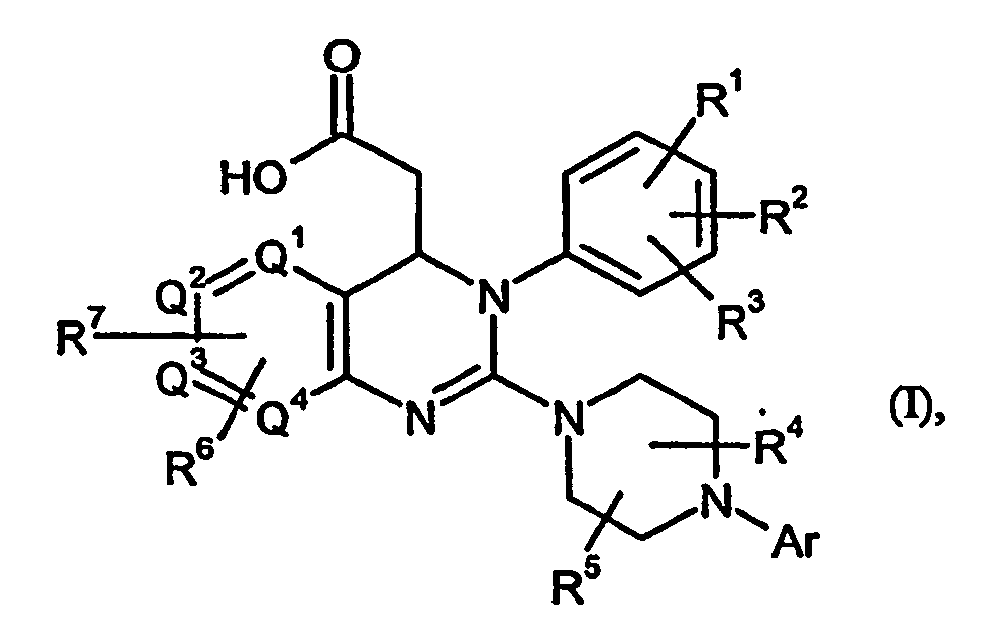
- Ar
- für Aryl steht, worin Aryl substituiert sein kann mit 1 bis 3 Substituenten, wobei die Substituenten unabhängig voneinander ausgewählt werden aus der Gruppe, bestehend aus Alkyl, Alkoxy, Formyl, Hydroxycarbonyl, Alkylcarbonyl, Alkoxycarbonyl, Trifluormethyl, Halogen, Cyano, Hydroxy, Amino, Alkylamino, Aminocarbonyl und Nitro, worin Alkyl substituiert sein kann mit 1 bis 3 Substituenten, wobei die Substituenten unabhängig voneinander ausgewählt werden aus der Gruppe, bestehend aus Halogen, Amino, Alkylamino, Hydroxy und Aryl,
oder zwei der Substituenten am Aryl zusammen mit den Kohlenstoffatomen, an die sie gebunden sind, ein 1,3-Dioxolan, einen Cyclopentan-Ring oder einen Cyclohexan-Ring bilden und ein gegebenenfalls vorhandener dritter Substituent unabhängig davon aus der genannten Gruppe ausgewählt wird, - Q1, Q2, Q3 und Q4
- für CH oder N stehen,
wobei ein oder zwei von Q1, Q2, Q3 und Q4 für N stehen und die anderen gleichzeitig für CH stehen, - R1
- für Wasserstoff, Amino, Alkyl, Alkoxy, Alkylamino, Alkylthio, Cyano, Halogen, Nitro oder Trifluormethyl steht,
- R2
- für Wasserstoff, Alkyl, Alkoxy, Alkylthio, Cyano, Halogen, Nitro oder Trifluormethyl steht,
- R3
- für Amino, Alkyl, Alkoxy, Alkylamino, Alkylthio, Cyano, Halogen, Nitro, Trifluormethyl, Alkylsulfonyl oder Alkylaminosulfonyl steht
einer der Reste R1, R2 und R3 für Wasserstoff, Alkyl, Alkoxy, Cyano, Halogen, Nitro oder Trifluormethyl steht und die anderen beiden zusammen mit den Kohlenstoffatomen, an die sie gebunden sind, ein 1,3-Dioxolan, einen Cyclopentan-Ring oder einen Cyclohexan-Ring bilden,
- R4
- für Wasserstoff oder Alkyl steht,
- R5
- für Wasserstoff oder Alkyl steht
die Reste R4 und R5 im Piperazin-Ring an genau gegenüberliegenden Kohlenstoffatomen gebunden sind und eine gegebenenfalls mit 1 bis 2 Methylgruppen substituierte Methylen-Brücke bilden,
- R6
- für Wasserstoff, Alkyl, Alkoxy, Alkylthio, Formyl, Hydroxycarbonyl, Aminocarbonyl, Alkylcarbonyl, Alkoxycarbonyl, Trifluormethyl, Halogen, Cyano, Hydroxy oder Nitro steht
und - R7
- für Wasserstoff, Alkyl, Alkoxy, Alkylthio, Formyl, Hydroxycarbonyl, Alkylcarbonyl, Alkoxycarbonyl, Trifluormethyl, Halogen, Cyano, Hydroxy oder Nitro steht,
- Ar
- is aryl in which aryl may be substituted with 1 to 3 substituents, wherein the substituents are independently selected from the group consisting of alkyl, alkoxy, formyl, hydroxycarbonyl, alkylcarbonyl, alkoxycarbonyl, trifluoromethyl, halogen, cyano, hydroxy, amino, Alkylamino, aminocarbonyl and nitro, wherein alkyl may be substituted with 1 to 3 substituents, wherein the substituents are independently selected from the group consisting of halogen, amino, alkylamino, hydroxy and aryl,
or two of the substituents on the aryl together with the carbon atoms to which they are attached form a 1,3-dioxolane, a cyclopentane ring or a cyclohexane ring and an optional third substituent is independently selected from the group mentioned, - Q 1 , Q 2 , Q 3 and Q 4
- are CH or N,
wherein one or two of Q 1 , Q 2 , Q 3 and Q 4 are N and the others are simultaneously CH, - R 1
- represents hydrogen, amino, alkyl, alkoxy, alkylamino, alkylthio, cyano, halogen, nitro or trifluoromethyl,
- R 2
- represents hydrogen, alkyl, alkoxy, alkylthio, cyano, halogen, nitro or trifluoromethyl,
- R 3
- represents amino, alkyl, alkoxy, alkylamino, alkylthio, cyano, halogen, nitro, trifluoromethyl, alkylsulfonyl or alkylaminosulfonyl
one of R 1 , R 2 and R 3 is hydrogen, alkyl, alkoxy, cyano, halogen, nitro or trifluoromethyl and the other two together with the carbon atoms to which they are attached, a 1,3-dioxolane, a cyclopentane Ring or form a cyclohexane ring,
- R 4
- is hydrogen or alkyl,
- R 5
- represents hydrogen or alkyl
the radicals R 4 and R 5 in the piperazine ring are bonded to exactly opposite carbon atoms and form an optionally substituted with 1 to 2 methyl groups methylene bridge,
- R 6
- is hydrogen, alkyl, alkoxy, alkylthio, formyl, hydroxycarbonyl, aminocarbonyl, alkylcarbonyl, alkoxycarbonyl, trifluoromethyl, halogen, cyano, hydroxy or nitro
and - R 7
- represents hydrogen, alkyl, alkoxy, alkylthio, formyl, hydroxycarbonyl, alkylcarbonyl, alkoxycarbonyl, trifluoromethyl, halogen, cyano, hydroxy or nitro,
Erfindungsgemäße Verbindungen sind die Verbindungen der Formel (I) und deren Salze, Solvate und Solvate der Salze, nachfolgend als Ausführungsbeispiel(e) genannten Verbindungen und deren Salze, Solvate und Solvate der Salze, soweit es sich bei den von Formel (I) umfassten, nachfolgend genannten Verbindungen nicht bereits um Salze, Solvate und Solvate der Salze handelt.Compounds of the invention are the compounds of the formula (I) and their salts, solvates and solvates of the salts, compounds mentioned below as examples (e) and their salts, solvates and solvates of the salts, as far as those of the formula (I) are concerned, The compounds mentioned below are not already salts, solvates and solvates of the salts.
Die erfindungsgemäßen Verbindungen können in Abhängigkeit von ihrer Struktur in stereoisomeren Formen (Enantiomere, Diastereomere) existieren. Die Erfindung betrifft deshalb die Enantiomeren oder Diastereomeren und ihre jeweiligen Mischungen. Aus solchen Mischungen von Enantiomeren und/oder Diastereomeren lassen sich die stereoisomer einheitlichen Bestandteile in bekannter Weise isolieren.Depending on their structure, the compounds of the invention may exist in stereoisomeric forms (enantiomers, diastereomers). The invention therefore relates to the enantiomers or diastereomers and their respective mixtures. From such mixtures of enantiomers and / or diastereomers, the stereoisomerically uniform components can be isolated in a known manner.
Sofern die erfindungsgemäßen Verbindungen in tautomeren Formen vorkommen können, umfasst die vorliegende Erfindung sämtliche tautomere Formen.If the compounds according to the invention can occur in tautomeric forms, the present invention encompasses all tautomeric forms.
Als Salze sind im Rahmen der vorliegenden Erfindung physiologisch unbedenkliche Salze der erfindungsgemäßen Verbindungen bevorzugt. Umfasst sind aber auch Salze, die für pharmazeutische Anwendungen selbst nicht geeignet sind aber beispielsweise für die Isolierung oder Reinigung der erfindungsgemäßen Verbindungen verwendet werden können.Salts used in the context of the present invention are physiologically acceptable salts of the compounds according to the invention. However, also included are salts which are not suitable for pharmaceutical applications themselves but can be used, for example, for the isolation or purification of the compounds according to the invention.
Physiologisch unbedenkliche Salze der erfindungsgemäßen Verbindungen umfassen Säureadditionssalze von Mineralsäuren, Carbonsäuren und Sulfonsäuren, z.B. Salze der Chlorwasserstoffsäure, Bromwasserstoffsäure, Schwefelsäure, Phosphorsäure, Methansulfonsäure, Ethansulfonsäure, Toluolsulfonsäure, Benzolsulfonsäure, Naphthalindisulfonsäure, Essigsäure, Trifluoressigsäure, Propionsäure, Milchsäure, Weinsäure, Äpfelsäure, Zitronensäure, Fumarsäure, Maleinsäure und Benzoesäure.Physiologically acceptable salts of the compounds of the invention include acid addition salts of mineral acids, carboxylic acids and sulfonic acids, e.g. Salts of hydrochloric, hydrobromic, sulfuric, phosphoric, methanesulfonic, ethanesulfonic, toluenesulfonic, benzenesulfonic, naphthalenedisulfonic, acetic, trifluoroacetic, propionic, lactic, tartaric, malic, citric, fumaric, maleic and benzoic acids.
Physiologisch unbedenkliche Salze der erfindungsgemäßen Verbindungen umfassen auch Salze üblicher Basen, wie beispielhaft und vorzugsweise Alkalimetallsalze (z.B. Natrium- und Kaliumsalze), Erdalkalisalze (z.B. Calcium- und Magnesiumsalze) und Ammoniumsalze, abgeleitet von Ammoniak oder organischen Aminen mit 1 bis 16 C-Atomen, wie beispielhaft und vorzugsweise Ethylamin, Diethylamin, Triethylamin, Ethyldiisopropylamin, Monoethanolamin, Diethanolamin, Triethanolamin, Dicyclohexylamin, Dimethylaminoethanol, Prokain, Dibenzylamin, N-Methylmorpholin, Arginin, Lysin, Ethylendiamin und N-Methylpiperidin.Physiologically acceptable salts of the compounds according to the invention also include salts of customary bases, such as, by way of example and by way of preference, alkali metal salts (for example sodium and potassium salts), alkaline earth salts (for example calcium and magnesium salts) and ammonium salts derived from ammonia or organic amines having 1 to 16 carbon atoms, as exemplified and preferably ethylamine, diethylamine, triethylamine, ethyldiisopropylamine, monoethanolamine, diethanolamine, Triethanolamine, dicyclohexylamine, dimethylaminoethanol, procaine, dibenzylamine, N-methylmorpholine, arginine, lysine, ethylenediamine and N- methylpiperidine.
Als Solvate werden im Rahmen der Erfindung solche Formen der erfindungsgemäßen Verbindungen bezeichnet, welche in festem oder flüssigem Zustand durch Koordination mit Lösungsmittelmolekülen einen Komplex bilden. Hydrate sind eine spezielle Form der Solvate, bei denen die Koordination mit Wasser erfolgt.Solvates in the context of the invention are those forms of the compounds according to the invention which form a complex in the solid or liquid state by coordination with solvent molecules. Hydrates are a special form of solvates that coordinate with water.
Im Rahmen der vorliegenden Erfindung haben die Substituenten, soweit nicht anders spezifiziert, die folgende Bedeutung:Unless otherwise specified, in the context of the present invention, the substituents have the following meaning:
Alkylaminosulfonyl und Alkoxycarbonyl stehen für einen linearen oder verzweigten Alkylrest mit in der Regel 1 bis 6, vorzugsweise 1 bis 4, besonders bevorzugt 1 bis 3 Kohlenstoffatomen, beispielhaft und vorzugsweise für Methyl, Ethyl, n-Propyl, Isopropyl, tert-Butyl, n-Pentyl und n-Hexyl. Alkylaminosulphonyl and alkoxycarbonyl are a linear or branched alkyl radical having generally 1 to 6, preferably 1 to 4, more preferably 1 to 3 carbon atoms, for example and preferably methyl, ethyl, n-propyl, isopropyl, tert-butyl, n- Pentyl and n-hexyl.
Alkoxy steht beispielhaft und vorzugsweise für Methoxy, Ethoxy, n-Propoxy, Isopropoxy, tert-Butoxy, n-Pentoxy und n-Hexoxy. Alkoxy is, by way of example and by way of preference, methoxy, ethoxy, n-propoxy, isopropoxy, tert- butoxy, n-pentoxy and n-hexoxy.
Alkylthio steht beispielhaft und vorzugsweise für Methylthio, Ethylthio, n-Propylthio, Isopropylthio, tert-Butylthio, n-Pentylthio und n-Hexylthio. Alkylthio is exemplified and preferably methylthio, ethylthio, n-propylthio, isopropylthio, tert- butylthio, n-pentylthio and n-hexylthio.
Alkylamino steht für einen Alkylaminorest mit einem oder zwei (unabhängig voneinander gewählten) Alkylsubstituenten, beispielhaft und vorzugsweise für Methylamino, Ethylamino, n-Propylamino, Isopropylamino, tert-Butylamino, n-Pentylamino, n-Hexylamino, N,N-Dimethylamino, N,N-Diethylamino, N-Ethyl-N-methylamino, N-Methyl-N-n-propylamino, N-Isopropyl-N-n-propylamino, N-tert-Butyl-N-methylamino, N-Ethyl-N-n-pentylamino und N-n-Hexyl-N-methylamino. C1-C3-Alkylamino steht beispielsweise für einen Monoalkylaminorest mit 1 bis 3 Kohlenstoffatomen oder für einen Dialkylaminorest mit jeweils 1 bis 3 Kohlenstoffatomen pro Alkylsubstituent. Alkylamino is an alkylamino radical having one or two (independently selected) alkyl substituents, by way of example and by preference methylamino, ethylamino, n-propylamino, isopropylamino, tert- butylamino, n-pentylamino, n-hexylamino, N , N- dimethylamino, N , N- diethylamino, N- ethyl- N- methylamino, N- methyl- N- n-propylamino, N- isopropyl- N- n-propylamino, N - tert- butyl- N- methylamino, N- ethyl- N- n- pentylamino and N -n-hexyl- N- methylamino. C 1 -C 3 -alkylamino is, for example, a monoalkylamino radical having 1 to 3 carbon atoms or a dialkylamino radical having in each case 1 to 3 carbon atoms per alkyl substituent.
Alkylsulfonyl steht beispielhaft und vorzugsweise für Methylsulfonyl, Ethylsulfonyl, n-Propylsulfonyl, Isopropylsulfonyl, tert-Butylsulfonyl, n-Pentylsulfonyl und n-Hexylsulfonyl. Alkylsulfonyl is, by way of example and by way of preference, methylsulfonyl, ethylsulfonyl, n-propylsulfonyl, isopropylsulfonyl, tert- butylsulfonyl, n-pentylsulfonyl and n-hexylsulfonyl.
Alkylaminosulfonyl steht für einen Alkylaminosulfonylrest mit einem oder zwei (unabhängig voneinander gewählten) Alkylsubstituenten, beispielhaft und vorzugsweise für Methylaminosulfonyl, Ethylaminosulfonyl, n-Propylaminosulfonyl, Isopropylaminosulfonyl, tert-Butylaminosulfonyl, n-Pentylaminosulfonyl, n-Hexyl-aminosulfonyl, N,N-Dimethylaminosulfonyl, N,N-Diethylaminosulfonyl, N-Ethyl-N-methylaminosulfonyl, N-Methyl-N-n-propylaminosulfonyl, N-Isopropyl-N-n-propyl-aminosulfonyl, N-tert-Butyl-N-methylaminosulfonyl, N-Ethyl-N-n-pentylamino-sulfonyl und N-n-Hexyl-N-methylaminosulfonyl. C1-C3-Alkylaminosulfonyl steht beispielsweise für einen Monoalkylaminosulfonylrest mit 1 bis 3 Kohlenstoffatomen oder für einen Dialkylaminosulfonylrest mit jeweils 1 bis 3 Kohlenstoffatomen pro Alkylsubstituent. Alkylaminosulfonyl represents an alkylaminosulfonyl radical having one or two (independently selected) alkyl substituents, by way of example and by way of preference for methylaminosulfonyl, ethylaminosulfonyl, n-propylaminosulfonyl, isopropylaminosulfonyl, tert- butylaminosulfonyl, n-pentylaminosulfonyl, n-hexylaminosulfonyl, N , N- dimethylaminosulfonyl, N, N -Diethylaminosulfonyl, N -ethyl- N -methylaminosulfonyl, N-methyl-N-n-propylaminosulphonyl, N -Isopropyl- N-n-propylaminosulphonyl, N - tert -butyl N -methylaminosulfonyl, N -ethyl- N -n-pentylamino-sulfonyl and N -n-hexyl- N- methylaminosulfonyl. C 1 -C 3 -alkylaminosulfonyl is, for example, a monoalkylaminosulfonyl radical having 1 to 3 carbon atoms or a dialkylaminosulfonyl radical having in each case 1 to 3 carbon atoms per alkyl substituent.
Alkylcarbonyl steht beispielhaft und vorzugsweise für Acetyl und Propanoyl. Alkylcarbonyl is exemplary and preferably acetyl and propanoyl.
Alkoxycarbonyl steht beispielhaft und vorzugsweise für Methoxycarbonyl, Ethoxycarbonyl, n-Propoxycarbonyl, Isopropoaycarbonyl, tert-Butoxycarbonyl, n-Pentoxycarbonyl und n-Hexoxycarbonyl. Alkoxycarbonyl is exemplified and preferably methoxycarbonyl, ethoxycarbonyl, n-propoxycarbonyl, isopropoaycarbonyl, tert- butoxycarbonyl, n-pentoxycarbonyl and n-hexoxycarbonyl.
Aryl steht für einen mono- bis tricyclischen aromatischen, carbocyclischen Rest mit in der Regel 6 bis 14 Kohlenstoffatomen; beispielhaft und vorzugsweise für Phenyl, Naphthyl und Phenanthrenyl. Aryl is a mono- to tricyclic aromatic, carbocyclic radical of usually 6 to 14 carbon atoms; by way of example and preferably phenyl, naphthyl and phenanthrenyl.
Halogen steht für Fluor, Chlor, Brom und Jod, bevorzugt Fluor und Chlor. Halogen is fluorine, chlorine, bromine and iodine, preferably fluorine and chlorine.
Ein Symbol * an einem Kohlenstoffatom bedeutet, dass die Verbindung hinsichtlich der Konfiguration an diesem Kohlenstoffatom in enantiomerenreiner Form vorliegt, worunter im Rahmen der vorliegenden Erfindung ein Enantiomerenüberschuss (enantiomeric excess) von mehr als 90% verstanden wird (> 90% ee).A symbol * on a carbon atom means that the compound is in enantiomerically pure form with respect to the configuration at this carbon atom, which in the context of the present invention means an enantiomeric excess of more than 90% (> 90% ee).
Bevorzugt sind solche Verbindungen der Formel (I), in welchen
- Ar
- für Phenyl steht, worin Phenyl substituiert sein kann mit 1 bis 3 Substituenten, wobei die Substituenten unabhängig voneinander ausgewählt werden aus der Gruppe, bestehend aus C1-C6-Alkyl, C1-C6-Alkoxy, Hydroxycarbonyl, C1-C6-Alkylcarbonyl, C1-C6-Alkoxycarbonyl, Trifluormethyl, Fluor, Chlor, Brom, Cyano, Hydroxy, Amino, C1-C6-Alkylamino und Nitro,
oder zwei der Substituenten am Phenyl zusammen mit den Kohlenstoffatomen, an die sie gebunden sind, ein 1,3-Dioxolan bilden und ein gegebenenfalls vorhandener dritter Substituent unabhängig davon aus der genannten Gruppe ausgewählt wird, - Q1, Q2 und Q3
- für CH oder N stehen,
wobei immer genau einer von Q1, Q2 und Q3 für N steht und die anderen gleichzeitig für CH stehen, - Q4
- für CH steht,
- R1
- für Wasserstoff, C1-C3-Alkyl, C1-C3-Alkoxy, C1-C3-Alkylthio, Fluor oder Chlor steht,
- R2
- für Wasserstoff, C1-C3-Alkyl, C1-C3-Alkoxy, C1-C3-Alkylthio, Fluor oder Chlor steht,
- R3
- für C1-C4-Alkyl, Cyano, Fluor, Chlor, Nitro, Trifluormethyl oder C1-C3-Alkylsulfonyl steht,
einer der Reste R1, R2 und R3 für Wasserstoff, C1-C3-Alkyl, C1-C3-Alkoxy, Cyano, Halogen, Nitro oder Trifluormethyl steht und die anderen beiden zusammen mit den Kohlenstoffatomen, an die sie gebunden sind, einen Cyclopentan-Ring oder einen Cyclohexan-Ring bilden,
- R4
- für Wasserstoff oder Methyl steht,
- R5
- für Wasserstoff steht,
- R6
- für Wasserstoff, C1-C3-Alkyl, C1-C3-Alkoxy, Hydroxycarbonyl, Aminocarbonyl, Trifluormethyl, Fluor, Chlor, Cyano, Hydroxy oder Nitro steht
und - R7
- für Wasserstoff, C1-C3-Alkyl, C1-C3-Alkoxy, Fluor, Chlor, Cyano oder Hydroxy steht.
- Ar
- is phenyl, wherein phenyl may be substituted with 1 to 3 substituents, wherein the substituents are independently selected from the group consisting of C 1 -C 6 alkyl, C 1 -C 6 alkoxy, hydroxycarbonyl, C 1 -C 6- alkylcarbonyl, C 1 -C 6 -alkoxycarbonyl, trifluoromethyl, fluorine, chlorine, bromine, cyano, hydroxy, amino, C 1 -C 6 -alkylamino and nitro,
or two of the substituents on the phenyl together with the carbon atoms to which they are attached form a 1,3-dioxolane and an optional third substituent is independently selected from the group mentioned, - Q 1 , Q 2 and Q 3
- are CH or N,
where exactly one of Q 1 , Q 2 and Q 3 is N and the others are simultaneously CH, - Q 4
- stands for CH,
- R 1
- is hydrogen, C 1 -C 3 -alkyl, C 1 -C 3 -alkoxy, C 1 -C 3 -alkylthio, fluorine or chlorine,
- R 2
- is hydrogen, C 1 -C 3 -alkyl, C 1 -C 3 -alkoxy, C 1 -C 3 -alkylthio, fluorine or chlorine,
- R 3
- is C 1 -C 4 -alkyl, cyano, fluorine, chlorine, nitro, trifluoromethyl or C 1 -C 3 -alkylsulfonyl,
one of R 1 , R 2 and R 3 is hydrogen, C 1 -C 3 alkyl, C 1 -C 3 alkoxy, cyano, halogen, nitro or trifluoromethyl and the other two together with the carbon atoms to which they are attached are bound, form a cyclopentane ring or a cyclohexane ring,
- R 4
- is hydrogen or methyl,
- R 5
- stands for hydrogen,
- R 6
- is hydrogen, C 1 -C 3 alkyl, C 1 -C 3 alkoxy, hydroxycarbonyl, aminocarbonyl, trifluoromethyl, fluorine, chlorine, cyano, hydroxy or nitro
and - R 7
- is hydrogen, C 1 -C 3 alkyl, C 1 -C 3 alkoxy, fluorine, chlorine, cyano or hydroxy.
Bevorzugt sind darunter besonders solche Verbindungen der Formel (I), in welchen
- Ar
- für Phenyl steht, worin Phenyl substituiert sein kann mit 1 bis 2 Substituenten, wobei die Substituenten unabhängig voneinander ausgewählt werden aus der Gruppe, bestehend aus Methyl, Methoxy, Fluor und Chlor,
- Q1, Q2 und Q3
- für CH oder N stehen,
wobei immer genau einer von Q1, Q2 und Q3 für N steht und die anderen gleichzeitig für CH stehen, - Q4
- für CH steht,
- R1
- für Wasserstoff, Methyl, Methoxy, Methylthio, Fluor oder Chlor steht,
- R2
- für Wasserstoff steht,
- R3
- für Methyl, iso-Propyl, tert-Butyl, Cyano, Fluor, Chlor, Nitro oder Trifluormethyl steht,
- R4
- für Wasserstoff steht,
- R5
- für Wasserstoff steht,
- R6
- für Wasserstoff, Aminocarbonyl, Fluor, Chlor, Cyano oder Hydroxy steht
und - R7
- für Wasserstoff steht.
- Ar
- is phenyl, wherein phenyl may be substituted with 1 to 2 substituents, wherein the substituents are independently selected from the group consisting of methyl, methoxy, fluorine and chlorine,
- Q 1 , Q 2 and Q 3
- are CH or N,
where exactly one of Q 1 , Q 2 and Q 3 is N and the others are simultaneously CH, - Q 4
- stands for CH,
- R 1
- is hydrogen, methyl, methoxy, methylthio, fluorine or chlorine,
- R 2
- stands for hydrogen,
- R 3
- is methyl, isopropyl, tert- butyl, cyano, fluorine, chlorine, nitro or trifluoromethyl,
- R 4
- stands for hydrogen,
- R 5
- stands for hydrogen,
- R 6
- is hydrogen, aminocarbonyl, fluorine, chlorine, cyano or hydroxy
and - R 7
- stands for hydrogen.
Bevorzugt sind darunter ganz besonders solche Verbindungen der Formel (I), in welchen
- Ar
- für Phenyl steht, worin Phenyl substituiert sein kann mit 1 bis 2 Substituenten, wobei die Substituenten unabhängig voneinander ausgewählt werden aus der Gruppe, bestehend aus Methyl, Methoxy, Fluor und Chlor,
- Q1, Q2 und Q3
- für CH oder N stehen,
wobei immer genau einer von Q1, Q2 und Q3 für N steht und die anderen gleichzeitig für CH stehen, - Q4
- für CH steht,
- R1
- für Wasserstoff, Methyl oder Methoxy steht,
- R2
- für Wasserstoff steht,
- R3
- für Methyl, tert-Butyl, Chlor oder Trifluormethyl steht,
- R4
- für Wasserstoff steht,
- R5
- für Wasserstoff steht,
- R6
- für Wasserstoff steht
und - R7
- für Wasserstoff steht.
- Ar
- is phenyl, wherein phenyl may be substituted with 1 to 2 substituents, wherein the substituents are independently selected from the group consisting of methyl, methoxy, fluorine and chlorine,
- Q 1 , Q 2 and Q 3
- are CH or N,
where exactly one of Q 1 , Q 2 and Q 3 is N and the others are simultaneously CH, - Q 4
- stands for CH,
- R 1
- is hydrogen, methyl or methoxy,
- R 2
- stands for hydrogen,
- R 3
- is methyl, tert- butyl, chloro or trifluoromethyl,
- R 4
- stands for hydrogen,
- R 5
- stands for hydrogen,
- R 6
- stands for hydrogen
and - R 7
- stands for hydrogen.
Bevorzugt sind auch solche Verbindungen der Formel (I), in welchen R1 für Wasserstoff, Methyl, Methoxy oder Fluor steht.Preference is also given to those compounds of the formula (I) in which R 1 is hydrogen, methyl, methoxy or fluorine.
Bevorzugt sind darunter besonders solche Verbindungen der Formel (I), in welchen R1 für Methoxy steht.Among these, preference is given in particular to those compounds of the formula (I) in which R 1 is methoxy.
Bevorzugt sind auch solche Verbindungen der Formel (I), in welchen R1 über die ortho-Position zur Verknüpfungsstelle des Phenylrings an den Phenylring gebunden ist. Unter der Verknüpfungsstelle des mit den Resten R1, R2 und R3 substituierten Phenylrings wird im Rahmen der vorliegenden Erfindung das gemäß Formel (I) mit einem der beiden Dihydrochinazolin-Stickstoffatome verknüpfte Kohlenstoffatom des Phenylrings verstanden.Preference is also given to those compounds of the formula (I) in which R 1 is bonded via the ortho position to the point of attachment of the phenyl ring to the phenyl ring. In the context of the present invention, the point of attachment of the phenyl ring substituted by the radicals R 1 , R 2 and R 3 is taken to mean the carbon atom of the phenyl ring linked to one of the two dihydroquinazoline nitrogen atoms according to formula (I).
Besonders bevorzugt sind solche Verbindungen der Formel (I), in welchen R1 für Methoxy steht und R1 über die ortho-Position zur Verknüpfungsstelle des Phenylrings an den Phenylring gebunden ist.Particular preference is given to those compounds of the formula (I) in which R 1 is methoxy and R 1 is bonded via the ortho position to the point of attachment of the phenyl ring to the phenyl ring.
Bevorzugt sind auch solche Verbindungen der Formel (I), in welchen R2 für Wasserstoff steht.Preference is also given to those compounds of the formula (I) in which R 2 is hydrogen.
Bevorzugt sind auch solche Verbindungen der Formel (I), in welchen R3 für Trifluormethyl, Chlor, Methyl, iso-Propyl oder tert-Butyl steht.Preference is also given to those compounds of the formula (I) in which R 3 is trifluoromethyl, chlorine, methyl, iso-propyl or tert- butyl.
Bevorzugt sind darunter besonders solche Verbindungen der Formel (I), in welchen R3 für Trifluormethyl, Chlor oder Methyl steht.Among these, particular preference is given to those compounds of the formula (I) in which R 3 is trifluoromethyl, chlorine or methyl.
Bevorzugt sind darunter ganz besonders solche Verbindungen der Formel (I), in welchen R3 für Trifluormethyl steht.Among these, very particular preference is given to those compounds of the formula (I) in which R 3 is trifluoromethyl.
Bevorzugt sind auch solche Verbindungen der Formel (I), in welchen R1 über die ortho-Position zur Verknüpfungsstelle des Phenylrings an den Phenylring gebunden ist und R3 über die R1 gegenüberliegende meta-Position zur Verknüpfungsstelle des Phenylrings an den Phenylring gebunden ist.Preference is also given to those compounds of the formula (I) in which R 1 is bonded via the ortho position to the point of attachment of the phenyl ring to the phenyl ring and R 3 is bonded via the R 1 opposite meta position to the point of attachment of the phenyl ring to the phenyl ring.
Besonders bevorzugt sind solche Verbindungen der Formel (I), in welchen R1 über die ortho-Position zur Verknüpfungsstelle des Phenylrings an den Phenylring gebunden ist, R3 für Trifluormethyl, Chlor oder Methyl steht und R3 über die R1 gegenüberliegende meta-Position zur Verknüpfungsstelle des Phenylrings an den Phenylring gebunden ist.Particular preference is given to those compounds of the formula (I) in which R 1 is bonded via the ortho-position to the point of attachment of the phenyl ring to the phenyl ring, R 3 is trifluoromethyl, chlorine or methyl and R 3 has the meta position opposite to R 1 is bound to the point of attachment of the phenyl ring to the phenyl ring.
Besonders bevorzugt sind darunter solche Verbindungen der Formel (I), in welchen R1 über die ortho-Position zur Verknüpfungsstelle des Phenylrings an den Phenylring gebunden ist, R3 für Trifluormethyl steht und R3 über die R1 gegenüberliegende meta-Position zur Verknüpfungsstelle des Phenylrings an den Phenylring gebunden ist.Particular preference is given to those compounds of the formula (I) in which R 1 is bonded via the ortho-position to the point of attachment of the phenyl ring to the phenyl ring, R 3 is trifluoromethyl and R 3 via the R 1 opposite meta position to the point of attachment of the Phenyl ring is bonded to the phenyl ring.
Bevorzugt sind auch solche Verbindungen der Formel (I), in welchen R4 und R5 für Wasserstoff stehen.Preference is also given to those compounds of the formula (I) in which R 4 and R 5 are hydrogen.
Bevorzugt sind auch solche Verbindungen der Formel (I), in welchen R6 für Wasserstoff steht.Preference is also given to those compounds of the formula (I) in which R 6 is hydrogen.
Bevorzugt sind auch solche Verbindungen der Formel (I), in welchen R7 für Wasserstoff steht.Preference is also given to those compounds of the formula (I) in which R 7 is hydrogen.
Bevorzugt sind auch solche Verbindungen der Formel (I), in welchen Ar für Phenyl steht, worin Phenyl substituiert sein kann mit 1 bis 2 Substituenten, wobei die Substituenten unabhängig voneinander ausgewählt werden aus der Gruppe, bestehend aus Methyl, Methoxy, Fluor und Chlor.Also preferred are those compounds of formula (I) in which Ar is phenyl, wherein phenyl may be substituted with 1 to 2 substituents, wherein the substituents are independently selected from the group consisting of methyl, methoxy, fluoro and chloro.
Die in den jeweiligen Kombinationen bzw. bevorzugten Kombinationen von Resten im einzelnen angegebenen Restedefinitionen werden unabhängig von den jeweiligen angegebenen Kombinationen der Reste beliebig auch durch Restedefinitionen anderer Kombination ersetzt.The radical definitions given in detail in the respective combinations or preferred combinations of radicals are also replaced, irrespective of the particular combinations of the radicals indicated, by radical definitions of other combinations.
Ganz besonders bevorzugt sind Kombinationen von zwei oder mehreren der oben genannten Vorzugsbereiche.Very particular preference is given to combinations of two or more of the abovementioned preferred ranges.
Gegenstand der Erfindung ist weiterhin ein Verfahren zur Herstellung der Verbindungen der Formel (I), wobei Verbindungen der Formel
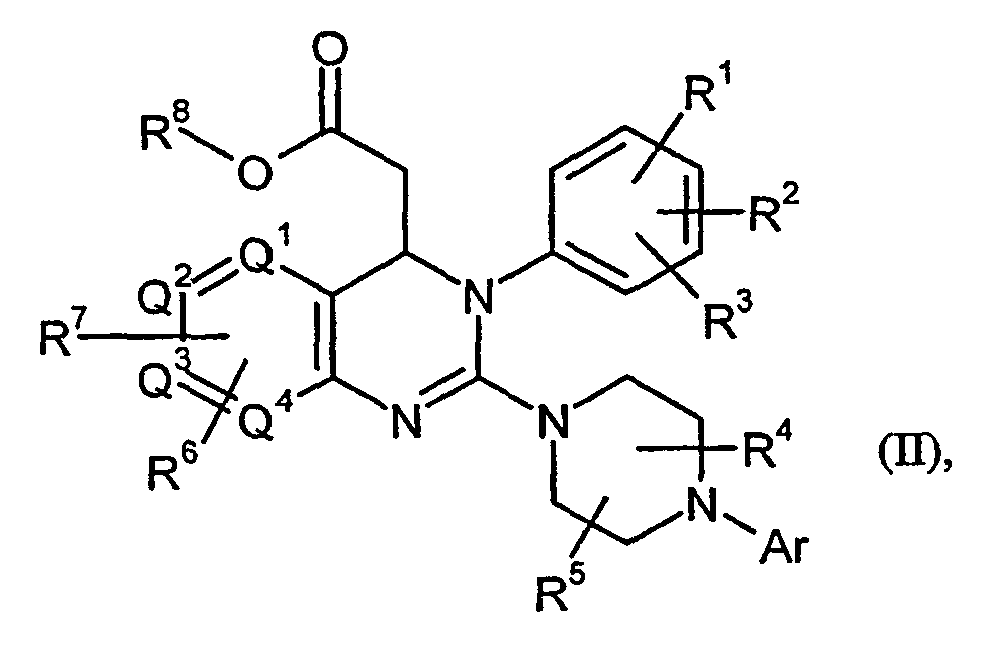
Ar, Q1, Q2, Q3, Q4, R1, R2, R3, R4, R5, R6 und R7 die oben angegebene Bedeutung haben und
R8 für Alkyl, bevorzugt für Methyl oder Ethyl oder für tert-Butyl, steht,
mit Basen oder Säuren umgesetzt werden.The invention further provides a process for the preparation of the compounds of the formula (I), where compounds of the formula
Ar, Q 1 , Q 2 , Q 3 , Q 4 , R 1 , R 2 , R 3 , R 4 , R 5 , R 6 and R 7 have the abovementioned meaning and
R 8 is alkyl, preferably methyl or ethyl or tert- butyl,
be reacted with bases or acids.
Die Umsetzung erfolgt im Falle von Methyl und Ethyl im allgemeinen mit Basen in inerten Lösungsmitteln, bevorzugt in einem Temperaturbereich von Raumtemperatur bis zum Rückfluss der Lösungsmittel bei Normaldruck.The reaction is carried out in the case of methyl and ethyl generally with bases in inert solvents, preferably in a temperature range from room temperature to the reflux of the solvent at atmospheric pressure.
Basen sind beispielsweise Alkalihydroxide wie Natrium-, Lithium- oder Kaliumhydroxid, oder Alkalicarbonate wie Cäsiumcarbonat, Natrium- oder Kaliumcarbonat, gegebenenfalls in wässriger Lösung, bevorzugt ist Natriumhydroxid in Wasser.Examples of bases are alkali metal hydroxides such as sodium, lithium or potassium hydroxide, or alkali metal carbonates such as cesium carbonate, sodium or potassium carbonate, if appropriate in aqueous solution, sodium hydroxide in water is preferred.
Inerte Lösungsmittel sind beispielsweise Ether wie 1,2-Dimethoxyethan, Dioxan, Tetrahydrofuran, Glykoldimethylether oder Diethylenglykoldimethylether, Alkohole wie Methanol, Ethanol, n-Propanol, iso-Propanol, n-Butanol oder tert-Butanol, oder Gemischen von Lösungsmitteln, bevorzugt ist Dioxan oder Tetrahydrofuran.Inert solvents are, for example, ethers, such as 1,2-dimethoxyethane, dioxane, tetrahydrofuran, glycol dimethyl ether or diethylene glycol dimethyl ether, alcohols, such as methanol, ethanol, n-propanol, isopropanol, n-butanol or tert -butanol, or mixtures of solvents, with dioxane being preferred or tetrahydrofuran.
Die Umsetzung erfolgt im Falle von tert-Butyl im allgemeinen mit Säuren in inerten Lösungsmitteln, bevorzugt in einem Temperaturbereich von 0°C bis 40°C bei Normaldruck.The reaction is carried out in the case of tert- butyl generally with acids in inert solvents, preferably in a temperature range from 0 ° C to 40 ° C at atmospheric pressure.
Als Säuren eignen sich hierbei Chlorwasserstoff in Dioxan, Bromwasserstoff in Essigsäure oder Trifluoressigsäure in Methylenchlorid.Suitable acids in this case are hydrogen chloride in dioxane, hydrogen bromide in acetic acid or trifluoroacetic acid in methylene chloride.
Die Verbindungen der Formel (II) sind bekannt oder können hergestellt werden, indem Verbindungen der Formel

Q1, Q2, Q3, Q4, R6, R7 und R8 die oben angegebene Bedeutung haben,
in einer zweistufigen Reaktion zunächst mit Verbindungen der Formel
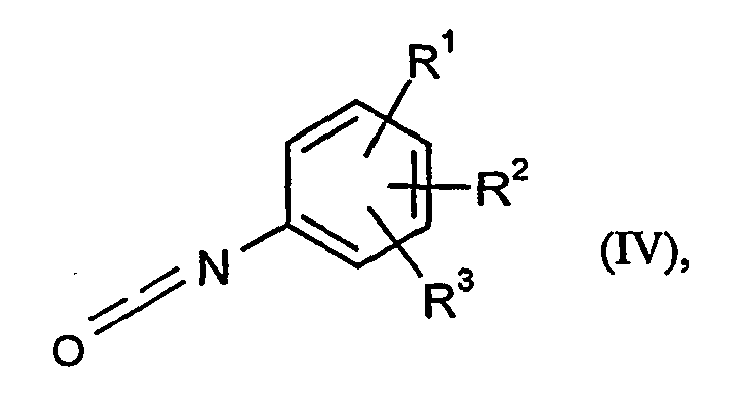
R1, R2 und R3 die oben angegebene Bedeutung haben,
und anschließend mit Verbindungen der Formel
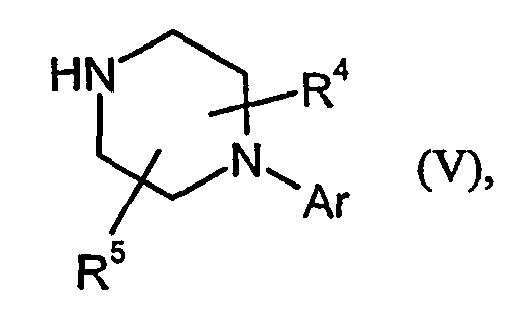
Ar, R4 und R5 die oben angegebene Bedeutung haben,
umgesetzt werden.The compounds of the formula (II) are known or can be prepared by reacting compounds of the formula
Q 1 , Q 2 , Q 3 , Q 4 , R 6 , R 7 and R 8 have the abovementioned meaning,
in a two-step reaction, first with compounds of the formula
R 1 , R 2 and R 3 have the abovementioned meaning,
and then with compounds of the formula
Ar, R 4 and R 5 have the abovementioned meaning,
be implemented.
Die Umsetzung erfolgt in beiden Stufen im allgemeinen in inerten Lösungsmitteln, bevorzugt in einem Temperaturbereich von Raumtemperatur bis 100°C bei Normaldruck. In der zweiten Stufe wird gegebenenfalls Kieselgel zu der Reaktionsmischung dazugegeben. Die Umsetzung erfolgt bevorzugt mit einer Aufarbeitung zwischen der ersten und der zweiten Stufe.The reaction takes place in both stages generally in inert solvents, preferably in a temperature range from room temperature to 100 ° C at atmospheric pressure. In the second step, silica gel is optionally added to the reaction mixture. The reaction is preferably carried out with a work-up between the first and the second stage.
Inerte Lösungsmittel sind beispielsweise Halogenkohlenwasserstoffe wie Methylenchlorid, Trichlormethan, Tetrachlormethan, Trichlorethan, Tetrachlorethan, 1,2-Dichlorethan oder Trichlorethylen, Ether wie Diethylether, Methyl-tert-butylether, 1,2-Dimethoxyethan, Dioxan, Tetrahydrofuran, Glykoldimethylether oder Diethylenglykoldimethylether, Kohlenwasserstoffe wie Benzol, Xylol, Toluol, Hexan, Cyclohexan oder Erdölfraktionen, oder andere Lösungsmittel wie Dimethylformamid, Dimethylacetamid, Acetonitril oder Essigsäureethylester, oder Gemischen von Lösungsmitteln, bevorzugt ist Methylenchlorid.Inert solvents are, for example, halogenated hydrocarbons such as methylene chloride, trichloromethane, tetrachloromethane, trichloroethane, tetrachloroethane, 1,2-dichloroethane or trichlorethylene, ethers such as diethyl ether, methyl tert-butyl ether, 1,2-dimethoxyethane, dioxane, tetrahydrofuran, glycol dimethyl ether or diethylene glycol dimethyl ether, hydrocarbons such as Benzene, xylene, toluene, hexane, cyclohexane or petroleum fractions, or other solvents such as dimethylformamide, dimethylacetamide, acetonitrile or ethyl acetate, or mixtures of solvents, preferred is methylene chloride.
Die Verbindungen der Formel (IV) sind bekannt oder lassen sich nach bekannten Verfahren aus den entsprechenden Edukten synthetisieren.The compounds of the formula (IV) are known or can be synthesized by known processes from the corresponding starting materials.
Die Verbindungen der Formel (V) sind bekannt oder lassen sich nach bekannten Verfahren aus den entsprechenden Edukten synthetisieren, beispielsweise durch eine Buchwald-Hartwig-Reaktion nach folgendem Syntheseschema (Übersicht in:

Die dafür benötigten Edukte sind bekannt oder lassen sich nach bekannten Verfahren aus den entsprechenden Edukten synthetisieren.The educts required for this purpose are known or can be synthesized by known processes from the corresponding starting materials.
Die Verbindungen der Formel (III) sind bekannt oder können hergestellt werden, indem Verbindungen der Formel

Q1, Q2, Q3, Q4, R6, R7 und R8 die oben angegebene Bedeutung haben,
mit Triphenylphosphin und Tetrachlorkohlenstoff umgesetzt werden.The compounds of the formula (III) are known or can be prepared by reacting compounds of the formula
Q 1 , Q 2 , Q 3 , Q 4 , R 6 , R 7 and R 8 have the abovementioned meaning,
be reacted with triphenylphosphine and carbon tetrachloride.
Die Umsetzung erfolgt im allgemeinen in inerten Lösungsmitteln, in Gegenwart einer Base, bevorzugt in einem Temperaturbereich von Raumtemperatur bis 50°C bei Normaldruck.The reaction is generally carried out in inert solvents, in the presence of a base, preferably in a temperature range from room temperature to 50 ° C at atmospheric pressure.
Inerte Lösungsmittel sind beispielsweise Ether wie Diethylether, Methyl-tert-butylether, 1,2-Dimethoxyethan, Dioxan, Tetrahydrofuran, Glykoldimethylether oder Diethylenglykoldimethylether, Kohlenwasserstoffe wie Benzol, Xylol, Toluol, Hexan, Cyclohexan oder Erdölfraktionen, oder andere Lösungsmittel wie Dimethylformamid, Dimethylacetamid, Acetonitril oder Pyridin, bevorzugt ist Acetonitril.Inert solvents are, for example, ethers, such as diethyl ether, methyl tert-butyl ether, 1,2-dimethoxyethane, dioxane, tetrahydrofuran, glycol dimethyl ether or diethylene glycol dimethyl ether, hydrocarbons, such as benzene, xylene, toluene, hexane, cyclohexane or petroleum fractions, or other solvents, such as dimethylformamide, dimethylacetamide, Acetonitrile or pyridine, preferably acetonitrile.
Basen sind beispielsweise Alkali- und Erdalkalicarbonate wie Cäsiumcarbonat, Natrium- oder Kaliumcarbonat oder Amine wie Triethylamin, Diisopropylethylamin, N-Methylmorpholin oder Pyridin, bevorzugt ist Triethylamin.Examples of bases are alkali metal and alkaline earth metal carbonates such as cesium carbonate, sodium or potassium carbonate or amines such as triethylamine, diisopropylethylamine, N- methylmorpholine or pyridine, triethylamine being preferred.
Die Verbindungen der Formel (VI) sind bekannt oder lassen sich nach bekannten Verfahren aus den entsprechenden Edukten synthetisieren, beispielsweise durch eine Heck-Reaktion oder eine Wittig-Horner-Reaktion nach folgenden Syntheseschemata:The compounds of the formula (VI) are known or can be synthesized by known processes from the corresponding starting materials, for example by a Heck reaction or a Wittig-Horner reaction according to the following synthesis schemes:
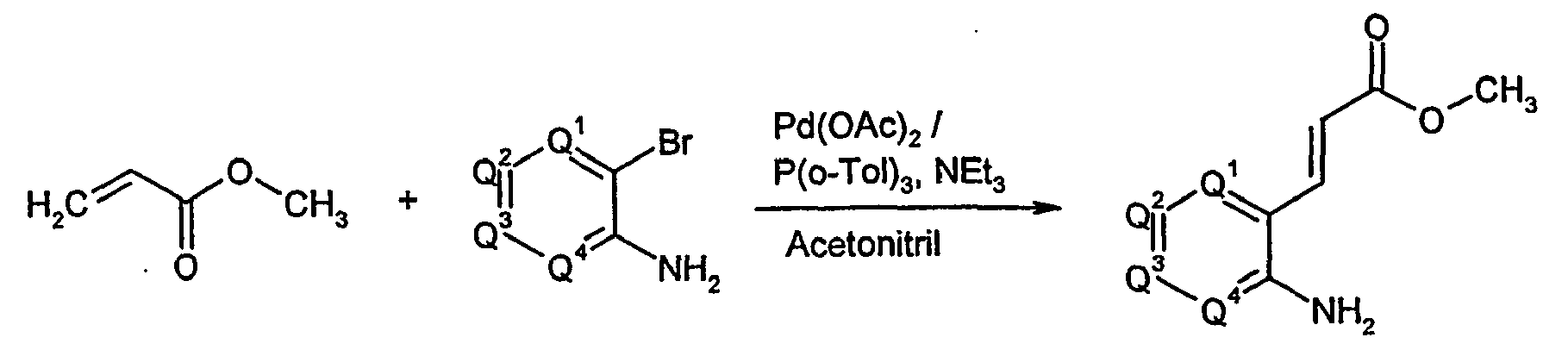
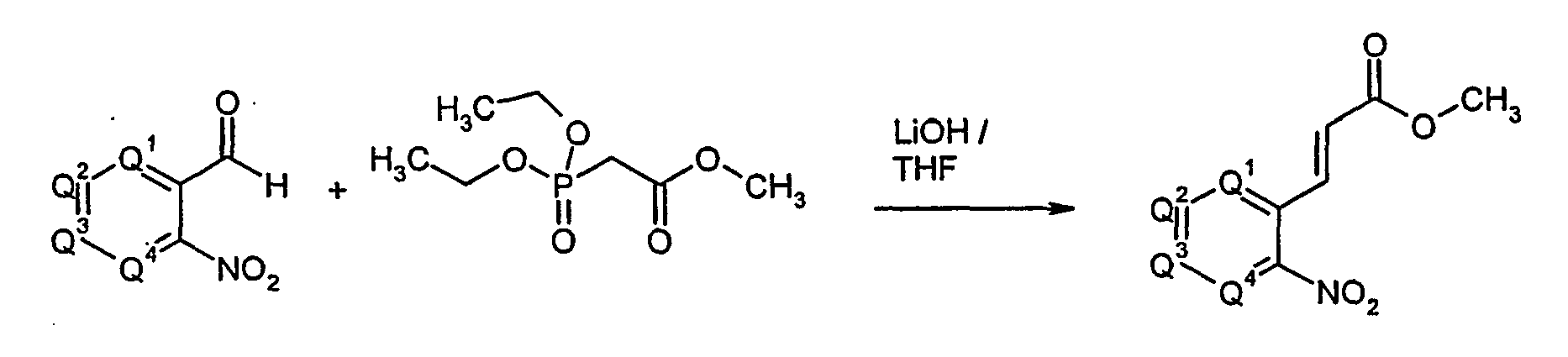
Die dafür benötigten Edukte sind bekannt oder lassen sich nach bekannten Verfahren aus den entsprechenden Edukten synthetisieren.The educts required for this purpose are known or can be synthesized by known processes from the corresponding starting materials.
Die Herstellung der erfindungsgemäßen Verbindungen kann durch das folgende Syntheseschema verdeutlicht werden.The preparation of the compounds of the invention can be illustrated by the following synthesis scheme.
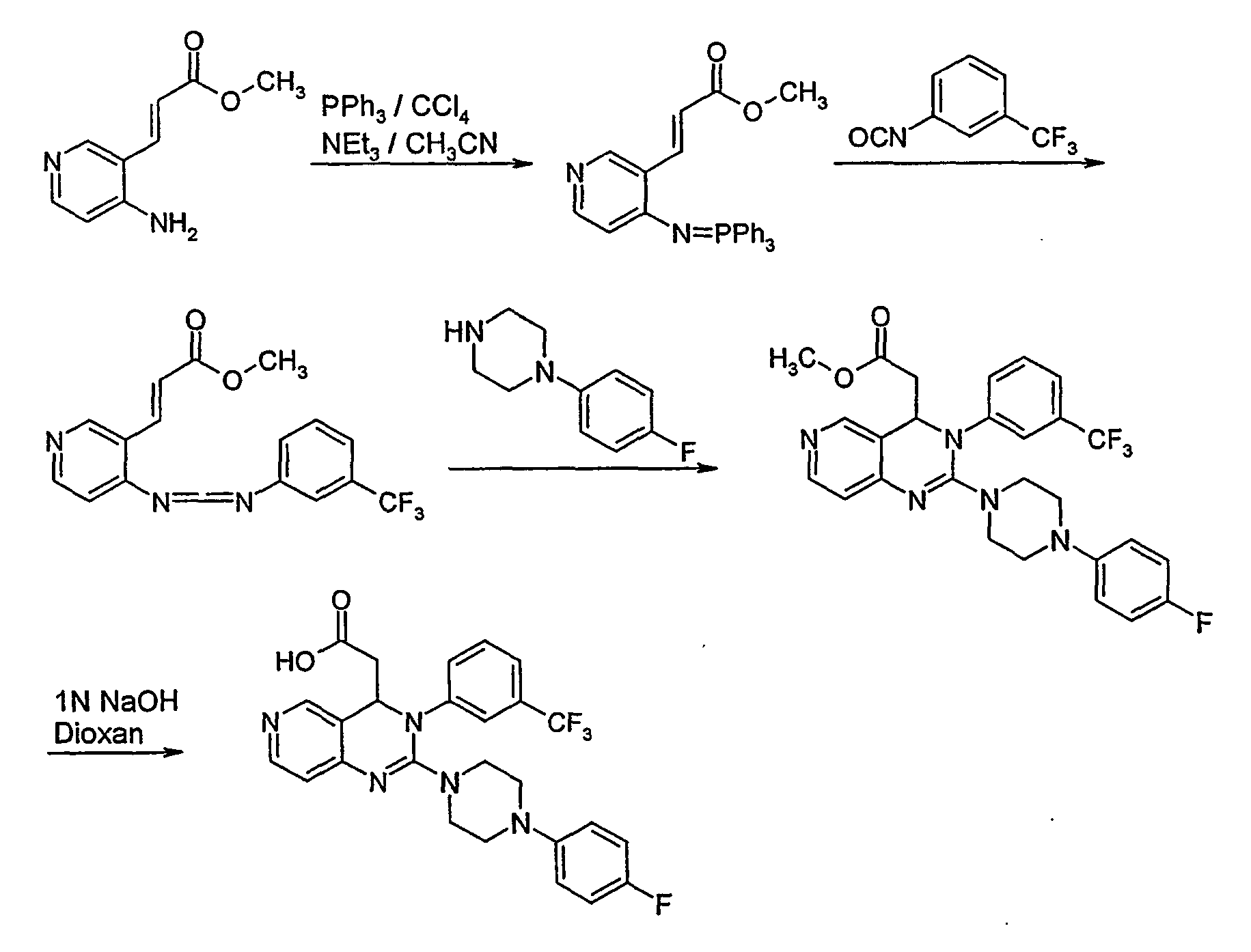
Die erfindungsgemäßen Verbindungen der allgemeinen Formel (I) zeigen ein nicht vorhersehbares, überraschendes Wirkspektrum. Sie zeigen eine antivirale Wirkung gegenüber Vertretern der Gruppe der Herpes viridae (Herpesviren), vor allem gegenüber Cytomegaloviren (CMV), insbesondere gegenüber dem humanen Cytomegalovirus (HCMV).The compounds of the general formula (I) according to the invention show an unforeseeable, surprising activity spectrum. They show an antiviral activity against representatives of the group of herpes viridae (herpesviruses), especially against cytomegaloviruses (CMV), especially against the human cytomegalovirus (HCMV).
Als Indikationsgebiete können beispielsweise genannt werden:
- 1) Behandlung und Prophylaxe von HCMV-Infektionen bei AIDS-Patienten (Retinitis, Pneumonitis, gastrointestinale Infektionen).
- 2) Behandlung und Prophylaxe von Cytomegalovirus-Infektionen bei Knochenmark- und Organtransplantationspatienten, die an einer HCMV-Pneumonitis, -Enzephalitis, sowie an gastrointestinalen und systemischen HCMV-Infektionen oft lebensbedrohlich erkranken.
- 3) Behandlung und Prophylaxe von HCMV-Infektionen bei Neugeborenen und Kleinkindern.
- 4) Behandlung einer akuten HCMV-Infektion bei Schwangeren.
- 5) Behandlung der HCMV-Infektion bei immunsupprimierten Patienten bei Krebs und KrebsTherapie.
- 6) Behandlung von HCMV-positiven Krebspatienten mit dem Ziel, HCMV-vermittelte Tumorprogression zu verringern (vgl.
J. Cinatl , et al., FEMS Microbiology Reviews 2004, 28, 59-77
- 1) Treatment and prophylaxis of HCMV infections in AIDS patients (retinitis, pneumonitis, gastrointestinal infections).
- 2) Treatment and prophylaxis of cytomegalovirus infections in bone marrow and organ transplant patients, who often develop life-threatening HCMV pneumonitis, encephalitis, gastrointestinal and systemic HCMV infections.
- 3) Treatment and prophylaxis of HCMV infections in newborns and infants.
- 4) Treatment of acute HCMV infection in pregnant women.
- 5) Treatment of HCMV infection in immunosuppressed patients in cancer and cancer therapy.
- 6) Treatment of HCMV-positive cancer patients with the aim of reducing HCMV-mediated tumor progression (cf.
J. Cinatl, et al., FEMS Microbiology Reviews 2004, 28, 59-77
Weiterer Gegenstand der vorliegenden Erfindung ist der Einsatz der erfindungsgemäßen Verbindungen zur Behandlung und/oder Prophylaxe von Krankheiten, vor allem von Infektionen mit Viren, insbesondere den vorstehend genannten Viren, und den dadurch hervorgerufenen Infektionskrankheiten. Unter einer Virusinfektion wird nachfolgend sowohl eine Infektion mit einem Virus als auch eine durch eine Infektion mit einem Virus hervorgerufene Krankheit verstanden.Another object of the present invention is the use of the compounds of the invention for the treatment and / or prophylaxis of diseases, especially of infections with viruses, in particular the viruses mentioned above, and the infectious diseases caused thereby. A virus infection is understood below to mean both an infection with a virus and an infection caused by a virus.
Weiterer Gegenstand der vorliegenden Erfindung ist die Verwendung der erfindungsgemäßen Verbindungen zur Behandlung und/oder Prophylaxe von Erkrankungen, insbesondere der zuvor genannten Erkrankungen.Another object of the present invention is the use of the compounds of the invention for the treatment and / or prophylaxis of diseases, in particular the aforementioned diseases.
Weiterer Gegenstand der vorliegenden Erfindung ist die Verwendung der erfindungsgemäßen Verbindungen zur Herstellung eines Arzneimittels zur Behandlung und/oder Prophylaxe von Erkrankungen, insbesondere der zuvor genannten Erkrankungen.Another object of the present invention is the use of the compounds of the invention for the manufacture of a medicament for the treatment and / or prophylaxis of diseases, in particular the aforementioned diseases.
Bevorzugt werden die erfindungsgemäßen Verbindungen zur Herstellung von Arzneimitteln verwendet, die zur Prophylaxe und/oder Behandlung von Infektionen mit einem Vertreter der Gruppe der Herpes viridae, besonders einem Cytomegalovirus, insbesondere dem humanen Cytomegalovirus, geeignet sind.The compounds according to the invention are preferably used for the preparation of medicaments which are suitable for the prophylaxis and / or treatment of infections with a member of the group of herpes viridae, in particular a cytomegalovirus, in particular the human cytomegalovirus.
Weiterer Gegenstand der vorliegenden Erfindung ist ein Verfahren zur Behandlung und/oder Prophylaxe von Erkrankungen, insbesondere der zuvor genannten Erkrankungen, unter Verwendung einer antiviral wirksamen Menge der erfindungsgemäßen Verbindungen.Another object of the present invention is a method for the treatment and / or prophylaxis of diseases, in particular the aforementioned diseases, using an antiviral effective amount of the compounds of the invention.
Weiterer Gegenstand der vorliegenden Erfindung sind Arzneimittel, enthaltend mindestens eine erfindungsgemäße Verbindung und mindestens einen oder mehrere weitere Wirkstoffe, insbesondere zur Behandlung und/oder Prophylaxe der zuvor genannten Erkrankungen. Als geeignete Kombinationswirkstoffe seien beispielhaft und vorzugsweise genannt: antivirale Wirkstoffe wie Gancyclovir oder Acyclovir.Another object of the present invention are pharmaceutical compositions containing at least one compound of the invention and at least one or more other active ingredients, in particular for the treatment and / or prophylaxis of the aforementioned diseases. As suitable combination active ingredients may be mentioned by way of example and preferably: antiviral agents such as gancyclovir or acyclovir.
Die erfindungsgemäßen Verbindungen können systemisch und/oder lokal wirken. Zu diesem Zweck können sie auf geeignete Weise appliziert werden, wie z.B. oral, parenteral, pulmonal, nasal, sublingual, lingual, buccal, rectal, dermal, transdermal, conjunctival, otisch, topisch oder als Implantat bzw. Stent.The compounds according to the invention can act systemically and / or locally. For this purpose, they may be applied in a suitable manner, e.g. oral, parenteral, pulmonary, nasal, sublingual, lingual, buccal, rectal, dermal, transdermal, conjunctival, otic, topical or as an implant or stent.
Für diese Applikationswege können die erfindungsgemäßen Verbindungen in geeigneten Applikationsformen verabreicht werden.For these administration routes, the compounds according to the invention can be administered in suitable administration forms.
Für die orale Applikation eignen sich nach dem Stand der Technik funktionierende schnell und/oder modifiziert die erfindungsgemäßen Verbindungen abgebende Applikationsformen, die die erfindungsgemäßen Verbindungen in kristalliner und/ oder amorphisierter und/oder gelöster Form enthalten, wie z.B. Tabletten (nichtüberzogene oder überzogene Tabletten, beispielsweise mit magensaftresistenten oder sich verzögert auflösenden oder unlöslichen Überzügen, die die Freisetzung der erfindungsgemäßen Verbindung kontrollieren), in der Mundhöhle schnell zerfallende Tabletten oder Filme/Oblaten, Filme/Lyophylisate, Kapseln (beispielsweise Hart- oder Weichgelatinekapseln), Dragees, Granulate, Pellets, Pulver, Emulsionen, Suspensionen, Aerosole oder Lösungen.For the oral administration are according to the prior art functioning rapidly and / or modified compounds of the invention donating application forms containing the compounds of the invention in crystalline and / or amorphized and / or dissolved form, such as. Tablets (uncoated or coated tablets, for example with enteric or delayed-release or insoluble coatings which control the release of the compound of the invention), orally disintegrating tablets or films / wafers, films / lyophilisates, capsules (for example hard or soft gelatin capsules) in the oral cavity , Dragees, granules, pellets, powders, emulsions, suspensions, aerosols or solutions.
Die parenterale Applikation kann unter Umgehung eines Resorptionsschrittes geschehen (z.B. intravenös, intraarteriell, intrakardial, intraspinal oder intralumbal) oder unter Einschaltung einer Resorption (z.B. intramuskulär, subcutan, intracutan, percutan oder intraperitoneal). Für die parenterale Applikation eignen sich als Applikationsformen u.a. Injektions- und Infusionszubereitungen in Form von Lösungen, Suspensionen, Emulsionen, Lyophilisaten oder sterilen Pulvern.The parenteral administration can be done bypassing a resorption step (eg, intravenous, intraarterial, intracardiac, intraspinal, or intralumbar) or with involvement of resorption (eg, intramuscular, subcutaneous, intracutaneous, percutaneous, or intraperitoneal). For parenteral administration are suitable as application forms, inter alia, injection and infusion preparations in the form of solutions, suspensions, emulsions, lyophilisates or sterile powders.
Für die sonstigen Applikationswege eignen sich z.B. Inhalationsarzneiformen (u.a. Pulverinhalatoren, Nebulizer), Nasentropfen, -lösungen, -sprays; lingual, sublingual oder buccal zu applizierende Tabletten, Filme/Oblaten oder Kapseln, Suppositorien, Ohren- oder Augenpräparationen, Vaginalkapseln, wässrige Suspensionen (Lotionen, Schüttelmixturen), lipophile Suspensionen, Salben, Cremes, transdermale therapeutische Systeme, Milch, Pasten, Schäume, Streupuder, Implantate oder Stents.For the other routes of administration are suitable, for example Inhalation medicines (including powder inhalers, nebulizers), nasal drops, solutions, sprays; lingual, sublingual or buccal tablets to be applied, films / wafers or capsules, suppositories, ear or ophthalmic preparations, vaginal capsules, aqueous suspensions (lotions, shake mixtures), lipophilic suspensions, ointments, creams, transdermal therapeutic systems, milk, pastes, foams, powdered litter , Implants or stents.
Die erfindungsgemäßen Verbindungen können in die angeführten Applikationsformen überführt werden. Dies kann in an sich bekannter Weise durch Mischen mit inerten, nichttoxischen, pharmazeutisch geeigneten Hilfsstoffen geschehen. Zu diesen Hilfsstoffen zählen u.a. Trägerstoffe (beispielsweise mikrokristalline Cellulose, Laktose, Mannitol), Lösungsmittel (z.B. flüssige Polyethylenglycole), Emulgatoren und Dispergier- oder Netzmittel (beispielsweise Natriumdodecylsulfat, Polyoxysorbitanoleat), Bindemittel (beispielsweise Polyvinylpyrrolidon), synthetische und natürliche Polymere (beispielsweise Albumin), Stabilisatoren (z.B. Antioxidantien wie beispielsweise Ascorbinsäure), Farbstoffe (z.B. anorganische Pigmente wie beispielsweise Eisenoxide) und Geschmacks- und / oder Geruchskorrigentien.The compounds according to the invention can be converted into the stated administration forms. This can be done in a conventional manner by mixing with inert, non-toxic, pharmaceutically suitable excipients. These adjuvants include, among others. Carriers (for example microcrystalline cellulose, lactose, mannitol), solvents (eg liquid polyethylene glycols), emulsifiers and dispersing or wetting agents (for example sodium dodecyl sulfate, polyoxysorbitanoleate), binders (for example polyvinylpyrrolidone), synthetic and natural polymers (for example albumin), stabilizers (eg antioxidants such as ascorbic acid), dyes (eg, inorganic pigments such as iron oxides), and flavor and / or odor remedies.
Weiterer Gegenstand der vorliegenden Erfindung sind Arzneimittel, die mindestens eine erfindungsgemäße Verbindung, üblicherweise zusammen mit einem oder mehreren inerten, nichttoxischen, pharmazeutisch geeigneten Hilfsstoffen enthalten, sowie deren Verwendung zu den zuvor genannten Zwecken.Another object of the present invention are pharmaceutical compositions containing at least one compound of the invention, usually together with one or more inert, non-toxic, pharmaceutically suitable excipients, and their use for the purposes mentioned above.
Im Allgemeinen hat es sich als vorteilhaft erwiesen, bei intravenöser Applikation Mengen von etwa 0.001 bis 10 mg/kg, vorzugsweise etwa 0.01 bis 5 mg/kg Körpergewicht zur Erzielung wirksamer Ergebnisse zu verabreichen, und bei oraler Applikation beträgt die Dosierung etwa 0.01 bis 25 mg/kg, vorzugsweise 0.1 bis 10 mg/kg Körpergewicht.In general, it has been found advantageous to administer amounts of about 0.001 to 10 mg / kg, preferably about 0.01 to 5 mg / kg of body weight to achieve effective results when administered intravenously, and when administered orally, the dosage is about 0.01 to 25 mg / kg, preferably 0.1 to 10 mg / kg of body weight.
Trotzdem kann es gegebenenfalls erforderlich sein, von den genannten Mengen abzuweichen, und zwar in Abhängigkeit von Körpergewicht, Applikationsweg, individuellem Verhalten gegenüber dem Wirkstoff, Art der Zubereitung und Zeitpunkt bzw. Intervall, zu welchem die Applikation erfolgt. So kann es in einigen Fällen ausreichend sein, mit weniger als der vorgenannten Mindestmenge auszukommen, während in anderen Fällen die genannte obere Grenze überschritten werden muss. Im Falle der Applikation größerer Mengen kann es empfehlenswert sein, diese in mehreren Einzelgaben über den Tag zu verteilen.Nevertheless, it may be necessary to deviate from the stated amounts, depending on body weight, route of administration, individual behavior towards the active ingredient, type of preparation and time or interval at which the application is carried out. Thus, in some cases it may be sufficient to manage with less than the aforementioned minimum amount, while in other cases, the said upper limit must be exceeded. In the case of the application of larger quantities, it may be advisable to distribute these in several single doses throughout the day.
Die Prozentangaben in den folgenden Tests und Beispielen sind, sofern nicht anders angegeben, Gewichtsprozente; Teile sind Gewichtsteile. Lösungsmittelverhältnisse, Verdünnungsverhältnisse und Konzentrationsangaben von flüssig/flüssig-Lösungen beziehen sich jeweils auf das Volumen.The percentages in the following tests and examples are by weight unless otherwise indicated; Parts are parts by weight. Solvent ratios, dilution ratios and concentration data of liquid / liquid solutions are based on volume.
- Methode 1 (analytische HPLC): Instrument: HP 1100 mit DAD-Detektion; Säule: Kromasil RP-18, 60 mm x 2 mm, 3.5 µm; Eluent A: 5 ml Perchlorsäure/l Wasser, Eluent B: Acetonitril; Gradient: 0 min 2%B, 0.5 min 2%B, 4.5 min 90%B, 6.5 min 90%B; Fluss: 0.75 ml/min; Ofen: 30°C; UV-Detektion: 210 nm. Method 1 (analytical HPLC): Instrument: HP 1100 with DAD detection; Column: Kromasil RP-18, 60 mm × 2 mm, 3.5 μm; Eluent A: 5 ml perchloric acid / l water, eluent B: acetonitrile; Gradient: 0 min 2% B, 0.5 min 2% B, 4.5 min 90% B, 6.5 min 90% B; Flow: 0.75 ml / min; Oven: 30 ° C; UV detection: 210 nm.
- Methode 2 (präparative HPLC, Labor-HPLC): Säule: CromSil C18, 250 x 30 mm; Fluß: 50 ml/min; Laufzeit: 38 min; Eluent A: Wasser, Eluent B: Acetonitril, Gradient: 10%B (3 min) -> 90%B (31 min) -> 90%B (34 min) -> 10%B (34.01 min); UV-Detektion: 210 nm. Method 2 (preparative HPLC, laboratory HPLC): column: CromSil C18, 250 × 30 mm; Flow: 50 ml / min; Running time: 38 min; Eluent A: water, eluent B: acetonitrile, gradient: 10% B (3 min) -> 90% B (31 min) -> 90% B (34 min) -> 10% B (34.01 min); UV detection: 210 nm.
- Methode 3 (LCMS): Instrument: Micromass Quattro LCZ, mit HPLC Agilent Serie 1100; Säule: Grom-SIL120 ODS-4 HE, 50 mm x 2.0 mm, 3 µm; Eluent A: 1 1 Wasser + 1 ml 50%ige Ameisensäure, Eluent B: 1 1 Acetonitril + 1 ml 50%ige Ameisensäure; Gradient: 0.0 min 100%A → 0.2 min 100%A → 2.9 min 30%A → 3.1 min 10%A → 4.5 min 10%A; Ofen: 55°C; Fluss: 0.8 ml/min; UV-Detektion: 208-400 nm. Method 3 (LCMS): Instrument: Micromass Quattro LCZ, with HPLC Agilent Series 1100; Column: Grom-SIL120 ODS-4 HE, 50 mm x 2.0 mm, 3 μm; Eluent A: 1 liter of water + 1 ml of 50% formic acid, eluent B: 1 liter of acetonitrile + 1 ml of 50% formic acid; Gradient: 0.0 min 100% A → 0.2 min 100% A → 2.9 min 30% A → 3.1 min 10% A → 4.5 min 10% A; Oven: 55 ° C; Flow: 0.8 ml / min; UV detection: 208-400 nm.

Zu einer Lösung von 5.1 g (23.4 mmol) Di-tert-butyldicarbonat in 20 ml THF werden portionsweise 2.0 g (21.3 mmol) 4-Aminopyridin gegeben. Nach vollständiger Zugabe wird 1h bei Raumtemperatur nachgerührt, anschließend das Lösungsmittel im Vakuum entfernt und der so erhaltene Rückstand in Diethylether suspendiert. Der Feststoff wird abfiltriert und im Vakuum getrocknet. Ausbeute: 3.43 g (83% d. Th.)
HPLC (Methode 1): Rt = 3.42 min
MS (ESI-pos): m/z = 195 [M+H]+ 2.0 g (21.3 mmol) of 4-aminopyridine are added in portions to a solution of 5.1 g (23.4 mmol) of di- tert-butyl dicarbonate in 20 ml of THF. After complete addition, stirring is continued for 1 h at room temperature, then the solvent is removed in vacuo and the residue thus obtained is suspended in diethyl ether. The solid is filtered off and dried in vacuo. Yield: 3.43 g (83% of theory)
HPLC (Method 1): R t = 3.42 min
MS (ESI pos): m / z = 195 [M + H] +
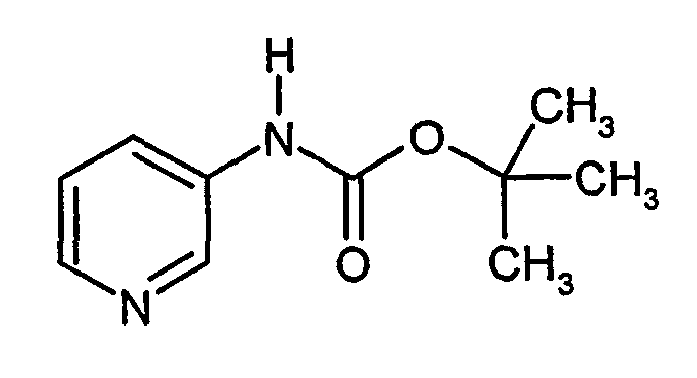
Zu einer Lösung von 5.0 g (40.9 mmol) Nicotinsäureamid in 100 ml tert-Butanol werden 18.2 g (40.9 mmol) Blei(IV)acetat gegeben und das Reaktionsgemisch 4h unter Rückfluss gerührt. Anschließend wird der Ansatz über Kieselgur filtriert, das Lösungsmittel im Vakuum entfernt und der Rückstand mit Diethylether aufgenommen. Die organische Phase wird mit gesättigter Natriumhydrogencarbonatlösung sowie gesättigter Natriumchloridlösung gewaschen, über Natriumsulfat getrocknet und filtriert. Die Lösung wird mit Pentan versetzt und der entstandene Niederschlag abfiltriert und getrocknet. Ausbeute: 2.79 g (35% d. Th.).
HPLC (Methode 1): Rt = 3.36 min
MS (ESI-pos): m/z = 195 [M+H]+ 18.2 g (40.9 mmol) of lead (IV) acetate are added to a solution of 5.0 g (40.9 mmol) of nicotinamide in 100 ml of tert- butanol, and the reaction mixture is stirred under reflux for 4 h. The mixture is then filtered through diatomaceous earth, the solvent removed in vacuo and the residue taken up with diethyl ether. The organic phase is washed with saturated sodium bicarbonate solution and saturated sodium chloride solution, dried over sodium sulfate and filtered. The solution is treated with pentane and the resulting precipitate is filtered off and dried. Yield: 2.79 g (35% of theory).
HPLC (Method 1): R t = 3.36 min
MS (ESI pos): m / z = 195 [M + H] +

In 75 ml Tetrahydrofuran werden 4.12 g (21.3 mmol) des Boc-geschützten Aminopyridins aus Beispiel 1A gelöst, unter Argon die Lösung auf -78°C gekühlt und tropfenweise mit 34 ml einer 1.5 M Lösung (51.1 mmol) von tert-Butyllithium in Pentan versetzt. Die Zugabe erfolgt so, dass die Innentemperatur unter -65°C bleibt. Nach vollständiger Zugabe wird noch 1h bei -20°C nachgerührt. Danach wird der Ansatz mit 10.6 ml (138.3 mmol) absolutem N,N-Dimethylformamid versetzt, so daß bei der Zugabe die Reaktionstemperatur unter -15°C bleibt. Die Reaktion wird 16h bei Raumtemperatur nachgerührt, anschließend unter Eiskühlung mit 1N Salzsäure versetzt. Der pH-Wert wird mit festem Natriumcarbonat auf pH 7 eingestellt, der Ansatz mit Essigsäureethylester versetzt und die organische Phase mit Wasser sowie gesättigter Natriumchloridlösung gewaschen. Die organische Phase wird abgetrennt, über Natriumsulfat getrocknet und das Lösungsmittel im Vakuum entfernt. Das Produkt wird mittels Chromatographie an Kieselgel mit Cyclohexan/Essigsäureethylester (3:2 v/v) gereinigt. Man erhält 3.15 g (63% d. Th.) Produkt.
HPLC (Methode 1): Rt = 3.65 min
MS (ESI-pos): m/z = 223 [M+H]+ In 75 ml of tetrahydrofuran 4.12 g (21.3 mmol) of the Boc-protected aminopyridine from Example 1A, the solution cooled under argon to -78 ° C and treated dropwise with 34 ml of a 1.5 M solution (51.1 mmol) of tert-butyllithium in pentane added. The addition is made so that the internal temperature remains below -65 ° C. After complete addition, the mixture is stirred at -20 ° C for a further 1h. Thereafter, the batch is admixed with 10.6 ml (138.3 mmol) of absolute N , N- dimethylformamide, so that the reaction temperature remains below -15 ° C. during the addition. The reaction is stirred for 16 h at room temperature, then treated with ice cooling with 1N hydrochloric acid. The pH is adjusted to pH 7 with solid sodium carbonate, the batch is combined with ethyl acetate and the organic phase is washed with water and saturated sodium chloride solution. The organic phase is separated, dried over sodium sulfate and the solvent removed in vacuo. The product is purified by chromatography on silica gel with cyclohexane / ethyl acetate (3: 2 v / v). 3.15 g (63% of theory) of product are obtained.
HPLC (Method 1): R t = 3.65 min
MS (ESI pos): m / z = 223 [M + H] +

In 50 ml Tetrahydrofuran werden 2.7 g (13.9 mmol) des Boc-geschützten Aminopyridins aus Beispiel 2A gelöst, unter Argon die Lösung auf -78°C gekühlt und tropfenweise mit 22.4 ml einer 1.5 M Lösung (33.4 mmol) von tert-Butyllithium in Pentan versetzt. Die Zugabe erfolgt so, dass die Innentemperatur unter -65°C bleibt. Nach vollständiger Zugabe wird noch 1h bei -20°C nachgerührt. Danach wird der Ansatz mit 4.6 ml (41.7 mmol) N-Formlypiperidin versetzt, so daß bei der Zugabe die Reaktionstemperatur unter -15°C bleibt. Die Reaktion wird 16h bei Raumtemperatur nachgerührt, anschließend unter Eiskühlung mit 1N Salzsäure versetzt. Der pH wird mit festem Natriumcarbonat auf pH 7 eingestellt, der Ansatz mit Essigsäureethylester versetzt und die organische Phase mit Wasser sowie gesättigter Natriumchloridlösung gewaschen. Die organische Phase wird abgetrennt, über Natriumsulfat getrocknet und das Lösungsmittel im Vakuum entfernt. Das Produkt wird mittels Chromatographie an Kieselgel mit Cyclohexan/Essigsäureethylester (7:3 v/v) gereinigt. Man erhält 1.54 g (49% d. Th.) Produkt.
HPLC (Methode 1): Rt = 3.40 min
MS (ESI-pos): m/z = 223 [M+H]+ 2.7 g (13.9 mmol) of the Boc-protected aminopyridine from Example 2A are dissolved in 50 ml of tetrahydrofuran, the solution is cooled to -78 ° C. under argon and dropwise added with 22.4 ml of a 1.5 M solution (33.4 mmol) of tert- butyllithium in pentane added. The addition is done so that the internal temperature remains below -65 ° C. After complete addition, the mixture is stirred at -20 ° C for a further 1h. The mixture is then admixed with 4.6 ml (41.7 mmol) of N- formylpiperidine, so that the reaction temperature remains below -15 ° C. during the addition. The reaction is stirred for 16 h at room temperature, then treated with ice cooling with 1N hydrochloric acid. The pH is adjusted to pH 7 with solid sodium carbonate, the batch is combined with ethyl acetate and the organic phase is washed with water and saturated sodium chloride solution. The organic phase is separated, dried over sodium sulfate and the solvent removed in vacuo. The product is purified by chromatography on silica gel with cyclohexane / ethyl acetate (7: 3 v / v). This gives 1.54 g (49% of theory) of product.
HPLC (Method 1): R t = 3.40 min
MS (ESI pos): m / z = 223 [M + H] +
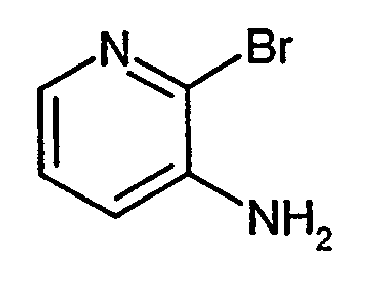
In 200 ml Acetonitril werden 4.00 g (42.5 mmol) 3-Aminopyridin gelöst, mit 8.32 g (46.8 mmol) N-Bromsuccinimid versetzt und unter Lichtausschluss 20h bei Raumtemperatur gerührt. Anschließend wird das Reaktionsgemisch eingeengt, in Essigsäureethylester suspendiert und mit gesättigter, wässriger Natriumhydrogencarbonatlösung und gesättigter, wässriger Natriumchloridlösung gewaschen. Die organische Phase wird über Natriumsulfat getrocknet, filtriert und eingeengt. An Kieselgel wird säulenchromatographisch mit Cyclohexan/ Essigsäureethylester (1:1) gereinigt. Man erhält 969 mg (12% d. Th.) Produkt.
HPLC (Methode 1): Rt = 1.08 min.
MS (ESI-pos): m/z = 173 [M+H]+ 4.00 g (42.5 mmol) of 3-aminopyridine are dissolved in 200 ml of acetonitrile, admixed with 8.32 g (46.8 mmol) of N- bromosuccinimide and stirred at room temperature for 20 h with the exclusion of light. The reaction mixture is then concentrated, suspended in ethyl acetate and washed with saturated aqueous sodium bicarbonate solution and saturated aqueous sodium chloride solution. The organic phase is dried over sodium sulfate, filtered and concentrated. On silica gel is purified by column chromatography with cyclohexane / ethyl acetate (1: 1). 969 mg (12% of theory) of product are obtained.
HPLC (Method 1): R t = 1.08 min.
MS (ESI pos): m / z = 173 [M + H] +
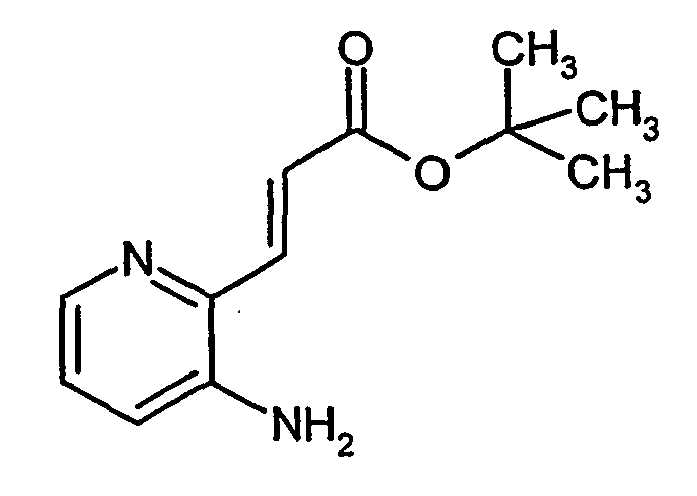
In 15 ml Acetonitril werden 950 mg (4.94 mmol) des Bromides aus Beispiel 5A, 1900 mg (14.83 mmol) Acrylsäure-tert-butylester, 330 mg (1.50 mmol) Palladium(II)acetat, 450 mg (1.50 mmol) Tri-ortho-tolylphospin gelöst und 1000 mg (9.88 mmol) Triethylamin zugesetzt. Man rührt 16h unter Rückfluss. Das Reaktionsgemisch wird eingeengt, mit Essigsäureethylester versetzt und mit gesättigter, wässriger Natriumchloridlösung gewaschen. Die organische Phase wird über Natriumsulfat getrocknet, filtriert, eingeengt und säulenchromatographisch an Kieselgel mit Cyclohexan/Essigsäureethylester (7:3) gereinigt. Man erhält 95 mg (6% d. Th.) Produkt.950 mg (4.94 mmol) of the bromide from Example 5A, 1900 mg (14.83 mmol) of tert-butyl acrylate, 330 mg (1.50 mmol) of palladium (II) acetate, 450 mg (1.50 mmol) of tri-ortho are dissolved in 15 ml of acetonitrile Tolylphospin dissolved and added 1000 mg (9.88 mmol) of triethylamine. It is stirred for 16h under reflux. The reaction mixture is concentrated, treated with ethyl acetate and washed with saturated aqueous sodium chloride solution. The organic phase is dried over sodium sulfate, filtered, concentrated and purified by column chromatography on silica gel with cyclohexane / ethyl acetate (7: 3). 95 mg (6% of theory) of product are obtained.
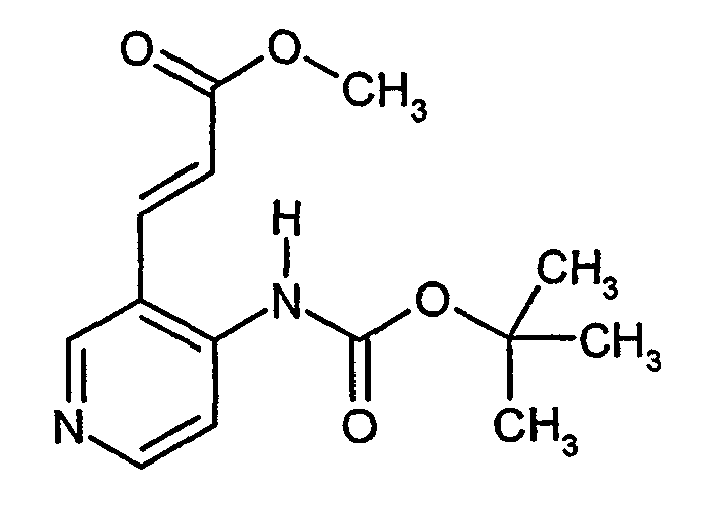
Eine Suspension von 3.0 g (13.5 mmol) des Aldehyds aus Beispiel 3A, 3.12 g (14.8 mmol) Methyldiethylphosphonoacetat und 623 mg (14.8 mmol) Lithiumhydroxydmonohydrat in 30 ml Tetrahydrofuran wird 16h bei Raumtemperatur gerührt. Anschließend wird mit 30 ml Wasser versetzt und mit Essigsäureethylester extrahiert. Die organische Phase wird abgetrennt, mit gesättigter Natriumchloridlösung gewaschen, über Natriumsulfat getrocknet, filtriert und das Lösungsmittel im Vakuum entfernt. Der Rückstand wird bei 100°C / 1 mbar getrocknet. Man erhält 3.5 g (89% d. Th.) der Titelverbindung.
HPLC (Methode 1): Rt = 3.71 min
MS (ESI-pos): m/z = 279 [M+H]+ A suspension of 3.0 g (13.5 mmol) of the aldehyde from Example 3A, 3.12 g (14.8 mmol) of methyl diethylphosphonoacetate and 623 mg (14.8 mmol) of lithium hydroxide monohydrate in 30 ml of tetrahydrofuran is stirred for 16 h at room temperature. Then it is mixed with 30 ml of water and extracted with ethyl acetate. The organic phase is separated, washed with saturated sodium chloride solution, dried over sodium sulfate, filtered and the solvent removed in vacuo. The residue is dried at 100 ° C / 1 mbar. 3.5 g (89% of theory) of the title compound are obtained.
HPLC (Method 1): R t = 3.71 min
MS (ESI pos): m / z = 279 [M + H] +
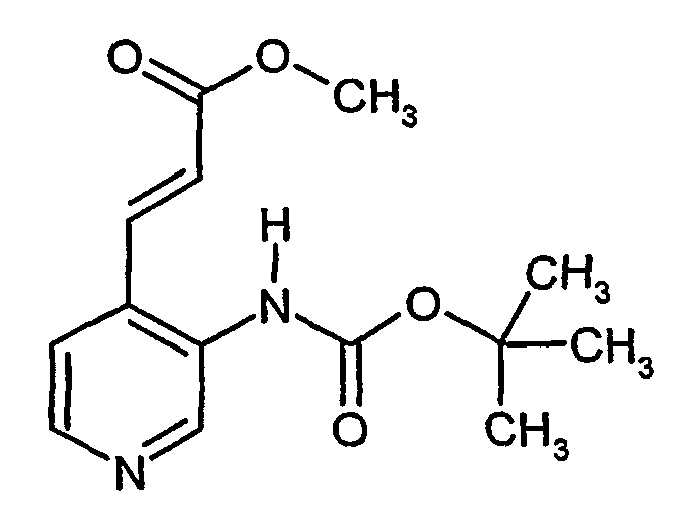
Eine Suspension von 1.48 g (6.66 mmol) des Aldehyds aus Beispiel 4A, 1.54 g (7.33 mmol) Methyldiethylphosphonoacetat und 307 mg (7.33 mmol) Lithiumhydroxydmonohydrat in 15 ml Tetrahydrofuran wird 16h bei Raumtemperatur gerührt. Anschließend wird mit 15 ml Wasser versetzt und mit Essigsäureethylester extrahiert. Die organische Phase wird abgetrennt, mit gesättigter Natriumchloridlösung gewaschen, über Natriumsulfat getrocknet, filtriert und das Lösungsmittel im Vakuum entfernt. Der Rückstand wird bei 75°C / 1 mbar getrocknet. Man erhält 1.82 g (98% d. Th.) der Titelverbindung.
HPLC (Methode 1): Rt = 3.73 min
MS (ESI-pos): m/z = 279 [M+H]+ A suspension of 1.48 g (6.66 mmol) of the aldehyde from Example 4A, 1.54 g (7.33 mmol) of methyl diethylphosphonoacetate and 307 mg (7.33 mmol) of lithium hydroxide monohydrate in 15 ml of tetrahydrofuran is stirred at room temperature for 16 h. Then 15 ml of water are added and the mixture is extracted with ethyl acetate. The organic phase is separated, washed with saturated sodium chloride solution, dried over sodium sulfate, filtered and the solvent removed in vacuo. The residue is dried at 75 ° C / 1 mbar. This gives 1.82 g (98% of theory) of the title compound.
HPLC (method 1): R t = 3.73 min
MS (ESI pos): m / z = 279 [M + H] +

Bei 0°C werden 900 mg (3.23 mmol) des Boc-geschützten Aminopyridins aus Beispiel 7A in 3 ml Trifluoressigsäure gelöst. Anschließend wird das Reaktionsgemisch 1h bei Raumtemperatur gerührt, der Ansatz in eiskalte Natriumhydrogencarbonatlösung eingetragen, 30 min gerührt und der entstandene Niederschlag abfiltriert, mit Wasser gewaschen und getrocknet. Man erhält 242 mg (42% d. Th.) der Titelverbindung.At 0 ° C., 900 mg (3.23 mmol) of the Boc-protected aminopyridine from Example 7A are dissolved in 3 ml of trifluoroacetic acid. The reaction mixture is then stirred for 1 h at room temperature, the mixture is added to ice-cold sodium bicarbonate solution, stirred for 30 min and the resulting precipitate is filtered off, washed with water and dried. 242 mg (42% of theory) of the title compound are obtained.
Aus der Mutterlauge können durch Einstellen des pH-Wertes auf pH 10 und Extraktion mit Essigsäureethylester weitere 105 mg (18% d. Th.) Produkt als Öl isoliert werden. Beide Fraktionen unterscheiden sich vermutlich durch ihren Protonierungsgrad.
HPLC (Methode 1): Rt = 2.67 min
MS (CI-pos): m/z = 179 [M+H]+ By adjusting the pH to pH 10 and extracting with ethyl acetate, an additional 105 mg (18% of theory) of product as an oil can be isolated from the mother liquor. Both fractions probably differ in their degree of protonation.
HPLC (Method 1): R t = 2.67 min
MS (CI-pos): m / z = 179 [M + H] +
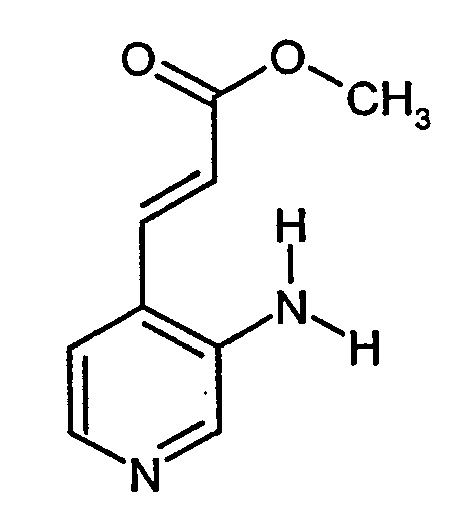
Bei Raumtemperatur werden 1.8 g (6.47 mmol) des Boc-geschützten Aminopyridins aus Beispiel 8A in 18 ml Methanol gelöst und die Lösung mit 1 ml konzentrierter Salzsäure versetzt. Anschließend wird das Reaktionsgemisch 4h bei 70°C gerührt, der Ansatz in 50 ml Natriumhydrogencarbonatlösung eingetragen, der pH-Wert durch Zugabe von 20%iger Natronlauge auf pH 14 eingestellt und mit Essigsäureethylester extrahiert. Die organische Phase wird mit konzentrierter Natriumchloridlösung gewaschen, über Natriumsulfat getrocknet und im Vakuum das Lösungsmittel entfernt. Ausbeute: 935 mg (79% d. Th.).
HPLC (Methode 1): Rt = 2.88 min
MS (ESI-pos): m/z = 179 [M+H]+ At room temperature, 1.8 g (6.47 mmol) of the Boc-protected aminopyridine from Example 8A are dissolved in 18 ml of methanol and the solution is treated with 1 ml of concentrated hydrochloric acid. The reaction mixture is then stirred at 70 ° C. for 4 h, the batch is introduced into 50 ml of sodium bicarbonate solution, the pH is adjusted to pH 14 by the addition of 20% strength sodium hydroxide solution and extracted with ethyl acetate. The organic phase is washed with concentrated sodium chloride solution, dried over sodium sulfate and the solvent is removed in vacuo. Yield: 935 mg (79% of theory).
HPLC (Method 1): R t = 2.88 min
MS (ESI pos): m / z = 179 [M + H] +
In Acetonitril werden 1.0 eq Aminopyridin, 2.0 eq. Triphenylphosphin, 10.0 eq. Tetrachlorkohlenstoff sowie 10.0 eq. Triethylamin suspendiert (ca. 0.33 M bezogen auf das Aminopyridin). Das Reaktionsgemisch wird 16h bei Raumtemperatur gerührt und das Lösungsmittel im Vakuum entfernt. Das Rohprodukt wird ohne weitere Aufreinigung umgesetzt oder säulenchromatographisch an Kieselgel gereinigt.In acetonitrile, 1.0 eq of aminopyridine, 2.0 eq. Triphenylphosphine, 10.0 eq. Carbon tetrachloride and 10.0 eq. Triethylamine suspended (about 0.33 M based on the aminopyridine). The reaction mixture is stirred for 16 h at room temperature and the solvent is removed in vacuo. The crude product is reacted without further purification or purified by column chromatography on silica gel.
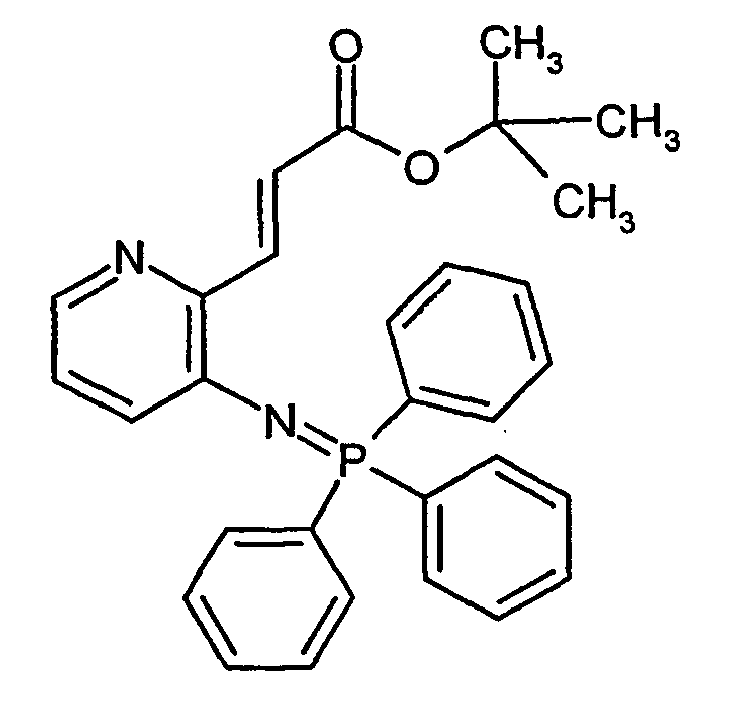
Ausgehend von 95 mg (0.28 mmol) Aminopyridin aus Beispiel 6A wird gemäß allgemeiner Arbeitsvorschrift [A] das Rohprodukt erhalten, das säulenchromatographisch an Kieselgel mit Cyclohexan/Essigsäureethylester (7:3) gereinigt wird. Man erhält 70 mg (51% d. Th.) Produkt.
HPLC (Methode 1): Rt = 4.83 min.
MS (ESI-pos): m/z = 481 [M+H]+ Starting from 95 mg (0.28 mmol) of aminopyridine from Example 6A, the crude product is obtained according to general procedure [A], which is purified by column chromatography on silica gel with cyclohexane / ethyl acetate (7: 3). This gives 70 mg (51% of theory) of product.
HPLC (Method 1): R t = 4.83 min.
MS (ESI pos): m / z = 481 [M + H] +
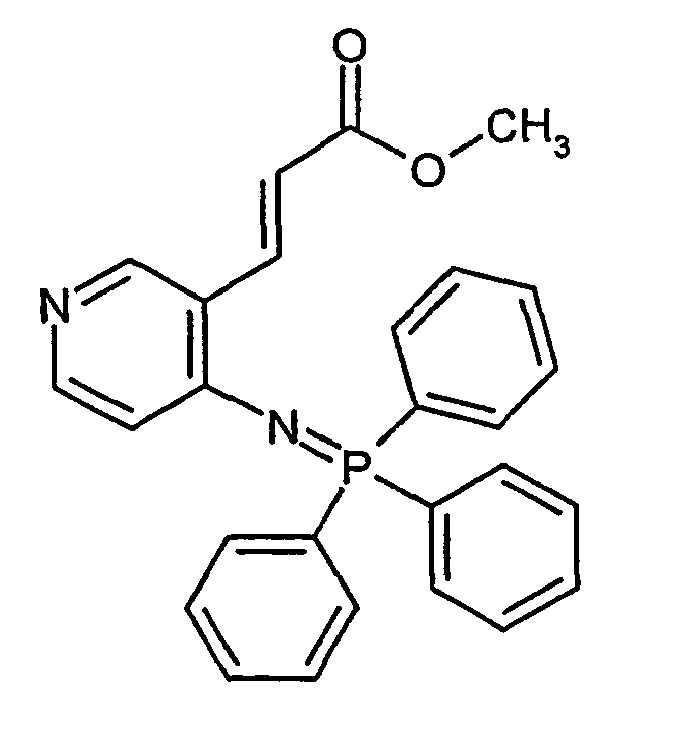
Ausgehend von 320 mg (1.8 mmol) Aminopyridin aus Beispiel 9A werden gemäß allgemeiner Arbeitsvorschrift [A] 1650 mg Rohprodukt erhalten, das ohne weitere Reinigung umgesetzt wird.Starting from 320 mg (1.8 mmol) of aminopyridine from Example 9A, 1650 mg of crude product are obtained according to general procedure [A], which is reacted without further purification.

Ausgehend von 900 mg (4.89 mmol) Aminopyridin aus Beispiel 10A werden gemäß allgemeiner Arbeitsvorschrift [A] 1910 mg Rohprodukt erhalten, das ohne weitere Reinigung umgesetzt wird.
MS (ESI-pos): m/z = 439 [M+H]+ Starting from 900 mg (4.89 mmol) of aminopyridine from Example 10A, 1910 mg of crude product are obtained according to general procedure [A], which is reacted without further purification.
MS (ESI pos): m / z = 439 [M + H] +
In Dichlormethan werden 1.0 Äq. Iminophosphoran (ggf. als Rohprodukt) gelöst, mit 1.1 Äq. Isocyanat versetzt und das Reaktionsgemisch 16h bei Raumtemperatur gerührt. Das so erhaltene Rohprodukt wird direkt weiter umgesetzt.In dichloromethane, 1.0 eq. Iminophosphoran (possibly as a crude product) dissolved, with 1.1 eq. Isocyanate added and the reaction mixture stirred for 16 h at room temperature. The crude product thus obtained is further reacted directly.
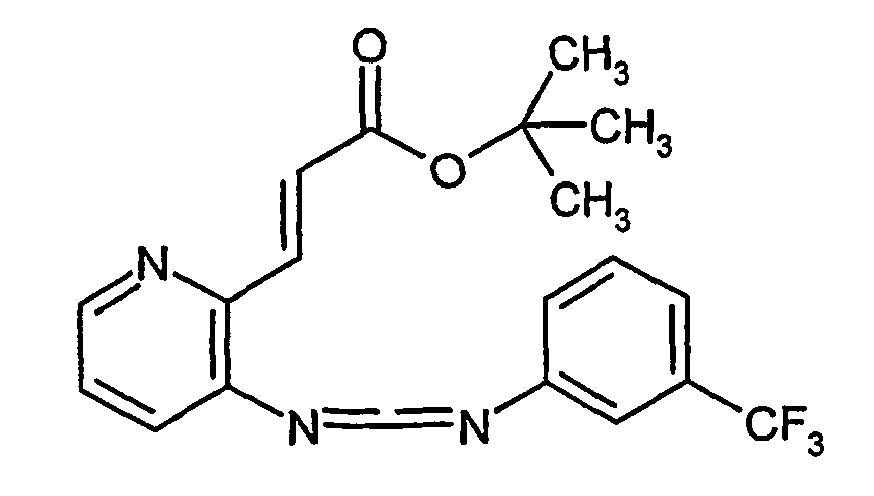
65 mg (0.14 mmol) Iminophosphoran aus Beispiel 11A werden gemäß allgemeiner Arbeitsvorschrift [B] mit 27 mg (0.14 mmol) 3-Trifluormethylphenylisocyanat umgesetzt und das Rohprodukt ohne Reinigung weiter umgesetzt.65 mg (0.14 mmol) of iminophosphorane from Example 11A are reacted according to general procedure [B] with 27 mg (0.14 mmol) of 3-trifluoromethylphenyl isocyanate and the crude product is reacted further without purification.
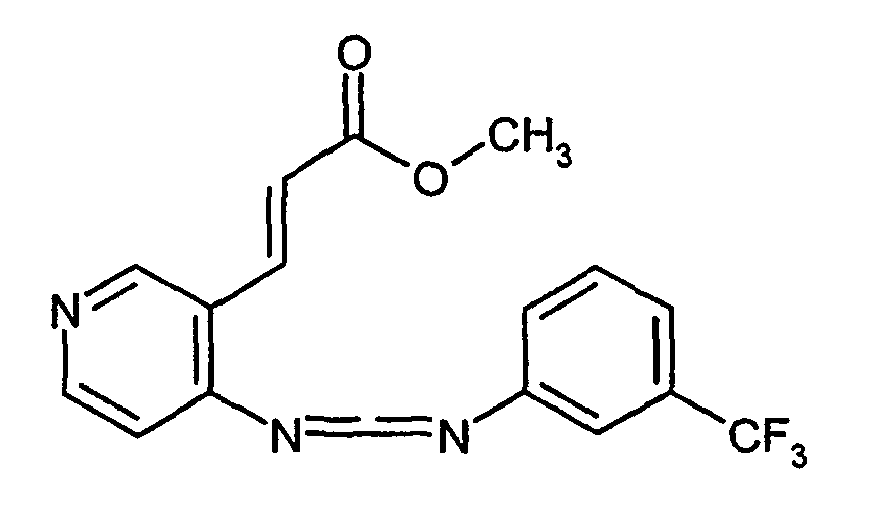
300 mg (0.34 mmol) Iminophosphoran aus Beispiel 12A werden gemäß allgemeiner Arbeitsvorschrift [B] mit 70 mg (0.38 mmol) 3-Trifluormethylphenylisocyanat umgesetzt und das Rohprodukt ohne Reinigung weiter umgesetzt.300 mg (0.34 mmol) of iminophosphorane from Example 12A are reacted according to general procedure [B] with 70 mg (0.38 mmol) of 3-trifluoromethylphenyl isocyanate and the crude product is reacted further without purification.
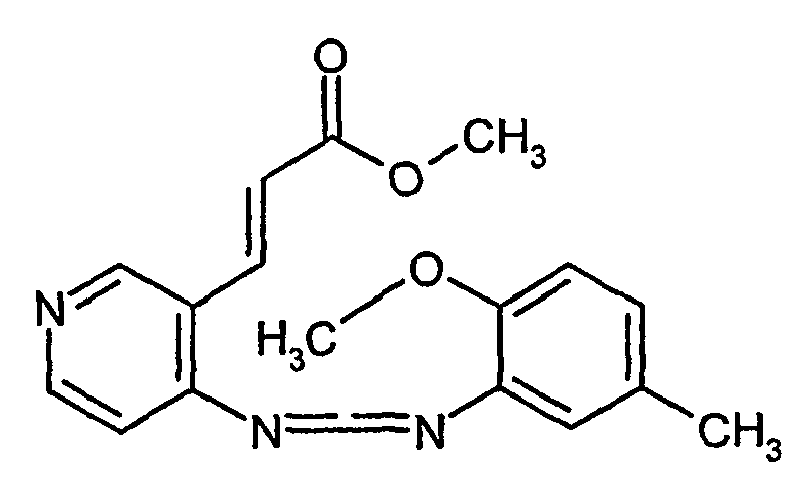
150 mg (0.28 mmol) Iminophosphoran aus Beispiel 12A werden gemäß allgemeiner Arbeitsvorschrift [B] mit 67 mg (0.42 mmol) 1-Methoxy-4-methylphenylisocyanat umgesetzt und das Rohprodukt ohne Reinigung weiter umgesetzt.150 mg (0.28 mmol) of iminophosphorane from Example 12A are reacted in accordance with general procedure [B] with 67 mg (0.42 mmol) of 1-methoxy-4-methylphenyl isocyanate and the crude product is reacted further without purification.

1000 mg (1.37 mmol) Aminopyridin aus Beispiel 13A werden gemäß allgemeiner Arbeitsvorschrift [B] mit 282 mg (1.51 mmol) 3-Trifluormethylphenylisocyanat umgesetzt und das Rohprodukt ohne Reinigung weiter umgesetzt.1000 mg (1.37 mmol) of aminopyridine from Example 13A are reacted according to general procedure [B] with 282 mg (1.51 mmol) of 3-trifluoromethylphenyl isocyanate and the crude product is reacted further without purification.
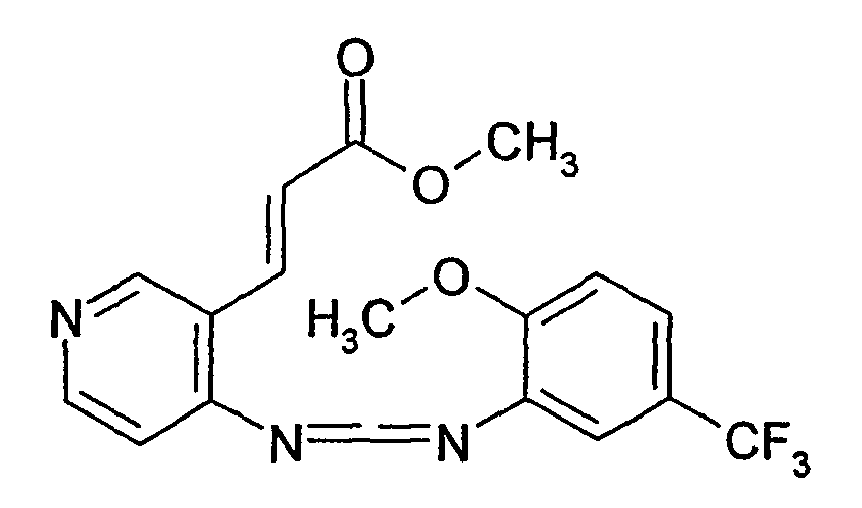
1017 mg (1.90 mmol) Iminophosphoran aus Beispiel 12A werden gemäß allgemeiner Arbeitsvorschrift [B] mit 413 mg (1.90 mmol) 1-Methoxy-4-trifluormethylphenylisocyanat umgesetzt und das Rohprodukt ohne Reinigung weiter umgesetzt.1017 mg (1.90 mmol) of iminophosphorane from Example 12A are reacted according to general procedure [B] with 413 mg (1.90 mmol) of 1-methoxy-4-trifluoromethylphenyl isocyanate and the crude product is reacted further without purification.

In 100 ml Dichlormethan werden 3 g (15.69 mmol) 2-Methoxy-5-trifluormethylanilin gelöst und mit 6.73 g (31.39 mmol) 1,8-Bis(dimethylamino)naphthalin versetzt. Bei 0-5°C werden 2.24 g (11.3 mmol) Chlorameisensäuretrichlormethylester, gelöst in 50 ml Dichlormethan, zugetropft und 30 min bei 0°C sowie 60 min bei Raumtemperatur gerührt. Bei 0°C wird mit 1N Salzsäure, Eiswasser und Natriumhydrogencarbonatlösung gewaschen. Nach Trocknen über Magnesiumsulfat und Abdestillieren des Lösungsmittels wird das Produkt erhalten. Das Isocyanat wird anschließend ohne weitere Reinigung in den folgenden Reaktionen umgesetzt. Ausbeute: 3 g (88% d. Th.)3 g (15.69 mmol) of 2-methoxy-5-trifluoromethylaniline are dissolved in 100 ml of dichloromethane, and 6.73 g (31.39 mmol) of 1,8-bis (dimethylamino) naphthalene are added. At 0-5 ° C, 2.24 g (11.3 mmol) trichloromethyl chloroformate, dissolved in 50 ml of dichloromethane, added dropwise and stirred for 30 min at 0 ° C and 60 min at room temperature. At 0 ° C is washed with 1N hydrochloric acid, ice water and sodium bicarbonate solution. After drying over magnesium sulfate and distilling off the solvent, the product is obtained. The isocyanate is then reacted without further purification in the following reactions. Yield: 3 g (88% of theory)
In Dichlormethan werden 1.0 eq Carbodiimid (ggfs. als Rohprodukt) gelöst, mit 1.05 eq Phenylpiperazin sowie einer Spatelspitze Kieselgel versetzt und das Reaktionsgemisch 16h unter Rückfluss gerührt. Anschließend wird das Lösungsmitztel in Vakuum entfernt und das Produkt mittels Chromatographie an Kieselgel oder mittels präparativer HPLC (Methode 2) gereinigt.1.0 eq of carbodiimide (if appropriate as crude product) are dissolved in dichloromethane, admixed with 1.05 eq of phenylpiperazine and a spatula-tip of silica gel, and the reaction mixture is stirred under reflux for 16 h. The solution is then removed in vacuo and the product is purified by chromatography on silica gel or by preparative HPLC (method 2).
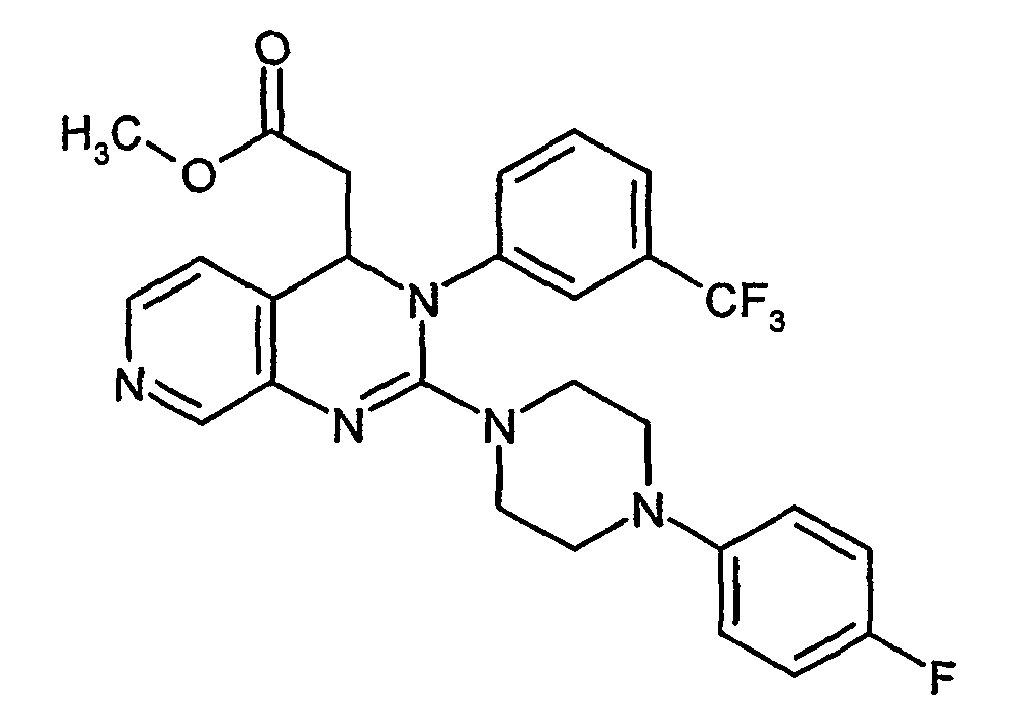
Ausgehend von 250 mg (0.34 mmol) des Carbodiimids aus Beispiel 17A und 65 mg (0.36 mmol) 4-Fluorphenylpiperazin werden gemäß allgemeiner Arbeitsvorschrift [C] und zweifacher Reinigung mittels präparativer HPLC 64 mg (33% d. Th.) Produkt erhalten.
HPLC (Methode 1): Rt = 4.42 min
MS (ESI-pos): m/z = 528 [M+H]+ Starting from 250 mg (0.34 mmol) of the carbodiimide from Example 17A and 65 mg (0.36 mmol) 4-fluorophenylpiperazine, 64 mg (33% of theory) of product are obtained by preparative HPLC according to general procedure [C] and repeated purification.
HPLC (Method 1): R t = 4.42 min
MS (ESI pos): m / z = 528 [M + H] +
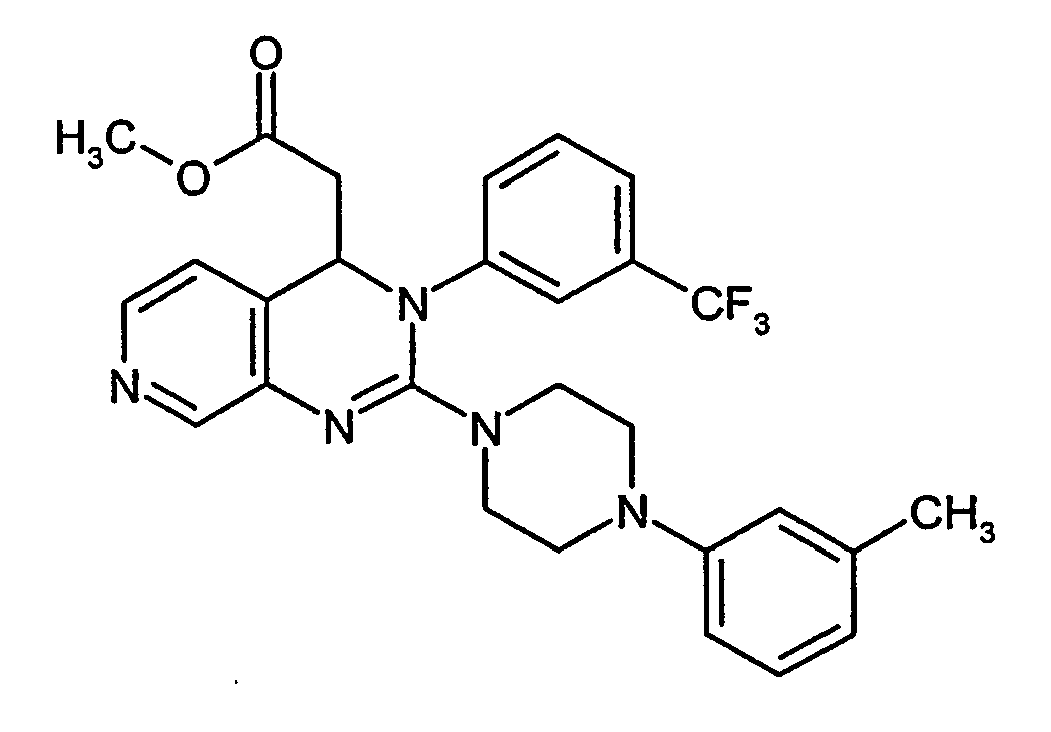
Ausgehend von 250 mg (0.34 mmol) des Carbodiimids aus Beispiel 17A und 63 mg (0.36 mmol) 3-Methylphenylpiperazin werden gemäß allgemeiner Arbeitsvorschrift [C] und Reinigung mittels präparativer HPLC 88 mg (48% d. Th.) Produkt erhalten.
HPLC (Methode 1): Rt = 4.42 min
MS (ESI-pos): m/z = 524 [M+H]+ Starting from 250 mg (0.34 mmol) of the carbodiimide from Example 17A and 63 mg (0.36 mmol) of 3-methylphenylpiperazine, 88 mg (48% of theory) of product are obtained in accordance with general procedure [C] and purification by means of preparative HPLC.
HPLC (Method 1): R t = 4.42 min
MS (ESI pos): m / z = 524 [M + H] +
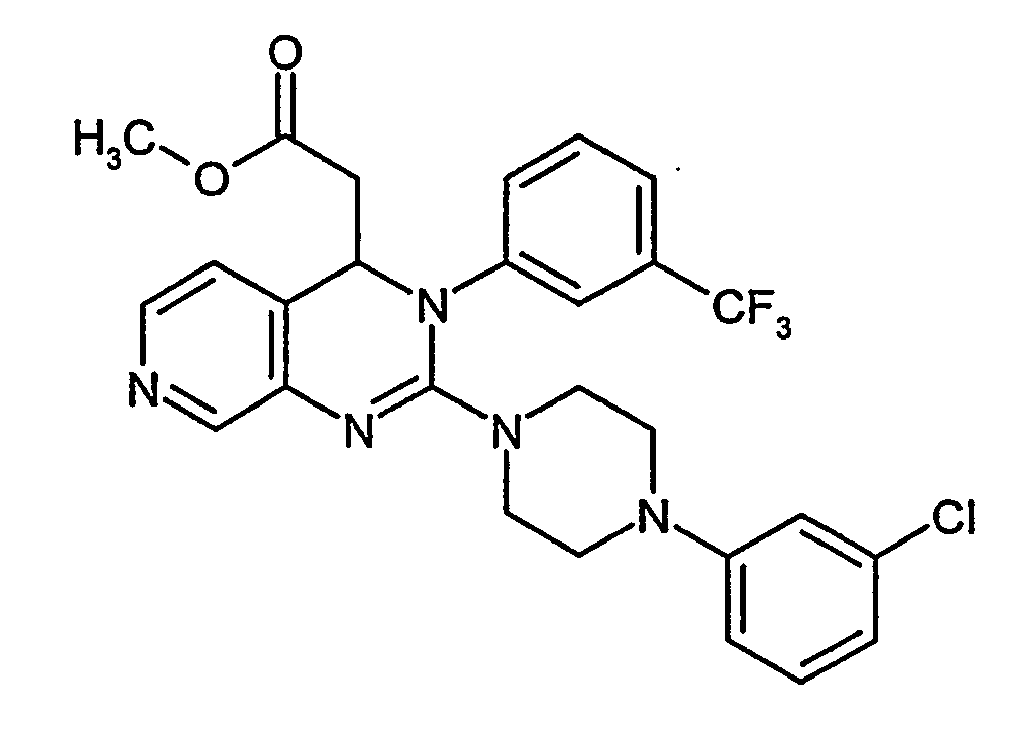
Ausgehend von 250 mg (0.34 mmol) des Carbodiimids aus Beispiel 17A und 71 mg (0.36 mmol) 3-Chlorphenylpiperazin werden gemäß allgemeiner Arbeitsvorschrift [C] und Reinigung mittels präparativer HPLC 102 mg (53% d. Th.) Produkt erhalten.
HPLC (Methode 1): Rt = 4.65 min
MS (ESI-pos): m/z = 544 [M+H]+ Starting from 250 mg (0.34 mmol) of the carbodiimide from Example 17A and 71 mg (0.36 mmol) of 3-chlorophenylpiperazine, 102 mg (53% of theory) of product are obtained according to general procedure [C] and purification by means of preparative HPLC.
HPLC (Method 1): R t = 4.65 min
MS (ESI pos): m / z = 544 [M + H] +

Ausgehend von 250 mg (0.34 mmol) des Carbodiimids aus Beispiel 17A und 69 mg (0.36 mmol) 3-Methoxyphenylpiperazin werden gemäß allgemeiner Arbeitsvorschrift [C] und Reinigung mittels präparativer HPLC 90 mg (46% d. Th.) Produkt erhalten.
HPLC (Methode 1): Rt = 4.40 min
MS (ESI-pos): m/z = 540 [M+H]+ Starting from 250 mg (0.34 mmol) of the carbodiimide from Example 17A and 69 mg (0.36 mmol) of 3-methoxyphenylpiperazine, 90 mg (46% of theory) of product are obtained in accordance with general procedure [C] and purification by means of preparative HPLC.
HPLC (Method 1): R t = 4.40 min
MS (ESI pos): m / z = 540 [M + H] +

Ausgehend von 107 mg (0.31 mmol) des Carbodiimids aus Beispiel 15A und 56 mg (0.31 mmol) 4-Fluorphenylpiperazin werden gemäß allgemeiner Arbeitsvorschrift [C] und Reinigung mittels präparativer HPLC 50 mg (28% d. Th.) Produkt erhalten.
HPLC (Methode 1): Rt = 4.60 min
MS (ESI-pos): m/z = 528 [M+H]+ Starting from 107 mg (0.31 mmol) of the carbodiimide from Example 15A and 56 mg (0.31 mmol) of 4-fluorophenylpiperazine, 50 mg (28% of theory) of product are obtained according to general procedure [C] and purification by means of preparative HPLC.
HPLC (Method 1): R t = 4.60 min
MS (ESI pos): m / z = 528 [M + H] +
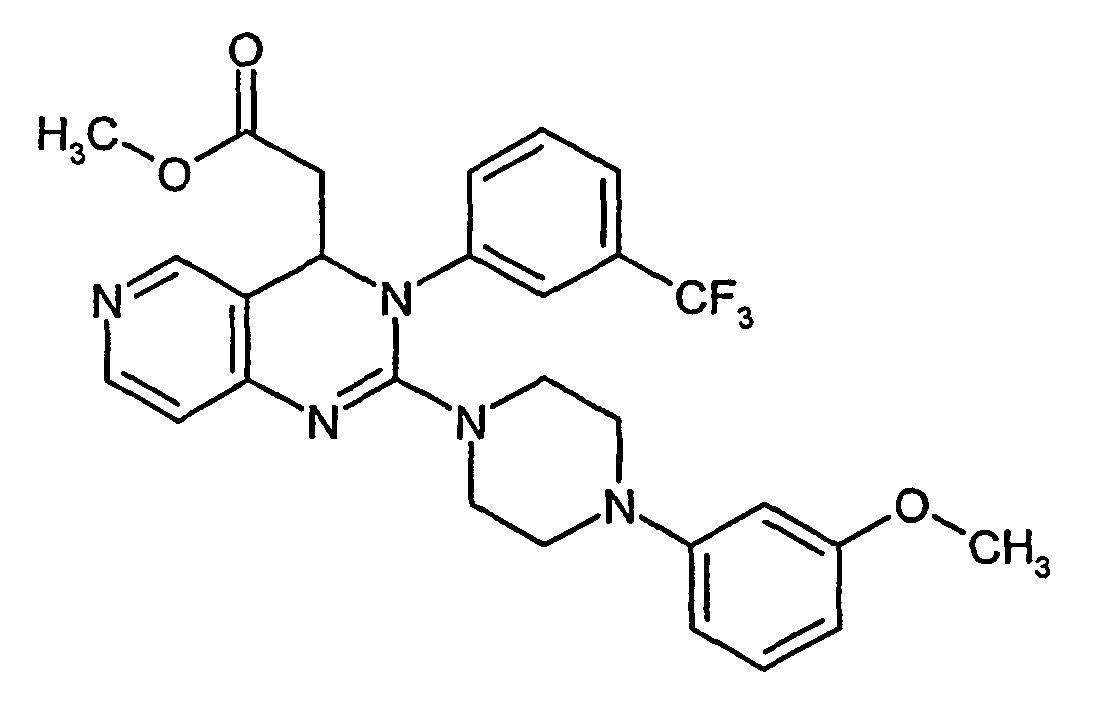
Ausgehend von 107 mg (0.31 mmol) des Carbodiimids aus Beispiel 15A und 59 mg (0.31 mmol) 3-Methoxyphenylpiperazin werden gemäß allgemeiner Arbeitsvorschrift [C] und Reinigung mittels präparativer HPLC 40 mg (23% d. Th.) Produkt erhalten.
HPLC (Methode 1): Rt = 4.60 min
MS (ESI-pos): m/z = 540 [M+H]+ Starting from 107 mg (0.31 mmol) of the carbodiimide from Example 15A and 59 mg (0.31 mmol) of 3-methoxyphenylpiperazine, 40 mg (23% of theory) of product are obtained according to general procedure [C] and purification by means of preparative HPLC.
HPLC (Method 1): R t = 4.60 min
MS (ESI-pos): m / z = 540 [M + H] +
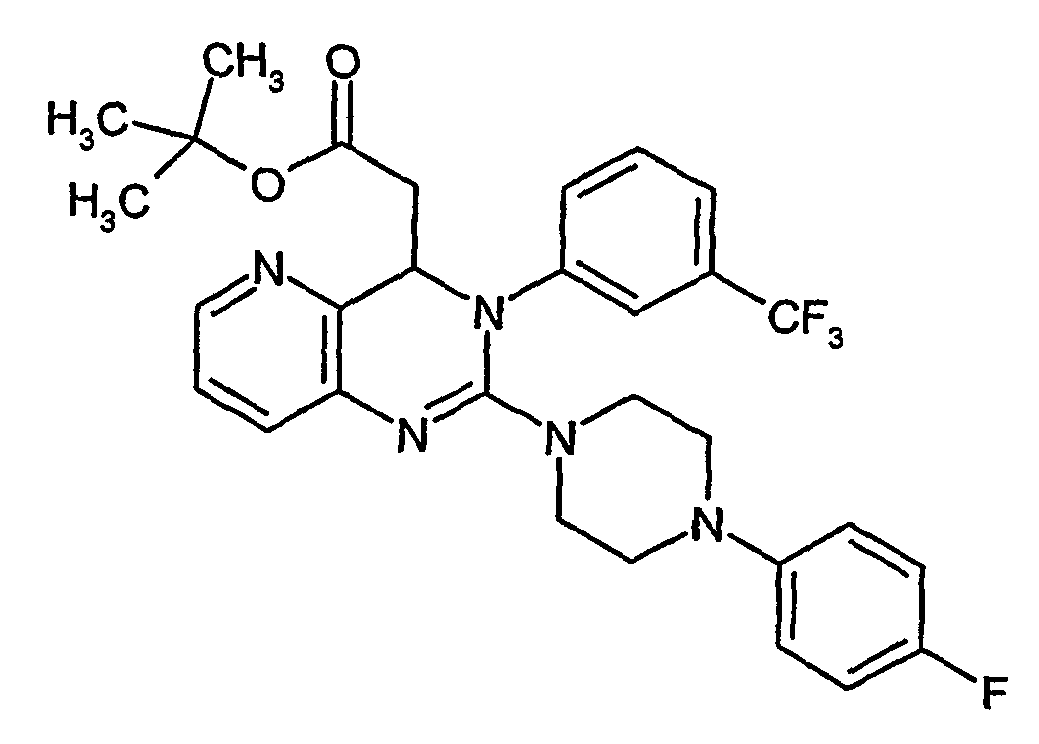
Ausgehend von 53 mg (0.14 mmol) des Carbodiimids aus Beispiel 14A und 24 mg (0.14 mmol) 4-Fluorphenylpiperazin werden gemäß allgemeiner Arbeitsvorschrift [C] und Reinigung an präparativer HPLC 38 mg (48% d. Th.) Produkt erhalten.
HPLC (Methode 1): Rt = 4.87 min
MS (ESI-pos): m/z = 570 [M+H]+ Starting from 53 mg (0.14 mmol) of the carbodiimide from Example 14A and 24 mg (0.14 mmol) 4-fluorophenylpiperazine, 38 mg (48% of theory) of product are obtained according to general procedure [C] and purification on preparative HPLC.
HPLC (method 1): R t = 4.87 min
MS (ESI-pos): m / z = 570 [M + H] +

Ausgehend von 91 mg (0.28 mmol) des Carbodiimids aus Beispiel 16A und 76 mg (0.42 mmol) 4-Fluorphenylpiperazin werden gemäß allgemeiner Arbeitsvorschrift [C] und Reinigung mittels präparativer HPLC 14 mg (9% d. Th.) Produkt erhalten.
HPLC (Methode 1): Rt = 4.23 min
MS (ESI-pos): m/z = 504 [M+H]+ Starting from 91 mg (0.28 mmol) of the carbodiimide from Example 16A and 76 mg (0.42 mmol) of 4-fluorophenylpiperazine, 14 mg (9% of theory) of product are obtained according to general procedure [C] and purification by means of preparative HPLC.
HPLC (Method 1): R t = 4.23 min
MS (ESI pos): m / z = 504 [M + H] +
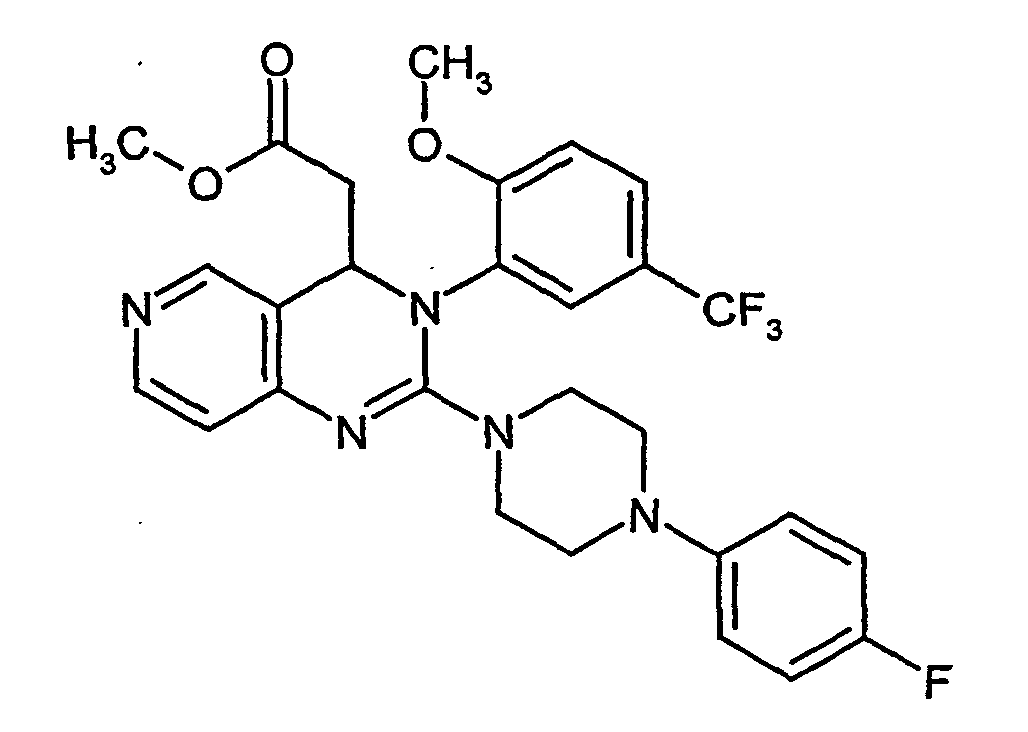
Ausgehend von 565 mg (1.50 mmol) des Carbodiimids aus Beispiel 18A und 297 mg (1.65 mmol) 4-Fluorphenylpiperazin werden gemäß allgemeiner Arbeitsvorschrift [C] und Reinigung mittels präparativer HPLC 90 mg (10% d. Th.) Produkt erhalten.
HPLC (Methode 1): Rt = 4.44 min
MS (ESI-pos): m/z = 558 [M+H]+ Starting from 565 mg (1.50 mmol) of the carbodiimide from Example 18A and 297 mg (1.65 mmol) of 4-fluorophenylpiperazine, 90 mg (10% of theory) of product are obtained according to general procedure [C] and purification by means of preparative HPLC.
HPLC (Method 1): R t = 4.44 min
MS (ESI pos): m / z = 558 [M + H] +
In Dioxan werden 1.0 Äquivalente des Esters gelöst (ca. 0.5 M Lösung), dann 3.0 Äquivalente 1N Natronlauge zugegeben und das Reaktionsgemisch über 16h bei 50°C gerührt. Anschließend wird der Ansatz mit 1N Salzsäure auf pH 5 eingestellt, das Lösungsmittel im Vakuum entfernt und das Produkt mittels Chromatographie an Kieselgel oder präparativer HPLC gereinigt.In dioxane, 1.0 equivalents of the ester are dissolved (about 0.5 M solution), then 3.0 equivalents of 1N sodium hydroxide solution was added and the reaction mixture was stirred at 50 ° C for 16 h. The mixture is then adjusted to pH 5 with 1N hydrochloric acid, the solvent is removed in vacuo and the product is purified by chromatography on silica gel or preparative HPLC.

Ausgehend von 44 mg (0.08 mmol) des Esters aus Beispiel 20A werden nach Umsetzung gemäß allgemeiner Arbeitsvorschrift [D] und Reinigung mittels präparativer HPLC 24 mg (52% d. Th.) Produkt erhalten.
HPLC (Methode 1): Rt = 4.19 min
MS (ESI-pos): m/z = 514 [M+H-HCl]+
1H-NMR (400 MHz, CD3CN+DMSO-d6): δ [ppm] = 8.34 (s, 1H); 8.11 (d, 1H); 7.62 (s, 1H); 7.47 (t, 1H); 7.39-7.37 (m, 2H); 7.07 (t, 1H); 6.99 (t, 1H); 6.91-6.87 (m, 1H); 5.27-5.23 (m, 1H); 3.58-3.53 (m, 2H), weitere Protonen unter dem Lösungsmittel- bzw. Wassersignal.Starting from 44 mg (0.08 mmol) of the ester from Example 20A, after reaction in accordance with general procedure [D] and purification by means of preparative HPLC, 24 mg (52% of theory) of product are obtained.
HPLC (Method 1): R t = 4.19 min
MS (ESI-pos): m / z = 514 [M + H-HCl] +
1 H-NMR (400 MHz, CD 3 CN + DMSO-d 6 ): δ [ppm] = 8.34 (s, 1H); 8.11 (d, 1H); 7.62 (s, 1H); 7.47 (t, 1H); 7.39-7.37 (m, 2H); 7.07 (t, 1H); 6.99 (t, 1H); 6.91-6.87 (m, 1H); 5.27-5.23 (m, 1H); 3.58-3.53 (m, 2H), other protons under the solvent or water signal.

Ausgehend von 70 mg (0.13 mmol) des Esters aus Beispiel 21A werden nach Umsetzung gemäß allgemeiner Arbeitsvorschrift [D] und Reinigung mittels präparativer HPLC 51 mg (71% d. Th.) Produkt erhalten.
HPLC (Methode 1): Rt = 4.21 min
MS (ESI-pos): m/z = 510 [M+H-HCl]+
1H-NMR (400 MHz, CD3CN+DMSO-d6): δ [ppm] = 8.34 (s, 1H); 8.12 (d, 1H); 7.62 (s, 1H); 7.44 (t, 1H); 7.38-7.36 (m, 2H); 7.10 (t, 1H); 7.05 (d, 1H); 6.89-6.88 (m, 1H); 6.72-6.64 (m, 3H); 5.26-5.22 (m, 1H); 3.59-3.53 (m, 2H); 3.08-2.95 (m, 3H); 2.72-2.65 (m, 1H); 2.48-2.46 (m, 1H); 2.25 (s, 3H).Starting from 70 mg (0.13 mmol) of the ester from Example 21A, 51 mg (71% of theory) of product are obtained after reaction in accordance with general procedure [D] and purification by means of preparative HPLC.
HPLC (Method 1): R t = 4.21 min
MS (ESI-pos): m / z = 510 [M + H-HCl] +
1 H-NMR (400 MHz, CD 3 CN + DMSO-d 6 ): δ [ppm] = 8.34 (s, 1H); 8.12 (d, 1H); 7.62 (s, 1H); 7.44 (t, 1H); 7.38-7.36 (m, 2H); 7.10 (t, 1H); 7.05 (d, 1H); 6.89-6.88 (m, 1H); 6.72-6.64 (m, 3H); 5.26-5.22 (m, 1H); 3.59-3.53 (m, 2H); 3.08-2.95 (m, 3H); 2.72-2.65 (m, 1H); 2.48-2.46 (m, 1H); 2.25 (s, 3H).

Ausgehend von 84 mg (0.15 mmol) des Esters aus Beispiel 22A werden nach Umsetzung gemäß allgemeiner Arbeitsvorschrift [D] und Reinigung mittels präparativer HPLC 44 mg (52% d. Th.) Produkt erhalten.
HPLC (Methode 1): Rt = 4.43 min.
MS (ESI-pos): m/z = 530 [M+H-HCl]+
1H-NMR (400 MHz, CD3CN+DMSO-d6): δ [ppm] = 8.34 (s, 1H); 8.12 (d, 1H); 7.62 (s, 1H); 7.46 (t, 1H); 7.39-7.35 (m, 2H); 7.19 (t, 1H); 7.05 (d, 1H); 6.89-6.88 (m, 1H); 6.83-6.79 (m, 2H); 5.26-5.22 (m, 1H); 3.59-3.53 (m, 2H); 3.13-3.02 (m, 3H); 2.72-2.65 (m, 1H); 2.48-2.41 (m, 1H).Starting from 84 mg (0.15 mmol) of the ester from Example 22A, 44 mg (52% of theory) of product are obtained after reaction in accordance with general procedure [D] and purification by means of preparative HPLC.
HPLC (Method 1): R t = 4.43 min.
MS (ESI-pos): m / z = 530 [M + H-HCl] +
1 H-NMR (400 MHz, CD 3 CN + DMSO-d 6 ): δ [ppm] = 8.34 (s, 1H); 8.12 (d, 1H); 7.62 (s, 1H); 7.46 (t, 1H); 7.39-7.35 (m, 2H); 7.19 (t, 1H); 7.05 (d, 1H); 6.89-6.88 (m, 1H); 6.83-6.79 (m, 2H); 5.26-5.22 (m, 1H); 3.59-3.53 (m, 2H); 3.13-3.02 (m, 3H); 2.72-2.65 (m, 1H); 2.48-2.41 (m, 1H).
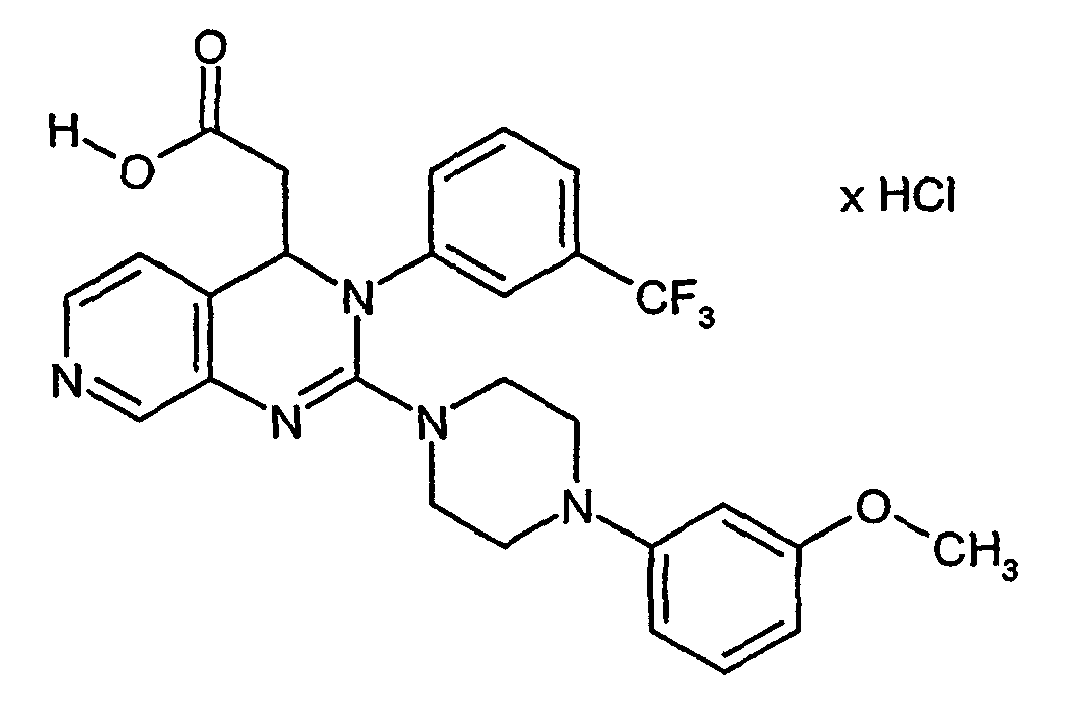
Ausgehend von 72 mg (0.13 mmol) des Esters aus Beispiel 23A werden nach Umsetzung gemäß allgemeiner Arbeitsvorschrift [D] und Reinigung mittels präparativer HPLC 48 mg (67% d. Th.) Produkt erhalten.
HPLC (Methode 1): Rt = 4.18 min.
MS (ESI-pos): m/z = 526 [M+H-HCl]+
1H-NMR (400 MHz, CD3CN+DMSO-d6): δ [ppm] = 8.35 (s, 1H); 8.12 (d, 1H); 7.56 (s, 1H); 7.46 (t, 1H); 7.39-7.36 (m, 2H); 7.12 (t, 1H); 7.05 (d, 1H); 6.50-6.47 (m, 1H); 6.43-6.39 (m, 2H); 5.26-5.22 (m, 1H); 3.73 (s, 3H); 3.59-3.52 (m, 2H); 3.09-2.98 (m, 3H); 2.72-2.65 (m, 1H); 2.48-2.46 (m, 1H).Starting from 72 mg (0.13 mmol) of the ester from Example 23A, 48 mg (67% of theory) of product are obtained after reaction in accordance with general procedure [D] and purification by means of preparative HPLC.
HPLC (Method 1): R t = 4.18 min.
MS (ESI-pos): m / z = 526 [M + H-HCl] +
1 H-NMR (400 MHz, CD 3 CN + DMSO-d 6 ): δ [ppm] = 8.35 (s, 1H); 8.12 (d, 1H); 7.56 (s, 1H); 7.46 (t, 1H); 7.39-7.36 (m, 2H); 7.12 (t, 1H); 7.05 (d, 1H); 6.50-6.47 (m, 1H); 6.43-6.39 (m, 2H); 5.26-5.22 (m, 1H); 3.73 (s, 3H); 3.59-3.52 (m, 2H); 3.09-2.98 (m, 3H); 2.72-2.65 (m, 1H); 2.48-2.46 (m, 1H).
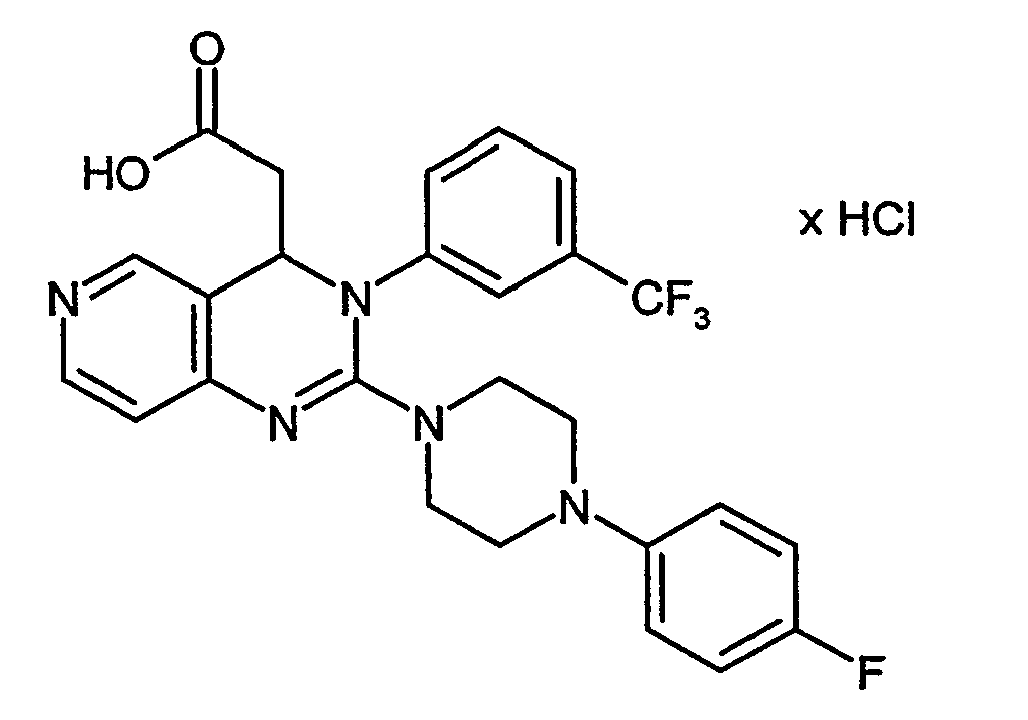
Ausgehend von 38 mg (0.07 mmol) des Esters aus Beispiel 24A werden nach Umsetzung gemäß allgemeiner Arbeitsvorschrift [D] und Reinigung mittels präparativer HPLC 24 mg (67% d. Th.) Produkt erhalten.
HPLC (Methode 1): Rt = 4.24 min.
MS (ESI-pos): m/z = 514 [M+H-HCl]+
1H-NMR (400 MHz, CD3CN): δ [ppm]= 8.22 (d, 1H); 8.18 (s, 1H); 7.45 (s, 1H); 7.40-7.36 (m, 3H); 7.03-6.83 (m, 5H); 5.28 (t, 1H); 3.603-3.50 (m, 4H); 2.99-2.90 (m, 4H); 2.78 (dd, 1H); 2.57 (dd, 1H).Starting from 38 mg (0.07 mmol) of the ester from Example 24A, 24 mg (67% of theory) of product are obtained after reaction in accordance with general procedure [D] and purification by means of preparative HPLC.
HPLC (Method 1): R t = 4.24 min.
MS (ESI-pos): m / z = 514 [M + H-HCl] +
1 H-NMR (400 MHz, CD 3 CN): δ [ppm] = 8.22 (d, 1H); 8.18 (s, 1H); 7.45 (s, 1H); 7.40-7.36 (m, 3H); 7.03-6.83 (m, 5H); 5.28 (t, 1H); 3,603-3.50 (m, 4H); 2.99-2.90 (m, 4H); 2.78 (dd, 1H); 2.57 (dd, 1H).
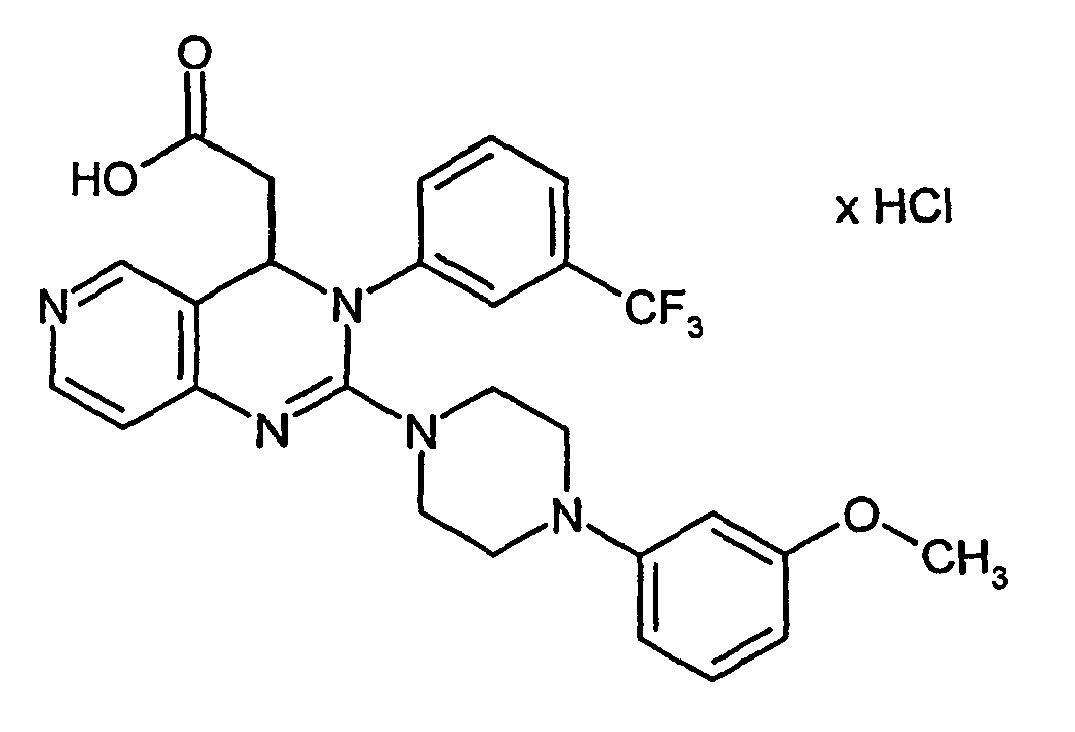
Ausgehend von 27 mg (0.05 mmol) des Esters aus Beispiel 25A werden nach Umsetzung gemäß allgemeiner Arbeitsvorschrift [D] und Reinigung mittels präparativer HPLC 19 mg (72% d. Th.) Produkt erhalten.
HPLC (Methode 1): Rt = 4.24 min.
MS (ESI-pos): m/z = 526 [M+H-HCl]+
1H-NMR (400 MHz, CD3CN): δ [ppm] = 8.24 (d, 1H); 8.18 (s, 1H); 7.45 (s, 1H); 7.40-7.35 (m, 3H); 7.12 (t, 1H); 7.01 (d, 1H); 6.45 (d, 1H); 6.41-6.38 (m, 2H); 5.28 (t, 1H); 3.72 (s, 3H); 3.60-3.54 (m, 4H); 3.07-2.78 (m, 4H); 2.55 (dd, 2H).Starting from 27 mg (0.05 mmol) of the ester from Example 25A, 19 mg (72% of theory) of product are obtained after reaction in accordance with general procedure [D] and purification by means of preparative HPLC.
HPLC (Method 1): R t = 4.24 min.
MS (ESI-pos): m / z = 526 [M + H-HCl] +
1 H-NMR (400 MHz, CD 3 CN): δ [ppm] = 8.24 (d, 1H); 8.18 (s, 1H); 7.45 (s, 1H); 7.40-7.35 (m, 3H); 7.12 (t, 1H); 7.01 (d, 1H); 6.45 (d, 1H); 6.41-6.38 (m, 2H); 5.28 (t, 1H); 3.72 (s, 3H); 3.60-3.54 (m, 4H); 3.07-2.78 (m, 4H); 2.55 (dd, 2H).

Ausgehend von 25 mg (0.04 mmol) des Esters aus Beispiel 26A werden nach Umsetzung gemäß allgemeiner Arbeitsvorschrift [D] und Reinigung mittels präparativer HPLC 16 mg (66% d. Th.) Produkt erhalten.
HPLC (Methode 1): Rt = 4.30 min.
MS (ESI-pos): m/z = 514 [M+H-HCl]+
1H-NMR (400 MHz, CD3CN): δ [ppm] = 8.12 (d, 1H); 7.60 (s, 1H); 7.45-7.39 (m, 4H); 7.22 (dd, 1H); 6.96 (t, 2H); 6.89-6.86 (m, 2H); 5.18 (dd, 1H); 3.68-3.59 (m, 4H); 3.06-2.99 (m, 4H); 2.76 (dd, 1H); 2.63 (dd, 1H).Starting from 25 mg (0.04 mmol) of the ester from Example 26A, 16 mg (66% of theory) of product are obtained after reaction in accordance with general procedure [D] and purification by means of preparative HPLC.
HPLC (Method 1): R t = 4.30 min.
MS (ESI-pos): m / z = 514 [M + H-HCl] +
1 H-NMR (400 MHz, CD 3 CN): δ [ppm] = 8.12 (d, 1H); 7.60 (s, 1H); 7.45-7.39 (m, 4H); 7.22 (dd, 1H); 6.96 (t, 2H); 6.89-6.86 (m, 2H); 5.18 (dd, 1H); 3.68-3.59 (m, 4H); 3.06-2.99 (m, 4H); 2.76 (dd, 1H); 2.63 (dd, 1H).
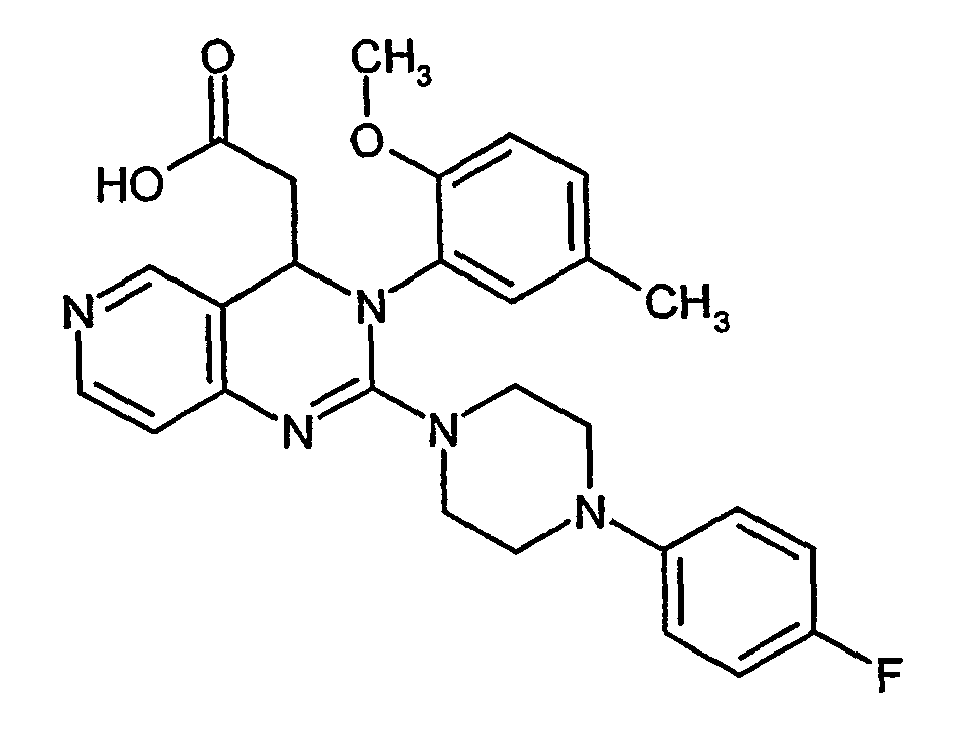
Ausgehend von 12 mg (0.02 mmol) des Esters aus Beispiel 27A werden nach Umsetzung gemäß allgemeiner Arbeitsvorschrift [D] und Reinigung mittels präparativer HPLC 11 mg (97% d. Th.) Produkt erhalten.
HPLC (Methode 1): Rt = 4.05 min.
MS (ESI-pos): m/z = 490 [M+H]+
1H-NMR (400 MHz, CD3CN): δ [ppm] = 8.14-8.10 (m, 2H); 7.15-6.81 (m, 8H); 4.86-4.84 (m, 1H); 3.77-3.73 (m, 4H); 3.50 (s, 3H); 2.96-2.92 (m, 2H); 2.78-2.74 (m, 2H); 2.49 (dd, 1H); 2.50-2.48 (m, 1H, teilweise unter CH3-Signal); 2.44 (s, 3H).Starting from 12 mg (0.02 mmol) of the ester from Example 27A, 11 mg (97% of theory) of product are obtained after reaction in accordance with general procedure [D] and purification by means of preparative HPLC.
HPLC (Method 1): R t = 4.05 min.
MS (ESI pos): m / z = 490 [M + H] +
1 H-NMR (400 MHz, CD 3 CN): δ [ppm] = 8.14-8.10 (m, 2H); 7.15-6.81 (m, 8H); 4.86-4.84 (m, 1H); 3.77-3.73 (m, 4H); 3.50 (s, 3H); 2.96-2.92 (m, 2H); 2.78-2.74 (m, 2H); 2.49 (dd, 1H); 2.50-2.48 (m, 1H, partially under CH 3 signal); 2.44 (s, 3H).

Ausgehend von 80 mg (0.14 mmol) des Esters aus Beispiel 28A werden nach Umsetzung gemäß allgemeiner Arbeitsvorschrift [D] und Reinigung mittels präparativer HPLC 27 mg (35% d. Th.) Produkt erhalten.
HPLC (Methode 3): Rt = 2.31 min.
MS (ESI-pos): m/z = 543 [M+H]+
1H-NMR (400 MHz, CD3CN): δ [ppm] = 8.26-8.20 (m, 2H); 7.55 (d, 1H); 7.16 (d, 1H); 7.10-6.78 (m, 6H); 5.00 (dd, 1H); 3.88-3.80 (m, 4H); 3.54 (s, 3H); 3.03 (dd, 1H); 2.96-2.91 (m, 2H); 2.79-2.77 (m, 2H); 2.55 (dd, 1H).Starting from 80 mg (0.14 mmol) of the ester from Example 28A, 27 mg (35% of theory) of product are obtained after reaction in accordance with general procedure [D] and purification by means of preparative HPLC.
HPLC (Method 3): R t = 2.31 min.
MS (ESI pos): m / z = 543 [M + H] +
1 H-NMR (400 MHz, CD 3 CN): δ [ppm] = 8.26-8.20 (m, 2H); 7.55 (d, 1H); 7.16 (d, 1H); 7.10-6.78 (m, 6H); 5.00 (dd, 1H); 3.88-3.80 (m, 4H); 3.54 (s, 3H); 3.03 (dd, 1H); 2.96-2.91 (m, 2H); 2.79-2.77 (m, 2H); 2.55 (dd, 1H).
Die in vitro-Wirkung der erfindungsgemäßen Verbindungen kann in folgenden Assays gezeigt werden:The in vitro activity of the compounds according to the invention can be shown in the following assays:
Die Testverbindungen werden als 50 millimolare (mM) Lösungen in Dimethysulfoxid (DMSO) eingesetzt. Ganciclovir®, Foscarnet® und Cidofovir® dienen als Referenzverbindungen. Nach der Zugabe von jeweils 2 µl der 50, 5, 0.5 und 0.05 mM DMSO-Stammlösungen zu je 98 µl Zellkulturmedium in der Reihe 2 A-H in Doppelbestimmung werden 1:2-Verdünnungen mit je 50 µl Medium bis zur Reihe 11 der 96-Well-Platte durchgeführt. Die Wells in den Reihen 1 und 12 enthalten je 50 µl Medium. In die Wells werden dann je 150 µl einer Suspension von 1 x 10⁴ Zellen (humane Vorhautfibroblasten [NHDF]) pipettiert (Reihe 1 = Zellkontrolle) bzw. in die Reihen 2-12 ein Gemisch von HCMV-infizierten und nichtinfizierten NHDF-Zellen (M.O.I. = 0.001 - 0.002), d.h. 1-2 infizierte Zellen auf 1000 nicht-infizierte Zellen. Die Reihe 12 (ohne Substanz) dient als Viruskontrolle. Die End-Testkonzentrationen liegen bei 250 - 0.0005 µM. Die Platten werden 6 Tage bei 37°C / 5% CO2 inkubiert, d.h. bis in den Viruskontrollen alle Zellen infiziert sind (100% cytopathogener Effekt [CPE]). Die Wells werden dann durch Zugabe eines Gemisches von Formalin und Giemsa's Farbstoff fixiert und gefärbt (30 Minuten), mit aqua bidest. gewaschen und im Trockenschrank bei 50°C getrocknet. Danach werden die Platten mit einem Overhead-Mikroskop (Plaque Multiplier der Firma Technomara) visuell ausgewertet.The test compounds are used as 50 millimolar (mM) solutions in dimethylsulfoxide (DMSO). Ganciclovir ®, foscarnet and cidofovir ® ® used as reference compounds. After the addition of 2 .mu.l each of the 50, 5, 0.5 and 0.05 mM DMSO stock solutions of 98 .mu.l cell culture medium in the series 2 AH in duplicate, 1: 2 dilutions with 50 ul medium to 11 row of 96-well Plate. The wells in rows 1 and 12 each contain 50 μl of medium. 150 μl of a suspension of 1 × 10 4 cells (human foreskin fibroblasts [NHDF]) are then pipetted into the wells (row 1 = cell control) or into the rows 2-12 a mixture of HCMV-infected and noninfected NHDF cells ( MOI = 0.001 - 0.002), ie 1-2 infected cells per 1000 non-infected cells. The series 12 (without substance) serves as a virus control. The final test concentrations are 250 - 0.0005 μM. The plates are incubated for 6 days at 37 ° C./5% CO 2 , ie until all cells are infected in the virus controls (100% cytopathogenic effect [CPE]). The wells are then fixed and stained by adding a mixture of formalin and Giemsa's dye (30 minutes), with double-distilled water. washed and dried in a drying oven at 50 ° C. Thereafter, the plates are visually evaluated with an overhead microscope (Plaque Multiplier from Technomara).
Die folgenden Daten können von den Testplatten ermittelt werden:
- CC50 (NHDF) = Substanzkonzentration in µM, bei der im Vergleich zur unbehandelten Zellkontrolle keine sichtbaren cytostatischen Effekte auf die Zellen erkennbar sind;
- EC50 (HCMV) = Substanzkonzentration in µM, die den CPE (cytopathischen Effekt) um 50% im Vergleich zur unbehandelten Viruskontrolle hemmt;
- SI (Selektivitätsindex) = CC50 (NHDF) / EC50 (HCMV).
- CC 50 (NHDF) = substance concentration in μM, in which no visible cytostatic effects on the cells are recognizable in comparison to the untreated cell control;
- EC 50 (HCMV) = substance concentration in μM, which inhibits the CPE (cytopathic effect) by 50% compared to the untreated virus control;
- SI (selectivity index) = CC 50 (NHDF) / EC 50 (HCMV).
Repräsentative in-vitro-Wirkdaten für die erfindungsgemäßen Verbindungen sind in Tabelle A wiedergegeben:
Die Eignung der erfindungsgemäßen Verbindungen zur Behandlung von HCMV-Infektionen kann im folgenden Tiermodell gezeigt werden:The suitability of the compounds according to the invention for the treatment of HCMV infections can be demonstrated in the following animal model:
3-4 Wochen alte weibliche immundefiziente Mäuse (16-18 g), Fox Chase SCID oder Fox Chase SCID-NOD oder SCID-beige werden von kommerziellen Züchtern (Taconic M+B, Jackson, USA) bezogen. Die Tiere werden unter sterilen Bedingungen (einschließlich Streu und Futter) in Isolatoren gehalten.3-4 week old female immunodeficient mice (16-18 g), Fox Chase SCID or Fox Chase SCID-NOD or SCID-beige are purchased from commercial breeders (Taconic M + B, Jackson, USA). The animals are kept in isolators under sterile conditions (including litter and food).
Humanes Cytomegalovirus (HCMV), Stamm Davis oder AD169, wird in vitro auf humanen embryonalen Vorhautfibroblasten (NHDF-Zellen) angezüchtet. Nach Infektion der NHDF-Zellen mit einer Multiplizität der Infektion (M.O.I) von 0.01-0.03 werden die virusinfizierten Zellen 5-10 Tage später geerntet und in Gegenwart von Minimal Essential Medium (MEM), 10% foetalem Kälberserum (FKS) mit 10% DMSO bei -40°C aufbewahrt. Nach serieller Verdünnung der virusinfizierten Zellen in Zehnerschritten erfolgt die Titerbestimmung auf 24-Well-Platten konfluenter NHDF-Zellen nach Vitalfärbung mit Neutralrot.Human cytomegalovirus (HCMV) strain Davis or AD169 is grown in vitro on human embryonic foreskin fibroblasts (NHDF cells). After infection of the NHDF cells with a multiplicity of infection (MOI) of 0.01-0.03, the virus-infected cells are harvested 5-10 days later and in the presence of Minimal Essential Medium (MEM), 10% fetal calf serum (FCS) with 10% DMSO stored at -40 ° C. After serial dilution of the virus-infected cells in increments of ten, the titer is determined on 24-well plates of confluent NHDF cells after vital staining with neutral red.
1x1x1 cm große Kollagenschwämme (Gelfoam®; Fa. Peasel & Lorey, Best.-Nr. 407534; K.T.
Zur Untersuchung der mechanism-based (irreversiblen) Inhibition von CYP3A4 wird die Testsubstanz in verschiedenen Konzentrationen mit Humanlebermikrosomen (2mg/ml mikrosomales Protein) in Kaliumphosphatpuffer pH 7.4 unter Zusatz von NADPH-generierendem System (NADP+, Glucose-6-phosphat und Glucose-6-phosphatdehydrogenase) bei 37°C inkubiert. Zu verschiedenen Zeitpunkten werden 2 Aliqouts aus der Inkubation entnommen.To investigate the mechanism-based (irreversible) inhibition of CYP3A4, the test substance is incubated in different concentrations with human liver microsomes (2 mg / ml microsomal protein) in potassium phosphate buffer pH 7.4 with the addition of NADPH-generating system (NADP + , glucose-6-phosphate and glucose). 6-phosphate dehydrogenase) at 37 ° C. At different times, 2 aliquots are taken from the incubation.
Das erste Aliqout wird 1:50 in eine neue Inkubationslösung (Phosphatpuffer, NADPH-generierendes System und 10 µM Midazolam) für weitere 10 min bei 37°C inkubiert. Danach wird die Inkubation mit Acetonitril auf Eis gestoppt, in der Zentrifuge bei 15000g das Protein pelletiert, und der Überstand mit HPLC/MS nach Standardmethoden auf die Bildung von 1'-Hydroxymidazolam analysiert.The first aliquot is incubated 1:50 in a new incubation solution (phosphate buffer, NADPH-generating system and 10 μM midazolam) for an additional 10 minutes at 37 ° C. Thereafter, the incubation with acetonitrile is stopped on ice, pelleted in the centrifuge at 15000g, and the supernatant was analyzed for the formation of 1'-hydroxymidazolam by HPLC / MS according to standard methods.
Das zweite Aliquot wird mit Acetonitril auf Eis gestoppt und mit HPLC/UV/MS auf verbleibenden Testsubstanz analysiert.The second aliquot is quenched with acetonitrile on ice and analyzed by HPLC / UV / MS for remaining test substance.
Aus beiden analytischen Datensätzen werden für irreversible Inhibition typische Parameter (kinact, Ki und partition ratio r) bestimmt und die Testsubstanz damit bewertet (vgl.
Die erfindungsgemäßen Verbindungen können folgendermaßen in pharmazeutische Zubereitungen überführt werden:The compounds according to the invention can be converted into pharmaceutical preparations as follows:
100 mg der Verbindung von Beispiel 1, 50 mg Lactose (Monohydrat), 50 mg Maisstärke (nativ), 10 mg Polyvinylpyrolidon (PVP 25) (Fa. BASF, Ludwigshafen, Deutschland) und 2 mg Magnesiumstearat.
Tablettengewicht 212 mg. Durchmesser 8 mm, Wölbungsradius 12 mm.100 mg of the compound of Example 1, 50 mg of lactose (monohydrate), 50 mg of corn starch (native), 10 mg of polyvinylpyrrolidone (PVP 25) (BASF, Ludwigshafen, Germany) and 2 mg of magnesium stearate.
Tablet weight 212 mg. Diameter 8 mm, radius of curvature 12 mm.
Die Mischung aus Wirkstoff, Lactose und Stärke wird mit einer 5%-igen Lösung (m/m) des PVPs in Wasser granuliert. Das Granulat wird nach dem Trocknen mit dem Magnesiumstearat für 5 min. gemischt. Diese Mischung wird mit einer üblichen Tablettenpresse verpresst (Format der Tablette siehe oben). Als Richtwert für die Verpressung wird eine Presskraft von 15 kN verwendet.The mixture of active ingredient, lactose and starch is granulated with a 5% solution (m / m) of the PVP in water. The granules, after drying with the magnesium stearate for 5 min. mixed. This mixture is compressed with a conventional tablet press (for the tablet format see above). As a guideline for the compression, a pressing force of 15 kN is used.
1000 mg der Verbindung von Beispiel 1, 1000 mg Ethanol (96%), 400 mg Rhodigel (Xanthan gum der Fa. FMC, Pennsylvania, USA) und 99 g Wasser.1000 mg of the compound of Example 1, 1000 mg of ethanol (96%), 400 mg of Rhodigel (xanthan gum from FMC, Pennsylvania, USA) and 99 g of water.
Einer Einzeldosis von 100 mg der erfindungsgemäßen Verbindung entsprechen 10 ml orale Suspension.A single dose of 100 mg of the compound of the invention corresponds to 10 ml of oral suspension.
Das Rhodigel wird in Ethanol suspendiert, der Wirkstoff wird der Suspension zugefügt. Unter Rühren erfolgt die Zugabe des Wassers. Bis zum Abschluss der Quellung des Rhodigels wird ca. 6h gerührt.The rhodigel is suspended in ethanol, the active ingredient is added to the suspension. While stirring, the addition of water. Until the swelling of the Rhodigels is complete, it is stirred for about 6 hours.
10-500 mg der Verbindung von Beispiel 1, 15 g Polyethylenglykol 400 und 250 g Wasser für Injektionszwecke.10-500 mg of the compound of Example 1, 15 g of polyethylene glycol 400 and 250 g of water for injection.
Die Verbindung von Beispiel 1 wird zusammen mit Polyethylenglykol 400 in dem Wasser unter Rühren gelöst. Die Lösung wird sterilfiltriert (Porendurchmesser 0.22 µm) und unter aseptischen Bedingungen in hitzesterilisierte Infusionsflaschen abgefüllt. Diese werden mit Infusionsstopfen und Bördelkappen verschlossen.The compound of Example 1 is dissolved together with polyethylene glycol 400 in the water with stirring. The solution is sterile-filtered (pore diameter 0.22 μm) and filled under aseptic conditions into heat-sterilized infusion bottles. These are closed with infusion stoppers and crimp caps.
Claims (10)
- Compound of the formula
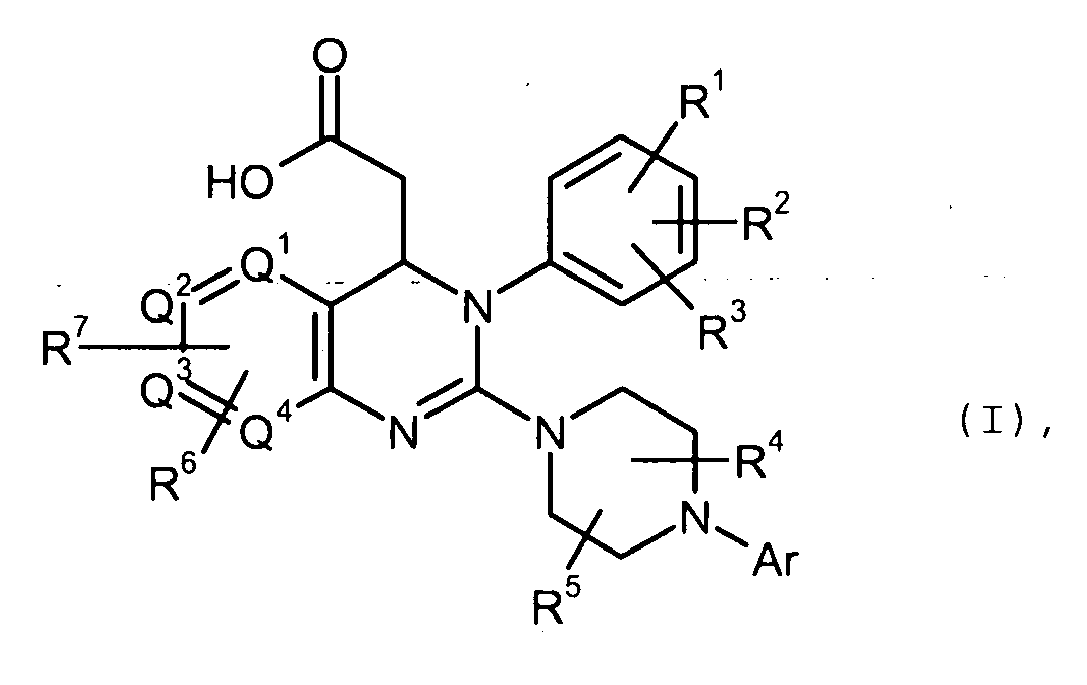 Ar is aryl, in which aryl may be substituted by 1 to 3 substituents, where the substituents are selected independently of one another from the group consisting of alkyl, alkoxy, formyl, hydroxycarbonyl, alkylcarbonyl, alkoxycarbonyl, trifluoromethyl, halogen, cyano, hydroxy, amino, alkylamino, aminocarbonyl and nitro,
in which alkyl may be substituted by 1 to 3 substituents, where the substituents are selected independently of one another from the group consisting of halogen, amino, alkylamino, hydroxy and aryl,
or two of the substituents on the aryl form together with the carbon atoms to which they are bonded a 1,3-dioxolane, a cyclopentane ring or a cyclohexane ring, and an optionally present third substituent is selected independently thereof from the said group,Q1, Q2, Q3 and Q4 are CH or N,
where one or two of Q1, Q2, Q3 and Q4 are N and the others are simultaneously CH,R1 is hydrogen, amino, alkyl, alkoxy, alkylamino, alkylthio, cyano, halogen, nitro or trifluoromethyl,R2 is hydrogen, alkyl, alkoxy, alkylthio, cyano, halogen, nitro or trifluoromethyl,R3 is amino, alkyl, alkoxy, alkylamino, alkylthio, cyano, halogen, nitro, trifluoromethyl, alkylsulphonyl or alkylaminosulphonyl,or
one of the radicals R1, R2 and R3 is hydrogen, alkyl, alkoxy, cyano, halogen, nitro or trifluoromethyl, and the other two form together with the carbon atoms to which they are bonded a 1,3-dioxolane, a cyclopentane ring or a cyclohexane ring,R4 is hydrogen or alkyl,R5 is hydrogen or alkyl,or
the radicals R4 and R5 in the piperazine ring are bonded to exactly opposite carbon atoms and form a methylene bridge optionally substituted by 1 to 2 methyl groups,R6 is hydrogen, alkyl, alkoxy, alkylthio, formyl, hydroxycarbonyl, aminocarbonyl, alkylcarbonyl, alkoxycarbonyl, trifluoromethyl, halogen, cyano, hydroxy or nitro,
andR7 is hydrogen, alkyl, alkoxy, alkylthio, formyl, hydroxycarbonyl, alkylcarbonyl, alkoxycarbonyl, trifluoromethyl, halogen, cyano, hydroxy or nitro,or one of the salts thereof, the solvates thereof or the solvates of the salts thereof. - Compound according to Claim 1, characterized in thatAr is phenyl, in which phenyl may be substituted by 1 to 3 substituents, where the substituents are selected independently of one another from the group consisting of C1-C6-alkyl, C1-C6-alkoxy, hydroxycarbonyl, C1-C6-alkylcarbonyl, C1-C6-alkoxycarbonyl, trifluoromethyl, fluorine, chlorine, bromine, cyano, hydroxy, amino, C1-C6-alkylamino and nitro,
or two of the substituents on the phenyl form together with the carbon atoms to which they are bonded a 1,3-dioxolane, and an optionally present third substituent is selected independently thereof from the said group,Q1, Q2 and Q3 are CH or N,
where always exactly one of Q1, Q2 and Q3 is N and the others are simultaneously CH,Q4 is CH,R1 is hydrogen, C1-C3-alkyl, C1-C3-alkoxy, C1-C3-alkylthio, fluorine or chlorine,R2 is hydrogen, C1-C3-alkyl, C1-C3-alkoxy, C1-C3-alkylthio, fluorine or chlorine,R3 is C1-C4-alkyl, cyano, fluorine, chlorine, nitro, trifluoromethyl or C1-C3-alkylsulphonyl,or
one of the radicals R1, R2 and R3 is hydrogen, C1-C3-alkyl, C1-C3-alkoxy, cyano, halogen, nitro or trifluoromethyl, and the other two form together with the carbon atoms to which they are bonded a cyclopentane ring or a cyclohexane ring,R4 is hydrogen or methyl,R5 is hydrogen,R6 is hydrogen, C1-C3-alkyl, C1-C3-alkoxy, hydroxycarbonyl, aminocarbonyl, trifluoromethyl, fluorine, chlorine, cyano, hydroxy or nitro,
andR7 is hydrogen, C1-C3-alkyl, C1-C3-alkoxy, fluorine, chlorine, cyano or hydroxy. - Compound according to Claim 1 or 2, characterized in thatAr is phenyl, in which phenyl may be substituted by 1 to 2 substituents, where the substituents are selected independently of one another from the group consisting of methyl, methoxy, fluorine and chlorine,Q1 , Q2 and Q3 are CH or N,
where always exactly one of Q1, Q2 and Q3 is N, and the others are simultaneously CH,Q4 is CH,R1 is hydrogen, methyl or methoxy, methylthio, fluorine or chlorine,R2 is hydrogen,R3 is methyl, isopropyl, tert-butyl, cyano, fluorine chlorine, nitro or trifluoromethyl,R4 is hydrogen,R5 is hydrogen,R6 is hydrogen, aminocarbonyl, fluorine, chlorine, cyano or hydroxy,
andR7 is hydrogen. - Compound according to any of Claims 1 to 3, characterized in thatAr is phenyl, in which phenyl may be substituted by 1 to 2 substituents, where the substituents are selected independently of one another from the group consisting of methyl, methoxy, fluorine and chlorine,Q1, Q2 and Q3 are CH or N,
where always exactly one of Q1, Q2 and Q3 is N, and the others are simultaneously CH,Q4 is CH,R1 is hydrogen, methyl or methoxy,R2 is hydrogen,R3 is methyl, tert-butyl, chlorine or trifluoromethyl,R4 is hydrogen,R5 is hydrogen,R6 is hydrogen
andR7 is hydrogen. - Process for preparing a compound of the formula (I) according to Claim 1, characterized in that a compound of the formula

Ar, Q1, Q2, Q3, Q4, R1, R2, R3, R4, R5, R6 and R7 have the meaning indicated in Claim 1, andR8 is alkyl, preferably methyl or ethyl, or tert-butyl,is reacted with a base or an acid. - Compound according to any of Claims 1 to 4 for the treatment and/or prophylaxis of diseases.
- Medicament comprising a compound according to any of Claims 1 to 4 in combination with an inert, non-toxic, pharmaceutically suitable excipient.
- Use of a compound according to any of Claims 1 to 4 for producing a medicament for the treatment and/or prophylaxis of viral infections.
- Use according to Claim 8, characterized in that the viral infection is an infection with human cytomegalovirus (HCMV) or another representative of the group of Herpes viridae.
- Medicament according to Claim 7 for the treatment and/or prophylaxis of viral infections.
Applications Claiming Priority (2)
| Application Number | Priority Date | Filing Date | Title |
|---|---|---|---|
| DE102004022672A DE102004022672A1 (en) | 2004-05-07 | 2004-05-07 | Substituted azachinazolines |
| PCT/EP2005/004384 WO2005113552A1 (en) | 2004-05-07 | 2005-04-23 | Substituted azachinazolines having an antiviral action |
Publications (2)
| Publication Number | Publication Date |
|---|---|
| EP1751155A1 EP1751155A1 (en) | 2007-02-14 |
| EP1751155B1 true EP1751155B1 (en) | 2009-01-07 |
Family
ID=34969190
Family Applications (1)
| Application Number | Title | Priority Date | Filing Date |
|---|---|---|---|
| EP05747551A Expired - Lifetime EP1751155B1 (en) | 2004-05-07 | 2005-04-23 | Substituted azachinazolines having an antiviral action |
Country Status (11)
| Country | Link |
|---|---|
| US (2) | US7662822B2 (en) |
| EP (1) | EP1751155B1 (en) |
| JP (1) | JP4928444B2 (en) |
| CN (1) | CN1980925B (en) |
| AT (1) | ATE420089T1 (en) |
| AU (1) | AU2005245536B2 (en) |
| BR (1) | BRPI0509667B8 (en) |
| CA (1) | CA2565761C (en) |
| DE (2) | DE102004022672A1 (en) |
| ES (1) | ES2318492T3 (en) |
| WO (1) | WO2005113552A1 (en) |
Families Citing this family (8)
| Publication number | Priority date | Publication date | Assignee | Title |
|---|---|---|---|---|
| DE10319612A1 (en) | 2003-05-02 | 2004-11-18 | Bayer Healthcare Ag | Substituted dihydroquinazolines |
| DE10305785A1 (en) * | 2003-02-12 | 2004-08-26 | Bayer Healthcare Ag | New 2-(2-phenylpiperanyl-3-phenyl-dihydroquinazolinyl)-acetic acid derivatives, useful as antiviral agents, especially effective against human cytomegalovirus infections |
| DE10320780A1 (en) * | 2003-05-09 | 2005-01-20 | Bayer Healthcare Ag | Heterocyclyl-substituted dihydroquinazolines |
| DE10352499A1 (en) * | 2003-11-11 | 2005-06-09 | Bayer Healthcare Ag | Substituted dihydroquinazolines II |
| DE102004022672A1 (en) * | 2004-05-07 | 2005-11-24 | Bayer Healthcare Ag | Substituted azachinazolines |
| DE102005027517A1 (en) | 2005-06-15 | 2006-12-21 | Bayer Healthcare Ag | Process for the preparation of dihydroquinazolines |
| ES2882531T3 (en) * | 2016-08-08 | 2021-12-02 | Phaeno Therapeutics Co Ltd | CMVH anti-virus compound |
| CN111741960B (en) * | 2018-02-08 | 2021-06-25 | 南京明德新药研发有限公司 | A crystal form of 3,4-dihydrothieno[3,2-d]pyrimidine compounds and preparation method thereof |
Family Cites Families (15)
| Publication number | Priority date | Publication date | Assignee | Title |
|---|---|---|---|---|
| US5854245A (en) | 1996-06-28 | 1998-12-29 | Merck & Co., Inc. | Fibrinogen receptor antagonists |
| EA200000840A1 (en) | 1998-02-17 | 2001-02-26 | Туларик, Инк. | ANTI-VIRUS DERIVATIVES OF PYRIMIDINE |
| US6730682B2 (en) | 2000-07-12 | 2004-05-04 | Pharmacia & Upjohn Company | Heterocycle carboxamides as antiviral agents |
| JP4180365B2 (en) | 2000-07-31 | 2008-11-12 | エフ.ホフマン−ラ ロシュ アーゲー | Piperazine derivatives |
| EP1201765A3 (en) | 2000-10-16 | 2003-08-27 | Axxima Pharmaceuticals Aktiengesellschaft | Cellular kinases involved in cytomegalovirus infection and their inhibition |
| DE10251914A1 (en) | 2002-11-08 | 2004-05-19 | Bayer Ag | New 2,3-diphenyl-quinazoline-4-acetic acid derivatives, useful as antiviral agents, especially effective against human cytomegalovirus infections |
| DE10319612A1 (en) * | 2003-05-02 | 2004-11-18 | Bayer Healthcare Ag | Substituted dihydroquinazolines |
| DE10305785A1 (en) | 2003-02-12 | 2004-08-26 | Bayer Healthcare Ag | New 2-(2-phenylpiperanyl-3-phenyl-dihydroquinazolinyl)-acetic acid derivatives, useful as antiviral agents, especially effective against human cytomegalovirus infections |
| DE10320780A1 (en) * | 2003-05-09 | 2005-01-20 | Bayer Healthcare Ag | Heterocyclyl-substituted dihydroquinazolines |
| DE10352499A1 (en) | 2003-11-11 | 2005-06-09 | Bayer Healthcare Ag | Substituted dihydroquinazolines II |
| KR100610731B1 (en) | 2004-02-24 | 2006-08-09 | 한국과학기술연구원 | 3,4-dihydroquinazolin derivatives useful as T-type calcium channel blockers and methods for their preparation |
| DE102004022672A1 (en) | 2004-05-07 | 2005-11-24 | Bayer Healthcare Ag | Substituted azachinazolines |
| JP5139083B2 (en) | 2005-01-25 | 2013-02-06 | プロレキシーズ ファーマシューティカルズ インコーポレイテッド | Quinoxaline derivatives as antitumor agents |
| DE102005027517A1 (en) | 2005-06-15 | 2006-12-21 | Bayer Healthcare Ag | Process for the preparation of dihydroquinazolines |
| ES2336603T3 (en) * | 2005-07-21 | 2010-04-14 | F. Hoffmann-La Roche Ag | PIRIDO COMPOUNDS (2,3-D) PYRIMIDINE-2,4-DIAMINE AS INHIBITORS OF PTP1B. |
-
2004
- 2004-05-07 DE DE102004022672A patent/DE102004022672A1/en not_active Withdrawn
-
2005
- 2005-04-23 DE DE502005006427T patent/DE502005006427D1/en not_active Expired - Lifetime
- 2005-04-23 US US11/579,919 patent/US7662822B2/en not_active Expired - Lifetime
- 2005-04-23 WO PCT/EP2005/004384 patent/WO2005113552A1/en not_active Ceased
- 2005-04-23 BR BRPI0509667A patent/BRPI0509667B8/en not_active IP Right Cessation
- 2005-04-23 JP JP2007511935A patent/JP4928444B2/en not_active Expired - Lifetime
- 2005-04-23 CA CA2565761A patent/CA2565761C/en not_active Expired - Lifetime
- 2005-04-23 CN CN2005800146271A patent/CN1980925B/en not_active Expired - Lifetime
- 2005-04-23 EP EP05747551A patent/EP1751155B1/en not_active Expired - Lifetime
- 2005-04-23 AU AU2005245536A patent/AU2005245536B2/en not_active Expired
- 2005-04-23 ES ES05747551T patent/ES2318492T3/en not_active Expired - Lifetime
- 2005-04-23 AT AT05747551T patent/ATE420089T1/en not_active IP Right Cessation
-
2009
- 2009-12-24 US US12/647,210 patent/US8198282B2/en not_active Expired - Lifetime
Also Published As
| Publication number | Publication date |
|---|---|
| WO2005113552A1 (en) | 2005-12-01 |
| JP4928444B2 (en) | 2012-05-09 |
| DE102004022672A1 (en) | 2005-11-24 |
| CN1980925B (en) | 2012-01-11 |
| JP2007536297A (en) | 2007-12-13 |
| AU2005245536A1 (en) | 2005-12-01 |
| HK1112228A1 (en) | 2008-08-29 |
| US7662822B2 (en) | 2010-02-16 |
| US20100179174A1 (en) | 2010-07-15 |
| US20080132515A1 (en) | 2008-06-05 |
| DE502005006427D1 (en) | 2009-02-26 |
| ES2318492T3 (en) | 2009-05-01 |
| ATE420089T1 (en) | 2009-01-15 |
| BRPI0509667A (en) | 2007-10-09 |
| AU2005245536B2 (en) | 2011-01-20 |
| CA2565761C (en) | 2012-10-02 |
| BRPI0509667B1 (en) | 2019-11-26 |
| EP1751155A1 (en) | 2007-02-14 |
| CA2565761A1 (en) | 2005-12-01 |
| CN1980925A (en) | 2007-06-13 |
| US8198282B2 (en) | 2012-06-12 |
| BRPI0509667B8 (en) | 2021-05-25 |
Similar Documents
| Publication | Publication Date | Title |
|---|---|---|
| EP1622880B3 (en) | Substituted dihydrochinazolines having antiviral properties | |
| EP1709043B1 (en) | Pyrrolopyridine-substituted benzol derivatives for treating cardiovascular diseases | |
| EP1742945B1 (en) | Substituted phenylamino-pyrimidines | |
| EP2820000B1 (en) | Besylate and tosylate salts of a dihydroquinazoline derivative and their use as antiviral agents | |
| EP1991529B1 (en) | Substituted arylsulfonamides as antiviral agents | |
| EP1598343A1 (en) | 2-Arylaminopyrimidine derivatives as PLK inhibitors | |
| US8198282B2 (en) | Substituted azaquinazolines having an antiviral action | |
| DE102006031314A1 (en) | Use of 1,4-diaryl-dihydropyrimidin-2-one derivative for producing a medicament for the treatment and/or prophylaxis of e.g. pulmonary arterial hypertension, chronic-obstructive lung diseases and sleep apnea syndrome | |
| EP1625129B1 (en) | Heterocyclyl-substituted dihydroquinazolines and use thereof as an antiviral agent | |
| EP1603888B1 (en) | 2-(3-phenyl-2-piperazinyl-3,4-dihydroquinazoline-4-yl) acetic acids as anti-viral agents, especially against cytomegalo viruses | |
| EP1685123B1 (en) | Substituted dihydroquinazolines ii | |
| EP1853582B1 (en) | Heterocyclylamide-substituted imidazoles | |
| EP1562913B1 (en) | Substituted quinazolines as antiviral agents, especially against cytomegaloviruses | |
| EP1902030B1 (en) | Substituted quinolones ii | |
| EP1732901B1 (en) | Antiviral 4-aminocarbonylamino-substituted imidazole compound | |
| DE10222024A1 (en) | New N-substituted N'-((5-oxo-2-pyrrolidinyl)-phenyl)-(thio)ureas, are antiviral agents especially effective against human cytomegalovirus | |
| DE10064778A1 (en) | New 3-substituted 6-anilino-uracil derivatives, useful as antibacterial agents with high solubility and good activity against Gram positive bacteria | |
| DE10217518A1 (en) | lactones | |
| WO2004052363A1 (en) | Oxazolidinones used as antiviral agents, in particular for fighting against cytomegalovirus | |
| HK1112228B (en) | Substituted azachinzolines having an antiviral action |
Legal Events
| Date | Code | Title | Description |
|---|---|---|---|
| PUAI | Public reference made under article 153(3) epc to a published international application that has entered the european phase |
Free format text: ORIGINAL CODE: 0009012 |
|
| 17P | Request for examination filed |
Effective date: 20061207 |
|
| AK | Designated contracting states |
Kind code of ref document: A1 Designated state(s): AT BE BG CH CY CZ DE DK EE ES FI FR GB GR HU IE IS IT LI LT LU MC NL PL PT RO SE SI SK TR |
|
| DAX | Request for extension of the european patent (deleted) | ||
| 17Q | First examination report despatched |
Effective date: 20070920 |
|
| GRAP | Despatch of communication of intention to grant a patent |
Free format text: ORIGINAL CODE: EPIDOSNIGR1 |
|
| REG | Reference to a national code |
Ref country code: HK Ref legal event code: DE Ref document number: 1112228 Country of ref document: HK |
|
| GRAS | Grant fee paid |
Free format text: ORIGINAL CODE: EPIDOSNIGR3 |
|
| GRAA | (expected) grant |
Free format text: ORIGINAL CODE: 0009210 |
|
| AK | Designated contracting states |
Kind code of ref document: B1 Designated state(s): AT BE BG CH CY CZ DE DK EE ES FI FR GB GR HU IE IS IT LI LT LU MC NL PL PT RO SE SI SK TR |
|
| REG | Reference to a national code |
Ref country code: GB Ref legal event code: FG4D Free format text: NOT ENGLISH |
|
| REG | Reference to a national code |
Ref country code: CH Ref legal event code: EP |
|
| REG | Reference to a national code |
Ref country code: IE Ref legal event code: FG4D Free format text: LANGUAGE OF EP DOCUMENT: GERMAN |
|
| REF | Corresponds to: |
Ref document number: 502005006427 Country of ref document: DE Date of ref document: 20090226 Kind code of ref document: P |
|
| REG | Reference to a national code |
Ref country code: ES Ref legal event code: FG2A Ref document number: 2318492 Country of ref document: ES Kind code of ref document: T3 |
|
| PG25 | Lapsed in a contracting state [announced via postgrant information from national office to epo] |
Ref country code: SI Free format text: LAPSE BECAUSE OF FAILURE TO SUBMIT A TRANSLATION OF THE DESCRIPTION OR TO PAY THE FEE WITHIN THE PRESCRIBED TIME-LIMIT Effective date: 20090107 Ref country code: NL Free format text: LAPSE BECAUSE OF FAILURE TO SUBMIT A TRANSLATION OF THE DESCRIPTION OR TO PAY THE FEE WITHIN THE PRESCRIBED TIME-LIMIT Effective date: 20090107 |
|
| NLV1 | Nl: lapsed or annulled due to failure to fulfill the requirements of art. 29p and 29m of the patents act | ||
| PG25 | Lapsed in a contracting state [announced via postgrant information from national office to epo] |
Ref country code: LT Free format text: LAPSE BECAUSE OF FAILURE TO SUBMIT A TRANSLATION OF THE DESCRIPTION OR TO PAY THE FEE WITHIN THE PRESCRIBED TIME-LIMIT Effective date: 20090107 Ref country code: FI Free format text: LAPSE BECAUSE OF FAILURE TO SUBMIT A TRANSLATION OF THE DESCRIPTION OR TO PAY THE FEE WITHIN THE PRESCRIBED TIME-LIMIT Effective date: 20090107 |
|
| REG | Reference to a national code |
Ref country code: IE Ref legal event code: FD4D |
|
| REG | Reference to a national code |
Ref country code: HK Ref legal event code: GR Ref document number: 1112228 Country of ref document: HK |
|
| PG25 | Lapsed in a contracting state [announced via postgrant information from national office to epo] |
Ref country code: PT Free format text: LAPSE BECAUSE OF FAILURE TO SUBMIT A TRANSLATION OF THE DESCRIPTION OR TO PAY THE FEE WITHIN THE PRESCRIBED TIME-LIMIT Effective date: 20090608 Ref country code: PL Free format text: LAPSE BECAUSE OF FAILURE TO SUBMIT A TRANSLATION OF THE DESCRIPTION OR TO PAY THE FEE WITHIN THE PRESCRIBED TIME-LIMIT Effective date: 20090107 Ref country code: IS Free format text: LAPSE BECAUSE OF FAILURE TO SUBMIT A TRANSLATION OF THE DESCRIPTION OR TO PAY THE FEE WITHIN THE PRESCRIBED TIME-LIMIT Effective date: 20090507 Ref country code: SE Free format text: LAPSE BECAUSE OF FAILURE TO SUBMIT A TRANSLATION OF THE DESCRIPTION OR TO PAY THE FEE WITHIN THE PRESCRIBED TIME-LIMIT Effective date: 20090407 |
|
| PG25 | Lapsed in a contracting state [announced via postgrant information from national office to epo] |
Ref country code: DK Free format text: LAPSE BECAUSE OF FAILURE TO SUBMIT A TRANSLATION OF THE DESCRIPTION OR TO PAY THE FEE WITHIN THE PRESCRIBED TIME-LIMIT Effective date: 20090107 Ref country code: CZ Free format text: LAPSE BECAUSE OF FAILURE TO SUBMIT A TRANSLATION OF THE DESCRIPTION OR TO PAY THE FEE WITHIN THE PRESCRIBED TIME-LIMIT Effective date: 20090107 Ref country code: EE Free format text: LAPSE BECAUSE OF FAILURE TO SUBMIT A TRANSLATION OF THE DESCRIPTION OR TO PAY THE FEE WITHIN THE PRESCRIBED TIME-LIMIT Effective date: 20090107 Ref country code: IE Free format text: LAPSE BECAUSE OF FAILURE TO SUBMIT A TRANSLATION OF THE DESCRIPTION OR TO PAY THE FEE WITHIN THE PRESCRIBED TIME-LIMIT Effective date: 20090107 |
|
| BERE | Be: lapsed |
Owner name: BAYER HEALTHCARE A.G. Effective date: 20090430 |
|
| PLBE | No opposition filed within time limit |
Free format text: ORIGINAL CODE: 0009261 |
|
| STAA | Information on the status of an ep patent application or granted ep patent |
Free format text: STATUS: NO OPPOSITION FILED WITHIN TIME LIMIT |
|
| PG25 | Lapsed in a contracting state [announced via postgrant information from national office to epo] |
Ref country code: RO Free format text: LAPSE BECAUSE OF FAILURE TO SUBMIT A TRANSLATION OF THE DESCRIPTION OR TO PAY THE FEE WITHIN THE PRESCRIBED TIME-LIMIT Effective date: 20090107 Ref country code: SK Free format text: LAPSE BECAUSE OF FAILURE TO SUBMIT A TRANSLATION OF THE DESCRIPTION OR TO PAY THE FEE WITHIN THE PRESCRIBED TIME-LIMIT Effective date: 20090107 |
|
| REG | Reference to a national code |
Ref country code: CH Ref legal event code: PL |
|
| 26N | No opposition filed |
Effective date: 20091008 |
|
| REG | Reference to a national code |
Ref country code: FR Ref legal event code: TP |
|
| PG25 | Lapsed in a contracting state [announced via postgrant information from national office to epo] |
Ref country code: CH Free format text: LAPSE BECAUSE OF NON-PAYMENT OF DUE FEES Effective date: 20090430 Ref country code: BG Free format text: LAPSE BECAUSE OF FAILURE TO SUBMIT A TRANSLATION OF THE DESCRIPTION OR TO PAY THE FEE WITHIN THE PRESCRIBED TIME-LIMIT Effective date: 20090407 Ref country code: LI Free format text: LAPSE BECAUSE OF NON-PAYMENT OF DUE FEES Effective date: 20090430 |
|
| PG25 | Lapsed in a contracting state [announced via postgrant information from national office to epo] |
Ref country code: MC Free format text: LAPSE BECAUSE OF NON-PAYMENT OF DUE FEES Effective date: 20090430 |
|
| PG25 | Lapsed in a contracting state [announced via postgrant information from national office to epo] |
Ref country code: BE Free format text: LAPSE BECAUSE OF NON-PAYMENT OF DUE FEES Effective date: 20090430 |
|
| PG25 | Lapsed in a contracting state [announced via postgrant information from national office to epo] |
Ref country code: AT Free format text: LAPSE BECAUSE OF NON-PAYMENT OF DUE FEES Effective date: 20090423 |
|
| PG25 | Lapsed in a contracting state [announced via postgrant information from national office to epo] |
Ref country code: GR Free format text: LAPSE BECAUSE OF FAILURE TO SUBMIT A TRANSLATION OF THE DESCRIPTION OR TO PAY THE FEE WITHIN THE PRESCRIBED TIME-LIMIT Effective date: 20090408 |
|
| REG | Reference to a national code |
Ref country code: GB Ref legal event code: 732E Free format text: REGISTERED BETWEEN 20110106 AND 20110112 |
|
| REG | Reference to a national code |
Ref country code: FR Ref legal event code: TP |
|
| REG | Reference to a national code |
Ref country code: ES Ref legal event code: PC2A Owner name: AICURIS GMBH & CO.KG Effective date: 20110404 Ref country code: ES Ref legal event code: PC2A Owner name: "AICURIS GMBH & Effective date: 20110404 |
|
| REG | Reference to a national code |
Ref country code: DE Ref legal event code: R081 Ref document number: 502005006427 Country of ref document: DE Owner name: AICURIS GMBH & CO. KG, DE Free format text: FORMER OWNER: BAYER SCHERING PHARMA AKTIENGESELLSCHAFT, 13353 BERLIN, DE Effective date: 20110224 Ref country code: DE Ref legal event code: R081 Ref document number: 502005006427 Country of ref document: DE Owner name: AICURIS ANTI-INFECTIVE CURES GMBH, DE Free format text: FORMER OWNER: BAYER SCHERING PHARMA AKTIENGESELLSCHAFT, 13353 BERLIN, DE Effective date: 20110224 |
|
| PG25 | Lapsed in a contracting state [announced via postgrant information from national office to epo] |
Ref country code: LU Free format text: LAPSE BECAUSE OF NON-PAYMENT OF DUE FEES Effective date: 20090423 |
|
| PG25 | Lapsed in a contracting state [announced via postgrant information from national office to epo] |
Ref country code: HU Free format text: LAPSE BECAUSE OF FAILURE TO SUBMIT A TRANSLATION OF THE DESCRIPTION OR TO PAY THE FEE WITHIN THE PRESCRIBED TIME-LIMIT Effective date: 20090708 |
|
| PG25 | Lapsed in a contracting state [announced via postgrant information from national office to epo] |
Ref country code: TR Free format text: LAPSE BECAUSE OF FAILURE TO SUBMIT A TRANSLATION OF THE DESCRIPTION OR TO PAY THE FEE WITHIN THE PRESCRIBED TIME-LIMIT Effective date: 20090107 |
|
| PG25 | Lapsed in a contracting state [announced via postgrant information from national office to epo] |
Ref country code: CY Free format text: LAPSE BECAUSE OF FAILURE TO SUBMIT A TRANSLATION OF THE DESCRIPTION OR TO PAY THE FEE WITHIN THE PRESCRIBED TIME-LIMIT Effective date: 20090107 |
|
| REG | Reference to a national code |
Ref country code: DE Ref legal event code: R082 Ref document number: 502005006427 Country of ref document: DE Representative=s name: BOEHMERT & BOEHMERT, DE Ref country code: DE Ref legal event code: R082 Ref document number: 502005006427 Country of ref document: DE Representative=s name: BOEHMERT & BOEHMERT ANWALTSPARTNERSCHAFT MBB -, DE |
|
| REG | Reference to a national code |
Ref country code: DE Ref legal event code: R082 Ref document number: 502005006427 Country of ref document: DE Representative=s name: BOEHMERT & BOEHMERT ANWALTSPARTNERSCHAFT MBB -, DE Ref country code: DE Ref legal event code: R081 Ref document number: 502005006427 Country of ref document: DE Owner name: AICURIS ANTI-INFECTIVE CURES GMBH, DE Free format text: FORMER OWNER: AICURIS GMBH & CO. KG, 42117 WUPPERTAL, DE |
|
| REG | Reference to a national code |
Ref country code: FR Ref legal event code: PLFP Year of fee payment: 12 |
|
| REG | Reference to a national code |
Ref country code: GB Ref legal event code: 732E Free format text: REGISTERED BETWEEN 20160414 AND 20160420 |
|
| REG | Reference to a national code |
Ref country code: FR Ref legal event code: PLFP Year of fee payment: 13 |
|
| REG | Reference to a national code |
Ref country code: FR Ref legal event code: PLFP Year of fee payment: 14 |
|
| REG | Reference to a national code |
Ref country code: ES Ref legal event code: PC2A Owner name: AICURIS ANTI-INFECTIVE CURES GMBH Effective date: 20190225 |
|
| REG | Reference to a national code |
Ref country code: ES Ref legal event code: PC2A Owner name: AICURIS ANTI-INFECTIVE CURES GMBH Effective date: 20190703 |
|
| REG | Reference to a national code |
Ref country code: DE Ref legal event code: R081 Ref document number: 502005006427 Country of ref document: DE Owner name: AIC246 AG & CO. KG, DE Free format text: FORMER OWNER: AICURIS ANTI-INFECTIVE CURES GMBH, 42117 WUPPERTAL, DE |
|
| REG | Reference to a national code |
Ref country code: GB Ref legal event code: 732E Free format text: REGISTERED BETWEEN 20220929 AND 20221005 |
|
| REG | Reference to a national code |
Ref country code: ES Ref legal event code: PC2A Owner name: AIC246 AG & CO. KG Effective date: 20221115 |
|
| P01 | Opt-out of the competence of the unified patent court (upc) registered |
Effective date: 20230420 |
|
| PGFP | Annual fee paid to national office [announced via postgrant information from national office to epo] |
Ref country code: GB Payment date: 20240423 Year of fee payment: 20 |
|
| PGFP | Annual fee paid to national office [announced via postgrant information from national office to epo] |
Ref country code: DE Payment date: 20240429 Year of fee payment: 20 |
|
| PGFP | Annual fee paid to national office [announced via postgrant information from national office to epo] |
Ref country code: ES Payment date: 20240514 Year of fee payment: 20 |
|
| PGFP | Annual fee paid to national office [announced via postgrant information from national office to epo] |
Ref country code: IT Payment date: 20240423 Year of fee payment: 20 Ref country code: FR Payment date: 20240430 Year of fee payment: 20 |
|
| REG | Reference to a national code |
Ref country code: DE Ref legal event code: R071 Ref document number: 502005006427 Country of ref document: DE |
|
| REG | Reference to a national code |
Ref country code: ES Ref legal event code: FD2A Effective date: 20250430 |
|
| REG | Reference to a national code |
Ref country code: GB Ref legal event code: PE20 Expiry date: 20250422 |
|
| PG25 | Lapsed in a contracting state [announced via postgrant information from national office to epo] |
Ref country code: ES Free format text: LAPSE BECAUSE OF EXPIRATION OF PROTECTION Effective date: 20250424 Ref country code: GB Free format text: LAPSE BECAUSE OF EXPIRATION OF PROTECTION Effective date: 20250422 |