EP1602663A1 - Triazole-linked glycoamino acids and glycopeptides - Google Patents
Triazole-linked glycoamino acids and glycopeptides Download PDFInfo
- Publication number
- EP1602663A1 EP1602663A1 EP04076662A EP04076662A EP1602663A1 EP 1602663 A1 EP1602663 A1 EP 1602663A1 EP 04076662 A EP04076662 A EP 04076662A EP 04076662 A EP04076662 A EP 04076662A EP 1602663 A1 EP1602663 A1 EP 1602663A1
- Authority
- EP
- European Patent Office
- Prior art keywords
- optionally substituted
- amino acids
- peptide
- different
- carbohydrate
- Prior art date
- Legal status (The legal status is an assumption and is not a legal conclusion. Google has not performed a legal analysis and makes no representation as to the accuracy of the status listed.)
- Withdrawn
Links
- 239000002253 acid Substances 0.000 title claims abstract description 19
- 108010015899 Glycopeptides Proteins 0.000 title abstract description 27
- 102000002068 Glycopeptides Human genes 0.000 title abstract description 27
- 150000007513 acids Chemical class 0.000 title abstract description 3
- 150000003852 triazoles Chemical class 0.000 title description 13
- 150000001875 compounds Chemical class 0.000 claims abstract description 48
- 150000001720 carbohydrates Chemical class 0.000 claims abstract description 45
- 125000001425 triazolyl group Chemical group 0.000 claims abstract 6
- 150000001413 amino acids Chemical class 0.000 claims description 64
- 108090000765 processed proteins & peptides Proteins 0.000 claims description 41
- 125000002534 ethynyl group Chemical group [H]C#C* 0.000 claims description 22
- 238000000034 method Methods 0.000 claims description 22
- 125000006239 protecting group Chemical group 0.000 claims description 19
- 238000010647 peptide synthesis reaction Methods 0.000 claims description 18
- 150000001540 azides Chemical class 0.000 claims description 14
- 238000006352 cycloaddition reaction Methods 0.000 claims description 14
- IVRMZWNICZWHMI-UHFFFAOYSA-N azide group Chemical group [N-]=[N+]=[N-] IVRMZWNICZWHMI-UHFFFAOYSA-N 0.000 claims description 12
- 150000001412 amines Chemical class 0.000 claims description 10
- 229910052799 carbon Inorganic materials 0.000 claims description 10
- 238000002360 preparation method Methods 0.000 claims description 10
- 102000004196 processed proteins & peptides Human genes 0.000 claims description 10
- 125000002252 acyl group Chemical group 0.000 claims description 9
- 125000000547 substituted alkyl group Chemical group 0.000 claims description 9
- 125000003107 substituted aryl group Chemical group 0.000 claims description 9
- 125000000472 sulfonyl group Chemical group *S(*)(=O)=O 0.000 claims description 9
- 229920001184 polypeptide Polymers 0.000 claims description 7
- 239000007787 solid Substances 0.000 claims description 6
- 229920006395 saturated elastomer Polymers 0.000 claims description 5
- 125000004432 carbon atom Chemical group C* 0.000 claims description 2
- DRSHXJFUUPIBHX-UHFFFAOYSA-N COc1ccc(cc1)N1N=CC2C=NC(Nc3cc(OC)c(OC)c(OCCCN4CCN(C)CC4)c3)=NC12 Chemical compound COc1ccc(cc1)N1N=CC2C=NC(Nc3cc(OC)c(OC)c(OCCCN4CCN(C)CC4)c3)=NC12 DRSHXJFUUPIBHX-UHFFFAOYSA-N 0.000 claims 1
- 108010005636 polypeptide C Proteins 0.000 claims 1
- LMBFAGIMSUYTBN-MPZNNTNKSA-N teixobactin Chemical compound C([C@H](C(=O)N[C@@H]([C@@H](C)CC)C(=O)N[C@@H](CO)C(=O)N[C@H](CCC(N)=O)C(=O)N[C@H]([C@@H](C)CC)C(=O)N[C@@H]([C@@H](C)CC)C(=O)N[C@@H](CO)C(=O)N[C@H]1C(N[C@@H](C)C(=O)N[C@@H](C[C@@H]2NC(=N)NC2)C(=O)N[C@H](C(=O)O[C@H]1C)[C@@H](C)CC)=O)NC)C1=CC=CC=C1 LMBFAGIMSUYTBN-MPZNNTNKSA-N 0.000 claims 1
- 235000014633 carbohydrates Nutrition 0.000 abstract description 39
- 235000000346 sugar Nutrition 0.000 abstract description 3
- 125000002777 acetyl group Chemical group [H]C([H])([H])C(*)=O 0.000 abstract 1
- 125000000539 amino acid group Chemical group 0.000 abstract 1
- 229940024606 amino acid Drugs 0.000 description 70
- 235000001014 amino acid Nutrition 0.000 description 54
- 125000000837 carbohydrate group Chemical group 0.000 description 15
- DQJCDTNMLBYVAY-ZXXIYAEKSA-N (2S,5R,10R,13R)-16-{[(2R,3S,4R,5R)-3-{[(2S,3R,4R,5S,6R)-3-acetamido-4,5-dihydroxy-6-(hydroxymethyl)oxan-2-yl]oxy}-5-(ethylamino)-6-hydroxy-2-(hydroxymethyl)oxan-4-yl]oxy}-5-(4-aminobutyl)-10-carbamoyl-2,13-dimethyl-4,7,12,15-tetraoxo-3,6,11,14-tetraazaheptadecan-1-oic acid Chemical compound NCCCC[C@H](C(=O)N[C@@H](C)C(O)=O)NC(=O)CC[C@H](C(N)=O)NC(=O)[C@@H](C)NC(=O)C(C)O[C@@H]1[C@@H](NCC)C(O)O[C@H](CO)[C@H]1O[C@H]1[C@H](NC(C)=O)[C@@H](O)[C@H](O)[C@@H](CO)O1 DQJCDTNMLBYVAY-ZXXIYAEKSA-N 0.000 description 11
- 102000003886 Glycoproteins Human genes 0.000 description 10
- 108090000288 Glycoproteins Proteins 0.000 description 10
- OKKJLVBELUTLKV-UHFFFAOYSA-N Methanol Chemical compound OC OKKJLVBELUTLKV-UHFFFAOYSA-N 0.000 description 9
- YMWUJEATGCHHMB-UHFFFAOYSA-N Dichloromethane Chemical compound ClCCl YMWUJEATGCHHMB-UHFFFAOYSA-N 0.000 description 8
- HSFWRNGVRCDJHI-UHFFFAOYSA-N alpha-acetylene Natural products C#C HSFWRNGVRCDJHI-UHFFFAOYSA-N 0.000 description 7
- 150000002772 monosaccharides Chemical class 0.000 description 7
- OKTJSMMVPCPJKN-UHFFFAOYSA-N Carbon Chemical compound [C] OKTJSMMVPCPJKN-UHFFFAOYSA-N 0.000 description 6
- JGFZNNIVVJXRND-UHFFFAOYSA-N N,N-Diisopropylethylamine (DIPEA) Chemical compound CCN(C(C)C)C(C)C JGFZNNIVVJXRND-UHFFFAOYSA-N 0.000 description 6
- 230000015572 biosynthetic process Effects 0.000 description 6
- 238000006243 chemical reaction Methods 0.000 description 6
- 238000003786 synthesis reaction Methods 0.000 description 6
- 0 Bc1c[n](*)nn1 Chemical compound Bc1c[n](*)nn1 0.000 description 5
- 241001465754 Metazoa Species 0.000 description 5
- 125000003277 amino group Chemical group 0.000 description 5
- 229920001542 oligosaccharide Polymers 0.000 description 5
- 150000002482 oligosaccharides Chemical class 0.000 description 5
- 108090000623 proteins and genes Proteins 0.000 description 5
- 241000894006 Bacteria Species 0.000 description 4
- XEKOWRVHYACXOJ-UHFFFAOYSA-N Ethyl acetate Chemical compound CCOC(C)=O XEKOWRVHYACXOJ-UHFFFAOYSA-N 0.000 description 4
- UIIMBOGNXHQVGW-UHFFFAOYSA-M Sodium bicarbonate Chemical compound [Na+].OC([O-])=O UIIMBOGNXHQVGW-UHFFFAOYSA-M 0.000 description 4
- -1 amino acid glycosides Chemical class 0.000 description 4
- 230000000844 anti-bacterial effect Effects 0.000 description 4
- 210000004027 cell Anatomy 0.000 description 4
- 150000004676 glycans Chemical class 0.000 description 4
- 208000015181 infectious disease Diseases 0.000 description 4
- 239000000203 mixture Substances 0.000 description 4
- 235000018102 proteins Nutrition 0.000 description 4
- 102000004169 proteins and genes Human genes 0.000 description 4
- MTCFGRXMJLQNBG-REOHCLBHSA-N (2S)-2-Amino-3-hydroxypropansäure Chemical compound OC[C@H](N)C(O)=O MTCFGRXMJLQNBG-REOHCLBHSA-N 0.000 description 3
- 208000035143 Bacterial infection Diseases 0.000 description 3
- HEMHJVSKTPXQMS-UHFFFAOYSA-M Sodium hydroxide Chemical compound [OH-].[Na+] HEMHJVSKTPXQMS-UHFFFAOYSA-M 0.000 description 3
- 150000001241 acetals Chemical class 0.000 description 3
- 208000022362 bacterial infectious disease Diseases 0.000 description 3
- 150000001721 carbon Chemical group 0.000 description 3
- 229920001282 polysaccharide Polymers 0.000 description 3
- 239000005017 polysaccharide Substances 0.000 description 3
- 239000000126 substance Substances 0.000 description 3
- LMDZBCPBFSXMTL-UHFFFAOYSA-N 1-Ethyl-3-(3-dimethylaminopropyl)carbodiimide Substances CCN=C=NCCCN(C)C LMDZBCPBFSXMTL-UHFFFAOYSA-N 0.000 description 2
- FPQQSJJWHUJYPU-UHFFFAOYSA-N 3-(dimethylamino)propyliminomethylidene-ethylazanium;chloride Chemical compound Cl.CCN=C=NCCCN(C)C FPQQSJJWHUJYPU-UHFFFAOYSA-N 0.000 description 2
- YSMODUONRAFBET-UHFFFAOYSA-N 5-hydroxylysine Chemical group NCC(O)CCC(N)C(O)=O YSMODUONRAFBET-UHFFFAOYSA-N 0.000 description 2
- 241000196324 Embryophyta Species 0.000 description 2
- PMMYEEVYMWASQN-DMTCNVIQSA-N Hydroxyproline Chemical compound O[C@H]1CN[C@H](C(O)=O)C1 PMMYEEVYMWASQN-DMTCNVIQSA-N 0.000 description 2
- DCXYFEDJOCDNAF-REOHCLBHSA-N L-asparagine Chemical compound OC(=O)[C@@H](N)CC(N)=O DCXYFEDJOCDNAF-REOHCLBHSA-N 0.000 description 2
- AYFVYJQAPQTCCC-GBXIJSLDSA-N L-threonine Chemical compound C[C@@H](O)[C@H](N)C(O)=O AYFVYJQAPQTCCC-GBXIJSLDSA-N 0.000 description 2
- IMNFDUFMRHMDMM-UHFFFAOYSA-N N-Heptane Chemical compound CCCCCCC IMNFDUFMRHMDMM-UHFFFAOYSA-N 0.000 description 2
- 239000007832 Na2SO4 Substances 0.000 description 2
- PMZURENOXWZQFD-UHFFFAOYSA-L Sodium Sulfate Chemical compound [Na+].[Na+].[O-]S([O-])(=O)=O PMZURENOXWZQFD-UHFFFAOYSA-L 0.000 description 2
- 239000004473 Threonine Substances 0.000 description 2
- DHKHKXVYLBGOIT-UHFFFAOYSA-N acetaldehyde Diethyl Acetal Natural products CCOC(C)OCC DHKHKXVYLBGOIT-UHFFFAOYSA-N 0.000 description 2
- 239000007864 aqueous solution Substances 0.000 description 2
- 125000004429 atom Chemical group 0.000 description 2
- 239000012267 brine Substances 0.000 description 2
- 125000002915 carbonyl group Chemical group [*:2]C([*:1])=O 0.000 description 2
- 239000000969 carrier Substances 0.000 description 2
- 150000002016 disaccharides Chemical class 0.000 description 2
- 208000037265 diseases, disorders, signs and symptoms Diseases 0.000 description 2
- 235000019439 ethyl acetate Nutrition 0.000 description 2
- 238000003818 flash chromatography Methods 0.000 description 2
- ZHNUHDYFZUAESO-UHFFFAOYSA-N formamide Substances NC=O ZHNUHDYFZUAESO-UHFFFAOYSA-N 0.000 description 2
- 229940088597 hormone Drugs 0.000 description 2
- 239000005556 hormone Substances 0.000 description 2
- 238000000338 in vitro Methods 0.000 description 2
- 238000001727 in vivo Methods 0.000 description 2
- 239000012528 membrane Substances 0.000 description 2
- 235000016709 nutrition Nutrition 0.000 description 2
- 239000012044 organic layer Substances 0.000 description 2
- 239000008194 pharmaceutical composition Substances 0.000 description 2
- 230000004481 post-translational protein modification Effects 0.000 description 2
- BWHMMNNQKKPAPP-UHFFFAOYSA-L potassium carbonate Chemical compound [K+].[K+].[O-]C([O-])=O BWHMMNNQKKPAPP-UHFFFAOYSA-L 0.000 description 2
- 239000011541 reaction mixture Substances 0.000 description 2
- 238000010992 reflux Methods 0.000 description 2
- 239000011347 resin Substances 0.000 description 2
- 229920005989 resin Polymers 0.000 description 2
- 229910000030 sodium bicarbonate Inorganic materials 0.000 description 2
- 229910052938 sodium sulfate Inorganic materials 0.000 description 2
- HPALAKNZSZLMCH-UHFFFAOYSA-M sodium;chloride;hydrate Chemical compound O.[Na+].[Cl-] HPALAKNZSZLMCH-UHFFFAOYSA-M 0.000 description 2
- 239000000243 solution Substances 0.000 description 2
- 150000004044 tetrasaccharides Chemical group 0.000 description 2
- 238000002560 therapeutic procedure Methods 0.000 description 2
- XLYOFNOQVPJJNP-UHFFFAOYSA-N water Substances O XLYOFNOQVPJJNP-UHFFFAOYSA-N 0.000 description 2
- WQZGKKKJIJFFOK-SVZMEOIVSA-N (+)-Galactose Chemical compound OC[C@H]1OC(O)[C@H](O)[C@@H](O)[C@H]1O WQZGKKKJIJFFOK-SVZMEOIVSA-N 0.000 description 1
- NWISSYIWGRZTJE-PJEQPVAWSA-N (2S)-3-hydroxy-2-[[(2R,3R,4S,5R)-3,4,5-trihydroxyoxan-2-yl]amino]propanoic acid Chemical compound [C@@H]1([C@H](O)[C@@H](O)[C@H](O)CO1)N[C@@H](CO)C(=O)O NWISSYIWGRZTJE-PJEQPVAWSA-N 0.000 description 1
- RGKVWQOMMIBSTE-KFFWFNKESA-N (2S,5R)-6-amino-5-hydroxy-2-[[(2R,3R,4S,5R,6R)-3,4,5-trihydroxy-6-(hydroxymethyl)oxan-2-yl]amino]hexanoic acid Chemical compound NC[C@H](O)CC[C@@H](C(O)=O)N[C@@H]1O[C@H](CO)[C@H](O)[C@H](O)[C@H]1O RGKVWQOMMIBSTE-KFFWFNKESA-N 0.000 description 1
- RUCIPJBCNSPBGJ-HYVRTYIUSA-N (2r)-2-[(3r,4r,5r,6r)-3-acetamido-4,5-dihydroxy-6-(hydroxymethyl)oxan-2-yl]-2-amino-3-hydroxypropanoic acid Chemical compound CC(=O)N[C@@H]1[C@@H](O)[C@@H](O)[C@@H](CO)OC1[C@](N)(CO)C(O)=O RUCIPJBCNSPBGJ-HYVRTYIUSA-N 0.000 description 1
- JKOCOQAPVCRCJU-ISZYIEBNSA-N (2s)-3-[(3r,4r,5s,6r)-3-acetamido-4,5-dihydroxy-6-(hydroxymethyl)oxan-2-yl]-2,4-diamino-4-oxobutanoic acid Chemical compound CC(=O)N[C@@H]1[C@@H](O)[C@H](O)[C@@H](CO)OC1C([C@H](N)C(O)=O)C(N)=O JKOCOQAPVCRCJU-ISZYIEBNSA-N 0.000 description 1
- KFEUJDWYNGMDBV-UHFFFAOYSA-N (N-Acetyl)-glucosamin-4-beta-galaktosid Natural products OC1C(NC(=O)C)C(O)OC(CO)C1OC1C(O)C(O)C(O)C(CO)O1 KFEUJDWYNGMDBV-UHFFFAOYSA-N 0.000 description 1
- VRYALKFFQXWPIH-HSUXUTPPSA-N 2-deoxy-D-galactose Chemical compound OC[C@@H](O)[C@H](O)[C@H](O)CC=O VRYALKFFQXWPIH-HSUXUTPPSA-N 0.000 description 1
- NSPMIYGKQJPBQR-UHFFFAOYSA-N 4H-1,2,4-triazole Chemical compound C=1N=CNN=1 NSPMIYGKQJPBQR-UHFFFAOYSA-N 0.000 description 1
- 208000024827 Alzheimer disease Diseases 0.000 description 1
- DCXYFEDJOCDNAF-UHFFFAOYSA-N Asparagine Natural products OC(=O)C(N)CC(N)=O DCXYFEDJOCDNAF-UHFFFAOYSA-N 0.000 description 1
- WSNMPAVSZJSIMT-UHFFFAOYSA-N COc1c(C)c2COC(=O)c2c(O)c1CC(O)C1(C)CCC(=O)O1 Chemical compound COc1c(C)c2COC(=O)c2c(O)c1CC(O)C1(C)CCC(=O)O1 WSNMPAVSZJSIMT-UHFFFAOYSA-N 0.000 description 1
- 102000008186 Collagen Human genes 0.000 description 1
- 108010035532 Collagen Proteins 0.000 description 1
- WQZGKKKJIJFFOK-CBPJZXOFSA-N D-Gulose Chemical compound OC[C@H]1OC(O)[C@H](O)[C@H](O)[C@H]1O WQZGKKKJIJFFOK-CBPJZXOFSA-N 0.000 description 1
- WQZGKKKJIJFFOK-WHZQZERISA-N D-aldose Chemical compound OC[C@H]1OC(O)[C@@H](O)[C@@H](O)[C@H]1O WQZGKKKJIJFFOK-WHZQZERISA-N 0.000 description 1
- WQZGKKKJIJFFOK-IVMDWMLBSA-N D-allopyranose Chemical compound OC[C@H]1OC(O)[C@H](O)[C@H](O)[C@@H]1O WQZGKKKJIJFFOK-IVMDWMLBSA-N 0.000 description 1
- SRBFZHDQGSBBOR-AGQMPKSLSA-N D-lyxopyranose Chemical compound O[C@@H]1COC(O)[C@@H](O)[C@H]1O SRBFZHDQGSBBOR-AGQMPKSLSA-N 0.000 description 1
- WQZGKKKJIJFFOK-QTVWNMPRSA-N D-mannopyranose Chemical compound OC[C@H]1OC(O)[C@@H](O)[C@@H](O)[C@@H]1O WQZGKKKJIJFFOK-QTVWNMPRSA-N 0.000 description 1
- SRBFZHDQGSBBOR-SOOFDHNKSA-N D-ribopyranose Chemical compound O[C@@H]1COC(O)[C@H](O)[C@@H]1O SRBFZHDQGSBBOR-SOOFDHNKSA-N 0.000 description 1
- SRBFZHDQGSBBOR-IOVATXLUSA-N D-xylopyranose Chemical compound O[C@@H]1COC(O)[C@H](O)[C@H]1O SRBFZHDQGSBBOR-IOVATXLUSA-N 0.000 description 1
- 102000010834 Extracellular Matrix Proteins Human genes 0.000 description 1
- 108010037362 Extracellular Matrix Proteins Proteins 0.000 description 1
- 241000192125 Firmicutes Species 0.000 description 1
- WQZGKKKJIJFFOK-GASJEMHNSA-N Glucose Chemical compound OC[C@H]1OC(O)[C@H](O)[C@@H](O)[C@@H]1O WQZGKKKJIJFFOK-GASJEMHNSA-N 0.000 description 1
- 229920002306 Glycocalyx Polymers 0.000 description 1
- 241000380126 Gymnosteris Species 0.000 description 1
- 101000800133 Homo sapiens Thyroglobulin Proteins 0.000 description 1
- 238000006736 Huisgen cycloaddition reaction Methods 0.000 description 1
- LCWXJXMHJVIJFK-UHFFFAOYSA-N Hydroxylysine Natural products NCC(O)CC(N)CC(O)=O LCWXJXMHJVIJFK-UHFFFAOYSA-N 0.000 description 1
- 208000007976 Ketosis Diseases 0.000 description 1
- WQZGKKKJIJFFOK-VSOAQEOCSA-N L-altropyranose Chemical compound OC[C@@H]1OC(O)[C@H](O)[C@@H](O)[C@H]1O WQZGKKKJIJFFOK-VSOAQEOCSA-N 0.000 description 1
- 150000008575 L-amino acids Chemical class 0.000 description 1
- SRBFZHDQGSBBOR-HWQSCIPKSA-N L-arabinopyranose Chemical compound O[C@H]1COC(O)[C@H](O)[C@H]1O SRBFZHDQGSBBOR-HWQSCIPKSA-N 0.000 description 1
- WQZGKKKJIJFFOK-ZNVMLXAYSA-N L-idopyranose Chemical compound OC[C@@H]1OC(O)[C@H](O)[C@@H](O)[C@@H]1O WQZGKKKJIJFFOK-ZNVMLXAYSA-N 0.000 description 1
- KDXKERNSBIXSRK-YFKPBYRVSA-N L-lysine Chemical compound NCCCC[C@H](N)C(O)=O KDXKERNSBIXSRK-YFKPBYRVSA-N 0.000 description 1
- KDXKERNSBIXSRK-UHFFFAOYSA-N Lysine Natural products NCCCCC(N)C(O)=O KDXKERNSBIXSRK-UHFFFAOYSA-N 0.000 description 1
- 239000004472 Lysine Substances 0.000 description 1
- RJQXTJLFIWVMTO-TYNCELHUSA-N Methicillin Chemical compound COC1=CC=CC(OC)=C1C(=O)N[C@@H]1C(=O)N2[C@@H](C(O)=O)C(C)(C)S[C@@H]21 RJQXTJLFIWVMTO-TYNCELHUSA-N 0.000 description 1
- KFEUJDWYNGMDBV-LODBTCKLSA-N N-acetyllactosamine Chemical group O[C@@H]1[C@@H](NC(=O)C)[C@H](O)O[C@H](CO)[C@H]1O[C@H]1[C@H](O)[C@@H](O)[C@@H](O)[C@@H](CO)O1 KFEUJDWYNGMDBV-LODBTCKLSA-N 0.000 description 1
- HESSGHHCXGBPAJ-UHFFFAOYSA-N N-acetyllactosamine Natural products CC(=O)NC(C=O)C(O)C(C(O)CO)OC1OC(CO)C(O)C(O)C1O HESSGHHCXGBPAJ-UHFFFAOYSA-N 0.000 description 1
- 206010028980 Neoplasm Diseases 0.000 description 1
- 150000004260 O,O-acetals Chemical class 0.000 description 1
- 102000015636 Oligopeptides Human genes 0.000 description 1
- 108010038807 Oligopeptides Proteins 0.000 description 1
- 102000016611 Proteoglycans Human genes 0.000 description 1
- 108010067787 Proteoglycans Proteins 0.000 description 1
- MTCFGRXMJLQNBG-UHFFFAOYSA-N Serine Natural products OCC(N)C(O)=O MTCFGRXMJLQNBG-UHFFFAOYSA-N 0.000 description 1
- 108010053950 Teicoplanin Proteins 0.000 description 1
- AYFVYJQAPQTCCC-UHFFFAOYSA-N Threonine Natural products CC(O)C(N)C(O)=O AYFVYJQAPQTCCC-UHFFFAOYSA-N 0.000 description 1
- 108010059993 Vancomycin Proteins 0.000 description 1
- 230000002159 abnormal effect Effects 0.000 description 1
- 230000005856 abnormality Effects 0.000 description 1
- 230000002378 acidificating effect Effects 0.000 description 1
- 229960003767 alanine Drugs 0.000 description 1
- 125000003158 alcohol group Chemical group 0.000 description 1
- 150000001299 aldehydes Chemical class 0.000 description 1
- 150000001323 aldoses Chemical class 0.000 description 1
- 150000001345 alkine derivatives Chemical class 0.000 description 1
- 229940061720 alpha hydroxy acid Drugs 0.000 description 1
- 150000001280 alpha hydroxy acids Chemical class 0.000 description 1
- 230000004075 alteration Effects 0.000 description 1
- 229940088710 antibiotic agent Drugs 0.000 description 1
- 230000000890 antigenic effect Effects 0.000 description 1
- 229960001230 asparagine Drugs 0.000 description 1
- 235000009582 asparagine Nutrition 0.000 description 1
- 238000010462 azide-alkyne Huisgen cycloaddition reaction Methods 0.000 description 1
- 230000001580 bacterial effect Effects 0.000 description 1
- 125000003354 benzotriazolyl group Chemical group N1N=NC2=C1C=CC=C2* 0.000 description 1
- 201000011510 cancer Diseases 0.000 description 1
- 150000001735 carboxylic acids Chemical class 0.000 description 1
- 230000005859 cell recognition Effects 0.000 description 1
- DDTDNCYHLGRFBM-YZEKDTGTSA-N chembl2367892 Chemical compound CC(=O)N[C@H]1[C@@H](O)[C@H](O)[C@H](CO)O[C@H]1O[C@@H]([C@H]1C(N[C@@H](C2=CC(O)=CC(O[C@@H]3[C@H]([C@H](O)[C@H](O)[C@@H](CO)O3)O)=C2C=2C(O)=CC=C(C=2)[C@@H](NC(=O)[C@@H]2NC(=O)[C@@H]3C=4C=C(O)C=C(C=4)OC=4C(O)=CC=C(C=4)[C@@H](N)C(=O)N[C@H](CC=4C=C(Cl)C(O5)=CC=4)C(=O)N3)C(=O)N1)C(O)=O)=O)C(C=C1Cl)=CC=C1OC1=C(O[C@H]3[C@H]([C@@H](O)[C@H](O)[C@H](CO)O3)NC(C)=O)C5=CC2=C1 DDTDNCYHLGRFBM-YZEKDTGTSA-N 0.000 description 1
- 230000007073 chemical hydrolysis Effects 0.000 description 1
- 239000003153 chemical reaction reagent Substances 0.000 description 1
- 230000035071 co-translational protein modification Effects 0.000 description 1
- 229920001436 collagen Polymers 0.000 description 1
- 238000007796 conventional method Methods 0.000 description 1
- 150000008266 deoxy sugars Chemical class 0.000 description 1
- 239000003085 diluting agent Substances 0.000 description 1
- 201000010099 disease Diseases 0.000 description 1
- PMMYEEVYMWASQN-UHFFFAOYSA-N dl-hydroxyproline Natural products OC1C[NH2+]C(C([O-])=O)C1 PMMYEEVYMWASQN-UHFFFAOYSA-N 0.000 description 1
- 239000003814 drug Substances 0.000 description 1
- 239000003937 drug carrier Substances 0.000 description 1
- 230000007071 enzymatic hydrolysis Effects 0.000 description 1
- 238000006047 enzymatic hydrolysis reaction Methods 0.000 description 1
- YSMODUONRAFBET-UHNVWZDZSA-N erythro-5-hydroxy-L-lysine Chemical compound NC[C@H](O)CC[C@H](N)C(O)=O YSMODUONRAFBET-UHNVWZDZSA-N 0.000 description 1
- 210000003722 extracellular fluid Anatomy 0.000 description 1
- 210000002744 extracellular matrix Anatomy 0.000 description 1
- 238000009472 formulation Methods 0.000 description 1
- 210000004517 glycocalyx Anatomy 0.000 description 1
- 150000002337 glycosamines Chemical class 0.000 description 1
- 229930182470 glycoside Natural products 0.000 description 1
- 125000003147 glycosyl group Chemical group 0.000 description 1
- 230000013595 glycosylation Effects 0.000 description 1
- 238000006206 glycosylation reaction Methods 0.000 description 1
- 125000001976 hemiacetal group Chemical group 0.000 description 1
- 150000002374 hemiaminals Chemical class 0.000 description 1
- 125000000623 heterocyclic group Chemical group 0.000 description 1
- 102000047688 human TG Human genes 0.000 description 1
- 125000004435 hydrogen atom Chemical group [H]* 0.000 description 1
- 238000006460 hydrolysis reaction Methods 0.000 description 1
- 125000002887 hydroxy group Chemical group [H]O* 0.000 description 1
- QJHBJHUKURJDLG-UHFFFAOYSA-N hydroxy-L-lysine Natural products NCCCCC(NO)C(O)=O QJHBJHUKURJDLG-UHFFFAOYSA-N 0.000 description 1
- 229960002591 hydroxyproline Drugs 0.000 description 1
- 230000028993 immune response Effects 0.000 description 1
- 230000008611 intercellular interaction Effects 0.000 description 1
- 230000025563 intercellular transport Effects 0.000 description 1
- 230000010189 intracellular transport Effects 0.000 description 1
- 238000007918 intramuscular administration Methods 0.000 description 1
- 238000001990 intravenous administration Methods 0.000 description 1
- 150000002576 ketones Chemical class 0.000 description 1
- 150000002584 ketoses Chemical class 0.000 description 1
- 239000011968 lewis acid catalyst Substances 0.000 description 1
- 230000002503 metabolic effect Effects 0.000 description 1
- 125000000956 methoxy group Chemical group [H]C([H])([H])O* 0.000 description 1
- 229960003085 meticillin Drugs 0.000 description 1
- 244000005700 microbiome Species 0.000 description 1
- 210000002682 neurofibrillary tangle Anatomy 0.000 description 1
- 230000003647 oxidation Effects 0.000 description 1
- 238000007254 oxidation reaction Methods 0.000 description 1
- 230000035699 permeability Effects 0.000 description 1
- 229920001223 polyethylene glycol Polymers 0.000 description 1
- 229920000642 polymer Polymers 0.000 description 1
- 229910000027 potassium carbonate Inorganic materials 0.000 description 1
- 230000012846 protein folding Effects 0.000 description 1
- 230000002797 proteolythic effect Effects 0.000 description 1
- 230000009467 reduction Effects 0.000 description 1
- 230000035945 sensitivity Effects 0.000 description 1
- 230000019491 signal transduction Effects 0.000 description 1
- 230000011664 signaling Effects 0.000 description 1
- 241000894007 species Species 0.000 description 1
- 150000005846 sugar alcohols Chemical class 0.000 description 1
- 239000000725 suspension Substances 0.000 description 1
- 102000013498 tau Proteins Human genes 0.000 description 1
- 108010026424 tau Proteins Proteins 0.000 description 1
- 229960001608 teicoplanin Drugs 0.000 description 1
- 125000003396 thiol group Chemical group [H]S* 0.000 description 1
- FGMPLJWBKKVCDB-UHFFFAOYSA-N trans-L-hydroxy-proline Natural products ON1CCCC1C(O)=O FGMPLJWBKKVCDB-UHFFFAOYSA-N 0.000 description 1
- 150000004043 trisaccharides Chemical class 0.000 description 1
- 210000004881 tumor cell Anatomy 0.000 description 1
- MYPYJXKWCTUITO-LYRMYLQWSA-N vancomycin Chemical compound O([C@@H]1[C@@H](O)[C@H](O)[C@@H](CO)O[C@H]1OC1=C2C=C3C=C1OC1=CC=C(C=C1Cl)[C@@H](O)[C@H](C(N[C@@H](CC(N)=O)C(=O)N[C@H]3C(=O)N[C@H]1C(=O)N[C@H](C(N[C@@H](C3=CC(O)=CC(O)=C3C=3C(O)=CC=C1C=3)C(O)=O)=O)[C@H](O)C1=CC=C(C(=C1)Cl)O2)=O)NC(=O)[C@@H](CC(C)C)NC)[C@H]1C[C@](C)(N)[C@H](O)[C@H](C)O1 MYPYJXKWCTUITO-LYRMYLQWSA-N 0.000 description 1
- 229960003165 vancomycin Drugs 0.000 description 1
- MYPYJXKWCTUITO-UHFFFAOYSA-N vancomycin Natural products O1C(C(=C2)Cl)=CC=C2C(O)C(C(NC(C2=CC(O)=CC(O)=C2C=2C(O)=CC=C3C=2)C(O)=O)=O)NC(=O)C3NC(=O)C2NC(=O)C(CC(N)=O)NC(=O)C(NC(=O)C(CC(C)C)NC)C(O)C(C=C3Cl)=CC=C3OC3=CC2=CC1=C3OC1OC(CO)C(O)C(O)C1OC1CC(C)(N)C(O)C(C)O1 MYPYJXKWCTUITO-UHFFFAOYSA-N 0.000 description 1
Classifications
-
- C—CHEMISTRY; METALLURGY
- C07—ORGANIC CHEMISTRY
- C07D—HETEROCYCLIC COMPOUNDS
- C07D407/00—Heterocyclic compounds containing two or more hetero rings, at least one ring having oxygen atoms as the only ring hetero atoms, not provided for by group C07D405/00
- C07D407/02—Heterocyclic compounds containing two or more hetero rings, at least one ring having oxygen atoms as the only ring hetero atoms, not provided for by group C07D405/00 containing two hetero rings
- C07D407/04—Heterocyclic compounds containing two or more hetero rings, at least one ring having oxygen atoms as the only ring hetero atoms, not provided for by group C07D405/00 containing two hetero rings directly linked by a ring-member-to-ring-member bond
-
- C—CHEMISTRY; METALLURGY
- C07—ORGANIC CHEMISTRY
- C07K—PEPTIDES
- C07K9/00—Peptides having up to 20 amino acids, containing saccharide radicals and having a fully defined sequence; Derivatives thereof
- C07K9/001—Peptides having up to 20 amino acids, containing saccharide radicals and having a fully defined sequence; Derivatives thereof the peptide sequence having less than 12 amino acids and not being part of a ring structure
- C07K9/003—Peptides being substituted by heterocyclic radicals, e.g. bleomycin, phleomycin
Definitions
- the present invention concerns stable analogues of glyco-amino acids and glycopeptides.
- the compounds of the invention are of use in for example medical applications, nutritional applications as well as research tools.
- Glycoproteins are widely distributed in all forms of life, with the possible exception of the eubacteria. They occur in cells, both in soluble and membrane-bound forms, as well as in the extracellular matrix and in extracellular fluids. The most common glycoproteins are those in which the carbohydrate is linked to the protein by glycosyl linkages. Glycosylation represents one of the important co-translational and post-translational modifications of proteins.
- carbohydrate moieties play key roles in intercellular and intracellular transport of gene products (exit passport hypothesis), as well as extending the biological half-life of the active peptides in vivo (proteolytic protection). Additional roles supported by experimental evidence include the alteration of peptide backbone conformation (protein folding), control of membrane permeability, and molecular recognition (the concept of carbohydrate "antennae").
- glycoproteins and -peptides play important roles in organisms.
- abnormalities in O-linked glycopeptides are implicated in numerous disease states.
- Abnormal post-translational modification of the tau protein has been implicated in the formation of neurofibrillary tangles of Alzheimer's disease.
- the antigenic T-epitopes and TN-epitopes of cell-surface glycopeptides have long been associated with cancer and used as tumor cell markers.
- glycopeptides that can be of use as research tools, but also for glycopeptides that can be of use in medicaments in case of glycopeptide related disorders.
- the chemical synthesis of glycopeptides provides an important tool for the study of glycopeptide hormones, glycoproteins and other complex carbohydrate structures found at the cell surface and in the glycocalyx.
- the synthesis and potential applications of glycopeptides are complicated due to the sensitivity toward chemical and enzymatic hydrolysis of the glycosidic bond linking the carbohydrate to the peptide.
- stable analogues of glycopeptides that are readily accessible preferably via chemical synthesis. This can be translated in a need for stable analogues of amino acid glycosides, hereinbelow also referred to as glyco-amino acid, which can be used to make glycopeptides.
- the present invention provides stable analogues of glyco-amino acids by compounds of the following formula I and I' wherein A represents a carbohydrate which is coupled via its anomeric center (I) or parent anomeric center (I') to the triazole ring and B represents an amino acid or a mimetic of an amino acid
- the present invention provides stable analogues of glycopeptides by compounds of the following formula II and II' wherein A represents a carbohydrate which is coupled via its anomeric center (II) or parent anomeric center (II') to the triazole ring and C represents a polypeptide or a mimetic of a polypeptide.
- the invention concerns compounds I and/or II. In one embodiment the invention concerns compounds I' and/or II'.
- anomeric center means the central position (atom) in a (hemi)acetal
- a parent anomeric center is the carbon atom that was the central position (atom) in a (hemi)acetal in the parent carbohydrate.
- the hemiacetal group of a carbohydrate is linked to an amino acid in a polypeptide via an alcohol functional group or amine functional group in the amino acid resulting in an O-glycosidic bond (O,O-acetal) or N-glycosidic bond (N,O-acetal).
- O,O-acetal O-glycosidic bond
- N,O-acetal N-glycosidic bond
- the resulting carbohydrate-triazole-amino acid or -(poly)peptide compound can be readily synthesised under mild conditions and proved to be surprisingly stable, in particular stable compared to the otherwise readily hydrolysable glycosidic bond linking carbohydrate and peptide, and is suitable for a variety of applications.
- a glycopeptide is a compound containing a carbohydrate (or glycan) covalently linked via its (parent) anomeric center to a peptide (or mimetic) composed of amino acids (or mimetics).
- the carbohydrate may be in the form of a protected or unprotected monosaccharide, disaccharide(s), oligosaccharide(s), polysaccharide(s), or their derivatives (e.g. sulfo- or phospho-substituted).
- One, a few, or many carbohydrate units may be present.
- FIG 7 of WO 03/101972 a compound is depicted that comprises carbohydrate units to which a substituted triazole is linked to the 2-deoxy position of the carbohydrate.
- a substituted triazole is linked to the 2-deoxy position of the carbohydrate.
- a peptide in the context of this invention may either be an oligopeptide, comprising 2-10 amino acids, or a polypeptide, comprising more than 10 amino acids.
- the amino acids in the compounds of the invention and the amino acids in a peptide in the compounds of the invention may be D- or L-amino acids and include non-proteogenic amino acids.
- a mimetic of an amino acid is a compound that mimics the structure of an amino acid and that is suitable to be incorporated into an oligomer or polymer of amino acids thereby forming a peptide comprising a single mimetics of an amino acid or multiple mimetics of amino acids or consisting substantially in total of mimetics of amino acids. The latter is referred to as a mimetic of a polypeptide.
- mimetics of amino acids are for instance compounds selected from the group consisting of ⁇ 2 amino acids, ⁇ 3 amino acids, ⁇ , ⁇ -disubstituted amino acids, ⁇ -amino sulfonyl compounds, ⁇ -aminohydrazino acids, ⁇ -hydroxy acids, ⁇ -amino nitriles.
- C in structure II or II' comprises 2-100 amino acids, preferably 2-50, more preferably 2-20 or preferably 10-100, more preferably 10-50, even more preferably 10-30 amino acids.
- a glyco-amino-acid is a carbohydrate attached via its (parent) anomeric center to a single amino acid by any kind of covalent bond.
- Commonly occurring glyco-amino-acids are (see Sharon, N. & Lis, H. (1982) in The proteins, 3rd edn (Neurath, H. & Hill, R. L., eds) vol. 5, pp.
- ⁇ - N -acetylglucosaminylasparagine (GlcNAc-)Asn) which is widely distributed in animals, plants and micro organisms, ⁇ - N -acetylgalactosaminylserine or -threonine ((Gal-NAc)Ser, (GalNAc-)Thr) which occur in glycoproteins of animal sources, ⁇ -xylosylserine ((Xyl-)Ser) occurring in proteoglycans, human thyroglobulin, ⁇ -galactosylhydroxylysine ((Gal-)Hyl) occurring in collagens and ⁇ -L-arabinosylhydroxyproline ((L-Ara-)Hyp) which occur in plant and algal glycoproteins.
- a glyco-amino acid is a carbohydrate linked to an amino acid via a triazole moiety.
- the amino acid may be linked via its amine group, via its acid group or via its side chain.
- the amino acid is linked to the triazole moiety via its side chain, leaving the amine group and the acid group intact and free to form amide bonds in a peptide chain.
- 'carbohydrate' includes monosaccharides, disaccharides, oligosaccharides and polysaccharides as well as substances derived from monosaccharides by reduction of the carbonyl group (alditols), by oxidation of one or more terminal groups to carboxylic acids, or by replacement of one or more hydroxy group(s) by a hydrogen atom, an amino group, a thiol group or similar heteroatomic groups. It also includes derivatives of these compounds.
- the term 'sugar' is frequently applied to monosaccharides and lower oligosaccharides.
- Parent monosaccharides are polyhydroxy aldehydes H-[CHOH] n -CHO or polyhydroxy ketones H-[CHOH] n -CO-[CHOH] m -H with four or more carbon atoms.
- the generic term 'monosaccharide' denotes a single unit, without glycosidic connection to other such units. It includes aldoses, dialdoses, aldoketoses, ketoses and diketoses, as well as deoxy sugars and amino sugars, and their derivatives, provided that the parent compound has a (potential) carbonyl group.
- the carbohydrate in the compounds of the invention may be similar to that occurring in natural glycoproteins and peptides, which are comparatively small, optionally branched, usually unsulfated carbohydrate units, often devoid of repeating units.
- the carbohydrate is in the form of oligosaccharides, linear or branched, containing up to about 20 monosaccharide residues; in a further embodiment the compounds of the invention contain linear mono-, di-, tri-, tetra-, penta-, hexa-, hepta-, octa-, nona-, or decasaccharide units, preferably mono-, di-, tri- or tetrasaccharide units, more preferably tetrasaccharide units; in yet a further embodiment the carbohydrates may contain or consist of repeating units, such as for instance repeating units of N -acetyllactosamine.
- a preferred method to prepare the compounds of the invention is via the cycloaddition of azides and alkynes to give triazoles.
- This reaction is also known as the Huisgen 1,3-dipolar cycloaddition, see R. Huisgen, Pure Appl. Chem. 1989,61, 613-628; R. Huisgen et al., Chem. Ber. 1967, 100, 2494-2507; W. Lwowski, in 1,3-Dipolar Cycloaddition Chemistry, (Ed. A. Padwa), Wiley, New York, 1984; vol. 1, Chapter 5.
- the particular usefulness of this cycloaddition has been overlooked for quite some time until it recently gained renewed interest, see A.R. Katritzky, Y.M. Zhang, S.K.
- cycloaddition reaction partners are suitable: a carbohydrate bearing an azide group and an amino acid or peptide bearing an acetylene group or alternatively a carbohydrate bearing an acetylene group and an amino acid or peptide bearing an azide group.
- Methods for the preparation of each of these cycloaddition partners are well known in the art and are described for instance in Shiozaki et al. Chem. Lett ., 1996, 9 , 735-736; Horton, D. Methods in Carbohydrate Chemistry ; Whistler, R. L., BeMiller, J. N., Eds. Academic Press: New York, 1972; Vol. VI, pp 282-285; Lehnhoff et al. Angew.Chem. 1995 , 107 , 1208-1211.
- R 1 , R 2 , R 3 , R 4 , R 5 , R 6 , R 7 , R 8 , R 9 , R 10 , R 11 , R 12 and R 13 may be the same or different, and each independently represent H, linear or branched and optionally substituted alkyl, optionally substituted acyl, optionally substituted sulfonyl, optionally substituted aryl, and amine and/or acid protective groups, the ring may substituted and be saturated or (partly) unsaturated and may be 4-10 membered; the azide can be in any position on the ring.
- amino acids may also be part of a peptide, in which case in the structures given above X may represent the site of attachment to one or more further amino acids, and/or R 1 and/or R 2 may also represent the site of attachment to one or more further amino acids.
- the amino acids may be in an optically active form, and can be either in the R or S configuration at any stereocenter.
- amino group and/or the acid group in the amino acids may be suitably protected in order to facilitate further reaction steps.
- the amino acid bears the azide or acetylene group in the side chain leaving for instance the amine and/or acid functionalities intact and free to form amide bonds in a peptide chain.
- amino acids bearing azide or acetylene groups that closely resemble the amino acids in naturally occurring glycopeptides that are linked to carbohydrates.
- serine, threonine, lysine, hydroxylysine, asparagine and hydroxyproline that bear an azide or acetylene group, or in which, compared to the natural amino acid, an OH or NH 2 functional group is modified into an azide or acetylene group are of interest.
- Any saccharide unit in a carbohydrate as described above may contain either an azide or acetylene group at the (parent) anomeric position.
- the azide or acetylene is in a terminal saccharide unit at the (parent) anomeric position of the saccharide unit.
- suitable carbohydrates bearing an acetylene or azide on the anomeric carbon are derived from allo-, altro-, gluco-, manno-, gulo-, ido-, galacto-, talo-, ribo-, arabino-, xylo- and lyxofuranoside and from allo-, altro-, gluco-, manno-, gulo-, ido-, galacto-, talo-, ribo-, arabino-, xylo- and lyxopyranoside.
- the carbohydrates can be either in the D or L configuration.
- the cycloaddition of the azide and acetylene reaction partners can proceed according to any of the methods disclosed in the literature cited above.
- a series of advantageous conditions for the cycloaddition reaction is also disclosed in WO 03/101972.
- the cycloaddition results in substituted-[1,2,3]-triazoles.
- the cycloaddition may result in two possible regioisomers, viz . the 1,4- and 1,5-substituted triazole.
- the 1,4-substituted product is preferred, which also will be the most abundant, if not sole, regioisomer under standard cycloaddition conditions.
- the invention concerns a method for the preparation of a glyco-amino acid or glycopeptide by reacting a carbohydrate having an azide group on the anomeric carbon as described above with an amino acid or peptide comprising an amino acid having an acetylene group as described above.
- the invention concerns a method for the preparation of a glyco-amino acid or glycopeptide by reacting a carbohydrate having an acetylene group on the (parent) anomeric carbon as described above with an amino acid or peptide comprising an amino acid having an azide group as described above.
- Such a glyco-amino acid may be used as a building block in the preparation of a glycopeptide according to the invention.
- one or more of such glyco-amino acids may be used in an automated peptide synthesiser.
- one or more acetylene bearing amino acids, or azide bearing amino acids may be used as building blocks for the preparation of a peptide.
- the peptide having azide or acetylene functional groups may be reacted with a carbohydrate cycloaddition reaction partner in order to obtain a glycopeptide according to the invention.
- the invention relates to a method for the preparation of a glycopeptide of the invention, said method comprising reacting a glyco-amino acid of the invention as a building block in a peptide synthesis, such as a peptide synthesis on a solid support, preferably in an automated peptide synthesiser.
- the invention in another embodiment relates to a method for the preparation of a glycopeptide of the invention, said method comprising reacting an azide bearing amino acid as described above and/or an acetylene bearing amino acid as described above as a building block in a peptide synthesis, such as a peptide synthesis on a solid support, preferably in an automated peptide synthesiser, and reacting azide functional groups in the resulting peptide during peptide synthesis or after peptide synthesis is completed with a carbohydrate having an acetylene group on the (parent) anomeric carbon as described above and/or reacting acetylene functional groups in the resulting peptide during peptide synthesis or after peptide synthesis is completed with a carbohydrate having an azide group on the anomeric carbon as described above.
- a glycopeptide of the invention may comprise one, two, three, four or more carbohydrates attached to different amino acids in the peptide chain.
- the glyco-amino acid can be at any position in the peptide chain.
- protective group manipulations on carbohydrate, amino acid and/or peptide.
- Such protective group manipulations are well known in the art and suitable protective groups can be found in e.g. Greene, Protective Groups in Organic Synthesis, 3 rd edition 1999, Wiley-Interscience, New York.
- Glycopeptides may be used for the treatment of bacterial infections. Therefore, in another embodiment, the present invention is directed to a method for controlling a bacterial infection in a host animal, typically a warm-blooded animal, which comprises administering to the host animal an effective, antibacterial amount of a compound of the present invention.
- the compounds can be used to control and treat infections due to various bacteria, but especially gram-positive bacteria.
- the compounds are used to control and treat infections due to bacteria resistant to existing antibacterials. For example, certain bacteria are resistant to methicillin, and yet others are resistant to vancomycin and/or teicoplanin.
- the present compounds provide a technique for controlling and treating infections due to such resistant bacterial species.
- the compounds of the present invention can be administered by any of the conventional techniques, including the oral route and parenteral routes such as intravenous and intramuscular.
- the amount of compound to be employed is not critical and will vary depending on the particular compound employed, the route of administration, the severity of the infection, the interval between dosings, and other factors known to those skilled in the art. In general, a dose of from about 0.5 to about 100 mg/kg will be effective; and in many situations, lesser doses of from about 0.5 to about 50 mg/kg will be effective.
- a compound of the present invention can be administered in a single dose, but in the known manner of antibacterial therapy, a compound of the present invention is typically administered repeatedly over a period of time, such as a matter of days or weeks, to ensure control of the bacterial infection.
- a compound of the present invention is typically formulated for convenient delivery of the requisite dose. Therefore, in another embodiment, the present invention is directed to a pharmaceutical formulation comprising a compound of the present invention, in combination with a pharmaceutically-acceptable carrier.
- a pharmaceutical formulation comprising a compound of the present invention, in combination with a pharmaceutically-acceptable carrier.
- Such carriers are well known for both oral and parenteral routes of delivery.
- a formulation will comprise a compound of the present invention in a concentration of from about 0.1 to about 90% by weight, and often from about 1.0 to about 3%.
- a pharmaceutical composition comprising a compound according to the present invention and a nutritional composition comprising a compound according to the present invention are further embodiments of this invention, both in combination for that purpose with suitable carriers.
- the present invention concerns a kit of parts that comprises as a research tool and/or diagnostic tool a compound according to the present invention and optionally comprising further reagents, diluents and/or handling instructions.
- Second route An amino acid immobilized on a solid support was suspended in DMF and treated with N -Fmoc-glycoamino acid (1.5 equiv), DIPEA (3 equiv) and EDCI (3 equiv) at 0 °C. The reaction mixture was agitated for 16 hours, after which the suspension was filtrated. The resin was washed several times with CH 2 Cl 2 and MeOH and dried in vacuo. The resin was suspended in a mixture of CH 2 Cl 2 and TFA (1:1) and agitated for 2
- glycoamino acid products were subjected to the following reaction conditions, to investigate the stability of the glyco-triazole linkage.
Landscapes
- Chemical & Material Sciences (AREA)
- Organic Chemistry (AREA)
- Health & Medical Sciences (AREA)
- Life Sciences & Earth Sciences (AREA)
- Biochemistry (AREA)
- Biophysics (AREA)
- General Health & Medical Sciences (AREA)
- Genetics & Genomics (AREA)
- Medicinal Chemistry (AREA)
- Molecular Biology (AREA)
- Proteomics, Peptides & Aminoacids (AREA)
- Peptides Or Proteins (AREA)
Abstract
The invention concerns stable analogues of glycoamino acids and
glycopeptides in which the non-sugar acetal heteroatom is replaced by a
triazole moiety, e.g.
compounds of formula I or I'
compounds of formula I or I'
Description
- The present invention concerns stable analogues of glyco-amino acids and glycopeptides. The compounds of the invention are of use in for example medical applications, nutritional applications as well as research tools.
- Glycoproteins are widely distributed in all forms of life, with the possible exception of the eubacteria. They occur in cells, both in soluble and membrane-bound forms, as well as in the extracellular matrix and in extracellular fluids. The most common glycoproteins are those in which the carbohydrate is linked to the protein by glycosyl linkages. Glycosylation represents one of the important co-translational and post-translational modifications of proteins.
- In naturally occurring glycoproteins and in glycopeptide hormones, carbohydrate moieties play key roles in intercellular and intracellular transport of gene products (exit passport hypothesis), as well as extending the biological half-life of the active peptides in vivo (proteolytic protection). Additional roles supported by experimental evidence include the alteration of peptide backbone conformation (protein folding), control of membrane permeability, and molecular recognition (the concept of carbohydrate "antennae").
- Thus it becomes increasingly more apparent that glycoproteins and -peptides play important roles in organisms. For example abnormalities in O-linked glycopeptides are implicated in numerous disease states. Abnormal post-translational modification of the tau protein has been implicated in the formation of neurofibrillary tangles of Alzheimer's disease. The antigenic T-epitopes and TN-epitopes of cell-surface glycopeptides have long been associated with cancer and used as tumor cell markers.
- Therefore there is a need for glycopeptides that can be of use as research tools, but also for glycopeptides that can be of use in medicaments in case of glycopeptide related disorders. The chemical synthesis of glycopeptides provides an important tool for the study of glycopeptide hormones, glycoproteins and other complex carbohydrate structures found at the cell surface and in the glycocalyx. However, the synthesis and potential applications of glycopeptides are complicated due to the sensitivity toward chemical and enzymatic hydrolysis of the glycosidic bond linking the carbohydrate to the peptide. What is needed in the art are stable analogues of glycopeptides that are readily accessible preferably via chemical synthesis. This can be translated in a need for stable analogues of amino acid glycosides, hereinbelow also referred to as glyco-amino acid, which can be used to make glycopeptides.
- The present invention provides stable analogues of glyco-amino acids by compounds of the following formula I and I'wherein A represents a carbohydrate which is coupled via its anomeric center (I) or parent anomeric center (I') to the triazole ring and B represents an amino acid or a mimetic of an amino acid

- In a further aspect the present invention provides stable analogues of glycopeptides by compounds of the following formula II and II'wherein A represents a carbohydrate which is coupled via its anomeric center (II) or parent anomeric center (II') to the triazole ring and C represents a polypeptide or a mimetic of a polypeptide.

- In one embodiment the invention concerns compounds I and/or II. In one embodiment the invention concerns compounds I' and/or II'.
- In the context of this invention the anomeric center means the central position (atom) in a (hemi)acetal, and a parent anomeric center is the carbon atom that was the central position (atom) in a (hemi)acetal in the parent carbohydrate.
- In prominent classes of naturally occurring glycoproteins and glycopeptides the hemiacetal group of a carbohydrate is linked to an amino acid in a polypeptide via an alcohol functional group or amine functional group in the amino acid resulting in an O-glycosidic bond (O,O-acetal) or N-glycosidic bond (N,O-acetal). The present invention is based on the surprising insight that such a type of linkage can be rendered stable by replacing the non-sugar acetal heteroatom by a triazole moiety. The resulting carbohydrate-triazole-amino acid or -(poly)peptide compound can be readily synthesised under mild conditions and proved to be surprisingly stable, in particular stable compared to the otherwise readily hydrolysable glycosidic bond linking carbohydrate and peptide, and is suitable for a variety of applications.
- In the context of this invention a glycopeptide is a compound containing a carbohydrate (or glycan) covalently linked via its (parent) anomeric center to a peptide (or mimetic) composed of amino acids (or mimetics). The carbohydrate may be in the form of a protected or unprotected monosaccharide, disaccharide(s), oligosaccharide(s), polysaccharide(s), or their derivatives (e.g. sulfo- or phospho-substituted). One, a few, or many carbohydrate units may be present.
- From literature compounds having a triazole linked to the anomeric center of a carbohydrate are known, see De Las Heras et al. J.Med.Chem. (1979), 22, 496-500 and Harmon et al. J.Chem.Soc.D (1971) 296. However, these compounds are scarce and limited in diversity, which is probably due to the harsh conditions needed for their formation. This has limited the applicability of this compound class over the years. Recently, novel mild metal-catalysed procedures for the formation of triazoles have been reported. However, these procedures employ Lewis acid catalysts, which in the light of the fact that benzotriazoles connected to acetalic carbons can readily act as a leaving group under mild (Lewis)acidic conditions (see for example Veerman et al. Eur.J.Org.Chem. (2002) 18, 3133-3139, Deniau et al. Tetrahedron Lett. (2002) 43, 8055-8058 and Katrizky et al. J.Org.Chem. (2002) 67, 8239-8242). The combination of this property and a reactive anomeric carbon atom was not expected to be viable. Yet further, in figure 7 of WO 03/101972 a compound is depicted that comprises carbohydrate units to which a substituted triazole is linked to the 2-deoxy position of the carbohydrate. In Tornøe et al., J.Org.Chem. (2002) 67, 3057-3064 peptidotriazoles linked to 2-deoxygalactose (compounds 3r and 8b) have been described. Similarly substituted triazoles linked to the anomeric carbon in carbohydrates however are strikingly absent in the art.
- A peptide in the context of this invention may either be an oligopeptide, comprising 2-10 amino acids, or a polypeptide, comprising more than 10 amino acids. The amino acids in the compounds of the invention and the amino acids in a peptide in the compounds of the invention may be D- or L-amino acids and include non-proteogenic amino acids. A mimetic of an amino acid is a compound that mimics the structure of an amino acid and that is suitable to be incorporated into an oligomer or polymer of amino acids thereby forming a peptide comprising a single mimetics of an amino acid or multiple mimetics of amino acids or consisting substantially in total of mimetics of amino acids. The latter is referred to as a mimetic of a polypeptide. In the context of this invention mimetics of amino acids are for instance compounds selected from the group consisting of β2 amino acids, β3 amino acids, α,α-disubstituted amino acids, β-amino sulfonyl compounds, α-aminohydrazino acids, α-hydroxy acids, α-amino nitriles. In one embodiment C in structure II or II' comprises 2-100 amino acids, preferably 2-50, more preferably 2-20 or preferably 10-100, more preferably 10-50, even more preferably 10-30 amino acids.
- A glyco-amino-acid is a carbohydrate attached via its (parent) anomeric center to a single amino acid by any kind of covalent bond. Commonly occurring glyco-amino-acids are (see Sharon, N. & Lis, H. (1982) in The proteins, 3rd edn (Neurath, H. & Hill, R. L., eds) vol. 5, pp. 1-144, Academic Press, New York) β-N-acetylglucosaminylasparagine ((GlcNAc-)Asn) which is widely distributed in animals, plants and micro organisms, α-N-acetylgalactosaminylserine or -threonine ((Gal-NAc)Ser, (GalNAc-)Thr) which occur in glycoproteins of animal sources, β-xylosylserine ((Xyl-)Ser) occurring in proteoglycans, human thyroglobulin, β-galactosylhydroxylysine ((Gal-)Hyl) occurring in collagens and β-L-arabinosylhydroxyproline ((L-Ara-)Hyp) which occur in plant and algal glycoproteins. In the context of this invention a glyco-amino acid is a carbohydrate linked to an amino acid via a triazole moiety. According to the invention the (parent) anomeric carbon atom of the carbohydrate is linked to the triazole moiety.
- The amino acid may be linked via its amine group, via its acid group or via its side chain. In a preferred embodiment the amino acid is linked to the triazole moiety via its side chain, leaving the amine group and the acid group intact and free to form amide bonds in a peptide chain.
- In the context of this invention the generic term 'carbohydrate' includes monosaccharides, disaccharides, oligosaccharides and polysaccharides as well as substances derived from monosaccharides by reduction of the carbonyl group (alditols), by oxidation of one or more terminal groups to carboxylic acids, or by replacement of one or more hydroxy group(s) by a hydrogen atom, an amino group, a thiol group or similar heteroatomic groups. It also includes derivatives of these compounds. The term 'sugar' is frequently applied to monosaccharides and lower oligosaccharides.
- Parent monosaccharides are polyhydroxy aldehydes H-[CHOH]n-CHO or polyhydroxy ketones H-[CHOH]n-CO-[CHOH]m-H with four or more carbon atoms. The generic term 'monosaccharide' (as opposed to oligosaccharide or polysaccharide) denotes a single unit, without glycosidic connection to other such units. It includes aldoses, dialdoses, aldoketoses, ketoses and diketoses, as well as deoxy sugars and amino sugars, and their derivatives, provided that the parent compound has a (potential) carbonyl group.
- The carbohydrate in the compounds of the invention may be similar to that occurring in natural glycoproteins and peptides, which are comparatively small, optionally branched, usually unsulfated carbohydrate units, often devoid of repeating units. In one embodiment the carbohydrate is in the form of oligosaccharides, linear or branched, containing up to about 20 monosaccharide residues; in a further embodiment the compounds of the invention contain linear mono-, di-, tri-, tetra-, penta-, hexa-, hepta-, octa-, nona-, or decasaccharide units, preferably mono-, di-, tri- or tetrasaccharide units, more preferably tetrasaccharide units; in yet a further embodiment the carbohydrates may contain or consist of repeating units, such as for instance repeating units of N-acetyllactosamine.
- A preferred method to prepare the compounds of the invention is via the cycloaddition of azides and alkynes to give triazoles. This reaction is also known as the Huisgen 1,3-dipolar cycloaddition, see R. Huisgen, Pure Appl. Chem. 1989,61, 613-628; R. Huisgen et al., Chem. Ber. 1967, 100, 2494-2507; W. Lwowski, in 1,3-Dipolar Cycloaddition Chemistry, (Ed. A. Padwa), Wiley, New York, 1984; vol. 1, Chapter 5. The particular usefulness of this cycloaddition has been overlooked for quite some time until it recently gained renewed interest, see A.R. Katritzky, Y.M. Zhang, S.K. Siingh Heterocycles, 2003, 60, 1225-1239; W. S. Home, C. D. Stout, M R. Ghadiri J. Am. Chem. Soc. 2003, 125, 9372-9376; E. Speers, G. C. Adam, B. F. Cravett J. Am. Chem. Soc. 2003, 125, 4686-4687; S. Löber, P. Rodriguez-Loaiza, P. Gmeiner Org. Lett. 2003, 5, 1753-1755; S. Kamijo, T. Jin, Z. Huo, Y. Yamamoto J. Am. Chem. Soc. 2003, 125, 7786-7787; L. V. Lee, M. L. Mitchell, V. V. Fokin, K.B. Sharpless, C-H. Wong J. Am. Chem. Soc. 2003, 125, 9588-9589; Q. Wang, T. R. Chan, V. V. Fokin, K. B. Sharpless, M. G. Finn J. Am. Chem. Soc. 2003, 125, 3192-3193; T. S. Seo, Z. Li, H. Ruparel, J. Ju J. Org. Chem. 2003, 68, 609-612; V.V. Rostovtsev, L. G. Green, V. V. Fokin, K. B. Sharpless Angew. Chem. Int. Ed. 2002, 41, 2596-2599; S. Borman, C & EN Chemical & Engineering News 2002, 80, 29-34; Z. P. Demko, K. B. Sharpless Angew. Chem. Int. Ed. 2002, 41, 2213-2116; Z. P. Demko, K. B. Sharpless Angew. Chem. Int. Ed. 2002, 41, 2210-2113; W. G. Lewis, L. G. Green, M. G. Finn, K. B. Sharpless Angew. Chem. Int. Ed. 2002, 41, 1053-1057; W. Tornøe, C. Christensen, M. Meldal J. Org. Chem. 2002, 67, 3057-3064 and H. C. Kolb, M. G. Finn, K. B. Sharpless Angew. Chem. Int. Ed. 2001, 40, 2004-2021.
- To prepare the novel glyco-amino-acids and glycopeptides the following cycloaddition reaction partners are suitable: a carbohydrate bearing an azide group and an amino acid or peptide bearing an acetylene group or alternatively a carbohydrate bearing an acetylene group and an amino acid or peptide bearing an azide group. Methods for the preparation of each of these cycloaddition partners are well known in the art and are described for instance in Shiozaki et al. Chem. Lett., 1996, 9, 735-736; Horton, D. Methods in Carbohydrate Chemistry; Whistler, R. L., BeMiller, J. N., Eds. Academic Press: New York, 1972; Vol. VI, pp 282-285; Lehnhoff et al. Angew.Chem. 1995, 107, 1208-1211.
- Suitable amino acids bearing an acetylene group are for example:wherein X represents CN, CO2R4, COR5, SO2R6, CH2OR7, CH2NR8R9, CR10R11, CONR12NR13R14;

R1, R2, R3, R4, R5, R6, R7, R8, R9, R10, R11, R12, R13 and R14 may be the same or different, and each independently represent H, linear or branched and optionally substituted alkyl, optionally substituted acyl, optionally substituted sulfonyl, optionally substituted aryl, and amine and/or acid protective groups, n = 1-10. - Suitable amino acids bearing an azide group are for example:wherein X represents CN, CO2R4, COR5, SO2R6, CH2OR7, CH2NR8R9, CR10R11, CONR12NR13R14;
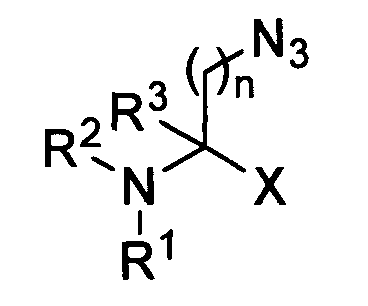
R1, R2, R3, R4, R5, R6, R7, R8, R9, R10, R11, R12, R13 and R14 may be the same or different, and each independently represent H, linear or branched and optionally substituted alkyl, optionally substituted acyl, optionally substituted sulfonyl, optionally substituted aryl, and amine and/or acid protective groups, n =1-10. andwherein X represents CN, CO2R3, COR4, SO2R5, CH2OR6, CH2NR7R8, CR9R10, CONR11NR12R13;
R1, R2, R3, R4, R5, R6, R7, R8, R9, R10, R11, R12 and R13 may be the same or different, and each independently represent H, linear or branched and optionally substituted alkyl, optionally substituted acyl, optionally substituted sulfonyl, optionally substituted aryl, and amine and/or acid protective groups, the ring may substituted and be saturated or (partly) unsaturated and may be 4-10 membered; the azide can be in any position on the ring. - The amino acids may also be part of a peptide, in which case in the structures given above X may represent the site of attachment to one or more further amino acids, and/or R1 and/or R2 may also represent the site of attachment to one or more further amino acids.
- The amino acids may be in an optically active form, and can be either in the R or S configuration at any stereocenter.
- The amino group and/or the acid group in the amino acids may be suitably protected in order to facilitate further reaction steps.
- Preferably the amino acid bears the azide or acetylene group in the side chain leaving for instance the amine and/or acid functionalities intact and free to form amide bonds in a peptide chain.
- Of particular interest are the amino acids bearing azide or acetylene groups that closely resemble the amino acids in naturally occurring glycopeptides that are linked to carbohydrates. Thus in particular serine, threonine, lysine, hydroxylysine, asparagine and hydroxyproline that bear an azide or acetylene group, or in which, compared to the natural amino acid, an OH or NH2 functional group is modified into an azide or acetylene group are of interest.
- Any saccharide unit in a carbohydrate as described above may contain either an azide or acetylene group at the (parent) anomeric position. Preferably the azide or acetylene is in a terminal saccharide unit at the (parent) anomeric position of the saccharide unit.
- Thus, suitable carbohydrates bearing an acetylene group are:wherein R1 may be H, CH2OR or CHORCH2OR, R2 may be H, NHR or OR, R may be the same or different within one molecule and may be H, a saccharide unit or a protective group, m = 0 or 1.

- Suitable carbohydrates bearing an azide group are:wherein R1 may be H, CH2OR or CHORCH2OR, R2 may be H, NHR or OR, R may be the same or different within one molecule and may be H, a saccharide unit or a protective group, m = 0 or 1.

- Thus, suitable carbohydrates bearing an acetylene or azide on the anomeric carbon are derived from allo-, altro-, gluco-, manno-, gulo-, ido-, galacto-, talo-, ribo-, arabino-, xylo- and lyxofuranoside and from allo-, altro-, gluco-, manno-, gulo-, ido-, galacto-, talo-, ribo-, arabino-, xylo- and lyxopyranoside.
- The carbohydrates can be either in the D or L configuration.
- The cycloaddition of the azide and acetylene reaction partners can proceed according to any of the methods disclosed in the literature cited above. A series of advantageous conditions for the cycloaddition reaction is also disclosed in WO 03/101972. The cycloaddition results in substituted-[1,2,3]-triazoles. The cycloaddition may result in two possible regioisomers, viz. the 1,4- and 1,5-substituted triazole. The 1,4-substituted product is preferred, which also will be the most abundant, if not sole, regioisomer under standard cycloaddition conditions.
- In one embodiment the invention concerns a method for the preparation of a glyco-amino acid or glycopeptide by reacting a carbohydrate having an azide group on the anomeric carbon as described above with an amino acid or peptide comprising an amino acid having an acetylene group as described above.
- In one embodiment the invention concerns a method for the preparation of a glyco-amino acid or glycopeptide by reacting a carbohydrate having an acetylene group on the (parent) anomeric carbon as described above with an amino acid or peptide comprising an amino acid having an azide group as described above.
- Cycloaddition of an azide or acetylene bearing amino acid with a carbohydrate reaction partner, respectively an acetylene or azide bearing carbohydrate, results in a glyco-amino-acid of the invention.
- Such a glyco-amino acid may be used as a building block in the preparation of a glycopeptide according to the invention. For instance one or more of such glyco-amino acids may be used in an automated peptide synthesiser. Alternatively one or more acetylene bearing amino acids, or azide bearing amino acids may be used as building blocks for the preparation of a peptide. During the peptide synthesis, as the chain of amino acids increases, or after the synthesis of a desired peptide has been completed, the peptide having azide or acetylene functional groups may be reacted with a carbohydrate cycloaddition reaction partner in order to obtain a glycopeptide according to the invention.
- Thus in an embodiment the invention relates to a method for the preparation of a glycopeptide of the invention, said method comprising reacting a glyco-amino acid of the invention as a building block in a peptide synthesis, such as a peptide synthesis on a solid support, preferably in an automated peptide synthesiser.
- In another embodiment the invention relates to a method for the preparation of a glycopeptide of the invention, said method comprising reacting an azide bearing amino acid as described above and/or an acetylene bearing amino acid as described above as a building block in a peptide synthesis, such as a peptide synthesis on a solid support, preferably in an automated peptide synthesiser, and reacting azide functional groups in the resulting peptide during peptide synthesis or after peptide synthesis is completed with a carbohydrate having an acetylene group on the (parent) anomeric carbon as described above and/or reacting acetylene functional groups in the resulting peptide during peptide synthesis or after peptide synthesis is completed with a carbohydrate having an azide group on the anomeric carbon as described above.
- Thus a glycopeptide of the invention may comprise one, two, three, four or more carbohydrates attached to different amino acids in the peptide chain. The glyco-amino acid can be at any position in the peptide chain.
- The methods described above may require appropriate protective group manipulations on carbohydrate, amino acid and/or peptide. Such protective group manipulations are well known in the art and suitable protective groups can be found in e.g. Greene, Protective Groups in Organic Synthesis, 3rd edition 1999, Wiley-Interscience, New York.
- Glycopeptides may be used for the treatment of bacterial infections. Therefore, in another embodiment, the present invention is directed to a method for controlling a bacterial infection in a host animal, typically a warm-blooded animal, which comprises administering to the host animal an effective, antibacterial amount of a compound of the present invention. In this embodiment, the compounds can be used to control and treat infections due to various bacteria, but especially gram-positive bacteria. In a preferred embodiment, the compounds are used to control and treat infections due to bacteria resistant to existing antibacterials. For example, certain bacteria are resistant to methicillin, and yet others are resistant to vancomycin and/or teicoplanin. The present compounds provide a technique for controlling and treating infections due to such resistant bacterial species.
- In carrying out this embodiment of the invention, the compounds of the present invention can be administered by any of the conventional techniques, including the oral route and parenteral routes such as intravenous and intramuscular. The amount of compound to be employed is not critical and will vary depending on the particular compound employed, the route of administration, the severity of the infection, the interval between dosings, and other factors known to those skilled in the art. In general, a dose of from about 0.5 to about 100 mg/kg will be effective; and in many situations, lesser doses of from about 0.5 to about 50 mg/kg will be effective. A compound of the present invention can be administered in a single dose, but in the known manner of antibacterial therapy, a compound of the present invention is typically administered repeatedly over a period of time, such as a matter of days or weeks, to ensure control of the bacterial infection.
- Also in accordance with known antibacterial therapy, a compound of the present invention is typically formulated for convenient delivery of the requisite dose. Therefore, in another embodiment, the present invention is directed to a pharmaceutical formulation comprising a compound of the present invention, in combination with a pharmaceutically-acceptable carrier. Such carriers are well known for both oral and parenteral routes of delivery. In general, a formulation will comprise a compound of the present invention in a concentration of from about 0.1 to about 90% by weight, and often from about 1.0 to about 3%. Thus a pharmaceutical composition comprising a compound according to the present invention and a nutritional composition comprising a compound according to the present invention are further embodiments of this invention, both in combination for that purpose with suitable carriers.
- Saccharides covalently attached to proteins determine their location or destination in the cell and the metabolic routes they are supposed to follow. Glycoproteins are involved in cell-recognition and thus are involved in signalling processes, in cell-cell interactions, and immunological responses. Thus the compounds of the present invention may be used as diagnostic tools, in vitro and/or in vivo as well as research tools in vitro to study for instance signalling pathways etc. Thus in a further embodiment the present invention concerns a kit of parts that comprises as a research tool and/or diagnostic tool a compound according to the present invention and optionally comprising further reagents, diluents and/or handling instructions.
- The following conditions are generally applicable to other cycloaddition reaction partners.

- To a solution of tetra-O-acetyl-β-D-glucopyranosyl azide (1) (36.3 mg, 0.10 mmol) and N-Boc-L-propargylglycine methyl ester (2) (26.3 mg, 0.12 mmol) in THF (1 mL) was added CuI (3.7 mg, 20 mol%) and DIPEA (6.4 µL, 40 mol%). The mixture was stirred for 16 hours, after which water (1 mL) was added and the product was extracted with DCM (2x). The combined organic layers were washed with a saturated aqueous solution of NaHCO3 and brine, dried over Na2SO4 and concentrated in vacuo. The product was purified by flash column chromatography (EtOAc/heptane 1:2) to afford the product as a white solid (51.8 mg, 0.09 mmol, 89%).
- In a similar method the following cycloadition reaction partners have been reacted to give the 1,4-triazole glyco amino acids and peptides:


- First route: To a solution of N-Boc-glycoamino acid (1 equiv) in CH2Cl2 (0.1 M) were added H2N-AA-OMe (1 equiv), DIPEA (1.2 equiv) and EDCI (1.1 equiv) at 0 °C. The reaction mixture was stirred for 16 hours, after which water was added. The product was extracted with DCM (2x). The combined organic layers were washed with a aqueous HCl (0.1 M), a saturated aqueous solution of NaHCO3 and brine, dried over Na2SO4 and concentrated in vacuo. The product was purified by flash column chromatography.
- Second route: An amino acid immobilized on a solid support was suspended in DMF and treated with N-Fmoc-glycoamino acid (1.5 equiv), DIPEA (3 equiv) and EDCI (3 equiv) at 0 °C. The reaction mixture was agitated for 16 hours, after which the suspension was filtrated. The resin was washed several times with CH2Cl2 and MeOH and dried in vacuo. The resin was suspended in a mixture of CH2Cl2 and TFA (1:1) and agitated for 2
- The glycoamino acid products were subjected to the following reaction conditions, to investigate the stability of the glyco-triazole linkage.
- 2.5 M HCl in EtOAc at rt
- K2CO3, MeOH at rt
- 1 M aq. HCl at rt
- 1 M aq. HCl at reflux
- 1 M aq. NaOH at rt
- 1 M HCl in MeOH at reflux
- The glyco-triazole linkage appeared to be stable to all these conditions.
Claims (11)
- A compound of formula I or I'wherein A represents a carbohydrate which is coupled via its anomeric center (I) or parent anomeric center (I') to the triazole ring and B represents an amino acid or a mimetic of an amino acid.

- A compound of formula II or II'wherein A represents a carbohydrate which is coupled via its anomeric center (I) or parent anomeric center (II') to the triazole ring and C represents a polypeptide or a mimetic of a polypeptide.

- A compound according to claim 1 or 2 wherein the carbohydrate A comprises 1-20 saccharide units.
- A compound according to claim 2 or 3 wherein the peptide C or mimetic thereof comprises 2-100 amino acids or mimetic(s) thereof.
- A compound according to any of the preceding claims wherein B or C is attached to the triazole moiety via the side chain of the amino acid or mimetic thereof or via the side chain of an amino acid or mimetic thereof in the peptide or mimetic thereof.
- A compound according to any of the preceding claims wherein the carbohydrate is attached to the triazole moiety via the (parent) anomeric carbon atom of a terminal saccharide unit.
- Method for the preparation of a compound according to claim 1 or 2, comprising the step of the cycloaddition ofwherein X represents CN, CO2R4, COR5, SO2R6, CH2OR7, CH2NR8R9, CR10R11, CONR12NR13R14, or X represents the site of attachment to one or more further amino acids;

R1, R2, R3, R4, R5, R6, R7, R8, R9, R10, R11, R12, R13 and R14 may be the same or different, and each independently represent H, linear or branched and optionally substituted alkyl, optionally substituted acyl, optionally substituted sulfonyl, optionally substituted aryl, and amine and/or acid protective groups, R1 and/or R2 may also represent the site of attachment to one or more further amino acids,
n = 1-10
withwherein R1 may be H, CH2OR or CHORCH2OR, R2 may be H, NHR or OR, R may be the same or different within one molecule and may be H, a saccharide unit or a protective group, m = 0 or 1,
or the cycloaddition ofwherein X represents CN, CO2R4, COR5, SO2R6, CH2OR7, CH2NR8R9, CR10R11, CONR12NR13R14, or X represents the site of attachment to one or more further amino acids;
R1, R2, R3, R4, R5, R6, R7, R8, R9, R10, R11, R12, R13 and R14 may be the same or different, and each independently represent H, linear or branched and optionally substituted alkyl, optionally substituted acyl, optionally substituted sulfonyl, optionally substituted aryl, and amine and/or acid protective groups, R1 and/or R2 may also represent the site of attachment to one or more further amino acids, n = 1-10
orwherein X represents CN, CO2R3, COR4, SO2R5, CH2OR6, CH2NR7R8, CR9R10, CONR11NR12R13 or X represents the site of attachment to one or more further amino acids;
R1, R2, R3, R4, R5, R6, R7, R8, R9, R10, R11, R12 and R13 may be the same or different, and each independently represent H, linear or branched and optionally substituted alkyl, optionally substituted acyl, optionally substituted sulfonyl, optionally substituted aryl, and amine and/or acid protective groups, R1 may also represent the site of attachment to one or more further amino acids, the ring may substituted and be saturated or (partly) unsaturated and may be 4-10 membered; the azide can be in any position on the ring.
withwherein R1 may be H, CH2OR or CHORCH2OR, R2 may be H, NHR or OR, R may be the same or different within one molecule and may be H, a saccharide unit or a protective group, m = 0 or 1.
- Method for the preparation of a compound according to claim 2, said method comprising reacting a compound according to claim 1 as a building block in a peptide synthesis.
- Method according to claim 8 wherein the peptide synthesis is a peptide synthesis on a solid support, preferably in an automated peptide synthesiser.
- Method for the preparation of a compound according to claim 2, said method comprising reactingwherein X represents CN, CO2R4, COR5, SO2R6, CH2OR7, CH2NR8R9, CR10R11, CONR12NR13R14;

R1, R2, R3, R4, R5, R6, R7, R8, R9, R10, R11, R12, R13 and R14 may be the same or different, and each independently represent H, linear or branched and optionally substituted alkyl, optionally substituted acyl, optionally substituted sulfonyl, optionally substituted aryl, and amine and/or acid protective groups, n = 1-10
and/orwherein X represents CN, CO2R4, COR5, SO2R6, CH2OR7, CH2NR8R9, CR10R11, CONR12NR13R14;
R1, R2, R3, R4, R5, R6, R7, R8, R9, R10, R11, R12, R13 and R14 may be the same or different, and each independently represent H, linear or branched and optionally substituted alkyl, optionally substituted acyl, optionally substituted sulfonyl, optionally substituted aryl, and amine and/or acid protective groups, n = 1-10
and/orwherein X represents CN, CO2R3, COR4, SO2R5, CH2OR6, CH2NR7R8, CR9R10, CONR11NR12R13;
R1, R2, R3, R4, R5, R6, R7, R8, R9, R10, R11, R12 and R13 may be the same or different, and each independently represent H, linear or branched and optionally substituted alkyl, optionally substituted acyl, optionally substituted sulfonyl, optionally substituted aryl, and amine and/or acid protective groups, the ring may substituted and be saturated or (partly) unsaturated and may be 4-10 membered; the azide can be in any position on the ring,
as a building block in a peptide synthesis, such as a peptide synthesis on a solid support, preferably in an automated peptide synthesiser.
and reacting azide functional groups in the resulting peptide during peptide synthesis or after peptide synthesis is completed
withwherein R1 may be H, CH2OR or CHORCH2OR, R2 may be H, NHR or OR, R may be the same or different within one molecule and may be H, a saccharide unit or a protective group, m = 0 or 1.
and/or
reacting acetylene functional groups in the resulting peptide during peptide synthesis or after peptide synthesis is completed
withwherein R1 may be H, CH2OR or CHORCH2OR, R2 may be H, NHR or OR, R may be the same or different within one molecule and may be H, a saccharide unit or a protective group, m = 0 or 1.
- Kit of parts comprising as a research tool and/or a diagnostic tool a compound according to any of claims 1-6.
Priority Applications (2)
| Application Number | Priority Date | Filing Date | Title |
|---|---|---|---|
| EP04076662A EP1602663A1 (en) | 2004-06-04 | 2004-06-04 | Triazole-linked glycoamino acids and glycopeptides |
| PCT/NL2005/000406 WO2005118625A1 (en) | 2004-06-04 | 2005-06-06 | Triazole-linked glycoamino acids and glycopeptides |
Applications Claiming Priority (1)
| Application Number | Priority Date | Filing Date | Title |
|---|---|---|---|
| EP04076662A EP1602663A1 (en) | 2004-06-04 | 2004-06-04 | Triazole-linked glycoamino acids and glycopeptides |
Publications (1)
| Publication Number | Publication Date |
|---|---|
| EP1602663A1 true EP1602663A1 (en) | 2005-12-07 |
Family
ID=34928271
Family Applications (1)
| Application Number | Title | Priority Date | Filing Date |
|---|---|---|---|
| EP04076662A Withdrawn EP1602663A1 (en) | 2004-06-04 | 2004-06-04 | Triazole-linked glycoamino acids and glycopeptides |
Country Status (2)
| Country | Link |
|---|---|
| EP (1) | EP1602663A1 (en) |
| WO (1) | WO2005118625A1 (en) |
Cited By (20)
| Publication number | Priority date | Publication date | Assignee | Title |
|---|---|---|---|---|
| FR2900929A1 (en) * | 2006-05-15 | 2007-11-16 | Rhodia Recherches & Tech | New polyol-polyorganosiloxane hybrid compounds useful in detergent-, surfactant-, shampoo-, soap-, cleansing-, wash- and cosmetic compositions e.g. skin care, solar protecting and treating shampoo and/or deodorant compositions |
| GB2440388A (en) * | 2006-06-30 | 2008-01-30 | Ucl Biomedica Plc | Methods of linking a carbohydrate or polyalkylene oxide to a protein, precursors and the resultant products |
| WO2007132005A3 (en) * | 2006-05-15 | 2008-04-24 | Rhodia Recherches & Tech | Hybrid compounds based on polyol(s) and at least one other molecular entity, polymer or otherwise, especially of the polyorganosiloxane type, method for the preparation thereof, and applications of the same |
| US20110263815A1 (en) * | 2007-02-23 | 2011-10-27 | Aileron Therapeutics, Inc., A Delaware Corporation | Triazole macrocycle systems |
| US8609809B2 (en) | 2006-12-14 | 2013-12-17 | Aileron Thraputics, Inc. | Bis-sulfhydryl macrocyclization systems |
| US9005577B2 (en) | 2008-04-30 | 2015-04-14 | Siemens Medical Solutions Usa, Inc. | Substrate based PET imaging agents |
| US9096684B2 (en) | 2011-10-18 | 2015-08-04 | Aileron Therapeutics, Inc. | Peptidomimetic macrocycles |
| US9527896B2 (en) | 2007-01-31 | 2016-12-27 | Dana-Farber Cancer Institute, Inc. | Stabilized p53 peptides and uses thereof |
| US9604919B2 (en) | 2012-11-01 | 2017-03-28 | Aileron Therapeutics, Inc. | Disubstituted amino acids and methods of preparation and use thereof |
| US9957299B2 (en) | 2010-08-13 | 2018-05-01 | Aileron Therapeutics, Inc. | Peptidomimetic macrocycles |
| US10022422B2 (en) | 2009-01-14 | 2018-07-17 | Alleron Therapeutics, Inc. | Peptidomimetic macrocycles |
| US10023613B2 (en) | 2015-09-10 | 2018-07-17 | Aileron Therapeutics, Inc. | Peptidomimetic macrocycles as modulators of MCL-1 |
| US10059741B2 (en) | 2015-07-01 | 2018-08-28 | Aileron Therapeutics, Inc. | Peptidomimetic macrocycles |
| US10213477B2 (en) | 2012-02-15 | 2019-02-26 | Aileron Therapeutics, Inc. | Peptidomimetic macrocycles |
| US10227380B2 (en) | 2012-02-15 | 2019-03-12 | Aileron Therapeutics, Inc. | Triazole-crosslinked and thioether-crosslinked peptidomimetic macrocycles |
| US10253067B2 (en) | 2015-03-20 | 2019-04-09 | Aileron Therapeutics, Inc. | Peptidomimetic macrocycles and uses thereof |
| US10300109B2 (en) | 2009-09-22 | 2019-05-28 | Aileron Therapeutics, Inc. | Peptidomimetic macrocycles |
| US10301351B2 (en) | 2007-03-28 | 2019-05-28 | President And Fellows Of Harvard College | Stitched polypeptides |
| US10471120B2 (en) | 2014-09-24 | 2019-11-12 | Aileron Therapeutics, Inc. | Peptidomimetic macrocycles and uses thereof |
| US10905739B2 (en) | 2014-09-24 | 2021-02-02 | Aileron Therapeutics, Inc. | Peptidomimetic macrocycles and formulations thereof |
Families Citing this family (3)
| Publication number | Priority date | Publication date | Assignee | Title |
|---|---|---|---|---|
| FR2900931A1 (en) * | 2006-05-15 | 2007-11-16 | Rhodia Recherches & Tech | New polyol-polyorganosiloxane hybrid compounds useful in detergent-, surfactant-, shampoo-, soap-, cleansing-, wash- and in cosmetic composition, and in an emulsion, preferably oil-in-water emulsion |
| FR2923828B1 (en) | 2007-11-16 | 2010-02-19 | Rhodia Operations | HYBRID COMPOUNDS BASED ON POLYASACCHARIDES (S) AND AT LEAST ONE POLYOXYALKYLENE, PROCESS FOR THEIR PREPARATION AND THEIR APPLICATIONS |
| CN104530163B (en) * | 2014-12-08 | 2017-08-22 | 华东理工大学 | Triazole glycolipid analog derivative and its purposes for cooperateing with antimicrobial agent |
Citations (1)
| Publication number | Priority date | Publication date | Assignee | Title |
|---|---|---|---|---|
| US6664399B1 (en) * | 1999-09-02 | 2003-12-16 | E. I. Du Pont De Nemours & Company | Triazole linked carbohydrates |
-
2004
- 2004-06-04 EP EP04076662A patent/EP1602663A1/en not_active Withdrawn
-
2005
- 2005-06-06 WO PCT/NL2005/000406 patent/WO2005118625A1/en not_active Ceased
Patent Citations (1)
| Publication number | Priority date | Publication date | Assignee | Title |
|---|---|---|---|---|
| US6664399B1 (en) * | 1999-09-02 | 2003-12-16 | E. I. Du Pont De Nemours & Company | Triazole linked carbohydrates |
Non-Patent Citations (5)
| Title |
|---|
| B. G. DAVIS: "Recent developments in glycoconjugates", J. CHEM. SOC., PERKIN TRANS. 1, 1999, pages 3215 - 3237, XP002304300 * |
| BROEDER WOLFGANG ET AL: "A new method of anomeric protection and activation based on the conversion of glycosyl azides into glycosyl fluorides", CARBOHYDRATE RESEARCH, vol. 249, no. 1, 1993, pages 221 - 241, XP002304299, ISSN: 0008-6215 * |
| CALVO-FLORES F G ET AL: "1,3-dipolar cycloadditions as a tool for the preparation of multivalent structures.", ORGANIC LETTERS. 10 AUG 2000, vol. 2, no. 16, 10 August 2000 (2000-08-10), pages 2499 - 2502, XP002304298, ISSN: 1523-7060 * |
| STOWELL C P ET AL: "NEOGLYCOPROTEINS THE PREPARATION AND APPLICATION OF SYNTHETIC GLYCOPROTEINS", ADVANCES IN CARBOHYDRATE CHEMISTRY AND BIOCHEMISTRY, ACADEMIC PRESS, SAN DIEGO, CA, US, vol. 37, 1980, pages 225 - 281, XP008012956 * |
| TORNOE C W ET AL: "Peptidotriazoles on solid phase; [1,2,3]-triazoles by regiospecific copper (I) catalyzed 1,3-dipolar cycloadditions of terminal alkynes to azides", JOURNAL OF ORGANIC CHEMISTRY, AMERICAN CHEMICAL SOCIETY. EASTON, US, vol. 67, no. 9, 2002, pages 3057 - 3064, XP002234501, ISSN: 0022-3263 * |
Cited By (35)
| Publication number | Priority date | Publication date | Assignee | Title |
|---|---|---|---|---|
| FR2900929A1 (en) * | 2006-05-15 | 2007-11-16 | Rhodia Recherches & Tech | New polyol-polyorganosiloxane hybrid compounds useful in detergent-, surfactant-, shampoo-, soap-, cleansing-, wash- and cosmetic compositions e.g. skin care, solar protecting and treating shampoo and/or deodorant compositions |
| WO2007132005A3 (en) * | 2006-05-15 | 2008-04-24 | Rhodia Recherches & Tech | Hybrid compounds based on polyol(s) and at least one other molecular entity, polymer or otherwise, especially of the polyorganosiloxane type, method for the preparation thereof, and applications of the same |
| JP2009537484A (en) * | 2006-05-15 | 2009-10-29 | ローディア・オペラシオン | Hybrid compounds based on polyols and at least one other polymeric or non-polymeric molecular moiety, in particular a polyorganosiloxane type molecular moiety, a process for its production and its use |
| GB2440388A (en) * | 2006-06-30 | 2008-01-30 | Ucl Biomedica Plc | Methods of linking a carbohydrate or polyalkylene oxide to a protein, precursors and the resultant products |
| US9175056B2 (en) | 2006-12-14 | 2015-11-03 | Alleron Therapeutics, Inc. | Bis-sulfhydryl macrocyclization systems |
| US10328117B2 (en) | 2006-12-14 | 2019-06-25 | Aileron Therapeutics, Inc. | Bis-sulfhydryl macrocyclization systems |
| US9675661B2 (en) | 2006-12-14 | 2017-06-13 | Aileron Therapeutics, Inc. | Bis-sulfhydryl macrocyclization systems |
| US8609809B2 (en) | 2006-12-14 | 2013-12-17 | Aileron Thraputics, Inc. | Bis-sulfhydryl macrocyclization systems |
| US10202431B2 (en) | 2007-01-31 | 2019-02-12 | Aileron Therapeutics, Inc. | Stabilized P53 peptides and uses thereof |
| US9527896B2 (en) | 2007-01-31 | 2016-12-27 | Dana-Farber Cancer Institute, Inc. | Stabilized p53 peptides and uses thereof |
| US20110263815A1 (en) * | 2007-02-23 | 2011-10-27 | Aileron Therapeutics, Inc., A Delaware Corporation | Triazole macrocycle systems |
| US9493509B2 (en) | 2007-02-23 | 2016-11-15 | Aileron Therapeutics, Inc. | Triazole macrocycle systems |
| US10030049B2 (en) | 2007-02-23 | 2018-07-24 | Aileron Therapeutics, Inc. | Triazole macrocycle systems |
| US9023988B2 (en) | 2007-02-23 | 2015-05-05 | Aileron Therapeutics, Inc. | Triazole macrocycle systems |
| US8637686B2 (en) * | 2007-02-23 | 2014-01-28 | Aileron Therapeutics, Inc. | Triazole macrocycle systems |
| US9957296B2 (en) | 2007-02-23 | 2018-05-01 | Aileron Therapeutics, Inc. | Triazole macrocycle systems |
| US10301351B2 (en) | 2007-03-28 | 2019-05-28 | President And Fellows Of Harvard College | Stitched polypeptides |
| US10821196B2 (en) | 2008-04-30 | 2020-11-03 | Siemens Medical Solutions Usa, Inc. | Substrate based PET imaging agents |
| US9005577B2 (en) | 2008-04-30 | 2015-04-14 | Siemens Medical Solutions Usa, Inc. | Substrate based PET imaging agents |
| US10022422B2 (en) | 2009-01-14 | 2018-07-17 | Alleron Therapeutics, Inc. | Peptidomimetic macrocycles |
| US10300109B2 (en) | 2009-09-22 | 2019-05-28 | Aileron Therapeutics, Inc. | Peptidomimetic macrocycles |
| US9957299B2 (en) | 2010-08-13 | 2018-05-01 | Aileron Therapeutics, Inc. | Peptidomimetic macrocycles |
| US10308699B2 (en) | 2011-10-18 | 2019-06-04 | Aileron Therapeutics, Inc. | Peptidomimetic macrocycles |
| US9522947B2 (en) | 2011-10-18 | 2016-12-20 | Aileron Therapeutics, Inc. | Peptidomimetic macrocycles |
| US9096684B2 (en) | 2011-10-18 | 2015-08-04 | Aileron Therapeutics, Inc. | Peptidomimetic macrocycles |
| US10213477B2 (en) | 2012-02-15 | 2019-02-26 | Aileron Therapeutics, Inc. | Peptidomimetic macrocycles |
| US10227380B2 (en) | 2012-02-15 | 2019-03-12 | Aileron Therapeutics, Inc. | Triazole-crosslinked and thioether-crosslinked peptidomimetic macrocycles |
| US9845287B2 (en) | 2012-11-01 | 2017-12-19 | Aileron Therapeutics, Inc. | Disubstituted amino acids and methods of preparation and use thereof |
| US10669230B2 (en) | 2012-11-01 | 2020-06-02 | Aileron Therapeutics, Inc. | Disubstituted amino acids and methods of preparation and use thereof |
| US9604919B2 (en) | 2012-11-01 | 2017-03-28 | Aileron Therapeutics, Inc. | Disubstituted amino acids and methods of preparation and use thereof |
| US10471120B2 (en) | 2014-09-24 | 2019-11-12 | Aileron Therapeutics, Inc. | Peptidomimetic macrocycles and uses thereof |
| US10905739B2 (en) | 2014-09-24 | 2021-02-02 | Aileron Therapeutics, Inc. | Peptidomimetic macrocycles and formulations thereof |
| US10253067B2 (en) | 2015-03-20 | 2019-04-09 | Aileron Therapeutics, Inc. | Peptidomimetic macrocycles and uses thereof |
| US10059741B2 (en) | 2015-07-01 | 2018-08-28 | Aileron Therapeutics, Inc. | Peptidomimetic macrocycles |
| US10023613B2 (en) | 2015-09-10 | 2018-07-17 | Aileron Therapeutics, Inc. | Peptidomimetic macrocycles as modulators of MCL-1 |
Also Published As
| Publication number | Publication date |
|---|---|
| WO2005118625A1 (en) | 2005-12-15 |
Similar Documents
| Publication | Publication Date | Title |
|---|---|---|
| EP1602663A1 (en) | Triazole-linked glycoamino acids and glycopeptides | |
| US6939945B2 (en) | Synthetic peptides, conjugation reagents and methods | |
| EP2949665B1 (en) | Glycosylation atrial natriuretic peptide | |
| Kumar et al. | Selective recognition of synthetic lysine and meso-diaminopimelic acid-type peptidoglycan fragments by human peptidoglycan recognition proteins Iα and S | |
| USRE34091E (en) | Sialic acid derivatives having active carbonyl group | |
| CZ314397A3 (en) | Cytostatics, modified hydrocarbons, medicaments in which said substances are comprised and their use | |
| TWI325430B (en) | Aminated complex type sugar chain derivative and its production method | |
| Reintjens et al. | Synthesis of C‐glycosyl amino acid building blocks suitable for the solid‐phase synthesis of multivalent glycopeptide mimics | |
| US5821349A (en) | Derivatives of cyclodextrins, their preparation and their use for incorporating hydrophobic molecules into organized surfactant systems | |
| Iijima et al. | Synthesis of a mucin-type O-glycosylated amino acid, β-Gal-(1→ 3)-[α-Neu5Ac-(2→ 6)]-α-GalNAc-(1→ 3)-Ser | |
| Mashayekh et al. | Synthesis of bacterial-derived peptidoglycan cross-linked fragments | |
| Rodriguez et al. | Optimization of physicochemical and pharmacological properties of peptide drugs by glycosylation | |
| Schweizer et al. | Synthesis of a galacto-configured C-ketoside-based γ-sugar-amino acid and its use in peptide coupling reactions | |
| Fujimoto et al. | Synthesis of crosslinked peptidoglycan fragments for investigation of their immunobiological functions | |
| US20040058888A1 (en) | Methods for synthesis of alpha-d-gal (1~>3) gal-containing oligosaccharides | |
| Wang et al. | Synthesis of a GlcNAcylated arginine building block for the solid phase synthesis of death domain glycopeptide fragments | |
| JP2001504460A (en) | 1-galactose derivative | |
| Rodríguez-Mayor et al. | Development of strategies for glycopeptide synthesis: An overview on the glycosidic linkage | |
| US20050026214A1 (en) | Method of identifying glycosyl transferase binding compounds | |
| Hamzavi et al. | Synthesis of a C-linked glycosylated thymine-based PNA monomer and its incorporation into a PNA oligomer | |
| WO1995014036A1 (en) | Carbohydrate-containing compounds which bind to carbohydrate binding receptors | |
| Elofsson et al. | Synthesis of a water-soluble serine-based neoglycolipid which can be covalently linked to solid phases | |
| Wang | Synthesis of Peptidoglycan Fragment Library for | |
| Brimble et al. | Recent Developments in Neoglycopeptide Synthesis | |
| AU2654201A (en) | Methods for synthesis of alpha-D-GAL (1-3) GAL-containing oligosaccharides |
Legal Events
| Date | Code | Title | Description |
|---|---|---|---|
| PUAI | Public reference made under article 153(3) epc to a published international application that has entered the european phase |
Free format text: ORIGINAL CODE: 0009012 |
|
| AK | Designated contracting states |
Kind code of ref document: A1 Designated state(s): AT BE BG CH CY CZ DE DK EE ES FI FR GB GR HU IE IT LI LU MC NL PL PT RO SE SI SK TR |
|
| AX | Request for extension of the european patent |
Extension state: AL HR LT LV MK |
|
| AKX | Designation fees paid | ||
| REG | Reference to a national code |
Ref country code: DE Ref legal event code: 8566 |
|
| STAA | Information on the status of an ep patent application or granted ep patent |
Free format text: STATUS: THE APPLICATION IS DEEMED TO BE WITHDRAWN |
|
| 18D | Application deemed to be withdrawn |
Effective date: 20060608 |