EP1477175A1 - Fused pyridazine derivative compounds and drugs containing the compounds as the active ingredient - Google Patents

Fused pyridazine derivative compounds and drugs containing the compounds as the active ingredient Download PDF

Info

Publication number
EP1477175A1
EP1477175A1 EP03705265A EP03705265A EP1477175A1 EP 1477175 A1 EP1477175 A1 EP 1477175A1 EP 03705265 A EP03705265 A EP 03705265A EP 03705265 A EP03705265 A EP 03705265A EP 1477175 A1 EP1477175 A1 EP 1477175A1
Authority
EP
European Patent Office
Prior art keywords
methanol
nmr
tlc
tetrahydrophthalazin
dmso
Prior art date
Legal status (The legal status is an assumption and is not a legal conclusion. Google has not performed a legal analysis and makes no representation as to the accuracy of the status listed.)
Granted
Application number
EP03705265A
Other languages
German (de)
French (fr)
Other versions
EP1477175A4 (en
EP1477175B1 (en
Inventor
Takuya c/o Ono Pharmaceutical Co. Ltd. SEKO
Jun Ono Pharmaceutical Co. Ltd TAKEUCHI
Shinya Ono Pharmaceutical Co. Ltd. TAKAHASHI
Yoshihisa Ono Pharmaceutical Co. Ltd. KAMANAKA
Wataru Ono Pharmaceutical Co. Ltd. KAMOSHIMA
Current Assignee (The listed assignees may be inaccurate. Google has not performed a legal analysis and makes no representation or warranty as to the accuracy of the list.)
Ono Pharmaceutical Co Ltd
Original Assignee
Ono Pharmaceutical Co Ltd
Priority date (The priority date is an assumption and is not a legal conclusion. Google has not performed a legal analysis and makes no representation as to the accuracy of the date listed.)
Filing date
Publication date
Application filed by Ono Pharmaceutical Co Ltd filed Critical Ono Pharmaceutical Co Ltd
Priority to EP10178316A priority Critical patent/EP2281818A1/en
Publication of EP1477175A1 publication Critical patent/EP1477175A1/en
Publication of EP1477175A4 publication Critical patent/EP1477175A4/en
Application granted granted Critical
Publication of EP1477175B1 publication Critical patent/EP1477175B1/en
Anticipated expiration legal-status Critical
Expired - Lifetime legal-status Critical Current

Links

Classifications

    • CCHEMISTRY; METALLURGY
    • C07ORGANIC CHEMISTRY
    • C07DHETEROCYCLIC COMPOUNDS
    • C07D403/00Heterocyclic compounds containing two or more hetero rings, having nitrogen atoms as the only ring hetero atoms, not provided for by group C07D401/00
    • C07D403/02Heterocyclic compounds containing two or more hetero rings, having nitrogen atoms as the only ring hetero atoms, not provided for by group C07D401/00 containing two hetero rings
    • C07D403/06Heterocyclic compounds containing two or more hetero rings, having nitrogen atoms as the only ring hetero atoms, not provided for by group C07D401/00 containing two hetero rings linked by a carbon chain containing only aliphatic carbon atoms
    • AHUMAN NECESSITIES
    • A61MEDICAL OR VETERINARY SCIENCE; HYGIENE
    • A61PSPECIFIC THERAPEUTIC ACTIVITY OF CHEMICAL COMPOUNDS OR MEDICINAL PREPARATIONS
    • A61P1/00Drugs for disorders of the alimentary tract or the digestive system
    • A61P1/04Drugs for disorders of the alimentary tract or the digestive system for ulcers, gastritis or reflux esophagitis, e.g. antacids, inhibitors of acid secretion, mucosal protectants
    • AHUMAN NECESSITIES
    • A61MEDICAL OR VETERINARY SCIENCE; HYGIENE
    • A61PSPECIFIC THERAPEUTIC ACTIVITY OF CHEMICAL COMPOUNDS OR MEDICINAL PREPARATIONS
    • A61P11/00Drugs for disorders of the respiratory system
    • AHUMAN NECESSITIES
    • A61MEDICAL OR VETERINARY SCIENCE; HYGIENE
    • A61PSPECIFIC THERAPEUTIC ACTIVITY OF CHEMICAL COMPOUNDS OR MEDICINAL PREPARATIONS
    • A61P13/00Drugs for disorders of the urinary system
    • A61P13/12Drugs for disorders of the urinary system of the kidneys
    • AHUMAN NECESSITIES
    • A61MEDICAL OR VETERINARY SCIENCE; HYGIENE
    • A61PSPECIFIC THERAPEUTIC ACTIVITY OF CHEMICAL COMPOUNDS OR MEDICINAL PREPARATIONS
    • A61P19/00Drugs for skeletal disorders
    • A61P19/02Drugs for skeletal disorders for joint disorders, e.g. arthritis, arthrosis
    • AHUMAN NECESSITIES
    • A61MEDICAL OR VETERINARY SCIENCE; HYGIENE
    • A61PSPECIFIC THERAPEUTIC ACTIVITY OF CHEMICAL COMPOUNDS OR MEDICINAL PREPARATIONS
    • A61P21/00Drugs for disorders of the muscular or neuromuscular system
    • A61P21/04Drugs for disorders of the muscular or neuromuscular system for myasthenia gravis
    • AHUMAN NECESSITIES
    • A61MEDICAL OR VETERINARY SCIENCE; HYGIENE
    • A61PSPECIFIC THERAPEUTIC ACTIVITY OF CHEMICAL COMPOUNDS OR MEDICINAL PREPARATIONS
    • A61P25/00Drugs for disorders of the nervous system
    • AHUMAN NECESSITIES
    • A61MEDICAL OR VETERINARY SCIENCE; HYGIENE
    • A61PSPECIFIC THERAPEUTIC ACTIVITY OF CHEMICAL COMPOUNDS OR MEDICINAL PREPARATIONS
    • A61P25/00Drugs for disorders of the nervous system
    • A61P25/02Drugs for disorders of the nervous system for peripheral neuropathies
    • AHUMAN NECESSITIES
    • A61MEDICAL OR VETERINARY SCIENCE; HYGIENE
    • A61PSPECIFIC THERAPEUTIC ACTIVITY OF CHEMICAL COMPOUNDS OR MEDICINAL PREPARATIONS
    • A61P25/00Drugs for disorders of the nervous system
    • A61P25/14Drugs for disorders of the nervous system for treating abnormal movements, e.g. chorea, dyskinesia
    • A61P25/16Anti-Parkinson drugs
    • AHUMAN NECESSITIES
    • A61MEDICAL OR VETERINARY SCIENCE; HYGIENE
    • A61PSPECIFIC THERAPEUTIC ACTIVITY OF CHEMICAL COMPOUNDS OR MEDICINAL PREPARATIONS
    • A61P25/00Drugs for disorders of the nervous system
    • A61P25/28Drugs for disorders of the nervous system for treating neurodegenerative disorders of the central nervous system, e.g. nootropic agents, cognition enhancers, drugs for treating Alzheimer's disease or other forms of dementia
    • AHUMAN NECESSITIES
    • A61MEDICAL OR VETERINARY SCIENCE; HYGIENE
    • A61PSPECIFIC THERAPEUTIC ACTIVITY OF CHEMICAL COMPOUNDS OR MEDICINAL PREPARATIONS
    • A61P27/00Drugs for disorders of the senses
    • A61P27/02Ophthalmic agents
    • A61P27/06Antiglaucoma agents or miotics
    • AHUMAN NECESSITIES
    • A61MEDICAL OR VETERINARY SCIENCE; HYGIENE
    • A61PSPECIFIC THERAPEUTIC ACTIVITY OF CHEMICAL COMPOUNDS OR MEDICINAL PREPARATIONS
    • A61P29/00Non-central analgesic, antipyretic or antiinflammatory agents, e.g. antirheumatic agents; Non-steroidal antiinflammatory drugs [NSAID]
    • AHUMAN NECESSITIES
    • A61MEDICAL OR VETERINARY SCIENCE; HYGIENE
    • A61PSPECIFIC THERAPEUTIC ACTIVITY OF CHEMICAL COMPOUNDS OR MEDICINAL PREPARATIONS
    • A61P3/00Drugs for disorders of the metabolism
    • A61P3/08Drugs for disorders of the metabolism for glucose homeostasis
    • A61P3/10Drugs for disorders of the metabolism for glucose homeostasis for hyperglycaemia, e.g. antidiabetics
    • AHUMAN NECESSITIES
    • A61MEDICAL OR VETERINARY SCIENCE; HYGIENE
    • A61PSPECIFIC THERAPEUTIC ACTIVITY OF CHEMICAL COMPOUNDS OR MEDICINAL PREPARATIONS
    • A61P31/00Antiinfectives, i.e. antibiotics, antiseptics, chemotherapeutics
    • A61P31/12Antivirals
    • AHUMAN NECESSITIES
    • A61MEDICAL OR VETERINARY SCIENCE; HYGIENE
    • A61PSPECIFIC THERAPEUTIC ACTIVITY OF CHEMICAL COMPOUNDS OR MEDICINAL PREPARATIONS
    • A61P31/00Antiinfectives, i.e. antibiotics, antiseptics, chemotherapeutics
    • A61P31/12Antivirals
    • A61P31/14Antivirals for RNA viruses
    • AHUMAN NECESSITIES
    • A61MEDICAL OR VETERINARY SCIENCE; HYGIENE
    • A61PSPECIFIC THERAPEUTIC ACTIVITY OF CHEMICAL COMPOUNDS OR MEDICINAL PREPARATIONS
    • A61P31/00Antiinfectives, i.e. antibiotics, antiseptics, chemotherapeutics
    • A61P31/12Antivirals
    • A61P31/14Antivirals for RNA viruses
    • A61P31/18Antivirals for RNA viruses for HIV
    • AHUMAN NECESSITIES
    • A61MEDICAL OR VETERINARY SCIENCE; HYGIENE
    • A61PSPECIFIC THERAPEUTIC ACTIVITY OF CHEMICAL COMPOUNDS OR MEDICINAL PREPARATIONS
    • A61P35/00Antineoplastic agents
    • AHUMAN NECESSITIES
    • A61MEDICAL OR VETERINARY SCIENCE; HYGIENE
    • A61PSPECIFIC THERAPEUTIC ACTIVITY OF CHEMICAL COMPOUNDS OR MEDICINAL PREPARATIONS
    • A61P37/00Drugs for immunological or allergic disorders
    • AHUMAN NECESSITIES
    • A61MEDICAL OR VETERINARY SCIENCE; HYGIENE
    • A61PSPECIFIC THERAPEUTIC ACTIVITY OF CHEMICAL COMPOUNDS OR MEDICINAL PREPARATIONS
    • A61P37/00Drugs for immunological or allergic disorders
    • A61P37/02Immunomodulators
    • A61P37/06Immunosuppressants, e.g. drugs for graft rejection
    • AHUMAN NECESSITIES
    • A61MEDICAL OR VETERINARY SCIENCE; HYGIENE
    • A61PSPECIFIC THERAPEUTIC ACTIVITY OF CHEMICAL COMPOUNDS OR MEDICINAL PREPARATIONS
    • A61P43/00Drugs for specific purposes, not provided for in groups A61P1/00-A61P41/00
    • AHUMAN NECESSITIES
    • A61MEDICAL OR VETERINARY SCIENCE; HYGIENE
    • A61PSPECIFIC THERAPEUTIC ACTIVITY OF CHEMICAL COMPOUNDS OR MEDICINAL PREPARATIONS
    • A61P7/00Drugs for disorders of the blood or the extracellular fluid
    • A61P7/08Plasma substitutes; Perfusion solutions; Dialytics or haemodialytics; Drugs for electrolytic or acid-base disorders, e.g. hypovolemic shock
    • AHUMAN NECESSITIES
    • A61MEDICAL OR VETERINARY SCIENCE; HYGIENE
    • A61PSPECIFIC THERAPEUTIC ACTIVITY OF CHEMICAL COMPOUNDS OR MEDICINAL PREPARATIONS
    • A61P9/00Drugs for disorders of the cardiovascular system
    • AHUMAN NECESSITIES
    • A61MEDICAL OR VETERINARY SCIENCE; HYGIENE
    • A61PSPECIFIC THERAPEUTIC ACTIVITY OF CHEMICAL COMPOUNDS OR MEDICINAL PREPARATIONS
    • A61P9/00Drugs for disorders of the cardiovascular system
    • A61P9/10Drugs for disorders of the cardiovascular system for treating ischaemic or atherosclerotic diseases, e.g. antianginal drugs, coronary vasodilators, drugs for myocardial infarction, retinopathy, cerebrovascula insufficiency, renal arteriosclerosis
    • CCHEMISTRY; METALLURGY
    • C07ORGANIC CHEMISTRY
    • C07DHETEROCYCLIC COMPOUNDS
    • C07D237/00Heterocyclic compounds containing 1,2-diazine or hydrogenated 1,2-diazine rings
    • C07D237/26Heterocyclic compounds containing 1,2-diazine or hydrogenated 1,2-diazine rings condensed with carbocyclic rings or ring systems
    • CCHEMISTRY; METALLURGY
    • C07ORGANIC CHEMISTRY
    • C07DHETEROCYCLIC COMPOUNDS
    • C07D237/00Heterocyclic compounds containing 1,2-diazine or hydrogenated 1,2-diazine rings
    • C07D237/26Heterocyclic compounds containing 1,2-diazine or hydrogenated 1,2-diazine rings condensed with carbocyclic rings or ring systems
    • C07D237/30Phthalazines
    • C07D237/32Phthalazines with oxygen atoms directly attached to carbon atoms of the nitrogen-containing ring
    • CCHEMISTRY; METALLURGY
    • C07ORGANIC CHEMISTRY
    • C07DHETEROCYCLIC COMPOUNDS
    • C07D401/00Heterocyclic compounds containing two or more hetero rings, having nitrogen atoms as the only ring hetero atoms, at least one ring being a six-membered ring with only one nitrogen atom
    • C07D401/02Heterocyclic compounds containing two or more hetero rings, having nitrogen atoms as the only ring hetero atoms, at least one ring being a six-membered ring with only one nitrogen atom containing two hetero rings
    • C07D401/06Heterocyclic compounds containing two or more hetero rings, having nitrogen atoms as the only ring hetero atoms, at least one ring being a six-membered ring with only one nitrogen atom containing two hetero rings linked by a carbon chain containing only aliphatic carbon atoms
    • CCHEMISTRY; METALLURGY
    • C07ORGANIC CHEMISTRY
    • C07DHETEROCYCLIC COMPOUNDS
    • C07D401/00Heterocyclic compounds containing two or more hetero rings, having nitrogen atoms as the only ring hetero atoms, at least one ring being a six-membered ring with only one nitrogen atom
    • C07D401/02Heterocyclic compounds containing two or more hetero rings, having nitrogen atoms as the only ring hetero atoms, at least one ring being a six-membered ring with only one nitrogen atom containing two hetero rings
    • C07D401/12Heterocyclic compounds containing two or more hetero rings, having nitrogen atoms as the only ring hetero atoms, at least one ring being a six-membered ring with only one nitrogen atom containing two hetero rings linked by a chain containing hetero atoms as chain links
    • CCHEMISTRY; METALLURGY
    • C07ORGANIC CHEMISTRY
    • C07DHETEROCYCLIC COMPOUNDS
    • C07D403/00Heterocyclic compounds containing two or more hetero rings, having nitrogen atoms as the only ring hetero atoms, not provided for by group C07D401/00
    • C07D403/02Heterocyclic compounds containing two or more hetero rings, having nitrogen atoms as the only ring hetero atoms, not provided for by group C07D401/00 containing two hetero rings
    • C07D403/12Heterocyclic compounds containing two or more hetero rings, having nitrogen atoms as the only ring hetero atoms, not provided for by group C07D401/00 containing two hetero rings linked by a chain containing hetero atoms as chain links
    • CCHEMISTRY; METALLURGY
    • C07ORGANIC CHEMISTRY
    • C07DHETEROCYCLIC COMPOUNDS
    • C07D405/00Heterocyclic compounds containing both one or more hetero rings having oxygen atoms as the only ring hetero atoms, and one or more rings having nitrogen as the only ring hetero atom
    • C07D405/02Heterocyclic compounds containing both one or more hetero rings having oxygen atoms as the only ring hetero atoms, and one or more rings having nitrogen as the only ring hetero atom containing two hetero rings
    • C07D405/06Heterocyclic compounds containing both one or more hetero rings having oxygen atoms as the only ring hetero atoms, and one or more rings having nitrogen as the only ring hetero atom containing two hetero rings linked by a carbon chain containing only aliphatic carbon atoms
    • CCHEMISTRY; METALLURGY
    • C07ORGANIC CHEMISTRY
    • C07DHETEROCYCLIC COMPOUNDS
    • C07D405/00Heterocyclic compounds containing both one or more hetero rings having oxygen atoms as the only ring hetero atoms, and one or more rings having nitrogen as the only ring hetero atom
    • C07D405/02Heterocyclic compounds containing both one or more hetero rings having oxygen atoms as the only ring hetero atoms, and one or more rings having nitrogen as the only ring hetero atom containing two hetero rings
    • C07D405/12Heterocyclic compounds containing both one or more hetero rings having oxygen atoms as the only ring hetero atoms, and one or more rings having nitrogen as the only ring hetero atom containing two hetero rings linked by a chain containing hetero atoms as chain links
    • CCHEMISTRY; METALLURGY
    • C07ORGANIC CHEMISTRY
    • C07DHETEROCYCLIC COMPOUNDS
    • C07D409/00Heterocyclic compounds containing two or more hetero rings, at least one ring having sulfur atoms as the only ring hetero atoms
    • C07D409/02Heterocyclic compounds containing two or more hetero rings, at least one ring having sulfur atoms as the only ring hetero atoms containing two hetero rings
    • C07D409/12Heterocyclic compounds containing two or more hetero rings, at least one ring having sulfur atoms as the only ring hetero atoms containing two hetero rings linked by a chain containing hetero atoms as chain links
    • CCHEMISTRY; METALLURGY
    • C07ORGANIC CHEMISTRY
    • C07DHETEROCYCLIC COMPOUNDS
    • C07D417/00Heterocyclic compounds containing two or more hetero rings, at least one ring having nitrogen and sulfur atoms as the only ring hetero atoms, not provided for by group C07D415/00
    • C07D417/02Heterocyclic compounds containing two or more hetero rings, at least one ring having nitrogen and sulfur atoms as the only ring hetero atoms, not provided for by group C07D415/00 containing two hetero rings
    • C07D417/12Heterocyclic compounds containing two or more hetero rings, at least one ring having nitrogen and sulfur atoms as the only ring hetero atoms, not provided for by group C07D415/00 containing two hetero rings linked by a chain containing hetero atoms as chain links
    • CCHEMISTRY; METALLURGY
    • C07ORGANIC CHEMISTRY
    • C07DHETEROCYCLIC COMPOUNDS
    • C07D471/00Heterocyclic compounds containing nitrogen atoms as the only ring hetero atoms in the condensed system, at least one ring being a six-membered ring with one nitrogen atom, not provided for by groups C07D451/00 - C07D463/00
    • C07D471/02Heterocyclic compounds containing nitrogen atoms as the only ring hetero atoms in the condensed system, at least one ring being a six-membered ring with one nitrogen atom, not provided for by groups C07D451/00 - C07D463/00 in which the condensed system contains two hetero rings
    • C07D471/04Ortho-condensed systems
    • CCHEMISTRY; METALLURGY
    • C07ORGANIC CHEMISTRY
    • C07DHETEROCYCLIC COMPOUNDS
    • C07D487/00Heterocyclic compounds containing nitrogen atoms as the only ring hetero atoms in the condensed system, not provided for by groups C07D451/00 - C07D477/00
    • C07D487/02Heterocyclic compounds containing nitrogen atoms as the only ring hetero atoms in the condensed system, not provided for by groups C07D451/00 - C07D477/00 in which the condensed system contains two hetero rings
    • C07D487/04Ortho-condensed systems
    • CCHEMISTRY; METALLURGY
    • C07ORGANIC CHEMISTRY
    • C07DHETEROCYCLIC COMPOUNDS
    • C07D513/00Heterocyclic compounds containing in the condensed system at least one hetero ring having nitrogen and sulfur atoms as the only ring hetero atoms, not provided for in groups C07D463/00, C07D477/00 or C07D499/00 - C07D507/00
    • C07D513/02Heterocyclic compounds containing in the condensed system at least one hetero ring having nitrogen and sulfur atoms as the only ring hetero atoms, not provided for in groups C07D463/00, C07D477/00 or C07D499/00 - C07D507/00 in which the condensed system contains two hetero rings
    • C07D513/04Ortho-condensed systems

Definitions

  • the present invention relates to fused pyridazine derivative compounds.
  • the present invention relates to
  • Poly(ADP-ribose)polymerase which is a nuclear enzyme activated by DNA strand breaks, plays a role in the transfer reaction of ADP-ribose moiety from nicotinamide adenine dinucleotide (abbreviated as NAD + hereinafter) to various proteins such as histones, DNA-polymerases and DNA-topoisomerases, etc .
  • PARP nicotinamide adenine dinucleotide
  • caspase-3 which is one of interleukin-1 ⁇ -converting enzyme family, specifically cleaves PARP as the substrate ( Cell ., 81 , 801 (1995)), it is suggested PARP is associated with apoptosis.
  • 3-aminobenzamide and nicotinamide generally known as inhibitors of PARP are useful for inhibition of cell death and improvement of diseases on various models of ischemic diseases (cerebral, myocardial, intestinal, skeletal muscular or retinal ischemia etc. ), inflammatory diseases (arthritis, inflammatory bowel disease or multiple sclerosis etc .), diabetes, shock, extrapyramidal disease ( TIPS ., 19 , 287 (1998) ; Eur. J. Pharmacol ., 350 , 1 (1998)) and hyperalgesia ( Pain, 72, 355 (1997)) in vitro, in vivo and in PARP knockout mouse.
  • ischemic diseases cerebral, myocardial, intestinal, skeletal muscular or retinal ischemia etc.
  • inflammatory diseases arthritis, inflammatory bowel disease or multiple sclerosis etc .
  • diabetes shock, extrapyramidal disease ( TIPS ., 19 , 287 (1998) ; Eur. J. Pharmacol ., 350 , 1
  • PARP inhibitor is useful as an antiretroviral drug such as an anti HIV drug ( Biochem . Biophys. Res.Commum., 180 , 504 (1991)), a sensitizer of anticancer therapy ( Radiat. Res., 126 , 367 (1991) ; Br. J. Cancer., 72 , 849 (1995)) or an immunosuppressant ( Int . J. Immunopharmac ., 17 , 265 (1995)).
  • an anti HIV drug Biochem . Biophys. Res.Commum., 180 , 504 (1991)
  • a sensitizer of anticancer therapy Radiat. Res., 126 , 367 (1991) ; Br. J. Cancer., 72 , 849 (1995)
  • an immunosuppressant Int . J. Immunopharmac ., 17 , 265 (1995)
  • PARP inhibitor is useful for prevention and/or treatment of various diseases, for example, ischemic diseases (cerebral infarction, myocardial infarction, reperfusion injury or postoperative injury etc. ), inflammatory diseases (inflammatory bowel disease, multiple sclerosis, arthritis or lung injury etc. ), neurodegenerative disorders (extrapyramidal disease, Parkinson's disease, Alzheimer's disease, muscular dystrophy or lumbar spinal canal stenosis etc .), glaucoma, diabetes, diabetic complication, shock, head trauma, spinal cord injury, renal failure, hyperalgesia or blood flow obstruction etc. And it is useful as an antiretroviral drug such as an anti HIV drug, a sensitizer of anticancer therapy or an immunosuppressant.
  • ischemic diseases cerebral infarction, myocardial infarction, reperfusion injury or postoperative injury etc.
  • inflammatory diseases inflammatory bowel disease, multiple sclerosis, arthritis or lung injury etc.
  • neurodegenerative disorders extrapyramidal disease
  • the present invention relates to
  • R 1 is (1) a hydrogen atom, (2) C1-8 alkyl, (3) C1-8 alkoxy, (4) hydroxy, (5) halogen atom, (6) nitro, (7) NR 2 R 3 , (8) C2-8 acyl, (9) C1-8 alkoxy substituted by phenyl or (10) C2-8 acyl substituted by NR 2 R 3 , R 2 and R 3 are each independently (1) a hydrogen atom or (2) C1-8 alkyl, X and Y are each independently (1) C, (2) CH or (3) N, ----- is (1) a single bond or (2) a double bond, is (1) partially or fully saturated C3-10 mono-carbocyclic aryl or (2) partially or fully saturated 3-10 membered mono-hetero aryl containing 1 to 4 hetero atom(s) selected from oxygen, nitrogen and sulfur atoms, A is (1) A 1 , (2) A 2 , (3) A 3 , (4) A 4 or (5) A 5 , A 1 is A 2 is -E 1 -E 2
  • C1-8 alkyl means methyl, ethyl, propyl, butyl, pentyl, hexyl, heptyl, octyl or isomeric groups thereof.
  • C2-8 alkenyl means ethenyl, propenyl, butenyl, pentenyl, hexenyl, heptenyl, octenyl or isomeric groups thereof.
  • C2-8 alkynyl means ethynyl, propynyl, butynyl, pentynyl, hexynyl, heptynyl, octynyl or isomeric groups thereof.
  • C1-8 alkoxy means methoxy, ethoxy, propoxy, butoxy, pentyloxy, hexyloxy, heptyloxy, octyloxy or isomeric groups thereof.
  • C2-8 alkenyloxy means ethenyloxy, propenyloxy, butenyloxy, pentenyloxy, hexenyloxy, heptenyloxy, octenyloxy or isomeric groups thereof.
  • C2-8 alkynyloxy means ethynyloxy, propynyloxy, butynyloxy, pentynyloxy, hexynyloxy, heptynyloxy, octynyloxy or isomeric groups thereof.
  • C1-8 alkylthio means methylthio, ethylthio, propylthio, butylthio, pentylthio, hexylthio, heptylthio, octylthio or isomeric groups thereof.
  • C1-4 alkylene means methylene, ethylene, trimethylene, tetramethylene or isomeric groups thereof.
  • C1-8 alkylene means methylene, ethylene, trimethylene, tetramethylene, pentamethylene, hexamethylene, heptamethylene, octamethylene or isomeric groups thereof
  • C2-8 alkenylene means ethenylene, propenylene, butenylene, pentenylene, hexenylene, heptenylene, octenylene or isomeric groups thereof.
  • C1-8 alkoxycarbonyl means methoxycarbonyl, ethoxycarbonyl, propoxycarbonyl, butoxycarbonyl, pentyloxycarbonyl, hexyloxycarbonyl, heptyloxycarbonyl, octyloxycarbonyl or isomeric groups thereof.
  • trihalomethyl is methyl substituted by three halogen atoms.
  • trihalomethoxyl is methoxyl substituted by three halogen atoms.
  • C2-8 acyl means ethanoyl (acethyl), propanoyl (propionyl), butanoyl (butyryl), pentanoyl (valeryl), hexanoyl, heptanoyl, octanoyl or isomeric groups thereof.
  • C3-8 cycloalkyl means cyclopropyl, cyclobutyl, cyclopentyl, cyclohexyl, cycloheptyl, cyclooctyl.
  • halogen means chlorine, bromine, fluorine or iodine.
  • C3-10 mono-carbocyclic aryl represented by is cyclopropane, cyclobutane, cyclopentane, cyclohexane, cycloheptane, cyclooctane, cyclononane, cyclodecane, cyclopropene, cyclobutene, cyclopentene, cyclohexene, cycloheptene, cyclooctene, cyclononene, cyclodecene, cyclohexadiene, cycloheptadiene, cyclooctadiene etc .
  • 3-10 membered mono- or bi-hetero aryl containing 1 to 4 hetero atoms selected from oxygen, nitrogen or sulfur atom represented by Cyc1, Cyc2, Cyc3, Cyc4, Cyc5, Cyc6, Cyc7 and Cyc8, 3-10 membered mono- or bi-hetero aryl containing 1 to 4 hetero atoms selected from oxygen, nitrogen or sulfur atom means, for example, pyrrole, imidazole, triazole, tetrazole, pyrazole, pyridine, pyrazine, pyrimidine, pyridazine, azepine, diazepine, furan, pyran, oxepine, thiophene, thiaine, thiepine, oxazole, isoxazole, thiazole, isothiazole, furazan, oxadiazole, oxazine, oxadiazine, oxazepine
  • partially or fully saturated 3-10 membered mono- or bi-hetero aryl containing 1-4 hetero atoms selected from oxygen, nitrogen or sulfur atom means aziridine, azetidine, pyrroline, pyrrolidine, imidazoline, imidazolidine, triazoline, triazolidine, tetrazoline, tetrazolidine, pyrazoline, pyrazolidine, dihydropyridine, tetrahydropyridine, piperidine, dihydropyrazine, tetrahydropyrazine, piperazine, dihydropyrimidine, tetrahydropyrimidine, perhydropyrimidine, dihydropyridazine, tetrahydropyridazine, perhydropyridazine, dihydroazepine, tetrahydroazepine, perhydroazepine, dihydrodiazepine, tetrahydrodiazepine, perhydrodiazepine,
  • the above hetero ring includes N-oxide which is the compound where nitrogen is oxidized.
  • C3-10 mono- or bi-carbocyclic aryl represented by Cyc1, Cyc2, Cyc3, Cyc4, Cyc5, Cyc6, Cyc7 and Cyc8 is cyclopropane, cyclobutane, cyclopentane, cyclohexane, cycloheptane, cyclooctane, cyclononane, cyclodecane, cyclopropene, cyclobutene, cyclopentene, cyclohexene, cycloheptene, cyclooctene, cyclononene, cyclodecene, cyclopentadiene, cyclohexadiene, cycloheptadiene, cyclooctadiene, benzene, pentalene, azulene, perhydroazulene, perhydropentalene, indene, perhydroindene, indan, naphthalen
  • alkyl, alkenyl, alkynyl, alkylene and alkoxy group includes straight or branched ones.
  • isomers on double bond, ring, fused ring (E-, Z-, cis-, trans-isomer), isomers generated from asymmetric carbon atom(s) (R-, S-, ⁇ -, ⁇ -isomer, enantiomer, diastereomer), optically active isomers (D-, L-, d-, 1-isomer), polar compounds generated by chromatographic separation (more polar compound, less polar compound), equilibrium compounds, mixtures thereof at voluntary ratios and racemic mixtures are also included in the present invention.
  • symbol indicates that it is bound to the opposite side of the sheet (namely ⁇ -configuration)
  • symbol indicates that it is bound to the front side of the sheet (namely ⁇ -configuration)
  • symbol indicates that it is ⁇ -, ⁇ - or a mixture thereof
  • symbol indicates that it is a mixture of ⁇ -configuration and ⁇ -configuration.
  • the compound of the present invention can be converted into a pharmaceutically acceptable salt by known methods.
  • the pharmaceutically acceptable salt is preferably water-soluble.
  • the pharmaceutically acceptable salt means, for example, salts of alkali metals (potassium, sodium, lithium, etc .), salts of alkaline earth metals (calcium, magnesium, etc .), ammonium salts (tetramethylammonium, tetrabutylammmonium, etc .), salts of organic amines (triethylamine, methylamine, dimethylamine, cyclopentylamine, benzylamine, phenethylamine, piperidine, monoethanolamine, diethanolamine, tris(hydroxymethyl)methylamine, lysine, arginine, N-methyl-D-glucamine, etc.), acid-addition salts (inorganic acid salts (hydrochloride, hydrobromate, hydroiodate, sulfate, phosphate, nitrate, etc.), organic acid salts (acetate, trifluoroacetate, lactate, tartrate, oxalate, fumarate, maleate, benzoate, cit
  • solvates or solvates of the above alkai (earth) metals, ammmonium, organic amines and acid-addition salts of the compound of the present invention are included in the pharmaceutically acceptable salt of the present invention.
  • the solvate is preferably nontoxic and water-soluble.
  • Appropriate solvate means, for example, solvates such as water, an alcohol solvent (ethanol etc .), etc.
  • C3-7 mono-carbocyclic aryl is preferably partially or fully saturated C3-7 mono-carbocyclic aryl, or partially or fully saturated 3-7 membered mono-hetero aryl containing 1 to 2 hetero atom(s) selected from oxygen, nitrogen and sulfur atom.
  • partially or fully saturated C3-7 mono-carbocyclic aryl, or partially or fully saturated 3-7 membered mono-hetero aryl is preferably following compounds;
  • Partially or fully saturated 3-7 membered mono-hetero aryl containing 1 to 2 hetero atom(s) selected from oxygen, nitrogen and sulfur atoms is preferably following compounds;
  • A is preferably A 1 , A 2 or A 3 .
  • D 1 is preferably -NR 6 C(O)-, -NR 6 C(S)-, -NR 6 SO 2 - or -CH 2 -NR 6 -, and more preferably -NR 6 C(O)-.
  • D 2 is preferably C1-8 alkylene, C2-8 alkenylene, -(C1-4 alkylene)-O-(C1-4 alkylene)-, -(C1-4 alkylene)-S-(C1-4 alkylene)-, -(C1-4 alkylene)-NR 8 -(C1-4 alkylene)- or -(C1-8 alkylene)-(Cyc2)-, and more preferably C1-8 alkylene.
  • D 3 is preferably -NR 9 R 10 or Cyc3.
  • E 1 is preferably C1-4 alkylene.
  • E 2 is preferably -C(O)NR 24 -, -NR 24 C(O)-, -NR 24 - or -S-
  • E 3 is preferably bond or C1-8 alkylene.
  • E 4 is preferably Cyc5 or NR 25 R 26 .
  • Cyc1 is preferably partially or fully saturated 3-10 membered mono-hetero aryl containing 1 to 2 hetero atom(s) selected from oxygen, nitrogen and sulfur atom.
  • At least one of X and Y is preferably N.
  • A is A 3 or A 4 , is preferably
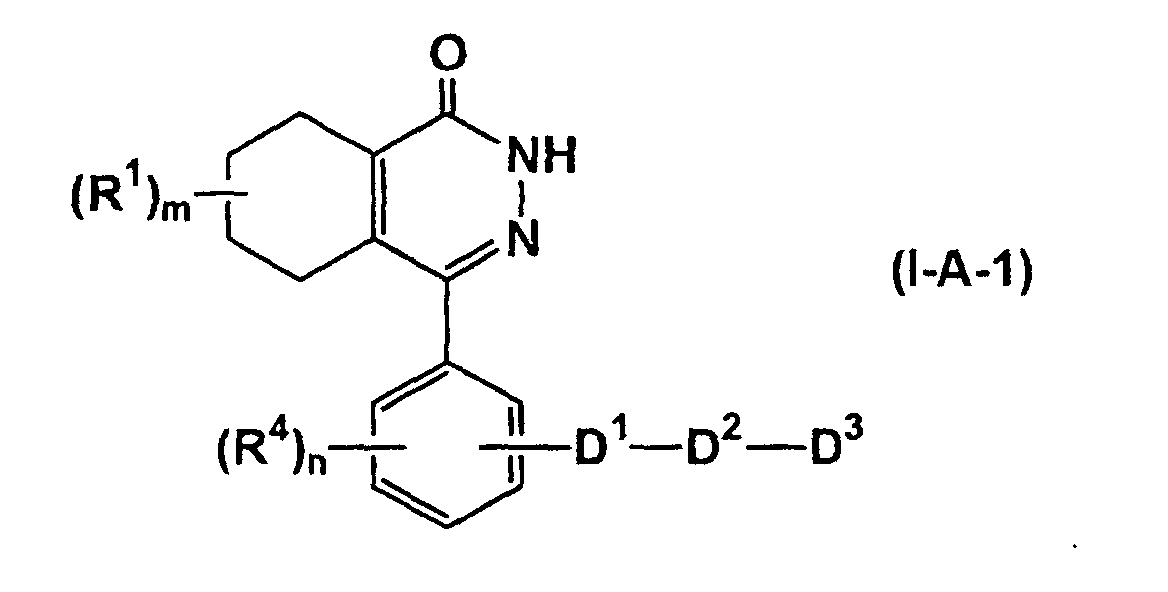
  • preferred compounds are compounds represented by formula (I-A-1) (wherein all symbols have the same meanings as described above.), compounds represented by formula (I-A-2) (wherein all symbols have the same meanings as described above.), compounds represented by formula (I-B-1) (wherein all symbols have the same meanings as described above.), compounds represented by formula (I-B-2) (wherein all symbols have the same meanings as described above.), compounds represented by formula (I-C-1) (wherein all symbols have the same meanings as described above.), and compounds represented by formula (I-C-2) (wherein all symbols have the same meanings as described above.).
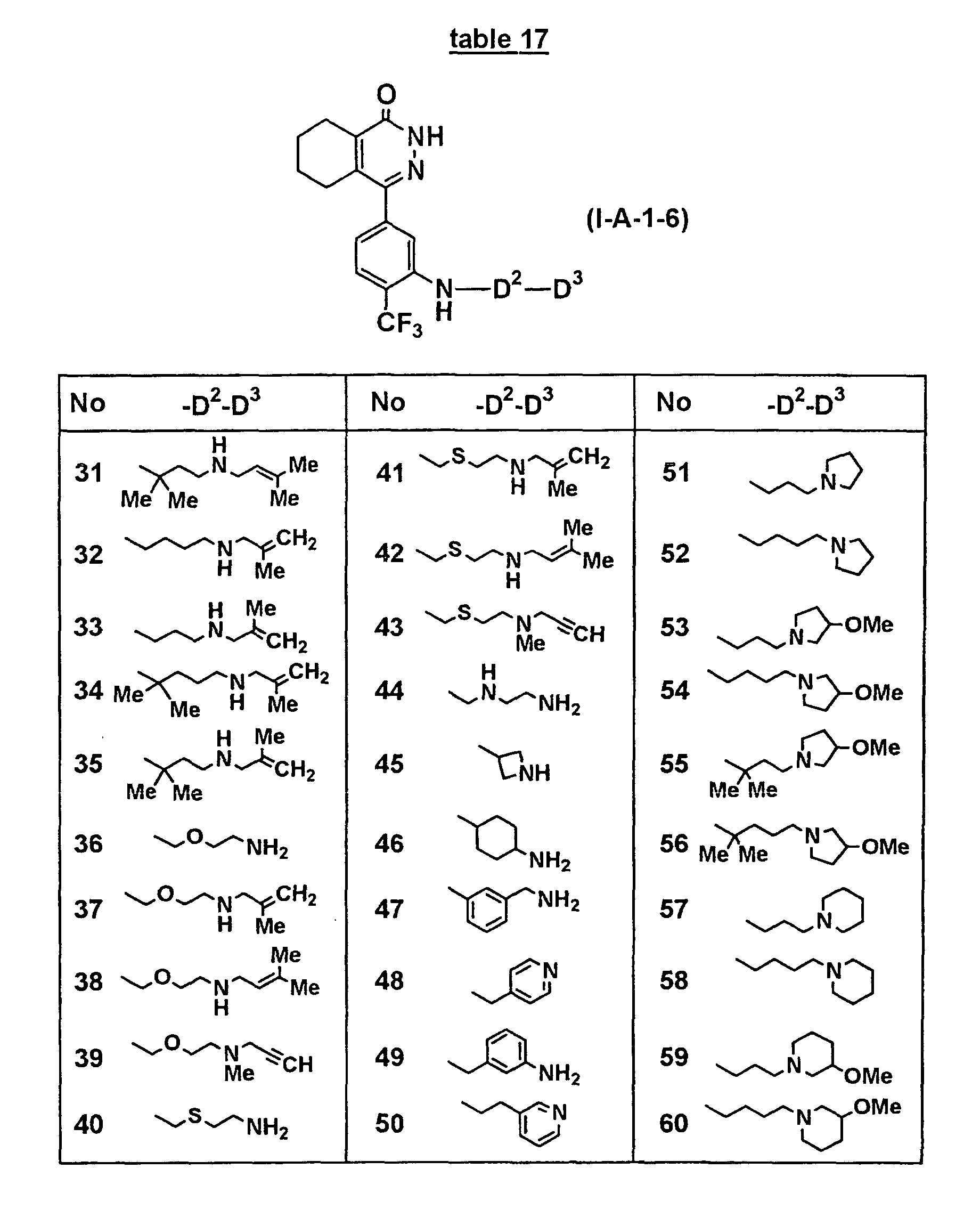
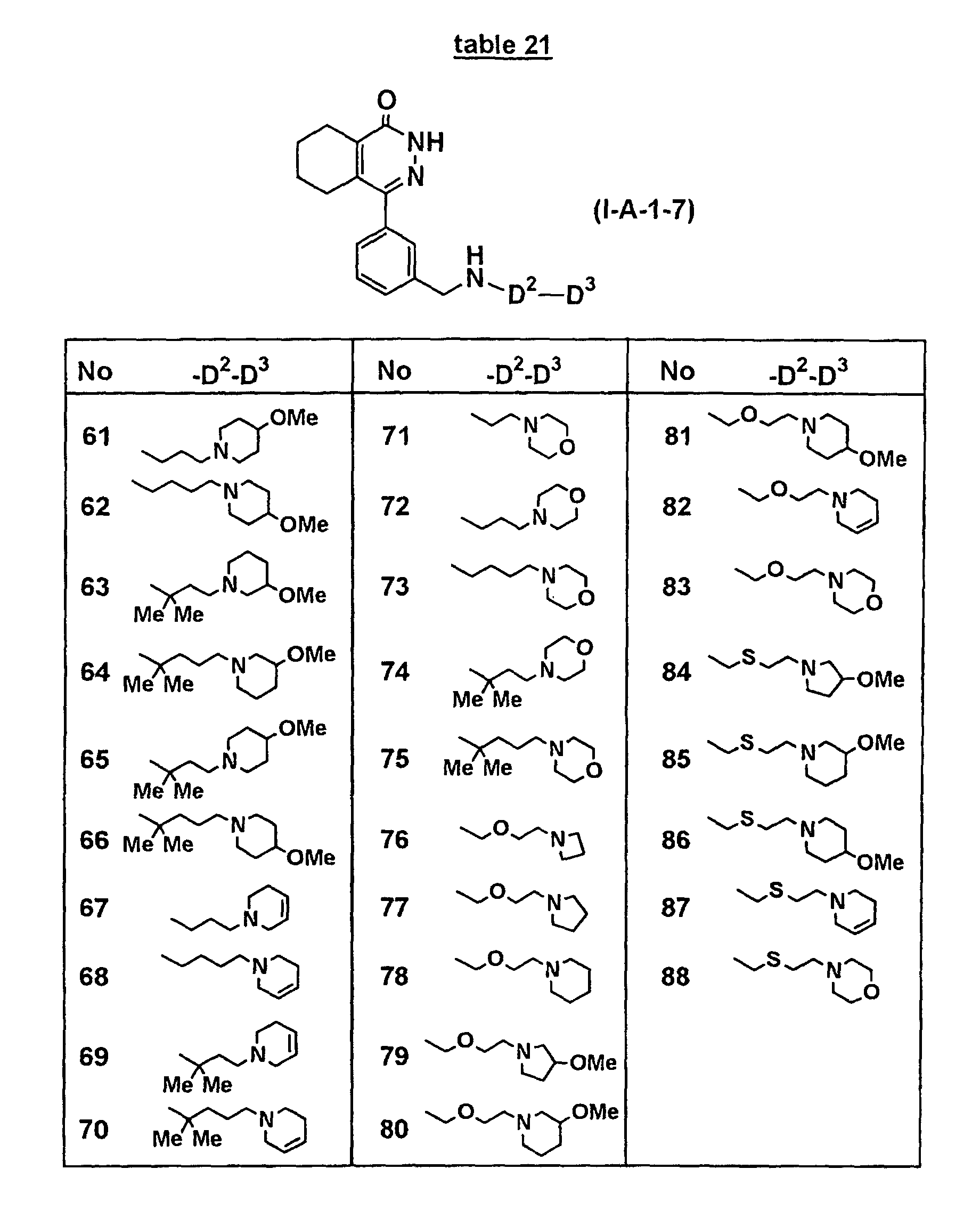
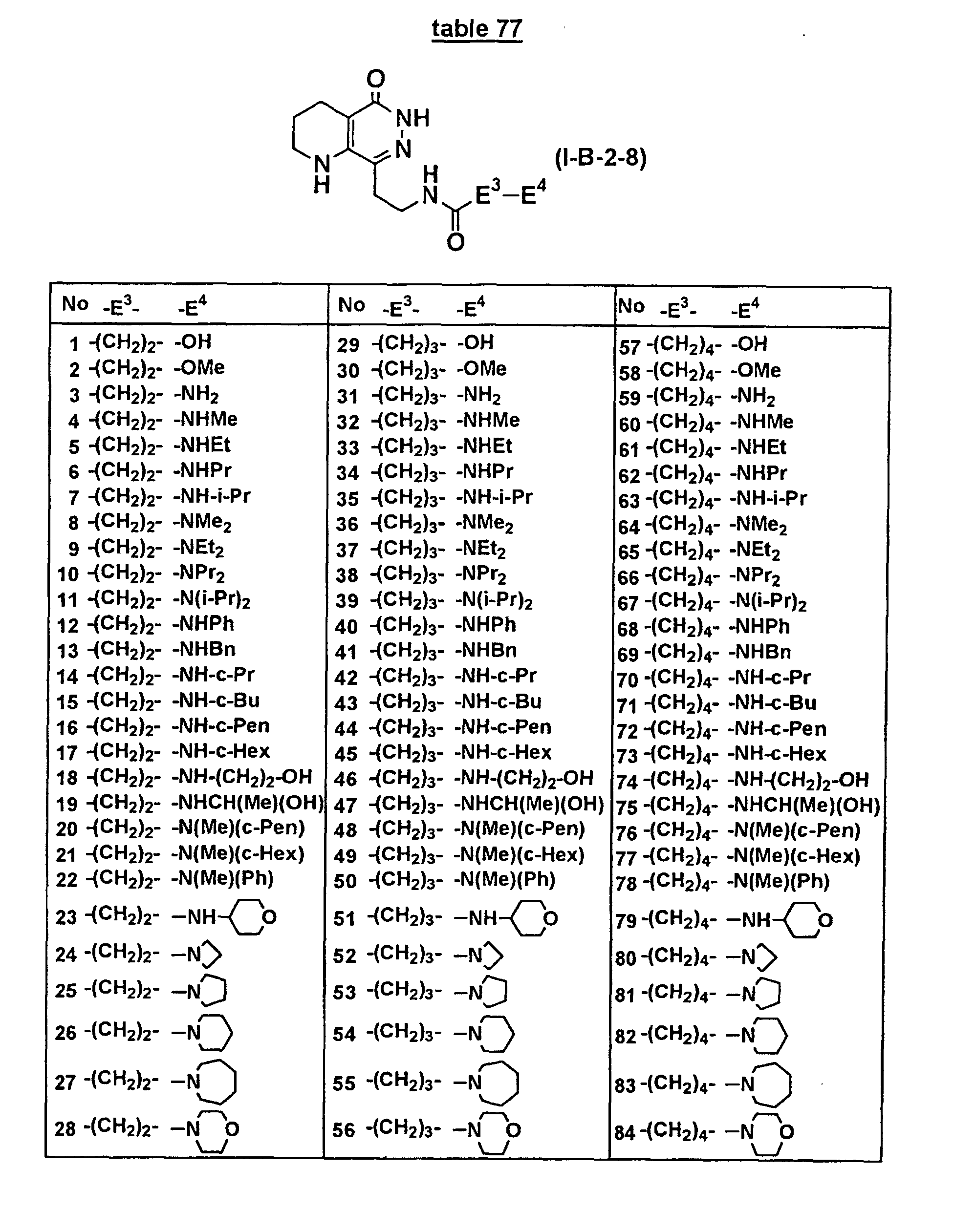
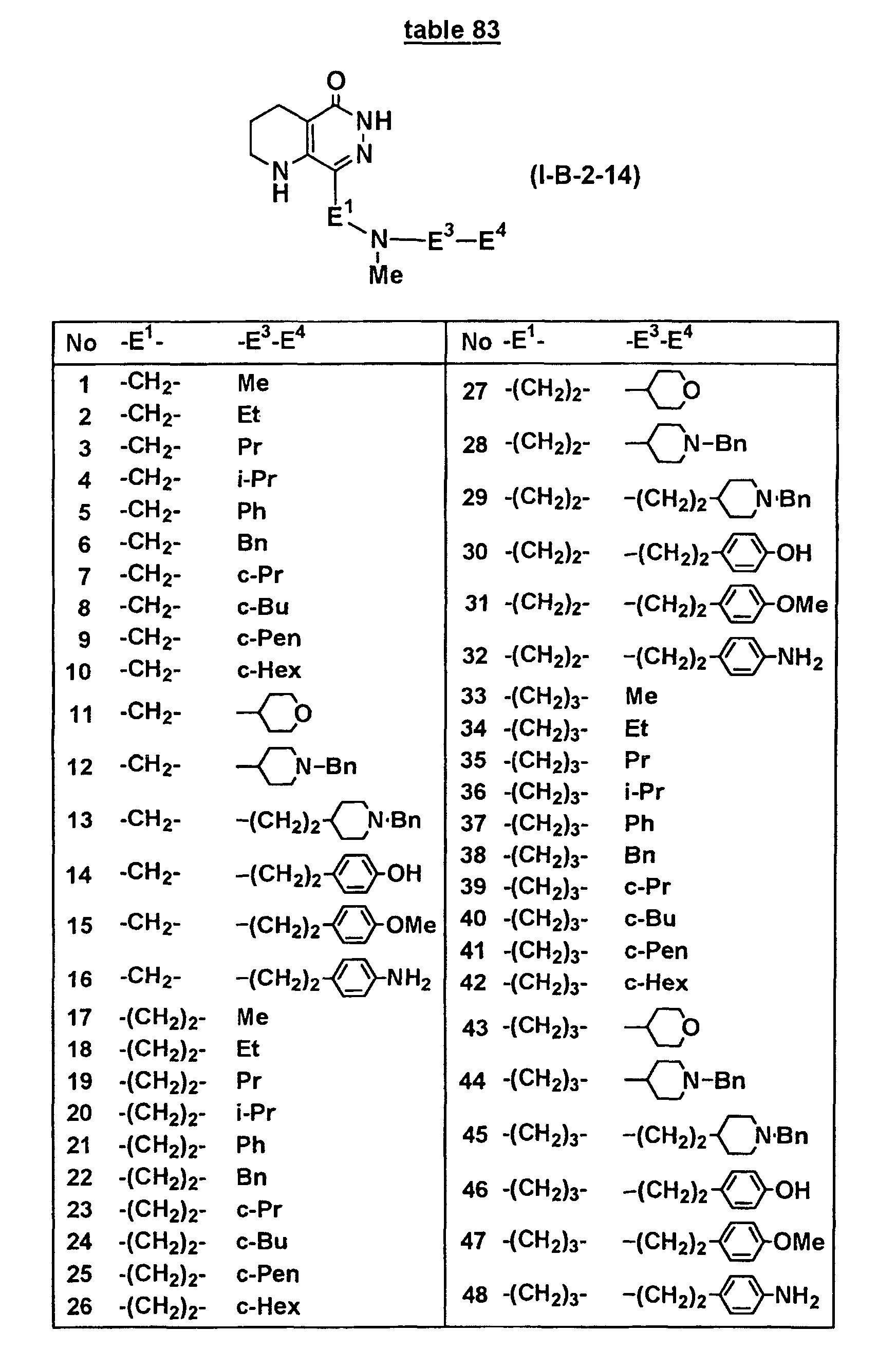
  • Concrete compounds of the present invention include compounds shown in Tables 1 to 90, compounds described in Examples, and pharmaceutically acceptable salts thereof.
  • Me represents methyl group
  • Et represents ethyl group
  • Pr represents propyl group
  • i-Pr represents isopropyl group
  • Bu represents butyl group
  • c-Pr represents cyclopropyl group
  • c-Bu represents cyclobutyl group
  • c-Pen represents cyclopentyl group
  • c-Hex represents cyclohexyl group
  • Ph represents phenyl group
  • Bn represents benzyl group, and other symbols have the same meanings as described above.
  • the compound represented by formula (I) can be prepared by the following method or the method described in Example.
  • D 1-1 is -NR 6 C(O)- or -CH 2 -NR 6 C(O)-, and other symbols have the same meanings as described above.
  • D 1-1 is -NR 6 C(O)- or -CH 2 -NR 6 C(O)-, and other symbols have the same meanings as described above.
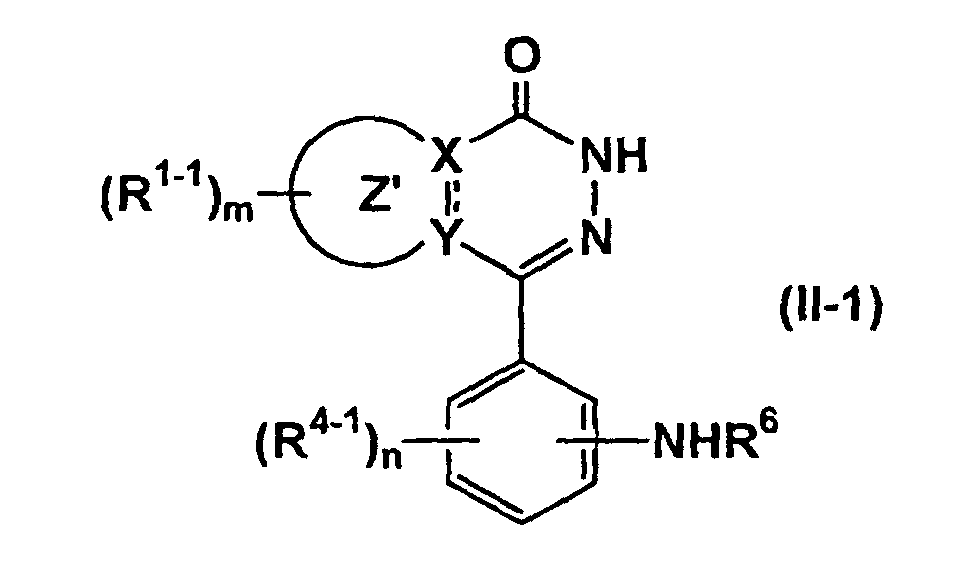
  • the compound represented by formula (IA-1) can be prepared by the amidation of the compounds of formula (II) (wherein R 31 is -NHR 6 or -CH 2 -NHR 6 , and R 1-1 , R 4-1 and are R 1 , R 4 and respectively. With proviso that, hydroxyl or amino in the group represented by R 1-1 , hydroxyl or amino represented by R 4-1 , and amino in the group represented by may be protected, if necessary. Other symbols have the same meanings as defined above.) and a compound represented by formula (III) HOOC-D 2-1 -D 3-1 (III) (wherein D 2-1 and D 3-1 are D 2 and D 3 respectively.
  • amino in the group represented by D 2-1 and carboxy, hydroxy, amino, amidino or guanidino in D 3-1 may be protected, if necessary.), if necessary, followed by removal of the protective group from the resulting product.
  • the method of amidation is known.
  • it includes the method
  • reaction described in (1), (2) and (3) may be carried out under an inert gas (e.g., argon, nitrogen) to avoid water in order to obtain a preferable result.
  • an inert gas e.g., argon, nitrogen
  • the removal of the protective group may be carried out by following method.
  • reaction for removing the protective group for carboxyl, hydroxyl, amino, amidino or guanidino is well known, including, for example, the following:
  • the carboxyl-protective group includes, for example, methyl, ethyl, t-butyl and benzyl.
  • the hydroxyl-protective group includes, for example, methoxymethyl, 2-tetrahydropyranyl, t-butyldimethylsilyl, t-butyldiphenylsilyl, acetyl and benzyl.
  • the amino, amidino and guanidino-protective group includes, for example, benzyloxycarbonyl, t-butoxycarbonyl, trifluoroacetyl, 9-fluorenylmethoxycarbonyl and trimethylsilyl.
  • the carboxyl, hydroxyl, amino, amidino or guanidino-protective group may be any others than those mentioned above, capable of being readily and selectively removed, and are not specifically defined. For example, those described in T. W. Greene, Protective Groups in Organic Synthesis, 3rd edition, Wiley, New York, 1999 may be used.
  • the compound represented by formula (IA-2) can be prepared by the sulfonamidation of the compounds of formula (II-1) (wherein all symbols have the same meanings as defined above.) and a compound represented by formula (IV) (wherein R 32 is halogen atom and other symbols have the same meanings as defined above.), if necessary, followed by removal of the protective group from the resulting product.
  • This sulfonamidation is known. For example, it is carried out at 0 to 40°C in an inert organic solvent (e.g., chloroform, methylene chloride, diethyl ether or tetrahydrofuran) in the presence of tertiary amine (e.g., pyridine, triethylamine, dimethylaniline or dimethylaminopyridine).
  • an inert organic solvent e.g., chloroform, methylene chloride, diethyl ether or tetrahydrofuran
  • tertiary amine e.g., pyridine, triethylamine, dimethylaniline or dimethylaminopyridine
  • the removal of the protective group may be carried out by the above method.
  • the compound represented by formula (IA-3) can be prepared by esterifying the compounds of formula (V) (wherein all symbols have the same meanings as defined above.) with the above compound represented by formula (III) HOOC-D 2-1 -D 3-1 (III) (wherein all symbols have the same meanings as defined above.), if necessary, followed by removal of the protective group from the resulting product.
  • the method of esterification is known.
  • it includes the method
  • reaction described in (1), (2) and (3) may be carried out under an inert gas (e.g., argon, nitrogen) to avoid water in order to obtain a preferable result.
  • an inert gas e.g., argon, nitrogen
  • the removal of the protective group may be carried out by the above method.
  • the compound represented by formula (IA-4) can be prepared by the etherification of the compounds of formula (VI-1) (wherein all symbols have the same meanings as described above.) and the compound of formula (VII-1) R 33 -D 2-1 -D 3-1 (VII-1) (wherein R 33 is a leaving group (halogen atom, mesyloxy or tosyloxy, etc .) and other symbols have the same meanings as described above.), if necessary, followed by removal of the protective group, by the etherification of the compounds of formula (VI-2) (wherein all symbols have the same meanings as described above.) and the compound of formula (VII-2) HO-D 2-1 -D 3-1 (VII-2) (wherein all symbols have the same meanings as described above.), if necessary, followed by removal of the protective group, or by the etherification of the above compounds of formula (VI-1) (wherein all symbols have the same meanings as described above.) and the compound of formula (VII-2) HO-D
  • This etherification of the compound of formula (VI-1) and the compound of formula (VII-1), and the compound of formula (VI-2) and the compound of formula (VII-2) is known.
  • it is carried out at 0 to 100°C in an inert organic solvent (e.g., dimethylformamide, dimethylsulfoxide, chloroform, methylene chloride, diethyl ether or tetrahydrofuran) in the presence of an alkali metal hydroxide (e.g., sodium hydroxide, potassium hydroxide, lithium hydroxide), an alkaline earth metal hydroxide (e.g., barium hydroxide, calcium hydroxide) or a carbonate (e.g., sodium carbonate, potassium carbonate), or an aqueous solution thereof or their mixture.
  • an alkali metal hydroxide e.g., sodium hydroxide, potassium hydroxide, lithium hydroxide
  • an alkaline earth metal hydroxide e.g., barium hydroxide, calcium hydro
  • This etherification of the compound of formula (VI-1) and the compound of formula (VII-2) is known. For example, it is carried out at 0 to 60°C by reacting with a corresponding alcohol compound in an organic solvent (dichloromethane, diethyl ether, tetrahydrofuran, acetonitrile, benzene, toluene, etc.) in the presence of an azo compound (diethyl azodicarboxylate, diisopropyl azodicarboxylate, 1,1'-(azodicarbonyl)dipiperidine, 1,1'-azobis(N,N-dimethylformamide), etc .) and a phosphine compound (triphenylphosphine, tributylphosphine, trimethylphosphine, etc .).
  • an organic solvent dichloromethane, diethyl ether, tetrahydrofuran, acetonitrile, benzene, tolu
  • the deprotection reaction of the protective group may be carried out by the methods described above.
  • the compound represented by formula (IA-5) can be prepared by reacting the above compound of formula (II-1) (wherein all symbols have the same meanings as described above.) with the compound of formula (VIII-1) R 32 -D 2-1 -D 3-1 (VIII-1) (wherein all symbols have the same meanings as described above.), if necessary, followed by removal of the protecting group, or by reacting the compound of formula (IX) (wherein all symbols have the same meanings as described above.) with the compound of formula (VIII-2) R 6 HN-D 2-1 -D 3-1 (VIII-2) (wherein all symbols have the same meanings as described above.), if necessary, followed by removal of the protecting group.
  • This reaction of the compound of formula (II) and the compound of formula (VIII-1), and the compound of formula (IX) and the compound of formula (VIII-2) is known.
  • it is carried out at 0 to 100°C in an inert organic solvent (e.g., dimethylformamide, dimethylsulfoxide, chloroform, methylene chloride, diethyl ether, tetrahydrofuran or acetonitrile) in the presence or absence of a base (e.g., triethylamine, pyridine).
  • an inert organic solvent e.g., dimethylformamide, dimethylsulfoxide, chloroform, methylene chloride, diethyl ether, tetrahydrofuran or acetonitrile
  • a base e.g., triethylamine, pyridine
  • the deprotection reaction of the protective group may be carried out by the methods described above.
  • the reductive amination is well known. For example, it may be carried out in an organic solvent (e.g., methanol, ethanol) in the presence of reducing agent (e.g., sodium cyanoborohydride, sodium borohydride, sodium triacetoxyborohydride) and, if necessary, in the presence of an acid (e.g., acetic acid, hydrogen chloride) at -20 to 60°C.
  • organic solvent e.g., methanol, ethanol
  • reducing agent e.g., sodium cyanoborohydride, sodium borohydride, sodium triacetoxyborohydride
  • an acid e.g., acetic acid, hydrogen chloride
  • the removal of the protective group may be carried out by the methods described above.
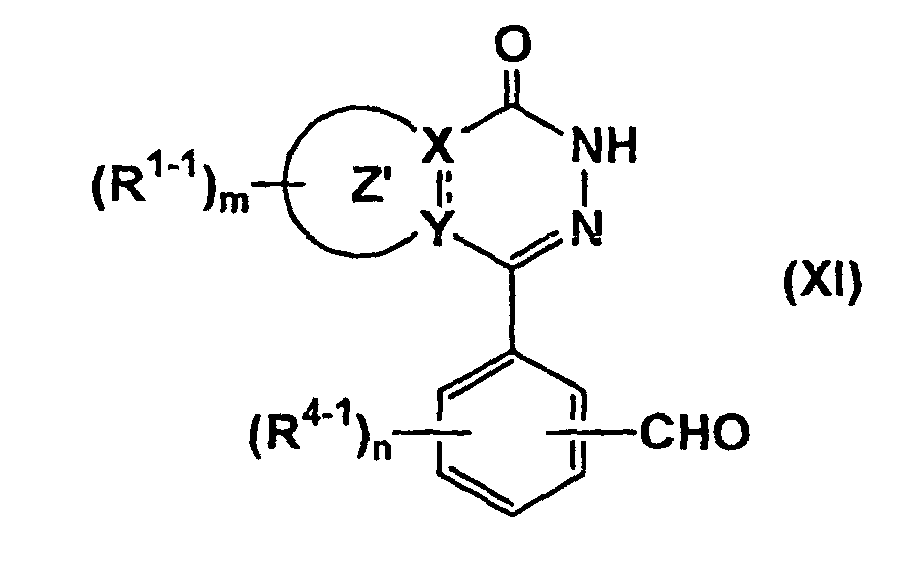
  • the compound represented by formula (IA-6) can be prepared by reacting the compound of formula (X) (wherein all symbols have the same meanings as described above.) with the above compound of formula (VIII-1) R 32 -D 2-1 -D 3-1 (VIII-1) (wherein all symbols have the same meanings as described above.), if necessary, followed by removal of the protecting group, or by reductive amination of the compound of formula (XI) (wherein all symbols have the same meanings as described above.) with the above compound of formula (VIII-2) R 6 HN-D 2-1 -D 3-1 (VIII-2) (wherein all symbols have the same meanings as described above.), if necessary, followed by removal of the protecting group.
  • reaction of the compound of formula (X) and the compound of formula (VIII-1) may be carried out by the same method as the above reaction of the compound of formula (IX) and the compound of formula (VIII-2).
  • reaction of the compound of formula (XI) and the compound of formula (VIII-2) may be carried out by the same method as the above reaction of the compound of formula (II-1) and the compound of formula (VIII-3).
  • the removal of the protective group may be carried out by the methods described above.
  • reaction is known. It may be carried out in organic solvent (e.g., tetrahydrofuran, methylene chloride, diethyl ether) at 0 to 100°C.
  • organic solvent e.g., tetrahydrofuran, methylene chloride, diethyl ether
  • the removal of the protective group may be carried out by the methods described above.
  • the reaction is known. It may be carried out in an organic solvent (tetrahydrofuran, methylene chloride, diethyl ether) at 0 to 100°C.
  • organic solvent tetrahydrofuran, methylene chloride, diethyl ether
  • the removal of the protective group may be carried out by the methods described above.
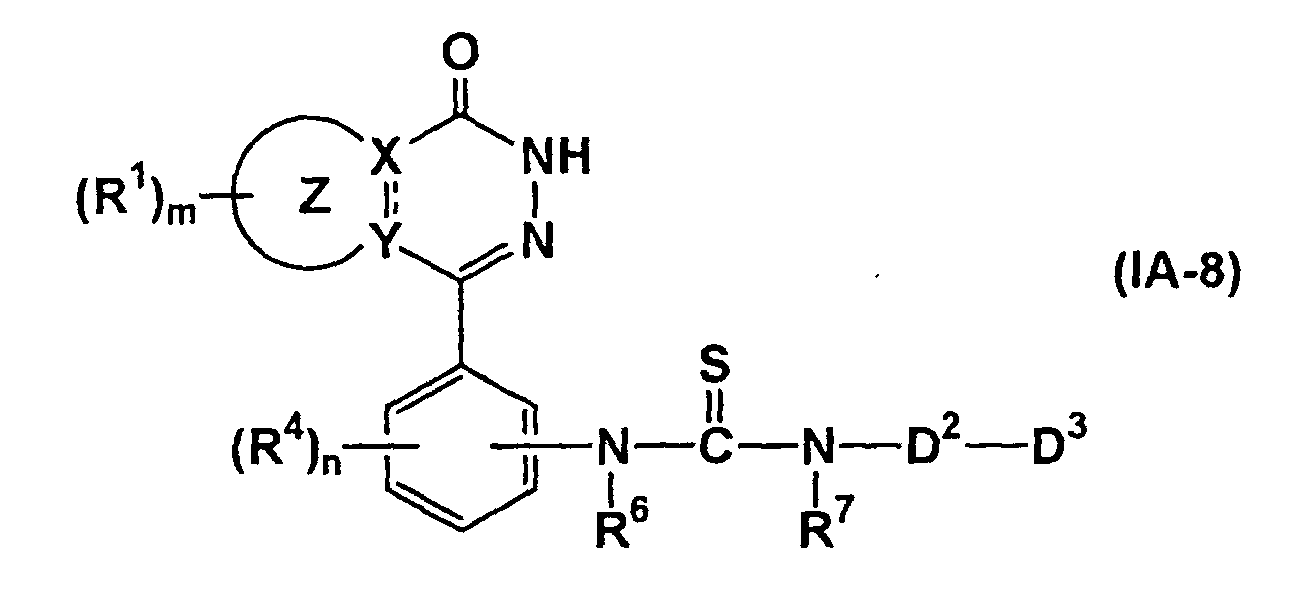
  • the compound represented by formula (IA-9) can be prepared by reacting the above compound of formula (II-1) (wherein all symbols have the same meanings as described above.) with the compound of formula (XIV) (wherein all symbols have the same meanings as described above.), if necessary, followed by removal of the protecting group.
  • the reaction is known. It may be carried out in an organic solvent (e.g., tetrahydrofuran, methylene chloride, diethyl ether) at -78 to 40°C.
  • organic solvent e.g., tetrahydrofuran, methylene chloride, diethyl ether
  • the removal of the protective group may be carried out by the methods described above.
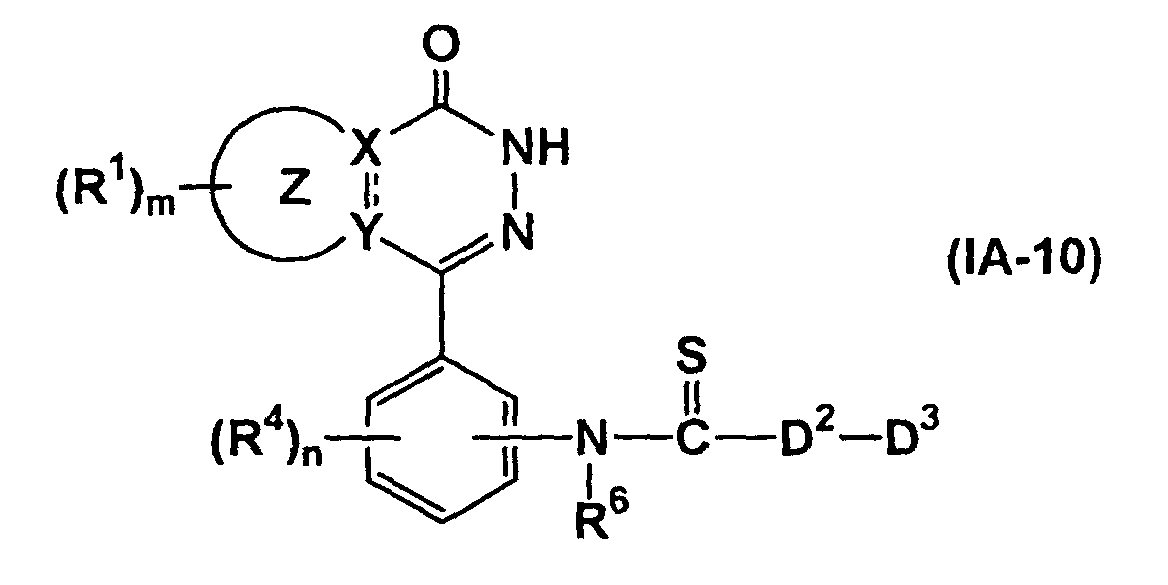
  • the compound represented by formula (IA-10) can be prepared by thiocarbonylation of the compound of formula (XV) (wherein all symbols have the same meanings as described above.), if necessary, followed by removal of the protecting group.
  • the reaction is known. It may be carried out in an organic solvent (e.g., dioxane, benzene, toluene, xylene, tetrahydrofuran), using Lawesson reagent (2,4-bis(4-methoxyphenyl)-1,3-dithia-2,4-diphosphetane-2,4-disulfide) at 20 to 150°C.
  • organic solvent e.g., dioxane, benzene, toluene, xylene, tetrahydrofuran
  • the removal of the protective group may be carried out by the methods described above.
  • the compound of formula (IA-11) can be prepared by reacting the above compound of formula (II-1) (wherein all symbols have the same meanings as described above.) with the compound of formula (XVI) (wherein R 34 is C1-4 alkyl and other symbols have the same meanings as described above.), if necessary, followed by removal of the protecting group.
  • the reaction is known.
  • it may be carried out in an organic solvent (e.g., methanol, ethanol) at 0 to 50°C.
  • organic solvent e.g., methanol, ethanol
  • the removal of the protective group may be carried out by the methods described above.
  • the hetero ring is a hetero ring having at least one nitrogen atom which binds to D 2
  • a compound of formula (IA-12) (wherein D 3-2 is -NR 9 R 10 or hetero ring represented by (among Cyc2, the hetero ring is a hetero ring having at least one nitrogen atom which binds to D 2 and other symbols have the same meanings as described above.) can be prepared by the following method.
  • reaction of the compound of formula (XVII) and the compound of formula (XVIII) or (XIX) may be carried out by the same method as the above reaction of the compound of formula (IX) and the compound of formula (VIII-2).
  • the removal of the protective group may be carried out by the methods described above.
  • the compound of formula (IB-1) can be prepared by amidation of a compound of formula (XX) (wherein all symbols have the same meanings as described above.) and the compound of formula (XXI) (wherein E 4-1 is E 4 . With proviso that, hydroxyl, amino or carboxyl in the group represented by E 4-1 may be protected, if necessary. Other symbols have the same meanings as defined above.), if necessary, followed by removal of the protecting group.
  • amidation and the removal of the protective group may be carried out by the methods described above.
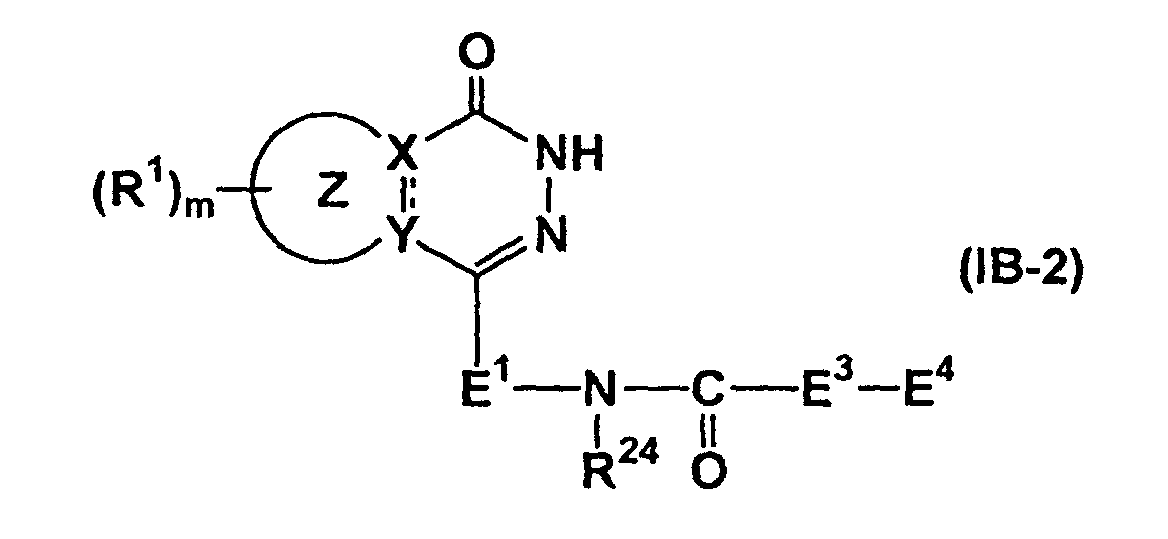
  • the compound of formula (IB-2) can be prepared by amidation of a compound of formula (XXII) (wherein all symbols have the same meanings as described above.) and a compound of formula (XXIII) HOOC-E 3 -E 4-1 (XXIII) (wherein all symbols have the same meanings as described above.), if necessary, followed by removal of the protecting group.
  • amidation and the removal of the protective group may be carried out by the methods described above.
  • the compound of formula (IB-3) can be prepared by reacting a compound of formula (XXIV) (wherein all symbols have the same meanings as described above.) with the above compound of formula (XXI) (wherein all symbols have the same meanings as described above.), if necessary, followed by removal of the protecting group.
  • reaction of the compound of formula (XXIV) and the compound of formula (XXI) may be carried out by the same method as the above reaction of the compound of formula (IX) and the compound formula (VIII-2).
  • the removal of the protective group may be carried out by the methods described above.
  • the compound of formula (IB-4) can be prepared by esterifying the compound of formula (XX) (wherein all symbols have the same meanings as described above.) with a compound of formula (XXV) HO-E 3 -E 4-1 (XXV) (wherein all symbols have the same meanings as described above.), if necessary, followed by removal of the protecting group.
  • the esterifying and the removal of the protective group may be carried out by the methods described above.
  • the compound of formula (IB-5) can be prepared by reacting a compound of formula (XXVI) (wherein all symbols have the same meanings as described above.) with a compound of formula (XXVII) R 32 -E 3 -E 4-1 (XXVII) (wherein all symbols have the same meanings as described above.), if necessary, followed by removal of the protecting group.
  • the reaction is known.
  • it may be carried out in an inert organic solvent (e.g., dimethylformamide, dimethylsulfoxide, chloroform, methylene chloride, diethyl ether, tetrahydrofuran, acetonitrile) in the presence or absence of a base (e.g., triethylamine, pyridine) at 0 to 100°C.
  • an inert organic solvent e.g., dimethylformamide, dimethylsulfoxide, chloroform, methylene chloride, diethyl ether, tetrahydrofuran, acetonitrile
  • a base e.g., triethylamine, pyridine
  • the removal of the protective group may be carried out by the methods described above.
  • the hetero ring is a hetero ring having at least one nitrogen atom (The nitrogen atom binds to E 3 .) in Cyc5.), i.e., a compound of formula (IB-6) (wherein E 4-2 is -NR 25 R 26 or hetero ring represented by (The hetero ring is a hetero ring having at least one nitrogen atom (The nitrogen atom binds to E 3 .) in Cyc5.) and other symbols have the same meanings as described above.) can be prepared by the following method.
  • the compound of formula (IB-6) can be prepared by reacting a compound of formula (XXVIII) (wherein all symbols have the same meanings as described above.) with a compound of formula (XXIX) H-NR 25 R 26 (XXIX) (wherein all symbols have the same meanings as described above.) or a compound of formula (XXX) (wherein all symbols have the same meanings as described above.), if necessary, followed by removal of the protecting group.
  • reaction of the compound of formula (XXVIII) and the compound of formula (XXIX) or (XXX) may be carried out by the same method as the above reaction of the compound of formula (IX) and the compound of formula (VIII-2).
  • the removal of the protective group may be carried out by the methods described above.
  • the compound of formula (IC-1) can be prepared by reacting a compound of formula (XXXI) (wherein G 1-1 is bond or C1-7 alkylene, Cyc1' and G 2-1 are Cyc1 and G 2 respectively. With proviso that amino in the group represented by Cyc1, and hydroxy and amino in the group represented by G 2-1 may be protected, if necessary. Other symbols have the same meanings as described above.) with hydrazine or a salt thereof (e.g., hydride, chloride), if necessary, followed by removal the protecting group.
  • XXXI wherein G 1-1 is bond or C1-7 alkylene, Cyc1' and G 2-1 are Cyc1 and G 2 respectively.
  • hydrazine or a salt thereof e.g., hydride, chloride
  • the reaction is known.
  • it may be carried out in an organic solvent (e.g., methanol, ethanol, propanol, isopropanol, butanol, acetic acid, tetrahydrofuran) at 50°C to reflux temperature.
  • an organic solvent e.g., methanol, ethanol, propanol, isopropanol, butanol, acetic acid, tetrahydrofuran
  • the removal of the protective group may be carried out by the methods described above.
  • a compound in which Cyc1 is hetero ring represented by (The hetero ring is a hetero ring having at least one nitrogen atom (The nitrogen atom binds to G 1 .) in Cyc1.), i.e., a compound of formula (IC-1-1) (wherein is a hetero ring having at least one nitrogen atom (The nitrogen atom binds to G 1 .) in Cyc1 and other symbols have the same meanings as described above.) can be prepared by following method.
  • the compound of formula (IC-1-1) can be prepared by reacting a compound of formula (XXXII) (wherein all symbols have the same meanings as described above.) with a compound of formula (XXXIII) (wherein all symbols have the same meanings as described above.), if necessary, followed by removal the protecting group.
  • reaction of the compound of formula (XXXII) and the compound of formula (XXXIII) may be carried out by the same method as the above reaction of the compound of formula (IX) and the compound of formula (VIII-2).
  • the removal of the protective group may be carried out by the methods described above.
  • the compound of formula (ID-1) can be prepared by reacting a compound of formula (XXXIV-1)
  • R 35 is C1-8 alkyl, and A 6-1 is A 6 . With proviso that hydroxy or amino in the group represented by A 6-1 may be protected, if necessary.
  • Other symbols have the same meanings as described above.
  • a compound of formula (XXXIV-2) (wherein all symbols have the same meanings as described above.) with hydrazine or a salt thereof (e.g., hydride, chloride), if necessary, followed by removal the protecting group.
  • the reaction is known.
  • it may be carried out in an organic solvent (e.g., methanol, ethanol, propanol, isopropanol, butanol, acetic acid, tetrahydrofuran) at 50°C to reflux temperature.
  • an organic solvent e.g., methanol, ethanol, propanol, isopropanol, butanol, acetic acid, tetrahydrofuran
  • the removal of the protective group may be carried out by the methods described above.
  • the compound of formula (ID-1) can be prepared by reacting a compound of formula (XXXV)
  • the reaction is known.
  • it may be carried out in an organic solvent (e.g., methanol, ethanol, propanol, isopropanol, butanol, acetic acid, tetrahydrofuran) at 50°C to reflux temperature.
  • an organic solvent e.g., methanol, ethanol, propanol, isopropanol, butanol, acetic acid, tetrahydrofuran
  • the removal of the protective group may be carried out by the methods described above.
  • a compound in which X is N, ---- is single bond i.e., a compound of formula (ID-1-1) (wherein all symbols have the same meanings as described above.) can be prepared by the following method.
  • the compound of formula (ID-1-1) can be prepared by reacting a compound of formula (XXXVI) (wherein all symbols have the same meanings as described above.) with a compound of formula (XXXVII) (wherein R 35 has the same meaning as described above.),if necessary, followed by removal of the protecting group.
  • the reaction may be carried out, for example, in an organic solvent (e.g., toluene, tetrahydrofuran, chloroform, methylene chloride) in the presence or absence of catalyst (e.g., p-toluenesulfonic acid, pyridine) at 50°C to reflux temperature.
  • organic solvent e.g., toluene, tetrahydrofuran, chloroform, methylene chloride
  • catalyst e.g., p-toluenesulfonic acid, pyridine
  • the removal of the protective group may be carried out by the methods described above.
  • R 36 is -NHR 6 , -CH 2 -NHR 6 , -OH, -CH 2 -OH, -CH 2 - R 33 or halogen atom. With proviso that hydroxy and amino in the group represented by R 36 may be protected, if necessary.
  • R 37 is the protecting group of amino
  • R 38 is -NHR 6 , -CH 2 -NHR 6 , -OH, -CH 2 -OH, -CH 2 -R 33 or halogen atom
  • BOP is benzotriazol-1-yloxy-tris(dimethylamino)phosphonium hexafluorophosphate
  • Me is methyl
  • Et is ethyl
  • E 1-1 is bond or C1-3 alkylene
  • Ph is phenyl
  • TBAF is tetrabutylammonium fluoride
  • TMSN 3 is trimethylsilylazide
  • R 39 is COOH, -NHR 24 , halogen atom or -SCOCH 3 .
  • R 40 is COOH, -NHR 24 , halogen atom or -SCOCH 3 , and other symbols have the same meanings as described above.
  • the compound represented by formulae (XXXIX) and (XXXXXV) with bromo instead of chloro may be used, which could be readily understood by anyone skilled in the art.
  • the reaction product can be purified by general purification techniques such as distillation under ordinary pressure or a reduced pressure, high performance liquid chromatography, thin layer chromatography or column chromatography using silica gel or magnesium silicate, washing and recrystallization. Purification may be carried out in each reaction or after completion of several reactions.
  • the reaction mixture contained each 10 ⁇ L of 500mM Tris/HCl (pH 8.0, WAKO), 100mM MgCl 2 , 50mM dithiothreitol (sigma), 1mg/mL activated DNA and 1mM NAD (containing 3 H-NAD).
  • the 10 ⁇ L of test compound was added to the reaction mixture and the reaction was started by addition of 10 ⁇ L of 0.1U/ ⁇ L PARP (TREVIGEN). The reaction was terminated at 10 minutes by addition of 100 ⁇ L of 20% trichloroacetic acid.
  • Model of cerebral or coronary ischemia-reperfusion was prepared according to procedures described previously ( Jpn . J . Stroke , 8 , 1 (1986), Stroke, 27, 1624-1628 (1996) and Eur . J . Pharmacol., 270, 45 (1994)).
  • the compounds of the present invention were improvement effective of these diseases.
  • the toxicity of the compounds of the present invention represented by formula (I) is very low (For example, as a result of administering the compounds of the present invention to rats, they did not affect circulatory parameters, such as blood pressure, an electrocardiogram, and heart rate.) and therefore the compounds may be considered safe for pharmaceutical use.
  • the compound of the present invention represented by formula (I) has PARP inhibitory activity, it is useful for prevention and/or treatment of various diseases, for example, ischemic diseases (cerebral infarction, myocardial infarction, reperfusion injury or postoperative injury etc .), inflammatory diseases (inflammatory bowel disease, multiple sclerosis, arthritis or lung injury etc .), neurodegenerative disorders (extrapyramidal disease, Parkinson's disease, Alzheimer's disease, muscular dystrophy or lumbar spinal canal stenosis etc .), glaucoma, diabetes, diabetic complication, shock, head trauma, spinal cord injury, renal failure or hyperalgesia etc. Moreover, it is useful as an antiretroviral drug such as an anti HIV drug, a sensitizer of anticancer therapy or an immunosuppressant.
  • ischemic diseases cerebral infarction, myocardial infarction, reperfusion injury or postoperative injury etc .
  • inflammatory diseases inflammatory bowel disease, multiple sclerosis, arthritis or
  • the compound represented by formula (I) or pharmaceutically acceptable salt thereof may be administered in combination with other pharmaceutical preparations to accomplish the following purposes:
  • the compound represented by formula (I) and other pharmaceutical preparations may be administered in the form of formulation having these components incorporated in one preparation or may be administered in separate preparations. In the case where these pharmaceutical preparations are administered in separate preparations, they may be administered simultaneously or at different times. In the latter case, the compound represented by formula (I) may be administered before the other pharmaceutical preparations. Alternatively, the other pharmaceutical preparations may be administered before the compound represented by formula (I). The method for the administration of these pharmaceutical preparations may be the same or different.
  • the diseases on which the preventive and/or treatment effect of the aforementioned combined preparations works are not specifically limited but may be those for which the preventive and/or treatment effect of the compound represented by formula (I) is complemented and/or enhanced.
  • Examples of the other pharmaceutical preparations for complementing and/or enhancing the preventive and/or treatment effect of the compound represented by formula (I) on ischemic diseases include radical scavenger, astrocyto modulator, N-methyl-D-aspartate (NMDA) antagonist, alpha-amino-3-hydroxy-5-methylisoxazole-4-propionate (AMPA) antagonist, antithrombotic agent, thrombolytic agent, immunosuppressive agent, cell adhesion molecules inhibitor, nitrogen oxide synthase (NOS) inhibitor, neurotrophic factor and interleukin-8 inhibitor etc .
  • Examples of the other pharmaceutical preparations for complementing and/or enhancing the preventive and/or treatment effect of the compound represented by formula (I) on lumbar spinal canal stenosis include nitrogen oxide synthase (NOS) inhibitor, aldose reductase (AR) inhibitor, radical scavenger, N-methyl-D-aspartate (NMDA) antagonist, alpha-amino-3-hydroxy-5-methylisoxazole-4-propionate (AMPA) antagonist, neurotrophic factor and interleukin-8 inhibitor etc .
  • NOS nitrogen oxide synthase
  • AR aldose reductase
  • NMDA N-methyl-D-aspartate
  • AMPA alpha-amino-3-hydroxy-5-methylisoxazole-4-propionate
  • neurotrophic factor and interleukin-8 inhibitor etc .
  • radical scavenger examples include, for example, edaravone and ebselen (DR-3305) etc .
  • Examples of the astrocyto modulator include, for example, ONO-2506 etc.
  • antithrombotic agent examples include, for example, sodium ozagrel, argatroban and aspirin etc .
  • thrombolytic agent examples include, for example, tissue plasminogen activator (t-PA), urokinase and heparin etc.
  • immunosuppressive agent examples include, for example, cyclosporin A, cyclophosphamide and tacrolimus etc .
  • NOS inhibitor examples include, for example, L-NMMA and ONO-1714 etc.
  • AR inhibitor examples include, for example, epalrestat, zenarestat, fidarestat, zopolrestat and AS-3201 etc .
  • the weight proportion of the compound represented by formula (I) and the other pharmaceutical preparations is not specifically limited.
  • Examples of the other pharmaceutical preparations for complementing and/or enhancing the preventive and/or treatment effect of the compound represented by formula (I) include not only those which have so far been found but also those which will be found on the basis of the aforementioned mechanism.
  • the doses to be administered are determined depending upon, for example, age, body weight, symptom, the desired therapeutic effect, the route of administration, and the duration of the treatment.
  • the doses per person are generally from 1 mg to 1000 mg, by oral administration, up to several times per day, and from 1 mg to 100 mg, by parenteral administration (preferably intravenous administration), up to several times per day, or continuous administration from 1 to 24 hours per day from vein.
  • the doses to be used depend upon various conditions. Therefore, there are cases in which doses lower than or greater than the ranges specified above may be used.
  • the compound represented by formula (I) or the pharmaceutically acceptable salt thereof, or the concomitant drug combined the compound represented by formula (I) with pharmaceutical preparations may be administered in the form of, for example, solid compositions, liquid compositions or other compositions each for oral administration, or injections, preparations for external use or suppositories, each for parenteral administration.
  • Solid compositions for oral administration include compressed tablets, pills, capsules, powders, and granules.
  • Capsules include hard capsules and soft capsules.
  • one or more of the active substance(s) may be admixed with at least one inert diluent such as lactose, mannitol, glucose, hydroxypropyl cellulose, microcrystalline cellulose, starch, polyvinylpyrrolidone or magnesium aluminometasilicate.
  • the compositions may comprise, in accordance with the conventional process, additives other than the inert diluent, for example, lubricants such as magnesium stearate, disintegrants such as cellulose calcium glycolate, stabilizer such as lactose, and solubilizing agent such as glutamic acid or aspartic acid.
  • Tablets or pills may be coated with a film of a gastric soluble or enteric substance such as sucrose, gelatin, hydroxypropyl cellulose or hydroxypropyl methylcellulose phthalate, or with two or more layers, if necessary.
  • a gastric soluble or enteric substance such as sucrose, gelatin, hydroxypropyl cellulose or hydroxypropyl methylcellulose phthalate, or with two or more layers, if necessary.
  • capsules made of a substance which can be absorbed in the body, for example, gelatin are included.
  • Liquid compositions for oral administration include pharmaceutically acceptable emulsions, solutions, syrups and elixirs etc .
  • Such liquid compositions comprise one or more of the active substance(s) and an ordinarily employed inert diluent(s) (for example, purified water or ethanol) dissolving the substance(s) therein.
  • the compositions may comprise, in addition to the inert diluent, an adjuvant such as humectants or suspending agents, sweetening agents, flavoring agents, aromatic agents and antiseptics.
  • compositions for oral administration include sprays which comprise one or more active substance(s) and are formulated in a manner known per se in the art.
  • the compositions may comprise, in addition to an inert diluent, a stabilizer such as sodium bisulfite and an isotonization buffer such as sodium chloride, sodium citrate or citric acid.
  • a stabilizer such as sodium bisulfite
  • an isotonization buffer such as sodium chloride, sodium citrate or citric acid.
  • injections for parenteral administration include sterile aqueous and/or non-aqueous solutions, suspensions and emulsions.
  • the aqueous solutions or suspensions include, for example, distilled water for injection and saline.
  • the non-aqueous solutions or suspensions include propylene glycol, polyethylene glycol, vegetable oils such as olive oil, alcohol such as ethanol and Polysorbate 80 (trade mark).
  • sterile aqueous and non-aqueous solutions, suspensions, and emulsions may be used in combination.
  • compositions may additionally comprise adjuvants such as antisaptic, humectant, emulsfier, dispersant, stabilizer (such as lactose) and solubilizing agent (such as glutamic acid and aspartic acid). They are sterilized by filtration through a bacteria retaining filter, the addition of a sterilizer, or irradiation. Also, a sterile solid composition is prepared and then, for example, a freeze-dried product may be dissolved in sterilized or sterile distilled water for injection or another sterile solvent before use.
  • adjuvants such as antisaptic, humectant, emulsfier, dispersant, stabilizer (such as lactose) and solubilizing agent (such as glutamic acid and aspartic acid).
  • solubilizing agent such as glutamic acid and aspartic acid
  • compositions for parenteral administration include liquids for external use, ointments, endermic liniments, suppositories for intrarectal administration and pessaries for vaginal administration which comprise one or more of the active substance(s) and may be prepared by methods known per se.
  • the solvents in the parentheses show the developing or eluting solvents and the ratios of the solvents used are by volume in chromatographic separations or TLC.
  • the solvents in the parentheses in NMR show the solvents for measurement.
  • Example 4(28) The compound prepared in Example 4(28) (150 mg) and lithium chloride (59 mg) were dissolved in dimethylformamide (2.0 mL) and the mixture was refluxed for 16 hours. After cooling to room temperature, to the reaction mixture was added 1N hydrochloric acid. The precipitate was collected by filtration. It was dried to give the compound of the present invention (126 mg) having the following physical data.
  • Example 6 By the same procedure as described in Example 6, if necessary, by converting to corresponding salts by conventional method, using the compounds prepared in Example 4, 4(2), 4(3), 4(6), 4(7), 4(10), 4(12), 4(14), 4(13), 4(18), 4(19), 4(21), 4(23)-4(26), 4(28), 4(30) or 5 instead of the compound prepared in Example 3, the following compounds of the present invention were obtained.
  • the filtrate was concentrated.
  • the residue was diluted with ethyl acetate.
  • the diluted solution was washed with a saturated aqueous sodium hydrogen carbonate solution and brine sequentially, dried over anhydrous sodium sulfate and concentrated.
  • the residue was recrystallized from ethanol to give the compound of the present invention (42 mg) having the following physical data.
  • the compound was converted to a corresponding salt thereof by conventional method.
  • the compound prepared in Reference example (199 mg) was separated with ethyl acetate and a saturated aqueous sodium hydrogen carbonate solution and the water layer was extracted with ethyl acetate. The combined organic layer was washed with brine, dried over anhydrous sodium sulfate and concentrated. The obtained powder was dissolved in toluene (10 mL). Thereto were added hydrazine carboxylic acid ethyl ester (184 mg) and p-toluenesulfonic acid monohydrate (8.4 mg) and the mixture was refluxed overnight. After cooling the reaction mixture to room temperature, it was diluted in ethyl acetate.
  • Example 15 The compound prepared in Example 15 (350 mg) was dissolved in tetrahydrofuran (8.0 mL). Under an atmosphere of argon, sodium borohydride (239 mg) was added thereto at 0°C and the mixture was refluxed for 13 hours. After cooling to 0°C, 1N hydrochloric acid was added to the reaction mixture, which was adjusted to pH 5. The deposited solid was collected by filtration. The filtrate was concentrated and extracted with chloroform. The extract was dried over anhydrous magnesium sulfate and concentrated to give the title compound having the following physical data.
  • Example 6(5) To a suspension of the compound prepared in Example 6(5) (100 mg) in methanol (1.1 mL) were added a solution of sodium methylate in methanol (0.5 mL;28% solution) and paraformaldehyde (32 mg) and the mixture was stirred at room temperature for 3 hours. Methanol (1.1 mL) and sodium borohydride (22 mg) were added to the reaction mixture, which was stirred at 75°C for 1 hour. After cooling to room temperature, water was added to the reaction mixture, which was poured in cold water. The solution was concentrated. The residue was washed with a mixed solvent of methanol and methylene chloride and filtrated through Celite. The filtrate was concentrated.
  • Example 23 By the same procedure as described in Example 23, if necessary, by converting to corresponding salts by conventional method, using the compound prepared in Example 11 or a corresponding carboxylic acid derivative, and N-(2-aminoethyl)carbamic acid t-butyl ester or a corresponding derivative, the following compounds of the present invention were obtained.
  • Example 15 A mixture of the compound prepared in Example 15 (222 mg) and 2-aminoethanol (305 mg) was stirred at 100°C for 1 hour. After cooling the reaction mixture to room temperature, the deposited crystal was washed with ethyl acetate. The obtained crystal was recrystallized from a mixed solvent methanol and ethyl acetate to give the compound of the present invention (190 mg) having the following physical data.
  • 5-chloropentanoyl chloride (171 mg) was added dropwise to a mixed solution of the compound prepared in Example 1 (241 mg) and potassium carbonate (89.8 mg) in tetrahydrofuran (3.00 mL) and water (1.00 mL) in ice bath and the mixture was stirred for 30 minutes. Moreover, potassium carbonate (45.0 mg) and 5-chloropentanoyl chloride (85.5 mg) was added the reaction mixture, which was stirred for 30 minutes. 1N hydrochloric acid was added to the reaction mixture, which was adjusted to pH 2. Water was added thereto and the deposited crystal was collected by filtration.
  • Example 26 By the same procedure as described in Example 26, if necessary, by converting to corresponding salts by conventional method, using the compound prepared in Example 1 or a corresponding derivative, and (N-methyl-N-t-butoxycarbonylamino)pentanoic acid or a corresponding derivative, the following compounds of the present invention were obtained.

Landscapes

  • Chemical & Material Sciences (AREA)
  • Organic Chemistry (AREA)
  • Health & Medical Sciences (AREA)
  • Life Sciences & Earth Sciences (AREA)
  • Medicinal Chemistry (AREA)
  • Veterinary Medicine (AREA)
  • Chemical Kinetics & Catalysis (AREA)
  • General Chemical & Material Sciences (AREA)
  • Nuclear Medicine, Radiotherapy & Molecular Imaging (AREA)
  • Pharmacology & Pharmacy (AREA)
  • Animal Behavior & Ethology (AREA)
  • General Health & Medical Sciences (AREA)
  • Public Health (AREA)
  • Engineering & Computer Science (AREA)
  • Bioinformatics & Cheminformatics (AREA)
  • Neurology (AREA)
  • Biomedical Technology (AREA)
  • Neurosurgery (AREA)
  • Virology (AREA)
  • Immunology (AREA)
  • Diabetes (AREA)
  • Communicable Diseases (AREA)
  • Oncology (AREA)
  • Hematology (AREA)
  • Orthopedic Medicine & Surgery (AREA)
  • Heart & Thoracic Surgery (AREA)
  • Cardiology (AREA)
  • Molecular Biology (AREA)
  • Urology & Nephrology (AREA)
  • Ophthalmology & Optometry (AREA)
  • Physical Education & Sports Medicine (AREA)
  • Rheumatology (AREA)
  • Hospice & Palliative Care (AREA)
  • Transplantation (AREA)
  • Endocrinology (AREA)
  • AIDS & HIV (AREA)
  • Tropical Medicine & Parasitology (AREA)
  • Pain & Pain Management (AREA)
  • Emergency Medicine (AREA)
  • Psychiatry (AREA)

Abstract

Fused pyridazine derivatives represented by formula (I) or pharmaceutically acceptable salts thereof (wherein each symbol has the meaning as defined in the specification.).
Figure 80000001
Because of inhibiting poly(ADP-ribose)polymerase, the compounds represented by formula (I) are useful as preventives and/or remedies for various ischemic diseases (in brain, cord, heart, digestive tract, skeletal muscle, retina, etc.), inflammatory diseases (inflammatory bowel disease, multiple cerebrosclerosis, arthritis, etc.), neurodegenerative diseases (extrapyramidal disorder, Alzheimer's disease, muscular dystrophy, lumbar spinal canal stenosis, etc.), diabetes, shock, head trauma, renal failure, hyperalgesia, etc. Moreover, these compounds are useful as agents against retroviruses (HIV etc.), sensitizers in treating cancer and immunosuppressants.

Description

TECHNICAL FIELD
The present invention relates to fused pyridazine derivative compounds.
More particularly, the present invention relates to
  • (1) pyridazine derivative compounds represented by formula (I)
    Figure 00010001
    (wherein all symbols have the same meanings as described below), or pharmaceutically acceptable salts thereof,
  • (2) a process for preparing thereof, and
  • (3) an agent comprising the same as an active ingredient.
  • BACKGROUND ART
    Poly(ADP-ribose)polymerase (abbreviated as PARP hereinafter), which is a nuclear enzyme activated by DNA strand breaks, plays a role in the transfer reaction of ADP-ribose moiety from nicotinamide adenine dinucleotide (abbreviated as NAD+ hereinafter) to various proteins such as histones, DNA-polymerases and DNA-topoisomerases, etc.
    DNA strand breaks caused by Peroxynitrite (ONOO-) and oxygen radicals lead to overactivation of PARP (PARP is activated up to 100 times when Zn finger domain of PARP binds to DNA with nicks.). It is thought that overactivation of PARP causes depletion of NAD+, which is essential for electron transport system, and consequently depletion of ATP, leading to energy failure, ultimately resulting in cell death. (The suicide hypothesis of PARP activation : Free Radic. Biol. Med., 21, 855 (1996) ; TIPS., 19, 287 (1998)). Therefore, it is considered that PARP inhibitor is useful as inhibitor of cell death.
    Since caspase-3, which is one of interleukin-1β-converting enzyme family, specifically cleaves PARP as the substrate (Cell., 81, 801 (1995)), it is suggested PARP is associated with apoptosis.
    It is reported that 3-aminobenzamide and nicotinamide generally known as inhibitors of PARP are useful for inhibition of cell death and improvement of diseases on various models of ischemic diseases (cerebral, myocardial, intestinal, skeletal muscular or retinal ischemia etc.), inflammatory diseases (arthritis, inflammatory bowel disease or multiple sclerosis etc.), diabetes, shock, extrapyramidal disease (TIPS., 19, 287 (1998) ; Eur. J. Pharmacol., 350, 1 (1998)) and hyperalgesia (Pain, 72, 355 (1997)) in vitro, in vivo and in PARP knockout mouse. And it is reported that PARP inhibitor is useful as an antiretroviral drug such as an anti HIV drug (Biochem. Biophys. Res.Commum., 180, 504 (1991)), a sensitizer of anticancer therapy (Radiat. Res., 126, 367 (1991) ; Br. J. Cancer., 72, 849 (1995)) or an immunosuppressant (Int. J. Immunopharmac., 17, 265 (1995)).
    PARP inhibitor is useful for prevention and/or treatment of various diseases, for example, ischemic diseases (cerebral infarction, myocardial infarction, reperfusion injury or postoperative injury etc.), inflammatory diseases (inflammatory bowel disease, multiple sclerosis, arthritis or lung injury etc.), neurodegenerative disorders (extrapyramidal disease, Parkinson's disease, Alzheimer's disease, muscular dystrophy or lumbar spinal canal stenosis etc.), glaucoma, diabetes, diabetic complication, shock, head trauma, spinal cord injury, renal failure, hyperalgesia or blood flow obstruction etc. And it is useful as an antiretroviral drug such as an anti HIV drug, a sensitizer of anticancer therapy or an immunosuppressant.
    As PARP inhibitor, for example, in the specification of WO00/44726, it is described that 2H-phthalazin-1-one derivatives represented by formula (A)
    Figure 00020001
    (wherein R1A is
  • (i) C1-4 alkyl substituted by hydroxy or amino, or
  • (ii) -A1A-A2A-A3A,
  • in which A1A is -NR3AC(O)- etc. wherein R3A is hydrogen or C1-4 alkyl etc., A2A is C18 alkylene etc., A3A is (i) hydrogen, (ii) -NR17AR18A or (iii) Cyc2A etc. wherein R17A is (i) hydrogen, (ii) C1-8 alkyl etc., and R18A is (i) hydrogen or (ii) C1-8 alkyl etc., Cyc2A is 3-10 membered mono- or bi-heterocyclic ring containing 1-4 of nitrogen atoms, 1-2 of oxygen atoms and/or one sulfur atom , R2A is hydrogen or halogen etc. Necessary parts were extracted from the description of groups.) have PARP inhibitory activity.
    In the specification of DE3302021, it is described that compounds represented by formula (B)
    Figure 00030001
    (wherein R1B is hydrogen or C1-3 alkyl, R2B is hydrogen, R1B and R2B, taken together, are C1-4 alkylene, R3B is hydrogen or methyl, nB is 0-3, R4B is 1-pyrrolyl. Necessary parts were extracted from the description of groups.) have inhibitory activity of platelet aggregation.
    In the specification of WO98/31674, it is described that compounds represented by formula (C)
    Figure 00030002
    (wherein R1C is C1-4 alkoxy etc., R2C is C1-8 alkoxy etc., R3C and R4C is hydrogen or R3C and R4C, taken together, are bond, R5C is hydrogen etc. Necessary parts were extracted from the description of groups.) have phosphodiesterase inhibitory activity.
    In Journal of Medicinal Chemistry., 44(16), 2511-2522 and 2523-2535 (2001), it is described that 4-(3-chloro-4-methoxyphenyl)-4a,5,8,8a-tetrahydrophthalazin-1(2H)-one (CAS Registry No. 244077-36-9) and 4-(3,4-dimethoxyphenyl)-5,6,7,8-tetrahydrophthalazin-1(2H)-one (CAS Registry No. 358368-98-6) have phosphodiesterase inhibitory activity.
    In Tetrahedron., 39(20), 3419-27 (1983), 4-phenyl-6,7,8,8a-tetrahydropyrrolo[1,2-d][1,2,4]triazin-1(2H)-one (CAS Registry No. 89311-30-8) is described as synthetic intermediate.
    In Synthesis., 240-242 (1995), 4-phenyl-5,6,7,8-tetrahydrophthalazin-1(2H)-one (CAS Registry No. 154810-22-7), 4-(4-methylphenyl)-5,6,7,8-tetrahydrophthalazin-1(2H)-one (CAS Registry No. 154810-23-8), 4-(4-fluorophenyl)-5,6,7,8-tetrahydrophthalazin-1(2H)-one (CAS Registry No. 154810-24-9), 4-(4-chlorophenyl)-5,6,7,8-tetrahydrophthalazin-1(2H)-one (CAS Registry No. 154810-25-0), and 4-(4-bromophenyl)-5,6,7,8-tetrahydrophthalazin-1(2H)-one (CAS Registry No. 154810-26-1) are described as synthetic intermediate.
    In Bioorganic and Medicinal Chemistry., 6, 349-454 (1998), 7-hydroxy-4-phenyl-6,7,8,8a-tetrahydropyrrolo[1,2-d][1,2,4]triazin-1(2H)-one (CAS Registry No. 206126-90-1) and 4-phenyl-8,8a-dihydro[1,3]thiazolo[3,4-d][1,2,4]triazin-1(2H)-one (CAS Registry No. 206126-96-7) are described as synthetic intermediate.
    In Journal of Medicinal Chemistry., 43(12), 2310-2323 (2000), 4-(pyridin-4-ylmethyl)-5,6,7,8-tetrahydrophthalazin-1(2H)-one (CAS Registry No. 212142-89-7) is described as synthetic intermediate.
    In the specification of FR2647676, 4-t-butoxycarbonylmethyl-5,6,7,8-tetrahydrophthalazin-1(2H)-one (CAS Registry No. 134972-12-6) and 4-ethoxycarbonylmethyl-5,6,7,8-tetrahydrophthalazin-1(2H)-one (CAS Registry No. 134973-24-3) are described as synthetic intermediate.
    DISCLOSURE OF THE INVENTION
    In order to find a compound having poly(ADP-ribose)polymerase activity, the present inventors have conducted intensive studies and found, as a result, that the objects can be accomplished by the pyridazine derivative represented by formula (I), and thus the present invention has been accomplished.
    The present invention relates to
    (1) a fused pyridazine derivative compound represented by formula (I)
    Figure 00040001
       wherein R1 is
    (1) a hydrogen atom, (2) C1-8 alkyl, (3) C1-8 alkoxy, (4) hydroxy, (5) halogen atom, (6) nitro, (7) NR2R3, (8) C2-8 acyl, (9) C1-8 alkoxy substituted by phenyl or (10) C2-8 acyl substituted by NR2R3,
       R2 and R3 are each independently
    (1) a hydrogen atom or (2) C1-8 alkyl,
       X and Y are each independently
    (1) C, (2) CH or (3) N,
       ----- is
    (1) a single bond or (2) a double bond,
    Figure 00050001
    is
    (1) partially or fully saturated C3-10 mono-carbocyclic aryl or (2) partially or fully saturated 3-10 membered mono-hetero aryl containing 1 to 4 hetero atom(s) selected from oxygen, nitrogen and sulfur atoms,
       A is (1) A1, (2) A2, (3) A3, (4) A4 or (5) A5,
       A1 is
    Figure 00050002
       A2 is -E1-E2-E3-E4,
       A3 is
    Figure 00050003
       A4 is
    Figure 00050004
       A5 is
    Figure 00050005
       D1 is
    (1) -NR6C(O)-, (2) -NR6C(S)-, (3) -NR6SO2-, (4) -CH2-NR6-, (5) -CH2-O-, (6) -OC(O)-, (7) -CH2-NR6C(O)-, (8) -NR6C(O)NR7-, (9) -NR6C(O)O-, (10) -NR6C(S)NR7-, (11) -NR6- or (12) -NR6C(=NR7)-,
       R6 and R7 are each independently
    (1) a hydrogen atom, (2) C1-8 alkyl, (3) phenyl or (4) C1-8 alkyl substituted by phenyl,
       D2 is
    (1) C1-8 alkylene, (2) C2-8 alkenylene, (3) Cyc2, (4) -(C1-4 alkylene)-O-(C1-4 alkylene)-, (5) -(C1-4 alkylene)-S-(C1-4 alkylene)-, (6) -(C1-4 alkylene)-NR8-(C1-4 alkylene)-, (7) -(Cyc2)-(C1-8 alkylene)-, (8) -(C1-8 alkylene)-(Cyc2)- or (9) -(C1-4 alkylene)-(Cyc2)-(C1-4 alkylene)-,
       R8 is
    (1) a hydrogen atom, (2) C1-8 alkyl, (3) C1-8 alkoxycarbonyl, (4) phenyl or (5) C1-8 alkyl substituted by phenyl,
       D3 is
    (1) a hydrogen atom, (2) -NR9R10, (3) Cyc3, (4) -OR11, (5) COOR12, (6) CONR13R14, (7) cyano, (8) a halogen atom, (9) -C(=CR15)NR16R17 or (10) -NR18C(=NR19)NR20R21,
       R9 and R13 are each independently
    (1) a hydrogen atom, (2) C1-8 alkyl, (3) C2-8 alkenyl, (4) C2-8 alkynyl, (5) Cyc3, (6) C1-8 alkoxy, (7) C2-8 alkenyloxy, (8) C2-8 alkynyloxy or (9) C1-8 alkyl substituted by Cyc3, C1-8 alkoxy, C1-8 alkylthio, cyano, hydroxy or 1 to 3 halogen atom(s),
       R10 and R14 are each independently
    (1) a hydrogen atom, (2) C1-8 alkyl, (3) C2-8 alkenyl, (4) C2-8 alkynyl, (5) C1-8 alkoxycarbonyl, (6) C2-8 acyl, (7) C3-8 cycloalkyl, (8) C1-8 alkoxycarbonyl substituted by Cyc4 or 1 to 3 halogen atom(s), or (9) C1-8 alkyl substituted by C1-8 alkoxy,
       R11 and R12 are each independently
    (1) a hydrogen atom or (2) C1-8 alkyl,
       R15, R16, R17, R18, R19, R20 and R21 are each independently
    (1) a hydrogen atom, (2) C1-8 alkyl, (3) C1-8 alkoxycarbonyl, (4) phenyl or (5) C1-8 alkyl substituted by phenyl,
       R4 is
    (1) a hydrogen atom, (2) C1-8 alkyl, (3) C1-8 alkoxy, (4) hydroxy, (5) halogen atom, (6) nitro or (7) NR22R23,
       R22 and R23 are each independently
    (1) a hydrogen atom or (2) C1-8 alkyl,
       E1 is C1-4 alkylene,
       E2 is
    (1) -C(O)NR24-, (2) -NR24C(O)-, (3) -NR24-, (4) -C(O)O- or (5) -S-,
       R24 is
    (1) a hydrogen atom, (2) C1-8 alkyl or (3) C1-8 alkyl substituted by phenyl,
       E3 is
    (1) a bond or (2) C1-8 alkylene,
       E4 is
    (1) C1-8 alkyl, (2) C2-8 alkenyl, (3) C2-8 alkynyl, (4) Cyc5, (5) NR25R26, (6) OR27, (7) SR27, (8) COOR27, (9) C1-8 alkyl substituted by two of OR25, (10) C1-8 alkyl substituted by 1 to 3 halogen atom(s), (11) cyano or (12) C2-8 acyl,
       R25 is
    (1) a hydrogen atom, (2) C1-8 alkyl, (3) C2-8 alkenyl, (4) C2-8 alkynyl, (5) Cyc5 or (6) C1-8 alkyl substituted by Cyc5 or OR28,
       R26 is
    (1) a hydrogen atom, (2) C1-8 alkyl, (3) C1-8 alkoxycarbonyl, (4) phenyl or (5) C1-8 alkyl substituted by phenyl,
       R27 is
    (1) a hydrogen atom, (2) C1-8 alkyl, (3) CycS or (4) C1-8 alkyl substituted by Cyc5,
       R28 is
    (1) a hydrogen atom or (2) C1-8 alkyl,
       G1 is C1-8 alkylene,
       Cyc1 is
    (1) partially or fully saturated C3-10 mono- or bi-carbocyclic aryl, or (2) partially or fully saturated 3-10 membered mono- or bi-hetero aryl containing 1 to 4 hetero atom(s) selected from oxygen, nitrogen and sulfur atoms,
       G2 is
    (1) a hydrogen atom, (2) C1-8 alkyl, (3) C1-8 alkoxycarbonyl, (4) C2-8 acyl, (5) Cyc6, (6) C1-8 alkyl or C2-8 alkenyl substituted by 1 to 2 substituent(s) selected from Cyc6, hydroxy and C1-8 alkoxy, (7) C1-8 alkoxycarbonyl substituted by Cyc6, (8) -C(O)-Cyc6, (9) nitro, (10) NR41R42, (11) C1-8 alkoxy or (12) C1-8 alkyl substituted by NR41R42,
       R41 and R42 are each dependently
    (1) a hydrogen atom or (2) C1-8 alkyl,
       R5 is
    (1) a hydrogen atom, (2) C1-8 alkyl, (3) C1-8 alkoxy, (4) hydroxy, (5) nitro, (6) NR29R30, (7) C1-8 alkyl substituted by NR29R30, (8) NHSO2OH, (9) amidino, (10) cyano, (11) a halogen atom, (12) Cyc8 or (13) C1-8 alkyl substituted by Cyc8,
       R29 and R30 are each independently
    (1) a hydrogen atom or (2) C1-8 alkyl,
       Cyc2, Cyc3, Cyc4, Cyc5, Cyc6 and Cyc8 are each independently
    (1) partially or fully saturated C3-10 mono- or bi-carbocyclic aryl, or (2) partially or fully saturated 3-10 membered mono- or bi-hetero aryl containing 1 to 4 hetero atom(s) selected from oxygen, nitrogen and sulfur atoms,
       Cyc7 is
    (1) partially or fully saturated C3-10 mono- or bi-carbocyclic aryl, or (2) partially or fully saturated 3-10 membered mono- or bi-hetero aryl containing 1 to 4 hetero atom(s) selected from oxygen, nitrogen and sulfur atoms, with proviso that Cyc7 is not benzene,
       Cyc2, Cyc3, Cyc4, Cyc5, Cyc6 and Cyc8 are optionally substituted by 1 to 3 substituent(s) selected from (1) C1-8 alkyl, (2) C2-8 alkenyl, (3) C1-8 alkoxy, (4) halogen atom, (5) trihalomethyl, (6) trihalomethoxy, (7) C1-8 alkoxycarbonyl, (8) oxo, (9) C1-8 alkyl substituted by C1-8 alkoxy or phenyl, (10) hydroxy and (11) NR29R30; m and n are each independently 1 or 2,
       wherein
  • (i) when A is A1 or A2, then
    Figure 00080001
    is not
    Figure 00080002
  • (ii) when A is A4 and
    Figure 00080003
    then
       R5 is not hydroxy or C1-8 alkoxy,
  • (iii) when A is A5, then
    Figure 00080004
    is not
    Figure 00080005
    and
  • (iv) following compounds of (1) to (13) are excepted;
  • (1) 4-(3-chloro-4-methoxyphenyl)-4a,5,8,8a-tetrahydrophthalazin-1(2H)-one,
  • (2) 4-(3,4-dimethoxyphenyl)-5,6,7,8-tetrahydrophthalazin-1(2H)-one,
  • (3) 4-phenyl-6,7,8,8a-tetrahydropyrrolo[1,2-d][1,2,4]triazin-1(2H)-one,
  • (4) 4-phenyl-5,6,7,8-tetrahydrophthalazin-1(2H)-one,
  • (5) 4-(4-methylphenyl)-5,6,7,8-tetrahydrophthalazin-1(2H)-one,
  • (6) 4-(4-fluorophenyl)-5,6,7,8-tetrahydrophthalazin-1(2H)-one,
  • (7) 4-(4-chlorophenyl)-5,6,7,8-tetrahydrophthalazin-1(2H)-one,
  • (8) 4-(4-bromophenyl)-5,6,7,8-tetrahydrophthalazin-1(2H)-one,
  • (9) 7-hydroxy-4-phenyl-6,7,8,8a-tetrahydropyrrolo[1,2-d][1,2,4]triazin-1(2H)-one,
  • (10) 4-phenyl-8,8a-dihydro[1,3]thiazolo[3,4-d][1,2,4]triazin-1(2H)-one,
  • (11) 4-(pyridin-4-ylmethyl)-5,6,7,8-tetrahydrophthalazin-1(2H)-one,
  • (12) 4-t-butoxycarbonylmethyl-5,6,7,8-tetrahydrophthalazin-1(2H)-one,
  • (13) 4-ethoxycarbonylmethyl-5,6,7,8-tetrahydrophthalazin-1(2H)-one, or a pharmaceutically acceptable salt thereof,
  • (2) a process for preparing thereof, and
  • (3) an agent comprising the same as an active ingredient.
  • In the specification, C1-8 alkyl means methyl, ethyl, propyl, butyl, pentyl, hexyl, heptyl, octyl or isomeric groups thereof.
    In the specification, C2-8 alkenyl means ethenyl, propenyl, butenyl, pentenyl, hexenyl, heptenyl, octenyl or isomeric groups thereof.
    In the specification, C2-8 alkynyl means ethynyl, propynyl, butynyl, pentynyl, hexynyl, heptynyl, octynyl or isomeric groups thereof.
    In the specification, C1-8 alkoxy means methoxy, ethoxy, propoxy, butoxy, pentyloxy, hexyloxy, heptyloxy, octyloxy or isomeric groups thereof.
    In the specification, C2-8 alkenyloxy means ethenyloxy, propenyloxy, butenyloxy, pentenyloxy, hexenyloxy, heptenyloxy, octenyloxy or isomeric groups thereof.
    In the specification, C2-8 alkynyloxy means ethynyloxy, propynyloxy, butynyloxy, pentynyloxy, hexynyloxy, heptynyloxy, octynyloxy or isomeric groups thereof.
    In the specification, C1-8 alkylthio means methylthio, ethylthio, propylthio, butylthio, pentylthio, hexylthio, heptylthio, octylthio or isomeric groups thereof.
    In the specification, C1-4 alkylene means methylene, ethylene, trimethylene, tetramethylene or isomeric groups thereof.
    In the specification, C1-8 alkylene means methylene, ethylene, trimethylene, tetramethylene, pentamethylene, hexamethylene, heptamethylene, octamethylene or isomeric groups thereof
    In the specification, C2-8 alkenylene means ethenylene, propenylene, butenylene, pentenylene, hexenylene, heptenylene, octenylene or isomeric groups thereof.
    In the specification, C1-8 alkoxycarbonyl means methoxycarbonyl, ethoxycarbonyl, propoxycarbonyl, butoxycarbonyl, pentyloxycarbonyl, hexyloxycarbonyl, heptyloxycarbonyl, octyloxycarbonyl or isomeric groups thereof.
    In the specification, trihalomethyl is methyl substituted by three halogen atoms.
    In the specification, trihalomethoxyl is methoxyl substituted by three halogen atoms.
    In the specification, C2-8 acyl means ethanoyl (acethyl), propanoyl (propionyl), butanoyl (butyryl), pentanoyl (valeryl), hexanoyl, heptanoyl, octanoyl or isomeric groups thereof.
    In the specification, C3-8 cycloalkyl means cyclopropyl, cyclobutyl, cyclopentyl, cyclohexyl, cycloheptyl, cyclooctyl.
    In the specification, halogen means chlorine, bromine, fluorine or iodine.
    In the specification, partially or fully saturated C3-10 mono-carbocyclic aryl represented by
    Figure 00100001
    is cyclopropane, cyclobutane, cyclopentane, cyclohexane, cycloheptane, cyclooctane, cyclononane, cyclodecane, cyclopropene, cyclobutene, cyclopentene, cyclohexene, cycloheptene, cyclooctene, cyclononene, cyclodecene, cyclohexadiene, cycloheptadiene, cyclooctadiene etc.
    In the specification, partially or fully saturated 3-10 membered mono-hetero aryl containing 1 to 4 hetero atom(s) selected from oxygen, nitrogen and sulfur atoms represented by
    Figure 00100002
    means aziridine, azetidine, pyrroline, pyrrolidine, imidazoline, imidazolidine, triazoline, triazolidine, tetrazoline, tetrazolidine, pyrazoline, pyrazolidine, dihydropyridine, tetrahydropyridine, piperidine, dihydropyrazine, tetrahydropyrazine, piperazine, dihydropyrimidine, tetrahydropyrimidine, perhydropyrimidine, dihydropyridazine, tetrahydropyridazine, perhydropyridazine, dihydroazepine, tetrahydroazepine, perhydroazepine, dihydrodiazepine, tetrahydrodiazepine, perhydrodiazepine, oxirane, oxetane, dihydrofuran, tetrahydrofuran, dihydropyran, tetrahydropyran, dihydrooxepine, tetrahydrooxepine, perhydrooxepine, thiirane, thietane, dihydrothiophene, tetrahydrothiophene, dihydrothiaine (dihydrothiopyran), tetrahydrothiaine (tetrahydrothiopyran), dihydrothiepine, tetrahydrothiepine, perhydrothiepine, dihydrooxazole, tetrahydrooxazole (oxazolidine), dihydroisoxazole, tetrahydroisoxazole (isoxazolidine), dihydrothiazole, tetrahydrothiazole (thiazolidine), dihydroisothiazole, tetrahydroisothiazole (isothiazolidine), dihydrofurazan, tetrahydrofurazan, dihydrooxadiazole, tetrahydrooxadiazole (oxadiazolidine), dihydrooxazine, tetrahydrooxazine, dihydrooxadiazine, tetrahydrooxadiazine, dihydrooxazepine, tetrahydrooxazepine, perhydrooxazepine, dihydrooxadiazepine, tetrahydrooxadiazepine, perhydrooxadiazepine, dihydrothiadiazole, tetrahydrothiadiazole (thiadiazolidine), dihydrothiazine, tetrahydrothiazine, dihydrothiadiazine, tetrahydrothiadiazine, dihydrothiazepine, tetrahydrothiazepine, perhydrothiazepine, dihydrothiadiazepine, tetrahydrothiadiazepine, perhydrothiadiazepine, morpholine, thiomorpholine, oxathiane, dioxolane, dioxane, dithiolane, dithiane etc.
    In the specification, among partially or fully saturated 3-10 membered mono- or bi-hetero aryl containing 1 to 4 hetero atoms selected from oxygen, nitrogen or sulfur atom represented by Cyc1, Cyc2, Cyc3, Cyc4, Cyc5, Cyc6, Cyc7 and Cyc8, 3-10 membered mono- or bi-hetero aryl containing 1 to 4 hetero atoms selected from oxygen, nitrogen or sulfur atom means, for example, pyrrole, imidazole, triazole, tetrazole, pyrazole, pyridine, pyrazine, pyrimidine, pyridazine, azepine, diazepine, furan, pyran, oxepine, thiophene, thiaine, thiepine, oxazole, isoxazole, thiazole, isothiazole, furazan, oxadiazole, oxazine, oxadiazine, oxazepine, oxadiazepine, thiadiazole, thiazine, thiadiazine, thiazepine, thiadiazepine, indole, isoindole, indolizine, benzofuran, isobenzofuran, benzothiophene, isobenzothiophene, dithianaphthalene, indazole, quinoline, isoquinoline, quinolizine, purine, phthalazine, pteridine, naphthyridine, quinoxaline, quinazoline, cinnoline, benzoxazole, benzothiazole, benzimidazole, chromene, benzofurazan, benzothiadiazole, benzotriazole etc.
    Also, partially or fully saturated 3-10 membered mono- or bi-hetero aryl containing 1-4 hetero atoms selected from oxygen, nitrogen or sulfur atom, means aziridine, azetidine, pyrroline, pyrrolidine, imidazoline, imidazolidine, triazoline, triazolidine, tetrazoline, tetrazolidine, pyrazoline, pyrazolidine, dihydropyridine, tetrahydropyridine, piperidine, dihydropyrazine, tetrahydropyrazine, piperazine, dihydropyrimidine, tetrahydropyrimidine, perhydropyrimidine, dihydropyridazine, tetrahydropyridazine, perhydropyridazine, dihydroazepine, tetrahydroazepine, perhydroazepine, dihydrodiazepine, tetrahydrodiazepine, perhydrodiazepine, oxirane, oxetane, dihydrofuran, tetrahydrofuran, dihydropyran, tetrahydropyran, dihydrooxepine, tetrahydrooxepine, perhydrooxepine, thiirane, thietane, dihydrothiophene, tetrahydrothiophene, dihydrothiaine (dihydrothiopyran), tetrahydrothiaine (tetrahydrothiopyran), dihydrothiepine, tetrahydrothiepine, perhydrothiepine, dihydrooxazole, tetrahydrooxazole (oxazolidine), dihydroisoxazole, tetrahydroisoxazole (isoxazolidine), dihydrothiazole, tetrahydrothiazole (thiazolidine), dihydroisothiazole, tetrahydroisothiazole (isothiazolidine), dihydrofurazan, tetrahydrofurazan, dihydrooxadiazole, tetrahydrooxadiazole (oxadiazolidine), dihydrooxazine, tetrahydrooxazine, dihydrooxadiazine, tetrahydrooxadiazine, dihydrooxazepine, tetrahydrooxazepine, perhydrooxazepine, dihydrooxadiazepine, tetrahydrooxadiazepine, perhydrooxadiazepine, dihydrothiadiazole, tetrahydrothiadiazole (thiadiazolidine), dihydrothiazine, tetrahydrothiazine, dihydrothiadiazine, tetrahydrothiadiazine, dihydrothiazepine, tetrahydrothiazepine, perhydrothiazepine, dihydrothiadiazepine, tetrahydrothiadiazepine, perhydrothiadiazepine, morpholine, thiomorpholine, oxathiane, indoline, isoindoline, dihydrobenzofuran, perhydrobenzofuran, dihydroisobenzofuran, perhydroisobenzofuran, dihydrobenzothiophene, perhydrobenzothiophene, dihydroisobenzothiophene, perhydroisobenzothiophene, dihydroindazole, perhydroindazole, dihydroquinoline, tetrahydroquinoline, perhydroquinoline, dihydroisoquinoline, tetrahydroisoquinoline, perhydroisoquinoline, dihydrophthalazine, tetrahydrophthalazine, perhydrophthalazine, dihydronaphthyridine, tetrahydronaphthyridine, perhydronaphthyridine, dihydroquinoxaline, tetrahydroquinoxaline, perhydroquinoxaline, dihydroquinazoline, tetrahydroquinazoline, perhydroquinazoline, dihydrocinnoline, tetrahydrocinnoline, perhydrocinnoline, benzoxathiane, dihydrobenzoxazine, dihydrobenzothiazine, pyrazinomorpholine, dihydrobenzoxazole, perhydrobenzoxazole, dihydrobenzothiazole, perhydrobenzothiazole, dihydrobenzimidazole, perhydrobenzimidazole, dioxolane, dioxane, dithiolane, dithiane, dioxaindan, benzodioxane, chroman, benzodithiolane, benzodithiane etc.
    The above hetero ring includes N-oxide which is the compound where nitrogen is oxidized.
    In the specification, partially or fully saturated C3-10 mono- or bi-carbocyclic aryl represented by Cyc1, Cyc2, Cyc3, Cyc4, Cyc5, Cyc6, Cyc7 and Cyc8 is cyclopropane, cyclobutane, cyclopentane, cyclohexane, cycloheptane, cyclooctane, cyclononane, cyclodecane, cyclopropene, cyclobutene, cyclopentene, cyclohexene, cycloheptene, cyclooctene, cyclononene, cyclodecene, cyclopentadiene, cyclohexadiene, cycloheptadiene, cyclooctadiene, benzene, pentalene, azulene, perhydroazulene, perhydropentalene, indene, perhydroindene, indan, naphthalene, teterahydronaphthalene or perhydronaphthalene etc.
    Unless otherwise specified, all isomers are included in the present invention. For example, alkyl, alkenyl, alkynyl, alkylene and alkoxy group includes straight or branched ones. In addition, isomers on double bond, ring, fused ring (E-, Z-, cis-, trans-isomer), isomers generated from asymmetric carbon atom(s) (R-, S-, α-, β-isomer, enantiomer, diastereomer), optically active isomers (D-, L-, d-, 1-isomer), polar compounds generated by chromatographic separation (more polar compound, less polar compound), equilibrium compounds, mixtures thereof at voluntary ratios and racemic mixtures are also included in the present invention.
    According to the present invention, unless otherwise indicated and as is apparent for those skilled in the art, symbol
    Figure 00130001
    indicates that it is bound to the opposite side of the sheet (namely α-configuration), symbol
    Figure 00130002
    indicates that it is bound to the front side of the sheet (namely β-configuration), symbol
    Figure 00130003
    indicates that it is α-, β- or a mixture thereof, and symbol
    Figure 00130004
    indicates that it is a mixture of α-configuration and β-configuration.
    The compound of the present invention can be converted into a pharmaceutically acceptable salt by known methods.
    The pharmaceutically acceptable salt is preferably water-soluble.
    The pharmaceutically acceptable salt means, for example, salts of alkali metals (potassium, sodium, lithium, etc.), salts of alkaline earth metals (calcium, magnesium, etc.), ammonium salts (tetramethylammonium, tetrabutylammmonium, etc.), salts of organic amines (triethylamine, methylamine, dimethylamine, cyclopentylamine, benzylamine, phenethylamine, piperidine, monoethanolamine, diethanolamine, tris(hydroxymethyl)methylamine, lysine, arginine, N-methyl-D-glucamine, etc.), acid-addition salts (inorganic acid salts (hydrochloride, hydrobromate, hydroiodate, sulfate, phosphate, nitrate, etc.), organic acid salts (acetate, trifluoroacetate, lactate, tartrate, oxalate, fumarate, maleate, benzoate, citrate, methanesulfonate, ethanesulfonate, benzenesulfonate, toluenesulfonate, isethionate, glucuronate, gluconate, etc.), etc.
    Furthermore, solvates or solvates of the above alkai (earth) metals, ammmonium, organic amines and acid-addition salts of the compound of the present invention are included in the pharmaceutically acceptable salt of the present invention.
    The solvate is preferably nontoxic and water-soluble. Appropriate solvate means, for example, solvates such as water, an alcohol solvent (ethanol etc.), etc.
    In the specification,
    Figure 00140001
    is preferably partially or fully saturated C3-7 mono-carbocyclic aryl, or partially or fully saturated 3-7 membered mono-hetero aryl containing 1 to 2 hetero atom(s) selected from oxygen, nitrogen and sulfur atom. Moreover, partially or fully saturated C3-7 mono-carbocyclic aryl, or partially or fully saturated 3-7 membered mono-hetero aryl is preferably following compounds;
    Figure 00140002
    Partially or fully saturated 3-7 membered mono-hetero aryl containing 1 to 2 hetero atom(s) selected from oxygen, nitrogen and sulfur atoms is preferably following compounds;
    Figure 00140003
    Figure 00140004
    Figure 00140005
    Figure 00140006
    In the specification, A is preferably A1, A2 or A3.
    In the specification, D1 is preferably -NR6C(O)-, -NR6C(S)-, -NR6SO2- or -CH2-NR6-, and more preferably -NR6C(O)-.
    In the specification, D2 is preferably C1-8 alkylene, C2-8 alkenylene, -(C1-4 alkylene)-O-(C1-4 alkylene)-, -(C1-4 alkylene)-S-(C1-4 alkylene)-, -(C1-4 alkylene)-NR8-(C1-4 alkylene)- or -(C1-8 alkylene)-(Cyc2)-, and more preferably C1-8 alkylene.
    In the specification, D3 is preferably -NR9R10 or Cyc3.
    In the specification, E1 is preferably C1-4 alkylene.
    In the specification, E2 is preferably -C(O)NR24-, -NR24C(O)-, -NR24- or -S-
    In the specification, E3 is preferably bond or C1-8 alkylene.
    In the specification, E4 is preferably Cyc5 or NR25R26.
    In the specification, Cyc1 is preferably partially or fully saturated 3-10 membered mono-hetero aryl containing 1 to 2 hetero atom(s) selected from oxygen, nitrogen and sulfur atom.
    In the specification, when A is A3 or A4, at least one of X and Y is preferably N.
    In the specification, when A is A3 or A4,
    Figure 00150001
    is preferably
    Figure 00150002
    Figure 00150003
    Figure 00150004
    Among the compounds of the present invention represented by formula (I), preferred compounds are compounds represented by formula (I-A-1)
    Figure 00150005
    (wherein all symbols have the same meanings as described above.), compounds represented by formula (I-A-2)
    Figure 00160001
    (wherein all symbols have the same meanings as described above.), compounds represented by formula (I-B-1)
    Figure 00160002
    (wherein all symbols have the same meanings as described above.), compounds represented by formula (I-B-2)
    Figure 00160003
    (wherein all symbols have the same meanings as described above.), compounds represented by formula (I-C-1)
    Figure 00160004
    (wherein all symbols have the same meanings as described above.), and compounds represented by formula (I-C-2)
    Figure 00170001
    (wherein all symbols have the same meanings as described above.).
    Concrete compounds of the present invention include compounds shown in Tables 1 to 90, compounds described in Examples, and pharmaceutically acceptable salts thereof.
    In each Table, Me represents methyl group, Et represents ethyl group, Pr represents propyl group, i-Pr represents isopropyl group, Bu represents butyl group, c-Pr represents cyclopropyl group, c-Bu represents cyclobutyl group, c-Pen represents cyclopentyl group, c-Hex represents cyclohexyl group, Ph represents phenyl group, Bn represents benzyl group, and other symbols have the same meanings as described above.
    Figure 00180001
    Figure 00190001
    Figure 00200001
    Figure 00210001
    Figure 00220001
    Figure 00230001
    Figure 00240001
    Figure 00250001
    Figure 00260001
    Figure 00270001
    Figure 00280001
    Figure 00290001
    Figure 00300001
    Figure 00310001
    Figure 00320001
    Figure 00330001
    Figure 00340001
    Figure 00350001
    Figure 00360001
    Figure 00370001
    Figure 00380001
    Figure 00390001
    Figure 00400001
    Figure 00410001
    Figure 00420001
    Figure 00430001
    Figure 00440001
    Figure 00450001
    Figure 00460001
    Figure 00470001
    Figure 00480001
    Figure 00490001
    Figure 00500001
    Figure 00510001
    Figure 00520001
    Figure 00530001
    Figure 00540001
    Figure 00550001
    Figure 00560001
    Figure 00570001
    Figure 00580001
    Figure 00590001
    Figure 00600001
    Figure 00610001
    Figure 00620001
    Figure 00630001
    Figure 00640001
    Figure 00650001
    Figure 00660001
    Figure 00670001
    Figure 00680001
    Figure 00690001
    Figure 00700001
    Figure 00710001
    Figure 00720001
    Figure 00730001
    Figure 00740001
    Figure 00750001
    Figure 00760001
    Figure 00770001
    Figure 00780001
    Figure 00790001
    Figure 00800001
    Figure 00810001
    Figure 00820001
    Figure 00830001
    Figure 00840001
    Figure 00850001
    Figure 00860001
    Figure 00870001
    Figure 00880001
    Figure 00890001
    Figure 00900001
    Figure 00910001
    Figure 00920001
    Figure 00930001
    Figure 00940001
    Figure 00950001
    Figure 00960001
    Figure 00970001
    Figure 00980001
    Figure 00990001
    Figure 01000001
    Figure 01010001
    Figure 01020001
    Figure 01030001
    Figure 01040001
    Figure 01050001
    Figure 01060001
    Figure 01070001
    Processes for the Preparation of the compound of the present invention:
    The compound represented by formula (I) can be prepared by the following method or the method described in Example.
    (1) Among the compounds of the present invention represented by formula (I), a compound in which A represents A1, and D1 represents -NR6C(O)- or -CH2-NR6C(O)-, i.e., a compound represented by formula (IA-1)
    Figure 01080001
    (wherein D1-1 is -NR6C(O)- or -CH2-NR6C(O)-, and other symbols have the same meanings as described above.) can be prepared by the following method.
    The compound represented by formula (IA-1) can be prepared by the amidation of the compounds of formula (II)
    Figure 01080002
    (wherein R31 is -NHR6 or -CH2-NHR6, and R1-1, R4-1 and
    Figure 01080003
    are R1, R4 and
    Figure 01080004
    respectively. With proviso that, hydroxyl or amino in the group represented by R1-1, hydroxyl or amino represented by R4-1, and amino in the group represented by
    Figure 01080005
    may be protected, if necessary. Other symbols have the same meanings as defined above.) and a compound represented by formula (III) HOOC-D2-1-D3-1    (III) (wherein D2-1 and D3-1 are D2 and D3 respectively. With proviso that, amino in the group represented by D2-1, and carboxy, hydroxy, amino, amidino or guanidino in D3-1 may be protected, if necessary.), if necessary, followed by removal of the protective group from the resulting product.
    The method of amidation is known. For example, it includes the method
  • (1) an acyl halide,
  • (2) via a mixed acid anhydride,
  • (3) using a condensing agent.
  • These methods are explained as follows.
  • (1) The method via an acyl halide may be carried out, for example, by reacting carboxylic acid with an acyl halide (e.g., oxalyl chloride or thionyl chloride etc.) in an organic solvent (e.g., chloroform, methylene chloride, diethyl ether or tetrahydrofuran) or without a solvent at -20°C to reflux temperature. And then the obtained acyl halide derivative may be reacted with amine in an inert organic solvent (e.g., chloroform, methylene chloride, diethyl ether or tetrahydrofuran) in the presence of tertiary amine (e.g., pyridine, triethylamine, dimethylaniline or dimethylaminopyridine etc.) at 0 to 40°C. As an alternative, the obtained acyl halide derivative may be reacted in an organic solvent (dioxane, tetrahydrofuran) using an alkaline aqueous solution (e.g., sodium bicarbonate, sodium hydroxide) at 0 to 40°C.
  • (2) The method via a mixed acid anhydride may be carried out, for example, by reacting carboxylic acid with an acyl halide (e.g., pivaloyl chloride, tosyl chloride or mesyl chloride) or an acid derivative (ethyl chloroformate or isobutyl chloroformate) in an organic solvent (e.g., chloroform, methylene chloride, diethyl ether, tetrahydrofuran) or without a solvent, in the presence of tertiary amine (e.g., pyridine, triethylamine, dimethylaniline or dimethylaminopyridine) at 0 to 40°C. And then the obtained mixed acid anhydride derivative may be reacted with amine in an organic solvent (e.g., chloroform, methylene chloride, diethyl ether or tetrahydrofuran), at 0 to 40°C.
  • (3) The method using a condensing agent may be carried out, for example, by reacting carboxylic acid with amine in an organic solvent (e.g., chloroform, methylene chloride, dimethylformamide, diethyl ether or tetrahydrofuran) or without a solvent, in the presence or absence of tertiary amine (e.g., pyridine, triethylamine, dimethylaniline or dimethylaminopyridine), using a condensing agent (e.g., 1, 3-dicyclohexyl carbodiimide (DCC), 1-ethyl-3-[3-(dimethylamino)propyl] carbodiimide (EDC), 1,1'-carbodiimidazole (CDI), 2-chloro-1-methylpyridinium iodide, or 1-propanephosphonic acid cyclic anhydride (PPA)), in the presence or absence of 1-hydroxybenzotiazole (HOBt), at 0 to 40°C.
  • The reaction described in (1), (2) and (3) may be carried out under an inert gas (e.g., argon, nitrogen) to avoid water in order to obtain a preferable result.
    The removal of the protective group may be carried out by following method.
    The reaction for removing the protective group for carboxyl, hydroxyl, amino, amidino or guanidino is well known, including, for example, the following:
  • (1) alkali hydrolysis,
  • (2) deprotection under acidic condition,
  • (3) deprotection through hydrogenolysis,
  • (4) silyl deprotection.
  • These methods are explained as follows.
  • (1) The deprotection through alkali hydrolysis may be effected, for example, in an organic solvent (e.g., methanol, tetrahydrofuran, dioxane) by the use of an alkali metal hydroxide (e.g., sodium hydroxide, potassium hydroxide, lithium hydroxide), an alkaline earth metal hydroxide (e.g., barium hydroxide, calcium hydroxide) or a carbonate (e.g., sodium carbonate, potassium carbonate), or an aqueous solution thereof or their mixture, at 0 to 40°C.
  • (2) The deprotection under acidic condition may be effected, for example, in an organic solvent (e.g., dichloromethane, chloroform, dioxane, ethyl acetate, anisole) with an organic solvent (e.g., acetic acid, trifluoroacetic acid, methanesulfonic acid, p-toluenesulfonic acid) or an inorganic acid (e.g., hydrochloric acid, sulfuric acid) or their mixture (hydrogen bromide/acetic acid), at 0 to 100°C.
  • (3) The deprotection through hydrogenolysis may be effected, for example, in a solvent (e.g., ether-type (e.g., tetrahydrofuran, dioxane, dimethoxyethane, diethyl ether), alcohol-type (e.g., methanol, ethanol), benzene-type (e.g., benzene, toluene), ketone-type (e.g., acetone, methyl ethyl ketone), nitrile-type (e.g., acetonitrile), amide-type (e.g., dimethylformamide), water, ethyl acetate, acetic acid, or mixed solvent of two or more of these), in the presence of a catalyst (e.g., palladium-carbon, palladium-black, palladium hydroxide, platinum oxide, Raney nickel), in a nonnal-pressure or increased-pressure hydrogen atmosphere or in the presence of ammonium formate, at 0 to 200°C.
  • (4) The silyl deprotection may be effected, for example, in a water-miscible organic solvent (e.g., tetrahydrofuran, acetonitrile) by the use of tetrabutylammonium fluoride, at 0 to 40°C.
  • The carboxyl-protective group includes, for example, methyl, ethyl, t-butyl and benzyl.
    The hydroxyl-protective group includes, for example, methoxymethyl, 2-tetrahydropyranyl, t-butyldimethylsilyl, t-butyldiphenylsilyl, acetyl and benzyl.
    The amino, amidino and guanidino-protective group includes, for example, benzyloxycarbonyl, t-butoxycarbonyl, trifluoroacetyl, 9-fluorenylmethoxycarbonyl and trimethylsilyl.
    The carboxyl, hydroxyl, amino, amidino or guanidino-protective group may be any others than those mentioned above, capable of being readily and selectively removed, and are not specifically defined. For example, those described in T. W. Greene, Protective Groups in Organic Synthesis, 3rd edition, Wiley, New York, 1999 may be used.
    The intended compounds of the invention may be readily produced through selective use of the deprotecting reaction, which could be readily understood by anyone skilled in the art.
    (2) Among the compounds of the present invention represented by formula (I), a compound in which A represents A1, and D1 represents -NR6SO2-, i.e., a compound represented by formula (IA-2)
    Figure 01110001
    (wherein all symbols have the same meanings as described above.) can be prepared by the following method.
    The compound represented by formula (IA-2) can be prepared by the sulfonamidation of the compounds of formula (II-1)
    Figure 01120001
    (wherein all symbols have the same meanings as defined above.) and a compound represented by formula (IV)
    Figure 01120002
    (wherein R32 is halogen atom and other symbols have the same meanings as defined above.), if necessary, followed by removal of the protective group from the resulting product.
    This sulfonamidation is known. For example, it is carried out at 0 to 40°C in an inert organic solvent (e.g., chloroform, methylene chloride, diethyl ether or tetrahydrofuran) in the presence of tertiary amine (e.g., pyridine, triethylamine, dimethylaniline or dimethylaminopyridine).
    The removal of the protective group may be carried out by the above method.
    (3) Among the compounds of the present invention represented by formula (I), a compound in which A represents A1, and D1 represents -OC(O)-, i.e., a compound represented by formula (IA-3)
    Figure 01120003
    (wherein all symbols have the same meanings as described above.) can be prepared by the following method.
    The compound represented by formula (IA-3) can be prepared by esterifying the compounds of formula (V)
    Figure 01130001
    (wherein all symbols have the same meanings as defined above.) with the above compound represented by formula (III) HOOC-D2-1-D3-1    (III) (wherein all symbols have the same meanings as defined above.), if necessary, followed by removal of the protective group from the resulting product.
    The method of esterification is known. For example, it includes the method
  • (1) via an acyl halide,
  • (2) via a mixed acid anhydride,
  • (3) using a condensing agent.
  • These methods are explained as follows.
  • (1) The method via an acyl halide may be carried out, for example, by reacting carboxylic acid with an acyl halide (e.g., oxalyl chloride or thionyl chloride etc.) in an inert organic solvent (e.g., chloroform, methylene chloride, diethyl ether or tetrahydrofuran) or without a solvent at -20°C to reflux temperature. And then the obtained acyl halide derivative may be reacted with alcohol in an inert organic solvent (e.g., chloroform, methylene chloride, diethyl ether or tetrahydrofuran) in the presence of tertiary amine (e.g., pyridine, triethylamine, dimethylaniline or dimethylaminopyridine etc.) at 0 to 40°C.
  • (2) The method via a mixed acid anhydride may be carried out, for example, by reacting carboxylic acid with an acyl halide (e.g., pivaloyl chloride, tosyl chloride or mesyl chloride) or an acid derivative (ethyl chloroformate or isobutyl chloroformate) in an inert organic solvent (e.g., chloroform, methylene chloride, diethyl ether, tetrahydrofuran) or without a solvent, in the presence of tertiary amine (e.g., pyridine, triethylamine, dimethylaniline or dimethylaminopyridine) at 0 to 40°C. And then the obtained mixed acid anhydride derivative may be reacted with alcohol in an inert organic solvent (e.g., chloroform, methylene chloride, diethyl ether or tetrahydrofuran), at 0 to 40°C.
  • (3) The method using a condensing agent may be carried out, for example, by reacting carboxylic acid with alcohol in an organic solvent (e.g., chloroform, methylene chloride, dimethylformamide, diethyl ether or tetrahydrofuran) or without a solvent, in the presence or absence of tertiary amine (e.g., pyridine, triethylamine, dimethylaniline or dimethylaminopyridine), using a condensing agent (e.g., 1,3-dicyclohexyl carbodiimide (DCC), 1-ethyl-3-[3-(dimethylamino)propyl] carbodiimide (EDC), 1,1'-carbodiimidazole (CDI) or 2-chloro-1-methylpyridinium iodide), in the presence or absence of 1-hydroxybenzotiazole (HOBt), at 0 to 40°C.
  • The reaction described in (1), (2) and (3) may be carried out under an inert gas (e.g., argon, nitrogen) to avoid water in order to obtain a preferable result.
    The removal of the protective group may be carried out by the above method.
    (4) Among the compounds of the present invention represented by formula (I), a compound in which A represents A1, and D1 represents -CH2-O-, i.e., a compound represented by formula (IA-4)
    Figure 01140001
    (wherein all symbols have the same meanings as described above.) can be prepared by the following method.
    The compound represented by formula (IA-4) can be prepared by the etherification of the compounds of formula (VI-1)
    Figure 01150001
    (wherein all symbols have the same meanings as described above.) and the compound of formula (VII-1) R33-D2-1-D3-1    (VII-1) (wherein R33 is a leaving group (halogen atom, mesyloxy or tosyloxy, etc.) and other symbols have the same meanings as described above.), if necessary, followed by removal of the protective group, by the etherification of the compounds of formula (VI-2)
    Figure 01150002
    (wherein all symbols have the same meanings as described above.) and the compound of formula (VII-2) HO-D2-1-D3-1    (VII-2) (wherein all symbols have the same meanings as described above.), if necessary, followed by removal of the protective group, or by the etherification of the above compounds of formula (VI-1)
    Figure 01160001
    (wherein all symbols have the same meanings as described above.) and the compound of formula (VII-2) HO-D2-1-D3-1    (VII-2) (wherein all symbols have the same meanings as described above.), if necessary, followed by removal of the protective group.
    This etherification of the compound of formula (VI-1) and the compound of formula (VII-1), and the compound of formula (VI-2) and the compound of formula (VII-2) is known. For example, it is carried out at 0 to 100°C in an inert organic solvent (e.g., dimethylformamide, dimethylsulfoxide, chloroform, methylene chloride, diethyl ether or tetrahydrofuran) in the presence of an alkali metal hydroxide (e.g., sodium hydroxide, potassium hydroxide, lithium hydroxide), an alkaline earth metal hydroxide (e.g., barium hydroxide, calcium hydroxide) or a carbonate (e.g., sodium carbonate, potassium carbonate), or an aqueous solution thereof or their mixture.
    This etherification of the compound of formula (VI-1) and the compound of formula (VII-2) is known. For example, it is carried out at 0 to 60°C by reacting with a corresponding alcohol compound in an organic solvent (dichloromethane, diethyl ether, tetrahydrofuran, acetonitrile, benzene, toluene, etc.) in the presence of an azo compound (diethyl azodicarboxylate, diisopropyl azodicarboxylate, 1,1'-(azodicarbonyl)dipiperidine, 1,1'-azobis(N,N-dimethylformamide), etc.) and a phosphine compound (triphenylphosphine, tributylphosphine, trimethylphosphine, etc.).
    The deprotection reaction of the protective group may be carried out by the methods described above.
    (5) Among the compounds of the present invention represented by formula (I), a compound in which A represents A1, and D1 represents -NR6-, i.e., a compound represented by formula (IA-5)
    Figure 01170001
    (wherein all symbols have the same meanings as described above.) can be prepared by the following method.
    The compound represented by formula (IA-5) can be prepared by reacting the above compound of formula (II-1)
    Figure 01170002
    (wherein all symbols have the same meanings as described above.) with the compound of formula (VIII-1) R32-D2-1-D3-1    (VIII-1) (wherein all symbols have the same meanings as described above.), if necessary, followed by removal of the protecting group, or by reacting the compound of formula (IX)
    Figure 01170003
    (wherein all symbols have the same meanings as described above.) with the compound of formula (VIII-2) R6HN-D2-1-D3-1    (VIII-2) (wherein all symbols have the same meanings as described above.), if necessary, followed by removal of the protecting group.
    This reaction of the compound of formula (II) and the compound of formula (VIII-1), and the compound of formula (IX) and the compound of formula (VIII-2) is known. For example, it is carried out at 0 to 100°C in an inert organic solvent (e.g., dimethylformamide, dimethylsulfoxide, chloroform, methylene chloride, diethyl ether, tetrahydrofuran or acetonitrile) in the presence or absence of a base (e.g., triethylamine, pyridine).
    The deprotection reaction of the protective group may be carried out by the methods described above.
    Among the compounds of the present invention represented by formula (IA-5), a compound in which D2 is C1-8 alkylene, C2-8 alkenylene, -(C1-4 alkylene)-O-(C1-4 alkylene)-, -(C1-4 alkylene)-S-(C1-4 alkylene)-, -(C1-4 alkylene)-NR8-(C1-4 alkylene)-, -(C1-8 alkylene)-(Cyc2)- or -(C1-4 alkylene)-(Cyc2)-(C1-4 alkylene)-, i.e., a compound represented by formula (IA-5-1)
    Figure 01180001
    (wherein D2' is C1-8 alkylene, C2-8 alkenylene, -(C1-4 alkylene)-O-(C1-4 alkylene)-, -(C1-4 alkylene)-S-(C1-4 alkylene)-, -(C1-4 alkylene)-NR8-(C1-4 alkylene)-, -(C1-8 alkylene)-(Cyc2)- or -(C1-4 alkylene)-(Cyc2)-(C1-4 alkylene)- and other symbols have the same meanings as described above.) can be prepared by reductive amination of the above compound of formula (II-1)
    Figure 01180002
    (wherein all symbols have the same meanings as described above.) and the compound of formula (VIII-3) OHC-D2"-D3-1    (VIII-3) (wherein D2" is C1-7 alkylene, C2-7 alkenylene, -(C1-3 alkylene)-O-(C1-4 alkylene)-, -(C1-3 alkylene)-S-(C1-4 alkylene)-, -(C1-3 alkylene)-NR8-(C1-4 alkylene)-, -(C1-7 alkylene)-(Cyc2)- or -(C1-3 alkylene)-(Cyc2)-(C1-4 alkylene)- and other symbols have the same meanings as described above.), if necessary, followed by removal of the protecting group.
    The reductive amination is well known. For example, it may be carried out in an organic solvent (e.g., methanol, ethanol) in the presence of reducing agent (e.g., sodium cyanoborohydride, sodium borohydride, sodium triacetoxyborohydride) and, if necessary, in the presence of an acid (e.g., acetic acid, hydrogen chloride) at -20 to 60°C.
    The removal of the protective group may be carried out by the methods described above.
    (6) Among the compounds of the present invention represent by formula (I), a compound in which A is A1 and D1 is -CH2-NR6-, i. e., a compound of formula (IA-6)
    Figure 01190001
    (wherein all symbols have the same meanings as described above.) can be prepared by the following method.
    The compound represented by formula (IA-6) can be prepared by reacting the compound of formula (X)
    Figure 01200001
    (wherein all symbols have the same meanings as described above.) with the above compound of formula (VIII-1) R32-D2-1-D3-1    (VIII-1) (wherein all symbols have the same meanings as described above.), if necessary, followed by removal of the protecting group, or by reductive amination of the compound of formula (XI)
    Figure 01200002
    (wherein all symbols have the same meanings as described above.) with the above compound of formula (VIII-2) R6HN-D2-1-D3-1    (VIII-2) (wherein all symbols have the same meanings as described above.), if necessary, followed by removal of the protecting group.
    The reaction of the compound of formula (X) and the compound of formula (VIII-1) may be carried out by the same method as the above reaction of the compound of formula (IX) and the compound of formula (VIII-2).
    The reaction of the compound of formula (XI) and the compound of formula (VIII-2) may be carried out by the same method as the above reaction of the compound of formula (II-1) and the compound of formula (VIII-3).
    The removal of the protective group may be carried out by the methods described above.
    (7) Among the compounds represented by formula (I), a compound in which A is A1 and D1 is -NR6C(O)NR7-, i.e., a compound (IA-7)
    Figure 01210001
    (wherein all symbols have the same meanings as described above.) can be prepared by the following method.
    The compound represented by formula (IA-7) can be prepared by reacting the above compound of formula (II-1)
    Figure 01210002
    (wherein all symbols have the same meanings as described above.) with the compound of formula (XII) O=C=N-D2-1-D3-1    (VII) (wherein all symbols have the same meanings as described above.), if necessary, followed by removal of the protecting group.
    The reaction is known. It may be carried out in organic solvent (e.g., tetrahydrofuran, methylene chloride, diethyl ether) at 0 to 100°C.
    The removal of the protective group may be carried out by the methods described above.
    (8) Among the compounds represented by formula (I), a compound in which A is A1 and D1 is -NR6C(S)NR7-, i.e., a compound of formula (IA-8)
    Figure 01220001
    (wherein all symbols have the same meanings as described above.) can be prepared by the following method.
    The compound represented by formula (IA-8) can be prepared by reacting the above compound of formula (II-1)
    Figure 01220002
    (wherein all symbols have the same meanings as described above.) with the compound of formula (XIII) S=C=N-D2-1-D3-1    (VIII) (wherein all symbols have the same meanings as described above.), if necessary, followed by removal of the protecting group.
    The reaction is known. It may be carried out in an organic solvent (tetrahydrofuran, methylene chloride, diethyl ether) at 0 to 100°C.
    The removal of the protective group may be carried out by the methods described above.
    (9) Among the compound of the present invention represented by formula (I), a compound in which A is A1 and D1 is -NR6C(O)O-, i.e., a compound of formula(IA-9)
    Figure 01230001
    (wherein all symbols have the same meanings as described above.) can be prepared by the following method.
    The compound represented by formula (IA-9) can be prepared by reacting the above compound of formula (II-1)
    Figure 01230002
    (wherein all symbols have the same meanings as described above.) with the compound of formula (XIV)
    Figure 01230003
    (wherein all symbols have the same meanings as described above.), if necessary, followed by removal of the protecting group.
    The reaction is known. It may be carried out in an organic solvent (e.g., tetrahydrofuran, methylene chloride, diethyl ether) at -78 to 40°C.
    The removal of the protective group may be carried out by the methods described above.
    (10) Among the compounds of the present invention represented by formula (I), a compound in which A is A1 and D1 is -NR6C(S)-, i.e., a compound of formula (IA-10)
    Figure 01240001
    (wherein all symbols have the same meanings as described above.) can be prepared by the following method.
    The compound represented by formula (IA-10) can be prepared by thiocarbonylation of the compound of formula (XV)
    Figure 01240002
    (wherein all symbols have the same meanings as described above.), if necessary, followed by removal of the protecting group.
    The reaction is known. It may be carried out in an organic solvent (e.g., dioxane, benzene, toluene, xylene, tetrahydrofuran), using Lawesson reagent (2,4-bis(4-methoxyphenyl)-1,3-dithia-2,4-diphosphetane-2,4-disulfide) at 20 to 150°C.
    The removal of the protective group may be carried out by the methods described above.
    (11) Among the compound of the present invention represented by formula (I), a compound in which A is A1 and D1 is -NR6C(=NR7)-, i.e., a compound of formula (IA-11)
    Figure 01250001
    (wherein all symbols have the same meanings as described above.) can be prepared by the following method.
    The compound of formula (IA-11) can be prepared by reacting the above compound of formula (II-1)
    Figure 01250002
    (wherein all symbols have the same meanings as described above.) with the compound of formula (XVI)
    Figure 01250003
    (wherein R34 is C1-4 alkyl and other symbols have the same meanings as described above.), if necessary, followed by removal of the protecting group.
    The reaction is known. For example, it may be carried out in an organic solvent (e.g., methanol, ethanol) at 0 to 50°C.
    The removal of the protective group may be carried out by the methods described above.
    (12) Among the compound of the present invention represented by formula (I), a compound in which A is A1 and D3 is -NR9R10 or hetero ring represented by
    Figure 01260001
    (among Cyc2, the hetero ring is a hetero ring having at least one nitrogen atom which binds to D2), i.e., a compound of formula (IA-12)
    Figure 01260002
    (wherein D3-2 is -NR9R10 or hetero ring represented by
    Figure 01260003
    (among Cyc2, the hetero ring is a hetero ring having at least one nitrogen atom which binds to D2 and other symbols have the same meanings as described above.) can be prepared by the following method.
    The compound represented by formula (IA-12) cam be prepared by reacting a compound of formula (XVII)
    Figure 01260004
    (wherein all symbols have the same meanings as described above.) with a compound of formula (XVIII) H-NR9R10    (XVIII) (wherein all symbols have the same meanings as described above.) or a compound of formula (XIX)
    Figure 01270001
    (wherein all symbols have the same meanings as described above.), if necessary, followed by removal of the protecting group.
    The reaction of the compound of formula (XVII) and the compound of formula (XVIII) or (XIX) may be carried out by the same method as the above reaction of the compound of formula (IX) and the compound of formula (VIII-2).
    The removal of the protective group may be carried out by the methods described above.
    (13) Among the compounds of the present invention represented formula (I), a compound in which A is A2, and E2 is -C(O)NR24-, i.e., a compound of formula (IB-1)
    Figure 01270002
    (wherein all symbols have the same meanings as described above.) can be prepared by the following method.
    The compound of formula (IB-1) can be prepared by amidation of a compound of formula (XX)
    Figure 01280001
    (wherein all symbols have the same meanings as described above.) and the compound of formula (XXI)
    Figure 01280002
    (wherein E4-1 is E4. With proviso that, hydroxyl, amino or carboxyl in the group represented by E4-1 may be protected, if necessary. Other symbols have the same meanings as defined above.), if necessary, followed by removal of the protecting group.
    The amidation and the removal of the protective group may be carried out by the methods described above.
    (14) Among the compounds of the present invention represented by formula (I), a compound in which A is A2 and E2 is -NR24C(O)-, i.e., a compound of formula (IB-2)
    Figure 01280003
    (wherein all symbols have the same meanings as described above.) can be prepared by the following method.
    The compound of formula (IB-2) can be prepared by amidation of a compound of formula (XXII)
    Figure 01290001
    (wherein all symbols have the same meanings as described above.) and a compound of formula (XXIII) HOOC-E3-E4-1    (XXIII) (wherein all symbols have the same meanings as described above.), if necessary, followed by removal of the protecting group.
    The amidation and the removal of the protective group may be carried out by the methods described above.
    (15) Among the compounds of the present invention represented by formula (I), a compound in which A is A2 and E2 is -NR24-, i.e., a compound of formula (IB-3)
    Figure 01290002
    (wherein all symbols have the same meanings as described above.) can be prepared by the following method.
    The compound of formula (IB-3) can be prepared by reacting a compound of formula (XXIV)
    Figure 01300001
    (wherein all symbols have the same meanings as described above.) with the above compound of formula (XXI)
    Figure 01300002
    (wherein all symbols have the same meanings as described above.), if necessary, followed by removal of the protecting group.
    The reaction of the compound of formula (XXIV) and the compound of formula (XXI) may be carried out by the same method as the above reaction of the compound of formula (IX) and the compound formula (VIII-2).
    The removal of the protective group may be carried out by the methods described above.
    (16) Among the compound of the present invention represented by formula (1), a compound in which A is A2, and E2 is -C(O)O-, i.e., a compound of formula (IB-4)
    Figure 01300003
    (wherein all symbols have the same meanings as described above.) can be prepared by the following method.
    The compound of formula (IB-4) can be prepared by esterifying the compound of formula (XX)
    Figure 01310001
    (wherein all symbols have the same meanings as described above.) with a compound of formula (XXV) HO-E3-E4-1    (XXV) (wherein all symbols have the same meanings as described above.), if necessary, followed by removal of the protecting group.
    The esterifying and the removal of the protective group may be carried out by the methods described above.
    (17) Among the compounds of the present invention represented by formula (I), a compound in which A is A2, and E2 is -S-, i.e., a compound of formula (IB-5)
    Figure 01310002
    (wherein all symbols have the same meanings as described above.) can be prepared by the following method.
    The compound of formula (IB-5) can be prepared by reacting a compound of formula (XXVI)
    Figure 01310003
    (wherein all symbols have the same meanings as described above.) with a compound of formula (XXVII) R32-E3-E4-1    (XXVII) (wherein all symbols have the same meanings as described above.), if necessary, followed by removal of the protecting group.
    The reaction is known. For example, it may be carried out in an inert organic solvent (e.g., dimethylformamide, dimethylsulfoxide, chloroform, methylene chloride, diethyl ether, tetrahydrofuran, acetonitrile) in the presence or absence of a base (e.g., triethylamine, pyridine) at 0 to 100°C.
    The removal of the protective group may be carried out by the methods described above.
    (18) Among the compounds of the present invention represented by formula (I), a compound in which A is A2, and E4 is -NR25R26 or hetero ring represented by
    Figure 01320001
    (The hetero ring is a hetero ring having at least one nitrogen atom (The nitrogen atom binds to E3.) in Cyc5.), i.e., a compound of formula (IB-6)
    Figure 01320002
    (wherein E4-2 is -NR25R26 or hetero ring represented by
    Figure 01320003
    (The hetero ring is a hetero ring having at least one nitrogen atom (The nitrogen atom binds to E3.) in Cyc5.) and other symbols have the same meanings as described above.) can be prepared by the following method.
    The compound of formula (IB-6) can be prepared by reacting a compound of formula (XXVIII)
    Figure 01330001
    (wherein all symbols have the same meanings as described above.) with a compound of formula (XXIX) H-NR25R26    (XXIX) (wherein all symbols have the same meanings as described above.) or a compound of formula (XXX)
    Figure 01330002
    (wherein all symbols have the same meanings as described above.), if necessary, followed by removal of the protecting group.
    The reaction of the compound of formula (XXVIII) and the compound of formula (XXIX) or (XXX) may be carried out by the same method as the above reaction of the compound of formula (IX) and the compound of formula (VIII-2).
    The removal of the protective group may be carried out by the methods described above.
    (19) Among the compounds of the present invention represented by formula (I), a compound in which A is A3, i.e., a compound of formula (IC-1)
    Figure 01330003
    (wherein all symbols have the same meanings as described above.) can be prepared by the following method.
    The compound of formula (IC-1) can be prepared by reacting a compound of formula (XXXI)
    Figure 01340001
    (wherein G1-1 is bond or C1-7 alkylene, Cyc1' and G2-1 are Cyc1 and G2 respectively. With proviso that amino in the group represented by Cyc1, and hydroxy and amino in the group represented by G2-1 may be protected, if necessary. Other symbols have the same meanings as described above.) with hydrazine or a salt thereof (e.g., hydride, chloride), if necessary, followed by removal the protecting group.
    The reaction is known. For example, it may be carried out in an organic solvent (e.g., methanol, ethanol, propanol, isopropanol, butanol, acetic acid, tetrahydrofuran) at 50°C to reflux temperature.
    The removal of the protective group may be carried out by the methods described above.
    Moreover, among the compounds of the present invention represented by formula (IC-1), a compound in which Cyc1 is hetero ring represented by
    Figure 01340002
    (The hetero ring is a hetero ring having at least one nitrogen atom (The nitrogen atom binds to G1.) in Cyc1.), i.e., a compound of formula (IC-1-1)
    Figure 01340003
    (wherein
    Figure 01350001
    is a hetero ring having at least one nitrogen atom (The nitrogen atom binds to G1.) in Cyc1 and other symbols have the same meanings as described above.) can be prepared by following method.
    The compound of formula (IC-1-1) can be prepared by reacting a compound of formula (XXXII)
    Figure 01350002
    (wherein all symbols have the same meanings as described above.) with a compound of formula (XXXIII)
    Figure 01350003
    (wherein all symbols have the same meanings as described above.), if necessary, followed by removal the protecting group.
    The reaction of the compound of formula (XXXII) and the compound of formula (XXXIII) may be carried out by the same method as the above reaction of the compound of formula (IX) and the compound of formula (VIII-2).
    The removal of the protective group may be carried out by the methods described above.
    (20) Among the compounds of the present invention represented by formula (I), a compound in which A is A4 or A5, i.e., a compound of (ID-1)
    Figure 01360001
    (wherein A6 is A4 or A5 and other symbols have the same meanings as described above.) can be prepared by the following a) to b).
    a) The compound of formula (ID-1) can be prepared by reacting a compound of formula (XXXIV-1)
    Figure 01360002
    (wherein R35 is C1-8 alkyl, and A6-1 is A6. With proviso that hydroxy or amino in the group represented by A6-1 may be protected, if necessary. Other symbols have the same meanings as described above.) or a compound of formula (XXXIV-2)
    Figure 01360003
    (wherein all symbols have the same meanings as described above.) with hydrazine or a salt thereof (e.g., hydride, chloride), if necessary, followed by removal the protecting group.
    The reaction is known. For example, it may be carried out in an organic solvent (e.g., methanol, ethanol, propanol, isopropanol, butanol, acetic acid, tetrahydrofuran) at 50°C to reflux temperature.
    The removal of the protective group may be carried out by the methods described above.
    b) The compound of formula (ID-1) can be prepared by reacting a compound of formula (XXXV)
    Figure 01370001
    (wherein all symbols have the same meanings as described above.) with hydrazine and a salt thereof (e.g., hydride, chloride), if necessary, followed by removal the protecting group.
    The reaction is known. For example, it may be carried out in an organic solvent (e.g., methanol, ethanol, propanol, isopropanol, butanol, acetic acid, tetrahydrofuran) at 50°C to reflux temperature.
    The removal of the protective group may be carried out by the methods described above.
    Moreover, among the compound of formula (ID-1), a compound in which X is N,
       ----
    is single bond, i.e., a compound of formula (ID-1-1)
    Figure 01370002
    (wherein all symbols have the same meanings as described above.) can be prepared by the following method.
    The compound of formula (ID-1-1) can be prepared by reacting a compound of formula (XXXVI)
    Figure 01380001
    (wherein all symbols have the same meanings as described above.) with a compound of formula (XXXVII)
    Figure 01380002
    (wherein R35 has the same meaning as described above.),if necessary, followed by removal of the protecting group.
    The reaction may be carried out, for example, in an organic solvent (e.g., toluene, tetrahydrofuran, chloroform, methylene chloride) in the presence or absence of catalyst (e.g., p-toluenesulfonic acid, pyridine) at 50°C to reflux temperature.
    The removal of the protective group may be carried out by the methods described above.
    The compounds represented by formulae(II), (II-I), (III), (IV), (V), (VI-1), (VI-2), (VII-1), (VII-2), (VIII-1), (VIII-2), (VIII-3), (IX), (X), (XI), (XII), (XIII), (XIV), (XV), (XVI), (XVII), (XVIII), (XIX), (XX), (XXI), (XXII), (XXIII), (XXIV), (XXV), (XXVI), (XXVII), (XXVIII), (XXIX), (XXX), (XXXI), (XXXII), (XXXIII), (XXXIV-1), (XXXIV-2), (XXXV), (XXXVI) and (XXXVII) are known compounds or can be prepared by known methods or methods as described in Examples.
    For example the compounds of formulae (II), (II-1), (V), (VI-1), (VI-2), (IX), (X), (XI), (XX), (XXII), (XXIV), (XXVI), (XXXI), (XXXIV-1), (XXXIV-2), (XXXV) and (XXXVI) can be prepared by the method described in reaction scheme 1, 2, 3 and 4.
    In each reaction scheme, R36 is -NHR6, -CH2-NHR6, -OH, -CH2-OH, -CH2- R33 or halogen atom. With proviso that hydroxy and amino in the group represented by R36 may be protected, if necessary. R37 is the protecting group of amino, R38 is -NHR6, -CH2-NHR6, -OH, -CH2-OH, -CH2-R33 or halogen atom, BOP is benzotriazol-1-yloxy-tris(dimethylamino)phosphonium hexafluorophosphate, Me is methyl, Et is ethyl, E1-1 is bond or C1-3 alkylene, Ph is phenyl, TBAF is tetrabutylammonium fluoride, TMSN3 is trimethylsilylazide, and R39 is COOH, -NHR24, halogen atom or -SCOCH3. With proviso that amino or carboxy in the group represented by R39 may be protected, if necessary. R40 is COOH, -NHR24, halogen atom or -SCOCH3, and other symbols have the same meanings as described above. The compound represented by formulae (XXXIX) and (XXXXXV) with bromo instead of chloro may be used, which could be readily understood by anyone skilled in the art.
    Figure 01390001
    Figure 01400001
    Figure 01410001
    Figure 01420001
    In Reaction Schemes 1, 2, 3 and 4, the compounds used as the starting materials are known compounds or can be prepared easily by known methods.
    In each reaction described herein, the reaction product can be purified by general purification techniques such as distillation under ordinary pressure or a reduced pressure, high performance liquid chromatography, thin layer chromatography or column chromatography using silica gel or magnesium silicate, washing and recrystallization. Purification may be carried out in each reaction or after completion of several reactions.
    Pharmacological Activities:
    It has been confirmed that the compounds of the present invention of formula (I) have PARP inhibitory activity by the following experimental results.
    1) Enzyme assay in vitro Methods
    The below procedure was carried out with 96 well plate at room temperature. In a final volume of 80 µL, the reaction mixture contained each 10 µL of 500mM Tris/HCl (pH 8.0, WAKO), 100mM MgCl2, 50mM dithiothreitol (sigma), 1mg/mL activated DNA and 1mM NAD (containing 3H-NAD). The 10µL of test compound was added to the reaction mixture and the reaction was started by addition of 10µL of 0.1U/µL PARP (TREVIGEN). The reaction was terminated at 10 minutes by addition of 100µL of 20% trichloroacetic acid. Poly(ADP-ribose), which is the reaction product, was collected on a glass fiber filter (GF/C, PACKARD). The radioactivity was measured by topcount (PACKARD). Inhibitory activity of the compound was represented by 50% inhibitory concentration calculated as 100% of control (distilled water). The results were shown in Table 91.
    Example No. IC50(µM)
    6(9) 0.61
    11(4) 0.10
    30(4) 0.29
    2) Ischemia-reperfusion injury model (brain and heart)
    Model of cerebral or coronary ischemia-reperfusion was prepared according to procedures described previously (Jpn. J. Stroke, 8, 1 (1986), Stroke, 27, 1624-1628 (1996) and Eur. J. Pharmacol., 270, 45 (1994)). The compounds of the present invention were improvement effective of these diseases.
    Toxicity:
    The toxicity of the compounds of the present invention represented by formula (I) is very low (For example, as a result of administering the compounds of the present invention to rats, they did not affect circulatory parameters, such as blood pressure, an electrocardiogram, and heart rate.) and therefore the compounds may be considered safe for pharmaceutical use.
    INDUSTRIAL APPLICABILITY Application to pharmaceutical:
    Since the compound of the present invention represented by formula (I) has PARP inhibitory activity, it is useful for prevention and/or treatment of various diseases, for example, ischemic diseases (cerebral infarction, myocardial infarction, reperfusion injury or postoperative injury etc.), inflammatory diseases (inflammatory bowel disease, multiple sclerosis, arthritis or lung injury etc.), neurodegenerative disorders (extrapyramidal disease, Parkinson's disease, Alzheimer's disease, muscular dystrophy or lumbar spinal canal stenosis etc.), glaucoma, diabetes, diabetic complication, shock, head trauma, spinal cord injury, renal failure or hyperalgesia etc. Moreover, it is useful as an antiretroviral drug such as an anti HIV drug, a sensitizer of anticancer therapy or an immunosuppressant.
    The compound represented by formula (I) or pharmaceutically acceptable salt thereof may be administered in combination with other pharmaceutical preparations to accomplish the following purposes:
  • 1) To complement for and/or enhance the preventive and/or treatment effect of the compound to be combined;
  • 2) To improve the kinetics/absorption of the compound to be combined and reduce the dose of the compound; and/or
  • 3) To eliminate the side effect of the compound to be combined
  • The compound represented by formula (I) and other pharmaceutical preparations may be administered in the form of formulation having these components incorporated in one preparation or may be administered in separate preparations. In the case where these pharmaceutical preparations are administered in separate preparations, they may be administered simultaneously or at different times. In the latter case, the compound represented by formula (I) may be administered before the other pharmaceutical preparations. Alternatively, the other pharmaceutical preparations may be administered before the compound represented by formula (I). The method for the administration of these pharmaceutical preparations may be the same or different.
    The diseases on which the preventive and/or treatment effect of the aforementioned combined preparations works are not specifically limited but may be those for which the preventive and/or treatment effect of the compound represented by formula (I) is complemented and/or enhanced.
    Examples of the other pharmaceutical preparations for complementing and/or enhancing the preventive and/or treatment effect of the compound represented by formula (I) on ischemic diseases include radical scavenger, astrocyto modulator, N-methyl-D-aspartate (NMDA) antagonist, alpha-amino-3-hydroxy-5-methylisoxazole-4-propionate (AMPA) antagonist, antithrombotic agent, thrombolytic agent, immunosuppressive agent, cell adhesion molecules inhibitor, nitrogen oxide synthase (NOS) inhibitor, neurotrophic factor and interleukin-8 inhibitor etc.
    Examples of the other pharmaceutical preparations for complementing and/or enhancing the preventive and/or treatment effect of the compound represented by formula (I) on lumbar spinal canal stenosis include nitrogen oxide synthase (NOS) inhibitor, aldose reductase (AR) inhibitor, radical scavenger, N-methyl-D-aspartate (NMDA) antagonist, alpha-amino-3-hydroxy-5-methylisoxazole-4-propionate (AMPA) antagonist, neurotrophic factor and interleukin-8 inhibitor etc.
    Examples of the radical scavenger include, for example, edaravone and ebselen (DR-3305) etc.
    Examples of the astrocyto modulator include, for example, ONO-2506 etc.
    Examples of the antithrombotic agent include, for example, sodium ozagrel, argatroban and aspirin etc.
    Examples of the thrombolytic agent include, for example, tissue plasminogen activator (t-PA), urokinase and heparin etc.
    Examples of the immunosuppressive agent include, for example, cyclosporin A, cyclophosphamide and tacrolimus etc.
    Examples of the NOS inhibitor include, for example, L-NMMA and ONO-1714 etc.
    Examples of the AR inhibitor include, for example, epalrestat, zenarestat, fidarestat, zopolrestat and AS-3201 etc.
    The weight proportion of the compound represented by formula (I) and the other pharmaceutical preparations is not specifically limited.
    Arbitrary two or more of the other pharmaceutical preparations may be administered in combination.
    Examples of the other pharmaceutical preparations for complementing and/or enhancing the preventive and/or treatment effect of the compound represented by formula (I) include not only those which have so far been found but also those which will be found on the basis of the aforementioned mechanism.
    In order to use the compound of the present invention represented by formula (I) or the pharmaceutically acceptable salt thereof, or the compound represented by formula (I) in combination with the other pharmaceutical preparations, these compounds are normally administered to the entire or local part of human body orally or parenterally.
    The doses to be administered are determined depending upon, for example, age, body weight, symptom, the desired therapeutic effect, the route of administration, and the duration of the treatment. In the human adult, the doses per person are generally from 1 mg to 1000 mg, by oral administration, up to several times per day, and from 1 mg to 100 mg, by parenteral administration (preferably intravenous administration), up to several times per day, or continuous administration from 1 to 24 hours per day from vein.
    As mentioned above, the doses to be used depend upon various conditions. Therefore, there are cases in which doses lower than or greater than the ranges specified above may be used.
    The compound represented by formula (I) or the pharmaceutically acceptable salt thereof, or the concomitant drug combined the compound represented by formula (I) with pharmaceutical preparations may be administered in the form of, for example, solid compositions, liquid compositions or other compositions each for oral administration, or injections, preparations for external use or suppositories, each for parenteral administration.
    Solid compositions for oral administration include compressed tablets, pills, capsules, powders, and granules.
    Capsules include hard capsules and soft capsules.
    In such solid compositions, one or more of the active substance(s) may be admixed with at least one inert diluent such as lactose, mannitol, glucose, hydroxypropyl cellulose, microcrystalline cellulose, starch, polyvinylpyrrolidone or magnesium aluminometasilicate. The compositions may comprise, in accordance with the conventional process, additives other than the inert diluent, for example, lubricants such as magnesium stearate, disintegrants such as cellulose calcium glycolate, stabilizer such as lactose, and solubilizing agent such as glutamic acid or aspartic acid. Tablets or pills may be coated with a film of a gastric soluble or enteric substance such as sucrose, gelatin, hydroxypropyl cellulose or hydroxypropyl methylcellulose phthalate, or with two or more layers, if necessary. Furthermore, capsules made of a substance which can be absorbed in the body, for example, gelatin, are included.
    Liquid compositions for oral administration include pharmaceutically acceptable emulsions, solutions, syrups and elixirs etc. Such liquid compositions comprise one or more of the active substance(s) and an ordinarily employed inert diluent(s) (for example, purified water or ethanol) dissolving the substance(s) therein. The compositions may comprise, in addition to the inert diluent, an adjuvant such as humectants or suspending agents, sweetening agents, flavoring agents, aromatic agents and antiseptics.
    The other compositions for oral administration include sprays which comprise one or more active substance(s) and are formulated in a manner known per se in the art. The compositions may comprise, in addition to an inert diluent, a stabilizer such as sodium bisulfite and an isotonization buffer such as sodium chloride, sodium citrate or citric acid. The preparation process of sprays is described in detail in, for example, U.S. Patent Nos. 2,868,691 and 3,095,355.
    In the present invention, injections for parenteral administration include sterile aqueous and/or non-aqueous solutions, suspensions and emulsions. The aqueous solutions or suspensions include, for example, distilled water for injection and saline. The non-aqueous solutions or suspensions include propylene glycol, polyethylene glycol, vegetable oils such as olive oil, alcohol such as ethanol and Polysorbate 80 (trade mark). Furthermore, sterile aqueous and non-aqueous solutions, suspensions, and emulsions may be used in combination. Such compositions may additionally comprise adjuvants such as antisaptic, humectant, emulsfier, dispersant, stabilizer (such as lactose) and solubilizing agent (such as glutamic acid and aspartic acid). They are sterilized by filtration through a bacteria retaining filter, the addition of a sterilizer, or irradiation. Also, a sterile solid composition is prepared and then, for example, a freeze-dried product may be dissolved in sterilized or sterile distilled water for injection or another sterile solvent before use.
    The other compositions for parenteral administration include liquids for external use, ointments, endermic liniments, suppositories for intrarectal administration and pessaries for vaginal administration which comprise one or more of the active substance(s) and may be prepared by methods known per se.
    BEST MODE FOR CARRYING OUT THE INVENTION
    The present invention is explained below in detail based on Reference Examples and Examples, however, the present invention is not limited thereto.
    The solvents in the parentheses show the developing or eluting solvents and the ratios of the solvents used are by volume in chromatographic separations or TLC. The solvents in the parentheses in NMR show the solvents for measurement.
    Reference example 1 3-(3-aminophenyl)-3-methoxy-4,5,6,7-tetrahydro-2-benzofuran-1(3H)-one
    To a solution of 3,4,5,6-tetrahydrophthalic acid anhydride (3.04 g) in tetrahydrofuran (40.0 mL) was added a solution of 3-(bis(trimethylsilyl)amino)phenylmagnesium chloride in tetrahydrofuran (1M, 20.0 mL) at -78°C. The mixture was stirred for 1.5 hours. A saturated aqueous ammonium chloride solution was added to the reaction mixture, which was stirred at room temperature for 30 minutes. Anhydrous magnesium sulfate was added to the reaction mixture, which was filtrated. The filtrate was concentrated to give an oily product. Thionyl chloride (5.20 mL) was added dropwise to methanol (20.0 mL) at -10°C and then the solution was stirred at 0°C for 15 minutes. To the solution was added the oily product obtained previously and the solution was stirred at room temperature for 18 hours. The reaction mixture was concentrated. The obtained residue was dissolved in methylene chloride (20 mL) and thereto was added triethylamine (2.79 mL) at 0°C. Water was added to the reaction solution, which was extracted with methylene chloride. The extract was washed with water, a saturated aqueous sodium hydrogen carbonate solution and brine sequentially, dried over anhydrous magnesium sulfate and concentrated. The residue was purified by column chromatography on silica gel (ethyl acetate:hexane = 3:7) to give the title compound (2.56 g) having the following physical data.
    NMR (DMSO-d6) : δ 7.03 (t, J = 7.8 Hz, 1H), 6.60-6.47 (m, 3H), 5.21 (brs, 2H), 3.20 (s, 3H), 2.17-1.60 (m, 8H).
    Example 1 4-(3-aminophenyl)-5,6,7,8-tetrahydrophthalazin-1(2H)-one
    A solution of the compound prepared in Reference example 1 (2.56 g) and hydrazine monohydrate (503 mg) in ethanol (30.0 mL) was refluxed for 18 hours. After cooling the reaction mixture to room temperature, the deposited crystal was collected by filtration. It was washed with hexane and dried under reduced pressure. 4N hydrogen chloride in dioxane (0.10 mL) was added dropwise to a suspension of the obtained solid (32.0 mg) in methanol (1.00 mL) and the mixture was stirred at room temperature for 30 minutes. The reaction mixture was concentrated. The obtained crystal was dried under reduced pressure to give the compound of the present invention (36.2 mg) having the following physical data. Moreover, the compound was converted to methanesulfonate thereof by conventional method.
    Hydrochloride:
    TLC : Rf 0.27 (ethyl acetate:hexane = 2:1);
    NMR (DMSO-d6) : δ 12.95 (s, 1H), 9.40 (brs, 3H), 7.47 (t, J = 8.1 Hz, 1H), 7.32-7.26 (m, 3H), 2.43-1.59 (m, 8H).
    Methanesulfonate:
    TLC : Rf 0.55 (methanol:methylene chloride = 1:9);
    NMR (DMSO-d6) : δ 12.94 (s, 1H), 8.31 (s, 1H), 7.44 (t, J = 7.8 Hz, 1H), 7.26-7.21 (m, 2H), 7.18 (s, 1H), 2.48-2.34 (m, 4H), 2.31 (s, 3H), 1.71-1.60 (m, 4H).
    Example 2 to Example 2(2)
    By the same procedure as described in Reference Example 1→Example 1, if necessary, by converting to corresponding salts by conventional method, using 3,4,5,6-tetrahydrophthalic acid anhydride in tetrahydrofuran or a corresponding derivative, and 3-(bis(trimethylsilyl)amino)phenylmagnesium chloride or a corresponding derivative, the following compounds of the present invention were obtained.
    Example 2 4-(3-aminophenyl)-4a,5,8,8a-tetrahydrophthalazin-1(2H)-one methanesulfonate
    TLC : Rf 0.50 (methanol:methylene chloride = 1:9);
    NMR (CD3OD) : δ 7.66-7.58 (m, 2H), 7.51-7.44 (m, 2H), 5.82 (m, 1H), 5.73 (m, 1H), 3.21 (m, 1H), 2.74 (s, 3H), 2.72-2.47 (m, 3H), 2.27 (m, 1H), 1.92 (m, 1H).
    Example 2(1) 4-(3-aminophenyl)-2,5,6,7,8,9-hexahydro-1H-cyclohepta[d]pyridazin-1-one Methanesulfonate
    TLC : Rf 0.47 (chloroform:methanol = 9:1);
    NMR (DMSO-d6) : δ 13.01 (br-s, 1H), 7.45 (m, 1H), 7.20-7.09 (m, 3H), 2.86-2.80 (m, 2H), 2.58-2.52 (m, 2H), 2.31 (s, 3H), 1.86-1.76 (m, 2H), 1.58-1.46 (m, 4H).
    Example 2(2)
    4-(3-nitro-4-chlorophenyl)-5,6,7,8-tetrahydrophthalazin-1(2H)-one
    TLC : Rf 0.24 (ethyl acetate:hexane = 1:1);
    NMR (DMSO-d6) : δ 13.07 (s, 1H), 8.17 (d, J = 1.5 Hz, 1H), 7.86 (d, J = 8.4 Hz, 1H), 7.80 (dd, J = 8.4, 1.5 Hz, 1H), 2.48-2.38 (m, 4H), 1.71-1.58 (m, 4H).
    Reference example 2 4-(3-nitrobenzoyl)thiomorpholine-3-carboxylic acid ethyl ester
    To a solution of thiomorpholin-3-ylcarboxylic acid ethyl ester (5.05 g) in methylene chloride (120 mL) were added dimethylaminopyridine (352 mg), triethylamine (4.9 mL) and 3-nitrobenzoyl chloride (5.62 g) in ice bath and then the mixture was stirred at room temperature overnight. 2N hydrochloric acid was added to the reaction mixture, which was extracted with methylene chloride. The extract was wash with a saturated aqueous sodium hydrogen carbonate solution and brine sequentially, dried over anhydrous magnesium sulfate and concentrated. The residue was purified by column chromatography on silica gel (hexane:ethyl acetate = 2: 1) to give the title compound (5.91 g) having the following physical data.
    TLC : Rf 0.23 (hexane:ethyl acetate = 2:1);
    NMR (CDCl3) : δ 8.32-8.30 (m, 2H), 7.79-7.62 (m, 2H), 5.78 and 4.57 (m, 1H), 4.98-4.93 and 3.84-3.79 (m, 1H), 4.23 (q, J = 7.2 Hz, 2H), 3.71-3.63 and 3.28-3.02 and 2.91-2.70 (m, 4H), 2.61-2.57 and 2.43-2.39 (m, 1H), 1.36 (t, J = 7.2 Hz, 3H).
    Reference example 3 4-((3-nitrophenyl)carbonothioyl)thiomorpholine-3-carboxylic acid ethyl ester
    To a solution of the compound prepared in Reference example 2 (5.88 g) in toluene (90 mL) was added Lawesson's reagent (2,4-bis(4-methoxyphenyl)-1,3-dithia-2,4-diphosphetane-2,4-disulfide) (8.62 g) and the mixture was refluxed for 2 hours. After cooling to room temperature, the raction mixture was filtrated and concentrated. The residue was purified by column chromatography on silica gel (hexane:ethyl acetate = 4:1) to give the title compound (6.16 g) having the following physical data.
    TLC : Rf 0.27 (hexane:ethyl acetate = 4:1);
    NMR (CDCl3) : 8 8.24-8.17 (m, 2H), 7.66-7.55 (m, 2H), 6.96-6.93 and 4.88-4.86 (m, 1H), 5.96-5.90 and 4.13-4.06 (m, 1H), 4.39-4.32 (m, 2H), 3.83-3.73 and 3.59-3.50 (m, 1H), 3.37-3.30 and 3.12-3.07 (m, 1H), 3.20-3.14 and 3.02-2.94 (m, 1H), 2.94-2.88 and 2.80-2.71 (m, 1H), 2.72-2.64 and 2.49-2.41 (m, 1H), 1.40-1.28 (m, 3H).
    Example 3 4-(3-nitrophenyl)-6,7,9,9a-tetrahydro[1,4]thiazino[4,3-d][1,2,4]triazin-1(2H)-one
    To a solution of the compound prepared in Reference example 3 (4.78 g) in ethanol (50 mL) was added hydrazine monohydrate (2.0 mL) and the mixture was refluxed overnight. The reaction mixture was cooled to room temperature and the precipitate was collected by filtration to give the compound of the present invention (2.30 g) having the following physical data.
    TLC : Rf 0.45 (chloroform:methanol = 19:1);
    NMR (DMSO-d6) : δ 10.65 (s, 1H), 8.30-8.27 (m, 2H), 7.89-7.86 (m, 1H), 7.76-7.70 (m, 1H), 4.24 (dd, J = 10.8, 2.7 Hz, 1H), 3.49 (dt, J = 13.8, 2.7 Hz, 1H), 3.17-3.08 (m, 1H), 2.97 (dd, J = 13.2, 10.8 Hz, 1H), 2.88-2.82 (m, 1H), 2.71 (dt, J = 12.6, 2.7 Hz, 1H), 2.32-2.27 (m, 1H).
    Example 4 to Example 4(32)
    By the same procedure as described in Reference example 2→Reference example 3→Example 3, using thiomorpholin-3-ylcarboxylic acid ethyl ester or a corresponding derivative, and 3-nitrobenzoyl chloride or a corresponding derivative, the following compounds of the present invention were obtained.
    Example 4 4-(3-nitrophenyl)-7,8,9,9a-tetrahydro-2H-pyrido[1,2-d][1,2,4]triazin-1(6H)-one
    TLC : Rf 0.50 (chloroform:methanol = 9:1);
    NMR (DMSO-d6) : δ 10.48 (s, 1H), 8.28 (d, J = 8.1 Hz, 1H), 8.22 (s, 1H), 7.86 (d, J = 8.1 Hz, 1H), 7.73 (t, J = 8.1 Hz, 1H), 3.91 (m, 1H), 3.17 (m, 1H), 2.87 (m, 1H), 2.10 (m, 1H), 1.86 (m, 1H), 1.43 (m, 4H).
    Example 4(1) 4-phenyl-6,7,9,9a-tetrahydro[1,4]thiazino[4,3-d][1,2,4]triazin-1(2H)-one
    TLC : Rf 0.18 (hexane:ethyl acetate = 2:1);
    NMR (DMSO-d6) : δ 10.53 (s, 1H), 7.50-7.38 (m, 5H), 4.23 (dd, J = 9.6, 3.6 Hz, 1H), 3.52 (m, 1H), 3.08 (m, 1H), 2.94-2.80 (m, 2H), 2.68 (m, 1H), 2.30 (d, J = 10.5 Hz, 1H).
    Example 4(2) (9aR)-4-(3-nitrophenyl)-6,7,9,9a-tetrahydro[1,4]thiazino[4,3-d][1,2,4]triazin-1(2H)-one
    TLC : Rf 0.18 (hexane:ethyl acetate = 1:1);
    NMR (CDCl3) : δ 8.32 (dd, J = 8.1, 1.5 Hz, 1H), 8.27 (s, 1H), 8.14 (br, 1H), 7.72 (d, J = 8.1 Hz, 1H), 7.66 (t, J = 8.1 Hz, 1H), 4.39 (dd, J = 10.8, 2.7 Hz, 1H), 3.72 (dt, J = 14.1, 2.7 Hz, 1H), 3.24 (m, 1H), 3.13 (m, 1H), 2.99 (dd, J = 14.1, 10.8 Hz, 1H), 2.77 (m, 1H), 2.32 (m, 1H);
    [α]D = -71.9 (c, 0.16, MeOH).
    Example 4(3) 4-(4-nitrophenyl)-6,7,9,9a-tetrahydro[1,4]thiazino[4,3-d][1,2,4]triazin-1(2H)-one
    TLC : Rf 0.28 (ethyl acetate:hexane = 1:1);
    NMR (DMSO-d6) : δ 10.69 (s, 1H), 8.28 (d, J = 8.4 Hz, 2H), 7.73 (d, J = 8.4 Hz, 2H), 4.26 (dd, J = 10.2, 3.0 Hz, 1H), 3.48 (d, J = 14.4 Hz, 1H), 3.17-2.29 (m, 5H).
    Example 4(4) 4-(3-methoxyphenyl)-6,7,9,9a-tetrahydro[1,4]thiazino[4,3-d][1,2,4]triazin-1(2H)-one
    TLC : Rf 0.17 (hexane:ethyl acetate = 1:1);
    NMR (DMSO-d6) : δ 10.50 (s, 1H), 7.33 (t, J = 8.1 Hz, 1H), 7.00-6.93 (m, 3H), 4.20 (dd, J = 10.5, 3.0 Hz, 1H), 3.76 (s, 3H), 3.53 (dt, J = 13.8, 3.0 Hz, 1H), 3.10-3.01 (m, 1H), 2.93-2.78 (m, 2H) 2.73-2.63 (m, 1H), 2.32-2.27 (m, 1H).
    Example 4(5) 4-(4-methoxyphenyl)-6,7,9,9a-tetrahydro[1,4]thiazino[4,3-d][1,2,4]triazin-1(2H)-one
    TLC : Rf 0.50 (chloroform:methanol = 8:1);
    NMR (DMSO-d6) : δ 7.40-7.26 (m, 2H), 7.04-6.92 (m, 2H), 4.20 (dd, J = 9.3, 4.2 Hz, 1H), 3.77 (s, 3H), 3.57 (dt, J = 14.1, 2.7 Hz, 1H), 3.06 (m, 1H), 2.94-2.78 (m, 2H), 2.68 (m, 1H), 2.30 (m, 1H).
    Example 4(6) 4-(2-nitrophenyl)-6,7,9,9a-tetrahydro[1,4]thiazino[4,3-d][1,2,4]triazin-1(2H)-one
    TLC : Rf 0.50 (methylene chloride:methanol = 10:1);
    NMR (CDCl3) : δ 8.14 (br, 1H), 7.21 (ddd, J = 8.4, 7.5, 2.1 Hz, 1H), 7.09 (t, J = 7.5 Hz, 1H), 6.80 (td, J = 7.5, 1.2 Hz, 1H), 6.74 (dd, J = 8.4, 1.2 Hz, 1H), 4.35 (dd, J = 10.5, 3.0 Hz, 1H), 3.72 (dt, J = 13.8, 3.0 Hz, 1H), 3.14 (m, 1H), 3.08-2.90 (m, 2H), 2.79 (m, 1H), 2.21 (dd, J = 13.8, 1.2 Hz, 1H).
    Example 4(7) 4-(3-nitrophenyl)-6,7-dihydro[1,4]thiazino[4,3-d][1,2,4]triazin-1(2H)-one
    TLC : Rf 0.27 (methylene chloride:methanol = 20:1);
    NMR (DMSO-d6): δ 11.02 (brs, 1H), 8.32 (d, J = 8.1 Hz, 1H), 8.28 (s, 1H), 7.92 (d, J = 8.1 Hz, 1H), 7.76 (t, J = 8.1 Hz, 1H), 6.28 (s, 1H), 3.61 (m, 2H), 3.16 (m, 2H).
    Example 4(8) 4-phenyl-6,7-dihydro[1,4]thiazino[4,3-d][1,2,4]triazin-1(2H)-one
    TLC : Rf 0.51 (methanol:methylene chloride = 1:10);
    NMR (DMSO-d6) : δ 10.89 (s, 1H), 7.45 (m, 5H), 6.24 (s, 1H), 3.60 (m, 2H), 3.14 (m, 2H).
    Example 4(9) 4-phenyl-7,8,10,10a-tetrahydro-6H-[1,2,4]triazino[5,4-c][1,4]thiazepin-1(2H)-one
    TLC : Rf 0.53 (chloroform:methanol = 9:1);
    NMR (DMSO-d6) : δ 10.57 (br-s, 1H), 7.50-7.40 (m, 5H), 4.29 (dd, J = 6.9, 4.5 Hz, 1H), 3.44-3.36 (m, 1H), 3.16-3.00 (m, 3H), 2.78-2.70 (m, 2H), 1.80-1.64 (m, 1H), 1.55-1.40 (m, 1H).
    Example 4(10) 4-(3-nitrophenyl)-7,8,10,10a-tetrahydro-6H-[1,2,4]triazino[5,4-c][1,4]thiazepin-1(2H)-one
    TLC : Rf 0.60 (chloroform:methanol = 9:1).
    Example 4(11) 4-(3-dimethylaminophenyl)-6,7,9,9a-tetrahydro[1,4]thiazino[4,3-d][1,2,4]triazin-1(2H)-one
    TLC : Rf 0.50 (chloroform:methanol = 8:1);
    NMR (DMSO-d6) : δ 7.21 (dd, J = 8.1, 7.2 Hz, 1H), 6.75 (m, 1H), 6.72-6.58 (m, 2H), 4.20 (dd, J = 10.5, 3.0 Hz, 1H), 3.58 (dt, J = 13.8, 2.7 Hz, 1H), 3.04 (m, 1H), 2.98-2.76 (m, 2H), 2.90 (s, 6H), 2.68 (m, 1H), 2.30 (m, 1H).
    Example 4(12) (8aR)-4-(3-nitrophenyl)-8,8a-dihydro[1,3]thiazolo[3,4-d][1,2,4]triazin-1(2H)-one
    TLC : R.f 0.39 (methylene chloride:methanol = 10:1);
    NMR (DMSO-d6) : δ 11.07 (s, 1H), 8.33 (m, 2H), 8.02 (d, J = 7.8 Hz, 1H), 7.76 (t, J = 7.8 Hz, 1H), 4.53 (m, 2H), 4.28 (m, 1H), 3.46 (m, 2H).
    Example 4(13) 4-(3-amino-5-nitrophenyl)-6,7,9,9a-tetrahydro[1,4]thiazino[4,3-d][1,2,4]triazin-1(2H)-one
    TLC : Rf 0.44 (chloroform:methanol = 8:1);
    NMR (DMSO-d6) : δ 7.41 (dd, J = 2.1, 2.1 Hz, 1H), 7.32 (dd, J = 2.1, 1.2 Hz, 1H), 6.94 (dd, J = 2.1, 1.2 Hz, 1H), 6.52 (brs, 1H), 6.01 (brs, 2H), 4.23 (dd, J = 7.5, 3.0 Hz, 1H), 3.57 (m, 1H), 3.10 (m, 1H), 3.00-2.76 (m, 2H), 2.68 (m, 1H), 2.33 (m, 1H).
    Example 4(14) (9aS)-4-(3-nitrophenyl)-6,7,9,9a-tetrahydro[1,4]thiazino[4,3-d][1,2,4]triazin-1(2H)-one
    TLC : Rf 0.51 (methylene chloride:methanol = 10:1).
    Example 4(15) (7R,8aS)-7-benzyloxy-4-phenyl-6,7,8,8a-tetrahydropyrrolo[1,2-d][1,2,4]triazin-1(2H)-one
    TLC : Rf 0.26 (hexane: ethyl acetate = 1:1);
    NMR (DMSO-d6) : δ 10.55 (s, 1H), 7.50-7.24 (m, 10H), 4.53 (d, J = 12.3 Hz, 1H), 4.48 (d, J = 12.3 Hz, 1H), 4.16 (dd, J = 8.7, 7.2 Hz, 1H), 4.09-4.03 (m, 1H), 3.54 (dd, J = 10.8, 3.0 Hz, 1H), 3.44 (dd, J = 10.8, 4.8 Hz, 1H), 2.39-2.31 (m, 1H), 2.24-2.15 (m, 1H).
    Example 4(16a) (7R,8aS)-7-benzyloxy-4-(3-nitrophenyl)-6,7,8,8a-tetrahydropyrrolo[1,2-d][1,2,4]triazin-1(2H)-one
    TLC : Rf 0.10 (hexane:ethyl acetate =1:1);
    NMR (DMSO-d6) : δ 10.73 (s, 1H), 8.31-8.27 (m, 2H), 7.95 (dt, J = 7.5, 1.5 Hz, 1H), 7.75-7.69 (m, 1H), 7.34-7.24 (m, 5H), 4.53 (d, J = 12.0 Hz, 1H), 4.50 (d, J = 12.0 Hz, 1H), 4.24-4.19 (m, 1H), 4.11-4.04 (m, 1H), 3.57 (dd, J = 10.5, 3.0 Hz, 1H), 3.50 (dd, J = 10.5, 5.1 Hz, 1H), 2.41-2.33 (m, 1H), 2.28-2.19 (m, 1H).
    Example 4(16b) (7R,8aS)-7-benzyloxy-4-(3-aminophenyl)-6,7,8,8a-tetrahydropyrrolo[1,2-d][1,2,4]triazin-1(2H)-one
    TLC : Rf 0.51 (chloroform:methanol = 9:1);
    NMR (DMSO-d6) : δ 10.45 (s, 1H), 7.34-7.24 (m, 5H), 7.03 (t, J = 7.8 Hz, 1H), 6.72 (t, J = 1.8 Hz, 1H), 6.60 (dd, J = 7.8, 1.8 Hz, 1H), 5.19 (s, 2H), 4.53 (d, J = 12.0 Hz, 1H), 4.48 (d, J = 12.0 Hz, 1H), 4.14-4.01 (m, 2H), 3.54 (dd, J = 10.8, 2.4 Hz, 1H), 3.46 (dd, J = 10.8, 4.8 Hz, 1H), 2.38-2.30 (m, 1H), 2.22-2.13 (m, 1H).
    Example 4(17) 4-phenyl-9,9a-dihydro-2H-[1,3]thiazino[3,4-d][1,2,4]triazin-1(8H)-one
    TLC : Rf 0.55 (chloroform:methanol = 9:1);
    NMR (DMSO-d6) : δ 10.55 (br-s, 1H), 7.53-7.43 (m, 5H), 4.43 (d, J = 13.8 Hz, 1H), 4.20 (dd, J = 12.0, 2.4 Hz, 1H), 4.06 (dd, J = 13.8, 2.4 Hz, 1H), 3.21 (m, 1H), 2.88 (m, 1H), 2.07 (m, 1H), 1.80 (m, 1H).
    Example 4(18) 4-(3-nitrophenyl)-9,9a-dihydro-2H-[1,3]thiazino[3,4-d][1,2,4]triazin-1(8H)-one
    TLC : Rf 0.55 (chloroform:methanol = 9:1);
    NMR (DMSO-d6) : δ 10.70 (br-s, 1H), 8.40 (m, 1H), 8.33 (m, 1H), 7.96 (m, 1H), 7.75 (m, 1H), 4.48 (d, J = 14.1 Hz, 1H), 4.24 (dd, J = 12.0, 2.1 Hz, 1H), 4.14 (dd, J = 14.1, 2.1 Hz, 1H), 3.23 (m, 1H), 2.91 (m, 1H), 2.08 (m, 1H), 1.86 (m, 1H).
    Example 4(19) 4-(3-nitro-4-methylphenyl)-6,7-dihydro[1,4]thiazino[4,3-d][1,2,4]triazin-1(2H)-one
    TLC : Rf 0.33 (methylene chloride:methanol = 20:1);
    NMR (DMSO-d6) : δ 10.97 (brs, 1H), 8.04 (d, J = 1.8 Hz, 1H), 7.70 (dd, J = 7.8, 1.8 Hz, 1H), 7.59 (d, J = 7.8 Hz, 1H), 6.27 (s, 1H), 3.61 (m, 2H), 3.14 (m, 2H), 2.55 (s, 3H).
    Example 4(20) 4-(3-cyanophenyl)-6,7,9,9a-tetrahydro[1,4]thiazino[4,3-d][1,2,4]triazin-1(2H)-one
    TLC : Rf 0.20 (hexane: ethyl acetate = 1:1);
    NMR (CDCl3) : δ 8.10 (br, 1H), 7.75 (dt, J = 6.9, 1.8 Hz, 1H), 7.68 (m, 1H), 7.62-7.55 (m, 2H), 4.36 (dd, J = 11.1, 2.7 Hz, 1H), 3.69 (dt, J = 11.1, 2.7 Hz, 1H), 3.21 (ddd, J = 14.1, 12.0, 2.7 Hz, 1H), 3.12 (dt, J = 10.8, 2.4 Hz, 1H), 2.96 (dd, J = 14.1, 11.1 Hz, 1H), 2.74 (m, 1H), 2.32 (ddd, J = 11.1, 4.5, 2.4 Hz, 1H).
    Example 4(21) 4-(3-nitro-4-methylphenyl)-6,7,9,9a-tetrahydro[1,4]thiazino[4,3-d][1,2,4]triazin-1(2H)-one
    TLC : Rf 0.59 (chloroform:methanol = 9:1).
    Example 4(22) 4-(3-fluorophenyl)-6,7,9,9a-tetrahydro[1,4]thiazino[4,3-d][1,2,4]triazin-1(2H)-one
    TLC : Rf 0.63 (chloroform:methanol = 9:1);
    NMR (DMSO-d6) : δ 7.56-7.46 (m, 1H), 7.36-7.24 (m, 3H), 4.20 (dd, J = 10.2, 3.6 Hz, 1H), 3.54-3.44 (m, 1H), 3.16-3.02 (m, 1H), 2.96-2.78 (m, 2H), 2.76-2.64 (m, 1H), 2.36-2.24 (m, 1H).
    Example 4(23) 4-(3-nitro-5-fluorophenyl)-6,7,9,9a-tetrahydro[1,4]thiazino[4,3-d][1,2,4]triazin-1(2H)-one
    TLC : Rf 0.66 (chloroform:methanol = 9:1).
    Example 4(24) 4-(2-methyl-5-nitrophenyl)-6,7,9,9a-tetrahydro[1,4]thiazino[4,3-d][1,2,4]triazin-1(2H)-one
    TLC : Rf 0.59 (chloroform:methanol = 9:1).
    Example 4(25) 4-(4-nitrophenyl)-6,7-dihydro[1,4]thiazino[4,3-d][1,2,4]triazin-1(2H)-one
    TLC : Rf 0.54 (chloroform:methanol = 9:1);
    NMR (DMSO-d6) : δ 11.03 (brs, 1H), 8.32-8.25 (m, 2H), 7.77-7.70 (m, 2H), 6.29 (s, 1H), 3.64-3.54 (m, 2H), 3.20-3.12 (m, 2H).
    Example 4(26) 4-(2-methyl-3-nitrophenyl)-6,7,9,9a-tetrahydro[1,4]thiazino[4,3-d][1,2,4]triazin-1(2H)-one
    TLC : Rf 0.49 (chloroform:methanol = 9:1);
    NMR (CDCl3) : δ 8.64 (s, 1H), 7.93 (dd, J = 7.8, 1.5 Hz, 1H), 7.50-7.40 (m, 2H), 4.34 (dd, J = 11.1, 2.4 Hz, 1H), 3.41 (dt, J = 11.1, 2.7 Hz, 1H), 3.24-3.00 (m, 2H), 2.91 (dd, J = 13.5, 11.1 Hz, 1H), 2.70-2.40 (m, 4H), 2.30-2.26 (m, 1H).
    Example 4(27) 4-(3-methoxyphenyl)-6,7-dihydro[1,4]thiazino[4,3-d][1,2,4]triazin-1(2H)-one
    TLC : Rf 0.46 (hexane:ethyl acetate = 1:1);
    NMR (DMSO-d6) : δ 10.85 (s, 1H), 7.37 (t, J = 7.6 Hz, 1H), 7.08-6.96 (m, 3H), 6.23 (s, 1H), 3.77 (s, 3H), 3.64-3.56 (m, 2H), 3.16-3.08 (m, 2H).
    Example 4(28) 4-(3-nitro-4-methoxyphenyl)-6,7-dihydro[1,4]thiazino[4,3-d][1,2,4]triazin-1(2H)-one
    TLC : Rf 0.30 (chloroform:methanol = 9:1);
    NMR (DMSO-d6) : δ 10.92 (s, 1H), 7.95 (d, J = 2.1 Hz, 1H), 7.73 (dd, J = 8.7, 2.1 Hz, 1H), 7.42 (d, J = 8.7 Hz, 1H), 6.25 (s, 1H), 3.96 (s, 3H), 3.65-3.60 (m, 2H), 3.20-3.15 (m, 2H).
    Example 4(29) 4-benzyl-6,7,9,9a-tetrahydro[1,4]thiazino[4,3-d][1,2,4]triazin-1(2H)-one
    TLC : Rf 0.37 (methylene chloride:methanol = 10:1);
    NMR (CDCl3) : δ 8.03 (br, 1H), 7.39-7.24 (m, 5H), 4.17 (dd, J = 10.8, 2.7 Hz, 1H), 3.93 (dt, J = 14.4, 2.7 Hz, 1H), 3.06 (ddd, J = 14.4, 12.0, 2.7 Hz, 1H), 2.89 (dt, J = 13.5, 2.7 Hz, 1H), 2.78 (dd, J = 13.5, 10.8 Hz, 1H), 2.21 (ddd, J = 14.4, 12.0, 2.7 Hz, 1H), 2.06 (dq, J = 14.4, 2.7 Hz, 1H).
    Example 4(30) 4-3-nitrobenzyl-6,7-dihydro[1,4]thiazino[4,3-d][1,2,4]triazin-1(2H)-one
    TLC : Rf 0.60 (chloroform:methanol = 9:1);
    NMR (CDCl3) : δ 8.61 (s, 1H), 8.20-8.10 (m, 2H), 7.64-7.54 (m, 2H), 6.39 (s, 1H), 3.82 (s, 2H), 3.80-3.74 (m, 2H), 2.76-2.72 (m, 2H).
    Example 4(31) 4-phenyl-7,8,9,9a-tetrahydro-2H-pyrido[1,2-d][1,2,4]triazin-1(6H)-one
    TLC : Rf 0.67 (methanol:methylene chloride = 1:10);
    NMR (DMSO-d6) : δ 10.34 (s, 1H), 7.44-7.34 (m, 5H), 3.86 (dd, J = 11.1, 3.0 Hz, 1H), 3.20 (dt, J = 13.2, 2.1 Hz, 1H), 2.77 (td, J = 13.2, 2.1 Hz, 1H), 2.06 (m, 1H), 1.85 (m, 1H), 1.49-1.26 (m, 4H).
    Example 4(32) 5-phenyl-2,3-dihydro-7H-[1,3]thiazolo[3,2-d][1,2,4]triazin-8(8aH)-one
    TLC : Rf 0.30 (ethyl acetate:hexane = 1:1);
    NMR (DMSO-d6) : δ 10.99 (s, 1H), 7.48 (m, 5H), 5.39 (s, 1H), 3.97 (ddd, J = 12.0, 6.3, 1.2 Hz, 1H), 3.35-3.25 (m, 1H), 2.92 (ddd, J = 10.0, 6.3, 1.2 Hz, 1H), 2.59-2.48 (m, 1H).
    Example 5 4-(3-nitro-4-hydroxyphenyl)-6,7-dihydro[1,4]thiazino[4,3-d][1,2,4]triazin-1(2H)-one
    The compound prepared in Example 4(28) (150 mg) and lithium chloride (59 mg) were dissolved in dimethylformamide (2.0 mL) and the mixture was refluxed for 16 hours. After cooling to room temperature, to the reaction mixture was added 1N hydrochloric acid. The precipitate was collected by filtration. It was dried to give the compound of the present invention (126 mg) having the following physical data.
    TLC : Rf 0.19 (hexane:ethyl acetate = 1:1);
    NMR (DMSO-d6): δ 11.45 (brs, 1H), 10.89 (s, 1H), 7.92 (d, J = 2.4 Hz, 1H), 7.58 (dd, J = 9.0, 2.4 Hz, 1H), 7.16 (d, J = 9.0 Hz, 1H), 6.24 (s, 1H), 3.65-3.60 (m, 2H), 3.20-3.15 (m, 2H).
    Example 6 4-(3-aminophenyl)-6,7,9,9a-tetrahydro[1,4]thiazino[4,3-d][1,2,4]triazin-1(2H)-one
    To a solution of the compound prepared in Example 3 (537 mg) in ethanol (4 mL) was added tin chloride dihydrate (2.07 g) and the mixture was refluxed for 30 minutes. After cooling to room temperature, a saturated aqueous sodium hydrogen carbonate solution was added to the reaction mixture, which was extracted with ethyl acetate. The extract was washed with brine, dried over anhydrous magnesium sulfate and concentrated. To methanol (2 mL)was added the obtained solid (137 mg) and then 4N hydrogen chloride in dioxane (0.26 mL) was added to the mixture, which was stirred at room temperature for 3 hours. The reaction mixture was concentrated. The residue was recrystallized from a mixture solvent (isopropanol:ethanol = 4:1) to give the compound of the present invention (144 mg) having the following physical data. Moreover, the compound was converted to methanesulfonate thereof by conventional method.
    Hydrochloride:
    TLC : Rf 0.42 (chloroform:methanol = 9:1);
    NMR (DMSO-d6) : δ 10.90-10.70 (br, 1H), 7.51 (t, J = 7.8 Hz, 1H), 7.40-7.36 (m, 3H), 4.25 (dd, J = 10.2, 3.0 Hz, 1H), 3.58-3.49 (m, 1H), 3.14-3.06 (m, 1H), 2.96-2.82 (m, 2H), 2.77-2.67 (m, 1H), 2.34-2.30 (m, 1H).
    Methanesulfonate:
    TLC : Rf 0.36 (chloroform:methanol = 9:1);
    NMR (DMSO-d6) : δ 10.84-10.48 (br, 1H), 7.44 (t, J = 7.8 Hz, 1H), 7.25-7.18 (m, 3H), 4.24 (dd, J = 9.9, 3.3 Hz, 1H), 3.56-3.49 (m, 1H), 3.15-3.05 (m, 1H), 2.95-2.81 (m, 2H), 2.75-2.65 (m, 1H), 2.33-2.30 (m, 4H).
    Example 6(1) to Example 6(19)
    By the same procedure as described in Example 6, if necessary, by converting to corresponding salts by conventional method, using the compounds prepared in Example 4, 4(2), 4(3), 4(6), 4(7), 4(10), 4(12), 4(14), 4(13), 4(18), 4(19), 4(21), 4(23)-4(26), 4(28), 4(30) or 5 instead of the compound prepared in Example 3, the following compounds of the present invention were obtained.
    Example 6(1) 4-(3-aminophenyl)-7,8,9,9a-tetrahydro-2H-pyrido[1,2-d][1,2,4]triazin-1(6H)-one methanesulfonate
    TLC : Rf 0.44 (methanol: methylene chloride = 1:9);
    NMR (DMSO-d6) : δ 10.65 (brs, 1H), 7.38 (t, J = 7.8 Hz, 1H), 7.13-7.04 (m, 3H), 3.93 (m, 1H), 3.26 (d, J = 13.2 Hz, 1H), 2.82 (m, 1H), 2.31 (s, 3H), 2.07 (m, 1H), 1.86 (m, 1H), 1.46 (m, 4H).
    Example 6(2) (9aR)-4-(3-aminophenyl)-6,7,9,9a-tetrahydro[1,4]thiazino[4,3-d][1,2,4]triazin-1(2H)-one
    TLC : Rf 0.27 (methylene chloride:methanol = 10:1);
    NMR (DMSO-d6) : δ 10.44 (s, 1H), 7.04 (t, J = 7.5 Hz, 1H), 6.57 (d, J = 7.5 Hz, 1H), 6.53 (s, 1H), 6.47 (d, J = 7.5 Hz, 1H), 5.23 (s, 2H), 4.19 (t, J = 6.6 Hz, 1H), 3.62 (m, 1H), 3.03 (m, 1H), 2.84-2.80 (m, 2H), 2.66 (m, 1H), 2.31 (d, J = 13.2 Hz, 1H).
    Example 6(3) 4-(4-aminophenyl)-6,7,9,9a-tetrahydro[1,4]thiazino[4,3-d][1,2,4]triazin-1(2H)-one methanesulfonate
    TLC : Rf 0.39 (methanol:methylene chloride = 1:10);
    NMR (DMSO-d6): δ 10.87 (brs, 1H), 7.24 (d, J = 8.4 Hz, 2H), 6.86 (d, J = 8.4 Hz, 2H), 4.26 (dd, J = 10.6, 3.0 Hz, 1H), 3.66 (brd, J = 14.1 Hz, 1H), 3.16-2.35 (m, 5H), 2.30 (s, 3H).
    Example 6(4) 4-(2-aminophenyl)-6,7,9,9a-tetrahydro[1,4]thiazino[4,3-d][1,2,4]triazin-1(2H)-one
    TLC : Rf 0.22 (methylene chloride:methanol = 10:1);
    NMR (CDCl3) : δ 8.24 (brs, 1H), 7.21 (t, J = 7.5 Hz, 1H), 7.09 (d, J = 7.5 Hz, 1H), 6.80 (t, J = 7.5 Hz, 1H), 6.74 (d, J = 7.5 Hz, 1H), 4.34 (dd, J = 11.7, 2.7 Hz, 1H), 3.95 (brs, 2H), 3.72 (m, 1H), 3.13 (m, 1H), 3.08-2.92 (m, 2H), 2.80 (m, 1H), 2.21 (m, 1H).
    Example 6(5) 4-(3-aminophenyl)-6,7-dihydro[1,4]thiazino[4,3-d][1,2,4]triazin-1(2H)-one free form:
    TLC : Rf 0.31 (methanol:methylene chloride = 1:10);
    NMR (DMSO-d6) : δ 10.81 (s, 1H), 7.07 (t, J = 7.8 Hz, 1H), 6.63 (d, J = 7.8 Hz, 1H), 6.56 (s, 1H), 6.50 (d, J = 7.8 Hz, 1H), 6.21 (s, 1H), 5.28 (s, 2H), 3.62 (m, 2H), 3.14 (m, 2H).
    methanesulfonate:
    TLC : Rf 0.48 (methanol:methylene chloride = 1:9);
    NMR (DMSO-d6) : δ 10.93 (s, 1H), 7.44 (t, J = 7.8 Hz, 1H), 7.19 (m, 3H), 6.26 (s, 1H), 3.60 (m, 2H), 3.15 (m, 2H), 2.33 (s, 3H).
    Example 6(6) 4-(3-aminophenyl)-7,8,10,10a-tetrahydro-6H-[1,2,4]triazino[5,4-c][1,4]thiazepin-1(2H)-one
    TLC : Rf 0.44 (chloroform:methanol = 9:1);
    NMR (DMSO-d6) : δ 10.47 (br-s, 1H), 7.04 (m, 1H), 6.62-6.52 (m, 3H), 5.21 (br-s, 2H), 4.25 (dd, J = 6.9, 4.5 Hz, 1H), 3.52-3.42 (m, 1H), 3.14-2.96 (m, 3H), 2.76-2.60 (m, 2H), 1.82-1.56(m, 2H).
    Example 6(7) (8aR)-4-(3-aminophenyl)-8,8a-dihydro[1,3]thiazolo[3,4-d][1,2,4]triazin-1(2H)-one
    TLC : Rf 0.56 (methanol:methylene chloride = 1:9);
    NMR (DMSO-d6) : δ 10.81 (s, 1H), 7.07 (t, J = 7.8 Hz, 1H), 6.72 (s, 1H), 6.63 (m, 2H), 5.25 (s, 2H), 4.50 (d, J = 9.3 Hz, 1H), 4.41 (d, J = 9.3 Hz, 1H), 4.16 (t, J = 7.2 Hz, 1H), 3.36 (m, 2H).
    Example 6(8) (9aS)-4-(3-aminophenyl)-6,7,9,9a-tetrahydro[1,4]thiazino[4,3-d][1,2,4]triazin-1(2H)-one
    TLC : Rf 0.44 (methylene chloride:methanol = 10:1);
    NMR (CDCl3) : δ 8.01 (br, 1H), 7.20 (t, J = 8.1 Hz, 1H), 6.76-6.69 (m, 2H), 6.64 (t, J = 1.8 Hz, 1H), 4.33 (dd, J = 10.8, 3.0 Hz, 1H), 3.85 (dt, J = 10.8, 3.0 Hz, 1H), 3.78 (br, 2H), 3.11 (m, 1H), 3.05 (m, 1H), 2 .94 (dd, J = 13.5, 10.8 Hz, 1H), 2.74 (m, 1H), 2.25 (m, 1H).
    Example 6(9) 4-(3,5-diaminophenyl)-6,7,9,9a-tetrahydro[1,4]thiazino[4,3-d][1,2,4]triazin-1(2H)-one
    TLC : Rf 0.25 (chloroform:methanol = 8:1);
    NMR (DMSO-d6) : δ 5.82 (t, J = 1.8 Hz, 1H), 5.75 (d, J = 1.8 Hz, 2H), 4.86 (brs, 4H), 4.15 (dd, J = 9.3, 4.2 Hz, 1H), 3.72 (m, 1H), 3.00 (m, 1H), 2.84-2.50 (m, 3H), 2.32 (m, 1H).
    Example 6(10) 4-(3-aminophenyl)-9,9a-dihydro-2H-[1,3]thiazino[3,4-d][1,2,4]triazin-1(8H)-one methanesulfonate
    TLC : Rf 0.40 (chloroform:methanol = 9:1);
    NMR (DMSO-d6) : δ 10.61 (br-s, 1H), 7.42 (m, 1H), 7.29-7.16 (m, 3H), 4.45 (d, J = 13.8 Hz, 1H), 4.21 (dd, J = 12.0, 2.4 Hz, 1H), 4.11 (dd, J = 13.8, 2.4 Hz, 1H), 3.21 (m, 1H), 2.88 (m, 1H), 2.32 (s, 3H), 2.08 (m, 1H), 1.78 (m, 1H).
    Example 6(11) 4-(3-amino-4-methylphenyl)-6,7-dihydro[1,4]thiazino[4,3-d][1,2,4]triazin-1(2H)-one methanesulfonate
    TLC : Rf 0.38 (methanol:methylene chloride = 1:10);
    NMR (DMSO-d6) : δ 10.88 (s, 1H), 8.30 (s, 1H), 7.26 (d, J = 7.8 Hz, 1H), 7.09 (s, 1H), 7.04 (d, J = 7.8 Hz, 1H), 6.25 (s, 1H), 3.61 (m, 2H), 3.16 (m, 2H), 2.32 (s, 3H), 2.24 (s, 3H).
    Example 6(12) 4-(3-amino-4-methylphenyl)-6,7,9,9a-tetrahydro[1,4]thiazino[4,3-d][1,2,4]triazin-1(2H)-one methanesulfonate
    TLC : Rf 0.42 (chloroform:methanol = 9:1);
    NMR (DMSO-d6) : δ 7.40-7.35 (m, 1H), 7.30-7.25 (m, 2H), 4.25 (dd, J = 10.2, 3.6 Hz, 1H), 3.60-3.50 (m, 1H), 3.20-3.05 (m, 1H), 2.95-2.80 (m, 2H), 2.80-2.65 (m, 1H), 2.40-2.25 (m, 7H).
    Example 6(13) 4-(3-amino-5-fluorophenyl)-6,7,9,9a-tetrahydro[1,4]thiazino[4,3-d][1,2,4]triazin-1(2H)-one methanesulfonate
    TLC : Rf 0.37 (chloroform:methanol = 9:1);
    NMR (DMSO-d6) : δ 10.65 (brs, 1H), 6.55-6.40 (m, 3H), 4.21 (dd, J = 10.2, 3.3 Hz, 1H), 3.64-3.54 (m, 1H), 3.14-3.02 (m, 1H), 2.94-2.78 (m, 2H), 2.76-2.64 (m, 1H), 2.40-2.30 (m, 4H).
    Example 6(14) 4-(2-methyl-5-aminophenyl)-6,7,9,9a-tetrahydro[1,4]thiazino[4,3-d][1,2,4]triazin-1(2H)-one
    TLC : Rf 0.40 (chloroform:methanol = 9:1);
    NMR (DMSO-d6) : δ 10.43 (s, 1H), 6.88 (d, J = 8.1 Hz, 1H), 6.51 (dd, J = 8.1, 2.4 Hz, 1H), 6.45 (brs, 1H), 4.20-4.12 (m, 1H), 3.40-3.26 (m, 1H), 3.06-2.94 (m, 1H), 2.90-2.70 (m, 2H), 2.58-2.46 (m, 1 H), 2.34-2.22 (m, 1H), 2.02 (s, 3H).
    Example 6(15) 4-(4-aminophenyl)-6,7-dihydro[1,4]thiazino[4,3-d][1,2,4]triazin-1(2H)-one methanesulfonate
    TLC : Rf 0.39 (chloroform:methanol = 9:1);
    NMR (DMSO-d6) : 8 10.85 (brs, 1H), 7.40-7.32 (d, J = 8.4 Hz, 2H), 7.12-7.05 (d, J = 8.4 Hz, 2H), 6.24 (s, 1H), 3.64-3.58 (m, 2H), 3.20-3.12 (m, 2H), 2.34 (s, 3H).
    Example 6(16) 4-(2-methyl-3-aminophenyl)-6,7,9,9a-tetrahydro[1,4]thiazino[4,3-d][1,2,4]triazin-1(2H)-one methanesulfonate
    TLC : Rf 0.41 (chloroform: methanol = 9:1);
    NMR (DMSO-d6) : δ 7.35-7.27 (m, 2H), 7.20 (brs, 1H), 4.34-4.21 (m, 1H), 3.26-3.16 (m, 1H), 3.10-2.98 (m, 1H), 2.96-2.78 (m, 2H), 2.58-2.48 (m, 1H), 2.34 (s, 3H), 2.32-2.22 (m, 1H), 2.17 (s, 3H).
    Example 6(17) 4-(3-amino-4-methoxyphenyl)-6,7-dihydro[1,4]thiazino[4,3-d][1,2,4]triazin-1(2H)-one methanesulfonate
    TLC : Rf 0.53 (chloroform:methanol = 9:1);
    NMR (DMSO-d6) : δ 10.86 (s, 1H), 7.24-7.10 (m, 3H), 6.25 (s, 1H), 3.90 (s, 3H), 3.65-3.58 (m, 2H), 3.20-3.13 (m, 2H), 2.32 (s, 3H).
    Example 6(18) 4-(3-amino-4-hydroxyphenyl)-6,7-dihydro[1,4]thiazino[4,3-d][1,2,4]triazin-1(2H)-one
    TLC : Rf 0.14 (chloroform:methanol = 9:1);
    NMR (DMSO-d6): δ 10.72 (s, 1H), 9.45 (brs, 1H), 6.66 (d, J = 7.5 Hz, 1H), 6.60 (d, J = 2.1 Hz, 1H), 6.42 (dd, J = 7.5, 2.1 Hz, 1H), 6.19 (s, 1H), 4.70 (brs, 2H), 3.70-3.60 (m, 2H), 3.20-3.10 (m, 2H).
    Example 6(19) 4-3-aminobenxyl-6,7-dihydro[1,4]thiazino[4,3-d][1,2,4]triazin-1(2H)-one
    TLC : Rf 0.29 (chloroform:methanol = 9:1);
    NMR (DMSO-d6) : δ 10.69 (s, 1H), 6.95 (dt, J = 1.2, 7.2 Hz, 1H), 6.44-6.32 (m, 3H), 6.06 (s, 1H), 5.08 (s, 2H), 3.72-3.64 (m, 2H), 3.58 (s, 2H), 2.76-2.66 (m, 2H).
    Example 7 (7R,8aS)-7-hydroxy-4-(3-nitrophenyl)-6,7,8,8a-tetrahydropyrrolo[1,2-d][1,2,4]triazin-1(2H)-one
    To a solution of the compound prepared in Example 4(16a) (76 mg) in methylene chloride (0.5 mL) was added boron tribromide (2 mL; 1.0 M in methylene chloride) at -40°C and the mixture was stirred for 1.5 hours. To the reaction mixture was added sodium hydrogen carbonate (ca 1 g). The reaction mixture was allowed to return to room temperature slowly and then brine was added to the reaction mixture, which was extracted with methylene chloride. The extract was dried over anhydrous magnesium sulfate and concentrated. The residue was purified by column chromatography on silica gel (chloroform: methanol = 19:1→9:1) to give the compound of the present invention (57 mg) having the following physical data.
    TLC : Rf 0.37 (chloroform:methanol = 9:1);
    NMR (DMSO-d6) : δ 10.69 (s, 1H), 8.30-8.27 (m, 2H), 7.99-7.96 (m, 1H), 7.76-7.71 (m, 1H), 5.21 (d, J = 3.6 Hz, 1H), 4.22-4.13 (m, 2H), 3.40 (d, J = 3.6 Hz, 2H), 2.17-2.12 (m, 2H).
    Example 8 (7R,8aS)-7-hydroxy-4-(3-aminophenyl)-6,7,8,8a-tetrahydropyrrolo[1,2-d][1,2,4]triazin-1(2H)-one methanesulfonate
    To a solution of the compound prepared in Example 4(16b) (188 mg) in methylene chloride (2 mL) was added aluminum trichloride (153 mg) and the mixture was stirred at room temperature overnight. Moreover, aluminum trichloride (151 mg) was added to the reaction mixture, which was stirred at room temperature for 7 hours. Sodium hydrogen carbonate (ca 1 g), small amount of water and methanol were added, sequentially, to the reaction mixture, which was stirred for 30 minutes. The reaction mixture was filtrated through Celite. The filtrate was concentrated. The residue was purified by column chromatography on silica gel (chloroform: methanol = 19:1→9:1→4:1). To methanol (1 mL) was added the obtained solid and thereto was added a solution of methanesulfonic acid (42 mg) in methanol (1 mL). The mixture was stirred at room temperature for 10 minutes. The reaction mixture was concentrated to give the compound of the present invention (147 mg) having the following physical data.
    TLC : Rf 0.17 (chloroform:methanol = 9:1);
    NMR (DMSO-d6) : δ 10.90-10.62 (br, 1H), 7.44 (t, J = 7.8 Hz, 1H), 7.34-7.21 (m, 3H), 4.24-4.16 (m, 2H), 3.44 (dd, J = 10.5, 2.4 Hz, 1H), 3.39 (dd, J = 10.5, 4.8 Hz, 1H), 2.32 (s, 3H), 2.16-2.12 (m, 2H).
    Example 9 4-(3-aminomethylphenyl)-6,7,9,9a-tetrahydro[1,4]thiazino[4,3-d][1,2,4]triazin-1(2H)-one methanesulfonate
    To a solution of 4-((3-chloromethylphenyl)carbonothioyl)thiomorpholine-3-carboxylic acid ethyl ester (131 mg; It was prepared by the same procedure as described in Reference example 2→Reference example 3, using 3-chloromethylbenzoyl chloride instead of 3-nitrobenzoyl chloride) in dimethylformamide (1.5 mL) was added phthalimide potassium salt (70 mg) and the mixture was stirred at room temperature overnight. Water was added to the reaction mixture, which was extracted with a mixed solvent (hexane:ethyl acetate = 1:1). The extract was washed with water and brine sequentially, dried over anhydrous sodium sulfate and concentrated. To a solution of the obtained solid in ethanol (2 mL) was added hydrazine monohydrate (92 µL) and the mixture was refluxed for 1 hour. After cooling the reaction mixture to room temperature, the precipitate was separated by filtration and the filtrate was concentrated. The precipitate and the residue were purified by column chromatography on silica gel (chloroform:methanol:water = 8:2:0.2), respectively. To the obtained solid was added a solution of methanesulfonic acid in methanol (1M, 0.11 mL) and the mixture was concentrated. To the obtained residue was added ethyl acetate and the precipitate was separated by filtration. The precipitate was dried under reduced pressure to give the compound of the present invention (40 mg) having the following physical data.
    TLC : Rf 0.11 (methylene chloride:methanol = 10:1);
    NMR (DMSO-d6) : δ 10.59 (s, 1H), 8.14 (br, 3H), 7.60-7.40 (m, 4H), 4.25 (t, J = 6.6 Hz, 1H), 4.12-4.02 (m, 2H), 3.52 (m, 1H), 3.12 (m, 1H), 2.88-2.83 (m, 2H), 2.72 (m, 1H), 2.30 (m, 1H), 2.28 (s, 3H).
    Example 10 4-(3-amino-4-fluorophenyl)-6,7-dihydro[1,4]thiazino[4,3-d][1,2,4]triazin-1(2H)-one
    By the same procedure as described in Reference example 2→Example 6→Reference example 3→Example 3 using 3,4-dihydro-2H-1,4-thiazine-5-carboxylic acid ethyl ester instead of thiomorpholin-3-ylcarboxylic acid ethyl ester, and 3-nitro-4-fluorobenzoyl chloride instead of 3-nitrobenzoyl chloride, the compound of the present invention having the following physical data.
    TLC : Rf 0.41 (methanol:methylene chloride = 1:10);
    NMR (DMSO-d6) : δ 10.81 (s, 1H), 7.04 (dd, J = 11.4, 7.8 Hz, 1H), 6.79 (d, J = 7.8 Hz, 1H), 6.55 (m, 1H), 6.22 (s, 1H), 5.34 (s, 2H), 3.61 (m, 2H), 3.12 (m, 2H).
    Example 11 8-phenyl-2,3,4,6-tetrahydropyrido[2,3-d]pyridazin-5(1H)-one
    Under an atmosphere of hydrogen, a mixture of 8-phenylpyrido[2,3-d]pyridazin-5(6H)-one (100 mg; It was prepared by the same procedure as described in Reference example 1→Example 1 using furo[3,4-b]pyridine-5,7-dione instead of 4,5,6,7-tetrahydro-2-benzofuran-1,3-dione, and phenylmagnesium chloride instead of 3-(bis(trimethylsilyl)amino)phenylmagnesium chloride), platinum(IV) oxide (10 mg), 1N hydrochloric acid (0.5 mL) and dimethylformamide (5 mL) was stirred at room temperature for 6 hours. The reaction mixture was filtrated through Celite. The filtrate was concentrated. The residue was diluted with ethyl acetate. The diluted solution was washed with a saturated aqueous sodium hydrogen carbonate solution and brine sequentially, dried over anhydrous sodium sulfate and concentrated. The residue was recrystallized from ethanol to give the compound of the present invention (42 mg) having the following physical data. Moreover, the compound was converted to a corresponding salt thereof by conventional method.
    Free form:
    TLC : Rf 0.43 (chloroform:methanol = 9: 1);
    NMR (DMSO-d6) : δ 12.11 (br-s, 1H),7.52-7.40 (m, 5H), 5.72 (br-s, 1H), 3.13 (m, 2H), 2.39 (t, J = 6.6 Hz, 2H), 1.72 (m, 2H).
    Hydrochloride:
    TLC : Rf 0.40 (chloroform:methanol = 8:1);
    NMR (DMSO-d6) : δ 12.41 (brs, 1H), 7.52-7.40 (m, 5H), 5.88 (brs, 2H), 3.16 (t, J = 5.4 Hz, 2H), 2.43 (t, J = 6.3 Hz, 2H), 1.73 (tt, J = 6.3, 5.4 Hz, 2H).
    Methanesulfonate:
    TLC : Rf 0.39 (chloroform:methanol = 8:1);
    NMR (DMSO-d6) : δ 12.37 (s, 1H), 7.54-7.40 (m, 5H), 4.53 (brs, 2H), 3.22-3.08 (m, 2H), 2.42 (t, J = 6.0 Hz, 2H), 2.35 (s, 3H), 1.82-1.64 (m, 2H).
    Example 11(1) to Example 11(4)
    By the same procedure as described in Example 11, if necessary, by converting to corresponding salts by conventional method, using a corresponding derivative instead of 8-phenylpyrido[2,3-d]pyridazin-5(6H)-one, the following compounds of the present invention were obtained.
    Example 11(1) 4-phenyl-5,6,7,8-tetrahydropyrido[3,4-d]pyridazin-1(2H)-one methanesulfonate
    TLC : Rf 0.30 (chloroform: methanol = 9:1);
    NMR (DMSO-d6) : δ 13.30 (s, 1H), 8.94 (br-s, 2H), 7.55-7.43 (m, 5H), 4.00 (s, 2H), 3.37 (t, J = 6.0 Hz, 2H), 2.74 (t, J = 6.0 Hz, 2H), 2.30 (s, 3H).
    Example 11(2) 1-phenyl-5,6,7,8-tetrahydropyrido[3,4-d]pyridazin-4(3H)-one
    TLC : Rf 0.29 (chloroform:methanol = 9:1);
    NMR (DMSO-d6) : δ 12.93 (br-s, 1H), 7.52-7.40 (m, 5H), 3.61 (br-s, 2H), 2.79 (t, J = 5.7 Hz, 2H), 2.32 (m, 2H).
    Example 11(3) 5-phenyl-1,3,4,7-tetrahydropyrido[2,3-d]pyridazin-8(2H)-one
    TLC : Rf 0.49 (chloroform:methanol = 9:1);
    NMR (DMSO-d6) : δ 12.51 (br-s, 1H), 7.50-7.36 (m, 5H), 6.69 (br-s, 1H), 3.27 (m, 2H), 2.39 (t, J = 5.7 Hz, 2H), 1.67 (m, 2H).
    Example 11(4) 8-(3-aminophenyl)-2,3,4,6-tetrahydropyrido[2,3-d]pyridazin-5(1H)-one Hydrochloride:
    TLC : Rf 0.40 (methylene chloride:methanol = 9:1);
    NMR (DMSO-d6) : δ 1.73 (m, 2 H) 2.41 (t, J = 6.04 Hz, 2 H) 3.14 (m, 2 H) 5.92 (br. s., 1 H) 7.37 (m, 3 H) 7.52 (m, 1 H) 12.23 (br. s., 1 H).
    Dihydrochloride:
    TLC : Rf 0.33 (chloroform:methanol = 8:1);
    NMR (DMSO-d6) : δ 12.60 (brs, 1H), 7.64-7.42 (m, 4H), 6.07 (br, 4H), 3.24-3.08 (m, 2H), 2.44 (t, J = 6.0 Hz, 2H), 1.84-1.64 (m, 2H).
    Reference example 4 6-methoxymethyl-8-phenylpyrido[2,3-d]pyridazin-5(6H)-one
    After washing sodium hydride (103 mg; 62.6 % in oil) with hexane, the mixture was suspended in dimethylformamide (1.5 mL). A solution of 8-phenylpyrido[2,3-d]pyridazin-5(6H)-one (200 mg; It was prepared by the same procedure as described in Reference example 1→Example 1 using furo[3,4-b]pyridine-5,7-dione instead of 4,5,6,7-tetrahydro-2-benzofuran-1,3-dione, and phenylmagnesium chloride instead of 3-(bis(trimethylsilyl)amino)phenylmagnesium chloride) in dimethylformamide (5.7 mL) was added dropwise to the suspension at 0°C. The mixture was stirred at room temperature for 40 minutes. Methoxymethyl chloride (0.27 mL) was added dropwise to the reaction mixture, which was stirred at room temperature overnight. The reaction mixture was concentrated. The obtained residue was diluted in a mixed solvent of water and ethyl acetate. The mixture was poured in a saturated aqueous sodium hydrogen carbonate solution and extracted with ethyl acetate. The extract was washed with brine, dried over anhydrous magnesium sulfate and concentrated to give the title compound (269 mg) having the following physical data. The obtained compound was used in next reaction without purification.
    TLC : Rf 0.78 (chloroform: methanol = 8:1).
    Reference example 5 6-methoxymethyl-8-phenyl-2,3,4,6-tetrahydropyrido[2,3-d]pyridazin-5(1H)-one
    Under an atmosphere of argon, to platinum oxide (70 mg) was added dimethylformamide (1.0 mL). A solution of the compound prepared in Reference example 4 (269 mg) in dimethylformamide (8.0 mL) was added dropwise to the reaction mixture and 1N hydrochloric acid (0.9 mL)was added thereto. Under an atmosphere of hydrogen, the mixture was stirred at room temperature for 4 hours. Under an atmosphere of argon, the reaction mixture was filtrated through Celite. The filtrate was concentrated. The residue was purified by column chromatography on silica gel (methylene chloride:methanol = 40:1→30:1) to give the title compound (224 mg) having the following physical data.
    TLC : Rf 0.16 (hexane:ethyl acetate = 1:1);
    NMR (DMSO-d6) : δ 7.56-7.40 (m, 5H), 5.92 (brs, 1H), 5.23 (s, 2H), 3.29 (s, 3H), 3.20-3.06 (m, 2H), 2.43 (t, J = 6.0 Hz, 2H), 1.84-1.64 (m, 2H).
    Reference example 6 6-methoxymethyl-1-methyl-8-phenyl-2,3,4,6-tetrahydropyrido[2,3-d]pyridazin-5(1H)-one
    After washing sodium hydride (141 mg; 62.6 % in oil) with hexane, the mixture was suspended in dimethylformamide(1.0 mL). A solution of the compound prepared in Reference example 5 (200 mg) in dimethylformamide (6.4 mL) was added dropwise thereto at 0°C and the mixture was stirred at room temperature for 1 hour. Methyl iodide (0.37 mL) was added dropwise to the reaction mixture, which was stirred at room temperature overnight. After adding water to the reaction mixture, it was poured in ice water and extracted with ethyl acetate. The extract was washed with brine, dried over anhydrous magnesium sulfate and concentrated. The residue was purified by column chromatography on silica gel (methylene chloride:methanol = 100:1→50:1) to give the title compound (116 mg) having the following physical data.
    TLC : Rf 0.23 (hexane:ethyl acetate = 1:1).
    Example 12 1-methyl-8-phenyl-2,3,4,6-tetrahydropyrido[2,3-d]pyridazin-5(1H)-one
    6N hydrochloric acid (2.4 mL) was added dropwise to a solution of the compound prepared in Reference example 6 (110 mg) in methanol (1.2 mL), which was stirred at room temperature overnight. 6N hydrochloric acid (2.4 mL) was added dropwise to the reaction mixture, which was stirred at 110°C overnight. After cooling the reaction mixture to room temperature, it was poured in cold water. After neutralizing with 5N sodium hydroxide solution, the solution was extracted with ethyl acetate. The extract was washed with brine, dried over anhydrous magnesium sulfate and concentrated. The residue was washed with ethyl acetate to give the compound of the present invention (39 mg) having the following physical data.
    TLC : Rf 0.44 (chloroform:methanol = 4:1);
    NMR (DMSO-d6) : δ 12.50 (s, 1H), 7.58-7.34 (m, 5H), 3.12-3.00 (m, 2H), 2.41 (t, J = 6.0 Hz, 2H), 2.27 (s, 3H), 1.84-1.66 (m, 2H).
    Reference example 7 N-methyl-N-methoxy-1-t-butoxycarbonylpiperidine-2-carboxamide
    To a solution of 1-t-butoxycarbonylpiperidine-2-carboxylic acid (2.29 g) in methylene chloride (30 mL) were added N,O-dimethylhydroxyamine hydrochloride (1.17 g), benzotriazol-1-yloxy-tris(dimethylamino)phosphoniumhexafluorophosphate (4.87 g, BOP reagent) and triethylamine (4.88 mL) and the mixture was stirred at room temperature overnight. The reaction mixture was concentrated. The residue was diluted with ethyl acetate. The diluted solution was washed water, 1N hydrochloric acid, water, a saturated aqueous sodium hydrogen carbonate solution and brine sequentially, dried over anhydrous sodium sulfate and concentrated to give the title compound (2.59 g) having the following physical data.
    TLC : Rf 0.54 (hexane:ethyl acetate = 3:1);
    NMR (CDCl3) : δ 5.30-4.86 (m, 1H), 4.06-3.84 (m, 1H), 3.77 (br-s, 3H), 3.56-3.36 (m, 1H), 3.19 (s, 3H), 2.04-1.96 (m, 1H), 1.76-1.32 (m, 14H).
    Reference example 8 2-benzoylpiperidine-1-carboxylic acid t-butyl ester
    A solution of phenyllithium in cyclohexane-ether (1.06 M, 6.23 mL) was added dropwise to a solution of the compound prepared in Reference example 7 (1.63 g) in tetrahydrofuran (30 mL) at -25°C and the mixture was stirred at -25°C for 3 hours. The reaction mixture was poured in 1M sodium dihydrogen phosphate solution and extracted with ethyl acetate. The extract was washed with water and brine sequentially, dried over anhydrous sodium sulfate and concentrated. The residue was purified by column chromatography on silica gel (hexane:ethyl acetate = 9:1) to give the title compound (850 mg) having the following physical data.
    TLC : Rf 0.56 (hexane:ethyl acetate = 4:1);
    NMR (CDCl3) : δ 7.96-7.84 (m, 2H), 7.66-7.40 (m, 3H), 5.70-5.44 (m, 1H), 4.04-3.86 (m, 1H), 3.30-3.08 (m, 1H), 2.20-1.98 (m, 1H), 1.92-1.76 (m, 1H), 1.74-1.20 (m, 13H).
    Reference example 9 2-benzoylpiperidine hydrochloride
    To the compound prepared in Reference example 8 (270 mg)was added 4N hydrogen chloride-ethyl acetate solution (4 mL) and the mixture was stirred at room temperature for 15 minutes. The reaction mixture was concentrated to give the title compound (211 mg) having the following physical data.
    TLC : Rf 0.48 (chloroform:methanol:acetic acid = 40:10:1);
    NMR (DMSO-d6) : δ 9.02 (br-s, 2H), 8.05 (m, 2H), 7.75 (m, 1H), 7.61 (m, 2H), 5.09 (dd, J = 12.0, 3.0 Hz, 1H), 2.97 (m, 1H), 2.09 (m, 1H), 1.82-1.58 (m, 4H), 1.44 (m, 1H).
    Example 13 1-phenyl-3,6,7,8,9,9a-hexahydro-4H-pyrido[1,2-d][1,2,4]triazin-4-one (compound a) and 1-phenyl-3,6,7,8-tetrahydro-4H-pyrido[1,2-d][1,2,4]triazin-4-one (compound b)
    The compound prepared in Reference example (199 mg) was separated with ethyl acetate and a saturated aqueous sodium hydrogen carbonate solution and the water layer was extracted with ethyl acetate. The combined organic layer was washed with brine, dried over anhydrous sodium sulfate and concentrated. The obtained powder was dissolved in toluene (10 mL). Thereto were added hydrazine carboxylic acid ethyl ester (184 mg) and p-toluenesulfonic acid monohydrate (8.4 mg) and the mixture was refluxed overnight. After cooling the reaction mixture to room temperature, it was diluted in ethyl acetate. The diluted solution was washed with 1N hydrochloric acid, water and brine sequentially, dried over anhydrous sodium sulfate and concentrated. The residue was purified by column chromatography on silica gel (hexane:ethyl acetate = 2:1→1:1). The more polar fraction was recrystallized from ethyl acetate to give the compound a (16.3 mg) having the following physical data. The less polar fraction was recrystallized from a mixed solution of ethyl acetate and hexane (1:1) to give the compound b (13.6 mg) having the following physical data.
  • Compound a:
    TLC : Rf 0.30 (hexane:ethyl acetate = 1:1);
    NMR (DMSO-d6): δ 10.14 (s, 1H), 7.76-7.66 (m, 2H), 7.46-7.34 (m, 3H), 4.77 (dd, J = 11.7, 2.7 Hz, 1H), 4.18 (m, 1H), 2.72 (m, 1H), 1.88-1.34 (m, 6H).
  • Compound b:
    TLC : Rf 0.46 (hexane:ethyl acetate = 1:1);
    NMR (DMSO-d6) : δ 10.74 (s, 1H), 7.56-7.34 (m, 5H), 4.82 (t, J = 4.5 Hz, 1H), 3.64 (m, 2H), 2.10 (m, 2H), 1.71 (m, 2H).
  • Example 14 1-phenyl-3,8,9,9a-tetrahydro-4H-[1,3]thiazino[3,4-d][1,2,4]triazin-4-one
    By the same procedure as described in Reference example 7→Reference example 8→Reference example 9→Example 13 using 3-t-butoxycarbonyl-1,3-thiazinane-4-carboxylic acid instead of 1-t-butoxycarbonylpiperidine-2-carboxylic acid, the compound of the present invention having the following physical data was obtained.
    TLC : Rf 0.48 (hexane:ethyl acetate = 1:1);
    NMR (DMSO-d6) : δ 10.42 (s, 1H), 7.75-7.70 (m, 2H), 7.46-7.38 (m, 3H), 5.10 (dd, J = 11.4, 2.7 Hz, 1H), 4.90 (dd, J = 13.2, 2.7 Hz, 1H), 4.34 (d, J = 13.2 Hz, 1H), 3.36 (m, 1H), 2.75 (m, 1H), 1.88-1.62 (m, 2H).
    Reference example 10 ((E)-3-oxo-4,5,6,7-tetrahydro-2-benzofuran-1(3H)-ylidene)acetic acid methyl ester
    A solution of 3,4,5,6-tetrahydrophthalic acid anhydride (3.04 g) and (triphenylphosphoranylidene)acetic acid methyl ester (6.69 g) in chloroform (50.0 mL) was refluxed for 3 hours. After cooling the reaction mixture to room temperature, it was concentrated. The residue was purified by column chromatography on silica gel (ethyl acetate:hexane = 1:9→3:7) to give the title compound (1.93 g) having the following physical data.
    TLC : Rf 0.71 (ethyl acetate:hexane = 1:1);
    NMR (CDCl3) : δ 5.92 (s, 1H), 3.76 (s, 3H), 2.81 (m, 2H), 2.38 (m, 2H), 1.76 (m, 4H).
    Example 15 4-methoxycarbonylmethyl-5,6,7,8-tetrahydrophthalazin-1(2H)-one
    A solution of the compound prepared in Reference example 10 (1.04 g) and hydrazine monohydrate (250 mg) in ethanol (10.0 mL) was refluxed for 18 hours. After cooling the reaction mixture to room temperature, it was concentrated. The obtained crystal was washed with ethanol and ethyl acetate, and dried under reduced pressure to give the compound of the present invention (672 mg) having the following physical data.
    TLC : Rf 0.45 (methanol:methylene chloride = 1:9);
    NMR (DMSO-d6) : δ 12.66 (brs, 1H), 3.65 (s, 2H), 3.63 (s, 3H), 2.38 (m, 4H), 1.64 (m, 4H).
    Example 16 4-(1-ethoxycarbonylethyl)-5,6,7,8-tetrahydrophthalazin-1(2H)-one
    By the same procedure as described in Reference example 10→Example 15 using 2-(triphenylphosphoranylidene)propanoic acid ethyl ester instead of (triphenylphosphoranylidene)acetic acid methyl ester, the compound of the present invention having the following physical data was obtained.
    TLC : Rf 0.56 (methanol:methylene chloride = 1:10);
    NMR (DMSO-d6) : δ 12.67 (brs, 1H), 4.07 (q, J = 6.9 Hz, 2H), 3.91 (q, J = 6.9 Hz, 1H), 2.48-2.33 (m, 4H), 1.65 (m, 4H), 1.33 (d, J = 6.9 Hz, 3H), 1.13 (t, J = 6.9 Hz, 3H).
    Reference example 11 4-carboxymethyl-5,6,7,8-tetrahydrophthalazin-1(2H)-one
    5N sodium hydroxide solution (1.72 mL) was added dropwise to a suspension of the compound prepared in Example 15 (635 mg) in methanol(10.0 mL) in ice bath and the mixture was stirred at room temperature for 3 hours. The reaction mixture was concentrate. 2N hydrochloric acid was added to the residue, which was adjusted to pH 2. The deposited crystal was collected by filtration. It was washed with hexane and dried under reduced pressure to give the title compound (478 mg) having the following physical data.
    TLC : Rf 0.62 (methanol:methylene chloride:acetic acid = 2:8:0.1);
    NMR (DMSO-d6) : δ 12.62 (brs, 2H), 3.54 (s, 2H), 2.39 (m, 4H), 1.64 (m, 4H).
    Reference example 11(1) 4-(1-carboxyethyl)-5,6,7,8-tetrahydrophthalazin-1(2H)-one
    By the same procedure as described in Reference example 11 using the compound prepared in Example 16 instead of the compound prepared in Example 15, the title compound having the following physical data was obtained.
    TLC : Rf 0.28 (methanol: methylene chloride = 1:4);
    NMR (DMSO-d6) : δ 12.64 (s, 1H), 12.48 (brs, 1H), 3.81 (q, J = 7.5 Hz, 1H), 2.48-2.37 (m, 4H), 1.65 (brs, 4H), 1.32 (d, J = 7.5 Hz, 3H).
    Example 17 to Example 17(1)
    By the same procedure as described in Reference example 10→Example 15→Example 11, if necessary, by converting to corresponding salts by conventional method, using a corresponding derivative instead of 4,5,6,7-tetrahydro-2-benzofuran-1,3-dione, and (triphenylphosphoranylidene)acetic acid ethyl ester instead of (triphenylphosphoranylidene)acetic acid methyl ester, the following compounds of the present invention were obtained.
    Example 17 8-ethoxycarbonylmethyl-2,3,4,6-tetrahydropyrido[2,3-d]pyridazin-5(1H)-one
    TLC : Rf 0.46 (chloroform:methanol = 9:1);
    NMR (DMSO-d6) : δ 11.88 (br-s, 1H), 6.32 (br-s, 1H), 4.07 (q, J = 7.2 Hz, 2H), 3.54 (s, 2H), 3.15 (m, 2H), 2.33 (t, J = 6.3 Hz, 2H), 1.69 (m, 2H), 1.18 (t, J = 7.2 Hz, 3H).
    Example 17(1) 5-ethoxycarbonylmethyl-1,3,4,7-tetrahydropyrido[2,3-d]pyridazin-8(2H)-one hydrochloride
    TLC : Rf 0.48 (chloroform:methanol = 9:1);
    NMR (DMSO-d6) : δ 12.60 (br-s, 1H), 4.10 (q, J = 7.2 Hz, 2H), 3.75 (br-s, 2H), 3.28 (m, 2H), 2.45 (m, 2H), 1.77 (m, 2H), 1.18 (t, J = 7.2 Hz, 3H).
    Reference example 12 4-(2-hydroxyethyl)-5,6,7,8-tetrahydrophthalazin-1(2H)-one
    The compound prepared in Example 15 (350 mg) was dissolved in tetrahydrofuran (8.0 mL). Under an atmosphere of argon, sodium borohydride (239 mg) was added thereto at 0°C and the mixture was refluxed for 13 hours. After cooling to 0°C, 1N hydrochloric acid was added to the reaction mixture, which was adjusted to pH 5. The deposited solid was collected by filtration. The filtrate was concentrated and extracted with chloroform. The extract was dried over anhydrous magnesium sulfate and concentrated to give the title compound having the following physical data.
    TLC : Rf 0.32 (chloroform:methanol = 9:1);
    NMR (CD3OD) : δ 3.87 (t, J = 6.6 Hz, 2H), 2.80 (t, J = 6.6 Hz, 2H), 2.64-2.58 (m, 2H), 2.54-2.48 (m, 2H), 1.88-1.70 (m, 4H).
    Reference example 13 4-(2-chloroethyl)-5,6,7,8-tetrahydrophthalazin-1(2H)-one
    To a solution of the compound prepared in Reference example 12 g (2.47 g) and pyridine (201 mg) in methylene chloride (60 mL) was added thionyl chloride (2.25 g) and the mixture was stirred at room temperature for 20 hours. Chloroform and a saturated aqueous sodium hydrogen carbonate solution were added to the reaction mixture, which was separated. The organic layer was washed with a saturated aqueous sodium hydrogen carbonate solution, water and brine sequentially, dried over anhydrous magnesium sulfate and concentrated to give the title compound (2.58 g) having the following physical data.
    TLC : Rf 0.52 (chloroform:methanol = 9:1);
    NMR (CD3OD) : δ 3.88 (t, J = 7.2 Hz, 2H), 3.05 (t, J = 7.2 Hz, 2H), 2.60-2.50 (m, 4H), 1.85-1.70 (m, 4H).
    Reference example 14 4-(2-azidoethyl)-5,6,7,8-tetrahydrophthalazin-1(2H)-one
    A solution of the compound prepared in Reference example 13 (106 mg), trimethylsilylazide (86.4 mg) and tetrabutylammonium fluoride (237 mg) in tetrahydrofuran (2.00 mL) was refluxed for 24 hours. The reaction mixture was concentrated. The residue was purified by column chromatography on silica gel (ethyl acetate:hexane = 1:1) to give the title compound (85.0 mg) having the following physical data.
    TLC : Rf 0.52 (ethyl acetate:hexane = 4:1);
    NMR (DMSO-d6) : δ 12.62 (brs, 1H), 3.63 (t, J = 6.9 Hz, 2H), 2.79 (t, J = 6.9 Hz, 2H), 2.48-2.37 (m, 4H), 1.67 (m, 4H).
    Reference example 15 4-(2-aminoethyl)-5,6,7,8-tetrahydrophthalazin-1(2H)-one hydrochloride
    Under an atmosphere of hydrogen, a suspension of the compound prepared in Reference example 14 (50.0 mg) and 5% palladium on calcium carbonate (20.0 mg) in ethanol (3.0 mL) was stirred at room temperature for 6 hours. The reaction mixture was filtrated through Celite. The filtrate was concentrated. 4N hydrogen chloride-ethyl acetate solution (0.5 mL) was added dropwise to a solution of the obtained solid (44.0 mg) in methanol(3.0 mL) and the mixture was stirred at room temperature for I hour. The reaction mixture was concentrated. The residue was recrystallized from a mixed solvent of methanol and ethyl acetate to give the title compound (45.9 mg) having the following physical data.
    TLC : Rf 0.39 (methanol:methylene chloride:saturated aqueous ammonia = 1:4:0.1);
    NMR (DMSO-d6) : δ 12.65 (s, 1H), 8.07 (brs, 3H), 3.07 (m, 2H), 2.83 (t, J = 7.2 Hz, 2H), 2.44 (m, 2H), 2.38 (m, 2H), 1.66 (m, 4H).
    Reference example 16 4-(2-cyanoethyl)-5,6,7,8-tetrahydrophthalazin-1(2H)-one
    To a suspension of the compound prepared in Reference example 13 (500 mg) in tetrahydrofuran (12 mL) were added trimethylsilyl cyanide (0.94 mL) and tetrabutylammonium fluoride (1.84 g) and the mixture was stirred at 80°C overnight. After cooling to room temperature, the reaction mixture was poured in a cold saturated aqueous ammonium chloride solution and extracted with ethyl acetate. The extracted was washed with brine, dried over anhydrous magnesium sulfate and concentrated. The residue was purified by column chromatography on silica gel (methylene chloride:methanol = 20:1). The obtained solid was washed with t-butyl methyl ether to give the title compound (249 mg) having the following physical data.
    TLC : Rf 0.52 (chloroform:methanol = 8:1);
    NMR (DMSO-d6) : δ 12.66 (s, 1H), 2.94-2.72 (m, 4H), 2.60-2.26 (m, 4H), 1.78-1.54 (m, 4H).
    Reference example 17 4-(2-carboxyethyl)-5,6,7,8-tetrahydrophthalazin-1(2H)-one
    To a suspension of the compound prepared in Reference example 16 (130 mg) in ethanol (3.2 mL) was added 5N sodium hydroxide solution (0.64 mL) and the mixture was stirred at 90°C for 1 day. After cooling to 0°C, the reaction mixture was poured in cold water and washed with ethyl acetate. The water layer was neutralized with 2N hydrochloric acid and concentrated. The residue was washed with water. The solid was washed water and ether to give the title compound (131 mg) having the following physical data.
    TLC : Rf 0.36 (chloroform:methanol = 4:1);
    NMR (DMSO-d6) : δ 12.51 (s, 1H), 12.08 (brs, 1H), 2.71 (t, J = 6.9 Hz, 2H), 2.56 (t, J = 6.9 Hz, 2H), 2.54-2.26 (m, 4H), 1.78-1.54 (m, 4H).
    Example 18 3-(4-oxo-3,4,5,6,7,8-hexahydrophthalazin-1-yl)phenylsulfamic acid pyridine salt
    To a suspension of the compound prepared in Example 1 (100 mg) in methylene chloride (1.5 mL) and dimethylformamide (1.5 mL)was added sulfur trioxide pyridine complex (144 mg) and the mixture was stirred at room temperature for 4 hours. The reaction mixture was concentrated. The residue was washed with ethyl acetate to give the compound of the present invention (160 mg) having the following physical data.
    TLC : Rf 0.17 (chloroform:methanol = 4:1);
    NMR (CD3OD) : δ 8.90-8.78 (m, 2H), 8.59 (dddd, J = 7.8, 7.8, 1.5, 1.5 Hz, 1H), 8.12-7.98 (m, 2H), 7.48-7.14 (m, 3H), 6.89 (m, 1H), 2.66-2.52 (m, 2H), 2.52-2.38 (m, 2H), 1.90-1.60 (m, 4H).
    Example 19 4-(3-amidinophenyl)-6,7,9,9a-tetrahydro[1,4]thiazino[4,3-d][1,2,4]triazin-1(2H)-one methanesulfonate
    To a solution of the compound prepared in Example 4(20) (127 mg) in dimethylformamide (3 mL) were added sodium hydrosulfide (215 mg) and magnesium chloride hexahydrate (474 mg) and the mixture was stirred at room temperature for 3 hours under an atmosphere of argon. To the reaction mixture was added ethyl acetate and the precipitate was separated by filtration. The filtrate was wash with water and brine sequentially, dried over anhydrous sodium sulfate and concentrated. To a solution of the obtained solid (277 mg) in acetone(2 mL) was added methyl iodide (0.15 mL) and the mixture was stirred at room temperature for 3 hours. The reaction mixture was concentrated. To the residue were added methanol (2 mL) and ammonium acetate (43 mg) and the mixture was refluxed for 2 hours. The reaction mixture was concentrated. The residue was purified by column chromatography on silica gel (chloroform:methanol:water = 9:1:0.1→8:2:0.2). The obtained solid was washed with a mixed solvent of methanol, ethyl acetate and hexane and converted to methanesulfonate thereof by conventional method to give the compound of the present invention (149 mg) having the following physical data.
    TLC : Rf 0.22 (methylene chloride:methanol = 10:1);
    NMR (DMSO-d6) : δ 10.68 (s, 1H), 9.36 (s, 2H), 9.02 (s, 2H), 7.86 (d, J = 7.8 Hz, 1H), 7.84-7.77 (m, 2H), 7.69 (t, J = 7.8 Hz, 1H), 4.26 (dd, J = 8.7, 4.8 Hz, 1H), 3.50 (m, 1H), 3.16 (m, 1H), 2.95-2.84 (m, 2H), 2.71 (m, 1H), 2.366 and 2.362 (s, 3H), 2.30 (d, J = 13.8 Hz, 1H).
    Example 20 4-(3-hydroxyphenyl)-6,7,9,9a-tetrahydro[1,4]thiazino[4,3-d][1,2,4]triazin-1(2H)-one
    To a solution of the compound prepared in Example 4(4) (175 mg) in methylene chloride (1.3 mL) was added boron tribromide (1.3 mL;1.0 M in methylene chloride) in ice bath and the mixture was stirred at room temperature for 5 hours. To the reaction mixture was added boron tribromide (1.3 mL;1.0 M in methylene chloride) and the mixture was stirred at room temperature overnight. Methanol was added to the reaction mixture, which was concentrated. The residue was washed with methylene chloride. Water was added thereto and the mixture was extracted with ethyl acetate. The extract was washed with brine, dried over anhydrous magnesium sulfate and concentrated. The residue was recrystallized from acetonitrile to give the compound of the present invention (73 mg) having the following physical data.
    TLC : Rf 0.43 (chloroform:methanol = 9:1);
    NMR (DMSO-d6) : δ 10.47 (s, 1H), 9.67 (bs, 1H), 7.20 (t, J = 7.8 Hz, 1H), 6.81-6.73 (m, 3H), 4.19 (dd, J = 9.3, 3.9 Hz, 1H), 3.56 (dt, J = 14.1, 3.0 Hz, 1H), 3.09-2.99 (m, 1H), 2.90-2.79 (m, 2H) 2.69-2.60 (m, 1H), 2.33-2.28 (m, 1H).
    Example 20(1) to Example 20(2)
    By the same procedure as described in Example 20 using the compound prepared in Example 4(5) or 4(27) instead of the compound prepared in Example 4(4), the following compounds of the present invention were obtained.
    Example 20(1) 4-(4-hydroxyphenyl)-6,7,9,9a-tetrahydro[1,4]thiazino[4,3-d][1,2,4]triazin-1(2H)-one
    TLC : Rf 0.32 (chloroform:methanol = 8:1);
    NMR (DMSO-d6) : δ 9.74 (brs, 1H), 7.24-7.14 (m, 2H), 6.84-6.74 (m, 2H), 4.18 (dd, J = 8.1, 5.1 Hz, 1H), 3.60 (dt, J = 14.1, 2.7 Hz, 1H), 3.05 (m, 1H), 2.92-2.78 (m, 2H), 2.68 (m, 1H), 2.31 (m, 1H).
    Example 20(2) 4-(3-hydroxyphenyl)-6,7-dihydro[1,4]thiazino[4,3-d][1,2,4]triazin-1(2H)-one
    TLC : Rf 0.40 (chloroform:methanol = 9:1);
    NMR (DMSO-d6) : δ 10.83 (s, 1H), 9.70 (s, 1H), 7.24 (t, J = 7.8 Hz, 1H), 6.88-6.75 (m, 3H), 6.22 (s, 1H), 3.66-3.56 (m, 2H), 3.16-3.06 (m, 2H).
    Example 21 N-(3-(4-oxo-3,4,5,6,7,8-hexahydrophthalazin-1-yl)phenyl)ethanimidamide hydrobromide
    To a suspension of the compound prepared in Example 1 (60 mg) in ethanol (2.5 mL) was added 2-naphthylmethylethanimidothioate (74 mg) and the mixture was stirred at room temperature for 4 hours. Methanol (1.5 mL) and 2-naphthylmethylethanimidothioate (222 mg) were added to the reaction mixture, which was stirred at 75°C overnight. After cooling to room temperature, the reaction mixture was concentrated. The residue was purified by column chromatography on silica gel (methylene chloride:methanol = 20:1→6:1) to give the compound of the present invention (84 mg) having the following physical data.
    TLC : Rf 0.24 (chloroform:methanol = 4:1);
    NMR (DMSO-d6) : δ 12.97 (s, 1H), 7.59 (dd, J = 8.1, 8.1 Hz, 1H), 7.50 (m, 1H), 7.44-7.34 (m, 2H), 2.54-2.32 (m, 4H), 2.34 (s, 3H), 1.80-1.50 (m, 4H).
    Example 21(1) to Example 21(3)
    By the same procedure as described in Example 21 using the compound prepared in Example 6, 6(5) or 11(4) instead of the compound prepared in Example 1, the following compounds of the present invention were obtained.
    Example 21(1) N-(3-(1-oxo-1,2,6,7,9,9a-hexahydro[1,4]thiazino[4,3-d][1,2,4]triazin-4-yl)phenyl)ethanimidamide hydrobromide
    TLC : Rf 0.25 (chloroform:methanol:water = 8:2:0.2);
    NMR (DMSO-d6) : δ 11.13 (br, 1H), 10.60 (s, 1H), 9.43 (br, 1H), 8.56 (br, 1H), 7.59 (t, J = 7.8 Hz, 1H), 7.47 (d, J = 7.8 Hz, 1H), 7.38 (d, J = 7.8 Hz, 1H), 7.36 (s, 1H), 4.24 (dd, J = 9.6, 3.9 Hz, 1H), 3.63 (d, J = 13.8 Hz, 1H), 3.10 (d, J = 12.0 Hz, 1H), 2.96-2.82 (m, 2H), 2.72 (m, 1H), 2.32 (s, 3H), 2.29 (m, 1H).
    Example 21(2) N-(3-(1-oxo-1,2,6,7-tetrahydro[1,4]thiazino[4,3-d][1,2,4]triazin-4-yl)phenyl)ethanimidamide hydrobromide
    TLC : Rf 0.24 (chloroform:methanol:water = 8:2:0.2);
    NMR (DMSO-d6) : δ 10.95 (s, 1H), 9.30 (br, 1H), 8.87 (br, 1H), 8.35 (br, 1H), 7.60 (m, 1H), 7.48 (m, 1H), 7.42-7.36 (m, 2H), 6.28 (s, 1H), 3.72-3.64 (m, 2H), 3.20-3.12 (m, 2H), 2.30(brs, 3H).
    Example 21(3) N-(3-(5-oxo-1,2,3,4,5,6-hexahydropyrido[2,3-d]pyridazin-8-yl)phenyl)ethanimidamide
    TLC : Rf 0.14 (chloroform:methanol = 4:1).
    Example 22 4-(3-methylaminophenyl)-6,7-dihydro[1,4]thiazino[4,3-d][1,2,4]triazin-1(2H)-one
    To a suspension of the compound prepared in Example 6(5) (100 mg) in methanol (1.1 mL) were added a solution of sodium methylate in methanol (0.5 mL;28% solution) and paraformaldehyde (32 mg) and the mixture was stirred at room temperature for 3 hours. Methanol (1.1 mL) and sodium borohydride (22 mg) were added to the reaction mixture, which was stirred at 75°C for 1 hour. After cooling to room temperature, water was added to the reaction mixture, which was poured in cold water. The solution was concentrated. The residue was washed with a mixed solvent of methanol and methylene chloride and filtrated through Celite. The filtrate was concentrated. The residue was purified by column chromatography on silica gel (methylene chloride:methanol = 15:1) to give the compound of the present invention (15 mg) having the following physical data.
    TLC : Rf 0.44 (chloroform:methanol = 8:1);
    NMR (DMSO-d6) : δ 10.80 (s, 1H), 7.15 (dd, J = 7.5, 7.5 Hz, 1H), 6.66-6.46 (m, 3H), 6.21 (s, 1H), 5.86 (q, J = 4.8 Hz, 1H), 3.68-3.56 (m, 2H), 3.20-3.06 (m, 2H), 2.67 (d, J = 4.8 Hz, 3H).
    Example 23 4-(N-(2-(N'-t-butoxycarbonylamino)ethyl)carbamoylmethyl)-5,6,7,8-tetrahydrophthalazin-1 (2H)-one
    The mixture of the compound prepared in Reference example 11 (183 mg), triethylamine (178 mg), N-(2-aminoethyl)carbamic acid t-butyl ester (160 mg), 1-ethyl-3-(3-dimethylaminopropyl)carbodiimide hydrochloride (338 mg), 1-hydroxybenzotriazol (238 mg) and dimethylformamide (3.00 mL) was stirred at room temperature for 16 hours. The reaction mixture was concentrated. To the residue was added water and the deposited crystal was collected by filtration. It was washed with ethyl acetate and dried under reduced pressure to give the compound of the present invention (189 mg) having the following physical data.
    TLC : Rf 0.50 (methylene chloride:methanol = 9:1);
    NMR (DMSO-d6) : δ 12.56 (s, 1H), 8.01 (brs, 1H), 6.77 (brs, 1H), 3.39 (s, 2H), 3.08-2.95 (m, 4H), 2.38 (m, 4H), 2.25 (m, 4H), 1.37 (s, 9H).
    Example 23(1) to Example 23(37)
    By the same procedure as described in Example 23, if necessary, by converting to corresponding salts by conventional method, using the compound prepared in Example 11 or a corresponding carboxylic acid derivative, and N-(2-aminoethyl)carbamic acid t-butyl ester or a corresponding derivative, the following compounds of the present invention were obtained.
    Example 23(1) 4-(N-(2-(morpholin-4-yl)ethyl)carbamoylmethyl)-5,6,7,8-tetrahydrophthalazin-1(2H)-one
    TLC : Rf 0.37 (methanol:methylene chloride = 1:9);
    NMR (DMSO-d6) : δ 12.60 (brs, 1H), 11.06 (brs, 1H), 8.45 (t, J = 5.7 Hz, 1H), 3.95-3.77 (m, 4H), 3.47 (s, 2H), 3.43 (m, 4H), 3.18-3.02 (m, 4H), 2.37 (m, 4H), 1.64 (brs, 4H).
    Example 23(2) 4-(N-(2-(N',N'-dimethylamino)ethyl)carbamoylmethyl)-5,6,7,8-tetrahydrophthalazin-1(2H)-one
    Free form:
    TLC : Rf 0.60 (methanol:methylene chloride:saturated aqueous ammonia = 1:4:0.1);
    NMR (DMSO-d6) : δ 12.56 (brs, 1H), 7.94 (brt, J = 6.2 Hz, 1H), 3.40 (s, 2H), 3.13 (td, J = 6.2, 6.2 Hz, 2H), 2.43 (brs, 2H), 2.36 (brs, 2H), 2.26 (t, J = 6.2 Hz, 2H), 2.12 (s, 6H), 1.63 (brs, 4H).
    Hydrochloride:
    TLC : Rf 0.69 (methanol:methylene chloride:saturated aqueous ammonia = 2:8:0.1);
    NMR (DMSO-d6) : δ 12.60 (s, 1H), 10.22 (brs, 1H), 8.39 (t, J = 5.7 Hz, 1H), 3.41-2.98 (m, 4H), 2.24 (m, 8H), 2.48-2.36 (m, 4H), 1.64 (brs, 4H).
    Example 23(3) 4-(N-(3-(N'-t-butoxycarbonylamino)propyl)carbamoylmethyl)-5,6,7,8-tetrahydrophthalazin-1(2H)-one
    NMR (DMSO-d6) : δ 12.56 (s, 1H), 7.97 (t, J = 5.1 Hz, 1H), 6.75 (m, 1H), 3.39 (s, 2H), 3.02 (q, J = 6,6 Hz, 2H), 2.90 (q, J = 6.6 Hz, 2H), 2.46-2.33 (m, 4H), 1.68-1.58 (m, 4H), 1.55-1.44 (m, 2H), 1.36 (s, 9H).
    Example 23(4) 4-(N-(2-(N'-t-butoxycarbonyl-N'-methylamino)ethyl)carbamoylmethyl)-5,6,7,8-tetrahydrophthalazin-1(2H)-one
    TLC : Rf 0.59 (chloroform:methanol:water = 8:2:0.2);
    NMR (CDCl3) : δ 10.69 (br, 1H), 6.88 (br, 1H), 3.49 (s, 2H), 3.45-3.32 (m, 4H), 2.86 (s, 3H), 2.60-2.48 (m, 4H), 1.90-1.80 (m, 4H), 1.45 (s, 9H).
    Example 23(5) 4-(N-(2-(pyrrolidin-1-yl)ethyl)carbamoylmethyl)-5,6,7,8-tetrahydrophthalazin-1(2H)-one hydrochloride
    TLC : Rf 0.24 (ethyl acetate:acetic acid:water = 3:3:1);
    NMR (DMSO-d6) : 8 12.60 (s, 1H), 10.46 (br, 1H), 8.39 (m, 1H), 3.61-3.50 (m, 2H), 3.47 (s, 2H), 3.40 (q, J = 6.0 Hz, 2H), 3.17 (q, J = 6.0 Hz, 2H), 3.04-2.90 (m, 2H), 2.50-2.34 (m, 4H), 2.04-1.90 (m, 2H), 1.90-1.80 (m, 2H), 1.70-1.60 (m, 4H).
    Example 23(6) 4-(2-hydroxyethoxycarbonylmethyl)-5,6,7,8-tetrahydrophthalazin-1(2H)-one
    TLC : Rf 0.60 (chloroform:methanol:water = 8:2:0.2);
    NMR (DMSO-d6) : δ 12.66 (s, 1H), 4.80 (t, J = 5.1 Hz, 1H), 4.07 (t, J = 5.1 Hz, 2H), 3.66 (s, 2H), 3.55 (q, J = 5.1 Hz, 2H), 2.45-2.34 (m, 4H), 1.70-1.60 (m, 4H).
    Example 23(7) 4-(N-(3-(N',N'-dimethylamino)propyl)carbamoylmethyl)-5,6,7,8-tetrahydrophthalazin-1(2H)-one hydrochloride
    TLC : Rf 0.12 (chloroform:methanol:water = 7:3:0.3);
    NMR (DMSO-d6) : δ 12.60 (s, 1H), 10.43 (br, 1H), 8.28 (m, 1H), 3.42 (s, 2H), 3.11 (q, J = 6.0 Hz, 2H), 3.04-2.96 (m, 2H), 2.71 (s, 3H), 2.69 (s, 3H), 2.46-2.34 (m, 4H), 1.84-1.74 (m, 2H), 1.68-1.48 (m, 4H).
    Example 23(8) 4-(N-(3-(imidazol-1-yl)propyl)carbamoylmethyl)-5,6,7,8-tetrahydrophthalazin-1(2H)-one hydrochloride
    TLC : Rf 0.82 (chloroform:methanol:water = 7:3:0.3);
    NMR (DMSO-d6) : δ 14.64 (br, 1H), 12.60 (s, 1H), 9.17 (m, 1H), 8.39 (m, 1H), 7.81 (d, J = 1.5 Hz, 1H), 7.68 (d, J = 1.5 Hz, 1H), 4.22 (t, J = 6.6 Hz, 2H), 3.44 (s, 2H), 3.03 (q, J = 6.6 Hz, 2H), 2.46-2.32 (m, 4H), 1.93(quin, J = 6.6 Hz, 2H), 1.68-1.46 (m, 4H).
    Example 23(9) 4-(1-(N-(2-(N-t-butoxycarbonylamino)ethyl)carbamoyl)ethyl)-5,6,7,8-tetrahydrophthalazin-1(2H)-one
    TLC : Rf 0.44 (methanol:methylene chloride = 1:10);
    NMR (DMSO-d6) : δ 12.60 (s, 1H), 7.93 (t, J = 5.1 Hz, 1H), 6.74 (brs, 1H), 3.66 (q, J = 7.2 Hz, 1H), 3.05 (m, 2H), 2.96 (m, 2H), 2.48-2.30 (m, 4H), 1.63 (m, 4H), 1.36 (s, 9H), 1.30 (d, J = 7.2 Hz, 3H).
    Example 23(10) 4-(N-(1-ethylpyrrolidin-2-ylmethyl)carbamoylmethyl)-5,6,7,8-tetrahydrophthalazin-1(2H)-one hydrochloride
    TLC : Rf 0.59 (methanol:methylene chloride:saturated aqueous ammonia = 2:8:0.1);
    NMR (DMSO-d6) : δ 12.61 (s, 1H), 10.42 (brs, 1H), 8.56 (m, 1H), 3.58-2.96 (m, 9H), 2.42-2.36 (m, 4H), 2.08-1.64 (m, 8H), 1.24 (t, J = 6.9 Hz, 3H).
    Example 23(11) 4-(N-(3-(morpholin-4-yl)propyl)carbamoylmethyl)-5,6,7,8-tetrahydrophthalazin-1(2H)-one
    TLC : Rf 0.48 (chloroform: methanol = 4:1);
    NMR (DMSO-d6) : δ 12.57 (s, 1H), 8.00 (brt, 1H), 3.64-3.48 (m, 4H), 3.46-3.18 (m, 6H), 3.14-2.96 (m, 2H), 2.50-2.14 (m, 6H), 1.74-1.44 (m, 6H).
    Example 23(12) 4-(N-(3-(pyrrolidin-1-yl)propyl)carbamoylmethyl)-5,6,7,8-tetrahydrophthalazin-1(2H)-one hydrochloride
    TLC : Rf 0.25 (chloroform:methanol:water = 7:3:0.3);
    NMR (DMSO-d6) : δ 12.59 (s, 1H), 10.59 (br, 1H), 8.25 (br, 1H), 3.52-3.38 (m, 4H), 3.17-3.00 (m, 4H), 2.98-2.84 (m, 2H), 2.46-2.32 (m, 4H), 2.00-1.75 (m, 6H), 1.69-1.58 (m, 4H).
    Example 23(13) 4-(N-(pyridin-3-yl)carbamoylmethyl)-5,6,7,8-tetrahydrophthalazin-1(2H)-one hydrochloride
    TLC : Rf 0.47 (methanol:methylene chloride = 1:9);
    NMR (DMSO-d6): δ 12.67 (s, 1H), 11.31 (s, 1H), 9.12 (d, J = 2.1 Hz, 1H), 8.55 (d, J = 4.8 Hz, 1H), 8.43 (d, J = 8.7 Hz, 1H), 7.86 (dd, J = 8.7, 4.8 Hz, 1H), 3.78 (s, 2H), 2.48-2.39 (m, 4H), 1.65 (brs, 4H).
    Example 23(14) 4-(N-(2-(piperidin-1-yl)ethyl)carbamoylmethyl)-5,6,7,8-tetrahydrophthalazin-1(2H)-one hydrochloride
    TLC : Rf 0.53 (chloroform:methanol:water = 7:3:0.3);
    NMR (DMSO-d6) : δ 12.60 (s, 1H), 10.30 (br, 1H), 8.44 (br, 1H), 3.50-3.34 (m, 2H), 3.31 (s, 2H), 3.10-2.96 (br, 2H), 2.90-2.72 (br, 2H), 2.48-2.32 (m, 4H), 1.80-1.68 (br, 4H), 1.68-1.56 (br, 6H), 1.50-1.40 (br, 2H).
    Example 23(15) 4-(N-(2-(N',N'-dimethylamino)propyl)carbamoylmethyl)-5,6,7,8-tetrahydrophthalazin-1(2H)-one hydrochloride
    TLC : Rf 0.26 (chloroform:methanol:water = 7:3:0.3);
    NMR (DMSO-d6) : δ 12.60 (s, 1H), 10.40 (br, 1H), 8.32 (br, 1H), 3.48 (s, 2H), 3.42-3.12 (m, 3H), 2.58 (s, 6H), 2.46-2.32 (m, 4H), 1.68-1.58 (m, 4H), 1.12 (d, J = 6.0 Hz, 3H).
    Example 23(16) 4-(N-(4-(N'-t-butoxycarbonylamino)butyl)carbamoylmethyl)-5,6,7,8-tetrahydrophthalazin-1(2H)-one
    NMR (CD3OD) : δ 8.12 (br, 1H), 6.59 (br, 1H), 3.54 (s, 2H), 3.23-3.15 (m, 2H), 3.08-2.98 (m, 2H), 2.56-2.47 (m, 4H), 1.82-1.74 (m, 4H), 1.56-1.46 (m, 4H), 1.42 (s, 9H).
    Example 23(17) 4-(N-(pyridin-2-yl)carbamoylmethyl)-5,6,7,8-tetrahydrophthalazin-1(2H)-one hydrochloride
    TLC : Rf 0.51 (methanol:methylene chloride = 1:10);
    NMR (DMSO-d6) : δ 12.64 (s, 1H), 11.08 (s, 1H), 8.33 (m, 1H), 7.97 (d, J = 8.4 Hz, 1H), 7.87 (m, 1H), 7.18 (m, 1H), 3.77 (s, 2H), 2.45-2.38 (m, 4H), 1.65 (brs, 4H).
    Example 23(18) 4-(2-(N',N'-dimethylamino)ethoxycarbonylmethyl)-5,6,7,8-tetrahydrophthalazin-1(2H)-one
    Free form:
    TLC : Rf 0.51 (methylene chloride:methanol:water = 8:2:0.2);
    NMR (DMSO-d6) : δ 12.66 (s, 1H), 4.13 (t, J = 5.7 Hz, 2H), 3.64 (s, 2H), 2.44 (t, J = 5.7 Hz, 2H), 2.44-2.35 (m, 4H), 2.12(s, 6H), 1.72-1.58 (m, 4H).
    Hydrochloride:
    TLC : Rf 0.51 (chloroform:methanol:water= 8:2:0.2);
    NMR (DMSO-d6) : δ 12.70 (s, 1H), 10.72 (br, 1H), 4.44-4.36 (m, 2H), 3.74 (s, 2H), 3.40-3.32 (m, 2H), 2.75 (s, 6H), 2.46-2.32 (m, 4H), 1.72-1.60 (m, 4H).
    Example 23(19) 4-(N-(2-(pyrrol-1-yl)ethyl)carbamoylmethyl)-5,6,7,8-tetrahydrophthalazin-1(2H)-one
    TLC : Rf 0.60 (chloroform:methanol:water = 8:2:0.2);
    NMR (DMSO-d6) : δ 12.57 (s, 1H), 8.11 (m, 1H), 6.69 (d, J = 1.2 Hz, 2H), 5.96 (d, J = 1,2 Hz, 2H), 3.92 (t, J = 6.0 Hz, 2H), 3.38 (s, 2H), 3.35 (t, J = 6.0 Hz, 2H), 2.40-2.24 (m, 4H), 1.68-1.58 (m, 4H).
    Example 23(20) 4-(N-(2-(imidazol-4-yl)ethyl)carbamoylmethyl)-5,6,7,8-tetrahydrophthalazin-1(2H)-one hydrochloride
    TLC : Rf 0.56 (chloroform:methanol:water = 7:3:0.3);
    NMR (DMSO-d6) : δ 12.56 (s, 1H), 8.10 (m, 1H), 7.73 (br, 1H), 6.86 (s, 1H), 3.39 (s, 2H), 3.34-3.23 (m, 2H), 2.74-2.62 (m, 2H), 2.40-2.30 (m, 4H), 1.66-1.56 (m, 4H).
    Example 23(21) 4-(1-(N-(4-(N'-t-butoxycarbonylamino)butyl)carbamoyl)ethyl)-5,6,7,8-tetrahydrophthalazin-1(2H)-one
    TLC : Rf 0.38 (methanol:methylene chloride = 1:10);
    NMR (DMSO-d6) : δ 12.59 (s, 1H), 7.93 (t, J = 5.7 Hz, 1H), 6.77 (m, 1H), 3.66 (q, J = 7.0 Hz, 1H), 3.01 (m, 2H), 2.88 (m, 2H), 2.48-2.26 (m, 4H), 1.63 (brs, 4H), 1.42-1.28 (m, 16H).
    Example 23(22) 4-(N-(pyridin-2-ylmethyl)carbamoylmethyl)-5,6,7,8-tetrahydrophthalazin-1(2H)-one
    TLC : Rf 0.85 (chloroform:methanol:water = 8:2:0.2);
    NMR (DMSO-d6) : δ 12.60 (s, 1H), 8.62 (t, J = 6.0 Hz, 1H), 8.49 (m, 1H), 7.75 (dt, J = 7.5, 1.8 Hz, 1H), 7.29 (m, 1H), 7.25 (m, 1H), 4.35 (d, J = 6.0 Hz, 2H), 3.51 (s, 2H), 2.48-2.34 (m, 4H), 1.70-1.58 (m, 4H).
    Example 23(23) 4-(N-(2-bromoethyl)carbamoylmethyl)-5,6,7,8-tetrahydrophthalazin-1(2H)-one
    TLC : Rf 0.64 (methylene chloride:methanol = 10:1);
    NMR (DMSO-d6) : δ 12.59 (s, 1H), 8.32 (m, 1H) 3.52-3.44 (m, 2H), 3.43 (s, 2H), 3.42-3.33 (m, 2H), 2.48-2.33 (m, 4H), 2.70-1.60 (m, 4H).
    Example 23(24) 4-(N-(3-bromopropyl)carbamoylmethyl)-5,6,7,8-tetrahydrophthalazin-1(2H)-one
    TLC : Rf 0.60 (methylene chloride:methanol = 10:1);
    NMR (DMSO-d6) : δ 12.58 (s, 1H), 8.10 (t, J = 6.0 Hz, 1H), 3.51 (t, J = 6.0 Hz, 2H), 3.40 (s, 2H), 3.15 (q, J = 6.0 Hz, 2H), 2.45-2.33 (m, 4H), 1.93(quin, J = 6.0 Hz, 2H), 1.68-1.59 (m, 4H).
    Example 23(25) 4-(N-(5-(N'-t-butoxycar-bonylamino)pentyl)carbamoylmethyl)-5,6,7,8-tetrahydrophthalazin-1(2H)-one
    NMR (DMSO-d6) : δ 12.56 (s, 1H), 7.99 (t, J = 6.0 Hz, 1H), 6.75 (t, J = 6.0 Hz, 1H), 3.38 (s, 2H), 3.10 (q, J = 6.0 Hz, 2H), 2.86 (q, J = 6.0 Hz, 2H), 2.45-2.33 (m, 4H), 1.69-1.62 (m, 4H), 1.44-1.29 (m, 4H), 1.36 (s, 9H), 1.28-1.18 (m, 2H).
    Example 23(26) 4-(N-(5-methylthiazol-2-yl)carbamoylmethyl)-5,6,7,8-tetrahydrophthalazin-1(2H)-one
    TLC : Rf 0.57 (methanol:methylene chloride = 1:10);
    NMR (DMSO-d6) : δ 12.65 (brs, 1H), 12.12 (brs, 1H), 7.12 (s, 1H), 3.73 (s, 2H), 2.39 (m, 4H), 2.32 (s, 3H), 1.65 (brs, 4H).
    Example 23(27) 4-(N-(3-(N,N'-dimethylamino)propyl)-N-methylcarbamoylmethyl)-5,6,7,8-tetrahydrophthalazin-1(2H)-one hydrochloride
    TLC : Rf 0.11 (methylene chloride:methanol:water = 7:3:0.3);
    NMR (DMSO-d6) : δ 12.59 (s, 1H), 10.92 and 10.51 (br, 1H), 3.68 and 3.66 (s, 2H), 3.43 and 3.36 (t, J = 6.6 Hz, 2H), 3.80-2.90 (m, 2H), 3.01 and 2.82 (s, 3H), 2.73 and 2.71 and 2.69 (s, 6H), 2.42-2.32 (m, 4H), 2.02-1.82 (m, 2H), 1.67-1.58 (m, 4H).
    Example 23(28) 4-(N-(2-(N',N'-dimethylamino)ethyl)-N-methylcarbamoylmethyl)-5,6,7,8-tetrahydrophthalazin-1(2H)-one hydrochloride
    TLC : Rf 0.21 (methylene chloride:methanol:water = 7:3:0.3);
    NMR (DMSO-d6) : δ 12.59 (s, 1H), 10.69 and 9.93 (br, 1H), 3.75 and 3.68 (s, 2H), 3.64 (t, J = 6.0 Hz, 2H), 3.20 (q, J = 6.0 Hz, 2H), 3.04 and 2.84 (s, 3H), 2.79 and 2.77 and 2.76 (s, 6H), 2.42-2.33 (m, 4H), 1.68-1.6 0 (m, 4H).
    Example 23(29) 4-(N-(4-bromobutyl)carbamoylmethyl)-5,6,7,8-tetrahydrophthalazin-1(2H)-one
    TLC : Rf 0.65 (methylene chloride:methanol = 10:1);
    NMR (DMSO-d6) : δ 12.56 (s, 1H), 8.02 (t, J = 6.3 Hz, 1H), 3.52 (t, J = 6.3 Hz, 2H), 3.39 (s, 2H), 3.06 (q, J = 6.3 Hz, 2H), 2.45-2.33 (m, 4H), 1.82-1.73 (m, 2H), 1.67-1.58 (m, 4H), 1.58-1.48 (m, 2H).
    Example 23(30) 4-(2-(N-t-butoxycarbonylamino)ethoxycarbonylmethyl)-5,6,7,8-tetrahydrophthalazin-1(2H)-one
    NMR (CD3OD) : δ 4.15 (t, J = 5.7 Hz, 1H), 3.71 (m, 2H), 3.54 (t, J = 5.7 Hz, 2H), 3.29 (t, J = 5.7 Hz, 1H), 3.14 (t, J = 5.7 Hz, 1H), 2.56-2.47 (m, 4H), 1.91-1.84 (m, 4H), 1.43 (s, 9H).
    Example 23(31) 4-(N-(4-oxo-4,5-dihydro-1,3-thiazol-2-yl)carbamoylmethyl)-5,6,7,8-tetrahydrophthalazin-1(2H)-one
    NMR (DMSO-d6) : δ 12.73 (brs, 1H), 12.67 (s, 1H), 3.88 (s, 2H), 3.80 (s, 2H), 2.38 (brs, 4H), 1.65 (brs, 4H).
    Example 23(32) 4-(N-(1-methyl-4-oxo-1,5-dihydro-4H-imidazol-2-yl)carbamoylmethyl)-5,6,7,8-tetrahydrophthalazin-1(2H)-one
    TLC : Rf 0.49 (methanol:methylene chloride = 1:10);
    NMR (DMSO-d6) : δ 12.52 (brs, 1H), 11.03 (brs, 1H), 4.00 (s, 2H), 3.58 (s, 2H), 2.90 (s, 3H), 2.41 (m, 4H), 1.63 (brs, 4H).
    Example 23(33) 4-(2-(N-(2-(N'-t-butoxycarbonylamino)ethyl)carbamoyl)ethyl)-5,6,7,8-tetrahydrophthalazin-1(2H)-one
    TLC : Rf 0.66 (chloroform:methanol = 4:1);
    NMR (DMSO-d6) : δ 12.50 (s, 1H), 7.87 (brt, 1H), 6.78 (brt, 1H), 3.12-2.84 (m, 4H), 2.78-2.62 (m, 2H), 2.56-2.26 (m, 6H), 1.76-1.54 (m, 4H), 1.36 (s, 9H).
    Example 23(34) 4-(N-(2-cyanoethyl)carbamoylmethyl)-5,6,7,8-tetrahydrophthalazin-1(2H)-one
    TLC : Rf 0.79 (methylene chloride:methanol:water = 8:2:0.2);
    NMR (DMSO-d6) : δ 12.59 (s, 1H), 8.39 (t, J = 5.7 Hz, 1H), 3.43 (s, 2H), 3.32-3.23 (m, 2H), 2.64 (t, J = 6.3 Hz, 2H), 2.45-2.33 (m, 4H), 1.68-1.60 (m, 4H).
    Example 23(35) 4-(N-(4-(imidazol-1-yl)butyl)carbamoylmethyl)-5,6,7,8-tetrahydrophthalazin-1(2H)-one
    TLC : Rf 0.75 (methylene chloride: methanol: saturated aqueous ammonia = 8:2:0.2);
    NMR (DMSO-d6) : δ 12.57(s 1H), 8.03 (m, 1H), 7.60 (s, 1H), 7.13 (s, 1H), 6.87 (s, 1H), 3.94 (t, J = 6.6 Hz, 2H), 3.38 (s, 2H), 3.05 (q, J = 6.6 Hz, 2H), 2.46-2.33 (m, 4H), 1.74-1.60 (m, 6H), 1.31(quin, J = 6.6 Hz, 2H).
    Example 23(36) 4-(N-(2-methoxycarbonylethyl)carbamoylmethyl)-5,6,7,8-tetrahydrophthalazin-1(2H)-one
    TLC : Rf 0.83 (methylene chloride:methanol:water = 8:2:0.2);
    NMR (DMSO-d6) : δ 12.57(s 1H), 8.13 (m, 1H), 3.58 (s, 3H), 3.38 (s, 2H), 3.32-3.24 (m, 2H), 2.50-2.43 (m, 2H), 2.42-2.32 (m, 4H), 1.68-1.60 (m, 4H).
    Example 23(37) 4-(N-methyl-N-(3-chloropropyl)carbamoylmethyl)-5,6,7,8-tetrahydrophthalazin-1(2H)-one
    TLC : Rf 0.81 (methylene chloride:methanol:water = 8:2:0.2);
    NMR (DMSO-d6) : δ 12.56 (s, 1H), 3.68 and 3.60 (m, 2H), 3.63 and 3.31 (s, 2H), 3.45 and 3.41 (t, J = 6.3 Hz, 2H), 3.02 and 2.81 (s, 3H), 2.41-2.33 (m, 4H), 2.01 and 1.90 (m, 2H), 1.70-1.60 (m, 4H).
    Example 24 4-(N-(2-hydroxyethyl)carbamoylmethyl)-5,6,7,8-tetrahydrophthalazin-1(2H)-one
    A mixture of the compound prepared in Example 15 (222 mg) and 2-aminoethanol (305 mg) was stirred at 100°C for 1 hour. After cooling the reaction mixture to room temperature, the deposited crystal was washed with ethyl acetate. The obtained crystal was recrystallized from a mixed solvent methanol and ethyl acetate to give the compound of the present invention (190 mg) having the following physical data. TLC : Rf 0.23 (methanol:methylene chloride = 1:10);
    NMR (DMSO-d6) : δ 12.55 (brs, 1H), 8.03 (t, J = 5.4 Hz, 1H), 4.66 (t, J = 5.4 Hz, 1H), 3.41 (s, 2H), 3.38 (m, 2H), 3.11 (m, 2H), 2.42 (brs, 2H), 2.36 (brs, 2H), 1.63 (brs, 4H).
    Example 24(1) to Example 24(48)
    By the same procedure as described in Example 24, if necessary, by converting to corresponding salts by conventional method, using the compound prepared in Example 15 or a corresponding ester derivative, and a corresponding derivative instead of 2-aminoethanol, the following compounds of the present invention were obtained.
    Example 24(1) 8-(N-(2-aminoethyl)carbamoylmethyl)-2,3,4,6-tetrahydropyrido[2,3-d]pyridazin-5(1H)-one dihydrochloride
    TLC : Rf 0.36 (chloroform:methanol:28% ammonia water = 15:5:1);
    NMR (DMSO-d6) : δ 12.32 (br-s, 1H), 8.41 (t, J = 5.4 Hz, 1H), 8.06 (br-s, 3H), 3.49 (s, 2H), 3.30 (m, 2H), 3.20 (m, 2H), 2.86 (m, 2H), 2.38 (t, J = 6.0 Hz, 2H), 1.70 (m, 2H).
    Example 24(2) 4-(N-(2-methoxyethyl)carbamoylmethyl)-5,6,7,8-tetrahydrophthalazin-1(2H)-one
    TLC : Rf 0.53 (methanol:methylene chloride = 1:10);
    NMR (DMSO-d6) : δ 12.56 (brs, 1H), 8.11 (t, J = 5.4 Hz, 1H), 3.41 (s, 2H), 3.32 (m, 2H), 3.23 (s, 3H), 3.19 (m, 2H), 2.41-2.36 (m, 4H), 1.63 (brs, 4H).
    Example 24(3) 4-(N-(2-(N',N'-diethylamino)ethyl)carbamoylmethyl)-5,6,7,8-tetrahydrophthalazin-1(2H)-one
    TLC : Rf 0.35 (chloroform:methanol:water = 8:2:0.2);
    NMR (DMSO-d6) : δ 12.57 (s, 1H), 7.85 (t, J = 5.4 Hz, 1H), 3.39 (s, 2H), 3.09 (q, J = 6.6 Hz, 2H), 2.48-2.32 (m, 10H), 1.67-1.58 (m, 4H), 0.91 (t, J = 7.2 Hz, 6H).
    Example 24(4) 4-(N-propylcarbamoylmethyl)-5,6,7,8-tetrahydrophthalazin-1(2H)-one
    TLC : Rf 0.60 (chloroform:methanol:water = 8:2:0.2);
    NMR (DMSO-d6) : δ 12.56 (s, 1H), 8.00 (t, J = 6.9 Hz, 1H), 3.39 (s, 2H), 2.99 (q, J = 6.9 Hz, 2H), 2.46-2.32 (m, 4H), 1.68-1.58 (m, 4H), 1.39(sextet, J = 6.9 Hz, 2H), 0.83 (t, J = 6.9 Hz, 3H).
    Example 24(5) 4-(N-(4-hydroxybutyl)carbamoylmethyl)-5,6,7,8-tetrahydrophthalazin-1(2H)-one
    TLC : Rf 0.68 (methanol:methylene chloride = 1:4);
    NMR (DMSO-d6) : δ 12.54 (brs, 1H), 8.00 (t, J = 5.6 Hz, 1H), 4.37 (t, J = 5.1 Hz, 1H), 3.38 (s, 2H), 3.36 (m, 2H), 3.02 (m, 2H), 2.42-2.36 (m, 4H), 1.63 (brs, 4H), 1.38 (m, 4H).
    Example 24(6) 4-(N-(furan-2-ylmethyl)carbamoylmethyl)-5,6,7,8-tetrahydrophthalazin-1(2H)-one
    TLC : Rf 0.37 (methanol:methylene chloride = 1:10);
    NMR (DMSO-d6) : δ 12.58 (brs, 1H), 8.51 (t, J = 5.4 Hz, 1H), 7.56 (m, 1H), 6.38 (m, 1H), 6.22 (m, 1H), 4.25 (d, J = 5.4 Hz, 2H), 3.44 (s, 2H), 2.37 (m, 4H), 1.62 (brs, 4H).
    Example 24(7) 4-(N-(piperidin-4-ylmethyl)carbamoylmethyl)-5,6,7,8-tetrahydrophthalazin-1(2H)-one hydrochloride
    TLC : Rf 0.21 (methanol:methylene chloride:saturated aqueous ammonia = 1:4:0.2);
    NMR (DMSO-d6) : δ 12.59 (s, 1H), 8.92 (m, 1H), 8,63 (m, 1H), 8.19 (t, J = 5.4 Hz, 1H), 3.42 (s, 2H), 3.21 (m, 2H), 2.97-2.72 (m, 4H), 2.38 (m, 4H), 1.76-1.26 (m, 9H).
    Example 24(8) 4-(N-(2,3,4,5-tetrahydrofuran-2-ylmethyl)carbamoylmethyl)-5,6,7,8-tetrahydrophthalazin-1(2H)-one
    TLC : Rf 0.45 (methanol:methylene chloride = 1:10);
    NMR (DMSO-d6) : δ 12.56 (brs, 1H), 8.10 (t, J = 5.7 Hz, 1H), 3.85-3.56 (m, 3H), 3.42 (s, 2H), 3.18-3.04 (m, 2H), 2.41-2.36 (m, 4H), 1.90-1.42 (m, 8H).
    Example 24(9) 4-( 1-(N-(2-(piperidin-1-yl)ethyl)carbamoyl)ethyl)-5,6,7,8-tetrahydrophthalazin-1(2H)-one
    TLC : Rf 0.20 (methanol:methylene chloride = 1:4);
    NMR (DMSO-d6) : δ 12.60 (brs, 1H), 7.80 (t, J = 5.7 Hz, 1H), 3.69 (q, J = 6.9 Hz, 1H), 3.20-3.05 (m, 2H), 2.48-2.25 (m, 10H), 1.65-1.34 (m, 10H), 1.30 (d, J = 6.9 Hz, 3H).
    Example 24(10) 4-(N-(2-(pyridin-4-yl)ethyl)carbamoylmethyl)-5,6,7,8-tetrahydrophthalazin-1(2H)-one
    TLC : Rf 0.37 (methanol:methylene chloride = 1:10);
    NMR (DMSO-d6): δ 12.53 (brs, 1H), 8.44 (d, J = 6.3 Hz, 2H), 8.10 (t, J = 5.7 Hz, 1H), 7.22 (d, J = 6.3 Hz, 2H), 3.35 (m, 4H), 2.84-2.63 (m, 2H), 2.34-2.27 (m, 4H), 1.59 (brs, 4H).
    Example 24(11) 4-(N-(2-(pyridin-2-yl)ethyl)carbamoylmethyl)-5,6,7,8-tetrahydrophthalazin-1(2H)-one
    TLC : Rf 0.36 (methanol: m ethylene chloride = 1:10);
    NMR (DMSO-d6) : δ 12.57 (s, 1H), 8.48 (d, J = 3.9 Hz, 1H), 8.09 (t, J = 5.4 Hz, 1H), 7.70 (m, 1H), 7.23 (m, 2H), 3.42 (td, J = 6.9, 5.4 Hz, 2H), 3.36 (s, 2H), 2.87 (t, J = 6.9 Hz, 2H), 2.33 (m, 4H), 1.60 (brs, 4H).
    Example 24(12) 4-(N-(2,2-dimethyl-3-(N',N'-dimethylamino)propyl)carbamoylmethyl)-5,6,7,8-tetrahydrophthalazin-1(2H)-one
    TLC : Rf 0.24 (methanol:methylene chloride = 1:4);
    NMR (DMSO-d6) : δ 12.61 (s, 1H), 7.89 (t, J = 6.0 Hz, 1H), 3.44 (s, 2H), 2.95 (d, J = 6.0 Hz, 2H), 2.43 (m, 2H), 2.36 (m, 2H), 2.15 (s, 6H), 2.05 (s, 2H), 1.63 (brs, 4H), 0.78 (s, 6H).
    Example 24(13) 4-(N-(2-(N'-isopropylamino)ethyl)carbamoylmethyl)-5,6,7,8-tetrahydrophthalazin-1(2H)-one
    TLC : Rf 0.27 (ethyl acetate:acetic acid:water = 3:1:1);
    NMR (DMSO-d6) : δ 12.57 (br, 1H), 7.96 (m, 1H), 3.40 (s, 2H), 3.09 (q, J = 6.0 Hz, 2H), 2.66 (m, 1H), 2.58-2.48 (m, 2H), 2.45-2.32 (m, 4H), 1.68-1.59 (m, 4H), 0.93 (d, J = 6.0 Hz, 6H).
    Example 24(14) 4-(N-(2-(N'-ethylamino)ethyl)carbamoylmethyl)-5,6,7,8-tetrahydrophthalazin-1(2H)-one
    TLC : Rf 0.22 (ethyl acetate:acetic acid:water = 3:1:1);
    NMR (DMSO-d6) : δ 12.53 (br, 1H), 7.96 (m, 1H), 3.40 (s, 2H), 3.10 (q, J = 6.0 Hz, 2H), 2.57-2.45 (m, 4H), 2.45-2.34 (m, 4H), 1.68-1.58 (m, 4H), 0.97 (t, J = 6.9 Hz, 3H).
    Example 24(15) 4-(N-(3-(N'-methylamino)propyl)carbamoylmethyl)-5,6,7,8-tetrahydrophthalazin-1(2H)-one
    TLC : Rf 0.20 (ethyl acetate:acetic acid:water = 3:1:1);
    NMR (DMSO-d6) : δ 8.01 (t, J = 6.9 Hz, 1H), 3.38 (s, 2H), 3.07 (q, J = 6.9 Hz, 2H), 2.41 (t, J = 6.9 Hz, 2H), 2.45-2.33 (m, 4H), 2.21 (s, 3H), 1.70-1.60 (m, 4H), 1.52 (quin, J = 6.9 Hz, 2H).
    Example 24(16) 4-(N-(2-(pyridin-3-yl)ethyl)carbamoylmethyl)-5,6,7,8-tetrahydrophthalazin-1(2H)-one
    TLC : Rf 0.47 (methanol:methylene chloride = 1:10);
    NMR (DMSO-d6) : δ 12.56 (brs, 1H), 8.40 (m, 2H), 8.10 (t, J = 5.7 Hz, 1H), 7.61 (m, 1H), 7.30 (m, 1H), 3.36 (s, 2H), 3.31 (m, 2H), 2.73 (t, J = 6.9 Hz, 2H), 2.31 (m, 4H), 1.60 (brs, 4H).
    Example 24(17) 4-(N-(1-benzylpiperidin-4-yl)carbamoylmethyl)-5,6,7,8-tetrahydrophthalazin-1(2H)-one
    Free form:
    TLC : Rf 0.38 (methanol:methylene chloride = 1:10);
    NMR (CD3OD) : δ 7.36 (m, 5H), 3.76 (m, 1H), 3.69 (s, 2H), 3.59 (s, 2H), 3.01 (m, 2H), 2.56 (brs, 4H), 2.33 (m, 2H), 1.97-1.61 (m, 8H).
    Hydrochloride:
    TLC : Rf 0.49 (methanol:methylene chloride:saturated aqueous ammonia = 1:9:0.1);
    NMR (DMSO-d6) : δ 12.58 (s, 1H), 10.63 (brs, 1H), 8.33 (d, J = 7.2 Hz, 1H), 7.58 (m, 2H), 7.44 (m, 3H), 4.29-2.92 (m, 9H), 2.38 (m, 4H), 1.94-1.70 (m, 4H), 1.62 (brs, 4H).
    Example 24(18) 4-(N-(2-(N'-phenylamino)ethyl)carbamoylmethyl)-5,6,7,8-tetrahydrophthalazin-1(2H)-one
    Free form:
    TLC : Rf 0.47 (methanol:methylene chloride = 1:10);
    NMR (DMSO-d6) : δ 12.58 (brs, 1H), 8,12 (t, J = 5.7 Hz, 1H), 7.05 (dd, J = 8.4, 7.2 Hz, 2H), 6.52 (m, 3H), 5.55 (t, J = 5.7 Hz, 1H), 3.42 (s, 2H), 3.22 (m, 2H), 3.06 (m, 2H), 2.38 (m, 4H), 1.60 (brs, 4H).
    Hydrochloride:
    TLC : Rf 0.57 (methanol:methylene chloride = 1:10);
    NMR (DMSO-d6) : δ 12.60 (s, 1H), 8.31 (m, 1H), 7.35-7.04 (m, 5H), 3.44 (s, 2H), 3.33-3.23 (m, 4H), 2.38 (m, 4H), 1.62 (brs, 4H).
    Example 24(19) 4-(N-(2-(1-methylpyrrol-2-yl)ethyl)carbamoylmethyl)-5,6,7,8-tetrahydrophthalazin-1(2H)-one
    TLC : Rf 0.47 (methanol:methylene chloride = 1:10);
    NMR (DMSO-d6) : δ 12.57 (brs, 1H), 8.13 (t, J = 5.7 Hz, 1H), 6.58 (t, J = 2.4 Hz, 1H), 5.84 (t, J = 2.4 Hz, 1H), 5.76 (brs, 1H), 3.49 (s, 3H), 3.39 (s, 2H), 3.24 (m, 2H), 2.64 (t, J = 7.2 Hz, 2H), 2.37 (m, 4H), 1.63 (brs, 4H).
    Example 24(20) 4-(N-(5-hydroxypentyl)carbamoylmethyl)-5,6,7,8-tetrahydrophthalazin-1(2H)-one
    TLC : Rf 0.29 (methanol: methylene chloride = 1:10);
    NMR (DMSO-d6): δ 12.56 (brs, 1H), 7.99 (t, J = 5.4 Hz, 1H), 4.33 (t, J = 5.4 Hz, 1H), 3.38 (s, 2H), 3.35 (m, 2H), 3.02 (td, J = 6.3, 5.4 Hz, 2H), 2.39 (m, 4H), 1.63 (brs, 4H), 1.41-1.22 (m, 6H).
    Example 24(21) 4-(N-(2-(N'-benzylamino)ethyl)carbamoylmethyl)-5,6,7,8-tetrahydrophthalazin-1(2H)-one
    TLC : Rf 0.15 (methanol:methylene chloride = 1:9);
    NMR (DMSO-d6) : δ 12.55 (brs, 1H), 7.97 (t, J = 6.0 Hz, 1H), 7.30-7.17 (m, 5H), 3.67 (s, 2H), 3.40 (s, 2H), 3.15 (q, J = 6.0 Hz, 2H), 2.56-2.35 (m, 6H), 1.61 (brs, 4H).
    Example 24(22) 4-(N-(2-(furan-2-ylmethylthio)ethyl)carbamoylmethyl)-5,6,7,8-tetrahydrophthalazin-1(2H)-one
    TLC : Rf 0.38 (methanol:methylene chloride = 1:10);
    NMR (DMSO-d6) : δ 12.57 (brs, 1H), 8.16 (t, J = 5.7 Hz, 1H), 7.56 (t, J = 1.5 Hz, 1H), 6.37 (dd, J = 3.0, 1.5 Hz, 1H), 6.26 (d, J = 3.0 Hz, 1H), 3.77 (s, 2H), 3.40 (s, 2H), 3.22 (m, 2H), 2.53-2.36 (m, 6H), 1.63 (brs, 4H).
    Example 24(23) 4-(N-(3-(2-methylpiperidin-1-yl)propyl)carbamoylmethyl)-5,6,7,8-tetrahydrophthalazin-1(2H)-one
    TLC : Rf 0.43 (methanol:methylene chloride:saturated aqueous ammonia = 2:8:0.1);
    NMR (DMSO-d6) : δ 12.57 (brs, 1H), 8.00 (t, J = 5.7 Hz, 1H), 3.38 (s, 2H), 3.03 (m, 2H), 2.73-1.96 (m, 11H), 1.63-1.13 (m, 10H), 0.94 (d, J = 6.3 Hz, 3H).
    Example 24(24) 4-(N-(3-(N'-cyclohexylamino)propyl)carbamoylmethyl)-5,6,7,8-tetrahydrophthalazin-1(2H)-one
    TLC : Rf 0.41 (methanol:methylene chloride:saturated aqueous ammonia = 2:8:0.1);
    NMR (DMSO-d6) : δ 12.58 (brs, 1H), 8.01 (t, J = 5.1 Hz, 1H), 3.38 (s, 2H), 3.08 (m, 2H), 2.51-2.25 (m, 7H), 1.77-0.92 (m, 16H).
    Example 24(25) 4-(N-(2-(N'-butylamino)ethyl)carbamoylmethyl)-5,6,7,8-tetrahydrophthalazin-1(2H)-one
    TLC : Rf 0.66 (methanol:methylene chloride:saturated aqueous ammonia = 2:8:0.1);
    NMR (DMSO-d6) : δ 12.58 (brs, 1H), 7.95 (t, J = 5.4 Hz, 1H), 3.40 (s, 2H), 3.11 (m, 2H), 2.55-2.36 (m, 8H), 1.63 (brs, 4H), 1.31 (m, 4H), 0.85 (t, J = 6.9 Hz, 3H).
    Example 24(26) 4-(N-(2-(N'-(2-hydroxypropyl)amino)ethyl)carbamoylmethyl)-5,6,7,8-tetrahydrophthalazin-1(2H)-one
    TLC : Rf 0.51 (methanol:methylene chloride:saturated aqueous ammonia = 1:10:0.1);
    NMR (DMSO-d6) : δ 7.99 (t, J = 5.1 Hz, 1H), 4.44 (brs, 1H), 3.62 (m, 1H), 3.40 (s, 2H), 3.11 (m, 2H), 2.57-2.37 (m, 8H), 1.63 (brs, 4H), 1.01 (d, J = 6.3 Hz, 3H).
    Example 24(27) 4-(N-(3-(N'-methyl-N'-phenylamino)propyl)carbamoylmethyl)-5,6,7,8-tetrahydrophthalazin-1(2H)-one
    TLC : Rf 0.58 (methanol:methylene chloride = 1:10);
    NMR (DMSO-d6) : δ 12.58 (brs, 1H), 8.07 (t, J = 5.4 Hz, 1H), 7.14 (t, J = 7.5 Hz, 2H), 6.61 (m, 3H), 3.41 (s, 2H), 3.29 (m, 2H), 3.08 (m, 2H), 2.83 (s, 3H), 2.39 (m, 4H), 1.62 (m, 6H).
    Example 24(28) 4-(N-(3-hydroxypropyl)carbamoylmethyl)-5,6,7,8-tetrahydrophthalazin-1(2H)-one
    TLC : Rf 0.26 (methanol:methylene chloride = 1:10);
    NMR (DMSO-d6) : δ 12.54 (brs, 1H), 7.99 (t, J = 5.4 Hz, 1H), 4.41 (t, J = 5.4 Hz, 1H), 3.40 (m, 2H), 3.39 (s, 2H), 3.09 (m, 2H), 2.39 (m, 4H), 1.63 (brs, 4H), 1.58-1.49 (m, 2H).
    Example 24(29) 4-(N-(2-(thiophen-2-yl)ethyl)carbamoylmethyl)-5,6,7,8-tetrahydrophthalazin-1(2H)-one
    TLC : Rf 0.48 (methanol:methylene chloride = 1:10);
    NMR (DMSO-d6) : δ 12.57 (brs, 1H), 8.16 (t, J = 5.7 Hz, 1H), 7.32 (d, J = 5.1 Hz, 1H), 6.94 (dd, J = 5.1, 3.3 Hz, 1H), 6.67 (d, J = 3.3 Hz, 1H), 3.39 (s, 2H), 3.30 (m, 2H), 2.92 (t, J = 6.9 Hz, 2H), 2.35 (brs, 4H), 1.62 (brs, 4H).
    Example 24(30) 4-(N-(2-(1-methylpyrrolidin-2-yl)ethyl)carbamoylmethyl)-5,6,7,8-tetrahydrophthalazin-1(2H)-one
    TLC : Rf 0.30 (methanol:methylene chloride:saturated aqueous ammonia = 2:8:0.1);
    NMR (DMSO-d6) : δ 12.58 (brs, 1H), 8.01 (t, J = 5.4 Hz, 1H), 3.38 (s, 2H), 3.07 (m, 2H), 2.88 (m, 1H), 2.38 (m, 4H), 2.15 (s, 3H), 2.03-1.24 (m, 12H).
    Example 24(31) 4-(N-(2-(1-benzylpiperidin-4-yl)ethyl)carbamoylmethyl)-5,6,7,8-tetrahydrophthalazin-1(2H)-one
    Free form:
    TLC : Rf 0.44 (methanol:methylene chloride:saturated aqueous ammonia = 2:8:0.1);
    NMR (DMSO-d6) : δ 12.56 (brs, 1H), 7.96 (t, J = 5.4 Hz, 1H), 7.32-7.19 (m, 5H), 3.40 (s, 2H), 3.37 (s, 2H), 3.06 (m, 2H), 2.75 (m, 2H), 2.31 (m, 4H), 1.87-1.03 (m, 13H).
    Hydrochloride:
    TLC : Rf 0.48 (methanol:methylene chloride:saturated aqueous ammonia = 1:9:0.1);
    NMR (DMSO-d6) : δ 12.58 (s, 1H), 10.21 (brs, 1H), 8.05 (t, J = 5.4 Hz, 1H), 7.56 (m, 2H), 7.45 (m, 3H), 4.24 (m, 2H), 3.38-2.78 (m, 8H), 2.37 (m, 4H), 1.83-1.31 (m, 11H).
    Example 24(32) 4-(N-(2-(N'-(2-hydroxyethyl)amino)ethyl)carbamoylmethyl)-5,6,7,8-tetrahydrophthalazin-1(2H)-one
    TLC : Rf 0.18 (ethyl acetate:acetic acid:water = 3:1:1);
    NMR (DMSO-d6) : δ 12.55 (br, 1H), 7.99 (t, J = 6.0 Hz, 1H), 4.43 (m, 1H), 3.44-3.37 (m, 2H), 3.40 (s, 2H), 3.11 (q, J = 6.0 Hz, 2H), 2.59-2.52 (m, 4H), 2.45-2.33 (m, 4H), 1.68-1.60 (m, 4H).
    Example 24(33) 4-(N-(3-methylthiopropyl)carbamoylmethyl)-5,6,7,8-tetrahydrophthalazin-1(2H)-one
    TLC : Rf 0.60 (methanol:methylene chloride = 1:10);
    NMR (DMSO-d6) : δ 12.57 (brs, 1H), 8.05 (t, J = 5.4 Hz, 1H), 3.39 (s, 2H), 3.11 (m, 2H), 2.44-2.36 (m, 6H), 2.02 (s, 3H), 1.66 (m, 6H).
    Example 24(34) 4-(N-(2-(N-ethyl-N'-(3-methylphenyl)amino)ethyl)carbamoylmethyl)-5,6,7,8-tetrahydrophthalazin-1(2H)-one
    TLC : Rf 0.63 (methanol:methylene chloride = 1:10);
    NMR (DMSO-d6) : δ 12.59 (brs, 1H), 8.12 (t, J = 5.4 Hz, 1H), 7.00 (dd, J = 7.2, 7.2 Hz, 1H), 6.50 (m, 2H), 6.37 (d, J = 7.2 Hz, 1H), 3.40 (s, 2H), 3.33-3.18 (m, 6H), 2.38 (m, 4H), 2.20 (s, 3H), 1.62 (brs, 4H), 1.04 (t, J = 6.9 Hz, 3H).
    Example 24(35) 4-(N-(4,4-dimethoxybutyl)carbamoylmethyl)-5,6,7,8-tetrahydrophthalazin-1(2H)-one
    TLC : Rf 0.34 (methanol:methylene chloride = 1:10);
    NMR (DMSO-d6) : δ 12.56 (brs, 1H), 8.01 (t, J = 5.4 Hz, 1H), 4.31 (t, J = 5.4 Hz, 1H), 3.39 (s, 2H), 3.19 (s, 6H), 3.01 (m, 2H), 2.39 (m, 4H), 1.63 (brs, 4H), 1.52-1.34 (m, 4H).
    Example 24(36) 4-(N-(3-(N',N'-diethylamino)propyl)carbamoylmethyl)-5,6,7,8-tetrahydrophthalazin-1(2H)-one
    TLC : Rf 0.34 (methylene chloride:methanol:saturated aqueous ammonia = 8:2:0.2);
    NMR (DMSO-d6) : δ 12.57 (s, 1H), 7.99 (t, J = 5.7 Hz, 1H), 3.38 (s, 2H), 3.05 (q, J = 5.7 Hz, 2H), 2.44-2.29 (m, 10 H), 1.66-1.59 (m, 4H), 1.49(quin, J = 5.7 Hz, 2H), 0.91 (t, J = 6.9 Hz, 6H).
    Example 24(37) 4-(N-(3-(N'-isopropylamino)propyl)carbamoylmethyl)-5,6,7,8-tetrahydrophthalazin-1(2H)-one
    TLC : Rf 0.18 (methylene chloride:methanol:saturated aqueous ammonia = 8:2:0.2);
    NMR (DMSO-d6) : δ 12.52 (br, 1H), 8.00 (m, 1H), 3.38 (s, 2H), 3.08 (q, J = 6.0 Hz, 2H), 2.62(sep, J = 6.0 Hz, 1H), 2.48-2.32 (m, 6H), 1.68-1.60 (m, 4H), 1.49(quin, J = 6.0 Hz, 2H), 0.92 (d, J = 6.0 Hz, 6H).
    Example 24(38) 4-(N-(2-(1,3-dioxolan-2-yl)ethyl)carbamoylmethyl)-5,6,7,8-tetrahydrophthalazin-1(2H)-one
    TLC : Rf 0.41 (methanol:methylene chloride = 1:10);
    NMR (DMSO-d6) : δ 12.57 (brs, 1H), 8.01 (t, J = 5.7 Hz, 1H), 4.79 (t, J = 4.8 Hz, 1H), 3.89-3.71 (m, 4H), 3.38 (s, 2H), 3.13 (m, 2H), 2.38 (m, 4H), 1.70 (m, 2H), 1.63 (brs, 4H).
    Example 24(39) 4-(N-(3-(N'-propylamino)propyl)carbamoylmethyl)-5,6,7,8-tetrahydrophthalazin-1(2H)-one
    TLC : Rf 0.14 (methylene chloride:methanol:saturated aqueous ammonia = 8:2:0.2);
    NMR (DMSO-d6) : 8 12.60 (br, 1H), 8.00 (m, 1H), 3.38 (s, 2H), 3.08 (q, J = 6.6 Hz, 2H), 2.47-2.34 (m, 8H), 1.70-1.60 (m, 4H), 1.50(quin, J = 6.6 Hz, 2H), 1.38(sex, J = 6.6 Hz, 2H), 0.83 (t, J = 6.6 Hz, 3H).
    Example 24(40) 4-(N-(2-(N'-propylamino)ethyl)carbamoylmethyl)-5,6,7,8-tetrahydrophthalazin-1(2H)-one
    TLC : Rf 0.31 (methylene chloride:methanol:saturated aqueous ammonia = 8:2:0.2);
    NMR (DMSO-d6) : δ 12.59 (br, 1H), 7.96 (m, 1H), 3.40 (s, 2H), 3.11 (q, J = 6.3 Hz, 2H), 2.57-2.47 (m, 2H), 2.45-2.33 (m, 6H), 1.70-1.60 (m, 4H), 1.37(sex, J = 7.2 Hz, 2H), 0.84 (t, J = 7.2 Hz, 3H).
    Example 24(41) 4-(N-(2-(4-methoxyphenyl)ethyl)carbamoylmethyl)-5,6,7,8-tetrahydrophthalazin-1(2H)-one
    TLC : Rf 0.47 (methanol:methylene chloride = 1:10);
    NMR (DMSO-d6) : δ 12.56 (brs, 1H), 8.04 (t, J = 5.7 Hz, 1H), 7.10 (d, J = 8.7 Hz, 2H), 6.83 (d, J = 8.7 Hz, 2H), 3.70 (s, 3H), 3.36 (s, 2H), 3.24 (m, 2H), 2.63 (t, J = 7.2 Hz, 2H), 2.33 (m, 4H), 1.60 (brs, 4H).
    Example 24(42) 4-(N-(2-(4-aminophenyl)ethyl)carbamoylmethyl)-5,6,7,8-tetrahydrophthalazin-1(2H)-one hydrochloride
    TLC : Rf 0.39 (methanol:methylene chloride = 1:10);
    NMR (DMSO-d6) : δ 12.58 (brs, 1H), 10.38 (brs, 3H), 8.19 (t, J = 5.4 Hz, 1H), 7.31 (m, 4H), 3.37 (s, 2H), 3.29 (q, J = 6.9 Hz, 2H), 2.73 (t, J = 6.9 Hz, 2H), 2.35 (brs, 4H), 1.61 (brs, 4H).
    Example 24(43) 8-(N-(2-(N'-phenylamino)ethyl)carbamoylmethyl)-2,3,4,6-tetrahydropyrido[2,3-d]pyridazin-5(1H)-one dihydrochloride
    TLC : Rf 0.40 (methanol:methylene chloride = 1:10);
    NMR (DMSO-d6) : δ 12.27 (brs, 1H), 8.36 (m, 1H), 7.31 (t, J = 7.8 Hz, 2H), 7.10-6.00 (m, 7H), 3.46 (s, 2H), 3.24 (m, 6H), 2.38 (t, J = 6.3 Hz, 2H), 1.70 (m, 2H).
    Example 24(44) 8-(N-(2-(1-benzylpiperidin-4-yl)ethyl)carbamoylmethyl)-2,3,4,6-tetrahydropyrido[2,3-d]pyridazin-5(1H)-one methanesulfonate
    TLC : Rf 0.36 (methanol:methylene chloride: saturated aqueous ammonia = 1:10:0.1);
    NMR (DMSO-d6) : δ 11.87 (s, 1H), 9.20 (brs, 1H), 8.05 (t, J = 5.1 Hz, 1H), 7.48 (m, 5H), 6.38 (brs, 1H), 4.27 (m, 2H), 3.33-3.06 (m, 8H), 2.83 (m, 2H), 2.33 (m, 2H), 2.30 (s, 3H), 1.87-1.22 (m, 9H).
    Example 24(45) 8-(N-(3-(morpholin-4-yl)propyl)carbamoylmethyl)-2,3,4,6-tetrahydropyrido[2,3-d]pyridazin-5(1H)-one
    TLC : Rf 0.31 (methanol:methylene chloride = 1:4);
    NMR (DMSO-d6) : δ 11.85 (s, 1H), 8.05 (t, J = 5.4 Hz, 1H), 6.41 (s, 1H), 3.54 (m, 4H), 3.29 (m, 2H), 3.17 (brs, 2H), 3.06 (q, J = 6.6 Hz, 2H), 2.28 (m, 8H), 1.69 (m, 2H), 1.53 (m, 2H).
    Example 24(46) 8-(N-(2-(piperidin-1-yl)ethyl)carbamoylmethyl)-2,3,4,6-tetrahydropyrido[2,3-d]pyridazin-5(1H)-one methanesulfonate
    TLC : Rf 0.14 (methanol:methylene chloride:acetic acid = 1:4:0.2);
    NMR (DMSO-d6) : δ 11.91 (s, 1H), 8.94 (brs, 1H), 8.29 (t, J = 5.4 Hz, 1H), 6.30 (brs, 1H), 3.50-3.38 (m, 6H), 3.12 (m, 4H), 2.90 (m, 2H), 2.35 (m, 2H), 2.32 (s, 3H), 1.98-1.33 (m, 8H).
    Example 24(47) 8-(N-(2-(morpholin-4-yl)ethyl)carbamoylmethyl)-2,3,4,6-tetrahydropyrido[2,3-d]pyridazin-5(1H)-one
    TLC : Rf 0.29 (methanol:methylene chloride = 1:4);
    NMR (DMSO-d6) : δ 11.85 (s, 1H), 7.99 (t, J = 5.4 Hz, 1H), 6.40 (s, 1H), 3.53 (m, 4H), 3.34 (s, 2H), 3.16 (m, 4H), 2.30 (m, 8H), 1.70 (m, 2H).
    Example 24(48) 8-(N-(3-(N'-t-butoxycarbonylamino)propyl)carbamoylmethyl)-2,3,4,6-tetrahydropyrido[2,3-d]pyridazin-5(1H)-one
    TLC : Rf 0.35 (methanol:methylene chloride = 1:9);
    NMR (DMSO-d6) : δ 11.84 (s, 1H), 8.02 (t, J = 5.4 Hz, 1H), 6.76 (t, J = 5.4 Hz, 1H), 6.38 (s, 1H), 3.31 (m, 2H), 3.18 (brs, 2H), 2.98 (td, J = 6.6, 5.4 Hz, 2H), 2.90 (td, J = 6.6, 5.4 Hz, 2H), 2.32 (t, J = 6.3 Hz, 2H), 1.69 (m, 2H), 1.47 (m, 2H), 1.36 (s, 9H).
    Example 25 4-(3-(N-(5-chloropentanoyl)amino)phenyl)-5,6,7,8-tetrahydrophthalazin-1(2H)-one
    5-chloropentanoyl chloride (171 mg) was added dropwise to a mixed solution of the compound prepared in Example 1 (241 mg) and potassium carbonate (89.8 mg) in tetrahydrofuran (3.00 mL) and water (1.00 mL) in ice bath and the mixture was stirred for 30 minutes. Moreover, potassium carbonate (45.0 mg) and 5-chloropentanoyl chloride (85.5 mg) was added the reaction mixture, which was stirred for 30 minutes. 1N hydrochloric acid was added to the reaction mixture, which was adjusted to pH 2. Water was added thereto and the deposited crystal was collected by filtration. It was washed with water and hexane sequentially and dried under reduced pressure to give the compound of the present invention (347 mg) having the following physical data.
    NMR (DMSO-d6): δ 12.88 (s, 1H), 10.00 (s, 1H), 7.69 (s, 1H), 7.59 (d, J = 7.8 Hz, 1H), 7.35 (t, J = 7.8 Hz, 1H), 7.08 (d, J = 7.8 Hz, 1H), 3.65 (t, J = 6.0 Hz, 2H), 2.56-2.32 (m, 6H), 1.75-1.59 (m, 8H).
    Example 25(1) to Example 25(13)
    By the same procedure as described in Example 25 using a corresponding derivative instead of the compound prepared in Example 1, and a corresponding derivative instead of 5-chloropentanoyl chloride, the following compounds of the present invention were obtained.
    Example 25(1) 4-(3-(N-(5-bromopentanoyl)amino)phenyl)-5,6,7,8-tetrahydrophthalazin-1(2H)-one
    TLC : Rf 0.28 (methanol:methylene chloride = 1:20);
    NMR (DMSO-d6) : δ 12.88 (s, 1H), 10.00 (s, 1H), 7.69 (t, J = 1.2 Hz, 1H), 7.59 (dd, J = 7.8, 1.2 Hz, 1H), 7.35 (t, J = 7.8 Hz, 1H), 7.09 (dd, J = 7.8, 1.2 Hz, 1H), 3.55 (t, J = 6.6 Hz, 2H), 2.48-2.32 (m, 6H), 1.86-1.59 (m, 8H).
    Example 25(2) 4-(3-(N-(4-chlorobutanoyl)amino)phenyl)-6,7,9,9a-tetrahydro[1,4]thiazino[4,3-d][1,2,4]triazin-1(2H)-one
    TLC : Rf 0.50 (chloroform:methanol = 9:1);
    NMR (CDCl3) : δ 8.47-8.28 (br, 1H), 7.69 (bs, 1H), 7.62 (bs, 1H), 7.53 (d, J = 7.8 Hz, 1H), 7.37 (t, J = 7.8 Hz, 1H), 7.09 (d, J = 7.8 Hz, 1H), 4.35 (dd, J = 10.5, 2.7 Hz, 1H), 3.85 (dt, J = 13.5, 2.7 Hz, 1H), 3.67 (t, J = 6.3 Hz, 2H), 3.21-3.11 (m, 1H), 3.08-3.02 (m, 1H), 2.94 (dd, J = 13.5, 10.5 Hz, 1H), 2.86-2.76 (m, 1H), 2.56 (t, J = 7.2 Hz, 2H), 2.32-2.16 (m, 3H).
    Example 25(3) 4-(3-(N-acetylamino)phenyl)-6,7,9,9a-tetrahydro[1,4]thiazino[4,3-d][1,2,4]triazin-1(2H)-one
    TLC : Rf 0.40 (methylene chloride:methanol = 10:1);
    NMR (DMSO-d6) : δ 10.52 (s, 1H), 10.05 (s, 1H), 7.67 (s, 1H), 7.56 (d, J = 8.1 Hz, 1H), 7.34 (t, J = 8.1 Hz, 1H), 7.06 (d, J = 8.1 Hz, 1H), 4.23 (dd, J = 8.7, 4.8 Hz, 1H), 3.56 (m, 1H), 3.08 (m, 1H), 2.89-2.83 (m, 2H), 2.70 (m, 1H), 2.32 (m, 1H), 2.04 (s, 3H).
    Example 25(4) 4-(3-(N-acetylamino)phenyl)-6,7-dihydro[1,4]thiazino[4,3-d][1,2,4]triazin-1(2H)-one
    TLC : Rf 0.51 (methanol:methylene chloride = 1:10);
    NMR (DMSO-d6) : δ 10.88 (s, 1H), 10.08 (s, 1H), 7.70 (s, 1H), 7.61 (d, J = 7.8 Hz, 1H), 7.38 (t, J = 7.8 Hz, 1H), 7.09 (d, J = 7.8 Hz, 1H), 6.26 (s, 1H), 3.61 (m, 2H), 3.15 (m, 2H), 2.05 (s, 3H).
    Example 25(5) 4-(3-(N-acetylamino)phenyl)-5,6,7,8-tetrahydrophthalazin-1(2H)-one
    TLC : Rf 0.45 (methanol:methylene chloride = 1:10);
    NMR (DMSO-d6) : δ 12.87 (s, 1H), 10.02 (s, 1H), 7.67 (s, 1H), 7.58 (d, J = 7.8 Hz, 1H), 7.35 (t, J = 7.8 Hz, 1H), 7.08 (d, J = 7.8 Hz, 1H), 2.39 (m, 4H), 2.04 (s, 3H), 1.64 (m, 4H).
    Example 25(6) 4-(3-(N-(4-chlorobutanoyl)amino)phenyl)-6,7-dihydro[1,4]thiazino[4,3-d][1,2,4]triazin-1(2H)-one
    NMR (DMSO-d6) : δ 10.89 (s, 1H), 10.12 (s, 1H), 7.71 (t, J = 1.5 Hz, 1H), 7.62 (m, 1H), 7.38 (t, J = 7.8 Hz, 1H), 7.10 (dt, J = 7.8, 1.5 Hz, 1H), 6.26 (s, 1H), 3.70 (t, J = 6.9 Hz, 2H), 3.64-3.58 (m, 2H), 3.18-3.13 (m, 2H), 2.35 (t, J = 6.9 Hz, 2H), 2.03(quin, J = 6.9 Hz, 2H).
    Example 25(7) 4-(3-(N-(2-chloroacetyl)amino)phenyl)-5,6,7,8-tetrahydrophthalazin-1(2H)-one
    TLC : Rf 0.27 (methanol:methylene chloride = 1:20);
    NMR (DMSO-d6) : δ 12.90 (s, 1H), 10.40 (s, 1H), 7.68 (s, 1H), 7.60 (d, J = 7.8 Hz, 1H), 7.40 (t, J = 7.8 Hz, 1H), 7.15 (d, J = 7.8 Hz, 1H), 4.25 (s, 2H), 2.39 (m, 4H), 1.68 (m, 2H), 1.59 (m, 2H).
    Example 25(8) 4-(3-(N-(3-bromopropanoyl)amino)phenyl)-5,6,7,8-tetrahydrophthalazin-1(2H)-one
    TLC : Rf 0.20 (methanol:methylene chloride = 1:20);
    NMR (DMSO-d6) : δ 12.88 (s, 1H), 10.15 (s, 1H), 7.70 (s, 1H), 7.60 (d, J = 7.8 Hz, 1H), 7.37 (t, J = 7.8 Hz, 1H), 7.12 (d, J = 7.8 Hz, 1H), 3.72 (t, J = 6.3 Hz, 2H), 2.95 (t, J = 6.3 Hz, 2H), 2.48-2.34 (m, 4H), 1.70 (m, 2H), 1.60 (m, 2H).
    Example 25(9) 8-(3-(N-acetylamino)phenyl)-2,3,4,6-tetrahydropyrido[2,3-d]pyridazin-5(1H)-one
    Free form:
    TLC : Rf 0.31 (chloroform:methanol = 8:1);
    NMR (DMSO-d6) : δ 12.11 (s, 1H), 10.06 (s, 1H), 7.70 (m, 1H), 7.61 (m, 1H), 7.37 (dd, J = 7.8, 7.8 Hz, 1H), 7.09 (m, 1H), 5.37 (s, 1H), 3.20-3.06 (m, 2H), 2.39 (t, J = 6.3 Hz, 2H), 2.04 (s, 3H), 1.82-1.60 (m, 2H).
    Methanesulfonate:
    TLC : Rf 0.31 (methylene chloride:methanol = 9:1);
    NMR (DMSO-d6) : δ 12.31 (s, 1H), 10.06 (s, 1H), 7.70 (m, 1H), 7.62 (m, 1H), 7.38 (t, J = 7.9 Hz, 1H), 7.09 (m, 1H), 3.14 (m, 2H), 2.41 (t, J = 6.2 Hz, 2H), 2.33 (s, 3H), 2.04 (s, 3H), 1.73 (m, 2H).
    Example 25(10) 4-(3-(N-mesylamino)phenyl)-5,6,7,8-tetrahydrophthalazin-1(2H)-one
    TLC : Rf 0.56 (methanol:methylene chloride = 1:10);
    NMR (DMSO-d6): δ 12.89 (s, 1H), 9.86 (brs, 1H), 7.39 (t, J = 7.8 Hz, 1H), 7.25 (d, J = 7.8 Hz, 1H), 7.23 (s, 1H), 7.16 (d, J = 7.8 Hz, 1H), 3.00 (s, 3H), 2.48-2.34 (m, 4H), 1.69 (m, 2H), 1.59 (m, 2H).
    Example 25(11) 8-(3-(N-(4-chlorobutanoyl)amino)phenyl)-2,3,4,6-tetrahydropyrido[2,3-d]pyridazin-5(1H)-one
    TLC : Rf 0.41 (chloroform:methanol = 8:1);
    NMR (DMSO-d6) : δ 12.11 (s, 1H), 10.09 (s, 1H), 7.72 (m, 1H), 7.63 (s, 1H), 7.38 (dd, J = 7.8, 7.8 Hz, 1H), 7.09 (m, 1H), 5.74 (s, 1H), 3.69 (t, J = 6.3 Hz, 2H), 3.22-3.04 (m, 2H), 2.60-2.32 (m, 4H), 2.12-1.94 (m, 2H), 1.82-1.64 (m, 2H).
    Example 25(12) 4-(2-(N-(2-bromoacetyl)amino)ethyl)-5,6,7,8-tetrahydrophthalazin-1(2H)-one
    TLC : Rf 0.68 (chloroform: methanol = 4:1);
    NMR (DMSO-d6) : δ 12.56 (s, 1H), 8.33 (brt, J = 5.1 Hz, 1H), 3.82 (s, 2H), 3.44-3.26 (m, 2H), 2.64 (t, J = 6.9 Hz, 2H), 2.54-2.28 (m, 4H), 1.78-1.52 (m, 4H).
    Example 25(13) 4-(2-(N-(3-bromopropanoyl)amino)ethyl)-5,6,7,8-tetrahydrophthalazin-1(2H)-one
    TLC : Rf 0.71 (chloroform:methanol = 4:1);
    NMR (DMSO-d6) : δ 12.55 (brs, 1H), 8.07 (brt, J = 6.0 Hz, 1H), 3.61 (t, J = 6.0 Hz, 2H), 3.44-3.24 (m, 2H), 2.72-2.28 (m, 8H), 1.78-1.54 (m, 4H).
    Example 26 4-(3-(N-(5-(N'-methyl-N'-t-butoxycarbonylamino)pentanoyl)amino)phenyl)-5,6,7,8-tetrahydrophthalazin-1(2H)-one
    A mixture of the compound prepared in Example 1 (277 mg), triethylamine (223 mg), 5-(N-methyl-N-t-butoxycarbonylamino)pentanoic acid (277 mg), 1-ethyl-3-(3-dimethylaminopropyl)carbodiimide hydrochloride (230 mg), 1-hydroxybenzotriazole (184 mg) and dimethylformamide (3.00 mL) was stirred at room temperature for 18 hours. The reaction mixture was concentrated. Water was added to the residue, which was extracted with ethyl acetate. The extract was washed with 1N hydrochloric acid, water, a saturated aqueous sodium hydrogen carbonate solution and brine sequentially, dried over anhydrous magnesium sulfate and concentrated. The residue was recrystallized from a mixed solvent of ethyl acetate and hexane to give the compound of the present invention (298 mg) having the following physical data.
    TLC : Rf 0.49 (methylene chloride:methanol = 9:1);
    NMR (DMSO-d6) : δ 12.88 (s, 1H), 9.97 (s, 1H), 7.69 (s, 1H), 7.58 (d, J = 8.1 Hz, 1H), 7.35 (t, J = 8.1 Hz, 1H), 7.08 (d, J = 8.1 Hz, 1H), 3.15 (t, J = 6.8 Hz, 2H), 2.74 (s, 3H), 2.48-2.30 (m, 6H), 1.70-1.50 (m, 8H), 1.36 (s, 9H).
    Example 26(1) to Example 26(19)
    By the same procedure as described in Example 26, if necessary, by converting to corresponding salts by conventional method, using the compound prepared in Example 1 or a corresponding derivative, and (N-methyl-N-t-butoxycarbonylamino)pentanoic acid or a corresponding derivative, the following compounds of the present invention were obtained.
    Example 26(1) 4-(3-(N-(5-(N'-methyl-N'-benzyloxycarbonylamino)pentanoyl)amino)phenyl)-5,6,7,8-tetrahydrophthalazin-1(2H)-one
    TLC : Rf 0.29 (methanol:methylene chloride = 1:20);
    NMR (DMSO-d6) : δ 12.88 (s, 1H), 9.98 (s, 1H), 7.70 (s, 1H), 7.58 (d, J = 7.8 Hz, 1H), 7.32 (m, 6H), 7.08 (d, J = 7.8 Hz, 1H), 5.04 (s, 2H), 3.28-2.33 (m, 11H), 1.69-1.51 (m, 8H).
    Example 26(2) 4-(3-(N-(4-chlorobutanoyl)amino)phenyl)-5,6,7,8-tetrahydrophthalazin-1(2H)-one
    TLC : Rf 0.48 (methanol:methylene chloride = 1:20);
    NMR (DMSO-d6) : δ 12.88 (s, 1H), 10.07 (s, 1H), 7.69 (s, 1H), 7.59 (d, J = 7.8 Hz, 1H), 7.35 (t, J = 7.8 Hz, 1H), 7.09 (d, J = 7.8 Hz, 1H), 3.69 (t, J = 6.3 Hz, 2H), 2.46-1.59 (m, 12H).
    Example 26(3) 4-(3-(N-(5-(N',N'-dimethylamino)pentanoyl)amino)phenyl)-5,6,7,8-tetrahydrophthalazin-1(2H)-one methanesulfonate
    TLC : Rf 0.30 (methanol:methylene chloride:saturated aqueous ammonia = 2:8:0.1);
    NMR (CD3OD) : δ 7.75 (t, J = 1.8 Hz, 1H), 7.63 (brd, J = 8.1 Hz, 1H), 7.45 (t, J = 8.1 Hz, 1H), 7.20 (brd, J = 8.1 Hz, 1H), 3.16 (m, 2H), 2.89 (s, 6H), 2.74 (s, 3H), 2.66-2.50 (m, 6H), 1.81 (m, 8H).
    Example 26(4) 4-(3-(N-(5-(N'-benzyloxycarbonylamino)pentanoyl)amino)phenyl)-5,6,7,8-tetrahydrophthalazin-1(2H)-one
    TLC : Rf 0.79 (methanol:methylene chloride = 1:4);
    NMR (DMSO-d6) : δ 12.88 (s, 1H), 9.97 (s, 1H), 7.69 (s, 1H), 7.59 (d, J = 7.8 Hz, 1H), 7.37-7.26 (m, 6H), 7.08 (d, J = 7.8 Hz, 1H), 4.99 (s, 2H), 3.00 (m, 2H), 2.48-2.28 (m, 6H), 1.69-1.42 (m, 8H).
    Example 26(5) 4-(3-(N-(2-(2-chloroethoxy)acetyl)amino)phenyl)-5,6,7,8-tetrahydrophthalazin-1(2H)-one
    TLC : Rf 0.41 (methanol:methylene chloride = 1:20);
    NMR (DMSO-d6) : δ 12.89 (s, 1H), 9.81 (s, 1H), 7.73 (s, 1H), 7.67 (d, J = 7.8 Hz, 1H), 7.38 (t, J = 7.8 Hz, 1H), 7.13 (d, J = 7.8 Hz, 1H), 4.14 (s, 2H), 3.81 (s, 4H), 2.48-2.34 (m, 4H), 1.70-1.59 (m, 4H).
    Example 26(6) 4-(3-(N-(5-(N'-methyl-N'-benzyloxycarbonylamino)pentanoyl)amino)phenyl)-7,8,9,9a-tetrahydro-2H-pyrido[1,2-d][1,2,4]triazin-1(6H)-one
    TLC : Rf 0.28 (methanol:methylene chloride = 1:20);
    NMR (DMSO-d6) : δ 10.34 (s, 1H), 9.98 (s, 1H), 7.68 (s, 1H), 7.56 (d, J = 9.0 Hz, 1H), 7.33 (m, 6H), 7.01 (d, J = 7.8 Hz, 1H), 5.04 (s, 2H), 3.86 (m, 1H), 3.25-1.42 (m, 19H).
    Example 26(7) 4-(3-(5-(N'-methyl-N'-benzyloxycarbonylamino)pentanoyl)aminophenyl)-6,7,9,9a-tetrahydro[1,4]thiazino[4,3-d][1,2,4]triazin-1(2H)-one
    TLC : Rf 0.24 (methanol: chloroform = 1:10);
    NMR (DMSO-d6) : δ 10.53 (s, 1H), 10.01 (s, 1H), 7.67 (t, J = 1.5 Hz, 1H), 7.58 (m, 1H), 7.34 (m, 6H), 7.06 (m, 1H), 5.04 (s, 2H), 4.23 (dd, J = 8.6, 4.8 Hz, 1H), 3.57 (brd, J = 13.8 Hz, 1H), 3.28 (m, 3H), 3.07 (t, J = 12.0 Hz, 1H), 2.88-2.65 (m, 5H), 2.33 (m, 3H), 1.52 (m, 4H).
    Example 26(8) 4-(3-(N-(5-(N'-methyl-N'-benzyloxycarbonylamino)pentanoyl)amino)phenyl)-2,5,6,7,8,9-hexahydro-1H-cyclohepta[d]pyridazin-1-one
    TLC : Rf 0.54 (chloroform:methanol = 9:1);
    NMR (CDCl3) : δ 10.58 (br-s, 1H), 8.21 (br-s, 1H), 7.69 (br-s, 1H), 7.60 (m, 1H), 7.40-7.28 (m, 6H), 7.04 (m, 1H), 5.13 (s, 2H), 3.42-3.28 (m, 2H), 3.00-2.86 (m, 5H), 2.70-2.64 (m, 2H), 2.46-2.30 (m, 2H), 1.94-1.84 (m, 2H), 1.80-1.60 (m, 8H).
    Example 26(9) 4-(3-(N-(4-(N'-methyl-N'-t-butoxycarbonylamino)butanoyl)amino)phenyl)-6,7,9,9a-tetrahydro[ 1,4]thiazino[4,3-d][1,2,4]triazin-1(2H)-one
    TLC : Rf 0.35 (methylene chloride:methanol = 10:1).
    Example 26(10) 4-(3-(N-(6-(N'-methyl-N'-t-butoxycarbonylamino)hexanoyl)amino)phenyl)-6,7,9,9a-tetrahydro[1,4]thiazino[4,3-d][1,2,4]triazin-1(2H)-one
    TLC : Rf 0.35 (methylene chloride:methanol = 10:1).
    Example 26(11) 4-(3-(N-(5-(N'-(3-methyl-2-butenyl)-N'-t-butoxycarbonylamino)pentanoyl)amino)phenyl)-5,6,7,8-tetrahydraphthalazin-1(2H)-one
    TLC : Rf 0.31 (hexane:ethyl acetate = 1:3);
    NMR (DMSO-d6) : δ 12.87 (s, 1H), 9.95 (s, 1H), 7.68 (m, 1H), 7.58 (m, 1H), 7.34 (dd, J = 7.8, 7.8 Hz, 1H), 7.07 (m, 1H), 5.10 (m, 1H), 3.72 (d, J = 6.6 Hz, 2H), 3.16-3.00 (m, 2H), 2.62-2.40 (m, 2H), 2.40-2.22 (m, 4H), 1.78-1.30 (m, 8H), 1.64 (s, 3H), 1.60 (s, 3H), 1.36 (s, 9H).
    Example 26(12) 4-(3-(N-(5-(N'-methyl-N'-benzyloxycarbonylamino)pentanoyl)amino)phenyl)-6,7-dihydro[1,4]thiazino[4,3-d][1,2,4]triazin-1(2H)-one
    TLC : Rf 0.63 (chloroform:methanol:water = 8:2:0.2);
    NMR (CD3OD) : δ 7.74 (s, 1H), 7.57 (d, J = 7.8 Hz, 1H), 7.41 (t, J = 7.8 Hz, 1H), 7.35-7.20 (m, 5H), 7.14 (d, J = 7.8 Hz, 1H), 6.39 (s, 1H), 5.08 (s, 2H), 3.73-3.68 (m, 2H), 3.38-3.28 (m, 2H), 3.16-3.10 (m, 2H), 2.91(brs, 3H), 2.44-2.25 (m, 2H), 1.78-1.50 (m, 4H).
    Example 26(13) 4-(3-(N-(2-(N',N'-dimethylamino)acetyl)amino)phenyl)-5,6,7,8-tetrahydrophthalazin-1(2H)-one hydrochloride
    TLC : Rf 0.27 (chloroform:methanol = 8:1);
    NMR (DMSO-d6) : δ 12.92 (s, 1H), 10.97 (s, 1H), 9.96 (brs, 1H), 7.72 (m, 1H), 7.65 (m, 1H), 7.43 (dd, J = 7.8, 7.8 Hz, 1H), 7.20 (m, 1H), 4.16 (s, 2H), 2.87 (s, 6H), 2.60-2.24 (m, 4H), 1.80-1.50 (m, 4H).
    Example 26(14) 4-(3-(N-(1-t-butoxycarbonylazetidin-3-ylcarbonyl)amino)phenyl)-5,6,7,8-tetrahydrophthalazin-1(2H)-one
    TLC : Rf 0.27 (chloroform: methanol = 8:1);
    NMR (DMSO-d6) : δ 12.88 (s, 1H), 10.13 (s, 1H), 7.71 (m, 1H), 7.60 (m, 1H), 7.37 (dd, J = 7.5, 7.5 Hz, 1H), 7.12 (m, 1H), 4.08-3.84 (m, 4H), 3.46 (m, 1H), 2.54-2.28 (m, 4H), 1.78-1.52 (m, 4H), 1.38 (s, 9H).
    Example 26(15) 4-(3-(N-(1-t-butoxycarbonylpyrrolidin-2-ylcarbonyl)amino)phenyl)-5,6,7,8-tetrahydrophthalazin-1 (2H)-one
    NMR (DMSO-d6) : δ 12.88 (s, 1H), 10.07 (s, 1H), 7.71 (s, 1H), 7.62 (d, J = 7.8 Hz, 1H), 7.37 (t, J = 7.8 Hz, 1H), 7.10 (d, J = 7.8 Hz, 1H), 4.17 (m, 1H), 3.38-2.34 (m, 8H), 1.98-1.60 (m, 6H), 1.38 (s, 9H x 1/3), 1.26 (s, 9H x 2/3).
    Example 26(16) 4-(2-(N-(2-(N'-t-butoxycarbonylamino)acetyl)amino)ethyl)-5,6,7,8-tetrahydrophthalazin-1(2H)-one
    TLC : Rf 0.31 (chloroform:methanol = 8:1);
    NMR (DMSO-d6) : δ 12.54 (s, 1H), 7.82 (brt, 1H), 6.91 (brt, 1H), 3.47 (d, J = 6.3 Hz, 2H), 3.40-3.26 (m, 2H), 2.61 (t, J = 7.2 Hz, 2H), 2.56-2.30 (m, 4H), 1.76-1.54 (m, 4H), 1.36 (s, 9H).
    Example 26(17) 4-(2-(N-(3-(N'-t-butoxycarbonylamino)propanoyl)amino)ethyl)-5,6,7,8-tetrahydrophthalazin-1(2H)-one
    TLC : Rf 0.44 (chloroform:methanol = 4:1);
    NMR (DMSO-d6) : δ 12.54 (s, 1H), 7.92 (t, J = 6.0 Hz, 1H), 6.72 (brt, 1H), 3.42-3.18 (m, 2H), 3.16-3.02 (m, 2H), 2.68-2.28 (m, 6H), 2.18 (t, J = 7.2 Hz, 2H), 1.78-1.52 (m, 4H), 1.36 (s, 9H).
    Example 26(18) 4-(2-(N-(2-(N',N'-dimethylamino)acetyl)amino)ethyl)-5,6,7,8-tetrahydrophthalazin-1(2H)-one
    TLC : Rf 0.62 (chloroform:methanol = 4:1);
    NMR (DMSO-d6) : δ 12.54 (brs, 1H), 7.80 (t, J = 5.7 Hz, 1H), 3.44-3.24 (m, 2H), 2.80 (s, 2H), 2.64 (t, J = 7.2 Hz, 2H), 2.54-2.26 (m, 4H), 2.16 (s, 6H), 1.76-1.52 (m, 4H).
    Example 26(19) 4-(2-(N-(4-(N'-t-butoxycarbonylamino)butanoyl)amino)ethyl)-5,6,7,8-tetrahydrophthalazin-1 (2H)-one
    TLC : Rf 0.67 (chloroform:methanol = 4:1);
    NMR (DMSO-d6) : δ 12.53 (s, 1H), 7.85 (t, J = 5.4 Hz, 1H), 6.78 (t, J = 5.7 Hz, 1H), 3.40-3.20 (m, 2H), 2.94-2.80 (m, 2H), 2.60 (t, J = 7.2 Hz, 2H), 2.56-2.28 (m, 4H), 2.01 (t, J = 7.2 Hz, 2H), 1.78-1.46 (m, 6H), 1.36 (s, 9H).
    Example 27 4-(2-(N-benzylamino)ethyl)-5,6,7,8-tetrahydrophthalazin-1(2H)-one
    The compound prepared in Reference example 13 (40 mg), sodium iodide (8.4 mg) and benzylamine (0.21 mL) were stirred at room temperature for 10 hours. Methylene chloride and a saturated aqueous sodium hydrogen carbonate solution were added to the reaction mixture, which was separated. The organic layer was dried over anhydrous magnesium sulfate and concentrated. The residue was purified by column chromatography on silica gel (chloroform:methanol = 50: 1) to give the compound of the present invention (18 mg) having the following physical data.
    TLC : Rf 0.29 (chloroform:methanol = 9:1);
    NMR (DMSO-d6) : δ 12.46 (s, 1H), 7.40-7.15 (m, 5H), 3.69 (s, 2H), 2.80-2.60 (m, 4H), 2.50-2.30 (m, 4H), 1.63 (brs, 4H).
    Example 27(1) to Example 27(80)
    By the same procedure as described in Example 27, if necessary, by converting to corresponding salts by conventional method, using the compound prepared in Reference example 13 or a corresponding derivative, and a corresponding derivative instead of benzylamine, the following compounds of the present invention were obtained.
    Example 27(1) 4-(2-(morpholin-4-yl)ethyl)-5,6,7,8-tetrahydrophthalazin-1(2H)-one
    Free form:
    TLC : Rf 0.38 (chloroform:methanol:acetic acid = 90:10:1);
    NMR (CD3OD) : δ 3.74-3.66 (m, 4H), 2.84-2.77 (m, 2H), 2.75-2.66 (m, 2H), 2.64-2.48 (m, 8H), 1.88-1.72 (m, 4H).
    Hydrochloride:
    TLC : Rf 0.24 (chloroform:methanol = 9:1);
    NMR (DMSO-d6) : δ 12.68 (s, 1H), 10.85 (brs, 1H), 4.02-3.92 (m, 2H), 3.82-3.70 (m, 2H), 3.54-3.44 (m, 2H), 3.44-3.32 (m, 2H), 3.15-3.05 (m, 2H), 3.05-2.96 (m, 2H), 2.53-2.33 (m, 4H), 1.76-1.58 (m, 4H).
    Example 27(2) 4-(2-(pyrrolidin-1-yl)ethyl)-5,6,7,8-tetrahydrophthalazin-1(2H)-one hydrochloride
    TLC : Rf 0.12 (chloroform: methanol = 9:1);
    NMR (CD3OD) : δ 3.78-3.66 (m, 2H), 3.63 (t, J = 8.1 Hz, 2H), 3.26-3.10 (m, 2H), 3.06 (t, J = 8.1 Hz, 2H), 2.62-2.48 (m, 4H), 2.26-1.96 (m, 4H), 1.90-1.72 (m, 4H).
    Example 27(3) 4-(2-(4-methylpiperazin-1-yl)ethyl)-5,6,7,8-tetrahydrophthalazin-1(2H)-one dihydrochloride
    TLC : Rf 0.32 (chloroform:methanol = 9:1);
    NMR (DMSO-d6) : δ 12.68 (s, 1H), 11.80 (brs, 2H), 4.00-3.20 (m, 10H), 3.10-2.95 (m, 2H), 2.80 (s, 3H), 2.50-2.30 (m, 4H), 1.75-1.55 (m, 4H).
    Example 27(4) 4-(2-(piperidin-1-yl)ethyl)-5,6,7,8-tetrahydrophthalazin-1(2H)-one hydrochloride
    TLC : Rf 0.34 (chloroform:methanol = 9:1);
    NMR (DMSO-d6) : δ 12.66 (s, 1H), 10.45 (brs, 1H), 3.52-3.42 (m, 2H), 3.34-3.22 (m, 2H), 3.06-2.96 (m, 2H), 2.96-2.80 (m, 2H), 2.54-2.32 (m, 4H), 1.84-1.56 (m, 9H), 1.46-1.26 (m, 1H).
    Example 27(5) 4-(2-(N-cyclohexylamino)ethyl)-5,6,7,8-tetrahydrophthalazin-1(2H)-one hydrochloride
    TLC : Rf 0.34 (chloroform:methanol = 9:1);
    NMR (DMSO-d6) : δ 12.65 (s, 1H), 8.85 (brs, 2H), 3.26-3.10 (m, 2H), 3.10-2.96 (m, 1H), 2.90 (t, J = 7.2 Hz, 2H), 2.50-2.36 (m, 4H), 2.06-1.98 (m, 2H), 1.80-1.54 (m, 7H), 1.40-1.00 (m, 5H).
    Example 27(6) 4-(2-(azepan-1-yl)ethyl)-5,6,7,8-tetrahydrophthalazin-1(2H)-one hydrochloride
    TLC : Rf 0.28 (chloroform:methanol = 9: 1);
    NMR (DMSO-d6) : δ 12.66 (s, 1H), 10.55 (s, 1H), 3.46-3.28 (m, 4H), 3.20-3.06 (m, 2H), 3.06-2.98 (m, 2H), 2.56-2.46 (m, 2H), 2.44-2.34 (m, 2H), 1.90-1.50 (m, 12H).
    Example 27(7) 4-(2-(4-t-butoxycarbonylpiperazin-1-yl)ethyl)-5,6,7,8-tetrahydrophthalazin-1(2H)-one
    TLC : Rf 0.29 (chloroform:methanol = 9:1);
    NMR (DMSO-d6) : δ 12.51 (s, 1H), 3.32-3.24 (m, 6H), 2.70-2.60 (m, 2H), 2.60-2.50 (m, 2H), 2.40-2.30 (m, 6H), 1.72-1.56 (m, 4H), 1.37 (s, 9H).
    Example 27(8) 4-(2-(thiomorpholin-4-yl)ethyl)-5,6,7,8-tetrahydrophthalazin-1(2H)-one hydrochloride
    TLC : Rf 0.40 (chloroform:methanol = 9:1);
    NMR (DMSO-d6) : δ 12.67 (s, 1H), 10.90 (brs, 1H), 3.84-3.70 (m, 2H), 3.44-3.30 (m, 2H), 3.24-3.10 (m, 4H), 3.08-2.98 (m, 2H), 2.90-2.76 (m, 2H), 2.52-2.44 (m, 2H), 2.42-2.34 (m, 2H), 1.76-1.58 (m, 4 H).
    Example 27(9) 4-(2-(N-(2-propynyl)amino)ethyl)-5,6,7,8-tetrahydrophthalazin-1(2H)-one hydrochloride
    TLC : Rf 0.28 (chloroform:methanol = 9:1);
    NMR (DMSO-d6) : δ 12.66 (s, 1H), 9.70-9.45 (m, 2H), 3.98-3.88 (m, 2H), 3.70 (t, J = 2.4 Hz, 1H), 3.30-3.18 (m, 2H), 2.91 (t, J = 7.8 Hz, 2H), 2.48-2.32 (m, 4H), 1.76-1.58 (m, 4H).
    Example 27(10) 4-(2-(4-ethylpiperazin-1-yl)ethyl)-5,6,7,8-tetrahydrophthalazin-1(2H)-one
    TLC : Rf 0.19 (chloroform:methanol = 5:1);
    NMR (CD3OD) : δ 2.84-2.76 (m, 2H), 2.75-2.67 (m, 2H), 2.67-2.47 (m, 12H), 2.44 (q, J = 7.5 H, 2H), 1.79 (m, 4H), 1.10 (t, J = 7.5 Hz, 3H).
    Example 27(11) 4-(2-(N-cyclohexylmethylamino)ethyl)-5,6,7,8-tetrahydrophthalazin-1(2H)-one hydrochloride
    TLC : Rf 0.49 (chloroform:methanol = 4: 1);
    NMR (DMSO-d6) : δ 12.66 (s, 1H), 8.86 (brs, 2H), 3.26-3.08 (m, 2H), 3.02-2.88 (m, 2H), 2.86-2.70 (m, 2H), 2.58-2.30 (m, 4H), 1.88-1.50 (m, 10H), 1.32-0.82 (m, 5H).
    Example 27(12) 4-(2-(azocan-1-yl)ethyl)-5,6,7,8-tetrahydrophthalazin-1(2H)-one
    TLC : Rf 0.41 (chloroform:methanol = 5:1);
    NMR (CD3OD) : δ 3.61 (t, J = 6.6 Hz, 2H), 3.58-3.30 (m, 4H), 3.08 (t, J = 6.6 Hz, 2H), 2.62-2.50 (m, 4H), 2.12-1.60 (m, 14H).
    Example 27(13) 4-(2-(4-methyl-1,4-diazepan-1-yl)ethyl)-5,6,7,8-tetrahydrophthalazin-1(2H)-one
    TLC : Rf 0.29 (chloroform: methanol: saturated aqueous ammonia = 5:1:0.1);
    NMR (CD3OD) : δ 3.26 (m, 4H), 3.08-3.01 (m, 4H), 2.96 (t, J = 6.0 Hz, 2H), 2.84 (m, 2H), 2.81 (s, 3H), 2.60 (m, 2H), 2.52 (m, 2H), 2.03 (m, 2H), 1.80 (m, 4H).
    Example 27(14) 4-(2-(N-(2-(N'-t-butoxycarbonylamino)ethyl)amino)ethyl)-5,6,7,8-tetrahydrophthalazin-1(2H)-one
    TLC : Rf 0.47 (chloroform:methanol = 8:1);
    NMR (DMSO-d6) : δ 12.52 (brs, 1H), 6.73 (brt, 1H), 3.34 (br, 1H), 3.06-2.94 (m, 2H), 2.80 (t, J = 7.2 Hz, 2H), 2.70-2.54 (m, 4H), 2.54-2.28 (m, 4H),1.76-1.54 (m, 4H), 1.36 (s, 9H).
    Example 27(15) 4-(2-(4-phenylpiperazin-1-yl)ethyl)-5,6,7,8-tetrahydrophthalazin-1(2H)-one
    TLC : Rf 0.50 (chloroform: methanol = 9:1);
    NMR (CD3OD) : δ 7.23 (dd, J = 7.5, 7.5 Hz, 2H), 6.97 (d, J = 7.5 Hz, 2H), 6.83 (dd, J = 7.5, 7.5 Hz, 1H), 3.20 (m, 4H), 2.90-2.70 (m, 8H), 2.62 (m, 2H), 2.52 (m, 2H), 1.80 (m, 4H).
    Example 27(16) 4-(2-(4-(2-chlorophenyl)piperazin-1-yl)ethyl)-5,6,7,8-tetrahydrophthalazin-1(2H)-one
    TLC : Rf 0.44 (chloroform:methanol = 9:1);
    NMR (CDCl3) : δ 10.61 (s, 1H), 7.36 (d, J = 7.8 Hz, 1H), 7.22 (dd, J = 7.8, 7.8 Hz, 1H), 7.05 (d, J = 7.8 Hz, 1H), 6.98 (dd, J = 7.8, 7.8 Hz, 1H), 3.11 (m, 4H), 2.78 (s, 4H), 2.74 (m, 4H), 2.59 (m, 2H), 2.53 (m, 2H), 1.78 (m, 4H).
    Example 27(17) 4-(2-(4-benzylpiperazin-1-yl)ethyl)-5,6,7,8-tetrahydrophthalazin-1(2H)-one
    TLC : Rf 0.43 (chloroform:methanol = 9:1);
    NMR (CD3OD) : δ 7.36-7.22 (m, 5H), 3.54 (s, 2H), 2.84-2.64 (m, 4H), 2.64-2.45 (m, 12H), 1.86-1.72 (m, 4H).
    Example 27(18) 4-(2-(N-(4-trifluoromethylbenzyl)amino)ethyl)-5,6,7,8-tetrahydrophthalazin-1(2H)-one
    TLC : Rf 0.33 (chloroform: methanol = 9:1);
    NMR (CD3OD) : δ 7.63 (d, J = 8.4 Hz, 2H), 7.54 (d, J = 8.4 Hz, 2H), 3.90 (s, 2H), 2.96 (t, J = 6.9 Hz, 2H), 2.80 (t, J = 6.9 Hz, 2H), 2.52 (m, 4H), 1.77 (m, 4H).
    Example 27(19) 4-(2-(N-methyl-N-benzylamino)ethyl)-5,6,7,8-tetrahydrophthalazin-1(2H)-one
    Free form:
    TLC : Rf 0.32 (chloroform:methanol = 9:1);
    NMR (CD3OD) : δ 7.28 (m, 5H), 3.56 (s, 2H), 2.83-2.65 (m, 4H), 2.49 (m, 4H), 2.31 (s, 3H), 1.73 (m, 4H).
    Methanesulfonate:
    TLC : Rf 0.44 (methylene chloride:methanol = 9:1);
    NMR (DMSO-d6) : δ 12.69 (s, 1H), 9.42 (m, 1H), 7.49 (m, 5H), 4.48 (m, 1H), 4.31 (m, 1H), 3.50-3.25 (m, 2H), 2.98 (m, 2H), 2.75 (m, 3H), 2.38 (m, 4H), 2.29 (s, 3H), 1.68 (m, 4H).
    Example 27(20) 4-(2-(N-(2-phenylethyl)amino)ethyl)-5,6,7,8-tetrahydrophthalazin-1(2H)-one
    TLC : Rf 0.41 (methanol:methylene chloride = 1:10);
    NMR (CD3OD) : δ 7.37 (m, 5H), 3.52 (t, J = 6.8 Hz, 2H), 3.38 (m, 2H), 3.07 (m, 4H), 2.60 (m, 4H), 1.85 (m, 4H).
    Example 27(21) 4-(2-(N-(4-trifluoromethoxybenzyl)amino)ethyl)-5,6,7,8-tetrahydrophthalazin-1(2H)-one
    TLC : Rf 0.37 (chloroform:methanol = 9:1);
    NMR (CD3OD) : δ 7.44 (d, J = 7.5 Hz, 2H), 7.23 (d, J = 7.5 Hz, 2H), 3.82 (s, 2H), 2.93 (t, J = 6.9 Hz, 2H), 2.79 (t, J = 6.9 Hz, 2H), 2.59-2.49 (m, 4H), 1,77 (m, 4H).
    Example 27(22) 4-(2-(4-(pyridin-2-yl)piperazin-1-yl)ethyl)-5,6,7,8-tetrahydrophthalazin-1(2H)-one
    TLC : Rf 0.55 (chloroform:methanol = 9:1);
    NMR (CD3OD) : δ 8.08 (m, 1H), 7.56 (m, 1H), 6.82 (d, J = 8.4 Hz, 1H), 6.68 (dd, J = 6.3, 4.8 Hz, 1H), 3.54 (t, J = 5.1 Hz, 4H), 2.90-2.74 (m, 4H), 2.68 (t, J = 5.1 Hz, 4H), 2.62 (m, 2H), 2.52 (m, 2H), 1.79 (m, 4H).
    Example 27(23) 4-(2-(N-(2-(N'-phenylamino)ethyl)amino)ethyl)-5,6,7,8-tetrahydrophthalazin-1(2H)-one
    TLC : Rf 0.26 (chloroform:methanol = 9:1);
    NMR (CD3OD) : δ 7.18-7.08 (m, 2H), 6.74-6.64 (m, 3H), 3.48-3.36 (m, 4H), 3.22 (t, J = 6.0 Hz, 2H), 2.95 (t, J = 6.6 Hz, 2H), 2.51 (m, 4H), 1.78 (m, 4H).
    Example 27(24) 4-(2-(4-acetylpiperazin-1-yl)ethyl)-5,6,7,8-tetrahydrophthalazin-1(2H)-one
    TLC : Rf 0.21 (chloroform:methanol = 9:1);
    NMR (CD3OD) : 8 3.62-3.52 (m, 4H), 2.85-2.70 (m, 4H), 2.64-2.48 (m, 8H), 2.09 (s, 3H), 1.79 (m, 4H).
    Example 27(25) 4-(2-(N-(naphthalen-1-ylmethyl)amino)ethyl)-5,6,7,8-tetrahydrophthalazin-1(2H)-one
    TLC : Rf 0.45 (methanol:methylene chloride = 1:9);
    NMR (DMSO-d6) : δ 12.49 (brs, 1H), 8.15 (m, 1H), 7.89 (m, 1H), 7.79 (d, J = 7.2 Hz, 1H), 7.53-7.40 (m, 4H), 4.15 (s, 2H), 2.87 (t, J = 7.2 Hz, 2H), 2.69 (t, J = 7.2 Hz, 2H), 2.35 (m, 4H), 1.62 (brs, 4H).
    Example 27(26) 4-(2-(N-ethyl-N-benzylamino)ethyl)-5,6,7,8-tetrahydrophthalazin-1(2H)-one
    TLC : Rf 0.41 (chloroform:methanol = 9: 1);
    NMR (CD3OD) : δ 7.30-7.20 (m, 5H), 3.60 (s, 2H), 2.72 (s, 4H), 2.62 (q, J = 7.2 Hz, 2H), 2.48 (m, 2H), 2.40 (m, 2H), 1.70 (m, 4H), 1.10 (t, J = 7.2 Hz, 3H).
    Example 27(27) 4-(2-(N-(1-benzylpiperidin-4-yl)amino)ethyl)-5,6,7,8-tetrahydrophthalazin-1(2H)-one
    TLC : Rf 0.17 (methylene chloride:methanol:water = 9:1:0.1);
    NMR (CD3OD) : δ 7.43-7.23 (m, 5H), 3.60 (s, 2H), 3.41 (t, J = 6.6 Hz, 2H), 3.14 (m, 1H), 3.06-2.98 (m, 2H), 2.95 (t, J = 6.6 Hz, 2H), 2.60-2.50 (m, 4H), 2.22-2.06 (m, 4H), 1.86-1.60 (m, 6H).
    Example 27(28) 4-(2-(N-(2-hydroxyethyl)-N-benzylamino)ethyl)-5,6,7,8-tetrahydrophthalazin-1(2H)-one
    TLC : Rf 0.44 (methylene chloride: methanol = 9: 1);
    NMR (CD3OD) : δ 7.19 (m, 5H), 3.65 (t, J = 8.7 Hz, 2H), 3.61 (s, 2H), 2.78-2.67 (m, 6H), 2.43 (m, 2H), 2.30 (m, 2H), 1.64 (m, 4H).
    Example 27(29) 4-(2-(4-cyclohexylpiperazin-1-yl)ethyl)-5,6,7,8-tetrahydrophthalazin-1(2H)-one
    TLC : Rf 0.55 (methylene chloride:methanol = 9:1);
    NMR (CD3OD) : δ 3.30-2.70 (m, 13H), 2.59 (m, 2H), 2.51 (m, 2H), 2.05 (m, 2H), 1.91 (m, 2H), 1.86-1.65 (m, 6H), 1.44-1.20 (m, 4H).
    Example 27(30) 4-(2-(N-(4-fluorobenzyl)amino)ethyl)-5,6,7,8-tetrahydrophthalazin-1(2H)-one
    Free form:
    TLC : Rf 0.50 (methylene chloride:methanol = 4:1);
    NMR (CD3OD) : δ 7.41 (m, 2H), 7.10 (dd, J = 8.7, 8.7 Hz, 2H), 3.94 (s, 2H), 3.10 (t, J = 6.9 Hz, 2H), 2.85 (t, J = 6.9 Hz, 2H), 2.52 (m, 4H), 1.78 (m, 4H).
    Hydrochloride:
    TLC : Rf 0.43 (methylene chloride:methanol = 4:1);
    NMR (DMSO-d6) : δ 12.68 (s, 1H), 9.00 (s, 2H), 7.57 (m, 2H), 7.29 (m, 2H), 4.20 (m, 2H), 3.21 (m, 2H), 2.90 (m, 2H), 2.58-2.38 (m, 4H), 1.67 (m, 4H).
    Example 27(31) 4-(2-(N-(4-methoxybenzyl)amino)ethyl)-5,6,7,8-tetrahydrophthalazin-1(2H)-one
    TLC : Rf 0.39 (methylene chloride:methanol:saturated aqueous ammonia = 4:1:0.3);
    NMR (CD3OD) : δ 7.40 (d, J = 8.7 Hz, 2H), 6.99 (d, J = 8.7 Hz, 2H), 4.15 (s, 2H), 3.81 (s, 3H), 3.37 (t, J = 6.9 Hz, 2H), 2.95 (t, J = 6.9 Hz, 2H), 2.53 (m, 4H), 1.78 (m, 4H).
    Example 27(32) 4-(2-(N-(1-phenylethyl)amino)ethyl)-5,6,7,8-tetrahydrophthalazin-1(2H)-one
    TLC : Rf 0.38 (methylene chloride:methanol = 9:1);
    NMR (CD3OD) : δ 7.50 (m, 5H), 4.48 (q, J = 6.9 Hz, 1H), 3.29 (m, 2H), 2.92 (t, J = 6.6 Hz, 2H), 2.51 (m, 4H), 1.78 (m, 4H), 1.70 (d, J = 6.9 Hz, 3H).
    Example 27(33) 4-(2-(N-(3-fluorobenzyl)amino)ethyl)-5,6,7,8-tetrahydrophthalazin-1(2H)-one
    TLC : Rf 0.39 (methylene chloride:methanol = 9:1);
    NMR (CD3OD) : δ 7.48-7.06 (m, 4H), 4.06 (s, 2H), 3.20 (t, J = 6.9 Hz, 2H), 2.90 (t, J = 6.9 Hz, 2H), 2.53 (m, 4H), 1.77 (m, 4H).
    Example 27(34) 4-(2-(4-diphenylmethylpiperazin-1-yl)ethyl)-5,6,7,8-tetrahydrophthalazin-1(2H)-one
    TLC : Rf 0.48 (methylene chloride:methanol = 9:1);
    NMR (CD3OD) : δ 7.48-7.40 (m, 4H), 7.32-7.13 (m, 6H), 4.25 (s, 1H), 3.16 (t, J = 5.1 Hz, 2H), 2.81-2.40 (m, 14H), 1.78 (m, 4H).
    Example 27(35) 4-(2-(N-(3-methoxybenzyl)amino)ethyl)-5,6,7,8-tetrahydrophthalazin-1(2H)-one
    TLC : Rf 0.44 (methylene chloride:methanol = 9:1);
    NMR (CD3OD) : δ 7.32 (dd, J = 8.1, 8.1 Hz, 1H), 7.02-6.90 (m, 3H), 4.05 (s, 2H), 3.81 (s, 3H), 3.24 (t, J = 6.9 Hz, 2H), 2.90 (t, J = 6.9 Hz, 2H), 2.51 (m, 4H), 1.77 (m, 4H).
    Example 27(36) 8-(2-(piperidin-1-yl)ethyl)-2,3,4,6-tetrahydropyrido[2,3-d]pyridazin-5(1H)-one hydrochloride
    TLC : Rf 0.26 (chloroform: methanol = 4:1);
    NMR (DMSO-d6) : δ 11.94 (s, 1H), 9.31 (brs, 1H), 6.39 (brs, 1H), 3.60-3.10 (m, 6H), 3.06-2.74 (m, 4H), 2.34 (t, J = 6.6 Hz, 2H), 1.94-1.50 (m, 7H), 1.38 (m, 1H).
    Example 27(37) 4-(2-(N-(2-phenoxyethyl)amino)ethyl)-5,6,7,8-tetrahydrophthalazin-1(2H)-one
    TLC : Rf 0.62 (methylene chloride:methanol:water = 4:1:0.2);
    NMR (CD3OD) : δ 7.26 (dd, J = 8.1, 8.1 Hz, 2H), 6.98-6.88 (m, 3H), 4.11 (t, J = 5.1 Hz, 2H), 3.14-3.05 (m, 4H), 2.84 (t, J = 6.6 Hz, 2H), 2.60-2.50 (m, 4H), 1.78 (m, 4H).
    Example 27(38) 4-(2-(4-benzyloxycarbonyl-1,4-diazepan-1-yl)ethyl)-5,6,7,8-tetrahydrophthalazin-1(2H)-one
    Free form:
    TLC : Rf 0.67 (methylene chloride:methanol:saturated aqueous ammonia = 4: 1 :0.3);
    NMR (CD3OD) : δ 7.34 (m, 5H), 5.11 (s, 2H), 3.54 (m, 4H), 2.82-2.70 (m, 8H), 2.60 (m, 2H), 2.52 (m, 2H), 1.90-1.72 (m, 6H).
    Methanesulfonate:
    TLC : Rf 0.64 (methylene chloride:methanol = 9:1);
    NMR (DMSO-d6) : δ 12.7 (s, 1H), 9.35 (s, 1H), 7.40-7.30 (m, 5H), 5.11 (s, 2H), 3.89 (m, 1H), 3.72-3.40 (m, 7H), 3.35-3.16 (m, 2H), 2.95 (t, J = 7.2 Hz, 2H), 2.65-2.50 (m, 4H), 2.30 (s, 3H), 1.85 (m, 2H), 1.67 (m, 4H).
    Example 27(39) 4-(2-(4-cyclopentylpiperazin-1-yl)ethyl)-5,6,7,8-tetrahydrophthalazin-1(2H)-one dihydrochloride
    TLC : Rf 0.14 (methylene chloride:methanol = 9:1);
    NMR (CD3OD) : δ 4.00-3.40 (m, 11H), 3.12 (t, J = 7.5 Hz, 2H), 2.62-2.50 (m, 4H), 2.22-2.15 (m, 2H), 1.92-1.68 (m, 10H).
    Example 27(40) 4-(2-(4-butylpiperazin-1-yl)ethyl)-5,6,7,8-tetrahydrophthalazin-1(2H)-one dihydrochloride
    TLC : Rf 0.16 (methylene chloride:methanol = 9:1);
    NMR (CD3OD) : δ 4.10-3.45 (m, 8H), 3.74 (t, J = 7.2 Hz, 2H), 3.30 (m, 2H), 3.16 (t, J = 7.2 Hz, 2H), 2.60 (m, 2H), 2.53 (m, 2H), 1.90-1.75 (m, 6H), 1.45 (m, 2H), 1.01 (t, J = 7.2 Hz, 3H).
    Example 27(41) 8-(2-(4-cyclohexylpiperazin-1-yl)ethyl)-2,3,4,6-tetrahydropyrido[2,3-d]pyridazin-5(1H)-one trihydrochloride
    TLC : Rf 0.36 (chloroform:methanol = 4:1);
    NMR (DMSO-d6) : δ 12.17 (s, 1H), 11.85 (brs, 1H), 5.09 (br, 3H), 3.98-3.08 (m, 11H), 2.96 (m, 2H), 2.36 (t, J = 6.0 Hz, 2H), 2.10 (m, 2H), 1.94-0.98 (m, 12H).
    Example 27(42) 4-(2-(N-(4-chlorobenzyl)amino)ethyl)-5,6,7,8-tetrahydrophthalazin-1(2H)-one hydrochloride
    TLC : Rf 0.75 (methanol:methylene chloride = 1:4);
    NMR (DMSO-d6): δ 12.66 (s, 1H), 9,39 (brs, 2H), 7.59 (d, J = 8.4 Hz, 2H), 7.51 (d, J = 8.4 Hz, 2H), 4.19 (m, 2H), 3.18 (m, 2H), 2.94 (t, J = 7.5 Hz, 2H), 2.40 (m, 4H), 1. 66 (m, 4H).
    Example 27(43) 4-(2-(4-hexylpiperazin-1-yl)ethyl)-5,6,7,8-tetrahydrophthalazin-1(2H)-one dihydrochloride
    TLC : Rf 0.68 (methylene chloride:methanol = 4:1);
    NMR (CD3OD) : δ 4.04-3.45 (m, 8H), 3.71 (t, J = 7.2 Hz, 2H), 3.26 (m, 2H), 3.15 (t, J = 7.2 Hz, 2H), 2.59 (m, 2H), 2.53 (m, 2H), 1.80 (m, 6H), 1.39 (m, 6H), 0.93 (t, J = 6.9 Hz, 3H).
    Example 27(44) 4-(2-(4-isopropylpiperazin-1-yl)ethyl)-5,6,7,8-tetrahydrophthalazin-1(2H)-one dihydrochloride
    TLC : Rf 0.25 (methylene chloride:methanol = 4:1);
    NMR (CD3OD) : δ 4.12-3.58 (m, 11H), 3.18 (t, J = 6.9 Hz, 2H), 2.60 (m, 2H), 2.53 (m, 2H), 1.80 (m, 4H), 1.44 (d, J = 6.9 Hz, 6H).
    Example 27(45) 4-(2-(N-(2-fluorobenzyl)amino)ethyl)-5,6,7,8-tetrahydrophthalazin-1(2H)-one hydrochloride
    TLC : Rf 0.65 (methylene chloride:methanol = 4:1);
    NMR (CD3OD) : δ 7.61-7.50 (m, 2H), 7.32-7.20 (m, 2H), 4.39 (s, 2H), 3.51 (t, J = 6.9 Hz, 2H), 3.02 (t, J = 6.9 Hz, 2H), 2.52 (m, 4H), 1.79 (m, 4H),
    Example 27(46) 4-(2-(N-(3-methoxypropyl)amino)ethyl)-5,6,7,8-tetrahydrophthalazin-1(2H)-one hydrochloride
    TLC : Rf 0.42 (methylene chloride:methanol = 4:1);
    NMR (CD3OD) : δ 3.55 (t, J = 6.6 Hz, 2H), 3.45 (t, J = 6.9 Hz, 2H), 3.35 (s, 3H), 3.21 (t, J = 6.9 Hz, 2H), 2.99 (t, J = 6.6 Hz, 2H), 2.54 (m, 4H), 1.97 (m, 2H), 1.79 (m, 4H).
    Example 27(47) 8-(2-(N-(4-fluorobenzyl)amino)ethyl)-2,3,4,6-tetrahydropyrido[2,3-d]pyridazin-5(1H)-one dihydrochloride
    TLC : Rf 0.30 (chloroform:methanol = 4:1);
    NMR (DMSO-d6) : δ 12.41 (brs, 1H), 9.60 (brs, 2H), 7.65 (dd, J = 8.4, 5.7 Hz, 2H), 7.27 (dd, J = 8.4, 8.4 Hz, 2H), 6.00 (brs, 2H), 4.16 (m, 2H), 3.34-3.06 (m, 4H), 2.95 (t, J = 7.2 Hz, 2H), 2.39 (t, J = 6.0 Hz, 2H), 1.71 (m, 2H).
    Example 27(48) 4-(2-(N-(furan-2-ylmethyl)amino)ethyl)-5,6,7,8-tetrahydrophthalazin-1(2H)-one hydrochloride
    TLC : Rf 0.32 (methanol:methylene chloride = 1:10);
    NMR (DMSO-d6) : δ 12.66 (s, 1H), 9.33 (brs, 2H), 7.78 (d, J = 1.5 Hz, 1H), 6.65 (d, J = 3.3 Hz, 1H), 6.53 (dd, J = 3.3, 1.5 Hz, 1H), 4.27 (m, 2H), 3.18 (m, 2H), 2.90 (t, J = 7.6 Hz, 2H), 2.40 (m, 4H), 1.66 (m, 4H).
    Example 27(49) 4-(2-(N-(4-methylbenzyl)amino)ethyl)-5,6,7,8-tetrahydrophthalazin-1(2H)-one hydrochloride
    TLC : Rf 0.16 (methanol:methylene chloride = 1:10);
    NMR (DMSO-d6): δ 12.66 (s, 1H), 9.23 (brs, 2H), 7.43 (d, J = 7.8 Hz, 2H), 7.24 (d, J = 7.8 Hz, 2H), 4.13 (m, 2H), 3.16 (m, 2H), 2.92 (t, J = 7.2 Hz, 2H), 2.40 (m, 4H), 2.31 (s, 3H), 1.66 (m, 4H).
    Example 27(50) 4-(2-(N-(2-methoxybenzyl)amino)ethyl)-5,6,7,8-tetrahydrophthalazin-1(2H)-one hydrochloride
    TLC : Rf 0.34 (methylene chloride:methanol = 4:1);
    NMR (CD3OD) : δ 7.50-7.42 (m, 2H), 7.15-7.00 (m, 2H), 4.29 (s, 2H), 3.92 (s, 3H), 3.48 (t, J = 6.6 Hz, 2H), 3.00 (t, J = 6.6 Hz, 2H), 2.53 (m, 4H), 1.78 (m, 4H).
    Example 27(51) 4-(2-(N-(3-methylthiopropyl)amino)ethyl)-5,6,7,8-tetrahydrophthalazin-1(2H)-one hydrochloride
    TLC : Rf 0.069 (methylene chloride:methanol = 4:1);
    NMR (CD3OD) : δ 3.47 (t, J = 6.6 Hz, 2H), 3.20 (t, J = 7.2 Hz, 2H), 3.00 (t, J = 6.6 Hz, 2H), 2,62 (t, J = 7.2 Hz, 2H), 2.63-2.50 (m, 4H), 2.12 (s, 3H), 2.01 (m, 2H), 1.90-1.75 (m, 4H).
    Example 27(52) 4-(2-(N-(pyridin-4-ylmethyl)amino)ethyl)-5,6,7,8-tetrahydrophthalazin-1(2H)-one
    TLC : Rf 0.39 (methylene chloride:methanol = 4:1);
    NMR (CD3OD) : δ 8.53 (d, J = 6.0 Hz, 2H), 7.48 (d, J = 6.0 Hz, 2H), 4.06 (s, 2H), 3.15 (t, J = 6.9 Hz, 2H), 2.89 (t, J = 6.9 Hz, 2H), 2.60-2.45 (m, 4H), 1.88-1.72 (m, 4H).
    Example 27(53) 8-(2-(4-ethylpiperazin-1-yl)ethyl)-2,3,4,6-tetrahydropyrido[2,3-d]pyridazin-5(1H)-one trihydrochloride
    TLC : Rf 0.26 (chloroform:methanol = 4:1);
    NMR (DMSO-d6) : δ 12.24 (s, 1H), 11.73 (brs, 1H), 5.59 (br, 3H), 4.00-3.06 (m, 14H), 2.97 (t, J = 8.1 Hz, 2H), 2.37 (t, J = 6.0 Hz, 2H), 1.73 (m, 2H), 1.26 (t, J = 6.9 Hz, 3H).
    Example 27(54) 4-(2-(4-(4-fluorophenyl)piperazin-1-yl)ethyl)-5,6,7,8-tetrahydrophthalazin-1(2H)-one dihydrochloride
    TLC : Rf 0.60 (methylene chloride:methanol = 9:1);
    NMR (CD3OD) : δ 7.10-7.00 (m, 4H), 3.82-3.72 (m, 4H), 3.67 (t, J = 7.2 Hz, 2H), 3.42-3.30 (m, 4H), 3.15 (t, J = 7.2 Hz, 2H), 2.65-2.50 (m, 4H), 1.82 (m, 4H).
    Example 27(55) 4-(2-(4-(pyridin-4-yl)piperazin-1-yl)ethyl)-5,6,7,8-tetrahydrophthalazin-1(2H)-one trihydrochloride
    TLC : Rf 0.14 (methylene chloride:methanol = 4:1);
    NMR (CD3OD) : δ 8.28 (d, J = 8.1 Hz, 2H), 7.33 (d, J = 8.1 Hz, 2H), 4.50 (m, 2H), 3.95-3.30 (m, 6H), 3.71 (t, J = 6.9 Hz, 2H), 3.18 (t, J = 6.9 Hz, 2H), 2.62 (m, 2H), 2.53 (m, 2H), 1.81 (m, 4H).
    Example 27(56) 8-(2-(4-cyclopentylpiperazin-1-yl)ethyl)-2,3,4,6-tetrahydropyrido[2,3-d]pyridazin-5(1H)-one trihydrochloride
    TLC : Rf 0.45 (chloroform:methanol = 4:1);
    NMR (DMSO-d6) : δ 12.23 (s, 1H), 12.22 (brs, 1H), 4.66 (br, 3H), 4.00-3.30 (m, 11H), 3.23 (m, 2H), 2.98 (m, 2H), 2.37 (t, J = 6.0 Hz, 2H), 2.00 (m, 2H), 1.92-1.40 (m, 8H).
    Example 27(57) 8-(2-(4-isopropylpiperazin-1-yl)ethyl)-2,3,4,6-tetrahydropyrido[2,3-d]pyridazin-5(1H)-one trihydrochloride
    TLC : Rf 0.26 (chloroform: methanol = 4:1);
    NMR (DMSO-d6) : δ 12.18 (s, 1H), 11.86 (brs, 1H), 4.55 (br, 3H), 3.98-3.30 (m, 11H), 3.22 (m, 2H), 2.97 (m, 2H), 2.37 (t, J = 6.3 Hz, 2H), 1.72 (m, 2H), 1.30 (d, J = 6.3 Hz, 6H).
    Example 27(58) 4-(2-(N-(thiophen-2-ylmethyl)amino)ethyl)-5,6,7,8-tetrahydrophthalazin-1(2H)-one hydrochloride
    TLC : Rf 0.32 (methanol:methylene chloride = 1:10);
    NMR (DMSO-d6) : δ 12.65 (s, 1H), 9.59 (brs, 2H), 7.62 (d, J = 5.1 Hz, 1H), 7.37 (d, J = 2.7 Hz, 1H), 7.09 (dd, J = 5.1, 2.7 Hz, 1H), 4.41 (s, 2H), 3.18 (m, 2H), 2.96 (t, J = 7.8 Hz, 2H), 2.40 (m, 4H), 1.66 (m, 4H).
    Example 27(59) 4-(2-(4-(2-methoxyphenyl)piperazin-1-yl)ethyl)-5,6,7,8-tetrahydrophthalazin-1(2H)-one dihydrochloride
    TLC : Rf 0.72 (methylene chloride:methanol = 9:1);
    NMR (CD3OD) : δ 7.15-6.90 (m, 4H), 3.87 (s, 3H), 3.82-3.05 (m, 8H), 3.67 (t, J = 6.9 Hz, 2H), 3.13 (t, J = 6.9 Hz, 2H), 2.62-2.50 (m, 4H), 1.80 (m, 4H).
    Example 27(60) 4-(2-(N-methyl-N-(2-(N',N'-dimethylamino)ethyl)amino)ethyl)-5,6,7,8-tetrahydrophthalazin-1(2H)-one
    TLC : Rf 0.13 (methylene chloride:methanol:saturated aqueous ammonia = 4:1:0.5);
    NMR (CD3OD) : δ 3.16 (t, J = 6.3 Hz, 2H), 3.00 (t, J = 6.9 Hz, 2H), 2.94-2.83 (m, 4H), 2.78 (s, 6H) 2.61 (m, 2H), 2.52 (m, 2H), 2.48 (s, 3H), 1.80 (m, 4H).
    Example 27(61) 4-(2-(4-(3-methoxyphenyl)piperazin-1-yl)ethyl)-5,6,7,8-tetrahydrophthalazin-1(2H)-one dihydrochloride
    TLC : Rf 0.54 (methylene chloride:methanol = 9: 1);
    NMR (CD3OD) : δ 7.20 (dd, J = 8.4, 8.4 Hz, 1H), 6.66-6.52 (m, 3H), 3.90-3.08 (m, 8H), 3.77 (s, 3H), 3.67 (t, J = 7.2 Hz, 2H), 3.14 (t, J = 7.2 Hz, 2H), 2.61 (m, 2H), 2.54 (m, 2H), 1.81 (m, 4H).
    Example 27(62) 4-(2-(4-((2E)-3-phenyl-2-propenyl)piperazin-1-yl)ethyl)-5,6,7,8-tetrahydrophthalazin-1(2H)-one dihydrochloride
    TLC : Rf 0.53 (methylene chloride:methanol = 9:1);
    NMR (CD3OD) : δ 7.52 (m, 2H), 7.42-7.32 (m, 3H), 6.96 (d, J = 16.2 Hz, 1H), 6.36 (dt, J = 16.2, 7.2 Hz, 1H), 4.04 (d, J = 7.2 Hz, 2H), 3.90-3.45 (m, 10H), 3.13 (t, J = 7.2 Hz, 2H), 2.59 (m, 2H), 2.53 (m, 2H), 1.79 (m, 4H).
    Example 27(63) 4-(2-(4-(1-methylpropyl)piperazin-1-yl)ethyl)-5,6,7,8-tetrahydrophthalazin-1(2H)-one dihydrochloride
    TLC : Rf 0.13 (methylene chloride:methanol = 9: 1);
    NMR (CD3OD) : δ 4.15-3.40 (m, 11H), 3.15 (t, J = 6.9 Hz, 2H), 2.60 (m, 2H), 2.53 (m, 2H), 2.02-1.58 (m, 6H), 1.41 (d, J = 6.6 Hz, 3H), 1.06 (t, J = 7.5 Hz, 3H).
    Example 27(64) 4-(2-(4-(furan-2-ylcarbonyl)piperazin-1-yl)ethyl)-5,6,7,8-tetrahydrophthalazin-1(2H)-one hydrochloride
    TLC : Rf 0.42 (methylene chloride:methanol = 9:1);
    NMR (CD3OD) : δ 7.73 (dd, J = 1.8, 0.9 Hz, 1H), 7.17 (dd, J = 2.4, 0.9 Hz, 1H), 6.63 (dd, J = 2.4, 1.8 Hz, 1H), 4.80-4.65 (m, 2H), 3.90-3.25 (m, 6H), 3.66 (t, J = 7.2 Hz, 2H), 3.13 (t, J = 7.2 Hz, 2H), 2.60 (m, 2H), 2.53 (m, 2H), 1.80 (m, 4H).
    Example 27(65) 4-(2-(N-(3-chlorobenzyl)amino)ethyl)-5,6,7,8-tetrahydrophthalazin-1(2H)-one methanesulfonate
    TLC : Rf 0.38 (methylene chloride:methanol = 9:1);
    NMR (CD3OD) : δ 7.60 (s, 1H), 7.47 (s, 3H), 4.31 (s, 2H), 3.49 (t, J = 6.9 Hz, 2H), 3.02 (t, J = 6.9 Hz, 2H), 2.72 (s, 3H), 2.54 (m, 4H), 1.79 (m, 4H).
    Example 27(66) 8-(2-(N-benzylamino)ethyl)-2,3,4,6-tetrahydropyrido[2,3-d]pyridazin-5(1H)-one
    TLC : Rf 0.42 (methylene chloride:methanol = 4:1);
    NMR (CD3OD) : δ 7.58-7.45 (m, 5H), 4.28 (s, 2H), 3.47 (t, J = 6.6 Hz, 2H), 3.34 (m, 2H), 2.89 (t, J = 6.6 Hz, 2H), 2.52 (t, J = 6.6 Hz, 2H), 1.86 (m, 2H).
    Example 27(67) 8-(2-(N-(2-(N'-phenylamino)ethyl)amino)ethyl)-2,3,4,6-tetrahydropyrido[2,3-d]pyridazin-5(1H)-one
    TLC : Rf 0.23 (methylene chloride:methanol = 4:1);
    NMR (CD3OD) : δ 7.15 (m, 2H), 6.69 (m, 3H), 3.50 (m, 4H), 3.32 (m, 4H), 2.89 (t, J = 6.6 Hz, 2H), 2.51 (t, J = 6.6 Hz, 2H), 1.84 (m, 2H).
    Example 27(68) 8-(2-(4-hexylpiperazin-1-yl)ethyl)-2,3,4,6-tetrahydropyrido[2,3-d]pyridazin-5(1H)-one trihydrochloride
    TLC : Rf 0.51 (methylene chloride:methanol = 4:1);
    NMR (CD3OD) : δ 4.10-3.55 (m, 10H), 3.47 (t, J = 5.7 Hz, 2H), 3.30 (m, 2H), 3.18 (t, J = 7.2 Hz, 2H), 2.63 (t, J = 6.3 Hz, 2H), 1.92 (m, 2H), 1.81 (m, 2H), 1.39 (m, 6H), 0.93 (m, 3H).
    Example 27(69) 4-(2-(N-(2,4-difluorobenzyl)amino)ethyl)-5,6,7,8-tetrahydrophthalazin-1(2H)-one
    TLC : Rf 0.15 (methanol:methylene chloride = 1:10).
    Example 27(70) 4-(2-(4-(2-methylpropyl)piperazin-1-yl)ethyl)-5,6,7,8-tetrahydrophthalazin-1(2H)-one dihydrochloride
    TLC : Rf 0.63 (methylene chloride:methanol = 4:1);
    NMR (CD3OD) : δ 4.05-3.50 (m, 8H), 3.78 (t, J = 7.2 Hz, 2H), 3.24-3.15 (m, 4H), 2.60 (m, 2H), 2.53 (m, 2H), 2.20 (m, 1H), 1.80 (m, 4H), 1.10 (d, J = 6.6 Hz, 6H).
    Example 27(71) 8-(2-(4-(4-fluorophenyl)piperazin-1-yl)ethyl)-2,3,4,6-tetrahydropyrido[2,3-d]pyridazin-5(1H)-one trihydrochloride
    TLC : Rf 0.69 (methylene chloride:methanol = 9:1);
    NMR (CD3OD) : δ 7.12-7.00 (m, 4H), 3.85-3.70 (m, 6H), 3.51 (t, J = 5.7 Hz, 2H), 3.50-3.18 (m, 6H), 2.67 (t, J = 6.3 Hz, 2H), 1.95 (m, 2H).
    Example 27(72) 8-(2-(4-(pyridin-4-yl)piperazin-1-yl)ethyl)-2,3,4,6-tetrahydropyrido[2,3-d]pyridazin-5(1H)-one methanesulfonate
    TLC : Rf 0.12 (methylene chloride:methanol = 4:1);
    NMR (CD3OD) : δ 8.15 (d, J = 7.8 Hz, 2H), 7.20 (d, J = 7.8 Hz, 2H), 3.90-3.75 (m, 4H), 3.35 (m, 2H), 3.05-2.78 (m, 8H), 2.69 (s, 3H), 2.52 (t, J = 6.3 Hz, 2H), 1.86 (m, 2H).
    Example 27(73) 8-(2-(4-(4-methoxyphenyl)piperazin-1-yl)ethyl)-2,3,4,6-tetrahydropyrido[2,3-d]pyridazin-5(1H)-one methanesulfonate
    TLC : Rf 0.65 (methylene chloride:methanol = 9:1);
    NMR (DMSO-d6) : δ 12.0 (s, 1H), 9.53 (brs, 1H), 6.97 (d, J = 9.0 Hz, 2H), 6.85 (d, J = 9.0 Hz, 2H), 6.42 (s, 1H), 3.80-3.60 (m, 4H), 3.69 (s, 3H), 3.50 (m, 2H), 3.30-3.18 (m, 4H), 2.98-2.80 (m, 4H), 2.35 (m, 2H), 2.32 (s, 3H), 1.73 (m, 2H).
    Example 27(74) 4-(2-(N-methyl-N-(3-(N',N'-dimethylamino)propyl)amino)ethyl)-5,6,7,8-tetrahydrophthalazin-1 (2H)-one
    TLC : Rf 0.10 (methylene chloride:methanol:saturated aqueous ammonia = 4:1:0.5%);
    NMR (CD3OD) : δ 2.77 (m, 4H), 2.64-2.45 (m, 6H), 2.36 (m, 2H), 2.33 (s, 3H), 2.26 (s, 6H), 1.85-1.65 (m, 6H).
    Example 27(75) 4-(2-(N-(2-(N',N'-diethylamino)ethyl)amino)ethyl)-5,6,7,8-tetrahydrophthalazin-1(2H)-one
    TLC : Rf 0.13 (methylene chloride:methanol:saturated aqueous ammonia = 4:1:0.5%);
    NMR (CD3OD) : δ 3.38 (t, J = 6.6 H, 2H), 3.24 (m, 2H), 3.10 (m, 2H), 3.05-2.92 (m, 6H), 2.62-2.48 (m, 4H), 1.80 (m, 4H), 1.21 (t, J = 7.2 H, 6H).
    Example 27(76) 8-(2-(morpholin-4-yl)ethyl)-2,3,4,6-tetrahydropyrido[2,3-d]pyridazin-5(1H)-one
    Free form:
    TLC : Rf 0.60 (methanol: methylene chloride = 1:4);
    NMR (DMSO-d6) : δ 11.73 (s, 1H), 6.58 (s, 1H), 3.58-3.55 (m, 4H), 3.17 (m, 2H), 2.58 (m, 4H), 2.41 (m, 4H), 2.32 (t, J = 6.0 Hz, 2H), 1.71-1.67 (m, 2H).
    Methanesulfonate:
    TLC : Rf 0.52 (methanol: methylene chloride = 1:4);
    NMR (DMSO-d6) : δ 11.96 (s, 1H), 9.65 (brs, 1H), 6.36 (s, 1H), 4.01 (m, 2H), 3.65 (t, J = 11.7 Hz, 2H), 3.45 (m, 4H), 3.16 (m, 4H), 2.83 (t, J = 7.8 Hz, 2H), 2.35 (m, 2H), 2.31 (s, 3H), 1.72 (m, 2H).
    Example 27(77) 8-(2-(4-methyl-1,4-diazepan-1-yl)ethyl)-2,3,4,6-tetrahydropyrido[2,3-d]pyridazin-5(1H)-one methanesulfonate
    TLC : Rf 0.41 (methanol:methylene chloride:saturated aqueous ammonia = 1:4:0.1);
    NMR (DMSO-d6) : δ 11.85 (s, 1H), 10.28 (brs, 1H), 6.41 (s, 1H), 3.32-2.78 (m, 16H), 2.42-2.20 (m, 6H), 2.12 (m, 2H), 1.71 (m, 2H).
    Example 27(78) 4-(2-(4-cyclohexylmethylpiperazin-1-yl)ethyl)-5,6,7,8-tetrahydrophthalazin-1(2H)-one dihydrochloride
    TLC : Rf 0.52 (methylene chloride:methanol = 4:1);
    NMR (CD3OD) : δ 4.10-3.50 (m, 8H), 3.76 (t, J = 6.9 H, 2H), 3.20-3.12 (m, 4H), 2.65-2.48 (m, 4H), 1.98-1.65 (m, 12H), 1.48-1.00 (m, 3H).
    Example 27(79) 8-(2-(4-butylpiperazin-1-yl)ethyl)-2,3,4,6-tetrahydropyrido[2,3-d]pyridazin-5(1H)-one trihydrochloride
    TLC : Rf 0.28 (methylene chloride:methanol = 4:1);
    NMR (CD3OD) : δ 4.15-3.60 (m, 8H), 3.80 (t, J = 7.2 Hz, 2H), 3.48 (t, J = 5.7 Hz, 2H), 3.28 (m, 2H), 3.19 (t, J = 7.2 Hz, 2H), 2.65 (t, J = 6.6 Hz, 2H), 1.94 (m, 2H), 1.80 (m, 2H), 1.45 (m, 2H), 1.01 (t, J = 7.2 Hz, 3H).
    Example 27(80) 4-(5-(morpholin-4-yl)pentyl)-5,6,7,8-tetrahydrophthalazin-1(2H)-one
    TLC : Rf 0.43 (methylene chloride:methanol = 10:1);
    NMR (DMSO-d6) : δ 12.48 (s, 1H), 3.54 (t, J = 7.5 Hz, 4H), 2.54-2.43 (m, 4H), 2.40-2.28 (m, 6H), 2.22 (t, J = 7.5 Hz, 2H), 1.74-1.60 (m, 4H), 1.64-1.48 (m, 2H), 1.50-1.37 (m, 2H), 1.40-1.26 (m, 2H).
    Example 28 4-(3-(N-(5-(morpholin-4-yl)pentanoyl)amino)phenyl)-5,6,7,8-tetrahydrophthalazin-1(2H)-one methanesulfonate
    A mixture of the compound prepared in Example 25(1) (115 mg) and morpholine (0.5 mL) was refluxed for 3 hours. The reaction mixture was concentrated. Water was added to the residue, which was extracted with ethyl acetate. The extract was washed with a saturated aqueous sodium hydrogen carbonate solution and brine sequentially, dried over anhydrous magnesium sulfate and concentrated. The residue was recrystallized from a mixed solvent of isopropanol and hexane. A solution of the obtained solid (56.2 mg) and methanesulfonic acid (13.2 mg) in methanol (3.0 mL) was stirred at room temperature for 1 hour. The reaction mixture was concentrated to give the compound of the present invention (67.9 mg) having the following physical data.
    TLC : Rf 0.41 (methanol:methylene chloride = 1:4);
    NMR (DMSO-d6) : δ 12.90 (s, 1H), 10.04 (s, 1H), 9.42 (brs, 1H), 7.70 (s, 1H), 7.60 (d, J = 8.1 Hz, 1H), 7.36 (t, J = 8.1 Hz, 1H), 7.10 (d, J = 8.1 Hz, 1H), 3.96 (m, 2H), 3.61 (t, J = 11.4 Hz, 2H), 3.43-2.30 (m, 12H), 2.29 (s, 3H), 1.63 (m, 8H).
    Example 28(1) to Example 28(42)
    By the same procedure as described in Example 28, if necessary, by converting to corresponding salts by conventional method, using the compound prepared in Example 25(1) or the compound prepared in Example 23(23), 23(24), 23(29), 23(37), 25, 25(2), 25(6) to 25(8), 25(11) to 25(13), 26(2) or 26(5), and morpholine or a corresponding derivative, the following compounds of the present invention were obtained.
    Example 28(1) 4-(3-(N-(4-(morpholin-4-yl)butanoyl)amino)phenyl)-5,6,7,8-tetrahydrophthalazin-1(2H)-one methanesulfonate
    TLC : Rf 0.22 (methanol:methylene chloride = 1:9);
    NMR (DMSO-d6) : δ 12.90 (s, 1H), 10.12 (s, 1H), 9.54 (brs, 1H), 7.70 (s, 1H), 7.59 (d, J = 7.8 Hz, 1H), 7.37 (t, J = 7.8 Hz, 1H), 7.11 (d, J = 7.8 Hz, 1H), 3.98 (m, 2H), 3.63 (t, J = 11.6 Hz, 2H), 3.43-2.32 (m, 12H), 2.30 (s, 3H), 1.95 (m, 2H), 1.64 (m, 4H).
    Example 28(2) 4-(3-(N-(5-(4-methoxypiperidin-1-yl)pentanoyl)amino)phenyl)-5,6,7,8-tetrahydrophthaiazin-1(2H)-one methanesulfonate
    TLC : Rf 0.29 (methanol:methylene chloride = 2:3);
    NMR (DMSO-d6) : δ 12.89 (s, 1H), 10.04 (s, 1H), 8.95 (brs, 1H), 7.70 (s, 1H), 7.59 (d, J = 7.8 Hz, 1H), 7.36 (t, J = 7.8 Hz, 1H), 7.10 (d, J = 7.8 Hz, 1H), 3.52-2.33 (m, 13H), 3.24 (s, 3H), 2.29 (s, 3H), 2.15-1.46 (m, 12H).
    Example 28(3) 4-(3-(N-(2-(2-(morpholin-4-yl)ethoxy)acetyl)amino)phenyl)-5,6,7,8-tetrahydrophthalazin-1(2H)-one methanesulfonate
    TLC : Rf 0.50 (methanol:methylene chloride = 1:9);
    NMR (DMSO-d6) : δ 12.91 (s, 1H), 10.00 (s, 1H), 9.78 (brs, 1H), 7.70 (s, 1H), 7.64 (d, J = 7.8 Hz, 1H), 7.40 (t, J = 7.8 Hz, 1H), 7.15 (d, J = 7.8 Hz, 1H), 4.20 (s, 2H), 4.05-3.40 (m, 10H), 3.16 (m, 2H), 2.56-2.33 (m, 4H), 2.31 (s, 3H), 1.70-1.59 (m, 4H).
    Example 28(4) 4-(3-(N-(4-(morpholin-4-yl)butanoyl)amino)phenyl)-6,7,9,9a-tetrahydro[1,4)thiazino[4,3-d][1,2,4]triazin-1(2H)-one methanesulfonate
    TLC : Rf 0.16 (chloroform:methanol = 9:1);
    NMR (DMSO-d6): δ 10.53 (s, 1H), 10.15 (s, 1H), 9.59 (bs, 1H), 7.70 (s, 1H), 7.58-7.55 (m, 1H), 7.35 (t, J = 7.8 Hz, 1H), 7.07 (d, J = 7.8 Hz, 1H), 4.28-4.18 (m, 1H), 3.99-3.94 (m, 2H), 3.68-3.42 (m, 5H), 3.17-3.00 (m, 5H), 2.90-2.80 (m, 2H), 2.74-2.64 (m, 1H), 2.43 (t, J = 6.9 Hz, 2H), 2.33-2.26 (m, 4H), 2.00-1.90 (m, 2H).
    Example 28(5) 4-(3-(N-(5-(N'-(2-propynyl)amino)pentanoyl)amino)phenyl)-5,6,7,8-tetrahydrophthalazin-1(2H)-one methanesulfonate
    TLC : Rf 0.30 (methanol:methylene chloride = 1:9);
    NMR (DMSO-d6) : δ 12.88 (s, 1H), 10.03 (s, 1H), 8.93 (brs, 2H), 7.70 (s, 1H), 7.60 (d, J = 7.8 Hz, 1H), 7.36 (t, J = 7.8 Hz, 1H), 7.09 (d, J = 7.8 Hz, 1H), 3.92 (m, 2H), 3.72 (t, J = 2.4 Hz, 1H), 2.96 (m, 2H), 2.48-2.32 (m, 6H), 2.31 (s, 3H), 1.65 (m, 8H).
    Example 28(6) 4-(3-(N-(5-(N'-(2-methyl-2-propenyl)amino)pentanoyl)amino)phenyl)-5,6,7,8-tetrahydrophthalazin-1(2H)-one methanesulfonate
    TLC : Rf 0.36 (methanol:methylene chloride:saturated aqueous ammonia = 1:9:0.1);
    NMR (DMSO-d6) : δ 12.88 (brs, 1H), 10.07 (s, 1H), 8.54 (brs, 2H), 7.71 (s, 1H), 7.61 (d, J = 7.8 Hz, 1H), 7.35 (t, J = 7.8 Hz, 1H), 7.09 (d, J = 7.8 Hz, 1H), 5.08 (s, 1H), 5.07 (s, 1H), 3.51 (t, J = 6.0 Hz, 2H), 2.89 (m, 2H), 2.48-2.34 (m, 9H), 1.77 (s, 3H), 1.69-1.59 (m, 8H).
    Example 28(7) 4-(3-(N-(5-(1,2,3,6-tetrahydropyridin-1-yl)pentanoyl)amino)phenyl)-5,6,7,8-tetrahydrophthalazin-1(2H)-one methanesulfonate
    TLC : Rf 0.48 (chloroform:methanol = 4:1);
    NMR (DMSO-d6) : δ 12.88 (s, 1H), 10.05 (s, 1H), 9.43 (brs, 1H), 7.70 (s, 1H), 7.60 (m, 1H), 7.36 (dd, J = 7.8, 7.8 Hz, 1H), 7.09 (d, J = 7.8 Hz, 1H), 5.90 (m, 1H), 5.70 (m, 1H), 3.80 (m, 1H), 3.54 (m, 1H), 3.22-2.98 (m, 4H), 2.60-2.18 (m, 8H), 2.50 (s, 3H), 1.82-1.50 (m, 8H).
    Example 28(8) 4-(3-(N-(5-(N'-cyclopropylamino)pentanoyl)amino)phenyl)-5,6,7,8-tetrahydrophthalazin-1(2H)-one methanesulfonate
    TLC : Rf 0.35 (chloroform:methanol = 4:1);
    NMR (DMSO-d6) : δ 12.88 (s, 1H), 10.06 (s, 1H), 8.56 (brs, 2H), 7.70 (s, 1H), 7.60 (m, 1H), 7.36 (dd, J = 7.8, 7.8 Hz, 1H), 7.09 (m, 1H), 3.08-2.90 (m, 2H), 2.69 (m, 1H), 2.56-2.20 (m, 6H), 2.34 (s, 3H), 1.80-1.46 (m, 8H), 0.84-0.64 (m, 4H).
    Example 28(9) 4-(3-(N-(4-(morpholin-4-yl)butanoyl)amino)phenyl)-6,7-dihydro[1,4]thiazino[4,3-d][1,2,4]triazin-1(2H)-one methanesulfonate
    TLC : Rf 0.69 (chloroform:methanol:water = 8:2:0.2);
    NMR (DMSO-d6) : δ 10.89 (s, 1H), 10.16 (s, 1H), 9.52 (br, 1H), 7.74 (s, 1H), 7.61 (d, J = 7.8 Hz, 1H), 7.40 (t, J = 7.8 Hz, 1H), 7.12 (d, J = 7.8 Hz, 1H), 6.27 (s, 1H), 4.02-3.94 (m, 2H), 3.69-3.58 (m, 4H), 3.50-3.42 (m, 2H), 3.20-3.01 (m, 6H), 2.48-2.42 (m, 2H), 2.02-1.92 (m, 2H).
    Example 28(10) 4-(3-(N-(2-(2-(piperidin-1-yl)ethoxy)acetyl)amino)phenyl)-5,6,7,8-tetrahydrophthalazin-1(2H)-one hydrochloride
    TLC : Rf 0.30 (methanol:methylene chloride = 1:9);
    NMR (DMSO-d6) : δ 12.89 (s, 1H), 10.19 (s, 2H), 7.83 (s, 1H), 7.79 (d, J = 8.1 Hz, 1H), 7.38 (t, J = 8.1 Hz, 1H), 7.13 (d, J = 8.1 Hz, 1H), 4.16 (s, 2H), 3.85 (t, J = 5.1 Hz, 2H), 3.28 (m, 2H), 2.58 (m, 2H), 2.48-2.35 (m, 6H), 1.82-1.59 (m, 10H).
    Example 28(11) 4-(3-(N-(2-(2-(pyrrolidin-1-yl)ethoxy)acetyl)amino)phenyl)-5,6,7,8-tetrahydrophthalazin-1(2H)-one hydrochloride
    TLC : Rf 0.55 (methanol:methylene chloride:saturated aqueous ammonia = 1:9:0.1);
    NMR (DMSO-d6) : δ 12.88 (s, 1H), 10.66 (brs, 1H), 10.17 (s, 1H), 7.86 (s, 1H), 7.83 (d, J = 7.8 Hz, 1H), 7.37 (t, J = 7.8 Hz, 1H), 7.12 (d, J = 7.8 Hz, 1H), 4.16 (s, 2H), 3.82 - 3.55 (m, 4H), 3.38 (m, 2H), 3.03 (m, 2H), 2.48-2.36 (m, 4H), 1.99-1.59 (m, 8H).
    Example 28(12) 4-(3-(N-(5-(3-methoxypiperidin-1-yl)pentanoyl)amino)phenyl)-5,6,7,8-tetrahydrophthalazin-1(2H)-one hydrochloride
    TLC : Rf 0.45 (chloroform:methanol = 4:1);
    NMR (DMSO-d6) : δ 12.88 (s, 1H), 10.51 (brs, 1/2H), 10.24 (s, 1/2H), 10.20 (s, 1/2H), 9.11 (brs, 1/2H), 7.73 (s, 1H), 7.64 (m, 1H), 7.35 (dd, J = 7.8, 7.8 Hz, 1H), 7.09 (m, 1H), 3.74-3.20 (m, 8H), 3.14-2.94 (m, 2H), 2.80-2.24 (m, 8H), 2.16-1.10 (m, 10H).
    Example 28(13) 4-(3-(N-(2-(morpholin-4-yl)acetyl)amino)phenyl)-5,6,7,8-tetrahydrophthalazin-1(2H)-one hydrochloride
    TLC : Rf 0.44 (methanol:methylene chloride = 1:10);
    NMR (DMSO-d6) : δ 12.92 (s, 1H), 10.92 (brs, 1H), 10.52 (brs, 1H), 7.71 (s, 1H), 7.64 (d, J = 7.8 Hz, 1H), 7.43 (t, J = 7.8 Hz, 1H), 7.20 (d, J = 7.8 Hz, 1H), 4.20-2.27 (m, 14H), 1.69 (m, 2H), 1.60 (m, 2H).
    Example 28(14) 4-(3-(N-(2-(N'-(2-propynyl)amino)acetyl)amino)phenyl)-5,6,7,8-tetrahydrophthalazin-1(2H)-one hydrochloride
    TLC : Rf 0.43 (methanol:methylene chloride = 1:10);
    NMR (DMSO-d6) : δ 12.92 (s, 1H), 10.88 (s, 1H), 9.64 (brs, 2H), 7.69 (s, 1H), 7.62 (d, J = 7.8 Hz, 1H), 7.43 (t, J = 7.8 Hz, 1H), 7.18 (d, J = 7.8 Hz, 1H), 4.02 (s, 2H), 3.97 (s, 2H), 3.76 (t, J = 2.1 Hz, 1H), 2.48-2.35 (m, 4H), 1.69 (m, 2H), 1.60 (m, 2H)
    Example 28(15) 4-(3-(N-(2-(N'-cyclobutylamino)acetyl)amino)phenyl)-5,6,7,8-tetrahydrophthalazin-1(2H)-one hydrochloride
    TLC : Rf 0.40 (methanol:methylene chloride = 1:10);
    NMR (DMSO-d6) : δ 12.92 (s, 1H), 10.81 (s, 1H), 9.29 (m, 2H), 7.69 (s, 1H), 7.63 (d, J = 7.8 Hz, 1H), 7.43 (t, J = 7.8 Hz, 1H), 7.18 (d, J = 7.8 Hz, 1H), 3.85-3.71 (m, 3H), 2.45-2.13 (m, 8H), 1.80-1.61 (m, 6H).
    Example 28(16) 4-(3-(N-(3-(morpholin-4-yl)propanoyl)amino)phenyl)-5,6,7,8-tetrahydrophthalazin-1(2H)-one hydrochloride
    TLC : Rf 0.41 (methanol:methylene chloride = 1:10);
    NMR (DMSO-d6) : δ 12.89 (s, 1H), 10.57 (brs, 1H), 10.42 (s, 1H), 7.70 (s, 1H), 7.61 (d, J = 7.8 Hz, 1H), 7.38 (t, J = 7.8 Hz, 1H), 7.12 (d, J = 7.8 Hz, 1H), 3.96 (m, 2H), 3.74 (t, J = 11.5 Hz, 2H), 3.42-3.33 (m, 4H), 3.09 (m, 2H), 2.92 (t, J = 7.5 Hz, 2H), 2.48-2.34 (m, 4H), 1.69 (m, 2H), 1.60 (m, 2H).
    Example 28(17) 4-(3-(N-(3-(N'-(2-propynyl)amino)propanoyl)amino)phenyl)-5,6,7,8-tetrahydrophthalazin-1(2H)-one hydrochloride
    TLC : Rf 0.40 (methanol:methylene chloride = 1:10);
    NMR (DMSO-d6) : δ 12.89 (s, 1H), 10.43 (s, 1H), 9.37 (brs, 2H), 7.72 (s, 1H), 7.61 (d, J = 7.8 Hz, 1H), 7.38 (t, J = 7.8 Hz, 1H), 7.12 (d, J = 7.8 Hz, 1H), 3.93-3.71 (m, 3H), 3.25 (m, 2H), 2.83 (t, J = 6.9 Hz, 2H), 2.48-2.34 (m, 4H), 1.69 (m, 2H), 1.59 (m, 2H).
    Example 28(18) 4-(3-(N-(4-(N'-(2-propynyl)amino)butanoyl)amino)phenyl)-5,6,7,8-tetrahydrophthalazin-1(2H)-one hydrochloride
    TLC : Rf 0.25 (methanol:methylene chloride = 1:10);
    NMR (DMSO-d6) : δ 12.89 (s, 1H), 10.24 (s, 1H), 9.35 (brs, 2H), 7.70 (s, 1H), 7.62 (d, J = 8.1 Hz, 1H), 7.36 (t, J = 8.1 Hz, 1H), 7.10 (d, J = 8.1 Hz, 1H), 3.91 (d, J = 2.7 Hz, 2H), 3.70 (t, J = 2.7 Hz, 1H), 3.00 (m, 2H), 2.44 (m, 4H), 2.34 (m, 2H), 1.92 (m, 2H), 1.69 (m, 2H), 1.60 (m, 2H).
    Example 28(19) 8-(3-(N-(4-(morpholin-4-yl)butanoyl)amino)phenyl)-2,3,4,6-tetrahydropyrido[2,3-d]pyridazin-5(1H)-one dihydrochloride
    TLC : Rf 0.54 (chloroform:methanol = 4: 1);
    NMR (DMSO-d6) : δ 12.34 (brs, 1H), 11.04 (brs, 1H), 10.31 (s, 1H), 7.78-7.64 (m, 2H), 7.39 (dd, J = 7.8, 7.8 Hz, 1H), 7.11 (m, 1H), 4.02-3.70 (m, 4H), 3.50-3.32 (m, 2H), 3.24-2.90 (m, 6H), 2.60-2.34 (m, 4H), 2.12-1 .90 (m, 2H), 1.82-1.62 (m, 2H).
    Example 28(20) 4-(2-(N-(2-(pyrrolidin-1-yl)acetyl)amino)ethyl)-5,6,7,8-tetrahydrophthalazin-1(2H)-one
    TLC : Rf 0.43 (chloroform:methanol = 4:1);
    NMR (DMSO-d6) : δ 12.56 (s, 1H), 7.77 (t, J = 5.7 Hz, 1H), 3.42-3.26 (m, 2H), 2.97 (s, 2H), 2.63 (t, J = 6.9 Hz, 2H), 2.54-2.28 (m, 8H), 1.76-1.52 (m, 8H).
    Example 28(21) 4-(N-(2-(N'-cyclobutylamino)ethyl)carbamoylmethyl)-5,6,7,8-tetrahydrophthalazin-1(2H)-one
    TLC : Rf 0.21 (chloroform:methanol:water = 8:2:0.2);
    NMR (DMSO-d6) : δ 12.57 (br, 1H), 7.97 (t, J = 6.0 Hz, 1H), 3.40 (s, 2H), 3.18-3.03 (m, 3H), 2.52-2.45 (m, 2H), 2.44-2.32 (m, 4H), 2.12-2.02 (m, 2H), 1.78-1.56 (m, 8H).
    Example 28(22) 4-(N-(2-(azepan-1-yl)ethyl)carbamoylmethyl)-5,6,7,8-tetrahydrophthalazin-1(2H)-one Free form:
    TLC : Rf 0.29 (chloroform:methanol:water = 8:2:0.2);
    NMR (DMSO-d6) : δ 12.58 (br, 1H), 7.82 (t, J = 6.0 Hz, 1H), 3.39 (s, 2H), 3.10 (q, J = 6.0 Hz, 2H), 2.60-2.52 (m, 4H), 2.52-2.45 (m, 2H), 2.44-2.33 (m, 4H), 1.68-1.60 (m, 4H), 1.58-1.46 (m, 8H).
    Hydrochloride:
    TLC : Rf 0.34 (methylene chloride:methanol:water = 8:2:0.2);
    NMR (DMSO-d6) : δ 12.61 (s, 1H), 10.44 (br, 1H), 8.49 (m, 1H), 3.51-3.42 (m, 2H), 3.47 (s, 2H), 3.42-3.31 (m, 2H), 3.18-3.03 (m, 4H), 2.46-2.34 (m, 4H), 1.88-1.76 (m, 4H), 1.72-1.50 (m, 8H).
    Example 28(23) 4-(2-(N-(3-(N'-cyclobutylamino)propanoyl)amino)ethyl)-5,6,7,8-tetrahydrophthalazin-1(2H)-one
    TLC : Rf 0.17 (chloroform:methanol = 4:1);
    NMR (DMSO-d6) : δ 12.55 (brs, 1H), 7.99 (t, J = 5.4 Hz, 1H), 4.08 (br, 1H), 3.46-3.20 (m, 2H), 3.09 (m, 1H), 2.68-2.28 (m, 8H), 2.13 (t, J = 6.9 Hz, 2H), 2.04 (m, 2H), 1.80-1.40 (m, 8H).
    Example 28(24) 4-(2-(N-(3-(piperidin-1-yl)propanoyl)amino)ethyl)-5,6,7,8-tetrahydrophthalazin-1(2H)-one
    TLC : Rf 0.26 (chloroform: methanol = 4:1);
    NMR (DMSO-d6) : δ 12.55 (s, 1H), 8.05 (t, J = 5.4 Hz, 1H), 3.42-3.24 (m, 4H), 2.60 (t, J = 7.2 Hz, 2H), 2.56-2.22 (m, 8H), 2.18 (t, J = 7.2 Hz, 2H), 1.76-1.54 (m, 4H), 1.52-1.24 (m, 6H).
    Example 28(25) 4-(N-(2-(N'-methyl-N'-isopropylamino)ethyl)carbamoylmethyl)-5,6,7,8-tetrahydrophthalazin-1(2H)-one
    TLC : Rf 0.25 (chloroform:methanol:water = 8:2:0.2);
    NMR (DMSO-d6) : δ 12.57 (s, 1H), 7.84 (m, 1H), 3.39 (s, 2H), 3.09 (q, J = 6.0 Hz, 2H), 2.72 (m, 1H), 2.46-2.30 (m, 6H), 2.10 (s, 3H), 1.66-1.60 (m, 4H), 0.89 (d, J = 6.6 Hz, 6H).
    Example 28(26) 4-(N-(2-(N'-cyclopropylamino)ethyl)carbamoylmethyl)-5,6,7,8-tetrahydrophthalazin-1(2H)-one
    TLC : Rf 0.43 (chloroform:methanol:water = 8:2:0.2);
    NMR (DMSO-d6) : δ 12.56 (s, 1H), 7.93 (m, 1H), 3.40 (s, 2H), 3.12 (q, J = 6.0 Hz, 2H), 2.61 (t, J = 6.0 Hz, 2H), 2.44-2.32 (m, 2H), 2.04 (m, 1H), 1.68-1.60 (m, 4H), 0.37-0.30 (m, 2H), 0.20-0.14 (m, 2H).
    Example 28(27) 4-(N-(3-(piperidin-1-yl)propyl)carbamoylmethyl)-5,6,7,8-tetrahydrophthalazin-1(2H)-one
    TLC : Rf 0.20 (chloroform:methanol:water = 8:2:0.2);
    NMR (DMSO-d6) : δ 12.70 (s, 1H), 8.00 (m, 1H), 3.38 (s, 2H), 3.04 (q, J = 6.3 Hz, 2H), 2.46-2.33 (m, 4H), 2.32-2.16 (m, 6H), 1.68-1.60 (m, 4H), 1.59-1.42 (m, 6H), 1.41-1.30 (m, 2H).
    Example 28(28) 4-(N-(2-(N'-cyclopentylamino)ethyl)carbamoylmethyl)-5,6,7,8-tetrahydrophthalazin-1(2H)-one hydrobromide
    TLC : Rf 0.35 (ethyl acetate:acetic acid:water = 3:1:1);
    NMR (DMSO-d6) : δ 12.62 (s, 1H), 8.44 (m, 2H), 8.21 (t, J = 6.0 Hz, 1H), 3.46 (m, 1H), 3.46 (s, 2H), 3.38-3.26 (m, 2H), 300-2.92 (m, 2H), 2.45-2.34 (m, 4H), 2.00-1.86 (m, 2H), 1.74-1.60 (m, 6H), 1.60-1.48 (m, 4H).
    Example 28(29) 4-(N-(3-(N'-cyclobutylamino)propyl)carbamoylmethyl)-5,6,7,8-tetrahydrophthalazin-1(2H)-one hydrobromide
    TLC : Rf 0.30 (ethyl acetate:acetic acid:water = 3:1:1);
    NMR (DMSO-d6) : δ 12.61 (s, 1H), 8.53 (m, 2H), 8.19 (t, J = 6.0 Hz, 1H), 3.65 (quin, J = 7.8 Hz, 1H), 3.42 (s, 2H), 3.12 (q, J = 6.0 Hz, 2H), 2.80-2.70 (m, 2H), 2.45-2.36 (m, 4H), 2.20-2.00 (m, 4H), 1.84-1.60 (m, 8H).
    Example 28(30) 4-(N-(4-(N'-cyclobutylamino)butyl)carbamoylmethyl)-5,6,7,8-tetrahydrophthalazin-1(2H)-one hydrobromide
    TLC : Rf 0.26 (ethyl acetate:acetic acid:water = 3:1:1);
    NMR (DMSO-d6) : δ 12.58 (s, 1H), 8.53 (br, 2H), 8.09 (t, J = 6.0 Hz, 1H), 3.64 (quin, J = 6.0 Hz, 1H), 3.40 (s, 2H), 3.06, (q, J = 6.0 Hz, 2H), 2.82-2.70 (m, 2H), 2.46-2.33 (m, 4H), 2.22-2.02 (m, 4H), 1.84-1.72 (m, 2H), 1.70-1.60 (m, 4H), 1.60-1.38 (m, 4H).
    Example 28(31) 4-(N-(2-(N'-cyclohexylamino)ethyl)carbamoylmethyl)-5,6,7,8-tetrahydrophthalazin-1(2H)-one hydrobromide
    TLC : Rf 0.18 (ethyl acetate:acetic acid:water = 3:1:1);
    NMR (DMSO-d6) : δ 12.62 (br, 1H),8.40-8.20 (m, 2H), 8.22 (m, 1H), 3.45 (s, 2H), 3.30 (m, 1H), 3.03-2.90 (m, 2H), 2.43-2.32 (m, 4H), 2.00-1.90 (m, 2H), 1.78-1.54 (m, 8H), 1.28-1.00 (m, 6H).
    Example 28(32) 4-(N-(4-(N'-methylamino)butyl)carbamoylmethyl)-5,6,7,8-tetrahydrophthalazin-1(2H)-one hydrobromide
    TLC : Rf 0.063 (methylene chloride:methanol:saturated aqueous ammonia = 8:2:0.2);
    NMR (DMSO-d6) : δ 12.58(brs, 1H), 8.28-8.00 (br, 2H), 8.10 (m, 1H), 3.40 (s, 2H), 3.05 (q, J = 6.0 Hz, 2H), 2.86 (t, J = 7.2 Hz, 2H), 2.52 (s, 3H), 2.48-2.32 (m, 4H), 1.70-1.60 (m, 4H), 1.60-1.36 (m, 4H).
    Example 28(33) 4-(N-(4-(N'-cyclopentylamino)butyl)carbamoylmethyl)-5,6,7,8-tetrahydrophthalazin-1(2H)-one hydrobromide
    TLC : Rf 0.28 (methylene chloride:methanol:saturated aqueous ammonia = 8:2:0.2);
    NMR (DMSO-d6) : δ 12.58(s 1H), 8.37 (br, 2H), 8.11 (m, 1H), 3.43 (m, 1H), 3.41 (s, 2H), 3.07 (q, J = 6.0 Hz, 2H), 2.92-2.83 (m, 2H), 2.46-2.33 (m, 4H), 2.00-1.88 (m, 2H), 1.74-1.40 (m, 14H).
    Example 28(34) 4-(N-(3-(N'-cyclopentylamino)propyl)carbamoylmethyl)-5,6,7,8-tetrahydrophthalazin-1(2H)-one hydrobromide
    TLC : Rf 0.56 (methylene chloride:methanol:saturated aqueous ammonia = 8:2:0.2);
    NMR (DMSO-d6) : δ 12.61(s 1H), 8.30-8.00 (br, 2H), 8.22 (m, 1H), 3.43 (s, 2H), 3.43 (m, 1H), 3.14 (q, J = 6.6 Hz, 2H), 2.86 (t, J = 7.5 Hz, 2H), 2.46-2.34 (m, 4H), 1.96-1.84 (m, 2H), 1.80-1.46 (m, 12H).
    Example 28(35) 4-(N-(4-(N'-cyclohexylamino)butyl)carbamoylmethyl)-5,6,7,8-tetrahydrophthalazin-1(2H)-one hydrobromide
    TLC : Rf 0.56 (methylene chloride:methanol:saturated aqueous ammonia = 8:2:0.2);
    NMR (DMSO-d6) : δ 12.58(s 1H), 8.24 (br, 2H), 8.10 (m, 1H), 3.40 (s, 2H), 3.07 (q, J = 6.3 Hz, 2H), 3.00-2.84 (m, 3H), 2.46-2.34 (m, 4H), 2.04-1.95 (m, 2H), 1.80-1.40 (m, 11H), 1.28-1.10 (m, 5H).
    Example 28(36) 4-(N-(3-(N'-cyclopropylamino)propyl)carbamoylmethyl)-5,6,7,8-tetrahydrophthalazin-1(2H)-one
    TLC : Rf 0.44 (methylene chloride:methanol:saturated aqueous ammonia = 8:2:0.2);
    NMR (DMSO-d6) : δ 12.59(s 1H), 8.09 (t, J = 6.0 Hz, 1H), 3.40 (s, 2H), 3.09 (q, J = 6.0 Hz, 2H), 2.74 (t, J = 5.2 Hz, 2H), 2.46-2.25 (m, 5H), 1.70-1.55 (m, 6H), 0.58-0.50 (m, 2H), 0.50-0.40 (m, 2H).
    Example 28(37) 4-(N-(4-(N'-cyclopropylamino)butyl)carbamoylmethyl)-5, 6, 7, 8-tetrahydrophthal azin-1(2H)-one
    TLC : Rf 0.44 (methylene chloride:methanol:saturated aqueous ammonia = 8:2:0.2);
    NMR (DMSO-d6) : δ 12.56(brs 1H), 8.01 (t, J = 6.0 Hz, 1H), 3.38 (s, 2H), 3.18-2.98 (m, 2H), 2.60-2.52 (m, 2H), 2.46-2.32 (m, 4H), 2.06 (m, 1H), 1.70-1.60 (m, 4H), 1.44-1.35 (m, 4H), 0.40-0.34 (m, 2H), 0.26-0.18 (m, 2H).
    Example 28(38) 4-(N-methyl-N-(3-(N'-cyclohexylamino)propyl)carbamoylmethyl)-5,6,7,8-tetrahydrophthalazin-1(2H)-one hydrochloride
    TLC : Rf 0.20 (methylene chloride:methanol:saturated aqueous ammonia = 8:2:0.2);
    NMR (DMSO-d6) : δ 12.60 (s, 1H), 8.62 and 8.42 (br, 2H), 3.68 (s, 2H), 3.43-3.34 (m, 2H), 3.02 and 2.82 (s, 3H), 3.00-2.78 (m, 3H), 2.42-2.32 (m, 4H), 2.02-1.54 (m, 12H), 1.32-1.17 (m, 4H).
    Example 28(39) 4-(N-methyl-N-(3-(N'-cyclopentylamino)propyl)carbamoylmethyl)-5,6,7,8-tetrahydrophthalazin-1(2H)-one hydrochloride
    TLC : Rf 0.20 (methylene chloride: methanol: saturated aqueous ammonia = 8:2:0.2);
    NMR (DMSO-d6) : δ 12.60 (s, 1H), 8.73 and 8.49 (br, 2H), 3.68 and 3.67 (s, 2H), 3.46-3.36 (m, 3H), 3.01 and 2.82 (s, 3H), 2.98-2.78 (m, 2H), 2.42-2.34 (m, 4H), 1.98-1.76 (m, 4H), 1.70-1.44 (m, 10H).
    Example 28(40) 4-(N-methyl-N-(3-(N'-cyclobutylamino)propyl)carbamoylmetliyl)-5,6,7,8-tetrahydrophthalazin-1(2H)-one hydrochloride
    TLC : Rf 0.24 (methylene chloride:methanol:water = 8:2:0.2);
    NMR (DMSO-d6) : δ 12.59 (s, 1H), 8.63 (br, 2H), 3.67 and 3.65 (s, 2H), 3.62 (m, 1H), 3.44-3.30 (m, 2H), 3.00 and 2.81 (s, 3H), 2.82-2.67 (m, 2H), 2.41-2.32 (m, 4H), 2.20-2.04 (m, 4H), 1.90-1.70 (m, 4H), 1.70-1.60 (m, 4H).
    Example 28(41) 4-(N-methyl-N-(3-(N'-cyclopropylamino)propyl)carbamoylmethyl)-5,6,7,8-tetrahydrophthalazin-1(2H)-one hydrochloride
    TLC : Rf 0.24 (methylene chloride:methanol:water = 8:2:0.2);
    NMR (DMSO-d6) : δ 12.59 and 12.57 (s, 1H), 8.57 (br, 2H), 3.67 (s, 2H), 3.46-3.30 (m, 2H), 3.01 and 2.81 (s, 3H), 2.95-2.82 (m, 2H), 2.57 (m, 1H), 2.41-2.33 (m, 4H), 1.95-1.75 (m, 2H), 1.70-1.58 (m, 4H), 0.81-0.72 (m, 2H), 0.72-0.64 (m, 2H).
    Example 28(42) 4-(N-(4-(morpholin-4-yl)butyl)carbamoylmethyl)-5,6,7,8-tetrahydrophthalazin-1(2H)-one
    Free form:
    TLC : Rf 0.38 (methanol:methylene chloride = 1:4);
    NMR (DMSO-d6): δ 12.57 (s, 1H), 8.00 (t, J = 5.4 Hz, 1H), 3.55 (m, 4H), 3.39 (s, 2H), 3.29-2.20 (m, 12H), 1.63 (brs, 4H), 1.40 (brs, 4H).
    Hydrochloride:
    TLC : Rf 0.37 (methanol:methylene chloride:saturated aqueous ammonia = 1:9:0.1);
    NMR (DMSO-d6) : δ 12.59 (s, 1H), 10.34 (brs, 1H), 8.13 (t, J = 5.4 Hz, 1H), 3.94 (m, 2H), 3.72 (t, J = 11.4 Hz, 2H), 3.41 (s, 2H), 3.38 (m, 2H), 3.07 (m, 6H), 2.39 (m, 4H), 1.63-1.40 (m, 8H).
    Methanesulfonate:
    TLC : Rf 0.34 (methanol:methylene chloride:28% ammonia water = 1:9:0.1);
    NMR (DMSO-d6) : δ 12.58 (s, 1H), 9.54 (brs, 1H), 8.10 (t, J = 5.4 Hz, 1H), 4.00-3.94 (m, 2H), 3.69-3.61 (m, 2H), 3.41 (s, 2H), 3.36 (m, 2H), 3.11-2.97 (m, 6H), 2.42-2.33 (m, 4H), 2.34 (s, 3H), 1.63 (m, 6H), 1.48-1.38 (m, 2H).
    Example 29 4-(3-(N-(5-aminopentanoyl)amino)phenyl)-5,6,7,8-tetrahydrophthalazin-1(2H)-one methanesulfonate
    Under an atmosphere of hydrogen, a mixture of the compound prepared in Example 26(4) (430 mg) and 10% palladium on carbon (86.0 mg) in methanol(5.0 mL) was stirred at room temperature for 10 hours. The reaction mixture was filtrated through Celite. The filtrate was concentrated. The obtained powder was recrystallized from ethyl acetate to give a free form of the title compound (268 mg). A suspension of the obtained free form (264 mg) and methanesulfonate (74.6 mg) in methanol (3.0 mL) was stirred at room temperature for 1 hour. The reaction mixture was concentrated to give the compound of the present invention (307 mg) having the following physical data.
    TLC : Rf 0.28 (methanol:methylene chloride:saturated aqueous ammonia = 4:8:0.1);
    NMR (CD3OD) : δ 7.80 (s, 1H), 7.66 (m, 1H), 7.47 (t, J = 7.8 Hz, 1H), 7.22 (m, 1H), 3.01 (brt, J = 6.8 Hz, 2H), 2.75 (s, 3H), 2.68 (brt, J = 6.0 Hz, 2H), 2.53 (m, 4H), 1.90-1.74 (m, 8H).
    Example 29(1) to Example 29(6)
    By the same procedure as described in Example 29, if necessary, by converting to corresponding salts. by conventional method, using the compound prepared in Example 26(6) to 26(8), 26(12), 24(31) or 27(38) instead of the compound prepared in Example 26(4), the following compounds of the present invention were obtained.
    Example 29(1) 4-(3-(N-(5-(N'-methylamino)pentanayl)amino)phenyl)-7,8,9,9a-tetrahydro-2H-pyrido[1,2-d][1,2,4]triazin-1(6H)-one methanesulfonate
    TLC : Rf 0.34 (methanol:methylene chloride:saturated aqueous ammonia = 1:4:0.2);
    NMR (CD3OD) : δ 10.02 (brs, 1H), 7.78 (s, 1H), 7.65 (d, J = 7.8 Hz, 1H), 7.45 (t, J = 7.8 Hz, 1H), 7.17 (d, J = 7.8 Hz, 1H), 4.07 (m, 1H), 3.47 (m, 1H), 3.07 (t, J = 6.9 Hz, 2H), 2.91 (m, 1H), 2.75 (s, 6H), 2.53 (t, J = 6.6 Hz, 2H), 2.29-1.52 (m, 10H).
    Example 29(2) 4-(3-(N-(5-(N'-methylamino)pentanoyl)amino)phenyl)-6,7,9,9a-tetrahydro[1,4]thiazino[4,3-d][1,2,4]triazin-1(2H)-one methanesulfonate
    TLC : Rf 0.26 (methanol:methylene chloride:saturated aqueous ammonia = 1:4:0.2);
    NMR (CD3OD) : δ 8.14 (t, J = 1.8 Hz, 1H), 7.78 (m, 1H), 7.64 (t, J = 7.8 Hz, 1H), 7.39 (m, 1H), 4.68 (dd, J = 11.1, 2.4 Hz, 1H), 4.00 (dt, J = 14.1, 3.0 Hz, 1H), 3.53-3.34 (m, 2H), 3.10 (m, 4H), 2.76 (s, 6H), 2.57 (m, 3H), 1.84 (m, 4H).
    Example 29(3) 4-(3-(N-(5-(N'-methylamino)pentanoyl)amino)phenyl)-2,5,6,7,8,9-hexahydro-1H-cyclohepta[d]pyridazin-1-one methanesulfonate
    TLC : Rf 0.29 (chloroform:methanol:28% ammonia water = 40:10:1);
    NMR (DMSO-d6) : δ 12.96 (br-s, 1H), 10.05 (s, 1H), 8.22 (br-s, 2H), 7.69 (m, 1H), 7.57 (m, 1H), 7.37 (m, 1H), 7.00 (m, 1H), 2.92-2.78 (m, 4H), 2.58-2.52 (m, 5H), 2.40-2.32 (m, 2H), 2.30 (s, 3H), 1.86-1.76 (m, 2H), 1.66-1.46 (m, 8H).
    Example 29(4) 4-(3-(N-(5-(N'-methylamino)pentanoyl)amino)phenyl)-6,7-dihydro[1,4]thiazino[4,3-d][1,2,4]triazin-1(2H)-one hydrochloride
    TLC : Rf 0.34 (chloroform:methanol:water = 8:2:0.2);
    NMR (DMSO-d6) : δ 10.89 (s, 1H), 10.37 (br, 1H), 8.83 (br, 2H), 7.76 (s, 1H), 7.68 (d, J = 7.8 Hz, 1H), 7.38 (t, J = 7.8 Hz, 1H), 7.08 (d, J = 7.8 Hz, 1H), 6.26 (s, 1H), 3.64-3.58 (m, 2H), 3.20-3.14 (m, 2H), 2.94-2.84 (m, 2H), 2.54-2.30 (m, 5H), 1.70-1.60 (m, 4H).
    Example 29(5) 4-(N-(2-(piperidin-4-yl)ethyl)carbamoylmethyl)-5,6,7,8-tetrahydrophthalazin-1(2H)-one
    Free form:
    TLC : Rf 0.14 (methanol:methylene chloride:saturated aqueous ammonia = 1:4:0.1);
    NMR (DMSO-d6) : δ 12.54 (brs, 1H), 8.44 (s, 1H), 8.01 (t, J = 5.4 Hz, 1H), 3.38 (s, 2H), 3.08-2.26 (m, 12H), 1.63 (brs, 4H), 1.34-1.00 (m, 5H).
    Methanesulfonate:
    TLC : Rf 0.43 (methylene chloride:methanol:28% ammonia water = 6:3: 1);
    NMR (DMSO-d6) : δ 12.58 (brs, 1H), 8.18 (brs, 2H), 8.02 (t, J = 5.4 Hz, 1H), 3.38 (s, 2H), 3.22 (m, 2H), 3.08 (m, 2H), 2.76 (m, 2H), 2.46-2.34 (m, 4H), 2.30 (s, 3H), 1.77 (m, 2H), 1.63 (m, 4H), 1.50 (m, 1H), 1.40-1 .24 (m, 4H).
    Example 29(6) 4-(2-(1,4-diazepan-1-yl)ethyl)-5,6,7,8-tetrahydrophthalazin-1(2H)-one
    TLC : Rf 0.083 (methylene chloride:methanol = 4:1);
    NMR (DMSO-d6) : δ 12.5 (brs, 1H), 2.80-2.55 (m, 12H), 2.49 (m, 2H), 2.35 (m, 2H), 1.75-1.68 (m, 6H).
    Example 30 4-(3-(N-(5-(N'-methylamino)pentanoyl)amino)phenyl)-5,6,7,8-tetrahydrophthalazin-1(2H)-one methanesulfonate
    4N hydrogen chloride in dioxane (2.50 mL) was added dropwise to a solution of the compound prepared in Example 26 (290 mg) in methanol (3.0 mL) in ice bath, the mixture was stirred at room temperature for 2 hours. The reaction mixture was concentrated. The residue was purified by column chromatography on silica gel (methanol:methylene chloride = 1:9→methanol:methylene chloride:saturated aqueous ammonia = 2:8:0.1). 1N sodium hydroxide solution (0.34 mL) was added dropwise to a suspension of the obtained solid (134 mg) in methanol (1.0 mL) and the mixture was stirred at room temperature for 30 minutes. A saturated aqueous ammonium chloride solution was added to the reaction mixture, which was extracted with methylene chloride. The extract was washed with brine, dried over anhydrous magnesium sulfate and concentrated. A solution of the obtained solid (64.8 mg)and methanesulfonate (17.6 mg) in methanol (3.0 mL) was stirred at room temperature for 30 minutes. The reaction mixture was concentrated to give the compound of the present invention (82.4 mg) having the following physical data.
    TLC : Rf 0.27 (methanol:methylene chloride:saturated aqueous ammonia = 2:8:0.5);
    NMR (CD3OD) : δ 10.00 (brs, 1H), 7.75 (d, J = 1.2 Hz, 1H), 7.63 (dd, J = 8.1, 1.2 Hz, 1H), 7.45 (t, J = 8.1 Hz, 1H), 7.21 (d, J = 8.1 Hz, 1H), 3.07 (brt, J = 7.2 Hz, 2H), 2.74 (s, 6H), 2.65 (brt, J = 6.3 Hz, 2H), 2.52 (m, 4H), 1.82 (m, 8H).
    Example 30(1) to Example 30(19)
    By the same procedure as described in Example 30, if necessary, by converting to corresponding salts by conventional method, using the compound prepared in Example 26(9), 26(10), 26(11), 23, 26(14), 26(15), 23(3), 23(4), 23(9), 23(16), 26(16), 27(7), 23(21), 26(17), 27(14), 26(19), 23(25), 23(33) or 24(48) instead of the compound prepared in Example 26, the following compounds of the present invention were obtained.
    Example 30(1) 4-(3-(N-(4-(N'-methylamino)butanoyl)amino)phenyl)-6,7,9,9a-tetrahydro[1,4]thiazino[4,3-d][1,2,4]triazin-1(2H)-one methanesulfonate
    TLC : Rf 0.20 (chloroform:methanol:water = 8:2:0.2);
    NMR (DMSO-d6) : δ 10.56 (s, 1H), 10.17 (s, 1H), 8.45 (br, 2H), 7.71 (s, 1H), 7.58 (d, J = 7.8 Hz, 1H), 7.36 (t, J = 7.8 Hz, 1H), 7.08 (d, J = 7.8 Hz, 1H), 4.24 (dd, J = 8.4, 4.5 Hz, 1H), 3.56 (m, 1H), 3.09 (m, 1H), 2.98-2.90 (m, 2H), 2.88-2.84 (m, 2H), 2.71 (m, 1H), 2.56 (t, J = 6.0 Hz, 3H), 2.44 (t, J = 6.0 Hz, 2H), 2.31 (s, 3H), 2.31 (m, 1H), 1.94-1.86 (m, 2H).
    Example 30(2) 4-(3-(N-(6-(N'-methylamino)hexanoyl)amino)phenyl)-6,7,9,9a-tetrahydro[ 1,4]thiazino[4,3-d][1,2,4]triazin-1(2H)-one methanesulfonate
    TLC : Rf 0.17 (chloroform:methanol:water = 8:2:0.2);
    NMR (DMSO-d6) : δ 10.54 (s, 1H), 10.05 (s, 3H), 8.36 (br, 2H), 7.71 (s, 1H), 7.58 (d, J = 7.5 Hz, 1H), 7.35 (t, J = 7.5 Hz, 1H), 7.06 (d, J = 7.5 Hz, 1H), 4.24 (m, 1H), 3.59 (m, 1H), 3.08 (m, 1H), 2.92-2.82 (m, 2H), 2.71 (m, 1H), 2.60-2.40 (m, 3H), 2.31 (m, 1H), 2.293 (s, 3H), 2.289 (s, 3H), 1.68-1.55 (m, 4H), 1.40-1.30 (m, 2H).
    Example 30(3) 4-(3-(N-(5-(N'-(3-methyl-2-butenyl)amino)pentanoyl)amino)phenyl)-5,6,7,8-tetrahydrophthalazin-1(2H)-one hydrochloride
    TLC : Rf 0.34 (chloroform:methanol = 4:1);
    NMR (DMSO-d6) : δ 12.88 (s, 1H), 10.24 (s, 1H), 8.84 (s, 2H), 7.73 (s, 1H), 7.64 (m, 1H), 7.35 (dd, J = 7.8, 7.8 Hz, 1H), 7.08 (m, 1H), 5.25 (t, J = 7.2 Hz, 1H), 3.56-3.40 (m, 2H), 2.98-2.72 (m, 2H), 2.60-2.24 (m, 6H), 1.80-1.50 (m, 14H).
    Example 30(4) 4-(N-(2-aminoethyl)carbamoylmethyl)-5,6,7,8-tetrahydrophthalazin-1(2H)-one
    Free form:
    TLC : Rf 0.19 (methylene chloride:methanol:ammonia water = 8:2:0.2);
    NMR (DMSO-d6) : δ 7.98 (m, 1H), 3.41 (s, 2H), 3.03 (q, J = 6.6 Hz, 2H), 2.55 (t, J = 6.6 Hz, 2H), 2.46-2.33 (m, 4H), 1.70-1.60 (m, 4H).
    Hydrochloride:
    TLC : Rf 0.44 (methanol:methylene chloride:saturated aqueous ammonia = 1:4:0.2);
    NMR (DMSO-d6) : δ 12.60 (brs, 1H), 8.42 (t, J = 6.0 Hz, 1H), 8.11 (brs, 3H), 3.46 (s, 2H), 3.31 (q, J = 6.0 Hz, 2H), 2.84 (q, J = 6.0 Hz, 2H), 2.39 (m, 4H), 1.63 (m, 4H).
    Example 30(5) 4-(3-(N-(azetidin-3-ylcarbonyl)amino)phenyl)-5,6,7,8-tetrahydrophthalazin-1(2H)-one hydrochloride
    TLC : Rf 0.18 (chloroform:methanol = 4:1);
    NMR (DMSO-d6) : δ 10.43 (s, 1H), 9.10 (brs, 1H), 8.82 (brs, 1H), 7.73 (m, 1H), 7.64 (m, 1H), 7.39 (dd, J = 7.8, 7.8 Hz, 1H), 7.14 (m, 1H), 4.20-3.92 (m, 4H), 3.79 (m, 1H), 2.62-2.20 (m, 4H), 1.78-1.50 (m, 4H).
    Example 30(6) 4-(3-(N-(pyrrolidin-2-ylcarbonyl)amino)phenyl)-5,6,7,8-tetrahydrophthalazin-1(2H)-one hydrochloride
    TLC : Rf 0.53 (methanol:methylene chloride = 1:4);
    NMR (DMSO-d6) : δ 12.91 (s, 1H), 10.86 (s, 1H), 9.65 (brs, 1H), 8.67 (brs, 1H), 7.71 (s, 1H), 7.64 (d, J = 7.8 Hz, 1H), 7.43 (t, J = 7.8 Hz, 1H), 7.19 (d, J = 7.8 Hz, 1H), 4.37 (m, 1H), 3.27-2.26 (m, 6H), 1.94 (m, 4H), 1.70-1.59 (m, 4H).
    Example 30(7) 4-(N-(3-aminopropyl)carbamoylmethyl)-5,6,7,8-tetrahydrophthalazin-1(2H)-one hydrochloride
    TLC : Rf 0.41 (ethyl acetate:acetic acid:water = 3:3:1);
    NMR (DMSO-d6) : δ 12.59 (s, 1H), 8.23 (br, 1H), 7.88 (br, 3H), 3.42 (s, 2H), 3.11 (q, J = 6.6 Hz, 2H), 2.76 (q, J = 6.6 Hz, 2H), 2.50-2.32 (m, 4H), 1.76-1.60 (m, 6H).
    Example 30(8) 4-(N-(2-(N'-methylamino)ethyl)carbamoylmethyl)-5,6,7,8-tetrahydrophthalazin-1(2H)-one hydrochloride
    TLC : Rf 0.29 (ethyl acetate:acetic acid:water = 3:3:1);
    NMR (DMSO-d6) : δ 12.60(brs, 1H), 8.86 (br, 2H), 8.38 (br, 1H), 3.47 (s, 2H), 3.35 (q, J = 6.0 Hz, 2H), 2.94(quin, J = .6.0 Hz, 2H), 2.53 (t, J = 5.4 Hz, 3H), 2.50-2.34 (m, 4H), 1.70-1.60 (m, 4H).
    Example 30(9) 4-(1-(N-(2-aminoethyl)carbamoyl)ethyl)-5,6,7,8-tetrahydrophthalazin-1(2H)-one hydrochloride
    TLC : Rf 0.62 (methanol:methylene chloride:saturated aqueous ammonia = 1:4:0.2);
    NMR (DMSO-d6) : δ 12.62 (s, 1H), 8.25 (t, J = 5.4 Hz, 1H), 8.00 (brs, 3H), 3.73 (q, J = 6.9 Hz, 1H), 3.26 (m, 2H), 2.83 (m, 2H), 2.48-2.30 (m, 4H), 1.64 (m, 4H), 1.31 (d, J = 6.9 Hz, 3H).
    Example 30(10) 4-(N-(4-aminobutyl)carbamoylmethyl)-5,6,7,8-tetrahydrophthalazin-1(2H)-one hydrochloride
    TLC : Rf 0.15 (ethyl acetate:acetic acid:water = 3:1:1);
    NMR (DMSO-d6) : δ 12.58 (s, 1H), 8.17 (t, J = 6.3 Hz, 1H), 7.95 (br, 3H), 3.41 (s, 2H), 3.05 (q, J = 6.3 Hz, 2H), 2.75 (m, 2H), 2.46-2.33 (m, 4H), 1.68-1.60 (m, 4H), 1.60-1.40 (m, 4H).
    Example 30(11) 4-(2-(N-(2-aminoacetyl)amino)ethyl)-5,6,7,8-tetrahydrophthalazin-1(2H)-one hydrochloride
    TLC : Rf 0.11 (chloroform: methanol = 4:1);
    NMR (DMSO-d6) : δ 12.58 (brs, 1H), 8.59 (t, J = 5.7 Hz, 1H), 8.19 (brs, 3H), 3.56-3.28 (m, 4H), 2.65 (t, J = 7.2 Hz, 2H), 2.54-2.28 (m, 4H), 1.76-1.54 (m, 4H).
    Example 30(12) 4-(2-(piperazin-1-yl)ethyl)-5,6,7,8-tetrahydrophthalazin-1(2H)-one dihydrochloride
    TLC : Rf 0.15 (chloroform:methanol = 9:1);
    NMR (CD3OD) : δ 3.80-3.50 (m, 10H), 3.14 (t, J = 7.5 Hz, 2H), 2.64-2.50 (m, 4H), 1.90-1.74 (m, 4H).
    Example 30(13) 4-(1-(N-(4-aminobutyl)carbamoyl)ethyl)-5,6,7,8-tetrahydrophthalazin-1(2H)-one hydrochloride
    TLC : Rf 0.19 (methanol:methylene chloride:saturated aqueous ammonia = 1:4:0.1);
    NMR (DMSO-d6) : δ 12.60 (s, 1H), 8.04 (t, J = 5.4 Hz, 1H), 7.83 (brs, 3H), 3.69 (q, J = 7.2 Hz, 1H), 3.09 (m, 2H), 2.74 (m, 2H), 2.48-2.25 (m, 4H), 1.64-1.42 (m, 8H), 1.31 (d, J = 7.2 Hz, 3H).
    Example 30(14) 4-(2-(N-(3-aminopropanoyl)amino)ethyl)-5,6,7,8-tetrahydrophthalazin-1(2H)-one hydrochloride
    TLC : Rf 0.11 (chloroform: methanol =4:1);
    NMR (DMSO-d6) : δ 12.56 (brs, 1H), 8.24 (t, J = 5.7 Hz, 1H), 7.94 (brs, 3H), 3.42-3.24 (m, 2H), 3.04-2.84 (m, 2H), 2.63 (t, J = 7.2 Hz, 2H), 2.56-2.28 (m, 6H), 1.76-1.52 (m, 4H).
    Example 30(15) 4-(2-(N-(2-aminoethyl)amino)ethyl)-5,6,7,8-tetrahydrophthalazin-1(2H)-one dihydrochloride
    TLC : Rf 0.10 (methylene chloride:methanol:saturated aqueous ammonia = 8:2:0.1);
    NMR (DMSO-d6) : δ 12.69 (s, 1H), 9.63 (brs, 2H), 8.41 (brs, 3H), 3.78-3.06 (m, 6H), 2.94 (t, J = 7.5 Hz, 2H), 2.58-2.30 (m, 4H), 1.78-1.54 (m, 4H).
    Example 30(16) 4-(2-(N-(4-aminobutanoyl)amino)ethyl)-5,6,7,8-tetrahydrophthalazin-1(2H)-one hydrochloride
    TLC : Rf 0.10 (chloroform:methanol = 4:1);
    NMR (DMSO-d6) : δ 12.56 (brs, 1H), 8.09 (m, 4H), 3.36-3.20 (m, 2H), 2.82-2.66 (m, 2H), 2.61 (t, J = 7.2 Hz, 2H), 2.54-2.28 (m, 4H), 2.15 (t, J = 7.2 Hz, 2H), 1.84-1.52 (m, 6H).
    Example 30(17) 4-(N-(5-aminopentyl)carbamoylmethyl)-5,6,7,8-tetrahydrophthalazin-1(2H)-one hydrochloride
    TLC : Rf 0.34 (chloroform:methanol:water = 8:2:0.2);
    NMR (DMSO-d6) : δ 12.57 (br, 1H), 8.09 (m, 1H), 7.87 (br, 2H), 3.40 (s, 2H), 3.03 (q, J = 6.0 Hz, 2H), 2.80-2.66 (m, 2H), 2.46-2.33 (m, 4H), 1.70-1.60 (m, 4H), 1.60-1.49 (m, 2H), 1.48-1.36 (m, 2H), 1.36-1.26 (m, 2H).
    Example 30(18) 4-(2-(N-(2-aminoethyl)carbamoyl)ethyl)-5,6,7,8-tetrahydrophthalazin-1(2H)-one hydrochloride
    TLC : Rf 0.18 (chloroform:methanol = 4:1);
    NMR (DMSO-d6) : δ 12.52 (s, 1H), 8.20 (t, J = 5.4 Hz, 1H), 8.02 (brs, 3H), 3.36-3.20 (m, 2H), 2.92-2.76 (m, 2H), 2.73 (t, J = 7.5 Hz, 2H), 2.54-2.28 (m, 6H), 1.76-1.54 (m, 4H).
    Example 30(19) 8-(N-(3-aminopropyl)carbamoylmethyl)-2,3,4,6-tetrahydropyrido[2,3-d]pyridazin-5(1H)-one dihydrochloride
    TLC : Rf 0.25 (methanol:acetic acid = 5:1);
    NMR (DMSO-d6) : δ 12.24 (s, 1H), 8.41 (t, J = 5.4 Hz, 1H), 7.94 (brs, 5H), 3.42 (s, 2H), 3.20 (t, J = 5.4 Hz, 2H), 3.12 (m, 2H), 2.78 (m, 2H), 2.37 (t, J = 6.0 Hz, 2H), 1.69 (m, 4H).
    Example 31 4-(2-acetylthioethyl)-5,6,7,8-tetrahydrophthalazin-1(2H)-one
    To a solution of the compound prepared in Reference example 13 (650 mg) in dimethylformamide (15 mL) were added potassium thioacetate (698 mg) and potassium carbonate (422 mg) and the mixture was stirred at 50°C for 2 hours. After cooling to room temperature, the reaction mixture was poured in cold water and extracted with ethyl acetate. The extract was washed with water and brine sequentially, dried over anhydrous magnesium sulfate and concentrated to give the compound of the present invention (688 mg) having the following physical data.
    TLC : Rf 0.40 (chloroform:methanol = 8:1);
    NMR (DMSO-d6) : δ 12.60 (s, 1H), 3.11 (t, J = 7.2 Hz, 2H), 2.75 (t, J = 7.2 Hz, 2H), 2.56-2.28 (m, 4H), 2.31 (s, 3H), 1.76-1.54 (m, 4H).
    Example 31(1) 8-(2-acetylthioethyl)-2,3,4,6-tetrahydropyrido[2,3-d]pyridazin-5(1H)-one
    By the same procedure as described in Example 31 using a corresponding derivative instead of the compound prepared in Reference example 13, the compound of the present invention having the following physical data was obtained.
    TLC : Rf 0.43 (chloroform:methanol = 8:1);
    NMR (DMSO-d6) : δ 11.82 (s, 1H), 6.32 (s, 1H), 3.16 (m, 2H), 3.09 (t, J = 7.2 Hz, 2H), 2.66 (t, J = 7.2 Hz, 2H), 2.32 (t, J = 6.3 Hz, 2H), 2.31 (s, 3H), 1.69 (m, 2H).
    Example 32 4-(2-benzylthioethyl)-5,6,7,8-tetrahydrophthalazin-1(2H)-one
    To a suspension of the compound prepared in Example 31 (100 mg) in methanol (4.0 mL) were added benzyl bromide (0.06 mL) and potassium carbonate (82 mg) and the mixture was stirred at room temperature for 2 hours. The reaction mixture was poured in cold 0.5N hydrochloric acid and extracted with ethyl acetate. The extract was washed with brine, dried over anhydrous magnesium sulfate and concentrated. The residue was purified by column chromatography on silica gel (methylene chloride:methanol = 70:1→30:1) to give the compound of the present invention (47 mg) having the following physical data.
    TLC : Rf 0.42 (chloroform: methanol = 8:1);
    NMR (DMSO-d6) : δ 12.54 (s, 1H), 7.38-7.16 (m, 5H), 3.77 (s, 2H), 2.80-2.58 (m, 4H), 2.50-2.26 (m, 4H), 1.76-1.52 (m, 4H).
    Example 32(1) to Example 32(2)
    By the same procedure as described in Example 32, if necessary, by converting to corresponding salts by conventional method, using a corresponding derivative instead of benzyl bromide, the following compounds of the present invention were obtained.
    Example 32(1) 4-(2-(3-(piperidin-1-yl)propylthio)ethyl)-5,6,7,8-tetrahydrophthalazin-1(2H)-one
    TLC : Rf 0.57 (chloroform:methanol = 4:1);
    NMR (DMSO-d6) : δ 12.56 (s, 1H), 2.78-2.70 (m, 4H), 2.58-2.20 (m, 12H), 1.76-1.56 (m, 6H), 1.54-1.26 (m, 6H).
    Example 32(2) 4-(2-(2-(piperidin-1-yl)ethylthio)ethyl)-5,6,7,8-tetrahydrophthalazin-1(2H)-one
    Free form:
    TLC : Rf 0.28 (chloroform:methanol = 8: 1);
    NMR (DMSO-d6) : δ 12.56 (s, 1H), 2.82-2.70 (m, 4H), 2.68-2.56 (m, 2H), 2.54-2.22 (m, 10H), 1.76-1.55 (m, 4H), 1.54-1.26 (m, 6H).
    Hydrochloride:
    TLC : Rf 0.28 (chloroform:methanol = 8:1);
    NMR (DMSO-d6) : δ 12.61 (s, 1H), 10.22 (brs, 1H), 3.44 (m, 2H), 3.19 (m, 2H), 3.04-2.68 (m, 8H), 2.62-2.28 (m, 4H), 1.90-1.54 (m, 9H), 1.35 (m, 1H).
    Example 33 4-(2-(2-hydroxyethylthio)ethyl)-5,6,7,8-tetrahydrophthalazin-1(2H)-one
    To a solution of 4-(2-(2-t-butyldimethylsilyloxyethylthio)ethyl)-5,6,7,8-tetrahydrophthalazin-1(2H)-one (300 mg; It was prepared by the same procedure as described in Example 32 using 1-t-butyldimethylsilyloxy-2-iodoethane instead of benzyl bromide.) in tetrahydrofuran (4.0 mL) was added tetrabutylammonium fluoride (638 mg) and the mixture was stirred at room temperature overnight. The reaction mixture was poured in a cold saturated aqueous ammonium chloride solution and extracted with ethyl acetate. The extract was washed with brine, dried over magnesium sulfate and concentrated. The residue was washed with t-butyl methyl ether to give the compound of the present invention (191 mg) having the following physical data.
    TLC : Rf 0.36 (chloroform:methanol = 8:1);
    NMR (DMSO-d6) : δ 12.56 (s, 1H), 4.77 (t, J = 5.4 Hz, 1H), 3.53 (dt, J = 5.4, 6.6 Hz, 2H), 2.84-2.72 (m, 4H), 2.59 (t, J = 6.6 Hz, 2H), 2.56-2.28 (m, 4H), 1.76-1.54 (m, 4H).
    Example 33(1) to Example 33(3)
    By the same procedure as described in Example 33 using 4-(2-(3-t-butyldimethylsilyloxypropylthio)ethyl)-5,6,7,8-tetrahydrophthalazin-1(2H)-one, 8-(2-(2-t-butyldimethylsilyloxyethylthio)ethyl)-2,3,4,6-tetrahydropyrido[2,3-d]pyridazin-5(1H)-one or 8-(2-(3-t-butyldimethylsilyloxypropylthio)ethyl)-2,3,4,6-tetrahydropyrido[2,3-d]pyridazin-5(1H)-one instead of 4-(2-(2-t-butyldimethylsilyloxyethylthio)ethyl)-5,6,7,8-tetrahydrophthalazin-1(2H)-one, the following compounds of the present invention were obtained.
    Example 33(1) 4-(2-(3-hydroxypropylthio)ethyl)-5,6,7,8-tetrahydrophthalazin-1(2H)-one
    TLC : Rf 0.37 (chloroform:methanol = 8:1);
    NMR (DMSO-d6) : δ 12.56 (s, 1H), 4.46 (t, J = 5.1 Hz, 1H), 3.44 (dt, J = 5.1, 6.9 Hz, 2H), 2.80-2.68 (m, 4H), 2.56 (t, J = 7.2 Hz, 2H), 2.54-2.30 (m, 4H), 1.76-1.54 (m, 6H).
    Example 33(2) 8-(2-(2-hydroxyethylthio)ethyl)-2,3,4,6-tetrahydropyrido[2,3-d]pyridazin-5(1H)-one
    TLC : Rf 0.31 (chloroform:methanol = 8: 1);
    NMR (DMSO-d6) : δ 11.78 (s, 1H), 6.33 (s, 1H), 4.78 (t, J = 5.4 Hz, 1H), 3.53 (dt, J = 5.4, 6.6 Hz, 2H), 3.17 (m, 2H), 2.84-2.60 (m, 4H), 2.59 (t, J = 6.6 Hz, 2H), 2.32 (t, J = 6.3 Hz, 2H), 1.69 (m, 2H).
    Example 33(3) 8-(2-(3-hydroxypropylthio)ethyl)-2,3,4,6-tetrahydropyrido[2,3-d]pyridazin-5(1H)-one
    TLC : Rf 0.32 (chloroform:methanol = 8:1);
    NMR (DMSO-d6) : δ 11.77 (s, 1H), 6.33 (s, 1H), 4.46 (t, J = 5.1 Hz, 1H), 3.44 (dt, J = 5.1, 5.7 Hz, 2H), 3.16 (m, 2H), 2.80-2.60 (m, 4H), 2.55 (t, J = 7.2 Hz, 2H), 2.32 (t, J = 6.3 Hz, 2H), 1.78-1.50 (m, 4H).
    Example 34 4-(2-(2-bromoethylthio)ethyl)-5,6,7,8-tetrahydrophthalazin-1(2H)-one
    To a solution of the compound prepared in Example 33 (160 mg) in chloroform (5.0 mL) were added triphenylphosphine (248 mg) and carbon tetrabromide (313 mg), and the mixture was stirred at room temperature for 2 hours. Methanol (1.0 mL) was added dropwise to the reaction mixture, which was stirred for 5 minutes and concentrated. The residue was purified by column chromatography on silica gel (methylene chloride:methanol = 80:1→50:1) to give a crude compound of the present invention (598 mg) having the following physical data. The obtained compound was used in next reaction without purifying.
    TLC : Rf 0.49 (chloroform:methanol = 8:1);
    NMR (CD3OD) : δ 3.55 (t, J = 6.3 Hz, 2H), 2.96-2.82 (m, 4H), 2.72 (t, J = 6.3 Hz, 2H), 2.64-2.44 (m, 4H), 1.86-1.70 (m, 4H).
    Example 35 4-(2-(3-chloropropylthio)ethyl)-5,6,7,8-tetrahydrophthalazin-1(2H)-one
    To a suspension of the compound prepared in Example 33(1) (110 mg) in methylene chloride (2.1 mL) were added thionyl chloride (0.08 mL) and pyridine (0.01 mL), and the mixture was stirred at room temperature for 1 day. The reaction mixture was poured in cold water and extracted with methylene chloride. The extract was washed with a saturated aqueous sodium hydrogen carbonate solution and brine sequentially, dried over anhydrous magnesium sulfate and concentrated to give the compound of the present invention (109 mg) having the following physical data.
    TLC : Rf 0,49 (chloroform:methanol = 8:1);
    NMR (DMSO-d6) : δ 12.57 (s, 1H), 3.70 (t, J = 6.3 Hz, 2H), 2.82-2.72 (m, 4H), 2.64 (t, J = 6.9 Hz, 2H), 2.54-2.30 (m, 4H), 1.95 (tt, J = 6.9, 6.3 Hz, 2H), 1.76-1.54 (m, 4H).
    Example 36 to Example 36(1)
    By the same procedure as described in Example 28, if necessary, by converting to corresponding salts by conventional method, using the compound prepared in Example 34 or 35 instead of the compound prepared in Example 25(1) and cyclopentylamine instead of morpholine, the following compounds of the present invention were obtained.
    Example 36 4-(2-(2-(N-cyclopentylamino)ethylthio)ethyl)-5,6,7,8-tetrahydrophthalazin-1(2H)-one
    TLC : Rf 0.36 (chloroform:methanol = 4:1);
    NMR (DMSO-d6) : δ 12.56 (brs, 1H), 3.00 (quint, J = 6.3 Hz, 1H), 2.82-2.72 (m, 4H), 2.71-2.28 (m, 8H), 1.80-1.16 (m, 12H).
    Example 36(1) 4-(2-(3-(N-cyclopentylamino)propylthio)ethyl)-5,6,7,8-tetrahydrophthalazin-1(2H)-one hydrochloride
    TLC : Rf 0.38 (chloroform:methanol = 4:1);
    NMR (DMSO-d6) : δ 12.59 (s, 1H), 8.99 (brs, 2H), 3.41 (m, 1H), 2.92 (m, 2H), 2.84-2.70 (m, 4H), 2.63 (t, J = 7.2 Hz, 2H), 2.58-2.28 (m, 4H), 2.06-1.38 (m, 14H).
    Example 37 8-(3-(N-(5-(N'-methylamino)pentanoyl)amino)phenyl)-2,3,4,6-tetrahydropyrazino[2,3-d)pyridazin-5(1H)-one methanesulfonate
    By the same procedure as described in Reference example 1→Example 1→Example 26→Example 29 using furo[3,4-d]pyrazine-5,7-dione instead of 4,5,6,7-tetrahydro-2-benzofuran-1,3-dione, the compound of the present invention having the following physical data was obtained.
    TLC : Rf 0.17 (methanol:methylene chloride:saturated aqueous ammonia = 1:4:0.2);
    NMR (CD3OD) : δ 7.81 (s, 1H), 7.69 (d, J = 7.8 Hz, 1H), 7.49 (t, J = 7.8 Hz, 1H), 7.32 (d, J = 7.8 Hz, 1H), 3.50 (m, 2H), 3.39 (m, 2H), 3.08 (m, 2H), 2.75 (s, 3H), 2.74 (s, 3H), 2.53 (m, 2H), 1.81 (m, 4H).
    Example 38 4-(N-(2-(1H-tetrazol-5-yl)ethyl)carbamoylmethyl)-5,6,7,8-tetrahydrophthalazin-1(2H)-one
    A mixture of the compound prepared in Example 23(34) (180 mg), trimethyltin azide (285 mg) and toluene (1.5 mL) was refluxed overnight. The reaction mixture was concentrated. The residue was washed with ethyl acetate and hot methanol sequentially to give the compound of the present invention (113 mg) having the following physical data.
    TLC : Rf 0.14 (methylene chloride:methanol:saturated aqueous ammonia = 8:2:0.2);
    NMR (DMSO-d6) : δ 12.57 (s, 1H), 8.19 (t, J = 6.0 Hz, 1H), 3.44 (q, J = 6.0 Hz, 2H), 3.37 (s, 2H), 3.02 (t, J = 6.0 Hz, 2H), 2.40-2.24 (m, 4H), 1.67-1.58 (m, 4H).
    Example 39 6-acetyl-4-phenyl-5,6,7,8-tetrahydropyrido[3,4-d]pyridazin-1(2H)-one
    To a suspension of the compound prepared in Example 11(1) (150 mg) in tetrahydrofuran (2.9 mL) was added an aqueous solution (1.1 mL) of potassium carbonate (157 mg) and then thereto was added acetyl chloride (0.05 mL) at 0°C, and the mixture was stirred at room temperature for 4 hours. The reaction mixture was diluted with water and 1N hydrochloric acid was added thereto. The mixture was extracted with ethyl acetate. The extract was washed with brine, dried over anhydrous magnesium sulfate and concentrated. The residue was washed with ether to give the compound of the present invention (131 mg) having the following physical data.
    TLC : Rf 0.36 (chloroform:methanol = 8:1);
    NMR (DMSO-d6) : δ 13.08 (s, 1H), 7.60-7.40 (m, 5H), 4.28 (s, 2H), 3.66 (t, J = 5.7 Hz, 2H), 2.63 (t, J = 5.7 Hz, 2H), 2.04 (s, 3H).
    Example 39(1) 6-(2-(N,N-dimethylamino)acetyl)-4-phenyl-5,6,7,8-tetrahydropyrido[3,4-d]pyridazin-1(2H)-one hydrochloride
    By the same procedure as described in Example 39 and then by converting to a corresponding salt by conventional method, using 2-dimethylaminoacetyl chloride instead of acetyl chloride, the compound of the present invention having the following physical data was obtained.
    TLC : Rf 0.57 (chloroform:methanol = 4:1);
    NMR (DMSO-d6) : δ 13.17 (s, 1H), 9.75 (brs, 1H), 7.64-7.36 (m, 5H), 4.48-4.30 (m, 3H), 4.21 (m, 1H), 3.96-3.52 (m, 8H), 2.86-2.64 (m, 2H).
    Example 40 4-(N-(2-carboxyethyl)carbamoylmethyl)-5,6,7,8-tetrahydrophthalazin-1(2H)-one
    By the same procedure as described in Reference example 11 using the compound prepared in Example 23(36) instead of the compound prepared in Example 15, the compound of the present invention having the following physical data was obtained.
    TLC : Rf 0.26 (methylene chloride:methanol:water = 8:2:0.2);
    NMR (DMSO-d6) : δ 12.57 (s, 1H), 8.15 (m, 1H), 4.11 (m, 1H), 3.39 (s, 2H), 3.23 (q, J = 6.0 Hz, 2H), 2.58-2.35 (m, 2H), 2.42-2.32 (m, 4H), 1.66-1.58 (m, 4H).
    Example 41 4-(N-(2-(4-hydroxyphenyl)ethyl)carbamoylmethyl)-5,6,7,8-tetrahydrophthalazin-1(2H)-one
    By the same procedure as described in Example 20 using the compound prepared in Example 24(41) instead of the compound prepared in Example 4(4), the compound of the present invention having the following physical data was obtained.
    TLC : Rf 0.35 (methanol:methylene chloride = 1:10);
    NMR (DMSO-d6) : δ 12.57 (s, 1H), 9.15 (s, 1H), 8.04 (t, J = 5.7 Hz, 1H), 6.96 (d, J = 8.4 Hz, 2H), 6.65 (d, J = 8.4 Hz, 2H), 3.36 (s, 2H), 3.22 (m, 2H), 2.58 (t, J = 7.5 Hz, 2H), 2.33 (m, 4H), 1.61 (brs, 4H).
    Reference example 18 3-hydroxy-4,5,6,7-tetrahydro-2-benzofuran-1(3H)-one
    To a solution of 3,4,5,6-tetrahydrophthalic acid anhydride (10.0 g) in tetrahydrofuran (50.0 mL) was added sodium borohydride (600 mg) in ice bath. The mixture was stirred at room temperature for 30 minutes and refluxed for 5 hours. After cooling to room temperature, 1N hydrochloric acid (10.0 mL) was added to the reaction mixture, which was concentrated. Water was added to the residue, which was extracted with ethyl acetate. The extract was washed with water and brine sequentially, dried over anhydrous magnesium sulfate and concentrated. The residue was purified by column chromatography on silica gel (ethyl acetate:hexane = 1:4) to give the title compound (5.40 g) having the following physical data.
    TLC : Rf 0.64 (ethyl acetate:hexane = 1: 1);
    NMR (CDCl3) : δ 5.98 (brs, 1H), 4.90-4.50 (m, 1H), 2.52-2.40 (m, 1H), 2.32-2.16 (m, 3H), 1.86-1.60 (m, 4H).
    Reference example 19 Tributyl(3-oxo-1,3,4,5,6,7-hexahydro-2-benzofuran-1-yl)phosphonium bromide
    A mixed solution of the compound prepared in Reference example 18 (1.54 g), tri-n-butylphosphine (2.02 g) and hydrogen bromide acetic acid solution (47%, 1.20 mL) in acetic acid (0.700 mL) was refluxed for 21 hours. After cooling to room temperature, the reaction mixture was concentrated. The residue was purified by column chromatography on silica gel (methylene chloride:methanol = 20:1) to give the title compound (3.56 g) having the following physical data.
    TLC : Rf 0.51 (methanol:methylene chloride = 1:10).
    Reference example 20 3-benzylidene-4,5,6,7-tetrahydro-2-benzofuran-1(3H)-one
    To a solution of the compound prepared in Reference example 19 (419 mg) and benzaldehyde (106 mg) in methylene chloride (4.00 mL) was added triethylamine (0.130 mL) and the mixture was stirred at room temperature for 3 hours. Water was added to the reaction mixture, which was extracted with ethyl acetate. The extract was washed with water and brine sequentially, dried over anhydrous magnesium sulfate and concentrated. The residue was purified by column chromatography on silica gel (ethyl acetate:hexane = 1:8) to give the title compound (206 mg) having the following physical data.
    TLC : Rf 0.83 (hexane:ethyl acetate = 2:1).
    Example 42 4-benzyl-5,6,7,8-tetrahydrophthalazin-1(2H)-one
    A solution of the compound prepared in Reference example 20 (206 mg) and hydrazine monohydrate (49.0 µL) in ethanol (4.00 mL) was refluxed for 1 hour. Hydrazine monohydrate (49.0 µL) was added to the reaction mixture, which was refluxed for 1 hour. After cooling the reaction mixture to room temperature, the deposited crystal was collected by filtration. It was washed with ethanol and hexane, and dried under reduced pressure to give the compound of the present invention (152 mg) having the following physical data.
    TLC : Rf 0.63 (methylene chloride:methanol = 10:1);
    NMR (DMSO-d6) : δ 12.61 (s, 1H), 7.32-7.24 (m, 2H), 7.23-7.13 (m, 3H), 3.88 (s, 2H), 2.44-2.25 (m, 4H), 1.65-1.54 (m, 4H).
    Example 43 to Example 43(6)
    By the same procedure as described in Reference example 20→Example 42 using a corresponding derivative instead of benzaldehyde, the following compounds of the present invention were obtained.
    Example 43 4-(2-phenylethyl)-5,6,7,8-tetrahydrophthalazin-1(2H)-one
    TLC : Rf 0.51 (methylene chloride:methanol = 10:1);
    NMR (DMSO-d6) : δ 12.54 (s, 1H), 7.35-7.15 (m, 5H), 2.90-2.82 (m, 2H), 2.81-2.72 (m, 2H), 2.52-2.42 (m, 2H), 2.41-2.32 (m, 2H), 1.70-1.58 (m, 4H).
    Example 43(1) 4-(pyridin-3-ylmethyl)-5,6,7,8-tetrahydrophthalazin-1(2H)-one
    TLC : Rf 0.42 (methylene chloride:methanol = 10:1);
    NMR (DMSO-d6) : δ 12.59 (s, 1H), 8.45-8.39 (m, 2H), 7.56 (m, 1H), 7.31 (dd, J = 7.5, 4.8 Hz, 1H), 3.92 (s, 2H), 2.46-2.33 (m, 4H), 1.72-1.56 (m, 4H).
    Example 43(2) 4-(pyridin-2-ylmethyl)-5,6,7,8-tetrahydrophthalazin-1(2H)-one
    TLC : Rf 0.59 (methylene chloride:methanol = 10:1);
    NMR (DMSO-d6) : δ 12.58 (s, 1H), 8.45 (d, J = 4.5 Hz, 1H), 7.71 (t, J = 7.8 Hz, 1H), 7.28-7.18 (m, 2H), 4.04 (s, 2H), 2.44-2.32 (m, 4H), 1.68-1.56 (m, 4H).
    Example 43(3) 4-(5-methylfuran-2-ylmethyl)-5,6,7,8-tetrahydrophthalazin-1(2H)-one
    TLC : Rf 0.68 (methylene chloride:methanol = 10:1);
    NMR (DMSO-d6) : δ 12.60 (s, 1H), 5.95 (m, 2H), 3.84 (s, 2H), 2.50-2.35 (m, 4H), 2.18 (s, 3H), 1.70-1.58 (m, 4H).
    Example 43(4) 4-(2-nitrobenzyl)-5,6,7,8-tetrahydrophthalazin-1(2H)-one
    TLC : Rf 0.59 (methanol:methylene chloride = 1:10);
    NMR (DMSO-d6): δ 12.40 (s, 1H), 8.03 (dd, J = 7.8, 1.2 Hz, 1H), 7.68 (dt, J = 1.2, 7.8 Hz, 1H), 7.53 (m, 1H), 7.46 (d, J = 7.8 Hz, 1H), 4.24 (s, 2H), 2.56-2.46 (m, 2H), 2.44-2.35 (m, 2H), 1.78-1.62 (m, 4H).
    Example 43(5) 4-(3-nitrobenzyl)-5,6,7,8-tetrahydrophthalazin-1(2H)-one
    NMR (DMSO-d6) : δ 12.61 (s, 1H), 8.15-8.06 (m, 2H), 7.68-7.57 (m, 2H), 4.06 (s, 2H), 2.47-2.34 (m, 4H), 1.70-1.56 (m, 4H).
    Example 43(6) 4-(4-nitrobenzyl)-5,6,7,8-tetrahydrophthalazin-1(2H)-one
    TLC : Rf 0.60 (methanol:methylene chloride = 1:10);
    NMR (DMSO-d6) : δ 12.65 (s, 1H), 8.16 (dt, J = 6.9, 1.8 Hz, 2H), 7.46 (dt, J = 6.9, 1.8 Hz, 2H), 4.05 (s, 2H), 2.42-2.33 (m, 4H), 1.70-1.55 (m, 4H).
    Example 44 4-(2-aminobenzyl)-5,6,7,8-tetrahydrophthalazin-1(2H)-one
    Under an atmosphere of hydrogen, a mixed solution of the compound prepared in Example 43(4) (145 mg) and 10% palladium on carbon (30.0 mg) in methanol (15.0 mL) was stirred at room temperature for 30 minutes. The reaction mixture was filtrated through Celite. The filtrate was concentrated to give the compound of the present invention (129 mg) having the following physical data.
    TLC : Rf 0.42 (methylene chloride:methanol = 10:1);
    NMR (DMSO-d6) : δ 12,57 (s, 1H), 6.91 (dt, J = 1.2, 7.8 Hz, 1H), 6.72 (dd, J = 7.8, 1.2 Hz, 1H), 6.61 (dd, J = 7.8, 1.2 Hz, 1H), 6.46 (dt, J = 1.2, 7.8 Hz, 1H), 4.97 (s, 2H), 3.66 (s, 2H), 2.50-2.30 (m, 4H), 1.70-1.57 (m, 4H).
    Example 44(1) to Example 44(2)
    By the same procedure as described in Example 44 using the compound prepared in Example 43(5) or 43(6) instead of the compound prepared in Example 43(4), the following compounds of the present invention were obtained.
    Example 44(1) 4-(3-aminobenzyl)-5,6,7,8-tetrahydrophthalazin-1(2H)-one
    Free form:
    TLC : Rf 0.38 (methylene chloride:methanol = 10:1);
    NMR (DMSO-d6) : δ 12.60 (s, 1H), 6.91 (t, J = 8.1 Hz, 1H), 6.37 (d, J = 8.1 Hz, 1H), 6.31 (s, 1H), 6.29 (d, J = 8.1 Hz, 1H), 5.00 (s, 2H), 3.71 (s, 2H), 2.45-2.30 (m, 4H), 1.70-1.50 (m, 4H).
    Methanesulfonate:
    TLC : Rf 0.53(methylene chloride:methanol = 10:1);
    NMR (DMSO-d6) : δ 12.67 (s, 1H), 9.60 (br, 3H), 7.41 (t, J = 7.8 Hz, 1H), 7.22 (d, J = 7.8 Hz, 1H), 7.16 (d, J = 7.8 Hz, 1H), 7.06 (s, 1H), 3.93 (s, 2H), 2.43-2.28 (m, 4H), 2.33 (s, 3H), 1.67-1.54 (m, 4H).
    Example 44(2) 4-(4-aminobenzyl)-5,6,7,8-tetrahydrophthalazin-1(2H)-one
    TLC : Rf 0.44 (methylene chloride:methanol = 10:1);
    NMR (DMSO-d6) : δ 12.55 (s, 1H), 6.78 (d, J = 8.1 Hz, 2H), 6.47 (d, J = 8.1 Hz, 2H), 4.90 (s, 2H), 3.68 (s, 2H), 2.42-2.25 (m, 4H), 1.70-1.50 (m, 4H).
    Example 45 4-phenyl-2,5,6,7-tetrahydro-1H-cyclopenta[d]pyridazin-1-one
    A solution of (4aS,7aR)-4-phenyl-2,4a,5,6,7,7a-hexahydro-1H-cyclopenta[d]pyridazin-1-one (210 mg; It was prepared by the same procedure as described in Example 1 using (1R,2S)-2-benzoylcyclopentanecarboxylic acid instead of the compound prepared in Reference example 1.) and thionyl chloride (0.500 mL) in benzene (3.00 mL) was refluxed for 18 hours. After cooling to room temperature, the reaction mixture was concentrated. The residue was recrystallized from ethyl acetate to give the compound of the present invention (154 mg) having the following physical data.
    TLC : Rf 0.21 (methanol:methylene chloride = 1:20);
    NMR (DMSO-d6) : δ 13.02 (s, 1H), 7.62-7.58 (m, 2H), 7.50-7.42 (m, 3H), 2.99 (t, J = 7.5 Hz, 2H), 2.76 (t, J = 7.5 Hz, 2H), 2.06-1.96 (m, 2H).
    Reference example 21 6-phenyl-5H-pyrrolo[3,4-b]pyridine-5,7(6H)-dione
    To a solution of 2,3-pyridinedicarboxylic acid anhydride (19.4 g) in tetrahydrofuran (260 mL) was added aniline (11.8 mL) and the mixture was refluxed 2 hours. The reaction mixture was concentrated. Acetic anhydride (65 mL) was added to the reaction mixture, which was refluxed for 1.5 hours. After cooling in ice bath, the reaction mixture was poured in ice water (200 mL) and stirred for 1 hours. The precipitate was collected by filtration. It was washed with water and then washed with ethanol on heating to give the title compound (20.9 g) having the following physical data.
    TLC : Rf 0.31 (hexane:ethyl acetate = 1:1);
    NMR (CDCl3) : δ 7.48 (m, 5 H) 7.70 (dd, J = 7.69, 4.94 Hz, 1 H) 8.28 (dd, J = 7.69, 1.65 Hz, 1 H) 9.06 (dd, J = 4.94, 1.65 Hz, 1 H).
    Reference example 22 7-(3-aminophenyl)-7-hydroxy-6-phenyl-6,7-dihydro-5H-pyrrolo[3,4-b]pyridin-5-one
    A solution of 3-(bis(trimethylsilyl)amino)phenylmagnesium chloride in tetrahydrofuran (5.50 mL, 1.0M) was added dropwise to a suspension of the compound prepared in Reference example 21 (1.12 g) in tetrahydrofuran (20 mL) in ice bath and the mixture was stirred for 1 hour. 1N hydrochloric acid (10 mL) was added dropwise to the reaction mixture, which was stirred for 30 minutes. A saturated aqueous sodium hydrogen carbonate solution (10 mL) was added to the reaction mixture, which was extracted with ethyl acetate. The extract was washed with brine, dried over anhydrous sodium sulfate and concentrated. The residue was washed with ethyl acetate on heating to give the title compound (1.35 g) having the following physical data. TLC : Rf 0.52 (methylene chloride:methanol = 9:1);
    NMR (DMSO-d6) : δ 5.02 (s, 2 H) 6.36 (m, 1 H) 6.47 (m, 1 H) 6.62 (t, J = 1.92 Hz, 1 H) 6.86 (t, J = 7.83 Hz, 1 H) 7.14 (m, 1 H) 7.28 (m, 2 H) 7.54 (m, 4 H) 8.20 (dd, J = 7.69, 1.65 Hz, 1 H) 8.70 (dd, J = 4.94, 1.65 Hz, 1 H).
    Reference example 23 2-(3-aminobenzoyl)nicotinic acid
    To the compound prepared in Reference example 22 (3.17 g) was added 6N hydrochloric acid (20 mL) and the mixture was refluxed overnight. The reaction mixture was cooled in ice bath, adjusted to pH 5 with 5N sodium hydroxide solution (24 mL) and concentrated. The residue was azeotroped with ethanol and suspended in ethanol (50 mL) with refluxing. Unnecessary sodium chloride was separated by filtration. The filtrate was concentrated. The residue was washed with isopropanol (15 mL) on heating to give the title compound (2.13 g) having the following physical data.
    TLC : Rf 0.49 (methylene chloride:methanol:acetic acid = 8:1:1);
    NMR (DMSO-d6) : δ 6.74 (m, 2 H) 6.85 (t, J = 2.00 Hz, 1 H) 7.09 (t, J = 7.87 Hz, 1 H) 7.63 (dd, J = 7.97, 4.76 Hz, 1 H) 8.33 (dd, J = 7.97, 1.55 Hz, 1 H) 8.77 (dd, J = 4.76, 1.55 Hz, 1 H).
    Reference example 24 8-(3-aminophenyl)pyrido[2,3-d]pyridazin-5(6H)-one
    To a suspension of the compound prepared in Reference example 23 (1.94 g) in ethanol (40 mL) was added hydrazine monohydrate (400 mg) and the mixture was refluxed overnight. After cooling the reaction mixture to room temperature, the precipitate was collected by filtration. It was washed with ethanol to give the title compound (1.70 g) having the following physical data.
    TLC : Rf 0.54 (methylene chloride:methanol = 9:1);
    NMR (DMSO-d6) : δ 5.14 (s, 2 H) 6.64 (m, 1 H) 6.94 (m, 1 H) 6.99 (m, 1 H) 7.09 (t, J = 7.69 Hz, 1 H) 7.84 (dd, J = 8.06, 4.39 Hz, 1 H) 8.63 (dd, J = 8.06, 1.83 Hz, 1 H) 9.12 (dd, J = 4.39, 1.83 Hz, 1 H) 13.00 (s, 1 H).
    Example 46 8-(3-aminophenyl)-2,3,4,6-tetrahydropyrido[2,3-d]pyridazin-5(1H)-one
    To a suspension of the compound prepared in Reference example 24 (1.67 g) and platinum oxide (83 mg) in dimethylformamide (35 mL) was added 6N hydrochloric acid (2.5 mL) and the mixture was stirred 8 hours under an atmosphere of hydrogen. The reaction mixture was filtrated through Celite. The filtrate was concentrated. A saturated aqueous sodium hydrogen carbonate solution was added to the residue, which was extracted with tetrahydrofuran three times. The combined organic layer was washed with brine, dried over anhydrous sodium sulfate and concentrated. The residue was dissolved in methanol (35 mL) on heating. Activated carbon (340 mg) was added to the mixture , which was stirred for 15 minutes. Activated carbon was filtrated through Celite. The filtrate was concentrated. The residue was washed with isopropanol on heating to give the compound of the present invention (1.25 g; free form) having the following physical data. The obtained compound (242 mg) was suspended in methanol (4 mL). A solution of methanesulfonic acid (96 mg) in methanol (1 mL) was added to the mixture, which was stirred. The deposited crystal was collected by filtration. It was washed with methanol to give the compound of the present invention (258 mg; methanesulfonate) having the following physical data.
    Free form:
    TLC : Rf 0.40 (methylene chloride:methanol = 9:1);
    NMR (DMSO-d6) : δ 12.00 (s, 1H), 7.07 (m, 1H), 6.64-6.60 (m, 2H), 6.53 (d, J = 7.3 Hz, 1H), 5.60 (s, 1H), 5.21 (s, 2H), 3.15 (m, 2H), 2.38 (t, J = 6.2 Hz, 2H), 1.71 (m, 2H).
    Methanesulfonate:
    TLC : Rf 0.40 (methylene chloride:methanol = 9:1);
    NMR (DMSO-d6) : δ 12.28 (s, 1 H), 7.53 (m, 1 H), 7.40-7.30 (m, 3 H) 3.13 (m, 2 H), 2.40 (t, J = 6.0 Hz, 2 H), 2.35 (s, 3 H), 1.73 (m, 2 H).
    Example 47 to Example 47(13)
    By the same procedure as described in Reference example 21→Reference example 22→Reference example 23→Reference example 24→Example 46, if necessary, by converting to corresponding salts by conventional method, using furo[3,4-b]pyridine-5,7-dione or a corresponding derivative, and a corresponding derivative instead of 3-(bis(trimethylsilyl)amino)phenylmagnesium chloride, the following compounds of the present invention were obtained.
    Example 47 8-(3-(N,N-dimethylamino)phenyl)-2,3,4,6-tetrahydropyrido[2,3-d]pyridazin-5(1H)-one methanesulfonate
    TLC : Rf 0.56 (methylene chloride:methanol = 9:1);
    NMR (DMSO-d6) : δ 12.29 (s, 1H), 7.39 (t, J = 8.1 Hz, 1H), 7.22-6.78 (m, 3H), 3.15 (m, 2H), 3.01 (s, 6H), 2.41 (t, J = 6.0 Hz, 2H), 2.33 (s, 3H), 1.73 (m, 2H).
    Example 47(1) 8-benzyl-2,3,4,6-tetrahydropyrido[2,3-d]pyridazin-5(1H)-one methanesulfonate
    TLC : Rf 0.51 (methanol:methylene chloride = 1:10);
    NMR (DMSO-d6) : δ 12.13 (s, 1H), 7.31-7.16 (m, 5H), 6.22 (brs, 2H), 3.83 (s, 2H), 3.19 (t, J = 6.0 Hz, 2H), 2.36 (t, J = 6.0 Hz, 2H), 2.32 (s, 3H), 1.73-1.65 (m, 2H).
    Example 47(2) 8-(3-methoxyphenyl)-2,3,4,6-tetrahydropyrido[2,3-d]pyridazin-5(1H)-one methanesulfonate
    TLC : Rf 0.50 (methanol:methylene chloride = 1:10);
    NMR (DMSO-d6) : δ 12.27 (s, 1H), 7.38 (t, J = 7.8 Hz, 1H), 7.03-6.96 (m, 3H), 6.21 (m, 2H), 3.78 (s, 3H), 3.16-3.13 (m, 2H), 2.41 (t, J = 6.0 Hz, 2H), 2.32 (s, 3H), 1.76-1.71 (m, 2H).
    Example 47(3) 8-(4-aminophenyl)-2,3,4,6-tetrahydropyrido[2,3-d]pyridazin-5(1H)-one methanesulfonate
    TLC : Rf 0.25 (methylene chloride:methanol = 19:1);
    NMR (DMSO-d6) : δ 12.2 (brs, 1H), 7.42 (d, J = 8.1 Hz, 2H), 7.16 (d, J = 8.1 Hz, 2H), 3.14 (m, 2H), 2.40 (t, J = 6.3 Hz, 2H), 2.33 (s, 3H), 1.73 (m, 2H).
    Example 47(4) 8-(3-(morpholin-4-ylmethyl)phenyl)-2,3,4,6-tetrahydropyrido[2,3-d]pyridazin-5(1H)-one methanesulfonate
    TLC : Rf 0.49 (methylene chloride:methanol = 9:1);
    NMR (DMSO-d6) : δ 12.21 (s, 1H), 9.79 (br-s, 1H), 7.80-7.37 (m, 4H), 5.83 (s, 1H), 4.40 (d, J = 4.0 Hz, 2H), 3.96 (d, J = 12.1 Hz, 2H), 3.62 (t, J = 11.7 Hz, 2H), 3.30 (d, J = 12.1 Hz, 2H), 3.20-3.06 (m, 4H), 2.40 (t, J = 6.0 Hz, 2H), 2.30 (s, 3H), 1.73 (m, 2H).
    Example 47(5) 8-(4-(N,N-dimethylamino)phenyl)-2,3,4,6-tetrahydropyrido[2,3-d]pyridazin-5(1H)-one methanesulfonate
    TLC : Rf 0.50 (methylene chloride:methanol = 9:1);
    NMR (DMSO-d6): δ 12.38 (s, 1H), 7.34 (d, J = 8.1 Hz, 2H), 6.95 (m, 2H), 3.15 (m, 2H), 2.99 (s, 6H), 2.42 (m, 2H), 2.34 (s, 3H), 1.73 (m, 2H).
    Example 47(6) 8-(4-(morpholin-4-ylmethyl)phenyl)-2,3,4,6-tetrahydropyrido[2,3-d]pyridazin-5(1H)-one dimethanesulfonate
    TLC : Rf 0.51 (methylene chloride:methanol = 10:1);
    NMR (CD3OD) : δ 7.72 (d, J = 8.1 Hz, 2H), 7.66 (d, J = 8.1 Hz, 2H), 4.46 (s, 2H), 4.11-4.02 (m, 2H), 3.80 (t, J = 12.6 Hz, 2H), 3.42 (d, J = 12.6 Hz, 2H), 3.40-3.18 (m, 4H), 2.69 (s, 6H), 2.72-2.64 (m, 2H), 2.00-1.89 (m, 2 H).
    Example 47(7) 8-(2-(morpholin-4-ylmethyl)phenyl)-2,3,4,6-tetrahydropyrido[2,3-d]pyridazin-5(1H)-one methanesulfonate
    TLC : Rf 0.54 (methylene chloride:methanol = 10:1);
    NMR (DMSO-d6) : δ 12.32 (s, 1H), 9.45 (br, 1H), 7.76 (m, 1H), 7.64-7.53 (m, 2H), 7.43 (m, 1H), 5.64 (br, 1H), 4.25 (s, 2H), 3.87 (d, J = 12.0 Hz, 2H), 3.67 (t, J = 12.0 Hz, 2H), 3.25 (d, J = 12.0 Hz, 2H), 3.16-3.00 (m, 4H), 2 .42 (t, J = 6.0 Hz, 2H), 2.33 (s, 3H), 1.79-1.66 (m, 2H).
    Example 47(8) 8-(3-(4-ethylpiperazin-1-ylmethyl)phenyl)-2,3,4,6-tetrahydropyrido[2,3-d]pyridazin-5(1H)-one trihydrochloride
    TLC : Rf 0.42 (methylene chloride:methanol:water = 8:2:0.2);
    NMR (DMSO-d6) : δ 12.40 (br, 1H), 11.99 (br, 1H), 7.77-7.69 (m, 2H), 7.62-7.48 (m, 2H), 6.30-5.30 (br, 3H), 4.45 (s, 2H), 3.80-3.50 (m, 4H), 3.70-3.40 (m, 4H), 3.30-3.00 (m, 4H), 2.42 (t, J = 6.3 Hz, 2H), 1.80-1.66 (m, 2H), 1.24 (t, J = 7.2 Hz, 3H).
    Example 47(9) 8-(3-(N,N-dimethylaminomethyl)phenyl)-2,3,4,6-tetrahydropyrido[2,3-d]pyridazin-5(1H)-one methanesulfonate
    TLC : Rf 0.27 (methylene chloride:methanol:water = 8:2:0.2);
    NMR (DMSO-d6) : δ 12.21 (s, 1H), 9.59 (br, 1H), 7.62-7.52 (m, 4H), 5.82 (s, 1H), 4.35-4.31 (m, 2H), 3.20-3.12 (m, 2H), 2.76 (s, 3H), 2.75 (s, 3H), 2.41 (t, J = 6.3 Hz, 2H), 2.30 (s, 3H), 1.81-1.68 (m, 2H).
    Example 47(10) 8-(4-(N,N-dimethylaminomethyl)phenyl)-2,3,4,6-tetrahydropyrido[2,3-d]pyridazin-5(1H)-one methanesulfonate
    TLC : Rf 0.82 (methylene chloride:methanol:ammonia water = 8:2:0.2);
    NMR (DMSO-d6) : δ 12.19 (s, 1H), 9.68 (br, 1H), 7.57 (d, J = 8.4 Hz, 2H), 7.53 (d, J = 8.4 Hz, 2H), 5.76 (s, 1H), 4.34 (s, 2H), 3.18-3.10 (m, 2H), 2.76 (s, 6H), 2.40 (t, J = 6.0 Hz, 2H), 2.31(s, 3H), 1.80-1.68 (m, 2H).
    Example 47(11) 8-(4-(N,N-diethylaminomethyl)phenyl)-2,3,4,6-tetrahydropyrido[2,3-d]pyridazin-5(1H)-one methanesulfonate
    TLC : Rf 0.38 (methylene chloride:methanol:ammonia water = 8:2:0.2);
    NMR (DMSO-d6) : δ 12.20 (s, 1H), 9.34 (br, 1H), 7.60 (d, J = 8.4 Hz, 2H), 7.54 (d, J = 8.4 Hz, 2H), 5.77 (s, 1H), 4.36 (d, J = 4.8 Hz, 2H), 3.12-3.02 (m, 6H), 2.40 (t, J = 6.0 Hz, 2H), 2.30 (s, 3H), 1.80-1.68 (m, 2H), 1.24 (t, J= 7.2 Hz, 6H).
    Example 47(12) 4-(4-(N,N-dimethylaminomethyl)phenyl)-5,6,7,8-tetrahydrophthalazin-1(2H)-one methanesulfonate
    TLC : Rf 0.49 (methylene chloride:methanol:water = 8:2:0.2);
    NMR (DMSO-d6) : δ 12.95 (s, 1H), 9.64 (br, 1H), 7.60-7.52 (m, 4H), 4.33 (s, 2H), 2.76 (s, 6H), 2.50-2.40 (m, 2H), 2.40-2.32 (m, 2H), 2.30 (s, 3H), 1.76-1.66 (m, 2H), 1.66-1.55 (m, 2H).
    Example 47(13) 8-(4-(2-(N,N-dimethylamino)ethyl)phenyl)-2,3,4,6-tetrahydropyrido[2,3-d]pyridazin-5(1H)-one methanesulfonate
    TLC : Rf 0.50 (methylene chloride:methanol:ammonia water = 8:2:0.2);
    NMR (DMSO-d6) : δ 12.12 (s, 1H), 9.41 (br, 1H), 7.42 (d, J = 8.1 Hz, 2H), 7.37 (d, J = 8.1 Hz, 2H), 5.70 (s, 1H), 3.35-3.25 (m, 2H), 3.18-3.09 (m, 2H), 3.05-2.96 (m, 2H), 2.83 (s, 6H), 2.39 (t, J = 6.3 Hz, 2H), 2.30 (s, 3H), 1.80-1.68 (m, 2H).
    Reference example 25 2-(3-aminobenzoyl)nicotinic acid methyl ester
    After cooling methanol (5 mL) to -15°C, thionyl chloride (1.3 mL) was added dropwise thereto and the solution was stirred for 15 minutes. To the solution was added the compound prepared in Reference example 23 (1.21 g). The solution was allowed to return to room temperature and then refluxed overnight. The reaction mixture was concentrated. To the residue were added a saturated aqueous sodium hydrogen carbonate solution and ethyl acetate. The organic layer was washed with brine, dried over anhydrous sodium sulfate and concentrated. The residue was recrystallized from isopropanol (5 mL) to give the title compound (815 mg) having the following physical data.
    TLC : Rf 0.37 (hexane:ethyl acetate = 1:3);
    NMR (DMSO-d6) : δ 3.69 (s, 3 H) 5.36 (s, 2 H) 6.79 (m, 2 H) 6.89 (m, 1 H) 7.12 (t, J = 7.83 Hz, 1 H) 7.70 (dd, J = 8.04, 4.81 Hz, 1 H) 8.39 (dd, J = 8.04, 1.65 Hz, 1 H) 8.83 (dd, J = 4.74, 1.65 Hz, 1 H).
    Reference example 26 2-(3-(trifluoroacetyl)aminobenzoyl)nicotinic acid methyl ester
    To a solution of the compound prepared in Reference example 25 (800 mg) in methylene chloride (15 mL) were added pyridine (505 µL) and trifluoroacetic acid anhydride (529 µL) sequentially in ice bath, and the mixture was stirred for 30 minutes. The reaction mixture was diluted with methylene chloride and washed with 1N hydrochloric acid and water sequentially. The organic layer was dried over anhydrous sodium sulfate and concentrated. The residue was purified by column chromatography on silica gel (hexane:ethyl acetate = 1:1) to give the title compound (1.10 g) having the following physical data.
    TLC : Rf 0.48 (hexane:ethyl acetate = 1:1);
    NMR (CDCl3) : δ 3.79 (s, 3 H) 7.49 (t, J = 7.97 Hz, 1 H) 7.56 (dd, J = 8.11, 4.81 Hz, 1 H) 7.63 (m, 1 H) 7.99 (m, 2 H) 8.28 (s, 1 H) 8.39 (dd, J = 8.11, 1.65 Hz, 1 H) 8.82 (dd, J = 4.81, 1.65 Hz, 1H).
    Reference example 27 2-(3-(N-methyl-N-(trifluoroacetyl)amino)benzoyl)nicotinic acid methyl ester
    To a solution of the compound prepared in Reference example 26 (1.06 g) in dimethylformamide (12 mL) was added sodium hydride (127 mg) in ice bath and the mixture was stirred for 30 minutes. Methyl iodide (224 µL) was added to the reaction mixture, which was stirred at 0°C for 1 hour and subsequently at room temperature for 6 hours. The reaction mixture was poured in ice water and extracted with a mixed solvent (ethyl acetate:hexane = 1:1) twice. The combined organic layer was washed with water and brine sequentially, dried over anhydrous sodium sulfate and concentrated. The residue was recrystallized from a mixed solvent (isopropanol:hexane = 1:1) to give the title compound (892 mg) having the following physical data.
    TLC : Rf 0.31 (hexane:ethyl acetate =1:1);
    NMR (CDCl3) : δ 3.37 (s, 3 H) 3.76 (s, 3 H) 7.55 (m, 3 H) 7.71 (s, 1 H) 7.87 (d, J = 7.69 Hz, 1 H) 8.40 (dd, J = 7.97, 1.65 Hz, 1 H) 8.83 (dd, J = 4.94, 1.65 Hz, 1 H).
    Reference example 28 8-(3-(N-methylamino)phenyl)pyrido[2,3-d]pyridazin-5(6H)-one
    To a solution of the compound prepared in Reference example 27 (880 mg) in ethanol (12 mL) was added a solution of hydrazine monohydrate (240 mg) in ethanol (3 mL) and the mixture was refluxed overnight. 1N sodium hydroxide solution (5 mL) was added to the reaction mixture, which was refluxed for 1 hour. The reaction mixture was cooled in ice bath and 1N hydrochloric acid (5 mL) was added thereto. The precipitate was collected by filtration. It was washed with water and then washed with ethanol on heating to give the title compound (581 mg) having the following physical data.
    TLC : Rf 0.39 (methylene chloride:methanol = 19: 1);
    NMR (DMSO-d6): δ 2.69 (d, J = 5.13 Hz, 3 H) 5.73 (q, J = 5.13 Hz, 1 H) 6.62 (m, 1 H) 6.97 (m, 2 H) 7.18 (t, J = 7.69 Hz, 1 H) 7.85 (dd, J = 8.06, 4.39 Hz, 1 H) 8.64 (dd, J = 8.06, 1.83 Hz, 1 H) 9.13 (dd, J = 4.39, 1.83 Hz, 1 H) 13.02 (s, 1 H).
    Example 48 8-(3-(N-methylamino)phenyl)-2,3,4,6-tetrahydropyrido[2,3-d]pyridazin-5(1H)-one methanesulfonate
    By the same procedure as described in Example 46 using the compound prepared in Reference example 28 instead of the compound prepared in Reference example 24, the compounds of the present invention having the following physical data was obtained.
    TLC : Rf 0.49 (methylene chloride:methanol = 9:1);
    NMR (DMSO-d6) : δ 12.31 (s, 1H), 7.36 (t, J = 7.9 Hz, 1H), 7.18-6.85 (m, 3H), 3.16 (m, 2H), 2.83 (s, 3H), 2.41 (t, J = 6.0 Hz, 2H), 2.34 (s, 3H), 1.73 (m, 2H).
    Example 49 8-(4-(N-methylamino)phenyl)-2,3,4,6-tetrahydropyrido[2,3-d]pyridazin-5(1H)-one methanesulfonate
    By the same procedure as described in Reference example 25→Reference example 26→Reference example 27→Reference example 28→Example 46 using a corresponding derivative instead of the compound prepared in Reference example 23, the compounds of the present invention having the following physical data was obtained.
    TLC : Rf 0.39 (methanol:methylene chloride = 1:9);
    NMR (DMSO-d6) : δ 12.26 (brs, 1H), 7.27 (d, J = 7.8 Hz, 2H), 6.79 (d, J = 7.8 Hz, 2H), 5.96 (brs, 3H), 3.16 (m, 2H), 2.76 (s, 3H), 2.41 (m, 2H), 2.32 (s, 3H), 1.72 (m, 2H).
    Example 50 to Example 50(4)
    By the same procedure as described in Reference example 20→Example 42 using a corresponding derivative instead of benzaldehyde, the compounds of the present invention having the following physical data was obtained.
    Example 50 4-(2-phenoxyethyl)-5,6,7,8-tetrahydrophthalazin-1(2H)-one
    TLC : Rf 0.41 (methylene chloride:methanol = 19:1);
    NMR (DMSO-d6) : δ 12.6 (s, 1H), 7.30-7.22 (m, 2H), 6.95-6.90 (m, 3H), 4.26 (t, J = 6.9 Hz, 2H), 2.97 (t, J = 6.9 Hz, 2H), 2.60-2.35 (m, 4H), 1.66 (m, 4H).
    Example 50(1) 4-(3 -phenoxypropyl)-5,6,7,8-tetrahydrophthalazin-1(2H)-one
    TLC : Rf 0.40 (methylene chloride:methanol = 19:1);
    NMR (DMSO-d6) : δ 12.52 (s, 1H), 7.26 (m, 2H), 6.90 (m, 3H), 4.01 (t, J = 6.3 Hz, 2H), 2.65 (t, J = 7.5 Hz, 2H), 2.55-2.30 (m, 4H), 2.01 (m, 2H), 1.64 (m, 4H).
    Example 50(2) 4-(4-(3-(N,N-dimethylamino)propoxy)benzyl)-5,6,7,8-tetrahydrophthalazin-1(2H)-one hydrochloride
    TLC : Rf 0.37(methylene chloride:methanol:ammonia water = 8:2:0.2);
    NMR (DMSO-d6) : δ 12.60 (s, 1H), 9.32(brs, 1H), 7.08 (d, J = 8.4 Hz, 2H), 6.86 (d, J = 8.4 Hz, 2H), 3.99 (t, J = 6.0 Hz, 2H), 3.81 (s, 2H), 3.24-3.16 (m, 2H), 2.79 (s, 6H), 2.40-2.28 (m, 4H), 2.14-2.02 (m, 2H), 1.64-1.54 (m, 4H).
    Example 50(3) 4-(2-benzyloxyethyl)-5,6,7,8-tetrahydrophthalazin-1(2H)-one
    TLC : Rf 0.54 (methylene chloride:methanol = 19:1);
    NMR (DMSO-d6) : δ 12.5 (s, 1H), 7.35-7.22 (m, 5H), 4.47 (s, 2H), 3.69 (t, J = 7.2 Hz, 2H), 2.78 (t, J = 7.2 Hz, 2H), 2.50-2.36 (m, 4H), 1.63 (m, 4H).
    Example 50(4) 4-(quinolin-3-ylmethyl)-5,6,7,8-tetrahydrophthalazin-1(2H)-one
    TLC : Rf 0.53(methylene chloride:methanol = 10:1);
    NMR (DMSO-d6) : δ 12.60 (s, 1H), 8.79 (d, J = 1.8 Hz, 1H), 8.08 (d, J = 1.8 Hz, 1H), 7.98 (d, J = 8.1 Hz, 1H), 7.92 (dd, J = 8.1, 1.5 Hz, 1H), 7.70 (ddd, J = 8.1, 6.9, 1.5 Hz, 1H), 7.57 (ddd, J = 8.1, 6.9, 1.5 Hz, 1H), 4.12 (s, 2H), 2.54-2.40 (m, 2H), 2.46-2.30 (m, 2H), 1.70-1.55 (m, 4H).
    Example 51 to Example 51(3)
    By the same procedure as described in Example 27, if necessary, by converting to corresponding salts by conventional method, using a corresponding derivative instead of the compound prepared in Reference example 13 and a corresponding derivative instead of benzylamine, the following compounds of the present invention were obtained.
    Example 51 4-(5-(piperidin-1-yl)pentyl)-5,6,7,8-tetrahydrophthalazin-1(2H)-one hydrochloride
    TLC : Rf 0.83(methylene chloride:methanol:ammonia water = 8:2:0.2);
    NMR (DMSO-d6) : δ 12.51 (s, 1H), 9.96 (br, 1H), 3.46-3.28 (m, 2H), 3.02-2.84 (m, 2H), 2.95-2.65 (m, 2H), 2.54-2.44 (m, 2H), 2.42-2.32 (m, 2H), 1.84-1.54 (m, 14H), 1.44-1.26 (m, 4H).
    Example 51(1) 8-(2-(4-(2-(morpholin-4-yl)ethyl)piperazin-1-yl)ethyl)-2,3,4,6-tetrahydropyrido[2,3,-d]pyridazin-5(1H)-one
    TLC : Rf 0.15 (methylene chloride:methanol:saturated aqueous ammonia = 4:1:0.5%);
    NMR (CD3OD) : δ 3.69 (m, 4H), 3.33 (m, 2H), 2.78-2.42 (m, 22H), 1.85 (m, 2H).
    Example 51 (2) 8-(2-(4-benzyloxycarbonyl-1,4-diazepan-1-yl)ethyl)-2,3,4,6-tetrahydropyrido[2,3,-d]pyridazin-5(1H)-one methanesulfonate
    TLC : Rf 0.19 (methylene chloride:methanol = 19:1);
    NMR (DMSO-d6) : δ 11.97 (s, 1H), 9.39 (s, 1H), 7.41-7.30 (m, 5H), 6.38 (brs, 1H), 5.11 (s, 2H), 4.32 (brs, 2H), 3.87 (m, 1H), 3.70-3.40 (m, 7H), 3.30-3.15 (m, 2H), 2.84 (t, J = 7.5 Hz, 2H), 2.35 (t, J = 6.3 Hz, 2H), 2.31 (s, 3H), 2.07 (m, 2H), 1.72 (m, 2H).
    Example 51(3) 4-(4-(morpholin-4-yl)butyl)-5,6,7,8-tetrahydrophthalazin-1(2H)-one
    Hydrochloride:
    TLC : Rf 0.29 (methylene chloride:methanol = 10:1);
    NMR (300 MHz, CD3OD) 3.10-3.00 (m, 4H), 2.37-2.26 (m, 4H), 2.25-2.16 (m, 2H), 1.85 (t, J = 6.9 Hz, 2H), 1.83-1.75 (m, 2H), 1.75-1.67 (m, 2H), 1.08-0.88 (m, 8H).
    Methanesulfonate:
    TLC : Rf 0.25 (methylene chloride:methanol = 10:1);
    NMR (DMSO-d6) : δ 12.55 (s, 1H), 9.52 (br, 1H), 4.01-3.92 (m, 2H), 3.64 (t, J = 11.4 Hz, 2H), 3.45-3.36 (m, 2H), 3.17-2.95 (m, 4H), 2.58-2.43 (m, 4H), 2.43-2.34 (m, 2H), 2.31 (s, 3H), 1.77-1.54 (m, 8H).
    Example 52 to Example 52(3)
    By the same procedure as described in Example 24, if necessary, by converting to corresponding salts by conventional method, using a corresponding ester derivative instead of the compound prepared in Example 15 and a corresponding derivative instead of 2-aminoethanol, the following compounds of the present invention were obtained.
    Example 52 8-(N-(4-hydroxybutyl)carbamoylmethyl)-2,3,4,6-tetrahydropyrido[2,3,-d]pyridazin-5(1H)-one
    TLC : Rf 0.54 (methanol:methylene chloride = 1:4);
    NMR (DMSO-d6) : δ 11.84 (s, 1H), 8.06 (t, J = 5.7 Hz, 1H), 6.42 (s, 1H), 4.37 (t, J = 4.8 Hz, 1H), 3.35 (m, 4H), 3.18 (m, 2H), 3.03 (td, J = 6.6, 5.7 Hz, 2H), 2.32 (t, J = 6.3 Hz, 2H), 1.69 (m, 2H), 1.41 (m, 4H).
    Example 52(1) 8-(N-(4-(morpholin-4-yl)butyl)carbamoylmethyl)-2,3,4,6-tetrahydropyrido[2,3,-d]pyridazin-5(1H)-one
    TLC : Rf 0.22 (methanol:methylene chloride = 1:4);
    NMR (DMSO-d6) : δ 11.84 (s, 1H), 8.06 (t, J = 5.4 Hz, 1H), 6.43 (s, 1H), 3.55-3.52 (m, 4H), 3.32-3.31 (m, 2H), 3.18 (brs, 2H), 3.04 (m, 2H), 2.34-2.19 (m, 8H), 1.71-1.68 (m, 2H), 1.40-1.36 (m, 4H).
    Example 52(2) 8-(N-(2-(azepan-1-yl)ethyl)carbamoylmethyl)-2,3,4,6-tetrahydropyrido[2,3,-d]pyridazin-5(1H)-one methanesulfonate
    TLC : Rf 0.39 (methanol:methylene chloride:saturated aqueous ammonia = 2:8:0.1);
    NMR (DMSO-d6) : δ 11.90 (s, 1H), 9.13 (brs, 1H), 8.30 (t, J = 5.4 Hz, 1H), 6.30 (brs, 1H), 3.45-3.35 (m, 6H), 3.19-3.08 (m, 6H), 2.40-2.29 (m, 2H), 2.33 (s, 3H), 1.80-1.52 (m, 10H).
    Example 52(3) 4-(N-(6-hydroxyhexyl)carbamoylmethyl)-5,6,7,8-tetrahydrophthalazin-1(2H)-one
    TLC : Rf 0.23 (methanol:methylene chloride = 1:10);
    NMR (DMSO-d6) : δ 12.56 (s, 1H), 7.99 (t, J = 5.7 Hz, 1H), 4.32 (t, J = 5.1 Hz, 1H), 3.38 (s, 2H), 3.37-3.33 (m, 2H), 3.05-2.99 (m, 2H), 2.41-2.36 (m, 4H), 1.63 (m, 4H), 1.40-1.23 (m, 8H).
    Example 53 to Example 53(1)
    By the same procedure as described in Example 34 using a corresponding derivative instead of the compound prepared in Example 33, the following compounds of the present invention were obtained.
    Example 53 4-(N-(5-bromopentyl)carbamoylmethyl)-5,6,7,8-tetrahydrophthalazin-1(2H)-one
    TLC : Rf 0.53(methylene chloride:methanol = 10:1);
    NMR (DMSO-d6) : δ 12.57 (s, 1H), 8.02 (t, J = 5.1 Hz, 1H), 3.51 (t, J = 6.3 Hz, 2H), 3.39 (s, 2H), 3.04 (q, J = 6.3 Hz, 2H), 2.46-2.33 (m, 4H), 1.78(quin, J = 6.3 Hz, 2H), 1.70-1.58 (m, 4H), 1.48-1.30 (m, 4H).
    Example 53(1) 4-(N-(6-bromohexyl)carbamoylmethyl)-5,6,7,8-tetrahydrophthalazin-1(2H)-one
    TLC : Rf 0.37 (methanol:methylene chloride = 1:10);
    NMR (DMSO-d6) : δ 12.57 (s, 1H), 7.99 (t, J = 5.4 Hz, 1H), 3.51 (t, J = 6.6 Hz, 2H), 3.38 (s, 2H), 3.06-3.00 (m, 2H), 2.41-2.36 (m, 4H), 1.82-1.75 (m, 2H), 1.64 (m, 4H), 1.41-1.16 (m, 6H).
    Example 54 to Example 54(2)
    By the same procedure as described in Example 28, if necessary, by converting to corresponding salts by conventional method, using the compound prepared in Example 53, 23(23) or 53(1) instead of the compound prepared in Example 25(1), the following compounds of the present invention were obtained.
    Example 54 4-(N-(5-(morpholin-4-yl)pentyl)carbamoylmethyl)-5,6,7,8-tetrahydrophthalazin-1(2H)-one
    TLC : Rf 0.57 (methylene chloride:methanol:water = 8:2:0.2);
    NMR (DMSO-d6) : δ 12.57 (s, 1H), 7.99 (t, J = 5.7 Hz, 1H), 3.54 (t, J = 4.8 Hz, 4H), 3.38 (s, 2H), 3.02 (q, J = 6.9 Hz, 2H), 2.46-2.33 (m, 4H), 2.33-2.25 (m, 4H), 2.21 (t, J = 6.9 Hz, 2H), 1.68-1.58 (m, 4H), 1.39(quin, J = 6.9 Hz, 4H), 1.31-1.19 (m, 2H).
    Example 54(1) 4-(N-(2-(azocan-1-yl)ethyl)carbamoylmethyl)-5,6,7,8-tetrahydrophthalazin-1(2H)-one methanesulfonate
    TLC : Rf 0.67 (methanol:methylene chloride:28% ammonia water = 2:8:0.1);
    NMR (DMSO-d6) : δ 12.63 (s, 1H), 9.37 (brs, 1H), 8.36 (t, J = 5.7 Hz, 1H), 3.46 (s, 2H), 3.43-3.34 (m, 4H), 3.16-3.12 (m, 4H), 2.42-2.37 (m, 4H), 2.29 (s, 3H), 1.84-1.49 (m, 14H).
    Example 54(2) 4-(N-(6-(morpholin-4-yl)hexyl)carbamoylmethyl)-5,6,7,8-tetrahydrophthalazin-1(2H)-one methanesulfonate
    TLC : Rf 0.22 (methanol:methylene chloride = 1:9);
    NMR (DMSO-d6) : δ 12.58 (s, 1H), 9.48 (brs, 1H), 8.03 (t, J = 5.4 Hz, 1H), 3.98-3.94 (m, 2H), 3.67-3.39 (m, 6H), 3.07-3.01 (m, 6H), 2.48-2.36 (m, 7H), 1.63-1.27 (m, 12H).
    Example 55 to Example 55(2)
    By the same procedure as described in Reference example 22→Reference example 24→Example 20→Example 46, if necessary, by converting to corresponding salts by conventional method, using a corresponding derivative instead of 4-(bis(trimethylsilyl)amino)phenylmagnesium bromide, the following compounds of the present invention were obtained.
    Example 55 8-(3,4-dihydroxyphenyl)-2,3,4,6-tetrahydropyrido[2,3-d]pyridazin-5(1H)-one
    TLC : Rf 0.59 (methylene chloride: methanol:water = 8:2:0.2);
    NMR (DMSO-d6) : δ 11.94 (s, 1H), 9.14 (br, 2H), 6.80 (s, 1H), 6.79 (d, J = 7.8 Hz, 1H), 6.68 (m, 1H), 5.65 (s, 1H), 3.16-3.08 (m, 2H), 2.37 (t, J = 6.0 Hz, 2H), 1.77-1.65 (m, 2H).
    Example 55(1) 8-(4-hydroxyphenyl)-2,3,4,6-tetrahydropyrido[2,3-d]pyridazin-5(1H)-one methanesulfonate
    TLC : Rf 0.29 (methanol:methylene chloride = 1:10);
    NMR (DMSO-d6) : δ 12.40 (brs, 1H), 9.20 (brs, 1H), 7.26 (d, J = 8.7 Hz, 2H), 6.84 (d, J = 8.7 Hz, 2H), 3.16 (t, J = 5.1 Hz, 2H), 2.42 (t, J = 6.0 Hz, 2H), 2.34 (s, 3H), 1.71 (m, 2H).
    Example 55(2) 8-(2-hydroxyphenyl)-2,3,4,6-tetrahydropyrido[2,3-d]pyridazin-5(1H)-one
    TLC : Rf 0.4 (methylene chloride:methanol = 10:1);
    NMR (DMSO-d6) : δ 12.58 (br, 1H), 9.58 (br, 1H), 7.29 (t, J = 7.5 Hz, 1H), 7.12 (d, J = 7.5 Hz, 1H), 6.93 (d, J = 7.5 Hz, 1H), 6.88 (t, J = 7.5 Hz, 1H), 5.96 (br, 1H), 3.23-3.12 (m, 2H), 2.54-2.4- (m, 2H), 1.82-1.64 (m, 2H).
    Example 56 to Example 56(6)
    By the same procedure as described in Example 46, if necessary, by converting to corresponding salts by conventional method, using the compound prepared in Example 43(1), Example 43(2), 23(17), 23(22), 24(11) or 24(16), or 4-(pyridin-4-ylmethyl)-5,6,7,8-tetrahydrophthalazin-1(2H)-one instead of the compound prepared in Reference example 24 and , the following compounds of the present invention were obtained.
    Example 56 4-(piperidin-3-ylmethyl)-5,6,7,8-tetrahydrophthalazin-1(2H)-one acetate
    TLC : Rf 0.21 (methylene chloride:methanol:ammonia water = 8:2:0.2);
    NMR (DMSO-d6) : δ 12.49 (br, 1H), 2.97-2.84 (m, 2H), 2.53-2.42 (m, 5H), 2.41-2.31 (m, 4H), 2.26 (m, 1H), 1.84 (m, 1H), 1.82 (s, 3H), 1.77-1.53 (m, 6H), 1.40 (m, 1H), 1.09 (m, 1H).
    Example 56(1) 4-(piperidin-4-ylmethyl)-5,6,7,8-tetrahydrophthalazin-1(2H)-one acetate
    TLC : Rf 0.16 (methylene chloride:methanol:ammonia water = 8:2:0.2);
    NMR (DMSO-d6) : δ 12.51 (br, 1H), 2.90 (m, 1H), 2.78 (m, 1H), 2.58-2.40 (m, 7H), 2.40-2.32 (m, 2H), 1.86 (s, 3H), 1.74-1.45 (m, 7H), 1.38-1.20 (m, 2H), 1.10 (m, 1H).
    Example 56(2) 4-(piperidin-2-ylmethyl)-5,6,7,8-tetrahydrophthalazin-1(2H)-one acetate
    TLC : Rf 0.58 (methylene chloride:methanol:ammonia water = 8:2:0.2);
    NMR (DMSO-d6) : δ 12.47 (br, 1H), 3.01-2.91 (m, 2H), 2.56-2.42 (m, 6H), 2.41-2.32 (m, 4H), 1.81 (s, 3H), 1.80 (m, 1H), 1.70-1.55 (m, 6H), 1.22-1.07 (m, 2H).
    Example 56(3) 4-(N-(piperidin-2-yl)carbamoylmethyl)-5,6,7,8-tetrahydrophthalazin-1(2H)-one methanesulfonate
    TLC : Rf 0.27 (methylene chloride:methanol:water = 8:2:0.2);
    NMR (DMSO-d6): δ 12.64 (s, 1H), 9.22 (d, J = 7.5 Hz, 1H), 8.77 (br, 2H), 4.83 (m, 1H), 3.55 (s, 2H), 3.10 (m, 1H), 2.97 (m, 1H), 2.55-2.35 (m, 4H), 2.34 (s, 3H), 1.94-1.50 (m, 10H).
    Example 56(4) 4-(N-(piperidin-2-ylmethyl)carbamoylmethyl)-5,6,7,8-tetrahydrophthalazin-1(2H)-one methanesulfonate
    TLC : Rf 0.55 (methylene chloride:methanol:28% ammonia water = 15:5:1);
    NMR (DMSO-d6) : δ 12.62 (s, 1H), 8.50 (m, 1H), 8.30-8.10 (m, 2H), 3.48 (s, 2H), 3.40-3.00 (m, 4H), 2.84 (m, 1H), 2.46-2.34 (m, 4H), 2.32 (s, 3H), 1.82-1.20 (m, 10H).
    Example 56(5) 4-(N-(2-(piperidin-2-yl)ethyl)carbamoylmethyl)-5,6,7,8-tetrahydrophthalazin-1(2H)-one methanesulfonate
    TLC : Rf 0.40 (methylene chloride:methanol:28% ammonia water = 15:5:1);
    NMR (DMSO-d6) : δ 12.61 (s, 1H), 8.41 (m, 1H), 8.30-8.16 (m, 2H), 3.42 (s, 2H), 3.30-2.70 (m, 5H), 2.46-2.32 (m, 4H), 2.31 (s, 3H), 1.92-1.20 (m, 12H).
    Example 56(6) 4-(N-(2-(piperidin-3-yl)ethyl)carbamoylmethyl)-5,6,7,8-tetrahydrophthalazin-1(2H)-one methanesulfonate
    TLC : Rf 0.28 (methylene chloride:methanol:28% ammonia water = 15:5:1);
    NMR (DMSO-d6) : δ 12.57 (brs, 1H), 8.26 (brs, 2H), 8.06 (t, J = 5.5 Hz, 1H), 3.39 (s, 2H), 3.24-3.02 (m, 4H), 2.73 (m, 1H), 2.46-2.32 (m, 4H), 2.30 (s, 3H), 1.80-1.04 (m, 12H).
    Example 57 8-(3-hydroxyphenyl)-2,3,4,6-tetrahydropyrido[2,3-d]pyridazin-5(1H)-one
    By the same procedure as described in Example 20, if necessary, by converting to corresponding salts by conventional method, using the compound prepared in Example 47(2) instead of the compound prepared in Example 4(4), the compounds of the present invention having the following data were obtained.
    Free form:
    TLC : Rf 0.33 (methanol:methylene chloride = 1:20);
    NMR (DMSO-d6) : δ 12.06 (s, 1H), 9.60 (s, 1H), 7.25 (t, J = 8.1 Hz, 1H), 6.81 (m, 3H), 5.71 (s, 1H), 3.13 (m, 2H), 2.36 (m, 2H), 1.71 (m, 2H).
    Sodium salt:
    TLC : Rf 0.43 (methanol:methylene chloride = 1:9);
    NMR (DMSO-d6) : δ 11.85 (brs, 1H), 6.92 (t, J = 7.8 Hz, 1H), 6.36 (brs, 2H), 6.17 (brs, 1H), 5.40 (s, 1H), 3.13 (m, 2H), 2.36 (m, 2H), 1.68 (m, 2H).
    Example 58 8-(N-(2-(piperidin-4-yl)ethyl)carbamoylmethyl)-2,3,4,6-tetrahydropyrido[2,3-d]pyridazin-5(1H)-one
    A mixed solution of the compound prepared in Example 24(44) (307 mg), 10% palladium on carbon (307 mg) and ammonium formate (236 mg) in methanol (3.00 mL) was refluxed for 30 minutes. After cooling to room temperature, the reaction mixture was filtrated through Celite. The filtrate was concentrated. The residue was washed with a mixed solution of methanol and ethyl acetate and dried under reduced pressure to give the compound of the present invention (187 mg) having the following physical data.
    TLC : Rf 0.13 (methanol:methylene chloride:acetic acid = 1:4:1);
    NMR (DMSO-d6) : δ 11.83 (brs, 1H), 8.06 (t, J = 5.1 Hz, 1H), 6.44 (s, 1H), 3.18-2.09 (m, 13H), 1.69 (m, 2H), 1.52 (m, 2H), 1.29 (m, 3H), 0.94 (m, 2H).
    Example 59 8-(pyridin-2-yl)-2,3,4,6-tetrahydropyrido[2,3-d]pyridazin-5(1H)-one (compound A) and 8-(piperidin-2-yl)-2,3,4,6-tetrahydropyrido[2,3-d]pyridazin-5(1H)-one (compound B)
    Under an atmosphere of argon, to 8-(pyridin-2-yl)pyrido[2,3-d]pyridazin-5(6H)-one (118 mg; It was prepared by the same procedure as described in Reference example 22→Reference example 23→Reference example 24 using pyridin-2-ylmagnesium bromide instead of 3-(bis(trimethylsilyl)amino)phenylmagnesium chloride.) were added methanol (6 mL), methanesulfonate (51 mg) and platinum oxide (12 mg) sequentially. Under an atmosphere of hydrogen, the reaction mixture was stirred at room temperature for 5.5 hours. The reaction mixture was filtrated through Celite. The filtrate was concentrated. The residue was purified by column chromatography on silica gel (methylene chloride:methanol = 20:1→methylene chloride:methanol:water = 8:2:0.2) to give free form of the compound A (14 mg) and methanesulfonate of the compound B (77 mg) having the following physical data. The obtained compound A and B were converted to corresponding salts or free form by conventional method to give the compound of the present invention having the following physical data.
    Free form of the compound A:
    TLC : Rf 0.51 (methylene chloride:methanol = 10:1).
    NMR (DMSO-d6) : δ 12.39 (br, 1H), 8.88 (br, 1H), 8.59 (m, 1H), 8.04 (d, J = 8.4 Hz, 1H), 7.93 (m, 1H), 7.44 (m, 1H), 3.40-3.25 (m, 2H), 2.43 (t, J = 6.3 Hz, 2H), 1.85-1.74 (m, 2H).
    Methanesulfonate of the compound B:
    TLC : Rf 0.15 (methylene chloride:methanol:water = 8:2:0.2);
    NMR (DMSO-d6) : δ 12.36 (s, 1H), 8.76 (br, 2H), 6.63 (s, 1H), 4.21 (d, J = 9.9 Hz, 1H), 3.30 (m, 1H), 3.28-3.16 (m, 2H), 2.89 (m, 1H), 2.36 (t, J = 6.0 Hz, 2H), 2.29 (s, 3H), 2.03 (d, J = 12.3 Hz, 1H), 1.84-1.60 (m, 6H), 1.43 (m, 1H).
    Free form of the compound B:
    TLC : Rf 0.14 (methylene chloride:methanol:water = 8:2:0.2);
    NMR (DMSO-d6) : δ 11.74 (s, 1H), 7.36 (s, 1H), 3.54 (dd, J = 9.6, 3.9 Hz, 1H), 3.26-3.16 (m, 2H), 2.94 (d, J = 12.0 Hz, 1H), 2.65-2.50 (m, 1H), 2.32 (t, J = 6.3 Hz, 2H), 1.79 (m, 1H), 1.76-1.26 (m, 7H).
    Methanesulfonate of the compound A:
    TLC : Rf 0.50 (methylene chloride:methanol = 10:1);
    NMR (DMSO-d6) : δ 12.63 (br, 1H), 9.45 (br, 2H), 8.60 (d, J = 4.5 Hz, 1H), 8.06 (d, J = 8.4 Hz, 1H), 7.97 (t, J = 8.4 Hz, 1H), 7.48 (m, 1H), 3.40-3.33 (m, 2H), 2.52-2.42 (m, 2H), 2.36 (s, 3H), 1.84-1.73 (m, 2H).
    Dimethanesulfonate of the compound B:
    TLC : Rf 0.66 (methylene chloride: methanol: ammonia water = 8:2:0.2);
    NMR (DMSO-d6) : δ 1.45 (m, 1 H) 1.72 (m, 6 H) 2.04 (d, J = 12.82 Hz, 1 H) 2.37 (m, 8 H) 2.94 (s, 1 H) 3.25 (m, 3 H) 4.26 (t, J = 10.44 Hz, 1 H) 7.21 (m, 1 H) 8.71 (m, 1 H) 8.89 (m, 1H) 12.48 ( s, 1H).
    Example 59(1) to Example 59(3)
    By the same procedure as described in Example 59, if necessary, by converting to corresponding salts by conventional method, using 8-(pyridin-3-yl)pyrido[2,3-d]pyridazin-5(6H)-one, 8-(pyridin-4-yl)pyrido[2,3-d]pyridazin-5(6H)-one or 8-(1-benzylpyridin-4-yl)pyrido[2,3-d]pyridazin-5(6H)-one instead of 8-(pyridin-2-yl)pyrido[2,3-d]pyridazin-5(6H)-one, the following compounds of the present invention were obtained.
    Example 59(1) 8-(pyridin-3-yl)-2,3,4,6-tetrahydropyrido[2,3-d]pyridazin-5(1H)-one methanesulfonate (compound A) and 8-(piperidin-3-yl)-2,3,4,6-tetrahydropyrido[2,3-d]pyridazin-5(1H)-one acetate (compound B)
  • Compound A:
    TLC : Rf 0.66 (methylene chloride:methanol = 4:1);
    NMR (DMSO-d6) : δ 12.46 (s, 1H), 8.92 (s, 1H), 8.86 (d, J = 5.1 Hz, 1H), 8.37 (d, J = 7.5 Hz, 1H), 7.91 (dd , J = 7.5, 5.1 Hz, 1H), 6.20 (brs, 1H), 3.13 (m, 2H), 2.41 (m, 2H), 2.31 (s, 3H), 1.75 (m, 2H).
  • Compound B:
    TLC : Rf 0.12 (methylene chloride:methanol:acetic acid = 4:1:2%);
    NMR (DMSO-d6) : δ 11.75 (s, 1H), 6.48 (s, 1H), 3.18 (m, 2H), 2.98 (m, 2H), 2.71 (m, 1H), 2.44 (m, 2H), 2.32 (m, 2H), 1.86 (s, 3H), 1.83 (m, 1H), 1.74-1.43 (m, 5H).
  • Example 59(2) 8-(pyridin-4-yl)-2,3,4,6-tetrahydropyrido[2,3-d]pyridazin-5(1H)-one methanesulfonate (compound A) and 8-(piperidin-4-yl)-2,3,4,6-tetrahydropyrido[2,3-d]pyridazin-5(1H)-one (compound B)
  • Compound A:
    TLC : Rf 0.28(methylene chloride:methanol = 10:1);
    NMR (DMSO-d6) : δ 12.63 (br, 1H), 8.90 (d, J = 6.0 Hz, 2H), 8.00 (d, J = 6.0 Hz, 2H), 6.23 (br, 1H), 3.18-3.10 (m, 2H), 2.42 (t, J = 6.0 Hz,2H), 2.31 (s, 3H), 1.82-1.70 (m, 2H).
  • Free form of compound B:
    TLC : Rf 0.053 (methylene chloride:methanol:acetic acid = 4:1:2%);
    NMR (DMSO-d6) : δ 11.71 (s, 1H), 6.33 (s, 1H), 3.16 (m, 2H), 2.94 (m, 2H), 2.74-2.38 (m, 3H), 2.32 (m, 2H), 1.75-1.32 (m, 6H).
  • Dimethanesulfonate of compound B:
    TLC : Rf 0.86 (methylene chloride:methanol:water = 8:2:0.2);
    NMR (DMSO-d6) : δ 11.79 (br, 1H), 8.13 (br, 3H), 6.40 (s, 1H), 3.23-3.15 (m, 2H), 3.15-3.04 (m, 2H), 2.81-2.64 (m, 3H), 2.33 (t, J = 6.3 Hz, 2H), 1.82 (s, 6H), 1.80-1.65 (m, 4H), 1.64-1.46 (m, 2H).
  • Example 59(3) 8-(1-cyclohexylmethylpiperidin-4-yl)-2,3,4,6-tetrahydropyrido[2,3-d]pyridazin-5(1H)-one
    TLC : Rf 0.41 (methylene chloride:methanol:acetic acid = 4:1:2%).
    Example 60 to Example 60(7)
    By the same procedure as described in Reference example 2→Reference example 3→Example 3 using thiomorpholin-3-ylcarboxylic acid ethyl ester or a corresponding derivative, and a corresponding derivative instead of 3-nitrobenzoyl chloride, the following compounds of the present invention were obtained.
    Example 60 4-cyclohexenyl-6,7,9,9a-tetrahydro[1,4]thiazino[4,3-d][1,2,4]triazin-1(2H)-one
    TLC : Rf 0.18 (hexane:ethyl acetate = 2:1);
    NMR (DMSO-d6) : δ 10.27 (s, 1H), 5.79 (m, 1H), 4.03 (dd, J = 10.3, 3.0 Hz, 1H), 3.82 (dt, J = 13.8, 3.0 Hz, 1H), 3.06 (ddd, J = 13.8, 11.7, 2.1 Hz, 1H), 2.77 (m, 1H), 2.74-2.58 (m, 2H), 2.42 (m, 1H), 2.10-2.00 (m, 4H), 1.68-1.50 (m, 4H).
    Example 60(1) 4-(furan-2-yl)-6,7,9,9a-tetrahydro[1,4]thiazino[4,3-d][1,2,4]triazin-1(2H)-one
    TLC : Rf 0.37 (hexane:ethyl acetate = 1:1);
    NMR (DMSO-d6) : 8 10.66 (s, 1H) 7.80 (m, 1H), 6.72 (d, J = 3.3 Hz, 1H), 6.58 (m, 1H), 4.22 (dd, J = 10.2, 3.0 Hz, 1H), 3.73 (dt, J = 14.1, 3.0 Hz, 1H), 3.22 (m, 1H), 2.94-2.72 (m, 3H), 2.49 (m, 1H).
    Example 60(2) 4-(thiophen-2-yl)-6,7,9,9a-tetrahydro[1,4]thiazino[4,3-d][1,2,4]triazin-1(2H)-one
    TLC : Rf 0.37 (hexane:ethyl acetate = 1:1);
    NMR (DMSO-d6) : δ 10.62 (s, 1H), 7.65 (dd, J = 5.1, 1.2 Hz, 1H), 7.30 (dd, J = 3.6, 1.2 Hz, 1H), 7.11 (dd, J = 5.1, 3.6 Hz, 1H), 4.24 (dd, J = 8.1, 3.3 Hz, 1H), 3.96 (dt, J = 13.8, 3.3 z, 1H), 3.20 (m, 1H), 2.92-2.7 6 (m, 3H), 2.49 (m, 1H).
    Example 60(3) 4-(thiazol-2-yl)-6,7,9,9a-tetrahydro[1,4]thiazino[4,3-d][1,2,4]triazin-1(2H)-one
    TLC : Rf 0.53 (hexane:ethyl acetate = 1:1);
    NMR (CDCl3) : δ 8.24 (br, 1H), 7.85 (d, J = 3.3 Hz, 1H), 7.42 (d, J = 3.3 Hz, 1H), 5.15 (m, 1H), 4.20 (dd, J = 11.1, 3.0 Hz, 1H), 3.36-3.20 (m, 2H), 3.03-2.83 (m, 2H), 2.41 (m, 1H).
    Example 60(4) 4-(pyridin-3-yl)-6,7,9,9a-tetrahydro[1,4]thiazino[4,3-d][1,2,4]triazin-1(2H)-one
    TLC : Rf 0.32 (methylene chloride:methanol = 10:1);
    NMR (CDCl3) : δ 8.70 (dd, J = 4.8, 1.8 Hz, 1H), 8.66 (d, J = 1.8 Hz, 1H), 8.13 (br, 1H), 7.71 (dt, J = 8.1, 1.8 Hz, 1H), 7.39 (dd, J = 8.1, 4.8 Hz, 1H), 4.38 (dd, J = 11.1, 2.7 Hz, 1H), 3.75 (dt, J = 14.1, 2.7 Hz, 1H), 3.21 (ddd, J = 14.1, 12.0, 2.7 Hz, 1H), 3.11 (m, 1H), 2.98 (dd, J = 14.1, 10.8 Hz, 1H), 2.76 (m, 1H), 2.31 (m, 1H).
    Example 60(5) 4-(1,3-dioxaindan-5-yl)-6,7,9,9a-tetrahydro[1,4]thiazino[4,3-d][1,2,4]triazin-1(2H)-one
    TLC : Rf 0.30 (chloroform:methanol = 9:1);
    NMR (CD3OD) : δ 8.10-8.00 (brs, 1H), 6.85-6.83 (m, 2H), 6.82-6.80 (m, 1H), 6.01 (s, 2H), 4.33 (dd, J = 10.8, 2.4 Hz, 1H), 3.83 (dt, J = 13.5, 2.7 Hz, 1H), 3.20-3.02 (m, 2H), 3.00-2.88 (m, 1H), 2.80-2.68 (m, 1H), 2.32-2.22 (m, 1H).
    Example 60(6) 4-(pyridin-3-yl)-6,7-dihydro[1,4]thiazino[4,3-d][1,2,4]triazin-1(2H)-one
    TLC : Rf 0.36 (methanol:methylene chloride = 1:10);
    NMR (DMSO-d6) : δ 10.99 (s, 1H), 8.66 (m, 2H), 7.90 (dt, J = 7.8, 2.1 Hz, 1H), 7.50 (dd, J = 7.8, 4.8 Hz, 1H), 6.27 (s, 1H), 3.62 (m, 2H), 3.16 (m, 2H).
    Example 60(7) 4-(naphthalen-2-yl)-6,7-dihydro[1,4]thiazino[4,3-d][1,2,4]triazin-1(2H)-one
    TLC : Rf 0.54 (methylene chloride:methanol = 10:1);
    NMR (DMSO-d6) : δ 10.96 (s, 1H), 8.04-7.95 (m, 4H), 7.62-7.53 (m, 3H), 6.28 (s, 1H), 3.69-3.64 (m, 2H), 3.24-3.16 (m, 2H).
    Example 61 4-(piperazin-1-yl)-5,6,7,8-tetrahydrophthalazin-1(2H)-one hydrochloride
    To a suspension of 4-chloro-5,6,7,8-tetrahydrophthalazin-1(2H)-one (150 mg; CAS Registry No. 89981-21-5; the compound described in Yakugaku Zassi., 82, 302-303 (1962)) in ethylene glycol (1.6 mL) was added piperazine (420 mg) and the mixture was stirred at 200°C for 7 hours. After cooling to room temperature, the reaction mixture was poured in a cold saturated aqueous sodium hydrogen carbonate solution and extracted with chloroform. The extract was washed brine, dried over anhydrous magnesium sulfate and concentrated. The residue was purified by column chromatography on silica gel (methylene chloride:methanol = 20:1→10:1) to give free form of the title compound (64 mg). To a solution of the obtained free form in methanol (2.0 mL) was added 4N hydrogen chloride-ethyl acetate solution (1 mL). The mixture was stirred at room temperature and concentrated. The residue was recrystallized from a mixed solution of methanol and ethyl acetate to give the compound of the present invention (21 mg) having the following physical data.
    TLC : Rf 0.46 (methylene chloride:methanol:acetic acid = 20:5:2);
    NMR (DMSO-d6) : δ 12.31 (s, 1H), 8.98 (brs, 2H), 3.24-3.02 (m, 8H), 2.58-2.30 (m, 4H), 1.78-1.50 (m, 4H).
    Example 62 8-(piperazin-1-yl)-2,3,4,6-tetrahydropyrido[2,3-d]pyridazin-5(1H)-one
    By the same procedure as described in Example 60→Example 59 using 8-chloropyrido[2,3-d]pyridazin-5(6H)-one (the compound described in Chem. Pharm. Bull., 13(5), 586-593 (1965)) instead of 4-chloro-5,6,7,8-tetrahydrophthalazin-1(2H)-one, the compound of the present invention having the following physical data was obtained.
    TLC : Rf 0.18 (methylene chloride:methanol:acetic acid = 20:5:2);
    NMR (DMSO-d6) : δ 11.51 (s, 1H), 6.12 (s, 1H), 3.26-3.04 (m, 8H), 3.02-2.88 (m, 3H), 2.31 (t, J = 6.0 Hz, 2H), 1. 71 (m, 2H).
    Formulation example 1
    The following components were admixed in conventional method and punched out to obtain 100 tablets each containing 50 mg of active ingredient.
    • 4-(N-(2-aminoethyl)carbamoylmethyl)-5,6,7,8-tetrahydrophthalazin-1(2H)-one   5.0 g
    • carboxymethyl cellulose calcium (disintegrating agent)   0.2 g
    • magnesium stearate (lubricating agent)   0.1 g
    • microcrystalline cellulose   4.7 g
    Formulation example 2
    After mixing the following components by a conventional method, the resulting solution was sterilized by a conventional method and 5 ml portions thereof were filled in amples, respectively, and freeze-dried by a conventional method to obtain 100 amples of injection containing each 20 mg of the active ingredient.
    • 4-(N-(2-aminoethyl)carbamoylmethyl)-5,6,7,8-tetrahydrophthalazin-1(2H)-one   2.0 g
    • mannitol   20 g
    • distilled water   1000 mL

    Claims (17)

    1. A fused pyridazine derivative compound represented by formula (I)
      Figure 02740001
         wherein R1 is
      (1) a hydrogen atom, (2) C1-8 alkyl, (3) C1-8 alkoxy, (4) hydroxy, (5) halogen atom, (6) nitro, (7) NR2R3, (8) C2-8 acyl, (9) C1-8 alkoxy substituted by phenyl or (10) C2-8 acyl substituted by NR2R3,
         R2 and R3 are each independently
      (1) a hydrogen atom or (2) C1-8 alkyl,
         X and Y are each independently
      (1) C, (2) CH or (3) N,
         ----- is
      (1) a single bond or (2) a double bond,
      Figure 02740002
      is
      (1) partially or fully saturated C3-10 mono-carbocyclic aryl or (2) partially or fully saturated 3-10 membered mono-hetero aryl containing 1 to 4 hetero atom(s) selected from oxygen, nitrogen and sulfur atoms,
         A is (1) A1, (2) A2, (3) A3, (4) A4 or (5) A5,
         A1 is
      Figure 02740003
         A2 is -E1-E2-E3-E4,
         A3 is
      Figure 02740004
         A4 is
      Figure 02740005
         A5 is
      Figure 02750001
         D1 is
      (1) -NR6C(O)-, (2) -NR6C(S)-, (3) -NR6SO2-, (4) -CH2-NR6-, (5) -CH2-O-, (6) -OC(O)-, (7) -CH2-NR6C(O)-, (8) -NR6C(O)NR7-, (9) -NR6C(O)O-, (10) -NR6C(S)NR7-, (11) -NR6- or (12) -NR6C(=NR7)-,
         R6 and R7 are each independently
      (1) a hydrogen atom, (2) C1-8 alkyl, (3) phenyl or (4) C1-8 alkyl substituted by phenyl,
         D2 is
      (1) C1-8 alkylene, (2) C2-8 alkenylene, (3) Cyc2, (4) -(C1-4 alkylene)-O-(C1-4 alkylene)-, (5) -(C1-4 alkylene)-S-(C1-4 alkylene)-, (6) -(C1-4 alkylene)-NR8-(C1-4 alkylene)-, (7) -(Cyc2)-(C1-8 alkylene)-, (8) -(C1-8 alkylene)-(Cyc2)- or (9) -(C1-4 alkylene)-(Cyc2)-(C1-4 alkylene)-,
         R8 is
      (1) a hydrogen atom, (2) C1-8 alkyl, (3) C1-8 alkoxycarbonyl, (4) phenyl or (5) C1-8 alkyl substituted by phenyl,
         D3 is
      (1) a hydrogen atom, (2) -NR9R10, (3) Cyc3, (4) -OR11, (5) COOR12, (6) CONR13R14, (7) cyano, (8) a halogen atom, (9) -C(=CR15)NR16R17 or (10) -NR18C(=NR19)NR20R21,
         R9 and R13 are each independently
      (1) a hydrogen atom, (2) C1-8 alkyl, (3) C2-8 alkenyl, (4) C2-8 alkynyl, (5) Cyc3, (6) C1-8 alkoxy, (7) C2-8 alkenyloxy, (8) C2-8 alkynyloxy or (9) C1-8 alkyl substituted by Cyc3, C1-8 alkoxy, C1-8 alkylthio, cyano, hydroxy or 1 to 3 halogen atom(s),
         R10 and R14 are each independently
      (1) a hydrogen atom, (2) C1-8 alkyl, (3) C2-8 alkenyl, (4) C2-8 alkynyl, (5) C1-8 alkoxycarbonyl, (6) C2-8 acyl, (7) C3-8 cycloalkyl, (8) C1-8 alkoxycarbonyl substituted by Cyc4 or 1 to 3 halogen atom(s), or (9) C1-8 alkyl substituted by C1-8 alkoxy,
         R11 and R12 are each independently
      (1) a hydrogen atom or (2) C1-8 alkyl,
         R15, R16, R17, R18, R19, R20 and R21 are each independently
      (1) a hydrogen atom, (2) C1-8 alkyl, (3) C1-8 alkoxycarbonyl, (4) phenyl or (5) C1-8 alkyl substituted by phenyl,
         R4 is
      (1) a hydrogen atom, (2) C1-8 alkyl, (3) C1-8 alkoxy, (4) hydroxy, (5) halogen atom, (6) nitro or (7) NR22R23,
         R22 and R23 are each independently
      (1) a hydrogen atom or (2) C1-8 alkyl,
         E1 is C1-4 alkylene,
         E2 is
      (1) -C(O)NR24-, (2) -NR24C(O)-, (3) -NR24-, (4) -C(O)O- or (5) -S-,
         R24 is
      (1) a hydrogen atom, (2) C1-8 alkyl or (3) C1-8 alkyl substituted by phenyl,
         E3 is
      (1) a bond or (2) C1-8 alkylene,
         E4 is
      (1) C1-8 alkyl, (2) C2-8 alkenyl, (3) C2-8 alkynyl, (4) Cyc5, (5) NR25R26, (6) OR27, (7) SR27, (8) COOR27, (9) C1-8 alkyl substituted by two of OR25, (10) C1-8 alkyl substituted by 1 to 3 halogen atom(s), (11) cyano or (12) C2-8 acyl,
         R25 is
      (1) a hydrogen atom, (2) C1-8 alkyl, (3) C2-8 alkenyl, (4) C2-8 alkynyl, (5) Cyc5 or (6) C1-8 alkyl substituted by Cyc5 or OR28,
         R26 is
      (1) a hydrogen atom, (2) C1-8 alkyl, (3) C1-8 alkoxycarbonyl, (4) phenyl or (5) C1-8 alkyl substituted by phenyl,
         R27 is
      (1) a hydrogen atom, (2) C1-8 alkyl, (3) Cyc5 or (4) C1-8 alkyl substituted by Cyc5,
         R28 is
      (1) a hydrogen atom or (2) C1-8 alkyl,
         G1 is C1-8 alkylene,
         Cyc1 is
      (1) partially or fully saturated C3-10 mono- or bi-carbocyclic aryl, or (2) partially or fully saturated 3-10 membered mono- or bi-hetero aryl containing 1 to 4 hetero atom(s) selected from oxygen, nitrogen and sulfur atoms,
         G2 is
      (1) a hydrogen atom, (2) C1-8 alkyl, (3) C1-8 alkoxycarbonyl, (4) C2-8 acyl, (5) Cyc6, (6) C1-8 alkyl or C2-8 alkenyl substituted by 1 to 2 substituent(s) selected from Cyc6, hydroxy and C1-8 alkoxy, (7) C1-8 alkoxycarbonyl substituted by Cyc6, (8) -C(O)-Cyc6, (9) nitro, (10) NR41R42, (11) C1-8 alkoxy or (12) C1-8 alkyl substituted by NR41R42,
         R41 and R42 are each dependently
      (1) a hydrogen atom or (2) C1-8 alkyl,
         R5 is
      (1) a hydrogen atom, (2) C1-8 alkyl, (3) C1-8 alkoxy, (4) hydroxy, (5) nitro, (6) NR29R30, (7) C1-8 alkyl substituted by NR29R30, (8) NHSO2OH, (9) amidino, (10) cyano, (11) a halogen atom, (12) Cyc8 or (13) C1-8 alkyl substituted by Cyc8,
         R29 and R30 are each independently
      (1) a hydrogen atom or (2) C1-8 alkyl,
         Cyc2, Cyc3, Cyc4, Cyc5, Cyc6 and Cyc8 are each independently
      (1) partially or fully saturated C3-10 mono- or bi-carbocyclic aryl, or (2) partially or fully saturated 3-10 membered mono- or bi-hetero aryl containing 1 to 4 hetero atom(s) selected from oxygen, nitrogen and sulfur atoms,
         Cyc7 is
      (1) partially or fully saturated C3-10 mono- or bi-carbocyclic aryl, or (2) partially or fully saturated 3-10 membered mono- or bi-hetero aryl containing 1 to 4 hetero atom(s) selected from oxygen, nitrogen and sulfur atoms, with proviso that Cyc7 is not benzene,
         Cyc2, Cyc3, Cyc4, Cyc5, Cyc6 and Cyc8 are optionally substituted by 1 to 3 substituent(s) selected from (1) C1-8 alkyl, (2) C2-8 alkenyl, (3) C1-8 alkoxy, (4) halogen atom, (5) trihalomethyl, (6) trihalomethoxy, (7) C1-8 alkoxycarbonyl, (8) oxo, (9) C1-8 alkyl substituted by C1-8 alkoxy or phenyl, (10) hydroxy and (11) NR29R30;
      m and n are each independently 1 or 2,
         wherein
      (i) when A is A1 or A2, then
      Figure 02770001
      is not
      Figure 02770002
      (ii) when A is A4 and
      Figure 02770003
      then
         R5 is not hydroxy or C1-8 alkoxy,
      (iii) when A is A5, then
      Figure 02770004
      is not
      Figure 02770005
      and
      (iv) following compounds of (1) to (13) are excepted;
      (1) 4-(3-chloro-4-methoxyphenyl)-4a,5,8,8a-tetrahydrophthalazin-1(2H)-one,
      (2) 4-(3,4-dimethoxyphenyl)-5,6,7,8-tetrahydrophthalazin-1(2H)-one,
      (3) 4-phenyl-6,7,8,8a-tetrahydropyrrolo[1,2-d][1,2,4]triazin-1(2H)-one,
      (4) 4-phenyl-5,6,7,8-tetrahydrophthalazin-1(2H)-one,
      (5) 4-(4-methylphenyl)-5,6,7,8-tetrahydrophthalazin-1(2H)-one,
      (6) 4-(4-fluorophenyl)-5,6,7,8-tetrahydrophthalazin-1(2H)-one,
      (7) 4-(4-chlorophenyl)-5,6,7,8-tetrahydrophthalazin-1(2H)-one,
      (8) 4-(4-bromophenyl)-5,6,7,8-tetrahydrophthalazin-1(2H)-one,
      (9) 7-hydroxy-4-phenyl-6,7,8,8a-tetrahydropyrrolo[1,2-d][1,2,4]triazin-1(2H)-one,
      (10) 4-phenyl-8,8a-dihydro[1,3]thiazolo[3,4-d][1,2,4]triazin-1(2H)-one,
      (11) 4-(pyridin-4-ylmethyl)-5,6,7,8-tetrahydrophthalazin-1(2H)-one,
      (12) 4-t-butoxycarbonylmethyl-5,6,7,8-tetrahydrophthalazin-1(2H)-one,
      (13) 4-ethoxycarbonylmethyl-5,6,7,8-tetrahydrophthalazin-1(2H)-one, or
         a pharmaceutically acceptable salt thereof
    2. The compound represented by formula (I) according to claim 1, wherein
      Figure 02780001
      is partially or fully saturated C3-7 mono-carbocyclic aryl and A is A1, or a pharmaceutically acceptable salt thereof.
    3. The compound represented by formula (I) according to claim 1, wherein
      Figure 02780002
      is partially or fully saturated C3-7 mono-carbocyclic aryl and A is A2, or a pharmaceutically acceptable salt thereof
    4. The compound represented by formula (I) according to claim 1, wherein
      Figure 02780003
      is partially or fully saturated C3-7 mono-carbocyclic aryl and A is A3, or a pharmaceutically acceptable salt thereof.
    5. The compound represented by formula (I) according to claim 1, wherein
      Figure 02790001
      is partially or fully saturated C3-7 mono-carbocyclic aryl and A is A4 or A5, or a pharmaceutically acceptable salt thereof.
    6. The compound represented by formula (I) according to claim 1, wherein
      Figure 02790002
      is partially or fully saturated 3-7 membered mono-hetero aryl containing 1 to 2 hetero atom(s) selected from oxygen, nitrogen and sulfur atoms and A is A1, or a pharmaceutically acceptable salt thereof.
    7. The compound represented by formula (I) according to claim 1, wherein
      Figure 02790003
      is partially or fully saturated 3-7 membered mono-hetero aryl containing 1 to 2 hetero atom(s) selected from oxygen, nitrogen and sulfur atoms and A is A2, or a pharmaceutically acceptable salt thereof.
    8. The compound represented by formula (I) according to claim 1, wherein
      Figure 02790004
      is partially or fully saturated 3-7 membered mono-hetero aryl containing 1 to 2 hetero atom(s) selected from oxygen, nitrogen and sulfur atoms and A is A3, or a pharmaceutically acceptable salt thereof.
    9. The compound represented by formula (I) according to claim 1, wherein
      Figure 02790005
      is partially or fully saturated 3-7 membered mono-hetero aryl containing 1 to 2 hetero atom(s) selected from oxygen, nitrogen and sulfur atoms and A is A4 or A5, or a pharmaceutically acceptable salt thereof.
    10. The compound represented by formula (I) according to claim 1, wherein
      Figure 02800001
    11. A poly(ADP-ribose)polymerase inhibitor comprising, as an active ingredient, the compound represented by formula (I) according to claim 1 or a pharmaceutically acceptable salt thereof
    12. A preventive and/or treatment agent for ischemic diseases, inflammatory diseases, neurodegenerative diseases, glaucoma, diabetes, diabetic complication, shock, head trauma, spinal cord injury, renal failure or hyperalgesia comprising, as an active ingredient, the compound represented by formula (I) according to claim 1 or a pharmaceutically acceptable salt thereof.
    13. An antiretroviral drug comprising, as an active ingredient, the compound represented by formula (I) according to claim 1 or a pharmaceutically acceptable salt thereof.
    14. A sensitizer of anticancer therapy comprising, as an active ingredient, the compound represented by formula (I) according to claim 1 or a pharmaceutically acceptable salt thereof.
    15. An immunosuppressant comprising, as an active ingredient, the compound represented by formula (I) according to claim 1 or a pharmaceutically acceptable salt thereof.
    16. The preventive and/or treatment agent according to claim 12, wherein the ischemic disease is cerebral infarction.
    17. The compound or the pharmaceutically acceptable salt according to claim 1, which is described in any one of Example 1 to 62.
    EP03705265A 2002-02-19 2003-02-18 Fused pyridazine derivative compounds and drugs containing the compounds as the active ingredient Expired - Lifetime EP1477175B1 (en)

    Priority Applications (1)

    Application Number Priority Date Filing Date Title
    EP10178316A EP2281818A1 (en) 2002-02-19 2003-02-18 Fused pyridazine derivative compounds and drugs containing these compounds as the active ingredient

    Applications Claiming Priority (5)

    Application Number Priority Date Filing Date Title
    JP2002042259 2002-02-19
    JP2002042259 2002-02-19
    JP2002199673 2002-07-09
    JP2002199673 2002-07-09
    PCT/JP2003/001694 WO2003070707A1 (en) 2002-02-19 2003-02-18 Fused pyridazine derivative compounds and drugs containing the compounds as the active ingredient

    Related Child Applications (1)

    Application Number Title Priority Date Filing Date
    EP10178316.5 Division-Into 2010-09-22

    Publications (3)

    Publication Number Publication Date
    EP1477175A1 true EP1477175A1 (en) 2004-11-17
    EP1477175A4 EP1477175A4 (en) 2006-03-22
    EP1477175B1 EP1477175B1 (en) 2011-04-27

    Family

    ID=27759644

    Family Applications (2)

    Application Number Title Priority Date Filing Date
    EP03705265A Expired - Lifetime EP1477175B1 (en) 2002-02-19 2003-02-18 Fused pyridazine derivative compounds and drugs containing the compounds as the active ingredient
    EP10178316A Withdrawn EP2281818A1 (en) 2002-02-19 2003-02-18 Fused pyridazine derivative compounds and drugs containing these compounds as the active ingredient

    Family Applications After (1)

    Application Number Title Priority Date Filing Date
    EP10178316A Withdrawn EP2281818A1 (en) 2002-02-19 2003-02-18 Fused pyridazine derivative compounds and drugs containing these compounds as the active ingredient

    Country Status (18)

    Country Link
    US (2) US7402580B2 (en)
    EP (2) EP1477175B1 (en)
    JP (2) JP3843454B2 (en)
    KR (1) KR100663147B1 (en)
    CN (1) CN100348587C (en)
    AT (1) ATE507207T1 (en)
    AU (1) AU2003211381B9 (en)
    BR (1) BR0307780A (en)
    CA (1) CA2476406A1 (en)
    DE (1) DE60336890D1 (en)
    IL (1) IL163562A0 (en)
    MX (1) MXPA04008014A (en)
    NO (1) NO328053B1 (en)
    NZ (1) NZ534712A (en)
    PL (1) PL372171A1 (en)
    RU (1) RU2292337C2 (en)
    TW (1) TW200306836A (en)
    WO (1) WO2003070707A1 (en)

    Cited By (11)

    * Cited by examiner, † Cited by third party
    Publication number Priority date Publication date Assignee Title
    RU2291698C2 (en) * 2004-12-15 2007-01-20 МНИИ ГБ им. Гельмгольца Method for improving vision function in patients suffering from vascular and dystrophic eye fundus diseases
    WO2008114023A3 (en) * 2007-03-22 2008-11-13 Kudos Pharm Ltd Phthalazinone derivatives
    WO2009004356A1 (en) 2007-07-05 2009-01-08 Astrazeneca Ab Phthalazinone derivatives as inhibitors of parp-1
    US7666870B2 (en) 2004-08-26 2010-02-23 Maybridge Limited Phthalazinone derivatives
    US7692006B2 (en) 2006-10-17 2010-04-06 Kudos Pharmaceuticals Limited Phthalazinone derivatives
    US7750006B2 (en) 2000-10-30 2010-07-06 Kudos Pharmaceuticals Limited Phthalazinone derivatives
    US7902193B2 (en) 2005-10-19 2011-03-08 Maybridge Limited Phthalazinone derivatives
    US8129380B2 (en) 2008-01-23 2012-03-06 Astrazeneca Ab Phthalazinone derivatives
    US8173682B2 (en) 2004-03-30 2012-05-08 Aventis Pharmaceuticals Inc. Substituted pyridones as inhibitors of poly(ADP-ribose) polymerase (PARP)
    US8475842B2 (en) 2008-10-07 2013-07-02 Astrazeneca Ab Immediate release pharmaceutical formulation of 4-[3-(4-cyclopropanecarbonyl-piperazine-1-carbonyl)-4-fluoro-benzyl]-2H-phthalazin-1-one
    WO2015034785A1 (en) * 2013-09-05 2015-03-12 Warner Babcock Institute For Green Chemistry, Llc Rilyazine derivatives and compositions for the treatment of cancer

    Families Citing this family (38)

    * Cited by examiner, † Cited by third party
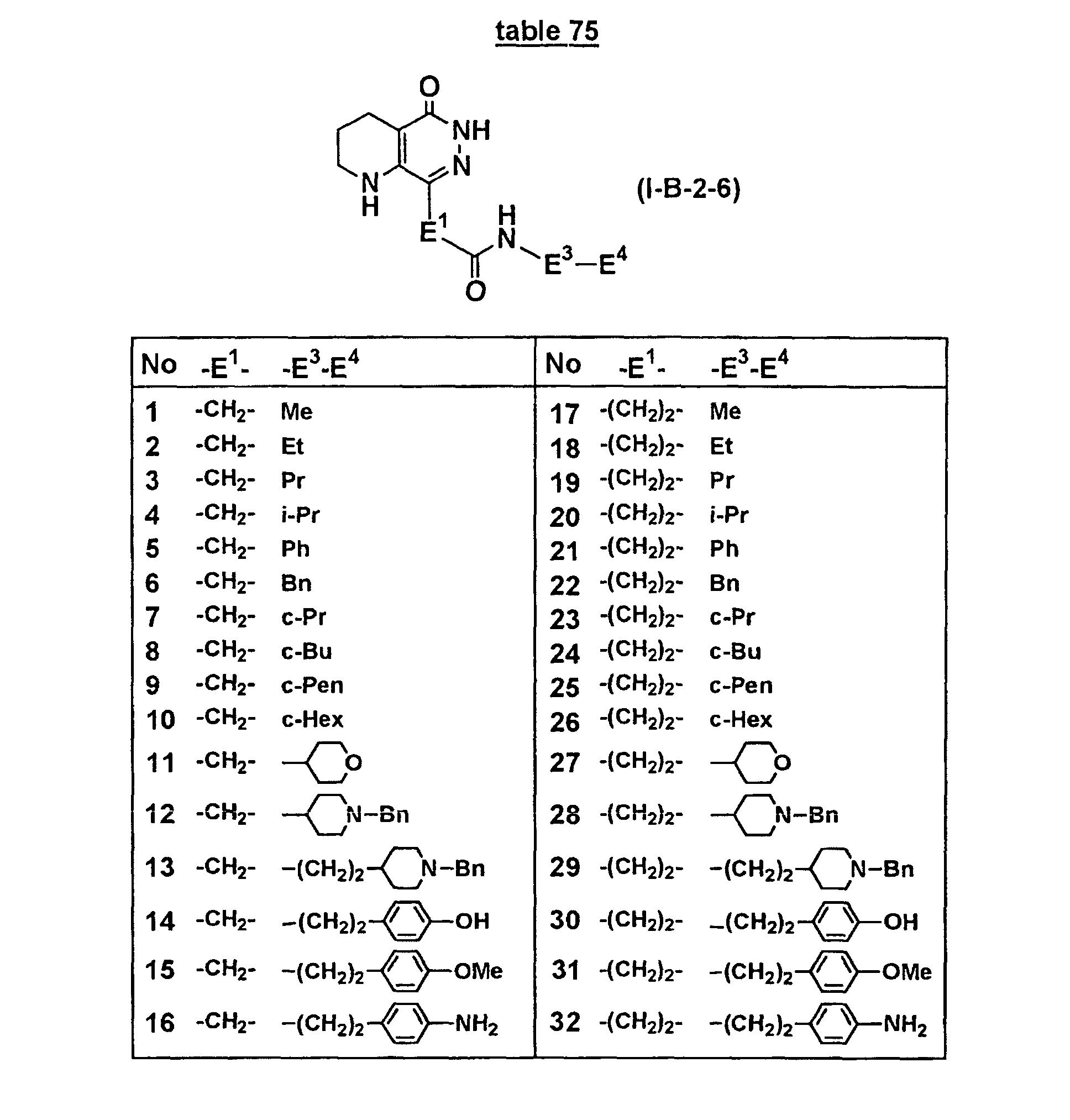
    Publication number Priority date Publication date Assignee Title
    DE60335359D1 (en) 2002-04-30 2011-01-27 Kudos Pharm Ltd phthalazinone
    GB0305681D0 (en) 2003-03-12 2003-04-16 Kudos Pharm Ltd Phthalazinone derivatives
    US7449464B2 (en) 2003-03-12 2008-11-11 Kudos Pharmaceuticals Limited Phthalazinone derivatives
    KR20060123403A (en) 2003-12-01 2006-12-01 쿠도스 파마슈티칼스 리미티드 DNA Damage Restoration Inhibitor for Cancer Treatment
    CA2577191A1 (en) * 2004-08-26 2006-03-02 Kudos Pharmaceuticals Limited 4-heteroarylmethyl substituted phthalazinone derivatives
    DE102005011822A1 (en) * 2005-03-15 2006-09-21 Merck Patent Gmbh phthalazinones
    US20090226412A1 (en) 2005-06-24 2009-09-10 Ono Pharmaceutical Co., Ltd., Agent for reduction of bleeding in cerebrovascular disorder
    WO2007026771A1 (en) * 2005-08-31 2007-03-08 Ono Pharmaceutical Co., Ltd. Injection for intravenous drip
    WO2007138355A1 (en) * 2006-05-31 2007-12-06 Istituto Di Ricerche Di Biologia Molecolare P. Angeletti Spa Pyrrolo[1,2-a]pyrazin-1(2h)-one and pyrrolo[1,2-d][1,2,4]triazin-1(2h)-one derivatives as inhibitors of poly(adp-ribose)polymerase(parp)
    US8466150B2 (en) * 2006-12-28 2013-06-18 Abbott Laboratories Inhibitors of poly(ADP-ribose)polymerase
    DK2120579T3 (en) * 2006-12-28 2014-02-03 Abbvie Inc Inhibitors of poly (ADP-ripose) polymerase
    TW200901974A (en) 2007-01-16 2009-01-16 Wyeth Corp Compounds, compositions, and methods of making and using them
    MX2010002749A (en) 2007-09-14 2010-06-25 Astrazeneca Ab Phthalazinone derivatives.
    AU2008305666B2 (en) 2007-09-21 2014-08-28 Epiphany Biosciences, Inc. Valomaciclovir polymorphs
    CA2702429A1 (en) 2007-10-17 2009-04-23 Kudos Pharmaceuticals Limited Crystalline form l 4-[3-(4-cyclopropanecarbonyl-piperazine-1-carbonyl)-4-fluoro-benzyl]-2h-phthalazin-1-one
    WO2009148192A1 (en) * 2008-06-06 2009-12-10 Prism Biolab Corporation Alpha helix mimetics and methods relating thereto
    HUE025885T2 (en) * 2008-06-23 2016-05-30 Nippon Shinyaku Co Ltd Therapeutic agent for spinal canal stenosis
    US8501940B2 (en) * 2008-07-15 2013-08-06 Hoffmann-La Roche Inc. Tetrahydrocinnoline derivatives
    ES2625817T3 (en) 2008-08-06 2017-07-20 Medivation Technologies, Inc. Dihydropyridophthalazinone-type poly (ADP-ribose) polymerase (PARP) inhibitors
    DE102009007075B4 (en) * 2009-02-02 2011-05-26 Siemens Aktiengesellschaft Workflow-dependent creation of a patient CD
    WO2011058367A2 (en) 2009-11-13 2011-05-19 Astrazeneca Ab Diagnostic test for predicting responsiveness to treatment with poly(adp-ribose) polymerase (parp) inhibitor
    CN102108078B (en) * 2009-12-24 2013-10-30 沈阳药科大学 1,4-substituted phthalazine compound and preparation method and applications thereof
    CA2787844C (en) 2010-02-03 2019-08-27 Biomarin Pharmaceutical Inc. Dihydropyridophthalazinone inhibitors of poly(adp-ribose) polymerase (parp) for use in treatment of diseases associated with a pten deficiency
    PT2533640T (en) * 2010-02-08 2017-01-03 Medivation Technologies Inc Processes of synthesizing dihydropyridophthalazinone derivatives
    CN102372716A (en) * 2010-08-09 2012-03-14 江苏恒瑞医药股份有限公司 Phthalazone derivative, its preparation method and application in medicine thereof
    MX2013003139A (en) * 2010-09-24 2013-06-18 Shionogi & Co Substituted polycyclic carbamoyl pyridone derivative prodrug.
    NZ609490A (en) 2010-10-21 2015-06-26 Biomarin Pharm Inc Crystalline (8s,9r)-5-fluoro-8-(4-fluorophenyl)-9-(1-methyl-1h-1,2,4-triazol-5-yl)-8,9-dihydro-2h-pyrido[4,3,2-de]phthalazin-3(7h)-one tosylate salt
    EP2714703B1 (en) 2011-05-31 2021-03-10 Newgen Therapeutics, Inc. Tricyclic inhibitors of poly(adp-ribose)polymerase
    US9181266B2 (en) 2011-07-13 2015-11-10 Novartis Ag 2-piperidin-1-yl-acetamide compounds for use as tankyrase inhibitors
    CN103814032A (en) 2011-07-13 2014-05-21 诺华股份有限公司 4-oxo-3,5,7,8-tetrahydro-4h-pyrano{4,3-d} pyrminidinyl compounds for use as tankyrase inhibitors
    EP2731940B1 (en) 2011-07-13 2015-08-19 Novartis AG 4 - piperidinyl compounds for use as tankyrase inhibitors
    PT2975030T (en) * 2013-03-13 2020-09-28 Chugai Pharmaceutical Co Ltd Dihydropyridazine-3,5-dione derivative
    RU2550346C2 (en) * 2013-09-26 2015-05-10 Общество с ограниченной ответственностью "Отечественные Фармацевтические Технологии" ООО"ФармТех" New chemical compounds (versions) and using them for treating oncological diseases
    BR112017022550B1 (en) * 2015-04-28 2021-02-23 Shionogi & Co., Ltd polycyclic derivatives of substituted pyridone
    CN105646497B (en) * 2016-02-01 2019-06-04 南京格亚医药科技有限公司 Pyrrolotriazinone derivatives
    WO2018197461A1 (en) 2017-04-28 2018-11-01 Akribes Biomedical Gmbh A parp inhibitor in combination with a glucocorticoid and/or ascorbic acid and/or a protein growth factor for the treatment of impaired wound healing
    GB201913030D0 (en) 2019-09-10 2019-10-23 Francis Crick Institute Ltd Treatment of hr deficient cancer
    JP7798358B2 (en) 2019-11-25 2026-01-14 ザ・リサーチ・ファウンデーション・フォア・ザ・ステイト・ユニバーシティー・オブ・ニューヨーク Combination therapy using a FABP5 inhibitor with a taxane for the treatment of cancer - Patent Application 20070122999

    Family Cites Families (8)

    * Cited by examiner, † Cited by third party
    Publication number Priority date Publication date Assignee Title
    BE555319A (en) 1956-03-21 1900-01-01
    US3095355A (en) 1961-10-12 1963-06-25 Revlon Aerosol composition
    DE3302021A1 (en) 1983-01-22 1984-07-26 Basf Ag, 6700 Ludwigshafen 6-ARYL-4,5-DIHYDRO-3 (2H) -PYRIDAZINONE, THEIR PRODUCTION AND USE
    FR2647676A1 (en) 1989-06-05 1990-12-07 Union Pharma Scient Appl New pyridazinone derivatives, processes for preparing them and medicaments containing them which are useful, in particular, as aldose reductase inhibitors
    RU2128175C1 (en) * 1994-08-09 1999-03-27 Эйсай Ко., Лтд. Condensed pyridazine or its pharmaceutically acceptable salt, an agent showing inhibitory activity with respect to cyclic gmp-phosphodiesterase
    TR199901653T2 (en) 1997-01-15 1999-10-21 Byk Gulden Lomberg Chemische Fabrik Gmbh Phthalazinones.
    US6677333B1 (en) * 1999-01-26 2004-01-13 Ono Pharmaceutical Co., Ltd. 2H-phthalazin-1-one derivatives and drug containing its derivatives as active ingredient
    AUPS019702A0 (en) * 2002-01-29 2002-02-21 Fujisawa Pharmaceutical Co., Ltd. Condensed heterocyclic compounds

    Non-Patent Citations (2)

    * Cited by examiner, † Cited by third party
    Title
    No further relevant documents disclosed *
    See also references of WO03070707A1 *

    Cited By (18)

    * Cited by examiner, † Cited by third party
    Publication number Priority date Publication date Assignee Title
    US7750006B2 (en) 2000-10-30 2010-07-06 Kudos Pharmaceuticals Limited Phthalazinone derivatives
    US8173682B2 (en) 2004-03-30 2012-05-08 Aventis Pharmaceuticals Inc. Substituted pyridones as inhibitors of poly(ADP-ribose) polymerase (PARP)
    US7666870B2 (en) 2004-08-26 2010-02-23 Maybridge Limited Phthalazinone derivatives
    RU2291698C2 (en) * 2004-12-15 2007-01-20 МНИИ ГБ им. Гельмгольца Method for improving vision function in patients suffering from vascular and dystrophic eye fundus diseases
    US7902193B2 (en) 2005-10-19 2011-03-08 Maybridge Limited Phthalazinone derivatives
    US7692006B2 (en) 2006-10-17 2010-04-06 Kudos Pharmaceuticals Limited Phthalazinone derivatives
    US8247416B2 (en) 2006-10-17 2012-08-21 Kudos Pharmaceuticals Limited Phthalazinone derivative
    WO2008114023A3 (en) * 2007-03-22 2008-11-13 Kudos Pharm Ltd Phthalazinone derivatives
    WO2009004356A1 (en) 2007-07-05 2009-01-08 Astrazeneca Ab Phthalazinone derivatives as inhibitors of parp-1
    US8129380B2 (en) 2008-01-23 2012-03-06 Astrazeneca Ab Phthalazinone derivatives
    US8475842B2 (en) 2008-10-07 2013-07-02 Astrazeneca Ab Immediate release pharmaceutical formulation of 4-[3-(4-cyclopropanecarbonyl-piperazine-1-carbonyl)-4-fluoro-benzyl]-2H-phthalazin-1-one
    US11633396B2 (en) 2008-10-07 2023-04-25 Kudos Pharmaceuticals Limited Immediate release pharmaceutical formulation of 4-[3-(4- cyclopropanecarbonyl-piperazine-1-carbonyl)-4-fluoro-benzyl]-2H- phthalazin-1-one
    US11975001B2 (en) 2008-10-07 2024-05-07 Kudos Pharmaceuticals Limited Immediate release pharmaceutical formulation of 4-[3-(4-cyclopropanecarbonyl-piperazine-1-carbonyl)-4-fluoro-benzyl]-2H-phthalazin-1-one
    US12048695B2 (en) 2008-10-07 2024-07-30 Kudos Pharmaceuticals Limited Immediate release pharmaceutical formulation of 4-[3-(4-cyclopropanecarbonyl-piperazine-1-carbonyl)-4-fluoro-benzyl]-2H-phthalazin-1-one
    US12144810B1 (en) 2008-10-07 2024-11-19 Kudos Pharmaceuticals Limited Immediate release pharmaceutical formulation of 4-[3-(4-cyclopropanecarbonyl-piperazine-1-carbonyl)-4-fluoro-benzyl]-2H-phthalazin-1-one
    US12178816B2 (en) 2008-10-07 2024-12-31 Kudos Pharmaceuticals Limited Immediate release pharmaceutical formulation of 4-[3-(4-cyclopropanecarbonyl-piperazine-1-carbonyl)-4-fluoro-benzyl]-2H-phthalazin-1-one
    WO2015034785A1 (en) * 2013-09-05 2015-03-12 Warner Babcock Institute For Green Chemistry, Llc Rilyazine derivatives and compositions for the treatment of cancer
    US9394299B2 (en) 2013-09-05 2016-07-19 Warner Babcock Institute For Green Chemistry, Llc Rilyazine derivatives and compositions for the treatment of cancer

    Also Published As

    Publication number Publication date
    US20080261947A1 (en) 2008-10-23
    CN1646499A (en) 2005-07-27
    US7402580B2 (en) 2008-07-22
    AU2003211381A1 (en) 2003-09-09
    NO20043429L (en) 2004-11-19
    KR20040085199A (en) 2004-10-07
    NO328053B1 (en) 2009-11-16
    JPWO2003070707A1 (en) 2005-06-09
    IL163562A0 (en) 2005-12-18
    DE60336890D1 (en) 2011-06-09
    CA2476406A1 (en) 2003-08-28
    EP2281818A1 (en) 2011-02-09
    JP3843454B2 (en) 2006-11-08
    TW200306836A (en) 2003-12-01
    CN100348587C (en) 2007-11-14
    KR100663147B1 (en) 2007-02-28
    WO2003070707A1 (en) 2003-08-28
    RU2292337C2 (en) 2007-01-27
    US20050085476A1 (en) 2005-04-21
    NZ534712A (en) 2006-11-30
    EP1477175A4 (en) 2006-03-22
    BR0307780A (en) 2004-12-28
    EP1477175B1 (en) 2011-04-27
    ATE507207T1 (en) 2011-05-15
    AU2003211381B2 (en) 2009-03-05
    PL372171A1 (en) 2005-07-11
    AU2003211381B9 (en) 2009-07-30
    MXPA04008014A (en) 2004-11-26
    RU2004127932A (en) 2005-05-27
    JP2010209106A (en) 2010-09-24

    Similar Documents

    Publication Publication Date Title
    US7402580B2 (en) Fused pyridazine derivative compounds and drugs containing these compounds as the active ingredient
    US6677333B1 (en) 2H-phthalazin-1-one derivatives and drug containing its derivatives as active ingredient
    JP4500161B2 (en) Phthalazinone derivatives
    RS60629B1 (en) Indole carboxamide compounds useful as kinase inhibitors
    JP2008504277A (en) Compounds and methods for treating dyslipidemia
    JP2011525924A (en) Prolyl hydroxylase inhibitor
    KR20090128513A (en) Novel pyridinecarboxylic acid (2-aminophenyl) amide derivatives having a urea structure
    WO2001055123A1 (en) Nitrogen-containing 5-membered cyclic compounds and drugs containing these compounds as the active ingredient
    EP4423068A1 (en) Rxfp1 agonists
    JPWO1995018130A1 (en) Tricyclic Benzazepine and Benzothiazepine Derivatives
    JP2002020386A (en) Pyrazolopyridine derivative
    WO2001055118A1 (en) Benzene-fused heterocycle derivatives and drugs containing the same as the active ingredient
    JP4561698B2 (en) Fused pyridazine derivative compound and drug containing the compound as an active ingredient
    CN113754635A (en) Fused ring compound and preparation method and application thereof
    JP2002363163A (en) Benzazepine derivatives
    TWI898700B (en) Novel pyrazole derivative and the use thereof
    CN101284819A (en) Fused pyridazine derivative compounds and drugs containing these compounds as the active ingredient
    WO2010059555A1 (en) Prolyl hydroxylase inhibitors
    CN119431317A (en) A tri-substituted amine derivative of cyanuric chloride as an antiviral agent, preparation method thereof and use thereof
    WO2002014272A1 (en) (thio)urea derivatives, process for their production and medicines containing the derivatives
    JPWO2000044726A1 (en) 2H-phthalazin-1-one derivatives and drugs containing the derivatives as active ingredients
    JP2002193880A (en) Bicyclooctane derivative

    Legal Events

    Date Code Title Description
    PUAI Public reference made under article 153(3) epc to a published international application that has entered the european phase

    Free format text: ORIGINAL CODE: 0009012

    17P Request for examination filed

    Effective date: 20040818

    AK Designated contracting states

    Kind code of ref document: A1

    Designated state(s): AT BE BG CH CY CZ DE DK EE ES FI FR GB GR HU IE IT LI LU MC NL PT SE SI SK TR

    AX Request for extension of the european patent

    Extension state: AL LT LV MK RO

    RIC1 Information provided on ipc code assigned before grant

    Ipc: 7A 61K 31/551 B

    Ipc: 7A 61K 31/5377 B

    Ipc: 7C 07D 471/04 B

    Ipc: 7C 07D 409/12 B

    Ipc: 7A 61K 31/542 B

    Ipc: 7C 07D 405/06 B

    Ipc: 7A 61K 31/5025 B

    Ipc: 7C 07D 401/12 B

    Ipc: 7C 07D 417/12 B

    Ipc: 7A 61K 31/55 B

    Ipc: 7C 07D 401/06 B

    Ipc: 7C 07D 487/04 B

    Ipc: 7C 07D 403/12 B

    Ipc: 7C 07D 405/12 B

    Ipc: 7A 61K 31/502 B

    Ipc: 7A 61K 31/554 B

    Ipc: 7A 61K 31/53 B

    Ipc: 7A 61K 31/541 B

    Ipc: 7C 07D 513/04 B

    Ipc: 7A 61K 31/501 B

    Ipc: 7C 07D 237/32 A

    A4 Supplementary search report drawn up and despatched

    Effective date: 20060203

    RIC1 Information provided on ipc code assigned before grant

    Ipc: A61K 31/55 20060101ALI20060130BHEP

    Ipc: C07D 405/12 20060101ALI20060130BHEP

    Ipc: C07D 405/06 20060101ALI20060130BHEP

    Ipc: A61K 31/501 20060101ALI20060130BHEP

    Ipc: A61K 31/542 20060101ALI20060130BHEP

    Ipc: C07D 403/12 20060101ALI20060130BHEP

    Ipc: A61P 9/00 20060101ALI20060130BHEP

    Ipc: A61P 29/00 20060101ALI20060130BHEP

    Ipc: A61K 31/541 20060101ALI20060130BHEP

    Ipc: C07D 417/12 20060101ALI20060130BHEP

    Ipc: A61K 31/5025 20060101ALI20060130BHEP

    Ipc: A61P 3/10 20060101ALI20060130BHEP

    Ipc: C07D 237/32 20060101AFI20041230BHEP

    Ipc: A61K 31/5377 20060101ALI20060130BHEP

    Ipc: A61P 31/12 20060101ALI20060130BHEP

    Ipc: A61K 31/551 20060101ALI20060130BHEP

    Ipc: A61K 31/554 20060101ALI20060130BHEP

    Ipc: A61K 31/502 20060101ALI20060130BHEP

    Ipc: C07D 471/04 20060101ALI20060130BHEP

    Ipc: C07D 409/12 20060101ALI20060130BHEP

    Ipc: A61P 35/00 20060101ALI20060130BHEP

    Ipc: A61P 25/00 20060101ALI20060130BHEP

    Ipc: C07D 401/06 20060101ALI20060130BHEP

    Ipc: A61K 31/53 20060101ALI20060130BHEP

    Ipc: C07D 487/04 20060101ALI20060130BHEP

    Ipc: A61P 37/06 20060101ALI20060130BHEP

    Ipc: C07D 401/12 20060101ALI20060130BHEP

    Ipc: C07D 513/04 20060101ALI20060130BHEP

    17Q First examination report despatched

    Effective date: 20061229

    GRAP Despatch of communication of intention to grant a patent

    Free format text: ORIGINAL CODE: EPIDOSNIGR1

    GRAS Grant fee paid

    Free format text: ORIGINAL CODE: EPIDOSNIGR3

    RIN1 Information on inventor provided before grant (corrected)

    Inventor name: TAKAHASHI, SHINYAMINASE RESEARCH INSTITUTE

    Inventor name: KAMANAKA, YOSHIHISAMINASE RESEARCH INSTITUTE

    Inventor name: KAMOSHIMA, WATARUMINASE RESEARCH INSTITUTE

    Inventor name: TAKEUCHI, JUNMINASE RESEARCH INSTITUTE

    Inventor name: SEKO, TAKUYAC/O ONO PHARMACEUTICAL CO., LTD.

    GRAA (expected) grant

    Free format text: ORIGINAL CODE: 0009210

    AK Designated contracting states

    Kind code of ref document: B1

    Designated state(s): AT BE BG CH CY CZ DE DK EE ES FI FR GB GR HU IE IT LI LU MC NL PT SE SI SK TR

    REG Reference to a national code

    Ref country code: GB

    Ref legal event code: FG4D

    REG Reference to a national code

    Ref country code: CH

    Ref legal event code: EP

    REG Reference to a national code

    Ref country code: IE

    Ref legal event code: FG4D

    REF Corresponds to:

    Ref document number: 60336890

    Country of ref document: DE

    Date of ref document: 20110609

    Kind code of ref document: P

    REG Reference to a national code

    Ref country code: DE

    Ref legal event code: R096

    Ref document number: 60336890

    Country of ref document: DE

    Effective date: 20110609

    REG Reference to a national code

    Ref country code: ES

    Ref legal event code: FG2A

    Ref document number: 2362406

    Country of ref document: ES

    Kind code of ref document: T3

    Effective date: 20110704

    REG Reference to a national code

    Ref country code: NL

    Ref legal event code: VDEP

    Effective date: 20110427

    PG25 Lapsed in a contracting state [announced via postgrant information from national office to epo]

    Ref country code: PT

    Free format text: LAPSE BECAUSE OF FAILURE TO SUBMIT A TRANSLATION OF THE DESCRIPTION OR TO PAY THE FEE WITHIN THE PRESCRIBED TIME-LIMIT

    Effective date: 20110829

    Ref country code: SE

    Free format text: LAPSE BECAUSE OF FAILURE TO SUBMIT A TRANSLATION OF THE DESCRIPTION OR TO PAY THE FEE WITHIN THE PRESCRIBED TIME-LIMIT

    Effective date: 20110427

    PG25 Lapsed in a contracting state [announced via postgrant information from national office to epo]

    Ref country code: CY

    Free format text: LAPSE BECAUSE OF FAILURE TO SUBMIT A TRANSLATION OF THE DESCRIPTION OR TO PAY THE FEE WITHIN THE PRESCRIBED TIME-LIMIT

    Effective date: 20110427

    Ref country code: GR

    Free format text: LAPSE BECAUSE OF FAILURE TO SUBMIT A TRANSLATION OF THE DESCRIPTION OR TO PAY THE FEE WITHIN THE PRESCRIBED TIME-LIMIT

    Effective date: 20110728

    Ref country code: SI

    Free format text: LAPSE BECAUSE OF FAILURE TO SUBMIT A TRANSLATION OF THE DESCRIPTION OR TO PAY THE FEE WITHIN THE PRESCRIBED TIME-LIMIT

    Effective date: 20110427

    Ref country code: BE

    Free format text: LAPSE BECAUSE OF FAILURE TO SUBMIT A TRANSLATION OF THE DESCRIPTION OR TO PAY THE FEE WITHIN THE PRESCRIBED TIME-LIMIT

    Effective date: 20110427

    Ref country code: AT

    Free format text: LAPSE BECAUSE OF FAILURE TO SUBMIT A TRANSLATION OF THE DESCRIPTION OR TO PAY THE FEE WITHIN THE PRESCRIBED TIME-LIMIT

    Effective date: 20110427

    Ref country code: FI

    Free format text: LAPSE BECAUSE OF FAILURE TO SUBMIT A TRANSLATION OF THE DESCRIPTION OR TO PAY THE FEE WITHIN THE PRESCRIBED TIME-LIMIT

    Effective date: 20110427

    PG25 Lapsed in a contracting state [announced via postgrant information from national office to epo]

    Ref country code: NL

    Free format text: LAPSE BECAUSE OF FAILURE TO SUBMIT A TRANSLATION OF THE DESCRIPTION OR TO PAY THE FEE WITHIN THE PRESCRIBED TIME-LIMIT

    Effective date: 20110427

    PG25 Lapsed in a contracting state [announced via postgrant information from national office to epo]

    Ref country code: EE

    Free format text: LAPSE BECAUSE OF FAILURE TO SUBMIT A TRANSLATION OF THE DESCRIPTION OR TO PAY THE FEE WITHIN THE PRESCRIBED TIME-LIMIT

    Effective date: 20110427

    Ref country code: CZ

    Free format text: LAPSE BECAUSE OF FAILURE TO SUBMIT A TRANSLATION OF THE DESCRIPTION OR TO PAY THE FEE WITHIN THE PRESCRIBED TIME-LIMIT

    Effective date: 20110427

    PG25 Lapsed in a contracting state [announced via postgrant information from national office to epo]

    Ref country code: DK

    Free format text: LAPSE BECAUSE OF FAILURE TO SUBMIT A TRANSLATION OF THE DESCRIPTION OR TO PAY THE FEE WITHIN THE PRESCRIBED TIME-LIMIT

    Effective date: 20110427

    Ref country code: SK

    Free format text: LAPSE BECAUSE OF FAILURE TO SUBMIT A TRANSLATION OF THE DESCRIPTION OR TO PAY THE FEE WITHIN THE PRESCRIBED TIME-LIMIT

    Effective date: 20110427

    PLBE No opposition filed within time limit

    Free format text: ORIGINAL CODE: 0009261

    STAA Information on the status of an ep patent application or granted ep patent

    Free format text: STATUS: NO OPPOSITION FILED WITHIN TIME LIMIT

    26N No opposition filed

    Effective date: 20120130

    REG Reference to a national code

    Ref country code: DE

    Ref legal event code: R097

    Ref document number: 60336890

    Country of ref document: DE

    Effective date: 20120130

    PGFP Annual fee paid to national office [announced via postgrant information from national office to epo]

    Ref country code: IT

    Payment date: 20120217

    Year of fee payment: 10

    PG25 Lapsed in a contracting state [announced via postgrant information from national office to epo]

    Ref country code: MC

    Free format text: LAPSE BECAUSE OF NON-PAYMENT OF DUE FEES

    Effective date: 20120229

    REG Reference to a national code

    Ref country code: CH

    Ref legal event code: PL

    PG25 Lapsed in a contracting state [announced via postgrant information from national office to epo]

    Ref country code: CH

    Free format text: LAPSE BECAUSE OF NON-PAYMENT OF DUE FEES

    Effective date: 20120229

    Ref country code: LI

    Free format text: LAPSE BECAUSE OF NON-PAYMENT OF DUE FEES

    Effective date: 20120229

    REG Reference to a national code

    Ref country code: IE

    Ref legal event code: MM4A

    PG25 Lapsed in a contracting state [announced via postgrant information from national office to epo]

    Ref country code: IE

    Free format text: LAPSE BECAUSE OF NON-PAYMENT OF DUE FEES

    Effective date: 20120218

    PGFP Annual fee paid to national office [announced via postgrant information from national office to epo]

    Ref country code: ES

    Payment date: 20130213

    Year of fee payment: 11

    Ref country code: GB

    Payment date: 20130213

    Year of fee payment: 11

    Ref country code: FR

    Payment date: 20130301

    Year of fee payment: 11

    Ref country code: DE

    Payment date: 20130213

    Year of fee payment: 11

    PG25 Lapsed in a contracting state [announced via postgrant information from national office to epo]

    Ref country code: BG

    Free format text: LAPSE BECAUSE OF FAILURE TO SUBMIT A TRANSLATION OF THE DESCRIPTION OR TO PAY THE FEE WITHIN THE PRESCRIBED TIME-LIMIT

    Effective date: 20110727

    PG25 Lapsed in a contracting state [announced via postgrant information from national office to epo]

    Ref country code: TR

    Free format text: LAPSE BECAUSE OF FAILURE TO SUBMIT A TRANSLATION OF THE DESCRIPTION OR TO PAY THE FEE WITHIN THE PRESCRIBED TIME-LIMIT

    Effective date: 20110427

    PG25 Lapsed in a contracting state [announced via postgrant information from national office to epo]

    Ref country code: LU

    Free format text: LAPSE BECAUSE OF NON-PAYMENT OF DUE FEES

    Effective date: 20120218

    PG25 Lapsed in a contracting state [announced via postgrant information from national office to epo]

    Ref country code: HU

    Free format text: LAPSE BECAUSE OF FAILURE TO SUBMIT A TRANSLATION OF THE DESCRIPTION OR TO PAY THE FEE WITHIN THE PRESCRIBED TIME-LIMIT

    Effective date: 20030218

    REG Reference to a national code

    Ref country code: DE

    Ref legal event code: R119

    Ref document number: 60336890

    Country of ref document: DE

    GBPC Gb: european patent ceased through non-payment of renewal fee

    Effective date: 20140218

    REG Reference to a national code

    Ref country code: FR

    Ref legal event code: ST

    Effective date: 20141031

    REG Reference to a national code

    Ref country code: DE

    Ref legal event code: R119

    Ref document number: 60336890

    Country of ref document: DE

    Effective date: 20140902

    PG25 Lapsed in a contracting state [announced via postgrant information from national office to epo]

    Ref country code: FR

    Free format text: LAPSE BECAUSE OF NON-PAYMENT OF DUE FEES

    Effective date: 20140228

    Ref country code: DE

    Free format text: LAPSE BECAUSE OF NON-PAYMENT OF DUE FEES

    Effective date: 20140902

    Ref country code: GB

    Free format text: LAPSE BECAUSE OF NON-PAYMENT OF DUE FEES

    Effective date: 20140218

    REG Reference to a national code

    Ref country code: ES

    Ref legal event code: FD2A

    Effective date: 20150401

    PG25 Lapsed in a contracting state [announced via postgrant information from national office to epo]

    Ref country code: ES

    Free format text: LAPSE BECAUSE OF NON-PAYMENT OF DUE FEES

    Effective date: 20140219

    PG25 Lapsed in a contracting state [announced via postgrant information from national office to epo]

    Ref country code: IT

    Free format text: LAPSE BECAUSE OF NON-PAYMENT OF DUE FEES

    Effective date: 20140218