The present invention relates to a method and apparatus for shared
protection in an Optical Transport Network ring based on the ODU
management.
In present telecommunications networks it is extremely important to
recover network failures without interfering with service functionality Such a
need is even more felt in large network to increase the traffic availability and the
MTTR (Mean Time To Repair), consequently to reduce the OPEX (Operational
Expenditure) and the TCO (Total Cost of Ownership), with big advantage for
operators' revenue.
Therefore, telecommunication networks, in particular fiber optics
networks, are provided with self-healing protection mechanisms against failures
and degradations of their elements and/or fiber spans
In SDH/SONET networks, for example, a shared protection mechanism,
the so-called MS-SPRING (Multiplex Section-Shared Protected Ring) is
implemented for automatic traffic restorationin ring topologies.
MS-SPRING networks perform automatic traffic restoration through a
synchronized rerouting mechanism performed at each ring node. This operation
is controlled by a byte oriented protocol defined by international
recommendations issued by ANSI, ITU-T and ETSI Standards, such as ITU-T
G.841 and G.842.
The SDH/SONET Standards define two MS-SPRING network types, one
for two-fiber rings, i.e. each ring node is connected to another node by a span
consisting of only two fiber optics carrying signals propagating in opposite
directions between them, the other for four-fiber rings, capable of carrying
higher traffic.
Two adjacent network elements in the ring are joined by a fiber optic
span consisting of two connections carrying the traffic in opposite directions.
In the two-fiber MS-SPRING network the bandwidth is split in two halves
of equal capacity, called working capacity (working channel) and protection
capacity (protection channel). Working channel is used for high priority traffic,
whereas protection channel is used for low priority traffic, namely a traffic that
may go lost if a failure occurs. The protection in such a network is implemented
according to a so-called "Bridge & Switch" mechanism, which comprises the
step of rerouting traffic by properly modifying the inner connections of the
network elements, i.e. switching over from working channel to protection
channel, using dual-ended method and requiring synchronization between
bridge and switch activation to avoid misconnection.
The Bridge operation will substantially cause a node to transmit the
working traffic on the protecting channel, whereas the Switch operation allows
the receiver to select the traffic arriving on the protection channel instead of the
traffic passing on the working channel.
The four-fiber MS-SPRING network, unlike the two-fiber ring, supports
working capacity and protection capacity on different couple of fibers instead of
supporting them both on one couple alone, and is able to overcome multiple
span failures without loss of any traffic, in particular the failures affecting only
the high priority traffic transported on the working channel. On the contrary the
two-fiber MS-SPRING are only able to overcome one failure at a time without
traffic loss, since one single failure will affect both the working channel and
protection channel of one span being they are carried by the same couple of
fiber.
According to such a known protection technique, called APS (Automatic
Protection Switch), each Network Element is capable of detecting line failure,
transmitting and receiving information related to the other network elements and
performing Bridge and Switch operations.
It is known that each Network Element is provisioned with data called
"traffic Maps". Typically for each ring direction (clockwise and counterclockwise)
there are:
- high priority traffic maps (HP);
- low priority traffic maps (LP).
Generally this information is used in case of ring fault to restore the high
priority traffic, affecting partially the low priority one. In fact, depending on the
HP traffic distribution and on the fault location, some LP traffic can be saved
because it is not used to restore the HP one.
More specifically for very long spans cases the well-known transoceanic
MS-SPRING is used to avoidvery long paths for the transportation of the HP
traffic on the protecting channels and to provide efficient LP traffic transportation
when the protection mechanism has been activated. From the network
perspective this approach is more suitable than the known terrestrial one.
In the transoceanic MS-SPRING the protocol information is carried over
the multiplex section. By consequence when a fault occurs each node makes
an analysis of the APS protocol to get the fault location. With this information
and the provisioned traffic maps, a node-by- node analysis allows to remove the
extra-traffic (LP) and use their respective connection to restore the HP one.
The ITU-T G.872 recommendation defines the architecture of the OTN
(Optical Transport Network) made of three main layers: OTS (Optical
Transmission Section), OMS (Optical Multiplex Section) and OCH (Optical
Channel).
The ITU-T G.709 recommendation defines the OCH layer structure and
the frame format at the ONNI (Optical Network Node Interface) level. The G.709
defined besides information to manage all the above-mentioned layers. For
each layer the transported information is made of payload and Overheads.
Particularly the OCH entity, made of two main units ODU (Optical Data Unit)
and OTU (Optical Transport Unit), transports payload and associated Overhead
information. In particular the purpose of the ODU-Overhead is to carry
information managing and monitoring the end-to-end connection crossing
optical network.
The G.709 also defines several Tandem Connection (TC) levels within
the same ODU frame. Each level of TC has its own Overheads dedicated for
the TC Monitoring (TCM) function.
As in the SDH network there is the need to develop and to apply
protection mechanisms also in the Optical Transmission Network (OTN),
achieving the same benefits in terms of TCO reduction.
Trying to apply in the OTN a protection mechanism similar to the SDH
one (MS-SPRING) the objective of the present invention is to avoid both
squelching table and traffic map provisioning. This to avoid, especially in case
of a considerable number of nodes and connections, the problem of requiring a
considerable amount of memory resources and calculation efforts in each
Network Element.
Considering the known MS-SPRING solution not efficient, the main
object of the present invention is to provide a shared protection mechanism that
in the Optical Transport Network is based on the ODU management to avoid
both squelching table, necessary in terrestrial applications, and traffic map
provisioning mandatory in the transoceanic case. The method is basic
applicable at ring configured network, but can be extended also to the meshed
configurations.
The objective to provide a ODU-Shared Protection Ring architecture,
capable to avoid the squelching tables and the traffic maps information, can be
achieved by using either one (out of six) available Tandem Connection
Monitoring sub-layer or a dedicated ODU sub-layer for accessing the APS/PCC
end-to-end signaling in the intermediate nodes. The signaling protocol needs
also to be terminated and processed in the termination nodes defining the ring
path connection.
This solution allows to save the equipment data base size and to simplify
the Network Management system provisioning activity.
These and further objects are achieved by means of a method and
relating apparatus, network and network node, as described in the attached
claims, which are considered an integral part of the present description.
The invention will become clear from the following detailed description,
given by way of a mere exemplifying and non-limiting example, to be read with
reference to the attached drawing figures, wherein:
- Fig. 1 shows the known structure of the ODU overhead;
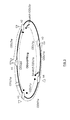
- Fig. 2 shows an example of ring network applying the method according
to the invention;
- Fig. 3 shows the network of Fig. 2 in a failure condition.
The known structure of the ODU overhead is shown in Fig. 1. The fields
of the overhead are described in the G.709.
The present invention starts from the consideration that in the OTN rings
for each ODU working there is the relative ODU protection resource. By means
of the data overhead protection resources (APS/PCC bytes, Fig. 1) it is possible
to manage the APS protocol accessible at each node through the use of a
suitable sub-layer, which could be any existing tandem connection monitoring
layer (TCM) or another sub-layer dedicated for ODU network protection.
By enabling or disabling access to the APS channel at the nodes, it is
possible to allow or to deny each node to get the APS information.
The key points of the procedure according to the invention are:
When a failure or a degrade occurs in a working ODU in the ring, a
Signal Fail SF or a Signal Degrade SD criterion activates the APS engine
(known per se) by running the APS protocol on the assigned protecting ODU in
the opposite side of the ring. In this condition the dedicated sub-layer along the
protecting ODU is crossed by the APS signaling and is informed that the
working ODU is requiring the protection action. By consequence the APS
engine implemented in the nodes can squelch the managed protecting LP traffic
and allocate the relative resource to recover the HP traffic. This action is done
without consulting any traffic map info if the suitable sub-layer is enabled in all
the nodes terminating the LP traffic.
By applying this end-switch mechanism the ODU-SPRing behaviour, can
be summarized as follow:
Therefore the end-to-end signaling provided by the present invention
replaces the signaling by the nodes adjacent to the failure and the traffic map
provisioning of the known system. It is only needed at each node a simple
provisioning table with APS enable information: for each ODU-path in the node
the table will give the simple information on whether the APS mechanism
concerning that ODU-path must be enabled or not.
Because of the nature of the end-to-end mechanism (source routing
along the opposite ring side) a simple rule can be applied: the TCM, or another
dedicated sub-layer, must be enabled starting from the end-to-end nodes and
over all the other nodes that belong to the protection ring portion.
The above procedure will be better explained with reference to the
following non-limiting example, also with reference to Fig. 2.
- The working path ODU1w connects the nodes n1 and n3 through the nodes
n4 and n5. In the non-limiting example of Fig. 2 there are also the working paths
ODU2w, connecting nodes n4 and n5, and ODU3w connecting nodes n1 and
n2.
- The protection resource for the working path ODU1w will be an ODU-path
connecting the nodes n1 and n3 through n2 using the ODU1p protection path
resources available on this ring-side. In the non-limiting example of Fig. 2, the
ODU protection paths transporting extra traffic are ODU2p connecting nodes
n5, n1 and n2, ODU1p connecting nodes n2, n3, and n4, and nodes n4 and n5.
- To protect the working path ODU1w, the APS access in the ODU Overhead,
through a suitable sub-layer, for example the TCM, will be enabled on nodes
n1, n3 and n2 only. The end-to-end signaling E-SIGN is applied by the
terminating nodes n1 and n3.
- The above step will be applied for each working path ODUw.
With reference to Fig. 3, let's analyze this scenario when a fiber failure
affects the ring between nodes n1 and n5.
The ODU-SPRing protection is according to the following steps:
Therefore, in order to manage the restoration actions, no traffic map
analysis is required, but sub-layer enabling and APS table provisioning only.
Further implementation details will not be described, as the man skilled in
the art is able to carry out the invention starting from the teaching of the above
description.
In particular the method of the present invention can be suitably
embodied in a relating improvement of an optical transport ring network and
network node, by the skilled man using the available background technology
and what has been described above, without needing further explanation
details.
The present invention can be advantageously implemented through a
program for computer, for example as a part of a Network Management
System, comprising program coding means for the implementation of one or
more steps of the method, when this program is running on a computer.
Therefore, it is understood that the scope of protection is extended to such a
program for computer and in addition to a computer readable means having a
recorded message therein, said computer readable means comprising program
coding means for the implementation of one or more steps of the method, when
this program is run on a computer.
Many changes, modifications, variations and other uses and applications
of the subject invention will become apparent to those skilled in the art after
considering the specification and the accompanying drawings which disclose
preferred embodiments thereof. All such changes, modifications, variations and
other uses and applications which do not depart from the spirit and scope of the
invention are deemed to be covered by this invention.