EP1211257A2 - Metallkoordinationsverbindung, Lumineszenzvorrichtung und Anzeigevorrichtung - Google Patents
Metallkoordinationsverbindung, Lumineszenzvorrichtung und Anzeigevorrichtung Download PDFInfo
- Publication number
- EP1211257A2 EP1211257A2 EP01128237A EP01128237A EP1211257A2 EP 1211257 A2 EP1211257 A2 EP 1211257A2 EP 01128237 A EP01128237 A EP 01128237A EP 01128237 A EP01128237 A EP 01128237A EP 1211257 A2 EP1211257 A2 EP 1211257A2
- Authority
- EP
- European Patent Office
- Prior art keywords
- luminescence
- formula
- ligand
- group
- metal coordination
- Prior art date
- Legal status (The legal status is an assumption and is not a legal conclusion. Google has not performed a legal analysis and makes no representation as to the accuracy of the status listed.)
- Withdrawn
Links
- 0 **(CC1C=CC=CC11)*2C1=CC=CC2 Chemical compound **(CC1C=CC=CC11)*2C1=CC=CC2 0.000 description 9
Images




Classifications
-
- C—CHEMISTRY; METALLURGY
- C09—DYES; PAINTS; POLISHES; NATURAL RESINS; ADHESIVES; COMPOSITIONS NOT OTHERWISE PROVIDED FOR; APPLICATIONS OF MATERIALS NOT OTHERWISE PROVIDED FOR
- C09K—MATERIALS FOR MISCELLANEOUS APPLICATIONS, NOT PROVIDED FOR ELSEWHERE
- C09K11/00—Luminescent materials, e.g. electroluminescent or chemiluminescent
- C09K11/06—Luminescent materials, e.g. electroluminescent or chemiluminescent containing organic luminescent materials
-
- C—CHEMISTRY; METALLURGY
- C07—ORGANIC CHEMISTRY
- C07F—ACYCLIC, CARBOCYCLIC OR HETEROCYCLIC COMPOUNDS CONTAINING ELEMENTS OTHER THAN CARBON, HYDROGEN, HALOGEN, OXYGEN, NITROGEN, SULFUR, SELENIUM OR TELLURIUM
- C07F15/00—Compounds containing elements of Groups 8, 9, 10 or 18 of the Periodic Table
- C07F15/0006—Compounds containing elements of Groups 8, 9, 10 or 18 of the Periodic Table compounds of the platinum group
- C07F15/0033—Iridium compounds
-
- C—CHEMISTRY; METALLURGY
- C07—ORGANIC CHEMISTRY
- C07F—ACYCLIC, CARBOCYCLIC OR HETEROCYCLIC COMPOUNDS CONTAINING ELEMENTS OTHER THAN CARBON, HYDROGEN, HALOGEN, OXYGEN, NITROGEN, SULFUR, SELENIUM OR TELLURIUM
- C07F15/00—Compounds containing elements of Groups 8, 9, 10 or 18 of the Periodic Table
- C07F15/0006—Compounds containing elements of Groups 8, 9, 10 or 18 of the Periodic Table compounds of the platinum group
- C07F15/006—Palladium compounds
-
- C—CHEMISTRY; METALLURGY
- C07—ORGANIC CHEMISTRY
- C07F—ACYCLIC, CARBOCYCLIC OR HETEROCYCLIC COMPOUNDS CONTAINING ELEMENTS OTHER THAN CARBON, HYDROGEN, HALOGEN, OXYGEN, NITROGEN, SULFUR, SELENIUM OR TELLURIUM
- C07F15/00—Compounds containing elements of Groups 8, 9, 10 or 18 of the Periodic Table
- C07F15/0006—Compounds containing elements of Groups 8, 9, 10 or 18 of the Periodic Table compounds of the platinum group
- C07F15/0073—Rhodium compounds
-
- C—CHEMISTRY; METALLURGY
- C07—ORGANIC CHEMISTRY
- C07F—ACYCLIC, CARBOCYCLIC OR HETEROCYCLIC COMPOUNDS CONTAINING ELEMENTS OTHER THAN CARBON, HYDROGEN, HALOGEN, OXYGEN, NITROGEN, SULFUR, SELENIUM OR TELLURIUM
- C07F15/00—Compounds containing elements of Groups 8, 9, 10 or 18 of the Periodic Table
- C07F15/0006—Compounds containing elements of Groups 8, 9, 10 or 18 of the Periodic Table compounds of the platinum group
- C07F15/0086—Platinum compounds
-
- H—ELECTRICITY
- H10—SEMICONDUCTOR DEVICES; ELECTRIC SOLID-STATE DEVICES NOT OTHERWISE PROVIDED FOR
- H10K—ORGANIC ELECTRIC SOLID-STATE DEVICES
- H10K85/00—Organic materials used in the body or electrodes of devices covered by this subclass
- H10K85/30—Coordination compounds
- H10K85/341—Transition metal complexes, e.g. Ru(II)polypyridine complexes
- H10K85/342—Transition metal complexes, e.g. Ru(II)polypyridine complexes comprising iridium
-
- H—ELECTRICITY
- H10—SEMICONDUCTOR DEVICES; ELECTRIC SOLID-STATE DEVICES NOT OTHERWISE PROVIDED FOR
- H10K—ORGANIC ELECTRIC SOLID-STATE DEVICES
- H10K2101/00—Properties of the organic materials covered by group H10K85/00
- H10K2101/10—Triplet emission
-
- H—ELECTRICITY
- H10—SEMICONDUCTOR DEVICES; ELECTRIC SOLID-STATE DEVICES NOT OTHERWISE PROVIDED FOR
- H10K—ORGANIC ELECTRIC SOLID-STATE DEVICES
- H10K50/00—Organic light-emitting devices
- H10K50/10—OLEDs or polymer light-emitting diodes [PLED]
- H10K50/11—OLEDs or polymer light-emitting diodes [PLED] characterised by the electroluminescent [EL] layers
-
- H—ELECTRICITY
- H10—SEMICONDUCTOR DEVICES; ELECTRIC SOLID-STATE DEVICES NOT OTHERWISE PROVIDED FOR
- H10K—ORGANIC ELECTRIC SOLID-STATE DEVICES
- H10K85/00—Organic materials used in the body or electrodes of devices covered by this subclass
- H10K85/10—Organic polymers or oligomers
- H10K85/141—Organic polymers or oligomers comprising aliphatic or olefinic chains, e.g. poly N-vinylcarbazol, PVC or PTFE
- H10K85/146—Organic polymers or oligomers comprising aliphatic or olefinic chains, e.g. poly N-vinylcarbazol, PVC or PTFE poly N-vinylcarbazol; Derivatives thereof
-
- H—ELECTRICITY
- H10—SEMICONDUCTOR DEVICES; ELECTRIC SOLID-STATE DEVICES NOT OTHERWISE PROVIDED FOR
- H10K—ORGANIC ELECTRIC SOLID-STATE DEVICES
- H10K85/00—Organic materials used in the body or electrodes of devices covered by this subclass
- H10K85/30—Coordination compounds
- H10K85/341—Transition metal complexes, e.g. Ru(II)polypyridine complexes
- H10K85/346—Transition metal complexes, e.g. Ru(II)polypyridine complexes comprising platinum
-
- H—ELECTRICITY
- H10—SEMICONDUCTOR DEVICES; ELECTRIC SOLID-STATE DEVICES NOT OTHERWISE PROVIDED FOR
- H10K—ORGANIC ELECTRIC SOLID-STATE DEVICES
- H10K85/00—Organic materials used in the body or electrodes of devices covered by this subclass
- H10K85/30—Coordination compounds
- H10K85/361—Polynuclear complexes, i.e. complexes comprising two or more metal centers
-
- Y—GENERAL TAGGING OF NEW TECHNOLOGICAL DEVELOPMENTS; GENERAL TAGGING OF CROSS-SECTIONAL TECHNOLOGIES SPANNING OVER SEVERAL SECTIONS OF THE IPC; TECHNICAL SUBJECTS COVERED BY FORMER USPC CROSS-REFERENCE ART COLLECTIONS [XRACs] AND DIGESTS
- Y10—TECHNICAL SUBJECTS COVERED BY FORMER USPC
- Y10S—TECHNICAL SUBJECTS COVERED BY FORMER USPC CROSS-REFERENCE ART COLLECTIONS [XRACs] AND DIGESTS
- Y10S428/00—Stock material or miscellaneous articles
- Y10S428/917—Electroluminescent
Definitions
- the present invention relates to a metal coordination compound, an organic luminescence device using the metal coordination compound and a display apparatus using the device. More specifically, the present invention relates to an organic metal coordination compound having a formula (1) appearing hereinafter as a luminescence material so as to allow stable luminescence efficiency, an organic luminescence device using the metal coordination compound and a display apparatus including the luminescence device.
- An organic electroluminescence (EL) device has been extensively studied as a luminescence device with a high responsiveness and high efficiency.
- the organic EL device generally has a sectional structure as shown in Figure 1A or 1B (e.g., as described in "Macromol. Symp.”, 125, pp. 1 - 48 (1997)).
- the EL device generally has a structure including a transparent substrate 15, a transparent electrode 14 disposed on the transparent substrate 15, a metal electrode 11 disposed opposite to the transparent electrode 14, and a plurality of organic (compound) layers, as luminescence function layers, disposed between the transparent electrode 14 and the metal electrode 11.
- the EL device in this embodiment has two organic layers including a luminescence layer 12 and a hole transport layer 13.
- the transparent electrode 14 may be formed of a film of ITO (indium tin oxide) having a larger work function to ensure a good hole injection performance into the hole transport layer.
- the metal electrode 11 may be formed of a layer of aluminum, magnesium, alloys thereof, etc., having a smaller work function to ensure a good electron injection performance into the organic layer(s).
- These (transparent and metal) electrodes 14 and 11 may be formed in a thickness of 50 - 200 nm.
- the luminescence layer 12 may be formed of, e.g., aluminum quinolinol complex (representative example thereof may include Alq3 described hereinafter) having an electron transporting characteristic and a luminescent characteristic.
- the hole transport layer 13 may be formed of, e.g., biphenyldiamine derivative (representative example thereof may include ⁇ -NPD described hereinafter) having an electron donating characteristic.
- the above-described EL device exhibits a rectification characteristic, so that when an electric field is applied between the metal electrode 11 as a cathode and the transparent electrode 14 as an anode, electrons are injected from the metal electrode 11 into the luminescence layer 12 and holes are injected from the transparent electrodes 14.
- the thus-injected holes and electrons are recombined within the luminescence layer 12 to produce excitons placed in an excited state, thus causing luminescence at the time of transition of the excitons to a ground state.
- the hole transport layer 13 functions as an electron-blocking layer to increase a recombination efficiency at the boundary between the luminescence layer 12 and the hole transport layer 13, thus enhancing a luminescence efficiency.
- an electron transport layer 16 is disposed between the metal electrode 11 and the luminescence layer 12, whereby an effective carrier blocking performance can be ensured by separating functions of luminescence, electron transport and hole transport, thus allowing effective luminescence.
- the electron transport layer 16 may be formed of, e.g., oxadiazole derivatives.
- luminescence caused during a transition of luminescent center molecule from a singlet excited state to a ground state is used as luminescence.
- the EL devices shown in these documents may generally have a sectional structure shown in Figure 1C.
- the phosphorescence (luminescence) material used in the luminescence layer 12 has particularly attracted notice. This is because the phosphorescence material is expected to provide a higher luminescence efficiency in principle.
- excitons produced by recombination of carriers comprise singlet excitons and triplet excitons presented in a ratio of 1:3.
- a resultant luminescence efficiency is 25 % (as upper limit) based on all the produced excitons in principle.
- a resultant luminescence efficiency is expected to be at least three times that of the case of fluorescence in principle.
- the luminescence efficiency of phosphorescence can be expected to be 100 % (four times that of fluorescence) in principle.
- JP-A Japanese Laid-Open Patent Application
- the reason for luminescent deterioration has not been clarified as yet but may be attributable to such a phenomenon that the life of triplet exciton is generally longer than that of singlet exciton by at least three digits, so that molecule is placed in a higher-energy state for a long period to cause reaction with ambient substance, formation of exciplex or excimer, change in minute molecular structure, structural change of ambient substance, etc.
- a phosphorescence material for the (electro)phosphorescence EL device is required to provide a higher luminescence efficiency and a higher stability, to the EL device.
- An object of the present invention is to provide a metal coordination compound as a material suitable for an organic layer of a luminescence device capable of providing a high-efficiency luminescent state at a high brightness (or luminance) for a long period while maintaining stability of the device.
- Another object of the present invention is to provide a metal coordination compound allowing a higher phosphorescence yield and controlled emission (luminescence) wavelength as a phosphorescence (luminescence) material.
- a further object to the present invention is to provide a metal coordination compound, as a multifunctional luminescence material, having not only a controlled luminescent characteristic but also controlled electrical characteristic, in view of a significance of the electrical characteristic of a luminescence material alone in the case where the luminescence material is employed in an organic EL device and is supplied with a current for luminescence.
- a still further object of the present invention is to provide an organic luminescence device using the metal coordination compound and a display apparatus including the organic luminescence device.
- a metal coordination compound represented by the following formula (1): LmML'n wherein M denotes Ir, Pt, Ph or Pd; L denotes a bidentate ligand; L' denotes a bidentate ligand different from L; m is an integer of 1, 2 or 3; and n is an integer of 0, 1 or 2 with the proviso that the sum of m and n is 2 or 3, the partial structure MLm being represented by a formula (2) or a formula (3) shown below, and the partial structure ML'n being represented by a formula (4) or a formula (5) shown below: wherein CyN1, CyN2 and CyN3 independently denote a substituted or unsubstituted cyclic group containing a nitrogen atom connected to M; CyN4 denotes a cyclic group containing 8-quinoline or its derivative having a nitrogen atom connected to M; CyC1, CyC2 and CyC3 independently denote a substituted or unsubstituted
- the metal coordination compound of the present invention exhibits phosphorescence at the time of energy transfer from an excited state to a ground state to provide a high luminescence efficiency.
- an organic luminescence device comprising: a substrate, a pair of electrodes disposed on the substrate, and a luminescence function layer disposed between the pair of electrodes comprising at least one species of an organic compound, wherein the organic compound comprises a metal coordination compound represented by the following formula (1): LmML'n wherein M denotes Ir, Pt, Ph or Pd; L denotes a bidentate ligand; L' denotes a bidentate ligand different from L; m is an integer of 1, 2 or 3; and n is an integer of 0, 1 or 2 with the proviso that the sum of m and n is 2 or 3, the partial structure MLm being represented by a formula (2) or a formula (3) shown below, and the partial structure ML'n being represented by a formula (4) or a formula (5) shown below: wherein CyN1, CyN2 and CyN3 independently denote a substituted or unsubstituted cyclic group containing a nitrogen
- an image display apparatus including the organic luminescence device and means for supplying electrical signals to the organic luminescence device.
- a process of emission of light may generally involve the following steps:
- desired energy transmission and luminescence may generally be caused based on various quenching and competition.
- a luminescence center material per se is required to provide a higher yield of luminescence quantum.
- an efficient energy transfer between host material molecules and/or between host material molecule and guest material molecule is also an important factor.
- the above-described luminescent deterioration in energized state may presumably relate to the luminescent center material per se or an environmental change thereof by its ambient molecular structure.
- the metal coordination compound represented by the above formula (1) causes phosphorescence (luminescence) and is assumed to have a lowest excited state comprising a triplet excited state liable to cause metal-to-ligand charge transfer (MLCT* state) or ⁇ - ⁇ * state as a ligand-centered triplet excited state.
- MLCT* state metal-to-ligand charge transfer
- ⁇ - ⁇ * state metal-to-ligand charge transfer
- the phosphorescent emission of light (phosphorescence) is caused to occur during the transition from the MLCT* state or ⁇ - ⁇ * state to the ground state.
- the metal coordination compound of formula (1) according to the present invention has been found to provide a higher phosphorescence yield of at least 0.01 and a shorter phosphorescence life of 1 - 100 ⁇ sec.
- the shorter phosphorescence life is necessary to provide a resultant EL device with a higher luminescence efficiency. This is because the longer phosphorescence life increases molecules placed in their triplet excited state which is a waiting state for phosphorescence, thus lowering the resultant luminescence efficiency particularly at a higher current density.
- the metal coordination compound of formula (1) according to the present invention is a suitable luminescent material for an organic EL device with a higher phosphorescence yield and a shorter phosphorescence life.
- the metal coordination compound according to the present invention has been substantiated to exhibit excellent stability of luminance as shown in Examples described hereinafter.
- the organic luminescence device has a layer structure wherein an organic compound layer (luminescence function layer) comprising the metal coordination compound of the formula (1) s sandwiched between a pair of oppositely disposed electrodes as shown in Figures 1A to 1C.
- the organic luminescence device exhibits phosphorescence from the organic compound layer by applying a voltage between the pair of electrodes.
- the metal coordination compound of the formula (1) according to the present invention used in the organic luminescence device (EL device) as a luminescence function material, particularly a luminescent material may be roughly classified into the following two compounds:
- the metal coordination compound of the formula (1) it is possible to employ different two ligands for the metal coordination compound of the formula (1), thus imparting a plurality of functions (multi-function) to the metal coordination compound based on the respective features of the ligands.
- the impartition of multi-function is a characteristic feature of the use of different species of ligands.
- incorporation into the metal coordination compound of different species of ligands capable of imparting controlled luminescence and current characteristics to the EL device is very advantageous to the EL device since device characteristics of the EL device is largely affected by not only the luminescence characteristic but also the current characteristic.
- Ir coordination compounds By using the Ir coordination compounds, a synthesis yield is improved without lowering a luminescence characteristic compared with Ir complex having (identical) three ligands of phenylpyridine (tris-acetylacetonato-Ir complex).
- the tris-acetylacetonato-Ir complex exhibits no or a slight phosphorescence and has no carrier (hole/electron) transport performance.
- the acetylacetone ligand (acac)ligand is employed for the purpose of improving the synthesis yield without impairing the luminescence performance as described above, thus failing to positively suggesting improvement in device characteristics of an organic EL device.
- the device characteristics of the organic EL device have been found to be improved by imparting functions described below to different two ligands constituting a different ligand structure.
- a metal coordination compound having one metal connected with the same species of ligands is synthesized and subjected to measurement of its characteristics (affected by a combination of the metal with the ligands), such as a (maximum) luminescence wavelength (emission wavelength), a luminescence yield, an electron transfer performance, a hole transfer performance and a thermal stability.
- the minimum excited state of the metal coordination compound of the formula (1) according to the present invention is the MLCT excited state or the ligand-centered excited state.
- the MLCT excited state is generally advantageous thereto since the phosphorescence material (placed in the MLCT excited state) has a higher luminescence transition probability and a stronger luminescence performance in many cases.
- a resultant metal coordination compound is determined whether its excited state is the MLCT excited state or the ligand-centered excited state.
- the terms “MLCT (metal to ligand charge transfer) excited state” refers to an excited state formed by localization of electron orbit of molecules constituting the metal coordination compound towards the ligand side, thus causing a transfer of one electron side, thus causing a transfer of one electron from the metal to the ligand.
- the term “ligand-centered excited state” refers to an excited state formed within the ligands without being directly affected by the metal at the time of excitation. Generally, an electron is excited from bonding ⁇ -orbital to nonbonding ⁇ -orbital. Accordingly, the ligand-centered excited state is also called " ⁇ - ⁇ * excited state”.
- the carrier (hole/electron) transfer performance or ability may, e.g., be evaluated by measuring an increased amount of a current value flowing between a pair of electrodes sandwiching an organic compound layer (luminescence function layer) containing dispersed metal coordination compound having the same species of ligands, relative to that in the case of using no metal coordination compound.
- the organic compound layer is an electron transport layer or a hole transport layer by comparing a current characteristic of an organic luminescence device having a multi-layer structure including two organic compound layers sandwiching a luminescence layer therebetween with respect to various organic compounds constituting organic compound layers.
- a preferred class of combinations of a plurality of ligands may include:
- the metal coordination compounds having the above structural formulas 41 to 51 may be classified as follows.
- the metal coordination compounds of the formulas 41 - 51 includes those which can be embraced in a plurality of the combinations (a) - (d).
- the metal coordination compound of the formula 41 has two phenylpyridine ligands and one thienylpyridine ligand respectively connected to Ir (center metal).
- Ir center metal
- the excited state (MLCT or ligand-centered excited state) is identified based on shapes of emission spectra of Ir complex having three phenylpyridine skeletons (Ir(ppy) 3 ) and Ir complex having three thienylpyridine skeletons (Ir(thpy) 3 ), diagrams of which are shown in Figures 4A and 4B, respectively.
- Ir(ppy) 3 shows no peak other than a main peak.
- Ir(thpy) 3 shows a sub-peak (or shoulder) other than a main peak on the longer wavelength side. This sub-peak is resulting from a vibrational level of an aromatic ligand and thus is not observed in the case of the MLCT excited state.
- the case of the MLCT excited state is considerably allowed to exhibit transition with luminescence (phosphorescence) from the excited state to the ground state. Further, a probability of such transition is higher than that of transition with no radiation, thus generally providing a higher phosphorescence yield.
- Ir(ppy) 3 shows no sub-peak as in the case of Ir(thpy) 3 , thus being identified to be placed in the MLCT excited state.
- the excitation energy is not quenched or deactivated but is quickly intramolecular-transferred to the thienylpyridine ligand to place the thienylpyridine ligand in an excited state. This is because the triplet energy level of phenylpyridine is higher than that of thienylpyridine.
- the 8-quinolinol ligand in the metal coordination compound of the formula 42 and the benzothienylpyridine ligand in the metal coordination compound of the formula 43 are ligands placed in the ligand-centered excited state.
- luminescences resulting from the 8-quinolinol ligand and the benzothienylpyridine ligand as a longer-wavelength luminescent ligand are observed, respectively.
- the maximum luminescence wavelength of the 4-fluorophenylpyridine is shorter than (i.e., excitation energy level thereof is higher than) that of the 4-methylphenylpyridine. Accordingly, even when either ligand is excited, excitation energy is intramolecular-transferred to the 4-methylphenylpyridine ligand with a lower excitation energy level to cause luminescence resulting from the 4-methylphenylpyridine.
- the metal coordination compound of the formula 48 is thus placed in the MLCT excited state, thus not readily causing quenching with no radiation to allow a high-efficiency luminescence.
- the metal coordination compound of the present invention has a different ligand structure including a ligand capable of being placed in the MLCT excited state, it becomes possible to effect intramolecular energy transition at a high efficiency, thus ensuring a high phosphorescence yield.
- the metal coordination compound of the formula 44 has the f-quinolinol ligand as an electron transport ligand and the benzothienylpyridine ligand as a luminescent ligand.
- the metal coordination compound of the formula 44 is dispersed in the luminescence layer 12 of the organic EL device shown in Figure 1C, it is possible to improve a luminescence efficiency compared with the case of using a metal coordination compound having the same ligand structure comprising three f-quinolinol ligands (i.e., tris-8-quinolinolato-Ir complex).
- the organic EL device using the metal coordination compound of the formula 44 effectively improves a resultant current density under application of an identical voltage. This may be attributable to such a mechanism that the electron transport 8-quinolinol ligand allows supply of electrons to the luminescence layer (into which carrier electrons are ordinarily to readily injected) by dispersing the metal coordination compound of the formula 44 in the luminescence layer, thus forming excitons by combination with holes to ensure efficient luminescence based on the luminescence benzothienylpyridine ligand.
- the benzothienylpyridine ligand also exhibits a hole transport performance.
- the benzothienylpyridine ligand has a hole transport function.
- the metal coordination compound of the formula 46 has the thienylpyridine ligand and the benzothienylpyridine ligand.
- An Ir complex having three thienylpyridine ligands and an Ir complex having three benzothienylpyridine ligands causes phosphorescence at maximum luminescence wavelengths of 550 nm and 600 nm, respectively. Accordingly, the latter Ir complex has a longer maximum luminescence wavelength and a smaller lowest excitation energy (triplet energy in this case). Luminescence resulting from the benzothienylpyridine ligand is observed both in the case of an organic EL device using the metal coordination compound of the formula 46 and in the case of PL (photoluminescence) in a photo-excitation solution thereof.
- an organic EL device shown in Figure 1C is prepared by using the metal coordination compound of the formula 46, it is possible to obtain a high luminescence efficiency. This may be attributable to such a mechanism that, compared with a metal coordination compound having (identical) three benzothienylpyridine ligands (luminescent ligands), the number of luminescent ligand in the metal coordination compound of the formula 46 is 1/3 of the metal coordination compound having three benzothienylpyridine ligands to decrease a probability of formation of quenching path with no luminescence by intermolecular interaction with ambient molecules.
- the benzylpyridine ligand exhibits a blue luminescence characteristic (emission peak wavelength: 480 nm) and the phenylpyridine ligand exhibits a green luminescence characteristic (emission peak wavelength: 515 nm).
- the metal coordination compound of the formula 50 has the thienyl-4-trifluoromethylpyridine ligand and the benzothienylpyridine ligand.
- a photo-excitation phosphorescence yield in the solution of an Ir complex having three thienyl-4-trifluoromethylpyridine ligands is smaller than that of an Ir complex having three benzothienylpyridine ligands.
- the benzothienylpyridine ligand is a relatively stronger luminescent ligand compared with the thienyl-4-trifluoromethylpyridine ligand.
- the former ligand also provides a relatively longer maximum luminescence wavelength (i.e., a relatively lower excitation energy level). For this reason, luminescence from the metal coordination compound of the formula 49 is one resulting from the benzothienylpyridine ligands based on intramolecular energy transfer.
- the metal coordination compound of the present invention satisfying at least one of the above-mentioned combinations (a) to (d) effectively functions as a luminescence function material and provides a resultant organic EL device with a high luminescence efficiency.
- it is generally expected to increase the luminescence efficiency by ca. 20 % when compared with the case of using a metal coordination compound having identical three luminescent ligands, but a degree of increase in luminescence efficiency may vary depending on species of the metal and ligands.
- the above-mentioned high-efficiency organic luminescence device may be applicable to various products requiring energy saving and high luminescence, such as light sources for a display apparatus, illumination apparatus, printers, etc., and a backlight for a liquid crystal display apparatus.
- the organic luminescence device of the present invention When the organic luminescence device of the present invention is used as an image display apparatus, it becomes possible to provide flat-panel displays with advantages such as a good energy saving performance, high visibility, and lightweight properties.
- the organic luminescence device of the present invention is also prepared in a single matrix-type display device using intersecting stripe electrodes at right angles or an active matrix-type display device including a matrix of pixels each provided with, e.g., at least one TFT (thin film transistor), such as amorphous TFT or polycrystalline TFT.
- TFT thin film transistor
- the organic luminescence device of the present invention When the organic luminescence device of the present invention is used as a light source for a printer, e.g., as a laser light source for a laser beam printer, independently addressable elements are arranged in an array and a photosensitive drum is subjected to desired exposure, thus effecting image formation.
- a printer e.g., as a laser light source for a laser beam printer
- independently addressable elements are arranged in an array and a photosensitive drum is subjected to desired exposure, thus effecting image formation.
- the organic luminescence device of the present invention effectively exhibits an excellent energy saving effect.
- formulas (11) to (14) corresponding to the partial structure ML'n as the formula (5) (including CyN4 being 8-quinolinol skeleton or its derivative) shown as L' in Table 1 for convenience represent the following structures, respectively.
- Example Compounds Nos. 215 to 218 and 746 include an acetylacetone ligand as L' for another ligand of the formula (6).
- Each of organic luminescence devices having a structure including four organic (compound) layers (luminescence function layers) shown in Figure 1C were prepared in the following manner.
- a 100 nm-thick film (transparent electrode 14) of ITO (indium tin oxide) was formed by sputtering, followed by patterning to have an (opposing) electrode area of 3 mm 2 .
- Each of luminescence states of the organic luminescence devices was similar to that based on photoluminescence (luminescence center wavelength) in the case where each of the luminescence materials (Ex. Comp. Nos. 37 and Ex. Comp. No. 1 as luminescence sources in these examples) was dissolved in toluene.
- a simple matrix-type organic EL device shown in Figure 2 was prepared in the following manner.
- a ca. 100 nm-thick transparent electrode 22 of ITO (as an anode) was formed by sputtering, followed by patterning in a stripe form comprising 100 lines (each having a width of 100 ⁇ m and a spacing of 40 ⁇ m).
- an organic lamination layer 23 including four organic layers was formed in the same manner as in Example 1.
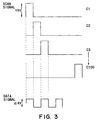
- the thus-prepared organic EL device was placed in a glove box and driven in a simple matrix manner (frame frequency: 30 Hz, interlace scanning) by applying a driving waveform (drive voltage: 15 to 23 volts, scanning signal voltage: 19 volts, data signal voltage: ⁇ 4 volts) as shown in Figure 3.
- driving waveform drive voltage: 15 to 23 volts, scanning signal voltage: 19 volts, data signal voltage: ⁇ 4 volts
- An organic EL device was prepared in the same manner as in Example 1 except that the metal coordination compound (Ex. Comp. No. 37) was charged to a metal coordination compound of the formula 41 (specifically shown hereinabove).
- An organic EL device was prepared in the same manner as in Example 1 except that the metal coordination compound (Ex. Comp. No. 37) was charged to a metal coordination compound of the formula 44 (specifically shown hereinabove).
- An organic EL device was prepared in the same manner as in Example 1 except that the metal coordination compound (Ex. Comp. No. 37) was charged to a metal coordination compound of the formula 46 (specifically shown hereinabove).
- An organic EL device was prepared in the same manner as in Example 1 except that the metal coordination compound (Ex. Comp. No. 37) was charged to a metal coordination compound of the formula 49 (specifically shown hereinabove).
- An organic EL device was prepared in the same manner as in Example 1 except that the metal coordination compound (Ex. Comp. No. 37) was charged to a metal coordination compound of the formula 50 (specifically shown hereinabove).
- An organic EL device was prepared in the same manner as in Example 1 except that the metal coordination compound (Ex. Comp. No. 37) was charged to a metal coordination compound of the formula 42 (specifically shown hereinabove).
- Ir-based metal coordination compounds of the formula (1) according to the present invention were basically synthesized through the following reaction schemes. or
- a metal coordination compound (Ex. Comp. No. 49) was prepared in the following manner.
- the thus-prepared metal coordination compound was subjected to MALDI-TOF-MS (Matrix-assisted Laser Desorption Ionization mass spectroscopy), whereby M + (mass number of ionized objective product) of 697.2 (as a molecular weight) was confirmed.
- the metal coordination compound When the metal coordination compound was dissolved in toluene and subjected to measurement of luminescence spectrum, the metal coordination compound provided a luminescence spectrum diagram including a maximum luminescence wavelength ⁇ max of 463 nm as shown in Figure 5.
- the metal coordination compound (Ex. Comp. No. 49) prepared in Example 10 was mixed with polyvinyl carbazole (PVK) shown below in a weight ratio of 8:92 to obtain a luminescent material used for a luminescence layer.
- PVK polyvinyl carbazole
- An organic EL device was prepared in the following manner.
- a 1.1 mm-thick glass substrate provided with a 70 nm-thick ITO electrode (as an anode electrode) was subjected to plasma-ozone washing.
- the thus-treated glass substrate was then placed in a vacuum deposition chamber.
- a 30 nm-thick Mg-Ag alloy layer and a 100 nm-thick Al layer (as a cathode electrode) were successively formed by vacuum deposition (at most 10 -4 Pa), thus preparing an organic EL device.
- the luminescence material (mixture) after drying exhibited a maximum luminescence wavelength was 490 nm closer to that (473 nm) of the metal coordination compound (Ex. Comp. No. 49) in toluene solution used in Example 10. Accordingly, the luminescence in this example was resulting from the metal coordination compound (Ex. Comp. No. 49).
- an attenuation time for the blue luminescence was at least 0.3 - 0.5 sec.
- the blue luminescence in this example was supported to be phosphorescence attributable to the metal coordination compound (Ex. Comp. No. 49).
- the blue luminescence state was stable even when the EL device was continuously driven for 12 hours.
- metal coordination compound (of formulas 43 and 51 specifically shown above) were synthesized through the following steps 1) to 4).
- reaction mixture was cooled and subjected to extraction with cold water and toluene.
- Step 2 Synthesis of tetrakis(2-benzo[b]-thiophene-2-yl)pyridine-C 3 ,N)( ⁇ -dichloro)diiridium (III)
- reaction mixture was subjected to filtration, followed by washing with ethanol and acetone.
- the resultant powder was dissolved in chloroform and subjected to extraction with water.
- the organic layer was dried with anhydrous magnesium sulfate, followed distilling-off of the solvent to obtain a residue.
- the residue was recrystallized from a mixture solvent (hexanemethylene chloride) to obtain 5.40 g of tetrakis(2-(benzo[b]thiophene-2-yl)pyridine-C 3 , N) ( ⁇ -dichloro)diiridium (III) (Yield: 80.1 %).
- the mixture was then gradually heated and subjected to refluxing for 15 hours under stirring.
- Step 4 (Synthesis of bis(2-(benzo[b]thiophene-2-yl)pyridine-C 3 ,N) (phenylpyridine-C 2 ,N)iridium (III) (metal coordination compound of formula 51) and bis(phenylpyridine-C 2 ,N) (2-(benzo[b]thiophene-2-yl)pyridine-C 3 ,N) iridium (III) (metal coordination compound of formula 43))
- the thus-prepared metal coordination compounds (of formulas 51 and 43) were subjected to MALDI-TOF-MS, respectively, whereby M + of 767.1 for the metal coordination compound of formula 51 and M + of 711.1 for the metal coordination compound of formula 43 were confirmed, respectively.
- each of the metal coordination compounds of formulas 51 and 43 was dissolved in chloroform to prepare a first solution and a second solution.
- Each first solution was subjected to aeration with oxygen gas and each second solution was subjected to aeration with nitrogen gas.
- the metal coordination compounds of formulas 51 and 43 were then subjected to measurement of luminescence life (time) in the following manner.
- Each of the metal coordination compounds of formulas 51 and 43 was dissolved in chloroform and was spin-coated on a quartz substrate to form a ca. 0.1 ⁇ m-thick metal coordination compound layer.
- the above-prepared metal coordination compound layer formed on the substrate was subjected to pulse irradiation with nitrogen laser light (excitation wavelength: 337 nm) at room temperature to measure an attenuation time immediately after the excitation laser pulse irradiation.
- nitrogen laser light excitation wavelength: 337 nm
- both the metal coordination compounds of formulas 51 and 43 showed a shorter luminescence life of at most 10 ⁇ sec.
- the metal coordination compound of the present invention is expected to provide an organic EL device sing the metal coordination compound with a good stability since the metal coordination compound exhibits phosphorescent luminescence and a shorter phosphorescence life (time).
- Each of the organic luminescence devices had a structure including four organic (compound) layers (luminescence function layers) shown in Figure 1C and was prepared in the following manner.
- a 100 nm-thick film (transparent electrode 14) of ITO (indium tin oxide) was formed by sputtering, followed by patterning to have an (opposing) electrode area of 3 mm 2 .
- EL characteristics of the luminescence devices using the metal coordination compounds of formulas 51 and 43 were measured by using a microammeter ("Model 4140B", mfd. by Hewlett-Packard Co.) for a current density under application of a voltage of 8 volts (current-voltage characteristic), using a spectrophotofluoro-meter ("Model SR1", mfd. by Topcon K.K.) for a maximum luminescence wavelength ⁇ max, and using a luminance meter ("Model BM7", mfd. by Topcon K.K.) for a luminescence efficiency. Further, both the above-prepared luminescence devices showed a good rectification characteristic.
- Each of luminescence states of the organic EL devices was similar to that based on photoluminescence in the case where each of the luminescence materials was dissolved in toluene.
- the metal coordination compound of formula 43 effectively improved the luminescence efficiency when compared with the metal coordination compound of formula 51.
- the luminescent ligand was the benzothienylpyridine ligand and thus the luminescence efficiency was found to be dependent upon the number of the benzothienylpyridine ligand.
- a metal coordination compound of the formula (1) suitable as a luminescent material for broader wavelength range luminescence of an organic EL device and exhibiting a higher phosphorescence yield and a shorter phosphorescence life (time).
- An organic luminescence device (EL device) using the metal coordination compound according to the present invention stably exhibits high-efficiency luminescence.
- An organic EL device includes a luminescence layer containing, as a luminescent material allowing a high-luminescence and high-efficiency luminescence for a long period of time, a metal coordination compound represented by the following formula (1): LmML'n, wherein M denotes Ir, Pt, Ph or Pd; L denotes a bidentate ligand; L' denotes a bidentate ligand different from L; m is an integer of 1, 2 or 3; and n is an integer of 0, 1 or 2 with the proviso that the sum of m and n is 2 or 3.
- M denotes Ir, Pt, Ph or Pd
- L denotes a bidentate ligand
- L' denotes a bidentate ligand different from L
- m is an integer of 1, 2 or 3
- n is an integer of 0, 1 or 2 with the proviso that the sum of m and n is 2 or 3.
- the partial structure MLm is represented by a formula (2) or a formula (3) shown below, and the partial structure ML'n is represented by a formula (4) or a formula (5) shown below: wherein CyN1, CyN2 and CyN3 independently denote a substituted or unsubstituted cyclic group containing a nitrogen atom connected to M; CyN4 denotes a cyclic group containing 8-quinoline or its derivative having a nitrogen atom connected to M; CyC1, CyC2 and CyC3 independently denote a substituted or unsubstituted cyclic group containing a carbon atom connected to M, with the proviso that the metal coordination compound is represented by the formula (2) when n is 0.
Landscapes
- Chemical & Material Sciences (AREA)
- Organic Chemistry (AREA)
- Engineering & Computer Science (AREA)
- Materials Engineering (AREA)
- Crystallography & Structural Chemistry (AREA)
- Inorganic Chemistry (AREA)
- Electroluminescent Light Sources (AREA)
- Pyridine Compounds (AREA)
- Plural Heterocyclic Compounds (AREA)
Priority Applications (1)
| Application Number | Priority Date | Filing Date | Title |
|---|---|---|---|
| EP08167520A EP2062907A3 (de) | 2000-12-01 | 2001-11-28 | Metallkoordinationsverbundstoff, Lumineszenzvorrichtung und Anzeigevorrichtung |
Applications Claiming Priority (6)
| Application Number | Priority Date | Filing Date | Title |
|---|---|---|---|
| JP2000367080 | 2000-12-01 | ||
| JP2000367080 | 2000-12-01 | ||
| JP2001198439 | 2001-06-29 | ||
| JP2001198439 | 2001-06-29 | ||
| JP2001354703 | 2001-11-20 | ||
| JP2001354703A JP4154145B2 (ja) | 2000-12-01 | 2001-11-20 | 金属配位化合物、発光素子及び表示装置 |
Related Child Applications (1)
| Application Number | Title | Priority Date | Filing Date |
|---|---|---|---|
| EP08167520A Division EP2062907A3 (de) | 2000-12-01 | 2001-11-28 | Metallkoordinationsverbundstoff, Lumineszenzvorrichtung und Anzeigevorrichtung |
Publications (2)
| Publication Number | Publication Date |
|---|---|
| EP1211257A2 true EP1211257A2 (de) | 2002-06-05 |
| EP1211257A3 EP1211257A3 (de) | 2003-10-29 |
Family
ID=27345343
Family Applications (2)
| Application Number | Title | Priority Date | Filing Date |
|---|---|---|---|
| EP01128237A Withdrawn EP1211257A3 (de) | 2000-12-01 | 2001-11-28 | Metallkoordinationsverbindung, Lumineszenzvorrichtung und Anzeigevorrichtung |
| EP08167520A Withdrawn EP2062907A3 (de) | 2000-12-01 | 2001-11-28 | Metallkoordinationsverbundstoff, Lumineszenzvorrichtung und Anzeigevorrichtung |
Family Applications After (1)
| Application Number | Title | Priority Date | Filing Date |
|---|---|---|---|
| EP08167520A Withdrawn EP2062907A3 (de) | 2000-12-01 | 2001-11-28 | Metallkoordinationsverbundstoff, Lumineszenzvorrichtung und Anzeigevorrichtung |
Country Status (5)
| Country | Link |
|---|---|
| US (2) | US6991857B2 (de) |
| EP (2) | EP1211257A3 (de) |
| JP (1) | JP4154145B2 (de) |
| KR (1) | KR100472699B1 (de) |
| CN (1) | CN1180050C (de) |
Cited By (90)
| Publication number | Priority date | Publication date | Assignee | Title |
|---|---|---|---|---|
| WO2003000661A1 (en) * | 2001-06-25 | 2003-01-03 | Canon Kabushiki Kaisha | Metal coordination compound and electroluminescence device |
| EP1244155A3 (de) * | 2001-03-14 | 2003-11-26 | Canon Kabushiki Kaisha | Metallkomplex, lumineszierende Anordnung und Anzeigevorrichtung |
| WO2004020549A1 (ja) * | 2002-08-27 | 2004-03-11 | Fujitsu Limited | 有機金属錯体、有機el素子及び有機elディスプレイ |
| EP1239526A3 (de) * | 2001-03-08 | 2004-04-07 | Canon Kabushiki Kaisha | Metallkomplex, lumineszierende Anordnung und Anzeigevorrichtung |
| WO2004101707A1 (en) * | 2003-05-16 | 2004-11-25 | Isis Innovation Limited | Organic phosphorescent material and organic optoelectronic device |
| WO2005029923A1 (en) | 2003-09-24 | 2005-03-31 | Fuji Photo Film Co., Ltd. | Electroluminescent device |
| WO2006061182A1 (de) * | 2004-12-09 | 2006-06-15 | Merck Patent Gmbh | Metallkomplexe und deren verwendung als die emittierende komponente in elektronischen bauteilen, besonders in elektrolumineszenten anzeigevorrichtungen |
| WO2007019942A1 (de) * | 2005-08-18 | 2007-02-22 | Merck Patent Gmbh | Metallkomplexe |
| WO2007029426A1 (ja) | 2005-09-05 | 2007-03-15 | Idemitsu Kosan Co., Ltd. | 青色発光有機エレクトロルミネッセンス素子 |
| EP2031037A1 (de) | 2007-08-29 | 2009-03-04 | Fujifilm Corporation | Organische Elektrolumineszenzvorrichtung |
| EP2036907A1 (de) | 2007-09-14 | 2009-03-18 | FUJIFILM Corporation | Organische Elektrolumineszenzvorrichtung |
| EP2042508A1 (de) | 2007-09-25 | 2009-04-01 | FUJIFILM Corporation | Organische Elektrolumineszenzvorrichtung |
| EP2061087A2 (de) | 2007-11-15 | 2009-05-20 | FUJIFILM Corporation | Dünnschicht-Feldeffekttransistor und Anzeige unter Benutzung desselben |
| EP2061086A2 (de) | 2007-11-15 | 2009-05-20 | FUJIFILM Corporation | Dünnschicht-Feldeffekttransistor und Anzeige unter Benutzung desselben |
| EP2062907A2 (de) | 2000-12-01 | 2009-05-27 | Canon Kabushiki Kaisha | Metallkoordinationsverbundstoff, Lumineszenzvorrichtung und Anzeigevorrichtung |
| EP2070936A1 (de) | 2007-12-14 | 2009-06-17 | Fujifilm Corporation | Platinkomplexverbindungen und organische Elektrolumineszenzvorrichtung dafür |
| EP2096690A2 (de) | 2008-02-28 | 2009-09-02 | FUJIFILM Corporation | Organische Elektrolumineszenzvorrichtung |
| EP2105967A1 (de) | 2008-03-24 | 2009-09-30 | FUJIFILM Corporation | Dünnschicht-Feldeffekttransistor und Anzeige |
| WO2009118087A1 (de) * | 2008-03-25 | 2009-10-01 | Merck Patent Gmbh | Metallkomplexe |
| EP2112213A2 (de) | 2008-04-22 | 2009-10-28 | FUJIFILM Corporation | Organische Elektrolumineszenzvorrichtung, neue Platinkomplexverbindung und neue Verbindung, die als Ligand dafür geeignet ist |
| EP2113548A1 (de) | 2008-04-24 | 2009-11-04 | FUJIFILM Corporation | Organische Elektrolumineszenzvorrichtung |
| US7723915B2 (en) | 2007-09-13 | 2010-05-25 | Canon Kabushiki Kaisha | Organic light-emitting device and display apparatus |
| WO2010058787A1 (ja) | 2008-11-21 | 2010-05-27 | 富士フイルム株式会社 | 有機電界発光素子 |
| EP2214223A2 (de) | 2009-02-03 | 2010-08-04 | Fujifilm Corporation | Organische Elektrolumineszenzanzeigevorrichtung |
| WO2010093062A1 (en) | 2009-02-13 | 2010-08-19 | Fujifilm Corporation | Organic electroluminescence device, and method for producing the same |
| WO2010097433A1 (de) | 2009-02-26 | 2010-09-02 | Basf Se | Chinonverbindungen als dotierstoff in der organischen elektronik |
| EP2226867A2 (de) | 2009-03-05 | 2010-09-08 | Fujifilm Corporation | Organische Elektrolumineszenzvorrichtung |
| WO2010101011A1 (en) | 2009-03-03 | 2010-09-10 | Fujifilm Corporation | Method for producing light-emitting display device, light-emitting display device and light-emitting display |
| WO2010110280A1 (ja) | 2009-03-27 | 2010-09-30 | 富士フイルム株式会社 | 有機電界発光素子用塗布液 |
| WO2011013626A1 (ja) | 2009-07-31 | 2011-02-03 | 富士フイルム株式会社 | 有機デバイス用蒸着材料及び有機デバイスの製造方法 |
| WO2011024976A1 (ja) | 2009-08-31 | 2011-03-03 | 富士フイルム株式会社 | 有機電界発光素子 |
| WO2011030882A1 (en) | 2009-09-14 | 2011-03-17 | Fujifilm Corporation | Color filter and light-emitting display element |
| WO2011030883A1 (en) | 2009-09-14 | 2011-03-17 | Fujifilm Corporation | Color filter and light-emitting display element |
| US7914909B2 (en) | 2007-06-18 | 2011-03-29 | Canon Kabushiki Kaisha | Organic electroluminescent device |
| EP2320490A2 (de) | 2009-11-09 | 2011-05-11 | FUJIFILM Corporation | Organische elektrolumineszente Vorrichtung |
| WO2011116857A1 (en) | 2010-03-23 | 2011-09-29 | Merck Patent Gmbh | Materials for organic electroluminescent devices |
| US8067099B2 (en) | 2007-05-30 | 2011-11-29 | Canon Kabushiki Kaisha | Phosphorescent material, and organic electroluminescent device and image display apparatus using same |
| WO2011157790A1 (en) | 2010-06-18 | 2011-12-22 | Basf Se | Organic electronic devices comprising a layer of a dibenzofurane compound and a 8-hydroxyquinolinolato earth alkaline metal, or alkali metal complex |
| WO2011157779A1 (en) | 2010-06-18 | 2011-12-22 | Basf Se | Organic electronic devices comprising a layer of a pyridine compound and a 8-hydroxyquinolinolato earth alkaline metal, or alkali metal complex |
| WO2012045710A1 (en) | 2010-10-07 | 2012-04-12 | Basf Se | Phenanthro[9,10-b]furans for electronic applications |
| WO2012080052A1 (en) | 2010-12-13 | 2012-06-21 | Basf Se | Bispyrimidines for electronic applications |
| WO2012130709A1 (en) | 2011-03-25 | 2012-10-04 | Basf Se | 4h-imidazo[1,2-a]imidazoles for electronic applications |
| US8362246B2 (en) | 2010-12-13 | 2013-01-29 | Basf Se | Bispyrimidines for electronic applications |
| US8384068B2 (en) | 2007-10-02 | 2013-02-26 | Basf Se | Use of acridine derivatives as matrix materials and/or electron blockers in OLEDs |
| WO2013050862A1 (ja) | 2011-10-07 | 2013-04-11 | ユーディーシー アイルランド リミテッド | 有機電界発光素子及び該素子用発光材料並びに発光装置、表示装置及び照明装置 |
| WO2013064881A2 (ja) | 2011-11-02 | 2013-05-10 | ユーディーシー アイルランド リミテッド | 有機電界発光素子、有機電界発光素子用材料並びに該有機電界発光素子を用いた発光装置、表示装置及び照明装置 |
| WO2013068376A1 (en) | 2011-11-10 | 2013-05-16 | Basf Se | 4h-imidazo[1,2-a]imidazoles for electronic applications |
| WO2013080798A1 (ja) | 2011-11-30 | 2013-06-06 | 富士フイルム株式会社 | 光拡散性転写材料、光拡散層の形成方法、有機電界発光装置、及び有機電界発光装置の製造方法 |
| WO2013108069A2 (ja) | 2011-10-06 | 2013-07-25 | ユーディーシー アイルランド リミテッド | 有機電界発光素子とそれに用いることができる化合物および有機電界発光素子用材料、並びに該素子を用いた発光装置、表示装置及び照明装置 |
| DE102013200942A1 (de) | 2012-01-23 | 2013-07-25 | Udc Ireland Ltd. | Organisches Elektrolumineszenz-Element, Ladungstransportmaterial für organisches Elektrolumineszenz-Element, und Licht-emittierende Vorrichtung, Anzeigevorrichtung und Beleuchtungsvorrichtung, die jeweils das Element verwenden |
| US8618533B2 (en) | 2008-10-07 | 2013-12-31 | Osram Opto Semiconductors Gmbh | Siloles substituted by fused ring systems and use thereof in organic electronics |
| WO2014009317A1 (en) | 2012-07-10 | 2014-01-16 | Basf Se | Benzimidazo[1,2-a]benzimidazole derivatives for electronic applications |
| US8697255B2 (en) | 2007-07-05 | 2014-04-15 | Basf Se | Organic light-emitting diodes comprising at least one disilyl compound selected from disilylcarbazoles, disilyldibenzofurans, disilyldibenzothiophenes, disilyldibenzopholes, disilyldibenzothiophene S-oxides and disilyldibenzothiophene S,S-dioxides |
| WO2014072320A1 (en) | 2012-11-06 | 2014-05-15 | Basf Se | Phenoxasiline based compounds for electronic application |
| WO2014147134A1 (en) | 2013-03-20 | 2014-09-25 | Basf Se | Azabenzimidazole carbene complexes as efficiency booster in oleds |
| US8859110B2 (en) | 2008-06-20 | 2014-10-14 | Basf Se | Cyclic phosphazene compounds and use thereof in organic light emitting diodes |
| WO2015000955A1 (en) | 2013-07-02 | 2015-01-08 | Basf Se | Monosubstituted diazabenzimidazole carbene metal complexes for use in organic light emitting diodes |
| US8999520B2 (en) | 2006-03-21 | 2015-04-07 | Semiconductor Energy Laboratory Co., Ltd. | Organometallic complex and light emitting element, light emitting device, and electronic device using the organometallic complex |
| WO2015063046A1 (en) | 2013-10-31 | 2015-05-07 | Basf Se | Azadibenzothiophenes for electronic applications |
| US9079872B2 (en) | 2010-10-07 | 2015-07-14 | Basf Se | Phenanthro[9, 10-B]furans for electronic applications |
| US9142792B2 (en) | 2010-06-18 | 2015-09-22 | Basf Se | Organic electronic devices comprising a layer comprising at least one metal organic compound and at least one metal oxide |
| WO2016016791A1 (en) | 2014-07-28 | 2016-02-04 | Idemitsu Kosan Co., Ltd (Ikc) | 2,9-functionalized benzimidazolo[1,2-a]benzimidazoles as hosts for organic light emitting diodes (oleds) |
| EP2982676A1 (de) | 2014-08-07 | 2016-02-10 | Idemitsu Kosan Co., Ltd. | Benzimidazo[2,1-b]benzoxazole für elektronische Anwendungen |
| EP2993215A1 (de) | 2014-09-04 | 2016-03-09 | Idemitsu Kosan Co., Ltd. | Azabenzimidazo[2,1-a]benzimidazole für elektronische Anwendungen |
| EP3015469A1 (de) | 2014-10-30 | 2016-05-04 | Idemitsu Kosan Co., Ltd. | 5-((benz)imidazol-2-yl)benzimidazo[1,2-a]benzimidazole für elektronische anwendungen |
| WO2016079667A1 (en) | 2014-11-17 | 2016-05-26 | Idemitsu Kosan Co., Ltd. | Indole derivatives for electronic applications |
| EP3034507A1 (de) | 2014-12-15 | 2016-06-22 | Idemitsu Kosan Co., Ltd | 1-funktionalisierte Dibenzofurane und Dibenzothiophene für organische Leuchtdioden (OLEDS) |
| EP3034506A1 (de) | 2014-12-15 | 2016-06-22 | Idemitsu Kosan Co., Ltd | 4-funktionalisierte Carbazolderivate für elektronische Anwendungen |
| EP3053918A1 (de) | 2015-02-06 | 2016-08-10 | Idemitsu Kosan Co., Ltd | 2-Carbazol substituierte Benzimidazole für elektronische Anwendungen |
| EP3054498A1 (de) | 2015-02-06 | 2016-08-10 | Idemitsu Kosan Co., Ltd. | Bisimidazodiazozine |
| EP3061759A1 (de) | 2015-02-24 | 2016-08-31 | Idemitsu Kosan Co., Ltd | Nitrilsubstituierte dibenzofurane |
| EP3070144A1 (de) | 2015-03-17 | 2016-09-21 | Idemitsu Kosan Co., Ltd. | Siebengliedrige ringverbindungen |
| EP3072943A1 (de) | 2015-03-26 | 2016-09-28 | Idemitsu Kosan Co., Ltd. | Dibenzofuran/carbazol-substituierte benzonitrile |
| EP3075737A1 (de) | 2015-03-31 | 2016-10-05 | Idemitsu Kosan Co., Ltd | Benzimidazolo[1,2-a]benzimidazol mit aryl- oder heteroarylnitrilgruppen für organische leuchtdioden |
| EP3150606A1 (de) | 2015-10-01 | 2017-04-05 | Idemitsu Kosan Co., Ltd. | Benzimidazolo[1,2-a]benzimidazole mit benzofuran- oder benzothiophen- gruppen für organische licht emittierende dioden. |
| EP3150604A1 (de) | 2015-10-01 | 2017-04-05 | Idemitsu Kosan Co., Ltd. | Benzimidazolo[1,2-a]benzimidazol mit benzimidazolo[1,2-a]benzimidazolylgruppen, carbazolylgruppen, benzofurangruppen oder benzothiophengruppen für organische leuchtdioden |
| WO2017056055A1 (en) | 2015-10-01 | 2017-04-06 | Idemitsu Kosan Co., Ltd. | Benzimidazolo[1,2-a]benzimidazole carrying triazine groups for organic light emitting diodes |
| WO2017056053A1 (en) | 2015-10-01 | 2017-04-06 | Idemitsu Kosan Co., Ltd. | Benzimidazolo[1,2-a]benzimidazole carrying benzimidazolo[1,2-a]benzimidazolyl groups, carbazolyl groups, benzofurane groups or benzothiophene groups for organic light emitting diodes |
| WO2017078182A1 (en) | 2015-11-04 | 2017-05-11 | Idemitsu Kosan Co., Ltd. | Benzimidazole fused heteroaryls |
| WO2017093958A1 (en) | 2015-12-04 | 2017-06-08 | Idemitsu Kosan Co., Ltd. | Benzimidazolo[1,2-a]benzimidazole derivatives for organic light emitting diodes |
| WO2017109727A1 (en) | 2015-12-21 | 2017-06-29 | Idemitsu Kosan Co., Ltd. | Hetero-condensed phenylquinazolines and their use in electronic devices |
| WO2017178864A1 (en) | 2016-04-12 | 2017-10-19 | Idemitsu Kosan Co., Ltd. | Seven-membered ring compounds |
| US9806270B2 (en) | 2011-03-25 | 2017-10-31 | Udc Ireland Limited | 4H-imidazo[1,2-a]imidazoles for electronic applications |
| WO2017221999A1 (en) | 2016-06-22 | 2017-12-28 | Idemitsu Kosan Co., Ltd. | Specifically substituted benzofuro- and benzothienoquinolines for organic light emitting diodes |
| US9862739B2 (en) | 2014-03-31 | 2018-01-09 | Udc Ireland Limited | Metal complexes, comprising carbene ligands having an O-substituted non-cyclometalated aryl group and their use in organic light emitting diodes |
| EP3318566A1 (de) | 2012-09-20 | 2018-05-09 | UDC Ireland Limited | Azadibenzofurane für elektronische anwendungen |
| EP3466954A1 (de) | 2017-10-04 | 2019-04-10 | Idemitsu Kosan Co., Ltd. | Mit einem heteroatom verbrückte kondensierte phenylchinazoline |
| EP3604477A1 (de) | 2018-07-30 | 2020-02-05 | Idemitsu Kosan Co., Ltd. | Polycyclische verbindung, organische elektrolumineszenzvorrichtung und elektronische vorrichtung |
| EP3608319A1 (de) | 2018-08-07 | 2020-02-12 | Idemitsu Kosan Co., Ltd. | Kondensierte azazyklen als organische lichtemittierende vorrichtungen und materialien zur verwendung darin |
| DE102013201846B4 (de) | 2012-02-06 | 2021-09-09 | Udc Ireland Limited | Organisches Elektrolumineszenz-Element, Verbindung für organisches Elektrolumineszenz-Element, die hier verwendet werden kann, Licht-emittierende Vorrichtung, Anzeigevorrichtung und Beleuchtungsvorrichtung, die jeweils das Element verwenden |
Families Citing this family (137)
| Publication number | Priority date | Publication date | Assignee | Title |
|---|---|---|---|---|
| KR100721656B1 (ko) * | 2005-11-01 | 2007-05-23 | 주식회사 엘지화학 | 유기 전기 소자 |
| US7276726B2 (en) * | 2000-06-30 | 2007-10-02 | E.I. Du Pont De Nemours And Company | Electroluminescent iridium compounds with fluorinated phenylpyridines, phenylpyrimidines, and phenylquinolines and devices made with such compounds |
| JP4006335B2 (ja) * | 2000-11-30 | 2007-11-14 | キヤノン株式会社 | 発光素子及び表示装置 |
| EP1889891B1 (de) * | 2000-11-30 | 2017-11-22 | Canon Kabushiki Kaisha | Lumineszenzvorrichtung und Anzeigeapparat |
| US7998595B2 (en) | 2001-02-14 | 2011-08-16 | Sanyo Electric Co., Ltd. | Organic electroluminescent device, luminescent material and organic compound |
| JP3942544B2 (ja) * | 2001-02-14 | 2007-07-11 | 三洋電機株式会社 | 有機エレクトロルミネッセンス素子、発光材料および有機化合物 |
| JP2003123982A (ja) * | 2001-08-07 | 2003-04-25 | Fuji Photo Film Co Ltd | 発光素子及び新規イリジウム錯体 |
| US7250512B2 (en) * | 2001-11-07 | 2007-07-31 | E. I. Du Pont De Nemours And Company | Electroluminescent iridium compounds having red-orange or red emission and devices made with such compounds |
| JP2003192691A (ja) * | 2001-12-26 | 2003-07-09 | Mitsubishi Chemicals Corp | 有機イリジウム錯体及び有機電界発光素子 |
| US6653654B1 (en) * | 2002-05-01 | 2003-11-25 | The University Of Hong Kong | Electroluminescent materials |
| US7303826B2 (en) * | 2002-08-29 | 2007-12-04 | Fujifilm Corporation | Light emitting element and iridium complex |
| US20060190984A1 (en) * | 2002-09-23 | 2006-08-24 | Credant Technologies, Inc. | Gatekeeper architecture/features to support security policy maintenance and distribution |
| DE10350606A1 (de) * | 2003-10-30 | 2005-06-09 | Covion Organic Semiconductors Gmbh | Verfahren zur Herstellung heteroleptischer, ortho-metallierter Organometall-Verbindungen |
| US7279232B2 (en) * | 2004-01-26 | 2007-10-09 | Universal Display Corporation | Electroluminescent stability |
| JP4952247B2 (ja) * | 2004-02-26 | 2012-06-13 | コニカミノルタホールディングス株式会社 | 有機エレクトロルミネッセンス素子材料、有機エレクトロルミネッセンス素子、表示装置及び照明装置 |
| US7361415B2 (en) * | 2004-04-16 | 2008-04-22 | The University Of Hong Kong | System and method for producing light with organic light-emitting devices |
| US20050244672A1 (en) * | 2004-04-30 | 2005-11-03 | Chi-Ming Che | Organic light-emitting devices |
| US7316756B2 (en) | 2004-07-27 | 2008-01-08 | Eastman Kodak Company | Desiccant for top-emitting OLED |
| TWI398188B (zh) * | 2004-08-31 | 2013-06-01 | 昭和電工股份有限公司 | A luminous body, and a lighting and display device using the luminous body |
| US9040170B2 (en) * | 2004-09-20 | 2015-05-26 | Global Oled Technology Llc | Electroluminescent device with quinazoline complex emitter |
| CN100421282C (zh) * | 2004-12-09 | 2008-09-24 | 友达光电股份有限公司 | 有机电致发光装置 |
| EP1834956B1 (de) * | 2005-01-07 | 2011-05-18 | Idemitsu Kosan Co., Ltd. | Metallkomplexverbindung und organisches elektrolumineszentes element, bei dem diese verwendet wird |
| KR100734500B1 (ko) * | 2005-01-17 | 2007-07-03 | (주)그라쎌 | 고효율 인광 재료 및 이를 함유하고 있는 표시 소자 |
| JP5125502B2 (ja) * | 2005-03-16 | 2013-01-23 | コニカミノルタホールディングス株式会社 | 有機エレクトロルミネッセンス素子材料、有機エレクトロルミネッセンス素子 |
| US8889266B2 (en) * | 2005-03-17 | 2014-11-18 | Semiconductor Energy Laboratory Co., Ltd. | Organometallic complex, and light-emitting element, light-emitting device and electronic-device using the organometallic complex |
| JP4631490B2 (ja) * | 2005-03-24 | 2011-02-16 | セイコーエプソン株式会社 | 発光装置 |
| US8057916B2 (en) * | 2005-04-20 | 2011-11-15 | Global Oled Technology, Llc. | OLED device with improved performance |
| US20060240281A1 (en) * | 2005-04-21 | 2006-10-26 | Eastman Kodak Company | Contaminant-scavenging layer on OLED anodes |
| TW200722500A (en) * | 2005-10-07 | 2007-06-16 | Solvay | Light-emitting material |
| US8956738B2 (en) * | 2005-10-26 | 2015-02-17 | Global Oled Technology Llc | Organic element for low voltage electroluminescent devices |
| US9666826B2 (en) * | 2005-11-30 | 2017-05-30 | Global Oled Technology Llc | Electroluminescent device including an anthracene derivative |
| US20070122657A1 (en) * | 2005-11-30 | 2007-05-31 | Eastman Kodak Company | Electroluminescent device containing a phenanthroline derivative |
| KR101502317B1 (ko) | 2005-12-05 | 2015-03-13 | 가부시키가이샤 한도오따이 에네루기 켄큐쇼 | 유기금속 착체, 및 이를 사용하는 발광 소자, 발광 장치 및 전자 기기 |
| US8680693B2 (en) * | 2006-01-18 | 2014-03-25 | Lg Chem. Ltd. | OLED having stacked organic light-emitting units |
| US20070207345A1 (en) * | 2006-03-01 | 2007-09-06 | Eastman Kodak Company | Electroluminescent device including gallium complexes |
| US9118020B2 (en) * | 2006-04-27 | 2015-08-25 | Global Oled Technology Llc | Electroluminescent devices including organic eil layer |
| EP2016633A1 (de) | 2006-05-08 | 2009-01-21 | Eastman Kodak Company | Oled-elektroneninjektionsschicht |
| US7611352B2 (en) * | 2006-08-31 | 2009-11-03 | Ultradent Products, Inc. | Lifestyle bracket system having interchangeable ligation covers |
| KR20080082134A (ko) * | 2007-03-07 | 2008-09-11 | 삼성에스디아이 주식회사 | 유기전계발광표시장치 및 그 제조방법 |
| US20080284317A1 (en) * | 2007-05-17 | 2008-11-20 | Liang-Sheng Liao | Hybrid oled having improved efficiency |
| US20080284318A1 (en) * | 2007-05-17 | 2008-11-20 | Deaton Joseph C | Hybrid fluorescent/phosphorescent oleds |
| JP5127300B2 (ja) * | 2007-05-28 | 2013-01-23 | キヤノン株式会社 | フルオレン化合物及びそれを用いた有機発光素子並びに表示装置 |
| US8034465B2 (en) * | 2007-06-20 | 2011-10-11 | Global Oled Technology Llc | Phosphorescent oled having double exciton-blocking layers |
| JP5669580B2 (ja) * | 2007-09-20 | 2015-02-12 | ビーエーエスエフ ソシエタス・ヨーロピアBasf Se | エレクトロルミネセンスデバイス |
| US20090091242A1 (en) * | 2007-10-05 | 2009-04-09 | Liang-Sheng Liao | Hole-injecting layer in oleds |
| US20090162612A1 (en) * | 2007-12-19 | 2009-06-25 | Hatwar Tukaram K | Oled device having two electron-transport layers |
| US20090191427A1 (en) * | 2008-01-30 | 2009-07-30 | Liang-Sheng Liao | Phosphorescent oled having double hole-blocking layers |
| US8324800B2 (en) * | 2008-06-12 | 2012-12-04 | Global Oled Technology Llc | Phosphorescent OLED device with mixed hosts |
| JP5353509B2 (ja) * | 2008-07-16 | 2013-11-27 | 国立大学法人群馬大学 | 新規錯体化合物、並びにそれを用いた酸素濃度測定試薬および癌の診断薬 |
| US8247088B2 (en) * | 2008-08-28 | 2012-08-21 | Global Oled Technology Llc | Emitting complex for electroluminescent devices |
| EP2161272A1 (de) | 2008-09-05 | 2010-03-10 | Basf Se | Phenanthroline |
| US8882498B2 (en) | 2009-04-03 | 2014-11-11 | Ultradent Products, Inc. | Coordinated metal and ceramic orthodontic bracket systems |
| CN102482574B (zh) | 2009-06-18 | 2014-09-24 | 巴斯夫欧洲公司 | 用作场致发光器件的空穴传输材料的菲并唑化合物 |
| KR20130124494A (ko) | 2010-09-29 | 2013-11-14 | 바스프 에스이 | 보안 부재 |
| CN104478940A (zh) * | 2014-12-10 | 2015-04-01 | 江西冠能光电材料有限公司 | 有机光电材料及应用 |
| US9929361B2 (en) | 2015-02-16 | 2018-03-27 | Universal Display Corporation | Organic electroluminescent materials and devices |
| US11056657B2 (en) | 2015-02-27 | 2021-07-06 | University Display Corporation | Organic electroluminescent materials and devices |
| US9859510B2 (en) | 2015-05-15 | 2018-01-02 | Universal Display Corporation | Organic electroluminescent materials and devices |
| US10418568B2 (en) | 2015-06-01 | 2019-09-17 | Universal Display Corporation | Organic electroluminescent materials and devices |
| US11127905B2 (en) | 2015-07-29 | 2021-09-21 | Universal Display Corporation | Organic electroluminescent materials and devices |
| US10672996B2 (en) | 2015-09-03 | 2020-06-02 | Universal Display Corporation | Organic electroluminescent materials and devices |
| US20170229663A1 (en) | 2016-02-09 | 2017-08-10 | Universal Display Corporation | Organic electroluminescent materials and devices |
| US10236456B2 (en) | 2016-04-11 | 2019-03-19 | Universal Display Corporation | Organic electroluminescent materials and devices |
| US11482683B2 (en) | 2016-06-20 | 2022-10-25 | Universal Display Corporation | Organic electroluminescent materials and devices |
| US10862054B2 (en) | 2016-06-20 | 2020-12-08 | Universal Display Corporation | Organic electroluminescent materials and devices |
| US10672997B2 (en) | 2016-06-20 | 2020-06-02 | Universal Display Corporation | Organic electroluminescent materials and devices |
| US10608186B2 (en) | 2016-09-14 | 2020-03-31 | Universal Display Corporation | Organic electroluminescent materials and devices |
| US10680187B2 (en) | 2016-09-23 | 2020-06-09 | Universal Display Corporation | Organic electroluminescent materials and devices |
| US11196010B2 (en) | 2016-10-03 | 2021-12-07 | Universal Display Corporation | Organic electroluminescent materials and devices |
| US11011709B2 (en) | 2016-10-07 | 2021-05-18 | Universal Display Corporation | Organic electroluminescent materials and devices |
| US12317745B2 (en) | 2016-11-09 | 2025-05-27 | Universal Display Corporation | Organic electroluminescent materials and devices |
| US10680188B2 (en) | 2016-11-11 | 2020-06-09 | Universal Display Corporation | Organic electroluminescent materials and devices |
| US11780865B2 (en) | 2017-01-09 | 2023-10-10 | Universal Display Corporation | Organic electroluminescent materials and devices |
| CN110301052B (zh) | 2017-02-07 | 2023-12-12 | 佳能株式会社 | 光电转换元件、和使用其的光学区域传感器、图像拾取元件和图像拾取设备 |
| US10844085B2 (en) | 2017-03-29 | 2020-11-24 | Universal Display Corporation | Organic electroluminescent materials and devices |
| US10944060B2 (en) | 2017-05-11 | 2021-03-09 | Universal Display Corporation | Organic electroluminescent materials and devices |
| US12098157B2 (en) | 2017-06-23 | 2024-09-24 | Universal Display Corporation | Organic electroluminescent materials and devices |
| US11228010B2 (en) | 2017-07-26 | 2022-01-18 | Universal Display Corporation | Organic electroluminescent materials and devices |
| US11744142B2 (en) | 2017-08-10 | 2023-08-29 | Universal Display Corporation | Organic electroluminescent materials and devices |
| US12180230B2 (en) | 2017-11-28 | 2024-12-31 | University Of Southern California | Carbene compounds and organic electroluminescent devices |
| EP3492480B1 (de) | 2017-11-29 | 2021-10-20 | Universal Display Corporation | Organische elektrolumineszente materialien und vorrichtungen |
| US11937503B2 (en) | 2017-11-30 | 2024-03-19 | Universal Display Corporation | Organic electroluminescent materials and devices |
| US11542289B2 (en) | 2018-01-26 | 2023-01-03 | Universal Display Corporation | Organic electroluminescent materials and devices |
| CN108325558B (zh) * | 2018-02-11 | 2019-11-22 | 中国科学技术大学 | 一种复合光催化剂及其制备方法以及应用 |
| US11165028B2 (en) | 2018-03-12 | 2021-11-02 | Universal Display Corporation | Organic electroluminescent materials and devices |
| US12453279B2 (en) | 2018-08-22 | 2025-10-21 | Universal Display Corporation | Organic electroluminescent materials and devices |
| EP3617216B1 (de) | 2018-08-31 | 2021-12-01 | Samsung Electronics Co., Ltd. | Organometallische verbindung, organische lichtemittierende vorrichtung damit und diagnosezusammensetzung mit der organometallischen verbindung |
| US11737349B2 (en) | 2018-12-12 | 2023-08-22 | Universal Display Corporation | Organic electroluminescent materials and devices |
| US11780829B2 (en) | 2019-01-30 | 2023-10-10 | The University Of Southern California | Organic electroluminescent materials and devices |
| US12477890B2 (en) | 2019-02-01 | 2025-11-18 | Universal Display Corporation | Organic electroluminescent materials and devices |
| JP2020158491A (ja) | 2019-03-26 | 2020-10-01 | ユニバーサル ディスプレイ コーポレイション | 有機エレクトロルミネセンス材料及びデバイス |
| US12281128B2 (en) | 2019-07-30 | 2025-04-22 | Universal Display Corporation | Organic electroluminescent materials and devices |
| US12139501B2 (en) | 2019-08-16 | 2024-11-12 | Universal Display Corporation | Organic electroluminescent materials and devices |
| US20210135130A1 (en) | 2019-11-04 | 2021-05-06 | Universal Display Corporation | Organic electroluminescent materials and devices |
| CN111072727B (zh) * | 2019-12-23 | 2021-04-30 | 广西师范大学 | 基于8-羟基喹啉衍生物和2-苯基吡啶铱二聚体构筑的铱配合物及其合成方法和应用 |
| CN111116667B (zh) * | 2019-12-23 | 2021-05-04 | 广西师范大学 | 基于8-羟基喹啉衍生物和1-苯基吡唑铱二聚体构筑的铱配合物及其合成方法和应用 |
| US12538698B2 (en) | 2020-01-06 | 2026-01-27 | Universal Display Corporation | Organic electroluminescent materials and devices |
| US12426495B2 (en) | 2020-01-28 | 2025-09-23 | Universal Display Corporation | Organic electroluminescent materials and devices |
| EP3937268B1 (de) | 2020-07-10 | 2025-05-07 | Universal Display Corporation | Plasmonische oleds und vertikale dipolstrahler |
| CN116391456A (zh) | 2020-09-18 | 2023-07-04 | 三星显示有限公司 | 有机电致发光器件 |
| US12187748B2 (en) | 2020-11-02 | 2025-01-07 | Universal Display Corporation | Organic electroluminescent materials and devices |
| US20220158096A1 (en) | 2020-11-16 | 2022-05-19 | Universal Display Corporation | Organic electroluminescent materials and devices |
| US12325717B2 (en) | 2020-11-24 | 2025-06-10 | Universal Display Corporation | Organic electroluminescent materials and devices |
| US20220165967A1 (en) | 2020-11-24 | 2022-05-26 | Universal Display Corporation | Organic electroluminescent materials and devices |
| US12575316B2 (en) | 2021-02-03 | 2026-03-10 | Universal Display Corporation | Organic electroluminescent materials and devices |
| EP4723858A2 (de) | 2021-02-26 | 2026-04-08 | Universal Display Corporation | Organische elektrolumineszente materialien und vorrichtungen |
| EP4060758A3 (de) | 2021-02-26 | 2023-03-29 | Universal Display Corporation | Organische elektrolumineszente materialien und vorrichtungen |
| US12606582B2 (en) | 2021-03-05 | 2026-04-21 | Universal Display Corporation | Organic electroluminescent materials and devices |
| US12428599B2 (en) | 2021-03-09 | 2025-09-30 | Universal Display Corporation | Organic electroluminescent materials and devices |
| US20220298190A1 (en) | 2021-03-12 | 2022-09-22 | Universal Display Corporation | Organic electroluminescent materials and devices |
| US12421262B2 (en) | 2021-03-15 | 2025-09-23 | Universal Display Corporation | Organic electroluminescent materials and devices |
| US20220340607A1 (en) | 2021-04-05 | 2022-10-27 | Universal Display Corporation | Organic electroluminescent materials and devices |
| US12480042B2 (en) | 2021-04-09 | 2025-11-25 | Universal Display Corporation | Organic electroluminescent materials and devices |
| EP4075531A1 (de) | 2021-04-13 | 2022-10-19 | Universal Display Corporation | Plasmonische oleds und vertikale dipolstrahler |
| US20220352478A1 (en) | 2021-04-14 | 2022-11-03 | Universal Display Corporation | Organic eletroluminescent materials and devices |
| US20220407020A1 (en) | 2021-04-23 | 2022-12-22 | Universal Display Corporation | Organic electroluminescent materials and devices |
| US20230006149A1 (en) | 2021-04-23 | 2023-01-05 | Universal Display Corporation | Organic electroluminescent materials and devices |
| US20230133787A1 (en) | 2021-06-08 | 2023-05-04 | University Of Southern California | Molecular Alignment of Homoleptic Iridium Phosphors |
| US12550611B2 (en) | 2021-08-03 | 2026-02-10 | Universal Display Corporation | Organic electroluminescent materials and devices |
| EP4151699A1 (de) | 2021-09-17 | 2023-03-22 | Universal Display Corporation | Organische elektrolumineszente materialien und vorrichtungen |
| US12473318B2 (en) | 2021-10-08 | 2025-11-18 | Universal Display Corporation | Organic electroluminescent materials and devices |
| US12509628B2 (en) | 2021-12-16 | 2025-12-30 | Universal Display Corporation | Organic electroluminescent materials and devices |
| EP4231804A3 (de) | 2022-02-16 | 2023-09-20 | Universal Display Corporation | Organische elektrolumineszente materialien und vorrichtungen |
| US20230292592A1 (en) | 2022-03-09 | 2023-09-14 | Universal Display Corporation | Organic electroluminescent materials and devices |
| US20230337516A1 (en) | 2022-04-18 | 2023-10-19 | Universal Display Corporation | Organic electroluminescent materials and devices |
| US20230389421A1 (en) | 2022-05-24 | 2023-11-30 | Universal Display Corporation | Organic electroluminescent materials and devices |
| EP4293001A1 (de) | 2022-06-08 | 2023-12-20 | Universal Display Corporation | Organische elektrolumineszente materialien und vorrichtungen |
| US20240016051A1 (en) | 2022-06-28 | 2024-01-11 | Universal Display Corporation | Organic electroluminescent materials and devices |
| US20240107880A1 (en) | 2022-08-17 | 2024-03-28 | Universal Display Corporation | Organic electroluminescent materials and devices |
| US20240188419A1 (en) | 2022-10-27 | 2024-06-06 | Universal Display Corporation | Organic electroluminescent materials and devices |
| US20240188319A1 (en) | 2022-10-27 | 2024-06-06 | Universal Display Corporation | Organic electroluminescent materials and devices |
| US20240196730A1 (en) | 2022-10-27 | 2024-06-13 | Universal Display Corporation | Organic electroluminescent materials and devices |
| US20240180025A1 (en) | 2022-10-27 | 2024-05-30 | Universal Display Corporation | Organic electroluminescent materials and devices |
| US20240188316A1 (en) | 2022-10-27 | 2024-06-06 | Universal Display Corporation | Organic electroluminescent materials and devices |
| US20240247017A1 (en) | 2022-12-14 | 2024-07-25 | Universal Display Corporation | Organic electroluminescent materials and devices |
| US20250204238A1 (en) | 2023-12-15 | 2025-06-19 | Universal Display Corporation | Organic electroluminscent materials and devices |
| US20250204239A1 (en) | 2023-12-15 | 2025-06-19 | Universal Display Corporation | Organic electroluminescent materials and devices |
Citations (1)
| Publication number | Priority date | Publication date | Assignee | Title |
|---|---|---|---|---|
| WO2000057676A1 (en) | 1999-03-23 | 2000-09-28 | The University Of Southern California | Cyclometallated metal complexes as phosphorescent dopants in organic leds |
Family Cites Families (31)
| Publication number | Priority date | Publication date | Assignee | Title |
|---|---|---|---|---|
| EP0723701B1 (de) | 1994-08-11 | 2000-01-12 | Koninklijke Philips Electronics N.V. | Festkörper-bildverstärker und röntgenuntersuchungsgerät mit einem festkörper-bildverstärker |
| JPH11256148A (ja) | 1998-03-12 | 1999-09-21 | Oki Electric Ind Co Ltd | 発光用材料およびこれを用いた有機el素子 |
| JPH11329739A (ja) | 1998-05-11 | 1999-11-30 | Oki Electric Ind Co Ltd | 有機el素子およびその製造方法 |
| US6830828B2 (en) * | 1998-09-14 | 2004-12-14 | The Trustees Of Princeton University | Organometallic complexes as phosphorescent emitters in organic LEDs |
| EP1729327B2 (de) * | 1999-05-13 | 2022-08-10 | The Trustees Of Princeton University | Verwendung einer phosphoreszierenden Iridiumverbindung als Emissionsmolekül in einer organischen lichtemittierenden Vorrichtung |
| EP1933395B2 (de) * | 1999-12-01 | 2019-08-07 | The Trustees of Princeton University | Komplex der Formel L2IrX |
| JP3929690B2 (ja) * | 1999-12-27 | 2007-06-13 | 富士フイルム株式会社 | オルトメタル化イリジウム錯体からなる発光素子材料、発光素子および新規イリジウム錯体 |
| US6821645B2 (en) * | 1999-12-27 | 2004-11-23 | Fuji Photo Film Co., Ltd. | Light-emitting material comprising orthometalated iridium complex, light-emitting device, high efficiency red light-emitting device, and novel iridium complex |
| JP3929689B2 (ja) * | 2000-03-28 | 2007-06-13 | 富士フイルム株式会社 | 高効率赤色発光素子、イリジウム錯体から成る発光素子材料及び新規イリジウム錯体 |
| ATE324620T1 (de) | 2000-02-25 | 2006-05-15 | Richemont Int Sa | Vorrichtung zur befestigung eines armbandes an einem uhrengehäuse |
| JP4290858B2 (ja) * | 2000-06-12 | 2009-07-08 | 富士フイルム株式会社 | 有機電界発光素子 |
| US6670645B2 (en) * | 2000-06-30 | 2003-12-30 | E. I. Du Pont De Nemours And Company | Electroluminescent iridium compounds with fluorinated phenylpyridines, phenylpyrimidines, and phenylquinolines and devices made with such compounds |
| US20020121638A1 (en) * | 2000-06-30 | 2002-09-05 | Vladimir Grushin | Electroluminescent iridium compounds with fluorinated phenylpyridines, phenylpyrimidines, and phenylquinolines and devices made with such compounds |
| JP4340401B2 (ja) * | 2000-07-17 | 2009-10-07 | 富士フイルム株式会社 | 発光素子及びイリジウム錯体 |
| US7306856B2 (en) * | 2000-07-17 | 2007-12-11 | Fujifilm Corporation | Light-emitting element and iridium complex |
| JP4154138B2 (ja) | 2000-09-26 | 2008-09-24 | キヤノン株式会社 | 発光素子、表示装置及び金属配位化合物 |
| JP4154140B2 (ja) * | 2000-09-26 | 2008-09-24 | キヤノン株式会社 | 金属配位化合物 |
| JP4154139B2 (ja) | 2000-09-26 | 2008-09-24 | キヤノン株式会社 | 発光素子 |
| JP4460743B2 (ja) * | 2000-09-29 | 2010-05-12 | 富士フイルム株式会社 | イリジウム錯体またはその互変異性体の製造方法 |
| US20020064683A1 (en) | 2000-11-29 | 2002-05-30 | Shinjiro Okada | Organic electroluminescence device and process for production thereof |
| JP4086499B2 (ja) | 2000-11-29 | 2008-05-14 | キヤノン株式会社 | 金属配位化合物、発光素子及び表示装置 |
| JP4086498B2 (ja) | 2000-11-29 | 2008-05-14 | キヤノン株式会社 | 金属配位化合物、発光素子及び表示装置 |
| EP1889891B1 (de) | 2000-11-30 | 2017-11-22 | Canon Kabushiki Kaisha | Lumineszenzvorrichtung und Anzeigeapparat |
| JP4006335B2 (ja) | 2000-11-30 | 2007-11-14 | キヤノン株式会社 | 発光素子及び表示装置 |
| JP4154145B2 (ja) | 2000-12-01 | 2008-09-24 | キヤノン株式会社 | 金属配位化合物、発光素子及び表示装置 |
| DE10109027A1 (de) * | 2001-02-24 | 2002-09-05 | Covion Organic Semiconductors | Rhodium- und Iridium-Komplexe |
| JP4307000B2 (ja) * | 2001-03-08 | 2009-08-05 | キヤノン株式会社 | 金属配位化合物、電界発光素子及び表示装置 |
| JP4438042B2 (ja) * | 2001-03-08 | 2010-03-24 | キヤノン株式会社 | 金属配位化合物、電界発光素子及び表示装置 |
| JP4307001B2 (ja) * | 2001-03-14 | 2009-08-05 | キヤノン株式会社 | 金属配位化合物、電界発光素子及び表示装置 |
| SG92833A1 (en) * | 2001-03-27 | 2002-11-19 | Sumitomo Chemical Co | Polymeric light emitting substance and polymer light emitting device using the same |
| US6835469B2 (en) * | 2001-10-17 | 2004-12-28 | The University Of Southern California | Phosphorescent compounds and devices comprising the same |
-
2001
- 2001-11-20 JP JP2001354703A patent/JP4154145B2/ja not_active Expired - Fee Related
- 2001-11-28 EP EP01128237A patent/EP1211257A3/de not_active Withdrawn
- 2001-11-28 EP EP08167520A patent/EP2062907A3/de not_active Withdrawn
- 2001-11-29 US US09/995,608 patent/US6991857B2/en not_active Expired - Fee Related
- 2001-11-30 CN CNB011383895A patent/CN1180050C/zh not_active Expired - Fee Related
- 2001-12-01 KR KR10-2001-0075677A patent/KR100472699B1/ko not_active Expired - Fee Related
-
2005
- 2005-08-01 US US11/193,509 patent/US7205054B2/en not_active Expired - Fee Related
Patent Citations (1)
| Publication number | Priority date | Publication date | Assignee | Title |
|---|---|---|---|---|
| WO2000057676A1 (en) | 1999-03-23 | 2000-09-28 | The University Of Southern California | Cyclometallated metal complexes as phosphorescent dopants in organic leds |
Non-Patent Citations (1)
| Title |
|---|
| MACROMOL. SYMP, vol. 125, 1997, pages 1 - 48 |
Cited By (133)
| Publication number | Priority date | Publication date | Assignee | Title |
|---|---|---|---|---|
| EP2062907A2 (de) | 2000-12-01 | 2009-05-27 | Canon Kabushiki Kaisha | Metallkoordinationsverbundstoff, Lumineszenzvorrichtung und Anzeigevorrichtung |
| EP1239526A3 (de) * | 2001-03-08 | 2004-04-07 | Canon Kabushiki Kaisha | Metallkomplex, lumineszierende Anordnung und Anzeigevorrichtung |
| US6974639B2 (en) | 2001-03-08 | 2005-12-13 | Canon Kabushiki Kaisha | Metal coordination compound, luminescence device and display apparatus |
| US7354662B2 (en) | 2001-03-08 | 2008-04-08 | Canon Kabushiki Kaisha | Metal coordination compound, luminescence device and display apparatus |
| EP1244155A3 (de) * | 2001-03-14 | 2003-11-26 | Canon Kabushiki Kaisha | Metallkomplex, lumineszierende Anordnung und Anzeigevorrichtung |
| US6869694B2 (en) | 2001-03-14 | 2005-03-22 | Canon Kabushiki Kaisha | Metal coordination compound, luminescence device and display apparatus |
| US7078115B2 (en) | 2001-06-25 | 2006-07-18 | Canon Kabushiki Kaisha | Metal coordination compound and electroluminescence device |
| US6824894B2 (en) | 2001-06-25 | 2004-11-30 | Canon Kabushiki Kaisha | Metal coordination compound and electroluminescence device |
| WO2003000661A1 (en) * | 2001-06-25 | 2003-01-03 | Canon Kabushiki Kaisha | Metal coordination compound and electroluminescence device |
| WO2004020549A1 (ja) * | 2002-08-27 | 2004-03-11 | Fujitsu Limited | 有機金属錯体、有機el素子及び有機elディスプレイ |
| WO2004101707A1 (en) * | 2003-05-16 | 2004-11-25 | Isis Innovation Limited | Organic phosphorescent material and organic optoelectronic device |
| US7659010B2 (en) | 2003-05-16 | 2010-02-09 | Isis Innovation Limited | Organic phosphorescent material and organic optoelectronic device |
| US8216699B2 (en) | 2003-05-16 | 2012-07-10 | Isis Innovation Limited | Organic phosphorescent material and organic optoelectronic device |
| WO2005029923A1 (en) | 2003-09-24 | 2005-03-31 | Fuji Photo Film Co., Ltd. | Electroluminescent device |
| WO2006061182A1 (de) * | 2004-12-09 | 2006-06-15 | Merck Patent Gmbh | Metallkomplexe und deren verwendung als die emittierende komponente in elektronischen bauteilen, besonders in elektrolumineszenten anzeigevorrichtungen |
| US8304542B2 (en) | 2004-12-09 | 2012-11-06 | Merck Patent Gmbh | Metal complexes and their use as the emitting constituent in electronic components, in particular in electroluminescent display devices |
| WO2007019942A1 (de) * | 2005-08-18 | 2007-02-22 | Merck Patent Gmbh | Metallkomplexe |
| US8129554B2 (en) | 2005-08-18 | 2012-03-06 | Merck Patent Gmbh | Metal complexes |
| CN101243099B (zh) * | 2005-08-18 | 2014-07-30 | 默克专利有限公司 | 金属络合物 |
| WO2007029426A1 (ja) | 2005-09-05 | 2007-03-15 | Idemitsu Kosan Co., Ltd. | 青色発光有機エレクトロルミネッセンス素子 |
| US8999520B2 (en) | 2006-03-21 | 2015-04-07 | Semiconductor Energy Laboratory Co., Ltd. | Organometallic complex and light emitting element, light emitting device, and electronic device using the organometallic complex |
| US10103341B2 (en) | 2006-03-21 | 2018-10-16 | Semiconductor Energy Laboratory Co., Ltd. | Organometallic complex and light emitting element, light emitting device, and electronic device using the organometallic complex |
| US8067099B2 (en) | 2007-05-30 | 2011-11-29 | Canon Kabushiki Kaisha | Phosphorescent material, and organic electroluminescent device and image display apparatus using same |
| US7914909B2 (en) | 2007-06-18 | 2011-03-29 | Canon Kabushiki Kaisha | Organic electroluminescent device |
| EP3345983A1 (de) | 2007-07-05 | 2018-07-11 | UDC Ireland Limited | Verbindungen enthaltend mindestens eine disilylverbindung ausgewählt aus disilylcarbazolen, disilyldibenzofuranen, disilyldibenzothiophenen, disilyldibenzophospholen, disilyldibenzothiophen-s-oxiden und disilyldibenzothiophen-s, s-dioxiden |
| US8697255B2 (en) | 2007-07-05 | 2014-04-15 | Basf Se | Organic light-emitting diodes comprising at least one disilyl compound selected from disilylcarbazoles, disilyldibenzofurans, disilyldibenzothiophenes, disilyldibenzopholes, disilyldibenzothiophene S-oxides and disilyldibenzothiophene S,S-dioxides |
| EP2031037A1 (de) | 2007-08-29 | 2009-03-04 | Fujifilm Corporation | Organische Elektrolumineszenzvorrichtung |
| US7723915B2 (en) | 2007-09-13 | 2010-05-25 | Canon Kabushiki Kaisha | Organic light-emitting device and display apparatus |
| EP2036907A1 (de) | 2007-09-14 | 2009-03-18 | FUJIFILM Corporation | Organische Elektrolumineszenzvorrichtung |
| EP2042508A1 (de) | 2007-09-25 | 2009-04-01 | FUJIFILM Corporation | Organische Elektrolumineszenzvorrichtung |
| US9379338B1 (en) | 2007-09-25 | 2016-06-28 | Universal Display Corporation | Organic electroluminescence device |
| US8384068B2 (en) | 2007-10-02 | 2013-02-26 | Basf Se | Use of acridine derivatives as matrix materials and/or electron blockers in OLEDs |
| EP2061086A2 (de) | 2007-11-15 | 2009-05-20 | FUJIFILM Corporation | Dünnschicht-Feldeffekttransistor und Anzeige unter Benutzung desselben |
| EP2061087A2 (de) | 2007-11-15 | 2009-05-20 | FUJIFILM Corporation | Dünnschicht-Feldeffekttransistor und Anzeige unter Benutzung desselben |
| EP2070936A1 (de) | 2007-12-14 | 2009-06-17 | Fujifilm Corporation | Platinkomplexverbindungen und organische Elektrolumineszenzvorrichtung dafür |
| EP2096690A2 (de) | 2008-02-28 | 2009-09-02 | FUJIFILM Corporation | Organische Elektrolumineszenzvorrichtung |
| EP2105967A1 (de) | 2008-03-24 | 2009-09-30 | FUJIFILM Corporation | Dünnschicht-Feldeffekttransistor und Anzeige |
| US8617723B2 (en) | 2008-03-25 | 2013-12-31 | Merck Patent Gmbh | Metal complexes |
| WO2009118087A1 (de) * | 2008-03-25 | 2009-10-01 | Merck Patent Gmbh | Metallkomplexe |
| DE102008015526B4 (de) | 2008-03-25 | 2021-11-11 | Merck Patent Gmbh | Metallkomplexe |
| EP2112213A2 (de) | 2008-04-22 | 2009-10-28 | FUJIFILM Corporation | Organische Elektrolumineszenzvorrichtung, neue Platinkomplexverbindung und neue Verbindung, die als Ligand dafür geeignet ist |
| EP3081618A1 (de) | 2008-04-24 | 2016-10-19 | UDC Ireland Limited | Organische elektrolumineszenzvorrichtung |
| EP2113548A1 (de) | 2008-04-24 | 2009-11-04 | FUJIFILM Corporation | Organische Elektrolumineszenzvorrichtung |
| US8859110B2 (en) | 2008-06-20 | 2014-10-14 | Basf Se | Cyclic phosphazene compounds and use thereof in organic light emitting diodes |
| US8618533B2 (en) | 2008-10-07 | 2013-12-31 | Osram Opto Semiconductors Gmbh | Siloles substituted by fused ring systems and use thereof in organic electronics |
| WO2010058787A1 (ja) | 2008-11-21 | 2010-05-27 | 富士フイルム株式会社 | 有機電界発光素子 |
| EP2214223A2 (de) | 2009-02-03 | 2010-08-04 | Fujifilm Corporation | Organische Elektrolumineszenzanzeigevorrichtung |
| WO2010093062A1 (en) | 2009-02-13 | 2010-08-19 | Fujifilm Corporation | Organic electroluminescence device, and method for producing the same |
| WO2010097433A1 (de) | 2009-02-26 | 2010-09-02 | Basf Se | Chinonverbindungen als dotierstoff in der organischen elektronik |
| US8592806B2 (en) | 2009-02-26 | 2013-11-26 | Novaled Ag | Quinone compounds as dopants in organic electronics |
| WO2010101011A1 (en) | 2009-03-03 | 2010-09-10 | Fujifilm Corporation | Method for producing light-emitting display device, light-emitting display device and light-emitting display |
| EP2226867A2 (de) | 2009-03-05 | 2010-09-08 | Fujifilm Corporation | Organische Elektrolumineszenzvorrichtung |
| WO2010110280A1 (ja) | 2009-03-27 | 2010-09-30 | 富士フイルム株式会社 | 有機電界発光素子用塗布液 |
| WO2011013626A1 (ja) | 2009-07-31 | 2011-02-03 | 富士フイルム株式会社 | 有機デバイス用蒸着材料及び有機デバイスの製造方法 |
| WO2011024976A1 (ja) | 2009-08-31 | 2011-03-03 | 富士フイルム株式会社 | 有機電界発光素子 |
| WO2011030882A1 (en) | 2009-09-14 | 2011-03-17 | Fujifilm Corporation | Color filter and light-emitting display element |
| WO2011030883A1 (en) | 2009-09-14 | 2011-03-17 | Fujifilm Corporation | Color filter and light-emitting display element |
| EP2320490A2 (de) | 2009-11-09 | 2011-05-11 | FUJIFILM Corporation | Organische elektrolumineszente Vorrichtung |
| WO2011116857A1 (en) | 2010-03-23 | 2011-09-29 | Merck Patent Gmbh | Materials for organic electroluminescent devices |
| WO2011157779A1 (en) | 2010-06-18 | 2011-12-22 | Basf Se | Organic electronic devices comprising a layer of a pyridine compound and a 8-hydroxyquinolinolato earth alkaline metal, or alkali metal complex |
| US9142792B2 (en) | 2010-06-18 | 2015-09-22 | Basf Se | Organic electronic devices comprising a layer comprising at least one metal organic compound and at least one metal oxide |
| WO2011157790A1 (en) | 2010-06-18 | 2011-12-22 | Basf Se | Organic electronic devices comprising a layer of a dibenzofurane compound and a 8-hydroxyquinolinolato earth alkaline metal, or alkali metal complex |
| US9079872B2 (en) | 2010-10-07 | 2015-07-14 | Basf Se | Phenanthro[9, 10-B]furans for electronic applications |
| WO2012045710A1 (en) | 2010-10-07 | 2012-04-12 | Basf Se | Phenanthro[9,10-b]furans for electronic applications |
| WO2012080052A1 (en) | 2010-12-13 | 2012-06-21 | Basf Se | Bispyrimidines for electronic applications |
| US8362246B2 (en) | 2010-12-13 | 2013-01-29 | Basf Se | Bispyrimidines for electronic applications |
| EP3034508A1 (de) | 2011-03-25 | 2016-06-22 | Basf Se | 4h-imidazo[1,2-a]imidazole für elektronische anwendungen |
| US12538704B2 (en) | 2011-03-25 | 2026-01-27 | Udc Ireland Limited | 4H-imidazo[1,2-a]imidazoles for electronic applications |
| WO2012130709A1 (en) | 2011-03-25 | 2012-10-04 | Basf Se | 4h-imidazo[1,2-a]imidazoles for electronic applications |
| US9806270B2 (en) | 2011-03-25 | 2017-10-31 | Udc Ireland Limited | 4H-imidazo[1,2-a]imidazoles for electronic applications |
| US11450812B2 (en) | 2011-03-25 | 2022-09-20 | Udc Ireland Limited | 4H-imidazo[1,2-a]imidazoles for electronic applications |
| EP3640252A1 (de) | 2011-03-25 | 2020-04-22 | UDC Ireland Limited | 4h-imidazo[1,2-a]imidazole für elektronische anwendungen |
| US10431750B2 (en) | 2011-03-25 | 2019-10-01 | Udc Ireland Limited | 4H-imidazo[1,2-a]imidazoles for electronic applications |
| WO2013108069A2 (ja) | 2011-10-06 | 2013-07-25 | ユーディーシー アイルランド リミテッド | 有機電界発光素子とそれに用いることができる化合物および有機電界発光素子用材料、並びに該素子を用いた発光装置、表示装置及び照明装置 |
| WO2013050862A1 (ja) | 2011-10-07 | 2013-04-11 | ユーディーシー アイルランド リミテッド | 有機電界発光素子及び該素子用発光材料並びに発光装置、表示装置及び照明装置 |
| WO2013064881A2 (ja) | 2011-11-02 | 2013-05-10 | ユーディーシー アイルランド リミテッド | 有機電界発光素子、有機電界発光素子用材料並びに該有機電界発光素子を用いた発光装置、表示装置及び照明装置 |
| WO2013068376A1 (en) | 2011-11-10 | 2013-05-16 | Basf Se | 4h-imidazo[1,2-a]imidazoles for electronic applications |
| US9502664B2 (en) | 2011-11-10 | 2016-11-22 | Udc Ireland Limited | 4H-imidazo[1,2-a]imidazoles for electronic applications |
| WO2013080798A1 (ja) | 2011-11-30 | 2013-06-06 | 富士フイルム株式会社 | 光拡散性転写材料、光拡散層の形成方法、有機電界発光装置、及び有機電界発光装置の製造方法 |
| DE102013200942A1 (de) | 2012-01-23 | 2013-07-25 | Udc Ireland Ltd. | Organisches Elektrolumineszenz-Element, Ladungstransportmaterial für organisches Elektrolumineszenz-Element, und Licht-emittierende Vorrichtung, Anzeigevorrichtung und Beleuchtungsvorrichtung, die jeweils das Element verwenden |
| DE102013200942B4 (de) | 2012-01-23 | 2023-07-27 | Udc Ireland Ltd. | Organisches Elektrolumineszenz-Element, Ladungstransportmaterial für organisches Elektrolumineszenz-Element, und Licht-emittierende Vorrichtung, Anzeigevorrichtung und Beleuchtungsvorrichtung, die jeweils das Element umfassen |
| DE102013201846B4 (de) | 2012-02-06 | 2021-09-09 | Udc Ireland Limited | Organisches Elektrolumineszenz-Element, Verbindung für organisches Elektrolumineszenz-Element, die hier verwendet werden kann, Licht-emittierende Vorrichtung, Anzeigevorrichtung und Beleuchtungsvorrichtung, die jeweils das Element verwenden |
| WO2014009317A1 (en) | 2012-07-10 | 2014-01-16 | Basf Se | Benzimidazo[1,2-a]benzimidazole derivatives for electronic applications |
| US11744152B2 (en) | 2012-07-10 | 2023-08-29 | Udc Ireland Limited | Benzimidazo[1,2-a]benzimidazole derivatives for electronic applications |
| US10243150B2 (en) | 2012-07-10 | 2019-03-26 | Udc Ireland Limited | Benzimidazo[1,2-a]benzimidazole derivatives for electronic applications |
| US9620724B2 (en) | 2012-07-10 | 2017-04-11 | Udc Ireland Limited | Benzimidazo[1,2-A]benzimidazole derivatives for electronic applications |
| EP3232485A1 (de) | 2012-07-10 | 2017-10-18 | UDC Ireland Limited | Benzimidazo[1,2-a]benzimidazol-derivate für elektronische anwendungen |
| US10862051B2 (en) | 2012-07-10 | 2020-12-08 | Udc Ireland Limited | Benzimidazo[1,2-a]benzimidazole derivatives for electronic applications |
| US10249827B2 (en) | 2012-09-20 | 2019-04-02 | Udc Ireland Limited | Azadibenzofurans for electronic applications |
| EP3318566A1 (de) | 2012-09-20 | 2018-05-09 | UDC Ireland Limited | Azadibenzofurane für elektronische anwendungen |
| US10319917B2 (en) | 2012-11-06 | 2019-06-11 | Udc Ireland Limited | Phenoxasiline based compounds for electronic application |
| US11031559B2 (en) | 2012-11-06 | 2021-06-08 | Udc Ireland Limited | Phenoxasiline based compounds for electronic application |
| WO2014072320A1 (en) | 2012-11-06 | 2014-05-15 | Basf Se | Phenoxasiline based compounds for electronic application |
| WO2014147134A1 (en) | 2013-03-20 | 2014-09-25 | Basf Se | Azabenzimidazole carbene complexes as efficiency booster in oleds |
| EP3266789A1 (de) | 2013-07-02 | 2018-01-10 | UDC Ireland Limited | Monosubstituierte diazabenzimidazolcarben-metall-komplexe zur verwendung in organischen leuchtdioden |
| EP3608329A1 (de) | 2013-07-02 | 2020-02-12 | UDC Ireland Limited | Monosubstituierte diazabenzimidazolcarben-metall-komplexe zur verwendung in organischen leuchtdioden |
| WO2015000955A1 (en) | 2013-07-02 | 2015-01-08 | Basf Se | Monosubstituted diazabenzimidazole carbene metal complexes for use in organic light emitting diodes |
| WO2015063046A1 (en) | 2013-10-31 | 2015-05-07 | Basf Se | Azadibenzothiophenes for electronic applications |
| US10370396B2 (en) | 2014-03-31 | 2019-08-06 | Udc Ireland Limited | Metal complexes, comprising carbene ligands having an O-substituted non-cyclometallated aryl group and their use in organic light emitting diodes |
| US10118939B2 (en) | 2014-03-31 | 2018-11-06 | Udc Ireland Limited | Metal complexes, comprising carbene ligands having an o-substituted non-cyclometalated aryl group and their use in organic light emitting diodes |
| US9862739B2 (en) | 2014-03-31 | 2018-01-09 | Udc Ireland Limited | Metal complexes, comprising carbene ligands having an O-substituted non-cyclometalated aryl group and their use in organic light emitting diodes |
| WO2016016791A1 (en) | 2014-07-28 | 2016-02-04 | Idemitsu Kosan Co., Ltd (Ikc) | 2,9-functionalized benzimidazolo[1,2-a]benzimidazoles as hosts for organic light emitting diodes (oleds) |
| EP2982676A1 (de) | 2014-08-07 | 2016-02-10 | Idemitsu Kosan Co., Ltd. | Benzimidazo[2,1-b]benzoxazole für elektronische Anwendungen |
| EP2993215A1 (de) | 2014-09-04 | 2016-03-09 | Idemitsu Kosan Co., Ltd. | Azabenzimidazo[2,1-a]benzimidazole für elektronische Anwendungen |
| EP3015469A1 (de) | 2014-10-30 | 2016-05-04 | Idemitsu Kosan Co., Ltd. | 5-((benz)imidazol-2-yl)benzimidazo[1,2-a]benzimidazole für elektronische anwendungen |
| WO2016067261A1 (en) | 2014-10-30 | 2016-05-06 | Idemitsu Kosan Co., Ltd. | 5-((benz)imidazol-2-yl)benzimidazo[1,2-a]benzimidazoles for electronic applications |
| WO2016079667A1 (en) | 2014-11-17 | 2016-05-26 | Idemitsu Kosan Co., Ltd. | Indole derivatives for electronic applications |
| EP3034507A1 (de) | 2014-12-15 | 2016-06-22 | Idemitsu Kosan Co., Ltd | 1-funktionalisierte Dibenzofurane und Dibenzothiophene für organische Leuchtdioden (OLEDS) |
| EP3034506A1 (de) | 2014-12-15 | 2016-06-22 | Idemitsu Kosan Co., Ltd | 4-funktionalisierte Carbazolderivate für elektronische Anwendungen |
| WO2016097983A1 (en) | 2014-12-15 | 2016-06-23 | Idemitsu Kosan Co., Ltd. | 1-functionalized dibenzofurans and dibenzothiophenes for organic light emitting diodes (oleds) |
| EP3053918A1 (de) | 2015-02-06 | 2016-08-10 | Idemitsu Kosan Co., Ltd | 2-Carbazol substituierte Benzimidazole für elektronische Anwendungen |
| EP3054498A1 (de) | 2015-02-06 | 2016-08-10 | Idemitsu Kosan Co., Ltd. | Bisimidazodiazozine |
| WO2016125110A1 (en) | 2015-02-06 | 2016-08-11 | Idemitsu Kosan Co., Ltd. | Bisimidazolodiazocines |
| EP3061759A1 (de) | 2015-02-24 | 2016-08-31 | Idemitsu Kosan Co., Ltd | Nitrilsubstituierte dibenzofurane |
| EP3070144A1 (de) | 2015-03-17 | 2016-09-21 | Idemitsu Kosan Co., Ltd. | Siebengliedrige ringverbindungen |
| EP3072943A1 (de) | 2015-03-26 | 2016-09-28 | Idemitsu Kosan Co., Ltd. | Dibenzofuran/carbazol-substituierte benzonitrile |
| WO2016157113A1 (en) | 2015-03-31 | 2016-10-06 | Idemitsu Kosan Co., Ltd. | Benzimidazolo[1,2-a]benzimidazole carrying aryl- or heteroarylnitril groups for organic light emitting diodes |
| EP3075737A1 (de) | 2015-03-31 | 2016-10-05 | Idemitsu Kosan Co., Ltd | Benzimidazolo[1,2-a]benzimidazol mit aryl- oder heteroarylnitrilgruppen für organische leuchtdioden |
| WO2017056052A1 (en) | 2015-10-01 | 2017-04-06 | Idemitsu Kosan Co., Ltd. | Benzimidazolo[1,2-a]benzimidazole carrying benzimidazolo[1,2-a]benzimidazolyl groups, carbazolyl groups, benzofurane groups or benzothiophene groups for organic light emitting diodes |
| WO2017056055A1 (en) | 2015-10-01 | 2017-04-06 | Idemitsu Kosan Co., Ltd. | Benzimidazolo[1,2-a]benzimidazole carrying triazine groups for organic light emitting diodes |
| EP3150606A1 (de) | 2015-10-01 | 2017-04-05 | Idemitsu Kosan Co., Ltd. | Benzimidazolo[1,2-a]benzimidazole mit benzofuran- oder benzothiophen- gruppen für organische licht emittierende dioden. |
| WO2017056053A1 (en) | 2015-10-01 | 2017-04-06 | Idemitsu Kosan Co., Ltd. | Benzimidazolo[1,2-a]benzimidazole carrying benzimidazolo[1,2-a]benzimidazolyl groups, carbazolyl groups, benzofurane groups or benzothiophene groups for organic light emitting diodes |
| EP3150604A1 (de) | 2015-10-01 | 2017-04-05 | Idemitsu Kosan Co., Ltd. | Benzimidazolo[1,2-a]benzimidazol mit benzimidazolo[1,2-a]benzimidazolylgruppen, carbazolylgruppen, benzofurangruppen oder benzothiophengruppen für organische leuchtdioden |
| WO2017078182A1 (en) | 2015-11-04 | 2017-05-11 | Idemitsu Kosan Co., Ltd. | Benzimidazole fused heteroaryls |
| WO2017093958A1 (en) | 2015-12-04 | 2017-06-08 | Idemitsu Kosan Co., Ltd. | Benzimidazolo[1,2-a]benzimidazole derivatives for organic light emitting diodes |
| WO2017109727A1 (en) | 2015-12-21 | 2017-06-29 | Idemitsu Kosan Co., Ltd. | Hetero-condensed phenylquinazolines and their use in electronic devices |
| WO2017109722A1 (en) | 2015-12-21 | 2017-06-29 | Idemitsu Kosan Co., Ltd. | Nitrogen-containing heterocyclic compounds and organic electroluminescence devices containing them |
| WO2017178864A1 (en) | 2016-04-12 | 2017-10-19 | Idemitsu Kosan Co., Ltd. | Seven-membered ring compounds |
| WO2017221999A1 (en) | 2016-06-22 | 2017-12-28 | Idemitsu Kosan Co., Ltd. | Specifically substituted benzofuro- and benzothienoquinolines for organic light emitting diodes |
| EP3466954A1 (de) | 2017-10-04 | 2019-04-10 | Idemitsu Kosan Co., Ltd. | Mit einem heteroatom verbrückte kondensierte phenylchinazoline |
| WO2020026133A1 (en) | 2018-07-30 | 2020-02-06 | Idemitsu Kosan Co., Ltd. | Polycyclic compound, organic electroluminescence device, and electronic device |
| EP3604477A1 (de) | 2018-07-30 | 2020-02-05 | Idemitsu Kosan Co., Ltd. | Polycyclische verbindung, organische elektrolumineszenzvorrichtung und elektronische vorrichtung |
| EP3608319A1 (de) | 2018-08-07 | 2020-02-12 | Idemitsu Kosan Co., Ltd. | Kondensierte azazyklen als organische lichtemittierende vorrichtungen und materialien zur verwendung darin |
Also Published As
| Publication number | Publication date |
|---|---|
| KR100472699B1 (ko) | 2005-03-08 |
| JP4154145B2 (ja) | 2008-09-24 |
| CN1364847A (zh) | 2002-08-21 |
| US7205054B2 (en) | 2007-04-17 |
| US20050266268A1 (en) | 2005-12-01 |
| EP2062907A2 (de) | 2009-05-27 |
| KR20020043190A (ko) | 2002-06-08 |
| US20030054198A1 (en) | 2003-03-20 |
| CN1180050C (zh) | 2004-12-15 |
| US6991857B2 (en) | 2006-01-31 |
| JP2003081989A (ja) | 2003-03-19 |
| EP2062907A3 (de) | 2010-05-26 |
| EP1211257A3 (de) | 2003-10-29 |
Similar Documents
| Publication | Publication Date | Title |
|---|---|---|
| EP1211257A2 (de) | Metallkoordinationsverbindung, Lumineszenzvorrichtung und Anzeigevorrichtung | |
| EP1191612B1 (de) | Lumineszente Vorrichtung und Bildanzeigevorrichtung | |
| EP1239526B1 (de) | Metallkomplex, lumineszierende Anordnung und Anzeigevorrichtung | |
| US6797980B2 (en) | Metal coordination compound, luminescence device and display apparatus | |
| US6780528B2 (en) | Luminescence device and metal coordination compound therefor | |
| KR100533556B1 (ko) | 발광 소자 및 표시 장치 | |
| EP1400514B1 (de) | Metallkoordinationsverbindung und elektrolumineszenzvorrichtung | |
| EP1244155B1 (de) | Metallkomplex, lumineszierende Anordnung und Anzeigevorrichtung | |
| EP1609197B1 (de) | Organische, lichtemittierende bauelemente mit binuklearmetallzusammensetzungen als emissionsmaterial | |
| US6733905B2 (en) | Metal coordination compound, luminescence device and display apparatus | |
| EP1881050B1 (de) | Lumineszenzvorrichtung und Anzeigeapparat | |
| US6783873B2 (en) | Metal coordination compound and organic luminescence device | |
| US20040086742A1 (en) | Organic light emitting materials and devices | |
| JP2003342284A (ja) | 金属配位化合物、発光素子及び表示装置 | |
| KR20050086462A (ko) | 유기 발광 물질 및 장치 | |
| JP2005170851A (ja) | 金属配位化合物、有機発光素子及び画像表示装置 |
Legal Events
| Date | Code | Title | Description |
|---|---|---|---|
| PUAI | Public reference made under article 153(3) epc to a published international application that has entered the european phase |
Free format text: ORIGINAL CODE: 0009012 |
|
| 17P | Request for examination filed |
Effective date: 20011128 |
|
| AK | Designated contracting states |
Kind code of ref document: A2 Designated state(s): AT BE CH CY DE DK ES FI FR GB GR IE IT LI LU MC NL PT SE TR |
|
| AX | Request for extension of the european patent |
Free format text: AL;LT;LV;MK;RO;SI |
|
| PUAL | Search report despatched |
Free format text: ORIGINAL CODE: 0009013 |
|
| AK | Designated contracting states |
Kind code of ref document: A3 Designated state(s): AT BE CH CY DE DK ES FI FR GB GR IE IT LI LU MC NL PT SE TR |
|
| AX | Request for extension of the european patent |
Extension state: AL LT LV MK RO SI |
|
| AKX | Designation fees paid |
Designated state(s): DE FR GB IT NL |
|
| 17Q | First examination report despatched |
Effective date: 20050429 |
|
| GRAP | Despatch of communication of intention to grant a patent |
Free format text: ORIGINAL CODE: EPIDOSNIGR1 |
|
| GRAS | Grant fee paid |
Free format text: ORIGINAL CODE: EPIDOSNIGR3 |
|
| GRAS | Grant fee paid |
Free format text: ORIGINAL CODE: EPIDOSNIGR3 |
|
| STAA | Information on the status of an ep patent application or granted ep patent |
Free format text: STATUS: THE APPLICATION HAS BEEN WITHDRAWN |
|
| 18W | Application withdrawn |
Effective date: 20090115 |
|
| 18D | Application deemed to be withdrawn |
Effective date: 20081026 |