EP0987636A2 - Service interaction using properties attached to documents - Google Patents
Service interaction using properties attached to documents Download PDFInfo
- Publication number
- EP0987636A2 EP0987636A2 EP99117044A EP99117044A EP0987636A2 EP 0987636 A2 EP0987636 A2 EP 0987636A2 EP 99117044 A EP99117044 A EP 99117044A EP 99117044 A EP99117044 A EP 99117044A EP 0987636 A2 EP0987636 A2 EP 0987636A2
- Authority
- EP
- European Patent Office
- Prior art keywords
- document
- service
- property
- triggering event
- properties
- Prior art date
- Legal status (The legal status is an assumption and is not a legal conclusion. Google has not performed a legal analysis and makes no representation as to the accuracy of the status listed.)
- Withdrawn
Links
Images


Classifications
-
- G—PHYSICS
- G06—COMPUTING OR CALCULATING; COUNTING
- G06F—ELECTRIC DIGITAL DATA PROCESSING
- G06F16/00—Information retrieval; Database structures therefor; File system structures therefor
- G06F16/90—Details of database functions independent of the retrieved data types
- G06F16/93—Document management systems
Definitions
- the present invention is directed to document management systems. It finds particular application to a system and method which provides service interaction to a document through the use of properties attached to the document and will be described with particular reference thereto.
- the inventors have recognized that a large amount of a user's interaction with a computer has to do with document management, such as storing, filing, organizing and retrieving information from numerous electronic documents. These documents may be found on a local disc, on a network system file server, an e-mail file server, the world wide web, or a variety of other locations. Modern communication delivery systems have had the effect of greatly increasing the flow of documents which may be incorporated within a user's document space, thereby increasing the need for better tools to visualize and interact with the accumulated documents.
- Hierarchical storage systems wherein documents are treated as files that exist in directories or folders, which are themselves contained in other directories, thereby creating a hierarchy that provides the structure for document space interactions.
- Each directory in a hierarchy of directories will commonly contain a number of individual files.
- files and directories are given alpha-numeric, mnemonic names in large storage volumes shared via a network. In such a network, individual users may be assigned specific directories.
- a file located in a sub-directory is located by its compound path name.
- the character string D: ⁇ TREE ⁇ LIMB ⁇ BRANCH ⁇ TWIG ⁇ LEAF.FIL could describe the location of a file LEAF.FIL whose immediate directory is TWIG and which is located deep in a hierarchy of files on the drive identified by the letter D.
- Each directory is itself a file containing file name, size, location data, and date and time of file creation or changes.
- Navigation through a file system can be considered as navigation through semantic structures that have been mapped onto the file hierarchy. Such navigation is normally accomplished by the use of browsers and dialog boxes.
- This movement can be seen not only as a movement from one file or folder to another, but also as a search procedure that exploits features of the documents to progressively focus on a smaller and smaller set of potential documents.
- the structure of the search is mapped onto the hierarchy provided by the file system, since the hierarchy is essentially the only existing mechanism available to organize files.
- documents and files are not the same thing.
- a strict hierarchical structure does not allow management of documents for multiple views in a seamless manner resulting in a decrease in the efficiency of document retrieval.
- the inventors are aware that others have studied the area of document management/storage systems.
- DMA is a proposed standard from AIIM designed to allow document management systems from different vendors to intemperate.
- the DMA standard covers both client and server interfaces and supports useful functionality including collections, versioning, renditions, and multiple-repository search.
- a look at the APIs show that DMA objects (documents) can have properties attached to them.
- the properties are strongly typed in DMA and must be chosen from a limited set (string, int, date . . .).
- one of the allowable property types is another DMA object.
- a list type is allowed to build up big properties. Properties have a unique IDs in DMA.
- the properties are attached to documents without differentiation about which user would like to see them; properties are stored in the document repository that provides the DMA interface, not independently from it. Similarly, DMA does not provide support for active properties.
- WebDAV is another interface designed to allow an extended uniform set of functionality to be attached with documents available through a web server.
- WebDAV is a set of extensions to the HTTP 1.1 protocol that allow Web clients to create and edit documents over the Web. It also defines collections and a mechanism for associating arbitrary properties with resources.
- WebDav also provides a means for creating typed links between any two documents, regardless of media type where previously, only HTML documents could contain links.
- WebDAV provides support for collections, these are defined by extension (that is all components have to be explicitly defined); and although it provides arbitrary document properties, these live with the document itself and cannot be independently defined for different users, furthermore there is no support for active properties and are mostly geared toward having ASCII (or XML) values.
- DocuShare is a simple document management system built as a web-server by Xerox Corporation. It supports simple collections of documents, limited sets of properties on documents and support for a few non-traditional document types like calendars and bulletin boards. It is primarily geared toward sharing of documents of small, self-defined groups (for the latter, it has support to dynamically create users and their permissions.) DocuShare has notions of content providers, but these are not exchangeable for a document. Content providers are associated with the type of the document being accessed. In DocuShare properties are static, and the list of properties that can be associated with a document depends on the document type. Users cannot easily extend this list. System administrators must configure the site to extend the list of default properties associated with document types, which is another contrast to the present invention. Also,in DocuShare properties can be visible to anyone who has read access for the collection in which the document is in. Properties are tightly bound to documents and it is generally difficult to maintain a personalized set of properties for a document again a different approach than the one described in the present invention.
- SPIN an operating system "SPIN" from the University of Washington allows users to inject code into the kernel that is invoked when an appropriate system call or system state occurs. (For example, users can inject code that alters paging decisions.) If it has already been done, their technology could be used to make it possible to inject code into the file system to invoke a user's code on read and write.
- code injected into SPIN runs at the kernel level and users can only express their behaviors in a restricted, safe language in which it is not possible to do "bad things.” As such, expressiveness is limited.
- the properties in the present invention run at the user level, and can have GUIs call out to third party libraries and in general be far more expressive than a kernel injected spindle.
- the properties of the present invention are expressed in terms of documents, as in "I attach property X to Document Y.”
- the SPIN system extends a system call such as "read”.
- the example behaviors mentioned above are more easily mapped into a system such as the present invention in which properties are explicitly attached to individual documents.
- the Windows NT (from Microsoft) has a function called "Filter Drivers" which, once installed, can see the accesses made to a file system.
- Installing filter drivers is a privileged operation, not available to normal users.
- a user level mechanism such as the document properties of the present invention and event dispatching architecture would be needed to allow users to express their desired behaviors.
- Tandem e-mail system which has a "screen cobal" language and has hooks to find out when events occur.
- This system allows users to code filters to do custom operations when documents arrive and/or read.
- the Tandem system solves the problem in a specific domain and invokes only the user's behaviors when the documents are accessed via the mail application. In the present invention, the behaviors are invoked regardless of the application and regardless of the interface.
- the present invention is concerned with a more general paradigm based on a distributed, multi-principal property-based system and with how interfaces can be revised and augmented to deal with it; the fact that the present invention can act as a file system is simply in order to support existing file system-based applications, rather than as an end in itself.
- DLITE is the Stanford Digital Libraries Integrated Task Environment, which is a user interface for accessing digital library resources as described in "The Digital Library Integrated Task Environment” Technical Report SIDL-WP-1996-0049, Stanford Digital Libraries Project (Palo Alto, CA) 1996, by S. Cousins et al. DLITE explicitly reifies queries and search engines in order to provide users with direct access to dynamic collections.
- the goal of DLITE is to provide a unified interface to a variety of search engines, rather than to create new models of searching and retrieval. So although queries in DLITE are independent of particular search engines, they are not integrated with collections as a uniform organizational mechanism.
- Multivalent documents define documents as comprising multiple "layers” of distinct but intimately-related content.
- Small dynamically-loaded program objects, or “behaviors” activate the content and work in concert with each other and layers of content to support arbitrarily specialized document types.
- a document management infrastructure built around a multivalent perspective can provide an extensible, networked system that supports incremental addition of content incremental addition of interaction with the user and with other components, reuse of content across behaviors, reuse of behaviors across types of documents, and efficient use of network bandwidth.”
- Multivalent document behaviors extend and parse the content layers, each of which is expressed in some format. Behaviors are tasked with understanding the formats and adding functionality to the document based on this understanding.
- the Multivalent document system is an attempt at creating an infrastructure that can deal with the document format problem by incrementally adding layers of "understanding" of various formats.
- the present invention has an explicit goal of exploring and developing a set of properties that are independent of document format. While properties could be developed that could parse and understand content it is expected that most will be concerned with underlying storage, replication, security, and ownership attributes of the documents.
- the Multivalent document system focuses on extensibility as a tool for content presentation and new content-based behaviors; the present invention focuses on extensible and incrementally-added properties as a user-visible notion to control document storage and management.
- File systems known as the Andrew File System (AFS), Coda, and Ficus provide a uniform name space for accessing files that may be distributed and replicated across a number of servers. Some distributed file systems support clients that run on a variety of platforms. Some support disconnected file access through caching or replication. For example, Coda provides disconnected access through caching, while Ficus uses replication.
- the immediately described distributed file systems support document (or file) sharing, they have a problem in that a file's hierarchical pathname and its storage location and system behavior are deeply related. The place in the directory hierarchy where a document gets stored generally determines on which servers that file resides.
- Distributed databases such as Oracle, SQL Server, Bayou, and Lotus Notes also support shared, uniform access to data and often provide replication. Like some distributed file systems, many of today's commercial databases provide support for disconnected operation and automatic conflict resolution. They also provide much better query facilities than file systems. However, distributed databases suffer the same problems as file systems in that the properties of the data, such as where it is replicated and how it is indexed and so on, are generally associated with the tables in which that data resides. Thus, these properties cannot be flexibly managed and updated. Also, the set of possible properties is not extensible.
- a digital library system known as the Documentum DocPage repository, creates a document space called a "DocBase.”
- This repository stores a document as an object that encapsulates the document's content along with its attributes, including relationships, associated versions, renditions, formats, workflow characteristics, and security.
- DocPage supports organization of documents via folder and cabinet metaphors, and allows searching over both document content and attributes.
- the system also provides checkin/checkout-style version control, full version histories of documents, and annotations (each with its own attributes and security rules).
- the system also supports workflow-style features including notification of updates.
- DocBase uses a replicated infrastructure for document storage (see: http://www.documentum.com).
- Documentum DocPage Among the differences between Documentum DocPage and the present invention are: First, in the present system properties are exposed as a fundamental concept in the infrastructure. Further, the present system provides for a radically extensible document property infrastructure capable of supporting an aftermarket in document attributes. Documentum seems to be rather closed in comparison; the possible attributes a document can acquire are defined a priori by the system and cannot be easily extended. Additionally, Documentum does not have the vision of universal access to the degree of the present invention which supports near-universal access to document meta-data, if not document content. In comparison, the scope of Documentum narrows to document access within a closed setting (a corporate intranet).
- the present invention contemplates a new and improved method and system for automatically invoking an service for a document and which overcomes the above-referenced problems and others.
- a method of activating a service to be performed on a document in response to a triggering event is provided.
- a property is logically attached to the document and is configured to activate a service which manipulates the document in response to the triggering event.
- An operation is associated to the property as the triggering event, where the operation is to be performed on the document which is initiated by an application.
- the service is independent from the application and is capable of manipulating the document without the application being aware of the manipulating.
- the application initiates the operation to be performed on the document and the operation is intercepted before being performed.
- the property attached to the document for which the operation is the triggering event is identified.
- the service associated to the property triggered by the operation is then activated and the service manipulates the document independent from the application.
- the operation is then performed on the manipulated document.
- a method of activating a service to be performed on a document in response to a triggering event in a document management system is provided.
- a property is logically attached to the document where the property is configured to activate a service which manipulates the document in response to the triggering event.
- the triggering event is associated to the property such that the property invokes the service in response to an occurance of the triggering event.
- An occurrance of the triggering event is monitored and intercepted.
- the property attached to the document which has the triggering event associated thereto is identified.
- the service associated to the property triggered by the triggering event is then activated and the service manipulates the document.
- a result of the service is generated from manipulating the document.
- One advantage of the present invention is that a document management system is provided which allows the user to interact directly with an electronic document which, unknown to the user, is preconfigured to automatically perform external services rather than having the user manually locate and execute an external service and load a target document for manipulation.
- Another advantage of the present invention is that a set of properties is maintained for each user independently from all other users. In this manner, a first user can attach and maintain a set of properties for a first document and a second user can attach and maintain a second set of properties for the same first document without interfering with the first user's properties of the first document. This allows different users to request and invoke different services independently.
- a document is not limited to one set of properties.
- Another advantage of the present invention is that an external service is automatically activated in response to a triggering event where the external service is not limited to executing on the same machine of the triggering event.
- the structure that file systems provide for managing files becomes the structure by which users organize and interact with documents.
- documents and files are not the same thing.
- the present invention has as an immediate goal to separate management of properties related to the document or concerning the document from the management of the document content. Therefore, user-specific document properties are managed close to the document consumer or user of the document rather than where the document is stored. Separation of the management of user properties from the document content itself provides the ability to move control of document management from a closed file system concept to a user-based methodology.
- the properties need to be presented within the content and/or property read/write path of a computer system, with the ability to both change the results of an operation as well as take other actions.
- FIGURE 2 where once user (U) issues an operation request (O) , prior to that operation being performed by operating system (OS) , a call is made to document management system (DMS) A of the present invention, which allows DMS A to function so as to achieve the intended concepts of the present invention.
- DMS document management system
- O' operation request
- the results are returned (R) to DMS A which in turn presents results (R') to user (U) .
- FIGURE 3 sets forth the architecture of a document management system (DMS) A of the present invention in greater detail.
- Document management system (DMS) A is shown configured for operation with front-end components B , and back-end components C .
- Front-end components B include applications 10a-10n and 11a-11n , such as word processing applications, mail applications among others. Some of the applications are considered DMS aware 10a-10n which means these applications understand DMS protocols for storing, retrieving and otherwise interacting with DMS A . Other components are considered non-DMS await 11a-11n.
- Browsers 12a (DMS aware) and 12b (non-DMS aware) are considered specialized forms of applications.
- front-end translator 13 is provided.
- back-end components C can include a plurality of repositories 14a-14n , where the content of documents are stored.
- repositories can include the hard disc of a principal's computer, a file system server, a web page, a dynamic real time data transmission source, as well as other data repositories.
- bit providers such as bit provider 16 , are used. These bit providers are provided with the capability to translate appropriate storage protocols.
- Principals 1-n each have their own kernel 18a-18n for managing documents, such as documents 20a-20n .
- Documents 20a-20n are considered to be documents the corresponding principal 1-n has brought into its document management space. Particularly, they are documents that a principal considers to be of value and therefore has in some manner marked as a document of the principal.
- the document for example, may be a document which the principal created, it maybe an e-mail sent or received by the principal, a web page found by the principal, a real-time data input such as an electronic camera forwarding a continuous stream of images, or any other form of electronic data (including video, audio, text, etc.) brought into the DMS document space.
- Each of the documents 20a-20n have static properties 22 and/or active properties 24 placed thereon.
- Document 20a is considered to be a base document and is referenced by reference documents 20b-20c .
- base document 20a will also carry base properties 26 which can be static properties 22 and/or active properties 24 . Static properties are shown with a "-" and active properties are shown with a "-o".
- Reference documents 20b-20c are configured to interact with base document 20a . Both base documents and reference documents can also hold static properties 22 and/or active properties 24 . When principals 2,3 access base document 20a for the first time, corresponding reference documents 20b-20c are created under kernels 18b-18c , respectively. Reference documents 20b-20c store links 28 and 30 to unambiguously identify their base document 20a . In particular, in the present invention each base document is stored with a document ID which is a unique identifier for that document. When reference documents 20b-20c are created, they generate links to the specific document ID of their base document. Alternatively, if principal n references reference document 20c, reference document 20n is created with a link 32 to reference document 20b of Principal 3 . By this link principal n will be able to view (i.e. its document handle) the public properties principal 3 has attached to its reference document 20c as well as the base properties and public reference properties of base document 20a . This illustrates the concept of chaining.
- DMS A of the present invention does not require the principal to operate within a strict hierarchy such as in file or folder-type environments. Rather, properties 22,24 which are attached to documents allows a principal to search and organize documents in accordance with how the principal finds it most useful.
- principal 1 owner of kernel 18a
- principal 2 owner of kernel 18b
- principal 2 can place properties on Reference Document 20b .
- principal 2 can retrieve the base document in a manner different than that envisioned by principal 1 .
- a principal may run a query requesting all documents having a selected property.
- a user may run query language requests over existing properties.
- DMS A manages a document space where properties are attached by different principals such that actions occur which are appropriate for a particular principal, and are not necessarily equivalent to the organizational structure of the original author of a document or even to other principals.
- Another noted aspect of the present invention is that since the use of properties separates a document's inherent identity from its properties, from a principal's perspective, instead of requiring a document to reside on a single machine, documents in essence can reside on multiple machines (base document 20a can reside on all or any one of kernels 18a-18n ). Further, since properties associated with a document follow the document created by a principal (for example, properties on document 20b of kernel 18b , may reference base document 20a ), properties of document 20b will run on kernel 18b , even though the properties of document 20b are logically associated with base document 20a .
- kernel 18b i.e. principal 2
- a DMS document interface provides access to documents as Java objects. Applications can make use of this interface by importing the relevant package in their Java code, and coding to the API provided for accessing documents, collections and properties. This is the standard means to build new DMS-aware applications and to experiment with new interaction models.
- DMS Browser 12 (of FIGURE 3) can be regarded as a DMS application and is built at this level, the DMS document interface provides Document and Property classes, with specialized subclasses supporting all the functionality described here (such as collections, access to WWW documents, etc.). Applications can provide a direct view of DMS documents, perhaps with a content-specific visualization, or can provide a wholly different interface, using DMS as a property-based document service back-end.
- translators such as translator 13 of FIGURE 3
- a server implementing the NFS protocol is used as the translator.
- This is a native NFS server implementation in pure Java.
- the translator (or DMS NFS server) provides access to the DMS document space to any NFS client; the server is used to allow existing off-the-shelf applications such as Microsoft Word to make use of DMS documents; on PC's, DMS simply looks like another disk to these applications, while on UNIX machines, DMS A looks like part of the standard network filesystem.
- DMS A is directly in the content and property read/write path for existing or off-the-shelf applications.
- the alternative approach would be to attempt to post-process files written to a traditional filesystem by applications, such as Word, that could not be changed to accommodate DMS A .
- applications such as Word
- relevant properties such as ones which record when the document was last used or modified
- relevant properties are kept up-to-date. Even though the application is written to use filesystem information, the DMS database remains up to date, because DMS A is the filesystem.
- NFS provides access to the query mechanism.
- Appropriately formatted directory names are interpreted as queries, which appear to "contain" the documents returned by the query.
- DMS provides this NFS service
- DMS is not a storage layer. Documents actually live in other repositories.
- using the NFS layer provides uniform access to a variety of other repositories (so that documents available over the Web appear in the same space as documents in a networked file system). The combination of this uniformity along with the ability to update document properties by being in the read and write path makes the NFS service a valuable component for the desired level of integration with familiar applications.
- a server implementing NFS protocol is discussed other servers could also be used.
- Java is only one implementation option, and that other languages can be used.
- FIGURE 4 shows an overall system for attaching properties to a document 110 .
- a user interface 115 allows a user to select a desired document and select one or more properties to be attached to the selected document.
- a document management system A locates and retrieves the selected document in accordance with its management system protocol. In the Preferred Embodiment, documents are stored and retrieved based on their properties rather than hierarchial path and file names.
- the selected document 110 is found to be owned by user #1.
- the user wishing to attach a property to document 110 can be any user in the system.
- the document management system A maintains properties on a per user per document basis using individual kernels. Kernel 22 manages documents and properties for user #1 and kernel 24 manages documents and properties for user #2.
- a user #1 can generate a set of properties 130 for document 110 (associated via link 35 ) which are independent from the properties 140 of user #2 (associated via link 145 ) for document 110 .
- a property attachment mechanism 150 is provided by the document management system A which generates, configures and attaches properties 130 to the document 110 using association links 135 .
- the document 110 is identified by a unique ID and the property references the document using the same unique ID.
- An active property 155 has a name-value and includes executable program code and/or instructions for automatically performing an operation or service without a user's involvement. Documents can be collected, searched and retrieved based on static properties and/or active properties.
- the active property 155 is configured to be activated by a triggering event which is defined by the user. Attaching the active property 155 to the document 110 forms an association between the property and the document The association is external to the data that represents the content of the document 110 . Thus, the association is independent of content type, the application format used to generate the document and other characteristics of the document 110 .
- the content of document 110 is controlled by a bit provider 160 which identifies the location of the data (eg. local disk 165 , world wide web 170, a camera, or any data supplying source), indicates how the data from the sources are combined to form the content of the document 110 , includes a translation interface to communicate to the data source, and other selected parameters which define the content.
- the active property 155 is configured to automatically invoke an external service or program 180 based on a triggering event.
- the active property 155 allows a user or application 185 to interact directly with the electronic document 110 and the active property 155 controls the activation of the service 180.
- a user wishes to have the content of document 110 translated from English to French whenever the user tries to "read” the document.
- An active property 155 can be attached to document 110 which translates the content of the document from English to French in response to a triggering event.
- the triggering event in this example is set to a "read content" operation which is applied to the document 110 by any application 185 , such as a word processor. Since the application 185 accesses the document 110 through the document management system A , the document management system A intercepts all operations applied to document 110 and compares them to the list of properties 130 associated to document 110.
- each user maintains a personal list of properties for each document whether or not they own the document.
- the operation is checked as being a potential triggering event for an active property.
- active property 155 defines the "read content” operation as a triggering event. Therefore, the program code of active property 155 is executed which activates an external translation service 180 .
- the translation service 180 executes independently from the application 185 and unknown to the application 185 .
- the active property 155 further functions as a communication interface between the translation service 180 and the document management system A to communicate the results of the service.
- the content of document 110 is manipulated by the translation service such that it is translated from English to French and a French version 190 is generated as a result.
- the document management system A applies the operation to the French version 190 and the application 185 receives the French translation completely unaware that the original document 110 is actually in English.
- an operation such as a "read content” command which is applied directly to a document, is defined to automatically invoke an external service without having to directly interact with the external service.
- a triggering event can be assigned to an event which is not initiated by an application.
- a user wishes to ensure that document 110 is backed-up every night. Rather than requiring the user to run a back-up program or check the parameters of a back-up service,the user would simply attach an active property 157 to the document 110 which is a back-up property instance that controls and expresses the request for back-up service for the document.
- the back-up property 157 is programmed to activate a selected back-up service 195 which can reside on the user's system, a network accessed system, or other remote site such as on the Internet.
- the back-up property 157 is further configured to identity a triggering event which will cause the activation of the back-up property, for example, when the system clock becomes 12:00am. Once configured, a user or application will be unaware of the triggering event and will be unaware of the service being performed in response to the triggering event because the service runs independently. As further seen, property 157 can also include code to activate other services concurrently, such as service 180 , based on the same triggering event.
- a service may be directly represented by a type of property instance.
- an Acme Back-up Service may include a preconfigured Acme back-up property which is attachable to a document which automatically invokes the Acme Back-up Service upon a triggering event.
- a general property-like back-up may rely on parameters, eg. in sub-properties, to specify details of the request.
- a user may specify Acme as the preferred service provider for the back-up property instance.
- specific services can rely on parameters. For example, the user can specify a back-up interval when the Acme back-up property is attached.
- the results of a service requested by an active property attachment can be reported or delivered to the user through documents and property instances in a number of ways: (1) Additional property instances may be attached to the original document. For example, the Acme Back-up Service might attach an Acme back-up date property to a document when a back-up copy is made. The property value or sub-properties would supply the date and time of the latest copy. (2) New documents may be generated, possibly with properties attached and linked to the original document through an attached property. Thus, a translation service which creates a new document containing the translation, can attach a French version property to the original document which points to the new French version document. (3) The content of the original document may be modified.
- services invoked through an active property attachment can have effects and results that are not conveyed through documents and property instances such as: (1) arranging a certain quality of service for access to the document, (2) maintaining guarantees of reliability, fault tolerance, durability, etc., (3) direct user interaction through user interfaces implemented by the service or by code that is included in the active property.
- the present system includes a number of alternative variations in the manner by which a service software comes to operate on a document once an active property is attached to request the service.
- These include a service query, attached code, hybrid, and a composite.
- a service query a given service or program may be implemented as a long-running process which either routinely queries the document management system to determine which documents have certain property instances attached or requests notifications of such property attachments. Upon discovering or being notified of a document with a new service request, the program or service would operate on it.
- the given service or program may supply software to be included in or referenced by any instance of a particular property type.
- the software supplied includes entry points which may be called by the document management system when various interesting/triggering events occur. For example, the document management system may call an entry point when the content of a document is changed.
- the service-supplied software at the entry point could then perform whatever steps are appropriate based on the event.
- the service-supplied software would be invoked at the time when the property instance is first attached to a document.
- a given service or program relies on both of the above methods by having the code included in the property instance perform notification of the long-running process. In such a situation, the communication between property code and long-running process is determined by the service implementor.
- a given service may be delivered merely by combining other services or by enabling basic functionality of the document management system. Attaching a composite property instance would cause automatic attachment of several other property instances to invoke individual services that collectively provide the composite service.
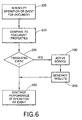
- an exemplary block diagram of a service activation is shown.
- a document is capable of activating the external service.
- the triggering event can be any assigned operation or event which is initiated by any function on the system.
- the triggering event can be initiated by an application, by the system, by another document by another active property, by a timer or any mechanism desired by a user.
- the operation is intercepted 200 by the document management system and the operation is compared 210 to the properties of the document to determine whether any of the active properties have been defined to include the current operation as a triggering event 220 . If the operation triggers an active property, the program code associated with the active property is executed which activates 230 an external service.
- the operation can be any associated event such as a request from an application processing the document or simply a system event such as a date or time.
- the external service executes and, using its associated active property as a communication interface, accesses the document and/or the document management system and generates 240 a result of the service.
- a service can manipulate the target document by modifying its content or perform other tasks without modifying the target document's content, such as, making back-up copies of the target document, creating new properties for the document, etc.
- the original operation is then continued 250 if it is an executable operation, as opposed to simply an occurrance of a system parameter such as a timer which would have no further execution to continue. If the content of the document was modified by the external service, then the operation is performed on the modified document rather than the original document. Of course, this can be changed based on the instructions of the active property. This process of activating external services is performed automatically without a user's intervention and is performed independently of the user or an application processing the document.
Landscapes
- Engineering & Computer Science (AREA)
- Databases & Information Systems (AREA)
- Theoretical Computer Science (AREA)
- Business, Economics & Management (AREA)
- General Business, Economics & Management (AREA)
- Data Mining & Analysis (AREA)
- Physics & Mathematics (AREA)
- General Engineering & Computer Science (AREA)
- General Physics & Mathematics (AREA)
- Information Retrieval, Db Structures And Fs Structures Therefor (AREA)
- Document Processing Apparatus (AREA)
Abstract
Description
Document management system (DMS) A is shown configured for operation with front-end components B, and back-end components C. Front-end components B include
Claims (17)
- A method of activating a service to be performed on a document in response to a triggering event, the method comprising the steps of:logically attaching a property to the document, the property being configured to activate a service for manipulating the document in response to the triggering event;associating an operation to the property as the triggering event, the operation being one to be performed on the document which is initiated by an application, the service being independent from the application and capable of manipulating the document without the application being aware of the manipulating;initiating, by the application, the operation to be performed on the document;intercepting the operation before being performed on the document;identifying the property attached to the document for which the operation is the triggering event;activating the service associated to the property triggered by the operation, the service manipulating the document independent from the application; andperforming the operation on the manipulated document.
- The method as set forth in claim 1 wherein the property is configured having instructions for activating the service such that the service executes on the document and manipulates the document in response to the triggering event.
- The method as set forth in claim 1 wherein the document includes content and the manipulating includes changing the content of the document.
- The method as set forth in claim 1 wherein the document includes content and the manipulating includes generating a result without changing the content of the document.
- The method as set forth in claim 1 wherein the manipulated document is separate from the document.
- The method as set forth in claim 1 wherein the property is attached to the document such that the application unintentionally activates the service by initiating the operation to be performed on the document.
- The method as set forth in claim 1 further including logically attaching a plurality of properties to the document, each of the properties being configured to activate a service upon a triggering event where the triggering event is an operation performed on the document by an application, the service being independent from the application.
- The method as set forth in claim 1 wherein the property is configured to activate a plurality of services in response to the triggering event.
- The method as set forth in claim 1 wherein the performing the operation on the manipulated document includes generating a result to the application, the result being different than a result which would be generated by the operation being performed on the document without activating the service.
- The method as set forth in claim 1 further including logically attaching a property to the document by a plurality of users where each property attached by each of the users is maintained independently for each of the users.
- The method as set forth in claim 1 wherein the service activated is executed by an operating system which is different than an operating system executing the application.
- In a document management system, a method of activating a service to be performed on a document in response to a triggering event, the method comprising the steps of:logically attaching a property to the document, the property being configured to activate a service for manipulating the document in response to the triggering event;associating the triggering event to the property such that the property invokes the service in response to an occurance of the triggering event;monitoring for an occurrance of the triggering event;intercepting the triggering event;identifying the property attached to the document which has the triggering event associated thereto;activating the service associated to the property triggered by the triggering event, the service manipulating the document; andgenerating a result of the service from manipulating the document.
- The method as set forth in claim 12 wherein the triggering event is an operation intiated by an application for processing the document.
- The method as set forth in claim 12 wherein the triggering event is a system parameter.
- The method as set forth in claim 12 wherein the service routinely sends queries to the document management system to determine which documents have attached properties associated to the service.
- The method as set forth in claim 12 wherein the document includes content and the generating includes changing the content of the document.
- The method as set forth in claim 12 wherein the document includes content and the result is generated without changing the content of the document.
Applications Claiming Priority (2)
| Application Number | Priority Date | Filing Date | Title |
|---|---|---|---|
| US143773 | 1998-08-31 | ||
| US09/143,773 US6240429B1 (en) | 1998-08-31 | 1998-08-31 | Using attached properties to provide document services |
Publications (2)
| Publication Number | Publication Date |
|---|---|
| EP0987636A2 true EP0987636A2 (en) | 2000-03-22 |
| EP0987636A3 EP0987636A3 (en) | 2001-01-17 |
Family
ID=22505555
Family Applications (1)
| Application Number | Title | Priority Date | Filing Date |
|---|---|---|---|
| EP99117044A Withdrawn EP0987636A3 (en) | 1998-08-31 | 1999-08-30 | Service interaction using properties attached to documents |
Country Status (3)
| Country | Link |
|---|---|
| US (1) | US6240429B1 (en) |
| EP (1) | EP0987636A3 (en) |
| JP (2) | JP2000089989A (en) |
Cited By (6)
| Publication number | Priority date | Publication date | Assignee | Title |
|---|---|---|---|---|
| WO2001095155A3 (en) * | 2000-06-06 | 2003-10-02 | Groove Networks Inc | Method and apparatus for efficient management of xml documents |
| EP1376401A3 (en) * | 2002-06-19 | 2004-08-18 | Pitney Bowes Inc. | Method and system for creation and use of webs of linked documents |
| EP1313033A3 (en) * | 2001-11-16 | 2004-10-20 | Fujitsu Limited | File system, control method, and program |
| EP1258818A3 (en) * | 2001-05-14 | 2006-02-08 | Hitachi, Ltd. | Document management method and document management system |
| FR2984560A1 (en) * | 2011-12-20 | 2013-06-21 | Sagemcom Documents Sas | METHOD FOR MANAGING AN ENRICHED DOCUMENT |
| JP2018180804A (en) * | 2017-04-10 | 2018-11-15 | 三菱電機エンジニアリング株式会社 | Management device and management method |
Families Citing this family (49)
| Publication number | Priority date | Publication date | Assignee | Title |
|---|---|---|---|---|
| US6768999B2 (en) * | 1996-06-28 | 2004-07-27 | Mirror Worlds Technologies, Inc. | Enterprise, stream-based, information management system |
| US6240429B1 (en) * | 1998-08-31 | 2001-05-29 | Xerox Corporation | Using attached properties to provide document services |
| US7296060B2 (en) * | 1998-12-24 | 2007-11-13 | Intel Corporation | System and method for automatically identifying and attaching related documents |
| US6675353B1 (en) * | 1999-07-26 | 2004-01-06 | Microsoft Corporation | Methods and systems for generating XML documents |
| US6363386B1 (en) * | 1999-07-26 | 2002-03-26 | Microsoft Corporation | System and method for managing property information related to a resource |
| US6950982B1 (en) | 1999-11-19 | 2005-09-27 | Xerox Corporation | Active annotation mechanism for document management systems |
| US6370538B1 (en) * | 1999-11-22 | 2002-04-09 | Xerox Corporation | Direct manipulation interface for document properties |
| US7757168B1 (en) * | 2000-04-07 | 2010-07-13 | Xerox Corporation | Meta-document and method of managing |
| US6778972B2 (en) | 2000-08-10 | 2004-08-17 | Gustavo S. Leonardos′ | System and method for providing integrated management of electronic information |
| US6961896B1 (en) * | 2000-11-30 | 2005-11-01 | Microsoft Corporation | Method and system for setting document-linked timed reminders |
| WO2003088092A1 (en) * | 2002-04-09 | 2003-10-23 | Ecos Technologies, Inc. | Task driven taxonomy and applications delivery platform |
| US20030202016A1 (en) * | 2002-04-30 | 2003-10-30 | Joe Acton | System and method for generating and displaying attribute-enhanced documents |
| WO2003091848A2 (en) * | 2002-04-23 | 2003-11-06 | Joe Acton | System and method for generating and displaying attribute-enhanced documents |
| US20040205660A1 (en) * | 2002-04-23 | 2004-10-14 | Joe Acton | System and method for generating and displaying attribute-enhanced documents |
| US7143341B1 (en) * | 2002-06-20 | 2006-11-28 | Cadence Design Systems | Method and apparatus for concurrent engineering and design synchronization of multiple tools |
| US8245137B2 (en) * | 2002-07-25 | 2012-08-14 | Xerox Corporation | Electronic filing system with scan-placeholders |
| US6868424B2 (en) * | 2002-07-25 | 2005-03-15 | Xerox Corporation | Electronic filing system with file-placeholders |
| WO2004031956A1 (en) * | 2002-09-30 | 2004-04-15 | Fujitsu Limited | Related information management method, program, and apparatus |
| US8443045B2 (en) * | 2002-10-01 | 2013-05-14 | Honda Motor Co., Ltd. | Storage of selected e-mails including attachments in document management system |
| US7289973B2 (en) * | 2002-12-19 | 2007-10-30 | Mathon Systems, Inc. | Graphical user interface for system and method for managing content |
| US7634728B2 (en) * | 2002-12-28 | 2009-12-15 | International Business Machines Corporation | System and method for providing a runtime environment for active web based document resources |
| US7676788B1 (en) | 2003-03-25 | 2010-03-09 | Electric Cloud, Inc. | Architecture and method for executing program builds |
| GB0309616D0 (en) | 2003-04-28 | 2003-06-04 | Angiomed Gmbh & Co | Loading and delivery of self-expanding stents |
| US7272606B2 (en) * | 2003-11-26 | 2007-09-18 | Veritas Operating Corporation | System and method for detecting and storing file content access information within a file system |
| US7328217B2 (en) * | 2003-11-26 | 2008-02-05 | Symantec Operating Corporation | System and method for detecting and storing file identity change information within a file system |
| US7415480B2 (en) | 2003-12-10 | 2008-08-19 | Symantec Operating Corporation | System and method for providing programming-language-independent access to file system content |
| US7636710B2 (en) * | 2004-03-04 | 2009-12-22 | Symantec Operating Corporation | System and method for efficient file content searching within a file system |
| US7831552B2 (en) | 2004-06-07 | 2010-11-09 | Symantec Operating Corporation | System and method for querying file system content |
| US7657530B2 (en) * | 2004-06-07 | 2010-02-02 | Symantec Operating Corporation | System and method for file system content processing |
| US8306991B2 (en) * | 2004-06-07 | 2012-11-06 | Symantec Operating Corporation | System and method for providing a programming-language-independent interface for querying file system content |
| US7562216B2 (en) * | 2004-06-28 | 2009-07-14 | Symantec Operating Corporation | System and method for applying a file system security model to a query system |
| WO2006008847A1 (en) * | 2004-07-20 | 2006-01-26 | Fujitsu Limited | Electronic document management system |
| US7437375B2 (en) * | 2004-08-17 | 2008-10-14 | Symantec Operating Corporation | System and method for communicating file system events using a publish-subscribe model |
| US7487138B2 (en) * | 2004-08-25 | 2009-02-03 | Symantec Operating Corporation | System and method for chunk-based indexing of file system content |
| JP2006079418A (en) | 2004-09-10 | 2006-03-23 | Fujitsu Ltd | Storage control device, control method, and program |
| US20060074912A1 (en) * | 2004-09-28 | 2006-04-06 | Veritas Operating Corporation | System and method for determining file system content relevance |
| US7472341B2 (en) * | 2004-11-08 | 2008-12-30 | International Business Machines Corporation | Multi-user, multi-timed collaborative annotation |
| US8042089B2 (en) * | 2006-10-03 | 2011-10-18 | Electric Cloud, Inc. | Process automation system and method employing multi-stage report generation |
| US7886265B2 (en) * | 2006-10-03 | 2011-02-08 | Electric Cloud, Inc. | Process automation system and method employing property attachment techniques |
| US7725524B2 (en) * | 2006-10-03 | 2010-05-25 | Electric Cloud, Inc. | Process automation system and method having a hierarchical architecture with multiple tiers |
| US7895170B2 (en) * | 2007-02-14 | 2011-02-22 | Ricoh Company, Ltd. | Document management apparatus, document management program, and recording medium |
| US7933889B2 (en) * | 2007-05-15 | 2011-04-26 | Palo Alto Research Center Incorporated | Method and system for metadata-driven document management and access control |
| US8966362B2 (en) * | 2007-05-15 | 2015-02-24 | Palo Alto Research Center Incorporated | Method and system for in-document markup in support of information sharing |
| WO2008141673A1 (en) * | 2007-05-21 | 2008-11-27 | Ontos Ag | Semantic navigation through web content and collections of documents |
| CN101477516B (en) * | 2008-09-10 | 2010-12-01 | 北京书生国际信息技术有限公司 | Electronic data processing method and system |
| US9069644B2 (en) * | 2009-04-10 | 2015-06-30 | Electric Cloud, Inc. | Architecture and method for versioning registry entries in a distributed program build |
| US20120101985A1 (en) * | 2010-10-25 | 2012-04-26 | Salesforce.Com, Inc. | Triggering actions in an information feed system |
| US10061577B2 (en) | 2014-10-14 | 2018-08-28 | Electric Cloud, Inc. | System and method for optimizing job scheduling within program builds |
| US11314699B1 (en) | 2018-09-06 | 2022-04-26 | Side, Inc. | Single-tier blockchain-based system and method for document transformation and accountability |
Family Cites Families (17)
| Publication number | Priority date | Publication date | Assignee | Title |
|---|---|---|---|---|
| JPH02231657A (en) * | 1989-03-06 | 1990-09-13 | Toshiba Corp | Filing system and operating system |
| EP0518967A4 (en) | 1990-03-05 | 1993-06-30 | Interleaf, Inc. | Extensible electronic document processing system for creating new classes of active documents |
| JPH06168135A (en) * | 1992-11-30 | 1994-06-14 | Hitachi Ltd | System for starting user program after end of file transfer |
| US5649192A (en) * | 1993-01-15 | 1997-07-15 | General Electric Company | Self-organized information storage system |
| JP3695777B2 (en) * | 1994-08-30 | 2005-09-14 | 株式会社東芝 | Information transfer method |
| US5835758A (en) * | 1995-02-28 | 1998-11-10 | Vidya Technologies, Inc. | Method and system for respresenting and processing physical and conceptual entities |
| JPH08249250A (en) * | 1995-03-09 | 1996-09-27 | Nippon Telegr & Teleph Corp <Ntt> | Information communication system |
| US5664180A (en) * | 1995-03-20 | 1997-09-02 | Framework Technologies Corporation | Design tool for complex objects which links object structures of a design object in multiple design domains |
| US5761684A (en) * | 1995-05-30 | 1998-06-02 | International Business Machines Corporation | Method and reusable object for scheduling script execution in a compound document |
| JPH08335181A (en) * | 1995-06-06 | 1996-12-17 | Canon Inc | File access device |
| US5889518A (en) * | 1995-10-10 | 1999-03-30 | Anysoft Ltd. | Apparatus for and method of acquiring, processing and routing data contained in a GUI window |
| CA2192237A1 (en) * | 1995-11-30 | 1997-05-31 | James L. Moskos | Method of transferring files from one computer to another |
| US5864850A (en) * | 1997-02-27 | 1999-01-26 | Apple Computer, Inc. | Asynchronous-event opening component of a network component system |
| US6049799A (en) * | 1997-05-12 | 2000-04-11 | Novell, Inc. | Document link management using directory services |
| US6108661A (en) * | 1997-07-14 | 2000-08-22 | Microsoft Corporation | System for instance customization |
| US6009442A (en) * | 1997-10-08 | 1999-12-28 | Caere Corporation | Computer-based document management system |
| US6240429B1 (en) * | 1998-08-31 | 2001-05-29 | Xerox Corporation | Using attached properties to provide document services |
-
1998
- 1998-08-31 US US09/143,773 patent/US6240429B1/en not_active Expired - Lifetime
-
1999
- 1999-08-30 EP EP99117044A patent/EP0987636A3/en not_active Withdrawn
- 1999-08-30 JP JP11242457A patent/JP2000089989A/en active Pending
-
2010
- 2010-02-22 JP JP2010035831A patent/JP4739455B2/en not_active Expired - Fee Related
Cited By (11)
| Publication number | Priority date | Publication date | Assignee | Title |
|---|---|---|---|---|
| WO2001095155A3 (en) * | 2000-06-06 | 2003-10-02 | Groove Networks Inc | Method and apparatus for efficient management of xml documents |
| US6941510B1 (en) | 2000-06-06 | 2005-09-06 | Groove Networks, Inc. | Method and apparatus for efficient management of XML documents |
| US7581172B2 (en) | 2000-06-06 | 2009-08-25 | Groove Networks, Inc. | Method and apparatus for efficient management of XML documents |
| US7721194B2 (en) | 2000-06-06 | 2010-05-18 | Groove Networks, Inc. | Method and apparatus for efficient management of XML documents |
| EP1258818A3 (en) * | 2001-05-14 | 2006-02-08 | Hitachi, Ltd. | Document management method and document management system |
| US7089268B2 (en) | 2001-05-14 | 2006-08-08 | Hitachi, Ltd. | Document management method and document management system |
| EP1313033A3 (en) * | 2001-11-16 | 2004-10-20 | Fujitsu Limited | File system, control method, and program |
| EP1376401A3 (en) * | 2002-06-19 | 2004-08-18 | Pitney Bowes Inc. | Method and system for creation and use of webs of linked documents |
| FR2984560A1 (en) * | 2011-12-20 | 2013-06-21 | Sagemcom Documents Sas | METHOD FOR MANAGING AN ENRICHED DOCUMENT |
| WO2013092569A3 (en) * | 2011-12-20 | 2013-12-19 | Sagemcom Documents Sas | Method of managing an enriched document |
| JP2018180804A (en) * | 2017-04-10 | 2018-11-15 | 三菱電機エンジニアリング株式会社 | Management device and management method |
Also Published As
| Publication number | Publication date |
|---|---|
| EP0987636A3 (en) | 2001-01-17 |
| JP2010134963A (en) | 2010-06-17 |
| US6240429B1 (en) | 2001-05-29 |
| JP2000089989A (en) | 2000-03-31 |
| JP4739455B2 (en) | 2011-08-03 |
Similar Documents
| Publication | Publication Date | Title |
|---|---|---|
| US6240429B1 (en) | Using attached properties to provide document services | |
| US6562076B2 (en) | Extending application behavior through active properties attached to a document in a document management system | |
| US6324551B1 (en) | Self-contained document management based on document properties | |
| US7086000B2 (en) | Tagging related files in a document management system | |
| US6269380B1 (en) | Property based mechanism for flexibility supporting front-end and back-end components having different communication protocols | |
| US6253217B1 (en) | Active properties for dynamic document management system configuration | |
| US6397231B1 (en) | Virtual documents generated via combined documents or portions of documents retrieved from data repositories | |
| US6330573B1 (en) | Maintaining document identity across hierarchy and non-hierarchy file systems | |
| US6308179B1 (en) | User level controlled mechanism inter-positioned in a read/write path of a property-based document management system | |
| US6370553B1 (en) | Atomic and molecular documents | |
| JP5787963B2 (en) | Computer platform programming interface | |
| US7536386B2 (en) | System and method for sharing items in a computer system | |
| JP2005018754A (en) | Sharing computer objects with associations | |
| US20040267779A1 (en) | Methods, apparatus and computer programs for visualization and management of data organisation within a data processing system | |
| RU2358312C2 (en) | System and method of presenting interrelated components to users | |
| KR101002483B1 (en) | System and method for presenting items to a user according to a contextual presentation | |
| KR20060112183A (en) | System and method for presentation of items stored on a computer | |
| EP0986012A2 (en) | User level accessing of low-level computer system operations | |
| CA2506337A1 (en) | Systems and methods for extensions and inheritance for units of information manageable by a hardware/software interface system | |
| US7155662B1 (en) | Representing an entity as a document using a data source having active properties | |
| HK1098848B (en) | System and a method for presenting related items to a user |
Legal Events
| Date | Code | Title | Description |
|---|---|---|---|
| PUAI | Public reference made under article 153(3) epc to a published international application that has entered the european phase |
Free format text: ORIGINAL CODE: 0009012 |
|
| AK | Designated contracting states |
Kind code of ref document: A2 Designated state(s): DE FR GB |
|
| AX | Request for extension of the european patent |
Free format text: AL;LT;LV;MK;RO;SI |
|
| PUAL | Search report despatched |
Free format text: ORIGINAL CODE: 0009013 |
|
| AK | Designated contracting states |
Kind code of ref document: A3 Designated state(s): AT BE CH CY DE DK ES FI FR GB GR IE IT LI LU MC NL PT SE |
|
| AX | Request for extension of the european patent |
Free format text: AL;LT;LV;MK;RO;SI |
|
| 17P | Request for examination filed |
Effective date: 20010717 |
|
| AKX | Designation fees paid |
Free format text: DE FR GB |
|
| 17Q | First examination report despatched |
Effective date: 20030108 |
|
| STAA | Information on the status of an ep patent application or granted ep patent |
Free format text: STATUS: THE APPLICATION IS DEEMED TO BE WITHDRAWN |
|
| 18D | Application deemed to be withdrawn |
Effective date: 20070301 |