EP0954411B1 - Rotogravure process for production of patterned abrasive surfaces - Google Patents
Rotogravure process for production of patterned abrasive surfaces Download PDFInfo
- Publication number
- EP0954411B1 EP0954411B1 EP97953428A EP97953428A EP0954411B1 EP 0954411 B1 EP0954411 B1 EP 0954411B1 EP 97953428 A EP97953428 A EP 97953428A EP 97953428 A EP97953428 A EP 97953428A EP 0954411 B1 EP0954411 B1 EP 0954411B1
- Authority
- EP
- European Patent Office
- Prior art keywords
- formulation
- process according
- viscosity
- abrasive
- pattern
- Prior art date
- Legal status (The legal status is an assumption and is not a legal conclusion. Google has not performed a legal analysis and makes no representation as to the accuracy of the status listed.)
- Expired - Lifetime
Links
- 238000000034 method Methods 0.000 title claims description 38
- 230000008569 process Effects 0.000 title claims description 28
- 238000004519 manufacturing process Methods 0.000 title claims description 7
- 239000000203 mixture Substances 0.000 claims description 107
- 238000009472 formulation Methods 0.000 claims description 84
- 238000000227 grinding Methods 0.000 claims description 35
- 239000011230 binding agent Substances 0.000 claims description 31
- 230000008021 deposition Effects 0.000 claims description 19
- 229920005989 resin Polymers 0.000 claims description 18
- 239000011347 resin Substances 0.000 claims description 18
- 239000000463 material Substances 0.000 claims description 15
- PNEYBMLMFCGWSK-UHFFFAOYSA-N aluminium oxide Inorganic materials [O-2].[O-2].[O-2].[Al+3].[Al+3] PNEYBMLMFCGWSK-UHFFFAOYSA-N 0.000 claims description 13
- 239000000843 powder Substances 0.000 claims description 13
- 239000010410 layer Substances 0.000 claims description 9
- -1 potassium tetrafluoroborate Chemical compound 0.000 claims description 9
- 239000000945 filler Substances 0.000 claims description 7
- MCMNRKCIXSYSNV-UHFFFAOYSA-N Zirconium dioxide Chemical compound O=[Zr]=O MCMNRKCIXSYSNV-UHFFFAOYSA-N 0.000 claims description 6
- 239000003795 chemical substances by application Substances 0.000 claims description 5
- 239000002131 composite material Substances 0.000 claims description 5
- 238000002955 isolation Methods 0.000 claims description 5
- 239000000314 lubricant Substances 0.000 claims description 5
- 239000000654 additive Substances 0.000 claims description 4
- 239000002216 antistatic agent Substances 0.000 claims description 4
- 229910001610 cryolite Inorganic materials 0.000 claims description 4
- 238000011068 loading method Methods 0.000 claims description 4
- 239000002344 surface layer Substances 0.000 claims description 4
- 230000008859 change Effects 0.000 claims description 3
- 239000010432 diamond Substances 0.000 claims description 3
- 229910003460 diamond Inorganic materials 0.000 claims description 3
- HBMJWWWQQXIZIP-UHFFFAOYSA-N silicon carbide Chemical compound [Si+]#[C-] HBMJWWWQQXIZIP-UHFFFAOYSA-N 0.000 claims description 3
- 229910010271 silicon carbide Inorganic materials 0.000 claims description 3
- 230000009974 thixotropic effect Effects 0.000 claims description 3
- 229920001169 thermoplastic Polymers 0.000 claims description 2
- QGQFOJGMPGJJGG-UHFFFAOYSA-K [B+3].[O-]N=O.[O-]N=O.[O-]N=O Chemical compound [B+3].[O-]N=O.[O-]N=O.[O-]N=O QGQFOJGMPGJJGG-UHFFFAOYSA-K 0.000 claims 2
- 239000004416 thermosoftening plastic Substances 0.000 claims 1
- 238000000151 deposition Methods 0.000 description 20
- 239000011248 coating agent Substances 0.000 description 16
- 238000000576 coating method Methods 0.000 description 16
- 239000000758 substrate Substances 0.000 description 15
- 239000002002 slurry Substances 0.000 description 11
- 230000001965 increasing effect Effects 0.000 description 10
- 239000000047 product Substances 0.000 description 10
- 239000003082 abrasive agent Substances 0.000 description 8
- 229910020261 KBF4 Inorganic materials 0.000 description 7
- 229920001971 elastomer Polymers 0.000 description 7
- 230000005855 radiation Effects 0.000 description 7
- 239000005060 rubber Substances 0.000 description 7
- 238000000926 separation method Methods 0.000 description 7
- VYPSYNLAJGMNEJ-UHFFFAOYSA-N silicon dioxide Inorganic materials O=[Si]=O VYPSYNLAJGMNEJ-UHFFFAOYSA-N 0.000 description 7
- KFZMGEQAYNKOFK-UHFFFAOYSA-N Isopropanol Chemical compound CC(C)O KFZMGEQAYNKOFK-UHFFFAOYSA-N 0.000 description 6
- 230000000052 comparative effect Effects 0.000 description 6
- 239000002245 particle Substances 0.000 description 6
- 238000013459 approach Methods 0.000 description 5
- 238000001723 curing Methods 0.000 description 5
- 239000004744 fabric Substances 0.000 description 5
- 230000014759 maintenance of location Effects 0.000 description 5
- 238000007792 addition Methods 0.000 description 4
- 229910052751 metal Inorganic materials 0.000 description 4
- 239000002184 metal Substances 0.000 description 4
- 239000000178 monomer Substances 0.000 description 4
- 229920001983 poloxamer Polymers 0.000 description 4
- 229920000728 polyester Polymers 0.000 description 4
- 238000000518 rheometry Methods 0.000 description 4
- 238000003756 stirring Methods 0.000 description 4
- 238000012360 testing method Methods 0.000 description 4
- KTALPKYXQZGAEG-UHFFFAOYSA-N 2-propan-2-ylthioxanthen-9-one Chemical compound C1=CC=C2C(=O)C3=CC(C(C)C)=CC=C3SC2=C1 KTALPKYXQZGAEG-UHFFFAOYSA-N 0.000 description 3
- FIHBHSQYSYVZQE-UHFFFAOYSA-N 6-prop-2-enoyloxyhexyl prop-2-enoate Chemical compound C=CC(=O)OCCCCCCOC(=O)C=C FIHBHSQYSYVZQE-UHFFFAOYSA-N 0.000 description 3
- 229920002799 BoPET Polymers 0.000 description 3
- WSFSSNUMVMOOMR-UHFFFAOYSA-N Formaldehyde Chemical compound O=C WSFSSNUMVMOOMR-UHFFFAOYSA-N 0.000 description 3
- 241001467044 Groundnut rosette assistor virus Species 0.000 description 3
- 239000005041 Mylar™ Substances 0.000 description 3
- DAKWPKUUDNSNPN-UHFFFAOYSA-N Trimethylolpropane triacrylate Chemical compound C=CC(=O)OCC(CC)(COC(=O)C=C)COC(=O)C=C DAKWPKUUDNSNPN-UHFFFAOYSA-N 0.000 description 3
- 239000006061 abrasive grain Substances 0.000 description 3
- 229920001400 block copolymer Polymers 0.000 description 3
- 229910052593 corundum Inorganic materials 0.000 description 3
- 238000005520 cutting process Methods 0.000 description 3
- 239000000975 dye Substances 0.000 description 3
- 230000000694 effects Effects 0.000 description 3
- 238000011049 filling Methods 0.000 description 3
- 239000011521 glass Substances 0.000 description 3
- TWNQGVIAIRXVLR-UHFFFAOYSA-N oxo(oxoalumanyloxy)alumane Chemical compound O=[Al]O[Al]=O TWNQGVIAIRXVLR-UHFFFAOYSA-N 0.000 description 3
- FZUGPQWGEGAKET-UHFFFAOYSA-N parbenate Chemical compound CCOC(=O)C1=CC=C(N(C)C)C=C1 FZUGPQWGEGAKET-UHFFFAOYSA-N 0.000 description 3
- 238000011084 recovery Methods 0.000 description 3
- 239000000126 substance Substances 0.000 description 3
- 238000010998 test method Methods 0.000 description 3
- 239000001993 wax Substances 0.000 description 3
- 229910001845 yogo sapphire Inorganic materials 0.000 description 3
- KWVGIHKZDCUPEU-UHFFFAOYSA-N 2,2-dimethoxy-2-phenylacetophenone Chemical compound C=1C=CC=CC=1C(OC)(OC)C(=O)C1=CC=CC=C1 KWVGIHKZDCUPEU-UHFFFAOYSA-N 0.000 description 2
- LJRSZGKUUZPHEB-UHFFFAOYSA-N 2-[2-(2-prop-2-enoyloxypropoxy)propoxy]propyl prop-2-enoate Chemical compound C=CC(=O)OC(C)COC(C)COC(C)COC(=O)C=C LJRSZGKUUZPHEB-UHFFFAOYSA-N 0.000 description 2
- QTBSBXVTEAMEQO-UHFFFAOYSA-N Acetic acid Chemical compound CC(O)=O QTBSBXVTEAMEQO-UHFFFAOYSA-N 0.000 description 2
- VTYYLEPIZMXCLO-UHFFFAOYSA-L Calcium carbonate Chemical compound [Ca+2].[O-]C([O-])=O VTYYLEPIZMXCLO-UHFFFAOYSA-L 0.000 description 2
- OKTJSMMVPCPJKN-UHFFFAOYSA-N Carbon Chemical compound [C] OKTJSMMVPCPJKN-UHFFFAOYSA-N 0.000 description 2
- 241001268311 Icta Species 0.000 description 2
- 229920003171 Poly (ethylene oxide) Polymers 0.000 description 2
- CDBYLPFSWZWCQE-UHFFFAOYSA-L Sodium Carbonate Chemical compound [Na+].[Na+].[O-]C([O-])=O CDBYLPFSWZWCQE-UHFFFAOYSA-L 0.000 description 2
- 229920003182 Surlyn® Polymers 0.000 description 2
- RTAQQCXQSZGOHL-UHFFFAOYSA-N Titanium Chemical compound [Ti] RTAQQCXQSZGOHL-UHFFFAOYSA-N 0.000 description 2
- 238000003848 UV Light-Curing Methods 0.000 description 2
- 238000005299 abrasion Methods 0.000 description 2
- RREGISFBPQOLTM-UHFFFAOYSA-N alumane;trihydrate Chemical compound O.O.O.[AlH3] RREGISFBPQOLTM-UHFFFAOYSA-N 0.000 description 2
- TZCXTZWJZNENPQ-UHFFFAOYSA-L barium sulfate Chemical compound [Ba+2].[O-]S([O-])(=O)=O TZCXTZWJZNENPQ-UHFFFAOYSA-L 0.000 description 2
- 230000008901 benefit Effects 0.000 description 2
- OSGAYBCDTDRGGQ-UHFFFAOYSA-L calcium sulfate Chemical compound [Ca+2].[O-]S([O-])(=O)=O OSGAYBCDTDRGGQ-UHFFFAOYSA-L 0.000 description 2
- 239000007822 coupling agent Substances 0.000 description 2
- 230000007423 decrease Effects 0.000 description 2
- 238000013461 design Methods 0.000 description 2
- 239000002270 dispersing agent Substances 0.000 description 2
- 239000003822 epoxy resin Substances 0.000 description 2
- 238000007765 extrusion coating Methods 0.000 description 2
- 230000009969 flowable effect Effects 0.000 description 2
- 229910021485 fumed silica Inorganic materials 0.000 description 2
- 229910002804 graphite Inorganic materials 0.000 description 2
- 239000010439 graphite Substances 0.000 description 2
- LNEPOXFFQSENCJ-UHFFFAOYSA-N haloperidol Chemical compound C1CC(O)(C=2C=CC(Cl)=CC=2)CCN1CCCC(=O)C1=CC=C(F)C=C1 LNEPOXFFQSENCJ-UHFFFAOYSA-N 0.000 description 2
- 239000000123 paper Substances 0.000 description 2
- 239000004033 plastic Substances 0.000 description 2
- 229920003023 plastic Polymers 0.000 description 2
- 239000002985 plastic film Substances 0.000 description 2
- 229920006255 plastic film Polymers 0.000 description 2
- 229920000647 polyepoxide Polymers 0.000 description 2
- 238000007639 printing Methods 0.000 description 2
- 239000007787 solid Substances 0.000 description 2
- 239000000375 suspending agent Substances 0.000 description 2
- 238000012956 testing procedure Methods 0.000 description 2
- 229920005992 thermoplastic resin Polymers 0.000 description 2
- XLYOFNOQVPJJNP-UHFFFAOYSA-N water Substances O XLYOFNOQVPJJNP-UHFFFAOYSA-N 0.000 description 2
- 239000000080 wetting agent Substances 0.000 description 2
- XOOUIPVCVHRTMJ-UHFFFAOYSA-L zinc stearate Chemical compound [Zn+2].CCCCCCCCCCCCCCCCCC([O-])=O.CCCCCCCCCCCCCCCCCC([O-])=O XOOUIPVCVHRTMJ-UHFFFAOYSA-L 0.000 description 2
- WYTZZXDRDKSJID-UHFFFAOYSA-N (3-aminopropyl)triethoxysilane Chemical compound CCO[Si](OCC)(OCC)CCCN WYTZZXDRDKSJID-UHFFFAOYSA-N 0.000 description 1
- ZDQNWDNMNKSMHI-UHFFFAOYSA-N 1-[2-(2-prop-2-enoyloxypropoxy)propoxy]propan-2-yl prop-2-enoate Chemical compound C=CC(=O)OC(C)COC(C)COCC(C)OC(=O)C=C ZDQNWDNMNKSMHI-UHFFFAOYSA-N 0.000 description 1
- 239000010963 304 stainless steel Substances 0.000 description 1
- NIXOWILDQLNWCW-UHFFFAOYSA-M Acrylate Chemical compound [O-]C(=O)C=C NIXOWILDQLNWCW-UHFFFAOYSA-M 0.000 description 1
- 229910002016 Aerosil® 200 Inorganic materials 0.000 description 1
- 229910052582 BN Inorganic materials 0.000 description 1
- PZNSFCLAULLKQX-UHFFFAOYSA-N Boron nitride Chemical compound N#B PZNSFCLAULLKQX-UHFFFAOYSA-N 0.000 description 1
- 239000004593 Epoxy Substances 0.000 description 1
- DGAQECJNVWCQMB-PUAWFVPOSA-M Ilexoside XXIX Chemical compound C[C@@H]1CC[C@@]2(CC[C@@]3(C(=CC[C@H]4[C@]3(CC[C@@H]5[C@@]4(CC[C@@H](C5(C)C)OS(=O)(=O)[O-])C)C)[C@@H]2[C@]1(C)O)C)C(=O)O[C@H]6[C@@H]([C@H]([C@@H]([C@H](O6)CO)O)O)O.[Na+] DGAQECJNVWCQMB-PUAWFVPOSA-M 0.000 description 1
- WHNWPMSKXPGLAX-UHFFFAOYSA-N N-Vinyl-2-pyrrolidone Chemical compound C=CN1CCCC1=O WHNWPMSKXPGLAX-UHFFFAOYSA-N 0.000 description 1
- 239000002202 Polyethylene glycol Substances 0.000 description 1
- NRCMAYZCPIVABH-UHFFFAOYSA-N Quinacridone Chemical compound N1C2=CC=CC=C2C(=O)C2=C1C=C1C(=O)C3=CC=CC=C3NC1=C2 NRCMAYZCPIVABH-UHFFFAOYSA-N 0.000 description 1
- 229910000589 SAE 304 stainless steel Inorganic materials 0.000 description 1
- 239000006087 Silane Coupling Agent Substances 0.000 description 1
- 101000882406 Staphylococcus aureus Enterotoxin type C-1 Proteins 0.000 description 1
- QAOWNCQODCNURD-UHFFFAOYSA-L Sulfate Chemical compound [O-]S([O-])(=O)=O QAOWNCQODCNURD-UHFFFAOYSA-L 0.000 description 1
- XSQUKJJJFZCRTK-UHFFFAOYSA-N Urea Chemical compound NC(N)=O XSQUKJJJFZCRTK-UHFFFAOYSA-N 0.000 description 1
- VZTQQYMRXDUHDO-UHFFFAOYSA-N [2-hydroxy-3-[4-[2-[4-(2-hydroxy-3-prop-2-enoyloxypropoxy)phenyl]propan-2-yl]phenoxy]propyl] prop-2-enoate Chemical compound C=1C=C(OCC(O)COC(=O)C=C)C=CC=1C(C)(C)C1=CC=C(OCC(O)COC(=O)C=C)C=C1 VZTQQYMRXDUHDO-UHFFFAOYSA-N 0.000 description 1
- 229960000583 acetic acid Drugs 0.000 description 1
- 150000001252 acrylic acid derivatives Chemical class 0.000 description 1
- DIZPMCHEQGEION-UHFFFAOYSA-H aluminium sulfate (anhydrous) Chemical compound [Al+3].[Al+3].[O-]S([O-])(=O)=O.[O-]S([O-])(=O)=O.[O-]S([O-])(=O)=O DIZPMCHEQGEION-UHFFFAOYSA-H 0.000 description 1
- 239000002518 antifoaming agent Substances 0.000 description 1
- 239000011324 bead Substances 0.000 description 1
- 229910000019 calcium carbonate Inorganic materials 0.000 description 1
- BRPQOXSCLDDYGP-UHFFFAOYSA-N calcium oxide Chemical compound [O-2].[Ca+2] BRPQOXSCLDDYGP-UHFFFAOYSA-N 0.000 description 1
- 239000000292 calcium oxide Substances 0.000 description 1
- ODINCKMPIJJUCX-UHFFFAOYSA-N calcium oxide Inorganic materials [Ca]=O ODINCKMPIJJUCX-UHFFFAOYSA-N 0.000 description 1
- 229910052918 calcium silicate Inorganic materials 0.000 description 1
- 235000012241 calcium silicate Nutrition 0.000 description 1
- OYACROKNLOSFPA-UHFFFAOYSA-N calcium;dioxido(oxo)silane Chemical compound [Ca+2].[O-][Si]([O-])=O OYACROKNLOSFPA-UHFFFAOYSA-N 0.000 description 1
- 239000004202 carbamide Substances 0.000 description 1
- 239000006229 carbon black Substances 0.000 description 1
- 150000004649 carbonic acid derivatives Chemical class 0.000 description 1
- 239000000919 ceramic Substances 0.000 description 1
- 238000005524 ceramic coating Methods 0.000 description 1
- 239000008199 coating composition Substances 0.000 description 1
- 239000013065 commercial product Substances 0.000 description 1
- RKTYLMNFRDHKIL-UHFFFAOYSA-N copper;5,10,15,20-tetraphenylporphyrin-22,24-diide Chemical compound [Cu+2].C1=CC(C(=C2C=CC([N-]2)=C(C=2C=CC=CC=2)C=2C=CC(N=2)=C(C=2C=CC=CC=2)C2=CC=C3[N-]2)C=2C=CC=CC=2)=NC1=C3C1=CC=CC=C1 RKTYLMNFRDHKIL-UHFFFAOYSA-N 0.000 description 1
- 230000001186 cumulative effect Effects 0.000 description 1
- 238000013036 cure process Methods 0.000 description 1
- 239000006185 dispersion Substances 0.000 description 1
- 238000009826 distribution Methods 0.000 description 1
- 238000010894 electron beam technology Methods 0.000 description 1
- 230000002708 enhancing effect Effects 0.000 description 1
- 230000003628 erosive effect Effects 0.000 description 1
- 238000002474 experimental method Methods 0.000 description 1
- NBVXSUQYWXRMNV-UHFFFAOYSA-N fluoromethane Chemical compound FC NBVXSUQYWXRMNV-UHFFFAOYSA-N 0.000 description 1
- 239000006260 foam Substances 0.000 description 1
- 239000011888 foil Substances 0.000 description 1
- 239000012362 glacial acetic acid Substances 0.000 description 1
- 238000007756 gravure coating Methods 0.000 description 1
- 238000010438 heat treatment Methods 0.000 description 1
- 239000003999 initiator Substances 0.000 description 1
- 238000011835 investigation Methods 0.000 description 1
- ZFSLODLOARCGLH-UHFFFAOYSA-N isocyanuric acid Chemical compound OC1=NC(O)=NC(O)=N1 ZFSLODLOARCGLH-UHFFFAOYSA-N 0.000 description 1
- 239000007788 liquid Substances 0.000 description 1
- 238000005259 measurement Methods 0.000 description 1
- 229910044991 metal oxide Inorganic materials 0.000 description 1
- 150000004706 metal oxides Chemical class 0.000 description 1
- 150000002739 metals Chemical class 0.000 description 1
- 238000005555 metalworking Methods 0.000 description 1
- 238000002156 mixing Methods 0.000 description 1
- 238000012986 modification Methods 0.000 description 1
- 230000004048 modification Effects 0.000 description 1
- 238000000465 moulding Methods 0.000 description 1
- 239000003348 petrochemical agent Substances 0.000 description 1
- ISWSIDIOOBJBQZ-UHFFFAOYSA-N phenol group Chemical group C1(=CC=CC=C1)O ISWSIDIOOBJBQZ-UHFFFAOYSA-N 0.000 description 1
- 229920001568 phenolic resin Polymers 0.000 description 1
- 239000005011 phenolic resin Substances 0.000 description 1
- 238000005498 polishing Methods 0.000 description 1
- 229920001223 polyethylene glycol Polymers 0.000 description 1
- 229920001451 polypropylene glycol Polymers 0.000 description 1
- 239000004800 polyvinyl chloride Substances 0.000 description 1
- 229920000915 polyvinyl chloride Polymers 0.000 description 1
- 238000002360 preparation method Methods 0.000 description 1
- 239000010453 quartz Substances 0.000 description 1
- 238000007363 ring formation reaction Methods 0.000 description 1
- 238000006748 scratching Methods 0.000 description 1
- 230000002393 scratching effect Effects 0.000 description 1
- 150000004760 silicates Chemical class 0.000 description 1
- 229910052708 sodium Inorganic materials 0.000 description 1
- 239000011734 sodium Substances 0.000 description 1
- 229910000029 sodium carbonate Inorganic materials 0.000 description 1
- 239000002904 solvent Substances 0.000 description 1
- CCEKAJIANROZEO-UHFFFAOYSA-N sulfluramid Chemical group CCNS(=O)(=O)C(F)(F)C(F)(F)C(F)(F)C(F)(F)C(F)(F)C(F)(F)C(F)(F)C(F)(F)F CCEKAJIANROZEO-UHFFFAOYSA-N 0.000 description 1
- 239000004094 surface-active agent Substances 0.000 description 1
- 239000000454 talc Substances 0.000 description 1
- 229910052623 talc Inorganic materials 0.000 description 1
- 230000036962 time dependent Effects 0.000 description 1
- 229940096522 trimethylolpropane triacrylate Drugs 0.000 description 1
- 150000003673 urethanes Chemical class 0.000 description 1
- 239000002023 wood Substances 0.000 description 1
Images

Classifications
-
- B—PERFORMING OPERATIONS; TRANSPORTING
- B29—WORKING OF PLASTICS; WORKING OF SUBSTANCES IN A PLASTIC STATE IN GENERAL
- B29C—SHAPING OR JOINING OF PLASTICS; SHAPING OF MATERIAL IN A PLASTIC STATE, NOT OTHERWISE PROVIDED FOR; AFTER-TREATMENT OF THE SHAPED PRODUCTS, e.g. REPAIRING
- B29C39/00—Shaping by casting, i.e. introducing the moulding material into a mould or between confining surfaces without significant moulding pressure; Apparatus therefor
- B29C39/14—Shaping by casting, i.e. introducing the moulding material into a mould or between confining surfaces without significant moulding pressure; Apparatus therefor for making articles of indefinite length
- B29C39/148—Shaping by casting, i.e. introducing the moulding material into a mould or between confining surfaces without significant moulding pressure; Apparatus therefor for making articles of indefinite length characterised by the shape of the surface
-
- B—PERFORMING OPERATIONS; TRANSPORTING
- B24—GRINDING; POLISHING
- B24D—TOOLS FOR GRINDING, BUFFING OR SHARPENING
- B24D11/00—Constructional features of flexible abrasive materials; Special features in the manufacture of such materials
-
- B—PERFORMING OPERATIONS; TRANSPORTING
- B24—GRINDING; POLISHING
- B24D—TOOLS FOR GRINDING, BUFFING OR SHARPENING
- B24D3/00—Physical features of abrasive bodies, or sheets, e.g. abrasive surfaces of special nature; Abrasive bodies or sheets characterised by their constituents
- B24D3/02—Physical features of abrasive bodies, or sheets, e.g. abrasive surfaces of special nature; Abrasive bodies or sheets characterised by their constituents the constituent being used as bonding agent
-
- B—PERFORMING OPERATIONS; TRANSPORTING
- B24—GRINDING; POLISHING
- B24D—TOOLS FOR GRINDING, BUFFING OR SHARPENING
- B24D3/00—Physical features of abrasive bodies, or sheets, e.g. abrasive surfaces of special nature; Abrasive bodies or sheets characterised by their constituents
- B24D3/02—Physical features of abrasive bodies, or sheets, e.g. abrasive surfaces of special nature; Abrasive bodies or sheets characterised by their constituents the constituent being used as bonding agent
- B24D3/20—Physical features of abrasive bodies, or sheets, e.g. abrasive surfaces of special nature; Abrasive bodies or sheets characterised by their constituents the constituent being used as bonding agent and being essentially organic
-
- B—PERFORMING OPERATIONS; TRANSPORTING
- B24—GRINDING; POLISHING
- B24D—TOOLS FOR GRINDING, BUFFING OR SHARPENING
- B24D3/00—Physical features of abrasive bodies, or sheets, e.g. abrasive surfaces of special nature; Abrasive bodies or sheets characterised by their constituents
- B24D3/02—Physical features of abrasive bodies, or sheets, e.g. abrasive surfaces of special nature; Abrasive bodies or sheets characterised by their constituents the constituent being used as bonding agent
- B24D3/20—Physical features of abrasive bodies, or sheets, e.g. abrasive surfaces of special nature; Abrasive bodies or sheets characterised by their constituents the constituent being used as bonding agent and being essentially organic
- B24D3/28—Resins or natural or synthetic macromolecular compounds
- B24D3/285—Reaction products obtained from aldehydes or ketones
Definitions
- This invention relates to the production of patterned abrasive surfaces on substrates in a form useful for fine finishing of substrates such as metals, wood, plastics and glass using a rotogravure process.
- abrasive surfaces comprising a uniform array of isolated islands has the advantage that the uniform islands wear at essentially the same rate such that a uniform rate of abrasion can be maintained for longer periods. In a sense the abrading work is more evenly shared among a larger number of grinding points. Moreover since the islands comprise many smaller particles of abrasive, erosion of an island uncovers new, unused abrasive particles which are as yet undulled.
- the technique of rotogravure printing employs a roll into the surface of which a pattern of cells has been engraved.
- the cells are filled with the formulation and the roll is pressed against a surface and the formulation in the cells is transferred to the surface. Normally the formulation would then flow until there was no separation between the formulations deposited from any individual cell. Ultimately a layer of essentially uniform thickness would be obtained.
- comparative examples C and D of United States Patent No. 5,152.917 describe a process in which the pattern obtained by a rotogravure process quickly lost all separation of the individual amounts deposited from the cells.
- Kaczmarek et al. used a rotogravure roll in a more conventional fashion to deposit an abrasive/binder formulation to deposit a layer that is then smoothed out before a second layer is deposited by a rotogravure process on top of the smoothed-out first layer. There is no teaching of the nature of the final cured surface.
- the process is very useful but it has a potential problem with increasing build-up of material in the cells of the rotogravure roll such that the deposition pattern can change slightly during a protracted production run.
- the nature of the process is such that it is limited to formulations containing relatively fine abrasive grits, (usually less than 20 microns).
- the present invention presents a technique for producing uniformly patterned shapes of an abrasive/binder combination that does not require a cure-in-mold operation or the selection of a binder/abrasive combination with specific non-Newtonian shear-thickening flow characteristics.
- the present invention therefore, provides a flexible and effective route for the commercial scale production of coated abrasives with a uniform array of isolated abrasive composite shapes.
- coated abrasives are well adapted to the treatment of a wide range of substrates to yield fine finishes for protracted periods of operation at a substantially uniform cut rate.
- the key is to formulate the binder/abrasive mixture to fulfill two conditions.
- the first condition is that the viscosity is relatively low under relatively high shear conditions (such as are experienced when filling the gravure cells, doctoring the gravure roll lands after filling of the cells, and while transferring the material to a substrate at the nip between the rotogravure roll and a rubber roll).
- the formulation should have a low high-shear viscosity to facilitate coating deposition on to the substrate.
- the second condition is that the formulation has a high low-shear viscosity to prevent excessive flow and leveling when the formulation is sitting on the substrate under low-shear conditions before it is cured. It is also highly desirable that the viscosity recovery time is short by comparison with the time between coating deposition and cure.
- the present invention therefore, comprises a process for the production of a coated abrasive comprising a pattern of abrasive/binder composites adhered to a backing material said process comprising:
- the viscosity is herein measured using a Bohlin VOR rheometer at the coating temperatures which is typically from about 15°C to 50°C.
- the key is that the formulation must have a reasonably low viscosity at the high shear conditions encountered during filling the rotogravure cells, doctoring the roll to remove excess formulation and deposition from the cells, but after deposition the viscosity needs to be raised sufficiently quickly to prevent flow of the formulation from destroying the isolation of the deposited structures. Isolation is not considered lost if the margins touch in places but only if the structures are in contact with adjacent structures at all points around the margins and the depth of formulation at the contact points is at least 10% of the maximum height of the contacting structures above the backing.
- One very suitable way of ensuring the retention of separation is to use a resin formulation that has a thixotropic character, that is to say, which exhibits time dependent shear-thinning behavior.
- a resin formulation that has a thixotropic character, that is to say, which exhibits time dependent shear-thinning behavior.
- Such formulations rapidly regain their high viscosity when the high shear conditions are removed.
- the viscosity has regained at least 50% of its value under low shear conditions and this is enough in most cases to avoid loss of isolation until the cure process has begun to increase the viscosity.
- the viscosity can more conveniently be measured with a Brookfield viscometer.
- the viscosity is affected by temperature and the viscosities quoted above are at the temperature at which the formulation is applied in the above process. Typically, this is at temperature for example from about 15°C to 50°C.
- the viscosity recovery time that is the time for the low viscosity under high shear conditions to revert to the normal high viscosity when the shear conditions are removed, should be relatively short, such as less than 60 seconds and preferably less than 30 seconds.
- any formulation, even a non-thixotropic one, having a low high-shear viscosity in the above range can, however, be modified upon deposition so as rapidly to adjust the viscosity to the higher low-shear viscosity level described above in such a way as to limit the flow that would tend to occur at the lower viscosities at which the formulation is deposited. It is also not necessary that the viscosity of the whole of the formulation be adjusted to the higher level. It is often sufficient if the outer exposed layer quickly attain the higher viscosity since this acts as a skin so as to retain the shape of the structure even if the inner portion retains the lower viscosity for a longer period.
- Viscosity modification of at least the surface layers can be achieved for example by incorporating into the formulation a volatile solvent that is rapidly lost when the formulation is deposited on the backing material, perhaps with the assistance of an increased ambient temperature or by a localized blast of hot gas. Increased temperature of course can also decrease the viscosity. It is, therefore, important to balance these competing effects to ensure that the result is increasing viscosity. One factor assisting in this direction would be a tendency for increased temperature to cause accelerated curing.
- Another option would be rapidly to adjust the temperature of the structure downwards such that the viscosity is increased. This could be done for example by passing the substrate with the structures of deposited formulation thereon over a chilled roll and/or under a cold gas flow.
- the powder itself can be an abrasive, a filler, or a powder material conferring advantageous properties for example a grinding aid such as potassium tetrafluoroborate, an anti-static agent such as graphite, an anti-loading agent such as zinc stearate, a solid lubricant such as wax, or any combination of such materials.
- a grinding aid such as potassium tetrafluoroborate
- an anti-static agent such as graphite
- an anti-loading agent such as zinc stearate
- a solid lubricant such as wax
- the process can also be assisted by providing that the rotogravure roll is heated and the surface on to which the formulation is deposited is cooled.
- the heating of the rotogravure roll should however not be to such a level that the binder begins to cure and the viscosity is increased as a consequence in the case of thermally curable resin formulations.
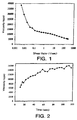
- Fig. 1 shows an example of the viscosity variation with respect to shear rate of an abrasive slurry formulation of this invention.
- the viscosity variation from high shear to low shear conditions is very marked.
- the recovery of viscosity as the high shear conditions are removed is such that more than 50% of the low shear viscosity is regained once the high shear conditions are removed.
- the deposited coating formulations retain the rotogravure pattern with separation between individual depositions.
- Figs. 3 and 4 illustrate the coated patterns of an abrasive formulation according to this invention that are cured immediately after deposition versus with a 40 minutes delay between deposition and curing.
- an abrasive slurry formulation with a properly formulated rheology according to this invention can retain its discrete pattern even up to 40 minutes after deposition before the binder is finally cured and set by UV.
- the deposition can be in any desired pattern and this will be determined in large part by the size and distribution of the cells on the rotogravure rcll.
- hexagonal, tetragonal, triangular and quadrangular cross-section cells are quite suitable, though others can also be used.
- the cells are in the form of grooves, (for example trihelical grooves), cut in the roll surface. This is often a very advantageous configuration and can be adapted to produce a pattern of diagonal stripes that is at once very distinctive and also very effective for grinding.
- the number of cells per unit length can also be varied though with a higher cell density the volume of the cells is preferably smaller to maximize separation between the cell contents after deposition on the surface. If the cells are very closely situated, it is possible to cause the deposited formulations to run together by design so as to produce an essentially continuous line.
- dots are also very suitable.
- the deposited dots themselves tend to be round but the deposition technique, including the speed of the rotogravure roll and the method by which the cells are filled, can cause the shape of the dot deposited to deviate from the round.
- the dot may have the shape of a crescent or have a "comet tail". In some cases these shapes may have some advantages but in general they are not preferred. It is, therefore, preferred to adjust the impression pressure and the circumstances under which the rotogravure roll contacts the surface of substrate to which the formulation is to be applied to ensure that discrete round dots of deposited formulation are obtained.
- the abrasive component of the formulation can be any of the available materials known in the art such as alpha alumina, (fused or sintered ceramic), silicon carbide, fused alumina/zirconia, cubic boron nitride, diamond and the like as well as the combination of thereof.
- the preferred abrasive is alumina and particularly fused alumina.
- Abrasive particles useful in the invention typically and preferably have an average particle size from 1 micron to 150 micron, and more preferably from 1 micron to 80 micron.
- the proportion of abrasive in the formulation is of course determined in part by the viscosity limitations set forth above and the type of application. In general however the amount of abrasive present provides from about 10 to about 90%, and preferably from about 30% to about 80%, of the weight of the formulation.
- the other major component of the formulation is the binder.
- This is a curable resin formulation selected from radiation curable resins, such as those curable using electron beam, UV radiation or visible light, such as acrylated oligomers of acrylated epoxy resins, acrylated urethanes and polyester acrylates and acrylated monomers including monoacrylated, multiacrylated monomers, and thermally curable resins such as phenolic resins, urea/formaldehyde resins and epoxy resins, as well as mixtures of such resins.
- radiation curable resins such as those curable using electron beam, UV radiation or visible light
- thermally curable resins such as phenolic resins, urea/formaldehyde resins and epoxy resins, as well as mixtures of such resins.
- UV light ultraviolet
- thermal cure functions and the radiation cure functions can be provided by different functionalities in the same molecule. This is often a desirable expedient.
- the resin binder formulation can also comprise a non-reactive thermoplastic resin which can enhance the self-sharpening characteristics of the deposited abrasive composites by enhancing the erodability.
- thermoplastic resin include polypropylene glycol, polyethylene glycol, and polyoxypropylene-polyoxyethene block copolymer, etc.
- Fillers can be incorporated into the abrasive slurry formulation to modify the rheology of formulation and the hardness and toughness of the cured binders.
- useful fillers include: metal carbonates such as calcium carbonate, sodium carbonate; silicas such as quartz, glass beads, glass bubbles; silicates such as talc, clays, calcium metasilicate; metal sulfate such as barium sulfate, calcium sulfate, aluminum sulfate; metal oxides such as calcium oxide, aluminum oxide; and aluminum trihydrate.
- the abrasive slurry formulation may comprise a grinding aid to increase the grinding efficiency and cut rate.
- Useful grinding aid can be inorganic based, such as halide salts, for example sodium cryolite, potassium tetrafluoroborate, etc.; or organic based, such as chlorinated waxes, for example polyvinyl chloride.
- the preferred grinding aids in this formulation are cryolite and potassium tetrafluoroborate with particle size ranging from 1 micron to 80 microns, and most preferably from 5 microns to 30 microns.
- the weight percent of grinding aid ranges from 0% to 50%, and most preferably from 10-30%.
- the abrasive slurry formulations in this invention may further comprise additives including: coupling agents, such as silane coupling agents, for example A-174 and A-1100 available from Osi Specialties, Inc., titanate, and zircoaluminates; anti-static agents, such as graphite, carbon black, and the like; suspending agent, such as fumed silica, for example Cab-O-Sil M5, Aerosil 200; anti-loading agents, such as zinc stearate; lubricants, such as wax; wetting agents; dyes; dispersants; and defoamers.
- coupling agents such as silane coupling agents, for example A-174 and A-1100 available from Osi Specialties, Inc., titanate, and zircoaluminates
- anti-static agents such as graphite, carbon black, and the like
- suspending agent such as fumed silica, for example Cab-O-Sil M5, Aerosil 200
- anti-loading agents such as zinc stearate
- the backing material upon which the formulation is deposited can be a fabric, (woven, non-woven or fleeced), paper, plastic film, metal foil or combination of the thereof.
- a fabric woven, non-woven or fleeced
- paper plastic film
- metal foil metal foil
- finely calendared paper, plastic film or a fabric with a smooth surface coating is usually the preferred substrate for deposition of the composite formulations according to the invention.
- the monomers and/or oligomer components were mixed together for 5 minutes using a high shear mixer at 1000 rpm. This binder formulation was then mixed with any initiators, wetting agents, defoaming agents, dispersants etc. and mixing was continued for a further 5 minutes at the same rate of stirring. Then the following components were added, slowly and in the indicated order, with five minutes stirring at 1500 rpm between additions: suspension agents, grinding aids, fillers and abrasive grain. After addition of the abrasive grain the speed of stirring was increased to 2,000 rpm and continued for 15 minutes. During this time the temperature was carefully monitored and the stirring rate was reduced to 1,000 rpm if the temperature reached 40.6°C. Thereafter the temperature and the viscosity were recorded.
- the coating set-up included a rubber roll with a Shore A hardness of 75 and a doctor blade set to make an angle with respect to the tangent at the contact point of 55-75°.
- a gravure roll rotates in a coating pan to fill the formulation into the cells.
- the gravure roll bearing the filled cells then passes under the doctor blade to remove excess formulation and thereafter into contact with the substrate as it passes under the rubber roll which acts to draw the formulation from the cells and deposit it upon the backing material.
- the patterned substrate passes to a cure station.
- the cure is thermal, appropriate means are provided.
- the cure is activated by photoinitiators a light source may be provided. If UV cure is employed, two 300 watt sources are used: a D bulb and an H bulb with the dosage controlled by the rate at which the patterned substrate passed under the sources.
- HEX indicates hexagonal cells
- QUAD indicates square cells
- TH indicates trihelical line patterns.
- the hexagonal raised ridge patterns are typical of those according to the prior art patent United States Patent No. 5,014,468- "Discrete ⁇ dots” indicates that the discrete dots were triangular. Note that all examples with the viscosity within the range set forth before all exhibited a discrete pattern with separation between individual depositions.
- GRAV.PATT. LINES/INCH RESIN FORM. GRAIN, SIZE COATING PATTERN EX.
- the 17 HEX hexagonal gravure pattern comprised cells 559 microns in depth with equal sides of 1000 microns at the top and 100 microns at the bottom.
- the 10 TH trihelical pattern comprised continuous channel cut at 45° to the roll axis that has a depth of 699 microns and a top opening width of 2500 microns.
- the 10 QUAD quadrangular pattern comprised a square cells with a depth of 420 microns, a top side dimension of 2340 microns and a bottom side dimension of 650 microns.
- the shape of the dots can be influenced by the rotational speed of the gravure roll and the pressure exerted by the rubber roll. Too high a speed or too high a pressure between the rubber roll and the gravure roll tends to distort the shape away from the round towards the triangular and may even lead to adjacent dots being connected. However under ideal conditions, which will vary according to the formulation, the rubber roll hardness and pressure upon the gravure roll, the gravure pattern and the rate of deposition, the ideal "dot" pattern is round.
- Cure was initiated using UV radiation within about 30 seconds of deposition of the formulations.
- the Examples described above were subjected to grinding tests using a modified 121 Fss Ring Test procedure.
- a 6.4 cm x 152.4 cm belt was used and the belt was moved at a rate of 1524 smpm.
- the belt was contacted with a 304 stainless steel ring workpiece, (17.8 cm O.D., 15.2 cm I.D., and 3.1 cm width), at a pressure of 10 psi (69 KN/m 2 ).
- the contact wheel behind the belt was a 7 inch (17.8 cm) plain face rubber wheel with 60 durometer hardness.
- the workpiece was moved at a speed of 3 smpm.
- the pattern coated samples give a much higher total cut whereas offer a cool cutting than the conventional coated abrasive R245.
- Comparative example C-2 uses a commercial fine abrasive product available from Norton Company under the designation R245 with P-320 fused alumina abrasive grits. R245 does not bear a patterned surface. EX.
- both the 10Q and 10TH patterned abrasives on various different backings outperform the conventional none patterned coated abrasives in total cut and cooler cutting while providing acceptable surface finishes.
- Example 13-a indicates that the belt was the same as used in Example 13 except that the belt was pre-dressed before use. This clearly improved the initial cut (after the first minute of grinding) and the smoothness of the surface but cost somewhat in the total cut obtained.
- Example 13-b shows the effect of omitting the grinding aid component (KBF 4 ) from the formulation, i.e., with 70% by weight of P320 aluminum oxide grain (T) and without any KBF 4 in slurry. The initial cut of Example 13-b remained low even after pre-dressing step before test.
- Example 16 shows a lower initial and total cut but a finer surface finish can be obtained with a different resin formulation.
- Example 14 shows that the 10 trihelical patterned abrasive with an slurry formulation using heat treated aluminum oxide grains (BFRPLCC) and KBF 4 grinding aid exhibited a much higher total cut and cool cutting than comparative example C-2.
- Example 14-a is the same as Example 14 except that an additional layer of BFRPLCC abrasive grains was coated onto the patterned abrasive slurry then followed by UV curing. This improves the initial cut (after one minute of grinding) and surface finish but decreases the total cut. This compromise between the initial cut and total cut can be eliminated if a powder blend of BFRPLCC grains and KHF 4 grinding aid instead of just grains was coated onto the surface of patterned abrasive slurry then followed by UV curing. As shown in Example 14-b, an additional powder coating of the grain/grinding aid blend (2 to 1 ratio by weight) significantly improved the initial cut whereas maintained the total cut and a finer surface finish. This approach is in fact a preferred aspect of this invention.
- Example 13-c in Table 8 is the same as Example 13 in Table 6 except that an additional powder coating of FRPL/KBF 4 blend (2:1 weight ratio) was applied onto the surface of abrasive slurry. Note that with everything else being equal, the addition of Pluronic 25R2, a non-reactive polyoxypropylene-polyoxyethylene block copolymer, significantly improves the total cut (Example 25 versus Example 26 and Example 24 versus Example 13-c) in both cases with and without additional surface powder coating. EX.
Landscapes
- Engineering & Computer Science (AREA)
- Mechanical Engineering (AREA)
- Chemical & Material Sciences (AREA)
- Chemical Kinetics & Catalysis (AREA)
- Polishing Bodies And Polishing Tools (AREA)
- Casting Or Compression Moulding Of Plastics Or The Like (AREA)
- Mechanical Treatment Of Semiconductor (AREA)
- Application Of Or Painting With Fluid Materials (AREA)
- Paper (AREA)
- Laminated Bodies (AREA)
- Manufacture Of Macromolecular Shaped Articles (AREA)
Priority Applications (1)
| Application Number | Priority Date | Filing Date | Title |
|---|---|---|---|
| DK97953428T DK0954411T3 (da) | 1997-01-08 | 1997-12-22 | Rotationsdybtryksfremgangsmåde til fremstilling af mönstrede slibemiddelsoverflader |
Applications Claiming Priority (3)
| Application Number | Priority Date | Filing Date | Title |
|---|---|---|---|
| US08/780,750 US5840088A (en) | 1997-01-08 | 1997-01-08 | Rotogravure process for production of patterned abrasive surfaces |
| US780750 | 1997-01-08 | ||
| PCT/US1997/023826 WO1998030361A1 (en) | 1997-01-08 | 1997-12-22 | Rotogravure process for production of patterned abrasive surfaces |
Publications (2)
| Publication Number | Publication Date |
|---|---|
| EP0954411A1 EP0954411A1 (en) | 1999-11-10 |
| EP0954411B1 true EP0954411B1 (en) | 2004-06-09 |
Family
ID=25120568
Family Applications (1)
| Application Number | Title | Priority Date | Filing Date |
|---|---|---|---|
| EP97953428A Expired - Lifetime EP0954411B1 (en) | 1997-01-08 | 1997-12-22 | Rotogravure process for production of patterned abrasive surfaces |
Country Status (23)
| Country | Link |
|---|---|
| US (1) | US5840088A (id) |
| EP (1) | EP0954411B1 (id) |
| JP (1) | JP3958373B2 (id) |
| KR (1) | KR100335521B1 (id) |
| CN (1) | CN1077831C (id) |
| AR (1) | AR011373A1 (id) |
| AT (1) | ATE268671T1 (id) |
| AU (1) | AU716055B2 (id) |
| BR (1) | BR9714201A (id) |
| CA (1) | CA2276506C (id) |
| CO (1) | CO4870715A1 (id) |
| CZ (1) | CZ300177B6 (id) |
| DE (1) | DE69729476T2 (id) |
| DK (1) | DK0954411T3 (id) |
| ES (1) | ES2223086T3 (id) |
| HU (1) | HU223453B1 (id) |
| ID (1) | ID21807A (id) |
| NO (1) | NO314074B1 (id) |
| NZ (1) | NZ335615A (id) |
| PL (1) | PL185351B1 (id) |
| TW (1) | TW436365B (id) |
| WO (1) | WO1998030361A1 (id) |
| ZA (1) | ZA9842B (id) |
Cited By (1)
| Publication number | Priority date | Publication date | Assignee | Title |
|---|---|---|---|---|
| US8491681B2 (en) | 2007-09-24 | 2013-07-23 | Saint-Gobain Abrasives, Inc. | Abrasive products including active fillers |
Families Citing this family (20)
| Publication number | Priority date | Publication date | Assignee | Title |
|---|---|---|---|---|
| US5833724A (en) * | 1997-01-07 | 1998-11-10 | Norton Company | Structured abrasives with adhered functional powders |
| DE19746268A1 (de) * | 1997-10-20 | 1999-04-22 | Giesecke & Devrient Gmbh | Verfahren und Vorrichtung zur Herstellung eines Folienmaterials |
| US6186866B1 (en) | 1998-08-05 | 2001-02-13 | 3M Innovative Properties Company | Abrasive article with separately formed front surface protrusions containing a grinding aid and methods of making and using |
| US6299508B1 (en) | 1998-08-05 | 2001-10-09 | 3M Innovative Properties Company | Abrasive article with integrally molded front surface protrusions containing a grinding aid and methods of making and using |
| US6183346B1 (en) | 1998-08-05 | 2001-02-06 | 3M Innovative Properties Company | Abrasive article with embossed isolation layer and methods of making and using |
| US6048375A (en) * | 1998-12-16 | 2000-04-11 | Norton Company | Coated abrasive |
| US6159089A (en) * | 1998-12-16 | 2000-12-12 | Norton Company | Grinding system |
| US6287184B1 (en) | 1999-10-01 | 2001-09-11 | 3M Innovative Properties Company | Marked abrasive article |
| US6096107A (en) * | 2000-01-03 | 2000-08-01 | Norton Company | Superabrasive products |
| US6413286B1 (en) | 2000-05-03 | 2002-07-02 | Saint-Gobain Abrasives Technology Company | Production tool process |
| US6599177B2 (en) * | 2001-06-25 | 2003-07-29 | Saint-Gobain Abrasives Technology Company | Coated abrasives with indicia |
| CA2647881C (en) * | 2006-04-04 | 2012-02-14 | Saint-Gobain Abrasives, Inc. | Infrared cured abrasive articles and method of manufacture |
| JP5767325B2 (ja) | 2010-07-02 | 2015-08-19 | スリーエム イノベイティブ プロパティズ カンパニー | 被覆研磨材物品 |
| KR20140075718A (ko) | 2011-09-29 | 2014-06-19 | 생-고뱅 어브레이시브즈, 인코포레이티드 | 연마 제품 및 경질 표면 마무리 방법 |
| BR112014016237A8 (pt) | 2011-12-29 | 2017-07-04 | 3M Innovative Properties Co | artigo abrasivo revestido e método para fabricação do mesmo |
| US9321947B2 (en) | 2012-01-10 | 2016-04-26 | Saint-Gobain Abrasives, Inc. | Abrasive products and methods for finishing coated surfaces |
| WO2013138765A1 (en) | 2012-03-16 | 2013-09-19 | Saint-Gobain Abrasives, Inc. | Abrasive products and methods for finishing surfaces |
| WO2013149197A1 (en) | 2012-03-30 | 2013-10-03 | Saint-Gobain Abrasives, Inc. | Abrasive products and methods for fine polishing of ophthalmic lenses |
| GB2576356A (en) * | 2018-08-16 | 2020-02-19 | 3M Innovative Properties Co | Coated abrasive article and method of making the same |
| US12258490B2 (en) | 2022-07-14 | 2025-03-25 | Applied Scientific International LLC | Abrasives |
Family Cites Families (10)
| Publication number | Priority date | Publication date | Assignee | Title |
|---|---|---|---|---|
| US3549341A (en) * | 1968-08-05 | 1970-12-22 | Minnesota Mining & Mfg | Method for producing pyramidal shaped tumbling media |
| US3991527A (en) * | 1975-07-10 | 1976-11-16 | Bates Abrasive Products, Inc. | Coated abrasive disc |
| DE3043796A1 (de) * | 1980-11-20 | 1982-07-22 | Walter 6342 Haiger Klingspor | Flexibles schleifmittel, beispielsweise in form von boegen, baendern, scheiben o.dgl. |
| US4773920B1 (en) * | 1985-12-16 | 1995-05-02 | Minnesota Mining & Mfg | Coated abrasive suitable for use as a lapping material. |
| US4644703A (en) * | 1986-03-13 | 1987-02-24 | Norton Company | Plural layered coated abrasive |
| US5014468A (en) * | 1989-05-05 | 1991-05-14 | Norton Company | Patterned coated abrasive for fine surface finishing |
| US5378251A (en) * | 1991-02-06 | 1995-01-03 | Minnesota Mining And Manufacturing Company | Abrasive articles and methods of making and using same |
| US5107626A (en) * | 1991-02-06 | 1992-04-28 | Minnesota Mining And Manufacturing Company | Method of providing a patterned surface on a substrate |
| US5152917B1 (en) * | 1991-02-06 | 1998-01-13 | Minnesota Mining & Mfg | Structured abrasive article |
| US5437754A (en) * | 1992-01-13 | 1995-08-01 | Minnesota Mining And Manufacturing Company | Abrasive article having precise lateral spacing between abrasive composite members |
-
1997
- 1997-01-08 US US08/780,750 patent/US5840088A/en not_active Expired - Lifetime
- 1997-12-22 BR BR9714201-8A patent/BR9714201A/pt not_active IP Right Cessation
- 1997-12-22 AT AT97953428T patent/ATE268671T1/de not_active IP Right Cessation
- 1997-12-22 KR KR1019997006213A patent/KR100335521B1/ko not_active Expired - Fee Related
- 1997-12-22 ES ES97953428T patent/ES2223086T3/es not_active Expired - Lifetime
- 1997-12-22 JP JP53091898A patent/JP3958373B2/ja not_active Expired - Fee Related
- 1997-12-22 HU HU0000774A patent/HU223453B1/hu not_active IP Right Cessation
- 1997-12-22 CA CA002276506A patent/CA2276506C/en not_active Expired - Lifetime
- 1997-12-22 PL PL97334497A patent/PL185351B1/pl not_active IP Right Cessation
- 1997-12-22 DK DK97953428T patent/DK0954411T3/da active
- 1997-12-22 CZ CZ0241999A patent/CZ300177B6/cs not_active IP Right Cessation
- 1997-12-22 CN CN97181255A patent/CN1077831C/zh not_active Expired - Lifetime
- 1997-12-22 WO PCT/US1997/023826 patent/WO1998030361A1/en not_active Ceased
- 1997-12-22 EP EP97953428A patent/EP0954411B1/en not_active Expired - Lifetime
- 1997-12-22 ID IDW990652A patent/ID21807A/id unknown
- 1997-12-22 NZ NZ335615A patent/NZ335615A/xx not_active IP Right Cessation
- 1997-12-22 AU AU57178/98A patent/AU716055B2/en not_active Ceased
- 1997-12-22 DE DE69729476T patent/DE69729476T2/de not_active Expired - Lifetime
-
1998
- 1998-01-05 ZA ZA9842A patent/ZA9842B/xx unknown
- 1998-01-07 CO CO98000487A patent/CO4870715A1/es unknown
- 1998-01-07 AR ARP980100075A patent/AR011373A1/es unknown
- 1998-02-05 TW TW087100194A patent/TW436365B/zh not_active IP Right Cessation
-
1999
- 1999-07-07 NO NO19993361A patent/NO314074B1/no unknown
Cited By (1)
| Publication number | Priority date | Publication date | Assignee | Title |
|---|---|---|---|---|
| US8491681B2 (en) | 2007-09-24 | 2013-07-23 | Saint-Gobain Abrasives, Inc. | Abrasive products including active fillers |
Also Published As
Similar Documents
| Publication | Publication Date | Title |
|---|---|---|
| EP0954411B1 (en) | Rotogravure process for production of patterned abrasive surfaces | |
| US5863306A (en) | Production of patterned abrasive surfaces | |
| EP1011924B1 (en) | Structured abrasives with adhered functional powders | |
| US6293980B2 (en) | Production of layered engineered abrasive surfaces | |
| CA2387293C (en) | Improved engineered abrasives | |
| MXPA99006382A (en) | Rotogravure process for production of patterned abrasive surfaces | |
| RU2173631C2 (ru) | Способ глубокой печати для получения абразивных поверхностей с нанесенным рельефом | |
| HK1024203B (en) | Rotogravure process for production of patterned abrasive surfaces |
Legal Events
| Date | Code | Title | Description |
|---|---|---|---|
| PUAI | Public reference made under article 153(3) epc to a published international application that has entered the european phase |
Free format text: ORIGINAL CODE: 0009012 |
|
| 17P | Request for examination filed |
Effective date: 19990809 |
|
| AK | Designated contracting states |
Kind code of ref document: A1 Designated state(s): AT BE CH DE DK ES FR GB IT LI NL SE |
|
| 17Q | First examination report despatched |
Effective date: 20010427 |
|
| GRAP | Despatch of communication of intention to grant a patent |
Free format text: ORIGINAL CODE: EPIDOSNIGR1 |
|
| GRAS | Grant fee paid |
Free format text: ORIGINAL CODE: EPIDOSNIGR3 |
|
| GRAA | (expected) grant |
Free format text: ORIGINAL CODE: 0009210 |
|
| AK | Designated contracting states |
Kind code of ref document: B1 Designated state(s): AT BE CH DE DK ES FR GB IT LI NL SE |
|
| REG | Reference to a national code |
Ref country code: GB Ref legal event code: FG4D |
|
| REG | Reference to a national code |
Ref country code: CH Ref legal event code: EP |
|
| REF | Corresponds to: |
Ref document number: 69729476 Country of ref document: DE Date of ref document: 20040715 Kind code of ref document: P |
|
| RAP2 | Party data changed (patent owner data changed or rights of a patent transferred) |
Owner name: SAINT-GOBAIN ABRASIVES, INC. |
|
| REG | Reference to a national code |
Ref country code: CH Ref legal event code: NV Representative=s name: BOVARD AG PATENTANWAELTE |
|
| NLT2 | Nl: modifications (of names), taken from the european patent patent bulletin |
Owner name: SAINT-GOBAIN ABRASIVES, INC. |
|
| REG | Reference to a national code |
Ref country code: SE Ref legal event code: TRGR |
|
| REG | Reference to a national code |
Ref country code: DK Ref legal event code: T3 |
|
| PGFP | Annual fee paid to national office [announced via postgrant information from national office to epo] |
Ref country code: DK Payment date: 20041228 Year of fee payment: 8 |
|
| REG | Reference to a national code |
Ref country code: ES Ref legal event code: FG2A Ref document number: 2223086 Country of ref document: ES Kind code of ref document: T3 |
|
| NLT1 | Nl: modifications of names registered in virtue of documents presented to the patent office pursuant to art. 16 a, paragraph 1 |
Owner name: SAINT-GOBAIN ABRASIVES, INC. |
|
| ET | Fr: translation filed | ||
| PLBE | No opposition filed within time limit |
Free format text: ORIGINAL CODE: 0009261 |
|
| STAA | Information on the status of an ep patent application or granted ep patent |
Free format text: STATUS: NO OPPOSITION FILED WITHIN TIME LIMIT |
|
| 26N | No opposition filed |
Effective date: 20050310 |
|
| PGFP | Annual fee paid to national office [announced via postgrant information from national office to epo] |
Ref country code: NL Payment date: 20051129 Year of fee payment: 9 |
|
| PGFP | Annual fee paid to national office [announced via postgrant information from national office to epo] |
Ref country code: AT Payment date: 20051202 Year of fee payment: 9 |
|
| PG25 | Lapsed in a contracting state [announced via postgrant information from national office to epo] |
Ref country code: DK Free format text: LAPSE BECAUSE OF NON-PAYMENT OF DUE FEES Effective date: 20060102 |
|
| REG | Reference to a national code |
Ref country code: DK Ref legal event code: EBP |
|
| PG25 | Lapsed in a contracting state [announced via postgrant information from national office to epo] |
Ref country code: NL Free format text: LAPSE BECAUSE OF NON-PAYMENT OF DUE FEES Effective date: 20070701 |
|
| NLV4 | Nl: lapsed or anulled due to non-payment of the annual fee |
Effective date: 20070701 |
|
| PG25 | Lapsed in a contracting state [announced via postgrant information from national office to epo] |
Ref country code: AT Free format text: LAPSE BECAUSE OF NON-PAYMENT OF DUE FEES Effective date: 20061222 |
|
| REG | Reference to a national code |
Ref country code: CH Ref legal event code: PFA Owner name: SAINT-GOBAIN ABRASIVES, INC. Free format text: SAINT-GOBAIN ABRASIVES, INC.#1 NEW BOND STREET, BOX NO. 15138#WORCESTER, MASSACHUSETTS 01615-0138 (US) -TRANSFER TO- SAINT-GOBAIN ABRASIVES, INC.#1 NEW BOND STREET, BOX NO. 15138#WORCESTER, MASSACHUSETTS 01615-0138 (US) |
|
| PGFP | Annual fee paid to national office [announced via postgrant information from national office to epo] |
Ref country code: IT Payment date: 20121126 Year of fee payment: 16 Ref country code: ES Payment date: 20121205 Year of fee payment: 16 Ref country code: SE Payment date: 20121123 Year of fee payment: 16 Ref country code: BE Payment date: 20121122 Year of fee payment: 16 |
|
| BERE | Be: lapsed |
Owner name: *SAINT-GOBAIN ABRASIVES INC. Effective date: 20131231 |
|
| REG | Reference to a national code |
Ref country code: SE Ref legal event code: EUG |
|
| PG25 | Lapsed in a contracting state [announced via postgrant information from national office to epo] |
Ref country code: SE Free format text: LAPSE BECAUSE OF NON-PAYMENT OF DUE FEES Effective date: 20131223 |
|
| PG25 | Lapsed in a contracting state [announced via postgrant information from national office to epo] |
Ref country code: BE Free format text: LAPSE BECAUSE OF NON-PAYMENT OF DUE FEES Effective date: 20131231 |
|
| REG | Reference to a national code |
Ref country code: ES Ref legal event code: FD2A Effective date: 20150327 |
|
| PG25 | Lapsed in a contracting state [announced via postgrant information from national office to epo] |
Ref country code: ES Free format text: LAPSE BECAUSE OF NON-PAYMENT OF DUE FEES Effective date: 20131223 |
|
| PG25 | Lapsed in a contracting state [announced via postgrant information from national office to epo] |
Ref country code: IT Free format text: LAPSE BECAUSE OF NON-PAYMENT OF DUE FEES Effective date: 20131231 |
|
| REG | Reference to a national code |
Ref country code: FR Ref legal event code: PLFP Year of fee payment: 19 |
|
| PG25 | Lapsed in a contracting state [announced via postgrant information from national office to epo] |
Ref country code: IT Free format text: LAPSE BECAUSE OF NON-PAYMENT OF DUE FEES Effective date: 20131222 |
|
| REG | Reference to a national code |
Ref country code: FR Ref legal event code: PLFP Year of fee payment: 20 |
|
| PGFP | Annual fee paid to national office [announced via postgrant information from national office to epo] |
Ref country code: GB Payment date: 20161128 Year of fee payment: 20 Ref country code: DE Payment date: 20161121 Year of fee payment: 20 Ref country code: FR Payment date: 20161121 Year of fee payment: 20 Ref country code: CH Payment date: 20161125 Year of fee payment: 20 |
|
| REG | Reference to a national code |
Ref country code: DE Ref legal event code: R071 Ref document number: 69729476 Country of ref document: DE |
|
| REG | Reference to a national code |
Ref country code: CH Ref legal event code: PL |
|
| REG | Reference to a national code |
Ref country code: GB Ref legal event code: PE20 Expiry date: 20171221 |
|
| PG25 | Lapsed in a contracting state [announced via postgrant information from national office to epo] |
Ref country code: GB Free format text: LAPSE BECAUSE OF EXPIRATION OF PROTECTION Effective date: 20171221 |