EP0952199A1 - Aqueous dispersion to be used as adhesive - Google Patents
Aqueous dispersion to be used as adhesive Download PDFInfo
- Publication number
- EP0952199A1 EP0952199A1 EP99106849A EP99106849A EP0952199A1 EP 0952199 A1 EP0952199 A1 EP 0952199A1 EP 99106849 A EP99106849 A EP 99106849A EP 99106849 A EP99106849 A EP 99106849A EP 0952199 A1 EP0952199 A1 EP 0952199A1
- Authority
- EP
- European Patent Office
- Prior art keywords
- weight
- monomers
- emulsifier
- aromatic
- pressure
- Prior art date
- Legal status (The legal status is an assumption and is not a legal conclusion. Google has not performed a legal analysis and makes no representation as to the accuracy of the status listed.)
- Granted
Links
- 239000000853 adhesive Substances 0.000 title abstract description 12
- 230000001070 adhesive effect Effects 0.000 title abstract description 9
- 239000006185 dispersion Substances 0.000 title description 16
- 239000003995 emulsifying agent Substances 0.000 claims abstract description 56
- 229920000642 polymer Polymers 0.000 claims abstract description 28
- 125000003118 aryl group Chemical group 0.000 claims abstract description 25
- 150000001875 compounds Chemical class 0.000 claims abstract description 24
- 239000000203 mixture Substances 0.000 claims abstract description 21
- 239000004815 dispersion polymer Substances 0.000 claims abstract description 12
- 125000005250 alkyl acrylate group Chemical group 0.000 claims abstract description 9
- 239000002253 acid Substances 0.000 claims abstract description 5
- 239000002390 adhesive tape Substances 0.000 claims abstract description 4
- 239000000178 monomer Substances 0.000 claims description 56
- 239000004820 Pressure-sensitive adhesive Substances 0.000 claims description 25
- VVQNEPGJFQJSBK-UHFFFAOYSA-N Methyl methacrylate Chemical compound COC(=O)C(C)=C VVQNEPGJFQJSBK-UHFFFAOYSA-N 0.000 claims description 19
- PPBRXRYQALVLMV-UHFFFAOYSA-N Styrene Chemical compound C=CC1=CC=CC=C1 PPBRXRYQALVLMV-UHFFFAOYSA-N 0.000 claims description 10
- 230000009477 glass transition Effects 0.000 claims description 9
- 125000000217 alkyl group Chemical group 0.000 claims description 6
- 150000001768 cations Chemical class 0.000 claims description 6
- 125000001273 sulfonato group Chemical group [O-]S(*)(=O)=O 0.000 claims description 6
- 125000006702 (C1-C18) alkyl group Chemical group 0.000 claims description 5
- GOXQRTZXKQZDDN-UHFFFAOYSA-N 2-Ethylhexyl acrylate Chemical compound CCCCC(CC)COC(=O)C=C GOXQRTZXKQZDDN-UHFFFAOYSA-N 0.000 claims description 5
- CQEYYJKEWSMYFG-UHFFFAOYSA-N butyl acrylate Chemical compound CCCCOC(=O)C=C CQEYYJKEWSMYFG-UHFFFAOYSA-N 0.000 claims description 5
- QAOWNCQODCNURD-UHFFFAOYSA-L sulfate group Chemical group S(=O)(=O)([O-])[O-] QAOWNCQODCNURD-UHFFFAOYSA-L 0.000 claims description 5
- 125000000524 functional group Chemical group 0.000 claims description 3
- 125000004018 acid anhydride group Chemical group 0.000 claims description 2
- 150000008040 ionic compounds Chemical group 0.000 claims description 2
- 229910052760 oxygen Inorganic materials 0.000 claims description 2
- 125000001997 phenyl group Chemical group [H]C1=C([H])C([H])=C(*)C([H])=C1[H] 0.000 claims description 2
- 229910052717 sulfur Inorganic materials 0.000 claims description 2
- 125000004209 (C1-C8) alkyl group Chemical group 0.000 claims 1
- 150000008065 acid anhydrides Chemical class 0.000 abstract description 3
- 238000006116 polymerization reaction Methods 0.000 description 13
- -1 vinyl halides Chemical class 0.000 description 13
- 239000003999 initiator Substances 0.000 description 12
- 238000012360 testing method Methods 0.000 description 12
- FDENMIUNZYEPDD-UHFFFAOYSA-L disodium [2-[4-(10-methylundecyl)-2-sulfonatooxyphenoxy]phenyl] sulfate Chemical compound [Na+].[Na+].CC(C)CCCCCCCCCc1ccc(Oc2ccccc2OS([O-])(=O)=O)c(OS([O-])(=O)=O)c1 FDENMIUNZYEPDD-UHFFFAOYSA-L 0.000 description 11
- 238000007720 emulsion polymerization reaction Methods 0.000 description 11
- XLYOFNOQVPJJNP-UHFFFAOYSA-N water Substances O XLYOFNOQVPJJNP-UHFFFAOYSA-N 0.000 description 10
- CIHOLLKRGTVIJN-UHFFFAOYSA-N tert‐butyl hydroperoxide Chemical compound CC(C)(C)OO CIHOLLKRGTVIJN-UHFFFAOYSA-N 0.000 description 8
- OKKJLVBELUTLKV-UHFFFAOYSA-N Methanol Chemical compound OC OKKJLVBELUTLKV-UHFFFAOYSA-N 0.000 description 6
- CHQMHPLRPQMAMX-UHFFFAOYSA-L sodium persulfate Chemical compound [Na+].[Na+].[O-]S(=O)(=O)OOS([O-])(=O)=O CHQMHPLRPQMAMX-UHFFFAOYSA-L 0.000 description 6
- 239000007787 solid Substances 0.000 description 6
- 239000007864 aqueous solution Substances 0.000 description 5
- 239000002245 particle Substances 0.000 description 5
- 150000003254 radicals Chemical class 0.000 description 5
- 239000000243 solution Substances 0.000 description 5
- 229920002554 vinyl polymer Polymers 0.000 description 5
- QGZKDVFQNNGYKY-UHFFFAOYSA-O Ammonium Chemical compound [NH4+] QGZKDVFQNNGYKY-UHFFFAOYSA-O 0.000 description 4
- SOGAXMICEFXMKE-UHFFFAOYSA-N Butylmethacrylate Chemical compound CCCCOC(=O)C(C)=C SOGAXMICEFXMKE-UHFFFAOYSA-N 0.000 description 4
- BAPJBEWLBFYGME-UHFFFAOYSA-N Methyl acrylate Chemical compound COC(=O)C=C BAPJBEWLBFYGME-UHFFFAOYSA-N 0.000 description 4
- QAOWNCQODCNURD-UHFFFAOYSA-N Sulfuric acid Chemical compound OS(O)(=O)=O QAOWNCQODCNURD-UHFFFAOYSA-N 0.000 description 4
- 150000001252 acrylic acid derivatives Chemical class 0.000 description 4
- 229910052783 alkali metal Inorganic materials 0.000 description 4
- 125000004432 carbon atom Chemical group C* 0.000 description 4
- 238000000034 method Methods 0.000 description 4
- 229920000058 polyacrylate Polymers 0.000 description 4
- 229920005989 resin Polymers 0.000 description 4
- 239000011347 resin Substances 0.000 description 4
- 159000000000 sodium salts Chemical class 0.000 description 4
- NIXOWILDQLNWCW-UHFFFAOYSA-N 2-Propenoic acid Natural products OC(=O)C=C NIXOWILDQLNWCW-UHFFFAOYSA-N 0.000 description 3
- HEMHJVSKTPXQMS-UHFFFAOYSA-M Sodium hydroxide Chemical compound [OH-].[Na+] HEMHJVSKTPXQMS-UHFFFAOYSA-M 0.000 description 3
- 239000000654 additive Substances 0.000 description 3
- 238000004026 adhesive bonding Methods 0.000 description 3
- 238000007796 conventional method Methods 0.000 description 3
- MTHSVFCYNBDYFN-UHFFFAOYSA-N diethylene glycol Chemical compound OCCOCCO MTHSVFCYNBDYFN-UHFFFAOYSA-N 0.000 description 3
- 239000011888 foil Substances 0.000 description 3
- HRZFUMHJMZEROT-UHFFFAOYSA-L sodium disulfite Chemical compound [Na+].[Na+].[O-]S(=O)S([O-])(=O)=O HRZFUMHJMZEROT-UHFFFAOYSA-L 0.000 description 3
- 235000010262 sodium metabisulphite Nutrition 0.000 description 3
- 239000000758 substrate Substances 0.000 description 3
- VZCYOOQTPOCHFL-UHFFFAOYSA-N trans-butenedioic acid Chemical group OC(=O)C=CC(O)=O VZCYOOQTPOCHFL-UHFFFAOYSA-N 0.000 description 3
- 125000000391 vinyl group Chemical group [H]C([*])=C([H])[H] 0.000 description 3
- PMJHHCWVYXUKFD-SNAWJCMRSA-N (E)-1,3-pentadiene Chemical group C\C=C\C=C PMJHHCWVYXUKFD-SNAWJCMRSA-N 0.000 description 2
- YAJYJWXEWKRTPO-UHFFFAOYSA-N 2,3,3,4,4,5-hexamethylhexane-2-thiol Chemical compound CC(C)C(C)(C)C(C)(C)C(C)(C)S YAJYJWXEWKRTPO-UHFFFAOYSA-N 0.000 description 2
- SMZOUWXMTYCWNB-UHFFFAOYSA-N 2-(2-methoxy-5-methylphenyl)ethanamine Chemical compound COC1=CC=C(C)C=C1CCN SMZOUWXMTYCWNB-UHFFFAOYSA-N 0.000 description 2
- BTXXTMOWISPQSJ-UHFFFAOYSA-N 4,4,4-trifluorobutan-2-one Chemical compound CC(=O)CC(F)(F)F BTXXTMOWISPQSJ-UHFFFAOYSA-N 0.000 description 2
- RSWGJHLUYNHPMX-UHFFFAOYSA-N Abietic-Saeure Natural products C12CCC(C(C)C)=CC2=CCC2C1(C)CCCC2(C)C(O)=O RSWGJHLUYNHPMX-UHFFFAOYSA-N 0.000 description 2
- KAKZBPTYRLMSJV-UHFFFAOYSA-N Butadiene Chemical compound C=CC=C KAKZBPTYRLMSJV-UHFFFAOYSA-N 0.000 description 2
- JIGUQPWFLRLWPJ-UHFFFAOYSA-N Ethyl acrylate Chemical compound CCOC(=O)C=C JIGUQPWFLRLWPJ-UHFFFAOYSA-N 0.000 description 2
- VZCYOOQTPOCHFL-OWOJBTEDSA-N Fumaric acid Chemical compound OC(=O)\C=C\C(O)=O VZCYOOQTPOCHFL-OWOJBTEDSA-N 0.000 description 2
- 239000013032 Hydrocarbon resin Substances 0.000 description 2
- MHAJPDPJQMAIIY-UHFFFAOYSA-N Hydrogen peroxide Chemical compound OO MHAJPDPJQMAIIY-UHFFFAOYSA-N 0.000 description 2
- RRHGJUQNOFWUDK-UHFFFAOYSA-N Isoprene Chemical compound CC(=C)C=C RRHGJUQNOFWUDK-UHFFFAOYSA-N 0.000 description 2
- CERQOIWHTDAKMF-UHFFFAOYSA-N Methacrylic acid Chemical group CC(=C)C(O)=O CERQOIWHTDAKMF-UHFFFAOYSA-N 0.000 description 2
- OFOBLEOULBTSOW-UHFFFAOYSA-N Propanedioic acid Chemical group OC(=O)CC(O)=O OFOBLEOULBTSOW-UHFFFAOYSA-N 0.000 description 2
- XYLMUPLGERFSHI-UHFFFAOYSA-N alpha-Methylstyrene Chemical compound CC(=C)C1=CC=CC=C1 XYLMUPLGERFSHI-UHFFFAOYSA-N 0.000 description 2
- 150000001735 carboxylic acids Chemical class 0.000 description 2
- 239000003638 chemical reducing agent Substances 0.000 description 2
- 229920001577 copolymer Polymers 0.000 description 2
- 238000005520 cutting process Methods 0.000 description 2
- MGNZXYYWBUKAII-UHFFFAOYSA-N cyclohexa-1,3-diene Chemical compound C1CC=CC=C1 MGNZXYYWBUKAII-UHFFFAOYSA-N 0.000 description 2
- ZSWFCLXCOIISFI-UHFFFAOYSA-N cyclopentadiene Chemical compound C1C=CC=C1 ZSWFCLXCOIISFI-UHFFFAOYSA-N 0.000 description 2
- LPIQUOYDBNQMRZ-UHFFFAOYSA-N cyclopentene Chemical compound C1CC=CC1 LPIQUOYDBNQMRZ-UHFFFAOYSA-N 0.000 description 2
- 238000000113 differential scanning calorimetry Methods 0.000 description 2
- 238000004455 differential thermal analysis Methods 0.000 description 2
- MOTZDAYCYVMXPC-UHFFFAOYSA-N dodecyl hydrogen sulfate Chemical compound CCCCCCCCCCCCOS(O)(=O)=O MOTZDAYCYVMXPC-UHFFFAOYSA-N 0.000 description 2
- 239000000839 emulsion Substances 0.000 description 2
- LNMQRPPRQDGUDR-UHFFFAOYSA-N hexyl prop-2-enoate Chemical compound CCCCCCOC(=O)C=C LNMQRPPRQDGUDR-UHFFFAOYSA-N 0.000 description 2
- 229920006270 hydrocarbon resin Polymers 0.000 description 2
- SBGKURINHGJRFN-UHFFFAOYSA-N hydroxymethanesulfinic acid Chemical compound OCS(O)=O SBGKURINHGJRFN-UHFFFAOYSA-N 0.000 description 2
- VZCYOOQTPOCHFL-UPHRSURJSA-N maleic acid Chemical group OC(=O)\C=C/C(O)=O VZCYOOQTPOCHFL-UPHRSURJSA-N 0.000 description 2
- 239000011976 maleic acid Chemical group 0.000 description 2
- 238000004519 manufacturing process Methods 0.000 description 2
- 150000002825 nitriles Chemical class 0.000 description 2
- 230000003647 oxidation Effects 0.000 description 2
- 238000007254 oxidation reaction Methods 0.000 description 2
- 229910052700 potassium Inorganic materials 0.000 description 2
- HJWLCRVIBGQPNF-UHFFFAOYSA-N prop-2-enylbenzene Chemical compound C=CCC1=CC=CC=C1 HJWLCRVIBGQPNF-UHFFFAOYSA-N 0.000 description 2
- 150000003839 salts Chemical class 0.000 description 2
- 229910052708 sodium Inorganic materials 0.000 description 2
- 239000011734 sodium Substances 0.000 description 2
- GEHJYWRUCIMESM-UHFFFAOYSA-L sodium sulfite Chemical compound [Na+].[Na+].[O-]S([O-])=O GEHJYWRUCIMESM-UHFFFAOYSA-L 0.000 description 2
- 229910001220 stainless steel Inorganic materials 0.000 description 2
- 239000010935 stainless steel Substances 0.000 description 2
- 238000003756 stirring Methods 0.000 description 2
- 239000000126 substance Substances 0.000 description 2
- 238000006467 substitution reaction Methods 0.000 description 2
- 229920001567 vinyl ester resin Polymers 0.000 description 2
- KPAPHODVWOVUJL-UHFFFAOYSA-N 1-benzofuran;1h-indene Chemical compound C1=CC=C2CC=CC2=C1.C1=CC=C2OC=CC2=C1 KPAPHODVWOVUJL-UHFFFAOYSA-N 0.000 description 1
- QOVCUELHTLHMEN-UHFFFAOYSA-N 1-butyl-4-ethenylbenzene Chemical compound CCCCC1=CC=C(C=C)C=C1 QOVCUELHTLHMEN-UHFFFAOYSA-N 0.000 description 1
- DMADTXMQLFQQII-UHFFFAOYSA-N 1-decyl-4-ethenylbenzene Chemical compound CCCCCCCCCCC1=CC=C(C=C)C=C1 DMADTXMQLFQQII-UHFFFAOYSA-N 0.000 description 1
- HIXDQWDOVZUNNA-UHFFFAOYSA-N 2-(3,4-dimethoxyphenyl)-5-hydroxy-7-methoxychromen-4-one Chemical compound C=1C(OC)=CC(O)=C(C(C=2)=O)C=1OC=2C1=CC=C(OC)C(OC)=C1 HIXDQWDOVZUNNA-UHFFFAOYSA-N 0.000 description 1
- OEPOKWHJYJXUGD-UHFFFAOYSA-N 2-(3-phenylmethoxyphenyl)-1,3-thiazole-4-carbaldehyde Chemical compound O=CC1=CSC(C=2C=C(OCC=3C=CC=CC=3)C=CC=2)=N1 OEPOKWHJYJXUGD-UHFFFAOYSA-N 0.000 description 1
- BKOOMYPCSUNDGP-UHFFFAOYSA-N 2-methylbut-2-ene Chemical compound CC=C(C)C BKOOMYPCSUNDGP-UHFFFAOYSA-N 0.000 description 1
- UUEWCQRISZBELL-UHFFFAOYSA-N 3-trimethoxysilylpropane-1-thiol Chemical compound CO[Si](OC)(OC)CCCS UUEWCQRISZBELL-UHFFFAOYSA-N 0.000 description 1
- JLBJTVDPSNHSKJ-UHFFFAOYSA-N 4-Methylstyrene Chemical compound CC1=CC=C(C=C)C=C1 JLBJTVDPSNHSKJ-UHFFFAOYSA-N 0.000 description 1
- BQACOLQNOUYJCE-FYZZASKESA-N Abietic acid Natural products CC(C)C1=CC2=CC[C@]3(C)[C@](C)(CCC[C@@]3(C)C(=O)O)[C@H]2CC1 BQACOLQNOUYJCE-FYZZASKESA-N 0.000 description 1
- NLHHRLWOUZZQLW-UHFFFAOYSA-N Acrylonitrile Chemical compound C=CC#N NLHHRLWOUZZQLW-UHFFFAOYSA-N 0.000 description 1
- CIWBSHSKHKDKBQ-JLAZNSOCSA-N Ascorbic acid Natural products OC[C@H](O)[C@H]1OC(=O)C(O)=C1O CIWBSHSKHKDKBQ-JLAZNSOCSA-N 0.000 description 1
- LSNNMFCWUKXFEE-UHFFFAOYSA-M Bisulfite Chemical compound OS([O-])=O LSNNMFCWUKXFEE-UHFFFAOYSA-M 0.000 description 1
- WKBOTKDWSSQWDR-UHFFFAOYSA-N Bromine atom Chemical group [Br] WKBOTKDWSSQWDR-UHFFFAOYSA-N 0.000 description 1
- 239000004821 Contact adhesive Substances 0.000 description 1
- 239000004908 Emulsion polymer Substances 0.000 description 1
- LYCAIKOWRPUZTN-UHFFFAOYSA-N Ethylene glycol Chemical compound OCCO LYCAIKOWRPUZTN-UHFFFAOYSA-N 0.000 description 1
- IAYPIBMASNFSPL-UHFFFAOYSA-N Ethylene oxide Chemical group C1CO1 IAYPIBMASNFSPL-UHFFFAOYSA-N 0.000 description 1
- PXGOKWXKJXAPGV-UHFFFAOYSA-N Fluorine Chemical group FF PXGOKWXKJXAPGV-UHFFFAOYSA-N 0.000 description 1
- UFHFLCQGNIYNRP-UHFFFAOYSA-N Hydrogen Chemical compound [H][H] UFHFLCQGNIYNRP-UHFFFAOYSA-N 0.000 description 1
- DGAQECJNVWCQMB-PUAWFVPOSA-M Ilexoside XXIX Chemical compound C[C@@H]1CC[C@@]2(CC[C@@]3(C(=CC[C@H]4[C@]3(CC[C@@H]5[C@@]4(CC[C@@H](C5(C)C)OS(=O)(=O)[O-])C)C)[C@@H]2[C@]1(C)O)C)C(=O)O[C@H]6[C@@H]([C@H]([C@@H]([C@H](O6)CO)O)O)O.[Na+] DGAQECJNVWCQMB-PUAWFVPOSA-M 0.000 description 1
- GYCMBHHDWRMZGG-UHFFFAOYSA-N Methylacrylonitrile Chemical compound CC(=C)C#N GYCMBHHDWRMZGG-UHFFFAOYSA-N 0.000 description 1
- 239000004952 Polyamide Substances 0.000 description 1
- 239000004698 Polyethylene Substances 0.000 description 1
- 239000004743 Polypropylene Substances 0.000 description 1
- 239000004793 Polystyrene Substances 0.000 description 1
- KHPCPRHQVVSZAH-HUOMCSJISA-N Rosin Natural products O(C/C=C/c1ccccc1)[C@H]1[C@H](O)[C@@H](O)[C@@H](O)[C@@H](CO)O1 KHPCPRHQVVSZAH-HUOMCSJISA-N 0.000 description 1
- DWAQJAXMDSEUJJ-UHFFFAOYSA-M Sodium bisulfite Chemical compound [Na+].OS([O-])=O DWAQJAXMDSEUJJ-UHFFFAOYSA-M 0.000 description 1
- LSNNMFCWUKXFEE-UHFFFAOYSA-N Sulfurous acid Chemical compound OS(O)=O LSNNMFCWUKXFEE-UHFFFAOYSA-N 0.000 description 1
- XTXRWKRVRITETP-UHFFFAOYSA-N Vinyl acetate Chemical compound CC(=O)OC=C XTXRWKRVRITETP-UHFFFAOYSA-N 0.000 description 1
- BZHJMEDXRYGGRV-UHFFFAOYSA-N Vinyl chloride Chemical compound ClC=C BZHJMEDXRYGGRV-UHFFFAOYSA-N 0.000 description 1
- 239000002313 adhesive film Substances 0.000 description 1
- 150000001298 alcohols Chemical class 0.000 description 1
- 239000003513 alkali Substances 0.000 description 1
- 150000001340 alkali metals Chemical class 0.000 description 1
- 235000010323 ascorbic acid Nutrition 0.000 description 1
- 229960005070 ascorbic acid Drugs 0.000 description 1
- 239000011668 ascorbic acid Substances 0.000 description 1
- 238000010923 batch production Methods 0.000 description 1
- 230000002902 bimodal effect Effects 0.000 description 1
- GDTBXPJZTBHREO-UHFFFAOYSA-N bromine Chemical group BrBr GDTBXPJZTBHREO-UHFFFAOYSA-N 0.000 description 1
- 229910052794 bromium Chemical group 0.000 description 1
- 230000001680 brushing effect Effects 0.000 description 1
- 125000002843 carboxylic acid group Chemical group 0.000 description 1
- 238000006243 chemical reaction Methods 0.000 description 1
- 229910052801 chlorine Inorganic materials 0.000 description 1
- 239000000460 chlorine Substances 0.000 description 1
- 125000001309 chloro group Chemical group Cl* 0.000 description 1
- 239000011248 coating agent Substances 0.000 description 1
- 238000000576 coating method Methods 0.000 description 1
- 239000000084 colloidal system Substances 0.000 description 1
- 125000002704 decyl group Chemical group [H]C([H])([H])C([H])([H])C([H])([H])C([H])([H])C([H])([H])C([H])([H])C([H])([H])C([H])([H])C([H])([H])C([H])([H])* 0.000 description 1
- 238000006471 dimerization reaction Methods 0.000 description 1
- JRTMNNRREQDVJG-UHFFFAOYSA-L disodium propan-2-one sulfinato sulfite Chemical compound [Na+].[Na+].CC(C)=O.[O-]S(=O)OS([O-])=O JRTMNNRREQDVJG-UHFFFAOYSA-L 0.000 description 1
- 238000007323 disproportionation reaction Methods 0.000 description 1
- 238000009826 distribution Methods 0.000 description 1
- WBZKQQHYRPRKNJ-UHFFFAOYSA-N disulfurous acid Chemical compound OS(=O)S(O)(=O)=O WBZKQQHYRPRKNJ-UHFFFAOYSA-N 0.000 description 1
- 229940043264 dodecyl sulfate Drugs 0.000 description 1
- 238000001035 drying Methods 0.000 description 1
- 125000003700 epoxy group Chemical group 0.000 description 1
- 230000032050 esterification Effects 0.000 description 1
- 238000005886 esterification reaction Methods 0.000 description 1
- 150000002148 esters Chemical class 0.000 description 1
- GLVVKKSPKXTQRB-UHFFFAOYSA-N ethenyl dodecanoate Chemical compound CCCCCCCCCCCC(=O)OC=C GLVVKKSPKXTQRB-UHFFFAOYSA-N 0.000 description 1
- UIWXSTHGICQLQT-UHFFFAOYSA-N ethenyl propanoate Chemical compound CCC(=O)OC=C UIWXSTHGICQLQT-UHFFFAOYSA-N 0.000 description 1
- RTZKZFJDLAIYFH-UHFFFAOYSA-N ether Substances CCOCC RTZKZFJDLAIYFH-UHFFFAOYSA-N 0.000 description 1
- DNJIEGIFACGWOD-UHFFFAOYSA-N ethyl mercaptane Natural products CCS DNJIEGIFACGWOD-UHFFFAOYSA-N 0.000 description 1
- 239000000945 filler Substances 0.000 description 1
- 229910052731 fluorine Inorganic materials 0.000 description 1
- 239000011737 fluorine Chemical group 0.000 description 1
- 239000001530 fumaric acid Substances 0.000 description 1
- YJSSCAJSFIGKSN-UHFFFAOYSA-N hex-1-en-2-ylbenzene Chemical compound CCCCC(=C)C1=CC=CC=C1 YJSSCAJSFIGKSN-UHFFFAOYSA-N 0.000 description 1
- 229920001519 homopolymer Polymers 0.000 description 1
- 229910052739 hydrogen Inorganic materials 0.000 description 1
- 239000001257 hydrogen Substances 0.000 description 1
- 125000004435 hydrogen atom Chemical group [H]* 0.000 description 1
- 238000005984 hydrogenation reaction Methods 0.000 description 1
- 125000004356 hydroxy functional group Chemical group O* 0.000 description 1
- 125000002768 hydroxyalkyl group Chemical group 0.000 description 1
- BAUYGSIQEAFULO-UHFFFAOYSA-L iron(2+) sulfate (anhydrous) Chemical compound [Fe+2].[O-]S([O-])(=O)=O BAUYGSIQEAFULO-UHFFFAOYSA-L 0.000 description 1
- 229910000359 iron(II) sulfate Inorganic materials 0.000 description 1
- 238000006317 isomerization reaction Methods 0.000 description 1
- 150000002576 ketones Chemical class 0.000 description 1
- TYQCGQRIZGCHNB-JLAZNSOCSA-N l-ascorbic acid Chemical compound OC[C@H](O)[C@H]1OC(O)=C(O)C1=O TYQCGQRIZGCHNB-JLAZNSOCSA-N 0.000 description 1
- 239000012939 laminating adhesive Substances 0.000 description 1
- PBOSTUDLECTMNL-UHFFFAOYSA-N lauryl acrylate Chemical compound CCCCCCCCCCCCOC(=O)C=C PBOSTUDLECTMNL-UHFFFAOYSA-N 0.000 description 1
- 239000007788 liquid Substances 0.000 description 1
- FPYJFEHAWHCUMM-UHFFFAOYSA-N maleic anhydride Chemical compound O=C1OC(=O)C=C1 FPYJFEHAWHCUMM-UHFFFAOYSA-N 0.000 description 1
- 229910052751 metal Inorganic materials 0.000 description 1
- 239000002184 metal Substances 0.000 description 1
- 150000002736 metal compounds Chemical class 0.000 description 1
- 125000002496 methyl group Chemical group [H]C([H])([H])* 0.000 description 1
- 125000001280 n-hexyl group Chemical group C(CCCCC)* 0.000 description 1
- 239000000025 natural resin Substances 0.000 description 1
- 125000000449 nitro group Chemical group [O-][N+](*)=O 0.000 description 1
- QIQXTHQIDYTFRH-UHFFFAOYSA-N octadecanoic acid Chemical compound CCCCCCCCCCCCCCCCCC(O)=O QIQXTHQIDYTFRH-UHFFFAOYSA-N 0.000 description 1
- 125000002347 octyl group Chemical group [H]C([*])([H])C([H])([H])C([H])([H])C([H])([H])C([H])([H])C([H])([H])C([H])([H])C([H])([H])[H] 0.000 description 1
- 150000001451 organic peroxides Chemical class 0.000 description 1
- 239000007800 oxidant agent Substances 0.000 description 1
- QYZLKGVUSQXAMU-UHFFFAOYSA-N penta-1,4-diene Chemical compound C=CCC=C QYZLKGVUSQXAMU-UHFFFAOYSA-N 0.000 description 1
- WXZMFSXDPGVJKK-UHFFFAOYSA-N pentaerythritol Chemical compound OCC(CO)(CO)CO WXZMFSXDPGVJKK-UHFFFAOYSA-N 0.000 description 1
- RGSFGYAAUTVSQA-UHFFFAOYSA-N pentamethylene Natural products C1CCCC1 RGSFGYAAUTVSQA-UHFFFAOYSA-N 0.000 description 1
- YWAKXRMUMFPDSH-UHFFFAOYSA-N pentene Chemical compound CCCC=C YWAKXRMUMFPDSH-UHFFFAOYSA-N 0.000 description 1
- PNJWIWWMYCMZRO-UHFFFAOYSA-N pent‐4‐en‐2‐one Natural products CC(=O)CC=C PNJWIWWMYCMZRO-UHFFFAOYSA-N 0.000 description 1
- 239000000049 pigment Substances 0.000 description 1
- PMJHHCWVYXUKFD-UHFFFAOYSA-N piperylene Natural products CC=CC=C PMJHHCWVYXUKFD-UHFFFAOYSA-N 0.000 description 1
- 239000004014 plasticizer Substances 0.000 description 1
- 229920002647 polyamide Polymers 0.000 description 1
- 229920000573 polyethylene Polymers 0.000 description 1
- 229920000139 polyethylene terephthalate Polymers 0.000 description 1
- 239000005020 polyethylene terephthalate Substances 0.000 description 1
- 229920006254 polymer film Polymers 0.000 description 1
- 229920001155 polypropylene Polymers 0.000 description 1
- 229920002223 polystyrene Polymers 0.000 description 1
- 150000003097 polyterpenes Chemical class 0.000 description 1
- 229920000915 polyvinyl chloride Polymers 0.000 description 1
- 239000004800 polyvinyl chloride Substances 0.000 description 1
- 238000002360 preparation method Methods 0.000 description 1
- 125000002924 primary amino group Chemical group [H]N([H])* 0.000 description 1
- VSVCAMGKPRPGQR-UHFFFAOYSA-N propan-2-one;sulfurous acid Chemical compound CC(C)=O.OS(O)=O VSVCAMGKPRPGQR-UHFFFAOYSA-N 0.000 description 1
- 230000001681 protective effect Effects 0.000 description 1
- 238000004080 punching Methods 0.000 description 1
- 238000005096 rolling process Methods 0.000 description 1
- 125000000467 secondary amino group Chemical group [H]N([*:1])[*:2] 0.000 description 1
- 229940079827 sodium hydrogen sulfite Drugs 0.000 description 1
- 235000010267 sodium hydrogen sulphite Nutrition 0.000 description 1
- 235000010265 sodium sulphite Nutrition 0.000 description 1
- 239000003381 stabilizer Substances 0.000 description 1
- 125000001424 substituent group Chemical group 0.000 description 1
- 238000010345 tape casting Methods 0.000 description 1
- 238000009864 tensile test Methods 0.000 description 1
- WMXCDAVJEZZYLT-UHFFFAOYSA-N tert-butylthiol Chemical compound CC(C)(C)S WMXCDAVJEZZYLT-UHFFFAOYSA-N 0.000 description 1
- 125000001302 tertiary amino group Chemical group 0.000 description 1
- 238000010998 test method Methods 0.000 description 1
- 239000002562 thickening agent Substances 0.000 description 1
- 125000003396 thiol group Chemical group [H]S* 0.000 description 1
- KHPCPRHQVVSZAH-UHFFFAOYSA-N trans-cinnamyl beta-D-glucopyranoside Natural products OC1C(O)C(O)C(CO)OC1OCC=CC1=CC=CC=C1 KHPCPRHQVVSZAH-UHFFFAOYSA-N 0.000 description 1
- ZIBGPFATKBEMQZ-UHFFFAOYSA-N triethylene glycol Chemical compound OCCOCCOCCO ZIBGPFATKBEMQZ-UHFFFAOYSA-N 0.000 description 1
- 239000000080 wetting agent Substances 0.000 description 1
- DGVVWUTYPXICAM-UHFFFAOYSA-N β‐Mercaptoethanol Chemical compound OCCS DGVVWUTYPXICAM-UHFFFAOYSA-N 0.000 description 1
Classifications
-
- C—CHEMISTRY; METALLURGY
- C09—DYES; PAINTS; POLISHES; NATURAL RESINS; ADHESIVES; COMPOSITIONS NOT OTHERWISE PROVIDED FOR; APPLICATIONS OF MATERIALS NOT OTHERWISE PROVIDED FOR
- C09J—ADHESIVES; NON-MECHANICAL ASPECTS OF ADHESIVE PROCESSES IN GENERAL; ADHESIVE PROCESSES NOT PROVIDED FOR ELSEWHERE; USE OF MATERIALS AS ADHESIVES
- C09J133/00—Adhesives based on homopolymers or copolymers of compounds having one or more unsaturated aliphatic radicals, each having only one carbon-to-carbon double bond, and at least one being terminated by only one carboxyl radical, or of salts, anhydrides, esters, amides, imides, or nitriles thereof; Adhesives based on derivatives of such polymers
- C09J133/04—Homopolymers or copolymers of esters
- C09J133/06—Homopolymers or copolymers of esters of esters containing only carbon, hydrogen and oxygen, the oxygen atom being present only as part of the carboxyl radical
- C09J133/08—Homopolymers or copolymers of acrylic acid esters
-
- Y—GENERAL TAGGING OF NEW TECHNOLOGICAL DEVELOPMENTS; GENERAL TAGGING OF CROSS-SECTIONAL TECHNOLOGIES SPANNING OVER SEVERAL SECTIONS OF THE IPC; TECHNICAL SUBJECTS COVERED BY FORMER USPC CROSS-REFERENCE ART COLLECTIONS [XRACs] AND DIGESTS
- Y10—TECHNICAL SUBJECTS COVERED BY FORMER USPC
- Y10T—TECHNICAL SUBJECTS COVERED BY FORMER US CLASSIFICATION
- Y10T428/00—Stock material or miscellaneous articles
- Y10T428/28—Web or sheet containing structurally defined element or component and having an adhesive outermost layer
- Y10T428/2852—Adhesive compositions
- Y10T428/2878—Adhesive compositions including addition polymer from unsaturated monomer
-
- Y—GENERAL TAGGING OF NEW TECHNOLOGICAL DEVELOPMENTS; GENERAL TAGGING OF CROSS-SECTIONAL TECHNOLOGIES SPANNING OVER SEVERAL SECTIONS OF THE IPC; TECHNICAL SUBJECTS COVERED BY FORMER USPC CROSS-REFERENCE ART COLLECTIONS [XRACs] AND DIGESTS
- Y10—TECHNICAL SUBJECTS COVERED BY FORMER USPC
- Y10T—TECHNICAL SUBJECTS COVERED BY FORMER US CLASSIFICATION
- Y10T428/00—Stock material or miscellaneous articles
- Y10T428/28—Web or sheet containing structurally defined element or component and having an adhesive outermost layer
- Y10T428/2852—Adhesive compositions
- Y10T428/2878—Adhesive compositions including addition polymer from unsaturated monomer
- Y10T428/2891—Adhesive compositions including addition polymer from unsaturated monomer including addition polymer from alpha-beta unsaturated carboxylic acid [e.g., acrylic acid, methacrylic acid, etc.] Or derivative thereof
Definitions
- Pressure sensitive adhesives form a permanent sticky film that adheres to a wide variety of surfaces even under low pressure at room temperature (pressure sensitive adhesives (PSA).
- Pressure sensitive adhesives are used to manufacture self-adhesive products such as self-adhesive labels, tapes or foils. Products of this type can be used very well easy to use and enable fast working when gluing. In contrast to contact adhesives, no exhaust air times are required. There is also no so-called "open time” within which the gluing must be carried out.
- the quality of a self-adhesive article essentially depends on it whether the internal strength (cohesion) and the adhesion of the adhesive film to the surface to be glued (adhesion) are matched to each other according to the application.
- the cohesion In particular in the case of pressure sensitive adhesives for foils, adhesive tapes or labels, the cohesion must be so great that there is no stringing or edge leakage during punching and cutting, since otherwise the cutting tools are contaminated and the cut surfaces bonded. At the same time, the adhesion should be at a high level in order to achieve good adhesion to the substrate to be glued.
- adhesion and cohesion cannot be optimized independently of one another. Measures are desired that either raise the level of both properties or at least keep one property unchanged while the other improves.
- Pressure-sensitive adhesives or adhesives based on polyacrylate dispersions are known from EP-A-625 557 or PCT / EP 97/04102. Copolymers of this type do not yet show the desired level of adhesion, cohesion or adhesion, cohesion ratio. Laminating adhesives based on a copolymer with C 4 and C 8 alkyl acrylates are known from the unpublished PCT / EP 97/06424.
- the object of the present invention was pressure sensitive adhesives with improved adhesion and / or cohesion. Accordingly, the pressure sensitive adhesives defined above have been found.
- the polymer of the aqueous polymer dispersion is built up from the monomers a) to d) defined at the outset.
- the monomers a) are a mixture of at least one C 4 alkyl acrylate and at least one C 6 -C 12 alkyl acrylate.
- Preferred C 4 alkyl acrylate is n-butyl acrylate.
- C 6 -C 12 -alkyl acrylates examples include n-hexyl, 2-ethylhexyl, octyl, decyl or dodecyl acrylate.
- C 8 -alkyl acrylates in particular 2-ethylhexyl acrylate, are preferred.
- the proportion of the C 4 alkyl acrylate is preferably 15 to 85% by weight, particularly preferably 20 to 80 and very particularly preferably 30 to 70% by weight and the proportion of the C 6 -C 12 alkyl acrylates is preferably 85 to 15% by weight, particularly preferably 20 to 80% and very particularly preferably 30 to 70% by weight, wherein the weights are based on the total amount of monomers a).
- Monomers a) have a glass transition temperature below 0 ° C.
- Monomers b) are monomers which, apart from the ethylenically unsaturated group, have no other functional group, i.e. contain no hydroxy, acid, acid anhydride, nitro, or primary, secondary or tertiary amino group or epoxy groups.
- Monomers b), i.e. the homopolymers of the monomers b) have a glass transition temperature above 0 ° C., preferably above 15 ° C.
- the glass transition temperature of the polymer can be determined by conventional methods such as differential thermal analysis or differential scanning calorimetry (see e.g. ASTM 3418/82, so-called “midpoint temperature”).
- Examples of monomers b) are C 1 -C 20 -alkyl (meth) acrylates, vinyl esters of carboxylic acids containing up to 20 C atoms, vinyl aromatics with up to 20 C atoms, ethylenically unsaturated nitriles, vinyl halides, provided they meet the above have the specified glass transition temperature.
- Suitable (meth) acrylic acid alkyl esters are especially methyl methacrylate, methyl acrylate, n-butyl methacrylate and tertiary butyl acrylate.
- Methyl acrylate, methyl methacrylate and butyl methacrylate are preferred.
- Vinyl esters of carboxylic acids with 1 to 20 C atoms are e.g. Vinyl laurate, stearate, vinyl propionate, vinyl versatic acid and vinyl acetate.
- Suitable vinyl aromatic compounds are vinyl toluene, ⁇ - and p-methylstyrene, ⁇ -butylstyrene, 4-n-butylstyrene, 4-n-decylstyrene and preferably styrene.
- nitriles are acrylonitrile and methacrylonitrile.
- Vinyl halides are ethylenically unsaturated compounds substituted with chlorine, fluorine or bromine, preferably vinyl chloride and vinylidene chloride.
- Preferred monomers (b) are methyl (meth) acrylates and styrene.
- Monomers c) are, for example, ethylenically unsaturated monomers with carboxylic acid groups such as (meth) acrylic acid, maleic acid, ethylenically unsaturated acid anhydrides or half esters, such as maleic anhydride or maleic acid or fumaric acid semiesters. Acrylic acid or methacrylic acid are preferred.
- the content of monomers c) is preferably at most 5% by weight, based on the polymer.
- Further monomers d) can be of any type. C 1 to C 10 hydroxyalkyl (meth) acrylates or monomers listed under monomers b) with a glass transition temperature below 0 ° C. may be mentioned as preferred.
- the glass transition temperature of the polymer can be determined by conventional methods such as differential thermal analysis or differential scanning calorimetry (see e.g. ASTM 3418/82, so-called “midpoint temperature”).
- the glass transition temperature of the polymer is preferably between - 60 ° C and + 10 ° C, particularly preferably between - 50 ° C and - 10 ° C and very particularly preferably between - 40 ° C and -20 ° C.
- the polymer is preferably produced by emulsion polymerization, and is therefore an emulsion polymer.
- ionic and / or nonionic emulsifiers and / or protective colloids or stabilizers are usually used as surface-active compounds.
- an emulsifier which consists of at least 5% by weight of aromatic carbon atoms (called aromatic emulsifier for short) or an emulsifier mixture which contains at least 10% by weight of such an aromatic Emulsifier, based on the total amount of emulsifier used.
- the aromatic emulsifier preferably consists of at least 10% by weight, particularly preferably at least 20% by weight, of aromatic carbon atoms (i.e. carbon atoms which are part of an aromatic ring system).
- the proportion of aromatic carbon atoms is generally less than 80% by weight.
- the aromatic emulsifier is preferably an ionic emulsifier, in particular an emulsifier with one or two, preferably two, sulfate groups.
- the molecular weight of the emulsifier is preferably below 2000, in particular below 1000 g / mol.
- the aromatic emulsifier is particularly preferably an ionic compound with a molecular weight below 2000 g / mol, which contains at least one sulfate group or sulfonate groups, preferably two sulfate groups or sulfonate groups with two optionally substituted phenyl groups.
- Aromatic emulsifiers having one or two, preferably two, sulfonate groups are preferred.
- X is preferably O.
- one or two of the radicals R 1 to R 6 are a C 1 -C 18 alkyl group, in particular a C 6 -C 18 alkyl group and the other radicals R 1 - R 6 are H atoms and the sulfonate groups.
- K is preferably a counter cation; selected from e.g. the alkali metals, ammonium or hydrogen. Sodium is particularly preferred.
- Compounds of the formula I are usually also a mixture of compounds with different degrees of substitution (mono- or dialkylated) and different substitution positions of the substituents (the sulfonate groups and the one or two alkyl groups).
- Compounds of Formula I are sold under the trademark Dowfax® 2A by Dow Chemical Company.
- non-aromatic emulsifier Compared to the use of an aromatic emulsifier alone, the use of a mixture of an aromatic emulsifier and an emulsifier without aromatic C atoms (non-aromatic emulsifier) is preferred.
- the proportion of the aromatic emulsifier is preferably 30 to 95% by weight and that of the non-aromatic emulsifier 5 to 70% by weight, the weight data being based on the total amount of the emulsifiers.
- the emulsifier or the emulsifier mixture is usually used in amounts of 0.1 to 15% by weight, preferably 0.3 to 5% by weight, particularly preferably 0.5 to 3% by weight, based on the monomers to be polymerized.
- the polymer dispersion obtained accordingly contains the amounts of emulsifier mentioned.
- Water-soluble initiators for emulsion polymerization are e.g. Ammonium and alkali metal salts of peroxidic sulfuric acid, e.g. Sodium peroxodisulfate, hydrogen peroxide or organic peroxides, e.g. tert-butyl hydroperoxide.
- peroxidic sulfuric acid e.g. Sodium peroxodisulfate
- hydrogen peroxide or organic peroxides e.g. tert-butyl hydroperoxide.
- the Red-Ox initiator systems consist of at least one mostly inorganic reducing agent and one inorganic or organic oxidizing agent.
- the oxidation component is e.g. to the initiators for emulsion polymerization already mentioned above.
- the reduction components are, for example, alkali metal salts of sulfurous acid, such as sodium sulfite, sodium hydrogen sulfite, alkali metal salts of disulfurous acid such as sodium disulfite, bisulfite addition compounds of aliphatic aldehydes and ketones, such as acetone bisulfite or reducing agents such as hydroxymethanesulfinic acid or asorbic acid and their salts.
- the Red-Ox initiator systems can be used with the use of soluble metal compounds, the metallic component of which can occur in several valence levels.
- Common red-ox initiator systems are e.g. Ascorbic acid / iron (II) sulfate / sodium peroxydisulfate, tert-butyl hydroperoxide / sodium disulfite, tert-butyl hydroperoxide / Na-hydroxymethanesulfinic acid.
- the individual components e.g. the reduction component, can also be mixtures e.g. a mixture of the sodium salt of hydroxymethanesulfinic acid and sodium disulfite.
- the compounds mentioned are mostly used in the form of aqueous solutions, the lower concentration being determined by the amount of water acceptable in the dispersion and the upper concentration being determined by the solubility of the compound in question in water.
- the concentration is generally 0.1 to 30% by weight, preferably 0.5 to 20% by weight, particularly preferably 1.0 to 10% by weight, based on the solution.
- the amount of initiators is generally 0.1 to 10% by weight, preferably 0.5 to 5% by weight, based on the monomers to be polymerized. Several different initiators can also be used in emulsion polymerization.
- regulators can also be used in the polymerization, by means of which the molecular weight is reduced. Suitable are e.g. Compounds with a thiol group such as tert-butyl mercaptan, ethyl thioglycolic acid ester, mercaptoethanol, mercaptopropyltrimethoxysilane or tert-dodecyl mercaptan.
- the proportion of these regulators can be in particular 0 to 0.3% by weight, preferably 0.02 to 0.3% by weight, based on the polymer.
- the emulsion polymerization is usually carried out at 30 to 100, preferably 50 to 95 ° C.
- the polymerization medium can consist only of water, as well as mixtures of water and thus miscible liquids such as methanol. Preferably only water is used.
- the emulsion polymerization can be carried out either as a batch process or in the form of a feed process, including a step or gradient procedure.
- the manner in which the initiator is added to the polymerization vessel in the course of the free radical aqueous emulsion polymerization is known to the person skilled in the art. It can either be completely introduced into the polymerization vessel or used continuously or in stages in the course of the free-radical aqueous emulsion polymerization, depending on its consumption. Specifically, this depends on the chemical nature of the initiator system and on the polymerization temperature in a manner known per se to the person skilled in the art. A portion is preferably introduced and the remainder is fed to the polymerization zone in accordance with the consumption.
- initiator added.
- the individual components can be added to the reactor in the feed process from above, in the side or from below through the reactor floor.
- aqueous dispersions of the polymer are generally obtained with solids contents of from 15 to 75% by weight, preferably from 40 to 75% by weight.
- dispersions with the highest possible solids content are preferred.
- solids contents> 60% by weight one should set a bimodal or polymodal particle size, since otherwise the viscosity becomes too high and the dispersion can no longer be handled.
- a new generation of particles can be generated, for example, by adding seeds (EP 81083), by adding excess amounts of emulsifier or by adding mini-emulsions.
- Another advantage associated with the low viscosity at high solids content is the improved coating behavior at high solids contents.
- a new / new generation of particles can be generated at any time. It depends on the particle size distribution desired for a low viscosity.
- the polymers or polymer dispersions obtained are used as pressure sensitive adhesives. They are particularly suitable as pressure-sensitive adhesives for labels or adhesive tapes.
- the polymers are preferably used in the form of their aqueous dispersion.
- the aqueous polymer dispersions can be used as pressure-sensitive adhesives without further additives.
- the polymers or the aqueous dispersions of the polymers can have a tackifier, i.e. added a tackifying resin.
- Tackifiers are e.g. from Adhesive Age, July 1987, pages 19-23 or Polym. Mater. Sci. Closely. 61 (1989), pages 588-592.
- Tackifiers are e.g. Natural resins, such as rosins and their derivatives resulting from disproportionation or isomerization, polymerization, dimerization, hydrogenation. These can be in their salt form (with, for example, mono- or polyvalent counterions (cations) or preferably in their esterified form. Alcohols used for the esterification can be mono- or polyvalent. Examples are methanol, ethanediol, diethylene glycol, triethylene glycol, 1 , 2,3-propanethiol, pentaerythritol.
- hydrocarbon resins e.g. Coumarone indene resins, polyterpene resins, hydrocarbon resins based on unsaturated CH compounds, such as butadiene, pentene, methylbutene, isoprene, piperylene, divinylmethane, pentadiene, cyclopentene, cyclopentadiene, cyclohexadiene, styrene, ⁇ -methylstyrene, vinyltoluene.
- unsaturated CH compounds such as butadiene, pentene, methylbutene, isoprene, piperylene, divinylmethane, pentadiene, cyclopentene, cyclopentadiene, cyclohexadiene, styrene, ⁇ -methylstyrene, vinyltoluene.
- Polyacrylates which have a low molecular weight are also increasingly being used as tackifiers. These polyacrylates preferably have a weight-average molecular weight M w of less than 30,000.
- the polyacrylates preferably consist of at least 60, in particular at least 80,% by weight of C 1 -C 8 alkyl (meth) acrylates.
- Preferred tackifiers are natural or chemically modified rosins. Rosin resins consist predominantly of abietic acid or abietic acid derivatives.
- the tackifiers can be added in a simple manner to the polymers according to the invention, preferably to the aqueous dispersions of the polymers.
- the tackifiers are preferably themselves in the form of an aqueous dispersion.
- the amount by weight of the tackifier is preferably 5 to 100 parts by weight. particularly preferably 10 to 50 parts by weight. based on 100 parts by weight of polymer. (firm / firm).
- tackifiers In addition to tackifiers, other additives, for example thickeners, defoamers, plasticizers, pigments, wetting agents or fillers, can also be used when used as a pressure sensitive adhesive.
- the pressure sensitive adhesives according to the invention therefore contain in addition the aqueous polymer dispersion, if appropriate, also tackifier and / or the above additives.
- the pressure sensitive adhesives can be prepared by conventional methods, e.g. by rolling, knife coating, brushing etc. on substrates, e.g. Paper or polymer films, preferably consisting of polyethylene, polypropylene, which can be biaxially or monoaxially stretched, polyethylene terephthalate, polyvinyl chloride, polystyrene, polyamide or metal can be applied.
- the water can preferably be removed by drying at 50 to 150 ° C.
- the side of the substrates coated with pressure sensitive adhesive, e.g. the labels with a release paper, e.g. covered with siliconized paper.
- the polymers according to the invention show improved adhesion and cohesion, or an improved adhesion / cohesion ratio.
- the dispersion to be tested is applied with a doctor knife in a thin layer to a siliconized paper and dried for 3 minutes at 90 ° C.
- the gap height of the doctor blade is chosen so that there is an application amount of 19-21 g / m 2 for the dried adhesives.
- a commercially available OPP film (30 ⁇ , corona treated) is placed on the dried adhesive and rolled on firmly with a hand roller.
- the film laminate thus produced is cut into strips 0.5 inch and 2 cm wide. These strips are stored in the standard climate for at least 24 hours before the test.
- the film test strip is glued to the edge of a stainless steel test sheet in such a way that a bond area of 0.5 inch x 0.5 inch results.
- 20 minutes after gluing a 1000 g weight is attached to the protruding end of the film strip and the test plate is hung up vertically.
- Ambient conditions 23 ° C, 50% relative humidity.
- the shear strength is the time until the bond fails given the influence of the weight as the mean of the results of three test bodies in minutes.
- 116 g of water and 0.05 percent by weight, based on monomers of a styrene dispersion with a weight-average particle diameter of 30 nm, are heated to 85 ° C. with stirring and then the portion of 10% by weight of feed 2 is added with further stirring. After 5 min. feed 1 and the rest of feed 2 are started simultaneously and metered in at a constant feed rate in 180 min. When feed 1 has ended, the mixture is stirred at 85 ° C. for a further 30 min.
Landscapes
- Chemical & Material Sciences (AREA)
- Organic Chemistry (AREA)
- Adhesives Or Adhesive Processes (AREA)
- Compositions Of Macromolecular Compounds (AREA)
- Adhesive Tapes (AREA)
- Addition Polymer Or Copolymer, Post-Treatments, Or Chemical Modifications (AREA)
Abstract
Description
Haftklebstoffe, enthaltend eine wäßrige Polymerdispersion, dadurch gekennzeichnet, daß das Polymer aufgebaut ist aus
- 60 bis 95 Gew.-%
- eines Gemisches aus mindestens einem C4-Alkylacrylat und mindestens einen C6- bis C12 Alkylacrylat (Monomere a)
- 5 bis 30 Gew.-%
- ethylenisch ungesättigten Verbindungen mit einer Glasübergangstemperatur oberhalb 0°C, welche, abgesehen von der ethylenisch ungesättigten Gruppe, keine weiteren funktionellen Gruppen enthalten (Monomere b),
- 0 bis 10 Gew.-%
- ethylenisch ungesättigten Verbindungen mit mindestens einer Säure- oder Säureanhydridgruppe (Monomere c)
- 0 bis 20 Gew.-%
- weiteren ethylenisch ungesättigten Verbindungen (Monomere d),
- 60 to 95% by weight
- a mixture of at least one C 4 alkyl acrylate and at least one C 6 to C 12 alkyl acrylate (monomers a)
- 5 to 30% by weight
- ethylenically unsaturated compounds with a glass transition temperature above 0 ° C. which, apart from the ethylenically unsaturated group, contain no further functional groups (monomers b),
- 0 to 10% by weight
- ethylenically unsaturated compounds with at least one acid or acid anhydride group (monomers c)
- 0 to 20% by weight
- further ethylenically unsaturated compounds (monomers d),
Haftklebstoffe bilden einen bleibenden klebrigen Film, der schon unter geringem Druck bei Raumtemperatur an den verschiedensten Oberflächen haftet (eng.: pressure sensitive adhesives (PSA). Haftklebstoffe dienen zum Herstellen selbstklebender Erzeugnisse wie Selbstklebeetiketten, -bänder oder -folien. Derartige Produkte lassen sich sehr einfach anwenden und ermöglichen ein schnelles Arbeiten beim Verkleben. Es sind im Gegensatz zu Kontaktklebemassen keine Abluftzeiten erforderlich. Auch eine sog. "offene Zeit", innerhalb der die Verklebung ausgeführt werden muß, existiert nicht. Die Qualität eines selbstklebenden Artikels hängt im wesentlichen davon ab, ob die innere Festigkeit (Kohäsion) und die Haftung des Klebstoffilms auf der zu beklebenden Oberfläche (Adhäsion) entsprechend der Anwendung aufeinander abgestimmt sind.Pressure sensitive adhesives form a permanent sticky film that adheres to a wide variety of surfaces even under low pressure at room temperature (pressure sensitive adhesives (PSA). Pressure sensitive adhesives are used to manufacture self-adhesive products such as self-adhesive labels, tapes or foils. Products of this type can be used very well easy to use and enable fast working when gluing. In contrast to contact adhesives, no exhaust air times are required. There is also no so-called "open time" within which the gluing must be carried out. The quality of a self-adhesive article essentially depends on it whether the internal strength (cohesion) and the adhesion of the adhesive film to the surface to be glued (adhesion) are matched to each other according to the application.
Insbesondere bei Haftklebstoffen für Folien, Klebebänder oder Etiketten muß die Kohäsion so groß sein, daß beim Stanzen und Schneiden kein Fadenziehen bzw. Kantenaustritt auftritt, da es sonst zu Verschmutzungen der Schneidewerkzeuge und Verklebung der Schnittflächen kommt. Gleichzeitig soll die Adhäsion auf einem hohen Niveau liegen, um eine gute Haftung auf dem zu beklebenden Substrat zu erreichen.In particular in the case of pressure sensitive adhesives for foils, adhesive tapes or labels, the cohesion must be so great that there is no stringing or edge leakage during punching and cutting, since otherwise the cutting tools are contaminated and the cut surfaces bonded. At the same time, the adhesion should be at a high level in order to achieve good adhesion to the substrate to be glued.
Adhäsion und Kohäsion sind im allgemeinen nicht unabhängig voneinander optimierbar. Gewünscht sind Maßnahmen, die entweder das Niveau beider Eigenschaften anheben oder zumindest eine Eigenschaft unverändert erhalten, während sich die jeweils andere verbessert.In general, adhesion and cohesion cannot be optimized independently of one another. Measures are desired that either raise the level of both properties or at least keep one property unchanged while the other improves.
Haftklebstoffe bzw. Klebstoffe auf Basis von Polyacrylatdispersionen, sind EP-A-625 557 oder PCT/EP 97/04102 bekannt. Derartige Copolymerisate zeigen noch nicht das gewünschte Adhäsions-, Kohäsionsniveau, bzw. Adhäsions-, Kohäsionsverhältnis. Aus der nicht veröffentlichten PCT/EP 97/06424 sind Kaschierklebstoffe auf Basis eines Copolymerisats mit C4 und C8 Alkylacrylaten bekannt.Pressure-sensitive adhesives or adhesives based on polyacrylate dispersions are known from EP-A-625 557 or PCT / EP 97/04102. Copolymers of this type do not yet show the desired level of adhesion, cohesion or adhesion, cohesion ratio. Laminating adhesives based on a copolymer with C 4 and C 8 alkyl acrylates are known from the unpublished PCT / EP 97/06424.
Aufgabe der vorliegende Erfindung waren Haftklebestoffe mit verbesserter Adhäsion und/oder Kohäsion. Demgemäß wurden die oben definierten Haftklebestoffe gefunden.The object of the present invention was pressure sensitive adhesives with improved adhesion and / or cohesion. Accordingly, the pressure sensitive adhesives defined above have been found.
Das Polymer der wäßrigen Polymerdispersion ist aus den eingangs definierten Monomeren a) bis d) aufgebaut.The polymer of the aqueous polymer dispersion is built up from the monomers a) to d) defined at the outset.
Bei den Monomeren a) handelt es sich um ein Gemisch aus mindestens einem C4-Alkylacrylat und mindestens einem C6-C12 Alkylacrylat.The monomers a) are a mixture of at least one C 4 alkyl acrylate and at least one C 6 -C 12 alkyl acrylate.
Als C4-Alkylacrylat bevorzugt ist n-Butylacrylat.Preferred C 4 alkyl acrylate is n-butyl acrylate.
Als C6- bis C12-Alkylacrylat kommen z.B. n-Hexyl-, 2-Ethylhexyl-, Octyl, Decyl- oder Dodecylacrylat in Betracht.Examples of suitable C 6 -C 12 -alkyl acrylates are n-hexyl, 2-ethylhexyl, octyl, decyl or dodecyl acrylate.
Bevorzugt sind C8-Alkylacrylate, insbesondere 2-Ethylhexylacrylat.C 8 -alkyl acrylates, in particular 2-ethylhexyl acrylate, are preferred.
Der Anteil des C4-Alkylacrylats beträgt vorzugsweise
15 bis 85 Gew.-%, besonders bevorzugt 20 bis 80 und ganz besonders bevorzugt 30 bis 70 Gew.-% und der Anteil der C6-C12 Alkylacrylate beträgt vorzugsweise 85 bis 15 Gew.-%, besonders bevorzugt 20 bis 80 und ganz besonders bevorzugt 30 bis 70 Gew.-%, wobei die Gewichtsangaben jeweils auf die Gesamtmenge der Monomeren a) bezogen sind.The proportion of the C 4 alkyl acrylate is preferably
15 to 85% by weight, particularly preferably 20 to 80 and very particularly preferably 30 to 70% by weight and the proportion of the C 6 -C 12 alkyl acrylates is preferably 85 to 15% by weight, particularly preferably 20 to 80% and very particularly preferably 30 to 70% by weight, wherein the weights are based on the total amount of monomers a).
Monomere a) haben eine Glasübergangstemperatur unterhalb 0°C.Monomers a) have a glass transition temperature below 0 ° C.
Bei Monomeren b) handelt es sich um Monomere, welche neben der ethylenisch ungesättigten Gruppe keine weitere funktionelle Gruppe, d.h. keine Hydroxy-, Säure-, Säureanhydrid-, Nitro-, oder primäre, sekundäre oder tertiäre Aminogruppe oder Epoxygruppen enthalten. Monomere b), d.h. die Homopolymere der Monomeren b), haben eine Glasübergangstemperatur oberhalb 0°C, vorzugsweise oberhalb 15°C.Monomers b) are monomers which, apart from the ethylenically unsaturated group, have no other functional group, i.e. contain no hydroxy, acid, acid anhydride, nitro, or primary, secondary or tertiary amino group or epoxy groups. Monomers b), i.e. the homopolymers of the monomers b) have a glass transition temperature above 0 ° C., preferably above 15 ° C.
Die Glasübergangstemperatur des Polymeren läßt sich nach üblichen Methoden wie Differentialthermoanalyse oder Differential Scanning Calorimetrie (s. z.B. ASTM 3418/82, sog. "midpoint temperature") bestimmen.The glass transition temperature of the polymer can be determined by conventional methods such as differential thermal analysis or differential scanning calorimetry (see e.g. ASTM 3418/82, so-called "midpoint temperature").
Als Monomere b) zu nennen sind z.B. C1-C20-Alkyl(meth)acrylate, Vinylester von bis zu 20 C-Atome enthaltenden Carbonsäuren, Vinylaromaten mit bis zu 20 C-Atomen, ethylenisch ungesättigten Nitrile, Vinylhalogenide, sofern sie die oben angegebene Glasübergangstemperatur haben.Examples of monomers b) are C 1 -C 20 -alkyl (meth) acrylates, vinyl esters of carboxylic acids containing up to 20 C atoms, vinyl aromatics with up to 20 C atoms, ethylenically unsaturated nitriles, vinyl halides, provided they meet the above have the specified glass transition temperature.
Geeignete (Meth)acrylsäurealkylester sind insbesondere Methylmethacrylat, Methylacrylat, n-Butylmethacrylat und tertiär-Butylacrylat.Suitable (meth) acrylic acid alkyl esters are especially methyl methacrylate, methyl acrylate, n-butyl methacrylate and tertiary butyl acrylate.
Bevorzugt sind Methylacrylat, Methylmethacrylat und Butylmethacrylat.Methyl acrylate, methyl methacrylate and butyl methacrylate are preferred.
Vinylester von Carbonsäuren mit 1 bis 20 C-Atomen sind z.B. Vinyllaurat, -stearat, Vinylpropionat, Versaticsäurevinylester und Vinylacetat.Vinyl esters of carboxylic acids with 1 to 20 C atoms are e.g. Vinyl laurate, stearate, vinyl propionate, vinyl versatic acid and vinyl acetate.
Als vinylaromatische Verbindungen kommen Vinyltoluol, α- und p-Methylstyrol, α-Butylstyrol, 4-n-Butylstyrol, 4-n-Decylstyrol und vorzugsweise Styrol in Betracht. Beispiele für Nitrile sind Acrylnitril und Methacrylnitril.Suitable vinyl aromatic compounds are vinyl toluene, α- and p-methylstyrene, α-butylstyrene, 4-n-butylstyrene, 4-n-decylstyrene and preferably styrene. Examples of nitriles are acrylonitrile and methacrylonitrile.
Vinylhalogenide sind mit Chlor, Fluor oder Brom substituierte ethylenisch ungesättigte Verbindungen, bevorzugt Vinylchlorid und Vinylidenchlorid.Vinyl halides are ethylenically unsaturated compounds substituted with chlorine, fluorine or bromine, preferably vinyl chloride and vinylidene chloride.
Bevorzugte Monomere (b) sind Methyl(meth)acrylate und Styrol.Preferred monomers (b) are methyl (meth) acrylates and styrene.
Monomere c) sind z.B. ethylenisch ungesättigte Monomere mit Carbonsäuregruppen wie (Meth)acrylsäure, Maleinsäure, ethylenisch ungesättigte Säureanhydride oder Halbester, wie Maleinsäure-anhydrid oder Maleinsäure- bzw. Fumarsäurehalbester. Bevorzugt sind Acrylsäure oder Methacrylsäure. Der Gehalt an Monomeren c) liegt vorzugsweise bei maximal 5 Gew.-%, bezogen auf das Polymer. Weitere Monomere d) können beliebiger Art sein. Bevorzugt genannt seien z.B. C1- bis C10-Hydroxyalkyl(meth)acrylate oder unter Monomere b) aufgeführte Monomere mit einer Glasübergangstemperatur unter 0°C.Monomers c) are, for example, ethylenically unsaturated monomers with carboxylic acid groups such as (meth) acrylic acid, maleic acid, ethylenically unsaturated acid anhydrides or half esters, such as maleic anhydride or maleic acid or fumaric acid semiesters. Acrylic acid or methacrylic acid are preferred. The content of monomers c) is preferably at most 5% by weight, based on the polymer. Further monomers d) can be of any type. C 1 to C 10 hydroxyalkyl (meth) acrylates or monomers listed under monomers b) with a glass transition temperature below 0 ° C. may be mentioned as preferred.
Das erfindungsgemäße Polymerisat besteht vorzugsweise aus
- 65 bis 90 Gew.-%
- Monomere a)
- 5 bis 25 Gew.-%
- Monomere b)
- 0 bis 5 Gew.-%
- Monomere c)
- 0 bis 10 Gew.-%
- Monomere d)
- 70 bis 89,9 Gew.-%
- Monomere a)
- 10 bis 20 Gew.-%
- Monomere b)
- 0,1 bis 3 Gew.-%
- Monomere c)
- 0 bis 10 Gew.-%
- Monomere d)
- 65 to 90% by weight
- Monomers a)
- 5 to 25% by weight
- Monomers b)
- 0 to 5% by weight
- Monomers c)
- 0 to 10% by weight
- Monomers d)
- 70 to 89.9% by weight
- Monomers a)
- 10 to 20% by weight
- Monomers b)
- 0.1 to 3% by weight
- Monomers c)
- 0 to 10% by weight
- Monomers d)
Die Glasübergangstemperatur des Polymerisats läßt sich nach üblichen Methoden wie Differentialthermoanalyse oder Differential Scanning Calorimetrie (s. z.B. ASTM 3418/82, sog. "midpoint temperature") bestimmen.The glass transition temperature of the polymer can be determined by conventional methods such as differential thermal analysis or differential scanning calorimetry (see e.g. ASTM 3418/82, so-called "midpoint temperature").
Die Glasübergangstemperatur des Polymeren liegt bevorzugt zwischen - 60°C und + 10°C, besonders bevorzugt zwischen - 50°C und - 10°C und ganz besonders bevorzugt zwischen - 40°C und -20 °C.The glass transition temperature of the polymer is preferably between - 60 ° C and + 10 ° C, particularly preferably between - 50 ° C and - 10 ° C and very particularly preferably between - 40 ° C and -20 ° C.
Die Herstellung des Polymeren erfolgt vorzugsweise durch Emulsionspolymerisation, es handelt sich daher um ein Emulsionspolymerisat.The polymer is preferably produced by emulsion polymerization, and is therefore an emulsion polymer.
Bei der Emulsionspolymerisation werden üblicherweise ionische und/oder nichtionische Emulgatoren und/oder Schutzkolloide bzw. Stabilisatoren als grenzflächenaktive Verbindungen verwendet.In emulsion polymerization, ionic and / or nonionic emulsifiers and / or protective colloids or stabilizers are usually used as surface-active compounds.
Im vorliegenden Fall wird erfindungsgemäß ein Emulgator, der zu mindestens 5 Gew.-% aus aromatischen C-Atomen besteht (kurz aromatischer Emulgator genannt) oder ein Emulgatorgemisch, welches mindestens 10 Gew.-% eines solchen aromatischen Emulgators, bezogen auf die gesamte Emulgatormenge, enthält, verwendet.In the present case, according to the invention, an emulsifier which consists of at least 5% by weight of aromatic carbon atoms (called aromatic emulsifier for short) or an emulsifier mixture which contains at least 10% by weight of such an aromatic Emulsifier, based on the total amount of emulsifier used.
Vorzugsweise besteht der aromatische Emulgator zu mindestens 10 Gew.-%, besonders bevorzugt zu mindestens 20 Gew.-% aus aromatischen C-Atomen (d.h. C-Atome, die Bestandteil eines aromatischen Ringsystems sind.)The aromatic emulsifier preferably consists of at least 10% by weight, particularly preferably at least 20% by weight, of aromatic carbon atoms (i.e. carbon atoms which are part of an aromatic ring system).
Der Anteil der aromatischen C-Atome liegt im allgemeinen unter 80 Gew.-%.The proportion of aromatic carbon atoms is generally less than 80% by weight.
Vorzugsweise handelt es sich beim aromatischen Emulgator um einen ionischen Emulgator, insbesondere um einen Emulgator mit ein oder zwei, vorzugsweise zwei Sulfatgruppen.The aromatic emulsifier is preferably an ionic emulsifier, in particular an emulsifier with one or two, preferably two, sulfate groups.
Das Molgewicht des Emulgators liegt vorzugsweise unter 2000, insbesondere unter 1000 g/mol.The molecular weight of the emulsifier is preferably below 2000, in particular below 1000 g / mol.
Besonders bevorzugt handelt es sich bei dem aromatischen Emulgator um eine ionische Verbindung mit einem Molekulargewicht unter 2000 g/mol, welche mindestens eine Sulfatgruppe oder Sulfonatgruppen, vorzugsweise zwei Sulfatgruppen oder Sulfonatgruppen mit zwei gegebenenfalls substituierte Phenylgruppen enthält.The aromatic emulsifier is particularly preferably an ionic compound with a molecular weight below 2000 g / mol, which contains at least one sulfate group or sulfonate groups, preferably two sulfate groups or sulfonate groups with two optionally substituted phenyl groups.
Bevorzugt sind aromatische Emulgatoren mit ein oder zwei, vorzugsweise zwei Sulfonatgruppen.Aromatic emulsifiers having one or two, preferably two, sulfonate groups are preferred.
Besonders bevorzugt handelt es sich um eine Verbindung der Formel
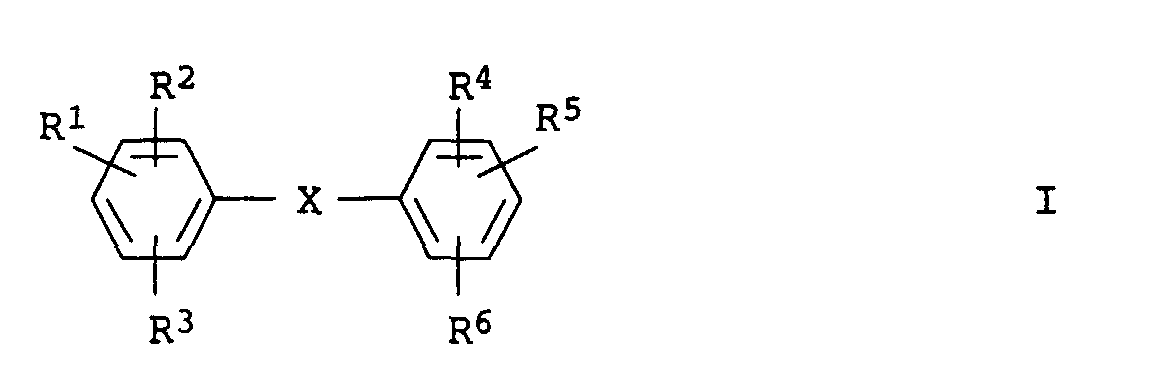
Vorzugsweise steht X für O. Vorzugsweise stehen ein oder zwei der Reste R1 bis R6 für eine C1-C18 Alkylgruppe, insbesondere für eine C6-C18 Alkylgruppe und die übrigen Reste R1 - R6 für H-Atome und die Sulfonatgruppen.X is preferably O. Preferably one or two of the radicals R 1 to R 6 are a C 1 -C 18 alkyl group, in particular a C 6 -C 18 alkyl group and the other radicals R 1 - R 6 are H atoms and the sulfonate groups.
Bei K handelt es sich vorzugsweise um ein Gegenkation; ausgewählt aus z.B. den Alkalimetallen, Ammonium oder auch Wasserstoff. Besonders bevorzugt ist Natrium. Bei Verbindungen der Formel I handelt es sich üblicherweise auch um ein Gemisch von Verbindungen mit unterschiedlichen Substitutionsgrad (mono- oder dialkyliert) und unterschiedlichen Substitutionsposition der Substituienten (der Sulfonatgruppen und der ein oder zwei Alkylgruppen). Verbindungen mit der Formel I werden unter dem Warenzeichen Dowfax® 2A von Dow Chemical Company vertrieben.K is preferably a counter cation; selected from e.g. the alkali metals, ammonium or hydrogen. Sodium is particularly preferred. Compounds of the formula I are usually also a mixture of compounds with different degrees of substitution (mono- or dialkylated) and different substitution positions of the substituents (the sulfonate groups and the one or two alkyl groups). Compounds of Formula I are sold under the trademark Dowfax® 2A by Dow Chemical Company.
Gegenüber der alleinigen Verwendung eines aromatischen Emulgators ist die Verwendung eines Gemisches aus einem aromatischen Emulgator und einem Emulgator ohne aromatischen C-Atome (nicht aromatischer Emulgator) bevorzugt.Compared to the use of an aromatic emulsifier alone, the use of a mixture of an aromatic emulsifier and an emulsifier without aromatic C atoms (non-aromatic emulsifier) is preferred.
Bei dem nichtaromatischen Emulgator handelt es sich bevorzugt um einen solchen der Formel
R8-O-(Z-O)n - SO- 3 k+ II
wobei die Variablen folgende Bedeutung haben:
- R8:
- C1-C18 Alkyl, vorzugsweise C10-C16
- Z:
- CH2-CH2 oder
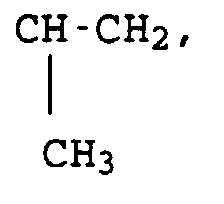
- n:
- eine ganze Zahl von 1 bis 40, vorzugsweise von 2 bis 30
- K+:
- ein Kation, z.B. H+ ein Alkalikation von z.B. Na, K oder Ammonium
R 8 -O- (ZO) n - SO - 3 k + II
where the variables have the following meaning:
- R 8 :
- C 1 -C 18 alkyl, preferably C 10 -C 16
- Z:
- CH 2 -CH 2 or
- n:
- an integer from 1 to 40, preferably from 2 to 30
- K + :
- a cation, for example H + an alkali application of for example Na, K or ammonium
Unter Verbindungen der Formel II sollen auch Verbindungen mit sowohl CH2-CH2 und
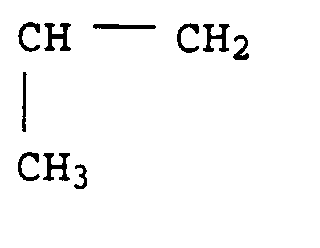
Verbindungen der Formel II werden z.B. unter der Bezeichnung Disponil® FES 77 von Henkel vertrieben.Compounds of the formula II are marketed, for example, under the name Disponil® FES 77 from Henkel.
Das Emulgatorgemisch besteht vorzugsweise aus
- 20 bis 95 Gew.-%
- eines aromatischen Emulgators, insbesondere dem der Formel I und
- 5 bis 80 Gew.-%
- eines nicht-aromatischen Emulgators, insbesondere dem der Formel II
- 20 to 95% by weight
- an aromatic emulsifier, especially that of formula I and
- 5 to 80% by weight
- a non-aromatic emulsifier, especially that of formula II
Vorzugsweise beträgt der Anteil des aromatischen Emulgators 30 bis 95 Gew.-% und die des nicht aromatischen Emulgators 5 bis 70 Gew.-%, wobei die Gewichtsangaben auf die Gesamtmenge der Emulgatoren bezogen sind.The proportion of the aromatic emulsifier is preferably 30 to 95% by weight and that of the non-aromatic emulsifier 5 to 70% by weight, the weight data being based on the total amount of the emulsifiers.
Der Emulgator bzw. das Emulgatorgemisch wird üblicherweise in Mengen von 0,1 bis 15 Gew.-%, vorzugsweise von 0,3 bis 5, besonders bevorzugt von 0,5 bis 3 Gew.-%, bezogen auf die zu polymerisierenden Monomeren verwendet. Die erhaltene Polymerdispersion enthält demgemäß die genannten Emulgatormengen.The emulsifier or the emulsifier mixture is usually used in amounts of 0.1 to 15% by weight, preferably 0.3 to 5% by weight, particularly preferably 0.5 to 3% by weight, based on the monomers to be polymerized. The polymer dispersion obtained accordingly contains the amounts of emulsifier mentioned.
Wasserlösliche Initiatoren für die Emulsionspolymerisation sind z.B. Ammonium- und Alkalimetallsalze der Peroxidischwefelsäure, z.B. Natriumperoxodisulfat, Wasserstoffperoxid oder organische Peroxide, z.B. tert-Butylhydroperoxid.Water-soluble initiators for emulsion polymerization are e.g. Ammonium and alkali metal salts of peroxidic sulfuric acid, e.g. Sodium peroxodisulfate, hydrogen peroxide or organic peroxides, e.g. tert-butyl hydroperoxide.
Geeignet sind insbesondere sogenannte Reduktions-, Oxidations(Red-Ox)-Initiator Systeme.So-called reduction, oxidation (red-ox) initiator systems are particularly suitable.
Die Red-Ox-Initiator-Systeme bestehen aus mindestens einem meist anorganischem Reduktionsmittel und einem anorganischen oder organischen Oxidationsmittel.The Red-Ox initiator systems consist of at least one mostly inorganic reducing agent and one inorganic or organic oxidizing agent.
Bei der Oxidationskomponente handelt es sich z.B. um die bereits vorstehend genannten Initiatoren für die Emulsionspolymerisation.The oxidation component is e.g. to the initiators for emulsion polymerization already mentioned above.
Bei der Reduktionskomponenten handelt es sich z.B. um Alkalimetallsalze der schwefligen Säure, wie z.B. Natriumsulfit, Natriumhydrogensulfit, Alkalisalze der Dischwefligen Säure wie Natriumdisulfit, Bisulfitadditionsverbindungen aliphatischer Aldehyde und Ketone, wie Acetonbisulfit oder Reduktionsmittel wie Hydroxymethansulfinsäure und deren Salze, oder Ascorbinsäure. Die Red-Ox-Initiator-Systeme können unter Mitverwendung löslicher Metallverbindungen, deren metallische Komponente in mehreren Wertigkeitsstufen auftreten kann, verwendet werden.The reduction components are, for example, alkali metal salts of sulfurous acid, such as sodium sulfite, sodium hydrogen sulfite, alkali metal salts of disulfurous acid such as sodium disulfite, bisulfite addition compounds of aliphatic aldehydes and ketones, such as acetone bisulfite or reducing agents such as hydroxymethanesulfinic acid or asorbic acid and their salts. The Red-Ox initiator systems can be used with the use of soluble metal compounds, the metallic component of which can occur in several valence levels.
Übliche Red-Ox-Initiator-Systeme sind z.B. Ascorbinsäure/Eisen(II)sulfat/Natriumperoxidisulfat, tert-Butylhydroperoxid/Natriumdisulfit, tert-Butylhydroperoxid/Na-Hydroxymethansulfinsäure. Die einzelnen Komponenten, z.B. die Reduktionskomponente, können auch Mischungen sein z.B. eine Mischung aus dem Natriumsalz der Hydroxymethansulfinsäure und Natriumdisulfit.Common red-ox initiator systems are e.g. Ascorbic acid / iron (II) sulfate / sodium peroxydisulfate, tert-butyl hydroperoxide / sodium disulfite, tert-butyl hydroperoxide / Na-hydroxymethanesulfinic acid. The individual components, e.g. the reduction component, can also be mixtures e.g. a mixture of the sodium salt of hydroxymethanesulfinic acid and sodium disulfite.
Die genannten Verbindungen werden meist in Form wäßrigen Lösungen eingesetzt, wobei die untere Konzentration durch die in der Dispersion vertretbare Wassermenge und die obere Konzentration durch die Löslichkeit der betreffenden Verbindung in Wasser bestimmt ist. Im allgemeinen beträgt die Konzentration 0,1 bis 30 Gew.-%, bevorzugt 0,5 bis 20 Gew.-%, besonders bevorzugt 1,0 bis 10 Gew.-%, bezogen auf die Lösung.The compounds mentioned are mostly used in the form of aqueous solutions, the lower concentration being determined by the amount of water acceptable in the dispersion and the upper concentration being determined by the solubility of the compound in question in water. The concentration is generally 0.1 to 30% by weight, preferably 0.5 to 20% by weight, particularly preferably 1.0 to 10% by weight, based on the solution.
Die Menge der Initiatoren beträgt im allgemeinen 0,1 bis 10 Gew.-%, bevorzugt 0,5 bis 5 Gew.-%, bezogen auf die zu polymerisierenden Monomeren. Es können auch mehrere, verschiedene Initiatoren bei der Emulsionspolymerisation Verwendung finden.The amount of initiators is generally 0.1 to 10% by weight, preferably 0.5 to 5% by weight, based on the monomers to be polymerized. Several different initiators can also be used in emulsion polymerization.
Weiterhin können bei der Polymerisation auch Regler eingesetzt werden, durch die die Molmasse verringert wird. Geeignet sind z.B. Verbindungen mit einer Thiolgruppe wie tert.-Butylmercaptan, Thioglykolsäureethylacrylester, Mercaptoethanol, Mercaptopropyltrimethoxysilan oder tert.-Dodecylmercaptan. Der Anteil dieser Regler kann insbesondere 0 bis 0,3 Gew.-%, bevorzugt 0,02 bis 0,3 Gew.-% bezogen auf das Polymerisat, betragen.Furthermore, regulators can also be used in the polymerization, by means of which the molecular weight is reduced. Suitable are e.g. Compounds with a thiol group such as tert-butyl mercaptan, ethyl thioglycolic acid ester, mercaptoethanol, mercaptopropyltrimethoxysilane or tert-dodecyl mercaptan. The proportion of these regulators can be in particular 0 to 0.3% by weight, preferably 0.02 to 0.3% by weight, based on the polymer.
Die Emulsionspolymerisation erfolgt in der Regel bei 30 bis 100, vorzugsweise 50 bis 95°C. Das Polymerisationsmedium kann sowohl nur aus Wasser, als auch aus Mischungen aus Wasser und damit mischbaren Flüssigkeiten wie Methanol bestehen. Vorzugsweise wird nur Wasser verwendet. Die Emulsionspolymerisation kann sowohl als Batchprozeß als auch in Form eines Zulaufverfahrens, einschließlich Stufen- oder Gradientenfahrweise, durchgeführt werden. Bevorzugt ist das Zulaufverfahren, bei dem man einen Teil des Polymerisationsansatzes vorlegt, auf die Polymerisationstemperatur erhitzt, anpolyzmerisiert und anschließend den Rest des Polymerisationsansatzes, üblicherweise über mehrere räumlich getrennte Zuläufe, von denen einer oder mehrere die Monomeren in reiner oder in emulgierter Form enthalten, kontinuierlich, stufenweise oder unter Überlagerung eines Konzentrationsgefälles unter Aufrechterhaltung der Polymerisation der Polymerisationszone zuführt.The emulsion polymerization is usually carried out at 30 to 100, preferably 50 to 95 ° C. The polymerization medium can consist only of water, as well as mixtures of water and thus miscible liquids such as methanol. Preferably only water is used. The emulsion polymerization can be carried out either as a batch process or in the form of a feed process, including a step or gradient procedure. Preference is given to the feed process, in which part of the polymerization batch is introduced, heated to the polymerization temperature, polymerized and then the rest of the polymerization batch, usually via a plurality of spatially separate feeds, one or more of which contain the monomers in pure or in emulsified form , gradually or with superposition of a concentration gradient while maintaining the polymerization of the polymerization zone.
Die Art und Weise, in der der Initiator im Verlauf der radikalischen wäßrigen Emulsionspolymerisation dem Polymerisationsgefäß zugegeben wird, ist dem Durchschnittsfachmann bekannt. Es kann sowohl vollständig in das Polymerisationsgefäß vorgelegt, als auch nach Maßgabe seines Verbrauchs im Verlauf der radikalischen wäßrigen Emulsionspolymerisation kontinuierlich oder stufenweise eingesetzt werden. Im einzelnen hängt dies in an sich dem Durchschnittsfachmann bekannter Weise sowohl von der chemischen Natur des Initiatorsystems als auch von der Polymerisationstemperatur ab. Vorzugsweise wird ein Teil vorgelegt und der Rest nach Maßgabe des Verbrauchs der Polymerisationszone zugeführt.The manner in which the initiator is added to the polymerization vessel in the course of the free radical aqueous emulsion polymerization is known to the person skilled in the art. It can either be completely introduced into the polymerization vessel or used continuously or in stages in the course of the free-radical aqueous emulsion polymerization, depending on its consumption. Specifically, this depends on the chemical nature of the initiator system and on the polymerization temperature in a manner known per se to the person skilled in the art. A portion is preferably introduced and the remainder is fed to the polymerization zone in accordance with the consumption.
Zur Entfernung der Restmonomeren wird üblicherweise auch nach Ende der eigentlichen Emulsionspolymerisation, d.h. nach einem Umsatz der Monomeren von mindestens 95 %, Initiator zugesetzt.To remove the residual monomers, usually after the end of the actual emulsion polymerization, i.e. after a conversion of the monomers of at least 95%, initiator added.
Die einzelnen Komponenten können dem Reaktor beim Zulaufverfahren von oben, in der Seite oder von unten durch den Reaktorboden zugegeben werden.The individual components can be added to the reactor in the feed process from above, in the side or from below through the reactor floor.
Bei der Emulsionspolymerisation werden wäßrige Dispersionen des Polymeren in der Regel mit Feststoffgehalten von 15 bis 75 Gew.-%, bevorzugt von 40 bis 75 Gew.-% erhalten.In emulsion polymerization, aqueous dispersions of the polymer are generally obtained with solids contents of from 15 to 75% by weight, preferably from 40 to 75% by weight.
Für eine hohe Raum/Zeitausbeute des Reaktors sind Dispersionen mit einem möglichst hohen Feststoffgehalt bevorzugt. Um Feststoffgehalte > 60 Gew.-% erreichen zu können, sollte man eine bi- oder polymodale Teilchengröße einstellen, da sonst die Viskosität zu hoch wird, und die Dispersion nicht mehr handhabbar ist. Die Erzeugung einer neuen Teilchengeneration kann beispielsweise durch Zusatz von Saat (EP 81083), durch Zugabe überschüssiger Emulgatormengen oder durch Zugabe von Miniemulsionen erfolgen. Ein weiterer Vorteil, der mit der niedrigen Viskosität bei hohem Feststoffgehalt einhergeht, ist das verbesserte Beschichtungsverhalten bei hohen Feststoffgehalten. Die Erzeugung einer neuen/neuer Teilchengeneration/en kann zu einem beliebigen Zeitpunkt erfolgen. Er richtet sich nach den für eine niedrige Viskosität angestrebten Teilchengrößenverteilung.For a high space / time yield of the reactor, dispersions with the highest possible solids content are preferred. In order to be able to reach solids contents> 60% by weight, one should set a bimodal or polymodal particle size, since otherwise the viscosity becomes too high and the dispersion can no longer be handled. A new generation of particles can be generated, for example, by adding seeds (EP 81083), by adding excess amounts of emulsifier or by adding mini-emulsions. Another advantage associated with the low viscosity at high solids content is the improved coating behavior at high solids contents. A new / new generation of particles can be generated at any time. It depends on the particle size distribution desired for a low viscosity.
Die erhaltenen Polymere, bzw. Polymerdispersionen werden als Haftklebstoffe verwendet. Insbesondere eigenen sie sich als Haftklebstoffe für Etiketten oder Klebebänder.The polymers or polymer dispersions obtained are used as pressure sensitive adhesives. They are particularly suitable as pressure-sensitive adhesives for labels or adhesive tapes.
Die Polymeren werden vorzugsweise in Form ihrer wäßrigen Dispersion verwendet. Die wäßrigen Polymerdispersionen können ohne weitere Zusatzstoffe als Haftklebstoffe Verwendung finden.The polymers are preferably used in the form of their aqueous dispersion. The aqueous polymer dispersions can be used as pressure-sensitive adhesives without further additives.
Bei der Verwendung als Haftklebstoff kann den Polymerisaten bzw. den wäßrigen Dispersionen der Polymerisate ein Tackifier, d.h. ein klebrigmachendes Harz zugesetzt. Tackifier sind z.B. aus Adhäsive Age, Juli 1987, Seite 19-23 oder Polym. Mater. Sci. Eng. 61 (1989), Seite 588-592 bekannt.When used as a pressure sensitive adhesive, the polymers or the aqueous dispersions of the polymers can have a tackifier, i.e. added a tackifying resin. Tackifiers are e.g. from Adhesive Age, July 1987, pages 19-23 or Polym. Mater. Sci. Closely. 61 (1989), pages 588-592.
Tackifier sind z.B. Naturharze, wie Kolophoniumharze und deren durch Disproportionierung oder Isomerisierung, Polymerisation, Dimerisation, Hydrierung entstehenden Derivate. Diese können in ihrer Salzform (mit z.B. ein- oder mehrwertigen Gegenionen (Kationen) oder bevorzugt in ihrer veresterten Form vorliegen. Alkohole, die zur Veresterung verwendet werden, können ein- oder mehrwertig sein. Beispiele sind Methanol, Ethandiol, Diethylenglykol, Triethylenglykol, 1,2,3-Propanthiol, Pentaerythrit.Tackifiers are e.g. Natural resins, such as rosins and their derivatives resulting from disproportionation or isomerization, polymerization, dimerization, hydrogenation. These can be in their salt form (with, for example, mono- or polyvalent counterions (cations) or preferably in their esterified form. Alcohols used for the esterification can be mono- or polyvalent. Examples are methanol, ethanediol, diethylene glycol, triethylene glycol, 1 , 2,3-propanethiol, pentaerythritol.
Des weiteren finden auch Kohlenwasserstoffharze, z.B. Cumaron-Inden-Harze, Polyterpen-Harze, Kohlenwasserstoffharze auf Basis ungesättigter CH-Verbindungen, wie Butadien, Penten, Methylbuten, Isopren, Piperylen, Divinylmethan, Pentadien, Cyclopenten, Cyclopentadien, Cyclohexadien, Styrol, α-Methylstyrol, Vinyltoluol Verwendung.Furthermore, hydrocarbon resins, e.g. Coumarone indene resins, polyterpene resins, hydrocarbon resins based on unsaturated CH compounds, such as butadiene, pentene, methylbutene, isoprene, piperylene, divinylmethane, pentadiene, cyclopentene, cyclopentadiene, cyclohexadiene, styrene, α-methylstyrene, vinyltoluene.
Als Tackifier werden zunehmend auch Polyacrylate, welche ein geringes Molgewicht aufweisen, verwendet. Vorzugsweise haben diese Polyacrylate ein gewichtsmittleres Molekulargewicht Mw unter 30 000. Die Polyacrylate bestehen bevorzugt zu mindestens 60, insbesondere mindestens 80 Gew.-% aus C1-C8 Alkyl(meth)acrylaten.Polyacrylates which have a low molecular weight are also increasingly being used as tackifiers. These polyacrylates preferably have a weight-average molecular weight M w of less than 30,000. The polyacrylates preferably consist of at least 60, in particular at least 80,% by weight of C 1 -C 8 alkyl (meth) acrylates.
Bevorzugte Tackifier sind natürliche oder chemisch modifizierte Kolophoniumharze. Kolophoniumharze bestehen zum überwiegenden Teil aus Abietinsäure oder Abietinsäurederivaten.Preferred tackifiers are natural or chemically modified rosins. Rosin resins consist predominantly of abietic acid or abietic acid derivatives.
Die Tackifier können in einfacher Weise den erfindungsgemäßen Polymerisaten, bevorzugt den wäßrigen Dispersionen der Polymerisate zugesetzt werden. Vorzugsweise liegen die Tackifier dabei selber in Form einer wäßrigen Dispersion vor.The tackifiers can be added in a simple manner to the polymers according to the invention, preferably to the aqueous dispersions of the polymers. The tackifiers are preferably themselves in the form of an aqueous dispersion.
Die Gewichtsmenge der Tackifier beträgt vorzugsweise 5 bis 100 Gew.-Teile. besonders bevorzugt 10 bis 50 Gew.-Teile. bezogen auf 100 Gew.-Teile Polymerisat. (fest/fest).The amount by weight of the tackifier is preferably 5 to 100 parts by weight. particularly preferably 10 to 50 parts by weight. based on 100 parts by weight of polymer. (firm / firm).
Neben Tackifiern können z.B. noch weitere Additive z.B. Verdickungsmittel, Entschäumer, Weichmacher, Pigmente, Netzmittel oder Füllstoffe bei der Verwendung als Haftklebstoff Verwendung finden. Die erfindungsgemäßen Haftklebstoffe enthalten daher neben der wäßrigen Polymerdispersion gegebenenfalls noch Tackifier und/oder die vorstehenden Additive.In addition to tackifiers, other additives, for example thickeners, defoamers, plasticizers, pigments, wetting agents or fillers, can also be used when used as a pressure sensitive adhesive. The pressure sensitive adhesives according to the invention therefore contain in addition the aqueous polymer dispersion, if appropriate, also tackifier and / or the above additives.
Die Haftklebstoff können durch übliche Methoden, z.B. durch Rollen, Rakeln, Streichen etc. auf Substrate, z.B. Papier oder Polymer-Folien, bevorzugt bestehend aus Polyethylen, Polypropylen, das biaxial oder monoaxial verstreckt sein kann, Polyethylenterephthalat, Polyvinylchlorid, Polystyrol, Polyamid oder Metall aufgebracht werden. Das Wasser kann bevorzugt durch Trocknung bei 50 bis 150°C entfernt werden. Zur späteren Verwendung kann die mit Haftklebstoff beschichtete Seite der Substrate, z.B. der Etiketten, mit einem Releasepapier, z.B. mit einem silikonisierten Papier, abgedeckt werden.The pressure sensitive adhesives can be prepared by conventional methods, e.g. by rolling, knife coating, brushing etc. on substrates, e.g. Paper or polymer films, preferably consisting of polyethylene, polypropylene, which can be biaxially or monoaxially stretched, polyethylene terephthalate, polyvinyl chloride, polystyrene, polyamide or metal can be applied. The water can preferably be removed by drying at 50 to 150 ° C. For later use, the side of the substrates coated with pressure sensitive adhesive, e.g. the labels, with a release paper, e.g. covered with siliconized paper.
Die erfindungsgemäßen Polymerisate zeigen bei der Verwendung als Klebstoffe eine verbesserte Adhäsion und Kohäsion, bzw. ein verbessertes Adhäsions-/Kohäsionsverhältnis.When used as adhesives, the polymers according to the invention show improved adhesion and cohesion, or an improved adhesion / cohesion ratio.
Die zu prüfende Dispersion wird mit einer Rakel in dünner Schicht auf ein silikonisiertes Papier aufgetragen und 3 min bei 90°C getrocknet. Die Spalthöhe der Rakel wird dabei so gewählt, daß sich für den getrockneten Klebstoffe eine Auftragsmenge von 19-21 g/m2 ergibt. Auf den getrockneten Klebstoff wird eine handelsübliche OPP-Folie (30µ, Corona vorbehandelt) aufgelegt und mit einem Handroller fest angerollt. Das so hergestellte Folienlaminat wird in Streifen von 0,5 inch und von 2 cm Breite geschnitten. Diese Streifen werden vor der Prüfung mindestens 24h im Normklima gelagert.The dispersion to be tested is applied with a doctor knife in a thin layer to a siliconized paper and dried for 3 minutes at 90 ° C. The gap height of the doctor blade is chosen so that there is an application amount of 19-21 g / m 2 for the dried adhesives. A commercially available OPP film (30µ, corona treated) is placed on the dried adhesive and rolled on firmly with a hand roller. The film laminate thus produced is cut into strips 0.5 inch and 2 cm wide. These strips are stored in the standard climate for at least 24 hours before the test.
Nach Abziehen des silikonisierten Papiers wird der Folien-Prüfstreifen so auf den Rand eines Prüfblechs aus Edelstahl verklebt, daß sich eine Verklebungsfläche von 0,5 inch x 0,5 inch ergibt. 20 Minuten nach dem Verkleben wird am überstehenden Ende des Folienstreifens ein 1000 g-Gewichts befestigt und das Prüfblech senkrecht aufgehängt. Umgebungsbedingungen: 23°C, 50 % relative Luftfeuchtigkeit. Als Scherfestigkeit wird die Zeit bis zum Versagen der Verklebung unter Einfluß des Gewichts als Mittelwert aus den Ergebnissen von drei Prüfkorpern in Minuten angegeben.After the siliconized paper has been peeled off, the film test strip is glued to the edge of a stainless steel test sheet in such a way that a bond area of 0.5 inch x 0.5 inch results. 20 minutes after gluing, a 1000 g weight is attached to the protruding end of the film strip and the test plate is hung up vertically. Ambient conditions: 23 ° C, 50% relative humidity. The shear strength is the time until the bond fails given the influence of the weight as the mean of the results of three test bodies in minutes.
Nach Abziehen des silikonisierten Papiers wird ein 2 cm breiter Folien-Prüfstreifen auf ein Prüfblech aus Edelstahl verklebt. Umgebungsbedingungen: 23°C, 50 % relative Luftfeuchtigkeit. 1 Minute nach der Verklebung wird der Streifen mit Hilfe einer Zugprüfmaschine in einem Winkel von 180°C mit einer Geschwindigkeit von 300 mm/min abgezogen. Als Schälfestigkeit wird die dafür im Mittel erforderliche Kraft in N/2cm als Mittelwert aus den Ergebnissen von drei Prüfkörpern angegeben.After peeling off the siliconized paper, a 2 cm wide foil test strip is glued to a stainless steel test plate. Ambient conditions: 23 ° C, 50% relative humidity. 1 minute after the bond, the strip is pulled off with the aid of a tensile testing machine at an angle of 180 ° C. at a speed of 300 mm / min. The peel strength is the mean force required in N / 2cm as the mean of the results from three test specimens.
In einem Polymerisationsreaktor werden 116 g Wasser und 0.05 Gewichtsprozent bezogen auf Monomere einer Styroldispersionen mit einem gewichtsmittleren Teilchendurchmesser von 30 nm auf 85°C unter Rühren erwärmt und dann unter weiterem Rühren die Teilmenge von 10 Gew.-% von Zulauf 2 zugegeben. Nach 5 min. werden Zulauf 1 und der Rest von Zulauf 2 gleichzeitig gestartet und mit konstanter Zulaufgeschwindigkeit in 180 min dosiert. Nach dem Ende des Zulaufs 1 wird noch 30 min bei 85°C gerührt. Bei dieser Temperatur werden unter Rühren zeitgleich 0.1 Gew.-%, bezogen auf Monomere einer 10 %igen Lösung von tert.-Butylhydroperoxid in Wasser sowie 0.16 Gew.-%, bezogen auf Monomere einer wäßrigen Lösung von Natriumdisulfit-Aceton Addukt zudosiert. Die Dipersion wurde sodann auf Raumtemperatur abgekühlt und mit einer 15%igen wäßrigen NaOH auf pH=7 neutralisiert. Der Feststoffgehalt der Dispersion ist auf 55-57% eingestellt.In a polymerization reactor, 116 g of water and 0.05 percent by weight, based on monomers of a styrene dispersion with a weight-average particle diameter of 30 nm, are heated to 85 ° C. with stirring and then the portion of 10% by weight of feed 2 is added with further stirring. After 5 min. feed 1 and the rest of feed 2 are started simultaneously and metered in at a constant feed rate in 180 min. When feed 1 has ended, the mixture is stirred at 85 ° C. for a further 30 min. At this temperature, 0.1% by weight, based on monomers of a 10% strength solution of tert-butyl hydroperoxide in water and 0.16% by weight, based on monomers, of an aqueous solution of sodium disulfite-acetone adduct are metered in at the same time. The dipersion was then cooled to room temperature and neutralized to pH = 7 with 15% aqueous NaOH. The solids content of the dispersion is set at 55-57%.
Folgende Abkürzungen wurden verwendet:
- EA
- Ethylacrylat
- HA
- n = Hexylacrylat
- BA
- n-Butylacrylat
- EHA
- 2-Ethylhexylacrylat
- MMA
- Methylmethacrylat
- AS
- Acrylsäure
- tDMK
- tert.-Dodecylmercaptan
- Disponil FES77
- 30 gew.-%ige wäßrige Lösung des Natriumsalzes des Schwefelsäurehalbesters einer mit 30 Ethylenoxideinheiten ethoxiliertem C12-C14-Alkylrestes (s.Formel II)
- Dowfax 2A1
- 45 gew.%ige wäßrige Lösung des Natriumsalzes des mit einem C12-C14-Alkylrest und mit zwei SO3K-Resten derivatisierten Diphyenlethers (s. Formel I)
- Steinapol NLS
- 45%ige wäßrige Lösung des Natriumsalzes von Laurylsulfat
- NaPS
- Natriumperoxodisulfat
- Zulauf 1 = Emulsionszulauf:
- 242 g Wasser
- 0.05 Gew.-% tDMK, bezogen auf Monomere
- Gesamtmenge an Monomere: 560 g
- Art der Monomere siehe Tabelle
- Art und Menge der Emulgatoren siehe Tabelle
- Zulauf 2 = Initiatorzulauf:
- Menge NaPS (7%ig) siehe Tabelle
- EA
- Ethyl acrylate
- HA
- n = hexyl acrylate
- BA
- n-butyl acrylate
- EHA
- 2-ethylhexyl acrylate
- MMA
- Methyl methacrylate
- AS
- Acrylic acid
- tDMK
- tert-dodecyl mercaptan
- Disponil FES77
- 30% by weight aqueous solution of the sodium salt of the sulfuric acid half-ester of a C 12 -C 14 -alkyl radical ethoxylated with 30 ethylene oxide units (see formula II)
- Dowfax 2A1
- 45% by weight aqueous solution of the sodium salt of the diphyene ether derivatized with a C 12 -C 14 alkyl residue and with two SO 3 K residues (see formula I)
- Steinapol NLS
- 45% aqueous solution of the sodium salt of lauryl sulfate
- NaPS
- Sodium peroxodisulfate
- Feed 1 = emulsion feed:
- 242 g water
- 0.05% by weight tDMK, based on monomers
- Total amount of monomers: 560 g
- For type of monomers, see table
- For type and quantity of emulsifiers see table
- Inlet 2 = initiator inlet:
- Amount of NaPS (7%) see table
Zusammensetzung und Prüfergebnisse sind in Tabelle 1 aufgeführt.
Claims (10)
R8-O-(Z-O)n - SO- 3 k+ II
handelt, wobei die Variablen folgende Bedeutung haben:
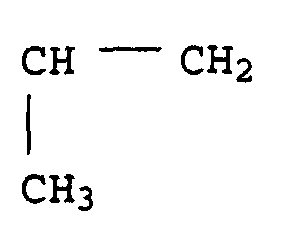
R 8 -O- (ZO) n - SO - 3 k + II
the variables have the following meaning:
Applications Claiming Priority (2)
| Application Number | Priority Date | Filing Date | Title |
|---|---|---|---|
| DE19818394 | 1998-04-24 | ||
| DE19818394A DE19818394A1 (en) | 1998-04-24 | 1998-04-24 | Pressure sensitive adhesives |
Publications (2)
| Publication Number | Publication Date |
|---|---|
| EP0952199A1 true EP0952199A1 (en) | 1999-10-27 |
| EP0952199B1 EP0952199B1 (en) | 2003-06-18 |
Family
ID=7865701
Family Applications (1)
| Application Number | Title | Priority Date | Filing Date |
|---|---|---|---|
| EP99106849A Expired - Lifetime EP0952199B1 (en) | 1998-04-24 | 1999-04-07 | Aqueous dispersion to be used as adhesive |
Country Status (6)
| Country | Link |
|---|---|
| US (1) | US6254985B1 (en) |
| EP (1) | EP0952199B1 (en) |
| JP (1) | JP4567113B2 (en) |
| AU (1) | AU2393399A (en) |
| DE (2) | DE19818394A1 (en) |
| ES (1) | ES2202952T3 (en) |
Cited By (15)
| Publication number | Priority date | Publication date | Assignee | Title |
|---|---|---|---|---|
| EP1198502A4 (en) * | 1999-04-12 | 2002-11-06 | Ashland Inc | Pressure sensitive adhesives |
| EP1464656A1 (en) * | 2003-04-04 | 2004-10-06 | Ucb S.A. | Emulsifier composition |
| US6870001B2 (en) * | 2001-05-29 | 2005-03-22 | Basf Aktiengesellschaft | Emulsifier mixture for emulsion polymerization |
| WO2011054719A1 (en) | 2009-11-05 | 2011-05-12 | Basf Se | Pressure sensitive adhesive polymer based on n-butyl acrylate, ethyl acrylate, vinyl acetate, and acid monomer |
| EP2556953A1 (en) | 2011-08-11 | 2013-02-13 | Basf Se | Method for producing a paper-foam composite |
| EP2781572A2 (en) | 2013-03-19 | 2014-09-24 | Herma GmbH | Multilayer laminate |
| DE102013204838A1 (en) | 2013-03-19 | 2014-09-25 | Herma Gmbh | Multilayer laminate |
| DE102013204837A1 (en) | 2013-03-19 | 2014-09-25 | Herma Gmbh | Multi-layer laminate |
| DE102013204835A1 (en) | 2013-03-19 | 2014-10-09 | Herma Gmbh | Multi-layer laminate |
| DE102017109074A1 (en) | 2017-04-27 | 2018-10-31 | Herma Gmbh | Activatable adhesive label |
| DE102017116518A1 (en) | 2017-07-21 | 2019-01-24 | Herma Gmbh | Adhesive label comprising a sheet-like flexible viewing material |
| DE102019101335A1 (en) | 2019-01-18 | 2020-07-23 | Herma Gmbh | Multi-layer pressure-sensitive adhesive structure for adhesive labels or tapes |
| EP3748613A1 (en) | 2019-06-07 | 2020-12-09 | Herma GmbH | Adhesive label |
| EP3748612A1 (en) | 2019-06-07 | 2020-12-09 | Herma GmbH | Adhesive label |
| DE102020120340A1 (en) | 2020-07-31 | 2022-02-03 | Herma Gmbh | Activatable adhesive label |
Families Citing this family (13)
| Publication number | Priority date | Publication date | Assignee | Title |
|---|---|---|---|---|
| DE19939325A1 (en) | 1999-08-19 | 2001-02-22 | Basf Ag | Aqueous copolymer dispersion, useful for the production of adhesives, is prepared by radical, emulsion polymerization of at least two different monomers with a varied rate of initiator addition |
| DE10015981A1 (en) * | 2000-03-30 | 2001-10-11 | Beiersdorf Ag | Manufacture of acrylic hotmelt PSAs from aqueous disperse systems |
| US6747084B2 (en) | 2002-09-30 | 2004-06-08 | Air Products Polymers, L.P. | Process to prepare pressure-sensitive hybrid composite latex adhesives |
| EP1426428A1 (en) * | 2002-12-06 | 2004-06-09 | Ucb S.A. | Aqueous polymer dispersions as pressure sensitive adhesives |
| EP1685170B1 (en) * | 2003-11-07 | 2009-08-19 | Cytec Surface Specialties, S.A. | Adhesive composition |
| KR100589412B1 (en) * | 2003-11-29 | 2006-06-14 | 삼성에스디아이 주식회사 | Plasma Display Panel And Method Of Manufacturing The Same |
| US7417086B2 (en) * | 2004-11-29 | 2008-08-26 | Rohm And Haas Company | Coating compositions |
| DE102004061611A1 (en) * | 2004-12-17 | 2006-07-06 | Basf Ag | Crosslinkable pressure-sensitive adhesive for removable soft PVC carriers |
| DE102005004925A1 (en) * | 2005-02-02 | 2006-08-03 | Basf Ag | Pressure sensitive adhesive for printable paper labels, comprises emulsion polymer obtained by radical polymerization |
| US7931972B2 (en) * | 2006-04-21 | 2011-04-26 | Lubrizol Advanced Materials, Inc. | Elastomeric emulsion polymers for masonry coatings |
| DE102012019789A1 (en) | 2012-10-09 | 2014-04-10 | Clariant International Limited | Phosphorus-containing polyalkylene glycol block copolymers and their use as emulsifiers for emulsion polymerization |
| DE102015209381A1 (en) * | 2015-05-21 | 2016-11-24 | Wacker Chemie Ag | Polymers for dirt-repellent coatings |
| CN110199001B (en) * | 2017-02-03 | 2021-11-30 | 昕特玛美国有限责任公司 | Pressure sensitive adhesive composition and method for preparing the same |
Citations (2)
| Publication number | Priority date | Publication date | Assignee | Title |
|---|---|---|---|---|
| US4204023A (en) * | 1978-07-07 | 1980-05-20 | The Kendall Company | Mixed sulfonated emulsifying agents used to produce adhesive compositions from acrylic monomers and adhesive tape using the compositions |
| DE19649383A1 (en) * | 1996-11-29 | 1998-06-04 | Basf Ag | Laminating adhesives |
Family Cites Families (7)
| Publication number | Priority date | Publication date | Assignee | Title |
|---|---|---|---|---|
| US3280217A (en) * | 1963-05-21 | 1966-10-18 | Pittsburgh Plate Glass Co | Pressure sensitive adhesive comprising (1) alkyl vinyl ether polymer (2) phenol-aldehyde resin (3) a vinyl polymerized interpolymer |
| JPH0784581B2 (en) * | 1987-09-17 | 1995-09-13 | 東洋インキ製造株式会社 | Removable pressure-sensitive adhesive composition |
| JPH0551570A (en) * | 1991-08-26 | 1993-03-02 | Japan Synthetic Rubber Co Ltd | Acrylic polymer emulsion for pressure sensitive adhesive |
| DE4316379A1 (en) | 1993-05-17 | 1994-11-24 | Basf Ag | Low-odor dispersion pressure sensitive adhesive |
| DE4404411A1 (en) * | 1994-02-11 | 1995-08-17 | Basf Ag | Dispersion floor adhesive |
| JPH08325307A (en) * | 1995-05-31 | 1996-12-10 | Mitsui Toatsu Chem Inc | Particles, copolymer, pressure-sensitive adhesive composition, pressure-sensitive adhesive, method for producing aqueous dispersion, and method for producing pressure-sensitive adhesive composition |
| DE19632203A1 (en) | 1996-08-09 | 1998-02-12 | Basf Ag | Pressure sensitive adhesives with small amounts of styrene |
-
1998
- 1998-04-24 DE DE19818394A patent/DE19818394A1/en not_active Withdrawn
-
1999
- 1999-04-07 EP EP99106849A patent/EP0952199B1/en not_active Expired - Lifetime
- 1999-04-07 DE DE59905969T patent/DE59905969D1/en not_active Expired - Lifetime
- 1999-04-07 ES ES99106849T patent/ES2202952T3/en not_active Expired - Lifetime
- 1999-04-12 US US09/289,642 patent/US6254985B1/en not_active Expired - Lifetime
- 1999-04-21 JP JP11412699A patent/JP4567113B2/en not_active Expired - Lifetime
- 1999-04-23 AU AU23933/99A patent/AU2393399A/en not_active Abandoned
Patent Citations (2)
| Publication number | Priority date | Publication date | Assignee | Title |
|---|---|---|---|---|
| US4204023A (en) * | 1978-07-07 | 1980-05-20 | The Kendall Company | Mixed sulfonated emulsifying agents used to produce adhesive compositions from acrylic monomers and adhesive tape using the compositions |
| DE19649383A1 (en) * | 1996-11-29 | 1998-06-04 | Basf Ag | Laminating adhesives |
Cited By (20)
| Publication number | Priority date | Publication date | Assignee | Title |
|---|---|---|---|---|
| EP1198502A4 (en) * | 1999-04-12 | 2002-11-06 | Ashland Inc | Pressure sensitive adhesives |
| US6870001B2 (en) * | 2001-05-29 | 2005-03-22 | Basf Aktiengesellschaft | Emulsifier mixture for emulsion polymerization |
| EP1464656A1 (en) * | 2003-04-04 | 2004-10-06 | Ucb S.A. | Emulsifier composition |
| US9518199B2 (en) | 2009-11-05 | 2016-12-13 | Basf Se | PSA polymer of N-butyl acrylate, ethyl acrylate, vinyl acetate, and acid monomer |
| WO2011054719A1 (en) | 2009-11-05 | 2011-05-12 | Basf Se | Pressure sensitive adhesive polymer based on n-butyl acrylate, ethyl acrylate, vinyl acetate, and acid monomer |
| EP2556953A1 (en) | 2011-08-11 | 2013-02-13 | Basf Se | Method for producing a paper-foam composite |
| EP2781572A2 (en) | 2013-03-19 | 2014-09-24 | Herma GmbH | Multilayer laminate |
| DE102013204837B4 (en) | 2013-03-19 | 2023-04-06 | Herma Gmbh | Multi-layer laminate and its use |
| DE102013204837A1 (en) | 2013-03-19 | 2014-09-25 | Herma Gmbh | Multi-layer laminate |
| DE102013204835A1 (en) | 2013-03-19 | 2014-10-09 | Herma Gmbh | Multi-layer laminate |
| DE102013204834A1 (en) | 2013-03-19 | 2014-09-25 | Herma Gmbh | Multilayer laminate |
| DE102013204838A1 (en) | 2013-03-19 | 2014-09-25 | Herma Gmbh | Multilayer laminate |
| DE102017109074A1 (en) | 2017-04-27 | 2018-10-31 | Herma Gmbh | Activatable adhesive label |
| WO2018197697A1 (en) | 2017-04-27 | 2018-11-01 | Herma Gmbh | Activatable adhesive label |
| DE102017116518A1 (en) | 2017-07-21 | 2019-01-24 | Herma Gmbh | Adhesive label comprising a sheet-like flexible viewing material |
| DE102019101335A1 (en) | 2019-01-18 | 2020-07-23 | Herma Gmbh | Multi-layer pressure-sensitive adhesive structure for adhesive labels or tapes |
| DE102019101335B4 (en) | 2019-01-18 | 2024-02-08 | Herma Gmbh | Multilayer adhesive structure for adhesive labels or adhesive tapes and use |
| EP3748613A1 (en) | 2019-06-07 | 2020-12-09 | Herma GmbH | Adhesive label |
| EP3748612A1 (en) | 2019-06-07 | 2020-12-09 | Herma GmbH | Adhesive label |
| DE102020120340A1 (en) | 2020-07-31 | 2022-02-03 | Herma Gmbh | Activatable adhesive label |
Also Published As
| Publication number | Publication date |
|---|---|
| JP4567113B2 (en) | 2010-10-20 |
| EP0952199B1 (en) | 2003-06-18 |
| ES2202952T3 (en) | 2004-04-01 |
| AU2393399A (en) | 1999-11-04 |
| DE19818394A1 (en) | 1999-10-28 |
| DE59905969D1 (en) | 2003-07-24 |
| US6254985B1 (en) | 2001-07-03 |
| JPH11323291A (en) | 1999-11-26 |
Similar Documents
| Publication | Publication Date | Title |
|---|---|---|
| EP0952199B1 (en) | Aqueous dispersion to be used as adhesive | |
| DE60208966T2 (en) | Use of a high solids dispersion for pressure sensitive adhesives applicable over a broad temperature range | |
| EP2274349B1 (en) | Aqueous polymer dispersions for adhesives | |
| EP0917545B1 (en) | Pressure sensitive materials with small amounts of styrene | |
| EP1378527B1 (en) | Pressure sensitive adhesifs for flexible PVC support | |
| EP2496655B1 (en) | Adhesive polymer made of n-butylacrylate, ethylacrylate, vinylacetate and acid monomer | |
| EP2697323B1 (en) | Contact adhesive dispersion containing polymers which are produced by stage polymerization and contain ureido groups or ureido-analog groups | |
| EP0917546B1 (en) | Pressure sensitive materials based on multistep constituted of polymerizates | |
| EP2619239B1 (en) | Pressure sensitive adhesives based on dispersions obtained by multistep process | |
| EP1169403B1 (en) | Contact bonding adhesives | |
| EP2084240B1 (en) | Pressure-sensitive adhesive comprising a c10 alkyl acrylate | |
| EP1479744A1 (en) | Pressure sensitive adhesives with polymers and silicon compounds | |
| EP2016153A1 (en) | CONTACT ADHESIVE CONTAINING n-BUTYLACRYLATE AND HYDROXYBUTYL(METH)ACRYLATE. | |
| WO2005100502A1 (en) | Contact adhesive for pvc films | |
| EP2016152A1 (en) | Contact adhesive containing 2-ethylhexylacrylate and hydroxybutyl(meth)acrylate | |
| EP0952161B3 (en) | Use of aqueous polymer dispersions | |
| EP1262227A2 (en) | Mixture of emulsifiers for emulsion polymerisation | |
| WO2003072654A2 (en) | Aqueous dispersion containing polyethylene | |
| EP1862520A1 (en) | film labels | |
| WO2007144255A1 (en) | Pressure-sensitive adhesive comprising an emulsion polymer containing tert-butyl (meth)acrylate | |
| WO2005121269A1 (en) | Adhesive comprising adipate ester | |
| DE102005029628A1 (en) | Process for the preparation of emulsion polymers for pressure sensitive adhesives | |
| DE10311584A1 (en) | Aqueous polymer dispersion, useful in adhesives, comprises a polymer dispersed in the aqueous phase and an alkoxylated alcohol as a thickening agent | |
| DE102005029593A1 (en) | Process for the preparation of acid-containing emulsion polymers for pressure-sensitive adhesives |
Legal Events
| Date | Code | Title | Description |
|---|---|---|---|
| PUAI | Public reference made under article 153(3) epc to a published international application that has entered the european phase |
Free format text: ORIGINAL CODE: 0009012 |
|
| AK | Designated contracting states |
Kind code of ref document: A1 Designated state(s): BE DE ES FR GB IT NL |
|
| AX | Request for extension of the european patent |
Free format text: AL;LT;LV;MK;RO;SI |
|
| 17P | Request for examination filed |
Effective date: 19990904 |
|
| AKX | Designation fees paid |
Free format text: BE DE ES FR GB IT NL |
|
| 17Q | First examination report despatched |
Effective date: 20020326 |
|
| GRAH | Despatch of communication of intention to grant a patent |
Free format text: ORIGINAL CODE: EPIDOS IGRA |
|
| GRAH | Despatch of communication of intention to grant a patent |
Free format text: ORIGINAL CODE: EPIDOS IGRA |
|
| GRAA | (expected) grant |
Free format text: ORIGINAL CODE: 0009210 |
|
| AK | Designated contracting states |
Designated state(s): BE DE ES FR GB IT NL |
|
| PG25 | Lapsed in a contracting state [announced via postgrant information from national office to epo] |
Ref country code: NL Free format text: LAPSE BECAUSE OF FAILURE TO SUBMIT A TRANSLATION OF THE DESCRIPTION OR TO PAY THE FEE WITHIN THE PRESCRIBED TIME-LIMIT Effective date: 20030618 |
|
| REG | Reference to a national code |
Ref country code: GB Ref legal event code: FG4D Free format text: NOT ENGLISH |
|
| REF | Corresponds to: |
Ref document number: 59905969 Country of ref document: DE Date of ref document: 20030724 Kind code of ref document: P |
|
| GBT | Gb: translation of ep patent filed (gb section 77(6)(a)/1977) |
Effective date: 20030801 |
|
| NLV1 | Nl: lapsed or annulled due to failure to fulfill the requirements of art. 29p and 29m of the patents act | ||
| REG | Reference to a national code |
Ref country code: ES Ref legal event code: FG2A Ref document number: 2202952 Country of ref document: ES Kind code of ref document: T3 |
|
| PLBE | No opposition filed within time limit |
Free format text: ORIGINAL CODE: 0009261 |
|
| STAA | Information on the status of an ep patent application or granted ep patent |
Free format text: STATUS: NO OPPOSITION FILED WITHIN TIME LIMIT |
|
| ET | Fr: translation filed | ||
| 26N | No opposition filed |
Effective date: 20040319 |
|
| REG | Reference to a national code |
Ref country code: FR Ref legal event code: PLFP Year of fee payment: 18 |
|
| REG | Reference to a national code |
Ref country code: FR Ref legal event code: PLFP Year of fee payment: 19 |
|
| REG | Reference to a national code |
Ref country code: FR Ref legal event code: PLFP Year of fee payment: 20 |
|
| PGFP | Annual fee paid to national office [announced via postgrant information from national office to epo] |
Ref country code: ES Payment date: 20180522 Year of fee payment: 20 |
|
| PGFP | Annual fee paid to national office [announced via postgrant information from national office to epo] |
Ref country code: IT Payment date: 20180420 Year of fee payment: 20 Ref country code: FR Payment date: 20180426 Year of fee payment: 20 Ref country code: BE Payment date: 20180420 Year of fee payment: 20 |
|
| PGFP | Annual fee paid to national office [announced via postgrant information from national office to epo] |
Ref country code: DE Payment date: 20180629 Year of fee payment: 20 Ref country code: GB Payment date: 20180404 Year of fee payment: 20 |
|
| REG | Reference to a national code |
Ref country code: DE Ref legal event code: R071 Ref document number: 59905969 Country of ref document: DE |
|
| REG | Reference to a national code |
Ref country code: GB Ref legal event code: PE20 Expiry date: 20190406 |
|
| REG | Reference to a national code |
Ref country code: BE Ref legal event code: MK Effective date: 20190407 |
|
| PG25 | Lapsed in a contracting state [announced via postgrant information from national office to epo] |
Ref country code: GB Free format text: LAPSE BECAUSE OF EXPIRATION OF PROTECTION Effective date: 20190406 |
|
| REG | Reference to a national code |
Ref country code: ES Ref legal event code: FD2A Effective date: 20201106 |
|
| PG25 | Lapsed in a contracting state [announced via postgrant information from national office to epo] |
Ref country code: ES Free format text: LAPSE BECAUSE OF EXPIRATION OF PROTECTION Effective date: 20190408 |