EP0771387B1 - An improved fabric for an architectural covering and method and apparatus of manufacturing same - Google Patents
An improved fabric for an architectural covering and method and apparatus of manufacturing same Download PDFInfo
- Publication number
- EP0771387B1 EP0771387B1 EP96913113A EP96913113A EP0771387B1 EP 0771387 B1 EP0771387 B1 EP 0771387B1 EP 96913113 A EP96913113 A EP 96913113A EP 96913113 A EP96913113 A EP 96913113A EP 0771387 B1 EP0771387 B1 EP 0771387B1
- Authority
- EP
- European Patent Office
- Prior art keywords
- sheet material
- vane
- strip
- vanes
- fabric
- Prior art date
- Legal status (The legal status is an assumption and is not a legal conclusion. Google has not performed a legal analysis and makes no representation as to the accuracy of the status listed.)
- Expired - Lifetime
Links
- 239000004744 fabric Substances 0.000 title claims abstract description 171
- 238000000034 method Methods 0.000 title claims abstract description 26
- 238000004519 manufacturing process Methods 0.000 title claims description 4
- 239000000463 material Substances 0.000 claims abstract description 219
- 239000000853 adhesive Substances 0.000 claims description 86
- 230000001070 adhesive effect Effects 0.000 claims description 86
- 239000011324 bead Substances 0.000 claims description 21
- CWYNVVGOOAEACU-UHFFFAOYSA-N Fe2+ Chemical compound [Fe+2] CWYNVVGOOAEACU-UHFFFAOYSA-N 0.000 claims description 13
- 238000005520 cutting process Methods 0.000 claims description 5
- 125000006850 spacer group Chemical group 0.000 claims description 4
- 238000011282 treatment Methods 0.000 claims description 3
- 239000003292 glue Substances 0.000 description 7
- 239000007799 cork Substances 0.000 description 5
- 229910052751 metal Inorganic materials 0.000 description 5
- 239000002184 metal Substances 0.000 description 5
- 239000000919 ceramic Substances 0.000 description 4
- 238000003780 insertion Methods 0.000 description 4
- 230000037431 insertion Effects 0.000 description 4
- 238000013461 design Methods 0.000 description 3
- 230000035699 permeability Effects 0.000 description 3
- 230000037303 wrinkles Effects 0.000 description 3
- 229910000831 Steel Inorganic materials 0.000 description 2
- 238000009825 accumulation Methods 0.000 description 2
- 230000000903 blocking effect Effects 0.000 description 2
- 238000010276 construction Methods 0.000 description 2
- 230000005484 gravity Effects 0.000 description 2
- 238000009413 insulation Methods 0.000 description 2
- 239000004800 polyvinyl chloride Substances 0.000 description 2
- 229920000915 polyvinyl chloride Polymers 0.000 description 2
- 230000000717 retained effect Effects 0.000 description 2
- 239000010959 steel Substances 0.000 description 2
- 238000011144 upstream manufacturing Methods 0.000 description 2
- 244000061520 Angelica archangelica Species 0.000 description 1
- 235000001287 Guettarda speciosa Nutrition 0.000 description 1
- 230000003213 activating effect Effects 0.000 description 1
- 230000002411 adverse Effects 0.000 description 1
- 229910052782 aluminium Inorganic materials 0.000 description 1
- XAGFODPZIPBFFR-UHFFFAOYSA-N aluminium Chemical compound [Al] XAGFODPZIPBFFR-UHFFFAOYSA-N 0.000 description 1
- VSCWAEJMTAWNJL-UHFFFAOYSA-K aluminum chloride Substances Cl[Al](Cl)Cl VSCWAEJMTAWNJL-UHFFFAOYSA-K 0.000 description 1
- 239000000969 carrier Substances 0.000 description 1
- 230000003750 conditioning effect Effects 0.000 description 1
- 238000006073 displacement reaction Methods 0.000 description 1
- 230000000694 effects Effects 0.000 description 1
- 239000000835 fiber Substances 0.000 description 1
- 239000011888 foil Substances 0.000 description 1
- 238000010438 heat treatment Methods 0.000 description 1
- 238000010348 incorporation Methods 0.000 description 1
- 230000002452 interceptive effect Effects 0.000 description 1
- 238000009940 knitting Methods 0.000 description 1
- 239000002648 laminated material Substances 0.000 description 1
- 239000007788 liquid Substances 0.000 description 1
- 239000000155 melt Substances 0.000 description 1
- 239000000203 mixture Substances 0.000 description 1
- 238000003825 pressing Methods 0.000 description 1
- 238000012545 processing Methods 0.000 description 1
- 238000009877 rendering Methods 0.000 description 1
- 238000000926 separation method Methods 0.000 description 1
- 239000007787 solid Substances 0.000 description 1
- 239000000126 substance Substances 0.000 description 1
- 239000000725 suspension Substances 0.000 description 1
- 229920001169 thermoplastic Polymers 0.000 description 1
- 239000004416 thermosoftening plastic Substances 0.000 description 1
- 238000012546 transfer Methods 0.000 description 1
- 239000002023 wood Substances 0.000 description 1
- 239000002759 woven fabric Substances 0.000 description 1
Images




Classifications
-
- E—FIXED CONSTRUCTIONS
- E06—DOORS, WINDOWS, SHUTTERS, OR ROLLER BLINDS IN GENERAL; LADDERS
- E06B—FIXED OR MOVABLE CLOSURES FOR OPENINGS IN BUILDINGS, VEHICLES, FENCES OR LIKE ENCLOSURES IN GENERAL, e.g. DOORS, WINDOWS, BLINDS, GATES
- E06B9/00—Screening or protective devices for wall or similar openings, with or without operating or securing mechanisms; Closures of similar construction
- E06B9/24—Screens or other constructions affording protection against light, especially against sunshine; Similar screens for privacy or appearance; Slat blinds
- E06B9/26—Lamellar or like blinds, e.g. venetian blinds
- E06B9/28—Lamellar or like blinds, e.g. venetian blinds with horizontal lamellae, e.g. non-liftable
- E06B9/30—Lamellar or like blinds, e.g. venetian blinds with horizontal lamellae, e.g. non-liftable liftable
- E06B9/32—Operating, guiding, or securing devices therefor
- E06B9/323—Structure or support of upper box
-
- A—HUMAN NECESSITIES
- A47—FURNITURE; DOMESTIC ARTICLES OR APPLIANCES; COFFEE MILLS; SPICE MILLS; SUCTION CLEANERS IN GENERAL
- A47H—FURNISHINGS FOR WINDOWS OR DOORS
- A47H23/00—Curtains; Draperies
-
- E—FIXED CONSTRUCTIONS
- E06—DOORS, WINDOWS, SHUTTERS, OR ROLLER BLINDS IN GENERAL; LADDERS
- E06B—FIXED OR MOVABLE CLOSURES FOR OPENINGS IN BUILDINGS, VEHICLES, FENCES OR LIKE ENCLOSURES IN GENERAL, e.g. DOORS, WINDOWS, BLINDS, GATES
- E06B9/00—Screening or protective devices for wall or similar openings, with or without operating or securing mechanisms; Closures of similar construction
- E06B9/24—Screens or other constructions affording protection against light, especially against sunshine; Similar screens for privacy or appearance; Slat blinds
- E06B9/26—Lamellar or like blinds, e.g. venetian blinds
- E06B9/262—Lamellar or like blinds, e.g. venetian blinds with flexibly-interconnected horizontal or vertical strips; Concertina blinds, i.e. upwardly folding flexible screens
-
- E—FIXED CONSTRUCTIONS
- E06—DOORS, WINDOWS, SHUTTERS, OR ROLLER BLINDS IN GENERAL; LADDERS
- E06B—FIXED OR MOVABLE CLOSURES FOR OPENINGS IN BUILDINGS, VEHICLES, FENCES OR LIKE ENCLOSURES IN GENERAL, e.g. DOORS, WINDOWS, BLINDS, GATES
- E06B9/00—Screening or protective devices for wall or similar openings, with or without operating or securing mechanisms; Closures of similar construction
- E06B9/24—Screens or other constructions affording protection against light, especially against sunshine; Similar screens for privacy or appearance; Slat blinds
- E06B9/26—Lamellar or like blinds, e.g. venetian blinds
- E06B9/266—Devices or accessories for making or mounting lamellar blinds or parts thereof
-
- E—FIXED CONSTRUCTIONS
- E06—DOORS, WINDOWS, SHUTTERS, OR ROLLER BLINDS IN GENERAL; LADDERS
- E06B—FIXED OR MOVABLE CLOSURES FOR OPENINGS IN BUILDINGS, VEHICLES, FENCES OR LIKE ENCLOSURES IN GENERAL, e.g. DOORS, WINDOWS, BLINDS, GATES
- E06B9/00—Screening or protective devices for wall or similar openings, with or without operating or securing mechanisms; Closures of similar construction
- E06B9/24—Screens or other constructions affording protection against light, especially against sunshine; Similar screens for privacy or appearance; Slat blinds
- E06B9/26—Lamellar or like blinds, e.g. venetian blinds
- E06B9/36—Lamellar or like blinds, e.g. venetian blinds with vertical lamellae ; Supporting rails therefor
-
- E—FIXED CONSTRUCTIONS
- E06—DOORS, WINDOWS, SHUTTERS, OR ROLLER BLINDS IN GENERAL; LADDERS
- E06B—FIXED OR MOVABLE CLOSURES FOR OPENINGS IN BUILDINGS, VEHICLES, FENCES OR LIKE ENCLOSURES IN GENERAL, e.g. DOORS, WINDOWS, BLINDS, GATES
- E06B9/00—Screening or protective devices for wall or similar openings, with or without operating or securing mechanisms; Closures of similar construction
- E06B9/24—Screens or other constructions affording protection against light, especially against sunshine; Similar screens for privacy or appearance; Slat blinds
- E06B9/26—Lamellar or like blinds, e.g. venetian blinds
- E06B9/36—Lamellar or like blinds, e.g. venetian blinds with vertical lamellae ; Supporting rails therefor
- E06B9/361—Transmissions located at the end of the supporting rail
-
- E—FIXED CONSTRUCTIONS
- E06—DOORS, WINDOWS, SHUTTERS, OR ROLLER BLINDS IN GENERAL; LADDERS
- E06B—FIXED OR MOVABLE CLOSURES FOR OPENINGS IN BUILDINGS, VEHICLES, FENCES OR LIKE ENCLOSURES IN GENERAL, e.g. DOORS, WINDOWS, BLINDS, GATES
- E06B9/00—Screening or protective devices for wall or similar openings, with or without operating or securing mechanisms; Closures of similar construction
- E06B9/24—Screens or other constructions affording protection against light, especially against sunshine; Similar screens for privacy or appearance; Slat blinds
- E06B9/26—Lamellar or like blinds, e.g. venetian blinds
- E06B9/36—Lamellar or like blinds, e.g. venetian blinds with vertical lamellae ; Supporting rails therefor
- E06B9/362—Travellers; Lamellae suspension stems
-
- E—FIXED CONSTRUCTIONS
- E06—DOORS, WINDOWS, SHUTTERS, OR ROLLER BLINDS IN GENERAL; LADDERS
- E06B—FIXED OR MOVABLE CLOSURES FOR OPENINGS IN BUILDINGS, VEHICLES, FENCES OR LIKE ENCLOSURES IN GENERAL, e.g. DOORS, WINDOWS, BLINDS, GATES
- E06B9/00—Screening or protective devices for wall or similar openings, with or without operating or securing mechanisms; Closures of similar construction
- E06B9/24—Screens or other constructions affording protection against light, especially against sunshine; Similar screens for privacy or appearance; Slat blinds
- E06B9/26—Lamellar or like blinds, e.g. venetian blinds
- E06B9/36—Lamellar or like blinds, e.g. venetian blinds with vertical lamellae ; Supporting rails therefor
- E06B9/367—Lamellae suspensions ; Bottom weights; Bottom guides
-
- E—FIXED CONSTRUCTIONS
- E06—DOORS, WINDOWS, SHUTTERS, OR ROLLER BLINDS IN GENERAL; LADDERS
- E06B—FIXED OR MOVABLE CLOSURES FOR OPENINGS IN BUILDINGS, VEHICLES, FENCES OR LIKE ENCLOSURES IN GENERAL, e.g. DOORS, WINDOWS, BLINDS, GATES
- E06B9/00—Screening or protective devices for wall or similar openings, with or without operating or securing mechanisms; Closures of similar construction
- E06B9/24—Screens or other constructions affording protection against light, especially against sunshine; Similar screens for privacy or appearance; Slat blinds
- E06B9/26—Lamellar or like blinds, e.g. venetian blinds
- E06B9/38—Other details
- E06B9/386—Details of lamellae
-
- E—FIXED CONSTRUCTIONS
- E06—DOORS, WINDOWS, SHUTTERS, OR ROLLER BLINDS IN GENERAL; LADDERS
- E06B—FIXED OR MOVABLE CLOSURES FOR OPENINGS IN BUILDINGS, VEHICLES, FENCES OR LIKE ENCLOSURES IN GENERAL, e.g. DOORS, WINDOWS, BLINDS, GATES
- E06B9/00—Screening or protective devices for wall or similar openings, with or without operating or securing mechanisms; Closures of similar construction
- E06B9/24—Screens or other constructions affording protection against light, especially against sunshine; Similar screens for privacy or appearance; Slat blinds
- E06B2009/2423—Combinations of at least two screens
- E06B2009/2429—One vertical sheet and slats
-
- E—FIXED CONSTRUCTIONS
- E06—DOORS, WINDOWS, SHUTTERS, OR ROLLER BLINDS IN GENERAL; LADDERS
- E06B—FIXED OR MOVABLE CLOSURES FOR OPENINGS IN BUILDINGS, VEHICLES, FENCES OR LIKE ENCLOSURES IN GENERAL, e.g. DOORS, WINDOWS, BLINDS, GATES
- E06B9/00—Screening or protective devices for wall or similar openings, with or without operating or securing mechanisms; Closures of similar construction
- E06B9/24—Screens or other constructions affording protection against light, especially against sunshine; Similar screens for privacy or appearance; Slat blinds
- E06B9/26—Lamellar or like blinds, e.g. venetian blinds
- E06B9/262—Lamellar or like blinds, e.g. venetian blinds with flexibly-interconnected horizontal or vertical strips; Concertina blinds, i.e. upwardly folding flexible screens
- E06B2009/2627—Cellular screens, e.g. box or honeycomb-like
-
- Y—GENERAL TAGGING OF NEW TECHNOLOGICAL DEVELOPMENTS; GENERAL TAGGING OF CROSS-SECTIONAL TECHNOLOGIES SPANNING OVER SEVERAL SECTIONS OF THE IPC; TECHNICAL SUBJECTS COVERED BY FORMER USPC CROSS-REFERENCE ART COLLECTIONS [XRACs] AND DIGESTS
- Y10—TECHNICAL SUBJECTS COVERED BY FORMER USPC
- Y10T—TECHNICAL SUBJECTS COVERED BY FORMER US CLASSIFICATION
- Y10T156/00—Adhesive bonding and miscellaneous chemical manufacture
- Y10T156/10—Methods of surface bonding and/or assembly therefor
- Y10T156/1002—Methods of surface bonding and/or assembly therefor with permanent bending or reshaping or surface deformation of self sustaining lamina
- Y10T156/1007—Running or continuous length work
- Y10T156/1008—Longitudinal bending
-
- Y—GENERAL TAGGING OF NEW TECHNOLOGICAL DEVELOPMENTS; GENERAL TAGGING OF CROSS-SECTIONAL TECHNOLOGIES SPANNING OVER SEVERAL SECTIONS OF THE IPC; TECHNICAL SUBJECTS COVERED BY FORMER USPC CROSS-REFERENCE ART COLLECTIONS [XRACs] AND DIGESTS
- Y10—TECHNICAL SUBJECTS COVERED BY FORMER USPC
- Y10T—TECHNICAL SUBJECTS COVERED BY FORMER US CLASSIFICATION
- Y10T156/00—Adhesive bonding and miscellaneous chemical manufacture
- Y10T156/10—Methods of surface bonding and/or assembly therefor
- Y10T156/1002—Methods of surface bonding and/or assembly therefor with permanent bending or reshaping or surface deformation of self sustaining lamina
- Y10T156/1007—Running or continuous length work
- Y10T156/1008—Longitudinal bending
- Y10T156/101—Prior to or during assembly with additional lamina
-
- Y—GENERAL TAGGING OF NEW TECHNOLOGICAL DEVELOPMENTS; GENERAL TAGGING OF CROSS-SECTIONAL TECHNOLOGIES SPANNING OVER SEVERAL SECTIONS OF THE IPC; TECHNICAL SUBJECTS COVERED BY FORMER USPC CROSS-REFERENCE ART COLLECTIONS [XRACs] AND DIGESTS
- Y10—TECHNICAL SUBJECTS COVERED BY FORMER USPC
- Y10T—TECHNICAL SUBJECTS COVERED BY FORMER US CLASSIFICATION
- Y10T156/00—Adhesive bonding and miscellaneous chemical manufacture
- Y10T156/10—Methods of surface bonding and/or assembly therefor
- Y10T156/1002—Methods of surface bonding and/or assembly therefor with permanent bending or reshaping or surface deformation of self sustaining lamina
- Y10T156/1007—Running or continuous length work
- Y10T156/1008—Longitudinal bending
- Y10T156/1011—Overedge bending or overedge folding
-
- Y—GENERAL TAGGING OF NEW TECHNOLOGICAL DEVELOPMENTS; GENERAL TAGGING OF CROSS-SECTIONAL TECHNOLOGIES SPANNING OVER SEVERAL SECTIONS OF THE IPC; TECHNICAL SUBJECTS COVERED BY FORMER USPC CROSS-REFERENCE ART COLLECTIONS [XRACs] AND DIGESTS
- Y10—TECHNICAL SUBJECTS COVERED BY FORMER USPC
- Y10T—TECHNICAL SUBJECTS COVERED BY FORMER US CLASSIFICATION
- Y10T156/00—Adhesive bonding and miscellaneous chemical manufacture
- Y10T156/10—Methods of surface bonding and/or assembly therefor
- Y10T156/1002—Methods of surface bonding and/or assembly therefor with permanent bending or reshaping or surface deformation of self sustaining lamina
- Y10T156/1007—Running or continuous length work
- Y10T156/1008—Longitudinal bending
- Y10T156/1013—Longitudinal bending and edge-joining of one piece blank to form tube
-
- Y—GENERAL TAGGING OF NEW TECHNOLOGICAL DEVELOPMENTS; GENERAL TAGGING OF CROSS-SECTIONAL TECHNOLOGIES SPANNING OVER SEVERAL SECTIONS OF THE IPC; TECHNICAL SUBJECTS COVERED BY FORMER USPC CROSS-REFERENCE ART COLLECTIONS [XRACs] AND DIGESTS
- Y10—TECHNICAL SUBJECTS COVERED BY FORMER USPC
- Y10T—TECHNICAL SUBJECTS COVERED BY FORMER US CLASSIFICATION
- Y10T156/00—Adhesive bonding and miscellaneous chemical manufacture
- Y10T156/10—Methods of surface bonding and/or assembly therefor
- Y10T156/1002—Methods of surface bonding and/or assembly therefor with permanent bending or reshaping or surface deformation of self sustaining lamina
- Y10T156/1007—Running or continuous length work
- Y10T156/1015—Folding
-
- Y—GENERAL TAGGING OF NEW TECHNOLOGICAL DEVELOPMENTS; GENERAL TAGGING OF CROSS-SECTIONAL TECHNOLOGIES SPANNING OVER SEVERAL SECTIONS OF THE IPC; TECHNICAL SUBJECTS COVERED BY FORMER USPC CROSS-REFERENCE ART COLLECTIONS [XRACs] AND DIGESTS
- Y10—TECHNICAL SUBJECTS COVERED BY FORMER USPC
- Y10T—TECHNICAL SUBJECTS COVERED BY FORMER US CLASSIFICATION
- Y10T156/00—Adhesive bonding and miscellaneous chemical manufacture
- Y10T156/10—Methods of surface bonding and/or assembly therefor
- Y10T156/1002—Methods of surface bonding and/or assembly therefor with permanent bending or reshaping or surface deformation of self sustaining lamina
- Y10T156/1026—Methods of surface bonding and/or assembly therefor with permanent bending or reshaping or surface deformation of self sustaining lamina with slitting or removal of material at reshaping area prior to reshaping
-
- Y—GENERAL TAGGING OF NEW TECHNOLOGICAL DEVELOPMENTS; GENERAL TAGGING OF CROSS-SECTIONAL TECHNOLOGIES SPANNING OVER SEVERAL SECTIONS OF THE IPC; TECHNICAL SUBJECTS COVERED BY FORMER USPC CROSS-REFERENCE ART COLLECTIONS [XRACs] AND DIGESTS
- Y10—TECHNICAL SUBJECTS COVERED BY FORMER USPC
- Y10T—TECHNICAL SUBJECTS COVERED BY FORMER US CLASSIFICATION
- Y10T156/00—Adhesive bonding and miscellaneous chemical manufacture
- Y10T156/10—Methods of surface bonding and/or assembly therefor
- Y10T156/1002—Methods of surface bonding and/or assembly therefor with permanent bending or reshaping or surface deformation of self sustaining lamina
- Y10T156/1034—Overedge bending of lamina about edges of sheetlike base
-
- Y—GENERAL TAGGING OF NEW TECHNOLOGICAL DEVELOPMENTS; GENERAL TAGGING OF CROSS-SECTIONAL TECHNOLOGIES SPANNING OVER SEVERAL SECTIONS OF THE IPC; TECHNICAL SUBJECTS COVERED BY FORMER USPC CROSS-REFERENCE ART COLLECTIONS [XRACs] AND DIGESTS
- Y10—TECHNICAL SUBJECTS COVERED BY FORMER USPC
- Y10T—TECHNICAL SUBJECTS COVERED BY FORMER US CLASSIFICATION
- Y10T156/00—Adhesive bonding and miscellaneous chemical manufacture
- Y10T156/10—Methods of surface bonding and/or assembly therefor
- Y10T156/1002—Methods of surface bonding and/or assembly therefor with permanent bending or reshaping or surface deformation of self sustaining lamina
- Y10T156/1036—Bending of one piece blank and joining edges to form article
-
- Y—GENERAL TAGGING OF NEW TECHNOLOGICAL DEVELOPMENTS; GENERAL TAGGING OF CROSS-SECTIONAL TECHNOLOGIES SPANNING OVER SEVERAL SECTIONS OF THE IPC; TECHNICAL SUBJECTS COVERED BY FORMER USPC CROSS-REFERENCE ART COLLECTIONS [XRACs] AND DIGESTS
- Y10—TECHNICAL SUBJECTS COVERED BY FORMER USPC
- Y10T—TECHNICAL SUBJECTS COVERED BY FORMER US CLASSIFICATION
- Y10T156/00—Adhesive bonding and miscellaneous chemical manufacture
- Y10T156/10—Methods of surface bonding and/or assembly therefor
- Y10T156/1052—Methods of surface bonding and/or assembly therefor with cutting, punching, tearing or severing
- Y10T156/1062—Prior to assembly
- Y10T156/1066—Cutting to shape joining edge surfaces only
-
- Y—GENERAL TAGGING OF NEW TECHNOLOGICAL DEVELOPMENTS; GENERAL TAGGING OF CROSS-SECTIONAL TECHNOLOGIES SPANNING OVER SEVERAL SECTIONS OF THE IPC; TECHNICAL SUBJECTS COVERED BY FORMER USPC CROSS-REFERENCE ART COLLECTIONS [XRACs] AND DIGESTS
- Y10—TECHNICAL SUBJECTS COVERED BY FORMER USPC
- Y10T—TECHNICAL SUBJECTS COVERED BY FORMER US CLASSIFICATION
- Y10T156/00—Adhesive bonding and miscellaneous chemical manufacture
- Y10T156/10—Methods of surface bonding and/or assembly therefor
- Y10T156/1052—Methods of surface bonding and/or assembly therefor with cutting, punching, tearing or severing
- Y10T156/1062—Prior to assembly
- Y10T156/1075—Prior to assembly of plural laminae from single stock and assembling to each other or to additional lamina
-
- Y—GENERAL TAGGING OF NEW TECHNOLOGICAL DEVELOPMENTS; GENERAL TAGGING OF CROSS-SECTIONAL TECHNOLOGIES SPANNING OVER SEVERAL SECTIONS OF THE IPC; TECHNICAL SUBJECTS COVERED BY FORMER USPC CROSS-REFERENCE ART COLLECTIONS [XRACs] AND DIGESTS
- Y10—TECHNICAL SUBJECTS COVERED BY FORMER USPC
- Y10T—TECHNICAL SUBJECTS COVERED BY FORMER US CLASSIFICATION
- Y10T156/00—Adhesive bonding and miscellaneous chemical manufacture
- Y10T156/10—Methods of surface bonding and/or assembly therefor
- Y10T156/1052—Methods of surface bonding and/or assembly therefor with cutting, punching, tearing or severing
- Y10T156/1062—Prior to assembly
- Y10T156/1075—Prior to assembly of plural laminae from single stock and assembling to each other or to additional lamina
- Y10T156/1077—Applying plural cut laminae to single face of additional lamina
-
- Y—GENERAL TAGGING OF NEW TECHNOLOGICAL DEVELOPMENTS; GENERAL TAGGING OF CROSS-SECTIONAL TECHNOLOGIES SPANNING OVER SEVERAL SECTIONS OF THE IPC; TECHNICAL SUBJECTS COVERED BY FORMER USPC CROSS-REFERENCE ART COLLECTIONS [XRACs] AND DIGESTS
- Y10—TECHNICAL SUBJECTS COVERED BY FORMER USPC
- Y10T—TECHNICAL SUBJECTS COVERED BY FORMER US CLASSIFICATION
- Y10T156/00—Adhesive bonding and miscellaneous chemical manufacture
- Y10T156/12—Surface bonding means and/or assembly means with cutting, punching, piercing, severing or tearing
- Y10T156/1317—Means feeding plural workpieces to be joined
- Y10T156/1322—Severing before bonding or assembling of parts
- Y10T156/133—Delivering cut part to indefinite or running length web
-
- Y—GENERAL TAGGING OF NEW TECHNOLOGICAL DEVELOPMENTS; GENERAL TAGGING OF CROSS-SECTIONAL TECHNOLOGIES SPANNING OVER SEVERAL SECTIONS OF THE IPC; TECHNICAL SUBJECTS COVERED BY FORMER USPC CROSS-REFERENCE ART COLLECTIONS [XRACs] AND DIGESTS
- Y10—TECHNICAL SUBJECTS COVERED BY FORMER USPC
- Y10T—TECHNICAL SUBJECTS COVERED BY FORMER US CLASSIFICATION
- Y10T156/00—Adhesive bonding and miscellaneous chemical manufacture
- Y10T156/17—Surface bonding means and/or assemblymeans with work feeding or handling means
- Y10T156/1702—For plural parts or plural areas of single part
- Y10T156/1712—Indefinite or running length work
- Y10T156/1715—Means joining indefinite length work edge to edge
- Y10T156/172—Means applying fluid adhesive to work edge
-
- Y—GENERAL TAGGING OF NEW TECHNOLOGICAL DEVELOPMENTS; GENERAL TAGGING OF CROSS-SECTIONAL TECHNOLOGIES SPANNING OVER SEVERAL SECTIONS OF THE IPC; TECHNICAL SUBJECTS COVERED BY FORMER USPC CROSS-REFERENCE ART COLLECTIONS [XRACs] AND DIGESTS
- Y10—TECHNICAL SUBJECTS COVERED BY FORMER USPC
- Y10T—TECHNICAL SUBJECTS COVERED BY FORMER US CLASSIFICATION
- Y10T156/00—Adhesive bonding and miscellaneous chemical manufacture
- Y10T156/17—Surface bonding means and/or assemblymeans with work feeding or handling means
- Y10T156/1702—For plural parts or plural areas of single part
- Y10T156/1712—Indefinite or running length work
- Y10T156/1734—Means bringing articles into association with web
Definitions
- the present invention relates generally to fabric for use in covering an architectural opening such as a door, window or for otherwise furnishing the interior of dwellings and more particularly to a fabric, as well as the method and apparatus for manufacturing same, including a plurality of vanes interconnected by a sheet or sheets of face material.
- the fabric can be suspended in the architectural opening with a hardware system adapted to slide the vanes laterally of the opening between extended and retracted positions and pivot the vanes about vertical axes between open and closed positions.
- Coverings for architectural openings such as doors, windows and the like are very common and serve a triple purpose in decorating, providing privacy and insulating an architectural structure.
- Such coverings have taken numerous forms with early architectural coverings consisting primarily of fabric adjustably positioned over an architectural opening in different manners.
- the fabric has been suspended adjacent to the top of the architectural opening by hardware that allowed the fabric to be extended across the opening or retracted adjacent one or two sides of the opening. Folds or pleats have been provided to give the fabric a soft appearance.
- Such window coverings are commonly referred to as draperies.
- Fabrics for draperies come in numerous designs and weights so that many aesthetic appearances can be obtained along with varying degrees of insulation. Further, some fabrics are translucent in nature, such as sheers, thereby permitting to some degree the passage of light and vision.
- Coverings for architectural openings also include Venetian blinds which consist of parallel horizontal slats of material suspended by tape ladders such that the slats are pivotal about horizontal axes and movable between an open position lying perpendicular to the architectural opening wherein light can be transferred through the opening and a closed position wherein the slats lie parallel to the opening and block the passage of light and vision through the opening.
- the blinds can also be retracted by lifting the slats so that they are gathered in stacked relationship adjacent to the top of the architectural opening.
- Venetian binds have added a new dimension to the decorative characteristic of window coverings by providing sharp clean lines which are desirable in certain environments.
- Vertical blinds have also been developed which typically include a plurality of vertically suspended vanes that are pivotal about a vertical axis so as to be movable between an open position extending perpendicular to the window opening and a closed position extending parallel to the opening. It has been difficult to design vanes for vertical blinds so that they hang in a straight or untwisted manner from their top to bottom and will not twist from top to bottom when they are rotated about their vertical axis. Vanes made from wood, aluminum or polyvinylchloride have very little if any twist from top to bottom but are hard to the touch and cold visually, therefore rendering them undesirable for many applications. Vertical vanes have been formed from laminated materials, or hybrids of fabric with relatively rigid materials such as polyvinylchloride to soften the touch and the look but each of these vane constructions suffer from various shortcomings.
- a patent disclosing the incorporation of a drapery look into a vertical blind type window covering is U.S. Patent No. 3,851,699 issued to Shapiro on December 3, 1974.
- a continuous sheet of face fabric is secured to a plurality of vertically extending planar vanes in face-to-face relationship with the planar vanes so as to form a portion of the vane.
- the sheet of fabric therefore projects alternately off a front edge and rear edge of adjacent vanes.
- FR-A-1.069.055 discloses a method for forming horizontally disposed vanes of a covering. The vanes are not interconnected by sheet material.
- the fabric of the present invention along with its method and apparatus of manufacture, has been developed to overcome shortcomings in prior architectural opening coverings.
- the fabric of the present invention which finds a use in a covering for an architectural opening includes a plurality of elongated vanes made from a first sheet or piece of material with the vanes being interconnected along one side edge to a continuous face sheet or piece of material so that the fabric so formed has the soft features of drapery and the positive light and vision blockout features of a vertical or venetian blind.
- the vanes are fabricated in a hollow configuration giving the vanes torsional rigidity along their length and if fabric materials having diagonal dimensional stability or memory are used, the vanes can resist torque or twisting along their length while presenting a soft appearance.
- the vanes include a pair of flaps extending along a side edge thereof so that the face sheet material can be connected to the flaps such as by inserting the face sheet between the flaps and securing the face sheet therebetween to provide a positive connection between the vanes and the face sheet.
- the fabric not only includes a unique combination of vanes and face sheet material, but the materials for the face sheet and the vanes can have different aesthetic, structural, functional and tactile characteristics.
- the flaps on the vanes extend the full length of the vanes with the face sheet being secured to the vanes substantially along the entire length of the vanes. Due to the fact that the vanes preferably have torsional rigidity along their length, the behavior of the face sheet between the vanes is uniform and related to the vanes along the entire length of the covering giving a predictable appearance to the covering regardless of the position of the vanes.
- the face sheet When the vanes are oriented vertically, the face sheet may have an opaque valance strip secured along the top edge to hide the connections between the fabric and an operational system utilized to support the fabric and move the vanes between open and closed, as well as extended and retracted positions.
- the preferred hollow characteristic of the tubular vanes provides an ideal arrangement for suspending the vanes from the operating system since the connectors between the fabric and the operating system can be positioned for the main part internally of the vane in a visually nonapparent location.
- Each end of the covering is uniquely finished to complete the drapery-like appearance of the covering.
- the endmost vanes are covered with the face sheet material in a unique manner so that the fabric has a uniform textural appearance, hangs uniformly and is not detrimentally affected by solar heat.
- An apparatus for fabricating a fabric in accordance with the present invention includes a supply roll of a first sheet of material used to fabricate the vanes.
- a straightener for removing any bow or curve from the first sheet material is provided downstream from the supply roll along with an adhesive applicator adapted to apply a bead of adhesive adjacent to opposite side edges of the first sheet material.
- a creasing system adapted to place creases adjacent to opposite side edges of the first sheet material and also possibly along an approximate center line of the first sheet material is also provided.
- a folder downstream from the creasing system simultaneously folds the sides of the first sheet material so that the side edges are proximate each other.
- a second adhesive applicator adapted to place a bead of adhesive on at least one of the folded side edges of the first sheet material receives the folded material and a compressor presses the side edges against each other to bond the sheet of material to itself along the bead of adhesive.
- a cutter is provided for cutting the folded and bonded first sheet material into predetermined lengths defining the vanes used in the fabric.
- a second supply roll of a face sheet material is provided adjacent to completed vanes along with a system for moving the face sheet material off the second supply roll in a direction perpendicular to the vanes.
- the fabric material formed by the apparatus is finally wound on an accumulator roll for shipment.
- a method of forming the fabric comprises the steps performed by the aforenoted apparatus.
- Fig. 1 is a fragmentary isometric view of the fabric of the present invention being suspended with a hardware system.
- Fig. 1A is a section taken along line lA-lA of Fig. 19.
- Fig. 2 is a fragmentary isometric view of the fabric of the present invention taken from the reverse side of that shown in Fig. 1 with the fabric extended and the vanes at an open position and with an optional valence along the top edge of the fabric.
- Fig. 2A is an enlarged fragmentary section taken along line 2A-2A of Fig. 2.
- Fig. 2B is a further enlarged fragmentary section taken along line 2B-2B of Fig. 2A.
- Fig. 2C is a fragmentary section similar to Fig. 2B illustrating an alternative arrangement for connecting the face sheet of the fabric to the vanes.
- Fig. 3 is a fragmentary isometric view similar to Fig. 1 showing the fabric in an extended condition and the vanes in a closed position.
- Fig. 3A is a section taken along line 3A-3A of Fig. 2.
- Fig. 4 is an isometric view similar to Fig. 3 with the fabric of the present invention in an extended condition and the vanes in a closed position but viewed from the opposite side.
- Fig. 5 is an isometric view of the fabric of the present invention with the fabric in a retracted condition and the vanes in an open position.
- Fig. 5A is a section taken along line 5A-5A of Fig. 5.
- Fig. 6 is a fragmentary section taken through the fabric with the fabric extended and the vanes in a closed position but 180° opposite that shown in Fig. 3A.
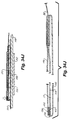
- Fig. 7 is a diagrammatic representation of the apparatus of the present invention.
- Fig. 7A is a diagrammatic representation of a portion of the apparatus taken along line 7A-7A of Fig. 7 where vanes are connected to the face sheet.
- Fig. 8 is an enlarged vertical section taken along line 8-8 of Fig. 7.
- Fig. 9 is an enlarged fragmentary section taken along line 9-9 of Fig. 7.
- Fig. 10 is an enlarged fragmentary section taken along line 10-10 of Fig. 7.
- Fig. 11 is a further enlarged section illustrating an adhesive applicator shown in Fig. 10.
- Fig. 12 is an enlarged fragmentary vertical section taken along line 12-12 of Fig. 7.
- Fig. 13 is a further enlarged fragmentary section illustrating a creaser forming a crease in the sheet material as illustrated in Fig. 12.
- Fig. 14 is an enlarged fragmentary vertical section taken along line 14-14 of Fig. 7.
- Fig. 15 is an enlarged fragmentary vertical section taken along line 15-15 of Fig. 7.
- Fig. 16 is an enlarged fragmentary vertical section taken along 16-16 of Fig. 7.
- Fig. 17 is an enlarged fragmentary section taken along line 17-17 of Fig. 7.
- Fig. 18 is an enlarged vertical section taken along line 18-18 of Fig. 7.
- Fig. 19 is an enlarged fragmentary vertical section taken along line 19-19 of Fig. 7.
- Fig. 20 is an enlarged fragmentary vertical section taken along line 20-20 of Fig. 7.
- Fig. 21 is an enlarged fragmentary vertical section similar to Fig. 20 showing an insertion blade advancing the face sheet material between the flaps of a previously formed vane.
- Fig. 22 is a fragmentary vertical section similar to Fig. 21 showing a face fabric material being compressed between the flaps of the vane.
- Fig. 23 is a vertical fragmentary section similar to Fig. 22 showing the insertion blade having been removed.
- Fig. 24 is a fragmentary vertical section showing the vane interconnected to the face fabric.
- Fig. 25A is a section taken near the upstream end of a folder or former used to make an alternative vane for use in the fabric of the present invention.
- Fig. 25B is a section similar to Fig. 25A at a location further downstream.
- Fig. 25C is a section similar to Fig. 25A at a location near the downstream end of the folder or former.
- Fig. 25D is a section similar to Fig. 25A at the downstream end of the folder or former.
- Fig. 25E is a section through the alternative vane shown being formed in Figs. 25A through 25D.
- Fig. 26 is a view similar to Fig. 10 showing an alternate system for applying adhesive to the vane material.
- Fig. 27 is a view similar to Fig. 17 illustrating the forming of flaps on a vane consistent with the application system shown in Fig. 26.
- Fig. 28 is a view similar to Fig. 19 showing a completed vane formed in accordance with the alternative system shown in Figs. 26 and 27.
- Fig. 29 is an isometric showing a window covering in accordance with the present invention having a valance covering the operating system for the covering.
- Fig. 30 is an enlarged fragmentary section taken along line 30-30 of Fig. 29.
- Fig. 31 is an isometric showing the fabric of the present invention with the sides finished such that the face sheet material surrounds the associated vane.
- Fig. 32 is an enlarged fragmentary isometric showing the top edge of the fabric of Fig. 31.
- Fig. 33 is a top plan view of the fabric of Fig. 31 before the end treatments to the fabric have been performed.
- Figs. 34A through 34K are elevational operational views showing the forming of a center vane of the fabric of Fig. 31.
- Figs. 35A through 35G are elevational operational views showing the fixed end vane of the fabric of Fig. 31.
- a covering 30 for an architectural opening (not shown) incorporating the fabric 32 of the present invention is illustrated.
- the covering 30 will be referred to as a window blind, it being recognized that the covering could be used in other architectural applications such as on doors, archways, skylights and the like.
- the description that follows assumes a vertical orientation of vanes 36 used in the fabric 32, it will be appreciated that the vanes could be oriented horizontally, thus requiring the use of a different operating system when the fabric is incorporated into an architectural covering device.
- the window blind 30 broadly includes a headrail 34 suspendable from a wall or ceiling adjacent to a window opening and an operating system (not seen) connected to the headrail and adapted to suspend a plurality of vertically extending vanes 36 which are interconnected in parallel vertical relationship by a face sheet 38 of material.
- the operating system (not shown) includes hardware for interconnecting the operating system to the vanes through hanger plates 40 and for moving the window blind between extended and retracted positions shown in Figs. 1 and 5 respectively, as well as open and closed positions as illustrated in Figs. 1 and 3 respectively.
- the vanes 36 In the extended position shown in Fig. 1, the vanes 36 are uniformly distributed across the window opening, while in the retracted position shown in Fig. 5, the vanes are horizontally stacked adjacent to a side of the window opening, it being understood that the vanes could be stacked adjacent to either or both sides of the window opening.
- the vanes When in at least a partially extended position, the vanes are pivotally movable between the open and closed positions. In the open position shown in Fig.
- the vanes extend perpendicularly to the window opening and thus the plane of the face sheet 38, while in the closed position they preferably partially overlap in shingle-like relation (Figs. 3A and 6) and extend in substantially parallel relationship to the window opening and thus the plane of the face sheet 38 and in coplanar relationship with each other.
- vanes 36 could take numerous forms, it is preferable that they be of tubular configuration including longitudinally extending flaps 42 (Figs. 1A and 3A) along one side edge of the vane to facilitate attachment of the vane to the face sheet 38 in a manner to be described hereinafter.
- the vane is formed from a single sheet of flexible material, preferably fabric, formed into an elongated tube of substantially air foil configuration. It should be appreciated, however, that the vane could take other general configurations.
- the elongated single sheet of material from which the vane is fabricated is folded upon itself along a line 44 that runs substantially along a central region of the sheet defining a front section of the vane along the central region. The fold may be creased as at 45 (Figs. 12 and 13) or uncreased.
- the side edges 46 of the strip are disposed proximate each other and a relatively flat short side wall 48 and an outwardly convex long side wall 50 are defined (Figs. 15 through 24).
- the long and short walls are secured together along a line of attachment 52 extending the entire length of the vane and at a location spaced slightly inwardly from the side edges 46 of the sheet material.
- a flap or edge portion 42 is thus defined adjacent each side edge of the sheet material, a flap being associated with the short and the long wall.
- the flap on each wall is rectangular in configuration having two long sides extending the length of the vane and two perpendicular short sides, one at the top of the vane and one at the bottom.
- each flap when laid flat are preferably in the range of 6.3 mm (1/4 inch) to 12.7 mm (1/2 inch) in width when the vane is formed from strip material approximately seven inches in width. In other words, each flap is preferably about 5% of the overall width of the strip from which the vane is formed.
- the vane 36' shown in Fig. 25E is formed from a single sheet of flexible material, as with the vane 36, but the sides 53 of the vane are of equal length and both are outwardly convex.
- a pair of flaps 42' are defined along one side edge of the vane to facilitate attachment of the vane 36' to the face sheet 38 in a manner to be described later in connection with the vane 36.
- the vane 36 preferably has torsional rigidity along its length which results not only from the tubular construction of the vane but also through use of a fabric having diagonal, dimensional stability.
- Diagonal, dimensional stability is a characteristic of fabric that prevents the fabric from stretching or shrinking along a line diagonal to either the machine direction of the fabric or the cross direction of the fabric.
- the diagonal, dimensional stability in the fabric from which the vane is fabricated is a factor in the vane's ability to resist relative twisting along its length from top to bottom when the vane is rotated from the top.
- the diagonally, dimensionally stable characteristic of the material facilitates the transfer of torque along the length of the tubular vane so that when rotated from the top, the bottom will follow.
- the fabric should be stretchable no more than 10% along a forty-five degree diagonal to the machine direction of the fabric when a force of eight ounces is applied between two points along the diagonal.
- vanes 36 While the material from which the vanes 36 are made can have varying characteristics, it is desirable that the vanes be made of an opaque or substantially opaque material so that when in the closed position the blind will substantially block light and vision. While the material from which the vanes are fabricated could have decorative designs imprinted thereon or formed therein, they might also be made of a plain and single color material.
- the face sheet 38 which interconnects the vanes is also made from a flexible fabric material and is secured to the vanes along parallel vertically spaced lines of attachment at a rear section of the vanes by inserting folds 54 (Figs. 2A and 21) of the face sheet between the flaps 42 of the vanes 36 and securing the flaps together so as to capture the face sheet therebetween. While the vanes in the fabric will normally be of equal width and the folds 54 in the face sheet equally spaced, it is possible to use vanes of varying widths to obtain different aesthetics and in such cases the spacing between folds would preferably correlate with the width of the adjacent vanes.
- a bead of adhesive to be described in more detail later can be placed on either or both flaps before the fold 54 of face sheet is positioned therebetween.
- the flaps can be compressed together and the adhesive activated, if necessary, to secure the face sheet to the flaps along a line of attachment running the length of the vane and disposed outwardly of the line of attachment 52 of the short and long walls 48 and 50, respectively, of the vane.
- the face sheet material has enough permeability to allow the adhesive to flow therethrough thereby bonding not only the face sheet to each flap, but also the flaps to each other.
- the fold 54 in the face sheet 38 can be wrapped around both flaps 42 so as to encapsulate the flaps therein.
- beads of adhesive 55 would be placed on an external surface of the flaps so as to directly engage the fold in the face sheet.
- the flaps would have enough permeability to allow the adhesive to flow therethrough and bond the flaps together as the flaps are being bonded to the fold in the face sheet.
- the face sheet 38 be a knit fabric even though some woven fabrics will work. It is also preferable for desired functional and aesthetic cooperation with the vanes 36, that the face sheet 38 be transparent or translucent for the passage of some light and vision. It is also preferred that the face sheet have diagonal, dimensional stability. Knit fabrics are preferable to wovens as they can be cut with a cold knife type cutter thus not requiring the more expensive hot knives or laser cutters. For reasons that will become clearer later with the description of the apparatus for fabricating the fabric 32 of the present invention, it is preferable that the face sheet have a low elongation rate, i.e., it not be very stretchy in the machine or cross direction.
- the vanes are desirably attached to the face sheet so as to extend in the cross direction of the face sheet and the machine direction stiffness of the fabric must be low as it must bend at the juncture with every vane 36 inasmuch as the vanes are rotated 180° relative to the face sheet. If the machine direction stiffness is too high, there will be excessive forward and backward swings of the end vanes along the sides of a window blind as the vanes are rotated. It is also important that the fabric have good springback in its machine direction, i.e., that it not take a set, so that the vanes can swing each direction easily.
- the face sheet fabric has high cross direction stiffness as this contributes positively to a better drape appearance of the product when suspended in a window opening.
- weft insertion fabrics can be used. Weft insertion is a knitting process wherein threads are inserted in the cross direction to add texture. Additionally, these threads generally add cross direction stiffness without adding machine direction stiffness.
- Angelica sheer identified by Style No. 36707 by its manufacturer Guilford Mills of Greensboro, North Carolina.
- the fabric 32 of the present invention is suspended from an operating system by carriers that are releasably connected to hanger plates 40 (Figs. 1-5) internally connected to each vane adjacent an open upper end thereof.
- a strip of valance fabric 56 (Figs. 2, 2A and 2B) can be bonded to the face sheet 38 along its upper edge so as to overlap the top end of the face sheet.
- the valance fabric would preferably have light-controlling characteristics or in other words be somewhat opaque and non-vision transmitting. The valance thereby blocks any vision of the hanger plates or associated parts of the operating system which might otherwise be visible above the face sheet 38 and vanes 36.
- the height of the face sheet can be made in excess of the vane length so as to form a valance extension portion of the face sheet (not illustrated). While the face sheet is preferably translucent or transparent, it would still have a subduing effect as far as concealing the operating system.
- FIG. 29 and 30 An alternative system for covering the operating system is shown in Figs. 29 and 30 wherein it will be appreciated that the top end of each vane has been notched to accommodate the headrail and other components of an operating system and with the vane extending along its edge that is attached to the face sheet, to an elevation above the operating system.
- a valance can then be optionally attached to the face sheet in overlying relationship along an upper most portion thereof with the valance preferably being opaque but at least translucent so as to block or inhibit a view of the operating system when the fabric is extended across an architectural opening as shown in Fig. 29.
- the notch provided in the top end of the vane allows the vanes to be desirably pivoted about a longitudinal axis through at least 180 degrees without interfering with the operating system.
- the valance is not necessary but does add the ability to totally or substantially block the view of the operating system when the fabric is extended as shown in Fig. 29.
- the valance can be attached to the fabric in many different ways but the preferred method utilizes a thermoplastic film laminated to a knit fabric with the film then being laid over the face sheet along the top edge thereof and heat laminated into place. Tape, thread or other mechanical or chemical fastening methods could also be used to hold the valance in place.
- a strip of such blockout material can be easily bonded internally of the tube along the line of attachment 52 by overlaying the blockout strip onto the vane strip sheet of material as the vane is being formed and as will be more fully appreciated with the description of the apparatus of the invention later. If the blockout strip 58 is a soft non-crinkling material, it will not adversely affect the functional or tactile characteristic of the vanes.
- a window blind 30 including the fabric 32 of the present invention is best appreciated by reference to Figs. 1 through 6.
- the fabric is shown in an extended position as it would assume when extending across a window opening and wherein the vanes 36 are in an open position thereby transmitting light and vision through the space between the vanes and the fabric.
- Fig. 1A is an enlarged section showing in more detail the relationship of the face sheet 38 and tubular vanes 36 when in the extended and open condition of Fig. 1.
- Fig. 2 is a view similar to Fig. 1 but from the opposite side of the fabric 32 and with the optional valence strip along the top of the fabric.
- the window blind 30 is again in an extended and open condition.
- Fig. 3 shows the window blind 30 in an extended and closed position.
- the fabric 32 of the window blind is extended as it would be when covering a window opening and the vanes 36 have been pivoted 90° in one direction relative to their position of Fig. 1 so as to lie coplanar and in substantially parallel relationship with the face sheet 38.
- Fig. 3A is an enlarged section giving a more detailed view of the relationship of the face sheet with the vanes when in the position of Fig. 3.
- Fig. 4 shows the fabric from the opposite side of that shown in Fig. 3 but in the same condition.
- Fig. 5 shows the fabric 32 in a retracted position as it would assume adjacent to the side of a window opening and with the vanes 36 in the open condition.
- the vanes assume an open condition when the fabric is retracted so that the fabric can be compactly horizontally stacked adjacent one side of a window opening.
- Fig. 5A is an enlarged view showing in more detail the relationship of the vanes and the face sheet in the retracted position.
- Fig. 6 shows in detail the relationship of the face sheet 38 to the vanes 36 when the vanes have been pivoted 180° relative to the position shown in Fig. 3A.
- This of course is another closed condition of the vanes and illustrates that the vanes can in fact be rotated in either direction relative to the face sheet and assume a closed position substantially blocking vision and light through the fabric.
- FIG. 7 An apparatus 60 for fabricating the fabric 32 previously described is diagrammatically illustrated in Figs. 7 and 7A.
- the apparatus has a vane forming section 62 and a fabric forming or combining section 64.
- the vane forming section 62 includes a supply roll 66 of an elongated strip of vane fabric or sheet material 68 that has been precut, from a virgin roll 94 of stock material 94, to a specified width, e.g., approximately seven inches.
- the vane sheet material is advanced through a number of operating stations in the vane forming section 62 of the apparatus by driven rollers and belts that successively engage the sheet material in the various stations.
- the vane sheet material 68 is initially advanced through a fabric conditioning unit 70 which is in essence a straightener that may be in the form of heated rollers 72 that remove any bow or curve in the fabric material. After the strip of sheet material 68 has been straightened, it is advanced horizontally downstream through the apparatus which includes a first glue applicator 74 for applying a first lines of adhesive. Next, the strip of sheet material 68 is optionally fed through first and second creasers 76 and 77 respectively for forming creases in the strip material 68 at desired locations. Next in line is a folder 78 for folding the horizontally disposed sheet material so that the side edges 46 of the sheet material are proximate each other.
- a fabric conditioning unit 70 is in essence a straightener that may be in the form of heated rollers 72 that remove any bow or curve in the fabric material.
- a first glue applicator 74 for applying a first lines of adhesive.
- the strip of sheet material 68 is optionally fed through first and second creasers 76 and 77 respectively for
- a second glue applicator 80 then applies a second line of adhesive 82 at the location where the shorter and longer walls 48 and 50 respectively of the vane are to be bonded, and the strip material is then fed to a compressor 84 for pressing the shorter and longer walls of the vanes together along the second line of adhesive 82.
- a cutter 86 is provided for severing the strip of sheet material into predetermined lengths which define the vanes 36 of the fabric 32. The vanes are thereafter advanced into the fabric forming section 64 of the apparatus.
- an inserter blade 88 forces a section or fold of the face sheet material 38 into the space between the flaps 42 of a preformed vane 36 and after the sheet material is laterally tensioned with a tensioner 89 a second compressor 90 activates the glue lines applied by the first glue applicator 74 along the flaps to seal the face sheet material between the flaps. After sequentially connecting vanes to the sheet material in this manner, the resulting fabric 32 can be wound on an accumulation or transportation roll 92.
- a virgin roll 94 of stock fabric or vane sheet material which might come in varying widths is first cut to a specified width in a known and conventional manner.
- the resulting cut fabric is accumulated on the vane sheet supply roll 66 for further processing.
- Fig. 8 shows the strip or web of sheet material 68 as it comes off the vane sheet supply roll and as will be appreciated, it is not totally flat but typically has small undulations or wrinkles therein. It has been found that if the vane 36 is formed from the virgin material before it is straightened, curves or twists will undesirably result in the completed vane.
- Fig. 9 shows the virgin material being fed between the heated rollers 72 which remove any such wrinkles or undulations in the material so that the material is suitable for forming a vane.
- the strip or web of sheet material 68 emanating from the heated rollers 72 is fed downstream through the vane forming section 62 of the apparatus where it sequentially encounters the aforedescribed operating stations.
- the strip first encounters the adhesive or glue applicator 74 as illustrated in more detail in Fig. 10.
- the applicator 74 applies the first elongated continuous bead of adhesive 98 along the top face of each side edge 46 of the strip.
- Fig. 11 is a further enlarged view showing the beads of adhesive 98 after application to the top face of the strip of vane material. While the adhesive is applied hot and in liquid form, it quickly solidifies and needs to be re-activated before it will adhere to any other surface.
- a suitable adhesive for this purpose is Bostik 7983 manufactured by Bostik of Middleton, Massachusetts.
- the first creaser 76 as best seen in Figs. 12 and 13 receives the strip of material as it emanates from the first adhesive applicator 74 and forms the crease 45 in the top face of the strip substantially along the longitudinal center line of the vane. It will be appreciated from Fig. 12 that the crease 45 is actually formed slightly off-center of the strip so that the vane formed from the strip will assume the configuration shown in Figs. 1 through 6 with a short wall and a long wall 48 and 50 respectively.
- the crease 45 does not need to be placed in the vane, as the vane can be formed without such a crease. Also see description of Figs. 25A-25E hereafter. As described in detail in the aforenoted Copending Application, the crease is desirably formed with a blunt instrument. The crease 45 would preferably be approximately twice as wide as the thickness of the sheet material. This is illustrated in Fig. 13 wherein the width of the crease is designated X and the thickness of the sheet material X/2.
- the creases 100 may again be formed with a blunt instrument so as to have approximately twice the width as the thickness of the sheet material but it is not critical along creases 100. A sharper crease may therefore be formed.
- the sheet material between the parallel creases 100 and the side edges 46 of the material define the flaps 42 for the vane and it will be appreciated that the creases in the bottom face permit easy flexing of the flaps in a downward direction whereby the crease 45 in the upper face of the sheet facilitates easy folding of the sheet upwardly to define the shorter and longer sides of the completed vane.
- the sheet or web 68 is, as indicated above, fed into the folder 78 at a vane folding or forming station.
- the folder continuously lifts each side of the sheet or web on opposite sides of the upper crease 45.
- the folder can be a contoured form or trough through which the sheet material passes as it is advanced downstream through the apparatus with the contours in the form urging the sides of the sheet upwardly.
- the continuous folding is illustrated in Figs. 15, 16 and 17 at the locations identified by the section lines in Fig. 7. As will be appreciated, the side edges 46 of the sheet material are ultimately positioned proximate to each other as shown in Fig. 17.
- a light weight bar 102 overlies the edges of the vane so as to lightly engage the flaps 42.
- the bar 102 thereby splays the flaps relative to the associated sides of the sheet material as the material advances through the folding station.
- the adhesive 98 on the flaps is not affected by the bar as it was previously solidified and needs to be reactivated before again becoming tacky.
- the bar 102 has a vertical leg 101 that holds the sheet 68 in the trough of the folder. It should be appreciated that the fabric material inherently wants to remain flat or in other words is somewhat biased toward a flat orientation. Accordingly, it closely follows the contours of the trough during the folding or forming step.
- the sheet material 68 leaving the folding station is in the configuration illustrated in Fig. 17 and immediately encounters the second adhesive applicator 80 that applies the second continuous bead of adhesive 82 to one or both of the flaps 42 along the crease line 100 between the flaps and the remainder of the sheet material.
- the sheet material is passed through the compressor or presser unit 84, which may be a pair of confronting belts 104 (Fig. 7), that forces the sides of the sheet material together along the creases 100 thereby forming the line of attachment 52 between the short and long sides of the vane so formed.
- the optional blockout strip 58 can be overlaid onto the sheet material 68 along one side thereof as it is being formed into a vane (shown in phantom lines in Figs. 15-19).
- the blockout strip is secured in place with the same bead of adhesive 82 that secures the sides of the sheet material together.
- relatively broad lines of adhesive 105 can be applied along the side edges 46 of the vane material while it is lying flat before entering the folding station.
- Glue applicators 106 are shown in Fig. 26 in lieu of the glue applicators shown in Fig. 10 which apply relatively thin beads of adhesive.
- the vane material 68 is then formed into the desired configuration in the same manner with the folder 78 described previously except that instead of applying a second bead of adhesive, as with the adhesive applicator 80 previously described, the flaps are formed within the relatively broad lines of adhesive 105 which extend slightly beyond the creases 100.
- the sides of the vane material are brought together along the creases and the adhesive, which has previously solidified, is activated with ultrasonic or heating elements 107 immediately prior to the vane material passing through the compressor.
- the vanes are properly formed with flaps and the flaps include adhesive on confronting faces thereof for use in subsequently securing the face sheet material 38 as will be described hereafter.
- a cylindrical rod 108 with a tapered end is mounted in the forming station in alignment with and between the flaps to keep them separated as the vane material advances through the compressor.
- the adhesive does not accumulate on the cylindrical separating rod as it has previously solidified and needs to be reactivated before becoming tacky.
- Fig. 28 A vane completed in accordance with this alternative system is shown in Fig. 28. It has been found when using the aforedescribed alternative system that the creases 45 and 100 can be omitted from the process and the vane will still be desirably formed.
- the strip of sheet material 68 leaving the compressor 84 is advanced into a vane separation station where the cutter 86, preferably in the form of a guillotine type cutter, severs the strip of sheet material into predetermined lengths corresponding with or slightly shorter than the height of the face sheet 38 to be used in a given window opening.
- the cut lengths of strip material define the vanes 36 used in the fabric 32.
- the vanes 36 are then advanced into the fabric forming or combining section 64 of the apparatus, shown in Figs. 7 and 7A.
- the vanes 36 are first positioned in transverse alignment with a roll 110 of face sheet material 38.
- the roll 110 of face sheet material 38 is stored on a roller and has been precut in width in accordance with the height of the window in which the fabric 32 is to be mounted.
- the face sheet material is removed from the roller by the tension applied from a succession of driven rollers that advance the face sheet material through the fabric forming or combining section of the apparatus.
- the face sheet material after being straightened by passage over a heated roller 114 and a subsequent cold roller 116, is fed under very low tension around a set of two cork drive rollers 118.
- the fabric then passes through a gravity loop 120 and is weighted down by a zero tension dancer 122 that maintains a very low tension in the gravity loop of the fabric.
- the low tension prevents any necking of the face sheet.
- the face sheet 38 then extends around a series of three cork drive rollers 124 before passing through an approximately 300° angle around and beneath an inserter 112 in the form of an elongated blunt knife blade 88.
- the knife blade 88 is disposed longitudinally of a precut vane 36 positioned thereunder and in overlying alignment with the vane.
- the set of three cork drive rollers 124 are intermittently driven so as to momentarily stop movement of the face sheet 38 when it is being connected to a previously cut vane 36.
- the set of two cork drive rollers 118 are continuously driven and the zero tension dancer 122 maintains desired tension in the face sheet between the continuously driven portion of the face sheet and the intermittently driven portion.
- the flaps 42 on the vane are splayed and vertically aligned with the inserter knife blade 88 with the face sheet material positioned therebetween so that the inserter knife blade can be moved downwardly as illustrated in Fig. 21 forcing the face sheet material into the fold 54 between the flaps 42 on the vane along the entire length of the vane.
- the tensioner 89 grips opposite lateral edges of the face sheet and pulls laterally on the sheet (longitudinally of the vane) to remove any wrinkles and thereby place tension in the sheet.
- the second compressor or presser unit 90 in the form of an anvil 126 and horn 128, compresses the flaps 42 into engagement with the fold 54 in the face sheet as shown in Fig. 22, while the tension is retained therein by the tensioner 89. In this condition, the horn and anvil have mechanically compressed the adhesive along the flaps against the face sheet. At this point, the adhesive 98 on the flaps is cool, so there is some degree of stick, but not a bond.
- the inserter blade 88 is then lifted so as to remove it from between the flaps 42, as shown in Fig. 23.
- the face sheet 38 remains between the flaps on the vane 36 as the blade is lifted because the friction against the adhesive lines 98 is greater than the friction on the smooth steel blade.
- the tension in the sheet is still retained by the tensioner 89.
- the horn 128 is activated thereby ultrasonically remelting the adhesive 98 in between the face sheet and the flaps of the vane. Because the face sheet has permeability, the adhesive melts through and not only bonds the face sheet to the flaps of the vanes but also bonds the face sheet to itself and creates a solid bond between the flaps and the folded face sheet at this juncture. As will be appreciated, the adhesive is totally hidden from view so as to improve the aesthetics of the finished fabric product.
- the completed bonding of a vane 36 to the face sheet 38 is shown in Fig. 24.
- the hanger plate 40 can also be ultrasonically bonded within the open upper end of the vane so that the hanger plates are in the finished fabric product when it is ready for suspension from an operating system.
- An electric or pneumatic injector 129 positioned adjacent to one side of the face sheet 38 places hanger plates 40 from a supply cartridge 131 of the hanger plates in the open upper end of the vane that is being attached to the face sheet.
- the face sheet 38 is again advanced forward via the three cork drive rollers 124.
- the completed fabric consisting of the face sheet 38 and the interconnected vanes 36 is then loosely wound onto the large driven accumulation or transportation roll 92 (Figs. 7 and 7A).
- the apparatus in the fabric forming or combining section continuously repeats the above cycle thereby bonding each next formed or successive vane to the face sheet at a preselected spacing from the previously bonded vane.
- the direction of rotation of the roll may be such that the vanes lie on the outside of the fabric sheet, as shown, to minimize the possibility of crushing the vanes or the vanes can be wrapped on the inside to provide better control during handling.
- the valance fabric 56 (Figs. 2 and 2A) can be bonded to the top edge of the face sheet material 38 before the vanes 36 have been connected to the face sheet.
- Figs. 7 and 7A show a roll of valance material in phantom line positioned adjacent to the roll 110 of face sheet material.
- the valance is preferably bonded to the face sheet and overlaps the top edge so as to hide any exposed components of the operating system for the window blind that might otherwise be visible above the face sheet.
- the method of the invention includes the steps of providing a supply roll of sheet material from which the vane is to be fabricated and initially advancing the sheet material through a straightener to remove any folds or curves, applying adhesive along opposite edges of the sheet material and creasing the undersurface of the strip along lines spaced slightly inwardly from the side edges of the strip.
- a third crease may be formed in the top surface of the sheet substantially along the longitudinal center line of the sheet.
- a folding step raises the side edges of the strip until they are proximate each other at which time the step of applying a line of adhesive to the strip along the outer parallel crease lines but on the top face of the sheet material is performed.
- the step of compressing the strip against itself is performed along this latter applied line of adhesive so as to form the strip into a tube having a pair of flaps protruding from a top edge thereof.
- the final step in forming the vanes for the fabric is cutting the tubular strip into preselected lengths.
- the steps in forming the fabric from the preformed vanes and the face sheet material include the steps of advancing the vanes into lateral alignment with a supply roll of face sheet material and advancing the face sheet material across the top of the vane but beneath an inserter knife.
- the following step is advancing the inserter knife against the face sheet thereby forcing the face sheet into a fold which is inserted between the flaps and subsequently tensioning the sheet longitudinally of the vane.
- the step of connecting a hanger plate in the open upper end of a vane is completed.
- the steps of compressing the flaps together with the adhesive thereon and activating the adhesive to bond the fold of face sheet material between the flaps of the vane to secure the vane to the face sheet are performed.
- the steps involved in adhering a vane to the face sheet are repeated at intervals along the length of the face sheet and the face sheet is ultimately accumulated on a roll for transportation to a desired location.
- a former or folder 101 would be used as illustrated in Figs. 25A-25D wherein like parts have been given like reference numerals with a prime suffix.
- the folder or former 101 would be similar to the previously described former 78 except that the cross-section would be configured differently. It would, however, be positioned in the vane forming section of the apparatus at the same location as the former 78.
- Fig. 25A which is a section taken near the upstream end of the folder, the folder 101 defines a relatively wide trough wherein the side edges 46' of a web or sheet 68' being advanced therethrough are lifted slightly.
- Fig. 25A which is a section taken near the upstream end of the folder
- Fig. 25C is a cross-section near the downstream end of the folder 101 and it will be seen that the trough is shaped generally like a narrow U and is even narrower than it is at the extreme downstream end of the folder shown in Fig. 25D. Further, the lower end of the trough has a relatively narrow V-shaped section 104 that forms a very slight crease in the rounded and folded side 103.
- the crease is not enough to form a permanent bend in the fabric fibers but only enough to deform the fabric so that the fold is slightly narrower than it would be without the slight crease and is springy or resilient so as to retain the bias that urges the side walls 53 away from each other.
- the bias on the side walls assists the natural tendency of the fabric to be flat and thereby forces the tubular fabric web to expand and follow the contour of the inner wall of the folder as it widens at the downstream end of the folder as shown in Fig. 25D.
- the web would be creased along lines 100' as with the vane 36 so as to define flaps 42'.
- a light weight bar 102' would also be used to splay the flaps and a vertical leg 105 on the bar 102' holds the web in the trough.
- a cross-section of the completed alternative vane 36' is shown in Fig. 25E.
- the fabric of the present invention when utilized in a window blind 30 there will be two endmost vanes with one endmost vane being attached to one end of an operating system so as to be fixed relative to the headrail 142 of the system and the other endmost vane being free to move along the headrail through its operative connection to the operating system 144.
- the endmost vane that is secured to the headrail in a fixed position will be referred to hereafter as the "fixed endmost vane” while the endmost vane that is movable along the headrail by the operating system will be referred to hereafter as the "free endmost vane.”
- Window blinds or other architectural coverings are either single draw, i.e., one fabric extends across the entire architectural opening, or they are center draw.
- Center draw coverings have two generally half-size fabrics covering the opening with each fabric having a fixed end fixed to opposite ends of the headrail and a free end movable toward the other end of the headrail so that when the covering is fully extended the free endmost vanes are disposed contiguous with each other at the center of the architectural opening.
- the fixed endmost vane 140a in either a single draw or center draw system is preferably of half the width of the vanes 140 that exist between the endmost vanes.
- the free endmost vane 140b in a center draw system is preferably of full width, while the free endmost vane 140c of a single draw system is of half width.
- Figs. 34A through 34I are operational views illustrating how a full width endmost vane 140b is treated so as to have the same textural appearance as the face sheet material 38 while forming a functional and aesthetically pleasing end of the fabric 32.
- the fabric material 32 is stacked adjacent one side of a work table 148 having a longitudinally extending guide plate 150 extending along the table adjacent to the face sheet 38 side of the fabric 32.
- An endmost vane 140b is separated from the top of the stacked fabric material and positioned on the work table as shown in Fig. 34B such that the free strip 146 of face sheet material underlies the associated endmost vane.
- An elongated ceramic magnet 152 is removably positionable beneath the work plate in longitudinal alignment with the endmost vane.
- a nonferrous elongated folding strip 154 is pivotally connected to the work surface, as with a piece of tape or other flexible material, so as to extend parallel with the vane.
- the closed or folded edge of the vane is severed with a razor or other sharp instrument so as to define an adjacent vane side 156 and an overlying removed vane side 158.
- the removed vane side 158 as shown in Fig.
- the folding strip 154 is pivoted in a clockwise direction as shown in Fig. 34E thereby lifting the free edge 164 of the free strip of face sheet material 38, with the flaps 42 from the severed vane, into overlying and bonding relationship with the adhesive strip 162. It will thus be appreciated that the face sheet material then forms a fold around the free edge of the adjacent vane side 156.
- the folding strip 154 is pivoted counterclockwise to its original position and a subsequent strip 166 of double-faced adhesive is applied over the folded free edge 164 of the face sheet material before the folded removed vane side 158 is returned to its overlying relationship with the remainder of the vane so that the free edge 168 of the removed vane side can engage and be adhesively bonded to the double-faced adhesive strip 166.
- the flap 42 from the severed vane are captured between the sides of the now endmost vane to reinforce and add rigidity to the edge of the vane.
- Fig. 34G shows the endmost vane 140b after the free edge 164 of the face sheet material has been secured thereto and the vane reconstituted by reconnecting the severed edges of the adjacent and removed vane sides. Thereafter, the ceramic magnet 152 is removed so that the ferrous metal strip 160 can be easily removed from the center of the vane.
- the vane is then configured as shown in Fig. 34H with the outer face of the vane having a covering of the face sheet material so that it has the same textural appearance as the face sheet material.
- the covered endmost vane 140b is also consistent in composition with the remainder of the fabric so as to hold up well when exposed to substantial solar heat as is experienced by window coverings.
- the face sheet material 38 at its connection with the endmost vane be somewhat loose so as to provide a fairly broad or soft fold.
- the soft fold establishes a means by which the free endmost vanes in a center draw system can engage each other when the covering is extended across an architectural opening thereby forming a light seal with each other so as to block the passage of light therebetween.
- a spacer strip 170 (Fig. 34J) can be positioned between the adjacent vane side 156 and the strip 146 of face sheet material before the face sheet material is folded around and secured to the adjacent vane side.
- a spacer strip is subsequently removed, a softer fold is established in the vane (Fig. 34K) permitting a better light blocking seal between endmost vanes in a center draw architectural covering when the covering is extended.
- an endmost vane 140b of full width as illustrated in Figs. 34I or 34K can be provided which will give the desired aesthetic appearance and functional characteristics to the free endmost vane used in a center draw system.
- the free endmost vane 140c of a single draw system is desirably half the width of a full vane.
- the free endmost vane 140c is mounted on a pivot arm so that when the vane reaches the non-control end of the headrail, it is wrapped around the end of the headrail.
- the hanger for the free endmost vane forces the longitudinal center line of the vane away from the headrail a greater distance than the remaining vanes in the covering and for that reason a vane of approximately half width is desirable to retain a uniform displacement of the outer edges of the vanes from the headrail.
- Figs. 35A through 35G are operational views showing a method for forming a free endmost vane 140c or 140a of approximately half the width of a full vane 140 and with reference to Fig. 35A, a work table 148 as described previously is again provided.
- a free strip 146 of face sheet material 38 is provided and again the vane, with the free strip of face sheet material therebeneath, is laid upon the work table with the free edge 164 of the face sheet material overlying a folding strip 154 as shown in Fig. 35B.
- the folding strip is identical to that previously described and shown in Figs. 34A-34G.
- a strip 174 of ferrous metal is next positioned on the top of the vane adjacent the flaps 42 of the vane.
- a ceramic magnet 152 as provided in accordance with the teachings in Figs. 34A-34G, is thereafter moved adjacent to the underside of the work table as shown in Fig. 35D so that the ferrous strip 174 is positively drawn toward the work table to hold the vane and the free strip of face sheet material in place on the work table.
- a strip 176 of double faced longitudinally extending adhesive is applied to the top of the vane adjacent the folded edge of the vane.
- the folding strip 154 is pivoted clockwise lifting the free edge 164 of the face sheet material into overlying bonding relationship with the adhesive strip 176 as shown in Fig. 35E.
- the folding strip 154 is then returned to its original position.
- a strip 178 of double faced adhesive is placed on the top of the flaps 42 of the vane adjacent to the ferrous strip 174 and the vane is folded upon itself about the ferrous strip so that the folded edge of the vane is engaged and bonded to the adhesive strip 178 as shown in Fig. 35F.
- the magnet 152 is removed from beneath the work table and the ferrous strip is removed from the vane leaving the vane as illustrated in Fig. 35G of approximately half width but with an outer covering of face sheet material so that the vane has the same textural appearance as the face sheet material.
- the fixed endmost vane 140a in a single draw system is preferably the same half width as the free endmost vane 140c so that when the fabric is fully extended across a window opening, the ends of the fabric will have the same appearance.
- the face sheet material 38 faces the interior of the room and for that reason it is important that the end-most vanes have the same textural appearance as the face sheet material for aesthetic purposes.
- an end treatment for the fabric of the present invention is provided which is not only durable but strengthens the edges of the fabric so that it hangs desirably without drooping and in a manner that provides a uniform appearance and presentation of the face sheet material throughout the entire fabric.
Landscapes
- Engineering & Computer Science (AREA)
- Structural Engineering (AREA)
- Architecture (AREA)
- Civil Engineering (AREA)
- Blinds (AREA)
- Treatment Of Fiber Materials (AREA)
- Treatments For Attaching Organic Compounds To Fibrous Goods (AREA)
- Devices For Post-Treatments, Processing, Supply, Discharge, And Other Processes (AREA)
Abstract
Description
Claims (36)
- A fabric for an architectural covering device (30) comprising a plurality of elongated hollow vanes (36) having opposite longitudinal ends and at least one longitudinally extending side edge (46), and at least one sheet of material (38) interconnecting said vanes (36) along said side edge of the vanes (36) defining lines of attachment (52), characterised in that each vane (36) has a pair of flaps (42) along said edge (46), and at least one sheet of material (38) is interconnected to said vanes (36) by means of said flaps (42).
- A fabric according to claim 1, characterised in that at least one sheet of material (38) is connected to said vanes between said flaps (42).
- A fabric according to claim 1, characterised in that said at least one sheet of material (38) is connected to said vanes around said flaps (42).
- A fabric according to claim 2 or 3, characterised in that said sheet (38) has folds (54) along said lines of attachment (52).
- A fabric according to claim 4, characterised in that said folds (54) define a double layer of material adjacent said flaps (42).
- A fabric according to any one of claims 2 to 6, characterised in that said vanes (36) are each formed from a single strip of material (68) having longitudinal edges (46) with the strip being folded along a longitudinal fold line such that said longitudinal edges (46) are proximate each other, and further including a longitudinal bond line adhering the strip to itself adjacent to said longitudinal edges (46), whereby said flaps (42) are defined between said bond line (52,82) and said longitudinal edges.
- A fabric according to any preceding claim, characterised in that there is only one sheet of material (38) and it is continuous in interconnecting a plurality of adjacent vanes (36).
- A fabric according to any preceding claim, characterised in that said vanes (36) have torsional rigidity along their length.
- A fabric according to any preceding claim, characterised in that said vanes are made of material (3 6) which has diagonal dimensional stability.
- A fabric according to any preceding claim, characterised in that said at least one sheet of material (38) is translucent and said vanes (36) are opaque.
- A fabric according to any preceding claim, characterised in that said vanes (36) are pivotal between a position wherein they extend in parallel relationship to each other and substantially perpendicular to said at least one sheet of material (38) and a position wherein they are substantially coplanar with each other and substantially parallel to said at least one sheet of material (38), said vanes (36) when substantially coplanar being overlapping.
- A fabric according to any preceding claim, characterised in that said at least one sheet (38) is connected to said vanes (36) substantially along the entire length of said side edge (46) of the vanes (36) defining lines of attachment (52).
- A fabric according to any preceding claim, characterised in that said at least one sheet (38) extends substantially completely from an upper one to a lower one of said opposite longitudinal ends of each of said vanes.
- A fabric according to any preceding claim, characterised in that said at least one sheet is in the form of a fabric which has a machine direction along which it has been formed and a cross direction extending at a right angle to said machine direction, said cross direction extending from an upper one to a lower one of said opposite longitudinal ends of said at least one sheet, and said fabric is diagonally, dimensionally stable relative to said machine and cross directions.
- A fabric according to any preceding claim, characterised in that said vanes (36) are hollow.
- An architectural covering comprising an upper support rail (34) and a plurality of spaced mounting means carried by said rail, the covering comprising a fabric (32) according to any of the preceding claims.
- A method of fabricating a fabric (32) for an architectural covering device (30), said fabric (32) including a plurality of elongated vanes (36) interconnected by a sheet of material (38) along parallel lines of connection (52), said method comprising the steps of:-providing a first elongated sheet of material (68), having elongated longitudinal edges (46);conveying said first sheet of material in a first direction;applying adhesive adjacent to at least one of said longitudinal edges (46);folding said first sheet material (68) approximately along a longitudinal central region;compressing the side edges (46) together to adhere the first sheet material (68) to itself while defining a flap (42) along each longitudinal edge (46), cutting said first sheet material (68) into predetermined lengths to define said vanes (36);providing a second elongated sheet material (38);advancing said second sheet material (38) in a second direction perpendicular to said first direction adjacent to said cut lengths of said first sheet material (68);positioning sections (54) of said second sheet material (38) adjacent said flaps (42) on said vanes (36);and compressing the flaps (42) and said sections (54) of the second sheet material (38) together to secure the second sheet material (38) to the vanes (36) by said adhesive that is adjacent to at least one of said longitudinal edges (46).
- A method according to claim 17, characterised in that said second sheet material (38) is positioned by being inserted between said flaps (42).
- A method according to claim 18, characterised in that it further includes the step of retaining a tension in said second sheet material (3 8) longitudinally of the vane (36) when said second sheet material (38) is positioned between said flaps (42) but before the flaps (42) are secured to said second sheet material (38).
- A method according to claim 17, 18 or 19, characterised in that said adhesive is applied in the form of a bead of adhesive which is applied adjacent to each of said longitudinal edges (46).
- A method according to any one of claims 17 to 20, characterised in that it further includes the step of straightening said first sheet material (68) before folding and applying adhesive to remove any bow from said first sheet material.
- A method according to any one of claims 17 to 21, characterised in that it further includes the step of creasing said first sheet material (68) before placing said adhesive on said first sheet material.
- A method according to any one of claims 17 to 22, characterised in that it further includes the steps of:-providing a strip of face sheet material (146) connected to said opposite longitudinal edge (142) of an endmost vane (140b), said strip having a free edge (164), said strip being substantially commensurate in length to that of said endmost vane (140b) and having a width slightly greater than the width of said endmost vane (140b);positioning said strip of face sheet material (146) in substantially parallel relationship to said endmost vane (140b);cutting said endmost vane (140b) along said folded longitudinal edge so as to define an adjacent vane side (156) and a removed vane side (158), said vane sides having confronting face, said adjacent vane side (156) being closer to said strip (146) than said removed vane side (158);applying a first strip of adhesive (162) to the confronting face of said adjacent vane side (156) along said cut folded edge;securing said free edge (164) of said strip of face sheet material (146) to said first strip of adhesive (162) by wrapping said free edge (164) around the cut folded edge of said adjacent vane side (156);applying a second strip of adhesive (166) to said secured free edge (164) of said strip of face sheet material (146); and securing the confronting face of said removed vane side (158) to said second strip of adhesive (166) along said cut folded edge.
- A method according to claim 23, characterised in that said positioning step includes placement of said endmost vane (140b) and strip of face sheet material (146) on a work surface (148), and further including a step of releasably securing said strip of face sheet material (146) and said adjacent side (156) to said work surface.
- A method according to claim 23 or 25, characterised in that said step of releasably securing includes placing an elongated ferrous strip (160) along the confronting face of said adjacent side (156), and providing a magnetic force beneath said work surface.
- A method according to claim 23, 24 or 25, characterised in that it further includes the steps of positioning a spacer bar (170) between said adjacent side (156) of the endmost vane and said strip of face sheet material (146) prior to securing said free edge (164) of said strip of face sheet material (146) to said first strip of adhesive (162) and subsequently removing said spacer bar (170) whereby a space (171) will exist between said adjacent side (156) and said strip of face sheet material (146) after complete treatment of said endmost vane.
- A method according to any one of claims 17 to 22, characterised in that it further comprises the steps of:-providing a strip of face sheet material (146) connected to said opposite longitudinal edge (142) of an endmost vane (140a,140c), said strip having a free edge (164), said strip being substantially commensurate in length to that of said endmost vane (140a,140c) and having a width slightly greater than the width of said endmost vane, positioning said strip of face sheet (146) material in substantially parallel relationship to said endmost vane adjacent to said adjacent side (156) of the endmost vane; applying a first strip of adhesive (176) to said removed side (158) along said folded longitudinal edge (44);wrapping said strip of face sheet material (164) around said folded longitudinal edge (44) and securing said strip of face sheet material to said first strip of adhesive (176);applying a second strip of adhesive (178) to said removed side (158) along said opposite longitudinal edge; and longitudinally folding said endmost vane (140a,140c) upon itself and securing said strip of face sheet material (164) to said second strip of adhesive (178) along the connection of said strip of face sheet material (164) to said removed side (158).
- A method according to claim 27, characterised in that it further includes the step of inserting longitudinally into said endmost vane (140a,140c), a folding strip (154) having a width of approximately one-half the width of said endmost vane to facilitate the longitudinally folding.
- A method according to claim 28, characterised in that said folding strip (154) is nonferrous and further including the steps of laying said endmost vane (140a,140c) and strip of face sheet material (164) on a work surface (148) and laying a ferrous strip (174) on said removed side (158) of said endmost vane (140a,140c) adjacent to said opposite longitudinal edge, said ferrous strip (174) having a width approximately one-half the width of said endmost vane (140a,140c), and further including the step of providing a magnetic force (152) beneath said work surface (148) to releasably secure said endmost vane (140a,140c) between said ferrous strip (174) and said work surface (148).
- An apparatus (60) for fabricating a fabric (32) for an architectural covering device (30), wherein said fabric (32) includes a plurality of elongated vanes (36) interconnected by a sheet of material (38) along parallel lines of connection (52), said apparatus having a vane forming section (62) and a fabric forming section (64) and comprising in combination:a first supply roll (66) of a first sheet material (68) having longitudinal side edges;a system for advancing said first sheet material along said vane forming section (62) of the apparatus;a first adhesive applicator (74) adapted to apply a bead of adhesive (98) along at least one of said side edges (46) of said first sheet material (68);a folder (78) adapted to progressively fold the longitudinal side edges (46) of said first sheet material (68) until the side edges are adjacent to each other;a second adhesive applicator (80) adapted to apply a bead of adhesive (82) along a line spaced inwardly a short distance from at least one of said longitudinal side edges (46);a compressor (84) adapted to compress said longitudinal side edges together along the bead of adhesive (82) applied by said second adhesive applicator (80) so as to define a flap (42) along each longitudinal side edge (46), at least one of said flaps (42) having said bead of adhesive (98) thereon applied by said first adhesive applicator (74);a cutter (86) for cutting the folded first sheet of material (68) into preselected lengths defining said vanes (36) and advancing the vanes (36) into the fabric forming section (64) of the apparatus (60); a second supply roll (110) of a second sheet material (38) in said fabric forming section (64);a removal system for removing said second sheet material and advancing it across said vanes;an inserter (88) positioned adjacent to said second sheet material (38) and a vane (36), said inserter (88) being adapted to insert a section of said second sheet material (38) between said flaps (42) of the vane (36); anda second compressor (90) for squeezing said flaps (42) together to pinch said second sheet material (38) against said flaps (42), said bead of adhesive (98) on at least one of said flaps (42) securing the flaps (42) on said vanes (36) to said second sheet material (38).
- Apparatus according to claim 30, characterised in that it further includes a straightener (70) adapted to remove any bow from the first sheet material (68) prior to applying the beads of adhesive (98) with said first adhesive applicator (74).
- Apparatus according to claim 30 or 31, characterised in that it further includes a creaser (76,77) adapted to form parallel creases (100) in said first sheet material (68) before said second adhesive applicator (80) places a bead of adhesive (82) on said first sheet material (68).
- Apparatus according to claim 31 or 32, characterised in that it further includes a creaser (76,77) adapted to form parallel creases (100) in said first sheet material (68) after it has been straightened.
- Apparatus according to claim 32 or 33, characterised in that said creaser (76,77) is further adapted to form a longitudinal crease (45) along a longitudinal central region of said first sheet material (68).
- Apparatus according to claim 34, characterised in that parallel creases (100) are formed in the opposite face of said first sheet material from said longitudinal crease (45).
- Apparatus according to any one of claims 30 to 35, characterised in that said second adhesive applicator (80) applies said bead of adhesive (82) after said first sheet material (68) has been folded by said folder (78).
Applications Claiming Priority (3)
| Application Number | Priority Date | Filing Date | Title |
|---|---|---|---|
| US437960 | 1995-05-10 | ||
| US08/437,960 US5749404A (en) | 1995-05-10 | 1995-05-10 | Fabric for an architectural covering and method and apparatus of manufacturing same |
| PCT/US1996/005720 WO1996035854A1 (en) | 1995-05-10 | 1996-04-24 | An improved fabric for an architectural covering and method and apparatus of manufacturing same |
Publications (2)
| Publication Number | Publication Date |
|---|---|
| EP0771387A1 EP0771387A1 (en) | 1997-05-07 |
| EP0771387B1 true EP0771387B1 (en) | 1999-12-01 |
Family
ID=23738644
Family Applications (1)
| Application Number | Title | Priority Date | Filing Date |
|---|---|---|---|
| EP96913113A Expired - Lifetime EP0771387B1 (en) | 1995-05-10 | 1996-04-24 | An improved fabric for an architectural covering and method and apparatus of manufacturing same |
Country Status (13)
| Country | Link |
|---|---|
| US (5) | US5749404A (en) |
| EP (1) | EP0771387B1 (en) |
| JP (1) | JP3006801B2 (en) |
| KR (1) | KR100441219B1 (en) |
| CN (1) | CN1134586C (en) |
| AT (1) | ATE187224T1 (en) |
| AU (1) | AU694031B2 (en) |
| BR (1) | BR9606384A (en) |
| CA (1) | CA2174915C (en) |
| DE (1) | DE69605383T2 (en) |
| ES (1) | ES2140846T3 (en) |
| TW (1) | TW310303B (en) |
| WO (1) | WO1996035854A1 (en) |
Families Citing this family (63)
| Publication number | Priority date | Publication date | Assignee | Title |
|---|---|---|---|---|
| US5937927A (en) * | 1995-02-21 | 1999-08-17 | Vbf Holdings, Inc. | Vertical blind enhancement apparatus and method of installation |
| USD440102S1 (en) | 1995-05-10 | 2001-04-10 | Hunter Douglas Inc. | Vane with at least one flat side for use in coverings for architectural openings |
| USD440450S1 (en) | 1995-05-10 | 2001-04-17 | Hunter Douglas Inc. | Vane with dual flat tails for use in coverings for architectural openings |
| US5749404A (en) | 1995-05-10 | 1998-05-12 | Hunter Douglas Inc. | Fabric for an architectural covering and method and apparatus of manufacturing same |
| WO1996035881A2 (en) | 1995-05-10 | 1996-11-14 | Hunter Douglas International, N.V. | Improved vane for an architectural covering and method of making same |
| NZ332056A (en) * | 1996-03-01 | 1998-11-25 | Stefan Zigmas Paskevicius | Improvements in relation to blinds, in particular, roman shades |
| US5713407A (en) * | 1996-03-28 | 1998-02-03 | Judkins; Ren | Drapery system having light controlling vertical vanes |
| US6311755B1 (en) | 1999-02-18 | 2001-11-06 | Newell Operating Company | Vertical blinds with vanes and fabric connected to the vanes and method of manufacturing the same |
| US6186213B1 (en) | 1999-04-06 | 2001-02-13 | Oxford House | Vertical blind system having a removable vane cover |
| US6688373B2 (en) | 2000-04-13 | 2004-02-10 | Comfortex Corporation | Architectural covering for windows |
| US6354353B1 (en) * | 2000-06-14 | 2002-03-12 | Newell Window Furnishings, Inc. | Door and window coverings employing longitudinally rigid vanes |
| US6598650B1 (en) | 2000-06-14 | 2003-07-29 | Newell Window Furnishings, Inc. | Hollow, rigid vanes for door and window coverings |
| US6497266B1 (en) | 2000-06-14 | 2002-12-24 | Newell Window Furnishings | Window covering slat |
| AU2001276930B8 (en) * | 2000-07-18 | 2005-11-03 | Hunter Douglas Industries B.V. | Tubular slat for coverings for architectural openings |
| US6510885B1 (en) | 2001-08-27 | 2003-01-28 | Custom Craft Co. | Vertical blinds curtain attachment |
| US6675858B2 (en) | 2001-12-03 | 2004-01-13 | Shade-O-Matic Limited | Vertical blind with fabric wrap |
| US6786269B2 (en) | 2002-03-22 | 2004-09-07 | Oxford House, Incorporated | Removable decorative vane cover |
| US7165594B2 (en) * | 2002-03-22 | 2007-01-23 | Oxford House, Incorporated | Removable decorative vane cover |
| US7146694B2 (en) * | 2002-04-01 | 2006-12-12 | Hunter Douglas Inc. | Fabrication apparatus for an assembly of vanes for an architectural covering |
| US6761203B1 (en) | 2003-03-31 | 2004-07-13 | Tai-Long Huang | Balanced window blind having a spring motor for concealed pull cords thereof |
| US8393080B2 (en) | 2003-08-20 | 2013-03-12 | Hunter Douglas Inc. | Method for making a window covering having operable vanes |
| US20070032150A1 (en) * | 2003-09-19 | 2007-02-08 | N.V. Bekaert S.A. | Architectural fabric |
| US20050211392A1 (en) * | 2004-03-29 | 2005-09-29 | Elembaby Ismail A | Window curtain covering |
| US7347245B2 (en) * | 2004-04-14 | 2008-03-25 | Lace Lastics Co., Inc. | Frayless frangible connection for fabric and vertical blind system incorporating same |
| US7836936B2 (en) * | 2004-04-14 | 2010-11-23 | Lace Lastics Co., Inc. | Frayless frangible connection for fabric and vertical blind system incorporating the same |
| US7757743B2 (en) * | 2004-04-14 | 2010-07-20 | Claus Graichen | Frayless frangible connection for fabric and vertical blind system and vertical drapery system incorporating the same |
| US7730927B2 (en) * | 2004-04-14 | 2010-06-08 | Lace Lastics Co., Inc. | Frayless frangible connection for fabric and vertical blind system incorporating the same |
| KR101387049B1 (en) * | 2004-08-20 | 2014-04-18 | 헌터더글라스인코포레이티드 | Apparatus and method for making a window covering having operable vanes |
| US7389806B2 (en) * | 2005-02-24 | 2008-06-24 | Lawrence Kates | Motorized window shade system |
| US20060237147A1 (en) * | 2005-04-26 | 2006-10-26 | Springs Window Fashions Lp | Vertical shade |
| US7513291B2 (en) * | 2005-06-30 | 2009-04-07 | Hunter Douglas Inc. | Control system for vertical covering for architectural openings |
| US20070107176A1 (en) * | 2005-10-20 | 2007-05-17 | Hunter Douglas Inc. | Apparatus for fabricating venetian blinds with tubular fabric slats |
| US20080236766A1 (en) * | 2007-03-29 | 2008-10-02 | Jason Vandervoort | Window covering |
| US20090139667A1 (en) * | 2007-11-30 | 2009-06-04 | Claus Graichen | Blind With Pockets |
| US20090139664A1 (en) * | 2007-11-30 | 2009-06-04 | Claus Graichen | Blind with Pockets |
| US9140061B2 (en) | 2008-05-09 | 2015-09-22 | Ki Cheol Cha | Vertical blind united by weaving and fabricating method thereof |
| US20090308543A1 (en) * | 2008-06-13 | 2009-12-17 | Lawrence Kates | Motorized window shade system and mount |
| US8757239B2 (en) | 2008-08-26 | 2014-06-24 | Hunter Douglas Inc. | Roll-up retractable covering for architectural openings |
| KR100916742B1 (en) * | 2008-09-29 | 2009-09-14 | (주)Gy텐트 | Prefab tent structures |
| CA2742403C (en) | 2008-11-18 | 2019-02-12 | Hunter Douglas Inc. | Slatted roller blind |
| US20110056630A1 (en) * | 2009-09-09 | 2011-03-10 | Hunter Douglas Inc. | Segmented vertical vane covering for architectural openings |
| USD643238S1 (en) | 2009-09-09 | 2011-08-16 | Hunter Douglas Inc. | Dual segmented covering for architectural openings |
| US8579006B2 (en) | 2009-10-19 | 2013-11-12 | Adrian Mario Levin | Space divider system |
| KR101126064B1 (en) | 2009-11-12 | 2012-03-29 | 주식회사 윈플러스 | Curtain Type Vertical of roll blind |
| US9458663B2 (en) * | 2010-04-16 | 2016-10-04 | Hunter Douglas Inc. | Process and system for manufacturing a roller blind |
| USD662747S1 (en) | 2011-03-05 | 2012-07-03 | Hunter Douglas Inc. | Shade assembly |
| KR101181721B1 (en) | 2011-03-15 | 2012-09-19 | 성경원 | The curtain and blind with magnetic tool |
| JP6002879B2 (en) * | 2011-03-28 | 2016-10-05 | 東京ブラインド工業株式会社 | Hanging type sound absorber |
| MX2013012013A (en) | 2011-04-15 | 2014-01-17 | Hunter Douglas | Covering for architectural opening including thermoformable slat vanes. |
| CN103211479B (en) * | 2013-04-03 | 2015-09-23 | 汕头市振能超声机器厂有限公司 | A kind of full-automatic producing device of cord of Shangri-La curtain |
| EP3080378B1 (en) | 2013-12-13 | 2019-05-15 | Mare Beheer B.V. | Venetian blind |
| BR112017028056B1 (en) * | 2015-06-26 | 2022-03-15 | Hunter Douglas Inc | COVERING FOR AN ARCHITECTURAL OPENING AND METHOD OF MANUFACTURING A FABRIC FOR USE AS A COVER SHAFT |
| CA2956655C (en) | 2016-06-30 | 2026-04-14 | Hunter Douglas Inc. | Architectural covering and method of manufacturing |
| CN114109228B (en) * | 2016-10-28 | 2024-05-14 | 亨特道格拉斯公司 | Covering for architectural features, related systems, and methods of manufacture |
| US10597935B2 (en) | 2017-01-25 | 2020-03-24 | Hunter Douglas Inc. | Vertical cellular drape for an architectural structure |
| US10774584B2 (en) | 2017-04-13 | 2020-09-15 | Hunter Douglas Inc. | Battened roller covering |
| KR101881501B1 (en) | 2018-01-26 | 2018-07-25 | 주식회사 윈플러스 | Light-shielding cloth and a manufacturing method |
| CN109973003A (en) * | 2019-05-06 | 2019-07-05 | 李大成 | A kind of easy-to-dismount door and window blimp having both decoration and heat insulation function |
| CN111648120A (en) * | 2020-06-21 | 2020-09-11 | 浙江禹思产融信息服务有限公司 | Fabric pleating device based on light sensation control |
| CA3126652A1 (en) | 2020-08-13 | 2022-02-13 | Michael Schulman | Vertical curtain blind and related connector clips and panels for use with a vertical curtain blind |
| GB2609391B (en) * | 2021-06-30 | 2023-07-26 | Global Int Trading Ltd | Curtain-blind |
| IT202200021000A1 (en) * | 2022-10-12 | 2024-04-12 | Andrea Paolino | Apparatus and method for producing vertical strips that can be included in a “sheer vertical blind” |
| US12280874B2 (en) * | 2022-11-14 | 2025-04-22 | The Boeing Company | Light blocking curtains and related methods |
Family Cites Families (60)
| Publication number | Priority date | Publication date | Assignee | Title |
|---|---|---|---|---|
| US176005A (en) * | 1876-04-11 | Of one-half | ||
| CA387133A (en) * | 1940-02-27 | Stanley Turek Frank | Pigment manufacture | |
| US1468433A (en) * | 1921-10-04 | 1923-09-18 | Frank H Zackow | Curtain |
| GB349290A (en) * | 1930-05-17 | 1931-05-28 | George Ernest Mountford | A new or improved window blind, sun screen or the like |
| US2123010A (en) * | 1937-04-10 | 1938-07-05 | Lewis I Kahn | Venetian blind |
| US2169873A (en) * | 1938-05-21 | 1939-08-15 | Jr William D Clark | Venetian blind slat |
| US2326454A (en) * | 1942-04-29 | 1943-08-10 | Scipio S Gentile | Venetian blind |
| DE837171C (en) * | 1943-01-30 | 1952-04-21 | Fabers Fab As C | Blind element |
| GB632832A (en) * | 1946-07-30 | 1949-12-05 | Ciba Ltd | Manufacture of pyrazolones substituted in the 3-position |
| FR1069055A (en) * | 1952-03-13 | 1954-07-05 | Venetian louver and its manufacturing process | |
| US3280891A (en) * | 1964-03-18 | 1966-10-25 | Jr Richard J Eldredge | Vertical venetian blind traverse apparatus |
| US3843483A (en) * | 1972-01-28 | 1974-10-22 | B Sendor | Apparatus for welding paper on web press |
| JPS5317063B2 (en) * | 1972-10-06 | 1978-06-06 | ||
| US3844330A (en) * | 1972-12-11 | 1974-10-29 | Louver Drape Inc | Window covering system |
| US3851699A (en) * | 1973-01-26 | 1974-12-03 | H Shapiro | Vertical louver type window drape |
| DE2339699A1 (en) * | 1973-08-06 | 1975-02-27 | Ronkholz Toelle Geb Toelle Ros | LAMELLA CURTAIN |
| US4108702A (en) * | 1975-09-19 | 1978-08-22 | Eastman Kodak Company | Method of forming an article-tape product |
| SE7709219L (en) * | 1976-08-18 | 1978-02-19 | Bolinger August | SLADE LADY WITH VERTICAL ARRANGEMENTS |
| US4122884A (en) * | 1977-01-24 | 1978-10-31 | Consolidated Foods Corporation | Vertical venetian blind construction |
| DE2920323A1 (en) * | 1979-05-19 | 1980-11-27 | Franz Halouska | Vertical venetian blinds - with heat insulating and light reflecting layers on one side of lamellae and blackened on other |
| DE3048763C2 (en) * | 1980-12-23 | 1983-06-09 | Labex GmbH Import-Export Industrieanlagen und Fördertechnik, 5340 Bad Honnef | Gate for industrial and warehouse buildings |
| US4352384A (en) * | 1981-04-20 | 1982-10-05 | Mccoy Jr Oval O | Slatted window insulating insert |
| US4434834A (en) * | 1981-08-17 | 1984-03-06 | Ennes John P | Vertical louver system |
| DE3207850A1 (en) * | 1982-03-04 | 1983-09-15 | TV-Main Rollo GmbH, 8752 Goldbach | Strip for a vertical strip curtain and method of manufacture thereof |
| EP0111926A3 (en) * | 1982-12-20 | 1984-07-25 | Everlon, Inc. | Apparatus for mounting hanging fabrics |
| US4724883A (en) * | 1985-11-07 | 1988-02-16 | Leibowitz Martin Nick | Drapery and vertical blind system |
| DE3312988A1 (en) * | 1983-04-12 | 1984-10-18 | geb. Krause Gerda 3320 Salzgitter Gramse | Lamellar blind |
| US4535828A (en) * | 1983-05-02 | 1985-08-20 | Brockhaus Peter B | Window insulator |
| US4792427A (en) * | 1983-05-13 | 1988-12-20 | Nanik Division Wausau Metals Corporation | Method for making light-transmitting slats for blind |
| US4519435A (en) * | 1984-08-01 | 1985-05-28 | Kenneth Stier | Slats for vertical venetian blinds |
| US4628981A (en) * | 1985-04-08 | 1986-12-16 | Micro Molds Corporation | Vertical blind assembly |
| FR2591273B1 (en) * | 1985-12-05 | 1988-05-27 | Garin Joseph | VENETIAN BLINDS IN TEXTILE MATERIALS |
| US4779661A (en) * | 1987-02-02 | 1988-10-25 | Ed Yalowega | Vertical blind clips |
| EP0288937A3 (en) * | 1987-04-30 | 1989-09-20 | Cavan Corporation | Disposable breathing mask |
| US4911220A (en) * | 1988-04-01 | 1990-03-27 | Hiller Kevin L | Replaceable decorative louver covering system |
| US4884612A (en) * | 1988-06-20 | 1989-12-05 | Comfortex Corporation | Pleated blind with articulative slat extensions |
| US4846243A (en) * | 1988-08-19 | 1989-07-11 | Graber Industries, Inc. | Foldable window covering |
| DE3900465A1 (en) * | 1989-01-10 | 1990-07-12 | Rigola Werk Schmidt Julius | SLat curtain with vertical slats |
| US4930562A (en) * | 1989-03-10 | 1990-06-05 | Hunter Douglas Inc. | Decoratively covered blind structure |
| DE4026319A1 (en) * | 1989-08-18 | 1991-04-11 | Kuniharu Kazuma | METHOD FOR OPENING AND CLOSING STRIP CURTAINS AND MECHANISM THEREFOR |
| US5097884A (en) * | 1989-11-06 | 1992-03-24 | Hunter Douglas Inc. | Roman shade |
| US5358024A (en) * | 1990-01-02 | 1994-10-25 | The Geon Company | Web covered vertical blind slat assemblies |
| US5141042A (en) * | 1990-01-02 | 1992-08-25 | The B. F. Goodrich Company | Web covered vertical blind slat assemblies |
| DE9001429U1 (en) * | 1990-02-08 | 1990-04-19 | Pfeiffer, Wolfgang, 8500 Nürnberg | Curtain for building openings, room divisions and for vertical ceiling hanging elements |
| US5029365A (en) * | 1990-04-02 | 1991-07-09 | Mccabe William E | Head rail attachment |
| US5004033A (en) * | 1990-05-04 | 1991-04-02 | Stipkovits Frank M | Gap bridging assembly for use with vertical blind assemblies |
| ATE137303T1 (en) * | 1990-08-01 | 1996-05-15 | Nichibei Kk | METHOD AND DEVICE FOR PRODUCING THE SLATS OF A STORAGE |
| US5203394A (en) * | 1991-01-22 | 1993-04-20 | Anderson Hailey | Louver system |
| US5101876A (en) * | 1991-01-30 | 1992-04-07 | Zak Helga M | Louver covering system |
| JPH0519313A (en) * | 1991-07-11 | 1993-01-29 | Fujitsu Ltd | Organic nonlinear optical material |
| US5271447A (en) * | 1992-04-06 | 1993-12-21 | Lo-Co Advertising, Inc. | Universal covering case and method for modifying existing blind assemblies |
| EP0589846A1 (en) * | 1992-09-24 | 1994-03-30 | Baumann Weberei Und Färberei Ag | Adjustable curtain |
| US5297607A (en) * | 1992-12-15 | 1994-03-29 | Pierre Beauchamp | Sheet curtain with vertical blind actuating mechanism |
| CA2111500A1 (en) * | 1992-12-22 | 1994-06-23 | Thomas J. Marusak | Vertical blind having honeycomb-shaped vanes |
| CA2090046A1 (en) * | 1993-02-15 | 1994-08-16 | Rick Mcelroy | Fabric sleeves and interconnecting sheer web for vertical blinds |
| CA2152139A1 (en) * | 1994-06-21 | 1995-12-22 | Bryan K. Ruggles | Blind with curtain |
| US5749404A (en) * | 1995-05-10 | 1998-05-12 | Hunter Douglas Inc. | Fabric for an architectural covering and method and apparatus of manufacturing same |
| US5626177A (en) * | 1995-06-07 | 1997-05-06 | Hunter Douglas Inc. | Control and suspension system for a vertical vane covering for architectural openings |
| WO1996035881A2 (en) * | 1995-05-10 | 1996-11-14 | Hunter Douglas International, N.V. | Improved vane for an architectural covering and method of making same |
| USD397571S (en) * | 1996-11-26 | 1998-09-01 | Hunter Douglas Inc. | Fabric for use in coverings for architectural openings |
-
1995
- 1995-05-10 US US08/437,960 patent/US5749404A/en not_active Expired - Lifetime
-
1996
- 1996-04-24 AU AU55724/96A patent/AU694031B2/en not_active Ceased
- 1996-04-24 AT AT96913113T patent/ATE187224T1/en not_active IP Right Cessation
- 1996-04-24 JP JP8534097A patent/JP3006801B2/en not_active Expired - Lifetime
- 1996-04-24 EP EP96913113A patent/EP0771387B1/en not_active Expired - Lifetime
- 1996-04-24 CN CNB961907096A patent/CN1134586C/en not_active Expired - Fee Related
- 1996-04-24 TW TW085104881A patent/TW310303B/zh not_active IP Right Cessation
- 1996-04-24 KR KR1019960012626A patent/KR100441219B1/en not_active Expired - Lifetime
- 1996-04-24 CA CA002174915A patent/CA2174915C/en not_active Expired - Fee Related
- 1996-04-24 WO PCT/US1996/005720 patent/WO1996035854A1/en not_active Ceased
- 1996-04-24 BR BR9606384A patent/BR9606384A/en not_active IP Right Cessation
- 1996-04-24 DE DE69605383T patent/DE69605383T2/en not_active Expired - Fee Related
- 1996-04-24 ES ES96913113T patent/ES2140846T3/en not_active Expired - Lifetime
- 1996-04-24 US US08/639,906 patent/US5876545A/en not_active Expired - Lifetime
-
1998
- 1998-02-26 US US09/031,211 patent/US6170548B1/en not_active Expired - Lifetime
-
2000
- 2000-12-18 US US09/741,526 patent/US6478905B2/en not_active Expired - Lifetime
-
2002
- 2002-10-11 US US10/269,324 patent/US6761782B2/en not_active Expired - Fee Related
Also Published As
| Publication number | Publication date |
|---|---|
| CN1134586C (en) | 2004-01-14 |
| BR9606384A (en) | 1997-12-30 |
| US6478905B2 (en) | 2002-11-12 |
| JP3006801B2 (en) | 2000-02-07 |
| US5876545A (en) | 1999-03-02 |
| US5749404A (en) | 1998-05-12 |
| US6170548B1 (en) | 2001-01-09 |
| EP0771387A1 (en) | 1997-05-07 |
| DE69605383T2 (en) | 2000-04-20 |
| US20030084981A1 (en) | 2003-05-08 |
| KR100441219B1 (en) | 2004-10-06 |
| AU5572496A (en) | 1996-11-29 |
| KR960040270A (en) | 1996-12-17 |
| US20020003027A1 (en) | 2002-01-10 |
| WO1996035854A1 (en) | 1996-11-14 |
| AU694031B2 (en) | 1998-07-09 |
| US6761782B2 (en) | 2004-07-13 |
| CN1163649A (en) | 1997-10-29 |
| JPH09509709A (en) | 1997-09-30 |
| CA2174915C (en) | 1999-06-15 |
| DE69605383D1 (en) | 2000-01-05 |
| ATE187224T1 (en) | 1999-12-15 |
| CA2174915A1 (en) | 1996-11-11 |
| TW310303B (en) | 1997-07-11 |
| ES2140846T3 (en) | 2000-03-01 |
Similar Documents
| Publication | Publication Date | Title |
|---|---|---|
| EP0771387B1 (en) | An improved fabric for an architectural covering and method and apparatus of manufacturing same | |
| CA2174914C (en) | Vane for an architectural covering and method of making same | |
| CA2139113C (en) | Cellular shade | |
| US5313998A (en) | Expandable and collapsible window covering | |
| US5097884A (en) | Roman shade | |
| CA2415284C (en) | Tubular slat for coverings for architectural openings | |
| US5090098A (en) | Method of manufacturing a roman shade | |
| AU729202B2 (en) | Architectural Covering | |
| HK1004156A (en) | An improved fabric for an architectural covering and method and apparatus of manufacturing same | |
| MXPA97000304A (en) | Improved sheet for an architectural cover and method for its manufacture |
Legal Events
| Date | Code | Title | Description |
|---|---|---|---|
| PUAI | Public reference made under article 153(3) epc to a published international application that has entered the european phase |
Free format text: ORIGINAL CODE: 0009012 |
|
| 17P | Request for examination filed |
Effective date: 19970207 |
|
| AK | Designated contracting states |
Kind code of ref document: A1 Designated state(s): AT BE CH DE DK ES FR GB IT LI NL SE |
|
| 17Q | First examination report despatched |
Effective date: 19981009 |
|
| GRAG | Despatch of communication of intention to grant |
Free format text: ORIGINAL CODE: EPIDOS AGRA |
|
| GRAG | Despatch of communication of intention to grant |
Free format text: ORIGINAL CODE: EPIDOS AGRA |
|
| GRAH | Despatch of communication of intention to grant a patent |
Free format text: ORIGINAL CODE: EPIDOS IGRA |
|
| GRAH | Despatch of communication of intention to grant a patent |
Free format text: ORIGINAL CODE: EPIDOS IGRA |
|
| GRAA | (expected) grant |
Free format text: ORIGINAL CODE: 0009210 |
|
| AK | Designated contracting states |
Kind code of ref document: B1 Designated state(s): AT BE CH DE DK ES FR GB IT LI NL SE |
|
| PG25 | Lapsed in a contracting state [announced via postgrant information from national office to epo] |
Ref country code: SE Free format text: THE PATENT HAS BEEN ANNULLED BY A DECISION OF A NATIONAL AUTHORITY Effective date: 19991201 Ref country code: AT Free format text: LAPSE BECAUSE OF FAILURE TO SUBMIT A TRANSLATION OF THE DESCRIPTION OR TO PAY THE FEE WITHIN THE PRESCRIBED TIME-LIMIT Effective date: 19991201 |
|
| REF | Corresponds to: |
Ref document number: 187224 Country of ref document: AT Date of ref document: 19991215 Kind code of ref document: T |
|
| REG | Reference to a national code |
Ref country code: CH Ref legal event code: NV Representative=s name: ROTTMANN, ZIMMERMANN + PARTNER AG Ref country code: CH Ref legal event code: EP |
|
| REF | Corresponds to: |
Ref document number: 69605383 Country of ref document: DE Date of ref document: 20000105 |
|
| ET | Fr: translation filed | ||
| ITF | It: translation for a ep patent filed | ||
| PG25 | Lapsed in a contracting state [announced via postgrant information from national office to epo] |
Ref country code: DK Free format text: LAPSE BECAUSE OF FAILURE TO SUBMIT A TRANSLATION OF THE DESCRIPTION OR TO PAY THE FEE WITHIN THE PRESCRIBED TIME-LIMIT Effective date: 20000301 |
|
| REG | Reference to a national code |
Ref country code: ES Ref legal event code: FG2A Ref document number: 2140846 Country of ref document: ES Kind code of ref document: T3 |
|
| PGFP | Annual fee paid to national office [announced via postgrant information from national office to epo] |
Ref country code: CH Payment date: 20000427 Year of fee payment: 5 |
|
| PGFP | Annual fee paid to national office [announced via postgrant information from national office to epo] |
Ref country code: NL Payment date: 20000428 Year of fee payment: 5 |
|
| PGFP | Annual fee paid to national office [announced via postgrant information from national office to epo] |
Ref country code: BE Payment date: 20000622 Year of fee payment: 5 |
|
| PLBE | No opposition filed within time limit |
Free format text: ORIGINAL CODE: 0009261 |
|
| STAA | Information on the status of an ep patent application or granted ep patent |
Free format text: STATUS: NO OPPOSITION FILED WITHIN TIME LIMIT |
|
| 26N | No opposition filed | ||
| PG25 | Lapsed in a contracting state [announced via postgrant information from national office to epo] |
Ref country code: BE Free format text: LAPSE BECAUSE OF NON-PAYMENT OF DUE FEES Effective date: 20010430 |
|
| PGFP | Annual fee paid to national office [announced via postgrant information from national office to epo] |
Ref country code: ES Payment date: 20010430 Year of fee payment: 6 |
|
| PG25 | Lapsed in a contracting state [announced via postgrant information from national office to epo] |
Ref country code: LI Free format text: LAPSE BECAUSE OF NON-PAYMENT OF DUE FEES Effective date: 20010523 Ref country code: CH Free format text: LAPSE BECAUSE OF NON-PAYMENT OF DUE FEES Effective date: 20010523 |
|
| BERE | Be: lapsed |
Owner name: HUNTER DOUGLAS INTERNATIONAL N.V. Effective date: 20010430 |
|
| PG25 | Lapsed in a contracting state [announced via postgrant information from national office to epo] |
Ref country code: NL Free format text: LAPSE BECAUSE OF NON-PAYMENT OF DUE FEES Effective date: 20011101 |
|
| REG | Reference to a national code |
Ref country code: CH Ref legal event code: PL |
|
| REG | Reference to a national code |
Ref country code: GB Ref legal event code: IF02 |
|
| NLV4 | Nl: lapsed or anulled due to non-payment of the annual fee |
Effective date: 20011101 |
|
| PG25 | Lapsed in a contracting state [announced via postgrant information from national office to epo] |
Ref country code: ES Free format text: LAPSE BECAUSE OF NON-PAYMENT OF DUE FEES Effective date: 20020425 |
|
| REG | Reference to a national code |
Ref country code: ES Ref legal event code: FD2A Effective date: 20030514 |
|
| PG25 | Lapsed in a contracting state [announced via postgrant information from national office to epo] |
Ref country code: IT Free format text: LAPSE BECAUSE OF NON-PAYMENT OF DUE FEES;WARNING: LAPSES OF ITALIAN PATENTS WITH EFFECTIVE DATE BEFORE 2007 MAY HAVE OCCURRED AT ANY TIME BEFORE 2007. THE CORRECT EFFECTIVE DATE MAY BE DIFFERENT FROM THE ONE RECORDED. Effective date: 20050424 |
|
| PGFP | Annual fee paid to national office [announced via postgrant information from national office to epo] |
Ref country code: DE Payment date: 20070419 Year of fee payment: 12 |
|
| PGFP | Annual fee paid to national office [announced via postgrant information from national office to epo] |
Ref country code: GB Payment date: 20070418 Year of fee payment: 12 |
|
| PGFP | Annual fee paid to national office [announced via postgrant information from national office to epo] |
Ref country code: FR Payment date: 20070411 Year of fee payment: 12 |
|
| GBPC | Gb: european patent ceased through non-payment of renewal fee |
Effective date: 20080424 |
|
| PG25 | Lapsed in a contracting state [announced via postgrant information from national office to epo] |
Ref country code: DE Free format text: LAPSE BECAUSE OF NON-PAYMENT OF DUE FEES Effective date: 20081101 |
|
| REG | Reference to a national code |
Ref country code: FR Ref legal event code: ST Effective date: 20081231 |
|
| PG25 | Lapsed in a contracting state [announced via postgrant information from national office to epo] |
Ref country code: FR Free format text: LAPSE BECAUSE OF NON-PAYMENT OF DUE FEES Effective date: 20080430 |
|
| PG25 | Lapsed in a contracting state [announced via postgrant information from national office to epo] |
Ref country code: GB Free format text: LAPSE BECAUSE OF NON-PAYMENT OF DUE FEES Effective date: 20080424 |