EP0620224A1 - Triazolopyridazine derivatives, their production and use - Google Patents
Triazolopyridazine derivatives, their production and use Download PDFInfo
- Publication number
- EP0620224A1 EP0620224A1 EP94105542A EP94105542A EP0620224A1 EP 0620224 A1 EP0620224 A1 EP 0620224A1 EP 94105542 A EP94105542 A EP 94105542A EP 94105542 A EP94105542 A EP 94105542A EP 0620224 A1 EP0620224 A1 EP 0620224A1
- Authority
- EP
- European Patent Office
- Prior art keywords
- group
- optionally substituted
- compound
- hydrogen atom
- alkyl group
- Prior art date
- Legal status (The legal status is an assumption and is not a legal conclusion. Google has not performed a legal analysis and makes no representation as to the accuracy of the status listed.)
- Granted
Links
- 238000004519 manufacturing process Methods 0.000 title description 10
- CBHTTYDJRXOHHL-UHFFFAOYSA-N 2h-triazolo[4,5-c]pyridazine Chemical class N1=NC=CC2=C1N=NN2 CBHTTYDJRXOHHL-UHFFFAOYSA-N 0.000 title description 6
- 150000001875 compounds Chemical class 0.000 claims abstract description 143
- 150000003839 salts Chemical class 0.000 claims abstract description 98
- 125000004435 hydrogen atom Chemical group [H]* 0.000 claims abstract description 84
- 125000000217 alkyl group Chemical group 0.000 claims abstract description 64
- 125000000623 heterocyclic group Chemical group 0.000 claims abstract description 37
- 125000005843 halogen group Chemical group 0.000 claims abstract description 33
- 125000004430 oxygen atom Chemical group O* 0.000 claims abstract description 21
- 229910052757 nitrogen Inorganic materials 0.000 claims abstract description 19
- QJGQUHMNIGDVPM-UHFFFAOYSA-N nitrogen group Chemical group [N] QJGQUHMNIGDVPM-UHFFFAOYSA-N 0.000 claims abstract description 19
- 229910052717 sulfur Inorganic materials 0.000 claims abstract description 17
- 239000000924 antiasthmatic agent Substances 0.000 claims abstract description 16
- 125000004433 nitrogen atom Chemical group N* 0.000 claims abstract description 16
- 125000001570 methylene group Chemical group [H]C([H])([*:1])[*:2] 0.000 claims abstract description 15
- 125000004434 sulfur atom Chemical group 0.000 claims abstract description 15
- 125000004122 cyclic group Chemical group 0.000 claims abstract description 8
- 125000001424 substituent group Chemical group 0.000 claims description 36
- -1 1-piperazinyl Chemical group 0.000 claims description 29
- 125000003277 amino group Chemical group 0.000 claims description 27
- 238000000034 method Methods 0.000 claims description 27
- 125000006273 (C1-C3) alkyl group Chemical group 0.000 claims description 24
- UHOVQNZJYSORNB-UHFFFAOYSA-N Benzene Chemical compound C1=CC=CC=C1 UHOVQNZJYSORNB-UHFFFAOYSA-N 0.000 claims description 24
- 239000000203 mixture Substances 0.000 claims description 22
- 125000004169 (C1-C6) alkyl group Chemical group 0.000 claims description 17
- 125000002887 hydroxy group Chemical group [H]O* 0.000 claims description 13
- 125000004191 (C1-C6) alkoxy group Chemical group 0.000 claims description 11
- 125000003178 carboxy group Chemical group [H]OC(*)=O 0.000 claims description 11
- 125000003107 substituted aryl group Chemical group 0.000 claims description 11
- 125000005346 substituted cycloalkyl group Chemical group 0.000 claims description 11
- 125000000449 nitro group Chemical group [O-][N+](*)=O 0.000 claims description 10
- 125000003341 7 membered heterocyclic group Chemical group 0.000 claims description 8
- 125000005196 alkyl carbonyloxy group Chemical group 0.000 claims description 7
- 230000001088 anti-asthma Effects 0.000 claims description 7
- 125000001997 phenyl group Chemical group [H]C1=C([H])C([H])=C(*)C([H])=C1[H] 0.000 claims description 7
- 238000002360 preparation method Methods 0.000 claims description 7
- KAESVJOAVNADME-UHFFFAOYSA-N Pyrrole Chemical compound C=1C=CNC=1 KAESVJOAVNADME-UHFFFAOYSA-N 0.000 claims description 6
- 239000003937 drug carrier Substances 0.000 claims description 5
- JUJWROOIHBZHMG-UHFFFAOYSA-N Pyridine Chemical compound C1=CC=NC=C1 JUJWROOIHBZHMG-UHFFFAOYSA-N 0.000 claims description 4
- 125000005278 alkyl sulfonyloxy group Chemical group 0.000 claims description 4
- 230000000702 anti-platelet effect Effects 0.000 claims description 4
- 239000003146 anticoagulant agent Substances 0.000 claims description 4
- 125000004573 morpholin-4-yl group Chemical group N1(CCOCC1)* 0.000 claims description 4
- 125000002252 acyl group Chemical group 0.000 claims description 3
- 150000001925 cycloalkenes Chemical class 0.000 claims description 3
- 125000000587 piperidin-1-yl group Chemical group [H]C1([H])N(*)C([H])([H])C([H])([H])C([H])([H])C1([H])[H] 0.000 claims description 3
- 125000005913 (C3-C6) cycloalkyl group Chemical group 0.000 claims description 2
- DBJQAMFNZKKGRE-UHFFFAOYSA-N 2,2-dimethyl-3-([1,2,4]triazolo[4,3-b]pyridazin-6-yloxy)propane-1-sulfonamide Chemical compound N1=C(OCC(C)(C)CS(N)(=O)=O)C=CC2=NN=CN21 DBJQAMFNZKKGRE-UHFFFAOYSA-N 0.000 claims description 2
- WDGRXMGZNVJNPZ-UHFFFAOYSA-N 2-ethyl-2-([1,2,4]triazolo[4,3-b]pyridazin-6-yloxymethyl)butane-1-sulfonamide Chemical compound N1=C(OCC(CC)(CC)CS(N)(=O)=O)C=CC2=NN=CN21 WDGRXMGZNVJNPZ-UHFFFAOYSA-N 0.000 claims description 2
- LMUTYDULGOENFR-UHFFFAOYSA-N 2-ethyl-2-[(8-methyl-[1,2,4]triazolo[4,3-b]pyridazin-6-yl)oxymethyl]butane-1-sulfonamide Chemical compound N1=C(OCC(CC)(CC)CS(N)(=O)=O)C=C(C)C2=NN=CN21 LMUTYDULGOENFR-UHFFFAOYSA-N 0.000 claims description 2
- 125000005915 C6-C14 aryl group Chemical group 0.000 claims description 2
- 125000000738 acetamido group Chemical group [H]C([H])([H])C(=O)N([H])[*] 0.000 claims description 2
- 229910052736 halogen Inorganic materials 0.000 claims description 2
- 150000002367 halogens Chemical class 0.000 claims description 2
- UMJSCPRVCHMLSP-UHFFFAOYSA-N pyridine Natural products COC1=CC=CN=C1 UMJSCPRVCHMLSP-UHFFFAOYSA-N 0.000 claims description 2
- 125000002112 pyrrolidino group Chemical group [*]N1C([H])([H])C([H])([H])C([H])([H])C1([H])[H] 0.000 claims 2
- 125000000596 cyclohexenyl group Chemical group C1(=CCCCC1)* 0.000 claims 1
- 125000000753 cycloalkyl group Chemical group 0.000 abstract description 10
- 230000000694 effects Effects 0.000 abstract description 10
- 230000003266 anti-allergic effect Effects 0.000 abstract description 6
- 125000003118 aryl group Chemical group 0.000 abstract description 5
- GDTBXPJZTBHREO-UHFFFAOYSA-N bromine Chemical compound BrBr GDTBXPJZTBHREO-UHFFFAOYSA-N 0.000 description 26
- 238000006243 chemical reaction Methods 0.000 description 26
- KDLHZDBZIXYQEI-UHFFFAOYSA-N Palladium Chemical compound [Pd] KDLHZDBZIXYQEI-UHFFFAOYSA-N 0.000 description 20
- 125000001495 ethyl group Chemical group [H]C([H])([H])C([H])([H])* 0.000 description 20
- 125000002496 methyl group Chemical group [H]C([H])([H])* 0.000 description 20
- 125000004123 n-propyl group Chemical group [H]C([H])([H])C([H])([H])C([H])([H])* 0.000 description 18
- XYFCBTPGUUZFHI-UHFFFAOYSA-N phosphine group Chemical group P XYFCBTPGUUZFHI-UHFFFAOYSA-N 0.000 description 18
- 239000000460 chlorine Substances 0.000 description 15
- 229910052801 chlorine Inorganic materials 0.000 description 15
- WYURNTSHIVDZCO-UHFFFAOYSA-N Tetrahydrofuran Chemical compound C1CCOC1 WYURNTSHIVDZCO-UHFFFAOYSA-N 0.000 description 14
- 229910052794 bromium Inorganic materials 0.000 description 14
- ZCYVEMRRCGMTRW-UHFFFAOYSA-N 7553-56-2 Chemical group [I] ZCYVEMRRCGMTRW-UHFFFAOYSA-N 0.000 description 13
- 125000001449 isopropyl group Chemical group [H]C([H])([H])C([H])(*)C([H])([H])[H] 0.000 description 13
- WEVYAHXRMPXWCK-UHFFFAOYSA-N Acetonitrile Chemical compound CC#N WEVYAHXRMPXWCK-UHFFFAOYSA-N 0.000 description 12
- KZBUYRJDOAKODT-UHFFFAOYSA-N Chlorine Chemical compound ClCl KZBUYRJDOAKODT-UHFFFAOYSA-N 0.000 description 12
- ZMXDDKWLCZADIW-UHFFFAOYSA-N N,N-Dimethylformamide Chemical compound CN(C)C=O ZMXDDKWLCZADIW-UHFFFAOYSA-N 0.000 description 12
- HEMHJVSKTPXQMS-UHFFFAOYSA-M Sodium hydroxide Chemical compound [OH-].[Na+] HEMHJVSKTPXQMS-UHFFFAOYSA-M 0.000 description 12
- YXFVVABEGXRONW-UHFFFAOYSA-N Toluene Chemical compound CC1=CC=CC=C1 YXFVVABEGXRONW-UHFFFAOYSA-N 0.000 description 12
- 229910052740 iodine Inorganic materials 0.000 description 12
- 125000004432 carbon atom Chemical group C* 0.000 description 11
- 206010006482 Bronchospasm Diseases 0.000 description 10
- 229910052763 palladium Inorganic materials 0.000 description 10
- 239000000825 pharmaceutical preparation Substances 0.000 description 10
- RIOQSEWOXXDEQQ-UHFFFAOYSA-N triphenylphosphine Chemical compound C1=CC=CC=C1P(C=1C=CC=CC=1)C1=CC=CC=C1 RIOQSEWOXXDEQQ-UHFFFAOYSA-N 0.000 description 10
- HVAUUPRFYPCOCA-AREMUKBSSA-N 2-O-acetyl-1-O-hexadecyl-sn-glycero-3-phosphocholine Chemical compound CCCCCCCCCCCCCCCCOC[C@@H](OC(C)=O)COP([O-])(=O)OCC[N+](C)(C)C HVAUUPRFYPCOCA-AREMUKBSSA-N 0.000 description 9
- LFQSCWFLJHTTHZ-UHFFFAOYSA-N Ethanol Chemical compound CCO LFQSCWFLJHTTHZ-UHFFFAOYSA-N 0.000 description 9
- PXGOKWXKJXAPGV-UHFFFAOYSA-N Fluorine Chemical compound FF PXGOKWXKJXAPGV-UHFFFAOYSA-N 0.000 description 9
- OKKJLVBELUTLKV-UHFFFAOYSA-N Methanol Chemical compound OC OKKJLVBELUTLKV-UHFFFAOYSA-N 0.000 description 9
- 230000009471 action Effects 0.000 description 9
- 229910052731 fluorine Inorganic materials 0.000 description 9
- 239000011737 fluorine Substances 0.000 description 9
- 229910000073 phosphorus hydride Inorganic materials 0.000 description 9
- 125000006239 protecting group Chemical group 0.000 description 9
- 239000007858 starting material Substances 0.000 description 9
- IAZDPXIOMUYVGZ-UHFFFAOYSA-N Dimethylsulphoxide Chemical compound CS(C)=O IAZDPXIOMUYVGZ-UHFFFAOYSA-N 0.000 description 8
- VEXZGXHMUGYJMC-UHFFFAOYSA-N Hydrochloric acid Chemical compound Cl VEXZGXHMUGYJMC-UHFFFAOYSA-N 0.000 description 8
- 108010003541 Platelet Activating Factor Proteins 0.000 description 8
- HQKMJHAJHXVSDF-UHFFFAOYSA-L magnesium stearate Chemical compound [Mg+2].CCCCCCCCCCCCCCCCCC([O-])=O.CCCCCCCCCCCCCCCCCC([O-])=O HQKMJHAJHXVSDF-UHFFFAOYSA-L 0.000 description 8
- 239000002904 solvent Substances 0.000 description 8
- 230000007885 bronchoconstriction Effects 0.000 description 7
- 239000008187 granular material Substances 0.000 description 7
- 239000000243 solution Substances 0.000 description 7
- YLQBMQCUIZJEEH-UHFFFAOYSA-N tetrahydrofuran Natural products C=1C=COC=1 YLQBMQCUIZJEEH-UHFFFAOYSA-N 0.000 description 7
- XLYOFNOQVPJJNP-UHFFFAOYSA-N water Chemical compound O XLYOFNOQVPJJNP-UHFFFAOYSA-N 0.000 description 7
- QTBSBXVTEAMEQO-UHFFFAOYSA-N Acetic acid Chemical compound CC(O)=O QTBSBXVTEAMEQO-UHFFFAOYSA-N 0.000 description 6
- IJGRMHOSHXDMSA-UHFFFAOYSA-N Atomic nitrogen Chemical compound N#N IJGRMHOSHXDMSA-UHFFFAOYSA-N 0.000 description 6
- MUBZPKHOEPUJKR-UHFFFAOYSA-N Oxalic acid Chemical compound OC(=O)C(O)=O MUBZPKHOEPUJKR-UHFFFAOYSA-N 0.000 description 6
- KWYUFKZDYYNOTN-UHFFFAOYSA-M Potassium hydroxide Chemical compound [OH-].[K+] KWYUFKZDYYNOTN-UHFFFAOYSA-M 0.000 description 6
- RWRDLPDLKQPQOW-UHFFFAOYSA-N Pyrrolidine Chemical compound C1CCNC1 RWRDLPDLKQPQOW-UHFFFAOYSA-N 0.000 description 6
- FAPWRFPIFSIZLT-UHFFFAOYSA-M Sodium chloride Chemical class [Na+].[Cl-] FAPWRFPIFSIZLT-UHFFFAOYSA-M 0.000 description 6
- ZMANZCXQSJIPKH-UHFFFAOYSA-N Triethylamine Chemical compound CCN(CC)CC ZMANZCXQSJIPKH-UHFFFAOYSA-N 0.000 description 6
- 229910052799 carbon Inorganic materials 0.000 description 6
- 239000003795 chemical substances by application Substances 0.000 description 6
- KRKNYBCHXYNGOX-UHFFFAOYSA-N citric acid Chemical compound OC(=O)CC(O)(C(O)=O)CC(O)=O KRKNYBCHXYNGOX-UHFFFAOYSA-N 0.000 description 6
- HGCIXCUEYOPUTN-UHFFFAOYSA-N cyclohexene Chemical compound C1CCC=CC1 HGCIXCUEYOPUTN-UHFFFAOYSA-N 0.000 description 6
- 238000000921 elemental analysis Methods 0.000 description 6
- PIBWKRNGBLPSSY-UHFFFAOYSA-L palladium(II) chloride Chemical compound Cl[Pd]Cl PIBWKRNGBLPSSY-UHFFFAOYSA-L 0.000 description 6
- 239000011541 reaction mixture Substances 0.000 description 6
- 238000012546 transfer Methods 0.000 description 6
- 0 CC1=[N+][N-]C2N1N=C(C)C(*CC*)=C2* Chemical compound CC1=[N+][N-]C2N1N=C(C)C(*CC*)=C2* 0.000 description 5
- 125000002777 acetyl group Chemical group [H]C([H])([H])C(*)=O 0.000 description 5
- 229910052783 alkali metal Inorganic materials 0.000 description 5
- 125000003545 alkoxy group Chemical group 0.000 description 5
- 230000003110 anti-inflammatory effect Effects 0.000 description 5
- 239000002585 base Substances 0.000 description 5
- NFHFRUOZVGFOOS-UHFFFAOYSA-N palladium;triphenylphosphane Chemical compound [Pd].C1=CC=CC=C1P(C=1C=CC=CC=1)C1=CC=CC=C1.C1=CC=CC=C1P(C=1C=CC=CC=1)C1=CC=CC=C1.C1=CC=CC=C1P(C=1C=CC=CC=1)C1=CC=CC=C1.C1=CC=CC=C1P(C=1C=CC=CC=1)C1=CC=CC=C1 NFHFRUOZVGFOOS-UHFFFAOYSA-N 0.000 description 5
- 125000001501 propionyl group Chemical group O=C([*])C([H])([H])C([H])([H])[H] 0.000 description 5
- 125000004916 (C1-C6) alkylcarbonyl group Chemical group 0.000 description 4
- RYHBNJHYFVUHQT-UHFFFAOYSA-N 1,4-Dioxane Chemical compound C1COCCO1 RYHBNJHYFVUHQT-UHFFFAOYSA-N 0.000 description 4
- QGZKDVFQNNGYKY-UHFFFAOYSA-N Ammonia Chemical compound N QGZKDVFQNNGYKY-UHFFFAOYSA-N 0.000 description 4
- 241000700199 Cavia porcellus Species 0.000 description 4
- 229920002261 Corn starch Polymers 0.000 description 4
- VZCYOOQTPOCHFL-OWOJBTEDSA-N Fumaric acid Chemical compound OC(=O)\C=C\C(O)=O VZCYOOQTPOCHFL-OWOJBTEDSA-N 0.000 description 4
- GUBGYTABKSRVRQ-QKKXKWKRSA-N Lactose Natural products OC[C@H]1O[C@@H](O[C@H]2[C@H](O)[C@@H](O)C(O)O[C@@H]2CO)[C@H](O)[C@@H](O)[C@H]1O GUBGYTABKSRVRQ-QKKXKWKRSA-N 0.000 description 4
- AFVFQIVMOAPDHO-UHFFFAOYSA-N Methanesulfonic acid Chemical compound CS(O)(=O)=O AFVFQIVMOAPDHO-UHFFFAOYSA-N 0.000 description 4
- YNAVUWVOSKDBBP-UHFFFAOYSA-N Morpholine Chemical compound C1COCCN1 YNAVUWVOSKDBBP-UHFFFAOYSA-N 0.000 description 4
- FXHOOIRPVKKKFG-UHFFFAOYSA-N N,N-Dimethylacetamide Chemical compound CN(C)C(C)=O FXHOOIRPVKKKFG-UHFFFAOYSA-N 0.000 description 4
- CTQNGGLPUBDAKN-UHFFFAOYSA-N O-Xylene Chemical compound CC1=CC=CC=C1C CTQNGGLPUBDAKN-UHFFFAOYSA-N 0.000 description 4
- NBIIXXVUZAFLBC-UHFFFAOYSA-N Phosphoric acid Chemical compound OP(O)(O)=O NBIIXXVUZAFLBC-UHFFFAOYSA-N 0.000 description 4
- GLUUGHFHXGJENI-UHFFFAOYSA-N Piperazine Chemical compound C1CNCCN1 GLUUGHFHXGJENI-UHFFFAOYSA-N 0.000 description 4
- NQRYJNQNLNOLGT-UHFFFAOYSA-N Piperidine Chemical compound C1CCNCC1 NQRYJNQNLNOLGT-UHFFFAOYSA-N 0.000 description 4
- KEAYESYHFKHZAL-UHFFFAOYSA-N Sodium Chemical compound [Na] KEAYESYHFKHZAL-UHFFFAOYSA-N 0.000 description 4
- CDBYLPFSWZWCQE-UHFFFAOYSA-L Sodium Carbonate Chemical compound [Na+].[Na+].[O-]C([O-])=O CDBYLPFSWZWCQE-UHFFFAOYSA-L 0.000 description 4
- UIIMBOGNXHQVGW-UHFFFAOYSA-M Sodium bicarbonate Chemical compound [Na+].OC([O-])=O UIIMBOGNXHQVGW-UHFFFAOYSA-M 0.000 description 4
- WQDUMFSSJAZKTM-UHFFFAOYSA-N Sodium methoxide Chemical compound [Na+].[O-]C WQDUMFSSJAZKTM-UHFFFAOYSA-N 0.000 description 4
- 229920002472 Starch Polymers 0.000 description 4
- QAOWNCQODCNURD-UHFFFAOYSA-N Sulfuric acid Chemical compound OS(O)(=O)=O QAOWNCQODCNURD-UHFFFAOYSA-N 0.000 description 4
- 150000001408 amides Chemical class 0.000 description 4
- 239000007864 aqueous solution Substances 0.000 description 4
- 150000004945 aromatic hydrocarbons Chemical class 0.000 description 4
- WPYMKLBDIGXBTP-UHFFFAOYSA-N benzoic acid Chemical compound OC(=O)C1=CC=CC=C1 WPYMKLBDIGXBTP-UHFFFAOYSA-N 0.000 description 4
- 238000004440 column chromatography Methods 0.000 description 4
- 239000008120 corn starch Substances 0.000 description 4
- LPIQUOYDBNQMRZ-UHFFFAOYSA-N cyclopentene Chemical compound C1CC=CC1 LPIQUOYDBNQMRZ-UHFFFAOYSA-N 0.000 description 4
- XBDQKXXYIPTUBI-UHFFFAOYSA-N dimethylselenoniopropionate Natural products CCC(O)=O XBDQKXXYIPTUBI-UHFFFAOYSA-N 0.000 description 4
- 201000010099 disease Diseases 0.000 description 4
- 208000037265 diseases, disorders, signs and symptoms Diseases 0.000 description 4
- 239000012153 distilled water Substances 0.000 description 4
- 238000010828 elution Methods 0.000 description 4
- 150000002170 ethers Chemical class 0.000 description 4
- 125000002485 formyl group Chemical group [H]C(*)=O 0.000 description 4
- 238000002347 injection Methods 0.000 description 4
- 239000007924 injection Substances 0.000 description 4
- 239000008101 lactose Substances 0.000 description 4
- 235000019359 magnesium stearate Nutrition 0.000 description 4
- BDAGIHXWWSANSR-UHFFFAOYSA-N methanoic acid Natural products OC=O BDAGIHXWWSANSR-UHFFFAOYSA-N 0.000 description 4
- 150000002825 nitriles Chemical class 0.000 description 4
- RGSFGYAAUTVSQA-UHFFFAOYSA-N pentamethylene Natural products C1CCCC1 RGSFGYAAUTVSQA-UHFFFAOYSA-N 0.000 description 4
- BWHMMNNQKKPAPP-UHFFFAOYSA-L potassium carbonate Chemical compound [K+].[K+].[O-]C([O-])=O BWHMMNNQKKPAPP-UHFFFAOYSA-L 0.000 description 4
- 239000012312 sodium hydride Substances 0.000 description 4
- 229910000104 sodium hydride Inorganic materials 0.000 description 4
- 239000008107 starch Substances 0.000 description 4
- 235000019698 starch Nutrition 0.000 description 4
- 150000003462 sulfoxides Chemical class 0.000 description 4
- VZCYOOQTPOCHFL-UHFFFAOYSA-N trans-butenedioic acid Natural products OC(=O)C=CC(O)=O VZCYOOQTPOCHFL-UHFFFAOYSA-N 0.000 description 4
- GETQZCLCWQTVFV-UHFFFAOYSA-N trimethylamine Chemical compound CN(C)C GETQZCLCWQTVFV-UHFFFAOYSA-N 0.000 description 4
- 239000008096 xylene Substances 0.000 description 4
- OUNXXBYNOUBNPF-UHFFFAOYSA-N 6-chloro-[1,2,4]triazolo[4,3-b]pyridazine Chemical compound N1=C(Cl)C=CC2=NN=CN21 OUNXXBYNOUBNPF-UHFFFAOYSA-N 0.000 description 3
- 208000009079 Bronchial Spasm Diseases 0.000 description 3
- 208000014181 Bronchial disease Diseases 0.000 description 3
- ZAMOUSCENKQFHK-UHFFFAOYSA-N Chlorine atom Chemical compound [Cl] ZAMOUSCENKQFHK-UHFFFAOYSA-N 0.000 description 3
- RTZKZFJDLAIYFH-UHFFFAOYSA-N Diethyl ether Chemical compound CCOCC RTZKZFJDLAIYFH-UHFFFAOYSA-N 0.000 description 3
- XEKOWRVHYACXOJ-UHFFFAOYSA-N Ethyl acetate Chemical compound CCOC(C)=O XEKOWRVHYACXOJ-UHFFFAOYSA-N 0.000 description 3
- 108010010803 Gelatin Proteins 0.000 description 3
- DGAQECJNVWCQMB-PUAWFVPOSA-M Ilexoside XXIX Chemical compound C[C@@H]1CC[C@@]2(CC[C@@]3(C(=CC[C@H]4[C@]3(CC[C@@H]5[C@@]4(CC[C@@H](C5(C)C)OS(=O)(=O)[O-])C)C)[C@@H]2[C@]1(C)O)C)C(=O)O[C@H]6[C@@H]([C@H]([C@@H]([C@H](O6)CO)O)O)O.[Na+] DGAQECJNVWCQMB-PUAWFVPOSA-M 0.000 description 3
- FYYHWMGAXLPEAU-UHFFFAOYSA-N Magnesium Chemical compound [Mg] FYYHWMGAXLPEAU-UHFFFAOYSA-N 0.000 description 3
- CSNNHWWHGAXBCP-UHFFFAOYSA-L Magnesium sulfate Chemical compound [Mg+2].[O-][S+2]([O-])([O-])[O-] CSNNHWWHGAXBCP-UHFFFAOYSA-L 0.000 description 3
- 241000124008 Mammalia Species 0.000 description 3
- ZLMJMSJWJFRBEC-UHFFFAOYSA-N Potassium Chemical compound [K] ZLMJMSJWJFRBEC-UHFFFAOYSA-N 0.000 description 3
- VYPSYNLAJGMNEJ-UHFFFAOYSA-N Silicium dioxide Chemical compound O=[Si]=O VYPSYNLAJGMNEJ-UHFFFAOYSA-N 0.000 description 3
- 125000003668 acetyloxy group Chemical group [H]C([H])([H])C(=O)O[*] 0.000 description 3
- 239000002253 acid Substances 0.000 description 3
- 125000004423 acyloxy group Chemical group 0.000 description 3
- 150000001298 alcohols Chemical class 0.000 description 3
- 150000001340 alkali metals Chemical class 0.000 description 3
- 125000003282 alkyl amino group Chemical group 0.000 description 3
- 125000005279 aryl sulfonyloxy group Chemical group 0.000 description 3
- JFDZBHWFFUWGJE-UHFFFAOYSA-N benzonitrile Chemical compound N#CC1=CC=CC=C1 JFDZBHWFFUWGJE-UHFFFAOYSA-N 0.000 description 3
- 125000004063 butyryl group Chemical group O=C([*])C([H])([H])C([H])([H])C([H])([H])[H] 0.000 description 3
- 239000000969 carrier Substances 0.000 description 3
- 239000003054 catalyst Substances 0.000 description 3
- 230000008859 change Effects 0.000 description 3
- WORJEOGGNQDSOE-UHFFFAOYSA-N chloroform;methanol Chemical compound OC.ClC(Cl)Cl WORJEOGGNQDSOE-UHFFFAOYSA-N 0.000 description 3
- 238000002425 crystallisation Methods 0.000 description 3
- 230000008025 crystallization Effects 0.000 description 3
- 125000001664 diethylamino group Chemical group [H]C([H])([H])C([H])([H])N(*)C([H])([H])C([H])([H])[H] 0.000 description 3
- 239000008273 gelatin Substances 0.000 description 3
- 229920000159 gelatin Polymers 0.000 description 3
- 235000019322 gelatine Nutrition 0.000 description 3
- 235000011852 gelatine desserts Nutrition 0.000 description 3
- DMEGYFMYUHOHGS-UHFFFAOYSA-N heptamethylene Natural products C1CCCCCC1 DMEGYFMYUHOHGS-UHFFFAOYSA-N 0.000 description 3
- 125000005842 heteroatom Chemical group 0.000 description 3
- 125000003707 hexyloxy group Chemical group [H]C([H])([H])C([H])([H])C([H])([H])C([H])([H])C([H])([H])C([H])([H])O* 0.000 description 3
- 239000012442 inert solvent Substances 0.000 description 3
- 230000002401 inhibitory effect Effects 0.000 description 3
- 239000011777 magnesium Substances 0.000 description 3
- 229910052749 magnesium Inorganic materials 0.000 description 3
- 125000005948 methanesulfonyloxy group Chemical group 0.000 description 3
- 125000004108 n-butyl group Chemical group [H]C([H])([H])C([H])([H])C([H])([H])C([H])([H])* 0.000 description 3
- 150000002940 palladium Chemical class 0.000 description 3
- YJVFFLUZDVXJQI-UHFFFAOYSA-L palladium(ii) acetate Chemical compound [Pd+2].CC([O-])=O.CC([O-])=O YJVFFLUZDVXJQI-UHFFFAOYSA-L 0.000 description 3
- INIOZDBICVTGEO-UHFFFAOYSA-L palladium(ii) bromide Chemical compound Br[Pd]Br INIOZDBICVTGEO-UHFFFAOYSA-L 0.000 description 3
- 239000011591 potassium Substances 0.000 description 3
- 229960003975 potassium Drugs 0.000 description 3
- 229910052700 potassium Inorganic materials 0.000 description 3
- 125000002572 propoxy group Chemical group [*]OC([H])([H])C(C([H])([H])[H])([H])[H] 0.000 description 3
- 238000001953 recrystallisation Methods 0.000 description 3
- 238000005185 salting out Methods 0.000 description 3
- 239000000741 silica gel Substances 0.000 description 3
- 229910002027 silica gel Inorganic materials 0.000 description 3
- 239000011734 sodium Substances 0.000 description 3
- 229910052708 sodium Inorganic materials 0.000 description 3
- 238000000638 solvent extraction Methods 0.000 description 3
- 239000000126 substance Substances 0.000 description 3
- 125000000999 tert-butyl group Chemical group [H]C([H])([H])C(*)(C([H])([H])[H])C([H])([H])[H] 0.000 description 3
- 238000004809 thin layer chromatography Methods 0.000 description 3
- TUQOTMZNTHZOKS-UHFFFAOYSA-N tributylphosphine Chemical compound CCCCP(CCCC)CCCC TUQOTMZNTHZOKS-UHFFFAOYSA-N 0.000 description 3
- BJEPYKJPYRNKOW-REOHCLBHSA-N (S)-malic acid Chemical compound OC(=O)[C@@H](O)CC(O)=O BJEPYKJPYRNKOW-REOHCLBHSA-N 0.000 description 2
- VSWICNJIUPRZIK-UHFFFAOYSA-N 2-piperideine Chemical compound C1CNC=CC1 VSWICNJIUPRZIK-UHFFFAOYSA-N 0.000 description 2
- BMYNFMYTOJXKLE-UHFFFAOYSA-N 3-azaniumyl-2-hydroxypropanoate Chemical compound NCC(O)C(O)=O BMYNFMYTOJXKLE-UHFFFAOYSA-N 0.000 description 2
- OSWFIVFLDKOXQC-UHFFFAOYSA-N 4-(3-methoxyphenyl)aniline Chemical compound COC1=CC=CC(C=2C=CC(N)=CC=2)=C1 OSWFIVFLDKOXQC-UHFFFAOYSA-N 0.000 description 2
- LQPOWKWRTDHADG-UHFFFAOYSA-N 6-chloro-7-methyl-[1,2,4]triazolo[4,3-b]pyridazine Chemical compound N1=C(Cl)C(C)=CC2=NN=CN21 LQPOWKWRTDHADG-UHFFFAOYSA-N 0.000 description 2
- 244000215068 Acacia senegal Species 0.000 description 2
- XKRFYHLGVUSROY-UHFFFAOYSA-N Argon Chemical compound [Ar] XKRFYHLGVUSROY-UHFFFAOYSA-N 0.000 description 2
- 239000005711 Benzoic acid Substances 0.000 description 2
- WKBOTKDWSSQWDR-UHFFFAOYSA-N Bromine atom Chemical compound [Br] WKBOTKDWSSQWDR-UHFFFAOYSA-N 0.000 description 2
- OYPRJOBELJOOCE-UHFFFAOYSA-N Calcium Chemical compound [Ca] OYPRJOBELJOOCE-UHFFFAOYSA-N 0.000 description 2
- XDTMQSROBMDMFD-UHFFFAOYSA-N Cyclohexane Chemical compound C1CCCCC1 XDTMQSROBMDMFD-UHFFFAOYSA-N 0.000 description 2
- FEWJPZIEWOKRBE-JCYAYHJZSA-N Dextrotartaric acid Chemical compound OC(=O)[C@H](O)[C@@H](O)C(O)=O FEWJPZIEWOKRBE-JCYAYHJZSA-N 0.000 description 2
- 229920000084 Gum arabic Polymers 0.000 description 2
- OAKJQQAXSVQMHS-UHFFFAOYSA-N Hydrazine Chemical compound NN OAKJQQAXSVQMHS-UHFFFAOYSA-N 0.000 description 2
- OFOBLEOULBTSOW-UHFFFAOYSA-N Propanedioic acid Natural products OC(=O)CC(O)=O OFOBLEOULBTSOW-UHFFFAOYSA-N 0.000 description 2
- KDYFGRWQOYBRFD-UHFFFAOYSA-N Succinic acid Natural products OC(=O)CCC(O)=O KDYFGRWQOYBRFD-UHFFFAOYSA-N 0.000 description 2
- NINIDFKCEFEMDL-UHFFFAOYSA-N Sulfur Chemical compound [S] NINIDFKCEFEMDL-UHFFFAOYSA-N 0.000 description 2
- FEWJPZIEWOKRBE-UHFFFAOYSA-N Tartaric acid Natural products [H+].[H+].[O-]C(=O)C(O)C(O)C([O-])=O FEWJPZIEWOKRBE-UHFFFAOYSA-N 0.000 description 2
- GWEVSGVZZGPLCZ-UHFFFAOYSA-N Titan oxide Chemical compound O=[Ti]=O GWEVSGVZZGPLCZ-UHFFFAOYSA-N 0.000 description 2
- HCHKCACWOHOZIP-UHFFFAOYSA-N Zinc Chemical compound [Zn] HCHKCACWOHOZIP-UHFFFAOYSA-N 0.000 description 2
- YRACHDVMKITFAZ-UHFFFAOYSA-N [1,2,4]triazolo[4,3-b]pyridazine Chemical group C1=CC=NN2C=NN=C21 YRACHDVMKITFAZ-UHFFFAOYSA-N 0.000 description 2
- 239000000205 acacia gum Substances 0.000 description 2
- 235000010489 acacia gum Nutrition 0.000 description 2
- 235000011054 acetic acid Nutrition 0.000 description 2
- RBYGDVHOECIAFC-UHFFFAOYSA-L acetonitrile;palladium(2+);dichloride Chemical compound [Cl-].[Cl-].[Pd+2].CC#N.CC#N RBYGDVHOECIAFC-UHFFFAOYSA-L 0.000 description 2
- 230000002378 acidificating effect Effects 0.000 description 2
- 229910000102 alkali metal hydride Inorganic materials 0.000 description 2
- 150000008046 alkali metal hydrides Chemical class 0.000 description 2
- 150000008044 alkali metal hydroxides Chemical class 0.000 description 2
- 229910052784 alkaline earth metal Inorganic materials 0.000 description 2
- 150000001342 alkaline earth metals Chemical class 0.000 description 2
- 150000003973 alkyl amines Chemical class 0.000 description 2
- BJEPYKJPYRNKOW-UHFFFAOYSA-N alpha-hydroxysuccinic acid Natural products OC(=O)C(O)CC(O)=O BJEPYKJPYRNKOW-UHFFFAOYSA-N 0.000 description 2
- 229910000147 aluminium phosphate Inorganic materials 0.000 description 2
- 229910021529 ammonia Inorganic materials 0.000 description 2
- 239000003708 ampul Substances 0.000 description 2
- 125000005099 aryl alkyl carbonyl group Chemical group 0.000 description 2
- 125000003710 aryl alkyl group Chemical group 0.000 description 2
- 125000004429 atom Chemical group 0.000 description 2
- QVGXLLKOCUKJST-UHFFFAOYSA-N atomic oxygen Chemical compound [O] QVGXLLKOCUKJST-UHFFFAOYSA-N 0.000 description 2
- SRSXLGNVWSONIS-UHFFFAOYSA-N benzenesulfonic acid Chemical compound OS(=O)(=O)C1=CC=CC=C1 SRSXLGNVWSONIS-UHFFFAOYSA-N 0.000 description 2
- 229940092714 benzenesulfonic acid Drugs 0.000 description 2
- 235000010233 benzoic acid Nutrition 0.000 description 2
- WXNOJTUTEXAZLD-UHFFFAOYSA-L benzonitrile;dichloropalladium Chemical compound Cl[Pd]Cl.N#CC1=CC=CC=C1.N#CC1=CC=CC=C1 WXNOJTUTEXAZLD-UHFFFAOYSA-L 0.000 description 2
- 125000003236 benzoyl group Chemical group [H]C1=C([H])C([H])=C(C([H])=C1[H])C(*)=O 0.000 description 2
- 125000001797 benzyl group Chemical group [H]C1=C([H])C([H])=C(C([H])=C1[H])C([H])([H])* 0.000 description 2
- 230000037396 body weight Effects 0.000 description 2
- KDYFGRWQOYBRFD-NUQCWPJISA-N butanedioic acid Chemical compound O[14C](=O)CC[14C](O)=O KDYFGRWQOYBRFD-NUQCWPJISA-N 0.000 description 2
- 239000011575 calcium Substances 0.000 description 2
- 229910052791 calcium Inorganic materials 0.000 description 2
- 235000015165 citric acid Nutrition 0.000 description 2
- 238000006482 condensation reaction Methods 0.000 description 2
- 238000007796 conventional method Methods 0.000 description 2
- ZXIJMRYMVAMXQP-UHFFFAOYSA-N cycloheptene Chemical compound C1CCC=CCC1 ZXIJMRYMVAMXQP-UHFFFAOYSA-N 0.000 description 2
- YNHIGQDRGKUECZ-UHFFFAOYSA-N dichloropalladium;triphenylphosphanium Chemical compound Cl[Pd]Cl.C1=CC=CC=C1[PH+](C=1C=CC=CC=1)C1=CC=CC=C1.C1=CC=CC=C1[PH+](C=1C=CC=CC=1)C1=CC=CC=C1 YNHIGQDRGKUECZ-UHFFFAOYSA-N 0.000 description 2
- WHQLQYRFIHPMNA-UHFFFAOYSA-N ethyl acetate;oxolane Chemical compound C1CCOC1.CCOC(C)=O WHQLQYRFIHPMNA-UHFFFAOYSA-N 0.000 description 2
- 235000019253 formic acid Nutrition 0.000 description 2
- 239000001530 fumaric acid Substances 0.000 description 2
- 235000011087 fumaric acid Nutrition 0.000 description 2
- 150000007529 inorganic bases Chemical class 0.000 description 2
- 239000013067 intermediate product Substances 0.000 description 2
- 238000010253 intravenous injection Methods 0.000 description 2
- VZCYOOQTPOCHFL-UPHRSURJSA-N maleic acid Chemical compound OC(=O)\C=C/C(O)=O VZCYOOQTPOCHFL-UPHRSURJSA-N 0.000 description 2
- 239000011976 maleic acid Substances 0.000 description 2
- 239000001630 malic acid Substances 0.000 description 2
- 235000011090 malic acid Nutrition 0.000 description 2
- 229940098779 methanesulfonic acid Drugs 0.000 description 2
- 150000007522 mineralic acids Chemical class 0.000 description 2
- BLFWFLNVLRLGOR-UHFFFAOYSA-N n'-(3-hydroxy-2,2-dimethylpropyl)sulfonyl-n,n-dimethylmethanimidamide Chemical compound CN(C)C=NS(=O)(=O)CC(C)(C)CO BLFWFLNVLRLGOR-UHFFFAOYSA-N 0.000 description 2
- AHCINVNYGQEPQV-UHFFFAOYSA-N n'-[2-ethyl-2-(hydroxymethyl)butyl]sulfonyl-n,n-dimethylmethanimidamide Chemical compound CCC(CC)(CO)CS(=O)(=O)N=CN(C)C AHCINVNYGQEPQV-UHFFFAOYSA-N 0.000 description 2
- 125000000740 n-pentyl group Chemical group [H]C([H])([H])C([H])([H])C([H])([H])C([H])([H])C([H])([H])* 0.000 description 2
- 150000007524 organic acids Chemical class 0.000 description 2
- 235000005985 organic acids Nutrition 0.000 description 2
- 150000007530 organic bases Chemical class 0.000 description 2
- 235000006408 oxalic acid Nutrition 0.000 description 2
- 229910052760 oxygen Inorganic materials 0.000 description 2
- 239000001301 oxygen Substances 0.000 description 2
- QJPQVXSHYBGQGM-UHFFFAOYSA-N palladium;triphenylphosphane Chemical compound [Pd].C1=CC=CC=C1P(C=1C=CC=CC=1)C1=CC=CC=C1.C1=CC=CC=C1P(C=1C=CC=CC=1)C1=CC=CC=C1 QJPQVXSHYBGQGM-UHFFFAOYSA-N 0.000 description 2
- 125000006678 phenoxycarbonyl group Chemical group 0.000 description 2
- 239000002504 physiological saline solution Substances 0.000 description 2
- 235000015497 potassium bicarbonate Nutrition 0.000 description 2
- 229910000028 potassium bicarbonate Inorganic materials 0.000 description 2
- 239000011736 potassium bicarbonate Substances 0.000 description 2
- 229910000027 potassium carbonate Inorganic materials 0.000 description 2
- 235000011181 potassium carbonates Nutrition 0.000 description 2
- NTTOTNSKUYCDAV-UHFFFAOYSA-N potassium hydride Chemical compound [KH] NTTOTNSKUYCDAV-UHFFFAOYSA-N 0.000 description 2
- 229910000105 potassium hydride Inorganic materials 0.000 description 2
- TYJJADVDDVDEDZ-UHFFFAOYSA-M potassium hydrogencarbonate Chemical compound [K+].OC([O-])=O TYJJADVDDVDEDZ-UHFFFAOYSA-M 0.000 description 2
- 229940086066 potassium hydrogencarbonate Drugs 0.000 description 2
- 239000000843 powder Substances 0.000 description 2
- 235000019260 propionic acid Nutrition 0.000 description 2
- 125000001436 propyl group Chemical group [H]C([*])([H])C([H])([H])C([H])([H])[H] 0.000 description 2
- IUVKMZGDUIUOCP-BTNSXGMBSA-N quinbolone Chemical compound O([C@H]1CC[C@H]2[C@H]3[C@@H]([C@]4(C=CC(=O)C=C4CC3)C)CC[C@@]21C)C1=CCCC1 IUVKMZGDUIUOCP-BTNSXGMBSA-N 0.000 description 2
- 125000003808 silyl group Chemical group [H][Si]([H])([H])[*] 0.000 description 2
- 229910000030 sodium bicarbonate Inorganic materials 0.000 description 2
- 235000017557 sodium bicarbonate Nutrition 0.000 description 2
- 229910000029 sodium carbonate Inorganic materials 0.000 description 2
- 239000011780 sodium chloride Substances 0.000 description 2
- QDRKDTQENPPHOJ-UHFFFAOYSA-N sodium ethoxide Chemical compound [Na+].CC[O-] QDRKDTQENPPHOJ-UHFFFAOYSA-N 0.000 description 2
- 239000011593 sulfur Substances 0.000 description 2
- 239000011975 tartaric acid Substances 0.000 description 2
- 235000002906 tartaric acid Nutrition 0.000 description 2
- FPGGTKZVZWFYPV-UHFFFAOYSA-M tetrabutylammonium fluoride Chemical compound [F-].CCCC[N+](CCCC)(CCCC)CCCC FPGGTKZVZWFYPV-UHFFFAOYSA-M 0.000 description 2
- 210000003437 trachea Anatomy 0.000 description 2
- RXJKFRMDXUJTEX-UHFFFAOYSA-N triethylphosphine Chemical compound CCP(CC)CC RXJKFRMDXUJTEX-UHFFFAOYSA-N 0.000 description 2
- YWWDBCBWQNCYNR-UHFFFAOYSA-N trimethylphosphine Chemical compound CP(C)C YWWDBCBWQNCYNR-UHFFFAOYSA-N 0.000 description 2
- KCTAHLRCZMOTKM-UHFFFAOYSA-N tripropylphosphane Chemical compound CCCP(CCC)CCC KCTAHLRCZMOTKM-UHFFFAOYSA-N 0.000 description 2
- 125000002221 trityl group Chemical group [H]C1=C([H])C([H])=C([H])C([H])=C1C([*])(C1=C(C(=C(C(=C1[H])[H])[H])[H])[H])C1=C([H])C([H])=C([H])C([H])=C1[H] 0.000 description 2
- 229910052727 yttrium Inorganic materials 0.000 description 2
- 229910052725 zinc Inorganic materials 0.000 description 2
- 239000011701 zinc Substances 0.000 description 2
- LRHPLDYGYMQRHN-UHFFFAOYSA-N 1-butanol Substances CCCCO LRHPLDYGYMQRHN-UHFFFAOYSA-N 0.000 description 1
- KESLQCXLQYOTPP-UHFFFAOYSA-N 2,2-dimethyl-3-[(7-methyl-[1,2,4]triazolo[4,3-b]pyridazin-6-yl)oxy]propane-1-sulfonamide Chemical compound N1=C(OCC(C)(C)CS(N)(=O)=O)C(C)=CC2=NN=CN21 KESLQCXLQYOTPP-UHFFFAOYSA-N 0.000 description 1
- YDVODJBKHWMMJV-UHFFFAOYSA-N 2-ethyl-2-[(7-methyl-[1,2,4]triazolo[4,3-b]pyridazin-6-yl)oxymethyl]butane-1-sulfonamide Chemical compound C1=C(C)C(OCC(CC)(CC)CS(N)(=O)=O)=NN2C=NN=C21 YDVODJBKHWMMJV-UHFFFAOYSA-N 0.000 description 1
- FTAHXMZRJCZXDL-UHFFFAOYSA-N 3-piperideine Chemical compound C1CC=CCN1 FTAHXMZRJCZXDL-UHFFFAOYSA-N 0.000 description 1
- BIJIVKKVAJMSBJ-UHFFFAOYSA-N 6-chloro-8-methyl-[1,2,4]triazolo[4,3-b]pyridazine Chemical compound CC1=CC(Cl)=NN2C=NN=C12 BIJIVKKVAJMSBJ-UHFFFAOYSA-N 0.000 description 1
- 206010002091 Anaesthesia Diseases 0.000 description 1
- BVKZGUZCCUSVTD-UHFFFAOYSA-M Bicarbonate Chemical compound OC([O-])=O BVKZGUZCCUSVTD-UHFFFAOYSA-M 0.000 description 1
- 241000283690 Bos taurus Species 0.000 description 1
- OKTJSMMVPCPJKN-UHFFFAOYSA-N Carbon Chemical compound [C] OKTJSMMVPCPJKN-UHFFFAOYSA-N 0.000 description 1
- BVKZGUZCCUSVTD-UHFFFAOYSA-L Carbonate Chemical compound [O-]C([O-])=O BVKZGUZCCUSVTD-UHFFFAOYSA-L 0.000 description 1
- 241000700198 Cavia Species 0.000 description 1
- PMPVIKIVABFJJI-UHFFFAOYSA-N Cyclobutane Chemical compound C1CCC1 PMPVIKIVABFJJI-UHFFFAOYSA-N 0.000 description 1
- LVZWSLJZHVFIQJ-UHFFFAOYSA-N Cyclopropane Chemical compound C1CC1 LVZWSLJZHVFIQJ-UHFFFAOYSA-N 0.000 description 1
- FBPFZTCFMRRESA-KVTDHHQDSA-N D-Mannitol Chemical compound OC[C@@H](O)[C@@H](O)[C@H](O)[C@H](O)CO FBPFZTCFMRRESA-KVTDHHQDSA-N 0.000 description 1
- JOYRKODLDBILNP-UHFFFAOYSA-N Ethyl urethane Chemical compound CCOC(N)=O JOYRKODLDBILNP-UHFFFAOYSA-N 0.000 description 1
- WQZGKKKJIJFFOK-GASJEMHNSA-N Glucose Natural products OC[C@H]1OC(O)[C@H](O)[C@@H](O)[C@@H]1O WQZGKKKJIJFFOK-GASJEMHNSA-N 0.000 description 1
- 229930195725 Mannitol Natural products 0.000 description 1
- BHHGXPLMPWCGHP-UHFFFAOYSA-N Phenethylamine Chemical compound NCCC1=CC=CC=C1 BHHGXPLMPWCGHP-UHFFFAOYSA-N 0.000 description 1
- CZMRCDWAGMRECN-UGDNZRGBSA-N Sucrose Chemical compound O[C@H]1[C@H](O)[C@@H](CO)O[C@@]1(CO)O[C@@H]1[C@H](O)[C@@H](O)[C@H](O)[C@@H](CO)O1 CZMRCDWAGMRECN-UGDNZRGBSA-N 0.000 description 1
- 229930006000 Sucrose Natural products 0.000 description 1
- QAOWNCQODCNURD-UHFFFAOYSA-L Sulfate Chemical compound [O-]S([O-])(=O)=O QAOWNCQODCNURD-UHFFFAOYSA-L 0.000 description 1
- DHXVGJBLRPWPCS-UHFFFAOYSA-N Tetrahydropyran Chemical compound C1CCOCC1 DHXVGJBLRPWPCS-UHFFFAOYSA-N 0.000 description 1
- DPXJVFZANSGRMM-UHFFFAOYSA-N acetic acid;2,3,4,5,6-pentahydroxyhexanal;sodium Chemical compound [Na].CC(O)=O.OCC(O)C(O)C(O)C(O)C=O DPXJVFZANSGRMM-UHFFFAOYSA-N 0.000 description 1
- 230000007059 acute toxicity Effects 0.000 description 1
- 231100000403 acute toxicity Toxicity 0.000 description 1
- 239000000654 additive Substances 0.000 description 1
- 125000004453 alkoxycarbonyl group Chemical group 0.000 description 1
- 125000003806 alkyl carbonyl amino group Chemical group 0.000 description 1
- 230000037005 anaesthesia Effects 0.000 description 1
- 239000007900 aqueous suspension Substances 0.000 description 1
- 229910052786 argon Inorganic materials 0.000 description 1
- 208000006673 asthma Diseases 0.000 description 1
- ZSIQJIWKELUFRJ-UHFFFAOYSA-N azepane Chemical compound C1CCCNCC1 ZSIQJIWKELUFRJ-UHFFFAOYSA-N 0.000 description 1
- HONIICLYMWZJFZ-UHFFFAOYSA-N azetidine Chemical compound C1CNC1 HONIICLYMWZJFZ-UHFFFAOYSA-N 0.000 description 1
- 235000013871 bee wax Nutrition 0.000 description 1
- 239000012166 beeswax Substances 0.000 description 1
- WQZGKKKJIJFFOK-VFUOTHLCSA-N beta-D-glucose Chemical compound OC[C@H]1O[C@@H](O)[C@H](O)[C@@H](O)[C@@H]1O WQZGKKKJIJFFOK-VFUOTHLCSA-N 0.000 description 1
- 239000011230 binding agent Substances 0.000 description 1
- 229940124630 bronchodilator Drugs 0.000 description 1
- 239000000168 bronchodilator agent Substances 0.000 description 1
- 244000309464 bull Species 0.000 description 1
- 239000002775 capsule Substances 0.000 description 1
- 239000001768 carboxy methyl cellulose Substances 0.000 description 1
- 239000001913 cellulose Substances 0.000 description 1
- 229920002678 cellulose Polymers 0.000 description 1
- 238000007385 chemical modification Methods 0.000 description 1
- 238000004587 chromatography analysis Methods 0.000 description 1
- 238000009833 condensation Methods 0.000 description 1
- 230000005494 condensation Effects 0.000 description 1
- 238000006880 cross-coupling reaction Methods 0.000 description 1
- 150000001924 cycloalkanes Chemical class 0.000 description 1
- CFBGXYDUODCMNS-UHFFFAOYSA-N cyclobutene Chemical compound C1CC=C1 CFBGXYDUODCMNS-UHFFFAOYSA-N 0.000 description 1
- 125000001995 cyclobutyl group Chemical group [H]C1([H])C([H])([H])C([H])(*)C1([H])[H] 0.000 description 1
- 125000000113 cyclohexyl group Chemical group [H]C1([H])C([H])([H])C([H])([H])C([H])(*)C([H])([H])C1([H])[H] 0.000 description 1
- 125000001511 cyclopentyl group Chemical group [H]C1([H])C([H])([H])C([H])([H])C([H])(*)C1([H])[H] 0.000 description 1
- OOXWYYGXTJLWHA-UHFFFAOYSA-N cyclopropene Chemical compound C1C=C1 OOXWYYGXTJLWHA-UHFFFAOYSA-N 0.000 description 1
- 125000001559 cyclopropyl group Chemical group [H]C1([H])C([H])([H])C1([H])* 0.000 description 1
- 238000001514 detection method Methods 0.000 description 1
- 238000011161 development Methods 0.000 description 1
- 229940079593 drug Drugs 0.000 description 1
- 239000003814 drug Substances 0.000 description 1
- 230000000439 effect on bronchoconstriction Effects 0.000 description 1
- 125000003754 ethoxycarbonyl group Chemical group C(=O)(OCC)* 0.000 description 1
- 125000002541 furyl group Chemical group 0.000 description 1
- ICLWTJIMXVISSR-UHFFFAOYSA-N gallamine Chemical compound CCN(CC)CCOC1=CC=CC(OCCN(CC)CC)=C1OCCN(CC)CC ICLWTJIMXVISSR-UHFFFAOYSA-N 0.000 description 1
- 229960003054 gallamine Drugs 0.000 description 1
- 239000008103 glucose Substances 0.000 description 1
- 238000011597 hartley guinea pig Methods 0.000 description 1
- 239000005457 ice water Substances 0.000 description 1
- 239000011261 inert gas Substances 0.000 description 1
- 238000001802 infusion Methods 0.000 description 1
- 230000005764 inhibitory process Effects 0.000 description 1
- PNDPGZBMCMUPRI-UHFFFAOYSA-N iodine Chemical compound II PNDPGZBMCMUPRI-UHFFFAOYSA-N 0.000 description 1
- 125000000959 isobutyl group Chemical group [H]C([H])([H])C([H])(C([H])([H])[H])C([H])([H])* 0.000 description 1
- 238000002955 isolation Methods 0.000 description 1
- 210000004072 lung Anatomy 0.000 description 1
- 239000000594 mannitol Substances 0.000 description 1
- 235000010355 mannitol Nutrition 0.000 description 1
- 239000000463 material Substances 0.000 description 1
- 229910052751 metal Inorganic materials 0.000 description 1
- 239000002184 metal Substances 0.000 description 1
- AFCCDDWKHLHPDF-UHFFFAOYSA-M metam-sodium Chemical compound [Na+].CNC([S-])=S AFCCDDWKHLHPDF-UHFFFAOYSA-M 0.000 description 1
- 125000001160 methoxycarbonyl group Chemical group [H]C([H])([H])OC(*)=O 0.000 description 1
- OQPWLIMEFBZBQU-UHFFFAOYSA-N n'-[2-ethyl-2-[(7-methyl-[1,2,4]triazolo[4,3-b]pyridazin-6-yl)oxymethyl]butyl]sulfonyl-n,n-dimethylmethanimidamide Chemical compound C1=C(C)C(OCC(CC)(CC)CS(=O)(=O)N=CN(C)C)=NN2C=NN=C21 OQPWLIMEFBZBQU-UHFFFAOYSA-N 0.000 description 1
- STJCNEMCFZLJPU-UHFFFAOYSA-N n,n-diethyl-n'-[2-ethyl-2-(hydroxymethyl)butyl]sulfonylmethanimidamide Chemical compound CCN(CC)C=NS(=O)(=O)CC(CC)(CC)CO STJCNEMCFZLJPU-UHFFFAOYSA-N 0.000 description 1
- 125000001624 naphthyl group Chemical group 0.000 description 1
- 230000003287 optical effect Effects 0.000 description 1
- AHHWIHXENZJRFG-UHFFFAOYSA-N oxetane Chemical compound C1COC1 AHHWIHXENZJRFG-UHFFFAOYSA-N 0.000 description 1
- MUJIDPITZJWBSW-UHFFFAOYSA-N palladium(2+) Chemical group [Pd+2] MUJIDPITZJWBSW-UHFFFAOYSA-N 0.000 description 1
- GPNDARIEYHPYAY-UHFFFAOYSA-N palladium(ii) nitrate Chemical compound [Pd+2].[O-][N+]([O-])=O.[O-][N+]([O-])=O GPNDARIEYHPYAY-UHFFFAOYSA-N 0.000 description 1
- KAAKNAVDUBSDJF-UHFFFAOYSA-N palladium;trimethylphosphane Chemical compound [Pd].CP(C)C.CP(C)C KAAKNAVDUBSDJF-UHFFFAOYSA-N 0.000 description 1
- 239000008194 pharmaceutical composition Substances 0.000 description 1
- 239000000546 pharmaceutical excipient Substances 0.000 description 1
- HKOOXMFOFWEVGF-UHFFFAOYSA-N phenylhydrazine Chemical compound NNC1=CC=CC=C1 HKOOXMFOFWEVGF-UHFFFAOYSA-N 0.000 description 1
- 229940067157 phenylhydrazine Drugs 0.000 description 1
- 125000000612 phthaloyl group Chemical group C(C=1C(C(=O)*)=CC=CC1)(=O)* 0.000 description 1
- 230000008569 process Effects 0.000 description 1
- 108090000765 processed proteins & peptides Proteins 0.000 description 1
- 238000012545 processing Methods 0.000 description 1
- 239000000047 product Substances 0.000 description 1
- 125000004309 pyranyl group Chemical group O1C(C=CC=C1)* 0.000 description 1
- 230000005855 radiation Effects 0.000 description 1
- 230000035484 reaction time Effects 0.000 description 1
- 230000009467 reduction Effects 0.000 description 1
- 238000010992 reflux Methods 0.000 description 1
- 238000011160 research Methods 0.000 description 1
- 229920006395 saturated elastomer Polymers 0.000 description 1
- 229930195734 saturated hydrocarbon Natural products 0.000 description 1
- 235000019812 sodium carboxymethyl cellulose Nutrition 0.000 description 1
- 229920001027 sodium carboxymethylcellulose Polymers 0.000 description 1
- 239000005720 sucrose Substances 0.000 description 1
- 208000024891 symptom Diseases 0.000 description 1
- 239000006188 syrup Substances 0.000 description 1
- 235000020357 syrup Nutrition 0.000 description 1
- 239000003826 tablet Substances 0.000 description 1
- 239000000454 talc Substances 0.000 description 1
- 229910052623 talc Inorganic materials 0.000 description 1
- RAOIDOHSFRTOEL-UHFFFAOYSA-N tetrahydrothiophene Chemical compound C1CCSC1 RAOIDOHSFRTOEL-UHFFFAOYSA-N 0.000 description 1
- 239000004408 titanium dioxide Substances 0.000 description 1
- 230000001988 toxicity Effects 0.000 description 1
- 231100000419 toxicity Toxicity 0.000 description 1
- 229930195735 unsaturated hydrocarbon Natural products 0.000 description 1
Classifications
-
- C—CHEMISTRY; METALLURGY
- C07—ORGANIC CHEMISTRY
- C07D—HETEROCYCLIC COMPOUNDS
- C07D487/00—Heterocyclic compounds containing nitrogen atoms as the only ring hetero atoms in the condensed system, not provided for by groups C07D451/00 - C07D477/00
- C07D487/02—Heterocyclic compounds containing nitrogen atoms as the only ring hetero atoms in the condensed system, not provided for by groups C07D451/00 - C07D477/00 in which the condensed system contains two hetero rings
- C07D487/04—Ortho-condensed systems
Definitions
- This invention relates to novel triazolopyridazine derivatives, their intermediate products, production of the derivatives and pharmaceutical preparations containing the derivatives.
- the triazolopyridazine derivatives of the present invention have excellent antiallergic, anti-inflammatory and anti-platelet activating factor (hereinafter referred to as PAF) actions, and are useful as, for example, antiasthmatics by controlling or inhibiting bronchospasm and bronchoconstriction.
- PAF antiallergic, anti-inflammatory and anti-platelet activating factor
- USP 4,136,182 discloses a compound shown by the following formula: wherein R represents a hydrogen atom, phenyl, a lower alkyl or a lower alkyl carbonylamino; R1 represents morpholino or piperidino; and R2 represents a hydrogen atom or a lower alkyl, with the proviso that at least one of R and R2 is a group other than hydrogen atom and with the further proviso that when R is phenyl, R1 is morpholino and R2 is a lower alkyl, or a salt thereof.
- EP-A-248413 corresponding to Japanese Patent Application Laid-open No. 292784/1987 discloses a compound shown by the following formula: or a salt thereof.
- a still further object of the present invention is to provide intermediate products useful for producing such compounds or salts thereof.
- a yet further object of the invention is to provide pharmaceutical compositions for antiasthmatic agents.
- Another object of the present invention is to provide anti-PAF agents.
- the invention also discloses methods of treating a disease caused by PAF activity, methods for inhibiting bronchoconstriction and uses of the triazolopyridazine derivatives or salts thereof as anti-PAF agents or antiasthmatic agents.
- the present inventors found that the compounds having a [1,2,4]triazolo[4,3-b]pyridazine skeleton which is novel and quite different in chemical structure from the known compounds have unexpectedly excellent antiallergic, antiinflammatory and anti-PAF actions, and excellent properties such as action sustainability and safety. Said compounds have been also found to control or inhibit bronchospasm and bronchoconstriction, thus being useful as antiasthmatic agents. The present invention has been accomplished based on these findings.
- R1 represents a hydrogen atom, an optionally substituted lower alkyl group or a halogen atom
- X represents an oxygen atom, a sulfur atom or a methylene group
- Y represents (a) a group shown by the formula: wherein R4 and R5 independently represent a hydrogen atom or an optionally substituted lower alkyl group, or (b) a divalent group derived from an optionally substituted 3- to 7-membered homo- or heterocyclic ring
- m denotes an integer of 0 to 4
- n denotes an integer of 0 to 4
- W represents a leaving group, or a salt thereof.
- the invention further provides an antiasthmatic composition which comprises an effective amount of the compound of the general formula (I) or a salt thereof, and a pharmaceutically acceptable carrier.
- the present invention still further provides an anti-platelet activating factor composition which comprises an effective amount of the compound of the general formula (I) or a salt thereof, and a pharmaceutically acceptable carrier.
- the present invention further provides a method of producing a compound of the general formula (I) or a salt thereof, which comprises: reacting a compound shown by the general formula (II): wherein Z1 represents a reactive group; and R1, R2 and R3 are as defined above, or a salt thereof, with a compound shown by the general formula (III): wherein Z2 represents a leaving group which can be left on reacting with Z1; and X, Y, R6, R7, m and n are as defined above, or a salt thereof.
- the present invention further provides a method of producing the compound of the general formula (I) or a salt thereof, which comprises: reacting a compound shown by the general formula (IV): wherein Z2 represents a leaving group which can be left on reacting with Z1; and R1, R2, R3 and X are as defined above, or a salt thereof, with a compound shown by the general formula (V): wherein Z1 represents a reactive group; and Y, R6, R7, m and n are as defined above, or a salt thereof.
- the present invention still further provides a method of producing the compound of the general formula (I) or a salt thereof, which comprises: reacting a compound shown by the general formula (VI): wherein W represents a leaving group; and R1, R2, R3, X, Y, m and n are as defined above, or a salt thereof, with a compound shown by the general formula (VII): wherein R6 and R7 are as defined above, or a salt thereof.
- the present invention also relates to a method for treating a disease caused by PAF (platelet activating factor) activity such as asthma which comprises administering a therapeutically effective amount of the compound of the formula (I) or a salt thereof together with a physiologically acceptable carrier, a method for inhibiting bronchoconstriction in a mammal by administering an anti-bronchoconstricting effective amount of the compound of the formula (I) or its salt to a mammal in need thereof, and a use of the compound of the formula (I) or a salt thereof as an effective component in the preparation of an anti-PAF composition or an antiasthmatic composition.
- PAF platelet activating factor
- lower alkyl group means, for example, a straight or branched chain alkyl group having 1 to 6 carbon atoms.
- Examples of the C1 ⁇ 6 alkyl group include methyl, ethyl, n-propyl, i-propyl, n-butyl, i-butyl, t-butyl, n-pentyl, n-pentyl and the like.
- cycloalkyl group represents, for instance, a cycloalkyl group having 3 to 6 carbon atoms and so on.
- the C3 ⁇ 6 cycloalkyl group includes, for example, cyclopropyl, cyclobutyl, cyclopentyl and cyclohexyl.
- aryl group as used in this specification means, for example, an aryl group having 6 to 14 carbon atoms and others. Examples of the C6 ⁇ 14 aryl group include phenyl and naphthyl.
- substituents which the "lower alkyl group” and “cycloalkyl group” may have there may be mentioned a hydroxyl group, an amino group, a carboxyl group, a nitro group, a mono- or di-lower alkylamino group (e.g.
- a mono- or di-C1 ⁇ 6 alkylamino group such as methylamino, ethylamino, propylamino, dimethylamino and diethylamino
- a lower alkoxy group for example, a C1 ⁇ 6 alkoxy group such as methoxy, ethoxy, propoxy, i-propoxy, butoxy, i-butoxy, t-butoxy and hexyloxy
- a lower acyloxy group e.g. a C1 ⁇ 6 alkylcarbonyloxy group such as acetoxy and propionyloxy
- a halogen atom fluorine, chlorine, bromine or iodine atom.
- substituents for the "aryl group” include (1) an optionally substituted lower alkyl group, (2) an optionally substituted amino group, (3) an acetamido group, (4) a hydroxyl group, (5) a carboxyl group, (6) a nitro group, (7) a lower alkoxy group (for instance, a C1 ⁇ 6 alkoxy group such as methoxy, ethoxy and propoxy), (8) an lower acyloxy group (e.g. a C1 ⁇ 6 alkyl-carbonyloxy group such as acetoxy and propionyloxy) and (9) a halogen atom (e.g. fluorine, chlorine, bromine or iodine atom). These substituents may substitute on the aryl group at any possible position of the ring, and two or more of such substituents may be the same or different. The number of such substituents is, for instance, about 1 to 5.
- the substituents which may optionally be substituted on the (1) lower alkyl group include, for example, a hydroxyl group, an amino group, a mono- or di-lower alkylamino group (e.g.
- a mono- or di-C1 ⁇ 6 alkylamino group such as methylamino, ethylamino, propylamino, dimethylamino and diethylamino
- a lower alkoxy group for example, a C1 ⁇ 6 alkoxy group such as methoxy, ethoxy, propoxy and hexyloxy
- a halogen atom fluorine, chlorine, bromine or iodine atom.
- Example of the number of these substituents is about 1 to 4.
- the substituents for the (2) amino group may be exemplified with a C1 ⁇ 6 alkyl group (e.g. methyl, ethyl, propyl, etc.).
- the number of these substituents is, for instance, about 1 or 2.
- said substituents may form, taken together, a 5- to 7-membered cyclic amino group such as pyrrolidino, morpholino, piperidino and 1-piperazinyl.
- halogen atom as used in this specification includes, for instance, fluorine, chlorine, bromine and iodine atoms.
- 5- to 7-membered ring formed with the adjacent -CC- means (i) a 5- to 7-membered cyclic hydrocarbon ring or (ii) a 5-to 7-membered heterocyclic ring which have, other than carbon atom, 1 to 4 hetero atoms selected from, for example, a nitrogen atom, an oxygen atom, a sulfur atom and others.
- Typical examples of said ring include a 5- to 7-membered cyclic hydrocarbon such as a C5 ⁇ 7 cycloalkene including cyclopentene, cyclohexene and cycloheptene, and benzene; a 5- or 6-membered nitrogen-containing heterocyclic ring having a carbon atom and a nitrogen atom such as pyrrole, pyridine, 1,2,3,4-tetrahydropyridine, 1,2,5,6-tetrahydropyridine and the like.
- a 5- to 7-membered cyclic hydrocarbon such as a C5 ⁇ 7 cycloalkene including cyclopentene, cyclohexene and cycloheptene, and benzene
- a 5- or 6-membered nitrogen-containing heterocyclic ring having a carbon atom and a nitrogen atom such as pyrrole, pyridine, 1,2,3,4-tetrahydropyridine, 1,2,5,6-tetrahydr
- 3- to 7-membered homocyclic ring represents, for instance, a 3- to 7-membered cyclic saturated or unsaturated hydrocarbon composed of carbon atoms.
- a C3 ⁇ 7 cycloalkane such as cyclopropane, cyclobutane, cyclopentane, cyclohexane and cycloheptane
- a C3 ⁇ 7 cycloalkene such as cyclopropene, cyclobutene, cyclopentene, cyclohexene and cycloheptene
- benzene benzene.
- the divalent group derived from the "3- to 7-membered homocyclic ring” means, for instance, a divalent group obtainable by removing two hydrogen atoms which bond to one carbon atom in said 3- to 7- membered cyclic hydrocarbon or respectively removing one hydrogen atom which bonds to each of two different carbon atoms in said cyclic hydrocarbon.
- Typical examples of said divalent group include such groups as follows:
- Preferred examples of the divalent group derived from the "3- to 7-membered homocyclic ring" include such groups as follows: and more preferably those shown by the formula: and most preferably those shown by the formula:
- 3- to 7-membered heterocyclic ring means, for example, a 3- to 7-membered heterocyclic ring having, other than a carbon atom, one to four hetero atoms selected from e.g. a nitrogen, oxygen, sulfur and other atoms.
- Typical examples of the 3- to 7-membered heterocyclic ring include oxetane, tetrahydrofuran, tetrahydropyran, pyrrole, azetidine, pyrrolidine, piperidine, piperazine, tetrahydrothiophene, homopiperidine, morpholine and the like.
- the divalent group derived from the "3- to 7-membered heterocyclic ring” stands for a divalent group obtainable by removing two hydrogen atoms which bond to one carbon atom in said 3- to 7- membered heterocyclic ring or respectively removing one hydrogen atom which bonds to each of two different carbon atoms in said heterocyclic ring.
- the following groups can be included by way of example:
- nitrogen-containing heterocyclic group represents, for example, a group obtainable by removing one hydrogen atom which bonds to a nitrogen atom on a ring such as a 3- to 13-membered nitrogen-containing heterocyclic ring having one nitrogen atom, which may further have one to three hetero atoms selected from nitrogen, oxygen, sulfur and other atoms.
- the nitrogen-containing heterocyclic group includes, for example, a 3- to 9-membered nitrogen-containing heterocyclic group of the formulae:
- the substituents for the "3- to 7-membered homocyclic ring", “3- to 7-membered heterocyclic ring” and “nitrogen-containing heterocyclic group” are exemplified with (1) an optionally substituted lower alkyl group, (2) an optionally substituted amino group, (3) a hydroxyl group, (4) a carboxyl group, (5) a nitro group, (6) a lower alkoxy group (e.g. a C1 ⁇ 6 alkoxy group such as methoxy, ethoxy and propoxy) and (7) a halogen atom (e.g. fluorine, chlorine, bromine or iodine atom).
- the number of these substituents is about one to five.
- substituents for the (1) lower alkyl group include a hydroxyl group, an amino group, a mono- or di-lower alkylamino group (e.g. a mono- or di-C1 ⁇ 6 alkylamino group such as methylamino, ethylamino, propylamino, dimethylamino and diethylamino), a lower alkoxy group (for example, a C1 ⁇ 6 alkoxy group such as methoxy, ethoxy, propoxy and hexyloxy), a lower acyloxy group (e.g.
- a C1 ⁇ 6 alkyl-carbonyloxy group such as acetyloxy and propyloxy
- a halogen atom e.g. fluorine, chlorine, bromine or iodine atom.
- the number of the substituents is, e.g., about one to four.
- substituents for the (2) amino group there may be mentioned, for instance, a C1 ⁇ 6 alkyl group such as methyl, ethyl, propyl group, etc., an acyl group (e.g. a C1 ⁇ 6 acyl group such as formyl, acetyl, propionyl and butyryl) and others.
- the number of the substituents is about one or two.
- the substituents may form, taken together, a 5- to 7-membered cyclic amino group (for instance, pyrrolidino, morpholino, piperidino, 1-piperazinyl, etc.) or the like.
- R1 represents a hydrogen atom, an optionally substituted lower alkyl group or a halogen atom.
- R1 include a halogen atom and a C1 ⁇ 3 alkyl group such as methyl, ethyl, n-propyl, i-propyl group, etc.
- the compound wherein R1 is a hydrogen atom has an specifically improved activity.
- R2 is a hydrogen atom, a C1 ⁇ 3 alkyl group such as methyl, ethyl, n-propyl and i-propyl.
- a C1 ⁇ 3 alkyl group can advantageously be employed as R2 for a higher activity.
- R3 include a hydrogen atom and a C1 ⁇ 3 alkyl group such as methyl, ethyl, n-propyl and i-propyl.
- R3 is a hydrogen atom for a higher activity.
- X represents an oxygen atom, a sulfur atom or a methylene group.
- X is an oxygen atom or a sulfur atom, especially an oxygen atom.
- Y represents (a) a group shown by the formula: wherein R4 and R5 independently represent a hydrogen atom or an optionally substituted lower alkyl group, or (b) a divalent group derived from an optionally substituted 3- to 7-membered homo- or heterocyclic group.
- Practically preferred examples of Y include such groups as shown by the following formula: wherein R 4a and R 5a independently represent a hydrogen atom or an optionally substituted C1 ⁇ 3 alkyl group.
- the "C1 ⁇ 3 alkyl group” represented by R 4a and R 5a includes, for instance, methyl, ethyl, n-propyl, i-propyl, etc.
- the "substituents" for said "C1 ⁇ 3 alkyl group” include those used for the "lower alkyl group” as mentioned above.
- R 4a and R 5a are independently a hydrogen atom or a C1 ⁇ 3 alkyl group such as methyl, ethyl, n-propyl, etc.
- R 4a and R 5a include a C1 ⁇ 3 alkyl group (e.g. methyl, ethyl, n-propyl, i-propyl, etc.).
- Y is a divalent group derived from an optionally substituted 3- to 7-membered homo- or heterocyclic ring
- divalent group include, for example; and more preferably,
- R6 and R7 independently represent a hydrogen atom, an optionally substituted lower alkyl group, an optionally substituted cycloalkyl group or an optionally substituted aryl group, or R6 and R7 together with the adjacent nitrogen atom to which they bond may form an optionally substituted nitrogen-containing heterocyclic group.
- Typical examples of R6 and R7 include a hydrogen atom, a C1 ⁇ 3 alkyl such as methyl, ethyl, n-propyl, etc. Specifically preferred is a hydrogen atom for a higher activity.
- n denotes an integer of 0 to 4.
- m is an integer of 1 to 4, more preferably an integer of 1 to 3, and specifically preferred is 1.
- n denotes an integer of 0 to 4, and preferably an integer of 1 to 4.
- the compounds having a higher activity include, among others, compounds wherein m is an integer of 1 and n is an integer of 1 to 4.
- R1, R2 and R3 independently represent a hydrogen atom or a C1 ⁇ 3 alkyl group (e.g. methyl, ethyl, n-propyl, i-propyl);
- Y is (a) a group shown by the formula: wherein R 4a and R 5a independently represent a hydrogen atom or an optionally substituted C1 ⁇ 3 alkyl group (e.g. methyl, ethyl, n-propyl, i-propyl), or (b):
- R6 and R7 are independently a hydrogen atom or a C1 ⁇ 3 alkyl group (e.g. methyl, ethyl, n-propyl, i-propyl);
- X is an oxygen atom;
- m denotes an integer of 1 to 3; and
- n denotes an integer of 1 to 4.
- R1 is a hydrogen atom
- R2 and R3 are independently a hydrogen atom or a C1 ⁇ 3 alkyl group (e.g. methyl, ethyl, n-propyl, i-propyl)
- Y is a group shown by the formula: wherein R 4b and R 5b independently represent a C1 ⁇ 3 alkyl group (e.g. methyl, ethyl, n-propyl, i-propyl);
- R6 and R7 are each a hydrogen atom;
- X is an oxygen atom;
- m is an integer of 1; and n is an integer of 1 to 4.
- physiologically acceptable acid addition salts are preferred.
- examples of such salts include salts with inorganic acids (e.g. hydrochloric acid, phosphoric acid, hydrobromic acid, sulfuric acid, etc.), and salts with organic acids (for instance, acetic acid, formic acid, propionic acid, fumaric acid, maleic acid, succinic acid, tartaric acid, citric acid, malic acid, oxalic acid, benzoic acid, methanesulfonic acid, benzenesulfonic acid, etc.).
- inorganic acids e.g. hydrochloric acid, phosphoric acid, hydrobromic acid, sulfuric acid, etc.
- organic acids for instance, acetic acid, formic acid, propionic acid, fumaric acid, maleic acid, succinic acid, tartaric acid, citric acid, malic acid, oxalic acid, benzoic acid, methanesulfonic acid, benzenesulfonic acid, etc.
- the compound of the formula (I) of the invention may form a salt with an inorganic base (e.g. an alkali metal such as sodium, potassium, etc.; an alkaline earth metal such as calcium, magnesium, etc.; and ammonia) or with an organic base (e.g. a tri-C1 ⁇ 3 alkylamine such as trimethylamine, triethylamine and the like), and these salts are involved in the subjects of the present invention.
- an inorganic base e.g. an alkali metal such as sodium, potassium, etc.; an alkaline earth metal such as calcium, magnesium, etc.; and ammonia
- organic base e.g. a tri-C1 ⁇ 3 alkylamine such as trimethylamine, triethylamine and the like
- the compound (I) or a salt thereof can be obtained, for example, by (A) reacting a compound shown by the general formula (II): wherein Z1, R1, R2 and R3 are as defined above, or a salt thereof, with a compound shown by the general formula (III): wherein Z2, X, Y, R6, R7, m and n are as defined above, or a salt thereof.
- a halogen atom e.g. chlorine, bromine or iodine atom
- a C6 ⁇ 10 arylsulfonyloxy group for example, benzenesulfonyloxy, p-tolylsulfonyloxy, etc.
- a C1 ⁇ 4 alkylsulfonyloxy group e.g. methanesulfonyloxy
- the group shown by Z2 which can be left on reacting with Z1 includes, for example, a hydrogen atom, an alkali metal (e.g. sodium, potassium, etc.) and others.
- the amount of the compound shown by the formula (III) or a salt thereof per mole of the compound shown by the formula (II) or a salt thereof as used in said reaction is, usually about 1 to 5 moles and preferably about 1 to 2 moles.
- the condensation reaction can be advantageously conducted in the presence of a base.
- a base examples include an alkali metal hydride such as sodium hydride or potassium hydride, an alkali metal alkoxide such as sodium methoxide or sodium ethoxide, an alkali metal hydroxide such as sodium hydroxide or potassium hydroxide, a carbonate such as sodium carbonate or potassium carbonate, a hydrogencarbonate such as sodium hydrogencarbonate or potassium hydrogencarbonate.
- This reaction can be carried out in an inert solvent including, for instance, alcohols such as methanol and ethanol, ethers such as dioxane and tetrahydrofuran, aromatic hydrocarbons such as benzene, toluene and xylene, nitriles such as acetonitrile, amides such as dimethylformamide and dimethylacetamide, sulfoxides such as dimethylsulfoxide, and others.
- an inert solvent including, for instance, alcohols such as methanol and ethanol, ethers such as dioxane and tetrahydrofuran, aromatic hydrocarbons such as benzene, toluene and xylene, nitriles such as acetonitrile, amides such as dimethylformamide and dimethylacetamide, sulfoxides such as dimethylsulfoxide, and others.
- the reaction temperature is usually about 10 to 200°C and preferably about 50 to 100°C.
- the reaction may be conducted for, usually, 30 minutes to 48 hours and preferably 1 to 24 hours.
- the compound shown by the formula (I) or a salt thereof where X in the side chain is a methylene group can be obtained by reacting the compound shown by the formula (II) or a salt thereof with the compound shown by the formula (III) wherein the group represented by Z2 is a halogenometalo group.
- Z1 Practical examples of the group represented by Z1 include a halogen atom (e.g. chlorine, bromine or iodine atom), a C6 ⁇ 10 arylsulfonyloxy group (for example, benzenesulfonyloxy or p-tolylsulfonyloxy), a C1 ⁇ 4 alkylsulfonyloxy group (for instance, methanesulfonyloxy) and the like.
- halogen atom e.g. chlorine, bromine or iodine atom
- C6 ⁇ 10 arylsulfonyloxy group for example, benzenesulfonyloxy or p-tolylsulfonyloxy
- a C1 ⁇ 4 alkylsulfonyloxy group for instance, methanesulfonyloxy
- halogen in the halogenometalo group represented by Z2 there may be mentioned, for example, chlorine, bromine or iodine, and chlorine can advantageously be employed.
- the metal in the halogenometalo group includes, for example, zinc, magnesium, etc. and to be specific, zinc is preferable to be example.
- This reaction can be preferably conducted by condensation in the presence of a palladium-catalyst.
- the palladium-catalyst means a catalyst which can be employed in the palladium-catalyst-crosscoupling reactions [such reactions are disclosed in Accounts of Chemical Research, 12 , 146-151 (1979); ibid., 15 , 340-348 (1982); Angew. Chem. Int. Ed. Engl., 25, 508-524 (1986), etc.], and is exemplified with a palladium-tertiary phosphine complex, a combination of a palladium salt or a palladium complex and a tertiary phosphine, and the like.
- the palladium-tertiary phosphine complex means a complex formed with zero or divalent palladium and a tertiary phosphine such as a trialkylphosphine or a triarylphosphine.
- a tertiary phosphine such as a trialkylphosphine or a triarylphosphine.
- the palladium-tertiary phosphine complex there may be mentioned tetrakis(triphenylphosphine)palladium, bis(triphenylphosphine)palladium bromide, bis(triphenylphosphine)palladium chloride, acetoxybis(triphenylphosphine)palladium, benzylchlorobis(triphenylphosphine)palladium, tetrakis(tributylphosphine)palladium, bis(trimethylphosphine)palladium chloride, bis(tri
- the palladium-tertiary phosphine complex include, for instance, tetrakis(triphenylphosphine)palladium, bis(triphenylphosphine)palladium bromide, bis(triphenylphosphine)palladium chloride and acetoxybis(triphenylphosphine)palladium.
- the palladium salt signifies a salt formed with a divalent palladium ion and an acid residue and includes, for instance, palladium chloride, palladium bromide, palladium acetate, palladium nitrate, palladium sulfate and others.
- palladium chloride, palladium bromide and palladium acetate include, for instance, palladium nitrate, palladium sulfate and others.
- preferred palladium salt are exemplified with palladium chloride, palladium bromide and palladium acetate.
- palladium complex other zero or divalent palladium complex than the palladium-tertiary phosphine complex as above can also be employed.
- palladium complex there may be mentioned, for example, bis(phenylethylamine)palladium chloride, bis(benzonitrile)palladium chloride, bis(benzonitrile)palladium bromide or bis(acetonitrile)palladium chloride.
- bis(benzonitrile)palladium chloride and bis(acetonitrile)palladium chloride can advantageously be used.
- tertiary phosphine examples include a triarylphosphine such as triphenylphosphine, a trialkylphosphine such as tributylphosphine, tripropylphosphine, triethylphosphine, trimethylphosphine, etc.
- a triarylphosphine such as triphenylphosphine can preferably be employed as the tertiary phosphine.
- the reaction can preferably be carried out in the presence of a solvent.
- the solvent includes, for example, aromatic hydrocarbons such as benzene, toluene or xylene; ethers such as diethyl ether, tetrahydrofuran or dioxane; amides such as dimethylformamide or dimethylacetamide; sulfoxides such as dimethylsulfoxide; and nitriles such as acetonitrile.
- the reaction may be conducted at a temperature of usually about 0 to 200°C and preferably about 10 to 100°C.
- the reaction time is, generally, about 30 minutes to 24 hours and preferably about 1 to 3 hours.
- This reaction can advantageously be carried out in a stream of an inert gas such as nitrogen or argon.
- the product can be isolated and purified by a conventional manner such as solvent extraction, phasic transfer or change of acidity or basicity, elution, solvent transfer or redistribution, salting out, crystallization, recrystallization, chromatography and the like.
- the compound shown by the general formula (I) or a salt thereof can also be produced by (B) reacting a compound of the general formula (IV): wherein Z2, R1, R2, R3 and X are of the same meaning as defined above, or a salt thereof, with a compound shown by the general formula (V): wherein Z1, Y, R6, R7, m and n are as defined above, or a salt thereof.
- the compound of the formula (V) or a salt thereof is used, per mole of the compound of the formula (IV) or a salt thereof, in a proportion of usually about 1 to 5 moles and preferably about 1 to 2 moles.
- the condensation reaction can advantageously be conducted, usually, in the presence of a base.
- a base there may be mentioned, for instance, an alkali metal hydride such as sodium hydride or potassium hydride, an alkali metal alkoxide such as sodium methoxide or sodium ethoxide, an alkali metal hydroxide such as sodium hydroxide or potassium hydroxide, a carbonate compound such as sodium carbonate or potassium carbonate, a hydrogencarbonate compound such as sodium hydrogencarbonate or potassium hydrogencarbonate, and the like.
- This reaction may be carried out in an inert solvent including, for example, alcohols such as methanol and ethanol; ethers such as dioxane and tetrahydrofuran; aromatic hydrocarbons such as benzene, toluene and xylene; nitriles such as acetonitrile; amides such as dimethylformamide and dimethylacetamide; sulfoxides such as dimethylsulfoxide.
- alcohols such as methanol and ethanol
- ethers such as dioxane and tetrahydrofuran
- aromatic hydrocarbons such as benzene, toluene and xylene
- nitriles such as acetonitrile
- amides such as dimethylformamide and dimethylacetamide
- sulfoxides such as dimethylsulfoxide.
- the reaction temperature is generally about 10 to 200°C and preferably about 50 to 150°C, and the reaction can be conducted for, usually, 30 minutes to 24 hours and preferably 1 to 10 hours.
- the compound shown by the formula (I) or a salt thereof may also be obtained by (C) reacting a compound shown by the general formula (VI): wherein W, R1, R2, R3, X, Y, m and n are as defined above, or a salt thereof, with a compound shown by the general formula (VII): wherein R6 and R7 are of the same meanings as defined above, or a salt thereof.
- Examples of the leaving group represented by W include a halogen atom (e.g. chlorine, bromine or iodine atom), a C6 ⁇ 10 arylsulfonyloxy group (for instance, benzenesulfonyloxy or p-tolylsulfonyloxy), a C1 ⁇ 4 alkylsulfonyloxy group (e.g. methanesulfonyloxy, etc.) and others.
- a halogen atom e.g. chlorine, bromine or iodine atom
- chlorine, bromine or iodine atom is preferred among others.
- the amount of the compound of the formula (VII) or a salt thereof used in the reaction is, usually, about 1 to 5 moles and preferably about 1 to 2 moles per mole of the compound of the formula (VI) or a salt thereof.
- This reaction may frequently be carried out in an inert solvent such as, for example, alcohols including methanol and ethanol; ethers including dioxane and tetrahydrofuran; aromatic hydrocarbons including benzene, toluene and xylene; nitriles including acetonitrile; amides including dimethylformamide and dimethylacetamide; sulfoxides including dimethylsulfoxide.
- an inert solvent such as, for example, alcohols including methanol and ethanol; ethers including dioxane and tetrahydrofuran; aromatic hydrocarbons including benzene, toluene and xylene; nitriles including acetonitrile; amides including dimethylformamide and dimethylacetamide; sulfoxides including dimethylsulfoxide.
- the reaction can be conducted at a temperature of, generally, about -20°C to 100°C and preferably about -10°C to 50°C, for usually about 30 minutes to 5 hours and preferably about 1 to 3 hours.
- the resulting compound of the formula (I) thus obtained above is in a free form, it may be led to a salt thereof by a conventional means or those analogous thereto. Conversely, when the compound is obtained in the form of a salt, it may be led to the free compound or any other salt by a conventional method.
- the compound of the formula (I) or its salt can be isolated and purified by a conventional technique such as solvent extraction, phasic transfer or change of acidity or basicity, elution, solvent transfer or redistribution, salting out, crystallization, recrystallization, or other techniques.
- a conventional technique such as solvent extraction, phasic transfer or change of acidity or basicity, elution, solvent transfer or redistribution, salting out, crystallization, recrystallization, or other techniques.
- the compound of the formula (I) or its salt is an optically active compound, it may be isolated to d-form and l-form by a conventional means for optical resolution.
- salts of these compounds there may be mentioned salts with inorganic acids (e.g. hydrochloric acid, phosphoric acid, hydrobromic acid, sulfuric acid, etc.), and salts with organic acids (for instance, acetic acid, formic acid, propionic acid, fumaric acid, maleic acid, succinic acid, tartaric acid, citric acid, malic acid, oxalic acid, benzoic acid, methanesulfonic acid, benzenesulfonic acid, etc.).
- inorganic acids e.g. hydrochloric acid, phosphoric acid, hydrobromic acid, sulfuric acid, etc.
- organic acids for instance, acetic acid, formic acid, propionic acid, fumaric acid, maleic acid, succinic acid, tartaric acid, citric acid, malic acid, oxalic acid, benzoic acid, methanesulfonic acid, benzenesulfonic acid, etc.
- these compounds may form a salt with an inorganic base (e.g. an alkali metal such as sodium, potassium, etc.; an alkaline earth metal such as calcium, magnesium, etc.; and ammonia) or with an organic base (e.g. a tri-C1 ⁇ 3 alkylamine such as trimethylamine, triethylamine and the like).
- an inorganic base e.g. an alkali metal such as sodium, potassium, etc.; an alkaline earth metal such as calcium, magnesium, etc.; and ammonia
- organic base e.g. a tri-C1 ⁇ 3 alkylamine such as trimethylamine, triethylamine and the like.
- the starting compounds of the formula (II) or its salt can be prepared, for instance, by the method stated in Chem. Pharm. Bull., 5 , 229 (1957), or those analogous thereto.
- the starting compounds of the formulae (III) and (V) or their salt can be prepared, for example, by the methods disclosed in e.g. Chem. Ber., 91 , 2130 (1958); J. Org. Chem., 52 , 2162 (1987); Japanese Patent Application Laid-open No. 223287/1991, or analogous ones thereto.
- the compound of the formula (IV) or a salt thereof may be prepared by, for instance, the method disclosed in Japanese Patent Application Laid-open No. 223287/1991 or those analogous thereto.
- the starting compound (VI) or its salt can be prepared by, for example, the following methods (a) or (b);
- the using amount of the compound of the formula (VIII) is usually about 1 to 5 moles and preferably about 1 to 2 moles, per mole of the compound of the formula (II) or its salt.
- the reaction can be carried out under the conditions similar to those in the reaction of the compound of the formula (II) or its salt with the compound of the formula (III) or its salt as mentioned above.
- the compound of the formula (IX) is used in a proportion of, per mole of the compound (IV) or its salt, usually about 1 to 5 moles and preferably about 1 to 2 moles in the reaction (b).
- the reaction can be carried out in the manner similar to those in the reaction of the compound of the formula (IV) or a salt thereof with the compound of the formula (V) or a salt thereof.
- the starting compound of the formula (VII) or a salt thereof, and the starting compounds of the formulae (VIII) and (IX) can be produced by a conventionally known method or analogous ones thereto.
- These starting compounds or their salts can be isolated and purified by a conventional manner such as solvent extraction, phasic transfer, change of acidity or basicity, elution, solvent transfer, redistribution, salting out, crystallization or recrystallization, or they may be fed to the subsequent process as the material in the state of mixture without isolation.
- protecting groups for amino group there may be mentioned a formyl group, a C1 ⁇ 6 alkyl-carbonyl group (e.g. acetyl, propionyl, etc.), a benzoyl group, a C1 ⁇ 6 alkyl-oxycarbonyl group (e.g.
- substituents which these protecting groups may have include a halogen atom (e.g. fluorine, chlorine, bromine or iodine atom), a C1 ⁇ 6 alkyl-carbonyl group (e.g. acetyl, propionyl, butyryl, etc.), a nitro group and the like. The number of these substituents is from about 1 to 3.
- the protecting group for carboxyl group include, for example, a C1 ⁇ 6 alkyl group (e.g. methyl, ethyl, n-propyl, i-propyl, n-butyl, tert-butyl, etc.), a phenyl group, a trityl group, a silyl group and so on which may optionally be substituted.
- a halogen atom e.g. fluorine, chlorine, bromine or iodine atom
- a formyl group e.g. acetyl, propionyl, butyryl, etc.
- the number of these substituents is from about 1 to 3.
- Examples of the protecting group of hydroxyl group include a C1 ⁇ 6 alkyl group (for example, methyl, ethyl, n-propyl, i-propyl, n-butyl, tert-butyl, etc.), a phenyl group, a C7 ⁇ 10 aralkyl group (e.g. benzyl, etc.), a formyl group, a C1 ⁇ 6 alkyl-carbonyl group (e.g. acetyl, propionyl, etc.), a phenoxycarbonyl group, a benzoyl group, a C7 ⁇ 10 aralkyl-carbonyl group (e.g.
- benzylcarbonyl, etc. a pyranyl group, a furanyl group, a silyl group and others which may be substituted.
- substituents for these protecting groups include a halogen atom (e.g. fluorine, chlorine, bromine or iodine atom), a C1 ⁇ 6 alkyl group (for instance, methyl, ethyl, n-propyl, etc.), a phenyl group, a C7 ⁇ 10 aralkyl group (e.g. benzyl, etc.), a nitro group and the like.
- the number of these substituents varies from about 1 to 4.
- the compound of the formula (I) or a salt thereof has excellent antiallergic, antiinflammatory and anti-PAF (platelet activating factor) activities, and has a lower toxicity (the acute toxicity: LD50 is more than 1 g/kg), thus is useful as a safely administrable agent as an antiasthmatic agent and/or an anti-PAF agent to mammals such as human being, mouse, dog, rat, cattle or others.
- the compound of the general formula (I) or its salt of the present invention may be administered as such in the form of bulk powder, it is a common practice to administer it in the form of a pharmaceutical preparation along with pharmaceutically acceptable carriers.
- Such pharmaceutical preparations include, for example, tablets, capsules, granules, fine granules, powders, syrups, injections and inhalations. These pharmaceutical preparations may be prepared by conventionally known methods.
- the carriers of the pharmaceutical preparations for oral administration include various substances generally used in pharmaceutical preparations for oral administration such as binders, excipients, disintegrators and the like. These carriers include, for instance, starch, mannitol, crystalline cellulose, sodium carboxymethylcellulose and others.
- As the carriers for injections there may be mentioned, for example, distilled water, physiological saline solution, glucose solution, infusion agent and so on. Other additives commonly used in the pharmaceutical preparations can be suitably added to the above mentioned pharmaceutical preparations.
- the dose of these pharmaceutical preparations to adult humans per day is, for instance, usually about 0.1 to 100 mg/kg, preferably about 1 to 50 mg/kg and more preferably about 1 to 10 mg/kg.
- the administration may advantageously be carried out once a day or in a plurality of installments per day.
- These pharmaceutical preparation can be administered orally or non-orally.
- 3-(N,N-dimethylaminomethylene)aminosulfonyl-2,2-diethyl-1-propanol (0.5 g) was dissolved in 20 ml of tetrahydrofuran, to which 0.09 g of 60% oily sodium hydride, and the mixture was stirred for 1 hour at room temperature.
- To the reaction mixture was added 0.3 g of 6-chloro-7-methyl-[1,2,4]triazolo[4,3-b]pyridazine, and the mixture was heated and refluxed at 80°C for 40 hours.
- reaction mixture was added with water and extracted with ethyl acetate.
- the extract was washed with water, dried over anhydrous magnesium sulfate, and distilled under reduced pressure to remove the solvent.
- the residue was subjected to a column chromatography using 80 g of silica gel, eluting with methanol-chloroform (1:20) to give 0.24 g of 6-[2,2-diethyl-3-(N,N-dimethylaminomethylene)aminosulfonyl-1-propoxy]-7-methyl-[1,2,4]triazolo[4,3-b]pyridazine.
- the compound thus obtained was added to 7 ml of 6 N hydrochloric acid and the mixture was stirred at 100°C for half an hour.
- the reaction mixture was neutralized with 2 N aqueous solution of sodium hydroxide and extracted with a mixture of ethyl acetate-tetrahydrofuran (2:1).
- the extract was washed with a saturated sodium chloride solution, dried over anhydrous magnesium sulfate, and the solvent was distilled off under reduced pressure.
- the residue was subjected to a column chromatography with the use of 60 g of silica gel, eluting methanol-chloroform (1:10) to give 0.11 g of the title compound.
- Example 2 The procedures of Example 1 were repeated by using 3-(N,N-diethylaminomethylene)aminosulfonyl-2,2-diethyl-1-propanol and 6-chloro-[1,2,4]triazolo[4,3-b]pyridazine to give the title compound.
- Example 2 The procedures of Example 1 were repeated except that 3-(N,N-dimethylaminomethylene)aminosulfonyl-2,2-dimethyl-1-propanol and 6-chloro-[1,2,4]triazolo[4,3-b]pyridazine were employed to give the title compound.
- m.p. 199 to 200°C
- a mixture of 10.0 mg of the compound of Example 1, 60.0 mg of lactose and 35.0 mg of corn starch was granulated by passage through a 1 mm-mesh sieve to obtain granules.
- the granules were dried at 40°C and screened again.
- the resulting granules were mixed with 2.0 mg of magnesium stearate, and the mixture were compressed.
- the resulting core tablets were sugar-coated with an aqueous suspension containing sucrose, titanium dioxide, talc and gum arabic.
- the resulting tablets were glazed with beeswax to give a coated tablet.
- a mixture of the compound of Example 1 (10.0 mg) and magnesium stearate (3.0 mg) was granulated using an aqueous solution of 0.07 ml of soluble starch (7.0 mg as soluble starch) to give granules.
- the granules were dried and blended with 70.0 mg of lactose and 50.0 mg of corn starch. The blend was compressed into a tablet.
- the trachea of the guinea pig with its back fixed was incised under anesthesia condition with urethane (intravenous injection, 1.5 g/kg) and connected with an artificial respirator via a cannula.
- the branch of the tracheal cannula was connected with a transducer (7020 type, manufactured by Ugobasile). Air was sent to the trachea at the rate of 3 to 7 ml per stroke, 70 strokes/min. and at load pressure of 10 cm H2O to lung, and overflowed air volume was recorded with Rectegraph (Recte-Hori-8s, Sanei Sokuki Co., Ltd., Japan) via transducer.
- the compound shown by the formula (I) or its salt of the present invention has an excellent anti-PAF (platelet activating factor) action.
Landscapes
- Chemical & Material Sciences (AREA)
- Organic Chemistry (AREA)
- Pharmaceuticals Containing Other Organic And Inorganic Compounds (AREA)
- Nitrogen And Oxygen Or Sulfur-Condensed Heterocyclic Ring Systems (AREA)
- Nitrogen Condensed Heterocyclic Rings (AREA)
Abstract

wherein R¹ is a hydrogen atom, a lower alkyl group or a halogen atom; R² and R³ are a hydrogen atom, a lower alkyl group or a 5- to 7-membered cyclic group formed together with the adjacent -C=C-; X is an oxygen atom, a sulfur atom or a methylene group; Y is an optionally substituted methylene group, a divalent 3- to 7-membered homo- or heterocyclic group; R⁶ and R⁷ are a hydrogen atom, a lower alkyl group, a cycloalkyl group, an aryl group, or a nitrogen-containing heterocyclic group formed together with the adjacent nitrogen atom; m is an integer of 0 to 4; and n is an integer of 0 to 4, or a salt thereof. Said compound has an excellent anti-PAF activity, antiallergic action, etc., thus is useful as an antiasthmatic agent.
Description
- This invention relates to novel triazolopyridazine derivatives, their intermediate products, production of the derivatives and pharmaceutical preparations containing the derivatives. The triazolopyridazine derivatives of the present invention have excellent antiallergic, anti-inflammatory and anti-platelet activating factor (hereinafter referred to as PAF) actions, and are useful as, for example, antiasthmatics by controlling or inhibiting bronchospasm and bronchoconstriction.
- As an effective agent for a variety of diseases, various triazolopyridazine compounds have been studied. For example, USP 3,915,968 corresponding to Japanese Patent Publication No. 7439/1978 discloses a compound of the following formula:

wherein R and R³ respectively represent a hydrogen atom or a lower alkyl group (at least one of R and R³ is a lower alkyl group), R¹ and R², taken together with the nitrogen atom, represent a heterocyclic ring selected from pyrrolidine, piperidine, piperazine and morpholine, or a salt thereof. - USP 4,136,182 discloses a compound shown by the following formula:

wherein R represents a hydrogen atom, phenyl, a lower alkyl or a lower alkyl carbonylamino; R¹ represents morpholino or piperidino; and R² represents a hydrogen atom or a lower alkyl, with the proviso that at least one of R and R² is a group other than hydrogen atom and with the further proviso that when R is phenyl, R¹ is morpholino and R² is a lower alkyl, or a salt thereof. - EP-A-248413 corresponding to Japanese Patent Application Laid-open No. 292784/1987 discloses a compound shown by the following formula:

or a salt thereof. - These literatures disclose that the compounds mentioned above are useful as bronchodilators which alleviate bronchospasm.
- Although a variety of antiasthmatics have been launched into markets, no antiasthmatic satisfactory in effects, continuity of action, safety or other factors has been developed. Therefore, the development of a novel compound having more effective antiallergic, antiinflammatory and anti-PAF actions, and having excellent properties for an antiasthmatic agent such as action sustainability, safety and the like has been desired.
- Accordingly, it is an object of the present invention to provide novel compounds and salts thereof having more effective antiallergic, anti-inflammatory and anti-PAF actions.
- It is another object of the present invention to provide novel compounds and salts thereof having excellent properties for antiasthmatic agents such as action sustainability and safety, thus being useful as antiasthmatic agents.
- It is yet another object of the invention to provide methods of producing the novel compounds or salts thereof useful as antiasthmatic agents.
- A still further object of the present invention is to provide intermediate products useful for producing such compounds or salts thereof.
- A yet further object of the invention is to provide pharmaceutical compositions for antiasthmatic agents.
- Another object of the present invention is to provide anti-PAF agents.
- The invention also discloses methods of treating a disease caused by PAF activity, methods for inhibiting bronchoconstriction and uses of the triazolopyridazine derivatives or salts thereof as anti-PAF agents or antiasthmatic agents.
- As a result of extensive studies on chemical modification of triazolopyridazine derivatives, the present inventors found that the compounds having a [1,2,4]triazolo[4,3-b]pyridazine skeleton which is novel and quite different in chemical structure from the known compounds have unexpectedly excellent antiallergic, antiinflammatory and anti-PAF actions, and excellent properties such as action sustainability and safety. Said compounds have been also found to control or inhibit bronchospasm and bronchoconstriction, thus being useful as antiasthmatic agents. The present invention has been accomplished based on these findings.
- Thus, the present invention provides a compound shown by the following general formula (I):

wherein R¹ represents a hydrogen atom, an optionally substituted lower alkyl group or a halogen atom; R² and R³ independently represent a hydrogen atom or an optionally substituted lower alkyl group, or R² and R³ together with the adjacent -C=C- may form a 5- to 7-membered ring; X represents an oxygen atom, a sulfur atom or a methylene group; Y represents (a) a group shown by the formula:
wherein R⁴ and R⁵ independently represent a hydrogen atom or an optionally substituted lower alkyl group, or (b) a divalent group derived from an optionally substituted 3- to 7-membered homo- or heterocyclic ring; R⁶ and R⁷ independently represent a hydrogen atom, an optionally substituted lower alkyl group, an optionally substituted cycloalkyl group or an optionally substituted aryl group, or R⁶ and R⁷ together with the adjacent nitrogen atom may form an optionally substituted nitrogen-containing heterocyclic group; m denotes an integer of 0 to 4; and n denotes an integer of 0 to 4, or a salt thereof. - It also provides a compound shown by the general formula (VI):

wherein R¹ represents a hydrogen atom, an optionally substituted lower alkyl group or a halogen atom; R² and R³ independently represent a hydrogen atom or an optionally substituted lower alkyl group, or R² and R³ together with the adjacent -C=C- may form a 5- to 7-membered ring; X represents an oxygen atom, a sulfur atom or a methylene group; Y represents (a) a group shown by the formula:
wherein R⁴ and R⁵ independently represent a hydrogen atom or an optionally substituted lower alkyl group, or (b) a divalent group derived from an optionally substituted 3- to 7-membered homo- or heterocyclic ring; m denotes an integer of 0 to 4; n denotes an integer of 0 to 4; and W represents a leaving group, or a salt thereof. - The invention further provides an antiasthmatic composition which comprises an effective amount of the compound of the general formula (I) or a salt thereof, and a pharmaceutically acceptable carrier.
- The present invention still further provides an anti-platelet activating factor composition which comprises an effective amount of the compound of the general formula (I) or a salt thereof, and a pharmaceutically acceptable carrier.
- The present invention further provides a method of producing a compound of the general formula (I) or a salt thereof, which comprises:
reacting a compound shown by the general formula (II):
wherein Z¹ represents a reactive group; and R¹, R² and R³ are as defined above, or a salt thereof, with a compound shown by the general formula (III):
wherein Z² represents a leaving group which can be left on reacting with Z¹; and X, Y, R⁶, R⁷, m and n are as defined above, or a salt thereof. - The present invention further provides a method of producing the compound of the general formula (I) or a salt thereof, which comprises:
reacting a compound shown by the general formula (IV):
wherein Z² represents a leaving group which can be left on reacting with Z¹; and R¹, R², R³ and X are as defined above, or a salt thereof, with a compound shown by the general formula (V):
wherein Z¹ represents a reactive group; and Y, R⁶, R⁷, m and n are as defined above, or a salt thereof. - The present invention still further provides a method of producing the compound of the general formula (I) or a salt thereof, which comprises:
reacting a compound shown by the general formula (VI):
wherein W represents a leaving group; and R¹, R², R³, X, Y, m and n are as defined above, or a salt thereof, with a compound shown by the general formula (VII):
wherein R⁶ and R⁷ are as defined above, or a salt thereof. - The present invention also relates to a method for treating a disease caused by PAF (platelet activating factor) activity such as asthma which comprises administering a therapeutically effective amount of the compound of the formula (I) or a salt thereof together with a physiologically acceptable carrier, a method for inhibiting bronchoconstriction in a mammal by administering an anti-bronchoconstricting effective amount of the compound of the formula (I) or its salt to a mammal in need thereof, and a use of the compound of the formula (I) or a salt thereof as an effective component in the preparation of an anti-PAF composition or an antiasthmatic composition.
- When the compound shown by the formula (I) or a salt thereof has an asymmetric carbon in the structure, their optically active compounds and racemic mixtures are also included in the scope of the present invention.
- The term "lower alkyl group" as used in this specification means, for example, a straight or branched chain alkyl group having 1 to 6 carbon atoms. Examples of the C₁₋₆ alkyl group include methyl, ethyl, n-propyl, i-propyl, n-butyl, i-butyl, t-butyl, n-pentyl, n-pentyl and the like.
- The term "cycloalkyl group" as used in this specification represents, for instance, a cycloalkyl group having 3 to 6 carbon atoms and so on. The C₃₋₆ cycloalkyl group includes, for example, cyclopropyl, cyclobutyl, cyclopentyl and cyclohexyl.
- The term "aryl group" as used in this specification means, for example, an aryl group having 6 to 14 carbon atoms and others. Examples of the C₆₋₁₄ aryl group include phenyl and naphthyl.
- As examples of the substituents which the "lower alkyl group" and "cycloalkyl group" may have, there may be mentioned a hydroxyl group, an amino group, a carboxyl group, a nitro group, a mono- or di-lower alkylamino group (e.g. a mono- or di-C₁₋₆ alkylamino group such as methylamino, ethylamino, propylamino, dimethylamino and diethylamino), a lower alkoxy group (for example, a C₁₋₆ alkoxy group such as methoxy, ethoxy, propoxy, i-propoxy, butoxy, i-butoxy, t-butoxy and hexyloxy), a lower acyloxy group (e.g. a C₁₋₆ alkylcarbonyloxy group such as acetoxy and propionyloxy) and a halogen atom (fluorine, chlorine, bromine or iodine atom). These substituents may substitute on the lower alkyl group or cycloalkyl group at any possible position, and two or more of such substituents may be the same or different. The number of these substituents is, for example, about 1 to 4.
- Examples of the substituents for the "aryl group" include (1) an optionally substituted lower alkyl group, (2) an optionally substituted amino group, (3) an acetamido group, (4) a hydroxyl group, (5) a carboxyl group, (6) a nitro group, (7) a lower alkoxy group (for instance, a C₁₋₆ alkoxy group such as methoxy, ethoxy and propoxy), (8) an lower acyloxy group (e.g. a C₁₋₆ alkyl-carbonyloxy group such as acetoxy and propionyloxy) and (9) a halogen atom (e.g. fluorine, chlorine, bromine or iodine atom). These substituents may substitute on the aryl group at any possible position of the ring, and two or more of such substituents may be the same or different. The number of such substituents is, for instance, about 1 to 5.
- The substituents which may optionally be substituted on the (1) lower alkyl group (e.g. a C₁₋₆ alkyl group such as methyl, ethyl and n-propyl) include, for example, a hydroxyl group, an amino group, a mono- or di-lower alkylamino group (e.g. a mono- or di-C₁₋₆ alkylamino group such as methylamino, ethylamino, propylamino, dimethylamino and diethylamino), a lower alkoxy group (for example, a C₁₋₆ alkoxy group such as methoxy, ethoxy, propoxy and hexyloxy) and a halogen atom (fluorine, chlorine, bromine or iodine atom). Example of the number of these substituents is about 1 to 4. The substituents for the (2) amino group may be exemplified with a C₁₋₆ alkyl group (e.g. methyl, ethyl, propyl, etc.). The number of these substituents is, for instance, about 1 or 2. When the amino group has two substituents, said substituents may form, taken together, a 5- to 7-membered cyclic amino group such as pyrrolidino, morpholino, piperidino and 1-piperazinyl.
- The term "halogen atom" as used in this specification includes, for instance, fluorine, chlorine, bromine and iodine atoms.
- The term "5- to 7-membered ring formed with the adjacent -CC-" as used in this specification means (i) a 5- to 7-membered cyclic hydrocarbon ring or (ii) a 5-to 7-membered heterocyclic ring which have, other than carbon atom, 1 to 4 hetero atoms selected from, for example, a nitrogen atom, an oxygen atom, a sulfur atom and others. Typical examples of said ring include a 5- to 7-membered cyclic hydrocarbon such as a C₅₋₇ cycloalkene including cyclopentene, cyclohexene and cycloheptene, and benzene; a 5- or 6-membered nitrogen-containing heterocyclic ring having a carbon atom and a nitrogen atom such as pyrrole, pyridine, 1,2,3,4-tetrahydropyridine, 1,2,5,6-tetrahydropyridine and the like.
- The term "3- to 7-membered homocyclic ring" as used in this specification represents, for instance, a 3- to 7-membered cyclic saturated or unsaturated hydrocarbon composed of carbon atoms. As practical examples of the 3- to 7-membered homocyclic ring, there may be mentioned a C₃₋₇ cycloalkane such as cyclopropane, cyclobutane, cyclopentane, cyclohexane and cycloheptane; a C₃₋₇ cycloalkene such as cyclopropene, cyclobutene, cyclopentene, cyclohexene and cycloheptene; and benzene.
- The divalent group derived from the "3- to 7-membered homocyclic ring" means, for instance, a divalent group obtainable by removing two hydrogen atoms which bond to one carbon atom in said 3- to 7- membered cyclic hydrocarbon or respectively removing one hydrogen atom which bonds to each of two different carbon atoms in said cyclic hydrocarbon. Typical examples of said divalent group include such groups as follows:

- Preferred examples of the divalent group derived from the "3- to 7-membered homocyclic ring" include such groups as follows:
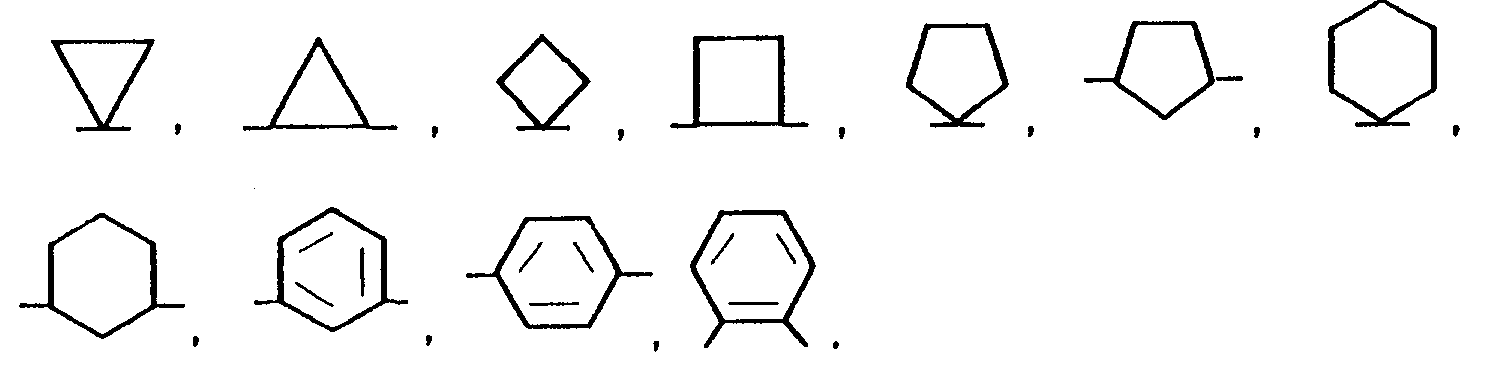
and more preferably those shown by the formula:
and most preferably those shown by the formula:
- The term "3- to 7-membered heterocyclic ring" as used in this specification means, for example, a 3- to 7-membered heterocyclic ring having, other than a carbon atom, one to four hetero atoms selected from e.g. a nitrogen, oxygen, sulfur and other atoms. Typical examples of the 3- to 7-membered heterocyclic ring include oxetane, tetrahydrofuran, tetrahydropyran, pyrrole, azetidine, pyrrolidine, piperidine, piperazine, tetrahydrothiophene, homopiperidine, morpholine and the like.
- The divalent group derived from the "3- to 7-membered heterocyclic ring" stands for a divalent group obtainable by removing two hydrogen atoms which bond to one carbon atom in said 3- to 7- membered heterocyclic ring or respectively removing one hydrogen atom which bonds to each of two different carbon atoms in said heterocyclic ring. To be specific, the following groups can be included by way of example:

- The term "nitrogen-containing heterocyclic group" as used in this specification represents, for example, a group obtainable by removing one hydrogen atom which bonds to a nitrogen atom on a ring such as a 3- to 13-membered nitrogen-containing heterocyclic ring having one nitrogen atom, which may further have one to three hetero atoms selected from nitrogen, oxygen, sulfur and other atoms. Typically, the nitrogen-containing heterocyclic group includes, for example, a 3- to 9-membered nitrogen-containing heterocyclic group of the formulae:

- The substituents for the "3- to 7-membered homocyclic ring", "3- to 7-membered heterocyclic ring" and "nitrogen-containing heterocyclic group" are exemplified with (1) an optionally substituted lower alkyl group, (2) an optionally substituted amino group, (3) a hydroxyl group, (4) a carboxyl group, (5) a nitro group, (6) a lower alkoxy group (e.g. a C₁₋₆ alkoxy group such as methoxy, ethoxy and propoxy) and (7) a halogen atom (e.g. fluorine, chlorine, bromine or iodine atom). The number of these substituents is about one to five.
- Examples of the substituents for the (1) lower alkyl group (for instance, a C₁₋₆ alkyl group such as methyl, ethyl and n-propyl) include a hydroxyl group, an amino group, a mono- or di-lower alkylamino group (e.g. a mono- or di-C₁₋₆ alkylamino group such as methylamino, ethylamino, propylamino, dimethylamino and diethylamino), a lower alkoxy group (for example, a C₁₋₆ alkoxy group such as methoxy, ethoxy, propoxy and hexyloxy), a lower acyloxy group (e.g. a C₁₋₆ alkyl-carbonyloxy group such as acetyloxy and propyloxy) and a halogen atom (e.g. fluorine, chlorine, bromine or iodine atom). The number of the substituents is, e.g., about one to four. As the substituents for the (2) amino group, there may be mentioned, for instance, a C₁₋₆ alkyl group such as methyl, ethyl, propyl group, etc., an acyl group (e.g. a C₁₋₆ acyl group such as formyl, acetyl, propionyl and butyryl) and others. The number of the substituents is about one or two. When the amino group has two substituents, the substituents may form, taken together, a 5- to 7-membered cyclic amino group (for instance, pyrrolidino, morpholino, piperidino, 1-piperazinyl, etc.) or the like.
- In the compound shown by the formula (I), R¹ represents a hydrogen atom, an optionally substituted lower alkyl group or a halogen atom. Preferable example of R¹ include a halogen atom and a C₁₋₃ alkyl group such as methyl, ethyl, n-propyl, i-propyl group, etc. The compound wherein R¹ is a hydrogen atom has an specifically improved activity.
- R² and R³ independently represent a hydrogen atom or an optionally substituted lower alkyl group, or R² and R³ together with the adjacent -C=C- to which they bond may form a 5- to 7-membered ring. Preferably, R² is a hydrogen atom, a C₁₋₃ alkyl group such as methyl, ethyl, n-propyl and i-propyl. A C₁₋₃ alkyl group can advantageously be employed as R² for a higher activity. Preferable examples of R³ include a hydrogen atom and a C₁₋₃ alkyl group such as methyl, ethyl, n-propyl and i-propyl. Specifically preferred as R³ is a hydrogen atom for a higher activity. Further, the case wherein R² and R³, taken together with the adjacent -C=C-, form a 5- to 7-membered cyclic hydrocarbon is preferable, and to be specific, the case they form cyclohexene, benzene or the like is more preferable.
- X represents an oxygen atom, a sulfur atom or a methylene group. Preferably, X is an oxygen atom or a sulfur atom, especially an oxygen atom.
- Y represents (a) a group shown by the formula:

wherein R⁴ and R⁵ independently represent a hydrogen atom or an optionally substituted lower alkyl group, or (b) a divalent group derived from an optionally substituted 3- to 7-membered homo- or heterocyclic group. Practically preferred examples of Y include such groups as shown by the following formula:
wherein R4a and R5a independently represent a hydrogen atom or an optionally substituted C₁₋₃ alkyl group. - The "C₁₋₃ alkyl group" represented by R4a and R5a includes, for instance, methyl, ethyl, n-propyl, i-propyl, etc. Examples of the "substituents" for said "C₁₋₃ alkyl group" include those used for the "lower alkyl group" as mentioned above. Preferably, R4a and R5a are independently a hydrogen atom or a C₁₋₃ alkyl group such as methyl, ethyl, n-propyl, etc. Specifically preferred examples of R4a and R5a include a C₁₋₃ alkyl group (e.g. methyl, ethyl, n-propyl, i-propyl, etc.).
- Further, the compound where Y is a divalent group derived from an optionally substituted 3- to 7-membered homo- or heterocyclic ring is also preferable, and such divalent group include, for example;

and more preferably,
- As preferable examples of the divalent group shown by Y derived from an optionally substituted 3- to 7-membered homo- or heterocyclic group, there may be mentioned:

- R⁶ and R⁷ independently represent a hydrogen atom, an optionally substituted lower alkyl group, an optionally substituted cycloalkyl group or an optionally substituted aryl group, or R⁶ and R⁷ together with the adjacent nitrogen atom to which they bond may form an optionally substituted nitrogen-containing heterocyclic group. Typical examples of R⁶ and R⁷ include a hydrogen atom, a C₁₋₃ alkyl such as methyl, ethyl, n-propyl, etc. Specifically preferred is a hydrogen atom for a higher activity.
- m denotes an integer of 0 to 4. Preferably m is an integer of 1 to 4, more preferably an integer of 1 to 3, and specifically preferred is 1. n denotes an integer of 0 to 4, and preferably an integer of 1 to 4. The compounds having a higher activity include, among others, compounds wherein m is an integer of 1 and n is an integer of 1 to 4.
- Preferable examples of the compounds include compounds where R¹, R² and R³ independently represent a hydrogen atom or a C₁₋₃ alkyl group (e.g. methyl, ethyl, n-propyl, i-propyl); Y is (a) a group shown by the formula:

wherein R4a and R5a independently represent a hydrogen atom or an optionally substituted C₁₋₃ alkyl group (e.g. methyl, ethyl, n-propyl, i-propyl), or (b):
- R⁶ and R⁷ are independently a hydrogen atom or a C₁₋₃ alkyl group (e.g. methyl, ethyl, n-propyl, i-propyl); X is an oxygen atom; m denotes an integer of 1 to 3; and n denotes an integer of 1 to 4.
- Typically preferred examples of the compounds include the compounds wherein R¹ is a hydrogen atom; R² and R³ are independently a hydrogen atom or a C₁₋₃ alkyl group (e.g. methyl, ethyl, n-propyl, i-propyl); Y is a group shown by the formula:

wherein R4b and R5b independently represent a C₁₋₃ alkyl group (e.g. methyl, ethyl, n-propyl, i-propyl); R⁶ and R⁷ are each a hydrogen atom; X is an oxygen atom; m is an integer of 1; and n is an integer of 1 to 4. - As salts of the compound of the formula (I) of this invention, physiologically acceptable acid addition salts are preferred. Examples of such salts include salts with inorganic acids (e.g. hydrochloric acid, phosphoric acid, hydrobromic acid, sulfuric acid, etc.), and salts with organic acids (for instance, acetic acid, formic acid, propionic acid, fumaric acid, maleic acid, succinic acid, tartaric acid, citric acid, malic acid, oxalic acid, benzoic acid, methanesulfonic acid, benzenesulfonic acid, etc.).
- Further, where the compound of the formula (I) of the invention has an acidic group such as -COOH, the compound of the formula (I) may form a salt with an inorganic base (e.g. an alkali metal such as sodium, potassium, etc.; an alkaline earth metal such as calcium, magnesium, etc.; and ammonia) or with an organic base (e.g. a tri-C₁₋₃ alkylamine such as trimethylamine, triethylamine and the like), and these salts are involved in the subjects of the present invention.
- In the following, the method of producing the compound of the formula (I) or a salt thereof of the present invention is described.
- The compound (I) or a salt thereof can be obtained, for example, by (A) reacting a compound shown by the general formula (II):

wherein Z¹, R¹, R² and R³ are as defined above, or a salt thereof, with a compound shown by the general formula (III):
wherein Z², X, Y, R⁶, R⁷, m and n are as defined above, or a salt thereof. - As the reactive group represented by Z¹, there may be mentioned, for instance, a halogen atom (e.g. chlorine, bromine or iodine atom), a C₆₋₁₀ arylsulfonyloxy group (for example, benzenesulfonyloxy, p-tolylsulfonyloxy, etc.), a C₁₋₄ alkylsulfonyloxy group (e.g. methanesulfonyloxy) and so on.
- The group shown by Z² which can be left on reacting with Z¹ includes, for example, a hydrogen atom, an alkali metal (e.g. sodium, potassium, etc.) and others.
- The amount of the compound shown by the formula (III) or a salt thereof per mole of the compound shown by the formula (II) or a salt thereof as used in said reaction is, usually about 1 to 5 moles and preferably about 1 to 2 moles.
- The condensation reaction can be advantageously conducted in the presence of a base. Examples of the base include an alkali metal hydride such as sodium hydride or potassium hydride, an alkali metal alkoxide such as sodium methoxide or sodium ethoxide, an alkali metal hydroxide such as sodium hydroxide or potassium hydroxide, a carbonate such as sodium carbonate or potassium carbonate, a hydrogencarbonate such as sodium hydrogencarbonate or potassium hydrogencarbonate.
- This reaction can be carried out in an inert solvent including, for instance, alcohols such as methanol and ethanol, ethers such as dioxane and tetrahydrofuran, aromatic hydrocarbons such as benzene, toluene and xylene, nitriles such as acetonitrile, amides such as dimethylformamide and dimethylacetamide, sulfoxides such as dimethylsulfoxide, and others.
- The reaction temperature is usually about 10 to 200°C and preferably about 50 to 100°C. The reaction may be conducted for, usually, 30 minutes to 48 hours and preferably 1 to 24 hours.
- The compound shown by the formula (I) or a salt thereof where X in the side chain is a methylene group can be obtained by reacting the compound shown by the formula (II) or a salt thereof with the compound shown by the formula (III) wherein the group represented by Z² is a halogenometalo group.
- Practical examples of the group represented by Z¹ include a halogen atom (e.g. chlorine, bromine or iodine atom), a C₆₋₁₀ arylsulfonyloxy group (for example, benzenesulfonyloxy or p-tolylsulfonyloxy), a C₁₋₄ alkylsulfonyloxy group (for instance, methanesulfonyloxy) and the like.
- As the halogen in the halogenometalo group represented by Z², there may be mentioned, for example, chlorine, bromine or iodine, and chlorine can advantageously be employed. The metal in the halogenometalo group includes, for example, zinc, magnesium, etc. and to be specific, zinc is preferable to be example.
- This reaction can be preferably conducted by condensation in the presence of a palladium-catalyst. The palladium-catalyst means a catalyst which can be employed in the palladium-catalyst-crosscoupling reactions [such reactions are disclosed in Accounts of Chemical Research, 12, 146-151 (1979); ibid., 15, 340-348 (1982); Angew. Chem. Int. Ed. Engl., 25, 508-524 (1986), etc.], and is exemplified with a palladium-tertiary phosphine complex, a combination of a palladium salt or a palladium complex and a tertiary phosphine, and the like.
- The palladium-tertiary phosphine complex means a complex formed with zero or divalent palladium and a tertiary phosphine such as a trialkylphosphine or a triarylphosphine. As examples of the palladium-tertiary phosphine complex, there may be mentioned tetrakis(triphenylphosphine)palladium, bis(triphenylphosphine)palladium bromide, bis(triphenylphosphine)palladium chloride, acetoxybis(triphenylphosphine)palladium, benzylchlorobis(triphenylphosphine)palladium, tetrakis(tributylphosphine)palladium, bis(trimethylphosphine)palladium chloride, bis(triethylphosphine)palladium chloride, bis(tripropylphosphine)palladium chloride, bis(tributylphosphine)palladium chloride, and so on.
- Preferable examples of the palladium-tertiary phosphine complex include, for instance, tetrakis(triphenylphosphine)palladium, bis(triphenylphosphine)palladium bromide, bis(triphenylphosphine)palladium chloride and acetoxybis(triphenylphosphine)palladium.
- The palladium salt signifies a salt formed with a divalent palladium ion and an acid residue and includes, for instance, palladium chloride, palladium bromide, palladium acetate, palladium nitrate, palladium sulfate and others. Typically preferred palladium salt are exemplified with palladium chloride, palladium bromide and palladium acetate.
- As the palladium complex, other zero or divalent palladium complex than the palladium-tertiary phosphine complex as above can also be employed. As such palladium complex, there may be mentioned, for example, bis(phenylethylamine)palladium chloride, bis(benzonitrile)palladium chloride, bis(benzonitrile)palladium bromide or bis(acetonitrile)palladium chloride. Among them, for instance, bis(benzonitrile)palladium chloride and bis(acetonitrile)palladium chloride can advantageously be used.
- Examples of the tertiary phosphine include a triarylphosphine such as triphenylphosphine, a trialkylphosphine such as tributylphosphine, tripropylphosphine, triethylphosphine, trimethylphosphine, etc. A triarylphosphine such as triphenylphosphine can preferably be employed as the tertiary phosphine.
- The reaction can preferably be carried out in the presence of a solvent. The solvent includes, for example, aromatic hydrocarbons such as benzene, toluene or xylene; ethers such as diethyl ether, tetrahydrofuran or dioxane; amides such as dimethylformamide or dimethylacetamide; sulfoxides such as dimethylsulfoxide; and nitriles such as acetonitrile.
- The reaction may be conducted at a temperature of usually about 0 to 200°C and preferably about 10 to 100°C. The reaction time is, generally, about 30 minutes to 24 hours and preferably about 1 to 3 hours. This reaction can advantageously be carried out in a stream of an inert gas such as nitrogen or argon.
- The product can be isolated and purified by a conventional manner such as solvent extraction, phasic transfer or change of acidity or basicity, elution, solvent transfer or redistribution, salting out, crystallization, recrystallization, chromatography and the like.
- The compound shown by the general formula (I) or a salt thereof can also be produced by (B) reacting a compound of the general formula (IV):

wherein Z², R¹, R², R³ and X are of the same meaning as defined above, or a salt thereof, with a compound shown by the general formula (V):
wherein Z¹, Y, R⁶, R⁷, m and n are as defined above, or a salt thereof. - In the reaction, the compound of the formula (V) or a salt thereof is used, per mole of the compound of the formula (IV) or a salt thereof, in a proportion of usually about 1 to 5 moles and preferably about 1 to 2 moles.
- The condensation reaction can advantageously be conducted, usually, in the presence of a base. As the base, there may be mentioned, for instance, an alkali metal hydride such as sodium hydride or potassium hydride, an alkali metal alkoxide such as sodium methoxide or sodium ethoxide, an alkali metal hydroxide such as sodium hydroxide or potassium hydroxide, a carbonate compound such as sodium carbonate or potassium carbonate, a hydrogencarbonate compound such as sodium hydrogencarbonate or potassium hydrogencarbonate, and the like.
- This reaction may be carried out in an inert solvent including, for example, alcohols such as methanol and ethanol; ethers such as dioxane and tetrahydrofuran; aromatic hydrocarbons such as benzene, toluene and xylene; nitriles such as acetonitrile; amides such as dimethylformamide and dimethylacetamide; sulfoxides such as dimethylsulfoxide.
- The reaction temperature is generally about 10 to 200°C and preferably about 50 to 150°C, and the reaction can be conducted for, usually, 30 minutes to 24 hours and preferably 1 to 10 hours.
- Further, the compound shown by the formula (I) or a salt thereof may also be obtained by (C) reacting a compound shown by the general formula (VI):

wherein W, R¹, R², R³, X, Y, m and n are as defined above, or a salt thereof, with a compound shown by the general formula (VII):
wherein R⁶ and R⁷ are of the same meanings as defined above, or a salt thereof. - Examples of the leaving group represented by W include a halogen atom (e.g. chlorine, bromine or iodine atom), a C₆₋₁₀ arylsulfonyloxy group (for instance, benzenesulfonyloxy or p-tolylsulfonyloxy), a C₁₋₄ alkylsulfonyloxy group (e.g. methanesulfonyloxy, etc.) and others. A halogen atom (e.g. chlorine, bromine or iodine atom) is preferred among others.
- The amount of the compound of the formula (VII) or a salt thereof used in the reaction is, usually, about 1 to 5 moles and preferably about 1 to 2 moles per mole of the compound of the formula (VI) or a salt thereof.
- This reaction may frequently be carried out in an inert solvent such as, for example, alcohols including methanol and ethanol; ethers including dioxane and tetrahydrofuran; aromatic hydrocarbons including benzene, toluene and xylene; nitriles including acetonitrile; amides including dimethylformamide and dimethylacetamide; sulfoxides including dimethylsulfoxide.
- The reaction can be conducted at a temperature of, generally, about -20°C to 100°C and preferably about -10°C to 50°C, for usually about 30 minutes to 5 hours and preferably about 1 to 3 hours.
- Where the resulting compound of the formula (I) thus obtained above is in a free form, it may be led to a salt thereof by a conventional means or those analogous thereto. Conversely, when the compound is obtained in the form of a salt, it may be led to the free compound or any other salt by a conventional method.
- The compound of the formula (I) or its salt can be isolated and purified by a conventional technique such as solvent extraction, phasic transfer or change of acidity or basicity, elution, solvent transfer or redistribution, salting out, crystallization, recrystallization, or other techniques. Where the compound of the formula (I) or its salt is an optically active compound, it may be isolated to d-form and l-form by a conventional means for optical resolution.
- The methods of producing the starting compounds shown by the formulae (II), (III), (IV), (V), (VI) and (VII) or salts thereof as used in the production of the compound of the formula (I) or a salt thereof are mentioned hereinbelow.
- As examples of the salts of these compounds, there may be mentioned salts with inorganic acids (e.g. hydrochloric acid, phosphoric acid, hydrobromic acid, sulfuric acid, etc.), and salts with organic acids (for instance, acetic acid, formic acid, propionic acid, fumaric acid, maleic acid, succinic acid, tartaric acid, citric acid, malic acid, oxalic acid, benzoic acid, methanesulfonic acid, benzenesulfonic acid, etc.).
- Further, when the compounds have an acidic group such as -COOH, these compounds may form a salt with an inorganic base (e.g. an alkali metal such as sodium, potassium, etc.; an alkaline earth metal such as calcium, magnesium, etc.; and ammonia) or with an organic base (e.g. a tri-C₁₋₃ alkylamine such as trimethylamine, triethylamine and the like).
- The starting compounds of the formula (II) or its salt can be prepared, for instance, by the method stated in Chem. Pharm. Bull., 5, 229 (1957), or those analogous thereto.
- The starting compounds of the formulae (III) and (V) or their salt can be prepared, for example, by the methods disclosed in e.g. Chem. Ber., 91, 2130 (1958); J. Org. Chem., 52, 2162 (1987); Japanese Patent Application Laid-open No. 223287/1991, or analogous ones thereto.
- The compound of the formula (IV) or a salt thereof may be prepared by, for instance, the method disclosed in Japanese Patent Application Laid-open No. 223287/1991 or those analogous thereto.
- The starting compound (VI) or its salt can be prepared by, for example, the following methods (a) or (b);
- (a) the method reacting the compound of the formula (II) or a salt thereof with a compound of the following formula:
Z²-X-(CH₂)m-Y-(CH₂)n-SO₂W (VIII)
wherein Z², X, Y, W, m and n are as defined above, - (b) the method reacting the compound of the formula (IV) or a salt thereof with a compound shown by the following formula:
Z¹-(CH₂)m-Y-(CH₂)n-SO₂W (IX)
wherein Z¹, Y, W, m and n are of the same meanings as defined above. - In the reaction (a), the using amount of the compound of the formula (VIII) is usually about 1 to 5 moles and preferably about 1 to 2 moles, per mole of the compound of the formula (II) or its salt. The reaction can be carried out under the conditions similar to those in the reaction of the compound of the formula (II) or its salt with the compound of the formula (III) or its salt as mentioned above.
- The compound of the formula (IX) is used in a proportion of, per mole of the compound (IV) or its salt, usually about 1 to 5 moles and preferably about 1 to 2 moles in the reaction (b). The reaction can be carried out in the manner similar to those in the reaction of the compound of the formula (IV) or a salt thereof with the compound of the formula (V) or a salt thereof.
- The starting compound of the formula (VII) or a salt thereof, and the starting compounds of the formulae (VIII) and (IX) can be produced by a conventionally known method or analogous ones thereto.
- These starting compounds or their salts can be isolated and purified by a conventional manner such as solvent extraction, phasic transfer, change of acidity or basicity, elution, solvent transfer, redistribution, salting out, crystallization or recrystallization, or they may be fed to the subsequent process as the material in the state of mixture without isolation.
- In each reaction of the invention and the production of the starting compounds, when the starting compound has, as substituent(s), an amino group, a carboxyl group or a hydroxyl group, these groups may be protected with such protecting groups as generally used in peptide chemistry, and the object compound may be obtained by, if necessary, removing these protecting groups after the reaction.
- As examples of the protecting groups for amino group, there may be mentioned a formyl group, a C₁₋₆ alkyl-carbonyl group (e.g. acetyl, propionyl, etc.), a benzoyl group, a C₁₋₆ alkyl-oxycarbonyl group (e.g. methoxycarbonyl, ethoxycarbonyl, etc.), a phenoxycarbonyl group, a C₇₋₁₀ aralkyl-carbonyl group (for instance, benzylcarbonyl, etc.), a trityl group, a phthaloyl group, an N,N-dimethylaminomethylene group, an N,N-diethylaminomethylene group and so on which may be substituted. Examples of the substituents which these protecting groups may have include a halogen atom (e.g. fluorine, chlorine, bromine or iodine atom), a C₁₋₆ alkyl-carbonyl group (e.g. acetyl, propionyl, butyryl, etc.), a nitro group and the like. The number of these substituents is from about 1 to 3.
- The protecting group for carboxyl group include, for example, a C₁₋₆ alkyl group (e.g. methyl, ethyl, n-propyl, i-propyl, n-butyl, tert-butyl, etc.), a phenyl group, a trityl group, a silyl group and so on which may optionally be substituted. As examples of the substituents for these protecting groups, there may be mentioned a halogen atom (e.g. fluorine, chlorine, bromine or iodine atom), a formyl group, a C₁₋₆ alkyl-carbonyl group (e.g. acetyl, propionyl, butyryl, etc.), a nitro group and so on. The number of these substituents is from about 1 to 3.
- Examples of the protecting group of hydroxyl group include a C₁₋₆ alkyl group (for example, methyl, ethyl, n-propyl, i-propyl, n-butyl, tert-butyl, etc.), a phenyl group, a C₇₋₁₀ aralkyl group (e.g. benzyl, etc.), a formyl group, a C₁₋₆ alkyl-carbonyl group (e.g. acetyl, propionyl, etc.), a phenoxycarbonyl group, a benzoyl group, a C₇₋₁₀ aralkyl-carbonyl group (e.g. benzylcarbonyl, etc.), a pyranyl group, a furanyl group, a silyl group and others which may be substituted. Examples of the substituents for these protecting groups include a halogen atom (e.g. fluorine, chlorine, bromine or iodine atom), a C₁₋₆ alkyl group (for instance, methyl, ethyl, n-propyl, etc.), a phenyl group, a C₇₋₁₀ aralkyl group (e.g. benzyl, etc.), a nitro group and the like. The number of these substituents varies from about 1 to 4.
- As the means of removing these protecting group, conventionally known means or those analogous thereto are employed. Examples of such means include those which comprise processing with an acid, a base, reduction, ultraviolet-ray radiation, or treating with hydrazine, phenylhydrazine, sodium N-methyldithiocarbamate, tetrabutylammonium fluoride, palladium acetate, or the like.
- The compound of the formula (I) or a salt thereof has excellent antiallergic, antiinflammatory and anti-PAF (platelet activating factor) activities, and has a lower toxicity (the acute toxicity: LD₅₀ is more than 1 g/kg), thus is useful as a safely administrable agent as an antiasthmatic agent and/or an anti-PAF agent to mammals such as human being, mouse, dog, rat, cattle or others.
- Although the compound of the general formula (I) or its salt of the present invention may be administered as such in the form of bulk powder, it is a common practice to administer it in the form of a pharmaceutical preparation along with pharmaceutically acceptable carriers.
- Such pharmaceutical preparations include, for example, tablets, capsules, granules, fine granules, powders, syrups, injections and inhalations. These pharmaceutical preparations may be prepared by conventionally known methods. Examples of the carriers of the pharmaceutical preparations for oral administration include various substances generally used in pharmaceutical preparations for oral administration such as binders, excipients, disintegrators and the like. These carriers include, for instance, starch, mannitol, crystalline cellulose, sodium carboxymethylcellulose and others. As the carriers for injections, there may be mentioned, for example, distilled water, physiological saline solution, glucose solution, infusion agent and so on. Other additives commonly used in the pharmaceutical preparations can be suitably added to the above mentioned pharmaceutical preparations.
- While depending on the age, body weight, type and symptom of diseases to be treated, route of administration or administration time, the dose of these pharmaceutical preparations to adult humans per day is, for instance, usually about 0.1 to 100 mg/kg, preferably about 1 to 50 mg/kg and more preferably about 1 to 10 mg/kg. The administration may advantageously be carried out once a day or in a plurality of installments per day. These pharmaceutical preparation can be administered orally or non-orally.
- By the following examples, preparation examples and experimental examples, the present invention will be illustrated in more concrete manner, but they should by no means be construed as defining the metes and bounds of this invention.
- In the examples, elution in the procedure of column chromatography was carried out under observation by means of TLC (Thin Layer Chromatography) unless otherwise specified. In the TLC observation, 60F₂₅₄ manufactured by Merck as the TLC plate, and a UV detector was employed for detection. The term "ambient temperature" or "room temperature" generally means temperatures ranging from about 15 to 20°C.
- To a solution of 1.38 g of 3-(N,N-dimethylamino-methylene)aminosulfonyl-2,2-diethyl-1-propanol in 30 ml of tetrahydrofuran, was added 0.23 g of 60% oily sodium hydride, and the mixture was stirred at room temperature for one hour. To the reaction mixture was added 0.74 g of 6-chloro-8-methyl-[1,2,4]triazolo[4,3-b]pyridazine, and the mixture was heated under reflux at 80°C for 40 hours. The reaction mixture was added with 50 ml of ice-water, and subsequently, 15 ml of 1 N hydrochloric acid, and the resulting mixture was refluxed for one hour.
- The reaction mixture was neutralized with 2 N aqueous solution of sodium hydroxide, and extracted with a mixture of ethyl acetate-tetrahydrofuran (2:1). The extract was washed with a saturated sodium chloride solution, dried over anhydrous magnesium sulfate, and was distilled under reduced pressure to remove the solvent. The residue was subjected to a column chromatography with the use of 100 g of silica gel, eluting with methanol-chloroform (1:10) to give 0.88 g of the title compound.
m.p. 209 to 210°CElemental analysis for C₁₃H₂₁N₅O₃S: Calculated (%): C, 47.69; H, 6.46; N, 21.39 Found (%): C, 47.61; H, 6.67; N, 21.25 - 3-(N,N-dimethylaminomethylene)aminosulfonyl-2,2-diethyl-1-propanol (0.5 g) was dissolved in 20 ml of tetrahydrofuran, to which 0.09 g of 60% oily sodium hydride, and the mixture was stirred for 1 hour at room temperature. To the reaction mixture was added 0.3 g of 6-chloro-7-methyl-[1,2,4]triazolo[4,3-b]pyridazine, and the mixture was heated and refluxed at 80°C for 40 hours.
- The reaction mixture was added with water and extracted with ethyl acetate. The extract was washed with water, dried over anhydrous magnesium sulfate, and distilled under reduced pressure to remove the solvent. The residue was subjected to a column chromatography using 80 g of silica gel, eluting with methanol-chloroform (1:20) to give 0.24 g of 6-[2,2-diethyl-3-(N,N-dimethylaminomethylene)aminosulfonyl-1-propoxy]-7-methyl-[1,2,4]triazolo[4,3-b]pyridazine.
- The compound thus obtained was added to 7 ml of 6 N hydrochloric acid and the mixture was stirred at 100°C for half an hour. The reaction mixture was neutralized with 2 N aqueous solution of sodium hydroxide and extracted with a mixture of ethyl acetate-tetrahydrofuran (2:1). The extract was washed with a saturated sodium chloride solution, dried over anhydrous magnesium sulfate, and the solvent was distilled off under reduced pressure. The residue was subjected to a column chromatography with the use of 60 g of silica gel, eluting methanol-chloroform (1:10) to give 0.11 g of the title compound.
m.p.: 202 to 203°CElemental analysis for C₁₃H₂₁N₅O₃S Calculated (%): C, 47.69; H, 6.46; N, 21.39 Found (%): C, 47.40; H, 6.54; N, 21.12 -
- The procedures of Example 1 were repeated by using 3-(N,N-diethylaminomethylene)aminosulfonyl-2,2-diethyl-1-propanol and 6-chloro-[1,2,4]triazolo[4,3-b]pyridazine to give the title compound.
m.p.: 242 to 243°CElemental analysis for C₁₂H₁₉N₅O₃S Calculated (%): C, 45.99; H, 6.11; N, 22.35 Found (%): C, 45.84; H, 6.24; N, 22.34 - The title compound was obtained in the same manner as in Example 1 by using 3-(N,N-dimethylaminomethylene)aminosulfonyl-2,2-dimethyl-1-propanol and 6-chloro-7-methyl-[1,2,4]triazolo[4,3-b]pyridazine.
m.p.: 259 to 260°CElemental analysis for C₁₁H₁₇N₅O₃S Calculated (%): C, 44.14; H, 5.72; N, 23.39 Found (%): C, 44.17; H, 5.83; N, 22.88 - The procedures of Example 1 were repeated except that 3-(N,N-dimethylaminomethylene)aminosulfonyl-2,2-dimethyl-1-propanol and 6-chloro-[1,2,4]triazolo[4,3-b]pyridazine were employed to give the title compound.
m.p.: 199 to 200°CElemental analysis for C₁₀H₁₅N₅O₃S Calculated (%): C, 42.10; H, 5.30; N, 24.55 Found (%): C, 42.13; H, 5.50; N, 24.62 - The title compound was obtained in the same manner as in Example 1 by using 4-(N,N-dimethylaminomethylene)aminosulfonyl-2,2-pentamethylene-1-butanol and 6-chloro-[1,2,4]triazolo[4,3-b]pyridazine.
m.p.: 201 to 203°CElemental analysis for C₁₄H₂₁N₅O₃S Calculated (%): C, 49.54; H, 6.24; N, 20.63 Found (%): C, 49.46; H, 6.44; N, 20.22 -
(1) Compound of Example 1 10.0 mg (2) Lactose 60.0 mg (3) Corn starch 35.0 mg (4) Gelatin 3.0 mg (5) Magnesium stearate 2.0 mg - Using 0.03 ml of a 10% aqueous solution of gelatin (3.0 mg as gelatin), a mixture of 10.0 mg of the compound of Example 1, 60.0 mg of lactose and 35.0 mg of corn starch was granulated by passage through a 1 mm-mesh sieve to obtain granules. The granules were dried at 40°C and screened again. The resulting granules were mixed with 2.0 mg of magnesium stearate, and the mixture were compressed. The resulting core tablets were sugar-coated with an aqueous suspension containing sucrose, titanium dioxide, talc and gum arabic. The resulting tablets were glazed with beeswax to give a coated tablet.
-
(1) Compound of Example 1 10.0 mg (2) Lactose 70.0 mg (3) Corn starch 50.0 mg (4) Soluble starch 7.0 mg (5) Magnesium stearate 3.0 mg - A mixture of the compound of Example 1 (10.0 mg) and magnesium stearate (3.0 mg) was granulated using an aqueous solution of 0.07 ml of soluble starch (7.0 mg as soluble starch) to give granules. The granules were dried and blended with 70.0 mg of lactose and 50.0 mg of corn starch. The blend was compressed into a tablet.
-
(1) Compound of Example 1 5.0 mg (2) Sodium chloride 20.0 mg (3) Distilled water added to 2.0 ml - Compound of Example 1 (5.0 mg) and sodium chloride (20.0 mg) were dissolved in distilled water, to which distilled water was added up to the total volume of 2.0 ml. The resulting solution was filtered and filled into a 2 ml-ampule under a sterile condition. The ampule was sterilized and sealed to give an injection solution.
- Male Hartley guinea pigs (body weights about 500 g) were used. The bronchoconstriction reaction in the guinea pig which has intravenously been administered with PAF (1 µg/kg) was measured by the Konzett-Roessler method.
- The trachea of the guinea pig with its back fixed was incised under anesthesia condition with urethane (intravenous injection, 1.5 g/kg) and connected with an artificial respirator via a cannula. The branch of the tracheal cannula was connected with a transducer (7020 type, manufactured by Ugobasile). Air was sent to the trachea at the rate of 3 to 7 ml per stroke, 70 strokes/min. and at load pressure of 10 cm H₂O to lung, and overflowed air volume was recorded with Rectegraph (Recte-Hori-8s, Sanei Sokuki Co., Ltd., Japan) via transducer. After the guinea Pig was treated with gallamine (intravenous injection, 1 mg/kg), 1 µg/kg of PAF dissolved in a physiological saline solution was administered to the guinea pig via jugular venous cannula and the bronchoconstriction reaction induced thereby was recorded for 15 minutes. The drug (3 mg/kg and 10 mg/kg respectively) suspended in a 5% gum arabic solution was administered orally 1 hour before the injection of PAF. The results are shown in Table 1.
Table 1 Example No. Inhibition (%) of PAF-induced bronchoconstriction Amount of oral 3 mg/kg administration 10 mg/kg 1 85.8 100 2 - - 3 51.1 61.2 4 - - 5 22.4 41.2 6 - - - As clearly shown in the above Table 1, the compound shown by the formula (I) or its salt of the present invention has an excellent anti-PAF (platelet activating factor) action.
Claims (34)
- A compound shown by the general formula:


- A compound as claimed in claim 1, wherein the optionally substituted lower alkyl group is a C₁₋₆ alkyl group which may have one to four substituents selected from the group consisting of a hydroxyl group, an amino group, a carboxyl group, a nitro group, a mono- or di-C₁₋₆ alkylamino group, a C₁₋₆ alkoxy group, a C₁₋₆ alkyl-carbonyloxy group and a halogen atom.
- A compound as claimed in claim 1, wherein the 5- to 7-membered ring is a C₅₋₇ cycloalkene, a benzene, a pyrrole or a pyridine.
- A compound as claimed in claim 1, wherein the divalent group derived from a 3- to 7-membered homocyclic ring is a group shown by the formula:

- A compound as claimed in claim 1, wherein the divalent group derived from a 3- to 7-membered heterocyclic group is a group shown by the formula:

- A compound as claimed in claim 1, wherein the optionally substituted cycloalkyl group is a C₃₋₆ cycloalkyl group which may be substituted with one to four substituents selected from the group consisting of a hydroxyl group, an amino group, a carboxyl group, a nitro group, a mono- or di-C₁₋₆ alkylamino group, a C₁₋₆ alkoxy group, a C₁₋₆ alkyl-carbonyloxy group and a halogen atom.
- A compound as claimed in claim 1, wherein the optionally substituted aryl group is a C₆₋₁₄ aryl group which may be substituted with one to five substituents selected from the group consisting of an optionally substituted C₁₋₆ alkyl group, an optionally substituted amino group, an acetamido group, a hydroxyl group, a carboxyl group, a nitro group, a C₁₋₆ alkoxy group, a C₁₋₆ alkyl-carbonyloxy group and a halogen atom.
- A compound as claimed in claim 7, wherein the optionally substituted C₁₋₆ alkyl group is a C₁₋₆ alkyl group which may be substituted with one to four substituents selected from the group consisting of a hydroxyl group, an amino group, a mono- or di-C₁₋₆ alkylamino group, a C₁₋₆ alkoxy group and a halogen atom.
- A compound as claimed in claim 7, wherein the optionally substituted amino group is (1) an amino group which may be substituted with one or two C₁₋₆ alkyl groups, or (2) a 5- to 7-membered cyclic amino group.
- A compound as claimed in claim 9, wherein the 5- to 7-membered cyclic amino group is a pyrrolidino, a morpholino, a piperidino or a 1-piperazinyl.
- A compound as claimed in claim 1, wherein the nitrogen-containing heterocyclic group is a group shown by the formula:

- A compound as claimed in claim 1, wherein the 3- to 7-membered homo- or heterocyclic ring or the nitrogen containing heterocyclic ring may be substituted with one to five members selected from the group consisting of an optionally substituted C₁₋₆ alkyl group, an optionally substituted amino group, a hydroxyl group, a carboxyl group, a nitro group, a C₁₋₆ alkoxy group and a halogen atom.
- A compound as claimed in claim 12, wherein the optionally substituted C₁₋₆ alkyl group is a C₁₋₆ alkyl group which may be substituted with one to four substituents selected from the group consisting of a hydroxyl group, an amino group, a mono- or di-C₁₋₆ alkylamino group, a C₁₋₆ alkoxy group, a C₁₋₆ alkyl-carbonyloxy group and a halogen atom.
- A compound as claimed in claim 12, wherein the optionally substituted amino group is (1) an amino group which may be substituted with one or two substituents selected from a C₁₋₆ alkyl group and a C₁₋₆ acyl group, or (2) a 5- to 7-membered cyclic amino group.
- A compound as claimed in claim 14, wherein the 5- to 7- membered cyclic amino group is a pyrrolidino, a morpholino, a piperidino or a 1-piperazinyl.
- A compound as claimed in claim 1, wherein R¹ represents a hydrogen atom or a C₁₋₃ alkyl group.
- A compound as claimed in claim 1, wherein R¹ represents a hydrogen atom.
- A compound as claimed in claim 1, wherein R² and R³ independently represent a hydrogen atom or a C₁₋₃ alkyl group, or R² and R³ together with the adjacent -C=C- may form a cyclohexene ring or a benzene ring.
- A compound as claimed in claim 1, wherein R² and R³ independently represent a hydrogen atom or a C₁₋₃ alkyl group.
- A compound as claimed in claim 1, wherein R⁶ and R⁷ independently represent a hydrogen atom or a C₁₋₃ alkyl group.
- A compound as claimed in claim 1, wherein X is an oxygen atom.
- A compound as claimed in claim 1, wherein m denotes an integer of 1 to 3 and n denotes an integer of 1 to 4.
- A compound as claimed in claim 1, wherein R¹, R² and R³ are independently a hydrogen atom or a C₁₋₃ alkyl group; Y is (a) a group shown by the formula:


- A compound as claimed in claim 1, wherein R¹ is a hydrogen atom; R² and R³ are independently a hydrogen atom or a C₁₋₃ alkyl group; Y is a group shown by the formula:

- A compound as claimed in claim 1, which is selected from the group consisting of(1) 6-(2,2-diethyl-3-sulfamoyl-1-propoxy)-8-methyl-[1,2,4]triazolo[4,3-b]pyridazine or a salt thereof,(2) 6-(2,2-diethyl-3-sulfamoyl-1-propoxy)[1,2,4]triazolo[4,3-b]pyridazine or a salt thereof, and(3) 6-(2,2-dimethyl-3-sulfamoyl-1-propoxy)[1,2,4]triazolo[4,3-b]pyridazine or a salt thereof.
- A compound shown by the general formula:


- A compound as claimed in claim 26, wherein the leaving group is a halogen, a C₆₋₁₀ arylsufonyloxy or a C₁₋₄ alkylsulfonyloxy.
- An antiasthmatic composition which comprises an effective amount of a compound of the general formula:


- An anti-platelet activating factor composition which comprises an effective amount of a compound shown by the general formula:


- A method of producing a compound of the general formula:


reacting a compound shown by the general formula: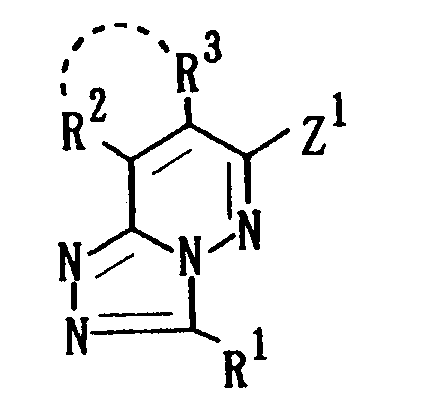

- A method of producing a compound of the general formula:


reacting a compound shown by the general formula:

- A method of producing a compound of the general formula:


reacting a compound shown by the general formula:

- Use of a compound of the general formula:


- Use of a compound of the general formula:


Applications Claiming Priority (2)
| Application Number | Priority Date | Filing Date | Title |
|---|---|---|---|
| JP11004293 | 1993-04-12 | ||
| JP110042/93 | 1993-04-12 |
Publications (2)
| Publication Number | Publication Date |
|---|---|
| EP0620224A1 true EP0620224A1 (en) | 1994-10-19 |
| EP0620224B1 EP0620224B1 (en) | 1998-07-15 |
Family
ID=14525644
Family Applications (1)
| Application Number | Title | Priority Date | Filing Date |
|---|---|---|---|
| EP94105542A Expired - Lifetime EP0620224B1 (en) | 1993-04-12 | 1994-04-11 | Triazolopyridazine derivatives, their production and use |
Country Status (5)
| Country | Link |
|---|---|
| US (1) | US5492909A (en) |
| EP (1) | EP0620224B1 (en) |
| AT (1) | ATE168376T1 (en) |
| CA (1) | CA2120997A1 (en) |
| DE (1) | DE69411616T2 (en) |
Cited By (9)
| Publication number | Priority date | Publication date | Assignee | Title |
|---|---|---|---|---|
| WO1999036423A1 (en) * | 1998-01-14 | 1999-07-22 | Merck Sharp & Dohme Limited | Triazolo-pyridazine derivatives as ligands for gaba receptors |
| WO2000026218A1 (en) * | 1998-10-29 | 2000-05-11 | Zambon Group S.P.A. | Tricyclic phthalazine derivatives as phosphodiesterase 4 inhibitors |
| US6248740B1 (en) | 1997-04-25 | 2001-06-19 | Takeda Chemical Industries, Ltd. | Condensed pyridazine derivatives, their production and use |
| US6610694B1 (en) | 1998-10-06 | 2003-08-26 | Takeda Chemical Industries, Ltd. | Condensed pyridazine compounds, their production and use |
| WO2011080510A1 (en) | 2009-12-31 | 2011-07-07 | Centro Nacional De Investigaciones Oncológicas (Cnio) | Tricyclic compounds for use as kinase inhibitors |
| WO2012098387A1 (en) | 2011-01-18 | 2012-07-26 | Centro Nacional De Investigaciones Oncológicas (Cnio) | 6, 7-ring-fused triazolo [4, 3 - b] pyridazine derivatives as pim inhibitors |
| WO2013005041A1 (en) | 2011-07-07 | 2013-01-10 | Centro Nacional De Investigaciones Oncológicas (Cnio) | Tricyclic heterocyclic compounds as kinase inhibitors |
| WO2013004984A1 (en) | 2011-07-07 | 2013-01-10 | Centro Nacional De Investigaciones Oncologicas (Cnio) | Tricyclic compounds for use as kinase inhibitors |
| WO2013005057A1 (en) | 2011-07-07 | 2013-01-10 | Centro Nacional De Investigaciones Oncológicas (Cnio) | New compounds |
Families Citing this family (2)
| Publication number | Priority date | Publication date | Assignee | Title |
|---|---|---|---|---|
| GB9507348D0 (en) * | 1995-04-08 | 1995-05-31 | Knoll Ag | Therapeutic agents |
| CN1329614A (en) | 1998-10-21 | 2002-01-02 | 武田药品工业株式会社 | Fused pyridazine derivatives, process for preparation of same and uses thereof |
Citations (8)
| Publication number | Priority date | Publication date | Assignee | Title |
|---|---|---|---|---|
| US3915968A (en) * | 1973-09-21 | 1975-10-28 | Lepetit Spa | Triazolopyridazines |
| US4136182A (en) * | 1976-05-26 | 1979-01-23 | The Dow Chemical Company | Triazolopyridazines used to alleviate bronchial spasms |
| EP0248413A1 (en) * | 1986-06-05 | 1987-12-09 | Merrell Dow Pharmaceuticals Inc. | 2,3-Dihydro-1-(8-methyl-1,2,4-triazolo/4,3-b/pyridazin-6-yl)-4(1H)-pyridinone |
| EP0381132A1 (en) * | 1989-01-31 | 1990-08-08 | Takeda Chemical Industries, Ltd. | Imidazopyridazines, their production and use |
| EP0441339A1 (en) * | 1990-02-07 | 1991-08-14 | Merrell Pharmaceuticals Inc. | Substituted triazolopyridazines |
| JPH03223287A (en) * | 1989-01-31 | 1991-10-02 | Takeda Chem Ind Ltd | Imidazopyridazine derivative, its use and its production |
| EP0548923A2 (en) * | 1991-12-27 | 1993-06-30 | Takeda Chemical Industries, Ltd. | Antiallergic, antiinflammatory and anti-PAF pyridazine compounds |
| EP0562439A1 (en) * | 1992-03-18 | 1993-09-29 | Takeda Chemical Industries, Ltd. | Triazolopyridazines as antioasthmatics |
Family Cites Families (3)
| Publication number | Priority date | Publication date | Assignee | Title |
|---|---|---|---|---|
| EP0440119A1 (en) * | 1990-01-31 | 1991-08-07 | Takeda Chemical Industries, Ltd. | Imidazopyridazine compounds, their production and use |
| EP0444549B1 (en) * | 1990-03-01 | 1995-01-25 | Takeda Chemical Industries, Ltd. | Imidazopyridazines their production and use |
| DE69322673T2 (en) * | 1992-03-18 | 1999-05-06 | Takeda Chemical Industries, Ltd., Osaka | Imidazopyridazines as antiasthmatics |
-
1994
- 1994-04-11 EP EP94105542A patent/EP0620224B1/en not_active Expired - Lifetime
- 1994-04-11 CA CA002120997A patent/CA2120997A1/en not_active Abandoned
- 1994-04-11 AT AT94105542T patent/ATE168376T1/en active
- 1994-04-11 DE DE69411616T patent/DE69411616T2/en not_active Expired - Fee Related
- 1994-04-12 US US08/225,981 patent/US5492909A/en not_active Expired - Fee Related
Patent Citations (8)
| Publication number | Priority date | Publication date | Assignee | Title |
|---|---|---|---|---|
| US3915968A (en) * | 1973-09-21 | 1975-10-28 | Lepetit Spa | Triazolopyridazines |
| US4136182A (en) * | 1976-05-26 | 1979-01-23 | The Dow Chemical Company | Triazolopyridazines used to alleviate bronchial spasms |
| EP0248413A1 (en) * | 1986-06-05 | 1987-12-09 | Merrell Dow Pharmaceuticals Inc. | 2,3-Dihydro-1-(8-methyl-1,2,4-triazolo/4,3-b/pyridazin-6-yl)-4(1H)-pyridinone |
| EP0381132A1 (en) * | 1989-01-31 | 1990-08-08 | Takeda Chemical Industries, Ltd. | Imidazopyridazines, their production and use |
| JPH03223287A (en) * | 1989-01-31 | 1991-10-02 | Takeda Chem Ind Ltd | Imidazopyridazine derivative, its use and its production |
| EP0441339A1 (en) * | 1990-02-07 | 1991-08-14 | Merrell Pharmaceuticals Inc. | Substituted triazolopyridazines |
| EP0548923A2 (en) * | 1991-12-27 | 1993-06-30 | Takeda Chemical Industries, Ltd. | Antiallergic, antiinflammatory and anti-PAF pyridazine compounds |
| EP0562439A1 (en) * | 1992-03-18 | 1993-09-29 | Takeda Chemical Industries, Ltd. | Triazolopyridazines as antioasthmatics |
Cited By (12)
| Publication number | Priority date | Publication date | Assignee | Title |
|---|---|---|---|---|
| US6248740B1 (en) | 1997-04-25 | 2001-06-19 | Takeda Chemical Industries, Ltd. | Condensed pyridazine derivatives, their production and use |
| WO1999036423A1 (en) * | 1998-01-14 | 1999-07-22 | Merck Sharp & Dohme Limited | Triazolo-pyridazine derivatives as ligands for gaba receptors |
| US6303597B1 (en) | 1998-01-14 | 2001-10-16 | Merck Sharp & Dohme Limited | Triazolo-pyridazine derivatives as ligands for GABA receptors |
| US6610694B1 (en) | 1998-10-06 | 2003-08-26 | Takeda Chemical Industries, Ltd. | Condensed pyridazine compounds, their production and use |
| WO2000026218A1 (en) * | 1998-10-29 | 2000-05-11 | Zambon Group S.P.A. | Tricyclic phthalazine derivatives as phosphodiesterase 4 inhibitors |
| US6525055B1 (en) | 1998-10-29 | 2003-02-25 | Zambon Group S.P.A. | Tricyclic phthalazine derivatives as phosphodiesterase 4 inhibitors |
| WO2011080510A1 (en) | 2009-12-31 | 2011-07-07 | Centro Nacional De Investigaciones Oncológicas (Cnio) | Tricyclic compounds for use as kinase inhibitors |
| US9682991B2 (en) | 2009-12-31 | 2017-06-20 | Fundación Centro Nacional De Investigaciones Oncologicas Carlos Iii | Tricyclic compounds for use as kinase inhibitors |
| WO2012098387A1 (en) | 2011-01-18 | 2012-07-26 | Centro Nacional De Investigaciones Oncológicas (Cnio) | 6, 7-ring-fused triazolo [4, 3 - b] pyridazine derivatives as pim inhibitors |
| WO2013005041A1 (en) | 2011-07-07 | 2013-01-10 | Centro Nacional De Investigaciones Oncológicas (Cnio) | Tricyclic heterocyclic compounds as kinase inhibitors |
| WO2013004984A1 (en) | 2011-07-07 | 2013-01-10 | Centro Nacional De Investigaciones Oncologicas (Cnio) | Tricyclic compounds for use as kinase inhibitors |
| WO2013005057A1 (en) | 2011-07-07 | 2013-01-10 | Centro Nacional De Investigaciones Oncológicas (Cnio) | New compounds |
Also Published As
| Publication number | Publication date |
|---|---|
| EP0620224B1 (en) | 1998-07-15 |
| DE69411616D1 (en) | 1998-08-20 |
| US5492909A (en) | 1996-02-20 |
| ATE168376T1 (en) | 1998-08-15 |
| DE69411616T2 (en) | 1998-11-19 |
| CA2120997A1 (en) | 1994-10-13 |
Similar Documents
| Publication | Publication Date | Title |
|---|---|---|
| TWI273908B (en) | Novel pharmaceuticals | |
| EP4328224A1 (en) | Parp inhibitor containing piperazine structure, preparation method therefor and pharmaceutical use thereof | |
| JP2656702B2 (en) | Peptide quinuclidine | |
| JP6896113B2 (en) | Diazabicyclic substitution imidazopyrimidine and its use for the treatment of respiratory disorders | |
| EP2686320B1 (en) | Tricyclic gyrase inhibitors | |
| EP0562439A1 (en) | Triazolopyridazines as antioasthmatics | |
| US20250026737A1 (en) | Substituted pyrazolo piperidine carboxylic acids | |
| EP4259616B1 (en) | Substituted pyrazolo piperidine carboxylic acids | |
| TW200407122A (en) | Hemiasterlin derivatives and uses thereof | |
| US5369104A (en) | Pyridazine compounds, their production and use | |
| TW202237589A (en) | Substituted pyrazolo piperidine carboxylic acids | |
| US5492909A (en) | Triazolopyridazine derivatives, their production and use | |
| JP2002516328A (en) | G-CSF mimic | |
| JP2002516329A (en) | G-CSF mimic | |
| EP0562440A1 (en) | Imidazopyridazines as antiasthmatics | |
| JP2005538184A (en) | 8-Hydroxy-1-oxo-tetrahydropyrrolopyrazine compounds useful as HIV integrase inhibitors | |
| US5922712A (en) | Eosinophil chemotaxis inhibitor | |
| CN114644633B (en) | Heterocyclic JAK inhibitors | |
| HUP0204579A2 (en) | Pyrrolopyridazine derivatives, pharmaceutical compositions containing them and their use | |
| JP4187462B2 (en) | Pharmaceutical use of N-carbamoylazole derivatives | |
| JPH06345767A (en) | Triazolopyridazine derivative, its production and pharmaceutical preparation | |
| FI88039B (en) | Process for preparing 2,3-dihydro-1-(8-methyl-1,2,4- triazolo[4,3-b]pyridazin-6-yl)-4-(1H)-pyridinone | |
| HK40091213A (en) | Substituted pyrazolo piperidine carboxylic acids | |
| HK40118187A (en) | Substituted pyrazolo piperidine carboxylic acids | |
| HK40118186A (en) | Substituted pyrazolo piperidine carboxylic acids |
Legal Events
| Date | Code | Title | Description |
|---|---|---|---|
| PUAI | Public reference made under article 153(3) epc to a published international application that has entered the european phase |
Free format text: ORIGINAL CODE: 0009012 |
|
| AK | Designated contracting states |
Kind code of ref document: A1 Designated state(s): AT BE CH DE DK ES FR GB GR IE IT LI LU NL PT SE |
|
| 17P | Request for examination filed |
Effective date: 19950110 |
|
| 17Q | First examination report despatched |
Effective date: 19960119 |
|
| GRAG | Despatch of communication of intention to grant |
Free format text: ORIGINAL CODE: EPIDOS AGRA |
|
| GRAG | Despatch of communication of intention to grant |
Free format text: ORIGINAL CODE: EPIDOS AGRA |
|
| GRAH | Despatch of communication of intention to grant a patent |
Free format text: ORIGINAL CODE: EPIDOS IGRA |
|
| GRAH | Despatch of communication of intention to grant a patent |
Free format text: ORIGINAL CODE: EPIDOS IGRA |
|
| GRAA | (expected) grant |
Free format text: ORIGINAL CODE: 0009210 |
|
| AK | Designated contracting states |
Kind code of ref document: B1 Designated state(s): AT BE CH DE DK ES FR GB GR IE IT LI LU NL PT SE |
|
| PG25 | Lapsed in a contracting state [announced via postgrant information from national office to epo] |
Ref country code: NL Free format text: LAPSE BECAUSE OF FAILURE TO SUBMIT A TRANSLATION OF THE DESCRIPTION OR TO PAY THE FEE WITHIN THE PRESCRIBED TIME-LIMIT Effective date: 19980715 Ref country code: GR Free format text: LAPSE BECAUSE OF NON-PAYMENT OF DUE FEES Effective date: 19980715 Ref country code: ES Free format text: THE PATENT HAS BEEN ANNULLED BY A DECISION OF A NATIONAL AUTHORITY Effective date: 19980715 Ref country code: BE Free format text: LAPSE BECAUSE OF FAILURE TO SUBMIT A TRANSLATION OF THE DESCRIPTION OR TO PAY THE FEE WITHIN THE PRESCRIBED TIME-LIMIT Effective date: 19980715 Ref country code: AT Free format text: LAPSE BECAUSE OF FAILURE TO SUBMIT A TRANSLATION OF THE DESCRIPTION OR TO PAY THE FEE WITHIN THE PRESCRIBED TIME-LIMIT Effective date: 19980715 |
|
| REF | Corresponds to: |
Ref document number: 168376 Country of ref document: AT Date of ref document: 19980815 Kind code of ref document: T |
|
| REG | Reference to a national code |
Ref country code: CH Ref legal event code: NV Representative=s name: A. BRAUN, BRAUN, HERITIER, ESCHMANN AG PATENTANWAE Ref country code: CH Ref legal event code: EP |
|
| ITF | It: translation for a ep patent filed | ||
| ET | Fr: translation filed | ||
| REF | Corresponds to: |
Ref document number: 69411616 Country of ref document: DE Date of ref document: 19980820 |
|
| REG | Reference to a national code |
Ref country code: IE Ref legal event code: FG4D |
|
| PG25 | Lapsed in a contracting state [announced via postgrant information from national office to epo] |
Ref country code: SE Free format text: LAPSE BECAUSE OF FAILURE TO SUBMIT A TRANSLATION OF THE DESCRIPTION OR TO PAY THE FEE WITHIN THE PRESCRIBED TIME-LIMIT Effective date: 19981015 Ref country code: PT Free format text: LAPSE BECAUSE OF FAILURE TO SUBMIT A TRANSLATION OF THE DESCRIPTION OR TO PAY THE FEE WITHIN THE PRESCRIBED TIME-LIMIT Effective date: 19981015 Ref country code: DK Free format text: LAPSE BECAUSE OF FAILURE TO SUBMIT A TRANSLATION OF THE DESCRIPTION OR TO PAY THE FEE WITHIN THE PRESCRIBED TIME-LIMIT Effective date: 19981015 |
|
| NLV1 | Nl: lapsed or annulled due to failure to fulfill the requirements of art. 29p and 29m of the patents act | ||
| PG25 | Lapsed in a contracting state [announced via postgrant information from national office to epo] |
Ref country code: LU Free format text: LAPSE BECAUSE OF NON-PAYMENT OF DUE FEES Effective date: 19990411 Ref country code: IE Free format text: LAPSE BECAUSE OF NON-PAYMENT OF DUE FEES Effective date: 19990411 |
|
| PLBE | No opposition filed within time limit |
Free format text: ORIGINAL CODE: 0009261 |
|
| STAA | Information on the status of an ep patent application or granted ep patent |
Free format text: STATUS: NO OPPOSITION FILED WITHIN TIME LIMIT |
|
| 26N | No opposition filed | ||
| REG | Reference to a national code |
Ref country code: IE Ref legal event code: MM4A |
|
| REG | Reference to a national code |
Ref country code: GB Ref legal event code: IF02 |
|
| PGFP | Annual fee paid to national office [announced via postgrant information from national office to epo] |
Ref country code: FR Payment date: 20030408 Year of fee payment: 10 |
|
| PGFP | Annual fee paid to national office [announced via postgrant information from national office to epo] |
Ref country code: GB Payment date: 20030409 Year of fee payment: 10 |
|
| PGFP | Annual fee paid to national office [announced via postgrant information from national office to epo] |
Ref country code: CH Payment date: 20030416 Year of fee payment: 10 |
|
| PGFP | Annual fee paid to national office [announced via postgrant information from national office to epo] |
Ref country code: DE Payment date: 20030424 Year of fee payment: 10 |
|
| PG25 | Lapsed in a contracting state [announced via postgrant information from national office to epo] |
Ref country code: GB Free format text: LAPSE BECAUSE OF NON-PAYMENT OF DUE FEES Effective date: 20040411 |
|
| PG25 | Lapsed in a contracting state [announced via postgrant information from national office to epo] |
Ref country code: LI Free format text: LAPSE BECAUSE OF NON-PAYMENT OF DUE FEES Effective date: 20040430 Ref country code: CH Free format text: LAPSE BECAUSE OF NON-PAYMENT OF DUE FEES Effective date: 20040430 |
|
| PG25 | Lapsed in a contracting state [announced via postgrant information from national office to epo] |
Ref country code: DE Free format text: LAPSE BECAUSE OF NON-PAYMENT OF DUE FEES Effective date: 20041103 |
|
| GBPC | Gb: european patent ceased through non-payment of renewal fee |
Effective date: 20040411 |
|
| REG | Reference to a national code |
Ref country code: CH Ref legal event code: PL |
|
| PG25 | Lapsed in a contracting state [announced via postgrant information from national office to epo] |
Ref country code: FR Free format text: LAPSE BECAUSE OF NON-PAYMENT OF DUE FEES Effective date: 20041231 |
|
| REG | Reference to a national code |
Ref country code: FR Ref legal event code: ST |
|
| PG25 | Lapsed in a contracting state [announced via postgrant information from national office to epo] |
Ref country code: IT Free format text: LAPSE BECAUSE OF NON-PAYMENT OF DUE FEES;WARNING: LAPSES OF ITALIAN PATENTS WITH EFFECTIVE DATE BEFORE 2007 MAY HAVE OCCURRED AT ANY TIME BEFORE 2007. THE CORRECT EFFECTIVE DATE MAY BE DIFFERENT FROM THE ONE RECORDED. Effective date: 20050411 |