EP0594304A2 - Opcode specific compression for window system - Google Patents
Opcode specific compression for window system Download PDFInfo
- Publication number
- EP0594304A2 EP0594304A2 EP93307467A EP93307467A EP0594304A2 EP 0594304 A2 EP0594304 A2 EP 0594304A2 EP 93307467 A EP93307467 A EP 93307467A EP 93307467 A EP93307467 A EP 93307467A EP 0594304 A2 EP0594304 A2 EP 0594304A2
- Authority
- EP
- European Patent Office
- Prior art keywords
- data
- request
- encoding
- data points
- recited
- Prior art date
- Legal status (The legal status is an assumption and is not a legal conclusion. Google has not performed a legal analysis and makes no representation as to the accuracy of the status listed.)
- Granted
Links
Images


Classifications
-
- G—PHYSICS
- G06—COMPUTING OR CALCULATING; COUNTING
- G06F—ELECTRIC DIGITAL DATA PROCESSING
- G06F9/00—Arrangements for program control, e.g. control units
- G06F9/06—Arrangements for program control, e.g. control units using stored programs, i.e. using an internal store of processing equipment to receive or retain programs
- G06F9/30—Arrangements for executing machine instructions, e.g. instruction decode
- G06F9/3017—Runtime instruction translation, e.g. macros
- G06F9/30178—Runtime instruction translation, e.g. macros of compressed or encrypted instructions
-
- H—ELECTRICITY
- H04—ELECTRIC COMMUNICATION TECHNIQUE
- H04L—TRANSMISSION OF DIGITAL INFORMATION, e.g. TELEGRAPHIC COMMUNICATION
- H04L69/00—Network arrangements, protocols or services independent of the application payload and not provided for in the other groups of this subclass
- H04L69/04—Protocols for data compression, e.g. ROHC
Definitions
- the current invention relates to data compression, and more particularly to opcode specific compression for Window Systems that increases throughput and performance of window applications when commonly used opcodes and opcode sequences are compressed.
- MIT Massachusetts Institute of Technology
- MIT Massachusetts Institute of Technology
- X Window System for graphics systems that allows separate applications to be run, apparently concurrently, as described in "X Window System -- CLibrary and Protocol Reference" by Robert W. Scheifler et al and published by Digital Press.
- Each application is run on a computer and displayed on a graphics display within one or more "windows" on the display.
- the various applications, or clients are coupled to a display server via a bi-directional data path, such as a local area network or a remote communications link including telephone lines.
- the display server formats requests from the clients for appropriate display within the appropriate window(s).
- the display server in return provides X replies, events and errors back to the clients.
- the requests from the clients include a connection request, asking for access to the display, and data requests for transferring data and text to the display server.
- the communication between the display server and clients is via an X-wire protocol.
- the requests in the X Window System have multiple bytes including a request header and a variable number of subsequent bytes.
- the X-wire protocol is not compact and is not designed for high efficiency data transmission.
- the X-wire data may be compressed and decompressed by remote communication devices, such as modems, but interactive communication, compression, and error correction cause latency in the turnaround, i.e., slows down the communication. Thus, especially in low bandwidth channels such as remote communications links, the communication between the display server and clients may be quite slow. Therefore some form of data compression prior to the communication link is desired to speed up the interaction between the client and the display server.
- Previous compression techniques applied to X Window Systems include the use of a generic compression algorithm, such as the UNIX LZW algorithm described by Terry A. Welch in "A Technique for High Performance Data Compression", IEEE Computer, Vol. 17 No. 6, June 1984, pp. 8-19.
- Another algorithm that has been used, either separately or in conjunction with the generic compression algorithm is a delta encoding or difference record encoding algorithm as described in Section 7.0 of "X Remote and Terminal Services" by Kevin Paul Herbert in the conference proceedings of the Silicon Valley Networking Conference (SVNC) of 1991.
- Additional algorithms that have been proposed on the X Window consortium e-mail network include removal of unused bytes and special bit-map compression algorithms for images. All of these compression techniques help to speed up the communication between clients and the display server, but further speed enhancements are desired, especially for low bandwidth channels.
- the present invention provides an opcode specific compression for Window System applications that further compresses the protocol messages to enhance the performance of window applications in low bandwidth channels.
- a client or X Window application
- a display server compression may be applied either by the X Library functions or by a proxy server.
- the proxy server is coupled to a computer or computers on which the clients are resident, and also to a server interface via a communications link.
- the proxy server compresses the requests from the clients for the display interface into data packets that are transmitted to the server interface over the communications link.
- the server interface then decompresses and routes the data from the data packets to appropriate client data inputs of a display server.
- the display server processes the data for each client and provides the processed data in the appropriate "window(s)" on a display device. Replies, events and errors from the display device are likewise compressed by the server interface, transmitted over the communications link in the form of data packets to the proxy server, and decompressed and routed to the appropriate client.
- Specific X-opcodes include PolySegment, PolyLine, PolyRectangle, PolyFill Rectangle and ImageText8.
- the above Poly opcodes include a request header followed by data pairs, each data pair having two sixteen-bit data values, or four data bytes. They are processed similarly by taking three passes through N similar pairs of data from each X request. The three passes are made to determine whether data representing display pairs within the request may be reduced from four bytes per data pair (two 16-bit data values) to two bytes per data pair (two 8-bit data values) as well as to determine the number of repeated data pairs.
- the first pass reviews the data "as-is.”
- the second pass encodes the data pairs relative to a first data pair.
- the third pass encodes the original data pairs relative to the latest data pair.
- the pass that produces the greatest number of two byte data pairs and/or the most repeated data pairs is selected to process the entire X request.
- the data is then cached as it is processed, and new data pairs are compared with data pairs in the cache.
- an identifier byte indicates whether each of two consecutive data pairs are defined as four byte values, two byte values or the same as a prior data pair in the cache.
- the appropriate value for the data pair(s) follows the identifier byte when not the same as a prior data pair in the cache.
- the request headers for consecutive requests are compared and if the same, are compressed by setting an appropriate unused bit in the subsequent request header lead bytes.
- ImageText8 For ImageText8 data the compression algorithm looks for identified sequences of requests with specified repeated data patterns, and reduces an identified sequence into a single compressed request.
- the ImageText8 processing saves a request for a limited, predetermined period of time in order to identify a request sequence. Whether an ImageText8 sequence is identified or not, the ImageText8 header also is compressed as discussed above for data pair requests by setting bits in the subsequent ImageText8 header lead bytes if a match is found.
- Fig. 1 is a block diagram plan view of an X Window System according to the present invention.
- Fig. 2 is a block diagram plan view of a portion of an interface between clients and a display server for the X Window System according to the present invention.
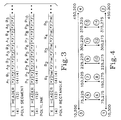
- Fig. 3 is a pictorial view of image data formats for the X Window System.
- Fig. 4 is a pictorial view of an image to be displayed using the present invention.
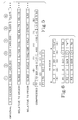
- Fig. 5 is a pictorial view of data for the image of Fig. 4 compressed according to the present invention.
- Fig. 6 is a pictorial view of an ImageText8 sequence of requests for the X Window System.
- Fig. 1 an X Window System is shown having a plurality of client applications 12 that run on one or more computers, a display system with a display server 14 and a display device 16 with a plurality of windows 18 within which the client applications are displayed.
- the outputs from the client applications 12 in X-wire protocol are input to a proxy server 20 or an XLibrary function within the client application.
- the proxy server 20 processes the inputs from the client applications 12 to produce encoded, compressed packets of data that are transmitted over a communications link 22 to a server interface 24 .
- the server interface 24 decodes and decompresses the packets of data from the communications link 22 to reconstruct the original X-wire protocol information from the client applications.
- the original X-wire protocol information is input to the display server 14 as data from each client application 12 .
- the display server 14 processes the data from each client application 12 for display in the appropriate window(s) 18 on the display device 16 .
- X-wire protocol data streams are input initially to an X-opcode specific compression algorithm/encoder 32 where the data is compressed as described in more detail below.
- the initially compressed data from the X-opcode encoder 32 or the original data if no opcode compression is applied, is input to a delta compactor algorithm 34 .
- the data at the input to the delta compactor algorithm 34 or the data output from the delta compactor algorithm, depending upon the length of the data, is then input to a generic compression algorithm 36 for combination with similarly compressed data from or for other client applications 12 into packets of data with a header and trailer and transmitted over the communications line 22 .
- the packet header includes a sequence byte that indicates the sequence number of the packet in a stream of packets and a client application identification number byte.
- the trailer includes two cyclic redundancy check (CRC) bytes and a unique frame byte.
- CRC cyclic redundancy check
- a byte may be added in the packet by the generic compression algorithm 36 when the source or destination of the data within the packet is switched from or to another client application.
- the packet stream is received by the proxy server/server interface 20/24 from the communication line 22 and decoded.
- the header of each packet is cached for comparison with the next packet header in order to determine a correct sequence of packets, i.e., no missing packets.
- the data is routed to a generic decompression algorithm 42 and then to an appropriate delta decompaction algorithm 44 for the designated client when indicated.
- the resulting data stream from the generic decompaction algorithm, if no delta decompression is indicated, or from the delta decompression algorithm is input to an X-code specific decompression decoder algorithm 46 when indicated to reconstruct the original X-wire protocol for or from each of the client applications 12 .
- Data for images may be transmitted in the X-wire protocol as either line segments, PolySegment, contiguous lines, PolyLine, or rectangles, PolyRectangle and PolyFillRectangle.
- the encoding function for each of these request types is xspecEncodePolySeg , xspecEncodePolyLine or xspecEncodePolyRect .
- a PolySegment X request from a client application 12 has a two-part request header of four plus twelve bytes followed by pairs of xy data points, each data point determining the coordinate for an end point of a line segment.
- a PolyLine X request has the same type of header as the PolySegment X request, except for the identification of the opcode type. Contiguous data points follow the header, expressed in xy coordinates, with the prior point being the start point for a line segment ending with the present point.
- a PolyRectangle X request is very similar to the PolySegment X request except that, instead of two data points being grouped together, a start point in xy coordinates and an area extent value in terms of a height and width (hw) of the rectangle form the data point pair.
- the encoding of a PolySegment X request is used as an example of the compression/encoding of the present invention.
- An image such as that shown in Fig. 4, has a plurality of line segments to be displayed. This image is readily displayed as a PolySegment, with the first line segment pair of data points being points ( 1 ), ( 2 ). After the header the data points are grouped in pairs, as shown in Fig. 3, moving numerically from point ( 1 ) to point ( 14 ).
- Table I provides under column A the coordinate values for each data point of the image.
- the first step of the encoding is to process the first N data points in the PolySegment X request.
- the actual number of data points in the request may be more or less than N. If less than N, all of the data points are examined.
- Fig. 5 part of the first step includes a first pass in which the data points are tested "as is" to see how many may be reduced to a single byte, i.e., have a value less than decimal 256.
- all of the data points are relativized with respect to a first data point, and the number of data points that now may be reduced to a single byte are tested, i.e., have a value in the range of + /-127.
- the data points are relativized with respect to the latest data point and tested to determine how many may be reduced to a single byte.
- the entire PolySegment X request is processed relativized to the latest data point since this encoding technique has the greatest number of data points that have values that may be reduced to a single byte and has the best figure of merit for repeated points.
- the second step is to compress the entire request using the selected encoding technique, in this example the technique represented in column C of Table I .
- the selected encoding technique in this example the technique represented in column C of Table I .
- an identifier byte is established, with the first four bits indicating how to determine the value of the first data point of the pair and the last four bits indicating how to determine the value of the second data point of the pair.
- LRU Least Recently Used
- the first data point has a coordinate with a value outside the range of + /-127, as does the second data point.
- the value of data point ( 1 ) is at location zero in the cache, but the values are not equal. Therefore the identifier byte for the first data point pair has a value of "FF", and is followed by the eight bytes that contain the four values for the xy coordinates of the first data point pair.
- Data point ( 3 ) is compared to locations zero and one in the cache, corresponding to data points ( 2 ) and ( 1 ) respectively.
- next identifier byte becomes "FE” followed by six bytes of data values.
- next pair of data points are compressed as "E1" plus the two bytes for data point ( 7 ).
- the final three pairs of data points have corresponding values in the cache, so only the identifier byte for each pair is required and each identifier byte is "11" since the equal value for each data point is at cache location one. This compresses the data for seven line segments, originally provided by 56 bytes (four bytes per point times fourteen points), to 27 bytes.
- a PolyLine X request may be encoded and compressed using consecutive pairs of the data points that mark changes in direction of a continuous line image.
- the same process applies to a PolyRectangle X request.
- the data point coordinate values and area extent values are encoded separately and stored in two separate caches during the compression phase so that data points are compared with data points and area extent values are compared to area extent values.
- the first nibble of the identifier byte is a data coordinate nibble and the second nibble is an area extent nibble.
- Further compression may be realized by caching the request header from a prior X request to determine whether there is identity between header fields in consecutive requests. If so, appropriate otherwise empty bits indicating which header fields did not change are set in the first four bytes of the header, and the corresponding fields in the remaining twelve bytes of the header are deleted.
- ImageText8 is an X request for displaying text image characters. There are certain common sequences that occur in writing characters to a display. One such sequence is a triad of X requests for writing a next character on a line of displayed text as shown in Fig. 6. The first X request blanks the cursor on the display by providing a space character, the second request writes the desired character into the same location on the display, and the third request writes the cursor as a space with a different graphics context at the next location on the display.
- the "D” in the ImageText8 format indicates the window (X-Window “drawable"), "GC” indicates a graphics context, "xy” indicates the location on the display, and "TEXT” is the character to be displayed at the designated location with the specific graphics context.
- Request one R1 indicates that a drawable character is to be written at location ( 1 ) using graphics context one, the character being a "space” to delete the cursor currently at that location.
- Request two R2 indicates that a drawable character "B” is to be written at the same location ( 1 ) using the same graphics context.
- request three R3 indicates that a drawable character "space” is to be written at the next location ( 2 ) using graphics context two, such as a reverse display, to produce the cursor.
- a state machine caches the first request R1 for a predetermined period of time and compares subsequent requests with stored sequences that start with the first request R1 .
- the delta compactor 34 may be used to reduce the size of the condensed request, further improvement results from noting that the "request length" in the protocol header is redundant for ImageText8 since the "length of string” byte is used to compute it.
- the condensed request may be reduced to three bytes. In this case limiting the actual length value to a few low-order bits is acceptable since long text strings are not the ones undergoing request sequence compaction.
- the present invention provides an opcode specific compression for Window Systems by selecting an appropriate encoding technique, encoding the opcode according to the selected encoding technique, and further compressing the encoded opcode according to delta compactors and generic compressors to form data packets for transmission between client applications on one or more computers and windows on a display.
Landscapes
- Engineering & Computer Science (AREA)
- Software Systems (AREA)
- Theoretical Computer Science (AREA)
- Computer Security & Cryptography (AREA)
- Computer Networks & Wireless Communication (AREA)
- Signal Processing (AREA)
- Physics & Mathematics (AREA)
- General Engineering & Computer Science (AREA)
- General Physics & Mathematics (AREA)
- Compression, Expansion, Code Conversion, And Decoders (AREA)
- Reduction Or Emphasis Of Bandwidth Of Signals (AREA)
- Information Transfer Between Computers (AREA)
Abstract
Description
- The current invention relates to data compression, and more particularly to opcode specific compression for Window Systems that increases throughput and performance of window applications when commonly used opcodes and opcode sequences are compressed.
- A consortium sponsored by the Massachusetts Institute of Technology (MIT) in Cambridge, Massachusetts, United States of America proposed the X Window System for graphics systems that allows separate applications to be run, apparently concurrently, as described in "X Window System -- CLibrary and Protocol Reference" by Robert W. Scheifler et al and published by Digital Press. Each application is run on a computer and displayed on a graphics display within one or more "windows" on the display. The various applications, or clients, are coupled to a display server via a bi-directional data path, such as a local area network or a remote communications link including telephone lines. The display server formats requests from the clients for appropriate display within the appropriate window(s). The display server in return provides X replies, events and errors back to the clients. The requests from the clients include a connection request, asking for access to the display, and data requests for transferring data and text to the display server. The communication between the display server and clients is via an X-wire protocol. The requests in the X Window System have multiple bytes including a request header and a variable number of subsequent bytes. The X-wire protocol is not compact and is not designed for high efficiency data transmission. The X-wire data may be compressed and decompressed by remote communication devices, such as modems, but interactive communication, compression, and error correction cause latency in the turnaround, i.e., slows down the communication. Thus, especially in low bandwidth channels such as remote communications links, the communication between the display server and clients may be quite slow. Therefore some form of data compression prior to the communication link is desired to speed up the interaction between the client and the display server.
- Previous compression techniques applied to X Window Systems include the use of a generic compression algorithm, such as the UNIX LZW algorithm described by Terry A. Welch in "A Technique for High Performance Data Compression", IEEE Computer, Vol. 17 No. 6, June 1984, pp. 8-19. Another algorithm that has been used, either separately or in conjunction with the generic compression algorithm, is a delta encoding or difference record encoding algorithm as described in Section 7.0 of "X Remote and Terminal Services" by Kevin Paul Herbert in the conference proceedings of the Silicon Valley Networking Conference (SVNC) of 1991. Additional algorithms that have been proposed on the X Window consortium e-mail network include removal of unused bytes and special bit-map compression algorithms for images. All of these compression techniques help to speed up the communication between clients and the display server, but further speed enhancements are desired, especially for low bandwidth channels.
- Accordingly the present invention provides an opcode specific compression for Window System applications that further compresses the protocol messages to enhance the performance of window applications in low bandwidth channels. At the interface between a client, or X Window application, and a display server compression may be applied either by the X Library functions or by a proxy server. The proxy server is coupled to a computer or computers on which the clients are resident, and also to a server interface via a communications link. The proxy server compresses the requests from the clients for the display interface into data packets that are transmitted to the server interface over the communications link. The server interface then decompresses and routes the data from the data packets to appropriate client data inputs of a display server. The display server processes the data for each client and provides the processed data in the appropriate "window(s)" on a display device. Replies, events and errors from the display device are likewise compressed by the server interface, transmitted over the communications link in the form of data packets to the proxy server, and decompressed and routed to the appropriate client.
- Specific X-opcodes include PolySegment, PolyLine, PolyRectangle, PolyFill Rectangle and ImageText8. The above Poly opcodes include a request header followed by data pairs, each data pair having two sixteen-bit data values, or four data bytes. They are processed similarly by taking three passes through N similar pairs of data from each X request. The three passes are made to determine whether data representing display pairs within the request may be reduced from four bytes per data pair (two 16-bit data values) to two bytes per data pair (two 8-bit data values) as well as to determine the number of repeated data pairs. The first pass reviews the data "as-is." The second pass encodes the data pairs relative to a first data pair. The third pass encodes the original data pairs relative to the latest data pair. The pass that produces the greatest number of two byte data pairs and/or the most repeated data pairs is selected to process the entire X request. For the entire X request the data is then cached as it is processed, and new data pairs are compared with data pairs in the cache. In the encoded, or compressed, data an identifier byte indicates whether each of two consecutive data pairs are defined as four byte values, two byte values or the same as a prior data pair in the cache. The appropriate value for the data pair(s) follows the identifier byte when not the same as a prior data pair in the cache. Likewise the request headers for consecutive requests are compared and if the same, are compressed by setting an appropriate unused bit in the subsequent request header lead bytes.
- For ImageText8 data the compression algorithm looks for identified sequences of requests with specified repeated data patterns, and reduces an identified sequence into a single compressed request. The ImageText8 processing saves a request for a limited, predetermined period of time in order to identify a request sequence. Whether an ImageText8 sequence is identified or not, the ImageText8 header also is compressed as discussed above for data pair requests by setting bits in the subsequent ImageText8 header lead bytes if a match is found.
- The objects, advantages and novel features of the present invention are apparent from the following detailed description when read in conjunction with the appended claims and attached drawing.
- Fig. 1 is a block diagram plan view of an X Window System according to the present invention.
- Fig. 2 is a block diagram plan view of a portion of an interface between clients and a display server for the X Window System according to the present invention.
- Fig. 3 is a pictorial view of image data formats for the X Window System.
- Fig. 4 is a pictorial view of an image to be displayed using the present invention.
- Fig. 5 is a pictorial view of data for the image of Fig. 4 compressed according to the present invention.
- Fig. 6 is a pictorial view of an ImageText8 sequence of requests for the X Window System.
- Referring now to Fig. 1 an X Window System is shown having a plurality of
client applications 12 that run on one or more computers, a display system with adisplay server 14 and adisplay device 16 with a plurality ofwindows 18 within which the client applications are displayed. The outputs from theclient applications 12 in X-wire protocol are input to aproxy server 20 or an XLibrary function within the client application. Theproxy server 20 processes the inputs from theclient applications 12 to produce encoded, compressed packets of data that are transmitted over acommunications link 22 to aserver interface 24. Theserver interface 24 decodes and decompresses the packets of data from thecommunications link 22 to reconstruct the original X-wire protocol information from the client applications. The original X-wire protocol information is input to thedisplay server 14 as data from eachclient application 12. Thedisplay server 14 processes the data from eachclient application 12 for display in the appropriate window(s) 18 on thedisplay device 16. - As shown in Fig. 2 the configuration of the
proxy server 20 andserver interface 24 are essentially identical, so only one is described in detail. X-wire protocol data streams are input initially to an X-opcode specific compression algorithm/encoder 32 where the data is compressed as described in more detail below. The initially compressed data from theX-opcode encoder 32, or the original data if no opcode compression is applied, is input to adelta compactor algorithm 34. The data at the input to thedelta compactor algorithm 34 or the data output from the delta compactor algorithm, depending upon the length of the data, is then input to ageneric compression algorithm 36 for combination with similarly compressed data from or forother client applications 12 into packets of data with a header and trailer and transmitted over thecommunications line 22. The packet header includes a sequence byte that indicates the sequence number of the packet in a stream of packets and a client application identification number byte. The trailer includes two cyclic redundancy check (CRC) bytes and a unique frame byte. A byte may be added in the packet by thegeneric compression algorithm 36 when the source or destination of the data within the packet is switched from or to another client application. - The packet stream is received by the proxy server/
server interface 20/24 from thecommunication line 22 and decoded. The header of each packet is cached for comparison with the next packet header in order to determine a correct sequence of packets, i.e., no missing packets. The data is routed to ageneric decompression algorithm 42 and then to an appropriatedelta decompaction algorithm 44 for the designated client when indicated. The resulting data stream from the generic decompaction algorithm, if no delta decompression is indicated, or from the delta decompression algorithm is input to an X-code specificdecompression decoder algorithm 46 when indicated to reconstruct the original X-wire protocol for or from each of theclient applications 12. - Data for images may be transmitted in the X-wire protocol as either line segments, PolySegment, contiguous lines, PolyLine, or rectangles, PolyRectangle and PolyFillRectangle. The encoding function for each of these request types is xspecEncodePolySeg, xspecEncodePolyLine or xspecEncodePolyRect. Corresponding functions exist for the respective request decoders. As shown in Fig. 3 a PolySegment X request from a
client application 12 has a two-part request header of four plus twelve bytes followed by pairs of xy data points, each data point determining the coordinate for an end point of a line segment. The number of data point pairs for each PolySegment request is included in the header. Each coordinate for each data point is expressed as a 16-bit (two-byte) value, so the definition of a line segment requires eight bytes. A PolyLine X request has the same type of header as the PolySegment X request, except for the identification of the opcode type. Contiguous data points follow the header, expressed in xy coordinates, with the prior point being the start point for a line segment ending with the present point. Finally a PolyRectangle X request is very similar to the PolySegment X request except that, instead of two data points being grouped together, a start point in xy coordinates and an area extent value in terms of a height and width (hw) of the rectangle form the data point pair. - The encoding of a PolySegment X request is used as an example of the compression/encoding of the present invention. An image, such as that shown in Fig. 4, has a plurality of line segments to be displayed. This image is readily displayed as a PolySegment, with the first line segment pair of data points being points (1), (2). After the header the data points are grouped in pairs, as shown in Fig. 3, moving numerically from point (1) to point (14). The following Table I provides under column A the coordinate values for each data point of the image.
TABLE I Data Point Number A "AS-IS" B Rel to First C Rel to Latest 1 10, 300 10, 300 10, 300 2 450, 300 440, 0 440, 0 3 10, 200 0, -100 -440, -100 4 450, 200 440, -100 440, 0 5 75, 225 65, -75 -375, 25 6 75, 275 65, -25 0, 50 7 150, 225 140, -75 75, -50 8 150, 275 140, -25 0, 50 9 225, 225 215, -75 75, -50 10 225, 275 215, -25 0, 50 11 300, 225 290, -75 75, -50 12 300, 275 290, -25 0, 50 13 375, 225 365, -75 75, -50 14 375, 275 365, -25 0, 50
The first step of the encoding is to process the first N data points in the PolySegment X request. The actual number of data points in the request may be more or less than N. If less than N, all of the data points are examined. As shown in Fig. 5 part of the first step includes a first pass in which the data points are tested "as is" to see how many may be reduced to a single byte, i.e., have a value less than decimal 256. Then in a second pass all of the data points are relativized with respect to a first data point, and the number of data points that now may be reduced to a single byte are tested, i.e., have a value in the range of + /-127. Finally in a third pass the data points are relativized with respect to the latest data point and tested to determine how many may be reduced to a single byte. Referring to Table I above under column A four data points may be expressed in eight-bit values, under column B three data points may be expressed in eight-bit values, and under column C nine data points may be expressed in eight-bit values. Then the number of repeated data points is determined for each pass to arrive at a figure of merit for encoding. For the fourteen data points in columns A and B there are no repeated data points. The figure of merit is 14/14 = 1. For column C there are six unique data points, so the figure of merit is 14/6 = 2.33. Based upon this analysis of the first N data points, the entire PolySegment X request is processed relativized to the latest data point since this encoding technique has the greatest number of data points that have values that may be reduced to a single byte and has the best figure of merit for repeated points. - The second step is to compress the entire request using the selected encoding technique, in this example the technique represented in column C of Table I. As illustrated in Fig. 5 for each pair of data points an identifier byte is established, with the first four bits indicating how to determine the value of the first data point of the pair and the last four bits indicating how to determine the value of the second data point of the pair. As the data points are received, they are placed in a Least Recently Used (LRU) replacement cache such that the most recent data point is at cache location zero. For this particular example two configurations of four bits, binary coded decimal F and binary coded decimal E, are reserved to indicate that the corresponding data point is either two 16-bit values or two 8-bit values, respectively, and the values follow the indicator byte. However if the data point is the same as a data point in the cache, then the value representing the index into the cache is used.
- Applying this to the example of Table I the first data point has a coordinate with a value outside the range of + /-127, as does the second data point. At data point (2) the value of data point (1) is at location zero in the cache, but the values are not equal. Therefore the identifier byte for the first data point pair has a value of "FF", and is followed by the eight bytes that contain the four values for the xy coordinates of the first data point pair. Data point (3) is compared to locations zero and one in the cache, corresponding to data points (2) and (1) respectively. Since there is no equality with either point in the cache and the value is outside the range + /-127, "F" is inserted into the first part of the next identifier byte. However data point (4) has the same value as data point (2), which is at location one in the cache with respect to data point (4). Therefore the second part of the next identifier byte is "1" so that the identifier byte becomes "F1". The identifier byte is then followed by the four bytes necessary to provide the values for data point (3). The next pair of data points (5) and (6) have no equal values in the cache, and data point (5) requires sixteen bits while data point (6) requires only eight bits. Thus the next identifier byte becomes "FE" followed by six bytes of data values. Following the process the next pair of data points are compressed as "E1" plus the two bytes for data point (7). The final three pairs of data points have corresponding values in the cache, so only the identifier byte for each pair is required and each identifier byte is "11" since the equal value for each data point is at cache location one. This compresses the data for seven line segments, originally provided by 56 bytes (four bytes per point times fourteen points), to 27 bytes.
- In a like manner a PolyLine X request may be encoded and compressed using consecutive pairs of the data points that mark changes in direction of a continuous line image. The same process applies to a PolyRectangle X request. However in processing the PolyRectangle X request the data point coordinate values and area extent values are encoded separately and stored in two separate caches during the compression phase so that data points are compared with data points and area extent values are compared to area extent values. The first nibble of the identifier byte is a data coordinate nibble and the second nibble is an area extent nibble.
- Further compression may be realized by caching the request header from a prior X request to determine whether there is identity between header fields in consecutive requests. If so, appropriate otherwise empty bits indicating which header fields did not change are set in the first four bytes of the header, and the corresponding fields in the remaining twelve bytes of the header are deleted.
- ImageText8 is an X request for displaying text image characters. There are certain common sequences that occur in writing characters to a display. One such sequence is a triad of X requests for writing a next character on a line of displayed text as shown in Fig. 6. The first X request blanks the cursor on the display by providing a space character, the second request writes the desired character into the same location on the display, and the third request writes the cursor as a space with a different graphics context at the next location on the display. The "D" in the ImageText8 format indicates the window (X-Window "drawable"), "GC" indicates a graphics context, "xy" indicates the location on the display, and "TEXT" is the character to be displayed at the designated location with the specific graphics context. Request one R1 indicates that a drawable character is to be written at location (1) using graphics context one, the character being a "space" to delete the cursor currently at that location. Request two R2 indicates that a drawable character "B" is to be written at the same location (1) using the same graphics context. Finally request three R3 indicates that a drawable character "space" is to be written at the next location (2) using graphics context two, such as a reverse display, to produce the cursor. A state machine caches the first request R1 for a predetermined period of time and compares subsequent requests with stored sequences that start with the first request R1. In this situation when a corresponding second request R2 is found, it also is cached for a predetermined period of time to look for the third request R3. If the three requests occur within the predetermined periods of time, then a sequence is recognized and the state machine outputs a condensed request representing the entire sequence. In this manner an ImageText8 sequence of three requests that ordinarily requires 60 bytes of data may be reduced to a single compressed data byte plus request header. Again further reduction may be achieved by caching the prior request header and reducing the number of bytes in the header from sixteen to four bytes when the types of requests are the same. This may be done by encoding the ImageText8 "xy" as a delta from the previous, condensed request's absolute "xy." Then when the successive condensed requests' header information are compared, they have the same window ("D"), graphic context ("GC") and coordinate ("xy" which is now just the change in position from the previous request). The deltas are constant for a line of text incrementally displayed in the window.
- Although the
delta compactor 34 may be used to reduce the size of the condensed request, further improvement results from noting that the "request length" in the protocol header is redundant for ImageText8 since the "length of string" byte is used to compute it. By using high-order bits in the "length of string" as bit flags indicating condensation, the condensed request may be reduced to three bytes. In this case limiting the actual length value to a few low-order bits is acceptable since long text strings are not the ones undergoing request sequence compaction. - Thus the present invention provides an opcode specific compression for Window Systems by selecting an appropriate encoding technique, encoding the opcode according to the selected encoding technique, and further compressing the encoded opcode according to delta compactors and generic compressors to form data packets for transmission between client applications on one or more computers and windows on a display.
Claims (16)
- A method of encoding a request from a client application to a display server, the request being of the type having a multi-byte header and a plurality of two-byte data values with pairs of data values representing data points according to a specific protocol, comprising the steps of:
selecting an encoding technique based upon a selected number of data points of the request; and
encoding the request according to the selected encoding technique. - A method as recited in claim 1 wherein the selecting step comprises the steps of:
reducing the data points to relative form;
testing the relative data points for 8-bit reduction;
checking the number of data points that are repeated to determine a figure of merit; and
evaluating the results of the reducing, testing and checking steps to select the encoding technique. - A method as recited in claim 2 wherein the reducing step comprises the step of relativizing the data points to a first data point.
- A method as recited in claim 2 wherein the reducing step comprises the step of relativizing the data points to a latest data point.
- A method as recited in claim 1 wherein the selecting step comprises the steps of:
reducing the selected number of data points to a first relative form by relativizing the data points to a first data point;
testing the data points in the first relative form for 8-bit reduction;
checking for repeated points for the data points in the first relative form; and
evaluating the results of the reducing, testing and checking steps to determine whether to use the first relative form for the encoding step. - The method as recited in claim 5 wherein the selecting step further comprises the steps of:
repeating the reducing, testing, checking and evaluating steps with the data points reduced to a second relative form by relativizing the data points to a latest data point to determine whether to use the second relative form for the encoding step; and
using the data points without reduction for the encoding step if neither the first nor second relative forms are usable. - The method as recited in claim 1 wherein the encoding step comprises the steps of:
building an identifier byte of two nibbles for each pair of data points, each nibble having a value that indicates whether the corresponding data point is a 16-bit value, an 8-bit value or a pointer into a least recently used replacement cache;
updating the cache for each data point; and
adding the appropriate 16-bit or 8-bit value for the pair of data points after the identifier byte where the data points are not a cached data point. - The method as recited in claim 7 wherein the building step comprises the steps of:
placing an "F" in the appropriate nibble when the data point is a 16-point value;
placing an "E" in the appropriate nibble when the data point is an 8-bit value; and
placing a numeral equal to a pointer into the cache indicating the repeated data value when the data point is a repeated data value. - An apparatus for encoding specific opcodes for an X Window System of the type having a plurality of client applications (12) and a display server (14) with a display device (16) that displays the client applications in windows (18), and a communications link (22) coupled between the client applications and the display server, the apparatus comprising:
a proxy server (20) coupled between the client applications and the communications link to encode information from the client applications for transmission over the communications link to the display server and to decode information received from the display server over the communications link; and
a server interface (24) coupled between the display server and the communications link to encode information from the display server for transmission over the communications link to the client applications and to decode information received from the client applications over the communications link;
the proxy server and the server interface each including an opcode specific encoder (32) for compressing the information for transmission over the communications link as well as delta compaction (34) and generic compressors (36) to produce compressed data packets representing the information during transmission, and each including an opcode specific decoder (46) for decompressing the compressed data packets received from the communication link as well as delta decompaction (42) and generic decompressors (42) to reproduce the information. - An apparatus as recited in claim 9 wherein the proxy server opcode specific encoder comprises:
means for selecting an encoding technique based upon the information; and
means for encoding the information into intermediate data packets based upon the selected encoding technique, the intermediate data packets being combined with other intermediate data packets by the delta compactor and generic compressor to produce the compressed data packets. - An apparatus as recited in claim 10 wherein the proxy server opcode specific encoder further comprises:
means for identifying specific sequences of information; and
means for encoding the specific sequences of information into a second intermediate data packet according to the identified specific sequence, the second intermediate data packet being combined with other intermediate data packets by the delta compactor and generic compressor to produce the compressed data packets. - An apparatus as recited in claim 9 wherein the proxy server opcode specific encoder comprises:
means for identifying specific sequences of information; and
means for encoding the specific sequences of information into an intermediate data packet according to the identified specific sequence, the intermediate data packet being combined with other intermediate data packets by the delta compactor and generic compressor to produce the compressed data packets. - A method of encoding requests from a client application to a display server, each request being of the type having a multi-byte header and a text data value according to a specific protocol, comprising the steps of:
identifying a predetermined sequence of requests; and
encoding the predetermined sequence of requests into a data packet for transmission to the display server. - A method as recited in claim 13 wherein the identifying step comprises the steps of:
caching a first request for a predetermined period of time; and
detecting the predetermined sequence when a subsequent request received during the predetermined period of time is equal to a second request in a request sequence table where the first request is the first request of the predetermined sequence. - A method as recited in claim 14 wherein the identifying step further comprises the step of:
caching a second request that occurs during the predetermined period of time for a second predetermined period of time when the second request corresponds to the second request of the predetermined sequence; and
detecting the predetermined sequence when a third request is received during the second predetermined period of time that corresponds to the third request of the predetermined sequence. - A method as recited in claim 13 wherein the encoding step comprises the steps of:
reducing the header size by deleting a portion of the header and including sequence and cache header/field identifying codes in an unused portion of the remaining portion of the header; and
compressing the text data values from the requests into a single text data value following the reduced header.
Applications Claiming Priority (2)
| Application Number | Priority Date | Filing Date | Title |
|---|---|---|---|
| US96379592A | 1992-10-20 | 1992-10-20 | |
| US963795 | 1992-10-20 |
Publications (3)
| Publication Number | Publication Date |
|---|---|
| EP0594304A2 true EP0594304A2 (en) | 1994-04-27 |
| EP0594304A3 EP0594304A3 (en) | 1994-11-30 |
| EP0594304B1 EP0594304B1 (en) | 2000-06-07 |
Family
ID=25507723
Family Applications (1)
| Application Number | Title | Priority Date | Filing Date |
|---|---|---|---|
| EP93307467A Expired - Lifetime EP0594304B1 (en) | 1992-10-20 | 1993-09-21 | Opcode specific compression for window system |
Country Status (3)
| Country | Link |
|---|---|
| EP (1) | EP0594304B1 (en) |
| JP (1) | JP2654749B2 (en) |
| DE (1) | DE69328811T2 (en) |
Cited By (10)
| Publication number | Priority date | Publication date | Assignee | Title |
|---|---|---|---|---|
| EP0757332A3 (en) * | 1995-08-04 | 1997-05-14 | Sun Microsystems Inc | Method and apparatus for geometric compression of three-dimensional graphics |
| EP0757333A3 (en) * | 1995-08-04 | 1997-06-04 | Sun Microsystems Inc | 3D image decoding |
| WO1999039309A1 (en) * | 1998-02-03 | 1999-08-05 | Messagemedia, Inc. | Animation encoding method and system |
| EP0889440A3 (en) * | 1997-06-30 | 1999-12-22 | Sun Microsystems, Inc. | Method and apparatus for geometric compression of three-dimensional graphics |
| US6215500B1 (en) | 1995-08-04 | 2001-04-10 | Sun Microsystems, Inc. | Compression of three-dimensional geometry data representing a regularly tiled surface portion of a graphical object |
| US6256041B1 (en) | 1995-08-04 | 2001-07-03 | Sun Microsystems, Inc. | Decompression of three-dimensional geometry data representing a regularly tiled surface portion of a graphical object |
| US6263496B1 (en) | 1998-02-03 | 2001-07-17 | Amazing Media, Inc. | Self modifying scene graph |
| US6525722B1 (en) | 1995-08-04 | 2003-02-25 | Sun Microsystems, Inc. | Geometry compression for regular and irregular mesh structures |
| US6747644B1 (en) | 1995-08-04 | 2004-06-08 | Sun Microsystems, Inc. | Decompression of surface normals in three-dimensional graphics data |
| US7584320B2 (en) | 2001-08-08 | 2009-09-01 | Pasternak Solutions Llc | Sliced crossbar architecture with no inter-slice communication |
Families Citing this family (1)
| Publication number | Priority date | Publication date | Assignee | Title |
|---|---|---|---|---|
| CN102966936B (en) * | 2012-11-26 | 2014-11-26 | 杭州国电机械设计研究院有限公司 | Double-effect and phase change waste heat recovering system for recovering low-grade waste gas waste heat |
Family Cites Families (7)
| Publication number | Priority date | Publication date | Assignee | Title |
|---|---|---|---|---|
| US4199815A (en) * | 1978-05-12 | 1980-04-22 | Electra Corporation | Typesetter character generating apparatus |
| JPS5933960A (en) * | 1982-08-19 | 1984-02-24 | Fuji Xerox Co Ltd | Transmitting system of code information |
| JPH0234038A (en) * | 1988-07-23 | 1990-02-05 | Hitachi Ltd | data compression device |
| JPH0257290A (en) * | 1988-08-24 | 1990-02-27 | Nakanihon Syst:Kk | Data compressing method for one needle data |
| JP3062507B2 (en) * | 1989-10-30 | 2000-07-10 | シャープ株式会社 | Image encoding device and image decoding device |
| GB2240230B (en) * | 1990-01-18 | 1994-04-13 | British Broadcasting Corp | Field-rate upconversion of television signals |
| US5260693A (en) * | 1991-10-11 | 1993-11-09 | Spacelabs Medical, Inc. | Method and system for lossless and adaptive data compression and decompression |
-
1993
- 1993-09-21 DE DE69328811T patent/DE69328811T2/en not_active Expired - Fee Related
- 1993-09-21 EP EP93307467A patent/EP0594304B1/en not_active Expired - Lifetime
- 1993-10-20 JP JP5285973A patent/JP2654749B2/en not_active Expired - Lifetime
Cited By (20)
| Publication number | Priority date | Publication date | Assignee | Title |
|---|---|---|---|---|
| US6256041B1 (en) | 1995-08-04 | 2001-07-03 | Sun Microsystems, Inc. | Decompression of three-dimensional geometry data representing a regularly tiled surface portion of a graphical object |
| EP0757333A3 (en) * | 1995-08-04 | 1997-06-04 | Sun Microsystems Inc | 3D image decoding |
| US5933153A (en) * | 1995-08-04 | 1999-08-03 | Sun Microsystems, Inc. | Mesh buffer for decompression of compressed three-dimensional graphics data |
| US6747644B1 (en) | 1995-08-04 | 2004-06-08 | Sun Microsystems, Inc. | Decompression of surface normals in three-dimensional graphics data |
| US6603470B1 (en) | 1995-08-04 | 2003-08-05 | Sun Microsystems, Inc. | Compression of surface normals in three-dimensional graphics data |
| US6028610A (en) * | 1995-08-04 | 2000-02-22 | Sun Microsystems, Inc. | Geometry instructions for decompression of three-dimensional graphics data |
| US6088034A (en) * | 1995-08-04 | 2000-07-11 | Sun Microsystems, Inc. | Decompression of surface normals in three-dimensional graphics data |
| US6215500B1 (en) | 1995-08-04 | 2001-04-10 | Sun Microsystems, Inc. | Compression of three-dimensional geometry data representing a regularly tiled surface portion of a graphical object |
| US6532012B2 (en) | 1995-08-04 | 2003-03-11 | Sun Microsystems, Inc. | Geometry instructions for graphics data compression |
| US6239805B1 (en) | 1995-08-04 | 2001-05-29 | Sun Microsystems, Inc. | Method and apparatus for geometric compression of three-dimensional graphics data |
| US6307557B1 (en) | 1995-08-04 | 2001-10-23 | Sun Microsystems, Inc. | Decompression of three-dimensional graphics data including quantization, delta-encoding, and variable-length encoding |
| US6525722B1 (en) | 1995-08-04 | 2003-02-25 | Sun Microsystems, Inc. | Geometry compression for regular and irregular mesh structures |
| EP0757332A3 (en) * | 1995-08-04 | 1997-05-14 | Sun Microsystems Inc | Method and apparatus for geometric compression of three-dimensional graphics |
| US6522326B1 (en) | 1995-08-04 | 2003-02-18 | Sun Microsystems, Inc. | Decompression of quantized compressed three-dimensional graphics data |
| US6522327B2 (en) | 1995-08-04 | 2003-02-18 | Sun Microsystems, Inc. | Decompression of variable-length encoded compressed three-dimensional graphics data |
| EP0889440A3 (en) * | 1997-06-30 | 1999-12-22 | Sun Microsystems, Inc. | Method and apparatus for geometric compression of three-dimensional graphics |
| US6263496B1 (en) | 1998-02-03 | 2001-07-17 | Amazing Media, Inc. | Self modifying scene graph |
| US6243856B1 (en) | 1998-02-03 | 2001-06-05 | Amazing Media, Inc. | System and method for encoding a scene graph |
| WO1999039309A1 (en) * | 1998-02-03 | 1999-08-05 | Messagemedia, Inc. | Animation encoding method and system |
| US7584320B2 (en) | 2001-08-08 | 2009-09-01 | Pasternak Solutions Llc | Sliced crossbar architecture with no inter-slice communication |
Also Published As
| Publication number | Publication date |
|---|---|
| EP0594304A3 (en) | 1994-11-30 |
| JP2654749B2 (en) | 1997-09-17 |
| DE69328811T2 (en) | 2001-01-11 |
| DE69328811D1 (en) | 2000-07-13 |
| JPH06222905A (en) | 1994-08-12 |
| EP0594304B1 (en) | 2000-06-07 |
Similar Documents
| Publication | Publication Date | Title |
|---|---|---|
| US5229768A (en) | Adaptive data compression system | |
| US5748904A (en) | Method and system for segment encoded graphic data compression | |
| JP3541930B2 (en) | Encoding device and decoding device | |
| EP0439569B1 (en) | Apparatus for run and string data compression | |
| US7171444B2 (en) | Remote desktop protocol compression system | |
| KR100349447B1 (en) | Compact Sowcoding Tables for Encoder / Decoder Systems | |
| EP0594304B1 (en) | Opcode specific compression for window system | |
| EP0903866B1 (en) | Method and apparatus for data compression | |
| JPH0746409A (en) | Method and apparatus for data compression and return to original state | |
| EP0187812A1 (en) | Data compression apparatus. | |
| JPH08288861A (en) | Method for compression of data,method for release of the compression,and device for coding of data | |
| CN113312325B (en) | Track data transmission method, device, equipment and storage medium | |
| EP1360771B1 (en) | System and method for compressing and decompressing data in real time | |
| US5392036A (en) | Efficient optimal data recopression method and apparatus | |
| KR100573527B1 (en) | How to compress and restore graphic images | |
| KR100906041B1 (en) | Font compression and retrieval method and apparatus | |
| US6493766B1 (en) | Method, client device, server and article of manufacture for compressing universal resource identifiers using left/right string substitution | |
| EP2843842A1 (en) | Method and system for LZW based decompression | |
| US5889818A (en) | Adaptive display refresh and data compression in a radio frequency environment | |
| US6947606B2 (en) | Skim encoding method for compression of a two dimensional array of data | |
| US7020340B2 (en) | Methods for compressing and decompressing data | |
| JP3266419B2 (en) | Data compression / decompression method | |
| US7346220B2 (en) | Method and apparatus for reducing the bandwidth required to transmit image data | |
| JPH02190080A (en) | Picture encoding device | |
| KR100312410B1 (en) | Method for compression and ecompression of vector data in ageographic information system |
Legal Events
| Date | Code | Title | Description |
|---|---|---|---|
| PUAI | Public reference made under article 153(3) epc to a published international application that has entered the european phase |
Free format text: ORIGINAL CODE: 0009012 |
|
| AK | Designated contracting states |
Kind code of ref document: A2 Designated state(s): DE FR GB |
|
| PUAL | Search report despatched |
Free format text: ORIGINAL CODE: 0009013 |
|
| AK | Designated contracting states |
Kind code of ref document: A3 Designated state(s): DE FR GB |
|
| 17P | Request for examination filed |
Effective date: 19950526 |
|
| 17Q | First examination report despatched |
Effective date: 19980928 |
|
| GRAG | Despatch of communication of intention to grant |
Free format text: ORIGINAL CODE: EPIDOS AGRA |
|
| GRAG | Despatch of communication of intention to grant |
Free format text: ORIGINAL CODE: EPIDOS AGRA |
|
| GRAH | Despatch of communication of intention to grant a patent |
Free format text: ORIGINAL CODE: EPIDOS IGRA |
|
| RAP1 | Party data changed (applicant data changed or rights of an application transferred) |
Owner name: NETWORK COMPUTING DEVICES, INC. |
|
| RIC1 | Information provided on ipc code assigned before grant |
Free format text: 7G 06F 9/46 A |
|
| GRAH | Despatch of communication of intention to grant a patent |
Free format text: ORIGINAL CODE: EPIDOS IGRA |
|
| GRAA | (expected) grant |
Free format text: ORIGINAL CODE: 0009210 |
|
| AK | Designated contracting states |
Kind code of ref document: B1 Designated state(s): DE FR GB |
|
| REF | Corresponds to: |
Ref document number: 69328811 Country of ref document: DE Date of ref document: 20000713 |
|
| ET | Fr: translation filed | ||
| PLBE | No opposition filed within time limit |
Free format text: ORIGINAL CODE: 0009261 |
|
| STAA | Information on the status of an ep patent application or granted ep patent |
Free format text: STATUS: NO OPPOSITION FILED WITHIN TIME LIMIT |
|
| 26N | No opposition filed | ||
| PGFP | Annual fee paid to national office [announced via postgrant information from national office to epo] |
Ref country code: FR Payment date: 20011112 Year of fee payment: 9 |
|
| PGFP | Annual fee paid to national office [announced via postgrant information from national office to epo] |
Ref country code: GB Payment date: 20011119 Year of fee payment: 9 |
|
| PGFP | Annual fee paid to national office [announced via postgrant information from national office to epo] |
Ref country code: DE Payment date: 20011126 Year of fee payment: 9 |
|
| REG | Reference to a national code |
Ref country code: GB Ref legal event code: IF02 |
|
| PG25 | Lapsed in a contracting state [announced via postgrant information from national office to epo] |
Ref country code: GB Free format text: LAPSE BECAUSE OF NON-PAYMENT OF DUE FEES Effective date: 20020921 |
|
| PG25 | Lapsed in a contracting state [announced via postgrant information from national office to epo] |
Ref country code: DE Free format text: LAPSE BECAUSE OF NON-PAYMENT OF DUE FEES Effective date: 20030401 |
|
| GBPC | Gb: european patent ceased through non-payment of renewal fee |
Effective date: 20020921 |
|
| PG25 | Lapsed in a contracting state [announced via postgrant information from national office to epo] |
Ref country code: FR Free format text: LAPSE BECAUSE OF NON-PAYMENT OF DUE FEES Effective date: 20030603 |
|
| REG | Reference to a national code |
Ref country code: FR Ref legal event code: ST |