EP0572877A1 - Improved inorganic building materials containing additives - Google Patents
Improved inorganic building materials containing additives Download PDFInfo
- Publication number
- EP0572877A1 EP0572877A1 EP93108263A EP93108263A EP0572877A1 EP 0572877 A1 EP0572877 A1 EP 0572877A1 EP 93108263 A EP93108263 A EP 93108263A EP 93108263 A EP93108263 A EP 93108263A EP 0572877 A1 EP0572877 A1 EP 0572877A1
- Authority
- EP
- European Patent Office
- Prior art keywords
- substituted
- building materials
- compounds
- alkali metal
- alkyl
- Prior art date
- Legal status (The legal status is an assumption and is not a legal conclusion. Google has not performed a legal analysis and makes no representation as to the accuracy of the status listed.)
- Withdrawn
Links
- 0 N*(C=CC=C1)C=C1N=O Chemical compound N*(C=CC=C1)C=C1N=O 0.000 description 1
Classifications
-
- C—CHEMISTRY; METALLURGY
- C04—CEMENTS; CONCRETE; ARTIFICIAL STONE; CERAMICS; REFRACTORIES
- C04B—LIME, MAGNESIA; SLAG; CEMENTS; COMPOSITIONS THEREOF, e.g. MORTARS, CONCRETE OR LIKE BUILDING MATERIALS; ARTIFICIAL STONE; CERAMICS; REFRACTORIES; TREATMENT OF NATURAL STONE
- C04B24/00—Use of organic materials as active ingredients for mortars, concrete or artificial stone, e.g. plasticisers
- C04B24/16—Sulfur-containing compounds
- C04B24/20—Sulfonated aromatic compounds
- C04B24/22—Condensation or polymerisation products thereof
Definitions
- the invention relates to mineral building materials, the binders such as e.g. Cement or anhydrite, optionally aggregates, such as e.g. Sand, and other additives.
- the binders such as e.g. Cement or anhydrite
- aggregates such as e.g. Sand, and other additives.
- inorganic binders such as anhydrite (natural and artificial), gypsum, cement are generally partially lean, but usually in combination with additives such as sand, gravel, Perlite, pumice, foamed plastic beads, and mixed with water - possibly using additives such as air entraining agents or plasticizers - and processed in this way.
- WBF water binder factor
- the processability of the building material mixture can be improved considerably without changing the water-binder ratio, or the processability can be unchanged with less water. In both cases, on average, a lower porosity is obtained with increased strength.
- the plasticizing or liquefying additives also act in such a way that they disperse the agglomerates of finely divided particles which are always present in the binder. This leads to a better and more homogeneous distribution of the binder of the building material mixture and thereby to a better effect of the binder and thus to a higher strength.
- Plasticizing additives generally make it possible to reduce the amount of water by about 15%. With liquefiers, on the other hand, the amount of water is often reduced by up to 30% and the strength increased by 40 to 50%.
- plasticizers for inorganic binders such as cement, gypsum or anhydrite, which are almost always surface-active substances, such as melamine sulfonates, alkyl aryl sulfonates, ethylene oxide addition products, alkylphenol polyglycol ethers, lignin sulfonates and others, and the like Combinations. These products are mostly used in quantities of 0.01 to 0.5% for the binder.
- the water saving or increase in flowability with optimal dosage is hardly more than 10 to 20%. Larger amounts of additive do not result in a significant increase in the liquefaction effect, but almost without exception a considerable negative influence on the Properties of the mortar, especially a reduction in the setting speed, increasing the air pore content and lowering the strength.
- plasticizers and / or plasticizers for building material mixtures lignin sulfonates (DOS 2 713 898, DOS 3 204 326) and lignin-formaldehyde condensates (US 3 184 493, DOS 2 803 923, EP 3 362) and naphthalene sulfonates (DAS 1 238 831, DOS 2 007 603, DOS 2 809 685).
- plasticizers based on lignin sulfonates are less than that of melamine resin condensates. At higher doses there is a good liquefying effect, but the mortar composition "bleeds" and the setting times become too long. Mixtures of different lignin sulfonates with other chemical ones Substances such as condensed aromatics, heterocycles and amino compounds alleviate the undesirable effects, but cannot eliminate them.
- Nonionic additives of the polyether type are described in DOS 2 050 084.
- DOS 1 265 022 recommends the use of non-ionic wetting agents with organic amino bases and hydroxyl-containing organic acids.
- DOS 2 322 707 relates to mortars which contain inorganic binders, optionally additives, additives and / or additives, formaldehyde condensation products with sulfonated aromatic ethers and / or imines and / or sulfones being used as additives.
- Such additives have a low plasticizing / liquefying effect and must therefore be used in order to achieve the desired effects in relatively high doses, which makes their use uneconomical.
- the mortar mixtures tend to "bleed out" at the required high dosages or to stick in the case of non-flowable mixtures.
- the task was therefore to provide building materials based on mineral, inorganic binders, in which the amount of water required to achieve the processing consistency is low, the strength of the set building material is high and at the same time, the processability of the wet building material is good without the setting times being greatly delayed.
- the invention relates to mineral building materials which contain binders, optionally additives and at least one additive, characterized in that compounds are used as additives, the condensation products of substituted or unsubstituted diphenyl sulfones, formaldehyde and compounds from the group consisting of mononuclear or polynuclear, substituted or are unsubstituted aromatic compounds, acid amides, urea, urea derivatives, substituted or unsubstituted aromatic ethers and imines.
- Mineral building materials which contain condensation products from diphenyl sulfones and compounds from the group consisting of mononuclear or polynuclear, substituted or unsubstituted aromatic compounds, acid amides, urea, urea derivatives, substituted or unsubstituted aromatic ethers and imines in a molar ratio of 1: 5 to 5: 1 with formaldehyde in a molar ratio of 1: 0.8 to 1: 2.0 based on the component present in excess.
- the mineral building materials are used to manufacture components such as screeds, wall panels, walls, ceilings, etc.
- the additives can be added to the mineral building material in powder form or in solution.
- a measure of the processability of earth-moist, non-flowable building materials is also the air pore content according to DIN 18555 / P2.
- the higher the air pore content the easier it is to process and the lower the stickiness of the building material.
- the compressive strength generally drops with increasing air pore content. The mortar should therefore still have sufficient strength even with an increased air pore content.
- the building material In the case of flowable building materials, the building material should be as self-leveling as possible and flow without "bleeding" occurring in the initial phase. Flowable building materials must also have a sufficiently long processing time without significantly delaying the setting time. Otherwise, the same requirements apply as for non-flowable building materials as described above.
- the building materials according to the invention meet the above. Highest requirements ⁇
- condensation products claimed as additives are compounds which are generally known from the literature and whose preparation is also described (see Ullmann's Encyclopedia of Industrial Chemistry, vol. 16, p. 109; DE-OS 19 60 616, EP-A-242 495, DE-A-29 05 083).
- the slump according to DIN 4208 / EN 196 is used as a yardstick for the plasticizing / liquefying effect of additives.
- the slump is the diameter of a circle of a mixture that results when a comical setting funnel 8 cm high, 10 cm lower and 8 cm upper diameter filled with the mixture to be tested is placed on a glass plate and then carefully pulled off vertically. The mixture then spreads out in a circle.
- the ratio of the diameter of the circles of the building materials with and without additives provides information about the liquefying effect of the additive.
- the glass plate is shocked 15 times in accordance with the DIN 4208 / EN 196 standard before the diameter is determined.
- the plasticizing or liquefying effect of the additive can also be determined by determining the required amount of water with and without the additive while maintaining a constant slump.
- Track time is also used to assess the self-leveling properties of building materials.
- Track time is the time until a track created on the surface of the building materials dissolves in itself.
- the track can e.g. by moving a nail or similar object on the surface of the mixture. The assessment is done visually.
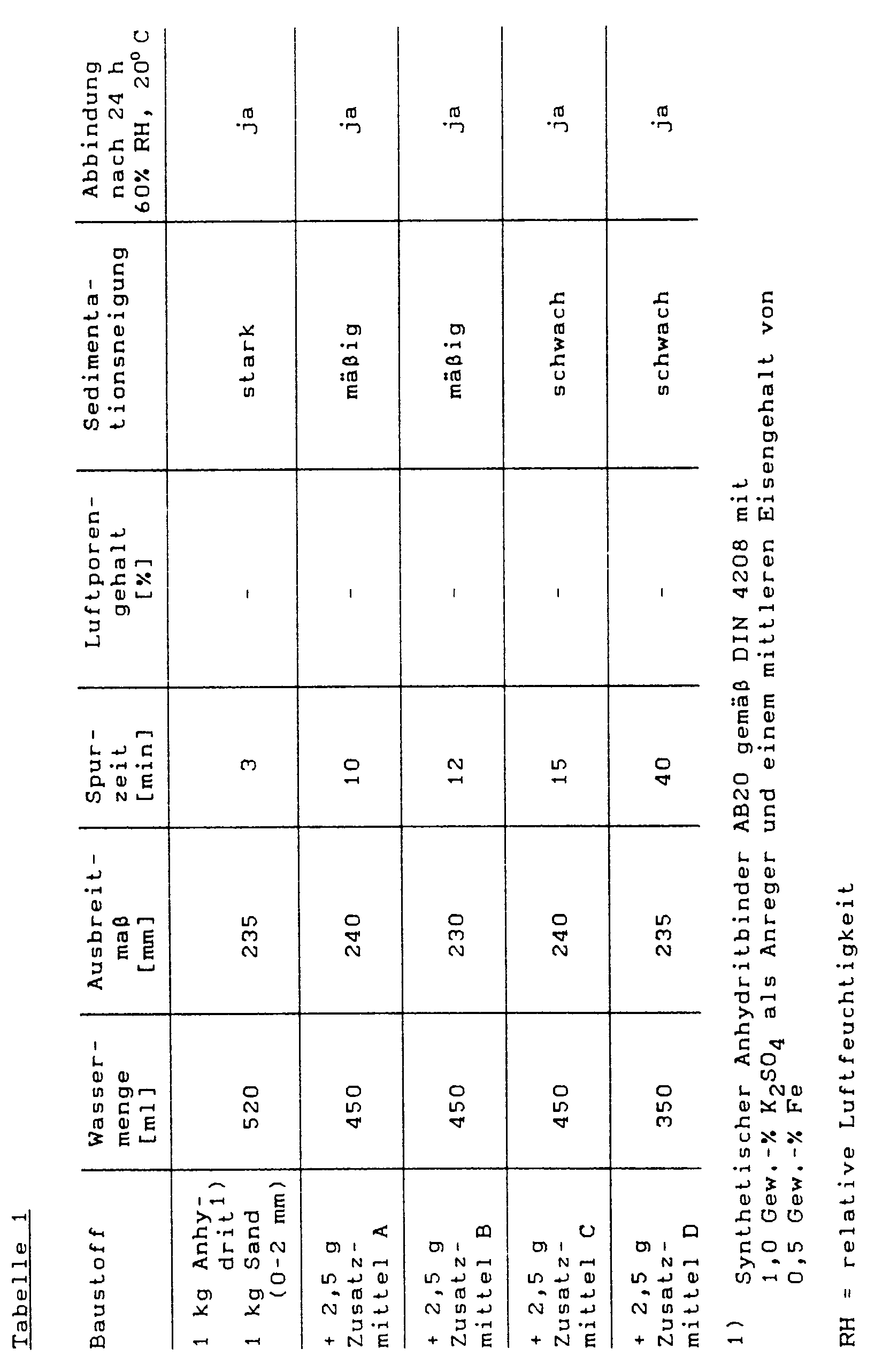
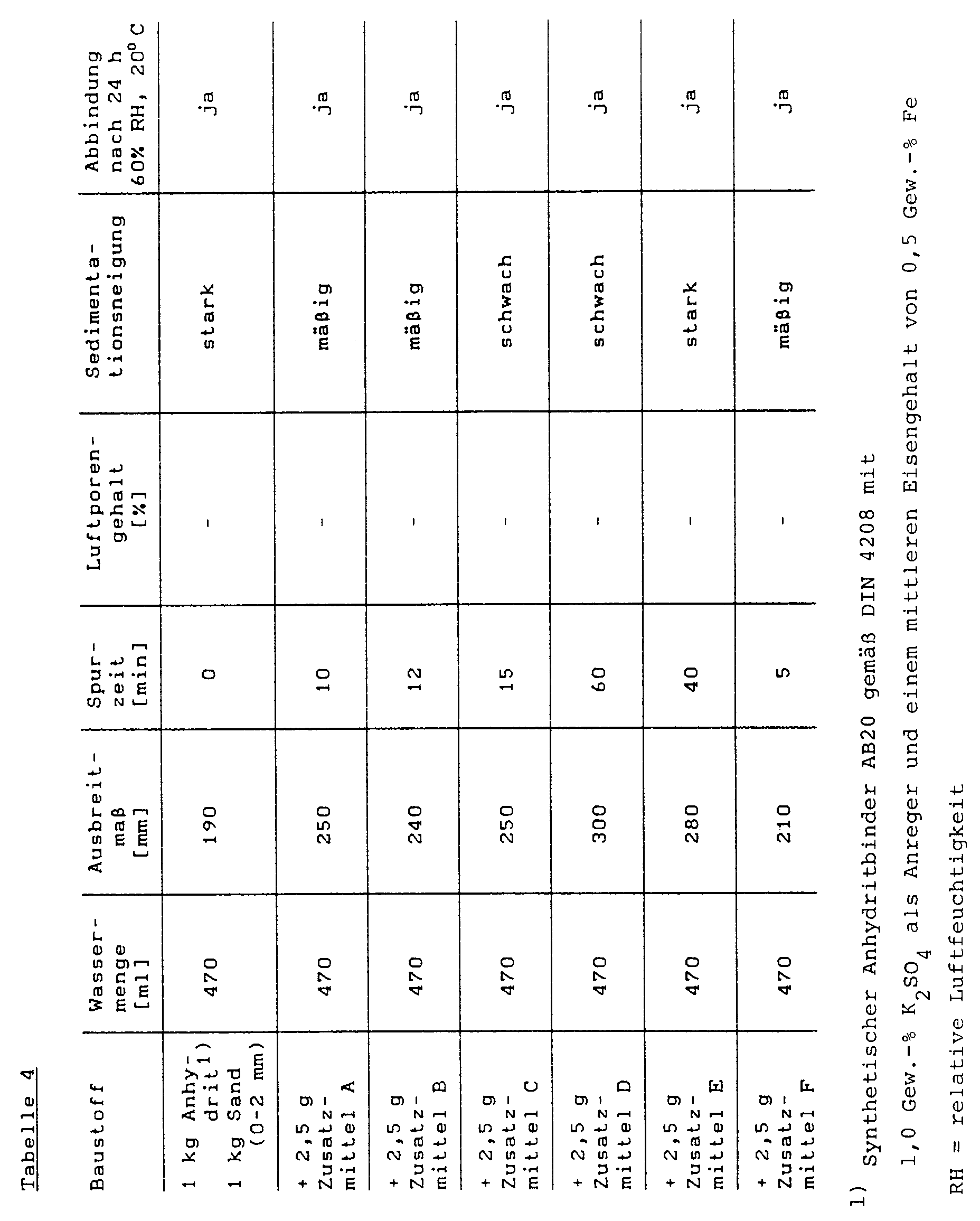
- This condensation product is added to various building materials, the properties of which are then measured (see tables).
- naphthalene 1 mol of naphthalene is sulfonated with 1.36 mol of 100% sulfuric acid and condensed in aqueous solution together with 0.63 mol of 4,4'-dihydroxidiphenyl sulfone with 0.81 mol of formaldehyde.
- the acidic condensation mixture is neutralized with sodium hydroxide solution and Na phthalate solution to pH approx. 7-9 and spray dried or used as a solution.
- 2,4,6-triamino-1,3,5-triazine (melamine) is reacted at pH 9.0 with formaldehyde and sodium bisulfite.
- the N-methylol compound thus obtained is then condensed at pH 6.0 immediately after adding a small amount of formamide.
- the pH of the aqueous solution is adjusted to 9.5 and the product obtained is either spray-dried or used in an aqueous solution.
- 1 mol of naphthalene is sulfonated with 1.36 mol of sulfuric acid for about 3 hours at about 145 ° C., the sulfonation mixture obtained is condensed for about 3 hours with 0.64 mol of formaldehyde at 115 to 117 ° C., cooled to about 80 ° C. , adjusted to pH 6 to 7 with sodium hydroxide solution and the reaction product spray-dried or used as an aqueous solution.
Landscapes
- Chemical & Material Sciences (AREA)
- Engineering & Computer Science (AREA)
- Ceramic Engineering (AREA)
- Materials Engineering (AREA)
- Structural Engineering (AREA)
- Organic Chemistry (AREA)
- Curing Cements, Concrete, And Artificial Stone (AREA)
Abstract
Description
Die Erfindung betrifft mineralische Baustoffe, die Bindemittel, wie z.B. Zement oder Anhydrit, gegebenenfalls Zuschlagstoffe, wie z.B. Sand, und weitere Zusatzmittel enthalten.The invention relates to mineral building materials, the binders such as e.g. Cement or anhydrite, optionally aggregates, such as e.g. Sand, and other additives.
Bei der Herstellung von Bauteilen, wie Estrichen, Wandplatten, Mauern, Decken usw. werden im allgemeinen anorganische Bindemittel, wie Anhydrit (natürlicher und künstlicher), Gips, Zement, teilweise ungemagert, in der Regel jedoch in Verbindung mit Zuschlagstoffen wie Sand, Kies, Perlit, Bims, geschäumte Kunststoffperlen, sowie mit Wasser - evtl. unter Verwendung von Zusätzen wie Luftporenbildnern oder Verflüssigern - angemischt und so verarbeitet. Hierbei muß man, um gute Eigenschaften der mit diesem Mörtel hergestellten Bauteile zu erhalten, darauf achten, daß mit einem geringen Wasser-Bindemittel-Faktor (WBF) gearbeitet wird, d.h. mit möglichst wenig Wasser bezogen auf das eingesetzte Bindemittel. Dadurch wird der Mörtel jedoch häufig zähflüssig. Bei weiterer Herabsetzung des Wassergehalts verliert er seine Plastizität und damit auch seine gute Verdichtbarkeit. Um dann aus einem solchen Mörtel hochwertige Bauteile herstellen zu können, ist ein intensives, mechanisches Verdichten durch Rütteln und/oder Pressen erforderlich. Da für viele Zwecke auch dies nicht ausreichend ist, müssen oft erhöhte Bindemittelmengen eingesetzt werden, um die gewünschten Eigenschaften wie hohe Festigkeiten, frühe Begehbarkeit oder frühe Entschalbarkeit, Dichtigkeit usw. zu erreichen.In the production of components such as screeds, wall panels, walls, ceilings, etc., inorganic binders such as anhydrite (natural and artificial), gypsum, cement are generally partially lean, but usually in combination with additives such as sand, gravel, Perlite, pumice, foamed plastic beads, and mixed with water - possibly using additives such as air entraining agents or plasticizers - and processed in this way. In order to obtain good properties of the components produced with this mortar, care must be taken to work with a low water binder factor (WBF), ie with as little water as possible based on the binder used. However, this often makes the mortar viscous. If the water content is further reduced, it loses its plasticity and thus its good compressibility. In order to be able to produce high-quality components from such a mortar, intensive mechanical compaction by shaking and / or pressing is necessary. Since this is also not sufficient for many purposes, increased amounts of binder often have to be used in order to achieve the desired properties such as high strength, early accessibility or early demoulding, tightness etc.
Alle oben genannten Maßnahmen sind mit erhöhtem Aufwand und damit auch mit erhöhten Kosten verbunden. Oft wird deshalb auf diese Maßnahmen verzichtet und durch Erhöhung des Wasser-Bindemittel-Faktors eine leichtere Verarbeitbarkeit des Mörtels erzwungen. Qualitative Mängel oder Schäden an den so hergestellten Bauteilen sind oft die Folge.All of the above measures are associated with increased effort and thus also with increased costs. These measures are therefore often dispensed with and the mortar is made easier to work with by increasing the water-binder factor. Qualitative defects or damage to the components manufactured in this way are often the result.
Es wurde deshalb versucht, durch chemische Zusätze die Verarbeitungsfähigkeit von Mörteln zu verbessern.An attempt was therefore made to improve the processability of mortars through chemical additives.
Mittels chemischer plastifizierend oder verflüssigend wirkender Zusätze, die schon bei geringen Mengen die Bindemittelteilchen dispergieren, kann man eine beträchtlich verbesserte Verarbeitbarkeit der Baustoffmischung erreichen, ohne daß das Wasser-Bindemittel-Verhältnis geändert wird, beziehungsweise kann man mit weniger Wasser eine unveränderte Verarbeitbarkeit erreichen. In beiden Fällen erhält man im Durchschnitt eine geringere Porosität bei erhöhter Festigkeit.By means of chemical plasticizing or liquefying additives that disperse the binder particles even in small amounts, the processability of the building material mixture can be improved considerably without changing the water-binder ratio, or the processability can be unchanged with less water. In both cases, on average, a lower porosity is obtained with increased strength.
Ferner wirken die plastifizierenden oder verflüssigenden Zusätze infolge ihrer Oberflächenaktivität auch dahingehend, daß sie die im Bindemittel stets anwesenden Agglomerate von feinteiligen Partikeln dispergieren. Dies führt zu einer besseren und homogeneren Verteilung des Bindemittels der Baustoffmischung und hierdurch zu einer besseren Wirkung des Bindemittels und damit zu einer höheren Festigkeit.Furthermore, due to their surface activity, the plasticizing or liquefying additives also act in such a way that they disperse the agglomerates of finely divided particles which are always present in the binder. This leads to a better and more homogeneous distribution of the binder of the building material mixture and thereby to a better effect of the binder and thus to a higher strength.
Die Unterscheidung zwischen plastifizierenden und verflüssigenden Substanzen ist nicht scharf. Mittels plastifizierender Zusätze ist es im allgemeinen möglich, eine Reduzierung der Wassermenge von etwa 15 % zu erreichen. Mit Verflüssigern hingegen wird oft eine Reduzierung der Wassermenge bis zu 30 % und eine Erhöhung der Festigkeit von 40 bis 50 % erreicht.The distinction between plasticizing and liquefying substances is not clear. Plasticizing additives generally make it possible to reduce the amount of water by about 15%. With liquefiers, on the other hand, the amount of water is often reduced by up to 30% and the strength increased by 40 to 50%.
So ist bekannt, Verflüssiger für anorganische Bindemittel, wie Zement, Gips oder Anhydrit, einzusetzen, bei denen es sich fast durchweg um oberflächenaktive Stoffe, wie z.B. Melaminsulfonate, Alkyl-Arylsulfonate, Äthylenoxid-Additionsprodukte, Alkylphenol-Polyglykoläther, Ligninsulfonate und andere, sowie deren Kombinationen, handelt. Diese Produkte werden meist in Mengen von 0,01 bis 0,5 % zum Bindemittel eingesetzt. Dabei beträgt die Wassereinsparung beziehungsweise Erhöhung der Fließfähigkeit bei optimaler Dosierung kaum mehr als 10 bis 20 %. Größere Zusatzmengen ergeben keine wesentliche Steigerung des Verflüssigungseffektes, jedoch fast durchweg eine erhebliche negative Beeinflussung der Eigenschaften des Mörtels, vor allem eine Minderung der Abbindegeschwindigkeit, Erhöhung des Luftporengehaltes und Senkung der Festigkeiten.It is known to use plasticizers for inorganic binders, such as cement, gypsum or anhydrite, which are almost always surface-active substances, such as melamine sulfonates, alkyl aryl sulfonates, ethylene oxide addition products, alkylphenol polyglycol ethers, lignin sulfonates and others, and the like Combinations. These products are mostly used in quantities of 0.01 to 0.5% for the binder. The water saving or increase in flowability with optimal dosage is hardly more than 10 to 20%. Larger amounts of additive do not result in a significant increase in the liquefaction effect, but almost without exception a considerable negative influence on the Properties of the mortar, especially a reduction in the setting speed, increasing the air pore content and lowering the strength.
In den deutschen Offenlegungsschriften 1 671 017 und 3 609 802 wird der Zusatz modifizierter Aminotriazin-Harze zu anorganischen Bindemitteln vorgeschlagen. Diese Zusätze verleihen dem Baustoff gute Haft-, Zug- und Druckfestigkeiten und Oberflächengüte. Diese Produkte bringen jedoch den Nachteil mit sich, daß sich bei niedriger Dosierung des Zusatzes schlecht zu verarbeitende klebende Mischungen mit zu kurzer Verarbeitungszeit ergeben beziehungsweise bei höherer Dosierung, abgesehen von Wirtschaftlichkeitsaspekten, Mischungen ergeben, bei denen sich Bindemittel und Zuschlagstoff separieren, und es zur Ausbildung von Schlämmschichten auf der Oberfläche kommt.In the German Offenlegungsschriften 1 671 017 and 3 609 802, the addition of modified aminotriazine resins to inorganic binders is proposed. These additives give the building material good adhesive, tensile and compressive strengths and surface quality. However, these products have the disadvantage that, at a low dosage of the additive, poorly processable adhesive mixtures result with a processing time that is too short, or at higher dosages, apart from economic aspects, there are mixtures in which binder and additive separate, and they form comes from sludge layers on the surface.
Es ist weiterhin bekannt, als Plastifikatoren und/oder Verflüssiger für Baustoffmischungen Ligninsulfonate (DOS 2 713 898, DOS 3 204 326) und Lignin-Formaldehydkondensate (US 3 184 493, DOS 2 803 923, EP 3 362) sowie Naphthalinsulfonate (DAS 1 238 831, DOS 2 007 603, DOS 2 809 685) einzusetzen.It is also known as plasticizers and / or plasticizers for building material mixtures lignin sulfonates (DOS 2 713 898, DOS 3 204 326) and lignin-formaldehyde condensates (US 3 184 493, DOS 2 803 923, EP 3 362) and naphthalene sulfonates (DAS 1 238 831, DOS 2 007 603, DOS 2 809 685).
Die Wirksamkeit von Verflüssigern auf Basis von Ligninsulfonaten ist geringer als die von Melaminharz-Kondensaten. Bei höheren Dosierungen zeigt sich zwar eine gute verflüssigende Wirkung, die Mörtelzusammensetzung "blutet" jedoch aus, und die Abbindezeiten werden zu hoch. Mischungen verschiedener Ligninsulfonate mit anderen chemischen Substanzen, wie kondensierten Aromaten, Heterozyklen und Aminoverbindungen mildern zwar die unerwünschten Effekte, können sie jedoch nicht beseitigen.The effectiveness of plasticizers based on lignin sulfonates is less than that of melamine resin condensates. At higher doses there is a good liquefying effect, but the mortar composition "bleeds" and the setting times become too long. Mixtures of different lignin sulfonates with other chemical ones Substances such as condensed aromatics, heterocycles and amino compounds alleviate the undesirable effects, but cannot eliminate them.
Nichtionische Zusatzstoffe vom Typ der Polyäther werden in DOS 2 050 084 beschrieben. DOS 1 265 022 empfiehlt die Verwendung nichtionogener Netzmittel mit organischen Aminobasen sowie Hydroxylgruppen enthaltenden organischen Säuren.Nonionic additives of the polyether type are described in DOS 2 050 084. DOS 1 265 022 recommends the use of non-ionic wetting agents with organic amino bases and hydroxyl-containing organic acids.
DOS 2 322 707 betrifft Mörtel, die anorganische Bindemittel, gegebenenfalls Zuschlagstoffe, Zusatzstoffe und/oder Zusatzmittel enthalten, wobei als Zusatzmittel Formaldehyd-Kondensationsprodukte mit sulfonierten aromatischen Äthern und/oder Iminen und/oder Sulfonen eingesetzt werden.DOS 2 322 707 relates to mortars which contain inorganic binders, optionally additives, additives and / or additives, formaldehyde condensation products with sulfonated aromatic ethers and / or imines and / or sulfones being used as additives.
Derartige Zusatzmittel haben eine geringe plastifizierende/verflüssigende Wirkung und müssen deshalb zur Erzielung der gewünschten Effekte in relativ hoher Dosierung eingesetzt werden, was ihre Verwendung unwirtschaftlich macht. Hinzu kommt, daß die Mörtelmischungen bei den erforderlichen hohen Dosierungen stark zum "Ausbluten" oder bei nicht fließfähigen Mischungen zum Kleben neigen.Such additives have a low plasticizing / liquefying effect and must therefore be used in order to achieve the desired effects in relatively high doses, which makes their use uneconomical. In addition, the mortar mixtures tend to "bleed out" at the required high dosages or to stick in the case of non-flowable mixtures.
Aufgabe war es daher, Baustoffe auf der Grundlage mineralischer, anorganischer Bindemittel zur Verfügung zu stellen, bei denen die erforderliche Menge Wasser zur Erreichung der Verarbeitungskonsistenz gering ist, die Festigkeit des abgebundenen Baustoffs hoch ist und gleichzeitig die Verarbeitbarkeit des nassen Baustoffes gut ist, ohne daß die Abbindezeiten stark verzögert sind.The task was therefore to provide building materials based on mineral, inorganic binders, in which the amount of water required to achieve the processing consistency is low, the strength of the set building material is high and at the same time, the processability of the wet building material is good without the setting times being greatly delayed.
Diese Aufgabe konnte mit den erfindungsgemäßen mineralischen Baustoffen gelöst werden.This object could be achieved with the mineral building materials according to the invention.
Gegenstand der Erfindung sind mineralische Baustoffe, die Bindemittel, gegebenenfalls Zuschlagstoffe und mindestens ein Zusatzmittel enthalten, dadurch gekennzeichnet, daß als Zusatzmittel Verbindungen eingesetzt werden, die Kondensationsprodukte von substituierten oder unsubstituierten Diphenylsulfonen, Formaldehyd und Verbindungen aus der Gruppe bestehend aus einkernigen oder mehrkernigen, substituierten oder unsubstituierten aromatischen Verbindungen, Säureamiden, Harnstoff, Harnstoffderivaten, substituierten oder unsubstituierten aromatischen Äthern und Iminen sind.The invention relates to mineral building materials which contain binders, optionally additives and at least one additive, characterized in that compounds are used as additives, the condensation products of substituted or unsubstituted diphenyl sulfones, formaldehyde and compounds from the group consisting of mononuclear or polynuclear, substituted or are unsubstituted aromatic compounds, acid amides, urea, urea derivatives, substituted or unsubstituted aromatic ethers and imines.
Bevorzugt sind mineralische Baustoffe, die als Zusatzmittel Kondensationsprodukte aus Diphenylsulfonen der Formel I

mit
- X¹ und X² =
- H, OH, substituiertes oder unsubstituiertes C₁-C₆-Alkyl, C₁-C₆-Alkoxy oder Halogen, wobei X¹ und X² gleich oder verschieden sein können,
- Y¹ und Y² =
- H, (CH₂)n SO₃Me oder SO₃Me [mit n = 1-5 und Me = Alkalimetall, substituiertes oder unsubstituiertes Ammonium], wobei Y¹ und Y² gleich oder verschieden sein können,
- r und s unabhängig voneinander =
- 0 bis 2
und - u und v unabhängig voneinander =
- 0 oder 1

Me = Alkalimetall, substituiertes oder unsubstituiertes Ammonium
Z = H, OH, C₁-C₄-Alkyl

Me = Alkalimetall, substituiertes oder unsubstituiertes Ammonium

R=H, C₁-C₄-Alkyl

Me = Alkalimetall, substituiertes oder unsubstituiertes Ammonium
Z = H, OH, C₁-C₄-Alkyl
und Formaldehyd enthalten.Mineral building materials which contain condensation products of diphenyl sulfones of the formula I as additives are preferred
With
- X¹ and X² =
- H, OH, substituted or unsubstituted C₁-C₆-alkyl, C₁-C₆-alkoxy or halogen, where X¹ and X² can be the same or different,
- Y¹ and Y² =
- H, (CH₂) n SO₃Me or SO₃Me [with n = 1-5 and Me = alkali metal, substituted or unsubstituted ammonium], where Y¹ and Y² can be the same or different,
- r and s independently of each other
- 0 to 2
and - u and v independently of each other
- 0 or 1
Me = alkali metal, substituted or unsubstituted ammonium
Z = H, OH, C₁-C₄ alkyl
Me = alkali metal, substituted or unsubstituted ammonium
R = H, C₁-C₄ alkyl
Me = alkali metal, substituted or unsubstituted ammonium
Z = H, OH, C₁-C₄ alkyl
and contain formaldehyde.
Besonders bevorzugt sind mineralische Baustoffe, die als Zusatz Kondensationsprodukte aus Diphenylsulfonen und Verbindungen aus der Gruppe bestehend aus einkernigen oder mehrkernigen, substituierten oder unsubstituierten aromatischen Verbindungen, Säureamiden, Harnstoff, Harnstoffderivaten, substituierten oder unsubstituierten aromatischen Äthern und Iminen im Molverhältnis 1:5 bis 5:1 mit Formaldehyd im Molverhältnis 1:0,8 bis 1:2,0 bezogen auf die im Überschuß vorhandene Komponente enthalten.Mineral building materials which contain condensation products from diphenyl sulfones and compounds from the group consisting of mononuclear or polynuclear, substituted or unsubstituted aromatic compounds, acid amides, urea, urea derivatives, substituted or unsubstituted aromatic ethers and imines in a molar ratio of 1: 5 to 5: 1 with formaldehyde in a molar ratio of 1: 0.8 to 1: 2.0 based on the component present in excess.
Vorzugsweise werden Kondensationsprodukte aus Diphenylsulfonen der Formel I
mit
- X¹ und X² =
- OH
- r und s =
- 1
- Y¹ und Y² =
- SO₃Me oder (CH₂)nSO₃Me [mit Me = Alkalimetall und n = 1]
- u und v =
- 0 oder 1

Me = Alkalimetall
Z = H, OH, C₁-C₄-Alkyl

Me = Alkalimetall

Me = Alkalimetall
Z = H, OH, C₁-C₄-Alkyl

und Formaldehyd eingesetzt.Condensation products of diphenyl sulfones of the formula I are preferred
With
- X¹ and X² =
- OH
- r and s =
- 1
- Y¹ and Y² =
- SO₃Me or (CH₂) n SO₃Me [with Me = alkali metal and n = 1]
- u and v =
- 0 or 1
Me = alkali metal
Z = H, OH, C₁-C₄ alkyl
Me = alkali metal
Me = alkali metal
Z = H, OH, C₁-C₄ alkyl
and formaldehyde.
Die mineralischen Baustoffe werden zur Herstellung von Bauteilen, wie Estrichen, Wandplatten, Mauern, Decken usw. verwendet.The mineral building materials are used to manufacture components such as screeds, wall panels, walls, ceilings, etc.
Die Zusatzmittel können pulverförmig oder in Lösung dem mineralischen Baustoff zugesetzt werden.The additives can be added to the mineral building material in powder form or in solution.
Als Maßstab für die Wirksamkeit von Zusatzmitteln wird bei erdfeuchten, nicht fließfähigen Baustoffen die Handhabbarkeit bei der Anwendung, wie z.B. mechanische Beweglichkeit, Klebrigkeit und Separierungsneigung der Bestandteile verstanden.As a yardstick for the effectiveness of additives, the ease of use during use, e.g. understood mechanical mobility, stickiness and tendency to separate the components.
Eine Messgröße für die Verarbeitbarkeit erdfeuchter, nicht fließfähiger Baustoffe ist ferner der Luftporengehalt nach DIN 18555/P2. Je höher der Luftporengehalt umso leichter ist im allgemeinen die Verarbeitbarkeit und um so geringer ist die Klebrigkeit des Baustoffes. Die Druckfestigkeit fällt jedoch im allgemeinen mit steigendem Luftporengehalt ab. Der Mörtel sollte deshalb auch bei erhöhtem Luftporengehalt noch ausreichende Festigkeit aufweisen.A measure of the processability of earth-moist, non-flowable building materials is also the air pore content according to DIN 18555 / P2. In general, the higher the air pore content, the easier it is to process and the lower the stickiness of the building material. However, the compressive strength generally drops with increasing air pore content. The mortar should therefore still have sufficient strength even with an increased air pore content.
Ferner darf durch die Verwendung eines Zusatzmittels keine Sedimentation oder ein "Ausbluten" des Baustoffes in der Anfangsphase hervorgerufen werden und während oder nach dem Abbinden kein unzulässiger Schwund oder Quellverhalten gemäß DIN 52450 verursacht werden.Furthermore, the use of an additive must not cause sedimentation or "bleeding" of the building material in the initial phase and during or after setting no unacceptable shrinkage or swelling behavior according to DIN 52450 are caused.
Bei fließfähigen Baustoffen soll der Baustoff möglichst selbstnivellierend sein und und fließen, ohne daß ein "Ausbluten" in der Anfangsphase auftritt. Fließfähige Baustoffe müssen ferner eine genügend lange Verarbeitungszeit aufweisen, ohne daß die Abbindezeit wesentlich verzögert wird. Ansonsten gelten die gleichen Anforderungen wie für nicht fließfähige Baustoffe wie oben beschrieben.In the case of flowable building materials, the building material should be as self-leveling as possible and flow without "bleeding" occurring in the initial phase. Flowable building materials must also have a sufficiently long processing time without significantly delaying the setting time. Otherwise, the same requirements apply as for non-flowable building materials as described above.
Die erfindungsgemäßen Baustoffe erfüllen diese o.g. Erfordernisse in höchstem Maße`The building materials according to the invention meet the above. Highest requirements`
Den erfindungsgemäßen Baustoffen können außer den als Zusatzmittel beanspruchten Kondensationsprodukten auch noch weitere an sich bekannte Zusatzmittel zugefügt werden.In addition to the condensation products claimed as additives, other building additives known per se can also be added to the building materials according to the invention.
Die als Zusatzstoffe beanspruchten Kondensationsprodukte sind Verbindungen, die aus der Literatur allgemein bekannt sind und deren Herstellung ebenfalls beschrieben ist (siehe Ullmanns Encyclopädie der technischen Chemie Bd. 16, S. 109; DE-OS 19 60 616, EP-A-242 495, DE-A-29 05 083).The condensation products claimed as additives are compounds which are generally known from the literature and whose preparation is also described (see Ullmann's Encyclopedia of Industrial Chemistry, vol. 16, p. 109; DE-OS 19 60 616, EP-A-242 495, DE-A-29 05 083).
Die Herstellung der Baustoffe und die Ermittlung der Daten erfolgte gemäß Norm DIN 4208 Anhydritbinder Ausgabe März 1984 für Anhydrit, gemäß DIN EN 196 Prüfverfahren für Zement und gemäß DIN 1168 für β-Halbhydrat.The production of the building materials and the determination of the data was carried out in accordance with the DIN 4208 Anhydrite Binder Edition March 1984 for anhydrite, in accordance with DIN EN 196 test methods for cement and in accordance with DIN 1168 for β-hemihydrate.
Als Maßstab für die plastifizierende/verflüssigende Wirkung von Zusatzmitteln wird das Ausbreitmaß gemäß DIN 4208/EN 196 herangezogen. Das Ausbreitmaß ist der Durchmesser eines Kreises einer Mischung, der sich ergibt, wenn ein komischer Setztrichter von 8 cm Höhe, 10 cm unteren und 8 cm oberen Durchmesser gefüllt mit der zu prüfenden Mischung auf eine Glasplatte ausgesetzt wird und sodann vorsichtig senkrecht abgezogen wird. Die Mischung breitet sich sodann kreisförmig aus. Das Verhältnis der Durchmesser der Kreise der Baustoffe ohne und mit Zusatzmittel gibt Auskunft über die verflüssigende Wirkung des Zusatzmittels. Bei erdfeuchten nicht verfließenden Baustoffen wird vor Ermittlung des Durchmessers die Glasplatte gemäß Norm DIN 4208/EN 196 15mal geschockt.The slump according to DIN 4208 / EN 196 is used as a yardstick for the plasticizing / liquefying effect of additives. The slump is the diameter of a circle of a mixture that results when a comical setting funnel 8 cm high, 10 cm lower and 8 cm upper diameter filled with the mixture to be tested is placed on a glass plate and then carefully pulled off vertically. The mixture then spreads out in a circle. The ratio of the diameter of the circles of the building materials with and without additives provides information about the liquefying effect of the additive. In the case of earth-moist building materials that do not flow, the glass plate is shocked 15 times in accordance with the DIN 4208 / EN 196 standard before the diameter is determined.
In abgewandelter Form kann die plastifizierende oder verflüssigende Wirkung des Zusatzmittels auch ermittelt werden, indem bei konstantem Ausbreitmaß die erforderliche Wassermenge mit und ohne Zusatzmittel ermittelt wird.In a modified form, the plasticizing or liquefying effect of the additive can also be determined by determining the required amount of water with and without the additive while maintaining a constant slump.
Zur Beurteilung der selbstnivellierenden Eigenschaften von Baustoffen wird zusätzlich die Spurzeit herangezogen. Unter Spurzeit ist die Zeit zu verstehen, bis zu der eine auf der Oberfläche der Baustoffe erzeugte Spur in sich selbst verfließt. Die Spur kann z.B. durch Bewegung eines Nagels oder ähnlichen Gegenständen an der Oberfläche der Mischung erzeugt werden. Die Beurteilung erfolgt visuell.The track time is also used to assess the self-leveling properties of building materials. Track time is the time until a track created on the surface of the building materials dissolves in itself. The track can e.g. by moving a nail or similar object on the surface of the mixture. The assessment is done visually.
Die Erfindung soll anhand der nachfolgenden Beispiele näher erläutert werden.The invention is illustrated by the following examples.
1 Mol Dihydroxydiphenylsulfon roh wird mit 1,2 Mol Natriumbisulfit und 2,3 Mol Formaldehyd sulfomethyliert, das erhaltene Produkt mit Schwefelsäure und Schwefeldioxid auf pH 5 gestellt und mit 1,5 Mol Harnstoff und weiteren 0,65 Mol Formaldehyd nachkondensiert. Nach Zusatz von Phthalsäure-Mononatriumsalz (ca. 20 Gew.-% bezogen auf den Trockengehalt des Kondensates) wird ein pH-Wert von 7-8 eingestellt und sprühgetrocknet.1 mol of crude dihydroxydiphenyl sulfone is sulfomethylated with 1.2 mol of sodium bisulfite and 2.3 mol of formaldehyde, the product obtained is adjusted to pH 5 with sulfuric acid and sulfur dioxide and post-condensed with 1.5 mol of urea and a further 0.65 mol of formaldehyde. After the addition of phthalic acid monosodium salt (approx. 20% by weight based on the dry content of the condensate), a pH of 7-8 is set and spray-dried.
Dieses Kondensationsprodukt wird verschiedenen Baustoffen zugesetzt, deren Eigenschaften danach gemessen werden (siehe Tabellen).

1 Mol Ditolyletherisomerengemisch wird mit 2 Mol Schwefelsäure sulfoniert und das erhaltene Gemisch von Ditolylethersulfonsäuren mit 1 Mol 4,4'-Dihydroxydiphenylsulfon in wäßriger Lösung mit 0,93 Mol Formaldehyd kondensiert, mit Natronlauge auf pH ca. 7-9 neutralisiert und sprühgetrocknet bzw. als Lösung eingesetzt.

1 Mol Naphthalin wird mit 1,36 Mol Schwefelsäure 100%ig sulfoniert und in wäßriger Lösung zusammen mit 0,63 Mol 4,4'-Dihydroxidiphenylsulfon mit 0,81 Mol Formaldehyd kondensiert. Das saure Kondensationsgemisch wird mit Natronlauge und Na-Phthalatlösung neutralisiert auf pH ca. 7-9 und sprühgetrocknet oder als Lösung eingesetzt.

1 Mol Phenolsulfonsäure und 3 Mol 4,4'-Dihydroxydiphenylsulfon roh werden in wäßriger Lösung bei pH ca. 8 mit 2,4 Mol Formaldehyd kondensiert. Das saure Kondensationsgemisch wird mit Natronlauge und Na-Phthalatlösung neutralisiert und auf pH 7-9 eingestellt und sprühgetrocknet oder als wäßrige Lösung eingesetzt.

2,4,6-Triamino-1,3,5-triazin (Melamin) wird bei pH 9,0 mit Formaldehyd und Natriumhydrogensulfit umgesetzt. Die so erhaltene N-Methylolverbindung wird anschließend unmittelbar nach Zugabe einer kleinen Menge Formamid bei pH 6,0 kondensiert. Der pH-Wert der wäßrigen Lösung wird auf 9,5 eingestellt und das erhaltene Produkt entweder sprühgetrocknet oder in wäßriger Lösung eingesetzt.

1 Mol Naphthalin wird mit 1,36 Mol Schwefelsäure ca. 3 Stunden bei ca. 145°C sulfoniert, das erhaltene Sulfonierungsgemisch ca. 3 Stunden mit 0,64 Mol Formaldehyd bei 115 bis 117°C kondensiert, abgekühlt auf ca. 80°C, mit Natronlauge auf pH 6 bis 7 gestellt und das Reaktionsprodukt sprühgetrocknet oder als wäßrige Lösung eingesetzt.





Claims (5)

und

Z = H, OH, C₁-C₄-Alkyl


Z = H, OH, C₁-C₄-Alkyl
und Formaldehyd eingesetzt werden.Mineral building materials according to claim 1, characterized in that condensation products from diphenyl sulfones of the formula I.
and
Z = H, OH, C₁-C₄ alkyl
Z = H, OH, C₁-C₄ alkyl
and formaldehyde can be used.
mit
[mit Me = Alkalimetall und n = 1]
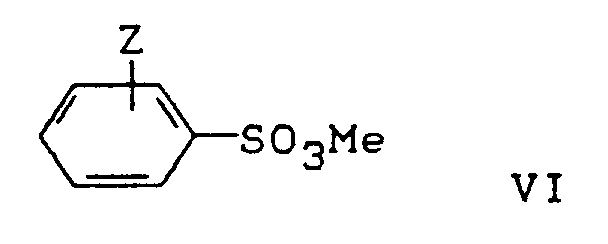
Z = H, OH, C₁-C₄-Alkyl


Z = H, OH, C₁-C₄-Alkyl

With
[with Me = alkali metal and n = 1]
Z = H, OH, C₁-C₄ alkyl
Z = H, OH, C₁-C₄ alkyl
Applications Claiming Priority (2)
| Application Number | Priority Date | Filing Date | Title |
|---|---|---|---|
| DE4218183 | 1992-06-02 | ||
| DE4218183A DE4218183A1 (en) | 1992-06-02 | 1992-06-02 | Improved mineral building materials with additives |
Publications (1)
| Publication Number | Publication Date |
|---|---|
| EP0572877A1 true EP0572877A1 (en) | 1993-12-08 |
Family
ID=6460230
Family Applications (1)
| Application Number | Title | Priority Date | Filing Date |
|---|---|---|---|
| EP93108263A Withdrawn EP0572877A1 (en) | 1992-06-02 | 1993-05-21 | Improved inorganic building materials containing additives |
Country Status (3)
| Country | Link |
|---|---|
| US (1) | US5348582A (en) |
| EP (1) | EP0572877A1 (en) |
| DE (1) | DE4218183A1 (en) |
Families Citing this family (7)
| Publication number | Priority date | Publication date | Assignee | Title |
|---|---|---|---|---|
| KR100240737B1 (en) * | 1992-12-21 | 2000-01-15 | 마에다나오미 | Cement including composite material, cement products, molding material, a concrete member and a method of producing the same |
| US5651817A (en) * | 1995-12-14 | 1997-07-29 | Kao Corporation | Cement dispersant |
| WO1999028125A1 (en) | 1997-12-03 | 1999-06-10 | Innovative Coatings Corporation | Novel synthetic finishing and coating systems |
| FR2826521B1 (en) * | 2001-06-26 | 2003-09-26 | Somfy | RADIO-CONTROLLED CONTROL DEVICE |
| RU2197448C1 (en) * | 2001-09-28 | 2003-01-27 | Киселёв Вадим Михайлович | Raw material mixture for manufacture of heat-insulating material and method of production of such mixture |
| US7290613B2 (en) * | 2004-10-15 | 2007-11-06 | Halliburton Energy Services, Inc. | Cement compositions comprising aromatic sulfonated polymers and methods of using the same |
| US7325611B2 (en) * | 2006-03-09 | 2008-02-05 | Halliburton Energy Services, Inc. | Cement compositions for reducing gas or water migration and methods of using the same |
Citations (3)
| Publication number | Priority date | Publication date | Assignee | Title |
|---|---|---|---|---|
| FR2228041A1 (en) * | 1973-05-05 | 1974-11-29 | Bayer Ag | |
| DE2421222A1 (en) * | 1974-05-02 | 1975-11-13 | Cassella Farbwerke Mainkur Ag | USE OF THE CONDENSATION PRODUCTS OF DOUBLE NUCLEAR PHENOLS WITH FORMALDEHYDE AS A CONSTRUCTION MATERIAL |
| DE4027667A1 (en) * | 1989-09-01 | 1991-03-07 | Sanyo Kokusaku Pulp Co | CONDENSATES BASED ON AROMATIC AMINOSULPHONES, BISPHENOLES AND FORMALDEHYDE, METHOD FOR THE PRODUCTION THEREOF, AND COLOR DISPERSIONS, ADDITIVES AND WATER-REDUCING AGENTS CONTAINING SUCH CONDENSATIONS |
Family Cites Families (16)
| Publication number | Priority date | Publication date | Assignee | Title |
|---|---|---|---|---|
| DE1081451B (en) * | 1958-12-19 | 1960-05-12 | Bayer Ag | Process for the production of di- and polyisocyanates |
| DE1265022B (en) * | 1960-12-12 | 1968-03-28 | Dr Karl Brandt | Process for the production of cement mortar and concrete with highly enhanced strength properties |
| DE1238831B (en) * | 1965-01-09 | 1967-04-13 | Kao Corp | Process for the production of easily spreadable cement |
| NL153838B (en) * | 1969-08-21 | 1977-07-15 | Kao Corp | PROCESS FOR MAKING HYDRAULIC CEMENT AND ARTICLES MANUFACTURED OR COATED UNDER APPLICATION OF THE CEMENT SO OBTAINED. |
| BE759823A (en) * | 1969-12-03 | 1971-05-17 | Bayer Ag | AGENTS IMPROVING WET SOLIDITY |
| US4065318A (en) * | 1976-03-29 | 1977-12-27 | American Can Company | Well cementing |
| FI790180A7 (en) * | 1978-01-30 | 1979-07-31 | Holmen Gmbh | FLYTMEDEL FOER BETONG OCH BRUK SAMT FOERFARANDE FOER DESS FRAMSTAELLNING |
| SU701973A1 (en) * | 1978-03-03 | 1979-12-05 | Всесоюзный научно-исследовательский институт транспортного строительства | Concrete mixture |
| DE2809685B2 (en) * | 1978-03-07 | 1981-01-29 | Deutsche Solvay-Werke Gmbh, 5650 Solingen | Admixtures for concrete and its use |
| DE2905083A1 (en) * | 1979-02-10 | 1980-08-28 | Metallgesellschaft Ag | METHOD FOR THE PRODUCTION OF SULFURIC ACID |
| FI810405A7 (en) * | 1981-02-11 | 1982-08-12 | Flowcon Oy | Method for softening and/or liquefying Portland cement mixtures using lignosulfonate. |
| US4441929A (en) * | 1982-08-24 | 1984-04-10 | Diamond Shamrock Chemicals Company | Superplasticizers for cementitious compositions |
| US4592940A (en) * | 1983-12-16 | 1986-06-03 | Monsanto Company | Stain-resistant nylon carpets impregnated with condensation product of formaldehyde with mixture of diphenolsulfone and phenolsulfonic acid |
| US4623682A (en) * | 1985-10-01 | 1986-11-18 | Sandoz Ltd. | Cement mixes and admixtures thereof |
| GB8722608D0 (en) * | 1987-09-25 | 1987-11-04 | Fujisawa Pharmaceutical Co | Concrete admixture |
| US5233012A (en) * | 1989-09-01 | 1993-08-03 | Sanyo-Kokusaku Pulp Co., Ltd. | Production of novel condensates comprising bisphenols and aromatic aminosulfonic acids, condensates and dispersant, additive and water-reducing agent based thereon |
-
1992
- 1992-06-02 DE DE4218183A patent/DE4218183A1/en not_active Withdrawn
-
1993
- 1993-05-20 US US08/063,716 patent/US5348582A/en not_active Expired - Fee Related
- 1993-05-21 EP EP93108263A patent/EP0572877A1/en not_active Withdrawn
Patent Citations (3)
| Publication number | Priority date | Publication date | Assignee | Title |
|---|---|---|---|---|
| FR2228041A1 (en) * | 1973-05-05 | 1974-11-29 | Bayer Ag | |
| DE2421222A1 (en) * | 1974-05-02 | 1975-11-13 | Cassella Farbwerke Mainkur Ag | USE OF THE CONDENSATION PRODUCTS OF DOUBLE NUCLEAR PHENOLS WITH FORMALDEHYDE AS A CONSTRUCTION MATERIAL |
| DE4027667A1 (en) * | 1989-09-01 | 1991-03-07 | Sanyo Kokusaku Pulp Co | CONDENSATES BASED ON AROMATIC AMINOSULPHONES, BISPHENOLES AND FORMALDEHYDE, METHOD FOR THE PRODUCTION THEREOF, AND COLOR DISPERSIONS, ADDITIVES AND WATER-REDUCING AGENTS CONTAINING SUCH CONDENSATIONS |
Non-Patent Citations (1)
| Title |
|---|
| DATABASE WPI Week 8030, Derwent Publications Ltd., London, GB; AN 80-52844C & SU-A-701 973 (TRANSPORT CONS. RES.) 8. Dezember 1979 * |
Also Published As
| Publication number | Publication date |
|---|---|
| US5348582A (en) | 1994-09-20 |
| DE4218183A1 (en) | 1993-12-09 |
Similar Documents
| Publication | Publication Date | Title |
|---|---|---|
| DE2007603C3 (en) | Additive for hydraulic cement mixes and process for the preparation of an easily dispersible hydraulic cement mix | |
| DE2341923C3 (en) | Inorganic binding agent mortar, method of making and using the same | |
| DE2322707C3 (en) | Inorganic binding agent mortar | |
| EP1966103B1 (en) | Pulverulent polycondensation products | |
| EP0146078A2 (en) | Dispersion agent for saliferous systems | |
| DE3530258A1 (en) | USE OF SALTS OF WATER-SOLUBLE NAPHTALINE SULPHONIC ACID FORMALDEHYDE CONDENSATES AS ADDITIVES FOR INORGANIC BINDERS AND BUILDING MATERIAL | |
| EP0006135B1 (en) | Additive for inorganic binders, building material and process for its preparation | |
| CH646673A5 (en) | ADDITIVE COMBINATION AND METHOD FOR LIQUIDIFYING WATER-CONSTRUCTING MATERIALS. | |
| DE3533945A1 (en) | CEMENT ADDITIVE PREPARATION | |
| EP0572877A1 (en) | Improved inorganic building materials containing additives | |
| EP0191901B1 (en) | Gunite | |
| EP0441924B1 (en) | Stabilised-viscosity adhesive agent and mortar additive and process for making it | |
| DE3410820C2 (en) | ||
| DE69114831T2 (en) | FLOWABILITY-IMPROVING AGENT, METHOD FOR PRODUCING IT AND ITS USE. | |
| EP0025143B1 (en) | Mortars from inorganic binders, process for their production and their use | |
| AT397958B (en) | USE OF CONDENSATION PRODUCTS MELAMINE AND GLYOXYLIC ACID AS ADDITIVES FOR HYDRAULIC BINDERS AND BUILDING MATERIAL | |
| DE3730067A1 (en) | SELF-LEVELING MOUNTING MIXTURE | |
| EP0306629B1 (en) | Process for the fabrication of thinning agents for mineral binders | |
| DE2609703B2 (en) | Organocalcium aluminates and their use in hydraulic binders | |
| EP0092242A1 (en) | Utilisation of surface-active polymers against concrete efflorescence | |
| AT364640B (en) | BUILDING MATERIAL AND A METHOD FOR THE PRODUCTION THEREOF | |
| DE3225707A1 (en) | Moulding composition comprising hydraulic binders and polymer fibrils | |
| EP0090434B1 (en) | Plasticizer for a mineral binder | |
| DE4217181A1 (en) | Melamine glyoxylic acid or salt condensate use in hydraulic binder - to increase flow, retard setting and opt. increase strength of set prod. | |
| EP0291644B1 (en) | Plasticizing agents for mineral binders |
Legal Events
| Date | Code | Title | Description |
|---|---|---|---|
| PUAI | Public reference made under article 153(3) epc to a published international application that has entered the european phase |
Free format text: ORIGINAL CODE: 0009012 |
|
| AK | Designated contracting states |
Kind code of ref document: A1 Designated state(s): AT BE CH DE ES FR GB IT LI NL |
|
| 17P | Request for examination filed |
Effective date: 19940504 |
|
| 17Q | First examination report despatched |
Effective date: 19960923 |
|
| 18W | Application withdrawn |
Withdrawal date: 19970114 |