EP0525923A1 - Multipurpose scale preventer/remover - Google Patents
Multipurpose scale preventer/remover Download PDFInfo
- Publication number
- EP0525923A1 EP0525923A1 EP92250183A EP92250183A EP0525923A1 EP 0525923 A1 EP0525923 A1 EP 0525923A1 EP 92250183 A EP92250183 A EP 92250183A EP 92250183 A EP92250183 A EP 92250183A EP 0525923 A1 EP0525923 A1 EP 0525923A1
- Authority
- EP
- European Patent Office
- Prior art keywords
- process according
- scale
- aqueous
- rust
- ppm
- Prior art date
- Legal status (The legal status is an assumption and is not a legal conclusion. Google has not performed a legal analysis and makes no representation as to the accuracy of the status listed.)
- Granted
Links
Classifications
-
- C—CHEMISTRY; METALLURGY
- C02—TREATMENT OF WATER, WASTE WATER, SEWAGE, OR SLUDGE
- C02F—TREATMENT OF WATER, WASTE WATER, SEWAGE, OR SLUDGE
- C02F5/00—Softening water; Preventing scale; Adding scale preventatives or scale removers to water, e.g. adding sequestering agents
- C02F5/08—Treatment of water with complexing chemicals or other solubilising agents for softening, scale prevention or scale removal, e.g. adding sequestering agents
- C02F5/10—Treatment of water with complexing chemicals or other solubilising agents for softening, scale prevention or scale removal, e.g. adding sequestering agents using organic substances
- C02F5/12—Treatment of water with complexing chemicals or other solubilising agents for softening, scale prevention or scale removal, e.g. adding sequestering agents using organic substances containing nitrogen
-
- C—CHEMISTRY; METALLURGY
- C23—COATING METALLIC MATERIAL; COATING MATERIAL WITH METALLIC MATERIAL; CHEMICAL SURFACE TREATMENT; DIFFUSION TREATMENT OF METALLIC MATERIAL; COATING BY VACUUM EVAPORATION, BY SPUTTERING, BY ION IMPLANTATION OR BY CHEMICAL VAPOUR DEPOSITION, IN GENERAL; INHIBITING CORROSION OF METALLIC MATERIAL OR INCRUSTATION IN GENERAL
- C23G—CLEANING OR DE-GREASING OF METALLIC MATERIAL BY CHEMICAL METHODS OTHER THAN ELECTROLYSIS
- C23G1/00—Cleaning or pickling metallic material with solutions or molten salts
- C23G1/24—Cleaning or pickling metallic material with solutions or molten salts with neutral solutions
Definitions
- This invention relates to a method of preventing and/or removing calcium and/or rust deposits from surfaces in contact with aqueous systems and more specifically to a method of treating an aqueous system with 3,5-bis(di-N,N-(carboxymethyl)aminomethyl)-4-hydroxybenzenesulfonic acid to remove scale and/or rust deposits from the surfaces of the aqueous systems.
- aqueous systems particularly industrial aqueous systems such as boiler systems, cooling tower systems, heat exchanger systems, desalinization systems, and the like, are subject to the formation of deposits on the internal surfaces which are in contact with the circulating water.
- various approaches have been taken to either control or inhibit the formation of these deposits or alternatively to remove the already formed deposits.
- chelants are known for their ability to complex with many cations including hardness and heavy metal cations and thereby prevent their deposition. Chelants function by essentially "locking" the metal into a soluble organic ring structure. When chelants are applied in combination with a dispersant, the treated system often results in clean waterside surfaces.
- chelants tend to be somewhat specific with respect to which cations they will complex with.
- Anionic chelants have reactive sites that attract coordination cites of cations; coordination sites are areas on the ion that are receptive to chemical bonding.
- iron has six coordination sites, as does the chelant EDTA.
- iron ions combine with the EDTA and since all of the coordination sites on the iron ion are chemically bonded by the EDTA, a stable metal chelant is formed.
- nitrilotriacetic acid (NTA) which is another commonly used chelant, has only four coordination sites, and thus NTA does not form as stable a metal chelant complex as does EDTA.
- Citric acid is a moderately strong Ca(II) chelant, but a weak ferric chelant.
- U.S. Patent No. 4,721,532 discloses certain alkylene amine carboxyl polyacids (AACPs) which are useful for removing iron fouling from heat transfer surfaces of cooling water systems.
- AACPs alkylene amine carboxyl polyacids
- Particularly preferred compounds disclosed therein are N,N-ethylene-bis-((2 hydroxy-4-methylphenyl)glycine) (EDDHMA) and N,N-di-(2-hydroxy-5-sulfonic acid benzyl) glycine, (Hamplex DPS).
- EDDHMA N,N-ethylene-bis-((2 hydroxy-4-methylphenyl)glycine)
- Hamplex DPS N,N-di-(2-hydroxy-5-sulfonic acid benzyl) glycine
- 3,5-bis(di-N,N-(carboxymethyl)aminomethyl)-4-hydroxybenzenesulfonic acid provides surprising effectiveness in chelating not only iron but also effectively chelating calcium ions in aqueous solutions and is thus effective at preventing and removing both calcium and rust scale deposits.
- a method of treating an aqueous system to remove rust scale deposits which comprises adding to the aqueous system, 3,5-bis(di-N,N-(carboxymethyl)aminomethyl)-4-hydroxybenzenesulfonic acid in an amount effective to remove the rust scale deposits.
- the subject invention relates to the use of a novel multipurpose scale inhibitor and/or remover for controlling rust scale deposits on surfaces which are in contact with aqueous systems. More specifically, the process of this invention comprises adding 3,5-bis(di-N,N-(carboxymethyl)aminomethyl)-4-hydroxybenzenesulfonic acid or its water soluble salts to an aqueous system in an amount effective to inhibit or remove the rust scale deposits contained therein.
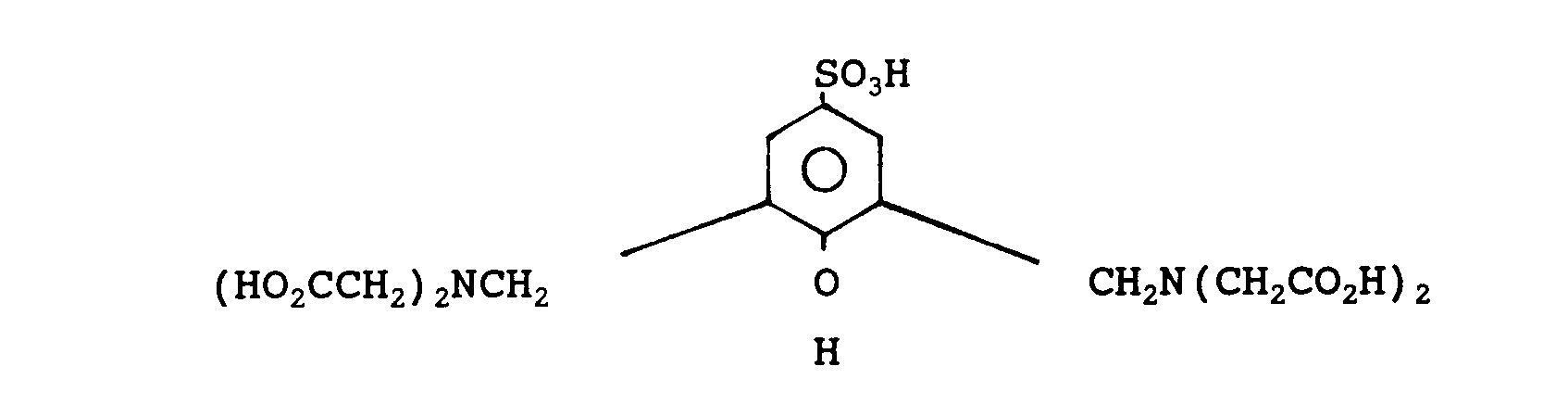
- 3,5-bis(di-N,N-(carboxymethyl)aminomethyl)-4-hydroxybenzenesu-Ifonic acid can be represented by the following formula:
- Diquest 3,5-bis(di-N,N-(carboxymethyl) aminomethyl)-4-hydroxybenzenesulfonic acid
- Bases and salts of acids such as those containing an alkali metal, alkaline earth metal, zinc, aluminum, molybdenum, ammonia, 2and amines such as lower alkyl amines are especially suitable, with sodium and potassium salts being preferred.
- the acidic hydrogens of the Diquest compound need not be replaced nor is it necessary for the cation to be the same for each acid hydrogen replaced.
- the cation may be any of NH 4 , H Na K etc., or mixtures thereof.
- bases or salts which can be reacted with the sulfonic acid group to produce the derivative salt compounds of the instant invention include inorganic alkali metal salts, oxides and hydroxides such as NaOH, Na 2 0, Na 2 CO 3 , KOH, K 2 0, K 2 C0 3 , LiOH, Li 2 C0 3 , CaOH, CaC0 3 , as well as other inorganic metal salts, and hydroxides such as AI(OH) 3 and ZnC0 3 and amines, particularly low molecular weight amines (i.e.
- alkyl amines having a molecular weight below about 300 and more particularly the alkyl amines, alkylene amines and alkanol amines such as ethylamine, diethylamine, propylamine, propylene diamine, hexylamine, 2-(ethyl)hexylamine, N-butylethanol amine, triethanolamine and the like.
- the water treatment additives of the present invention have been found to be effective for inhibiting and removing scale deposits from surfaces which are in contact with aqueous systems, and have been found to be particularly effective in removing rust scale deposits containing calcium and iron deposits. These deposits include calcium carbonate, calcium silicate, and/or iron oxide which form on the metallic structures of industrial water systems. It is believed that the rust scale inhibitors of this invention accelerate corrosion while simultaneously chelating the oxidized iron and calcium which is formed by the accelerated corrosion activity. In this manner, the additives of this invention cause the removal of rust scale by weakening the surface attachment of the rust scale deposit. Accordingly, it should be possible to remove any scale deposit regardless of its composition, since the scale deposit is removed by surface detachment rather than by dissolution.
- the formation of scale may be inhibited, or rust scale deposits may be removed, by adding to the system 3,5-bis(di-N,N-(carboxymethyl)aminomethyl)-4-hydroxybenzenesulfonic acid, or its water soluble salts in an amount effective to inhibit the formation of scale or to remove scale deposits which may already be present in the system.
- the precise dosage of the multipurpose scale remover of this invention depends, to some extent, on the nature of the aqueous system in which it is to be incorporated and the degree of protection desired, as well as the degree of rust scale which may be deposited in the system. In general, however, the concentration maintained in the system water can be from about 1 ppm to about 10,000 ppm. Within this range, generally low dosages of about 5-1000 ppm are normally preferred.
- the exact dosage amount required with respect to a particular aqueous system can be readily determined in conventional manners which are known to those of ordinary skill in the art.
- the aqueous systems which may be advantageously treated in accordance with the method of this invention include, but are not limited to cooling water systems such as e.g. cooling towers, as well as to desalinization units, gas scrubbers, boiler systems, recirculating water systems and the like.
- the multipurpose scale remover of this invention may be added to the system by any convenient mode, such as by first forming a concentrated solution of the Diquest or its water-soluble salts, with water (preferably containing between 1 and 50 total weight percent of the phenol sulfonic acid complex) and then feeding the concentrated solution to the aqueous system at some convenient point. In many instances the compounds may be added to the make-up or feed water lines through which water enters the system.
- the multipurpose scale removers of this invention are also effective when used in aqueous systems which are operated at high temperatures and pressures such as, for example in steam generating boilers.
- the multipurpose scale removers have also been found to remain soluble in water containing substantial hardness and alkalinity.
- the present invention is especially useful in the treatment of cooling water systems, which operate at temperatures of about 60 ° F to 200 °F, particularly open recirculating cooling water systems which operate at temperatures of from about 80 °F to 150 F.
- the multipurpose scale remover of the instant invention may be used as the sole rust scale inhibitor/remover remover, or may be used advantageously with other known water treating agents which include, but are not limited to biocides, corrosion inhibitors, phosphates, phosphonates, yellow metal corrosion inhibitors, pH regulators, other scale inhibitors, dispersants, oxygen scavengers and the like, or mixtures thereof.
- a mild steel coupon was corroded in a salt spray (3% NaCI) at 25 °C for 24 hours which resulted in the formation of 110 mg of a rust deposit on the surface of the coupon.
- the coupon was then rinsed with water and stirred for 24 hours at 54 °C in an aqueous solution having a pH between 8.5 and 9.0 and containing 2500 ppm 3,5-bis(di-N,N-(carboxymethyl)aminomethyl)-4-hydroxybenzenesulfonic acid, 99 ppm CaS0 4 , 13 ppm CaCl 2 , 55 ppm MgS0 4 and 176 ppm NaHC0 3 .
- the rust deposit was completely removed.
- Example 1 For purposes of comparison, the procedure according to Example 1 was repeated except the 3,5-bis(diN,N-(carboxymethyl)aminomethyl)-4-hydroxybenzenesulfonic acid was omitted. The rust deposit was not removed.
- Test water was prepared to contain 99 ppm CaS0 4 , 13 ppm CaCl 2 , 55 ppm MgS0 4 and 176 ppm NaHC0 3 . To this water was added 5,000 ppm of 3,5-bis(di-N,N-(carboxymethyl)-aminomethyl)-4-hydroxybenzenesulfonic acid and the pH was adjusted to 8.5. Calcium carbonate was added at 1,300 ppm. After stirring at 54 °C for 17 hours, all of the CaC0 3 had dissolved.
- Example 4 was repeated without the addition of the subject chelant. None of the CaC0 3 dissolved.
- Example 4 was repeated with the addition of citric acid instead of the subject chelant. A concentration of 9,000 ppm of citric acid was required to completely dissolve the CaC0 3 .
- Test water was prepared as in Example 4. To this water was added 10 ppm of the subject chelant and the pH was adjusted to 6.0. While stirring 100 milliliters (ml) of this solution, a solution of 2 mg FeCl 3 -6H 2 O in 1.0 ml of 0.03 molar HCI(ag) was added. The pH was adjusted to 8.0 and the solution was stirred at 54 °C for 17 hours. A sample was filtered through a 0.2 micron membrane and analyzed for soluble iron. A value of 0.86 ppm was found. This example demonstrates the prevention of iron oxide/hydroxide precipitation (rust scale).
- Example 7 For purposes of comparison, the procedure of Example 7 was repeated without the addition of the subject chelant.
- the value obtained for soluble iron was ⁇ 0.01 ppm.
Landscapes
- Chemical & Material Sciences (AREA)
- Engineering & Computer Science (AREA)
- Chemical Kinetics & Catalysis (AREA)
- General Chemical & Material Sciences (AREA)
- Organic Chemistry (AREA)
- Hydrology & Water Resources (AREA)
- Environmental & Geological Engineering (AREA)
- Water Supply & Treatment (AREA)
- Life Sciences & Earth Sciences (AREA)
- Materials Engineering (AREA)
- Mechanical Engineering (AREA)
- Metallurgy (AREA)
- Cleaning And De-Greasing Of Metallic Materials By Chemical Methods (AREA)
- Preventing Corrosion Or Incrustation Of Metals (AREA)
- Pharmaceuticals Containing Other Organic And Inorganic Compounds (AREA)
- Fats And Perfumes (AREA)
- Detergent Compositions (AREA)
Abstract
Description
- This invention relates to a method of preventing and/or removing calcium and/or rust deposits from surfaces in contact with aqueous systems and more specifically to a method of treating an aqueous system with 3,5-bis(di-N,N-(carboxymethyl)aminomethyl)-4-hydroxybenzenesulfonic acid to remove scale and/or rust deposits from the surfaces of the aqueous systems.
- It is known that aqueous systems, particularly industrial aqueous systems such as boiler systems, cooling tower systems, heat exchanger systems, desalinization systems, and the like, are subject to the formation of deposits on the internal surfaces which are in contact with the circulating water. Depending upon the nature of the deposit, various approaches have been taken to either control or inhibit the formation of these deposits or alternatively to remove the already formed deposits. For example chelants are known for their ability to complex with many cations including hardness and heavy metal cations and thereby prevent their deposition. Chelants function by essentially "locking" the metal into a soluble organic ring structure. When chelants are applied in combination with a dispersant, the treated system often results in clean waterside surfaces. However, chelants tend to be somewhat specific with respect to which cations they will complex with. Anionic chelants have reactive sites that attract coordination cites of cations; coordination sites are areas on the ion that are receptive to chemical bonding. Thus for example, iron has six coordination sites, as does the chelant EDTA. Thus, iron ions combine with the EDTA and since all of the coordination sites on the iron ion are chemically bonded by the EDTA, a stable metal chelant is formed. However, nitrilotriacetic acid (NTA), which is another commonly used chelant, has only four coordination sites, and thus NTA does not form as stable a metal chelant complex as does EDTA. Citric acid is a moderately strong Ca(II) chelant, but a weak ferric chelant.
- U.S. Patent No. 4,721,532 discloses certain alkylene amine carboxyl polyacids (AACPs) which are useful for removing iron fouling from heat transfer surfaces of cooling water systems. Particularly preferred compounds disclosed therein are N,N-ethylene-bis-((2 hydroxy-4-methylphenyl)glycine) (EDDHMA) and N,N-di-(2-hydroxy-5-sulfonic acid benzyl) glycine, (Hamplex DPS). However, while these compounds have been found to be useful for removing iron fouling, they are less effective in removing rust scale containing both iron and calcium.
- It has now been discovered that 3,5-bis(di-N,N-(carboxymethyl)aminomethyl)-4-hydroxybenzenesulfonic acid provides surprising effectiveness in chelating not only iron but also effectively chelating calcium ions in aqueous solutions and is thus effective at preventing and removing both calcium and rust scale deposits.
- It is an object of this invention to provide a method of preventing and removing calcium and rust scale deposits in aqueous systems.
- It is another object of this invention to provide a chelant with the ability to effectively complex with both iron and calcium ions.
- In accordance with the present invention, there has been provided a method of treating an aqueous system to remove rust scale deposits which comprises adding to the aqueous system, 3,5-bis(di-N,N-(carboxymethyl)aminomethyl)-4-hydroxybenzenesulfonic acid in an amount effective to remove the rust scale deposits.
- The subject invention relates to the use of a novel multipurpose scale inhibitor and/or remover for controlling rust scale deposits on surfaces which are in contact with aqueous systems. More specifically, the process of this invention comprises adding 3,5-bis(di-N,N-(carboxymethyl)aminomethyl)-4-hydroxybenzenesulfonic acid or its water soluble salts to an aqueous system in an amount effective to inhibit or remove the rust scale deposits contained therein. 3,5-bis(di-N,N-(carboxymethyl)aminomethyl)-4-hydroxybenzenesu-Ifonic acid can be represented by the following formula:
- The preparation of 3,5-bis(di-N,N-(carboxymethyl) aminomethyl)-4-hydroxybenzenesulfonic acid (hereinafter Diquest) is disclosed in Helv. Chem. Acta, 35, 1785 (1952) which is hereby incorporated by reference in its entirety. The water soluble salts of Diquest are readily prepared by neutralizing the sulfonic acid group, as well as the carboxyl groups, with at least a stoichmetric amount of a base or salt that contains the desired cation. Bases and salts of acids such as those containing an alkali metal, alkaline earth metal, zinc, aluminum, molybdenum, ammonia, 2and amines such as lower alkyl amines are especially suitable, with sodium and potassium salts being preferred. It should be noted however, that all of the acidic hydrogens of the Diquest compound need not be replaced nor is it necessary for the cation to be the same for each acid hydrogen replaced. Thus the cation may be any of NH4, H Na K etc., or mixtures thereof.
- Other bases or salts which can be reacted with the sulfonic acid group to produce the derivative salt compounds of the instant invention include inorganic alkali metal salts, oxides and hydroxides such as NaOH, Na20, Na2CO3, KOH, K20, K2C03, LiOH, Li2C03, CaOH, CaC03, as well as other inorganic metal salts, and hydroxides such as AI(OH)3 and ZnC03 and amines, particularly low molecular weight amines (i.e. amines having a molecular weight below about 300), and more particularly the alkyl amines, alkylene amines and alkanol amines such as ethylamine, diethylamine, propylamine, propylene diamine, hexylamine, 2-(ethyl)hexylamine, N-butylethanol amine, triethanolamine and the like.
- The water treatment additives of the present invention have been found to be effective for inhibiting and removing scale deposits from surfaces which are in contact with aqueous systems, and have been found to be particularly effective in removing rust scale deposits containing calcium and iron deposits. These deposits include calcium carbonate, calcium silicate, and/or iron oxide which form on the metallic structures of industrial water systems. It is believed that the rust scale inhibitors of this invention accelerate corrosion while simultaneously chelating the oxidized iron and calcium which is formed by the accelerated corrosion activity. In this manner, the additives of this invention cause the removal of rust scale by weakening the surface attachment of the rust scale deposit. Accordingly, it should be possible to remove any scale deposit regardless of its composition, since the scale deposit is removed by surface detachment rather than by dissolution.
- In accordance with this invention, the formation of scale may be inhibited, or rust scale deposits may be removed, by adding to the system 3,5-bis(di-N,N-(carboxymethyl)aminomethyl)-4-hydroxybenzenesulfonic acid, or its water soluble salts in an amount effective to inhibit the formation of scale or to remove scale deposits which may already be present in the system. The precise dosage of the multipurpose scale remover of this invention depends, to some extent, on the nature of the aqueous system in which it is to be incorporated and the degree of protection desired, as well as the degree of rust scale which may be deposited in the system. In general, however, the concentration maintained in the system water can be from about 1 ppm to about 10,000 ppm. Within this range, generally low dosages of about 5-1000 ppm are normally preferred. The exact dosage amount required with respect to a particular aqueous system can be readily determined in conventional manners which are known to those of ordinary skill in the art.
- The aqueous systems which may be advantageously treated in accordance with the method of this invention include, but are not limited to cooling water systems such as e.g. cooling towers, as well as to desalinization units, gas scrubbers, boiler systems, recirculating water systems and the like. The multipurpose scale remover of this invention may be added to the system by any convenient mode, such as by first forming a concentrated solution of the Diquest or its water-soluble salts, with water (preferably containing between 1 and 50 total weight percent of the phenol sulfonic acid complex) and then feeding the concentrated solution to the aqueous system at some convenient point. In many instances the compounds may be added to the make-up or feed water lines through which water enters the system.
- The multipurpose scale removers of this invention are also effective when used in aqueous systems which are operated at high temperatures and pressures such as, for example in steam generating boilers. The multipurpose scale removers have also been found to remain soluble in water containing substantial hardness and alkalinity. The present invention is especially useful in the treatment of cooling water systems, which operate at temperatures of about 60 ° F to 200 °F, particularly open recirculating cooling water systems which operate at temperatures of from about 80 °F to 150 F.
- The multipurpose scale remover of the instant invention may be used as the sole rust scale inhibitor/remover remover, or may be used advantageously with other known water treating agents which include, but are not limited to biocides, corrosion inhibitors, phosphates, phosphonates, yellow metal corrosion inhibitors, pH regulators, other scale inhibitors, dispersants, oxygen scavengers and the like, or mixtures thereof.
- Without further elaboration, it is believed that one skilled in the art, using the preceding detailed description can utilize the present invention to its fullest extent.
- The following examples are provided to illustrate the invention in accordance with the principles of this invention, but are not to be construed as limiting the invention in any way except as indicated in the appended claims. All parts and percentages are by weight unless otherwise indicated.
- A mild steel coupon was corroded in a salt spray (3% NaCI) at 25 °C for 24 hours which resulted in the formation of 110 mg of a rust deposit on the surface of the coupon. The coupon was then rinsed with water and stirred for 24 hours at 54 °C in an aqueous solution having a pH between 8.5 and 9.0 and containing 2500 ppm 3,5-bis(di-N,N-(carboxymethyl)aminomethyl)-4-hydroxybenzenesulfonic acid, 99 ppm CaS04, 13 ppm CaCl2, 55 ppm MgS04 and 176 ppm NaHC03. The rust deposit was completely removed.
- For purposes of comparison, the procedure according to Example 1 was repeated except the 3,5-bis(diN,N-(carboxymethyl)aminomethyl)-4-hydroxybenzenesulfonic acid was omitted. The rust deposit was not removed.
- Test water was prepared to contain 99 ppm CaS04, 13 ppm CaCl2, 55 ppm MgS04 and 176 ppm NaHC03. To this water was added 5,000 ppm of 3,5-bis(di-N,N-(carboxymethyl)-aminomethyl)-4-hydroxybenzenesulfonic acid and the pH was adjusted to 8.5. Calcium carbonate was added at 1,300 ppm. After stirring at 54 °C for 17 hours, all of the CaC03 had dissolved.
- Example 4 was repeated without the addition of the subject chelant. None of the CaC03 dissolved.
- Example 4 was repeated with the addition of citric acid instead of the subject chelant. A concentration of 9,000 ppm of citric acid was required to completely dissolve the CaC03.
- Test water was prepared as in Example 4. To this water was added 10 ppm of the subject chelant and the pH was adjusted to 6.0. While stirring 100 milliliters (ml) of this solution, a solution of 2 mg FeCl3-6H2O in 1.0 ml of 0.03 molar HCI(ag) was added. The pH was adjusted to 8.0 and the solution was stirred at 54 °C for 17 hours. A sample was filtered through a 0.2 micron membrane and analyzed for soluble iron. A value of 0.86 ppm was found. This example demonstrates the prevention of iron oxide/hydroxide precipitation (rust scale).
- For purposes of comparison, the procedure of Example 7 was repeated without the addition of the subject chelant. The value obtained for soluble iron was <0.01 ppm.
Claims (7)
Applications Claiming Priority (2)
| Application Number | Priority Date | Filing Date | Title |
|---|---|---|---|
| US07/733,527 US5183573A (en) | 1991-07-22 | 1991-07-22 | Multipurpose scale preventer/remover |
| US733527 | 1991-07-22 |
Publications (2)
| Publication Number | Publication Date |
|---|---|
| EP0525923A1 true EP0525923A1 (en) | 1993-02-03 |
| EP0525923B1 EP0525923B1 (en) | 1996-04-10 |
Family
ID=24947996
Family Applications (1)
| Application Number | Title | Priority Date | Filing Date |
|---|---|---|---|
| EP92250183A Expired - Lifetime EP0525923B1 (en) | 1991-07-22 | 1992-07-10 | Multipurpose scale preventer/remover |
Country Status (8)
| Country | Link |
|---|---|
| US (1) | US5183573A (en) |
| EP (1) | EP0525923B1 (en) |
| JP (1) | JPH05239438A (en) |
| AT (1) | ATE136528T1 (en) |
| AU (1) | AU646333B2 (en) |
| CA (1) | CA2066054C (en) |
| DE (1) | DE69209739T2 (en) |
| ZA (1) | ZA922895B (en) |
Families Citing this family (17)
| Publication number | Priority date | Publication date | Assignee | Title |
|---|---|---|---|---|
| JPH0663590A (en) * | 1992-06-29 | 1994-03-08 | Japan Synthetic Rubber Co Ltd | Scale removing agent and scale removing method using the same |
| US5677271A (en) * | 1993-11-29 | 1997-10-14 | The Procter & Gamble Company | Limescale removal compositions |
| US5764717A (en) * | 1995-08-29 | 1998-06-09 | Westinghouse Electric Corporation | Chemical cleaning method for the removal of scale sludge and other deposits from nuclear steam generators |
| US5841826A (en) * | 1995-08-29 | 1998-11-24 | Westinghouse Electric Corporation | Method of using a chemical solution to dislodge and dislocate scale, sludge and other deposits from nuclear steam generators |
| US5698250A (en) | 1996-04-03 | 1997-12-16 | Tenneco Packaging Inc. | Modifield atmosphere package for cut of raw meat |
| US6926846B1 (en) | 1996-08-08 | 2005-08-09 | Pactiv Corporation | Methods of using an oxygen scavenger |
| US5928560A (en) | 1996-08-08 | 1999-07-27 | Tenneco Packaging Inc. | Oxygen scavenger accelerator |
| US6395195B1 (en) | 1996-08-08 | 2002-05-28 | Pactiv Corporation | Oxygen scavenger accelerator |
| TW442864B (en) * | 1997-01-27 | 2001-06-23 | Mitsubishi Chem Corp | Surface treatment composition and method for treating surface of substrate by using the same |
| KR20020000796A (en) | 1999-03-26 | 2002-01-05 | 추후 | Rust and scale removal composition and process |
| US6815208B2 (en) * | 2001-11-14 | 2004-11-09 | Champion Technologies, Inc. | Chemical treatment for hydrostatic test |
| US20060042663A1 (en) * | 2004-08-25 | 2006-03-02 | Baker Hughes Incorporated | Method for removing iron deposits from within closed loop systems |
| JP5510123B2 (en) * | 2010-06-30 | 2014-06-04 | 三浦工業株式会社 | Operation method of steam boiler |
| US8927467B2 (en) | 2010-12-13 | 2015-01-06 | Saudi Arabian Oil Company | Method for preventing calcium citrate precipitation during citric acid acidizing treatments |
| US8784679B2 (en) * | 2011-10-25 | 2014-07-22 | Dubois Chemicals, Inc. | Aqueous powder water treatment compositions and methods for making same |
| CA2969794C (en) | 2017-06-06 | 2020-11-17 | Norwood Industries Inc. | Sawmill carriage assembly |
| CN108862223A (en) * | 2018-09-07 | 2018-11-23 | 云南云天化股份有限公司 | A kind of effective method for extending the Phosphoric Acid Concentration system equipment cleaning frequency |
Citations (2)
| Publication number | Priority date | Publication date | Assignee | Title |
|---|---|---|---|---|
| US4721532A (en) * | 1985-08-05 | 1988-01-26 | W. R. Grace & Co. | Removal of iron fouling in cooling water systems |
| EP0346139A2 (en) * | 1988-06-10 | 1989-12-13 | W.R. Grace & Co.-Conn. | Corrosion control |
Family Cites Families (6)
| Publication number | Priority date | Publication date | Assignee | Title |
|---|---|---|---|---|
| US3549538A (en) * | 1967-06-22 | 1970-12-22 | Nalco Chemical Co | Scale inhibition and removal in steam generation |
| US3527609A (en) * | 1968-04-29 | 1970-09-08 | Dow Chemical Co | In-service cleaning of cooling water systems |
| US3975281A (en) * | 1973-12-26 | 1976-08-17 | Texaco Inc. | Method for treating scale |
| US4221674A (en) * | 1979-03-09 | 1980-09-09 | Allied Chemical Corporation | Organic sulfonic acid stripping composition and method with nitrile and fluoride metal corrosion inhibitor system |
| DE3379067D1 (en) * | 1982-12-22 | 1989-03-02 | Shell Int Research | Hydrochloric acid compositions and their use |
| US4734203A (en) * | 1987-03-03 | 1988-03-29 | Nalco Chemical Company | Copper chelants/dispersants and their applications for boiler internal treatment |
-
1991
- 1991-07-22 US US07/733,527 patent/US5183573A/en not_active Expired - Fee Related
-
1992
- 1992-04-14 AU AU14866/92A patent/AU646333B2/en not_active Ceased
- 1992-04-15 CA CA002066054A patent/CA2066054C/en not_active Expired - Fee Related
- 1992-04-22 ZA ZA922895A patent/ZA922895B/en unknown
- 1992-07-10 AT AT92250183T patent/ATE136528T1/en not_active IP Right Cessation
- 1992-07-10 EP EP92250183A patent/EP0525923B1/en not_active Expired - Lifetime
- 1992-07-10 DE DE69209739T patent/DE69209739T2/en not_active Expired - Fee Related
- 1992-07-15 JP JP4209487A patent/JPH05239438A/en active Pending
Patent Citations (2)
| Publication number | Priority date | Publication date | Assignee | Title |
|---|---|---|---|---|
| US4721532A (en) * | 1985-08-05 | 1988-01-26 | W. R. Grace & Co. | Removal of iron fouling in cooling water systems |
| EP0346139A2 (en) * | 1988-06-10 | 1989-12-13 | W.R. Grace & Co.-Conn. | Corrosion control |
Non-Patent Citations (1)
| Title |
|---|
| DATABASE WPIL Section Ch, Week 7627, Derwent Publications Ltd., London, GB; Class M12, AN 76-50493X & JP-A-50 008 734 (NIPPON STEEL CORPOR.) 29 January 1975 * |
Also Published As
| Publication number | Publication date |
|---|---|
| EP0525923B1 (en) | 1996-04-10 |
| CA2066054C (en) | 2002-06-25 |
| JPH05239438A (en) | 1993-09-17 |
| DE69209739T2 (en) | 1996-11-28 |
| ATE136528T1 (en) | 1996-04-15 |
| US5183573A (en) | 1993-02-02 |
| AU1486692A (en) | 1993-01-28 |
| ZA922895B (en) | 1993-10-22 |
| DE69209739D1 (en) | 1996-05-15 |
| AU646333B2 (en) | 1994-02-17 |
| CA2066054A1 (en) | 1993-01-23 |
Similar Documents
| Publication | Publication Date | Title |
|---|---|---|
| US5183573A (en) | Multipurpose scale preventer/remover | |
| EP0122013B1 (en) | Polymeric additives for water | |
| AU756599B2 (en) | Scale and/or corrosion inhibiting composition | |
| CA2074460C (en) | Corrosion inhibitors | |
| US4640793A (en) | Synergistic scale and corrosion inhibiting admixtures containing carboxylic acid/sulfonic acid polymers | |
| CA2271292C (en) | Liquid metal cleaner for an aqueous system | |
| US5124046A (en) | Method for controlling calcium carbonate scaling in high pH aqueous systems | |
| AU623310B2 (en) | Calcium scale inhibition using dihydroxy aromatic compounds | |
| JPS61125497A (en) | Corrosion inhibiting composition containing acrylic acid/2-acrylamido-2-methylpropylsulfonic acid polymer | |
| EP0538969B1 (en) | Composition and method for inhibiting scale and corrosion using naphthylamine polycarboxylic acids | |
| US4556493A (en) | Composition and method for inhibiting scale | |
| CA1224999A (en) | Composition and method for inhibiting scale | |
| EP0094822A1 (en) | Scale-inhibiting compositions and process for inhibiting scale in systems exposed to water | |
| US5221487A (en) | Inhibition of scale formation and corrosion by sulfonated organophosphonates | |
| AU598689B2 (en) | Method for controlling calcium carbonate scaling in high ph aqueous systems | |
| CA2073660C (en) | Substituted carboxymethoxysuccinic acid corrosion inhibitors | |
| EP1808428B1 (en) | Descaling solutions comprising EDDH | |
| AU634457B2 (en) | A method of inhibiting corrosion and scale formation in aqueous systems | |
| CA2280586A1 (en) | Method for removing scale of boiler | |
| KR20020056454A (en) | Composition for prevented rust and scale | |
| HK1044751B (en) | Scale and/or corrosion inhibiting composition |
Legal Events
| Date | Code | Title | Description |
|---|---|---|---|
| PUAI | Public reference made under article 153(3) epc to a published international application that has entered the european phase |
Free format text: ORIGINAL CODE: 0009012 |
|
| AK | Designated contracting states |
Kind code of ref document: A1 Designated state(s): AT BE CH DE DK ES FR GB GR IT LI LU MC NL PT SE |
|
| 17P | Request for examination filed |
Effective date: 19930722 |
|
| 17Q | First examination report despatched |
Effective date: 19941125 |
|
| GRAA | (expected) grant |
Free format text: ORIGINAL CODE: 0009210 |
|
| AK | Designated contracting states |
Kind code of ref document: B1 Designated state(s): AT BE CH DE DK ES FR GB GR IT LI LU MC NL PT SE |
|
| PG25 | Lapsed in a contracting state [announced via postgrant information from national office to epo] |
Ref country code: IT Free format text: LAPSE BECAUSE OF FAILURE TO SUBMIT A TRANSLATION OF THE DESCRIPTION OR TO PAY THE FEE WITHIN THE PRE;WARNING: LAPSES OF ITALIAN PATENTS WITH EFFECTIVE DATE BEFORE 2007 MAY HAVE OCCURRED AT ANY TIME BEFORE 2007. THE CORRECT EFFECTIVE DATE MAY BE DIFFERENT FROM THE ONE RECORDED.SCRIBED TIME-LIMIT Effective date: 19960410 Ref country code: AT Effective date: 19960410 Ref country code: BE Effective date: 19960410 Ref country code: CH Effective date: 19960410 Ref country code: NL Free format text: LAPSE BECAUSE OF FAILURE TO SUBMIT A TRANSLATION OF THE DESCRIPTION OR TO PAY THE FEE WITHIN THE PRESCRIBED TIME-LIMIT Effective date: 19960410 Ref country code: LI Effective date: 19960410 Ref country code: ES Free format text: THE PATENT HAS BEEN ANNULLED BY A DECISION OF A NATIONAL AUTHORITY Effective date: 19960410 Ref country code: DK Effective date: 19960410 Ref country code: GR Free format text: LAPSE BECAUSE OF FAILURE TO SUBMIT A TRANSLATION OF THE DESCRIPTION OR TO PAY THE FEE WITHIN THE PRESCRIBED TIME-LIMIT Effective date: 19960410 |
|
| REF | Corresponds to: |
Ref document number: 136528 Country of ref document: AT Date of ref document: 19960415 Kind code of ref document: T |
|
| REF | Corresponds to: |
Ref document number: 69209739 Country of ref document: DE Date of ref document: 19960515 |
|
| PG25 | Lapsed in a contracting state [announced via postgrant information from national office to epo] |
Ref country code: SE Effective date: 19960710 Ref country code: PT Effective date: 19960710 |
|
| PG25 | Lapsed in a contracting state [announced via postgrant information from national office to epo] |
Ref country code: LU Free format text: LAPSE BECAUSE OF NON-PAYMENT OF DUE FEES Effective date: 19960731 |
|
| ET | Fr: translation filed | ||
| GRAH | Despatch of communication of intention to grant a patent |
Free format text: ORIGINAL CODE: EPIDOS IGRA |
|
| NLV1 | Nl: lapsed or annulled due to failure to fulfill the requirements of art. 29p and 29m of the patents act | ||
| REG | Reference to a national code |
Ref country code: CH Ref legal event code: PL |
|
| PG25 | Lapsed in a contracting state [announced via postgrant information from national office to epo] |
Ref country code: MC Effective date: 19970131 |
|
| PLBE | No opposition filed within time limit |
Free format text: ORIGINAL CODE: 0009261 |
|
| 26N | No opposition filed | ||
| REG | Reference to a national code |
Ref country code: GB Ref legal event code: 732E |
|
| REG | Reference to a national code |
Ref country code: FR Ref legal event code: TP |
|
| PGFP | Annual fee paid to national office [announced via postgrant information from national office to epo] |
Ref country code: GB Payment date: 19980701 Year of fee payment: 7 |
|
| PGFP | Annual fee paid to national office [announced via postgrant information from national office to epo] |
Ref country code: FR Payment date: 19980709 Year of fee payment: 7 |
|
| PGFP | Annual fee paid to national office [announced via postgrant information from national office to epo] |
Ref country code: DE Payment date: 19980720 Year of fee payment: 7 |
|
| PG25 | Lapsed in a contracting state [announced via postgrant information from national office to epo] |
Ref country code: GB Free format text: LAPSE BECAUSE OF NON-PAYMENT OF DUE FEES Effective date: 19990710 |
|
| PG25 | Lapsed in a contracting state [announced via postgrant information from national office to epo] |
Ref country code: FR Free format text: THE PATENT HAS BEEN ANNULLED BY A DECISION OF A NATIONAL AUTHORITY Effective date: 19990731 |
|
| GBPC | Gb: european patent ceased through non-payment of renewal fee |
Effective date: 19990710 |
|
| PG25 | Lapsed in a contracting state [announced via postgrant information from national office to epo] |
Ref country code: DE Free format text: LAPSE BECAUSE OF NON-PAYMENT OF DUE FEES Effective date: 20000503 |
|
| REG | Reference to a national code |
Ref country code: FR Ref legal event code: ST |