EP0513533A2 - Heterocyclic substituted phenylacetic-acid derivatives, process for their preparation and their pharmaceutical application - Google Patents
Heterocyclic substituted phenylacetic-acid derivatives, process for their preparation and their pharmaceutical application Download PDFInfo
- Publication number
- EP0513533A2 EP0513533A2 EP92106345A EP92106345A EP0513533A2 EP 0513533 A2 EP0513533 A2 EP 0513533A2 EP 92106345 A EP92106345 A EP 92106345A EP 92106345 A EP92106345 A EP 92106345A EP 0513533 A2 EP0513533 A2 EP 0513533A2
- Authority
- EP
- European Patent Office
- Prior art keywords
- carbon atoms
- chain
- straight
- phenyl
- branched alkyl
- Prior art date
- Legal status (The legal status is an assumption and is not a legal conclusion. Google has not performed a legal analysis and makes no representation as to the accuracy of the status listed.)
- Granted
Links
- 0 CC[C@]1(C)C2(*CC2)CCC1 Chemical compound CC[C@]1(C)C2(*CC2)CCC1 0.000 description 18
- LERVIUCTZBLYSW-RUDMXATFSA-N CC/C=C/c1nc(Cl)c(CO)[n]1Cc1ccc(C(C2CCCC2)C(NS(c2ccc(C)cc2)(=O)=O)=O)cc1 Chemical compound CC/C=C/c1nc(Cl)c(CO)[n]1Cc1ccc(C(C2CCCC2)C(NS(c2ccc(C)cc2)(=O)=O)=O)cc1 LERVIUCTZBLYSW-RUDMXATFSA-N 0.000 description 1
- DKHPIBAKKVXLDL-UHFFFAOYSA-N CCCCc1nc(I)c(CO)[nH]1 Chemical compound CCCCc1nc(I)c(CO)[nH]1 DKHPIBAKKVXLDL-UHFFFAOYSA-N 0.000 description 1
- PEVRGSMGYHFZPR-JJIBRWJFSA-N CCCCc1ncc(/C=C(\Cc2ccc[s]2)/C(OC)=O)[n]1Cc1ccc(C(C2CCCC2)C(O)=O)cc1 Chemical compound CCCCc1ncc(/C=C(\Cc2ccc[s]2)/C(OC)=O)[n]1Cc1ccc(C(C2CCCC2)C(O)=O)cc1 PEVRGSMGYHFZPR-JJIBRWJFSA-N 0.000 description 1
Classifications
-
- C—CHEMISTRY; METALLURGY
- C07—ORGANIC CHEMISTRY
- C07D—HETEROCYCLIC COMPOUNDS
- C07D249/00—Heterocyclic compounds containing five-membered rings having three nitrogen atoms as the only ring hetero atoms
- C07D249/02—Heterocyclic compounds containing five-membered rings having three nitrogen atoms as the only ring hetero atoms not condensed with other rings
- C07D249/08—1,2,4-Triazoles; Hydrogenated 1,2,4-triazoles
-
- A—HUMAN NECESSITIES
- A61—MEDICAL OR VETERINARY SCIENCE; HYGIENE
- A61P—SPECIFIC THERAPEUTIC ACTIVITY OF CHEMICAL COMPOUNDS OR MEDICINAL PREPARATIONS
- A61P11/00—Drugs for disorders of the respiratory system
- A61P11/08—Bronchodilators
-
- A—HUMAN NECESSITIES
- A61—MEDICAL OR VETERINARY SCIENCE; HYGIENE
- A61P—SPECIFIC THERAPEUTIC ACTIVITY OF CHEMICAL COMPOUNDS OR MEDICINAL PREPARATIONS
- A61P13/00—Drugs for disorders of the urinary system
- A61P13/02—Drugs for disorders of the urinary system of urine or of the urinary tract, e.g. urine acidifiers
-
- A—HUMAN NECESSITIES
- A61—MEDICAL OR VETERINARY SCIENCE; HYGIENE
- A61P—SPECIFIC THERAPEUTIC ACTIVITY OF CHEMICAL COMPOUNDS OR MEDICINAL PREPARATIONS
- A61P13/00—Drugs for disorders of the urinary system
- A61P13/12—Drugs for disorders of the urinary system of the kidneys
-
- A—HUMAN NECESSITIES
- A61—MEDICAL OR VETERINARY SCIENCE; HYGIENE
- A61P—SPECIFIC THERAPEUTIC ACTIVITY OF CHEMICAL COMPOUNDS OR MEDICINAL PREPARATIONS
- A61P15/00—Drugs for genital or sexual disorders; Contraceptives
-
- A—HUMAN NECESSITIES
- A61—MEDICAL OR VETERINARY SCIENCE; HYGIENE
- A61P—SPECIFIC THERAPEUTIC ACTIVITY OF CHEMICAL COMPOUNDS OR MEDICINAL PREPARATIONS
- A61P43/00—Drugs for specific purposes, not provided for in groups A61P1/00-A61P41/00
-
- A—HUMAN NECESSITIES
- A61—MEDICAL OR VETERINARY SCIENCE; HYGIENE
- A61P—SPECIFIC THERAPEUTIC ACTIVITY OF CHEMICAL COMPOUNDS OR MEDICINAL PREPARATIONS
- A61P7/00—Drugs for disorders of the blood or the extracellular fluid
- A61P7/10—Antioedematous agents; Diuretics
-
- A—HUMAN NECESSITIES
- A61—MEDICAL OR VETERINARY SCIENCE; HYGIENE
- A61P—SPECIFIC THERAPEUTIC ACTIVITY OF CHEMICAL COMPOUNDS OR MEDICINAL PREPARATIONS
- A61P9/00—Drugs for disorders of the cardiovascular system
-
- A—HUMAN NECESSITIES
- A61—MEDICAL OR VETERINARY SCIENCE; HYGIENE
- A61P—SPECIFIC THERAPEUTIC ACTIVITY OF CHEMICAL COMPOUNDS OR MEDICINAL PREPARATIONS
- A61P9/00—Drugs for disorders of the cardiovascular system
- A61P9/08—Vasodilators for multiple indications
-
- A—HUMAN NECESSITIES
- A61—MEDICAL OR VETERINARY SCIENCE; HYGIENE
- A61P—SPECIFIC THERAPEUTIC ACTIVITY OF CHEMICAL COMPOUNDS OR MEDICINAL PREPARATIONS
- A61P9/00—Drugs for disorders of the cardiovascular system
- A61P9/10—Drugs for disorders of the cardiovascular system for treating ischaemic or atherosclerotic diseases, e.g. antianginal drugs, coronary vasodilators, drugs for myocardial infarction, retinopathy, cerebrovascula insufficiency, renal arteriosclerosis
-
- A—HUMAN NECESSITIES
- A61—MEDICAL OR VETERINARY SCIENCE; HYGIENE
- A61P—SPECIFIC THERAPEUTIC ACTIVITY OF CHEMICAL COMPOUNDS OR MEDICINAL PREPARATIONS
- A61P9/00—Drugs for disorders of the cardiovascular system
- A61P9/12—Antihypertensives
-
- C—CHEMISTRY; METALLURGY
- C07—ORGANIC CHEMISTRY
- C07D—HETEROCYCLIC COMPOUNDS
- C07D231/00—Heterocyclic compounds containing 1,2-diazole or hydrogenated 1,2-diazole rings
- C07D231/02—Heterocyclic compounds containing 1,2-diazole or hydrogenated 1,2-diazole rings not condensed with other rings
- C07D231/10—Heterocyclic compounds containing 1,2-diazole or hydrogenated 1,2-diazole rings not condensed with other rings having two or three double bonds between ring members or between ring members and non-ring members
- C07D231/12—Heterocyclic compounds containing 1,2-diazole or hydrogenated 1,2-diazole rings not condensed with other rings having two or three double bonds between ring members or between ring members and non-ring members with only hydrogen atoms, hydrocarbon or substituted hydrocarbon radicals, directly attached to ring carbon atoms
-
- C—CHEMISTRY; METALLURGY
- C07—ORGANIC CHEMISTRY
- C07D—HETEROCYCLIC COMPOUNDS
- C07D231/00—Heterocyclic compounds containing 1,2-diazole or hydrogenated 1,2-diazole rings
- C07D231/02—Heterocyclic compounds containing 1,2-diazole or hydrogenated 1,2-diazole rings not condensed with other rings
- C07D231/10—Heterocyclic compounds containing 1,2-diazole or hydrogenated 1,2-diazole rings not condensed with other rings having two or three double bonds between ring members or between ring members and non-ring members
- C07D231/14—Heterocyclic compounds containing 1,2-diazole or hydrogenated 1,2-diazole rings not condensed with other rings having two or three double bonds between ring members or between ring members and non-ring members with hetero atoms or with carbon atoms having three bonds to hetero atoms with at the most one bond to halogen, e.g. ester or nitrile radicals, directly attached to ring carbon atoms
-
- C—CHEMISTRY; METALLURGY
- C07—ORGANIC CHEMISTRY
- C07D—HETEROCYCLIC COMPOUNDS
- C07D231/00—Heterocyclic compounds containing 1,2-diazole or hydrogenated 1,2-diazole rings
- C07D231/54—Heterocyclic compounds containing 1,2-diazole or hydrogenated 1,2-diazole rings condensed with carbocyclic rings or ring systems
- C07D231/56—Benzopyrazoles; Hydrogenated benzopyrazoles
-
- C—CHEMISTRY; METALLURGY
- C07—ORGANIC CHEMISTRY
- C07D—HETEROCYCLIC COMPOUNDS
- C07D233/00—Heterocyclic compounds containing 1,3-diazole or hydrogenated 1,3-diazole rings, not condensed with other rings
- C07D233/54—Heterocyclic compounds containing 1,3-diazole or hydrogenated 1,3-diazole rings, not condensed with other rings having two double bonds between ring members or between ring members and non-ring members
- C07D233/56—Heterocyclic compounds containing 1,3-diazole or hydrogenated 1,3-diazole rings, not condensed with other rings having two double bonds between ring members or between ring members and non-ring members with only hydrogen atoms or radicals containing only hydrogen and carbon atoms, attached to ring carbon atoms
-
- C—CHEMISTRY; METALLURGY
- C07—ORGANIC CHEMISTRY
- C07D—HETEROCYCLIC COMPOUNDS
- C07D233/00—Heterocyclic compounds containing 1,3-diazole or hydrogenated 1,3-diazole rings, not condensed with other rings
- C07D233/54—Heterocyclic compounds containing 1,3-diazole or hydrogenated 1,3-diazole rings, not condensed with other rings having two double bonds between ring members or between ring members and non-ring members
- C07D233/64—Heterocyclic compounds containing 1,3-diazole or hydrogenated 1,3-diazole rings, not condensed with other rings having two double bonds between ring members or between ring members and non-ring members with substituted hydrocarbon radicals attached to ring carbon atoms, e.g. histidine
-
- C—CHEMISTRY; METALLURGY
- C07—ORGANIC CHEMISTRY
- C07D—HETEROCYCLIC COMPOUNDS
- C07D233/00—Heterocyclic compounds containing 1,3-diazole or hydrogenated 1,3-diazole rings, not condensed with other rings
- C07D233/54—Heterocyclic compounds containing 1,3-diazole or hydrogenated 1,3-diazole rings, not condensed with other rings having two double bonds between ring members or between ring members and non-ring members
- C07D233/66—Heterocyclic compounds containing 1,3-diazole or hydrogenated 1,3-diazole rings, not condensed with other rings having two double bonds between ring members or between ring members and non-ring members with hetero atoms or with carbon atoms having three bonds to hetero atoms with at the most one bond to halogen, e.g. ester or nitrile radicals, directly attached to ring carbon atoms
- C07D233/68—Halogen atoms
-
- C—CHEMISTRY; METALLURGY
- C07—ORGANIC CHEMISTRY
- C07D—HETEROCYCLIC COMPOUNDS
- C07D233/00—Heterocyclic compounds containing 1,3-diazole or hydrogenated 1,3-diazole rings, not condensed with other rings
- C07D233/54—Heterocyclic compounds containing 1,3-diazole or hydrogenated 1,3-diazole rings, not condensed with other rings having two double bonds between ring members or between ring members and non-ring members
- C07D233/66—Heterocyclic compounds containing 1,3-diazole or hydrogenated 1,3-diazole rings, not condensed with other rings having two double bonds between ring members or between ring members and non-ring members with hetero atoms or with carbon atoms having three bonds to hetero atoms with at the most one bond to halogen, e.g. ester or nitrile radicals, directly attached to ring carbon atoms
- C07D233/90—Carbon atoms having three bonds to hetero atoms with at the most one bond to halogen, e.g. ester or nitrile radicals
-
- C—CHEMISTRY; METALLURGY
- C07—ORGANIC CHEMISTRY
- C07D—HETEROCYCLIC COMPOUNDS
- C07D235/00—Heterocyclic compounds containing 1,3-diazole or hydrogenated 1,3-diazole rings, condensed with other rings
- C07D235/02—Heterocyclic compounds containing 1,3-diazole or hydrogenated 1,3-diazole rings, condensed with other rings condensed with carbocyclic rings or ring systems
- C07D235/04—Benzimidazoles; Hydrogenated benzimidazoles
- C07D235/06—Benzimidazoles; Hydrogenated benzimidazoles with only hydrogen atoms, hydrocarbon or substituted hydrocarbon radicals, directly attached in position 2
-
- C—CHEMISTRY; METALLURGY
- C07—ORGANIC CHEMISTRY
- C07D—HETEROCYCLIC COMPOUNDS
- C07D235/00—Heterocyclic compounds containing 1,3-diazole or hydrogenated 1,3-diazole rings, condensed with other rings
- C07D235/02—Heterocyclic compounds containing 1,3-diazole or hydrogenated 1,3-diazole rings, condensed with other rings condensed with carbocyclic rings or ring systems
- C07D235/04—Benzimidazoles; Hydrogenated benzimidazoles
- C07D235/06—Benzimidazoles; Hydrogenated benzimidazoles with only hydrogen atoms, hydrocarbon or substituted hydrocarbon radicals, directly attached in position 2
- C07D235/08—Radicals containing only hydrogen and carbon atoms
-
- C—CHEMISTRY; METALLURGY
- C07—ORGANIC CHEMISTRY
- C07D—HETEROCYCLIC COMPOUNDS
- C07D235/00—Heterocyclic compounds containing 1,3-diazole or hydrogenated 1,3-diazole rings, condensed with other rings
- C07D235/02—Heterocyclic compounds containing 1,3-diazole or hydrogenated 1,3-diazole rings, condensed with other rings condensed with carbocyclic rings or ring systems
- C07D235/04—Benzimidazoles; Hydrogenated benzimidazoles
- C07D235/06—Benzimidazoles; Hydrogenated benzimidazoles with only hydrogen atoms, hydrocarbon or substituted hydrocarbon radicals, directly attached in position 2
- C07D235/14—Radicals substituted by nitrogen atoms
-
- C—CHEMISTRY; METALLURGY
- C07—ORGANIC CHEMISTRY
- C07D—HETEROCYCLIC COMPOUNDS
- C07D235/00—Heterocyclic compounds containing 1,3-diazole or hydrogenated 1,3-diazole rings, condensed with other rings
- C07D235/02—Heterocyclic compounds containing 1,3-diazole or hydrogenated 1,3-diazole rings, condensed with other rings condensed with carbocyclic rings or ring systems
- C07D235/04—Benzimidazoles; Hydrogenated benzimidazoles
- C07D235/06—Benzimidazoles; Hydrogenated benzimidazoles with only hydrogen atoms, hydrocarbon or substituted hydrocarbon radicals, directly attached in position 2
- C07D235/16—Radicals substituted by carbon atoms having three bonds to hetero atoms with at the most one bond to halogen, e.g. ester or nitrile radicals
-
- C—CHEMISTRY; METALLURGY
- C07—ORGANIC CHEMISTRY
- C07D—HETEROCYCLIC COMPOUNDS
- C07D249/00—Heterocyclic compounds containing five-membered rings having three nitrogen atoms as the only ring hetero atoms
- C07D249/16—Heterocyclic compounds containing five-membered rings having three nitrogen atoms as the only ring hetero atoms condensed with carbocyclic rings or ring systems
- C07D249/18—Benzotriazoles
-
- C—CHEMISTRY; METALLURGY
- C07—ORGANIC CHEMISTRY
- C07D—HETEROCYCLIC COMPOUNDS
- C07D403/00—Heterocyclic compounds containing two or more hetero rings, having nitrogen atoms as the only ring hetero atoms, not provided for by group C07D401/00
- C07D403/02—Heterocyclic compounds containing two or more hetero rings, having nitrogen atoms as the only ring hetero atoms, not provided for by group C07D401/00 containing two hetero rings
- C07D403/10—Heterocyclic compounds containing two or more hetero rings, having nitrogen atoms as the only ring hetero atoms, not provided for by group C07D401/00 containing two hetero rings linked by a carbon chain containing aromatic rings
-
- C—CHEMISTRY; METALLURGY
- C07—ORGANIC CHEMISTRY
- C07D—HETEROCYCLIC COMPOUNDS
- C07D409/00—Heterocyclic compounds containing two or more hetero rings, at least one ring having sulfur atoms as the only ring hetero atoms
- C07D409/02—Heterocyclic compounds containing two or more hetero rings, at least one ring having sulfur atoms as the only ring hetero atoms containing two hetero rings
- C07D409/06—Heterocyclic compounds containing two or more hetero rings, at least one ring having sulfur atoms as the only ring hetero atoms containing two hetero rings linked by a carbon chain containing only aliphatic carbon atoms
-
- C—CHEMISTRY; METALLURGY
- C07—ORGANIC CHEMISTRY
- C07D—HETEROCYCLIC COMPOUNDS
- C07D471/00—Heterocyclic compounds containing nitrogen atoms as the only ring hetero atoms in the condensed system, at least one ring being a six-membered ring with one nitrogen atom, not provided for by groups C07D451/00 - C07D463/00
- C07D471/02—Heterocyclic compounds containing nitrogen atoms as the only ring hetero atoms in the condensed system, at least one ring being a six-membered ring with one nitrogen atom, not provided for by groups C07D451/00 - C07D463/00 in which the condensed system contains two hetero rings
- C07D471/04—Ortho-condensed systems
Definitions
- the invention relates to new heterocyclically substituted phenylacetic acid derivatives, processes for their preparation and their use in medicaments, in particular as antihypertensive and anti-atherosclerotic agents.
- renin a proteolytic enzyme, cleaves in vivo from the angiotensinogen the decapeptide angiotensin I, which in turn is broken down in the lungs, kidneys or other tissues to form the blood pressure-reducing octapeptide angiotensin II.
- angiotensin 11 such as vasoconstriction, Na retention in the kidney, aldosterone release in the adrenal gland and tone increase in the sympathetic nervous system act synergistically in the sense of an increase in blood pressure.
- angiotensin II has the property of promoting the growth and proliferation of cells such as cardiac muscle cells and smooth muscle cells, whereby these grow and proliferate in various disease states (e.g. hypertension, atherosclerosis and heart failure).
- a possible approach to intervene in the renin-angiotensin system is to inhibit renin activity, to inhibit the activity of the angiotensin conversion enzyme (ACE) and to block angiotensin II receptors.
- ACE angiotensin conversion enzyme
- heterocyclically substituted phenylacetic acid derivatives according to the invention can also be present in the form of their salts.
- salts with organic or inorganic bases or acids may be mentioned here.
- Physiologically acceptable salts are preferred in the context of the present invention.
- Physiologically acceptable salts of the heterocyclically substituted phenylacetic acid derivatives can be salts of the substances according to the invention with mineral acids, carboxylic acids or sulfonic acids.
- Physiologically acceptable salts of the heterocyclically substituted phenylacetic acid derivatives can be salts of the substances according to the invention with mineral acids, carboxylic acids or sulfonic acids.
- Salts with hydrochloric acid, hydrobromic acid, sulfuric acid, phosphoric acid, methanesulfonic acid, ethanesulfonic acid, toluenesulfonic acid, benzenesulfonic acid, naphthalenedisulfonic acid, acetic acid, propionic acid, lactic acid, tartaric acid, citric acid, fumaric acid, maleic acid or benzoic acid.
- Physiologically acceptable salts can also be metal or ammonium salts of the compounds according to the invention which have a free carboxyl group.
- metal or ammonium salts of the compounds according to the invention which have a free carboxyl group.
- Sodium, potassium, magnesium or calcium salts and also ammonium salts which are derived from ammonia, or organic amines such as, for example, ethylamine, di- or triethylamine, di- or.
- the compounds according to the invention can exist in stereoisomeric forms which either behave like image and mirror image (enantiomers) or which do not behave like image and mirror image (diastereomers).
- the invention relates to both the enantiomers or diastereomers or their respective mixtures.
- the racemic forms can be separated into the stereoisomerically uniform constituents in a known manner [cf. E.L. Eliel, Stereochemistry of Carbon Compounds, McGraw Hill, 1962].
- Heterocycle generally represents a 5- to 7-membered, preferably 5 to 6-membered, saturated or unsaturated ring which can contain up to 2 oxygen, sulfur and / or nitrogen atoms as heteroatoms.
- 5- and 6-membered rings with one oxygen, sulfur and / or up to 2 nitrogen atoms are preferred.
- the following are preferably mentioned: thienyl, furyl, pyrrolyl, pyrazolyl, pyridyl, pyrimidyl, pyrazinyl, pyridazinyl, thiazolyl, oxazolyl, imidazolyl, pyrrolidinyl, piperidinyl, piperazinyl or tetrazolyl.
- Suitable solvents for the process are conventional organic solvents which do not change under the reaction conditions. These preferably include ethers such as diethyl ether, dioxane, tetrahydrofuran, glycol dimethyl ether, or hydrocarbons such as benzene, toluene, xylene, hexane, cyclohexane or petroleum fractions, or halogenated hydrocarbons such as dichloromethane, trichloromethane, tetrachloromethane, dichlorethylene, trichlorethylene or chlorobenzene, chlorobenzene, chloro-benzidine Dimethyl sulfoxide, dimethylformamide, hexamethylphosphoric triamide, acetonitrile, acetone or nitromethane. It is also possible to use mixtures of the solvents mentioned. Dimethylformamide is preferred.
- inorganic or organic bases can be used as bases for the process according to the invention.
- bases preferably include alkali metal hydroxides such as sodium hydroxide or potassium hydroxide, alkaline earth metal hydroxides such as barium hydroxide, alkali metal carbonates such as sodium carbonate or potassium carbonate, alkaline earth metal carbonates such as calcium carbonate, or alkali metal or alkaline earth metal alcoholates such as sodium or potassium methoxide, sodium or potassium ethanolate or potassium tert or butyl organic amines (trialkyl (C 1 -C 6 ) amines) such as triethylamine, or heterocycles such as 1,4-diazabicyclo [2.2.2] octane (DABCO), 1,8-diazabicyclo [5.4.0] undec-7-ene ( DBU), pyridine, diaminopyridine, methylpiperidine or morpholine.
- alkali metal hydroxides such as sodium hydroxide or potassium hydroxide,
- alkali metals such as sodium or their hydrides such as sodium hydride as bases.
- Sodium hydride, potassium carbonate, triethylamine, pyridine and potassium tert-butoxide, DBU or DABCO are preferred.
- the base is used in an amount of 0.05 mol to 10 mol, preferably 1 mol to 2 mol, based on 1 mol of the compound of the formula (III).
- the process according to the invention is generally carried out in a temperature range from -30 ° C. to + 100 ° C., preferably from -10 ° C. to + 60 ° C.
- the process according to the invention is generally carried out at normal pressure. However, it is also possible to carry out the process under overpressure or under underpressure (e.g. in a range from 0.5 to 5 bar).
- the usual inorganic bases are suitable as bases for the saponification.
- bases preferably include alkali metal hydroxides or alkaline earth metal hydroxides such as sodium hydroxide, potassium hydroxide or barium hydroxide, or alkali carbonates such as sodium or potassium carbonate or sodium hydrogen carbonate, or alkali alcoholates such as sodium methoxide, sodium ethanolate, potassium methoxide, potassium ethanolate or potassium tert-butoxide.
- alkali metal hydroxides or alkaline earth metal hydroxides such as sodium hydroxide, potassium hydroxide or barium hydroxide
- alkali carbonates such as sodium or potassium carbonate or sodium hydrogen carbonate
- alkali alcoholates such as sodium methoxide, sodium ethanolate, potassium methoxide, potassium ethanolate or potassium tert-butoxide.
- Sodium hydroxide or potassium hydroxide are particularly preferably used.
- Suitable solvents for the saponification are water or the organic solvents customary for saponification. These preferably include alcohols such as methanol, ethanol, propanol, isopropanol or butanol, or ethers such as tetrahydrofuran or dioxane, or dimethylformamide, or dimethyl sulfoxide. Alcohols such as methanol, ethanol, propanol or isopropanol are particularly preferably used. It is also possible to use mixtures of the solvents mentioned.
- the saponification can also be carried out with acids such as trifluoroacetic acid, acetic acid, hydrochloric acid, hydrobromic acid, methanesulfonic acid, sulfuric acid or perchloric acid, preferably with trifluoroacetic acid.
- acids such as trifluoroacetic acid, acetic acid, hydrochloric acid, hydrobromic acid, methanesulfonic acid, sulfuric acid or perchloric acid, preferably with trifluoroacetic acid.
- the hydrolysis is generally carried out in a temperature range from 0 ° C. to + 100 ° C., preferably from +20 ° C. to + 80 ° C.
- the saponification is generally carried out at normal pressure. However, it is also possible to work under negative pressure or overpressure (e.g. from 0.5 to 5 bar).
- the base is generally used in an amount of 1 to 3 mol, preferably 1 to 1.5 mol, based on 1 mol of the ester. Molar amounts of the reactants are particularly preferably used.
- the carboxylates of the compounds according to the invention are formed in the first step as intermediates which can be isolated.
- the acids according to the invention are obtained by treating the carboxylates with customary inorganic acids. These preferably include mineral acids such as hydrochloric acid, hydrobromic acid, sulfuric acid or phosphoric acid.
- customary inorganic acids preferably include mineral acids such as hydrochloric acid, hydrobromic acid, sulfuric acid or phosphoric acid.
- mineral acids such as hydrochloric acid, hydrobromic acid, sulfuric acid or phosphoric acid.
- the acids can then be isolated in the usual way.
- the salts of the heterocycles with the inorganic acids can also be obtained by treating the solutions of the carboxylates with the acids listed above.
- amidation and the sulfonamidation with the compounds of the general formulas (IV) and (V) are generally carried out in one of the solvents listed above, preferably in tetrahydrofuran or dichloromethane.
- amidation and sulfonamidation is generally carried out in a temperature range from -20 ° C to + 120 ° C, preferably from -10 ° C to + 30 ° C, and normal pressure.
- suitable bases are preferably triethylamine and / or dimethylaminopyridine, DBU or DABCO.
- the base is used in an amount of 0.5 mol to 10 mol, preferably 1 mol to 2 mol, based on 1 mol of the compounds of the general formulas (IV) and (V).
- alkali or alkaline earth carbonates such as sodium carbonate, potassium carbonate, alkali or alkaline earth hydroxides such as sodium or potassium hydroxide, or organic bases such as pyridine, triethylamine, N-methylpiperidine, or bicyclic amidines such as 1,5-diazabicyclo [3.4 .0] -nonene-5 (DBN) or 1,5-diazabicyclo [3.4.0] undecene-5 (DBU) can be used.
- potassium carbonate such as sodium carbonate, potassium carbonate, alkali or alkaline earth hydroxides such as sodium or potassium hydroxide
- organic bases such as pyridine, triethylamine, N-methylpiperidine, or bicyclic amidines such as 1,5-diazabicyclo [3.4 .0] -nonene-5 (DBN) or 1,5-diazabicyclo [3.4.0] undecene-5 (DBU)
- BBN 1,5-diazabicyclo [3.4 .0]
- Suitable dehydrating reagents are carbodiimides such as diisopropylcarbodiimide, dicyclohexylcarbodiimide or N- (3-dimethylaminopropyl) -N'-ethylcarbodiimide hydrochloride or carbonyl compounds such as carbonyldiimidazole or 1,2-oxazolium compounds such as 2-ethyl-5-phenolium-1,2-phenyl-1,2-oxyl 3-sulphonate, or propanephosphoric anhydride or isobutyl chloroformate or benzotriazolyloxy-tris- (dimethylamino) phosphonium hexylfluorophosphat or diphenyl phosphoramidate or methanesulphonyl chloride, optionally in the presence of bases such as triethylamine or N-ethylmorpholine or N-methylpiperidine or dicyclohexylcarbodiimide and N-hydroxysuccinimide [
- the hydrolysis of the nitriles is generally carried out in water or one of the solvents listed above, preferably in ethanol, isopropanol, ethylene glycol or glycine or a mixture thereof in the presence of a base, acid, hydrogen peroxide or alkali metal or alkaline earth metal peroxides such as sodium peroxide.
- Alkali or alkaline earth metal hydroxides such as, for example, potassium hydroxide, sodium hydroxide or barium hydroxide are generally suitable as bases for the hydrolysis.
- Sodium hydroxide is preferred.
- suitable acids are inorganic acids such as hydrochloric acid or sulfuric acid.
- the hydrolysis of the nitriles is generally carried out at a temperature range from -20 ° C to + 200 ° C, preferably from + 20 ° C to + 150 ° C.
- a catalyst such as platinum or platinum oxides, rhodium, ruthenium, chlorotris (triphenylphosphine) rhodium, or palladium
- Animal charcoal preferably with palladium on animal charcoal in a temperature range from 0 ° C to + 150 ° C, preferably from + 25 ° C to + 100 ° C.
- Protic solvents such as methanol, ethanol and / or aprotic solvents such as tetrahydrofuran, toluene, dimethylformamide, methylene chloride, dioxane or ethyl acetate are suitable as solvents for the hydrogenation.
- the hydrogenation is carried out at a pressure of 1 to 300 atm, preferably at 1 to 20 atm.
- dimethylformamide, HMPT and tetrahydrofuran are particularly suitable as solvents.
- the alkylations are carried out in a temperature range from -80 ° C. to 70 ° C., preferably from -78 ° C. to 0 ° C., in the case of the perfluorocadmium compounds from room temperature to + 100 ° C. in particular from + 40 ° C to + 80 ° C, performed.
- the alkylation is generally carried out in one of the solvents listed above, preferably in dimethylformamide in a temperature range from 0 ° C. to + 70 ° C., preferably from 0 ° C. to + 30 ° C. and normal pressure.
- potassium tert-butoxide is preferably suitable for the alkylation.
- the bromination is generally carried out using Br 2 or N-bromosuccinimide, preferably using N-bromosuccinimide, in one of the solvents listed above, preferably carbon tetrachloride, in a temperature range from 0 ° C. to + 150 ° C., preferably from 0 ° C. to + 80 ° C, and normal pressure.
- Suitable starters (catalysts) for the bromination are, for example, azobisisobutyronitrile, dibenzoyl peroxide, preferably azobisisobutyronitrile, the starter being present in an amount of from 0.01 mol to 0.1 mol, preferably from 0.01 mol to 0.05 mol, based on 1 mol of the compound of general formula (VI) is used.
- the compounds of the general formula (VII) are known per se [cf. Beilstein 5, 19/5, 24/5, 29] or can be prepared from the corresponding alcohols or cycloalkenes by a conventional method.
- the compounds of the general formula (III) are likewise known per se [cf. e.g. Beilstein 25, 163; 23, 45; No. 4,355,040] or can be prepared by a customary method.
- the compounds of the general formula (Ia) are new and can be prepared by the processes listed above.
- the compounds of the general formulas (IV) and (V) are known or can be prepared by known processes [cf. e.g. Beilstein 11/104, R.V. Vitzgert, Uspekhi, Khimii 32, 3 (1963); Russian Chem. Rev 32, 1 (1969); Beilstein 4, 87].
- heterocyclically substituted phenylacetic acid derivatives (I) show an unforeseeable, valuable pharmacological spectrum of action.
- the compounds according to the invention have a specific A-II antagonistic effect, since they competitively inhibit the binding of angiotensin II to the receptors. They suppress the vasoconstrictor and aldosterone secretion stimulating effects of angiotensin II. In addition, they inhibit the proliferation of smooth muscle cells.
- They can therefore be used in medicines to treat arterial hypertension and atherosclerosis.
- they can be used to treat coronary heart diseases, heart failure, brain disorders, ischemic brain diseases, peripheral circulatory disorders, functional disorders of the kidneys and adrenal glands, bronchospastic and vascular diseases of the respiratory tract, sodium retention and edema.
- Rabbits of both sexes are anesthetized by blows to the neck and bled, or occasionally anesthetized with nembutal (approx. 60 - 80 mg / kg iv) and killed by opening the thorax.
- the thoracic aorta is removed, adherent connective tissue is removed, divided into 1.5 mm wide ring segments and individually under an initial load of approx. 3.5 g in 10 ml organ baths with carbogen fumigant Krebs-Henseleit nutrient solution of the following composition, heated to 37 "C.
- the contractions are recorded isometrically by Statham UC2 cells via bridge amplifiers (ifd Mülheim or DSM Aalen) and digitized and evaluated using an A / D converter (System 570, Keithley Kunststoff).
- the agonist dose response curves (DWK) are carried out every hour. With each DWK, 3 or 4 individual concentrations are applied to the baths every 4 minutes. After the end of the DWK and subsequent wash-out cycles (16 times approx. 5 sec / min each with the above-mentioned nutrient solution), one closes 28-minute rest or incubation phase, during which the contractions usually return to the initial value.
- the level of the third DWK in the normal case is used as a reference value for the evaluation of the test substance to be examined in further runs, which is applied to the subsequent DWKs in increasing doses at the beginning of the incubation period in the baths.
- Each aortic ring is stimulated with the same agonist all day.
- the effect at the 3rd submaximal agonist concentration is taken as a basis.
- the compounds according to the invention inhibit the contraction of the isolated rabbit aorta induced by angiotensin II in a dose-dependent manner.
- the contraction induced by potassium depolarization or other agonists was not inhibited or only weakly inhibited in high concentrations.
- the compounds according to the invention inhibit the specific binding of radioactive angiotensin II in a concentration-dependent manner.
- the studies on receptor binding are carried out on partially purified membrane fractions of bovine NNR with radioactive antiotensin II in an assay volume of 0.25 ml, which in detail contains the partially purified membranes (50 - 80 ⁇ g), 3 H-angiotensin II (3rd -5 nM), test buffer solution (50 mM Tris, pH 7.2, 5 mM MgCl 2 , 0.25% BSA) and the substances to be investigated.
- the unbound radioactivity of the samples is separated using a moistened glass fiber filter (Whatman GF / C) and the bound radioactivity after washing the protein with ice-cold buffer solution (50 mM Tris / HCl, pH 7.4, 5% PEG 6000) in a scintillation cocktail spectro measured photometrically.
- the raw data were analyzed using computer programs for K ; - or IC 50 values (K; for the radioactivity used corrected IC 50 values;.
- IC50 values concentration at which the substance to be examined, a 50% inhibition of total binding effect of the radioligand).
- smooth muscle cells are used, which are obtained from the aorta of rats by the media explant technique [R. Ross, J. Cell. Biol 50, 172, 1971].
- the cells are seeded in suitable culture dishes: as a rule 24-well plates and for 2-3 days in medium 199 with 7.5% FCS and 7.5% NCS, 2 mM L-glutamine and 15 mM HEPES, pH 7.4 cultured in 5% C0 2 at 37 ° C.
- the cells are then synchronized by serum deprivation for 2-3 days and then stimulated to grow with all, serum or other factors.
- test compounds are added. After 16-20 hours, 1 ⁇ Ci 3 H-thymidine is added and after a further 4 hours the incorporation of this substance into the TCA-precipitable DNA of the cells is determined.
- the new active ingredient can be converted in a known manner into the customary formulations, such as tablets, dragées, pills, granules, aerosols, syrups, emulsions, suspensions and solutions, using inert, non-toxic, pharmaceutically suitable excipients or solvents.
- the therapeutically active compound should be present in a concentration of about 0.5 to 90% by weight of the total mixture, i.e. in amounts sufficient to achieve the stated dosage range.
- the formulations are prepared, for example, by stretching the active ingredients with solvents and / or carriers, optionally using emulsifiers and / or dispersants, e.g. if water is used as the diluent, organic solvents can optionally be used as auxiliary solvents.
- the application is carried out in the usual way, preferably orally or parenterally, in particular perlingually or intravenously.
- solutions of the active ingredient can be used using suitable liquid carrier materials.
- Boiling point 116-119 ° C (1 mm Hg).
- Example 23 A solution of Example 23 (5.0 g; 11 mmol), N-bromosuccinimide (2.1 g; 11 mmol) and a spatula tip of azoisobutyronitrile in carbon tetrachloride (500 ml) was boiled under reflux for 2 h, cooled, filtered and concentrated, to give 6.6 g of a mixture of starting material, bromide and dibromide (theory: 5.9 g).
- Example 28 A solution of Example 28 (42 g crude; 95 mmol) in ethyl acetate (90 ml) was mixed with a solution of ammonium cerium nitrate (125 g; 228 mmol) in water (320 ml) and stirred overnight. The aqueous phase was extracted three times with ethyl acetate, then made alkaline with NaHC0 3 and extracted again with ethyl acetate. The combined organic phases were washed with 5% NaHCO 3 solution and saturated sodium chloride solution, dried and concentrated.
- the compound was prepared in analogy to the procedure of Example 26.
- Diastereomer B fixed point 151-4 ° C.
- Example LXIX 1.2 g (2.5 mmol) of the compound from Example LXIX are reacted with trifluoroacetic acid analogously to Example II. The residue is recrystallized from acetone / H 2 0.
- Example 20 Sodium borohydride (36 mg; 0.94 mmol) was added to a solution of Example 20 (400 mg; 0.94 mmol) in methanol (100 ml) and stirred overnight. To complete the reaction, the solution was concentrated to 5 ml, treated with the same amount of sodium borohydride and stirred overnight. After concentration, the residue was mixed with 1K-KHS0 4 solution, extracted with ethyl acetate. The organic phase was dried, concentrated and purified on HPLC (Licroprep RP18, 35-80% acetonitrile / water / 0.05% trifluoroacetic acid) to give 72 mg of a white solid (18% of theory).
- HPLC Licroprep RP18, 35-80% acetonitrile / water / 0.05% trifluoroacetic acid
- Example CXI 100 mg; 0.22 mmol
- toluene 4 ml
- 1 M-diisobutylaluminum hydride / tetrahydrofuran 0.48 ml
- water 0.5 ml
- Example III 100 mg; 0.18 mmol
- THF 5 ml
- 80% sodium hydride / paraffin oil dispersion 6.0 mg; 0.2 mmol
- 3M-MeMgCl / THF 0.1 ml
- the reaction solution was acidified to pH 3 with 1M KHS04 solution and extracted three times with ethyl acetate.
- the organic phases were washed with saturated sodium chloride solution, dried and concentrated.
- Example II A solution of Example II (1.13 g; 1.2 mmol) in THF (10 ml) was added dropwise under argon at -20 ° C. to 3M ethylmagnesium bromide / ether (2.1 ml) (no starting material left after DC ). After adding 1M KHS04 solution, the mixture was extracted with ethyl acetate.
- Example CXVI HPLC purification of Example CXVI gave 19 mg of a white solid (3.8% of theory) as a non-polar by-product.
- Example CXVII 113 mg of a white solid were obtained from Example II (1.13 g crude; 1.2 mmol) with isopropyl magnesium chloride (21% of theory; R f 0.50).
- Example CXVII 68 mg of a white solid were obtained from Example II (1.13 g crude; 1.2 mmol) with tert-butyl magnesium chloride (12% of theory; R f 0.50).
- Example CXX (7.7 g; 14 mmol) in THF (250 ml) was mixed with DBU (5.3 ml; 35 mmol) and left to stand in 3d. After adding water and extracting with ether, the organic phase was washed with dilute hydrochloric acid, dried and concentrated. Silica gel chromatography of the residue (methylene chloride) gave 4.4 g of an oil (67% of theory; R f 0.2).
- Example CXXIX (3.94 g: 7.13 mmol) was added under argon to a suspension of 80% sodium hydride / paraffin oil (4.71 mg; 15.7 mmol) in THF (10 ml) at -5 ° C. ) added dropwise in THF (100 ml). After stirring for 15 min at 0 ° C, 2-methoxy-ethoxymethyl chloride (1.8 ml; 15.7 mmol) was added dropwise at -5 ° C. After 2 h at room temperature and 2 h at 50 ° C, the reaction mixture was concentrated, partitioned between ether and water and adjusted to pH 8-9 with NaHCO 3 .
- Example CXXXII 160 mg; 0.304 mmol
- dioxane 5 ml
- water 10 ml
- pH pH adjusted to 7 with 5% NaHCO 3 solution
- the solution was extracted five times with ethyl acetate.
- Example CXXXII (650 mg; 1.23 mmol) was implemented analogously to example CXXVII.
- Example CXXIX (9.5 g; 17 mmol) in pyridine (20 ml) and acetic anhydride (20 ml) was mixed with 4-DMAP (0.21 g; 1.7 mmol) and then overnight at room temperature, then Stirred at 50 ° C for 2 h.
- the reaction mixture was concentrated, adjusted to pH 3 with 1M-KHS0 4 solution and extracted with ethyl acetate. Drying and concentration of the organic phases and silica gel chromatography (methylene chloride) gave 9.2 g of a yellow oil (93% of theory; R f 0.34).
Landscapes
- Organic Chemistry (AREA)
- Chemical & Material Sciences (AREA)
- Health & Medical Sciences (AREA)
- Bioinformatics & Cheminformatics (AREA)
- Engineering & Computer Science (AREA)
- Chemical Kinetics & Catalysis (AREA)
- Medicinal Chemistry (AREA)
- Nuclear Medicine, Radiotherapy & Molecular Imaging (AREA)
- General Chemical & Material Sciences (AREA)
- Pharmacology & Pharmacy (AREA)
- Life Sciences & Earth Sciences (AREA)
- Animal Behavior & Ethology (AREA)
- General Health & Medical Sciences (AREA)
- Public Health (AREA)
- Veterinary Medicine (AREA)
- Heart & Thoracic Surgery (AREA)
- Cardiology (AREA)
- Urology & Nephrology (AREA)
- Vascular Medicine (AREA)
- Diabetes (AREA)
- Hematology (AREA)
- Endocrinology (AREA)
- Reproductive Health (AREA)
- Pulmonology (AREA)
- Pharmaceuticals Containing Other Organic And Inorganic Compounds (AREA)
- Plural Heterocyclic Compounds (AREA)
- Organic Low-Molecular-Weight Compounds And Preparation Thereof (AREA)
- Acyclic And Carbocyclic Compounds In Medicinal Compositions (AREA)
- Pyrrole Compounds (AREA)
- Nitrogen Condensed Heterocyclic Rings (AREA)
- Pyridine Compounds (AREA)
- Paper (AREA)
Abstract
Heterocyclisch substituierte Phenylessigsäurederivate, der Formel

- A für einen über ein Stickstoffatom gebundenen, heterocyclischen Rest der Formel


- A for a heterocyclic radical of the formula which is bonded via a nitrogen atom
Sie werden durch Umsetzung von mit Abgangsgruppen substituierten Phenylessigsäurederivaten mit den entsprechenden Stickstoffheterocyclen hergestellt und können als Wirkstoffe in Arzneimitteln zur Behandlung von Bluthochdruck und Artherosklerose verwendet werden.They are produced by reacting phenylacetic acid derivatives substituted with leaving groups with the corresponding nitrogen heterocycles and can be used as active ingredients in medicaments for the treatment of hypertension and atherosclerosis.
Description
Die Erfindung betrifft neue heterocyclisch substituierte Phenylessigsäurederivate, Verfahren zu ihrer Herstellung, sowie ihre Verwendung in Arzneimitteln, insbesondere als blutdrucksenkende und anti-atherosklerotische Mittel.The invention relates to new heterocyclically substituted phenylacetic acid derivatives, processes for their preparation and their use in medicaments, in particular as antihypertensive and anti-atherosclerotic agents.
Es ist bekannt, daß Renin, ein proteolytisches Enzym, in vivo vom Angiotensinogen das Dekapeptid Angiotensin I abspaltet, welches wiederum in der Lunge, den Nieren oder anderen Geweben zu dem blutdrucksenkenden Oktapeptid Angiotensin II abgebaut wird. Die verschiedenen Effekte des Angiotensin 11, wie beispielsweise Vasokonstriktion, Na -Retention in der Niere, Aldosteronfreisetzung in der Nebenniere und Tonuserhöhung des symphathischen Nervensystems wirken synergistisch im Sinne einer Blutdruckerhöhung.It is known that renin, a proteolytic enzyme, cleaves in vivo from the angiotensinogen the decapeptide angiotensin I, which in turn is broken down in the lungs, kidneys or other tissues to form the blood pressure-reducing octapeptide angiotensin II. The various effects of angiotensin 11, such as vasoconstriction, Na retention in the kidney, aldosterone release in the adrenal gland and tone increase in the sympathetic nervous system act synergistically in the sense of an increase in blood pressure.
Darüber hinaus besitzt Angiotensin II die Eigenschaft, das Wachstum und die Vermehrung von Zellen wie beispielsweise von Herzmuskelzellen und glatten Muskelzellen zu fördern, wobei diese bei verschiedenen Krankheitszuständen (z.B. Hypertonie, Atherosklerose und Herzinsuffizienz) vermehrt wachsen und proliferieren.In addition, angiotensin II has the property of promoting the growth and proliferation of cells such as cardiac muscle cells and smooth muscle cells, whereby these grow and proliferate in various disease states (e.g. hypertension, atherosclerosis and heart failure).
Ein möglicher Ansatz zum Eingriff in das Renin-Angiotensin-System (RAS) ist neben der Inhibierung der Reninaktivität die Hemmung der Aktivität des Angiotensin-Konversionsenzyms (ACE) sowie die Blockade von Angiotensin II-Rezeptoren.A possible approach to intervene in the renin-angiotensin system (RAS) is to inhibit renin activity, to inhibit the activity of the angiotensin conversion enzyme (ACE) and to block angiotensin II receptors.
Außerdem sind aus den Publikationen EP 407 102, EP 399 731; EP 399 732 und EP 324 347 heterocyclische Verbindungen mit A II-antagonistischer Wirkung bekannt.In addition, publications EP 407 102, EP 399 731; EP 399 732 and EP 324 347 heterocyclic compounds with A II antagonistic activity are known.
Die Erfindung betrifft heterocyclisch substituierte Phenylessigsäurederivate der allgemeinen Formel (I)

- A für einen über ein Stickstoffatom gebundenen, heterocyclischen Rest der Formel


- E, G, L und M gleich oder verschieden sind und Cycloalkyl mit 3 bis 8 Kohlenstoffatomen, Wasserstoff, Tetrazolyl, Halogen, Perfluoralkyl mit bis zu 6 Kohlenstoffatomen oder eine Gruppe der Formel -OR4 , -CO-R5 ,


- R4 Wasserstoff, geradkettiges oder verzweigtes Alkyl oder Acyl mit bis zu 8 Kohlenstoffatomen oder Phenyl bedeutet, das seinerseits bis zu 2fach gleich oder verschieden durch Halogen, Hydroxy, Nitro oder durch geradkettiges oder verzweigtes Alkyl oder Alkoxy mit jeweils bis zu 8 Kohlenstoffatomen substituiert ist, oder eine Hydroxyschutzgruppe bedeutet,
- R5 Wasserstoff, Hydroxy oder geradkettiges oder verzweigtes Alkyl oder Alkoxy mit jeweils bis zu 8 Kohlenstoffatomen oder eine Gruppe der Formel - NR9R'° oder -NR9-SO2R11 bedeutet, worin
- R9 und R10 gleich oder verschieden sind und Wasserstoff, geradkettiges oder verzweigtes Alkyl oder Acyl mit jeweils bis zu 8 Kohlenstoffatomen oder Phenyl bedeuten, das gegebenenfalls durch Nitro, Cyano, bedeuten, das gegebenenfalls durch Nitro, Cyano, Halogen, Trifluormethyl oder durch geradkettiges oder verzweigtes Alkyl mit bis zu 6 Kohlenstoffatomen substituiert ist,
- R11 geradkettiges oder verzweigtes Alkyl mit bis zu 8 Kohlenstoffatomen, Benzyl, 2-Phenylvinyl oder Phenyl bedeutet, das gegebenenfalls bis zu 2fach gleich oder verschieden durch Halogen, Trifluormethyl oder durch geradkettiges oder verzweigtes Alkyl oder Alkoxy mit jeweils bis zu 6 Kohlenstoffatomen substituiert ist,
- R6, R7 und R8 gleich oder verschieden sind und Wasserstoff, Hydroxy, Acetyloxy, geradkettiges oder verzweigtes Alkyl mit bis zu 8 Kohlenstoffatomen oder Phenyl bedeuten,
- Q eine Gruppe der Formel -C = N , - CO-NR12R13, -S02-NR14R15 oder -CO-NR16-SO2R17 bedeutet, worin
- R12, R13, R14, R15 und R16 gleich oder verschieden sind und die oben angegebene Bedeutung von R9 und R10 haben und mit dieser gleich oder verschieden sind,
- R 17 die oben angegebene Bedeutung von R11 hat und mit dieser gleich oder verschieden ist,
- a und b gleich oder verschieden sind und eine Zahl 0, 1, 2, 3 oder 4 bedeuten,
- R Wasserstoff oder Phenyl, Thienyl oder Furyl bedeutet, die Carboxy, geradkettiges oder verzweigtes Alkyl, Alkoxy oder Alkoxycarbonyl mit jeweils bis zu 8 Kohlenstoffatomen, Nitro, Hydroxy, Halogen, Trifluormethyl oder Trifluormethoxy substituiert sind,
- T Wasserstoff oder eine Gruppe der Formel - OR4' oder -CO-R5' bedeutet, worin
- R4' und R5' die oben angegebene Bedeutung von R4 und R5 haben und mit dieser gleich oder verschieden sind, oder
- E, G, L und M geradkettiges oder verzweigtes Alkyl, Alkenyl oder Alkadienyl mit jeweils bis zu 10 Kohlenstoffatomen bedeuten, die gegebenenfalls bis zu 2fach durch Halogen oder durch einen 5-bis 7-gliedrigen, gesättigen oder ungesättigten heterocyclischen Ring mit bis zu 4-Heteroatomen aus der Reihe N, S oder O, durch Phenyl, Cycloalkyl mit 3 bis 8 Kohlenstoffatomen oder durch eine der Gruppen -OR4'', -CO-R5'',

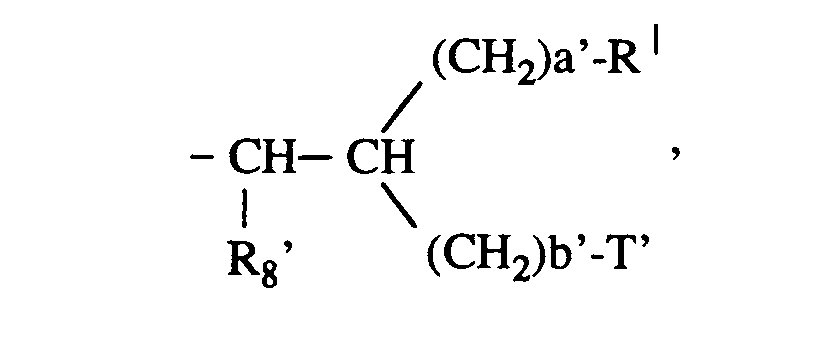
- R4'', R5'', R6', R7', R8', a', b' R' und T' die oben angegebene Bedeutung von R4, R5, R6, R7, R8, a, b, R und T haben und dieser gleich oder verschieden sind, und
- R9, R10 und R11 die oben angegebene Bedeutung haben oder
- jeweils E und G, G und L oder L und M gemeinsam mit dem Heterocyclus einen an diesen ankondensierten 5-bis 7-gliedrigen, gesättigten, partiell ungesättigten oder aromatischen carbocyclischen oder heterocyclischen Ring, letzteren gegebenenfalls mit bis zu 4 Heteroatomen aus der Reihe N, S oder O bilden, wobei diese ankondensierten Ringe gegebenenfalls bis zu 3fach gleich oder verschieden durch Halogen oder durch eine Gruppe der Formel-V-W oder W substituiert sind, worin
- V ein geradkettiges oder verzweigtes Alkylen mit bis zu 6 Kohlenstoffatomen bedeutet,
- W Wasserstoff oder eine Gruppe der Formel - OR4'',-CO-R5'' oder -NR9'R10' bedeutet, worin
- R4'' und R5'' die oben angegebene Bedeutung haben, und
- R9' und R10' die oben angegebene Bedeutung von R9 und R10 haben und mit dieser gleich oder verschieden sind,
- B für unverzweigtes Alkyl, Alkenyl oder Alkinyl mit jeweils bis zu 4 Kohlenstoffatomen steht,
- D für Wasserstoff, Halogen, Nitro, Hydroxy, Trifluormethyl, Trifluormethoxy, geradkettiges oder verzweigtes Alkyl, Alkoxy oder Alkoxycarbonyl mit jeweils bis zu 6 Kohlenstoffatomen, Cyano, Carboxy oder für die Gruppe -NR9 R10 steht, worin
- R9 und R10 die oben angegebene Bedeutung haben,
- R1 und R2 gleich oder verschieden sind und für Wasserstoff, Hydroxy oder für geradkettiges oder verzweigtes Alkyl mit bis zu 10 Kohlenstoffatomen stehen, das gegebenenfalls durch Halogen, Cycloalkyl mit 3 bis 8 Kohlenstoffatomen oder Phenyl substituiert ist, das seinerseits durch Halogen, Nitro, Hydroxy oder durch geradkettiges oder verzweigtes Alkyl oder Alkoxy mit jeweils bis zu 8 Kohlenstoffatomen substituiert sein kann, für Cycloalkyl oder Cycloalkenyl mit 3 bis 12 Kohlenstoffatomen oder Phenyl stehen, die gegebenenfalls durch Halogen, oder durch geradkettiges oder verzweigtes Alkyl oder Alkoxy mit jeweils bis zu 6 Kohlenstoffatomen substituiert sind, oder
- R1 und R2 gemeinsam mit dem Kohlenstoffatom einen 3-bis 7-gliedrigen, gesättigten oder ungesättigten Carbocyclus bilden, der gegebenenfalls bis zu 2fach gleich oder verschieden durch geradkettiges oder verzweigtes Alkyl oder Alkoxy mit jeweils bis zu 6 Kohlenstoffatomen, Phenyl, Hydroxy oder Halogen substituiert ist,
- R3 für Tetrazolyl steht, oder für eine Gruppe der Formel - C = N , -CO-R'8, -CO-NR19R20, -CO-NR21-S02-R22 oder -S02-NR23R24 steht, worin
- R18 Hydroxy, geradkettiges oder verzweigtes Alkoxy mit bis zu 10 Kohlenstoffatomen oder Phenoxy bedeutet,
- R19 und R20 gleich oder verschieden sind, die oben angegebene Bedeutung von R9 und R10 haben und mit dieser gleich oder verschieden sind, oder
- R19 die oben angegebene Bedeutung hat und
- R 20 eine Gruppe der Formel

- R 25 und R26 gleich oder verschieden sind und Wasserstoff, Phenyl, Benzyl oder einen 5- bis 7-gliedrigen, gesättigten oder ungesättigten Heterocyclus mit jeweils bis zu 3 Heteroatomen aus der Reihe N, S oder O bedeutet, die ihrerseits einfach oder zweifach durch Halogen, Hydroxy, Nitro, Cyano, Hydroxy, Carboxy oder durch geradkettiges oder verzweigtes Alkyl, Alkoxy oder Alkoxycarbonyl mit jeweils bis zu 8 Kohlenstoffatomen substituiert sein können,
- R 27 Wasserstoff oder geradkettiges oder verzweigtes Alkyl oder Acyl mit jeweils bis zu 8 Kohlenstoffatomen bedeutet,
- R21, R23 und R24 gleich oder verschieden sind und die oben angegebene Bedeutung von R9 und R10 haben und mit diesen gleich oder verschieden sind, und
- R 22 die oben angegebene Bedeutung von R11 hat und mit dieser gleich oder verschieden ist oder einen Rest der Formel

- R 29 Hydroxy, Carboxy oder geradkettiges oder verzweigtes Alkoxycarbonyl mit bis zu 6 Kohlenstoffatomen bedeutet, und
- R30 Wasserstoff oder Halogen bedeutet,
und deren Salze.The invention relates to heterocyclically substituted phenylacetic acid derivatives of the general formula (I)
- A for a heterocyclic radical of the formula which is bonded via a nitrogen atom
- E, G, L and M are the same or different and cycloalkyl with 3 to 8 carbon atoms, hydrogen, tetrazolyl, halogen, perfluoroalkyl with up to 6 carbon atoms or a group of the formula -OR 4 , -CO- R 5,
- R 4 is hydrogen, straight-chain or branched alkyl or acyl having up to 8 carbon atoms or phenyl, which in turn is substituted up to twice in the same or different way by halogen, hydroxyl, nitro or by straight-chain or branched alkyl or alkoxy each having up to 8 carbon atoms, or means a hydroxy protecting group,
- R 5 is hydrogen, hydroxy or straight-chain or branched alkyl or alkoxy each having up to 8 carbon atoms or a group of the formula - NR 9 R '° or -NR 9 -SO 2 R 11 , in which
- R 9 and R 10 are the same or different and are hydrogen, straight-chain or branched alkyl or acyl each having up to 8 carbon atoms or phenyl, which may be nitro, cyano, which may be nitro, cyano, halogen, trifluoromethyl or straight-chain or branched alkyl is substituted with up to 6 carbon atoms,
- R 11 denotes straight-chain or branched alkyl having up to 8 carbon atoms, benzyl, 2-phenylvinyl or phenyl, which is optionally substituted up to twice in the same or different way by halogen, trifluoromethyl or by straight-chain or branched alkyl or alkoxy each having up to 6 carbon atoms,
- R 6 , R 7 and R 8 are the same or different and are hydrogen, hydroxy, acetyloxy, straight-chain or branched alkyl having up to 8 carbon atoms or phenyl,
- Q is a group of the formula -C = N, - CO-NR 12 R 13 , -S0 2 -NR 14 R 15 or -CO-NR 16 -SO 2 R 17 , wherein
- R 12 , R 13 , R 14 , R 15 and R 16 are identical or different and have the abovementioned meaning of R 9 and R 10 and are identical or different with this,
- R 17 has the meaning of R 11 given above and is the same or different with this,
- a and b are the same or different and represent a number 0, 1, 2, 3 or 4,
- R denotes hydrogen or phenyl, thienyl or furyl, which are substituted by carboxy, straight-chain or branched alkyl, alkoxy or alkoxycarbonyl each having up to 8 carbon atoms, nitro, hydroxy, halogen, trifluoromethyl or trifluoromethoxy,
- T is hydrogen or a group of the formula - OR 4 ' or -CO-R 5 ', wherein
- R 4 ' and R 5' have the meaning given above for R 4 and R 5 and are the same or different with it, or
- E, G, L and M represent straight-chain or branched alkyl, alkenyl or alkadienyl each having up to 10 carbon atoms, which may optionally be up to 2-fold by halogen or by a 5- to 7-membered, saturated or unsaturated heterocyclic ring having up to 4- Heteroatoms from the series N, S or O, by phenyl, cycloalkyl having 3 to 8 carbon atoms or by one of the groups -OR 4 " , -CO-R 5" ,
- R 4 '' , R 5 '' , R 6 ', R 7' , R 8 ' , a', b 'R' and T 'have the meaning given above of R 4 , R 5 , R 6 , R 7 , R 8 , a , b, R and T and these are the same or different, and
- R 9 , R 10 and R 11 have the meaning given above or
- in each case E and G, G and L or L and M together with the heterocycle, a 5 to 7-membered, saturated, partially unsaturated or aromatic carbocyclic or heterocyclic ring fused onto them, the latter optionally with up to 4 heteroatoms from the series N, Form S or O, these fused rings optionally being substituted up to 3 times identically or differently by halogen or by a group of the formula VW or W, in which
- V denotes a straight-chain or branched alkylene with up to 6 carbon atoms,
- W is hydrogen or a group of the formula - OR 4 '' , -CO-R 5 '' or -NR 9 ' R 10' , wherein
- R 4 " and R 5" have the meaning given above, and
- R 9 ' and R 10' have the meaning of R 9 and R 10 given above and are identical or different with this,
- B represents unbranched alkyl, alkenyl or alkynyl each having up to 4 carbon atoms,
- D represents hydrogen, halogen, nitro, hydroxy, trifluoromethyl, trifluoromethoxy, straight-chain or branched alkyl, alkoxy or alkoxycarbonyl each having up to 6 carbon atoms, cyano, carboxy or the group -NR 9 R 10 , in which
- R 9 and R 10 have the meaning given above,
- R 1 and R 2 are identical or different and represent hydrogen, hydroxyl or straight-chain or branched alkyl having up to 10 carbon atoms, which is optionally substituted by halogen, cycloalkyl having 3 to 8 carbon atoms or phenyl, which in turn is substituted by halogen, nitro, Hydroxy or can be substituted by straight-chain or branched alkyl or alkoxy each having up to 8 carbon atoms, represent cycloalkyl or cycloalkenyl having 3 to 12 carbon atoms or phenyl, which may be substituted by halogen, or by straight-chain or branched alkyl or alkoxy each having up to 6 Carbon atoms are substituted, or
- R 1 and R 2 together with the carbon atom form a 3 to 7-membered, saturated or unsaturated carbocycle which may be up to 2 times the same or different by straight-chain or branched alkyl or alkoxy each having up to 6 carbon atoms, phenyl, hydroxy or halogen is substituted,
- R 3 stands for tetrazolyl, or for a group of the formula - C = N, -CO-R ' 8 , -CO-NR 19 R 20 , -CO-NR21-S02-R22 or -S0 2 -NR 23 R 24 , in which
- R 18 is hydroxy, straight-chain or branched alkoxy having up to 10 carbon atoms or phenoxy,
- R 19 and R 20 are the same or different, have the meaning given above for R 9 and R 10 and are the same or different with it, or
- R 19 has the meaning given above and
- R 20 is a group of the formula
- R 25 and R 26 are the same or different and are hydrogen, phenyl, benzyl or a 5- to 7-membered, saturated or unsaturated heterocycle, each with up to 3 heteroatoms from the series N, S or O, which in turn means single or double Halogen, hydroxy, nitro, cyano, hydroxy, carboxy or can be substituted by straight-chain or branched alkyl, alkoxy or alkoxycarbonyl, each having up to 8 carbon atoms,
- R 27 denotes hydrogen or straight-chain or branched alkyl or acyl each having up to 8 carbon atoms,
- R 21 , R 23 and R 24 are the same or different and have the meaning given above for R 9 and R 10 and are the same or different with these, and
- R 22 has the meaning of R 11 given above and is the same or different with this or a residue of the formula
- R 29 denotes hydroxy, carboxy or straight-chain or branched alkoxycarbonyl having up to 6 carbon atoms, and
- R 30 represents hydrogen or halogen,
and their salts.
Die erfindungsgemäßen heterocyclisch substituierten Phenylessigsäurederivate können auch in Form ihrer Salze vorliegen. Im allgemeinen seien hier Salze mit organischen oder anorganischen Basen oder Säuren genannt.The heterocyclically substituted phenylacetic acid derivatives according to the invention can also be present in the form of their salts. In general, salts with organic or inorganic bases or acids may be mentioned here.
Im Rahmen der vorliegenden Erfindung werden physiologisch unbedenkliche Salze bevorzugt. Physiologisch unbedenkliche Salze der heterocyclisch substituierten Phenylessigsäurederivate können Salze der erfindungsgemäßen Stoffe mit Mineralsäuren, Carbonsäuren oder Sulfonsäuren sein. Besonders bevorzugt sind z.B. Salze mit Chlorwasserstoffsäure, Bromwasserstoffsäure, Schwefelsäure, Phosphorsäure, Methansulfonsäure, Ethansulfonsäure, Toluolsulfonsäure, Benzolsulfonsäure, Naphthalindisulfonsäure, Essigsäure, Propionsäure, Milchsäure, Weinsäure, Zitronensäure, Fumarsäure, Maleinsäure oder Benzoesäure.Physiologically acceptable salts are preferred in the context of the present invention. Physiologically acceptable salts of the heterocyclically substituted phenylacetic acid derivatives can be salts of the substances according to the invention with mineral acids, carboxylic acids or sulfonic acids. For example, particular preference is given to Salts with hydrochloric acid, hydrobromic acid, sulfuric acid, phosphoric acid, methanesulfonic acid, ethanesulfonic acid, toluenesulfonic acid, benzenesulfonic acid, naphthalenedisulfonic acid, acetic acid, propionic acid, lactic acid, tartaric acid, citric acid, fumaric acid, maleic acid or benzoic acid.
Physiologisch unbedenkliche Salze können ebenso Metall- oder Ammoniumsalze der erfindungsgemäßen Verbindungen sein, welche eine freie Carboxylgruppe besitzen. Besonders bevorzugt sind z.B. Natrium- , Kalium-, Magnesium- oder Calciumsalze, sowie Ammoniumsalze, die abgeleitet sind von Ammoniak, oder organischen Aminen wie beispielsweise Ethylamin, Di- bzw. Triethylamin, Di-bzw. Triethanolamin, Dicyclohexylamin, Dimethylaminoethanol, Arginin, Lysin oder Ethylendiamin.Physiologically acceptable salts can also be metal or ammonium salts of the compounds according to the invention which have a free carboxyl group. For example, particular preference is given to Sodium, potassium, magnesium or calcium salts, and also ammonium salts which are derived from ammonia, or organic amines such as, for example, ethylamine, di- or triethylamine, di- or. Triethanolamine, dicyclohexylamine, dimethylaminoethanol, arginine, lysine or ethylenediamine.
Die erfindungsgemäßen Verbindungen können in stereoisomeren Formen, die sich entweder wie Bild und Spiegelbild (Enantiomere), oder die sich nicht wie Bild und Spiegelbild (Diastereomere) verhalten, existieren. Die Erfindung betrifft sowohl die Enantiomeren oder Diastereomeren oder deren jeweiligen Mischungen. Die Racemformen lassen sich ebenso wie die Diastereomeren in bekannter Weise in die stereoisomer einheitlichen Bestandteile trennen [vgl. E.L. Eliel, Stereochemistry of Carbon Compounds, McGraw Hill, 1962].The compounds according to the invention can exist in stereoisomeric forms which either behave like image and mirror image (enantiomers) or which do not behave like image and mirror image (diastereomers). The invention relates to both the enantiomers or diastereomers or their respective mixtures. Like the diastereomers, the racemic forms can be separated into the stereoisomerically uniform constituents in a known manner [cf. E.L. Eliel, Stereochemistry of Carbon Compounds, McGraw Hill, 1962].
Heterocyclus steht im allgemeinen für einen 5- bis 7-gliedrigen, bevorzugt 5-bis 6-gliedrigen, gesättigten oder ungesättigten Ring, der als Heteroatome bis zu 2 Sauerstoff- , Schwefel- und/oder Stickstoffatome enthalten kann. Bevorzugt sind 5-und 6-gliedrige Ringe mit einem Sauerstoff-, Schwefel und/oder bis zu 2 Stickstoffatomen. Bevorzugt werden genannt: Thienyl, Furyl, Pyrrolyl, Pyrazolyl, Pyridyl, Pyrimidyl, Pyrazinyl, Pyridazinyl, Thiazolyl, Oxazolyl, Imidazolyl, Pyrrolidinyl, Piperidinyl, Piperazinyl oder Tetrazolyl.Heterocycle generally represents a 5- to 7-membered, preferably 5 to 6-membered, saturated or unsaturated ring which can contain up to 2 oxygen, sulfur and / or nitrogen atoms as heteroatoms. 5- and 6-membered rings with one oxygen, sulfur and / or up to 2 nitrogen atoms are preferred. The following are preferably mentioned: thienyl, furyl, pyrrolyl, pyrazolyl, pyridyl, pyrimidyl, pyrazinyl, pyridazinyl, thiazolyl, oxazolyl, imidazolyl, pyrrolidinyl, piperidinyl, piperazinyl or tetrazolyl.
Bevorzugt sind Verbindungen der allgemeinen Formel (I),
in welcher
- A für einen über ein Stickstoffatom gebundenen heterocyclischen Rest der Formel

- E, G, L und M gleich oder verschieden sind und Wasserstoff, Tetrazolyl, Cyclopropyl, Cyclopentyl, Cyclohexyl, Fluor, Chlor, Brom, Jod, Perfluoralkyl mit bis zu 4 Kohlenstoffatomen oder eine Gruppe der Formel -OR4 , -CO-R5 ,


- R4 Wasserstoff, geradkettiges oder verzweigtes Alkyl oder Acyl mit jeweils bis zu 6 Kohlenstoffatomen oder Phenyl bedeutet, das seinerseits durch Fluor, Chlor, Brom, Hydroxy, Nitro oder durch geradkettiges oder verzweigtes Alkyl oder Alkoxy mit jeweils bis zu 6 Kohlenstoffatomen substituiert ist, oder Methoxyethoxymethyl bedeutet,
- R5 Wasserstoff, Hydroxy oder geradkettiges oder verzweigtes Alkyl oder Alkoxy mit jeweils bis zu 6 Kohlenstoffatomen oder eine Gruppe der Formel -NR9R10 oder - NR9-SO2R11 bedeutet, worin
- R9 und R10 gleich oder verschieden sind und Wasserstoff, geradkettiges oder verzweigtes Alkyl oder Acyl mit jeweils bis zu 6 Kohlenstoffatomen oder Phenyl bedeuten, das gegebenenfalls durch Nitro, Trifluormethyl, Fluor, Chlor, Brom oder durch geradkettiges oder verzweigtes Alkyl mit bis zu 4 Kohlenstoffatomen substituiert ist,
- R11 geradkettiges oder verzweigtes Alkyl mit bis zu 6 Kohlenstoffatomen, Benzyl, 2-Phenylvinyl oder Phenyl bedeutet, das gegebenenfalls durch Fluor, Chlor, Brom, Trifluormethyl oder durch geradkettiges oder verzweigtes Alkyl oder Alkoxy mit jeweils bis zu 4 Kohlenstoffatomen substituiert ist,
- R8 Wasserstoff, Hydroxy, Acetyloxy, geradkettiges oder verzweigtes Alkyl mit bis zu 6 Kohlenstoffatomen oder Phenyl bedeutet,
- a und b gleich oder verschieden sind und eine Zahl 0, 1, 2 oder 3 bedeuten,
- R Wasserstoff oder Phenyl, Thienyl oder Furyl bedeutet, die gegebenenfalls bis zu 2fach gleich oder verschieden durch Carboxy, geradkettiges oder verzweigtes Alkyl, Alkoxy oder Alkoxycarbonyl mit jeweils bis zu 6 Kohlenstoffatomen, Nitro, Hydroxy, Fluor, Chlor, Brom, Trifluormethyl oder Trifluormethoxy substituiert sind,
- T Wasserstoff oder eine Gruppe der Formel - OR4' oder -CO-R5' bedeutet, worin
- R4' und R5' die oben angegebene Bedeutung von R4 und R5 haben und mit dieser gleich oder verschieden ist, oder
- E, G, L und M geradkettiges oder verzweigtes Alkyl, Alkenyl oder Alkadienyl mit jeweils bis zu 8 Kohlenstoffatomen bedeuten, die gegebenenfalls bis zu 2fach durch Fluor, Brom, Chlor, Phenyl, Tetrazolyl, Cyclopropyl, Cyclopentyl, Cyclohexyl oder durch eine der Gruppen -OR4'', -CO-R5'',

- R4'', R5'', R8', a', b', R' und T' die oben angegebene Bedeutung von R4, R5, R8, a, b, R und T haben und mit dieser gleich oder verschieden sind, und
- R9, R10 und R11 die oben angegebene Bedeutung haben, oder
- jeweils E und G, G und L oder L und M gemeinsam mit dem Heterocyclus einen an diesen ankondensierten Cyclopentyl-, Cyclopentenyl-, Cyclohexyl-, Cyclohexenyl-, Phenyl-, Pyridyl-, Thienyl- oder Pyrimidinyl-Ring bilden, wobei diese Ringe gegebenenfalls bis zu 2fach gleich oder verschieden durch Fluor, Chlor, Brom oder durch eine Gruppe der Formel -V-W oder W substituiert sind, worin
- V geradkettiges oder verzweigtes Alkylen mit bis zu 4 Kohlenstoffatomen bedeutet,
- W Wasserstoff oder eine Gruppe der Formel - OR'',-CO-R5'' oder -NR9'R10' bedeutet, worin
- R4'' und R5" die oben angegebene Bedeutung haben, und
- R9' und R10' die oben angegebene Bedeutung von R9 und R10 haben und mit dieser gleich oder verschieden sind,
- B für unverzweigtes Alkyl, Alkenyl oder Alkinyl mit jeweils bis zu 3 Kohlenstoffatomen steht,
- D für Wasserstoff, Fluor, Chlor, Brom, Trifluormethyl, Carboxy oder geradkettiges oder verzweigtes Alkyl, Alkoxy oder Alkoxycarbonyl mit jeweils bis zu 4 Kohlenstoffatomen steht,
- R1 und R2 gleich oder verschieden sind und für Wasserstoff, Hydroxy oder für geradkettiges oder verzweigtes Alkyl mit bis zu 8 Kohlenstoffatomen stehen, die gegebenenfalls durch Fluor, Chlor, Brom, Cyclopropyl, Cyclopentyl, Cyclohexyl oder Phenyl substituiert ist, das seinerseits durch Fluor, Chlor, Brom oder durch geradkettiges oder verzweigtes Alkyl oder Alkoxy mit jeweils bis zu 6 Kohlenstoffatomen substituiert sein kann, für Cyclobutyl, Cyclopentyl, Cyclohexyl, Cycloheptyl, Cyclooctyl oder Phenyl stehen, die gegebenenfalls durch Fluor, Chlor, Brom oder durch geradkettiges oder verzweigtes Alkyl oder Alkoxy mit jeweils bis zu 4 Kohlenstoffatomen substituiert sind, oder
- R1 und R2 gemeinsam einen Cyclopropyl-, Cyclopentyl-oder Cyclohexylring bilden, der gegebenenfalls durch geradkettiges oder verzweigtes Alkyl oder Alkoxy mit jeweils bis zu 4 Kohlenstoffatomen, Phenyl, Fluor oder Chlor substituiert ist,
- R3 für Tetrazolyl steht, oder für eine Gruppe der Formel -C = N , - CO-R18, -CO-NR19R20, -CO-NR21-SO2R22 oder -S02-NR23R24 steht, worin
- R18 Hydroxy, geradkettiges oder verzweigtes Alkoxy mit bis zu 8 Kohlenstoffatomen oder Phenoxy bedeutet,
- R19 und R20 gleich oder verschieden sind und die oben angegebene Bedeutung von R9 und R10 haben und mit dieser gleich oder verschieden sind oder
- R19 die oben angegebene Bedeutung hat und
- R 20 eine Gruppe der Formel

- R 25 und R26 gleich oder verschieden sind und Wasserstoff, Phenyl, Benzyl, Pyridyl oder Thienyl bedeuten, die ihrerseits einfach oder zweifach durch Hydroxy, Carboxy, Fluor, Chlor, Brom oder durch geradkettiges oder verzweigtes Alkyl, Alkoxy oder Alkoxycarbonyl mit jeweils bis zu 6 Kohlenstoffatomen substituiert sein können,
- R 27 Wasserstoff oder geradkettiges oder verzweigtes Alkyl oder Acyl mit jeweils bis zu 6 Kohlenstoffatomen bedeutet,
- R21, R23 und R24 gleich oder verschieden sind und die oben angegebene Bedeutung von R9 und R10 haben und mit dieser gleich oder verschieden ist,
- R 22 die oben angegebene Bedeutung von R11 hat und mit dieser gleich oder verschieden ist, oder einen Rest der Formel

- R 29 Hydroxy, Carboxy oder geradkettiges oder verzweigtes Alkoxycarbonyl mit bis zu 6 Kohlenstoffatomen bedeutet, und
- R30 Wasserstoff, Fluor oder Chlor bedeutet, und deren Salze.
- Besonders bevorzugt sind Verbindungen der allgemeinen Formel (I), in welcher
- A für einen über ein Stickstoffatom gebundenen Imidazolring der Formel

- E, G, L und M gleich oder verschieden sind und Cyclopropyl, Wasserstoff, Tetrazolyl, Fluor, Jod, Chlor, Brom, Trifluormethyl, Perfluoralkyl mit bis zu 4 Kohlenstoffatomen oder eine Gruppe der Formel -OR4 , -CO-R5 ,


- R4 Wasserstoff, geradkettiges oder verzweigtes Alkyl oder Acyl mit jeweils bis zu 4 Kohlenstoffatomen oder Phenyl bedeutet, das seinerseits durch Fluor, Chlor oder durch geradkettiges oder verzweigtes Alkyl oder Alkoxy mit jeweils bis zu 4 Kohlenstoffatomen substituiert ist, oder Methoxyethoxymethyl bedeutet,
- R5 Wasserstoff, Hydroxy oder geradkettiges oder verzweigtes Alkyl oder Alkoxy mit jeweils bis zu 4 Kohlenstoffatomen oder eine Gruppe der Formel -NR9R10 oder - NR9-SO2R11 bedeutet, worin
- R9 und R10 gleich oder verschieden sind und Wasserstoff oder geradkettiges oder verzweigtes Alkyl oder Acyl mit jeweils bis zu 4 Kohlenstoffatomen bedeuten,
- R11 geradkettiges oder verzweigtes Alkyl mit bis zu 4 Kohlenstoffatomen, Benzyl, 2-Phenylvinyl oder Phenyl bedeutet, das gegebenenfalls durch Fluor, Chlor, Brom, Trifluormethyl oder durch Methyl oder Ethyl substituiert ist,
- R8 Wasserstoff, Hydroxy, Acetyloxy oder geradkettiges oder verzweigtes Alkyl mit bis zu 4 Kohlenstoffatomen bedeutet,
- a und b gleich oder verschieden sind und eine Zahl 0, 1 oder 2 bedeuten,
- R Wasserstoff oder Phenyl, Thienyl oder Furyl bedeutet, die gegebenenfalls durch Carboxy, geradkettiges oder verzweigtes Alkyl, Alkoxy oder Alkoxycarbonyl mit jeweils bis zu 4 Kohlenstoffatomen, Fluor, Chlor oder Trifluormethyl substituiert sind,
- T Wasserstoff oder eine Gruppe der Formel - OR" oder -CO-R5' bedeutet, worin
- R4' und R5' die oben angegebene Bedeutung von R4 und R5 haben und mit dieser gleich oder verschieden sind, oder
- E, G, L und M geradkettiges oder verzweigtes Alkyl, Alkenyl oder Alkadienyl mit jeweils bis zu 6 Kohlenstoffatomen bedeuten, die gegebenenfalls bis zu 2fach durch Fluor, Chlor, Brom, Tetrazolyl, Cyclohexyl, Phenyl oder durch eine der Gruppen -OR4'', -CO-R5''

- R4'', R5'', R8', a', b', R' und T' die oben angegebene Bedeutung von R4, R5, R8, a, b, R und T haben und mit dieser gleich oder verschieden sind, und
- R9, R10 und R11 die oben angegebene Bedeutung haben, oder
- E und G oder L und M gemeinsam mit dem Heterocyclus einen an diesen ankondensierten Cyclohexyl-, Phenyl- Thienyl, Pyridyl-oder Pyrimidiylring bilden, wobei diese Ringe gegebenenfalls durch Fluor, Chlor, Brom oder eine Gruppe der Formel - V-W oder W substituiert sind, worin
- V geradkettiges oder verzweigtes Alkylen mit bis zu 3 Kohlenstoffatomen bedeutet,
- W Wasserstoff oder eine Gruppe der Formel - OR4'', -COR5'' oder - NR9'R10' bedeutet, worin
- R4'' und R5'' die oben angegebene Bedeutung haben,
- R9' und R10' die oben angegebene Bedeutung von R9 und R10 haben und mit dieser gleich oder verschieden ist,
- B für die -CH2-, -(CH2)2-, -(CH2)3-, -HC = CH-oder -C = C-Gruppe steht, D für Wasserstoff, Fluor, Chlor, Brom, Trifluormethyl, Trifluormethoxy oder Methyl steht,
- R1 und R2 gleich oder verschieden sind und für Wasserstoff, Hydroxy oder für geradkettiges oder verzweigtes Alkyl mit bis zu 7 Kohlenstoffatomen stehen, das gegebenenfalls durch Fluor, Chlor, Cyclopropyl, Cyclopentyl, Cyclohexyl oder Phenyl substituiert ist, das gegebenenfalls durch Fluor, Chlor oder durch geradkettiges oder verzweigtes Alkyl oder Alkoxy mit jeweils bis zu 4 Kohlenstoffatomen substituiert ist, oder für Cyclopentyl oder Cycloheptyl stehen, oder
- R1 für Wasserstoff steht und
- R2 für Cyclopentyl, Cyclohexyl, Cycloheptyl, Cyclooctyl oder Phenyl steht, die gegebenenfalls durch Fluor, Chlor oder durch Methyl, Ethyl oder Methoxy substituiert sind, oder
- R1 und R2 gemeinsam einen Cyclopropyl, Cyclopentyl oder Cyclohexyl-Ring bilden, der gegebenenfalls durch Methyl, Methoxy, Phenyl oder Fluor substituiert ist,
- R 3 für Tetrazolyl steht, oder für eine Gruppe der Formel -C ≡ N , - CO-R18, -CO-NR19R20, -CO-NR21-SO2R22 oder -S02-NR23R24 steht, worin
- R18 Hydroxy, geradkettiges oder verzweigtes Alkoxy mit bis zu 6 Kohlenstoffatomen oder Phenoxy bedeutet,
- R19 und R20 gleich oder verschieden sind und die oben angegebene Bedeutung von R9 und R10 haben und mit dieser gleich oder verschieden sind, oder
- R 19 Wasserstoff bedeutet und
- R 20 eine Gruppe der Formel

- R25 und R26 gleich oder verschieden sind und Wasserstoff, Phenyl oder Benzyl bedeuten, die ihrerseits einfach oder zweifach durch Hydroxy, Fluor, Chlor oder durch geradkettiges oder verzweigtes Alkyl mit bis zu 4 Kohlenstoffatomen substituiert sein können,
- R27 Wasserstoff oder geradkettiges oder verzweigtes Alkyl oder Acyl mit jeweils bis zu 4 Kohlenstoffatomen bedeutet,
- R21, R23 und R24 gleich oder verschieden sind und die oben angegebene Bedeutung von R9 und R10 haben und mit dieser gleich oder verschieden ist,
- R22 die oben angegebene Bedeutung von R11 hat und mit dieser gleich oder verschieden ist, oder einen Rest der Formel

- R29 Hydroxy, Carboxy, Methoxy- oder Ethoxycarbonyl bedeutet, und
- R30 Wasserstoff, Fluor oder Chlor bedeutet, und deren Salze.
in which
- A for a heterocyclic radical of the formula bonded via a nitrogen atom
- E, G, L and M are the same or different and are hydrogen, tetrazolyl, cyclopropyl, cyclopentyl, cyclohexyl, fluorine, chlorine, bromine, iodine, perfluoroalkyl having up to 4 carbon atoms or a group of the formula -OR 4 , -CO-R 5 ,
- R 4 is hydrogen, straight-chain or branched alkyl or acyl each having up to 6 carbon atoms or phenyl, which in turn is substituted by fluorine, chlorine, bromine, hydroxyl, nitro or by straight-chain or branched alkyl or alkoxy each having up to 6 carbon atoms, or Methoxyethoxymethyl means
- R 5 denotes hydrogen, hydroxy or straight-chain or branched alkyl or alkoxy each having up to 6 carbon atoms or a group of the formula -NR 9 R 10 or - NR 9 -SO 2 R 11 , in which
- R 9 and R 10 are the same or different and are hydrogen, straight-chain or branched alkyl or acyl each having up to 6 carbon atoms or phenyl, which may be by nitro, trifluoromethyl, fluorine, chlorine, bromine or by straight-chain or branched alkyl having up to 4 Carbon atoms is substituted,
- R 11 denotes straight-chain or branched alkyl having up to 6 carbon atoms, benzyl, 2-phenylvinyl or phenyl, which is optionally substituted by fluorine, chlorine, bromine, trifluoromethyl or by straight-chain or branched alkyl or alkoxy each having up to 4 carbon atoms,
- R 8 denotes hydrogen, hydroxy, acetyloxy, straight-chain or branched alkyl having up to 6 carbon atoms or phenyl,
- a and b are the same or different and represent a number 0, 1, 2 or 3,
- R denotes hydrogen or phenyl, thienyl or furyl, which are optionally substituted up to 2 times the same or different by carboxy, straight-chain or branched alkyl, alkoxy or alkoxycarbonyl each having up to 6 carbon atoms, nitro, hydroxyl, fluorine, chlorine, bromine, trifluoromethyl or trifluoromethoxy are,
- T is hydrogen or a group of the formula - OR 4 ' or -CO-R 5' , wherein
- R 4 'and R 5 ' have the meaning given above for R 4 and R 5 and with this is the same or different, or
- E, G, L and M are straight-chain or branched alkyl, alkenyl or alkadienyl each having up to 8 carbon atoms, which may be up to 2-fold by fluorine, bromine, chlorine, phenyl, tetrazolyl, cyclopropyl, cyclopentyl, cyclohexyl or by one of the groups - OR 4 '', -CO-R 5 '',
- R 4 '' , R 5 '' , R 8 ' , a', b ', R' and T 'have the meaning given above of R 4 , R 5 , R 8 , a, b, R and T and with this are the same or different, and
- R 9 , R 10 and R 11 have the meaning given above, or
- in each case E and G, G and L or L and M together with the heterocycle form a cyclopentyl, cyclopentenyl, cyclohexyl, cyclohexenyl, phenyl, pyridyl, thienyl or pyrimidinyl ring fused onto these, these rings optionally forming up to 2 times the same or different are substituted by fluorine, chlorine, bromine or by a group of the formula -VW or W, wherein
- V denotes straight-chain or branched alkylene with up to 4 carbon atoms,
- W represents hydrogen or a group of the formula - OR '' , -CO-R 5 '' or -NR 9 ' R 10' , wherein
- R 4 " and R5" have the meaning given above, and
- R 9 'and R 10' have the meaning of R 9 and R 10 given above and are identical or different with this,
- B represents unbranched alkyl, alkenyl or alkynyl each having up to 3 carbon atoms,
- D represents hydrogen, fluorine, chlorine, bromine, trifluoromethyl, carboxy or straight-chain or branched alkyl, alkoxy or alkoxycarbonyl each having up to 4 carbon atoms,
- R 1 and R 2 are the same or different and represent hydrogen, hydroxyl or straight-chain or branched alkyl having up to 8 carbon atoms, which is optionally substituted by fluorine, chlorine, bromine, cyclopropyl, cyclopentyl, cyclohexyl or phenyl, which in turn is substituted by fluorine , Chlorine, bromine or can be substituted by straight-chain or branched alkyl or alkoxy each having up to 6 carbon atoms, represent cyclobutyl, cyclopentyl, cyclohexyl, cycloheptyl, cyclooctyl or phenyl, which are optionally substituted by fluorine, chlorine, bromine or by straight-chain or branched alkyl or alkoxy each having up to 4 carbon atoms are, or
- R 1 and R 2 together form a cyclopropyl, cyclopentyl or cyclohexyl ring which is optionally substituted by straight-chain or branched alkyl or alkoxy each having up to 4 carbon atoms, phenyl, fluorine or chlorine,
- R 3 represents tetrazolyl, or a group of the formula -C = N, - CO-R 18 , -CO-NR 19 R 20 , -CO-NR 21 -SO 2 R 22 or -S0 2 -NR 23 R 24 stands in what
- R 18 denotes hydroxy, straight-chain or branched alkoxy with up to 8 carbon atoms or phenoxy,
- R 19 and R 20 are the same or different and have the meaning of R 9 and R 10 given above and are the same or different with this or
- R 19 has the meaning given above and
- R 20 is a group of the formula
- R 25 and R 26 are the same or different and are hydrogen, phenyl, benzyl, pyridyl or thienyl, which in turn are mono- or disubstituted by hydroxy, carboxy, fluorine, chlorine, bromine or by straight-chain or branched alkyl, alkoxy or alkoxycarbonyl, each with up to 6 carbon atoms can be substituted,
- R 27 denotes hydrogen or straight-chain or branched alkyl or acyl each having up to 6 carbon atoms,
- R 21 , R 23 and R 24 are identical or different and have the abovementioned meaning of R 9 and R 10 and are identical or different with this,
- R 22 has the meaning of R 11 given above and is the same or different with it, or a radical of the formula
- R 29 is hydroxy, carboxy or straight-chain or branched Al means koxycarbonyl having up to 6 carbon atoms, and
- R 30 is hydrogen, fluorine or chlorine, and their salts.
- Compounds of the general formula (I) in which
- A for an imidazole ring of the formula bonded via a nitrogen atom
- E, G, L and M are the same or different and cyclopropyl, hydrogen, tetrazolyl, fluorine, iodine, chlorine, bromine, trifluoromethyl, perfluoroalkyl with up to 4 carbon atoms or a group of the formula -OR 4 , -CO-R 5 ,
- R 4 is hydrogen, straight-chain or branched alkyl or acyl, each having up to 4 carbon atoms or phenyl, which in turn is substituted by fluorine, chlorine or by straight-chain or branched alkyl or alkoxy, each having up to 4 carbon atoms, or is methoxyethoxymethyl,
- R 5 denotes hydrogen, hydroxy or straight-chain or branched alkyl or alkoxy each having up to 4 carbon atoms or a group of the formula -NR 9 R 10 or - NR 9 -SO 2 R 11 , in which
- R 9 and R 10 are the same or different and are hydrogen or straight-chain or branched alkyl or acyl each having up to 4 carbon atoms,
- R 11 denotes straight-chain or branched alkyl having up to 4 carbon atoms, benzyl, 2-phenylvinyl or phenyl, which is optionally substituted by fluorine, chlorine, bromine, trifluoromethyl or by methyl or ethyl,
- R 8 denotes hydrogen, hydroxy, acetyloxy or straight-chain or branched alkyl having up to 4 carbon atoms,
- a and b are the same or different and represent a number 0, 1 or 2,
- R denotes hydrogen or phenyl, thienyl or furyl, which are optionally substituted by carboxy, straight-chain or branched alkyl, alkoxy or alkoxycarbonyl each having up to 4 carbon atoms, fluorine, chlorine or trifluoromethyl,
- T is hydrogen or a group of the formula --OR "or -CO-R5 ', wherein
- R 4 'and R 5 ' have the meaning given above for R 4 and R 5 and are the same or different with it, or
- E, G, L and M represent straight-chain or branched alkyl, alkenyl or alkadienyl each having up to 6 carbon atoms, which may be up to 2-fold by fluorine, chlorine, bromine, tetrazolyl, cyclohexyl, phenyl or by one of the groups -OR 4 '' , -CO-R 5 ''
- R 4 '' , R 5 '' , R 8 ' , a', b ', R' and T 'have the meaning given above of R 4 , R 5 , R 8 , a, b, R and T and with this are the same or different, and
- R 9 , R 10 and R 11 have the meaning given above, or
- E and G or L and M together with the heterocycle form a cyclohexyl, phenylthienyl, pyridyl or pyrimidiyl ring fused to these, these rings optionally being substituted by fluorine, chlorine, bromine or a group of the formula - VW or W, wherein
- V denotes straight-chain or branched alkylene with up to 3 carbon atoms,
- W is hydrogen or a group of the formula - OR 4 '' , -COR 5 '' or - NR 9 ' R 10' , wherein
- R 4 '' and R 5 '' have the meaning given above,
- R 9 ' and R 10' have the meaning of R 9 and R 10 given above and is the same or different with this,
- B represents the -CH 2 -, - (CH 2 ) 2 -, - (CH 2 ) 3 -, -HC = CH or -C = C group, D represents hydrogen, fluorine, chlorine, bromine, trifluoromethyl, Trifluoromethoxy or methyl,
- R 1 and R 2 are the same or different and represent hydrogen, hydroxy or straight-chain or branched alkyl having up to 7 carbon atoms, which is optionally substituted by fluorine, chlorine, cyclopropyl, cyclopentyl, cyclohexyl or phenyl, which is optionally substituted by fluorine, chlorine or is substituted by straight-chain or branched alkyl or alkoxy each having up to 4 carbon atoms, or is cyclopentyl or cycloheptyl, or
- R 1 represents hydrogen and
- R 2 represents cyclopentyl, cyclohexyl, cycloheptyl, cyclooctyl or phenyl, which are optionally substituted by fluorine, chlorine or by methyl, ethyl or methoxy, or
- R 1 and R 2 together form a cyclopropyl, cyclopentyl or cyclohexyl ring which is optionally substituted by methyl, methoxy, phenyl or fluorine,
- R 3 stands for tetrazolyl, or for a group of the formula -C ≡ N, - CO-R 18 , -CO-NR 19 R 20 , -CO-NR 21 -SO 2 R 22 or -S0 2 -NR 23 R 24 stands in what
- R 18 denotes hydroxy, straight-chain or branched alkoxy with up to 6 carbon atoms or phenoxy,
- R 19 and R 20 are the same or different and have the meaning given above for R 9 and R 10 and are the same or different with it, or
- R 19 means hydrogen and
- R 20 is a group of the formula
- R 25 and R 26 are identical or different and denote hydrogen, phenyl or benzyl, which in turn can be substituted once or twice by hydroxyl, fluorine, chlorine or by straight-chain or branched alkyl having up to 4 carbon atoms,
- R 27 denotes hydrogen or straight-chain or branched alkyl or acyl each having up to 4 carbon atoms,
- R 21 , R 23 and R 24 are identical or different and have the abovementioned meaning of R 9 and R 10 and are identical or different with this,
- R 22 has the meaning of R 11 given above and is the same or different with it, or a radical of the formula
- R 29 denotes hydroxy, carboxy, methoxy or ethoxycarbonyl, and
- R 30 is hydrogen, fluorine or chlorine, and their salts.
Außerdem wurde ein Verfahren zur Herstellung der erfindungsgemäßen Verbindungen der allgemeinen Formel (I) gefunden, dadurch gekennzeichnet, daß man Verbindungen der allgemeinen Formel (II)

- B, D, R1 und R2 die oben angegebene Bedeutung haben,
- X für eine typische Abgangsgruppe wie beispielsweise Chlor, Brom, Jod, Tosylat oder Mesylat, vorzugsweise für Brom, steht und
- R3' für Alkoxycarbonyl mit bis zu 6 Kohlenstoffatomen oder Cyano steht, mit Verbindungen der allgemeinen Formel (III)
- A-H (III), worin
- A die oben angegebene Bedeutung hat,
in inerten Lösemitteln, gegebenenfalls in Anwesenheit einer Base und gegebenenfalls unter Schutzgasatmosphäre zu Verbindungen der allgemeinen Formel (la)

- A, B, D, R1, R2 und R3' die oben angegebene Bedeutung haben, umsetzt.
- im Fall der Säuren (R3 = COOH) die Ester- oder Cyanogruppe nach üblicher Methode verseift, im Fall der Herstellung der Amide und Acylsulfonsäureamide (R3 = -CO-NR19R20, -CO-NR21S02-R22) entweder direkt die Ester oder die Säuren nach üblicher Aktivierung, gegebenenfalls in Anwesenheit einer Base, eines Hilfs-, säurebindenden- und/oder eines Dehydratisierungsmittels, mit Aminen oder Sulfonsäureaminen der allgemeinen Formeln (IV) oder (V)
- HNR19 R20 (IV),
- HNR21SO2R22 (V),
- in welchen
- R19, R20, R21 und R22 die oben angegebene Bedeutung haben,
- umsetzt, und
- im Fall, daß R3 für den Tetrazolring steht, die Cyanoverbindung (11, R3' = CN) entweder in Anwesenheit von Aminhydrochloriden, vorzugsweise Triethylaminhydrochlorid, mit Natriumazid, oder mit einem Zinnazid, vorzugsweise Trimethylzinnazid, umsetzt,
und gegebenenfalls sowohl den Substituenten D als auch die Substituenten E, G, M und L auf jeder Stufe, vorzugsweise über die Säurestufe (R3 = COOH) nach üblicher Methode wie beispielsweise Halogenierung, Dehydrohalogenierung, Reduktion, Oxidation, Alkylierung oder Hydrolyse einführt oder in andere funktionelle Gruppen überführt,
gegebenenfalls die Isomeren trennt, und im Fall der Herstellung der Salze mit einer entsprechenden Base oder Säure umsetzt.We have also found a process for preparing the compounds of the general formula (I) according to the invention, characterized in that compounds of the general formula (II)
- B, D, R 1 and R 2 have the meaning given above,
- X represents a typical leaving group such as chlorine, bromine, iodine, tosylate or mesylate, preferably bromine, and
- R 3 'represents alkoxycarbonyl having up to 6 carbon atoms or cyano, with compounds of the general formula (III)
- AH (III), wherein
- A has the meaning given above,
in inert solvents, optionally in the presence of a base and optionally under a protective gas atmosphere to give compounds of the general formula (Ia)
- A, B, D, R 1 , R 2 and R 3 'have the meaning given above.
- in the case of acids (R 3 = COOH) the ester or cyano group is saponified by the usual method, in the case of the preparation of the amides and acylsulfonic acid amides (R 3 = -CO-NR 19 R 20 , -CO-NR21S02-R22) either directly Esters or the acids after customary activation, optionally in the presence of a base, an auxiliary, acid-binding and / or a dehydrating agent, with amines or sulfonic acid amines of the general formulas (IV) or (V)
- HNR 19 R 20 (IV),
- HNR 21 SO 2 R 22 (V),
- in which
- R 19 , R 20 , R 21 and R 22 have the meaning given above,
- implements, and
- in the event that R 3 represents the tetrazole ring, the cyano compound (11, R 3 ' = CN) is reacted either with sodium azide in the presence of amine hydrochlorides, preferably triethylamine hydrochloride, or with a tin azide, preferably trimethyltin azide,
and optionally introducing both the substituents D and the substituents E, G, M and L at each stage, preferably via the acid stage (R 3 = COOH) using a customary method such as, for example, halogenation, dehydrohalogenation, reduction, oxidation, alkylation or hydrolysis or in transferred other functional groups,
optionally separating the isomers and, in the case of the preparation of the salts, reacting with an appropriate base or acid.
Das erfindungsgemäße Verfahren kann durch folgendes Formelschema beispielhaft erläutert werden:


Als Lösemittel für das Verfahren eignen sich übliche organische Lösemittel, die sich unter den Reaktionsbedingungen nicht verändern. Hierzu gehören bevorzugt Ether wie Diethylether, Dioxan, Tetrahydrofuran, Glykoldimethylether, oder Kohlenwasserstoffe wie Benzol, Toluol, Xylol, Hexan, Cyclohexan oder Erdölfrakionen, oder Halogenkohlenwasserstoffe wie Dichlormethan, Trichlormethan, Tetrachlormethan, Dichlorethylen, Trichlorethylen oder Chlorbenzol, oder Essigester, Triethylamin, Pyridin, Dimethylsulfoxid, Dimethylformamid, Hexamethylphosphorsäuretriamid, Acetonitril, Aceton oder Nitromethan. Ebenso ist es möglich, Gemische der genannten Lösemittel zu verwenden. Bevorzugt ist Dimethylformamid.Suitable solvents for the process are conventional organic solvents which do not change under the reaction conditions. These preferably include ethers such as diethyl ether, dioxane, tetrahydrofuran, glycol dimethyl ether, or hydrocarbons such as benzene, toluene, xylene, hexane, cyclohexane or petroleum fractions, or halogenated hydrocarbons such as dichloromethane, trichloromethane, tetrachloromethane, dichlorethylene, trichlorethylene or chlorobenzene, chlorobenzene, chloro-benzidine Dimethyl sulfoxide, dimethylformamide, hexamethylphosphoric triamide, acetonitrile, acetone or nitromethane. It is also possible to use mixtures of the solvents mentioned. Dimethylformamide is preferred.
Als Basen für das erfindungsgemäße Verfahren können im allgemeinen anorganische oder organische Basen eingesetzt werden. Hierzu gehören vorzugsweise Alkalihydroxide wie zum Beispiel Natriumhydroxid oder Kaliumhydroxid, Erdalkalihydroxide wie zum Beispiel Bariumhydroxid, Alkalicarbonate wie Natriumcarbonat oder Kaliumcarbonat, Erdalkalicarbonate wie Calciumcarbonat, oder Alkali- oder Erdalkalialkoholate wie Natrium- oder Kaliummethanolat, Natrium- oder Kaliumethanolat oder Kalium-tert.butylat, oder organische Amine (Trialkyl(C1-C6)amine) wie Triethylamin, oder Heterocyclen wie 1,4-Diazabicyclo[2.2.2]octan (DABCO), 1,8-Diazabicyclo[5.4.0]undec-7-en (DBU), Pyridin, Diaminopyridin, Methylpiperidin oder Morpholin. Es ist auch möglich, als Basen Alkalimetalle, wie Natrium oder deren Hydride wie Natriumhydrid einzusetzen. Bevorzugt sind Natriumhydrid, Kaliumcarbonat, Triethylamin, Pyridin und Kalium-tert.butylat, DBU oder DABCO.In general, inorganic or organic bases can be used as bases for the process according to the invention. These preferably include alkali metal hydroxides such as sodium hydroxide or potassium hydroxide, alkaline earth metal hydroxides such as barium hydroxide, alkali metal carbonates such as sodium carbonate or potassium carbonate, alkaline earth metal carbonates such as calcium carbonate, or alkali metal or alkaline earth metal alcoholates such as sodium or potassium methoxide, sodium or potassium ethanolate or potassium tert or butyl organic amines (trialkyl (C 1 -C 6 ) amines) such as triethylamine, or heterocycles such as 1,4-diazabicyclo [2.2.2] octane (DABCO), 1,8-diazabicyclo [5.4.0] undec-7-ene ( DBU), pyridine, diaminopyridine, methylpiperidine or morpholine. It is also possible to use alkali metals such as sodium or their hydrides such as sodium hydride as bases. Sodium hydride, potassium carbonate, triethylamine, pyridine and potassium tert-butoxide, DBU or DABCO are preferred.
Im allgemeinen setzt man die Base in einer Menge von 0,05 mol bis 10 mol, bevorzugt von 1 mol bis 2 mol, bezogen auf 1 mol der Verbindung der Formel (111), ein.In general, the base is used in an amount of 0.05 mol to 10 mol, preferably 1 mol to 2 mol, based on 1 mol of the compound of the formula (III).
Das erfindungsgemäße Verfahren wird im allgemeinen in einem Temperaturbereich von -30 ° C bis + 100 ° C, bevorzugt von -10 ° C bis + 60 ° C, durchgeführt.The process according to the invention is generally carried out in a temperature range from -30 ° C. to + 100 ° C., preferably from -10 ° C. to + 60 ° C.
Das erfindungsgemäße Verfahren wird im allgemeinen bei Normaldruck durchgeführt. Es ist aber auch möglich, das Verfahren bei Überdruck oder bei Unterdruckdurchzuführen (z.B. in einem Bereich von 0,5 bis 5 bar).The process according to the invention is generally carried out at normal pressure. However, it is also possible to carry out the process under overpressure or under underpressure (e.g. in a range from 0.5 to 5 bar).
Als Basen eignen sich für die Verseifung die üblichen anorganischen Basen. Hierzu gehören bevorzugt Alkalihydroxide oder Erdalkalihydroxide wie beispielsweise Natriumhydroxid, Kaliumhydroxid oder Bariumhydroxid, oder Alkalicarbonate wie Natrium- oder Kaliumcarbonat oder Natriumhydrogencarbonat, oder Alkalialkoholate wie Natriummethanolat, Natriumethanolat, Kaliummethanolat, Kaliumethanolat oder Kalium- tert.butanolat. Besonders bevorzugt werden Natriumhydroxid oder Kaliumhydroxid eingesetzt.The usual inorganic bases are suitable as bases for the saponification. These preferably include alkali metal hydroxides or alkaline earth metal hydroxides such as sodium hydroxide, potassium hydroxide or barium hydroxide, or alkali carbonates such as sodium or potassium carbonate or sodium hydrogen carbonate, or alkali alcoholates such as sodium methoxide, sodium ethanolate, potassium methoxide, potassium ethanolate or potassium tert-butoxide. Sodium hydroxide or potassium hydroxide are particularly preferably used.
Als Lösemittel eignen sich für die Verseifung Wasser oder die für eine Verseifung üblichen organischen Lösemittel. Hierzu gehören bevorzugt Alkohole wie Methanol, Ethanol, Propanol, Isopropanol oder Butanol, oder Ether wie Tetrahydrofuran oder Dioxan, oder Dimethylformamid, oder Dimethylsulfoxid. Besonders bevorzugt werden Alkohole wie Methanol, Ethanol, Propanol oder Isopropanol verwendet. Ebenso ist es möglich, Gemische der genannten Lösemittel einzusetzen.Suitable solvents for the saponification are water or the organic solvents customary for saponification. These preferably include alcohols such as methanol, ethanol, propanol, isopropanol or butanol, or ethers such as tetrahydrofuran or dioxane, or dimethylformamide, or dimethyl sulfoxide. Alcohols such as methanol, ethanol, propanol or isopropanol are particularly preferably used. It is also possible to use mixtures of the solvents mentioned.
Die Verseifung kann auch mit Säuren wie beispielsweise Trifluoressigsäure, Essigsäure, Chlorwasserstoffsäure, Bromwasserstoffsäure, Methansulfonsäure, Schwefelsäure oder Perchlorsäure, bevorzugt mit Trifluoressigsäure, erfolgen.The saponification can also be carried out with acids such as trifluoroacetic acid, acetic acid, hydrochloric acid, hydrobromic acid, methanesulfonic acid, sulfuric acid or perchloric acid, preferably with trifluoroacetic acid.
Die Hydrolyse wird im allgemeinen in einem Temperaturbereich von 0°C bis + 100 ° C, bevorzugt von +20 ° C bis + 80 ° C, durchgeführt.The hydrolysis is generally carried out in a temperature range from 0 ° C. to + 100 ° C., preferably from +20 ° C. to + 80 ° C.
Im allgemeinen wird die Verseifung bei Normaldruck durchgeführt. Es ist aber auch möglich, bei Unterdruck oder bei Überdruck zu arbeiten (z.B. von 0,5 bis 5 bar).The saponification is generally carried out at normal pressure. However, it is also possible to work under negative pressure or overpressure (e.g. from 0.5 to 5 bar).
Bei der Durchführung der Verseifung wird die Base im allgemeinen in einer Menge von 1 bis 3 mol, bevorzugt von 1 bis 1,5 mol, bezogen auf 1 mol des Esters, eingesetzt. Besonders bevorzugt verwendet man molare Mengen der Reaktanden.When the saponification is carried out, the base is generally used in an amount of 1 to 3 mol, preferably 1 to 1.5 mol, based on 1 mol of the ester. Molar amounts of the reactants are particularly preferably used.
Bei der Durchführung der Reaktion entstehen im ersten Schritt die Carboxylate der erfindungsgemäßen Verbindungen als Zwischenprodukte, die isoliert werden können. Die erfindungsgemäßen Säuren erhält man durch Behandeln der Carboxylate mit üblichen anorganischen Säuren. Hierzu gehören bevorzugt Mineralsäuren wie beispielsweise Chlorwasserstoffsäure, Bromwasserstoffsäure, Schwefelsäure oder Phosphorsäure. Es hat sich bei der Herstellung der Carbonsäuren hierbei als vorteilhaft erwiesen, die basische Reaktionsmischung der Verseifung in einem zweiten Schritt ohne Isolierung der Carboxylate anzusäuern. Die Säuren können dann in üblicher Weise isoliert werden. Im Fall der basischen Heterocyclen können durch das Behandeln der Lösungen der Carboxylate mit den oben aufgeführten Säuren auch die Salze der Heterocyclen mit den anorganischen Säuren gewonnen werden.When the reaction is carried out, the carboxylates of the compounds according to the invention are formed in the first step as intermediates which can be isolated. The acids according to the invention are obtained by treating the carboxylates with customary inorganic acids. These preferably include mineral acids such as hydrochloric acid, hydrobromic acid, sulfuric acid or phosphoric acid. In the production of the carboxylic acids, it has proven advantageous to acidify the basic reaction mixture of the saponification in a second step without isolating the carboxylates. The acids can then be isolated in the usual way. In the case of basic heterocycles, the salts of the heterocycles with the inorganic acids can also be obtained by treating the solutions of the carboxylates with the acids listed above.
Die Amidierung und die Sulfonamidierung mit den Verbindungen der allgemeinen Formeln (IV) und (V) erfolgen im allgemeinen in einem der oben aufgeführten Lösemitteln, vorzugsweise in Tetrahydrofuran oder Dichlormethan.The amidation and the sulfonamidation with the compounds of the general formulas (IV) and (V) are generally carried out in one of the solvents listed above, preferably in tetrahydrofuran or dichloromethane.
Die Amidierung und die Sulfonamidierung können gegebenenfalls über die aktivierte Stufe der Säurehalogenide (11, R3' = CO-Halogen), die aus den entsprechenden Säuren durch Umsetzung mit Thionylchlorid, Phosphortrichlorid, Phosphorpentachlorid, Phosphortribromid oder Oxalylchlorid hergestellt werden können, verlaufen.The amidation and the sulfonamidation can optionally proceed via the activated stage of the acid halides (11, R 3 '= CO halogen), which can be prepared from the corresponding acids by reaction with thionyl chloride, phosphorus trichloride, phosphorus pentachloride, phosphorus tribromide or oxalyl chloride.
Die Amidierung und die Sulfonamidierung erfolgt im allgemeinen in einem Temperaturbereich von -20 ° C bis + 120 ° C, vorzugsweise von -10 ° C bis + 30 ° C, und Normaldruck.The amidation and sulfonamidation is generally carried out in a temperature range from -20 ° C to + 120 ° C, preferably from -10 ° C to + 30 ° C, and normal pressure.
Als Basen eignen sich dafür neben den oben aufgeführten Basen vorzugsweise Triethylamin und/oder Dimethylaminopyridin, DBU oder DABCO.In addition to the bases listed above, suitable bases are preferably triethylamine and / or dimethylaminopyridine, DBU or DABCO.
Die Base wird in einer Menge von 0,5 mol bis 10 mol, bevorzugt von 1 mol bis 2 mol, bezogen auf 1 mol der Verbindungen der allgemeinen Formeln (IV) und (V), eingesetzt.The base is used in an amount of 0.5 mol to 10 mol, preferably 1 mol to 2 mol, based on 1 mol of the compounds of the general formulas (IV) and (V).
Als säurebindende Mittel für die Sulfonamidierung können Alkali- oder Erdalkalicarbonate wie Natriumcarbonat, Kaliumcarbonat, Alkali- oder Erdalkalihydroxide wie beispielsweise Natrium- oder Kaliumhydroxid, oder organische Basen wie Pyridin, Triethylamin, N-Methylpiperidin, oder bicyclische Amidine wie 1,5-Diazabicyclo[3.4.0]-nonene-5 (DBN) oder 1,5-Diazabicyclo[3.4.0]undecene-5 (DBU) eingesetzt werden. Bevorzugt ist Kaliumcarbonat.As acid-binding agents for sulfonamidation, alkali or alkaline earth carbonates such as sodium carbonate, potassium carbonate, alkali or alkaline earth hydroxides such as sodium or potassium hydroxide, or organic bases such as pyridine, triethylamine, N-methylpiperidine, or bicyclic amidines such as 1,5-diazabicyclo [3.4 .0] -nonene-5 (DBN) or 1,5-diazabicyclo [3.4.0] undecene-5 (DBU) can be used. Potassium carbonate is preferred.
Als Dehydratisierungsreagenzien eignen sich Carbodiimide wie beispielsweise Diisopropylcarbodiimid, Dicyclohexylcarbodiimid oder N-(3-Dimethylaminopropyl)-N'-ethylcarbodiimid-Hydrochlorid oder Carbonylverbindungen wie Carbonyldiimidazol oder 1,2-Oxazoliumverbindungen wie 2-Ethyl-5-phenyl-1,2-oxazolium-3-sulfonat oder Propanphosphorsäureanhydrid oder Isobutylchloroformat oder Benzotriazolyloxy-tris-(dimethylamino)phosphonium-hexylfluorophosphat oder Phosphonsäurediphenylesteramid oder Methansulfonsäurechlorid, gegebenenfalls in Anwesenheit von Basen wie Triethylamin oder N-Ethylmorpholin oder N-Methylpiperidin oder Dicyclohexylcarbodiimid und N-Hydroxysuccinimid [vgl. J.C. Sheehan, S.L. Ledis, J. Am. Chem. Soc. 95, 875 (1973); F.E. Frerman et al., J. Biol. Chem. 225, 507 (1982) und N.B. Benoton, K. Kluroda, Int. Pept. Prot. Res. 13, 403 (1979), 17, 187 (1981)].Suitable dehydrating reagents are carbodiimides such as diisopropylcarbodiimide, dicyclohexylcarbodiimide or N- (3-dimethylaminopropyl) -N'-ethylcarbodiimide hydrochloride or carbonyl compounds such as carbonyldiimidazole or 1,2-oxazolium compounds such as 2-ethyl-5-phenolium-1,2-phenyl-1,2-oxyl 3-sulphonate, or propanephosphoric anhydride or isobutyl chloroformate or benzotriazolyloxy-tris- (dimethylamino) phosphonium hexylfluorophosphat or diphenyl phosphoramidate or methanesulphonyl chloride, optionally in the presence of bases such as triethylamine or N-ethylmorpholine or N-methylpiperidine or dicyclohexylcarbodiimide and N-hydroxysuccinimide [cf.. J.C. Sheehan, S.L. Ledis, J. Am. Chem. Soc. 95: 875 (1973); F.E. Frerman et al., J. Biol. Chem. 225, 507 (1982) and N.B. Benoton, K. Kluroda, Int. Pept. Prot. Res. 13, 403 (1979), 17, 187 (1981)].
Die säurebindenden Mittel und Dehydratisierungsreagenzien werden im allgemeinen in einer Menge von 0,5 bis 3 mol, bevorzugt von 1 bis 1,5 mol, bezogen auf 1 mol der entsprechenden Carbonsäuren (R3 = CO2H), eingesetzt.The acid-binding agents and dehydration reagents are generally used in an amount of 0.5 to 3 mol, preferably 1 to 1.5 mol, based on 1 mol of the corresponding carboxylic acids (R 3 = CO 2 H).
Die Hydrolyse der Nitrile erfolgt im allgemeinen in Wasser oder einem der oben aufgeführten Lösemittel, vorzugsweise in Ethanol, Isopropanol, Ethylenglycol oder Glycine oder deren Gemische in Anwesenheit einer Base, Säure, Wasserstoffperoxid oder Alkali- oder Erdalkalimetallperoxiden wie beispielsweise Natriumperoxid.The hydrolysis of the nitriles is generally carried out in water or one of the solvents listed above, preferably in ethanol, isopropanol, ethylene glycol or glycine or a mixture thereof in the presence of a base, acid, hydrogen peroxide or alkali metal or alkaline earth metal peroxides such as sodium peroxide.
Als Basen eignen sich im allgemeinen für die Hydrolyse Alkali- oder Erdalkalihydroxide wie beispielsweise Kaliumhydroxid, Natriumhydroxid oder Bariumhydroxid. Bevorzugt ist Natriumhydroxid.Alkali or alkaline earth metal hydroxides such as, for example, potassium hydroxide, sodium hydroxide or barium hydroxide are generally suitable as bases for the hydrolysis. Sodium hydroxide is preferred.
Als Säuren eignen sich im allgemeinen anorganische Säuren wie beispielsweise Salzsäure oder Schwefelsäure.In general, suitable acids are inorganic acids such as hydrochloric acid or sulfuric acid.
Die Hydrolyse der Nitrile erfolgt im allgemeinen bei einem Temperaturbereich von -20 °C bis + 200 ° C, bevorzugt von +20° C bis +150°C.The hydrolysis of the nitriles is generally carried out at a temperature range from -20 ° C to + 200 ° C, preferably from + 20 ° C to + 150 ° C.
Die Reduktion einer Doppel- oder Mehrfachbindung (B = C1-C4-Alkenyl, Alkinyl) erfolgt im allgemeinen durch Hydrierung mit Wasserstoff in Anwesenheit eines Katalysators wie beispielsweise Platin oder Platinoxide, Rhodium, Ruthenium, Chlorotris(triphenylphosphin)rhodium, oder Palladium auf Tierkohle, bevorzugt mit Palladium auf Tierkohle in einem Temperaturbereich von 0°C bis +150°C, bevorzugt von +25°C bis +100°C.The reduction of a double or multiple bond (B = C 1 -C 4 alkenyl, alkynyl) is generally carried out by hydrogenation with hydrogen in the presence of a catalyst such as platinum or platinum oxides, rhodium, ruthenium, chlorotris (triphenylphosphine) rhodium, or palladium Animal charcoal, preferably with palladium on animal charcoal in a temperature range from 0 ° C to + 150 ° C, preferably from + 25 ° C to + 100 ° C.
Als Lösemittel für die Hydrierung eignen sich protische Lösemittel wie beispielsweise Methanol, Ethanol und/oder aprotische Lösemittel wie beispielsweise Tetrahydrofuran, Toluol, Dimethylformamid, Methylenchlorid, Dioxan oder Essigester.Protic solvents such as methanol, ethanol and / or aprotic solvents such as tetrahydrofuran, toluene, dimethylformamide, methylene chloride, dioxane or ethyl acetate are suitable as solvents for the hydrogenation.
Die Hydrierung wird bei einem Druck von 1 bis 300 atm, vorzugsweise bei 1 bis 20 atm durchgeführt.The hydrogenation is carried out at a pressure of 1 to 300 atm, preferably at 1 to 20 atm.
Die eingesetzte Menge an Katalysatoren beträgt 0,05 bis 5 mol, bevorzugt 0,1 bis 1,5 mol, bezogen 1 mol der Verbindungen der allgemeinen Formeln (I) oder (la) (B = -HC = CH- oder - C = C- ).The amount of catalysts used is 0.05 to 5 mol, preferably 0.1 to 1.5 mol, based on 1 mol of the compounds of the general formulas (I) or (Ia) (B = -HC = CH- or - C = C-).
Die oben aufgeführte Derivatisierung der Substituenten D, E, G, L und M erfolgt im allgemeinen nach literaturbekannten Methoden, wobei beispielhaft die Reduktion von Aldehyden oder Alkoxycarbonylverbindungen zu Alkoholen (a) und die Alkylierung (b) mit folgendem erläutert werden sollen:
- a) Die Reduktion von Alkoxycarbonylverbindungen oder Aldehyden zu den entsprechenden Alkoholen erfolgt im allgemeinen mit Hydriden, wie Lithiumaluminiumhydrid oder Natriumborhydrid, bevorzugt mit Lithiumaluminumhydrid in inerten Lösemitteln wie Ethern, Kohlenwasserstoffen oder Alkoholen oder deren Gemischen, bevorzugt in Ethern wie beispielsweise Diethylether, Tetrahydrofuran oder Dioxan, oder Alkoholen wie Ethanol, im Fall der Aldehyde bevorzugt mit Natriumborhydrid in Ethanol, in einem Temperaturbereich von 0 ° C bis + 150 ° C, bevorzugt von + 20 ° C bis +100°C, bei Normaldruck.
- b) Die Alkylierung erfolgt im allgemeinen in einem der oben aufgeführten Lösemitteln mit Alkylierungsmitteln wie beispielsweise (C1-C8)-Alkylhalogenide, Sulfonsäureester oder substituierte oder unsubstituierte (C1-C6)-Dialkyl- oder (C1-C10)-Diarylsulfate, vorzugsweise Methyljodid, p-Toluolsulfonsäureester oder Dimethylsulfat. Ebenso kann die Alkylierung mit organometallischen Verbindungen, wie beispielsweise (C1-C6)-Alkyllithiumverbindungen, (C1-C8)-Alkylmagnesiumhalogeniden, Arylmagnesiumhalogeniden, insbesondere den Chloriden und Bromiden, oder Perfluor-(C, -C1 o)-allylcadmiumverbindungen erfolgen, wobei die jeweilige Alkylkette geradkettig oder verzweigt sein kann.
- a) The reduction of alkoxycarbonyl compounds or aldehydes to the corresponding alcohols is generally carried out using hydrides such as lithium aluminum hydride or sodium borohydride, preferably using lithium aluminum hydride in inert solvents such as ethers, hydrocarbons or alcohols or mixtures thereof, preferably in ethers such as diethyl ether, tetrahydrofuran or dioxane, or alcohols such as ethanol, in the case of the aldehydes preferably with sodium borohydride in ethanol, in a temperature range from 0 ° C. to + 150 ° C., preferably from + 20 ° C. to + 100 ° C., at normal pressure.
- b) The alkylation is generally carried out in one of the solvents listed above with alkylating agents such as (C 1 -C 8 ) alkyl halides, sulfonic acid esters or substituted or unsubstituted (C 1 -C 6 ) dialkyl or (C 1 -C 10 ) Diaryl sulfates, preferably methyl iodide, p-toluenesulfonic acid ester or dimethyl sulfate. Likewise, the alkylation with organometallic compounds, such as (C 1 -C 6 ) alkyl lithium compounds, (C 1 -C 8 ) alkyl magnesium halides, aryl magnesium halides, in particular the chlorides and bromides, or perfluoro (C, -C 1 o) - allyl cadmium compounds take place, where the respective alkyl chain can be straight-chain or branched.
In diesen Fällen eignen sich als Lösemittel insbesondere Dimethylformamid, HMPT und Tetrahydrofuran. Die Alkylierungen werden im Fall der Alkyllithium- und Alkyl- bzw. Arylmagnesiumhalogeniden in einem Temperaturbereich von -80 °C bis 70 °C, bevorzugt von -78 °C bis 0°C, im Fall der Perfluorcadmiumverbindungen von Raumtemperatur bis +100°C, insbesondere von + 40 ° C bis + 80 °C, durchgeführt.In these cases, dimethylformamide, HMPT and tetrahydrofuran are particularly suitable as solvents. In the case of the alkyl lithium and alkyl or aryl magnesium halides, the alkylations are carried out in a temperature range from -80 ° C. to 70 ° C., preferably from -78 ° C. to 0 ° C., in the case of the perfluorocadmium compounds from room temperature to + 100 ° C. in particular from + 40 ° C to + 80 ° C, performed.
Die Verbindungen der allgemeinen Formel (11) sind teilweise bekannt und können hergestellt werden, indem man beispielsweiseSome of the compounds of the general formula (11) are known and can be prepared by, for example,
Verbindungen der allgemeinen Formel (VI)

- B, D, R2 und R3' die oben angegebene Bedeutung haben, zunächst mit Verbindungen der allgemeinen Formel (VII) in welcher
- R31 die oben angegebene Bedeutung von R1 oder R2 hat, aber nicht für Wasserstoff steht, und
- Z für Halogen, vorzugsweise für Brom, steht,
in inerten Lösemitteln, gegebenenfalls in Anwesenheit einer Base, alkyliert,
und in einem zweiten Schritt an dem Substituenten B eine Bromierung, gegebenenfalls in Anwesenheit eines Katalysators nach üblicher Methode durchführt.Compounds of the general formula (VI)
- B, D, R 2 and R 3 'have the meaning given above, first with compounds of the general formula (VII) in which
- R 31 has the meaning of R 1 or R 2 given above, but does not represent hydrogen, and
- Z represents halogen, preferably bromine,
alkylated in inert solvents, optionally in the presence of a base,
and, in a second step, carries out a bromination on the substituent B, if appropriate in the presence of a catalyst, by a customary method.
Die Alkylierung erfolgt im allgemeinen in einem der oben aufgeführten Lösemitteln, vorzugsweise in Dimethylformamid in einem Temperaturbereich von 0°C bis + 70 ° C, vorzugsweise von 0°C bis + 30 ° C und Normaldruck.The alkylation is generally carried out in one of the solvents listed above, preferably in dimethylformamide in a temperature range from 0 ° C. to + 70 ° C., preferably from 0 ° C. to + 30 ° C. and normal pressure.
Neben den oben aufgeführten Basen eignet sich vorzugsweise Kalium-tert.butylat für die Alkylierung.In addition to the bases listed above, potassium tert-butoxide is preferably suitable for the alkylation.
Die Bromierung erfolgt im allgemeinen mit Br2 oder N-Bromsuccinimid, vorzugsweise mit N-Bromsuccinimid, in einem der oben aufgeführten Lösemittel, vorzugsweise Tetrachlorkohlenstoff, in einem Temperaturbereich von 0°C bis +150°C, vorzugsweiese von 0°C bis + 80 ° C, und Normaldruck.The bromination is generally carried out using Br 2 or N-bromosuccinimide, preferably using N-bromosuccinimide, in one of the solvents listed above, preferably carbon tetrachloride, in a temperature range from 0 ° C. to + 150 ° C., preferably from 0 ° C. to + 80 ° C, and normal pressure.
Als Starter (Katalysator) für die Bromierung eignen sich beispielsweise Azobisisobutyronitril, Dibenzoylperoxid, vorzugsweise Azobisisobutyronitril, wobei der Starter in einer Menge von 0,01 mol bis 0,1 mol, bevorzugt von 0,01 mol bis 0,05 mol, bezogen auf 1 mol der Verbindung der allgemeinen Formel (VI), eingesetzt wird.Suitable starters (catalysts) for the bromination are, for example, azobisisobutyronitrile, dibenzoyl peroxide, preferably azobisisobutyronitrile, the starter being present in an amount of from 0.01 mol to 0.1 mol, preferably from 0.01 mol to 0.05 mol, based on 1 mol of the compound of general formula (VI) is used.
Die Verbindungen der allgemeinen Formel (VI) sind an sich bekannt oder können nach bekannten Methoden hergestellt werden [vgl. J. Chem. Soc., Perkin Trans. 1, (9), 1706 - 1707; J. Chem. Soc., Chem. Commun., (2), 167 - 168].The compounds of the general formula (VI) are known per se or can be prepared by known methods [cf. J. Chem. Soc., Perkin Trans. 1, (9), 1706-1707; J. Chem. Soc., Chem. Commun., (2), 167-168].
Die Verbindungen der allgemeinen Formel (VII) sind an sich bekannt [vgl. Beilstein 5, 19/5, 24/5, 29] oder können nach üblicher Methode aus den entsprechenden Alkoholen oder Cycloalkenen hergestellt werden.The compounds of the general formula (VII) are known per se [cf. Beilstein 5, 19/5, 24/5, 29] or can be prepared from the corresponding alcohols or cycloalkenes by a conventional method.
Ebenso sind die Verbindungen der allgemeinen Formel (111) an sich bekannt [vgl. z.B. Beilstein 25, 163; 23, 45; US 4 355 040] oder können nach üblicher Methode hergestellt werden.The compounds of the general formula (III) are likewise known per se [cf. e.g. Beilstein 25, 163; 23, 45; No. 4,355,040] or can be prepared by a customary method.
Die Verbindungen der allgemeinen Formel (la) sind neu und können nach den oben aufgeführten Verfahren hergestellt werden.The compounds of the general formula (Ia) are new and can be prepared by the processes listed above.
Die Verbindungen der allgemeinen Formeln (IV) und (V) sind bekannt oder können nach bekannten Verfahren hergestellt werden [vgl. z.B. Beilstein 11/104, R.V. Vitzgert, Uspekhi, Khimii 32, 3 (1963); Russian Chem. Rev 32, 1 (1969); Beilstein 4, 87].The compounds of the general formulas (IV) and (V) are known or can be prepared by known processes [cf. e.g. Beilstein 11/104, R.V. Vitzgert, Uspekhi, Khimii 32, 3 (1963); Russian Chem. Rev 32, 1 (1969); Beilstein 4, 87].
Die erfindungsgemäßen heterocyclisch substituierten Phenylessigsäurederivate (I) zeigen ein nicht vorhersehbares, wertvolles pharmakologisches Wirkspektrum.The heterocyclically substituted phenylacetic acid derivatives (I) according to the invention show an unforeseeable, valuable pharmacological spectrum of action.
Die erfindungsgemäßen Verbindungen besitzen eine spezifische A-II-antagonistische Wirkung, da sie kompetitiv die Bindung von Angiotensin II an die Rezeptoren hemmen. Sie unterdrücken die vasokonstriktorischen und Aldosteronsekretionsstimulierenden Effekte des Angiotensin II. Darüber hinaus inhibieren sie die Proliferation von glatten Muskelzellen.The compounds according to the invention have a specific A-II antagonistic effect, since they competitively inhibit the binding of angiotensin II to the receptors. They suppress the vasoconstrictor and aldosterone secretion stimulating effects of angiotensin II. In addition, they inhibit the proliferation of smooth muscle cells.
Sie können deshalb in Arzneimittel zur Behandlung der arterieller Hypertonie und Atherosklerose eingesetzt werden. Darüber hinaus können sie zur Behandlung von coronaren Herzerkrankungen, Herzinsuffizienz, Störungen der Hirnleistung, ischämischen Gehirnerkrankungen, peripherer Durchblutungsstörungen, Funktionsstörungen der Niere und Nebenniere, bronchospastischen und vaskulär bedingten Erkrankungen der Atemwege, Natriumretention und Ödemen eingesetzt werden.They can therefore be used in medicines to treat arterial hypertension and atherosclerosis. In addition, they can be used to treat coronary heart diseases, heart failure, brain disorders, ischemic brain diseases, peripheral circulatory disorders, functional disorders of the kidneys and adrenal glands, bronchospastic and vascular diseases of the respiratory tract, sodium retention and edema.
Kaninchen beiderlei Geschlechts werden durch Nackenschlag betäubt und entblutet, oder fallweise mit Nembutal (ca. 60 - 80 mg/kg i.v.) narkotisiert und durch Öffnung des Thorax getötet. Die Thoraxaorta wird entnommen, von anhaftendem Bindegewebe befreit, in 1,5 mm breite Ringsegmente geteilt und einzeln unter einer Anfangsbelastung von ca. 3,5 g in 10 ml Organbäder mit auf 37" C temperierter, Carbogenbegaster Krebs-Henseleit-Nährlösung folgender Zusammensetzung: 119 mmol/I NaCI; 2,5 mmol/I CaC12 x 2 H20; 1,2 mmol/I KH2P04; 10 mmol/I Glucose; 4,8 mmol/I KCI; 1,4 mmol/I MgS04 x 7 H20 und 25 mmol/I NaHCO3 verbracht.Rabbits of both sexes are anesthetized by blows to the neck and bled, or occasionally anesthetized with nembutal (approx. 60 - 80 mg / kg iv) and killed by opening the thorax. The thoracic aorta is removed, adherent connective tissue is removed, divided into 1.5 mm wide ring segments and individually under an initial load of approx. 3.5 g in 10 ml organ baths with carbogen fumigant Krebs-Henseleit nutrient solution of the following composition, heated to 37 "C. 119 mmol / I NaCI; 2.5 mmol / I CaC1 2 x 2 H 2 0; 1.2 mmol / I KH 2 P0 4 ; 10 mmol / I glucose; 4.8 mmol / I KCI; 1.4 mmol / I MgS0 4 x 7 H 2 0 and 25 mmol / I NaHCO 3 spent.
Die Kontraktionen werden isometrisch durch Statham UC2-Zellen über Brückenverstärker (ifd Mülheim bzw. DSM Aalen) erfaßt und mittels A/D-Wandler (System 570, Keithley München) digitalisiert sowie ausgewertet. Die Durchführung von Agonistdosiswirkungskurven (DWK) erfolgt stündlich. Mit jeder DWK werden 3 bzw. 4 Einzelkonzentrationen im 4 min-Abstand in die Bäder appliziert. Nach Ende der DWK und darauffolgender Auswaschzyklen (16 mal jeweils ca. 5 sec/min mit der o.a. Nährlösung) schließt sich eine 28-minütige Ruhe- bzw. Inkubationsphase an, innerhalb derer die Kontraktionen in der Regel wieder den Ausgangswert erreichen.The contractions are recorded isometrically by Statham UC2 cells via bridge amplifiers (ifd Mülheim or DSM Aalen) and digitized and evaluated using an A / D converter (System 570, Keithley Munich). The agonist dose response curves (DWK) are carried out every hour. With each DWK, 3 or 4 individual concentrations are applied to the baths every 4 minutes. After the end of the DWK and subsequent wash-out cycles (16 times approx. 5 sec / min each with the above-mentioned nutrient solution), one closes 28-minute rest or incubation phase, during which the contractions usually return to the initial value.
Die Höhe der im Normalfall 3. DWK wird als Bezugsgröße für die Bewertung der in weiteren Durchgängen zu untersuchenden Testsubstanz verwendet, die bei den nachfolgenden DWK's in jeweils steigender Dosierung mit Beginn der Inkubationszeit in die Bäder appliziert wird. Jeder Aortenring wird dabei ganztägig mit immer dem gleichen Agonisten stimuliert.The level of the third DWK in the normal case is used as a reference value for the evaluation of the test substance to be examined in further runs, which is applied to the subsequent DWKs in increasing doses at the beginning of the incubation period in the baths. Each aortic ring is stimulated with the same agonist all day.
Agonisten und ihre Standardkonzentrationen Applikationsvolumen pro Einzelgabe = 100 ul):

Für die Berechnung der 1C50 (Konzentration, bei der die zu untersuchende Substanz eine 50%ige Hemmung verursacht) wird der Effekt jeweils an der 3. = submaximalen Agonistkonzentration zugrundegelegt.For the calculation of the 1C 50 (concentration at which the substance to be examined causes 50% inhibition), the effect at the 3rd = submaximal agonist concentration is taken as a basis.
Die erfindungsgemäßen Verbindungen hemmen die durch Angiotensin II induzierte Kontraktion der isolierten Kaninchenaorta dosenabhängig. Die durch Kalium-Depolarisation oder andere Agonisten induzierte Kontraktion wurde nicht oder in hohen Konzentrationen nur schwach gehemmt.

Außerdem hemmen die erfindungsgemäßen Verbindungen die spezifische Bindung von radioaktivem Angiotensin II konzentrationsabhängig.In addition, the compounds according to the invention inhibit the specific binding of radioactive angiotensin II in a concentration-dependent manner.
Nebennierenrinden vom Rind (NNR), die frisch entnommen und sorgfältig von Mark von Kapsel befreit sind, werden in Sucrose-Lösung (0,32 M) mit Hilfe eines Ultra-Turrax (Janke & Kunkel, Staufen i.B.) zu grobem Membran-Homogenat zerkleinert und in zwei Zentrifugationsschritten zu Membranfraktionen partiell aufgereinigt.Beef adrenal cortex (NNR), freshly removed and carefully removed from capsule pulp, is crushed in sucrose solution (0.32 M) using an Ultra-Turrax (Janke & Kunkel, Staufen iB) to form coarse membrane homogenate and partially purified in two centrifugation steps to membrane fractions.
Die Untersuchungen zur Rezeptor-Bindung werden an partiell gereinigten Membranfraktionen boviner NNR mit radioaktivem Antiotensin II in einem Assay-Volumen von 0,25 ml durchgeführt, das im einzelnen die partiell gereinigten Membranen (50 - 80 µg), 3H-Angiotensin II (3-5 nM), Test-Pufferlösung (50 mM Tris, pH 7,2, 5 mM MgCI2, 0,25% BSA) sowie die zu untersuchenden Substanzen enthält. Nach einer Inkubationszeit von 60 min bei Raumtemperatur wird die nicht gebundene Radioaktivität der Proben mittels angefeuchteter Glasfaserfilter (Whatman GF/C) separiert und die gebundene Radioaktivität nach Waschung des Proteins mit eiskalter Pufferlösung (50 mM Tris/HCI, pH 7,4, 5% PEG 6000) in einem Szintillationscocktail spektrophotometrisch gemessen. Die Analyse der Rohdaten erfolgte mit Computer-Programmen zu K;- bzw. IC50-Werten (K;: für die verwendete Radioaktivität korrigierte IC50.-Werte; IC50-Werte: Konzentration bei der die zu untersuchende Substanz eine 50%ige Hemmung der totalen Bindung des Radioliganden bewirkt).The studies on receptor binding are carried out on partially purified membrane fractions of bovine NNR with radioactive antiotensin II in an assay volume of 0.25 ml, which in detail contains the partially purified membranes (50 - 80 µg), 3 H-angiotensin II (3rd -5 nM), test buffer solution (50 mM Tris, pH 7.2, 5 mM MgCl 2 , 0.25% BSA) and the substances to be investigated. After an incubation time of 60 min at room temperature, the unbound radioactivity of the samples is separated using a moistened glass fiber filter (Whatman GF / C) and the bound radioactivity after washing the protein with ice-cold buffer solution (50 mM Tris / HCl, pH 7.4, 5% PEG 6000) in a scintillation cocktail spectro measured photometrically. The raw data were analyzed using computer programs for K ; - or IC 50 values (K; for the radioactivity used corrected IC 50 values;. IC50 values: concentration at which the substance to be examined, a 50% inhibition of total binding effect of the radioligand).
Zur Feststellung der antiproliferativen Wirkung der Verbindungen werden glatte Muskelzellen verwendet, die aus den Aorten von Ratten durch die Media-Explantat-Technik gewonnen werden [R. Ross, J. Cell. Biol 50, 172, 1971]. Die Zellen werden in geeigneten Kulturschalen: in der Regel 24-Loch-Platten, ausgesät und für 2 - 3 Tage in Medium 199 mit 7,5% FCS und 7,5% NCS, 2 mM L-Glutamin und 15 mM HEPES, pH 7,4 in 5% C02 bei 37°C kultiviert Danach werden die Zellen durch Serumentzug für 2 - 3 Tage synchronisiert und sodann mit All, Serum oder anderen Faktoren zum Wachstum angeregt. Gleichzeitig werden Testverbindungen zugesetzt. Nach 16 - 20 Stunden wird 1 µCi 3H-Thymidin zugefügt und nach weiteren 4 Stunden der Einbau dieser Substanz in die TCA-präzipitierbare DNA der Zellen bestimmt.To determine the antiproliferative effect of the compounds, smooth muscle cells are used, which are obtained from the aorta of rats by the media explant technique [R. Ross, J. Cell. Biol 50, 172, 1971]. The cells are seeded in suitable culture dishes: as a rule 24-well plates and for 2-3 days in medium 199 with 7.5% FCS and 7.5% NCS, 2 mM L-glutamine and 15 mM HEPES, pH 7.4 cultured in 5% C0 2 at 37 ° C. The cells are then synchronized by serum deprivation for 2-3 days and then stimulated to grow with all, serum or other factors. At the same time, test compounds are added. After 16-20 hours, 1 μCi 3 H-thymidine is added and after a further 4 hours the incorporation of this substance into the TCA-precipitable DNA of the cells is determined.
Der neue Wirkstoff kann in bekannter Weise in die üblichen Formulierungen überführt werden, wie Tabletten, Dragees, Pillen, Granulate, Aerosole, Sirupe, Emulsionen, Suspensionen und Lösungen, unter Verwendung inerter, nicht-toxischer, pharmazeutisch geeigneter Trägerstoffe oder Lösemittel. Hierbei soll die therapeutisch wirksame Verbindung jeweils in einer Konzentration von etwa 0,5 bis 90 Gew.-% der Gesamtmischung vorhanden sein, d.h. in Mengen, die ausreichend sind, um den angegebenne Dosierungsspielraum zu erreichen.The new active ingredient can be converted in a known manner into the customary formulations, such as tablets, dragées, pills, granules, aerosols, syrups, emulsions, suspensions and solutions, using inert, non-toxic, pharmaceutically suitable excipients or solvents. Here, the therapeutically active compound should be present in a concentration of about 0.5 to 90% by weight of the total mixture, i.e. in amounts sufficient to achieve the stated dosage range.
Die Formulierungen werden beispielsweise hergestellt durch Verstrecken der Wirkstoffe mit Lösemitteln und/oder Trägerstoffen, gegebenenfalls unter Verwendung von Emulgiermittln und/oder Dispergiermitteln, wobei z.B. im Fall der Benutzung von Wasser als Verdünnungsmittel gegebenenfalls organische Lösemittel als Hilfslösemittel verwendet werden können.The formulations are prepared, for example, by stretching the active ingredients with solvents and / or carriers, optionally using emulsifiers and / or dispersants, e.g. if water is used as the diluent, organic solvents can optionally be used as auxiliary solvents.
Die Applikation erfolgt in üblicher Weise, vorzugsweise oral oder parenteral, insbesondere perlingual oder intravenös.The application is carried out in the usual way, preferably orally or parenterally, in particular perlingually or intravenously.
Für den Fall der parenteralen Anwendung können Lösungen des Wirkstoffs unter Verwendung geeigneter flüssiger Trägermaterialien eingesetzt werden.In the case of parenteral use, solutions of the active ingredient can be used using suitable liquid carrier materials.
Im allgemeinen hat es sich als vorteilhaft erwiesen, bei intravenöser Applikation Mengen von etwa 0,001 bis 1 mg/kg, vorzugsweise etwa 0,01 bis 0,5 mg/kg Körpergewicht zur Erzielung wirksamer Ergebnisse zu verabreichen, und bei oraler Applikation beträgt die Dosierung etwa 0,01 bis 20 mg/kg, vorzugsweise 0,1 bis 10 mg/kg, Köpergewicht.In general, it has proven to be advantageous to administer amounts of approximately 0.001 to 1 mg / kg, preferably approximately 0.01 to 0.5 mg / kg of body weight in the case of intravenous administration in order to achieve effective results, and the dosage is approximately in the case of oral administration 0.01 to 20 mg / kg, preferably 0.1 to 10 mg / kg, body weight.
Trotzdem kann es gegebenenfalls erforderlich sein, von den genannten Mengen abzuweichen, und zwar in Abhängigkeit vom Körpergewicht bzw. der Art des Applikationsweges, vom individuellen Verhalten gegenüber dem Medikament, der Art von dessen Formulierung und dem Zeitpunkt bzw. Intervall, zu welchem die Verabreichung erfolgt. So kann es in einigen Fällen ausreichend sein, mit weniger als der vorgenannten Mindestmenge auszukommen, wahrend in anderen Fällen die genannnte obere Grenze überschrittten werden muß. Im Falle der Applikation größerer Mengen kann es empfehlenswert sein, diese in mehreren Einzelgaben über den Tag zu verteilen.Nevertheless, it may be necessary to deviate from the amounts mentioned, depending on the body weight or the type of route of administration, on the individual behavior towards the drug, the type of its formulation and the time or interval at which the administration takes place . In some cases, it may be sufficient to make do with less than the aforementioned minimum quantity, while in other cases the above-mentioned upper limit must be exceeded. In the case of application of larger quantities, it may be advisable to distribute them in several single doses over the day.
- A = Dichlormethan:Methanol = 10:1A = dichloromethane: methanol = 10: 1
- B = Dichlormethan:Methanol = 50:1B = dichloromethane: methanol = 50: 1
- C = Dichlormethan:Methanol = 20:1C = dichloromethane: methanol = 20: 1
- D = Petrolether:Essigester = 1:2D = petroleum ether: ethyl acetate = 1: 2
- E = Petrolether:Essigester = 2:1E = petroleum ether: ethyl acetate = 2: 1
- F = Methylenchlorid:Methanol = 9:1F = methylene chloride: methanol = 9: 1
- G = Methylenchlorid:Methanol:Essigsäure = 9:1:0,1G = methylene chloride: methanol: acetic acid = 9: 1: 0.1
- H = Essigester:Petrolether = 7:3H = ethyl acetate: petroleum ether = 7: 3
- I = Essigester:Petrolether = 3:7I = ethyl acetate: petroleum ether = 3: 7
- J = Essigester:Petrolether = 4:1J = ethyl acetate: petroleum ether = 4: 1
- K = Essigester:Petrolether = 1:1K = ethyl acetate: petroleum ether = 1: 1
- L = Essigester:Petrolether = 10:1L = ethyl acetate: petroleum ether = 10: 1
- M = Petrolether:Essigester = 5:1M = petroleum ether: ethyl acetate = 5: 1
- N = Petrolether:Ether = 5:1.N = petroleum ether: ether = 5: 1.
- O = Toluol: Dioxan:Eisessig = 75:21:3O = toluene: dioxane: glacial acetic acid = 75: 21: 3
- P = Methylenchlorid:Methanol = 95:5P = methylene chloride: methanol = 95: 5
- Q = Essigester:Methanol = 4:1Q = ethyl acetate: methanol = 4: 1
- 4dia = Gemisch der vier möglichen Diastereomeren wenn zwei asymmetrische C-Atome im Molekül sind.4dia = mixture of the four possible diastereomers if there are two asymmetric carbon atoms in the molecule.
- diaA/rac = racemisches Diastereomer mit dem größeren Rf-WertdiaA / rac = racemic diastereomer with the larger Rf value
- diaB/rac = racemisches Diastereomer mit dem kleineren Rf-WertdiaB / rac = racemic diastereomer with the smaller Rf value
- diaA/ent = Diastereomer mit dem größeren Rf-Wert (ein Enantiomer)diaA / ent = diastereomer with the larger Rf value (one enantiomer)
- diaB/ent = Diastereomer mit dem kleineren Rf-Wert (ein Enantiomer)diaB / ent = diastereomer with the lower Rf value (one enantiomer)
- 2dia/ent = Gemisch zweier enantiomerenreiner Diastereomeren2dia / ent = mixture of two enantiomerically pure diastereomers
- rac = Racematrac = racemate
- ent = Enantiomerent = enantiomer

Ausbeut: 408 g (66% der Theorie)Yield: 408 g (66% of theory)
Siedepunkt: 73- 78°C/0,2 mmBoiling point: 73-78 ° C / 0.2 mm

Ausbeute: 67 g (97,5% der Theorie)Yield: 67 g (97.5% of theory)
Festpunkt: 51 - 53°CFixed point: 51 - 53 ° C

Ausbeute: 20 g (57% der Theorie)Yield: 20 g (57% of theory)
Festpunkt: 73 - 76 ° CFixed point: 73 - 76 ° C

Zu einer Lösung von 13,8 g (50 mmol) 2-(4-Hydroxy-phenyl)-2-cyclopentyl-essigsäure-tert.butylester in 25 ml Pyridin gibt man bei 0°C 14,1 g (55 mmol) Trifluormethansulfonsäureanhydrid. Die Lösung wird noch 2 h bei Raumtemperatur gerührt und dann auf Eiswasser gegossen. Die übliche wäßrige Aufarbeitung liefert 19,3 g eines Rohproduktes, das an Kieselgel chromatographiert wird (CH2C12).14.1 g (55 mmol) of trifluoromethanesulfonic anhydride are added at 0 ° C. to a solution of 13.8 g (50 mmol) of tert-butyl 2- (4-hydroxy-phenyl) -2-cyclopentyl-acetic acid in 25 ml of pyridine . The solution is stirred for a further 2 h at room temperature and then poured onto ice water. The usual aqueous work-up provides 19.3 g of a crude product which is chromatographed on silica gel (CH 2 C1 2 ).
Ausbeute: 18,7 g (91,4%) der Titelverbindung.Yield: 18.7 g (91.4%) of the title compound.
Rf(CH2Cl2): 0,9.R f (CH 2 Cl 2 ): 0.9.

Zu einer Lösung von 46 mg Trifürylphosphin und 50 mg Pd(dba)2 in 20 ml N-Methylpyrrolidinon gibt man 2,04 g (5 mmol) der Verbindung aus Beispiel 4, 1,58 g (5 mmol) Tributylvinylzinn und 1,27 g (30 mmol) LiCI. Die Lösung wird 16 h bei Raumtemperatur gerührt, dann mit Wasser versetzt und wäßrig aufgearbeitet. Das erhaltene Rohprodukt wird an Kieselgel chromatographiert Man erhält 1,14 g (80,0%) der Titelverbindung.2.04 g (5 mmol) of the compound from Example 4, 1.58 g (5 mmol) of tributylvinyltin and 1.27 are added to a solution of 46 mg of trifürylphosphine and 50 mg of Pd (dba) 2 in 20 ml of N-methylpyrrolidinone g (30 mmol) LiCl. The solution is stirred at room temperature for 16 h, then water is added and the mixture is worked up in aqueous form. The crude product obtained is chromatographed on silica gel. 1.14 g (80.0%) of the title compound are obtained.
Rf(Petrolether/Ether 20:1):0,6.R f (petroleum ether / ether 20: 1): 0.6.

Zu einer Lösung von 400 mg (1,4 mmol) der Verbindung des Beispiels 5 in 0,3 ml CH2Cl2 gibt man bei 0°C 188 mg (1,54 mmol) Borabicyclononan und rührt anschließend jeweils 2 h bei Raumtemperatur und 2 h bei 80°C. Anschließend versetzt man mit 100 µl H20 (5,6 mmol), 473 µl H202 (4,6 mmol) und 513 µl NaOH (3M, 1,54 mmol), rührt bei 60 °C und anschließend 16 h bei Raumtemperatur. Die übliche wäßrige Aufarbeitung liefert 647 mg eines Rohprodukts, das an Kieselgel chromatographiert wird.188 mg (1.54 mmol) of borabicyclononane are added to a solution of 400 mg (1.4 mmol) of the compound of Example 5 in 0.3 ml of CH 2 Cl 2 at 0 ° C. and the mixture is then stirred at room temperature and for 2 h 2 h at 80 ° C. 100 μl of H 2 O (5.6 mmol), 473 μl of H 2 0 2 (4.6 mmol) and 513 μl of NaOH (3M, 1.54 mmol) are then added, and the mixture is stirred at 60 ° C. and then for 16 h at room temperature. The usual aqueous work-up provides 647 mg of a crude product which is chromatographed on silica gel.
Ausbeute: 134 mg (34,5%) der Titelverbindung.Yield: 134 mg (34.5%) of the title compound.
Rf(Petrolether/Ether 1:1): 0,24.R f (petroleum ether / ether 1: 1): 0.24.

Zu einer Lösung von 100 mg (0,33 mmol) der Verbindung des Beispiels 6, 48 mg (0,34 mmol) Triethylamin und 4 mg (0,03 mmol) Dimethylaminopyridin in 350 ul CH2Cl2 gibt man bei 4°C 65 mg (0,34 mmol) Toluolsulfonylchlorid, rührt 4 h bei 4°C nach und anschließend 1 h bei Raumtemperatur. Man versetzt die Lösung mit 12 µl (0,66 mmol) H20, läßt 0,5 h bei Raumtemperatur rühren, gibt 4 µl Essigsäure zu und arbeitet wäßrig auf. Man erhält ein Rohprodukt, das nach Chromatographie an Kieselgel (Cyclohexan/Ether 15:1) 103 mg (67%) der Titelverbindung liefert.A solution of 100 mg (0.33 mmol) of the compound of Example 6, 48 mg (0.34 mmol) of triethylamine and 4 mg (0.03 mmol) of dimethylaminopyridine in 350 μl of CH 2 Cl 2 are added at 4 ° C. 65 mg (0.34 mmol) of toluenesulfonyl chloride, stirred for 4 h at 4 ° C and then 1 h at room temperature. 12 μl (0.66 mmol) of H 2 O are added to the solution, the mixture is stirred for 0.5 h at room temperature, 4 μl of acetic acid are added and the mixture is worked up with water. A crude product is obtained which, after chromatography on silica gel (cyclohexane / ether 15: 1), gives 103 mg (67%) of the title compound.
Rf(Petrolether/Ether 1:1): 0,78.R f (petroleum ether / ether 1: 1): 0.78.

Zu einer Lösung von 2,04 g (5,0 mmol) der Verbindung des Beispiels 4 in 10 ml N-Methylpyrrolidinon werden 1,7 g (5,0 mmol) 3-Tributylstannyl-3-propenol, 46 mg Trifürylphosphin, 1,27 g (30 mmol) LiCI und 50 mg Pd(dba)2 gegeben. Die entstandene Lösung wird 4,5 h bei Raumtemperatur gerührt und anschließend wäßrig aufgearbeitet. Das erhaltene Rohprodukt wird an Kieselgel chromatographiert (Petrolether/Essigester 5:1). Man erhält 830 mg (52,5 % der Theorie) der Titelverbindung. Rf(Petrolether/Ether 7:3): 0,34.1.7 g (5.0 mmol) of 3-tributylstannyl-3-propenol, 46 mg of trifürylphosphine, 1, are added to a solution of 2.04 g (5.0 mmol) of the compound of Example 4 in 10 ml of N-methylpyrrolidinone. 27 g (30 mmol) LiCl and 50 mg Pd (dba) 2 added. The resulting solution is stirred for 4.5 hours at room temperature and then worked up in water. The crude product obtained is chromatographed on silica gel (petroleum ether / ethyl acetate 5: 1). 830 mg (52.5% of theory) of the title compound are obtained. R f (petroleum ether / ether 7: 3): 0.34.


Zu einer Lösung von 200 mg (0,63 mmol) der Verbindung des Beispiels 9 in 650 µl CH2Cl2 gibt man 96 ul (0,69 mmol) Triethylamin und 8 mg (0,06 mmol) Dimethylaminopyridin bei 0°C. Bei dieser Temperatur fügt man 131 mg (0,69 mmol) Toluolsulfonylchlorid zu und läßt die erhaltene Mischung langsam auf Raumtemperatur erwärmen. Nach 16 h versetzt man mit 23 µl (1,26 mmol) H20, läßt 0,5 h nachrühren und arbeitet wäßrig auf. Das erhaltene Rohprodukt wird an Kieselgel chromatographiert (Petrolether/Essigester 40:1) Man erhält 170 mg (57% der Theorie) der Titelverbindung. Rf(Petrolether/Essigester 20:1): 0,15.96 μl (0.69 mmol) of triethylamine and 8 mg (0.06 mmol) of dimethylaminopyridine at 0 ° C. are added to a solution of 200 mg (0.63 mmol) of the compound of Example 9 in 650 μl of CH 2 Cl 2 . At this temperature, 131 mg (0.69 mmol) of toluenesulfonyl chloride are added and the mixture obtained is allowed to warm up slowly to room temperature. After 16 h, 23 μl (1.26 mmol) of H 2 O are added, the mixture is left to stir for 0.5 h and worked up with water. The crude product obtained is chromatographed on silica gel (petroleum ether / ethyl acetate 40: 1). 170 mg (57% of theory) of the title compound are obtained. R f (petroleum ether / ethyl acetate 20: 1): 0.15.

Nach Einengen wird der Rückstand zwischen Diethylether und Wasser verteilt, die Wasserphase noch zweimal ausgeethert, die vereinigten Etherphasen über Natriumsulfat getrocknet und eingeengt.After concentration, the residue is partitioned between diethyl ether and water, the water phase is etherified twice, the combined ether phases are dried over sodium sulfate and concentrated.
Ausbeute: 26,5 g (78% der Theorie).Yield: 26.5 g (78% of theory).

Ausbeute: 5,3 g (> 99% der Theorie).Yield: 5.3 g (> 99% of theory).

Ausbeute: 3,2 g (> 99% der Theorie).Yield: 3.2 g (> 99% of theory).

Ausbeute: 137 g (89% der Theorie)Yield: 137 g (89% of theory)
1H-NMR (250 MHz, CDCl3): S = 1,63 (s, 9H, tert.Butyl). 1 H NMR (250 MHz, CDCl 3 ): S = 1.63 (s, 9H, tert-butyl).

Zu 136,9 g (0,7 mol) 2-(1H-imidazolyl)-2-oxo-essigsäure-tert.butylester in 2,5 I THF werden unter Rühren bei -78°C unter Argo
Ausbeute: 77,3 g (50% der Theorie)Yield: 77.3 g (50% of theory)
Siedepunkt: 116-119°C (1 mm Hg).Boiling point: 116-119 ° C (1 mm Hg).

Ausbeute: 13,3 g (74% der Theorie).Yield: 13.3 g (74% of theory).

Ausbeute: 0,80 g (71 % der Theorie).Yield: 0.80 g (71% of theory).

Ausbeute: 20,0 g (82,4 mmol)Yield: 20.0 g (82.4 mmol)
Rf(Dichlormethan:Methanol = 20:1): 0,40.R f (dichloromethane: methanol = 20: 1): 0.40.

Ausbeute: 38,8 g (80,1 mmol)Yield: 38.8 g (80.1 mmol)
Rf(Toluol): 0,40.R f (toluene): 0.40.

Eine Lösung von 4-Methylphenyl-acetonitril (5,0 g; 38 mmol) und Cyclopentylbromid (5,7 ml; 53 mmol) in DMF (70 ml) wurde bei -10°C mit Kalium-tert.butylat (6,6 g; 59 mmol) versetzt und über Nacht bei Raumtemperatur gerührt. Die Reaktionslösung wurde mit 1M-KHS04-Lösung angesäuert (pH 3-4) und eingeengt. Der Rückstand wurde in Methylenchlorid aufgenommen, dreimal mit Wasser gewaschen, über Na2S04 getrocknet, filtriert und eingeengt. Filtration des Rückstands über Kieselgel (Hexan/Essigester-Stufengradient) und anschließende MPLC (Lichroprep Si60, Hexan:Essigester = 10:1) ergaben 3,45 g 2,2-Dicyclopentyl-2-p-tolyl-acetonitril [33,8% der Theorie; Rf = 0,53 (Hexan:Essigester = 10:1)] und 4,29 g 2-Cyclopentyl-2-(4-methylphenyl)-acetonitril (56,5% der Theorie; Rf 0,4) als gelbe Öle.A solution of 4-methylphenyl acetonitrile (5.0 g; 38 mmol) and cyclopentyl bromide (5.7 ml; 53 mmol) in DMF (70 ml) was dissolved at -10 ° C with potassium tert-butoxide (6.6 g; 59 mmol) were added and the mixture was stirred at room temperature overnight. The reaction solution was acidified with 1M-KHS0 4 solution (pH 3-4) and concentrated. The residue was taken up in methylene chloride, washed three times with water, dried over Na 2 S0 4 , filtered and concentrated. Filtration of the residue over silica gel (hexane / ethyl acetate step gradient) and subsequent MPLC (Lichroprep Si60, hexane: ethyl acetate = 10: 1) gave 3.45 g of 2,2-dicyclopentyl-2-p-tolylacetonitrile [33.8% the theory; R f = 0.53 (hexane: ethyl acetate = 10: 1)] and 4.29 g of 2-cyclopentyl-2- (4-methylphenyl) acetonitrile (56.5% of theory; R f 0.4) as yellow Oils.

Eine Lösung der Verbindung aus Beispiel 20 (7,2 g; 36 mmol), Triethylammoniumchlorid (18 g; 0,13 mol) und Natriumazid (8,2 g; 0,13 mol) in DMF (110 ml) wurde 60 h unter Argon unter Rückfluß gekocht. Die Reaktionslösung wurde eingeengt, mit 1M-KHS04-Lösung angesäuert, zwischen Wasser und Essigester verteilt. Die organische Phase wurde gewaschen, über Na2S04 getrocknet und eingeengt, um 10,6 g eines gelben Öls zu ergeben [Theorie: 8,7 g, Rest DMF; Rf: 0,53 (Dichlormethan:Methanol:Essigsäure = 20:1:0,1)].A solution of the compound from Example 20 (7.2 g; 36 mmol), triethylammonium chloride (18 g; 0.13 mol) and sodium azide (8.2 g; 0.13 mol) in DMF (110 ml) was under 60 hours Argon refluxed. The reaction solution was concentrated, acidified with 1M KHS04 solution, partitioned between water and ethyl acetate. The organic phase was washed, dried over Na 2 SO 4 and concentrated to give 10.6 g of a yellow oil [theory: 8.7 g, remainder DMF; R f : 0.53 (dichloromethane: methanol: acetic acid = 20: 1: 0.1)].


Eine Lösung von Beispiel 23 (5,0 g; 11 mmol), N-Bromsuccinimid (2,1 g; 11 mmol) und einer Spatelspitze Azoisobuttersäurenitril in Tetrachlorkohlenstoff (500 ml) wurde 2 h unter Rückfluß gekocht, abgekühlt, filtriert und eingeengt, um 6,6 g eines Gemischs von Startmaterial, Bromid und Dibromid zu ergeben (Theorie: 5,9 g).A solution of Example 23 (5.0 g; 11 mmol), N-bromosuccinimide (2.1 g; 11 mmol) and a spatula tip of azoisobutyronitrile in carbon tetrachloride (500 ml) was boiled under reflux for 2 h, cooled, filtered and concentrated, to give 6.6 g of a mixture of starting material, bromide and dibromide (theory: 5.9 g).

Zu einer Suspension von 80% Natriumhydrid/Paraffinöl-Dispersion (0,35 g; 12 mmol) in DMF (30 ml) wurde bei -10°C eine Lösung von 2-Butyl-4-chlor-5-formyl-imidazol (1,53 g; 8,2 mmol) in DMF (60 ml) zugetropft, und 15 min wurde bei 0°C nachgerührt. Bei -10°C wurde eine Lösung von Beispiel 24 (6,6 g roh; 11 mmol) in DMF (60 ml) zugetropft und bei Raumtemperatur über Nacht gerührt. Einengen und Kieselgelchromatographie (Toluol:Essigester = 9:1) lieferten 2,28 g eines gelben Öls [29% der Theorie; Rf: 0,57 (Toluol:Essigester = 5:1)].To a suspension of 80% sodium hydride / paraffin oil dispersion (0.35 g; 12 mmol) in DMF (30 ml) was added a solution of 2-butyl-4-chloro-5-formyl-imidazole (1 , 53 g; 8.2 mmol) in DMF (60 ml) was added dropwise, and the mixture was stirred at 0 ° C. for 15 min. A solution of Example 24 (6.6 g crude; 11 mmol) in DMF (60 ml) was added dropwise at -10 ° C. and the mixture was stirred at room temperature overnight. Concentration and silica gel chromatography (toluene: ethyl acetate = 9: 1) gave 2.28 g of a yellow oil [29% of theory; R f : 0.57 (toluene: ethyl acetate = 5: 1)].

Bromierung von Beispiel 21 analog Beispiel 24 lieferte 1,88 g eines klaren Öls [70% der Theorie; Rf: 0,58 (Hexan:Essigester =10:1)].Bromination of Example 21 analogously to Example 24 gave 1.88 g of a clear oil [70% of theory; R f : 0.58 (hexane: ethyl acetate = 10: 1)].

Eine Lösung von 2-Butyl-4-hydroxymethyl-imidazol (15,4 g; 100 mmol) in Dioxan (210 ml) und 2-Methoxyethanol (140 ml) wurde mit 4-DMAP (1,2 g; 10 mmol) und N-Jodsuccinimid (25 g; 111 mmol) versetzt und über Nacht bei 50 ° C gerührt. Einengen ergab 44,4 g eines braungelben Breis (Theorie; 28 g), der ohne weitere Reinigung weiter umgesetzt wurde.A solution of 2-butyl-4-hydroxymethyl-imidazole (15.4 g; 100 mmol) in dioxane (210 ml) and 2-methoxyethanol (140 ml) was treated with 4-DMAP (1.2 g; 10 mmol) and N-iodosuccinimide (25 g; 111 mmol) was added and the mixture was stirred at 50 ° C. overnight. Concentration gave 44.4 g of a brown-yellow pulp (theory; 28 g), which was reacted further without further purification.
Zur Charakterisierung wurden 2 g des Rohprodukts mit Essigester angelöst und mit 5%-NaHC03-Lösung sowie gesättigter Kochsalzlösung gewaschen. Trocknen und Einengen der organischen Phasen ergab 1,2 g eines gelben Feststoffs [97% der Theorie; Fp: 135-40°C (Zers.); Rf: 0,24 (Methylenchlorid:Methanol = 10:1)].For characterization, 2 g of the crude product were dissolved in ethyl acetate and washed with 5% NaHCO 3 solution and saturated sodium chloride solution. Drying and concentration of the organic phases gave 1.2 g of a yellow solid [97% of theory; Mp: 135-40 ° C (dec.); R f : 0.24 (methylene chloride: methanol = 10: 1)].

Eine Lösung von Beispiel 28 (42 g roh; 95 mmol) in Essigester (90 ml) wurde mit einer Lösung von Ammoniumcernitrat (125 g; 228 mmol) in Wasser (320 ml) versetzt und über Nacht gerührt. Die wäßrige Phase wurde dreimal mit Essigester extrahiert, dann mit NaHC03 alkalisch gestellt und nochmals mit Essigester extrahiert. Die vereinten organischen Phasen wurden mit 5%-NaHC03-Lösung und gesättigter Kochsalzlösung gewaschen, getrocknet und eingeengt. Kieselgelchromatographie des Rückstands (Hexan/Essigester-Stufengradient) ergab 19,2 g eines gelben Feststoffs [72% der Theorie; Fp: 80-5 °C; Rf: 0,54 (Methylenchlorid:Methanol = 10:1)].A solution of Example 28 (42 g crude; 95 mmol) in ethyl acetate (90 ml) was mixed with a solution of ammonium cerium nitrate (125 g; 228 mmol) in water (320 ml) and stirred overnight. The aqueous phase was extracted three times with ethyl acetate, then made alkaline with NaHC0 3 and extracted again with ethyl acetate. The combined organic phases were washed with 5% NaHCO 3 solution and saturated sodium chloride solution, dried and concentrated. Silica gel chromatography of the residue (hexane / ethyl acetate step gradient) gave 19.2 g of a yellow solid [72% of theory; Mp: 80-5 ° C; R f : 0.54 (methylene chloride: methanol = 10: 1)].
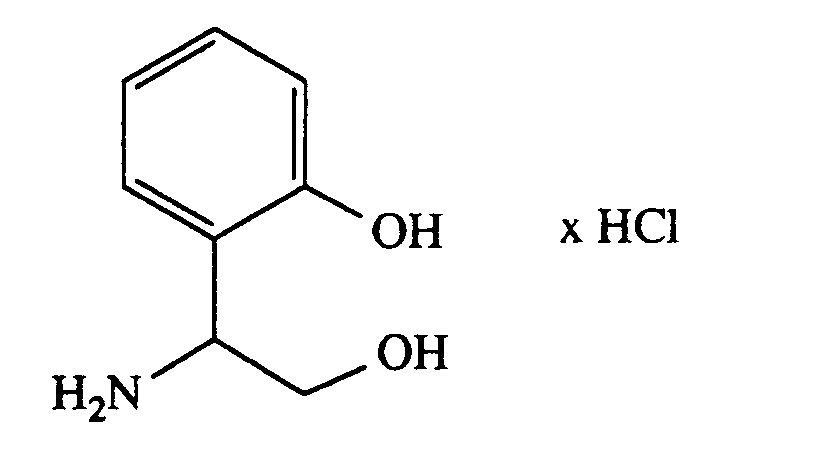
In Analogie zur Vorschrift des Beispiels 30 werden die in Tabelle I aufgeführten Verbindungen hergestellt.


Die Verbindung wurde in Analogie zum Verfahren des Beispiels 26 hergestellt.The compound was prepared in analogy to the procedure of Example 26.
* Herstellung des Laufmittels BABA: 200 ml n- Butylacetat, 36 ml n-Butanol, 100 ml Eisessig und 60 ml Puffer (87,9 ml 1/15 M wäßriger Kaliumdihydrogenphosphatlösung und 12,1 ml 1/15 M wäßriger Dinatriumhydrogenphosphatlösung) werden geschüttelt und die organische Phase als Laufmittel eingesetzt. * Preparation of the eluent BABA: 200 ml of n-butyl acetate, 36 ml of n-butanol, 100 ml of glacial acetic acid and 60 ml of buffer (87.9 ml of 1/15 M aqueous potassium dihydrogenphosphate solution and 12.1 ml of 1/15 M aqueous disodium hydrogenphosphate solution) are shaken and the organic phase is used as the eluent.
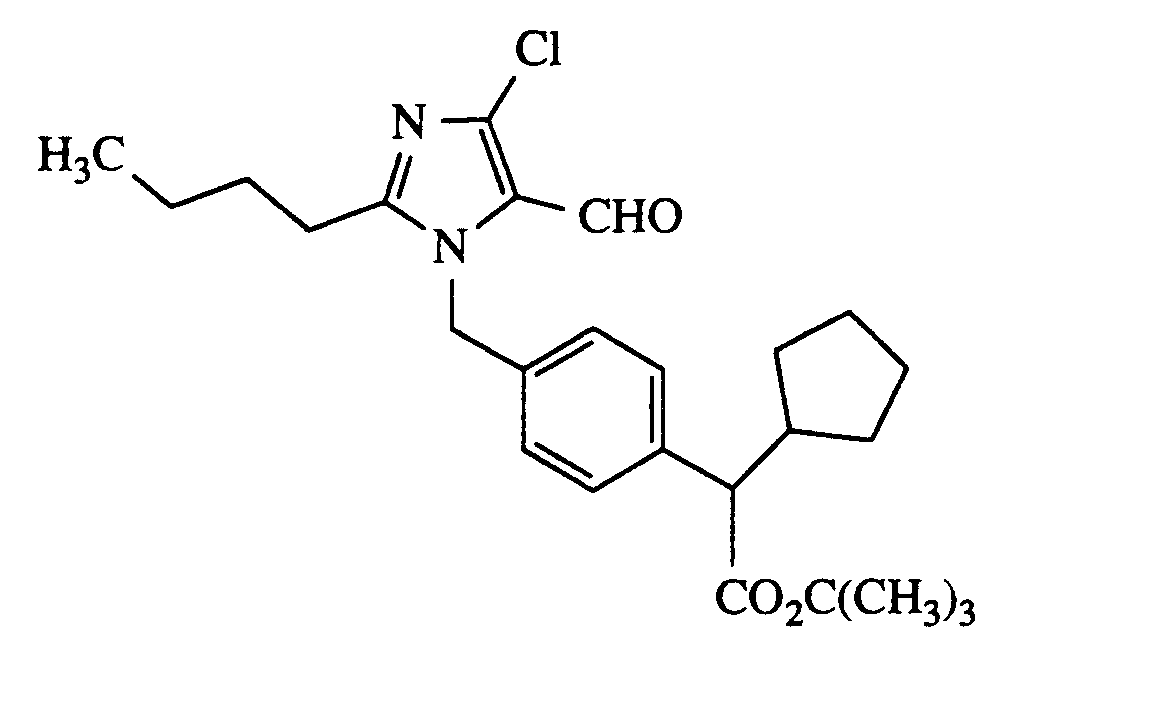
Unter Schutzgas werden 1,6 g (0,053 mol) Natriumhydrid (80%ig) in 50 ml DMF suspendiert, 10 g (0,053 mol) 2-Butyl-5-formyl-4-chlorimidazol (Herstellung nach EP 324 377) in 100 ml DMF bei 0°C zugetropft, anschließend bei 0°C 15 min gerührt und 18,9 g (0,053 mol) 2-(4-Brommethylphenyl)-2-cyclopentylessigsäure-tert.butylester in 100 ml DMF zugetropft. Es wird 2 h bei 0°C nachgerührt, das Lösemittel abgedampft, der Rückstand in Diethylether aufgenommen, abfiltriert und nach Einengen über Kieselgel 60 mit Dichlormethan chromatographiert.1.6 g (0.053 mol) of sodium hydride (80%) are suspended in 50 ml of DMF under protective gas, 10 g (0.053 mol) of 2-butyl-5-formyl-4-chloroimidazole (preparation according to EP 324 377) in 100 ml DMF added dropwise at 0 ° C., then stirred at 0 ° C. for 15 min and 18.9 g (0.053 mol) of tert-butyl 2- (4-bromomethylphenyl) -2-cyclopentylacetate in 100 ml of DMF were added dropwise. The mixture is stirred at 0 ° C. for 2 h, the solvent is evaporated off, the residue is taken up in diethyl ether, filtered off and, after concentration over silica gel 60, chromatographed with dichloromethane.
Ausbeute: 16,2 g (66,7% der Theorie)Yield: 16.2 g (66.7% of theory)
Festpunkt: 101-102°CFixed point: 101-102 ° C

Ausbeute: 1,8 g (87,6% der Theorie)Yield: 1.8 g (87.6% of theory)
Festpunkt: 95-98 °CFixed point: 95-98 ° C

Ausbeute: 1,3 g (90,3% der Theorie)Yield: 1.3 g (90.3% of theory)
Festpunkt: 85 ° CFixed point: 85 ° C

Ausbeute: 502 mg (90% der Theorie)Yield: 502 mg (90% of theory)
Festpunkt: 96 ° CFixed point: 96 ° C

Ausbeute: 264 mg (64% der Theorie)Yield: 264 mg (64% of theory)
Festpunkt: 110°CFixed point: 110 ° C

Rf = 0,37 (Dichlormethan:Methanol = 10:1)R f = 0.37 (dichloromethane: methanol = 10: 1)
In Analogie zur Vorschrift der Beispiele I - VI werden die in Tabelle I und II aufgeführten Beispiele hergestellt:


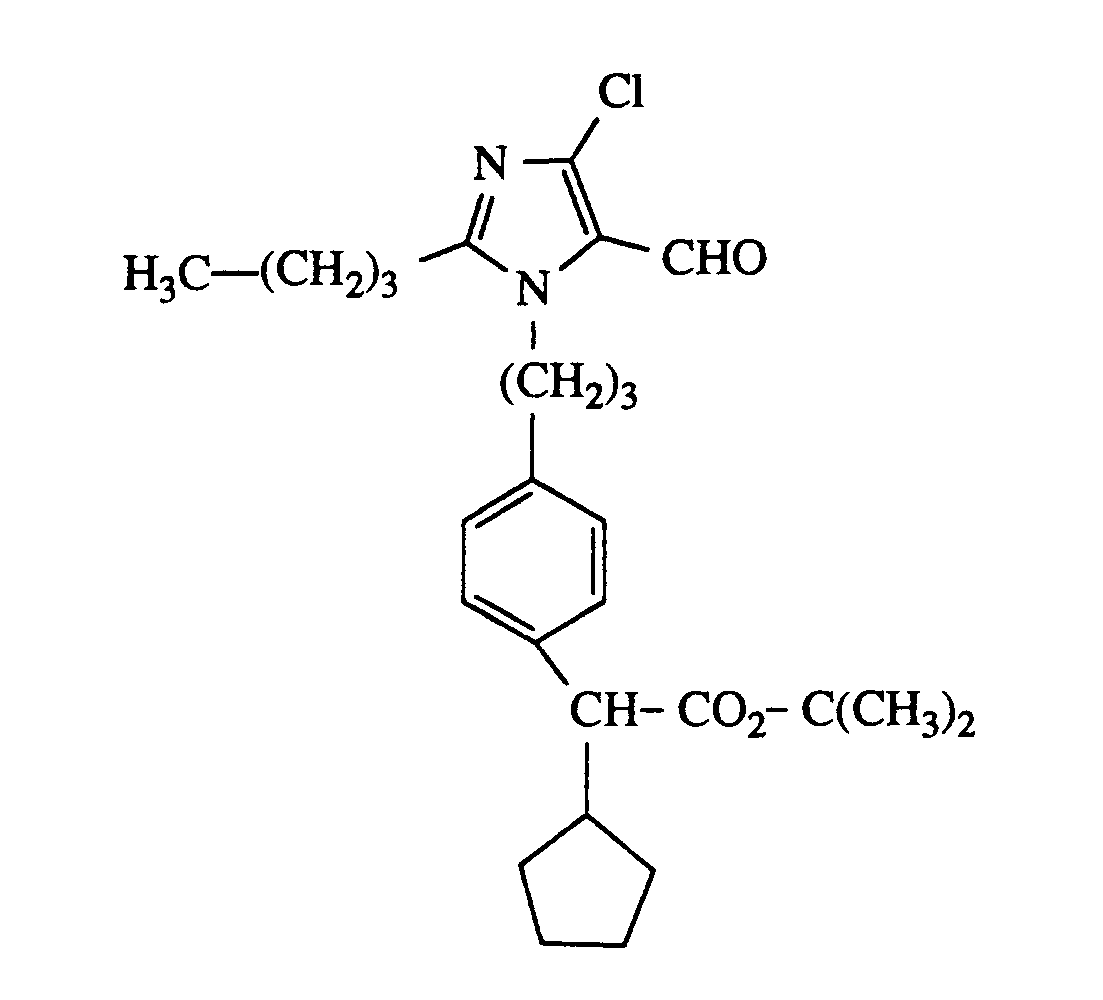
Zu einer Lösung von 47 mg (0,254 mmol) 2-Butyl-4-chlor-5-formyl-imidazolin 259 µl DMF gibt man 8 mg (0,25 mmol) NaH und läßt 0,5 h bei 0°C rühren. Anschließend fügt man 120 mg (0,25 mmol) der Verbindung des Beispiels 10 und 5 mg LiJ zu und läßt 24 h bei Raumtemperatur und rührt anschließend 24 h bei 60°C. Die wäßrige Aufarbeitung liefert ein Rohprodukt, das nach Chromatographie an Kieselgel (Petrolether/Ether 10:1) 46 mg (38%) der Titelverbindung liefert.8 mg (0.25 mmol) of NaH are added to a solution of 47 mg (0.254 mmol) of 2-butyl-4-chloro-5-formyl-imidazoline 259 μl of DMF and the mixture is stirred at 0 ° C. for 0.5 h. Then 120 mg (0.25 mmol) of the compound of Example 10 and 5 mg of LiJ are added and the mixture is left at room temperature for 24 h and then stirred at 60 ° C. for 24 h. The aqueous workup gives a crude product which, after chromatography on silica gel (petroleum ether / ether 10: 1), provides 46 mg (38%) of the title compound.
Rf(Petrolether/Ether 5:1): 0,48.R f (petroleum ether / ether 5: 1): 0.48.

Zu einer Lösung von 43 mg (0,23 mmol) 2-Butyl-4-chlor-5-formyl-imidazol in 250 ul DMF fügt man bei 0°C 6,6 mg (0,22 mmol) einer 80%igen Suspension von NaH in Mineralöl und rührt 1 h bei dieser Temperatur nach. Man fügt 100 mg (0,22 mmol) der Verbindung des Beispiels 7 in 250 ul DMF und 10 mg LiJ zu und rührt 4 h bei 0°C und anschließend 16 h bei Raumtemperatur. Die übliche wäßrige Aufarbeitung lieferte ein Rohprodukt, das nach Chromatrographie an Kieselgel 36 mg (33%) der Titelverbindung liefert. Rf(Petrolether/Ether 5:1): 0,42.6.6 mg (0.22 mmol) of an 80% strength suspension are added at 0 ° C. to a solution of 43 mg (0.23 mmol) of 2-butyl-4-chloro-5-formyl-imidazole in 250 μl of DMF of NaH in mineral oil and stir for 1 h at this temperature. 100 mg (0.22 mmol) of the compound of Example 7 in 250 μl of DMF and 10 mg of LiJ are added, and the mixture is stirred at 0 ° C. for 4 h and then at room temperature for 16 h. The usual aqueous workup gave a crude product which, after chromatography on silica gel, gives 36 mg (33%) of the title compound. R f (petroleum ether / ether 5: 1): 0.42.
Die in den Tabellen III und IV aufgeführten Verbindungen werden in Analogie zu den dort angegebenen Beispielen hergestellt:


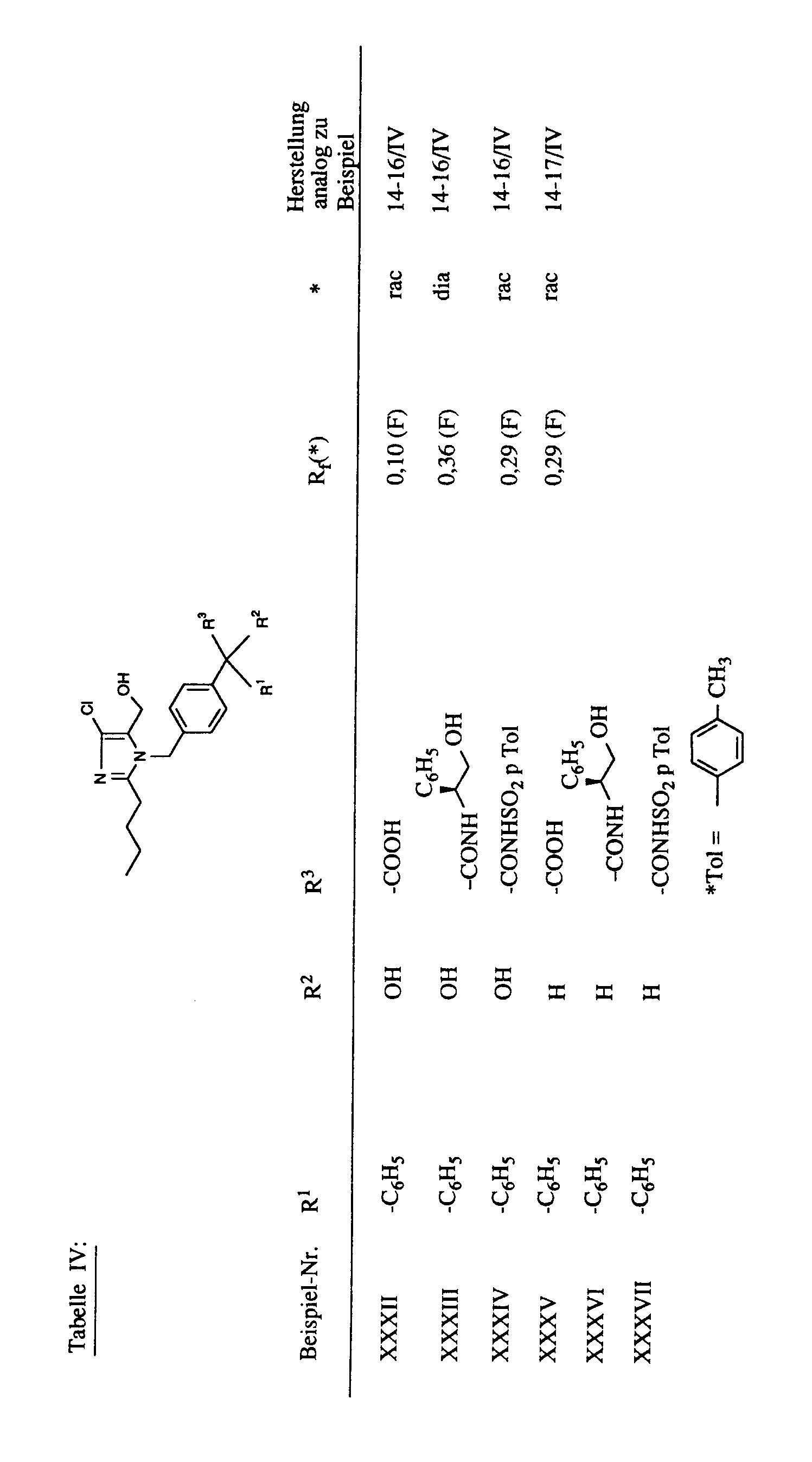

Eine Lösung von 21,8 g (47,5 mmol) 2-[4-(2-Butyl-4-chlor-5-formyl-imidazol-1-yl-methyl)phenyl]-2-cyclopentyl-essigsäure-tert.butylester in 200 ml Methanol wird bei 25°C in Gegenwart von 2,18 g Palladium auf Aktivkohle (5%ig) und 6,47 g (47,5 mmol) Natriumacetat-Trihydrat 1 h bei ca. 2 bar Wasserstoffdruck hydriert. Anschließend wird vom Katalysator abfiltriert, eingeengt und der Rückstand über Kieselgel 60 mit Essigester/Petrolether (1:1) chromatographiert.A solution of 21.8 g (47.5 mmol) of 2- [4- (2-butyl-4-chloro-5-formyl-imidazol-1-yl-methyl) phenyl] -2-cyclopentyl-acetic acid tert. Butyl ester in 200 ml of methanol is hydrogenated at 25 ° C. in the presence of 2.18 g of palladium on activated carbon (5% strength) and 6.47 g (47.5 mmol) of sodium acetate trihydrate at about 2 bar hydrogen pressure. The catalyst is then filtered off and concentrated, and the residue is chromatographed on silica gel 60 using ethyl acetate / petroleum ether (1: 1).
Ausbeute: 14 g (70% der Theorie)Yield: 14 g (70% of theory)
Rf(Essigester/Petrolether = 1:1): 0,41R f (ethyl acetate / petroleum ether = 1: 1): 0.41

Rf(Essigester/Petrolether = 1:1): 0,55.R f (ethyl acetate / petroleum ether = 1: 1): 0.55.

Rf(Essigester/Petrolether = 1:1): 0,40.R f (ethyl acetate / petroleum ether = 1: 1): 0.40.
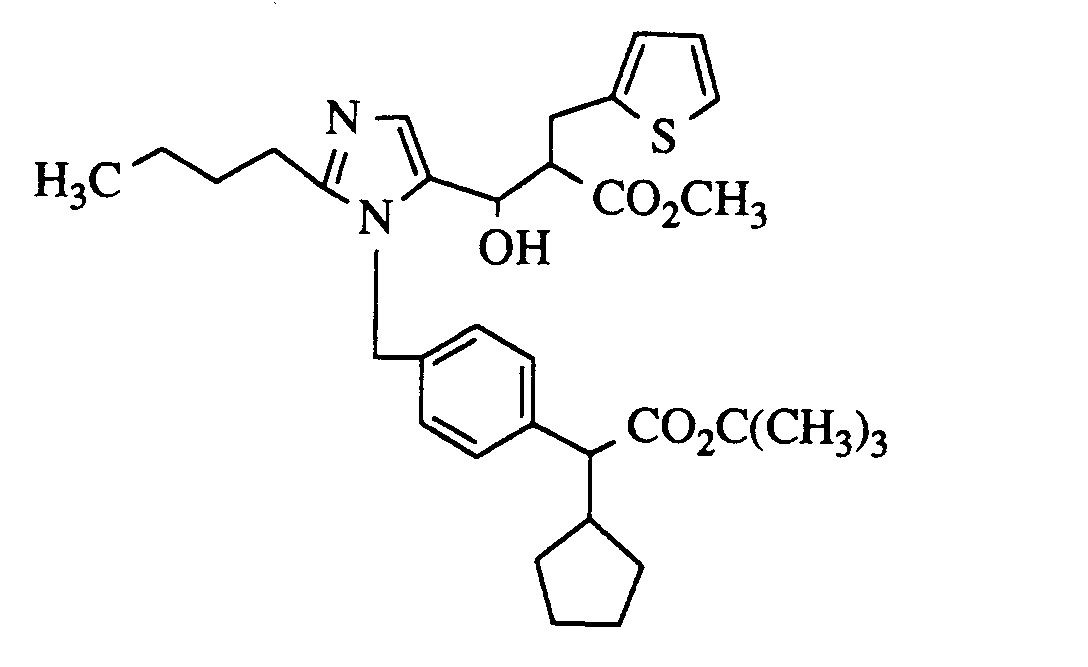
Ausbeute: 3,0 g (76% der Theorie)Yield: 3.0 g (76% of theory)
Rf(Essigester/Petrolether = 4:1): 0,37.R f (ethyl acetate / petroleum ether = 4: 1): 0.37.

Rf(Essigester/Petrolether = 1:1): 0,34.R f (ethyl acetate / petroleum ether = 1: 1): 0.34.

Ausbeute: 1,45 g (75% der Theorie)Yield: 1.45 g (75% of theory)
Rf(Essigester/Petrolether = 1:2): 0,36.R f (ethyl acetate / petroleum ether = 1: 2): 0.36.

Rf(Essigester/Petrolether = 3:1): 0,48.R f (ethyl acetate / petroleum ether = 3: 1): 0.48.

Ausbeute: 150 mg (31 % der Theorie)Yield: 150 mg (31% of theory)
Rf(Essigester/Methanol = 10:1): 0,66.R f (ethyl acetate / methanol = 10: 1): 0.66.

Rf(Essigester/Petrolether = 4:1): 0,53.R f (ethyl acetate / petroleum ether = 4: 1): 0.53.
In Analogie zu Vorschriften der Beispiele XLIII bis XLVI werden die in Tabelle V aufgeführten Beispiele hergestellt:

Die in Tabelle VI aufgeführten Beispiele werden in Analogie zu den dort genannten Beispielen hergestellt.


Nach Trennung des Racemates aus Beispiel IV an chiraler Phase werden die beiden Enantiomere
- a) (+)-Enantiomer des N-4-Tolylsulfonyl-2-[4-(2-butyl-4-chlor-5-hydroxymethyl-imidazol-1-yl-methyl)-phenyl]-2-cyclopentylessisäureamids α20 D = 99,3 (c = 1, C2H5OH) (LXII)
- b) (-)-Enantiomer des N-4-Tolylsulfonyl-2-[4-(2-butyl-4-chlor-5-hydroxymethyl-imidazol-1-yl-methyl)-phenyl]-2-cyclopentylessigsäureamids a20 D =-91,4 (c = 1, C2 H5OH) (LXIII).
- a) (+) - Enantiomer of the N-4-tolylsulfonyl-2- [4- (2-butyl-4-chloro-5-hydroxymethyl-imidazol-1-yl-methyl) -phenyl] -2-cyclopentylacetic acid amide α 20 D = 99.3 (c = 1, C2H5OH) (LXII)
- b) (-) - Enantiomer of N-4-tolylsulfonyl-2- [4- (2-butyl-4-chloro-5-hydroxymethyl-imidazol-1-yl-methyl) -phenyl] -2-cyclopentylacetic acid amide a 20 D = -91.4 (c = 1, C 2 H 5 OH) (LXIII).

Ausbeute: 1,0 g (66% der Theorie).Yield: 1.0 g (66% of theory).
Die Diastereomere werden chromatographisch von Kieselgel mit Petrolether/Essigester (3:7) getrennt. Diastereomer A: Festpunkt 82-87 CThe diastereomers are separated chromatographically from silica gel using petroleum ether / ethyl acetate (3: 7). Diastereomer A: fixed point 82-87 C
Diastereomer B: Festpunkt 151-4°C.Diastereomer B: fixed point 151-4 ° C.
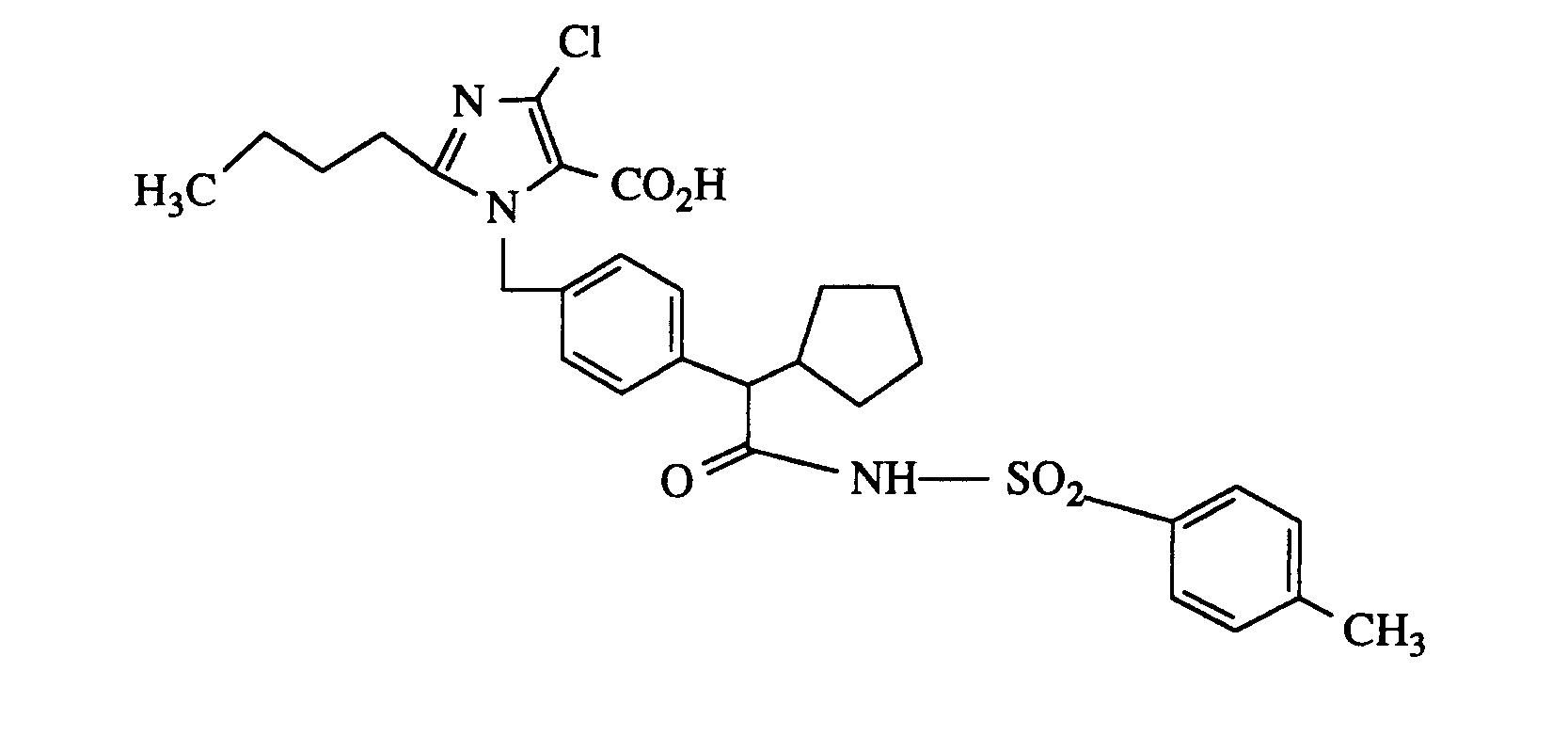
Festpunkt: 138°CFixed point: 138 ° C
Ausbeute: 90 mg (35% der Theorie).Yield: 90 mg (35% of theory).

Festpunkt: 112-4°CFixed point: 112-4 ° C
Ausbeute: 2,4 g (74,4% der Theorie).Yield: 2.4 g (74.4% of theory).

Ausbeute: 0,6 g (33% der Theorie)Yield: 0.6 g (33% of theory)
Festpunkt: 160-3°C.Fixed point: 160-3 ° C.

Festpunkt: 75-80 ° CFixed point: 75-80 ° C
Ausbeute: 4,3 g (60,5% der Theorie).Yield: 4.3 g (60.5% of theory).

Ausbeute: 0,85 g (81,1 % der Theorie)Yield: 0.85 g (81.1% of theory)
Festpunkt: 196-7°C.Fixed point: 196-7 ° C.

Festpunkt: 114-8°CFixed point: 114-8 ° C
Ausbeute: 1,3 g (73% der Theorie).Yield: 1.3 g (73% of theory).

Ausbeute: 0,56 g (77,4% der Theorie).Yield: 0.56 g (77.4% of theory).

Ausbeute: 217 mgYield: 217 mg
Rf(Dichlormethan/Methanol = 10:1): 0,31.R f (dichloromethane / methanol = 10: 1): 0.31.

Rf(Dichlormethan/Methanol = 20:1): 0,55.R f (dichloromethane / methanol = 20: 1): 0.55.
Die in den Tabellen VII, VIII und IX aufgeführten Beispiele werden in Analogie zu den dort genannten Beispielen hergestellt.


In Analogie zu den Vorschriften der Beispiele II und V werden die in Tabelle X aufgeführten Beispiele hergestellt:

Die in der Tabelle X aufgeführten Beispiele werden in Analogie zu den dort genannten Beispielen hergestellt:


Beispiel 26 (1,7 g; 2,5 mmol) wurde über Nacht in 4N-HCI/Dioxan (160 ml) gerührt, mit 1 N-Natronlauge alkalisch gestellt und eingeengt. Der Rückstand wurde zwischen Wasser und Ether verteilt. Die wäßrige Phase wurde sauer gestellt, mit Ether extrahiert. Die organische Phase wurde getrocknet und eingeengt, um 0,89 g eines gelben Öls zu ergebn [83,9% der Theorie; Rf 0,29 (Dichlormethan:Methanol = 10:1)].Example 26 (1.7 g; 2.5 mmol) was stirred overnight in 4N-HCl / dioxane (160 ml), made alkaline with 1N sodium hydroxide solution and concentrated. The residue was partitioned between water and ether. The aqueous phase was acidified, extracted with ether. The organic phase was dried and concentrated to give 0.89 g of a yellow oil [83.9% of theory; R f 0.29 (dichloromethane: methanol = 10: 1)].

Eine Lösung von Beispiel 20 (400 mg; 0,94 mmol) in Methanol (100 ml) wurde mit Natriumborhydrid (36 mg; 0,94 mmol) versetzt und über Nacht gerührt. Zur Vervollständigung der Reaktion wurde die Lösung auf 5 ml eingeengt, mit der gleichen Menge Natriumborhydrid versetzt und über Nacht gerührt. Nach Einengen wurde der Rückstand mit 1K-KHS04-Lösung versetzt, mit Essigester extrahiert. Die organische Phase wurde getrocknet, eingeengt und über HPLC (Licroprep RP18, 35-80% Acetonitril/Wasser/0,05% Trifluoressigsäure) gereinigt, um 72 mg eines weißen Feststoffs zu ergeben (18% der Theorie).Sodium borohydride (36 mg; 0.94 mmol) was added to a solution of Example 20 (400 mg; 0.94 mmol) in methanol (100 ml) and stirred overnight. To complete the reaction, the solution was concentrated to 5 ml, treated with the same amount of sodium borohydride and stirred overnight. After concentration, the residue was mixed with 1K-KHS0 4 solution, extracted with ethyl acetate. The organic phase was dried, concentrated and purified on HPLC (Licroprep RP18, 35-80% acetonitrile / water / 0.05% trifluoroacetic acid) to give 72 mg of a white solid (18% of theory).

Alkylierung mit Beispiel 27 (0,93 g; 2,7 mmol) analog Beispiel 26 und Kieselgelchromatographie (Toluol/Essigester Stufengradient) ergaben 1,3 g eines gelben Öls [54% der Theorie; Rf 0,57-(Toluol:Essigester = 5:1)].Alkylation with Example 27 (0.93 g; 2.7 mmol) analogously to Example 26 and silica gel chromatography (toluene / ethyl acetate step gradient) gave 1.3 g of a yellow oil [54% of theory; R f 0.57- (toluene: ethyl acetate = 5: 1)].

Eine Lösung von Beispiel CXI (100 mg; 0,22 mmol) in Toluol (4 ml) wurde bei 10°C unter Argon tropfenweise mit 1 M-Diisobutylaluminiumhydrid/Tetrahydrofuran (0,48 ml) versetzt und bei Raumtemperatur über Nacht gerührt. Nach Zugabe von Wasser (0,5 ml) wurde die Emulsion in intensiv gerührte 5%ige Schwefelsäure gegeben, auf pH 7 gestellt und mit Ether extrahiert. Trocknen und Einengen der organischen Phase, gefolgt von Kieselgelchromatographie (Methylenchlorid:Methanol = 20:1) lieferte 58 mg eines Öls [59% der Theorie; Rf 0,44 (Methylenchlorid:Methanol = 20:1)].A solution of Example CXI (100 mg; 0.22 mmol) in toluene (4 ml) was added dropwise at 10 ° C. under argon with 1 M-diisobutylaluminum hydride / tetrahydrofuran (0.48 ml) and stirred at room temperature overnight. After adding water (0.5 ml), the emulsion was poured into intensely stirred 5% sulfuric acid, adjusted to pH 7 and extracted with ether. Drying and concentration of the organic phase, followed by silica gel chromatography (methylene chloride: methanol = 20: 1) yielded 58 mg of an oil [59% of theory; R f 0.44 (methylene chloride: methanol = 20: 1)].

Unter Argon wurde ein Lösung von Beispiel I (230 mg; 0,50 mmol) in Tetrahydrofuran (5 ml) bei -78 ° C mit 3M-MeMgCI/THF (0,18 ml; 0,55 mmol) versetzt und über Nacht bei Raumtemperatur gerührt. Nach Einengen wurde der Rückstand in Essigester aufgenommen, zweimal mit 5%-NaC03-Lösung, dann mit gesättigter Kochsalzlösung gewaschen, getrocknet und eingeengt, um 206 mg eines Öls zu erhalten [93,9% der Theorie; Rf 0,10 (Methylenchlorid:Essigester = 10:1)].A solution of Example I (230 mg; 0.50 mmol) in tetrahydrofuran (5 ml) was added under argon to 3M-MeMgCl / THF (0.18 ml; 0.55 mmol) at -78 ° C. and overnight at Room temperature stirred. After concentration, the residue was taken up in ethyl acetate, washed twice with 5% NaCO 3 solution, then with saturated sodium chloride solution, dried and concentrated to give 206 mg of an oil [93.9% of theory; R f 0.10 (methylene chloride: ethyl acetate = 10: 1)].

Eine Lösung von Beispiel CXII (356 mg; 0,38 mmol) in Dichlormethan (10 ml) und Trifluoressigsäure (10 ml) wurde 1,5 h bei Raumtemperatur gehalten, dann eingeengt. Der Rückstand wurde mit Wasser versetzt, mit gesättigter Natriumhydrogencarbonat-Lösung auf pH 3 gestellt und mit Ether extrahiert. Trocknen, Einengen und Kiselgelchromatographie (Methylenchlorid:Methanol = 20:1) lieferte 97 mg einer farblosen, amorphen Substanz [29% der Theorie; Rf 0,33 (Methylenchlorid:Methanol:Essigsäure 20:1:0,1)].A solution of Example CXII (356 mg; 0.38 mmol) in dichloromethane (10 ml) and trifluoroacetic acid (10 ml) was kept at room temperature for 1.5 h, then concentrated. The residue was mixed with water, adjusted to pH 3 with saturated sodium hydrogen carbonate solution and extracted with ether. Drying, concentration and silica gel chromatography (methylene chloride: methanol = 20: 1) gave 97 mg of a colorless, amorphous substance [29% of theory; R f 0.33 (methylene chloride: methanol: acetic acid 20: 1: 0.1)].
N-4-Tolylsulfonyl-2-{4-[2-butyl-4-chlor-5-(1-hydroxy)-ethyl-imidazol-1-yl-methyl]-phenyl}-2-cyclopentyl- essigsäureamid

Eine Lösung von Beispiel III (100 mg; 0,18 mmol) in THF (5 ml) wurde bei 0°C unter Argon mit 80% Natriumhydrid/Paraffinöl-Dispersion (6,0 mg; 0,2 mmol) versetzt, 15 min bei Raumtemperatur gerührt, dann bei 0°C mit 3M-MeMgCI/THF (0,1 ml) versetzt und 40 h bei Raumtemperatur gerührt. Die Reaktionslösung wurde mit 1M-KHS04-Lösung auf pH 3 angesäuert und dreimal mit Essigester extrahiert. Die organischen Phasen wurden mit gesättigter Kochsalzlösung gewaschen, getrocknet und eingeengt. Kieselgelchromatographie lieferte 36 mg einer teils festen Substanz [36% der Theorie; Rf 0,25 (Methylenchlorid:Methanol:konz.Ammoniakwasser= 10:1:0,1)].A solution of Example III (100 mg; 0.18 mmol) in THF (5 ml) was mixed at 0 ° C. under argon with 80% sodium hydride / paraffin oil dispersion (6.0 mg; 0.2 mmol), 15 min stirred at room temperature, then 3M-MeMgCl / THF (0.1 ml) was added at 0 ° C. and the mixture was stirred at room temperature for 40 h. The reaction solution was acidified to pH 3 with 1M KHS04 solution and extracted three times with ethyl acetate. The organic phases were washed with saturated sodium chloride solution, dried and concentrated. Silica gel chromatography gave 36 mg of a partially solid substance [36% of theory; R f 0.25 (methylene chloride: methanol: concentrated ammonia water = 10: 1: 0.1)].

Eine Lösung von Beispiel II (1,13 g; 1,2 mmol) in THF (10 ml) wurde unter Argon bei -20°C 3M-Ethylmagnesiumbromid/Ether (2,1 ml) zugetropft (bis nach DC kein Startmaterial mehr vorhanden). Nach Zugabe von 1M-KHS04-Lösung wurde mit Essigester extrahiert Die organische Phase wurde getrocknet, eingeengt, mit HPLC (Licrosorp RP18, 40-90% Acetonitril/Wasser/0,05% Trifluoressigsäure) gereinigt, um 189 mg eines weißen Feststoffs zu ergeben [36% der Theorie; Rf 0,50 (Methylenchlorid:Essigester:Essigsäure = 5:2:0,1)].A solution of Example II (1.13 g; 1.2 mmol) in THF (10 ml) was added dropwise under argon at -20 ° C. to 3M ethylmagnesium bromide / ether (2.1 ml) (no starting material left after DC ). After adding 1M KHS04 solution, the mixture was extracted with ethyl acetate. The organic phase was dried, concentrated, purified with HPLC (Licrosorp RP18, 40-90% acetonitrile / water / 0.05% trifluoroacetic acid) to give 189 mg of a white solid [36% of theory; R f 0.50 (methylene chloride: ethyl acetate: acetic acid = 5: 2: 0.1)].

Die HPLC-Reinigung von Beispiel CXVI lieferte als unpolareres Nebenprodukt 19 mg eines weißen Feststoffs (3,8% der Theorie).HPLC purification of Example CXVI gave 19 mg of a white solid (3.8% of theory) as a non-polar by-product.

Analog zu Beispiel CXVII wurden aus Beispiel II (1,13 g roh; 1,2 mmol) mit Isopropylmagnesiumchlorid 113 mg eines weißen Feststoffs erhalten (21% der Theorie; Rf 0,50).Analogously to Example CXVII, 113 mg of a white solid were obtained from Example II (1.13 g crude; 1.2 mmol) with isopropyl magnesium chloride (21% of theory; R f 0.50).

Analog zu Beispiel CXVII wurden aus Beispiel II (1,13 g roh; 1,2 mmol) mit tert.-Butylmagnesiumchlorid 68 mg eines weißen Feststoffs erhalten (12% der Theorie; Rf 0,50).Analogously to Example CXVII, 68 mg of a white solid were obtained from Example II (1.13 g crude; 1.2 mmol) with tert-butyl magnesium chloride (12% of theory; R f 0.50).

Analog zu Beispiel 24 wurden aus Beispiel I (15 g; 33 mmol) nach Kieselgelchromatographie (Hexan:Essigester = 5:1) 7,7 g eines gelben Öls erhalten [43% der Theorie; Rf 0,46 (Methylenchlorid)].Analogously to Example 24, 7.7 g of a yellow oil were obtained from Example I (15 g; 33 mmol) after silica gel chromatography (hexane: ethyl acetate = 5: 1) [43% of theory; R f 0.46 (methylene chloride)].

Eine Lösung von Beispiel CXX (7,7 g; 14 mmol) in THF (250 ml) wurde mit DBU (5,3 ml; 35 mmol) versetzt und 3d stehen gelassen. Nach Zugabe von Wasser und Extraktion mit Ether wurde die organische Phase mit verdünnter Salzsäure gewaschen, getrocknet und eingeengt. Kieselgelchromatographie des Rückstands (Methylenchlorid) ergab 4,4 g eines Öls (67% der Theorie; Rf 0,2).A solution of Example CXX (7.7 g; 14 mmol) in THF (250 ml) was mixed with DBU (5.3 ml; 35 mmol) and left to stand in 3d. After adding water and extracting with ether, the organic phase was washed with dilute hydrochloric acid, dried and concentrated. Silica gel chromatography of the residue (methylene chloride) gave 4.4 g of an oil (67% of theory; R f 0.2).

Esterspaltung von Beispiel CXXI (4,6 g; 9,6 mmol) analog Beispiel CXIII ergab 3,5 g eines gelben Öls [91% der Theorie; Rf 0,40 (Methylenchlorid:Methanol = 20:1)].Ester cleavage from Example CXXI (4.6 g; 9.6 mmol) analogously to Example CXIII gave 3.5 g of a yellow oil [91% of theory; R f 0.40 (methylene chloride: methanol = 20: 1)].

Reduktion von Beispiel CXXI (68 mg; 0,17 mmol) analog Beispiel CIX und Kieselgelchromatographie (Methylenchlorid:Methanol = 20:1) ergaben 30 mg eines weißen Feststoffs (44% der Theorie; Rf 0,18).Reduction of Example CXXI (68 mg; 0.17 mmol) analogously to Example CIX and silica gel chromatography (methylene chloride: methanol = 20: 1) gave 30 mg of a white solid (44% of theory; R f 0.18).

Eine Lösung von Beispiel CXXIII (1,5 g; 3,7 mmol) wurde mit einigen Tropfen DBU und Tosylisocyanat (0,62 ml; 4,1 mmol) versetzt und über Nacht unter Rückfluß gekocht. Einengen und Kieselgelchromatographie (Methylenchlorid:Methanol:konz.Ammoniakwasser = 20:1:0,1) ergaben 1,5 g eines fahlgelben Feststoffs [72% der Theorie; Fp 99 °C; Rf 0,39 (Methylenchlorid:Methanol:konz.Ammoniakwasser = 10:1:0,1)].A solution of Example CXXIII (1.5 g; 3.7 mmol) was mixed with a few drops of DBU and tosyl isocyanate (0.62 ml; 4.1 mmol) and boiled under reflux overnight. Concentration and silica gel chromatography (methylene chloride: methanol: concentrated ammonia water = 20: 1: 0.1) gave 1.5 g of a pale yellow solid [72% of theory; Mp 99 ° C; R f 0.39 (methylene chloride: methanol: concentrated ammonia water = 10: 1: 0.1)].

Kopplung von Beispiel 29 (9,3 g; 33 mmol) mit Beispiel 3 (11,8 g; 33 mmol) analog Beispiel 26 ergab nach Kieselgelchromatographie (Petrolether:Methylenchlorid = 1:1) 12,7 g eines gelben Feststoffs [70% der Theorie; Fp 95-7°C; Rf 0,18 (Methylenchlorid)].Coupling of example 29 (9.3 g; 33 mmol) with example 3 (11.8 g; 33 mmol) analogously to example 26 gave, after silica gel chromatography (petroleum ether: methylene chloride = 1: 1), 12.7 g of a yellow solid [70% the theory; Mp 95-7 ° C; R f 0.18 (methylene chloride)].

Esterspaltung von Beispiel CXXV (3,4 g; 6,2 mmol) analog Beispiel CXXIV ergab 3,15 g eines gelben Harzes [Theorie: 3,05 g; Rf 0,21 (Methylenchlorid:Methanol:konz.Ammoniakwasser = 10:1:0,1)].Ester cleavage from Example CXXV (3.4 g; 6.2 mmol) analogously to Example CXXIV gave 3.15 g of a yellow resin [theory: 3.05 g; R f 0.21 (methylene chloride: methanol: concentrated ammonia water = 10: 1: 0.1)].

Reaktion von Beispiel CXXVI (2,55 g; 5,16 mmol) analog Beispiel CXXIII ergab nach Kieselgelchromatographie (Methylenchlorid:Methanol:konz.Ammoniakwasser = 20:1:0,1) 2,32 g eines festen Schaums [69% der Theorie; Rf 0,40 (Methylenchlorid:Methanol:konz.Ammoniakwasser = 10:1:0,1)].Reaction from Example CXXVI (2.55 g; 5.16 mmol) analogously to Example CXXIII gave, after silica gel chromatography (methylene chloride: methanol: concentrated ammonia water = 20: 1: 0.1), 2.32 g of a solid foam [69% of theory ; R f 0.40 (methylene chloride: methanol: concentrated ammonia water = 10: 1: 0.1)].

Reduktion von Beispiel CXXVII (1,3 g; 2,0 mmol) analog Beispiel CIX ergab nach Kieselgelchromatographie (Methylenchlorid:Methanol = 20:1) 1,1 g eines weißen Feststoffs (85% der Theorie; Rf 0,19).Reduction of example CXXVII (1.3 g; 2.0 mmol) analogously to example CIX gave, after silica gel chromatography (methylene chloride: methanol = 20: 1), 1.1 g of a white solid (85% of theory; R f 0.19).

Reduktion von Beispiel CXXV (5,4 g; 9,8 mmol) analog Beispiel CIX ergab nach Kieselgelchromatographie (Methylenchlorid:Methanol = 20:1) 4,3 g eines Öls (80% der Theorie; Rf 0,34).Reduction of Example CXXV (5.4 g; 9.8 mmol) analogously to Example CIX gave, after silica gel chromatography (methylene chloride: methanol = 20: 1), 4.3 g of an oil (80% of theory; R f 0.34).

Unter Argon wurde zu einer Suspension von 80%-Natriumhydrid/Paraffinöl (4,71 mg; 15,7 mmol) in THF (10 ml) bei -5°C eine Lösung von Beispiel CXXIX (3,94 g: 7,13 mmol) in THF (100 ml) zugetropft. Nach 15 min Rühren bei 0°C wurde bei -5°C 2-Methoxy-ethoxy-methylchlorid (1,8 ml; 15,7 mmol) zugetropft. Nach 2h bei Raumtemperatur und 2h bei 50 °C wurde das Reaktionsgemisch eingeengt, zwischen Ether und Wasser verteilt und mit NaHCO3 auf pH 8-9 eingestellt. Die wäßrige Phase wurde viermal mit Ether extrahiert, die vereinten organischen Phasen wurden mit gesättigter Kochsalzlösung gewaschen, getrocknet und eingeengt. Kieselgelchromatographie (Methylenchlorid:Methanol-Stufengradient) lieferte 2,15 g eines Öls [47% der Theorie; R, 0,54 (Methylenchlorid:Methanol = 20:1)].A solution of Example CXXIX (3.94 g: 7.13 mmol) was added under argon to a suspension of 80% sodium hydride / paraffin oil (4.71 mg; 15.7 mmol) in THF (10 ml) at -5 ° C. ) added dropwise in THF (100 ml). After stirring for 15 min at 0 ° C, 2-methoxy-ethoxymethyl chloride (1.8 ml; 15.7 mmol) was added dropwise at -5 ° C. After 2 h at room temperature and 2 h at 50 ° C, the reaction mixture was concentrated, partitioned between ether and water and adjusted to pH 8-9 with NaHCO 3 . The aqueous phase was extracted four times with ether, the combined organic phases were washed with saturated sodium chloride solution, dried and concentrated. Silica gel chromatography (methylene chloride: methanol step gradient) gave 2.15 g of an oil [47% of theory; R, 0.54 (methylene chloride: methanol = 20: 1)].

Unter Argon wurde zu einer Suspension von Cadmiumpulver (22,4 g; 0,200 g atom) in DMF (50 ml) Dibromdifluormethan (8,6 ml; 94 mmol; Trockeneiskühler) langsam zugetropft. Nach 2h Rühren wurde die Suspension unter Argon durch eine Schlenck-Fritte filtriert, um eine braune, ca. 1,6M-Bistrifluormethylcadmium/DMF-Stammlösung zu ergeben.Under argon, a drop of cadmium powder (22.4 g; 0.200 g atom) in DMF (50 ml) dibromodifluoromethane (8.6 ml; 94 mmol; dry ice cooler) was slowly added dropwise. After stirring for 2 h, the suspension was filtered under argon through a Schlenck frit to give a brown, approx. 1.6 M bistrifluoromethyl cadmium / DMF stock solution.
Unter Argon wurde eine Lösung von 1,6M-Bistrifluormethylcadmium/DMF (27 ml) und HMPT (36 ml) mit Kupfer(I)-bromid (3,78 g; 26,4 mmol) und Beispiel CLXXX (4,64 g; 7,2 mmol) versetzt. Nach 8h Rühren bei 75 ° C wurden Wasser (100 ml) und Methylenchlorid (500 ml) zugegeben. Der Niederschlag wurde abfiltriert, die organische Phase abgetrennt und eingeengt. Der Rückstand wurde in Essigester (500 ml) und Petrolether (500 ml) gelöst, fünfmal mit Wasser gewaschen, getrocknet und eingeengt. Kieselgelchromatographie (Methylenchlorid/Methanol-Stufengradient) ergaben 3,75 g eines Öls (89% der Theorie; Rf 0,45 (Hexan:Essigester = 2:1)].A solution of 1.6M bistrifluoromethyl cadmium / DMF (27 ml) and HMPT (36 ml) with copper (I) bromide (3.78 g; 26.4 mmol) and example CLXXX (4.64 g; 7.2 mmol) was added. After stirring at 75 ° C for 8 hours, water (100 ml) and methylene chloride (500 ml) were added. The precipitate was filtered off, the organic phase was separated off and concentrated. The residue was dissolved in ethyl acetate (500 ml) and petroleum ether (500 ml), washed five times with water, dried and concentrated. Silica gel chromatography (methylene chloride / methanol step gradient) gave 3.75 g of an oil (89% of theory; R f 0.45 (hexane: ethyl acetate = 2: 1)].

Eine Lösung von Beispiel CXXXI (3,73 g; 6,48 mmol) in Methylenchlorid (40 ml) wurde bei 0°C mit Trifluoressigsäure (40 ml) versetzt und 3h bei Raumtemperatur gerührt. Nach Einengen wurde der Rückstand in 100 ml Essigester aufgenommen und mit 5%-NaHC03-Lösung auf pH 7 eingestellt. Die wäßrige Phase wurde viermal mit Essigester extrahiert, die vereinten organischen Phasen wurden mit gesättigter Kochsalzlösung gewaschen, getrocknet und eingeengt, um 2,65 g eines Öls zu ergeben. Alkalischstellen der vereinten wäßrigen Phasen mit Na2C03-Lösung und Essigester-Extraktion lieferten weitere 0,32 g [87% der Theorie; Rf 0,40 (Methylenchlorid:Methanol = 20:1)].A solution of Example CXXXI (3.73 g; 6.48 mmol) in methylene chloride (40 ml) was mixed with trifluoroacetic acid (40 ml) at 0 ° C. and stirred for 3 hours at room temperature. After concentration, the residue was taken up in 100 ml of ethyl acetate and adjusted to pH 7 with 5% NaHC0 3 solution. The aqueous phase was extracted four times with ethyl acetate, the combined organic phases were washed with saturated sodium chloride solution, dried and concentrated to give 2.65 g of an oil. Alkalizing the combined aqueous phases with Na 2 CO 3 solution and ethyl acetate extraction gave a further 0.32 g [87% of theory; R f 0.40 (methylene chloride: methanol = 20: 1)].

Eine Lösung von Beispiel CXXXII (160 mg; 0,304 mmol) in Dioxan (5 ml) wurde mit 4N-HCI/Dioxan (5 ml) und Wasser (10 ml) versetzt und 1 h gerührt. Nach Einengen wurde der pH mit 5%-NaHC03-Lösung auf 7 eingestellt, und die Lösung wurde mit Essigester fünfmal extrahiert. Die vereinten organischen Phasen wurden mit gesättigter Kochsalzlösung gewaschen, getrocknet und eingeengt, um 141 mg eines Öls zu ergeben [Theorie: 133 mg; Rf 0,24 (Methylenchlorid:Methanol = 20:1)].A solution of Example CXXXII (160 mg; 0.304 mmol) in dioxane (5 ml) was mixed with 4N-HCl / dioxane (5 ml) and water (10 ml) and stirred for 1 h. After concentration, the pH was adjusted to 7 with 5% NaHCO 3 solution, and the solution was extracted five times with ethyl acetate. The combined organic phases were washed with saturated saline, dried and concentrated to give 141 mg of an oil [theory: 133 mg; R f 0.24 (methylene chloride: methanol = 20: 1)].

Beispiel CXXXII (650 mg; 1,23 mmol) wurde analog Beispiel CXXVII umgesetzt. Kieselgelchromatographie (Hexan/Essigester 4:1 bis 2:1, dann Methylenchlorid/Methanol 50:1 bis 12,5:1) ergab 410 mg eines Öls [49% der Theorie; Rf 0,35 (Hexan:Essigester = 1:1)].Example CXXXII (650 mg; 1.23 mmol) was implemented analogously to example CXXVII. Silica gel chromatography (hexane / ethyl acetate 4: 1 to 2: 1, then methylene chloride / methanol 50: 1 to 12.5: 1) gave 410 mg of an oil [49% of theory; R f 0.35 (hexane: ethyl acetate = 1: 1)].

Beispiel CXXXIV (200 mg; 0,294 mmol) wurde analog Beispiel CXXXIII entschützt, um 160 mg eines Öls zu ergeben [92% der Theorie; Rf 0,41 (Methylenchlorid:Methanol = 20:1)].Example CXXXIV (200 mg; 0.294 mmol) was deprotected analogously to Example CXXXIII to give 160 mg of an oil [92% of theory; R f 0.41 (methylene chloride: methanol = 20: 1)].

Eine Lösung von Beispiel CXXIX (9,5 g; 17 mmol) in Pyridin (20 ml) und Acetanhydrid (20 ml) wurde mit 4-DMAP (0,21 g; 1,7 mmol) versetzt und über Nacht bei Raumtemperatur, dann 2h bei 50 °C gerührt. Das Reaktionsgemisch wurde eingeengt, mit 1M-KHS04-Lösung auf pH 3 gestellt und mit Essigester extrahiert. Trocknen und Einengen der organischen Phasen und Kieselgelchromatographie (Methylenchlorid) lieferten 9,2 g eines gelben Öls (93% der Theorie; Rf 0,34).A solution of Example CXXIX (9.5 g; 17 mmol) in pyridine (20 ml) and acetic anhydride (20 ml) was mixed with 4-DMAP (0.21 g; 1.7 mmol) and then overnight at room temperature, then Stirred at 50 ° C for 2 h. The reaction mixture was concentrated, adjusted to pH 3 with 1M-KHS0 4 solution and extracted with ethyl acetate. Drying and concentration of the organic phases and silica gel chromatography (methylene chloride) gave 9.2 g of a yellow oil (93% of theory; R f 0.34).

Unter Argon wurde zu einer Suspension von Cadmiumpulver (12,3 g; 0,110 g atom) in DMF (100 ml) Perfluorbutyljodid (12,9 ml; 75 mmol; Trockeneiskühler) langsam zugetropft. Nach 2h Rühren bei Raumtemperatur und 1 h bei 35°C wurde die Suspension unter Argon durch eine Schlenck-Fritte filtriert.Per argorbutyl iodide (12.9 ml; 75 mmol; dry ice cooler) was slowly added dropwise under argon to a suspension of cadmium powder (12.3 g; 0.110 g atom) in DMF (100 ml). After 2 h stirring at room temperature and 1 h at 35 ° C the suspension was filtered under argon through a Schlenck frit.
Unter Argon wurden Bisperfluorbutylcadmium/DMF-Lösung (15 ml) und HMPT (7 ml) mit Kupfer(I)-bromid (1,5 g; 11 mmol) und einer Lösung von Beispiel CXXXVI (886 mg; 1,49 mmol) in DMF (10 ml) versetzt. Nach 6h Rühren bei 75 ° C wurden Wasser (100 ml) und Methylenchlorid (500 ml) zugegeben. Der Niederschlag wurde abfiltriert, die organische Phase abgetrennt und eingeengt. Der Rückstand wurde in Essigester/Petrolether (1:1) gelöst, fünfmal mit Wasser gewaschen, getrocknet und eingeengt. Kieselgelchromatographie (Methylenchlorid:Methanol = 1:1) ergaben 235 mg eines Öls (23% der Theorie; Rf 0,48 (Hexan:Essigester = 3:1)].Bisperfluorobutylcadmium / DMF solution (15 ml) and HMPT (7 ml) with copper (I) bromide (1.5 g; 11 mmol) and a solution of Example CXXXVI (886 mg; 1.49 mmol) were added under argon DMF (10 ml) added. After stirring at 75 ° C for 6 hours, water (100 ml) and methylene chloride (500 ml) were added. The precipitate was filtered off, the organic phase was separated off and concentrated. The residue was dissolved in ethyl acetate / petroleum ether (1: 1), washed five times with water, dried and concentrated. Silica gel chromatography (methylene chloride: methanol = 1: 1) gave 235 mg of an oil (23% of theory; R f 0.48 (hexane: ethyl acetate = 3: 1)).

Esterspaltung von Beispiel CXXXVII analog Beispiel CXXXII führte zu 172 mg eines Öls [96% der Theorie; Rf 0,34 (Methylenchlorid:Methanol = 20:1)].Ester cleavage from example CXXXVII analogous to example CXXXII led to 172 mg of an oil [96% of theory; R f 0.34 (methylene chloride: methanol = 20: 1)].

Reduktion von Beispiel CXXIV (0,50 g; 0,90 mmol) analog Beispiel CX und Kieselgelchromatographie (Methylenchlorid:Methanol = 20:1) ergaben 322 mg eines weißen Feststoffs (64% der Theorie; Fp 116-B°C; Rf 0,25).Reduction of Example CXXIV (0.50 g; 0.90 mmol) analogously to Example CX and silica gel chromatography (methylene chloride: methanol = 20: 1) gave 322 mg of a white solid (64% of theory; mp 116-B ° C; R f 0.25).
Die in den Tabellen XII bis XV aufgeführten Verbindungen werden in Analogie zu den dort angegebenen Vorschriften hergestellt.


Ausbeute: 340 mg (63 % der Theorie).Yield: 340 mg (63% of theory).

Die in Tabelle XVI aufgeführten Beispiele werden in Analogie zur Vorschrift des Beispiels II hergestellt.


Die in Tabellen XXII bis XXXI aufgeführten Verbindungen werden in Analogie zu den dort genannten Vorschriften hergestellt.
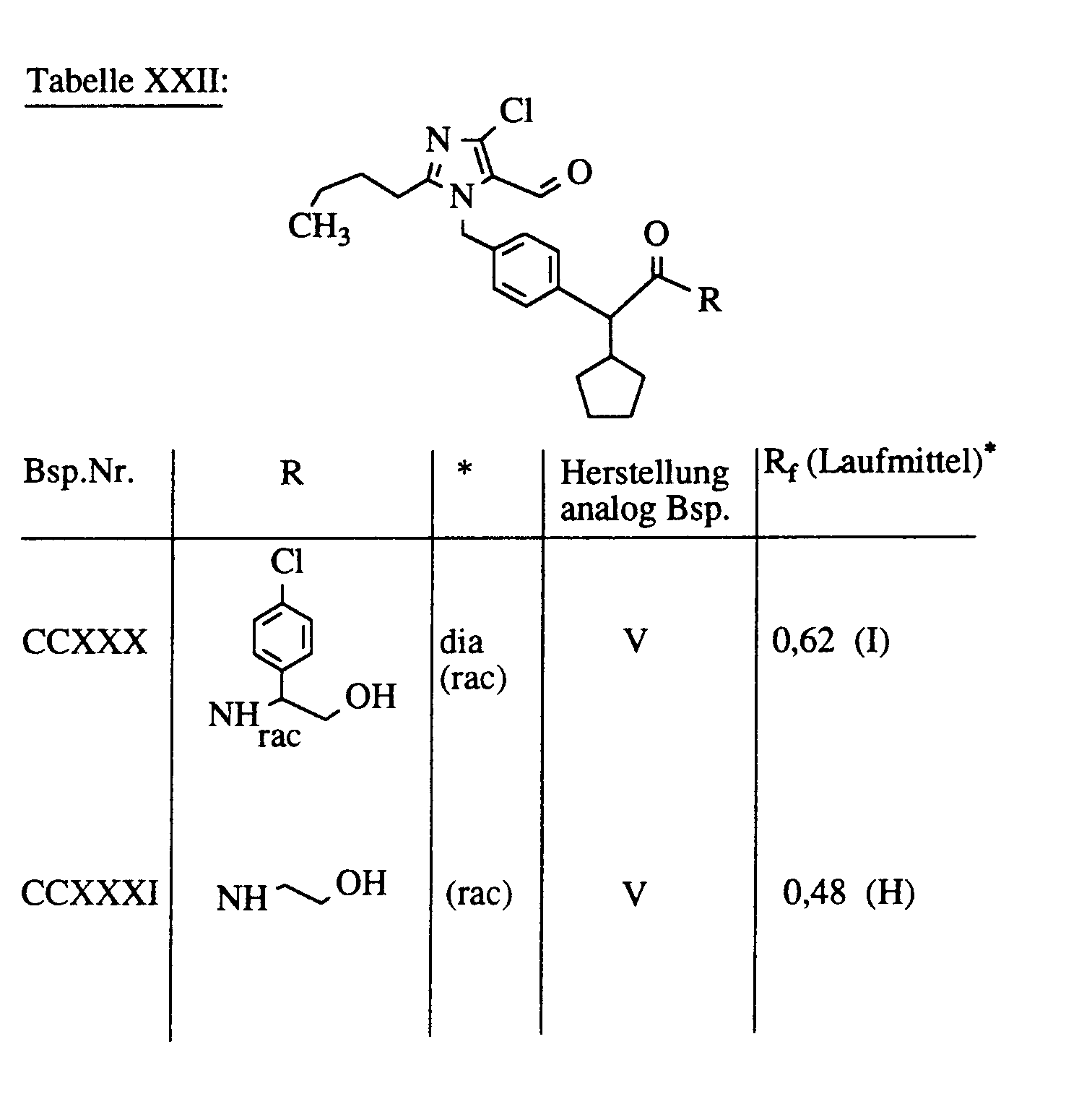


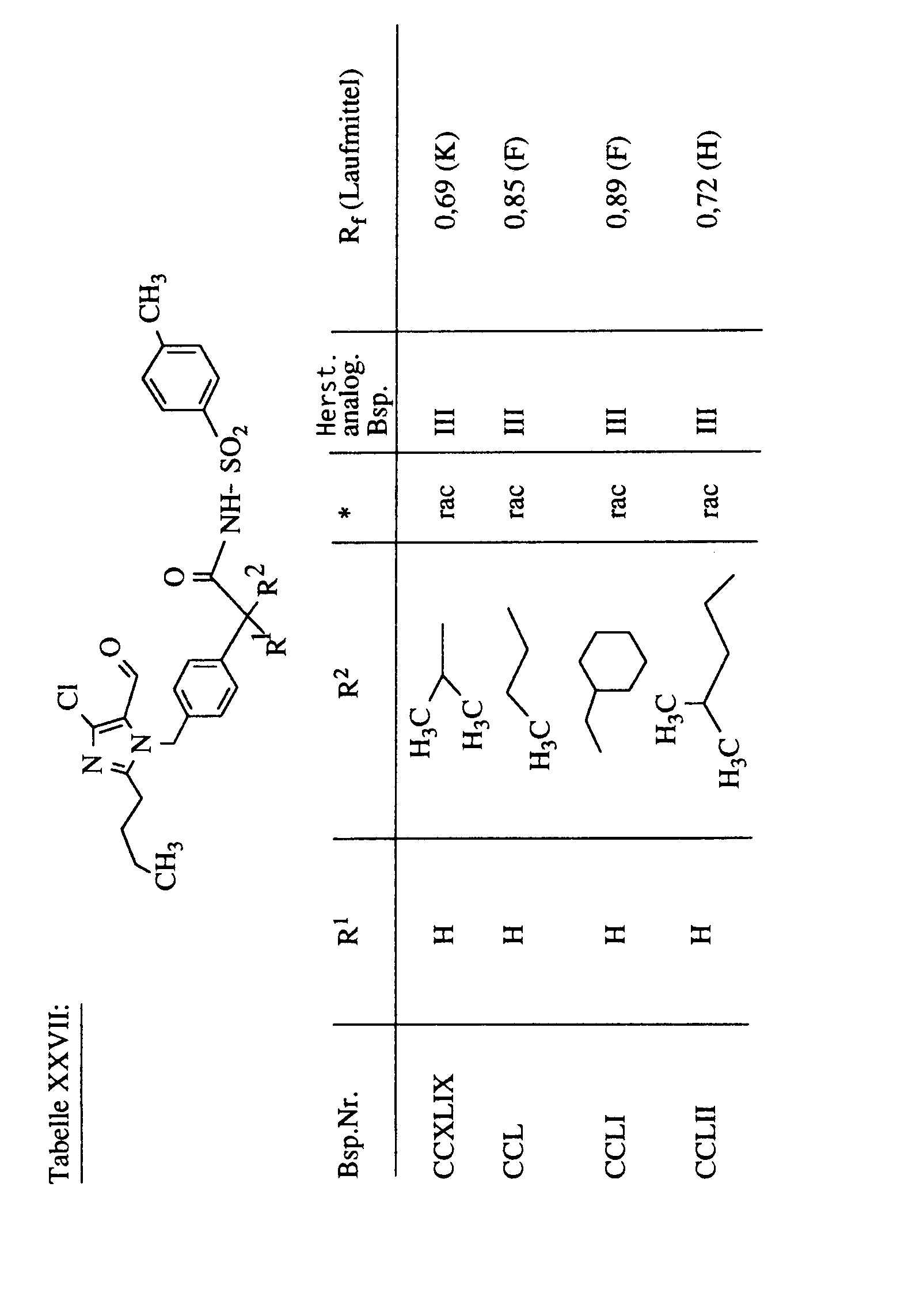
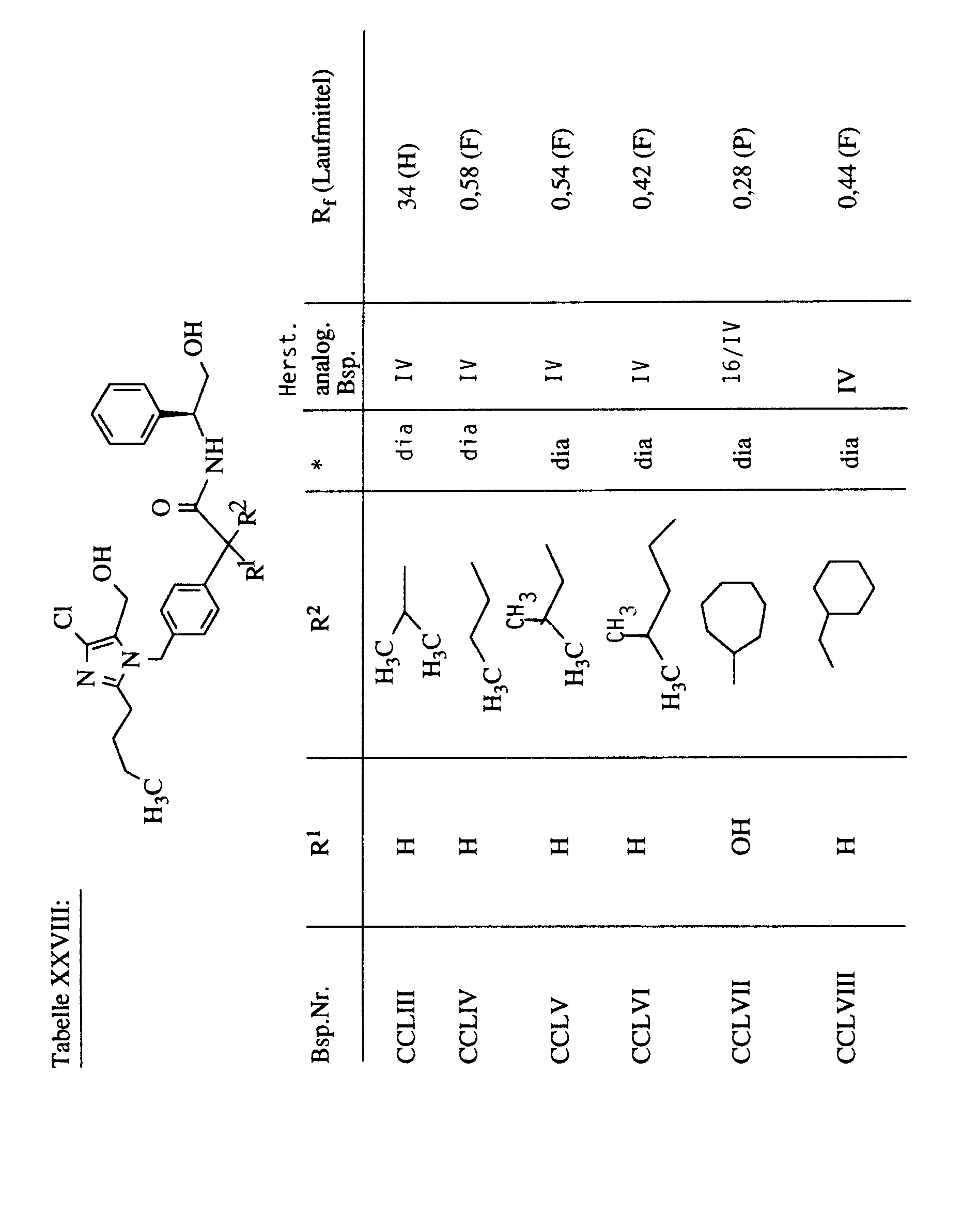


Claims (9)


und deren Salze.1. Heterocyclically substituted phenylacetic acid derivatives of the formula
and their salts.


daß man Verbindungen der allgemeinen Formel (II)

in inerten Lösemitteln, gegebenenfalls in Anwesenheit einer Base und gegebenenfalls unter Schutzgasatmosphäre zu Verbindungen der allgemeinen Formel (la)

that compounds of the general formula (II)
in inert solvents, optionally in the presence of a base and optionally under a protective gas atmosphere to give compounds of the general formula (Ia)
Priority Applications (1)
| Application Number | Priority Date | Filing Date | Title |
|---|---|---|---|
| EP01110080A EP1127880A3 (en) | 1991-04-26 | 1992-04-13 | Phenylacetic acid derivatives substituted by a heterocycle and their use as A-II antagonists and as inhibitors of smooth muscle cell proliferation |
Applications Claiming Priority (5)
| Application Number | Priority Date | Filing Date | Title |
|---|---|---|---|
| DE4113693 | 1991-04-26 | ||
| DE4113963 | 1991-04-26 | ||
| DE4113693 | 1991-04-26 | ||
| DE4200954A DE4200954A1 (en) | 1991-04-26 | 1992-01-16 | New heterocycle-substd. phenylacetic acid derivs. - are angiotensin II antagonists for treating arterial hypertonia, atherosclerosis, coronary insufficiency, ischaemic cerebral disorders, respiratory disorders, etc. |
| DE4200954 | 1992-01-16 |
Related Child Applications (1)
| Application Number | Title | Priority Date | Filing Date |
|---|---|---|---|
| EP01110080A Division EP1127880A3 (en) | 1991-04-26 | 1992-04-13 | Phenylacetic acid derivatives substituted by a heterocycle and their use as A-II antagonists and as inhibitors of smooth muscle cell proliferation |
Publications (3)
| Publication Number | Publication Date |
|---|---|
| EP0513533A2 true EP0513533A2 (en) | 1992-11-19 |
| EP0513533A3 EP0513533A3 (en) | 1992-12-02 |
| EP0513533B1 EP0513533B1 (en) | 2001-11-21 |
Family
ID=25903177
Family Applications (2)
| Application Number | Title | Priority Date | Filing Date |
|---|---|---|---|
| EP92106345A Expired - Lifetime EP0513533B1 (en) | 1991-04-26 | 1992-04-13 | Heterocyclic substituted phenylacetic-acid derivatives, process for their preparation and their pharmaceutical application |
| EP01110080A Withdrawn EP1127880A3 (en) | 1991-04-26 | 1992-04-13 | Phenylacetic acid derivatives substituted by a heterocycle and their use as A-II antagonists and as inhibitors of smooth muscle cell proliferation |
Family Applications After (1)
| Application Number | Title | Priority Date | Filing Date |
|---|---|---|---|
| EP01110080A Withdrawn EP1127880A3 (en) | 1991-04-26 | 1992-04-13 | Phenylacetic acid derivatives substituted by a heterocycle and their use as A-II antagonists and as inhibitors of smooth muscle cell proliferation |
Country Status (15)
| Country | Link |
|---|---|
| US (2) | US5521206A (en) |
| EP (2) | EP0513533B1 (en) |
| JP (1) | JP3225086B2 (en) |
| KR (1) | KR920019758A (en) |
| CN (1) | CN1031339C (en) |
| AT (1) | ATE209188T1 (en) |
| AU (1) | AU643885B2 (en) |
| CA (1) | CA2066943C (en) |
| CS (1) | CS126692A3 (en) |
| DE (2) | DE4200954A1 (en) |
| HU (1) | HUT61283A (en) |
| IE (1) | IE921335A1 (en) |
| IL (1) | IL101676A0 (en) |
| NZ (1) | NZ242477A (en) |
| TW (1) | TW199163B (en) |
Cited By (28)
| Publication number | Priority date | Publication date | Assignee | Title |
|---|---|---|---|---|
| EP0560163A1 (en) * | 1992-03-13 | 1993-09-15 | Bayer Ag | Imidazolylmethyl substituted phenylacetic-acid amides, process for their preparation and their pharmaceutical application |
| EP0560162A1 (en) * | 1992-03-13 | 1993-09-15 | Bayer Ag | Imidazolylmethyl substituted phenylacetic-acid amides, process for their preparation and their pharmaceutical application |
| EP0565986A3 (en) * | 1992-04-16 | 1994-02-02 | Bayer Ag | |
| US5300668A (en) * | 1993-03-10 | 1994-04-05 | Pfizer Inc. | Certain esters of 1-(4-X-methylphenyl)cyclopent-3-ene-1-carboxylic acid, wherein X is a trialkylsilyloxy, bromo or hydroxy group, as intermediates |
| EP0610697A1 (en) * | 1993-02-03 | 1994-08-17 | Bayer Ag | Imidazole substituted phenylaceticacidprolinzamide derivatives |
| EP0611767A1 (en) * | 1993-02-15 | 1994-08-24 | Bayer Ag | Heterocyclic substituted phenyl-cyclohexan carboxylic acid derivatives as angiotensin II antagonists |
| EP0610698A3 (en) * | 1993-02-03 | 1994-09-14 | Bayer Ag | Substituted imidazo(4,5-b)pyridines and benzimidazoles as angiotensin ii antagonistes. |
| WO1994020499A1 (en) * | 1993-03-10 | 1994-09-15 | Pfizer Inc. | Benzylimidazopyridine derivatives as angiotensin ii receptor antagonists |
| EP0622358A1 (en) * | 1993-03-26 | 1994-11-02 | Bayer Ag | Phenylglycinamides of 4-imidazolylmethyl-phenyl-acetic acids and their use against hypertension and atherosclerosis |
| WO1995002596A1 (en) * | 1993-07-15 | 1995-01-26 | Pfizer Inc. | Azacyclic-heterocyclic compounds as angiotensin ii receptor antagonists |
| LT3612B (en) | 1992-08-29 | 1995-12-27 | Boots Co Plc | Therapeutic agents |
| EP0779276A1 (en) * | 1995-12-15 | 1997-06-18 | Bayer Ag | Indolyl-substituted phenylacetic acid derivatives |
| EP0779279A1 (en) * | 1995-12-15 | 1997-06-18 | Bayer Ag | Bicyclic heterocycles |
| US5663186A (en) * | 1994-03-29 | 1997-09-02 | Merck & Co., Inc. | Treatment of atherosclerosis with angiotensin II receptor blocking imidazoles |
| EP0799829A1 (en) * | 1996-04-04 | 1997-10-08 | Bayer Ag | Process for the preparation of enantiomerically pure cycloalkanoindole-, azaindole- and pyrimido [1,2a] indole carboxylic acids and their activated derivatives |
| EP0802197A1 (en) * | 1996-04-17 | 1997-10-22 | Bayer Ag | Tricyclic-heterocyclyl substituted phenylacetamide derivatives, their preparation and their use as angiostensin-II-antagonists |
| EP0802192A1 (en) * | 1996-04-17 | 1997-10-22 | Bayer Ag | Heterocyclic-substituted phenylglycinolamides with antiatheroschlerotic activity and process for their production |
| EP0799828A3 (en) * | 1996-04-04 | 1998-04-08 | Bayer Ag | Pyrimido [1,2-a] indoles |
| EP0802198A3 (en) * | 1996-04-18 | 1998-04-15 | Bayer Ag | Pyridazino-, pyrimido, pyrazino and triazino-indoles |
| WO2001023349A1 (en) * | 1999-09-30 | 2001-04-05 | Mitsubishi Chemical Corporation | Acylsulfonamide derivatives |
| US6245775B1 (en) | 1994-10-04 | 2001-06-12 | Bayer Aktiengesellschaft | Cycloalkano-indole and -azaindole derivatives |
| US6255330B1 (en) | 1996-04-17 | 2001-07-03 | Bayer Aktiengesellschaft | Heterocyclically substituted phenylglycinolamides |
| WO2002032898A3 (en) * | 2000-10-14 | 2002-12-12 | Boehringer Ingelheim Pharma | Novel anticholinergics, method for the production thereof and use thereof as medicaments |
| US6774236B1 (en) | 1996-04-04 | 2004-08-10 | Bayer Aktiengesellschaft | Process for the preparation of enantiomerically pure cycloalkano-indol -and azaindol -and pyrimido [1,2A]indolcarbocyclic acids and their activated derivatives |
| US6852728B2 (en) | 2000-10-14 | 2005-02-08 | Boehringer Ingelheim Pharma Gmbh & Co. Kg | Anticholinergics, processes for preparing them, and pharmaceutical compositions containing them |
| US6928610B2 (en) | 1996-09-09 | 2005-08-09 | Microsoft Corporation | Automatic layout of content in a design for a medium |
| EP1925303A2 (en) | 1999-08-27 | 2008-05-28 | Sanofi-Aventis Deutschland GmbH | Use of Angiotensin II type 1 receptor antagonists for the prevention of stroke, diabetes and/or congestive heart failure |
| CN111417622A (en) * | 2017-10-17 | 2020-07-14 | 诺华炎症研究公司 | Sulfonamides and compositions thereof for the treatment of conditions associated with N L RP activity |
Families Citing this family (8)
| Publication number | Priority date | Publication date | Assignee | Title |
|---|---|---|---|---|
| DE19535504A1 (en) * | 1995-09-25 | 1997-03-27 | Bayer Ag | Substituted xanthines |
| DE19536378A1 (en) * | 1995-09-29 | 1997-04-03 | Bayer Ag | Heterocyclic aryl, alkyl and cycloalkyl acetic acid amides |
| CA2275610A1 (en) * | 1996-12-16 | 1998-06-25 | Ontogen Corporation | Modulators of proteins with phosphotyrosine recognition units |
| US6034251A (en) * | 1997-11-07 | 2000-03-07 | Schering Corporation | Phenyl-alkyl-imidazoles |
| CA2274994A1 (en) * | 1998-06-18 | 1999-12-18 | Lonza Ag | Process for the preparation of formylimidazoles |
| US6987131B1 (en) | 2000-06-26 | 2006-01-17 | Burzynski Stanislaw R | Phenylacetic acid compositions for treating or preventing hypercholesterolemia |
| AR037097A1 (en) * | 2001-10-05 | 2004-10-20 | Novartis Ag | ACILSULFONAMID COMPOUNDS, PHARMACEUTICAL COMPOSITIONS AND THE USE OF SUCH COMPOUNDS FOR THE PREPARATION OF A MEDICINAL PRODUCT |
| CN107325052B (en) * | 2017-06-19 | 2020-01-10 | 广东药科大学 | Imidazole ester compounds with anticancer activity and derivatives thereof |
Family Cites Families (9)
| Publication number | Priority date | Publication date | Assignee | Title |
|---|---|---|---|---|
| US4762850A (en) * | 1987-03-24 | 1988-08-09 | Smithkline Beckman Corporation | Dopamine-beta-hydroxylase inhibitors |
| IE64514B1 (en) * | 1989-05-23 | 1995-08-09 | Zeneca Ltd | Azaindenes |
| GB8911854D0 (en) * | 1989-05-23 | 1989-07-12 | Ici Plc | Heterocyclic compounds |
| US5164407A (en) * | 1989-07-03 | 1992-11-17 | Merck & Co., Inc. | Substituted imidazo-fused 5-membered ring heterocycles and their use as angiotensin ii antagonsists |
| EP0515548A4 (en) * | 1990-02-13 | 1993-03-10 | Merck & Co. Inc. | Imidazole angiotensin ii antagonists incorporating a substituted benzyl element |
| US5183810A (en) * | 1990-02-13 | 1993-02-02 | Merck & Co., Inc. | Imidazole angiotensin II antagonists incorporating a substituted benzyl element |
| US5449682A (en) * | 1990-02-13 | 1995-09-12 | Merck & Co., Inc. | Angiotensin II antagonists incorporating a substituted benzyl element |
| FR2658511B1 (en) * | 1990-02-16 | 1992-06-19 | Union Pharma Scient Appl | NOVEL BENZIMIDAZOLE AND AZABENZIMIDAZOLE DERIVATIVES, THROMBOXANE RECEPTOR ANTAGONISTS; THEIR PREPARATION METHODS, PHARMACEUTICAL COMPOSITIONS CONTAINING THEM. |
| DE4036645A1 (en) * | 1990-11-16 | 1992-05-21 | Hoechst Ag | SUBSTITUTED AZOLE, METHOD FOR THE PRODUCTION THEREOF, THE AGENT, AND THEIR USE THEREOF |
-
1992
- 1992-01-16 DE DE4200954A patent/DE4200954A1/en not_active Withdrawn
- 1992-03-30 AU AU13907/92A patent/AU643885B2/en not_active Ceased
- 1992-04-13 DE DE59209934T patent/DE59209934D1/en not_active Expired - Fee Related
- 1992-04-13 EP EP92106345A patent/EP0513533B1/en not_active Expired - Lifetime
- 1992-04-13 EP EP01110080A patent/EP1127880A3/en not_active Withdrawn
- 1992-04-13 AT AT92106345T patent/ATE209188T1/en not_active IP Right Cessation
- 1992-04-14 TW TW081102878A patent/TW199163B/zh active
- 1992-04-23 IL IL101676A patent/IL101676A0/en unknown
- 1992-04-23 CA CA002066943A patent/CA2066943C/en not_active Expired - Fee Related
- 1992-04-24 CS CS921266A patent/CS126692A3/en unknown
- 1992-04-24 HU HU9201388A patent/HUT61283A/en unknown
- 1992-04-24 JP JP13177092A patent/JP3225086B2/en not_active Expired - Fee Related
- 1992-04-24 IE IE133592A patent/IE921335A1/en not_active Application Discontinuation
- 1992-04-24 NZ NZ242477A patent/NZ242477A/en unknown
- 1992-04-25 CN CN92103141A patent/CN1031339C/en not_active Expired - Lifetime
- 1992-04-25 KR KR1019920007042A patent/KR920019758A/en not_active Withdrawn
-
1994
- 1994-04-15 US US08/227,913 patent/US5521206A/en not_active Expired - Fee Related
-
1996
- 1996-03-01 US US08/609,366 patent/US5776964A/en not_active Expired - Fee Related
Cited By (44)
| Publication number | Priority date | Publication date | Assignee | Title |
|---|---|---|---|---|
| EP0560162A1 (en) * | 1992-03-13 | 1993-09-15 | Bayer Ag | Imidazolylmethyl substituted phenylacetic-acid amides, process for their preparation and their pharmaceutical application |
| EP0560163A1 (en) * | 1992-03-13 | 1993-09-15 | Bayer Ag | Imidazolylmethyl substituted phenylacetic-acid amides, process for their preparation and their pharmaceutical application |
| EP0565986A3 (en) * | 1992-04-16 | 1994-02-02 | Bayer Ag | |
| LT3612B (en) | 1992-08-29 | 1995-12-27 | Boots Co Plc | Therapeutic agents |
| EP0610697A1 (en) * | 1993-02-03 | 1994-08-17 | Bayer Ag | Imidazole substituted phenylaceticacidprolinzamide derivatives |
| EP0610698A3 (en) * | 1993-02-03 | 1994-09-14 | Bayer Ag | Substituted imidazo(4,5-b)pyridines and benzimidazoles as angiotensin ii antagonistes. |
| US5527809A (en) * | 1993-02-03 | 1996-06-18 | Bayer Aktiengesellschaft | Substituted imidazo[4,5-b]pyridines and benzimidazoles |
| US5395840A (en) * | 1993-02-15 | 1995-03-07 | Bayer Aktiengesellschaft | Heterocyclically substituted phenyl-cyclohexane-carboxylic acid derivatives |
| EP0611767A1 (en) * | 1993-02-15 | 1994-08-24 | Bayer Ag | Heterocyclic substituted phenyl-cyclohexan carboxylic acid derivatives as angiotensin II antagonists |
| WO1994020499A1 (en) * | 1993-03-10 | 1994-09-15 | Pfizer Inc. | Benzylimidazopyridine derivatives as angiotensin ii receptor antagonists |
| WO1994020498A1 (en) * | 1993-03-10 | 1994-09-15 | Pfizer Inc. | Benzylimidazopyridine derivative as angiotensin ii receptor antagonist |
| US5300668A (en) * | 1993-03-10 | 1994-04-05 | Pfizer Inc. | Certain esters of 1-(4-X-methylphenyl)cyclopent-3-ene-1-carboxylic acid, wherein X is a trialkylsilyloxy, bromo or hydroxy group, as intermediates |
| EP0622358A1 (en) * | 1993-03-26 | 1994-11-02 | Bayer Ag | Phenylglycinamides of 4-imidazolylmethyl-phenyl-acetic acids and their use against hypertension and atherosclerosis |
| WO1995002596A1 (en) * | 1993-07-15 | 1995-01-26 | Pfizer Inc. | Azacyclic-heterocyclic compounds as angiotensin ii receptor antagonists |
| US5789415A (en) * | 1993-07-15 | 1998-08-04 | Pfizer Inc. | Azacyclic-heterocyclic compounds as angiotension II receptor antagonists |
| US5663186A (en) * | 1994-03-29 | 1997-09-02 | Merck & Co., Inc. | Treatment of atherosclerosis with angiotensin II receptor blocking imidazoles |
| US5663187A (en) * | 1994-03-29 | 1997-09-02 | Merck & Co., Inc. | Treatment of atherosclerosis with angiotensin II receptor blocking imidazoles |
| US6245775B1 (en) | 1994-10-04 | 2001-06-12 | Bayer Aktiengesellschaft | Cycloalkano-indole and -azaindole derivatives |
| US6235770B1 (en) | 1995-12-15 | 2001-05-22 | Bayer Aktiengesellschaft | Indolyl-substituted phenylacetic acid derivatives |
| US6025378A (en) * | 1995-12-15 | 2000-02-15 | Bayer Aktiengesellschaft | Bicyclic heterocyclic compounds |
| EP0779276A1 (en) * | 1995-12-15 | 1997-06-18 | Bayer Ag | Indolyl-substituted phenylacetic acid derivatives |
| EP0779279A1 (en) * | 1995-12-15 | 1997-06-18 | Bayer Ag | Bicyclic heterocycles |
| US6200971B1 (en) * | 1995-12-15 | 2001-03-13 | Bayer Aktiengesellschaft | Bicyclic heterocyclic compounds |
| US6034115A (en) * | 1995-12-15 | 2000-03-07 | Bayer Aktiengesellschaft | Indolyl-substituted phenylacetic acid derivatives |
| US5811429A (en) * | 1995-12-15 | 1998-09-22 | Bayer Aktiengesellschaft | Bicyclic heterocyclic compounds |
| US6774236B1 (en) | 1996-04-04 | 2004-08-10 | Bayer Aktiengesellschaft | Process for the preparation of enantiomerically pure cycloalkano-indol -and azaindol -and pyrimido [1,2A]indolcarbocyclic acids and their activated derivatives |
| EP0799828A3 (en) * | 1996-04-04 | 1998-04-08 | Bayer Ag | Pyrimido [1,2-a] indoles |
| US5952498A (en) * | 1996-04-04 | 1999-09-14 | Bayer Aktiengesellschaft | Process for the preparation of enantiomerically pure cycloalkano-indol -and azaindol -and pyrimido 1,2a! indolcarboxcyclic acids and their activated derivatives |
| EP0799829A1 (en) * | 1996-04-04 | 1997-10-08 | Bayer Ag | Process for the preparation of enantiomerically pure cycloalkanoindole-, azaindole- and pyrimido [1,2a] indole carboxylic acids and their activated derivatives |
| US6114341A (en) * | 1996-04-04 | 2000-09-05 | Bayer Aktiengesellschaft | Pyrimido[1,2-a]indoles |
| EP0802192A1 (en) * | 1996-04-17 | 1997-10-22 | Bayer Ag | Heterocyclic-substituted phenylglycinolamides with antiatheroschlerotic activity and process for their production |
| EP0802197A1 (en) * | 1996-04-17 | 1997-10-22 | Bayer Ag | Tricyclic-heterocyclyl substituted phenylacetamide derivatives, their preparation and their use as angiostensin-II-antagonists |
| US6255330B1 (en) | 1996-04-17 | 2001-07-03 | Bayer Aktiengesellschaft | Heterocyclically substituted phenylglycinolamides |
| US6194424B1 (en) | 1996-04-17 | 2001-02-27 | Bayer Aktiengesellschaft | Arylacetamides and their use as medicaments |
| US5935984A (en) * | 1996-04-17 | 1999-08-10 | Bayer Aktiengesellschaft | Heterocyclically substituted phenylglycinolamides |
| EP0802198A3 (en) * | 1996-04-18 | 1998-04-15 | Bayer Ag | Pyridazino-, pyrimido, pyrazino and triazino-indoles |
| US6928610B2 (en) | 1996-09-09 | 2005-08-09 | Microsoft Corporation | Automatic layout of content in a design for a medium |
| US7461332B2 (en) | 1996-09-09 | 2008-12-02 | Microsoft Corporation | Automatic layout of content in a design for a medium |
| EP1925303A2 (en) | 1999-08-27 | 2008-05-28 | Sanofi-Aventis Deutschland GmbH | Use of Angiotensin II type 1 receptor antagonists for the prevention of stroke, diabetes and/or congestive heart failure |
| EP2277519A2 (en) | 1999-08-27 | 2011-01-26 | Sanofi-Aventis Deutschland GmbH | Use of Angiotensin II type 1 receptor antagonists for the prevention of stroke, diabetes and/or congestive heart failure |
| WO2001023349A1 (en) * | 1999-09-30 | 2001-04-05 | Mitsubishi Chemical Corporation | Acylsulfonamide derivatives |
| WO2002032898A3 (en) * | 2000-10-14 | 2002-12-12 | Boehringer Ingelheim Pharma | Novel anticholinergics, method for the production thereof and use thereof as medicaments |
| US6852728B2 (en) | 2000-10-14 | 2005-02-08 | Boehringer Ingelheim Pharma Gmbh & Co. Kg | Anticholinergics, processes for preparing them, and pharmaceutical compositions containing them |
| CN111417622A (en) * | 2017-10-17 | 2020-07-14 | 诺华炎症研究公司 | Sulfonamides and compositions thereof for the treatment of conditions associated with N L RP activity |
Also Published As
| Publication number | Publication date |
|---|---|
| EP1127880A3 (en) | 2003-10-29 |
| AU1390792A (en) | 1992-10-29 |
| JPH05208954A (en) | 1993-08-20 |
| TW199163B (en) | 1993-02-01 |
| ATE209188T1 (en) | 2001-12-15 |
| EP1127880A2 (en) | 2001-08-29 |
| CA2066943A1 (en) | 1992-10-27 |
| IE921335A1 (en) | 1992-11-04 |
| HU9201388D0 (en) | 1992-07-28 |
| DE59209934D1 (en) | 2002-01-03 |
| CN1031339C (en) | 1996-03-20 |
| CN1066065A (en) | 1992-11-11 |
| DE4200954A1 (en) | 1992-10-29 |
| EP0513533B1 (en) | 2001-11-21 |
| KR920019758A (en) | 1992-11-19 |
| EP0513533A3 (en) | 1992-12-02 |
| HUT61283A (en) | 1992-12-28 |
| JP3225086B2 (en) | 2001-11-05 |
| NZ242477A (en) | 1994-10-26 |
| IL101676A0 (en) | 1992-12-30 |
| US5776964A (en) | 1998-07-07 |
| US5521206A (en) | 1996-05-28 |
| AU643885B2 (en) | 1993-11-25 |
| CS126692A3 (en) | 1992-12-16 |
| CA2066943C (en) | 2002-10-15 |
Similar Documents
| Publication | Publication Date | Title |
|---|---|---|
| EP0513533A2 (en) | Heterocyclic substituted phenylacetic-acid derivatives, process for their preparation and their pharmaceutical application | |
| EP0611767B1 (en) | Heterocyclic substituted phenyl-cyclohexan carboxylic acid derivatives as angiotensin II antagonists | |
| EP0450566B1 (en) | Substituted azoles, method for their preparation, these containing compositions and their use | |
| EP0542059A1 (en) | Substituted biphenylpyridinones as angiotensin II antagonists | |
| EP0560163A1 (en) | Imidazolylmethyl substituted phenylacetic-acid amides, process for their preparation and their pharmaceutical application | |
| EP0539713A1 (en) | Substituted imidazolylpropene acid derivatives as angiotensin II inhibitors | |
| EP0485929A1 (en) | Substituted azoles, process for their preparation and their application | |
| EP0535465A1 (en) | Cyclic substituted imidazolylpropen acid derivatives as angiotensin II antagonists | |
| EP0594019A1 (en) | Trisubstituted biphenyl as angiotensin II antagonistes | |
| EP0560162A1 (en) | Imidazolylmethyl substituted phenylacetic-acid amides, process for their preparation and their pharmaceutical application | |
| EP0610698A2 (en) | Substituted imidazo(4,5-b)pyridines and benzimidazoles as angiotensin II antagonistes | |
| EP0535463A1 (en) | Imidazolpropen acid derivatives as angiotensin II antagonists | |
| EP0569794A1 (en) | Biphenylmethyl-substituted pyridones useful as angiotensin II receptor antagonists. | |
| EP0610697B1 (en) | Imidazole substituted phenylaceticacidprolinzamide derivatives | |
| EP0617035B1 (en) | Heterotricyclic substituted phenylcyclohexanecarboxylic acid derivatives | |
| EP0608709A1 (en) | 2-Oxo-quinolin-1-yl-methyl-phenylacetic acid derivatives as angiotensin II Antagonists | |
| EP0578002A1 (en) | Imidazolyl substituted phenylpropionic and cinnamic acid derivatives | |
| EP0565986A2 (en) | Propenoyl-imidazole derivatives, their preparation and their use as medicaments with angiotensin II antagonistic activity | |
| EP0581003B1 (en) | Imidazolyl substituted cyclohexane derivatives | |
| EP0622358A1 (en) | Phenylglycinamides of 4-imidazolylmethyl-phenyl-acetic acids and their use against hypertension and atherosclerosis | |
| EP0557842A2 (en) | Sulphonylbenzyl substituted imidazolylpropenic acid derivatives | |
| EP0594022A1 (en) | Alkoxymethyl substituted pyridinone-biphenyls as angiotensin II antagonists | |
| EP0563705A2 (en) | Cycloalkyl- and heterocyclyl substituted imidazolylpropenic acid derivatives | |
| EP0564788A2 (en) | Sulfonylbenzyl substituted imidazopyridines as AII-antagonists | |
| EP0643060A2 (en) | Sulfonylbenzyl-substituted benzimidazoles, process for their preparation, and their pharmaceutical use |
Legal Events
| Date | Code | Title | Description |
|---|---|---|---|
| PUAI | Public reference made under article 153(3) epc to a published international application that has entered the european phase |
Free format text: ORIGINAL CODE: 0009012 |
|
| PUAL | Search report despatched |
Free format text: ORIGINAL CODE: 0009013 |
|
| AK | Designated contracting states |
Kind code of ref document: A2 Designated state(s): AT BE CH DE DK ES FR GB GR IT LI LU NL PT SE |
|
| AK | Designated contracting states |
Kind code of ref document: A3 Designated state(s): AT BE CH DE DK ES FR GB GR IT LI LU NL PT SE |
|
| 17P | Request for examination filed |
Effective date: 19930114 |
|
| 17Q | First examination report despatched |
Effective date: 19951206 |
|
| GRAG | Despatch of communication of intention to grant |
Free format text: ORIGINAL CODE: EPIDOS AGRA |
|
| GRAG | Despatch of communication of intention to grant |
Free format text: ORIGINAL CODE: EPIDOS AGRA |
|
| GRAG | Despatch of communication of intention to grant |
Free format text: ORIGINAL CODE: EPIDOS AGRA |
|
| GRAH | Despatch of communication of intention to grant a patent |
Free format text: ORIGINAL CODE: EPIDOS IGRA |
|
| GRAH | Despatch of communication of intention to grant a patent |
Free format text: ORIGINAL CODE: EPIDOS IGRA |
|
| GRAA | (expected) grant |
Free format text: ORIGINAL CODE: 0009210 |
|
| AK | Designated contracting states |
Kind code of ref document: B1 Designated state(s): AT BE CH DE DK ES FR GB GR IT LI LU NL PT SE |
|
| PG25 | Lapsed in a contracting state [announced via postgrant information from national office to epo] |
Ref country code: GB Free format text: LAPSE BECAUSE OF FAILURE TO SUBMIT A TRANSLATION OF THE DESCRIPTION OR TO PAY THE FEE WITHIN THE PRESCRIBED TIME-LIMIT Effective date: 20011121 Ref country code: NL Free format text: LAPSE BECAUSE OF FAILURE TO SUBMIT A TRANSLATION OF THE DESCRIPTION OR TO PAY THE FEE WITHIN THE PRESCRIBED TIME-LIMIT Effective date: 20011121 Ref country code: GR Free format text: LAPSE BECAUSE OF FAILURE TO SUBMIT A TRANSLATION OF THE DESCRIPTION OR TO PAY THE FEE WITHIN THE PRESCRIBED TIME-LIMIT Effective date: 20011121 Ref country code: FR Free format text: LAPSE BECAUSE OF FAILURE TO SUBMIT A TRANSLATION OF THE DESCRIPTION OR TO PAY THE FEE WITHIN THE PRESCRIBED TIME-LIMIT Effective date: 20011121 Ref country code: IT Free format text: LAPSE BECAUSE OF FAILURE TO SUBMIT A TRANSLATION OF THE DESCRIPTION OR TO PAY THE FEE WITHIN THE PRE;WARNING: LAPSES OF ITALIAN PATENTS WITH EFFECTIVE DATE BEFORE 2007 MAY HAVE OCCURRED AT ANY TIME BEFORE 2007. THE CORRECT EFFECTIVE DATE MAY BE DIFFERENT FROM THE ONE RECORDED.SCRIBED TIME-LIMIT Effective date: 20011121 |
|
| REF | Corresponds to: |
Ref document number: 209188 Country of ref document: AT Date of ref document: 20011215 Kind code of ref document: T |
|
| REG | Reference to a national code |
Ref country code: CH Ref legal event code: EP |
|
| REG | Reference to a national code |
Ref country code: GB Ref legal event code: IF02 |
|
| REF | Corresponds to: |
Ref document number: 59209934 Country of ref document: DE Date of ref document: 20020103 |
|
| PG25 | Lapsed in a contracting state [announced via postgrant information from national office to epo] |
Ref country code: SE Free format text: LAPSE BECAUSE OF FAILURE TO SUBMIT A TRANSLATION OF THE DESCRIPTION OR TO PAY THE FEE WITHIN THE PRESCRIBED TIME-LIMIT Effective date: 20020221 Ref country code: PT Free format text: LAPSE BECAUSE OF FAILURE TO SUBMIT A TRANSLATION OF THE DESCRIPTION OR TO PAY THE FEE WITHIN THE PRESCRIBED TIME-LIMIT Effective date: 20020221 Ref country code: DK Free format text: LAPSE BECAUSE OF FAILURE TO SUBMIT A TRANSLATION OF THE DESCRIPTION OR TO PAY THE FEE WITHIN THE PRESCRIBED TIME-LIMIT Effective date: 20020221 |
|
| PG25 | Lapsed in a contracting state [announced via postgrant information from national office to epo] |
Ref country code: LU Free format text: LAPSE BECAUSE OF NON-PAYMENT OF DUE FEES Effective date: 20020413 Ref country code: AT Free format text: LAPSE BECAUSE OF NON-PAYMENT OF DUE FEES Effective date: 20020413 |
|
| PG25 | Lapsed in a contracting state [announced via postgrant information from national office to epo] |
Ref country code: CH Free format text: LAPSE BECAUSE OF NON-PAYMENT OF DUE FEES Effective date: 20020430 Ref country code: BE Free format text: LAPSE BECAUSE OF NON-PAYMENT OF DUE FEES Effective date: 20020430 Ref country code: LI Free format text: LAPSE BECAUSE OF NON-PAYMENT OF DUE FEES Effective date: 20020430 |
|
| NLV1 | Nl: lapsed or annulled due to failure to fulfill the requirements of art. 29p and 29m of the patents act | ||
| GBV | Gb: ep patent (uk) treated as always having been void in accordance with gb section 77(7)/1977 [no translation filed] |
Effective date: 20011121 |
|
| PG25 | Lapsed in a contracting state [announced via postgrant information from national office to epo] |
Ref country code: ES Free format text: LAPSE BECAUSE OF FAILURE TO SUBMIT A TRANSLATION OF THE DESCRIPTION OR TO PAY THE FEE WITHIN THE PRESCRIBED TIME-LIMIT Effective date: 20020530 |
|
| PLBE | No opposition filed within time limit |
Free format text: ORIGINAL CODE: 0009261 |
|
| STAA | Information on the status of an ep patent application or granted ep patent |
Free format text: STATUS: NO OPPOSITION FILED WITHIN TIME LIMIT |
|
| EN | Fr: translation not filed | ||
| PG25 | Lapsed in a contracting state [announced via postgrant information from national office to epo] |
Ref country code: DE Free format text: LAPSE BECAUSE OF NON-PAYMENT OF DUE FEES Effective date: 20021101 |
|
| 26N | No opposition filed | ||
| REG | Reference to a national code |
Ref country code: CH Ref legal event code: PL |