EP0473024A1 - Heterocyclic substituted cycloalkano(b)-indolesulfonamides - Google Patents
Heterocyclic substituted cycloalkano(b)-indolesulfonamides Download PDFInfo
- Publication number
- EP0473024A1 EP0473024A1 EP91113731A EP91113731A EP0473024A1 EP 0473024 A1 EP0473024 A1 EP 0473024A1 EP 91113731 A EP91113731 A EP 91113731A EP 91113731 A EP91113731 A EP 91113731A EP 0473024 A1 EP0473024 A1 EP 0473024A1
- Authority
- EP
- European Patent Office
- Prior art keywords
- carbon atoms
- formula
- straight
- chain
- group
- Prior art date
- Legal status (The legal status is an assumption and is not a legal conclusion. Google has not performed a legal analysis and makes no representation as to the accuracy of the status listed.)
- Withdrawn
Links
- YDOPSFUJBJUHPB-UHFFFAOYSA-N [O-][N+](C1=CC(C(C2CN=CCC2)O)=CCC1)=O Chemical compound [O-][N+](C1=CC(C(C2CN=CCC2)O)=CCC1)=O YDOPSFUJBJUHPB-UHFFFAOYSA-N 0.000 description 1
Classifications
-
- C—CHEMISTRY; METALLURGY
- C07—ORGANIC CHEMISTRY
- C07D—HETEROCYCLIC COMPOUNDS
- C07D401/00—Heterocyclic compounds containing two or more hetero rings, having nitrogen atoms as the only ring hetero atoms, at least one ring being a six-membered ring with only one nitrogen atom
- C07D401/02—Heterocyclic compounds containing two or more hetero rings, having nitrogen atoms as the only ring hetero atoms, at least one ring being a six-membered ring with only one nitrogen atom containing two hetero rings
- C07D401/06—Heterocyclic compounds containing two or more hetero rings, having nitrogen atoms as the only ring hetero atoms, at least one ring being a six-membered ring with only one nitrogen atom containing two hetero rings linked by a carbon chain containing only aliphatic carbon atoms
-
- A—HUMAN NECESSITIES
- A61—MEDICAL OR VETERINARY SCIENCE; HYGIENE
- A61P—SPECIFIC THERAPEUTIC ACTIVITY OF CHEMICAL COMPOUNDS OR MEDICINAL PREPARATIONS
- A61P11/00—Drugs for disorders of the respiratory system
-
- A—HUMAN NECESSITIES
- A61—MEDICAL OR VETERINARY SCIENCE; HYGIENE
- A61P—SPECIFIC THERAPEUTIC ACTIVITY OF CHEMICAL COMPOUNDS OR MEDICINAL PREPARATIONS
- A61P37/00—Drugs for immunological or allergic disorders
- A61P37/08—Antiallergic agents
-
- A—HUMAN NECESSITIES
- A61—MEDICAL OR VETERINARY SCIENCE; HYGIENE
- A61P—SPECIFIC THERAPEUTIC ACTIVITY OF CHEMICAL COMPOUNDS OR MEDICINAL PREPARATIONS
- A61P7/00—Drugs for disorders of the blood or the extracellular fluid
- A61P7/02—Antithrombotic agents; Anticoagulants; Platelet aggregation inhibitors
-
- A—HUMAN NECESSITIES
- A61—MEDICAL OR VETERINARY SCIENCE; HYGIENE
- A61P—SPECIFIC THERAPEUTIC ACTIVITY OF CHEMICAL COMPOUNDS OR MEDICINAL PREPARATIONS
- A61P9/00—Drugs for disorders of the cardiovascular system
- A61P9/08—Vasodilators for multiple indications
-
- A—HUMAN NECESSITIES
- A61—MEDICAL OR VETERINARY SCIENCE; HYGIENE
- A61P—SPECIFIC THERAPEUTIC ACTIVITY OF CHEMICAL COMPOUNDS OR MEDICINAL PREPARATIONS
- A61P9/00—Drugs for disorders of the cardiovascular system
- A61P9/10—Drugs for disorders of the cardiovascular system for treating ischaemic or atherosclerotic diseases, e.g. antianginal drugs, coronary vasodilators, drugs for myocardial infarction, retinopathy, cerebrovascula insufficiency, renal arteriosclerosis
-
- C—CHEMISTRY; METALLURGY
- C07—ORGANIC CHEMISTRY
- C07D—HETEROCYCLIC COMPOUNDS
- C07D209/00—Heterocyclic compounds containing five-membered rings, condensed with other rings, with one nitrogen atom as the only ring hetero atom
- C07D209/56—Ring systems containing three or more rings
- C07D209/80—[b, c]- or [b, d]-condensed
- C07D209/82—Carbazoles; Hydrogenated carbazoles
- C07D209/86—Carbazoles; Hydrogenated carbazoles with only hydrogen atoms, hydrocarbon or substituted hydrocarbon radicals, directly attached to carbon atoms of the ring system
-
- C—CHEMISTRY; METALLURGY
- C07—ORGANIC CHEMISTRY
- C07D—HETEROCYCLIC COMPOUNDS
- C07D401/00—Heterocyclic compounds containing two or more hetero rings, having nitrogen atoms as the only ring hetero atoms, at least one ring being a six-membered ring with only one nitrogen atom
- C07D401/02—Heterocyclic compounds containing two or more hetero rings, having nitrogen atoms as the only ring hetero atoms, at least one ring being a six-membered ring with only one nitrogen atom containing two hetero rings
- C07D401/12—Heterocyclic compounds containing two or more hetero rings, having nitrogen atoms as the only ring hetero atoms, at least one ring being a six-membered ring with only one nitrogen atom containing two hetero rings linked by a chain containing hetero atoms as chain links
-
- C—CHEMISTRY; METALLURGY
- C07—ORGANIC CHEMISTRY
- C07D—HETEROCYCLIC COMPOUNDS
- C07D403/00—Heterocyclic compounds containing two or more hetero rings, having nitrogen atoms as the only ring hetero atoms, not provided for by group C07D401/00
- C07D403/02—Heterocyclic compounds containing two or more hetero rings, having nitrogen atoms as the only ring hetero atoms, not provided for by group C07D401/00 containing two hetero rings
- C07D403/06—Heterocyclic compounds containing two or more hetero rings, having nitrogen atoms as the only ring hetero atoms, not provided for by group C07D401/00 containing two hetero rings linked by a carbon chain containing only aliphatic carbon atoms
Definitions
- the invention relates to heterocyclically substituted cycloalkano [b] indolesulfonamides, processes for their preparation and their use in medicaments.
- heterocyclically substituted indole sulfonamides according to the invention have one or more asymmetric carbon atoms and can therefore exist in various stereochemical forms.
- the compounds exist in stereoisomeric forms, which either behave like image and mirror image (enantiomers) or do not behave like image and mirror image (diastereomers).
- the invention relates to both the antipodes and the racemic forms as well as the diastereomer mixtures. Like the diastereomers, the racemic forms can be separated into the stereoisomerically uniform constituents in a known manner (cf. EL Eliel, Stereochemistry of Carbon Compounds, McGraw Hill, 1962).
- R1, R2, R3, R4, R5, A, X, Y, m, n and z have the meaning given above.
- heterocyclically substituted cycloalkano [b] indolesulfonamides according to the invention can also be present in the form of their salts.
- salts with organic or inorganic bases or acids may be mentioned here.
- Physiologically acceptable salts are preferred in the context of the present invention.
- Physiologically acceptable salts of heterocyclically substituted Cycloalkano [b] indolesulfonamides can be metal or ammonium salts of the substances according to the invention which have a free carboxyl group.
- Particularly preferred are, for example, sodium, potassium, magnesium or calcium salts, and also ammonium salts which are derived from ammonia, or organic amines, such as ethylamine, di- or triethylamine, di- or triethanolamine, dicyclohexylamine, dimethylaminoethanol, arginine, Lysine or ethylenediamine.
- Physiologically acceptable salts can also be salts of the compounds according to the invention with inorganic or organic acids.
- Salts with inorganic acids such as hydrochloric acid, hydrobromic acid, phosphoric acid or sulfuric acid, or salts with organic carboxylic or sulfonic acids such as acetic acid, maleic acid, fumaric acid, malic acid, citric acid, tartaric acid, lactic acid, benzoic acid or methanesulfonic acid, ethanesulfonic acid, phenylsulfonic acid, toluenesulfonic acid, toluenesulfonic acid, are preferred or naphthalenedisulfonic acid.
- Heterocycle generally represents a 5- to 7-membered, preferably 5- to 6-membered, saturated or unsaturated ring which can contain up to two oxygen, sulfur and / or nitrogen atoms as heteroatoms and, in addition, aromatic or heterocyclic Rings can be condensed.
- the substances according to the invention surprisingly show an antiplatelet effect, additionally inhibit thromboxane synthase on isolated platelets and can be used for the therapeutic treatment of humans and animals.
- Solvents for processes [A] and [B] according to the invention can be water and organic solvents which do not change under the reaction conditions. These preferably include chlorinated hydrocarbons, such as chloroform or methylene chloride, alcohols such as methanol, ethanol, propanol or isopropanol, ethers such as diethyl ether, tetrahydrofuran, dioxane, glycol mono- or dimethyl ether, hydrocarbons such as benzene, toluene, xylene, cyclohexane, hexane or petroleum fractions, Dimethyl sulfoxide, dimethylformamide, hexamethylphosphoric triamide, ethyl acetate, acetonitrile or pyridine. It is also possible to use mixtures of the solvents mentioned.
- chlorinated hydrocarbons such as chloroform or methylene chloride
- alcohols such as methanol, ethanol, propanol or isopropanol
- Bases for processes [A] and [B] according to the invention can be customary basic compounds. These preferably include alkali and alkaline earth metal hydroxides such as lithium hydroxide, sodium hydroxide, potassium hydroxide or barium hydroxide, alkali metal hydrides such as sodium hydride, alkali metal or alkaline earth metal carbonates such as sodium carbonate, potassium carbonate, or alkali metal alcoholates such as sodium methoxide or ethanolate, potassium methoxide, ethanolate or potassium tert-butylate such as sodium amide or lithium diisopropylamide, or organic amines or ammonium salts such as benzyltrimethylammonium hydroxide, tetrabutylammonium hydroxide, pyridine, triethylamine or N-methylpiperidine.
- alkali and alkaline earth metal hydroxides such as lithium hydroxide, sodium hydroxide, potassium hydroxide or barium hydroxide
- alkali metal hydrides such as
- the processes [A] and [B] according to the invention are generally carried out in a temperature range from 0 ° C. to 150 ° C., preferably from 0 ° C. to 100 ° C.
- processes [A] and [B] are carried out at normal pressure. However, it is also possible to work under negative pressure or overpressure (e.g. from 0.5 to 5 bar).
- the saponification of the esters is carried out according to the customary method by treating the esters with customary bases in inert solvents, it being possible to convert the salts initially formed into the free carboxylic acids by treatment with acid.
- the usual inorganic bases are suitable as bases for the saponification. These preferably include alkali hydroxides or alkaline earth hydroxides such as sodium hydroxide, potassium hydroxide or barium hydroxide, or alkali carbonates such as sodium or potassium carbonate.
- Suitable solvents for the saponification are water or the organic solvents customary for saponification. These preferably include alcohols such as methanol, ethanol, propanol, isopropanol or butanol, or ethers such as tetrahydrofuran or dioxane, or dimethylformamide or dimethyl sulfoxide. Alcohols such as methanol, ethanol, propanol or isopropanol are particularly preferably used. It is also possible to use mixtures of the solvents mentioned.
- the saponification is generally carried out in a temperature range from 0 ° C. to +140 ° C., preferably from +20 ° C. to +100 ° C.
- the saponification is generally carried out at normal pressure. However, it is also possible to work under negative pressure or overpressure (e.g. from 0.5 to 5 bar).
- the base When carrying out the saponification, the base is generally used in an amount of 1 to 5 mol, preferably 1 to 2 mol, based on 1 mol of the ester. Molar amounts of the reactants are particularly preferably used.
- the carboxylates of the compounds according to the invention are formed in the first step as intermediates which can be isolated.
- the acids according to the invention are obtained by treating the carboxylates with customary inorganic acids. These preferably include mineral acids such as, for example, hydrochloric acid, hydrobromic acid, sulfuric acid or phosphoric acid.
- customary inorganic acids preferably include mineral acids such as, for example, hydrochloric acid, hydrobromic acid, sulfuric acid or phosphoric acid.
- mineral acids such as, for example, hydrochloric acid, hydrobromic acid, sulfuric acid or phosphoric acid.
- the acids can then be isolated in the usual way.
- the salts of these heterocycles with the inorganic acids can also be obtained by treating the solutions of the carboxylates with the acids listed above.
- the esterification of the acids is carried out according to the customary method, if appropriate by reacting the acids with the corresponding alcohols in one of the solvents listed above in the presence of a catalyst.
- This alcohol is preferably also used as a solvent.
- Inorganic acids such as sulfuric acid or inorganic acid chlorides such as thionyl chloride can be used as catalysts.
- the amidation is carried out in one of the solvents mentioned above, preferably in alcohols such as ethanol or methanol, in a temperature range from 0 ° C. to +50 ° C., preferably from +10 to +30 ° C., and at normal pressure.
- alcohols such as ethanol or methanol
- Suitable Lewis acids are BF3, aluminum halides, such as AlCl3, ZnCl2 or Ag ⁇ salts. BF3 and AlCl3 are preferred.
- the compounds of the general formula (VIII) are new and can be prepared by substituting substituted anilines of the general formula (XIII) in which R1, R2, R3 and R4 have the meaning given above, in a two-stage reaction, first with sodium nitrite in the presence of acids and then sodium bisulfite in the corresponding hydrazines of the general formula (XIV) in which R1, R2, R3 and R4 have the meaning given above, transferred and then with cycloalkanone sulfonamides of the general formula (XII) in which R5, z, n, A and Z have the meaning given above, in the presence of the inert solvents listed above, optionally in the presence of a catalyst.
- Inorganic acids or their salts such as hydrochloric acid or sulfuric acid, are suitable as acids in the hydrazine preparation (1st step).
- substituted anilines of the general formula (XIII) are known per se or can be prepared via the stage of the respective nitro compounds using reduction methods known from the literature, for example using hydrogen on Pd / C [cf. EP 69 521; J. Med. Chem, 19 , 1079 (1976); J. Heterocycl. Chem. 21 , 1849, (1984)].
- the enantiomerically pure compounds of the general formula (I) according to the invention can be prepared by customary methods, e.g. can be obtained in analogy to the method described in DOS 36 31 824.
- the sulfonic acid amides of the general formula (Xb) are known in some cases [cf. Beilstein, 11, 26].
- the heterocyclically substituted cycloalkano [b] indolesulfonamides or their salts and isomers can be used as active ingredients in pharmaceuticals.
- the substances have a platelet aggregation-inhibiting and thromboxane A2-antagonistic effect and inhibit thromboxane synthase on isolated platelets. They can be used to treat thromboembolic disorders and ischemia such as Myocardial infarction, stroke, transient and ischemic attacks, angina pectoris, peripheral circulatory disorders, prevention of restenosis such as after thrombolysis therapy, percutaneous transluminal angioplasty (PTA), percutaneous transluminal coronary angioplasty (PTCA), bypass and for the treatment of arteriosclerosis are used.
- PTA percutaneous transluminal angioplasty
- PTCA percutaneous transluminal coronary angioplasty
- TAH limit concentration ( ⁇ g / ml) 17th 0.03-0.1 18th 0.3 - 1 20th 0.03-0.1 25th 0.03-0.1 Measurement of thromboxane synthase on washed human platelets 1. Preparation of platelet suspensions Blood from healthy donors is taken up in EDTA (1% in 0.9% NaCl, 9 + 1) and centrifuged at 1000 rpm (150 g) for 20 min. The platelet-rich plasma (PRP) 2 is siphoned off and centrifuged in each case 10 ml at 2500 rpm for 20 min. The platelet-rich plasma 2 is decanted off.
- PRP platelet-rich plasma
- the remaining platelets are suspended in 5 ml resuspension buffer (0.15 M TRIS / 0.9% NaCl / 77 mmol EDTA, 8: 91: 1; adjusted to pH 7.4 with 1 N HCl), 20 min at 2500 U / centrifuged min and suspended in 1 ml resuspension buffer.
- the platelet count is set to 3 x 10⁵ / ⁇ l. 2.
- Measurement of thromboxane synthase 1 ml of the platelet suspension and 0.01 ml of the test preparation in 10% DMSO are incubated at 37 ° C for 2 min. For this, 0.1 ml 3H-arachidonic acid Amersham Buchler GmbH and Co.
- the present invention also includes pharmaceutical preparations which, in addition to inert, non-toxic, pharmaceutically suitable auxiliaries and excipients, contain one or more compounds of the general formula (I) or which consist of one or more active compounds of the formula (I), and processes for the preparation of these preparations.
- the active compounds of the formula (I) should be present in these preparations in a concentration of 0.1 to 99.5% by weight, preferably 0.5 to 95% by weight, of the total mixture.
- the pharmaceutical preparations can also contain other pharmaceutical active ingredients.
- the pharmaceutical preparations listed above can be prepared in a customary manner by known methods, for example using the excipient or excipients.
- the active compound (s) of the formula (I) in total amounts of from about 0.03 to about 30 mg / kg, preferably up to about 5 mg / kg body weight per 24 hours, if appropriate in the form several single doses to achieve the desired result.
- a single dose contains the active ingredient (s) preferably in amounts of 0.01 to about 10, particularly preferably 0.1 to 1.0 mg / kg body weight.
Landscapes
- Chemical & Material Sciences (AREA)
- Organic Chemistry (AREA)
- Health & Medical Sciences (AREA)
- Engineering & Computer Science (AREA)
- Bioinformatics & Cheminformatics (AREA)
- Life Sciences & Earth Sciences (AREA)
- Veterinary Medicine (AREA)
- General Chemical & Material Sciences (AREA)
- Medicinal Chemistry (AREA)
- Nuclear Medicine, Radiotherapy & Molecular Imaging (AREA)
- Chemical Kinetics & Catalysis (AREA)
- Pharmacology & Pharmacy (AREA)
- Public Health (AREA)
- Animal Behavior & Ethology (AREA)
- General Health & Medical Sciences (AREA)
- Pulmonology (AREA)
- Cardiology (AREA)
- Heart & Thoracic Surgery (AREA)
- Diabetes (AREA)
- Hematology (AREA)
- Immunology (AREA)
- Urology & Nephrology (AREA)
- Vascular Medicine (AREA)
- Plural Heterocyclic Compounds (AREA)
- Pharmaceuticals Containing Other Organic And Inorganic Compounds (AREA)
- Pyridine Compounds (AREA)
- Indole Compounds (AREA)
Abstract
Heterocyclisch substituierte Cycloalkano[b]-indolsulfonamide können durch Umsetzung von entsprechenden N-unsubstituierten Indolen mit Acrylnitril, anschließende Verseifung, Veresterung oder Amidierung, oder durch Umsetzung von heterocyclisch substituierten Hydrazinen mit Cycloalkanonen oder durch nachträgliches Einführen der heterocyclischen Gruppe in entsprechende Indolderivate hergestellt werden. Die heterocyclisch substituierten Cycloalkano[b]-indolsulfonamide können zur Behandlung von thromboembolischen Erkrankungen, Ischämien, Arteriosklerose, Asthma, Allergien sowie zur Prophylaxe von Myocardinfarkten eingesetzt werden.Heterocyclically substituted cycloalkano [b] indolesulfonamides can be prepared by reacting corresponding N-unsubstituted indoles with acrylonitrile, followed by saponification, esterification or amidation, or by reacting heterocyclically substituted hydrazines with cycloalkanones or by subsequently introducing the heterocyclic group into corresponding indole derivatives. The heterocyclically substituted cycloalkano [b] indolesulfonamides can be used for the treatment of thromboembolic disorders, ischemia, arteriosclerosis, asthma, allergies and for the prophylaxis of myocardial infarctions.
Description
Die Erfindung betrifft heterocyclisch substituierte Cycloalkano[b]-indolsulfonamide, Verfahren zu ihrer Herstellung und ihre Verwendung in Arzneimitteln.The invention relates to heterocyclically substituted cycloalkano [b] indolesulfonamides, processes for their preparation and their use in medicaments.
Es ist bereits bekannt, daß Cycloalkano[b]dihydroindol- und -indolsulfonamide eine thrombozytenaggregationshemmende Wirkung aufweisen [vgl. DOS 36 31 824].It is already known that cycloalkano [b] dihydroindole and indole sulfonamides have an antiplatelet activity [cf. DOS 36 31 824].
Es wurden nun heterocyclisch substituierte Cycloalkano[b]-indolsulfonamide der allgemeinen Formel (I)

in welcher
- R¹, R², R³, R⁴ und R⁵
- gleich oder verschieden sind und
- für Wasserstoff, Nitro, Cyano, Halogen, Trifluormethyl, Carboxy, Hydroxy oder Trifluormethoxy stehen, oder
- für eine Gruppe der Formel -S(O)wR⁶ stehen,
worin
R⁶ - geradkettiges oder verzweigtes Alkyl mit bis zu 8 Kohlenstoffatomen oder Aryl mit 6 bis 10 Kohlenstoffatomen bedeutet, das seinerseits durch Halogen, Nitro, Cyano oder Trifluormethyl substituiert ist
und
w - eine Zahl 0, 1 oder 2 bedeutet,
oder - für geradkettiges oder verzweigtes Alkoxy oder Alkoxycarbonyl mit jeweils bis zu 10 Kohlenstoffatomen oder Benzyloxy stehen, oder
- für eine Gruppe der Formel -NR⁷R⁸ stehen,
worin
R⁷ und R⁸ gleich oder verschieden sind und- Wasserstoff, geradkettiges oder verzweigtes Alkyl oder Acyl mit jeweils bis zu 8 Kohlenstoffatomen oder
- Aryl mit 6 bis 10 Kohlenstoffatomen bedeuten,
- für Cycloalkyl mit 3 bis 8 Kohlenstoffatomen oder
- für Aryl mit 6 bis 10 Kohlenstoffatomen stehen, oder
- für geradkettiges oder verzweigtes Alkyl oder Alkenyl mit jeweils bis zu 10 Kohlenstoffatomen stehen, die gegebenenfalls durch Halogen, Hydroxy, Carboxy, Cyano, Aryl mit 6 bis 10 Kohlenstoffatomen, geradkettiges oder verzweigtes Alkyl, Alkoxy oder Alkoxycarbonyl mit jeweils bis zu 8 Kohlenstoffatomen oder durch eine Gruppe der Formel
-S(O)wR⁶ oder
worin
w, R⁶, R⁷ und R⁸ die oben angegebene Bedeutung haben,
oder - für eine Gruppe der Formel
-D, -E-O-L-D, -E-NH-L-D, -E-CO-L-D oder -E-D
stehen,
worin
D - einen 3- bis 7-gliedrigen, gesättigten oder ungesättigten Heterocyclus mit bis zu 4 Heteroatomen aus der Reihe N, O oder S bedeutet, an den weitere aromatische oder heterocyclische Ringe ankondensiert sein können,
und
E und L gleich oder verschieden sind und- eine direkte Bindung oder
- geradkettiges oder verzweigtes Alkylen oder Alkenylen mit bis zu 10 Kohlenstoffatomen bedeuten,
- X
-
- für Aryl mit 6 bis 10 Kohlenstoffatomen steht, das gegebenenfalls bis zu 5-fach gleich oder verschieden durch Nitro, Halogen, Cyano, Trifluormethyl, Trifluormethoxy, Trifluormethylthio, Hydroxy, Carboxy, Aryl oder Aryloxy mit 6 bis 10 Kohlenstoffatomen, geradkettiges oder verzweigtes Alkoxy oder Alkoxycarbonyl mit jeweils bis zu 8 Kohlenstoffatomen oder durch geradkettiges oder verzweigtes Alkyl mit bis zu 8 Kohlenstoffatomen substituiert ist, wobei das Alkyl seinerseits durch Carboxy, Hydroxy, Alkoxycarbonyl mit bis zu 6 Kohlenstoffatomen, durch Aryl mit 6 bis 10 Kohlenstoffatomen,
oder
durch eine Gruppe der Formel -S(O)wR⁶ oder -NR⁷R⁸ substituiert sein kann,
worin
w, R⁶, R⁷ und R⁸ die oben angegebene Bedeutung haben,
oder - für geradkettiges oder verzweigtes Alkyl mit bis zu 8 Kohlenstoffatomen oder
- für Trifluormethyl steht,
- für Aryl mit 6 bis 10 Kohlenstoffatomen steht, das gegebenenfalls bis zu 5-fach gleich oder verschieden durch Nitro, Halogen, Cyano, Trifluormethyl, Trifluormethoxy, Trifluormethylthio, Hydroxy, Carboxy, Aryl oder Aryloxy mit 6 bis 10 Kohlenstoffatomen, geradkettiges oder verzweigtes Alkoxy oder Alkoxycarbonyl mit jeweils bis zu 8 Kohlenstoffatomen oder durch geradkettiges oder verzweigtes Alkyl mit bis zu 8 Kohlenstoffatomen substituiert ist, wobei das Alkyl seinerseits durch Carboxy, Hydroxy, Alkoxycarbonyl mit bis zu 6 Kohlenstoffatomen, durch Aryl mit 6 bis 10 Kohlenstoffatomen,
- m
- - für die Zahl 1, 2, 3 oder 4 steht,
- n
- - für die Zahl 0, 1 oder 2 steht,
- z
- - für eine Zahl 1, 2, 3 oder 4 steht,
- A
- - für eine direkte Bindung oder für eine Gruppe der Formel -NH- oder

worin
D und E die oben angegebene Bedeutung haben, - Y
-
- für die Gruppe der Formel -CO-G steht,
worin
G - Hydroxy, Alkoxy mit bis zu 8 Kohlenstoffatomen, Phenoxy oder eine Gruppe der Formel -NR⁷R⁸ oder -NH-SO₂-R⁶ bedeutet,
worin
R⁶, R⁷ und R⁸ die oben angegebene Bedeutung haben,
oder - für Tetrazolyl steht,
- für die Gruppe der Formel -CO-G steht,
gegebenenfalls in einer isomeren Form und ihre Salze, gefunden.Heterocyclically substituted cycloalkano [b] indolesulfonamides of the general formula (I)
in which
- R¹, R², R³, R⁴ and R⁵
- are the same or different and
- represent hydrogen, nitro, cyano, halogen, trifluoromethyl, carboxy, hydroxy or trifluoromethoxy, or
- represent a group of the formula -S (O) w R⁶,
wherein
R⁶ - straight-chain or branched alkyl with up to 8 carbon atoms or aryl with 6 to 10 carbon atoms, which in turn is substituted by halogen, nitro, cyano or trifluoromethyl
and
w - represents a number 0, 1 or 2,
or - stand for straight-chain or branched alkoxy or alkoxycarbonyl each having up to 10 carbon atoms or benzyloxy, or
- represent a group of the formula -NR⁷R⁸,
wherein
R⁷ and R⁸ are the same or different and- Hydrogen, straight-chain or branched alkyl or acyl, each with up to 8 carbon atoms or
- Aryl having 6 to 10 carbon atoms,
- for cycloalkyl with 3 to 8 carbon atoms or
- represent aryl having 6 to 10 carbon atoms, or
- represent straight-chain or branched alkyl or alkenyl each having up to 10 carbon atoms, which may be halogen, hydroxyl, carboxy, cyano, aryl having 6 to 10 carbon atoms, straight-chain or branched alkyl, alkoxy or alkoxycarbonyl each having up to 8 carbon atoms or by one Group of the formula
-S (O) w R⁶ or
wherein
w, R⁶, R⁷ and R⁸ have the meaning given above,
or - for a group of the formula
-D, -EOLD, -E-NH-LD, -E-CO-LD or -ED
stand,
wherein
D - is a 3- to 7-membered, saturated or unsaturated heterocycle with up to 4 heteroatoms from the series N, O or S, to which further aromatic or heterocyclic rings can be fused,
and
E and L are the same or different and- a direct bond or
- straight-chain or branched alkylene or alkenylene with up to 10 carbon atoms,
- X
-
- represents aryl having 6 to 10 carbon atoms, optionally up to 5 times the same or different by nitro, halogen, cyano, trifluoromethyl, trifluoromethoxy, trifluoromethylthio, hydroxy, carboxy, aryl or aryloxy having 6 to 10 carbon atoms, straight-chain or branched alkoxy or Alkoxycarbonyl each having up to 8 carbon atoms or substituted by straight-chain or branched alkyl having up to 8 carbon atoms, the alkyl in turn by carboxy, hydroxy, alkoxycarbonyl having up to 6 carbon atoms, by aryl having 6 to 10 carbon atoms,
or
can be substituted by a group of the formula -S (O) w R⁶ or -NR⁷R⁸,
wherein
w, R⁶, R⁷ and R⁸ have the meaning given above,
or - for straight-chain or branched alkyl having up to 8 carbon atoms or
- represents trifluoromethyl,
- represents aryl having 6 to 10 carbon atoms, optionally up to 5 times the same or different by nitro, halogen, cyano, trifluoromethyl, trifluoromethoxy, trifluoromethylthio, hydroxy, carboxy, aryl or aryloxy having 6 to 10 carbon atoms, straight-chain or branched alkoxy or Alkoxycarbonyl each having up to 8 carbon atoms or substituted by straight-chain or branched alkyl having up to 8 carbon atoms, the alkyl in turn by carboxy, hydroxy, alkoxycarbonyl having up to 6 carbon atoms, by aryl having 6 to 10 carbon atoms,
- m
- - stands for the number 1, 2, 3 or 4,
- n
- - stands for the number 0, 1 or 2,
- e.g.
- - stands for a number 1, 2, 3 or 4,
- A
- - for a direct bond or for a group of the formula -NH- or
wherein
D and E have the meaning given above, - Y
-
- represents the group of the formula -CO-G,
wherein
G is hydroxyl, alkoxy having up to 8 carbon atoms, phenoxy or a group of the formula -NR⁷R⁸ or -NH-SO₂-R⁶,
wherein
R⁶, R⁷ and R⁸ have the meaning given above,
or - represents tetrazolyl,
- represents the group of the formula -CO-G,
optionally in an isomeric form and its salts.
Die erfindungsgemäßen heterocyclisch substituierten Indolsulfonamide haben eines oder mehrere asymmetrische Kohlenstoffatome und können daher in verschiedenen stereochemischen Formen existieren.The heterocyclically substituted indole sulfonamides according to the invention have one or more asymmetric carbon atoms and can therefore exist in various stereochemical forms.
Die Verbindungen existieren in stereoisomeren Formen, die sich entweder wie Bild und Spiegelbild (Enantiomere) oder die sich nicht wie Bild und Spiegelbild (Diastereomere) verhalten. Die Erfindung betrifft sowohl die Antipoden als auch die Racemformen sowie die Diastereomerengemische. Die Racemformen lassen sich ebenso wie die Diastereomeren in bekannter Weise in die stereoisomer einheitlichen Bestandteile trennen (vgl. E.L. Eliel, Stereochemistry of Carbon Compounds, McGraw Hill, 1962).The compounds exist in stereoisomeric forms, which either behave like image and mirror image (enantiomers) or do not behave like image and mirror image (diastereomers). The invention relates to both the antipodes and the racemic forms as well as the diastereomer mixtures. Like the diastereomers, the racemic forms can be separated into the stereoisomerically uniform constituents in a known manner (cf. EL Eliel, Stereochemistry of Carbon Compounds, McGraw Hill, 1962).
Außerdem können Regioisomere auftreten. Sowohl die einzelnen Isomeren als auch deren Mischungen sind Gegenstand der Erfindung.Regioisomers can also occur. Both the individual isomers and their mixtures are the subject of the invention.
Im folgenden werden beispielhaft isomere Formen der heterocyclisch substituierten Indolsulfonamide aufgeführt:The following are examples of isomeric forms of the heterocyclically substituted indole sulfonamides:


wobei R¹, R², R³, R⁴, R⁵, A, X, Y, m, n und z die oben genannte Bedeutung haben.
where R¹, R², R³, R⁴, R⁵, A, X, Y, m, n and z have the meaning given above.
Die erfindungsgemäßen heterocyclisch substituierten Cycloalkano[b]-indolsulfonamide können auch in Form ihrer Salze vorliegen. Im allgemeinen seien hier Salze mit organischen oder anorganischen Basen oder Säuren genannt.The heterocyclically substituted cycloalkano [b] indolesulfonamides according to the invention can also be present in the form of their salts. In general, salts with organic or inorganic bases or acids may be mentioned here.
Im Rahmen der vorliegenden Erfindung werden physiologisch unbedenkliche Salze bevorzugt. Physiologisch unbedenkliche Salze der heterocyclisch substituierten Cycloalkano[b]-indolsulfonamide können Metall- oder Ammoniumsalze der erfindungsgemäßen Stoffe, welche eine freie Carboxylgruppe besitzen, sein. Besonders bevorzugt sind z.B. Natrium-, Kalium-, Magnesium- oder Calciumsalze, sowie Ammoniumsalze, die abgeleitet sind von Ammoniak, oder organischen Aminen, wie beispielsweise Ethylamin, Di- bzw. Triethylamin, Di- bzw. Triethanolamin, Dicyclohexylamin, Dimethylaminoethanol, Arginin, Lysin oder Ethylendiamin.Physiologically acceptable salts are preferred in the context of the present invention. Physiologically acceptable salts of heterocyclically substituted Cycloalkano [b] indolesulfonamides can be metal or ammonium salts of the substances according to the invention which have a free carboxyl group. Particularly preferred are, for example, sodium, potassium, magnesium or calcium salts, and also ammonium salts which are derived from ammonia, or organic amines, such as ethylamine, di- or triethylamine, di- or triethanolamine, dicyclohexylamine, dimethylaminoethanol, arginine, Lysine or ethylenediamine.
Physiologisch unbedenkliche Salze können auch Salze der erfindungsgemäßen Verbindungen mit anorganischen oder organischen Säuren sein. Bevorzugt werden Salze mit anorganischen Säuren wie beispielsweise Salzsäure, Bromwasserstoffsäure, Phosphorsäure oder Schwefelsäure, oder Salze mit organischen Carbon- oder Sulfonsäuren wie beispielsweise Essigsäure, Maleinsäure, Fumarsäure, Äpfelsäure, Zitronensäure, Weinsäure, Milchsäure, Benzoesäure, oder Methansulfonsäure, Ethansulfonsäure, Phenylsulfonsäure, Toluolsulfonsäure oder Naphthalindisulfonsäure.Physiologically acceptable salts can also be salts of the compounds according to the invention with inorganic or organic acids. Salts with inorganic acids such as hydrochloric acid, hydrobromic acid, phosphoric acid or sulfuric acid, or salts with organic carboxylic or sulfonic acids such as acetic acid, maleic acid, fumaric acid, malic acid, citric acid, tartaric acid, lactic acid, benzoic acid or methanesulfonic acid, ethanesulfonic acid, phenylsulfonic acid, toluenesulfonic acid, toluenesulfonic acid, are preferred or naphthalenedisulfonic acid.
Heterocyclus steht im allgemeinen für einen 5- bis 7-gliedrigen, bevorzugt 5- bis 6-gliedrigen, gesättigten oder ungesättigten Ring, der als Heteroatome bis zu zwei Sauerstoff-, Schwefel- und/oder Stickstoffatome enthalten kann und an den weitere aromatische oder heterocyclische Ringe ankondensiert sein können.Heterocycle generally represents a 5- to 7-membered, preferably 5- to 6-membered, saturated or unsaturated ring which can contain up to two oxygen, sulfur and / or nitrogen atoms as heteroatoms and, in addition, aromatic or heterocyclic Rings can be condensed.
Bevorzugt sind 5- und 6-gliedrige Ringe mit einem Sauerstoff, Schwefel und/oder bis zu zwei Stickstoffatomen, die auch benzokondensiert sein können.5- and 6-membered rings with one oxygen, sulfur and / or up to two nitrogen atoms, which can also be benzo-fused, are preferred.
Bevorzugt werden genannt: Thienyl, Furyl, Pyrrolyl, Pyrazolyl, Pyridyl, Pyrimidyl, Pyrazinyl, Pyridazinyl, Chinolyl, Isochinolyl, Chinazolyl, Chinoxazolyl, Cinnolyl, Thiazolyl, Benzothiazolyl, Isothiazolyl, Benzisothiazolyl, Oxazolyl, Benzoxazolyl, Isoxazolyl, Imidazolyl, Benzimidazolyl, Indolyl, Morpholinyl, Pyrrolidinyl, Piperidyl, Piperazinyl.The following are preferred: thienyl, furyl, pyrrolyl, pyrazolyl, pyridyl, pyrimidyl, pyrazinyl, pyridazinyl, quinolyl, isoquinolyl, quinazolyl, quinoxazolyl, cinnolyl, thiazolyl, benzothiazolyl, isothiazolyl, benzisothiazolyl, oxazolyl, benzoxazolylyl, benzoxazolylyl, benzoxazolylyl, benzoxazolylyl, benzoxazolylyl Morpholinyl, pyrrolidinyl, piperidyl, piperazinyl.
Die erfindungsgemäßen Stoffe zeigen überraschenderweise eine thrombozytenaggregationshemmende Wirkung, bewirken außerdem eine Hemmung der Thromboxansynthase an isolierten Plättchen und können zur therapeutischen Behandlung von Menschen und Tieren verwendet werden.The substances according to the invention surprisingly show an antiplatelet effect, additionally inhibit thromboxane synthase on isolated platelets and can be used for the therapeutic treatment of humans and animals.
Bevorzugt sind Verbindungen der allgemeinen Formel (I)
in welcher
- R¹, R², R³, R⁴ und R⁵
- gleich oder verschieden sind und
- für Wasserstoff, Fluor, Chlor, Brom, Nitro, Cyano, Trifluormethyl, Carboxy, Hydroxy oder Trifluormethoxy stehen,
- für eine Gruppe der Formel -S(O)wR⁶ stehen,
worin
R⁶ - geradkettiges oder verzweigtes Alkyl mit bis zu 6 Kohlenstoffatomen oder Phenyl bedeutet, das seinerseits durch Fluor, Chlor, Brom, Nitro, Cyano oder Trifluormethyl substituiert sein kann,
w - eine Zahl 0, 1 oder 2 bedeutet,
oder - für geradkettiges oder verzweigtes Alkoxy oder Alkoxycarbonyl mit jeweils bis zu 8 Kohlenstoffatomen stehen, oder
- für eine Gruppe der Formel -NR⁷R⁸ stehen,
worin
R⁷ und R⁸ gleich oder verschieden sind und- Wasserstoff, geradkettiges oder verzweigtes Alkyl mit bis zu 6 Kohlenstoffatomen oder Phenyl bedeuten,
- für Cyclopropyl, Cyclopentyl, Cyclohexyl oder Phenyl stehen, oder
- für geradkettiges oder verzweigtes Alkyl oder Alkenyl mit jeweils bis zu 8 Kohlenstoffatomen stehen, die gegebenenfalls durch Fluor, Chlor, Brom, Hydroxy, Carboxy, Cyano, Phenyl, geradkettiges oder verzweigtes Alkyl, Alkoxy oder Alkoxycarbonyl mit jeweils bis zu 6 Kohlenstoffatomen oder durch eine Gruppe der Formel -S(O)wR⁶ oder -NR⁷R⁸ substituiert sind,
worin
w, R⁶, R⁷ und R⁸ die oben angegebene Bedeutung haben,
oder - für einen Rest oder eine Gruppe der Formel
-D, -E-O-L-D, -E-NH-L-D, -E-CO-L-D oder -E-D stehen,
worin
D - Pyridyl, Chinolyl, Tetrazolyl, Benzthiazolyl, Isochinolyl, Benzimidazolyl, Pyrimidyl, Pyrrolyl, Thienyl, Furyl, Imidazolyl oder Thiazolyl bedeutet,
und
E und L gleich oder verschieden sind und- eine direkte Bindung oder
- geradkettiges oder verzweigtes Alkyl oder Alkenyl mit jeweils bis zu 8 Kohlenstoffatomen bedeuten,
- X
-
- für Phenyl steht, das gegebenenfalls bis zu 4-fach gleich oder verschieden durch Nitro, Hydroxy, Fluor, Chlor, Brom, Jod, Cyano, Trifluormethyl, Trifluormethoxy, Hydroxy, Carboxy, Phenyl, Phenoxy, geradkettiges oder verzweigtes Alkoxy oder Alkoxycarbonyl mit jeweils bis zu 6 Kohlenstoffatomen oder durch geradkettiges oder verzweigtes Alkyl mit bis zu 6 Kohlenstoffatomen substituiert ist, oder
- für geradkettiges oder verzweigtes Alkyl mit bis zu 6 Kohlenstoffatomen oder für Trifluormethyl steht,
- m
- - für die Zahl 1, 2 oder 3 steht,
- n
- - für die Zahl 0 oder 1 steht,
- z
- - für eine Zahl 1, 2 oder 3 steht,
- A
- - für eine direkte Bindung oder für eine Gruppe der Formel


worin
D und E die oben angegebene Bedeutung haben, - Y
-
- für die Gruppe der Formel -CO-G steht,
worin
G - Hydroxy, Alkoxy mit bis zu 6 Kohlenstoffatomen, Phenoxy oder die Gruppe -NHSO₂R⁶ bedeutet,
worin
R⁶ die oben angegebene Bedeutung hat,
oder - für Tetrazolyl steht,
- für die Gruppe der Formel -CO-G steht,
gegebenenfalls in einer isomeren Form und ihre Salze.Compounds of the general formula (I) are preferred
in which
- R¹, R², R³, R⁴ and R⁵
- are the same or different and
- represent hydrogen, fluorine, chlorine, bromine, nitro, cyano, trifluoromethyl, carboxy, hydroxy or trifluoromethoxy,
- represent a group of the formula -S (O) w R⁶,
wherein
R⁶ - straight-chain or branched alkyl having up to 6 carbon atoms or phenyl, which in turn can be substituted by fluorine, chlorine, bromine, nitro, cyano or trifluoromethyl,
w - represents a number 0, 1 or 2,
or - stand for straight-chain or branched alkoxy or alkoxycarbonyl each having up to 8 carbon atoms, or
- represent a group of the formula -NR⁷R⁸,
wherein
R⁷ and R⁸ are the same or different and- Is hydrogen, straight-chain or branched alkyl having up to 6 carbon atoms or phenyl,
- stand for cyclopropyl, cyclopentyl, cyclohexyl or phenyl, or
- stand for straight-chain or branched alkyl or alkenyl each with up to 8 carbon atoms, which are optionally substituted by fluorine, chlorine, bromine, hydroxy, Carboxy, cyano, phenyl, straight-chain or branched alkyl, alkoxy or alkoxycarbonyl each having up to 6 carbon atoms or substituted by a group of the formula -S (O) w R⁶ or -NR⁷R⁸,
wherein
w, R⁶, R⁷ and R⁸ have the meaning given above,
or - for a radical or a group of the formula
-D, -EOLD, -E-NH-LD, -E-CO-LD or -ED,
wherein
D - pyridyl, quinolyl, tetrazolyl, benzthiazolyl, isoquinolyl, benzimidazolyl, pyrimidyl, pyrrolyl, thienyl, furyl, imidazolyl or thiazolyl,
and
E and L are the same or different and- a direct bond or
- straight-chain or branched alkyl or alkenyl each having up to 8 carbon atoms,
- X
-
- represents phenyl, which is optionally up to 4 times the same or different by nitro, hydroxy, fluorine, chlorine, bromine, iodine, cyano, trifluoromethyl, trifluoromethoxy, hydroxy, carboxy, phenyl, phenoxy, straight-chain or branched alkoxy or alkoxycarbonyl, each with up to is substituted to 6 carbon atoms or by straight-chain or branched alkyl having up to 6 carbon atoms, or
- represents straight-chain or branched alkyl having up to 6 carbon atoms or trifluoromethyl,
- m
- - stands for the number 1, 2 or 3,
- n
- - stands for the number 0 or 1,
- e.g.
- - stands for a number 1, 2 or 3,
- A
- - for a direct bond or for a group of the formula
wherein
D and E have the meaning given above, - Y
-
- represents the group of the formula -CO-G,
wherein
G - hydroxy, alkoxy with up to 6 carbon atoms, phenoxy or the group -NHSO₂R⁶ means,
wherein
R⁶ has the meaning given above,
or - represents tetrazolyl,
- represents the group of the formula -CO-G,
optionally in an isomeric form and their salts.
Besonders bevorzugt sind Verbindungen der allgemeinen Formel (I),
in welcher
- R¹, R², R³, R⁴ und R⁵
- gleich oder verschieden sind und
- für Wasserstoff, Fluor oder Chlor stehen,
- für eine Gruppe der Formel -S(O)w-R⁶ stehen,
worin
R⁶ - geradkettiges oder verzweigtes Alkyl mit bis zu 4 Kohlenstoffatomen oder Phenyl bedeutet, das seinerseits durch Fluor, Chlor oder Brom substituiert sein kann
und
w - die Zahl 2 bedeutet,
oder - für geradkettiges oder verzweigtes Alkoxy oder Alkoxycarbonyl mit jeweils bis zu 4 Kohlenstoffatomen stehen, oder
- für die Gruppe der Formel -NR⁷R⁸ stehen,
worin
R⁷ und R⁸ gleich oder verschieden sind und- Wasserstoff, geradkettiges oder verzweigtes Alkyl mit bis zu 4 Kohlenstoffatomen oder Phenyl bedeuten,
- für geradkettiges oder verzweigtes Alkyl mit bis zu 6 Kohlenstoffatomen stehen, die gegebenenfalls durch Fluor, Chlor, Brom, Hydroxy, Cyano oder Phenyl substituiert sind,
oder - für einen Rest oder eine Gruppe der Formel
-D, -E-O-L-D, -E-CO-L-D oder -E-D stehen,
worin
D - Pyridyl, Pyrimidyl, Imidazolyl oder Thiazolyl bedeutet,
und
E und L gleich oder verschieden sind und- eine direkte Bindung oder
- geradkettiges oder verzweigtes Alkyl mit bis zu 6 Kohlenstoffatomen bedeuten,
- X
- - für Phenyl steht, das gegebenenfalls bis zu 3-fach gleich oder verschieden durch Fluor, Chlor, Brom, Cyano, Trifluormethyl, Trifluormethoxy oder durch geradkettiges oder verzweigtes Alkyl, Alkoxy oder Alkoxycarbonyl mit jeweils bis zu 4 Kohlenstoffatomen substituiert ist,
- m
- - für die Zahl 1 oder 2 steht,
- n
- - für die Zahl 0 oder 1 steht,
- z
- - für eine Zahl 1 oder 2 steht,
- A
- - für eine direkte Bindung oder für eine Gruppe der Formel


worin
D und E die oben angegebene Bedeutung haben, - Y
-
- für die Gruppe der Formel -CO-G steht,
worin
G - Hydroxy, Alkoxy mit bis zu 4 Kohlenstoffatomen oder die Gruppe -NHSO₂R⁶ bedeutet,
worin
R⁶ die oben angegebene Bedeutung hat,
oder - für Tetrazolyl steht
- für die Gruppe der Formel -CO-G steht,

oder mindestens einer der Substituenten R¹, R², R³, R⁴ und R⁵ für eine der Gruppen -D, -E-O-L-D, -E-NH-L-D, -E-CO-L-D oder -E-D stehen müssen,
gegebenenfalls in einer isomeren Form und ihre Salze.Compounds of the general formula (I) are particularly preferred
in which
- R¹, R², R³, R⁴ and R⁵
- are the same or different and
- represent hydrogen, fluorine or chlorine,
- represent a group of the formula -S (O) w -R⁶,
wherein
R⁶ - straight-chain or branched alkyl having up to 4 carbon atoms or phenyl, which in turn can be substituted by fluorine, chlorine or bromine
and
w - the number 2 means
or - stand for straight-chain or branched alkoxy or alkoxycarbonyl each having up to 4 carbon atoms, or
- represent the group of the formula -NR⁷R⁸,
wherein
R⁷ and R⁸ are the same or different and- Is hydrogen, straight-chain or branched alkyl having up to 4 carbon atoms or phenyl,
- represent straight-chain or branched alkyl having up to 6 carbon atoms, which are optionally substituted by fluorine, chlorine, bromine, hydroxyl, cyano or phenyl,
or - for a radical or a group of the formula
-D, -EOLD, -E-CO-LD or -ED
wherein
D denotes pyridyl, pyrimidyl, imidazolyl or thiazolyl,
and
E and L are the same or different and- a direct bond or
- straight-chain or branched alkyl having up to 6 carbon atoms,
- X
- represents phenyl which is optionally substituted up to 3 times identically or differently by fluorine, chlorine, bromine, cyano, trifluoromethyl, trifluoromethoxy or by straight-chain or branched alkyl, alkoxy or alkoxycarbonyl each having up to 4 carbon atoms,
- m
- - stands for the number 1 or 2,
- n
- - stands for the number 0 or 1,
- e.g.
- - stands for a number 1 or 2,
- A
- - for a direct bond or for a group of the formula
wherein
D and E have the meaning given above, - Y
-
- represents the group of the formula -CO-G,
wherein
G - hydroxyl, alkoxy having up to 4 carbon atoms or the group -NHSO₂R⁶ means
wherein
R⁶ has the meaning given above,
or - stands for tetrazolyl
- represents the group of the formula -CO-G,
or at least one of the substituents R¹, R², R³, R⁴ and R⁵ must stand for one of the groups -D, -EOLD, -E-NH-LD, -E-CO-LD or -ED,
optionally in an isomeric form and their salts.
Die Verbindungen der allgemeinen Formel (I) können hergestellt werden, indem man
- [A] im Fall, daß m für die Zahl 2 steht,
Verbindungen der allgemeinen Formel (VIII)
R¹, R², R³, R⁴, R⁵, z, n, A und X die oben angegebene Bedeutung haben,
mit Acrylnitril, gegebenenfalls in Anwesenheit einer Base in inerten Lösemitteln zu Verbindungen der allgemeinen Formel (IX)
R¹, R², R³, R⁴, R⁵, z, n, A und X die oben angegebene Bedeutung haben,
umsetzt,
im Fall, daß Y für den Tetrazolring steht, diese in Anwesenheit von Triethylaminhydrochlorid mit Natriumazid umsetzt,
oder im Fall der Herstellung der Säuren (Y = COOH) die Cyanogruppe nach üblicher Methode verseift,
im Fall der Herstellung der Ester (Y = C₁-C₈-Alkoxycarbonyl, Phenoxycarbonyl) die Säuren mit den entsprechenden Alkoholen in Gegenwart eines Katalysators gegebenenfalls in inerten Lösungsmitteln nach üblicher Methode umsetzt,
im Fall der Herstellung der Amide und Acylsulfonsäureamide (Y = -CONR⁷R⁸, -CO-NHSO₂-R⁶) entweder die Ester oder die Säuren nach üblicher Aktivierung, mit den Aminen oder Sulfonsäureamiden der allgemeinen Formeln (Xa) und (Xb)
HNR⁷R⁸ (Xa)
NH₂SO₂-R⁶ (Xb)
in welcher
R⁶, R⁷ und R⁸ die oben angegebene Bedeutung haben,
gegebenenfalls in Anwesenheit eines Katalysators umsetzt,
oder indem man - [B] Verbindungen der allgemeinen Formel (XI)

R¹, R², R³, R⁴, und m die oben angegebene Bedeutung haben,
und
Y' - für (C₁-C₄)-Alkoxycarbonyl oder Cyano steht,
mit Cycloalkanonsulfonamiden der allgemeinen Formel (XII)
z, n, A, R⁵ und X die oben angegebene Bedeutung haben,
in inerten Lösemitteln, gegebenenfalls in Anwesenheit eines Katalysators umsetzt,
im Fall der Herstellung der Säuren (Y=COOH) die Ester oder Cyanogruppe nach üblicher Methode verseift,
im Fall der Herstellung von Estern (Y= C₁-C₈-Alkoxycarbonyl, Phenoxycarbonyl) die Säuren mit den entsprechenden Alkoholen in Gegenwart eines Katalysators gegebenenfalls in inerten Lösemitteln nach üblicher Methode umsetzt, oder Ester nach üblichen Methoden umestert,
im Fall der Herstellung der Amide und Sulfonsäureamide (Y= -CONR⁷R⁸, -CO-NHSO₂-R⁶) entweder direkt die Ester oder die Säuren nach üblicher Aktivierung, mit den Aminen oder Sulfonsäureamiden der allgemeinen Formeln (Xa) und (Xb)
gegebenenfalls in Anwesenheit eines Katalysators umsetzt,
im Fall, daß Y für den Tetrazolring steht, die Cyanoverbindung (Y = CN) in Anwesenheit von Triethylaminhydrochlorid mit Natriumazid umsetzt,
oder indem man - [C] in Verbindungen der allgemeinen Formel (Ia)

R¹', R²', R³', R⁴' und R⁵' die angegebene Bedeutung haben, jedoch nicht für eine Gruppe der Formel -D, -E-O-L-D, -E-NH-L-D, -E-CO-L-D oder -ED steht,
A' für die Gruppe -NH- steht und
m, Y, X und z die angegebene Bedeutung haben,
die Reste der Formel -D, -E-O-L-D, -E-NH-L-D, -E-CO-L-D oder E-D nach üblichen Methoden, beispielsweise durch nucleophile oder elektrophile aromatische Substitution einführt, und gegebenenfalls Carbonylgruppen nach üblichen Methoden zu Methylengruppen reduziert,
im Falle der Herstellung der Säuren (Y = -COOH) die Ester nach üblicher Methode verseift,
im Fall der Variation der Ester (Y = C₁-C₈-Alkoxycarbonyl, Phenoxycarbonyl) die Säuren mit den entsprechenden Alkoholen in Gegenwart eines Katalysators gegebenenfalls in inerten Lösemitteln nach üblicher Methode umsetzt,
im Fall der Amide und Acylsulfonamide (Y = -CONR⁷R⁸, -CO-NHSO₂-R⁶) entweder direkt die Ester oder die Säuren nach üblicher Aktivierung, mit den Aminen oder Sulfonsäureamiden der allgemeinen Formeln (Xa) und (Xb) gegebenenfalls in Gegenwart eines Katalysators umsetzt,
und dann im Fall der heterocyclisch substituierten Cycloalkano[b]-dihydroindolsulfonamide die nach Verfahren [A], [B] oder [C] hergestellten heterocyclisch substituierten Indolsulfonamide in Gegenwart eines Reduktionsmittels in inerten Lösemitteln reduziert,
gegebenenfalls die Isomeren trennt und
im Fall der Herstellung der Salze mit einer entsprechenden Base oder Säure umsetzt.
- [A] if m represents the number 2,
Compounds of the general formula (VIII)
R¹, R², R³, R⁴, R⁵, z, n, A and X have the meaning given above,
with acrylonitrile, optionally in the presence of a base in inert solvents to give compounds of the general formula (IX)
R¹, R², R³, R⁴, R⁵, z, n, A and X have the meaning given above,
implements
in the event that Y represents the tetrazole ring, this is reacted with sodium azide in the presence of triethylamine hydrochloride,
or in the case of the production of the acids (Y = COOH) the cyano group is saponified by the customary method,
in the case of the preparation of the esters (Y = C₁-C₈-alkoxycarbonyl, phenoxycarbonyl), the acids are reacted with the corresponding alcohols in the presence of a catalyst, if appropriate in inert solvents by the customary method,
in the case of the production of the amides and acylsulfonamides (Y = -CONR⁷R⁸, -CO-NHSO₂-R⁶) either the esters or the acids after customary activation, with the amines or sulfonamides of the general formulas (Xa) and (Xb)
HNR⁷R⁸ (Xa)
NH₂SO₂-R⁶ (Xb)
in which
R⁶, R⁷ and R⁸ have the meaning given above,
if appropriate in the presence of a catalyst,
or by - [B] Compounds of the general formula (XI)
R¹, R², R³, R⁴, and m have the meaning given above,
and
Y '- represents (C₁-C₄) alkoxycarbonyl or cyano,
with cycloalkanone sulfonamides of the general formula (XII)
z, n, A, R⁵ and X have the meaning given above,
in inert solvents, if appropriate in the presence of a catalyst,
in the case of the production of the acids (Y = COOH) the ester or cyano group is saponified by the customary method,
in the case of the preparation of esters (Y = C₁-C₈-alkoxycarbonyl, phenoxycarbonyl), the acids are reacted with the corresponding alcohols in the presence of a catalyst, if appropriate in inert solvents, by the customary method, or ester is transesterified by the usual methods,
in the case of the preparation of the amides and sulfonamides (Y = -CONR⁷R⁸, -CO-NHSO₂-R⁶) either directly the esters or the acids after customary activation, with the amines or sulfonamides of the general formulas (Xa) and (Xb)
if appropriate in the presence of a catalyst,
in the event that Y represents the tetrazole ring, the cyano compound (Y = CN) is reacted with sodium azide in the presence of triethylamine hydrochloride,
or by - [C] in compounds of the general formula (Ia)
R¹ ', R²', R³ ', R⁴' and R⁵ 'have the meaning given, but do not represent a group of the formula -D, -EOLD, -E-NH-LD, -E-CO-LD or -ED,
A 'stands for the group -NH- and
m, Y, X and z have the meaning given,
introduces the radicals of the formula -D, -EOLD, -E-NH-LD, -E-CO-LD or ED by conventional methods, for example by nucleophilic or electrophilic aromatic substitution, and optionally reduces carbonyl groups to methylene groups by conventional methods,
in the case of the production of the acids (Y = -COOH) the esters are saponified by the customary method
in the case of variation of the esters (Y = C₁-C₈-alkoxycarbonyl, phenoxycarbonyl), the acids are reacted with the corresponding alcohols in the presence of a catalyst, if appropriate in inert solvents by the customary method,
in the case of the amides and acylsulfonamides (Y = -CONR⁷R⁸, -CO-NHSO₂-R⁶) either directly the esters or the acids after customary activation, with the amines or sulfonamides of the general formulas (Xa) and (Xb), if appropriate in the presence of a catalyst implements
and then in the case of the heterocyclically substituted cycloalkano [b] dihydroindole sulfonamides, the heterocyclically substituted indole sulfonamides prepared by processes [A], [B] or [C] are reduced in the presence of a reducing agent in inert solvents,
optionally separating the isomers and
in the case of the preparation of the salts with an appropriate base or acid.
Das erfindungsgemäße Verfahren kann durch folgendes Formelschema beispielhaft erläutert werden:


Lösungsmittel für die erfindungsgemäßen Verfahren [A] und [B] können Wasser und organische Lösungsmittel sein, die sich unter den Reaktionsbedingungen nicht verändern. Hierzu gehören bevorzugt chlorierte Kohlenwasserstoffe, wie beispielsweise Chloroform oder Methylenchlorid, Alkohole wie Methanol, Ethanol, Propanol oder Isopropanol, Ether wie Diethylether, Tetrahydrofuran, Dioxan, Glykolmono-oder -dimethylether, Kohlenwasserstoffe wie Benzol, Toluol, Xylol, Cyclohexan, Hexan oder Erdölfraktionen, Dimethylsulfoxid, Dimethylformamid, Hexamethylphosphorsäuretriamid, Essigester, Acetonitril oder Pyridin. Ebenso ist es möglich, Gemische der genannten Lösungsmittel zu verwenden.Solvents for processes [A] and [B] according to the invention can be water and organic solvents which do not change under the reaction conditions. These preferably include chlorinated hydrocarbons, such as chloroform or methylene chloride, alcohols such as methanol, ethanol, propanol or isopropanol, ethers such as diethyl ether, tetrahydrofuran, dioxane, glycol mono- or dimethyl ether, hydrocarbons such as benzene, toluene, xylene, cyclohexane, hexane or petroleum fractions, Dimethyl sulfoxide, dimethylformamide, hexamethylphosphoric triamide, ethyl acetate, acetonitrile or pyridine. It is also possible to use mixtures of the solvents mentioned.
Basen für die erfindungsgemäßen Verfahren [A] und [B] können übliche basische Verbindungen sein. Hierzu gehören vorzugsweise Alkali- und Erdalkalihydroxide wie Lithiumhydroxid, Natriumhydroxid, Kaliumhydroxid oder Bariumhydroxid, Alkalihydride wie Natriumhydrid, Alkali- oder Erdalkalicarbonate wie Natriumcarbonat, Kaliumcarbonat, oder Alkalialkoholate wie beispielsweise Natriummethanolat oder -ethanolat, Kaliummethanolat-, -ethanolat oder Kaliumtert.-butylat oder Amide wie Natriumamid oder Lithiumdiisopropylamid, oder organische Amine oder Ammoniumsalze wie Benzyltrimethylammoniumhydroxid, Tetrabutylammoniumhydroxid, Pyridin, Triethylamin oder N-Methylpiperidin.Bases for processes [A] and [B] according to the invention can be customary basic compounds. These preferably include alkali and alkaline earth metal hydroxides such as lithium hydroxide, sodium hydroxide, potassium hydroxide or barium hydroxide, alkali metal hydrides such as sodium hydride, alkali metal or alkaline earth metal carbonates such as sodium carbonate, potassium carbonate, or alkali metal alcoholates such as sodium methoxide or ethanolate, potassium methoxide, ethanolate or potassium tert-butylate such as sodium amide or lithium diisopropylamide, or organic amines or ammonium salts such as benzyltrimethylammonium hydroxide, tetrabutylammonium hydroxide, pyridine, triethylamine or N-methylpiperidine.
Die erfindungsgemäßen Verfahren [A] und [B] werden im allgemeinen in einem Temperaturbereich von 0°C bis 150°C, bevorzugt von 0°C bis 100°C, durchgeführt.The processes [A] and [B] according to the invention are generally carried out in a temperature range from 0 ° C. to 150 ° C., preferably from 0 ° C. to 100 ° C.
Im allgemeinen werden die Verfahren [A] und [B] bei Normaldruck durchgeführt. Es ist aber auch möglich, bei Unterdruck oder bei Überdruck zu arbeiten (z.B. von 0,5 bis 5 bar).In general, processes [A] and [B] are carried out at normal pressure. However, it is also possible to work under negative pressure or overpressure (e.g. from 0.5 to 5 bar).
Die Verseifung der Ester erfolgt nach üblicher Methode, indem man die Ester in inerten Lösemitteln mit üblichen Basen behandelt, wobei die zunächst entstehenden Salze durch Behandeln mit Säure in die freien Carbonsäuren überführt werden können.The saponification of the esters is carried out according to the customary method by treating the esters with customary bases in inert solvents, it being possible to convert the salts initially formed into the free carboxylic acids by treatment with acid.
Als Basen eignen sich für die Verseifung die üblichen anorganischen Basen. Hierzu gehören bevorzugt Alkalihydroxide oder Erdalkalihydroxide wie beispielsweise Natriumhydroxid, Kaliumhydroxid oder Bariumhydroxid, oder Alkalicarbonate wie Natrium- oder Kaliumcarbonat.The usual inorganic bases are suitable as bases for the saponification. These preferably include alkali hydroxides or alkaline earth hydroxides such as sodium hydroxide, potassium hydroxide or barium hydroxide, or alkali carbonates such as sodium or potassium carbonate.
Als Lösemittel eignen sich für die Verseifung Wasser oder die für eine Verseifung üblichen organischen Lösemittel. Hierzu gehören bevorzugt Alkohole wie Methanol, Ethanol, Propanol, Isopropanol oder Butanol, oder Ether wie Tetrahydrofuran oder Dioxan, oder Dimethylformamid oder Dimethylsulfoxid. Besonders bevorzugt werden Alkohole wie Methanol, Ethanol, Propanol oder Isopropanol verwendet. Ebenso ist es möglich, Gemische der genannten Lösemittel einzusetzen.Suitable solvents for the saponification are water or the organic solvents customary for saponification. These preferably include alcohols such as methanol, ethanol, propanol, isopropanol or butanol, or ethers such as tetrahydrofuran or dioxane, or dimethylformamide or dimethyl sulfoxide. Alcohols such as methanol, ethanol, propanol or isopropanol are particularly preferably used. It is also possible to use mixtures of the solvents mentioned.
Die Verseifung wird im allgemeinen in einem Temperaturbereich von 0°C bis +140°C, bevorzugt von +20°C bis +100°C durchgeführt.The saponification is generally carried out in a temperature range from 0 ° C. to +140 ° C., preferably from +20 ° C. to +100 ° C.
Im allgemeinen wird die Verseifung bei Normaldruck durchgeführt. Es ist aber auch möglich, bei Unterdruck oder bei Überdruck zu arbeiten (z.B. von 0,5 bis 5 bar).The saponification is generally carried out at normal pressure. However, it is also possible to work under negative pressure or overpressure (e.g. from 0.5 to 5 bar).
Bei der Durchführung der Verseifung wird die Base im allgemeinen in einer Menge von 1 bis 5 mol, bevorzugt von 1 bis 2 mol bezogen auf 1 mol des Esters eingesetzt. Besonders bevorzugt verwendet man molare Mengen der Reaktanden.When carrying out the saponification, the base is generally used in an amount of 1 to 5 mol, preferably 1 to 2 mol, based on 1 mol of the ester. Molar amounts of the reactants are particularly preferably used.
Bei der Durchführung der Reaktion entstehen im ersten Schritt die Carboxylate der erfindungsgemäßen Verbindungen als Zwischenprodukte, die isoliert werden können. Die erfindungsgemäßen Säuren erhält man durch Behandeln der Carboxylate mit üblichen anorganischen Säuren- Hierzu gehören bevorzugt Mineralsäuren wie beispielsweise Chlorwasserstoffsäure, Bromwasserstoffsäure, Schwefelsäure oder Phosphorsäure. Es hat sich bei der Herstellung der Carbonsäuren hierbei als vorteilhaft erwiesen, die basische Reaktionsmischung der Verseifung in einem zweiten Schritt ohne Isolierung der Carboxylate anzusäuern. Die Säuren können dann in üblicher Weise isoliert werden. Im Fall der basischen Heterocyclen können durch das Behandeln der Lösungen der Carboxylate mit den oben aufgeführten Säuren auch die Salze dieser Heterocyclen mit den anorganischen Säuren gewonnen werden.When the reaction is carried out, the carboxylates of the compounds according to the invention are formed in the first step as intermediates which can be isolated. The acids according to the invention are obtained by treating the carboxylates with customary inorganic acids. These preferably include mineral acids such as, for example, hydrochloric acid, hydrobromic acid, sulfuric acid or phosphoric acid. In the production of the carboxylic acids, it has proven advantageous to acidify the basic reaction mixture of the saponification in a second step without isolating the carboxylates. The acids can then be isolated in the usual way. In the case of basic heterocycles, the salts of these heterocycles with the inorganic acids can also be obtained by treating the solutions of the carboxylates with the acids listed above.
Die Veresterung der Säuren erfolgt nach üblicher Methode, indem man die Säuren gegebenenfalls in einem der oben aufgeführten Lösemittel in Anwesenheit eines Katalysators mit den entsprechenden Alkoholen umsetzt. Bevorzugt wird dieser Alkohol auch als Lösemittel eingesetzt.The esterification of the acids is carried out according to the customary method, if appropriate by reacting the acids with the corresponding alcohols in one of the solvents listed above in the presence of a catalyst. This alcohol is preferably also used as a solvent.
Als Katalysatoren können anorganische Säuren, wie beispielsweise Schwefelsäure oder anorganische Säurechloride, wie beispielsweise Thionylchlorid, eingesetzt werden.Inorganic acids such as sulfuric acid or inorganic acid chlorides such as thionyl chloride can be used as catalysts.
Im allgemeinen setzt man 0,01 bis 1, bevorzugt 0,05 bis 0,5 mol Katalysator bezogen auf 1 mol Reaktionspartner ein.In general, 0.01 to 1, preferably 0.05 to 0.5, mol of catalyst, based on 1 mol of reactant, is used.
Die Amidierung erfolgt in einem der oben angegebenen Lösemittel, bevorzugt in Alkoholen wie Ethanol oder Methanol, in einem Temperaturbereich von 0°C bis +50°C, bevorzugt von +10 bis +30°C, und bei Normaldruck.The amidation is carried out in one of the solvents mentioned above, preferably in alcohols such as ethanol or methanol, in a temperature range from 0 ° C. to +50 ° C., preferably from +10 to +30 ° C., and at normal pressure.
Sowohl die Veresterung als auch die Amidierung können gegebenenfalls über die aktivierte Stufe der Säurehalogenide (I, Y = CO-Halogen), die aus der entsprechenden Säure durch Umsetzung mit Thionylchlorid, Phosphortrichlorid, Phosphorpentachlorid, Phosphortribromid oder Oxalylchlorid hergestellt werden können, verlaufen.Both the esterification and the amidation can optionally proceed via the activated stage of the acid halides (I, Y = CO halogen), which can be prepared from the corresponding acid by reaction with thionyl chloride, phosphorus trichloride, phosphorus pentachloride, phosphorus tribromide or oxalyl chloride.
Als Lewissäuren eignen sich BF₃, Aluminiumhalogenide, wie AlCl₃, ZnCl₂ oder Ag⊕-Salze. Bevorzugt sind BF₃ und AlCl₃.Suitable Lewis acids are BF₃, aluminum halides, such as AlCl₃, ZnCl₂ or Ag ⊕ salts. BF₃ and AlCl₃ are preferred.
Die Verbindungen der allgemeinen Formel (VIII) sind neu und können hergestellt werden,
indem man substituierte Aniline der allgemeinen Formel (XIII)

in welcher
R¹, R², R³ und R⁴ die oben angegebene Bedeutung haben,
in einer Zweistufenreaktion zunächst mit Natriumnitrit in Anwesenheit von Säuren und nachfolgend Natriumbisulfit in die entsprechenden Hydrazine der allgemeinen Formel (XIV)

in welcher
R¹, R², R³ und R⁴ die oben angegebene Bedeutung haben,
überführt und anschließend
mit Cycloalkanonsulfonamiden der allgemeinen Formel (XII)

in welcher
R⁵, z, n, A und Z die oben angegebene Bedeutung haben,
in Gegenwart von den oben aufgeführten inerten Lösemitteln, gegebenenfalls in Anwesenheit eines Katalysators, umsetzt.The compounds of the general formula (VIII) are new and can be prepared
by substituting substituted anilines of the general formula (XIII)
in which
R¹, R², R³ and R⁴ have the meaning given above,
in a two-stage reaction, first with sodium nitrite in the presence of acids and then sodium bisulfite in the corresponding hydrazines of the general formula (XIV)
in which
R¹, R², R³ and R⁴ have the meaning given above,
transferred and then
with cycloalkanone sulfonamides of the general formula (XII)
in which
R⁵, z, n, A and Z have the meaning given above,
in the presence of the inert solvents listed above, optionally in the presence of a catalyst.
Die Verbindungen der allgemeinen Formel (IX) sind ebenfalls neu und können wie oben angegeben hergestellt werden.The compounds of general formula (IX) are also new and can be prepared as indicated above.
Die Umsetzung mit Phenylhydrazinen der Formel (XIV) verläuft unter den bei Verfahren [B] beschriebenen Reaktionsbedingungen.The reaction with phenylhydrazines of the formula (XIV) proceeds under the reaction conditions described in process [B].
Als Säuren bei der Hydrazindarstellung (1. Schritt) eignen sich anorgansiche Säuren oder deren Salze, wie beispielsweise Salzsäure oder Schwefelsäure.Inorganic acids or their salts, such as hydrochloric acid or sulfuric acid, are suitable as acids in the hydrazine preparation (1st step).
Die substituierten Aniline der allgemeinen Formel (XIII) sind an sich bekannt oder können über die Stufe der jeweiligen Nitroverbindungen nach literaturbekannten Reduktionsmethoden, beispielsweise mit Wasserstoff an Pd/C hergestellt werden [vgl. EP 69 521; J. Med. Chem, 19, 1079 (1976); J. Heterocycl. Chem. 21, 1849, (1984)].The substituted anilines of the general formula (XIII) are known per se or can be prepared via the stage of the respective nitro compounds using reduction methods known from the literature, for example using hydrogen on Pd / C [cf. EP 69 521; J. Med. Chem, 19 , 1079 (1976); J. Heterocycl. Chem. 21 , 1849, (1984)].
Die Hydrazine der allgemeinen Formel (XIV) sind teilweise bekannt und können aber nach der oben aufgeführten Methode hergestellt werden.Some of the hydrazines of the general formula (XIV) are known, but they can be prepared by the method listed above.
Die Cycloalkanonsulfonamide der allgemeinen Formel (XII) sind teilweise bekannt (R⁵ = H) oder neu und können in diesem Fall in Analogie zu dem in der DOS 36 31 824 publizierten Verfahren und zusätzlicher Einführung des Substituenten (R⁵ ≠ H) nach üblicher Methode hergestellt werden.The cycloalkanone sulfonamides of the general formula (XII) are known in some cases (R⁵ = H) or new and in this case can be prepared in a manner analogous to the process published in DOS 36 31 824 and additional introduction of the substituent (R⁵ ≠ H) by the customary method .
Die erfindungsgemäßen enantiomerenreinen Verbindungen der allgemeinen Formel (I) können nach üblichen Methoden, z.B. in Analogie zu dem in der DOS 36 31 824 beschriebenen Verfahren erhalten werden.The enantiomerically pure compounds of the general formula (I) according to the invention can be prepared by customary methods, e.g. can be obtained in analogy to the method described in DOS 36 31 824.
Die Verbindungen der allgemeinen Formel (XI) sind teilweise bekannt oder können in Analogie zu literaturbekannten Methoden hergestellt werden [vgl. z.B. DOS 23 12 256].Some of the compounds of the general formula (XI) are known or can be prepared analogously to methods known from the literature [cf. e.g. DOS 23 12 256].
Die Amine der allgemeinen Formel (Xa) sind teilweise bekannt [vgl. Houben-Weyl, "Methoden der organischen Chemie", Bd. XI/1 und XI/2].Some of the amines of the general formula (Xa) are known [cf. Houben-Weyl, "Methods of Organic Chemistry", Vol. XI / 1 and XI / 2].
Die Sulfonsäureamide der allgemeinen Formel (Xb) sind teilweise bekannt [vgl. Beilstein, 11, 26].The sulfonic acid amides of the general formula (Xb) are known in some cases [cf. Beilstein, 11, 26].
Die heterocyclisch substituierten Cycloalkano[b]-indolsulfonamide bzw. deren Salze sowie Isomere können als Wirkstoffe in Arzneimitteln eingesetzt werden. Die Stoffe weisen eine thrombozytenaggregationshemmende und Thromboxan A₂-antagonistische Wirkung auf und hemmen die Thromboxansynthase an isolierten Plättchen. Sie können zur Behandlung von thromboembolischen Erkrankungen und Ischämien wie
Myokardinfarkt, Hirnschlag, transitorisch und ischämische Attacken, Angina pectoris, periphere Durchblutungsstörungen, Verhinderung von Restenosen wie nach Thrombolysetherapie, percutanen transluminalen Angioplastien (PTA), percutanen transluminalen Koronarangioplastien (PTCA), Bypass sowie zur Behandlung von Arteriosklerose, Asthma und Allergien eingesetzt werden.The heterocyclically substituted cycloalkano [b] indolesulfonamides or their salts and isomers can be used as active ingredients in pharmaceuticals. The substances have a platelet aggregation-inhibiting and thromboxane A₂-antagonistic effect and inhibit thromboxane synthase on isolated platelets. They can be used to treat thromboembolic disorders and ischemia such as
Myocardial infarction, stroke, transient and ischemic attacks, angina pectoris, peripheral circulatory disorders, prevention of restenosis such as after thrombolysis therapy, percutaneous transluminal angioplasty (PTA), percutaneous transluminal coronary angioplasty (PTCA), bypass and for the treatment of arteriosclerosis are used.
Zur Bestimmung der thrombozytenaggregationshemmenden Wirkung wurde Blut von gesunden Probanden beiderlei Geschlechts verwendet. Als Antikoagulans wurden einem Teil 3,8%iger wäßriger Natriumzitratlösung 9 Teile Blut zugemischt. Mittels Zentrifugation erhält man aus diesem Blut plättchenreiches Zitratplasma (PRP)¹ (Jürgens/ Beller, Klinische Methoden der Blutgerinnungsanalyse; Thieme Verlag, Stuttgart, 1959).Blood from healthy volunteers of both sexes was used to determine the antiplatelet effect. As an anticoagulant, 9 parts of blood were added to one part of 3.8% aqueous sodium citrate solution. Centrifugation is used to obtain platelet-rich citrated plasma (PRP) 1 from this blood (Jürgens / Beller, Clinical Methods of Blood Coagulation Analysis; Thieme Verlag, Stuttgart, 1959).
Für diese Untersuchungen wurden 0,8 ml PRP und 0,1 ml der Wirkstofflosung bei 37°C im Wasserbad vorinkubiert. Anschließend wurde die Thrombozytenaggregation nach der turbidometrischen Methode (Born, G.V.R., J. Physiol. (London), 162, 67, 1962) im Aggregometer bei 37°C bestimmt (Therapeutische Berichte 47, 80-86, 1975). Hierzu wurde die vorinkubierte Probe mit 0,1 ml Kollagen, einem aggregationsauslösenden Agens, versetzt. Die Veränderung der optischen Dichte in der Probe der PRP1 wurde während einer Zeitdauer von 6 Minuten aufgezeichnet und der Ausschlag nach 6 Minuten bestimmt. Hierzu wird die prozentuale Hemmung gegenüber der Kontrolle errechnet. Als Grenzkonzentration wird der Bereich der minimal effektiven Konzentration angegeben.
Messung der Thromboxansynthase an gewaschenen Humanthrombozyten
1. Präparation von Thrombozytensuspensionen
Blut von gesunden Spendern wird in EDTA (1% in 0,9 % NaCl, 9 + 1) aufgenommen und bei 1000 U/min (150 g) 20 min zentrifugiert. Das plättchenreiche Plasma (PRP)² wird abgehebert und jeweils 10 ml bei 2500 U/min 20 min zentrifugiert. Das plättchenreiche Plasma² wird abdekantiert. Die verbleibenden Plättchen werden in 5 ml Resuspensionspuffer (0,15 M TRIS / 0,9% NaCl/ 77 mmol EDTA, 8:91:1; mit 1 N HCl auf pH 7,4 eingestellt) suspendiert, 20 min bei 2500 U/min zentrifugiert und in 1 ml Resuspensionspuffer suspendiert. Die Thrombozytenzahl wird auf 3 x 10⁵/µl eingestellt.
2. Messung der Thromboxansynthase
1 ml der Plättchensuspension und 0,01 ml des Prüfpräparates in 10% DMSO, werden 2 min bei 37°C inkubiert. Dazu werden 0,1 ml ³H-Arachidonsäure Amersham Buchler GmbH und Co. KG (6,6 x 10⁻⁵ mol/1) mit einer spezifischen Aktivität von 140 MBq/mmol zugegeben und weitere 10 min bei 37°C inkubiert. Nach der Reaktion wird das Gemisch mit ca. 0,02 ml 0,5 N Citronensäure angesäuert und unmittelbar mit 3-mal mit je 1 ml Essigester extrahiert. Die Überstände werden in 10 ml Glasröhrchen gesammelt und der Essigester unter N₂ bei 25°C abgeblasen. Der Rückstand wird in 50 µl MeOH/CHCl₃ (1:1) aufgenommen und auf DC-Glasplatten (Kieselgel 60 F254 20 x 20 cm, Merck) aufgetragen.
Die Trennung erfolgt in einem Fließmittelgemisch CHCl₃/MeOH/Eisessig/H₂O (80:8:1:0,8). Die Verteilung der Radioaktivität wird in einem DC-Scanner Ramona-Ls der Fa. Raytest erfaßt und mit einem Integrationsprogramm quantitativ ausgewertet.
Bestimmt wird die Konzentration der Prüfsubstanzen, die zu einer 50% Hemmung der Thromboxanbildung gegenüber der Kontrolle führt.
Measurement of thromboxane synthase on washed human platelets
1. Preparation of platelet suspensions
Blood from healthy donors is taken up in EDTA (1% in 0.9% NaCl, 9 + 1) and centrifuged at 1000 rpm (150 g) for 20 min. The platelet-rich plasma (PRP) 2 is siphoned off and centrifuged in each case 10 ml at 2500 rpm for 20 min. The platelet-rich plasma 2 is decanted off. The remaining platelets are suspended in 5 ml resuspension buffer (0.15 M TRIS / 0.9% NaCl / 77 mmol EDTA, 8: 91: 1; adjusted to pH 7.4 with 1 N HCl), 20 min at 2500 U / centrifuged min and suspended in 1 ml resuspension buffer. The platelet count is set to 3 x 10⁵ / µl.
2. Measurement of thromboxane synthase
1 ml of the platelet suspension and 0.01 ml of the test preparation in 10% DMSO are incubated at 37 ° C for 2 min. For this, 0.1 ml ³H-arachidonic acid Amersham Buchler GmbH and Co. KG (6.6 x 10⁻⁵ mol / 1) with a specific activity of 140 MBq / mmol are added and incubated for a further 10 min at 37 ° C. After the reaction, the mixture is acidified with about 0.02 ml of 0.5 N citric acid and extracted immediately with 3 times with 1 ml of ethyl acetate. The supernatants are collected in 10 ml glass tubes and the ethyl acetate is blown off under N₂ at 25 ° C. The residue is taken up in 50 ul MeOH / CHCl₃ (1: 1) and applied to TLC glass plates (silica gel 60 F254 20 x 20 cm, Merck).
The separation is carried out in a solvent mixture CHCl₃ / MeOH / glacial acetic acid / H₂O (80: 8: 1: 0.8). The distribution of radioactivity is recorded in a Ramona-Ls DC scanner from Raytest and quantitatively evaluated using an integration program.
The concentration of the test substances is determined, which leads to a 50% inhibition of thromboxane formation compared to the control.
-
a) Membranpräparation
Das am Vorabend nach Standardmethoden abgenommene Blut wurde morgens 10 min bei 10°C mit 2800 U/min zentrifugiert. Der dabei als Schicht zwischen dem plättchenarmen Plasma und den Erythrozyten entstandenen Buffy-Coat wurde mit 10 µM Indomethazin versetzt. Aus dem Buffy-Coat wurden nach einer Methode, die von Barber und Jamieson (vgl. Barber, A.J., Jamieson, G.A: Isolation and characterization of plasma membranes from humanblood platelets, J Biol. Chem. 245, 6357-6365, 1970), beschrieben wurde, Trombozytenmembranen präpariert. Als wichtigster Schritt werden dabei Trombozyten mit Glycerin beladen und durch osmotischen Schock zur Lyse gebracht.
Die so erhaltenen, gewaschenen Membranen wurden in Tris-NaCl-Glucose-Puffer (50 mM Tris, 100 mM NaCl, 5 mM Glucose, pH 7,4) resuspendiert, in Trockeneis schockgefroren und bei -70°C gelagert. a) Membrane preparation
The blood drawn the previous evening using standard methods was centrifuged at 2800 rpm for 10 min at 10 ° C. The buffy coat formed as a layer between the platelet-poor plasma and the erythrocytes was mixed with 10 μM indomethazine. Out the buffy coat was described by a method described by Barber and Jamieson (see Barber, AJ, Jamieson, GA: Isolation and characterization of plasma membranes from humanblood platelets, J Biol. Chem. 245 , 6357-6365, 1970) platelet membranes were prepared. As the most important step, platelets are loaded with glycerin and brought to lysis by osmotic shock.
The washed membranes thus obtained were resuspended in Tris-NaCl-glucose buffer (50 mM Tris, 100 mM NaCl, 5 mM glucose, pH 7.4), snap frozen in dry ice and stored at -70 ° C. -
b) Verdrängungsstudien
Für die Verdrängungsstudien wurden 100 µg Membranprotein und ca. 5 nM ³H-(3R)-3-(4-Fluorphenylsulfonamido)-9-(2-carboxyethyl)-1,2,3,4-tetrahydro-carbazol [zur Herstellung vgl. DOS 36 31 824; die radioaktive Markierung erfolgt nach literaturbekannter Methode] in einem Gesamtvolumen von 1 ml Tris-NaCl-Glucose-Puffer inkubiert. Zum Ansatz wurden steigende Konzentrationen der verdrängenden unmarkierten erfindungsgemäßen Verbindungen gelöst in DMSO zugegeben (Endkonzentration, 0,5% DMSO, bezogen auf das Assay Volumen).
Die Substanzkonzentration IC₅₀, die benötigt wird, um 50% der spezifischen Bindung zu verdrängen, wurde mit Hilfe eines logit-log Plots nach HILL bestimmt. Aus der IC₅₀ sowie der Dissoziationskonstanten KD (bestimmt durch Scatchard-Analyse) wurde die Inhibitionskonstante KI bestimmt. b) displacement studies
For the displacement studies, 100 µg membrane protein and approx. 5 nM ³H- (3R) -3- (4-fluorophenylsulfonamido) -9- (2-carboxyethyl) -1,2,3,4-tetrahydro-carbazole [for the preparation cf. DOS 36 31 824; the radioactive labeling is carried out according to the method known from the literature] in a total volume of 1 ml of Tris-NaCl-glucose buffer. Increasing concentrations of the displacing unlabelled compounds according to the invention were added to the batch in solution in DMSO (final concentration, 0.5% DMSO, based on the assay volume).
The substance concentration IC₅₀, which is required to displace 50% of the specific binding, was determined using a logit-log plot according to HILL. From the IC₅₀ and the dissociation constant K D (determined by Scatchard analysis), the inhibition constant K I was determined.
Zur vorliegenden Erfindung gehören auch pharmazeutische Zubereitungen, die neben inerten, nicht-toxischen, pharmazeutisch geeigneten Hilfs- und Trägerstoffen eine oder mehrere Verbindungen der allgemeinen Formel (I) enthalten, oder die aus einem oder mehreren Wirsktoffen der Formel (I) bestehen, sowie Verfahren zur Herstellung dieser Zubereitungen.The present invention also includes pharmaceutical preparations which, in addition to inert, non-toxic, pharmaceutically suitable auxiliaries and excipients, contain one or more compounds of the general formula (I) or which consist of one or more active compounds of the formula (I), and processes for the preparation of these preparations.
Die Wirkstoffe der Formel (I) sollen in diesen Zubereitungen in einer Konzentration von 0,1 bis 99,5 Gew.-%, bevorzugt von 0,5 bis 95 Gew.-% der Gesamtmischung vorhanden sein.The active compounds of the formula (I) should be present in these preparations in a concentration of 0.1 to 99.5% by weight, preferably 0.5 to 95% by weight, of the total mixture.
Neben den Wirkstoffen der Formel (I) können die pharmazeutischen Zubereitungen auch andere pharmazeutische Wirkstoffe enthalten.In addition to the active ingredients of the formula (I), the pharmaceutical preparations can also contain other pharmaceutical active ingredients.
Die oben aufgeführten pharmazeutischen Zubereitungen können in üblicher Weise nach bekannten Methoden hergestellt werden, beispielsweise mit dem oder den Hilfs-oder Trägerstoffen.The pharmaceutical preparations listed above can be prepared in a customary manner by known methods, for example using the excipient or excipients.
Im allgemeinen hat es sich als vorteilhaft erwiesen, den oder die Wirkstoffe der Formel (I) in Gesamtmengen von etwa 0,03 bis etwa 30 mg/kg, bevorzugt bis etwa 5 mg/kg Körpergewicht je 24 Stunden, gegebenenfalls in Form mehrerer Einzelgaben, zur Erzielung des gewünschten Ergebnisses zu verabreichen.In general, it has proven to be advantageous to use the active compound (s) of the formula (I) in total amounts of from about 0.03 to about 30 mg / kg, preferably up to about 5 mg / kg body weight per 24 hours, if appropriate in the form several single doses to achieve the desired result.
Eine Einzelgabe enthält den oder die Wirkstoffe vorzugsweise in Mengen von 0,01 bis etwa 10, besonders bevorzugt 0,1 bis 1,0 mg/kg Körpergewicht.A single dose contains the active ingredient (s) preferably in amounts of 0.01 to about 10, particularly preferably 0.1 to 1.0 mg / kg body weight.
Es kann aber gegebenenfalls vorteilhaft sein, von den genannten Mengen abzuweichen, und zwar in Abhängigkeit von der Art und vom Körpergewicht des behandelten Objekts, vom individuellen Verhalten gegenüber dem Medikament, der Art und Schwere der Erkrankung, der Art der Zubereitung und Applikation, sowie dem Zeitpunkt bzw. Intervall, zu welchem die Verabreichung erfolgt.However, it may be advantageous to deviate from the amounts mentioned, depending on the type and body weight of the object being treated, on the individual behavior towards the medication, the type and severity of the disease, the type of preparation and application, and the Time or interval at which the administration takes place.

10,1 g (66,8 mmol) 3-Pyridylpropionsäure [vgl. F.A. Walker und M. Benson, J. Am. Chem. Soc. 102, 5530 (1980)] werden in 30 ml Dichlormethan p.a. aufgeschlämmt und langsam mit 10,83 g (91 mmol) Thionylchlorid versetzt. Man läßt 24 h unter Rückfluß kochen, kühlt ab und saugt den entstandenen Niederschlag ab. Der Feststoff wird mit kaltem Dichlormethan und Ether gewaschen und im Hochvakuum vom Restlösemittel befreit.
Ausbeute: 12,13 g (58,9 mmol)
Schmp.: 159- 161°C10.1 g (66.8 mmol) 3-pyridylpropionic acid [cf. FA Walker and M. Benson, J. Am. Chem. Soc. 102 , 5530 (1980)] are slurried in 30 ml dichloromethane pa and 10.83 g (91 mmol) thionyl chloride are slowly added. The mixture is boiled under reflux for 24 h, cooled and the precipitate formed is filtered off with suction. The solid is washed with cold dichloromethane and ether and freed from residual solvent in a high vacuum.
Yield: 12.13 g (58.9 mmol)
Mp: 159-161 ° C

Literaturanalog [R.N. Carde, P.C. Hayes, G. Jones und C.J. Cliff, J. Chem. Soc., Perkin Trans. I, 1981, 1132] setzt man 30,0 g (189,8 mmol) 3-Brompyridin in 90 ml absolutem Ether bei -70°C langsam mit 64 ml einer 2,5 molaren Lösung von n-Butyllithium in Ether um, rührt nach beendeter Zugabe 15 Minuten nach und tropft dann eine Lösung von 29,0 g (192,0 mmol) 3-Nitrobenzaldehyd in 200 ml Tetrahydrofuran abs. zu. Die Reaktionsmischung wird 2 Stunden bei -70°C und 2 Stunden bei Raumtemperatur nachgerührt und dann bei 0°C mit Wasser und 40%igem Natriumhydrogensulfat verrührt. Die wäßrige Phase wird mehrfach mit Ether extrahiert, die organischen Phasen dann mit Natriumsulfat getrocknet und einrotiert. Eine Säulenchromatographie (Kieselgel 60, Merck, 40-63 µm, Laufmittel: zuerst Toluol:Essigester = 1:1 später 1:4) liefert 21,3 g (92,5 mmol) Produkt.
DC (Toluol:Essigester = 1:4)
Rf = 0,22Literature analog [RN Carde, PC Hayes, G. Jones and CJ Cliff, J. Chem. Soc., Perkin Trans. I, 1981 , 1132] 30.0 g (189.8 mmol) of 3-bromopyridine in 90 ml of absolute are used Ether at -70 ° C. slowly with 64 ml of a 2.5 molar solution of n-butyllithium in ether, stirred after the addition for 15 minutes and then a solution of 29.0 g (192.0 mmol) of 3-nitrobenzaldehyde is added dropwise in 200 ml of tetrahydrofuran abs. to. The reaction mixture is stirred for 2 hours at -70 ° C and 2 hours at room temperature and then stirred at 0 ° C with water and 40% sodium hydrogen sulfate. The aqueous phase is extracted several times with ether, the organic phases are then dried with sodium sulfate and evaporated. Column chromatography (silica gel 60, Merck, 40-63 μm, eluent: first toluene: ethyl acetate = 1: 1 later 1: 4) gives 21.3 g (92.5 mmol) of product.
TLC (toluene: ethyl acetate = 1: 4)
R f = 0.22

14,85 g (64,5 mmol) der Verbindung aus Beispiel II werden an 7,4 g Palladium (10%ig auf Tierkohle) in 500 ml Ethanol und 18 ml konzentrierter Salzsäure bei Raumtemperatur unter Normaldruck H₂ hydriert. Nach 18 Stunden wird der Katalysator abfiltriert, die Lösung mit wäßriger 25%iger Ammoniaklösung auf pH 10 gestellt und die erhaltene Mischung zur Trockne einrotiert. Der Feststoff wird mit Ethanol : Ether = 4:1 ausgerührt, abfiltriert und das Filtrat eingedampft.
Ausbeute: 10,21 g (55,4 mmol)
DC (Dichlormethan : Methanol = 10:1)
Rf = 0,6114.85 g (64.5 mmol) of the compound from Example II are hydrogenated on 7.4 g of palladium (10% strength on animal charcoal) in 500 ml of ethanol and 18 ml of concentrated hydrochloric acid at room temperature under normal pressure H₂. After 18 hours, the catalyst is filtered off, the solution is adjusted to pH 10 with aqueous 25% ammonia solution and the mixture obtained is spun in to dryness. The solid is stirred with ethanol: ether = 4: 1, filtered off and the filtrate evaporated.
Yield: 10.21 g (55.4 mmol)
TLC (dichloromethane: methanol = 10: 1)
R f = 0.61

6,8 g (36,9 mmol) 3-(4-Aminobenzyl)-pyridin [EP 69 521] werden in 9,2 ml konzentrierter Salzsäure und 12 ml Wasser gelöst, auf 5°C gekühlt und mit einer Lösung von 2,55 g (36,9 mmol) Natriumnitrit in 17 ml Wasser umgesetzt. Man rührt 30 Minuten bei 0-5°C nach, und tropft die Reaktionsmischung dann bei Raumtemperatur zu 120 g einer 40%igen Natriumhydrogensulfitlösung, die mit Natriumhydroxid auf einen pH-Wert von 6,5 gestellt wurde, Anschließend kocht man die Mischung 4 Stunden unter Rückfluß, wobei der pH-Wert von 6,5 stets eingehalten wird. Man kühlt ab und gießt den Ansatz in 120 ml Natronlauge, der pH-Wert liegt dann bei 12. Nach Extraktion mit Dichlormethan und Trocknung mit Natriumsulfat rotiert man ein und erhält 4,66 g (23,4 mmol) Produkt.
DC: (Toluol:Aceton = 2:1)
Rf = 0,506.8 g (36.9 mmol) of 3- (4-aminobenzyl) pyridine [EP 69 521] are dissolved in 9.2 ml of concentrated hydrochloric acid and 12 ml of water, cooled to 5 ° C. and with a solution of 2 55 g (36.9 mmol) of sodium nitrite in 17 ml of water. The mixture is stirred at 0-5 ° C for 30 minutes, and the reaction mixture is then added dropwise at room temperature to 120 g of a 40% sodium bisulfite solution, which with sodium hydroxide a pH of 6.5 was set, then the mixture is boiled under reflux for 4 hours, the pH of 6.5 always being maintained. It is cooled and the mixture is poured into 120 ml of sodium hydroxide solution, the pH is then 12. After extraction with dichloromethane and drying with sodium sulfate, the mixture is rotated in and 4.66 g (23.4 mmol) of product are obtained.
TLC: (toluene: acetone = 2: 1)
R f = 0.50
Analog Beispiel IV wurden die in Tabelle 1 aufgeführten Verbindungen erhalten:


17,18 g (40,2 mmol) 9-(2-Cyano-ethyl)-3-(4-fluorphenylsulfonamido)-6-methoxy-1,2,3,4-tetrahydrocarbazol werden unter Stickstoff in 200 ml Dichlormethan p.a. gelöst und bei -78°C mit 92,5 ml einer 1 M Lösung von Bortribromid in Dichlormethan umgesetzt. Man rührt 30 Minuten bei - 78°C, läßt über 30 Minuten auf Raumtemperatur kommen und rührt 1 Stunde nach. Darauf hydrolysiert man mit 1,5 l Wasser und stellt mit 2 N Schwefelsäure einen pH-Wert von 1 ein. Mehrmalige Extraktion der wäßrigen Phase mit Essigester und Trocknung der organischen Phase mit Natriumsulfat liefert nach Abrotieren des Lösemittels ein Rohprodukt, das säulenchromatographisch aufgereinigt wird (Kieselgel 60, Merck, 40-63 µm, Toluol:Essigester = 3:2).
DC (Toluol:Essigester = 3:2)
Rf = 0,3917.18 g (40.2 mmol) of 9- (2-cyanoethyl) -3- (4-fluorophenylsulfonamido) -6-methoxy-1,2,3,4-tetrahydrocarbazole are dissolved in 200 ml of dichloromethane pa under nitrogen and reacted at -78 ° C with 92.5 ml of a 1 M solution of boron tribromide in dichloromethane. The mixture is stirred at -78 ° C for 30 minutes, allowed to come to room temperature over 30 minutes and stirred for 1 hour. It is then hydrolyzed with 1.5 l of water and a pH of 1 is established with 2 N sulfuric acid. Repeated extraction of the aqueous phase with ethyl acetate and drying of the organic phase with sodium sulfate provides, after the solvent has been spun off, a crude product which is purified by column chromatography (silica gel 60, Merck, 40-63 μm, toluene: ethyl acetate = 3: 2).
TLC (toluene: ethyl acetate = 3: 2)
R f = 0.39

10,0 g (24 mmol) (3R)-(4-Fluorphenylsulfonamido)-9-(2-carboxy-ethyl)-1,2,3,4-tetrahydrocarbazol [vgl. DOS 36 31 824] werden in 100 ml absolutem Methanol mit 5 ml konzentrierter Schwefelsäure 2 Stunden unter Rückfluß gekocht. Nach dem Abkühlen neutralisiert man mit gesättigter Natriumhydrogencarbonatlösung, rotiert den Alkoholanteil ab, füllt mit Wasser bis zum alten Volumen auf und extrahiert mehrfach mit Dichlormethan. Die organische Phase wird mit Natriumsulfat getrocknet, eingedampft und im Hochvakuum vom Restlösemittel befreit.
Ausbeute: 10,07 g (22,7 mmol)
DC: Rf = 0,52 (Toluol:Ethanol = 6:1)10.0 g (24 mmol) (3R) - (4-fluorophenylsulfonamido) -9- (2-carboxy-ethyl) -1,2,3,4-tetrahydrocarbazole [cf. DOS 36 31 824] are boiled in 100 ml of absolute methanol with 5 ml of concentrated sulfuric acid under reflux for 2 hours. After cooling, the mixture is neutralized with saturated sodium bicarbonate solution, the alcohol content is rotated off, made up to the old volume with water and extracted several times with dichloromethane. The organic phase is dried with sodium sulfate, evaporated and freed from residual solvent in a high vacuum.
Yield: 10.07 g (22.7 mmol)
TLC: R f = 0.52 (toluene: ethanol = 6: 1)
Entsprechend läßt sich das analoge racemische 6-Hydroxyderivat aus der entsprechenden Carbonsäure gewinnen:
DC: Rf = 0,59 (Toluol:Essigester = 1:1)Accordingly, the analog racemic 6-hydroxy derivative can be obtained from the corresponding carboxylic acid:
TLC: R f = 0.59 (toluene: ethyl acetate = 1: 1)

Die Titelverbindung wird in Analogie zur später aufgeführten Vorschrift des Beispiels XVI hergestellt.
Rf = 0,32 (Toluol : Essigester 4:1)The title compound is prepared in analogy to the procedure of Example XVI listed later.
R f = 0.32 (toluene: ethyl acetate 4: 1)

Die Titelverbindung wird in Analogie zur später aufgeführten Vorschrift des Beispiels XXIV hergestellt.
Rf = 0,22 (Toluol : Essigester = 4:1)The title compound is prepared in analogy to the procedure of Example XXIV listed later.
R f = 0.22 (toluene: ethyl acetate = 4: 1)

Die Titelverbindung wird in Analogie zur später aufgeführten Vorschrift des Beispiels 11 hergestellt.
Rf = 0,59 (Toluol:Essigester 1:4)The title compound is prepared in analogy to the procedure of Example 11 listed later.
R f = 0.59 (toluene: ethyl acetate 1: 4)

Die Titelverbindung wird in Analogie zur später beschriebenen Vorschrift des Beispiels XXIV hergestellt.
Rf = 0,60 (Dichlormethan : Essigester = 10:1)The title compound is prepared in analogy to the procedure of Example XXIV described later.
R f = 0.60 (dichloromethane: ethyl acetate = 10: 1)

4,66 g (23,4 mmol) der Verbindung aus Beispiel IV werden mit 6,25 g (23,4 mmol) 4-(4-Fluorphenylsulfonamido)-cyclohexanon [vgl. DE 36 31 824] in 96 ml Ethanol und 5 ml konzentrierter Schwefelsäure 8 Stunden unter Rückfluß gekocht. Darauf kühlt man ab, neutralisiert mit Natriumbicarbonatlösung und extrahiert mehrfach mit Essigester. Die organische Phase wird mit Natriumsulfat getrocknet, einrotiert und im Hochvakuum vom Restlösemittel befreit. Nach Säulenchromatographie (Kieselgel 60, Merck 40-63 µm, Essigester:Toluol = zuerst 1:2, dann 1:1, zuletzt 2:1) fallen 7,5 g verunreinigtes Produkt an, das in Dichlormethan gelöst und mit Chlorwasserstoffgas in sein Hydrochlorid überführt wird. Man rotiert ein und rührt mit Ether/Petrolether (30-50°C) aus. Nach Absaugen und Trocknen im Hochvakuum erhält man 6,87 g (14,6 mmol) Produkt.
DC (Essigester:Toluol = 4:1)
Rf = 0,554.66 g (23.4 mmol) of the compound from Example IV are mixed with 6.25 g (23.4 mmol) of 4- (4-fluorophenylsulfonamido) cyclohexanone [cf. DE 36 31 824] in 96 ml of ethanol and 5 ml of concentrated sulfuric acid boiled under reflux for 8 hours. It is then cooled, neutralized with sodium bicarbonate solution and extracted several times with ethyl acetate. The organic phase is dried with sodium sulfate, evaporated and freed from residual solvent in a high vacuum. After column chromatography (silica gel 60, Merck 40-63 µm, ethyl acetate: toluene = first 1: 2, then 1: 1, lastly 2: 1), 7.5 g of contaminated product are obtained, which are dissolved in dichloromethane and mixed with hydrogen chloride gas in its hydrochloride is transferred. The mixture is rotated in and stirred with ether / petroleum ether (30-50 ° C.). After vacuuming and drying in a high vacuum, 6.87 g (14.6 mmol) of product are obtained.
DC (ethyl acetate: toluene = 4: 1)
R f = 0.55
In Analogie zu Beispiel XVI lassen sich die in Tabelle 2 aufgeführten Verbindungen herstellen:


4,95 g (10,5 mmol) der Verbindung aus Beispiel XVI werden in 100 ml Dimethylformamid p.a. gelöst, mit 0,693 g (23,1 mmol) Natriumhydrid (mit 20% Paraffinöl stabilisiert) deprotoniert und dann bei Raumtemperatur mit 1,5 ml (22,8 mmol) Acrylnitril umgesetzt. Nach 2 h ist die Umsetzung unvollständig, daher setzt man 0,071 g (2,4 mmol) Natriumhydrid und 0,7 ml (10,6 mmol) Acrylnitril zu; nach 1 Stunde ist die Reaktion vollständig abgelaufen. Man versetzt mit Wasser und extrahiert mit Essigester; unlösliche Bestandteile lassen sich beim Absaugen über Kieselgur/Kieselgel entfernen. Die organische Phase wird mit Wasser nachgewaschen, mit Natriumsulfat getrocknet und eingedampft. Das Rohprodukt wird durch Säulenchromatographie (Kieselgel 60, Merck, 40-63 µm, Essigester:Toluol = 4:1) gereinigt`
Ausbeute: 4,97 g (10,2 mmol)
DC (Essigester:Toluol = 4:1)
Rf = 0,464.95 g (10.5 mmol) of the compound from Example XVI are dissolved in 100 ml of dimethylformamide pa, deprotonated with 0.693 g (23.1 mmol) of sodium hydride (stabilized with 20% paraffin oil) and then at room temperature with 1.5 ml (22.8 mmol) acrylonitrile reacted. After 2 h the reaction is incomplete, therefore 0.071 g (2.4 mmol) sodium hydride and 0.7 ml (10.6 mmol) acrylonitrile are added; the reaction is complete after 1 hour. Water is added and the mixture is extracted with ethyl acetate; Insoluble components can be removed by suction through diatomaceous earth / silica gel. The organic phase is washed with water, dried with sodium sulfate and evaporated. The crude product is purified by column chromatography (silica gel 60, Merck, 40-63 µm, ethyl acetate: toluene = 4: 1)
Yield: 4.97 g (10.2 mmol)
DC (ethyl acetate: toluene = 4: 1)
R f = 0.46
Analog Beispiel XXIV wurden die in Tabelle 3 aufgeführten Verbindungen hergestellt:

2,9 g (6,7 mmol) der Verbindung aus Beispiel XV werden mit 2,18 g (33,6 mmol) Natriumazid und 4,62 g (33,6 mmol) Triethylammoniumchlorid in 30 ml abs. Dimethylformamid unter Schutzgas 17 Stunden unter Rückfluß umgesetzt. Man verdünnt mit 1 M Schwefelsäure und Essigester, trennt die Phasen und wäscht die organische Phase mehrfach mit Schwefelsäure. Nach der Natriumsulfattrocknung dampft man das Lösemittel ab und reinigt chromatographisch (Kieselgel 60, Merck, 40-63 µm, Dichlormethan : Methanol = 10:1).
Ausbeute: 2,1 g (4,4 mmol)
Rf = 0,13 (Dichlormethan : Methanol = 10:1)2.9 g (6.7 mmol) of the compound from Example XV are mixed with 2.18 g (33.6 mmol) of sodium azide and 4.62 g (33.6 mmol) of triethylammonium chloride in 30 ml of abs. Dimethylformamide reacted under protective gas for 17 hours under reflux. It is diluted with 1 M sulfuric acid and ethyl acetate, the phases are separated and the organic phase is washed several times with sulfuric acid. After the sodium sulfate has been dried, the solvent is evaporated off and purified by chromatography (silica gel 60, Merck, 40-63 μm, dichloromethane: methanol = 10: 1).
Yield: 2.1 g (4.4 mmol)
R f = 0.13 (dichloromethane: methanol = 10: 1)

1,5 g (3,34 mmol) 3-(4-Fluorphenylsulfonamido)-6-hydroxy-9-(2-methoxycarbonyl-ethyl)-1,2,3,4-tetrahydrocarbazol werden bei Raumtemperatur unter Stickstoff in 30 ml Dimethylformamid p.a. gelöst und mit 303 mg (10,08 mmol) Natriumhydrid (80%ig, stabilisiert mit Paraffinöl) umgesetzt. Nach beendeter Wasserstoffentwicklung setzt man 0,55 g (3,34 mmol) 2-Chlormethylpyridin-Hydrochlorid zu und rührt 1 Stunde bei 60°C. Die erhaltene Reaktionsmischung wird mit Wasser versetzt und mehrmals mit Essigester extrahiert. Die organischen Extrakte werden mit Natriumsulfat getrocknet und eingedampft. Zur Trennung der Produkte chromatographiert man an Kieselgel 60 (Merck, 40-63 µm, Toluol : Essigester = 4:1, bis 2:1),
- Ausbeuten:
- 120 mg (0,22 mmol) Titelprodukt mit
Rf = 0,41 (Toluol : Essigester 1:1)
97 mg (0,18 mmol) 6-Hydroxy-9-(2-methoxycarbonyl-ethyl)-3-(N-(2-pyridylmethyl)-N-(4-fluorphenyl)-sulfonamido)-1,2,3,4-tetrahydrocarbazol mit Rf = 0,35 (Toluol:Essigester 1:1)
189 mg (0,30 mmol) 9-(2-Methoxycarbonyl-ethyl)-6-(2-pyridyl-methoxy)-3-(N-(2-pyridylmethyl)-N-(4-fluorphenyl)sulfonamido)-1,2,3,4-tetrahydrocarbazol mit Rf = 0,20 (Toluol : Essigester 1:1)
- Exploit:
- 120 mg (0.22 mmol) of the title product
R f = 0.41 (toluene: ethyl acetate 1: 1)
97 mg (0.18 mmol) 6-hydroxy-9- (2-methoxycarbonyl-ethyl) -3- (N- (2-pyridylmethyl) -N- (4-fluorophenyl) sulfonamido) -1,2,3, 4-tetrahydrocarbazole with R f = 0.35 (toluene: ethyl acetate 1: 1)
189 mg (0.30 mmol) 9- (2-methoxycarbonyl-ethyl) -6- (2-pyridyl-methoxy) -3- (N- (2-pyridylmethyl) -N- (4-fluorophenyl) sulfonamido) -1 , 2,3,4-tetrahydrocarbazole with R f = 0.20 (toluene: ethyl acetate 1: 1)
Analog der Vorschrift für Beispiel 2 wurden die in Tabelle 4 aufgeführten Verbindungen hergestellt:


3,10 g (7,2 mmol) der Verbindung aus Beispiel XI werden in 60 ml 1,2-Dichlorethan p.a. gelöst, mit 2,23 g (10,8 mmol) 3-Pyridylpropionsäurechlorid-Hydrochlorid und 1,92 g (14,2 mmol) Aluminiumchlorid (wasserfrei) versetzt und 2 Tage unter Rückfluß gekocht. Man gießt die erkaltete Reaktionsmischung auf 100 ml gesättigte wäßrige Natriumhydrogencarbonatlösung und extrahiert mehrfach mit Dichlormethan; die organische Phase wird mit Natriumsulfat getrocknet und eingeengt. Zur Trennung der Isomeren chromatographiert man an Kieselgel 60 (Merck, 40-63 µm, Toluol:Essigester = 2:1).
- Ausbeute:
- an (22) 0,52 g (0,9 mmol) und
an (23) 0,41 g (0,7 mmol);
die angefallene Mischfraktion läßt sich weiter auftrennen, - DC (Toluol : Essigester = 1:1)
- Rf = 0,16 (22)
Rf = 0,12 (23)
- Yield:
- an (22) 0.52 g (0.9 mmol) and
at (23) 0.41 g (0.7 mmol);
the mixed fraction obtained can be separated further, - TLC (toluene: ethyl acetate = 1: 1)
- R f = 0.16 (22)
R f = 0.12 (23)

260 mg (0,46 mmol) der Verbindung aus Beispiel (7) werden in 25 ml Tetrahydrofuran abs. bei Raumtemperatur mit 17,4 mg (0,46 mmol) Natriumboranat umgesetzt. Wenn nach 4 Stunden noch Ausgangsmaterial vorliegt, gibt man weitere 17,4 mg (0,46 mmol) Natriumboranat zu und rührt über Nacht. Man gibt darauf 30 ml 0,1 M Salzsäure zu und extrahiert mehrmals mit je 25 ml Essigester. Die mit Natriumsulfat getrockneten organischen Phasen werden eingedampft und das anfallende Rohprodukt chromatographisch gereinigt (Kieselgel 60, Merck, 40-63 µm, Toluol : Essigester = 4:1 bis 2:1),
Ausbeute: 127 mg (0,23 mmol)
DC (Toluol : Essigester = 1:4) Rf = 0,66260 mg (0.46 mmol) of the compound from Example (7) are abs in 25 ml of tetrahydrofuran. reacted at room temperature with 17.4 mg (0.46 mmol) of sodium boranate. If starting material is still available after 4 hours, a further 17.4 mg (0.46 mmol) of sodium boranate are added and the mixture is stirred overnight. 30 ml of 0.1 M hydrochloric acid are then added and the mixture is extracted several times with 25 ml of ethyl acetate each time. The organic phases dried with sodium sulfate are evaporated and the crude product obtained is purified by chromatography (silica gel 60, Merck, 40-63 μm, toluene: ethyl acetate = 4: 1 to 2: 1),
Yield: 127 mg (0.23 mmol)
TLC (toluene: ethyl acetate = 1: 4) R f = 0.66

Die Titelverbindung wird in Analogie zur Vorschrift des Beispiels 9 hergestellt.
DC: Rf = 0,59 (Toluol : Essigester = 1:4)The title compound is prepared in analogy to the procedure of Example 9.
TLC: R f = 0.59 (toluene: ethyl acetate = 1: 4)

4,74 g (9,7 mmol) der Verbindung aus Beispiel XXVI werden in 20 ml Ethanol gelöst, mit 17 ml 2 M NaOH und 20 ml Wasser versetzt und 2 Stunden unter Rückfluß gekocht. Man extrahiert die abgekühlte Reaktionsmischung einmal mit Dichlormethan und einmal mit Ether, stellt die wäßrige Phase mit 2 M Salzsäure auf pH 5, saugt den entstandenen Niederschlag ab und wäscht mit Wasser nach. Das Produkt wird im Vakuum über P₄O₁₀ getrocknet.
Ausbeute: 5,03 g (9,2 mmol)
DC (CH₂Cl₂ : CH₃OH = 10:1) Rf = 0,304.74 g (9.7 mmol) of the compound from Example XXVI are dissolved in 20 ml of ethanol, mixed with 17 ml of 2 M NaOH and 20 ml of water and boiled under reflux for 2 hours. The cooled reaction mixture is extracted once with dichloromethane and once with ether, the aqueous phase is adjusted to pH 5 with 2 M hydrochloric acid, the precipitate formed is filtered off with suction and washed with water. The product is dried in vacuo over P₄O₁₀.
Yield: 5.03 g (9.2 mmol)
TLC (CH₂Cl₂: CH₃OH = 10: 1) R f = 0.30
In Analogie zur Vorschrift des Beispiels 11 lassen sich die in den Tabelle 5 und 6 aufgeführten Verbindungen herstellen.


Claims (10)

worin
R⁶ - geradkettiges oder verzweigtes Alkyl mit bis zu 8 Kohlenstoffatomen oder Aryl mit 6 bis 10 Kohlenstoffatomen bedeutet, das seinerseits durch Halogen, Nitro, Cyano oder Trifluormethyl substituiert ist
und
w - eine Zahl 0, 1 oder 2 bedeutet,
oder
worin
R⁷ und R⁸ gleich oder verschieden sind und
-S(O)wR⁶ oder

worin
w, R⁶, R⁷ und R⁸ die oben angegebene Bedeutung haben,
oder
-D, -E-O-L-D, -E-NH-L-D, -E-CO-L-D oder -E-D
stehen,
worin
D - einen 3- bis 7-gliedrigen, gesättigten oder ungesättigten Heterocyclus mit bis zu 4 Heteroatomen aus der Reihe N, O oder S bedeutet, an den weitere aromatische oder heterocyclische Ringe ankondensiert sein können,
und
E und L gleich oder verschieden sind und
oder
durch eine Gruppe der Formel -S(O)wR⁶ oder -NR⁷R⁸ substituiert sein kann,
worin
w, R⁶, R⁷ und R⁸ die oben angegebene Bedeutung haben,
oder

worin
D und E die oben angegebene Bedeutung haben,
worin
G - Hydroxy, Alkoxy mit bis zu 8 Kohlenstoffatomen, Phenoxy oder eine Gruppe der Formel -NR⁷R⁸ oder -NH-SO₂-R⁶ bedeutet,
worin
R⁶, R⁷ und R⁸ die oben angegebene Bedeutung haben,
oder
gegebenenfalls in einer isomeren Form und ihre Salze.Heterocyclically substituted cycloalkano [b] indolesulfonamides of the general formula (I)
wherein
R⁶ - straight-chain or branched alkyl with up to 8 carbon atoms or aryl with 6 to 10 carbon atoms, which in turn is substituted by halogen, nitro, cyano or trifluoromethyl
and
w - represents a number 0, 1 or 2,
or
wherein
R⁷ and R⁸ are the same or different and
-S (O) w R⁶ or
wherein
w, R⁶, R⁷ and R⁸ have the meaning given above,
or
-D, -EOLD, -E-NH-LD, -E-CO-LD or -ED
stand,
wherein
D - is a 3- to 7-membered, saturated or unsaturated heterocycle with up to 4 heteroatoms from the series N, O or S, to which further aromatic or heterocyclic rings can be fused,
and
E and L are the same or different and
or
can be substituted by a group of the formula -S (O) w R⁶ or -NR⁷R⁸,
wherein
w, R⁶, R⁷ and R⁸ have the meaning given above,
or
wherein
D and E have the meaning given above,
wherein
G is hydroxyl, alkoxy having up to 8 carbon atoms, phenoxy or a group of the formula -NR⁷R⁸ or -NH-SO₂-R⁶,
wherein
R⁶, R⁷ and R⁸ have the meaning given above,
or
optionally in an isomeric form and their salts.
worin
R⁶ - geradkettiges oder verzweigtes Alkyl mit bis zu 6 Kohlenstoffatomen oder Phenyl bedeutet, das seinerseits durch Fluor, Chlor, Brom, Nitro, Cyano oder Trifluormethyl substituiert sein kann,
w - eine Zahl 0, 1 oder 2 bedeutet,
oder
worin
R⁷ und R⁸ gleich oder verschieden sind und
worin
w, R⁶, R⁷ und R⁸ die oben angegebene Bedeutung haben,
oder
-D, -E-O-L-D, -E-NH-L-D, -E-CO-L-D oder -E-D stehen,
worin
D - Pyridyl, Chinolyl, Tetrazolyl, Benzthiazolyl, Isochinolyl, Benzimidazolyl, Pyrimidyl, Pyrrolyl, Thienyl, Furyl, Imidazolyl oder Thiazolyl bedeutet,
und
E und L gleich oder verschieden sind und


worin
D und E die oben angegebene Bedeutung haben,
worin
G - Hydroxy, Alkoxy mit bis zu 6 Kohlenstoffatomen, Phenoxy oder die Gruppe -NHSO₂R⁶ bedeutet,
worin
R⁶ die oben angegebene Bedeutung hat,
oder
gegebenenfalls in einer isomeren Form und ihre Salze.Heterocyclically substituted cycloalkano [b] indolesulfonamides of the formula according to claim 1, in which
wherein
R⁶ - straight-chain or branched alkyl having up to 6 carbon atoms or phenyl, which in turn can be substituted by fluorine, chlorine, bromine, nitro, cyano or trifluoromethyl,
w - represents a number 0, 1 or 2,
or
wherein
R⁷ and R⁸ are the same or different and
wherein
w, R⁶, R⁷ and R⁸ have the meaning given above,
or
-D, -EOLD, -E-NH-LD, -E-CO-LD or -ED,
wherein
D - pyridyl, quinolyl, tetrazolyl, benzthiazolyl, isoquinolyl, benzimidazolyl, pyrimidyl, pyrrolyl, thienyl, furyl, imidazolyl or thiazolyl,
and
E and L are the same or different and
wherein
D and E have the meaning given above,
wherein
G - hydroxy, alkoxy with up to 6 carbon atoms, phenoxy or the group -NHSO₂R⁶ means,
wherein
R⁶ has the meaning given above,
or
optionally in an isomeric form and their salts.
worin
R⁶ - geradkettiges oder verzweigtes Alkyl mit bis zu 4 Kohlenstoffatomen oder Phenyl bedeutet, das seinerseits durch Fluor, Chlor oder Brom substituiert sein kann
und
w - die Zahl 2 bedeutet,
oder
worin
R⁷ und R⁸ gleich oder verschieden sind und
oder
oder
-D, -E-O-L-D, -E-CO-L-D oder -E-D stehen,
worin
D - Pyridyl, Pyrimidyl, Imidazolyl oder Thiazolyl bedeutet,
und
E und L gleich oder verschieden sind und


worin
D und E die oben angegebene Bedeutung haben,
worin
G - Hydroxy, Alkoxy mit bis zu 4 Kohlenstoffatomen oder die Gruppe -NHSO₂R⁶ bedeutet,
worin
R⁶ die oben angegebene Bedeutung hat,
oder

gegebenenfalls in einer isomeren Form und ihre Salze.Heterocyclically substituted cycloalkano [b] indolesulfonamides of the formula according to claim 1, in which
wherein
R⁶ - straight-chain or branched alkyl having up to 4 carbon atoms or phenyl, which in turn can be substituted by fluorine, chlorine or bromine
and
w - the number 2 means
or
wherein
R⁷ and R⁸ are the same or different and
or
or
-D, -EOLD, -E-CO-LD or -ED
wherein
D denotes pyridyl, pyrimidyl, imidazolyl or thiazolyl,
and
E and L are the same or different and
wherein
D and E have the meaning given above,
wherein
G - hydroxyl, alkoxy having up to 4 carbon atoms or the group -NHSO₂R⁶ means
wherein
R⁶ has the meaning given above,
or
optionally in an isomeric form and their salts.

worin
R⁶ - geradkettiges oder verzweigtes Alkyl mit bis zu 8 Kohlenstoffatomen oder Aryl mit 6 bis 10 Kohlenstoffatomen bedeutet, das seinerseits durch Halogen, Nitro, Cyano oder Trifluormethyl substituiert ist
und
w - eine Zahl 0, 1 oder 2 bedeutet,
oder
worin
R⁷ und R⁸ gleich oder verschieden sind und
-S(O)wR⁶ oder

worin
w, R⁶, R⁷ und R⁸ die oben angegebene Bedeutung haben,
oder
-D, -E-O-L-D, -E-NH-L-D, -E-CO-L-D oder -E-D
stehen,
worin
D - einen 3- bis 7-gliedrigen, gesättigten oder ungesättigten Heterocyclus mit bis zu 4 Heteroatomen aus der Reihe N, O oder S bedeutet, an den weitere aromatische oder heterocyclische Ringe ankondensiert sein können,
und
E und L gleich oder verschieden sind und
oder
durch eine Gruppe der Formel -S(O)wR⁶ oder - NR⁷R⁸ substituiert sein kann,
worin
w, R⁶, R⁷ und R⁸ die oben angegebene Bedeutung haben,
oder


worin
D und E die oben angegebene Bedeutung haben,
worin
G - Hydroxy, Alkoxy mit bis zu 8 Kohlenstoffatomen, Phenoxy oder eine Gruppe der Formel -NR⁷R⁸ oder -NH-SO₂-R⁶ bedeutet,
worin
R⁶, R⁷ und R⁸ die oben angegebene Bedeutung haben,
oder
gegebenenfalls in einer isomeren Form und ihre Salze, dadurch gekennzeichnet, daß man
Verbindungen der allgemeinen Formel (VIII)

R¹, R², R³, R⁴, R⁵, z, n, A und X die oben angegebene Bedeutung haben,
mit Acrylnitril, gegebenenfalls in Anwesenheit einer Base in inerten Lösemitteln zu Verbindungen der allgemeinen Formel (IX)

R¹, R², R³, R⁴, R⁵, z, n, A und X die oben angegebene Bedeutung haben,
umsetzt,
im Fall, daß Y für den Tetrazolring steht, diese in Anwesenheit von Triethylaminhydrochlorid mit Natriumazid umsetzt,
oder im Fall der Herstellung der Säuren (Y = COOH) die Cyanogruppe nach üblicher Methode verseift,
im Fall der Herstellung der Ester (Y = C₁-C₈-Alkoxycarbonyl, Phenoxycarbonyl) die Säuren mit den entsprechenden Alkoholen in Gegenwart eines Katalysators gegebenenfalls in inerten Lösungsmitteln nach üblicher Methode umsetzt,
im Fall der Herstellung der Amide und Acylsulfonsäureamide (Y = -CONR⁷R⁸, -CO-NHSO₂-R⁶) entweder die Ester oder die Säuren nach üblicher Aktivierung, mit den Aminen oder Sulfonsäureamiden der allgemeinen Formeln (Xa) und (Xb)
HNR⁷R⁸ (Xa)
NH₂SO₂-R⁶ (Xb)
in welcher
R⁶, R⁷ und R⁸ die oben angegebene Bedeutung haben,
gegebenenfalls in Anwesenheit eines Katalysators umsetzt,
oder indem man

R¹, R², R³, R⁴, und m die oben angegebene Bedeutung haben,
und
Y' - für (C₁-C₄)-Alkoxycarbonyl oder Cyano steht,
mit Cycloalkanonsulfonamiden der allgemeinen Formel (XII)
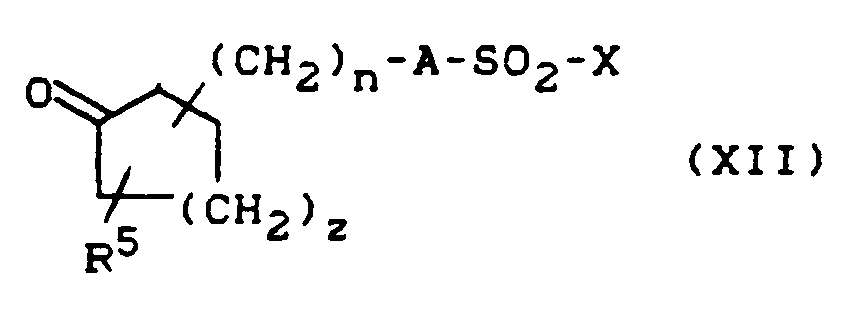
z, n, A, R⁵ und X die oben angegebene Bedeutung haben,
in inerten Lösemitteln, gegebenenfalls in Anwesenheit eines Katalysators umsetzt,
im Fall der Herstellung der Säuren (Y=COOH) die Ester oder Cyanogruppe nach üblicher Methode verseift,
im Fall der Herstellung von Estern (Y= C₁-C₈-Alkoxycarbonyl, Phenoxycarbonyl) die Säuren mit den entsprechenden Alkoholen in Gegenwart eines Katalysators gegebenenfalls in inerten Lösemitteln nach üblicher Methode umsetzt, oder Ester nach üblichen Methoden umestert,
im Fall der Herstellung der Amide und Acylsulfonsäureamide (Y= -CONR⁷R⁸, -CO-NHSO₂-R⁶) entweder direkt die Ester oder die Säuren nach üblicher Aktivierung, mit den Aminen oder Sulfonsäureamiden der allgemeinen Formeln (Xa) und (Xb) gegebenenfalls in Anwesenheit eines Katalysators umsetzt,
im Fall, daß Y für den Tetrazolring steht, die Cyanoverbindung (Y = CN) in Anwesenheit von Triethylaminhydrochlorid mit Natriumazid umsetzt,
oder indem man

R¹', R²', R³', R⁴' und R⁵' die angegebene Bedeutung haben, jedoch nicht für eine Gruppe der Formel -D, -E-O-L-D, -E-NH-L-D, -E-CO-L-D oder -ED steht,
A' für die Gruppe -NH- steht und
m, Y, X und z die angegebene Bedeutung haben,
die Reste der Formel -D, -E-O-L-D, -E-NH-L-D, -E-CO-L-D oder E-D nach üblichen Methoden, beispielsweise durch nucleophile oder elektrophile aromatische Substitution einführt, und gegebenenfalls Carbonylgruppen nach üblichen Methoden zu Methylengruppen reduziert,
im Falle der Herstellung der Säuren (Y = -COOH) die Ester nach üblicher Methode verseift,
im Fall der Variation der Ester (Y = C₁-C₈-Alkoxycarbonyl, Phenoxycarbonyl) die Säuren mit den entsprechenden Alkoholen in Gegenwart eines Katalysators gegebenenfalls in inerten Lösemitteln nach üblicher Methode umsetzt,
im Fall der Amide und Acylsulfonsäureamide (Y = -CONR⁷R⁸, -CO-NHSO₂-R⁶) entweder direkt die Ester oder die Säuren nach üblicher Aktivierung, mit den Aminen oder Sulfonsäureamiden der allgemeinen Formeln (Xa) und (Xb) gegebenenfalls in Gegenwart eines Katalysators umsetzt,
und dann im Fall der heterocyclisch substituierten Cycloalkano[b]-dihydroindolsulfonamide die nach Verfahren [A], [B] oder [C] hergestellten heterocyclisch substituierten Indolsulfonamide in Gegenwart eines Reduktionsmittels in inerten Lösemitteln reduziert,
gegebenenfalls die Isomeren trennt und
im Fall der Herstellung der Salze mit einer entsprechenden Base oder Säure umsetzt.
wherein
R⁶ - straight-chain or branched alkyl with up to 8 carbon atoms or aryl with 6 to 10 carbon atoms, which in turn is substituted by halogen, nitro, cyano or trifluoromethyl
and
w - represents a number 0, 1 or 2,
or
wherein
R⁷ and R⁸ are the same or different and
-S (O) w R⁶ or
wherein
w, R⁶, R⁷ and R⁸ have the meaning given above,
or
-D, -EOLD, -E-NH-LD, -E-CO-LD or -ED
stand,
wherein
D - is a 3- to 7-membered, saturated or unsaturated heterocycle with up to 4 heteroatoms from the series N, O or S, to which further aromatic or heterocyclic rings can be fused,
and
E and L are the same or different and
or
can be substituted by a group of the formula -S (O) w R⁶ or - NR⁷R⁸,
wherein
w, R⁶, R⁷ and R⁸ have the meaning given above,
or
wherein
D and E have the meaning given above,
wherein
G is hydroxyl, alkoxy having up to 8 carbon atoms, phenoxy or a group of the formula -NR⁷R⁸ or -NH-SO₂-R⁶,
wherein
R⁶, R⁷ and R⁸ have the meaning given above,
or
optionally in an isomeric form and their salts, characterized in that
Compounds of the general formula (VIII)
R¹, R², R³, R⁴, R⁵, z, n, A and X have the meaning given above,
with acrylonitrile, optionally in the presence of a base in inert solvents to give compounds of the general formula (IX)
R¹, R², R³, R⁴, R⁵, z, n, A and X have the meaning given above,
implements
in the event that Y represents the tetrazole ring, this is reacted with sodium azide in the presence of triethylamine hydrochloride,
or in the case of the production of the acids (Y = COOH) the cyano group is saponified by the customary method,
in the case of the preparation of the esters (Y = C₁-C₈-alkoxycarbonyl, phenoxycarbonyl), the acids are reacted with the corresponding alcohols in the presence of a catalyst, if appropriate in inert solvents by the customary method,
in the case of the production of the amides and acylsulfonic acid amides (Y = -CONR⁷R⁸, -CO-NHSO₂-R⁶) either the esters or the acids after customary activation, with the amines or sulfonic acid amides of the general formulas (Xa) and (Xb)
HNR⁷R⁸ (Xa)
NH₂SO₂-R⁶ (Xb)
in which
R⁶, R⁷ and R⁸ have the meaning given above,
if appropriate in the presence of a catalyst,
or by
R¹, R², R³, R⁴, and m have the meaning given above,
and
Y '- represents (C₁-C₄) alkoxycarbonyl or cyano,
with cycloalkanone sulfonamides of the general formula (XII)
z, n, A, R⁵ and X have the meaning given above,
in inert solvents, if appropriate in the presence of a catalyst,
in the case of the production of the acids (Y = COOH) the ester or cyano group is saponified by the customary method,
in the case of the preparation of esters (Y = C₁-C₈-alkoxycarbonyl, phenoxycarbonyl), the acids are reacted with the corresponding alcohols in the presence of a catalyst, if appropriate in inert solvents, using the customary method, or ester is transesterified using the customary methods,
in the case of the production of the amides and acylsulfonamides (Y = -CONR⁷R⁸, -CO-NHSO₂-R⁶) either directly the esters or the acids after customary activation, with the amines or sulfonamides of the general formulas (Xa) and (Xb) if appropriate in the presence of a catalyst,
in the event that Y represents the tetrazole ring, the cyano compound (Y = CN) is reacted with sodium azide in the presence of triethylamine hydrochloride,
or by
R¹ ', R²', R³ ', R⁴' and R⁵ 'have the meaning given, but do not represent a group of the formula -D, -EOLD, -E-NH-LD, -E-CO-LD or -ED,
A 'stands for the group -NH- and
m, Y, X and z have the meaning given,
introduces the radicals of the formula -D, -EOLD, -E-NH-LD, -E-CO-LD or ED by customary methods, for example by nucleophilic or electrophilic aromatic substitution, and optionally reduces carbonyl groups to methylene groups by customary methods,
in the case of the production of the acids (Y = -COOH), the esters are saponified by the customary method,
in the case of variation of the esters (Y = C₁-C₈-alkoxycarbonyl, phenoxycarbonyl), the acids are reacted with the corresponding alcohols in the presence of a catalyst, if appropriate in inert solvents by the customary method,
in the case of the amides and acylsulfonamides (Y = -CONR⁷R⁸, -CO-NHSO₂-R⁶) either directly the esters or the acids after customary activation, with the amines or sulfonamides of the general formulas (Xa) and (Xb), if appropriate in the presence of a catalyst implements
and then in the case of the heterocyclically substituted cycloalkano [b] dihydroindole sulfonamides, the heterocyclically substituted indole sulfonamides prepared by processes [A], [B] or [C] are reduced in the presence of a reducing agent in inert solvents,
optionally separating the isomers and
in the case of the preparation of the salts with an appropriate base or acid.
Applications Claiming Priority (2)
| Application Number | Priority Date | Filing Date | Title |
|---|---|---|---|
| DE4027278A DE4027278A1 (en) | 1990-08-29 | 1990-08-29 | HETEROCYCLICALLY SUBSTITUTED INDOLSULFONAMIDE |
| DE4027278 | 1990-08-29 |
Publications (1)
| Publication Number | Publication Date |
|---|---|
| EP0473024A1 true EP0473024A1 (en) | 1992-03-04 |
Family
ID=6413131
Family Applications (1)
| Application Number | Title | Priority Date | Filing Date |
|---|---|---|---|
| EP91113731A Withdrawn EP0473024A1 (en) | 1990-08-29 | 1991-08-16 | Heterocyclic substituted cycloalkano(b)-indolesulfonamides |
Country Status (4)
| Country | Link |
|---|---|
| US (1) | US5223517A (en) |
| EP (1) | EP0473024A1 (en) |
| JP (1) | JPH04257578A (en) |
| DE (1) | DE4027278A1 (en) |
Cited By (3)
| Publication number | Priority date | Publication date | Assignee | Title |
|---|---|---|---|---|
| WO2003097042A1 (en) * | 2002-05-16 | 2003-11-27 | Shionogi & Co., Ltd. | Pgd2 receptor antagonist |
| WO2003097598A1 (en) * | 2002-05-16 | 2003-11-27 | Shionogi & Co., Ltd. | Compound exhibiting pgd 2 receptor antagonism |
| WO2010008864A3 (en) * | 2008-06-24 | 2010-04-01 | Amira Pharmaceuticals, Inc. | Cycloalkane[b]indole angtagonists of prostaglandin d2 receptors |
Families Citing this family (12)
| Publication number | Priority date | Publication date | Assignee | Title |
|---|---|---|---|---|
| US5708187A (en) * | 1996-06-27 | 1998-01-13 | Eli Lilly And Company | 6-substituted-1,2,3,4-tetrahydro-9H-carbazoles and 7-substituted-10H-cyclohepta 7,6-B!indoles: New 5-HT1F agonists |
| US20020035104A1 (en) * | 2000-08-18 | 2002-03-21 | Genentech, Inc. | Integrin receptor inhibitors |
| NZ539682A (en) | 2001-01-29 | 2006-03-31 | Dimensional Pharm Inc | Substituted indoles and their use as integrin antagonists |
| US6872730B2 (en) * | 2001-04-27 | 2005-03-29 | 3-Dimensional Pharmaceuticals, Inc. | Substituted benzofurans and benzothiophenes, methods of making and methods of use as integrin antagonists |
| TW200400963A (en) | 2002-05-21 | 2004-01-16 | Wyeth Corp | R-enantiomers of pyranoindole derivatives and the use thereof for the treatment of hepatitis C virus infection or disease |
| TW200400818A (en) | 2002-05-21 | 2004-01-16 | Wyeth Corp | Method for the use of pyranoindole derivatives to treat infection with hepatitis C virus |
| US20060004010A1 (en) * | 2002-07-10 | 2006-01-05 | Hiromu Habashita | Ccr4 antagonist and medical use thereof |
| CN101203491A (en) * | 2005-06-24 | 2008-06-18 | 伊莱利利公司 | Tetrahydrocarbazole derivatives (SARMs) useful as androgen receptor modulators |
| UA98777C2 (en) * | 2006-11-20 | 2012-06-25 | Эли Лилли Энд Компани | Tetrahydrocyclopenta[b]indole compounds as androgen receptor modulators |
| BRPI0912394A2 (en) * | 2008-05-16 | 2016-07-26 | Lilly Co Eli | androgen receptor modulators based on tetrahydrocyclopenta [b] indole |
| US20110112134A1 (en) * | 2008-05-16 | 2011-05-12 | Amira Pharmaceuticals, Inc. | Tricyclic Antagonists of Prostaglandin D2 Receptors |
| GB2465062B (en) * | 2008-11-06 | 2011-04-13 | Amira Pharmaceuticals Inc | Cycloalkane(B)azaindole antagonists of prostaglandin D2 receptors |
Citations (4)
| Publication number | Priority date | Publication date | Assignee | Title |
|---|---|---|---|---|
| DE3631824A1 (en) * | 1986-02-21 | 1988-03-31 | Bayer Ag | CYCLOALKANO (1.2-B) INDOL-SULFONAMIDE |
| EP0269452A2 (en) * | 1986-11-28 | 1988-06-01 | Glaxo Group Limited | Use of ketone derivatives for the manufacture of medicaments |
| EP0300675A2 (en) * | 1987-07-21 | 1989-01-25 | Merck Frosst Canada Inc. | Method for the improvement of cyclosporine therapy |
| US4988820A (en) * | 1986-02-21 | 1991-01-29 | Bayer Aktiengesellschaft | Cycloalkano(1,2-B) indole-sulponamides |
-
1990
- 1990-08-29 DE DE4027278A patent/DE4027278A1/en not_active Withdrawn
-
1991
- 1991-08-16 EP EP91113731A patent/EP0473024A1/en not_active Withdrawn
- 1991-08-22 JP JP3233694A patent/JPH04257578A/en active Pending
- 1991-08-23 US US07/749,018 patent/US5223517A/en not_active Expired - Fee Related
Patent Citations (4)
| Publication number | Priority date | Publication date | Assignee | Title |
|---|---|---|---|---|
| DE3631824A1 (en) * | 1986-02-21 | 1988-03-31 | Bayer Ag | CYCLOALKANO (1.2-B) INDOL-SULFONAMIDE |
| US4988820A (en) * | 1986-02-21 | 1991-01-29 | Bayer Aktiengesellschaft | Cycloalkano(1,2-B) indole-sulponamides |
| EP0269452A2 (en) * | 1986-11-28 | 1988-06-01 | Glaxo Group Limited | Use of ketone derivatives for the manufacture of medicaments |
| EP0300675A2 (en) * | 1987-07-21 | 1989-01-25 | Merck Frosst Canada Inc. | Method for the improvement of cyclosporine therapy |
Non-Patent Citations (3)
| Title |
|---|
| CHEMICAL ABSTRACTS, Band 110, Nr. 9, 27. Februar 1989, Columbus, Ohio, USA BOSHAGEN, HORST et al. "Preparation of cycloalkano (1,2-b)indole-substituted arenesulfonamides as blood platelet aggregation inhibitors" Seite 632, Spalte 1, Zu- sammenfassung-Nr. 75 309f * |
| CHEMICAL ABSTRACTS, Band 69, Nr. 9, 26. August 1968, Columbus, Ohio, USA OKAWA, KATSUAKI et al. "Basic dyes for poly- acrylonitrile fibers" Seite 3485, Spalte 1, Zu- sammenfassung-Nr. 37 117u * |
| CHEMICAL ABSTRACTS, Band 85, Nr. 13, 27. September 1976, Columbus, Ohio, USA HAHN, WITOLD et al. "Salts of 1-(omega-guanidino- alkyl)indoles" Seite 621, Spalte 2, Zu- sammenfassung-Nr. 94 224f * |
Cited By (5)
| Publication number | Priority date | Publication date | Assignee | Title |
|---|---|---|---|---|
| WO2003097042A1 (en) * | 2002-05-16 | 2003-11-27 | Shionogi & Co., Ltd. | Pgd2 receptor antagonist |
| WO2003097598A1 (en) * | 2002-05-16 | 2003-11-27 | Shionogi & Co., Ltd. | Compound exhibiting pgd 2 receptor antagonism |
| US7534897B2 (en) | 2002-05-16 | 2009-05-19 | Shionogi & Co., Ltd. | Indole arylsulfonaimide compounds exhibiting PGD 2 receptor antagonism |
| EP2423190A1 (en) * | 2002-05-16 | 2012-02-29 | Shionogi&Co., Ltd. | Compounds Exhibiting PGD 2 Receptor Antagonism |
| WO2010008864A3 (en) * | 2008-06-24 | 2010-04-01 | Amira Pharmaceuticals, Inc. | Cycloalkane[b]indole angtagonists of prostaglandin d2 receptors |
Also Published As
| Publication number | Publication date |
|---|---|
| DE4027278A1 (en) | 1992-03-05 |
| JPH04257578A (en) | 1992-09-11 |
| US5223517A (en) | 1993-06-29 |
Similar Documents
| Publication | Publication Date | Title |
|---|---|---|
| EP0546388B1 (en) | Azaheterocyclylmethyl-chromans as agents for the treatment of diseases of the central nervous system | |
| EP0934311B1 (en) | New heterocyclylmethyl-substituted pyrazol derivates | |
| EP0242518B1 (en) | Cycloalkano[1,2-b]indole-sulfonamides | |
| EP1017692B1 (en) | 4-heteroaryl-tetrahydroquinolines and their use as inhibitors of the cholesterin-ester transfer protein | |
| EP0344519B1 (en) | Substituted 4-(quinolin-2-yl-methoxy)phenyl-acetic-acid derivatives | |
| EP0473024A1 (en) | Heterocyclic substituted cycloalkano(b)-indolesulfonamides | |
| EP0569795B1 (en) | Sulphonylbenzyl substituted benzo- and pyridopyridones | |
| EP0499926A1 (en) | 2-Substituted quinolines, process for their preparation as well as their use in medicaments | |
| DE3617183A1 (en) | SUBSTITUTED BENZYL ETHERS | |
| DE69101330T2 (en) | Cycloalkano [b] dihydroindoles and indolesulfonamides substituted with a heterocyclic ring. | |
| EP0425906A2 (en) | Substituted cycloalkano[b]dihydroindol- and -indolsulfonamides | |
| EP0722943A1 (en) | 9-Substituted 2-(2-n-alkoxyphenyl)-purin-6-ones | |
| EP0716082A1 (en) | Oxy-phenyl-(phenyl)glycinolamides substituted with a heterocycle having antiatherosclerotic activity | |
| EP0719763A1 (en) | 4-(Quinolin-2-yl-methoxy)-phenyl acetic acid derivatives with antiatherosclerotic activity | |
| EP0471259B1 (en) | Phenylsulfonamid substituted pyridinealken- and aminooxyalkan-carboxylic-acid derivatives | |
| EP0546389B1 (en) | Piperidylmethyl substituted chroman derivatives as agents for the treatment of diseases of the central nervous system | |
| EP0530639B1 (en) | Quinolylmethoxy-phenylacetamides substituted by a heterocycle as lipoxygenase inhibitors | |
| EP0539803B1 (en) | Triazospirodecanone-methyl-chromans for the treatment of central nervous system illnesses | |
| EP0582908B1 (en) | 2-Substituted quinolylmethoxy-phenylacetic acid- and -benzylacyl derivatives, process for their preparation and their use as inhibitors of leukotriene synthesis | |
| DE4139751A1 (en) | THIAZOLYL SUBSTITUTED CHINOLYL METHOXYPHENYL ACETIC DERIVATIVES | |
| EP0519291A1 (en) | Amino-methyl substituted 2,3-Dihydropyrano (2,3-b) pyridines, process for their preparation and their use in medicines | |
| EP0765878A1 (en) | Heterocyclic aryl-, alkyl- and cycloalkylacetic acid amides | |
| DE4139749A1 (en) | CHINOLYL METHOXYPHENYL ACETIC ACID AMIDE | |
| EP0582916A1 (en) | N-methansulfonyl-2-(3-isobutyl-3-(quinol-2-yl-methoxy)-phenyl)-2-cycloalkylacetamides, process for their preparation and their pharmaceutical use | |
| EP0308608A1 (en) | Substituted nitro-dihydropyridines, process for their preparation and their use |
Legal Events
| Date | Code | Title | Description |
|---|---|---|---|
| PUAI | Public reference made under article 153(3) epc to a published international application that has entered the european phase |
Free format text: ORIGINAL CODE: 0009012 |
|
| AK | Designated contracting states |
Kind code of ref document: A1 Designated state(s): AT BE CH DE DK ES FR GB GR IT LI LU NL SE |
|
| 17P | Request for examination filed |
Effective date: 19920429 |
|
| 17Q | First examination report despatched |
Effective date: 19950421 |
|
| STAA | Information on the status of an ep patent application or granted ep patent |
Free format text: STATUS: THE APPLICATION HAS BEEN WITHDRAWN |
|
| 18W | Application withdrawn |
Withdrawal date: 19951115 |