EP0380805A1 - Renin inhibitors containing C-terminal dihydroxy amides - Google Patents
Renin inhibitors containing C-terminal dihydroxy amides Download PDFInfo
- Publication number
- EP0380805A1 EP0380805A1 EP89123653A EP89123653A EP0380805A1 EP 0380805 A1 EP0380805 A1 EP 0380805A1 EP 89123653 A EP89123653 A EP 89123653A EP 89123653 A EP89123653 A EP 89123653A EP 0380805 A1 EP0380805 A1 EP 0380805A1
- Authority
- EP
- European Patent Office
- Prior art keywords
- produce
- product
- renin
- pharmaceutically acceptable
- defined above
- Prior art date
- Legal status (The legal status is an assumption and is not a legal conclusion. Google has not performed a legal analysis and makes no representation as to the accuracy of the status listed.)
- Withdrawn
Links
- 239000002461 renin inhibitor Substances 0.000 title description 8
- 229940086526 renin-inhibitors Drugs 0.000 title description 8
- 210000004899 c-terminal region Anatomy 0.000 title description 2
- AMEDKBHURXXSQO-UHFFFAOYSA-N azonous acid Chemical group ONO AMEDKBHURXXSQO-UHFFFAOYSA-N 0.000 title 1
- 150000001875 compounds Chemical class 0.000 claims abstract description 45
- 238000000034 method Methods 0.000 claims abstract description 36
- 108090000765 processed proteins & peptides Proteins 0.000 claims abstract description 26
- 108090000783 Renin Proteins 0.000 claims abstract description 17
- 102100028255 Renin Human genes 0.000 claims abstract description 17
- 206010020772 Hypertension Diseases 0.000 claims abstract description 12
- 206010020571 Hyperaldosteronism Diseases 0.000 claims abstract description 10
- 201000009395 primary hyperaldosteronism Diseases 0.000 claims abstract description 10
- 206010007559 Cardiac failure congestive Diseases 0.000 claims abstract description 8
- 206010019280 Heart failures Diseases 0.000 claims abstract description 8
- 230000008569 process Effects 0.000 claims abstract description 6
- YMWUJEATGCHHMB-UHFFFAOYSA-N Dichloromethane Chemical compound ClCCl YMWUJEATGCHHMB-UHFFFAOYSA-N 0.000 claims description 63
- -1 -C2H3 Chemical group 0.000 claims description 21
- 238000002360 preparation method Methods 0.000 claims description 19
- 239000008194 pharmaceutical composition Substances 0.000 claims description 18
- 229920006395 saturated elastomer Polymers 0.000 claims description 15
- 150000003839 salts Chemical class 0.000 claims description 14
- 125000000217 alkyl group Chemical group 0.000 claims description 12
- 239000003937 drug carrier Substances 0.000 claims description 12
- 125000001449 isopropyl group Chemical group [H]C([H])([H])C([H])(*)C([H])([H])[H] 0.000 claims description 11
- 125000002496 methyl group Chemical group [H]C([H])([H])* 0.000 claims description 11
- VEXZGXHMUGYJMC-UHFFFAOYSA-N Hydrochloric acid Chemical compound Cl VEXZGXHMUGYJMC-UHFFFAOYSA-N 0.000 claims description 10
- 125000004432 carbon atom Chemical group C* 0.000 claims description 10
- 241000124008 Mammalia Species 0.000 claims description 9
- IXCSERBJSXMMFS-UHFFFAOYSA-N hydrogen chloride Substances Cl.Cl IXCSERBJSXMMFS-UHFFFAOYSA-N 0.000 claims description 9
- 229910000041 hydrogen chloride Inorganic materials 0.000 claims description 9
- 125000000956 methoxy group Chemical group [H]C([H])([H])O* 0.000 claims description 9
- 125000001797 benzyl group Chemical group [H]C1=C([H])C([H])=C(C([H])=C1[H])C([H])([H])* 0.000 claims description 8
- 125000001495 ethyl group Chemical group [H]C([H])([H])C([H])([H])* 0.000 claims description 6
- OCBFFGCSTGGPSQ-UHFFFAOYSA-N [CH2]CC Chemical compound [CH2]CC OCBFFGCSTGGPSQ-UHFFFAOYSA-N 0.000 claims description 5
- 125000001436 propyl group Chemical group [H]C([*])([H])C([H])([H])C([H])([H])[H] 0.000 claims description 5
- 239000003586 protic polar solvent Substances 0.000 claims description 5
- 150000001412 amines Chemical class 0.000 claims description 4
- 238000004440 column chromatography Methods 0.000 claims description 4
- 239000012442 inert solvent Substances 0.000 claims description 4
- RWSOTUBLDIXVET-UHFFFAOYSA-N Dihydrogen sulfide Chemical class S RWSOTUBLDIXVET-UHFFFAOYSA-N 0.000 claims description 3
- QUPDWYMUPZLYJZ-UHFFFAOYSA-N ethyl Chemical compound C[CH2] QUPDWYMUPZLYJZ-UHFFFAOYSA-N 0.000 claims description 3
- 229910052717 sulfur Inorganic materials 0.000 claims description 3
- 230000036772 blood pressure Effects 0.000 claims description 2
- 239000003153 chemical reaction reagent Substances 0.000 claims description 2
- 125000000468 ketone group Chemical group 0.000 claims description 2
- RMGJCSHZTFKPNO-UHFFFAOYSA-M magnesium;ethene;bromide Chemical compound [Mg+2].[Br-].[CH-]=C RMGJCSHZTFKPNO-UHFFFAOYSA-M 0.000 claims description 2
- 125000002524 organometallic group Chemical group 0.000 claims description 2
- 229910052760 oxygen Inorganic materials 0.000 claims description 2
- 125000000999 tert-butyl group Chemical group [H]C([H])([H])C(*)(C([H])([H])[H])C([H])([H])[H] 0.000 claims description 2
- ORGHESHFQPYLAO-UHFFFAOYSA-N vinyl radical Chemical group C=[CH] ORGHESHFQPYLAO-UHFFFAOYSA-N 0.000 claims description 2
- 208000001953 Hypotension Diseases 0.000 claims 1
- 208000021822 hypotensive Diseases 0.000 claims 1
- 230000001077 hypotensive effect Effects 0.000 claims 1
- 238000012544 monitoring process Methods 0.000 claims 1
- PGOLTJPQCISRTO-UHFFFAOYSA-N vinyllithium Chemical compound [Li]C=C PGOLTJPQCISRTO-UHFFFAOYSA-N 0.000 claims 1
- 239000000203 mixture Substances 0.000 abstract description 19
- 102000004196 processed proteins & peptides Human genes 0.000 abstract description 15
- 239000000543 intermediate Substances 0.000 abstract description 5
- 208000010412 Glaucoma Diseases 0.000 abstract description 4
- 201000010099 disease Diseases 0.000 abstract description 4
- 208000037265 diseases, disorders, signs and symptoms Diseases 0.000 abstract description 4
- 241001430294 unidentified retrovirus Species 0.000 abstract description 3
- 238000002405 diagnostic procedure Methods 0.000 abstract 1
- 108010026906 renin inhibitory peptide Proteins 0.000 abstract 1
- 239000000243 solution Substances 0.000 description 59
- OKKJLVBELUTLKV-UHFFFAOYSA-N Methanol Chemical compound OC OKKJLVBELUTLKV-UHFFFAOYSA-N 0.000 description 54
- 239000000047 product Substances 0.000 description 46
- RTZKZFJDLAIYFH-UHFFFAOYSA-N Diethyl ether Chemical compound CCOCC RTZKZFJDLAIYFH-UHFFFAOYSA-N 0.000 description 34
- XLYOFNOQVPJJNP-UHFFFAOYSA-N water Substances O XLYOFNOQVPJJNP-UHFFFAOYSA-N 0.000 description 29
- XEKOWRVHYACXOJ-UHFFFAOYSA-N Ethyl acetate Chemical compound CCOC(C)=O XEKOWRVHYACXOJ-UHFFFAOYSA-N 0.000 description 28
- 238000004992 fast atom bombardment mass spectroscopy Methods 0.000 description 27
- BWHMMNNQKKPAPP-UHFFFAOYSA-L potassium carbonate Chemical compound [K+].[K+].[O-]C([O-])=O BWHMMNNQKKPAPP-UHFFFAOYSA-L 0.000 description 22
- WYURNTSHIVDZCO-UHFFFAOYSA-N Tetrahydrofuran Chemical compound C1CCOC1 WYURNTSHIVDZCO-UHFFFAOYSA-N 0.000 description 20
- HEDRZPFGACZZDS-UHFFFAOYSA-N Chloroform Chemical compound ClC(Cl)Cl HEDRZPFGACZZDS-UHFFFAOYSA-N 0.000 description 18
- VYPSYNLAJGMNEJ-UHFFFAOYSA-N Silicium dioxide Chemical compound O=[Si]=O VYPSYNLAJGMNEJ-UHFFFAOYSA-N 0.000 description 17
- 239000000741 silica gel Substances 0.000 description 17
- 229910002027 silica gel Inorganic materials 0.000 description 17
- WORJEOGGNQDSOE-UHFFFAOYSA-N chloroform;methanol Chemical compound OC.ClC(Cl)Cl WORJEOGGNQDSOE-UHFFFAOYSA-N 0.000 description 16
- 239000007788 liquid Substances 0.000 description 16
- 239000007787 solid Substances 0.000 description 16
- LFQSCWFLJHTTHZ-UHFFFAOYSA-N Ethanol Chemical compound CCO LFQSCWFLJHTTHZ-UHFFFAOYSA-N 0.000 description 14
- 239000002904 solvent Substances 0.000 description 13
- CSCPPACGZOOCGX-UHFFFAOYSA-N Acetone Chemical compound CC(C)=O CSCPPACGZOOCGX-UHFFFAOYSA-N 0.000 description 12
- 0 CCN(C)CCC(*C(C(CC1CCCCC1)=N/S=N/*S(N1CCOCC1)(=O)=O)O)=O Chemical compound CCN(C)CCC(*C(C(CC1CCCCC1)=N/S=N/*S(N1CCOCC1)(=O)=O)O)=O 0.000 description 12
- 229910000027 potassium carbonate Inorganic materials 0.000 description 12
- OAYLNYINCPYISS-UHFFFAOYSA-N ethyl acetate;hexane Chemical compound CCCCCC.CCOC(C)=O OAYLNYINCPYISS-UHFFFAOYSA-N 0.000 description 11
- 239000012044 organic layer Substances 0.000 description 11
- IJGRMHOSHXDMSA-UHFFFAOYSA-N Atomic nitrogen Chemical compound N#N IJGRMHOSHXDMSA-UHFFFAOYSA-N 0.000 description 10
- 235000019439 ethyl acetate Nutrition 0.000 description 10
- 238000010898 silica gel chromatography Methods 0.000 description 10
- ZMANZCXQSJIPKH-UHFFFAOYSA-N Triethylamine Chemical compound CCN(CC)CC ZMANZCXQSJIPKH-UHFFFAOYSA-N 0.000 description 9
- 239000002253 acid Substances 0.000 description 9
- 238000007792 addition Methods 0.000 description 9
- 229910052943 magnesium sulfate Inorganic materials 0.000 description 9
- VLKZOEOYAKHREP-UHFFFAOYSA-N n-Hexane Chemical compound CCCCCC VLKZOEOYAKHREP-UHFFFAOYSA-N 0.000 description 9
- QOSSAOTZNIDXMA-UHFFFAOYSA-N Dicylcohexylcarbodiimide Chemical compound C1CCCCC1N=C=NC1CCCCC1 QOSSAOTZNIDXMA-UHFFFAOYSA-N 0.000 description 8
- CSNNHWWHGAXBCP-UHFFFAOYSA-L Magnesium sulfate Chemical compound [Mg+2].[O-][S+2]([O-])([O-])[O-] CSNNHWWHGAXBCP-UHFFFAOYSA-L 0.000 description 8
- 239000002552 dosage form Substances 0.000 description 8
- 239000000463 material Substances 0.000 description 8
- 238000003756 stirring Methods 0.000 description 7
- 239000003826 tablet Substances 0.000 description 7
- DNIAPMSPPWPWGF-UHFFFAOYSA-N Propylene glycol Chemical compound CC(O)CO DNIAPMSPPWPWGF-UHFFFAOYSA-N 0.000 description 6
- HEMHJVSKTPXQMS-UHFFFAOYSA-M Sodium hydroxide Chemical compound [OH-].[Na+] HEMHJVSKTPXQMS-UHFFFAOYSA-M 0.000 description 6
- 238000006243 chemical reaction Methods 0.000 description 6
- 239000012043 crude product Substances 0.000 description 6
- 230000000694 effects Effects 0.000 description 6
- 239000000706 filtrate Substances 0.000 description 6
- BEBCJVAWIBVWNZ-UHFFFAOYSA-N glycinamide Chemical compound NCC(N)=O BEBCJVAWIBVWNZ-UHFFFAOYSA-N 0.000 description 6
- 229910052757 nitrogen Inorganic materials 0.000 description 6
- LFKDJXLFVYVEFG-UHFFFAOYSA-N tert-butyl carbamate Chemical compound CC(C)(C)OC(N)=O LFKDJXLFVYVEFG-UHFFFAOYSA-N 0.000 description 6
- WQADWIOXOXRPLN-UHFFFAOYSA-N 1,3-dithiane Chemical compound C1CSCSC1 WQADWIOXOXRPLN-UHFFFAOYSA-N 0.000 description 5
- YEDUAINPPJYDJZ-UHFFFAOYSA-N 2-hydroxybenzothiazole Chemical compound C1=CC=C2SC(O)=NC2=C1 YEDUAINPPJYDJZ-UHFFFAOYSA-N 0.000 description 5
- DHMQDGOQFOQNFH-UHFFFAOYSA-N Glycine Chemical compound NCC(O)=O DHMQDGOQFOQNFH-UHFFFAOYSA-N 0.000 description 5
- KDXKERNSBIXSRK-UHFFFAOYSA-N Lysine Natural products NCCCCC(N)C(O)=O KDXKERNSBIXSRK-UHFFFAOYSA-N 0.000 description 5
- 239000002775 capsule Substances 0.000 description 5
- 238000001704 evaporation Methods 0.000 description 5
- NPZTUJOABDZTLV-UHFFFAOYSA-N hydroxybenzotriazole Substances O=C1C=CC=C2NNN=C12 NPZTUJOABDZTLV-UHFFFAOYSA-N 0.000 description 5
- 239000000546 pharmaceutical excipient Substances 0.000 description 5
- 239000000843 powder Substances 0.000 description 5
- 125000000391 vinyl group Chemical group [H]C([*])=C([H])[H] 0.000 description 5
- 229920002554 vinyl polymer Chemical group 0.000 description 5
- HSJKGGMUJITCBW-UHFFFAOYSA-N 3-hydroxybutanal Chemical compound CC(O)CC=O HSJKGGMUJITCBW-UHFFFAOYSA-N 0.000 description 4
- KDLHZDBZIXYQEI-UHFFFAOYSA-N Palladium Chemical compound [Pd] KDLHZDBZIXYQEI-UHFFFAOYSA-N 0.000 description 4
- UIIMBOGNXHQVGW-UHFFFAOYSA-M Sodium bicarbonate Chemical compound [Na+].OC([O-])=O UIIMBOGNXHQVGW-UHFFFAOYSA-M 0.000 description 4
- 229940024606 amino acid Drugs 0.000 description 4
- 150000001413 amino acids Chemical class 0.000 description 4
- 230000015572 biosynthetic process Effects 0.000 description 4
- KRKNYBCHXYNGOX-UHFFFAOYSA-N citric acid Chemical class OC(=O)CC(O)(C(O)=O)CC(O)=O KRKNYBCHXYNGOX-UHFFFAOYSA-N 0.000 description 4
- 238000010168 coupling process Methods 0.000 description 4
- 230000008020 evaporation Effects 0.000 description 4
- 238000001914 filtration Methods 0.000 description 4
- 238000003818 flash chromatography Methods 0.000 description 4
- 239000012458 free base Substances 0.000 description 4
- 125000004051 hexyl group Chemical group [H]C([H])([H])C([H])([H])C([H])([H])C([H])([H])C([H])([H])C([H])([H])* 0.000 description 4
- 229960005190 phenylalanine Drugs 0.000 description 4
- 238000000746 purification Methods 0.000 description 4
- 239000011541 reaction mixture Substances 0.000 description 4
- 239000000725 suspension Substances 0.000 description 4
- 238000003786 synthesis reaction Methods 0.000 description 4
- YLQBMQCUIZJEEH-UHFFFAOYSA-N tetrahydrofuran Natural products C=1C=COC=1 YLQBMQCUIZJEEH-UHFFFAOYSA-N 0.000 description 4
- UMMQVDUMUMBTAV-YFKPBYRVSA-N (2s)-2-amino-3-(1h-imidazol-5-yl)propanamide Chemical compound NC(=O)[C@@H](N)CC1=CN=CN1 UMMQVDUMUMBTAV-YFKPBYRVSA-N 0.000 description 3
- PABCDNCNBSROLD-UHFFFAOYSA-N 2-amino-1-cyclohexylheptane-3,5-diol Chemical compound CCC(O)CC(O)C(N)CC1CCCCC1 PABCDNCNBSROLD-UHFFFAOYSA-N 0.000 description 3
- 101800000734 Angiotensin-1 Proteins 0.000 description 3
- 102400000344 Angiotensin-1 Human genes 0.000 description 3
- 102000004881 Angiotensinogen Human genes 0.000 description 3
- 108090001067 Angiotensinogen Proteins 0.000 description 3
- 108090000790 Enzymes Proteins 0.000 description 3
- 102000004190 Enzymes Human genes 0.000 description 3
- 239000004471 Glycine Substances 0.000 description 3
- KFZMGEQAYNKOFK-UHFFFAOYSA-N Isopropanol Chemical compound CC(C)O KFZMGEQAYNKOFK-UHFFFAOYSA-N 0.000 description 3
- COLNVLDHVKWLRT-QMMMGPOBSA-N L-phenylalanine Chemical compound OC(=O)[C@@H](N)CC1=CC=CC=C1 COLNVLDHVKWLRT-QMMMGPOBSA-N 0.000 description 3
- 239000004472 Lysine Substances 0.000 description 3
- LIWAQLJGPBVORC-UHFFFAOYSA-N N-ethyl-N-methylamine Natural products CCNC LIWAQLJGPBVORC-UHFFFAOYSA-N 0.000 description 3
- XSQUKJJJFZCRTK-UHFFFAOYSA-N Urea Chemical compound NC(N)=O XSQUKJJJFZCRTK-UHFFFAOYSA-N 0.000 description 3
- 239000004480 active ingredient Substances 0.000 description 3
- 238000004458 analytical method Methods 0.000 description 3
- ORWYRWWVDCYOMK-HBZPZAIKSA-N angiotensin I Chemical compound C([C@@H](C(=O)N[C@@H]([C@@H](C)CC)C(=O)N[C@@H](CC=1NC=NC=1)C(=O)N1[C@@H](CCC1)C(=O)N[C@@H](CC=1C=CC=CC=1)C(=O)N[C@@H](CC=1NC=NC=1)C(=O)N[C@@H](CC(C)C)C(O)=O)NC(=O)[C@@H](NC(=O)[C@H](CCCN=C(N)N)NC(=O)[C@@H](N)CC(O)=O)C(C)C)C1=CC=C(O)C=C1 ORWYRWWVDCYOMK-HBZPZAIKSA-N 0.000 description 3
- 125000003118 aryl group Chemical group 0.000 description 3
- 239000002585 base Substances 0.000 description 3
- 239000003795 chemical substances by application Substances 0.000 description 3
- 238000001816 cooling Methods 0.000 description 3
- 230000008878 coupling Effects 0.000 description 3
- 238000005859 coupling reaction Methods 0.000 description 3
- UAOMVDZJSHZZME-UHFFFAOYSA-N diisopropylamine Chemical compound CC(C)NC(C)C UAOMVDZJSHZZME-UHFFFAOYSA-N 0.000 description 3
- 238000004090 dissolution Methods 0.000 description 3
- 150000002148 esters Chemical class 0.000 description 3
- 239000012634 fragment Substances 0.000 description 3
- 239000001257 hydrogen Substances 0.000 description 3
- 229910052739 hydrogen Inorganic materials 0.000 description 3
- 239000010410 layer Substances 0.000 description 3
- 239000012074 organic phase Substances 0.000 description 3
- UCUUFSAXZMGPGH-UHFFFAOYSA-N penta-1,4-dien-3-one Chemical compound C=CC(=O)C=C UCUUFSAXZMGPGH-UHFFFAOYSA-N 0.000 description 3
- 125000006239 protecting group Chemical group 0.000 description 3
- 125000000446 sulfanediyl group Chemical group *S* 0.000 description 3
- CUKWUWBLQQDQAC-VEQWQPCFSA-N (3s)-3-amino-4-[[(2s)-1-[[(2s)-1-[[(2s)-1-[[(2s,3s)-1-[[(2s)-1-[(2s)-2-[[(1s)-1-carboxyethyl]carbamoyl]pyrrolidin-1-yl]-3-(1h-imidazol-5-yl)-1-oxopropan-2-yl]amino]-3-methyl-1-oxopentan-2-yl]amino]-3-(4-hydroxyphenyl)-1-oxopropan-2-yl]amino]-3-methyl-1-ox Chemical compound C([C@@H](C(=O)N[C@@H]([C@@H](C)CC)C(=O)N[C@@H](CC=1NC=NC=1)C(=O)N1[C@@H](CCC1)C(=O)N[C@@H](C)C(O)=O)NC(=O)[C@@H](NC(=O)[C@H](CCCN=C(N)N)NC(=O)[C@@H](N)CC(O)=O)C(C)C)C1=CC=C(O)C=C1 CUKWUWBLQQDQAC-VEQWQPCFSA-N 0.000 description 2
- PJUPKRYGDFTMTM-UHFFFAOYSA-N 1-hydroxybenzotriazole;hydrate Chemical compound O.C1=CC=C2N(O)N=NC2=C1 PJUPKRYGDFTMTM-UHFFFAOYSA-N 0.000 description 2
- SAUKHSQMWIGUBP-UHFFFAOYSA-N 2-(cyclohexylmethyl)-3-(oxan-2-yloxy)-5-oxopyrrolidine-1-carboxylic acid Chemical compound C1CCCOC1OC1CC(=O)N(C(=O)O)C1CC1CCCCC1 SAUKHSQMWIGUBP-UHFFFAOYSA-N 0.000 description 2
- QCQCHGYLTSGIGX-GHXANHINSA-N 4-[[(3ar,5ar,5br,7ar,9s,11ar,11br,13as)-5a,5b,8,8,11a-pentamethyl-3a-[(5-methylpyridine-3-carbonyl)amino]-2-oxo-1-propan-2-yl-4,5,6,7,7a,9,10,11,11b,12,13,13a-dodecahydro-3h-cyclopenta[a]chrysen-9-yl]oxy]-2,2-dimethyl-4-oxobutanoic acid Chemical compound N([C@@]12CC[C@@]3(C)[C@]4(C)CC[C@H]5C(C)(C)[C@@H](OC(=O)CC(C)(C)C(O)=O)CC[C@]5(C)[C@H]4CC[C@@H]3C1=C(C(C2)=O)C(C)C)C(=O)C1=CN=CC(C)=C1 QCQCHGYLTSGIGX-GHXANHINSA-N 0.000 description 2
- QTBSBXVTEAMEQO-UHFFFAOYSA-N Acetic acid Chemical compound CC(O)=O QTBSBXVTEAMEQO-UHFFFAOYSA-N 0.000 description 2
- VHUUQVKOLVNVRT-UHFFFAOYSA-N Ammonium hydroxide Chemical compound [NH4+].[OH-] VHUUQVKOLVNVRT-UHFFFAOYSA-N 0.000 description 2
- 102000005862 Angiotensin II Human genes 0.000 description 2
- 101800000733 Angiotensin-2 Proteins 0.000 description 2
- OKTJSMMVPCPJKN-UHFFFAOYSA-N Carbon Chemical compound [C] OKTJSMMVPCPJKN-UHFFFAOYSA-N 0.000 description 2
- XBPCUCUWBYBCDP-UHFFFAOYSA-N Dicyclohexylamine Chemical class C1CCCCC1NC1CCCCC1 XBPCUCUWBYBCDP-UHFFFAOYSA-N 0.000 description 2
- PEDCQBHIVMGVHV-UHFFFAOYSA-N Glycerine Chemical compound OCC(O)CO PEDCQBHIVMGVHV-UHFFFAOYSA-N 0.000 description 2
- 206010020460 Human T-cell lymphotropic virus type I infection Diseases 0.000 description 2
- 241000714260 Human T-lymphotropic virus 1 Species 0.000 description 2
- 241000714259 Human T-lymphotropic virus 2 Species 0.000 description 2
- UFHFLCQGNIYNRP-UHFFFAOYSA-N Hydrogen Chemical compound [H][H] UFHFLCQGNIYNRP-UHFFFAOYSA-N 0.000 description 2
- HKXLAGBDJVHRQG-YFKPBYRVSA-N L-lysinamide Chemical compound NCCCC[C@H](N)C(N)=O HKXLAGBDJVHRQG-YFKPBYRVSA-N 0.000 description 2
- LGDSHSYDSCRFAB-UHFFFAOYSA-N Methyl isothiocyanate Chemical compound CN=C=S LGDSHSYDSCRFAB-UHFFFAOYSA-N 0.000 description 2
- MZRVEZGGRBJDDB-UHFFFAOYSA-N N-Butyllithium Chemical compound [Li]CCCC MZRVEZGGRBJDDB-UHFFFAOYSA-N 0.000 description 2
- PMZURENOXWZQFD-UHFFFAOYSA-L Sodium Sulfate Chemical compound [Na+].[Na+].[O-]S([O-])(=O)=O PMZURENOXWZQFD-UHFFFAOYSA-L 0.000 description 2
- SLUYRWVNOBSNMI-UHFFFAOYSA-N [1-cyclohexyl-3-(oxan-2-yloxy)-5-oxoheptan-2-yl]carbamic acid Chemical compound C1CCCCC1CC(NC(O)=O)C(CC(=O)CC)OC1CCCCO1 SLUYRWVNOBSNMI-UHFFFAOYSA-N 0.000 description 2
- 239000012445 acidic reagent Substances 0.000 description 2
- 230000003213 activating effect Effects 0.000 description 2
- 239000000908 ammonium hydroxide Substances 0.000 description 2
- 229950006323 angiotensin ii Drugs 0.000 description 2
- 230000037396 body weight Effects 0.000 description 2
- 125000000484 butyl group Chemical group [H]C([*])([H])C([H])([H])C([H])([H])C([H])([H])[H] 0.000 description 2
- 239000000969 carrier Substances 0.000 description 2
- 239000003054 catalyst Substances 0.000 description 2
- 238000000262 chemical ionisation mass spectrometry Methods 0.000 description 2
- 238000004587 chromatography analysis Methods 0.000 description 2
- 229940110456 cocoa butter Drugs 0.000 description 2
- 235000019868 cocoa butter Nutrition 0.000 description 2
- MHDFJESNGMDHQD-UHFFFAOYSA-N dimethyl 2-aminopropanedioate Chemical compound COC(=O)C(N)C(=O)OC MHDFJESNGMDHQD-UHFFFAOYSA-N 0.000 description 2
- 150000002009 diols Chemical class 0.000 description 2
- 238000001035 drying Methods 0.000 description 2
- 239000000839 emulsion Substances 0.000 description 2
- 239000000796 flavoring agent Substances 0.000 description 2
- 239000006260 foam Substances 0.000 description 2
- 238000009472 formulation Methods 0.000 description 2
- 239000007789 gas Substances 0.000 description 2
- HNDVDQJCIGZPNO-UHFFFAOYSA-N histidine Natural products OC(=O)C(N)CC1=CN=CN1 HNDVDQJCIGZPNO-UHFFFAOYSA-N 0.000 description 2
- 238000002347 injection Methods 0.000 description 2
- 239000007924 injection Substances 0.000 description 2
- 150000002576 ketones Chemical class 0.000 description 2
- 210000003734 kidney Anatomy 0.000 description 2
- HQKMJHAJHXVSDF-UHFFFAOYSA-L magnesium stearate Chemical compound [Mg+2].CCCCCCCCCCCCCCCCCC([O-])=O.CCCCCCCCCCCCCCCCCC([O-])=O HQKMJHAJHXVSDF-UHFFFAOYSA-L 0.000 description 2
- 235000019341 magnesium sulphate Nutrition 0.000 description 2
- FRIJBUGBVQZNTB-UHFFFAOYSA-M magnesium;ethane;bromide Chemical compound [Mg+2].[Br-].[CH2-]C FRIJBUGBVQZNTB-UHFFFAOYSA-M 0.000 description 2
- 238000002844 melting Methods 0.000 description 2
- 230000008018 melting Effects 0.000 description 2
- 229920000609 methyl cellulose Polymers 0.000 description 2
- 150000004702 methyl esters Chemical class 0.000 description 2
- 239000001923 methylcellulose Substances 0.000 description 2
- 231100000252 nontoxic Toxicity 0.000 description 2
- 230000003000 nontoxic effect Effects 0.000 description 2
- 125000002924 primary amino group Chemical group [H]N([H])* 0.000 description 2
- KJRCEJOSASVSRA-UHFFFAOYSA-N propane-2-thiol Chemical compound CC(C)S KJRCEJOSASVSRA-UHFFFAOYSA-N 0.000 description 2
- 238000000926 separation method Methods 0.000 description 2
- 239000012279 sodium borohydride Substances 0.000 description 2
- 229910000033 sodium borohydride Inorganic materials 0.000 description 2
- 229910052938 sodium sulfate Inorganic materials 0.000 description 2
- 235000011152 sodium sulphate Nutrition 0.000 description 2
- 238000000638 solvent extraction Methods 0.000 description 2
- 239000012258 stirred mixture Substances 0.000 description 2
- 239000000829 suppository Substances 0.000 description 2
- 239000000375 suspending agent Substances 0.000 description 2
- 238000010626 work up procedure Methods 0.000 description 2
- ZPLGNHWRAGOKFX-UHFFFAOYSA-N (1-cyclohexyl-3,5-dihydroxyheptan-2-yl)carbamic acid Chemical compound CCC(O)CC(O)C(NC(O)=O)CC1CCCCC1 ZPLGNHWRAGOKFX-UHFFFAOYSA-N 0.000 description 1
- ADFXKUOMJKEIND-UHFFFAOYSA-N 1,3-dicyclohexylurea Chemical compound C1CCCCC1NC(=O)NC1CCCCC1 ADFXKUOMJKEIND-UHFFFAOYSA-N 0.000 description 1
- 150000000185 1,3-diols Chemical class 0.000 description 1
- MTFSXWDJQLWVPC-UHFFFAOYSA-N 2-amino-1-cyclohexyl-7-[ethyl(methyl)amino]heptane-3,5-diol Chemical compound CCN(C)CCC(O)CC(O)C(N)CC1CCCCC1 MTFSXWDJQLWVPC-UHFFFAOYSA-N 0.000 description 1
- AFZIKZIDJQWVBX-UHFFFAOYSA-N 2-amino-1-cyclohexyl-7-propan-2-ylsulfanylheptane-3,5-diol Chemical compound CC(C)SCCC(O)CC(O)C(N)CC1CCCCC1 AFZIKZIDJQWVBX-UHFFFAOYSA-N 0.000 description 1
- IRRRWIBHCBRYMJ-UHFFFAOYSA-N 2-amino-1-cyclohexylheptane-3,5-diol;hydrochloride Chemical compound Cl.CCC(O)CC(O)C(N)CC1CCCCC1 IRRRWIBHCBRYMJ-UHFFFAOYSA-N 0.000 description 1
- 125000003229 2-methylhexyl group Chemical group [H]C([H])([H])C([H])([H])C([H])([H])C([H])([H])C([H])(C([H])([H])[H])C([H])([H])* 0.000 description 1
- 125000005916 2-methylpentyl group Chemical group 0.000 description 1
- MGADZUXDNSDTHW-UHFFFAOYSA-N 2H-pyran Chemical compound C1OC=CC=C1 MGADZUXDNSDTHW-UHFFFAOYSA-N 0.000 description 1
- VWRWNDUUTCSCNX-UHFFFAOYSA-N 4-amino-5-cyclohexyl-1-(1,3-dithian-2-yl)pentane-1,3-diol Chemical compound S1CCCSC1C(O)CC(O)C(N)CC1CCCCC1 VWRWNDUUTCSCNX-UHFFFAOYSA-N 0.000 description 1
- PQSUYGKTWSAVDQ-ZVIOFETBSA-N Aldosterone Chemical compound C([C@@]1([C@@H](C(=O)CO)CC[C@H]1[C@@H]1CC2)C=O)[C@H](O)[C@@H]1[C@]1(C)C2=CC(=O)CC1 PQSUYGKTWSAVDQ-ZVIOFETBSA-N 0.000 description 1
- PQSUYGKTWSAVDQ-UHFFFAOYSA-N Aldosterone Natural products C1CC2C3CCC(C(=O)CO)C3(C=O)CC(O)C2C2(C)C1=CC(=O)CC2 PQSUYGKTWSAVDQ-UHFFFAOYSA-N 0.000 description 1
- 241000416162 Astragalus gummifer Species 0.000 description 1
- COVZYZSDYWQREU-UHFFFAOYSA-N Busulfan Chemical compound CS(=O)(=O)OCCCCOS(C)(=O)=O COVZYZSDYWQREU-UHFFFAOYSA-N 0.000 description 1
- NQRYJNQNLNOLGT-UHFFFAOYSA-N C1CCNCC1 Chemical compound C1CCNCC1 NQRYJNQNLNOLGT-UHFFFAOYSA-N 0.000 description 1
- JJJKPDCCZFMOJD-UHFFFAOYSA-N CC(C(C(OC)=O)N)=O Chemical compound CC(C(C(OC)=O)N)=O JJJKPDCCZFMOJD-UHFFFAOYSA-N 0.000 description 1
- ZWRYXWWDFVAOEP-UHFFFAOYSA-N C[NH+](C(CC(O)=O)Cc1c(cccc2)c2ccc1)[O-] Chemical compound C[NH+](C(CC(O)=O)Cc1c(cccc2)c2ccc1)[O-] ZWRYXWWDFVAOEP-UHFFFAOYSA-N 0.000 description 1
- JOXIMZWYDAKGHI-UHFFFAOYSA-N Cc(cc1)ccc1S(O)(=O)=O Chemical compound Cc(cc1)ccc1S(O)(=O)=O JOXIMZWYDAKGHI-UHFFFAOYSA-N 0.000 description 1
- 239000007818 Grignard reagent Substances 0.000 description 1
- 239000012448 Lithium borohydride Substances 0.000 description 1
- 238000006845 Michael addition reaction Methods 0.000 description 1
- VWRWNDUUTCSCNX-IHRRRGAJSA-N N[C@@H](CC1CCCCC1)[C@H](C[C@@H](C1SCCCS1)O)O Chemical compound N[C@@H](CC1CCCCC1)[C@H](C[C@@H](C1SCCCS1)O)O VWRWNDUUTCSCNX-IHRRRGAJSA-N 0.000 description 1
- UJGSPQGOMONRFJ-UHFFFAOYSA-N O=S(N1CCOCC1)=O Chemical compound O=S(N1CCOCC1)=O UJGSPQGOMONRFJ-UHFFFAOYSA-N 0.000 description 1
- 239000002202 Polyethylene glycol Substances 0.000 description 1
- ZLMJMSJWJFRBEC-UHFFFAOYSA-N Potassium Chemical compound [K] ZLMJMSJWJFRBEC-UHFFFAOYSA-N 0.000 description 1
- 229920001615 Tragacanth Polymers 0.000 description 1
- 229960000583 acetic acid Drugs 0.000 description 1
- DPXJVFZANSGRMM-UHFFFAOYSA-N acetic acid;2,3,4,5,6-pentahydroxyhexanal;sodium Chemical compound [Na].CC(O)=O.OCC(O)C(O)C(O)C(O)C=O DPXJVFZANSGRMM-UHFFFAOYSA-N 0.000 description 1
- 230000009471 action Effects 0.000 description 1
- 239000011149 active material Substances 0.000 description 1
- 239000002671 adjuvant Substances 0.000 description 1
- 210000004100 adrenal gland Anatomy 0.000 description 1
- 229960002478 aldosterone Drugs 0.000 description 1
- 125000003545 alkoxy group Chemical group 0.000 description 1
- 125000004390 alkyl sulfonyl group Chemical group 0.000 description 1
- 125000004414 alkyl thio group Chemical group 0.000 description 1
- 150000001414 amino alcohols Chemical class 0.000 description 1
- 239000003708 ampul Substances 0.000 description 1
- 150000008064 anhydrides Chemical class 0.000 description 1
- 150000001450 anions Chemical class 0.000 description 1
- 239000007900 aqueous suspension Substances 0.000 description 1
- 125000006615 aromatic heterocyclic group Chemical group 0.000 description 1
- 235000021311 artificial sweeteners Nutrition 0.000 description 1
- 125000003710 aryl alkyl group Chemical group 0.000 description 1
- 125000005002 aryl methyl group Chemical group 0.000 description 1
- 238000003556 assay Methods 0.000 description 1
- 238000009876 asymmetric hydrogenation reaction Methods 0.000 description 1
- 239000012298 atmosphere Substances 0.000 description 1
- PKSROMPNLONTJT-UHFFFAOYSA-N azanium;chloroform;methanol;hydroxide Chemical compound N.O.OC.ClC(Cl)Cl PKSROMPNLONTJT-UHFFFAOYSA-N 0.000 description 1
- 150000001540 azides Chemical class 0.000 description 1
- 150000007514 bases Chemical class 0.000 description 1
- 230000008901 benefit Effects 0.000 description 1
- WPYMKLBDIGXBTP-UHFFFAOYSA-N benzoic acid group Chemical group C(C1=CC=CC=C1)(=O)O WPYMKLBDIGXBTP-UHFFFAOYSA-N 0.000 description 1
- 125000002619 bicyclic group Chemical group 0.000 description 1
- 239000011230 binding agent Substances 0.000 description 1
- 239000008280 blood Substances 0.000 description 1
- 210000004369 blood Anatomy 0.000 description 1
- 239000000872 buffer Substances 0.000 description 1
- 239000004202 carbamide Substances 0.000 description 1
- 150000001718 carbodiimides Chemical class 0.000 description 1
- 125000003178 carboxy group Chemical group [H]OC(*)=O 0.000 description 1
- 239000001768 carboxy methyl cellulose Substances 0.000 description 1
- 150000001732 carboxylic acid derivatives Chemical class 0.000 description 1
- 230000003197 catalytic effect Effects 0.000 description 1
- 239000013522 chelant Substances 0.000 description 1
- GKIRPKYJQBWNGO-OCEACIFDSA-N clomifene Chemical compound C1=CC(OCCN(CC)CC)=CC=C1C(\C=1C=CC=CC=1)=C(\Cl)C1=CC=CC=C1 GKIRPKYJQBWNGO-OCEACIFDSA-N 0.000 description 1
- 239000003086 colorant Substances 0.000 description 1
- 239000000470 constituent Substances 0.000 description 1
- 239000010779 crude oil Substances 0.000 description 1
- 125000001316 cycloalkyl alkyl group Chemical group 0.000 description 1
- 238000006264 debenzylation reaction Methods 0.000 description 1
- 238000010908 decantation Methods 0.000 description 1
- 238000000354 decomposition reaction Methods 0.000 description 1
- 238000010511 deprotection reaction Methods 0.000 description 1
- AQEFLFZSWDEAIP-UHFFFAOYSA-N di-tert-butyl ether Chemical compound CC(C)(C)OC(C)(C)C AQEFLFZSWDEAIP-UHFFFAOYSA-N 0.000 description 1
- WGLUMOCWFMKWIL-UHFFFAOYSA-N dichloromethane;methanol Chemical compound OC.ClCCl WGLUMOCWFMKWIL-UHFFFAOYSA-N 0.000 description 1
- 235000014113 dietary fatty acids Nutrition 0.000 description 1
- 229940043279 diisopropylamine Drugs 0.000 description 1
- 239000003085 diluting agent Substances 0.000 description 1
- 239000002270 dispersing agent Substances 0.000 description 1
- 239000003814 drug Substances 0.000 description 1
- 238000010828 elution Methods 0.000 description 1
- NTNZTEQNFHNYBC-UHFFFAOYSA-N ethyl 2-aminoacetate Chemical group CCOC(=O)CN NTNZTEQNFHNYBC-UHFFFAOYSA-N 0.000 description 1
- 210000003722 extracellular fluid Anatomy 0.000 description 1
- 238000000605 extraction Methods 0.000 description 1
- 239000000194 fatty acid Substances 0.000 description 1
- 229930195729 fatty acid Natural products 0.000 description 1
- 239000012467 final product Substances 0.000 description 1
- 235000019634 flavors Nutrition 0.000 description 1
- 235000013355 food flavoring agent Nutrition 0.000 description 1
- 239000012362 glacial acetic acid Substances 0.000 description 1
- 235000011187 glycerol Nutrition 0.000 description 1
- 239000008187 granular material Substances 0.000 description 1
- 150000004795 grignard reagents Chemical class 0.000 description 1
- 229940093915 gynecological organic acid Drugs 0.000 description 1
- 125000001072 heteroaryl group Chemical group 0.000 description 1
- 125000005842 heteroatom Chemical group 0.000 description 1
- 238000004128 high performance liquid chromatography Methods 0.000 description 1
- 239000008240 homogeneous mixture Substances 0.000 description 1
- 229940088597 hormone Drugs 0.000 description 1
- 239000005556 hormone Substances 0.000 description 1
- 150000004677 hydrates Chemical class 0.000 description 1
- 150000004678 hydrides Chemical class 0.000 description 1
- 125000004435 hydrogen atom Chemical group [H]* 0.000 description 1
- XMBWDFGMSWQBCA-UHFFFAOYSA-N hydrogen iodide Chemical compound I XMBWDFGMSWQBCA-UHFFFAOYSA-N 0.000 description 1
- 239000005457 ice water Substances 0.000 description 1
- 150000002460 imidazoles Chemical class 0.000 description 1
- 238000000338 in vitro Methods 0.000 description 1
- 238000011534 incubation Methods 0.000 description 1
- 238000001802 infusion Methods 0.000 description 1
- 239000003112 inhibitor Substances 0.000 description 1
- 230000002401 inhibitory effect Effects 0.000 description 1
- 230000005764 inhibitory process Effects 0.000 description 1
- 238000007918 intramuscular administration Methods 0.000 description 1
- 238000001990 intravenous administration Methods 0.000 description 1
- INQOMBQAUSQDDS-UHFFFAOYSA-N iodomethane Chemical compound IC INQOMBQAUSQDDS-UHFFFAOYSA-N 0.000 description 1
- 125000000959 isobutyl group Chemical group [H]C([H])([H])C([H])(C([H])([H])[H])C([H])([H])* 0.000 description 1
- 150000002596 lactones Chemical class 0.000 description 1
- 239000000314 lubricant Substances 0.000 description 1
- 210000004072 lung Anatomy 0.000 description 1
- ZLNQQNXFFQJAID-UHFFFAOYSA-L magnesium carbonate Chemical compound [Mg+2].[O-]C([O-])=O ZLNQQNXFFQJAID-UHFFFAOYSA-L 0.000 description 1
- 239000001095 magnesium carbonate Substances 0.000 description 1
- 229910000021 magnesium carbonate Inorganic materials 0.000 description 1
- 235000019359 magnesium stearate Nutrition 0.000 description 1
- AFCCDDWKHLHPDF-UHFFFAOYSA-M metam-sodium Chemical compound [Na+].CNC([S-])=S AFCCDDWKHLHPDF-UHFFFAOYSA-M 0.000 description 1
- 150000007522 mineralic acids Chemical class 0.000 description 1
- 108091005601 modified peptides Proteins 0.000 description 1
- 125000002950 monocyclic group Chemical group 0.000 description 1
- 125000004108 n-butyl group Chemical group [H]C([H])([H])C([H])([H])C([H])([H])C([H])([H])* 0.000 description 1
- 125000001280 n-hexyl group Chemical group C(CCCCC)* 0.000 description 1
- 125000000740 n-pentyl group Chemical group [H]C([H])([H])C([H])([H])C([H])([H])C([H])([H])C([H])([H])* 0.000 description 1
- 125000004123 n-propyl group Chemical group [H]C([H])([H])C([H])([H])C([H])([H])* 0.000 description 1
- 125000001624 naphthyl group Chemical group 0.000 description 1
- 239000006225 natural substrate Substances 0.000 description 1
- 235000021096 natural sweeteners Nutrition 0.000 description 1
- 125000001971 neopentyl group Chemical group [H]C([*])([H])C(C([H])([H])[H])(C([H])([H])[H])C([H])([H])[H] 0.000 description 1
- FEMOMIGRRWSMCU-UHFFFAOYSA-N ninhydrin Chemical compound C1=CC=C2C(=O)C(O)(O)C(=O)C2=C1 FEMOMIGRRWSMCU-UHFFFAOYSA-N 0.000 description 1
- 239000003921 oil Substances 0.000 description 1
- 150000007524 organic acids Chemical class 0.000 description 1
- 235000005985 organic acids Nutrition 0.000 description 1
- 238000007911 parenteral administration Methods 0.000 description 1
- 238000005897 peptide coupling reaction Methods 0.000 description 1
- 239000003208 petroleum Substances 0.000 description 1
- 239000000825 pharmaceutical preparation Substances 0.000 description 1
- 125000001997 phenyl group Chemical group [H]C1=C([H])C([H])=C(*)C([H])=C1[H] 0.000 description 1
- 229920001223 polyethylene glycol Polymers 0.000 description 1
- 239000011591 potassium Substances 0.000 description 1
- 229910052700 potassium Inorganic materials 0.000 description 1
- 238000001556 precipitation Methods 0.000 description 1
- ZDYVRSLAEXCVBX-UHFFFAOYSA-N pyridinium p-toluenesulfonate Chemical compound C1=CC=[NH+]C=C1.CC1=CC=C(S([O-])(=O)=O)C=C1 ZDYVRSLAEXCVBX-UHFFFAOYSA-N 0.000 description 1
- 238000003127 radioimmunoassay Methods 0.000 description 1
- 230000009467 reduction Effects 0.000 description 1
- 238000005057 refrigeration Methods 0.000 description 1
- 230000008929 regeneration Effects 0.000 description 1
- 238000011069 regeneration method Methods 0.000 description 1
- 239000011347 resin Substances 0.000 description 1
- 229920005989 resin Polymers 0.000 description 1
- 230000000630 rising effect Effects 0.000 description 1
- 238000009738 saturating Methods 0.000 description 1
- 125000002914 sec-butyl group Chemical group [H]C([H])([H])C([H])([H])C([H])(*)C([H])([H])[H] 0.000 description 1
- 125000003548 sec-pentyl group Chemical group [H]C([H])([H])C([H])([H])C([H])([H])C([H])(*)C([H])([H])[H] 0.000 description 1
- 239000002002 slurry Substances 0.000 description 1
- 235000017557 sodium bicarbonate Nutrition 0.000 description 1
- 229910000030 sodium bicarbonate Inorganic materials 0.000 description 1
- 235000019812 sodium carboxymethyl cellulose Nutrition 0.000 description 1
- 229920001027 sodium carboxymethylcellulose Polymers 0.000 description 1
- 239000011780 sodium chloride Substances 0.000 description 1
- 239000007909 solid dosage form Substances 0.000 description 1
- 239000012453 solvate Substances 0.000 description 1
- 239000007921 spray Substances 0.000 description 1
- 239000003381 stabilizer Substances 0.000 description 1
- 230000004936 stimulating effect Effects 0.000 description 1
- 239000007929 subcutaneous injection Substances 0.000 description 1
- 238000010254 subcutaneous injection Methods 0.000 description 1
- 239000000126 substance Substances 0.000 description 1
- 239000000758 substrate Substances 0.000 description 1
- 239000006228 supernatant Substances 0.000 description 1
- 239000000454 talc Substances 0.000 description 1
- 229910052623 talc Inorganic materials 0.000 description 1
- 125000005931 tert-butyloxycarbonyl group Chemical group [H]C([H])([H])C(OC(*)=O)(C([H])([H])[H])C([H])([H])[H] 0.000 description 1
- 229940124597 therapeutic agent Drugs 0.000 description 1
- 230000001225 therapeutic effect Effects 0.000 description 1
- 150000003557 thiazoles Chemical class 0.000 description 1
- 239000002562 thickening agent Substances 0.000 description 1
- 210000001519 tissue Anatomy 0.000 description 1
- 239000000196 tragacanth Substances 0.000 description 1
- 235000010487 tragacanth Nutrition 0.000 description 1
- 229940116362 tragacanth Drugs 0.000 description 1
- LZTRCELOJRDYMQ-UHFFFAOYSA-N triphenylmethanol Chemical compound C=1C=CC=CC=1C(C=1C=CC=CC=1)(O)C1=CC=CC=C1 LZTRCELOJRDYMQ-UHFFFAOYSA-N 0.000 description 1
- 238000001665 trituration Methods 0.000 description 1
- 125000002221 trityl group Chemical group [H]C1=C([H])C([H])=C([H])C([H])=C1C([*])(C1=C(C(=C(C(=C1[H])[H])[H])[H])[H])C1=C([H])C([H])=C([H])C([H])=C1[H] 0.000 description 1
- 239000003981 vehicle Substances 0.000 description 1
- 239000011345 viscous material Substances 0.000 description 1
- 239000003039 volatile agent Substances 0.000 description 1
Classifications
-
- C—CHEMISTRY; METALLURGY
- C07—ORGANIC CHEMISTRY
- C07D—HETEROCYCLIC COMPOUNDS
- C07D409/00—Heterocyclic compounds containing two or more hetero rings, at least one ring having sulfur atoms as the only ring hetero atoms
- C07D409/02—Heterocyclic compounds containing two or more hetero rings, at least one ring having sulfur atoms as the only ring hetero atoms containing two hetero rings
- C07D409/12—Heterocyclic compounds containing two or more hetero rings, at least one ring having sulfur atoms as the only ring hetero atoms containing two hetero rings linked by a chain containing hetero atoms as chain links
-
- C—CHEMISTRY; METALLURGY
- C07—ORGANIC CHEMISTRY
- C07C—ACYCLIC OR CARBOCYCLIC COMPOUNDS
- C07C215/00—Compounds containing amino and hydroxy groups bound to the same carbon skeleton
- C07C215/02—Compounds containing amino and hydroxy groups bound to the same carbon skeleton having hydroxy groups and amino groups bound to acyclic carbon atoms of the same carbon skeleton
- C07C215/04—Compounds containing amino and hydroxy groups bound to the same carbon skeleton having hydroxy groups and amino groups bound to acyclic carbon atoms of the same carbon skeleton the carbon skeleton being saturated
- C07C215/20—Compounds containing amino and hydroxy groups bound to the same carbon skeleton having hydroxy groups and amino groups bound to acyclic carbon atoms of the same carbon skeleton the carbon skeleton being saturated the carbon skeleton being saturated and containing rings
-
- C—CHEMISTRY; METALLURGY
- C07—ORGANIC CHEMISTRY
- C07C—ACYCLIC OR CARBOCYCLIC COMPOUNDS
- C07C215/00—Compounds containing amino and hydroxy groups bound to the same carbon skeleton
- C07C215/02—Compounds containing amino and hydroxy groups bound to the same carbon skeleton having hydroxy groups and amino groups bound to acyclic carbon atoms of the same carbon skeleton
- C07C215/22—Compounds containing amino and hydroxy groups bound to the same carbon skeleton having hydroxy groups and amino groups bound to acyclic carbon atoms of the same carbon skeleton the carbon skeleton being unsaturated
- C07C215/26—Compounds containing amino and hydroxy groups bound to the same carbon skeleton having hydroxy groups and amino groups bound to acyclic carbon atoms of the same carbon skeleton the carbon skeleton being unsaturated and containing rings other than six-membered aromatic rings
-
- C—CHEMISTRY; METALLURGY
- C07—ORGANIC CHEMISTRY
- C07C—ACYCLIC OR CARBOCYCLIC COMPOUNDS
- C07C271/00—Derivatives of carbamic acids, i.e. compounds containing any of the groups, the nitrogen atom not being part of nitro or nitroso groups
- C07C271/06—Esters of carbamic acids
- C07C271/08—Esters of carbamic acids having oxygen atoms of carbamate groups bound to acyclic carbon atoms
- C07C271/10—Esters of carbamic acids having oxygen atoms of carbamate groups bound to acyclic carbon atoms with the nitrogen atoms of the carbamate groups bound to hydrogen atoms or to acyclic carbon atoms
- C07C271/16—Esters of carbamic acids having oxygen atoms of carbamate groups bound to acyclic carbon atoms with the nitrogen atoms of the carbamate groups bound to hydrogen atoms or to acyclic carbon atoms to carbon atoms of hydrocarbon radicals substituted by singly-bound oxygen atoms
-
- C—CHEMISTRY; METALLURGY
- C07—ORGANIC CHEMISTRY
- C07D—HETEROCYCLIC COMPOUNDS
- C07D207/00—Heterocyclic compounds containing five-membered rings not condensed with other rings, with one nitrogen atom as the only ring hetero atom
- C07D207/02—Heterocyclic compounds containing five-membered rings not condensed with other rings, with one nitrogen atom as the only ring hetero atom with only hydrogen or carbon atoms directly attached to the ring nitrogen atom
- C07D207/30—Heterocyclic compounds containing five-membered rings not condensed with other rings, with one nitrogen atom as the only ring hetero atom with only hydrogen or carbon atoms directly attached to the ring nitrogen atom having two double bonds between ring members or between ring members and non-ring members
- C07D207/34—Heterocyclic compounds containing five-membered rings not condensed with other rings, with one nitrogen atom as the only ring hetero atom with only hydrogen or carbon atoms directly attached to the ring nitrogen atom having two double bonds between ring members or between ring members and non-ring members with hetero atoms or with carbon atoms having three bonds to hetero atoms with at the most one bond to halogen, e.g. ester or nitrile radicals, directly attached to ring carbon atoms
-
- C—CHEMISTRY; METALLURGY
- C07—ORGANIC CHEMISTRY
- C07D—HETEROCYCLIC COMPOUNDS
- C07D309/00—Heterocyclic compounds containing six-membered rings having one oxygen atom as the only ring hetero atom, not condensed with other rings
- C07D309/02—Heterocyclic compounds containing six-membered rings having one oxygen atom as the only ring hetero atom, not condensed with other rings having no double bonds between ring members or between ring members and non-ring members
- C07D309/08—Heterocyclic compounds containing six-membered rings having one oxygen atom as the only ring hetero atom, not condensed with other rings having no double bonds between ring members or between ring members and non-ring members with hetero atoms or with carbon atoms having three bonds to hetero atoms with at the most one bond to halogen, e.g. ester or nitrile radicals, directly attached to ring carbon atoms
- C07D309/10—Oxygen atoms
- C07D309/12—Oxygen atoms only hydrogen atoms and one oxygen atom directly attached to ring carbon atoms, e.g. tetrahydropyranyl ethers
-
- C—CHEMISTRY; METALLURGY
- C07—ORGANIC CHEMISTRY
- C07D—HETEROCYCLIC COMPOUNDS
- C07D339/00—Heterocyclic compounds containing rings having two sulfur atoms as the only ring hetero atoms
- C07D339/08—Six-membered rings
-
- C—CHEMISTRY; METALLURGY
- C07—ORGANIC CHEMISTRY
- C07K—PEPTIDES
- C07K5/00—Peptides containing up to four amino acids in a fully defined sequence; Derivatives thereof
- C07K5/04—Peptides containing up to four amino acids in a fully defined sequence; Derivatives thereof containing only normal peptide links
- C07K5/06—Dipeptides
- C07K5/06008—Dipeptides with the first amino acid being neutral
- C07K5/06078—Dipeptides with the first amino acid being neutral and aromatic or cycloaliphatic
-
- A—HUMAN NECESSITIES
- A61—MEDICAL OR VETERINARY SCIENCE; HYGIENE
- A61K—PREPARATIONS FOR MEDICAL, DENTAL OR TOILETRY PURPOSES
- A61K38/00—Medicinal preparations containing peptides
Definitions
- Renin is a natural enzyme which is released into the blood from the kidney. It cleaves its natural substrate, angiotensinogen, releasing decapeptide, angiotensin I. This is in turn cleaved by converting enzyme in the lung, kidney and other tissues to an octapeptide, angiotensin II.
- Angiotensin II raises blood pressure both directly by causing arteriolar constriction and indirectly by stimulating release of the sodium- retaining hormone aldosterone from the adrenal gland causing a rise in extracellular fluid volume.
- Inhibitors of renins have been sought as an agent for control of hypertension, congestive heart failure, and hyperaldosteronism.
- the present invention concerns novel peptides which inhibit renin. It also concerns pharmaceutical compositions containing these novel peptides, methods of treating renin-associated hypertension, congestive heart failure, hyperaldosteronism, glaucoma, and diseases caused by retroviruses including HTLV-I, -II, and -III, as well as the use of the peptides as diagnostic tools, and the methods for preparing the peptides.
- United States Patent No. 4,725,584 covers 1-peptidyl 1-amino 2,4-diols of formula wherein A is an N-protecting group, R is arylmethyl, R 2 is alkyl of one to six carbons or imidazolyemethyl, R 3 is cycloalkylalkyl, and R 4 alkyl, alkylmercapto or alkylsulphonyl wherein each alkyl can be from one to six carbons.
- European Application Publication No. 202,577 discloses certain N(acyldipeptidyl)-aminoglycols of formula wherein R. is alkoxy containing one to six carbon atoms or lower alkyl containing one to six carbon atoms; R 2 is benzyl or napthylmethyl, R 3 is lower alkyl containing one to six carbon atoms or imidazolemethyl; R4 is benzyl, R 5 is hydrogen or lower alkyl and n is 0 or 1.
- the positions of the various amino acids of the compounds of the instant invention may be designated by reference to the octapeptide which is the minimal angiotensinogen sequence cleaved by renin, namely:
- diaminodiol is considered to occupy the P,-P 2 ' positions.
- the present invention relates to novel peptides of the formula A-X-Y-W (I) and the pharmaceutically acceptable acid addition salts thereof wherein A, X, Y, W are as defined herein below..
- the invention also includes pharmaceutical compositions comprising an effective amount of the above peptide of formula I in admixture with a pharmaceutically acceptable carrier or excipient and a method for treating renin-associated hypertension in a patient suffering therefrom comprising administering to said patient the above pharmaceutical composition in unit dosage form.
- the invention includes a pharmaceutical composition
- a pharmaceutical composition comprising an effective amount of a peptide of formula I above in admixture with a pharmaceutically acceptable carrier or excipient, and a method for treating hyperaldosteronism in a patient suffering therefrom comprising administering to said patient the above pharmaceutical composition in unit dosage form.
- the invention includes a pharmaceutical composition comprising an effective amount of a peptide of formula I in admixture with a pharmaceutically acceptable carrier or excipient, and a method for treating congestive heart failure in a patient suffering therefrom comprising administering to said patient the above pharmaceutical composition in unit dosage form.
- the invention also includes a pharmaceutical composition
- a pharmaceutical composition comprising an amount of a peptide of formula I effective for treating diseases caused by retroviruses including HTLV-I, II, and III in admixture with a pharmaceutically acceptable carrier or excipient.
- a method for treating said diseases in a patient suffering therefrom by administering the above composition in unit dosage form is also included.
- the invention also includes a pharmaceutical composition comprising an amount of a peptide of formula I, effective for treating glaucoma in admixture with a pharmaceutically acceptable carrier or excipient.
- a method for treating glaucoma is also included.
- the present invention also includes the use of peptides of formula I above as diagnostic tools for the identification of cases of hypertension due to renin excess.
- the invention further includes methods for preparing peptides of formula I above.
- the invention further includes novel intermediates useful in the preparation of compounds of the invention.
- the peptide of the present invention are represented by the formula A-X-Y-W I or a pharmaceutically acceptable acid addition salt thereof, wherein A is BOC, IVA, BMA, wherein:
- Preferred compounds of the present invention are those of formula I wherein A is
- More preferred compounds of the present invention are those of formula I wherein A - X is
- Particularly preferred compounds falling within the scope of the invention include the following compounds, their isomers, and pharmaceutically acceptable acid addition salts: and Most preferred compounds are:
- the compounds of the present invention have the advantage of increased hydrophilicity. This property makes the compounds more readily absorbed.
- the compounds include solvates and hydrates and pharmaceutically acceptable acid addition salts of the basic compounds of formula I above.
- Certain novel intermediates are useful in the preparation of the compounds of the instant invention. They include but are not limited to:
- step (f) using the products of step (d) above to produce by known means the desired compound of formula I above.
- the term pharmaceutically acceptable acid addition salt is intended to mean a relatively nontoxic acid addition salt either from inorganic or organic acids such as, for example, hydrochloric, hydrobromic, hydroiodic, sulfuric, phosphoric, acetic, citric, oxalic, malonic, salicylic, malic, benzoic, gluconic, fumaric, succinic, ascorbic, maleic, tartaric, methanesulfonic, and the like.
- the salts are prepared by contacting the free base form with a sufficient amount of the desired acid to produce a salt in the conventional manner.
- the free base forms may be regenerated by treating the salt form with a base.
- the modified peptides of the present invention possess one or more chiral centers and each center may exist in either the R or S configuration.
- the present invention includes all enantiomeric and epimeric forms as well as the appropriate mixtures thereof. Additionally, the preferred absolute configuration is shown on two illustrative examples below: and The stereocenter marked with an asterisk is preferred in both R and S configurations as both show renin inhibitor action.
- novel peptides may be prepared in accordance with well-known procedures for preparing peptides from their constituent amino acids.
- Other of the novel peptides of the present invention are prepared bya step-wise procedure or by a fragment coupling procedure depending upon the particular final product desired.
- the BOC-lactam, (1) (prepared according to methods found in U.S. Patent 4,876,343 is reacted with excess Grignard reagent such as vinyl or ethyl magnesium bromide in an inert solvent such as ether or THF to afford the ring opened product, (2).
- Grignard reagent such as vinyl or ethyl magnesium bromide
- an inert solvent such as ether or THF
- the R-side chain may be further modified by Michael additions with amines and mercaptans.
- Scheme I shows the addition of N-methyl-aminoethane to give (3).
- a protic solvent such as MeOH, EtOH, iPrOH, H 2
- Stepwise coupling and deprotection of Z-HIS(Tr) and (prepared according to EPA 314060 by methods which are standard to the art of peptide chemistry affords the renin inhibitor, (6).
- intermediate (5) may be coupled to the carboxylic acid (7) to give the renin inhibitor, (8) after removal of protecting groups. Both diastereomers of intermediate (4) lead to active renin inhibitors.
- Peptide coupling depends on activating the carboxy terminus of the amino protected amino acid and condensing it with another peptide containing a free amino terminus.
- other methods of activating the carboxyl group of a protected amino acid include:
- lower alkyl refers to straight or branched chain alkyl radicals containing from one to six carbon atoms including but not limited to methyl, ethyl, n-propyl, isopropyl, n-butyl, iso-butyl, sec-butyl, 2-methylhexyl, n-pentyl, 1-methylbutyl, 2,2-dimethylbuty[ 2-methylpentyl, 2,2-dimethylpropyl, n-hexyl, and the like.
- Aryl means phenyl, naphthyl or other aromatic groups, including mono- or bicyclic, which may be substituted, especially monosubstituted, by F, Cl, Br, I, CF 3 , OH, OR, or R, wherein R is lower alkyl.
- Heteroaryl means aromatic heterocyclic rings containing at least one heteroatom selected from 0, S, and N and from three to five carbon atoms including but not limited to thiazoles and imidazoles.
- Aralkyl is as described above for alkyl and aryl, including but not limited to benzyl.
- the compounds of the present invention are useful for treating renin-associated hypertension, congestive heart failure, and hyperaldosteronism. They are also useful as diagnostic tools for determining the presence of renin-associated hypertension or hyperaldosteronism.
- compositions which comprise an effective amount of the compound in combination with a pharmaceutically acceptable carrier are part of the present invention.
- An important aspect of the present invention is a method of treating renin-associated hypertension in a mammal which comprises administering a pharmaceutical composition containing an effective amount of a compound of the invention in combination with a pharmaceutically acceptable carrier to the mammal.
- Another equally important aspect of the present invention is a method of treating hyperaldosteronism in a mammal which comprises administering a pharmaceutical composition containing an effective amount of a compound of the invention in combination with a pharmaceutically acceptable carrier to the mammal.
- An additional aspect of the present invention is a method for treating congestive heart failure in a mammal which comprises administering a pharmaceutical composition containing an effective amount of a compound in combination with a pharmaceutically acceptable carrier to the mammal.
- the effectiveness of the aforementioned compounds is determined by a test for in vitro renin inhibitory activity. This activity is determined by a standard radioimmunoassay for angiotensin I. In this assay the enzyme, renin, incubated for two hours at 37° in the presence of a substrate, angiotensinogen, generates the product, angiotensin I. Test compounds are added to the incubation mixture. Relative activity is reported as the ICso, which is the molar concentration of test compound causing a 50% inhibition of the renin activity.
- the compounds of the present invention have a significant effect on the activity of renin and thus are useful for the treatment of hypertension, hyperaldosteronism, and congestive heart failure.
- inert, pharmaceutically acceptable carriers can be either solid or liquid.
- Solid form preparations include powders, tablets, dispersible granules, capsules, cachets, and suppositories.
- a solid carrier can be one or more substances which may also act as diluents, flavoring agents, solubilizers, lubricants, suspending agents, binders, or tablet disintegrating agents; it can also be encapsulating material.
- the carrier is a finely divided solid which is in admixture with the finely divided active compound.
- the active compound is mixed with carrier having the necessary binding properties in suitable proportions and compacted in the shape and size desired.
- the powder and tablets preferably contain from 5 to 10 to about 70 percent of the active ingredient.
- Suitable solid carriers are magnesium carbonate, magnesium stearate, talc, sugar, tragacanth, methylcellulose, a low melting wax, cocoa butter, and the like.
- the term "preparation” is intended to include the formulation of the active compound with encapsulating material as carrier providing a capsule in which the active component (with or without other carriers) is surrounded by carrier, which is thus in association with it.
- cachets are included. Tablets, powders, cachets, and capsules can be used as solid dosage forms suitable for oral administration.
- the compound of the present invention may be administered orally, buccally, parenterally, by inhalation spray, rectally, or topically in dosage unit formulations containing conventional nontoxic pharmaceutically acceptable carriers, adjuvants and vehicles as desired.
- parenteral as used herein includes subcutaneous injections, intravenous, intramuscular, intrasternal injection, or infusion techniques.
- a low melting wax such as a mixture of fatty acid glycerides or cocoa butter is first melted, and the active ingredient is dispersed homogeneously therein by stirring. The molten homogeneous mixture is then poured into convenient sized molds, allowed to cool, and thereby solidify.
- Liquid form preparations include solutions, suspensions, and emulsions. As an example may be mentioned water or water/propylene glycol solutions for parenteral injection. Liquid preparations can also be formulated in solution in aqueous polyethyleneglycol solution. Aqueous suspensions suitable for oral use can be made by dispersing the finely divided active component in water with viscous material, i.e., natural or synthetic gums, resins, methylcellulose, sodium carboxymethylcellulose, and other well-known suspending agents.
- viscous material i.e., natural or synthetic gums, resins, methylcellulose, sodium carboxymethylcellulose, and other well-known suspending agents.
- solid form preprations which are intended to be converted, shortly before use, to liquid form preparations for either oral or parenteral administration.
- liquid forms include solutions, suspensions, and emulsions.
- solid form preparations are most conveniently provided in unit dosage form and as such are used to provide a single liquid dosage unit.
- sufficient solid may be provided so that after conversion to liquid form, multiple individual liquid doses may be obtained by measuring predetermined volumes of the liquid form preparation as with a syringe, teaspoon, or other volumetric container.
- the solid form preparations intended to be converted to liquid form may contain, in addition to the active material, flavorants, colorants, stabilizers, buffers, artificial and natural sweeteners, dispersants, thickeners, solubilizing agents, and the like.
- the liquid utilized for preparing the liquid form preparation may be water, isotonic water, ethanol, glycerine, propylene glycol, and the like, as well as mixtures thereof. Naturally, the liquid utilized will be chosen with regard to the route of administration, for example, liquid preparations containing large amounts of ethanol are not suitable for parenteral use.
- the pharmaceutical preparation is in unit dosage form.
- the preparation is subdivided into unit doses containing appropriate quantities of the active component.
- the unit dosage form can be a packaged preparation, the package containing discrete quantities of preparation, for example, packeted tablets, capsules, and powders in vials or ampules.
- the unit dosage form can also be a capsule, cachet, or tablet itself, or it can be the appropriate number of any of these in packaged form.
- the quantity of active compound in a unit dose of preparation may be varied or adjusted from 1 mg to 500 mg, preferably 5 to 100 mg according to the particular application and the potency of the active ingredient.
- the compositions can, if desired, also contain other compatible therapeutic agents.
- the mammalian dosage range for a 70 kg subject is from 1 to 1500 mg.kg of body weight per day or preferably 5 to 750 mg/kg of body weight per day optionally in divided portions.
- the dosages, however, per day may be varied depending upon the requirements of the patient, the severity of the condition being treated and the compound being employed. Determination of the proper dosage for a particular situation is within the skill of the art. Generally, treatment is initiated with small dosages which are less than the optimum dose of the compound. Thereafter the dosage is increased by small increments until the optimum effect under the circumstances is reached. For convenience, the total daily dosage may be divided and administered in portions during the day if desired.
- a solution of 7.80 g (0.019 mole) of the product from Example 2 in 100 ml of methylene chloride and 50 ml of methanol is cooled to 5 - C and saturated with hydrogen chloride gas.
- the solution is allowed to stand at room temperature for six hours and then concentrated at reduced pressure to remove solvent.
- the crude hydrochloride salt is purified by silica gel chromatography eluting with chloroform to 20% methanol-chloroform; weight 4.10 g (81%); TLC (silica gel, 2:10 methanol-chloroform) one spot, Rf 0.4.
- a solution of 2.60 g (0.011 mole) of 6-amino-7-cyclohexyl-3,5-heptanediol from Example 3 in 50 ml of methylene chloride is treated successively with 1.68 g (0.011 mole) of 1-hydroxybenztriazole hydrate, 5.85 g (0.011 mole) of Z-(trt)His and 2.27 g (0.011 mole) of dicyclohexylcarbodiimide. After standing at room temperature the dicyclohexylurea is filtered and the filtrate is concentrated to ca 15 ml volume. Ether (100 ml) is added and the solution is washed with 100 ml of 3% sodium bicarbonate and then 50 ml of water.
- a solution of 2.30 g (0.0031 mole) of enriched "fast" diastereomer from Example 4 in 30 ml of methanol is reduced at low pressure for eight hours with 100 mg of 20% palladium on carbon and hydrogen.
- the catalyst is filtered and the methanol solution concentrated at reduced pressure.
- a solution of 1.45 g (0.0024 mole) of "fast" isomer from Example 5 in 25 ml of methylene chloride is treated successively with 0.37 g (0.0024 mole) of 1-hydroxybenztriazole hydrate, 0.76 g (0.0024 mole) of morpholineosulfonyl-L-phenylalanine and 0.50 g (0.0024 mole) of dicyclohexylcarbodiimide. After standing at room temperature overnight the urea is filtered and the filtrate is concentrated at reduced pressure to remove most of methylene chloride. The residue is taken up into 100 ml of ether and the solution is washed with 50 ml of saturated sodium bicarbonate and 50 ml of water.
- a quantity of 175 ml (0.175 mole) (30% excess) of 1 M vinylmagnesium bromide in tetrahydrofuran is added over 20 minutes, keeping the temperature at 5° C.
- the solution is allowed to warm to 15 C and maintained there for one-half hour.
- the solution is poured into 800 ml of ice and water with stirring.
- Saturated citric acid (300 ml) and ether (800 ml) are added.
- the aqueous layer is separated.
- the organic layer is washed well with water, dried (magnesium sulfate) and concentrated; wt 57.0 g.
- a quantity of 20 ml of water is added to a solution of 16.40 g (0.035 mole) of the amino ketone in 200 ml of methanol.
- This solution is treated with a solution of 1.89 g (0.035 mole) of potassium borohydride in 20 ml of water, cooling to keep the temperature at 20° C.
- 20 ml of acetone is added.
- the methanol is removed at reduced pressure and the separated gum is extracted into a solution of 300 ml of ether and 50 ml of methylene chloride.
- a solution of 16.0 g (0.034 mole) of the blocked amino alcohol from Example 11 in 100 ml of methylene chloride is diluted with 200 ml methanol and cooled on an ice bath under nitrogen. The cold solution is then charged with a vigorous stream of dry hydrogen chloride for five minutes and subsequently allowed to stand at room temperature overnight. The solvent and excess hydrogen chloride are removed at reduced pressure.
- the dihydrochloride residue is converted to the base by dissolution is 20 ml of water, charcoaling, filtering, saturating with potassium carbonate and extracting into 300 ml of methylene chloride (top layer).
- the organic solution is dried (potassium carbonate) and concentrated; wt 11.00 g of mixed diastereomers as a crude oil.
- Purification is effected by silica gel chromatography as follows: The column is packed with 1:10 methanol-chloroform. The column is further deactivated by passage of two column volumes of 3:10:0.3 methanol-chloroform-conc. ammonium hydroxide and then two column volumes of chloroform. The diamino diol is placed on the column as a chloroform solution and eluted to separate diastereomers with 3:10:0.3 methanol-chloroform-conc.
- a solution of 0.33 g (0.00045 mole) of the "slow" isomer of Example 14 in 5 ml of methylene chloride is diluted with 1 ml of ether and cooled to 10° C.
- a solution of 0.065 g (0.0045 mole) of methyl iodide in 1 ml of methylene chloride is added and the solution is allowed to warm to room temperature. After three days standing the supernatant is decanted from the separated gum and the gum is triturated with 5 ml of methylene chloride. Decantation leaves 0.45 g of product.
- Purification is effected by dissolution in ca. 2 ml of methanol and precipitation as an amorphous solid with 25 ml of ether. Filtration gives 0.49 g of product; HPLC, 92.7%; NMR (5, DMSO-d s ), 2.98 (S, 6H, + N(Me) 2 ).
- a quantity of 0.70 g (0.014 mole) of ketone from Example 24 is dissolved in 150 ml of warm methanol.
- the cooled solution (25 C) is treated with 1 ml of water and then a solution of 0.10 g (0.002 mole) of KBH 4 in 1 ml of water.
- acetone 5 ml
- Dimethyl aminomalonate was coupled to N-(4-morpholinosulfonyl)-PHE as described in Example 16.
- Example 30 The product from Example 30 (10 g, 22.6 mmol) was dissolved in a mixture of THF (50 ml) and methanol (25 ml) and treated at 0°C with 2N NaOH (23 ml, 46 mmol). After 15 min the reaction was quenched with 2N HCI (23 ml, 46 mmol) and partitioned between ethyl acetate and sat. NaCl (aq) . The organic layer was dried over MgS0 4 and evaporated. The residue was redissolved in ethyl acetate (40 ml), treated at 0°C with diisopropylamine (4.5 ml, 22.6 mmol) and allowed to stand at room temperature. The crystalline product was collected to give 12.9 g; MP 122-123.
Landscapes
- Chemical & Material Sciences (AREA)
- Organic Chemistry (AREA)
- Health & Medical Sciences (AREA)
- Life Sciences & Earth Sciences (AREA)
- Biochemistry (AREA)
- Biophysics (AREA)
- General Health & Medical Sciences (AREA)
- Genetics & Genomics (AREA)
- Medicinal Chemistry (AREA)
- Molecular Biology (AREA)
- Proteomics, Peptides & Aminoacids (AREA)
- Medicines That Contain Protein Lipid Enzymes And Other Medicines (AREA)
- Peptides Or Proteins (AREA)
Abstract
The invention concerns novel renin-inhibitory peptides which are useful for treating renin-associated hypertension, congestive heart failure, hyperaldosteronism, glaucoma and diseases caused by retroviruses. Processes for preparing the peptides novel intermediates in the processes, compositions containing them, and methods of using them are included. Also included is a diagnostic method which uses the compounds to determine the presence of renin-associated hypertension, or hyperaldosteronism.
Description
- Renin is a natural enzyme which is released into the blood from the kidney. It cleaves its natural substrate, angiotensinogen, releasing decapeptide, angiotensin I. This is in turn cleaved by converting enzyme in the lung, kidney and other tissues to an octapeptide, angiotensin II. Angiotensin II raises blood pressure both directly by causing arteriolar constriction and indirectly by stimulating release of the sodium- retaining hormone aldosterone from the adrenal gland causing a rise in extracellular fluid volume. Inhibitors of renins have been sought as an agent for control of hypertension, congestive heart failure, and hyperaldosteronism.
- The present invention concerns novel peptides which inhibit renin. It also concerns pharmaceutical compositions containing these novel peptides, methods of treating renin-associated hypertension, congestive heart failure, hyperaldosteronism, glaucoma, and diseases caused by retroviruses including HTLV-I, -II, and -III, as well as the use of the peptides as diagnostic tools, and the methods for preparing the peptides.
- United States Patent No. 4,725,584 covers 1-peptidyl 1-amino 2,4-diols of formula

- European Application Publication No. 202,577 discloses certain N(acyldipeptidyl)-aminoglycols of formula

- R. Metternich and W. Liidi, Tet. Lett. 29, 3923-6 (1988) discloses an aldol approach starting directly from a pyruvate enol and reacting it chelate-controlled with the chiral a-aminoaldehyde thus obtaining the aldol adduct and converting this by 1,3-induced asymmetric hydrogenation into chiral γ-(aminoalkyl)-α-hydroxy-y lactones which are used in the synthesis of renin inhibitors.
- Structurally the positions of the various amino acids of the compounds of the instant invention may be designated by reference to the octapeptide which is the minimal angiotensinogen sequence cleaved by renin, namely:


- A designation for the compounds of this invention is illustrated below. The diaminodiol is considered to occupy the P,-P2' positions. For example

- The present invention relates to novel peptides of the formula
A-X-Y-W (I)
and the pharmaceutically acceptable acid addition salts thereof wherein A, X, Y, W are as defined herein below.. - The invention also includes pharmaceutical compositions comprising an effective amount of the above peptide of formula I in admixture with a pharmaceutically acceptable carrier or excipient and a method for treating renin-associated hypertension in a patient suffering therefrom comprising administering to said patient the above pharmaceutical composition in unit dosage form.
- Further the invention includes a pharmaceutical composition comprising an effective amount of a peptide of formula I above in admixture with a pharmaceutically acceptable carrier or excipient, and a method for treating hyperaldosteronism in a patient suffering therefrom comprising administering to said patient the above pharmaceutical composition in unit dosage form.
- Further the invention includes a pharmaceutical composition comprising an effective amount of a peptide of formula I in admixture with a pharmaceutically acceptable carrier or excipient, and a method for treating congestive heart failure in a patient suffering therefrom comprising administering to said patient the above pharmaceutical composition in unit dosage form.
- The invention also includes a pharmaceutical composition comprising an amount of a peptide of formula I effective for treating diseases caused by retroviruses including HTLV-I, II, and III in admixture with a pharmaceutically acceptable carrier or excipient. A method for treating said diseases in a patient suffering therefrom by administering the above composition in unit dosage form is also included.
- The invention also includes a pharmaceutical composition comprising an amount of a peptide of formula I, effective for treating glaucoma in admixture with a pharmaceutically acceptable carrier or excipient. A method for treating glaucoma is also included.
- The present invention also includes the use of peptides of formula I above as diagnostic tools for the identification of cases of hypertension due to renin excess.
- The invention further includes methods for preparing peptides of formula I above.
- The invention further includes novel intermediates useful in the preparation of compounds of the invention.
- The following table provides a dictionary of the terms used in the description of the invention.

- The peptide of the present invention are represented by the formula
A-X-Y-W I
or a pharmaceutically acceptable acid addition salt thereof, wherein A is BOC, IVA, BMA,

- R,R1 are each independently H, CH3, C2H5, n-C3H7 or i-C3H7

two to five carbon atoms with Q = O, S, N-BOC, N-Z, NR or CH2 -D is

-C(CH3)3, -CH(CH3)2, C2Hs
or CH3; - X is absent, PHE, HOMOPHE, NAPHTHYLALA, CYCLOHEXYLALA, TYR or TYR(OMe) with the proviso that when A =

- X is absent;
- Y is LEU, ALA, GLY, PGY, PPG, BGY, MET, HIS, TZA, ALG, NIA,


- R1 is as defined above
- R2 is


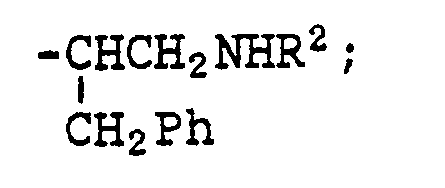
B a straight chain of from two to six carbons that is saturated, olefinic or acetylenic. - R3 = R1 and R2.

is as defined above;
W is
- R4 = -CH2CH(CH3)2, -CH2Ph, -CH2-cHexyl, -CH2-cPentyl, or -cHexyl;
- R5 = OH, OCH3, OEt,


-nC3H7, -iC3H7, -nC4H9, iC4Hg, -Ph, -cHexyl, -cPentyl, -cButyl, -cPropyl,
-CH2CH2SR, -CH2CH2S(0)R, -CH2CH2S(O2)R, -CH2Ph,


wherein R, R1 and
are as defined above.
- Preferred compounds of the present invention are those of formula I wherein A is

- and X is PHE or TYR(OMe);
- Y is HIS, TZA, NIA, ALG, LYS(CSNHMe) or

- W is


- R and R1 are each independently H, CH3, C2H5, n-C3H7 or i-C3H7;

- More preferred compounds of the present invention are those of formula I wherein A - X is

- Y is HIS, TZA, NIA, ALG, LYS(CSNHMe) or

- Wis


- Particularly preferred compounds falling within the scope of the invention include the following compounds, their isomers, and pharmaceutically acceptable acid addition salts:


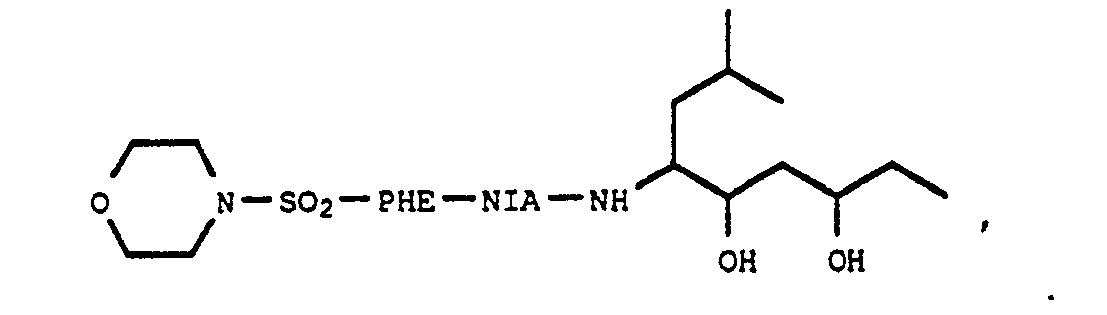

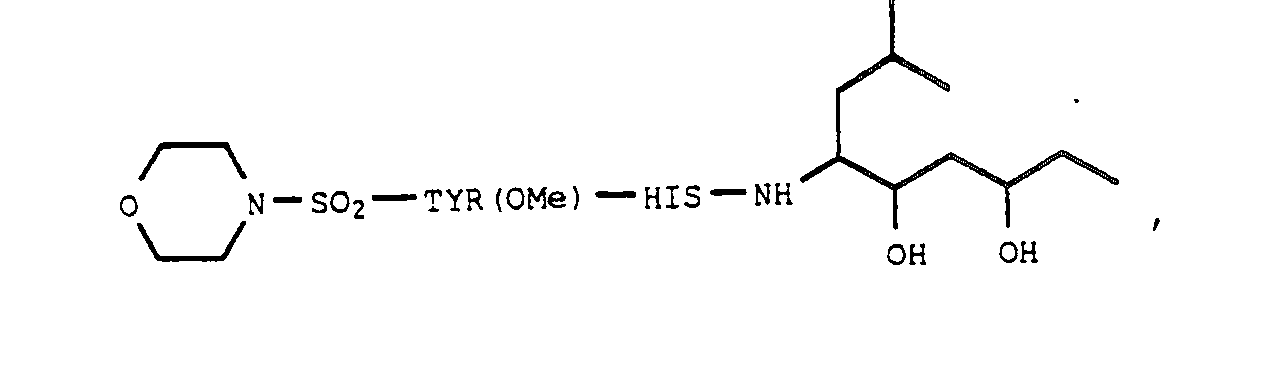


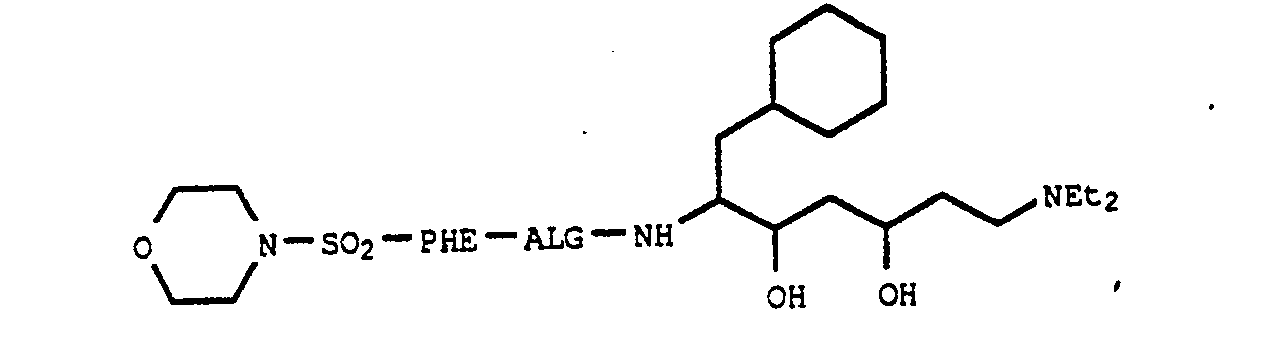


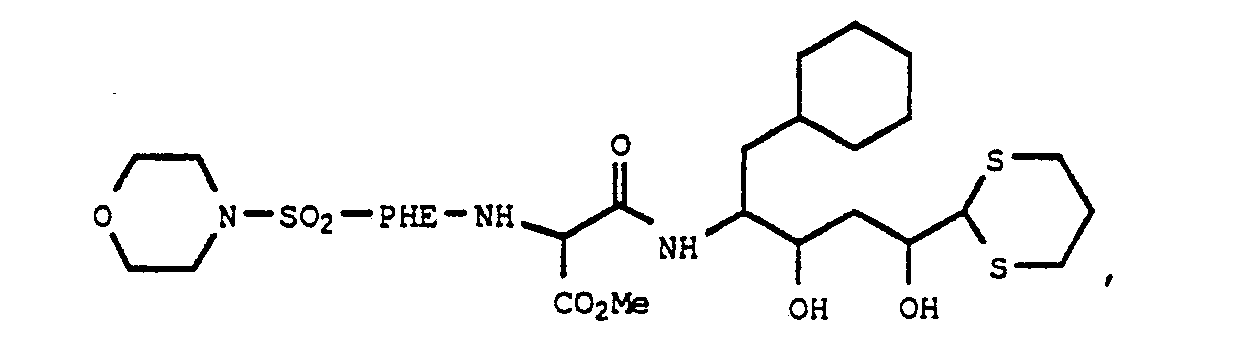


- The compounds of the present invention have the advantage of increased hydrophilicity. This property makes the compounds more readily absorbed.
- The compounds include solvates and hydrates and pharmaceutically acceptable acid addition salts of the basic compounds of formula I above.
- Certain novel intermediates are useful in the preparation of the compounds of the instant invention. They include but are not limited to:
-


- Compounds of formula I may be prepared by a process which comprises:
- (a) condensing


- (b) reducing with KBH4 the product of step (a) above to produce

- (c) modifying the product of step (a) above wherein R8 is vinyl by reacting with amines or mercaptans to produce


- (d) reacting


which are then separated by column chromatography; or - (e) alternatively reacting


which are separated by column chromatography; and - (f) using the products of step (d) above to produce by known means the desired compound of formula I above.
- The term pharmaceutically acceptable acid addition salt is intended to mean a relatively nontoxic acid addition salt either from inorganic or organic acids such as, for example, hydrochloric, hydrobromic, hydroiodic, sulfuric, phosphoric, acetic, citric, oxalic, malonic, salicylic, malic, benzoic, gluconic, fumaric, succinic, ascorbic, maleic, tartaric, methanesulfonic, and the like. The salts are prepared by contacting the free base form with a sufficient amount of the desired acid to produce a salt in the conventional manner. The free base forms may be regenerated by treating the salt form with a base.
- The modified peptides of the present invention possess one or more chiral centers and each center may exist in either the R or S configuration. The present invention includes all enantiomeric and epimeric forms as well as the appropriate mixtures thereof. Additionally, the preferred absolute configuration is shown on two illustrative examples below:


The stereocenter marked with an asterisk is preferred in both R and S configurations as both show renin inhibitor action. - Some of the above novel peptides may be prepared in accordance with well-known procedures for preparing peptides from their constituent amino acids. Other of the novel peptides of the present invention are prepared bya step-wise procedure or by a fragment coupling procedure depending upon the particular final product desired.
- The following scheme illustrates novel methods of preparing certain peptides of the present invention.

- According to Scheme I above, the BOC-lactam, (1) (prepared according to methods found in U.S. Patent 4,876,343 is reacted with excess Grignard reagent such as vinyl or ethyl magnesium bromide in an inert solvent such as ether or THF to afford the ring opened product, (2). In the case of the vinyl adduct the R-side chain may be further modified by Michael additions with amines and mercaptans. Scheme I shows the addition of N-methyl-aminoethane to give (3). Reduction with a hydride agent such as NaBH4, KBH4, ZnBH4, LiBH4 and the like in a protic solvent, such as MeOH, EtOH, iPrOH, H20, followed by removal of protecting groups with acidic reagents such as MeOH·HCl or TFA affords the aminodiol, (4) as a mixture of two diastereomers that are separated by flash chromatography.
- Stepwise coupling and deprotection of Z-HIS(Tr) and

- An alternative, highly convergent strategy for synthesis of compounds of the present invention is shown in Scheme II. Selective removal of the THP protecting group from 12, using a mildly acidic reagent such as pyridinium p-toluenesulfonate in a protic solvent such as ethanol, methanol or isopropanol at 20-70° C gives the diastereomeric 1,3-diols, 13 and 14. These diols are readily separated by flash chromatography on silica gel. Compounds 13 and 14 are then individually coupled to an A-X-Y fragment such as 15 to afford the desired renin inhibitors, 16 and 17. The A-X-Y fragments are prepared by methods standard to the art of peptide chemistry.
-

- The DCC/HOBT method of coupling is well-known to those skilled in the art and is discussed in Chapter 5, "The Carbodiimide Method" by D. H. Rich and J. Singh in "The Peptides. Analysis, Synthesis, Biology," E. Gross and J. Meienhofer, Eds., Academic Press, New York, NY, 1979, Vol. 1, pp. 241-261.
- Peptide coupling depends on activating the carboxy terminus of the amino protected amino acid and condensing it with another peptide containing a free amino terminus. In addition to the DCC coupling method described above, other methods of activating the carboxyl group of a protected amino acid include:
- 1) The azide method - described in Chapter 4 of the above reference.
- 2) The mixed anhydride method - described in Chapter 6 of the above reference.
- 3) The active ester method - described in Chapter 3 of the above reference.
- The term lower alkyl refers to straight or branched chain alkyl radicals containing from one to six carbon atoms including but not limited to methyl, ethyl, n-propyl, isopropyl, n-butyl, iso-butyl, sec-butyl, 2-methylhexyl, n-pentyl, 1-methylbutyl, 2,2-dimethylbuty[ 2-methylpentyl, 2,2-dimethylpropyl, n-hexyl, and the like.
- Aryl means phenyl, naphthyl or other aromatic groups, including mono- or bicyclic, which may be substituted, especially monosubstituted, by F, Cl, Br, I, CF3, OH, OR, or R, wherein R is lower alkyl.
- Heteroaryl means aromatic heterocyclic rings containing at least one heteroatom selected from 0, S, and N and from three to five carbon atoms including but not limited to thiazoles and imidazoles.
- Aralkyl is as described above for alkyl and aryl, including but not limited to benzyl.
- The compounds of the present invention are useful for treating renin-associated hypertension, congestive heart failure, and hyperaldosteronism. They are also useful as diagnostic tools for determining the presence of renin-associated hypertension or hyperaldosteronism.
- Pharmaceutical compositions which comprise an effective amount of the compound in combination with a pharmaceutically acceptable carrier are part of the present invention. An important aspect of the present invention is a method of treating renin-associated hypertension in a mammal which comprises administering a pharmaceutical composition containing an effective amount of a compound of the invention in combination with a pharmaceutically acceptable carrier to the mammal.
- Another equally important aspect of the present invention is a method of treating hyperaldosteronism in a mammal which comprises administering a pharmaceutical composition containing an effective amount of a compound of the invention in combination with a pharmaceutically acceptable carrier to the mammal.
- An additional aspect of the present invention is a method for treating congestive heart failure in a mammal which comprises administering a pharmaceutical composition containing an effective amount of a compound in combination with a pharmaceutically acceptable carrier to the mammal.
- The effectiveness of the aforementioned compounds is determined by a test for in vitro renin inhibitory activity. This activity is determined by a standard radioimmunoassay for angiotensin I. In this assay the enzyme, renin, incubated for two hours at 37° in the presence of a substrate, angiotensinogen, generates the product, angiotensin I. Test compounds are added to the incubation mixture. Relative activity is reported as the ICso, which is the molar concentration of test compound causing a 50% inhibition of the renin activity.


- As can be seen from the above table, the compounds of the present invention have a significant effect on the activity of renin and thus are useful for the treatment of hypertension, hyperaldosteronism, and congestive heart failure.
- For preparing pharmaceutical compositions from the compounds described by this invention, inert, pharmaceutically acceptable carriers can be either solid or liquid. Solid form preparations include powders, tablets, dispersible granules, capsules, cachets, and suppositories. A solid carrier can be one or more substances which may also act as diluents, flavoring agents, solubilizers, lubricants, suspending agents, binders, or tablet disintegrating agents; it can also be encapsulating material. In powders, the carrier is a finely divided solid which is in admixture with the finely divided active compound. In the tablet the active compound is mixed with carrier having the necessary binding properties in suitable proportions and compacted in the shape and size desired. The powder and tablets preferably contain from 5 to 10 to about 70 percent of the active ingredient. Suitable solid carriers are magnesium carbonate, magnesium stearate, talc, sugar, tragacanth, methylcellulose, a low melting wax, cocoa butter, and the like. The term "preparation" is intended to include the formulation of the active compound with encapsulating material as carrier providing a capsule in which the active component (with or without other carriers) is surrounded by carrier, which is thus in association with it. Similarly, cachets are included. Tablets, powders, cachets, and capsules can be used as solid dosage forms suitable for oral administration.
- The compound of the present invention may be administered orally, buccally, parenterally, by inhalation spray, rectally, or topically in dosage unit formulations containing conventional nontoxic pharmaceutically acceptable carriers, adjuvants and vehicles as desired. The term parenteral as used herein includes subcutaneous injections, intravenous, intramuscular, intrasternal injection, or infusion techniques.
- For preparing suppositories, a low melting wax such as a mixture of fatty acid glycerides or cocoa butter is first melted, and the active ingredient is dispersed homogeneously therein by stirring. The molten homogeneous mixture is then poured into convenient sized molds, allowed to cool, and thereby solidify.
- Liquid form preparations include solutions, suspensions, and emulsions. As an example may be mentioned water or water/propylene glycol solutions for parenteral injection. Liquid preparations can also be formulated in solution in aqueous polyethyleneglycol solution. Aqueous suspensions suitable for oral use can be made by dispersing the finely divided active component in water with viscous material, i.e., natural or synthetic gums, resins, methylcellulose, sodium carboxymethylcellulose, and other well-known suspending agents.
- Also included are solid form preprations which are intended to be converted, shortly before use, to liquid form preparations for either oral or parenteral administration. Such liquid forms include solutions, suspensions, and emulsions. These particular solid form preparations are most conveniently provided in unit dosage form and as such are used to provide a single liquid dosage unit. Alternately, sufficient solid may be provided so that after conversion to liquid form, multiple individual liquid doses may be obtained by measuring predetermined volumes of the liquid form preparation as with a syringe, teaspoon, or other volumetric container. When multiple liquid doses are so prepared, it is preferred to maintain the unused portion of said liquid doses at low temperature (i.e., under refrigeration) in order to retard possible decomposition. The solid form preparations intended to be converted to liquid form may contain, in addition to the active material, flavorants, colorants, stabilizers, buffers, artificial and natural sweeteners, dispersants, thickeners, solubilizing agents, and the like. The liquid utilized for preparing the liquid form preparation may be water, isotonic water, ethanol, glycerine, propylene glycol, and the like, as well as mixtures thereof. Naturally, the liquid utilized will be chosen with regard to the route of administration, for example, liquid preparations containing large amounts of ethanol are not suitable for parenteral use.
- Preferably, the pharmaceutical preparation is in unit dosage form. In such form, the preparation is subdivided into unit doses containing appropriate quantities of the active component. The unit dosage form can be a packaged preparation, the package containing discrete quantities of preparation, for example, packeted tablets, capsules, and powders in vials or ampules. The unit dosage form can also be a capsule, cachet, or tablet itself, or it can be the appropriate number of any of these in packaged form.
- The quantity of active compound in a unit dose of preparation may be varied or adjusted from 1 mg to 500 mg, preferably 5 to 100 mg according to the particular application and the potency of the active ingredient. The compositions can, if desired, also contain other compatible therapeutic agents.
- In therapeutic use as renin inhibitors, the mammalian dosage range for a 70 kg subject is from 1 to 1500 mg.kg of body weight per day or preferably 5 to 750 mg/kg of body weight per day optionally in divided portions. The dosages, however, per day may be varied depending upon the requirements of the patient, the severity of the condition being treated and the compound being employed. Determination of the proper dosage for a particular situation is within the skill of the art. Generally, treatment is initiated with small dosages which are less than the optimum dose of the compound. Thereafter the dosage is increased by small increments until the optimum effect under the circumstances is reached. For convenience, the total daily dosage may be divided and administered in portions during the day if desired.
- A solution of 15.16 g (0.040 mole) of 5-(cyclohexylmethyl)-4-[(tetrahydro-2H-pyran-2-yl)oxy]-2-oxo-1-pyrrolidinecarboxylic acid, 1,1-dimethylethyl ester, mixture of [4S-[4R*(R*), 5R*] and [4s-[4R'(S*), 5R*]-]isomers, in 200 ml of dry tetrahydrofuran is cooled to 5°C. Under nitrogen and with stirring, 27.5 ml (0.055 mole) of 2 M ethylmagnesium bromide in tetrahydrofuran is added over a period of five minutes, preventing the temperature from rising above 12° C with mild cooling. After stirring at 10° C for one half hour, the reaction solution is poured, under nitrogen, into a stirred mixture of 300 g of ice and water. Saturated citric acid (200 ml) and 300 ml of ether are added. The organic layer is washed well with water, dried (magnesium sulfate) and concentrated to give 15.80 g of crude product. Silica gel chromatography eluting with hexane to 2:1 hexane-ethyl acetate gives 9.40 g (57%) of pure product; TLC (silica gel, 2:1 hexane-ethyl acetate) Rf 0.6; FAB-MS, MW = 411.
- A solution of 9.30 g (0.023 mole) of [1-(cyclohexylmethyl)-4-oxo-2-[(tetrahydro-2H-pyran-2-yl)oxy]-hexyl]carbamic acid, 1,1-dimethylethyl ester (pyran center is R,S; other centers are S) in 100 ml of absolute ethanol is treated with 0.85 g (0.023 mole) of sodium borohydride. After one and one-half hours stirring at room temperature, acetone (10 ml) is added with mild cooling. After 15 minutes the solution is concentrated at reduced pressure, water (100 ml) is added and the separated oil is extracted into 200 ml of petroleum ether. The dried (potassium carbonate) ether solution is concentrated to give 7.90 g (83%) of alcohol product; TLC (silica gel, 2:1 hexane-ethyl acetate) double spot Rf 0.4-0.5; FAB-MS, MW = 413.
- A solution of 7.80 g (0.019 mole) of the product from Example 2 in 100 ml of methylene chloride and 50 ml of methanol is cooled to 5-C and saturated with hydrogen chloride gas. The solution is allowed to stand at room temperature for six hours and then concentrated at reduced pressure to remove solvent. The crude hydrochloride salt is purified by silica gel chromatography eluting with chloroform to 20% methanol-chloroform; weight 4.10 g (81%); TLC (silica gel, 2:10 methanol-chloroform) one spot, Rf 0.4.
- The purified hydrochloride is converted to the base by dissolution in 50 ml of water, addition of 10% potassium carbonate and extraction into 150 ml of ether; MS, MW = 229.
- A solution of 2.60 g (0.011 mole) of 6-amino-7-cyclohexyl-3,5-heptanediol from Example 3 in 50 ml of methylene chloride is treated successively with 1.68 g (0.011 mole) of 1-hydroxybenztriazole hydrate, 5.85 g (0.011 mole) of Z-(trt)His and 2.27 g (0.011 mole) of dicyclohexylcarbodiimide. After standing at room temperature the dicyclohexylurea is filtered and the filtrate is concentrated to ca 15 ml volume. Ether (100 ml) is added and the solution is washed with 100 ml of 3% sodium bicarbonate and then 50 ml of water. After drying over sodium sulfate the ether solution is concentrated to give 8.20 g of crude product. Purification by silica gel chromatography eluting with chloroform to 5% methanol-chloroform gives a fraction enriched in "fast" moving diastereomer (TLC; silica gel, 1:10 methanol-chloroform, major spot Rf 0.7, trace spot Rf 0.6) and a fraction enriched in "slow" moving diastereomer with major spot at Rf 0.6 and a trace of Rf 0.7. Each diastereomer shows FAB-MS, MW = 742.4.
- A solution of 2.30 g (0.0031 mole) of enriched "fast" diastereomer from Example 4 in 30 ml of methanol is reduced at low pressure for eight hours with 100 mg of 20% palladium on carbon and hydrogen. The catalyst is filtered and the methanol solution concentrated at reduced pressure. The crude product is chromatographed with silica gel and elution with chloroform to 5% methanol-chloroform to give 1.60 g of a single spot material, Rf 0.3-0.4 (TLC; silica gel, 1:10 methanol-chloroform); FAB-MS, MW = 608.3.
- The "slow" diastereomer from Example 4 is subjected to catalytic debenzylation and purified as in Example 5 to similarly obtain the "slow" isomer, Rf 0.2-0.4 with a trace of Rf 0.3-0.4; FAB-MS, MW = 608.3.
- A solution of 1.45 g (0.0024 mole) of "fast" isomer from Example 5 in 25 ml of methylene chloride is treated successively with 0.37 g (0.0024 mole) of 1-hydroxybenztriazole hydrate, 0.76 g (0.0024 mole) of morpholineosulfonyl-L-phenylalanine and 0.50 g (0.0024 mole) of dicyclohexylcarbodiimide. After standing at room temperature overnight the urea is filtered and the filtrate is concentrated at reduced pressure to remove most of methylene chloride. The residue is taken up into 100 ml of ether and the solution is washed with 50 ml of saturated sodium bicarbonate and 50 ml of water. The dried (sodium sulfate) organic phase is concentrated to give 2:00 g of crude product. Purification by silica gel chromatography eluting with chloroform to 5% methanol-chloroform gives the trityl protected product; weight 1.65 g; TLC (silica gel, 1:10 methanol-chloroform) Rf 0.5; FAB-MS, MW = 904.4.
- A solution of 1.60 g (0.0018 mole) of the above adduct in 16 ml of glacial acetic acid is treated with 4 ml of water. The solution is heated at 95 °C for six minutes. Water (25 ml) is added to precipitate triphenylmethyl alcohol. The mixture is cooled in an ice bath and filtered. The filtrate is concentrated at reduced pressure and 75 ml of saturated sodium bicarbonate and 100 ml of methylene chloride are added. The bottom organic layer is separated, dried over potassium carbonate and concentrated to give 1.00 g of crude product. This material is purified by silica gel chromatography eluting with chloroform to 5% methanol-chloroform to give the desired product; TLC; (silica gel, 2:10 methanol-chloroform) Rf 0.6; FAB-MS, MW = 662.3.
- The "slow" diastereomer from Example 6 is coupled to morpholinosulfonyl-L-phenylalanine as in Example 7 giving a material moving slower on TLC (silica gel, 1:10 methanol-chloroform) Rf 0.45 with traces at Rf 0.4 and 0.5; FAB-MS, MW = 904.4.
- This isomer is detritylated as in Example 7 for the "fast" isomer to give "slow" moving product on TLC (silica gel. 2:10 methanol-chloroform) Rf 0.55; FAB-MS, MW = 662.3. Note: The slow and fast isomers were compared side by side and mixed on TLC. Also, the NMR showed diastereomeric differences.
- A solution of 51.36 g (0.135 mole) of 5-(cyclohexylmethyl)-4-[(tetrahydro-2H-pyran-2-yl)oxy]-2-oxo-1-pyrrolidinecarboxylic acid, 1,1-dimethylethyl ester, mixture of [4S-[4R*(R*), 5R*] and [4S-[4R*(S*), 5R*]-]isomers, in 500 ml of tetrahydrofuran is cooled to 5°C, under nitrogen with stirring. A quantity of 175 ml (0.175 mole) (30% excess) of 1 M vinylmagnesium bromide in tetrahydrofuran is added over 20 minutes, keeping the temperature at 5° C. The solution is allowed to warm to 15 C and maintained there for one-half hour. The solution is poured into 800 ml of ice and water with stirring. Saturated citric acid (300 ml) and ether (800 ml) are added. The aqueous layer is separated. The organic layer is washed well with water, dried (magnesium sulfate) and concentrated; wt 57.0 g. Silica gel chromatography, eluting with hexane and then 2:1 hexane-ethyl acetate gives purified vinyl ketone; TLC (2:1 hexane-ethyl acetate) RF 0.6.
- A solution of 14.33 g (0.035 mole) of the vinyl ketone from Example 9 in 100 ml of methylene chloride is treated with 4.14 g (0.07 mole) of N-ethylmethylamine. After one hour the solvent and excess amine are evaporated to give product; TLC (2:1 hexane-ethyl acetate, silica gel) RF 0.1; FAB-MS shows MW = 468.
- A quantity of 20 ml of water is added to a solution of 16.40 g (0.035 mole) of the amino ketone in 200 ml of methanol. This solution is treated with a solution of 1.89 g (0.035 mole) of potassium borohydride in 20 ml of water, cooling to keep the temperature at 20° C. After one hour, 20 ml of acetone is added. After 15 minutes the methanol is removed at reduced pressure and the separated gum is extracted into a solution of 300 ml of ether and 50 ml of methylene chloride. The organic phase is dried (potassium carbonate) filtered and evaporated to give product; TLC (2:10 methanol-chloroform, silica gel) RF 0.2-0.4, two overlapping spots); DEI-MS shows MW = 470.
- A solution of 16.0 g (0.034 mole) of the blocked amino alcohol from Example 11 in 100 ml of methylene chloride is diluted with 200 ml methanol and cooled on an ice bath under nitrogen. The cold solution is then charged with a vigorous stream of dry hydrogen chloride for five minutes and subsequently allowed to stand at room temperature overnight. The solvent and excess hydrogen chloride are removed at reduced pressure. The dihydrochloride residue is converted to the base by dissolution is 20 ml of water, charcoaling, filtering, saturating with potassium carbonate and extracting into 300 ml of methylene chloride (top layer). The organic solution is dried (potassium carbonate) and concentrated; wt 11.00 g of mixed diastereomers as a crude oil. Purification is effected by silica gel chromatography as follows: The column is packed with 1:10 methanol-chloroform. The column is further deactivated by passage of two column volumes of 3:10:0.3 methanol-chloroform-conc. ammonium hydroxide and then two column volumes of chloroform. The diamino diol is placed on the column as a chloroform solution and eluted to separate diastereomers with 3:10:0.3 methanol-chloroform-conc. ammonium hydroxide, giving 2.98 g of fast spot material, TLC; Rf 0.4 (3:10:0.3 methanol-chloroform-ammonium hydroxide, silica gel, and 3.69 g of slow spot material, Rf 0.3 (same TLC system); DEI-MS shows MW = 286 for both diastereomers.
- The diaminodiol "fast" isomer from Example 12 is sequentially coupled to histidine and N-morpholinosulfonyl-L-phenylalanine as described in Examples 5 and 7 to afford the "fast" isomer of the desired product; TLC (silica gel, chloroform-methanol-conc. NH4OH(aq), 10:3:0.3) R 0.4; FAB-MS shows MW = 720.
- The diaminodiol "slow" isomer from Example 12 is sequentially coupled to histidine and N-morpholinosulfonyl- L-phenylalanine as described in Examples 5 and 7 to afford the "slow" isomer of the desired product; TLC (silica gel, chloroform-methanol-conc. NH4OH(aq), 10:3:0.3) Rf 0.3; FAB-MS shows MW = 720.
- A solution of 0.33 g (0.00045 mole) of the "slow" isomer of Example 14 in 5 ml of methylene chloride is diluted with 1 ml of ether and cooled to 10° C. A solution of 0.065 g (0.0045 mole) of methyl iodide in 1 ml of methylene chloride is added and the solution is allowed to warm to room temperature. After three days standing the supernatant is decanted from the separated gum and the gum is triturated with 5 ml of methylene chloride. Decantation leaves 0.45 g of product. Purification is effected by dissolution in ca. 2 ml of methanol and precipitation as an amorphous solid with 25 ml of ether. Filtration gives 0.49 g of product; HPLC, 92.7%; NMR (5, DMSO-ds), 2.98 (S, 6H, + N(Me)2).
- A mixture of N-(4-morpholinosulfonyl)-PHE (3.15 g, 10 mmol), DCC (2.1 g, 10 mmol), HOBT (1.35 g, 10 mmol) and DMF (20 ml) was stirred at 20° C for five minutes. The resulting slurry was treated consecutively with N(e)-Z-LYS(OMe)·HCl (3.32 g, 10 mmol), triethylamine (1.4 ml, 10 mmol) and CH2Cl2 (10 ml). The reaction was stirred for 48 hours at 20 °C then CH2Cl2 was evaporated. Ethyl acetate was added and the solids were removed by filtration. Evaporation of the filtrate gives a wet solid that was triturated with water, dissolved in CHCl3 and washed with 5% K2CO3 (aq). The organic layer was dried over MgSO4 and evaporated to a pale yellow solid. Trituration with ethyl acetate gives 5.3 g of a colorless solid. TLC (silica gel, CHCl3-MeOH, 9:1); Rf 0.75.
- A solution of the product from Example 16 (5.28 g, 8.95 mmol) in THF (125 ml) was treated with 20% Pd/C (0.55 g) under an atmosphere of hydrogen. After three hours, methanol (125 ml) was added and catalyst removed by filtration. The resulting solution was treated with methyl isothiocyanate (0.7 g, 9.6 mmol) and stirred 18 hours at 20 C. Evaporation gave a solid that was recrystallized from hot CHCl3 by dropwise addition of ether to give the desired product (4.25 g); FAB-MS, MW = 529.
- The product from Example 17 (4.25 g, 8,.02 mmol) was dissolved in THF (50 ml) and 1N NaOH (20 ml) added. The reaction mixture was stirred at ambient temperature for 24 hours and the solution diluted with water (200 ml). The mixture was acidified to pH 2 with 2N HCI and extracted three times with methylene chloride. The combined organic layers were dried over anhydrous magnesium sulfate, filtered, and evaporated to dryness to give 3.98 g; FAB-MS, MW = 515.
- To a solution of the product from Example 2 (14.1 g, 34.09 mmol) in absolute ethanol (140 ml) was added pyrridinium-p-toluene-sulfonate (0.86 g, 3.41 mmol). The reaction mixture was heated at 55 C for three hours and the solvent removed under reduced pressure. The residue was taken up in ethyl acetate and extracted twice with water. The organic layer was dried over anhydrous magnesium sulfate, filtered, and the filtrate evaporated under reduced pressure to give 13.74 g of a mixture of diastereomers. The diastereomers were separated by flash chromatography eluting with a solvent gradient of 5 to 40% ethyl acetate in hexane to give 5.72 g (51 % yield) of the fast isomer and 4.72 g (42% yield) of the slow isomer; CI-MS shows MW = 329 for both diastereomers.
- The slow isomer from Example 19 (2.25 g, 6.83 mmol) was dissolved in methylene chloride (25 ml) and MeOH/HCI (0.029 g/ml HCI, 20.14 mmol) (25 ml) added to this solution. The reaction mixture was stirred at ambient temperature for 23 hours and the solvent removed under reduced pressure. The residue was triturated with ether and the suspension evaporated to dryness to give 1.86 g (quantitative yield); DEI-MS shows MW = 229.
- The fast isomer from Example 19 was treated as in Example 20 to give the analogous product; DEI-MS shows MW = 229.
- To a 5° C solution of the product from Example 20 (0.92 g, 3.47 mmol), the product from Example 18 (1.68 g, 3.47 mmol), HOBT (0.94 g, 6.95 mmol) and triethylamine (0.70 g, 3.47 mmol) in DMF (25 ml) was added DCC (0.72 g, 3.47 mmol). The reaction mixture was stirred at 5°C for one hour, then at ambient temperature for 18 hours. The resulting suspension was filtered and the filtrate was evaporated at reduced pressure. The residue was purified by flash chromatography, eluting with 2 to 10% methanol in methylene chloride to give 1.48 g of product; FAB-MS shows MW = 727.
- The product from Example 21 was coupled to the product from Example 18 as in Example 22 to give the desired compound; FAB-MS shows MW = 727.
- Preparation of anion of 1,3-dithiane: A solution of 12.4 g (0.10 mole) of 97% 1,3-dithiane in 200 ml of THF is cooled to -30° C. A quantity of 62.5 ml (0.1 mole) of 1.6 M n-butyllithium is added with stirring under nitrogen over a period of 10 min ant -30°. After 15 min a solution of 42.0 g (0.011 mole) of 5-cyclohexylmethyl)-4-[(tetrahydro-2H-pyran-2-yl)oxy]-2-oxo-1-pyrrolidinecarboxylic acid, 1,1-dimethylethy) ester, mixture of [4S-[R*(R*), 5R*] and [4S-[4R*(S*), 5R*]] isomers, in 200 ml of THF is added to the above prepared 1,3-dithiane anion over a period of 10 min at -30°. The reaction solution is allowed to warm to room temperature over ca. 2 hours. After another hour at room temperature the solution is poured (under N2) into a stirred mixture of 500 g of ice and water. Saturated citric acid solution (200 ml) and ether (600 ml) are added. The aqueous layer is separated and the organic phase is dried (MgS04), filtered and concentrated to give crude gum. Silica gel chromatography eluting with 1 to 30% EtOAc-Hexane gives 29.30 g (59%) of product as a gum; TLC (2:1 Hexane-EtOAc) major spot Rf 0.7, trace Rf 0.8. The product crystallizes and is recrystallized from EtOAc; mp 129-131°; CI-MS shows MW = 501.
- A quantity of 0.70 g (0.014 mole) of ketone from Example 24 is dissolved in 150 ml of warm methanol. The cooled solution (25 C) is treated with 1 ml of water and then a solution of 0.10 g (0.002 mole) of KBH4 in 1 ml of water. After 1 hour acetone (5 ml) is added to the reaction solution. After 15 min the solvent is removed at reduced pressure, water (5 ml) is added and the separated gum is extracted into 20 ml of CH2C12. The solution is dried (K2CO3), filtered and concentrated to give crude product as a mixture of diastereomers; TLC (2:1 Hexane-EtOAc) 2 spots, Rf 0.3 and 0.5; FAB-MS shows MW = 503.3.
- A solution of 0.40 g (0.0008 mole) of the blocked amino diol from Example 25 in 20 ml of 50% MeOH-CH2Cl2 is cooled to 10° and saturated with HCI gas. The solution is allowed to warm to room temperature and to stand overnight. The solvent is stripped off at reduced pressure and the residue is dissolved in 5 ml of water. The solution is treated with activated charcoal, filtered, and saturated with solid K2CO3 The separated gum is extracted into EtOAc, and the organic layer is dried over MgS04 and evaporated; wt. 0.15 g of mixed diastereomers; TLC (1:10 MeOH-CHCl3-saturated with NH3) 2 spots, Rf 0.5 and 0.7; MS shows MW = 320.1. Separation of diastereomers is accomplished by silica gel chromatography eluting with from 1 to 10% MeOH-CHCl3, saturated with NH3.
- A solution of 20.50 g (0.05 mole) of the vinyl ketone from Example 9 in 100 ml of MeOH is treated with 5.70 g (0.075 mole) of isopropyl mercaptan and then 8.10 g (0.080 mole) of triethylamine. After 15 min at room temperature the solvent is removed at reduced pressure and 200 ml of cold saturated citric acid and 300 ml of 25% CH2CH2-ether are added to the residue. The dried (MgS04) extract is concentrated; wt. 21.00 g (86%); TLC (2:1 Hexane-EtOAc) one spot, Rf 0.8 (visualized with ninhydrin and heat); Analysis,

- Water (2 ml) is added to a solution of 2.80 g (0.0058 mole) of ketone from Example 27 in 20 ml of methanol. A solution of 0.31 g (0.0058 mole) of KBH4 in 2 ml of water is added. After one hour at room temperature, 5 ml of acetone is added. The solvent is stripped off at reduced pressure. Ice water (10 ml) is added and the product is extracted into 50 ml of ether; wt. 2.58 g (91 %); TLC (2:1 Hexane-EtOAc) one spot, Rf 0.55; FAB-MS shows MW = 487.3.
- A solution of 2.40 g (0.005 mole) of blocked amino diol from Example 28 in 50 ml of CH2Cl2 is treated with 25 ml of methanolic HCI (methanol saturated with HCI at 10°). After four hours at room temperature the volatiles are removed at reduced pressure and the residue is dissolved in 100 ml of water. The charcoaled solution is saturated with K2CO3 and the mixed diastereomers are extracted into 100 ml of 25% CH2CI2-ether; wt. 0.70 g (47%); TLC (1:10 MeOH-CHCl3-saturated with NH3) two spots, Rf 0.4 and 0.5. Separation of diastereomers is accomplished by silica gel chromatography eluting with 2 - 5% MeOH-CHCI3 (saturated with NH3); Isomer A, TLC (above system) Rf 0.5; MS shows MW = 303.2; Isomer B, TLC (above system) Rf 0.4; MS shows MW = 303.2.
- Dimethyl aminomalonate was coupled to N-(4-morpholinosulfonyl)-PHE as described in Example 16. The product was crystallized from methyl, t-butyl ether; FAB-MS shows MW = 443.
- The product from Example 30 (10 g, 22.6 mmol) was dissolved in a mixture of THF (50 ml) and methanol (25 ml) and treated at 0°C with 2N NaOH (23 ml, 46 mmol). After 15 min the reaction was quenched with 2N HCI (23 ml, 46 mmol) and partitioned between ethyl acetate and sat. NaCl(aq). The organic layer was dried over MgS04 and evaporated. The residue was redissolved in ethyl acetate (40 ml), treated at 0°C with diisopropylamine (4.5 ml, 22.6 mmol) and allowed to stand at room temperature. The crystalline product was collected to give 12.9 g; MP 122-123.
- The aminodiol·HCl from Example 20 was coupled with the dicyclohexylamine salt from Example 31 by treatment with DCC and HOBT in DMF. Work-up and chromatography was performed in a manner analogous to Example 22 to afford the desired product; FAB-MS shows MW = 640.
- The aminodiol from Example 20 was coupled to BOC-ALG and purified in a manner analogous to Example 4 to give the product as a single stereoisomer; FAB-MS shows MW = 426.
- The product from Example 33 was dissolved in dichloromethane and treated with methanolic HCI at RT for 1 hour. Evaporation afforded the desired product as its hydrochloride salt. The free base was regenerated by partitioning between ethyl acetate and dilute K2C03(aq). The organic layer was dried over MgS04 and evaporated to a foam; FAB-MS shows MW = 326.
- The product from Example 34 was coupled to N-(4-morpholinosulfonyl)-PHE in a manner analogous to Example 7 to give the desired product; FAB-MS shows MW = 622.
- The product from Example 34 was coupled to N-(4-BOC-1-piperazinosulfonyl)-PHE in a manner analogous to Example 7 to give this product; FAB-MS shows MW = 721.
- The product from Example 36 was dissolved in dichloromethane and treated with methanolic HCI to remove the BOC group. Evaporation of solvents and regeneration of the free base by partitioning between ethyl acetate and dilute K2CO3, drying the organic layer over MgS04, and evaporating the organic layer gives the product as a foam; FAB-MS shows MW = 621.
- N-(4-Morpholinosulfonyl)-L-phenalalanyl glycine was prepared in a manner analogous to Examples 30 and 31, substituting glycine ethyl ester for dimethyl aminomalonate. This material was subsequently coupled to the aminodiol from Example 20 in a manner analogous to Example 22 to afford the desired product; FAB-MS shows MW = 582.
- The aminodiol·HCl from Example 29 was coupled to the dicyclohexylamine salt from Example 31 by treatment with DCC and HOBT in DMF. Work-up and chromatography was performed in a manner analogous to Example 22 to afford the desired product; FAB-MS shows MW = 696.
is a saturated ring containing two to five carbon atoms and Q is 0, S, NR or CH2 with R defined above.
wherein R and R1 are each independently CH3, C2Hs, n-C3H7 or i-C3H7.
Claims (13)
1. A peptide of the formula
A-X-Y-W I
or a pharmaceutically acceptable salt thereof, wherein A is BOC, IVA, BMA 

wherein D is

-OCH3,

-C(CH3)3, -CH(CH3)2, -C2Hs or CH3
A-X-Y-W I
or a pharmaceutically acceptable salt thereof, wherein A is BOC, IVA, BMA
wherein R and R1 are each independently H, CH3, C2Hs, n-C3H7 or i-C3H7,

is a saturated ring containing two to five carbon atoms, and Q is O, S, N-BOC, N-Z, NR or CH2;
X is absent, PHE, HOMOPHE, NAPHTHYLALA, CYCLOHEXYLALA, TYR, or TYR(OMe) with the proviso that when A is

X is absent;
Y is LEU, ALA, GYL, PGY, PPG, BGY, MET, HIS, TZA, ALG, NIA,


wherein R1 and Q are as defined above,
R2 is


E is

or -CHCH2NHR2, CH2Ph
B is a straight chain of from two to six carbon atoms which is saturated, olefinic or acetylenic, R3 is as defined above for R1 and R2; and
Wis

wherein R4 is
-CH2CH(CH3)2, -CH2Ph, -CH2-cHexyl, -CH2-cPentyl, or -cHexyl, R5 is -OH, -OCH3, -OC2H5,

or

or R5 is a keto group with the proviso that either R6 or R7 is absent, R6 an dR7 are each independently -H, -CH3, -C2H3, -C2H5,

-nC3H7, -iC3H7, -nC4H9, -Ph, -cHexyl, -cPentyl, -cButyl, -cPropyl,

-CH2CH2SR, -CH2CH2S(0)R, -CH2CH2S(0)2R, -CH2Ph,


-CH2OH, -CHO, -C02H, -C02R,
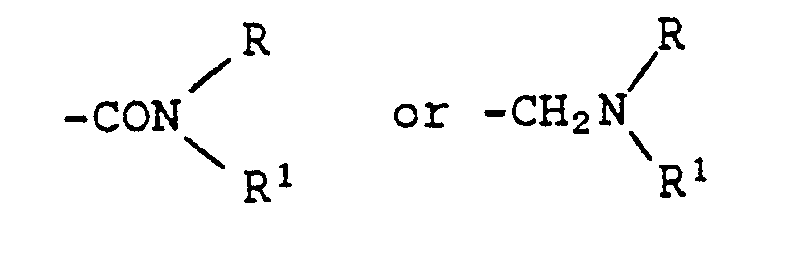
wherein R, R1 and

are as defined above.
2. A compound according to Claim 1 wherein A is

and X is PHE or TYR(OMe);
Y is HIS, TZA, NIA, ALG, LYS(CSNHMe) or

W is


or

wherein
R and R' are each independently H, CH3, C2H5, n-C3H7 or c-C3H7,

is a saturated ring containing zero to five carbon atoms and
Q is 0, X, NR or CH2 with R as defined above.
3. A compound according to Claim 1 selected from the group consisting of:


and

4. A pharmaceutical composition comprising a renin-inhibitory effective amount of a compound according to Claim 1 together with a pharmaceutically acceptable carrier.
5. A method of treating renin-associated hypertension which comprises administering to a mammal a pharmaceutical composition according to Claim 4.
6. A method of treating hyperaldosteronism which comprises administering to a mammal a pharmaceutical composition according to Claim 4.
7. A method of treating congestive heart failure which comprises administering to a mammal a pharmaceutical composition according to Claim 4.
8. A method of determining the presence of renin-associated hypertension in a patient which comprises administering to said patient, at a hypotensive dosage level and as a single dose, a peptide of Claim 1, followed by monitoring of said patient's blood pressure.
9. A process for the preparation of a compound according to Claim 1 which comprises: (a) condensing

with excess organometallic reagent in an inert solvent to produce

wherein R8 is ethyl, isopropyl or 1,3-dithian-2-yl;
(b) reducing with KBH4 the product of step (a) above to produce

wherein R8 is as defined above
(c) reacting

from step (b) above with

in a protic solvent to produce

wherein R8 is as defined above
which are then separated by column chromatography, and
which are then separated by column chromatography, and
(d) using the products of step (c) above to produce by known means the desired compound of formula I above; and converting, if desired, to a pharmaceutically acceptable salt thereof.
10. A process for the preparation of a compound according to Claim 1 which comprises:
(a) condensing

with excess vinylmagnesium bromide or vinyllithium in an inert solvent to produce

(b) modifying the product of step (a) above by reacting with amines or mercaptans to produce

wherein R1 is lower alkyl
and then reducing the product with KBH4 to produce 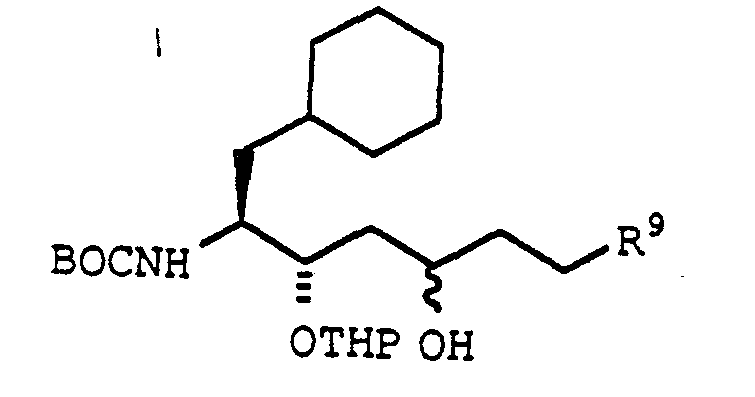
wherein R9 is 
or SR1
and then reducing the product with KBH4 to produce
wherein R9 is
or SR1
(c) reacting

from step (b) above with

in a protic solvent to produce

wherein R9 is as defined above
which are then separated by column chromatography, and
which are then separated by column chromatography, and
(d) using the products of step (c) above to produce by known means the desired compound of formula I above; and converting if desired, to a pharmaceutically acceptable salt thereof.
11. A process which comprises reacting

wherein R10 is C2H5, C2H3, CH(CH3)2,

wherein R' is lower alkyl with methanolic hydrogen chloride in dichloromethane to produce

which are then separated by column chromatograpy and by known means further elaborated to the desired compound of formula I above, and converting, if desired, to a pharmaceutically acceptable salt thereof.
12. A compound selected from the group consisting of:


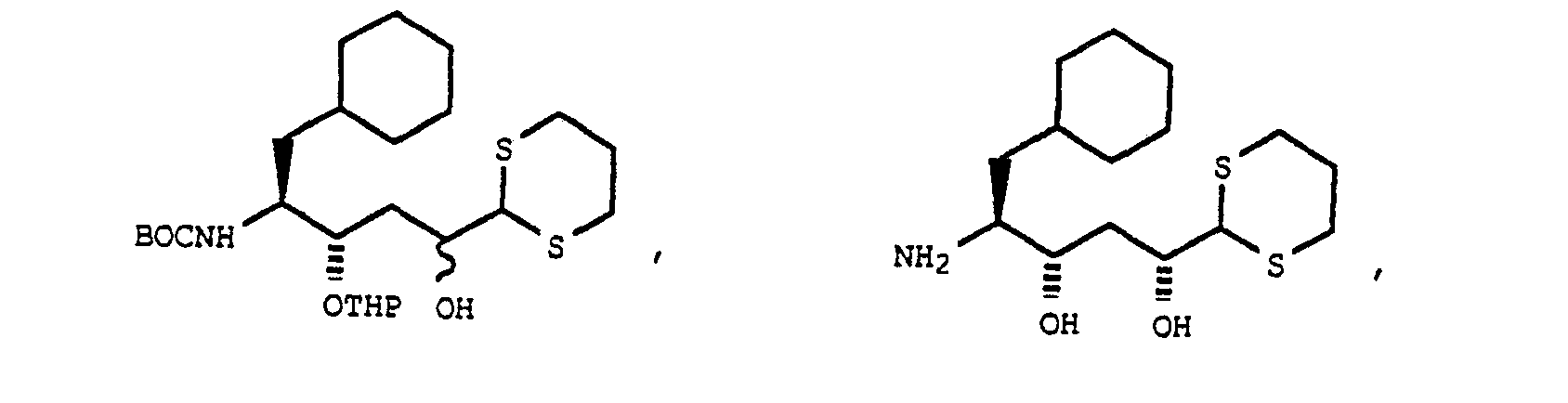


13. A compound selected from the group consisting of:


Applications Claiming Priority (4)
| Application Number | Priority Date | Filing Date | Title |
|---|---|---|---|
| US29257588A | 1988-12-30 | 1988-12-30 | |
| US292575 | 1988-12-30 | ||
| US07/441,704 US5198426A (en) | 1988-12-30 | 1989-12-04 | Renin inhibitors containing c-terminal dihydroxy amides |
| US441704 | 2003-05-20 |
Publications (1)
| Publication Number | Publication Date |
|---|---|
| EP0380805A1 true EP0380805A1 (en) | 1990-08-08 |
Family
ID=26967427
Family Applications (1)
| Application Number | Title | Priority Date | Filing Date |
|---|---|---|---|
| EP89123653A Withdrawn EP0380805A1 (en) | 1988-12-30 | 1989-12-21 | Renin inhibitors containing C-terminal dihydroxy amides |
Country Status (6)
| Country | Link |
|---|---|
| US (1) | US5198426A (en) |
| EP (1) | EP0380805A1 (en) |
| AU (1) | AU4834890A (en) |
| CA (1) | CA2006839A1 (en) |
| PT (1) | PT92756A (en) |
| WO (1) | WO1990007521A1 (en) |
Families Citing this family (7)
| Publication number | Priority date | Publication date | Assignee | Title |
|---|---|---|---|---|
| EP0326364B1 (en) * | 1988-01-26 | 1994-06-22 | Sankyo Company Limited | Renin inhibitory oligopeptides, their preparation and use |
| DE4011684A1 (en) | 1990-04-06 | 1991-10-10 | Schering Ag | DTPA MONOAMIDES, PHARMACEUTICAL AGENTS CONTAINING THESE COMPOUNDS, THEIR USE AND METHOD FOR THE PRODUCTION THEREOF |
| US6071895A (en) * | 1992-03-11 | 2000-06-06 | Narhex Limited | Polar-substituted hydrocarbons |
| MXPA93002392A (en) | 1992-03-11 | 2005-02-04 | Narhex Ltd | Amine derivatives of oxo- and hydroxy-substitued hydrocarbons. |
| JPH07504654A (en) * | 1992-03-11 | 1995-05-25 | ナルヘックス リミテッド | Amine derivatives of oxo- and hydroxy-substituted hydrocarbons |
| US5888992A (en) * | 1992-03-11 | 1999-03-30 | Narhex Limited | Polar substituted hydrocarbons |
| IL110898A0 (en) * | 1993-09-10 | 1994-11-28 | Narhex Australia Pty Ltd | Polar-substituted hydrocarbons |
Citations (3)
| Publication number | Priority date | Publication date | Assignee | Title |
|---|---|---|---|---|
| EP0202577A2 (en) * | 1985-05-15 | 1986-11-26 | G.D. Searle & Co. | N(Acyldipeptidyl)-aminoglycols |
| EP0229667A2 (en) * | 1986-01-16 | 1987-07-22 | Abbott Laboratories | Peptidylaminodiols |
| EP0273893A2 (en) * | 1986-12-29 | 1988-07-06 | Aktiebolaget Hässle | Novel compounds |
Family Cites Families (3)
| Publication number | Priority date | Publication date | Assignee | Title |
|---|---|---|---|---|
| US4853463A (en) * | 1985-09-04 | 1989-08-01 | Kissei Pharmaceutical Co., Ltd. | Amino acid derivatives |
| US4725584A (en) * | 1986-02-19 | 1988-02-16 | Abbott Laboratories | Peptidyl-1-amino-2,4-diols |
| US4863905A (en) * | 1987-02-04 | 1989-09-05 | Warner-Lambert Company | Renin inhibitors II |
-
1989
- 1989-12-04 US US07/441,704 patent/US5198426A/en not_active Expired - Fee Related
- 1989-12-21 AU AU48348/90A patent/AU4834890A/en not_active Abandoned
- 1989-12-21 WO PCT/US1989/005733 patent/WO1990007521A1/en not_active Ceased
- 1989-12-21 EP EP89123653A patent/EP0380805A1/en not_active Withdrawn
- 1989-12-28 PT PT92756A patent/PT92756A/en unknown
- 1989-12-28 CA CA002006839A patent/CA2006839A1/en not_active Abandoned
Patent Citations (3)
| Publication number | Priority date | Publication date | Assignee | Title |
|---|---|---|---|---|
| EP0202577A2 (en) * | 1985-05-15 | 1986-11-26 | G.D. Searle & Co. | N(Acyldipeptidyl)-aminoglycols |
| EP0229667A2 (en) * | 1986-01-16 | 1987-07-22 | Abbott Laboratories | Peptidylaminodiols |
| EP0273893A2 (en) * | 1986-12-29 | 1988-07-06 | Aktiebolaget Hässle | Novel compounds |
Non-Patent Citations (1)
| Title |
|---|
| Journal of Medicinal Chemistry, Vol. 31, No. 4, April 1988, pages 701-704, American Chemical Society, Washington, DC, US; K. IIZUKA et al.: "Communications to the editor", page 702, table 1. * |
Also Published As
| Publication number | Publication date |
|---|---|
| AU4834890A (en) | 1990-08-01 |
| US5198426A (en) | 1993-03-30 |
| CA2006839A1 (en) | 1990-06-30 |
| WO1990007521A1 (en) | 1990-07-12 |
| PT92756A (en) | 1990-07-31 |
Similar Documents
| Publication | Publication Date | Title |
|---|---|---|
| AU625456B2 (en) | Diol-containing renin inhibitors | |
| US4977277A (en) | Functionalized peptidyl aminodiols and -triols 4-amino-5-cyclohexyl-3-hydroxy-1,2-oxopentane and derivatives thereof | |
| US5063207A (en) | Renin inhibitors, method for using them, and compositions containing them | |
| US5036054A (en) | Renin inhibitors containing alpha-heteroatom amino acids | |
| US4826815A (en) | Renin inhibiting compounds | |
| US4645759A (en) | Renin inhibiting compounds | |
| EP0189203A2 (en) | Peptidylaminodiols | |
| KR910002694B1 (en) | Functionalized peptidyl aminodiols and-triols | |
| EP0315815A1 (en) | Branched backbone renin inhibitors | |
| EP0258289A1 (en) | Peptide analogs | |
| US4857507A (en) | Angiotensinogen analogs | |
| EP0159156A1 (en) | Hydroxy substituted ureido amino and imino acids | |
| EP0438233A2 (en) | Orally active renin inhibitors | |
| US5198426A (en) | Renin inhibitors containing c-terminal dihydroxy amides | |
| US4895834A (en) | Renin inhibitors III | |
| CA2012901A1 (en) | Amino acid derivatives | |
| US5643879A (en) | Amino-substituted heterocycles as renin inhibitors | |
| US5221667A (en) | Renin inhibiting peptides having an α-heteroatom amino acid at the P3 position | |
| US4293481A (en) | Tripeptide inhibitors of angiotensin-converting enzyme | |
| US4735933A (en) | Renin inhibitors III | |
| US5260278A (en) | Diol-containing renin inhibitors | |
| EP0314060A2 (en) | Renin inhibitors, processes for preparing them, methods for using them, and compositions containing them | |
| US5149692A (en) | Bisalkoxyphosphinyl compounds as renin inhibitors | |
| EP0275480A2 (en) | Renin inhibitors IV | |
| US5126451A (en) | Renin inhibitors containing α-heteroatom amino acids |
Legal Events
| Date | Code | Title | Description |
|---|---|---|---|
| PUAI | Public reference made under article 153(3) epc to a published international application that has entered the european phase |
Free format text: ORIGINAL CODE: 0009012 |
|
| 17P | Request for examination filed |
Effective date: 19891221 |
|
| AK | Designated contracting states |
Kind code of ref document: A1 Designated state(s): GR |
|
| 18W | Application withdrawn |
Withdrawal date: 19910415 |
|
| STAA | Information on the status of an ep patent application or granted ep patent |
Free format text: STATUS: THE APPLICATION HAS BEEN WITHDRAWN |
|
| R18W | Application withdrawn (corrected) |
Effective date: 19910415 |