EP0331529A2 - Diphenyl ether derivatives, process for producing the same and insecticide and acaricide containing the same as active ingredient - Google Patents
Diphenyl ether derivatives, process for producing the same and insecticide and acaricide containing the same as active ingredient Download PDFInfo
- Publication number
- EP0331529A2 EP0331529A2 EP89302189A EP89302189A EP0331529A2 EP 0331529 A2 EP0331529 A2 EP 0331529A2 EP 89302189 A EP89302189 A EP 89302189A EP 89302189 A EP89302189 A EP 89302189A EP 0331529 A2 EP0331529 A2 EP 0331529A2
- Authority
- EP
- European Patent Office
- Prior art keywords
- group
- substituted
- unsubstituted
- atom
- formula
- Prior art date
- Legal status (The legal status is an assumption and is not a legal conclusion. Google has not performed a legal analysis and makes no representation as to the accuracy of the status listed.)
- Withdrawn
Links
- 0 *C(*)(*C(C=NN1*)=C(*)C1=O)*C1=CCC(*)=CC=C1 Chemical compound *C(*)(*C(C=NN1*)=C(*)C1=O)*C1=CCC(*)=CC=C1 0.000 description 3
Classifications
-
- C—CHEMISTRY; METALLURGY
- C07—ORGANIC CHEMISTRY
- C07D—HETEROCYCLIC COMPOUNDS
- C07D213/00—Heterocyclic compounds containing six-membered rings, not condensed with other rings, with one nitrogen atom as the only ring hetero atom and three or more double bonds between ring members or between ring members and non-ring members
- C07D213/02—Heterocyclic compounds containing six-membered rings, not condensed with other rings, with one nitrogen atom as the only ring hetero atom and three or more double bonds between ring members or between ring members and non-ring members having three double bonds between ring members or between ring members and non-ring members
- C07D213/04—Heterocyclic compounds containing six-membered rings, not condensed with other rings, with one nitrogen atom as the only ring hetero atom and three or more double bonds between ring members or between ring members and non-ring members having three double bonds between ring members or between ring members and non-ring members having no bond between the ring nitrogen atom and a non-ring member or having only hydrogen or carbon atoms directly attached to the ring nitrogen atom
- C07D213/60—Heterocyclic compounds containing six-membered rings, not condensed with other rings, with one nitrogen atom as the only ring hetero atom and three or more double bonds between ring members or between ring members and non-ring members having three double bonds between ring members or between ring members and non-ring members having no bond between the ring nitrogen atom and a non-ring member or having only hydrogen or carbon atoms directly attached to the ring nitrogen atom with hetero atoms or with carbon atoms having three bonds to hetero atoms with at the most one bond to halogen, e.g. ester or nitrile radicals, directly attached to ring carbon atoms
- C07D213/62—Oxygen or sulfur atoms
- C07D213/70—Sulfur atoms
-
- A—HUMAN NECESSITIES
- A01—AGRICULTURE; FORESTRY; ANIMAL HUSBANDRY; HUNTING; TRAPPING; FISHING
- A01N—PRESERVATION OF BODIES OF HUMANS OR ANIMALS OR PLANTS OR PARTS THEREOF; BIOCIDES, e.g. AS DISINFECTANTS, AS PESTICIDES OR AS HERBICIDES; PEST REPELLANTS OR ATTRACTANTS; PLANT GROWTH REGULATORS
- A01N43/00—Biocides, pest repellants or attractants, or plant growth regulators containing heterocyclic compounds
- A01N43/34—Biocides, pest repellants or attractants, or plant growth regulators containing heterocyclic compounds having rings with one nitrogen atom as the only ring hetero atom
- A01N43/40—Biocides, pest repellants or attractants, or plant growth regulators containing heterocyclic compounds having rings with one nitrogen atom as the only ring hetero atom six-membered rings
-
- A—HUMAN NECESSITIES
- A01—AGRICULTURE; FORESTRY; ANIMAL HUSBANDRY; HUNTING; TRAPPING; FISHING
- A01N—PRESERVATION OF BODIES OF HUMANS OR ANIMALS OR PLANTS OR PARTS THEREOF; BIOCIDES, e.g. AS DISINFECTANTS, AS PESTICIDES OR AS HERBICIDES; PEST REPELLANTS OR ATTRACTANTS; PLANT GROWTH REGULATORS
- A01N43/00—Biocides, pest repellants or attractants, or plant growth regulators containing heterocyclic compounds
- A01N43/34—Biocides, pest repellants or attractants, or plant growth regulators containing heterocyclic compounds having rings with one nitrogen atom as the only ring hetero atom
- A01N43/40—Biocides, pest repellants or attractants, or plant growth regulators containing heterocyclic compounds having rings with one nitrogen atom as the only ring hetero atom six-membered rings
- A01N43/42—Biocides, pest repellants or attractants, or plant growth regulators containing heterocyclic compounds having rings with one nitrogen atom as the only ring hetero atom six-membered rings condensed with carbocyclic rings
-
- A—HUMAN NECESSITIES
- A01—AGRICULTURE; FORESTRY; ANIMAL HUSBANDRY; HUNTING; TRAPPING; FISHING
- A01N—PRESERVATION OF BODIES OF HUMANS OR ANIMALS OR PLANTS OR PARTS THEREOF; BIOCIDES, e.g. AS DISINFECTANTS, AS PESTICIDES OR AS HERBICIDES; PEST REPELLANTS OR ATTRACTANTS; PLANT GROWTH REGULATORS
- A01N43/00—Biocides, pest repellants or attractants, or plant growth regulators containing heterocyclic compounds
- A01N43/48—Biocides, pest repellants or attractants, or plant growth regulators containing heterocyclic compounds having rings with two nitrogen atoms as the only ring hetero atoms
- A01N43/54—1,3-Diazines; Hydrogenated 1,3-diazines
-
- A—HUMAN NECESSITIES
- A01—AGRICULTURE; FORESTRY; ANIMAL HUSBANDRY; HUNTING; TRAPPING; FISHING
- A01N—PRESERVATION OF BODIES OF HUMANS OR ANIMALS OR PLANTS OR PARTS THEREOF; BIOCIDES, e.g. AS DISINFECTANTS, AS PESTICIDES OR AS HERBICIDES; PEST REPELLANTS OR ATTRACTANTS; PLANT GROWTH REGULATORS
- A01N43/00—Biocides, pest repellants or attractants, or plant growth regulators containing heterocyclic compounds
- A01N43/48—Biocides, pest repellants or attractants, or plant growth regulators containing heterocyclic compounds having rings with two nitrogen atoms as the only ring hetero atoms
- A01N43/58—1,2-Diazines; Hydrogenated 1,2-diazines
-
- A—HUMAN NECESSITIES
- A01—AGRICULTURE; FORESTRY; ANIMAL HUSBANDRY; HUNTING; TRAPPING; FISHING
- A01N—PRESERVATION OF BODIES OF HUMANS OR ANIMALS OR PLANTS OR PARTS THEREOF; BIOCIDES, e.g. AS DISINFECTANTS, AS PESTICIDES OR AS HERBICIDES; PEST REPELLANTS OR ATTRACTANTS; PLANT GROWTH REGULATORS
- A01N43/00—Biocides, pest repellants or attractants, or plant growth regulators containing heterocyclic compounds
- A01N43/64—Biocides, pest repellants or attractants, or plant growth regulators containing heterocyclic compounds having rings with three nitrogen atoms as the only ring hetero atoms
- A01N43/647—Triazoles; Hydrogenated triazoles
-
- A—HUMAN NECESSITIES
- A01—AGRICULTURE; FORESTRY; ANIMAL HUSBANDRY; HUNTING; TRAPPING; FISHING
- A01N—PRESERVATION OF BODIES OF HUMANS OR ANIMALS OR PLANTS OR PARTS THEREOF; BIOCIDES, e.g. AS DISINFECTANTS, AS PESTICIDES OR AS HERBICIDES; PEST REPELLANTS OR ATTRACTANTS; PLANT GROWTH REGULATORS
- A01N43/00—Biocides, pest repellants or attractants, or plant growth regulators containing heterocyclic compounds
- A01N43/64—Biocides, pest repellants or attractants, or plant growth regulators containing heterocyclic compounds having rings with three nitrogen atoms as the only ring hetero atoms
- A01N43/707—1,2,3- or 1,2,4-triazines; Hydrogenated 1,2,3- or 1,2,4-triazines
-
- A—HUMAN NECESSITIES
- A01—AGRICULTURE; FORESTRY; ANIMAL HUSBANDRY; HUNTING; TRAPPING; FISHING
- A01N—PRESERVATION OF BODIES OF HUMANS OR ANIMALS OR PLANTS OR PARTS THEREOF; BIOCIDES, e.g. AS DISINFECTANTS, AS PESTICIDES OR AS HERBICIDES; PEST REPELLANTS OR ATTRACTANTS; PLANT GROWTH REGULATORS
- A01N43/00—Biocides, pest repellants or attractants, or plant growth regulators containing heterocyclic compounds
- A01N43/90—Biocides, pest repellants or attractants, or plant growth regulators containing heterocyclic compounds having two or more relevant hetero rings, condensed among themselves or with a common carbocyclic ring system
-
- C—CHEMISTRY; METALLURGY
- C07—ORGANIC CHEMISTRY
- C07D—HETEROCYCLIC COMPOUNDS
- C07D215/00—Heterocyclic compounds containing quinoline or hydrogenated quinoline ring systems
- C07D215/02—Heterocyclic compounds containing quinoline or hydrogenated quinoline ring systems having no bond between the ring nitrogen atom and a non-ring member or having only hydrogen atoms or carbon atoms directly attached to the ring nitrogen atom
- C07D215/16—Heterocyclic compounds containing quinoline or hydrogenated quinoline ring systems having no bond between the ring nitrogen atom and a non-ring member or having only hydrogen atoms or carbon atoms directly attached to the ring nitrogen atom with hetero atoms or with carbon atoms having three bonds to hetero atoms with at the most one bond to halogen, e.g. ester or nitrile radicals, directly attached to ring carbon atoms
- C07D215/20—Oxygen atoms
- C07D215/24—Oxygen atoms attached in position 8
-
- C—CHEMISTRY; METALLURGY
- C07—ORGANIC CHEMISTRY
- C07D—HETEROCYCLIC COMPOUNDS
- C07D237/00—Heterocyclic compounds containing 1,2-diazine or hydrogenated 1,2-diazine rings
- C07D237/02—Heterocyclic compounds containing 1,2-diazine or hydrogenated 1,2-diazine rings not condensed with other rings
- C07D237/06—Heterocyclic compounds containing 1,2-diazine or hydrogenated 1,2-diazine rings not condensed with other rings having three double bonds between ring members or between ring members and non-ring members
- C07D237/10—Heterocyclic compounds containing 1,2-diazine or hydrogenated 1,2-diazine rings not condensed with other rings having three double bonds between ring members or between ring members and non-ring members with hetero atoms or with carbon atoms having three bonds to hetero atoms with at the most one bond to halogen, e.g. ester or nitrile radicals, directly attached to ring carbon atoms
- C07D237/14—Oxygen atoms
- C07D237/16—Two oxygen atoms
-
- C—CHEMISTRY; METALLURGY
- C07—ORGANIC CHEMISTRY
- C07D—HETEROCYCLIC COMPOUNDS
- C07D237/00—Heterocyclic compounds containing 1,2-diazine or hydrogenated 1,2-diazine rings
- C07D237/02—Heterocyclic compounds containing 1,2-diazine or hydrogenated 1,2-diazine rings not condensed with other rings
- C07D237/06—Heterocyclic compounds containing 1,2-diazine or hydrogenated 1,2-diazine rings not condensed with other rings having three double bonds between ring members or between ring members and non-ring members
- C07D237/10—Heterocyclic compounds containing 1,2-diazine or hydrogenated 1,2-diazine rings not condensed with other rings having three double bonds between ring members or between ring members and non-ring members with hetero atoms or with carbon atoms having three bonds to hetero atoms with at the most one bond to halogen, e.g. ester or nitrile radicals, directly attached to ring carbon atoms
- C07D237/18—Sulfur atoms
-
- C—CHEMISTRY; METALLURGY
- C07—ORGANIC CHEMISTRY
- C07D—HETEROCYCLIC COMPOUNDS
- C07D237/00—Heterocyclic compounds containing 1,2-diazine or hydrogenated 1,2-diazine rings
- C07D237/02—Heterocyclic compounds containing 1,2-diazine or hydrogenated 1,2-diazine rings not condensed with other rings
- C07D237/06—Heterocyclic compounds containing 1,2-diazine or hydrogenated 1,2-diazine rings not condensed with other rings having three double bonds between ring members or between ring members and non-ring members
- C07D237/10—Heterocyclic compounds containing 1,2-diazine or hydrogenated 1,2-diazine rings not condensed with other rings having three double bonds between ring members or between ring members and non-ring members with hetero atoms or with carbon atoms having three bonds to hetero atoms with at the most one bond to halogen, e.g. ester or nitrile radicals, directly attached to ring carbon atoms
- C07D237/22—Nitrogen and oxygen atoms
-
- C—CHEMISTRY; METALLURGY
- C07—ORGANIC CHEMISTRY
- C07D—HETEROCYCLIC COMPOUNDS
- C07D239/00—Heterocyclic compounds containing 1,3-diazine or hydrogenated 1,3-diazine rings
- C07D239/02—Heterocyclic compounds containing 1,3-diazine or hydrogenated 1,3-diazine rings not condensed with other rings
- C07D239/24—Heterocyclic compounds containing 1,3-diazine or hydrogenated 1,3-diazine rings not condensed with other rings having three or more double bonds between ring members or between ring members and non-ring members
- C07D239/28—Heterocyclic compounds containing 1,3-diazine or hydrogenated 1,3-diazine rings not condensed with other rings having three or more double bonds between ring members or between ring members and non-ring members with hetero atoms or with carbon atoms having three bonds to hetero atoms with at the most one bond to halogen, directly attached to ring carbon atoms
- C07D239/32—One oxygen, sulfur or nitrogen atom
- C07D239/34—One oxygen atom
-
- C—CHEMISTRY; METALLURGY
- C07—ORGANIC CHEMISTRY
- C07D—HETEROCYCLIC COMPOUNDS
- C07D239/00—Heterocyclic compounds containing 1,3-diazine or hydrogenated 1,3-diazine rings
- C07D239/02—Heterocyclic compounds containing 1,3-diazine or hydrogenated 1,3-diazine rings not condensed with other rings
- C07D239/24—Heterocyclic compounds containing 1,3-diazine or hydrogenated 1,3-diazine rings not condensed with other rings having three or more double bonds between ring members or between ring members and non-ring members
- C07D239/28—Heterocyclic compounds containing 1,3-diazine or hydrogenated 1,3-diazine rings not condensed with other rings having three or more double bonds between ring members or between ring members and non-ring members with hetero atoms or with carbon atoms having three bonds to hetero atoms with at the most one bond to halogen, directly attached to ring carbon atoms
- C07D239/32—One oxygen, sulfur or nitrogen atom
- C07D239/38—One sulfur atom
-
- C—CHEMISTRY; METALLURGY
- C07—ORGANIC CHEMISTRY
- C07D—HETEROCYCLIC COMPOUNDS
- C07D239/00—Heterocyclic compounds containing 1,3-diazine or hydrogenated 1,3-diazine rings
- C07D239/02—Heterocyclic compounds containing 1,3-diazine or hydrogenated 1,3-diazine rings not condensed with other rings
- C07D239/24—Heterocyclic compounds containing 1,3-diazine or hydrogenated 1,3-diazine rings not condensed with other rings having three or more double bonds between ring members or between ring members and non-ring members
- C07D239/28—Heterocyclic compounds containing 1,3-diazine or hydrogenated 1,3-diazine rings not condensed with other rings having three or more double bonds between ring members or between ring members and non-ring members with hetero atoms or with carbon atoms having three bonds to hetero atoms with at the most one bond to halogen, directly attached to ring carbon atoms
- C07D239/32—One oxygen, sulfur or nitrogen atom
- C07D239/42—One nitrogen atom
-
- C—CHEMISTRY; METALLURGY
- C07—ORGANIC CHEMISTRY
- C07D—HETEROCYCLIC COMPOUNDS
- C07D239/00—Heterocyclic compounds containing 1,3-diazine or hydrogenated 1,3-diazine rings
- C07D239/02—Heterocyclic compounds containing 1,3-diazine or hydrogenated 1,3-diazine rings not condensed with other rings
- C07D239/24—Heterocyclic compounds containing 1,3-diazine or hydrogenated 1,3-diazine rings not condensed with other rings having three or more double bonds between ring members or between ring members and non-ring members
- C07D239/28—Heterocyclic compounds containing 1,3-diazine or hydrogenated 1,3-diazine rings not condensed with other rings having three or more double bonds between ring members or between ring members and non-ring members with hetero atoms or with carbon atoms having three bonds to hetero atoms with at the most one bond to halogen, directly attached to ring carbon atoms
- C07D239/46—Two or more oxygen, sulphur or nitrogen atoms
- C07D239/56—One oxygen atom and one sulfur atom
-
- C—CHEMISTRY; METALLURGY
- C07—ORGANIC CHEMISTRY
- C07D—HETEROCYCLIC COMPOUNDS
- C07D239/00—Heterocyclic compounds containing 1,3-diazine or hydrogenated 1,3-diazine rings
- C07D239/02—Heterocyclic compounds containing 1,3-diazine or hydrogenated 1,3-diazine rings not condensed with other rings
- C07D239/24—Heterocyclic compounds containing 1,3-diazine or hydrogenated 1,3-diazine rings not condensed with other rings having three or more double bonds between ring members or between ring members and non-ring members
- C07D239/28—Heterocyclic compounds containing 1,3-diazine or hydrogenated 1,3-diazine rings not condensed with other rings having three or more double bonds between ring members or between ring members and non-ring members with hetero atoms or with carbon atoms having three bonds to hetero atoms with at the most one bond to halogen, directly attached to ring carbon atoms
- C07D239/46—Two or more oxygen, sulphur or nitrogen atoms
- C07D239/60—Three or more oxygen or sulfur atoms
-
- C—CHEMISTRY; METALLURGY
- C07—ORGANIC CHEMISTRY
- C07D—HETEROCYCLIC COMPOUNDS
- C07D239/00—Heterocyclic compounds containing 1,3-diazine or hydrogenated 1,3-diazine rings
- C07D239/70—Heterocyclic compounds containing 1,3-diazine or hydrogenated 1,3-diazine rings condensed with carbocyclic rings or ring systems
- C07D239/72—Quinazolines; Hydrogenated quinazolines
- C07D239/86—Quinazolines; Hydrogenated quinazolines with hetero atoms directly attached in position 4
- C07D239/93—Sulfur atoms
-
- C—CHEMISTRY; METALLURGY
- C07—ORGANIC CHEMISTRY
- C07D—HETEROCYCLIC COMPOUNDS
- C07D249/00—Heterocyclic compounds containing five-membered rings having three nitrogen atoms as the only ring hetero atoms
- C07D249/02—Heterocyclic compounds containing five-membered rings having three nitrogen atoms as the only ring hetero atoms not condensed with other rings
- C07D249/04—1,2,3-Triazoles; Hydrogenated 1,2,3-triazoles
-
- C—CHEMISTRY; METALLURGY
- C07—ORGANIC CHEMISTRY
- C07D—HETEROCYCLIC COMPOUNDS
- C07D253/00—Heterocyclic compounds containing six-membered rings having three nitrogen atoms as the only ring hetero atoms, not provided for by group C07D251/00
- C07D253/02—Heterocyclic compounds containing six-membered rings having three nitrogen atoms as the only ring hetero atoms, not provided for by group C07D251/00 not condensed with other rings
- C07D253/06—1,2,4-Triazines
- C07D253/065—1,2,4-Triazines having three double bonds between ring members or between ring members and non-ring members
- C07D253/07—1,2,4-Triazines having three double bonds between ring members or between ring members and non-ring members with hetero atoms, or with carbon atoms having three bonds to hetero atoms with at the most one bond to halogen, e.g. ester or nitrile radicals, directly attached to ring carbon atoms
-
- C—CHEMISTRY; METALLURGY
- C07—ORGANIC CHEMISTRY
- C07D—HETEROCYCLIC COMPOUNDS
- C07D285/00—Heterocyclic compounds containing rings having nitrogen and sulfur atoms as the only ring hetero atoms, not provided for by groups C07D275/00 - C07D283/00
- C07D285/01—Five-membered rings
- C07D285/02—Thiadiazoles; Hydrogenated thiadiazoles
- C07D285/04—Thiadiazoles; Hydrogenated thiadiazoles not condensed with other rings
- C07D285/06—1,2,3-Thiadiazoles; Hydrogenated 1,2,3-thiadiazoles
-
- C—CHEMISTRY; METALLURGY
- C07—ORGANIC CHEMISTRY
- C07D—HETEROCYCLIC COMPOUNDS
- C07D495/00—Heterocyclic compounds containing in the condensed system at least one hetero ring having sulfur atoms as the only ring hetero atoms
- C07D495/02—Heterocyclic compounds containing in the condensed system at least one hetero ring having sulfur atoms as the only ring hetero atoms in which the condensed system contains two hetero rings
- C07D495/04—Ortho-condensed systems
Definitions
- This invention relates to diphenyl ether derivatives, processes for preparing the same and insecticides and acaricides containing the same as active ingredient.
- pyridazinone derivatives have been known as compounds having insecticidal, acaricidal and fungicidal activities.
- 5-phenylalkoxy- or 5-phenylalkylthiopyridazinone derivatives Japanese Unexamined Patent Publications Nos. 152878/1983, 98064/1984, 4173/1985, 32774/1985, 54370/1985
- 5-aralkyloxy- or 5-aralkylthiopyridazinone derivatives Japanese Unexamined Patent Publication No. 268672/1986
- R is an alkyl group having 1 to 6 carbon atoms
- R 1 and R 2 are each independently hydrogen atom, a lower alkyl group, a lower haloalkyl group, etc.
- X is oxygen atom or sulfur atom
- Y is hydrogen atom, an alkyl group having 1 to 6 carbon atoms, a cycloalkyl group
- A is an alkyl group having 1 to 6 carbon atoms
- m is 0 or 1;
- n is an integer of 1 to 5, are disclosed in Japanese Unexamined Patent Publication No.
- R 1 is a lower alkyl group
- R 2 is hydrogen atom, a lower alkyl group, a lower alkylthio group, a halogen atom, an alkoxycarbonyl group
- X is a halogen atom
- Y and Z are each independently oxygen atom or sulfur atom
- n is 1 or 2
- the above known compounds have insecticidal, acaricidal, fungicidal activities, and are also effective against, for example, injurious insects such as green rice leafhopper, twenty eight spotted ladybird, etc. and Kanzawa spider mite, and also against injurious diseases such as cucumber downy mildew, cucumber powdery mildew, wheat leaf rust, rice blast, etc.
- injurious insects such as green rice leafhopper, twenty eight spotted ladybird, etc. and Kanzawa spider mite
- injurious diseases such as cucumber downy mildew, cucumber powdery mildew, wheat leaf rust, rice blast, etc.
- the present inventors have made intensive studies in order to obtain compounds having further excellent insecticidal and acaricidal activities than the above known compounds, and consequently successfully synthesized novel diphenyl ether derivatives, and further found that said derivatives have remarkably improved insecticidal and acaricidal activities, to accomplish the present invention.
- the present invention provides diphenyl ether derivatives represented by the formula (I): wherein R 1 , R 2 , R 3 and R 4 each independently represent a hydrogen atom, a halogen atom, a nitro group, a formyl group, a hydroxyl group, a lower alkyl group which may be unsubstituted or substituted, a lower alkoxy group which may be unsubstituted or substituted, a lower alkylthio group which may be unsubstituted or substituted or lower alkylsulfonyl group which may be unsubstituted or substituted, an aralkyl group which may be unsubstituted or substituted or an aryloxy group which may be unsubstituted or substituted, with proviso that all of R 1 , R 2 , R 3 and 4 cannot represent a hydrogen atom at the same time; m is an integer of 1 or 2; n is an integer of 1 to 5; X and Y each
- the lower alkyl represented by R 1 , R 2 , R 3 or R 4 refers to a straight or branched alkyl group having 1 to 5 carbon atoms.
- alkyl group may include methyl, ethyl, propyl, isopropyl, butyl, isobutyl, sec-butyl, tert-butyl, amyl, isoamyl, sec-amyl, sec-isoamyl (1,2-dimethylpropyl), tert-amyl (1,1-dimethylpropyl) groups and the like.
- the lower alkoxy group refers to a straight or branched alkoxy group having 1 to 5 carbon atoms.
- alkoxy group may include methoxy, ethoxy, propoxy, isopropoxy, butoxy, isobutoxy, sec-butoxy, t-butoxy, amyloxy groups and the like.
- the lower alkylthio group refers to a straight or branched alkylthio group having 1 to 5 carbon atoms. Examples of such alkylthio group may include methylthio, ethylthio, propylthio, isopropylthio, butylthio, isobutylthio, sec-butylthio, t-butylthio, amylthio groups and the like.
- the lower alkylsulfonyl group refers to a straight or branched alkylsulfonyl group having 1 to 5 carbon atoms.
- alkylsulfonyl group may include methylsulfonyl, ethylsulfonyl, propylsulfonyl, isopropylsulfonyl, butylsulfonyl, isobutylsulfonyl, sec-butylsulfonyl, t-butylsulfonyl, amylsulfonyl groups and the like.
- halogen group fluorine atom, chlorine atom, bromine atom may be included.
- lower alkyl group, lower alkoxy group, lower alkylthio group and lower alkylsulfonyl group may be substituted with suitable substituents.
- substituents there may be included halogen atoms, lower alkenyl groups, cycloalkyl groups having 3 to 6 carbon atoms, lower alkylthio groups, lower alkoxy groups, lower alkoxyalkoxy groups, lower alkenyloxy groups, lower alkynyloxy groups, aralkyloxy groups, etc.
- substituted lower alkyl group trifluoromethyl, 2-chloroethyl, 2,2,2-trifluoroethyl, ethoxymethyl, 2-methoxyethyl, 1-ethoxyethyl, 2-ethoxyethyl, 2 - allyloxyethyl, 2-propargyloxyethyl groups, etc. may be included.
- substituted lower alkoxy group trifluoromethoxy, cyclopropylmethoxy, 2-chloroethoxy, 2,2,2-trifluoroethoxy, 2-ethoxyethoxy, 2-benzyloxyethoxy, 2-ethylthioethoxy groups, etc. may be included.
- substituted lower alkylthio group trifluoromethylthio, 2-chloroethylthio, 2,2,2-trifluoroethylthio, 2-ethoxy ethylthio, 2-benzyloxyethylthio, 2-ethylthioethylthio groups, etc. may be included.
- substituted lower alkylsulfonyl group trifluoromethylsulfonyl, 2-chloroethylsulfonyl, 2,2,2-trifluoroethylsulfonyl, 2-ethoxyethylsulfonyl, 2-benzyloxyethylsulfonyl, 2-ethylthioethylsulfonyl groups, etc. may be included.
- the substituted or unsubstituted aralkyl group represented by R 1 , R 2 , R 3 or R 4 may include benzyl, p-chlorobenzyl, p-fluorobenzyl, 3,4-dichlorobenzyl, 1-phenethyl, 2-phenethyl, etc, and similarly the substituted or unsubstituted aryloxy group represented by R 1 , R 2 , R 3 or R 4 may include phenoxy, p-chlorophenoxy, p-fluorophenoxy, p-trifluoromethylphenoxy, p-methylphenoxy, 2,4-dichlorophenoxy, 3,4-dichlorophenoxy, etc.
- R 1 and R 2 methyl group and chlorine atom are preferred, while as R 3 , methyl group, 2-fluoroethyl group, fluorine atom, bromine atom, chlorine atom, ethoxy, t-butoxy, difluoromethoxy, trifluoromethoxy, 2-methoxyethyl, 2-ethoxyethoxy, methylthio and formyl groups, etc. are preferred, and as the substituted position, the 4-position is preferred. As R 4 , hydrogen atom, methyl group and chlorine atom are preferred.
- methyl-substituted imino group or unsubstituted imino group are preferred.
- the heterocyclic group represented by B may be any group which contains at least one nitrogen atom as the hetero atom, and examples thereof may include those represented by the following formulae (B1) - (B17).
- R 5 , R 6 and R 7 represent a lower alkyl group having 1 to 3 carbon atoms as described above for R 1 , R 2 R 3 and R 4 ;
- Hal represents a halogen atom as described above.
- the compounds (I) of the present invention can be prepared easily according to the methods known per se.
- a compound of the formula (IV): wherein B and Y are the same as defined above is allowed to react with a compound of the formula (V): wherein R 1 , R 2 , R 3 , R 4 , m, n, X, Y and A are the same ad defined above.
- organic bases such as triethylamine, pyridine, N,N-dimethylanilline, alkoxides of alkali metals such as sodium methoxide, sodium ethoxide, inorganic bases such as sodium hydride, sodium amide, sodium hydroxide, potassium hydroxide, sodium carbonate, sodium hydrogen carbonate, potassium carbonate may be employed.
- the reaction is generally carried out in the presence of a solvent.
- the solvent is not particularly limited, provided that it does not participate in the present reaction, and may include, for example, chlorinated or non-chlorinated aromatic, aliphatic, alicyclic hydrocarbons such as benzene, toluene, xylene, methyl naphthalene, petroleum ether, ligroin, hexane, chlorobenzene, dichlorobenzene, methylene chloride, chloroform, dichloroethane, trichloroethylene, cyclohexane; ethers such as diethyl ether, ethylene glycol dimethyl ether, tetrahydrofuran, dioxane; ketones such as acetone, methyl ethyl ketone, methyl isobutyl ketone; alcohols such as methanol, ethanol, ethylene glycol or hydrates thereof; amides such as N,N-dimethylformamide
- an inorganic base such as sodium hydroxide, potassium hydroxide, etc.
- water or a mixture of the above solvent with water in dissolving these bases.
- phase transfer catalyst may include quaternary ammonium salts such as tetramethylammonium chloride, triethylbenzylammonium chloride, tetra-n-butylammonium bromide or tri-n-octylmethylammonium chloride, phosphonium salts such as tetra-n-butylphosphonium bromide, crown ethers such as dicyclohexano-18-crown-6 or cryptands, etc.
- quaternary ammonium salts such as tetramethylammonium chloride, triethylbenzylammonium chloride, tetra-n-butylammonium bromide or tri-n-octylmethylammonium chloride, phosphonium salts such as tetra-n-butylphosphonium bromide, crown ethers such as dicyclohexano-18-crown-6 or cryptands, etc.
- the reaction temperature is not particularly limited, but generally from 0 ° C to the boiling point of the solvent employed, and it is preferable to heat the reaction mixture in order to shorten the reaction time.
- the compound can be also prepared by allowing a compound of the formula (
- the reaction with the compound (VI) is a reaction in which hydrogen halide (HHal) is eliminated similarly as in the preparation methods (1) and (2), and the same base, solvent and conditions as in the preparation methods (1) and (2) can be suitably applied, but in the reaction with the compound (VII), which is an addition reaction of an olefin (VII), it is preferable to add an acid catalyst for promoting the reaction.
- acid catalyst sulfuric acid, phosphoric acid, polyphosphoric acid, hydrogen chloride, zinc chloride, titanium tetrachloride, aluminum chloride, etc. may be employed.
- the compound in the compound (I) of the present invention wherein R 3 is difluoromethyl group, the compound can be also prepared by allowing a compound of the formula (I"): wherein R 1 , R 2 , R 4 , m, n, X, Y, A and B are the same as defined above, to react with diethylaminosulfur trifluoride (DAST).
- DAST diethylaminosulfur trifluoride
- reaction is generally carried out in the presence of a solvent, but the reaction can be also carried out by heating the compound of the formula (I") and DAST without any solvent.
- the solvent is not particularly limited, provided that is does not participate in the present reaction, and the same solvent and conditions as in the preparation methods (1) and (2) can be suitably applied.
- the compound in the compound (I) of the present invention wherein R 3 is trifluoromethoxy group, the compound can be also prepared by allowing a compound of the formula (I"'): wherein R 1 , R 2 , R 4 , m, n, X, Y, A and B are the same as defined above, to react with AgBF 4 .
- reaction is generally carried out in the presence of a solvent, but it can be also carried out by heating the compound of the formula (I"') and AgBF 4 without any solvent.
- the solvent is not particularly limited, provided that it does not participate in the present reaction, and the same solvent and conditions as in the preparation methods (1) and (2) can bu suitably applied.
- the compounds of the formula (II) to be used as the starting material in the above preparation methods are known compounds (see, for example, Japanese Unexamined Patent Publications Nos. 175173/1982 and 10561/1986), and the compounds of the formulae (III), (IV) and (V) can be easily prepared by the methods known per se shown below.
- the compound of the formula (IV) wherein Y is oxygen atom or sulfur atom can be prepared by treating the . compound of the above formula (11) with a compound of the followinq formula (VIII): wherein Y is the same as defined above.
- the compound of the formula (V) can be prepared by allowing a compound of the formula (IX): wherein R l , R 2 , R 3 , R 4 and X are the same as defined above, to react with a compound of the formula (X): wherein A and Hal are the same as defined above, and by treating the compound (V) thus obtained with a compound of the formula (XI) or (VIII): the compound of the formula (III) wherein Y is sulfur atom can be prepared.
- the compounds of the formula (III), wherein Y is oxygen atom can be easily prepared according to the following method.
- R1, R 2 , R 3 , R4, X, m and n are the same as defined above
- R 8 represents lower alkyl group or hydrogen atom
- R 9 and R 10 represent a lower alkyl group
- A' represents straight and branched alkylene group having 1 to 4 carbon atoms.
- the compounds of the formula (III), wherein Y is a lower alkyl-substituted or unsubstituted imino group can be easily prepared according to the following methods.
- R 1 , R 2 , R 3 , R 4 , m, n, X, A and Hal are the same as defined above
- R' represents a lower alkyl group
- Y represents a lower alkyl-substituted or unsubstituted imino group.
- the desired compound (I) obtainable according to the above method can be appropriately purified according to known means such a recrystallization, various chromatographies, etc.
- the compounds of the present invention exhibit excellent effects against agricultural and horticultural injurious insects, including Hemiptera such as planthoppers, leafhopper, aphids, whiteflies, etc.; Lepidoptera such as pyralid cabbage armyworms, diamondback moth, leaf folding worms, pyralid moths, common cabbage worms, etc.; Coleoptera such as weevils, leaf beatles, etc.; and otherwise Acarina such as citrus red mite, two-spotted spider mite, etc. Also, they are extremely effective for control of hygienically injurious insects such as flies, mosquitos, cockroaches, etc. and otherwise also effective against injurious insects to stored grains, etc.
- Hemiptera such as planthoppers, leafhopper, aphids, whiteflies, etc.
- Lepidoptera such as pyralid cabbage armyworms, diamondback moth, leaf folding worms, pyralid moths, common cabbage worms,
- the compounds of the present invention have also activities against root-knot nematodes, pine wood nematode, bulb mites.
- the compounds of the present invention are also effective for injurious diseases for agriculture and horticulture, and have activities against, for example, rice blast, barley powdery mildew, and otherwise cucumber downy mildew, gray mold, etc.
- the compounds of the present invention have extremely wide uses and application fields, having high activities, and can be provided for practical application in various preparation forms.
- the insecticide and acaricide of the present invention comprises one or several kinds of the compounds of the formula (I) as the active ingredient.
- the compound of the formula (I) itself may be used, but it is generally used by formulating conventional carriers, surfactants, dispersing agents or auxiliary agents, etc. in conventional manner to be prepared into such compositions as powder, wettable powder, emulsion, fine granule, granule, aqueous or oily suspension, aerosol, etc. before use.
- Suitable carriers may include, for example, solid carriers such as talc, bentonite, clay, kaolin, diatomaceous earth, white carbon, vermiculite, slaked lime, siliceous sand, ammonium sulfate, urea, etc.; liquid carriers, including hydrocarbons such as kerosine, mineral oil, etc., aromatic hydrocarbons such as benzene, toluene, xylene, etc., chlorinated hydrocarbons such as chloroform, carbon tetrachloride, etc., ethers such as dioxane, tetrahydrofuran, etc., ketones such as acetone, cyclohexanone, isophorone, etc., esters such as ethyl acetate, ethylene glycol acetate, dibutyl maleate, etc., alcohols such as methanol, n-hexanol, ethylene glycol, etc., polar solvents such as dimethylformamide
- surfactant for effecting improvement of attachment, absorbance of the present agent onto animals and vegetables, as well as improvement of performance of the chemicals such as dispersion, emulsification, spreading, etc.
- the chemicals such as dispersion, emulsification, spreading, etc.
- there may be employed, for example, alcohol sulfate esters, alkylsulfonic acid salts, lignin sulfonic acid salts, polyoxyethylene glycol ethers, etc.
- auxiliary agent for example, carboxymethyl cellulose, polyethylene glycol, gum arabic, etc. may be employed.
- the above carrier, surfactant, dispersing agent and auxiliary agent may be used each individually or as a combination depending on the respective purposes.
- the active ingredient concentration may be generally 1 to 50 % by weight for emulsion, generally 0.3 to 250/0 by weight for powder, generally 1 to 90 % by weight for wettable powder, generally 0.5 to 5 % by weight for granules, generally 0.5 to 5 % by weight for oil agent, and generally 0.1 to 5 % by weight for aerosol.
- preparations may be diluted to suitable concentrations and sprayed on vegetable stalks and leaves, into soil or on a water surface of paddle field, or directly applied, thus being provided for various uses depending on the respective purposes.
- reaction mixture was poured into water and the oily product separated was extracted with toluene.
- the extract was washed with water, dried over anhydrous sodium sulfate and then toluene was evaporated under reduced pressure.
- heterocyclic group for B refer to tert.-C 4 -H 9 and iso-C 3 H 7 , respectively.
- Neopelex Powder (trade name: produced by Kao Atlas) were homogeneously mixed, and then crushed to obtain wettable powder.
- the compounds shown in Table 1 were formulated similarly as described in Example 15, and each formulation was diluted with water containing a surfactant (0.01 %) to 300 ppm to prepare a chemical solution.
- each chemical solution was dipped young rice seedlings for 30 seconds, and the rice seedlings after air drying were inserted into a glass cylinder.
- Ten 4th instar green rice leafhopper larvae were freed into the cylinder, and the cylinder was left to stand stoppered with a porous plug in a thermostatic chamber of 25 ° C. 4 days later, the numbers of live and dead insects were counted to determine the % mortality.
- Table 2 The results are shown in Table 2.
- the compounds shown in Table 1 were formulated similarly as described in Example 15, and each formulation was diluted with water containing a surfactant (0.01 %) to 300 ppm to prepare a chemical solution.
- each chemical solution was dipped young rice seedlings for 30 seconds, and the rice seedlings after air drying were inserted into a glass cylinder.
- Ten 3rd instar brown rice planthopper larvae were freed into the cylinder, and the cylinder was left to stand stoppered with a porous plug in a thermostatic chamber of 25 0 C. 4 days later, the numbers of live and dead insects were counted to determine the % mortality.
- Table 3 The results are shown in Table 3.
- each formulation was diluted with water containing a surfactant (0.01 %) to 300 ppm to prepare a chemical solution.
- cabbage leaf strip (5 cm x 5 cm) was dipped for 30 seconds, and placed in a plastic cup. After air drying, ten 3rd instar diamondback moth larvae were freed, and the plastic cup was closed with a lid and left to stand in a thermostatic chamber of 25 °C. 2 days later, the numbers of live and dead insects were counted to determine the % mortality.
- Table 4 The results are shown in Table 4.
- the compound shown in Table 1 were formulated similarly as described in Example 15, and each formulation was diluted to 200 ppm with water containing a surfactant (0.01 %) to prepare a chemical solution, and a sufficient amount of each chemical solution was sprayed on cucumber seedlings.
- spores of cucumber downy mildew was inoculated by spraying, and the seedlings were left to stand in a room of a temperature of 20 ° C and a humidity of 100% for one day. Then, the seedlings were transferred into a warm chamber and on the 10th day after inoculation, the lesion are was compared with that of seedlings in the non-treated district. The results are shown in Table 7.
- novel diphenyl ether derivatives having excellent insecticidal and acaricidal effect can be provided.
Landscapes
- Chemical & Material Sciences (AREA)
- Organic Chemistry (AREA)
- Life Sciences & Earth Sciences (AREA)
- Agronomy & Crop Science (AREA)
- Pest Control & Pesticides (AREA)
- Plant Pathology (AREA)
- Health & Medical Sciences (AREA)
- Engineering & Computer Science (AREA)
- Dentistry (AREA)
- General Health & Medical Sciences (AREA)
- Wood Science & Technology (AREA)
- Zoology (AREA)
- Environmental Sciences (AREA)
- Agricultural Chemicals And Associated Chemicals (AREA)
- Thiazole And Isothizaole Compounds (AREA)
Abstract
A diphenyl ether derivative of the formula:

wherein R1, R2, R3 and R4 each independently represent a hydrogen atom, a halogen group, a nitro group, a formyl group, a hydroxyl group, a lower alkyl group which may be unsubstituted or substituted, a lower alkoxy group which may be unsubstituted or substituted, a lower alkylthio group which may be unsubstituted or substituted or lower alkylsulfonyl group which may be unsubstituted or substituted, an aralkyl group which may be unsubstituted or substituted or an aryloxy group which may be unsubstituted or substituted, with proviso that all of Rl, R2, R3 and R4 cannot represent a hydrogen atom at the same time; m is an integer of 1 or 2; n is an integer of 1 to 5; X and Y each independently represent oxygen atom, sulfur atom or an imino group which may be unsubstituted or substituted with a lower alkyl group; A represents a straight or branched alkylene group having 2 to 4 carbon atoms; and B represents a heterocyclic group containing at least one nitrogen atom as the hetero atom, processes for preparing the same and insecticides and acaricides containing the same as active ingredient.
Description
- This invention relates to diphenyl ether derivatives, processes for preparing the same and insecticides and acaricides containing the same as active ingredient.
- Heretofore, a large number of pyridazinone derivatives have been known as compounds having insecticidal, acaricidal and fungicidal activities.
- For example, 5-phenylalkoxy- or 5-phenylalkylthiopyridazinone derivatives (Japanese Unexamined Patent Publications Nos. 152878/1983, 98064/1984, 4173/1985, 32774/1985, 54370/1985), and 5-aralkyloxy- or 5-aralkylthiopyridazinone derivatives (Japanese Unexamined Patent Publication No. 268672/1986), etc. have been disclosed. Moreover, compounds of the following formula:


- The above known compounds have insecticidal, acaricidal, fungicidal activities, and are also effective against, for example, injurious insects such as green rice leafhopper, twenty eight spotted ladybird, etc. and Kanzawa spider mite, and also against injurious diseases such as cucumber downy mildew, cucumber powdery mildew, wheat leaf rust, rice blast, etc.
- However, although said compounds have insecticidal and acaricidal activities, their effects cannot be said to be satisfactory.
- The present inventors have made intensive studies in order to obtain compounds having further excellent insecticidal and acaricidal activities than the above known compounds, and consequently successfully synthesized novel diphenyl ether derivatives, and further found that said derivatives have remarkably improved insecticidal and acaricidal activities, to accomplish the present invention.
- The present invention provides diphenyl ether derivatives represented by the formula (I):

- In the above formula (I), the lower alkyl represented by R1, R2, R3 or R4 refers to a straight or branched alkyl group having 1 to 5 carbon atoms. Examples of such alkyl group may include methyl, ethyl, propyl, isopropyl, butyl, isobutyl, sec-butyl, tert-butyl, amyl, isoamyl, sec-amyl, sec-isoamyl (1,2-dimethylpropyl), tert-amyl (1,1-dimethylpropyl) groups and the like. Similarly, the lower alkoxy group refers to a straight or branched alkoxy group having 1 to 5 carbon atoms. Examples of such alkoxy group may include methoxy, ethoxy, propoxy, isopropoxy, butoxy, isobutoxy, sec-butoxy, t-butoxy, amyloxy groups and the like. Similarly, the lower alkylthio group refers to a straight or branched alkylthio group having 1 to 5 carbon atoms. Examples of such alkylthio group may include methylthio, ethylthio, propylthio, isopropylthio, butylthio, isobutylthio, sec-butylthio, t-butylthio, amylthio groups and the like. Similarly, the lower alkylsulfonyl group refers to a straight or branched alkylsulfonyl group having 1 to 5 carbon atoms. Examples of such alkylsulfonyl group may include methylsulfonyl, ethylsulfonyl, propylsulfonyl, isopropylsulfonyl, butylsulfonyl, isobutylsulfonyl, sec-butylsulfonyl, t-butylsulfonyl, amylsulfonyl groups and the like. Similarly, as the halogen group, fluorine atom, chlorine atom, bromine atom may be included.
- The above lower alkyl group, lower alkoxy group, lower alkylthio group and lower alkylsulfonyl group may be substituted with suitable substituents. As such substituent, there may be included halogen atoms, lower alkenyl groups, cycloalkyl groups having 3 to 6 carbon atoms, lower alkylthio groups, lower alkoxy groups, lower alkoxyalkoxy groups, lower alkenyloxy groups, lower alkynyloxy groups, aralkyloxy groups, etc. As the substituted lower alkyl group, trifluoromethyl, 2-chloroethyl, 2,2,2-trifluoroethyl, ethoxymethyl, 2-methoxyethyl, 1-ethoxyethyl, 2-ethoxyethyl, 2-allyloxyethyl, 2-propargyloxyethyl groups, etc. may be included. As the substituted lower alkoxy group, trifluoromethoxy, cyclopropylmethoxy, 2-chloroethoxy, 2,2,2-trifluoroethoxy, 2-ethoxyethoxy, 2-benzyloxyethoxy, 2-ethylthioethoxy groups, etc. may be included. As the substituted lower alkylthio group, trifluoromethylthio, 2-chloroethylthio, 2,2,2-trifluoroethylthio, 2-ethoxy ethylthio, 2-benzyloxyethylthio, 2-ethylthioethylthio groups, etc. may be included. As the substituted lower alkylsulfonyl group, trifluoromethylsulfonyl, 2-chloroethylsulfonyl, 2,2,2-trifluoroethylsulfonyl, 2-ethoxyethylsulfonyl, 2-benzyloxyethylsulfonyl, 2-ethylthioethylsulfonyl groups, etc. may be included.
- In the above formula (I), the substituted or unsubstituted aralkyl group represented by R1, R2, R3 or R4 may include benzyl, p-chlorobenzyl, p-fluorobenzyl, 3,4-dichlorobenzyl, 1-phenethyl, 2-phenethyl, etc, and similarly the substituted or unsubstituted aryloxy group represented by R1, R2, R3 or R4 may include phenoxy, p-chlorophenoxy, p-fluorophenoxy, p-trifluoromethylphenoxy, p-methylphenoxy, 2,4-dichlorophenoxy, 3,4-dichlorophenoxy, etc.
- As R1 and R2, methyl group and chlorine atom are preferred, while as R3, methyl group, 2-fluoroethyl group, fluorine atom, bromine atom, chlorine atom, ethoxy, t-butoxy, difluoromethoxy, trifluoromethoxy, 2-methoxyethyl, 2-ethoxyethoxy, methylthio and formyl groups, etc. are preferred, and as the substituted position, the 4-position is preferred. As R4, hydrogen atom, methyl group and chlorine atom are preferred.
- As the lower alkyl-substituted or unsubstituted imino group of Y, methyl-substituted imino group or unsubstituted imino group are preferred.
- In the above formula (I), the heterocyclic group represented by B may be any group which contains at least one nitrogen atom as the hetero atom, and examples thereof may include those represented by the following formulae (B1) - (B17).
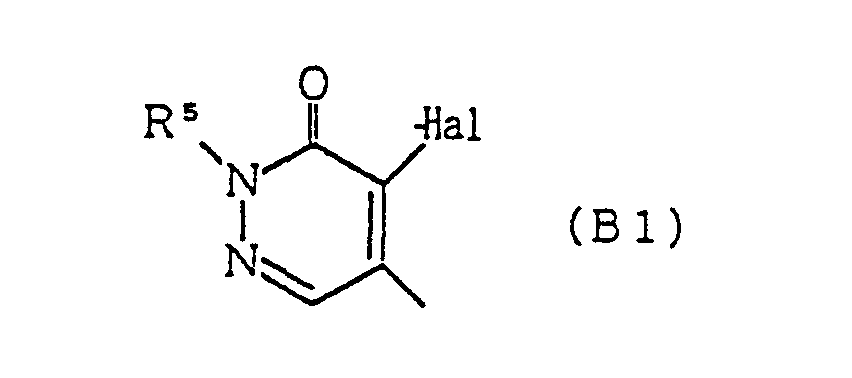


- Among the diphenyl ether derivatives of this invention, 4-substituted derivatives represented by the formula (I"") are preferred:

- The compounds (I) of the present invention can be prepared easily according to the methods known per se.
- A compound of the formula (II):


- A compound of the formula (IV):


- As is apparent from the above reactions, in both of the cases of the preparation methods (1) and (2), as the result of the reaction, hydrogen halide (HHal) is eliminated. Therefore, in order to carry out the reaction smoothly by trapping this, it is preferable to carry out the reaction in the presence of a base.
- As the base, organic bases such a triethylamine, pyridine, N,N-dimethylanilline, alkoxides of alkali metals such as sodium methoxide, sodium ethoxide, inorganic bases such as sodium hydride, sodium amide, sodium hydroxide, potassium hydroxide, sodium carbonate, sodium hydrogen carbonate, potassium carbonate may be employed.
- The reaction is generally carried out in the presence of a solvent. The solvent is not particularly limited, provided that it does not participate in the present reaction, and may include, for example, chlorinated or non-chlorinated aromatic, aliphatic, alicyclic hydrocarbons such as benzene, toluene, xylene, methyl naphthalene, petroleum ether, ligroin, hexane, chlorobenzene, dichlorobenzene, methylene chloride, chloroform, dichloroethane, trichloroethylene, cyclohexane; ethers such as diethyl ether, ethylene glycol dimethyl ether, tetrahydrofuran, dioxane; ketones such as acetone, methyl ethyl ketone, methyl isobutyl ketone; alcohols such as methanol, ethanol, ethylene glycol or hydrates thereof; amides such as N,N-dimethylformamide, N,N-dimethylacetamide, 1,3-dimethyl-2-imidazolidinone, dimethylsulfoxide, water and mixtures of the above solvents, etc.
- However, when an inorganic base such as sodium hydroxide, potassium hydroxide, etc. is used as the base as described above, it is preferable to use water or a mixture of the above solvent with water in dissolving these bases.
- On the other hand, when a mixture of water and non-aqueous solvent is used, it is preferable to add a small amount of a phase transfer catalyst, and examples of such phase transfer catalyst may include quaternary ammonium salts such as tetramethylammonium chloride, triethylbenzylammonium chloride, tetra-n-butylammonium bromide or tri-n-octylmethylammonium chloride, phosphonium salts such as tetra-n-butylphosphonium bromide, crown ethers such as dicyclohexano-18-crown-6 or cryptands, etc.
- The reaction temperature is not particularly limited, but generally from 0 ° C to the boiling point of the solvent employed, and it is preferable to heat the reaction mixture in order to shorten the reaction time.
- When R3 is a substituted or unsubstituted alkoxy group in the compound (I) of the present invention, the compound can be also prepared by allowing a compound of the formula (|'):


- Of the above reaction schemes, the reaction with the compound (VI) is a reaction in which hydrogen halide (HHal) is eliminated similarly as in the preparation methods (1) and (2), and the same base, solvent and conditions as in the preparation methods (1) and (2) can be suitably applied, but in the reaction with the compound (VII), which is an addition reaction of an olefin (VII), it is preferable to add an acid catalyst for promoting the reaction.
- As the acid catalyst, sulfuric acid, phosphoric acid, polyphosphoric acid, hydrogen chloride, zinc chloride, titanium tetrachloride, aluminum chloride, etc. may be employed.
- In the compound (I) of the present invention wherein R3 is difluoromethyl group, the compound can be also prepared by allowing a compound of the formula (I"):

- The reaction is generally carried out in the presence of a solvent, but the reaction can be also carried out by heating the compound of the formula (I") and DAST without any solvent.
- The solvent is not particularly limited, provided that is does not participate in the present reaction, and the same solvent and conditions as in the preparation methods (1) and (2) can be suitably applied.
- In the compound (I) of the present invention wherein R3 is trifluoromethoxy group, the compound can be also prepared by allowing a compound of the formula (I"'):

- The reaction is generally carried out in the presence of a solvent, but it can be also carried out by heating the compound of the formula (I"') and AgBF4 without any solvent.
- The solvent is not particularly limited, provided that it does not participate in the present reaction, and the same solvent and conditions as in the preparation methods (1) and (2) can bu suitably applied.
- The compounds of the formula (II) to be used as the starting material in the above preparation methods are known compounds (see, for example, Japanese Unexamined Patent Publications Nos. 175173/1982 and 10561/1986), and the compounds of the formulae (III), (IV) and (V) can be easily prepared by the methods known per se shown below.
- The compound of the formula (IV) wherein Y is oxygen atom or sulfur atom can be prepared by treating the . compound of the above formula (11) with a compound of the followinq formula (VIII):

- The compound of the formula (V) can be prepared by allowing a compound of the formula (IX):


- Also, the compounds of the formula (III), wherein Y is oxygen atom, can be easily prepared according to the following method.

- The compounds of the formula (III), wherein Y is a lower alkyl-substituted or unsubstituted imino group, can be easily prepared according to the following methods.

- The desired compound (I) obtainable according to the above method can be appropriately purified according to known means such a recrystallization, various chromatographies, etc.
- The compounds of the present invention exhibit excellent effects against agricultural and horticultural injurious insects, including Hemiptera such as planthoppers, leafhopper, aphids, whiteflies, etc.; Lepidoptera such as pyralid cabbage armyworms, diamondback moth, leaf folding worms, pyralid moths, common cabbage worms, etc.; Coleoptera such as weevils, leaf beatles, etc.; and otherwise Acarina such as citrus red mite, two-spotted spider mite, etc. Also, they are extremely effective for control of hygienically injurious insects such as flies, mosquitos, cockroaches, etc. and otherwise also effective against injurious insects to stored grains, etc.
- Further, the compounds of the present invention have also activities against root-knot nematodes, pine wood nematode, bulb mites. The compounds of the present invention are also effective for injurious diseases for agriculture and horticulture, and have activities against, for example, rice blast, barley powdery mildew, and otherwise cucumber downy mildew, gray mold, etc.
- Thus, the compounds of the present invention have extremely wide uses and application fields, having high activities, and can be provided for practical application in various preparation forms.
- The insecticide and acaricide of the present invention comprises one or several kinds of the compounds of the formula (I) as the active ingredient. Although the compound of the formula (I) itself may be used, but it is generally used by formulating conventional carriers, surfactants, dispersing agents or auxiliary agents, etc. in conventional manner to be prepared into such compositions as powder, wettable powder, emulsion, fine granule, granule, aqueous or oily suspension, aerosol, etc. before use.
- Suitable carriers may include, for example, solid carriers such as talc, bentonite, clay, kaolin, diatomaceous earth, white carbon, vermiculite, slaked lime, siliceous sand, ammonium sulfate, urea, etc.; liquid carriers, including hydrocarbons such as kerosine, mineral oil, etc., aromatic hydrocarbons such as benzene, toluene, xylene, etc., chlorinated hydrocarbons such as chloroform, carbon tetrachloride, etc., ethers such as dioxane, tetrahydrofuran, etc., ketones such as acetone, cyclohexanone, isophorone, etc., esters such as ethyl acetate, ethylene glycol acetate, dibutyl maleate, etc., alcohols such as methanol, n-hexanol, ethylene glycol, etc., polar solvents such as dimethylformamide, dimethylsulfoxide, etc., or water and others. Also, as the gas carrier, air, nitrogen, carbon dioxide, Freon, etc. may be used and jetted as a mixture.
- As the surfactant, dispersing agent for effecting improvement of attachment, absorbance of the present agent onto animals and vegetables, as well as improvement of performance of the chemicals such as dispersion, emulsification, spreading, etc., there may be employed, for example, alcohol sulfate esters, alkylsulfonic acid salts, lignin sulfonic acid salts, polyoxyethylene glycol ethers, etc.
- Further, for improvement of the properties of the preparation, as the auxiliary agent, for example, carboxymethyl cellulose, polyethylene glycol, gum arabic, etc. may be employed.
- The above carrier, surfactant, dispersing agent and auxiliary agent may be used each individually or as a combination depending on the respective purposes.
- In case where the compound of the present invention is formed into a preparation, the active ingredient concentration may be generally 1 to 50 % by weight for emulsion, generally 0.3 to 250/0 by weight for powder, generally 1 to 90 % by weight for wettable powder, generally 0.5 to 5 % by weight for granules, generally 0.5 to 5 % by weight for oil agent, and generally 0.1 to 5 % by weight for aerosol.
- These preparations may be diluted to suitable concentrations and sprayed on vegetable stalks and leaves, into soil or on a water surface of paddle field, or directly applied, thus being provided for various uses depending on the respective purposes.
- The present invention is described in more detail below by referring to Examples, but these Examples are not limitative of the scope of the present invention at all.
- To a solution of 2.2 g of 2-tert-butyl-4-chloro-5-mecapto-3(2H)pyridazinone and 3.6 g of 2-[2,6-dimethyl--4-(4-chlorophenoxy)phenoxy]ethylbromide dissolved in 50 ml of N,N-dimethylformamide was added 1.4 g of anhydrous potassium carbonate, and the mixture was stirred at 40 to 60 ° C for 4 hours.
- After completion of the reaction, the reaction mixture was poured into water and the oily product separated was extracted with toluene. The extract was washed with water, dried over anhydrous sodium sulfate and then toluene was evaporated under reduced pressure.
- The oily product obtained was isolated by column chromatography (Waco Gel C-200, eluted with toluene : ethyl acetate = 9 : 1), and then recrystallizedfrom n-hexane to give 3.6 g of the title product as colorless sandy crystals.
- m.p. 125 - 127 °C
- To a solution of 2.2 g of 2-tert-butyl-4,5-dichloro-3(2H)-pyridazinone and 3.2 g of 2-[2,6-dimethyl-4-(4-methylphenoxy)phenoxy]ethylmercaptane dissolved in 50 ml of methanol, with cooling to 5 °C or lower under stirring, was added dropwise a solution of 0.6 g of sodium methoxide dissolved in 5 ml of methanol. After the dropwise addition, the mixture was stirred at room temperature for 1 hour to complete the reaction.
- Subsequently, methanol was evaporated under reduced pressure, water was added to the residue and the oily product separated was extracted with ethyl acetate. The extract was washed with water, dried over anhydrous sodium sulfate, and then ethyl acetate was evaporated under reduced presure. The oily product obtained was isolated by column chromatography (Waco Gel C-200, eluted with toluene : ethyl acetate = 9 : 1) and then recrystallized from n-hexane to give 3.5 g of the title product as colorless sandy crystals. m.p. 131 - 133 °C
- To a solution of 1.1 g of 2-tert-butyl-4,5-dichloro3-(2H)-pyridazinone and 1.5 g of 2-[2,6-dimethyl-4-(4-fluorophenoxy)phenoxy]ethylamine dissolved in a solvent mixture of 20 ml of dioxane and 10 ml of water was added 0.7 g of potassium carbonate, and then the mixture was heated under reflux under stirring for 8 hours. After completion of the reaction, water was added and the mixture was extracted with toluene. The extract was washed with water, dried over anhydrous sodium sulfate and then toluene was evaporated under reduced pressure. The oil product obtained was isolated by column chromatography (Waco Gel C-200, eluted with toluene : ethyl acetate = 3 : 1) to give 0.7 g of the title product as pale yellow oil product.
-

- A solution of 0.9 g of 4,5-dichloro-6-ethylpyrimidine, 1.5 g of 2-[2,6-dimethyl-4-(4-fluorophenoxy)phenoxy]-ethylamine and 0.6 g of triethylamine dissolved in 30ml of toluene was heated under reflux under stirring for 8 hours. After completion of the reaction, triethylamine hydrochloride was filtered off, and toluene was evaporated off under reduced pressure. The oily product obtained was isolated by column chromatography (Waco Gel C-200, eluted with toluene : ethyl acetate = 3 : 1) to obtain 0.8 g of the title product as pale yellow oily product.
- 17-6 6 1.5800
- To a solution of 1.5 g of 2-tert-butyl-4-chloro-5-mercapto-3(2H)pyridazinone and 2.7 g of 2-[2,6-dimethyl--4-(4-trifluoromethylphenoxy)phenoxy]ethylbromide dissolved in 20 ml of N,N-dimethylformamide was added 1.0 g of potassium carbonate, and then the mixture was stirred at room temperature for 6 hours. After completion of the reaction, the reaction mixture was poured into water and extracted with toluene. The extract was washed with water, dried over anhydrous sodium sulfate and then toluene was evaporated under reduced pressure. The oily product obtained was isolated by column chromatography (Waco Gel C-200, eluted with toluene : ethyl acetate = 20 : 1) to obtain 3.2 g of the title product as pale yellow oily product.
- To a solution of 1.5 g of 2-tert-butyl-4-dichloro-3(2H)pyridazinone and 2.2 g of 2-[2-chloro-6-methyl-4-(4-chlorophenoxy)phenoxy]ethylamine dissolved in a solvent mixture of 20 ml of dioxane and 10 ml of water was added 1.0 g of potassium carbonate, and then the mixture was heated under reflux under stirring for 8 hours. After completion of the reaction, water was added and the mixture was extracted with toluene. The extract was washed with water, dried over anhydrous magnesium sulfate and then toluene was evaporated off under reduced pressure. The oily product obtained was isolated by column chromatography (Waco Gel C-200, eluted with toluene : ethyl acetate = 3 : 1) to obtain 2.0 g of the title product as colorless sandy crystals. m.p. 91 - 94 °C
- A mixture of 0.75 g of 2-tert-butyl-4-chloro-5-{2-[2-chloro-6-methyl-4-(4-bromodifluoromethoxyphe- noxy)phenoxy]ethylthio}-3(2H)pyridazinone (Compound No. 21) and 0.75 g of AgBF4 was heated under reflux in 50 ml of toluene for 20 hours.
- After completion of the reaction, the reaction mixture was poured into water and extracted with toluene. The extract was washed with water, dried over anhydrous sodium sulfate and then toluene was evaporated off under reduced pressure. The oily product obtained was isolated by column chromatography (Waco Gel C-200, eluted with toluene : ethyl acetate = 20 : 1) to obtain 0.5 g of the title product as colorless oily product.
- To a solution of 2.2 g of 2-tert-butyl-4-chloro-5-mercapto-3(2H)pyridazinone and 4 g of 2-[2-chloro-6-methyl-4-(4-i-propoxyphenoxy)phenoxy]ethylbromide dissolved in 50 ml of N,N-dimethylformamide was added 2 g of anhydrous potassium carbonate, and the mixture was stirred at room temperature for 8 hours. After completion of the reaction, the reaction mixture was poured into water and extracted with toluene. The extract was washed with water, dried over anhydrous sodium sulfate and then toluene was evaporated off under reduced pressure.
- The oil product obtained was isolated by column chromatography (Waco Gel C-200, eluted with toluene : ethyl acetate = 100 : 1) to obtain 2 g of the title compound as colorless oily product.
- To a solution of 1.2 g of 2-tert-butyl-4-chloro-5- mercapto-3(2H)pyridazinone and 2.0 g of 2-[2-chloro-6-methyl-4-(4-hydroxyphenoxy)phenoxy]ethylbromide dissolved in 30 ml of N,N-dimethylformamide was added 1.2 g of anhydrous potassium carbonate, and the mixture was stirred at room temperature for 8 hours. After completion of the reaction, the reaction mixture was poured into water and extracted with toluene. The extract was washed with water, dried over anhydrous sodium sulfate and toluene was evaporated off under reduced pressure. To the oily product obtained was added hexane to be crystallized and then the crystals were collected by filtration. Further, the crystals were recrystallized from toluene-hexane to give 1.6 g of the title product as colorless powdery crystals.
- m.p. 175-178 °C
- Into a solution of 1 g of 2-tert-butyl-4-ahloro-5-{2-[2-chloro-6-methyl-4-(4-hydroxyphenoxy)phenoxy]ethylthio}-3(2H)pyridazinone dissolved in 25 ml of dichloromethane was blown 1 g of isobutylene. To the mixture was added 0.05 g of conc. sulfuric acid, and the mixture was stirred at room temperature for 8 hours, and was further left to stand for 2 days. The reaction mixture was poured into water, made alkaline with sodium hydrogen carbonate and then the mixture was extracted with toluene. The extract was washed with water, dried over anhydrous sodium sulfate and then solvent was evaporated under reduced pressure.
- The oil product obtained was isolated by column chromatography (Waco Gel C-200, eluted with toluene : ethyl acetate = 70 : 1) to obtain 0.18 g of the title product as colorless oily product.
- To a solution of 0.5 g of 2-tert-butyl-4-chloro-5-mercapto-3(2H)pyridazinone and 0.9 g of 2-[2-chloro-6-methyl-4-(4-formylphenoxy)phenoxy]ethyliodide dissolved in 20 ml of N,N-dimethylformamide was added 0.4 g of anhydrous potassium carbonate, and the mixture was stirred at room temperature for 8 hours. After completion of the reaction, the reaction mixture was poured into water and extracted with toluene. The extract was washed with water, dried over anhydrous sodium sulfate and toluene was evaporated off under reduced pressure.
- The oily product obtained was isolated by column chromatography (Waco Gel C-200, eluted with toluene : ethyl acetate = 50 : 1) to obtain 0.4 g of the title product as colorless oily product.
- To 0.3 g of 2-tert-butyl-4-chloro-5-{2-[2-ehloro-6-methyl-4-(4-formylphenoxy)phenoxy]ethylthio}-3(2H)-pyridazinone dissolved in 25 ml of dichloromethane was added, at room temperature under stirring, 0.2 g of diethylaminosulfur trifluoride. After the reaction for 8 hours, the reaction mixture was poured into water and extracted with toluene. The extract was washed with water, dried over anhydrous sodium sulfate and then solvent was evaporated under reduced pressure.
- The oily product obtained was isolated by column chromatography (Waco Gel C-200, eluted with toluene : ethyl acetate = 60 : 1) to obtain 0.3 of the title product as colorless oily product.
- By carrying out the treatment in the same manner as described in Examples 1 -11, the compounds shown under the compounds Nos. 1, 3 - 5, 11, 15 -22, 24 - 31, 33 -35, 37, 39, 41 - 43, 45, 47, 49, 52, 53, 55, 57, 59, 61 -65, 67, 69, 71, 73 - 75, 79 - 81, 83, 85 - 87, 89, 90, 92, 94, 96 - 98, 100 -102, 105, 108, 110 - 113, 115 -137 as shown in Table 1A and Table 1B were obtained.
- Also, the compound of Comparative example 1 as shown in Table 1A and Table 1B was synthesized.


- In the above Table 1A,

- Moreover, in the above Table 1A, the compounds shown under the compounds Nos. 8,9,12- 14, 32, 36, 38, 40, 44, 48, 50, 54, 56, 58, 60, 66, 68, 70, 72, 76; 78, 82, 84, 88, 91, 93, 95, 99, 107, 109, 138 and 139 were listed as compounds which are within the scope of this invention although they were not prepared in the Examples.
- 5 parts by weight of the compound No. 2,35 parts by weight of bentonite, 57 parts by weight of talc, 1 part by weight of Neopelex Powder (trade name: produced by Kao Atlas) and 2 parts by weight of sodium lignin sulfonate were homogeneously mixed, and then small amount of water was added thereto and the mixture was kneaded, followed by granulation and drying to obtain granules.
- 50 parts by weight of the compound No. 5, 48 parts by weight of kaolin and 2 parts by weight of Neopelex Powder (trade name: produced by Kao Atlas) were homogeneously mixed, and then crushed to obtain wettable powder.
- 20 parts by weight of the compound No. 6, 70 parts by weight of xylene and 10 parts by weight of Toxanon (trade name: produced by Sanyo Kasei Kogyo) were homogeneously mixed and dissolved to obtain emulsion.
- The compounds shown in Table 1 were formulated similarly as described in Example 15, and each formulation was diluted with water containing a surfactant (0.01 %) to 300 ppm to prepare a chemical solution. In each chemical solution was dipped young rice seedlings for 30 seconds, and the rice seedlings after air drying were inserted into a glass cylinder. Ten 4th instar green rice leafhopper larvae were freed into the cylinder, and the cylinder was left to stand stoppered with a porous plug in a thermostatic chamber of 25 ° C. 4 days later, the numbers of live and dead insects were counted to determine the % mortality. The results are shown in Table 2.
- In Table 2, those with mortality of 100 % are shown as A, those with 99 to 80 % as B, those with 79 to 60 % as C and those with less than 60 % as D.

- The compounds shown in Table 1 were formulated similarly as described in Example 15, and each formulation was diluted with water containing a surfactant (0.01 %) to 300 ppm to prepare a chemical solution. In each chemical solution was dipped young rice seedlings for 30 seconds, and the rice seedlings after air drying were inserted into a glass cylinder. Ten 3rd instar brown rice planthopper larvae were freed into the cylinder, and the cylinder was left to stand stoppered with a porous plug in a thermostatic chamber of 25 0 C. 4 days later, the numbers of live and dead insects were counted to determine the % mortality. The results are shown in Table 3.
- In Table 3, those with mortality of 100 % are shown as A, those with 90 to 80 % as B, those with 79 to 60 % as C and those with less and 60 % as D.

- The compounds shown in Table 1 were formulated similarly as described in Example 15, and each formulation was diluted with water containing a surfactant (0.01 %) to 300 ppm to prepare a chemical solution. In each chemical solution cabbage leaf strip (5 cm x 5 cm) was dipped for 30 seconds, and placed in a plastic cup. After air drying, ten 3rd instar diamondback moth larvae were freed, and the plastic cup was closed with a lid and left to stand in a thermostatic chamber of 25 °C. 2 days later, the numbers of live and dead insects were counted to determine the % mortality. The results are shown in Table 4.
- In Table 4, those with mortality of 100 % are shown as A, those with 99 to 80 % as B, those with 79 to 60 % as C and those with less than 60 0/0 as D.

- 10 female adult citrus red mites were provided for the test of mulberry leaf disks (diameter 20 mm). On the other hand, the compounds shown in Table 1 were formulated similarly as described in Example 15, and each formulation was diluted to 300 ppm with water containing a surfactant (0.01 %) to prepare a chemical solution and 5 ml of the chemical solution was sprayed on leaf disks. The disks was left to stand in a thermostatic chamber of 25 ° C, and 3 days later in the numbers of live and dead mites were counted to determine the % mortality. The results are shown in Table 5.
- In Table 5, those with mortality of 100 % are shown as A, those with 99 to 80 % as B, those with 79 to 60 % as C and those with less than 60 % as D.

- 10 female adult twospotted spider mites were provided for the test on kidney beans leaf disks (diameter 20 mm). On the other hand, the compounds shown in Table 1 were formulated similarly as described in Example 15, and each formulation was diluted to 300 ppm with water containing a surfactant (0.01 070) to prepare a chemical solution, and the leaf disks was dipped in each chemical solution for 10 seconds. The leaf disk was left to stand in a thermostatic chamber of 25 °C, and 3 days later the numbers of live and dead mites were counted to determine the % mortality. The results are shown in Table 6.
- In Table 6, those with mortality of 100 % are shown as A, those with 99 to 80 % as B, those with 79 to 60 % as C and those with less than 60% as D.

- The compound shown in Table 1 were formulated similarly as described in Example 15, and each formulation was diluted to 200 ppm with water containing a surfactant (0.01 %) to prepare a chemical solution, and a sufficient amount of each chemical solution was sprayed on cucumber seedlings. Two days after spraying, spores of cucumber downy mildew was inoculated by spraying, and the seedlings were left to stand in a room of a temperature of 20 ° C and a humidity of 100% for one day. Then, the seedlings were transferred into a warm chamber and on the 10th day after inoculation, the lesion are was compared with that of seedlings in the non-treated district. The results are shown in Table 7.
- In Table 7, those without lesion are shown as A, those with lesion area of 10 % or less as compared with the non-treated ones as B, those with about 20 % as C and those with greater affliction as D.

- According to the present invention, novel diphenyl ether derivatives having excellent insecticidal and acaricidal effect can be provided.
Claims (21)
1. A diphenyl ether derivative of the formula:

wherein R1, R2, R3 and R4 each independently represent a hydrogen atom, a halogen atom, nitro group, formyl group, hydroxyl group, a lower alkyl group which may be unsubstituted or substituted, a lower alkoxy group which may be unsubstituted or substituted, a lower alkylthio group which may be unsubstituted or substituted or lower alkylsulfonyl group which may be unsubstituted or substituted, an aralkyl group which may be unsubstituted or substituted or an aryloxy group which may be unsubstituted or substituted, with proviso that all of Rl, R2, R3 and R4 cannot represent a hydrogen atom at the same time; m is an integer of 1 or 2; n is an integer of 1 to 5; X and Y each independently represent oxygen atom, sulfur atom or an imino group which may be unsubstituted or substituted with a lower alkyl group; A represents a straight or branched alkylene group having 2 to 4 carbon atoms; and B represents a heterocyclic group containing at least one nitrogen atom as the hetero atom.
2. The diphenyl ester derivative according to Claim 1, wherein said lower alkyl group represented by R1, R2, R3 or R4 in the formula (1) is methyl, ethyl, propyl, isopropyl, butyl, isobutyl, sec-butyl, tert-butyl, amyl, isoamyl, sec-amyl, sec-isoamyl (1,2-dimethylpropyl) or tert-amyl (1,1-dimethylpropyl) group; said lower alkoxy group represented by R1, R2, R3 or R4 in the formula (I) is methoxy, ethoxy, propoxy, isopropoxy, butoxy, isobutoxy, sec-butoxy, t-butoxy or amyloxy group; said lower alkylthio group represented by R1, R2, R3 or R4 in the formula (I) is methylthio, ethylthio, propylthio, isopropylthio, butylthio, isobutylthio, sec-butylthio, t-butylthio or amylthio group; said lower alkylsulfonyl group represented by Ri, R2, R3 or R4 in the formula (I) is methylsulfonyl, ethylsulfonyl, propylsulfonyl, isopropylsulfonyl, butylsulfonyl, isobutylsulfonyl, sec-butylsulfonyl, t-butylsulfonyl or amylsulfonyl group and said halogen group represented by R1, R2, R3 or R4 in the formula (I) is fluoride atom, chlorine atom or bromine atom.
3. The diphenyl ether derivative according to Claim 1, wherein said lower alkyl group represented by R1, R2, R3 or R4 in the formula (I); said lower alkoxy group represented by R1, R2, R3, or R4 in the formula (I); said lower alkylthio group represented by R1, R2, R3 or R4 in the formula (I); or said lower alkylsulfonyl group represented by R1, R2, R3 or R4 in the formula (I) is substituted with a halogen atom, a lower alkenyl group, a cycloalkyl group having 3 to 6 carbon atoms, a lower alkylthio group, a lower alkoxy group, a lower alkoxyalkoxy group, a lower alkenyloxy group, a lower alkynyloxy group or an aralkyloxy group.
4. The diphenyl ether derivative according to Claim 3, wherein said lower alkyl group represented by R1, R2, R3 or R4 in the formula (I) is a trifluoromethyl, 2-chloroethyl, 2,2,2-trifluoroethyl, ethoxymethyl, 2-methoxyethyl, 1-ethoxyethyl, 2-ethoxyethyl, 2-allyloxyethyl or 2-propargyloxyethyl group; said lower alkoxy group represented by R1, R2, R3 or R4 in the formula (I) is a trifluoromethoxy, cyclopropylmethoxy, 2-chloroethoxy, 2,2,2-trifluoroethoxy, 2-ethoxyethoxy, 2-benzyloxyethoxy, 2-ethylthioethoxy group; said lower alkylthio group represented by R1, R2, R3 or R4 in the formula (I) is a trifluoromethylthio, 2-chloroethylthio, 2,2,2-trifluoroethylthio, 2-ethoxyethylthio, 2-benzyloxyethylthio or 2-ethylthioethylthio group; and said lower alkylsulfonyl group represented by Rl, R2, R3 or R4 in the formula (I) is trifluoromethylsulfonyl, 2-chloroethylsulfonyl, 2,2,2-trifluoroethylsulfonyl, 2-ethoxyethylsulfonyl, 2-benzyloxyethylsulfonyl or 2-ethylthioethylsulfonyl group.
5. The diphenyl ether derivative according to Claim 1 wherein, R and R2 in the formula (I) is methyl group or chlorine atom; R3 in the formula (I) is methyl group, 2-fluoroethyl group, fluorine atom, bromine atom, chlorine atom, ethoxy, t-butoxy, difluoromethoxy, trifluoromethoxy, 2-methoxyethyl, 2-ethoxyethoxy, methylthio or formyl groups and is located on the 4-position of the benzene ring; and R4 in the formula (I) is hydrogen atom, methyl group or chlorine atom.
6. The diphenyl ether derivative according to Claim 1, wherein said imino group represented by Y in the formula (I) is substituted with a methyl group.
7. The diphenyl ether derivative according to Claim 7, wherein said heterocyclic group represented by B in the formula (I) is a pyridazinone group.
8. The diphenyl ether derivative according to Claim 1, wherein said derivative is one selected from the group consisting of
2-tert-butyl-4-chloro-5-{2-[2,6-dimethyl-4-(4-chlorophenoxy)phenoxy]ethylthio}-2(2H)pyridazinone,
2-tert-butyl-4-chloro-5-{2-[2,6-dimethyl-4-(4-methylphenoxy)phenoxy]ethylthio}-3(2H)pyridazinone,
2-tert-butyl-4-chloro-5-{2-[2,6-dimethyl-4-(4-fluorophenoxy)phenoxy]ethylamino}-3(2H)pyridazinone,
5-chloro-6-ethyl-4-{2,6-dimethyl-4-(4-fluorophenoxy)-phenoxy]ethylamino}pyrimidine,
2-tert-butyl-4-chloro-5-{2-[2,6-dimethyl-4-(4-trifluoromethylphenoxy) phenoxy]ethylthio}-3(2H) pyridazinone,
2-tert-butyl-4-chloro-5-{2-[2-chloro-6-methyl-4-(4-chlorophenoxy)phenoxy]ethylamino}-3(2H)pyridazinone,
2-tert-butyl-4-chloro-5-{2-[2-chloro-6-methyl-4-(4-trifluoromethoxyphenoxy)phenoxy]ethylthio}-3(2H)-pyridazinone,
2-tert-butyl-4-chloro-5-{2-[2-chloro-6-methyl-4-(4-i-propoxyphenoxy)phenoxy]ethylthio}-3(2H)pyridazinone,
2-tert-butyl-4-chloro-5-{2-[2-chloro-6-methyl-4-(4-t-butoxyphenoxy)phenoxy]ethylthio}-3(2H)pyridazinone,
2-tert-butyl-4-chloro-5-{2-[2-chloro-6-methyl-4-(4-formylphenoxy) phenoxy] ethylthio}-3(2H) pyridazinone,
2-tert-butyl-4-chloro-5-{2-[2-chloro-6-methyl-4-(4-difluoromethylphenoxy)phenoxy]ethylthio}3(2H)pyridazinone and
2-tert-butyl-4-chloro-5-{2-[2-chloro-6-methyl-4-(4-(2-ethoxyethyl)phenoxy) phenoxy]ethylthio}3(2H) pyridazinone.
9. A process for preparing a diphenyl ether derivative of the formula:

wherein Rl, R2, R3 and R4 each independently represent hydrogen atom, a halogen atom, nitro group, formyl group, hydroxyl group, a lower alkyl group which may be unsubstituted or substituted, a lower alkoxy group which may be unsubstituted or substituted, a lower alkylthio group which may be unsubstituted or substituted or lower alkylsulfonyl group which may be unsubstituted or substituted, an aralkyl group which may be unsubstituted or substituted or an aryloxy group which may be unsubstituted or substituted, with proviso that all of R1, R2, R3 and R4 cannot represent a hydrogen atom at the same time; m is an integer of 1 or 2; n is an integer of 1 to 5; X and Y each independently represent oxygen atom, sulfur atom or an imino group which may be unsubstituted or substituted with a lower alkyl group; A represents a straight or branched alkylene group having 2 to 4 carbon atoms; and B represents a heterocyclic group containing at least one nitrogen atom as the hetero atom, which comprises allowing a compound of the formula: B-Hal wherein B represents a heterocyclic group containing at least one nitrogen atom as the hetero atom; Hal represents a halogen atom, to react with a compound of the formula:

wherein R1, R2, R3, R4, m, n, X, Y and A are the same as defined above.
10. A process for producing a diphenyl ether derivative of the formula:

wherein R1, R2, R3 and R4 each independently represent a hydrogen atom, a halogen atom, a nitro group, a formyl group, a hydroxyl group, a lower alkyl group which may be unsubstituted or substituted, a lower alkoxy group which may be unsubstituted or substituted, a lower alkylthio group which may be unsubstituted or substituted or lower alkylsulfonyl group which may be unsubstituted or substituted, an aralkyl group which may be unsubstituted or substituted or an aryloxy group which may be unsubstituted or substituted, with proviso that all of R1, R2, R3 and R4 cannot represent a hydrogen atom at the same time; m is an integer of 1 or 2; n is an integer of 1 to 5; X and Y each independently represent oxygen atom, sulfur atom or an imino group which may be unsubstituted or substituted with a lower alkyl group; A represents a straight or branched alkylene group having 2 to 4 carbon atoms; and B represents a heterocyclic group containing at least one nitrogen atom as the hetero atom, which comprises allowing a compound of the formula:
B-Y-H
wherein B and Y are the same as defined above,
to react with a compound of the formula:

wherein R1, R2, R3, R4, m, n, X and A are the same as defined above.
11. A process for preparing a diphenyl ether derivative of the formula:

wherein R1, R2 and R4 each independently represent a hydrogen atom, a halogen atom, a nitro group, a formyl group, a hydroxyl group, a lower alkyl group which may be unsubstituted or substituted, a lower alkoxy group which may be unsubstituted or substituted, a lower alkylthio group which may be unsubstituted, a lower alkylthio group which may be unsubstituted or substituted or lower alkylsulfonyl group which may be unsubstituted or substituted, an aralkyl group which may be unsubstituted or substituted or an aryloxy group which may be unsubstituted or substituted, R3 is a group of the formula:

wherein R' represents a lower alkyl group;
m is an integer of 1 or 2; n is an integer of 1 to 5; X and Y each independently represent oxygen atom, sulfur atom or an imino group which may be unsubstituted or substituted with a lower alkyl group; A represents a straight or branched alkylene group having 2 to 4 carbon atoms; and B represents a heterocyclic group containing at least one nitrogen atom as the hetero atom,
which comprises allowing a compound of the formula:

wherein R1, R2, R4, m, n, X, Y, A and B are the same as defined above, to react with a compound of the formula:

wherein R' is the same as defined above.
12. A process for producing a diphenyl ether derivative of the formula;

wherein R1, R2, and R4 each independently represent a hydrogen atom, a halogen atom, a nitro group, a formyl group, a hydroxyl group, a lower alkyl group which may be unsubstituted or substituted, a lower alkoxy group which may be unsubstituted or substituted, a lower alkylthio group which may be unsubstituted or substituted or lower alkylsulfonyl group which may be unsubstituted or substituted, an aralkyl group which may be unsubstituted or substituted or an aryloxy group which may be unsubstituted or substituted, R3 is a difluoromethyl group; m is an integer of 1 or 2; n is an integer of 1 to 5; X and Y each independently represent oxygen atom, sulfur atom or an imino group which may be unsubstituted or substituted with a lower alkyl group; A represents a straight or branched alkylene group having 2 to 4 carbon atoms; and B represents a heterocyclic group containing at least one nitrogen atom as the hetero atom, which comprises allowing a compound of the formula:

wherein R1, R2, R4, m, n, X,, Y, A and B are the same as defined above, to react with diethylaminosulfurtrifluoride.
13. A process for producing a diphenyl ether derivative of the formula:

wherein R1, R2 and R4 each independently represent a a hydrogen atom, a halogen atom, a nitro group, a formyl group, a hydroxyl group, a lower alkyl group which may be unsubstituted or substituted, a lower alkoxy group which may be unsubstituted or substituted, a lower alkylthio group which may be unsubstituted or substituted or lower alkylsulfonyl group which may be unsubstituted or substituted, an aralkyl group which may be unsubstituted or substituted or an aryloxy group which may be unsubstituted or substituted, R3 is a trifluoromethoxy group; m is an integer of 1 or 2; n is an integer of 1 to 5; X and Y each independently represent oxygen atom, sulfur atom or an imino group which may be unsubstituted or substituted with a lower alkyl group; A represents a straight or branched alkylene group having 2 to 4 carbon atoms; and B represents a heterocyclic group containing at least one nitrogen atom as the hetero atom, which comprises allowing a compound of the formula:

wherein R1, R2, R4, m, n, X, Y, A and B are the same as defined above, to react with AgBF4.
14. The process according to Claim 9, 10 or 11 wherein said reaction is carried out in the presence of a base.
15. The process according to Claim 14, wherein said base is selected from the group consisting of triethylamine, pyridine, N,N-dimethylaniline, sodium methoxide, sodium ethoxide, sodium hydride, sodium amide, sodium hydroxide, potassium hydroxide, sodium carbonate, sodium hydrogen carbonate and potassium carbonate.
16. The process according to Claim 9, 10, 11, 12 or 13, wherein said reaction is carried out in the presence of a solvent.
17. The process accoridng to Claim 16, wherein said solvent is selected from the group consisting of benzene, toluene, xylene, methyl naphthalene, petroleum ether, ligroin, hexane, chlorobenzene, dichlorobenzene, methylene chloride, chloroform, dichloroethane, trichloroethylene, cyclohexane, diethyl ether, ethylene glycol dimethyl ether, tetrahydrofuran, dioxane, acetone, methyl ethyl ketone, methyl isobutyl ketone, methanol, ethanol, ethylene glycol or hydrates thereof, N,N-dimethylformamide, N,N-dimethylacetamide, 1,3-dimethyl-2-imidazolidinone, dimethylsulfoxide, water and mixtures of the above solvents.
18. The process according to Claim 9, 10 11, 12 or 13, wherein the reaction is carried out in the range from 0 0 C to the boiling point of the solvent employed.
19. The process according to Claim 11, wherein the reaction is carried out in the presence of an acid catalyst selected form the group consisting of sulfuric acid, phosphoric acid, polyphosphoric acid, hydrogen chloride, zinc chloride, titanium tetrachloride and aluminum chloride.
20. An insecticide containing a diphenyl ether derivative of the formula:

wherein R1, R2, R3 and R4 each independently represent a hydrogen atom, a halogen atom, a nitro group, a formyl group, a hydroxyl group, a lower alkyl group which may be unsubstituted or substituted, a lower alkoxy group which may be unsubstituted or substituted, a lower alkylthio group which may be unsubstituted or substituted or lower alkylsulfonyl group which may be unsubstituted or substituted, an aralkyl group which may be unsubstituted or substituted or an aryloxy group which may be unsubstituted or substituted, with proviso that all of R1, R2, R3 and R4 cannot represent a hydrogen atom at the same time; m is an integer of 1 or 2; n is an integer of 1 to 5; X and Y each independently represent oxygen atom, sulfur atom or an imino group which may be unsubstituted or substituted with a lower alkyl group; A represents a straight or branched alkylene group having 2 to 4 carbon atoms; and B represents a heterocyclic group containing at least one nitrogen atom as the hetero atom.
21. An acaricide containing as the active ingredient a diphenyl ether derivative of the formula:

wherein R1, R2, R3 and R4 each independently represent a hydrogen atom, a halogen atom, a nitro group, a formyl group, a hydroxyl group, a lower alkyl group which may be unsubstituted or substituted, a lower alkoxy group which may be unsubstituted or substituted, a lower alkylthio group which may be unsubstituted or substituted or lower alkylsulfonyl group which may be unsubstituted or substituted, an aralkyl group which may be unsubstituted or substituted or an aryloxy group which may be unsubstituted or substituted, with proviso that all of Fil, R2, R3 and R4 cannot represent a hydrogen atom at the same time; m is an integer of 1 or 2; n is an integer of 1 to 5; X and Y each independently represent oxygen atom, sulfur atom or an imino group which may be unsubstituted or substituted with a lower alkyl group; A represents a straight or branched alkylene group having 2 to 4 carbon atoms; and B represents a heterocyclic group containing at least one nitrogen atom as the hetero atom.
Applications Claiming Priority (4)
| Application Number | Priority Date | Filing Date | Title |
|---|---|---|---|
| JP4864888 | 1988-03-03 | ||
| JP48648/88 | 1988-03-03 | ||
| JP24981788 | 1988-10-05 | ||
| JP249817/88 | 1988-10-05 |
Publications (2)
| Publication Number | Publication Date |
|---|---|
| EP0331529A2 true EP0331529A2 (en) | 1989-09-06 |
| EP0331529A3 EP0331529A3 (en) | 1991-11-21 |
Family
ID=26388947
Family Applications (1)
| Application Number | Title | Priority Date | Filing Date |
|---|---|---|---|
| EP19890302189 Withdrawn EP0331529A3 (en) | 1988-03-03 | 1989-03-03 | Diphenyl ether derivatives, process for producing the same and insecticide and acaricide containing the same as active ingredient |
Country Status (1)
| Country | Link |
|---|---|
| EP (1) | EP0331529A3 (en) |
Cited By (10)
| Publication number | Priority date | Publication date | Assignee | Title |
|---|---|---|---|---|
| EP0467760A1 (en) * | 1990-07-18 | 1992-01-22 | Sumitomo Chemical Company, Limited | Pyrimidine derivatives, methods for producing them, and fungicides, insecticides and/or acaricides containing them as active ingredient |
| EP0452002A3 (en) * | 1990-03-30 | 1992-02-26 | Dowelanco | Thienopyrimidine derivatives |
| EP0453137A3 (en) * | 1990-04-14 | 1992-09-23 | Nihon Nohyaku Co., Ltd. | Aminopyrimidine derivatives, a process for production thereof, and uses thereof |
| EP0519211A1 (en) * | 1991-05-17 | 1992-12-23 | Hoechst Schering AgrEvo GmbH | Substituted 4-aminopyrimidine, process for their preparation and their use as parasiticide |
| EP0534341A1 (en) * | 1991-09-25 | 1993-03-31 | Hoechst Schering AgrEvo GmbH | 4-Alkoxypyrimidin derivatives, process for their preparation, agent containing them and their use as parasiticides |
| US5236924A (en) * | 1990-07-18 | 1993-08-17 | Sumitomo Chemical Co., Ltd. | Pyrimidine derivatives and fungicides and/or acaricides containing them as active ingredient |
| US5243087A (en) * | 1990-05-24 | 1993-09-07 | Sumitomo Chemical Company, Limited | Pyridine derivatives, their production processes and their compositions for the control of insect pests |
| US5393885A (en) * | 1992-08-20 | 1995-02-28 | Ciba-Geigy Corporation | Carbamic acid derivatives |
| WO2002017712A3 (en) * | 2000-09-01 | 2003-06-12 | Fmc Corp | Disubstituted benzenes as insecticides |
| WO2013135672A1 (en) | 2012-03-13 | 2013-09-19 | Basf Se | Fungicidal pyrimidine compounds |
Family Cites Families (6)
| Publication number | Priority date | Publication date | Assignee | Title |
|---|---|---|---|---|
| US4571397A (en) * | 1982-03-05 | 1986-02-18 | Nissan Chemical Industries | Pyridazinone derivatives, preparation thereof, and agricultural and horticultural fungicidal, insecticidal, acaricidal, nematicidal compositions containing said derivatives |
| JPS59199673A (en) * | 1983-04-25 | 1984-11-12 | Sumitomo Chem Co Ltd | Nitrogen-containing heterocyclic compound, its preparation and pesticide containing the same |
| GR79933B (en) * | 1983-06-23 | 1984-10-31 | Nissan Chemical Ind Ltd | |
| DE3578304D1 (en) * | 1984-11-29 | 1990-07-26 | Nissan Chemical Ind Ltd | PYRIDAZINE DERIVATIVES, THEIR PRODUCTION AND INSECTICIDAL, ACARICIDIC, NEMATICIDIC, FUNGICIDIC COMPOSITIONS. |
| US4837217A (en) * | 1985-04-19 | 1989-06-06 | Nissan Chemical Industries, Ltd. | Pyridazinone derivatives, preparation thereof, and insecticidal, acaricidal, nematicidal, fungicidal compositions |
| ZA87704B (en) * | 1986-02-08 | 1987-09-30 | Nissan Chemical Ind Ltd | Pyridazinone derivatives,preparation thereof,and insecticidal,acaricidal,nematicidal,fungicidal compositions |
-
1989
- 1989-03-03 EP EP19890302189 patent/EP0331529A3/en not_active Withdrawn
Cited By (17)
| Publication number | Priority date | Publication date | Assignee | Title |
|---|---|---|---|---|
| AU651337B2 (en) * | 1990-03-30 | 1994-07-21 | Dowelanco | Thienopyrimidine derivatives |
| EP0452002A3 (en) * | 1990-03-30 | 1992-02-26 | Dowelanco | Thienopyrimidine derivatives |
| EP0453137A3 (en) * | 1990-04-14 | 1992-09-23 | Nihon Nohyaku Co., Ltd. | Aminopyrimidine derivatives, a process for production thereof, and uses thereof |
| US5243087A (en) * | 1990-05-24 | 1993-09-07 | Sumitomo Chemical Company, Limited | Pyridine derivatives, their production processes and their compositions for the control of insect pests |
| EP0467760A1 (en) * | 1990-07-18 | 1992-01-22 | Sumitomo Chemical Company, Limited | Pyrimidine derivatives, methods for producing them, and fungicides, insecticides and/or acaricides containing them as active ingredient |
| US5236924A (en) * | 1990-07-18 | 1993-08-17 | Sumitomo Chemical Co., Ltd. | Pyrimidine derivatives and fungicides and/or acaricides containing them as active ingredient |
| EP0519211A1 (en) * | 1991-05-17 | 1992-12-23 | Hoechst Schering AgrEvo GmbH | Substituted 4-aminopyrimidine, process for their preparation and their use as parasiticide |
| US5668140A (en) * | 1991-05-17 | 1997-09-16 | Hoechst Aktiengesellschaft | Substituted 4-aminopyrimidines, processes for their preparation, and their use as pesticides |
| EP0534341A1 (en) * | 1991-09-25 | 1993-03-31 | Hoechst Schering AgrEvo GmbH | 4-Alkoxypyrimidin derivatives, process for their preparation, agent containing them and their use as parasiticides |
| WO1993006091A1 (en) * | 1991-09-25 | 1993-04-01 | Hoechst Aktiengesellschaft | Substitued 4-alkoxypyrimidines, a process for preparing the same, agents containing the same and their use as pest control agents |
| US5859020A (en) * | 1991-09-25 | 1999-01-12 | Hoechst Schering Agrevo Gmbh | Substituted 4-Alkoxypyrimidines, Process for their preparation, agents containing them, and their use as pesticides |
| US5393885A (en) * | 1992-08-20 | 1995-02-28 | Ciba-Geigy Corporation | Carbamic acid derivatives |
| US5648494A (en) * | 1992-08-20 | 1997-07-15 | Ciba-Geigy Corporation | Carbamic acid derivatives |
| WO2002017712A3 (en) * | 2000-09-01 | 2003-06-12 | Fmc Corp | Disubstituted benzenes as insecticides |
| US6753429B2 (en) | 2000-09-01 | 2004-06-22 | Fmc Corporation | 1,4-disubstituted benzenes as insecticides |
| US7247756B2 (en) | 2000-09-01 | 2007-07-24 | Bayer Cropscience Ag | 1,4-disubstituted benzenes as insecticides |
| WO2013135672A1 (en) | 2012-03-13 | 2013-09-19 | Basf Se | Fungicidal pyrimidine compounds |
Also Published As
| Publication number | Publication date |
|---|---|
| EP0331529A3 (en) | 1991-11-21 |
Similar Documents
| Publication | Publication Date | Title |
|---|---|---|
| US4985426A (en) | Aralkylaminopyrimidine derivative, process for producing thereof and insecticide, acaricide and fungicide containing said derivative as active ingredient | |
| EP0532022B1 (en) | Acrylate compound, preparation process thereof and fungicide using the same | |
| EP0370704B1 (en) | Aralkylamine derivatives, preparation thereof and fungicides containing the same | |
| EP0104532B1 (en) | O-halobenzoic acid derivatives, process for their preparation, herbicidal compositions and their use | |
| EP0239391B1 (en) | 1,2,6-triphenyl-4(1H)-pyridinone and pyridinethione derivatives, production and uses thereof | |
| EP0199281A2 (en) | Pyridazinone derivatives, preparation thereof, and insecticidal, acaricidal, nematicidal, fungicidal compositions | |
| EP0356158A1 (en) | Aminopyrimidine derivative, process for preparing the derivative, and insecticide or bactericide containing the derivative | |
| EP0424125A2 (en) | Aralkylamine derivatives, preparation method thereof and fungicides containing the same | |
| EP0405808B1 (en) | Phenoxyalkylamine derivatives and insecticides, acaricides and fungicides | |
| EP0331529A2 (en) | Diphenyl ether derivatives, process for producing the same and insecticide and acaricide containing the same as active ingredient | |
| EP0232825A2 (en) | Pyridazinone derivatives, preparation thereof, and insecticidal, acaricidal, nematicidal, fungicidal compositions | |
| US5081144A (en) | Pyrazoleoxime derivative and insecticide, acaricide and fungicide | |
| EP0493606A1 (en) | Heterocycle-substituted benzene derivative, production thereof, and herbicide containing the same as active ingredient | |
| US5124333A (en) | Aminopyrimidine derivatives and harmful organisms preventive agent | |
| JP3511729B2 (en) | 4- [2- (trifluoroalkoxy-substituted phenyl) ethylamino] pyrimidine derivative, its production method and pesticide for agricultural and horticultural use | |
| EP0283271A2 (en) | Pyridazinone derivative, process for producing thereof and insecticide, acaricide and fungicide containing said derivative as active ingredient | |
| JPH07112972A (en) | Pyrazolecarboxamide derivative, its manufacturing method and pest control agent for agricultural and horticultural use | |
| US5252596A (en) | Phenoxyalkylamine derivative and method for controlling noxious organisms containing the same | |
| EP0618195B1 (en) | Insecticidal, acaricidal and fungicidal pyrazole phenoxyalkylamin derivatives and process for preparing the same | |
| EP1074546B1 (en) | 5-iodo-4-phenethylaminopyrimidine derivatives, intermediates thereof, process for producing the same and agricultural/horticultural pesticides | |
| JPH07118242A (en) | Phenoxyalkylamine derivative, its manufacturing method and pest control agent for agriculture and horticulture | |
| JP2631238B2 (en) | Pyrazole oxime derivatives and insecticides, miticides and fungicides | |
| JPH02196774A (en) | Diphenyl ether derivative, its production and insecticide and miticide containing the derivative as active component | |
| EP1357113B1 (en) | 6-(1-fluoroethyl)-5-iodo-4-aminopyrimidine compounds, process for preparation of the same, and pest controllers for agricultural and horticultural use | |
| JPH0535147B2 (en) |
Legal Events
| Date | Code | Title | Description |
|---|---|---|---|
| PUAI | Public reference made under article 153(3) epc to a published international application that has entered the european phase |
Free format text: ORIGINAL CODE: 0009012 |
|
| AK | Designated contracting states |
Kind code of ref document: A2 Designated state(s): DE ES FR GB IT |
|
| PUAL | Search report despatched |
Free format text: ORIGINAL CODE: 0009013 |
|
| AK | Designated contracting states |
Kind code of ref document: A3 Designated state(s): DE ES FR GB IT |
|
| 17P | Request for examination filed |
Effective date: 19920416 |
|
| STAA | Information on the status of an ep patent application or granted ep patent |
Free format text: STATUS: THE APPLICATION HAS BEEN WITHDRAWN |
|
| 18W | Application withdrawn |
Withdrawal date: 19930208 |