EP0230844A1 - Fungicides comprising triazole and oligo ether groups, and mixtures thereof - Google Patents
Fungicides comprising triazole and oligo ether groups, and mixtures thereof Download PDFInfo
- Publication number
- EP0230844A1 EP0230844A1 EP86420304A EP86420304A EP0230844A1 EP 0230844 A1 EP0230844 A1 EP 0230844A1 EP 86420304 A EP86420304 A EP 86420304A EP 86420304 A EP86420304 A EP 86420304A EP 0230844 A1 EP0230844 A1 EP 0230844A1
- Authority
- EP
- European Patent Office
- Prior art keywords
- compounds
- compound
- derivatives
- formula
- active material
- Prior art date
- Legal status (The legal status is an assumption and is not a legal conclusion. Google has not performed a legal analysis and makes no representation as to the accuracy of the status listed.)
- Granted
Links
- 0 CCc1cc(C)c(C(*)(CC2)OC2O*)cc1 Chemical compound CCc1cc(C)c(C(*)(CC2)OC2O*)cc1 0.000 description 1
Classifications
-
- C—CHEMISTRY; METALLURGY
- C07—ORGANIC CHEMISTRY
- C07D—HETEROCYCLIC COMPOUNDS
- C07D405/00—Heterocyclic compounds containing both one or more hetero rings having oxygen atoms as the only ring hetero atoms, and one or more rings having nitrogen as the only ring hetero atom
- C07D405/02—Heterocyclic compounds containing both one or more hetero rings having oxygen atoms as the only ring hetero atoms, and one or more rings having nitrogen as the only ring hetero atom containing two hetero rings
- C07D405/06—Heterocyclic compounds containing both one or more hetero rings having oxygen atoms as the only ring hetero atoms, and one or more rings having nitrogen as the only ring hetero atom containing two hetero rings linked by a carbon chain containing only aliphatic carbon atoms
-
- A—HUMAN NECESSITIES
- A01—AGRICULTURE; FORESTRY; ANIMAL HUSBANDRY; HUNTING; TRAPPING; FISHING
- A01N—PRESERVATION OF BODIES OF HUMANS OR ANIMALS OR PLANTS OR PARTS THEREOF; BIOCIDES, e.g. AS DISINFECTANTS, AS PESTICIDES OR AS HERBICIDES; PEST REPELLANTS OR ATTRACTANTS; PLANT GROWTH REGULATORS
- A01N47/00—Biocides, pest repellants or attractants, or plant growth regulators containing organic compounds containing a carbon atom not being member of a ring and having no bond to a carbon or hydrogen atom, e.g. derivatives of carbonic acid
- A01N47/08—Biocides, pest repellants or attractants, or plant growth regulators containing organic compounds containing a carbon atom not being member of a ring and having no bond to a carbon or hydrogen atom, e.g. derivatives of carbonic acid the carbon atom having one or more single bonds to nitrogen atoms
- A01N47/28—Ureas or thioureas containing the groups >N—CO—N< or >N—CS—N<
- A01N47/38—Ureas or thioureas containing the groups >N—CO—N< or >N—CS—N< containing the group >N—CO—N< where at least one nitrogen atom is part of a heterocyclic ring; Thio analogues thereof
-
- A—HUMAN NECESSITIES
- A01—AGRICULTURE; FORESTRY; ANIMAL HUSBANDRY; HUNTING; TRAPPING; FISHING
- A01N—PRESERVATION OF BODIES OF HUMANS OR ANIMALS OR PLANTS OR PARTS THEREOF; BIOCIDES, e.g. AS DISINFECTANTS, AS PESTICIDES OR AS HERBICIDES; PEST REPELLANTS OR ATTRACTANTS; PLANT GROWTH REGULATORS
- A01N43/00—Biocides, pest repellants or attractants, or plant growth regulators containing heterocyclic compounds
- A01N43/64—Biocides, pest repellants or attractants, or plant growth regulators containing heterocyclic compounds having rings with three nitrogen atoms as the only ring hetero atoms
- A01N43/647—Triazoles; Hydrogenated triazoles
- A01N43/653—1,2,4-Triazoles; Hydrogenated 1,2,4-triazoles
-
- A—HUMAN NECESSITIES
- A01—AGRICULTURE; FORESTRY; ANIMAL HUSBANDRY; HUNTING; TRAPPING; FISHING
- A01N—PRESERVATION OF BODIES OF HUMANS OR ANIMALS OR PLANTS OR PARTS THEREOF; BIOCIDES, e.g. AS DISINFECTANTS, AS PESTICIDES OR AS HERBICIDES; PEST REPELLANTS OR ATTRACTANTS; PLANT GROWTH REGULATORS
- A01N43/00—Biocides, pest repellants or attractants, or plant growth regulators containing heterocyclic compounds
- A01N43/72—Biocides, pest repellants or attractants, or plant growth regulators containing heterocyclic compounds having rings with nitrogen atoms and oxygen or sulfur atoms as ring hetero atoms
- A01N43/84—Biocides, pest repellants or attractants, or plant growth regulators containing heterocyclic compounds having rings with nitrogen atoms and oxygen or sulfur atoms as ring hetero atoms six-membered rings with one nitrogen atom and either one oxygen atom or one sulfur atom in positions 1,4
-
- A—HUMAN NECESSITIES
- A01—AGRICULTURE; FORESTRY; ANIMAL HUSBANDRY; HUNTING; TRAPPING; FISHING
- A01N—PRESERVATION OF BODIES OF HUMANS OR ANIMALS OR PLANTS OR PARTS THEREOF; BIOCIDES, e.g. AS DISINFECTANTS, AS PESTICIDES OR AS HERBICIDES; PEST REPELLANTS OR ATTRACTANTS; PLANT GROWTH REGULATORS
- A01N47/00—Biocides, pest repellants or attractants, or plant growth regulators containing organic compounds containing a carbon atom not being member of a ring and having no bond to a carbon or hydrogen atom, e.g. derivatives of carbonic acid
- A01N47/02—Biocides, pest repellants or attractants, or plant growth regulators containing organic compounds containing a carbon atom not being member of a ring and having no bond to a carbon or hydrogen atom, e.g. derivatives of carbonic acid the carbon atom having no bond to a nitrogen atom
- A01N47/04—Biocides, pest repellants or attractants, or plant growth regulators containing organic compounds containing a carbon atom not being member of a ring and having no bond to a carbon or hydrogen atom, e.g. derivatives of carbonic acid the carbon atom having no bond to a nitrogen atom containing >N—S—C≡(Hal)3 groups
-
- A—HUMAN NECESSITIES
- A01—AGRICULTURE; FORESTRY; ANIMAL HUSBANDRY; HUNTING; TRAPPING; FISHING
- A01N—PRESERVATION OF BODIES OF HUMANS OR ANIMALS OR PLANTS OR PARTS THEREOF; BIOCIDES, e.g. AS DISINFECTANTS, AS PESTICIDES OR AS HERBICIDES; PEST REPELLANTS OR ATTRACTANTS; PLANT GROWTH REGULATORS
- A01N47/00—Biocides, pest repellants or attractants, or plant growth regulators containing organic compounds containing a carbon atom not being member of a ring and having no bond to a carbon or hydrogen atom, e.g. derivatives of carbonic acid
- A01N47/08—Biocides, pest repellants or attractants, or plant growth regulators containing organic compounds containing a carbon atom not being member of a ring and having no bond to a carbon or hydrogen atom, e.g. derivatives of carbonic acid the carbon atom having one or more single bonds to nitrogen atoms
- A01N47/10—Carbamic acid derivatives, i.e. containing the group —O—CO—N<; Thio analogues thereof
- A01N47/12—Carbamic acid derivatives, i.e. containing the group —O—CO—N<; Thio analogues thereof containing a —O—CO—N< group, or a thio analogue thereof, neither directly attached to a ring nor the nitrogen atom being a member of a heterocyclic ring
- A01N47/14—Di-thio analogues thereof
-
- A—HUMAN NECESSITIES
- A01—AGRICULTURE; FORESTRY; ANIMAL HUSBANDRY; HUNTING; TRAPPING; FISHING
- A01N—PRESERVATION OF BODIES OF HUMANS OR ANIMALS OR PLANTS OR PARTS THEREOF; BIOCIDES, e.g. AS DISINFECTANTS, AS PESTICIDES OR AS HERBICIDES; PEST REPELLANTS OR ATTRACTANTS; PLANT GROWTH REGULATORS
- A01N47/00—Biocides, pest repellants or attractants, or plant growth regulators containing organic compounds containing a carbon atom not being member of a ring and having no bond to a carbon or hydrogen atom, e.g. derivatives of carbonic acid
- A01N47/08—Biocides, pest repellants or attractants, or plant growth regulators containing organic compounds containing a carbon atom not being member of a ring and having no bond to a carbon or hydrogen atom, e.g. derivatives of carbonic acid the carbon atom having one or more single bonds to nitrogen atoms
- A01N47/10—Carbamic acid derivatives, i.e. containing the group —O—CO—N<; Thio analogues thereof
- A01N47/18—Carbamic acid derivatives, i.e. containing the group —O—CO—N<; Thio analogues thereof containing a —O—CO—N< group, or a thio analogue thereof, directly attached to a heterocyclic or cycloaliphatic ring
-
- A—HUMAN NECESSITIES
- A01—AGRICULTURE; FORESTRY; ANIMAL HUSBANDRY; HUNTING; TRAPPING; FISHING
- A01N—PRESERVATION OF BODIES OF HUMANS OR ANIMALS OR PLANTS OR PARTS THEREOF; BIOCIDES, e.g. AS DISINFECTANTS, AS PESTICIDES OR AS HERBICIDES; PEST REPELLANTS OR ATTRACTANTS; PLANT GROWTH REGULATORS
- A01N57/00—Biocides, pest repellants or attractants, or plant growth regulators containing organic phosphorus compounds
- A01N57/10—Biocides, pest repellants or attractants, or plant growth regulators containing organic phosphorus compounds having phosphorus-to-oxygen bonds or phosphorus-to-sulfur bonds
- A01N57/12—Biocides, pest repellants or attractants, or plant growth regulators containing organic phosphorus compounds having phosphorus-to-oxygen bonds or phosphorus-to-sulfur bonds containing acyclic or cycloaliphatic radicals
-
- A—HUMAN NECESSITIES
- A01—AGRICULTURE; FORESTRY; ANIMAL HUSBANDRY; HUNTING; TRAPPING; FISHING
- A01N—PRESERVATION OF BODIES OF HUMANS OR ANIMALS OR PLANTS OR PARTS THEREOF; BIOCIDES, e.g. AS DISINFECTANTS, AS PESTICIDES OR AS HERBICIDES; PEST REPELLANTS OR ATTRACTANTS; PLANT GROWTH REGULATORS
- A01N59/00—Biocides, pest repellants or attractants, or plant growth regulators containing elements or inorganic compounds
- A01N59/02—Sulfur; Selenium; Tellurium; Compounds thereof
Definitions
- the present invention relates to a new compound, for phytosanitary use, with triazole and oligoether groups and the associations of this product with certain fungicides.
- the invention also relates to processes for the preparation of said compound as well as to the application for the protection of plants, especially in the context of the fight against parasitic fungi but also in the regulation of plant growth of said compound and said associations.
- An object of the invention is to provide compounds and associations having improved activity and / or selectivity.
- Another object of the invention is to provide compounds and associations which can be used not only against fungal attacks on cereals but also against fungal attacks on the vine, vegetable crops and more particularly in arboriculture and against attacks by rust from cereals.
- Another object of the invention is to provide compounds and associations presenting reduced toxicological risks compared to certain known products.
- the compound according to the invention can exist in two forms of diastereoisomers.
- the invention therefore relates both to a mixture of the two isomeric diastereomeric forms and to the two diastereoisomers taken separately.
- the separation of the diastereoisomers can be carried out according to the methods known per se.
- the invention also relates to the salified forms of the compound according to the invention and more especially the hydrochloride, sulphate, oxalate, nitrate or arylsulphonates as well as the addition complexes of this compound with metal salts, and in particular iron, chromium salts , copper, manganese, zinc, cobalt, tin, magnesium and aluminum.
- metal salts and in particular iron, chromium salts , copper, manganese, zinc, cobalt, tin, magnesium and aluminum.
- the active ingredients of group (II) are known active ingredients, most of them being described in detail in works such as "The Pesticide Manual” published by “The British Crop Protection Council” whose 7th edition dates from 1983 .
- the associations according to the invention are most often of the binary type (a single active ingredient from group II) but ternary (2 active ingredients from group II) or quaternary associations (3 active ingredients from group II) are also sometimes used.
- active ingredients of group II the following active ingredients are still preferred: chlorothalonil, iprodione, fenpropimorph, tridemorph, fenpropidine, dinocap, dithianon, maneb, mancozeb, zineb, phosethyl-Al, cymoxanil, nuarimol, captane, carbendazime sulfur, captafol, , copper and copper derivatives such as copper oxychloride or copper quinolate.
- the weight ratio of the compound according to the invention with the active substances of group II described above is preferably between 0.0003 and 3000 and advantageously between 0.001 and 1000.
- the present invention also relates to processes for the preparation of the compounds according to the invention; several of these methods are described in European patent application No. 151084, the substance of which is incorporated here by reference.
- a compound of formula is reacted: in which Z is a chlorine or bromine atom, with an alkaline derivative (for example a sodium or potassium salt), or a quaternary ammonium or phosphonium derivative) of the triazole.
- an alkaline derivative for example a sodium or potassium salt
- a quaternary ammonium or phosphonium derivative for example a sodium or potassium salt
- the reaction is usually carried out in a polar aprotic solvent medium and can also be catalyzed, for example by adding alkaline iodide; the temperature is generally between 50 and 250 ° C., preferably between 70 and 230 ° C. For economic reasons, the overall concentrations of reagents between 1 and 50% are most often used.
- the compounds of formula (II) can be prepared by reaction of the alcohol CF3-CH2OH (trifluoroethanol) with a compound of formula in the presence of an acid catalyst, Z having the same meaning as above and R3 being an organic radical, preferably lower alkyl (C 1-4 ), two radicals R3 can together constitute a divalent organic radical, preferably lower alkylene.
- the catalyst acid used in this reaction can be a protic or aprotic acid.
- protic acids there may be mentioned hydrochloric, sulfuric, trifluoroacetic, perchloric, benzene-sulfonic, toluene-sulfonic, methane-sulfonic acids.
- aprotic acids mention may be made of Lewis acids such as BF3, AlCl3 and SnCl4.
- hydrochloric acid is used as catalyst, the latter can be generated in situ, for example using acyl chloride, and in particular acetyl chloride, which reacts with the alcohol present to give birth to HCl.
- the reaction is usually carried out by simply heating the reagents indicated.
- the temperature is generally within the temperature range from 50 ° C at the boiling temperature of the reaction medium.
- Trifluoroethanol usually plays the role of solvent in the reaction medium.
- An inert cosolvent can also be added, in particular an aliphatic, alicyclic or aromatic hydrocarbon, halogenated or not, or an ether.
- the compounds of formula (III) are prepared according to methods known per se.
- the trifluoroethanol (CF3-CH2OH) is reacted with a compound of formula in the presence of an acid catalyst.
- an acid catalyst it is also possible to use those defined above with regard to the preparation of the compounds of formula (II).
- the other reaction conditions are also similar to those defined for the preparation of these compounds of formula (IIa).
- the compounds of formula (IV) can be obtained according to methods known per se.
- the associations are prepared by simple mixing of the desired products and compounds.
- the present invention also relates to the compounds of formula (II) in which Z is the chlorine or bromine atom. These compounds can optionally be used as intermediates for the preparation of the compounds of formula (I).
- the present invention also relates to the use of the compounds of formula (I) and of the associations previously defined as a fungicide.
- the compounds and associations according to the invention can therefore be used for the preventive as well as curative fight against fungi, in particular of the basidiomycetes, ascomycetes, adelomycetes or fungi-imperfecti type, in particular rusts, powdery mildew, black mold, fusarioses, helminthosporioses, septorioses, rhizoctones of plants and plants in general and in particular cereals such as wheat, barley, rye, oats and their hybrids and also rice and corn.
- fungi in particular of the basidiomycetes, ascomycetes, adelomycetes or fungi-imperfecti type, in particular rusts, powdery mildew, black mold, fusarioses, helminthosporioses, septorioses, rhizoctones of plants and plants in general and in particular cereals such as wheat, barley, rye, oats and their hybrids and also rice and corn.
- the compounds according to the invention are active in particular against the fungi mentioned in European application 151084. They are also and still active against the following fungi: Acrostalagmus koningi, Alternaria, Colletotrichum, Corticium rolfsii, Diplodia natalensis, Gaeumannomyces graminis, Gibberella fujikuroi, Hormodendron cladosporioides, Lentinus degener or tigrinus, Lenzites quercina, Memnoniella echinata, Myrothecium verrucaria, Paecylomyces varioti, Pellicularia sasakii, Phellinus megaloporus, Polystictus sanguineus, Poria vaporaria, Soriaotaria, Sclerotium. Trametes trabea, Trichoderma pseudokoningi, Trichothecium roseum.
- the compounds and associations of the invention are particularly interesting because of their broad spectrum in terms of cereal diseases (powdery mildew, rust, foot-rot, helminthosporiosis, septoria and in particular fusarium wilt difficult to combat). They are also of great interest because of their activity on gray mold (Botrytis) and Sigatoka, and, therefore, they can be applied to crops as varied as vines, market gardening and arboriculture and tropical crops such as peanut, banana, coffee, palm, coconut, pecan and others.
- the products according to the invention also exhibit excellent biocidal activity with regard to many other varieties of microorganisms among which mention may be made, without limitation, of fungi such as those of the genera: - Pullularia like the species P. Pullulans, - Chaeotomium such as C. Globosum, - Aspergillus like the Aspergillus niger species, - Coniophora like the species C. Puteana.
- fungi such as those of the genera: - Pullularia like the species P. Pullulans, - Chaeotomium such as C. Globosum, - Aspergillus like the Aspergillus niger species, - Coniophora like the species C. Puteana.
- the products of the invention make it possible to effectively combat microorganisms whose proliferation creates many problems in the agricultural and industrial fields. To this end, they are particularly suitable for protecting plants or industrial products such as wood, leather, paints, paper, ropes, plastics, industrial water circuits.
- lignocellulosic products and in particular wood, whether it is furniture wood, framework or wood exposed to the weather such as fencing wood, vine stakes, railway sleepers.
- the compounds or associations according to the invention used, alone or in the form of compositions as defined above, in wood treatments can be optionally combined with one or more known biocidal products such as pentachlorophenol, metal salts, in particular copper, manganese, cobalt, chromium, zinc derived from mineral or carboxylic acids (heptanoic, octanoic, naphthenic acids); organic tin complexes, mercaptobenzothiazole.
- biocidal products such as pentachlorophenol, metal salts, in particular copper, manganese, cobalt, chromium, zinc derived from mineral or carboxylic acids (heptanoic, octanoic, naphthenic acids); organic tin complexes, mercaptobenzothiazole.
- the use of at least one of the compounds of formula (I) in combination with maneb is particularly advantageous in the treatment of diseases of vegetable crops, fruit trees and fruits and vines.
- the use of at least one of the compounds of formula (I) in combination with mancozeb is particularly interesting in the treatment of diseases of vegetable crops, fruit and fruit trees and vines.
- the use of at least one of the compounds of formula (I) in combination with dinocap is particularly advantageous in the treatment of diseases of vegetable crops, fruit trees and fruits and vines.
- the use of at least one of the compounds of formula (I) in combination with chlorotalonil is particularly advantageous in the treatment of diseases of vegetable crops, cereals, beets, potato.
- compositions which can be used for protecting plants against fungal diseases, or in compositions which regulate plant growth, contain as active material a compound according to the invention as described above in combination with solid or liquid carriers, acceptable in agriculture and / or surfactants also acceptable in agriculture.
- solid or liquid carriers acceptable in agriculture and / or surfactants also acceptable in agriculture.
- surfactants also acceptable in agriculture.
- the usual inert supports and the usual surfactants can be used.
- support in the present description, is meant an organic or mineral, natural or synthetic material, with which the active material is associated to facilitate its application to the plant, to seeds or to the soil.
- This support is therefore generally inert and it must be acceptable in agriculture, especially on the treated plant.
- the support can be solid (clays, natural or synthetic silicates, silica, resins, waxes, solid fertilizers, etc.) or liquid (water, alcohols, ketones, petroleum fractions, aromatic or paraffinic hydrocarbons, chlorinated hydrocarbons, liquefied gases , etc ).
- the surfactant can be an emulsifying, dispersing or wetting agent of ionic or nonionic type. Mention may be made, for example, of salts of polyacrylic acids, salts of lignosulfonic acids, salts of phenolsulfonic or naphthalene sulfonic acids, polycondensates of ethylene oxide on fatty alcohols or on fatty acids or on fatty amines , substituted phenols (in particular alkylphenols or arylphenols), ester salts of sulfosuccinic acids, taurine derivatives (in particular alkyltaurates), phosphoric esters of alcohols or of polyoxyethylated phenols.
- the presence of at least one surfactant is generally essential when the active material and / or the inert support are not soluble in water and the vector agent for the application is water.
- compositions For their application, the compounds of formula (I) and the associations are therefore generally in the form of compositions; these compositions according to the invention are themselves in fairly diverse forms, solid or liquid.
- powders for dusting or dispersion with a content of compound of formula (I) which can range up to 100%
- granules in particular those obtained by extrusion, by compacting, by impregnation of a granulated support, by granulation from a powder (the content of compound of formula (I) in these granules being between 1 and 80% for the latter cases).
- liquid or intended compositions to constitute liquid compositions during application mention may be made of solutions, in particular water-soluble concentrates, emulsifiable concentrates, emulsions, concentrated suspensions, aerosols, wettable powders (or spray powder) , pasta.
- compositions can also contain all kinds of other ingredients such as, for example, protective colloids, adhesives, thickeners, thixotropic agents, penetration agents, stabilizers, sequestering agents, etc. other known active ingredients with pesticidal properties (in particular insecticides or fungicides) or with properties promoting plant growth (in particular fertilizers) or with properties regulating plant growth. More generally, the compounds according to the invention can be combined with all the solid or liquid additives corresponding to the usual techniques of formulation.
- compositions containing 0.5 to 5000 ppm of active substance are very suitable; these values are indicated for the compositions ready for application.
- Ppm means "part per million”.
- the area from 0.5 to 5000 ppm corresponds to an area from 5x10 ⁇ 5 to 0.5% (percentages by weight).
- compositions suitable for storage and transport they more advantageously contain from 0.5 to 95% (by weight) of active substance.
- compositions for agricultural use according to the invention can contain the active materials according to the invention within very wide limits, ranging from 5.10 ⁇ 5% to 95% (by weight).
- compositions according to the invention usually contain from 0.05 to 95% approximately of active materials (formula I and group II) according to the invention, from 1% to 95% approximately of one or more solid supports or liquids and optionally from 0.1 to 50%, preferably 5 to 40%, approximately of one or more surfactants.
- the emulsifiable or soluble concentrates most often comprise 10 to 80% of active material, the emulsions or solutions ready for application containing, for their part, 0.01 to 20% of active material.
- emulsifiable concentrates can contain, when necessary, 2 to 20% of suitable additives, such as stabilizers, surfactants, penetration agents, corrosion inhibitors, dyes, adhesives mentioned above.
- composition of some concentrates As an example, here is the composition of some concentrates:
- emulsions with any desired concentration can be obtained by dilution with water, which are particularly suitable for application to the leaves.
- the concentrated suspensions are prepared so as to obtain a stable fluid product which does not deposit and they usually contain from 10 to 75% of active material, from 0.5 to 15% of surfactants, from 0 , 1 to 10% of thixotropic agents, 0 to 10% of suitable additives, such as defoamers, corrosion inhibitors, stabilizers, penetrating agents and adhesives and, as support, water or an organic liquid in which the active ingredient is sparingly or not very soluble: certain organic solids or mineral salts can be dissolved in the support to help prevent sedimentation or as antifreeze for water.
- Wettable powders are usually prepared so that they contain 20 to 95% of active ingredient, and they usually contain, in addition to the solid support, 0 to 5% of a wetting agent, 3 10% of a dispersing agent, and, when necessary, 0 to 10% of one or more stabilizers and / or other additives, such as penetrating agents, adhesives, or anti-caking agents, coloring agents, etc ...
- compositions of wettable powders As an example, here are various compositions of wettable powders:
- Another 70% spray powder composition uses the following constituents:
- Another 40% spray powder composition uses the following constituents:
- active ingredient 100 g - mixture of sodium salts of sulfates saturated fatty acids 30 g - naphthalene acid condensation product sulfonic and formaldehyde 50 g - kaolin 820 g
- the active materials are intimately mixed in appropriate mixers with the additional substances and ground with mills or other suitable grinders.
- pasta can be made.
- the conditions and methods of making and using these pastes are similar to those of wettable powders or spraying powders.
- aqueous dispersions and emulsions for example the compositions obtained by diluting with water a wettable powder or an emulsifiable concentrate according to the invention, are included in the general scope of the present invention.
- the emulsions can be of the water-in-oil or oil-in-water type and they can have a thick consistency like that of a "mayonnaise".
- the granules intended to be placed on the ground are usually prepared so that they have dimensions of between 0.1 and 2 mm and they can be manufactured by agglomeration or impregnation.
- the granules contain 0.5 to 25% of active material and 0 to 10% of additives such as stabilizers, slow release modifiers, binders and solvents.
- the active material is mixed with epichlorohydrin and dissolved with 60 g of acetone; the polyethylene glycol and the cetyl ether of polyglycol are then added.
- the kaolin is sprayed with the solution obtained and the acetone is then evaporated under vacuum.
- such a microgranulate is used to combat soil fungi.
- the compounds of formula (I) and the combinations can also be used in the form of powders for dusting; one can also use a composition comprising 50 g of active material and 950 g of talc; one can also use a composition comprising 20 g of active material, 10 g of finely divided silica and 970 g of talc; these constituents are mixed and ground and the mixture is applied by dusting.
- Examples 1 to 3 illustrate particular modes of preparation of compounds according to the invention, as well as these compounds themselves.
- the displacement (delta) values in NMR of the proton of the group -O-CH-O- (acetal) have been indicated. These displacements are measured in ppm and they are identified with respect to a reference product which and tetramethyl silane. NMR is performed at 100 MHz in deuterated chloroform.
- Examples 4 to 10 illustrate the fungicidal properties of the compounds according to the invention as well as their applications.
- a product of formula is prepared:
- Example 1 The product obtained in Example 1 is treated by liquid chromatography on a silica column under pressure of 0.3 bar (above atmospheric pressure) with an eluent consisting of an ethyl acetate / heptane mixture in volume proportions 80 / 20.
- the crystals A from fraction A correspond to one of the diastereoisomers. They melt at 84 ° C and have a delta proton displacement in NMR at 5.41 ppm.
- the diastereoisomer A is characterized in that the triazolylmethyl group and the trifluoroethoxy group are located on the same side of the plane of the tetrahydrofuran cycle.
- the crystals B from fraction B correspond to the other diastereoisomer. They melt at 167 ° C and have a proton delta displacement in NMR at 5.18 ppm.
- This slurry was applied at the rate of 10 hl / ha and was obtained by diluting an emulsifiable concentrate ; this concentrate itself contained 62 g / l of active ingredient, 203 g / l of cyclohexanone, 609 g / l of acetophenone, 50 g / l of calcium alkylarylsulfonate, 100 g / l of polyethoxylated castor oil; the concentration of the active ingredient in the slurry was 2.5 g / hl.
- results were measured as follows: phytotoxicity: measured one day after the 3rd treatment and expressed as a percentage according to a visual assessment of the general condition of the leaves and fruits; the value of 15% is the maximum acceptable value, leaf activity: measured one day after the 5th treatment and expressed as a percentage of the number of leaves affected by scab, fruit activity: measured at the end of treatment and expressed as a percentage of the number of fruits affected .
- Example 4 The procedure is as in Example 4, but treating apple trees of the Golden variety with a slurry having a concentration of active material of 5 g / hl.
- the treatment slurry was of the same nature as Example 4 and was applied in an amount such that the dose of active material was 90, 120 or 150 g / ha depending on the tests.
- Example 7 a wheat crop of the Kansas variety affected by yellow rust (Puccinia striiformis) was treated, the results being observed, 10 days after the 2nd treatment, on the highest leaf just below the ear.
- Example 8 a wheat crop of the Vaillant variety with brown rust (Puccinia recondita) was treated, the results being observed, 19 days after the 1st treatment, on the highest leaf just below the ear.
- Example 10 a wheat crop of the Roazon variety was treated, the results being observed 44 days after the single treatment on the 2nd leaf from the ear (the first leaf, or highest leaf being free from disease ). This late measurement illustrates the good persistence of the products.
- leaf activity percentage of the number of leaves affected by the disease
- leaf surface activity percentage of leaf surface affected by the disease
- aqueous emulsion of the active material to be tested having the following composition is prepared by fine grinding: - active ingredient to be tested 90 mg - Tween 80 (surfactant made up of an oleate of polyoxyethylene derivative of sorbitan) diluted 10% in water 0.45 ml - water 90 ml.
- Tween 80 surfactant made up of an oleate of polyoxyethylene derivative of sorbitan
- This aqueous emulsion is then diluted with water to obtain the desired concentration.
- slurry aqueous emulsion
- Reading is done 8 to 12 days after contamination.
- an aqueous suspension of spores (50,000 sp / cm3) is sprayed onto the wheat; this suspension was obtained from contaminated plants.
- the wheat is then placed for 48 hours in an incubation cell at approximately 18 ° C. and at 100% relative humidity.
- the relative humidity is reduced to 60%.
- the condition of the plants is checked between the 11th and 15th day after contamination by comparison with the untreated control.
- CERC Pseudocercosporella herpotricho ⁇ des
- HELM G Helminthosporium gramineum
- BOT Pyrenophorae avenae
- SEVEN N Septoria nodorum
- HELM T Helminthosporium teres
- brackets will be used to represent these fungi in the table (II).
- a nutritive medium consisting of potato, glucose and gelose (PDA medium) is introduced by supercooling into a series of Petri dishes (20 ml per dish) after sterilization with autoclave at 120 ° C.
- an acetone solution of the active material is injected into the supercooling medium to obtain the desired final concentration.
- each dish is seeded by depositing a fragment of mycelium from a previous culture of the same fungus.
- the boxes are kept for 2 to 10 days (depending on the fungus tested) at 22 ° C and the growth of the fungus in the boxes containing the active ingredient to be tested is then compared to that of the same fungus in the box used as a control.
- concentrations of suspensions of active material used in the previous examples have been indicated in g / l and correspond substantially to application doses provided with the same figures but expressed in g / ha.
- Nutrient medium is introduced into a series of sterile Petri dishes.
- an acetone solution of the active ingredient constituted by the combination of the compound obtained according to Example 1 with iprodione is injected into the medium by supercooling in various proportions to obtain the desired concentration of active ingredient.
- each dish is sown by depositing a fragment of mycelium from a previous culture of the same fungus.
- the dishes are stored for 15 days at 22 ° C ⁇ 2 and the growth of the fungus in the dishes containing the active ingredient (s) to be tested is compared to that of the same fungus in the control dishes.
- the percentage of inhibition is calculated according to the following formula: in which : I is the percentage of inhibition, T is the average diameter, in mm, of the mycelial development in the control box, TT is the average diameter, in mm, of the mycelial development in the treated box, and d is the diameter of the mycelial fragment deposited at the start of the test.
- Example 11 The operation is carried out in the same way as for Example 11 with as active material an association of the compound obtained according to Example I with the tridemorph in a weight ratio 1: 1.
- An aqueous emulsion is prepared in the same way as that indicated in Example 11 using as active material a combination consisting of the compound obtained according to Example I and iprodione in a weight ratio equal to 1.
- Tomatoes grown in a greenhouse (Marmande variety) aged 30 to 40 days are treated by spraying with the aqueous emulsion.
- the leaves are cut and placed in 2 Petri dishes (diameter 11 cm), the bottom of which has previously been lined with a disc of wet filter paper (5 leaflets per box).
- the inoculum is then brought using a syringe by depositing drops (3 drops per leaflet) of a suspension of spores.
- This suspension of Botytris cinerea spores was obtained from a 15-day culture, then suspended in a nutritive solution (80,000 units / cm3).
- the control is done 6 days after contamination by comparison with an untreated control.
- Reading is done 8 to 12 days after contamination.
- an aqueous suspension of spores (150,000 sp / cm3) is sprayed onto the wheat; this suspension was obtained from in vitro mushroom cultures.
- the wheat is then placed for 8 days in an incubation cell at approximately 20 ° C. and at 100% relative humidity. The condition of the plants is checked between the 8th and 15th day after contamination by comparison with the untreated control.
- Example 32 In vivo preventive test on Monilia sp and Penicillium sp, agents for fruit rot, in particular apple.
- Apples are treated by spraying with aqueous suspensions (called slurries) of active ingredient concentration indicated below. The test is repeated twice.
- an aqueous suspension of spores (50,000 sp / cm3 in the case of Monilia sp and 250,000 sp / cm3 in the case of Penicillium sp) is sprayed on the apples; this suspension was obtained from contaminated fruit.
- the apples are then placed in an incubation cell at approximately 20 ° C and 90-100% relative humidity. The state of the fruit is checked between the 5th and 10th day after, the contamination by comparison with the untreated control.
- Barley in pots, sown in loam, and treated at the 10 cm height stage by spraying with an aqueous emulsion (called slurry) at the concentration indicated below. The test is repeated twice. After 24 hours, the barley plants are sprinkled with Erysiphe graminis spores, the dusting being carried out using diseased plants.
- slurry aqueous emulsion
- Reading is done 8 to 12 days after contamination.
- Example 11 The procedure is the same as for Example 11 to obtain an aqueous emulsion of an active material consisting of the compound obtained according to Example 1 with Phosetyl A1 in a weight ratio equal to 0.5.
- Vine cuttings ( Vitis vinifera ), of the Chardonnay variety, are grown in pots. When these plants are 2 months old (stage 8 to 10 leaves, height 20 to 30 cm), they are treated by spraying with a suspension or aqueous solution of the material to be tested. Each vine plant receives approximately 5 ml of the solution or dispersion.
- each plant After drying for 24 hours, each plant is contaminated by spraying with a suspension aqueous spore of Plasmopora Viticola, responsible for downy mildew in the vine, at a rate of approximately 1 ml / plant (or approximately 105 spores per plant).
- vine plants are incubated for two days at around 18 ° C, in an atmosphere saturated with humidity, then for five days at around 20-22 ° C under 90-100% relative humidity.
Landscapes
- Life Sciences & Earth Sciences (AREA)
- Dentistry (AREA)
- Wood Science & Technology (AREA)
- Plant Pathology (AREA)
- Health & Medical Sciences (AREA)
- Engineering & Computer Science (AREA)
- Agronomy & Crop Science (AREA)
- General Health & Medical Sciences (AREA)
- Pest Control & Pesticides (AREA)
- Zoology (AREA)
- Environmental Sciences (AREA)
- Chemical & Material Sciences (AREA)
- Organic Chemistry (AREA)
- Inorganic Chemistry (AREA)
- Agricultural Chemicals And Associated Chemicals (AREA)
Abstract
Fongicides, utilisables notamment comtre les maladies des céréales, et ayant pour formule : <IMAGE> Associations avec d'autres fongicides.Fungicides, which can be used in particular for cereal diseases, and have the formula: <IMAGE> Combinations with other fungicides.
Description
La présente invention concerne un nouveau composé, à usage phytosanitaire, à groupements triazole et oligoéther et les associations de ce produit avec certains fongicides. L'invention concerne également des procédés de préparation dudit composé ainsi que l'application pour la protection des végétaux, spécialement dans le cadre de la lutte contre les champignons parasites mais aussi de la régulation de croissance des végétaux dudit composé et desdites associations.The present invention relates to a new compound, for phytosanitary use, with triazole and oligoether groups and the associations of this product with certain fungicides. The invention also relates to processes for the preparation of said compound as well as to the application for the protection of plants, especially in the context of the fight against parasitic fungi but also in the regulation of plant growth of said compound and said associations.
De nombreux composés à groupe triazole, notamment des fongicides, sont déjà connus en particulier par la demande de brevet européen n°151084.Many compounds with a triazole group, in particular fungicides, are already known in particular from European patent application No. 151084.
Un but de l'invention est de fournir des composés et associations ayant une activité et/ou une sélectivité améliorées.An object of the invention is to provide compounds and associations having improved activity and / or selectivity.
Un autre but de l'invention est de fournir des composés et associations utilisables non seulement contre les attaques fongiques des céréales mais aussi contre les attaques fongiques de la vigne, des cultures maraîchères et plus particulièrement de l'arboriculture et contre les attaques des rouilles des céréales.Another object of the invention is to provide compounds and associations which can be used not only against fungal attacks on cereals but also against fungal attacks on the vine, vegetable crops and more particularly in arboriculture and against attacks by rust from cereals.
Un autre but de l'invention est de fournir des composés et associations présentant des risques toxicologiques amoindris par rapport à certains produits connus.Another object of the invention is to provide compounds and associations presenting reduced toxicological risks compared to certain known products.
Il a maintenant été trouvé que ces buts pouvaient être atteints d'une part grâce au composé de l'invention qui a pour formule

Le composé selon l'invention peut exister sous deux formes de diastéréoisomères. L'invention concerne donc aussi bien un mélange des deux formes diastéréo isomériques que les deux diastéréoisomères pris séparément. La séparation des diastéréoisomères peut s'effectuer selon les méthodes connues en soi.The compound according to the invention can exist in two forms of diastereoisomers. The invention therefore relates both to a mixture of the two isomeric diastereomeric forms and to the two diastereoisomers taken separately. The separation of the diastereoisomers can be carried out according to the methods known per se.
L'invention concerne également les formes salifiées du composé selon l'invention et plus spécialement les chlorhydrate, sulfate, oxalate, nitrate ou arylsulfonates ainsi que les complexes d'addition de ce composé avec des sels métalliques, et notamment des sels de fer, chrome, cuivre, manganèse, zinc, cobalt, étain, magnésium et aluminium. L'ensemble des produits constitués par le produit de formule (I), ses diastéréisomères et ses dérivés sont désignés ci-après par l'expression, au pluriel: les composés selon l'invention.The invention also relates to the salified forms of the compound according to the invention and more especially the hydrochloride, sulphate, oxalate, nitrate or arylsulphonates as well as the addition complexes of this compound with metal salts, and in particular iron, chromium salts , copper, manganese, zinc, cobalt, tin, magnesium and aluminum. All the products constituted by the product of formula (I), its diastereomers and its derivatives are designated below by the expression, in the plural: the compounds according to the invention.
Il a également été trouvé que les buts précités pouvaient être atteints grâce à l'association d'un ou plusieurs composés de formule (I) avec au moins un fongicide du groupe (II) c'est-à-dire un fongicide choisi dans les sous-classes suivantes :
- 1. Les dérivés chlorés ou nitrés du benzène comme le quintozène ou le chlorothalonil,
- 2. Les dérivés dicarboximides comme le captane, le folpel, le captafol, l'iprodione, la procymidone,
- 3. Les dérivés comprenant un ou plusieurs hétérocycles comme les quinoléines (éthoxyquine), les morpholines (dodémorphe, tridémorphe, fenpropimorphe), les pipéridines (fenpropidine),
- 4. Les dérivés de l'acide phosphoreux comme les phosphites métalliques tels que le phoséthyl-Al et l'acide phosphoreux lui-même,
- 5. Les dérivés de l'acide dithiocarbamique comme le manèbe, le mancozèbe ou le zinèbe,
- 6. Les dérivés du phénol comme le dinocap ou le binapacryl,
- 7. Les dérivés des quinones comme le dithianon, le chloranil,
- 8. Les dérivés de l'acide carbamique et des benzimidazoles comme le carbendazime, le bénomyl, le thiophanate-méthyl,
- 9. Les dérivé soufrés comme le dazomet ou l'étridiazole ou le soufre,
- 10. Les amines et les amides telles que le dichloran, la carboxine, la triforine, le cymoxanil, le métalaxyl, l'ofurace,
- 11. Les diazines telles que le chinométhionate, le fénarimol, l'anilazine, le nuarimol, le bupirimat, l'éthylrimol, le pyrazophos,
- 12. Les sulfamides telles que le dichlofluanide, le tolylfluanide,
- 13. Les guanidines telles que la doguadine,
- 14. Les triazoles tels que par exemple ceux décrits dans le brevet britannique n°2046260 dont le contenu est incorporé par référence comme le diniconazole ou d'autres triazoles connus, le propiconazole, le triadimephon, le triadimenol, le diclobutrazol, le bitertanol, le penconazol, le flutriafol,
- 15. Les imidazoles comme le prochloraz ou l'imazalil,
- 16. Les cyanobenzimidazoles tels que ceux décrits dans le brevet français n°2 521 141.
- 17. Le cuivre ou les dérivés organiques ou inorganiques du cuivre.
- 1. Chlorinated or nitrated benzene derivatives such as quintozene or chlorothalonil,
- 2. Dicarboximide derivatives such as captan, folpel, captafol, iprodione, procymidone,
- 3. Derivatives comprising one or more heterocycles such as quinolines (ethoxyquin), morpholines (dodemorph, tridemorph, fenpropimorph), piperidines (fenpropidine),
- 4. Phosphorous acid derivatives such as metallic phosphites such as phosethyl-Al and phosphorous acid itself,
- 5. Dithiocarbamic acid derivatives such as maneb, mancozeb or zineb,
- 6. Phenol derivatives such as dinocap or binapacryl,
- 7. Quinone derivatives such as dithianon, chloranil,
- 8. Carbamic acid derivatives and benzimidazoles such as carbendazim, benomyl, thiophanate-methyl,
- 9. The sulfur derivatives such as dazomet or etridiazole or sulfur,
- 10. Amines and amides such as dichloran, carboxin, triforin, cymoxanil, metalaxyl, ofurace,
- 11. Diazines such as chinomethionate, fenarimol, anilazine, nuarimol, bupirimat, ethylrimol, pyrazophos,
- 12. Sulfonamides such as dichlofluanide, tolylfluanide,
- 13. Guanidines such as doguadine,
- 14. Triazoles such as for example those described in British Patent No. 2046260, the content of which is incorporated by reference such as diniconazole or other known triazoles, propiconazole, triadimephon, triadimenol, diclobutrazol, bitertanol, penconazol, flutriafol,
- 15. Imidazoles such as prochloraz or imazalil,
- 16. Cyanobenzimidazoles such as those described in French Patent No. 2,521,141.
- 17. Copper or organic or inorganic copper derivatives.
Les matières actives du groupe (II) sont des matières actives connues, la plupart d'entre elles étant décrites en détail dans des ouvrages tels que "The Pesticide Manual" édité par "The British Crop Protection Council" dont la 7ème édition date de 1983.The active ingredients of group (II) are known active ingredients, most of them being described in detail in works such as "The Pesticide Manual" published by "The British Crop Protection Council" whose 7th edition dates from 1983 .
Les associations selon l'invention sont le plus souvent de type binaire (une seule matière active du groupe II) mais on utilise aussi quelquefois des associations ternaires (2 matières actives du groupe II) ou quaternaire (3 matières actives du groupe II).The associations according to the invention are most often of the binary type (a single active ingredient from group II) but ternary (2 active ingredients from group II) or quaternary associations (3 active ingredients from group II) are also sometimes used.
Parmi les matières actives, on préfèrera celles choisies parmi les sous-classes 1, 2, 3, 4, 5, 6, 7, 8, 9, 17.Among the active ingredients, preference will be given to those chosen from subclasses 1, 2, 3, 4, 5, 6, 7, 8, 9, 17.
Parmi les matières actives du groupe II, on préfèrera encore les matières actives suivantes : chlorothalonil, iprodione, fenpropimorphe, tridémorphe, fenpropidine, dinocap, dithianon, manèbe, mancozèbe, zinèbe, phoséthyl-Al, cymoxanil, nuarimol, captane, carbendazime captafol, soufre, le cuivre et les dérivés du cuivre tels que l'oxychlorure de cuivre ou quinoléate de cuivre.Among the active ingredients of group II, the following active ingredients are still preferred: chlorothalonil, iprodione, fenpropimorph, tridemorph, fenpropidine, dinocap, dithianon, maneb, mancozeb, zineb, phosethyl-Al, cymoxanil, nuarimol, captane, carbendazime sulfur, captafol, , copper and copper derivatives such as copper oxychloride or copper quinolate.
Les noms chimiques des produits énumérés ci-dessus sont indiqués au tableau annexé selon la nomenclature anglo-saxonne, c'est-à-dire avec l'indication de la position des substituants placée avant celui-ci.The chemical names of the products listed above are indicated in the annexed table according to the Anglo-Saxon nomenclature, that is to say with the indication of the position of the substituents placed before it.
Le rapport pondéral du composé selon l'invention avec les matières actives du groupe II décrite ci-dessus est de préférence compris entre 0,0003 et 3000 et avantageusement entre 0,001 et 1000.The weight ratio of the compound according to the invention with the active substances of group II described above is preferably between 0.0003 and 3000 and advantageously between 0.001 and 1000.
La présente invention concerne également des procédés de préparation des composés selon l'invention ; plusieurs de ces procédés sont décrits dans la demande de brevet européen n°151084 dont la substance est incorporée ici par référence.The present invention also relates to processes for the preparation of the compounds according to the invention; several of these methods are described in European patent application No. 151084, the substance of which is incorporated here by reference.
Selon un premier procédé, on fait réagir un composé de formule :

La réaction s'effectue habituellement en milieu solvant polaire aprotique et peut aussi être catalysée, par exemple par addition d'iodure alcalin ; la température est généralement comprise entre 50 et 250°C, de préférence entre 70 et 230°C. Pour des raisons économiques, les concentrations globales en réactifs comprises entre 1 et 50% sont le plus souvent utilisées.The reaction is usually carried out in a polar aprotic solvent medium and can also be catalyzed, for example by adding alkaline iodide; the temperature is generally between 50 and 250 ° C., preferably between 70 and 230 ° C. For economic reasons, the overall concentrations of reagents between 1 and 50% are most often used.
Les composés de formule (II) peuvent se préparer par réaction de l'alcool CF₃-CH₂OH (trifluoroéthanol) avec un composé de formule

L'acide catalyseur mis en oeuvre dans cette réaction peut être un acide protique ou aprotique. Comme acides protiques, on peut citer les acides chlorhydrique, sulfurique, trifluoroacétique, perchlorique, benzène-sulfonique, toluène-sulfonique, méthane-sulfonique. Comme acides aprotiques on peut citer les acides de Lewis tels que BF₃, AlCl₃ et SnCl₄. Lorsqu'on utilise, comme catalyseur, l'acide chlorhydrique, ce dernier peut être généré in situ, par exemple à l'aide de chlorure d'acyle, et notamment de chlorure d'acétyle, lequel réagit sur l'alcool présent pour donner naissance à HCl.The catalyst acid used in this reaction can be a protic or aprotic acid. As protic acids, there may be mentioned hydrochloric, sulfuric, trifluoroacetic, perchloric, benzene-sulfonic, toluene-sulfonic, methane-sulfonic acids. As aprotic acids, mention may be made of Lewis acids such as BF₃, AlCl₃ and SnCl₄. When hydrochloric acid is used as catalyst, the latter can be generated in situ, for example using acyl chloride, and in particular acetyl chloride, which reacts with the alcohol present to give birth to HCl.
La réaction s'effectue ordinairement par simple chauffage des réactifs indiqués. La température est généralement comprise dans la zone de température allant de 50°C à la température d'ébullition du milieu réactionnel. Le trifluoroéthanol joue habituellement le rôle de solvant dans le milieu réactionnel. Un cosolvant inerte peut être également ajouté, notamment un hydrocarbure aliphatique, alicyclique ou aromatique, halogéné ou non, ou un éther.The reaction is usually carried out by simply heating the reagents indicated. The temperature is generally within the temperature range from 50 ° C at the boiling temperature of the reaction medium. Trifluoroethanol usually plays the role of solvent in the reaction medium. An inert cosolvent can also be added, in particular an aliphatic, alicyclic or aromatic hydrocarbon, halogenated or not, or an ether.
Les composés de formule (III) se préparent selon des procédés connus en soi.The compounds of formula (III) are prepared according to methods known per se.
Selon un autre procédé de préparation de composés selon l'invention, on fait réagir le trifluoroéthanol (CF₃-CH₂OH) avec un composé de formule
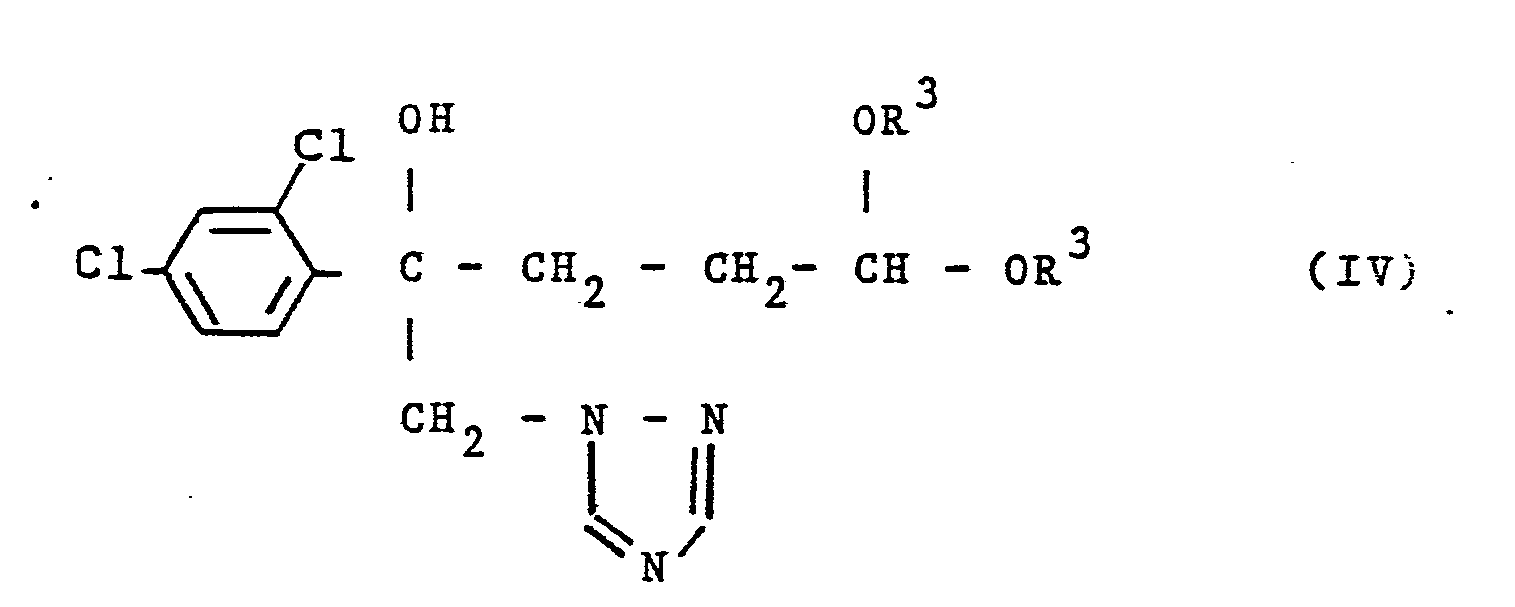
Les composés de formule (IV) peuvent s'obtenir selon des procédés connus en soi.The compounds of formula (IV) can be obtained according to methods known per se.
Les associations sont préparées par simple mélange des produits et composés souhaités.The associations are prepared by simple mixing of the desired products and compounds.
La présente invention concerne également les composés de formule (II) dans laquelle Z est l'atome de chlore ou de brome. Ces composés sont éventuellement utilisables comme intermédiaires pour la préparation des composés de formule (I).The present invention also relates to the compounds of formula (II) in which Z is the chlorine or bromine atom. These compounds can optionally be used as intermediates for the preparation of the compounds of formula (I).
La présente invention concerne également l'utilisation des composés de formule (I) et des associations précédemment définies à titre de fongicide.The present invention also relates to the use of the compounds of formula (I) and of the associations previously defined as a fungicide.
Les composés et les associations selon l'invention peuvent donc être utilisés pour la lutte tant préventive que curative contre les champignons, notamment de type basidiomycètes, ascomycètes, adelomycètes ou fungi-imperfecti, en particulier les rouilles, oïdium, piétin-verse, fusarioses, helminthosporioses, septorioses, rhizoctones des végétaux et des plantes en général et en paraticulier des céréales telles que le blé, l'orge, le seigle, l'avoine et leurs hybrides et aussi le riz et le maïs.The compounds and associations according to the invention can therefore be used for the preventive as well as curative fight against fungi, in particular of the basidiomycetes, ascomycetes, adelomycetes or fungi-imperfecti type, in particular rusts, powdery mildew, black mold, fusarioses, helminthosporioses, septorioses, rhizoctones of plants and plants in general and in particular cereals such as wheat, barley, rye, oats and their hybrids and also rice and corn.
Les composés selon l'invention sont actifs en particulier contre les champignons mentionnés dans la demande européenne 151084. Ils sont aussi et encore actifs contre les champignons suivants : Acrostalagmus koningi, les Alternaria, les Colletotrichum, Corticium rolfsii, Diplodia natalensis, Gaeumannomyces graminis, Gibberella fujikuroi, Hormodendron cladosporioides, Lentinus degener ou tigrinus, Lenzites quercina, Memnoniella echinata, Myrothecium verrucaria, Paecylomyces varioti, Pellicularia sasakii, Phellinus megaloporus, Polystictus sanguineus, Poria vaporaria, Sclerotium rolfsii, Stachybotris atra, les Stereum, Stilbum sp. Trametes trabea, Trichoderma pseudokoningi, Trichothecium roseum.The compounds according to the invention are active in particular against the fungi mentioned in European application 151084. They are also and still active against the following fungi: Acrostalagmus koningi, Alternaria, Colletotrichum, Corticium rolfsii, Diplodia natalensis, Gaeumannomyces graminis, Gibberella fujikuroi, Hormodendron cladosporioides, Lentinus degener or tigrinus, Lenzites quercina, Memnoniella echinata, Myrothecium verrucaria, Paecylomyces varioti, Pellicularia sasakii, Phellinus megaloporus, Polystictus sanguineus, Poria vaporaria, Soriaotaria, Sclerotium. Trametes trabea, Trichoderma pseudokoningi, Trichothecium roseum.
Les composés et les associations de l'invention sont spécialement intéressants par leur spectre large au niveau des maladies des céréales (oïdium, rouille, piétin-verse, helminthosporioses, septorioses et en paraticulier les fusarioses difficiles à combattre). Ils présentent également un grand intérêt en raison de leur activité sur la pourriture grise (Botrytis) et les cercosporioses, et, de ce fait, ils peuvent être appliqués sur des cultures aussi variées que la vigne, les cultures maraîchères et l'arboriculture et les cultures tropicales telles que l'arachide, le bananier, le caféier, le palmier, le cocotier, la noix de pécan et d'autres.The compounds and associations of the invention are particularly interesting because of their broad spectrum in terms of cereal diseases (powdery mildew, rust, foot-rot, helminthosporiosis, septoria and in particular fusarium wilt difficult to combat). They are also of great interest because of their activity on gray mold (Botrytis) and Sigatoka, and, therefore, they can be applied to crops as varied as vines, market gardening and arboriculture and tropical crops such as peanut, banana, coffee, palm, coconut, pecan and others.
Ils présentent enfin une excellente sélectivité vis-à-vis des cultures.Finally, they exhibit excellent selectivity with regard to cultures.
Outre les applications déjà décrites plus haut, les produits selon l'invention présentent en outre une excellente activité biocide à l'égard de nombreuses autres variétés de microorganismes parmi lesquelles on peut citer à titre non limitatif, des champignons comme ceux des genres :
- Pullularia comme l'espèce P. Pullulans,
- Chaeotomium comme l'espèce C. Globosum,
- Aspergillus comme l'espèce Aspergillus niger,
- Coniophora comme l'espèce C. Puteana.In addition to the applications already described above, the products according to the invention also exhibit excellent biocidal activity with regard to many other varieties of microorganisms among which mention may be made, without limitation, of fungi such as those of the genera:
- Pullularia like the species P. Pullulans,
- Chaeotomium such as C. Globosum,
- Aspergillus like the Aspergillus niger species,
- Coniophora like the species C. Puteana.
En raison de leur activité biocide, les produits de l'invention permettent de combattre efficacement les microorganismes dont la prolifération crée de nombreux problèmes dans les domaines agricole et industriel. A cet effet, ils conviennent tout spécialement bien à la protection des végétaux ou de produits industriels tels que le bois, le cuir, les peintures, le papier, les cordages, les plastiques, les circuits d'eau industriels.Because of their biocidal activity, the products of the invention make it possible to effectively combat microorganisms whose proliferation creates many problems in the agricultural and industrial fields. To this end, they are particularly suitable for protecting plants or industrial products such as wood, leather, paints, paper, ropes, plastics, industrial water circuits.
Ils sont tout particulièrement bien adaptés à la protection des produits lignocellulosiques et notamment du bois, qu'il s'agisse de bois d'ameublement, de charpente ou de bois exposé aux intempéries tels que les bois de clôture, les piquets de vignes, les traverses de chemin de fer.They are particularly well suited for the protection of lignocellulosic products and in particular wood, whether it is furniture wood, framework or wood exposed to the weather such as fencing wood, vine stakes, railway sleepers.
Les composés ou associations selon l'invention utlisés, seuls ou sous la forme de compositions telles que définies ci-dessus, dans les traitements du bois peuvent être éventuellement associés à un ou plusieurs produits biocides connus tels que le pentachlorophénol, les sels métalliques, notamment de cuivre, de manganèse, de cobalt, de chrome, de zinc dérivés d'acides minéraux ou carboxyliques (acides heptanoïque, octanoïque, naphténique); les complexes organiques de l'étain, le mercaptobenzothiazole.The compounds or associations according to the invention used, alone or in the form of compositions as defined above, in wood treatments can be optionally combined with one or more known biocidal products such as pentachlorophenol, metal salts, in particular copper, manganese, cobalt, chromium, zinc derived from mineral or carboxylic acids (heptanoic, octanoic, naphthenic acids); organic tin complexes, mercaptobenzothiazole.
Ils s'appliquent généralement à des doses de 0,005 à 5 kg/ha, avantageusement à des doses de 0,01 à 5kg/ha, de préférence de 0,05, plus spécifiquement de 0,1, à 2kg/ha.They generally apply at doses of 0.005 to 5 kg / ha, advantageously at doses of 0.01 to 5 kg / ha, preferably 0.05, more specifically from 0.1 to 2 kg / ha.
L'utilisation d'au moins un des composés de formule (I) en association avec l'iprodione est particulièrement intéressante dans le traitement des maladies des céréales, des semences comme des maladies foliaires.The use of at least one of the compounds of formula (I) in combination with iprodione is particularly advantageous in the treatment of diseases of cereals, seeds and leaf diseases.
L'utilisation d'au moins un des composés de formule (I) en association avec la fenpropidine est particulièrement intéressante dans le traitement des maladies des céréales, des semences comme des maladies foliaires.The use of at least one of the compounds of formula (I) in combination with fenpropidine is particularly advantageous in the treatment of diseases of cereals, seeds and leaf diseases.
L'utilisation d'au moins un des composés de formule (I) en association avec le fenpropimorphe est partaiculièrement intéressante dans le traitement des maladies des céréales et des betteraves.The use of at least one of the compounds of formula (I) in combination with fenpropimorph is particularly advantageous in the treatment of diseases of cereals and beets.
L'utilisation d'au moins un des composés de formule (I) en association avec le tridemorphe est particulièrement intéressante dans le traitement des maladies des céréales.The use of at least one of the compounds of formula (I) in combination with the tridemorph is particularly advantageous in the treatment of cereal diseases.
Bien entendu il est possible d'utiliser des mélanges ternaires ou quaternaires avec les composés cités ci-dessus pour les traitements indiqués.Of course, it is possible to use ternary or quaternary mixtures with the compounds mentioned above for the treatments indicated.
Ainsi l'utilisation d'un mélange ternaire à base de fenpropimorphe, d'iprodione et d'un composé selon l'invention ou de tridémorphe, d'iprodione et d'un composé selon l'invention est particulièrement intéréssante.Thus the use of a ternary mixture based on fenpropimorph, iprodione and a compound according to the invention or tridemorph, iprodione and a compound according to the invention is particularly interesting.
L'utilisation d'au moins un des composés de formule (I) en association avec le manèbe est particulièrement intéressante dans le traitement des maladies des cultures légumières, des arbres fruitiers et fruits et des vignes.The use of at least one of the compounds of formula (I) in combination with maneb is particularly advantageous in the treatment of diseases of vegetable crops, fruit trees and fruits and vines.
L'utilisation d'au moins un des composés de formule (I) en association avec le mancozèbe est particulièrement intéressante dans le traitement des maladies des cultures légumières, des arbres fruitiers et fruits et des vignes.The use of at least one of the compounds of formula (I) in combination with mancozeb is particularly interesting in the treatment of diseases of vegetable crops, fruit and fruit trees and vines.
L'utilisation d'au moins un des composés de formule (I) en association avec le zinèbe est particulièrement intéressante dans le traitement des maladies des cultures légumières, des arbres fruitiers et fruits et des vignes.The use of at least one of the compounds of formula (I) in combination with zineb is particularly advantageous in the treatment of diseases of vegetable crops, fruit and fruit trees and vines.
L'utilisation d'au moins un des composés de formule (I) en association avec le soufre est particulièrement intéressante dans le traitement des maladies des cultures légumières, des arbres fruitiers et fruits et des vignes.The use of at least one of the compounds of formula (I) in combination with sulfur is particularly advantageous in the treatment of diseases of vegetable crops, fruit and fruit trees and vines.
L'utilisation d'au moins un des composés de formule (I) en association avec le dinocap est particulièrement intéressante dans le traitement des maladies des cultures légumières, des arbres fruitiers et fruits et des vignes.The use of at least one of the compounds of formula (I) in combination with dinocap is particularly advantageous in the treatment of diseases of vegetable crops, fruit trees and fruits and vines.
Bien entendu il est possible d'utiliser des mélanges ternaires ou quaternaires avec les composés cités ci-dessus pour les traitements indiqués.Of course, it is possible to use ternary or quaternary mixtures with the compounds mentioned above for the treatments indicated.
L'utilisation d'au moins un des composés de formule (I) en association avec le carbendazime est particulièrement intéressante dans le traitement des maladies des arbres fruitiers et fruits, des cultures légumières, des céréales.The use of at least one of the compounds of formula (I) in combination with carbendazim is particularly advantageous in the treatment of diseases of fruit trees and fruits, vegetable crops, cereals.
L'utilisation d'au moins un des composés de formule (I) en association avec le captafol est particulièrement intéressante dans le traitement des maladies des céréales, des arbres fruitiers et fruits, de la pomme de terre.The use of at least one of the compounds of formula (I) in combination with captafol is particularly advantageous in the treatment of diseases of cereals, fruit trees and fruits, of potato.
L'utilisation d'au moins un des composés de formule (I) en association avec le captane est particulièrement intéressante dans le traitement des maladies des céréales, des arbres fruitiers et fruits.The use of at least one of the compounds of formula (I) in combination with captan is particularly advantageous in the treatment of diseases of cereals, fruit trees and fruits.
L'utilisation d'au moins un des composés de formule (I) en association avec le dithianon est particulièrement intéressante dans le traitement des maladies des arbres fruitiers et fruits.The use of at least one of the compounds of formula (I) in combination with dithianon is particularly advantageous in the treatment of diseases of fruit trees and fruits.
L'utilisation d'au moins un des composés de formule (I) en association avec le mancozèbe est particulièrement intéressante dans le traitement des maladies des arbres fruitiers et fruits.The use of at least one of the compounds of formula (I) in combination with mancozeb is particularly interesting in the treatment of diseases of fruit trees and fruits.
L'utilisation d'au moins un des composés de formule (I) en association avec le cuivre est particulièrement intéressante dans le traitement des maladies des arbres fruitiers et fruits.The use of at least one of the compounds of formula (I) in combination with copper is particularly advantageous in the treatment of diseases of fruit trees and fruits.
Bien entendu il est possible d'utiliser des mélanges ternaires ou quaternaires avec les composés cités ci-dessus pour les traitements indiqués.Of course, it is possible to use ternary or quaternary mixtures with the compounds mentioned above for the treatments indicated.
L'utilisation d'au moins un des composés de formule (I) en association avec le chlorotalonil est particulièrement intéressante dans le traitement des maladies des cultures légumières, des céréales, des betteraves, de la pomme de terre.The use of at least one of the compounds of formula (I) in combination with chlorotalonil is particularly advantageous in the treatment of diseases of vegetable crops, cereals, beets, potato.
L'utilisation d'au moins un des composés de formule (I) en association avec le diniconazole est particulièrement intéressante dans le traitement des charbons des céréales, en particulier les charbons nus de l'orge et du blé (ustilago nuda).The use of at least one of the compounds of formula (I) in combination with diniconazole is particularly advantageous in the treatment of cereal coals, in particular the bare coals of barley and wheat (ustilago nuda).
Pour leur emploi pratique, les composés et les associations selon l'invention sont rarement utilisés seuls. Le plus souvent ils font partie de compositions. Ces compositions, utilisables pour la protection des végétaux contre les maladies fongiques, ou dans les compositions régulatrices de la croissance des plantes, contiennent comme matière active un composé selon l'invention tel que décrit précédemment en association avec les supports solides ou liquides, acceptables en agriculture et/ou les agents tensio-actifs également acceptables en agriculture. En particulier sont utilisables les supports inertes et usuels et les agents tensio-actifs usuels.For their practical use, the compounds and combinations according to the invention are rarely used alone. Most often they are part of compositions. These compositions, which can be used for protecting plants against fungal diseases, or in compositions which regulate plant growth, contain as active material a compound according to the invention as described above in combination with solid or liquid carriers, acceptable in agriculture and / or surfactants also acceptable in agriculture. In particular, the usual inert supports and the usual surfactants can be used.
Par le terme "support", dans le présent exposé, on désigne une matière organique ou minérale, naturelle ou synthétique, avec laquelle la matière active est associée pour faciliter son application sur la plante, sur des graines ou sur le sol. Ce support est donc généralement inerte et il doit être acceptable en agriculture, notamment sur la plante traitée. Le support peut être solide (argiles, silicates naturels ou synthétiques, silice, résines, cires, engrais solides, etc...) ou liquide (eau, alcools, cétones, fractions de pétrole, hydrocarbures aromatiques ou paraffiniques, hydrocarbures chlorés, gaz liquéfiés, etc...).By the term "support", in the present description, is meant an organic or mineral, natural or synthetic material, with which the active material is associated to facilitate its application to the plant, to seeds or to the soil. This support is therefore generally inert and it must be acceptable in agriculture, especially on the treated plant. The support can be solid (clays, natural or synthetic silicates, silica, resins, waxes, solid fertilizers, etc.) or liquid (water, alcohols, ketones, petroleum fractions, aromatic or paraffinic hydrocarbons, chlorinated hydrocarbons, liquefied gases , etc ...).
L'agent tensioactif peut être un agent émulsionnant, dispersant ou mouillant de type ionique ou non ionique. On peut citer par exemple des sels d'acides polyacryliques, des sels d'acides lignosulfoniques, des sels d'acides phénolsulfoniques ou naphtalènesulfoniques, des polycondensats d'oxyde d'éthylène sur des alcools gras ou sur des acides gras ou sur des amines grasses, des phénols substitués (notamment des alkylphénols ou des arylphénols), des sels d'esters d'acides sulfosucciniques, des dérivés de la taurine (notamment des alkyltaurates), des esters phosphoriques d'alcools ou de phénols polyoxyéthylés. La présence d'au moins un agent tensioactif est généralement indispensable lorsque la matière active et/ou le support inerte ne sont pas solubles dans l'eau et que l'agent vecteur de l'application est l'eau.The surfactant can be an emulsifying, dispersing or wetting agent of ionic or nonionic type. Mention may be made, for example, of salts of polyacrylic acids, salts of lignosulfonic acids, salts of phenolsulfonic or naphthalene sulfonic acids, polycondensates of ethylene oxide on fatty alcohols or on fatty acids or on fatty amines , substituted phenols (in particular alkylphenols or arylphenols), ester salts of sulfosuccinic acids, taurine derivatives (in particular alkyltaurates), phosphoric esters of alcohols or of polyoxyethylated phenols. The presence of at least one surfactant is generally essential when the active material and / or the inert support are not soluble in water and the vector agent for the application is water.
Pour leur application, les composés de formule (I) et les associations se trouvent donc généralement sous forme de compositions ; ces compositions selon l'invention sont elles-mêmes sous des formes assez diverses, solides ou liquides.For their application, the compounds of formula (I) and the associations are therefore generally in the form of compositions; these compositions according to the invention are themselves in fairly diverse forms, solid or liquid.
Comme formes de compositions solides, on peut citer les poudres pour poudrage ou dispersion (à teneur en composé de formule (I) pouvant aller jusqu'à 100 %) et les granulés, notamment ceux obtenus par extrusion, par compactage, par imprégnation d'un support granulé, par granulation à partir d'une poudre (la teneur en composé de formule (I) dans ces granulés étant entre 1 et 80 % pour ces derniers cas).As forms of solid compositions, mention may be made of powders for dusting or dispersion (with a content of compound of formula (I) which can range up to 100%) and granules, in particular those obtained by extrusion, by compacting, by impregnation of a granulated support, by granulation from a powder (the content of compound of formula (I) in these granules being between 1 and 80% for the latter cases).
Comme formes de compositions liquides ou destinées à constituer des compositions liquides lors de l'application, on peut citer les solutions, en particulier les concentrés solubles dans l'eau, les concentrés émulsionnables, les émulsions, les suspensions concentrées, les aérosols, les poudres mouillables (ou poudre à pulvériser), les pâtes.As forms of liquid or intended compositions to constitute liquid compositions during application, mention may be made of solutions, in particular water-soluble concentrates, emulsifiable concentrates, emulsions, concentrated suspensions, aerosols, wettable powders (or spray powder) , pasta.
Ces compositions peuvent contenir aussi toute sorte d'autres ingrédients tels que, par exemple, des colloïdes protecteurs, des adhésifs, des épaississants, des agents thixotropes, des agents de pénétration, des stabilisants, des séquestrants, etc... ainsi que d'autres matières actives connues à propriétés pesticides (notamment insecticides ou fongicides) ou à propriétés favorisant la croissance des plantes (notamment des engrais) ou à propriétés régulatrices de la croissance des plantes. Plus généralement les composés selon l'invention peuvent être associés à tous les additifs solides ou liquides correspondant aux techniques habituelles de la mise en formulation.These compositions can also contain all kinds of other ingredients such as, for example, protective colloids, adhesives, thickeners, thixotropic agents, penetration agents, stabilizers, sequestering agents, etc. other known active ingredients with pesticidal properties (in particular insecticides or fungicides) or with properties promoting plant growth (in particular fertilizers) or with properties regulating plant growth. More generally, the compounds according to the invention can be combined with all the solid or liquid additives corresponding to the usual techniques of formulation.
Ces doses d'emploi dans le cas d'une utilisation comme fongicides des composés et des associations selon l'invention peuvent varier dans de larges limites, notamment selon la virulence des champignons et les conditions climatiques.These doses of use in the case of use as fungicides of the compounds and combinations according to the invention can vary within wide limits, in particular according to the virulence of the fungi and the climatic conditions.
D'une manière générale des compositions contenant 0,5 à 5000 ppm de substance active conviennent bien ; ces valeurs sont indiquées pour les compositions prêtes à l'application. Ppm signifie "partie par million". La zone de 0,5 à 5000 ppm correspond à une zone de 5x10⁻⁵ à 0,5 % (pourcentages pondéraux).In general, compositions containing 0.5 to 5000 ppm of active substance are very suitable; these values are indicated for the compositions ready for application. Ppm means "part per million". The area from 0.5 to 5000 ppm corresponds to an area from 5x10⁻⁵ to 0.5% (percentages by weight).
En ce qui concerne les compositions adaptées au stockage et au transport, elles contiennent plus avantageusement de 0,5 à 95 % (en poids) de substance active.As regards the compositions suitable for storage and transport, they more advantageously contain from 0.5 to 95% (by weight) of active substance.
Ainsi donc, les compositions à usage agricole selon l'invention peuvent contenir les matières actives selon l'invention dans de très larges limites, allant de 5.10⁻⁵% à 95 % (en poids).Thus, the compositions for agricultural use according to the invention can contain the active materials according to the invention within very wide limits, ranging from 5.10⁻⁵% to 95% (by weight).
D'une façon générale, les compositions selon l'invention contiennent habituellement de 0,05 à 95 % environ de matières actives (formule I et groupe II) selon l'invention, de 1 % à 95 % environ de un ou plusieurs supports solides ou liquides et éventuellement de 0,1 à 50 %, de préférence 5 à 40 %, environ de un ou plusieurs agents tensioactifs.In general, the compositions according to the invention usually contain from 0.05 to 95% approximately of active materials (formula I and group II) according to the invention, from 1% to 95% approximately of one or more solid supports or liquids and optionally from 0.1 to 50%, preferably 5 to 40%, approximately of one or more surfactants.
Les concentrés émulsionnables ou solubles comprennent le plus souvent 10 à 80 % de matière active, les émulsions ou solutions prêtes à l'application contenant, quant à elles, 0,01 à 20 % de matière active. En plus du solvant, les concentrés émulsionnables peuvent contenir, quand c'est nécessaire, 2 à 20 % d'additifs appropriés, comme les stabilisants, agents tensioactifs, agents de pénétration, inhibiteurs de corrosion, colorants, adhésifs précédemment cités.The emulsifiable or soluble concentrates most often comprise 10 to 80% of active material, the emulsions or solutions ready for application containing, for their part, 0.01 to 20% of active material. In addition to the solvent, emulsifiable concentrates can contain, when necessary, 2 to 20% of suitable additives, such as stabilizers, surfactants, penetration agents, corrosion inhibitors, dyes, adhesives mentioned above.
A titre d'exemple, voici la composition de quelques concentrés :As an example, here is the composition of some concentrates:
- matière active 400 g/l
- dodécylbenzène sulfonate alcalin 24 g/l
- nonylph'enol oxyéthylé à 10 molécules
d'oxyde d'éthylène 16 g/l
- cyclohexanone 200 g/l
- solvant aromatique q.s.p. 1 litre
- active ingredient 400 g / l
- alkaline dodecylbenzene sulfonate 24 g / l
- oxyethylated nonylph'enol with 10 molecules
ethylene oxide 16 g / l
- cyclohexanone 200 g / l
- aromatic solvent qs 1 liter
Selon une autre formule de concentré émulsionnable, on utilise :According to another formula of emulsifiable concentrate, the following are used:
- matière active 250 g
- huile végétale époxydée 25 g
- mélange de sulfonate d'alcoylaryle et
d'éther de polyglycol et d'alcools gras 100 g
- diméthylformamide 50 g
- xylène 575 g
- active ingredient 250 g
- epoxidized vegetable oil 25 g
- mixture of alkylaryl sulfonate and
polyglycol ether and fatty alcohols 100 g
- dimethylformamide 50 g
- xylene 575 g
A partir de ces concentrés, on peut obtenir par dilution avec de l'eau des émulsions de toute concentration désirée, qui conviennent particulièrement à l'application sur les feuilles.From these concentrates, emulsions with any desired concentration can be obtained by dilution with water, which are particularly suitable for application to the leaves.
Les suspensions concentrées, également applicables en pulvérisation, sont préparées de manière à obtenir un produit fluide stable ne se déposant pas et elles contiennent habituellement de 10 à 75 % de matière active, de 0,5 à 15 % d'agents tensioactifs, de 0,1 à 10 % d'agents thixotropes, de 0 à 10 % d'additifs appropriés, comme des anti-mousses, des inhibiteurs de corrosion, des stabilisants, des agents de pénétration et des adhésifs et, comme support, de l'eau ou un liquide organique dans lequel la matière active est peu ou pas soluble : certaines matières solides organiques ou des sels minéraux peuvent être dissous dans le support pour aider à empêcher la sédimentation ou comme antigels pour l'eau.The concentrated suspensions, also applicable in spraying, are prepared so as to obtain a stable fluid product which does not deposit and they usually contain from 10 to 75% of active material, from 0.5 to 15% of surfactants, from 0 , 1 to 10% of thixotropic agents, 0 to 10% of suitable additives, such as defoamers, corrosion inhibitors, stabilizers, penetrating agents and adhesives and, as support, water or an organic liquid in which the active ingredient is sparingly or not very soluble: certain organic solids or mineral salts can be dissolved in the support to help prevent sedimentation or as antifreeze for water.
Les poudres mouillables (ou poudre à pulvériser) sont habituellement préparées de manière qu'elles contiennent 20 à 95 % de matière active, et elles contiennent habituellement, en plus du support solide, de 0 à 5 % d'un agent mouillant, de 3 à 10 % d'un agent dispersant, et, quand c'est nécessaire, de 0 à 10 % d'un ou plusieurs stabilisants et/ou autres additifs, comme des agents de pénétration, des adhésifs, ou des agents antimottants, colorants, etc...Wettable powders (or spray powder) are usually prepared so that they contain 20 to 95% of active ingredient, and they usually contain, in addition to the solid support, 0 to 5% of a wetting agent, 3 10% of a dispersing agent, and, when necessary, 0 to 10% of one or more stabilizers and / or other additives, such as penetrating agents, adhesives, or anti-caking agents, coloring agents, etc ...
A titre d'exemple, voici diverses compositions de poudres mouillables :As an example, here are various compositions of wettable powders:
- matière active 50 %
- lignosulfonate de calcium (défloculant) 5 %
- isopropylnaphtalène sulfonate (agent
mouillant anionique) 1 %
- silice antimottante 5 %
- kaolin (charge) 39 %
- active ingredient 50%
- calcium lignosulfonate (deflocculant) 5%
- isopropylnaphthalene sulfonate (agent
anionic wetting) 1%
- anti-clumping silica 5%
- kaolin (charge) 39%
Une autre composition de poudre à pulvériser à 70 % utilise les constituants suivants :Another 70% spray powder composition uses the following constituents:
- matière active 700 g
- dibutylnaphtylsulfonate de sodium 50 g
- produit de condensation en proportions
3/2/1 d'acide naphtalène sulfonique,
d'acide phénolsulfonique et de
formaldéhyde 30 g
- kaolin 100 g
- craie de champagne 120 g
- active ingredient 700 g
- sodium dibutylnaphthylsulfonate 50 g
- condensation product in proportions
3/2/1 of naphthalene sulfonic acid,
phenolsulfonic acid and
formaldehyde 30 g
- kaolin 100 g
- champagne chalk 120 g
Une autre composition de poudre à pulvériser à 40 % utilise les constituants suivants :Another 40% spray powder composition uses the following constituents:
- matière active 400 g
- lignosulfonate de sodium 50 g
- dibutylnaphtalène sulfonate de sodium 10 g
- silice 540 g
- active ingredient 400 g
- sodium lignosulfonate 50 g
- sodium dibutylnaphthalene sulfonate 10 g
- silica 540 g
Une autre composition de poudre à pulvériser à 25 % utilise les constituants suivants :Another 25% spray powder composition uses the following constituents:
-matière active 250 g
- lignosulfonate de calcium 45 g
- mélange équipondéral de craie de Champagne
et d'hydroxyéthylcellulose 19 g
- dibutylnaphtalène sulfonate de sodium 15 g
- silice 195 g
- craie de Champagne 195 g
- kaolin 281 g
- active ingredient 250 g
- calcium lignosulfonate 45 g
- equipondéral mixture of Champagne chalk
and hydroxyethylcellulose 19 g
- sodium dibutylnaphthalene sulfonate 15 g
- silica 195 g
- Champagne chalk 195 g
- kaolin 281 g
Une autre composition de poudre à pulvériser à 25 % utilise les constituants suivants :Another 25% spray powder composition uses the following constituents:
- matière active 250 g
- issoctylphénoxy-polyoxyéthylène-éthanol 25 g
- mélange équipondéral de craie de
Champagne et d'hydroxyéthylcellulose 17 g
- aluminosilicate de sodium 543 g
- kieselguhr 165 g
- active ingredient 250 g
- issoctylphenoxy-polyoxyethylene-ethanol 25 g
- equal weight mixture of chalk
Champagne and hydroxyethylcellulose 17 g
- sodium aluminosilicate 543 g
- kieselguhr 165 g
Une autre composition de poudre à pulvériser à 10 % utilise les constituants suivants :Another 10% spray powder composition uses the following constituents:
- matière active 100 g
- mélange de sels de sodium de sulfates
d'acides gras saturés 30 g
- produit de condensation d'acide naphtalène
sulfonique et de formaldéhyde 50 g
- kaolin 820 g
- active ingredient 100 g
- mixture of sodium salts of sulfates
saturated fatty acids 30 g
- naphthalene acid condensation product
sulfonic and formaldehyde 50 g
- kaolin 820 g
Pour obtenir ces poudres à pulvériser ou poudres mouillables, on mélange intimement les matières actives dans des mélangeurs appropriés avec les substances additionnelles et on broie avec des moulins ou autres broyeurs appropriés. On obtient par là des poudres à pulvériser dont la mouillabilité et la mise en suspension sont avantageuses ; on peut les mettre en suspension avec de l'eau à toute concentration désirée et ces suspensions sont utilisables très avantageusement en particulier pour l'application sur les feuilles des végétaux.To obtain these sprayable powders or wettable powders, the active materials are intimately mixed in appropriate mixers with the additional substances and ground with mills or other suitable grinders. This gives sprayable powders whose wettability and suspension are advantageous; they can be suspended with water at any desired concentration and these suspensions can be used very advantageously in particular for application to the leaves of plants.
A la place des poudres mouillables, on peut réaliser des pâtes. Les conditions et modalités de réalisation et d'utilisation de ces pâtes sont semblables à celles des poudres mouillables ou poudres à pulvériser.Instead of wettable powders, pasta can be made. The conditions and methods of making and using these pastes are similar to those of wettable powders or spraying powders.
Comme cela a déjà été dit, les dispersions et émulsions aqueuses, par exemple les compositions obtenues en diluant à l'aide d'eau une poudre mouillable ou un concentré émulsionnable selon l'invention, sont comprises dans le cadre général de la présente invention. Les émulsions peuvent être du type eau-dans-l'huile ou huile-dans-l'eau et elles peuvent avoir une consistance épaisse comme celle d'une "mayonnaise".As has already been said, aqueous dispersions and emulsions, for example the compositions obtained by diluting with water a wettable powder or an emulsifiable concentrate according to the invention, are included in the general scope of the present invention. The emulsions can be of the water-in-oil or oil-in-water type and they can have a thick consistency like that of a "mayonnaise".
Les granulés destinés à être disposés sur le sol sont habituellement préparés de manière qu'ils aient des dimensions comprises entre 0,1 et 2 mm et ils peuvent être fabriqués par agglomération ou imprégnation. En général, les granulés contiennent 0,5 à 25 % de matière active et 0 à 10 % d'additifs comme des stabilisants, des agents de modification à libération lente, des liants et des solvants.The granules intended to be placed on the ground are usually prepared so that they have dimensions of between 0.1 and 2 mm and they can be manufactured by agglomeration or impregnation. In general, the granules contain 0.5 to 25% of active material and 0 to 10% of additives such as stabilizers, slow release modifiers, binders and solvents.
Selon un exemple de composition de granulé, on utilise les constituants suivants :According to an example of a granule composition, the following constituents are used:
- matière active 50 g
- épichlorhydrine 2,5 g
- éther de cétyle et de polyglycol 2,5 g
- polyéthylène glycol 35 g
- kaolin (granulométrie : 0,3 à 0,8 mm) 910 g.
- active ingredient 50 g
- epichlorohydrin 2.5 g
- cetyl ether of polyglycol 2.5 g
- polyethylene glycol 35 g
- kaolin (particle size: 0.3 to 0.8 mm) 910 g.
Dans ce cas particulier on mélange la matière active avec l'épichlorhydrine et on dissout avec 60 g d'acétone ; on ajoute alors le polyéthylène glycol et l'éther de cétyle et de polyglycol. On arrose le kaolin avec la solution obtenue et on évapore ensuite l'acétone sous vide. On utilise avantageusement un tel microgranulé pour lutter contre les champignons du sol.In this particular case, the active material is mixed with epichlorohydrin and dissolved with 60 g of acetone; the polyethylene glycol and the cetyl ether of polyglycol are then added. The kaolin is sprayed with the solution obtained and the acetone is then evaporated under vacuum. Advantageously, such a microgranulate is used to combat soil fungi.
Les composés de formule (I) et les associations peuvent encore être utilisés sous forme de poudres pour poudrage ; on peut aussi utiliser une composition comprenant 50 g de matière active et 950 g de talc ; on peut aussi utiliser une composition comprenant 20 g de matière active, 10 g de silice finement divisée et 970 g de talc ; on mélange et broie ces constituants et on applique le mélange par poudrage.The compounds of formula (I) and the combinations can also be used in the form of powders for dusting; one can also use a composition comprising 50 g of active material and 950 g of talc; one can also use a composition comprising 20 g of active material, 10 g of finely divided silica and 970 g of talc; these constituents are mixed and ground and the mixture is applied by dusting.
Les exemples suivants donnés à titre non limitatif illustrent l'invention et montrent comment elle peut être mise en oeuvre.The following examples, given without implied limitation, illustrate the invention and show how it can be implemented.
Les exemples 1 à 3 illustrent des modes particuliers de préparation de composés selon l'invention, ainsi que ces composés eux-mêmes. Parmi les propriétés physiques indiquées pour ces composés, on a indiqué les valeurs des déplacements (delta) en RMN du proton du groupe -O-CH-O- (acétal). Ces déplacements sont mesurés en ppm et ils sont repérés par rapport à un produit de référence qui et le tétraméthyl silane. La RMN est effectuée à 100 MHz dans le chloroforme deutéré.Examples 1 to 3 illustrate particular modes of preparation of compounds according to the invention, as well as these compounds themselves. Among the physical properties indicated for these compounds, the displacement (delta) values in NMR of the proton of the group -O-CH-O- (acetal) have been indicated. These displacements are measured in ppm and they are identified with respect to a reference product which and tetramethyl silane. NMR is performed at 100 MHz in deuterated chloroform.
Les exemples 4 à 10 illustrent les propriétés fongicides des composés selon l'invention ainsi que leurs applications.Examples 4 to 10 illustrate the fungicidal properties of the compounds according to the invention as well as their applications.
On prépare un produit de formule :

Selon un procédé décrit dans la demande de brevet européen n°151084, on mélange 40 ml de trifluoroéthanol avec 10,7 g de produit de formule (V). On fait barboter du HCl gazeux de manière à avoir une augmentation pondérale de 1,39 g. On chauffe 2 heures à 70°C. On verse dans 500 ml d'eau contenant 10 g de Na₂CO₃. On extrait à l'acétate d'éthyle ; la solution organique est lavée à l'eau, sèchée, filtrée, évaporée. On obtient ainsi 8 g de cristaux constitués d'un mélange de 2 diastéréoisomères du produit de formule (I), fondant à prtir de 80°C et présentant en RMN un déplacement protonique delta à 5,18 et 5,41 ppmAccording to a process described in European patent application No. 151084, 40 ml of trifluoroethanol are mixed with 10.7 g of product of formula (V). Gaseous HCl is bubbled so as to have a weight increase of 1.39 g. It is heated for 2 hours at 70 ° C. Poured into 500 ml of water containing 10 g of Na₂CO₃. Extraction is carried out with ethyl acetate; the organic solution is washed with water, dried, filtered, evaporated. 8 g of crystals are thus obtained, consisting of a mixture of 2 diastereoisomers of the product of formula (I), melting at 80 ° C. and having in NMR a delta proton displacement at 5.18 and 5.41 ppm.
Le produit obtenu à l'exemple 1 est traité en chromatographie liquide sur colonne de silice sous pression de 0,3 bar (au dessus de la pression atmosphérique) avec un éluant constitué d'un mélange acétate d'éthyle/heptane en proportions volumiques 80/20.The product obtained in Example 1 is treated by liquid chromatography on a silica column under pressure of 0.3 bar (above atmospheric pressure) with an eluent consisting of an ethyl acetate / heptane mixture in volume proportions 80 / 20.
On recueille 3 g d'une première fraction A et 3,6 g d'une deuxième fraction B.3 g of a first fraction A and 3.6 g of a second fraction B are collected.
Chacune de ces fractions donne un précipité qui cristallise. Les cristaux A issus de la fraction A correspondent à l'un des diastéréoisomères. Ils fondent à 84°C et ont un déplacement protonique delta en RMN à 5,41 ppm. Le diastéréoisomère A est caractérisé par le fait que le groupe triazolylméthyle et le groupement trifluoroéthoxy sont situés d'un même côté du plan du cycle tétrahydrofurannique.Each of these fractions gives a precipitate which crystallizes. The crystals A from fraction A correspond to one of the diastereoisomers. They melt at 84 ° C and have a delta proton displacement in NMR at 5.41 ppm. The diastereoisomer A is characterized in that the triazolylmethyl group and the trifluoroethoxy group are located on the same side of the plane of the tetrahydrofuran cycle.
Les cristaux B issus de la fraction B correspondent à l'autre diastéréoisomère. Ils fondent à 167°C et ont un déplacement protonique delta en RMN à 5,18 ppm.The crystals B from fraction B correspond to the other diastereoisomer. They melt at 167 ° C and have a proton delta displacement in NMR at 5.18 ppm.
On mélange 40 ml de trifluoroéthanol et 10,8 g de produit de formule

On fait barboter du HCl gazeux jusqu'à une augmentation de poids de 1,5 g. On chauffe 4 h à 70°C, verse dans 500 ml d'eau contenant 10 g de Na₂CO₃. On extrait à l'aide de CHCl₃ ; la phase organique est lavée à l'eau, sèchée, évaporée. On obtient 12,7 g de produit de formule (I) sous forme de mélange des 2 diastéréoisomères.Gaseous HCl is bubbled until a weight increase of 1.5 g. Heated 4 h at 70 ° C, poured into 500 ml of water containing 10 g of Na₂CO₃. Extraction is carried out using CHCl₃; the organic phase is washed with water, dried, evaporated. 12.7 g of product of formula (I) are obtained in the form of a mixture of the 2 diastereoisomers.
On a traité 4 parcelles de terrain portant chacune 4 pommiers de la variété connue sous le nom "Calville" qui est très sensible à la tavelure (maladie dont le nom latin est Venturia inaequalis et le nom anglais est scab). Les traitements intervenaient tous les 12 jours depuis la floraison jusqu'au stade de milieu de grossissement des fruits. Ces traitements constituaient à appliquer une bouillie c'est à dire une émulsion aqueuse diluée de la matière active décrite à l'exemple 1. Cette bouillie a été appliquée à raison de 10 hl/ha et a été obtenue par dilution d'un concentré émulsionnable ; ce concentré contenait lui-même 62 g/l de matière active, 203 g/l de cyclohexanone, 609 g/l d'acétophénone, 50 g/l d'alkylarylsulfonate de calcium, 100 g/l d'huile de ricin polyéthoxylée ; la concentration de la bouillie en matière active était de 2,5 g/hl.We treated 4 plots of land each carrying 4 apple trees of the variety known as "Calville" which is very sensitive to scab (a disease whose Latin name is Venturia inaequalis and the English name is scab). Treatments were carried out every 12 days from flowering to the stage of medium growth of the fruits. These treatments consisted in applying a slurry, that is to say a dilute aqueous emulsion of the active material described in Example 1. This slurry was applied at the rate of 10 hl / ha and was obtained by diluting an emulsifiable concentrate ; this concentrate itself contained 62 g / l of active ingredient, 203 g / l of cyclohexanone, 609 g / l of acetophenone, 50 g / l of calcium alkylarylsulfonate, 100 g / l of polyethoxylated castor oil; the concentration of the active ingredient in the slurry was 2.5 g / hl.
Les résultats ont été comparés avec le produit voisin de formule chimique connue la plus proche, c'est à dire la formule du composé de l'exemple 42 de la demande de brevet européen 151084 ; ce produit est dénommé ci-après produit de référence. Le produit utilisé ainsi pour la comparaison comprenait, de même que le produit de l'exemple 1 selon l'invention, la totalité des formes diastéréoisomères possibles.The results were compared with the neighboring product of closest known chemical formula, that is to say the formula of the compound of example 42 of European patent application 151084; this product is referred to below as the reference product. The product thus used for the comparison included, like the product of Example 1 according to the invention, all of the possible diastereoisomeric forms.
On a mesuré les résultats de la manière suivante : phytotoxicité : mesurée un jour après le 3ème traitement et exprimée en pourcentage selon une appréciation visuelle de l'état général des feuilles et fruits ; la valeur de 15 % est la valeur maximum acceptable,activité feuille : mesurée un jour après le 5ème traitement et exprimée en pourcentage du nombre de feuilles atteintes de tavelure, activité fruits : mesurée en fin de traitement et exprimée en pourcentage du nombre de fruits atteints.The results were measured as follows: phytotoxicity: measured one day after the 3rd treatment and expressed as a percentage according to a visual assessment of the general condition of the leaves and fruits; the value of 15% is the maximum acceptable value, leaf activity: measured one day after the 5th treatment and expressed as a percentage of the number of leaves affected by scab, fruit activity: measured at the end of treatment and expressed as a percentage of the number of fruits affected .
Les résultats ont été les suivants :

On opère comme à l'exemple 4, mais en traitant de pommiers de la variété Golden avec une bouillie ayant une concentration de matière active de 5 g/hl.The procedure is as in Example 4, but treating apple trees of the Golden variety with a slurry having a concentration of active material of 5 g / hl.
Les résultats sont les suivants :
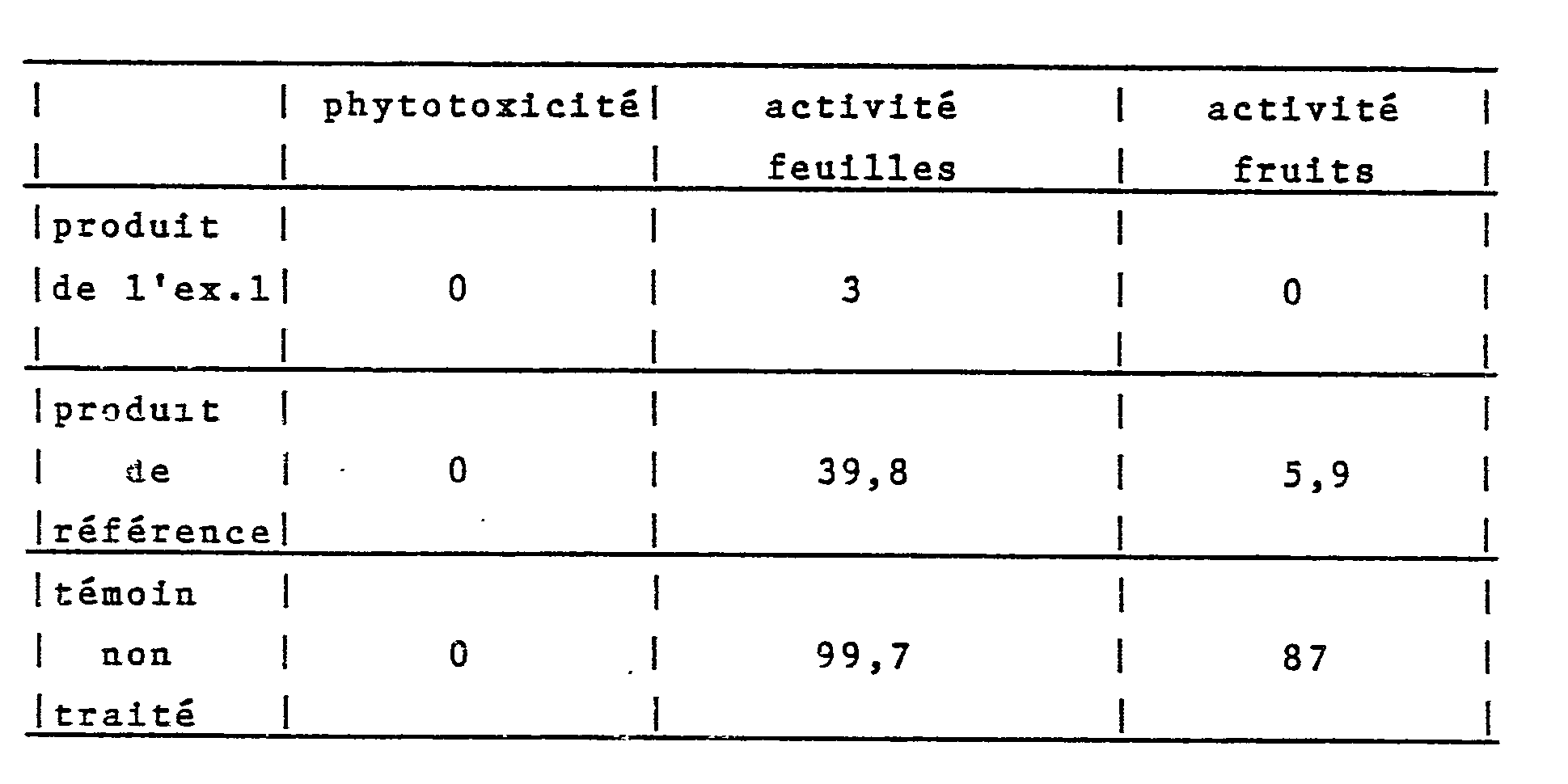
On a traité 4 parcelles de terrain portant chacune 15 ceps de vigne de la variété connue sous le nom de Carignan qui est très sensible à l'oïdium (maladie dont le nom latin est Uncinula necator et le nom anglais est powdery mildew). Les traitements avaient lieu tous les 14 jours depuis l'éclatement des bourgeons jusqu'à la veraison (époque de changement de couleur des grappes de raisin).We treated 4 plots of land each carrying 15 vine stocks of the variety known as Carignan which is very sensitive to powdery mildew (a disease whose Latin name is Uncinula necator and the English name is powdery mildew). The treatments took place every 14 days from the bursting of the buds to the veraison (time of change of color of the grape bunches).
Ces traitements constituaient à appliquer une bouillie de même nature qu'à l'exemple 4 à raison de 1,5 g/hl.These treatments consisted in applying a mixture of the same kind as in Example 4 at a rate of 1.5 g / hl.
Les résultats, obtenus et comparés comme à l'exemple 4, ont été les suivants :

On a traité 4 parcelles de terrain de 10 m² portant une culture de blé. Un ou deux traitements ont été effectués lors de l'apparition des premiers symptômes de maladie dans les champs.We treated 4 plots of 10 m² with a wheat crop. One or two treatments were carried out when the first symptoms of disease appeared in the fields.
La bouillie de traitement était de même nature qu'à l'exemple 4 et était appliquée en quantité telle que la dose de matière active était de 90, 120 ou 150 g/ha selon les essais.The treatment slurry was of the same nature as Example 4 and was applied in an amount such that the dose of active material was 90, 120 or 150 g / ha depending on the tests.
Dans tous les essais, aucune phytotoxicité n'a été observée.In all trials, no phytotoxicity was observed.
A l'exemple 7, on a traité une culture de blé de la variété Nebraska atteinte de rouille jaune (Puccinia striiformis), les résultats étant observés, 10 jours après le 2ème traitement, sur la feuille la plus haute juste en dessous de l'épi.In Example 7, a wheat crop of the Nebraska variety affected by yellow rust (Puccinia striiformis) was treated, the results being observed, 10 days after the 2nd treatment, on the highest leaf just below the ear.
A l'exemple 8, on a traité une culture de blé de la variété Vaillant atteinte de rouille brune (Puccinia recondita), les résultats étant observés, 19 jours après le ler traitement, sur la feuille la plus haute juste en dessous de l'épi.In Example 8, a wheat crop of the Vaillant variety with brown rust (Puccinia recondita) was treated, the results being observed, 19 days after the 1st treatment, on the highest leaf just below the ear.
A l'exemple 9, on a traité une culture de blé de la variété Longbow atteinte de septoriose (Septoria tritici), les résultats étant observés, 46 jours après le traitement unique, sur la feuille la plus haute juste en dessous de l'épi.In example 9, a wheat crop of the Longbow variety suffering from septoria (Septoria tritici) was treated, the results being observed, 46 days after the single treatment, on the highest leaf just below the spike. .
A l'exemple 10, on a traité une culture de blé de la variété Roazon, les résultats étant observés 44 jours après le traitement unique sur la 2ème feuille depuis l'épi (la première feuille, ou feuille la plus haute étant indemne de maladie). Cette mesure tardive illustre la bonne persistance des produits.In Example 10, a wheat crop of the Roazon variety was treated, the results being observed 44 days after the single treatment on the 2nd leaf from the ear (the first leaf, or highest leaf being free from disease ). This late measurement illustrates the good persistence of the products.
Les résultats ont été mesurés et exprimés sous forme de :
activité feuille : pourcentage du nombre de feuilles atteintes par la maladie
activité surface de feuille : pourcentage de surface de feuille atteinte par la maladie.The results were measured and expressed as:
leaf activity: percentage of the number of leaves affected by the disease
leaf surface activity: percentage of leaf surface affected by the disease.
Les résultats ont été les suivants :

On prépare par broyage fin une émulsion aqueuse de la matière active à tester ayant la composition suivante :
- matière active à tester 90 mg
- Tween 80 (agent tensioactif constitué
d'un oléate de dérivé polyoxyéthylèné du
sorbitan) dilué à 10 % dans l'eau 0,45 ml
- eau 90 ml.An aqueous emulsion of the active material to be tested having the following composition is prepared by fine grinding:
- active ingredient to be tested 90 mg
- Tween 80 (surfactant made up
of an oleate of polyoxyethylene derivative of
sorbitan) diluted 10% in water 0.45 ml
- water 90 ml.
Cette émulsion aqueuse est ensuite diluée par de l'eau pour obtenir la concentration désirée.This aqueous emulsion is then diluted with water to obtain the desired concentration.
De l'orge, en godets, semée dans de la terre franche, est traitée au stade 10 cm de hauteur par pulvérisation d'une émulsion aqueuse (appelée bouillie) de concentration indiquée ci-après. L'essai est répété deux fois. Au bout de 24 heures, on saupoudre les plants d'orge avec des spores d'Erysiphe graminis, le saupoudrage étant effectué à l'aide de plants malades.Barley, in pots, sown in loam, is treated at the 10 cm high stage by spraying with an aqueous emulsion (called slurry) at the concentration indicated below. The test is repeated twice. After 24 hours, the barley plants are sprinkled with Erysiphe graminis spores, the dusting being carried out using diseased plants.
La lecture se fait 8 à 12 jours après la contamination.Reading is done 8 to 12 days after contamination.
Dans ces conditions, on observe les résultats suivants :
A la dose de 0,1 g/l, protection totale (supérieure ou égale à 95 %)avec les composés de l'exemple 1 et le composé A de l'exemple 2.Under these conditions, the following results are observed:
At the dose of 0.1 g / l, total protection (greater than or equal to 95%) with the compounds of Example 1 and the compound A of Example 2.
Du blé, en godets, semé dans de la terre franche, est traité au stade 10 cm de hauteur par pulvérisation avec des émulsions aqueuses (appelées bouillies) de même composition que celle décrite à l'exemple 11 et à diverses concentrations du composé à tester. L'essai est répété deux fois avec chaque concentration.Wheat, in pots, sown in loam, is treated at the 10 cm height stage by spraying with aqueous emulsions (called boiled) of the same composition as that described in Example 11 and at various concentrations of the test compound . The test is repeated two times with each concentration.
Au bout de 24 heures, une suspension aqueuse de spores (50000 sp/cm³) est pulvérisée sur le blé ; cette suspension a été obtenue à partir de plants contaminés. On place ensuite le blé pendant 48 heures en cellule d'incubation à environ 18°C et à 100 % d'humidité relative.After 24 hours, an aqueous suspension of spores (50,000 sp / cm³) is sprayed onto the wheat; this suspension was obtained from contaminated plants. The wheat is then placed for 48 hours in an incubation cell at approximately 18 ° C. and at 100% relative humidity.
Au bout de ces 2 jours, l'humidité relative est ramenée à 60 %. Le contrôle de l'état des plants se fait entre le 11ème et le 15ème jour après la contamination par comparaison avec le témoin non traité.After these 2 days, the relative humidity is reduced to 60%. The condition of the plants is checked between the 11th and 15th day after contamination by comparison with the untreated control.
Dans ces conditions, on observe les résultats suivants :
A la dose de 0,1 g/l, protection totale avec les composés des exemples 1 et 2 (composé A).Under these conditions, the following results are observed:
At the dose of 0.1 g / l, total protection with the compounds of Examples 1 and 2 (compound A).
On étudie l'action des composés selon l'invention sur les champignons suivants responsables des maladies secondaires des céréales :
Pseudocercosporella herpotrichoïdes (CERC)
Helminthosporium gramineum (HELM G)
Botrytis cinerea (BOT)
Pyrenophorae avenae (PYRE)
Septoria nodorum (SEPT N)
Helminthosporium teres (HELM T)The action of the compounds according to the invention on the following fungi responsible for secondary diseases of cereals is studied:
Pseudocercosporella herpotrichoïdes (CERC)
Helminthosporium gramineum (HELM G)
Botrytis cinerea (BOT)
Pyrenophorae avenae (PYRE)
Septoria nodorum (SEVEN N)
Helminthosporium teres (HELM T)
Les indications figurant entre parenthèses seront utilisées pour représenter ces champignons dans le tableau (II).The indications appearing in brackets will be used to represent these fungi in the table (II).
Pour chaque essai, on opère de la manière suivante: un milieu nutritif constitué de pomme de terre, de glucose et de gelose (milieu PDA) est introduit en surfusion dans une série de boîtes de Petri (20 ml par boîte) après stérilisation à l'autoclave à 120°C.For each test, the procedure is as follows: a nutritive medium consisting of potato, glucose and gelose (PDA medium) is introduced by supercooling into a series of Petri dishes (20 ml per dish) after sterilization with autoclave at 120 ° C.
Au cours du remplissage des boîtes, on injecte, dans le milieu en surfusion, une solution acétonique de la matière active, pour obtenir la concentration finale désirée.During the filling of the boxes, an acetone solution of the active material is injected into the supercooling medium to obtain the desired final concentration.
On prend comme témoin des boîtes de Pétri analogues aux précédentes, dans lesquelles on coule des quantités similaires d'un milieu nutritif ne contenant pas de matière active.We take as a petri dish similar to the previous ones, into which are poured similar amounts of a nutrient medium containing no active material.
Après 24 ou 48 h chaque boîte est ensemencée par dépôt d'un fragment de mycelium provenant d'une culture précédente du même champignon.After 24 or 48 h each dish is seeded by depositing a fragment of mycelium from a previous culture of the same fungus.
Les boîtes sont conservées pendant 2 à 10 jours (selon le champignon testé) à 22°C et on compare alors la croissance du champignon dans les boîtes contenant la matière active à tester, à celle du même champignon dans la boîte utilisée comme témoin.The boxes are kept for 2 to 10 days (depending on the fungus tested) at 22 ° C and the growth of the fungus in the boxes containing the active ingredient to be tested is then compared to that of the same fungus in the box used as a control.
On détermine ainsi pour chaque composé testé la plus faible dose permettant d'inhiber à 80-100 % le développement du champignon considéré. Cette dose est appelée "Concentration minimale inhibitrice". The lowest dose is thus determined for each compound tested, making it possible to inhibit the development of the fungus under consideration at 80-100%. This dose is called " Minimum Inhibitory Concentration".
Ces concentrations minimales inhibitrices, exprimées en ppm, sont rapportées dans le tableau suivant, dans lequel les abréviations ont la signification indiquée plus haut.

Les concentrations de suspensions de matière active utilisées dans les exemples précédents ont été indiquées en g/l et correspondent sensiblement à des doses d'applications pourvues des mêmes chiffres mais exprimées en g/ha.The concentrations of suspensions of active material used in the previous examples have been indicated in g / l and correspond substantially to application doses provided with the same figures but expressed in g / ha.
Les exemples suivants illustrent les propriétés des associations selon l'invention.The following examples illustrate the properties of the associations according to the invention.
Dans une série de boîtes de Petri stériles, on introduit, en surfusion, un milieu nutritif.Nutrient medium is introduced into a series of sterile Petri dishes.
Au cours du remplissage, on injecte dans le milieu en surfusion, une solution acétonique de la matière active constituée par l'association du composé obtenu selon l'exemple 1 avec l'iprodione dans des proportions variées pour obtenir la concentration désirée de matière active.During filling, an acetone solution of the active ingredient constituted by the combination of the compound obtained according to Example 1 with iprodione is injected into the medium by supercooling in various proportions to obtain the desired concentration of active ingredient.
On prend comme témoins, des boîtes de Pétri analogues aux précédentes remplies comme indiqué ci-dessus sauf que le milieu nutritif ne contient pas de matière active.Take as controls, petri dishes similar to the previous ones filled as indicated above except that the nutritive medium does not contain active material.
Au bout de 24 heures, chaque boîte est ensemencée par dépôt d'un fragment de mycélium provenant d'une culture précédente du même champignon.After 24 hours, each dish is sown by depositing a fragment of mycelium from a previous culture of the same fungus.
Les boîtes sont conservées 15 jours à 22 °C ± 2 et on compare la croissance du champignon dans les boîtes contenant la ou les matières actives à tester, à celle du même champignon dans les boîtes témoins.The dishes are stored for 15 days at 22 ° C ± 2 and the growth of the fungus in the dishes containing the active ingredient (s) to be tested is compared to that of the same fungus in the control dishes.
Dans ces conditions, le pourcentage d'inhibition se calcule selon la formule suivante :
I est le pourcentage d'inhibition,
T est le diamètre moyen, en mm, du développement mycélien dans la boîte témoin,
TT est le diamètre moyen, en mm, du développement mycélien dans la boîte traitée, et
d est le diamètre du fragment mycélien déposé au début de l'essai.Under these conditions, the percentage of inhibition is calculated according to the following formula:
I is the percentage of inhibition,
T is the average diameter, in mm, of the mycelial development in the control box,
TT is the average diameter, in mm, of the mycelial development in the treated box, and
d is the diameter of the mycelial fragment deposited at the start of the test.
Dans ces conditions, on obtient les résultats consignés ci-dessous, sous forme des pourcentages d'inhibition réel Ir.

mêmes conditions opératoires que dans l'exemple précédent. Les résultats sont consignés ci-dessous

mêmes conditions opératoires que dans l'exemple précédent. Les résultats sont consignés ci-dessous

mêmes conditions opératoires que dans l'exemple précédent. Les résultats sont consignés ci-dessous

mêmes conditions opératoires que dans l'exemple précédent. Les résultats sont consignés ci-dessous

mêmes conditions opératoires que dans l'exemple précédent. Les résultats sont consignés ci-dessous

(= résistant à l'iprodione et au carbendazime)mêmes conditions opératoires que dans l'exemple précédent. Les résultats sont consignés ci-dessous

mêmes conditions opératoires que dans l'exemple précédent. Les résultats sont consignés ci-dessous

mêmes conditions opératoires que dans l'exemple précédent. Ls résultats sont consignés ci-dessous

mêmes conditions opératoires que dans l'exemple précédent. Les résultats sont consignés ci-dessous
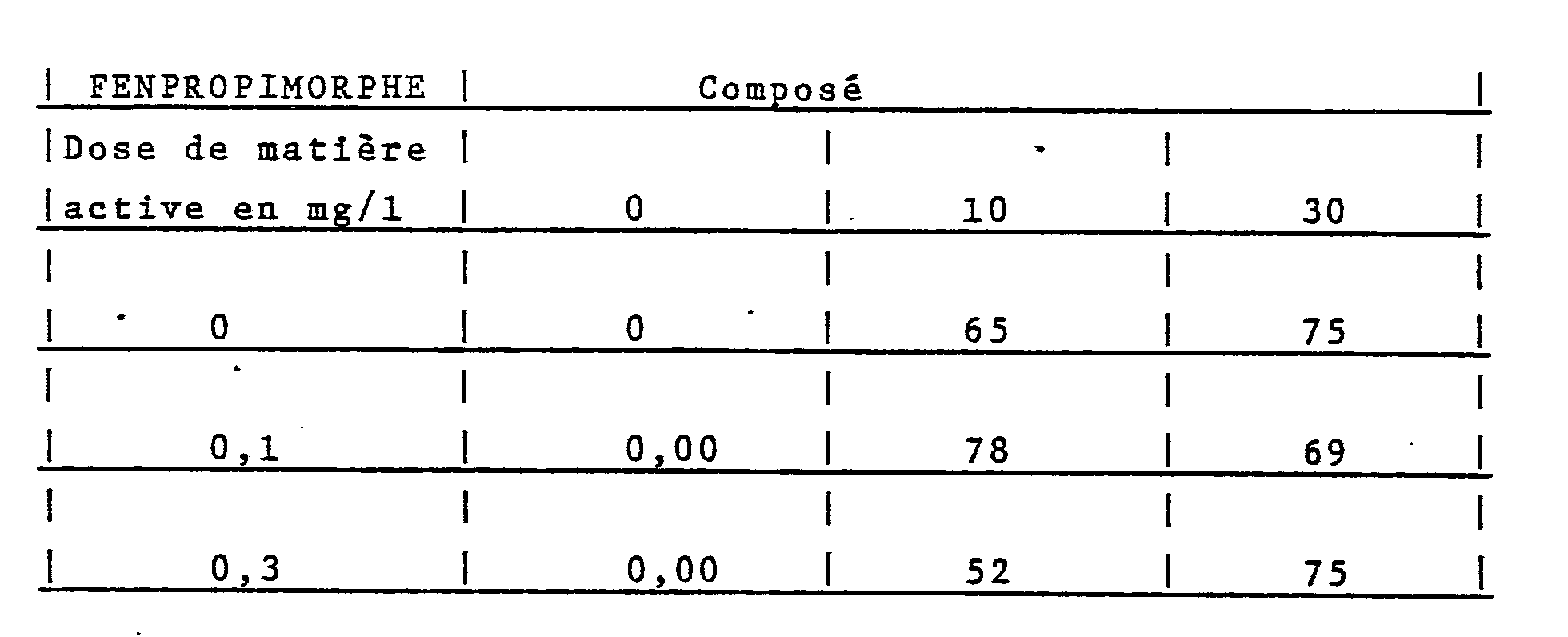
mêmes conditions opératoires que dans l'exemple précédent. Les résultats sont consignés ci-dessous

mêmes conditions opératoires que dans l'exemple précédent. Les résultats sont consignés ci-dessous
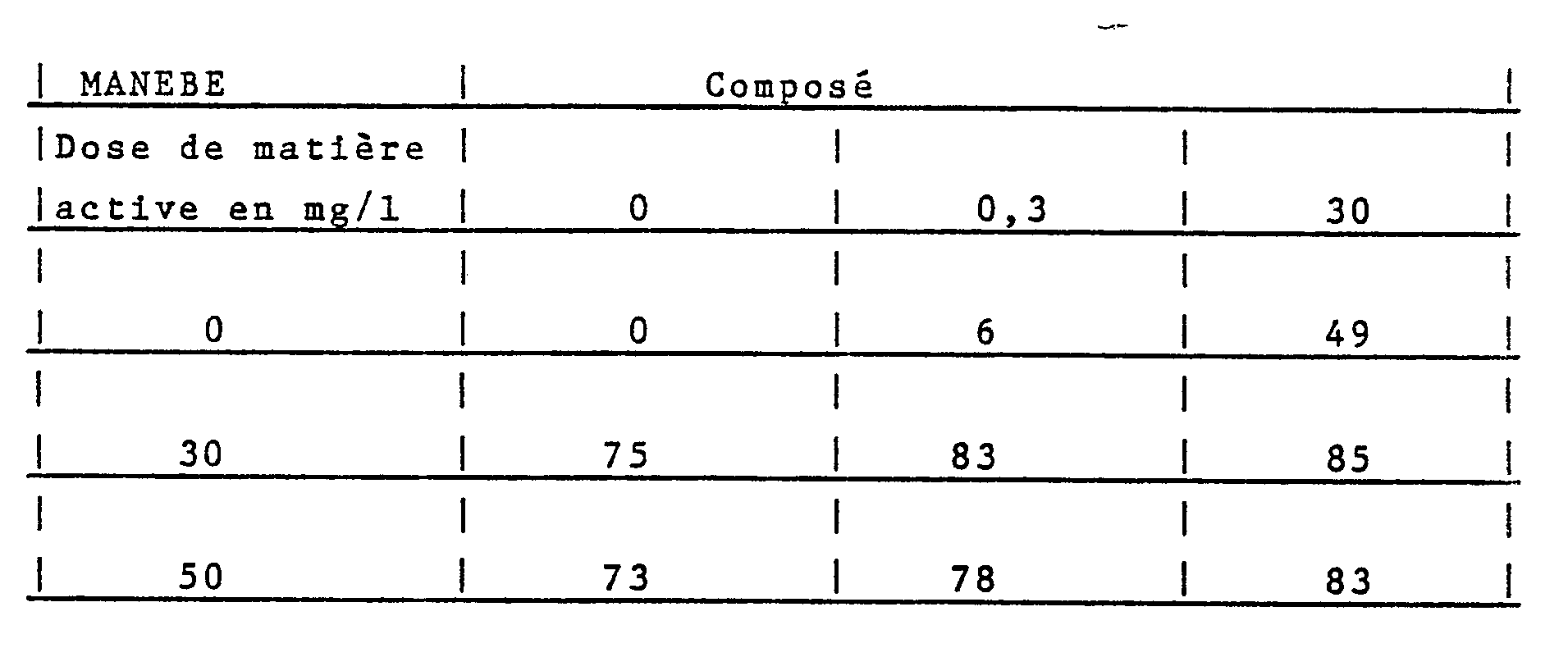
mêmes conditions opératoires que dans l'exemple précédent. Les résultats sont consignés ci-dessous

mêmes conditions opératoires que dans l'exemple précédent. Les résultats sont consignés ci-dessous

On opère de la même façon que pour l'exemple 11 avec comme matière active une association du composé obtenu selon l'exemple I avec le tridémorphe dans un rapport pondéral 1 : 1.The operation is carried out in the same way as for Example 11 with as active material an association of the compound obtained according to Example I with the tridemorph in a weight ratio 1: 1.
A la dose de 0,06 g/l protection, totale (supérieure à 95 %).At the dose of 0.06 g / l protection, total (greater than 95%).
On prépare une émulsion aqueuse de la même façon que celle indiquée à l'exemple 11 en utilisant comme matière active une association constituée du composé obtenu selon l'exemple I et d'iprodione dans un rapport pondéral égal à 1.An aqueous emulsion is prepared in the same way as that indicated in Example 11 using as active material a combination consisting of the compound obtained according to Example I and iprodione in a weight ratio equal to 1.
Des tomates cultivées en serre (variété Marmande) âgées de 30 à 40 jours sont traitées par pulvérisation avec l'émulsion aqueuse.Tomatoes grown in a greenhouse (Marmande variety) aged 30 to 40 days are treated by spraying with the aqueous emulsion.
Après 24 ou 48 heures, les feuilles sont coupées et mises dans 2 boîtes de Pétri (diamètre 11 cm) dont le fond a été préalablement garni d'un disque de papier filtre humide (5 folioles par boîte).After 24 or 48 hours, the leaves are cut and placed in 2 Petri dishes (diameter 11 cm), the bottom of which has previously been lined with a disc of wet filter paper (5 leaflets per box).
L'inoculum est ensuite apporté à l'aide d'une seringue par dépôt de gouttes (3 gouttes par foliole) d'une suspension de spores. Cette suspension de spores de Botytris cinerea a été obtenue à partir d'une culture de 15 jours, mise ensuite en suspension dans une solution nutritive (80.000 unités/cm³).The inoculum is then brought using a syringe by depositing drops (3 drops per leaflet) of a suspension of spores. This suspension of Botytris cinerea spores was obtained from a 15-day culture, then suspended in a nutritive solution (80,000 units / cm³).
Le contrôle est fait 6 jours après la contamination par comparaison avec un témoin non traité.The control is done 6 days after contamination by comparison with an untreated control.
A la dose de 0,66 g/l de matière active protection totale (supérieure à 95 %).At a dose of 0.66 g / l of active ingredient total protection (greater than 95%).
On opère de la même façon que pour l'exemple 11 avec comme matière active une association du composé obtenu selon l'exemple 1 avec le tridémorphe et le fenpropimorphe dans un rapport pondéral :
Composé de l'exemple 1 : tridémorphe ou fenpropimorphe = 1,1The operation is carried out in the same way as for Example 11 with as active material an association of the compound obtained according to Example 1 with the tridemorph and the fenpropimorph in a weight ratio:
Compound of example 1: tridemorph or fenpropimorph = 1.1
Du blé, en godets, semé dans de la terre franche, est traité au stade de 10 cm de hauteur par pulvérisation d'une émulsion aqueuse (appelée bouillie) de concentration en matière active indiquée ci-après. L'essai est répété deux fois. Au bout de 24 heures, on saupoudre les plants de blé avec des spores d'Erysiphe graminis, le saupoudrage étant effectué à l'aide de plants malades.Wheat, in pots, sown in loam, is treated at the 10 cm height stage by spraying an aqueous emulsion (called slurry) with active ingredient concentration indicated below. The test is repeated twice. After 24 hours, the wheat plants are dusted with E rysiphe graminis spores, the dusting being carried out using diseased plants.
La lecture se fait 8 à 12 jours après la contamination.Reading is done 8 to 12 days after contamination.
Dans ces conditions, on observe les résultats suivants :
A la dose de 0,063 g/l de matière active protection totale (supérieure ou égale à 95 %).Under these conditions, the following results are observed:
At the dose of 0.063 g / l of active ingredient total protection (greater than or equal to 95%).
On opère de la même façon que pour l'exemple 11 avec comme matière active une association du composé obtenu selon l'exemple 1 avec l'iprodione dans un rapport pondéral:composé de l'exemple 1 : iprodione = 1.The operation is carried out in the same way as for Example 11 with as active material an association of the compound obtained according to Example 1 with iprodione in a weight ratio: compound of Example 1: iprodione = 1.
Du blé, en godets, semé dans de la terre franche, est traité au stade de 10 cm de hauteur par pulvérisation avec des émulsions aqueuses (appelées bouillies) de concentration en matière active indiquée ci-après. L'essai est répété deux fois.Wheat, in pots, sown in loam, is treated at the 10 cm height stage by spraying with aqueous emulsions (called boiled) of active ingredient concentration indicated below. The test is repeated twice.
Au bout de 24 heures, une suspension aqueuse de spores (150000 sp/cm³) est pulvérisée sur le blé ; cette suspension a été obtenue à partir de cultures de champignons in vitro. On place ensuite le blé pendant 8 jours en cellule d'incubation à environ 20°C et à 100 % d'humidité relative. Le contrôle de l'état des plants se fait entre le 8ème et le 15ème jour après la contamination par comparaison avec le témoin non traité.After 24 hours, an aqueous suspension of spores (150,000 sp / cm³) is sprayed onto the wheat; this suspension was obtained from in vitro mushroom cultures. The wheat is then placed for 8 days in an incubation cell at approximately 20 ° C. and at 100% relative humidity. The condition of the plants is checked between the 8th and 15th day after contamination by comparison with the untreated control.
Dans ces conditions, on observe à la dose de 0,25 g/l de matière active une protection supérieure à 90 %.Under these conditions, a dose of 0.25 g / l of active ingredient is observed for protection greater than 90%.
Ces deux tests bien qu'étant indépendants ont été regroupés sous le même exemple car le mode opératoire est identique. On opère de la même façon que pour l'exemple 11 avec comme matière active une association du composé selon l'exemple 1, avec l'iprodione dans un rapport pondéral = 1.These two tests, although being independent, have been grouped together under the same example because the procedure is identical. The operation is carried out in the same way as for example 11 with as active material a combination of the compound according to example 1, with iprodione in a weight ratio = 1.
Des pommes sont traitées par pulvérisation avec des suspensions aqueuses (appelées bouillies) de concentration en matière active indiquée ci-après. L'essai est répété deux fois.Apples are treated by spraying with aqueous suspensions (called slurries) of active ingredient concentration indicated below. The test is repeated twice.
Au bout de 24 heures, une suspension aqueuse de spores (50 000 sp/cm³ dans le cas de Monilia sp et 250 000 sp/cm³ dans le cas de Penicillium sp) est pulvérisée sur les pommes ; cette suspension a été obtenue à partir de fruits contaminés. On place ensuite les pommes en cellule d'incubation à environ 20°C et 90-100 % d'humidité relative. Le contrôle de l'état des fruits se fait entre les 5ème et 10ème jour après, la contamination par comparaison avec le témoin non traité.After 24 hours, an aqueous suspension of spores (50,000 sp / cm³ in the case of Monilia sp and 250,000 sp / cm³ in the case of Penicillium sp) is sprayed on the apples; this suspension was obtained from contaminated fruit. The apples are then placed in an incubation cell at approximately 20 ° C and 90-100% relative humidity. The state of the fruit is checked between the 5th and 10th day after, the contamination by comparison with the untreated control.
Dans ces conditions, à la dose de 0,66 g/l on observe une protection de 49 % pour Monilia sp et 21 % pour Penicillium sp.Under these conditions, at a dose of 0.66 g / l, protection of 49% is observed for Monilia sp and 21% for Penicillium sp.
On opère de la même façon que pour l'exemple 11 avec comme matière active une association du composé obtenu selon l'exemple 1 avec le tridemorphe dans un rapport pondéral, composé de l'exemple 1 : tridemorphe = 0,033.The operation is carried out in the same way as for example 11 with as active material a combination of the compound obtained according to example 1 with the tridemorph in a weight ratio, compound of example 1: tridemorph = 0.033.
De l'orge, en godets, semé dans de la terre franche, et traitée au stade 10 cm de hauteur par pulvérisation d'une émulsion aqueuse (appelée bouillie) de concentration indiquée ci-après. L'essai est répété deux fois. Au bout de 24 heures, on saupoudre les plants d'orge avec des spores d'Erysiphe graminis, le saupoudrage étant effectué à l'aide de plants malades.Barley, in pots, sown in loam, and treated at the 10 cm height stage by spraying with an aqueous emulsion (called slurry) at the concentration indicated below. The test is repeated twice. After 24 hours, the barley plants are sprinkled with Erysiphe graminis spores, the dusting being carried out using diseased plants.
La lecture se fait 8 à 12 jours après la contamination.Reading is done 8 to 12 days after contamination.
Dans ces conditions, on observe les résultats suivants :
- à la dose de 0,1 g/l, 50 % de protection.Under these conditions, the following results are observed:
- at a dose of 0.1 g / l, 50% protection.
On opère de la même façon que pour l'exemple 11 pour obtenir une émulsion aqueuse d'une matière active constituée du composé obtenu selon l'exemple 1 avec le Phosetyl A1 dans un rapport pondéral égal à 0,5.The procedure is the same as for Example 11 to obtain an aqueous emulsion of an active material consisting of the compound obtained according to Example 1 with Phosetyl A1 in a weight ratio equal to 0.5.
Des boutures de vigne (Vitis vinifera), de variété Chardonnay, sont cultivées dans des godets. Lorsque ces plants sont âgés de 2 mois (stade 8 à 10 feuilles, hauteur 20 à 30 cm), ils sont traités par pulvérisation au moyen d'une suspension ou solution aqueuse de la matière à tester. Chaque plant de vigne reçoit environ 5 ml de la solution ou dispersion.Vine cuttings ( Vitis vinifera ), of the Chardonnay variety, are grown in pots. When these plants are 2 months old (stage 8 to 10 leaves, height 20 to 30 cm), they are treated by spraying with a suspension or aqueous solution of the material to be tested. Each vine plant receives approximately 5 ml of the solution or dispersion.
Après sèchage pendant 24 heures, on contamine chaque plant par pulvérisation au moyen d'une suspension aqueuse de spores de Plasmopora Viticola, responsable du mildiou de la vigne, à raison d'environ 1 ml/plant (soit environ 10⁵ spores par plant).After drying for 24 hours, each plant is contaminated by spraying with a suspension aqueous spore of Plasmopora Viticola, responsible for downy mildew in the vine, at a rate of approximately 1 ml / plant (or approximately 10⁵ spores per plant).
Après cette contamination, les plants de vigne sont mis en incubation pendant deux jours à 18°C environ, en atmosphère saturée d'humidité, puis pendant cinq jours à 20-22°C environ sous 90-100 % d'humidité relative.After this contamination, the vine plants are incubated for two days at around 18 ° C, in an atmosphere saturated with humidity, then for five days at around 20-22 ° C under 90-100% relative humidity.
La lecture se fait 7 jours après la contamination. Dans ces conditions, on observe les résultats suivants : - à 3 g/litre protection totale.Reading is done 7 days after contamination. Under these conditions, the following results are observed: - at 3 g / liter total protection.
Chlorothalonil Tétrachloro-isophtalonitrile
Iprodione 3-(3,5-dichlorophényl)-N-isopropyl-2,4-dioxo imidazolidine-1-carboxamide
Fenpropimorphe (±)-cis-4-[3-(4-tert-butylphenyl)-2-methyl propyl]-2,6-diméthylmorpholine
Tridémorphe 2,6-diméthyl-4-tridécylmorpholine
Fenpropidine 1[3-(p-terbutylphenyl)2-méthyl propyl] piperidine
Dinocap 2-(1-méthylheptyl)-4,6-dinitrophényl crotonate
Dithianon 5,10-dihydro-5,10-dioxonaphto [2,3-b]-1,4-dithia-anthraquinone
Manèbe Ethylène bis (dithiocarbamate) de manganèse
Mancozèbe Complexe de manèbe avec un sel de zinc
Zinèbe Ethylène bis (dithiocarbamate) de zinc
Phoséthyl-Al Tris-0-éthylphosphonate d'aluminium
Captane N-(trichlorométhylthio) cyclohex-4-ene-1,2 dicarboximide
Carbendazime Méthyl benzimidazol-2-yl carbamate
Captafol N-(1,1,2,2-tétrachloroéthylthio) cyclohex-4-ene-1,2-dicarboximide
Cymoxanil 2-cyano-N-[(éthylamino) carbonyl]-2-(méthoxyimino) acétamide
Nuarimol α-(2-chlorophényl)-α-(4-fluoro -phényl)-5-pyrimidine méthanol
Diniconazol 1-(2,4-dichlorophenyl)-4,4-dimethyl-2-(1,2,4-triazol-1-yl)-1-penten-3-ol.Chlorothalonil Tetrachloroisophthalonitrile
Iprodione 3- (3,5-dichlorophenyl) -N-isopropyl-2,4-dioxo imidazolidine-1-carboxamide
Fenpropimorph (±) -cis-4- [3- (4-tert-butylphenyl) -2-methyl propyl] -2,6-dimethylmorpholine
Tridemorph 2,6-dimethyl-4-tridecylmorpholine
Fenpropidine 1 [3- (p-terbutylphenyl) 2-methyl propyl] piperidine
Dinocap 2- (1-methylheptyl) -4,6-dinitrophenyl crotonate
Dithianon 5,10-dihydro-5,10-dioxonaphto [2,3-b] -1,4-dithia-anthraquinone
Manganese Ethylene bis (dithiocarbamate) of manganese
Mancozeb Complex of maneb with a zinc salt
Zineb Ethylene bis (dithiocarbamate) zinc
Aluminum phosethyl-Al Tris-0-ethylphosphonate
Captan N- (trichloromethylthio) cyclohex-4-ene-1,2 dicarboximide
Carbendazim Methyl benzimidazol-2-yl carbamate
Captafol N- (1,1,2,2-tetrachloroethylthio) cyclohex-4-ene-1,2-dicarboximide
Cymoxanil 2-cyano-N - [(ethylamino) carbonyl] -2- (methoxyimino) acetamide
Nuarimol α- (2-chlorophenyl) -α- (4-fluoro -phenyl) -5-pyrimidine methanol
Diniconazol 1- (2,4-dichlorophenyl) -4,4-dimethyl-2- (1,2,4-triazol-1-yl) -1-penten-3-ol.
Ce dernier produit est décrit dans le brevet GB 2046260 déja mentionné.The latter product is described in GB 2046260 already mentioned.
Claims (24)


chlorothalonil, iprodione, fenpropimorphe, tridémorphe, fenpropidine, dinocap, dithianon, manèbe, mancozèbe, zinèbe, phoséthyl-Al, cymoxanil, captane, carbendazime, captafol, soufre, le cuivre et les dérivés du cuivre tels que l'oxychlorure de cuivre.14) Associations according to claim 13) characterized in that the products of group II are chosen from the following active materials:
chlorothalonil, iprodione, fenpropimorph, tridemorph, fenpropidine, dinocap, dithianon, maneb, mancozeb, zineb, phosethyl-Al, cymoxanil, captane, carbendazim, captafol, sulfur, copper and copper derivatives such as copper oxychloride.
Priority Applications (1)
| Application Number | Priority Date | Filing Date | Title |
|---|---|---|---|
| AT86420304T ATE54449T1 (en) | 1985-12-20 | 1986-12-18 | FUNGICIDES WITH TRIAZOLE AND OLIGOAETHER GROUPS AND MIXTURES. |
Applications Claiming Priority (6)
| Application Number | Priority Date | Filing Date | Title |
|---|---|---|---|
| FR8519194 | 1985-12-20 | ||
| FR8519194A FR2592046B1 (en) | 1985-12-20 | 1985-12-20 | FUNGICIDAL PRODUCTS WITH TRIAZOLE AND OLIGOETHER GROUPS, THEIR PREPARATION METHOD, THE FUNGICIDAL COMPOSITIONS CONTAINING THEM AND THEIR USE IN THE CONTROL OF FUNGAL INFLUENCES OF CROPS |
| FR868605411A FR2596954B2 (en) | 1985-12-20 | 1986-04-11 | FUNGICIDE RESULTING FROM THE ASSOCIATION OF A COMPOUND WITH A TRIAZOLE AND OLIGOETHER GROUP AND ANOTHER FUNGICIDE PRODUCT |
| FR8605411 | 1986-04-11 | ||
| FR8609056A FR2600233A2 (en) | 1985-12-20 | 1986-06-19 | Fungicide resulting from the combination of a compound having a triazole and oligoether group and of another fungicide |
| FR8609056 | 1986-06-19 |
Publications (2)
| Publication Number | Publication Date |
|---|---|
| EP0230844A1 true EP0230844A1 (en) | 1987-08-05 |
| EP0230844B1 EP0230844B1 (en) | 1990-07-11 |
Family
ID=27251321
Family Applications (1)
| Application Number | Title | Priority Date | Filing Date |
|---|---|---|---|
| EP86420304A Expired - Lifetime EP0230844B1 (en) | 1985-12-20 | 1986-12-18 | Fungicides comprising triazole and oligo ether groups, and mixtures thereof |
Country Status (20)
| Country | Link |
|---|---|
| EP (1) | EP0230844B1 (en) |
| KR (1) | KR870006041A (en) |
| AU (1) | AU587096B2 (en) |
| BG (1) | BG46592A3 (en) |
| BR (1) | BR8606333A (en) |
| DE (1) | DE3672598D1 (en) |
| DK (1) | DK616086A (en) |
| FI (1) | FI865127A7 (en) |
| GR (1) | GR3003003T3 (en) |
| HU (1) | HU202521B (en) |
| IL (1) | IL81027A0 (en) |
| MA (1) | MA20836A1 (en) |
| NO (1) | NO865112L (en) |
| OA (1) | OA08454A (en) |
| PH (1) | PH24256A (en) |
| PL (1) | PL149906B1 (en) |
| PT (1) | PT83989B (en) |
| TN (1) | TNSN86166A1 (en) |
| TR (1) | TR22825A (en) |
| YU (1) | YU216886A (en) |
Cited By (6)
| Publication number | Priority date | Publication date | Assignee | Title |
|---|---|---|---|---|
| FR2655514A1 (en) * | 1989-12-13 | 1991-06-14 | Rhone Poulenc Agrochimie | FUNGICIDE ASSOCIATION WITH SYNERGISTIC EFFECT BASED ON MORPHOLINE AND TRIAZOLE. |
| WO1993002557A1 (en) * | 1991-08-01 | 1993-02-18 | Hickson International Plc | Preservatives for wood and other cellulosic materials |
| FR2688118A1 (en) * | 1992-03-05 | 1993-09-10 | Sandoz Sa | NOVEL FUNGICIDAL COMPOSITIONS BASED ON STEROL BIOSYNTHESIS INHIBITORS. |
| WO1995016349A1 (en) * | 1993-12-17 | 1995-06-22 | Basf Aktiengesellschaft | Fungicide |
| FR2715029A1 (en) * | 1994-01-14 | 1995-07-21 | Rhone Poulenc Agrochimie | A synergistic fungicidal combination based on iprodione and a triazole compound. |
| FR2939068A1 (en) * | 2008-12-01 | 2010-06-04 | Intace Internat Sarl | Process for fighting against bluing of wood, comprises contacting the wood with cis-4-(3-(p-tert-butylphenyl)-2-methylpropyl)-2,6-dimethyl morpholine, where bluing is provoked by e.g. Aspergillus niger |
Families Citing this family (3)
| Publication number | Priority date | Publication date | Assignee | Title |
|---|---|---|---|---|
| FR2603038B1 (en) * | 1986-08-22 | 1988-11-25 | Rhone Poulenc Agrochimie | PROCESS FOR THE PREPARATION OF COMPOUNDS WITH TRIAZOLE AND TETRAHYDROFURAN GROUPS, NOVEL COMPOUNDS USEFUL FOR THE PREPARATION OF SAID COMPOUNDS |
| DE4112652A1 (en) * | 1991-04-18 | 1992-10-22 | Wolman Gmbh Dr | WOOD PRESERVATIVES |
| GB9116672D0 (en) * | 1991-08-01 | 1991-09-18 | Hickson Int Plc | Preservatives for wood and other cellulosic materials |
Citations (2)
| Publication number | Priority date | Publication date | Assignee | Title |
|---|---|---|---|---|
| EP0121979A2 (en) * | 1983-03-09 | 1984-10-17 | Imperial Chemical Industries Plc | Azolylmethyl tetrahydrofuran derivatives as plant growth regulators and fungicides |
| EP0151084A2 (en) * | 1984-01-26 | 1985-08-07 | Rhone-Poulenc Agrochimie | Fungicides with triazole groups and oligo ethers |
-
1986
- 1986-12-10 PH PH34572A patent/PH24256A/en unknown
- 1986-12-16 FI FI865127A patent/FI865127A7/en not_active Application Discontinuation
- 1986-12-17 AU AU66642/86A patent/AU587096B2/en not_active Withdrawn - After Issue
- 1986-12-17 NO NO865112A patent/NO865112L/en unknown
- 1986-12-17 YU YU02168/86A patent/YU216886A/en unknown
- 1986-12-17 MA MA21068A patent/MA20836A1/en unknown
- 1986-12-18 DE DE8686420304T patent/DE3672598D1/en not_active Expired - Fee Related
- 1986-12-18 HU HU865310A patent/HU202521B/en not_active IP Right Cessation
- 1986-12-18 IL IL81027A patent/IL81027A0/en unknown
- 1986-12-18 EP EP86420304A patent/EP0230844B1/en not_active Expired - Lifetime
- 1986-12-19 TN TNTNSN86166A patent/TNSN86166A1/en unknown
- 1986-12-19 BR BR8606333A patent/BR8606333A/en unknown
- 1986-12-19 OA OA59027A patent/OA08454A/en unknown
- 1986-12-19 PL PL1986263133A patent/PL149906B1/en unknown
- 1986-12-19 BG BG077612A patent/BG46592A3/en unknown
- 1986-12-19 TR TR712/86A patent/TR22825A/en unknown
- 1986-12-19 DK DK616086A patent/DK616086A/en not_active Application Discontinuation
- 1986-12-19 PT PT83989A patent/PT83989B/en unknown
- 1986-12-20 KR KR860011023A patent/KR870006041A/en not_active Withdrawn
-
1990
- 1990-07-12 GR GR89400226T patent/GR3003003T3/en unknown
Patent Citations (2)
| Publication number | Priority date | Publication date | Assignee | Title |
|---|---|---|---|---|
| EP0121979A2 (en) * | 1983-03-09 | 1984-10-17 | Imperial Chemical Industries Plc | Azolylmethyl tetrahydrofuran derivatives as plant growth regulators and fungicides |
| EP0151084A2 (en) * | 1984-01-26 | 1985-08-07 | Rhone-Poulenc Agrochimie | Fungicides with triazole groups and oligo ethers |
Cited By (14)
| Publication number | Priority date | Publication date | Assignee | Title |
|---|---|---|---|---|
| EP0433194A1 (en) * | 1989-12-13 | 1991-06-19 | Rhone-Poulenc Agrochimie | Fungicide composition with synergistic effect based on one morpholine and one triazole |
| FR2655514A1 (en) * | 1989-12-13 | 1991-06-14 | Rhone Poulenc Agrochimie | FUNGICIDE ASSOCIATION WITH SYNERGISTIC EFFECT BASED ON MORPHOLINE AND TRIAZOLE. |
| US5634967A (en) * | 1991-08-01 | 1997-06-03 | Hickson International Plc | Preservatives for wood and other cellulosic materials |
| WO1993002557A1 (en) * | 1991-08-01 | 1993-02-18 | Hickson International Plc | Preservatives for wood and other cellulosic materials |
| US5916356A (en) * | 1991-08-01 | 1999-06-29 | Hickson International Plc | Preservatives for wood and other cellulosic materials |
| FR2688118A1 (en) * | 1992-03-05 | 1993-09-10 | Sandoz Sa | NOVEL FUNGICIDAL COMPOSITIONS BASED ON STEROL BIOSYNTHESIS INHIBITORS. |
| BE1005834A5 (en) * | 1992-03-05 | 1994-02-15 | Sandoz Sa | New fungicide compositions biosynthesis inhibitors sterol. |
| ES2060542A1 (en) * | 1992-03-05 | 1994-11-16 | Sandoz Ag | FUNGICIDE COMPOSITIONS. |
| WO1995016349A1 (en) * | 1993-12-17 | 1995-06-22 | Basf Aktiengesellschaft | Fungicide |
| WO1995016350A1 (en) * | 1993-12-17 | 1995-06-22 | Basf Aktiengesellschaft | Solid enveloped plant protection agent formulation |
| EP0663148A3 (en) * | 1994-01-14 | 1995-11-08 | Rhone Poulenc Agrochimie | Fungicidal compositions based on a 3,4-dichloroanilide like iprodione and a triazole compound. |
| US5565481A (en) * | 1994-01-14 | 1996-10-15 | Rhone-Poulenc Agrochimie | Fungicides comprising iprodione and a triazole |
| FR2715029A1 (en) * | 1994-01-14 | 1995-07-21 | Rhone Poulenc Agrochimie | A synergistic fungicidal combination based on iprodione and a triazole compound. |
| FR2939068A1 (en) * | 2008-12-01 | 2010-06-04 | Intace Internat Sarl | Process for fighting against bluing of wood, comprises contacting the wood with cis-4-(3-(p-tert-butylphenyl)-2-methylpropyl)-2,6-dimethyl morpholine, where bluing is provoked by e.g. Aspergillus niger |
Also Published As
| Publication number | Publication date |
|---|---|
| IL81027A0 (en) | 1987-03-31 |
| AU587096B2 (en) | 1989-08-03 |
| YU216886A (en) | 1988-02-29 |
| DK616086D0 (en) | 1986-12-19 |
| FI865127L (en) | 1987-06-21 |
| NO865112L (en) | 1987-06-22 |
| EP0230844B1 (en) | 1990-07-11 |
| PT83989B (en) | 1989-01-09 |
| GR3003003T3 (en) | 1993-02-17 |
| MA20836A1 (en) | 1987-07-01 |
| HUT44252A (en) | 1988-02-29 |
| TR22825A (en) | 1988-08-17 |
| OA08454A (en) | 1988-06-30 |
| DK616086A (en) | 1987-06-21 |
| FI865127A0 (en) | 1986-12-16 |
| PT83989A (en) | 1987-01-01 |
| NO865112D0 (en) | 1986-12-17 |
| DE3672598D1 (en) | 1990-08-16 |
| PH24256A (en) | 1990-05-04 |
| TNSN86166A1 (en) | 1990-01-01 |
| PL149906B1 (en) | 1990-03-31 |
| HU202521B (en) | 1991-03-28 |
| BR8606333A (en) | 1987-10-06 |
| AU6664286A (en) | 1987-06-25 |
| PL263133A1 (en) | 1988-06-09 |
| FI865127A7 (en) | 1987-06-21 |
| KR870006041A (en) | 1987-07-08 |
| BG46592A3 (en) | 1990-01-15 |
Similar Documents
| Publication | Publication Date | Title |
|---|---|---|
| EP0378953B1 (en) | Benzylidene azolyl methyl cycloalkane and its use as a fungicide | |
| EP0467792B1 (en) | Fungicidal composition for the treatment of seeds | |
| EP0466612B1 (en) | Method for fungicidal foliage treatment with a triazole and fungicidal composition for carrying out the method | |
| FR2641277A1 (en) | Azolylmethylcyclopentanebenzylidene or -cyclopentenebenzylidene and use as fungicide | |
| EP0258161A2 (en) | 2,5-Dihydrofuran derivatives with a triazole or imidazole group, preparation process, use as a fungicide | |
| EP0151084A2 (en) | Fungicides with triazole groups and oligo ethers | |
| EP0230844B1 (en) | Fungicides comprising triazole and oligo ether groups, and mixtures thereof | |
| EP0335806B1 (en) | Beta-phenoxynitrile compounds | |
| EP0246982B1 (en) | Triazole or imidazole and tetrahydrofuran compounds, their use as fungicides and preparation processes | |
| EP0157712A1 (en) | Arylthio-pyridinyl alcanols | |
| EP0318400A1 (en) | Triazole derivatives, their use as fungicides and processes of preparation | |
| EP0239508A2 (en) | 2-Cyano-benzimidazole derivatives, their preparation and use as fungicides, their association with other fungicides | |
| FR2519635A1 (en) | IMIDAZOLYL-PROPIONONITRILES, PROCESS FOR THEIR PREPARATION AND BIOCIDAL PRODUCTS CONTAINING SUCH COMPOUNDS | |
| FR2600233A2 (en) | Fungicide resulting from the combination of a compound having a triazole and oligoether group and of another fungicide | |
| FR2668893A1 (en) | PROCESS FOR PROTECTING PLANT MULTIPLICATION PRODUCTS USING TRIAZOLYL OR IMIDAZOLYL METHYL ALLYL ALCOHOL AND NOVEL COMPOUNDS FOR IMPLEMENTING THE PROCESS | |
| FR2596954A2 (en) | Fungicide resulting from the combination of a compound possessing triazole and oligoether groups and of another fungicidal product | |
| EP0077281B1 (en) | Homologous fungicides of n-phenyl alarinates, process for their preparation and their use | |
| EP0249567A2 (en) | Propargyloxybenzene derivatives, their preparation and fungicidal compositions containing them | |
| JP3624209B2 (en) | Agricultural and horticultural fungicides | |
| EP0323443A2 (en) | Fungicides with triazole groups and oligo ethers | |
| FR2649101A1 (en) | Benzylideneazolylmethylcyclohexane and use as fungicide | |
| EP0012703A1 (en) | Phosphoric acid derivatives from N-phenyl N-(alkoxycarbonylalkyl)acetamides, process for preparing them and fungicidal compositions containing them | |
| FR2649700A2 (en) | Benzylideneazolylmethylcyclopentane and use as fungicide | |
| FR2597868A1 (en) | Compounds containing triazole or imidazole and tetrahydrofuran groups, their use as fungicides and processes of preparation | |
| FR2665445A1 (en) | Fungicidal compositions containing compounds from the alpha -pyrone family |
Legal Events
| Date | Code | Title | Description |
|---|---|---|---|
| PUAI | Public reference made under article 153(3) epc to a published international application that has entered the european phase |
Free format text: ORIGINAL CODE: 0009012 |
|
| 17P | Request for examination filed |
Effective date: 19861227 |
|
| AK | Designated contracting states |
Kind code of ref document: A1 Designated state(s): AT BE CH DE ES FR GB GR IT LI LU NL SE |
|
| 17Q | First examination report despatched |
Effective date: 19890202 |
|
| ITF | It: translation for a ep patent filed | ||
| GRAA | (expected) grant |
Free format text: ORIGINAL CODE: 0009210 |
|
| AK | Designated contracting states |
Kind code of ref document: B1 Designated state(s): AT BE CH DE ES FR GB GR IT LI LU NL SE |
|
| PG25 | Lapsed in a contracting state [announced via postgrant information from national office to epo] |
Ref country code: NL Effective date: 19900711 Ref country code: GR Free format text: LAPSE BECAUSE OF FAILURE TO SUBMIT A TRANSLATION OF THE DESCRIPTION OR TO PAY THE FEE WITHIN THE PRESCRIBED TIME-LIMIT Effective date: 19900711 Ref country code: AT Effective date: 19900711 |
|
| REF | Corresponds to: |
Ref document number: 54449 Country of ref document: AT Date of ref document: 19900715 Kind code of ref document: T |
|
| REF | Corresponds to: |
Ref document number: 3672598 Country of ref document: DE Date of ref document: 19900816 |
|
| GBT | Gb: translation of ep patent filed (gb section 77(6)(a)/1977) | ||
| PG25 | Lapsed in a contracting state [announced via postgrant information from national office to epo] |
Ref country code: ES Free format text: LAPSE BECAUSE OF FAILURE TO SUBMIT A TRANSLATION OF THE DESCRIPTION OR TO PAY THE FEE WITHIN THE PRESCRIBED TIME-LIMIT Effective date: 19901022 |
|
| PGFP | Annual fee paid to national office [announced via postgrant information from national office to epo] |
Ref country code: GB Payment date: 19901210 Year of fee payment: 5 |
|
| PG25 | Lapsed in a contracting state [announced via postgrant information from national office to epo] |
Ref country code: SE Effective date: 19901219 |
|
| PG25 | Lapsed in a contracting state [announced via postgrant information from national office to epo] |
Ref country code: LI Effective date: 19901231 Ref country code: CH Effective date: 19901231 Ref country code: BE Effective date: 19901231 |
|
| NLV1 | Nl: lapsed or annulled due to failure to fulfill the requirements of art. 29p and 29m of the patents act | ||
| PLBE | No opposition filed within time limit |
Free format text: ORIGINAL CODE: 0009261 |
|
| STAA | Information on the status of an ep patent application or granted ep patent |
Free format text: STATUS: NO OPPOSITION FILED WITHIN TIME LIMIT |
|
| PGFP | Annual fee paid to national office [announced via postgrant information from national office to epo] |
Ref country code: LU Payment date: 19910517 Year of fee payment: 5 |
|
| BERE | Be: lapsed |
Owner name: RHONE-POULENC AGROCHIMIE Effective date: 19901231 |
|
| 26N | No opposition filed | ||
| PG25 | Lapsed in a contracting state [announced via postgrant information from national office to epo] |
Ref country code: FR Effective date: 19910830 |
|
| REG | Reference to a national code |
Ref country code: CH Ref legal event code: PL |
|
| PG25 | Lapsed in a contracting state [announced via postgrant information from national office to epo] |
Ref country code: DE Effective date: 19910903 |
|
| EPTA | Lu: last paid annual fee | ||
| REG | Reference to a national code |
Ref country code: FR Ref legal event code: ST |
|
| PG25 | Lapsed in a contracting state [announced via postgrant information from national office to epo] |
Ref country code: LU Free format text: LAPSE BECAUSE OF NON-PAYMENT OF DUE FEES Effective date: 19911218 Ref country code: GB Effective date: 19911218 |
|
| GBPC | Gb: european patent ceased through non-payment of renewal fee | ||
| REG | Reference to a national code |
Ref country code: GR Ref legal event code: FG4A Free format text: 3003003 |
|
| REG | Reference to a national code |
Ref country code: GR Ref legal event code: MM2A Free format text: 3003003 |
|
| EUG | Se: european patent has lapsed |
Ref document number: 86420304.7 Effective date: 19910910 |
|
| PG25 | Lapsed in a contracting state [announced via postgrant information from national office to epo] |
Ref country code: IT Free format text: LAPSE BECAUSE OF NON-PAYMENT OF DUE FEES;WARNING: LAPSES OF ITALIAN PATENTS WITH EFFECTIVE DATE BEFORE 2007 MAY HAVE OCCURRED AT ANY TIME BEFORE 2007. THE CORRECT EFFECTIVE DATE MAY BE DIFFERENT FROM THE ONE RECORDED. Effective date: 20051218 |