EP0106376B1 - Process and plant for re-extracting uranium in several stages from an extractant - Google Patents
Process and plant for re-extracting uranium in several stages from an extractant Download PDFInfo
- Publication number
- EP0106376B1 EP0106376B1 EP19830201157 EP83201157A EP0106376B1 EP 0106376 B1 EP0106376 B1 EP 0106376B1 EP 19830201157 EP19830201157 EP 19830201157 EP 83201157 A EP83201157 A EP 83201157A EP 0106376 B1 EP0106376 B1 EP 0106376B1
- Authority
- EP
- European Patent Office
- Prior art keywords
- aqueous phase
- uranium
- iron
- metal iron
- phosphoric acid
- Prior art date
- Legal status (The legal status is an assumption and is not a legal conclusion. Google has not performed a legal analysis and makes no representation as to the accuracy of the status listed.)
- Expired
Links
- JFALSRSLKYAFGM-UHFFFAOYSA-N uranium(0) Chemical compound [U] JFALSRSLKYAFGM-UHFFFAOYSA-N 0.000 title claims description 55
- 229910052770 Uranium Inorganic materials 0.000 title claims description 54
- 238000000034 method Methods 0.000 title claims description 36
- XEEYBQQBJWHFJM-UHFFFAOYSA-N Iron Chemical compound [Fe] XEEYBQQBJWHFJM-UHFFFAOYSA-N 0.000 claims description 152
- 229910052742 iron Inorganic materials 0.000 claims description 62
- 239000008346 aqueous phase Substances 0.000 claims description 55
- NBIIXXVUZAFLBC-UHFFFAOYSA-N Phosphoric acid Chemical compound OP(O)(O)=O NBIIXXVUZAFLBC-UHFFFAOYSA-N 0.000 claims description 48
- 229910000147 aluminium phosphate Inorganic materials 0.000 claims description 23
- 239000000243 solution Substances 0.000 claims description 21
- CWYNVVGOOAEACU-UHFFFAOYSA-N Fe2+ Chemical compound [Fe+2] CWYNVVGOOAEACU-UHFFFAOYSA-N 0.000 claims description 15
- 238000002156 mixing Methods 0.000 claims description 15
- 239000007864 aqueous solution Substances 0.000 claims description 13
- 239000012074 organic phase Substances 0.000 claims description 11
- VTLYFUHAOXGGBS-UHFFFAOYSA-N Fe3+ Chemical compound [Fe+3] VTLYFUHAOXGGBS-UHFFFAOYSA-N 0.000 claims description 8
- 229910001447 ferric ion Inorganic materials 0.000 claims description 6
- 229910001448 ferrous ion Inorganic materials 0.000 claims description 6
- 239000003960 organic solvent Substances 0.000 claims description 6
- 238000005086 pumping Methods 0.000 claims description 4
- 238000003756 stirring Methods 0.000 claims description 4
- XLYOFNOQVPJJNP-UHFFFAOYSA-N water Substances O XLYOFNOQVPJJNP-UHFFFAOYSA-N 0.000 claims description 3
- 230000033116 oxidation-reduction process Effects 0.000 claims description 2
- 239000002184 metal Substances 0.000 claims 13
- 229910052751 metal Inorganic materials 0.000 claims 13
- XYFCBTPGUUZFHI-UHFFFAOYSA-N Phosphine Chemical compound P XYFCBTPGUUZFHI-UHFFFAOYSA-N 0.000 claims 2
- 206010022979 Iron excess Diseases 0.000 claims 1
- 230000001351 cycling effect Effects 0.000 claims 1
- 238000007599 discharging Methods 0.000 claims 1
- 229910000073 phosphorus hydride Inorganic materials 0.000 claims 1
- 239000000725 suspension Substances 0.000 claims 1
- 238000009434 installation Methods 0.000 description 21
- 235000011007 phosphoric acid Nutrition 0.000 description 18
- 238000000605 extraction Methods 0.000 description 14
- 239000012071 phase Substances 0.000 description 12
- 239000002253 acid Substances 0.000 description 10
- 238000004064 recycling Methods 0.000 description 8
- 238000005299 abrasion Methods 0.000 description 7
- 238000006243 chemical reaction Methods 0.000 description 7
- QAOWNCQODCNURD-UHFFFAOYSA-N Sulfuric acid Chemical compound OS(O)(=O)=O QAOWNCQODCNURD-UHFFFAOYSA-N 0.000 description 4
- 239000003570 air Substances 0.000 description 4
- 150000002500 ions Chemical class 0.000 description 3
- 150000003016 phosphoric acids Chemical class 0.000 description 3
- 238000001556 precipitation Methods 0.000 description 3
- XLPNRFXSYBURJM-UHFFFAOYSA-H [U+6].[O-]P([O-])([O-])=O.[O-]P([O-])([O-])=O Chemical compound [U+6].[O-]P([O-])([O-])=O.[O-]P([O-])([O-])=O XLPNRFXSYBURJM-UHFFFAOYSA-H 0.000 description 2
- 125000001931 aliphatic group Chemical group 0.000 description 2
- 239000003085 diluting agent Substances 0.000 description 2
- 230000000694 effects Effects 0.000 description 2
- 150000002505 iron Chemical class 0.000 description 2
- 238000002386 leaching Methods 0.000 description 2
- 238000004519 manufacturing process Methods 0.000 description 2
- 230000001590 oxidative effect Effects 0.000 description 2
- 239000002245 particle Substances 0.000 description 2
- 239000002367 phosphate rock Substances 0.000 description 2
- 239000002244 precipitate Substances 0.000 description 2
- 238000011084 recovery Methods 0.000 description 2
- 238000012552 review Methods 0.000 description 2
- 239000002904 solvent Substances 0.000 description 2
- ZMBHCYHQLYEYDV-UHFFFAOYSA-N trioctylphosphine oxide Chemical compound CCCCCCCCP(=O)(CCCCCCCC)CCCCCCCC ZMBHCYHQLYEYDV-UHFFFAOYSA-N 0.000 description 2
- 229910000163 uranium phosphate Inorganic materials 0.000 description 2
- 229910019142 PO4 Inorganic materials 0.000 description 1
- 150000001224 Uranium Chemical class 0.000 description 1
- 238000013019 agitation Methods 0.000 description 1
- 239000012080 ambient air Substances 0.000 description 1
- 230000001010 compromised effect Effects 0.000 description 1
- 238000010276 construction Methods 0.000 description 1
- 238000013461 design Methods 0.000 description 1
- 238000011161 development Methods 0.000 description 1
- SEGLCEQVOFDUPX-UHFFFAOYSA-N di-(2-ethylhexyl)phosphoric acid Chemical compound CCCCC(CC)COP(O)(=O)OCC(CC)CCCC SEGLCEQVOFDUPX-UHFFFAOYSA-N 0.000 description 1
- 238000010586 diagram Methods 0.000 description 1
- 238000004090 dissolution Methods 0.000 description 1
- 238000009826 distribution Methods 0.000 description 1
- 229940082150 encore Drugs 0.000 description 1
- 238000005265 energy consumption Methods 0.000 description 1
- 238000004880 explosion Methods 0.000 description 1
- 230000009931 harmful effect Effects 0.000 description 1
- 238000010438 heat treatment Methods 0.000 description 1
- 238000009413 insulation Methods 0.000 description 1
- JEIPFZHSYJVQDO-UHFFFAOYSA-N iron(III) oxide Inorganic materials O=[Fe]O[Fe]=O JEIPFZHSYJVQDO-UHFFFAOYSA-N 0.000 description 1
- 238000002955 isolation Methods 0.000 description 1
- 238000005259 measurement Methods 0.000 description 1
- 239000011859 microparticle Substances 0.000 description 1
- 230000003647 oxidation Effects 0.000 description 1
- 238000007254 oxidation reaction Methods 0.000 description 1
- NBIIXXVUZAFLBC-UHFFFAOYSA-K phosphate Chemical compound [O-]P([O-])([O-])=O NBIIXXVUZAFLBC-UHFFFAOYSA-K 0.000 description 1
- 239000010452 phosphate Substances 0.000 description 1
- 230000001737 promoting effect Effects 0.000 description 1
- 238000004080 punching Methods 0.000 description 1
- 150000003839 salts Chemical class 0.000 description 1
- 239000003923 scrap metal Substances 0.000 description 1
- 238000000926 separation method Methods 0.000 description 1
- 239000007787 solid Substances 0.000 description 1
- 239000000126 substance Substances 0.000 description 1
- 238000005303 weighing Methods 0.000 description 1
Images

Classifications
-
- C—CHEMISTRY; METALLURGY
- C22—METALLURGY; FERROUS OR NON-FERROUS ALLOYS; TREATMENT OF ALLOYS OR NON-FERROUS METALS
- C22B—PRODUCTION AND REFINING OF METALS; PRETREATMENT OF RAW MATERIALS
- C22B60/00—Obtaining metals of atomic number 87 or higher, i.e. radioactive metals
- C22B60/02—Obtaining thorium, uranium, or other actinides
- C22B60/0204—Obtaining thorium, uranium, or other actinides obtaining uranium
- C22B60/0217—Obtaining thorium, uranium, or other actinides obtaining uranium by wet processes
- C22B60/0252—Obtaining thorium, uranium, or other actinides obtaining uranium by wet processes treatment or purification of solutions or of liquors or of slurries
- C22B60/0278—Obtaining thorium, uranium, or other actinides obtaining uranium by wet processes treatment or purification of solutions or of liquors or of slurries by chemical methods
-
- C—CHEMISTRY; METALLURGY
- C22—METALLURGY; FERROUS OR NON-FERROUS ALLOYS; TREATMENT OF ALLOYS OR NON-FERROUS METALS
- C22B—PRODUCTION AND REFINING OF METALS; PRETREATMENT OF RAW MATERIALS
- C22B60/00—Obtaining metals of atomic number 87 or higher, i.e. radioactive metals
- C22B60/02—Obtaining thorium, uranium, or other actinides
- C22B60/0204—Obtaining thorium, uranium, or other actinides obtaining uranium
- C22B60/0217—Obtaining thorium, uranium, or other actinides obtaining uranium by wet processes
- C22B60/0252—Obtaining thorium, uranium, or other actinides obtaining uranium by wet processes treatment or purification of solutions or of liquors or of slurries
- C22B60/026—Obtaining thorium, uranium, or other actinides obtaining uranium by wet processes treatment or purification of solutions or of liquors or of slurries liquid-liquid extraction with or without dissolution in organic solvents
-
- Y—GENERAL TAGGING OF NEW TECHNOLOGICAL DEVELOPMENTS; GENERAL TAGGING OF CROSS-SECTIONAL TECHNOLOGIES SPANNING OVER SEVERAL SECTIONS OF THE IPC; TECHNICAL SUBJECTS COVERED BY FORMER USPC CROSS-REFERENCE ART COLLECTIONS [XRACs] AND DIGESTS
- Y02—TECHNOLOGIES OR APPLICATIONS FOR MITIGATION OR ADAPTATION AGAINST CLIMATE CHANGE
- Y02P—CLIMATE CHANGE MITIGATION TECHNOLOGIES IN THE PRODUCTION OR PROCESSING OF GOODS
- Y02P10/00—Technologies related to metal processing
- Y02P10/20—Recycling
Definitions
- a method for carrying out the re-extraction of uranium from such an extractant is among other things known by the patent in the United States of America No. 3,737,513, the European patent application No. 0031172 and the article "Recovery of Uranium from Wet-Process Phoshoric Acid "BY FJ Hurst et al. in the review "Industrial and Engineering Chemistry: Process Design and Development” Volume Il, N ° 1, 1972.
- the first operation consists in oxidizing this uranium-containing aqueous phase so that all of the Fe2 + + Fe 3+ is found in the state of Fe 3+ and precipitates of the FeH 3 (P0 4 ) 2 4H 2 0 type are formed as soon as the Fe2 + + Fe 3+ content is greater than 25 g / I of Fe.
- One of the essential aims of the present invention is to remedy these various drawbacks and to provide a very simple process in which the iron content in the aqueous phase is kept to a minimum, thus avoiding any risk of precipitation.
- the metallic iron and the aqueous phase enriched in uranium are contacted by putting at least part of this metallic iron in movement relative to said aqueous phase, so as to create abrasion of the iron.
- At least part of the metallic iron is subjected to agitation in the abovementioned aqueous phase, by limiting the quantity of air entrained in the latter.
- the invention also relates to an installation for re-extracting uranium from an organic extractant, for implementing the method as described above.
- This installation includes a series of successive mixer-settlers, each comprising a mixing compartment provided with a pumping agitator, a settling compartment, a gutter for evacuating the organic phase, an outlet chamber provided with an overflow , to evacuate part of the decanted aqueous phase, and a container intended to contain metallic iron which can be brought into contact with the aqueous phase, the outlet chamber being connected by a recycling pipe to the mixing compartment making it possible to recycle the other part of the aqueous phase.
- the aforementioned container comprises means for setting the metallic iron in motion and creating, on the one hand, an abrasion of this iron, and, on the other hand, intimate contact between the latter and the aqueous phase.
- these means comprise an agitator making it possible to stir the metallic iron which is in the form of pieces, in intimate contact with each other in the aqueous phase, the
- the aforementioned container preferably having an intake passage near its bottom and an evacuation passage above the level of the metallic iron.
- the process according to the invention for re-extracting uranium from an extractant comprising a dialkylphisphoric acid and a dialkylphosphine oxide dissolved in an organic solvent immiscible with water using an aqueous solution of phosphoric acid containing ferrous ions is produced in several successive stages, each stage in turn comprising several stages.
- the extractant in the organic solvent is brought into contact with the aqueous phosphoric acid solution, a fraction of which is formed by recycled solution loaded with uranium. During this contacting, an organic phase depleted in uranium occurs and an aqueous phase of phosphoric acid enriched in uranium and ferric ions.
- the content of ferrous ions in the recycled fraction is adjusted by bringing the aqueous phase enriched in uranium and resulting from the second step into contact with pieces of metallic iron set in motion in this aqueous phase, so thus creating an abrasion of said iron and thus forming tiny and active particles of iron rapidly entering into solution to react almost instantaneously with Fe 3 + ions.
- This extractant has been used to extract uranium from phosphoric acid produced by leaching with sulfuric acid from uranium phosphate rocks.
- the re-extraction is carried out with an aqueous solution of phosphoric acid at 37% of P 2 0 5 prepared by mixing phosphoric acids with 30% of P 2 0 5 and 42% of P 2 0 5 .
- This solution which, according to the invention, has not been pre-reduced contains approximately 3 g / I of Fe 3 +.
- the re-extraction is carried out in three stages using for this purpose three identical mixer-settlers 1, 2 and 3 from an installation shown in Figure 1.
- Each mixer-settler comprises a mixing compartment 4 provided with a pumping stirrer 5, a settling compartment 6 and an outlet chamber 7 for the evacuation of the separate phases.
- the extractant from which uranium must be removed, is introduced into the mixing compartment 4 of the mixer-settler 1, as indicated by arrow 8, and leaves the installation through the outlet chamber 7 of the mixer - settling tank 3.
- the re-extraction solution enters the installation through the mixing compartment 4 of the mixer-settler 3, as indicated by arrow 9, and leaves this installation through the outlet chamber 7 of the mixer-settler 1.
- the extractant is introduced into 8 of the installation at a flow rate of 30 m 3 / h and at a temperature of the order of 35 ° C, while the re-extraction solution is introduced into 9 at a flow rate of 882 I / h and at a temperature of the order of 50 ° C.
- the extractant entering at 8 into compartment 4 of the mixer-settler 1, leaves the chamber 7 of the latter by a line 8 'to then enter the mixing compartment 4 of the mixer-settler 2 and leave it by a line 8 "to the mixing compartment 4 of the mixer-settler 3.
- the extractant is finally removed from the installation by the chamber 7 of the latter mixer-settler, as shown by the arrow 8" '.
- the re-extraction solution which enters at 9 into the mixing compartment 4 of the mixer-decanter 3, separates into two circuits in the chamber 7, a part being recycled to compartment 4 of the same mixer-decanter, through a recycling line 13, while the other part passes to the mixing compartment 4 of the preceding mixer-decanter 2, through line 7 ′.
- part of this solution is recycled to the same mixing compartment while the other part is transferred to the mixing compartment of the first mixer-settler 1 by the recycling line 7 ".
- the organic phase / aqueous phase ratio is, in this concrete example, 30,000 / 682 and it is necessary to maintain the aqueous phase as a continuous phase during the re-extraction, most of the aqueous phase is recycled by the recycling line 13 and only a minor part passes to the following mixer-settler, as indicated by the references 7 'and 7 "or is evacuated from the installation as indicated by the reference 7".
- the metallic iron is added to each stage in the outlet chamber 7 of the three mixer-settlers.
- this metallic iron is subjected to stirring in the aqueous phase in such a way as to limit to the strict minimum the amount of air entrained in this phase.
- the average diameter preferably varies between and 5 and 30 mm for at least 50% by weight of the total amount of iron used.
- the quantity of metallic iron added to the aqueous phase of each stage corresponds substantially to the quantity by weight of uranium to be reduced on the stage considered, with an excess of 50 to 100% of iron.
- re-extraction solution of an aqueous solution of phosphoric acid containing 35 to 45% by weight of P 2 0 5 in its natural oxidation-reduction state, containing for example at least 75% by weight of iron in the form of Fe 3 +.
- the temperature is maintained in the three mixer-settlers between 40 and 55 ° C and preferably between 45 and 55 ° C, so as to obtain a distribution coefficient of U 4+ between the aqueous phase and the organic phase as high as possible and ensuring a rapid reaction between the aqueous phase and the metallic iron.
- 1 kg / h of metallic iron is added in the mixer-settler 3.3 kg / h in the mixer-settler 2 and 8 kg / h in the mixer-settler 1.
- This extractant can then be reused to extract the uranium from the phosphoric acid produced by leaching with sulfuric acid from uranium phosphate rocks.
- the uranium can be recovered from the aqueous phase leaving in 7 "'according to a known process as described above.
- the raffinate from the uranium extraction operation is used, that is to say the phosphoric acid from the sulfuric attack on the phosphate, which has been oxidized and from which the uranium has been extracted. using D 2 EHPA-TOPO solvents according to the well known process.
- This phosphoric acid contains 2.2 g / 1 of iron, divided into 0.3 g / I Fe2 + and 1.9 g / 1 Fe 3 +.
- the temperature is 54 ° C.
- the acid contains 13.5 g / I of Fe, of which 13 g / I of Fe2 + and 0.5 g / I of Fe 3 +.
- the starting acid is the raffinate originating from the second cycle of 1 uranium extraction, that is to say the aqueous phase loaded with uranium leaving the re-extraction from which, after oxidation, the uranium was extracted at using the solvents D 2 EHPA-TOPO according to the known process.
- This acid contains 14.3 g / 1 of Fe including 0.5 g / 1 of Fe2 + and 13.8 g / I of Fe 3+.
- the working temperature is 52 ° C.
- the acid contains 24 g / l of Fe including 17.2 g / 1 of Fe2 + and 6.8 g / 1 of Fe 3 +.
- the process according to the invention consists in promoting reaction (3) to the detriment of reaction (2) by putting, by abrasion, microparticles of active iron in solution which can react directly with Fe 3 +.
- Another advantage of the present invention is to allow the use of coarse and low-cost machine guns such as those originating from perforation operations, punching, etc., without limitation of specific surface, as is the case for example in the process. described by European patent application 0031172.
- this installation comprises a series of successive mixer-settlers, which are three in number in this specific embodiment, each comprising a mixing compartment 4 provided with an agitator 5 with pumping effect, a settling compartment 8 and an outlet chamber 7, into which metallic iron is introduced at regular intervals.
- a gutter 10 for evacuating the organic phase, the aqueous phase, forming the lower decanted phase, passes below this gutter in the outlet chamber 7, as indicated by the arrow A.
- the other part of the aqueous phase passes through a container 16 containing the metallic iron 22, of which question above.
- the part of the aqueous phase having passed through the container 16 is then recycled through the recycling line 13.
- means are provided for setting the metallic iron 22 in motion and creating, on the one hand, an abrasion of this iron and, on the other hand, an intimate contact between the latter and the aqueous phase passing through the container 16 .
- These means are, in the embodiment shown in FIGS. 2 and 3, formed by an agitator 23 making it possible to stir the pieces of iron contained in the container 1, in intimate contact with one another, and thus causing the abovementioned abrasion .
- the aqueous phase enters the container 16 near its bottom by an inlet passage in which a grid 20 or other means permeable to the aqueous phase is provided for retaining the metallic iron in the container 16.
- the aqueous phase passes through the container from bottom to top to overflow above a discharge threshold 21 and flow to the recycling line 13.
- each of the recycling lines 13 is surrounded by a heating element 19, for example with steam.
- This line 13 is further provided with a valve 14 for adjusting the flow rate of the recycled current.
- the Fe2 + content is determined for regular periods, in particular every hour, for example by measurement using a colorimeter on a sample taken at any point on the circuit, for example at point 15.
- the amount of iron to be added to the container 16 is predetermined by the amount of residual uranium in the extractant and it is no longer necessary to vary the frequency of the addition of iron.
- This addition can be carried out manually or by any usual mechanical weighing and dosing system.
- the number of mixer-settlers can vary depending on the nature of the extractant to be treated and the container containing the metallic iron can have a significantly different construction.
Landscapes
- Chemical & Material Sciences (AREA)
- General Life Sciences & Earth Sciences (AREA)
- Engineering & Computer Science (AREA)
- Life Sciences & Earth Sciences (AREA)
- Geology (AREA)
- Environmental & Geological Engineering (AREA)
- Manufacturing & Machinery (AREA)
- Materials Engineering (AREA)
- Mechanical Engineering (AREA)
- Metallurgy (AREA)
- Organic Chemistry (AREA)
- General Chemical & Material Sciences (AREA)
- Chemical Kinetics & Catalysis (AREA)
- Manufacture And Refinement Of Metals (AREA)
- Extraction Or Liquid Replacement (AREA)
Description
La présente imvention est relative à un procédé pour ré-extraire, en plusieurs étages successifs, de l'uranium d'un extractant comprenant un acide dialkylphosphorique et un oxyde de trialkylphosphine dissous dans un solvant organique non miscible à l'eau, à l'aide d'une solution aqueuse d'acide phosphorique contenant des ions ferreux, chaque étage comprenant les étapes suivantes:
- a) la mise en contact de l'extractant dans le solvant organique avec la solution aqueuse d'acide phosphorique, une fraction de cette solution aqueuse étant formée par de la solution recyclée chargée d'uranium, en produisant ainsi une phase organique appauvrie en uranium et une phase agueuse d'acide phosphorique enrichie en uranium et en ions ferriques;
- b) la séparation de la phase organique appauvrie en uranium de la phase aqueuse enrichie en uranium;
- c) le recyclage d'une fraction de la phase aqueuse enrichie em uranium résultant de l'étape (b) vers l'étape (a) et
- d) l'ajustage de la teneur en ions ferreux de la fraction recyclée en mettant la phase aqueuse enrichie en uranium et résultant de l'étape (b) en contact avec du fer métallique.
- a) contacting the extractant in the organic solvent with the aqueous phosphoric acid solution, a fraction of this aqueous solution being formed by recycled solution loaded with uranium, thereby producing an organic phase depleted in uranium and an active phase of phosphoric acid enriched in uranium and ferric ions;
- b) separation of the organic phase depleted in uranium from the aqueous phase enriched in uranium;
- c) recycling a fraction of the uranium-enriched aqueous phase resulting from step (b) to step (a) and
- d) adjusting the ferrous ion content of the recycled fraction by bringing the aqueous phase enriched in uranium and resulting from step (b) into contact with metallic iron.
Un procédé pour réaliser la ré-extraction d'uranium d'un tel extractant est entre autre connu par le brevet aux Etats-Unis d'Amérique N° 3.737.513, la demande de brevet européen N° 0031172 et l'article "Recovery of Uranium from Wet-Process Phoshoric Acid" PAR F.J. Hurst et al. dans la revue "Industrial and Engineering Chemistry: Process Design and Development" Volume Il, N° 1, 1972.A method for carrying out the re-extraction of uranium from such an extractant is among other things known by the patent in the United States of America No. 3,737,513, the European patent application No. 0031172 and the article "Recovery of Uranium from Wet-Process Phoshoric Acid "BY FJ Hurst et al. in the review "Industrial and Engineering Chemistry: Process Design and Development" Volume Il, N ° 1, 1972.
Tous ces procédés présentent cependant divers inconvénients relativement importants.All of these methods, however, have various relatively significant drawbacks.
Ainsi, ces procédés connus conduisent à l'obtention d'une phase aqueuse uranifère dont la teneur en Fe2+ + Fe3+ est comprise entre 25 et 45 g/I suivant la teneur en Fe2+ + Fe3+ de l'acide pré-réduit utilisé pour la ré-extraction.Thus, these known processes lead to the production of an uranium-containing aqueous phase, the Fe2 + + Fe 3 + content of which is between 25 and 45 g / I depending on the Fe2 + + Fe 3 + content of the pre-reduced acid. used for re-extraction.
Or, il est bien connu dans la chimie de la fabrication de l'acide phosphorique que la solubilité du Fe3+ dans l'acide phosphorique est faible et que, pour des acides phosphoriques d'une teneur en P205 de 30 à 35 %, la limite de solubilité se situe aux environs de 25 g/I de Fe3+However, it is well known in the chemistry of the manufacture of phosphoric acid that the solubility of Fe 3 + in phosphoric acid is low and that, for phosphoric acids with a P 2 0 5 content of 30 to 35%, the solubility limit is around 25 g / I of Fe 3 +
Toute teneur supérieure à cette limite donne lieu à la précipitation massive de sels ferriques du type FeH3(PO,4)2 4H20.Any content above this limit gives rise to massive precipitation of ferric salts of the FeH 3 (PO, 4 ) 2 4H 2 0 type.
Lors de la récupération ultérieure de l'uranium de la phase aqueuse uranifère par le procédé bien connu, qui consiste à oxyder le U4+ en U6+, à extraire le U6+ avec un extractant constitué d'une solution de D2EHPA et de Topo dans un diluant aliphatique inerte et à ré-extraire le U6+ par une solution aqueuse de (NH4)2 C03, la première opération consiste à oxyder cette phase aqueuse uranifère de sorte que la totalité du Fe2+ + Fe3+ se retrouve à l'état de Fe3+ et des précipités de type FeH3(P04)24H20 se forment des que la teneur Fe2+ + Fe3+ est supérieure à 25 g/I de Fe.During the subsequent recovery of uranium from the uranium-containing aqueous phase by the well-known process, which consists in oxidizing the U 4 + to U 6 +, in extracting the U 6 + with an extractant consisting of a solution of D 2 EHPA and Topo in an inert aliphatic diluent and to re-extract the U 6+ with an aqueous solution of (NH 4 ) 2 C0 3 , the first operation consists in oxidizing this uranium-containing aqueous phase so that all of the Fe2 + + Fe 3+ is found in the state of Fe 3+ and precipitates of the FeH 3 (P0 4 ) 2 4H 2 0 type are formed as soon as the Fe2 + + Fe 3+ content is greater than 25 g / I of Fe.
Ces précipités se déposent dans les divers appareillages, créent des obstructions dans les tuyauteries et les orifices de règlage de débit, de sorte que la conduite des opérations ultérieures est gravement compromise. Cette précipitation apparaît également au cours de l'opération de ré-extraction elle-même avec les mêmes effets néfastes dès que la teneur en Fe3+ dépasse 25 g/I.These precipitates are deposited in the various devices, creating obstructions in the pipes and the flow control orifices, so that the conduct of the subsequent operations is seriously compromised. This precipitation also appears during the re-extraction operation itself with the same harmful effects as soon as the Fe 3 + content exceeds 25 g / I.
Par ailleurs, le procédé suivant le brevet aux Etats-Unis d'Amérique N° 3.737.513 nécessite des précautions très importantes du point de vue de sécurité par suite des risques d'explosion.Furthermore, the process according to the patent in the United States of America No. 3,737,513 requires very important precautions from the point of view of safety due to the risk of explosion.
Dans le procédé suivant la demande de brevet européen précitée, il y a lieu de soumettre l'acide phosphorique utilisé à une réduction préalable ce qui nécessite, en plus, une isolation de l'installation par rapport à l'air ambiant. Une telle isolation étant également exigée dans le procédé décrit par F.J. Hurst dans la revue industrielle "Industrial and Enginéering Chemistry".In the process according to the aforementioned European patent application, it is necessary to subject the phosphoric acid used to a prior reduction, which also requires isolation of the installation from ambient air. Such insulation is also required in the process described by F.J. Hurst in the industrial review "Industrial and Engineering Chemistry".
Un des buts essentiels de la présente invention est de remédier à ces divers inconvénients et de procurer un procédé très simple dans lequel la teneur en fer dans la phase aqueuse est maintenue au minimum, évitant ainsi tout risque de précipitation.One of the essential aims of the present invention is to remedy these various drawbacks and to provide a very simple process in which the iron content in the aqueous phase is kept to a minimum, thus avoiding any risk of precipitation.
A cet effet, suivant l'invention, on effectue le contact du fer métallique et de la phase aqueuse enrichie en uranium en mettant au moins une partie de ce fer métallique en mouvement par rapport à ladite phase aqueuse, de manière à créer une abrasion du fer.To this end, according to the invention, the metallic iron and the aqueous phase enriched in uranium are contacted by putting at least part of this metallic iron in movement relative to said aqueous phase, so as to create abrasion of the iron.
Avantageusement, on soumet au moins une partie du fer métallique à une agitation dans la phase aqueuse précitée, en limitant la quantité d'air entraînée dans cette dernière.Advantageously, at least part of the metallic iron is subjected to agitation in the abovementioned aqueous phase, by limiting the quantity of air entrained in the latter.
L'invention concerne également une installation pour ré-extraire de l'uranium d'un extractant organique, pour la mise en oeuvre du procédé tel que décrit ci-dessus.The invention also relates to an installation for re-extracting uranium from an organic extractant, for implementing the method as described above.
Cette installation comprend une série de mélangeurs-décanteurs successifs comportant chacun un compartiment de mélange muni d'un agitateur à effet de pompage, un compartiment de décantation, une gouttière pour évacuer la phase organique, une chambre de sortie munie d'un trop-plein, pour évacuer une partie de la phase aqueuse décantée, et un récipient destiné à contenir du fer métallique pouvant être mis en contact avec la phase aqueuse, la chambre de sortie étant reliée par une conduite de recyclage au compartiment de mélange permettant de recycler l'autre partie de la phase aqueuse.This installation includes a series of successive mixer-settlers, each comprising a mixing compartment provided with a pumping agitator, a settling compartment, a gutter for evacuating the organic phase, an outlet chamber provided with an overflow , to evacuate part of the decanted aqueous phase, and a container intended to contain metallic iron which can be brought into contact with the aqueous phase, the outlet chamber being connected by a recycling pipe to the mixing compartment making it possible to recycle the other part of the aqueous phase.
Suivant l'invention, le récipient précité comprend des moyens pour mettre le fer métallique en mouvement et créer, d'une part, une abrasion de ce fer, et, d'autre part, un contact intime entre ce dernier et la phase aqueuse.According to the invention, the aforementioned container comprises means for setting the metallic iron in motion and creating, on the one hand, an abrasion of this iron, and, on the other hand, intimate contact between the latter and the aqueous phase.
Avantageusement, ces moyens comprennent un agitateur permettant de brasser le fer métallique se présentant sous forme de morceaux, en contact intime les uns avec les autres dans la phase aqueuse, le récipient précité présentant de préférence un passage d'admission à proximité de son fond et un passage d'évacuation au dessus du niveau du fer métallique.Advantageously, these means comprise an agitator making it possible to stir the metallic iron which is in the form of pieces, in intimate contact with each other in the aqueous phase, the The aforementioned container preferably having an intake passage near its bottom and an evacuation passage above the level of the metallic iron.
D'autres détails et particularités de l'invention ressortiront de la description donnée ci-après, à titre d'exemple non limitatif, d'une forme de réalisation particulière de l'objet de l'invention avec référence aux dessins annexés.
- La figure 1 représente un schéma d'une installation pour réaliser le procédé suivant la présente invention.
- La figure 2 est une vue en plan, à plus grande échelle, d'une partie de cette installation.
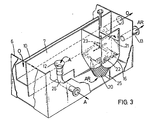
- La figure 3 est une vue en perspective, avec brisure partielle de cette même partie de l'installation.
- FIG. 1 represents a diagram of an installation for carrying out the method according to the present invention.
- Figure 2 is a plan view, on a larger scale, of a part of this installation.
- Figure 3 is a perspective view, with partial breaking of this same part of the installation.
Dans les différentes figures les mêmes éléments sont désignés par les mêmes chiffres de référence.In the different figures, the same elements are designated by the same reference numbers.
D'une façon générale, le procédé suivant l'invention pour ré-extraire de l'uranium d'un extractant comprenant un acide dialkylphisphorique et un oxyde de dialkylphosphine dissous dans un solvant organique non miscible à l'eau à l'aide d'une solution aqueuse d'acide phosphorique contenant des ions ferreux est réalisé en plusieurs étages successifs, chaque étage comprenant à son tour plusieurs étapes.In general, the process according to the invention for re-extracting uranium from an extractant comprising a dialkylphisphoric acid and a dialkylphosphine oxide dissolved in an organic solvent immiscible with water using an aqueous solution of phosphoric acid containing ferrous ions is produced in several successive stages, each stage in turn comprising several stages.
Dans une première étape, l'extractant dans le solvant organique est mis en contact avec la solution aqueuse d'acide phosphorique, dont une fraction est formée par de la solution recyclée chargée d'uranium. Lors de cette mise en contact se produit une phase organique appauvrie en uranium et une phase aqueuse d'acide phosphorique enrichie en uranium et en ions ferriques.In a first step, the extractant in the organic solvent is brought into contact with the aqueous phosphoric acid solution, a fraction of which is formed by recycled solution loaded with uranium. During this contacting, an organic phase depleted in uranium occurs and an aqueous phase of phosphoric acid enriched in uranium and ferric ions.
Ces deux phases sont alors séparés dans une deuxième étape et une fraction de la phase aqueuse enrichie en uranium résultant de cette deuxième étape est envoyée, au cours d'une troisième étape, vers la première étape.These two phases are then separated in a second step and a fraction of the aqueous phase enriched in uranium resulting from this second step is sent, during a third step, to the first step.
Ensuite, dans une dernière étape, la teneur en ions ferreux de la fraction recyclée est ajustée en mettant la phase aqueuse enrichie en uranium et résultant de la deuxième étape en contact avec des morceaux de fer métallique mis en mouvement dans cette phase aqueuse, de manière à créer ainsi une abrasion dudit fer et former ainsi des particules minuscules et actives de fer entrant rapidement en solution pour réagir pratiquement instantanément avec des ions Fe3+.Then, in a last step, the content of ferrous ions in the recycled fraction is adjusted by bringing the aqueous phase enriched in uranium and resulting from the second step into contact with pieces of metallic iron set in motion in this aqueous phase, so thus creating an abrasion of said iron and thus forming tiny and active particles of iron rapidly entering into solution to react almost instantaneously with Fe 3 + ions.
Les caractéristiques particulières de ce procédé seront décites ci-après au moyen de quelques exemples de réalisation concrets.The particular characteristics of this process will be described below by means of some concrete examples of implementation.
On part d'un extractant organique constitué d'une solution de 0,5 M d'acide di-(2-éthylhexyl) phosphorique (D2EHPA) et de 0,075 M d'oxyde de trioctylphosphine (TOPO) dans un diluant aliphatique inerte ("ESCAID-110" de la société ESSO CHEMICAL Cy) contenant 235 mg/I de U6+We start with an organic extractant consisting of a solution of 0.5 M di- (2-ethylhexyl) phosphoric acid (D 2 EHPA) and 0.075 M trioctylphosphine oxide (TOPO) in an inert aliphatic diluent ("ESCAID-110" from ESSO CHEMICAL Cy) containing 235 mg / I of U 6 +
Cet extractant a été utilisé pour extraire de l'uranium d'acide phosphorique produit par lixiviation à l'acide sulfurique de roches phosphatées uranifères.This extractant has been used to extract uranium from phosphoric acid produced by leaching with sulfuric acid from uranium phosphate rocks.
On effectue la ré-extraction avec une solution aqueuse d'acide phosphorique à 37 % de P205 préparée par mélange d'acides phosphoriques à 30 % de P205 et 42 % de P205. Cette solution qui, suivant l'invention, n'a pas été pré-réduite contient environ 3 g/I de Fe3+.The re-extraction is carried out with an aqueous solution of phosphoric acid at 37% of P 2 0 5 prepared by mixing phosphoric acids with 30% of P 2 0 5 and 42% of P 2 0 5 . This solution which, according to the invention, has not been pre-reduced contains approximately 3 g / I of Fe 3 +.
La ré-extraction est effectuée en trois étages en utilisant à cet effet trois mélangeurs-décanteurs identiques 1, 2 et 3 d'une installation montrée à la figure 1.The re-extraction is carried out in three stages using for this purpose three identical mixer-
Chaque mélangeur-décanteur comporte un compartiment de mélange 4 muni d'un agitateur 5 à effet de pompage, un compartiment de décantation 6 et une chambre de sortie 7 pour l'évacuation des phases séparées.Each mixer-settler comprises a
L'extractant, dont il y a lieu d'enlever l'uranium, est introduit dans le compartiment de mélange 4 du mélangeur-décanteur 1, comme indiqué par la flèche 8, et quitte l'installation par la chambre de sortie 7 du mélangeur-décanteur 3.The extractant, from which uranium must be removed, is introduced into the
Par contre, la solution de ré-extraction entre dans l'installation par le compartiment de mélange 4 du mélangeur-décanteur 3, comme indiqué par la flèche 9, et quitte cette installation par la chambre de sortie 7 du mélangeur-décanteur 1.On the other hand, the re-extraction solution enters the installation through the
Le parcours suivi par l'extractant a été montré en traits pleins, tandis que le parcours suivi par la solution de ré-extraction a été montré en traits interrompus.The course followed by the extractant was shown in solid lines, while the course followed by the re-extraction solution was shown in broken lines.
L'extractant est introduit en 8 de l'installation à un débit de 30 m3/h et à une température de l'ordre de 35°C, tandis que la solution de ré-extraction est introduite en 9 à un débit de 882 I/h et à une température de l'ordre de 50° C.The extractant is introduced into 8 of the installation at a flow rate of 30 m 3 / h and at a temperature of the order of 35 ° C, while the re-extraction solution is introduced into 9 at a flow rate of 882 I / h and at a temperature of the order of 50 ° C.
L'extractant, entrant en 8 dans le compartiment 4 du mélangeur-décanteur 1, quitte la chambre 7 de ce dernier par une conduite 8' pour entrer ensuite dans le compartiment de mélange 4 du mélangeur-décanteur 2 et quitter celui-ci par une conduite 8" vers le compartiment de mélange 4 du mélangeur-décanteur 3. L'extractant est enfin évacué de l'installation par la chambre 7 de ce dernier mélangeur-décanteur, comme montré par la flèche 8"'.The extractant, entering at 8 into
La solution de ré-extraction, qui entre en 9 dans le compartiment de mélange 4 du mélangeur-décanteur 3, se sépare en deux circuits dans la chambre 7, une partie étant recyclée vers le compartiment 4 du même mélangeur-décanteur, à travers une conduite de recyclage 13, tandis que l'autre partie passe au compartiment de mélange 4 du mélangeur-décanteur précédent 2, à travers la conduite 7'.The re-extraction solution, which enters at 9 into the
D'une façon analogue, à la sortie de la chambre 7 une partie de cette solution est recyclée vers le même compartiment de mélange tandis que l'autre partie est transférée au compartiment de mélange du premier mélangeur-décanteur 1 par la conduite de recyclage 7".Similarly, at the outlet of the
A la sortie de la chambre 7 du mélangeur-décanteur 1, une partie est à nouveau recyclée vers le compartiment 4 du même décanteur, tandis que l'autre partie est évacuée de l'installation par la conduite 7"'.At the outlet of the
Etant donné que le rapport phase organique/ phase aqueuse est, dans cet exemple concret, de 30.000/ 682 et qu'il faut maintenir la phase aqueuse comme phase continue pendant la ré-extraction, la plus grande partie de la phase aqueuse est recyclée par la conduite de recyclage 13 et seulement une mineure partie passe au mélangeur-décanteur suivant, comme indiqué par les références 7' et 7" ou est évacuée de l'installation comme indiqué par la référence 7".Since the organic phase / aqueous phase ratio is, in this concrete example, 30,000 / 682 and it is necessary to maintain the aqueous phase as a continuous phase during the re-extraction, most of the aqueous phase is recycled by the
Chacun des étages décrits ci-dessus est donc réalisé dans un des mélangeurs-décanteurs 1, 2 et 3.Each of the stages described above is therefore produced in one of the mixer-
Avantageusement, on ajoute le fer métallique à chaque étage dans la chambre de sortie 7 des trois mélangeurs-décanteurs.Advantageously, the metallic iron is added to each stage in the
Dans ces chambres, au moins une partie de ce fer métallique est soumis à une agitation dans la phase aqueuse d'une manière telle à limiter au strict minimum la quantité d'air entraînée dans cette phase.In these chambers, at least part of this metallic iron is subjected to stirring in the aqueous phase in such a way as to limit to the strict minimum the amount of air entrained in this phase.
Afin d'obtenir, d'une part, un effet abrasif suffisant, une consommation d'énergie aussi réduite que possible et un entraînement minimum de particules de fer solide dans la phase aqueuse à travers la conduite 13, on utilise des morceaux de fer dont le diamètre moyen varie de préférence entre et 5 et 30 mm pour au moins 50 % en poids de la quantité totale de fer mis en oeuvre.In order to obtain, on the one hand, a sufficient abrasive effect, as low as possible energy consumption and minimum entrainment of solid iron particles in the aqueous phase through
De plus, pour assurer un contact aussi intime que possible avec la solution aqueuse, on maintient au moins une partie du fer métallique en suspension dans celle-ci.In addition, to ensure as intimate contact as possible with the aqueous solution, at least a portion of the metallic iron is suspended therein.
La quantité de fer métallique ajoutée à la phase aqueuse de chaque étage correspond sensiblement à la quantité en poids d'uranium à réduire à l'étage considéré, avec un excès de 50 à 100 % en fer.The quantity of metallic iron added to the aqueous phase of each stage corresponds substantially to the quantity by weight of uranium to be reduced on the stage considered, with an excess of 50 to 100% of iron.
Par ailleurs, on utilise, avantageusement, comme solution de ré-extraction une solution aqueuse d'acide phosphorique à 35 à 45 % en poids de P205 à son état d'oxydo-réduction naturelle, contenant par exemple au moins 75 % en poids de fer sous forme de Fe3+.Furthermore, use is advantageously made, as re-extraction solution, of an aqueous solution of phosphoric acid containing 35 to 45% by weight of P 2 0 5 in its natural oxidation-reduction state, containing for example at least 75% by weight of iron in the form of Fe 3 +.
La température est maintenue dans les trois mélangeurs-décanteurs entre 40 et 55° C et de préférence entre 45 et 55°C, de manière à obtenir un coefficient de répartition de U4+ entre la phase aqueuse et la phase organique aussi élevé que possible et assurer une réaction rapide entre la phase aqueuse et le fer métallique. Dans le cas du présent exemple, en régime, on ajoute 1 kg/h de fer métallique dans le mélangeur-décanteur 3,3 kg/h dans le mélangeur-décanteur 2 et 8 kg/h dans le mélangeur-décanteur 1.The temperature is maintained in the three mixer-settlers between 40 and 55 ° C and preferably between 45 and 55 ° C, so as to obtain a distribution coefficient of U 4+ between the aqueous phase and the organic phase as high as possible and ensuring a rapid reaction between the aqueous phase and the metallic iron. In the case of the present example, under regime, 1 kg / h of metallic iron is added in the mixer-settler 3.3 kg / h in the mixer-
Les concentrations en uranium, Fe2+ et Fe3+, sont les suivantes:
- U (ppm); Fe2+ g/I, Fe3+ g/I
- Mélangeur-décanteur 1 7500 ppm 10 g/1 10 g/I
- Mélangeur-
décanteur 2 4000 ppm 6 g/l 10 g/l - Mélangeur-
décanteur 3 1000ppm 2,5 g/1 6 g/1
- U (ppm); Fe2 + g / I, Fe 3 + g / I
- Mixer-settler 1 7500 ppm 10 g / 1 10 g / I
- Mixer-
settler 2 4000 ppm 6 g / l 10 g / l - Mixer-
settler 3 1000 ppm 2.5 g / 1 6 g / 1
Dans ces conditions, on constate que l'extractant sort en 8"' du mélangeur-décanteur 3 avec une teneur en uranium inférieure à 5 ppm et même de l'ordre de 1 ppm.Under these conditions, it can be seen that the extractant exits at 8 "from the mixer-
Cet extractant peut alors être réutilisé pour extraire l'uranium de l'acide phosphorique produit par lixiviation à l'acide sulfurique de roches phosphatées uranifères.This extractant can then be reused to extract the uranium from the phosphoric acid produced by leaching with sulfuric acid from uranium phosphate rocks.
L'uranium peut être récupéré de la phase aqueuse sortant en 7"' suivant un procédé connu tel que décrit déjà ci-dessus.The uranium can be recovered from the aqueous phase leaving in 7 "'according to a known process as described above.
On utilise le raffinat provenant de l'opération d'extraction d'uranium, c'est-à-dire l'acide phosphorique provenant de l'attaque sulfurique du phosphate, que l'on a oxydé et dont on a extrait l'uranium à l'aide de solvants D2EHPA-TOPO suivant le procédé bien connu. Cet acide phosphorique contient 2,2 g/1 de fer, se répartissant en 0,3 g/I Fe2+ et 1,9 g/1 Fe3+.The raffinate from the uranium extraction operation is used, that is to say the phosphoric acid from the sulfuric attack on the phosphate, which has been oxidized and from which the uranium has been extracted. using D 2 EHPA-TOPO solvents according to the well known process. This phosphoric acid contains 2.2 g / 1 of iron, divided into 0.3 g / I Fe2 + and 1.9 g / 1 Fe 3 +.
La température est de 54°C. Après passage dans l'installation représentée à la figure 1, l'acide contient 13,5 g/I de Fe, dont 13 g/I de Fe2+ et 0,5 g/I de Fe3+.The temperature is 54 ° C. After passing through the installation shown in FIG. 1, the acid contains 13.5 g / I of Fe, of which 13 g / I of Fe2 + and 0.5 g / I of Fe 3 +.
L'acide de départ est le raffinat provenant du deuxième cycle de 1 extraction d'uranium, c'est-à-dire la phase aqueuse chargée en uranium sortant de la ré-extraction dont, après oxydation, on a extrait l'uranium à l'aide des solvants D2EHPA-TOPO suivant le procédé connu. Cet acide contient 14,3 g/1 de Fe dont 0,5 g/1 de Fe2+ et 13,8 g/I de Fe3+. La température de travail est de 52°C. Après passage dans l'installation représentée à la figure 1, l'acide contient 24 g/l de Fe dont 17,2 g/1 de Fe2+ et 6.8 g/1 de Fe3+.The starting acid is the raffinate originating from the second cycle of 1 uranium extraction, that is to say the aqueous phase loaded with uranium leaving the re-extraction from which, after oxidation, the uranium was extracted at using the solvents D 2 EHPA-TOPO according to the known process. This acid contains 14.3 g / 1 of Fe including 0.5 g / 1 of Fe2 + and 13.8 g / I of Fe 3+. The working temperature is 52 ° C. After passing through the installation shown in FIG. 1, the acid contains 24 g / l of Fe including 17.2 g / 1 of Fe2 + and 6.8 g / 1 of Fe 3 +.
Ces exemples montrent que le procédé permet de dissoudre la mitraille de façon à retrouver le fer en solution essentiellement sous forme de Fe2+ mais aussi de réduire en Fe2+ une proportion appréciable du Fe3+ présent dans l'acide de départ.These examples show that the process makes it possible to dissolve the grapeshot so as to find the iron in solution essentially in the form of Fe2 + but also to reduce to Fe2 + an appreciable proportion of the Fe 3+ present in the starting acid.
Ceci est obtenu essentiellement grâce au fait que, suivant l'invention, on effectue la dissolution de la mitraille de fer de façon dynamique permettant ainsi de réduire la réaction du fer dissous, qui a été réoxydé soit par le méchanisme d'oxydoréduction:
- 2 Fe2+ + U6+ -+ 2
F e3+ + U4+ (1) - soit par simple contact avec l'air.
- Le Fe2+ est obtenu par dissolution de mitraille dans l'acide phosphorique suivant la réaction: 3 Fe + 6 H+ - 4 Fe2+ + 3 H2 (2)
- et encore par la réduction du fer ferrique, produit par la réaction avec le U6+ suivant la réaction (1), qui a lieu comme suit:
- Fe + 2 Fe3+ - 3 Fe2+ (3)
- 2 Fe2 + + U6 + - + 2
F e 3+ + U4 + (1) - either by simple contact with air.
- Fe2 + is obtained by dissolving scrap metal in phosphoric acid according to the reaction: 3 Fe + 6 H + - 4 Fe2 + + 3 H2 (2)
- and again by the reduction of ferric iron, produced by the reaction with U 6+ following reaction (1), which takes place as follows:
- Fe + 2 Fe3 + - 3 Fe2 + (3)
Le procédé suivant l'invention consiste à favoriser la réaction (3) au détriment de la réaction (2) en mettant, par abrasion, des microparticules de fer actif en solution pouvant réagir directement avec le Fe3+.The process according to the invention consists in promoting reaction (3) to the detriment of reaction (2) by putting, by abrasion, microparticles of active iron in solution which can react directly with Fe 3 +.
Contrairement à ce qui est le cas pour les procédés connus, le fer ne se dissout donc pas essentiellement par attaque acide, mais surtout par ce phénomène d'abrasion.Contrary to what is the case for known processes, iron does not dissolve essentially by acid attack, but especially by this abrasion phenomenon.
Un autre avantage de la présente invention est de permettre l'utilisation de mitrailles grossières et à faible prix telles que provenant d'opérations de perforation, poinçonnage etc., sans limitation de surface spécifique, comme c'est par exemple la cas dans le procédé décrit par la demande de brevet européen 0031172.Another advantage of the present invention is to allow the use of coarse and low-cost machine guns such as those originating from perforation operations, punching, etc., without limitation of specific surface, as is the case for example in the process. described by European patent application 0031172.
Le procédé tel que décrit ci-dessus et notamment dans les exemples peut avantageusement être mis en oeuvre au moyen d'une installation représentée schématiquement aux figures 1 à 3.The method as described above and in particular in the examples can advantageously be implemented by means of an installation shown diagrammatically in FIGS. 1 to 3.
Comme déjà signalé ci-dessus, cette installation comprend une série de mélangeurs-décanteurs successifs, qui sont au nombre de trois dans cette forme de réalisation déterminée, comportant chacun un compartiment de mélange 4 muni d'un agitateur 5 à effet de pompage, un compartiment de décantation 8 et une chambre de sortie 7, dans laquelle du fer métallique est introduit à intervalles réguliers.As already indicated above, this installation comprises a series of successive mixer-settlers, which are three in number in this specific embodiment, each comprising a
Entre le compartiment de décantation 6 et la chambre de sortie 7 est prévue une gouttière 10 pour évacuer la phase organique, la phase aqueuse, formant la phase inférieure décantée, passe en dessous de cette goutière dans la chambre èfe sortie 7, comme indiqué par la flèche A.Between the
Une partie de cette phase aqueuse est évacuée par un trop-plein 26 vers la canalisation 7', 7" ou 7'" suivant qu'il s'agisse du mélangeur-décanteur 3, 2 ou 1 respectivement (voir figure 1).Part of this aqueous phase is evacuated by an
L'autre partie de la phase aqueuse traverse un récipient 16 contenant le fer métallique 22, dont question ci-dessus.The other part of the aqueous phase passes through a
La partie de la phase aqueuse ayant traversée le récipient 16 est alors recyclée à travers la conduite de recyclage 13.The part of the aqueous phase having passed through the
Suivant l'invention, des moyens sont prévus pour mettre le fer métallique 22 en mouvement et créer, d'une part, une abrasion de ce fer et, d'autre part un contact intime entre ce dernier et la phase aqueuse traversant le récipient 16.According to the invention, means are provided for setting the
Ces moyens sont, dans la forme de réalisation montrée aux figures 2 et 3, formés par un agitateur 23 permettant de brasser les morceaux de fer contenus dans le récipient 1, en contact intime les uns avec les autres, et provoquant ainsi l'abrasion précitée.These means are, in the embodiment shown in FIGS. 2 and 3, formed by an
La phase aqueuse entre dans le récipient 16 à proximité de son fond par un passage d'admission dans lequel est prévu une grille 20 ou autre moyen perméable à la phase aqueuse pour retenir le fer métallique dans le récipient 16.The aqueous phase enters the
La phase aqueuse traverse le récipient de bas en haut pour déborder au dessus d'un seuil de déversement 21 et s'écouler vers la conduite de recyclage 13.The aqueous phase passes through the container from bottom to top to overflow above a discharge threshold 21 and flow to the
Le sens de l'écoulement de la phase aqueuse recyclée est indiqué par les flèches AR, tandis que l'écoulement de la phase organique dans la chambre 7 a été indiqué par les flèches O.The direction of flow of the recycled aqueous phase is indicated by the arrows AR, while the flow of the organic phase in
Comme montré schématiquement à la figure 2, chacune des conduites de recyclage 13 est entourée d'un élément de chauffe 19, par exemple à la vapeur.As shown schematically in Figure 2, each of the
Cette conduite 13 est de plus munie d'une vanne 14 permettant de régler le débit du courant recyclé.This
Enfin, la teneur en Fe2+ est déterminée des périodes régulières, notamment toutes les heures, par exemple par mesure au moyen d'un colorimètre sur un échantillon prélevé en un point quelconque du circuit, par exemple au point 15.Finally, the Fe2 + content is determined for regular periods, in particular every hour, for example by measurement using a colorimeter on a sample taken at any point on the circuit, for example at
Lorsque le système est en régime la quantité de fer à ajouter dans le récipient 16 est prédéterminé par la quantité d'uranium résiduel dans l'extractant et il n'est plus nécessaire de faire varier la fréquence de l'addition du fer.When the system is in operation, the amount of iron to be added to the
Cette addition peut être réalisée manuellement ou par tout système mécanique usuel de pesée et de dosage.This addition can be carried out manually or by any usual mechanical weighing and dosing system.
Il est bien entendu que des variantes à la forme de réalisation décrite peuvent être envisagées.It is understood that variants to the embodiment described can be envisaged.
C'est ainsi, par exemple, que le nombre de mélangeurs-décanteurs peut varier suivant la nature de l'extractant à traiter et que le récipient contenant le fer métallique peut présenter une construction sensiblement différente.Thus, for example, the number of mixer-settlers can vary depending on the nature of the extractant to be treated and the container containing the metallic iron can have a significantly different construction.
Claims (16)
- Method for re-extracting in several succeeding stages, uranium from an extractant comprising a dialkyl phosphoric acid and a trialkyl phosphine dissolved into an organic solvent unmiscible in water, by means of a phosphoric acid aqueous solution containing ferrous ions, each stage comprising the following steps:a) contacting the extractant in the organic solvent with the phosphoric acid aqueous solution, a fraction from said aqueous solution being formed by the re-cycled uranium-loaded solution, thus producing an uranium-poor organic phase and a phosphoric acid aqueous phase enriched with uranium and ferric ions:b) separating the uranium-poor organic phase from the uraniumrich aqueous phase;c) cycling a fraction from the uranium-rich aqueous phase resulting from step (b), back to step (a), andd) adjusting the ferrous ion content of the re-cycled fraction by contacting the uranium-rich aqueous phase resulting from step (b), with metal iron,this method being characterized in that contacting metal iron with the uranium-rich aqueous phase is performed by moving part at least of said metal iron relative to said aqueous phase, so as to cause iron abrading.
- 2. Method according to claim I, characterized in that metal iron is added to every stage.
- 3. Method according to either one of claims 1 and 2, characterized in that one subjects part at least of the metal iron to a stirring in said aqueous phase, while limiting the amount of air being carried along therein.
- 4. Method according to either one of claims 1 and 2, characterized in that use is made of iron pieces the mean diameter of which varies between 5 and 30 mm for at least 50% by weight from the total amount iron being worked.
- 5. Method according to any one of the preceding claims. characterized in that one retains part at least of the metal iron in suspension in the aqueous phase.
- 6. Method according to any one of the claims 2 to 5. characterized in that one adds some amount metal iron to the aqueous phase in every stage, which corresponds substantially to the amount by weight of uranium to be reduced in the stage under consideration with an iron excess from 50 to 100%.
- 7. Method according to any one of the claims 1 to 5, characterized in that one performs the re-extracting with a phosphoric acid aqueous solution in the natural oxidation reduction condition thereof, containing for example at least 75% by weight of iron in the form of Fe + + + .
- 8. Method according to any one of the preceding claims, characterized in that one performs the uranium re-extracting by means of a phosphoric acid aqueous solution with 35 to 45% by weight P2O5.
- 9. Method according to any one of the preceding claims, characterized in that one performs the uranium re-extracting at a temperature in the range from 40 to 55°.
- 10. Method according to any one of the claims 1 to 9, characterized in that one retains the Fe++ + Fe+++ content in the uranium-rich phosphoric acid aqueous solution leaving the last stage, lower than 25 g/I.
- 11. Plant for re-extracting uranium from an organic extractant, for the working of the method according to any one of the preceding claims, comprising a series of succeeding mixer-decanters (1, 2, 3) each having a mixing compartment (4) provided with a stirrer (5) with pumping action, a decanting compartment (6), a trough (10) for discharging the organic phase, an outlet chamber (7) provided with an overflow (26) to discharge part of the decanted aqueous phase and a container (16) intended to contain metal iron (22) which may be contacted with the aqueous phase, the outlet chamber (7) being connected through a re-cycling line (13) to the mixing compartment (4) allowing to re-cycle the other part from the aqueous phase. characterized in that the container (16) comprises means (23) for moving the metal iron (22) and causing on the one hand abrading of said iron, and on the other hand intimate contacting between said latter one and the aqueous phase.
- 12. Plant according to claim 11, characterized in that the container (16) intended to contain metal iron (22), is mounted inside the outlet chamber (7), adjacent to the discharge towards the re-cycling line (13).
- 13. Plant according to either one of claims 11 and 12, characterized in that the means for moving the pieces from metal iron (22) inside said container (16), comprise a stirrer (23) allowing to mix said iron pieces (22) in intimate contact with one another, inside said aqueous phase.
- 14. Plant according to any one of claims 11 to 13, characterized in that said container (16) has an inlet passageway for the aqueous phase adjacent the bottom thereof and a discharge passageway above the metal iron level inside the container, so as to generate an upward flow of the aqueous phase through the iron (22).
- 15. Plant according to claim 14, characterized in that a grate (20) is provided in the inlet passageway to retain the metal iron (22) inside said container (16).
- 16. Plant according to either one of claims 14 and 15, characterized in that the discharge passageway has an overflow sill (21) whereabove the aqueous phase loaded with iron in solution, may flow to the re-cycling line (13).
Applications Claiming Priority (2)
| Application Number | Priority Date | Filing Date | Title |
|---|---|---|---|
| LU84333 | 1982-08-13 | ||
| LU84333A LU84333A1 (en) | 1982-08-13 | 1982-08-13 | PROCESS AND INSTALLATION FOR RE-EXTRACTING, IN MULTIPLE SUCCESSIVE STAGES, URANIUM FROM AN EXTRACTANT |
Publications (2)
| Publication Number | Publication Date |
|---|---|
| EP0106376A1 EP0106376A1 (en) | 1984-04-25 |
| EP0106376B1 true EP0106376B1 (en) | 1986-08-13 |
Family
ID=19729936
Family Applications (1)
| Application Number | Title | Priority Date | Filing Date |
|---|---|---|---|
| EP19830201157 Expired EP0106376B1 (en) | 1982-08-13 | 1983-08-04 | Process and plant for re-extracting uranium in several stages from an extractant |
Country Status (5)
| Country | Link |
|---|---|
| EP (1) | EP0106376B1 (en) |
| ES (1) | ES8609499A1 (en) |
| LU (1) | LU84333A1 (en) |
| MA (1) | MA19868A1 (en) |
| OA (1) | OA07512A (en) |
Families Citing this family (3)
| Publication number | Priority date | Publication date | Assignee | Title |
|---|---|---|---|---|
| US4778663A (en) * | 1987-08-27 | 1988-10-18 | American Cyanamid Company | Uranium recovery from wet process phosphoric acid unsymmetrical phosphine oxides |
| CN111349789B (en) * | 2020-04-24 | 2021-08-17 | 核工业北京化工冶金研究院 | Method for purifying caustic sludge leachate uranium with multi-outlet design |
| CN114558552B (en) * | 2022-04-06 | 2022-12-20 | 北京师范大学 | LDH composite material and preparation method and application thereof |
Family Cites Families (2)
| Publication number | Priority date | Publication date | Assignee | Title |
|---|---|---|---|---|
| US3737513A (en) * | 1970-07-02 | 1973-06-05 | Freeport Minerals Co | Recovery of uranium from an organic extractant by back extraction with h3po4 or hf |
| LU81850A1 (en) * | 1979-11-05 | 1981-06-04 | Metallurgie Hoboken | PROCESS FOR REDUCING RE-EXTRACTION OF THE URANIUM FROM AN ORGANIC EXTRACTANT |
-
1982
- 1982-08-13 LU LU84333A patent/LU84333A1/en unknown
-
1983
- 1983-07-29 OA OA58079A patent/OA07512A/en unknown
- 1983-08-04 EP EP19830201157 patent/EP0106376B1/en not_active Expired
- 1983-08-10 MA MA20090A patent/MA19868A1/en unknown
- 1983-08-12 ES ES524947A patent/ES8609499A1/en not_active Expired
Also Published As
| Publication number | Publication date |
|---|---|
| MA19868A1 (en) | 1984-04-01 |
| ES8609499A1 (en) | 1986-07-16 |
| LU84333A1 (en) | 1984-03-23 |
| EP0106376A1 (en) | 1984-04-25 |
| OA07512A (en) | 1985-03-31 |
| ES524947A0 (en) | 1986-07-16 |
Similar Documents
| Publication | Publication Date | Title |
|---|---|---|
| EP0079258B1 (en) | Process for extracting and separating uranium, thorium and rare earths by treating aqueous solutions of the chlorides of said elements | |
| FR2459837A1 (en) | PROCESS FOR THE RECOVERY OF URANIUM FROM PHOSPHORIC ACID OBTAINED BY WETWAY | |
| FR2948385A1 (en) | PROCESS FOR SELECTIVE RECOVERY OF AMERICIUM FROM A NITRIC AQUEOUS PHASE | |
| EP1685573B1 (en) | Method for separating uranium (vi) from actinides (iv) and/or (vi) and the use thereof | |
| EP1831895A1 (en) | Improvement of the purex method and uses thereof | |
| EP0015811B1 (en) | Process for the recovery of uranium present in impure phosphoric acid | |
| FR2954354A1 (en) | PROCESS FOR PURIFYING URANIUM FROM A NATURAL URANIUM CONCENTRATE | |
| EP0270453B1 (en) | Process for separating the technetium contained in an organic solvent comprising zirconium and at least one other metal such as uranium or plutonium, especially for use in reprocessing irradiated nuclear fuels | |
| FR2551745A1 (en) | PROCESS FOR THE SEPARATION OF NEPTUNIUM FORMING FROM AN ORGANIC PHASE DURING THE RETIREMENT OF IRRADIATED COMBUSTIBLE AND / OR FERTILIZED MATERIALS | |
| EP0106376B1 (en) | Process and plant for re-extracting uranium in several stages from an extractant | |
| EP0026132B1 (en) | Process for global recovery of uranium, rare earth metals, thorium and yttrium from an acid solution | |
| EP0198736B1 (en) | Process for the separation of cerium and rare earths | |
| WO2017001494A1 (en) | Method for separating iron from an organic phase containing uranium and method for extracting uranium from an aqueous solution of mineral acid containing uranium and iron | |
| FR2487379A1 (en) | PROCESS FOR THE SEPARATION OF PLUTONIUM IONS FROM AQUEOUS SOLUTIONS OF SULFURIC ACID | |
| EP0517580B1 (en) | Process for the purification and recovery of orthophosphoric acid by liquid-liquid extraction | |
| CA1127995A (en) | Process for extracting uranium from an organic phase | |
| BE1020491A3 (en) | PROCESS FOR THE PRODUCTION OF METAL ZINC | |
| CA1136423A (en) | Method for reclaiming uranium from raw phosphoric acid | |
| EP0031172A1 (en) | Method for the reductive reextraction of uranium from an organic extractant | |
| EP0251399A1 (en) | Process for separating or recovering plutonium, and plutonium obtained thereby | |
| EP0181827B1 (en) | Process for winning uranium in a tetravalent fluoride form from phosphate solutions | |
| CA1273805A (en) | Process for the production of a high purity uranium bearing concentrate from zirconium contaminated liquors | |
| FR2472537A1 (en) | Vanadyl hydrate and vanadium carbide prepn. - by vanadate ion redn., solvent extn. and stripping to form vanadyl hydrate ppte., then reacting with carbon to form carbide | |
| FR2656149A1 (en) | Extraction of metals such as Pu, U and Sr using an organic solvent or a solid phase containing the cis-syn-cis isomer of the crown ether DCH18C6 | |
| FR3146604A1 (en) | Process for treating phosphoric acid by ion flotation |
Legal Events
| Date | Code | Title | Description |
|---|---|---|---|
| PUAI | Public reference made under article 153(3) epc to a published international application that has entered the european phase |
Free format text: ORIGINAL CODE: 0009012 |
|
| AK | Designated contracting states |
Designated state(s): BE FR GB IT NL |
|
| 17P | Request for examination filed |
Effective date: 19841003 |
|
| GRAA | (expected) grant |
Free format text: ORIGINAL CODE: 0009210 |
|
| AK | Designated contracting states |
Kind code of ref document: B1 Designated state(s): BE FR GB IT NL |
|
| ITF | It: translation for a ep patent filed | ||
| PLBE | No opposition filed within time limit |
Free format text: ORIGINAL CODE: 0009261 |
|
| STAA | Information on the status of an ep patent application or granted ep patent |
Free format text: STATUS: NO OPPOSITION FILED WITHIN TIME LIMIT |
|
| 26N | No opposition filed | ||
| PG25 | Lapsed in a contracting state [announced via postgrant information from national office to epo] |
Ref country code: NL Effective date: 19880301 |
|
| NLV4 | Nl: lapsed or anulled due to non-payment of the annual fee | ||
| GBPC | Gb: european patent ceased through non-payment of renewal fee | ||
| PG25 | Lapsed in a contracting state [announced via postgrant information from national office to epo] |
Ref country code: GB Free format text: LAPSE BECAUSE OF NON-PAYMENT OF DUE FEES Effective date: 19881122 |
|
| PG25 | Lapsed in a contracting state [announced via postgrant information from national office to epo] |
Ref country code: FR Effective date: 19890831 |
|
| REG | Reference to a national code |
Ref country code: FR Ref legal event code: ST |
|
| PGFP | Annual fee paid to national office [announced via postgrant information from national office to epo] |
Ref country code: BE Payment date: 20020627 Year of fee payment: 20 |