EP0102854B1 - Compositions of ethylene/alpha-olefine copolymers and low density polyethylene, and their use in the manufacture of films - Google Patents
Compositions of ethylene/alpha-olefine copolymers and low density polyethylene, and their use in the manufacture of films Download PDFInfo
- Publication number
- EP0102854B1 EP0102854B1 EP83401034A EP83401034A EP0102854B1 EP 0102854 B1 EP0102854 B1 EP 0102854B1 EP 83401034 A EP83401034 A EP 83401034A EP 83401034 A EP83401034 A EP 83401034A EP 0102854 B1 EP0102854 B1 EP 0102854B1
- Authority
- EP
- European Patent Office
- Prior art keywords
- copolymer
- ethylene
- composition according
- olefin
- composition
- Prior art date
- Legal status (The legal status is an assumption and is not a legal conclusion. Google has not performed a legal analysis and makes no representation as to the accuracy of the status listed.)
- Expired
Links
Classifications
-
- C—CHEMISTRY; METALLURGY
- C08—ORGANIC MACROMOLECULAR COMPOUNDS; THEIR PREPARATION OR CHEMICAL WORKING-UP; COMPOSITIONS BASED THEREON
- C08L—COMPOSITIONS OF MACROMOLECULAR COMPOUNDS
- C08L23/00—Compositions of homopolymers or copolymers of unsaturated aliphatic hydrocarbons having only one carbon-to-carbon double bond; Compositions of derivatives of such polymers
- C08L23/02—Compositions of homopolymers or copolymers of unsaturated aliphatic hydrocarbons having only one carbon-to-carbon double bond; Compositions of derivatives of such polymers not modified by chemical after-treatment
- C08L23/04—Homopolymers or copolymers of ethene
- C08L23/08—Copolymers of ethene
-
- C—CHEMISTRY; METALLURGY
- C08—ORGANIC MACROMOLECULAR COMPOUNDS; THEIR PREPARATION OR CHEMICAL WORKING-UP; COMPOSITIONS BASED THEREON
- C08J—WORKING-UP; GENERAL PROCESSES OF COMPOUNDING; AFTER-TREATMENT NOT COVERED BY SUBCLASSES C08B, C08C, C08F, C08G or C08H
- C08J5/00—Manufacture of articles or shaped materials containing macromolecular substances
- C08J5/18—Manufacture of films or sheets
-
- C—CHEMISTRY; METALLURGY
- C08—ORGANIC MACROMOLECULAR COMPOUNDS; THEIR PREPARATION OR CHEMICAL WORKING-UP; COMPOSITIONS BASED THEREON
- C08L—COMPOSITIONS OF MACROMOLECULAR COMPOUNDS
- C08L23/00—Compositions of homopolymers or copolymers of unsaturated aliphatic hydrocarbons having only one carbon-to-carbon double bond; Compositions of derivatives of such polymers
- C08L23/02—Compositions of homopolymers or copolymers of unsaturated aliphatic hydrocarbons having only one carbon-to-carbon double bond; Compositions of derivatives of such polymers not modified by chemical after-treatment
- C08L23/04—Homopolymers or copolymers of ethene
- C08L23/08—Copolymers of ethene
- C08L23/0807—Copolymers of ethene with unsaturated hydrocarbons only containing four or more carbon atoms
- C08L23/0815—Copolymers of ethene with unsaturated hydrocarbons only containing four or more carbon atoms with aliphatic 1-olefins containing one carbon-to-carbon double bond
-
- C—CHEMISTRY; METALLURGY
- C08—ORGANIC MACROMOLECULAR COMPOUNDS; THEIR PREPARATION OR CHEMICAL WORKING-UP; COMPOSITIONS BASED THEREON
- C08J—WORKING-UP; GENERAL PROCESSES OF COMPOUNDING; AFTER-TREATMENT NOT COVERED BY SUBCLASSES C08B, C08C, C08F, C08G or C08H
- C08J2323/00—Characterised by the use of homopolymers or copolymers of unsaturated aliphatic hydrocarbons having only one carbon-to-carbon double bond; Derivatives of such polymers
- C08J2323/02—Characterised by the use of homopolymers or copolymers of unsaturated aliphatic hydrocarbons having only one carbon-to-carbon double bond; Derivatives of such polymers not modified by chemical after treatment
- C08J2323/16—Ethene-propene or ethene-propene-diene copolymers
-
- C—CHEMISTRY; METALLURGY
- C08—ORGANIC MACROMOLECULAR COMPOUNDS; THEIR PREPARATION OR CHEMICAL WORKING-UP; COMPOSITIONS BASED THEREON
- C08L—COMPOSITIONS OF MACROMOLECULAR COMPOUNDS
- C08L23/00—Compositions of homopolymers or copolymers of unsaturated aliphatic hydrocarbons having only one carbon-to-carbon double bond; Compositions of derivatives of such polymers
- C08L23/02—Compositions of homopolymers or copolymers of unsaturated aliphatic hydrocarbons having only one carbon-to-carbon double bond; Compositions of derivatives of such polymers not modified by chemical after-treatment
- C08L23/04—Homopolymers or copolymers of ethene
- C08L23/06—Polyethylene
-
- C—CHEMISTRY; METALLURGY
- C08—ORGANIC MACROMOLECULAR COMPOUNDS; THEIR PREPARATION OR CHEMICAL WORKING-UP; COMPOSITIONS BASED THEREON
- C08L—COMPOSITIONS OF MACROMOLECULAR COMPOUNDS
- C08L23/00—Compositions of homopolymers or copolymers of unsaturated aliphatic hydrocarbons having only one carbon-to-carbon double bond; Compositions of derivatives of such polymers
- C08L23/02—Compositions of homopolymers or copolymers of unsaturated aliphatic hydrocarbons having only one carbon-to-carbon double bond; Compositions of derivatives of such polymers not modified by chemical after-treatment
- C08L23/04—Homopolymers or copolymers of ethene
- C08L23/08—Copolymers of ethene
- C08L23/0846—Copolymers of ethene with unsaturated hydrocarbons containing atoms other than carbon or hydrogen
- C08L23/0869—Copolymers of ethene with unsaturated hydrocarbons containing atoms other than carbon or hydrogen with unsaturated acids, e.g. [meth]acrylic acid; with unsaturated esters, e.g. [meth]acrylic acid esters
Definitions
- compositions of radical polyethylene and ethylene / ⁇ -olefin copolymers are compositions of radical polyethylene and ethylene / ⁇ -olefin copolymers and their application to the manufacture of films.
- compositions of radical polyethylene (obtained by the high pressure process) and of ethylene / ⁇ -olefin copolymers (obtained by the low pressure process) are already known.
- European patent application No. 0006110 describes films, of thickness between 5 and 500 microns, extruded from compositions comprising from 1 to 20% by weight of radical polyethylene with a melt index of between 0.2 and 5 dg / min and from 80 to 99 O fo by weight of an ethylene / a-olefin copolymer of density between 0.912 and 0.940, melt index between 0.1 and 5 dg / min index polydispersity (defined by the ratio Mw / Mn of the average molecular weight by weight to the average molecular weight by number) of between 2.7 and 4.1 and having an overall unsaturation rate of between 0.1 and 0, 3 double bonds for 1000 carbon atoms.
- copolymer used in these compositions is produced by a process at low pressure (10 to 70 bar) and at low temperature (30 ° to 115 ° C).
- Such copolymers have a perfectly homogeneous structure, as described in French patent No. 1,604,980.
- French Patent No. 2,481,709 describes the mixture of (a) 30 to 80% by weight of an ethylene copolymer and an ⁇ -olefin having from 3 to 12 carbon atoms, said copolymer having a density less than 0.945 and an intrinsic viscosity at 135 ° C of 1.7 to 10 dg / g, and (b) 20 to 70% by weight of a high pressure polyethylene having a density of 0.915 to 0.935 and an intrinsic viscosity at 135 ° C less than 1.3 dl / g.
- an intrinsic viscosity at 135 ° C greater than 1.7 dg / g corresponds to a melt index (according to standard ASTM D 1238-73 ) less than 0.3 dg / min.
- US Patent No. 3,176,052 describes a homogeneous mixture comprising (a) from 5 to 75% by weight of radical polyethylene having a density of 0.91 to 0.94 and (b) from 25 to 95% by weight of '' an ethylene / ⁇ -olefin copolymer having a density greater than 0.92 and a melt index of 0.1 to 10 dg / min.
- European patent n ° 43743 relates to compositions comprising from 5 to 70% by weight of radical polyethylene and from 30 to 95% by weight of ethyl-propylene copolymer.
- Japanese Patent Application No. 52/86440 (1977) describes the addition of compositions for self-adhesive film comprising (a) an ethylene / a-olefin copolymer having a density less than 0.93 and (b) a radical polyethylene , of (c) an ethylene / ⁇ -olefin copolymer having a density of 0.93 to 0.96 and a melt index of 10 to 1,000 dg / min.
- compositions comprising from 2 to 25% by weight of radical polyethylene and from 75 to 98% by weight of an ethylene / ⁇ -olefin copolymer having a particularly structure heterogeneous. Indeed, such compositions allow the production of films of thickness less than or equal to 20 microns and whose certain properties are improved compared to the two constituents of the mixture while overcoming the constraints and limitations of the prior art.
- the ethylene / ⁇ -olefin copolymer of the composition will not necessarily have, as in French patent No. 2,481,709, a melt index of less than 0.3 dg / min (such an index being generally difficult to obtain according to most known copolymerization methods).
- a first object of the present invention is a composition comprising from 2 to 25% by weight of at least one radical ethylene polymer with a density between 0.91 and 0.94 and from 75 to 98% by weight of at least at least one copolymer of ethylene and of ⁇ -olefins comprising at least 4 carbon atoms, of density between 0.905 and 0.940 and of melt index between 0.4 and 3 dg / min, the average content of units has -olefins in the copolymer being between 1 and 8 mol%, characterized in that the distribution of ⁇ -olefin units in the copolymer is heterogeneous, said copolymer comprising crystalline fractions and amorphous fractions, and in that the content of ⁇ -olefin units in the copolymer varies between at least 0.2 and at most 5 times their average content depending on the fractions considered.
- copolymers of particular structure can alternatively be characterized in that their crystalline fractions have a melting peak of between 118 ° and 130 ° C and represent from 20 to 50% by weight of the total copolymer. They can also be subsidiarily characterized in that their overall unsaturation rate is between 0.25 and 0.50 double bonds per 1000 carbon atoms, preferably between 0.32 and 0.45 double bonds per 1000 carbon atoms.
- the term copolymer will be used to designate both binary polymers comprising an ⁇ -olefin in addition to ethylene and ternary polymers having two ⁇ -olefins in addition to ethylene.
- copolymers which can be used according to the present invention may be alternatively characterized by an average molecular weight of between 15,000 and 60,000 and / or a polydispersity index of between 3 and 9 for binary polymers, 4 to 12 for ternary polymers.
- average molecular weight as being the number average molecular weight Mn and the polydispersity index as the ratio Mw / min of the weight average molecular weight at number average molecular weight.
- the ⁇ -olefins which can enter into the constitution of the heterogeneous copolymers according to the invention are for example butene-1, hexene-1, methyl-4-pentene-1, octene-1.
- two ⁇ -olefins are simultaneously present in the copolymer according to the invention (case of a terpolymer) their total average content is, as described above, between 1 and 8 mol% and in addition the ratio of their respective average contents is preferably between 0.25 and 4.
- an ethylene / butene-1 / hexene-1 terpolymer according to the invention comprising on average 95% by moles of ethylene units may comprise on average from 1 to 4% by moles of butene-1 units and on average from 4 to 1 mol% of hexene-1 units.
- radical ethylene polymer within the meaning of the present invention means a product obtained by polymerization under high pressure (generally 1000 to 4000 bar) and at high temperature (140 ° and 350 ° C), in the presence of a radical initiator free (such as oxygen, peroxides or peresters), ethylene and optionally at least one monomer copolymerizable with ethylene such as for example carbon monoxide, ethylenically unsaturated carboxylic acids, esters derivatives of said acids and of an alcohol having from 1 to 8 carbon atoms, maleic anhydride, vinyl acetate, etc.
- a radical initiator free such as oxygen, peroxides or peresters
- ethylene and optionally at least one monomer copolymerizable with ethylene such as for example carbon monoxide, ethylenically unsaturated carboxylic acids, esters derivatives of said acids and of an alcohol having from 1 to 8 carbon atoms, maleic anhydride, vinyl acetate, etc.
- Radical polymers which are particularly suitable for the present invention are firstly the homopolymers of ethylene and secondly ethylene copolymers comprising up to 25% by weight of at least one alkyl acrylate, said alkyl group having from 1 to 8 carbon atoms.
- a radical ethylene polymer having a flow index of between 0.2 and 4 dg / min is preferably chosen.
- compositions according to the invention can therefore be prepared without difficulty by any of the techniques for mixing polymers, in particular the mixing of the granules in the solid state at room temperature and the mixing in the molten state under the effect of the heat.
- a second object of the present invention is a film with a thickness between 5 and 200 microns, obtained from a composition as described above.
- a film according to the invention has certain improved properties compared to the films made from each polymer in the blend. These films are distinguished in particular by their impact resistance, the hot resistance of the welds, the optical haze, the dynamometric properties (resistance and elongation at break) and the resistance to tearing.
- the optical gloss of the films according to the invention is not higher, but lower, than that of films obtained from each polymer of the mixture.
- the films according to the invention are obtained from the compositions according to the invention by the well-known extrusion-blowing techniques or by extrusion through a flat die. They find many applications in the packaging industry, especially for food freezer bags.
- Examples 1 and 4 are comparative. It should be noted in particular that the dynamometric properties and the heat resistance of the welds of the compositions according to the invention are, unexpectedly, greater than the arithmetic mean of the properties of each of the pure polymers which they comprise. The industrial stretchability of the compositions according to the invention is, advantageously and unexpectedly, less than the arithmetic average of the industrial stretchability of each of the pure polymers which they comprise.
- the processing conditions are the same as above, with the exception of the temperature of the composition (205 ° C.).
- a film of the same thickness and obtained under the same conditions from the pure copolymer (A) has a haze T of 10.5% and a gloss B of 99%.
- the transformation temperatures are the same as above, with the exception of the temperature of the composition (170 ° C.).
- the pure copolymer (A) has an impact resistance equal to 3.0 g / ⁇ .
Landscapes
- Chemical & Material Sciences (AREA)
- Health & Medical Sciences (AREA)
- Chemical Kinetics & Catalysis (AREA)
- Medicinal Chemistry (AREA)
- Polymers & Plastics (AREA)
- Organic Chemistry (AREA)
- Engineering & Computer Science (AREA)
- Manufacturing & Machinery (AREA)
- Materials Engineering (AREA)
- Manufacture Of Macromolecular Shaped Articles (AREA)
- Compositions Of Macromolecular Compounds (AREA)
- Heat Treatment Of Strip Materials And Filament Materials (AREA)
- Separation Using Semi-Permeable Membranes (AREA)
- Color Television Image Signal Generators (AREA)
- Graft Or Block Polymers (AREA)
- Addition Polymer Or Copolymer, Post-Treatments, Or Chemical Modifications (AREA)
- Bag Frames (AREA)
- Freezing, Cooling And Drying Of Foods (AREA)
- Organic Insulating Materials (AREA)
- Materials For Medical Uses (AREA)
Abstract
Description
La présente invention a pour objet des compositions de polyéthylène radicalaire et de copolymères éthylène/ a -oléfine et leur application à la fabrication de films.The subject of the present invention is compositions of radical polyethylene and ethylene / α-olefin copolymers and their application to the manufacture of films.
On connaît déjà des compositions de polyéthylène radicalaire (obtenu par le procédé haute pression) et de copolymères d'éthylène/a-oléfine (obtenus par le procédé basse pression). par exemple la demande de brevet européen n° 0006110 décrit des films, d'épaisseur comprise entre 5 et 500 microns, extrudés à partir de compositions comprenant de 1 à 20 % en poids de polyéthyléne radicalaire d'indice de fluidité compris entre 0,2 et 5 dg/min et de 80 à 99 Ofo en poids d'un copolymère éthylène/a-oléfine de densité comprise entre 0,912 et 0,940, d'indice de fluidité compris entre 0,1 et 5 dg/min, d'indice de polydispersité (défini par le rapport Mw/Mn de la masse moléculaire moyenne en poids à la masse moléculaire moyenne en nombre) compris entre 2,7 et 4,1 et ayant un taux d'insaturations global compris entre 0,1 et 0,3 doubles liaisons pour 1000 atomes de carbone. Le copolymère entrant dans ces compositions est fabriqué par un procédé à basse pression (10 à 70 bars) et à basse température (30° à 115°C). De tels copolymères présentent une structure parfaitement homogène, comme décrit dans le brevet français n° 1.604.980.Compositions of radical polyethylene (obtained by the high pressure process) and of ethylene / α-olefin copolymers (obtained by the low pressure process) are already known. for example European patent application No. 0006110 describes films, of thickness between 5 and 500 microns, extruded from compositions comprising from 1 to 20% by weight of radical polyethylene with a melt index of between 0.2 and 5 dg / min and from 80 to 99 O fo by weight of an ethylene / a-olefin copolymer of density between 0.912 and 0.940, melt index between 0.1 and 5 dg / min index polydispersity (defined by the ratio Mw / Mn of the average molecular weight by weight to the average molecular weight by number) of between 2.7 and 4.1 and having an overall unsaturation rate of between 0.1 and 0, 3 double bonds for 1000 carbon atoms. The copolymer used in these compositions is produced by a process at low pressure (10 to 70 bar) and at low temperature (30 ° to 115 ° C). Such copolymers have a perfectly homogeneous structure, as described in French patent No. 1,604,980.
De même le brevet français n° 2.481.709 décrit le mélange de (a) 30 à 80 % en poids d'un copolymère d'éthylène et d'une a-oléfine ayant de 3 à 12 atomes de carbone, ledit copolymère ayant une densité inférieure à 0,945 et une viscosité intrinsèque à 135°C de 1,7 à 10 dg/g, et de (b) 20 à 70 % en poids d'un polyéthylène haute pression ayant une densité de 0,915 à 0,935 et une viscosité intrinsèque à 135°C inférieure à 1,3 dl/g. Il convient de noter que, pour un tel copolymère d'éthylène et d' a-oléfine, une viscosité intrinsèque à 135°C supérieure à 1,7 dg/g correspond à un indice de fluidité (selon la norme ASTM D 1238-73) inférieur à 0,3 dg/min.Likewise French Patent No. 2,481,709 describes the mixture of (a) 30 to 80% by weight of an ethylene copolymer and an α-olefin having from 3 to 12 carbon atoms, said copolymer having a density less than 0.945 and an intrinsic viscosity at 135 ° C of 1.7 to 10 dg / g, and (b) 20 to 70% by weight of a high pressure polyethylene having a density of 0.915 to 0.935 and an intrinsic viscosity at 135 ° C less than 1.3 dl / g. It should be noted that, for such a copolymer of ethylene and of α-olefin, an intrinsic viscosity at 135 ° C greater than 1.7 dg / g corresponds to a melt index (according to standard ASTM D 1238-73 ) less than 0.3 dg / min.
Enfin le brevet américain n° 3.176.052 décrit un mélange homogène comprenant (a) de 5 à 75 % en poids de polyéthylène radicalaire ayant une densité de 0,91 à 0,94 et (b) de 25 à 95 % en poids d'un copolymère éthylène/a-oléfine ayant une densité supérieure à 0,92 et un indice de fluidité de 0,1 à 10 dg/min. Ce document enseigne que l'amélioration de la brillance d'un film extrudé obtenu à partir d'un tel mélange, par rapport aux films extrudés obtenus à partir de chaque constituant du mélange, est d'autant plus marquée que le polyéthylène radicalaire a un indice de fluidité plus élevé (3 à 10 dg/min selon les exemples) et que le copolymère éthylène/ a -oléfine a un indice de fluidité plus faible que le polyéthylène radicalaire (de 0,5 à 1,4 dg/min selon les exemples).Finally, US Patent No. 3,176,052 describes a homogeneous mixture comprising (a) from 5 to 75% by weight of radical polyethylene having a density of 0.91 to 0.94 and (b) from 25 to 95% by weight of '' an ethylene / α-olefin copolymer having a density greater than 0.92 and a melt index of 0.1 to 10 dg / min. This document teaches that the improvement in the gloss of an extruded film obtained from such a mixture, compared to the extruded films obtained from each constituent of the mixture, is all the more marked as the radical polyethylene has a higher melt index (3 to 10 dg / min according to the examples) and that the ethylene / a-olefin copolymer has a lower melt index than the radical polyethylene (from 0.5 to 1.4 dg / min depending on the examples).
Le brevet européen n° 43743 concerne des compositions comprenant de 5 à 70 % en poids de polyéthylène radicalaire et de 30 à 95 % en poids de copolymère éthyle-propylène. La demande de brevet japonais n°52/86440 (1977) décrit l'addition des compositions pour film auto- adhésif comprenant (a) un copolymère éthylène/ a-oléfine ayant une densite inférieure à 0,93 et (b) un polyéthylène radicalaire, de (c) un copolymere éthylène/ a-oléfine ayant une densite de 0,93 à 0,96 et un indice de fluidité de 10 à 1.000 dg/min.European patent n ° 43743 relates to compositions comprising from 5 to 70% by weight of radical polyethylene and from 30 to 95% by weight of ethyl-propylene copolymer. Japanese Patent Application No. 52/86440 (1977) describes the addition of compositions for self-adhesive film comprising (a) an ethylene / a-olefin copolymer having a density less than 0.93 and (b) a radical polyethylene , of (c) an ethylene / α-olefin copolymer having a density of 0.93 to 0.96 and a melt index of 10 to 1,000 dg / min.
On connaît également des films extrudés à partir de polyéthylène radicalaire et dont l'épaisseur est généralement au moins égale à 20 microns. De manière surprenante, on a trouvé avantageux, selon la présente invention, de préparer des compositions comprenant de 2 à 25 % en poids de polyéthylène radicalaire et de 75 à 98 % en poids d'un copolymère éthylène/ a -oléfine ayant une structure particulièrement hétérogène. En effet de telles compositions, permettent la fabrication de films d'épaisseur inférieure ou égale à 20 microns et dont certaines propriétés sont améliorées par rapport aux deux constituants du mélange tout en s'affranchissant des contraintes et des limitations de l'art antérieur. Par exemple, il ne sera pas nécessaire que le copolymère éthylène/a-oléfine de la composition ait un indice de polydispersité compris entre 2,7 et 4,1, ni un taux d'insaturations global compris entre 0,1 et 0,3 doubles liaisons pour 1000 atomes de carbone. De même le copolymère éthylène/ a-oléfine de la composition n'aura pas nécessairement, comme dans le brevet français n° 2.481.709, un indice de fluidité inférieur à 0,3 dg/min (un tel indice étant généralement difficile à obtenir selon la plupart des procédés de copolymérisation connus).Films extruded from radical polyethylene are also known, the thickness of which is generally at least 20 microns. Surprisingly, it has been found advantageous, according to the present invention, to prepare compositions comprising from 2 to 25% by weight of radical polyethylene and from 75 to 98% by weight of an ethylene / α-olefin copolymer having a particularly structure heterogeneous. Indeed, such compositions allow the production of films of thickness less than or equal to 20 microns and whose certain properties are improved compared to the two constituents of the mixture while overcoming the constraints and limitations of the prior art. For example, it will not be necessary for the ethylene / α-olefin copolymer of the composition to have a polydispersity index of between 2.7 and 4.1, nor an overall unsaturation rate of between 0.1 and 0.3 double bonds per 1000 carbon atoms. Similarly, the ethylene / α-olefin copolymer of the composition will not necessarily have, as in French patent No. 2,481,709, a melt index of less than 0.3 dg / min (such an index being generally difficult to obtain according to most known copolymerization methods).
Un premier objet de la présente invention est une composition comprenant de 2 à 25 % en poids d'au moins un polymère radicalaire d'éthylène de densité comprise entre 0,91 et 0,94 et de 75 à 98 % en poids d'au moins un copolymère d'éthylène et d'a-oléfines comprenant au moins 4 atomes de carbone, de densité comprise entre 0,905 et 0,940 et d'indice de fluidité compris entre 0,4 et 3 dg/min, la teneur moyenne en motifs a-oléfines dans le copolymère étant comprise entre 1 et 8 % en moles, caractérisée en ce que la distribution des motifs a-oléfines dans le copolymère est hétérogène, ledit copolymère comprenant des fractions cristallines et des fractions amorphes, et en ce que la teneur en motifs a -oléfines dans le copolymère varie entre au moins 0,2 et au plus 5 fois leur teneur moyenne selon les fractions considérées.A first object of the present invention is a composition comprising from 2 to 25% by weight of at least one radical ethylene polymer with a density between 0.91 and 0.94 and from 75 to 98% by weight of at least at least one copolymer of ethylene and of α-olefins comprising at least 4 carbon atoms, of density between 0.905 and 0.940 and of melt index between 0.4 and 3 dg / min, the average content of units has -olefins in the copolymer being between 1 and 8 mol%, characterized in that the distribution of α-olefin units in the copolymer is heterogeneous, said copolymer comprising crystalline fractions and amorphous fractions, and in that the content of α-olefin units in the copolymer varies between at least 0.2 and at most 5 times their average content depending on the fractions considered.
Ces copolymères de structure particulière, décrits dans la demande de brevet européen publiée sous le n° 0 070 220, peuvent subsidiairement être caractérisés en ce que leurs fractions cristallines présentent un pic de fusion compris entre 118° et 130°C et représentent de 20 à 50 % en poids du copolymère total. Ils peuvent aussi être subsidiairement caractérisés en ce que leur taux d'insaturation global est compris entre 0,25 et 0,50 doubles liaisons pour 1000 atomes de carbone, de préférence entre 0,32 et 0,45 doubles liaisons pour 1000 atomes de carbone. Dans la suite de la description, le terme copolymère sera employé pour désigner à la fois des polymères binaires comportant une a-oléfine en sus de l'éthylène etdes polymères ternaires ccmportant deux a-oléfines en sus de l'éthylène. Ces copolymères utilisables selon la présente invention peuvent être subsidiairement caractérisés par une masse moléculaire moyenne comprise entre 15.000 et 60.000 et/ou un indice de polydispersité compris entre 3 et 9 pour les polymères binaires, 4 à 12 pour les polymères ternaires. Dans la définition précédente il faut entendre, de manière conventionnelle dans la technique des polymères, la masse moléculaire moyenne comme étant la masse moléculaire moyenne en nombre Mn et l'indice de polydispersité comme étant le rapport Mw/mn de la masse moléculaire moyenne en poids à la masse moléculaire moyenne en nombre. D'autre part les a-oléfines pouvant entrer dans la constitution des copolymères hétérogènes selon l'invention sont par exemple le butène-1, l'hexène-1, le méthyl-4-pentène-1, l'octène-1. Lorsque deux a-oléfines sont simultanément présentes dans le copolymère selon l'invention (cas d'un terpolymère) leur teneur moyenne totale est, comme décrit précédemment, comprise entre 1 et 8 % en moles et en outre le rapport de leurs teneurs moyennes respectives est de préférence comprise entre 0,25 et 4. Ainsi par exemple un terpolymère éthylène/butène- l/hexène-1 selon l'invention comprenant en moyenne 95 % en moles de motifs éthylène pourra comprendre en moyenne de 1 à 4 % en moles de motifs butène-1 et en moyenne de 4 à 1% en moles de motifs hexène-1.These copolymers of particular structure, described in the European patent application published under No. 0 070 220, can alternatively be characterized in that their crystalline fractions have a melting peak of between 118 ° and 130 ° C and represent from 20 to 50% by weight of the total copolymer. They can also be subsidiarily characterized in that their overall unsaturation rate is between 0.25 and 0.50 double bonds per 1000 carbon atoms, preferably between 0.32 and 0.45 double bonds per 1000 carbon atoms. In the following description, the term copolymer will be used to designate both binary polymers comprising an α-olefin in addition to ethylene and ternary polymers having two α-olefins in addition to ethylene. These copolymers which can be used according to the present invention may be alternatively characterized by an average molecular weight of between 15,000 and 60,000 and / or a polydispersity index of between 3 and 9 for binary polymers, 4 to 12 for ternary polymers. In the above definition, conventionally in polymer technology is understood to mean the average molecular weight as being the number average molecular weight Mn and the polydispersity index as the ratio Mw / min of the weight average molecular weight at number average molecular weight. On the other hand, the α-olefins which can enter into the constitution of the heterogeneous copolymers according to the invention are for example butene-1, hexene-1, methyl-4-pentene-1, octene-1. When two α-olefins are simultaneously present in the copolymer according to the invention (case of a terpolymer) their total average content is, as described above, between 1 and 8 mol% and in addition the ratio of their respective average contents is preferably between 0.25 and 4. Thus for example an ethylene / butene-1 / hexene-1 terpolymer according to the invention comprising on average 95% by moles of ethylene units may comprise on average from 1 to 4% by moles of butene-1 units and on average from 4 to 1 mol% of hexene-1 units.
Par polymère radicalaire d'éthylène au sens de la présente invention on entend un produit obtenu par polymérisation sous haute pression (généralement 1000 à 4000 bars) et à haute température (140° et 350° C), en présence d'un initiateur de radicaux libres (tel que l'oxygène, les peroxydes ou les peresters), de l'éthylène et éventuellement d'au moins un monomère copolymérisable avec l'éthylène tel que par exemple l'oxyde de carbone, les acides carboxyliques éthyléniquement insaturés, les esters dérivés desdits acides et d'un alcool ayant de 1 à 8 atomes de carbone, l'anhydride maléique, l'acétate de vinyle, etc... Des polymères radicalaires particulièrement adaptés à la présente invention sont d'une part les homopolymères d'éthylène et d'autre part des copolymères d'éthylène comprenant jusqu'à 25 % en poids d'au moins un acrylate d'alkyle, ledit groupe alkyle ayant de 1 à 8 atomes de carbone. Dans le cadre de la présente invention on choisit de préférence un polymère radicalaire d'éthylène ayant un indice defluidité compris entre 0,2 et 4 dg/min.By radical ethylene polymer within the meaning of the present invention means a product obtained by polymerization under high pressure (generally 1000 to 4000 bar) and at high temperature (140 ° and 350 ° C), in the presence of a radical initiator free (such as oxygen, peroxides or peresters), ethylene and optionally at least one monomer copolymerizable with ethylene such as for example carbon monoxide, ethylenically unsaturated carboxylic acids, esters derivatives of said acids and of an alcohol having from 1 to 8 carbon atoms, maleic anhydride, vinyl acetate, etc. Radical polymers which are particularly suitable for the present invention are firstly the homopolymers of ethylene and secondly ethylene copolymers comprising up to 25% by weight of at least one alkyl acrylate, said alkyl group having from 1 to 8 carbon atoms. In the context of the present invention, a radical ethylene polymer having a flow index of between 0.2 and 4 dg / min is preferably chosen.
Les deux types de polymères entrant comme constituants dans les compositions selon l'invention sont très facilement miscibles pour former des mélanges homogènes. Les compositions selon l'invention peuvent donc être préparées sans difficultés par l'une quelconque des techniques de mélange des polymères, notamment le mélange des granulés à l'étatsolide à température ambiante et le mélange à l'état fondu sous l'effet de la chaleur.The two types of polymers used as constituents in the compositions according to the invention are very easily miscible to form homogeneous mixtures. The compositions according to the invention can therefore be prepared without difficulty by any of the techniques for mixing polymers, in particular the mixing of the granules in the solid state at room temperature and the mixing in the molten state under the effect of the heat.
Un second objet de la présente invention est un film d'épaisseur compris entre 5 et 200 microns, obtenu à partir d'une composition telle que décrite précédemment. Un film selon l'invention présente certaines propriétés améliorées par rapport aux films constitués à partir de chaque polymère du mélange. Ces films se distinguent notamment par leur résistance à l'impact, la résistance à chaud des soudures, le trouble optique, les propriétés dynamométriques (résistance et allongement à la rupture) et la résistance au déchirement. Cependant, contrairement à l'enseignement du brevet américain n° 3.176.052 cité précédemment, la brillance optique des films selon l'invention n'est pas supérieure, mais inférieure, à celle de films obtenus à partir de chaque polymère du mélange. Cette situation est d'ailleurs sans inconvénient puisque, fort heureusement, la brillance des copolymères éthylène/ a -oléfine de structure hétérogène utilisés selon laprésente invention est très supérieure à celle des copolymères décrits dans le brevet américain n° 3.176.052.A second object of the present invention is a film with a thickness between 5 and 200 microns, obtained from a composition as described above. A film according to the invention has certain improved properties compared to the films made from each polymer in the blend. These films are distinguished in particular by their impact resistance, the hot resistance of the welds, the optical haze, the dynamometric properties (resistance and elongation at break) and the resistance to tearing. However, contrary to the teaching of US Pat. No. 3,176,052 cited above, the optical gloss of the films according to the invention is not higher, but lower, than that of films obtained from each polymer of the mixture. This situation is moreover without disadvantage since, fortunately, the brightness of the ethylene / α-olefin copolymers of heterogeneous structure used according to the present invention is much higher than that of the copolymers described in American patent n ° 3,176,052.
Les films selon l'invention sont obtenus à partir des compositions selon l'invention par les techniques bien connues d'extrusion-soufflage ou d'extrusion à travers une filière plate. Ils trouvent de nombreuses applications dans l'industrie de l'emballage, notamment pour des sacs de congélation des aliments.The films according to the invention are obtained from the compositions according to the invention by the well-known extrusion-blowing techniques or by extrusion through a flat die. They find many applications in the packaging industry, especially for food freezer bags.
Les exemples suivants sont donnés à titre illustratif et non limitatif.The following examples are given by way of illustration and not by way of limitation.
On transforme en films, par extrusion- soufflage, des compositions comprenant:
- (A) un copolymère éthylène/butène-1 d'indice de fluidité (mesuré selon la norme ASTM D 1238-73) égal à 0,8 dg/min, de masse volumique (mesurée selon la norme NF T 51-063) égale à 0,919 g/cm3, de masse moléculaire moyenne en nombre (mesurée par chromatographie de perméation de gel) égale à 43.000, d'indice de polydispersité Mw/Mn égal à 3,6, un taux d'insaturation global de 0,39 doubles liaisons pour 1000 atomes de carbone, un point de fusion de la fraction cristalline (déterminé par analyse enthalpique différentielle) égal à 122°C et dont l'hétérogénéité de la distribution du butène-1 (déterminée par un test de fractionnement du copolymère) s'exprime par le multiple (2,2 fois) et le sous-multiple (0,5 fois) de la teneur moyenne entre lesquels varie la teneur en motifs butène-1 selon les fractions considérées. Ce copolymère est obtenu conformément à l'exemple 5 de la demande de brevet européen publiée sous le n° 0 070 220.
- (B) un homopolymère de l'éthylène, obtenu en présence d'un intitiateur de radicaux libres, de masse volumique 0,921 g/cm3 et d'indice de fluidité 1,1 dg/min.
- (A) an ethylene / butene-1 copolymer with a flow index (measured according to standard ASTM D 1238-73) equal to 0.8 dg / min, of density (measured according to standard NF T 51-063) equal at 0.919 g / cm3, number average molecular mass (measured by gel permeation chromatography) equal to 43,000, with polydispersity index Mw / Mn equal to 3.6, an overall unsaturation rate of 0.39 doubles bonds per 1000 carbon atoms, a melting point of the crystalline fraction (determined by differential enthalpy analysis) equal to 122 ° C and whose heterogeneity of the distribution of butene-1 (determined by a copolymer fractionation test) s 'expressed by the multiple (2.2 times) and the sub-multiple (0.5 times) of the average content between which the content of butene-1 units varies according to the fractions considered. This copolymer is obtained in accordance with Example 5 of the European patent application published under number 0 070 220.
- (B) a homopolymer of ethylene, obtained in the presence of a free radical initiator, of density 0.921 g / cm 3 and of melt index 1.1 dg / min.
Les conditions de transformation sont les suivantes:
- température de la composition: 200° C
- vitesse de rotation de la vis d'extrusion: 80 tours/min.
- taux de gonflage: 3,0.
- temperature of the composition: 200 ° C.
- speed of rotation of the extrusion screw: 80 rpm.
- inflation rate: 3.0.
Dans le tableau 1 figurent, outre la proportion en poids du copolymère (A) dans la composition, les résultats des mesures, sur des films d'épaisseur 50 microns, des propriétés suivantes:
- - résistance à la rupture dans le sens longitudinal RRL (exprimée en kg/cm2) et allongement à la rupture dans le sens transversal ART (exprimée en %) déterminés selon la norme ASTM D 882-67,
- - résistance à chaud des soudures RCS (exprimée en g/mm), déterminée selon la norme TAPPI T 683 SU 72.
- - breaking strength in the longitudinal direction RRL (expressed in kg / cm 2 ) and elongation at break in the transverse direction ART (expressed in%) determined according to standard ASTM D 882-67,
- - hot resistance of RCS welds (expressed in g / mm), determined according to TAPPI T 683 SU 72 standard.
Dans le même tableau figure également, pour chaque composition, la limite d'étirabilité industrielle (El), exprimée en microns, c'est-à-dire l'épaisseur la plus faible qui permette de maintenir une fabrication continue sans rupture de la gaine de film pendant une durée de 2 heures.
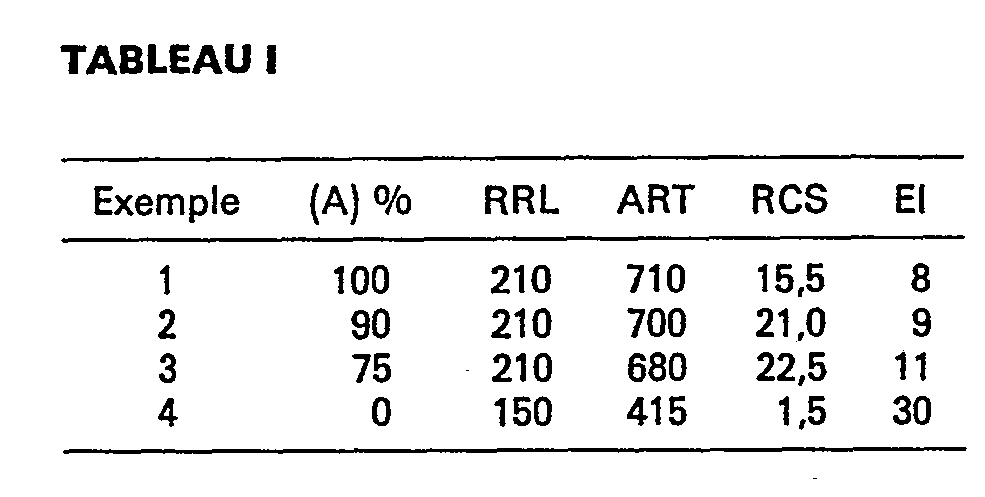
Comme on le comprend aisément, les exemples 1 et 4 sont comparatifs. On remarque notamment que les propriétés dynamométriques et la résistance à chaud des soudures des compositions selon l'invention sont, de façon inattendue, supérieures à la moyenne arithmétique des propriétés de chacun des polymères purs qu'elles comprennent. L'étirabilité industrielle des compositions selon l'invention est, de façon avantageuse et inattendue, inférieure à la moyenne arithmétique de l'étirabilité industrielle de chacun des polymères purs qu'elles comprennent.As is easily understood, Examples 1 and 4 are comparative. It should be noted in particular that the dynamometric properties and the heat resistance of the welds of the compositions according to the invention are, unexpectedly, greater than the arithmetic mean of the properties of each of the pure polymers which they comprise. The industrial stretchability of the compositions according to the invention is, advantageously and unexpectedly, less than the arithmetic average of the industrial stretchability of each of the pure polymers which they comprise.
On transforme en films, par extrusion- soufflage, des compositions comprenant:
- (A) le copolymère hétérogène utilisé dans les exemples précédents, et (B) un homopolymère de l'éthylène, obtenu en présence d'un initiateurde radicaux libres, de masse volumique 0,923 g/cm3 et d'indice de fluidité 0,3 dg/min.
- (A) the heterogeneous copolymer used in the previous examples, and (B) a homopolymer of ethylene, obtained in the presence of a free radical initiator, with a density 0.923 g / cm3 and a melt index 0.3 dg / min.
Les conditions de transformation sont les mêmes que précédemment, à l'exception de la température de la composition (205° C).The processing conditions are the same as above, with the exception of the temperature of the composition (205 ° C.).
Dans le tableau Il figurent, outre la proportion en poids du copolymère (A) dans la composition et l'étirabilité industrielle El, les résultats des mesures sur des films d'épaisseur 50 microns, des propriétés précédentes ainsi que du trouble optique T (exprimé en %) selon la norme ASTM D 1003) et de la brillance optique B (exprimée en %) selon la norme ASTM D 2457).

A titre de comparaison, il est précisé qu'un film de même épaisseur et obtenu dans les mêmes conditions à partir du copolymère (A) pur présente un trouble T de 10,5 % et une brillance B de 99 %.By way of comparison, it is specified that a film of the same thickness and obtained under the same conditions from the pure copolymer (A) has a haze T of 10.5% and a gloss B of 99%.
On transforme en films, par extrusion- soufflage, des compositions comprenant:
- (A) le copolymère hétérogène utilisé dans les exemples précédents, et (D) un homopolymère de l'éthylène, obtenu en présence d'un initiateur de radicaux libres, de masse volumique 0,924 g/cm3 et d'indice de fluidité 2 dg/min.
- (A) the heterogeneous copolymer used in the previous examples, and (D) a homopolymer of ethylene, obtained in the presence of a free radical initiator, with a density 0.924 g / cm3 and a melt index 2 dg / min.
Les températures de transformation sont les mêmes que précédemment, à l'exception de la température de la composition (170°C).The transformation temperatures are the same as above, with the exception of the temperature of the composition (170 ° C.).
Dans le tableau III figurent outre la proportion en poids du copolymère (A) dans la composition et l'étirabilité industrielle El, les résultats des mesures, sur des films d'épaisseur 50 microns, des propriétés précédentes ainsi que de la résistance à l'impact RI (exprimée en g/µ) déterminée selon la norme ASTM D 1709-67.

A titre de comparaison il est précisé que le copolymère (A) pur présente une résistance à l'impact égale à 3,0 g/ µ.By way of comparison, it is specified that the pure copolymer (A) has an impact resistance equal to 3.0 g / μ.
On transforme en films, par extrusion- soufflage, des compositions comprenant:
- (A) un copolymère éthylène/butène-1 similaire à celui utilisé dans les exemples précédents, à l'exception de son indice de fluidité (égal à 0,9 dg/min) et de sa masse volumique (égale à 0,930 g/cm3), et
- (E) un copolymère éthylène/acrylate de butyle, comprenant 17,5 % en poids d'acrylate, ayant un indice de fluidité de 1,7 dg/min et une masse volumique de 0,925 g/cm3.
- (A) an ethylene / butene-1 copolymer similar to that used in the previous examples, except for its melt index (equal to 0.9 dg / min) and its density (equal to 0.930 g / cm3 ), and
- (E) an ethylene / butyl acrylate copolymer, comprising 17.5% by weight of acrylate, having a melt index of 1.7 dg / min and a density of 0.925 g / cm3.
Les conditions de transfonmation sont les suivantes:
- - température de la composition: 250° C
- - vitesse de rotation de la vis d'extrusion: 60 tours/min.
- - taux de gonflage: 3,0.
- - temperature of the composition: 250 ° C.
- - rotation speed of the extrusion screw: 60 rpm.
- - inflation rate: 3.0.
Dans le tableau IV ci-après figurent, outre la proportion en poids du copolymère (A) dans la composition, la résistance à la rupture longitudinale RRL, l'allongement à la rupture transversal ART, ainsi que la résistance au déchirement longitudinal RDL et transversal RDT (exprimée en grammes) déterminée selon la norme ASTM D 1922-67.

Claims (12)
Priority Applications (1)
| Application Number | Priority Date | Filing Date | Title |
|---|---|---|---|
| AT83401034T ATE22458T1 (en) | 1982-06-03 | 1983-05-25 | COMPOSITION OF ETHYLENE/ALPHA-OLEFIN COPOLYMERS AND LOW DENSITY POLYAETHYLENE AND THEIR USE IN THE MANUFACTURE OF FILMS. |
Applications Claiming Priority (2)
| Application Number | Priority Date | Filing Date | Title |
|---|---|---|---|
| FR8209633 | 1982-06-03 | ||
| FR8209633A FR2528054B1 (en) | 1982-06-03 | 1982-06-03 | COMPOSITIONS OF ETHYLENE / A-OLEFIN COPOLYMERS AND RADICAL POLYETHYLENE AND THEIR APPLICATION TO THE MANUFACTURE OF FILMS |
Publications (2)
| Publication Number | Publication Date |
|---|---|
| EP0102854A1 EP0102854A1 (en) | 1984-03-14 |
| EP0102854B1 true EP0102854B1 (en) | 1986-09-24 |
Family
ID=9274581
Family Applications (1)
| Application Number | Title | Priority Date | Filing Date |
|---|---|---|---|
| EP83401034A Expired EP0102854B1 (en) | 1982-06-03 | 1983-05-25 | Compositions of ethylene/alpha-olefine copolymers and low density polyethylene, and their use in the manufacture of films |
Country Status (17)
| Country | Link |
|---|---|
| US (1) | US4623581A (en) |
| EP (1) | EP0102854B1 (en) |
| JP (1) | JPS591551A (en) |
| KR (1) | KR920001234B1 (en) |
| AT (1) | ATE22458T1 (en) |
| AU (1) | AU567097B2 (en) |
| BR (1) | BR8302913A (en) |
| CA (1) | CA1211593A (en) |
| CS (1) | CS239939B2 (en) |
| DE (1) | DE3366416D1 (en) |
| ES (1) | ES8504882A1 (en) |
| FI (1) | FI76823C (en) |
| FR (1) | FR2528054B1 (en) |
| HU (1) | HU196618B (en) |
| IN (1) | IN161028B (en) |
| NO (1) | NO161225C (en) |
| PT (1) | PT76798B (en) |
Families Citing this family (23)
| Publication number | Priority date | Publication date | Assignee | Title |
|---|---|---|---|---|
| US5256351A (en) * | 1985-06-17 | 1993-10-26 | Viskase Corporation | Process for making biaxially stretched, heat shrinkable VLDPE films |
| CA1340037C (en) * | 1985-06-17 | 1998-09-08 | Stanley Lustig | Puncture resistant, heat-shrinkable films containing very low density polyethylene copolymer |
| US5059481A (en) * | 1985-06-17 | 1991-10-22 | Viskase Corporation | Biaxially stretched, heat shrinkable VLDPE film |
| EP0246328B1 (en) * | 1985-11-07 | 1994-01-05 | Showa Denko Kabushiki Kaisha | Transparent high-density polyethylene film and process for its production |
| US4714741A (en) * | 1986-04-25 | 1987-12-22 | Owens-Illinois Plastic Products Inc. | Degradable polymer composition |
| US4709808A (en) * | 1986-04-25 | 1987-12-01 | Owens-Illinois Plastic Products Inc. | Degradable polymer composition and articles prepared from same |
| DE3851667T2 (en) * | 1987-07-13 | 1995-02-16 | Mitsubishi Chem Ind | Linear polyethylene film and process for its manufacture. |
| US5229458A (en) * | 1987-08-19 | 1993-07-20 | Ppg Industries, Inc. | Powder coating of particulate thermoset resin and olefin-maleic anhydride copolymer |
| US4882229A (en) * | 1988-04-29 | 1989-11-21 | Shell Oil Company | Blends of high molecular weight polybutylene with low density polyethylene |
| US5032463A (en) * | 1988-07-18 | 1991-07-16 | Viskase Corporation | Very low density polyethylene film from blends |
| EP0377121A3 (en) * | 1988-12-03 | 1992-03-25 | Showa Denko Kabushiki Kaisha | Medical bag |
| CA2003882C (en) * | 1988-12-19 | 1997-01-07 | Edwin Rogers Smith | Heat shrinkable very low density polyethylene terpolymer film |
| US5112696A (en) * | 1989-07-20 | 1992-05-12 | E. I. Du Pont De Nemours And Company | Tough monolayer shrink film for products containing moisture |
| CA2020649C (en) * | 1989-07-20 | 2002-06-25 | Richard Kenneth Roberts | Tough monolayer shrink film for products containing moisture |
| CA2032272C (en) * | 1989-12-18 | 2000-08-29 | John Douglas Snyder | Improved heat shrinkable polyolefin film |
| US5582923A (en) * | 1991-10-15 | 1996-12-10 | The Dow Chemical Company | Extrusion compositions having high drawdown and substantially reduced neck-in |
| US5378764A (en) * | 1992-10-08 | 1995-01-03 | Phillips Petroleum Company | Polyethylene blends |
| US6534173B1 (en) | 1997-08-01 | 2003-03-18 | Elf Atochem S.A. | Films comprising metallocene catalyzed plastomer and ethylene/alkyl (meth)acrylate copolymer |
| US6827807B2 (en) * | 2002-04-09 | 2004-12-07 | Eastman Chemical Company | Process for producing multilayer structures having a layer formed from a blend of an ethylene-alpha-olefin interpolymer and an ethylene-alkyl acrylate interpolymer |
| US7147930B2 (en) | 2003-12-16 | 2006-12-12 | Curwood, Inc. | Heat-shrinkable packaging films with improved sealing properties and articles made thereof |
| US20150122331A1 (en) * | 2012-02-15 | 2015-05-07 | Mitsui Chemicals Tohcello, Inc. | Encapsulating sheet for solar cell, solar cell, and method for manufacturing solar cell |
| CA2837591A1 (en) | 2013-12-19 | 2015-06-19 | Nova Chemicals Corporation | Polyethylene composition for extrusion coating |
| JP2019094509A (en) * | 2019-03-15 | 2019-06-20 | 大日本印刷株式会社 | Polyolefin resin film |
Family Cites Families (15)
| Publication number | Priority date | Publication date | Assignee | Title |
|---|---|---|---|---|
| US3176052A (en) * | 1960-08-08 | 1965-03-30 | Du Pont | Blends of polyethylene and ethylene copolymers |
| CA849081A (en) | 1967-03-02 | 1970-08-11 | Du Pont Of Canada Limited | PRODUCTION OF ETHYLENE/.alpha.-OLEFIN COPOLYMERS OF IMPROVED PHYSICAL PROPERTIES |
| US3682767A (en) * | 1970-10-02 | 1972-08-08 | Du Pont | Ethylene copolymer blend for liquid packaging film |
| DE2254440B2 (en) * | 1972-11-07 | 1975-10-09 | Basf Ag, 6700 Ludwigshafen | Manufacture of shrink films |
| JPS5286440A (en) * | 1976-01-12 | 1977-07-18 | Mitsui Toatsu Chem Inc | Self-adhesive film for packaging |
| JPS5331751A (en) * | 1976-09-03 | 1978-03-25 | Jujo Paper Co Ltd | Packaging film |
| JPS53125452A (en) * | 1977-04-09 | 1978-11-01 | Mitsui Petrochem Ind Ltd | Polyolefin composition |
| US4243619A (en) * | 1978-03-31 | 1981-01-06 | Union Carbide Corporation | Process for making film from low density ethylene hydrocarbon copolymer |
| US4425268A (en) * | 1980-02-02 | 1984-01-10 | Bemis Company, Inc. | Polymer blend composition for stretch wrap film |
| JPS56152853A (en) * | 1980-04-30 | 1981-11-26 | Nippon Oil Co Ltd | Polyethylene resin composition |
| FR2488268B1 (en) * | 1980-06-25 | 1985-12-06 | Charbonnages Ste Chimique | COMPOSITIONS OF RADICAL POLYETHYLENE AND ETHYLENE-PROPYLENE COPOLYMERS AND FILMS OBTAINED FROM SAID COMPOSITIONS |
| JPS5734145A (en) * | 1980-08-07 | 1982-02-24 | Mitsui Petrochem Ind Ltd | Ethylene-alpha-olefin copolymer composition |
| US4339507A (en) * | 1980-11-26 | 1982-07-13 | Union Carbide Corporation | Linear low density ethylene hydrocarbon copolymer containing composition for extrusion coating |
| FR2509315A1 (en) | 1981-07-10 | 1983-01-14 | Charbonnages Ste Chimique | HETEROGENEOUS COPOLYMERS OF ETHYLENE FOR THE MANUFACTURE OF FILMS |
| FR2528055B1 (en) * | 1982-06-03 | 1986-01-24 | Charbonnages Ste Chimique | COMPOSITIONS OF RADICAL POLYETHYLENE AND ETHYLENE / A-OLEFIN COPOLYMERS AND THEIR APPLICATION TO THE MANUFACTURE OF FILMS |
-
1982
- 1982-06-03 FR FR8209633A patent/FR2528054B1/en not_active Expired
-
1983
- 1983-05-16 CA CA000428190A patent/CA1211593A/en not_active Expired
- 1983-05-25 IN IN655/CAL/83A patent/IN161028B/en unknown
- 1983-05-25 AT AT83401034T patent/ATE22458T1/en not_active IP Right Cessation
- 1983-05-25 EP EP83401034A patent/EP0102854B1/en not_active Expired
- 1983-05-25 DE DE8383401034T patent/DE3366416D1/en not_active Expired
- 1983-05-28 KR KR1019830002364A patent/KR920001234B1/en not_active Expired
- 1983-06-01 NO NO831972A patent/NO161225C/en not_active IP Right Cessation
- 1983-06-01 ES ES522881A patent/ES8504882A1/en not_active Expired
- 1983-06-01 PT PT76798A patent/PT76798B/en unknown
- 1983-06-01 BR BR8302913A patent/BR8302913A/en not_active IP Right Cessation
- 1983-06-02 JP JP58099258A patent/JPS591551A/en active Granted
- 1983-06-02 AU AU15344/83A patent/AU567097B2/en not_active Ceased
- 1983-06-03 CS CS864037A patent/CS239939B2/en unknown
- 1983-06-03 FI FI832012A patent/FI76823C/en not_active IP Right Cessation
- 1983-06-03 HU HU832005A patent/HU196618B/en not_active IP Right Cessation
- 1983-06-03 US US06/500,956 patent/US4623581A/en not_active Expired - Lifetime
Also Published As
| Publication number | Publication date |
|---|---|
| ES522881A0 (en) | 1985-05-01 |
| AU567097B2 (en) | 1987-11-12 |
| JPH0136496B2 (en) | 1989-08-01 |
| KR840004921A (en) | 1984-10-31 |
| FI832012A0 (en) | 1983-06-03 |
| IN161028B (en) | 1987-09-19 |
| NO831972L (en) | 1983-12-05 |
| CS239939B2 (en) | 1986-01-16 |
| ES8504882A1 (en) | 1985-05-01 |
| FI832012L (en) | 1983-12-04 |
| HU196618B (en) | 1988-12-28 |
| KR920001234B1 (en) | 1992-02-08 |
| NO161225C (en) | 1989-07-26 |
| AU1534483A (en) | 1983-12-08 |
| DE3366416D1 (en) | 1986-10-30 |
| FR2528054A1 (en) | 1983-12-09 |
| EP0102854A1 (en) | 1984-03-14 |
| FI76823C (en) | 1988-12-12 |
| ATE22458T1 (en) | 1986-10-15 |
| BR8302913A (en) | 1984-02-07 |
| US4623581A (en) | 1986-11-18 |
| CA1211593A (en) | 1986-09-16 |
| PT76798A (en) | 1983-07-01 |
| NO161225B (en) | 1989-04-10 |
| JPS591551A (en) | 1984-01-06 |
| PT76798B (en) | 1985-12-16 |
| FI76823B (en) | 1988-08-31 |
| FR2528054B1 (en) | 1986-05-16 |
Similar Documents
| Publication | Publication Date | Title |
|---|---|---|
| EP0102854B1 (en) | Compositions of ethylene/alpha-olefine copolymers and low density polyethylene, and their use in the manufacture of films | |
| EP0104097B1 (en) | Composition of low-density polyethylene/alpha-olefin copolymers and their application to the manufacture of films | |
| EP0102857B1 (en) | Compositions of polypropylene and ethylene/alpha-olefin copolymers and their use in the manufacture of stretched filaments | |
| EP0052555B1 (en) | Polyethylene compositions for extrusion in particular for blow moulding | |
| EP0095253B1 (en) | Polyethylene blend and film | |
| US5102955A (en) | Broad distribution, high molecular weight low density polyethylene and method of making thereof | |
| JP3296820B2 (en) | Improved processing of polyolefin compounds | |
| JP4223286B2 (en) | Polar ethylene-based polymer, cycloolefin polymer blend | |
| EP0418129B1 (en) | Ethylene vinyl alcohol copolymer based blends with gas barrier properties, thermoformability and/or resistance to repeated bending | |
| CN1685006A (en) | Polymer compositions for extrusion coating | |
| FR2526803A1 (en) | ETHYLENE POLYMER COMPOSITIONS AND APPLICATION TO THE MANUFACTURE OF FILMS | |
| JPH0376325B2 (en) | ||
| CA1178393A (en) | Radical polyethylene and ethylene/propylene copolymers compositions used for manufacturing films | |
| JPS58194935A (en) | Extrusion-laminating composition | |
| EP0998527B1 (en) | Composition comprising metallocene plastomer and ethylene/alkyl (meth)acrylate polymer with their secant moduli ratio greater than 1 | |
| JPH0543503B2 (en) |
Legal Events
| Date | Code | Title | Description |
|---|---|---|---|
| PUAI | Public reference made under article 153(3) epc to a published international application that has entered the european phase |
Free format text: ORIGINAL CODE: 0009012 |
|
| 17P | Request for examination filed |
Effective date: 19831216 |
|
| AK | Designated contracting states |
Designated state(s): AT BE CH DE FR GB IT LI LU NL SE |
|
| ITF | It: translation for a ep patent filed | ||
| GRAA | (expected) grant |
Free format text: ORIGINAL CODE: 0009210 |
|
| AK | Designated contracting states |
Kind code of ref document: B1 Designated state(s): AT BE CH DE FR GB IT LI LU NL SE |
|
| REF | Corresponds to: |
Ref document number: 22458 Country of ref document: AT Date of ref document: 19861015 Kind code of ref document: T |
|
| REF | Corresponds to: |
Ref document number: 3366416 Country of ref document: DE Date of ref document: 19861030 |
|
| PLBI | Opposition filed |
Free format text: ORIGINAL CODE: 0009260 |
|
| 26 | Opposition filed |
Opponent name: BASF AKTIENGESELLSCHAFT, LUDWIGSHAFEN Effective date: 19870228 |
|
| NLR1 | Nl: opposition has been filed with the epo |
Opponent name: BASF AKTIENGESELLSCHAFT |
|
| PLBI | Opposition filed |
Free format text: ORIGINAL CODE: 0009260 |
|
| 26 | Opposition filed |
Opponent name: DSM RESEARCH B.V. Effective date: 19870623 |
|
| NLR1 | Nl: opposition has been filed with the epo |
Opponent name: DSM RESEARCH B.V. |
|
| RAP2 | Party data changed (patent owner data changed or rights of a patent transferred) |
Owner name: NORSOLOR S.A. |
|
| NLT2 | Nl: modifications (of names), taken from the european patent patent bulletin |
Owner name: NORSOLOR S.A. TE PARIJS, FRANKRIJK. |
|
| REG | Reference to a national code |
Ref country code: FR Ref legal event code: TP Ref country code: FR Ref legal event code: CD |
|
| PGFP | Annual fee paid to national office [announced via postgrant information from national office to epo] |
Ref country code: AT Payment date: 19910510 Year of fee payment: 9 |
|
| RAP2 | Party data changed (patent owner data changed or rights of a patent transferred) |
Owner name: SOFRAPO-COMMERCIALE |
|
| ITTA | It: last paid annual fee | ||
| PGFP | Annual fee paid to national office [announced via postgrant information from national office to epo] |
Ref country code: CH Payment date: 19910606 Year of fee payment: 9 |
|
| PGFP | Annual fee paid to national office [announced via postgrant information from national office to epo] |
Ref country code: DE Payment date: 19910628 Year of fee payment: 9 |
|
| NLT2 | Nl: modifications (of names), taken from the european patent patent bulletin |
Owner name: SOFRAPO-COMMERCIALE TE COURBEVOIE, FRANKRIJK. |
|
| PGFP | Annual fee paid to national office [announced via postgrant information from national office to epo] |
Ref country code: FR Payment date: 19920416 Year of fee payment: 10 |
|
| RAP2 | Party data changed (patent owner data changed or rights of a patent transferred) |
Owner name: ECP-ENICHEM POLYMERES FRANCE S.A. |
|
| PGFP | Annual fee paid to national office [announced via postgrant information from national office to epo] |
Ref country code: GB Payment date: 19920429 Year of fee payment: 10 |
|
| RDAG | Patent revoked |
Free format text: ORIGINAL CODE: 0009271 |
|
| STAA | Information on the status of an ep patent application or granted ep patent |
Free format text: STATUS: PATENT REVOKED |
|
| PGFP | Annual fee paid to national office [announced via postgrant information from national office to epo] |
Ref country code: SE Payment date: 19920521 Year of fee payment: 10 |
|
| PGFP | Annual fee paid to national office [announced via postgrant information from national office to epo] |
Ref country code: NL Payment date: 19920531 Year of fee payment: 10 |
|
| NLT2 | Nl: modifications (of names), taken from the european patent patent bulletin |
Owner name: ECP-ENICHEM POLYMERES FRANCE S.A. TE COURBEVOIE, F |
|
| PGFP | Annual fee paid to national office [announced via postgrant information from national office to epo] |
Ref country code: BE Payment date: 19920616 Year of fee payment: 10 |
|
| REG | Reference to a national code |
Ref country code: CH Ref legal event code: PL |
|
| 27W | Patent revoked |
Effective date: 19920215 |
|
| GBPR | Gb: patent revoked under art. 102 of the ep convention designating the uk as contracting state | ||
| PGFP | Annual fee paid to national office [announced via postgrant information from national office to epo] |
Ref country code: LU Payment date: 19920811 Year of fee payment: 10 |
|
| NLR2 | Nl: decision of opposition | ||
| EPTA | Lu: last paid annual fee | ||
| EUG | Se: european patent has lapsed |
Ref document number: 83401034.0 Effective date: 19920701 |