DE69925053T2 - Positive-working photosensitive composition, photosensitive printing plate and method for producing a positive image - Google Patents
Positive-working photosensitive composition, photosensitive printing plate and method for producing a positive image Download PDFInfo
- Publication number
- DE69925053T2 DE69925053T2 DE69925053T DE69925053T DE69925053T2 DE 69925053 T2 DE69925053 T2 DE 69925053T2 DE 69925053 T DE69925053 T DE 69925053T DE 69925053 T DE69925053 T DE 69925053T DE 69925053 T2 DE69925053 T2 DE 69925053T2
- Authority
- DE
- Germany
- Prior art keywords
- group
- alkali
- photosensitive composition
- positive photosensitive
- soluble resin
- Prior art date
- Legal status (The legal status is an assumption and is not a legal conclusion. Google has not performed a legal analysis and makes no representation as to the accuracy of the status listed.)
- Expired - Lifetime
Links
- 239000000203 mixture Substances 0.000 title claims description 83
- 238000007639 printing Methods 0.000 title claims description 72
- 238000004519 manufacturing process Methods 0.000 title description 7
- 229920005989 resin Polymers 0.000 claims description 163
- 239000011347 resin Substances 0.000 claims description 163
- ISWSIDIOOBJBQZ-UHFFFAOYSA-N phenol group Chemical group C1(=CC=CC=C1)O ISWSIDIOOBJBQZ-UHFFFAOYSA-N 0.000 claims description 79
- 125000002887 hydroxy group Chemical group [H]O* 0.000 claims description 66
- 125000001424 substituent group Chemical group 0.000 claims description 62
- 238000006243 chemical reaction Methods 0.000 claims description 33
- 239000000463 material Substances 0.000 claims description 32
- 229920003986 novolac Polymers 0.000 claims description 32
- 150000001875 compounds Chemical class 0.000 claims description 30
- 125000003118 aryl group Chemical group 0.000 claims description 28
- 125000000217 alkyl group Chemical group 0.000 claims description 27
- -1 quinone diazide compound Chemical class 0.000 claims description 25
- 239000003513 alkali Substances 0.000 claims description 19
- WOAHJDHKFWSLKE-UHFFFAOYSA-N 1,2-benzoquinone Chemical compound O=C1C=CC=CC1=O WOAHJDHKFWSLKE-UHFFFAOYSA-N 0.000 claims description 18
- 150000002148 esters Chemical class 0.000 claims description 17
- 125000002252 acyl group Chemical group 0.000 claims description 15
- 125000002843 carboxylic acid group Chemical group 0.000 claims description 15
- 230000008859 change Effects 0.000 claims description 15
- 238000000034 method Methods 0.000 claims description 15
- 239000002253 acid Substances 0.000 claims description 14
- 125000004453 alkoxycarbonyl group Chemical group 0.000 claims description 14
- 239000000758 substrate Substances 0.000 claims description 14
- 125000004435 hydrogen atom Chemical group [H]* 0.000 claims description 13
- 125000003545 alkoxy group Chemical group 0.000 claims description 12
- 125000003277 amino group Chemical group 0.000 claims description 12
- 125000004093 cyano group Chemical group *C#N 0.000 claims description 12
- LSNNMFCWUKXFEE-UHFFFAOYSA-M Bisulfite Chemical compound OS([O-])=O LSNNMFCWUKXFEE-UHFFFAOYSA-M 0.000 claims description 11
- 125000005161 aryl oxy carbonyl group Chemical group 0.000 claims description 11
- ZCYVEMRRCGMTRW-UHFFFAOYSA-N 7553-56-2 Chemical group [I] ZCYVEMRRCGMTRW-UHFFFAOYSA-N 0.000 claims description 9
- 229910052731 fluorine Inorganic materials 0.000 claims description 9
- IJGRMHOSHXDMSA-UHFFFAOYSA-N Atomic nitrogen Chemical compound N#N IJGRMHOSHXDMSA-UHFFFAOYSA-N 0.000 claims description 8
- WKBOTKDWSSQWDR-UHFFFAOYSA-N Bromine atom Chemical group [Br] WKBOTKDWSSQWDR-UHFFFAOYSA-N 0.000 claims description 8
- 229910052801 chlorine Inorganic materials 0.000 claims description 8
- 239000001257 hydrogen Substances 0.000 claims description 8
- 229910052739 hydrogen Inorganic materials 0.000 claims description 8
- 229910052740 iodine Inorganic materials 0.000 claims description 8
- 125000001309 chloro group Chemical group Cl* 0.000 claims description 6
- 125000001153 fluoro group Chemical group F* 0.000 claims description 6
- 206010034972 Photosensitivity reaction Diseases 0.000 claims description 5
- 125000003342 alkenyl group Chemical group 0.000 claims description 5
- 125000004104 aryloxy group Chemical group 0.000 claims description 5
- 238000005859 coupling reaction Methods 0.000 claims description 5
- 125000000623 heterocyclic group Chemical group 0.000 claims description 5
- 229910052757 nitrogen Inorganic materials 0.000 claims description 5
- UFHFLCQGNIYNRP-UHFFFAOYSA-N Hydrogen Chemical compound [H][H] UFHFLCQGNIYNRP-UHFFFAOYSA-N 0.000 claims description 4
- 230000036211 photosensitivity Effects 0.000 claims description 3
- 125000002130 sulfonic acid ester group Chemical group 0.000 claims description 3
- 125000001302 tertiary amino group Chemical group 0.000 claims description 2
- ANRHNWWPFJCPAZ-UHFFFAOYSA-M thionine Chemical compound [Cl-].C1=CC(N)=CC2=[S+]C3=CC(N)=CC=C3N=C21 ANRHNWWPFJCPAZ-UHFFFAOYSA-M 0.000 claims 1
- WSFSSNUMVMOOMR-UHFFFAOYSA-N Formaldehyde Chemical compound O=C WSFSSNUMVMOOMR-UHFFFAOYSA-N 0.000 description 42
- 239000000975 dye Substances 0.000 description 34
- RLSSMJSEOOYNOY-UHFFFAOYSA-N m-cresol Chemical compound CC1=CC=CC(O)=C1 RLSSMJSEOOYNOY-UHFFFAOYSA-N 0.000 description 26
- 239000000126 substance Substances 0.000 description 24
- IWDCLRJOBJJRNH-UHFFFAOYSA-N p-cresol Chemical compound CC1=CC=C(O)C=C1 IWDCLRJOBJJRNH-UHFFFAOYSA-N 0.000 description 20
- CSCPPACGZOOCGX-UHFFFAOYSA-N Acetone Chemical compound CC(C)=O CSCPPACGZOOCGX-UHFFFAOYSA-N 0.000 description 18
- 230000035945 sensitivity Effects 0.000 description 16
- 239000002904 solvent Substances 0.000 description 16
- 229920001665 Poly-4-vinylphenol Polymers 0.000 description 12
- 238000000576 coating method Methods 0.000 description 12
- 238000006068 polycondensation reaction Methods 0.000 description 12
- WQGWDDDVZFFDIG-UHFFFAOYSA-N pyrogallol Chemical compound OC1=CC=CC(O)=C1O WQGWDDDVZFFDIG-UHFFFAOYSA-N 0.000 description 12
- GHMLBKRAJCXXBS-UHFFFAOYSA-N resorcinol Chemical compound OC1=CC=CC(O)=C1 GHMLBKRAJCXXBS-UHFFFAOYSA-N 0.000 description 12
- 239000011248 coating agent Substances 0.000 description 11
- 125000001997 phenyl group Chemical group [H]C1=C([H])C([H])=C(*)C([H])=C1[H] 0.000 description 11
- TUAMRELNJMMDMT-UHFFFAOYSA-N 3,5-xylenol Chemical compound CC1=CC(C)=CC(O)=C1 TUAMRELNJMMDMT-UHFFFAOYSA-N 0.000 description 10
- AZQWKYJCGOJGHM-UHFFFAOYSA-N 1,4-benzoquinone Chemical compound O=C1C=CC(=O)C=C1 AZQWKYJCGOJGHM-UHFFFAOYSA-N 0.000 description 9
- OKTJSMMVPCPJKN-UHFFFAOYSA-N Carbon Chemical compound [C] OKTJSMMVPCPJKN-UHFFFAOYSA-N 0.000 description 9
- 150000001299 aldehydes Chemical class 0.000 description 9
- 229910052782 aluminium Inorganic materials 0.000 description 9
- XAGFODPZIPBFFR-UHFFFAOYSA-N aluminium Chemical compound [Al] XAGFODPZIPBFFR-UHFFFAOYSA-N 0.000 description 9
- 238000011161 development Methods 0.000 description 9
- NKTOLZVEWDHZMU-UHFFFAOYSA-N 2,5-xylenol Chemical compound CC1=CC=C(C)C(O)=C1 NKTOLZVEWDHZMU-UHFFFAOYSA-N 0.000 description 8
- SIKJAQJRHWYJAI-UHFFFAOYSA-N Indole Chemical compound C1=CC=C2NC=CC2=C1 SIKJAQJRHWYJAI-UHFFFAOYSA-N 0.000 description 8
- HUMNYLRZRPPJDN-UHFFFAOYSA-N benzaldehyde Chemical compound O=CC1=CC=CC=C1 HUMNYLRZRPPJDN-UHFFFAOYSA-N 0.000 description 8
- 230000032050 esterification Effects 0.000 description 8
- 238000005886 esterification reaction Methods 0.000 description 8
- 125000005843 halogen group Chemical group 0.000 description 8
- 229910052751 metal Inorganic materials 0.000 description 8
- 239000002184 metal Substances 0.000 description 8
- 239000003795 chemical substances by application Substances 0.000 description 7
- 230000000052 comparative effect Effects 0.000 description 7
- 230000000694 effects Effects 0.000 description 7
- 238000010438 heat treatment Methods 0.000 description 7
- 239000000047 product Substances 0.000 description 7
- 239000004065 semiconductor Substances 0.000 description 7
- QGKMIGUHVLGJBR-UHFFFAOYSA-M (4z)-1-(3-methylbutyl)-4-[[1-(3-methylbutyl)quinolin-1-ium-4-yl]methylidene]quinoline;iodide Chemical compound [I-].C12=CC=CC=C2N(CCC(C)C)C=CC1=CC1=CC=[N+](CCC(C)C)C2=CC=CC=C12 QGKMIGUHVLGJBR-UHFFFAOYSA-M 0.000 description 6
- ZWEHNKRNPOVVGH-UHFFFAOYSA-N 2-Butanone Chemical compound CCC(C)=O ZWEHNKRNPOVVGH-UHFFFAOYSA-N 0.000 description 6
- SMWDFEZZVXVKRB-UHFFFAOYSA-N Quinoline Chemical compound N1=CC=CC2=CC=CC=C21 SMWDFEZZVXVKRB-UHFFFAOYSA-N 0.000 description 6
- IOJUPLGTWVMSFF-UHFFFAOYSA-N benzothiazole Chemical compound C1=CC=C2SC=NC2=C1 IOJUPLGTWVMSFF-UHFFFAOYSA-N 0.000 description 6
- 229910052799 carbon Inorganic materials 0.000 description 6
- JHIVVAPYMSGYDF-UHFFFAOYSA-N cyclohexanone Chemical compound O=C1CCCCC1 JHIVVAPYMSGYDF-UHFFFAOYSA-N 0.000 description 6
- 230000014759 maintenance of location Effects 0.000 description 6
- 238000002156 mixing Methods 0.000 description 6
- QWVGKYWNOKOFNN-UHFFFAOYSA-N o-cresol Chemical compound CC1=CC=CC=C1O QWVGKYWNOKOFNN-UHFFFAOYSA-N 0.000 description 6
- 229940079877 pyrogallol Drugs 0.000 description 6
- 229920003987 resole Polymers 0.000 description 6
- 239000007787 solid Substances 0.000 description 6
- RTAQQCXQSZGOHL-UHFFFAOYSA-N Titanium Chemical compound [Ti] RTAQQCXQSZGOHL-UHFFFAOYSA-N 0.000 description 5
- 239000000654 additive Substances 0.000 description 5
- 150000001450 anions Chemical class 0.000 description 5
- 230000015572 biosynthetic process Effects 0.000 description 5
- 150000002576 ketones Chemical class 0.000 description 5
- WVIICGIFSIBFOG-UHFFFAOYSA-N pyrylium Chemical compound C1=CC=[O+]C=C1 WVIICGIFSIBFOG-UHFFFAOYSA-N 0.000 description 5
- 239000010936 titanium Substances 0.000 description 5
- 229910052719 titanium Inorganic materials 0.000 description 5
- LFQSCWFLJHTTHZ-UHFFFAOYSA-N Ethanol Chemical compound CCO LFQSCWFLJHTTHZ-UHFFFAOYSA-N 0.000 description 4
- YCKRFDGAMUMZLT-UHFFFAOYSA-N Fluorine atom Chemical compound [F] YCKRFDGAMUMZLT-UHFFFAOYSA-N 0.000 description 4
- XEEYBQQBJWHFJM-UHFFFAOYSA-N Iron Chemical compound [Fe] XEEYBQQBJWHFJM-UHFFFAOYSA-N 0.000 description 4
- NBBJYMSMWIIQGU-UHFFFAOYSA-N Propionic aldehyde Chemical compound CCC=O NBBJYMSMWIIQGU-UHFFFAOYSA-N 0.000 description 4
- 239000003086 colorant Substances 0.000 description 4
- MPSZITJFIKCNBV-UHFFFAOYSA-N cyclohexa-2,4-dien-1-imine Chemical compound N=C1CC=CC=C1 MPSZITJFIKCNBV-UHFFFAOYSA-N 0.000 description 4
- LZCLXQDLBQLTDK-UHFFFAOYSA-N ethyl 2-hydroxypropanoate Chemical compound CCOC(=O)C(C)O LZCLXQDLBQLTDK-UHFFFAOYSA-N 0.000 description 4
- HYBBIBNJHNGZAN-UHFFFAOYSA-N furfural Chemical compound O=CC1=CC=CO1 HYBBIBNJHNGZAN-UHFFFAOYSA-N 0.000 description 4
- 230000006872 improvement Effects 0.000 description 4
- PZOUSPYUWWUPPK-UHFFFAOYSA-N indole Natural products CC1=CC=CC2=C1C=CN2 PZOUSPYUWWUPPK-UHFFFAOYSA-N 0.000 description 4
- RKJUIXBNRJVNHR-UHFFFAOYSA-N indolenine Natural products C1=CC=C2CC=NC2=C1 RKJUIXBNRJVNHR-UHFFFAOYSA-N 0.000 description 4
- 239000007788 liquid Substances 0.000 description 4
- 239000011159 matrix material Substances 0.000 description 4
- QNGNSVIICDLXHT-UHFFFAOYSA-N para-ethylbenzaldehyde Natural products CCC1=CC=C(C=O)C=C1 QNGNSVIICDLXHT-UHFFFAOYSA-N 0.000 description 4
- 230000036961 partial effect Effects 0.000 description 4
- XLLXMBCBJGATSP-UHFFFAOYSA-N 2-phenylethenol Chemical class OC=CC1=CC=CC=C1 XLLXMBCBJGATSP-UHFFFAOYSA-N 0.000 description 3
- QTBSBXVTEAMEQO-UHFFFAOYSA-N Acetic acid Chemical compound CC(O)=O QTBSBXVTEAMEQO-UHFFFAOYSA-N 0.000 description 3
- RYGMFSIKBFXOCR-UHFFFAOYSA-N Copper Chemical compound [Cu] RYGMFSIKBFXOCR-UHFFFAOYSA-N 0.000 description 3
- ZMXDDKWLCZADIW-UHFFFAOYSA-N N,N-Dimethylformamide Chemical compound CN(C)C=O ZMXDDKWLCZADIW-UHFFFAOYSA-N 0.000 description 3
- DNIAPMSPPWPWGF-UHFFFAOYSA-N Propylene glycol Chemical compound CC(O)CO DNIAPMSPPWPWGF-UHFFFAOYSA-N 0.000 description 3
- 206010070834 Sensitisation Diseases 0.000 description 3
- MPGOFFXRGUQRMW-UHFFFAOYSA-N [N-]=[N+]=[N-].[N-]=[N+]=[N-].O=C1C=CC=CC1=O Chemical compound [N-]=[N+]=[N-].[N-]=[N+]=[N-].O=C1C=CC=CC1=O MPGOFFXRGUQRMW-UHFFFAOYSA-N 0.000 description 3
- 238000010521 absorption reaction Methods 0.000 description 3
- IKHGUXGNUITLKF-XPULMUKRSA-N acetaldehyde Chemical compound [14CH]([14CH3])=O IKHGUXGNUITLKF-XPULMUKRSA-N 0.000 description 3
- 230000000996 additive effect Effects 0.000 description 3
- 150000004945 aromatic hydrocarbons Chemical class 0.000 description 3
- 239000011230 binding agent Substances 0.000 description 3
- IISBACLAFKSPIT-UHFFFAOYSA-N bisphenol A Chemical compound C=1C=C(O)C=CC=1C(C)(C)C1=CC=C(O)C=C1 IISBACLAFKSPIT-UHFFFAOYSA-N 0.000 description 3
- KGBXLFKZBHKPEV-UHFFFAOYSA-N boric acid Chemical compound OB(O)O KGBXLFKZBHKPEV-UHFFFAOYSA-N 0.000 description 3
- 239000007795 chemical reaction product Substances 0.000 description 3
- 239000000460 chlorine Substances 0.000 description 3
- 229910052802 copper Inorganic materials 0.000 description 3
- 239000010949 copper Substances 0.000 description 3
- 125000000392 cycloalkenyl group Chemical group 0.000 description 3
- 125000000664 diazo group Chemical group [N-]=[N+]=[*] 0.000 description 3
- 239000012954 diazonium Substances 0.000 description 3
- 239000011737 fluorine Substances 0.000 description 3
- 238000005227 gel permeation chromatography Methods 0.000 description 3
- 230000001965 increasing effect Effects 0.000 description 3
- 230000031700 light absorption Effects 0.000 description 3
- WSFSSNUMVMOOMR-NJFSPNSNSA-N methanone Chemical compound O=[14CH2] WSFSSNUMVMOOMR-NJFSPNSNSA-N 0.000 description 3
- 125000000449 nitro group Chemical group [O-][N+](*)=O 0.000 description 3
- 239000000049 pigment Substances 0.000 description 3
- 230000008569 process Effects 0.000 description 3
- 230000009467 reduction Effects 0.000 description 3
- 230000002441 reversible effect Effects 0.000 description 3
- 230000008313 sensitization Effects 0.000 description 3
- 238000010186 staining Methods 0.000 description 3
- 150000003459 sulfonic acid esters Chemical class 0.000 description 3
- 229910052717 sulfur Inorganic materials 0.000 description 3
- 125000004434 sulfur atom Chemical group 0.000 description 3
- QAOWNCQODCNURD-UHFFFAOYSA-N sulfuric acid Substances OS(O)(=O)=O QAOWNCQODCNURD-UHFFFAOYSA-N 0.000 description 3
- 230000003746 surface roughness Effects 0.000 description 3
- JOXIMZWYDAKGHI-UHFFFAOYSA-N toluene-4-sulfonic acid Chemical class CC1=CC=C(S(O)(=O)=O)C=C1 JOXIMZWYDAKGHI-UHFFFAOYSA-N 0.000 description 3
- LIZLYZVAYZQVPG-UHFFFAOYSA-N (3-bromo-2-fluorophenyl)methanol Chemical compound OCC1=CC=CC(Br)=C1F LIZLYZVAYZQVPG-UHFFFAOYSA-N 0.000 description 2
- BBMCTIGTTCKYKF-UHFFFAOYSA-N 1-heptanol Chemical compound CCCCCCCO BBMCTIGTTCKYKF-UHFFFAOYSA-N 0.000 description 2
- KJCVRFUGPWSIIH-UHFFFAOYSA-N 1-naphthol Chemical compound C1=CC=C2C(O)=CC=CC2=C1 KJCVRFUGPWSIIH-UHFFFAOYSA-N 0.000 description 2
- JESXATFQYMPTNL-UHFFFAOYSA-N 2-ethenylphenol Chemical compound OC1=CC=CC=C1C=C JESXATFQYMPTNL-UHFFFAOYSA-N 0.000 description 2
- ZNQVEEAIQZEUHB-UHFFFAOYSA-N 2-ethoxyethanol Chemical compound CCOCCO ZNQVEEAIQZEUHB-UHFFFAOYSA-N 0.000 description 2
- XLLIQLLCWZCATF-UHFFFAOYSA-N 2-methoxyethyl acetate Chemical compound COCCOC(C)=O XLLIQLLCWZCATF-UHFFFAOYSA-N 0.000 description 2
- JWAZRIHNYRIHIV-UHFFFAOYSA-N 2-naphthol Chemical compound C1=CC=CC2=CC(O)=CC=C21 JWAZRIHNYRIHIV-UHFFFAOYSA-N 0.000 description 2
- HMNKTRSOROOSPP-UHFFFAOYSA-N 3-Ethylphenol Chemical compound CCC1=CC=CC(O)=C1 HMNKTRSOROOSPP-UHFFFAOYSA-N 0.000 description 2
- WTQZSMDDRMKJRI-UHFFFAOYSA-N 4-diazoniophenolate Chemical compound [O-]C1=CC=C([N+]#N)C=C1 WTQZSMDDRMKJRI-UHFFFAOYSA-N 0.000 description 2
- HXDOZKJGKXYMEW-UHFFFAOYSA-N 4-ethylphenol Chemical compound CCC1=CC=C(O)C=C1 HXDOZKJGKXYMEW-UHFFFAOYSA-N 0.000 description 2
- IKHGUXGNUITLKF-UHFFFAOYSA-N Acetaldehyde Chemical compound CC=O IKHGUXGNUITLKF-UHFFFAOYSA-N 0.000 description 2
- 239000007848 Bronsted acid Substances 0.000 description 2
- ZAMOUSCENKQFHK-UHFFFAOYSA-N Chlorine atom Chemical compound [Cl] ZAMOUSCENKQFHK-UHFFFAOYSA-N 0.000 description 2
- VYZAMTAEIAYCRO-UHFFFAOYSA-N Chromium Chemical compound [Cr] VYZAMTAEIAYCRO-UHFFFAOYSA-N 0.000 description 2
- VEXZGXHMUGYJMC-UHFFFAOYSA-N Hydrochloric acid Chemical compound Cl VEXZGXHMUGYJMC-UHFFFAOYSA-N 0.000 description 2
- QIGBRXMKCJKVMJ-UHFFFAOYSA-N Hydroquinone Chemical compound OC1=CC=C(O)C=C1 QIGBRXMKCJKVMJ-UHFFFAOYSA-N 0.000 description 2
- 238000005684 Liebig rearrangement reaction Methods 0.000 description 2
- JRNVZBWKYDBUCA-UHFFFAOYSA-N N-chlorosuccinimide Chemical compound ClN1C(=O)CCC1=O JRNVZBWKYDBUCA-UHFFFAOYSA-N 0.000 description 2
- PXHVJJICTQNCMI-UHFFFAOYSA-N Nickel Chemical compound [Ni] PXHVJJICTQNCMI-UHFFFAOYSA-N 0.000 description 2
- 206010040007 Sense of oppression Diseases 0.000 description 2
- HCHKCACWOHOZIP-UHFFFAOYSA-N Zinc Chemical compound [Zn] HCHKCACWOHOZIP-UHFFFAOYSA-N 0.000 description 2
- XLOMVQKBTHCTTD-UHFFFAOYSA-N Zinc monoxide Chemical compound [Zn]=O XLOMVQKBTHCTTD-UHFFFAOYSA-N 0.000 description 2
- 239000003377 acid catalyst Substances 0.000 description 2
- 150000001252 acrylic acid derivatives Chemical class 0.000 description 2
- 125000000304 alkynyl group Chemical group 0.000 description 2
- 125000002619 bicyclic group Chemical group 0.000 description 2
- GDTBXPJZTBHREO-UHFFFAOYSA-N bromine Substances BrBr GDTBXPJZTBHREO-UHFFFAOYSA-N 0.000 description 2
- 229910052794 bromium Inorganic materials 0.000 description 2
- ZTQSAGDEMFDKMZ-UHFFFAOYSA-N butyric aldehyde Natural products CCCC=O ZTQSAGDEMFDKMZ-UHFFFAOYSA-N 0.000 description 2
- 239000006229 carbon black Substances 0.000 description 2
- 239000003054 catalyst Substances 0.000 description 2
- YCIMNLLNPGFGHC-UHFFFAOYSA-N catechol Chemical compound OC1=CC=CC=C1O YCIMNLLNPGFGHC-UHFFFAOYSA-N 0.000 description 2
- 229910052804 chromium Inorganic materials 0.000 description 2
- 239000011651 chromium Substances 0.000 description 2
- 229920001577 copolymer Polymers 0.000 description 2
- 229940118056 cresol / formaldehyde Drugs 0.000 description 2
- SWXVUIWOUIDPGS-UHFFFAOYSA-N diacetone alcohol Chemical compound CC(=O)CC(C)(C)O SWXVUIWOUIDPGS-UHFFFAOYSA-N 0.000 description 2
- IJGRMHOSHXDMSA-UHFFFAOYSA-O diazynium Chemical compound [NH+]#N IJGRMHOSHXDMSA-UHFFFAOYSA-O 0.000 description 2
- AOMZHDJXSYHPKS-UHFFFAOYSA-L disodium 4-amino-5-hydroxy-3-[(4-nitrophenyl)diazenyl]-6-phenyldiazenylnaphthalene-2,7-disulfonate Chemical compound [Na+].[Na+].[O-]S(=O)(=O)C1=CC2=CC(S([O-])(=O)=O)=C(N=NC=3C=CC=CC=3)C(O)=C2C(N)=C1N=NC1=CC=C([N+]([O-])=O)C=C1 AOMZHDJXSYHPKS-UHFFFAOYSA-L 0.000 description 2
- 238000001035 drying Methods 0.000 description 2
- 229940116333 ethyl lactate Drugs 0.000 description 2
- 238000011156 evaluation Methods 0.000 description 2
- 230000006870 function Effects 0.000 description 2
- XPFVYQJUAUNWIW-UHFFFAOYSA-N furfuryl alcohol Natural products OCC1=CC=CO1 XPFVYQJUAUNWIW-UHFFFAOYSA-N 0.000 description 2
- 230000009477 glass transition Effects 0.000 description 2
- 229910052736 halogen Inorganic materials 0.000 description 2
- 150000002367 halogens Chemical class 0.000 description 2
- ZSIAUFGUXNUGDI-UHFFFAOYSA-N hexan-1-ol Chemical compound CCCCCCO ZSIAUFGUXNUGDI-UHFFFAOYSA-N 0.000 description 2
- 238000003384 imaging method Methods 0.000 description 2
- 230000001771 impaired effect Effects 0.000 description 2
- 238000010348 incorporation Methods 0.000 description 2
- 230000001939 inductive effect Effects 0.000 description 2
- 239000000543 intermediate Substances 0.000 description 2
- 239000011630 iodine Substances 0.000 description 2
- 125000003717 m-cresyl group Chemical group [H]C1=C([H])C(O*)=C([H])C(=C1[H])C([H])([H])[H] 0.000 description 2
- 230000000873 masking effect Effects 0.000 description 2
- 230000007246 mechanism Effects 0.000 description 2
- QSHDDOUJBYECFT-UHFFFAOYSA-N mercury Chemical compound [Hg] QSHDDOUJBYECFT-UHFFFAOYSA-N 0.000 description 2
- 229910052753 mercury Inorganic materials 0.000 description 2
- KELHQGOVULCJSG-UHFFFAOYSA-N n,n-dimethyl-1-(5-methylfuran-2-yl)ethane-1,2-diamine Chemical compound CN(C)C(CN)C1=CC=C(C)O1 KELHQGOVULCJSG-UHFFFAOYSA-N 0.000 description 2
- 125000001624 naphthyl group Chemical group 0.000 description 2
- 239000012860 organic pigment Substances 0.000 description 2
- GJYCVCVHRSWLNY-UHFFFAOYSA-N ortho-butylphenol Natural products CCCCC1=CC=CC=C1O GJYCVCVHRSWLNY-UHFFFAOYSA-N 0.000 description 2
- 125000004430 oxygen atom Chemical group O* 0.000 description 2
- 125000000951 phenoxy group Chemical group [H]C1=C([H])C([H])=C(O*)C([H])=C1[H] 0.000 description 2
- 239000002985 plastic film Substances 0.000 description 2
- 229920006255 plastic film Polymers 0.000 description 2
- 125000002943 quinolinyl group Chemical group N1=C(C=CC2=CC=CC=C12)* 0.000 description 2
- 230000002829 reductive effect Effects 0.000 description 2
- 239000010979 ruby Substances 0.000 description 2
- 229910001750 ruby Inorganic materials 0.000 description 2
- GGCZERPQGJTIQP-UHFFFAOYSA-N sodium;9,10-dioxoanthracene-2-sulfonic acid Chemical compound [Na+].C1=CC=C2C(=O)C3=CC(S(=O)(=O)O)=CC=C3C(=O)C2=C1 GGCZERPQGJTIQP-UHFFFAOYSA-N 0.000 description 2
- 238000004381 surface treatment Methods 0.000 description 2
- 239000004094 surface-active agent Substances 0.000 description 2
- MGSRCZKZVOBKFT-UHFFFAOYSA-N thymol Chemical compound CC(C)C1=CC=C(C)C=C1O MGSRCZKZVOBKFT-UHFFFAOYSA-N 0.000 description 2
- 229910052725 zinc Inorganic materials 0.000 description 2
- 239000011701 zinc Substances 0.000 description 2
- HBGPNLPABVUVKZ-POTXQNELSA-N (1r,3as,4s,5ar,5br,7r,7ar,11ar,11br,13as,13br)-4,7-dihydroxy-3a,5a,5b,8,8,11a-hexamethyl-1-prop-1-en-2-yl-2,3,4,5,6,7,7a,10,11,11b,12,13,13a,13b-tetradecahydro-1h-cyclopenta[a]chrysen-9-one Chemical compound C([C@@]12C)CC(=O)C(C)(C)[C@@H]1[C@H](O)C[C@]([C@]1(C)C[C@@H]3O)(C)[C@@H]2CC[C@H]1[C@@H]1[C@]3(C)CC[C@H]1C(=C)C HBGPNLPABVUVKZ-POTXQNELSA-N 0.000 description 1
- OSNILPMOSNGHLC-UHFFFAOYSA-N 1-[4-methoxy-3-(piperidin-1-ylmethyl)phenyl]ethanone Chemical compound COC1=CC=C(C(C)=O)C=C1CN1CCCCC1 OSNILPMOSNGHLC-UHFFFAOYSA-N 0.000 description 1
- RWNUSVWFHDHRCJ-UHFFFAOYSA-N 1-butoxypropan-2-ol Chemical compound CCCCOCC(C)O RWNUSVWFHDHRCJ-UHFFFAOYSA-N 0.000 description 1
- FUWDFGKRNIDKAE-UHFFFAOYSA-N 1-butoxypropan-2-yl acetate Chemical compound CCCCOCC(C)OC(C)=O FUWDFGKRNIDKAE-UHFFFAOYSA-N 0.000 description 1
- JOLQKTGDSGKSKJ-UHFFFAOYSA-N 1-ethoxypropan-2-ol Chemical compound CCOCC(C)O JOLQKTGDSGKSKJ-UHFFFAOYSA-N 0.000 description 1
- LIPRQQHINVWJCH-UHFFFAOYSA-N 1-ethoxypropan-2-yl acetate Chemical compound CCOCC(C)OC(C)=O LIPRQQHINVWJCH-UHFFFAOYSA-N 0.000 description 1
- ARXJGSRGQADJSQ-UHFFFAOYSA-N 1-methoxypropan-2-ol Chemical compound COCC(C)O ARXJGSRGQADJSQ-UHFFFAOYSA-N 0.000 description 1
- 125000001637 1-naphthyl group Chemical group [H]C1=C([H])C([H])=C2C(*)=C([H])C([H])=C([H])C2=C1[H] 0.000 description 1
- PFRGGOIBYLYVKM-UHFFFAOYSA-N 15alpha-hydroxylup-20(29)-en-3-one Natural products CC(=C)C1CCC2(C)CC(O)C3(C)C(CCC4C5(C)CCC(=O)C(C)(C)C5CCC34C)C12 PFRGGOIBYLYVKM-UHFFFAOYSA-N 0.000 description 1
- BAXOFTOLAUCFNW-UHFFFAOYSA-N 1H-indazole Chemical compound C1=CC=C2C=NNC2=C1 BAXOFTOLAUCFNW-UHFFFAOYSA-N 0.000 description 1
- KGWYICAEPBCRBL-UHFFFAOYSA-N 1h-indene-1-carboxylic acid Chemical compound C1=CC=C2C(C(=O)O)C=CC2=C1 KGWYICAEPBCRBL-UHFFFAOYSA-N 0.000 description 1
- IXQGCWUGDFDQMF-UHFFFAOYSA-N 2-Ethylphenol Chemical compound CCC1=CC=CC=C1O IXQGCWUGDFDQMF-UHFFFAOYSA-N 0.000 description 1
- XNWFRZJHXBZDAG-UHFFFAOYSA-N 2-METHOXYETHANOL Chemical compound COCCO XNWFRZJHXBZDAG-UHFFFAOYSA-N 0.000 description 1
- SVONRAPFKPVNKG-UHFFFAOYSA-N 2-ethoxyethyl acetate Chemical compound CCOCCOC(C)=O SVONRAPFKPVNKG-UHFFFAOYSA-N 0.000 description 1
- 125000002941 2-furyl group Chemical group O1C([*])=C([H])C([H])=C1[H] 0.000 description 1
- QTWJRLJHJPIABL-UHFFFAOYSA-N 2-methylphenol;3-methylphenol;4-methylphenol Chemical compound CC1=CC=C(O)C=C1.CC1=CC=CC(O)=C1.CC1=CC=CC=C1O QTWJRLJHJPIABL-UHFFFAOYSA-N 0.000 description 1
- 125000001622 2-naphthyl group Chemical group [H]C1=C([H])C([H])=C2C([H])=C(*)C([H])=C([H])C2=C1[H] 0.000 description 1
- LCHYEKKJCUJAKN-UHFFFAOYSA-N 2-propylphenol Chemical compound CCCC1=CC=CC=C1O LCHYEKKJCUJAKN-UHFFFAOYSA-N 0.000 description 1
- WJQOZHYUIDYNHM-UHFFFAOYSA-N 2-tert-Butylphenol Chemical compound CC(C)(C)C1=CC=CC=C1O WJQOZHYUIDYNHM-UHFFFAOYSA-N 0.000 description 1
- 125000000175 2-thienyl group Chemical group S1C([*])=C([H])C([H])=C1[H] 0.000 description 1
- YNGIFMKMDRDNBQ-UHFFFAOYSA-N 3-ethenylphenol Chemical compound OC1=CC=CC(C=C)=C1 YNGIFMKMDRDNBQ-UHFFFAOYSA-N 0.000 description 1
- 125000003682 3-furyl group Chemical group O1C([H])=C([*])C([H])=C1[H] 0.000 description 1
- VATRWWPJWVCZTA-UHFFFAOYSA-N 3-oxo-n-[2-(trifluoromethyl)phenyl]butanamide Chemical compound CC(=O)CC(=O)NC1=CC=CC=C1C(F)(F)F VATRWWPJWVCZTA-UHFFFAOYSA-N 0.000 description 1
- 125000001541 3-thienyl group Chemical group S1C([H])=C([*])C([H])=C1[H] 0.000 description 1
- FUGYGGDSWSUORM-UHFFFAOYSA-N 4-hydroxystyrene Chemical compound OC1=CC=C(C=C)C=C1 FUGYGGDSWSUORM-UHFFFAOYSA-N 0.000 description 1
- JAGRUUPXPPLSRX-UHFFFAOYSA-N 4-prop-1-en-2-ylphenol Chemical group CC(=C)C1=CC=C(O)C=C1 JAGRUUPXPPLSRX-UHFFFAOYSA-N 0.000 description 1
- LPEKGGXMPWTOCB-UHFFFAOYSA-N 8beta-(2,3-epoxy-2-methylbutyryloxy)-14-acetoxytithifolin Natural products COC(=O)C(C)O LPEKGGXMPWTOCB-UHFFFAOYSA-N 0.000 description 1
- 229910018134 Al-Mg Inorganic materials 0.000 description 1
- 229910018467 Al—Mg Inorganic materials 0.000 description 1
- 229930185605 Bisphenol Natural products 0.000 description 1
- DKPFZGUDAPQIHT-UHFFFAOYSA-N Butyl acetate Natural products CCCCOC(C)=O DKPFZGUDAPQIHT-UHFFFAOYSA-N 0.000 description 1
- MRABAEUHTLLEML-UHFFFAOYSA-N Butyl lactate Chemical compound CCCCOC(=O)C(C)O MRABAEUHTLLEML-UHFFFAOYSA-N 0.000 description 1
- 229910020366 ClO 4 Inorganic materials 0.000 description 1
- XXRCUYVCPSWGCC-UHFFFAOYSA-N Ethyl pyruvate Chemical compound CCOC(=O)C(C)=O XXRCUYVCPSWGCC-UHFFFAOYSA-N 0.000 description 1
- NTIZESTWPVYFNL-UHFFFAOYSA-N Methyl isobutyl ketone Chemical compound CC(C)CC(C)=O NTIZESTWPVYFNL-UHFFFAOYSA-N 0.000 description 1
- UIHCLUNTQKBZGK-UHFFFAOYSA-N Methyl isobutyl ketone Natural products CCC(C)C(C)=O UIHCLUNTQKBZGK-UHFFFAOYSA-N 0.000 description 1
- FXHOOIRPVKKKFG-UHFFFAOYSA-N N,N-Dimethylacetamide Chemical compound CN(C)C(C)=O FXHOOIRPVKKKFG-UHFFFAOYSA-N 0.000 description 1
- SECXISVLQFMRJM-UHFFFAOYSA-N N-Methylpyrrolidone Chemical compound CN1CCCC1=O SECXISVLQFMRJM-UHFFFAOYSA-N 0.000 description 1
- GRYLNZFGIOXLOG-UHFFFAOYSA-N Nitric acid Chemical compound O[N+]([O-])=O GRYLNZFGIOXLOG-UHFFFAOYSA-N 0.000 description 1
- 229930040373 Paraformaldehyde Natural products 0.000 description 1
- JPYHHZQJCSQRJY-UHFFFAOYSA-N Phloroglucinol Natural products CCC=CCC=CCC=CCC=CCCCCC(=O)C1=C(O)C=C(O)C=C1O JPYHHZQJCSQRJY-UHFFFAOYSA-N 0.000 description 1
- 206010034960 Photophobia Diseases 0.000 description 1
- 239000004793 Polystyrene Substances 0.000 description 1
- SOKRNBGSNZXYIO-UHFFFAOYSA-N Resinone Natural products CC(=C)C1CCC2(C)C(O)CC3(C)C(CCC4C5(C)CCC(=O)C(C)(C)C5CCC34C)C12 SOKRNBGSNZXYIO-UHFFFAOYSA-N 0.000 description 1
- AUNGANRZJHBGPY-SCRDCRAPSA-N Riboflavin Chemical compound OC[C@@H](O)[C@@H](O)[C@@H](O)CN1C=2C=C(C)C(C)=CC=2N=C2C1=NC(=O)NC2=O AUNGANRZJHBGPY-SCRDCRAPSA-N 0.000 description 1
- 229910000831 Steel Inorganic materials 0.000 description 1
- YCUVUDODLRLVIC-UHFFFAOYSA-N Sudan black B Chemical compound C1=CC(=C23)NC(C)(C)NC2=CC=CC3=C1N=NC(C1=CC=CC=C11)=CC=C1N=NC1=CC=CC=C1 YCUVUDODLRLVIC-UHFFFAOYSA-N 0.000 description 1
- 239000005844 Thymol Substances 0.000 description 1
- GWEVSGVZZGPLCZ-UHFFFAOYSA-N Titan oxide Chemical compound O=[Ti]=O GWEVSGVZZGPLCZ-UHFFFAOYSA-N 0.000 description 1
- 235000010724 Wisteria floribunda Nutrition 0.000 description 1
- ALVGSDOIXRPZFH-UHFFFAOYSA-N [(1-diazonioimino-3,4-dioxonaphthalen-2-ylidene)hydrazinylidene]azanide Chemical compound C1=CC=C2C(=N[N+]#N)C(=NN=[N-])C(=O)C(=O)C2=C1 ALVGSDOIXRPZFH-UHFFFAOYSA-N 0.000 description 1
- XHCLAFWTIXFWPH-UHFFFAOYSA-N [O-2].[O-2].[O-2].[O-2].[O-2].[V+5].[V+5] Chemical compound [O-2].[O-2].[O-2].[O-2].[O-2].[V+5].[V+5] XHCLAFWTIXFWPH-UHFFFAOYSA-N 0.000 description 1
- 239000006096 absorbing agent Substances 0.000 description 1
- 150000008065 acid anhydrides Chemical class 0.000 description 1
- 150000007513 acids Chemical class 0.000 description 1
- 238000007754 air knife coating Methods 0.000 description 1
- 239000004411 aluminium Substances 0.000 description 1
- WLDHEUZGFKACJH-UHFFFAOYSA-K amaranth Chemical compound [Na+].[Na+].[Na+].C12=CC=C(S([O-])(=O)=O)C=C2C=C(S([O-])(=O)=O)C(O)=C1N=NC1=CC=C(S([O-])(=O)=O)C2=CC=CC=C12 WLDHEUZGFKACJH-UHFFFAOYSA-K 0.000 description 1
- 230000003321 amplification Effects 0.000 description 1
- 229940072049 amyl acetate Drugs 0.000 description 1
- PGMYKACGEOXYJE-UHFFFAOYSA-N anhydrous amyl acetate Natural products CCCCCOC(C)=O PGMYKACGEOXYJE-UHFFFAOYSA-N 0.000 description 1
- 238000002048 anodisation reaction Methods 0.000 description 1
- XKRFYHLGVUSROY-UHFFFAOYSA-N argon Substances [Ar] XKRFYHLGVUSROY-UHFFFAOYSA-N 0.000 description 1
- 229910052786 argon Inorganic materials 0.000 description 1
- 150000003934 aromatic aldehydes Chemical class 0.000 description 1
- 150000004982 aromatic amines Chemical class 0.000 description 1
- 150000008365 aromatic ketones Chemical class 0.000 description 1
- 150000008378 aryl ethers Chemical class 0.000 description 1
- KSCQDDRPFHTIRL-UHFFFAOYSA-N auramine O Chemical compound [H+].[Cl-].C1=CC(N(C)C)=CC=C1C(=N)C1=CC=C(N(C)C)C=C1 KSCQDDRPFHTIRL-UHFFFAOYSA-N 0.000 description 1
- 239000002585 base Substances 0.000 description 1
- HRBFQSUTUDRTSV-UHFFFAOYSA-N benzene-1,2,3-triol;propan-2-one Chemical compound CC(C)=O.OC1=CC=CC(O)=C1O HRBFQSUTUDRTSV-UHFFFAOYSA-N 0.000 description 1
- SRSXLGNVWSONIS-UHFFFAOYSA-N benzenesulfonic acid Chemical compound OS(=O)(=O)C1=CC=CC=C1 SRSXLGNVWSONIS-UHFFFAOYSA-N 0.000 description 1
- 229940092714 benzenesulfonic acid Drugs 0.000 description 1
- WPYMKLBDIGXBTP-UHFFFAOYSA-N benzoic acid Chemical compound OC(=O)C1=CC=CC=C1 WPYMKLBDIGXBTP-UHFFFAOYSA-N 0.000 description 1
- 229950011260 betanaphthol Drugs 0.000 description 1
- PXKLMJQFEQBVLD-UHFFFAOYSA-N bisphenol F Chemical compound C1=CC(O)=CC=C1CC1=CC=C(O)C=C1 PXKLMJQFEQBVLD-UHFFFAOYSA-N 0.000 description 1
- 238000009835 boiling Methods 0.000 description 1
- 239000004327 boric acid Substances 0.000 description 1
- 239000001191 butyl (2R)-2-hydroxypropanoate Substances 0.000 description 1
- 229940043232 butyl acetate Drugs 0.000 description 1
- 150000001732 carboxylic acid derivatives Chemical class 0.000 description 1
- RECUKUPTGUEGMW-UHFFFAOYSA-N carvacrol Chemical compound CC(C)C1=CC=C(C)C(O)=C1 RECUKUPTGUEGMW-UHFFFAOYSA-N 0.000 description 1
- HHTWOMMSBMNRKP-UHFFFAOYSA-N carvacrol Natural products CC(=C)C1=CC=C(C)C(O)=C1 HHTWOMMSBMNRKP-UHFFFAOYSA-N 0.000 description 1
- 235000007746 carvacrol Nutrition 0.000 description 1
- 238000010538 cationic polymerization reaction Methods 0.000 description 1
- 239000013065 commercial product Substances 0.000 description 1
- 238000012937 correction Methods 0.000 description 1
- 229930003836 cresol Natural products 0.000 description 1
- 238000004132 cross linking Methods 0.000 description 1
- MLUCVPSAIODCQM-NSCUHMNNSA-N crotonaldehyde Chemical compound C\C=C\C=O MLUCVPSAIODCQM-NSCUHMNNSA-N 0.000 description 1
- MLUCVPSAIODCQM-UHFFFAOYSA-N crotonaldehyde Natural products CC=CC=O MLUCVPSAIODCQM-UHFFFAOYSA-N 0.000 description 1
- 238000007766 curtain coating Methods 0.000 description 1
- MIHINWMALJZIBX-UHFFFAOYSA-N cyclohexa-2,4-dien-1-ol Chemical compound OC1CC=CC=C1 MIHINWMALJZIBX-UHFFFAOYSA-N 0.000 description 1
- 230000007423 decrease Effects 0.000 description 1
- 230000003247 decreasing effect Effects 0.000 description 1
- 230000007547 defect Effects 0.000 description 1
- 230000006866 deterioration Effects 0.000 description 1
- 125000004663 dialkyl amino group Chemical group 0.000 description 1
- 150000001989 diazonium salts Chemical class 0.000 description 1
- WYACBZDAHNBPPB-UHFFFAOYSA-N diethyl oxalate Chemical compound CCOC(=O)C(=O)OCC WYACBZDAHNBPPB-UHFFFAOYSA-N 0.000 description 1
- 238000003618 dip coating Methods 0.000 description 1
- 238000007598 dipping method Methods 0.000 description 1
- 208000037265 diseases, disorders, signs and symptoms Diseases 0.000 description 1
- 208000035475 disorder Diseases 0.000 description 1
- 238000004090 dissolution Methods 0.000 description 1
- ODQWQRRAPPTVAG-GZTJUZNOSA-N doxepin Chemical compound C1OC2=CC=CC=C2C(=C/CCN(C)C)/C2=CC=CC=C21 ODQWQRRAPPTVAG-GZTJUZNOSA-N 0.000 description 1
- 229920001971 elastomer Polymers 0.000 description 1
- 238000000866 electrolytic etching Methods 0.000 description 1
- 238000005516 engineering process Methods 0.000 description 1
- 125000004185 ester group Chemical group 0.000 description 1
- VYXSBFYARXAAKO-UHFFFAOYSA-N ethyl 2-[3-(ethylamino)-6-ethylimino-2,7-dimethylxanthen-9-yl]benzoate;hydron;chloride Chemical compound [Cl-].C1=2C=C(C)C(NCC)=CC=2OC2=CC(=[NH+]CC)C(C)=CC2=C1C1=CC=CC=C1C(=O)OCC VYXSBFYARXAAKO-UHFFFAOYSA-N 0.000 description 1
- KWWOQRSLYPHAMK-UHFFFAOYSA-N ethyl 2-hydroxybutanoate Chemical compound CCOC(=O)C(O)CC KWWOQRSLYPHAMK-UHFFFAOYSA-N 0.000 description 1
- VRZVPALEJCLXPR-UHFFFAOYSA-N ethyl 4-methylbenzenesulfonate Chemical compound CCOS(=O)(=O)C1=CC=C(C)C=C1 VRZVPALEJCLXPR-UHFFFAOYSA-N 0.000 description 1
- XYIBRDXRRQCHLP-UHFFFAOYSA-N ethyl acetoacetate Chemical compound CCOC(=O)CC(C)=O XYIBRDXRRQCHLP-UHFFFAOYSA-N 0.000 description 1
- 229940093858 ethyl acetoacetate Drugs 0.000 description 1
- JBTWLSYIZRCDFO-UHFFFAOYSA-N ethyl methyl carbonate Chemical compound CCOC(=O)OC JBTWLSYIZRCDFO-UHFFFAOYSA-N 0.000 description 1
- 229940117360 ethyl pyruvate Drugs 0.000 description 1
- JRJLLXQDXANQEC-UHFFFAOYSA-N fastogen green y Chemical compound [Cu+2].[N-]1C(N=C2C3=C(Cl)C(Cl)=C(Br)C(Cl)=C3C(N=C3C4=C(Br)C(Cl)=C(Br)C(Cl)=C4C(=N4)[N-]3)=N2)=C(C(Br)=C(Cl)C(Br)=C2Cl)C2=C1N=C1C2=C(Cl)C(Cl)=C(Cl)C(Br)=C2C4=N1 JRJLLXQDXANQEC-UHFFFAOYSA-N 0.000 description 1
- 239000012530 fluid Substances 0.000 description 1
- 239000011888 foil Substances 0.000 description 1
- 125000002541 furyl group Chemical group 0.000 description 1
- 239000011521 glass Substances 0.000 description 1
- 229910002804 graphite Inorganic materials 0.000 description 1
- 239000010439 graphite Substances 0.000 description 1
- 239000001056 green pigment Substances 0.000 description 1
- CATSNJVOTSVZJV-UHFFFAOYSA-N heptan-2-one Chemical compound CCCCCC(C)=O CATSNJVOTSVZJV-UHFFFAOYSA-N 0.000 description 1
- MNWFXJYAOYHMED-UHFFFAOYSA-M heptanoate Chemical compound CCCCCCC([O-])=O MNWFXJYAOYHMED-UHFFFAOYSA-M 0.000 description 1
- 125000005842 heteroatom Chemical group 0.000 description 1
- FUZZWVXGSFPDMH-UHFFFAOYSA-N hexanoic acid Chemical compound CCCCCC(O)=O FUZZWVXGSFPDMH-UHFFFAOYSA-N 0.000 description 1
- 125000001183 hydrocarbyl group Chemical group 0.000 description 1
- 238000005984 hydrogenation reaction Methods 0.000 description 1
- 239000001023 inorganic pigment Substances 0.000 description 1
- 238000011835 investigation Methods 0.000 description 1
- 229910052742 iron Inorganic materials 0.000 description 1
- WYXXLXHHWYNKJF-UHFFFAOYSA-N isocarvacrol Natural products CC(C)C1=CC=C(O)C(C)=C1 WYXXLXHHWYNKJF-UHFFFAOYSA-N 0.000 description 1
- 239000000990 laser dye Substances 0.000 description 1
- 208000013469 light sensitivity Diseases 0.000 description 1
- 239000004973 liquid crystal related substance Substances 0.000 description 1
- 238000005259 measurement Methods 0.000 description 1
- 229910001507 metal halide Inorganic materials 0.000 description 1
- 150000005309 metal halides Chemical class 0.000 description 1
- 229910044991 metal oxide Inorganic materials 0.000 description 1
- 150000004706 metal oxides Chemical class 0.000 description 1
- 229940057867 methyl lactate Drugs 0.000 description 1
- 150000007522 mineralic acids Chemical class 0.000 description 1
- 239000012046 mixed solvent Substances 0.000 description 1
- 230000004048 modification Effects 0.000 description 1
- 238000012986 modification Methods 0.000 description 1
- 125000002950 monocyclic group Chemical group 0.000 description 1
- 239000000178 monomer Substances 0.000 description 1
- PSZYNBSKGUBXEH-UHFFFAOYSA-N naphthalene-1-sulfonic acid Chemical compound C1=CC=C2C(S(=O)(=O)O)=CC=CC2=C1 PSZYNBSKGUBXEH-UHFFFAOYSA-N 0.000 description 1
- 230000006855 networking Effects 0.000 description 1
- 229910052759 nickel Inorganic materials 0.000 description 1
- 229910017604 nitric acid Inorganic materials 0.000 description 1
- 125000004433 nitrogen atom Chemical group N* 0.000 description 1
- QGLKJKCYBOYXKC-UHFFFAOYSA-N nonaoxidotritungsten Chemical compound O=[W]1(=O)O[W](=O)(=O)O[W](=O)(=O)O1 QGLKJKCYBOYXKC-UHFFFAOYSA-N 0.000 description 1
- 238000003199 nucleic acid amplification method Methods 0.000 description 1
- 150000007524 organic acids Chemical class 0.000 description 1
- 229920002866 paraformaldehyde Polymers 0.000 description 1
- SQYNKIJPMDEDEG-UHFFFAOYSA-N paraldehyde Chemical compound CC1OC(C)OC(C)O1 SQYNKIJPMDEDEG-UHFFFAOYSA-N 0.000 description 1
- 229960003868 paraldehyde Drugs 0.000 description 1
- 230000035515 penetration Effects 0.000 description 1
- QCDYQQDYXPDABM-UHFFFAOYSA-N phloroglucinol Chemical compound OC1=CC(O)=CC(O)=C1 QCDYQQDYXPDABM-UHFFFAOYSA-N 0.000 description 1
- 229960001553 phloroglucinol Drugs 0.000 description 1
- 150000003014 phosphoric acid esters Chemical class 0.000 description 1
- 229920002120 photoresistant polymer Polymers 0.000 description 1
- 208000017983 photosensitivity disease Diseases 0.000 description 1
- 231100000434 photosensitization Toxicity 0.000 description 1
- 239000002798 polar solvent Substances 0.000 description 1
- 238000005498 polishing Methods 0.000 description 1
- 238000012643 polycondensation polymerization Methods 0.000 description 1
- 229920000642 polymer Polymers 0.000 description 1
- 239000002861 polymer material Substances 0.000 description 1
- 239000003505 polymerization initiator Substances 0.000 description 1
- 230000000379 polymerizing effect Effects 0.000 description 1
- 229920002223 polystyrene Polymers 0.000 description 1
- 238000002360 preparation method Methods 0.000 description 1
- 125000002924 primary amino group Chemical group [H]N([H])* 0.000 description 1
- 238000012545 processing Methods 0.000 description 1
- LLHKCFNBLRBOGN-UHFFFAOYSA-N propylene glycol methyl ether acetate Chemical compound COCC(C)OC(C)=O LLHKCFNBLRBOGN-UHFFFAOYSA-N 0.000 description 1
- 239000007870 radical polymerization initiator Substances 0.000 description 1
- PYWVYCXTNDRMGF-UHFFFAOYSA-N rhodamine B Chemical compound [Cl-].C=12C=CC(=[N+](CC)CC)C=C2OC2=CC(N(CC)CC)=CC=C2C=1C1=CC=CC=C1C(O)=O PYWVYCXTNDRMGF-UHFFFAOYSA-N 0.000 description 1
- 229940043267 rhodamine b Drugs 0.000 description 1
- 238000007761 roller coating Methods 0.000 description 1
- OARRHUQTFTUEOS-UHFFFAOYSA-N safranin Chemical compound [Cl-].C=12C=C(N)C(C)=CC2=NC2=CC(C)=C(N)C=C2[N+]=1C1=CC=CC=C1 OARRHUQTFTUEOS-UHFFFAOYSA-N 0.000 description 1
- 150000003839 salts Chemical class 0.000 description 1
- 238000007789 sealing Methods 0.000 description 1
- 230000001235 sensitizing effect Effects 0.000 description 1
- 238000005549 size reduction Methods 0.000 description 1
- FTUYQIPAPWPHNC-UHFFFAOYSA-M sodium;4-[[4-[benzyl(ethyl)amino]phenyl]-[4-[benzyl(ethyl)azaniumylidene]cyclohexa-2,5-dien-1-ylidene]methyl]benzene-1,3-disulfonate Chemical compound [Na+].C=1C=C(C(=C2C=CC(C=C2)=[N+](CC)CC=2C=CC=CC=2)C=2C(=CC(=CC=2)S([O-])(=O)=O)S([O-])(=O)=O)C=CC=1N(CC)CC1=CC=CC=C1 FTUYQIPAPWPHNC-UHFFFAOYSA-M 0.000 description 1
- 239000004071 soot Substances 0.000 description 1
- 238000004528 spin coating Methods 0.000 description 1
- 239000010959 steel Substances 0.000 description 1
- 230000001629 suppression Effects 0.000 description 1
- 238000003786 synthesis reaction Methods 0.000 description 1
- 238000010345 tape casting Methods 0.000 description 1
- 238000005979 thermal decomposition reaction Methods 0.000 description 1
- 125000001544 thienyl group Chemical group 0.000 description 1
- 229960000790 thymol Drugs 0.000 description 1
- XOLBLPGZBRYERU-UHFFFAOYSA-N tin dioxide Chemical compound O=[Sn]=O XOLBLPGZBRYERU-UHFFFAOYSA-N 0.000 description 1
- 229910001887 tin oxide Inorganic materials 0.000 description 1
- OGIDPMRJRNCKJF-UHFFFAOYSA-N titanium oxide Inorganic materials [Ti]=O OGIDPMRJRNCKJF-UHFFFAOYSA-N 0.000 description 1
- MTPVUVINMAGMJL-UHFFFAOYSA-N trimethyl(1,1,2,2,2-pentafluoroethyl)silane Chemical compound C[Si](C)(C)C(F)(F)C(F)(F)F MTPVUVINMAGMJL-UHFFFAOYSA-N 0.000 description 1
- 229910001930 tungsten oxide Inorganic materials 0.000 description 1
- 229910001935 vanadium oxide Inorganic materials 0.000 description 1
- ROVRRJSRRSGUOL-UHFFFAOYSA-N victoria blue bo Chemical compound [Cl-].C12=CC=CC=C2C(NCC)=CC=C1C(C=1C=CC(=CC=1)N(CC)CC)=C1C=CC(=[N+](CC)CC)C=C1 ROVRRJSRRSGUOL-UHFFFAOYSA-N 0.000 description 1
- XLYOFNOQVPJJNP-UHFFFAOYSA-N water Substances O XLYOFNOQVPJJNP-UHFFFAOYSA-N 0.000 description 1
- 238000009736 wetting Methods 0.000 description 1
- 229910052724 xenon Inorganic materials 0.000 description 1
- FHNFHKCVQCLJFQ-UHFFFAOYSA-N xenon atom Chemical compound [Xe] FHNFHKCVQCLJFQ-UHFFFAOYSA-N 0.000 description 1
- 239000011787 zinc oxide Substances 0.000 description 1
Classifications
-
- B—PERFORMING OPERATIONS; TRANSPORTING
- B41—PRINTING; LINING MACHINES; TYPEWRITERS; STAMPS
- B41M—PRINTING, DUPLICATING, MARKING, OR COPYING PROCESSES; COLOUR PRINTING
- B41M5/00—Duplicating or marking methods; Sheet materials for use therein
- B41M5/26—Thermography ; Marking by high energetic means, e.g. laser otherwise than by burning, and characterised by the material used
- B41M5/36—Thermography ; Marking by high energetic means, e.g. laser otherwise than by burning, and characterised by the material used using a polymeric layer, which may be particulate and which is deformed or structurally changed with modification of its' properties, e.g. of its' optical hydrophobic-hydrophilic, solubility or permeability properties
- B41M5/368—Thermography ; Marking by high energetic means, e.g. laser otherwise than by burning, and characterised by the material used using a polymeric layer, which may be particulate and which is deformed or structurally changed with modification of its' properties, e.g. of its' optical hydrophobic-hydrophilic, solubility or permeability properties involving the creation of a soluble/insoluble or hydrophilic/hydrophobic permeability pattern; Peel development
-
- B—PERFORMING OPERATIONS; TRANSPORTING
- B41—PRINTING; LINING MACHINES; TYPEWRITERS; STAMPS
- B41C—PROCESSES FOR THE MANUFACTURE OR REPRODUCTION OF PRINTING SURFACES
- B41C1/00—Forme preparation
- B41C1/10—Forme preparation for lithographic printing; Master sheets for transferring a lithographic image to the forme
- B41C1/1008—Forme preparation for lithographic printing; Master sheets for transferring a lithographic image to the forme by removal or destruction of lithographic material on the lithographic support, e.g. by laser or spark ablation; by the use of materials rendered soluble or insoluble by heat exposure, e.g. by heat produced from a light to heat transforming system; by on-the-press exposure or on-the-press development, e.g. by the fountain of photolithographic materials
-
- B—PERFORMING OPERATIONS; TRANSPORTING
- B41—PRINTING; LINING MACHINES; TYPEWRITERS; STAMPS
- B41C—PROCESSES FOR THE MANUFACTURE OR REPRODUCTION OF PRINTING SURFACES
- B41C2210/00—Preparation or type or constituents of the imaging layers, in relation to lithographic printing forme preparation
- B41C2210/02—Positive working, i.e. the exposed (imaged) areas are removed
-
- B—PERFORMING OPERATIONS; TRANSPORTING
- B41—PRINTING; LINING MACHINES; TYPEWRITERS; STAMPS
- B41C—PROCESSES FOR THE MANUFACTURE OR REPRODUCTION OF PRINTING SURFACES
- B41C2210/00—Preparation or type or constituents of the imaging layers, in relation to lithographic printing forme preparation
- B41C2210/06—Developable by an alkaline solution
-
- B—PERFORMING OPERATIONS; TRANSPORTING
- B41—PRINTING; LINING MACHINES; TYPEWRITERS; STAMPS
- B41C—PROCESSES FOR THE MANUFACTURE OR REPRODUCTION OF PRINTING SURFACES
- B41C2210/00—Preparation or type or constituents of the imaging layers, in relation to lithographic printing forme preparation
- B41C2210/20—Preparation or type or constituents of the imaging layers, in relation to lithographic printing forme preparation characterised by inorganic additives, e.g. pigments, salts
-
- B—PERFORMING OPERATIONS; TRANSPORTING
- B41—PRINTING; LINING MACHINES; TYPEWRITERS; STAMPS
- B41C—PROCESSES FOR THE MANUFACTURE OR REPRODUCTION OF PRINTING SURFACES
- B41C2210/00—Preparation or type or constituents of the imaging layers, in relation to lithographic printing forme preparation
- B41C2210/22—Preparation or type or constituents of the imaging layers, in relation to lithographic printing forme preparation characterised by organic non-macromolecular additives, e.g. dyes, UV-absorbers, plasticisers
-
- B—PERFORMING OPERATIONS; TRANSPORTING
- B41—PRINTING; LINING MACHINES; TYPEWRITERS; STAMPS
- B41C—PROCESSES FOR THE MANUFACTURE OR REPRODUCTION OF PRINTING SURFACES
- B41C2210/00—Preparation or type or constituents of the imaging layers, in relation to lithographic printing forme preparation
- B41C2210/24—Preparation or type or constituents of the imaging layers, in relation to lithographic printing forme preparation characterised by a macromolecular compound or binder obtained by reactions involving carbon-to-carbon unsaturated bonds, e.g. acrylics, vinyl polymers
-
- B—PERFORMING OPERATIONS; TRANSPORTING
- B41—PRINTING; LINING MACHINES; TYPEWRITERS; STAMPS
- B41C—PROCESSES FOR THE MANUFACTURE OR REPRODUCTION OF PRINTING SURFACES
- B41C2210/00—Preparation or type or constituents of the imaging layers, in relation to lithographic printing forme preparation
- B41C2210/26—Preparation or type or constituents of the imaging layers, in relation to lithographic printing forme preparation characterised by a macromolecular compound or binder obtained by reactions not involving carbon-to-carbon unsaturated bonds
- B41C2210/262—Phenolic condensation polymers, e.g. novolacs, resols
-
- Y—GENERAL TAGGING OF NEW TECHNOLOGICAL DEVELOPMENTS; GENERAL TAGGING OF CROSS-SECTIONAL TECHNOLOGIES SPANNING OVER SEVERAL SECTIONS OF THE IPC; TECHNICAL SUBJECTS COVERED BY FORMER USPC CROSS-REFERENCE ART COLLECTIONS [XRACs] AND DIGESTS
- Y10—TECHNICAL SUBJECTS COVERED BY FORMER USPC
- Y10S—TECHNICAL SUBJECTS COVERED BY FORMER USPC CROSS-REFERENCE ART COLLECTIONS [XRACs] AND DIGESTS
- Y10S430/00—Radiation imagery chemistry: process, composition, or product thereof
- Y10S430/1053—Imaging affecting physical property or radiation sensitive material, or producing nonplanar or printing surface - process, composition, or product: radiation sensitive composition or product or process of making binder containing
- Y10S430/1055—Radiation sensitive composition or product or process of making
- Y10S430/106—Binder containing
Landscapes
- Physics & Mathematics (AREA)
- Optics & Photonics (AREA)
- Thermal Sciences (AREA)
- Engineering & Computer Science (AREA)
- Manufacturing & Machinery (AREA)
- Materials For Photolithography (AREA)
- Photosensitive Polymer And Photoresist Processing (AREA)
Description
Die vorliegende Erfindung betrifft eine positive lichtempfindliche Zusammensetzung, nützlich für eine lithographische Druckplatte, einen Farb-Probedruck für die Korrektur beim Drucken, einen Farbfilter-Resist für Flüssigkristallanzeigen, einen Resist für integrierte Schaltkreise für Halbleiterelemente oder einen Kupfer-Ätzresist, der für eine gedruckte Leiterplatte oder Tiefdruckplatten-Herstellung zu verwenden ist, und betrifft ferner eine lichtempfindliche lithographische Druckplatte und ein Verfahren zur Bildung eines positiven Bildes.The The present invention relates to a positive photosensitive composition, useful for a lithographic Printing plate, a color proof for correction in printing, a color filter resist for liquid crystal displays, a resist for integrated circuits for Semiconductor elements or a copper etch resist, for a printed Printed circuit board or gravure plate manufacturing is to be used, and concerns a photosensitive lithographic printing plate and a Process for forming a positive image.
Bislang war als eine positive lichtempfindliche Zusammensetzung, die zur Bildung eines positiven Bildes durch Einstrahlung von Ultraviolettlicht durch einen Silbersalz-Maskierungsfilm, gefolgt von Entwicklung, in der Lage ist, ein System bekannt, welches ein alkalilösliches Harz und eine o-Chinondiazidgruppen enthaltende Verbindung als eine Lichtempfindlichkeit vermittelnde Komponente umfasst. Es wird davon ausgegangen, dass in einem solchen System, nach Einstrahlung von Ultraviolettlicht, welches durch die o-Chinondiazidgruppen enthaltende Verbindung absorbierbar ist, die Diazo-Einheit abgebaut werden wird, um letztendlich eine Carbonsäure zu bilden, wodurch die Allcalilöslichkeit der lichtempfindlichen Zusammensetzung zunehmen wird, d.h. nur der belichtete Teil in einem Alkalientwickler unter Bildung eines Bildes aufgelöst werden wird. Dieses System ist nämlich ein solches, in welchem eine Komponente der lichtempfindlichen Zusammensetzung eine photochemische Änderung durchläuft und dennoch eine Empfindlichkeit gegenüber Ultraviolettlicht besitzt (hierin nachstehend einfach bezeichnet als "UV-Empfindlichkeit").So far was as a positive photosensitive composition used to Formation of a positive image by irradiation of ultraviolet light by a silver salt masking film, followed by development, in capable of knowing a system which is an alkali soluble Resin and an o-quinone diazide groups containing compound as a photosensitivity-inducing Component includes. It is assumed that in such a System, after irradiation of ultraviolet light, which by the o-quinone diazide group-containing compound is absorbable, the Diazo unit is degraded to ultimately form a carboxylic acid, causing the Allcalilöslichkeit the photosensitive composition will increase, i. only the exposed part in an alkali developer to form an image disbanded will be. This system is in fact one in which one component of the photosensitive composition a photochemical change goes through and yet has sensitivity to ultraviolet light (hereinafter simply referred to as "UV sensitivity").
Zusammen mit dem Fortschritt in der Bildbearbeitungs-Technologie durch Computer wurde andererseits die Aufmerksamkeit auf ein lichtempfindliches oder wärmeempfindliches direktes Plattenherstellungssystem gerichtet, bei welchem ein Resist-Bild direkt aus digitaler Bildinformation durch einen Laserstrahl oder einen Thermoschreibkopf ohne Verwendung eines Silbersalz-Maskierungsfilms gebildet wird. Im Speziellen war es stark erwünscht, ein lichtempfindliches direktes Plattenherstellungssystem mit Hochauflösungs-Laser unter Verwendung eines Hochleistungs-Halbleiterlasers oder YAG-Lasers zu realisieren, und zwar unter den Gesichtspunkten der Größenverringerung, des umgebenden Lichts während des Plattenherstellungsvorgangs und der Plattenherstellungskosten.Together with the advancement in image processing technology through computer On the other hand, attention was turned to a photosensitive or heat sensitive direct plate-making system, in which a resist image directly from digital image information through a laser beam or a thermal writing head without using a silver salt masking film is formed. In particular, it was highly desirable to have a photosensitive direct plate-making system with high-definition laser using to realize a high power semiconductor laser or YAG laser, in terms of size reduction, of the surrounding Light during the plate-making process and the plate-making costs.
Als eine Technik, welche ein Bilderzeugungsverfahren betrifft, worin Laserlichtempfindlichkeit angewandt wird, ist eine Technik vorgeschlagen worden, in welcher ein Photo-Resist vom chemischen Verstärkungstyp mit einem Farbstoff, der Lichtstrahlen mit langer Wellenlänge absorbiert, kombiniert wird. Beispielsweise offenbart die JP-A-6-43633 ein positives lichtempfindliches Material, worin ein bestimmter spezifischer Squarilium-Farbstoff mit einem Photo-Säure-Generator und einem Bindemittel kombiniert wird. Ferner offenbart die JP-A-7-20629, als eine Technik dieses Typs, ein Verfahren zur Herstellung einer lithographischen Druckplatte durch Exponieren einer photoempfindlichen Schicht, enthaltend einen Infrarotstrahlen-absorbierenden Farbstoff, latente Brønsted-Säure, ein Resolharz und ein Novolakharz, in einem Bildmuster z.B. mittels eines Halbleiter-Lasers, und die JP-A-7-271029 offenbart ein ähnliches Verfahren, worin eine s-Triazin-Verbindung anstatt der obenstehenden latenten Brønsted-Säure verwendet wird. Allerdings besitzen die in diesen herkömmlichen Techniken verwendeten lichtempfindlichen Materialien UV-Empfindlichkeit und weisen folglich Probleme in der Handhabung unter Weißlicht auf.When a technique relating to an image forming method, wherein Laser light sensitivity is applied, a technique is proposed in which a chemical amplification type photoresist with a dye that absorbs long wavelength light rays, combined. For example, JP-A-6-43633 discloses a positive one photosensitive material, wherein a particular specific squarilium dye with a photo acid generator and a binder is combined. Further, JP-A-7-20629 discloses as a technique of this type, a method of making a lithographic printing plate by exposing a photosensitive Layer containing an infrared ray-absorbing dye, latent brønsted acid, a Resole resin and a novolak resin, in a picture pattern e.g. by means of a Semiconductor laser, and JP-A-7-271029 discloses a similar one Process in which an s-triazine compound instead of the above latent Brønsted acid is used. Indeed own the ones in these conventional ones Techniques used photosensitive materials UV sensitivity and consequently have problems in handling under white light.
Im Zusammenhang mit einer Bilderzeugungstechnik, welche eine chemische Änderung durch thermische Zersetzung beinhaltet, offenbart ferner die JP-A-7-285275 ein Bildaufzeichnungsmaterial, umfassend ein Bindemittel, ein Material, das Licht absorbiert und Wärme erzeugt, und ein Material, welches thermisch abbaubar ist und die Löslichkeit des Bindemittels in einem nicht-abgebauten Zustand wesentlich verringert (hierin nachstehend bezeichnet als ein thermisch abbaubares löslichkeitsunterdrückendes Mittel). In dieser Veröffentlichung wird offenbart, ein Onium-Salz, ein Diazonium-Salz oder eine Chinondiazidverbindung als das thermisch abbaubare löslichkeitsunterdrückende Mittel zu verwenden. Es ist jedoch gut bekannt, dass jede von solchen Verbindungen UV-Empfindlichkeit besitzt und somit Probleme bei der Handhabung unter Weißlicht aufweist. Ferner offenbart diese Veröffentlichung einen Chinondiazid-Schwefelsäureester eines bestimmten Typs eines Harzes, wie eines Pyrogallol-Acetonharzes, als eine Verbindung, welche innerhalb des Konzeptes eines Esters eines Harzes liegt. Allerdings ist der Ester eines Harzes, welcher in dieser Veröffentlichung offenbart wird, nichts weiter als ein solcher, der als ein Typ einer Chinondiazidverbindung offenbart wird.in the Related to an imaging technique which involves a chemical change by thermal decomposition, further discloses JP-A-7-285275 an image-recording material comprising a binder, a material, the light absorbs and heat produced, and a material which is thermally degradable and the solubility of the binder in an undegraded Condition substantially reduced (hereinafter referred to as a thermally degradable solubility suppressant Medium). In this publication is disclosed an onium salt, a diazonium salt or a quinone diazide compound as the thermal degradable solubilizing agents to use. However, it is well known that any of such compounds Has UV sensitivity and thus handling problems under white light. Further, this publication discloses a quinone diazide sulfuric acid ester a certain type of resin, such as a pyrogallol acetone resin, as a compound, which is within the concept of an ester a resin lies. However, the ester of a resin is which in this publication is nothing more than such as a type of Quinone diazide compound is disclosed.
Andererseits kann als ein bilderzeugendes Material, das keine UV-Empfindlichkeit besitzt und im Wesentlichen keine chemische Änderung mit sich bringt, beispielsweise das Folgende erwähnt werden.on the other hand Can be used as an image-forming material that does not have UV sensitivity has and essentially no chemical change with it, for example the following is mentioned become.
Zum Ersten offenbart die JP-A-9-43847 ein Resist-Material, worin die Kristallisierbarkeit des lichtempfindlichen Materials durch Erwärmen durch Bestrahlung mit Infrarotstrahlen verändert wird, und ein Verfahren zur Ausbildung eines Musters unter Verwendung eines derartigen Resist-Materials.First, JP-A-9-43847 discloses a resist material wherein the crystallizability of the photosensitive material is changed by heating by irradiation with infrared rays, and a method for forming a pattern using such a resist material.
Ferner haben die Anmelder der vorliegenden Erfindung früher eine lichtempfindliche Zusammensetzung vorgeschlagen, umfassend ein photo-thermisches Umwandlungsmaterial und ein alkalilösliches Harz, durch welche ein positives Bild mit einem sehr einfachen System gebildet werden kann, wobei keine chemische Änderung erwartet werden kann (U.S.-Patent Nr. 6 326 122). Diese Bilderzeugung wird durch eine von einer chemischen Änderung verschiedene Änderung durchgeführt. Dies ist auch aus einem reversiblen Phänomen offensichtlich, welches solcherart beobachtet wird, dass, wenn die verwendete lichtempfindliche Zusammensetzung, sobald sie einer Bestrahlung mit Licht unterzogen wurde, 24 Stunden lang bei einer Temperatur von etwa 50°C erwärmt wird, die Alkalilöslichkeit an der belichteten Abschnitt, welche zuvor unmittelbar nach der Belichtung anstieg, häufig zu einem Zustand zurückkehrt, der dem Zustand vor der Belichtung nahe kommt. Ferner ist dies auch aus der Beziehung zwischen der Glasübergangstemperatur (oder dem Erweichungspunkt) der verwendeten lichtempfindlichen Zusammensetzung und der Wahrscheinlichkeit des reversiblen Phänomens so offensichtlich, dass je niedriger die Glasübergangstemperatur (oder die Erweichungstemperatur) ist, das reversible Phänomen umso wahrscheinlicher ist.Further Applicants of the present invention have previously developed a photosensitive Composition proposed comprising a photo-thermal conversion material and an alkali-soluble one Resin, through which a positive image with a very simple system can be formed, with no chemical change can be expected (U.S. Patent No. 6,326,122). This image is generated by a from a chemical change different change carried out. This is also evident from a reversible phenomenon which is observed such that when the photosensitive Composition as soon as they undergo a light irradiation was heated for 24 hours at a temperature of about 50 ° C, the alkali solubility at the illuminated section, which was immediately after the Exposure increased, often returns to a state which comes close to the state before the exposure. Further, this is also from the relationship between the glass transition temperature (or Softening point) of the photosensitive composition used and the probability of the reversible phenomenon so obvious that the lower the glass transition temperature (or the softening temperature), the reversible phenomenon is the same is more likely.
Der Grund, warum die oben erwähnte lichtempfindliche Zusammensetzung ein derartiges positives Bild ausbildet, wird nicht deutlich verstanden. Es wird jedoch angenommen, dass die von dem photo-thermischen Umwandlungsmaterial absorbierte Lichtenergie in Wärme umgewandelt wird, und das alkalilösliche Polymermaterial an dem Abschnitt, welcher die Wärme aufnimmt, eine gewisse von der chemischen Änderung verschiedene Änderung, wie eine Konformationsänderung, durchläuft, wodurch die Alkalilöslichkeit an diesem Abschnitt unter Erleichterung der Bildung eines Bildes durch den Alkalientwickler zunehmen wird.Of the Reason why the above mentioned Photosensitive composition such a positive image is not clearly understood. However, it is believed that absorbed by the photo-thermal conversion material Light energy in heat is converted and the alkali-soluble polymer material on the Section, which is the heat absorbs a certain change different from the chemical change, like a conformational change, goes through causing the alkali solubility at this section to facilitate the formation of an image through the alkali developer will increase.
In der Anmeldung haben die Anmelder der vorliegenden Erfindung ferner Sulfonsäureester etc. als löslichkeitsunterdrückende Mittel für die Zusammensetzung vorgeschlagen.In The applicants further have the application of the present invention sulfonic etc. as solubilizing agents for the Composition proposed.
Allerdings ist es erforderlich, dass eine derartige Zusammensetzung hinsichtlich der Empfindlichkeit, dem Entwicklungs-Spielraum, welcher einem Unterschied in der Löslichkeit zwischen dem belichteten Abschnitt und dem nicht-belichteten Abschnitt zuschreibbar ist, der Festigkeit der lichtempfindlichen Schicht und der Bedruckungs-Beständigkeit weiter verbessert wird.Indeed It is necessary that such a composition in terms of the sensitivity, the development latitude, which makes a difference in solubility between the exposed portion and the unexposed portion attributable to the strength of the photosensitive layer and the printing durability is further improved.
Als eine lichtempfindliche Zusammensetzung ohne Empfindlichkeit gegenüber UV, ähnlich zu der obengenannten, offenbart ferner die WO97/39894 eine lithographische Druckplatte, fähig zur Bildung eines positiven Bildes durch Bestrahlung mit einem Laserstrahl von mindestens 600 nm, gefolgt von Entwicklung mit einem Alkalientwickler. Zum Beispiel wird es offenbart, ein positives Bild zu bilden, indem eine lithographische Druckplatte mit einer lichtempfindlichen Schicht, enthaltend ein Novolakharz, ein bestimmtes IR-absorbierendes Mittel und Ethyl-p-toluolsulfonat, einer Laserbelichtung unterworfen wird. Als ein Ergebnis einer Untersuchung durch die Anmelder der vorliegenden Erfidung ist es jedoch festgestellt worden, dass bei Verwendung des in dieser Veröffentlichung beschriebenen Sulfonsäureesters die Filmfestigkeit tendenziell schwach ist, und die Bedruckungs-Beständigkeit tendenziell unangemessen ist, obwohl ein positives Bild erzeugt werden kann.When a photosensitive composition without sensitivity to UV, similar to the above, WO97 / 39894 further discloses a lithographic Pressure plate, capable to form a positive image by irradiation with a laser beam of at least 600 nm, followed by development with an alkali developer. For example, it is disclosed to form a positive image by a lithographic printing plate having a photosensitive layer, containing a novolak resin, a specific IR absorbing agent and ethyl p-toluenesulfonate, subjected to laser exposure. As a result of an investigation by the present applicants However, it has been found that when using the in this publication described sulfonic acid ester the film strength tends to be weak, and the printing endurance tends to be inappropriate even though it produces a positive image can be.
Die EP-A-823 327, welche eine Druckschrift im Sinne des Artikels 54(3) EPÜ ist, offenbart in den Beispielen 36, 74 und 75 eine positive lichtempfindliche Zusammensetzung, umfassend ein alkalilösliches Novolak-Harz, einen Naphthyl- oder p-Toluolsulfonsäureester von Pyrogallol/Aceton-Harz mit einem Veresterungsverhältnis von 20% und einen Cyaninfarbstoff als ein photothermisches Umwandlungsmaterial.The EP-A-823 327, which is a document referred to in Article 54 (3) EPC is, discloses a positive photosensitive in Examples 36, 74 and 75 A composition comprising an alkali-soluble novolak resin, a Naphthyl or p-toluenesulfonic acid esters of pyrogallol / acetone resin with an esterification ratio of 20% and a cyanine dye as a photothermal conversion material.
Es ist ein Ziel der vorliegenden Erfindung, eine positive lichtempfindliche Zusammensetzung, eine positive lichtempfindliche lithographische Druckplatte und ein Verfahren zur Bildung eines positiven Bildes vorzusehen, wobei die Empfindlichkeit hoch ist, die chemische Beständigkeit des Bildbereichs hoch ist, die Filmfestigkeit der lichtempfindlichen Schicht hoch ist, und eine hohe Bedruckungs-Beständigkeit erhalten werden kann. Ein weiteres Ziel der vorliegenden Erfindung ist es, eine positive lichtempfindliche Zusammensetzung, eine positive lichtempfindliche lithographische Druckplatte und ein Verfahren zur Bildung eines positiven Bildes bereitzustellen, welche eine hohe Empfindlichkeit gegenüber einem Nahinfrarot-Laser aufzeigen.It is an object of the present invention, a positive photosensitive Composition, a positive photosensitive lithographic Printing plate and a method of forming a positive image be provided, the sensitivity is high, the chemical resistance of the image area is high, the film strength of the photosensitive Layer is high, and high printing resistance can be obtained. Another object of the present invention is to provide a positive photosensitive composition, a positive photosensitive lithographic printing plate and a method for forming a to provide a positive image, which has a high sensitivity across from show a near-infrared laser.
Ein anderes Ziel der vorliegenden Erfindung besteht darin, eine positive lichtempfindliche lithographische Druckplatte bereitzustellen, welche eine hervorragende Handhabbarkeit unter Weißlicht besitzt.One Another object of the present invention is to provide a positive to provide photosensitive lithographic printing plate which has excellent handling under white light.
Noch ein weiteres Ziel der vorliegenden Erfindung besteht darin, eine positive lichtempfindliche lithographische Druckplatte vorzusehen, welche keine Fleckenbildung bzw. Anfärbung in einem Nicht-Bild-Bereich während des Druckens aufweist.Yet Another object of the present invention is to provide a to provide a positive photosensitive lithographic printing plate, which does not stain in a non-image area during Having printing.
In noch einem weiteren Aspekt sieht die vorliegende Erfindung ein Verfahren zur Bildung eines positiven Bildes vor, welches das Unterziehen einer solchen positiven lichtempfindlichen lithographischen Druckplatte unter eine Belichtung mit einem Laserstrahl mit einer Wellenlänge innerhalb eines Bereichs von 650 bis 1300 nm und dann das Entwickeln derselben mit einem Alkalientwickler unter Bildung eines positiven Bildes umfasst.In In yet another aspect, the present invention provides a method to form a positive image, which is subjecting such a positive photosensitive lithographic printing plate under an exposure with a laser beam having a wavelength within a range of 650 to 1300 nm and then developing the same with an alkali developer to form a positive image.
Die vorliegende Erfindung sieht eine positive lichtempfindliche Zusammensetzung vor, umfassend ein alkalilösliches Harz und ein photo-thermisches Umwandlungsmaterial als die Hauptkomponenten, welches im Wesentlichen keine chemische Änderung bei der Bilderzeugung beteiligt (d.h. welches keine durch Licht oder Wärme zersetzbare Verbindung, wie eine Chinondiazidverbindung, als eine Komponente der lichtempfindlichen Zusammensetzung enthält), wobei mindestens einige der phenolischen Hydroxylgruppen in dem alkalilöslichen Harz verestert sind, und es ist festgestellt worden, dass eine positive lichtempfindliche lithographische Druckplatte, welche eine Schicht aus einer derartigen positiven lichtempfindlichen Zusammensetzung auf einem Substrat aufweist, eine hervorragende Bedruckungs-Beständigkeit besitzt.The The present invention provides a positive photosensitive composition before, comprising an alkali-soluble Resin and a photo-thermal conversion material as the main components, which is essentially no chemical change in imaging involved (i.e., which does not decompose by light or heat, such as a quinone diazide compound, as a component of photosensitive Contains composition), wherein at least some of the phenolic hydroxyl groups in the alkali-soluble Resin are esterified, and it has been found to be a positive photosensitive lithographic printing plate comprising a layer from such a positive photosensitive composition on a substrate, excellent printing durability has.
Ferner ist festgestellt worden, dass, wenn ein spezifischer Ester für die Estereinheit des oben genannten alkalilöslichen Harzes gewählt wird, es möglich ist, eine Fleckenbildung während des Druckens zu verhindern, zusätzlich zu dem Effekt hinsichtlich der Bedruckungs-Beständigkeit.Further It has been found that when a specific ester for the ester moiety of the above-mentioned alkali-soluble Resin selected it becomes possible is, a stain during of printing, in addition to the effect on printing durability.
Die vorliegende Erfindung sieht dementsprechend eine positive lichtempfindliche Zusammensetzung, wie definiert in Patentanspruch 1, vor, umfassend ein alkalilösliches Harz mit phenolischen Hydroxylgruppen (a) und ein photo-thermisches Umwandlungsmaterial (b), und nicht enthaltend eine Chinondiazidverbindung, welche ein alkalilösliches Harz (a-1) mit phenolischen Hydroxylgruppen, von denen wenigstens einige verestert sind, enthält.The Accordingly, the present invention provides a positive photosensitive A composition as defined in claim 1, comprising an alkali-soluble Resin with phenolic hydroxyl groups (a) and a photo-thermal Conversion material (b), and not containing a quinone diazide compound, which an alkali-soluble Resin (a-1) having phenolic hydroxyl groups, of which at least some are esterified.
Die vorliegende positive lichtempfindliche Zusammensetzung ist eine solche, welche im Wesentlichen keine Lichtempfindlichkeit gegenüber Ultraviolettlicht aufweist.The The present positive photosensitive composition is one those which have substantially no photosensitivity to ultraviolet light having.
In einem weiteren Aspekt sieht die vorliegende Erfindung eine positive lichtempfindliche lithographische Druckplatte vor, welche eine aus der obenstehenden positiven lichtempfindlichen Zusammensetzung hergestellte Schicht aufweist, die auf einem Substrat gebildet ist.In In another aspect, the present invention provides a positive photosensitive lithographic printing plate, which comprises a of the above positive photosensitive composition Layer, which is formed on a substrate.
Das Veresterungsverhältnis von phenolischen Hydroxylgruppen in der Harzkomponente der lichtempfindlichen Zusammensetzung (das Verhältnis von veresterten phenolischen Hydroxylgruppen zu den gesamten phenolischen Hydroxylgruppen, welche in dem ursprünglichen Harz vorhanden sind) beläuft sich üblicherweise auf 1 bis 40%, wodurch die Effekte hinsichtlich Bedruckungs-Beständigkeit und Unterdrückung der Fleckenbildung während des Druckens erhöht werden können. Das Veresterungsverhältnis beträgt weiter bevorzugt von 2 bis 30%, am stärksten bevorzugt 5 bis 15%.The esterification of phenolic hydroxyl groups in the resin component of the photosensitive Composition (the ratio from esterified phenolic hydroxyl groups to total phenolic Hydroxyl groups present in the original resin) amounts usually to 1 to 40%, reducing the effects on printing resistance and oppression staining during of printing increased can be. The esterification ratio is more preferably from 2 to 30%, most preferably from 5 to 15%.
Um eine positive lichtempfindliche Zusammensetzung zu erhalten, worin das Veresterungsverhältnis des alkalilöslichen Harzes mit phenolischen Hydroxylgruppen innerhalb des oben genannten Bereichs eingestellt ist, ist es möglich, ein alkalilösliches Harz zu verwenden, worin phenolische Hydroxylgruppen bei einem konstanten Anteil verestert sind. Ansonsten ist es ebenfalls möglich, ein alkalilösliches Harz, welches nicht wesentlich verestert ist, und ein alkalilösliches Harz, welches in einem konstanten Anteil (üblicherweise mit einem Veresterungsverhältnis von 1 bis 40%) verestert ist, für die Verwendung zu mischen. Üblicherweise ist das Letztgenannte dahingehend besser, dass die Herstellung der Zusammensetzung einfach ist. Folglich wird die vorliegende Erfindung hierin nachstehend unter Bezugnahme auf einen Fall beschrieben werden, worin ein alkalilösliches Harz, welches nicht wesentlich verestert ist, und ein alkalilösliches Harz, welches verestert ist, gemischt werden.Around to obtain a positive photosensitive composition wherein the esterification ratio of alkali-soluble Resin with phenolic hydroxyl groups within the above Is set, it is possible to use an alkali-soluble To use resin, wherein phenolic hydroxyl groups at a constant Proportion are esterified. Otherwise it is also possible to enter alkali-soluble Resin, which is not substantially esterified, and an alkali-soluble Resin, which in a constant proportion (usually with an esterification ratio of 1 to 40%) is esterified, for to mix the use. Usually the latter is better in that the production of the Composition is easy. Consequently, the present invention will be described hereinafter with reference to a case, wherein an alkali-soluble Resin, which is not substantially esterified, and an alkali-soluble Resin, which is esterified, mixed.
In dieser Beschreibung wird die Verbindung, welche ein alkalilösliches Harz (a) mit phenolischen Hydroxylgruppen ist, und bei welcher mindestens einige der phenolischen Hydroxylgruppen verestert sind (a-1), als "ein verestertes alkalilösliches Harz (a-1)" bezeichnet. Weiterhin wird eine Verbindung, welche ein alkalilösliches Harz ist, aufweisend phenolische Hydroxylgruppen, und bei welchem die phenolischen Hydroxylgruppen nicht wesentlich verestert sind, als "ein nichtverestertes alkalilösliches Harz" bezeichnet.In In this description, the compound which is an alkali-soluble Resin (a) having phenolic hydroxyl groups, and wherein at least some of the phenolic hydroxyl groups are esterified (a-1), as "an esterified alkali-soluble Resin (a-1) ". Furthermore, a compound which is an alkali-soluble Resin is having phenolic hydroxyl groups, and in which the phenolic hydroxyl groups are not substantially esterified, as "a non-esterified alkali-soluble Resin ".
Als Erstes wird das nicht-veresterte alkalilösliche Harz beschrieben. Jedwedes von den bekannten derartigen alkalilöslichen Harzen, welche phenolische Hydroxylgruppen aufweisen, kann verwendet werden. Genauer gesagt, können zum Beispiel ein Novolakharz, ein Resolharz, ein Polyvinylphenolharz oder ein Copolymer eines Acrylsäurederivats mit phenolischen Hydroxylgruppen erwähnt werden. Unter ihnen wird ein Novolakharz, ein Resolharz oder ein Polyvinylphenolharz bevorzugt. Weiter bevorzugt ist ein Novolakharz oder ein Polyvinylphenolharz, und besonders bevorzugt ist ein Novolakharz. Das gewichtsmittlere Molekulargewicht (Mw) des nicht-veresterten alkalilöslichen Harzes beträgt üblicherweise von 1 000 bis 1 000 000, vorzugsweise von 1 000 bis 200 000.First, the non-esterified alkali-soluble resin will be described. Any of the known such alkali-soluble resins having phenolic hydroxyl groups can be used. Specifically, for example, a novolak resin, a resole resin, a polyvinylphenol resin, or a copolymer of an acrylic acid derivative having phenolic hydroxyl groups may be mentioned. Among them will be one Novolak resin, a resole resin or a polyvinylphenol resin. More preferable is a novolak resin or a polyvinylphenol resin, and particularly preferable is a novolak resin. The weight-average molecular weight (Mw) of the non-esterified alkali-soluble resin is usually from 1,000 to 1,000,000, preferably from 1,000 to 200,000.
Das Novolakharz kann ein solches ein, das durch Polykondensieren wenigstens eines Vertreters von aromatischen Kohlenwasserstoffen, wie Phenol, m-Cresol, o-Cresol, p-Cresol, 2,5-Xylenol, 3,5-Xylenol, Resorcinol, Pyrogallol, Bisphenol, Bisphenol A, Trisphenol, o-Ethylphenol, m-Ethylphenol, p-Ethylphenol, Propylphenol, n-Butylphenol, t-Butylphenol, 1-Naphthol und 2-Naphthol, mit mindestens einem Aldehyd oder Keton, gewählt aus Aldehyden, wie Formaldehyd, Acetaldehyd, Propionaldehyd, Benzaldehyd und Furfural, und Ketonen wie Aceton, Methylethylketon und Methylisobutyllceton, in Gegenwart eines Säurekatalysators erhalten wird. Anstelle von Formaldehyd und Acetaldehyd können Paraformaldehyd bzw. Paraldehyd verwendet werden. Das als Polystyrol berechnete gewichtsmittlere Molekulargewicht, gemessen durch Gelpermeations-Chromatographie (hierin nachstehend einfach bezeichnet als GPC) des Novolakharzes (das gewichtsmittlere Molekulargewicht bei GPC-Messung wird hier nachstehend einfach als Mw bezeichnet werden), beträgt vorzugsweise von 1 000 bis 100 000, weiter bevorzugt von 1 500 bis 50 000, am stärksten bevorzugt von 2 000 bis 20 000.The Novolak resin can be one which, by polycondensation at least a representative of aromatic hydrocarbons, such as phenol, m-cresol, o-cresol, p-cresol, 2,5-xylenol, 3,5-xylenol, resorcinol, Pyrogallol, bisphenol, bisphenol A, trisphenol, o-ethylphenol, m-ethylphenol, p-ethylphenol, Propylphenol, n-butylphenol, t-butylphenol, 1-naphthol and 2-naphthol, with at least an aldehyde or ketone from aldehydes such as formaldehyde, acetaldehyde, propionaldehyde, benzaldehyde and furfural, and ketones such as acetone, methyl ethyl ketone and methyl isobutyl ketone, in the presence of an acid catalyst is obtained. Instead of formaldehyde and acetaldehyde, paraformaldehyde or paraldehyde can be used. The calculated as polystyrene weight average molecular weight measured by gel permeation chromatography (herein hereinafter simply referred to as GPC) of the novolak resin (the weight average Molecular weight in GPC measurement is hereinafter referred to simply as Mw) is preferably from 1,000 to 100,000, more preferably from 1,500 to 50,000, on most preferably from 2,000 to 20,000.
Es kann ein Novolakharz bevorzugt werden, das durch Polykondensieren von mindestens einem Phenol, gewählt aus Phenol, o-Cresol, m-Cresol, p-Cresol, 2,5-Xylenol, 3,5-Xylenol und Resorcinol, als dem aromatischen Kohlenwasserstoff für das Novolakharz, mit mindestens einem Vertreter, gewählt aus Aldehyden wie Formaldehyd, Acetaldehyd und Propionaldehyd, erhalten wird.It For example, a novolak resin may be preferred that is polycondensed of at least one phenol from phenol, o-cresol, m-cresol, p-cresol, 2,5-xylenol, 3,5-xylenol and resorcinol, as the aromatic hydrocarbon for the novolak resin, with at least one member selected from aldehydes such as formaldehyde, Acetaldehyde and propionaldehyde.
Besonders bevorzugt wird ein Novolakharz, welches ein Polykondensat einer Phenolmischung von m-Cresol/p-Cresol/2,5-Xylenol/3,5-Xylenol/Resorcinol in einem Molverhältnis von 40 bis 100/0 bis 50/0 bis 20/0 bis 20/0 bis 20 oder einer Phenolmischung von Phenol/m-Cresol/p-Cresol in einem Molverhältnis von 1 bis 100/0 bis 70/0 bis 60 mit Aldehyden ist. Unter den Aldehyden wird Formaldehyd besonders bevorzugt. Die lichtempfindliche Zusammensetzung der vorliegenden Erfindung kann ferner ein löslichkeitsunterdrückendes Mittel enthalten, und in einem derartigen Fall wird ein Novolakharz bevorzugt, welches ein Polykondensat einer Phenolmischung von m-Cresol/p-Cresol/2,5-Xylenol/3,5-Xylenol/Resorcinol in einem Molverhältnis von 70 bis 100/0 bis 30/0 bis 20/0 bis 20, oder einer Phenolmischung von Phenol/m-Cresol/p-Cresol in einem Molverhältnis von 10 bis 100/0 bis 60/0 bis 40, mit Aldehyden ist.Especially a novolak resin which is a polycondensate of a Phenol mixture of m-cresol / p-cresol / 2,5-xylenol / 3,5-xylenol / resorcinol in a molar ratio from 40 to 100/0 to 50/0 to 20/0 to 20/0 to 20 or a phenolic blend of phenol / m-cresol / p-cresol in a molar ratio of 1 to 100/0 to 70/0 is up to 60 with aldehydes. Among the aldehydes, formaldehyde becomes particularly prefers. The photosensitive composition of the present The invention may further include a solubility suppressing agent and in such a case a novolak resin is preferred, which is a polycondensate of a phenol mixture of m-cresol / p-cresol / 2,5-xylenol / 3,5-xylenol / resorcinol in a molar ratio from 70 to 100/0 to 30/0 to 20/0 to 20, or a phenolic blend of phenol / m-cresol / p-cresol in a molar ratio of 10 to 100/0 to 60/0 to 40, with aldehydes is.
Das Polyvinylphenolharz kann ein Polymer aus einem oder mehreren Hydroxystyrolen sein, wie o-Hydroxystyrol, m-Hydroxystyrol, p-Hydroxystyrol, 2-(o-Hydroxyphenyl)propylen, 2-(m-Hydroxyphenyl)propylen und 2-(p-Hydroxyphenyl)propylen. Die Hydroxystyrole können einen Substituenten, wie ein Halogen wie Chlor, Brom, Jod oder Fluor oder einen C1-4-Alkyl-Substituenten, auf dem aromatischen Ring aufweisen. Somit kann es sich bei den Polyvinylphenolen um Polyvinylphenole mit einem Halogen- oder einem C1-4-Alkyl-Substituenten auf dem aromatischen Ring handeln.The polyvinylphenol resin may be a polymer of one or more hydroxystyrenes, such as o-hydroxystyrene, m-hydroxystyrene, p-hydroxystyrene, 2- (o-hydroxyphenyl) propylene, 2- (m-hydroxyphenyl) propylene and 2- (p-hydroxyphenyl) propylene. The hydroxystyrenes may have a substituent such as a halogen such as chlorine, bromine, iodine or fluorine or a C 1-4 alkyl substituent on the aromatic ring. Thus, the polyvinylphenols may be polyvinylphenols having a halo or C 1-4 alkyl substituent on the aromatic ring.
Das Polyvinylphenolharz wird üblicherweise durch Polymerisieren von einem oder mehreren Hydroxystyrolen, die einen Substituenten aufweisen können, in Gegenwart eines Radikalpolymerisations-Initiators oder eines Kationen-Polymerisations-Initiators erhalten. Ein derartiges Polyvinylphenolharz kann ein solches sein, welches einer partiellen Hydrierung unterzogen wurde.The Polyvinylphenol resin usually becomes by polymerizing one or more hydroxystyrenes may have a substituent, in the presence of a radical polymerization initiator or a Cation polymerization initiator obtained. Such a polyvinylphenol resin may be one which has undergone partial hydrogenation has been.
Das Mw des Polyvinylphenolharzes beträgt vorzugsweise 1 000 bis 100 000, weiter bevorzugt 1 500 bis 50 000.The Mw of the polyvinylphenol resin is preferably 1,000 to 100 000, more preferably 1,500 to 50,000.
Wenn das Mw des oben genannten Novolakharzes oder Polyvinylphenolharzes kleiner als der obenstehend erwähnte Bereich ist, besteht die Neigung, dass kein angemessener Beschichtungsfilm erhalten wird, und wenn es einen derartigen Bereich überschreitet, neigt die Löslichkeit des nicht-belichteten Bereichs in einem Alkalientwickler dazu, gering zu sein, wodurch ein Muster tendenziell schwierig erhältlich ist.If the Mw of the above-mentioned novolak resin or polyvinylphenol resin smaller than the above mentioned Range is there is a tendency that no adequate coating film and if it exceeds such a range, the solubility tends to be of the unexposed Range in an alkali developer to be low, thereby a pattern tends to be difficult to obtain.
Das Resolharz kann in der gleichen Weise, wie bei der Herstellung des Novolakharzes, erhalten werden, mit der Ausnahme, dass anstelle der Verwendung eines Säurekatalysators ein Alkali-Katalysator eingesetzt wird, und das bevorzugte Molekulargewicht und die bevorzugte Monomerzusammensetzung füf die Kondensationspolymerisation sind die gleichen, wie jene für das Novolakharz.The Resole resin can be prepared in the same way as in the production of Novolac resin, to be obtained, except that instead the use of an acid catalyst an alkali catalyst is used, and the preferred molecular weight and the preferred Monomer composition the condensation polymerization are the same as those for the novolak resin.
Das Mischungsverhältnis des nichtveresterten alkalilöslichen Harzes beträgt üblicherweise 10 bis 95 Gew.-%, vorzugsweise 20 bis 95 Gew.-%, weiter bevorzugt 40 bis 90 Gew.-%, basierend auf dem Gesamtfeststoffgehalt in der lichtempfindlichen Zusammensetzung.The mixing ratio of the non-esterified alkali-soluble resin is usually 10 to 95% by weight, preferably 20 to 95% by weight, more preferably 40 to 90% by weight, based on the total solid content of the substance in the photosensitive composition.
Die Zusammensetzung der vorliegenden Erfindung kann ein alkalilösliches Harz ohne phenolische Hydroxylgruppen innerhalb eines solchen Bereichs enthalten, dass die Leistung der vorliegenden Erfindung nicht beeinträchtigt wird.The Composition of the present invention may be an alkali-soluble Resin without phenolic hydroxyl groups within such a range included that the performance of the present invention is not impaired.
Das im nahen Infrarot wirkende photo-thermische Umwandlungsmaterial (b) (hierin nachstehend lediglich bezeichnet als ein photo-thermisches Umwandlungsmaterial), welches für die positive lichtempfindliche Zusammensetzung der vorliegenden Erfindung verwendet werden soll, ist nicht besonders eingeschränkt, solange es ein Material ist, welches bei Bestrahlung zum Zeitpunkt der Bild-Exposition Wärme erzeugt. Spezifisch gesagt, kann es zum Beispiel ein organisches oder anorganisches Pigment, ein organischer Farbstoff oder ein Metall sein, welches eine Absorptionsbande aufweist, die einen Teil oder die Gesamtheit einer Wellenlängenregion von 650 bis 1300 nm abdeckt. Spezifischer gesagt, kann es zum Beispiel Ruß, Graphit, ein Metall wie Titan oder Chrom, ein Metalloxid wie Titanoxid, Zinnoxid, Zinkoxid, Vanadiumoxid oder Wolframoxid, ein Metallcarbid wie Titancarbid, ein Metallborid oder ein schwarzes oder grünes organisches Pigment, wie ein anorganisches schwarzes Pigment, offenbart in JP-A-4-322219, ein schwarzes Pigment vom Azo-Typ, "Lionol Green 2YS" oder "Green pigment 7" sein. Der obengenannte Ruß kann beispielsweise ein kommerzielles Produkt der Mitsubishi Chemical Corporation, wie "MA-7", MA-100", "MA-200", "#5", "#10" oder "#40", oder ein kommerzielles Produkt von Degussa, wie "Color Black FW2, "FW20" oder "Printex V", sein.The near-infrared photo-thermal conversion material (b) (hereinafter referred to merely as a photo-thermal Conversion material), which is for the positive photosensitive composition of the present invention Invention is not particularly limited, as long as it is a material which is irradiated at the time of image exposure Generates heat. Specifically, it may be, for example, an organic or inorganic Pigment, an organic dye or a metal, which has an absorption band which is a part or the whole a wavelength region covering from 650 to 1300 nm. More specifically, it may, for example Soot, graphite, a metal such as titanium or chromium, a metal oxide such as titanium oxide, tin oxide, Zinc oxide, vanadium oxide or tungsten oxide, a metal carbide such as titanium carbide, a metal boride or a black or green organic pigment such as an inorganic black pigment disclosed in JP-A-4-322219, a black pigment of the azo type, "Lionol Green 2YS" or "Green pigment 7". For example, the above-mentioned carbon black a commercial product of Mitsubishi Chemical Corporation such as "MA-7", MA-100 "," MA-200 "," # 5 "," # 10 "or" # 40 ", or a commercial one Product of Degussa, like "Color Black FW2, "FW20" or "Printex V".
Ferner können Farbstoffe mit Absorptionsbanden in einer Nahinfrarot-Region erwähnt werden, wie z.B. offenbart in "Special Functional Dyes" (zusammengestellt von Ikemori und Hashiraya, 1986, veröffentlicht von Kabushiki Kaisha CMC), "Chemistry of Functional Dyes" (zusammengestellt von Higaki, 1981, veröffentlicht von Kabushiki Kaisha CMC), "Dye Handbook" (zusammengestellt von Okawa, Hirajima, Matsuoka und Kitao, veröffentlicht von Kodansha), einem Katalog, der vom Japan Photosensitive Dye Research Center im Jahre 1995 veröffentlicht wurde, und einem Laserfarbstoff-Katalog, welcher von Exciton Inc., 1989, veröffentlicht wurde.Further can Mentioning dyes having absorption bands in a near-infrared region, such as. revealed in "Special Functional Dyes "(compiled by Ikemori and Hashiraya, 1986, published by Kabushiki Kaisha CMC), "Chemistry of Functional Dyes "(compiled by Higaki, 1981 from Kabushiki Kaisha CMC), "Dye Handbook "(compiled by Okawa, Hirajima, Matsuoka and Kitao, published by Kodansha), one Catalog by the Japan Photosensitive Dye Research Center in the year Published in 1995 and a laser dye catalog available from Exciton Inc., 1989, published has been.
Noch weiter können organische Farbstoffe, wie offenbart in JP-A-2-2074, JP-A-2-2075, JP-A-2-2076, JP-A-3-97590, JP-A-3-97591, JP-A-3-63185, JP-A-3-26593 und JP-A-3-97589, erwähnt werden. Ferner können auch im nahen Infrarot wirkende photo-thermische Umwandlungsmaterialien, wie offenbart in JP 10-93179, JP 10-163444 und JP 10-222567, erwähnt werden. Ein bevorzugtes, im nahen Infrarot wirkendes photo-thermisches Umwandlungsmaterial in der vorliegenden Erfindung ist ein Nahinfrarot-Cyaninfarbstoff, welcher in einem breiten Sinne ein sogenannter Cyaninfarbstoff ist, der eine Struktur aufweist, die ein Heteroatom, wie ein Stickstoffatom, ein Sauerstoffatom oder ein Schwefelatom, gebunden durch ein Polymethin (-CH=)n, aufweist. Beispielsweise schließt es verschiedene Farbstoffe, wie einen Chinon-Typ (einen sogenannten Cyanin-Typ), einen Indol-Typ (einen sogenannten Indocyanin-Typ), einen Benzothiazol-Typ (einen sogenannten Thiocyanin-Typ), einen Iminocyclohexadien-Typ (einen sogenannten Polymethin-Typ), einen Pyrylium-Typ, einen Thiapyrylium-Typ, einen Squarilium-Typ, einen Croconium-Typ und einen Azulenium-Typ, ein. Unter diesen wird ein Chinolin-Typ, ein Indol-Typ, ein Benzothiazol-Typ, ein Iminocyclohexadien-Typ, ein Pyrylium-Typ oder ein Thiapyrylium-Typ bevorzugt.Still further, organic dyes disclosed in JP-A-2-2074, JP-A-2-2075, JP-A-2-2076, JP-A-3-97590, JP-A-3-97591, JP -A-3-63185, JP-A-3-26593 and JP-A-3-97589. Further, near-infrared-acting photo-thermal conversion materials as disclosed in JP 10-93179, JP 10-163444 and JP 10-222567 can also be mentioned. A preferred near-infrared photo-thermal conversion material in the present invention is a near-infrared cyanine dye which, in a broad sense, is a so-called cyanine dye having a structure containing a heteroatom such as a nitrogen atom, an oxygen atom or a sulfur atom. bound by a polymethine (-CH =) n . For example, it includes various dyes such as a quinone type (a so-called cyanine type), an indole type (a so-called indocyanine type), a benzothiazole type (a so-called thiocyanine type), an iminocyclohexadiene type (a so-called Polymethine type), pyrylium type, thiapyrylium type, squarilium type, croconium type and azulenium type. Among them, a quinoline type, an indole type, a benzothiazole type, an iminocyclohexadiene type, a pyrylium type or a thiapyrylium type are preferable.
In der vorliegenden Erfindung wird unter den obenstehenden Cyaninfarbstoffen ein Chinolin-Farbstoff der folgenden Formel (Ia), (Ib) oder (Ic) bevorzugt.In of the present invention is included among the above cyanine dyes a quinoline dye of following formula (Ia), (Ib) or (Ic) is preferred.

In den Formeln (Ia), (Ib) und (Ic) ist jedes von R1 und R2, welche voneinander unabhängig sind, eine Alkylgruppe, die einen Substituenten aufweisen kann, eine Alkenylgruppe, die einen Substituenten aufweisen kann, eine Alkinylgruppe, die einen Substituenten aufweisen kann, oder eine Phenylgruppe, die einen Substituenten aufweisen kann, L1 ist ein Tri-, Penta- oder Hepta-Methingruppe, die einen Substituenten aufweisen kann, worin zwei Substituenten auf der Penta- oder Hepta-Methingruppe unter Bildung eines C5-7-Cycloalkenringes miteinander verknüpft sein können, der Chinolin-Ring kann Substituenten aufweisen, wobei zwei benachbarte Substituenten miteinander unter Bildung eines kondensierten Benzolrings verknüpft sein können, und X– ist ein Gegenanion.In the formulas (Ia), (Ib) and (Ic), each of R 1 and R 2 which are independent of each other is an alkyl group which may have a substituent, an alkenyl group which may have a substituent, an alkynyl group which L 1 is a tri-, penta- or hepta-methine group which may have a substituent in which two substituents on the penta or hepta-methine group to form a C 1 -C 3 substituent may have a substituent or a phenyl group which may have a substituent 5-7 -Cycloalkenringes can be linked to each other, the quinoline ring can have substituents, two adjacent substituents may be linked together to form a fused benzene ring, and X - is a counter anion.
Hier kann der Substituent in R1 und R2 in den Formeln (Ia), (Ib) und (Ic) beispielsweise eine Alkoxygruppe, eine Phenoxygruppe, eine Hydroxygruppe oder eine Phenylgruppe sein, und der Substituent in L1 kann zum Beispiel eine Alkylgruppe, eine Aminogruppe oder ein Halogenatom sein. In gleicher Weise kann der Substituent in dem Chinolinring zum Beispiel eine Alkylgruppe, eine Alkoxygruppe, eine Nitrogruppe oder ein Halogenatom sein.Here, the substituent in R 1 and R 2 in the formulas (Ia), (Ib) and (Ic) may be, for example, an alkoxy group, a phenoxy group, a hydroxy group or a phenyl group, and the substituent in L 1 may be, for example, an alkyl group, an amino group or a halogen atom. Similarly, the substituent in the quinoline ring may be, for example, an alkyl group, an alkoxy group, a nitro group or a halogen atom.
Als die Farbstoffe vom Indol-Typ und Benzothiazol-Typ, werden diejenigen, welche von der folgenden Formel (II) repräsentiert werden, bevorzugt.When the indole type and benzothiazole type dyes will be those which are represented by the following formula (II) are preferable.

In der Formel (II) ist jedes von Y1 und Y2, welche voneinander unabhängig sind, eine Dialkylmethylen-Gruppe oder ein Schwefelatom, jedes von R3 und R4, welche voneinander unabhängig sind, ist eine Alkylgruppe, die einen Substituenten aufweisen kann, eine Alkenylgruppe, die einen Substituenten aufweisen kann, eine Alkinylgruppe, die einen Substituenten aufweisen kann oder eine Phenylgruppe, welche einen Substituenten aufweisen kann, L2 ist eine Tri-, Penta- oder Heptamethingruppe, welche einen Substituenten aufweisen kann, wobei zwei Substituenten auf der Penta- oder Hepta-Methingruppe unter Bildung eines C5-7-Cycloalkenrings miteinander verknüpft sein können, der kondensierte Benzolring kann Substituenten aufweisen, wobei zwei benachbarte Substituenten miteinander unter Bildung eines kondensierten Benzolrings verknüpft sein können, und X– ist ein Gegenanion.In the formula (II), each of Y 1 and Y 2 which are independent of each other is a dialkylmethylene group or a sulfur atom, each of R 3 and R 4 , which are independent of each other, is an alkyl group which may have a substituent an alkenyl group which may have a substituent, an alkynyl group which may have a substituent or a phenyl group which may have a substituent, L 2 is a tri-, penta- or heptamethine group which may have a substituent wherein two substituents the penta- or hepta-methine group may be linked together to form a C 5-7 cycloalkene ring, the fused benzene ring may have substituents wherein two adjacent substituents are linked together to form a fused benzene ring can, and X - is a counteranion.
Hierbei kann der Substituent in R3 und R4 in der Formel (II) beispielsweise eine Alkoxygruppe, eine Phenoxygruppe, eine Hydroxygruppe oder eine Phenylgruppe sein, der Substituent in L2 kann beispielsweise eine Alkylgruppe, eine Aminogruppe oder ein Halogenatom sein, und der Substituent in dem Benzolring kann zum Beispiel eine Alkylgruppe, eine Alkoxygruppe, eine Nitrogruppe oder ein Halogenatom sein.Here, the substituent in R 3 and R 4 in the formula (II) may be, for example, an alkoxy group, a phenoxy group, a hydroxy group or a phenyl group, the substituent in L 2 may be, for example, an alkyl group, an amino group or a halogen atom, and the substituent in the benzene ring may be, for example, an alkyl group, an alkoxy group, a nitro group or a halogen atom.
Als die Iminocyclohexadien-Farbstoffe werden diejenigen, welche durch die folgende Formel (III) repräsentiert werden, besonders bevorzugt.When the iminocyclohexadiene dyes will be those which represents the following formula (III) are particularly preferred.

In der Formel (III) ist jedes von R5, R6, R7 und R8, welche voneinander unabhängig sind, eine Alkylgruppe, jedes von R9 und R10, welche voneinander unabhängig sind, ist eine Arylgruppe, welche einen Substituent aufweisen kann, eine Furylgruppe oder Thienylgruppe, L3 ist eine Mono-, Tri- oder Penta-Methingruppe, welche einen Substituent aufweisen kann, wobei zwei Substituenten auf der Tri- oder Penta-Methin-Gruppe unter Bildung eines C5-7-Cycloalkenrings miteinander verknüpft sein können, und X– ist ein Gegenanion.In the formula (III), each of R 5 , R 6 , R 7 and R 8 , which are independent of each other, is an alkyl group, each of R 9 and R 10 , which are independent of each other, is an aryl group having a substituent may be a furyl group or thienyl group, L 3 is a mono-, tri- or penta-methine group which may have a substituent, wherein two substituents on the tri- or penta-methine group with each other to form a C 5-7 cycloalkene ring can be linked, and X - is a counteranion.
Hierbei kann jedes von R9 und R10 in der Formel (III) spezifisch beispielsweise eine Phenylgruppe, eine 1-Naphthylgruppe, eine 2-Naphthylgruppe, eine 2-Furylgruppe, eine 3-Furylgruppe, eine 2-Thienylgruppe oder eine 3-Thienylgruppe sein, und der Substituent darauf kann zum Beispiel eine Alkylgruppe, eine Alkoxygruppe, eine Dialkylaminogruppe, eine Hydroxylgruppe oder ein Halogenatom sein, und der Substituent in L3 kann beispielsweise eine Alkylgruppe, eine Aminogruppe oder ein Halogenatom sein.Here, each of R 9 and R 10 in the formula (III) may specifically be, for example, a phenyl group, a 1-naphthyl group, a 2-naphthyl group, a 2-furyl group, a 3-furyl group, a 2-thienyl group or a 3-thienyl group and the substituent it may be for example an alkyl group, an alkoxy group, a dialkylamino group, a hydroxyl group or a halogen atom may be, and the substituent in L 3 may, for example, an alkyl group, an amino group or a halogen atom may be.
Als die Pyrylium-Typ- und Thiapyrylium-Farbstoffe werden diejenigen, welche von der folgenden Formel (IVa), (IVb) oder (IVc) repräsentiert werden, besonders bevorzugt.When the pyrylium type and thiapyrylium dyes will be those which is represented by the following formula (IVa), (IVb) or (IVc) are particularly preferred.

In den Formeln (IVa), (IVb) und (IVc), ist jedes von Z1 und Z2, welche voneinander unabhängig sind, ein Sauerstoffatom oder ein Schwefelatom, jedes von R11, R12, R13 und R14, welche voneinander unabhängig sind, ist ein Wasserstoffatom oder eine Alkylgruppe, oder R11 und R13, oder R12 und R14, können miteinander unter Bildung eines C5- oder C6-Cycloalkenringes verknüpft sein, L4 ist eine Mono-, Tri- oder Penta-Methingruppe, die einen Substituenten aufweisen kann, wobei zwei Substituenten auf der Tri- oder Penta-Methingruppe miteinander unter Bildung eines C5-7-Cycloalkenringes verknüpft sein können, der Pyryliumring und der Thiapyrylium-Ring können Substituenten aufweisen, wobei benachbarte zwei Substituenten unter Bildung eines kondensierten Benzolrings miteinander verknüpft sein können, und X– ist ein Gegenanion.In the formulas (IVa), (IVb) and (IVc), each of Z 1 and Z 2 , which are independent of each other, is an oxygen atom or a sulfur atom, each of R 11 , R 12 , R 13 and R 14 which R 11 and R 13 , or R 12 and R 14 , may be linked together to form a C 5 or C 6 cycloalkene ring, L 4 is a mono, tri or penta-methine group which may have a substituent wherein two substituents on the tri- or penta-methine group may be linked to each other to form a C 5-7 cycloalkene ring, the pyrylium ring and the thiapyrylium ring may have substituents with adjacent two Substituents to form a condensed benzene ring may be linked together, and X - is a counter anion.
Hierbei kann der Substituent in L4 der Formeln (IVa), (IVb) und (IVc) zum Beispiel eine Alkylgruppe, eine Aminogruppe oder ein Halogenatom sein, und die Substituenten in dem Pyryliumring und dem Thiapyryliumring können beispielsweise eine Arylgruppe, wie eine Phenylgruppe oder eine Naphthylgruppe, sein.Here, the substituent in L 4 of the formulas (IVa), (IVb) and (IVc) can, for example, an alkyl group, an amino group or a halogen atom may be, and the substituent in the pyrylium ring and the Thiapyryliumring, for example, an aryl group such as phenyl group or a naphthyl group.
Nun werden spezifische Beispiele für jeden der Chinolinfarbstoffe der oben stehenden Formeln (Ia) bis (Ic), die Farbstoffe vom Indoltyp oder Benzodiazoltyp der Formel (II), die Iminocyclohexadien-Farbstoffe der Formel (III) und die Pyrylium-Typ- oder Thiapyrylium-Farbstoffe der Formel (IVa) bis (IVc) gezeigt werden.Now will be specific examples of each of the quinoline dyes of the above formulas (Ia) to (Ic), the indole type or benzodiazole type dyes of the formula (II) the iminocyclohexadiene dyes of the formula (III) and the pyrylium-type or thiapyrylium dyes of the formula (IVa) to (IVc) become.


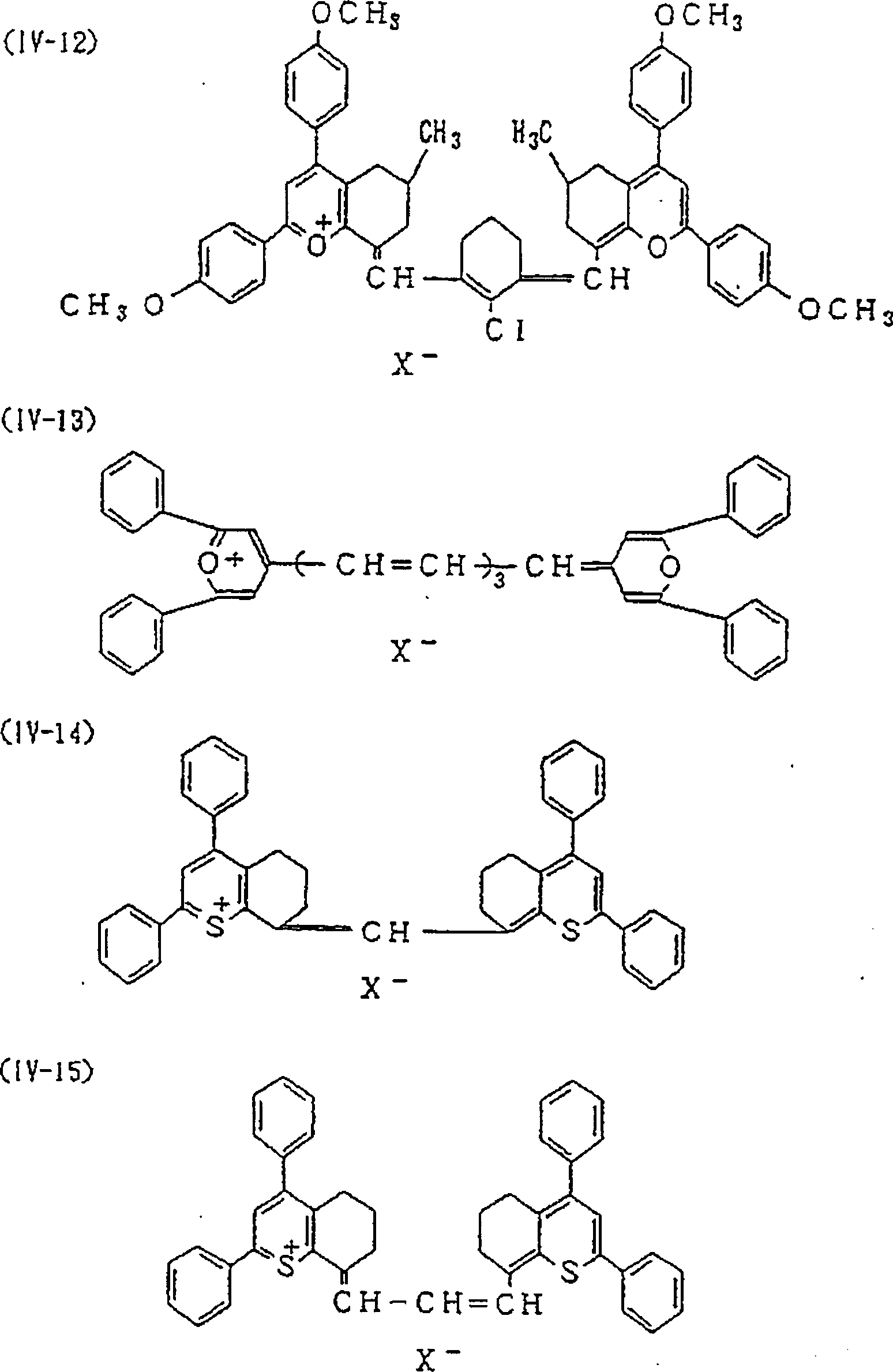


Das Gegenanion X– im Vorausgehenden wird spezifisch beschrieben werden. Es kann beispielsweise ein Anion einer anorganischen Säure sein, wie Cl–, Br–, I–, ClO4 –, BF4 – oder PF6 –, oder das Anion einer organischen Säure, wie Benzolsulfonsäure, p-Toluolsulfonsäure, Naphthalinsulfonsäure, Essigsäure oder einer organischen Borsäure.The counteranion X - in the foregoing will be specifically described. It can be, for example, an anion of an inorganic acid, such as Cl - , Br - , I - , ClO 4 - , BF 4 - or PF 6 - , or the anion of an organic acid, such as benzenesulfonic acid, p-toluenesulfonic acid, naphthalenesulfonic acid, acetic acid or an organic boric acid.
Im Speziellen wird ein Farbstoff mit einem organischen Borsäureanion als dem Gegenanion bevorzugt, da er in dem Beschichtungslösungsmittel eine ausgezeichnete Löslichkeit aufweist, sodass die Herstellung der Beschichtungslösung erleichtert werden wird, und ermöglicht wird, ein Lösungsmittel mit einem niedrigen Siedepunkt zu verwenden, sodass ein Haften einer nicht-getrockneten lichtempfindlichen Schicht, z.B. an eine Walze in einer Beschichtungsstraße, verhindert werden kann, und eine Hochgeschwindigkeitsbeschichtung möglich wird, wodurch eine hohe Produktivität erzielt werden kann.in the Specifically, a dye having an organic boric acid anion as the counter anion, since it is in the coating solvent an excellent solubility so that the preparation of the coating solution facilitates will be, and enabled becomes, a solvent to use with a low boiling point, thus sticking one undried photosensitive layer, e.g. to a roller in a coating line prevented and high-speed coating becomes possible, resulting in high productivity can be achieved.
Spezifisch
kann, als ein solches organisches Borsäureanion, jenes erwähnt werden,
das von der folgenden Formel (L) repräsentiert wird. 
Noch
spezifischer kann es ein solches sein, worin jedes von RQ1 bis RQ4, welche
voneinander unabhängig
sind, -CH3, -C2H5, -C3H7,
-C4H9, -C4H9-t, 
Ferner können, als von den obenstehenden Cyaninfarbstoffen verschiedene, bevorzugte spezifische Beispiele, die folgenden erwähnt werden.
- S-1 Nigrosin-Farbstoff: Color Index Solvent Black 5
- S-2 Nigrosin-Farbstoff: Color Index Solvent Black 7
- S-3 Nigrosin-Farbstoff: Color Index Acid Black 2
- S-4 Ruß: MA-100 (hergestellt von der Mitsubishi Chemical Corporation)
- S-5 Titanmonoxid: Titanium Black 13M (hergestellt von Mistubishi Material)
- S-6 Titanmonoxid: Titanium Black 12S (hergestellt von Mistubishi Material)
- S-1 Nigrosine Dye: Color Index Solvent Black 5
- S-2 Nigrosine Dye: Color Index Solvent Black 7
- S-3 Nigrosine Dye: Color Index Acid Black 2
- S-4 carbon black: MA-100 (manufactured by Mitsubishi Chemical Corporation)
- S-5 Titanium Monoxide: Titanium Black 13M (manufactured by Mistubishi Material)
- S-6 Titanium Monoxide: Titanium Black 12S (manufactured by Mistubishi Material)
Ein derartiges photo-thermisches Umwandlungsmaterial (b) wird in einem Mischungsverhältnis von 0,5 bis 30 Gew.-%, vorzugsweise 1 bis 20 Gew.-%, weiter bevorzugt 1 bis 15 Gew.-%, basierend auf dem Gesamtfeststoffgehalt der lichtempfindlichen Zusammensetzung der vorliegenden Erfindung, eingebracht.One Such photo-thermal conversion material (b) is in a mixing ratio from 0.5 to 30% by weight, preferably 1 to 20% by weight, more preferably 1 to 15% by weight, based on the total solids content of the photosensitive Composition of the present invention incorporated.
Wie obenstehend erwähnt, ist die lichtempfindliche Zusammensetzung der vorliegenden Erfindung eine solche, bei welcher die Bilderzeugung hauptsächlich durch eine andere Änderung als eine chemische Änderung ausgeführt wird, und es ist wesentlich, dass sie keine UV-Empfindlichkeit besitzt (d.h. eine Handhabung in Weißlicht ist möglich). Folglich enthält die lichtempfindliche Zusammensetzung der vorliegenden Erfindung keine Chinondiazidverbindung.As mentioned above, For example, the photosensitive composition of the present invention is a those in which the image formation mainly by another change as a chemical change accomplished and it is essential that it has no UV sensitivity (i.e., handling in white light is possible). Consequently contains the photosensitive composition of the present invention no quinone diazide compound.
In der vorliegenden Erfindung ist es notwendig, ein verestertes alkalilösliches Harz (a-1) als eine essentielle Komponente einzubinden. Durch die Einbindung des veresterten alkalilöslichen Harzes (a-1) kann die Filmfestigkeit der lichtempfindlichen Schicht verbessert werden. Folglich kann dieses veresterte alkalilösliche Harz (d.h. die Verbindung, welche ein alkalilösliches Harz ist, das phenolische Hydroxylgruppen aufweist, und bei welchem wenigstens einige der phenolischen Hydroxylgruppen verestert sind), manchmal als "ein Filmfestigkeitsverbesserer" bezeichnet werden.In In the present invention, it is necessary to use an esterified alkali-soluble Resin (a-1) as an essential component. By the Incorporation of the esterified alkali-soluble resin (a-1) can improve the film strength the photosensitive layer can be improved. Consequently, can this esterified alkali-soluble resin (i.e., the compound which is an alkali-soluble resin, the phenolic Has hydroxyl groups, and wherein at least some of the phenolic hydroxyl groups), sometimes referred to as "a film strength improver".
Die Estereinheit des veresterten alkalilöslichen Harzes (a-1) ist eine Arylsulfonsäureverbindung, wie definiert in Patentanspruch 1. Das alkalilösliche Harz mit phenolischen Hydroxylgruppen, welches das veresterte alkalilösliche Harz (a-1) bildet, kann beispielsweise ein Novolakharz, ein Resolharz, ein Polyvinylphenolharz oder ein Copolymer eines Acrylsäurederivates, aufweisend phenolische Hydroxylgruppen, sein. Unter ihnen wird ein Novolakharz, ein Resolharz oder ein Polyvinylphenolharz bevorzugt.The Ester unit of the esterified alkali-soluble resin (a-1) is a arylsulfonic acid compound, as defined in claim 1. The alkali-soluble resin with phenolic Hydroxyl groups which forms the esterified alkali-soluble resin (a-1) can for example, a novolak resin, a resole resin, a polyvinylphenol resin or a copolymer of an acrylic acid derivative, having phenolic hydroxyl groups. Among them will be one Novolak resin, a resole resin or a polyvinylphenol resin.
Besonders bevorzugt als ein Filmfestigkeitsverbesserer ist eine Esterverbindung eines Polykondensationsharzes von einem Phenol mit einem Aldehyd oder Keton mit einer Arylsulfonsäureverbindung.Especially preferred as a film strength improver is an ester compound a polycondensation resin of a phenol with an aldehyde or ketone with an arylsulfonic acid compound.
Ein derartiges Phenol kann beispielsweise ein einwertiges Phenol, wie Phenol, o-Cresol, m-Cresol, p-Cresol, 3,5-Xylenol, Carvacrol oder Thymol, ein zweiwertiges Phenol, wie Catechol, Resorcinol oder Hydrochinon, oder ein dreiwertiges Phenol, wie Pyrogallol oder Phloroglucinol sein. Das obenstehende Aldehyd kann beispielsweise Formaldehyd, Benzaldehyd, Acetaldehyd, Crotonaldehyd oder Furfural sein. Unter ihnen wird Formaldehyd oder Benzaldehyd bevorzugt. Das obenstehende Keton kann beispielsweise Aceton oder Methylethylketon sein.One For example, such phenol may be a monohydric phenol, such as Phenol, o-cresol, m-cresol, p-cresol, 3,5-xylenol, carvacrol or Thymol, a dihydric phenol, such as catechol, resorcinol or hydroquinone, or a trivalent phenol, such as pyrogallol or phloroglucinol be. The above aldehyde may be, for example, formaldehyde, Benzaldehyde, acetaldehyde, crotonaldehyde or furfural. Under they are preferred formaldehyde or benzaldehyde. The above For example, ketone may be acetone or methyl ethyl ketone.
Spezifische Beispiele des oben genannten Polykondensationsharzes schließen ein Phenol/Formaldehyd-Harz, ein m-Cresol/Formaldehyd-Harz, ein gemischtes m- und p-Cresol/Formaldehyd-Harz, ein Resorcinol/Benzaldehyd-Harz oder ein Pyrogallol/Aceton-Harz ein.specific Examples of the above-mentioned polycondensation resin include Phenol / formaldehyde resin, a m-cresol / formaldehyde resin, a mixed m- and p-cresol / formaldehyde resin, a resorcinol / benzaldehyde resin or a pyrogallol / acetone resin one.
Das Molekulargewicht (Mw) des alkalilöslichen Harzes mit phenolischen Hydroxylgruppen, welches den obenstehend erwähnten Filmfestigkeitsverbesserer darstellt, beträgt üblicherweise 1 000 bis 50 000, vorzugsweise 1 500 bis 20 000, weiter bevorzugt 2 000 bis 10 000.The Molecular weight (Mw) of the alkali-soluble resin with phenolic Hydroxyl groups containing the above-mentioned film strength improver represents is usually 1,000 to 50,000, preferably 1,500 to 20,000, more preferably 2,000 to 10,000.
Das Veresterungsverhältnis der Sulfonsäureverbindung zu den phenolischen Hydroxylgruppen des obenstehend erwähnten Filmfestigkeitsverbesserers (das Reaktionsverhältnis pro einer OH-Gruppe) beträgt vorzugsweise 1 bis 40%, weiter bevorzugt 3 bis 35%, am stärksten bevorzugt 15 bis 35%.The esterification the sulfonic acid compound to the phenolic hydroxyl groups of the above-mentioned film strength improver (the reaction ratio per one OH group) is preferably 1 to 40%, more preferably 3 to 35%, most preferably 15 to 35%.
Die Sulfonsäureverbindung kann beispielsweise eine Sulfonsäureverbindung, wie eine C5-20-Arylsulfonsäure, die einen Substituenten aufweisen kann, eine Chinonsulfonsäure, die einen Sub stituenten aufweisen kann, oder eine heterocyclische C4-20-Sulfonsäure, die einen Substituenten aufweisen kann, sein.The sulfonic acid compound may, for example, be a sulfonic acid compound such as a C 5-20 arylsulfonic acid which may have a substituent, a quinone sulfonic acid which may have a substituent, or a heterocyclic C 4-20 sulfonic acid which may have a substituent.
Weiter bevorzugt kann sie zum Beispiel eine mono- bis tricyclische Arylsulfonsäureverbindung oder eine mono- bis tricyclische Chinonsulfonsäureverbindung, welche eine Alkylgruppe, eine Carbonsäuregruppe, eine Hydroxylgruppe, eine primäre Aminogruppe, eine sekundäre Aminogruppe oder eine tertiäre Aminogruppe als einen Substituenten in ihrer Struktur aufweisen kann, sein. Besonders bevorzugt wird eine mono- oder bicyclische Arylsulfonsäure oder eine bi- oder tricyclische Chinonsulfonsäure, die den obenstehend erwähnten Substituenten aufweisen kann, da eine derartige Sulfonsäure in Hinsicht auf die Verbesserung der Bedruckungsbeständigkeit und chemischen Beständigkeit vorteilhaft ist.Further For example, it may preferably be a mono- to tricyclic arylsulfonic acid compound or a mono- to tricyclic quinone sulfonic acid compound which is a Alkyl group, a carboxylic acid group, a Hydroxyl group, a primary one Amino group, a secondary one Amino group or a tertiary one Have amino group as a substituent in their structure may be. Particularly preferred is a mono- or bicyclic arylsulfonic or a bicyclic or tricyclic quinone sulfonic acid containing the above-mentioned substituent may have, since such a sulfonic acid in terms of improvement the printing resistance and chemical resistance is advantageous.
Eine
geeignete Sulfonsäureestergruppe
(R-SO3-), welche das veresterte alkalilösliche Harz
(a-1) bildet, kann beispielsweise eine Gruppe sein, worin R eine
Struktur besitzt, welche durch eine der folgenden Formeln QP1 bis QP9 repräsentiert
wird. 
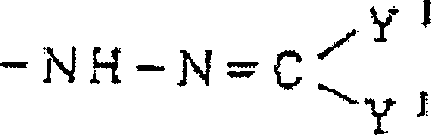
In den obenstehenden Definitionen beträgt die Kohlenstoffanzahl der Alkylgruppe 1 bis 15, vorzugsweise 1 bis 6; die Kohlenstoffanzahl der Arylgruppe beträgt 6 bis 20, vorzugsweise 6 bis 12; die Kohlenstoffzahl der heterocyclischen Gruppe beträgt 4 bis 20, vorzugsweise 4 bis 10; die Kohlenstoffzahl der Alkenylgruppe beträgt 2 bis 10, vorzugsweise 2 bis 6; die Kohlenstoffanzahl der Acylgruppe beträgt 2 bis 15, vorzugsweise 2 bis 10; und die die Kohlenstoffanzahl der Alkoxycarbonylgruppe beläuft sich auf 2 bis 15, vorzugsweise 2 bis 10.In the above definitions, the carbon number of the alkyl group is 1 to 15, preferably Wise 1 to 6; the carbon number of the aryl group is 6 to 20, preferably 6 to 12; the carbon number of the heterocyclic group is 4 to 20, preferably 4 to 10; the carbon number of the alkenyl group is 2 to 10, preferably 2 to 6; the carbon number of the acyl group is 2 to 15, preferably 2 to 10; and the carbon number of the alkoxycarbonyl group is 2 to 15, preferably 2 to 10.
Im Genaueren werden Beispiele des veresterten alkalilöslichen Harzes (a-1), das in der vorliegenden Erfindung verwendet wird, nachstehend angegeben. Wenn die Verfleckungs- bzw. Fleckbeständigkeit während des Druckens, wie hierin nachstehend beschrieben, in Betracht gezogen wird, können die folgenden Verbindungen als bevorzugte Beispiele für Harze erwähnt werden, worin o-Chinondiazid-Gruppen nicht-photosensitiviert worden sind. Allerdings ist das veresterte alkalilösliche Harz (a-1) der vorliegenden Erfindung nicht auf derartige Verbindungen eingeschränkt.in the More specific are examples of the esterified alkali-soluble Resin (a-1) used in the present invention indicated below. When the stain resistance during the Printing, as described hereinafter will, can the following compounds as preferred examples of resins mentioned in which o-quinone diazide groups non-photosensitized. However, that is the esterified alkali-soluble Resin (a-1) of the present invention is not limited to such compounds limited.

Eine Verbindung (Mw 3000), bei welcher W1 für Hydroxylgruppen eines Polykondensations-Novolakharzes von m-Cresol mit Formaldehyd (Reaktionsverhältnis: 30%) substituiert ist.A compound (Mw 3000) in which W 1 is substituted for hydroxyl groups of a polycondensation novolak resin of m-cresol with formaldehyde (reaction ratio: 30%).
Eine Verbindung (Mw 2000), bei welcher W1 für Hydroxylgruppen eines Polykondensations-Novolakharzes von Phenol mit Formaldehyd (Reaktionsverhältnis: 30%) substituiert ist.A compound (Mw 2000) in which W 1 is substituted for hydroxyl groups of a polycondensation novolak resin of phenol with formaldehyde (reaction ratio: 30%).
Eine Verbindung (Mw 3000), bei welcher W1 für Hydroxylgruppen eines Polykondensations-Novolakharzes von m-Resorcinol mit Formaldehyd (Reaktionsverhältnis: 20%) substituiert ist.A compound (Mw 3000) in which W 1 is substituted for hydroxyl groups of a polycondensation novolak resin of m-resorcinol with formaldehyde (reaction ratio: 20%).
Hierin
steht W1 für 


Unter den obenstehend erwähnten veresterten alkalilöslichen Harzen (a-1), wird ein solches, das durch Umsetzen einer Sulfonsäureverbindung mit einem Pyrogallol/Aceton-Harz erhältlich ist, in Hinsicht auf die Verbesserung der Bedruckungsbeständigkeit und chemischen Beständigkeit besonders bevorzugt, wenn es für eine lithographische Druckplatte verwendet wird.Under the above mentioned esterified alkali-soluble Resins (a-1) becomes one obtained by reacting a sulfonic acid compound with a pyrogallol / acetone resin is available in terms of Improvement of print resistance and chemical resistance especially preferred if it is for a lithographic printing plate is used.
Ferner beläuft sich das Mischungsverhältnis des veresterten alkalilöslichen Harzes (a-1) auf 0,5 bis 100 Gew.-%, vorzugsweise 0,5 bis 50 Gew.-%, weiter bevorzugt 1 bis 30 Gew.-%, basierend auf dem Gesamtfeststoffgehalt der lichtempfindlichen Zusammensetzung.Further amounts the mixing ratio of the esterified alkali-soluble Resin (a-1) to 0.5 to 100 wt .-%, preferably 0.5 to 50 wt .-%, more preferably 1 to 30% by weight, based on the total solids content the photosensitive composition.
Durch Einbringen des Filmfestigkeitsverbesserers der vorliegenden Erfindung kann die Entfernung eines belichteten Abschnitts (ein Nicht-Bild-Bereich) und die Filmzurückhaltung an einem Bild-Bereich verbessert werden, und die Bedruckungsbeständigkeit kann aufgrund einer Verbesserung in der Filmfestigkeit der lichtempfindlichen Schicht verbessert werden. Man geht davon aus, dass dies dem folgenden Mechanismus zuzuschreiben ist.By Incorporation of the film strength improver of the present invention may be the removal of an exposed portion (a non-image area) and the movie restraint at a picture area can be improved, and the printing resistance can be due to a Improvement in the film strength of the photosensitive layer be improved. It is believed that this is attributable to the following mechanism is.
In der, das nicht-veresterte alkalilösliche Harz und das veresterte alkalilösliche Harz (a-1) umfassenden, lichtempfindlichen Zusammensetzung wird nämlich das veresterte alkalilösliche Harz durch Wasserstoffbrückenbindungen an das nicht-veresterte alkalilösliche Harz mit phenolischen Hydroxylgruppen unter Bildung einer Matrixstruktur durch derartige Bindungen in der lichtempfindlichen Schicht vernetzt werden. Der Matrixeffekt durch derartige Bindungen kann durch eine Verringerung der Löslichkeit der lichtempfindlichen Schicht in einer wässrigen Alkalilösung bestätigt werden.In that, the non-esterified alkali-soluble resin and esterified alkali-soluble Resin (a-1) comprising photosensitive composition namely the esterified alkali-soluble Resin through hydrogen bonds to the non-esterified alkali-soluble Resin with phenolic hydroxyl groups to form a matrix structure crosslinked by such bonds in the photosensitive layer become. The matrix effect through such bonds can by a Reduction of solubility the photosensitive layer are confirmed in an aqueous alkali solution.
Eine solche Vernetzung wird üblicherweise durch bloßes Vermischen des nicht-veresterten alkalilöslichen Harzes und des Filmfestigkeitsverbesseres kaum gebildet, und die Bildung wird üblicherweise durch Ausführen einer Wärmebehandlung beschleunigt. Somit kann eine derartige Vernetzung durch die resultierende Verringerung in der Löslichkeit der lichtempfindlichen Schicht, Verbesserung der Bedruckungsbeständigkeit der lichtempfindlichen Schicht oder eine Verringerung von Kratzspur-Fehlerstellen bestätigt werden.A such networking usually becomes by mere Mixing the non-esterified alkali-soluble resin and the film strength improver Barely formed, and education is usually done by running a heat treatment accelerated. Thus, such crosslinking may be due to the resulting reduction in solubility the photosensitive layer, improving the printing resistance of photosensitive layer or a reduction of scratch marks flaws approved become.
Die Wärmebehandlung wird üblicherweise zum Zeitpunkt der Trocknung nach dem Aufbeschichten der lichtempfindlichen Zusammensetzung auf ein Substrat oder dergleichen durchgeführt, und die Temperatur und Zeit können geeignet gewählt werden, um das Leistungsverhalten hinsichtlich z.B. Löslichkeit, Bedruckungsbeständigkeit und Verhinderung von Kratzspur-Defekten der lichtempfindlichen Schicht zu erzielen. Vorzugsweise liegt die Temperatur innerhalb eines Bereichs von 40 bis 100°C, und die Wärmebehandlungszeit wird verlängert, wenn die Temperatur abnimmt. Spezifisch wird es bevorzugt, dass sich die Zeit auf 1 bis 30 Minuten bei ungefähr 100°C, oder auf 5 bis 50 Stunden bei ungefähr 40°C beläuft.The heat treatment becomes common at the time of drying after coating the photosensitive Composition performed on a substrate or the like, and the temperature and time can suitably chosen to improve the performance with respect to e.g. Solubility, printing resistance and preventing scratch-mark defects of the photosensitive layer to achieve. Preferably, the temperature is within a range from 40 to 100 ° C, and the heat treatment time becomes extended, when the temperature decreases. Specifically, it is preferable that the time is 1 to 30 minutes at about 100 ° C, or 5 to 50 hours at about 40 ° C.
Wenn die Temperatur zu hoch ist oder die Zeit für die Wärmebehandlung zu lang ist, nimmt die Löslichkeit der lichtempfindlichen Schicht ab, was somit zu einer Störung der Entwicklung führt. Wenn andererseits für die Wärmebehandlung die Temperatur zu niedrig ist oder die Zeit zu kurz ist, wird die Löslichkeit der lichtempfindlichen Schicht übermäßig sein, was daher zu einer Auflö sung des Bildes während der Entwicklung, zur Bildung von Kratzspuren oder zur Verschlechterung der Bedruckungsbeständigkeit fährt.If the temperature is too high or the time for the heat treatment is too long, takes the solubility the photosensitive layer, thus resulting in a disorder of the Development leads. If on the other hand for the heat treatment the temperature is too low or the time is too short, the solubility the photosensitive layer be excessive, which is therefore a resolution of the picture during development, the formation of scratch marks or deterioration the printing resistance moves.
Die Details des Mechanismus für die Verbesserung des Vermögens zur Bildung eines positiven Bildes durch die lichtempfindliche Zusammensetzung der vorliegenden Erfindung werden nicht klar verstanden. Allerdings wird davon ausgegangen, dass bei Bestrahlung mit Licht die Matrixstruktur mittels Wasserstoffbrückenbindungen, welche den Effekt der Unterdrückung der Löslichkeit hervorruft, einer Relaxation oder Auflösung der Wasserstoffbrücken durch die bei der Lichtabsorption erzeugte Wärme unterliegt, wodurch das Eindringen des Alkalimittels erleichtert wird, und der Effekt zur Unterdrückung der Löslichkeit vermindert wird, so dass ein positives Bild mit einem hohen Kontrast erzeugt wird und ein breiter Entwicklungs-Spielraum gegeben wird.The Details of the mechanism for the improvement of the assets to form a positive image by the photosensitive composition The present invention is not clearly understood. Indeed it is assumed that when irradiated with light the matrix structure by means of hydrogen bonds, which the effect of oppression the solubility causes relaxation or dissolution of the hydrogen bonds undergoes the heat generated in the light absorption, whereby the Penetration of the alkali agent is facilitated, and the effect of suppression the solubility is reduced, so that a positive picture with a high contrast is generated and a broad development scope is given.
Ferner wird davon ausgegangen, dass der Filmfestigkeitsverbesserer, welcher ein hochmolekulargewichtiges alkalilösliches Harz-Skelett mit phenolischen Hydroxylgruppen aufweist, eine Funktion zur Ausbildung einer stärkeren Matrixstruktur durch Wasserstoffbrückenbindungen besitzt und, verglichen mit einem solchen, der ein niedriges Molekulargewicht aufweist, einen höheren Effekt zur Verbesserung der Filmfestigkeit vorsieht.Further It is assumed that the film strength improver, which a high molecular weight alkali-soluble resin skeleton with phenolic Having hydroxyl groups, a function of forming a stronger matrix structure through hydrogen bonds has and, compared with such, a low molecular weight has a higher one Provides effect to improve film strength.
Andererseits ist der Filmfestigkeitsverbesserer ein Harz, welches einem Ester eines alkalilöslichen Harzes mit phenolischen Hydroxylgruppen mit einer Arylsulfonsäure entspricht, und von welchem die Teilstruktur, welche den Ester darstellt, d.h. der aromatische Ring oder ein Substituent auf dem aromatischen Ring der Arylsulfonsäure, durch eine hydrophile Gruppe substituiert ist, da ein solches Harz, zusätzlich zu der obenstehend erwähnten Bedruckungsbeständigkeit und chemischen Beständigkeit, einen Effekt zur Verhinderung der Anfärbung eines Nicht-Bild-Bereichs während des Druckens aufweist (Fleckenbildungsbeständigkeit). Eine solche hydrophile Gruppe kann beispielsweise eine Hydroxylgruppe, eine primäre Aminogruppe, eine sekundäre Aminogruppe, eine tertiäre Aminogruppe oder eine Carbonsäuregruppe sein. Unter ihnen wird ein solches mit mindestens einer Hydroxylgruppe auf dem aromatischen Ring bevorzugt. Besonders bevorzugt wird ein solches, welches eine Hydroxylgruppe und eine Aminogruppe auf dem aromatischen Ring aufweist. Die Aminogruppe kann einen Substituenten aufweisen. Man geht davon aus, dass durch die Gegenwart einer hydrophilen Gruppe in der Teilstruktur, die den Ester darstellt, die Löslichkeit eines belichteten Abschnitts der lichtempfindlichen Schicht in einem Alkalientwickler erleichtert werden wird, und zwar in Kombination mit der obenstehend erwähnten Änderung der Konformation.on the other hand the film strength improver is a resin which is an ester an alkali-soluble resin having phenolic hydroxyl groups with an arylsulfonic acid, and of which the partial structure representing the ester, i. the aromatic ring or a substituent on the aromatic ring the arylsulfonic acid, is substituted by a hydrophilic group, since such a resin, additionally to the above-mentioned printing resistance and chemical resistance, an effect of preventing the staining of a non-image area while of printing (stain resistance). Such a hydrophilic For example, a group may be a hydroxyl group, a primary amino group, a secondary one Amino group, a tertiary Amino group or a carboxylic acid group be. Among them, one having at least one hydroxyl group preferred on the aromatic ring. Particularly preferred is a which has a hydroxyl group and an amino group on the having aromatic ring. The amino group may have a substituent exhibit. It is believed that by the presence of a hydrophilic Group in the part structure representing the ester, the solubility an exposed portion of the photosensitive layer in one Alkali developer will be facilitated, in combination with the above-mentioned change the conformation.
Das Harz, welches ein Ester eines alkalilöslichen Harzes mit phenolischen Hydroxylgruppen mit einer Arylsulfonsäure ist und welches ein hydrophile Gruppe in einer Teilstruktur, die den Ester darstellt, aufweist, wird vorzugsweise hergestellt, indem eine o-Chinondiazidgruppen-Einheit eines Harzes mit einer Struktur, welche einem Ester eines alkalilöslichen Harzes mit phenolischen Hydroxylgruppen entspricht, mit einer herkömmlichen o-Chinondiazidsulfonsäure, wie 1,2-Benzochinondiazid-Sulfonsäure oder 1,2-Benzochinondiazid-Sulfonsäure, umgesetzt wird, wodurch die o-Chinondiazidgruppe modifiziert wird und folglich eine hydrophile Gruppe in eine Teilstruktur, welche den Ester darstellt, eingeführt wird, und zwar in Hinsicht auf die Herstellungseffizienz und die Produktionskosten.The resin which is an ester of an alkali-soluble resin having phenolic hydroxyl groups with an arylsulfonic acid and which has a hydrophilic group in a partial structure constituting the ester is preferably prepared by adding an o-quinonediazide group unit of a resin having a structure of corresponding to an ester of an alkali-soluble resin having phenolic hydroxyl groups, is reacted with a conventional o-quinone diazide sulfonic acid such as 1,2-benzoquinone diazide sulfonic acid or 1,2-benzoquinone diazide sulfonic acid, thereby modifying the o-quinone diazide group and hence a hydrophilic group into a partial structure representing the ester, in terms of production efficiency and production cost.
Die oben genannte Modifikation der o-Chinondiazidgruppe ist spezifisch derartig, dass die o-Chinondiazidgruppe zu einer Verbindung modifiziert wird, welche nach Absorption von Licht mit einer Wellenlänge von 300 bis 450 nm keine Photoreaktion unter Bildung von Indencarbonsäure durchläuft (d.h. nicht-photosensitiviert), und die Verbindung nicht länger eine Chinondiazidgruppe besitzt. Eine solche Nicht-Photosensitivierung kann durch Modifizieren der o-Chinondiazidgruppe durch eine bekannte Kopplungsreaktion oder Stickstoff-entfernende Reaktion ausgeführt werden.The The above modification of the o-quinone diazide group is specific such that the o-quinone diazide group is modified to a compound which, after absorption of Light with one wavelength from 300 to 450 nm undergoes no photoreaction to form indenecarboxylic acid (i.e. non-photosensitized), and the compound no longer one Possesses quinone diazide group. Such non-photosensitization can by modifying the o-quinone diazide group by a known one Coupling reaction or nitrogen-removing reaction can be carried out.
Besonders bevorzugt wird ein Harz, bei welchem Hydroxylgruppen durch Nicht-Sensitivieren eines Harzes eingeführt sind, aufweisend eine Struktur, entsprechend einem Ester eines Novolakharzes, spezifisch ein Polykondensations-Harz eines Phenols mit einem Aldehyd oder Keton, mit o-Naphthochinondiazidsulfonsäure, weiter bevorzugt ein Harz mit einer Struktur, entsprechend einem Ester eines Pyrogallol/Aceton-Harzes mit 1,2-Benzochinondiazidsulfonsäure oder 1,2-Naphthochinondiazidsulfonsäure, und zwar unter dem Gesichtspunkt der Synthese und der obenstehend erwähnten Bedruckungs-Beständigkeit, chemischen Beständigkeit und Fleckenbildungsbeständigkeit.Especially preferred is a resin in which hydroxyl groups are not sensitized a resin introduced are having a structure corresponding to an ester of a novolak resin, specifically, a polycondensation resin of a phenol with an aldehyde or ketone, with o-naphthoquinonediazide sulfonic acid preferably a resin having a structure corresponding to an ester a pyrogallol / acetone resin with 1,2-benzoquinone diazide sulfonic acid or 1,2-naphthoquinonediazide sulfonic acid, and although from the viewpoint of synthesis and the above-mentioned printing durability, chemical resistance and stain resistance.
Eine
solche Nicht-Sensitivierung kann mittels bekannter Verfahren durchgeführt werden,
wie offenbart z.B. in Saul Patal, "The Chemistry of diazonium and diazo
groups, Part 1",
1978, veröffentlicht
von John Wiley & Sons,
Saul Patal, "The
Chemistry of diazonium and diazo groups, Part 2", 1978, veröffentlicht von John Wiley & Sons, Viadimir
V. Ershov et al., "Quinone
Diazides", 1981,
veröffentlicht
von Elsevier Scientific Publishing Company, W. Ried und M. Butz,
Liebigs Ann. Chem., 716, 190 (1968); W. Ried und A. Keemann, Liebigs
Ann. Chem., 689, 145 (1965), E. Bamberger, Marie Baum und Leo Schlein,
J. Prakt. Chem., 266 (1923), E. Bamberger und S. Wildi, J. Prakt.
Chem., 278 (1923). Als spezifische Beispiele einer derartigen Nicht-Sensitivierungs-Reaktion können die
folgenden Reaktionen erwähnt
werden, welche verschiedene Säuren,
Alkalis und Metallkatalysatoren anwenden. 


Bevorzugte Harze, welche durch die obenstehend erwähnte Nicht-Sensitivierung von Harzen, welche o-Chinondiazidgruppen enthalten, erhältlich sind, werden untenstehend angegeben.
- (1) Ein Kopplungsreaktionsprodukt
von o-Chinondiazidgruppen eines Harzes mit einer Verbindung (einem nicht-aromatischen
Koppler) mit aktivem Wasserstoff der folgenden Formel (A) oder worin jedes von RA1 bis RA3, welche voneinander unabhängig sind, eine Alkylgruppe, ein Wasserstoffatom, eine Arylgruppe, ein Chloratom, ein Bromatom, ein Jodatom, ein Fluoratom, eine Alkoxygruppe, eine Aryloxygruppe, eine Acylgruppe, eine Alkoxycarbonylgruppe, eine Aryloxycarbonylgruppe, eine Allyloxycarbonylgruppe, eine Carbonsäuregruppe oder eine Cyanogruppe ist, mit der Maßgabe, dass mindestens eines von RA1 bis RA3 eine Gruppe ist, gewählt aus einer Acylgruppe, einer Alkoxycarbonylgruppe, einer Aryloxycarbonylgruppe, einer Allyloxycarbonylgruppe, einer Carbonsäuregruppe und einer Cyanogruppe.
 worin RA1 und RA3 wie in (A) definiert sind, und RA5 einen Rest, welcher durch RA3 in (A) repräsentiert wird, oder eine Aminogruppe, die einen Substituenten aufweisen kann, repräsentiert.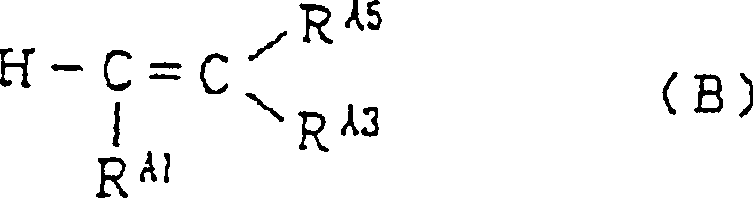
- (2) Ein Kopplungsreaktionsprodukt von o-Chinondiazidgruppen eines Harzes mit einer mono- bis tri-cyclischen Arylverbindung (einem aromatischen Koppler), welche mindestens eine Hydroxylgruppe oder eine Nitrogruppe aufweist und welche ferner andere Substituenten aufweisen kann, wie z.B. offenbart in "Dyestuff Handbook" (zusammengestellt von Organic Synthetic Chemistry Association, 1959, veröffentlicht von Maruzen K. K.) oder "ORGAMC INTERMEDIATES" (Katalog von Daito Chemical Industry Co., Ltd.).
- (3) Eine Verbindung mit einer Hydroxylgruppe oder einer Alkoxygruppe als Substituent, welche erhältlich ist durch Induzieren einer Stickstoff-Entfernungsreaktion zusammen mit einer Verbindung, welche eine Hydroxylgruppe aufweist, wie einem Alkohol, in Gegenwart einer Säure oder eines Alkali (ein Stickstoff Entfernungs-Reaktionsprodukt).
- (1) A coupling reaction product of o-quinone diazide groups of a resin with a compound (a non-aromatic coupler) having active hydrogen of the following formula (A) or wherein each of R A1 to R A3 , which are independent of each other, is an alkyl group, a hydrogen atom, an aryl group, a chlorine atom, a bromine atom, an iodine atom, a fluorine atom, an alkoxy group, an aryloxy group, an acyl group, an alkoxycarbonyl group, an aryloxycarbonyl group, an allyloxycarbonyl group, a carboxylic acid group or a cyano group, provided that at least one of R A1 to R A3 is a group selected from an acyl group, an alkoxycarbonyl group, an aryloxycarbonyl group, an allyloxycarbonyl group, a carboxylic acid group and a cyano group.wherein R A1 and R A3 are as defined in (A), and R A5 represents a group represented by R A3 in (A) or an amino group which may have a substituent.
- (2) A coupling reaction product of o-quinone diazide groups of a resin having a mono- to tri-cyclic aryl compound (an aromatic coupler) having at least one hydroxyl group or a nitro group and which may further have other substituents, such as disclosed in "Dyestuff Handbook" (compiled by Organic Synthetic Chemistry Association, 1959, published by Maruzen KK) or "ORGAMC INTERMEDIATES" (catalog of Daito Chemical Industry Co., Ltd.).
- (3) A compound having a hydroxyl group or an alkoxy group as a substituent obtainable by inducing a nitrogen removal reaction together with a compound having a hydroxyl group such as an alcohol in the presence of an acid or an alkali (a nitrogen removal reaction product ).
Spezifische Beispiele der Koppler werden angegeben.specific Examples of the couplers are given.
(1)
Nicht-aromatische Koppler 
(2)
Aromatische Koppler 

Wenn
die Flecken-Beständigkeit
in Betracht gezogen wird, wird ein solcher Fall besonders bevorzugt, worin
das veresterte alkalilösliche
Harz (a-1) ein Ester eines Novolakharzes mit einer Sulfonsäureverbindung ist,
und R in der Estergruppe (R-SO3-) des Sulfonsäuresters
durch die folgende Formel repräsentiert
wird: 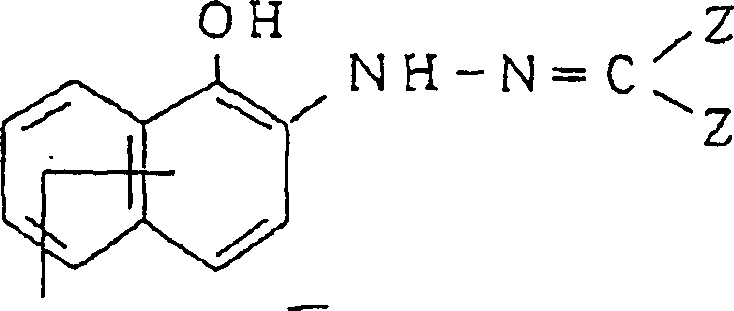
Spezifische Beispiele des Harzes, bei welchem o-Chinondiazidgruppen nicht-sensitiviert sind, welches in der vorliegenden Erfindung verwendet werden soll, werden nachstehend angegeben.specific Examples of the resin in which o-quinone diazide groups are non-sensitized which are to be used in the present invention are given below.
Allerdings sind die in der vorliegenden Erfindung zu verwendenden nicht-sensitivierten o-Chinondiazid-Derivate nicht auf diese Verbindungen beschränkt.Indeed are the non-sensitized to be used in the present invention o-quinone diazide derivatives are not limited to these compounds.


Eine Verbindung (Mw 3000), bei welcher XW für Hydroxylgruppen eines Polykondensations-Novolakharzes von m-Cresol mit Formaldehyd (Reaktionsverhältnis: 30%) substituiert ist.A Compound (Mw 3000) in which XW represents hydroxyl groups of a polycondensation novolak resin of m-cresol is substituted with formaldehyde (reaction ratio: 30%).
Eine Verbindung (Mw 3000), bei welcher XV für Hydroxylgruppen eines Polykondensations-Novolakharzes von m-Cresol mit Formaldehyd (Reaktionsverhältnis: 30%) substituiert ist.A Compound (Mw 3000) in which XV represents hydroxyl groups of a polycondensation novolak resin of m-cresol is substituted with formaldehyde (reaction ratio: 30%).
Eine Verbindung (Mw 2000), bei welcher XW für Hydroxylgruppen eines Polykondensations-Novolakharzes von Phenol mit Formaldehyd (Reaktionsverhältnis: 30%) substituiert ist.A Compound (Mw 2000) in which XW represents hydroxyl groups of a polycondensation novolak resin of Phenol is substituted with formaldehyde (reaction ratio: 30%).
Eine Verbindung (Mw 3000), bei welcher XV für Hydroxylgruppen eines Polykondensations-Novolakharzes von m-Resorcinol mit Formaldehyd (Reaktionsverhältnis: 20%) substituiert ist.A Compound (Mw 3000) in which XV represents hydroxyl groups of a polycondensation novolak resin of m-resorcinol is substituted with formaldehyde (reaction ratio: 20%).
Eine Verbindung (Mw 3000), bei welcher XW für Hydroxylgruppen eines Polykondensations-Novolakharzes von m-Resorcinol mit Formaldehyd (Reaktionsverhältnis: 20%) substituiert ist.A Compound (Mw 3000) in which XW represents hydroxyl groups of a polycondensation novolak resin of m-resorcinol is substituted with formaldehyde (reaction ratio: 20%).


Wenn das obenstehend beschriebene veresterte alkalilösliche Harz (a-1) für die vorliegende Erfindung in Kombination mit dem nicht-veresterten alkalilöslichen Harz verwendet werden soll, be läuft sich das Gewichtsverhältnis des veresterten alkalilöslichen Harzes (a-1) zum nicht-veresterten alkalilöslichen Harz vorzugsweise auf 1:1 bis 1:100, weiter bevorzugt 1:2 bis 1:50. Als ein Ergebnis einer derartigen kombinierten Verwendung werden üblicherweise von 1 bis 40% phenolische Hydroxylgruppen in dem alkalilöslichen Harz mit den phenolischen Hydroxylgruppen in der positiven lichtempfindlichen Zusammensetzung verestert werden. Das Veresterungsverhältnis beträgt vorzugsweise 2 bis 30%, weiter bevorzugt 5 bis 15%.If the above-described esterified alkali-soluble resin (a-1) for the present invention Invention in combination with the non-esterified alkali-soluble Resin to be used, be running the weight ratio of the esterified alkali-soluble Resin (a-1) to non-esterified alkali-soluble Resin preferably to 1: 1 to 1: 100, more preferably 1: 2 to 1:50. As a result of such combined use, it is common from 1 to 40% phenolic hydroxyl groups in the alkali-soluble Resin with the phenolic hydroxyl groups in the positive photosensitive Composition are esterified. The esterification ratio is preferably 2 to 30%, more preferably 5 to 15%.
Solange das Veresterungsverhältnis innerhalb des obenstehenden Bereichs liegt, ist es ferner möglich, ein solches anzuwenden, das erhalten wird durch vollständiges Verestern der Harzkomponente in der positiven lichtempfindlichen Zusammensetzung.As long as the esterification ratio is within the above range, it is also possible to apply one obtained by completely esterifying the resin component in the positive photosensitive composition.
Ferner kann die positive lichtempfindliche Zusammensetzung der vorliegenden Erfindung ein bestimmtes Löslichkeits-unterdrückendes Mittel enthalten, welches eine Wasserstoffbindung mit dem alkalilöslichen Harz mit phenolischen Hydroxylgruppen (a) bildet und eine Funktion zur Senkung der Löslichkeit des alkalilöslichen Harzes mit phenolischen Hydroxylgruppen (a) besitzt und welches Nahinfrarot-Licht nicht wesentlich absorbiert, d.h. eine Absorptionseffizienz von nicht mehr als 1% Nahinfrarot-Licht aufweist und nicht durch Infrarotlicht zersetzt wird, und zwar zum Zwecke der weiteren Erhöhung der Löslichkeitsdifferenz zwischen dem belichteten Abschnitt und dem nicht-belichteten Abschnitt.Further For example, the positive photosensitive composition of the present Invention a particular solubility-suppressive Contain means which hydrogen bond with the alkali-soluble Resin with phenolic hydroxyl groups (a) forms and a function to reduce the solubility of alkali-soluble Resin having phenolic hydroxyl groups (a) and which Near-infrared light is not substantially absorbed, i. an absorption efficiency of not more than 1% has near-infrared light and not by infrared light decomposed, for the purpose of further increasing the solubility between the exposed portion and the unexposed portion.
Das in der vorliegenden Erfindung zu verwendende Löslichkeits-unterdrückende Mittel kann beispielsweise ein Säureanhydrid, ein Sulfonsäureester, ein Phosphorsäureester, ein aromatischer Carbonsäureester, ein aromatisches Keton, ein aromatisches Aldehyd, ein aromatisches Amin oder ein aromatischer Ether, wie offenbart in JP9-205789, ein nichtionisches Tensid oder ein Tensid vom Fluortyp, wie offenbart in JP9-301915, ein Säure-Farberzeugungs-Farbstoff, wie offenbart in JP9-291880, oder ein Basen-Farbentwicklungs-Farbstoff, wie offenbart in JP9-301915, sein. Das Mischungsverhältnis eines solchen Löslichkeits-unterdrückenden Mittels beläuft sich üblicherweise auf 0 bis 50 Gew.-%, vorzugsweise 0 bis 30 Gew.-%, weiter bevorzugt 0 bis 20 Gew.-%, basierend auf dem Gesamtfeststoffgehalt in der lichtempfindlichen Zusammensetzung.The solubility-suppressing agents to be used in the present invention For example, an acid anhydride, a sulfonic acid ester, a phosphoric acid ester, an aromatic carboxylic acid ester aromatic ketone, an aromatic aldehyde, an aromatic amine or an aromatic ether as disclosed in JP9-205789, a nonionic one A surfactant or a fluorine type surfactant as disclosed in JP9-301915 Acid-generating color dye, as disclosed in JP9-291880, or a base color developing dye, as disclosed in JP9-301915. The mixing ratio of a such solubility-suppressing agent amounts usually to 0 to 50% by weight, preferably 0 to 30% by weight, more preferably 0 to 20 wt .-%, based on the total solids content in the photosensitive composition.
Ferner kann die lichtempfindliche Schicht ein anderes Färbemittel als das photo-thermische Umwandlungsmaterial enthalten, wie es der Fall erfordert. Das Färbemittel kann ein Pigment oder ein Farbstoff sein, wie Victoria Pure Blue (42595), Auramine O (41000), Catiron Brilliant Flavin (basic 13), Rhodamine 6GCP (45160), Rhodamine B (45170), Safranine OK 70:100 (50240), Erioglaucine X (42080), Fast Black HB (26150), No. 120/Lionol Yellow (21090), Lionol Yellow GRO (21090), Simular Fast Yellow 8GF (21105), Benzidine Yellow 4T-564D (21095), Simular Fast Red 4015 (12355), Lionol Red B4401 (15850), Fastgen Blue-TGR-L (74160) oder Lionol Blue SM (26150), Kristallviolett-Lacton. Hierbei bedeuten die Ziffern in den Klammern die Color-Indizes (C. I.).Further For example, the photosensitive layer may be a different colorant than the photo-thermal Conversion material included, as the case requires. The dye may be a pigment or a dye, such as Victoria Pure Blue (42595), Auramine O (41000), Catiron Brilliant Flavin (basic 13), Rhodamine 6GCP (45160), Rhodamine B (45170), Safranine OK 70: 100 (50240), Erioglaucine X (42080), Fast Black HB (26150), no. 120 / Lionol Yellow (21090), Lionol Yellow GRO (21090), Simular Fast Yellow 8GF (21105), Benzidine Yellow 4T-564D (21095), Simular Fast Red 4015 (12355), Lionol Red B4401 (15850), Fastgen Blue-TGR-L (74160) or Lionol Blue SM (26150), Crystal Violet Lactone. Mean here the numbers in parentheses are the color indices (C.I.).
Das Mischungsverhältnis des Färbemittels beläuft sich üblicherweise auf 0 bis 50 Gew.-%, vorzugsweise 1 bis 30 Gew.-%, bezogen auf den Feststoffgehalt der gesamten positiven lichtempfindlichen Zusammensetzung.The mixing ratio of the colorant amounts usually to 0 to 50 wt .-%, preferably 1 to 30 wt .-%, based on the Solid content of the entire positive photosensitive composition.
Die lichtempfindliche Zusammensetzung der vorliegenden Erfindung besitzt keine UV-Empfindlichkeit und lasst sich somit einfach unter Weißlicht behandeln. Folglich ist es, für die obenstehend erwähnten optionalen additiven Komponenten, notwendig, Komponenten zu wählen, welche keine Empfindlichkeit gegenüber UV-Licht besitzen. Die lichtempfindliche Zusammensetzung ohne UV-Empfindlichkeit bedeutet, daß die Zusammensetzung eine derartige Beschaffenheit besitzt, daß sogar bei Bestrahlung mit UV-Licht, insbesondere mit einem Licht innerhalb eines Bereichs von 360 bis 450 nm, der belichtete Abschnitt nicht wesentlich alkalilöslich sein wird, d.h. kein signifikanter Unterschied hinsichtlich der Löslichkeit im Alkalientwickler bestehen wird.The photosensitive composition of the present invention no UV sensitivity and It's easy to treat with white light. consequently is it for the ones mentioned above optional additive components, necessary to choose components which no sensitivity to UV light have. The photosensitive composition without UV sensitivity means that the Composition has such a nature that even when irradiated with UV light, in particular with a light within a range of 360 to 450 nm, the exposed portion not essentially alkali-soluble will be, i. no significant difference in terms of solubility in the alkali developer will exist.
Spezifischer gesagt, zeigt, sogar bei Stehenlassen unter weißem Fluoreszenzlicht (36 W weiße Fluoreszenzlampe Neolumi Super FLR40S-W/M/36, hergestellt von Mitsubishi Denki K. K.) mit einer Lichtintensität von 400 Lux während 10 Stunden, die positive lichtempfindliche Zusammensetzung (die lichtempfindliche Schicht des positiven lichtempfindlichen Materials) keine Änderung hinsichtlich der Löslichkeit.specific said, even when left under white fluorescent light (36 W white Fluorescent Neolumi Super FLR40S-W / M / 36 manufactured by Mitsubishi Denki K.K.) with a light intensity of 400 lux during 10 Hours, the positive photosensitive composition (the photosensitive layer the positive photosensitive material) no change in terms of solubility.
Die positive lichtempfindliche Zusammensetzung der vorliegenden Erfindung wird üblicherweise in der Form einer Lösung verwendet, bei welcher die obenstehend beschriebenen verschiedenen Komponenten in einem geeigneten Lösungsmittel gelöst sind. Das Lösungsmittel ist nicht besonders eingeschränkt, solange es eine angemessene Löslichkeit gegenüber den verwendeten Komponenten präsentiert und eine ausgezeichnete Beschichtungseigenschaft bereitstellt. Es kann beispielsweise ein Cellosolve-Lösungsmittel, wie Methylcellosolve, Ethylcellosolve, Methylcellosolve-Acetat oder Ethylcellosolve-Acetat, ein Propylenglycol-Lösungsmittel, wie Propylenglycol-Monomethylether, Propylenglycol-Monoethylether, Propylenglycol-Monobutylether, Propylenglycol-Monomethyletheracetat, Propylenglycol-Monoethyletheracetat, Propylenglycol-Monobutyletheracetat oder Dipropylenglycoldimethylether, ein Esterlösungsmittel, wie Butylacetat, Amylacetat, Ethyllactat, Butyllactat, Diethyloxalat, Ethylpyruvat, Ethyl-2-hydroxybutyrat, Ethylacetoacetat, Methyllactat, Ethyllactat oder Methyl-2-methoxypropionat, ein Alkohollösungsmittel, wie Heptanol, Hexanol, Diacetonalkohol oder Furfurylalkohol, ein Ketonlösungsmittel, wie Cyclohexanon oder Methylamylketon, ein hochpolares Lösungsmittel, wie Dimethylformamid, Dimethylacetamid oder N-Methylpyrrolidon, oder ein Lösungsmittelgemisch davon, oder eine Mischung davon mit einem aromatischen Kohlenwasserstoff sein. Der Anteil des Lösungsmittels liegt üblicherweise innerhalb eines Bereichs des 1- bis 200fachen, bezogen auf Gewicht, zur Gesamtmenge der lichtempfindlichen Zusammensetzung.The positive photosensitive composition of the present invention is usually used in the form of a solution in which the various components described above are dissolved in a suitable solvent. The solvent is not particularly limited as long as it presents adequate solubility to the components used and provides excellent coating property. For example, it may be a cellosolve solvent such as methyl cellosolve, ethyl cellosolve, methyl cellosolve acetate or ethyl cellosolve acetate, a propylene glycol solvent such as propylene glycol monomethyl ether, propylene glycol monoethyl ether, propylene glycol monobutyl ether, propylene glycol monomethyl ether acetate, propylene glycol monoethyl ether acetate, propylene glycol monobutyl ether acetate or dipropylene glycol dimethyl ether, an ester solvent such as butyl acetate, amyl acetate, ethyl lactate, butyl lactate, diethyl oxalate, ethyl pyruvate, ethyl 2-hydroxybutyrate, ethyl acetoacetate, methyl lactate, ethyl lactate or methyl 2-methoxypropionate, an alcohol solvent such as heptanol, hexanol, diacetone alcohol or furfuryl alcohol Ketone solvent such as cyclohexanone or methyl amyl ketone, a highly polar solvent such as dimethylformamide, dimethylacetamide or N-methylpyrrolidone, or a mixed solvent thereof, or a mixture thereof with an aromatic hydrocarbon. The proportion of the solvent is usually within a range of 1 to 200 times by weight to the total amount of the photosensitive composition.
Ferner kann die positive lichtempfindliche Zusammensetzung der vorliegenden Erfindung verschiedene Additive, wie ein das Beschichtungsvermögen verbesserndes Mittel, ein entwicklungs-verbesserndes Mittel, ein Adhäsions-verbesserndes Mittel, ein Empfindlichkeits-verbesserndes Mittel und ein oleophiles Mittel, in einem Bereich enthalten, dass die gewünschten Eigenschaften nicht beeinträchtigt werden.Further For example, the positive photosensitive composition of the present Invention various additives, such as a coatability improving Means, a development-enhancing Means, an adhesion-improving Agent, a sensitivity-enhancing agent and an oleophilic Means, contained in an area that does not have the desired properties impaired become.
Die lichtempfindliche Zusammensetzung der vorliegenden Erfindung wird auf ein Substrat aufbeschichtet und somit vorteilhaft als eine lithographische Druckplatte verwendet. Als das zur Bildung einer lichtempfindlichen Schicht auf der Substratoberfläche anzuwendende Beschichtungsverfahren kann ein herkömmliches Verfahren, wie zum Beispiel Rotationsbeschichtung, Drahtstabbeschichtung, Tauchbeschichtung, Luftmesserbeschichtung, Walzenbeschichtung, Rakelbeschichtung oder Vorhangbeschichtung bzw. Lackgießen angewandt werden. Für die Trocknungsbedingungen können eine Temperatur von 60 bis 170°C während 5 Sekunden bis 10 Minuten, vorzugsweise eine Temperatur von 70 bis 150°C während 10 Sekunden bis 5 Minuten beispielsweise angewandt werden.The photosensitive composition of the present invention coated on a substrate and thus advantageous as a lithographic Pressure plate used. Than to form a photosensitive Layer on the substrate surface The coating method to be used may be a conventional one Methods such as spin coating, wire rod coating, Dip coating, air knife coating, roller coating, knife coating or curtain coating or coating. For the drying conditions can a temperature of 60 to 170 ° C while 5 seconds to 10 minutes, preferably a temperature of 70 to 150 ° C during 10 Seconds to 5 minutes, for example.
Die Dicke der lichtempfindlichen Schicht beläuft sich üblicherweise auf 0,3 bis 7 μm, bevorzugt 0,5 bis 5 μm, weiter bevorzugt 1,0 bis 3 μm.The Thickness of the photosensitive layer is usually 0.3 to 7 μm, preferably 0.5 to 5 μm, more preferably 1.0 to 3 microns.
Das Substrat, auf welchem die lichtempfindliche Schicht gebildet wird, kann beispielsweise eine Metallplatte, z.B. aus Aluminium, Zink, Kupfer oder Stahl, eine Metallplatte, bei welcher Chrom, Zink, Kupfer, Nickel, Aluminium oder Eisen darauf plattiert oder dampfabgeschieden sind, ein Papierblatt, ein Papierblatt, auf welchem Harz aufbeschichtet ist, ein Papierblatt, bei welchem eine Metallfolie z.B. aus Aluminium, angeklebt ist, eine Kunststofffolie, eine Kunststofffolie, bei welcher eine hydrophile Behandlung angewandt wurde, oder eine Glasplatte sein. Als ein Substrat für eine lithographische Druckplatte wird eine Aluminiumplatte, bei welcher eine Körnungsbehandlung durch Bürstenpolieren oder elektrolytische Ätzung in einer Chlorwasserstoffsäure- oder Salpetersäurelösung angewandt wurde, bei welcher eine Anodisierungsbehandlung in einer Schwefelsäurelösung angewandt wurde, und bei welcher nach Bedarf eine Οberflächenbehandlung, wie eine Porenversiegelungsbehandlung angewandt wurde, bevorzugt. Wenn ein Aluminiumsubstrat als das Substrat verwendet wird, kann jegliches herkömmliche Aluminiumsubstrat verwendet werden, das üblicherweise für Druckplatten verwendet wird, wie ein A1000-Typ (reines Aluminium), ein A3000-Typ (Al-Mn) oder A5000-Typ (Al-Mg), wie in den JIS festgesetzt.The Substrate on which the photosensitive layer is formed, For example, a metal plate, e.g. made of aluminum, zinc, Copper or steel, a metal plate containing chromium, zinc, copper, Nickel, aluminum or iron clad on it or vapor deposited are, a paper sheet, a paper sheet on which resin is coated is a paper sheet in which a metal foil e.g. made of aluminium, is glued, a plastic film, a plastic film, in which a hydrophilic treatment was applied, or a glass plate be. As a substrate for a lithographic printing plate will be an aluminum plate which a graining treatment by brush polishing or electrolytic etching in a hydrochloric acid or nitric acid solution in which anodization treatment was applied in a sulfuric acid solution and, as required, a surface treatment such as a pore-sealing treatment was applied. When an aluminum substrate is used as the substrate can, can any conventional Aluminum substrate used, usually for printing plates used, such as an A1000 type (pure aluminum), an A3000 type (Al-Mn) or A5000 type (Al-Mg) as stated in JIS.
Die Rauhigkeit einer Substratoberfläche wird üblicherweise durch einen Wert der Oberflächenrauhigkeit Ra repräsentiert, welcher mittels eines Oberflächenrauhigkeits-Meßgerätes gemessen werden kann. Das in der vorliegenden Erfindung zu verwendende Substrat ist vorzugsweise eine Aluminiumplatte mit einer mittleren Oberflächenrauhigkeit von 0,3 bis 1,0 μm, vorzugsweise 0,4 bis 0,8 μm.The Roughness of a substrate surface becomes common by a value of the surface roughness Ra represents, which was measured by a surface roughness meter can be. The substrate to be used in the present invention is preferably an aluminum plate with an average surface roughness from 0.3 to 1.0 μm, preferably 0.4 to 0.8 microns.
Das Substrat kann ferner einer Oberflächenbehandlung mit einer organischen Verbindung unterzogen werden, wie es der Fall erfordert.The Substrate may further surface treatment with an organic Be subjected to connection, as the case requires.
Die Lichtquelle für die Bild-Exposition der positiven lichtempfindlichen Zusammensetzung der vorliegenden Erfindung kann beispielsweise eine Lampen-Lichtquelle, wie eine Xenonlampe, eine Hochdruckquecksilberlampe, eine Niederdruckquecksilberlampe, eine Halogenlampe oder eine Metallhalogenidlampe, oder eine Laserlichtquelle, wie ein HeNe-Laser, ein Argonionen-Laser, ein YAG-Laser, ein HeCd-Laser, ein Halbleiterlaser oder ein Rubinlaser, sein. Speziell wenn ein Bild durch Wärme ausgebildet werden soll, die nach Absorption von Licht erzeugt wird, ist es bevorzugt, eine Lichtquelle zu verwenden, fähig zur Erzeugung eines Nahinfrarot-Laserstrahls von 650 bis 1300 nm, wie etwa einen Rubinlaser, einen YAG-Laser, einen Halbleiterlaser oder einen Feststofflaser, wie LED, besonders bevorzugt einen Halbleiterlaser oder einen YAG-Laser, der eine geringe Größe aufweist und eine lange Nutzlebensdauer besitzt. Mit einer solchen Laserlichtquelle wird üblicherweise eine Scanning-Belichtung ausgeführt, und dann wird die Entwicklung mit einem Entwickler unter Erzeugung eines Bildes durchgeführt.The Light source for the image exposure of the positive photosensitive composition For example, in the present invention, a lamp light source, like a xenon lamp, a high pressure mercury lamp, a low pressure mercury lamp, a halogen lamp or a metal halide lamp, or a laser light source, like a HeNe laser, an argon ion laser, a YAG laser, a HeCd laser, a semiconductor laser or a ruby laser. Especially if one Picture by heat to be formed, which is generated after absorption of light, For example, it is preferable to use a light source capable of Generation of a near-infrared laser beam from 650 to 1300 nm, such as about a ruby laser, a YAG laser, a semiconductor laser or a solid laser such as LED, more preferably a semiconductor laser or a YAG laser that is small in size and long in length Has useful life. With such a laser light source is usually executed a scanning exposure, and then developing with a developer a picture.
Die Laserlichtquelle wird verwendet, um die Oberfläche der lichtempfindlichen Schicht üblicherweise in der Form eines Hochintensitäts-Lichtstrahls (Strahl), der durch eine Linse fokusiert wird, zu überstreichen bzw. zu scannen, und die Empfindlichkeitscharakteristik (mJ/cm2) der positiven lithographischen Druckplatte der vorliegenden Erfindung, welche darauf anspricht, kann manchmal von der Lichtintensität (mJ/s·cm2) des Laserstrahls abhängen, welcher von der Oberfläche der lichtempfindlichen Schicht empfangen wird. Hierbei kann die Lichtintensität (mJ/s·cm2) des Laserstrahls durch Messen der Energie pro Zeiteinheit (mJ/s·cm2) des Laserstrahls auf der Druckplatte mittels eines Lichtleistungs-Meßgeräts oder durch Messen des Strahldurchmessers (Bestrahlungsfläche: cm2) auf der Oberfläche der lichtempfindlichen Schicht und Dividieren der Energie pro Zeiteinheit durch die Bestrahlungsfläche erhalten werden. Die Bestrahlungsfläche des Laserstrahls ist üblicherweise durch die Fläche des Abschnitts, welcher 1/e2 Intensität der Laser-Spitzenintensität überschreitet, definiert, aber sie kann leicht durch Sensitivieren des lichtempfindlichen Materials gemessen werden, wobei ein Reziprozitätsgesetz aufgezeigt wird.The laser light source is used to scan the surface of the photosensitive layer usually in the form of a high-intensity light beam (beam) focused by a lens, and the sensitivity characteristic (mJ / cm 2 ) of the positive lithographic printing plate The present invention which is responsive may sometimes depend on the light intensity (mJ / s · cm 2 ) of the laser beam received from the surface of the photosensitive layer. in this connection For example, the light intensity (mJ / s · cm 2 ) of the laser beam can be measured by measuring the energy per unit time (mJ / s · cm 2 ) of the laser beam on the printing plate by means of a light power meter or measuring the beam diameter (irradiation area: cm 2 ) on the Surface of the photosensitive layer and dividing the energy per unit time by the irradiation area. The irradiation area of the laser beam is usually defined by the area of the portion exceeding 1 / e 2 intensity of the laser peak intensity, but it can be easily measured by sensitizing the photosensitive material, showing a reciprocity law.
In der vorliegenden Erfindung beläuft sich die Lichtintensität der Lichtquelle vorzugsweise auf mindestens 2,0 × 10⁶ mJ/s·cm2, weiter bevorzugt mindestens 1,0 × 10⁷ mJ/s·cm2. Wenn die Lichtintensität innerhalb des obenstehenden Bereichs liegt, ist es möglich, die Empfindlichkeitscharakteristik der positiven lichtempfindlichen Zusammensetzung der vorliegenden Erfindung zu verbessern, und die Scanning-Belichtungszeit kann verkürzt werden, was praktisch sehr vorteilhaft ist.In the present invention, the light intensity of the light source is preferably at least 2.0 × 10 6 mJ / s · cm 2 , more preferably at least 1.0 × 10 7 mJ / s · cm 2 . When the light intensity is within the above range, it is possible to improve the sensitivity characteristic of the positive photosensitive composition of the present invention, and the scanning exposure time can be shortened, which is practically very advantageous.
Nun wird die vorliegende Erfindung in weiterer Ausführlichkeit unter Bezugnahme auf Beispiele beschrieben werden. Es sollte sich jedoch verstehen, daß die vorliegende Erfindung keineswegs auf derartige spezifische Beispiele eingeschränkt ist.Now For example, the present invention will be more fully understood by reference be described on examples. It should, however, understand that the The present invention by no means refers to such specific examples limited is.
Beispiele 1 bis 7 und Vergleichsbeispiele 1 bis 3Examples 1 to 7 and Comparative Examples 1 to 3
Eine
lichtempfindliche Flüssigkeit,
umfassend die folgenden Komponenten, wurde auf eine hydrophile Körnungs-oberflächenbehandelte
Aluminiumplatte mit einer Dicke von 0,24 mm mittels eines Drahtstabes
aufbeschichtet und 1 Minute lang bei 100°C getrocknet, gefolgt von Wärmebehandlung
bei 55°C
während
16 Stunden, wodurch man eine lithographische Druckplatte erhält. Die
Beschichtungsfilmmenge belief sich auf 2,5 g/m2. Lichtempfindliche
Flüssigkeit Nicht-verestertes
alkalilösliches
Harz:
Photo-thermisches
Umwandlungsmaterial 
Färbemitteldye
- SB-1 Kristallviolett-LactonSB-1 Crystal Violet Lactone
Verestertes
alkalilösliches
Harz 


Dann wurde die obenstehende Probe einer Bild-Exposition unterzogen, um 212 Zeilen bzw. Linien und 3- bis 97%-Punkt-Bilder mit einer Belichtung von 200 mJ/cm2 mittels einer Belichtungsvorrichtung für lithographische Druckplatten zu bilden, wobei ein Halbleiterlaser von 830 nm als die Lichtquelle ("Trend Setter 3244T", hergestellt von Creo Products Inc.) verwendet wurde, und dann mit einem Alkalientwickler (DP-4, hergestellt von Fuji Photo Film Co., Ltd., 6- bis 10fach verdünnt) bei 28°C entwickelt, um die 3- bis 97%-Punkt-Bilder zu reproduzieren, wodurch eine Druckplatte erhalten wurde. Unter Verwendung der Druckplatte wurden die folgenden Auswertungen durchgeführt, und die Ergebnisse sind in der Tabelle A gezeigt.Then, the above sample was subjected to image exposure to form 212 lines and 3 to 97% dot images at an exposure of 200 mJ / cm 2 by means of a lithographic printing plate exposure apparatus using a semiconductor laser of 830 nm was used as the light source ("Trend Setter 3244T" manufactured by Creo Products Inc.), and then coated with an alkali developer (DP-4, manufactured by Fuji Photo Film Co., Ltd., 6 to 10 times diluted) at 28 ° C was developed to reproduce the 3 to 97% dot images, whereby a printing plate was obtained. Using the printing plate, the following evaluations were carried out and the results are shown in Table A.
Bedruckungsbeständigkeitprinting resistance
50000 Abzüge wurden von der Druckplatte gedruckt, und zwar mittels einer Druckmaschine Dia 1F-2, hergestellt von Mitsubishi Heavy Industries Ltd., Benetzungswasser (Astro No. 1 Mark 2 (1% Flüssigkeit, pH 5, 10°C)), hergestellt von Nikken Kagaku K. K., einer Tinte (High Echo Beni, hergestellt von Toyo Ink) und Druckpapier (OK toku Art, hergestellt von Oji Paper Co., Ltd.), und dann wurde die Tinte auf der Druckplatte mit einem Plattenreiniger (SK Plate Cleaner, hergestellt von SK Co., Ltd.) entfernt, woraufhin ein Gummi (SGW), hergestellt von Konica K. K., auf die Oberfläche der Druckplatte aufbeschichtet wurde und 12 Stunden lang stehen gelassen wurde (Behandlung durch Stehenlassen der Platten), woraufhin erneut 50000 Kopien gedruckt wurden.50000 deductions were printed from the printing plate by means of a printing machine Slide 1F-2, made by Mitsubishi Heavy Industries Ltd., wetting water (Astro No. 1 Mark 2 (1% fluid, pH 5, 10 ° C)), made by Nikken Kagaku K.K., an ink (High Echo Beni, manufactured by Toyo Ink) and printing paper (OK toku type, manufactured from Oji Paper Co., Ltd.), and then the ink was printed on the printing plate a plate cleaner (SK Plate Cleaner, manufactured by SK Co., Ltd.), whereupon a rubber (SGW) manufactured by Konica K.K., on the surface The printing plate was coated and stand for 12 hours was left (treatment by leaving the plates), whereupon 50,000 copies were printed again.
Aus der druckbaren Anzahl von Kopien wurde die Bedruckungs-Beständigkeit der Druckplatte ausgewertet.
- A: Die Anzahl an gedruckten Kopien belief sich auf mindestens 50000 Kopien.
- B: Die Anzahl an gedruckten Kopien belief sich auf mindestens 30000 und weniger als 50000 Kopien.
- C: Die Anzahl an gedruckten Kopien belief sich auf mindestens 10000 und weniger als 30000 Kopien.
- D: Die Anzahl an gedruckten Kopien belief sich auf weniger als 10000 Kopien.
- A: The number of printed copies was at least 50,000 copies.
- B: The number of printed copies was at least 30,000 and less than 50,000 copies.
- C: The number of printed copies was at least 10,000 and less than 30,000 copies.
- D: The number of printed copies was less than 10,000 copies.
Chemische BeständigkeitDry resistance
Ein Teil der im Druck angewandten bzw. bedruckten Platte wurde in Matsui-Waschöl (hergestellt von Matsui Kagaku K. K.) 1 Minute lang eingetaucht, um die chemische Beständigkeit zu untersuchen. In Bezug auf den Bildbereich wurde das Film-Zurückbehaltungsverhältnis nach dem Eintauchen aus den Reflektionsdichten von dem eingetauchten Bereich und dem nicht-eingetauchten Bereich erhalten.One Part of the printed or printed plate was made in Matsui wash oil (manufactured by Matsui Kagaku K.K.) immersed for 1 minute to the chemical resistance to investigate. With respect to the image area, the film retention ratio decreased dipping from the reflection densities of the immersed Area and the non-immersed area.
Film-Zurückbehaltungs-Verhältnis: Die
Reflektionsdichten vor und nach dem Eintauchen des Bildbereichs
nach der Entwicklung wurden mittels eines Reflektions-Densitometers,
hergestellt von Macbeth Co., gemessen, und die Ergebnisse, welche
durch die folgende Formel berechnet wurden, wurden durch A bis D
repräsentiert. 
- A: Ein Film-Zurückbehaltungs-Verhältnis von 100%.
- B: Ein Film-Zurückbehaltungs-Verhältnis von mindestens 80% und weniger als 100%.
- C: Ein Film-Zurückbehaltungs-Verhältnis von mindestens 50% und weniger als 80%.
- D: Ein Film-Zurückbehaltungs-Verhältnis von weniger als 50%.
- A: A film retention ratio of 100%.
- B: A film retention ratio of at least 80% and less than 100%.
- C: A film retention ratio of at least 50% and less than 80%.
- D: A film retention ratio of less than 50%.
Tabelle
A 
Speziell aus einem Vergleich mit dem obenstehenden Vergleichsbeispiel 2, ist es offensichtlich, dass wenn ein verestertes alkalilösliches Harz als das Additiv verwendet wird, die chemische Beständigkeit und die Bedruckungsbeständigkeit bemerkenswert gegenüber einem Fall verbessert werden, worin eine niedermolekulargewichtige Esterverbindung verwendet wird.specially from a comparison with the above Comparative Example 2, it is obvious that when an esterified alkali-soluble Resin is used as the additive, the chemical resistance and the printing resistance remarkably opposite a case where a low molecular weight Ester compound is used.
Referenzbeispiel 1Reference Example 1
Die Probe von Beispiel 1 wurde 10 Stunden lang unter weißem Fluoreszenzlicht mit 400 Lux stehen gelassen, und dann wurde die Plattenherstellung auf die gleiche Weise durchgeführt, um eine ähnliche Druckplatte zu erhalten, wodurch exakt die gleichen Auswertungsergebnisse erhalten wurden.The Sample of Example 1 was illuminated under white fluorescent light for 10 hours with 400 lux left, and then the plate making done in the same way a similar one To obtain pressure plate, which produces exactly the same evaluation results were obtained.
Vergleichsbeispiel 4Comparative Example 4
Eine auf die gleiche Weise wie in Beispiel 1 hergestellte Probe, außer dass als das Additiv, anstelle des veresterten alkalilöslichen Harzes SC-1, TC-3 verwendet wurde, wurde auf die gleiche Weise wie in Beispiel 1 ausgewertet, wobei sowohl die chemische Beständigkeit als auch die Bedruckungsbeständigkeit A waren.A Sample prepared in the same manner as in Example 1 except that as the additive, instead of the esterified alkali-soluble Resin SC-1, TC-3 was used in the same way as evaluated in Example 1, with both the chemical resistance as well as the printing resistance A were.
Andererseits wurde eine Probe, welche getrennt auf die gleiche Weise hergestellt worden war, 2 Stunden lang unter weißem fluoreszenten Licht mit 400 Lux stehen gelassen, und dann wurde die Plattenherstellung in der gleichen Weise versucht, wodurch sich die gesamte lichtempfindliche Schicht in dem Alkalientwickler auflöste, und es war unmöglich, eine Druckplatte zu erhalten. Dies zeigt nämlich, daß mit der Probe dieses Vergleichsbeispiels eine Handhabung unter Weißlicht eingeschränkt ist.on the other hand became a sample which was prepared separately in the same way with 2 hours under white fluorescent light 400 lux left, and then the plate making in tried the same way, thereby reducing the overall photosensitive Layer in the alkali developer dissolved, and it was impossible to one To obtain pressure plate. This shows namely that with the sample of this comparative example a handling under white light limited is.
TC-3 ist eine Art eines veresterten alkalilöslichen Harzes, aber gleichzeitig ist es eine o-Chinondiazidverbindung. Deshalb liegt es nicht innerhalb des Umfangs des veresterten alkalilöslichen Harzes, welches in der vorliegenden Erfindung verwendet werden soll.TC-3 is a kind of an esterified alkali-soluble resin, but at the same time it is an o-quinone diazide compound. Therefore, it is not within the scope of the esterified alkali-soluble Resin to be used in the present invention.
Beispiel 8Example 8
Ein von Konica K. K. hergestelltes Gummi (SGW) wurde auf die Oberfläche einer bedruckten Platte aufbeschichtet, welche durch Belichtung und Entwicklung auf die gleiche Weise wie in Beispiel 1 erhalten wurde, und 12 Stunden lang stehen gelassen, um eine Druckplatte zu erhalten. Das Drucken wurde mittels dieser Druckplatte auf die gleiche Weise wie in Beispiel 1 ausgeführt, und das gedruckte Produkt der 500. Kopie wurde visuell inspiziert, wobei das gedruckte Produkt eine hohe Qualität besaß, die frei von Ablagerung von Tinte im Nicht-Bild-Bereich war.One gum (SGW) made by Konica K.K. was placed on the surface of a printed plate, which by exposure and development in the same manner as in Example 1, and 12 hours stand for a long time to obtain a printing plate. The printing was made by this printing plate in the same manner as in Example 1 executed, and the printed product of the 500th copy was visually inspected, the printed product being of high quality, free of deposit of ink in the non-image area was.
Referenzbeispiel 2Reference Example 2
Unter Verwendung der in Beispiel 5 erhaltenen Druckplatte wurde ein Drucken auf die gleiche Weise wie in Beispiel 8 durchgeführt, und das gedruckte Produkt der 500. Kopie wurde visuell inspiziert, wobei eine Ablagerung von Tinte im Nicht-Bild-Bereich beobachtet wurde.Under Use of the printing plate obtained in Example 5 became printing in the same manner as in Example 8, and the printed product The 500th copy was visually inspected using a deposit of Ink was observed in the non-image area.
Referenzbeispiel 3Reference Example 3
Unter Verwendung der in Beispiel 6 erhaltenen Druckplatte wurde ein Drucken auf die gleiche Weise wie in Beispiel 8 durchgeführt, und das gedruckte Produkt der 500. Kopie wurde visuell inspiziert, wobei eine Ablagerung von Tinte im Nicht-Bild-Bereich beobachtet wurde.Under Use of the printing plate obtained in Example 6 became printing in the same manner as in Example 8, and the printed product The 500th copy was visually inspected using a deposit of Ink was observed in the non-image area.
Vergleichsbeispiel 5Comparative example 5
Unter Verwendung der Druckplatte vor Stehenlassen unter Weißlicht, welche in Vergleichsbeispiel 4 erhalten wurde, wurde ein Drucken auf die gleiche Weise wie in Beispiel 8 durchgeführt, und das gedruckte Produkt der 500. Kopie wurde visuell inspiziert, wobei eine Ablagerung von Tinte im Nicht-Bild-Bereich beobachtet wurde.Under Using the printing plate before standing under white light, which was obtained in Comparative Example 4 became printing in the same manner as in Example 8, and the printed product The 500th copy was visually inspected using a deposit of Ink was observed in the non-image area.
Beispiele 9 bis 12 und Vergleichsbeispiel 6Examples 9 to 12 and Comparative Example 6
Eine
lithographische Druckplatte wurde auf die gleiche Weise wie in Beispiel
1 hergestellt, außer
daß die
lichtempfindliche Flüssigkeit
zu der folgenden Zusammensetzung verändert wurde. Die Beschichtungsfilmmenge
belief sich auf 2,5 g/m2. Lichtempfindliche
Flüssigkeit Nicht-verestertes
alkalilösliches
Harz:
Die erhaltene lithographische Druckplatte wurde einer Belichtung und Entwicklung auf die gleiche Weise wie in Beispiel 1 unterzogen, und die Bedruckungsbeständigkeit wurde auf die gleiche Weise ausgewertet.The obtained lithographic printing plate was an exposure and Development in the same manner as in Example 1, and the printing resistance was evaluated in the same way.
Die Bedruckungsbeständigkeit der Druckplatte wurde aus der druckbaren Anzahl von Kopien ausgewertet.
- A: Die Anzahl an gedruckten Kopien belief sich mindestens auf 100000 Kopien.
- B: Die Anzahl an gedruckten Kopien belief sich auf mindestens 50000 und weniger als 100000 Kopien.
- C: Die Anzahl an gedruckten Kopien belief sich auf mindestens 10000 und weniger als 50000 Kopien.
- D: Die Anzahl an gedruckten Kopien belief sich auf weniger als 10000 Kopien.
- A: The number of printed copies was at least 100,000 copies.
- B: The number of printed copies was at least 50,000 and less than 100,000 copies.
- C: The number of printed copies was at least 10,000 and less than 50,000 copies.
- D: The number of printed copies was less than 10,000 copies.
Die chemische Beständigkeit wurde auf die gleiche Weise wie in Beispiel 1 ausgewertet. Die Ergebnisse sind in der Tabelle B gezeigt.The Chemical resistance was evaluated in the same manner as in Example 1. The results are shown in Table B.
Tabelle
B 
Die positive lichtempfindliche Zusammensetzung, die ein verestertes alkalilösliches Harz der vorliegenden Erfindung enthält, besitzt hervorragende Empfindlichkeitsmerkmale, und es ist möglich, eine positive lichtempfindliche Zusammensetzung vorzusehen, die ausgezeichnete Bedruckungs-Beständigkeit und chemische Beständigkeit des Bild-Bereichs aufweist, wenn sie als lichtempfindliche Schicht für eine Druckplatte und eine lichtempfindliche lithographische Druckplatte, die eine solche Zusammensetzung verwendet, angewandt wird.The positive photosensitive composition containing an esterified alkali-soluble Resin of the present invention has excellent sensitivity characteristics, and it is possible to provide a positive photosensitive composition which excellent printing resistance and chemical resistance of the image area when used as a photosensitive layer for one Printing plate and a photosensitive lithographic printing plate, which uses such a composition is applied.
Insbesondere ist es möglich, eine positive lichtempfindliche lithographische Druckplatte vorzusehen, welche hinsichtlich der obenstehenden Eigenschaften ausgezeichnet ist, insbesondere mittels eines Infrarot-Laserstrahls, und mit welcher unter weißem Licht umgegangen werden kann. Ferner ist es durch Wählen des die Bedruckungs-Beständigkeit verbessernden Mittels möglich, eine lithographische Druckplatte vorzusehen, bei der die Beständigkeit gegen Fleckenbildung verbessert ist.Especially Is it possible, to provide a positive photosensitive lithographic printing plate which excellent in the above properties, in particular by means of an infrared laser beam, and with which under white Light can be handled. Further, it is by choosing the the printing resistance improving agent possible, to provide a lithographic printing plate in which the resistance is improved against staining.
Claims (21)


Applications Claiming Priority (4)
| Application Number | Priority Date | Filing Date | Title |
|---|---|---|---|
| JP2310498 | 1998-02-04 | ||
| JP2310498 | 1998-02-04 | ||
| JP2310398 | 1998-02-04 | ||
| JP2310398 | 1998-02-04 |
Publications (2)
| Publication Number | Publication Date |
|---|---|
| DE69925053D1 DE69925053D1 (en) | 2005-06-09 |
| DE69925053T2 true DE69925053T2 (en) | 2006-03-02 |
Family
ID=26360407
Family Applications (1)
| Application Number | Title | Priority Date | Filing Date |
|---|---|---|---|
| DE69925053T Expired - Lifetime DE69925053T2 (en) | 1998-02-04 | 1999-02-02 | Positive-working photosensitive composition, photosensitive printing plate and method for producing a positive image |
Country Status (3)
| Country | Link |
|---|---|
| US (1) | US6200727B1 (en) |
| EP (1) | EP0934822B1 (en) |
| DE (1) | DE69925053T2 (en) |
Families Citing this family (56)
| Publication number | Priority date | Publication date | Assignee | Title |
|---|---|---|---|---|
| JP3147908B2 (en) * | 1996-04-23 | 2001-03-19 | コダック ポリクローム グラフィックス カンパニー リミテッド | Heat-sensitive composition and method for producing lithographic printing foam using the composition |
| GB9722861D0 (en) * | 1997-10-29 | 1997-12-24 | Horsell Graphic Ind Ltd | Improvements in relation to the manufacture of lithographic printing forms |
| DE69836840T2 (en) | 1997-10-17 | 2007-10-11 | Fujifilm Corp. | Positive-working photosensitive recording material for infrared laser and positive working composition for infrared laser |
| GB9722862D0 (en) * | 1997-10-29 | 1997-12-24 | Horsell Graphic Ind Ltd | Pattern formation |
| US6528237B1 (en) | 1997-12-09 | 2003-03-04 | Agfa-Gevaert | Heat sensitive non-ablatable wasteless imaging element for providing a lithographic printing plate with a difference in dye density between the image and non image areas |
| US6358669B1 (en) * | 1998-06-23 | 2002-03-19 | Kodak Polychrome Graphics Llc | Thermal digital lithographic printing plate |
| JP3917318B2 (en) * | 1999-02-24 | 2007-05-23 | 富士フイルム株式会社 | Positive lithographic printing material |
| US6692896B2 (en) * | 2000-03-01 | 2004-02-17 | Fuji Photo Film Co., Ltd. | Heat mode-compatible planographic printing plate |
| JP2001305722A (en) * | 2000-04-18 | 2001-11-02 | Fuji Photo Film Co Ltd | Original plate of planographic printing plate |
| CN1169680C (en) * | 2000-05-15 | 2004-10-06 | 富士胶片株式会社 | Support body of lithographic printing plate and photosensitive resin lithographic plate |
| JP4137345B2 (en) * | 2000-06-05 | 2008-08-20 | 富士フイルム株式会社 | Planographic printing plate precursor |
| US6506533B1 (en) * | 2000-06-07 | 2003-01-14 | Kodak Polychrome Graphics Llc | Polymers and their use in imagable products and image-forming methods |
| EP1297950B1 (en) | 2001-09-27 | 2007-04-25 | Agfa Graphics N.V. | Heat-sensitive lithographic printing plate precursor |
| US7458320B2 (en) | 2002-10-15 | 2008-12-02 | Agfa Graphics, N.V. | Polymer for heat-sensitive lithographic printing plate precursor |
| US7455949B2 (en) | 2002-10-15 | 2008-11-25 | Agfa Graphics, N.V. | Polymer for heat-sensitive lithographic printing plate precursor |
| JP2006503340A (en) * | 2002-10-15 | 2006-01-26 | アグフア−ゲヴエルト | Thermosensitive lithographic printing plate precursor |
| US7198877B2 (en) | 2002-10-15 | 2007-04-03 | Agfa-Gevaert | Heat-sensitive lithographic printing plate precursor |
| US20060060096A1 (en) * | 2002-10-15 | 2006-03-23 | Agfa-Gevaert | Polymer for heat-sensitive lithographic printing plate precursor |
| JP2006503145A (en) * | 2002-10-15 | 2006-01-26 | アグフア−ゲヴエルト | Polymer for heat-sensitive lithographic printing plate precursor |
| US7425402B2 (en) | 2003-08-13 | 2008-09-16 | Agfa Graphics, N.V. | Heat-sensitive lithographic printing plate precursor |
| JP3839840B2 (en) * | 2003-11-21 | 2006-11-01 | 積水化学工業株式会社 | Positive photoresist and structure manufacturing method |
| US7205084B2 (en) | 2003-12-18 | 2007-04-17 | Agfa-Gevaert | Heat-sensitive lithographic printing plate precursor |
| EP1697144A1 (en) | 2003-12-18 | 2006-09-06 | Agfa-Gevaert N.V. | Positive-working lithographic printing plate precursor |
| US7467587B2 (en) | 2004-04-21 | 2008-12-23 | Agfa Graphics, N.V. | Method for accurate exposure of small dots on a heat-sensitive positive-working lithographic printing plate material |
| EP1806605A4 (en) * | 2004-07-12 | 2008-09-24 | Nippon Kayaku Kk | Filter and cyanine compound |
| WO2006065261A1 (en) * | 2004-12-15 | 2006-06-22 | Anocoil Corporation | Improved positive working thermal plates |
| US7678533B2 (en) | 2005-06-30 | 2010-03-16 | Agfa Graphics, N.V. | Heat-sensitive lithographic printing plate precursor |
| ES2365930T3 (en) | 2006-02-28 | 2011-10-13 | Agfa Graphics N.V. | A LITHOGRAPHIC PRINT IRON PRECURSOR THAT WORKS AS A HEAT SENSITIVE POSITIVE. |
| EP1854627A1 (en) | 2006-05-12 | 2007-11-14 | Agfa Graphics N.V. | Method for making a lithographic printing plate |
| DE602006009919D1 (en) | 2006-08-03 | 2009-12-03 | Agfa Graphics Nv | Lithographic printing plate support |
| US7563556B2 (en) * | 2006-11-17 | 2009-07-21 | Kodak Graphic Communications Gmbh | Multilayer element with low pH developer solubility |
| US20080227023A1 (en) * | 2007-03-16 | 2008-09-18 | Celin Savariar-Hauck | PROCESSING POSITIVE-WORKING IMAGEABLE ELEMENTS WITH HIGH pH DEVELOPERS |
| ATE516953T1 (en) | 2007-04-27 | 2011-08-15 | Agfa Graphics Nv | LITHOGRAPHY PRINTING PLATE PRECURSOR |
| ATE509764T1 (en) | 2007-08-14 | 2011-06-15 | Agfa Graphics Nv | METHOD FOR PRODUCING A LITHOGRAPHIC PRINTING FORM |
| ES2344668T3 (en) | 2007-11-30 | 2010-09-02 | Agfa Graphics N.V. | METHOD TO TREAT A LITHOGRAPHIC PRINT IRON. |
| ES2430562T3 (en) | 2008-03-04 | 2013-11-21 | Agfa Graphics N.V. | Method for manufacturing a support of a lithographic printing plate |
| ES2365885T3 (en) | 2008-03-31 | 2011-10-13 | Agfa Graphics N.V. | A METHOD TO TREAT A LITHOGRAPHIC PRINT IRON. |
| ATE552111T1 (en) | 2008-09-02 | 2012-04-15 | Agfa Graphics Nv | HEAT SENSITIVE, POSITIVE WORKING LITHOGRAPHY PRINTING FORM PRECURSOR |
| EP2213690B1 (en) | 2009-01-30 | 2015-11-11 | Agfa Graphics N.V. | A new alkali soluble resin |
| ATE553920T1 (en) | 2009-06-18 | 2012-05-15 | Agfa Graphics Nv | LITHOGRAPHY PRINTING PLATE PRECURSOR |
| EP2329951B1 (en) | 2009-12-04 | 2012-06-20 | AGFA Graphics NV | A lithographic printing plate precursor |
| ES2395993T3 (en) | 2010-03-19 | 2013-02-18 | Agfa Graphics N.V. | Precursor of lithographic printing plate |
| CN103328214B (en) | 2011-01-25 | 2015-06-17 | 爱克发印艺公司 | Lithographic printing plate precursors |
| ES2427137T3 (en) | 2011-02-18 | 2013-10-29 | Agfa Graphics N.V. | Precursor of lithographic printing plate |
| ES2556055T3 (en) | 2011-09-08 | 2016-01-12 | Agfa Graphics Nv | Method of manufacturing a lithographic printing plate |
| WO2014106554A1 (en) | 2013-01-01 | 2014-07-10 | Agfa Graphics Nv | (ethylene, vinyl acetal) copolymers and their use in lithographic printing plate precursors |
| EP2933278B1 (en) | 2014-04-17 | 2018-08-22 | Agfa Nv | (Ethylene, vinyl acetal) copolymers and their use in lithographic printing plate precursors |
| EP2944657B1 (en) | 2014-05-15 | 2017-01-11 | Agfa Graphics Nv | (Ethylene, Vinyl Acetal) Copolymers and Their Use In Lithographic Printing Plate Precursors |
| ES2660063T3 (en) | 2014-06-13 | 2018-03-20 | Agfa Nv | Copolymers (ethylene, vinyl acetal) and their use in lithographic printing plate precursors |
| EP2963496B1 (en) | 2014-06-30 | 2017-04-05 | Agfa Graphics NV | A lithographic printing plate precursor including ( ethylene, vinyl acetal ) copolymers |
| ES2655798T3 (en) | 2014-12-08 | 2018-02-21 | Agfa Nv | System to reduce ablation waste |
| EP3130465B1 (en) | 2015-08-12 | 2020-05-13 | Agfa Nv | Heat-sensitive lithographic printing plate precursor |
| EP3430474A1 (en) | 2016-03-16 | 2019-01-23 | Agfa Nv | Method and apparatus for processing a lithographic printing plate |
| EP3637188A1 (en) | 2018-10-08 | 2020-04-15 | Agfa Nv | An effervescent developer precursor for processing a lithographic printing plate precursor |
| EP3778253A1 (en) | 2019-08-13 | 2021-02-17 | Agfa Nv | Method for processing a lithographic printing plate |
| EP4382306A1 (en) | 2022-12-08 | 2024-06-12 | Eco3 Bv | Lithographic printing press make-ready method |
Family Cites Families (19)
| Publication number | Priority date | Publication date | Assignee | Title |
|---|---|---|---|---|
| GB1245924A (en) | 1967-09-27 | 1971-09-15 | Agfa Gevaert | Improvements relating to thermo-recording |
| GB1260662A (en) | 1968-03-27 | 1972-01-19 | Agfa Gevaert | Improvements relating to the sub-titling of processed photographic materials |
| US4308368A (en) * | 1979-03-16 | 1981-12-29 | Daicel Chemical Industries Ltd. | Photosensitive compositions with reaction product of novolak co-condensate with o-quinone diazide |
| GB2082339B (en) | 1980-08-05 | 1985-06-12 | Horsell Graphic Ind Ltd | Lithographic printing plates and method for processing |
| US4708925A (en) | 1984-12-11 | 1987-11-24 | Minnesota Mining And Manufacturing Company | Photosolubilizable compositions containing novolac phenolic resin |
| US5437952A (en) * | 1992-03-06 | 1995-08-01 | Konica Corporation | Lithographic photosensitive printing plate comprising a photoconductor and a naphtho-quinone diazide sulfonic acid ester of a phenol resin |
| US5372046A (en) | 1992-09-30 | 1994-12-13 | Rosemount Inc. | Vortex flowmeter electronics |
| EP0631189B1 (en) | 1993-06-24 | 1999-02-17 | Agfa-Gevaert N.V. | Improvement of the storage stability of a diazo-based imaging element for making a printing plate |
| DE4426820A1 (en) * | 1993-07-29 | 1995-02-02 | Fuji Photo Film Co Ltd | Image-producing material and image-producing process |
| GB9322705D0 (en) | 1993-11-04 | 1993-12-22 | Minnesota Mining & Mfg | Lithographic printing plates |
| JP3461377B2 (en) | 1994-04-18 | 2003-10-27 | 富士写真フイルム株式会社 | Image recording material |
| GB9426206D0 (en) * | 1994-12-23 | 1995-02-22 | Horsell Plc | Lithographic plate |
| US5491046A (en) | 1995-02-10 | 1996-02-13 | Eastman Kodak Company | Method of imaging a lithographic printing plate |
| JPH0943847A (en) | 1995-07-31 | 1997-02-14 | Dainippon Printing Co Ltd | Resist material and pattern forming method |
| GB9516723D0 (en) | 1995-08-15 | 1995-10-18 | Horsell Plc | Water-less lithographic plates |
| US5641608A (en) * | 1995-10-23 | 1997-06-24 | Macdermid, Incorporated | Direct imaging process for forming resist pattern on a surface and use thereof in fabricating printing plates |
| JP3147908B2 (en) | 1996-04-23 | 2001-03-19 | コダック ポリクローム グラフィックス カンパニー リミテッド | Heat-sensitive composition and method for producing lithographic printing foam using the composition |
| JP3814961B2 (en) * | 1996-08-06 | 2006-08-30 | 三菱化学株式会社 | Positive photosensitive printing plate |
| US6060217A (en) * | 1997-09-02 | 2000-05-09 | Kodak Polychrome Graphics Llc | Thermal lithographic printing plates |
-
1999
- 1999-02-02 DE DE69925053T patent/DE69925053T2/en not_active Expired - Lifetime
- 1999-02-02 EP EP99102099A patent/EP0934822B1/en not_active Expired - Lifetime
- 1999-02-04 US US09/244,206 patent/US6200727B1/en not_active Expired - Lifetime
Also Published As
| Publication number | Publication date |
|---|---|
| US6200727B1 (en) | 2001-03-13 |
| EP0934822A1 (en) | 1999-08-11 |
| EP0934822B1 (en) | 2005-05-04 |
| DE69925053D1 (en) | 2005-06-09 |
Similar Documents
| Publication | Publication Date | Title |
|---|---|---|
| DE69925053T2 (en) | Positive-working photosensitive composition, photosensitive printing plate and method for producing a positive image | |
| DE69731513T2 (en) | Process for producing a positive-working lithographic printing plate | |
| DE69810242T2 (en) | Positive working radiation sensitive mixture, positive working light sensitive planographic printing plate and process for imaging the printing plate | |
| DE69827882T2 (en) | Positive-working photosensitive composition, photosensitive printing plate and method for producing a positive image | |
| DE69714225T2 (en) | Heat sensitive composition for making a lithographic printing form precursor | |
| DE69806583T2 (en) | POSITIVELY WORKING INFRARED RADIATION-SENSITIVE COMPOSITION, PRINTING PLATE AND IMAGE PRODUCTION PROCESS | |
| DE69801363T2 (en) | IMAGING PROCESS | |
| DE69818421T2 (en) | METHOD FOR PRODUCING LITHOGRAPHIC PRINTING PLATES | |
| DE10239505B4 (en) | Heat sensitive positive working lithographic printing plate precursor with high chemical resistance | |
| DE60009923T2 (en) | POSITIVE WORKING PHOTORESIST COMPOSITION AND IMAGE RECORDING ELEMENT | |
| DE69616723T2 (en) | Negative imaging material | |
| US6399279B1 (en) | Method for forming a positive image | |
| JP3731356B2 (en) | Positive photosensitive composition, photosensitive lithographic printing plate and method for forming positive image | |
| DE4013575C2 (en) | Process for making negative relief copies | |
| DE69806986T2 (en) | Process for the production of positive working lithographic printing plates | |
| EP0900653A1 (en) | Positive working IR sensitive mixture, thermal imageable recording material and method of producing lithographic printing plate for offset printing using said composition | |
| JP3785833B2 (en) | Positive photosensitive composition, positive photosensitive lithographic printing plate and processing method thereof | |
| JPH11288089A (en) | Positive photosensitive composition, positive photosensitive lithographic printing plate, and positive image forming method | |
| DE60127684T2 (en) | Lithographic printing form, preparation method and use thereof | |
| DE69605646T2 (en) | Imaging element for producing a planographic printing plate, wherein the imaging element contains a thermosensitive mask | |
| JP2002072463A (en) | Positive photosensitive composition and positive photosensitive lithographic printing plate | |
| DE69901916T2 (en) | Heat-sensitive recording element for the production of positive working planographic printing forms | |
| JP4153269B2 (en) | Positive photosensitive composition and positive photosensitive lithographic printing plate | |
| DE69701112T2 (en) | Process for the production of lithographic printing plates with a picture element sensitive to infrared rays or heat | |
| DE69700934T2 (en) | Image recording element and method for producing a flat printing plate therewith |
Legal Events
| Date | Code | Title | Description |
|---|---|---|---|
| 8364 | No opposition during term of opposition | ||
| 8327 | Change in the person/name/address of the patent owner |
Owner name: AGFA GRAPHICS N.V., MORTSEL, BE |
|
| R082 | Change of representative |
Ref document number: 934822 Country of ref document: EP Representative=s name: TER MEER STEINMEISTER & PARTNER GBR PATENTANWAELTE |