DE69737785T2 - NEAR INFRARED RADIATION ABSORBING FILM AND MULTILAYERED COMPOSITE PANEL THEREFORE EQUIPPED - Google Patents
NEAR INFRARED RADIATION ABSORBING FILM AND MULTILAYERED COMPOSITE PANEL THEREFORE EQUIPPED Download PDFInfo
- Publication number
- DE69737785T2 DE69737785T2 DE69737785T DE69737785T DE69737785T2 DE 69737785 T2 DE69737785 T2 DE 69737785T2 DE 69737785 T DE69737785 T DE 69737785T DE 69737785 T DE69737785 T DE 69737785T DE 69737785 T2 DE69737785 T2 DE 69737785T2
- Authority
- DE
- Germany
- Prior art keywords
- near infrared
- layer
- absorbing
- dyes
- film
- Prior art date
- Legal status (The legal status is an assumption and is not a legal conclusion. Google has not performed a legal analysis and makes no representation as to the accuracy of the status listed.)
- Expired - Lifetime
Links
- 230000005855 radiation Effects 0.000 title claims description 62
- 239000002131 composite material Substances 0.000 title 1
- 239000000975 dye Substances 0.000 claims description 115
- 150000001875 compounds Chemical class 0.000 claims description 32
- -1 aromatic dithiol Chemical class 0.000 claims description 31
- 238000000576 coating method Methods 0.000 claims description 31
- 230000005670 electromagnetic radiation Effects 0.000 claims description 31
- 125000004432 carbon atom Chemical group C* 0.000 claims description 29
- 239000011521 glass Substances 0.000 claims description 26
- 125000003118 aryl group Chemical group 0.000 claims description 24
- 125000000217 alkyl group Chemical group 0.000 claims description 21
- 238000000034 method Methods 0.000 claims description 21
- 239000002952 polymeric resin Substances 0.000 claims description 21
- 229920003002 synthetic resin Polymers 0.000 claims description 21
- 230000002745 absorbent Effects 0.000 claims description 19
- 239000002250 absorbent Substances 0.000 claims description 19
- 238000010521 absorption reaction Methods 0.000 claims description 19
- 238000005266 casting Methods 0.000 claims description 18
- 238000001125 extrusion Methods 0.000 claims description 18
- 238000006116 polymerization reaction Methods 0.000 claims description 18
- 229910052751 metal Inorganic materials 0.000 claims description 16
- 239000002184 metal Substances 0.000 claims description 16
- 230000005540 biological transmission Effects 0.000 claims description 15
- 239000000178 monomer Substances 0.000 claims description 14
- 125000003710 aryl alkyl group Chemical group 0.000 claims description 13
- 239000000203 mixture Substances 0.000 claims description 12
- 125000004435 hydrogen atom Chemical group [H]* 0.000 claims description 11
- 230000035699 permeability Effects 0.000 claims description 11
- 230000008569 process Effects 0.000 claims description 11
- 150000001450 anions Chemical class 0.000 claims description 10
- 239000002904 solvent Substances 0.000 claims description 10
- 238000007711 solidification Methods 0.000 claims description 7
- 230000008023 solidification Effects 0.000 claims description 7
- 229910052731 fluorine Inorganic materials 0.000 claims description 6
- 125000001153 fluoro group Chemical group F* 0.000 claims description 6
- 150000002500 ions Chemical class 0.000 claims description 6
- 230000003472 neutralizing effect Effects 0.000 claims description 6
- 229910052723 transition metal Inorganic materials 0.000 claims description 4
- 150000003624 transition metals Chemical class 0.000 claims description 4
- 239000000155 melt Substances 0.000 claims description 3
- IEQIEDJGQAUEQZ-UHFFFAOYSA-N phthalocyanine Chemical compound N1C(N=C2C3=CC=CC=C3C(N=C3C4=CC=CC=C4C(=N4)N3)=N2)=C(C=CC=C2)C2=C1N=C1C2=CC=CC=C2C4=N1 IEQIEDJGQAUEQZ-UHFFFAOYSA-N 0.000 claims 2
- 239000012803 melt mixture Substances 0.000 claims 1
- 239000010408 film Substances 0.000 description 118
- PXHVJJICTQNCMI-UHFFFAOYSA-N Nickel Chemical compound [Ni] PXHVJJICTQNCMI-UHFFFAOYSA-N 0.000 description 46
- 239000001007 phthalocyanine dye Substances 0.000 description 35
- YMWUJEATGCHHMB-UHFFFAOYSA-N Dichloromethane Chemical compound ClCCl YMWUJEATGCHHMB-UHFFFAOYSA-N 0.000 description 34
- 238000002834 transmittance Methods 0.000 description 32
- 239000011248 coating agent Substances 0.000 description 25
- 229910052759 nickel Inorganic materials 0.000 description 23
- 229920000642 polymer Polymers 0.000 description 23
- 229920001634 Copolyester Polymers 0.000 description 19
- BQCADISMDOOEFD-UHFFFAOYSA-N Silver Chemical compound [Ag] BQCADISMDOOEFD-UHFFFAOYSA-N 0.000 description 19
- 229920005989 resin Polymers 0.000 description 18
- 239000011347 resin Substances 0.000 description 18
- 229920000728 polyester Polymers 0.000 description 17
- 229910052709 silver Inorganic materials 0.000 description 17
- 239000004332 silver Substances 0.000 description 17
- 230000003595 spectral effect Effects 0.000 description 17
- 239000000853 adhesive Substances 0.000 description 15
- 230000001070 adhesive effect Effects 0.000 description 15
- NIHNNTQXNPWCJQ-UHFFFAOYSA-N fluorene Chemical compound C1=CC=C2CC3=CC=CC=C3C2=C1 NIHNNTQXNPWCJQ-UHFFFAOYSA-N 0.000 description 14
- BASFCYQUMIYNBI-UHFFFAOYSA-N platinum Chemical compound [Pt] BASFCYQUMIYNBI-UHFFFAOYSA-N 0.000 description 14
- 229920006267 polyester film Polymers 0.000 description 13
- 229920003229 poly(methyl methacrylate) Polymers 0.000 description 12
- 239000004417 polycarbonate Substances 0.000 description 12
- 229920000515 polycarbonate Polymers 0.000 description 12
- 229920002284 Cellulose triacetate Polymers 0.000 description 11
- NNLVGZFZQQXQNW-ADJNRHBOSA-N [(2r,3r,4s,5r,6s)-4,5-diacetyloxy-3-[(2s,3r,4s,5r,6r)-3,4,5-triacetyloxy-6-(acetyloxymethyl)oxan-2-yl]oxy-6-[(2r,3r,4s,5r,6s)-4,5,6-triacetyloxy-2-(acetyloxymethyl)oxan-3-yl]oxyoxan-2-yl]methyl acetate Chemical compound O([C@@H]1O[C@@H]([C@H]([C@H](OC(C)=O)[C@H]1OC(C)=O)O[C@H]1[C@@H]([C@@H](OC(C)=O)[C@H](OC(C)=O)[C@@H](COC(C)=O)O1)OC(C)=O)COC(=O)C)[C@@H]1[C@@H](COC(C)=O)O[C@@H](OC(C)=O)[C@H](OC(C)=O)[C@H]1OC(C)=O NNLVGZFZQQXQNW-ADJNRHBOSA-N 0.000 description 10
- XLYOFNOQVPJJNP-UHFFFAOYSA-N water Substances O XLYOFNOQVPJJNP-UHFFFAOYSA-N 0.000 description 10
- 239000006185 dispersion Substances 0.000 description 9
- 239000004926 polymethyl methacrylate Substances 0.000 description 9
- 239000000758 substrate Substances 0.000 description 9
- XLOMVQKBTHCTTD-UHFFFAOYSA-N Zinc monoxide Chemical compound [Zn]=O XLOMVQKBTHCTTD-UHFFFAOYSA-N 0.000 description 8
- 230000000052 comparative effect Effects 0.000 description 8
- 238000002835 absorbance Methods 0.000 description 7
- 125000002947 alkylene group Chemical group 0.000 description 7
- 238000000151 deposition Methods 0.000 description 7
- 230000007257 malfunction Effects 0.000 description 7
- 239000000463 material Substances 0.000 description 7
- 229910052697 platinum Inorganic materials 0.000 description 7
- ZWEHNKRNPOVVGH-UHFFFAOYSA-N 2-Butanone Chemical compound CCC(C)=O ZWEHNKRNPOVVGH-UHFFFAOYSA-N 0.000 description 6
- LYCAIKOWRPUZTN-UHFFFAOYSA-N Ethylene glycol Chemical compound OCCO LYCAIKOWRPUZTN-UHFFFAOYSA-N 0.000 description 6
- 238000004519 manufacturing process Methods 0.000 description 6
- NQXNYVAALXGLQT-UHFFFAOYSA-N 2-[4-[9-[4-(2-hydroxyethoxy)phenyl]fluoren-9-yl]phenoxy]ethanol Chemical compound C1=CC(OCCO)=CC=C1C1(C=2C=CC(OCCO)=CC=2)C2=CC=CC=C2C2=CC=CC=C21 NQXNYVAALXGLQT-UHFFFAOYSA-N 0.000 description 5
- HEDRZPFGACZZDS-UHFFFAOYSA-N Chloroform Chemical compound ClC(Cl)Cl HEDRZPFGACZZDS-UHFFFAOYSA-N 0.000 description 5
- NIXOWILDQLNWCW-UHFFFAOYSA-N acrylic acid group Chemical group C(C=C)(=O)O NIXOWILDQLNWCW-UHFFFAOYSA-N 0.000 description 5
- 238000004891 communication Methods 0.000 description 5
- 238000001465 metallisation Methods 0.000 description 5
- 239000003960 organic solvent Substances 0.000 description 5
- 239000000126 substance Substances 0.000 description 5
- KKEYFWRCBNTPAC-UHFFFAOYSA-N Terephthalic acid Chemical compound OC(=O)C1=CC=C(C(O)=O)C=C1 KKEYFWRCBNTPAC-UHFFFAOYSA-N 0.000 description 4
- 239000011230 binding agent Substances 0.000 description 4
- WOZVHXUHUFLZGK-UHFFFAOYSA-N dimethyl terephthalate Chemical compound COC(=O)C1=CC=C(C(=O)OC)C=C1 WOZVHXUHUFLZGK-UHFFFAOYSA-N 0.000 description 4
- 230000000694 effects Effects 0.000 description 4
- 230000003287 optical effect Effects 0.000 description 4
- 229920001225 polyester resin Polymers 0.000 description 4
- 239000004645 polyester resin Substances 0.000 description 4
- 239000011787 zinc oxide Substances 0.000 description 4
- CSCPPACGZOOCGX-UHFFFAOYSA-N Acetone Chemical compound CC(C)=O CSCPPACGZOOCGX-UHFFFAOYSA-N 0.000 description 3
- UFHFLCQGNIYNRP-UHFFFAOYSA-N Hydrogen Chemical compound [H][H] UFHFLCQGNIYNRP-UHFFFAOYSA-N 0.000 description 3
- OKKJLVBELUTLKV-UHFFFAOYSA-N Methanol Chemical compound OC OKKJLVBELUTLKV-UHFFFAOYSA-N 0.000 description 3
- YXFVVABEGXRONW-UHFFFAOYSA-N Toluene Chemical compound CC1=CC=CC=C1 YXFVVABEGXRONW-UHFFFAOYSA-N 0.000 description 3
- 230000015572 biosynthetic process Effects 0.000 description 3
- 238000006243 chemical reaction Methods 0.000 description 3
- 238000012937 correction Methods 0.000 description 3
- 150000001991 dicarboxylic acids Chemical class 0.000 description 3
- PCHJSUWPFVWCPO-UHFFFAOYSA-N gold Chemical compound [Au] PCHJSUWPFVWCPO-UHFFFAOYSA-N 0.000 description 3
- 229910052737 gold Inorganic materials 0.000 description 3
- 239000010931 gold Substances 0.000 description 3
- 229910052739 hydrogen Inorganic materials 0.000 description 3
- 239000001257 hydrogen Substances 0.000 description 3
- 238000003475 lamination Methods 0.000 description 3
- VLKZOEOYAKHREP-UHFFFAOYSA-N n-Hexane Chemical compound CCCCCC VLKZOEOYAKHREP-UHFFFAOYSA-N 0.000 description 3
- 125000001997 phenyl group Chemical group [H]C1=C([H])C([H])=C(*)C([H])=C1[H] 0.000 description 3
- 229920003023 plastic Polymers 0.000 description 3
- 239000011342 resin composition Substances 0.000 description 3
- 239000007787 solid Substances 0.000 description 3
- GPLGAPZOFUAGQL-UHFFFAOYSA-N 2-[4-[1-[4-(2-hydroxyethoxy)phenyl]-1-phenylethyl]phenoxy]ethanol Chemical compound C=1C=C(OCCO)C=CC=1C(C=1C=CC(OCCO)=CC=1)(C)C1=CC=CC=C1 GPLGAPZOFUAGQL-UHFFFAOYSA-N 0.000 description 2
- DNTHXHASNDRODE-UHFFFAOYSA-N 2-[4-[1-[4-(2-hydroxyethoxy)phenyl]cyclohexyl]phenoxy]ethanol Chemical compound C1=CC(OCCO)=CC=C1C1(C=2C=CC(OCCO)=CC=2)CCCCC1 DNTHXHASNDRODE-UHFFFAOYSA-N 0.000 description 2
- WXUAQHNMJWJLTG-UHFFFAOYSA-N 2-methylbutanedioic acid Chemical compound OC(=O)C(C)CC(O)=O WXUAQHNMJWJLTG-UHFFFAOYSA-N 0.000 description 2
- XJMMNTGIMDZPMU-UHFFFAOYSA-N 3-methylglutaric acid Chemical compound OC(=O)CC(C)CC(O)=O XJMMNTGIMDZPMU-UHFFFAOYSA-N 0.000 description 2
- UUAGPGQUHZVJBQ-UHFFFAOYSA-N Bisphenol A bis(2-hydroxyethyl)ether Chemical compound C=1C=C(OCCO)C=CC=1C(C)(C)C1=CC=C(OCCO)C=C1 UUAGPGQUHZVJBQ-UHFFFAOYSA-N 0.000 description 2
- KAKZBPTYRLMSJV-UHFFFAOYSA-N Butadiene Chemical compound C=CC=C KAKZBPTYRLMSJV-UHFFFAOYSA-N 0.000 description 2
- 238000012695 Interfacial polymerization Methods 0.000 description 2
- RRHGJUQNOFWUDK-UHFFFAOYSA-N Isoprene Chemical compound CC(=C)C=C RRHGJUQNOFWUDK-UHFFFAOYSA-N 0.000 description 2
- BAPJBEWLBFYGME-UHFFFAOYSA-N Methyl acrylate Chemical compound COC(=O)C=C BAPJBEWLBFYGME-UHFFFAOYSA-N 0.000 description 2
- KDLHZDBZIXYQEI-UHFFFAOYSA-N Palladium Chemical compound [Pd] KDLHZDBZIXYQEI-UHFFFAOYSA-N 0.000 description 2
- 239000004793 Polystyrene Substances 0.000 description 2
- PPBRXRYQALVLMV-UHFFFAOYSA-N Styrene Chemical compound C=CC1=CC=CC=C1 PPBRXRYQALVLMV-UHFFFAOYSA-N 0.000 description 2
- MCMNRKCIXSYSNV-UHFFFAOYSA-N ZrO2 Inorganic materials O=[Zr]=O MCMNRKCIXSYSNV-UHFFFAOYSA-N 0.000 description 2
- 238000005299 abrasion Methods 0.000 description 2
- WNLRTRBMVRJNCN-UHFFFAOYSA-N adipic acid Chemical compound OC(=O)CCCCC(O)=O WNLRTRBMVRJNCN-UHFFFAOYSA-N 0.000 description 2
- 230000008901 benefit Effects 0.000 description 2
- 150000001768 cations Chemical class 0.000 description 2
- 230000008859 change Effects 0.000 description 2
- 239000004020 conductor Substances 0.000 description 2
- 238000007796 conventional method Methods 0.000 description 2
- 230000008021 deposition Effects 0.000 description 2
- 238000011161 development Methods 0.000 description 2
- 230000018109 developmental process Effects 0.000 description 2
- 229920006332 epoxy adhesive Polymers 0.000 description 2
- 238000009474 hot melt extrusion Methods 0.000 description 2
- QQVIHTHCMHWDBS-UHFFFAOYSA-N isophthalic acid Chemical compound OC(=O)C1=CC=CC(C(O)=O)=C1 QQVIHTHCMHWDBS-UHFFFAOYSA-N 0.000 description 2
- 238000004898 kneading Methods 0.000 description 2
- 125000002496 methyl group Chemical group [H]C([H])([H])* 0.000 description 2
- RXOHFPCZGPKIRD-UHFFFAOYSA-N naphthalene-2,6-dicarboxylic acid Chemical compound C1=C(C(O)=O)C=CC2=CC(C(=O)O)=CC=C21 RXOHFPCZGPKIRD-UHFFFAOYSA-N 0.000 description 2
- BDJRBEYXGGNYIS-UHFFFAOYSA-N nonanedioic acid Chemical compound OC(=O)CCCCCCCC(O)=O BDJRBEYXGGNYIS-UHFFFAOYSA-N 0.000 description 2
- 230000035515 penetration Effects 0.000 description 2
- VLTRZXGMWDSKGL-UHFFFAOYSA-M perchlorate Inorganic materials [O-]Cl(=O)(=O)=O VLTRZXGMWDSKGL-UHFFFAOYSA-M 0.000 description 2
- VLTRZXGMWDSKGL-UHFFFAOYSA-N perchloric acid Chemical compound OCl(=O)(=O)=O VLTRZXGMWDSKGL-UHFFFAOYSA-N 0.000 description 2
- 239000004033 plastic Substances 0.000 description 2
- 230000000379 polymerizing effect Effects 0.000 description 2
- 229920002223 polystyrene Polymers 0.000 description 2
- 238000004321 preservation Methods 0.000 description 2
- 238000002310 reflectometry Methods 0.000 description 2
- 229910001923 silver oxide Inorganic materials 0.000 description 2
- NDVLTYZPCACLMA-UHFFFAOYSA-N silver oxide Substances [O-2].[Ag+].[Ag+] NDVLTYZPCACLMA-UHFFFAOYSA-N 0.000 description 2
- 238000005809 transesterification reaction Methods 0.000 description 2
- 238000007740 vapor deposition Methods 0.000 description 2
- 125000000391 vinyl group Chemical group [H]C([*])=C([H])[H] 0.000 description 2
- SCYULBFZEHDVBN-UHFFFAOYSA-N 1,1-Dichloroethane Chemical compound CC(Cl)Cl SCYULBFZEHDVBN-UHFFFAOYSA-N 0.000 description 1
- PXGZQGDTEZPERC-UHFFFAOYSA-N 1,4-cyclohexanedicarboxylic acid Chemical compound OC(=O)C1CCC(C(O)=O)CC1 PXGZQGDTEZPERC-UHFFFAOYSA-N 0.000 description 1
- GOHPTLYPQCTZSE-UHFFFAOYSA-N 2,2-dimethylsuccinic acid Chemical compound OC(=O)C(C)(C)CC(O)=O GOHPTLYPQCTZSE-UHFFFAOYSA-N 0.000 description 1
- PWGYUQQCHIUUMP-UHFFFAOYSA-N 2,3,5,6-tetramethylcyclohexane-1,4-dicarboxylic acid Chemical compound CC1C(C)C(C(O)=O)C(C)C(C)C1C(O)=O PWGYUQQCHIUUMP-UHFFFAOYSA-N 0.000 description 1
- KLZYRCVPDWTZLH-UHFFFAOYSA-N 2,3-dimethylsuccinic acid Chemical compound OC(=O)C(C)C(C)C(O)=O KLZYRCVPDWTZLH-UHFFFAOYSA-N 0.000 description 1
- PFRKBPIIZRLSOS-UHFFFAOYSA-N 2,5-dimethylcyclohexane-1,4-dicarboxylic acid Chemical compound CC1CC(C(O)=O)C(C)CC1C(O)=O PFRKBPIIZRLSOS-UHFFFAOYSA-N 0.000 description 1
- FKCHLFIHMKCVNU-UHFFFAOYSA-N 2-[2,6-dibenzyl-4-[1-[3,5-dibenzyl-4-(2-hydroxyethoxy)phenyl]cyclohexyl]phenoxy]ethanol Chemical compound C1=C(C2(CCCCC2)C=2C=C(CC=3C=CC=CC=3)C(OCCO)=C(CC=3C=CC=CC=3)C=2)C=C(CC=2C=CC=CC=2)C(OCCO)=C1CC1=CC=CC=C1 FKCHLFIHMKCVNU-UHFFFAOYSA-N 0.000 description 1
- ZJCRJFIOGNVPGQ-UHFFFAOYSA-N 2-[2-ethyl-4-[1-[3-ethyl-4-(2-hydroxyethoxy)phenyl]-1-phenylethyl]phenoxy]ethanol Chemical compound C1=C(OCCO)C(CC)=CC(C(C)(C=2C=CC=CC=2)C=2C=C(CC)C(OCCO)=CC=2)=C1 ZJCRJFIOGNVPGQ-UHFFFAOYSA-N 0.000 description 1
- IHNKXPZELSPNDI-UHFFFAOYSA-N 2-[2-ethyl-4-[1-[3-ethyl-4-(2-hydroxyethoxy)phenyl]cyclohexyl]phenoxy]ethanol Chemical compound C1=C(OCCO)C(CC)=CC(C2(CCCCC2)C=2C=C(CC)C(OCCO)=CC=2)=C1 IHNKXPZELSPNDI-UHFFFAOYSA-N 0.000 description 1
- MHVLKOCRZVUSBM-UHFFFAOYSA-N 2-[2-ethyl-4-[3-ethyl-4-(2-hydroxyethoxy)phenyl]sulfonylphenoxy]ethanol Chemical compound C1=C(OCCO)C(CC)=CC(S(=O)(=O)C=2C=C(CC)C(OCCO)=CC=2)=C1 MHVLKOCRZVUSBM-UHFFFAOYSA-N 0.000 description 1
- VYPZHMOPRNFKBI-UHFFFAOYSA-N 2-[2-ethyl-4-[9-[3-ethyl-4-(2-hydroxyethoxy)phenyl]fluoren-9-yl]phenoxy]ethanol Chemical compound C1=C(OCCO)C(CC)=CC(C2(C3=CC=CC=C3C3=CC=CC=C32)C=2C=C(CC)C(OCCO)=CC=2)=C1 VYPZHMOPRNFKBI-UHFFFAOYSA-N 0.000 description 1
- CLYDGVZXBQZAAV-UHFFFAOYSA-N 2-[4-[1-[3,5-diethyl-4-(2-hydroxyethoxy)phenyl]-1-phenylethyl]-2,6-diethylphenoxy]ethanol Chemical compound CCC1=C(OCCO)C(CC)=CC(C(C)(C=2C=CC=CC=2)C=2C=C(CC)C(OCCO)=C(CC)C=2)=C1 CLYDGVZXBQZAAV-UHFFFAOYSA-N 0.000 description 1
- QNBHBHYGVPRENM-UHFFFAOYSA-N 2-[4-[1-[3,5-diethyl-4-(2-hydroxyethoxy)phenyl]cyclohexyl]-2,6-diethylphenoxy]ethanol Chemical compound CCC1=C(OCCO)C(CC)=CC(C2(CCCCC2)C=2C=C(CC)C(OCCO)=C(CC)C=2)=C1 QNBHBHYGVPRENM-UHFFFAOYSA-N 0.000 description 1
- CVFLMHDHXLUCPA-UHFFFAOYSA-N 2-[4-[1-[4-(2-hydroxyethoxy)-3,5-dimethylphenyl]-1-phenylethyl]-2,6-dimethylphenoxy]ethanol Chemical compound CC1=C(OCCO)C(C)=CC(C(C)(C=2C=CC=CC=2)C=2C=C(C)C(OCCO)=C(C)C=2)=C1 CVFLMHDHXLUCPA-UHFFFAOYSA-N 0.000 description 1
- MTOYORHVKZXWQG-UHFFFAOYSA-N 2-[4-[1-[4-(2-hydroxyethoxy)-3,5-dimethylphenyl]cyclohexyl]-2,6-dimethylphenoxy]ethanol Chemical compound CC1=C(OCCO)C(C)=CC(C2(CCCCC2)C=2C=C(C)C(OCCO)=C(C)C=2)=C1 MTOYORHVKZXWQG-UHFFFAOYSA-N 0.000 description 1
- XESBDPZMYHEUPI-UHFFFAOYSA-N 2-[4-[1-[4-(2-hydroxyethoxy)-3,5-dipropylphenyl]-1-phenylethyl]-2,6-dipropylphenoxy]ethanol Chemical compound CCCC1=C(OCCO)C(CCC)=CC(C(C)(C=2C=CC=CC=2)C=2C=C(CCC)C(OCCO)=C(CCC)C=2)=C1 XESBDPZMYHEUPI-UHFFFAOYSA-N 0.000 description 1
- CLOZXFWGZLMBHO-UHFFFAOYSA-N 2-[4-[1-[4-(2-hydroxyethoxy)-3-methylphenyl]-1-phenylethyl]-2-methylphenoxy]ethanol Chemical compound C1=C(OCCO)C(C)=CC(C(C)(C=2C=CC=CC=2)C=2C=C(C)C(OCCO)=CC=2)=C1 CLOZXFWGZLMBHO-UHFFFAOYSA-N 0.000 description 1
- JSZQMCRXPFJYGF-UHFFFAOYSA-N 2-[4-[1-[4-(2-hydroxyethoxy)-3-methylphenyl]cyclohexyl]-2-methylphenoxy]ethanol Chemical compound C1=C(OCCO)C(C)=CC(C2(CCCCC2)C=2C=C(C)C(OCCO)=CC=2)=C1 JSZQMCRXPFJYGF-UHFFFAOYSA-N 0.000 description 1
- NPJYEHXVACENHS-UHFFFAOYSA-N 2-[4-[1-[4-(2-hydroxyethoxy)-3-propylphenyl]-1-phenylethyl]-2-propylphenoxy]ethanol Chemical compound C1=C(OCCO)C(CCC)=CC(C(C)(C=2C=CC=CC=2)C=2C=C(CCC)C(OCCO)=CC=2)=C1 NPJYEHXVACENHS-UHFFFAOYSA-N 0.000 description 1
- OTERXKNPAKKWOF-UHFFFAOYSA-N 2-[4-[1-[4-(2-hydroxyethoxy)-3-propylphenyl]cyclohexyl]-2-propylphenoxy]ethanol Chemical compound C1=C(OCCO)C(CCC)=CC(C2(CCCCC2)C=2C=C(CCC)C(OCCO)=CC=2)=C1 OTERXKNPAKKWOF-UHFFFAOYSA-N 0.000 description 1
- CRTLTPFZCQLMEA-UHFFFAOYSA-N 2-[4-[2-[4-(2-hydroxyethoxy)phenyl]-3,3-dimethylbutan-2-yl]phenoxy]ethanol Chemical compound C=1C=C(OCCO)C=CC=1C(C)(C(C)(C)C)C1=CC=C(OCCO)C=C1 CRTLTPFZCQLMEA-UHFFFAOYSA-N 0.000 description 1
- YFLUPSYPHLPNKC-UHFFFAOYSA-N 2-[4-[2-[4-(2-hydroxyethoxy)phenyl]-3,3-dimethylpentan-2-yl]phenoxy]ethanol Chemical compound C=1C=C(OCCO)C=CC=1C(C)(C(C)(C)CC)C1=CC=C(OCCO)C=C1 YFLUPSYPHLPNKC-UHFFFAOYSA-N 0.000 description 1
- CGSMDOKBELPZPH-UHFFFAOYSA-N 2-[4-[2-[4-(2-hydroxyethoxy)phenyl]-3,4-dimethylpentan-2-yl]phenoxy]ethanol Chemical compound C=1C=C(OCCO)C=CC=1C(C)(C(C)C(C)C)C1=CC=C(OCCO)C=C1 CGSMDOKBELPZPH-UHFFFAOYSA-N 0.000 description 1
- IEBNIKBQCDCTTO-UHFFFAOYSA-N 2-[4-[2-[4-(2-hydroxyethoxy)phenyl]-3-methylbutan-2-yl]phenoxy]ethanol Chemical compound C=1C=C(OCCO)C=CC=1C(C)(C(C)C)C1=CC=C(OCCO)C=C1 IEBNIKBQCDCTTO-UHFFFAOYSA-N 0.000 description 1
- FBWFGDLDZQMQFM-UHFFFAOYSA-N 2-[4-[2-[4-(2-hydroxyethoxy)phenyl]-3-methylhexan-2-yl]phenoxy]ethanol Chemical compound C=1C=C(OCCO)C=CC=1C(C)(C(C)CCC)C1=CC=C(OCCO)C=C1 FBWFGDLDZQMQFM-UHFFFAOYSA-N 0.000 description 1
- YIKHSTPIALTMNT-UHFFFAOYSA-N 2-[4-[2-[4-(2-hydroxyethoxy)phenyl]-3-methylpentan-2-yl]phenoxy]ethanol Chemical compound C=1C=C(OCCO)C=CC=1C(C)(C(C)CC)C1=CC=C(OCCO)C=C1 YIKHSTPIALTMNT-UHFFFAOYSA-N 0.000 description 1
- IRJZKGNZNOYUNO-UHFFFAOYSA-N 2-[4-[2-[4-(2-hydroxyethoxy)phenyl]-4,4-dimethylpentan-2-yl]phenoxy]ethanol Chemical compound C=1C=C(OCCO)C=CC=1C(C)(CC(C)(C)C)C1=CC=C(OCCO)C=C1 IRJZKGNZNOYUNO-UHFFFAOYSA-N 0.000 description 1
- CBRSUORPCGODEV-UHFFFAOYSA-N 2-[4-[2-[4-(2-hydroxyethoxy)phenyl]-4-methylhexan-2-yl]phenoxy]ethanol Chemical compound C=1C=C(OCCO)C=CC=1C(C)(CC(C)CC)C1=CC=C(OCCO)C=C1 CBRSUORPCGODEV-UHFFFAOYSA-N 0.000 description 1
- ZMKBETOAFQAZNU-UHFFFAOYSA-N 2-[4-[2-[4-(2-hydroxyethoxy)phenyl]-4-methylpentan-2-yl]phenoxy]ethanol Chemical compound C=1C=C(OCCO)C=CC=1C(C)(CC(C)C)C1=CC=C(OCCO)C=C1 ZMKBETOAFQAZNU-UHFFFAOYSA-N 0.000 description 1
- AXYPMEHCDPWKCC-UHFFFAOYSA-N 2-[4-[2-[4-(2-hydroxyethoxy)phenyl]-5-methylhexan-2-yl]phenoxy]ethanol Chemical compound C=1C=C(OCCO)C=CC=1C(C)(CCC(C)C)C1=CC=C(OCCO)C=C1 AXYPMEHCDPWKCC-UHFFFAOYSA-N 0.000 description 1
- RYFDAZYNMLFWKG-UHFFFAOYSA-N 2-[4-[2-[4-(2-hydroxyethoxy)phenyl]butan-2-yl]phenoxy]ethanol Chemical compound C=1C=C(OCCO)C=CC=1C(C)(CC)C1=CC=C(OCCO)C=C1 RYFDAZYNMLFWKG-UHFFFAOYSA-N 0.000 description 1
- YIELMFHTXRBCFD-UHFFFAOYSA-N 2-[4-[2-[4-(2-hydroxyethoxy)phenyl]heptan-2-yl]phenoxy]ethanol Chemical compound C=1C=C(OCCO)C=CC=1C(C)(CCCCC)C1=CC=C(OCCO)C=C1 YIELMFHTXRBCFD-UHFFFAOYSA-N 0.000 description 1
- AJJSAZTVEJSEFO-UHFFFAOYSA-N 2-[4-[2-[4-(2-hydroxyethoxy)phenyl]hexan-2-yl]phenoxy]ethanol Chemical compound C=1C=C(OCCO)C=CC=1C(C)(CCCC)C1=CC=C(OCCO)C=C1 AJJSAZTVEJSEFO-UHFFFAOYSA-N 0.000 description 1
- IFUQCSVZUSQQHN-UHFFFAOYSA-N 2-[4-[2-[4-(2-hydroxyethoxy)phenyl]pentan-2-yl]phenoxy]ethanol Chemical compound C=1C=C(OCCO)C=CC=1C(C)(CCC)C1=CC=C(OCCO)C=C1 IFUQCSVZUSQQHN-UHFFFAOYSA-N 0.000 description 1
- UKXDKHHDSKFLMD-UHFFFAOYSA-N 2-[4-[3,5-diethyl-4-(2-hydroxyethoxy)phenyl]sulfonyl-2,6-diethylphenoxy]ethanol Chemical compound CCC1=C(OCCO)C(CC)=CC(S(=O)(=O)C=2C=C(CC)C(OCCO)=C(CC)C=2)=C1 UKXDKHHDSKFLMD-UHFFFAOYSA-N 0.000 description 1
- BQEBJRYZPVZEQF-UHFFFAOYSA-N 2-[4-[3-ethyl-2-[4-(2-hydroxyethoxy)phenyl]pentan-2-yl]phenoxy]ethanol Chemical compound C=1C=C(OCCO)C=CC=1C(C)(C(CC)CC)C1=CC=C(OCCO)C=C1 BQEBJRYZPVZEQF-UHFFFAOYSA-N 0.000 description 1
- ITUYOLVNKMPTOF-UHFFFAOYSA-N 2-[4-[4-(2-hydroxyethoxy)-3,5-dimethylphenyl]sulfonyl-2,6-dimethylphenoxy]ethanol Chemical compound CC1=C(OCCO)C(C)=CC(S(=O)(=O)C=2C=C(C)C(OCCO)=C(C)C=2)=C1 ITUYOLVNKMPTOF-UHFFFAOYSA-N 0.000 description 1
- NIOPVOKVZSRYPZ-UHFFFAOYSA-N 2-[4-[4-(2-hydroxyethoxy)-3,5-dipropylphenyl]sulfonyl-2,6-dipropylphenoxy]ethanol Chemical compound CCCC1=C(OCCO)C(CCC)=CC(S(=O)(=O)C=2C=C(CCC)C(OCCO)=C(CCC)C=2)=C1 NIOPVOKVZSRYPZ-UHFFFAOYSA-N 0.000 description 1
- SVZKXFXKFIHXAQ-UHFFFAOYSA-N 2-[4-[4-(2-hydroxyethoxy)-3-methylphenyl]sulfonyl-2-methylphenoxy]ethanol Chemical compound C1=C(OCCO)C(C)=CC(S(=O)(=O)C=2C=C(C)C(OCCO)=CC=2)=C1 SVZKXFXKFIHXAQ-UHFFFAOYSA-N 0.000 description 1
- JHBGCBWMFWQWKW-UHFFFAOYSA-N 2-[4-[4-(2-hydroxyethoxy)-3-propan-2-ylphenyl]sulfonyl-2-propan-2-ylphenoxy]ethanol Chemical compound C1=C(OCCO)C(C(C)C)=CC(S(=O)(=O)C=2C=C(C(OCCO)=CC=2)C(C)C)=C1 JHBGCBWMFWQWKW-UHFFFAOYSA-N 0.000 description 1
- CPYDCIGSWICMPO-UHFFFAOYSA-N 2-[4-[4-(2-hydroxyethoxy)-3-propylphenyl]sulfonyl-2-propylphenoxy]ethanol Chemical compound C1=C(OCCO)C(CCC)=CC(S(=O)(=O)C=2C=C(CCC)C(OCCO)=CC=2)=C1 CPYDCIGSWICMPO-UHFFFAOYSA-N 0.000 description 1
- UTNSTOOXQPHXJQ-UHFFFAOYSA-N 2-[4-[4-(2-hydroxyethoxy)phenyl]sulfonylphenoxy]ethanol Chemical compound C1=CC(OCCO)=CC=C1S(=O)(=O)C1=CC=C(OCCO)C=C1 UTNSTOOXQPHXJQ-UHFFFAOYSA-N 0.000 description 1
- IODBYOUVGSFHER-UHFFFAOYSA-N 2-[4-[9-[3,5-diethyl-4-(2-hydroxyethoxy)phenyl]fluoren-9-yl]-2,6-diethylphenoxy]ethanol Chemical compound CCC1=C(OCCO)C(CC)=CC(C2(C3=CC=CC=C3C3=CC=CC=C32)C=2C=C(CC)C(OCCO)=C(CC)C=2)=C1 IODBYOUVGSFHER-UHFFFAOYSA-N 0.000 description 1
- IRTFFZWZLVOXMG-UHFFFAOYSA-N 2-[4-[9-[4-(2-hydroxyethoxy)-3,5-dimethylphenyl]fluoren-9-yl]-2,6-dimethylphenoxy]ethanol Chemical compound CC1=C(OCCO)C(C)=CC(C2(C3=CC=CC=C3C3=CC=CC=C32)C=2C=C(C)C(OCCO)=C(C)C=2)=C1 IRTFFZWZLVOXMG-UHFFFAOYSA-N 0.000 description 1
- LUXQHIIWBDDUDE-UHFFFAOYSA-N 2-[4-[9-[4-(2-hydroxyethoxy)-3-methylphenyl]fluoren-9-yl]-2-methylphenoxy]ethanol Chemical compound C1=C(OCCO)C(C)=CC(C2(C3=CC=CC=C3C3=CC=CC=C32)C=2C=C(C)C(OCCO)=CC=2)=C1 LUXQHIIWBDDUDE-UHFFFAOYSA-N 0.000 description 1
- KHZYMPDILLAIQY-UHFFFAOYSA-N 3-(3-carboxyphenyl)benzoic acid Chemical compound OC(=O)C1=CC=CC(C=2C=C(C=CC=2)C(O)=O)=C1 KHZYMPDILLAIQY-UHFFFAOYSA-N 0.000 description 1
- NEQFBGHQPUXOFH-UHFFFAOYSA-N 4-(4-carboxyphenyl)benzoic acid Chemical compound C1=CC(C(=O)O)=CC=C1C1=CC=C(C(O)=O)C=C1 NEQFBGHQPUXOFH-UHFFFAOYSA-N 0.000 description 1
- 239000004925 Acrylic resin Substances 0.000 description 1
- 229920000178 Acrylic resin Polymers 0.000 description 1
- ZTQSAGDEMFDKMZ-UHFFFAOYSA-N Butyraldehyde Chemical compound CCCC=O ZTQSAGDEMFDKMZ-UHFFFAOYSA-N 0.000 description 1
- VYZAMTAEIAYCRO-UHFFFAOYSA-N Chromium Chemical compound [Cr] VYZAMTAEIAYCRO-UHFFFAOYSA-N 0.000 description 1
- 241001391944 Commicarpus scandens Species 0.000 description 1
- RYGMFSIKBFXOCR-UHFFFAOYSA-N Copper Chemical compound [Cu] RYGMFSIKBFXOCR-UHFFFAOYSA-N 0.000 description 1
- XDTMQSROBMDMFD-UHFFFAOYSA-N Cyclohexane Chemical compound C1CCCCC1 XDTMQSROBMDMFD-UHFFFAOYSA-N 0.000 description 1
- JOYRKODLDBILNP-UHFFFAOYSA-N Ethyl urethane Chemical compound CCOC(N)=O JOYRKODLDBILNP-UHFFFAOYSA-N 0.000 description 1
- VVQNEPGJFQJSBK-UHFFFAOYSA-N Methyl methacrylate Chemical compound COC(=O)C(C)=C VVQNEPGJFQJSBK-UHFFFAOYSA-N 0.000 description 1
- ZOKXTWBITQBERF-UHFFFAOYSA-N Molybdenum Chemical compound [Mo] ZOKXTWBITQBERF-UHFFFAOYSA-N 0.000 description 1
- CTQNGGLPUBDAKN-UHFFFAOYSA-N O-Xylene Chemical compound CC1=CC=CC=C1C CTQNGGLPUBDAKN-UHFFFAOYSA-N 0.000 description 1
- KJTLSVCANCCWHF-UHFFFAOYSA-N Ruthenium Chemical compound [Ru] KJTLSVCANCCWHF-UHFFFAOYSA-N 0.000 description 1
- 241001074085 Scophthalmus aquosus Species 0.000 description 1
- KDYFGRWQOYBRFD-UHFFFAOYSA-N Succinic acid Natural products OC(=O)CCC(O)=O KDYFGRWQOYBRFD-UHFFFAOYSA-N 0.000 description 1
- GWEVSGVZZGPLCZ-UHFFFAOYSA-N Titan oxide Chemical compound O=[Ti]=O GWEVSGVZZGPLCZ-UHFFFAOYSA-N 0.000 description 1
- RTAQQCXQSZGOHL-UHFFFAOYSA-N Titanium Chemical compound [Ti] RTAQQCXQSZGOHL-UHFFFAOYSA-N 0.000 description 1
- NRTOMJZYCJJWKI-UHFFFAOYSA-N Titanium nitride Chemical compound [Ti]#N NRTOMJZYCJJWKI-UHFFFAOYSA-N 0.000 description 1
- QCWXUUIWCKQGHC-UHFFFAOYSA-N Zirconium Chemical compound [Zr] QCWXUUIWCKQGHC-UHFFFAOYSA-N 0.000 description 1
- 239000011358 absorbing material Substances 0.000 description 1
- 239000001361 adipic acid Substances 0.000 description 1
- 235000011037 adipic acid Nutrition 0.000 description 1
- PYKYMHQGRFAEBM-UHFFFAOYSA-N anthraquinone Natural products CCC(=O)c1c(O)c2C(=O)C3C(C=CC=C3O)C(=O)c2cc1CC(=O)OC PYKYMHQGRFAEBM-UHFFFAOYSA-N 0.000 description 1
- 150000004056 anthraquinones Chemical class 0.000 description 1
- 230000003667 anti-reflective effect Effects 0.000 description 1
- 229910000416 bismuth oxide Inorganic materials 0.000 description 1
- 238000009835 boiling Methods 0.000 description 1
- KDYFGRWQOYBRFD-NUQCWPJISA-N butanedioic acid Chemical compound O[14C](=O)CC[14C](O)=O KDYFGRWQOYBRFD-NUQCWPJISA-N 0.000 description 1
- 229910052799 carbon Inorganic materials 0.000 description 1
- 229910052804 chromium Inorganic materials 0.000 description 1
- 239000011651 chromium Substances 0.000 description 1
- 229910017052 cobalt Inorganic materials 0.000 description 1
- 239000010941 cobalt Substances 0.000 description 1
- GUTLYIVDDKVIGB-UHFFFAOYSA-N cobalt atom Chemical compound [Co] GUTLYIVDDKVIGB-UHFFFAOYSA-N 0.000 description 1
- 239000000805 composite resin Substances 0.000 description 1
- 229910052802 copper Inorganic materials 0.000 description 1
- 239000010949 copper Substances 0.000 description 1
- 125000000113 cyclohexyl group Chemical group [H]C1([H])C([H])([H])C([H])([H])C([H])(*)C([H])([H])C1([H])[H] 0.000 description 1
- 238000001514 detection method Methods 0.000 description 1
- TYIXMATWDRGMPF-UHFFFAOYSA-N dibismuth;oxygen(2-) Chemical compound [O-2].[O-2].[O-2].[Bi+3].[Bi+3] TYIXMATWDRGMPF-UHFFFAOYSA-N 0.000 description 1
- 239000003989 dielectric material Substances 0.000 description 1
- 150000002009 diols Chemical class 0.000 description 1
- GWZCCUDJHOGOSO-UHFFFAOYSA-N diphenic acid Chemical compound OC(=O)C1=CC=CC=C1C1=CC=CC=C1C(O)=O GWZCCUDJHOGOSO-UHFFFAOYSA-N 0.000 description 1
- 150000004662 dithiols Chemical class 0.000 description 1
- 238000001035 drying Methods 0.000 description 1
- 238000001914 filtration Methods 0.000 description 1
- 239000012530 fluid Substances 0.000 description 1
- 238000010528 free radical solution polymerization reaction Methods 0.000 description 1
- 230000009477 glass transition Effects 0.000 description 1
- 229910052735 hafnium Inorganic materials 0.000 description 1
- 229910000449 hafnium oxide Inorganic materials 0.000 description 1
- WIHZLLGSGQNAGK-UHFFFAOYSA-N hafnium(4+);oxygen(2-) Chemical compound [O-2].[O-2].[Hf+4] WIHZLLGSGQNAGK-UHFFFAOYSA-N 0.000 description 1
- 229910052736 halogen Inorganic materials 0.000 description 1
- 150000002367 halogens Chemical class 0.000 description 1
- PJXISJQVUVHSOJ-UHFFFAOYSA-N indium(iii) oxide Chemical compound [O-2].[O-2].[O-2].[In+3].[In+3] PJXISJQVUVHSOJ-UHFFFAOYSA-N 0.000 description 1
- AMGQUBHHOARCQH-UHFFFAOYSA-N indium;oxotin Chemical compound [In].[Sn]=O AMGQUBHHOARCQH-UHFFFAOYSA-N 0.000 description 1
- 239000003999 initiator Substances 0.000 description 1
- 230000003993 interaction Effects 0.000 description 1
- 238000011835 investigation Methods 0.000 description 1
- 238000010030 laminating Methods 0.000 description 1
- 239000007788 liquid Substances 0.000 description 1
- 238000012423 maintenance Methods 0.000 description 1
- 230000014759 maintenance of location Effects 0.000 description 1
- 229910021645 metal ion Inorganic materials 0.000 description 1
- 229910044991 metal oxide Inorganic materials 0.000 description 1
- 150000004706 metal oxides Chemical class 0.000 description 1
- ZIYVHBGGAOATLY-UHFFFAOYSA-N methylmalonic acid Chemical compound OC(=O)C(C)C(O)=O ZIYVHBGGAOATLY-UHFFFAOYSA-N 0.000 description 1
- 238000002156 mixing Methods 0.000 description 1
- 229910052750 molybdenum Inorganic materials 0.000 description 1
- 239000011733 molybdenum Substances 0.000 description 1
- KYTZHLUVELPASH-UHFFFAOYSA-N naphthalene-1,2-dicarboxylic acid Chemical compound C1=CC=CC2=C(C(O)=O)C(C(=O)O)=CC=C21 KYTZHLUVELPASH-UHFFFAOYSA-N 0.000 description 1
- CHDRADPXNRULGA-UHFFFAOYSA-N naphthalene-1,3-dicarboxylic acid Chemical compound C1=CC=CC2=CC(C(=O)O)=CC(C(O)=O)=C21 CHDRADPXNRULGA-UHFFFAOYSA-N 0.000 description 1
- ABMFBCRYHDZLRD-UHFFFAOYSA-N naphthalene-1,4-dicarboxylic acid Chemical compound C1=CC=C2C(C(=O)O)=CC=C(C(O)=O)C2=C1 ABMFBCRYHDZLRD-UHFFFAOYSA-N 0.000 description 1
- DFFZOPXDTCDZDP-UHFFFAOYSA-N naphthalene-1,5-dicarboxylic acid Chemical compound C1=CC=C2C(C(=O)O)=CC=CC2=C1C(O)=O DFFZOPXDTCDZDP-UHFFFAOYSA-N 0.000 description 1
- VAWFFNJAPKXVPH-UHFFFAOYSA-N naphthalene-1,6-dicarboxylic acid Chemical compound OC(=O)C1=CC=CC2=CC(C(=O)O)=CC=C21 VAWFFNJAPKXVPH-UHFFFAOYSA-N 0.000 description 1
- JSKSILUXAHIKNP-UHFFFAOYSA-N naphthalene-1,7-dicarboxylic acid Chemical compound C1=CC=C(C(O)=O)C2=CC(C(=O)O)=CC=C21 JSKSILUXAHIKNP-UHFFFAOYSA-N 0.000 description 1
- HRRDCWDFRIJIQZ-UHFFFAOYSA-N naphthalene-1,8-dicarboxylic acid Chemical compound C1=CC(C(O)=O)=C2C(C(=O)O)=CC=CC2=C1 HRRDCWDFRIJIQZ-UHFFFAOYSA-N 0.000 description 1
- KHARCSTZAGNHOT-UHFFFAOYSA-N naphthalene-2,3-dicarboxylic acid Chemical compound C1=CC=C2C=C(C(O)=O)C(C(=O)O)=CC2=C1 KHARCSTZAGNHOT-UHFFFAOYSA-N 0.000 description 1
- WPUMVKJOWWJPRK-UHFFFAOYSA-N naphthalene-2,7-dicarboxylic acid Chemical compound C1=CC(C(O)=O)=CC2=CC(C(=O)O)=CC=C21 WPUMVKJOWWJPRK-UHFFFAOYSA-N 0.000 description 1
- 229910052762 osmium Inorganic materials 0.000 description 1
- SYQBFIAQOQZEGI-UHFFFAOYSA-N osmium atom Chemical compound [Os] SYQBFIAQOQZEGI-UHFFFAOYSA-N 0.000 description 1
- RVTZCBVAJQQJTK-UHFFFAOYSA-N oxygen(2-);zirconium(4+) Chemical compound [O-2].[O-2].[Zr+4] RVTZCBVAJQQJTK-UHFFFAOYSA-N 0.000 description 1
- 229910052763 palladium Inorganic materials 0.000 description 1
- ISWSIDIOOBJBQZ-UHFFFAOYSA-N phenol group Chemical group C1(=CC=CC=C1)O ISWSIDIOOBJBQZ-UHFFFAOYSA-N 0.000 description 1
- 239000005365 phosphate glass Substances 0.000 description 1
- 229920002037 poly(vinyl butyral) polymer Polymers 0.000 description 1
- 229920002239 polyacrylonitrile Polymers 0.000 description 1
- 238000006068 polycondensation reaction Methods 0.000 description 1
- 229920001228 polyisocyanate Polymers 0.000 description 1
- 239000005056 polyisocyanate Substances 0.000 description 1
- 239000002861 polymer material Substances 0.000 description 1
- 239000002685 polymerization catalyst Substances 0.000 description 1
- 229920000098 polyolefin Polymers 0.000 description 1
- 238000002360 preparation method Methods 0.000 description 1
- 238000001953 recrystallisation Methods 0.000 description 1
- 239000011369 resultant mixture Substances 0.000 description 1
- 229910052707 ruthenium Inorganic materials 0.000 description 1
- 150000003839 salts Chemical class 0.000 description 1
- 238000007650 screen-printing Methods 0.000 description 1
- 230000035945 sensitivity Effects 0.000 description 1
- XUXNAKZDHHEHPC-UHFFFAOYSA-M sodium bromate Chemical compound [Na+].[O-]Br(=O)=O XUXNAKZDHHEHPC-UHFFFAOYSA-M 0.000 description 1
- 241000894007 species Species 0.000 description 1
- 239000007858 starting material Substances 0.000 description 1
- 125000001424 substituent group Chemical group 0.000 description 1
- DZLFLBLQUQXARW-UHFFFAOYSA-N tetrabutylammonium Chemical compound CCCC[N+](CCCC)(CCCC)CCCC DZLFLBLQUQXARW-UHFFFAOYSA-N 0.000 description 1
- 239000010409 thin film Substances 0.000 description 1
- XOLBLPGZBRYERU-UHFFFAOYSA-N tin dioxide Chemical compound O=[Sn]=O XOLBLPGZBRYERU-UHFFFAOYSA-N 0.000 description 1
- 229910001887 tin oxide Inorganic materials 0.000 description 1
- 229910052719 titanium Inorganic materials 0.000 description 1
- 239000010936 titanium Substances 0.000 description 1
- OGIDPMRJRNCKJF-UHFFFAOYSA-N titanium oxide Inorganic materials [Ti]=O OGIDPMRJRNCKJF-UHFFFAOYSA-N 0.000 description 1
- 229920006305 unsaturated polyester Polymers 0.000 description 1
- 229910052720 vanadium Inorganic materials 0.000 description 1
- GPPXJZIENCGNKB-UHFFFAOYSA-N vanadium Chemical compound [V]#[V] GPPXJZIENCGNKB-UHFFFAOYSA-N 0.000 description 1
- 229920002554 vinyl polymer Polymers 0.000 description 1
- 239000008096 xylene Substances 0.000 description 1
- 229910052726 zirconium Inorganic materials 0.000 description 1
Classifications
-
- B—PERFORMING OPERATIONS; TRANSPORTING
- B32—LAYERED PRODUCTS
- B32B—LAYERED PRODUCTS, i.e. PRODUCTS BUILT-UP OF STRATA OF FLAT OR NON-FLAT, e.g. CELLULAR OR HONEYCOMB, FORM
- B32B27/00—Layered products comprising a layer of synthetic resin
- B32B27/18—Layered products comprising a layer of synthetic resin characterised by the use of special additives
-
- B—PERFORMING OPERATIONS; TRANSPORTING
- B32—LAYERED PRODUCTS
- B32B—LAYERED PRODUCTS, i.e. PRODUCTS BUILT-UP OF STRATA OF FLAT OR NON-FLAT, e.g. CELLULAR OR HONEYCOMB, FORM
- B32B17/00—Layered products essentially comprising sheet glass, or glass, slag, or like fibres
- B32B17/06—Layered products essentially comprising sheet glass, or glass, slag, or like fibres comprising glass as the main or only constituent of a layer, next to another layer of a specific material
- B32B17/10—Layered products essentially comprising sheet glass, or glass, slag, or like fibres comprising glass as the main or only constituent of a layer, next to another layer of a specific material of synthetic resin
- B32B17/10005—Layered products essentially comprising sheet glass, or glass, slag, or like fibres comprising glass as the main or only constituent of a layer, next to another layer of a specific material of synthetic resin laminated safety glass or glazing
- B32B17/10009—Layered products essentially comprising sheet glass, or glass, slag, or like fibres comprising glass as the main or only constituent of a layer, next to another layer of a specific material of synthetic resin laminated safety glass or glazing characterized by the number, the constitution or treatment of glass sheets
- B32B17/10018—Layered products essentially comprising sheet glass, or glass, slag, or like fibres comprising glass as the main or only constituent of a layer, next to another layer of a specific material of synthetic resin laminated safety glass or glazing characterized by the number, the constitution or treatment of glass sheets comprising only one glass sheet
-
- C—CHEMISTRY; METALLURGY
- C08—ORGANIC MACROMOLECULAR COMPOUNDS; THEIR PREPARATION OR CHEMICAL WORKING-UP; COMPOSITIONS BASED THEREON
- C08G—MACROMOLECULAR COMPOUNDS OBTAINED OTHERWISE THAN BY REACTIONS ONLY INVOLVING UNSATURATED CARBON-TO-CARBON BONDS
- C08G63/00—Macromolecular compounds obtained by reactions forming a carboxylic ester link in the main chain of the macromolecule
- C08G63/66—Polyesters containing oxygen in the form of ether groups
-
- F—MECHANICAL ENGINEERING; LIGHTING; HEATING; WEAPONS; BLASTING
- F21—LIGHTING
- F21V—FUNCTIONAL FEATURES OR DETAILS OF LIGHTING DEVICES OR SYSTEMS THEREOF; STRUCTURAL COMBINATIONS OF LIGHTING DEVICES WITH OTHER ARTICLES, NOT OTHERWISE PROVIDED FOR
- F21V7/00—Reflectors for light sources
- F21V7/22—Reflectors for light sources characterised by materials, surface treatments or coatings, e.g. dichroic reflectors
- F21V7/24—Reflectors for light sources characterised by materials, surface treatments or coatings, e.g. dichroic reflectors characterised by the material
-
- F—MECHANICAL ENGINEERING; LIGHTING; HEATING; WEAPONS; BLASTING
- F21—LIGHTING
- F21V—FUNCTIONAL FEATURES OR DETAILS OF LIGHTING DEVICES OR SYSTEMS THEREOF; STRUCTURAL COMBINATIONS OF LIGHTING DEVICES WITH OTHER ARTICLES, NOT OTHERWISE PROVIDED FOR
- F21V7/00—Reflectors for light sources
- F21V7/22—Reflectors for light sources characterised by materials, surface treatments or coatings, e.g. dichroic reflectors
- F21V7/28—Reflectors for light sources characterised by materials, surface treatments or coatings, e.g. dichroic reflectors characterised by coatings
-
- F—MECHANICAL ENGINEERING; LIGHTING; HEATING; WEAPONS; BLASTING
- F21—LIGHTING
- F21V—FUNCTIONAL FEATURES OR DETAILS OF LIGHTING DEVICES OR SYSTEMS THEREOF; STRUCTURAL COMBINATIONS OF LIGHTING DEVICES WITH OTHER ARTICLES, NOT OTHERWISE PROVIDED FOR
- F21V9/00—Elements for modifying spectral properties, polarisation or intensity of the light emitted, e.g. filters
- F21V9/04—Elements for modifying spectral properties, polarisation or intensity of the light emitted, e.g. filters for filtering out infrared radiation
-
- G—PHYSICS
- G02—OPTICS
- G02B—OPTICAL ELEMENTS, SYSTEMS OR APPARATUS
- G02B5/00—Optical elements other than lenses
- G02B5/20—Filters
- G02B5/208—Filters for use with infrared or ultraviolet radiation, e.g. for separating visible light from infrared and/or ultraviolet radiation
Landscapes
- Physics & Mathematics (AREA)
- Engineering & Computer Science (AREA)
- General Engineering & Computer Science (AREA)
- Health & Medical Sciences (AREA)
- Chemical & Material Sciences (AREA)
- Toxicology (AREA)
- General Physics & Mathematics (AREA)
- Optics & Photonics (AREA)
- Spectroscopy & Molecular Physics (AREA)
- Polymers & Plastics (AREA)
- Medicinal Chemistry (AREA)
- Chemical Kinetics & Catalysis (AREA)
- Organic Chemistry (AREA)
- Optical Filters (AREA)
- Laminated Bodies (AREA)
- Manufacture Of Macromolecular Shaped Articles (AREA)
- Compositions Of Macromolecular Compounds (AREA)
- Polyesters Or Polycarbonates (AREA)
Description
TECHNISCHES GEBIETTECHNICAL AREA
Die vorliegende Erfindung betrifft einen im Infrarotbereich absorbierenden Film, der Strahlung im nahen Infrarotbereich, die durch Bildausgabevorrichtungen wie Plasmabildschirme, Beleuchtungsvorrichtungen oder dgl. emittiert wird, derart absorbiert, dass das Eindringen der Strahlung durch den Film verhindert wird, wodurch eine Fehlfunktion von Fernsteuerungs-Infrarotkommunikationsanschlüssen, die die in den Infrarotbereich fallende Strahlung zur Kommunikation verwenden, verhindert wird und auch eine Fehlfunktion der durch diese Fernsteuerungsvorrichtungen zu steuernden Geräte verhindert wird. Genauer gesagt betrifft die Erfindung einen mehrlagigen Film oder ein Panel einer mehrlagigen Lage, die eine absorbierende Schicht, die eine im nahen Infrarotbereich absorbierende Wirkung und eine Wirkung der Abschirmung elektromagnetischer Strahlung aufweist, in Kombination mit einem transparenten Leiter umfasst. Sie betrifft ferner ein Filter mit Filterwirkung im nahen Infrarotbereich, das beispielsweise zur Lichtaufnahmeempfindlichkeitskorrektur oder Farbtonkorrektur in Photodioden oder Feststoffbildsensor(CCD)kameras zu verwenden ist, das in Lichtempfangsvorrichtungen oder Bildaufnahmevorrichtungen in optischen Geräten verwendet wird, und ferner einen Film oder ein Panel, die zur Detektion von eingeschweißten Geldkarten und ID-Karten zu verwenden sind. Die hierin angegebene mehrlagige Lage ist eine, die durch Laminieren funktionaler Filme, die den Film gemäß der Erfindung umfassen, auf einem Substrat mit Formerhaltungsfunktion, allgemein auf einem transparenten Substrat hergestellt wurde.The The present invention relates to an infrared absorbing type Film, the near infrared radiation emitted by image output devices such as plasma screens, lighting devices or the like. emitted is absorbed in such a way that the penetration of the radiation through the film is prevented, whereby a malfunction of remote control infrared communication ports, the the radiation falling in the infrared range for communication use, is prevented and also a malfunction of this Remote control devices to be controlled devices is prevented. More accurate said invention relates to a multilayer film or a panel a multilayered layer that has an absorbent layer that is an im near infrared absorption effect and an effect of Shielding electromagnetic radiation, in combination comprising a transparent conductor. It also concerns a Filters with filtering effect in the near infrared range, for example for the light pick-up sensitivity correction or hue correction in photodiodes or solid image sensor (CCD) cameras to use is that in light receiving devices or image pickup devices in optical devices is used, and further a film or a panel for detection of shrink-wrapped Bank cards and ID cards are to be used. The specified herein multilayered layer is one that can be laminated by laminating functional films, the film according to the invention comprise, on a substrate with shape retention function, general was produced on a transparent substrate.
TECHNISCHER HINTERGRUNDTECHNICAL BACKGROUND
Als im nahen Infrarotbereich absorbierende Panels sind Glasfilter mit einem darauf ausgebildeten Metallabscheidungsfilm und metallionenhaltige Phosphatglasfilter bekannt. Jedoch sind, da sie auf dem Phänomen der Interferenz beruhen, die ersteren insofern problematisch, als sie durch reflektiertes Licht negativ beeinflusst werden und deren Infrarotabsorptionsfähigkeiten häufig nicht Lichtmengen entsprechen. Ferner sind deren Produktionskosten hoch. Andererseits die die letzteren insofern ebenfalls problematisch, als sie Feuchtigkeit absorbieren und in einem komplizierten Verfahren produziert werden. Darüber hinaus sind die herkömmlichen Glasfilter ferner insofern problematisch, als sie schwer sind und leicht brechen und ferner schwierig zu verarbeiten sind.When In the near infrared absorbing panels are glass filters with a metal deposition film formed thereon and metal ion-containing Phosphate glass filters known. However, since they are on the phenomenon of Interference, the former problematic in that they are negatively affected by reflected light and their infrared absorption capabilities often do not correspond to amounts of light. Furthermore, their production costs high. On the other hand, the latter also pose a problem as they absorb moisture and in a complicated process to be produced. About that in addition, the conventional ones Glass filters also problematic in that they are heavy and easy to break and also difficult to process.
Zur
Lösung
dieser Probleme wurden verschiedene Kunststoffmaterialien mit Absorptionseigenschaften
im Infrarotbereich zur Herstellung von Kunststofffiltern vorgeschlagen.
Beispielsweise sind in der japanischen offengelegten Patentanmeldung
(JP-A)
Jedoch umfasst die Panelherstellung eine Schmelzextrusion und Polymerisation bei hoher Temperatur und sie kann daher nicht für im nahen Infrarotbereich absorbierende Materialien, die thermisch instabil sind, oder solche, die durch chemische Reaktion unter den Verfahrensbedingungen zersetzt oder zerstört werden, verwendet werden. Daher sind die Absorptionseigenschaften des nahen Infrarotbereichs der hergestellten Panels nicht zufrieden stellend. Ferner sind, wenn Panels in Displays und dgl. verwendet werden, nicht nur deren Absorptionseigenschaften im nahen Infrarotbereich, sondern auch deren Farbtoneigenschaften wichtig. Zur Steuerung des Farbtons in Panels muss generell eine Mehrzahl verschiedener Farbstoffe gemischt werden. Jedoch können einige Farbstoffe mit Absorptionseigenschaften im nahen Infrarotbereich bei Mischen mit anderen Farbstoffen deren Eigenschaften ändern oder auch deren Absorptionsfähigkeit im nahen Infrarotbereich durch chemische Reaktion oder dielektrische Wechselwirkung mit den damit gemischten Farbstoffen verändern.however panel fabrication involves melt extrusion and polymerization at high temperature and therefore it can not be used in the near infrared absorbent materials that are thermally unstable, or such which decomposes by chemical reaction under the process conditions or destroyed will be used. Therefore, the absorption properties the near infrared range of the panels produced are not satisfied stellend. Further, when panels are used in displays and the like not just their absorption properties in the near infrared, but also their color properties important. To control the Tints in panels generally needs a variety of different dyes be mixed. However, you can some dyes with absorption properties in the near infrared range when mixing with other dyes change their properties or also their absorption capacity in the near infrared range by chemical reaction or dielectric Change interaction with the dyes mixed with it.
OFFENBARUNG DER ERFINDUNGDISCLOSURE OF THE INVENTION
Nach Feststellung der Nachteile des Standes der Technik führten wir, die Erfinder der vorliegenden Erfindung, gewissenhaft Untersuchungen durch und ermittelten infolgedessen, dass ein mehrlagiger, im nahen Infrarotbereich absorbierender Film oder ein entsprechendes Panel, die eine absorbierende Schicht aus einem im nahen Infrarotbereich absorbierenden Farbstoff, der in einem transparenten Polymermaterial dispergiert ist, umfassen, die Nachteile löst. Auf der Basis dieser Erkenntnis gelangten wir zur vorliegenden Erfindung. Zusätzlich ermittelten wir ferner, dass das im nahen Infrarotbereich absorbierende Panel eines derartigen mehrlagigen Films oder einer derartigen mehrlagigen Lage gemäß der Erfindung, die die oben angegebenen Nachteile lösen, durch das spezifische Verfahren des Gießens oder Auftragens eines gleichförmigen Gemischs, das einen im nahen Infrarotbereich absorbierenden Farbstoff und ein Polymerharz umfasst, hergestellt wird. In dem Verfahren können der Farbstoff und das Polymerharzmaterial selektiv kombiniert werden. Diese Erkenntnisse förderten die Durchführung der Erfindung. Daher ist Aufgabe der Erfindung die Bereitstellung eines Films mit einer hohen Extinktion im nahen Infrarotbereich und einer hohen Durchlässigkeit von sichtbarer Strahlung und ferner eines Panels aus einer mehrlagigen Lage, die den Film umfasst.Having discovered the disadvantages of the prior art, we, the inventors of the present invention, conscientiously conducted investigations, and as a result, found that a multi-layer near-infrared absorbing film or panel having an absorbing layer of a near-infrared absorbing dye, which is dispersed in a transparent polymer material, solves the disadvantages. Based on this finding, we arrived at the present invention. In addition, we further found that the near infrared absorbing panel of one more A layered film or multilayer sheet according to the invention, which solves the above drawbacks, is prepared by the specific method of casting or applying a uniform mixture comprising a near infrared absorbing dye and a polymer resin. In the process, the dye and the polymeric resin material can be selectively combined. These findings promoted the practice of the invention. Therefore, an object of the invention is to provide a film having a high near infrared absorbance and a high transmittance of visible radiation and further comprising a multilayer film panel comprising the film.
Die Aufgabe der Erfindung wird durch einen mehrlagigen, im nahen Infrarotbereich absorbierenden Film gemäß der Definition in den Ansprüchen 1 und 2 erhalten. Die Erfindung wird im folgenden detailliert beschrieben.The The object of the invention is achieved by a multilayer, in the near infrared range absorbent film as defined in the claims 1 and 2 received. The invention will be described in detail below.
BESTE ART UND WEISEN ZUR DURCHFÜHRUNG DER ERFINDUNGBEST WAYS FOR THE IMPLEMENTATION OF INVENTION
Der mehrlagige, im nahen Infrarotbereich absorbierende Film und das im nahen Infrarotbereich absorbierende Panel gemäß der Erfindung sind ein im nahen Infrarotbereich absorbierender mehrlagiger Film, der eine im nahen Infrarotbereich absorbierende Schicht von im nahen Infrarotbereich absorbierenden Farbstoffen, die in einem transparenten Polymerharz dispergiert sind, und mindestens eine von einer elektromagnetische Strahlung absorbierenden Schicht, einer Antireflexionsschicht und einer im Ultraviolettbereich absorbierenden Schicht umfasst bzw. ein den Film umfassendes, im nahen Infrarotbereich absorbierendes mehrlagiges Panel.Of the multi-layer, near infrared absorbing film and the In the near infrared absorbing panels according to the invention are in im near-infrared-absorbing multilayer film containing a near-infrared absorbing layer in the near infrared range absorbing dyes contained in a transparent polymer resin are dispersed, and at least one of an electromagnetic Radiation absorbing layer, an antireflection layer and an ultraviolet absorbing layer comprises a film that absorbs near-infrared absorption multilayer panel.
Die absorbierende Schicht von im nahen Infrarotbereich absorbierenden Farbstoffen, die in einem transparenten Polymerharz dispergiert sind, die sich in dem im nahen Infrarotbereich absorbierenden Panel gemäß der Erfindung befindet, kann beliebig eine Schicht, die ausgehend von einer gleichförmigen Lösung von im nahen Infrarotbereich absorbierenden Farbstoffen und einem transparenten Polymerharz in einem Lösemittel durch Gießen gebildet wird; eine Schicht, die durch Applikation einer gleichförmigen Lösung von im nahen Infrarotbereich absorbierenden Farbstoffen und einem transparenten Polymerharz in einem Lösemittel auf einen transparenten Film aus Polyester, Polycarbonat oder dgl. durch Auftragen gebildet wird; eine Schicht, die durch Schmelzextrusion von im nahen Infrarotbereich absorbierenden Farbstoffen und einem Polymerharz gebildet wird; eine Schicht, die durch Polymerisation und Verfestigung eines gleichförmigen Gemischs von im nahen Infrarotbereich absorbierenden Farbstoffen und einem Monomer gebildet wird, sein.The absorbent layer absorbing in the near infrared range Dyes dispersed in a transparent polymer resin which are in the near infrared absorbing panel according to the invention can arbitrarily have a layer starting from a uniform solution of im near infrared absorbing dyes and a transparent Polymer resin in a solvent by pouring is formed; a layer obtained by applying a uniform solution of In the near infrared absorbing dyes and a transparent Polymer resin in a solvent on a transparent film of polyester, polycarbonate or the like. is formed by application; a layer by melt extrusion of near infrared absorbing dyes and a Polymer resin is formed; a layer created by polymerization and solidification of a uniform Mixture of near-infrared absorbing dyes and a monomer is formed.
Eine beliebige oder mehrere dieser Schichten können in dem Panel entweder einzeln oder als Kombination vorhanden sein. Insbesondere werden verschiedene Schichten von verschiedenen im nahen Infrarotbereich absorbierenden Farbstoffen in verschiedenen Verfahren in Abhängigkeit von den Eigenschaften der Farbstoffe gebildet und eine Mehrzahl dieser Filme zusammenlaminiert oder die Schichten einzeln verwendet. Auf diese Weise können die mehrlagigen Filme jeden gewünschten Farbton im nahen Infrarotabsorptionsbereich und im Bereich sichtbarer Strahlung entsprechend deren Aufgaben zeigen.A Any one or more of these layers may be in the panel either individually or in combination. In particular, be different layers of different in the near infrared range absorbing dyes in different processes depending formed by the properties of the dyes and a plurality of these films or the layers used individually. On this way you can the multi-layered films every desired Hue in the near infrared absorption area and visible in the area Show radiation according to their tasks.
Bei üblichen Warmschmelzextrusionsverfahren werden Schichten generell bei hohen Temperaturen von nicht niedriger als 200 °C gebildet. Wenn jedoch der Film für die Absorptionsschicht in dem im nahen Infrarotbereich absorbierenden Panel gemäß der Erfindung in einem Gießverfahren oder einem Auftragungsverfahren gebildet wird, kann er unter milden Bedingungen bei Temperaturen von nicht höher als 150 °C, bei denen die im nahen Infrarotbereich absorbierenden Farbstoffe, die verwendet werden, nicht thermisch zersetzt werden, getrocknet werden. Daher können in dem Verfahren für die Erfindung auch Farbstoffe, die eine niedrige Wärmebe ständigkeit aufweisen, soweit verwendet werden, als sie in einem üblichen organischen Lösemittel gleichförmig dispergiert werden. Daher ist die Erfindung insofern vorteilhaft, als die Breite bei der Auswahl der verwendbaren Farbstoffe groß ist.At usual Hot melt extrusion processes are generally high at layers Temperatures of not lower than 200 ° C formed. If, however, the Movie for the absorption layer in the near infrared absorbing Panel according to the invention in a casting process or a method of application, it may be mild Conditions at temperatures not exceeding 150 ° C where: the near infrared absorbing dyes used are not thermally decomposed, be dried. Therefore can in the process for the invention also dyes having a low heat resistance have, as far as used, as they are in a conventional organic solvents uniform be dispersed. Therefore, the invention is advantageous in that when the width is wide in the selection of usable dyes.
Bei dem Gieß- oder Auftragungsverfahren zur Bildung der Filme gemäß der Erfindung wird ein transparentes Polymerharz als Bindemittel für die in den Filmen zu verwendenden Farbstoffe verwendet. Das Polymerharz kann ein beliebiges von bekannten transparenten Kunststoffen sein, die beispielsweise Copolyester, Polymethylmethacrylate, Polycarbonate, Polystyrole, amorphe Polyolefine, Polyisocyanate, Polyallylate, Triacetylcellulosen und dgl. umfassen. Wenn gewünscht wird, Dünnfilme mit einer Dicke von nicht größer als 50 Mikron und mit den geplanten Absorptionsfähigkeiten im nahen Infrarotbereich zu erhalten, müssen die in den Filmen zu verwendenden Farbstoffe in dem Bindemittelharz derart gelöst werden, dass sie eine hohe Konzentration von 1 bis 5 Gew.-% (bezogen auf den Feststoffgehalt des Harzes) aufweisen, auch wenn dies von deren Arten abhängt. Jedoch konnten stabile Farbstofflösungen mit einer derartigen hohen Konzentration nicht hergestellt werden, wenn übliche Harzbindemittel, wie Polycarbonate, Acrylharze oder dgl., verwendet werden. Auch wenn der Farbstoff in einem derartigen Harzbindemittel zwangsweise gelöst werden könnte, ist die gebildete Lösung ungünstig, da sie insofern problematisch ist, als der Farbstoff darin ungleichmäßig verteilt ist oder ausgefällt wird, wobei ein Feststoffaufschwimmen nahe der Oberfläche der Lösung erhalten wird oder die Lösung koaguliert ist.In the casting or coating method of forming the films according to the invention, a transparent polymer resin is used as a binder for the dyes to be used in the films. The polymer resin may be any of known transparent plastics including, for example, copolyesters, polymethyl methacrylates, polycarbonates, polystyrenes, amorphous polyolefins, polyisocyanates, polyallylates, triacetylcelluloses and the like. When it is desired to obtain thin films not larger than 50 microns in thickness and with the planned near infrared absorption powers, the dyes to be used in the films in the binder resin must be dissolved to have a high concentration of 1 to 5 wt % (based on the solids content of the resin), although depending on their types. However, stable dye solutions having such a high concentration could not be produced by using conventional resin binders such as polycarbonates, acrylic resins or the like. Even if the dye could be forcibly dissolved in such a resin binder, the resulting solution is unfavorable because it is troublesome in that the dye is unevenly distributed or precipitated therein, whereby solid floating near the surface of the solution is obtained or the solution coagulates is.
Zum
Zwecke des Lösens
der Farbstoffe zur Bildung von Farbstofflösungen mit einer derartigen
hohen Konzentration sind die Polyesterharze gemäß der Beschreibung in dem eigenen Dokument
des Anmelders JP-A
Die
Polyesterharze werden mit mindestens 10 Mol-% eines aromatischen
Diols von einer der im folgenden angegebenen allgemeinen Formeln
(4) bis (9) copolymerisiert: 


Die Verbindungen der Formel (4) für die Polyesterpolymere zur Verwendung in der Erfindung umfassen beispielsweise 9,9-Bis-[4-(2-hydroxyethoxy)phenyl]-fluoren, 9,9-Bis-[4-(2-hydroxyethoxy)-3-methylphenyl]-fluoren, 9,9-Bis-[4-(2-hydroxyethoxy)-3,5-dimethylphenyl]-fluoren, 9,9-Bis-[4-(2-hydroxyethoxy)-3-ethylphenyl]-fluoren, 9,9-Bis-[4-(2-hydroxyethoxy)-3,5-diethylphenyl]-fluoren und dgl. Von diesen ist 9,9-Bis-[4-(2-hydroxyethoxy)phenyl]-fluoren besonders bevorzugt, da Polyesterpolymere mit sehr ausgeglichenen optischen Eigenschaften, Wärmebeständigkeit und Formbarkeit erhalten werden.The Compounds of the formula (4) for The polyester polymers for use in the invention include, for example 9,9-bis- [4- (2-hydroxyethoxy) phenyl] fluorene, 9,9-bis- [4- (2-hydroxyethoxy) -3-methylphenyl] -fluorene, 9,9-bis [4- (2-hydroxyethoxy) -3,5-dimethylphenyl] fluorene, 9,9-bis [4- (2-hydroxyethoxy) -3-ethylphenyl] fluorene, 9,9-bis [4- (2-hydroxyethoxy) -3,5-diethylphenyl] fluorene and the like. Of these, 9,9-bis [4- (2-hydroxyethoxy) phenyl] fluorene particularly preferred because polyester polymers with very balanced optical properties, heat resistance and moldability.
Die Verbindungen der Formel (5) für die Polyesterpolymere zur Verwendung in der Erfindung umfassen beispielsweise 1,1-Bis[4-(2-hydroxyethoxy)phenyl]cyclohexan, 1,1-Bis[4-(2-hydroxyethoxy)-3-methylphenyl]cyclohexan, 1,1-Bis[4-(2-hydroxyethoxy)-3,5-dimethylphenyl]cyclohexan, 1,1-Bis[4-(2-hydroxyethoxy)-3-ethylphenyl]cyclohexan, 1,1-Bis[4-(2-hydroxyethoxy)-3,5-diethylphenyl]cyclohexan, 1,1-Bis[4-(2-hydroxyethoxy)-3-propylphenyl]cyclohexan, 1,1-Bis[4-(2-hydroxyethoxy)-3,5-dibenzylphenyl]cyclohexan und dgl; und deren Derivate, in denen 1 bis 4 Wasserstoffe der Cyclohexangruppe mit beliebig Alkyl-, Aryl- oder Aralkylgruppen mit 1 bis 7 Kohlenstoffatomen substituiert sind. Von diesen ist 1,1-Bis[4-(2-hydroxyethoxy)phenyl]cyclohexan bevorzugt.The Compounds of the formula (5) for the polyester polymers for use in the invention include, for example, 1,1-bis [4- (2-hydroxyethoxy) phenyl] cyclohexane, 1,1-bis [4- (2-hydroxyethoxy) -3-methylphenyl] cyclohexane, 1,1-bis [4- (2-hydroxyethoxy) -3,5-dimethylphenyl] cyclohexane, 1,1-bis [4- (2-hydroxyethoxy) -3-ethylphenyl] cyclohexane, 1,1-bis [4- (2-hydroxyethoxy) -3,5-diethylphenyl] cyclohexane, 1,1-bis [4- (2-hydroxyethoxy) -3-propylphenyl] cyclohexane, 1,1-bis [4- (2-hydroxyethoxy) -3,5-dibenzylphenyl] cyclohexane and the like; and their derivatives in which 1 to 4 hydrogens of the cyclohexane group with any alkyl, aryl or aralkyl groups having 1 to 7 carbon atoms are substituted. Of these, 1,1-bis [4- (2-hydroxyethoxy) phenyl] cyclohexane prefers.
Die Verbindungen der Formel (6) für die Polyesterpolymere zur Verwendung in der Erfindung umfassen beispielsweise Bis[4-(2-hydroxyethoxy)phenyl]sulfon, Bis[4-(2-hydroxyethoxy)-3-methylphenyl]sulfon, Bis[4-(2-hydroxyethoxy)-3,5-dimethylphenyl]sulfon, Bis[4-(2-hydroxyethoxy)-3-ethylphenyl]sulfon, Bis[4-(2-hydroxyethoxy)-3,5-diethylphenyl]sulfon, Bis[4-(2-hydroxyethoxy)-3-propylphenyl]sulfon, Bis[4-(2-hydroxyethoxy)-3,5-dipropylphenyl]sulfon, Bis [4-(2-hydroxyethoxy)-3-isopropylphenyl]sulfon und dgl.The Compounds of the formula (6) for The polyester polymers for use in the invention include, for example Bis [4- (2-hydroxyethoxy) phenyl] sulfone, bis [4- (2-hydroxyethoxy) -3-methylphenyl] sulfone, bis [4- (2-hydroxyethoxy) -3,5-dimethylphenyl] sulfone, Bis [4- (2-hydroxyethoxy) -3-ethylphenyl] sulfone, Bis [4- (2-hydroxyethoxy) -3,5-diethylphenyl] sulfone, bis [4- (2-hydroxyethoxy) -3-propylphenyl] sulfone, Bis [4- (2-hydroxyethoxy) -3,5-dipropylphenyl] sulfone, bis [4- (2-hydroxyethoxy) -3-isopropylphenyl] sulfone and the like.
Die Verbindungen der Formel (7) für die Polyesterpolymere zur Verwendung in der Erfindung umfassen beispielsweise Tricyclodecandimethylol, Tricyclodecandiethylol, Tricyclodecandipropylol, Tricyclodecandibutylol, Dimethyltricyclodecandimethylol, Diethyltricyclodecandimethylol, Diphenyltricyclodecandimethylol, Dibenzyltricyclodecandimethylol, Tetramethyltricyclodecandimethylol, Hexamethyltricyclodecandimethylol, Octamethyltricyclodecandimethylol und dgl. Von diesen ist Tricyclodecandimethylol bevorzugt.The Compounds of the formula (7) for The polyester polymers for use in the invention include, for example Tricyclodecanedimethylol, tricyclodecanediethylol, tricyclodecanedipropylol, Tricyclodecanedibutylol, dimethyltricyclodecanedimethylol, diethyltricyclodecanedimethylol, Diphenyltricyclodecanedimethylol, dibenzyltricyclodecanedimethylol, Tetramethyltricyclodecanedimethylol, hexamethyltricyclodecanedimethylol, Octamethyltricyclodecanedimethylol and the like. Of these, tricyclodecanedimethylol prefers.
Die Dihydroxyverbindungen der Formel (8) für die Polyesterpolymere zur Verwendung in der Erfindung umfassen bei spielsweise 1,1-Bis[4-(2-hydroxyethoxy)phenyl]-1-phenylethan, 1,1-Bis[4-(2-hydroxyethoxy)-3-methylphenyl]-1-phenylethan, 1,1-Bis[4-(2-hydroxyethoxy)-3,5-dimethylphenyl]-1-phenylethan, 1,1-Bis[4-(2-hydroxyethoxy)-3-ethylphenyl]-1-phenylethan, 1,1-Bis[4-(2-hydroxyethoxy)-3,5-diethylphenyl]-1-phenylethan, 1,1-Bis[4-(2-hydroxyethoxy)-3-propylphenyl]-1-phenylethan, 1,1-Bis[4-(2-hydroxyethoxy)-3,5-dipropylphenyl]-1-phenylethan und dgl.; und deren Derivate, in denen das zentrale Kohlenstoffatom durch beliebig Alkyl-, Aryl- und Aralkylgruppen mit 1 bis 7 Kohlenstoffatomen substituiert ist und 1 bis 4 Wasserstoffatome der Phenylgruppe der Seitenkette durch beliebig Alkyl-, Aryl- und Aralkylgruppen mit 1 bis 7 Kohlenstoffatomen substituiert sind. Von diesen ist 1,1-Bis[4-(2-hydroxyethoxy)phenyl]-1-phenylethan bevorzugt.The Dihydroxy compounds of the formula (8) for the polyester polymers Use in the invention include, for example, 1,1-bis [4- (2-hydroxyethoxy) phenyl] -1-phenylethane, 1,1-bis [4- (2-hydroxyethoxy) -3-methylphenyl] -1-phenylethane, 1,1-bis [4- (2-hydroxyethoxy) -3,5-dimethylphenyl] -1-phenylethane, 1, 1-bis [4- (2-hydroxyethoxy) -3-ethylphenyl] -1-phenylethane, 1,1-bis [4- (2-hydroxyethoxy) -3,5-diethylphenyl] -1-phenylethane, 1,1-bis [4- (2-hydroxyethoxy) -3-propylphenyl] -1-phenylethane, 1,1-bis [4- (2-hydroxyethoxy) -3,5-dipropylphenyl] -1-phenylethane and the like; and their derivatives, in which the central carbon atom by any alkyl, aryl and aralkyl groups having 1 to 7 carbon atoms is substituted and 1 to 4 hydrogen atoms of the phenyl group of Side chain by any alkyl, aryl and aralkyl groups with 1 to 7 carbon atoms are substituted. Of these, 1,1-bis [4- (2-hydroxyethoxy) phenyl] -1-phenylethane prefers.
Die Verbindungen der Formel (9) für die Polyesterpolymere zur Verwendung in der Erfindung umfassen beispielsweise 2,2-Bis[4-(2-hydroxyethoxy)phenyl]propan, 2,2-Bis[4-(2-hydroxyethoxy)phenyl]butan, 2,2-Bis[4-(2-hydroxyethoxy)phenyl]pentan, 2,2-Bis[4-(2-hydroxyethoxy)phenyl]-3-methylbutan, 2,2-Bis[4-(2-hydroxyethoxy)phenyl]hexan, 2,2-Bis[4-(2-hydroxyethoxy)phenyl]-3-methylpentan, 2,2-Bis[4-(2-hydroxyethoxy)phenyl]-3,3-dimethylbutan, 2,2-Bis[4-(2-hydroxyethoxy)phenyl]heptan, 2,2-Bis[4-(2-hydroxyethoxy)phenyl]-3-methylhexan, 2,2-Bis[4-(2-hydroxyethoxy)phenyl]-4-methylhexan, 2,2-Bis[4-(2-hydroxyethoxy)phenyl]-5-methylhexan, 2,2-Bis[4-(2-hydroxyethoxy)phenyl]-3,3-dimethylpentan, 2,2-Bis[4-(2-hydroxyethoxy)phenyl]-3,4-dimethylpentan, 2,2-Bis[4-(2-hydroxyethoxy)phenyl]-4,4-dimethylpentan, 2,2-Bis[4-(2-hydroxyethoxy)phenyl]-3-ethylpentan und dgl. Von diesen ist 2,2-Bis[4-(2-hydroxyethoxy)phenyl]-4-methylpentan bevorzugt, da die Größe von dessen verzweigter Seitenkette in einem geeigneten Grad groß ist und da die Löslichkeit der Polymere, die es umfassen, in organischen Lösemitteln hoch ist. Ferner stört das Comonomer die Wärmebeständigkeit der dieses umfassenden Polymere nicht. Ebenfalls bevorzugt ist 2,2-Bis[4-(2-hydroxyethoxy)phenyl]-propan, da es hervorragende Wärmebeständigkeit und mechanische Festigkeit aufweist. Ferner stört das Comonomer die Löslichkeit der dieses umfassenden Polymere in organischen Lösemitteln nicht.The compounds of formula (9) for the polyester polymers for use in the invention comprise example, 2,2-bis [4- (2-hydroxyethoxy) phenyl] propane, 2,2-bis [4- (2-hydroxyethoxy) phenyl] butane, 2,2-bis [4- (2-hydroxyethoxy) phenyl ] pentane, 2,2-bis [4- (2-hydroxyethoxy) phenyl] -3-methylbutane, 2,2-bis [4- (2-hydroxyethoxy) phenyl] hexane, 2,2-bis [4- (2 -hydroxyethoxy) phenyl] -3-methylpentane, 2,2-bis [4- (2-hydroxyethoxy) phenyl] -3,3-dimethylbutane, 2,2-bis [4- (2-hydroxyethoxy) phenyl] heptane, 2 , 2-bis [4- (2-hydroxyethoxy) phenyl] -3-methylhexane, 2,2-bis [4- (2-hydroxyethoxy) phenyl] -4-methylhexane, 2,2-bis [4- (2- hydroxyethoxy) phenyl] -5-methylhexane, 2,2-bis [4- (2-hydroxyethoxy) phenyl] -3,3-dimethylpentane, 2,2-bis [4- (2-hydroxyethoxy) phenyl] -3,4 dimethylpentane, 2,2-bis [4- (2-hydroxyethoxy) phenyl] -4,4-dimethylpentane, 2,2-bis [4- (2-hydroxyethoxy) phenyl] -3-ethylpentane and the like. Of these 2,2-bis [4- (2-hydroxyethoxy) phenyl] -4-methylpentane, since the size of its branched side chain is large enough to an appropriate degree, and since the solubility of the polymers comprising it in organic solvents is h it is. Furthermore, the comonomer does not interfere with the heat resistance of this comprehensive polymer. Also preferred is 2,2-bis [4- (2-hydroxyethoxy) phenyl] -propane because it has excellent heat resistance and mechanical strength. Furthermore, the comonomer does not interfere with the solubility of this comprehensive polymer in organic solvents.
Die oben angegebenen Diolverbindungen können entweder einzeln oder als Kombination verwendet werden.The Diol compounds listed above may be either individually or be used as a combination.
Alle Dicarbonsäuren, die die zur Herstellung üblicher Polyesterharze verwendbar sind, können zur Herstellung der Polyesterpolymere zur Verwendung in der Erfindung verwendet werden. Die hierin verwendbaren Dicarbonsäuren umfassen beispielsweise aromatische Dicarbonsäuren, wie Terephthalsäure, Isophthalsäure, 2,6-Naphthalindicarbonsäure, 1,8-Naphthalindicarbonsäure, 1,4-Naphthalindicarbonsäure, 1,2-Naphthalindicarbonsäure, 1,3-Naphthalindicarbonsäure, 1,5-Naphthalindicarbonsäure, 1,6-Naphthalindicarbonsäure, 1,7-Naphthalindicarbonsäure, 2,3-Naphthalindicarbonsäure, 2,7-Naphthalindicarbonsäure, 2,2'-Biphenyldicarbonsäure, 3,3'-Biphenyldicarbonsäure, 4,4'-Biphenyldicarbonsäure und dgl.; aliphatische Dicarbonsäuren, wie Malonsäure, Bernsteinsäure, Glutarsäure, Adipinsäure, Pimelinsäure, Suberinsäure, Azelainsäure, Methylmalonsäure, Ethylmalonsäure, Methylbernsteinsäure, 2,2-Dimethylbernsteinsäure, 2,3-Dimethylbernsteinsäure, 3-Methylglutarsäure, 3,3-Dimethylglutarsäure und dgl.; alicyclische Dicarbonsäuren, wie 1,4-Cyclohexandicarbonsäure, 2,5-Dimethyl-1,4-cyclohexandicarbonsäure, 2,3,5,6-Tetramethyl-1,4-cyclohexandicarbonsäure und dgl. Für die Polymere, für die es erforderlich ist, dass sie hohe Wärmebeständigkeit aufweisen, ist 2,6-Naphthalindicarbonsäure besonders bevorzugt; und für diejenigen, für die erforderlich ist, dass sie gute Formbarkeit aufweisen, ist Terephthalsäure bevorzugt. Die oben angegebenen Dicarbonsäuren können hierin entweder einzeln oder als Kombination verwendet werden.All dicarboxylic acids, the usual for the production Polyester resins can be used to prepare the polyester polymers for use in the invention. The usable herein dicarboxylic acids include, for example, aromatic dicarboxylic acids such as terephthalic acid, isophthalic acid, 2,6-naphthalenedicarboxylic acid, 1,8-naphthalenedicarboxylic acid, 1,4-naphthalenedicarboxylic acid, 1,2-naphthalenedicarboxylic acid, 1,3-naphthalenedicarboxylic acid, 1,5-naphthalenedicarboxylic acid, 1,6- Naphthalenedicarboxylic acid, 1,7-naphthalenedicarboxylic acid, 2,3-naphthalenedicarboxylic acid, 2,7-naphthalenedicarboxylic acid, 2,2'-biphenyldicarboxylic acid, 3,3'-biphenyldicarboxylic acid, 4,4'-biphenyldicarboxylic acid and the like; aliphatic Dicarboxylic acids, like malonic, Succinic acid, glutaric, adipic acid, pimelic, suberic, azelaic acid, methylmalonic acid, ethylmalonic, Methyl succinic acid, 2,2-dimethyl succinate, 2,3-dimethylsuccinic acid, 3-methylglutaric acid, 3,3-dimethyl glutaric and the like; alicyclic dicarboxylic acids, such as 1,4-cyclohexanedicarboxylic acid, 2,5-dimethyl-1,4-cyclohexanedicarboxylic acid, 2,3,5,6-tetramethyl-1,4-cyclohexanedicarboxylic acid and Like. For the polymers, for which is required to have high heat resistance, 2,6-naphthalenedicarboxylic acid is particularly prefers; and for those, for which is required to have good moldability, terephthalic acid is preferred. The above-mentioned dicarboxylic acids can herein used either singly or in combination.
Die Polyesterpolymere zur Verwendung in der Erfindung können nach einem beliebigen bekannten Verfahren der beispielsweise Schmelzpolymerisation, wie Umesterung oder direkte Polymerisation, oder der Lösungspolykondensation, Grenzflächenpolymerisation oder dgl. hergestellt werden. Zur Herstellung können die Reaktionsbedingungen einschließlich der für zu verwendende Polymerisationskatalysatoren übliche sein, für die beliebige übliche Verfahren verwendbar sind.The Polyester polymers for use in the invention may be prepared according to any known method of, for example, melt polymerization, such as transesterification or direct polymerization, or solution polycondensation, interfacial polymerization or the like. For the preparation, the reaction conditions including the for to be used polymerization catalysts are conventional, for any conventional methods are usable.
Wenn die Polyesterpolymere zur Verwendung in der Erfindung durch Schmelzpolymerisation zur Umesterung hergestellt werden, werden mindestens ein oder mehrere Verbindungen der Gruppe der Formeln (4) bis (9) als Comonomere verwendet, wobei vorzugsweise die Gesamtmenge der verwendeten Dihydroxyverbindungen 10 bis 95 Mol-% der verwendeten Diolkomponente beträgt. Wenn die Gesamtmenge der Dihydroxyverbindungen nicht geringer als 10 Mol-% ist, kann die Löslichkeit der hergestellten Polymere in organischen Lösemitteln hoch sein. Wenn sie nicht mehr als 95 Mol-% beträgt, ist die Schmelzpolymerisation einfach und das Molekulargewicht der herzustellenden Polyesterpolymere kann gut derart gesteuert werden, dass es in einen gewünschten Bereich fällt. Wenn jedoch die Gesamtmenge der verwendeten Dihydroxyverbindungen mehr als 95 Mol-% beträgt, können die Monomere durch Lösungspolymerisation oder Grenzflächenpolymerisation innerhalb eines verkürzten Zeitraums gut polymerisiert werden.If the polyester polymers for use in the invention by melt polymerization are prepared for transesterification, at least one or more Compounds of the group of formulas (4) to (9) used as comonomers, wherein preferably the total amount of dihydroxy compounds used 10 to 95 mol% of the diol component used. If the total amount of the dihydroxy compounds is not less than 10 Mol%, the solubility can be the polymers produced in organic solvents be high. If you is not more than 95 mol%, the melt polymerization is simple and the molecular weight of Polyester polymers to be prepared can be well controlled such that it is in a desired Area falls. However, if the total amount of dihydroxy compounds used is more is 95 mol%, can the monomers by solution polymerization or interfacial polymerization within a shortened Period well polymerized.
Als das Lösemittel zum Lösen des Harzes und des Farbstoffs in der Erfindung ist ein beliebiges organisches Lösemittel verwendbar, dessen Siedepunkt bei der praktischen Verwendung akzeptabel ist, beispielsweise nicht höher als 150 °C ist. Übliche Lösemittel, die in der Erfindung verwendbar sind, umfassen beispielsweise aliphatische Halogenide, wie Chloroform, Methylenchlorid, Dichlormethan, Dichlorethan und dgl.; und organische Nichthalogenlösemmittel, wie Toluol, Xylol, Hexan, Methylethylketon, Aceton, Cyclohexan und dgl.When the solvent to release the resin and the dye in the invention is any one organic solvent usable, its boiling point is acceptable in practical use, for example, not higher as 150 ° C is. usual Solvents which are useful in the invention include, for example, aliphatic Halides, such as chloroform, methylene chloride, dichloromethane, dichloroethane and the like; and organic non-halogen solvents, such as toluene, xylene, Hexane, methyl ethyl ketone, acetone, cyclohexane and the like.
Zum Lösen des Harzes und des Farbstoffs in der Erfindung werden beliebige übliche Rührer und Kneter verwendet. Wenn Lösungen hoher Konzentration hergestellt werden, können Schmetterlingsmischer oder Planetenmischer verwendet werden, die jedoch in keinster Weise beschränkend sind.To the Solve the Resin and the dye in the invention are any conventional stirrer and Kneader used. If solutions High concentration can be made butterfly mixer or planetary mixers are used, but in no way restrictive are.
Wenn der Film gemäß der Erfindung ausgehend von der Lösung, die auf die oben angegebene Weise hergestellt wurde, hergestellt wird, wird vorzugsweise ein Gieß- oder Beschichtungsverfahren verwendet. Bei dem Gießverfahren wird die Lösung auf eine Glasplatte oder eine spiegelglanzpolierte Metallplatte gegossen, dann auf der Oberfläche der Platte mit einem Stab, der Kerben in regelmäßigen Abständen auf diesem aufweist, ausgebreitet und dann getrocknet und danach der auf der Platte gebildete Film in einer beliebigen gewünschten Weise abgelöst. Auf diese Weise wird der geplante fertige Film erhalten. Es ist unnötig zu sagen, dass das Verfahren automatisch maschinell durchgeführt werden kann, um einen Film zu erhalten, beispielsweise durch Verwendung einer üblichen Gießvorrichtung.If the film according to the invention starting from the solution, prepared in the manner indicated above If, preferably, a casting or coating method used. In the casting process becomes the solution on a glass plate or a mirror-polished metal plate poured, then on the surface the plate with a rod, which has notches at regular intervals on this, spread and then dried and then the film formed on the plate in any desired Way detached. In this way, the planned finished film is obtained. It is unnecessary to say that the procedure will be done automatically by machine can to get a movie, for example, by using a usual one Caster.
Beim dem Beschichtungsverfahren wird generell ein Film oder ein Panel mit der Lösung, die auf die oben angegebene Weise hergestellt wurde, beschichtet, wobei diese dann unter Bildung einer Filmschicht darauf getrocknet werden. Beispielsweise ist, wenn ein transparenter oder anderer funktionaler Film mit der Lösung beschichtet wird, jede übliche Beschichtungsvorrichtung verwendbar. Bei Verwendung der Vorrichtung wird der zu beschichtende Film mit einer Geschwindigkeit von wenigen Metern/min bis mehreren 10 Metern/min bewegt, während die Lösung durch eine Breitschlitzdüse auf den sich bewegenden Film extrudiert wird und der auf diese Weise beschichtete Film in der nächsten Trocknungszone getrocknet wird, wobei das Lösemittel entfernt wird, und danach der auf diese Weise getrocknete Film aufgewickelt wird. In der Vorrichtung wird die Reihe dieses Beschichtungsverfahrens automatisch durchgeführt.At the the coating process generally becomes a film or a panel with the solution, which was prepared in the manner indicated above, coated, which is then dried to form a film layer thereon become. For example, if one is transparent or another functional movie with the solution is coated, any usual Coating device usable. When using the device is the film to be coated at a speed of a few Meters / min to several tens of meters / min while the solution is passed through a slot die onto the moving film is extruded and coated in this way Movie in the next Drying zone is dried, wherein the solvent is removed, and then the film dried in this way is wound up. In The device automatically becomes the series of this coating process carried out.
Die absorbierende Schicht, die in dem im nahen Infrarotbereich absorbierenden Panel gemäß der Erfindung verwendet werden soll, kann durch Schmelzextrusion gebildet werden, was den Vorteil der Einfachheit und günstiger Kosten bei der Bildung der Schicht aufweist. In diesem Fall werden im allgemeinen das Harz und der Farbstoff einem Einschnecken- oder Doppelschneckenkneter über eine Zufuhrvorrichtung zugeführt, darin bei einer vorgegebenen Temperatur, allgemein bei etwa 300 °C, geschmolzen und geknetet und dann durch eine Breitschlitzdüse herausextrudiert, wobei ein Film gebildet wird. Es ist unnötig zu sagen, dass die Erfindung auf die allgemeine Schmelzextrusion nicht beschränkt ist.The absorbing layer, which in the near infrared absorbing Panel according to the invention can be used, can be formed by melt extrusion, which has the advantage of simplicity and cheaper costs of education the layer has. In this case, in general, the resin and the dye over a single screw or twin screw kneader Supply device supplied, therein at a predetermined temperature, generally at about 300 ° C, melted and kneaded and then extruded out through a slot die, wherein a movie is made. It is needless to say that the invention is based on the general melt extrusion is not limited.
Als absorbierende Schicht, die in dem im nahen Infrarotbereich absorbierenden Panel gemäß der Erfindung verwendet wird, ist auch ein Film verwendbar, der durch Polymerisation und Verfestigung gebildet wird. Als Monomere sind in diesem Fall beliebige bekannte Vinylverbindungen, wie Styrol, Butadien, Isopren, Methylacrylat und dgl., verwendbar. Der Farbstoff kann zuvor mit den Monomeren zusammen mit einem Initiator unter Bildung eines gleichförmigen flüssigen Gemischs geknetet werden. Das einen Farbstoff enthaltende Monomerengemisch wird in einen aus einer Glasplatte oder dgl. bestehenden Rahmen gegossen und erhitzt oder Ultraviolettstrahlung ausgesetzt, wodurch die Monomere polymerisiert werden.When absorbing layer, which in the near infrared absorbing Panel according to the invention is used, a film is also usable by polymerization and solidification is formed. As monomers are in this case any known vinyl compounds, such as styrene, butadiene, isoprene, Methyl acrylate and the like., Usable. The dye can be previously with the monomers together with an initiator to form a uniform liquid mixture be kneaded. The dye-containing monomer mixture is in a frame made of a glass plate or the like poured and heated or exposed to ultraviolet radiation, causing the monomers are polymerized.
Entsprechend kann beispielsweise, wenn Farbstoffe mit schlechter Wärmebeständigkeit bei der Bildung der Absorptionsschicht, die in dem im nahen Infrarotbereich absorbierenden Panel gemäß der Erfindung verwendet werden soll, verwendet werden, der Film der Schicht nach dem Gießverfahren ausgebildet werden; wenn solche mit schlechter Dispergierbarkeit verwendet werden, der Film der Schicht nach dem Verfahren der Polymerisation und anschließenden Verfestigung gebildet werden; und wenn beliebige andere Farbstoffe verwendet werden, der Film der Schicht nach dem Schmelzextrusionsverfahren gebildet werden. Eine Mehrzahl der auf diese Weise hergestellten Filme kann laminiert werden, wobei das Panel gemäß der Erfindung gebildet wird, bei dem daher beliebige gewünschte Farbstoffe zur Bildung der individuellen Filme ohne Beschränkung verwendet werden können. Die Farbstoffdichte der einzelnen Filmschicht kann getrennt gesteuert werden und der Farbton des Panels, das die mehreren Filmschichten bildet, kann jeder gewünschte sein.Corresponding For example, if dyes with poor heat resistance in the formation of the absorption layer, in the near infrared absorbent panel used according to the invention is to be used, the film of the layer after the casting process be formed; if those with poor dispersibility be used, the film of the layer by the method of polymerization and subsequent Solidification are formed; and if any other dyes are used, the film of the layer after the melt extrusion process be formed. A majority of those produced in this way Films can be laminated, forming the panel according to the invention, therefore any desired Dyes used to form the individual films without limitation can be. The dye density of the single film layer can be controlled separately and the color of the panel, which are the multiple film layers forms, anyone can be.
Die besonders wichtigen Eigenschaften von im nahen Infrarotbereich absorbierenden Panels sind das Absorptionsvermögen für Strahlung im nahen Infrarotbereich, konkret diejenige, die in den Wellenlängenbereich von 850 nm bis 1200 nm fällt, die Durchlässigkeit für sichtbare Strahlung, konkret diejenige, die in einen Wellenlängenbereich von 400 nm bis 800 nm fällt, und der Farbton.The particularly important properties of absorbing in the near infrared range Panels are the absorbency for radiation in the near infrared, specifically the one in the wavelength range from 850 nm to 1200 nm, the permeability for visible Radiation, specifically the one in a wavelength range from 400 nm to 800 nm, and the color tone.
Von diesen Eigenschaften ist das Absorptionsvermögen im nahen Infrarotbereich das wichtigste. Bei einigen Verwendungszwecken sind jedoch die anderen zwei Eigenschaften äußerst wichtig. Beispielsweise ist für im nahen Infrarot bereich absorbierende Panels, die zur Absorption von Strahlung im nahen Infrarotbereich von Bildausgabevorrichtungen dienen, wodurch die Fehlfunktion von Fernsteuerungsvorrichtungen, die im nahen Infrarotbereich arbeiten, verhindert wird, nicht nur die Durchlässigkeit im Bereich sichtbarer Strahlung, sondern auch der Farbton äußerst wichtig, insbesondere wenn sie für Farbbildausgabevorrichtungen verwendet werden. Insbesondere muss die Farbdifferenz bei voller Farbe in den Panels möglichst stark minimiert werden. Konkret muss das Panel einen grauen oder braunen Farbton aufweisen. In diesem Fall müssen mehrere Farbstoffe delikat kombiniert werden, um den geplanten Farbton der Panels herzustellen.From These properties are the near infrared absorbance the most important. However, for some uses, the others are two characteristics extremely important. For example, for In the near infrared range, absorbing panels that absorb of near-infrared radiation from image output devices serve to prevent the malfunction of remote control devices, which work in the near infrared range is not only prevented the permeability in the field of visible radiation, but also the hue extremely important especially if they are for Color image output devices are used. In particular, must the color difference with full color in the panels as possible be minimized greatly. Specifically, the panel must be a gray or have brown shade. In this case, several dyes must be delicate be combined to produce the planned color of the panels.
Zur Herstellung von im nahen Infrarotbereich absorbierenden Panels gemäß herkömmlicher Techniken wurde ein Verfahren des Knetens eines transparenten Polymerharzes und eines im nahen Infrarotbereich absorbierenden Farbstoffs und des anschließenden Extrudierens des erhaltenen Gemischs zu einer Lage durch Heißschmelzextrusion oder ein Verfahren der Polymerisation von Monomeren zusammen mit einem Farbstoff im nahen Infrarotbereich verwendet. Bei diesen herkömmlichen Verfahren konnten jedoch nur Farbstoffe, die unter Wärme nicht zersetzt werden, verwendet werden und die Breite bei der Auswahl der gewünschten Farbstoffe ist gering. Bei diesen ist es daher äußerst schwierig, Panels mit den oben angegebenen Eigenschaften zu erhalten.to Production of Near Infrared Absorbing Panels According to Conventional Techniques has become a method of kneading a transparent polymer resin and a near infrared absorbing dye and of the subsequent Extruding the resulting mixture into a sheet by hot melt extrusion or a method of polymerizing monomers together with a near-infrared dye. In these conventional However, only dyes that were not under heat could process be decomposed, used and the width in the selection the desired Dyes is low. These are therefore extremely difficult to use with panels to obtain the above properties.
Im Gegensatz zu den gemäß herkömmlichen Verfahren hergestellten sind die im nahen Infrarotbereich absorbierenden Panels der Erfindung insofern vorteilhaft, als sie die in einem Gieß- oder Beschichtungsverfahren gebildeten Filme verwenden können, in denen sogar Farbstoffe mit schlechter Wärmebeständigkeit verwendet werden können. Daher ist für die Panels gemäß der Erfindung die Breite bei der Auswahl der gewünschten Farbstoffe groß.in the Contrary to the conventional Processes produced are those absorbing in the near infrared Panels of the invention in that they are advantageous in a casting or coating methods used in which even dyes with poor heat resistance can be used. Therefore is for the panels according to the invention the width when selecting the desired dyes large.
Die
Farbstoffe mit Absorptionsvermögen
im nahen Infrarotbereich, die bei der Bildung der absorbierenden
Schicht, die in dem im nahen Infrarotbereich absorbierenden Panel
der Erfindung zu verwenden ist, verwendbar sind, umfassen beliebige
der Gruppe von aromatischen Dithiolmetallkomplexen der im folgenden angegebenen
allgemeinen Formel (1) und der Gruppe von aromatischen Diimmoniumverbindungen
der im folgenden angegebenen allgemeinen Formeln (2) und (3), wobei
mindestens zwei Farbstoffe, die aus verschiedenen Gruppen ausgewählt sind,
in dem Polymerharz dispergiert sind: 


Die oben angegebenen aromatischen Dithiolmetallkomplexe umfassen beispielsweise Nickel-bis-1,2-diphenyl-1,2-ethendithiolat und dessen Derivate, in denen ein Wasserstoff der zwei aromatischen Ringe durch einen Substituenten von beliebig einer Alkylengruppe mit 1 bis 4 Kohlenstoffatomen, einer Arylgruppe, einer Aralkylgruppe oder einem Fluoratom substituiert ist. Konkret genannt werden Verbindungen der im folgenden angegebenen chemischen Formeln (10) und (11), die jedoch in keinster Weise beschränkend sind.The The above-mentioned aromatic dithiol metal complexes include, for example Nickel bis-1,2-diphenyl-1,2-ethane dithiolate and its derivatives, in which a hydrogen of the two aromatic rings by a Substituents of any one of an alkylene group having 1 to 4 carbon atoms, an aryl group, an aralkyl group or a fluorine atom is. Specifically mentioned are compounds of the following chemical formulas (10) and (11), which are in no way limiting.

Ferner sind ionisierte Derivate der oben angegenen Verbindungen, beispielsweise eine Verbindung der im folgenden angegebenen chemischen Formel (12), ebenfalls verwendbar. Es ist unnötig, zu sagen, dass diese hierin speziell genannten Verbindungen nicht beschränkend sind. In den ionisierten Verbindungen kann das Gegenion ein beliebiges einwertiges Kation sein, mit Ausnahme des Tetrabutylammoniumions, das in der chemischen Formel (12) verwendet wird. Beispielsweise sind die in der Literatur: "Development of Functional Dyes, and Market Trends" (von CMC Publishing) beschriebenen Kationen akzeptabel.Further are ionized derivatives of the above-mentioned compounds, for example a compound of the following chemical formula (12), also usable. It is unnecessary, to say that these compounds specifically mentioned herein are not restrictive are. In the ionized compounds, the counterion may be any monovalent cation, with the exception of the tetrabutylammonium ion, used in the chemical formula (12). For example are the ones in the literature: "Development of Functional Dyes, and Market Trends "(by CMC Publishing) Cations acceptable.

Anstelle des Metalls Nickel ist jedes vierwertige Übergangsmetall verwendbar, wobei diese beispielsweise Titan, Vanadium, Zirconium, Chrom, Molybdän, Ruthenium, Osmium, Cobalt, Platin, Palladium und dgl. umfassen.Instead of of the metal nickel, any tetravalent transition metal is usable, these being, for example, titanium, vanadium, zirconium, chromium, molybdenum, ruthenium, Osmium, cobalt, platinum, palladium and the like.
Die Farbstoffe absorbieren stark die Strahlung, die in den Wellenlängenbereich von 850 bis 900 Nanometern (nm) fällt. Als Filter für Strahlung im nahen Infrarotbereich werden sie für Fernsteuerungen und dgl. verwendet, wobei die Farbstoffe zur Verhinderung einer Fehlfunktion von Fernsteuerungen wirksam sind. Bei Lamination mit einer elektromagnetische Strahlung absorbierenden Schicht eines sogenannten strahlungsarmen Glases, ITO oder IXO, die im folgenden detailliert beschrieben sind, zur Herstellung mehrlagiger Panels schneidet die Farbstoffschicht in den hergestellten Panels Strahlung im nahen Infrarotbereich effektiver ab.The Dyes strongly absorb the radiation in the wavelength range from 850 to 900 nanometers (nm). As a filter for radiation in the near infrared range, they are used for remote controls and the like the dyes being used to prevent malfunction of remote controls are effective. For lamination with electromagnetic radiation absorbing layer of a so-called low-radiation glass, ITO or IXO, which are described in detail below, for Production of multilayer panels cuts the dye layer into The manufactured panels radiation in the near infrared range more effective from.
Die
aromatischen Diimmoniumverbindungen der Formeln (2) und (3) 
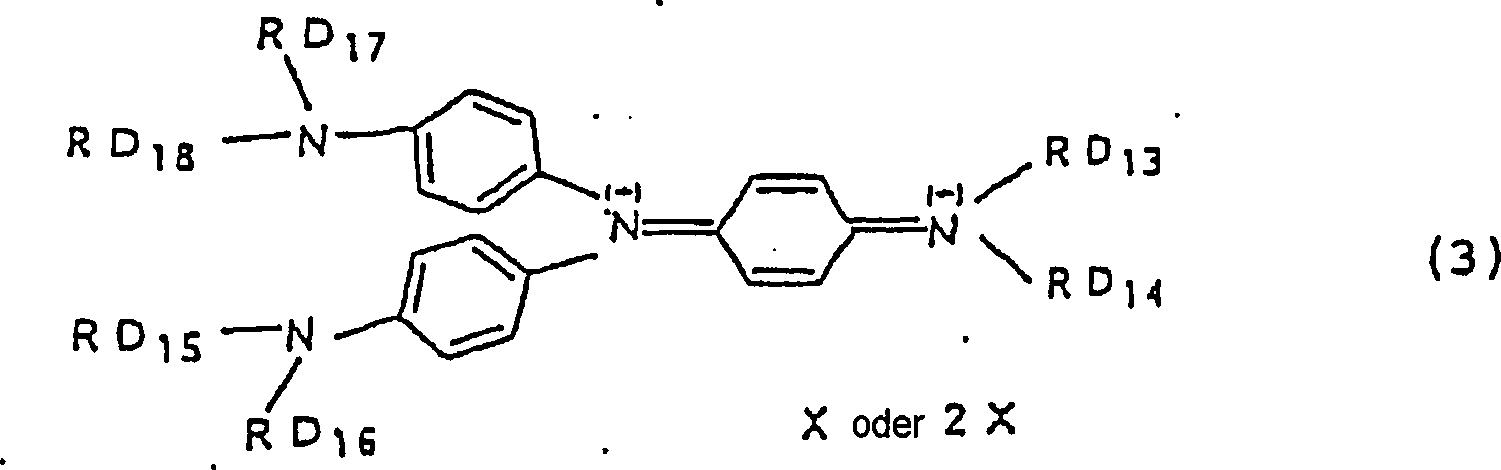

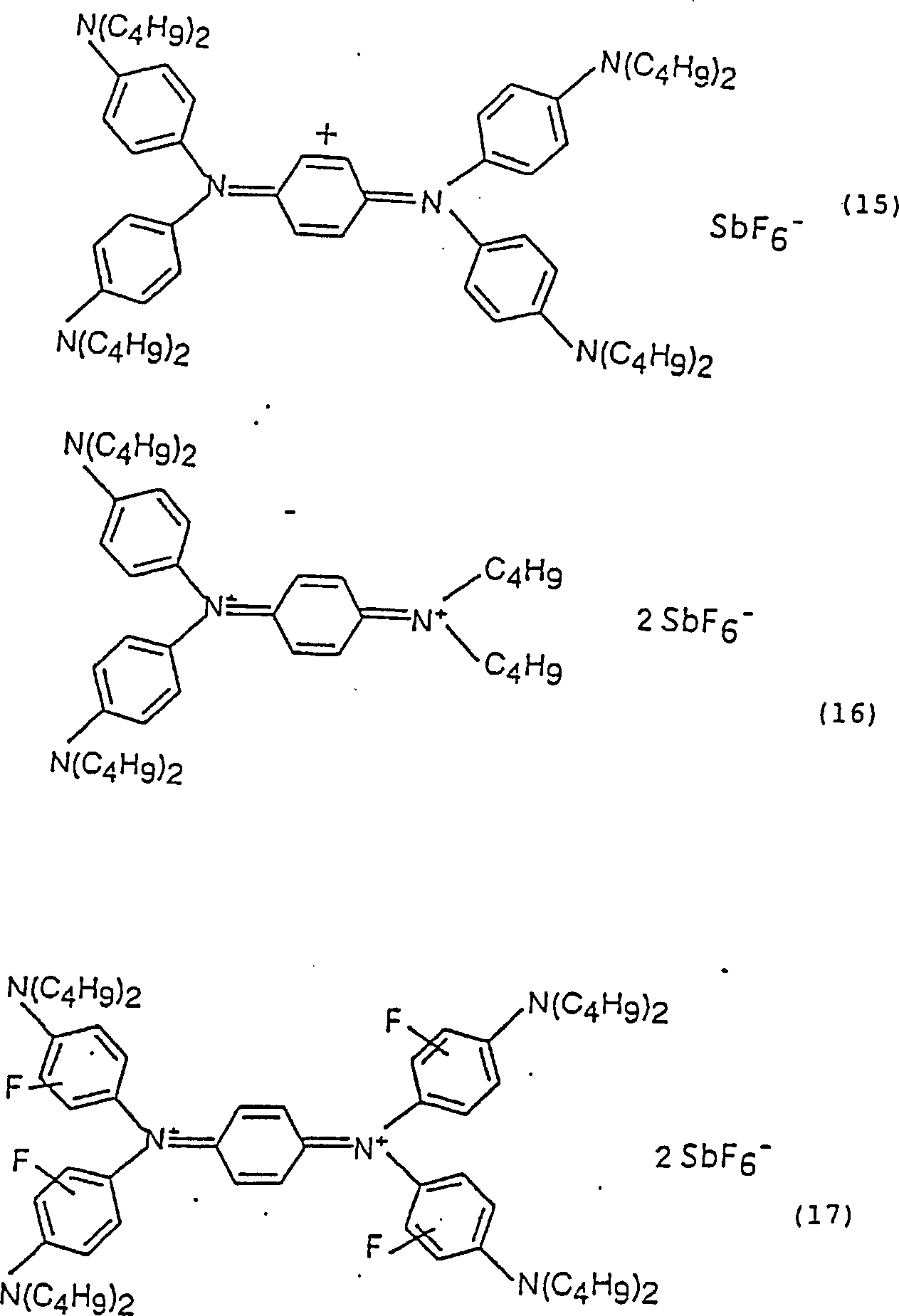
Die Farbstoffe absorbieren die Strahlung bei etwa 1000 nm stark. Da sie nicht nur Strahlung im nahen Infrarotbereich, die für Fernsteuerungen und dgl. verwendet werden, sondern auch für Computerkommunikationssysteme, die in der Zukunft in breitem Umfang verwendet werden, zu verwendende Strahlung filtern bzw. abschneiden, sind die Farbstoffe zur Verhinderung einer Fehlfunktion der Systeme wirksam. Bei Lamination mit einer netzförmigen oder geätzten, elektromagne tische Strahlung absorbierenden Schicht, die im folgenden detailliert beschrieben wird, zur Bildung mehrlagiger Panels ist die Farbstoffschicht stärker wirksam.The Dyes strongly absorb the radiation at about 1000 nm. There They not only radiation in the near infrared range, which for remote controls and the like, but also for computer communication systems, which will be widely used in the future Filter radiation or cut off, the dyes are to prevent a malfunction of the systems effective. When lamination with a reticular or etched, electromagnetic radiation absorbing layer, which is detailed below is described, to form multilayer panels is the dye layer stronger effective.
Die oben genannten zwei Arten von Farbstoffen (aromatische Dithiolmetallkomplexe und aromatische Diimmoniumverbindungen) sind besonders wirksam. Wenn die Farbstoffe dieser Arten die Fähigkeit zur Absorption von sichtbarer Strahlung aufweisen, können sie mit Farbtonkorrekturfarbstoffen zur Modulation des Farbtons der diese umfassenden Panels kombiniert werden. Als Farbstofftonkorrekturfarbstoffe für diesen Zweck werden wirksam Phthalocyaninfarbstoffe verwendet. Jeder beliebige Phthalocyaninfarbstoff ist hierin verwendbar, beispielsweise die in der Literatur: "Developments of Functional Dyes, and Market Trends" (von CMC) beschriebenen.The above two types of dyes (aromatic dithiol metal complexes and aromatic diimmonium compounds) are particularly effective. When the dyes of these species have the ability to absorb visible radiation, they can with hue correction dyes to modulate the hue of these comprehensive panels combined become. As dye tone correcting dyes for this purpose, they are effective Phthalocyanine dyes used. Any phthalocyanine dye is useful herein, for example, those in the literature: "Developments of Functional Dyes, and Market Trends "(by CMC) described.
Allgemein sind die oben genannten, im nahen Infrarotbereich absorbierenden aromatischen Diimmoniumfarbstoffe gegenüber Wärme instabil. Wenn daher die Farbstoffschicht durch Schmelzextrusion oder durch Polymerisation und anschließende Verfestigung gebildet wird, werden die Farbstoffe thermisch zersetzt, was dazu führt, dass das Absorptionsvermögen der Farbstoffschicht im nahen Infrarotbereich schlecht ist. Daher ist es, wenn die Farbstoffe in der absorbierenden Schicht verwendet werden, besonders günstig, wenn die farbstoffhaltige absorbierende Schicht in einem Gießverfahren gebildet wird.Generally are the above, absorbing in the near infrared range aromatic diimmonium dyes to heat unstable. If therefore the Dye layer by melt extrusion or by polymerization and subsequent Solidification is formed, the dyes are thermally decomposed what causes that the absorption capacity the dye layer in the near infrared region is poor. Therefore it is when the dyes are used in the absorbent layer be, especially cheap, when the dye-containing absorbent layer is in a casting process is formed.
Zur Herstellung des im nahen Infrarotbereich absorbierenden Panels der Erfindung müssen zuvor geformte Lagen oder Filme in einem beliebigen geeigneten Verfahren laminiert werden. Zur Lamination wird vorzugsweise ein kräftiger transparenter Polymerklebstoff verwendet. Der Polymerklebstoff dieses Typs umfasst beispielsweise Zweiflüssigkeitenepoxykleb stoffe, ungesättigte Polyesterklebstoffe, Urethanklebstoffe, Phenolharzklebstoffe, Vinylharzklebstoffe und Acrylklebstoffe.to Production of the near infrared absorbing panel of the Invention must previously formed sheets or films by any suitable method be laminated. For lamination is preferably a strong transparent Used polymer adhesive. The polymer adhesive of this type includes, for example Two-fluid epoxy adhesives, unsaturated Polyester adhesives, urethane adhesives, phenolic adhesives, vinyl resin adhesives and acrylic adhesives.
Das im nahen Infrarotbereich absorbierende Panel eines derartigen mehrlagigen Films oder einer entsprechenden Lage gemäß der Erfindung weist zusätzlich zu der oben angegebenen, im nahen Infrarotbereich absorbierenden Schicht mindestens eine von einer elektromagnetische Strahlung absorbierenden Schicht, einer Antireflexionsschicht und einer im Ultraviolettbereich absorbierenden Schicht auf. Die elektromagnetische Strahlung absorbierende Schicht ist ein transparenter leitender Film, wofür Polyesterfilme, Glasplatten, Acrylplatten oder Polycarbonatplatten, die mit einer dünnen Abscheidung von einem Metall, Metalloxid, Metallsalz oder dgl. beschichtet sind, bevorzugt sind. Leitende Filme mit einem geringeren spezifischen Flächenwiderstand können höheres Absorptionsvermögen für elektromagnetische Strahlung aufweisen, doch soll andererseits die Dicke der auf diesen zu bildenden Metallabscheidungsschicht größer sein, was dazu führt, dass die Lichtdurchlässigkeit derartiger dicker Filme verringert ist. Die Antireflexionsschicht soll Oberflächenreflexion auf dem Panel verhindern, während die Lichtdurchlässigkeit des Panels erhöht wird und ein "Spiegeln" des Panels verhindert wird.The In the near infrared absorbing panel of such a multilayer Films or a corresponding layer according to the invention has in addition to the above-mentioned, near infrared absorbing layer at least one of an electromagnetic radiation absorbing Layer, an antireflection layer and one in the ultraviolet range absorbing layer on. The electromagnetic radiation absorbing Layer is a transparent conductive film, for which polyester films, Glass plates, acrylic plates or polycarbonate plates, which come with a thin Deposition of a metal, metal oxide, metal salt or the like. Coated are, are preferred. Leading films with a lower specific sheet resistance can higher absorbance for electromagnetic Radiation, but on the other hand, the thickness of the on this be larger to be formed metal deposition layer, resulting in that the translucency such thicker films is reduced. The antireflection coating should surface reflection on prevent the panel while the translucency of the panel increased and prevents "mirroring" of the panel becomes.
In der vorliegenden Erfindung werden vorzugsweise Polyesterfilme, Glasplatten, Acrylplatten oder Polycarbonatplatten mit Metallabscheidung als elektromagnetische Strahlung absorbierende Schicht in dem Panel verwendet, wobei diese jedoch in keinster Weise beschränkend sind. Ein Film, der netzartig mit einem leitenden Material durch Siebdruck oder dgl. beschichtet wurde, kann ebenfalls als die elektromagnetische Strahlung absorbierende Schicht verwendet werden. Gegebenenfalls kann ein einziger Metallabschei dungsfilm, der sowohl als Antireflexionsschicht als auch als die elektromagnetische Strahlung absorbierende Schicht fungiert, verwendet werden. In diesem Fall ist der Metallabscheidungsfilm die äußerste Schicht des Panels. Die Funktion der Formerhaltungsschicht besteht darin, die Gesamtform des Panels beizubehalten, wobei die im nahen Infrarotbereich absorbierende Schicht geringe mechanische Festigkeit aufweist und kaum deren Form halten kann. Ferner bewirkt die Formerhaltungsschicht ferner eine Erhöhung der Wärmebeständigkeit des gesamten Panels und eine Erhöhung der Abriebbeständigkeit der Oberfläche des Panels. Ein beliebiges transparentes Harz oder Glas wird vorzugsweise als das Material für die Formerhaltungsschicht verwendet. Allgemein sind Polycarbonate, Polyacrylnitrile, Polymethylmethacrylate, Polystyrole und Polyester bevorzugt. Besonders bevorzugt sind Polycarbonate im Hinblick auf deren Wärmebeständigkeit und Polymethylmethacrylate im Hinblick auf deren Transparenz und Abriebbeständigkeit. Glas ist ebenfalls zum Erhöhen der mechanischen Festigkeit und der Wärmebeständigkeit des Panels bevorzugt.In The present invention preferably uses polyester films, glass plates, Acrylic plates or polycarbonate plates with metal deposition as electromagnetic radiation absorbing layer in the panel used, but these are in no way limiting. A film reticulated with a conductive material by screen printing or the like has been coated, may also be considered the electromagnetic Radiation absorbing layer can be used. Possibly can be a single Metallabschei tion film, both as an anti-reflection layer as well as the electromagnetic radiation absorbing layer functions to be used. In this case, the metal deposition film is the outermost layer of the panel. The function of the shape preservation layer is to to maintain the overall shape of the panel, taking the near infrared range absorbent layer has low mechanical strength and can hardly keep their shape. Further, the shape-retaining layer effects also an increase the heat resistance the entire panel and an increase the abrasion resistance the surface of the panel. Any transparent resin or glass is preferably as the material for the shape preservation layer is used. General are polycarbonates, Polyacrylonitriles, polymethyl methacrylates, polystyrenes and polyesters prefers. Particular preference is given to polycarbonates with regard to their heat resistance and polymethyl methacrylates in view of their transparency and Abrasion resistance. Glass is also to increase mechanical strength and heat resistance of the panel.
Als die oben angegebene, elektromagnetische Strahlung abschirmende transparente leitende Schicht ist eine sogenannte wärmereflektierende Glasplatte verwendbar, die durch Beschichten eines Glassubstrats mit drei oder mehreren Schichten von einem transparenten dielektrischen Film/dünnen Metallfilm/transparenten dielektrischen Film durch Gasphasenabscheidung hergestellt wurde. Die Glasplatte dieses Typs wird in weitem Umfang als Außenseite oder Fensterscheibe von Gebäuden und als Windschutzscheibe für Autos und Flugzeuge verwendet. Als hierbei zu verwendende transparente Dielektrika sind Titanoxid, Zirconiumdioxid, Hafniumoxid, Bismutoxid und dgl. bevorzugt. Als dünner Metallfilm sind Gold, Platin, Silber und Kupfer bevorzugt. Anstelle des dünnen Metallfilms werden ebenfalls bevorzugt Titannitrid, Zirconiumdioxidnitrid oder Hafniumnitrid verwendet.When the abovementioned, electromagnetic radiation shielding transparent conductive layer is a so-called heat-reflecting glass plate usable by coating a glass substrate with three or more multiple layers of a transparent dielectric film / thin metal film / transparent dielectric film was produced by vapor deposition. The glass plate of this type becomes widely used as the outside or windowpane of buildings and as a windshield for Cars and planes used. As transparent to be used here Dielectrics are titanium oxide, zirconium dioxide, hafnium oxide, bismuth oxide and the like. Preferred. Thinner Metal film, gold, platinum, silver and copper are preferred. Instead of of the thin one Metal films are also preferably titanium nitride, zirconia nitride or hafnium nitride.
Die elektromagnetische Strahlung abschirmende transparente leitende Schicht kann ferner mit einem transparenten leitenden Oxidfilm beschichtet werden. Als Oxid für den Film werden vorzugsweise fluordotiertes Zinnoxid, zinndotiertes Diindiumtrioxid, aluminiumdotiertes Zinkoxid und dgl. verwendet.The electromagnetic radiation shielding transparent conductive Layer may further be coated with a transparent conductive oxide film become. As oxide for The film is preferably fluorine-doped tin oxide, tin-doped Diindium trioxide, aluminum-doped zinc oxide and the like. Used.
Wenn die Metallabscheidungsschicht als elektromagnetische Strahlung abschirmende transparente leitende Schicht verwendet wird, muss sie mit einem hierfür geeigneten, im nahem Infrarot absorbierenden Film kombiniert werden. Beispielsweise absorbiert wärmereflektierendes Glas Strahlung mit einer Wellenlänge von länger als 1200 Nanometern. Daher sollen die Farbstoffe in dem mit der wärmereflektierenden Glasplatte zu kombinierenden, im nahen Infrarotbereich absorbierenden Film Strahlung absorbieren, die nicht in den Wellenlängenbereich der durch die wärmereflektierende Glasplatte zu absorbierenden Strahlung fällt. Es ist unnötig, zu sagen, dass wärmereflektierende Glasplatten in Abhängigkeit von den diese bildenden Materialien verschiedene Absorptionseigenschaften aufweisen. Daher muss der Film durch Steuerung der zu kombinierenden Farbstoffe und auch von deren Konzentration in dem im nahen Infrarotbereich absorbierenden Film so moduliert werden, dass er für die damit zu kombinierende Glasplatte geeignet ist. Für diesen Zweck werden die hierin im vorhergehenden genannten aromatischen Dithiolmetallkomplexe der Farbstoffe, vorzugsweise die aromatischen Dithiolnickelkomplexe, noch besser Nickel-bis-1,2-diphenyl-1,2-ethen-dithiolat oder dessen Derivat, in dem der Wasserstoff des Benzolrings mit einem Fluoratom oder einer Methylgruppe substituiert ist, verwendet. Zur weiteren Modulation des Farbtons der farbstoffhaltigen Schicht kann ein Phthalocyaninfarbstoff hinzugefügt werden.When the metal deposition layer is used as the electromagnetic radiation shielding transparent conductive layer, it must be combined with a near infrared absorbing film suitable therefor. For example, heat-reflecting glass absorbs radiation having a wavelength longer than 1200 nanometers. Therefore, in the near infrared absorbing film to be combined with the heat-reflecting glass plate, the dyes are intended to absorb radiation which does not fall within the wavelength range of the radiation to be absorbed by the heat-reflecting glass plate. It is needless to say that heat-reflecting glass plates have different absorption properties depending on the materials forming them. Therefore, by controlling the dyes to be combined and also their concentration in the near infrared absorbing film, the film must be modulated so as to be suitable for the glass plate to be combined therewith. For this purpose, the hereinbefore mentioned aromatic dithiol metal complexes of the dyes, preferably the aromatic dithiol nickel complexes, more preferably nickel bis-1,2-diphenyl-1,2-ethenedithethiolate or its derivative in which the hydrogen of the benzene ring is substituted with a fluorine atom or a methyl group is used. To further modulate the hue of the dye-containing layer, a phthalocyanine dye may be added.
Wenn die elektromagnetische Strahlung abschirmende leitende Schicht Reflexionsvermögen im nahen Infrarotbereich aufweist und sie mit einem im nahen Infrarotbereich absorbierenden Film der Erfindung kombiniert wird, der in einem transparenten Polymerharz a Gew.-%, bezogen auf das Harz, an einem Dithiolmetallkomplex, b Gew.-% an einem Phthalocyaninfarbstoff, c Gew.-% an einem Diimmoniumfarbstoff und d Gew.-% an einem Aminiumfarbstoff enthält, betragen die Bereiche, in denen die Farbstoffe effektiv wirken, 0,1 ≤ a ≤ 5,0, 0,01 ≤ b ≤ 2,0, 0,1 ≤ c ≤ 3,0 und 0,01 ≤ d ≤ 1,0, vorzugsweise 0,5 ≤ a ≤ 2,5, 0,01 ≤ b ≤ 2,0, 0,2 ≤ c ≤ 1,0 und 0,1 ≤ d ≤ 0,5. Insbesondere werden die Farbstoffe, die in der absorbierenden Schicht zu verwenden sind, vorzugsweise so formuliert, dass sie die Bedingung 0,81 ≤ a + b + c + d ≤ 6,0 erfüllen. Das Harzgemisch, das die oben angegebenen Farbstoffe umfasst, wird durch Gießen, Beschichten, Schmelzextrusion oder Polymerisation lagenförmig zu einem Film der absorbierenden Schicht ausgebildet. Bei dem Polymerisationsverfahren werden die Farbstoffe zu den zu polymerisierenden Monomeren gegeben. Wenn die Farbstoffe jedoch unter der Bedingung a + b + c + d < 0,81 formuliert werden und das diese umfassende Harzgemisch lagenförmig zu einem Film ausgebildet wird, weist der gebildete Film schlechtes Absorptionsvermögen im nahen Infrarotbereich auf, obwohl er einen hohen Grad der Durchlässigkeit für sichtbare Strahlung aufweisen kann. Der Film ist, auch wenn er in Strahlung im nahen Infrarotbereich abschirmenden Filtern verwendet wird, nicht mehr wirksam und ungünstig. Wenn andererseits die Farbstoffe unter der Bedingung a + b + c + d > 6,0 formuliert werden und das diese umfassende Harzgemisch lagenförmig zu einem Film ausgebildet wird, weist der gebildete Film einen geringen Grad der Durchlässigkeit für sichtbare Strahlung auf, obwohl er gutes Absorptionsvermö gen im nahen Infrarotbereich aufweisen kann. Der Film ist in optischen Filtern nutzlos. Im Hinblick auf diese Materialien ist eine bevorzugte Ausführungsform im im folgenden genannten Beispiel 24 angegeben und eine nicht-bevorzugte Ausführungsform in Vergleichsbeispiel 1 angegeben.If the electromagnetic radiation shielding conductive layer reflectivity in the near Infrared area and they have one in the near infrared absorbing film of the invention is combined in one transparent polymer resin a wt .-%, based on the resin, on a Dithiol metal complex, b% by weight of a phthalocyanine dye, c% by weight of a diimmonium dye and d% by weight of an aminium dye contains are the areas where the dyes are effective, 0.1 ≤ a ≤ 5.0, 0.01 ≤ b ≤ 2.0, 0.1 ≤ c ≤ 3.0 and 0.01 ≤ d ≤ 1.0, preferably 0.5 ≤ a ≤ 2.5, 0.01 ≤ b ≤ 2.0, 0.2 ≤ c ≤ 1.0 and 0.1 ≤ d ≤ 0.5. Especially become the dyes to be used in the absorbent layer preferably formulated to satisfy the condition 0.81 ≤ a + b + c + d ≤ 6.0 fulfill. The resin mixture comprising the above-mentioned dyes becomes by pouring, Coating, melt extrusion or polymerization layered too formed a film of the absorbent layer. In the polymerization process the dyes are added to the monomers to be polymerized. However, when the dyes are formulated under the condition a + b + c + d <0.81 are and this comprehensive resin mixture layered a film is formed, the film formed has bad absorbance in the near infrared range, although it has a high degree of permeability for visible Radiation may have. The movie is, even if it is in radiation in the near infrared range shielding filters is not used more effective and unfavorable. On the other hand, if the dyes under the condition a + b + c + d> 6.0 and that this composite resin was formed into a film in a sheet shape is, the formed film has a low degree of permeability for visible Radiation, although he has good absorption in the near infrared range can have. The movie is useless in optical filters. In terms of to these materials is a preferred embodiment in the following Example 24 mentioned above and a non-preferred embodiment in Comparative Example 1.
Wenn die elektromagnetische Strahlung abschirmende transparente leitende Schicht eine des Netztyps, beispielsweise die oben genannte, ist und wenn sie mit einem im nahen Infrarotbereich absorbierenden Film der Erfindung kombiniert wird, muss die Absorption der in einen geplanten Wellenlängenbereich fallenden Strahlung nur durch die in dem absorbierenden Film existierenden Farbstoffe erreicht werden, da die Schicht des Netztyps kein Absorptionsvermögen im nahen Infrarotbereich aufweist. Das gleiche gilt für die Schicht, die kein Abschirmvermögen für elektromagnetische Strahlung aufweist. Als Farbstoffe für diesen Zweck ist ein Gemisch aus einer aromatischen Diimmoniumverbindung und einem aromatischen Dithiolmetallkomplex bevorzugt. Wie im obigen ist der aromatische Dithiolmetallkomplex vorzugsweise ein aromatischer Dithiolnickelkomplex, noch besser Nickel-bis-1,2-diphenyl-1,2-ethen-dithiolat oder dessen Derivat, in dem der Wasserstoff des Benzolrings mit einem Fluoratom oder einer Methylgruppe substituiert ist. In der aromatischen Diimmoniumverbindung ist das Gegenion vorzugsweise ein Hexafluorantimonat-, Hexafluorarsenat-, Perchlorat- oder Tetrafluorboration. Falls gewünscht, kann ein Phthalocyaninfarbstoff dem Farbstoffgemisch zur Farbmodulation zugesetzt werden.If the electromagnetic radiation shielding transparent conductive Layer is one of the network type, for example, the above and when using a near infrared absorbing film Combined with the invention, the absorption of the in one planned wavelength range falling radiation only through those existing in the absorbent film Dyes can be achieved because the layer of the network type no absorption capacity in the near Has infrared range. The same applies to the layer that has no shielding for electromagnetic Having radiation. As dyes for this purpose is a mixture from an aromatic diimmonium compound and an aromatic Dithiolmetal complex preferred. As in the above, the aromatic Dithiol metal complex, preferably an aromatic dithiol nickel complex, even better, nickel-bis-1,2-diphenyl-1,2-ethenedithethiolate or its Derivative in which the hydrogen of the benzene ring with a fluorine atom or a methyl group. In the aromatic diimmonium compound the counterion is preferably a hexafluoroantimonate, hexafluoroarsenate, Perchlorate or tetrafluoroborate ion. If desired, a phthalocyanine dye be added to the dye mixture for color modulation.
Wenn die elektromagnetische Strahlung abschirmende leitende Schicht kein Reflexionsvermögen im nahen Infrarotbereich aufweist und wenn sie mit einem im nahen Infrarotbereich absorbierenden Material gemäß der Erfindung kombiniert wird, das in einem transparenten Polymerharz a Gew.-%, be zogen auf das Harz, an einem Dithiolmetallkomplex, b Gew.-% an einem Phthalocyaninfarbstoff, c Gew.-% an einem Diimmoniumfarbstoff und d Gew.-% an einem Aminiumfarbstoff wie im obigen enthält, betragen die bevorzugten Bereiche für die Farbstoffe 0,1 ≤ a ≤ 3,0, 0,01 ≤ b ≤ 2,0 und 0,1 < c ≤ 5,0 noch besser 0,5 ≤ a ≤ 2,0, 0,01 ≤ b ≤ 1,0 und 1,0 ≤ c 3,0. Insbesondere werden die Farbstoffe, die in der absorbierenden Schicht zu verwenden sind, vorzugsweise so formuliert, dass sie die Bedingung 1,6 ≤ a + b + c ≤ 6,0 erfüllen. Das Harzgemisch, das die oben angegebenen Farbstoffe umfasst, wird durch Gießen, Beschichten, Schmelzextrusion oder Polymerisation lagenförmig zu einem Film der absorbierenden Schicht ausgebildet. Bei dem Polymerisationsverfahren werden die Farbstoffe zu den zu polymerisierenden Monomeren gegeben. Wenn die Farbstoffe jedoch unter der Bedingung a + b + c + d < 1,6 formuliert werden, was die oben angegebene Bedingung nicht erfüllt, und das diese umfassende Harzgemisch lagenförmig zu einem Film ausgebildet wird, weist der gebildete Film schlechtes Absorptionsvermögen im nahen Infrarotbereich auf, obwohl er einen hohen Grad der Durchlässigkeit für sichtbare Strahlung aufweisen kann. Der Film ist, auch wenn er in Strahlung im nahen Infrarotbereich abschirmenden Filtern verwendet wird, nicht mehr wirksam und ungünstig. Andererseits weist, wenn die Farbstoffe unter der Bedingung a + b + c > 6,0 formuliert werden und das diese umfassende Harzgemisch lagenförmig zu einem Film ausgebildet wird, der gebildete Film einen geringen Grad der Durchlässigkeit für sichtbare Strahlung auf, obwohl er gutes Absorptionsvermögen im nahen Infrarotbereich aufweisen kann. Der Film ist in optischen Filtern nutzlos. Im Hinblick auf diese Angelegenheit ist eine bevorzugte Ausführungsform im im folgenden genannten Beispiel 25 angegeben und eine nicht-bevorzugte Ausführungsform in Vergleichsbeispiel 3 angegeben.When the electromagnetic radiation shielding conductive layer has no near infrared reflectivity and when combined with a near infrared absorbing material according to the invention containing, in a transparent polymer resin, a weight% of the resin on a dithiolmetal complex, b wt% of a phthalocyanine dye, c wt% of a diimmonium dye and d wt% of an aminium dye as in the above, the preferred ranges for the dyes are 0.1 ≤ a ≤ 3.0, 0, 01 ≦ b ≦ 2.0 and 0.1 <c ≦ 5.0 still more preferably 0.5 ≦ a ≦ 2.0, 0.01 ≦ b ≦ 1.0 and 1.0 ≦ c 3.0. In particular, the dyes to be used in the absorbing layer are preferably formulated to satisfy the condition 1.6 ≦ a + b + c ≦ 6.0. The resin composition comprising the above-mentioned dyes is formed into a film of the absorbent layer by casting, coating, melt extrusion or polymerization. In the polymerization process, the dyes are added to the monomers to be polymerized. However, when the dyes are formulated under the condition of a + b + c + d <1.6, which does not satisfy the above condition, and the resin composition comprising them is formed into a film in a sheet form, the formed film has poor near infrared absorbance although it may have a high degree of visible radiation transmission. The film, even when used in near-infrared radiation shielding filters, is no longer effective and inconvenient. On the other hand, when the dyes are formulated under the condition of a + b + c> 6.0 and the resin composition comprising them is formed into a film in a sheet form, the formed film has a small degree of visible ray transmittance. although it may have good near infrared absorbance. The movie is useless in optical filters. In view of this matter, a preferred embodiment is given in Example 25 below, and a non-preferred embodiment is given in Comparative Example 3.
Ausführungsformen
der vorliegenden Erfindung werden konkret unter Bezug auf
In
Wie erläutert ist, werden eine Mehrzahl von Schichten mit verschiedenen Eigenschaften auf verschiedene Weisen, die im folgenden genannt sind, laminiert, wobei verschiedene mehrlagige Strukturen typischer Ausführungsformen der Erfindung gebildet werden. Jedoch ist die Erfindung in keinster Weise auf die erläuterten beschränkt, sondern sie umfasst jede beliebige Kombination, die unverzichtbar die im nahen Infrarotbereich absorbierende Schicht enthält.As explained is, are a plurality of layers with different properties laminated in various ways, which are mentioned below, wherein various multilayer structures of typical embodiments of the invention are formed. However, the invention is in None Way to the explained limited, but it includes any combination that is indispensable contains the near infrared absorbing layer.
Die Vorteile und die Neuheit der Erfindung werden konkret unter Bezug auf die im folgenden angegebenen Beispiele beschrieben.The Advantages and novelty of the invention will be concretely referred to to the examples given below.
In den Beispielen werden das Absorptionsvermögen im nahen Infrarotbereich, die Durchlässigkeit für sichtbare Strahlung und der Farbton jeder hergestellten Probe nach den im folgenden angegebenen Verfahren ermittelt und beurteilt.In the examples are the absorbance in the near infrared, the permeability for visible Radiation and the color of each sample prepared according to the identified and assessed according to the following methods.
(1) Absorptionsvermögen im nahen Infrarotbereich:(1) Absorptive power in the near infrared region:
Von jedem in dem Beispielen hergestellten Panel wurde die Lichtdurchlässigkeit für den Wellenlängenbereich, der zwischen 900 nm und 1200 nm fällt, unter Verwendung eines Spektrophotometers (Best-570, hergestellt von Nippon Bunko KK) ermittelt und der Mittelwert T % erhalten. Daraus wurde der Abschneideprozentsatz im nahen Infrarotbereich (%) jedes Panels erhalten, der durch (100 – T) dargestellt wird. Jedes Panel wird auf der Basis des auf diese Weise erhaltenen Prozentsatzes beurteilt.From Each panel prepared in the Examples became light transmissive for the Wavelength range, which falls between 900 nm and 1200 nm, using a Spectrophotometer (Best-570, manufactured by Nippon Bunko KK) and get the mean T%. This became the cut-off percentage in the near infrared range (%) of each panel represented by (100 - T) becomes. Each panel will be based on the obtained in this way Percentage assessed.
(2) Durchlässigkeit für sichtbare Strahlung:(2) Transmittance of visible radiation:
Unter Verwendung des gleichen Spektrophotometers wie in (1) wurde die mittlere Lichtdurchlässigkeit Tv % für den Wellenlängenbereich, der zwischen 450 nm und 700 nm fällt, ermittelt, was die Durchlässigkeit jedes Panels für sichtbares Licht anzeigt.Using the same spectrophotometer as in (1), the average transmittance Tv% for the wavelength range falling between 450 nm and 700 nm was determined, which was the transmittance each visible light panel.
Beispiel 1:Example 1:
Die Ausgangsverbindungen von 0,4 mol Dimethylterephthalat (DMT), 0,88 mol Ethylenglykol (EG) und 0,28 mol 9,9-Bis(4-(2-hydroxyethoxy)phenyl)fluoren (BPEF) wurden durch übliche Schmelzpolymerisation polymerisiert, wobei ein Fluorencopolyester (DM/BPEF = 3/7, bezogen auf mol) erhalten wurde. Der Copolyester wies eine Grenzviskosität [η] von 0,42, ein Molekulargewicht Mw von 45 000 und einen Glasübergangspunkt Tg von 140 °C auf.The Starting compounds of 0.4 mol dimethyl terephthalate (DMT), 0.88 mol of ethylene glycol (EG) and 0.28 mol of 9,9-bis (4- (2-hydroxyethoxy) phenyl) fluorene (BPEF) were by usual Polymerized melt polymerization, wherein a Fluorencopolyester (DM / BPEF = 3/7, based on mol). The copolyester had an intrinsic viscosity [η] of 0.42, a molecular weight Mw of 45,000 and a glass transition point Tg of 140 ° C on.
Nickel-bis-1,2-diphenyl-1,2-ethen-dithiolat wurde nach einem bekannten Verfahren hergestellt (Harry B. Gray et al., J. Am. Chem. Soc., Band 88, S. 43-50, S. 4870-4875, 1966) und durch Umkristallisation gereinigt, wobei es eine Reinheit von nicht weniger als 99 % aufwies.Nickel-bis-1,2-diphenyl-1,2-ethene-dithiolate was prepared by a known method (Harry B. Gray et al., J. Am. Chem. Soc., Vol. 88, pp. 43-50, pp. 4870-4875, 1966) and purified by recrystallization, giving a purity of not less than 99%.
Der Fluorencopolyester wurde in Methylenchlorid zusammen mit 0,038 Gew.-%, bezogen auf den Copolyester, an Nickel-bis-1,2-diphenyl-1,2-ethen-dithiolat, 0,005 Gew.-% an einem Phthalocyaninfarbstoff (EX Color 801K, hergestellt von Nippon Shokubai) und 0,005 Gew.-% an einem Phthalocyaninfarbstoff (EX Color 802K, hergestellt von Nippon Shokubai) dispergiert und gelöst und die erhaltene Farbstoffdispersion wurde gegossen, wobei ein Film mit einer Dicke von 150 μm erhalten wurde.Of the Fluorencopolyester was in methylene chloride together with 0.038 wt .-%, based on the copolyester, on nickel bis-1,2-diphenyl-1,2-ethenedithethiolate, 0.005 wt .-% of a phthalocyanine dye (EX Color 801K, prepared by Nippon Shokubai) and 0.005 wt% of a phthalocyanine dye (EX Color 802K, manufactured by Nippon Shokubai) dispersed and solved and the resulting dye dispersion was poured, with a Film with a thickness of 150 μm was obtained.
Beispiel 2:Example 2:
Unter
Verwendung eines Epoxyklebstoffs wurde der im Beispiel 1 ausgebildete
Film zwischen 1 mm dicken Polymethylmethacrylatsubstraten, deren
eine Oberfläche
mit einem Film einer Dicke von 100 μm laminiert war, die durch Abscheidung
einer im nahen Infrarotbereich absorbierenden und elektromagnetische Strahlung
absorbierenden Schicht eines Silberkomplexes [ITO/(Silber + Platin)/ITO – dies gibt
eine Struktur von (Silber + Platin), die zwischen ITO (Indiumzinnoxid)
sandwichartig eingefügt
sind, an] auf einem transparenten Polyester hergestellt worden war,
sandwichartig eingefügt.
Auf diese Weise wurde ein im nahen Infrarotbereich absorbierendes
Panel mit der Struktur von
Beispiel 3:Example 3:
Gemäß Beispiel
1, wobei jedoch Triacetylcellulose (LT-35, hergestellt von Daicel
Chemical) als das Gießpolymer
verwendet wurde, wurde ein im nahen Infrarotbereich absorbierendes
Panel mit der Struktur von
Beispiel 4:Example 4:
0,005 Gew.-% an Nickel-bis-1,2-diphenyl-1,2-ethen-dithiolat, 0,001 Gew.-% an einem Phthalocyaninfarbstoff (EX Color 801K, hergestellt von Nippon Shokubai) und 0,001 Gew.-% an einem Phthalocyaninfarbstoff (EX Color 802K, hergestellt von Nippon Shokubai) wurden in Polymethylmethacrylat dispergiert und schichtförmig zu einem Film mit einer Dicke von 2 mm durch Schmelzextrusion ausgebildet.0.005 Wt% of nickel bis-1,2-diphenyl-1,2-ethenedithiolate, 0.001 wt% on a phthalocyanine dye (EX Color 801K, manufactured by Nippon Shokubai) and 0.001% by weight of a phthalocyanine dye (EX Color 802K, made by Nippon Shokubai) were in polymethylmethacrylate dispersed and layered formed into a film having a thickness of 2 mm by melt extrusion.
Eine
Oberfläche
dieses Films wurde mit einem Film (Dicke 100 μm), der durch Abscheidung einer
im nahen Infrarotbereich absorbierenden und elektromagnetische Strahlung
absorbierenden Schicht eines Silberkomplexes [ITO/(Silber + Platin)/ITO]
auf einem transparenten Polyester hergestellt worden war, laminiert.
Auf diese Weise wurde ein im nahen Infrarotbereich absorbierendes
Panel mit der Struktur von
Beispiel 5:Example 5:
0,005 Gew.-% an Nickel-bis-1,2-diphenyl-1,2-ethen-dithiolat, 0,02 Gew.-% an einem Aminiumfarbstoff der Formel (16), 0,01 Gew.-% an einem Phthalocyaninfarbstoff (EX Color 801K, hergestellt von Nippon Shokubai) und 0,01 Gew.-% an einem Phthalocyaninfarbstoff (EX Color 802K, hergestellt von Nippon Shokubai) wurden in Polymethylmethacrylat dispergiert und schichtförmig zu einem Film mit einer Dicke von 2 mm durch Schmelzextrusion ausgebildet.0.005% by weight of nickel bis-1,2-diphenyl-1,2-ethenedithothiolate, 0.02% by weight of an aminium dye of the formula (16), 0.01% by weight of a phthalocyanine dye (EX Color 801K, manufactured by Nippon Shokubai) and 0.01% by weight of a phthalocyanine dye (EX Color 802K, manufactured by Nippon Shokubai) were dispersed in polymethyl methacrylate and formed into a film having a thickness of 2 mm by melt extrusion.
Der
auf diese Weise hergestellte Film und ein Film (Dicke 100 μm), der durch
Abscheidung einer im nahen Infrarotbereich absorbierenden und elektromagnetische
Strahlung absorbierenden Schicht eines Silberkomplexes [ITO/(Silber
+ Platin)/ITO] auf einem transparenten Polyester hergestellt worden
war, wurden auf einer Formerhaltungsschicht laminiert. Auf diese
Weise wurde ein im nahen Infrarotbereich absorbierendes Panel mit
der Struktur von
Beispiel 6:Example 6:
0,005 Gew.-% an einem Diimmoniumfarbstoff der Formel (13) und 0,001 Gew.-% an einem Phthalocyaninfarbstoff (EX Color 803K, hergestellt von Nippon Shokubai) wurden in Polymethylmethacrylat dispergiert und lagenförmig zu einem Film mit einer Dicke von 2 mm durch Schmelzextrusion ausgebildet.0.005 % By weight of a diimmonium dye of the formula (13) and 0.001% by weight on a phthalocyanine dye (EX Color 803K, manufactured by Nippon Shokubai) were dispersed in polymethylmethacrylate and situation like formed into a film having a thickness of 2 mm by melt extrusion.
Der
auf diese Weise hergestellte Film und ein Film (Dicke 100 μm), der durch
Abscheidung einer elektromagnetische Strahlung abschirmenden Schicht
aus einem Silberkomplex [(Gold + Silber)/ITO – dies gibt eine aus ITO und
(Silber + Platin) bestehende Struktur an] auf einem transparenten
Polyester hergestellt worden war, wurden auf einer Formerhaltungsschicht
laminiert. Auf diese Weise wurde ein im nahen Infrarotbereich absorbierendes
Panel mit der Struktur von
Beispiel 7:Example 7:
Der in Beispiel 1 hergestellt Fluorencopolyester wurde mit 0,1 Gew.-%, bezogen auf den Copolyester, an einem Diimmoniumverbindungsfarbstoff der Formel (13), 0,05 Gew.-% an Nickel-bis-1,2-diphenyl-1,2-ethen-dithiolat und 0,03 Gew.-% an einem Phthalocyaninfarbstoff (EX Color 803K, hergestellt von Nippon Shokubai) in Chloroform gemischt und das erhaltene Gemisch wurde bei Raumtemperatur getrocknet und dann bei 70 °C getrocknet, wobei ein Film mit einer Dicke von 150 μm erhalten wurde.Of the Fluorene copolyester prepared in Example 1 was 0.1 wt.%, based on the copolyester, on a diimmonium compound dye of the formula (13), 0.05% by weight of nickel bis-1,2-diphenyl-1,2-ethenedithethiolate and 0.03% by weight of a phthalocyanine dye (EX Color 803K, manufactured by Nippon Shokubai) in chloroform and the The mixture obtained was dried at room temperature and then at Dried at 70 ° C, whereby a film having a thickness of 150 μm was obtained.
Ein
elektromagnetische Strahlung abschirmender Film einer Dicke von
200 μm,
der durch Abscheidung eines Silberkomplexes [(Gold + Silber)/ITO]
auf einem Polyesterfilm hergestellt worden war, ein "Nichtspiegelungs"- und Antireflexionsfilm
und der hierin hergestellte, im nahen Infrarotbereich absorbierende
Film wurden auf einer Acrylplatte mit einer Dicke von 3 mm laminiert,
wobei ein im nahen Infrarotbereich absorbierendes Panel mit der
Struktur von
Beispiel 8:Example 8:
Gemäß Beispiel 7, wobei jedoch 0,1 Gew.-%, bezogen auf den in Beispiel 1 erhaltenen Fluorencopolyester, an einem Diimmoniumverbindungsfarbstoff der Formel (13), 0,05 Gew.-% an Nickel-bis-1,2-diphenyl-1,2-ethen-dithiolat und 0,05 Gew.-% an einem Phthalocyaninfarbstoff (EX Color 803K, hergestellt von Nippon Shokubai) verwendet wurden, wurde ein im nahen Infrarotbereich absorbierendes Panel hergestellt und dessen Eigenschaften beurteilt. Der Abschneideprozentsatz dieses Panels im nahen Infrarotbereich betrug 95 % und die Durchlässigkeit desselben für sichtbare Strahlung betrug 62 %. Das Panel war gut.According to example 7, but 0.1 wt .-%, based on the obtained in Example 1 Fluorencopolyester, on a Diimmoniumverbindungsfarbstoff the Formula (13), 0.05% by weight of nickel bis-1,2-diphenyl-1,2-ethenedithethiolate and 0.05% by weight of a phthalocyanine dye (EX Color 803K, made by Nippon Shokubai) was used in the near-infrared-absorbing panel produced and its Properties assessed. The cutoff percentage of this panel in the near infrared range was 95% and the transmittance same for visible radiation was 62%. The panel was good.
Beispiel 9:Example 9:
Gemäß Beispiel 7, wobei jedoch 0,15 Gew.-%, bezogen auf den in Beispiel 1 erhaltenen Fluorencopolyester, an einem Diimmoniumverbindungsfarbstoff der Formel (13), 0,05 Gew.-% an Nickel-bis-1,2-diphenyl-1,2-ethen-dithiolat und 0,03 Gew.-% an einem Phthalocyaninfarbstoff (EX Color 803K, hergestellt von Nippon Shokubai) verwendet wurden, wurde ein im nahen Infrarotbereich absorbierendes Panel hergestellt und dessen Eigenschaften beurteilt. Der Abschneideprozentsatz dieses Panels im nahen Infrarotbereich betrug 97 % und die Durchlässigkeit desselben für sichtbare Strahlung betrug 60 %. Das Panel war gut.According to example 7, but 0.15 wt .-%, based on the obtained in Example 1 Fluorencopolyester, on a Diimmoniumverbindungsfarbstoff the Formula (13), 0.05% by weight of nickel bis-1,2-diphenyl-1,2-ethenedithethiolate and 0.03% by weight of a phthalocyanine dye (EX Color 803K, made by Nippon Shokubai) was used in the near-infrared-absorbing panel produced and its Properties assessed. The cutoff percentage of this panel in the near infrared was 97% and the transmittance same for visible radiation was 60%. The panel was good.
Beispiel 10:Example 10:
Gemäß Beispiel 7, wobei jedoch 0,15 Gew.-%, bezogen auf den in Beispiel 1 erhaltenen Fluorencopolyester, an einem Diimmoniumverbindungsfarbstoff der Formel (13) und 0,05 Gew.-% an einem Phthalocyaninfarbstoff (EX Color 803K, hergestellt von Nippon Shokubai) verwendet wurden, wurde ein im nahen Infrarotbereich absorbierendes Panel hergestellt und dessen Eigenschaften beurteilt. Der Abschneideprozentsatz dieses Panels im nahen Infrarotbereich betrug 97 % und die Durchlässigkeit desselben für sichtbare Strahlung betrug 60 %. Das Panel war gut.According to example 7, but 0.15 wt .-%, based on the obtained in Example 1 Fluorencopolyester, on a Diimmoniumverbindungsfarbstoff the Formula (13) and 0.05% by weight on a phthalocyanine dye (EX Color 803K, manufactured by Nippon Shokubai) became one in the near infrared range produced absorbent panel and assessed its properties. The cutoff percentage of this panel in the near infrared range was 97% and the permeability same for visible radiation was 60%. The panel was good.
Beispiel 11:Example 11:
Gemäß Beispiel 7, wobei jedoch Triacetylcellulose als das Gießpolymer verwendet wurde und 0,1 Gew.-%, bezogen auf Triacetylcellulose, an einem Diimmoniumverbindungsfarbstoff der Formel (13), 0,05 Gew.-% an Nickel-bis-1,2-diphenyl-1,2-ethen-dithiolat und 0,03 Gew.-% an einem Phthalocyaninfarbstoff (EX Color 803K, hergestellt von Nippon Shokubai) verwendet wurden, wurde ein im nahen Infrarotbereich absorbierendes Panel hergestellt und dessen Eigenschaften beurteilt. Der Abschneideprozentsatz dieses Panels im nahen Infrarotbereich betrug 97 % und die Durchlässigkeit desselben für sichtbare Strahlung betrug 63 %. Das Panel war gut.According to example 7, however, triacetyl cellulose was used as the casting polymer and 0.1% by weight, based on triacetylcellulose, of a diimmonium compound dye of the formula (13), 0.05% by weight of nickel bis-1,2-diphenyl-1,2-ethenedithethiolate and 0.03% by weight of a phthalocyanine dye (EX Color 803K, made by Nippon Shokubai) was used in the near-infrared-absorbing panel produced and its Properties assessed. The cutoff percentage of this panel in the near infrared was 97% and the transmittance same for visible radiation was 63%. The panel was good.
Beispiel 12:Example 12:
Gemäß Beispiel 7, wobei jedoch Triacetylcellulose als das Gießpolymer verwendet wurde und 0,1 Gew.-%, bezogen auf Triacetylcellulose, an einem Diimmoniumverbindungsfarbstoff der Formel (13), 0,05 Gew.-% an Nickel-bis-1,2-diphenyl-1,2-ethen-dithiolat und 0,05 Gew.-% an einem Phthalocyaninfarbstoff (EX Color 803K, hergestellt von Nippon Shokubai) verwendet wurden, wurde ein im nahen Infrarotbereich absorbierendes Panel hergestellt und dessen Eigenschaften beurteilt. Der Abschneideprozentsatz dieses Panels im nahen Infrarotbereich betrug 97 % und die Durchlässigkeit desselben für sichtbare Strahlung betrug 60 %. Das Panel war gut.According to example 7, however, triacetyl cellulose was used as the casting polymer and 0.1% by weight, based on triacetylcellulose, of a diimmonium compound dye of the formula (13), 0.05% by weight of nickel bis-1,2-diphenyl-1,2-ethenedithethiolate and 0.05% by weight of a phthalocyanine dye (EX Color 803K, made by Nippon Shokubai) was used in the near-infrared-absorbing panel produced and its Properties assessed. The cutoff percentage of this panel in the near infrared was 97% and the transmittance same for visible radiation was 60%. The panel was good.
Beispiel 13:Example 13:
Gemäß Beispiel 7, wobei jedoch Triacetylcellulose als das Gießpolymer verwendet wurde und 0,15 Gew.-%, bezogen auf Triacetylcellulose, an einem Diimmoniumverbindungsfarbstoff der Formel (13), 0,05 Gew.-% an Nickel-bis-1,2-diphenyl-1,2-ethen-dithiolat und 0,03 Gew.-% an einem Phthalocyaninfarbstoff (EX Color 803K, hergestellt von Nippon Shokubai) verwendet wurden, wurde ein im nahen Infrarotbereich absorbierendes Panel hergestellt und dessen Eigenschaften beurteilt. Der Abschneideprozentsatz dieses Panels im nahen Infrarotbereich betrug 97 % und die Durchlässigkeit desselben für sichtbare Strahlung betrug 63 %. Das Panel war gut.According to example 7, however, triacetyl cellulose was used as the casting polymer and 0.15% by weight, based on triacetylcellulose, of a diimmonium compound dye of the formula (13), 0.05% by weight of nickel bis-1,2-diphenyl-1,2-ethenedithethiolate and 0.03% by weight of a phthalocyanine dye (EX Color 803K, made by Nippon Shokubai) was used in the near-infrared-absorbing panel produced and its Properties assessed. The cutoff percentage of this panel in the near infrared was 97% and the transmittance same for visible radiation was 63%. The panel was good.
Beispiel 14:Example 14:
Gemäß Beispiel 7, wobei jedoch Triacetylcellulose als das Gießpolymer verwendet wurde und 0,15 Gew.-%, bezogen auf Triacetylcellulose, an einem Diimmoniumverbindungsfarbstoff der Formel (13) und 0,05 Gew.-% an einem Phthalocyaninfarbstoff (EX Color 803K, hergestellt von Nippon Shokubai) verwendet wurden, wurde ein im nahen Infrarotbereich absorbierendes Panel hergestellt und dessen Eigenschaften beurteilt. Der Abschneideprozentsatz dieses Panels im nahen Infrarotbereich betrug 95 % und die Durchlässigkeit desselben für sichtbare Strahlung betrug 60 %. Das Panel war gut.According to example 7, however, triacetyl cellulose was used as the casting polymer and 0.15% by weight, based on triacetylcellulose, of a diimmonium compound dye of the formula (13) and 0.05% by weight of a phthalocyanine dye (EX Color 803K, manufactured by Nippon Shokubai), a near infrared absorbing panel was produced and assessed its properties. The cutoff percentage of this Near infrared panels were 95% and permeability same for visible radiation was 60%. The panel was good.
Beispiel 15:Example 15:
In dem Fluorencopolyester, der in Beispiel 1 hergestellt worden war, wurden 0,225 Gew.-%, bezogen auf den Copolyester, an einem Diimmoniumfarbstoff der Formel (13), 0,075 Gew.-% an Nickel-bis-1,2-diphenyl-1,2-ethen-dithiolat und 0,045 Gew.-% an einem Phthalocyaninfarbstoff (EX Color 803K, hergestellt von Nippon Shokubai) dispergiert und ein Klebepolyesterfilm (hergestellt von Dia Foil) wurde mit der erhaltenen Dispersion aufgetragen und getrocknet. Der erhaltene Film wies eine Dicke von 50 μm auf.In the fluorene copolyester prepared in Example 1 were 0.225 wt .-%, based on the copolyester, of a Diimmoniumfarbstoff of formula (13), 0.075% by weight of nickel bis-1,2-diphenyl-1,2-ethenedithethiolate and 0.045% by weight of a phthalocyanine dye (EX Color 803K, manufactured by Nippon Shokubai) and an adhesive polyester film (manufactured by Dia Foil) was coated with the obtained dispersion and dried. The obtained film had a thickness of 50 μm.
Außer dem
oben hergestellten Film einer Dicke von 50 μm wurden des weiteren ein elektromagnetische
Strahlung abschirmender Film (Dicke 50 μm) mit einer Abscheidungsschicht
eines Silberkomplexes [IDIXO (hergestellt von Idemitsu Kosan)/Silber/IDIXO – dies gibt
eine Struktur von Silber, das sandwichartig zwischen IDIXO eingefügt ist,
an], die auf einem Polyesterfilm gebildet ist, und ein Antireflexionsfilm
und ein Formerhaltungssubstrat aus Glas mit einer Dicke von 3 mm
hergestellt. Als nächstes
wurde der elektromagnetische Strahlung abschirmende Film an den
beiden Oberflächen
des Formerhaltungssubstrats derart angebracht, dass Elektroden an
dem erhaltenen Laminat montiert werden konnten, und der hierbei
hergestellte, im nahen Infrarotbereich absorbierende Film wurde
des weiteren an einer Oberfläche
des Laminats angebracht. Schließlich
wurde der Antireflexionsfilm an den beiden Oberflächen des
Laminats angebracht. Auf diese Weise wurde ein im nahen Infrarotbereich
absorbierendes, elektromagnetische Strahlung abschirmendes Panel
mit der Struktur von
Beispiel 16:Example 16:
Gemäß Beispiel 15, wobei jedoch eine Polymethylmethacrylatplatte mit einer Dicke von 3 mm als das Formerhaltungssubstrat verwendet wurde, wurde ein im nahen Infrarotbereich absorbierendes, elektromagnetische Strahlung abschirmendes Panel hergestellt. Der Abschneideprozentsatz dieses Panels im nahen Infrarotbereich betrug 97 % und die Durchlässigkeit desselben für sichtbare Strahlung betrug 60 %. Das Panel war gut.According to example 15, but with a polymethyl methacrylate plate having a thickness of 3 mm was used as the shape-retaining substrate In the near infrared, absorbing electromagnetic radiation shielding panel made. The cutoff percentage of this Near-infrared panels were 97% and transmissivity same for visible radiation was 60%. The panel was good.
Beispiel 17:Example 17:
Gemäß Beispiel 15, wobei jedoch eine Polycarbonatplatte mit einer Dicke von 3 mm als das Formerhaltungssubstrat verwendet wurde, wurde ein im nahen Infrarotbereich absorbierendes, elektromagnetische Strahlung abschirmendes Panel hergestellt. Der Abschneideprozentsatz dieses Panels im nahen Infrarotbereich betrug 97 % und die Durchlässigkeit desselben für sichtbare Strahlung betrug 60 %. Das Panel war gut.According to example 15, but with a polycarbonate sheet having a thickness of 3 mm When the shape-retaining substrate was used, one in the near Infrared region absorbing, electromagnetic radiation shielding Panel made. The cutoff percentage of this panel in the near Infrared range was 97% and its permeability was visible Radiation was 60%. The panel was good.
Beispiel 18:Example 18:
Gemäß Beispiel 15, wobei jedoch 0,2 Gew.-%, bezogen auf den in Beispiel 1 erhaltenen Fluorencopolyester, an Nickel-bis-1,2-diphenyl-1,2-ethen-dithiolat und 0,08 Gew.-% an einem Phthalocyaninfarbstoff (EX Color 803K, hergestellt von Nippon Shokubai) verwendet wurden, wurde ein im nahen Infrarotbereich absorbierendes, elektromagnetische Strahlung abschirmendes Panel hergestellt. Der Abschneideprozentsatz dieses Panels im nahen Infrarotbereich betrug 97 % und die Durchlässigkeit desselben für sichtbare Strahlung betrug 60 %. Das Panel war gut.According to example 15, but 0.2 wt .-%, based on the obtained in Example 1 Fluorencopolyester, to nickel-bis-1,2-diphenyl-1,2-ethenedithiolate and 0.08 wt .-% of a phthalocyanine dye (EX Color 803K, prepared by Nippon Shokubai) became one in the near infrared region absorbing, electromagnetic radiation shielding panel produced. The cutoff percentage of this panel in the near infrared range was 97% and the permeability same for visible radiation was 60%. The panel was good.
Beispiel 19:Example 19:
Gemäß Beispiel 14, wobei jedoch ein Butyralharz (Denka Butyral 6000E, hergestellt von Nippon Denka Kogyo) als das transparente Polymerharz für den im nahen Infrarotbereich absorbierenden Film verwendet wurde und Methylethylketon als das Lösemittel zur Dispersion des Harzes und der Farbstoffe verwendet wurde, wurde ein im nahen Infrarotbereich absorbierendes, elektromagnetische Strahlung abschirmendes Panel hergestellt. Der Abschneideprozentsatz dieses Panels im nahen Infrarotbereich betrug 97 % und die Durchlässigkeit desselben für sichtbare Strahlung betrug 60 %. Das Panel war gut.According to example 14, but a butyral resin (Denka Butyral 6000E, manufactured by Nippon Denka Kogyo) as the transparent polymer resin for the im near infrared absorbing film was used and methyl ethyl ketone as the solvent was used to disperse the resin and the dyes was a near infrared absorbing electromagnetic Radiation shielding panel made. The cut-off percentage This panel in the near infrared was 97% and the transmission same for visible radiation was 60%. The panel was good.
Beispiel 20:Example 20:
In
dem Fluorencopolyester, der in Beispiel 1 hergestellt worden war,
wurden 0,45 Gew.-%, bezogen auf den Copolyester, an einem Diimmoniumfarbstoff
der Formel (13), 0,12 Gew.-% an Nickel-bis-1,2-diphenyl-1,2-ethen-dithiolat
und 0,06 Gew.-% an einem Phthalocyaninfarbstoff (EX Color 803K,
hergestellt von Nippon Shokubai) dispergiert. Ein Klebepolyesterfilmsubstrat
(A4100, hergestellt von Toyobo) wurde mit der erhaltenen Dispersion
aufgetragen und getrocknet. Auf diese Weise wurde ein im nahen Infrarotbereich
absorbierendes Filter hergestellt, das eine Deckschicht einer Dicke
von 50 μm
aufwies. Die spektrale Durchlässigkeitskurve
dieses Filters ist in
Beispiel 21:Example 21:
Gemäß Beispiel 20, wobei jedoch Triacetylcellulose als das Harz verwendet wurde und ein Gemisch aus Methylenchlorid/Methanol von 9/1, bezogen auf das Gewicht, als das Lösemittel verwendet wurde, wurde ein im nahen Infrarotbereich absorbierendes Filter hergestellt. Der Abschneideprozentsatz dieses Filters im nahen Infrarotbereich betrug 97 % und die Durchlässigkeit desselben für sichtbare Strahlung betrug 60 %. Das Filter war gut.According to Example 20 except that triacetyl cellulose was used as the resin and a 9/1 methylene chloride / methanol mixture by weight was used as the solvent, a near infrared absorbing filter was prepared. The cutoff percentage of this near infrared filter was 97%, and the transmittance thereof for visible radiation was 60%. The Filter was good.
Beispiel 22:Example 22:
Gemäß Beispiel 20, wobei jedoch 0,40 Gew.-%, bezogen auf den in Beispiel 1 erhaltenen Fluorencopolyester, an einem Diimmoniumfarbstoff der Formel (13), 0,10 Gew.-% an Nickel-bis-1,2-diphenyl-1,2-ethen-dithiolat und 0,05 Gew.-% an einem Phthalocyaninfarbstoff (EX Color 803K, hergestellt von Nippon Shokubai) verwendet wurden, wurde ein im nahen Infrarotbereich absorbierendes Filter hergestellt. Der Abschneideprozentsatz dieses Filters im nahen Infrarotbereich betrug 97 % und die Durchlässigkeit desselben für sichtbare Strahlung betrug 60 %. Das Filter war gut.According to example 20, but 0.40 wt .-%, based on the obtained in Example 1 Fluorene copolyester, on a diimmonium dye of the formula (13), 0.10% by weight of nickel bis-1,2-diphenyl-1,2-ethenedithiolate and 0.05% by weight of a phthalocyanine dye (EX Color 803K, made by Nippon Shokubai) was used in the near infrared absorbing filter made. The cut-off percentage This filter in the near infrared was 97% and the transmittance same for visible radiation was 60%. The filter was good.
Beispiel 23:Example 23:
Gemäß Beispiel 20, wobei jedoch 0,50 Gew.-%, bezogen auf den in Beispiel 1 erhaltenen Fluorencopolyester, an einem Diimmoniumfarbstoff der Formel (13), 0,15 Gew.-% an Nickel-bis-1,2-diphenyl-1,2-ethen-dithiolat und 0,08 Gew.-% an einem Phthalocyaninfarbstoff (EX Color 803K, hergestellt von Nippon Shokubai) verwendet wurden, wurde ein im nahen Infrarotbereich absorbierendes Filter hergestellt. Der Abschneideprozentsatz dieses Filters im nahen Infrarotbereich betrug 97 % und die Durchlässigkeit desselben für sichtbare Strahlung betrug 60 %. Das Filter war gut.According to example 20, but 0.50 wt .-%, based on the obtained in Example 1 Fluorene copolyester, on a diimmonium dye of the formula (13), 0.15% by weight of nickel bis-1,2-diphenyl-1,2-ethenedithothiolate and 0.08% by weight of a phthalocyanine dye (EX Color 803K, made by Nippon Shokubai) was used in the near infrared absorbing filter made. The cut-off percentage This filter in the near infrared was 97% and the transmittance same for visible radiation was 60%. The filter was good.
Beispiel 24:Example 24:
Der Fluorencopolyester, der in Beispiel 1 hergestellt worden war, wurde mit 0,6 Gew.-%, bezogen auf den Copolyester, an Nickel-bis-1,2-diphenyl-1,2-ethen-dithiolat, 0,1 Gew.-% an einem Phthalocyaninfarbstoff (EX Color 801K, hergestellt von Nippon Shokubai) und 0,1 Gew.-% an einem Phthalocyaninfarbstoff (EX Color 803K, hergestellt von Nippon Shokubai) gemischt und in Methylenchlorid dispergiert. Ein Klebepolyesterfilm (A4100 einer Dicke von 0,125 mm, hergestellt von Toyobo) wurde mit der erhaltenen Dispersion beschichtet und bei 120 °C getrocknet. Der erhaltene Film wies eine darauf gebildete, im nahen Infrarotbereich absorbierende Schicht einer Dicke von 0,01 mm auf.Of the Fluorencopolyester, which had been prepared in Example 1 was with 0.6% by weight, based on the copolyester, of nickel bis-1,2-diphenyl-1,2-ethenedithothiolate, 0.1% by weight of a phthalocyanine dye (EX Color 801K, produced by Nippon Shokubai) and 0.1% by weight of a phthalocyanine dye (EX Color 803K, made by Nippon Shokubai) mixed and in Dispersed methylene chloride. An adhesive polyester film (A4100 a Thickness of 0.125 mm, manufactured by Toyobo) was obtained with the obtained Dispersion coated and dried at 120 ° C. The obtained Film had a near infrared absorbing absorbent formed on it Layer of thickness of 0.01 mm.
Der
auf diese Weise hergestellte, im nahen Infrarotbereich absorbierende
Film wurde auf einer transparenten leitenden Glasplatte mit einer
im nahen Infrarotbereich reflektierenden Schicht auf dieser laminiert. Die
Glasplatte wies eine mehrlagige Struktur aus Zinkoxid/Silber/Zinkoxid/Silber/Zinkoxid,
in der die Silberdicke pro eine Schicht 130 Å betrug, auf. Auf diese Weise
wurde ein im nahen Infrarotbereich abschirmendes Panel mit der Struktur
von
Beispiel 25:Example 25:
Der Fluorencopolyester, der in Beispiel 1 hergestellt worden war, wurde mit 1,0 Gew.-%, bezogen auf den Copolyester, an Nickel-bis-1,2-diphenyl-1,2-ethen-dithiolat, 0,2 Gew.-% an einem Phthalocyaninfarbstoff (EX Color 801K, hergestellt von Nippon Shokubai) und 0,3 Gew.-% an einem Phthalocyaninfarbstoff (EX Color 803K, hergestellt von Nippon Shokubai) und 2,3 Gew.-% an einem Diimmoniumfarbstoff der Formel (13) gemischt und in Methylenchlorid dispergiert. Ein Klebepolyesterfilm (A4100 einer Dicke von 0,125 mm, hergestellt von Toyobo) wurde mit der erhaltenen Dispersion beschichtet und bei 120 °C getrocknet. Der erhaltene Film wies eine darauf gebildete, im nahen Infrarotbereich absorbierende Schicht einer Dicke von 0,01 mm auf.Of the Fluorencopolyester, which had been prepared in Example 1 was with 1.0% by weight, based on the copolyester, of nickel bis-1,2-diphenyl-1,2-ethenedithothiolate, 0.2 wt .-% of a phthalocyanine dye (EX Color 801K, prepared by Nippon Shokubai) and 0.3% by weight of a phthalocyanine dye (EX Color 803K, manufactured by Nippon Shokubai) and 2.3% by weight mixed on a diimmonium dye of formula (13) and in methylene chloride dispersed. An adhesive polyester film (A4100 of 0.125 thickness mm, manufactured by Toyobo) was mixed with the obtained dispersion coated and at 120 ° C dried. The resulting film had one formed in it, in the near Infrared absorption layer of a thickness of 0.01 mm.
Der
auf diese Weise hergestellte, im nahen Infrarotbereich absorbierende
Film und ein transparenter leitender Film mit einer im nahen Infrarotbereich
reflektierenden Schicht (IDIXO, hergestellt Idemitsu Kosan) auf
einer Formerhaltungsschicht einer Acrylplatte mit einer Dicke von
3 mm. Auf diese Weise wurde ein im nahen Infrarotbereich abschirmendes
Panel mit der Struktur von
Vergleichsbeispiel 1:Comparative Example 1
Der
Fluorencopolyester, der in Beispiel 1 hergestellt worden war, wurde
in Methylenchlorid zusammen mit 5,5 Gew.-%, bezogen auf den Copolyester,
an in Beispiel 1 hergestelltem Nickel-bis-1,2-diphenyl-1,2-ethen-dithiolat
und 1,5 Gew.-% an einem Phthalocyaninfarbstoff (EX Color 803K, hergestellt
von Nippon Shokubai) dispergiert. Ein Klebepolyesterfilm (A4100
einer Dicke von 0,125 mm, hergestellt von Toyobo) wurde mit der
erhaltenen Dispersion beschichtet und bei 120 °C getrocknet. Der erhaltene
Film wies eine darauf gebildete, im nahen Infrarotbereich absorbierende
Schicht einer Dicke von 0,01 mm auf. Die spektrale Durchlässigkeitskurve
G dieses Films ist in
Vergleichsbeispiel 2:Comparative Example 2:
Der
Fluorencopolyester, der in Beispiel 1 hergestellt worden war, wurde
in Methylenchlorid zusammen mit 0,05 Gew.-%, bezogen auf den Copolyester,
an. in Beispiel 1 hergestelltem Nickel-bis-1,2-diphenyl-1,2-ethen-dithiolat,
0,01 Gew.-% an einem Phthalocyaninfarbstoff (EX Color 801K, hergestellt
von Nippon Shokubai) und 0,01 Gew.-% an einem Phthalocyaninfarbstoff
(EX Color 803K, hergestellt von Nippon Shokubai) dispergiert. Ein
Klebepolyesterfilm (A4100 einer Dicke von 0,125 mm, hergestellt
von Toyobo) wurde mit der erhaltenen Dispersion beschichtet und
bei 120 °C
getrocknet. Der erhaltene Film wies eine darauf gebildete, im nahen
Infrarotbereich absorbierende Schicht einer Dicke von 0,01 mm auf.
Die spektrale Durchlässigkeitskurve
H dieses Films ist in
Vergleichsbeispiel 3:Comparative Example 3
Der
Fluorencopolyester, der in Beispiel 1 hergestellt worden war, wurde
in Methylenchlorid zusammen mit 2,0 Gew.-%, bezogen auf den Copolyester,
an in Beispiel 1 hergestelltem Nickel-bis-1,2-diphenyl-1,2-ethen-dithiolat,
1,5 Gew.-% an einem Phthalocyaninfarbstoff (EX Color 803K, hergestellt
von Nippon Shokubai) und 4,0 Gew.-% an einem Diimmoniumfarbstoff
der Formel (13) gemischt und in Methylenchlorid dispergiert. Ein
Klebepolyesterfilm (A4100 einer Dicke von 0,125 mm, hergestellt
von Toyobo) wurde mit der erhaltenen Dispersion beschichtet und
bei 120 °C
getrocknet. Der erhaltene Film wies eine darauf gebildete, im nahen
Infrarotbereich absorbierende Schicht einer Dicke von 0,01 mm auf.
Die spektrale Durchlässigkeitskurve
I dieses Films ist in
Vergleichsbeispiel 4:Comparative Example 4
Der
Fluorencopolyester, der in Beispiel 1 hergestellt worden war, wurde
in Methylenchlorid zusammen mit 0,05 Gew.-%, bezogen auf den Copolyester,
an in Beispiel 1 hergestelltem Nickel-bis-1,2-diphenyl-1,2-ethen-dithiolat,
0,01 Gew.-% an einem Phthalocyaninfarbstoff (EX Color 803K, hergestellt
von Nippon Shokubai) und 0,05 Gew.-% an einem Diimmoniumfarbstoff
der Formel (13) gemischt. Ein Klebepolyesterfilm (A4100 einer Dicke
von 0,125 mm, hergestellt von Toyobo) wurde mit der erhaltenen Dispersion
beschichtet und bei 120 °C
getrocknet. Der erhaltene Film wies eine darauf gebildete, im nahen
Infrarotbereich absorbierende Schicht einer Dicke von 0,01 mm auf.
Die spektrale Durchlässigkeitskurve
J dieses Films ist in
GEWERBLICHE VERWENDBARKEITINDUSTRIAL APPLICABILITY
Wie hierin im vorhergehenden detailliert beschrieben wurde, erfolgt durch die vorliegenden Erfindung die Bereitstellung eines einlagigen oder mehrlagigen, im nahen Infrarotbereich absorbierenden Films oder eines mehrlagigen, im nahen Infrarotbereich absorbierenden Panels, wobei diese eine absorbierende Schicht eines im nahen Infrarotbereich absorbierenden Farbstoffs, der in einem transparenten Polymermaterial dispergiert ist, umfassen. Der Film und das Panel absorbieren Strahlung im nahen Infrarotbereich, die durch Bildausgabevorrichtungen, wie Plasmabildschirme, Beleuchtungsvorrichtungen oder dgl. emittiert wird, um das Eindringen der Strahlung in den Film abzuschneiden bzw. zu verhindern, wodurch die Fehlfunktion von Fernsteuerungs-Infrarotkommunikationsanschlüssen, die in den Infrarotbereich fallende Strahlung zur Kommunikation verwenden, verhindert wird und auch eine Fehlfunktion der Geräte, die durch diese Fernsteuervorrichtungen gesteuert werden, verhindert wird. Ferner werden sie zur Detektion von verschweißten Geldkarten, ID-Karten und dgl. verwendet.As has been described in detail hereinbefore by the present invention, the provision of a single-ply or multilayer near infrared absorbing film or a multi-layer, near-infrared absorbent Panels, these being an absorbing layer in the near infrared region absorbent dye contained in a transparent polymeric material is dispersed. The film and the panel absorb radiation in the near infrared region, which are illuminated by image output devices, such as Plasma screens, lighting devices or the like. Issued is to cut off the penetration of radiation into the film or to prevent, whereby the malfunction of remote control infrared communication connections, the use radiation falling in the infrared range for communication, is prevented and also a malfunction of the devices that controlled by these remote control devices prevented becomes. Furthermore, they are used to detect welded cash cards, ID cards and the like used.
KURZE BESCHREIBUNG DER ZEICHNUNGENBRIEF DESCRIPTION OF THE DRAWINGS
Claims (6)


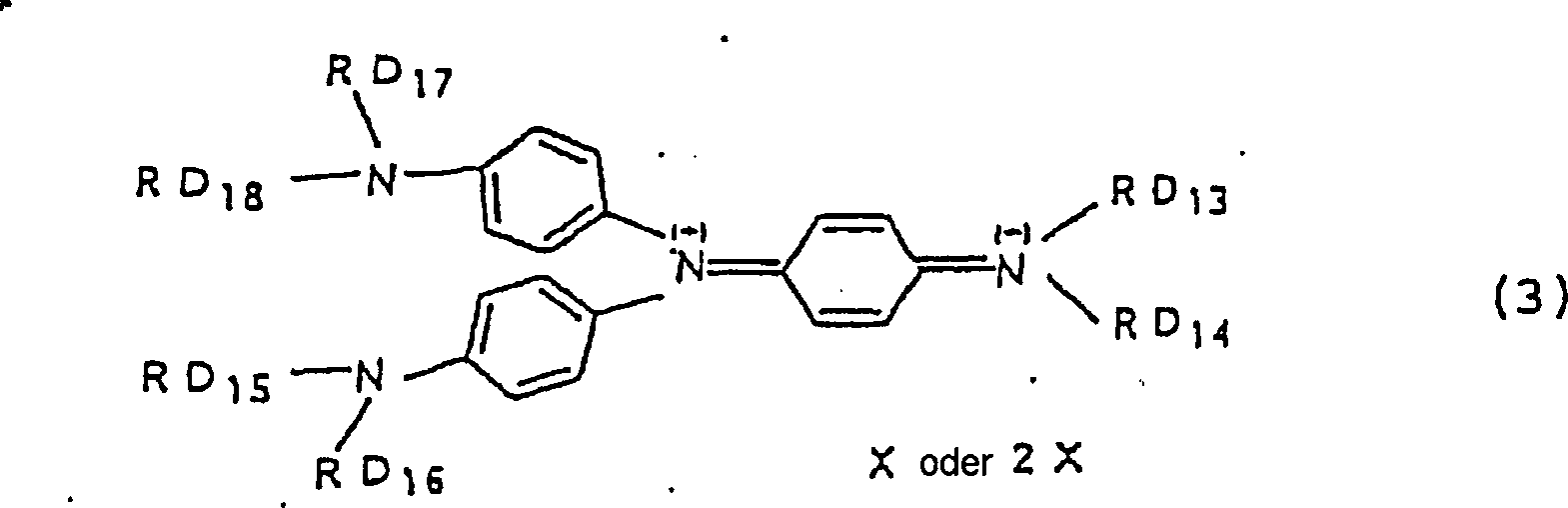


Applications Claiming Priority (11)
| Application Number | Priority Date | Filing Date | Title |
|---|---|---|---|
| JP12270596 | 1996-04-18 | ||
| JP12270596 | 1996-04-18 | ||
| JP26135496 | 1996-09-09 | ||
| JP26135596 | 1996-09-09 | ||
| JP26135696 | 1996-09-09 | ||
| JP26135696 | 1996-09-09 | ||
| JP26135496 | 1996-09-09 | ||
| JP26135596 | 1996-09-09 | ||
| JP3978897 | 1997-02-06 | ||
| JP3978897 | 1997-02-06 | ||
| PCT/JP1997/001341 WO1997038855A1 (en) | 1996-04-18 | 1997-04-16 | Near infrared ray absorption film and multi-layered panel including same |
Publications (2)
| Publication Number | Publication Date |
|---|---|
| DE69737785D1 DE69737785D1 (en) | 2007-07-19 |
| DE69737785T2 true DE69737785T2 (en) | 2008-02-07 |
Family
ID=27522043
Family Applications (1)
| Application Number | Title | Priority Date | Filing Date |
|---|---|---|---|
| DE69737785T Expired - Lifetime DE69737785T2 (en) | 1996-04-18 | 1997-04-16 | NEAR INFRARED RADIATION ABSORBING FILM AND MULTILAYERED COMPOSITE PANEL THEREFORE EQUIPPED |
Country Status (9)
| Country | Link |
|---|---|
| US (1) | US6255031B1 (en) |
| EP (1) | EP0894620B1 (en) |
| JP (1) | JP3308545B2 (en) |
| KR (1) | KR100354362B1 (en) |
| AU (1) | AU718609B2 (en) |
| CA (1) | CA2251909C (en) |
| DE (1) | DE69737785T2 (en) |
| TW (1) | TW335435B (en) |
| WO (1) | WO1997038855A1 (en) |
Families Citing this family (96)
| Publication number | Priority date | Publication date | Assignee | Title |
|---|---|---|---|---|
| US5811923A (en) * | 1996-12-23 | 1998-09-22 | Optical Coating Laboratory, Inc. | Plasma display panel with infrared absorbing coating |
| US6169283B1 (en) * | 1998-03-31 | 2001-01-02 | Intel Corporation | Plastic light selective element for imaging applications |
| DE69942918D1 (en) * | 1998-05-15 | 2010-12-16 | Toyo Boseki | Infrared absorbing filter |
| KR20000035395A (en) * | 1998-11-11 | 2000-06-26 | 모치즈키 아키히로 | Near infrared absorption filter |
| US6217796B1 (en) * | 1998-11-17 | 2001-04-17 | Nisshinbo Industries, Inc. | Near infrared absorption composition |
| KR100667637B1 (en) * | 1998-12-28 | 2007-01-12 | 아사히 가라스 가부시키가이샤 | Laminate and its manufacturing method |
| JP2000340984A (en) * | 1999-05-28 | 2000-12-08 | Bridgestone Corp | Electromagnetic wave shielding light-transmission window material |
| US7239226B2 (en) | 2001-07-10 | 2007-07-03 | American Express Travel Related Services Company, Inc. | System and method for payment using radio frequency identification in contact and contactless transactions |
| US7306158B2 (en) | 2001-07-10 | 2007-12-11 | American Express Travel Related Services Company, Inc. | Clear contactless card |
| US6749123B2 (en) | 1999-09-07 | 2004-06-15 | American Express Travel Related Services Company, Inc. | Transaction card |
| US6581839B1 (en) | 1999-09-07 | 2003-06-24 | American Express Travel Related Services Company, Inc. | Transaction card |
| US6764014B2 (en) * | 1999-09-07 | 2004-07-20 | American Express Travel Related Services Company, Inc. | Transaction card |
| US8066190B2 (en) | 1999-09-07 | 2011-11-29 | American Express Travel Related Services Company, Inc. | Transaction card |
| US7156301B1 (en) | 1999-09-07 | 2007-01-02 | American Express Travel Related Services Company, Inc. | Foldable non-traditionally-sized RF transaction card system and method |
| US7093767B2 (en) | 1999-09-07 | 2006-08-22 | American Express Travel Related Services Company, Inc. | System and method for manufacturing a punch-out RFID transaction device |
| US7837116B2 (en) * | 1999-09-07 | 2010-11-23 | American Express Travel Related Services Company, Inc. | Transaction card |
| US20030141373A1 (en) * | 2000-09-01 | 2003-07-31 | Ellen Lasch | Transaction card with dual IC chips |
| US7070112B2 (en) | 1999-09-07 | 2006-07-04 | American Express Travel Related Services Company, Inc. | Transparent transaction device |
| US7889052B2 (en) | 2001-07-10 | 2011-02-15 | Xatra Fund Mx, Llc | Authorizing payment subsequent to RF transactions |
| US6296188B1 (en) * | 1999-10-01 | 2001-10-02 | Perfect Plastic Printing Corporation | Transparent/translucent financial transaction card including an infrared light filter |
| KR100444332B1 (en) * | 1999-12-20 | 2004-08-16 | 도요 보세키 가부시키가이샤 | Infrared absorption filter |
| JP4568934B2 (en) * | 2000-01-11 | 2010-10-27 | コニカミノルタホールディングス株式会社 | Optical film and manufacturing method thereof |
| US6811867B1 (en) | 2000-02-10 | 2004-11-02 | 3M Innovative Properties Company | Color stable pigmented polymeric films |
| WO2001067355A2 (en) | 2000-03-07 | 2001-09-13 | American Express Travel Related Services Company, Inc. | System for facilitating a transaction |
| DE10026299A1 (en) * | 2000-05-26 | 2001-11-29 | Sunyx Surface Nanotechnologies | Substrate with a low light-scattering, ultraphobic surface and process for its production |
| AUPR362101A0 (en) * | 2001-03-08 | 2001-04-05 | Tropiglas Pty Ltd | Glazing laminates |
| JP4254069B2 (en) * | 2001-03-14 | 2009-04-15 | パナソニック電工株式会社 | Manufacturing method of near-infrared cut material |
| US7163739B2 (en) | 2001-03-15 | 2007-01-16 | Mitsui Chemicals, Inc. | Laminate and display apparatus using the same |
| DE10117786A1 (en) * | 2001-04-10 | 2002-10-17 | Bayer Ag | Heat absorbing layer system useful for heat radiation screening of synthetic plastic displacement (sic) elements having outstanding long term weathering resistance, and high transparency, glaze and heat resistance |
| US7650314B1 (en) | 2001-05-25 | 2010-01-19 | American Express Travel Related Services Company, Inc. | System and method for securing a recurrent billing transaction |
| US7725427B2 (en) | 2001-05-25 | 2010-05-25 | Fred Bishop | Recurrent billing maintenance with radio frequency payment devices |
| TW546331B (en) * | 2001-06-25 | 2003-08-11 | Asahi Glass Co Ltd | Optical film |
| JP2003004939A (en) * | 2001-06-25 | 2003-01-08 | Asahi Glass Co Ltd | Optical film |
| US7668750B2 (en) | 2001-07-10 | 2010-02-23 | David S Bonalle | Securing RF transactions using a transactions counter |
| US7303120B2 (en) | 2001-07-10 | 2007-12-04 | American Express Travel Related Services Company, Inc. | System for biometric security using a FOB |
| US9024719B1 (en) | 2001-07-10 | 2015-05-05 | Xatra Fund Mx, Llc | RF transaction system and method for storing user personal data |
| US8001054B1 (en) | 2001-07-10 | 2011-08-16 | American Express Travel Related Services Company, Inc. | System and method for generating an unpredictable number using a seeded algorithm |
| US7705732B2 (en) | 2001-07-10 | 2010-04-27 | Fred Bishop | Authenticating an RF transaction using a transaction counter |
| US8294552B2 (en) | 2001-07-10 | 2012-10-23 | Xatra Fund Mx, Llc | Facial scan biometrics on a payment device |
| US9454752B2 (en) | 2001-07-10 | 2016-09-27 | Chartoleaux Kg Limited Liability Company | Reload protocol at a transaction processing entity |
| US7827106B2 (en) | 2001-07-10 | 2010-11-02 | American Express Travel Related Services Company, Inc. | System and method for manufacturing a punch-out RFID transaction device |
| US7735725B1 (en) | 2001-07-10 | 2010-06-15 | Fred Bishop | Processing an RF transaction using a routing number |
| US9031880B2 (en) | 2001-07-10 | 2015-05-12 | Iii Holdings 1, Llc | Systems and methods for non-traditional payment using biometric data |
| US8279042B2 (en) | 2001-07-10 | 2012-10-02 | Xatra Fund Mx, Llc | Iris scan biometrics on a payment device |
| US7543738B1 (en) | 2001-07-10 | 2009-06-09 | American Express Travel Related Services Company, Inc. | System and method for secure transactions manageable by a transaction account provider |
| US7249112B2 (en) | 2002-07-09 | 2007-07-24 | American Express Travel Related Services Company, Inc. | System and method for assigning a funding source for a radio frequency identification device |
| US7360689B2 (en) | 2001-07-10 | 2008-04-22 | American Express Travel Related Services Company, Inc. | Method and system for proffering multiple biometrics for use with a FOB |
| US8548927B2 (en) | 2001-07-10 | 2013-10-01 | Xatra Fund Mx, Llc | Biometric registration for facilitating an RF transaction |
| US20040236699A1 (en) | 2001-07-10 | 2004-11-25 | American Express Travel Related Services Company, Inc. | Method and system for hand geometry recognition biometrics on a fob |
| US7429927B2 (en) | 2001-07-10 | 2008-09-30 | American Express Travel Related Services Company, Inc. | System and method for providing and RFID transaction device |
| US7746215B1 (en) | 2001-07-10 | 2010-06-29 | Fred Bishop | RF transactions using a wireless reader grid |
| JP2003075628A (en) * | 2001-09-06 | 2003-03-12 | Asahi Glass Co Ltd | Optical film |
| US6805287B2 (en) | 2002-09-12 | 2004-10-19 | American Express Travel Related Services Company, Inc. | System and method for converting a stored value card to a credit card |
| KR20040067483A (en) * | 2003-01-23 | 2004-07-30 | 에스케이씨 주식회사 | Front filter for plasma display panel and preparation thereof |
| KR100764761B1 (en) * | 2003-02-12 | 2007-10-11 | 엘지전자 주식회사 | Front filter |
| US7245079B2 (en) * | 2003-05-28 | 2007-07-17 | Solutia Incorporated | Plasma display panel filters comprising multiple layers |
| US20040239251A1 (en) * | 2003-05-28 | 2004-12-02 | D'haene Pol | Plasma display panel filters |
| US7332257B2 (en) * | 2003-07-11 | 2008-02-19 | Asahi Glass Company, Limited | Composition for optical film, and optical film |
| CN100442087C (en) * | 2003-08-11 | 2008-12-10 | 东洋纺织株式会社 | Near-infrared-absorbing film and method for producing same, roll of near-infrared-absorbing film and method for producing the same, and near-infrared-absorbing filter |
| US7318550B2 (en) | 2004-07-01 | 2008-01-15 | American Express Travel Related Services Company, Inc. | Biometric safeguard method for use with a smartcard |
| US7314165B2 (en) | 2004-07-01 | 2008-01-01 | American Express Travel Related Services Company, Inc. | Method and system for smellprint recognition biometrics on a smartcard |
| EP1808461B1 (en) | 2004-07-15 | 2009-03-11 | Teijin Chemicals, Ltd. | Resin composition and molded object thereof |
| CA2578107A1 (en) | 2004-09-06 | 2006-03-16 | Nippon Kayaku Kabushiki Kaisha | Diimmonium compound and use thereof |
| JP4514577B2 (en) * | 2004-10-21 | 2010-07-28 | 大阪瓦斯株式会社 | Infrared absorption filter and infrared absorption panel |
| KR100761646B1 (en) * | 2004-12-28 | 2007-09-27 | 토요 보세키 가부시기가이샤 | Wavelength-selective absorption filter |
| DE602006018707D1 (en) | 2005-02-04 | 2011-01-20 | Nippon Catalytic Chem Ind | BORAT AND MATERIAL WHICH ABSORBES RADIATION IN THE NEAR INFRARED RANGE |
| DE602006004313D1 (en) * | 2005-02-22 | 2009-01-29 | Asahi Glass Co Ltd | ADHESIVE FILM, ADHESIVE FILM AND OPTICAL FILTER |
| JP2006251380A (en) * | 2005-03-10 | 2006-09-21 | Mitsumi Electric Co Ltd | The camera module |
| CN100468091C (en) * | 2005-03-21 | 2009-03-11 | 四川世创达电子科技有限公司 | Manufacturing method of absorption near infrared ray and orange coloured light substrate of PDP protective screen |
| WO2006118277A1 (en) * | 2005-04-28 | 2006-11-09 | Api Corporation | Pressure-sensitive adhesive containing near infrared absorbing coloring matter |
| CN101213267A (en) * | 2005-05-10 | 2008-07-02 | 株式会社日本触媒 | Pressure-sensitive adhesive composition containing near-infrared absorber |
| KR100678840B1 (en) * | 2005-06-27 | 2007-02-05 | 제일모직주식회사 | Film for image display device including near infrared absorption and color correction layer and filter for image display device using same |
| US20070001566A1 (en) * | 2005-06-30 | 2007-01-04 | D Haene Pol | Impact resistant, direct contact plasma display panel filters |
| US7510456B2 (en) * | 2005-06-30 | 2009-03-31 | Solutia Incorporated | Method of making impact resistant, direct contact plasma display panel filters |
| US8900693B2 (en) | 2005-07-13 | 2014-12-02 | Sabic Global Technologies B.V. | Polycarbonate compositions having infrared absorbance, method of manufacture, and articles prepared therefrom |
| US20070218287A1 (en) * | 2006-03-14 | 2007-09-20 | Newport Corporation | Coatings for affecting spectral performance of photonic devices in optical applications and methods of manufacture |
| US7655306B2 (en) | 2006-05-23 | 2010-02-02 | Cheil Industries, Inc. | Optical film, optical filter and display device including the same |
| JP4991479B2 (en) * | 2006-10-27 | 2012-08-01 | 大阪瓦斯株式会社 | Optical film and manufacturing method thereof |
| US8197928B2 (en) | 2006-12-29 | 2012-06-12 | E. I. Du Pont De Nemours And Company | Intrusion resistant safety glazings and solar cell modules |
| JP2008260737A (en) * | 2007-04-13 | 2008-10-30 | Fujifilm Corp | Triarylamine derivative |
| JP5121287B2 (en) * | 2007-04-13 | 2013-01-16 | 富士フイルム株式会社 | Triarylamine derivatives |
| JP2008304499A (en) * | 2007-06-05 | 2008-12-18 | Sony Corp | Optical compensation member, liquid crystal display device, alignment film composition and alignment film |
| KR100780390B1 (en) | 2007-07-06 | 2007-11-28 | (주)제이피에스 마이크로텍 | Near-infrared absorbing pigment microencapsulated with polymer resin and coating solution using same and preparation method thereof |
| KR20110013698A (en) * | 2009-08-03 | 2011-02-10 | 삼성코닝정밀소재 주식회사 | Filter for display device and display device comprising same |
| JP5625410B2 (en) * | 2010-03-17 | 2014-11-19 | 日本電気硝子株式会社 | Window board |
| JP5166482B2 (en) * | 2010-05-11 | 2013-03-21 | 東利眼鏡実業株式会社 | Method for producing translucent resin substrate and translucent resin substrate |
| JP6183048B2 (en) * | 2012-08-27 | 2017-08-23 | 旭硝子株式会社 | Optical filter and solid-state imaging device |
| TW201435830A (en) | 2012-12-11 | 2014-09-16 | 3M Innovative Properties Co | Inconspicuous optical tags and methods therefor |
| JP6443329B2 (en) * | 2013-04-10 | 2018-12-26 | Agc株式会社 | Infrared shielding filter and imaging device |
| KR102214881B1 (en) | 2013-09-20 | 2021-02-09 | 미쓰비시 세이시 가부시키가이샤 | Air filter media and air filter |
| TW201600574A (en) * | 2014-06-30 | 2016-01-01 | Fujifilm Corp | Near-infrared absorbing composition, near-infrared cut filter, near-infrared cut filter manufacturing method, solid-state imaging device, camera module |
| KR101515072B1 (en) * | 2014-08-27 | 2015-04-28 | 주식회사 상보 | Pigment material and matal oxide mixed adhesive and colorable heat ray screening carbon ceramics film using the same |
| CN107406661B (en) * | 2015-04-09 | 2020-04-07 | 日本瑞翁株式会社 | Resin composition and use thereof |
| JP6758478B2 (en) * | 2017-03-09 | 2020-09-23 | 富士フイルム株式会社 | Structures, kits and optical sensors |
| CN111095048A (en) * | 2017-09-21 | 2020-05-01 | 富士胶片株式会社 | Manufacturing method, laminate, and kit of near-infrared cut filter |
| CN114675457A (en) * | 2020-12-24 | 2022-06-28 | 中国科学院上海硅酸盐研究所 | Passive self-bias electrochromic intelligent window |
Family Cites Families (13)
| Publication number | Priority date | Publication date | Assignee | Title |
|---|---|---|---|---|
| US5009494A (en) * | 1990-05-21 | 1991-04-23 | Hughes Aircraft Company | Wide field all-reflective multiple field of view telescope |
| EP0653451B1 (en) * | 1992-07-30 | 1999-02-17 | Kanebo, Ltd. | Polyester |
| JP3335397B2 (en) * | 1992-12-25 | 2002-10-15 | 三井化学株式会社 | Heat shielding sheet |
| JP3163813B2 (en) * | 1992-12-28 | 2001-05-08 | 日本ゼオン株式会社 | Near-infrared absorbing resin composition and molded article |
| JPH06214113A (en) * | 1993-01-20 | 1994-08-05 | Mitsui Toatsu Chem Inc | Near infrared-absorbing film and heat ray shielding sheet using same |
| JPH06256541A (en) * | 1993-03-05 | 1994-09-13 | Mitsui Toatsu Chem Inc | Near infrared ray-absorbing film and heat ray-shielding sheet using the same |
| JPH07178861A (en) * | 1993-12-24 | 1995-07-18 | Mitsui Toatsu Chem Inc | Near infrared absorption plate |
| JPH07236103A (en) * | 1994-02-22 | 1995-09-05 | Fujitsu General Ltd | Mounting device |
| JP3139276B2 (en) * | 1994-04-28 | 2001-02-26 | 富士電機株式会社 | Overload protection circuit for power semiconductor devices |
| JP2840211B2 (en) * | 1994-08-05 | 1998-12-24 | 鐘紡株式会社 | Polyester polymer and molded product thereof |
| US5699079A (en) * | 1995-11-21 | 1997-12-16 | Silicon Graphics, Inc. | Restoration filter for truncated pixels |
| EP0794067B1 (en) * | 1996-03-07 | 1999-07-28 | Konica Corporation | Image forming material and image forming method employing the same |
| JP2995547B2 (en) * | 1997-03-12 | 1999-12-27 | セイコーエプソン株式会社 | Electronic print camera |
-
1997
- 1997-04-16 DE DE69737785T patent/DE69737785T2/en not_active Expired - Lifetime
- 1997-04-16 KR KR10-1998-0708329A patent/KR100354362B1/en not_active Expired - Lifetime
- 1997-04-16 WO PCT/JP1997/001341 patent/WO1997038855A1/en not_active Ceased
- 1997-04-16 CA CA002251909A patent/CA2251909C/en not_active Expired - Lifetime
- 1997-04-16 JP JP53696297A patent/JP3308545B2/en not_active Expired - Lifetime
- 1997-04-16 EP EP97917429A patent/EP0894620B1/en not_active Expired - Lifetime
- 1997-04-16 US US09/171,392 patent/US6255031B1/en not_active Expired - Lifetime
- 1997-04-16 AU AU25762/97A patent/AU718609B2/en not_active Expired
- 1997-04-18 TW TW086105034A patent/TW335435B/en not_active IP Right Cessation
Also Published As
| Publication number | Publication date |
|---|---|
| JP3308545B2 (en) | 2002-07-29 |
| KR20000005531A (en) | 2000-01-25 |
| CA2251909C (en) | 2003-12-23 |
| TW335435B (en) | 1998-07-01 |
| EP0894620A4 (en) | 2002-11-13 |
| WO1997038855A1 (en) | 1997-10-23 |
| EP0894620A1 (en) | 1999-02-03 |
| EP0894620B1 (en) | 2007-06-06 |
| KR100354362B1 (en) | 2003-03-10 |
| CA2251909A1 (en) | 1997-10-23 |
| US6255031B1 (en) | 2001-07-03 |
| AU718609B2 (en) | 2000-04-20 |
| AU2576297A (en) | 1997-11-07 |
| DE69737785D1 (en) | 2007-07-19 |
Similar Documents
| Publication | Publication Date | Title |
|---|---|---|
| DE69737785T2 (en) | NEAR INFRARED RADIATION ABSORBING FILM AND MULTILAYERED COMPOSITE PANEL THEREFORE EQUIPPED | |
| JPWO1997038855A1 (en) | Near-infrared absorbing film and multilayer panel including said film | |
| DE69807754T2 (en) | INFRARED REFLECTIVE MULTI-LAYER OPTICAL BODY | |
| DE69907405T2 (en) | OPTICAL MULTI-COMPONENT BODY | |
| DE68924853T2 (en) | MULTILAYERED, HEAT REFLECTIVE LAYERS AND GLAZING PRODUCTS THAT INCLUDE. | |
| DE60013589T2 (en) | LIGHT-TRACEABLE WINDOW MATERIAL WITH PROTECTION FROM ELECTROMAGNETIC WAVES AND DISPLAY DEVICE | |
| DE69615827T2 (en) | GLASS OBJECT PRINTED WITH A ULTRAVIOLATE ABSORBING COLORED LAYER | |
| DE60004688T2 (en) | THERMAL TRANSFER ELEMENT CONTAINING A SOFTENER IN A TRANSFER LAYER AND A THERMAL TRANSFER METHOD | |
| EP1363141B1 (en) | Infrared reflecting material | |
| DE69924354T2 (en) | MODIFIED COPOLYESTER AND IMPROVED MULTILAYER REFLECTIVE FILM | |
| DE69533229T2 (en) | ANTI-ILLUMINATING COATING FOR TEMPERATURE SENSITIVE SUPPORT | |
| DE2925767C2 (en) | ||
| JP3764069B2 (en) | Multi-layer panel including near-infrared absorbing film and video output device using the same | |
| DE60203097T2 (en) | Substrate coated with a laminated photocatalytic film | |
| DE3521915A1 (en) | RECORDING MATERIAL FOR OPTICAL INFORMATION | |
| DE69309316T2 (en) | Film for light valves and process for its manufacture | |
| DE2757744A1 (en) | RECORDING MATERIAL | |
| DE68921444T2 (en) | Dust protection body with high light transmission and process for its production. | |
| DE69915564T2 (en) | Near-infrared Absorbtionszusammensetzung | |
| DE3706266A1 (en) | RECORD CARRIER FOR OPTICAL INFORMATION | |
| DE2939524A1 (en) | THERMAL RECORDING MATERIAL | |
| JPH1173115A (en) | Front surface multilayered panel for plasma display | |
| JP4031094B2 (en) | Film containing transparent polymer and plural pigments and multilayer film or panel containing the film | |
| DE3704601A1 (en) | RECORD CARRIER FOR OPTICAL DATA | |
| DE60209086T2 (en) | Window pane for a head-up display |
Legal Events
| Date | Code | Title | Description |
|---|---|---|---|
| 8364 | No opposition during term of opposition | ||
| 8327 | Change in the person/name/address of the patent owner |
Owner name: OSAKA GAS CO., LTD., OSAKA-SHI, JP |