DE69734601T2 - COMPOSITION OF COLLAGEN BINDING PROTEIN AND METHODS OF THEIR USES - Google Patents
COMPOSITION OF COLLAGEN BINDING PROTEIN AND METHODS OF THEIR USES Download PDFInfo
- Publication number
- DE69734601T2 DE69734601T2 DE69734601T DE69734601T DE69734601T2 DE 69734601 T2 DE69734601 T2 DE 69734601T2 DE 69734601 T DE69734601 T DE 69734601T DE 69734601 T DE69734601 T DE 69734601T DE 69734601 T2 DE69734601 T2 DE 69734601T2
- Authority
- DE
- Germany
- Prior art keywords
- cbp
- seq
- bacterial
- col
- peptide
- Prior art date
- Legal status (The legal status is an assumption and is not a legal conclusion. Google has not performed a legal analysis and makes no representation as to the accuracy of the status listed.)
- Expired - Fee Related
Links
Classifications
-
- C—CHEMISTRY; METALLURGY
- C07—ORGANIC CHEMISTRY
- C07K—PEPTIDES
- C07K14/00—Peptides having more than 20 amino acids; Gastrins; Somatostatins; Melanotropins; Derivatives thereof
- C07K14/195—Peptides having more than 20 amino acids; Gastrins; Somatostatins; Melanotropins; Derivatives thereof from bacteria
- C07K14/305—Peptides having more than 20 amino acids; Gastrins; Somatostatins; Melanotropins; Derivatives thereof from bacteria from Micrococcaceae (F)
- C07K14/31—Peptides having more than 20 amino acids; Gastrins; Somatostatins; Melanotropins; Derivatives thereof from bacteria from Micrococcaceae (F) from Staphylococcus (G)
-
- A—HUMAN NECESSITIES
- A61—MEDICAL OR VETERINARY SCIENCE; HYGIENE
- A61P—SPECIFIC THERAPEUTIC ACTIVITY OF CHEMICAL COMPOUNDS OR MEDICINAL PREPARATIONS
- A61P31/00—Antiinfectives, i.e. antibiotics, antiseptics, chemotherapeutics
- A61P31/04—Antibacterial agents
-
- C—CHEMISTRY; METALLURGY
- C07—ORGANIC CHEMISTRY
- C07K—PEPTIDES
- C07K16/00—Immunoglobulins [IG], e.g. monoclonal or polyclonal antibodies
- C07K16/12—Immunoglobulins [IG], e.g. monoclonal or polyclonal antibodies against material from bacteria
- C07K16/1267—Gram-positive bacteria
- C07K16/1271—Micrococcaceae (F); Staphylococcaceae (F), e.g. Staphylococcus (G)
-
- A—HUMAN NECESSITIES
- A61—MEDICAL OR VETERINARY SCIENCE; HYGIENE
- A61K—PREPARATIONS FOR MEDICAL, DENTAL OR TOILETRY PURPOSES
- A61K38/00—Medicinal preparations containing peptides
-
- A—HUMAN NECESSITIES
- A61—MEDICAL OR VETERINARY SCIENCE; HYGIENE
- A61K—PREPARATIONS FOR MEDICAL, DENTAL OR TOILETRY PURPOSES
- A61K39/00—Medicinal preparations containing antigens or antibodies
-
- C—CHEMISTRY; METALLURGY
- C07—ORGANIC CHEMISTRY
- C07K—PEPTIDES
- C07K2317/00—Immunoglobulins specific features
- C07K2317/70—Immunoglobulins specific features characterized by effect upon binding to a cell or to an antigen
- C07K2317/77—Internalization into the cell
Landscapes
- Chemical & Material Sciences (AREA)
- Health & Medical Sciences (AREA)
- Organic Chemistry (AREA)
- General Health & Medical Sciences (AREA)
- Medicinal Chemistry (AREA)
- Life Sciences & Earth Sciences (AREA)
- Biochemistry (AREA)
- Biophysics (AREA)
- Genetics & Genomics (AREA)
- Molecular Biology (AREA)
- Proteomics, Peptides & Aminoacids (AREA)
- Immunology (AREA)
- Gastroenterology & Hepatology (AREA)
- Communicable Diseases (AREA)
- Chemical Kinetics & Catalysis (AREA)
- General Chemical & Material Sciences (AREA)
- Nuclear Medicine, Radiotherapy & Molecular Imaging (AREA)
- Pharmacology & Pharmacy (AREA)
- Animal Behavior & Ethology (AREA)
- Public Health (AREA)
- Veterinary Medicine (AREA)
- Oncology (AREA)
- Peptides Or Proteins (AREA)
- Medicines That Contain Protein Lipid Enzymes And Other Medicines (AREA)
- Medicines Containing Antibodies Or Antigens For Use As Internal Diagnostic Agents (AREA)
- Preparation Of Compounds By Using Micro-Organisms (AREA)
Abstract
Description
1.1. Gebiet der Erfindung1.1. Field of the invention
Die vorliegende Erfindung bezieht sich im Allgemeinen auf das Gebiet der Molekularbiologie. Noch bevorzugter betreffen bestimmte Ausführungsformen Methoden und Zusammensetzungen, welche DNA-Abschnitte umfassen, und Proteine, die von Bakterienarten abgeleitet wurden. Noch genauer stellt die Erfindung cna und cna-abgeleitete Nukleinsäurezusammensetzungen bereit, welche ein Kollagen (Col) -Bindungsprotein (CBT) aus Staphylococcus aureus und die korrespondierenden Peptid Epitope und Proteinsequenzen umfassen, welche native und synthetisch modifizierte Col-Bindungsstellendomänen umfassen. Es sind verschiedene Verfahren ihrer Herstellung und Verwendung dieser DNA-Segmente, DNA-Segmente, welche synthetisch modifizierte Liganden-Bindungsstellendomänen kodieren, und native und synthetische Proteine offenbart, wie zum Beispiel, beispielsweise die Verwendung von DNA-Segmenten als diagnostische Sonden und Matrizen für die Proteinherstellung, und die Verwendung von Proteinen, Fusionsproteinträgern und Peptiden in verschiedenen pharmakologischen und immunologischen Anwendungen.The The present invention relates generally to the field molecular biology. More preferably, certain embodiments relate to Methods and compositions comprising DNA segments and proteins derived from bacterial species. Even more accurate the invention provides cna and cna-derived nucleic acid compositions prepared containing a collagen (Col) binding protein (CBT) from Staphylococcus aureus and the corresponding peptide epitopes and protein sequences comprising native and synthetically modified Col binding site domains. There are various methods of their preparation and use these DNA segments, DNA segments encoding synthetically modified ligand binding site domains, and native and synthetic proteins, such as, for example, For example, the use of DNA segments as a diagnostic Probes and matrices for protein production, and the use of proteins, fusion protein carriers and Peptides in various pharmacological and immunological Applications.
1.2. Beschreibung des nächsten Standes der Technik1.2. description of next State of the art
1.2.1. Kolonisation durch Staphylococcus Aureus1.2.1. Colonization by Staphylococcus aureus
S. Aureus Zellen können viele verschiedene Wirtsgewebe kolonisieren und verschiedene Arten von Infektionen hervorrufen, wie zum Beispiel Endocarditis, Pneumonie, Wundinfektionen, Osteomyelitis und septische Arthritis. Die Anhaftung von Staphylokokken an Wirtsgewebe schließt eine Familie von Adhesinen ein, die Komponenten der extrazellulären Matrix erkennen und welche MSCRAMMs (Microbial Surface Components Recognizing Adhesive Matrix Molecules) genannt werden (Patti et al., 1994a).S. Aureus cells can colonize many different host tissues and different species infections, such as endocarditis, pneumonia, Wound infections, osteomyelitis and septic arthritis. The attachment of staphylococci to host tissue includes a family of adhesins which recognize components of the extracellular matrix and which MSCRAMMs (Microbial Surface Components Recognizing Adhesive Matrix Molecules) (Patti et al., 1994a).
Die Expression spezifischer MSCRAMMs scheint für die Kolonisation verschiedener Gewebetypen erforderlich zu sein. Zum Beispiel exprimieren Staphylokokkenstämme, welche aus den Gelenken von Patienten mit der Diagnose einer septischen Arthritis oder Osteomyelitis erhalten wurden, fast immer ein CBP, während signifikant weniger Isolate, welche aus Wundinfektionen erlangt wurden, dieses Adhesin exprimieren (Switalski et al., 1993a). In ähnlicher Weise haben S. Aureus Stämme, welche aus den Knochen von Patienten mit Osteomyelitis isoliert wurden, oft ein MSCRAMM, welches das knochenspezifische Protein, Knochen-Sialoprotein (BSP), erkennt (Rydén et al., 1998).The Expression of specific MSCRAMMs seems different for colonization Tissue types required to be. For example, staphylococcal strains express which from the joints of patients with the diagnosis of a septic Arthritis or osteomyelitis were obtained, almost always a CBP, while significant fewer isolates, which were obtained from wound infections, this Expressing adhesin (Switalski et al., 1993a). In similar Way, S. Aureus have strains, which is isolated from the bones of patients with osteomyelitis often an MSCRAMM containing the bone-specific protein, Bone sialoprotein (BSP), recognizes (Rydén et al., 1998).
Die Klonierung, Sequenzierung und Expression von einem cna Gen, welches ein S. Aureus CBP kodiert, wurde kürzlich berichtet (Patti et al., 1992). Das cna Gen kodiert ein 133-kDa-Adhesin, das strukturelle Merkmale enthält, welche für Oberflächenproteine charakteristisch sind, die aus Gram-positiven Bakterien isoliert wurden. Es ist gezeigt worden, dass das CBP für die Anhaftung von S. Aureus an Col-beschichtete künstliche Substrate notwendig und ausreichend ist, ebenso wie an Knorpel, einem Gewebe, das reich an Typ II Col ist (Switalski et al., 1993). Alle Stämme, welche das CBP exprimieren, sind in der Lage an Knorpel anzuhaften, wohingegen solche Stämme, welchen die MSCRAMMs fehlen, nicht anhaften. Die Vorinkubation von S. Aureus mit polyklonalen Antikörpern, welche gegen das gereinigte Adhesin gerichtet sind, oder die Sättigung von Knorpelsubstrat mit löslichen rekombinanten CBP hat eine vollständige Inhibition bakterieller Anhaftung zur Folge (Switalski et al., 1993a).The Cloning, sequencing and expression of a cna gene which a S. aureus CBP has been reported recently (Patti et al., 1992). The cna gene encodes a 133 kDa adhesin which contains structural features which for surface proteins characteristic of isolated from Gram-positive bacteria were. It has been shown that the CBP is responsible for the attachment of S. aureus Col-coated artificial Substrates is necessary and sufficient, as well as to cartilage, a tissue rich in Type II Col (Switalski et al., 1993). All tribes, which express the CBP are able to adhere to cartilage, whereas such tribes, which the MSCRAMMs are missing, do not adhere. The preincubation of S. Aureus with polyclonal antibodies, which are directed against the purified adhesin, or the saturation of cartilage substrate with soluble recombinant CBP has complete inhibition of bacterial Attachment (Switalski et al., 1993a).
Die S. Aureus Kolonisation von Gelenkknorpel innerhalb von Gelenkspalten scheint ein wichtiger Faktor zu sein, welcher zu der Entwicklung einer septischen Arthritis beiträgt. Die Bedeutung von dem CBP in der Pathogenese der septischen Arthritis wurde durch den Vergleich der Virulenz zweier Gruppen isogener Mutanten von S. Aureus in einem Tiermodel bestimmt (Patti et al., 1994b). Mehr als 70 % der Mäuse, welchen die CNA+-Stämme (d. h. einem klinisichen Isolat, welches das CBP exprimiert oder einen negativen Stamm, in welchem das cna Gen eingeführt worden ist) injiziert worden sind, entwickeln klinische Symptome von Arthritis, wohingegen weniger als 27 % von den Tieren Symptome der Krankheit zeigten, wenn ihnen CNA– Stämme injiziert worden sind (d. h. ein Stamm, welchem das cna Gen fehlt oder einem Stamm, in welchem das cna Gen oder einem Stamm, in welchem das cna Gen durch homologe Rekombination inaktiviert worden ist).The S. aureus colonization of articular cartilage within joint spaces appears to be an important factor contributing to the development of septic arthritis. The importance of CBP in the pathogenesis of septic arthritis was determined by comparing the virulence of two groups of isogenic mutants of S. aureus in an animal model (Patti et al., 1994b). More than 70% of the mice injected with the CNA + strains (ie, a clinical isolate expressing the CBP or a negative strain into which the cna gene has been introduced) develop clinical symptoms of arthritis, whereas less than 27% of the animals symptoms of the disease exhibited when they CNA - strains have been injected (ie a strain which the cna gene is absent or a strain in which the cna gene or a strain in which the cna gene by homologous recombination inactivated has been).
Zusammengefaßt zeigen diese Ergebnisse, dass das CBP eine wichtige Rolle in der Pathogenese der durch S. Aureus induzierten septischen Arthritis spielt.To summarize These results indicate that CBP plays an important role in the pathogenesis the S. aureus-induced septic arthritis.
Kürzlich wurde die Ligandenbindungsstelle innerhalb der N-terminalen Hälfte des CBP lokalisiert (Patti et al., 1993). Durch die Analyse der Col-Bindungsaktivität rekombinanter Proteine, welche verschiedenen Segmente des MSCRAMM entsprechen, wurde ein 168-Aminosäuren langes Proteinfragment (korrespondierend zu den Aminosäurenresten 151–318), das eine nennenswerte Col-Bindungsaktivität hat, identifiziert. Kleine Verkürzungen von diesem Protein im N- oder C-Terminus haben einen Verlust der Ligandenbindungsaktivität zur Folge, aber haben auch konformative Änderungen des Proteins zur Folge, wie durch Zirkular-Dichroismus-Spektroskopie gezeigt wurde. Diese Ergebnisse haben die Möglichkeit aufgeworfen, dass die Ligandenbindungsaktivität auch konformative Änderungen des Proteins zur Folge haben, wie durch Zirkular-Dichroismus-Spektroskopie gezeigt wurde. Diese Ergebnisse haben die Möglichkeit aufgeworfen, dass die Ligandenbindungsstelle des MSCRAMM innerhalb eines kurzen Segments von Aminosäuren enthalten ist und dass flankierende Sequenzen für eine korrekte Faltung dieser Reste in der Ligandenbindungsstelle erforderlich sind.Recently, the ligand binding site has been located within the N-terminal half of CBP (Patti et al., 1993). By analyzing the Col-binding activity of recombinant proteins, which are different seg corresponded to MSCRAMM, a 168-amino acid protein fragment (corresponding to the amino acid residues 151-318), which has a significant Col-binding activity was identified. Small truncations of this protein in the N- or C-terminus result in loss of ligand binding activity, but also result in conformational changes of the protein, as evidenced by circular dichroism spectroscopy. These results have raised the possibility that ligand-binding activity may also result in conformational changes of the protein, as demonstrated by circular dichroism spectroscopy. These results have raised the possibility that the ligand binding site of the MSCRAMM is contained within a short segment of amino acids and that flanking sequences are required for correct folding of these residues in the ligand binding site.
Die WO A1 85/05553 offenbart bakterielle Zelloberflächenproteine, welche eine Fibronectin, Fibrinogen-, Collagen- und/oder Laminin-Bindungsfähigkeit haben. Dadurch ist gezeigt worden, dass verschiedene Bakterien die Fähigkeit haben, an Fibronectin, Fibrinogen, Collagen und/oder Laminin zu binden.The WO A1 85/05553 discloses bacterial cell surface proteins which contain a fibronectin, Fibrinogen, collagen and / or laminin binding ability to have. This has been shown that different bacteria ability to fibronectin, fibrinogen, collagen and / or laminin too tie.
In Bezug auf die Bindung von Collagen an S. Aureus sind einige Studien berichtet worden (Carret et al., 1985; Holderbaum et al., 1985; Holderbaum, D., Hall, G.S., und Erhart, L.A., 1986; Infect. Immun. 54: 359–364; Vercellotti, G.M., McCarthy, J.B., Lindholm, P., Peterson, P.K., Jacob, H.S., und Furcht, L.T.; 1985; Am. J. Pathol. 120: 13–21; Speziale, P.G., Ruacci, L., Switalski, L.M., Timpl, R. und Höök, M. 1986, J. Bact, 167: 77–81, Switalski, L.M., Seziale, P. und Höök, M. 1989, J. Biol. Chem. 264: 21080–21086).In Relative to the binding of collagen to S. aureus are some studies Carret et al., 1985; Holderbaum et al., 1985; Holderbaum, D., Hall, G.S., and Erhart, L.A., 1986; Infect. Immune. 54: 359-364; Vercellotti, G. M., McCarthy, J.B., Lindholm, P., Peterson, P.K., Jacob, H.S., and Furcht, L.T .; , 1985; At the. J. Pathol. 120: 13-21; Speziale, P.G., Ruacci, L., Switalski, L.M., Timpl, R. and Höök, M. 1986, J. Bact, 167: 77-81, Switalski, L.M., Seziale, P. and Höök, M. 1989, J. Biol. Chem. 264: 21080-21086).
Switalski et al., 1989 haben von der Isolierung und der Charakterisierung eines S. Aureus-Oberflächenproteins berichtet, welches sie als Kollagenrezeptor identifizierten. Indem Lysostaphin verwendet wurde, um das Protein aus der Zellwand zu lösen, gefolgt durch eine Ionen-Austausch-Chromatographie, eine Ammoniumsulfatprezipitation und eine Gelfiltration war es möglich, ein Protein mit einem scheinbaren Molekulargewicht von 135 kDa zu reinigen. Es wurde auch gezeigt, dass Antikörper, welche gegen das 135 kDa Protein gerichtet sind, die Bindung von Kollagen an S. Aureus Cowan 1 Zellen inhibieren.Switalski et al., 1989 have of isolation and characterization of a S. aureus surface protein which they identified as a collagen receptor. By doing Lysostaphin was used to access the protein from the cell wall to solve, followed by ion exchange chromatography, ammonium sulfate precipitation and gel filtration it was possible to purify a protein with an apparent molecular weight of 135 kDa. It has also been shown that antibodies which are resistant to the 135th kDa protein are directed to the binding of collagen to S. aureus Inhibit Cowan 1 cells.
Die WO 92/07002 bezieht sich auf ein neues rekombinantes Hybrid-DNA-Molekül, welches eine Nukleotidsequenz aus S. Aureus umfasst, welche für ein Protein oder Polypeptid kodiert, dass Kollagen Bindungseigenschaften hat.The WO 92/07002 relates to a novel recombinant hybrid DNA molecule which a nucleotide sequence from S. aureus which is a protein or polypeptide encodes collagen binding properties.
1.2.2. Die Rolle von S. Aureus CBP in humanen Erkrankungen1.2.2. The role of S. Aureus CBP in human diseases
Die hematogen erworbene bakterielle Arthritis bleibt ein ernstes medizinisches Problem. Diese rasant fortschreitende und stark zerstörende Gelenkserkrankung ist schwer gänzlich auszurotten, mit weniger als 50 % der infizierten Patienten erholen sich nicht ohne schwere Gelenkschäden. S. Aureus ist das vorherrschende Pathogen, welches aus adulten Patienten mit hematogener (primärer) und sekundärer Osteomyelitis isoliert wurde (Waldvogel und Vasey 1980), obwohl auch bis zu 90 % der Fälle von akuter hematogener Osteomyelitis in ansonsten gesunden Kindern verursacht wird (Cole 1982). Rasterelektronen Mikroskopiestudien haben gezeigt, dass S. Aureus eng mit Knorpel- und Knochengewebe verknüpft ist, welches aus der Stelle der Infektion erlangt wurde. Zusätzliche Mikroskopiehinweise deuten auf eine vorherrschende Anhaftung und nachfolgende Kolonisation knorpeliger, eher als an synovialen Oberflächen hin (Voytek et al. 1988). Eine Analyse von S. Aureus-Stämmen, die aus Patienten mit einer diagnostizierten Osteomyelits und septischen Arthritis isoliert worden sind, zeigte, dass fast alle von den Isolaten ein Col-Adhesin enthielten. Demgegenüber exprimierten nur ein Drittel von den S. Aureus-Stämmen, welche aus Patienten mit einer Weichteilgewebeinfektion isoliert worden sind, das Col-Adhesin (Switalski, Patti et al. 1993). Diese Beobachtungen legen nahe, dass die eine Zelloberflächenexpression von dem Col-Adhesin ein wichtiger Virulenzfaktor in der Staphylokokken-mediierten Osteomyelitis und der septischen Arthritis ist. Darüber hinaus ist beobachtet worden, dass Knorpelabbau nach einer Staphylokokken-Gelenksinfektion auf eine direkte Interaktion zwischen Bakterien und Knorpel zurückgeführt werden kann (Smith et al. 1982), zusätzlich zu der entzündlichen Antwort des Wirtes (Smith et al. 1987). Personen, welche mehr als 6 Tage brauchen, um die Synovialflüssigkeit von dem Mikroorganismus freizubekommen, haben üblicherweise einen schlechten klinischen Befund (Ho und Su 1982). Schlechte Ergebnisse umfassen permanente Körperbehinderung mit eingeschränkter Bewegung oder ständigem Schmerz in dem betroffenen Gelenk. Daher kann, durch Inhibition der anfänglichen Anhaftung der Bakterien an Knorpel die Wahrscheinlichkeit von anschließender Gelenkzerstörung vermindert werden.The hematogenous acquired bacterial arthritis remains a serious medical Problem. This rapidly progressive and highly destructive joint disease is difficult entirely eradicate with less than 50% of infected patients recover not without severe joint damage. S. aureus is the predominant pathogen, which from adult patients with hematogener (primary) and secondary Osteomyelitis was isolated (Waldvogel and Vasey 1980), though even up to 90% of the cases of acute hematogenous osteomyelitis in otherwise healthy children caused (Cole 1982). Scanning electron microscopy studies have shown that S. aureus works closely with cartilage and bone tissue connected is, which was obtained from the site of the infection. additional Microscopy hints indicate a predominant adhesion and subsequent colonization of cartilaginous rather than synovial surfaces (Voytek et al., 1988). An analysis of S. aureus strains that from patients with a diagnosed osteomyelitis and septic Arthritis has been isolated, showed that almost all of the isolates contained a Col adhesin. In contrast, only a third expressed from the S. aureus strains, which isolated from patients with a soft tissue tissue infection Col-Adhesin (Switalski, Patti et al., 1993). These Observations suggest that cell surface expression from the Col adhesin an important virulence factor in staphylococcal mediated osteomyelitis and that is septic arthritis. In addition, it has been observed that cartilage degradation after a staphylococcal joint infection on a direct interaction between bacteria and cartilage can be traced can (Smith et al., 1982), in addition to the inflammatory Response of the host (Smith et al., 1987). Persons who more than 6 days need to get the synovial fluid from the microorganism to have free, usually have a poor clinical outcome (Ho and Su 1982). Include poor results permanent disability with limited Movement or permanent Pain in the affected joint. Therefore, by inhibition the initial one Attachment of the bacteria to cartilage reduces the likelihood of subsequent joint destruction become.
1.3. Unzulänglichkeiten im Stand der Technik1.3. shortcomings in the prior art
Es ist ohne Zweifel, dass, obwohl verschiedene Ansätze der Behandlung von bakteriellen Erkrankungen einigen Erfolg gezeigt haben, viele Probleme bleiben, einschließlich der Antibiotikaresistenz, der Variabilität von Antigenen zwischen Arten und Artenvariationen durch Mutation von Antigenen, ebenso wie das Bedürfnis, anfällige Gruppen zu schützen, wie zum Beispiel junge Kinder, ältere Menschen und andere Immun-suprimierte Patienten. Folglich besteht ein unmittelbares Bedürfnis nach einer effektiven Behandlung einer S. Aureus-Infektion und Impfstoffen gegen diesen Erreger.There is no doubt that although various approaches to the treatment of bacterial diseases have shown some success, many problems remain, including antibiotic resistance, the variabi antigenicity between species and species variation due to mutation of antigens, as well as the need to protect susceptible groups such as young children, the elderly and other immunosuppressed patients. Consequently, there is an immediate need for effective treatment of S. aureus infection and vaccines against this pathogen.
In einem ersten Aspekt der vorliegenden Erfindung wird eine Zusammensetzung bereitgestellt, umfassend ein CBP-Peptid, wobei das besagte Peptid die zusammenhängende Aminosäuresequenz von SEQ ID Nr: 2, SEQ ID Nr: 4 oder SEQ ID Nr: 6 aufweist und die antibakterielle Anhaftung an Collagen inhibiert zur Verwendung in der Therapie.In A first aspect of the present invention is a composition comprising a CBP peptide, said peptide the coherent one amino acid sequence of SEQ ID NO: 2, SEQ ID NO: 4 or SEQ ID NO: 6 and the Antibacterial adhesion to collagen inhibited for use in the therapy.
Es wird weiterhin eine pharmazeutische Zusammensetzung zur Verfügung gestellt, umfassend ein CBP-Peptid, wobei das Peptid die zusammenhängende Aminosäuresequenz von SEQ ID Nr: 6 aufweist und die bakterielle Anhaftung an Collagen inhibiert.It Furthermore, a pharmaceutical composition is provided, comprising a CBP peptide, wherein the peptide is the contiguous amino acid sequence of SEQ ID NO: 6 and the bacterial adhesion to collagen inhibited.
In einem weiteren Aspekt wird die Verwendung einer Zusammensetzung bereitgestellt, umfassend ein CBP-Peptid, wobei das Peptid die zusammenhängende Aminosäuresequenz von SEQ ID Nr: 2, SEQ ID Nr: 4 oder SEQ ID Nr: 6 aufweist und die bakterielle Anhaftung Collagen inhibiert, zur Herstellung eines prophylaktischen Medikaments zur Inhibierung oder der Vorbeugung einer bakteriellen Kolonisation, einer bakteriellen Infektion, einer bakteriellen Sepsis, einer Staphylokokken-Infektion oder einer Sepsis in einem Lebewesen.In another aspect is the use of a composition provided comprising a CBP peptide, wherein the peptide is the contiguous amino acid sequence of SEQ ID NO: 2, SEQ ID NO: 4 or SEQ ID NO: 6 and the bacterial adhesion inhibits collagen, for the production of a prophylactic drug for inhibition or prevention a bacterial colonization, a bacterial infection, a bacterial sepsis, a staphylococcal infection or sepsis in a living being.
In einem weiteren Aspekt wird außerdem eine Zusammensetzung bereitgestellt, umfassend ein isoliertes Nukleinsäuresegment, das für ein CBP-Peptid kodiert, wobei das CBP-Peptid die zusammenhängende Aminosäuresequenz von SEQ ID Nr: 2, SEQ ID Nr: 4 oder SEQ ID Nr: 6 aufweist und die bakterielle Anhaftung an Collagen inhibiert, zur Verwendung in der Therapie.In another aspect is added as well provided a composition comprising an isolated nucleic acid segment, that for encodes a CBP peptide, wherein the CBP peptide is the contiguous amino acid sequence of SEQ ID NO: 2, SEQ ID NO: 4 or SEQ ID NO: 6 and the inhibits bacterial attachment to collagen, for use in the Therapy.
In einem weiteren Aspekt wird ferner die Verwendung einer Zusammensetzung zur Verfügung gestellt, umfassend ein isoliertes Nukleinsäuresegment, das für ein CBP-Peptid kodiert, wobei das CBP-Peptid die zusammenhängende Aminosäuresequenz von SEQ ID Nr: 2, SEQ ID Nr: 4 oder SEQ ID Nr: 6 aufweist und die bakterielle Anhaftung an Collagen inhibiert, für ein prophylaktisches Medikament zur Inhibierung oder der Vorbeugung einer bakteriellen Kolonisation, einer bakteriellen Infektion, einer bakteriellen Sepsis, einer Staphylokokken-Infektion oder einer Sepsis in einem Lebewesen.In Another aspect is further the use of a composition to disposal comprising an isolated nucleic acid segment encoding a CBP peptide, wherein the CBP peptide is the contiguous amino acid sequence of SEQ ID NO: 2, SEQ ID NO: 4 or SEQ ID NO: 6 and the bacterial Attachment to collagen inhibits for a prophylactic drug for the inhibition or prevention of bacterial colonization, a bacterial infection, a bacterial sepsis, a staphylococcal infection or a sepsis in a living being.
In einem noch weiteren Aspekt wird eine Zusammensetzung zur Verfügung gestellt, umfassend einen Antikörper, der an ein CBP-Peptid bindet, das CBP-Peptid eine Aminosäuresequenz aufweist, die in SEQ ID Nr: 4 oder SEQ ID Nr: 6 angegeben ist, wobei der Antikörper die bakterielle Anhaftung an Collagen inhibiert, zur Verwendung in der Therapie.In In yet another aspect, a composition is provided comprising an antibody, which binds to a CBP peptide, the CBP peptide has an amino acid sequence which is shown in SEQ ID NO: 4 or SEQ ID NO: 6, wherein the antibody inhibits bacterial attachment to collagen, for use in therapy.
Es wird außerdem die Verwendung einer Zusammensetzung zur Verfügung gestellt, umfassend einen Antikörper, der an ein CBP-Peptid bindet, das CBP-Peptid eine Aminosäuresequenz aufweist, die in SEQ ID Nr: 4 oder SEQ ID Nr: 6 angegeben ist, wobei der Antikörper die bakterielle Anhaftung an Collagen inhibiert, für die Herstellung eines Medikaments zur Verwendung für die Inhibition oder Vorbeugung einer bakteriellen Kolonisation, einer bakteriellen Infektion, einer bakteriellen Sepsis, einer Staphylokokken-Infektion oder einer Sepsis in einem Lebewesen.It will also provided the use of a composition comprising an antibody which to a CBP peptide, the CBP peptide binds to an amino acid sequence which is shown in SEQ ID NO: 4 or SEQ ID NO: 6, wherein the antibody inhibits bacterial attachment to collagen for production a medicament for use in inhibition or prevention a bacterial colonization, a bacterial infection, a bacterial sepsis, a staphylococcal infection or sepsis in one Creature.
In einem weiteren Aspekt wird ein Kit zur Verfügung gestellt, umfassend eine Zusammensetzung gemäß der vorliegenden Erfindung.In In another aspect, a kit is provided comprising a Composition according to the present invention Invention.
Auch wird die Verwendung einer Zusammensetzung zur Verfügung gestellt, umfassend einen Antikörper, der an ein CBP-Peptid bindet, das CBP-Peptid eine Aminosäuresequenz aufweist, die in SEQ ID Nr: 2 angegeben ist, für die Herstellung eines prophylaktischen Medikaments zur Inhibition der Vorbeugung einer bakteriellen Kolonisation, einer bakteriellen Infektion oder einer bakteriellen Sepsis in einem Lebewesen.Also the use of a composition is provided, comprising an antibody, which binds to a CBP peptide, the CBP peptide has an amino acid sequence which is shown in SEQ ID NO: 2, for the preparation of a prophylactic Medicament for inhibiting the prevention of bacterial colonization, a bacterial infection or a bacterial sepsis in one Creature.
In einem noch weiteren Aspekt wird die Verwendung einer Zusammensetzung bereitgestellt, umfassend einen Antikörper, der an ein CBP-Peptid bindet, das CBP-Peptid eine Aminosäuresequenz aufweist, die in SEQ ID Nr: 2 angegeben ist, für die Herstellung eines Medikaments für die Behandlung einer Staphylokokken-Infektion oder einer Sepsis in einem Lebewesen.In Yet another aspect is the use of a composition comprising an antibody which binds to a CBP peptide binds, the CBP peptide has an amino acid sequence that in SEQ ID NO: 2 is given for the manufacture of a medicament for the treatment of staphylococcal infection or a sepsis in a living being.
In einem weiteren Aspekt wird ein Kit zur Verfügung gestellt, umfassend eine Zusammensetzung, umfassend einen Antikörper, welcher an ein CBP-Peptid bindet, das CBP-Peptid eine Aminosäuresequenz aufweist, die in SEQ ID Nr: 2 angegeben ist, zur Verwendung in der Therapie.In In another aspect, a kit is provided comprising a A composition comprising an antibody which binds to a CBP peptide binds, the CBP peptide an amino acid sequence which is shown in SEQ ID NO: 2, for use in the Therapy.
Die vorliegende Erfindung überwindet einen oder mehrere dieser und anderer Nachteile, welche dem Stand der Technik inhärent sind, durch die Bereitstellung neuer Zusammensetzungen und ihrer Verwendung in der Behandlung von S. Aureus-Infektionen, durch Verwendung nicht-antibiotischer Strategien. Offenbart sind Methoden für die Verwendung von neuen Peptiden und Antikörperzusammensetzungen in der Behandlung einer S. Aureus-Infektion, mediiert durch die Inhibition der bakteriellen Anhaftung an die ECM-Komponente der Wirtszellen, Col. Ferner sind Verfahren für die aktive und passive Immunisierung gegen S. Aureus und verwandte Arten offenbart, die neue native und ortsspezifisch veränderte CBP-Zusammensetzungen und CBP-abgeleitete Epitop-Peptide aus bakteriellen Arten verwenden. Bestimmte Aspekte der Erfindung beziehen sich auf neue Nukleinsäuresegmente, welche diese Peptide und Epitope kodieren, und auf die Verwendung solcher Nukleinsäuresegmente in einer Auswahl von diagnostischen und therapeutischen Regime. Ebenso sind Peptidzusammensetzungen zur Verfügung gestellt, welche von CBP abgeleitet sind, welches die Col-Bindungsdomäne umfasst. Durch die Verwendung von Kristallstrukturanalysen haben die Erfinder ortsspezifische Mutationen in CBP-kodierenden DNA-Segmenten entwickelt, welche veränderte Col-Bindungsdomänen zur Folge haben. In wichtigen Ausführungsformen werden Verfahren und Zusammensetzungen zur Verfügung gestellt, zur Inhibition der Bindung von S. Aureus an Col. Diese Zusammensetzungen sind in der Prävention der bakteriellen Adhesion an extrazellulären Matrixkomponenten verwendbar, wie zum Beispiel Col, und in der Inhibition der bakteriellen Kolonisation an collagene Substrate. Des weiteren umfasst die Erfindung die Verwendung von CBP oder cna Gensequenzen, um Antikörper herzustellen, welche gegen Staphylokokken-Infektionen schützen.The overcomes the present invention one or more of these and other disadvantages, which the state inherent in the technique are by providing new compositions and their Use in the treatment of S. aureus infections, by use non-antibiotic strategies. Disclosed are methods of use of new peptides and antibody compositions in the treatment of S. aureus infection, mediated by the Inhibition of bacterial adhesion to the ECM component of the Host cells, Col. Further, methods are for active and passive immunization against S. aureus and related species reveals the new native and site-specific changes CBP compositions and CBP-derived bacterial epitope peptides Use species. Certain aspects of the invention relate to new nucleic acid segments, which encode these peptides and epitopes and to the use such nucleic acid segments in a selection of diagnostic and therapeutic regimes. Also provided are peptide compositions derived from CBP which comprises the Col binding domain. By use From crystal structure analyzes, the inventors have site-specific Mutations in CBP-encoding DNA segments are developed that confer altered Col binding domains to the Episode. In important embodiments For example, methods and compositions are provided for inhibition binding of S. aureus to Col. These compositions are described in U.S. Pat prevention bacterial adhesion to extracellular matrix components, such as Col, and in the inhibition of bacterial colonization on collagenous substrates. Furthermore, the invention includes the use of CBP or cna gene sequences to produce antibodies that are resistant to Protect staphylococcal infections.
In einer weiteren Ausführungsform offenbart die Erfindung ein Verfahren zur Prävention einer S. Aureus mediierten Erkrankung in einem Lebewesen. Das Verfahren umfasst im allgemeinen die Identifikation eines Lebewesens, bei welchem eine S. Aureus-Infektion vermutet wird, und die Verabreichung eines Collagen-Bindungsproteins oder einer Antikörperzusammensetzung an das Lebewesen, welche wirksam ist, die Erkrankung in dem Lebewesen vorzubeugen.In a further embodiment For example, the invention discloses a method of preventing S. aureus mediated Disease in a living being. The process generally includes the identification of a living thing in which a S. aureus infection and the administration of a collagen-binding protein or an antibody composition to the animal, which is effective, the disease in the animal submissions.
In einer weiteren Ausführungsform offenbart die Erfindung ein Verfahren der Zunahme der Phagocytose von S. Aureus-Zellen durch eine Makrophagenzelle. Das Verfahren umfasst im allgemeinen die Bereitstellung einer pharmazeutisch verträglichen Zusammensetzung eines Collagen-Bindungsproteins oder Antikörpers für die Makrophagenzelle, in einer Menge, die wirksam ist, die Phagocytose von den Bakterien durch die Makrophagen zu erhöhen.In a further embodiment The invention discloses a method of increasing phagocytosis of S. aureus cells by a macrophage cell. The procedure generally involves the provision of a pharmaceutically acceptable Composition of a collagen-binding protein or antibody for the macrophage cell, in an amount that is effective, the phagocytosis of the bacteria by the macrophages increase.
Bevorzugt umfasst die Zusammensetzung des Collagen-Bindungsproteins die Aminosäuresequenz von SEQ ID Nr: 2, SEQ ID Nr: 4 oder SEQ ID Nr: 6, oder der Antikörper bindet spezifisch an die Aminosäuresequenz von SEQ ID Nr: 2, SEQ ID Nr: 4 oder SEQ ID Nr: 6.Prefers For example, the composition of the collagen-binding protein comprises the amino acid sequence of SEQ ID NO: 2, SEQ ID NO: 4 or SEQ ID NO: 6, or the antibody binds specific to the amino acid sequence of SEQ ID NO: 2, SEQ ID NO: 4 or SEQ ID NO: 6.
In einer ähnlichen Ausführungsform offenbart die Erfindung ein Verfahren zur Erhöhung der intrazellulären Zerstörung einer S. Aureus Zelle in einer Makrophagenzelle. Dieses Verfahren umfasst die Bereitstellung einer pharmazeutisch-verträglichen Zusammensetzung eines Collagen-Bindungsproteins oder eines Antikörpers für die Makrophagenzelle, in einer Menge, die wirksam ist, die intrazelluläre Zerstörung von der S. Aureus-Zelle in der Makrophage zu erhöhen.In a similar one embodiment the invention discloses a method for increasing the intracellular destruction of a S. aureus cell in a macrophage cell. This method includes the provision of a pharmaceutically-acceptable composition of a Collagen-binding protein or an antibody for the macrophage cell, in an amount that is effective, the intracellular destruction of the S. aureus cell in the macrophage increase.
2.1. CNA Nukleinsäure-Zusammensetzungen2.1. CNA nucleic acid compositions
Die Erfindung stellt Nukleinsäuresequenzen zur Verfügung, welche CBP kodieren. Wie hierin verwendet, bedeutet ein Gen, welches für CBP kodiert, eine Nukleinsäuresequenz, welche für das Col-Bindungsprotein kodiert. Eine Nukleinsäuresequenz, die für ein CBP-Gen kodiert, ist die Nukleinsäuresequenz von SEQ ID Nr: 1, oder einer Stammvariante oder ein aktives Fragment davon. Es wird davon ausgegangen, dass das Gen, welches für CBP kodiert, in der Nukleinsäuresequenz von Stamm zu Stamm variiert, aber dass die Variation in der Nukleinsäuresequenz nicht die Hybridisierung zwischen Sequenzen, welche für CBP eines jeden Stammes kodieren, unter strengen Hybridisierungsbedingungen verhindern.The Invention provides nucleic acid sequences to disposal, which encode CBP. As used herein, a gene means which for CBP encodes a nucleic acid sequence, which for encodes the Col binding protein. A nucleic acid sequence coding for a CBP gene is the nucleic acid sequence of SEQ ID NO: 1, or a strain variant or an active fragment from that. It is assumed that the gene coding for CBP in the nucleic acid sequence varies from strain to strain, but that variation in the nucleic acid sequence not the hybridization between sequences which are responsible for CBP of each strain, under stringent hybridization conditions prevent.
Wie hierin verwendet, bedeutet eine Stammvariante von CBP jedes Polypeptid, welches im Ganzen oder teilweise durch eine Nukleinsäuresequenz kodiert wird, welche unter strengen Hybridisierungsbedingungen an eine Nukleinsäuresequenz in irgendeiner der SEQ ID Nr: 1, SEQ ID Nr: 3 und SEQ ID Nr: 5 hybridisiert, welche jeweils für die M55-, M31- und M17-Epitope von S. Aureus kodieren. Die Aminosäuresequenz der M55-, M31- und M17-Peptide ist jeweils in SEQ ID Nr: 2, SEQ ID Nr: 4 und SEQ ID Nr: 6 gegeben. Der Fachmann wird verstehen, dass Stammvarianten von CBP solche Proteine umfassen, welche durch Nukleinsäuresequenzen kodiert werden, welche durch die Verwendung einer Nukleinsäuresequenz jeder der SEQ ID Nr: 1, SEQ ID Nr: 3 und SEQ ID Nr: 5 amplifiziert werden kann.As used herein, a parent variant of CBP means any polypeptide, which in whole or in part by a nucleic acid sequence which are under strict hybridization conditions a nucleic acid sequence in any one of SEQ ID NO: 1, SEQ ID NO: 3 and SEQ ID NO: 5, which each for the M55, M31 and M17 epitopes from S. Aureus. The amino acid sequence of the M55, M31 and M17 peptides are each in SEQ ID NO: 2, SEQ ID NO: 4 and SEQ ID No: 6 given. The skilled person will understand that strain variants of CBP include those proteins which are expressed by nucleic acid sequences which can be encoded by the use of a nucleic acid sequence Each of SEQ ID NO: 1, SEQ ID NO: 3 and SEQ ID NO: 5 amplified can be.
In ähnlichen Ausführungsformen umfasst die Offenbarung auch Stammvarianten von CBP und dem/den cna Gen(en), welche für CBPs kodieren. Stammvarianten sind jene Nukleinsäurezusammensetzungen und Polypeptidzusammensetzungen, welche von Stämmen von S. Aureus und ähnlichen Gram-positiven Bakterien isoliert werden, welche CBPs exprimieren und welche an Col-Substrate binden.In similar embodiments The disclosure also includes parent variants of CBP and the one or more cna gene (s) which are responsible for Encode CBPs. Strain variants are those nucleic acid compositions and polypeptide compositions, which of tribes from S. Aureus and similar Gram-positive bacteria expressing CBPs and which bind to Col substrates.
Aspekte der Offenbarung betreffen die Identifikation von solchen Stammvarianten, indem die hierin beschrieben diagnostischen Methoden und Kits verwendet werden. Insbesondere sind Methoden, welche cna Gensequenzen als Nukleinsäure-Hybridisierungsproben und/oder Anti-CBP-Antikörper in Western-Blots oder ähnlichen Analysen verwenden, nützlich für die Identifikation von solchen Stammvarianten. Die Identität von möglichen Stammvarianten von CBP kann durch Col-Bindungsassays bestätigt werden, wie zum Beispiel durch Blot-Analysen mit markiertem Col, oder wahlweise durch die Demonstration der Eignung der Stammvariante CBP die Bindung von S. Aureus und ähnlichen Bakterien abzuschwächen oder zu verhindern.aspects of the disclosure relate to the identification of such strain variants, by using the diagnostic methods and kits described herein become. In particular, methods which cna gene sequences as Nucleic acid hybridization probes and / or anti-CBP antibodies in Western blots or similar Use analyzes, useful for the Identification of such strain variants. The identity of possible Strain variants of CBP can be confirmed by Col binding assays such as by blot analysis with marked Col, or alternatively by the demonstration of suitability the strain variant CBP binding of S. aureus and the like To soften bacteria or to prevent.
Wie hierin verwendet, ist CBP ein Protein, welches Schutz gegen eine Staphylokokken- oder eine Streptokokken-Infektion verleiht. Ein CBP, oder Fragmente davon, kann die Bindung von S. Aureus an Col verhindern oder vermindern, oder die schwere irgendeiner der Erkrankungen verhindern oder vermindern, welche mit einer S. Aureus Infektion verbunden sind, einschließlich Sepsis, Hautlesionen, septische Arthritis, Endokarditis, Mastitis, Pneumonia, neurologische Störungen und andere Erkrankungen, welche aus der Kolonisation von S. Aureus oder ähnlichen Organismen an Col enthaltende Substrate resultieren.As used herein, CBP is a protein which provides protection against Staphylococcal or streptococcal infection. One CBP, or fragments thereof, may inhibit the binding of S. aureus to Col prevent or reduce, or the seriousness of any of the diseases prevent or diminish those with a S. aureus infection including, Sepsis, skin lesions, septic arthritis, endocarditis, mastitis, Pneumonia, neurological disorders and other diseases resulting from the colonization of S. aureus or similar Organisms on Col-containing substrates result.
Ein wichtiger Aspekt der vorliegenden Erfindung betrifft isolierte DNA-Segmente und rekombinante Vektoren, welche CBP kodieren, und die Herstellung und die Verwendung rekombinanter Wirtszellen durch die Anwendung von DNA-Methoden, die CBP-Gene und CBP-abgeleitete Genprodukte exprimieren. Als solche betrifft die Erfindung DNA-Segmente, umfassend ein isoliertes Gen, das für ein Protein oder ein Peptid kodiert, das Aminosäuresequenzen umfasst, die im wesentlichen dargelegt sind durch eine zusammenhängende Sequenz von SEQ ID Nr: 2, SEQ ID Nr: 4 oder SEQ ID Nr: 6. Diese DNA-Segmente sind jeweils beispielhaft in SEQ ID Nr: 1, SEQ ID Nr: 3 und SEQ ID Nr: 5 dargelegt. Zusammensetzungen, die ein gereinigtes Protein beinhalten, das eine Aminosäuresequenz hat, die im Wesentlichen durch die Aminosäuresequenzen der SEQ ID Nr: 2, SEQ ID Nr: 4 oder SEQ ID Nr: 6 dargelegt ist, sind auch durch die Erfindung umfasst.One important aspect of the present invention relates to isolated DNA segments and recombinant vectors encoding CBP and the production and the use of recombinant host cells by the application of DNA methods expressing CBP genes and CBP-derived gene products. As such, the invention relates to DNA segments comprising an isolated Gene that for encodes a protein or peptide comprising amino acid sequences expressed in the are essentially set forth by a contiguous sequence of SEQ ID NO: 2, SEQ ID NO: 4 or SEQ ID NO: 6. These DNA segments are each exemplified in SEQ ID NO: 1, SEQ ID NO: 3 and SEQ ID NO: 5. Compositions Including a Purified Protein Having a amino acid sequence has, essentially by the amino acid sequences of SEQ ID NO: 2, SEQ ID NO: 4 or SEQ ID NO: 6 are also represented by the invention comprises.
In Bezug auf neue Protein-CBP-Epitope betrifft die vorliegende Erfindung DNA-Segmente, welche aus so gut wie jeder bakteriellen Quelle isoliert werden kann, die frei von gesamter genomischer DNA sind und die für Proteine oder Peptide kodieren, welche CBP-ähnliche Aktivität aufweisen. DNA-Segmente, welche für CBP-ähnliche Arten kodieren, können darauf hin untersucht werden, für Proteine, Polypeptide, Untereinheiten, funktionelle Domänen und ähnliches zu kodieren.In Reference to novel protein-CBP epitopes relates to the present invention DNA segments isolated from virtually every bacterial source which are free of whole genomic DNA and proteins or encode peptides which have CBP-like activity. DNA segments which are CBP-like Can encode types be examined for Proteins, polypeptides, subunits, functional domains and the like to code.
Wie hierin verwendet, bezieht sich der Begriff „DNA-Segment" auf ein DNA-Molekül, das aus gesamtgenomischer DNA einer einzelnen Art frei isoliert wurde. Daher bezieht sich ein DNA-Segment, welches für CBP kodiert, auf ein DNA-Segment, das CBP-kodierende Sequenzen enthält, dennoch frei isoliert wurde von, oder frei gereinigt wurde, aus der gesamtgenomischer DNA der Art, von welcher das DNA-Segment erhalten wurde. Inbegriffen in dem Begriff „DNA-Segment" sind DNA-Segmente und kleinere Fragmente solcher Segmente, und auch rekombinante Vektoren, einschließlich, zum Beispiel, Plasmide, Kosmide, Phagemide, Phagen, Viren und ähnlichem.As As used herein, the term "DNA segment" refers to a DNA molecule that comprises genomic DNA of a single species was isolated freely. Therefore a DNA segment coding for CBP refers to a DNA segment, containing CBP coding sequences, yet was isolated freely was purified from, or purified from, the total genomic DNA of Way in which the DNA segment was obtained. Included in The term "DNA segment" are DNA segments and smaller fragments of such segments, and also recombinant vectors, including, for example, plasmids, cosmids, phagemids, phages, viruses and the like.
In ähnlicher Weise bezieht sich ein DNA-Segment, umfassend ein isoliertes oder gereinigtes CBP-Gen, auf ein DNA-Segment, einschließlich CBP-kodierende Sequenzen und, in bestimmten Aspekten, regulatorische Sequenzen, im wesentlichen aus anderen natürlich vorkommenden Genen oder Protein-kodierenden Sequenzen frei isoliert. In dieser Hinsicht wird der Begriff „Gen" der Einfachheit halber verwendet, um auf ein funktionales Protein, Polypeptid oder Peptid-kodierende Einheit zu verweisen. Wie von jenen auf dem Fachgebiet verstanden werden wird, umfasst dieser funktionale Begriff sowohl genomische Sequenzen, extragenomische und Plasmid-kodierende Sequenzen, als auch kleinere manipulierte Gensegmente, welche Proteine, Polypeptide oder Peptide exprimieren oder adaptiert werden können, diese zu exprimieren. Solche Segmente können natürlich isoliert werden, oder synthetisch durch die Hand des Fachmanns modifiziert werden.In similar Way, refers to a DNA segment comprising an isolated or purified CBP gene to a DNA segment, including CBP-encoding Sequences and, in certain aspects, regulatory sequences, essentially from others, of course occurring genes or protein-coding sequences freely isolated. In this regard, the term "gene" is used to simplify matters a functional protein, polypeptide or peptide coding unit to refer. As understood by those in the field this functional term encompasses both genomic sequences, extragenomic and plasmid coding sequences, as well as smaller ones manipulated gene segments, which proteins, polypeptides or peptides express or can be adapted to express them. Such segments can Naturally isolated or synthetically modified by the skilled person's hand become.
„Im wesentlichen frei isoliert von anderen kodierenden Sequenzen" bedeutet, dass das Gen von Interesse, in diesem Fall ein Gen, welches für CBP kodiert, den signifikanten Teil der kodierenden Region des DNA-Segments bildet, und dass das DNA-Segment keine großen Teile von natürlich vorkommender kodierender DNA enthält, wie zum Beispiel große chromosomale Fragmente oder andere funktionale Gene oder Polypeptid-kodierende Regionen. Natürlich bezieht sich dies auf DNA-Segmente wie ursprünglich isoliert, und grenzt nicht Gene oder kodierende Regionen aus, welche später durch Menschenhand an das Segment künstlich hinzugefügt wurden."Substantially free from other coding sequences" means that the gene of interest, in this case a gene encoding CBP, forms the significant part of the coding region of the DNA segment, and that the DNA segment is not large Of course, this refers to DNA segments as originally isolated, and does not delineate genes or coding regions which are later bound by human hand to the human DNA gene Artificial segment been added.
In besonderen Ausführungsformen betrifft die Erfindung isolierte DNA-Segmente und rekombinante Vektoren, welche DNA-Sequenzen enthalten, die für eine CBP-Art kodieren, die innerhalb ihrer Aminosäuresequenz eine Aminosäuresequenz enthält, die im wesentlichen in SEQ ID Nr: 2, SEQ ID Nr: 4 oder SEQ ID Nr: 6 dargestellt ist. In anderen spezifischen Ausführungsformen betrifft die Erfindung isolierte DNA-Segmente und rekombinante Vektoren, welche DNA-Sequenzen enthalten, die in ihrer Sequenz eine Nukleotidsequenz enthalten, die im wesentlichen der entspricht, wie in SEQ ID Nr: 1, SEQ ID Nr: 3 oder SEQ ID Nr: 5 dargestellt.In particular embodiments the invention relates to isolated DNA segments and recombinant vectors, which contain DNA sequences coding for a CBP species, the within their amino acid sequence an amino acid sequence contains essentially in SEQ ID NO: 2, SEQ ID NO: 4 or SEQ ID NO: 6 is shown. In other specific embodiments, the invention relates isolated DNA segments and recombinant vectors containing DNA sequences containing in their sequence a nucleotide sequence, which is substantially the same as in SEQ ID NO: 1, SEQ ID No: 3 or SEQ ID NO: 5.
Der Ausdruck „eine Sequenz im wesentlichen wie die dargestellt in SEQ ID Nr: 2, SEQ ID Nr: 4 oder SEQ ID Nr: 6" bedeutet, dass die Sequenz im wesentlichen einem Teil der SEQ ID Nr: 2, SEQ ID Nr: 4 oder SEQ ID Nr: 6 entspricht und relativ wenig Aminosäuren hat, die nicht identisch zu, oder biologisch funktional äquivalent davon, der Aminosäuresequenz von SEQ ID Nr: 2, SEQ ID Nr: 4 oder SEQ ID Nr: 6 sind. Der Ausdruck „biologisch funktional äquivalent" ist auf dem Fachgebiet selbstverständlich und wird hierin im Detail weiter definiert (zum Beispiel, siehe die veranschaulichenden Ausführungsformen). Folglich sind Sequenzen, die zwischen ungefähr 70 % und ungefähr 80 %; oder bevorzugter zwischen ungefähr 81 % und ungefähr 90 %; oder noch bevorzugter zwischen ungefähr 91 % und ungefähr 99 %; Aminosäuren haben, die identisch oder funktional äquivalent zu den Aminosäuren von SEQ ID Nr: 2, SEQ ID Nr: 4 oder SEQ ID Nr: 6 sind, Sequenzen, die „im wesentlichen die sind, wie dargestellt in SEQ ID Nr: 2, SEQ ID Nr: 4 oder SEQ ID Nr: 6".Of the Expression "one Sequence substantially as shown in SEQ ID NO: 2, SEQ ID NO: 4 or SEQ ID NO: 6 "means in that the sequence essentially corresponds to a part of SEQ ID NO: 2, SEQ ID No. 4 or SEQ ID NO: 6 and has relatively few amino acids, which are not identical to, or biologically functionally equivalent thereof, the amino acid sequence of SEQ ID NO: 2, SEQ ID NO: 4 or SEQ ID NO: 6. The term "biological functionally equivalent "is in the art Of course and will be further defined herein in detail (for example, see the illustrative embodiments). Thus, sequences that are between about 70% and about 80%; or more preferably between about 81% and about 90%; or more preferably between about 91% and about 99%; amino acids have the identical or functionally equivalent to the amino acids of SEQ ID NO: 2, SEQ ID NO: 4 or SEQ ID NO: 6 are sequences that are "substantially which are as shown in SEQ ID NO: 2, SEQ ID NO: 4 or SEQ ID No: 6 ".
In einigen anderen Ausführungsformen betrifft die Erfindung isolierte DNA-Segmente und rekombinante Vektoren, die innerhalb ihrer Sequenzen eine Nukleinsäuresequenz enthalten, die im Wesentlichen der in SEQ ID Nr: 1, SEQ ID Nr: 3 oder SEQ ID Nr: 5 dargestellten entspricht. Der Begriff „im wesentlichen wie dargestellt in SEQ ID Nr: 1, SEQ ID Nr: 3 oder SEQ ID Nr: 5" wird mit der gleichen Bedeutung wie oben beschrieben verwendet und bedeutet, dass die Nukleinsäuresequenz im wesentlichen einem Teil von SEQ ID Nr: 1, SEQ ID Nr: 3 oder SEQ ID Nr: 5 entspricht und relativ wenige Codons hat, die nicht identisch sind, oder funktional äquivalent, zu den Codons von SEQ ID Nr: 1, SEQ ID Nr: 3 oder SEQ ID Nr: 5. Ferner, DNA-Segmente, die Proteine kodieren, welche eine CBP-ähnliche Aktivität aufweisen, sind am meisten bevorzugt.In some other embodiments the invention relates to isolated DNA segments and recombinant vectors, which contain within their sequences a nucleic acid sequence which in the Substantially that in SEQ ID NO: 1, SEQ ID NO: 3 or SEQ ID NO: 5 represented corresponds. The term "essentially as shown in SEQ ID NO: 1, SEQ ID NO: 3 or SEQ ID NO: 5 "is given the same meaning as used above and means that the nucleic acid sequence essentially a part of SEQ ID NO: 1, SEQ ID NO: 3 or SEQ ID NO: 5 corresponds and has relatively few codons that are not identical are, or functionally equivalent, to the codons of SEQ ID NO: 1, SEQ ID NO: 3 or SEQ ID NO: 5. Furthermore, DNA segments that encode proteins that are a CBP-like activity are most preferred.
Es versteht sich auch, dass Aminosäuren und Nukleinsäuresequenzen zusätzliche Reste enthalten können, wie zum Beispiel zusätzliche N- oder C-terminale Aminosäuren, oder 5'- oder 3'-Sequenzen, und dennoch nach wie vor im wesentlichen wie in einer von den hierin offenbarten Sequenzen dargelegt sind, so lange die Sequenzen die oben dargelegten Kriterien erfüllen, einschließlich der Erhaltung der biologischen Proteinaktivität, wo die Proteinexpression betroffen ist. Die Hinzufügung von terminalen Sequenzen gilt insbesondere für Nukleinsäuresequenzen, die zum Beispiel verschiedene, nicht-kodierende Sequenzen enthalten können, die entweder 5'- oder 3'-Teile der kodierenden Region flankieren oder können verschiedene Upstream- oder Downstream- regulatorische oder strukturelle Gene enthalten.It It goes without saying that amino acids and nucleic acid sequences additional May contain residues such as extra N- or C-terminal amino acids, or 5 'or 3' sequences, and yet still substantially as in any of those disclosed herein Sequences are set, as long as the sequences of the above Fulfill criteria, including the conservation of biological protein activity, where protein expression is affected. The addition of terminal sequences applies in particular to nucleic acid sequences, for example may contain various noncoding sequences which either 5'- or 3 'parts of the coding Flank or can flank the region different upstream or downstream regulatory or structural Genes included.
Selbstverständlich umfasst die vorliegende Erfindung auch DNA-Segmente, die komplementär oder im Wesentlichen komplementär zu der Sequenz ist, in SEQ ID Nr: 1, SEQ ID Nr: 3 oder SEQ ID Nr: 5 dargestellt ist. Nukleinsäuresequenzen, die „komplementär" sind, sind jene, die zur Basenpaarung gemäß der Standard Watson-Crick-Komplemetaritäts-Regeln in der Lage sind. Wie hierin verwendet, bedeutet der Begriff „komplementäre Sequenzen" Nukleinsäuresequenzen, die im wesentlichen komplementär sind, wie durch denselben Nukleotidvergleich, wie oben dargestellt, beurteilt werden kann, oder definiert als zur Hybridisierung an Nukleinsäuresegmente von SEQ ID Nr: 1, SEQ ID Nr: 3, oder SEQ ID Nr: 5 unter relativ stringenten Bedingungen befähigte, wie zum Beispiel jenen hierin beschrieben, definiert.Of course it includes the present invention also includes DNA segments complementary or in the Essentially complementary to the sequence, in SEQ ID NO: 1, SEQ ID NO: 3 or SEQ ID NO: 5 is shown. Nucleic acid sequences, that are "complementary" are those capable of base pairing according to the standard Watson-Crick completeness rules are. As used herein, the term "complementary sequences" means nucleic acid sequences, which is essentially complementary are, as by the same nucleotide comparison, as shown above, can be assessed or defined as for hybridization nucleic acid segments of SEQ ID NO: 1, SEQ ID NO: 3, or SEQ ID NO: 5 under relative capable of stringent conditions, such as those described herein.
Die Nukleinsäuresegmente der vorliegenden Erfindung können, ungeachtet der Länge der kodierenden Sequenz, ihrerseits mit anderen DNA-Sequenzen kombiniert werden, wie zum Beispiel Promotoren, Polyadenylierungssignale, zusätzliche Stellen für Restriktionsenzyme, multiple Klonierungsstellen, andere kodierende Segmente und Ähnlichem, so dass ihre Gesamtlänge um einiges variieren kann. Es ist daher vorgesehen, dass ein Nukleinsäurefragment von nahezu jeder Länge verwendet werden kann, mit einer Gesamtlänge bevorzugt eingeschränkt durch die Leichtigkeit der Präparation und Verwendung in dem beabsichtigten rekombinanten DNA-Protokoll. Zum Beispiel können Nukleinsäurefragmente hergestellt werden, die eine kurze zusammenhängende Strecke identisch zu oder komplementär zu SEQ ID Nr: 1, SEQ ID Nr: 3 oder SEQ ID Nr: 5 einschließen, wie zum Beispiel 14 Nukleotide, und die bis zu ungefähr 10000 oder ungefähr 5000 Basenpaare lang sind, mit Segmenten von ungefähr 3000, bevorzugt in verschiedenen Fällen. DNA-Segmente mit einer Gesamtlänge von ungefähr 2000, ungefähr 1000, ungefähr 500, ungefähr 200, ungefähr 100 und ungefähr 50 Basenpaare in der Länge (einschließlich aller dazwischen liegenden Längen) sind auch als nützlich zu betrachten.The nucleic acid segments of the present invention, regardless of the length the coding sequence, in turn combined with other DNA sequences such as promoters, polyadenylation signals, additional Ask for Restriction enzymes, multiple cloning sites, others coding Segments and the like, so that their total length can vary a lot. It is therefore intended that a nucleic acid fragment of almost any length can be used with an overall length preferably restricted by the ease of preparation and use in the intended recombinant DNA protocol. For example, you can nucleic acid fragments be made, which is a short connected route identical to or complementary to SEQ ID NO: 1, SEQ ID NO: 3 or SEQ ID NO: 5, such as for example, 14 nucleotides, and up to about 10,000 or about 5,000 Base pairs are long, with segments of about 3000, preferably in different Cases. DNA segments with a total length of about 2000, about 1000, about 500, about 200, about 100 and about 50 base pairs in length (including all intervening lengths) are also useful consider.
Es ist leicht zu verstehen, dass „dazwischen liegende Längen" in diesen Zusammenhängen jede Länge zwischen den genannten Bereichen bedeutet, wie zum Beispiel 14, 15, 16, 17, 18, 19, 20, etc.; 21, 22, 23, etc.; 30, 31, 32, etc.; 50, 51, 52, 53, etc.; 100, 101, 102, 103, etc.; 150, 151, 152, 153, etc.; einschließlich aller ganzen Zahlen bis durch die Bereiche 200–500; 500–1000; 1000–2000; 2000–3000; 3000–5000; 5000–10000, bis zu und einschließlich Sequenzen von ungefähr 12001, 12002, 13001, 13002 und ähnlichen.It is easy to understand that "in between lying lengths "in these contexts each Length between means said areas, such as 14, 15, 16, 17, 18, 19, 20, etc .; 21, 22, 23, etc .; 30, 31, 32, etc .; 50, 51, 52, 53, etc .; 100, 101, 102, 103, etc .; 150, 151, 152, 153, etc .; including all the whole Numbers up through the ranges 200-500; 500-1000; 1000-2000; 2000-3000; 3000-5000; 5000-10000, up to and including sequences of about 12001, 12002, 13001, 13002 and similar.
Es ist auch selbstverständlich, dass diese Offenbarung nicht auf die spezifischen Nukleinsäuresequenzen limitiert ist, die in SEQ ID Nr: 1, SEQ ID Nr: 3 oder SEQ ID Nr: 5 offenbart sind, oder auf die Aminosäuresequenzen, die in SEQ ID Nr: 2, SEQ ID Nr: 4 oder SEQ ID Nr: 6 offenbart sind. Rekombinante Vektoren und isolierte DNA-Segmente können daher verschiedenartig die CBP Epitop-kodierenden Regionen an sich umfassen, kodierende Regionen, welche ausgewählte Änderungen oder Modifikationen in der Hauptkodierungsregion tragen, oder sie können größere Polypeptide kodieren, die nichtsdestotrotz CBP-abgeleitete Kodierungsregionen umfassen oder können biologisch funktionale Äquivalentproteine kodieren oder Peptide, welche abweichende Aminosäuresequenzen haben.It is also a matter of course that this disclosure does not affect the specific nucleic acid sequences in SEQ ID NO: 1, SEQ ID NO: 3 or SEQ ID NO: 5, or the amino acid sequences shown in SEQ ID No: 2, SEQ ID NO: 4 or SEQ ID NO: 6 are disclosed. recombinant Vectors and isolated DNA segments can therefore be varied the CBP epitope-coding regions per se encode Regions, which selected changes or carry modifications in the main coding region, or they can larger polypeptides nonetheless encoding CBP-derived coding regions include or can biologically functional equivalent proteins encode or peptides which have different amino acid sequences.
Die DNA-Segmente der vorliegenden Erfindung umfassen biologisch funktionale CBP-abgeleitete Proteine und Peptide, insbesondere jene CBP und ähnliche Proteine, aus prokaryotischen Quellen, und insbesondere Bakterien isoliert worden sind. DNA-Segmente, welche aus den Arten Staphylokokki und Streptokokki und ähnlichen Bakterien isoliert worden sind, für welche gezeigt wurde, an Col zu binden, sind besonders bevorzugt für die Verwendung in den hierin offenbarten Methoden. Solche Sequenzen können als Folge einer Codon-Redundanz und funktionaler Äquivalenz hervorgehen, für die bekannt ist natürlicherweise innerhalb von Nukleinsäuresequenzen und den dadurch kodierten Proteinen vorzukommen. Wahlweise können funktional-äquivalente Proteine oder Peptide via der Anwendung von rekombinanter DNA-Technologie hergestellt werden, in welcher Änderungen in der Proteinstruktur eingefügt werden können, basierend auf der Beachtung von Eigenschaften der Aminosäuren, welche ausgetauscht werden. Die durch den Menschen konstruierten Änderungen können durch die Anwendung von zielgerichteter Mutagenesetechniken eingefügt werden, wie zum Beispiel um Verbesserungen der Antigenität des Proteins einzufügen oder Mutanten zu testen, um die Aktivität auf molekularer Ebene zu bestimmen.The DNA segments of the present invention include biologically functional CBP-derived proteins and peptides, especially those CBP and similar proteins, from prokaryotic Sources, and in particular bacteria have been isolated. DNA segments which from the types Staphylococci and Streptococci and the like Bacteria have been isolated for which has been shown Col are particularly preferred for use in the herein disclosed methods. Such sequences may be due to codon redundancy and functional equivalence emerge, for which is known naturally within nucleic acid sequences and the proteins encoded thereby. Optionally, functional-equivalent Proteins or peptides via the application of recombinant DNA technology be made in which changes inserted in the protein structure can be based on the consideration of properties of the amino acids, which be replaced. The changes made by man can be inserted by the application of targeted mutagenesis techniques, for example, to include improvements in the antigenicity of the protein or To test mutants to increase activity at the molecular level determine.
Wenn gewünscht, können auch Fusionsproteine und Peptide hergestellt werden, zum Beispiel wo die CBP oder CBP-abgeleiteten Kodierungsregionen in der gleichen Expressionseinheit mit anderen Proteinen oder Peptiden verbunden sind, welche gewünschte Funktionen, haben wie zum Beispiel zur Reinigung oder Immunodetektionzwecke (zum Beispiel Proteine, die jeweils durch Affinitätschromatographie und Enzym-markierungs-Kodierungsregionen gereinigt werden können).If desired can Also, fusion proteins and peptides are produced, for example where the CBP or CBP-derived coding regions are in the same Expression unit linked to other proteins or peptides are what you want Functions, such as for cleaning or immunodetection purposes (For example, proteins, each by affinity chromatography and enzyme-labeled coding regions can be purified).
2.2. Rekombinante Expression von CBP und CBP-abgeleiteten Epitopen2.2. Recombinant expression CBP and CBP-derived epitopes
Die vorliegende Offenbarung betrifft auch rekombinante Wirtszellen für die Expression eines isolierten cna Gens, oder für eine DNA-Sequenz, welche eine oder mehrere epitopische Peptide kodiert, aus einem cna-kodierenden Protein abgeleitet sind. Es ist vorgesehen, dass so gut wie jede Wirtszelle für diesen Zweck verwendet werden kann, aber verschiedene Vorteile bei Verwendung einer bakteriellen Zelle, wie zum Beispiel E. Coli, S. Typhimorium, B. Subtilis, oder S. Aureus, S. Dysgalactiae, S. Pyogenes oder anderen Gram-positiven Arten gefunden werden können. Auch die Expression in einer eukaryotischen Zellen ist vorgesehen, wie zum Beispiel jenen abgeleitet von Hefe-, Insekten-, oder Säugetier- Zelllinien. Diese rekombinanten Wirtszellen können in Verbindung mit der „Überexpression" des CBP-Proteins verwendet werden, d.h. Erhöhung der Menge der Expression über diejenige, die natürlicherweise in S. Aureus vorkommt.The The present disclosure also relates to recombinant host cells for expression an isolated cna gene, or for a DNA sequence which encodes one or more epitopic peptides from a cna-encoding Are derived protein. It is intended that just about every one Host cell for This purpose can be used but with different advantages Use of a bacterial cell, such as E. coli, S. Typhimorium, B. Subtilis, or S. Aureus, S. Dysgalactiae, S. Pyogenes or other Gram-positive species can be found. Also Expression in a eukaryotic cell is provided, such as Example of those derived from yeast, insect, or mammalian Cell lines. These recombinant host cells can be used in conjunction with the "overexpression" of the CBP protein are, i. increase the amount of expression over the one that naturally occurs in S. aureus.
Es wird für die Proteine, die abgeleitet sind von, oder ähnlich zu, Aminosäuresequenzen von CBP erwartet, eine Affinität für Col zu haben und können von anderen Bestandteilen von S. Aureus oder rekombinanten Wirtszellen durch Chromatographie auf Substanzen, welche Col enthalten, gereinigt werden, eine sogenannte „Affinitäts-Chromatographie". CBPs können auch durch Verfahren gereinigt werden, welche nicht auf einer Affinität zu Col basieren, wie zum Beispiel Ionenaustausch-Chromatographie, der Größen-Ausschluß-Chromatographie, der Metall-Chelat-Chromatographie, oder ähnlichem. Puffer, Detergentien und andere Konditionen können verschieden sein von jenen, die optimal sind für die „Affinitäts-Chromatographie". In einer bevorzugten Ausführungsform kann eine Affinitäts-Grundsubstanz, umfassend Typ II Col oder ähnliche Col-Arten (zum Beispiel, Typ I, Typ III, Typ V, Typ IX, etc.), für die Isolierung von CBPs aus Lösung verwendet werden, oder wahlweise der Isolation von intakten Bakterien, welche CBPs exprimieren, oder sogar Membranfragmente von Bakterien, welche CBPs exprimieren.It is for the proteins derived from, or similar to, amino acid sequences expected by CBP, an affinity for Col to have and can from other components of S. aureus or recombinant host cells purified by chromatography on substances containing Col so-called "affinity chromatography." CBPs can also purified by methods which are not based on an affinity for Col such as ion exchange chromatography, size exclusion chromatography, metal chelate chromatography, or the like. Buffers, detergents and other conditions can be different from those that are optimal for "affinity chromatography." In a preferred embodiment may include an affinity background substance Type II Col or similar Col species (For example, Type I, Type III, Type V, Type IX, etc.), for isolation from CBPs out of solution be used, or optionally the isolation of intact bacteria, which express CBPs, or even membrane fragments of bacteria, which express CBPs.
Ein besonderer Aspekt der Erfindung stellt neue Arten und Weisen zur Verfügung, in welchen rekombinante CBPs oder CBP-abgeleitete Peptide, Nukleinsäuresegmente, welche diese Peptide kodieren, rekombinante Vektoren und transformierte Wirtszellen, umfassend cna oder cna-abgeleitete DNA-Segmente, rekombinante Vektoren und transformierte Wirtszellen, welche cna oder cna-abgeleitete DNA-Segmente umfassen, und rekombinante Vektoren und transformierte Wirtszellen, welche S. Aureus cna-abgeleitete DNA-Segmente umfassen, verwendet werden können. In besonderen Ausführungsformen werden gentechnisch manipulierte Nukleinsäuresegmente und CBP-Proteine erhalten, welche veränderte Col-Bindungsstellendomänen haben. Durch die Verwendung der hierin offenbarten Verfahren haben die Erfinder ortsspezifisch veränderte CBPs entwickelt, welche eine reduzierte Affinität für Col haben. Wie jenen auf dem Fachgebiet sehr gut bekannt ist, sind viele solcher Vektoren und Wirtszellen leicht erhältlich, ein besonders detailliertes Beispiel von einem geeigneten Vektor für die Expression in Säugetierzellen ist das beschrieben in US-Patent 5,168,050. Dennoch besteht kein Erfordernis, dass ein stark gereinigter Vektor verwendet wird, solange wie die verwendeten kodierenden Segmente ein Protein oder Peptid von Interesse kodieren (zum Beispiel ein CBP, und insbesondere ein CBP aus S. Aureus, oder ähnlichen Bakterien, und umfasst nicht jede kodierende- oder regulatorische Sequenz, die einen nachteiligen Effekt auf die Zellen haben würde). Daher ist es auch selbstverständlich, dass geeignete Nukleinsäuresequenzen zusätzliche Reste umfassen können, wie zum Beispiel zusätzliche nicht-kodierende Sequenzen, welche entweder die 5'- oder 3'-Teile der kodierenden Region flankieren, oder verschiedene regulatorische Sequenzen umfassen können.A particular aspect of the invention provides new ways in which recom binary CBPs or CBP-derived peptides, nucleic acid segments encoding these peptides, recombinant vectors and transformed host cells comprising cna or cna-derived DNA segments, recombinant vectors and transformed host cells comprising cna or cna-derived DNA segments, and recombinant Vectors and transformed host cells comprising S. aureus cna-derived DNA segments can be used. In particular embodiments, genetically engineered nucleic acid segments and CBP proteins are obtained which have altered Col binding site domains. Using the methods disclosed herein, the inventors have developed site-directed altered CBPs that have a reduced affinity for Col. As is well known in the art, many such vectors and host cells are readily available, a particularly detailed example of a suitable vector for expression in mammalian cells is that described in U.S. Patent 5,168,050. However, there is no requirement that a highly purified vector be used as long as the coding segments used encode a protein or peptide of interest (for example, a CBP, and in particular a CBP from S. aureus, or similar bacteria, and does not encompass each coding one or regulatory sequence that would have an adverse effect on the cells). Therefore, it is also to be understood that suitable nucleic acid sequences may include additional residues, such as additional non-coding sequences, which either flank the 5 'or 3' portions of the coding region, or may include various regulatory sequences.
Nach der Identifikation eines geeigneten Epitop-kodierenden Nukleinsäuremoleküls kann dieses in einem beliebigen der vielen zur Zeit auf dem Fachgebiet bekannten Vektoren eingefügt werden, so dass er die Expression und Produktion von dem Protein- oder Peptid- Epitop von Interesse regelt (zum Beispiel von CBP aus S. Aureus), wenn er in eine Wirtszelle inkorporiert ist. In einem rekombinaten Expressionsvektor wird der kodierende Anteil von dem DNA-Segment unter der Kontrolle eines Promotors positioniert. Der Promotor kann in der Art von dem Promotor sein, welcher natürlicherweise mit einem CPB-kodierenden Nukleinsäuresegment verbunden ist, wie durch die Isolation der 5'-nichtkodierenden Sequenzen, welche upstream der kodierenden Segmente lokalisiert sind, erhalten werden kann, zum Beispiel, indem rekombinante Klonierungs- und/oder PCRTM-Technologien verwendet werden, in Verbindung mit den hierin offenbarten Zusammensetzungen. Direkte Amplifikation der Nukleinsäuren durch Verwendung der PCRTM-Technologie der US-Patente 4,683,195 und 4,683,202 sind insbesondere vorgesehen, nützlich in solchen Methodologien zu sein.After identification of a suitable epitope-encoding nucleic acid molecule, it may be inserted into any of the many vectors currently known in the art to direct expression and production of the protein or peptide epitope of interest (for example, from CBP S. aureus) when incorporated into a host cell. In a recombinant expression vector, the coding portion of the DNA segment is positioned under the control of a promoter. The promoter may be in the nature of the promoter naturally linked to a CPB-encoding nucleic acid segment, as may be obtained by the isolation of the 5 'non-coding sequences located upstream of the coding segments, for example, recombinant Cloning and / or PCR ™ technologies can be used in conjunction with the compositions disclosed herein. Direct amplification of the nucleic acids by use of the PCR ™ technology of U.S. Patents 4,683,195 and 4,683,202 are specifically contemplated to be useful in such methodologies.
In einigen Ausführungsformen ist vorgesehen, dass besondere Vorteile durch die Positionierung des CBP-kodierenden DNA-Segments unter die Kontrolle eines rekombinanten oder heterologen Promotor erhalten werden. Wie hierin verwendet, ist ein rekombinanter oder heterologer Promotor dafür vorgesehen, sich auf einen Promotor zu beziehen, der üblicherweise nicht mit einem cna oder cna-ähnlichem Gensegment in seiner natürlichen Umgebung verbunden ist. Solche Promotoren können solche umfassen, die normalerweise mit anderen MSCRAMM-kodierenden Genen verbunden ist, und/oder Promotoren isoliert aus jeder anderen bakteriellen, viralen, eukaryotischen oder Säugetierzelle. Selbstverständlich ist es wichtig, einen Promotor zu verwenden, der wirksam die Expression des DNA-Segments in der spezifischen Zelle regelt, welche den Vektor umfasst, welcher das CBP-kodierende Nukleinsäuresegment umfasst.In some embodiments It is intended that special advantages through the positioning of the CBP-encoding DNA segment under the control of a recombinant or heterologous promoter. As used herein a recombinant or heterologous promoter is provided for to refer to a promoter that usually does not have one cna or cna-like Gene segment in its natural Environment is connected. Such promoters may include those normally associated with other MSCRAMM-encoding genes, and / or promoters isolated from any other bacterial, viral, eukaryotic or mammalian cell. Of course It is important to use a promoter that is effective in expression of the DNA segment in the specific cell comprising the vector, which comprises the CBP-encoding nucleic acid segment.
Die Verwendung von Promotor und Zelltypkombinationen für die Proteinexpression ist dem Fachmann der Molekularbiologie üblicherweise bekannt, zum Beispiel, siehe Sambrook et al., 1989. Die verwendeten Promotoren können konstitutiv oder induzierbar sein, und können unter den geeigneten Bedingungen verwendet werden, um hohe Expressionsmengen der eingeführten DNA-Segmente zu regeln, wie es zum Beispiel in der großtechnischen Herstellung von rekombinanten Proteinen oder Peptiden vorteilhaft ist.The Use of promoter and cell type combinations for protein expression is commonly known to those skilled in molecular biology, for example, see Sambrook et al., 1989. The promoters used can be constitutive or inducible, and can Under the appropriate conditions used to high levels of expression the introduced To regulate DNA segments, as for example in the large-scale Production of recombinant proteins or peptides advantageous is.
Die prokaryotische Expression von Nukleinsäuresegmenten der vorliegenden Erfindung kann durchgeführt werden, indem Methoden verwendet werden, die jenen auf dem Fachgebiet bekannt sind, und wird wahrscheinlich Expressionsvektoren und Promotorsequenzen umfassen, wie zum Beispiel jene erhalten durch tac, trp, lac, lacUV5 oder T7. Wenn die Expression von rekombinanten CBP-Proteinen in eurkaryotischen Zellen erwünscht ist, stehen eine Anzahl von Expressionssystemen zur Verfügung und sind jenen auf dem Fachgebiet bekannt. Ein exemplarisches eukaryotisches Promotorsystem, welches für die Verwendung in der Expression hoher Mengen vorgesehen ist, ist das Pichia-Expressions-Vektorsystem (Pharmacia LKB Biotechnology).The prokaryotic expression of nucleic acid segments of the present invention Invention can be carried out be used by using methods similar to those in the field and will likely become expression vectors and promoter sequences such as those obtained by tac, trp, lac, lacUV5 or T7. When the expression of recombinant CBP proteins in Eurocaryotic cells desired is, a number of expression systems are available and are known to those in the art. An exemplary eukaryotic Promoter system, which for the use is intended in the expression of high amounts is the Pichia expression vector system (Pharmacia LKB Biotechnology).
In Verbindung mit Ausführungsformen der Expression, um rekombinantes CBP und Peptide herzustellen, ist es vorgesehen, dass oftmals längere DNA-Segmente verwendet werden, mit DNA-Segmenten, welche das gesamte CBP oder funktionale Domänen, Epitope, Liganden-Bindungsdomänen, Untereinheiten, etc. kodieren, welche am meisten bevorzugt sind. Dennoch wird verstanden werden, dass die Verwendung von kürzeren DNA-Segmenten, um die Expression von CBP-Peptiden oder Epitop-Kernregionen zu regeln, verwendet werden können, um Anti-CBP-Antikörper herzustellen, auch in den Schutzumfang der Erfindung fallen. DNA-Segmente, die Peptid-Antigene von ungefähr 15 bis ungefähr 100 Aminosäuren in der Länge kodieren, oder noch bevorzugter, von ungefähr 15 bis ungefähr 50 Aminosäuren in der Länge, sind als besonders nützlich vorgesehen. Beispielhafte DNA-Segmente, welche Peptid-Epitope von dem Col-Bindungsprotein kodieren, für welche die Erfinder die Nützlichkeit in der Vorbeugung der Bindung an Col gezeigt haben, umfassen die Polynukleotide offenbart in SEQ ID Nr: 1, SEQ ID Nr: 3 und SEQ ID Nr: 5.In conjunction with embodiments of expression to produce recombinant CBP and peptides, it is envisioned that longer DNA segments are often used, with DNA segments containing all of the CBP or functional domains, epitopes, ligand-binding domains, subunits, etc. which are most preferred. Nevertheless, it will be understood that the use of shorter DNA segments to regulate the expression of CBP peptides or epitope core regions is used may also be within the scope of the invention to produce anti-CBP antibodies. DNA segments encoding peptide antigens of about 15 to about 100 amino acids in length, or more preferably, from about 15 to about 50 amino acids in length, are believed to be particularly useful. Exemplary DNA segments encoding peptide epitopes of the Col binding protein for which the inventors have demonstrated utility in preventing binding to Col include the polynucleotides disclosed in SEQ ID NO: 1, SEQ ID NO: 3 and SEQ ID No: 5.
Die cna Gene und cna-abgeleiteten DNA-Segmente können auch in Zusammenhang mit der somatischen Expression in einem Lebewesen verwendet werden oder in der Erschaffung eines transgenen Tieres. Noch einmal, in solchen Ausführungsformen ist die Verwendung von einem rekombinanten Vektor, der Expression von der gesamten Länge oder einer oder mehrerer aktiver CBP-Epitope regelt, vorzugsweise vorgesehen. Die Expression von cna-Transgen in Lebewesen ist vorzugsweise als nützlich in der Herstellung von Anti-CBP-Antikörpern für die Verwendung in der Methode der passiven Immunisierung für die Prävention von Staphylokokken- und Streptokokken-Adhesion an Col vorgesehen.The cna genes and cna-derived DNA segments may also be associated with the somatic expression used in a living organism or in the creation of a transgenic animal. Once again, in such embodiments is the use of a recombinant vector, expression from the entire length or one or more active CBP epitopes, preferably intended. The expression of cna transgene in animals is preferred as useful in the manufacture of anti-CBP antibodies for use in the method of passive immunization for the prevention of staphylococcal and streptococcal adhesion to Col provided.
Die Verwendung von rekombinanten Promotoren, um eine Proteinexpression zu erhalten, ist im allgemeinen den Fachmännern auf dem Gebiet der Molekularbiologie bekannt, zum Beispiel siehe Sambrook et al. (1989). Die verwendeten Promotoren können konstitutiv oder induzierbar sein, und können unter geeigneten Bedingungen verwendet werden, um hohe Mengen oder eine regulierte Expression der eingeführten DNA-Segmente zu regeln. Für die eurkaryotische Expression sind die derzeit bevorzugten Promotoren solche, wie zum Beispiel CMV, RSV LTR, der SV40-Promotor alleine, und der SV40-Promotor in Verbindung mit dem SV40-Enhancer. In bevorzugten Ausführungsformen wird die Expression von rekombinanten CBPs ausgeführt, indem prokaryotische Expressionssysteme verwendet werden, und insbesondere bakterielle Systeme, wie zum Beispiel E. Coli. Solch eine prokaryotische Expression von Nukleinsäuresegmenten der vorliegenden Erfindung kann durchgeführt werden, indem dem Fachmann bekannte Methoden verwendet werden, und wird wahrscheinlich Expressionsvektoren und Promotorsequenzen umfassen, wie zum Beispiel jene erhalten durch tac, trp, lac, lacUV5 oder T7-Promotoren.The Use of recombinant promoters to protein expression It is generally the expert in the field of molecular biology For example, see Sambrook et al. (1989). The used Promoters can may be constitutive or inducible, and may be under appropriate conditions used to high levels or regulated expression the introduced DNA segments to regulate. For eukaryotic expression are the currently preferred promoters such as CMV, RSV LTR, the SV40 promoter alone, and the SV40 promoter in conjunction with the SV40 enhancer. In preferred embodiments For example, expression of recombinant CBPs is performed by prokaryotic expression systems are used, and in particular bacterial systems, such as E. coli. Such a prokaryotic Expression of Nucleic Acid Segments The present invention can be carried out by the person skilled in the art Known methods are used, and will likely be expression vectors and promoter sequences, such as those obtained by tac, trp, lac, lacUV5 or T7 promoters.
Für die Expression von CBP oder CBP-abgeleiteten Epitopen kann, sobald ein geeigneter Klon oder Klone erhalten wurden, ob native Sequenzen oder genetisch modifizierte, fortgefahren werden, ein Expressionssystem für die rekombinante Herstellung von CBP oder CBP-abgeleiteten Peptiden zu entwerfen. Die Herstellung von einem DNA-Segment(en) für die Expression in einem prokaryotischen oder eukaryotischen System kann durch Techniken durchgeführt werden, die im Allgemeinen jenen auf dem Gebiet der rekombinanten Expression bekannt sind. Es wird geglaubt, dass so gut wie jedes Expressionssystem in der Expression von CBP oder CBP-abgeleiteten Epitopen verwendet werden kann.For the expression of CBP or CBP-derived epitopes may, as appropriate Clones or clones were obtained, whether native or genetic sequences modified to be continued, an expression system for the recombinant Preparation of CBP or CBP-derived peptides. The production of a DNA segment (s) for expression in a prokaryotic or eukaryotic system can be performed by techniques generally those in the field of recombinant expression are known. It is believed that just about every expression system used in the expression of CBP or CBP-derived epitopes can be.
Alternativ kann es in einigen Ausführungsformen wünschenswert sein, CBP oder CBP-abgeleitete Epitope in eukaryotischen Expressionssystemen zu exprimieren. Die DNA-Sequenzen, welche die gewünschten CBP oder CBP-abgeleiteten Epitope (entweder nativ oder mutagenisiert) kodieren, können separat in bakteriellen Systemen exprimiert werden, mit den kodierten Proteinen als Fusionen exprimiert werden, als Fusionen mit b-Galactosidase, Ubiquitin, Schistosoma Japonicum Glutathion S-transferase, S. Aureus-Protein A, Maltose-Bindungsprotein und Ähnlichem. Es wird geglaubt, dass die bakterielle Expression letztendlich Vorteile gegenüber der eukaryotischen Expression in Hinblick auf die Einfachheit der Verwendung und Quantität des dadurch erhaltenen Materials hat.alternative It may be in some embodiments desirable be CBP or CBP-derived Express epitopes in eukaryotic expression systems. The DNA sequences which the desired CBP or CBP-derived epitopes (either native or mutagenized) can code be expressed separately in bacterial systems, with the encoded Proteins are expressed as fusions, as fusions with b-galactosidase, Ubiquitin, Schistosoma Japonicum Glutathione S-transferase, S. aureus protein A, maltose binding protein and the like. It is believed that bacterial expression ultimately benefits across from of eukaryotic expression in terms of simplicity of Use and quantity of the material obtained thereby.
Es ist beabsichtigt, dass für Transformationen von Wirtszellen mit DNA-Segmenten, welche solche Epitope kodieren, ein zweckmäßiges Mittel für die Erlangung von CBP oder CBP-abgeleiteten Peptiden bildet. Genomische Sequenzen sind für die eukaryotische Expression geeignet, da die Wirtszelle sicherlich das genomische Transkript prozessiert, um funktionale mRNA für die Translation in Protein hervorzubringen.It is intended for Transformations of host cells with DNA segments containing such epitopes code, a convenient means for the Obtaining CBP or CBP-derived Peptides forms. Genomic sequences are for eukaryotic expression suitable, since the host cell certainly the genomic transcript processed to functional mRNA for translation into protein produce.
In gleicher Weise wird davon ausgegangen, dass nahezu jedes eurkaryotisches Expressionssystem für die Expression von CBP und CBP-abgeleiteten Epitopen verwendet werden kann, zum Beispiel können auf Baculovirus basierende, auf Glutaminsynthase basierende oder auf Dihydrofolatreduktase basierende Systeme verwendet werden. In bevorzugten Ausführungsformen ist es vorgesehen, dass Plasmidvektoren, welche eine "Origin of replication" umfassen und einen effizienten eukaryotischen Promotor, wie beispielhaft durch die eukaryotischen Vektoren der pCMV-Serie veranschaulicht, wie zum Beispiel ein pCMV5, am meisten gebraucht werden.In Similarly, it is assumed that almost every Eurocaryotic Expression system for the expression of CBP and CBP-derived epitopes can be used can, for example, can Baculovirus-based glutamine synthase-based or Dihydrofolate reductase based systems are used. In preferred embodiments it is envisaged that plasmid vectors comprising an "origin of replication" and a efficient eukaryotic promoter, as exemplified by the eukaryotic PCMV series vectors, such as a pCMV5, most needed.
Für die Expression in dieser Art und Weise würde man die kodierenden Sequenzen angrenzend an und unter der Kontrolle von dem Promotor positionieren. Es ist auf dem Fachgebiet selbstverständlich, dass eine kodierende Sequenz unter die Kontrolle eines solchen Promotors gebracht wird, man positioniert das 5'-Ende von der Transkriptions-Initiierungsstelle des Transkriptions-Leserahmens von dem Protein zwischen ungefähr 1 und ungefähr 50 Nukleotiden „downstream" von (d.h. 3' von) dem gewählten Promotor.For expression in this manner, one would position the coding sequences adjacent to and under the control of the promoter. It is understood in the art that placing a coding sequence under the control of such a promoter, one positions the 5 'end of the transcription initiation site of the transcription reading frame of the protein between about 1 and about 50 nucleotides downstream of (ie 3' of) the selected one promoter.
Wo eine eukaryotische Expression vorgesehen ist wird man auch üblicherweise wünschen, eine Transkriptionseinheit, welche die Nukleotidsäuresequenzen umfasst, welche für CBP oder CBP-abgeleitete Peptide kodieren, eine geeignete Polyadenylierungsstelle (zum Beispiel 5'-AATAAA-3') einzufügen, wenn nicht eine innerhalb des originalen klonierten Segments enthalten war. Üblicherweise wird die Poly-A Additionsstelle ungefähr 30 bis 2000 Nukleotide „downstream" von der Terminationsstelle von dem Protein in einer Position vor dem Transkriptionsende plaziert.Where eukaryotic expression is also provided to wish, a transcription unit containing the nucleotide acid sequences includes, which for CBP or CBP-derived peptides encode a suitable polyadenylation site (for example 5'-AATAAA-3 '), if not included within the original cloned segment was. Usually the poly-A addition site becomes about 30 to 2000 nucleotides downstream of the termination site of the protein placed in a position before the transcriptional end.
Es ist vorgesehen, dass so gut wie jede allgemein verwendeten Wirtszellen in Verbindung mit der Expression von dem CBP und dem CBP-abgeleiteten Epitopen in Übereinstimmung hiermit verwendet werden kann. Beispiele umfassen Zelllinien, die üblicherweise für die eukaryotische Expression verwendet werden, wie zum Beispiel 239, AtT-20, HepG2, VERO, HeLa, CHO, WI 38, BHK, COS-7, RIN und MDCK-Zelllinien.It It is intended that virtually every commonly used host cell in conjunction with the expression of the CBP and the CBP-derived Epitopes in agreement can be used herewith. Examples include cell lines, usually for the eukaryotic expression can be used, such as 239, AtT-20, HepG2, VERO, HeLa, CHO, WI38, BHK, COS-7, RIN and MDCK cell lines.
Es ist weiterhin vorgesehen, dass das CBP oder Epitop-Peptide, welche von nativen oder rekombinanten CBPs abgeleitet sind, „überexprimiert" werden können, d.h. in hohen Mengen relativ zu seiner natürlichen Expression in humanen Zellen exprimiert wird, oder sogar relativ zu der Expression von anderen Proteinen in einer rekombinanten Wirtszelle, welche CBP-kodierende DNA-Segmente enthält. Solch eine Überexpression kann durch eine Vielfalt an Methoden beurteilt werden, einschließlich durch radioaktive Markierung und/oder Proteinreinigung. Dennoch sind einfache und direkte Methoden bevorzugt, zum Beispiel jene, die SDS/PAGE und Proteinmarkierung oder Western-Blot involvieren, gefolgt durch quantitative Analysen, wie zum Beispiel eine densitometrische Abtastung des resultierenden Gels oder Blots. Eine spezifische Erhöhung in der Menge von dem rekombinanten Protein oder Peptid im Vergleich zu der Menge in den ursprünglich CBP-herstellenden Zellen ist ein Hinweis für eine Überexpression, da es die relative Menge von dem spezifischen Protein in Relation zu den anderen Proteinen ist, welche durch die Wirtszelle hergestellt werden und zum Beispiel sichtbar auf einem Gel ist.It is further provided that the CBP or epitope peptides, which derived from native or recombinant CBPs can be "overexpressed", i. in high amounts relative to its natural expression in human Cells, or even relative to the expression of other proteins in a recombinant host cell, which are CBP-encoding DNA segments contains. Such an overexpression can be judged by a variety of methods, including radioactive labeling and / or protein purification. Still, they are simple and direct methods, for example those using SDS / PAGE and Involve protein labeling or Western blotting, followed by quantitative Analyzes, such as a densitometric scan of the resulting Gels or blots. A specific increase in the amount of the recombinant Protein or peptide compared to the amount in the original CBP-producing cells is an indication for an overexpression, since it is the relative amount of the specific protein in relation to the other proteins, which is produced by the host cell become visible and on a gel, for example.
Wie hierin verwendet, ist es beabsichtigt, dass der Begriff „manipulierte" oder „rekombinante" Zelle sich auf eine Zelle bezieht, in welcher ein rekombinantes Gen, zum Beispiel ein Gen, welches ein CBP oder ein CBP-abgeleitetes Epitop kodiert, eingefügt wurde. Auf diese Weise sind manipulierte Zellen unterscheidbar von ursprünglich vorkommenden Zellen, welche kein rekombinant eingefügtes Gen enthalten. Manipulierte Zellen sind solche Zellen, welche ein Gen oder Gene haben, welche durch Menschenhand eingefügt worden sind. Rekombinant eingefügte Gene sind entweder in der Form von einzelnen strukturellen Genen, einem gesamten genomischen Klon, umfassend ein strukturelles Gen und flankierende DNA, oder ein Operon oder anderen funktionalen Nukleinsäuresegementen, welche auch Gene umfassen, die entweder upstream und/oder downstream von dem Promotor, regulatorischen Elementen oder strukturellen Genen an sich, positioniert sind, oder sogar Genen, die nicht natürlicherweise mit dem spezifischen strukturellen Gen von Interesse verbunden sind.As As used herein, it is intended that the term "engineered" or "recombinant" cell refer to a Cell in which a recombinant gene, for example, a Gene encoding a CBP or a CBP-derived epitope. In this way, manipulated cells are distinguishable from those originally occurring Cells which do not contain a recombinantly inserted gene. Manipulated cells are those cells which have a gene or genes which are transmitted through Human hand inserted have been. Recombinantly inserted Genes are either in the form of single structural genes, an entire genomic clone comprising a structural gene and flanking DNA, or an operon or other functional Nukleinsäuresegementen, which also include genes that are either upstream and / or downstream from the promoter, regulatory elements or structural genes in themselves, are positioned, or even genes that are not natural associated with the specific structural gene of interest.
Wo die Einführung einer rekombinanten Version von einem oder mehreren vorangehenden Gene benötigt wird, wird es wichtig sein, das Gen so einzufügen, so dass es unter der Kontrolle von einem Promotor ist, der effektiv die Expression von dem Gen in dem für die Manipulation gewählten Zelltyp regelt. Im Allgemeinen wünscht man ein Promotor zu verwenden, der eine konstitutive (konstante) Expression von dem Gen von Interesse ermöglicht. Üblich verwendete konstitutive eukaryotische Promotoren umfassen virale Promotoren, wie zum Beispiel der Cytomegalovirus (CMV)-Promotor, die Rous Sarcoma Long Terminal Repeat (LTR)-Sequenz, oder der SV40 Early Gene Promotor. Die Verwendung von diesen konstitutiven Promotoren wird einen hohen konstanten Grad der Expression von den eingefügten Genen gewährleisten. Die Erfinder haben bemerkt, dass der Grad der Expression von den eingefügten Genen von Interesse in verschiedenen Klonen variieren kann, oder Genen, isoliert von verschiedenen Stämmen oder Bakterien. Somit kann der Grad der Expression von einem bestimmten rekombinanten Gen durch Auswertung verschiedener Klone, die von jeder Transfektionsstudie erhalten wurden, bestimmt werden; sobald die Linie ausgewählt ist, gewährleistet der konstitutive Promotor, dass der gewünschte Grad der Expression permanent aufrechterhalten wird. Es kann auch in Betracht kommen, Promotoren zu verwenden, die spezifisch für den für die Manipulation verwendeten Zelltyp sind, wie zum Beispiel der Insulinpromotor in Insulinoma-Zelllinien, oder der Prolactin- oder Wachstumshormon-Promotor in älteren hypophysen Zelllinien.Where the introduction a recombinant version of one or more of the foregoing Genes needed It will be important to insert the gene so that it is under control by a promoter that effectively blocks the expression of the gene in the for the manipulation chosen Cell type regulates. Generally wishes to use a promoter that has a constitutive (constant) Allows expression of the gene of interest. Commonly used constitutive Eukaryotic promoters include viral promoters, such as the cytomegalovirus (CMV) promoter, the Rous Sarcoma Long Terminal Repeat (LTR) sequence, or the SV40 early gene promoter. The usage Of these constitutive promoters becomes a high constant To ensure the degree of expression of the inserted genes. The inventors have noticed that the degree of expression of the pasted Genes of interest in different clones may vary, or Genes isolated from different strains or bacteria. Consequently may be the degree of expression of a particular recombinant Gene by evaluating different clones from each transfection study be determined; once the line is selected, guaranteed the constitutive promoter that the desired level of expression is permanently maintained. It may also be considered To use promoters that are specific to that used for the manipulation Cell type, such as the insulin promoter in insulinoma cell lines, or the prolactin or growth hormone promoter in older pituitary Cell lines.
2.3. Immunologische Detektion von CBP und Bakterien, welche CBPs exprimieren2.3. Immunological detection of CBP and bacteria expressing CBPs
Ein weiterer Aspekt der Erfindung ist die Herstellung von immunologischen Zusammensetzungen, und insbesondere Anti-CBP-Antikörpern für diagnostische und therapeutische Verfahren mit Bezug auf die Detektion und Behandlung von Infektionen, welche durch S. Aureus und ähnlichen Gram-positiven Arten verursacht worden sind. In bevorzugten Ausführungsformen sind Antikörperzusammensetzungen offenbart, welche an die ortspezifisch veränderten rekombinanten CBPs, welche in der vorliegenden Erfindung beschrieben sind, binden. Auch sind Antikörper offenbart, welche spezifisch native und synthetisch-mutierte Col-Bindungsdomänen-Epitope innerhalb der CBPs erkennen. Die Erfinder betrachten solche Antikörper als nützlich sowohl in diagnostischen Screening-Assays, Verfahren für die Reinigung von Col, der Detektion von Anti-CBP-Antikörpern, als auch ihrer Verwendung für die passive Immunisierung von Lebewesen, um eine bakterielle Sepsis, die Kolonisation, oder die Bindung an die ECM-Komponente Col zu verhindern.One Another aspect of the invention is the production of immunological Compositions, and in particular anti-CBP antibodies for diagnostic and therapeutic methods related to detection and treatment of infections caused by S. aureus and similar Gram-positive species have been caused. In preferred embodiments, antibody compositions are which binds to the site-specifically altered recombinant CBPs, which are described in the present invention bind. Also are antibodies discloses which specific native and synthetic mutated Col binding domain epitopes within the CBPs. The inventors regard such antibodies as useful in both diagnostic screening assays, methods for the purification of Col, the Detection of anti-CBP antibodies, as well as their use for passive immunization of living things to prevent bacterial sepsis Colonization, or to prevent binding to the ECM component Col.
2.4 Methoden für die Auslösung einer Immunantwort2.4 Methods for triggering a immune response
Offenbart ist auch ein Verfahren zur Generierung einer Immunantwort in einem Lebewesen. Das Verfahren umfasst im Allgemeinen die Verabreichung einer pharmazeutischen Zusammensetzung an ein Lebewesen, umfassend eine immunologisch wirksame Menge einer hierin offenbarten Peptidzusammensetzung. Die Peptidzusammensetzungen umfassen das Peptid, das in einer der Sequenzen von SEQ ID Nr: 2, SEQ ID Nr: 4 oder SEQ ID Nr: 6 offenbart ist.Disclosed is also a method of generating an immune response in one Creature. The method generally includes administration a pharmaceutical composition to a subject, comprising an immunologically effective amount of a peptide composition disclosed herein. The Peptide compositions include the peptide that is in one of the sequences of SEQ ID NO: 2, SEQ ID NO: 4 or SEQ ID NO: 6.
Die Erfindung umfasst auch CBP und CBP-abgeleitete Peptid-Antigenzusammensetzungen zusammen mit pharmazeutisch verträglichen Hilfsstoffen, Trägern, Verdünnungsmitteln, Adjuvantien und anderen Komponenten, wie zum Beispiel zusätzliche Peptide, Antigene oder Präparationen von Außenmembran, wie es in der Formulierung bestimmter Impfstoffe verwendet werden kann.The The invention also encompasses CBP and CBP-derived peptide antigen compositions together with pharmaceutically acceptable excipients, carriers, diluents, adjuvants and other components, such as additional peptides, antigens or preparations from outer membrane, as used in the formulation of certain vaccines can.
Die Nukleinsäuresequenzen der vorliegenden Erfindung kodieren CBP und sind nützlich, um reines rekombinantes CBP für die Verabreichung an einen Wirt herzustellen. Solche Verabreichungen sind als Impfstoffe nützlich, um therapeutische Antikörper zu induzieren, die die Bindung von S. Aureus an das Wirtsgewebe verhindern.The nucleic acid sequences of the present invention encode CBP and are useful for pure recombinant CBP for to administer the administration to a host. Such administrations are useful as vaccines, for therapeutic antibodies induce the binding of S. aureus to the host tissue prevent.
Es ist hierin gezeigt, dass Antiseren, welche gegen CBP erzeugt wurden und reaktiv sind mit CBP, die Bindung inhibieren, die Phagocytose fördern und die intrazelluläre Zerstörung durch Makrophagen erhöhen. Somit ist es vorgesehen, dass die Verabreichung von Antikörpern, welche reaktiv sind mit CBP, an gefährdeten Personen in der Prophylaxe wirksam sind von, und im Fall von infizierten Personen für die Therapie von, bakteriellen Infektionen.It herein is shown that antisera raised against CBP and reactive with CBP, which inhibit binding, phagocytosis promote and the intracellular destruction increase by macrophages. Consequently It is envisaged that the administration of antibodies, which are reactive with CBP, at vulnerable persons are effective in prophylaxis of, and in the case of infected Persons for the therapy of, bacterial infections.
Die Antikörper können von verschiedener Art sein, einschließlich jenen, die in heterologen Spenderlebewesen oder humanen Freiwilligen, welche mit CBPs immunisiert sind, erzeugt worden sind, monoklonale Antikörpern (mAbs), die aus Hybridomen resultieren, welche aus der Fusion von B-Zellen aus CBP-immunisierten Tieren oder Menschen mit kompatiblen Myelom Zelllinien stammen, sogenannte „humanisierte" mAbs, die aus der Expression von Genfusionen von Komplementaritäts-determinierenden Regionen von mAb-kodierenden Genen aus heterologen Arten mit Genen, welche humane Antikörper kodieren, resultieren oder CBP-reaktive Antikörper enthaltende Fraktionen aus Plasma von humanen Spendern. Es ist vorgesehen, dass jede der Techniken, die oben beschrieben sind, für die Impfung von Personen zum Zwecke der Antikörperherstellung angewendet werden kann. Die optimale Dosierung solcher Antikörper ist in hohem Maße von der Pharmakinetik der spezifischen Antikörperpopulation in der jeweiligen zu behandelnden Art abhängig. Es ist vorgesehen, dass die Dauer der Dosierung, welche Anti-CBP-Mengen bei diesen inhibitorischen Antikörperkonzentrationen aufrecht erhält, mindestens vier bis acht Wochen im Anschluß an einer mutmaßlichen S. Aureus-Aussetzung beträgt, oder während der ganzen Dauer von Symptomen der Erkrankung und für mindestens vier bis acht Wochen nach Beendigung dieser Symptome.The antibody can of various kinds, including those in heterologous Donor animals or human volunteers immunized with CBPs are produced monoclonal antibodies (mAbs) derived from hybridomas resulting from fusion of B-cells from CBP-immunized Animals or humans come with compatible myeloma cell lines, so-called "humanized" mAbs from the Expression of gene fusions of complementarity-determining regions of mAb-encoding genes from heterologous species with genes which human antibodies encode or result in CBP-reactive antibody-containing fractions from plasma from human donors. It is envisaged that each of the Techniques described above for the vaccination of persons for the purpose of antibody production can be applied. The optimal dosage of such antibodies is to a great extent from the pharmacokinetics of the specific antibody population in each dependent on the type to be treated. It is envisaged that the duration of the dosage, what anti-CBP levels at these inhibitory antibody concentrations maintains at least four to eight weeks following a suspected S. aureus exposure is, or while the whole duration of symptoms of the disease and for at least four to eight weeks after stopping these symptoms.
Durch die Verwendung des hierin beschriebenen Peptidantigene stellt die vorliegende Erfindung auch Verfahren zur Generierung einer Immunantwort bereit, wobei die Verfahren im Allgemeinen die Verabreichung einer pharmazeutisch verträglichen Zusammensetzung, umfassend eine immunologisch wirksame Menge einer CBP-Peptidzusammensetzung, an ein Lebewesen umfassen. Bevorzugte Lebewesen umfassen Säugetiere und insbesondere Menschen. Andere bevorzugte Lebewesen umfassen Mäuse, Rinder, Pferde, Schweine, Hunde und Katzen. Die Zusammensetzungen können teilweise oder signifikant gereinigte CBP-Peptid-Epitope umfassen, die aus natürlichen oder rekombinanten Quellen erhalten wurden, die Proteine oder Peptide können natürlich erhältlich sein oder entweder chemisch synthetisiert, oder alternativ in vitro von rekombinanten Wirtszellen, welche DNA-Segmente exprimieren, die solche Epitope kodieren, hergestellt. Kleiner Peptide, die solche reaktiven Epitope umfassen, wie zum Beispiel solche zwischen ungefähr 10 und ungefähr 50, oder aber zwischen ungefähr 50 und ungefähr 100 Aminosäuren lang werden meistens bevorzugt sein. Die antigenen Proteine oder Peptide können auch mit anderen Wirkstoffen kombiniert werden, wie zum Beispiel andere Peptide oder Nukleinsäurezusammensetzungen, wenn erwünscht.Through the use of the peptide antigens described herein, the present invention also provides methods of generating an immune response, which methods generally comprise administering to a subject a pharmaceutically acceptable composition comprising an immunologically effective amount of a CBP peptide composition. Preferred animals include mammals, and especially humans. Other preferred animals include mice, cattle, horses, pigs, dogs and cats. The compositions may comprise partially or significantly purified CBP peptide epitopes obtained from natural or recombinant sources, the proteins or peptides may be naturally available or either chemically synthesized or, alternatively, in vitro from recombinant host cells expressing DNA segments encoding such epitopes. Small peptides comprising such reactive epitopes, such as between about 10 and about 50, or between about 50 and about 100 amino acids long, will most often be preferred. The antigenic proteins or peptides may also be combined with other drugs, such as other peptides or nucleic acid compositions, if desired.
Mit „immunologisch wirksamer Menge" ist eine Menge einer Peptidzusammensetzung gemeint, die in der Lage ist, eine Immunantwort in einem Empfängerlebewesen zu generieren. Dies umfasst sowohl die Generierung einer Antikörperantwort (B-Zell-Antwort) und/oder die Stimulation einer cytotoxischen Immunantwort (T-Zell-Antwort). Die Generierung einer solchen Immunantwort ist sowohl für die Herstellung von nützlichen Bioreagenzien von Nutzen, zum Beispiel CTLs und, noch spezieller, reaktiver Antikörper zur Verwendung in diagnostischen Ausführungsformen, und wird auch nützlich in verschiedenen prophylaktischen oder therapeutischen Ausführungsformen von Nutzen sein. Daher ist es selbstverständlich, dass, obwohl diese Methoden für die Stimulation einer Immunantwort Impfungsregime umfassen, welche für die Vorbeugung oder Verminderung signifikanter Infektionen vorgesehen sind, die durch Bakterien, welche CBP exprimieren, verursacht werden und die Behandlungsregime, welche den Grad oder die Dauer einer Infektion mindern, das Erreichen einer von diesen Endergebnissen nicht für die Ausübung dieser Aspekte der Erfindung notwendig ist. Solche Behandlungsmethoden können insbesondere für die Behandlung von Infektionen verwendet werden, welche durch Pathogene, wie zum Beispiel S. Aureus, ähnliche Arten und anderen Bakterien, welche CBPs exprimieren und an Col binden, verursacht werden.With "immunological effective amount "is meant an amount of a peptide composition capable of is to generate an immune response in a recipient's life. This includes both the generation of an antibody response (B cell response) and / or the stimulation of a cytotoxic immune response (T cell response). The generation of such an immune response is both for the production of useful ones Bioreagents, for example CTLs and, more particularly, reactive antibody for use in diagnostic embodiments, and will useful in various prophylactic or therapeutic embodiments to be useful. Therefore, it goes without saying that, although these Methods for the Stimulation of an immune response include vaccination regimens, which are used for prevention or reduction of significant infections, which caused by bacteria expressing CBP, and the Treatment regimen, which determines the degree or duration of an infection reduce one of these end results for the exercise of these Aspects of the invention is necessary. Such treatment methods can especially for the treatment of infections caused by pathogens, such as S. aureus, similar Species and other bacteria that express CBPs and bind to Col bind, be caused.
Weitere Mittel, welche von den Erfindern für die Generierung einer Immunantwort in einem Lebewesen vorgesehen sind, umfassen die Verabreichung einer pharmazeutisch verträglichen Zusammensetzung an ein Tier oder einer humanen Person, umfassend eine immunologisch wirksame Menge einer Nukleinsäurezusammensetzung, welche für ein CBP-Epitop kodiert, oder einer immunologisch wirksamen Menge eines abgeschwächten lebenden Organismus, der solche Nukleinsäurezusammensetzungen umfasst und exprimiert. Die „immunologisch wirksamen Mengen" sind solche Mengen, welche im Stande sind, eine B-Zell- und/oder T-Zell-Antwort zu stimulieren.Further Agents used by the inventors for generating an immune response are provided in a living being, the administration of a pharmaceutically acceptable composition to an animal or a human, comprising an immunological effective amount of a nucleic acid composition, which for a CBP epitope, or an immunologically effective amount a weakened one living organism comprising such nucleic acid compositions and expressed. The "immunological effective amounts " those amounts which are capable of stimulating a B cell and / or T cell response.
Die Immunformulierungen dieser Erfindung, ob für die Impfung, die Behandlung, oder für die Generierung von Antikörpern, welche nützlich sind in der Detektion von S. Aureus und ähnlichen Bakterien, der Vorbeugung bakterieller Adhesion, oder im Fall der bakteriellen Kolonisation, Förderung der bakteriellen Adhesion an ECM-Komponenten, wie zum Beispiel Col vorgesehen, können native oder synthetisch abgeleitete antigene Peptidfragmente von diesen Proteinen umfassen. Als solche fallen auch antigene funktionale Äquivalente von den hierin beschriebenen Proteinen und Peptiden in den Umfang der vorliegenden Erfindung. Ein „antigenes funktionelles äquivalentes" Protein oder Peptid ist eines, das ein Epitop umfasst, das immunologisch mit einem oder mehreren Epitopen kreuzreaktiv ist, abgeleitet aus einer der jeweiligen offenbarten MSCRAMM-Proteine (zum Beispiel CBPs), und insbesondere das CBP von S. Aureus. Antigene funktionelle Äquivalente, oder epitopische Sequenzen, können zunächst entworfen oder vorhergesagt und dann getestet werden, oder können einfach direkt auf Kreuzreaktivität hin getestet werden.The Immune formulations of this invention, whether for vaccination, treatment, or for the generation of antibodies, which useful are in the detection of S. aureus and similar bacteria, the prevention bacterial adhesion, or in the case of bacterial colonization, advancement bacterial adhesion to ECM components such as Col provided, can native or synthetically derived antigenic peptide fragments of include these proteins. As such, antigenic functional equivalents of the proteins and peptides described herein are within the scope of present invention. An "antigenic functional equivalent protein or peptide is one that includes an epitope that is immunologically associated with one or more multiple epitopes is cross-reactive, derived from one of the respective disclosed MSCRAMM proteins (for example CBPs), and in particular the CBP of S. Aureus. Antigens functional equivalents, or epitopic Sequences, can first designed or predicted and then tested, or can be simple directly on cross-reactivity be tested.
In noch weiteren Ausführungsformen betrifft die vorliegende Erfindung Immunodetektionsverfahren und damit im Zusammenhang stehende Kits. Es ist vorgesehen, dass die Proteine und Peptide der Erfindung verwendet werden können, um Antikörper zu detektieren, welche damit Reaktivität aufweisen, oder, wahlweise, können Antikörper, welche in Übereinstimmung mit der vorliegenden Erfindung hergestellt worden sind, verwendet werden, um CBP oder Peptide zu detektieren. Jede Art von Kit kann in der Immunodetektion von Verbindungen verwendet werden, die innerhalb klinischer Proben vorhanden sind, die für Infektionen indikativ sind, welche durch Gram-positive Bakterien verursacht werden, die ein CBP exprimieren, und insbesondere S. Aureus. Die Kits können auch für die Antigen- oder Antikörperreinigung verwendet werden, soweit erforderlich.In still further embodiments The present invention relates to immunodetection methods and associated kits. It is intended that the Proteins and peptides of the invention can be used to antibody detect which thus have reactivity, or, optionally, can Antibody, which in accordance with the present invention to detect CBP or peptides. Any kind of kit can used in the immunodetection of compounds that are within clinical samples indicative of infections, which are caused by Gram-positive bacteria, the one Expressing CBP, and in particular S. aureus. The kits can also for the Antigen or antibody purification be used as necessary.
Im Allgemeinen umfassen die bevorzugten Immunodetektionsmethoden zuerst das Erhalten einer Probe, welche verdächtigt wird, einen CBP-reaktiven Antikörper zu enthalten, wie zum Beispiel eine biologische Probe aus einem Patienten, und das Kontaktieren der Probe mit einem ersten CBP oder Peptid unter effektiven Bedingungen die Bildung eines Immunokomplexes zu ermöglichen (primärer Immunkomplex). Dann kann man das Vorhandensein eines primären Immunkomplexes, der gebildet wurde, detektieren.in the Generally, the preferred immunodetection methods include first obtaining a sample suspected to be a CBP-reactive antibody to contain, such as a biological sample from a Patients, and contacting the sample with a first CBP or Peptide under effective conditions the formation of an immunocomplex to enable (primary Immune complex). Then one can see the presence of a primary immune complex, which was formed detect.
Das Kontaktieren der ausgewählten Probe mit dem CBP oder Peptid unter effektiven Bedingungen, um die Bildung eines (primären) Immunkomplexes zu ermöglichen, ist im allgemeinen eine Sache von einfacher Hinzufügung der Protein- oder Peptidzusammensetzung zu der Probe. Dann inkubiert man das Gemisch für eine Zeitdauer, die ausreichend ist, dem hinzugefügten Antigen zu ermöglichen, einen Immunkomplex zu bilden mit, d. h. zu binden an, jeden Antikörper, der innerhalb der Probe ist. Nach dieser Zeit wird die Probenzusammensetzung, wie zum Beispiel eine Gewebeprobe, eine ELISA-Platte, ein Dot-Blot oder ein Western-Blot, im Allgemeinen gewaschen, um nicht spezifisch gebundene Antigen-Arten zu entfernen, somit wird ermöglicht, dass nur jene spezifisch gebundenen Arten innerhalb des Immunkomplexes detektiert werden.Contacting the selected sample with the CBP or peptide under effective conditions to allow formation of a (primary) immune complex is generally a matter of simply adding the protein or peptide composition to the sample. Then incubate the mixture for a period of time sufficient to allow the added antigen to form an immune complex with, ie, bind to, any antibody that is within the sample. After this time, the sample composition, such as a tissue sample, an ELISA plate, a dot blot or a Western blot, is generally washed to remove non-specifically bound antigenic species, thus allowing only those specific bound species are detected within the immune complex.
Die Detektion von Immunkomplexbildungen ist auf dem Fachgebiet gut bekannt und kann durch die Anwendung einer Anzahl von Ansätzen erreicht werden, die dem Fachmann bekannt sind und in verschiedenen Publikationen beschrieben worden sind, wie zum Beispiel, beispielsweise Nakamura et al. (1987), durch Bezugnahme hierin aufgenommen. Die Detektion von Primärkomplexen basiert im allgemeinen auf der Detektion eines Labels oder eines Markers, wie zum Beispiel eines radioaktiven, fluoreszierenden, biologischen oder enzymatischen Labels, mit Enzymtags, wie zum Beispiel alkaline Phosphatase, Urease, Horseradish Peroxidase, Glukoseoxidase sind geeignet. Das jeweilig verwendete Antigen kann seinerseits an ein detektierbares Label geknüpft sein, wobei man dann einfach dieses Label detektieren würde, dadurch ermöglichen, dass die Menge von gebundenem Antigen, welche in der Zusammensetzung vorhanden ist, bestimmt wird.The Detection of immune complex formation is well known in the art and can be achieved by using a number of approaches which are known to the person skilled in the art and in various publications have been described, such as, for example, Nakamura et al. (1987), incorporated herein by reference. The detection of primary complexes is generally based on the detection of a label or a Markers, such as a radioactive, fluorescent, biological or enzymatic labels, with enzyme tags, such as alkaline phosphatase, urease, horseradish peroxidase, glucose oxidase are suitable. The particular antigen used can in turn linked to a detectable label be, whereby one would then simply detect this label, thereby enable, that the amount of bound antigen present in the composition exists, is determined.
Wahlweise kann der primäre Immunkomplex durch das Mittel eines zweiten Bindungsliganden detektiert werden, welcher an ein detektierbares Label gebunden ist und Bindungsaffinität für das erste Protein oder Peptid hat. Der zweite Bindungsligand ist seinerseits oft ein Antikörper, welcher somit als „zweiter" Antikörper bezeichnet wird. Die primären Immunkomplexe werden mit dem markierten zweiten Bindungsliganden oder Antikörper unter Bedingungen kontaktiert und für eine Zeitdauer, welche ausreichend ist, die Bildung eines zweiten Immunkomplexes zu ermöglichen. Die zweiten Immunkomplexe werden dann im Allgemeinen gewaschen, um nicht spezifisch gebundene markierte sekundäre Antikörper zu entfernen und die verbleibenden gebundenen Label dann zu detektieren.Optional may be the primary Immune complex detected by the means of a second binding ligand which is bound to a detectable label and binding affinity for the first Has protein or peptide. The second binding ligand is in turn often an antibody, which thus refers to as "second" antibody becomes. The primary Immune complexes are labeled with the second binding ligand or antibodies contacted under conditions and for a period of time sufficient is to allow the formation of a second immune complex. The second immune complexes are then generally washed, to remove non-specifically bound labeled secondary antibodies and the remaining ones then bound label to detect.
Für diagnostische Zwecke wird vorgeschlagen, dass so gut wie jede Probe, die verdächtigt wird, Antikörper von Interesse zu enthalten, verwendet wird. Beispielhafte Proben umfassen klinische Proben, erhalten aus einem Patienten, wie zum Beispiel Blut- oder Serumproben, Bronchoalveolarfluid, Ohrabstriche, Sputumproben, Mittelohrflüssigkeit oder sogar auch vielleicht Urinproben können verwendet werden. Dieses ermöglicht die Diagnose von Infektionen, welche durch Gram-positive Bakterien, und insbesondere S. Aureus, verursacht werden. Weiterhin ist es vorgesehen, dass solche Ausführungsformen in nicht-klinischen Proben Anwendung finden, wie zum Beispiel zur Bestimmung des Tites von Antikörperproben, in der Auswahl von Hybridomen, der Detektion von Anti-CBP-Antikörpern in Proben, der Reinigung von CBPs, und der Prävention von bakterieller Adhesion an Col, und Ähnlichem. Wahlweise können die klinischen Proben aus Veterinärquellen sein und können solche einheimischen Tiere umfassen, wie Rinder, Schafe und Ziegen. Proben von Katzen, Hunden und Pferdequellen können auch in Übereinstimmung mit den hierin beschriebenen Methoden verwendet werden.For diagnostic Purposes it is suggested that just about every sample that is suspected antibody of interest to use. Exemplary samples include clinical samples obtained from a patient such as Example blood or serum samples, bronchoalveolar fluid, ear strokes, Sputum samples, middle ear fluid or even maybe urine samples can be used. This allows the diagnosis of infections caused by Gram-positive bacteria, and especially S. aureus. It continues provided that such embodiments be used in non-clinical samples, such as for Determination of the Titer of Antibody Samples in the selection of hybridomas, the detection of anti-CBP antibodies in Samples, the purification of CBPs, and the prevention of bacterial adhesion at Col, and the like. Optionally, you can The clinical samples may be from veterinary sources and may be such Local animals include cattle, sheep and goats. rehearse Of cats, dogs and horse sources can also be in accordance be used with the methods described herein.
In ähnlichen Ausführungsformen sieht die vorliegende Erfindung die Herstellung von Kits vor, die verwendet werden können, um das Vorhandensein von CBP-spezifischen Antikörpern in einer Probe zu detektieren. Im Allgemeinen gesprochen, umfassen die Kits in Übereinstimmung mit der vorliegenden Erfindung ein geeignetes Protein oder Peptid, zusammen mit einem Immunodetektionsreagenz, und einem Mittel für das Beinhalten des Proteins oder Peptids und des Reagenz.In similar embodiments the present invention provides for the preparation of kits which can be used to detect the presence of CBP-specific antibodies in a sample. Generally speaking, the kits comprise in accordance with the present invention Invention a suitable protein or peptide, together with a Immunodetection reagent, and a means for containing the protein or peptides and the reagent.
Das Immunodetektionsreagenz wird üblicherweise ein Label umfassen, welches mit einem CBP oder Peptid verbunden ist, oder mit einem zweiten Bindungsliganden verbunden ist. Beispielhafte Liganden können einen sekundären Antikörper umfassen, welcher gegen das erste CBP oder Peptid oder Antikörper gerichtet ist, oder einer Biotin- oder Avidin- (oder Streptavidin)-Liganden, welche mit einem Label verbunden sein können. Detektierbare Labels, welche an Antikörper gebunden sind, welche Bindungsaffinität für einen humanen Antikörper haben, sind auch vorgesehen, zum Beispiel für Protokolle, wo das erste Reagenz ein CBP-Peptid ist, das verwendet wurde, um an einen reaktiven Antikörper aus einer humanen Probe zu binden. Sicherlich sind, wie oben erwähnt, eine Anzahl von exemplarischen Labels auf dem Fachgebiet bekannt und all diese Labels können in Verbindung mit der vorliegenden Erfindung verwendet werden. Die Kits können ein Antigen oder ein Antikörper-Label-Konjugat enthalten, entweder in voller konjugierter Form, in der Form von Intermediaten, oder als separate, durch den Anwender des Kits zu konjugierende Teile zu.The Immunodetection reagent becomes common include a label linked to a CBP or peptide is or is associated with a second binding ligand. exemplary Ligands can be one secondary antibody which is directed against the first CBP or peptide or antibody, or a biotin or avidin (or streptavidin) ligand which can be associated with a label. Detectable labels bound to antibodies which binding affinity for one human antibody are also provided, for example, for logs, where the first Reagent is a CBP peptide that has been used to bind to a reactive antibody to bind from a human sample. Certainly, as mentioned above, one Number of exemplary labels known in the art and all these labels can used in conjunction with the present invention. The Kits can an antigen or antibody label conjugate contained, either in full conjugated form, in the form of Intermediates, or as separate, by the user of the kit too conjugating parts too.
Das Behältnismittel wird im allgemeinen zumindest ein Fläschchen, ein Reagenzglas, einen Kolben, eine Flasche, eine Spritze oder andere Behältnismittel umfassen, in welche das Antigen plaziert werden kann, und bevorzugt und entsprechend gesammelt werden kann. Wo ein zweiter Bindungsligand erhalten wird, wird das Kit auch üblicherweise ein zweites Fläschchen oder andere Behältnisse, in welchen dieser Ligand oder Antikörper plaziert werden kann, enthalten. Die Kits der vorliegenden Erfindung umfassen auch üblicherweise ein Mittel für das Fassen der Fläschchen in dichtem Verschluss für den kommerziellen Verkauf, wie beispielsweise Injektion oder geblasene Plastikbehältnisse, in welcher die gewünschten Fläschchen aufbewahrt werden.The container means will generally comprise at least one vial, a test tube, a flask, a bottle, a syringe or other container means into which the antigen can be placed, and preferably and appropriately collected. Where a second binding ligand is obtained, the kit will also ordinarily be a second vial or other container in which that ligand or Antibody can be placed. The kits of the present invention also typically include a means for grasping the vials in sealed closure for commercial sale, such as injection or blown plastic containers, in which the desired vials are stored.
2.5 Verfahren für die Inhibition der bakteriellen Adhesion an Col2.5 Methods for Inhibition bacterial adhesion to Col
Des Weiteren ist das CBP als ein Mittel nützlich, um die Bindung oder Anhaftung von S. Aureus an Col zu blockieren. In einer bevorzugten Ausführungsform der Erfindung wird eine therapeutisch effektive Menge von einem CBP-abgeleiteten Epitop an eine Person durch herkömmliche Methoden verabreicht, um der Adhesion von S. Aureus an das Wirtsgewebe vorzubeugen oder zu blockieren. Die CBP-Zusammensetzung wird bevorzugt systemisch verabreicht (d.h. auf oralem, intravenösem, und/oder parenteralen Weg), kann aber auch topisch verabreicht werden, zum Beispiel auf eine örtlich begrenzte Gewebestelle, Wunde, Lesion oder jede andere Stelle, wo eine Prävention einer S. Aureus-Adhesion erwünscht ist. Der Begriff therapeutisch effektive Menge bedeutet die Menge einer CBP-Zusammensetzung, welche ausreichend ist, um die Adhärenz von S. Aureus an eine Person zu vermindern oder vorzubeugen oder die bekannten tödlichen Effekte einer S. Aureus-Infektion zu neutralisieren. Solch eine Dosis kann einfach durch bekannte klinische, diagnostische und pharmakologische Methoden bestimmt werden. Eine fehlende Adhesion von den Bakterien an das Gewebe, die erkrankungsinduzierenden Effekte der Mikroorganismen sind unterbrochen, somit ist das CBP der vorliegenden Erfindung nützlich als ein therapeutisches Agenz, um der Adhesion von S. Aureus vorzubeugen und dadurch die Erkrankung, welche durch diese Mikroorganismen induziert wird, zu vermindern oder vorzubeugen.Of Further, CBP is useful as a means for binding or Attachment of S. aureus to Col block. In a preferred embodiment The invention will provide a therapeutically effective amount of one CBP-derived epitope to a person by conventional Methods administered to the adhesion of S. aureus to the host tissue to prevent or block. The CBP composition is preferred administered systemically (i.e., to oral, intravenous, and / or parenteral route), but can also be administered topically, for Example on a local limited tissue site, wound, lesion or any other place where a prevention S. aureus adhesion desired is. The term therapeutically effective amount means the amount a CBP composition sufficient to increase the adherence of S. aureus to a person to reduce or prevent or the known deadly Neutralize effects of S. aureus infection. Such a Dose can be easily detected by known clinical, diagnostic and pharmacological Methods are determined. A missing adhesion from the bacteria to the tissue, the disease-inducing effects of microorganisms are interrupted, thus the CBP of the present invention useful as a therapeutic agent to prevent the adhesion of S. aureus and thereby the disease induced by these microorganisms is going to lessen or prevent.
2.6 Verfahren für die Identifikation von Inhibitoren der Col-Bindung durch CBPs2.6 Procedure for identification of inhibitors of Col binding by CBPs
In einer bevorzugten Ausführungsform werden neue rekombinante Polypeptide der vorliegenden Offenbarung in Verfahren verwendet, um Zusammensetzungen zu isolieren, identifizieren und charakterisieren, welche die Bindung von Col an CBPs inhibieren. Solche Inhibitoren sind in der Prävention der bakteriellen Adhesion an Col enthaltende extrazelluläre Grundsubstanzen nützlich. Diese Inhibitoren bieten eine nicht antibiotische Strategie für die Prävention einer bakteriellen Infektion in einem Lebewesen, vor allem durch die Inhibition der Col-Bindung an Proteine, welche auf der bakteriellen Zelloberfläche lokalisiert sind. Insbesondere sehen die Erfinder die Verwendung von CBP und CBP-abgeleiteten Peptide vor, um kleine Molekülinhibitoren zu bestimmen und zu screenen. Ein besonderer Nutzen dieser Inhibitoren ist die Prävention der bakteriellen Adhesion an exponiertes collagenes Gewebe, oder an eine Col-Ansammlung auf künstlichen Gelenken, medizinischen Implantaten und anderen chirurgischen Hilfsmitteln, welche der Col-Beschichtung zugänglich sind und einer anschließenden bakteriellen Adhesion an die Col-beschichteten Oberflächen. Gleichermaßen ermöglicht nun die Verfügbarkeit der Kristallstruktur des CBPs zum ersten Mal die Gestaltung von Peptidomimetikern, welche auch dazu dienen können, die Bindung von CBP an Col zu inhibieren.In a preferred embodiment become novel recombinant polypeptides of the present disclosure used in procedures to isolate compositions and characterize which inhibit the binding of Col to CBPs. Such inhibitors are in the prevention of bacterial adhesion Col-containing extracellular Basic substances useful. These inhibitors offer a non-antibiotic strategy for prevention a bacterial infection in a living being, especially through the inhibition of Col binding to proteins present on the bacterial cell surface are localized. In particular, the inventors see the use of CBP and CBP-derived peptides to allow for small molecule inhibitors determine and screen. A particular benefit of these inhibitors is prevention of bacterial adhesion to exposed collagen tissue, or at a col collection on artificial Joints, medical implants and other surgical aids, which of the Col coating accessible are and a subsequent bacterial adhesion to the Col-coated surfaces. Equally possible now the availability the crystal structure of CBPs for the first time the design of Peptidomimetic which may also serve to bind CBP To inhibit Col.
2.7 Hybridisierungsausführungsformen2.7 Hybridization embodiments
Zusätzlich zu ihrer Verwendung in der Regelung der Expression von CBP und CBP-abgeleiteten Epitop-Peptiden haben die hierin offenbarten Nukleinsäuresequenzen eine Vielzahl von anderen Verwendungen. Zum Beispiel finden sie Verwendung als Proben oder Primer in Ausführungsformen der Nukleinsäurehybridisierungs. Als solche ist es vorgesehen, dass Nukleinsäuresegmente, welche eine Sequenzregion umfassen, die aus zumindest einer 14 Nukleotid langen zusammenhängenden Sequenz besteht, welche die gleiche Sequenz wie, oder komplementär ist zu, einer 14 Nukleotid langen zusammenhängenden Sequenz einer der Sequenzen von SEQ ID Nr: 1, SEQ ID Nr: 3 oder SEQ ID Nr: 5 von besonderen Nutzen sein werden. Längere zusammenhängende identische oder komplementäre Sequenzen, wie zum Beispiel von ungefähr 20, 30, 40, 50, 100, 200, 500, 1000 (einschließlich aller intermediaren Längen) und bis zu Sequenzen mit voller Länge sind auch von Nutzen in einigen Ausführungsformen.In addition to their use in regulating the expression of CBP and CBP-derived epitope peptides For example, the nucleic acid sequences disclosed herein have a variety from other uses. For example, they find use as Samples or primers in embodiments the nucleic acid hybridization. As such, it is contemplated that nucleic acid segments which are a sequence region include, consisting of at least a 14 nucleotide long contiguous Sequence which is the same sequence as, or complementary to, a 14 nucleotide contiguous sequence of any of the sequences of SEQ ID NO: 1, SEQ ID NO: 3 or SEQ ID NO: 5 of particular Be useful. Longer coherent identical or complementary Sequences, such as from about 20, 30, 40, 50, 100, 200, 500, 1000 (including all intermediate lengths) and up to full-length sequences are also useful in some embodiments.
Die Fähigkeit solcher Nukleinsäureproben spezifisch an CBP-kodierende Sequenzen zu hybridisieren, wird sie in die Lage versetzen, von Nutzen der bei Detektion des Vorhandenseins von komplementären Sequenzen in einer gegebenen Probe zu sein. Dennoch sind andere Anwendungen vorgesehen, einschließlich die Verwendung der Sequenzinformation für die Herstellung von Primern mutanter Art, oder Primern für die Verwendung in der Herstellung anderer genetischer Konstrukte.The ability such nucleic acid samples it will specifically hybridize to CBP-encoding sequences to be able to benefit from the detection of the presence of complementary To be sequences in a given sample. Yet others are Applications, including the use of sequence information for the Preparation of mutant primers, or primers for use in the production of other genetic constructs.
Nukleinsäuremoleküle, welche Sequenzregionen haben, bestehend aus zusammenhängenden Nukleotidstrecken von 10–14, 15–20, 30, 50 oder sogar bis zu 100–200 Nukleotide oder so, identisch oder komplementär sind zu SEQ ID Nr: 1, SEQ ID Nr: 3, oder SEQ ID Nr: 5, sind insbesondere als Hybridisierungsproben für die Verwendung in zum Beispiel Southern und Northern Blotting vorgesehen. Dieses würde die Analyse der CBP strukturellen oder regulatorischen Gene ermöglichen, sowohl in verschiedenen Zelltypen als auch in verschiedenen bakteriellen Zellen. Die Gesamtgröße von Fragmenten, als auch die Größe von komplementären Stück(en), wird letztendlich von der beabsichtigten Verwendung oder Anwendung von dem jeweiligen Nukleinsäuresegment abhängen. Kleinere Fragmente werden im allgemeinen Anwendung in Hybridisierungsausführungsformen finden, wobei die Länge von der zusammenhängenden komplementären Region variiert werden kann, zum Beispiel zwischen ungefähr 14 und ungefähr 100 Nukleotiden, aber größere zusammenhängende komplementäre Teile können verwendet werden, entsprechend mit der Länge der komplementären Sequenzen, die man zu detektieren wünscht.Nucleic acid molecules having sequence regions consisting of contiguous nucleotide lengths of 10-14, 15-20, 30, 50 or even up to 100-200 nucleotides or so, identical or com SEQ ID NO: 1, SEQ ID NO: 3, or SEQ ID NO: 5, are particularly intended as hybridization probes for use in, for example, Southern and Northern blotting. This would allow the analysis of CBP structural or regulatory genes, both in different cell types and in different bacterial cells. The overall size of fragments as well as the size of complementary piece (s) will ultimately depend on the intended use or application of the particular nucleic acid segment. Smaller fragments will generally find application in hybridization embodiments, wherein the length may be varied from the contiguous complementary region, for example, between about 14 and about 100 nucleotides, but larger contiguous complementary portions may be used, corresponding to the length of the complementary sequences one wishes to detect.
Die Verwendung einer Hybridisierungsprobe von ungefähr 14–25 Nukleotiden in der Länge ermöglicht die Bildung eines Duplexmoleküls, das sowohl stabil als auch selektiv ist. Moleküle, welche zusammenhängende komplementäre Sequenzen über Strecken größer als 14 Basen in der Länge haben, sind dennoch üblicherweise bevorzugt, um die Stabilität und Selektivität der Hybride zu erhöhen, und dadurch die Qualität und den Grad der erhaltenen spezifischen Hybridmoleküle zu verbessern. Man wird es üblicherweise bevorzugen, Nukleinsäuremoleküle zu entwerfen, welche Gen-komplementäre Teile von 15–25 zusammenhängenden Nukleotiden haben, oder eben länger, wenn erwünscht.The Using a hybridization probe of approximately 14-25 nucleotides in length allows the Formation of a duplex molecule, which is both stable and selective. Molecules that have contiguous complementary sequences over distances greater than 14 bases in length have, are still common preferred to stability and selectivity to increase the hybrid, and thereby the quality and to improve the degree of specific hybrid molecules obtained. You usually do it prefer to design nucleic acid molecules, which gene-complementary Parts of 15-25 related Have nucleotides, or just longer, if wanted.
Hybridisierungsproben können aus jedem Teil irgendeiner der hierin offenbarten Sequenzen ausgewählt werden. Alles was dafür erforderlich ist, ist die Sequenzen, dargestellt in SEQ ID Nr: 1, SEQ ID Nr: 3 und SEQ ID Nr: 5, durchzusehen und einen zusammenhängenden Teil der Sequenz von ungefähr 14–25 Nukleotiden in der Länge bis zu und einschließlich der vollständigen Sequenz auszuwählen, welche man als Probe oder Primer zu verwenden wünscht. Die Wahl der Probe oder der Primersequenzen kann durch verschiedene Faktoren bestimmt werden, wie zum Beispiel, lediglich als Beispiel, kann man wünschen, Primer in Richtung der Enden der Gesamtsequenz zu verwenden.hybridization probes can are selected from any part of any of the sequences disclosed herein. Everything for that is required, the sequences shown in SEQ ID NO: 1, SEQ ID NO: 3 and SEQ ID NO: 5, and a related Part of the sequence of approximately 14-25 Nucleotides in length up to and including the complete Select a sequence which one wishes to use as a sample or primer. The choice of sample or the primer sequences can be determined by various factors like, for example, just as an example, you can wish Use primer towards the ends of the whole sequence.
Das Verfahren der Auswahl und der Herstellung eines Nukleinsäuresegments, das eine zusammenhängende Sequenz innerhalb von SEQ ID Nr: 1, SEQ ID Nr: 3 oder SEQ ID Nr: 5 umfasst, kann alternativ als Herstellung eines Nukleinsäuresegments beschrieben werden. Sicherlich können Fragmente auch durch andere Techniken erhalten werden, wie zum Beispiel, beispielsweise durch mechanisches Scheren oder durch Restriktionsenzymverdauung. Kleine Nukleinsäuresegmente oder -fragmente können einfach durch, zum Beispiel, direktes Synthetisieren des Fragments durch chemische Mittel hergestellt werden, wie es üblicherweise praktiziert wird, durch die Verwendung eines automatisierten Oligonukleotidsynthesizers. Auch können Fragmente durch die Anwendung von Nukleinsäurereproduktionstechnologien erhalten werden, wie zum Beispiel der PCRTM-Technologie des US-Patents 4,683,202 (durch Referenz hiermit aufgenommen), durch die Einfügung ausgewählter Sequenzen in rekombinante Vektoren für die rekombinante Herstellung und durch andere rekombinante DNA-Techniken, die im Allgemeinen auf dem Fachgebiet der Molekularbiologie bekannt sind.The method of selecting and producing a nucleic acid segment comprising a contiguous sequence within SEQ ID NO: 1, SEQ ID NO: 3 or SEQ ID NO: 5 may alternatively be described as preparing a nucleic acid segment. Certainly, fragments can also be obtained by other techniques, such as, for example, by mechanical shearing or by restriction enzyme digestion. Small nucleic acid segments or fragments can be made simply by, for example, directly synthesizing the fragment by chemical means, as is commonly practiced, through the use of an automated oligonucleotide synthesizer. Also, fragments can be obtained by the application of nucleic acid production technologies, such as the PCR ™ technology of U.S. Patent 4,683,202 (incorporated herein by reference), by insertion of selected sequences into recombinant vectors for recombinant production and by other recombinant DNA techniques which are generally known in the art of molecular biology.
Entsprechend können die Nukleotidsequenzen der Offenbarung entsprechend ihrer Fähigkeit verwendet werden, Selektiv-Duplexmoleküle mit komplementären Teilen des gesamten cna Gens oder Genfragmente zu bilden. In Abhängigkeit von der vorgesehenen Anwendung wird man wünschen, verschiedene Hybridisierungsbedingungen zu verwenden, um verschiedene Grade der Selektivität der Probe gegen die Zielsequenz zu erreichen. Für Anwendungen, die eine hohe Selektivität erfordern, wird man üblicherweise wünschen, relativ stringente Bedingungen zu verwenden, um die Hybride zu bilden, zum Beispiel wird man relativ geringe Salz- und/oder hohe Temperaturbedingungen auswählen, wie zum Beispiel erzielt durch ungefähr 0,02 M bis ungefähr 0,15 M NaCl bei Temperaturen von 50°C bis 70°C. Solche selektiven Bedingungen tolerieren kaum, wenn überhaupt, Mismatches zwischen der Probe und dem Template oder dem Target-Strang, und würden für die Isolierung von CBP-Genen besonders nützlich sein.Corresponding can the nucleotide sequences of the disclosure according to their ability used, selective duplexes with complementary parts of the entire cna gene or gene fragments. Dependent on from the intended application one will desire different hybridization conditions to use different degrees of selectivity of the sample to achieve against the target sequence. For applications requiring a high selectivity you will usually require to wish, to use relatively stringent conditions to form the hybrids, For example, one will have relatively low salt and / or high temperature conditions choose, such as achieved by about 0.02 M to about 0.15 M NaCl at temperatures of 50 ° C up to 70 ° C. Such selective conditions hardly tolerate, if at all, Mismatches between the sample and the template or the target strand, and would for the Isolation of CBP genes may be particularly useful.
Sicherlich sind für einige Anwendungen, zum Beispiel, dort wo man die Herstellung von Mutanten wünscht, durch Verwendung eines mutanten Primerstranges, welcher an ein zugrundeliegendes Template hybridisiert ist, oder wo man die Isolierung CBP-kodierender Sequenzen aus ähnlichen Arten, funktionalen Aquivalenten oder ähnlichem erstrebt, üblicherweise weniger stringente Hybridisierungsbedingungen notwendig, um die Bildung eines Heteroduplex zu ermöglichen. Unter diesen Umständen kann man wünschen, Bedingungen anzuwenden, wie zum Beispiel 0,15 M bis ungefähr 0,9 M Salz, bei Temperaturen sich erstreckend von 20°C bis 55°C. Cross-Hybridisierungsarten können mit Bezug auf Kontroll-Hybridisierungen dadurch leicht als positive Hybridisierungsignale identifiziert werden. Auf jeden Fall wird es allgemein anerkannt, dass die Bedingungen durch die Hinzufügung von ansteigenden Mengen von Formamid noch stringenter gemacht werden können, welches dazu dient, den Hybridduplex in der gleichen Art und Weise wie ansteigende Temperaturen zu destabilisieren. Auf diese Weise können Hybridisierungsbedingungen leicht manipuliert werden und werden folglich üblicherweise, in Abhängigkeit von dem gewünschten Ergebnis, eine Methode der Wahl sein.Certainly, for some applications, for example, where one desires the production of mutants, by use of a mutant primer strand hybridized to an underlying template or where the isolation of CBP coding sequences from similar species, functional equivalents or the like is desired , usually less stringent hybridization conditions necessary to allow the formation of a heteroduplex. Under these circumstances, one may wish to apply conditions, such as 0.15 M to about 0.9 M salt, at temperatures ranging from 20 ° C to 55 ° C. Cross-hybridization species can thus easily be identified as positive hybridization signals with respect to control hybridizations. In any event, it is generally accepted that conditions can be made more stringent by the addition of increasing amounts of formamide, which serves to provide the hybrid duplex in the same manner as increasing temperatures to destabilize. In this way, hybridization conditions can be easily manipulated and thus will usually be a method of choice, depending on the desired result.
In bestimmten Ausführungsformen wird es zur Ermittlung der Hybridisierung vorteilhaft sein, Nukleinsäuresequenzen der vorliegenden Offenbarung in Kombination mit geeigneten Mitteln zu verwenden, wie zum Beispiel einem Label. Eine große Anzahl von geeigneten Indikatormitteln sind auf dem Fachgebiet bekannt, einschließlich fluoreszierender, radioaktiver, enzymatischer oder anderer Liganden, wie zum Beispiel Avidin/Biotin, welche in der Lage sind, ein detektierbares Signal zu geben. In bevorzugten Ausführungsformen wird man voraussichtlich wünschen, ein fluoreszierendes Label zu verwenden oder ein Enzymtag, wie zum Beispiel Urease, alkaline Phosphatase oder Peroxidase, anstatt von radioaktiven oder anderen die Umwelt betreffend unerwünschte Reagenzien. Im Fall von Enzymtags, sind colorimetrische Indikatorsubstrate bekannt, welche verwendet werden können, um ein Mittel bereitzustellen, welches für das humane Auge oder spektrophotometrisch sichtbar ist, um die spezifische Hybridisierung mit komplementären Nukleinsäure enthaltenden Proben zu identifizieren.In certain embodiments it will be advantageous to determine the hybridization, nucleic acid sequences of the present disclosure in combination with suitable agents to use, such as a label. A big number suitable indicator agents are known in the art, including fluorescent, radioactive, enzymatic or other ligands, such as Avidin / biotin, which are capable of producing a detectable signal to give. In preferred embodiments you probably expect to use a fluorescent label or an enzyme tag, such as Urease, alkaline phosphatase or peroxidase instead of radioactive or other environmental concerns related to unwanted reagents. In the case of enzyme tags, colorimetric indicator substrates are known can be used to provide an agent which is human or spectrophotometric is visible to the specific hybridization with complementary nucleic acid containing samples to identify.
Im Allgemeinen ist es vorgesehen, dass die hierin beschriebenen Hybridisierungsproben sowohl als Reagenzien in Lösungs-Hybridisierungs nützlich sind, als auch in Ausführungsformen, die eine feste Phase verwenden. In Ausführungsformen, die eine feste Phase involvieren, ist die Test-DNA (oder RNA) adsorbiert oder anderweitig auf der ausgewählten Substanz oder Oberfläche fixiert. Diese fixierte, einzelsträngige Nukleinsäure wird dann einer spezifischen Hybridisierung mit ausgewählten Proben unter gewünschten Bedingungen unterworfen. Die ausgewählten Bedingungen hängen von den jeweiligen Umständen ab, bezogen auf die jeweiligen erforderlichen Kriterien (beruhend auf, zum Beispiel, dem G+C Gehalt, der Art von der Target Nukleinsäure, der Quelle der Nukleinsäure, der Größe der Hybridisierungsprobe, etc.). Nach dem Waschen der hybridisierten Oberfläche, um die nicht spezifisch gebundene Probenmoleküle entfernen, wird die spezifische Hybridisierung mit Hilfe von dem Label detektiert, oder auch quantifiziert,.in the In general, it is contemplated that the hybridization probes described herein both as reagents in solution hybridization useful are, as well as in embodiments, that use a solid phase. In embodiments, a fixed Phase, the test DNA (or RNA) is adsorbed or otherwise on the selected Substance or surface fixed. This fixed, single-stranded nucleic acid is then a specific hybridization with selected samples under desired Subject to conditions. The selected conditions depend on the respective circumstances based on the respective required criteria (based on on, for example, the G + C content, the type of the target nucleic acid, the Source of nucleic acid, the size of the hybridization sample, Etc.). After washing the hybridized surface to will remove the non-specifically bound sample molecules, the specific hybridization detected with the help of the label, or quantified.
2.8 Antikörper-Zusammensetzungen2.8 Antibody Compositions
In einer bevorzugten Ausführungsform induziert die Verabreichung einer therapeutisch wirksamen Menge von CBP an ein Lebewesen Antikörper in dem Lebewesen, welche eine vorhandene S. Aureus binden und neutralisieren, dadurch den schädlichen Effekt dieser Mikroorganismen verhindern. Wahlweise bieten Anti-CBP-Epitop-Antikörper, welche in einem ersten Wirts-Lebewesen generiert wurden, welche einem zweiten Lebewesen zur passiven Immunisierung oder Behandlung gegen eine S. Aureus-Infektion verabreicht werden können. Solche Antiköper sind auch nützlich als ein diagnostischer Screen für das Vorhandensein von S. Aureus in einer Testprobe, indem konventionelle Immunoassaytechniken verwendet werden.In a preferred embodiment induces the administration of a therapeutically effective amount from CBP to a living thing antibody in the being that binds and neutralizes an existing S. aureus, thereby the harmful Prevent the effect of these microorganisms. Alternatively, anti-CBP epitope antibodies provide were generated in a first host-living being, which a second living being for passive immunization or treatment for S. aureus infection can be administered. Such antibodies are also useful as a diagnostic screen for the presence of S. aureus in a test sample by adding conventional Immunoassay techniques can be used.
In der vorliegenden Erfindung werden neue Nukleinsäuresequenzen offenbart, welche ortsspezifisch modifizierte CBPs von S. Aureus kodieren. Diese synthetischen Varianten werden durch die hierin offenbarten Methoden hergestellt und kodieren CBPs, welche modifizierte Col-Bindungsdomänen haben.In The present invention discloses novel nucleic acid sequences which site-modified CBPs from S. aureus. These synthetic ones Variants are made by the methods disclosed herein and encode CBPs that have modified Col binding domains.
In einigen Aspekten betrifft die vorliegende Erfindung neue Antikörperzusammensetzungen, welche die Col-Bindung an Bakterien inhibieren. Insbesondere wurden Antikörper gegen native und synthetisch modifizierte Epitope von CBPs entwickelt, welche die Col-Bindung an CBPs sowohl in vitro als auch in vivo inhibieren. Insbesondere wurden Proteine, Peptide und Peptid-Epitope hergestellt, um Impfstoffzusammensetzungen zur Verfügung zu stellen, die nützlich sind in der Prävention bakterieller Infektionen und Antikörperzusammensetzungen, die nützlich sind in der Prävention der Col-Bindung an solche Organismen.In In some aspects, the present invention relates to novel antibody compositions, which inhibit Col binding to bacteria. In particular, were antibody developed against native and synthetically modified epitopes of CBPs, which the Col binding to CBPs both in vitro and in vivo inhibit. In particular, proteins, peptides and peptide epitopes prepared to provide vaccine compositions make that useful are in prevention bacterial infections and antibody compositions that useful are in prevention Col binding to such organisms.
In anderen Ausführungsformen umfasst die vorliegende Erfindung Antikörperzusammensetzungen, welche die Col-Bindung an bakterielle Zellen erhöhen. Diese Aspekte stellen Methoden und Zusammensetzungen für die bakterielle Kolonisation eines Wirtslebewesens mit verminderter, oder avirulenten bakteriellen Stämmen, welche Zelloberflächen-CBP-Epitope exprimieren, bereit.In other embodiments For example, the present invention encompasses antibody compositions which increase Col binding to bacterial cells. These aspects pose Methods and compositions for the bacterial colonization of a host with decreased, or avirulent bacterial strains, which cell surface CBP epitopes express, ready.
In einem Aspekt offenbart die Erfindung einen Antikörper, der mit einer CBP-Domäne von einem bakteriellen cna-Genprodukt interagiert, und insbesondere einer CBP-Domäne von einem S. Aureus cna-Genprodukt. Solche Antikörper können monoklonal sein, oder bevorzugt polyklonal. In anderen Aspekten offenbart die Erfindung einen Antikörper, welcher die bakterielle Adhesion inhibiert und die Bindung von dem Genprodukt an Col.In In one aspect, the invention discloses an antibody reactive with a CBP domain of a bacterial cna gene product, and especially one CBP domain from a S. aureus cna gene product. Such antibodies may be monoclonal, or preferably polyclonal. In other aspects, the invention discloses an antibody, which inhibits bacterial adhesion and binding of the Gene product at Col.
Auch ist ein Verfahren für die Detektion eines Bakteriums in einer Probe offenbart, welches ein CBP exprimiert. Das Verfahren umfasst im Allgemeinen die Beschaffung einer Probe, welche verdächtigt wird, ein Bakterium zu enthalten, welches solch ein Protein exprimiert, dann das Kontaktieren der Probe mit einer hierin offenbarten Antikörperzusammensetzung, und der Detektion der Bildung von Immunkomplexen. In bevorzugten Ausführungsformen ist das Bakterium S. Aureus, S. Dysgalactiae, S. Pyogenes, oder ähnliche Gram-positive Bakterien.Also disclosed is a method for the detection of a bacterium in a sample expressing a CBP. The method generally involves obtaining a sample that is suspected Containing bacteria expressing such a protein, then contacting the sample with an antibody composition disclosed herein, and detecting the formation of immune complexes. In preferred embodiments, the bacterium is S. aureus, S. dysgalactiae, S. pyogenes, or similar Gram-positive bacteria.
Andere Aspekte der Offenbarung umfassen Verfahren der Inhibition bakterieller Kolonisation, und insbesondere der Kolonisation durch S. Aureus, S. Dysgalactiae, S. Pyogenes, oder einer ähnlichen Art von Gram-positiven Bakterien, in einem Lebewesen, durch Verabreichung eines Antikörpers der vorliegenden Erfindung an das Lebewesen, welcher die Bindung von Col an das CBP, welches durch die Bakterien exprimiert wird, verhindert oder signifikant reduziert. Die Verabreichung der Antikörperzusammensetzung kann prophylaktisch vor und/oder nach der Diagnose einer Infektion oder anderer multisystemischer Erkrankungen erfolgen, welche durch bakterielle Infektion verursacht werden, welche die Haut, Gelenke, Herz und das zentrale Nervensystem einbeziehen. Die Verabreichung kann auch gemäß passiver Immunisierungsprotokolle erfolgen, welche entwickelt worden sind, um die systemische Infektion durch anfällige Pathogene zu verhindern und/oder verbessern, und insbesondere, die Auswirkungen einer Infektion durch pathogene Streptokokken, Staphylokokken und ähnlichen Gram-positiven Bakterien zu verbessern.Other Aspects of the disclosure include methods of inhibiting bacterial Colonization, and especially colonization by S. aureus, S. dysgalactiae, S. pyogenes, or a similar type of gram-positive Bacteria, in a living being, by administering an antibody of the present invention to the subject, which the binding of Col to the CBP, which is expressed by the bacteria prevented or significantly reduced. The administration of the antibody composition may be prophylactic before and / or after diagnosis of infection or other multisystemic diseases caused by bacterial infection causing the skin, joints, Involve the heart and central nervous system. The administration can also be passive Immunization protocols are done which have been developed to prevent and / or prevent systemic infection by susceptible pathogens; improve, and in particular, the effects of infection through pathogenic streptococci, staphylococci and similar Gram-positive bacteria to improve.
2.9 Nukleinsäuresegmente und Vektoren2.9 Nucleic acid segments and vectors
Die vorliegende Offenbarung umfasst Proteine, welche von Genen exprimiert wurden, die ein CBP kodieren, wie zum Beispiel das Protein, welches von einem DNA Insert eines rekombinanten Klons, umfassend ortsspezifisch modifizierte CBPs von S. Aureus, exprimiert wurde. Auch umfasst sind Stammvarianten von dem cna Gen, welches von S. Aureus abgeleitet ist, welches auch Proteine kodiert, die in der Lage sind, Col zu binden, welches an cna DNAs unter moderaten oder hochstringenden Bedingungen hybridisieren kann, oder welches als Template für die Genamplifikation durch PCRTM dienen kann, indem Oligonukleotidprimer verwendet werden, die von cna oder cna-abgeleiteten Nukleinsäuresequenzen abgeleitet sind. Es ist selbstverständlich, dass diese Varianten Gene umfassen, die Codons enthalten, die nicht identisch in der Nukleotidsequenz zu jenen von dem cna-Gen von S. Aureus sind, aber das gleiche kodieren, oder funktionell äquivalente Aminosäuren, wie durch den Fachmann erwartet wird, der die Degeneration des genetischen Codes kennt. Diese Varianten können auch solche Gene umfassen, die dem cna Gen von S. Aureus ähnlich sind, aber Codons haben, die relativ wenige Aminosäuren spezifizieren, die von jenen von dem/den Protein(en) verschieden sind, welche durch S. Aureus kodiert sind, oder ein wenig geringere oder größere Anzahl von diesen Codons. Folglich umfassen solche Sequenzen solche, die zwischen ungefähr 60% und ungefähr 80%; oder noch bevorzugter zwischen ungefähr 81% und ungefähr 90%; oder noch stärker bevorzugt zwischen ungefähr 91% und ungefähr 99%; an Aminosäuren haben, die identisch oder funktional äquivalent sind zu jenen Protein(en), die durch S. Aureus cna kodiert werden.The present disclosure encompasses proteins expressed from genes encoding a CBP, such as the protein expressed from a DNA insert of a recombinant clone comprising site-specifically modified S. aureus CBPs. Also included are stem variants of the cna gene derived from S. aureus, which also encodes proteins capable of binding Col, which can hybridize to cna DNAs under moderate or high stringency conditions, or which can be used as a template for the Gene amplification by PCR ™ can be used by using oligonucleotide primers derived from cna or cna-derived nucleic acid sequences. It will be understood that these variants include genes that contain codons that are not identical in nucleotide sequence to those of the S. aureus cna gene but encode the same or functionally equivalent amino acids, as expected by those skilled in the art. who knows the degeneration of the genetic code. These variants may also include those genes that are similar to the S. aureus cna gene but have codons that specify relatively few amino acids other than those of the protein (s) encoded by S. aureus , or a little lower or larger number of these codons. Thus, such sequences include those between about 60% and about 80%; or more preferably between about 81% and about 90%; or even more preferably between about 91% and about 99%; have amino acids that are identically or functionally equivalent to those protein (s) encoded by S. aureus cna.
Es ist auch selbstverständlich, dass Aminosäuresequenzen und Nukleinsäuresequenzen zusätzliche Reste umfassen können, wie zum Beispiel zusätzliche N- oder C-terminale Aminosäuren, oder 5'- oder 3'-Nukleinsäuresequenzen und immer noch sind, wie hierin dargestellt, solange die Sequenzen die oben dargelegten Kriterien erfüllen, einschließlich der Expression eines CBP-Proteins. Diese zusätzlichen Sequenzen können, zum Beispiel, verschiedene transkriptionale Promotoren, Enchancer oder Terminatoren, verschiedene Sekretions-regelnde Leader-Peptide, verschiedene Aminosäuresequenzen, die die posttranslationale Modifikationen regeln, Aminosäuren und Peptide, welche die Isolierung und Reinigung von CBP(s) erleichtern, und ähnlichem umfassen. Selbstverständlich werden Änderungen und Anhänge an diese Sequenz mit Rücksicht auf die Zellart, dem Organismus, oder dem Lebewesen, das für die Expression von CBP(s) gewählt werden wird, gemacht.It is also a matter of course that amino acid sequences and nucleic acid sequences additional leftovers can include such as extra N- or C-terminal amino acids, or 5 'or 3' nucleic acid sequences and still, as depicted herein, as long as the sequences are meet the criteria set out above, including the Expression of a CBP protein. These additional sequences can, for Example, various transcriptional promoters, enchancers or Terminators, various secretory regulatory leader peptides, various Amino acid sequences, which fix the posttranslational modifications, amino acids and Peptides which facilitate the isolation and purification of CBP (s), and the like include. Of course will changes and attachments with regard to this sequence the cell type, the organism, or the animal responsible for the expression chosen by CBP (s) will be made.
2.10 Impfstofformulierung2.10 Vaccine formulation
Es wird erwartet, dass, um eine „immunologisch wirksame Formulierung" zu erhalten, es wünschenswert ist, CBPs einem humanen oder tierischen Lebewesen zu verabreichen, in einer pharmazeutisch verträglichen Zusammensetzung, umfassend eine immunologisch wirksame Menge von CBPs, gemischt mit anderen Hilfsstoffen, Trägern oder Verdünnungsmitteln, welche die Stimulation der B-Zell- oder T-Zellantworten verbessern oder anderweitig verändern können, oder immunologische inerte Salze, organische Säuren und Basen, Kohlenhydrate und ähnliche, welche einem solchen Gemisch Stabilität verleihen. Immunostimulatorische Hilfsstoffe, oftmals auch als Adjuvantien bezeichnet, können Salze von Aluminium umfassen (oftmals als Alaun bezeichnet), einfache oder komplexe Fettsäuren und Sterolverbindungen, physiologisch verträgliche Öle, polymere Kohlenhydrate, chemisch oder genetisch modifizierte Proteintoxine, und verschiedene korpuskuläre oder emulgierte Kombinationen davon. Für die CBPs oder Peptide in diesen Gemischen oder jeder Variante, wenn mehr als eine vorhanden ist, wird erwartet, ungefähr 0,0001 bis 1,0 Milligramm, oder noch bevorzugter ungefähr 0,001 bis 0,1 Milligramm, oder aber noch bevorzugter weniger als 0,1 Milligramm pro Dosis zu umfassen.It is expected that in order to obtain an "immunologically effective formulation", it is desirable to administer CBPs to a human or animal animal, in a pharmaceutically acceptable composition comprising an immunologically effective amount of CBPs mixed with other excipients, carriers or carriers Diluents that may enhance or otherwise alter the stimulation of B cell or T cell responses, or immunological inert salts, organic acids and bases, carbohydrates, and the like, which provide stability to such a mixture: immunostimulatory excipients, often referred to as adjuvants, may include salts of aluminum (often referred to as alum), simple or complex fatty acids and sterol compounds, physiologically acceptable oils, polymeric carbohydrates, chemically or genetically modified protein toxins, and various corpuscular or emulsified combinations thereof For the CBPs or Peptides in these mixtures or any variant, though more than one is expected to comprise about 0.0001 to 1.0 milligrams, or more preferably about 0.001 to 0.1 milligrams, or more preferably less than 0.1 milligrams per dose.
Es ist auch vorgesehen, dass abgeschwächte Organismen konstruiert werden können, um rekombinante CBP-Genprodukte zu exprimieren und ihrerseits Zuführungsmittel für die Erfindung sind. Besonders bevorzugt sind abgeschwächte Bakterienarten, wie zum Beispiel Mycobakterium, und insbesondere M. Bovis, M. Smegmatis, oder BCG. Wahlweise können auch Pox-, Polio-, Adeno-, oder andere Viren, und Bakterien, wie zum Beispiel Salmonella, Shigella, Listeria, Streptokokkus-Arten in Verbindung mit den hierin offenbarten Verfahren und Zusammensetzungen verwendet werden.It It is also intended to construct weakened organisms can be to express recombinant CBP gene products and, in turn, delivery agents for the Invention are. Particularly preferred are attenuated bacterial species, such as Mycobacterium, and especially M. Bovis, M. Smegmatis, or BCG. Optionally, you can also Pox, Polio, Adeno, or other viruses, and bacteria, such as Example Salmonella, Shigella, Listeria, Streptococcus species in Compound with the methods and compositions disclosed herein be used.
Für die nackte DNA-Technologie, oftmals als genetische Immunisierung bezeichnet, wurde gezeigt, dass sie für den Schutz gegen infektiöse Organismen geeignet ist. Solche DNA-Segmente können in einer Vielfalt von Formen verwendet werden, einschließlich nackter DNA und Plasmid-DNA, und können der Person in einer Vielzahl von Wegen, einschließlich der parenteralen, der mukosalen, und die sogenannten Mikroprojektil-basierenden „Genkanonen" Impfungen verabreicht werden. Die Verwendung von cna-Nukleinsäurezusammensetzungen der vorliegenden Erfindung in solchen Immunisierungstechniken wird somit als nützliche Impfstrategie gegen Streptokokken und Staphylokokken Infektionen vorgeschlagen.For the naked one DNA technology, often referred to as genetic immunization, was shown to be for the protection against infectious Organisms is suitable. Such DNA segments can be found in a variety of ways Forms, including naked DNA and plasmid DNA, and can the person in a variety of ways, including the parenteral, mucosal, and the so-called microprojectile-based "gene cannon" vaccinations become. The use of cna nucleic acid compositions of the present invention in such immunization techniques thus as a useful vaccination strategy against streptococci and staphylococcal infections suggested.
Es ist durch den Fachmann anerkannt, dass ein optimaler Dosierungsplan einer Impfregimens so viele wie fünf bis sechs, aber bevorzugt drei bis fünf, oder noch bevorzugter ein bis drei Verabreichungen einer Immunisierungseinheit umfassen kann, bei Intervallen von weniger als zwei bis vier Wochen, bis fünf bis zehn Jahre, oder gelegentlich auch längeren Intervallen.It is recognized by those skilled in that an optimal dosage plan a vaccination regimen as many as five to six, but preferred three to five, or more preferably one to three administrations of an immunization unit at intervals of less than two to four weeks, to five to ten years, or occasionally longer intervals.
2.11 Rekombinante Wirtszellen und Vektoren2.11 Recombinant Host Cells and vectors
Besondere Aspekte der Offenbarung betreffen die Verwendung von Plasmidvektoren für die Klonierung und Expression der rekombinanten Peptide, und spezieller Peptid-Epitope, umfassend entweder native oder ortsspezifisch mutierte CBP Col-Bindungsstellen-Epitope. Die Generierung von rekombinanten Vektoren, die Transformation von Wirtszellen, und die Expression von rekombinanten Proteinen ist jenen auf dem Fachgebiet sehr gut bekannt. Prokaryotische Wirte sind für die Expression der Peptidzusammensetzungen der vorliegenden Erfindung bevorzugt. Ein Beispiel eines bevorzugten prokaryotischen Wirtes ist E. Coli, und insbesondere die E. Coli-Stämme ATCC 69791, BL21(DE3), JM101, XL1-BlueTM, RR1, LE392, B, χ1776 (ATCC 31537) und W3110 (F–, λ–, prototrophisch, ATCC 273325). Wahlweise können andere Enterobakterien, Arten wie zum Beispiel Salmonella Typhimurium und Serratia Marcescens, oder auch andere Gram-negative Wirte, einschließlich verschiedener Pseudomonas-Arten in der rekombinanten Expression der hierin offenbarten genetischen Konstrukte verwendet werden. Wahlweise können Streptokokken und Staphylokokken Arten verwendet werden, um diese Konstrukte zu exprimieren, und insbesondere S. Aureus, S. Pyogenes, und S. Dysgalactiae.Particular aspects of the disclosure relate to the use of plasmid vectors for the cloning and expression of the recombinant peptides, and more particularly to peptide epitopes comprising either native or site-specifically mutated CBP Col binding site epitopes. The generation of recombinant vectors, the transformation of host cells, and the expression of recombinant proteins are very well known to those in the art. Prokaryotic hosts are preferred for expression of the peptide compositions of the present invention. An example of a preferred prokaryotic host is E. coli, and in particular the E. coli strains ATCC 69791, BL21 (DE3), JM101, XL1-Blue ™ , RR1, LE392, B, χ 1776 (ATCC 31537) and W3110 (F - , λ - , prototrophic, ATCC 273325). Alternatively, other enterobacteria, species such as Salmonella typhimurium and Serratia marcescens, or other Gram-negative hosts, including various Pseudomonas species, may be used in the recombinant expression of the genetic constructs disclosed herein. Alternatively, streptococci and staphylococci species can be used to express these constructs, and in particular S. aureus, S. pyogenes, and S. dysgalactiae.
Üblicherweise werden in Verbindung mit diesen Wirten Plasmidvektoren verwendet, welche Replikon und Kontrollsequenzen enthalten, welche abgeleitet sind aus Arten, die mit der Wirts-Zelle kompatibel sind. Gewöhnlich tragen die Vektoren einer Replikationsstelle, als auch Markierungssequenzen, welche in der Lage sind, eine phänotypische Auswahl der transformierten Zellen bereitzustellen. Zum Beispiel kann E. coli üblicherweise durch Verwendung der Vektoren, wie zum Beispiel pBR322 oder irgendeins seiner Derivate (Boliva et al., 1977) transformiert sein. pBR322 enthält Gene für die Ampicillin- und Tetrazyclin-Resistenz und bietet somit ein einfaches Mittel für die Identifikation der transformierten Zellen. pBR322, seine Derivate oder andere mikrobielle Plasmide oder Bakteriophagen können auch Promotoren enthalten, oder so modifiziert sein, Promotoren zu enthalten, welche durch den bakteriellen Organismus für die Expression endogener Proteine verwendet werden kann.Usually plasmid vectors are used in conjunction with these hosts, which contain replicon and control sequences derived are from species that are compatible with the host cell. Usually wear the vectors of a replication site, as well as marker sequences, which are capable of a phenotypic To provide selection of the transformed cells. For example E. coli can usually by using the vectors, such as pBR322 or any its derivatives (Boliva et al., 1977). pBR322 contains Genes for the ampicillin and tetrazyclin resistance and thus provides a simple means of identifying the transformed Cells. pBR322, its derivatives or other microbial plasmids or bacteriophages also contain promoters, or so modified, promoters to contain, which by the bacterial organism for the expression endogenous proteins can be used.
Des Weiteren können Phagenvektoren, solche, die Replicon und Kontrollsequenzen enthalten, die mit dem Wirtsmikroorganismus kompatibel sind, als Transformationsvektoren in Verbindung mit diesen Wirten verwendet werden. Zum Beispiel, Bakteriophagen, wie zum Beispiel λGEMTM-11 können in der Herstellung eines rekombinanten Vektors verwendet werden, welcher verwendet werden kann, um empfängliche Wirtszellen zu transformieren, wie zum Beispiel E. coli LE392.Furthermore, phage vectors, those containing replicon and control sequences that are compatible with the host microorganism, can be used as transformation vectors in conjunction with these hosts. For example, bacteriophage such as λGEM ™ -11 can be used in the production of a recombinant vector which can be used to transform susceptible host cells, such as E. coli LE392.
Jene Promotoren, die meist üblich in der rekombinanten DNA-Konstruktion verwendet werden, umfassen die β-Lactamase (Penicillinase) und Laktose Promotorsysteme (Chang et al., 1978; Itakura et al., 1977; Goeddel et al., 1979) oder das Tryptophan (trp)-Promotorsystem (Goeddel et al. 1980). Die Verwendung von rekombinanten und nativen mikrobiellen Promotoren ist jenen auf dem Fachgebiert sehr gut bekannt und Details, betreffend ihrer Nukleotidsequenzen und spezifischen Verfahren, sind jedermann zugänglich, die den Fachmann befähigt, einen bestimmten rekombinanten Vektor und Expressionssysteme für den Zweck der Herstellung der Zusammensetzung der vorliegenden Erfindung zu konstruieren.Those promoters most commonly used in recombinant DNA construction include the β-lactamase (penicillinase) and lactose promoter systems (Chang et al., 1978, Itakura et al., 1977, Goeddel et al., 1979) or the Tryptophan (trp) promoter system (Goeddel et al., 1980). The use of recombinant and native microbial promoters is well known to those skilled in the art and De Tails, regarding their nucleotide sequences and specific procedures, are available to anyone who enables one skilled in the art to construct a particular recombinant vector and expression systems for the purpose of preparing the composition of the present invention.
Zusätzlich zu der Expression in Prokaryoten können eukaryotische Mikroben, wie zum Beispiel Hefekulturen in Zusammenhang mit den hierin offenbarten Methoden verwendet werden. Saccharomyces cerevisiae oder bekannt als Bäckerhefe, ist der meist üblich verwendete unter den eukaryotischen Mikroorganismen, obwohl eine Vielzahl von anderen Arten auch für solche eukaryotische Expressionssysteme verwendet werden kann. Für die Expression in Saccharomyces wird zum Beispiel das Plasmid YRp7 üblicherweise verwendet (Stinchcomb et al. 1979; Kingsman et al., 1979; Tschemper et al., 1980). Dieses Plasmid enthält bereits das trpL-Gene, welches einen Selektionsmarker für einen mutanten Stamm der Hefe bereitstellt, welchem die Fähigkeit fehlt, in Tryptophan zu wachsen, zum Beispiel ATCC 44076 oder PEP4-1 (Jones, 1977). Das Vorhandensein einer trpL-Läsion als charakteristisches Merkmal des Genoms der Hefewirtszelle stellt dann wirksame Bedingungen für die Detektion der Transformation durch das Wachsen in der Abwesenheit von Tryptophan her.In addition to of expression in prokaryotes eukaryotic microbes, such as yeast cultures in context be used with the methods disclosed herein. Saccharomyces cerevisiae or known as baker's yeast, is the most common used among the eukaryotic microorganisms, though one Variety of other types also for such eukaryotic expression systems can be used. For the expression in Saccharomyces, for example, becomes the plasmid YRp7 usually (Stinchcomb et al., 1979, Kingsman et al., 1979, Chemper et al., 1980). This plasmid already contains the trpL gene, which a selection marker for provides a mutant strain of yeast which has the ability lacking to grow in tryptophan, for example ATCC 44076 or PEP4-1 (Jones, 1977). The presence of a trpL lesion as a characteristic Characteristic of the genome of the yeast host cell then provides effective conditions for the Detection of transformation by growing in the absence from tryptophan.
Geeignete, fördernde Sequenzen in Hefevektoren umfassen die Promotoren für 3-Phosphoglyceratekinase (Hitzeman et al., 1980) oder anderer glykolytischer Enzyme (Hess et al., 1968; Holland et al. 1978), wie zum Beispiel Enolase, Glyceraldehyd-3- phosphatedehydrogenase, Hexokinase, Pyruvatdecarboxylase, Phosphofruktokinase, Glucose-6-phophatisomerase, 3-Phophoglyceratmutase, Pyruvatkinase, Triosephophateisomerase, Phophoglukoseisomerase und Glukokinase. Während der Konstruktion geeigneter Expressionsplasmide werden auch die Terminationssequenzen, welche mit diesen Genen assoziiert sind, 3' von den gewünschten Sequenzen, die exprimiert werden sollen, in den Expressionsvektor legiert, um diese mit einer Polyadenylierung der mRNA und Termination zu versehen. Andere Promotoren, welche die zusätzlichen Vorteile einer kontrollierten Transkription durch Wachstumsbedingungen haben, sind die Promotorregionen für die Alkoholdehydrogenase 2, Isocytochrom C, der sauren Phosphatase, abbauender Enzyme, welche mit dem Stickstoffmetabolismus verbunden sind, und die oben genannte Glyceraldehyd-3-phosphatdehydrogenase, und Enzyme, welche für die Maltose- und Galaktoseverwertung verantwortlich sind. Jeder Plasmidvektor, welcher einen Hefekompatiblen Promotor, eine Origin of Replication, und eine Terminationssequenz enthält, ist geeignet.suitable promotional Sequences in yeast vectors include the promoters for 3-phosphoglycerate kinase (Hitzeman et al., 1980) or other glycolytic enzymes (Hess et al., 1968; Holland et al. 1978), such as enolase, glyceraldehyde-3-phosphate dehydrogenase, Hexokinase, pyruvate decarboxylase, phosphofructokinase, glucose-6-phosphate isomerase, 3-phophoglycerate mutase, pyruvate kinase, triosephophate isomerase, Phosphoglucose isomerase and glucokinase. During construction more appropriate Expression plasmids will also be the termination sequences are associated with these genes, 3 'of the desired sequences expressing are alloyed into the expression vector to give this with a To provide polyadenylation of mRNA and termination. Other promoters, which the additional ones Advantages of controlled transcription by growth conditions are the promoter regions for the alcohol dehydrogenase 2, Isocytochrome C, the acid phosphatase, degrading enzymes, which associated with nitrogen metabolism, and the above Glyceraldehyde-3-phosphate dehydrogenase, and enzymes useful for maltose and galactose utilization are responsible. Each plasmid vector, which is a yeast compatible promoter, an origin of replication, and containing a termination sequence is suitable.
Zusätzlich zu den Mikroorganismen können auch Kulturen von Zellen, die aus multizellulären Organismen abgeleitet sind, als Wirte in der regelmäßigen Anwendung der offenbarten Verfahren verwendet werden. Im Grunde ist eine solche Zellkultur praktikabel ob aus vertebraten oder invertebraten Kulturen. Dennoch war das Interesse an vertebraten Zellen am größten und die Vermehrung von vertebraten Zellen in Kultur (Gewebekultur) ist in den letzten Jahren zu einer routinemäßigen Technik geworden. Beispiele solcher nützlicher WirtsZelllinien sind VERO und HeLa-Zellen, Chinese Hamster Ovary (CHO) Zelllinien und W138, BHK, COS-7, 293 und MDCK-Zelllinien. Expressionsvektoren für solche Zellen umfassen gewöhnlich (wenn notwendig) eine Origin of Replication, einen Promotor, welcher vor den zu exprimierenden Gen lokalisiert ist, zusammen mit jeder notwendigen Ribosomenbindungsstelle, RNA-Splicestellen, Polyadenylierungsstellen und Transkriptionsbeendigungssequenzen.In addition to the microorganisms can also cultures of cells derived from multicellular organisms, as hosts in regular application the disclosed method. It's basically one Cell culture practicable from vertebrate or invertebrate cultures. Nevertheless, interest in vertebrate cells was greatest is the proliferation of vertebrate cells in culture (tissue culture) has become a routine technique in recent years. Examples such useful host cell lines are VERO and HeLa cells, Chinese hamster ovary (CHO) cell lines and W138, BHK, COS-7, 293 and MDCK cell lines. expression vectors for such Cells usually include (if necessary) an Origin of Replication, a promoter, which is located in front of the gene to be expressed, along with each necessary ribosome binding site, RNA splice sites, polyadenylation sites and transcription termination sequences.
Für die Verwendung in Säugetierzellen werden die Kontrollfunktionen über die Expressionsvektoren oftmals durch virales Material erhalten. Zum Beispiel sind üblicherweise verwendete Promotoren abgeleitet aus Polyoma, Adenovirus 2, und am häufigsten Simian Virus 40 (SV40). Die frühen und späten Promotoren von SV40-Viren sind besonders nützlich, da beide einfach als ein Fragment aus dem Virus, welches auch die SV40 virale Origin of Replication enthält (Fiers et al., 1978) erhalten werden. Es können auch kleinere und größere SV40-Fragment verwendet werden, vorausgesetzt, dass dort die annähernd 250 bp Sequenz enthalten ist, die sich von der HindIII-Stelle bis zur Bg/I-Stelle erstreckt, welche in der viralen Origin of Replication lokalisiert sind. Ferner ist es auch möglich, und oft wünschenswert, Promotoren oder Kontrollsequenzen zu verwenden, die normalerweise mit der gewünschten Gensequenz verbunden sind, vorausgesetzt solche Kontrollsequenzen sind kompatibel mit dem System der Wirtszelle.For the use in mammalian cells become the control functions over the expression vectors are often obtained by viral material. For example, they are usually promoters derived from polyoma, adenovirus 2, and most frequently Simian Virus 40 (SV40). The early ones and late Promoters of SV40 viruses are particularly useful as both are easy to use a fragment from the virus which also contains the SV40 viral origin of Replication contains (Fiers et al., 1978). There may also be smaller and larger SV40 fragment be used, provided that there are approximately 250 bp sequence extending from the HindIII site to the Bg / I site extends, which in the viral origin of replication are localized. Furthermore, it is also possible and often desirable To use promoters or control sequences that normally with the desired Gene sequence, provided such control sequences are compatible with the system of the host cell.
Die Origin of Replication kann entweder durch die Konstruktion des Vektors mit einer exogenen Origin erhalten werden, wie zum Beispiel erhältlich aus SV40 oder anderen viralen Quellen (zum Beispiel Polyoma, Adeno, VSV, BPV) oder kann durch den chromosomalen Replikationsmechanismus der Wirtszelle erhalten werden. Wenn der Vektor in das Wirtszellchromosom integriert wird, ist letzteres oftmals ausreichend.The Origin of Replication can either be done by constructing the vector obtained with an exogenous origin, such as obtainable from SV40 or other viral sources (for example, Polyoma, Adeno, VSV, BPV) or may be due to the chromosomal replication mechanism the host cell are obtained. When the vector enters the host cell chromosome is integrated, the latter is often sufficient.
Es ist weiterhin selbstverständlich, dass einige der Polypeptide in Mengen unterhalb des Selektionslimits der Coomassie-brilliantblau-Anfärbungsverfahren vorhanden sind, welche üblicherweise in der Analyse von SDS/PAGE-Gel verwendet wird, oder das ihr Vorhandensein durch ein inaktives Polypeptid mit ähnlichem Mr verdeckt wird. Obwohl es in der routinemäßigen Ausführung der vorliegenden Erfindung nicht notwendig ist, ist es vorgesehen, dass andere Detektionstechniken zweckmäßigerweise zur Visualisierung von bestimmten Polypeptiden von Interesse verwendet werden können. Immunologisch-bezogene Techniken, wie zum Beispiel Western Blots, die enzymatisch-, radioaktiv- oder fluoreszenzmarkierte Antikörper verwenden, wie hierin beschrieben, werden als besonders nützlich in dieser Hinsicht betrachtet. Wahlweise können Peptide der vorliegenden Erfindung durch Verwendung von Antikörpern der vorliegenden Erfindung in Kombination mit zweiten Antikörpern, welche eine Affinität für die ersten Antikörper haben, detektiert werden. Dieser zweite Antikörper kann enzymatisch oder radioaktiv markiert sein, oder wahlweise fluoreszenz oder colloidal-gold markiert sein. Mittel für die Kennzeichnung und Detektion solcher Zwei-schritt sekundärer Antikörpertechniken sind jenen auf dem Fachgebiet sehr gut bekannt.It is further understood that some of the polypeptides are present in amounts below the selection limit of the Coomassie brilliant blue staining procedure commonly used in the analysis of SDS / PAGE gel, or their presence by an inactive polypeptide with the like M r is covered. Although not necessary in the routine practice of the present invention, it is contemplated that other detection techniques may be conveniently used to visualize particular polypeptides of interest. Immunological-related techniques, such as Western blots using enzymatically, radioactively or fluorescently labeled antibodies as described herein, are considered to be particularly useful in this regard. Optionally, peptides of the present invention can be detected by using antibodies of the present invention in combination with second antibodies having affinity for the first antibodies. This second antibody may be enzymatically or radiolabeled, or optionally fluorescently or colloidally-labeled. Means for the tagging and detection of such two-step secondary antibody techniques are well known to those in the art.
3. Kurze Beschreibung der Abbildungen3. Short description of the pictures
Die Abbildungen stellen einen Teil der vorliegenden Beschreibung dar und sind eingefügt, um bestimmte Aspekte der vorliegenden Erfindung unterstützend zu zeigen. Die Erfindung kann durch Bezugnahme auf eine oder mehrere dieser Abbildungen in Kombination mit der ausführlichen Beschreibung der hierin dargestellten spezifischen Ausführungsformen besser verstanden werden.The Illustrations form part of the present description and are inserted, to support certain aspects of the present invention demonstrate. The invention may be understood by reference to one or more these illustrations in combination with the detailed description herein illustrated specific embodiments to be better understood.
4. Beschreibung der erläuternden Ausführungsformen4. Description the explanatory embodiments
Die hierin beschriebene Technologie wird verwendet, um Verfahren und Zusammensetzungen zu entwickeln, die spezifisch mit der bakteriellen Adhäsion und der anschließenden Kolonisation des Wirtsgewebes interferieren, auf diese Weise zu einer Prävention einer Infektion führen, und der Prävention von Erkrankungen, welche durch Bakterien verursacht werden, welche CBPs auf ihrer Zelloberfläche exprimieren. Die Technologie ist breit anwendbar, hat das Potential, die Effektivität von Antibiotika-Therapien in vielen Situationen zu erhöhen und ersetzt die Antibiotika-Therapie in einer Vielzahl von anderen Anwendungen. Es wird erwartet, dass die Technologie besonders effektiv in Behandlungsprotokollen für Staphylokokken- und Streptokokkeninfektionen ist, und eine kosteneffektive Prophylaxe für die Prävention von ähnlichen Erkrankungen. Die Aufklärung der Kristallstruktur des CBPs durch die Erfinder stellt einen ganz erheblichen Vorteil auf dem medizinischen Fachgebiet dar, und insbesondere auf dem Gebiet der Diagnose und Behandlung infektiöser Erkrankungen durch die Bereitstellung von entscheidenden Informationen, die für die Identifikation von Zusammensetzungen notwendig sind, welche mit der Bindung des Cols an CPBs interferieren, oder diese vollständig blockieren. Solche Inhibitoren sind daher in der Prävention der bakteriellen Adhäsion an Col-enthaltende Substanzen nützlich. Die Erfinder haben die Ligandenbindungsstelle in dem S. aureus CBP identifiziert und ein 25-Aminosäurepeptid wurde charakterisiert, welches direkt die Bindung von S. aureus an 125I-markiertes Typ II Col inhibiert. Weiterhin zeigte eine zielgerichtete Mutagenese von dem CBP zwei spezifische Reste, welche für die Ligandenbindungsaktivität entscheidend sind. Die Erfindung hat zum ersten Mal neue Zusammensetzungen für die Verwendung in Methoden bereit gestellt, um Inhibitoren der Interaktion zwischen Col und dem CBP sowohl in vitro als auch in vivo zu identifizieren.The technology described herein is used to develop methods and compositions that specifically interfere with bacterial adhesion and subsequent colonization of the host tissue, thus leading to prevention of infection, and the prevention of diseases caused by bacteria. which express CBPs on their cell surface. The technology is widely applicable, has the potential to increase the effectiveness of antibiotic therapies in many situations and replaces the antibiotic therapy in a variety of other applications. The technology is expected to be particularly effective in treatment protocols for staphylococcal and streptococcal infections, and cost-effective prophylaxis for the prevention of similar diseases. The discovery of the crystal structure of the CBP by the inventors represents a very significant advantage in the medical field, and in particular in the field of diagnosis and treatment of infectious diseases by providing crucial information necessary for the identification of compositions associated with the invention Interfere with binding of Cols to CPBs, or block them completely. Such inhibitors are therefore useful in the prevention of bacterial adhesion to Col-containing substances. The inventors have identified the ligand binding site in S. aureus CBP and a 25 amino acid peptide has been characterized which directly inhibits the binding of S. aureus to 125 I-labeled type II Col. Furthermore, site-directed mutagenesis of the CBP revealed two specific residues critical to ligand binding activity. The invention has for the first time provided novel compositions for use in methods to identify inhibitors of Col-CB interaction both in vitro and in vivo.
4.1 Die Rolle von CBP als Virulenzfaktor4.1 The role of CBP as a virulence factor
Um die Bedeutung des Col-Adhesins (Adhäsionen?) als Virulenzfaktor in der Staphylokokken-induzierten septischen Arthritis zu bestimmen, sind zwei Gruppen von Mutanten konstruiert worden. In der ersten Gruppe der Mutanten wurde das isolierte Col-Adhesin-Gen, cna, in einem klinischen Isolat von S. aureus, welches aus einem Patienten mit Osteomyelitis erhalten wurde, inaktiviert. In dem zweiten Typ von Mutante wurde das aktive cna-Gen in einen S. aureus-Stamm eingefügt, dem das Gen fehlte.Around the importance of Col adhesin (adhesions?) as virulence factor to determine in staphylococcal-induced septic arthritis two groups of mutants have been constructed. In the first group The mutant was the isolated Col-Adhesin gene, cna, in a clinical Isolate of S. aureus, resulting from a patient with osteomyelitis was inactivated. In the second type of mutant, the inserted active cna gene into a S. aureus strain lacking the gene.
Die Virulenz der zwei Gruppen der S. aureus Mutanten wurde mit ihren jeweiligen Vorgängerstämmen verglichen, indem ein neu entwickeltes und charakterisiertes Mäusemodell einer septischen Arthritis verwendet wurde (Bremell et al., 1991). In diesem Modell zeigen die Mäuse histopatholgoische Anzeichen einer Arthritis, welche den Höhepunkt mit Hinblick sowohl auf die Intensität als auch der Ausbreitung der Arthritis nach ungefähr 2–3 Wochen post-Injektion erreichen, danach abnehmend. Die klinisch beurteilten Anzeichen der Arthritis korrelieren eng mit der histopathologischen Beurteilung (Bremell et al., 1992). Schwanzläsionen, mit eindringenden entzündlichen Zellen und der Zerstörung vom Diskus und des Knochengewebes, was innerhalb von 4 Wochen nach der Inokulation in ungefähr 50% der Mäuse stattfindet. Weiterhin zeigen die arthritischen Mäuse oftmals eine gewaltige IL-6-angetriebene polyklonale B-Zellaktivierung (Bremell et al., 1992).The Virulence of the two groups of S. aureus mutants was detected with their compared to respective predecessor strains, by having a newly developed and characterized mouse model septic arthritis (Bremell et al., 1991). In this model, the mice show histopathological signs of arthritis, which culminate with regard to both intensity and spread of the arthritis after about 2-3 weeks reach post-injection, then decrease. The clinically evaluated Signs of arthritis correlate closely with the histopathological Assessment (Bremell et al., 1992). Tail lesions, with invading inflammatory Cells and destruction discus and bone tissue, which is within 4 weeks after inoculation in about 50% of the mice takes place. Furthermore, the arthritic mice often show a massive IL-6 driven polyclonal B-cell activation (Bremell et al., 1992).
Die Ergebnisse zeigten, dass die Mäuse, welchen intravenös S. aureus-Stämme injiziert wurde, welche des Col-Adhesin exprimieren, mit höherer Wahrscheinlichkeit Arthritis entwickelten, verglichen mit Mäusen, denen die S. aureus-mutanten Stämme injiziiert wurden. Darüber hinaus waren die Serumlevel von IgG1 und IL-6 dramatisch in Mäusen erhöht, denen das CNA+ klinische Isolat injiziert worden ist, verglichen mit Mäusen, denen die CNA-Mutante oder Saline injiziert worden war (Patti et al. 1994). Zusammen genommen zeigen diese Daten, dass das Col-Adhesin ein wichtiger Virulenzfaktor in der durch Staphylokokken induzierten septischen Arthritis ist.The results showed that the mice intravenously injected with S. aureus strains expressing Col-adhesin were more likely to develop arthritis compared to mice injected with the S. aureus mutant strains. In addition, serum levels of IgG1 and IL-6 were dramatically increased in mice injected with the CNA + clinical isolate compared to mice injected with the CNA mutant or saline (Patti et al., 1994). Collectively, these data indicate that Col-adhesin is an important virulence factor in staphylococcal-induced septic arthritis.
4.2 MSCRAMMs4.2 MSCRAMMs
Die bakterielle Anheflung an Wirtsgewebe ist mit spezifischen mikrobiellen Oberflächenadhesinen verknüpft, von denen einer Subfamilie, genannt MSCRAMMs (Patti et al., 1994; Patti und Hook, 1994) spezifisch ECM-Komponenten erkennt. Für viele pathogene Bakterien ist gezeigt worden, spezifisch verschiedene Komponenten der ECM in einer Interaktion zu erkennen und zu binden, welche scheinbar, einen Kolonisationsmechnismus des Wirtsgewebes darstellen.The bacterial attachment to host tissue is associated with specific microbial Oberflächenadhesinen connected, those of a subfamily called MSCRAMMs (Patti et al., 1994; Patti and Hook, 1994) specifically recognizes ECM components. For many Pathogenic bacteria have been shown to be specifically different Recognize and bind components of the ECM in an interaction, which apparently, a colonization mechanism of the host tissue represent.
MSCRAMMs (auf der bakteriellen Zelloberfläche) und Liganden (innerhalb des Wirtsgewebes) sind Moleküle, die in einer Art und Weise von Schlüssel-und-Schloss interagieren, mit der Folge der Anheftung von Bakterien an den Wirt. Vollständige Blockierung der mikrobiellen Adhäsion ist nicht erforderlich, um eine Infektion vorzubeugen. Es ist nur notwendig, dass bakterielle Inokulum unterhalb einer kritischen Masse zu halten. Einige Strategien sind entwickelt worden, welche vor allem in der Bekämpfung bakterieller Infektionen nützlich waren, wie zum Beispiel Infektionen durch Streptokokken und Staphylokokken Arten, durch Verhinderung der bakteriellen Adhäsion an Col-Substrate, einschließlich der ECM von empfänglichen Wirtszellen. Solche Strategien sind als nützlich in der Diagnose, Behandlung und Prophylaxe solcher Infektionen vorgesehen.MSCRAMMs (on the bacterial cell surface) and ligands (within the host tissue) are molecules that in a way of key-and-lock interact, resulting in the attachment of bacteria to the host. full Blockage of microbial adhesion is not necessary to prevent infection. It is only necessary that bacterial inoculum below a critical To hold mass. Some strategies have been developed which especially in combat bacterial infections were useful, such as streptococcal and staphylococcal infections Species, by preventing bacterial adhesion to Col substrates, including the ECM of susceptible Host cells. Such strategies are useful in diagnosis, treatment and prophylaxis of such infections.
4.3 Extrazelluläre Matrix4.3 Extracellular matrix
Die ECM enthält eine Vielzahl von Glykoproteinen und Proteoglykanen, welche durch inter- und intramolekulare Wechselwirkung unlösliche Grundsubstanzen bilden. Die ECM hat in den Geweben eine strukturelle Funktion, aber beeinflusst auch die zelluläre Physiologie des Organismus. Vielleicht stehen die am besten charakterisierten biologischen Funktionen der ECM zu seiner Fähigkeit in Beziehung, als ein Substrat für die Adhäsion von Wirtsgewebezellen zu dienen. Dieser Prozeß involviert die Integrine, eine Familie von heterodimären (α/β) Zelloberflächenrezeptoren, welche spezifische Strukturen in vielen von den ECM-Proteinen erkennen. Es ist eindeutig, dass viele der Bakterien auch den Vorteil der ECM als Substrat für die Adhäsion nutzen. Wie die meisten eukaryotischen Gewebezellen haben auch viele Bakterien etliche parallele Adhäsionsmechanismen entwickelt und diese offensichtliche Redundanz mag die Wichtigkeit der Adhärenz an Wirtsgewebe für den Erfolg der Bakterien widerspiegeln.The Contains ECM a variety of glycoproteins and proteoglycans by inter- and intramolecular Interaction insoluble Form basic substances. The ECM has a structural in tissues Function, but also influences the cellular physiology of the organism. Perhaps the best-characterized biological functions are the ECM to his ability in relationship, as a substrate for the adhesion to serve of host tissue cells. This process involves the integrins, a family of heterodimens (α / β) cell surface receptors, which recognize specific structures in many of the ECM proteins. It is clear that many of the bacteria also have the advantage of ECM as substrate for the adhesion use. Like most eukaryotic tissue cells, many have Bacteria several parallel adhesion mechanisms evolved and this obvious redundancy may be important the adherence to host tissue for the Reflect the success of the bacteria.
Die Adhärenz von Mikroben an verschiedene Zelloberflächen und ECM-Komponenten wurde weithin berichtet (Abraham et al., 1983, Coburn et al., 1993; Fröman et al. 1984; Isaacs, 1994; Maxe et al., 1986; Van Nhieu und Isber, 1993). Die vorliegende Erfindung hat ein neues bakterielles MSCRAMM identifiziert, welches die bakterielle Adhäsion an Col und anderer Proteoglkane fördert, welche zu Col strukturell ähnlich sind, welche im Zusammenhang mit ECM-Komponenten gefunden worden sind, wie zum Beispiel Col.The adherence of microbes to various cell surfaces and ECM components has been widely reported (Abraham et al., 1983, Coburn et al., 1993; Fröman et al., 1984; Isaacs, 1994; Maxe et al., 1986; Van Nhieu and Isber , 1993). The present invention has identified a novel bacterial MSCRAMM which promotes bacterial adhesion to Col and other proteoglkans which are structurally similar to Col, wel have been found in connection with ECM components, such as Col.
4.4 Kollagen4.4 Collagen
Kollagene Proteine sind die Hauptbestandteile der ECM (Bornstein und Sage, 1980). Die meisten Cols werden intrazellulär als Vorläufermoleküle synthetisiert und sind einer beträchtlichen posttranslationalen Bearbeitung vor der Sekretion und Einfügung in die ECM oder anderen Col-reichen Geweben, wie zum Beispiel Knorpel (Ramachandran und Reddi, 1976) ausgesetzt. Bis heute wurden über 18 Arten von Cols bestimmt und sie sind lose in fünf Gruppen kategorisiert (Vanderrest und Garrone, 1991). Diese Gruppen sind:
- 1) Col-Typen I, II, III, V und XI, welche sich an Quarter-Stagger-Fibrilen beteiligen;
- 2) Col-Typen XII, XIV und IX, welche Fibrilen-assoziiert sind mit unterbrochenen Dreifach-Helices;
- 3) Col-Typen IV, VIII und X, welche Blätter formen;
- 4) Col-Typ VI, welche perlenschnurartige Filamente formen; und
- 5) Col-Typ VII, welche verankernde Fibrilen formen.
- 1) Col types I, II, III, V and XI which participate in quarter stagger fibrils;
- 2) Col types XII, XIV and IX, which are fibril-associated with interrupted triple helices;
- 3) Col types IV, VIII and X which form leaves;
- 4) Col type VI, which form bead cord-like filaments; and
- 5) Col type VII, which forms anchoring fibrils.
Das Col-Netzwerk in der Haut ist hauptsächlich aus den Col-Typen I und Typ III zusammengesetzt. Col kann die Aktivität des Transforming Growth Factor Beta (TGF-β) inhibieren (Yamaguchi et al., 1990) und die Komplementkomponente Clq inaktivieren (Krumdieck et al., 1992) und es wurde vorgeschlagen, das es als ein anti-inflammatorisches Agens zwischen diesen Interaktionen zu agieren.The Col network in the skin is mainly from the Col types I and Type III. Col can change the activity of the transforming Growth Factor Beta (TGF-β) inhibit (Yamaguchi et al., 1990) and the complement component Inactivate Clq (Krumdieck et al., 1992) and it has been suggested it acts as an anti-inflammatory agent between these interactions to act.
4.5 CNA-kodierende Nukleinsäuresegmente4.5 CNA-encoding nucleic acid segments
Wie hierin verwendet, wird der Begriff „CBP-Gen" verwendet, um auf ein cna-Gen zu verweisen, oder eine DNA-kodierende Region, die ein Protein, Polypeptid oder Peptid kodiert, welches in der Lage ist, Col zu binden, oder eine ähnliche ECM-Komponente.As used herein, the term "CBP gene" is used to refer to a cna gene, or a DNA coding region comprising a protein, polypeptide or Encodes a peptide capable of binding Col or the like ECM component.
Die Definition von einem „CBP-Gen", wie hierin verwendet, ist ein Gen, das unter relativ stringenten Hybridisierungsbedingungen (siehe auch zum Beispiel Maniatis et al., 1982) an DNA-Sequenzen hybridisiert, derzeit bekannt dafür, CBP-kodierende Gensequenzen zu umfassen.The Definition of a "CBP gene" as used herein is a gene that is under relatively stringent hybridization conditions (see also, for example, Maniatis et al., 1982) on DNA sequences hybridizes, currently known, for CBP-encoding gene sequences to include.
Es wird sicherlich verstanden, dass eins, oder mehr als eins, für CBP kodierende Gene oder Peptide in den Verfahren und den Zusammensetzungen der Erfindung verwendet werden können. Die hierin offenbarten Zusammensetzungen und Verfahren können die Verabreichung von ein, zwei, drei, oder mehreren Genen oder Gensegmenten bedingen. Die maximale Anzahl von Genen, die verwendet werden können, ist nur durch praktische Erwägungen begrenzt, wie zum Beispiel der benötigte Aufwand der simultanen Vorbereitung einer großen Anzahl von Genkonstrukten oder auch der Möglichkeit der Hervorrufung einer signifikanten nachteiligen zytotoxischen Wirkung.It is certainly understood to be one, or more than one, coding for CBP Genes or peptides in the methods and compositions of Invention can be used. The compositions and methods disclosed herein may include Administration of one, two, three, or more genes or gene segments require. The maximum number of genes that can be used is only by practical considerations limited, such as the required effort of the simultaneous Preparing a big one Number of gene constructs or even the possibility of elicitation a significant adverse cytotoxic effect.
Bei der Verwendung mehrerer Gene können diese auf einem einzelnen genetischen Konstrukt unter der Kontrolle von einem oder mehrerer Promotoren kombiniert werden, oder sie können als separate Konstrukte des gleichen oder verschiedener Typen hergestellt werden. Auf diese Weise kann eine nahezu endlose Kombination verschiedener Gene und genetischer Konstrukte verwendet werden. Bestimmte Genkombinationen können entwickelt sein um, oder deren Verwendung kann andererseits resultieren in der Erreichung synergetischer Effekte auf die Bildung einer Immunantwort, oder der Entwicklung von Antikörpern gegen Genprodukte, kodiert durch solche Nukleinsäuresegmente, oder der Herstellung diagnostischer Behandlungsprotokolle für Streptokokken oder Staphylokokken Infektionen, und insbesondere der Infektion mit S. Aureus, S. Dysgalactiae und S. Pyogenes. Jede und alle solcher Kombinationen sind vorgesehen, innerhalb des Umfangs der vorliegenden Erfindung zu fallen. In der Tat sind in der wissenschaftlichen Literatur viele synergetische Effekte beschrieben worden, so dass ein gewöhnlicher Fachmann leicht in der Lage ist, voraussichtlich synergistische Genkombinationen, oder überhaupt Gen-Proteinkombinationen zu identifizieren.at the use of multiple genes these on a single genetic construct under control may be combined by one or more promoters, or they may be considered as made separate constructs of the same or different types become. In this way, a nearly endless combination of different Genes and genetic constructs are used. Certain gene combinations can may be developed, or their use may otherwise result in the achievement of synergetic effects on the formation of an immune response, or the development of antibodies against gene products encoded by such nucleic acid segments, or the preparation diagnostic protocols for streptococci or staphylococci Infections, and especially infection with S. aureus, S. dysgalactiae and S. Pyogenes. Any and all such combinations are provided within the scope of the present invention. In the Act are many synergistic in the scientific literature Effects have been described so that an ordinary person skilled in easily is capable of expected synergistic gene combinations, or at all To identify gene-protein combinations.
Es ist auch selbstverständlich, dass, wenn erwünscht, das Nukleinsegment oder Gen in Kombination mit weiteren Wirkstoffen verabreicht werden kann, wie beispielsweise Proteine oder Polypeptide oder verschiedenen pharmazeutischen aktiven Wirkstoffen. Solange genetisches Material einen Teil der Zusammensetzung bildet, gibt es so gut wie keine Beschränkung für andere Komponenten, welche eingefügt werden könne, vorausgesetzt, dass die zusätzlichen Wirkstoffe keine signifikanten nachteiligen Effekte auf den Kontakt mit den Zielzellen oder Geweben hervorrufen.It is also a matter of course that, if desired, the nucleic segment or gene in combination with other drugs can be administered, such as proteins or polypeptides or various pharmaceutically active agents. So long genetic material forms part of the composition There is almost no restriction for others Components that are inserted could be provided that the additional Drugs have no significant adverse effects on contact with cause the target cells or tissues.
4.6 Therapeutische und diagnostische Kits, umfassend CBP-Zusammensetzungen4.6 Therapeutic and diagnostic kits comprising CBP compositions
Therapeutische Kits, umfassend, in einem geeigneten Behältermittel, eine CBP-Zusammensetzung der vorliegenden Erfindung in einer pharmazeutisch verträglichen Formulierung, stellen einen anderen Aspekt der Erfindung dar. Die CBP-Zusammensetzung kann aus natives CBP, verkürztes CBP, ortsspezifisch mutiertes CBP, oder CBP-kodierende Peptid-Epitope, oder wahlweise Antikörper, welche natives CBP, verkürztes CBP, ortsspezifisch mutiertes CBP, oder CBP-kodierte Peptid-Epitope binden, bestehen. In anderen Ausführungsformen kann die Zusammensetzung aus Nukleinsäuresegmente bestehen, welche für natives CBP, verkürztes CBP, ortsspezifisch mutiertes CBP, oder CBP-kodierte Peptid-Epitope kodieren. Solche Nukleinsäuresegmente können DNA oder RNA sein, oder können entweder nativ, rekombinant oder mutagenisierte Nukleinsäuresegmente sein.therapeutic Kits comprising, in a suitable container means, a CBP composition of present invention in a pharmaceutically acceptable Formulation, represent another aspect of the invention. The CBP composition can be made from native CBP, truncated CBP, site-mutated CBP, or CBP-encoding peptide epitopes, or optionally, antibodies native CBP, shortened CBP, site-specific mutated CBP, or bind CBP-encoded peptide epitopes, consist. In other embodiments For example, the composition may consist of nucleic acid segments which for native CBP, shortened CBP, site-directed mutated CBP, or encode CBP-encoded peptide epitopes. Such nucleic acid segments can Be or may be DNA or RNA either native, recombinant or mutagenized nucleic acid segments be.
Die Kits können ein einzelnes Behältermittel umfassen, welches die CBP-Zusammensetzung enthält. Die Behältermittel können, wenn erwünscht, pharmazeutisch verträgliche sterile Hilfsstoffe enthalten, welche hiermit im Zusammenhang stehen, die CBP-Zusammensetzung und, wahlweise, eine detektierbare Kennzeichnung oder ein Imaging Mittel. Die Containermittel ihrerseits können eine Spritze, eine Pipette, oder andere ähnliche Vorrichtungen sein, aus welchen die CBP-Zusammensetzung in die Gewebestelle, der Hautlesion, dem Wundgebiet oder anderen Stellen der bakteriellen Infektion verabreicht werden kann. Wie auch immer, das einzelne Behältermittel kann ein trocknes oder lyophilisiertes Gemisch einer CBP-Zusammensetzung enthalten, welche eine Vorbenetzung vor der Verwendung erfordern kann oder nicht erfordern kann.The Kits can a single container means comprising the CBP composition. The container means can, if he wishes, pharmaceutically acceptable contain sterile adjuvants associated therewith, the CBP composition and, optionally, a detectable label or an imaging agent. The container means in turn can one Syringe, a pipette, or other similar device, from which the CBP composition in the tissue site, the skin lesion, the Wound area or other sites of bacterial infection can be. Anyway, the single container means can be a dry one or lyophilized mixture of a CBP composition, which may require pre-wetting before use or can not require.
Wahlweise können die Kits der Erfindung verschiedene Behältermittel für jede Komponente umfassen. In solchen Fällen würde ein Container die CBP-Zusammensetzung enthalten, entweder als steriles Protein, RNA- oder DNA-Lösung oder in einer lyophilisierten Form, und der andere Container würde den Träger beinhalten, welcher seinerseits fest oder nicht fest sein kann oder in einer sterilen Lösung, oder in einer Gelatinartigen, liquiden oder anderen Form.Optional can the kits of the invention provide various container means for each component include. In such cases would be one Containers containing the CBP composition, either as sterile Protein, RNA or DNA solution or in a lyophilized form, and the other container would be the carrier include, which in turn may be fixed or not fixed or in a sterile solution, or in a gelatinous, liquid or other form.
Die Kits können auch ein zweites oder drittes Behältermittel für die Aufnahme eines sterilen, pharmazeutisch verträglichen Puffers, Verdünnungsmittel oder Lösemittel umfassen. Solch eine Lösung kann erforderlich sein, um die CBP-Komponente in einer noch geeigneteren Form für die Verabreichung in den Körper zu formulieren, zum Beispiel als eine topische Zubereitung, oder wahlweise in oraler, parentaler oder intravenöser Form. Es sollte dennoch erwähnt werden, dass alle Komponenten von einem Kit in einer trockenen Form (lyophilisiert) bereitgestellt werden können, was ein „Benetzen" bei Kontakt mit Körperflüssigkeit ermöglichen würde. Somit ist das Vorhandensein irgendeines Typs von pharmazeutisch verträglichen Puffern oder Lösemittel keine Voraussetzung für die Kits der Erfindung. Die Kits können auch ein zweites oder drittes Behältermittel für die Aufnahme eines pharmazeutisch verträglichen detektierbaren Imaging Mittels oder Zusammensetzung umfassen.The Kits can also a second or third container means for receiving a sterile, pharmaceutically acceptable buffer, diluent or solvents include. Such a solution may be required to make the CBP component even more suitable Form for the administration in the body too formulate, for example as a topical preparation, or optionally in oral, parental or intravenous form. It should nevertheless mentioned be that all components of a kit in a dry form (lyophilized) can be provided what a "wetting" when in contact with body fluid would allow. Consequently is the presence of any type of pharmaceutically acceptable Buffers or solvents no requirement for the kits of the invention. The kits can also be a second or third container means for the Inclusion of a pharmaceutically acceptable detectable imaging Agent or composition.
Das Behältermittel wird üblicherweise ein Container sein, wie zum Beispiel ein Fläschchen, ein Proberöhrchen, ein Behälter, eine Flasche, eine Spritze oder andere Behältermittel, in welche die Komponenten des Kits plaziert werden können. Die Komponenten können auch in kleinere Container aliquotiert werden, sollte dieses erwünscht sein. Die Kits der vorliegenden Erfindung können auch ein Mittel für das Beinhalten der einzelnen Behälter für den gründlichen Verschluß, für den kommerziellen Verkauf umfassen, wie beispielsweise Injektion oder geblasene Plastikcontainer, in welchen die gewünschten Fläschchen und Spritzen aufbewahrt werden können.The container means becomes common a container, such as a vial, a test tube, a container, a bottle, a syringe or other container means into which the components of the kit can be placed. The components can aliquoted into smaller containers, this should be desirable. The kits of the present invention may also contain a means for containing the individual container for the thorough closure, for the commercial sale, such as injection or Blown plastic containers in which the desired vials and syringes are stored can.
Unabhängig von der Anzahl der Behälter können die Kits der Erfindung auch ein Mittel für das Einbringen der CBP-Zusammensetzung in den Körper des Lebewesens umfassen, oder damit verpackt sein. Solch ein Mittel kann einer Spritze, eine Pipette, Zangen, oder jede solcher medizinisch zugelassener Zuführungsvehikel sein.Independent of the number of containers can the kits of the invention also provide a means for introducing the CBP composition in the body of the living being, or be packed with it. Such a means can be a syringe, a pipette, pliers, or any such medical approved delivery vehicle be.
4.7 Affinitätschromatographie4.7 Affinity chromatography
Die Affinitätschromatographie basiert im Allgemeinen auf der Erkennung eines Proteins durch eine Substanz, wie zum Beispiel einem Liganden oder einem Antikörper. Das Säulenmaterial kann künstlich durch die kovalente Bindung eines Bindungsmoleküls hergestellt werden, wie zum Beispiel ein aktivierter Farbstoff beispielsweise an eine unlösliche Grundsubstanz. Dem Säulenmaterial wird dann ermöglicht, an die gewünschte Substanz aus einer Lösung zu adsorbieren. Als nächstes werden die Bedingungen zu jenen Bedingungen verändert, unter welchen eine Bindung nicht stattfindet und das Substrat eluiert wird. Die Voraussetzungen für eine erfolgreiche Affinitätschromatographie sind:
- 1) dass die Matrix spezifisch die Moleküle von Interesse adsorbiert;
- 2) dass andere Konterminanten unadsorbiert bleiben;
- 3) dass der Ligand gebunden werden muss, ohne seine Bindungsaktivität zu ändern;
- 4) dass der Ligand ausreichend fest an die Matrix bindet; und
- 5) dass es möglich ist, die Moleküle von Interesse zu eluieren, ohne sie zu zerstören.
- 1) that the matrix specifically adsorbs the molecules of interest;
- 2) that other counter-miners remain unadsorbed;
- 3) that the ligand must be bound without changing its binding activity;
- 4) that the ligand binds sufficiently firmly to the matrix; and
- 5) that it is possible to elute the molecules of interest without destroying them.
Eine bevorzugte Ausführungsform der vorliegenden Erfindung ist ein Affinitätschromatographieverfahren für die Reinigung von Antikörpern aus Lösungen, wobei die Matrix CBPs oder Peptid-Epitope, abgeleitet aus CBPs, umfasst, welche kovalent an Sepharose CL6B oder CL4B gebunden sind. Diese Matrix bindet die Antikörper der vorliegenden Erfindung direkt und ermöglicht ihre Trennung durch Eluierung durch einen geeigneten Gradienten, wie zum Beispiel Salz, GuHCl, pH oder Harnstoff. Eine andere bevorzugte Ausführungsform der vorliegenden Erfindung ist ein Affinitätschromatographieverfahren für die Reinigung von CBPs und Peptid-Epitopen aus einer Lösung. In diesem Fall kann die Matrix ein Antikörper sein, welcher spezifisch für CBP ist, oder wahlweise eine Zusammensetzung, welche Affinität für CBPs hat. Die Aminosäurezusammensetzungen der vorliegenden Erfindung werden somit direkt gebunden, dies ermöglicht ihre anschließende Reinigung durch Eluierung von der Säule mit einem geeigneten Puffer, wie oben beschrieben.A preferred embodiment The present invention is an affinity chromatography method for the Purification of antibodies from solutions, wherein the matrix comprises CBPs or peptide epitopes derived from CBPs, which are covalently bound to Sepharose CL6B or CL4B. This matrix binds the antibodies of the present invention directly and allows their separation by Elution by a suitable gradient, such as salt, GuHCl, pH or urea. Another preferred embodiment of present invention is an affinity chromatography method for the Purification of CBPs and peptide epitopes from solution. In In this case, the matrix may be an antibody which is specific for CBP, or optionally a composition which has affinity for CBPs. The amino acid compositions The present invention thus be directly bound, this allows their subsequent Purification by elution from the column with a suitable buffer, as described above.
4.8 Verfahren der Nukleinsäurezuführung und DNA-Transfektion4.8 Methods of nucleic acid delivery and DNA transfection
In einigen Ausführungsformen ist es vorgesehen, dass die hierin offenbarten Nukleinsäuresegment verwendet werden, um geeignete Wirtszellen zu transfizieren. Die Methode für die Einführung von DNA in Zellen ist jenen auf dem Fachgebiet wohl bekannt. Vier übliche Verfahren für die Zufuhr eines Nukleinsegmentes in Zellen sind beschrieben worden:
- (1) chemische Methoden (Graham und VanDerEb, 1973);
- (2) physikalische Methoden, wie zum Beispiel Mikroinjektion (Capecchi, 1980), Elektroporation (Wong und Neumann, 1982; Fromm et al., 1985) und die Genkanone (Yang et al., 1990);
- (3) virale Vektoren (Clapp, 1993; Eglitis und Anderson, 1988); und
- (4) Rezeptor-vermittelte Mechanismen (Curiel et al., 1991; Wagner et al., 1992).
- (1) chemical methods (Graham and Van Deer Eb, 1973);
- (2) physical methods such as microinjection (Capecchi, 1980), electroporation (Wong and Neumann, 1982; Fromm et al., 1985) and the gene gun (Yang et al., 1990);
- (3) viral vectors (Clapp, 1993, Eglitis and Anderson, 1988); and
- (4) Receptor-mediated mechanisms (Curiel et al., 1991; Wagner et al., 1992).
4.9 Liposomen und Nanokapseln4.9 Liposomes and Nanocapsules
Auch ist die Verwendung von Liposomen und/oder Nanokapseln für die Einführung der jeweiligen Peptide oder Nukleinsäuresegmente in die Wirtszellen offenbart. Insbesondere können die Malonyltyrosyl- und Phosphotyrosyl-Peptide der vorliegenden Erfindung für die Zufuhr in einer Lösung mit DMSO oder in Liposomen eingekapselt formuliert werden.Also is the use of liposomes and / or nanocapsules for the introduction of respective peptides or nucleic acid segments disclosed in the host cells. In particular, the malonyl tyrosyl and phosphotyrosyl peptides of the present invention for the feed in a solution formulated with DMSO or encapsulated in liposomes.
Solche Formulierungen können für die Einführung einer pharmazeutisch verträglichen Formulierung der hierin offenbarten Nukleinsäuren, Peptide und/oder Antikörper bevorzugt sein. Die Zusammensetzung und Verwendung von Liposomen ist im Allgemeinen jenen auf dem Fachgebiet bekannt (siehe zum Beispiel Couvreur et al., 1977; 1988 welcher die Verwendung von Liposomen und Nanokapslen in der gezielten Antibiotikatherapie von intrazellulären bakteriellen Infektionen und Erkrankungen beschreibt). In letzter Zeit wurden Liposomen mit verbesserter Serumstabilität und Zirkulationshalbzeit entwickelt (Gabizon und Papahadjopoulos, 1988; Allen und Choun, 1987).Such Formulations can for the introduction a pharmaceutically acceptable Formulation of the nucleic acids, peptides and / or antibodies disclosed herein be. The composition and use of liposomes is general those known in the art (see, for example, Couvreur et al., 1977; 1988 which described the use of liposomes and nanocapsules in the targeted antibiotic therapy of intracellular bacterial Describes infections and diseases). Lately have been Liposomes with improved serum stability and half-circulation (Gabizon and Papahadjopoulos, 1988; Allen and Choun, 1987).
Liposomen sind bei einer Vielzahl von Zelltypen, die normalerweise gegenüber einer Transfektion durch andere Verfahren resistent sind, verwendet worden, einschließlich T- Zellsuspensionen, primäre Hepatozytenkulturen und PC 12-Zellen (Muller et al., 1990). Darüber hinaus sind Liposomen frei von DNA-Längenbeschränkungen, die typisch sind für auf Viren basierende Zuführungssysteme. Liposomen sind wirksam verwendet worden, um Gene, Arzneistoffe (Heath und Martin, 1986; Heath et al., 1986; Balazsovits et al., 1989), radiotherapeutische Mittel (Pikul et al., 1987), Enzyme (Imaizumi et al., 1990a; 1990b), Viren (Faller und Baltimore, 1984), Transkriptionsfaktoren und allosterische Effektoren (Nicolau und Gersonde, 1979) in eine Vielzahl von kultivierten Zelllinien und Lebewesen einzuführen. Darüber hinaus sind etliche erfolgreiche klinische Studien abgeschlossen worden, die die Wirksamkeit von Liposomen-mediierter Arzneizufuhr untersuchen (Lopez-Berestein et al., 1985a; 1985b; Coune, 1988; Sculier et al., 1988). Des Weiteren schlagen etliche Studien vor, dass die Verwendung von Liposomen nicht mit einer Autoimmunantwort, Toxizität oder einer Lokalisation in den Gonaden nach einer systemischen Zufuhr verbunden ist (Mori und Fukatsu, 1992).liposomes are in a variety of cell types that are usually opposite to one Transfection resistant by other methods have been used including T-cell suspensions, primary Hepatocyte cultures and PC12 cells (Muller et al., 1990). Furthermore are liposomes free of DNA length restrictions, which are typical for virus-based delivery systems. Liposomes have been used effectively to produce genes, drugs (Heath and Martin, 1986; Heath et al., 1986; Balazsovits et al., 1989), radiotherapeutic Mittel (Pikul et al., 1987), Enzymes (Imaizumi et al., 1990a, 1990b), Viruses (Faller and Baltimore, 1984), transcription factors and allosteric Effectors (Nicolau and Gersonde, 1979) in a variety of cultured Introduce cell lines and living things. About that In addition, several successful clinical trials have been completed have been demonstrating the effectiveness of liposome mediated drug delivery (Lopez-Berestein et al., 1985a; 1985b; Coune, 1988; Sculier et al., 1988). Furthermore, several studies suggest that the use of liposomes does not have an autoimmune response, toxicity or localization in the gonads after systemic delivery is connected (Mori and Fukatsu, 1992).
Liposomen werden aus Phospholipiden gebildet, die in einem wässrigen Medium dispergiert sind und spontan multilamellare konzentrische Doppelschicht-Vesikel bilden (auch multilamellare Vesikel genannt (MLVs). MLVs haben im Allgemeinen einen Durchmesser von 25 nm bis 4 μm. Die Beschallung von MLVs führt zu einer Bildung von kleinen unilamellaren Vesikeln (SUVs) mit einem Durchmesser in dem Bereich von 200 bis 500 Å, in ihrem Kern eine wässrige Lösung enthaltend.Liposomes are formed from phospholipids that are dispersed in an aqueous medium and spontaneously form multilamellar concentric bilayer vesicles (also known as multilamellar vesicles (MLVs).) MLVs generally have a diameter of 25 nm to 4 μm to a formation of small unilamellar vesicles (SUVs) having a diameter in the range of 200 to 500 Å, containing in their core an aqueous solution.
Liposomen weisen viele Ähnlichkeiten mit zellulären Membranen auf und sind für die Verwendung in Zusammenhang mit der vorliegenden Erfindung als Träger für die Peptidzusammensetzungen vorgesehen. Sie sind weitgehend geeignet, da sowohl wasser- als auch lipidlösliche Substanzen verpackt werden können, d.h. jeweils in den wässrigen Zwischenräumen und innerhalb der Doppelschicht selbst. Es ist möglich, dass die Arzneimittel enthaltenden Liposomen auch für die ortsspezifische Zufuhr von aktiven Mitteln durch selektive Modifikation der liposomalen Formulierung verwendet werden können.liposomes have many similarities with cellular Membranes on and are for the use in connection with the present invention as carrier for the Provided peptide compositions. They are largely suitable since both water- and lipid-soluble substances packed can be, i.e. each in the aqueous interspaces and within the double layer itself. It is possible that the drugs containing liposomes also for the site-specific delivery of active agents by selective modification the liposomal formulation can be used.
Zusätzlich zu den Lehren von Couvreur et al. (1977; 1988) können die folgenden Informationen für die Herstellung liposomaler Formulierungen verwendet werden. Phospholipide können eine Vielzahl von anderen Strukturen als Liposomen bilden, wenn sie in Wasser dispergiert sind, in Abhängigkeit von dem molaren Verhältnis von Lipid zu Wasser. Ist das Verhältnis klein, ist das Liposom die bevorzugte Struktur. Die physikalischen Charakteristika von Liposomen hängen vom pH, der Ionenstärke und dem Vorhandensein von zweiwertigen Cationen ab. Liposomen können für ionische und polare Substanzen eine geringe Durchlässigkeit aufweisen, aber unterliegen bei erhöhten Temperaturen einem Phasenübergang, welcher ihre Permeabilität merklich verändert. Der Phasenübergang involviert eine Änderung von einer dicht gepackten, geordneten Struktur, bekannt als Gel-Zustand, zu einer locker gepackten, weniger geordneten Struktur, bekannt als Fluid-Zustand. Dieses ist bei einer charakteristischen Phasenübergangstemperatur zu beobachten und resultiert in einer Erhöhung der Permeabilität für Ionen, Zucker und Arzneimitteln.In addition to the teachings of Couvreur et al. (1977; 1988) may provide the following information for the production liposomal formulations are used. Phospholipids can be one Variety of structures other than liposomes form when in Water are dispersed, depending from the molar ratio from lipid to water. If the ratio is small, this is the liposome the preferred structure. The physical characteristics of Hanging on liposomes of pH, ionic strength and the presence of divalent cations. Liposomes may be ionic and polar substances have low permeability, but are subject to at elevated Temperatures a phase transition, which their permeability noticeably changed. The phase transition involves a change from a densely packed, ordered structure, known as a gel state, to one loosely packed, less ordered structure, known as fluid state. This is observed at a characteristic phase transition temperature and results in an increase the permeability for ions, Sugar and medicines.
Zusätzlich zu der Temperatur kann die Einwirkung von Proteinen die Permeabilität von Liposomen verändern. Bestimmte lösliche Proteine, wie zum Beispiel Cytochrom C, binden, deformieren und penetrieren die Doppelschicht, dadurch werden die Änderungen in der Permeabilität bewirkt. Cholesterin inhibiert diese Penetration der Proteine, scheinbar durch das noch straffere Packen der Phospholipide. Es ist vorgesehen, dass die meisten nützlichen Liposomen Zusammensetzungen für die Zufuhr von Antibiotika und Inhibitoren Cholesterin umfassen.In addition to In temperature, the action of proteins can increase the permeability of liposomes change. Certain soluble Proteins, such as cytochrome C, bind, deform and penetrate the double layer, this will make the changes in the permeability causes. Cholesterol apparently inhibits this penetration of proteins by even tighter packing of phospholipids. It is intended that most useful Liposome compositions for the intake of antibiotics and inhibitors include cholesterol.
Die Fähigkeit, gelöste Substanzen einzuschließen variiert zwischen verschiedenen Typen von Liposomen. Zum Beispiel sind MLVs beim Einschluß von gelösten Stoffen moderat wirksam, aber SUVs sind außerordentlich unwirksam. SUVs bieten dennoch den Vorteil von Homogenität und Reproduzierbarkeit in der Größenverteilung, und ein Kompromiß zwischen Größe und Einschlußeffizienz wird durch große unilamellare Vesikel (LUVs) geboten. Diese werden durch Ether Evaporation hergestellt und sind drei bis vier Mal effizienter in dem Einschluß von gelösten Stoffen als MLVs.The Ability, dissolved To include substances varies between different types of liposomes. For example are MLVs in the inclusion of dissolved Substances moderately effective, but SUVs are extremely ineffective. SUVs nevertheless offer the advantage of homogeneity and reproducibility the size distribution, and a compromise between Size and inclusion efficiency will be through big unilamellar vesicles (LUVs). These are made by ether evaporation and are three to four times more efficient in the inclusion of solutes as MLVs.
Zusätzlich zu den Liposomencharakteristika sind beim Einschluß von Verbindungen die physiko-chemikalischen Eigenschaften der Substanz selber ein wichtiger bestimmender Faktor. Polare Verbindungen werden in den wässrigen Räumen eingeschlossen und nicht polare Verbindungen binden an die Lipiddoppelschicht der Vesikel. Polare Verbindungen werden durch Permeation freigelassen, oder wenn die Doppelschicht gebrochen wird, aber nicht polare Bindungen verbleiben an die Doppelschicht angeschlossen, es sei denn, sie ist durch die Temperatur oder der Einwirkung von Lipoproteinen zerstört. Beide Typen zeigen bei der Phasenübergangstemperatur maximale Ausflussraten.In addition to The liposomal characteristics of the inclusion of compounds are physico-chemical Properties of the substance itself an important determinant. Polar compounds are trapped in the aqueous spaces and not Polar compounds bind to the lipid bilayer of the vesicles. Polar compounds are released by permeation, or when the double layer is broken, but not polar bonds remain connected to the double layer, unless it is through the Temperature or the action of lipoproteins destroyed. Both Types show at the phase transition temperature maximum outflow rates.
Liposomen wechselwirken mit den Zellen via vier verschiedenen Mechanismen: Endocytose durch phagocytierende Zellen des reticuloendothelialen Systems, wie zum Beispiel Makrophagen und Neutrophile; Adsorption an die Zelloberfläche, entweder durch nicht spezifische schwache hydrophobe oder elektrostatische Kräfte, oder durch spezifische Interaktionen mit Zelloberflächenkomponenten; Fusion mit der Plasmazellmembran durch Insertion der Lipiddoppelschicht des Liposoms in die Plasmamembran, mit gleichzeitiger Freisetzung des liposomalen Inhalts in das Cytoplasma; und durch Transfer von liposomalen Lipiden zu zellulären oder subzellulären Membranen, oder vice versa, ohne jede Verbindung des liposomalen Inhalts. Es ist oft schwierig zu bestimmen, welcher Mechanismus wirksam ist und mehr als einer kann zur gleichen Zeit wirksam sein.liposomes interact with the cells via four different mechanisms: Endocytosis by phagocytic cells of the reticuloendothelial Systems, such as macrophages and neutrophils; adsorption to the cell surface, either by nonspecific weak hydrophobic or electrostatic forces or by specific interactions with cell surface components; Fusion with the plasma cell membrane by insertion of the lipid bilayer of the liposome into the plasma membrane, with simultaneous release of the liposomal contents in the cytoplasm; and by transfer of liposomal lipids to cellular or subcellular Membranes, or vice versa, without any association of the liposomal Contents. It is often difficult to determine which mechanism is effective and more than one can be effective at the same time.
Das Schicksal und der Verbleib von intravenös injiziertem Liposomen hängen von ihren physikalischen Eigenschaften ab, wie zum Beispiel Größe, der Fluidität und Oberflächenladungen. Sie können für Stunden oder Tage in Geweben verbleiben, in Abhängigkeit von ihrer Zusammensetzung, die Halbzeiten im Blut variieren von Minuten bis mehreren Stunden. Größere Liposomen, wie zum Beispiel MLVs und LUVs, werden schnell durch phagocytierende Zellen des reticuloendothelialen Systems aufgenommen, aber die Physiologie des zirkulatorischen Systems hält den Austritt solcher großen Arten an den meisten Stellen zurück. Sie können lediglich an Stellen austreten, wo große Öffnungen oder Poren in den Kapillaren des Endotheliums bestehen, wie zum Beispiel der Sinusoide der Leber oder der Milz. Auf diese Weise sind diese Organe die vorherrschenden Stellen der Aufnahme. Auf der anderen Seite zeigen SUVs eine breitere Gewebeverteilung, aber nach wie vor werden sie stark in der Leber und der Milz abgesondert. Im Allgemeinen schränkt dieses in vivo-Verhalten das potentielle Targeting von Liposomen in nur jene Organe und Gewebe, die für die Größe zugänglich sind, ein. Diese umfassen Blut, Leber, Milz, Knochenmark und die lymphoiden Organe.The fate and fate of intravenously injected liposomes depend on their physical properties, such as size, fluidity, and surface charges. They can remain in tissues for hours or days, depending on their composition, the half-times in the blood vary from minutes to several hours. Larger liposomes, such as MLVs and LUVs, are rapidly absorbed by phagocytic cells of the reticuloendothelial system, but the physiology of the circulatory system restrains the emergence of such major species in most sites. You can only emerge at sites where there are large openings or pores in the capillaries of the endothelium, such as the liver or spleen sinusoids. In this way, these organs are the predominant places of admission. On the other hand, SUVs show a broader tissue distribution, but still they are secreted heavily in the liver and spleen. In general, this in vivo behavior limits the potential targeting of liposomes to only those organs and tissues that are amenable to size. These include blood, liver, spleen, bone marrow and the lymphoid organs.
Targeting ist im allgemeinen keine Beschränkung im Hinblick auf die vorliegende Erfindung. Dennoch sollte spezielles Targeting erwünscht sein, sind Verfahren für dieses verfügbar, um durchgeführt zu werden. Antikörper können verwendet werden, um an die Liposomenoberfläche zu binden und den Antikörper und seinen Arzneimittelinhalt auf spezifische antigene Rezeptoren, welche auf bestimmten Zelloberflächen lokalisiert sind, auszurichten. Kohlenhydratfaktoren (Glykoprotein oder Glykolipidzelloberflächenkomponenten, welche eine Rolle in der Zell-Zell-Erkennung spielen, Interaktion und Adhesion) können auch als Erkennungsstellen verwendet werden, da sie das Potential haben, die Liposomen auf bestimmte Zelltypen auszurichten. Meistens ist es vorgesehen, dass die intravenöse Injektionen des liposomalen Präparats zum Einsatz gelangen würde, aber andere Arten der Verabreichung sind auch denkbar.targeting is generally not a limitation in view of the present invention. Nevertheless, special should be Targeting desired be, are procedures for this available, performed around to become. antibody can used to bind to the liposome surface and the antibody and its drug content to specific antigenic receptors which on certain cell surfaces are localized, to align. Carbohydrate factors (glycoprotein or glycolipid cell surface components, which play a role in cell-cell recognition, interaction and adhesion) can also be used as recognition sites because they have the potential have to align the liposomes to specific cell types. Most of the time it provided that the intravenous Injections of the liposomal preparation would be used, but other modes of administration are also conceivable.
Wahlweise sieht die Erfindung pharmazeutisch verträgliche Nanokapselzubereitungen der Peptide der vorliegenden Erfindung vor. Nanokapseln können im Allgemeinen Verbindungen in einer stabilen und reproduzierbaren Art einschließen (Henry-Michelland et al., 1987). Um Nebenwirkungen aufgrund intrazellulärer polymerer Überlastung zu vermeiden, sollten solche ultrafeinen Partikel (ungefähr 0, 1μm groß) so gestaltet werden, indem Polymere, die in vivo abgebaut werden können, verwendet werden. Bioabbaubare Polyalkylcyanoacrylat Nanopartikel, die diese Voraussetzungen erfüllen, sind für die Verwendung in der vorliegenden Erfindung vorgesehen und solche Partikel können leicht gemacht werden, wie beschrieben worden ist (Couvreur et al., 1984; 1988).Optional sees the invention pharmaceutically acceptable nanocapsule preparations the peptides of the present invention. Nanocapsules can in General compounds in a stable and reproducible Include type (Henry-Michelland et al., 1987). To side effects due to intracellular polymeric overload To avoid such ultrafine particles (about 0, 1μm in size) should be designed so by using polymers that can be degraded in vivo become. Biodegradable polyalkylcyanoacrylate nanoparticles containing these Meet prerequisites, are for the use provided in the present invention and such Particles can be made as described (Couvreur et al., 1984; 1988).
4.10 Verfahren für die Herstellung von Antikörperzusammensetzungen4.10 Process for the production of antibody compositions
In einem noch anderen Aspekt sieht die vorliegende Erfindung einen Antikörper vor, der immunoreaktiv mit einem Polypeptid der Erfindung ist. Wie oben angegeben, ist eine der Verwendungen für CBPs und CBP-abgeleitete epitopische Peptide gemäß der vorliegenden Erfindung Antikörper zu generieren. Der Verweis auf Antikörper innerhalb der Beschreibung umfasst die gesamten polyklonalen und monoklonalen Antikörper (mAbs), und Teile davon, entweder allein oder mit anderen Teilen konjugiert. Antikörperteile umfassen Fab und F(ab)2-Fragmente und einzelkettige Antikörper. Die Antikörper können in vivo in geeigneten Laborlebewesen durch Immunisierung des Donors (bevorzugt Menschen) oder in vitro durch Verwendung rekombinanter DNA-Techniken hergestellt werden. In einer bevorzugten Ausführungsform ist der Antikörper ein polyklonaler Antikörper. Mittel für die Herstellung und Charakterisierung der Antikörper sind auf dem Fachgebiet sehr gut bekannt (siehe zum Beispiel Harlow und Lane, 1988).In yet another aspect, the present invention provides an antibody immunoreactive with a polypeptide of the invention. As stated above, one of the uses for CBPs and CBP-derived epitopic peptides according to the present invention is to generate antibodies. The reference to antibodies within the specification includes all polyclonal and monoclonal antibodies (mAbs), and portions thereof, either alone or conjugated to other moieties. Antibody parts include Fab and F (ab) 2 fragments and single chain antibodies. The antibodies may be prepared in vivo in suitable laboratory organisms by immunizing the donor (preferably human) or in vitro using recombinant DNA techniques. In a preferred embodiment, the antibody is a polyclonal antibody. Means for the production and characterization of the antibodies are well known in the art (see, for example, Harlow and Lane, 1988).
In Kürze, ein polyklonaler Antikörper wird durch Immunisierung eines Lebewesens mit einem Immunogen hergestellt, umfassend ein Polypeptid der vorliegenden Erfindung und das Sammeln der Antiseren aus dem immunisierten Lebewesen. Eine große Auswahl von Lebewesenspezien kann für die Herstellung von Antiseren verwendet werden. Üblicherweise ist ein für die Herstellung von Antiseren verwendetes Lebewesen ein Kaninchen, eine Maus, eine Ratte, ein Hamster, eine Ziege, oder ein Meerschweinchen. Aufgrund des relativ großen Blutvolumens von Kaninchen, ist ein Kaninchen die bevorzugte Auswahl für die Herstellung von polyklonalen Antikörpern.In shortly a polyclonal antibody is produced by immunizing a subject with an immunogen, comprising a polypeptide of the present invention and collecting the antisera from the immunized organism. A large selection of living species can for the preparation of antisera can be used. Usually one is for the manufacture of animals used by Antiseren a rabbit, a mouse, a Rat, a hamster, a goat, or a guinea pig. by virtue of the relatively large volume of blood Of rabbits, a rabbit is the preferred choice for making of polyclonal antibodies.
Antikörper, sowohl polyklonale als auch monoklonale, welche spezifisch sind für CBP und CBP-abgeleiteten Epitopen, können hergestellt werden, indem herkömmliche Immunisierungstechniken verwendet werden, wie im allgemeinen jenen auf dem Fachgebiet bekannt sein wird. Eine Zusammensetzung, umfassend antigene Epitope bestimmter CBPs kann verwendet werden, um eine oder mehrere Versuchstiere zu immunisieren, wie zum Beispiel ein Kaninchen oder eine Maus, welche dann fortfahren, spezifische Antikörper gegen CBP-Peptide herzustellen. Polyklonale Antiseren können nach der Einräumung von Zeit für die Antikörperherstellung, einfach durch Blutung des Lebewesens und Herstellung von Serumproben aus dem gesamten Blut erhalten werden.Antibodies, both polyclonal as well as monoclonal which are specific for CBP and CBP-derived epitopes, can be prepared by conventional Immunization techniques are used, such as those in general will be known in the art. A composition comprising antigenic Epitopes of certain CBPs can be used to one or more To immunize animals such as a rabbit or rabbit a mouse, which then proceed, specific antibodies to CBP peptides manufacture. Polyclonal antisera may be given after the concession of time for the antibody production, simply by bleeding the living thing and producing serum samples be obtained from the entire blood.
Die in der Herstellung von polyklonalen Antikörpern verwendete Menge von immunogenen Zusammensetzungen variiert in Abhängigkeit von der Natur des Immunogens, als auch des für die Immunisierung verwendeten Tieres. Eine Vielzahl von Routen kann verwendet werden, um das Immunogen zu verabreichen (subkutan, intramuskulär, intradermal, intravenös, und intraperitoneal). Die Herstellung von polyklonalen Antikörpern kann durch das Entnehmen von Blut des immunisierten Tieres zu verschiedenen Zeitpunkten nach der Immunisierung überwacht werden. Es kann auch eine zweite, Boosterinjektion gegeben werden. Das Verfahren des Boosting und des Titerns wird wiederholt, bis ein geeigneter Titer erreicht wird. Wenn ein gewünschter Grad von Immunogenität erhalten wird, kann das immunisierte Tier ausgeblutet werden und das Serum isoliert und gelagert werden, und/oder das Tier kann verwendet werden, um mAbs (unten) zu generieren.The amount of immunogenic compositions used in the production of polyclonal antibodies will vary depending on the nature of the immunogen as well as the animal used for the immunization. A variety of routes can be used to administer the immunogen (subcutaneous, intramuscular, intradermal, intravenous, and intraperitoneal). The production of polyclonal anti Bodies can be monitored by taking blood from the immunized animal at various times after immunization. It can also be given a second, booster injection. The process of boosting and titering is repeated until a suitable titer is achieved. When a desired level of immunogenicity is obtained, the immunized animal can be bled and the serum isolated and stored, and / or the animal can be used to generate mAbs (below).
Eines der wesentlichen Merkmale, welches durch die vorliegende Erfindung erhalten wurde, ist ein polyklonales Serum, das relativ homogen in Bezug auf die Spezifität der darin enthaltenen Antikörper ist. Üblicherweise werden polyklonale Antiseren von einer Vielzahl von verschiedenen „Klonen" abgeleitet, d.h. B-Zellen von verschiedener Abstammung. Im Gegensatz dazu werden mAbs als aus Antikörper-produzierenden Zellen mit einem gemeinsamen B-Zellenvorläufer herrührend definiert, demzufolge ihre „Mono"klonalität.One the essential features, which by the present invention is a polyclonal serum that is relatively homogeneous in terms of specificity the antibodies contained therein is. Usually For example, polyclonal antisera are derived from a variety of different "clones", i. B cells of different lineage. In contrast, be mAbs as from antibody-producing cells defined as having a common B-cell precursor, accordingly their "mono" clonality.
Wenn Peptide als Antigene verwendet werden, um polyklonale Seren zu erzeugen, würde man um einiges weniger Variationen in der klonalen EIgenschaft der Seren erwarten, als wenn ein ganzes Antigen verwendet wird. Unglücklicherweise kann, wenn unvollständige Fragmente eines Epitops präsentiert werden, das Peptid sehr wohl mehrere (wahrscheinlich nicht native) Konformationen annehmen. Als Ergebnis können auch kurze Peptide polyklonale Antiseren mit relativ vielen Spezifitäten ergeben und unglücklicherweise ein Antiserum, das nicht reagiert oder schlecht mit den nativen Molekülen reagiert.If Peptides can be used as antigens to generate polyclonal sera, you would a lot less variations in the clonal property of the sera expect, as if a whole antigen is used. Unfortunately can if incomplete fragments an epitope presented the peptide will probably have multiple (probably non-native) Accept conformations. As a result, even short peptides can be polyclonal Antisera with relatively many specificities resulted and unfortunately an antiserum that does not react or bad with the native ones molecules responding.
Polyklonale Antiseren gemäß der vorliegenden Erfindung werden gegen Peptide hergestellt, für die vorhergesagt wird, ganze, intakte Epitope zu umfassen. Es wird davon ausgegangen, dass diese Epitope deswegen im immunologischen Sinne stabiler sind und auf diese Weise ein noch konsistenteres immunologisches Target für das Immunsystem bilden. In diesem Modell wird eine Anzahl von potentiellen B-Zellklonen, die auf dieses Peptid reagieren, um einiges kleiner sein und, infolgedessen wird die Homogenität des resultierenden Serums oder der resultierenden Sera größer sein. In verschiedenen Ausführungsformen stellt die vorliegende Erfindung polyklonale Antiseren zur Verfügung, in denen die Klonalität, d.h. Prozent der Klone, welche mit der gleichen molekularen Determinante reagieren, mindestens 80 % ist. Auch eine höhere Klonalität, bis 90 %, 95 % oder größer ist vorgesehen.polyclonal Antisera according to the present Invention are made against peptides predicted to be whole, to include intact epitopes. It is assumed that this Epitopes are therefore more stable in the immunological sense and on this way, an even more consistent immunological target for the immune system form. In this model, a number of potential B-cell clones, which respond to this peptide to be some smaller and, as a result will the homogeneity of the resulting serum or sera. In various embodiments For example, the present invention provides polyclonal antisera, in which the clonality, i.e. Percent of clones carrying the same molecular determinant respond, at least 80% is. Also a higher clonality, until 90 %, 95% or greater intended.
Um mAbs zu erhalten, würde man auch zunächst Versuchstiere, oftmals bevorzugt eine Maus, mit einer CBP enthaltenden Zusammensetzung immunisieren. Man würde dann, nach einer Zeitdauer ausreichend, um die Generierung von Antikörpern zu ermöglichen, eine Population von Milz- oder Lymphzellen aus dem Tier gewinnen. Die Milz- oder Lymphzellen können dann mit Zelllinien fusioniert werden, wie zum Beispiel humane oder Maus-Myeloma-Stämme, um Antikörper absondernde Hybridome herzustellen. Diese Hybridome können isoliert werden, um einzelne Klone zu erhalten, welche dann auf die Herstellung von Antikörpern gegen das gewünschte Peptid hin untersucht werden können.Around to get mAbs would you too first Experimental animals, often a mouse, with a CBP-containing Immunize composition. One would then, after a period of time sufficient to allow the generation of antibodies, gain a population of spleen or lymph cells from the animal. The spleen or lymph cells can then fused with cell lines, such as human or Mouse myeloma strains to antibody produce secreting hybridomas. These hybridomas can be isolated to get individual clones, which are then to manufacture of antibodies against the desired Peptide can be examined.
Nach der Immunisierung werden Milzzellen entfernt und fusioniert, indem ein Standardfusionsprotokoll mit Plasmazytomzellen verwendet wird, um mAbs absondernde Hybridome gegen CBP herzustellen. Hybridome, welche mAbs gegen die ausgewählten Antigene herstellen, werden identifiziert, indem Standardtechniken verwendet werden, wie zum Beispiel ELISA und Westernblotverfahren. Hybridomklone können dann in flüssigen Medien kultiviert werden und die Kulturüberstände gereinigt, um die CBP-spezifischen mAbs bereitzustellen.To In immunization, spleen cells are removed and fused by a standard fusion protocol with plasmacytoma cells is used, to produce mAbs secreting hybridomas against CBP. hybridomas which mAbs against the selected Antigens are identified using standard techniques such as ELISA and Western blotting. hybridoma clones can then in liquid Media are cultured and the culture supernatants are purified to the CBP-specific to provide mAbs.
Es wird vorgeschlagen, dass die mAbs der vorliegenden Erfindung auch eine nützliche Anwendung in den immunochemischen Verfahren finden, wie zum Beispiel ELISA und Westernblotverfahren, als auch anderen Verfahren, wie zum Beispiel Immunoprezipitation, immunocytologische Verfahren, etc., welche für CBP-spezifische Antikörper verwenden können. Insbesondere können CBP-Antikörper in den immunoabsorbierenden Protokollen verwendet werden, um native oder rekombinante CBPs oder CBP-abgeleitete Peptidarten oder synthetische oder natürliche Varianten davon zu reinigen.It It is suggested that the mAbs of the present invention also a useful one Find application in immunochemical procedures, such as ELISA and Western blotting, as well as other methods, such as for example, immunoprecipitation, immunocytological methods, etc., which are CBP-specific antibody can use. In particular, you can CBP antibodies used in the immunoabsorbing protocols to be native or recombinant CBPs or CBP-derived peptide types or synthetic or natural To clean variants of it.
Die hierin offenbarten Antikörper können in Antikörperklonierungsprotokollen verwendet werden, um cDNAs oder Gene erhalten, die CBPs von anderen Arten oder Organismen kodieren, oder um Proteine zu identifizieren, die signifikante Homologie zu CBP aufweisen. Sie können auch in Inhibitionsstudien verwendet werden, um die Effekte von CBP in Zellen, Geweben oder ganzen Tieren zu analysieren. Anti-CBP-Antikörper können auch in Immunolokalisationsstudien nützlich sein, um die Verteilung von Bakterien, die CBPs während einer zellulären Infektion exprimieren, zu analysieren, zum Beispiel um die zelluläre oder gewebespezifische Verteilung von Streptokokken und Staphylokokken unter verschiedenen physiologischen Bedingungen zu bestimmen. Eine besonders nützliche Anwendung solcher Antikörper ist in der Reinigung nativer oder rekombinanter CBPs gegeben, zum Beispiel bei der Verwendung einer Antikörperaffinitätssäule. Das Verfahren all dieser immunologischen Techniken wird jenen auf dem Fachgebiet im Lichte der vorliegenden Offenbarung bekannt sein.The antibodies disclosed herein can be used in antibody cloning protocols to obtain cDNAs or genes that encode CBPs from other species or organisms, or to identify proteins that have significant homology to CBP. They can also be used in inhibition studies to analyze the effects of CBP in cells, tissues or whole animals. Anti-CBP antibodies may also be useful in immunolocalization studies to analyze the distribution of bacteria expressing CBPs during cellular infection, for example, to determine the cellular or tissue-specific distribution of streptococci and staphylococci under various physiological conditions. A particularly useful application of such antibodies is in the purification of native or recombinant CBPs, for example, when using an antibody affinity column. The procedure all the These immunological techniques will be familiar to those skilled in the art in light of the present disclosure.
4.11 Rekombinante Expression von CBP4.11 Recombinant expression from CBP
Rekombinante Klone, welche die cna Nukleinsäuresegmente exprimieren, können verwendet werden, um gereinigte rekombinante CBP (rCBP), gereinigte rCBP-abgeleitete Peptid-Antigene, als auch Mutanten oder abweichende rekombinante Proteinarten in signifikanten Mengen herzustellen. Es wird vorgeschlagen, dass die ausgewählten Antigene und Varianten davon einen signifikanten Nutzen für die Diagnose und Behandlung von Infektionen haben, die durch S. Aureus, S. Pyogenes und S. Dysgalactiae verursacht werden. Zum Beispiel wird vorgeschlagen, dass rCBPs, Peptidvarianten davon, und/oder Antikörper gegen solche rCBPs auch in Immunoassays verwendet werden können, um S. Aureus-, S. Pyogenes- und S. Dysgalactiae-Zellen zu detektieren, oder als Impfstoffe oder Immunotherapeutika, um S. Aureus-, S. Pyogenes- und S. Dysgalactiae-Infektionen zu behandeln, und um einer bakteriellen Adhesion an ECM-Komponenten, wie zum Beispiel Col in der gleichen Art und Weise wie native CBP-Zusammensetzungen vorzubeugen.recombinant Clones expressing the cna nucleic acid segments can express used to purified recombinant CBP (rCBP), purified rCBP-derived peptide antigens, as well as mutants or aberrant recombinant protein types in produce significant quantities. It is suggested that the chosen Antigens and variants thereof have a significant diagnostic benefit and treatment of infections caused by S. aureus, S. pyogenes and S. dysgalactiae. For example, it is suggested that rCBPs, peptide variants thereof, and / or antibodies against Such rCBPs can also be used in immunoassays S. aureus, S. pyogenes and S. dysgalactiae cells, or as vaccines or immunotherapeutics to S. aureus, S. pyogenes and S. dysgalactiae infections, and to treat a bacterial Adhesion to ECM components, such as Col in the same How to prevent native CBP compounds.
Zusätzlich ermöglicht die vorliegende Erfindung, durch Anwendung von Techniken, wie zum Beispiel DNA-Mutagenese, die Fertigherstellung von Molekülen der sogenannten "zweiten Generation", welche modifizierte oder vereinfachte Proteinstrukturen haben. Proteine zweiter Generation werden üblicherweise eine oder mehrere Eigenschaften gemeinsam mit dem vollständigen Antigen teilen, wie zum Beispiel eine bestimmte antigene/immunogene epitopische Kernsequenz. Epitopische Sequenzen können von relativ kurzen Molekülen erhalten werden, hergestellt mit der Kenntnis des Peptids, oder der kodierenden DNA-Sequenzinformation. Solche abweichenden Moleküle können nicht nur aus ausgewählten immunogenen/antigenen Regionen der Proteinstruktur erhalten werden, sondern können zusätzlich, oder wahlweise, eine oder mehrere funktionell äquivalente Aminosäuren umfassen, ausgewählt auf der Basis von Ähnlichkeiten oder auch Unterschieden im Hinblick auf die ursprüngliche Sequenz. Dies ist besonders wünschenswert bei der Herstellung von Blockierungsantikörpern, welche der bakteriellen Adhesion an Col, wie hierin umrissen, vorbeugen.In addition, the present invention, by applying techniques such as DNA mutagenesis, the final production of molecules the so-called "second Generation ", which have modified or simplified protein structures. proteins second generation are usually one or more properties together with the complete antigen share, such as a particular antigenic / immunogenic epitopic Core sequence. Epitopic sequences can be obtained from relatively short molecules be prepared with the knowledge of the peptide, or the coding DNA sequence information. Such deviant molecules can not just selected immunogenic / antigenic regions of the protein structure are obtained, but you can In addition, or optionally, one or more functionally equivalent amino acids, selected on the basis of similarities or even differences in terms of the original one Sequence. This is particularly desirable in the production of blocking antibodies, which are the bacterial Prevent adhesion to Col as outlined herein.
4.12 Antikörperzusammensetzungen und Formulierungen davon4.12 Antibody Compositions and formulations of it
Mittel für die Herstellung und Charakterisierung von Antikörpern sind auf dem Fachgebiet sehr gut bekannt (siehe zum Beispiel Harlow und Lane (1988); hierin durch Referenz inkorporiert). Die Verfahren für die Generierung von mAbs beginnen im Allgemeinen analog zu jenen für die Herstellung von polyklonalen Antikörpern. In Kürze, ein polyklonaler Antikörper wird durch Immunisierung eines Lebewesens mit einer immunogenen Zusammensetzung in Übereinstimmung mit der vorliegenden Erfindung und dem Sammeln der Antiseren aus dem immunisierten Lebewesen hergestellt. Eine große Auswahl von Tierarten kann für die Herstellung von Antiseren verwendet werden. Üblicherweise ist das für die Herstellung von Antiseren verwendete Tier ein Kaninchen, eine Maus, eine Ratte, ein Hamster, ein Meerschweinchen oder eine Ziege. Aufgrund der relativ großen Blutvolumen von Kaninchen, ist ein Kaninchen die bevorzugte Auswahl für die Herstellung von polyklonalen Antikörpern.medium for the Production and characterization of antibodies are in the art very well known (see, for example, Harlow and Lane (1988); incorporated by reference). The procedures for the generation of mAbs generally begin analogous to those for the production of polyclonal Antibodies. Shortly, a polyclonal antibody is by immunizing a living thing with an immunogenic Composition in accordance with the present invention and the collection of antisera the immunized animal. A large selection of animal species can for the preparation of antisera can be used. This is usually for the production animal used by antisera is a rabbit, a mouse, a rat, a hamster, a guinea pig or a goat. Due to the relatively large blood volume Of rabbits, a rabbit is the preferred choice for making of polyclonal antibodies.
Wie auf dem Fachgebiet sehr gut bekannt ist, kann eine bestimmte Zusammensetzung in seiner Immunogenität variieren. Deshalb ist es oftmals notwendig, das Immunsystem des Wirtes zu fördern, was durch die Kuppelung eines Peptid oder Polypeptid-Immunogens an ein Träger erreicht werden kann. Beispielhafte und bevorzugte Träger sind Keyhole-Limpet-Hemocynain (KLH), und Rinderserum-Albumin (BSA). Andere Albumine, wie zum Beispiel Ovalbumin, Mausserum-Albumin oder Rattenserum-Albumin können auch als Träger verwendet werden. Mittel für die Konjugierung eines Polypeptids an ein Trägerprotein sind auf dem Fachgebiet sehr gut bekannt und umfassen Glutaraldehyd, m-Maleimidobenzoyl-N-hydrosysuccinimidester, Carbodiimid und bis-biazotizides Benzidin.As well known in the art, may have a specific composition in its immunogenicity vary. Therefore, it is often necessary to the immune system of the To promote hosts, resulting from the coupling of a peptide or polypeptide immunogen to a carrier can be achieved. Exemplary and preferred carriers are Keyhole limpet Hemocynain (KLH), and bovine serum albumin (BSA). Other albumines, such as Ovalbumin, mouse serum albumin or rat serum albumin can also as a carrier be used. Funds for the conjugation of a polypeptide to a carrier protein are within the skill of the art very well known and include glutaraldehyde, m-maleimidobenzoyl-N-hydrosysuccinimide ester, Carbodiimide and bis-biazotizides benzidine.
mAbs können einfach durch die Verwendung von sehr gut bekannten Techniken hergestellt werden, wie zum Beispiel jenen beispielhaft erläuterten in US-Patent Nr. 4,196,265, hierin durch Referenz inkorporiert. Üblicherweise umfasst diese Technik die Immunisierung eines geeigneten Lebewesens mit einer ausgewählten immunogenen Zusammensetzung, zum Beispiel einem gereinigten oder teilweise gereinigten Protein, Polypeptid oder Peptid. Die Immunisierungszusammensetzung wird in einer Art und Weise verabreicht, die wirksam ist, um Antikörper produzierende Zellen zu stimulieren. Nagetiere, wie zum Beispiel Mäuse und Ratten, sind bevorzugte Tiere, dennoch ist die Verwendung von Kaninchen-, Schaf- oder Froschzellen auch möglich. Die Verwendung von Ratten bietet einige Vorteile (Goding, 1986), aber Mäuse sind bevorzugt, mit der BALB/c Maus als meistbevorzugte, da diese am meisten routinemäßig verwendet wird und üblicherweise einen höheren Prozentsatz von stabilen Fusionen ergibt.mAbs can simply produced by the use of very well-known techniques such as those exemplified in U.S. Patent No. 4,196,265, incorporated herein by reference. Usually this includes Technique the immunization of a suitable organism with a chosen immunogenic composition, for example a purified or partially purified protein, polypeptide or peptide. The immunization composition is administered in a manner that is effective to produce antibodies To stimulate cells. Rodents, such as mice and Rats are preferred animals, yet the use of rabbit, Sheep or frog cells also possible. The Use of rats offers some advantages (Goding, 1986), but Mice are preferred, with the BALB / c mouse as the most preferred, since this most used routinely will and usually a higher one Percentage of stable mergers.
Nach der Immunisierung werden somatische Zellen mit dem Potential für die Herstellung von Antikörpern, speziell B-lymphozyten (B-Zellen), für die Verwendung im Protokoll für die Generierung von mAb, ausgewählt. Diese Zellen können aus Biopsin von Milz, Mandeln oder Lymphknoten, oder aus peripheren Blutproben erhalten werden. Milzzellen und periphere Blutzellen sind bevorzugt, die ersteren, da sie eine reichhaltige Quelle für Antikörper produzierenden Zellen sind, die in der Plasmablasten Teilungsphase sind, die letzteren, da peripheres Blut einfach zugänglich ist. Oftmals wird ein Panel von Tieren immunisiert worden sein und die Milz der Tiere mit den höchsten Antikörperlitern entfernt werden, und die Milzlymphozyten durch Homogenisierung der Milz mit einer Spritze erhalten werden. Üblicherweise enthält eine Milz von einer immunisierten Maus ungefähr annährend 5 × 10⁷ bis ungefähr 2 × 10⁸ Lymphozyten.After immunization, somatic cells are selected with potential for the production of antibodies, especially B lymphocytes (B cells), for use in the protocol for mAb generation. These cells can be obtained from biopsy of spleen, tonsils or lymph nodes, or from peripheral blood samples. Spleen cells and peripheral blood cells are preferred, the former, since they are a rich source of antibody-producing cells that are in the plasma-blast division phase, the latter because peripheral blood is easily accessible. Often a panel of animals will have been immunized and the spleens of animals with the highest antibody titers removed, and the spleen lymphocytes obtained by homogenizing the spleen with a syringe. Typically, a spleen from an immunized mouse contains approximately approximately 5 x 10 7 to approximately 2 x 10 8 lymphocytes.
Die Antikörper-produzierenden B-Lymphozyten aus den immunisierten Tieren werden dann mit Zellen einer unsterblichen Myelomazelle fusioniert, üblicherweise einer der gleichen Art wie das Tier, was immunisiert wurde. Myeloma Zelllinien, welche für die Verwendung in Hybridoma Herstellungs-Fusionsverfahren geeignet sind, sind bevorzugt nicht Antikörperproduzierend, haben eine hohe Fusionseffizienz und einen Enzymmangel, der sie unfähig macht, in verschiedenen Selektionsmedien zu wachsen, welche nur das Wachstum der gewünschten Fusionszellen (Hybridoma) unterstützen.The producing antibody- B lymphocytes from the immunized animals are then transfected with cells immortal myeloma cell fused, usually one of the same Kind of like the animal, what was immunized. Myeloma cell lines, which for the Use in hybridoma manufacturing fusion methods are suitable, are preferably not antibody-producing, have a high fusion efficiency and an enzyme deficiency that they unable makes to grow in different selection media, which only the growth of the desired Support fusion cells (hybridoma).
Eine jede von einer Vielzahl von Myelomzellen kann verwendet werden, die jenen auf dem Fachgebiet bekannt ist (Goding, 1986; Campbell, 1984). Zum Beispiel, dort wo das immunisierte Tier eine Maus ist, kann man P3-X63/Ag8, X63-Ag8.653, NS1/1.Ag 4 1, Sp210-Ag14, FO, NSO/U, MPC-11, MPC-11-X45-GTG 1,7 und S194/5XX0 Bul verwenden; für Ratten kann man R210.RCY3, Y3-Ag 1.2.3, IR983F und 4B210 verwenden; und U266, GMI500-GRG2, LICR-LON-HMy2 und UC729-6 sind nützlich in Verbindung mit menschlichen Zellfusionen.A any of a variety of myeloma cells can be used known to those skilled in the art (Goding, 1986; Campbell, 1984). For example, where the immunized animal is a mouse, can be P3-X63 / Ag8, X63-Ag8.653, NS1 / 1.Ag 4 1, Sp210-Ag14, FO, Use NSO / U, MPC-11, MPC-11-X45-GTG 1.7 and S194 / 5XX0 Bul; for rats one can use R210.RCY3, Y3-Ag 1.2.3, IR983F and 4B210; and U266, GMI500-GRG2, LICR-LON-HMy2 and UC729-6 are useful in Connection with human cell fusions.
Eine bevorzugte murine Myelomzelle ist die NS-1 Myelom-Zellinie (auch genannt P3-NS-1-Ag4-1), welche leicht von der NIGMS Human Genetic Mutant Cell Depot auf Anfrage nach der Zellinie mit der Lagernummer GM3573 erhältlich ist. Eine noch andere Maus- Myelomzellinie, die verwendet werden kann, ist die 8-Azaguanin-resistente Maus Murine Myeloma SP2/0 nicht-Hersteller Zelllinie.A preferred murine myeloma cell is the NS-1 myeloma cell line (also called P3-NS-1-Ag4-1) which Easy from the NIGMS Human Genetic Mutant Cell Depot on request according to the cell line with the stock number GM3573 is available. One more thing Mouse myeloma cell line, which can be used is the 8-azaguanine-resistant mouse murine Myeloma SP2 / 0 non-producer cell line.
Verfahren für die Generierung von Hydriden von Antikörper-produzierenden Milz- oder Lymphknotenzellen und Myelomzellen umfassen üblicherweise das Mischen somatischer Zellen mit Myelomazellen in einem 2:1-Verhältnis, obwohl das Verhältnis jeweils von ungefähr 20:1 bis ungefähr 1:1 variieren kann, in der Gegenwart von einem Mittel oder Mitteln (chemisch oder elektrisch), die die Fusion der Zellmembranen fördern. Fusionsmethoden, die den Sendai-Virus verwenden, sind beschrieben worden (Kohler und Milstein, 1975; 1976), und solche, die Polyethylenglykol verwenden (PEG), wie zum Beispiel 37 % (v/v) PEG, sind durch Gefter et al. (1977) beschrieben worden. Die Verwendung von elektrisch induzierten Fusionsmethoden ist auch geeignet (Goding, 1986).method for the Generation of hydrides of antibody-producing spleen or Lymph node cells and myeloma cells usually involve somatic mixing Cells with myeloma cells in a 2: 1 ratio, although the ratio respectively of about 20: 1 to about 1: 1 may vary, in the presence of a means or means (chemical or electrical) that promote the fusion of cell membranes. Fusion methods that use the Sendai virus have been described (Kohler and Milstein, 1975; 1976), and those using polyethylene glycol (PEG), such as 37% (v / v) PEG, have been reported by Gefter et al. (1977). The use of electrically induced Fusion methods are also suitable (Goding, 1986).
Die Fusionsverfahren ergeben üblicherweise lebensfähige Hybride in geringer Dichte, ungefähr 1 × 10⁻⁶ bis ungefähr 1 × 10⁻⁸. Dennoch stellt dies kein Problem dar, da die lebensfähigen, fusionierten Hybride von den elterlichen, unfusionierten Zellen (besonders die unfusionierten Myelomazellen, die normalerweise fortfahren würden, sich unendlich zu teilen) durch Kultur in einem selektiven Medium abgrenzt werden. Das selektive Medium ist im Allgemeinen eines, das ein Mittel enthält, das die de novo-Synthese von Nukleotiden in Gewebekulturmedien blockiert. Beispielhafte und bevorzugte Mittel sind Aminopterin, Methotrexat und Azaserin. Aminopterin und Methotrexat blockieren die de novo-Synthese von sowohl Purin als auch Pyrimidin, wohingegen Azaserin nur die Purin-Synthese blockiert. Wo Aminopterin oder Methotrexat verwendet wird, wird das Medium mit Hypoxanthin und Thymidin als einer Quelle von Nukleotiden (HAT-Medium) ergänzt. Wo Azasarin verwendet wird, wird das Medium mit Hypoxanthin ergänzt.The fusion methods typically yield viable hybrids in low density, approximately 1 × 10 -6 to approximately 1 × 10 -8 . However, this poses no problem, as the viable, fused hybrids are differentiated from the parental, unfused cells (especially the unfused myeloma cells, which would normally continue to divide indefinitely) by culture in a selective medium. The selective medium is generally one that contains an agent that blocks the de novo synthesis of nucleotides in tissue culture media. Exemplary and preferred agents are aminopterin, methotrexate and azaserine. Aminopterin and methotrexate block the de novo synthesis of both purine and pyrimidine, whereas azaserine blocks only purine synthesis. Where aminopterin or methotrexate is used, the medium is supplemented with hypoxanthine and thymidine as a source of nucleotides (HAT medium). Where azasarin is used, the medium is supplemented with hypoxanthine.
Das bevorzugte Selektionsmedium ist HAT. Nur Zellen, welche in der Lage sind, Nukleotidhilfspfade anzuwenden, sind in der Lage im HAT-Medium zu überleben. Die Myelomazellen haben einen Defekt in den Schlüsselenzymen der Hilfstoffwechselwege, zum Beispiel Hypoxanthin-phosphoribosyl-transferase (HPRT), und sie können nicht überleben. Die B-Zellen können diesen Stoffwechselweg betreiben, aber die haben eine beschränkte Lebensspanne in Kultur und sterben ungefähr innerhalb von zwei Wochen. Daher sind jene Hybride, die aus Myeloma- und B-Zellen gebildet wurden, die einzigen Zellen, die in den selektiven Medien überleben können.The preferred selection medium is HAT. Only cells that are capable are to apply nucleotide helper paths, are capable of HAT medium to survive. The myeloma cells have a defect in the key enzymes of the auxiliary pathways, for example hypoxanthine-phosphoribosyl-transferase (HPRT), and you can not survive. The B cells can operate this metabolic pathway, but they have a limited lifespan in culture and die about within two weeks. Therefore, those hybrids derived from myeloma and B cells were formed, the only cells in the selective Survive the media can.
Dieses Kultivieren liefert eine Population von Hybridomen, aus welchen spezifische Hybridome gewählt werden können. Üblicherweise wird die Selektion der Hybridome durch das Kultivieren der Zellen durch Einzelklon-Verdünnung in Mikrotiterplatten durchgeführt, gefolgt durch das Testen der einzelnen klonalen Überstände auf die gewünschte Reaktivität (nach ungefähr zwei bis drei Wochen). Der Assay sollte sensitiv, einfach und schnell sein, wie zum Beispiel Radioimmunoassays, Enzymimmunoassays, cytotoxische Assays, Plaque-Assays, Dot Immunobindungsassays und Ähnliches.This culture provides a population of hybridomas from which specific hybridomas can be selected. Usually, the selection of hybridomas is carried out by cultivating the cells by single-cell dilution in microtiter plates, followed by testing the individual clonal ones Supernatants to the desired reactivity (after about two to three weeks). The assay should be sensitive, simple and rapid, such as radioimmunoassays, enzyme immunoassays, cytotoxic assays, plaque assays, dot immunobinding assays and the like.
Die ausgewählten Hybridome werden dann serienmäßig verdünnt und in einzelne Antikörperproduzierende Zelllinien kloniert, die Klone können dann unbegrenzt vermehrt werden, um mAbs bereitzustellen. Die Zelllinien können für die mAb-Herstellung auf zwei einfache Art und Weisen genutzt werden. Eine Probe der Hybridome kann in ein histokompatibles Tier injiziert werden (oft in die peritoneale Kavität), von der Art, die verwendet wurde, um die somatischen und Myeloma Zellen für die ursprüngliche Fusion bereitzustellen. Die injizierten Tiere entwickeln Tumore, die die spezifischen mAb absondern, die durch die fusionierten Zellhybriden hergestellt werden. Die Körperflüssigkeiten von dem Tier, wie zum Beispiel Serum oder Aszitesfluid, können dann angezapft werden, um die mAbs in hoher Konzentration bereitzustellen. Die einzelnen Zelllinien können auch in vitro kultiviert werden, wobei die mAbs natürlicherweise in das Kulturmedium abgesondert werden, von welchem sie leicht in hohen Konzentrationen erhalten werden können. Die durch beide Wege hergestellten mAbs können, wenn erwünscht, durch die Verwendung von Filtration, Zentrifugation und verschiedener chromatographischer Methoden, wie zum Beispiel HPLC oder Affinitätschromatographie, weiter gereinigt werden.The chosen Hybridomas are then serially diluted and into individual antibody producers Cell lines cloned that clones can then be increased indefinitely to provide mAbs. The cell lines can for the mAb production can be used in two simple ways. A sample of the hybridomas can be injected into a histocompatible animal are (often in the peritoneal cavity), of the kind used was to provide the somatic and myeloma cells for the original fusion. The injected animals develop tumors containing the specific mAb secreted by the fused cell hybrids. The body fluids of the animal, such as serum or ascites fluid, can then be tapped to provide the mAbs in high concentration. The individual cell lines can also be cultured in vitro, with the mAbs naturally into the culture medium, from which they are easily absorbed high concentrations can be obtained. The through both ways produced mAbs, if wanted, through the use of filtration, centrifugation and various chromatographic methods, such as HPLC or affinity chromatography, be further cleaned.
4.13 Immunoassays4.13 Immunoassays
Wie erwähnt, ist es beabsichtigt, dass native und synthetisch abgeleitete Peptide und Peptid-Epitope der Erfindung Anwendung als Immunogene finden werden, zum Beispiel in Verbindung mit der Impfstoffentwicklung, oder als Antigene in Immunoassays für die Detektion von reaktiven Antikörpern. Als erstes zu den Immunoassays wendend, in ihrem einfachsten und direkten Sinn, umfassen bevorzugte Immunoassays der Erfindung die verschiedenen Typen von 'Enzym linked Immunosorbent Assays' (ELISAs), wie sie jenen auf dem Fachgebiet bekannt sind. Jedoch ist es leicht zu verstehen, dass die Verwendung von CBP-abgeleiteten Proteinen und Peptiden nicht auf solche Assays eingeschränkt ist, und dass andere nützliche Ausführungsformen RIAs und andere nicht-Enzym geknüpften Antikörper Bindungsassays und Verfahren umfassen.As mentioned, It is intended that native and synthetically derived peptides and peptide epitopes of Find application as immunogens, for example in Connection with vaccine development, or as antigens in immunoassays for the Detection of reactive antibodies. First, to the immunoassays, in their simplest and most In the strict sense, preferred immunoassays of the invention include different types of 'enzyme linked immunosorbent assays (ELISAs), as they are known to those in the art. However, it is easy to understand that the use of CBP-derived proteins and peptides is not limited to such assays and that others are useful embodiments RIAs and other non-enzyme linked antibody Binding assays and methods include.
In einem bevorzugten ELISA-Assay werden Proteine oder Peptide, die CBP, rCBP, oder CBP-abgeleitete Proteinantigensequenzen umfassen, auf eine ausgewählte Oberfläche immobilisiert, bevorzugt auf einer Oberfläche, welche eine Proteinaffinität aufweist, wie zum Beispiel die Löcher einer Polystyrol-Mikrotiterplatte. Nach dem Waschen, um unvollständig adsorbiertes Material zu entfernen, wünscht man dann im allgemeinen ein nicht spezifisches Protein, das bekannt dafür ist, eine neutrale Antigenität mit Hinblick auf die Test-Antiseren aufzuweisen, wie zum Beispiel Rinderserum-Albumin (BSA) oder Casein, in die Löcher zu binden oder zu beschichten. Dies ermöglicht die Blockierung von nicht-spezifischen Adsorbtionsstellen auf der immobilisierten Oberfläche und reduziert somit den Hintergrund, der durch nicht-spezifische Bindung von Antiseren auf der Oberfläche verursacht wird.In A preferred ELISA assay will be proteins or peptides that Comprising CBP, rCBP, or CBP-derived protein antigen sequences, on a selected one surface immobilized, preferably on a surface which has a protein affinity, such as the holes a polystyrene microtiter plate. After washing, adsorbed to incomplete Material to remove, wishes one then generally a nonspecific protein known for that is, a neutral antigenicity with regard to the test antisera, such as Bovine serum albumin (BSA) or casein to bind or coat in the holes. this makes possible the blocking of non-specific adsorption sites on the immobilized surface and thus reduces the background by non-specific Binding of antisera to the surface is caused.
Nach der Bindung von antigenem Material in das Loch, der Beschichtung mit einem nicht reaktiven Material, um den Hintergrund zu reduzieren, und dem Waschen, um ungebundenes Material zu entfernen, wird die immobilisierte Oberfläche mit den zu testenden Antiseren oder klinischen oder biologischen Extrakt in einer Art und Weise kontaktiert, um die Bildung eines Immunkomplexes (Antigen/Antikörper) zu fördern. Solche Bedingungen umfassen bevorzugt das Verdünnen der Antiseren mit Verdünnungsmitteln, wie zum Beispiel BSA, Rinder-Gamma-Globulin (BGG) und Phosphat-gepufferte Saline (PBS)/TweenTM. Diese zugesetzten Mittel neigen auch dazu, die Reduktion des nicht spezifischen Hintergrunds zu unterstützen. Den aufgeschichteten Antiseren wird es dann ermöglicht, für zum Beispiel von 2 bis 4 Stunden, bei Temperaturen bevorzugt in der Höhe von ungefähr 25° C bis ungefähr 27° C zu inkubieren. Nach der Inkubation wird die Antiseren-kontaktierte Oberfläche gewaschen, um nicht immunokomplexiertes Material zu entfernen. Eine bevorzugte Waschprozedur umfasst das Waschen mit einer Lösung, wie zum Beispiel PBS/TweenTM oder Borat-Puffer.After binding of antigenic material into the hole, coating with a non-reactive material to reduce the background, and washing to remove unbound material, the immobilized surface is combined with the antisera or clinical or biological extract to be tested Kind contacted in order to promote the formation of an immune complex (antigen / antibody). Such conditions preferably include diluting the antisera with diluents such as BSA, bovine gamma globulin (BGG) and phosphate buffered saline (PBS) / Tween ™ . These added agents also tend to aid in the reduction of nonspecific background. The layered antisera is then allowed to incubate for, for example, from 2 to 4 hours, at temperatures preferably in the range of from about 25 ° C to about 27 ° C. After incubation, the antisera-contacted surface is washed to remove non-immunocomplexed material. A preferred washing procedure involves washing with a solution such as PBS / Tween ™ or borate buffer.
Nach der Bildung eines spezifischen Immunkomplexes zwischen der Testprobe und dem gebundenen Antigen, und anschließendem Waschen, kann die Haufigkeit und die Menge der Immunkomplexbildung bestimmt werden, indem der Komplex einem zweiten Antikörper unterzogen wird, welcher Spezifizität für den ersten aufweist. Natürlich dadurch, dass die Testprobe üblicherweise von humaner Herkunft sein wird, wird der zweite Antikörper bevorzugt ein Antikörper mit Spezifizität für humane Antikörper sein. Um ein Detektionsmittel zu bieten, wird der zweite Antikörper bevorzugt eine verknüpfte detektierbare Markierung haben, wie zum Beispiel eine Enzymmarkierung, die ein Signal generiert, wie zum Beispiel Farbentwicklung nach Inkubation mit einem geeigneten chromogenen Substrat. Somit wird man zum Beispiel wünschen, die Antiseren-gebundene Oberfläche mit einem Urease- oder Peroxidase-konjugierten Anti-humanen IgG für eine Zeitdauer und unter Bedingungen, die die Entstehung der Immunkomplexbildung fördern (zum Beispiel Inkubation für 2 Stunden bei Raumtemperatur in einer PBS enthaltenden Lösung, wie zum Beispiel PBS-TweenTM) zu kontaktieren und zu inkubieren.After formation of a specific immune complex between the test sample and the bound antigen, and subsequent washing, the frequency and amount of immune complex formation can be determined by subjecting the complex to a second antibody having specificity for the first. Of course, because the test sample will usually be of human origin, the second antibody will preferably be an antibody with specificity for human antibodies. To provide a detection means, the second antibody will preferably have a linked detectable label, such as an enzyme label, which generates a signal, such as color development upon incubation with a suitable chromogenic substrate. Thus, for example, it would be desirable to have the antisera-bound surface coated with a urease or peroxidase-conjugated anti-human IgG for a period of time and under conditions that promote the formation of immune complex formation (for example, incubation for 2 hours contacting and incubating at room temperature in a solution containing PBS, such as PBS-Tween ™ ).
Nach der Inkubation mit dem zweiten Enzym-markierten Antikörper und dem nachfolgenden Waschen, um ungebundenes Material zu entfernen, wird die Menge an Markierung durch Inkubation mit einem chromogenen Substrat quantifiziert, wie zum Beispiel Urea und Bromocresol-purpur oder 2,2'-azino-di-(3-ethyl-benzothiazolin)-6-sulfonsäure (ABTS) und H2O2, in dem Fall, wo Peroxidase die Enzymmarkierung ist. Die Quantifizierung wird dann durch das Messen des Ausmaßes der Farbbildung erreicht, zum Beispiel durch Verwendung eines Spektrophotometers im sichtbaren Spektrum.After incubation with the second enzyme-labeled antibody and subsequent washing to remove unbound material, the amount of label is quantitated by incubation with a chromogenic substrate, such as urea and bromocresol purple or 2,2'-azino- di- (3-ethylbenzothiazoline) -6-sulfonic acid (ABTS) and H 2 O 2 , in the case where peroxidase is the enzyme label. Quantitation is then achieved by measuring the extent of color formation, for example, by using a spectrophotometer in the visible spectrum.
ELISAs können in Verbindung mit der Erfindung verwendet werden. Mit einem solchen ELISA-Assay können Proteine oder Peptide, welche die antigenen Sequenzen der vorliegenden Erfindung umfassen, auf eine ausgewählte Oberfläche immobilisiert, werden bevorzugt einer Oberfläche, welche eine Proteinaffinität aufweist, wie zum Beispiel die Löcher einer Polysterol-Mikrotiterplatte. Nach dem Waschen, um die unvollständig adsorbierten Stoffe zu entfernen, ist es wünschenswert, die Löcher der Assayplatte mit einem nicht-spezifischen Protein zu binden oder zu beschichten, welches bekannt dafür ist, eine neutrale Antigenität mit Hinblick auf die Test-Antiseren aufzuweisen, wie zum Beispiel Rinderserum-Albumin (BSA), Casein oder Lösungen von Milchpulver. Dies ermöglicht die Blockierung der spezifischen Adsorptionsstellen auf der immobilisierten Oberfläche und reduziert somit den Hintergrund, der durch nicht-spezifische Bindung von Antiseren auf die Oberfläche verursacht wird.ELISA can used in connection with the invention. With such a ELISA assay can Proteins or peptides containing the antigenic sequences of the present invention Invention immobilized on a selected surface are preferred a surface, which has a protein affinity, such as the holes a polystyrene microtiter plate. After washing, the incompletely adsorbed To remove substances, it is desirable the holes to bind the assay plate with a non-specific protein or which is known to have a neutral antigenicity with regard to to have the test antisera, such as bovine serum albumin (BSA), casein or solutions of milk powder. this makes possible the blocking of specific adsorption sites on the immobilized surface and thus reduces the background by non-specific Binding of antisera to the surface is caused.
4.14 Immunopräzipitation4.14 Immunoprecipitation
Die Anti-CBP-Antikörper der vorliegenden Erfindung sind für die Isolierung von CBP-Antigen durch Immunoprezipitation besonders nützlich. Die Immunopräzipitation umfasst die Separation der Target-Antigenkomponenten aus einem Komplexgemisch, und wird verwendet, um minimale Mengen von Proteinen zu unterscheiden oder zu isolieren. Für die Isolierung von auf Zelloberflächen lokalisierten Proteinen, wie zum Beispiel CBP, müssen die Peptide aus der bakteriellen Zellwand durch Behandlung mit Enzymen, wie zum Beispiel Lysozyme, Lysostaphin oder Mutanolysin, gelöst werden, oder wahlweise in Detergenz-Mizellen. Nicht-ionische Salze sind bevorzugt, da andere Wirkstoffe, wie zum Beispiel Gallensalze, bei saurem pH oder in der Gegenwart von zweiwertigen Kationen präzipitieren.The Anti-CBP antibodies of the present invention are for the isolation of CBP antigen by immunoprecipitation especially useful. Immunoprecipitation comprises the separation of the target antigen components from a complex mixture, and is used to distinguish minimal amounts of proteins or isolate. For the isolation of proteins localized on cell surfaces, such as CBP, must the peptides from the bacterial cell wall by treatment with enzymes, such as lysozyme, lysostaphin or mutanolysin, or optionally in detergent micelles. Nonionic Salts are preferred because other drugs, such as bile salts, at acidic pH or in the presence of divalent cations.
In einer alternativen Ausführungsform der vorliegenden Erfindung sind die Antikörper für die enge Nebeneinanderstellung von zwei Antigenen nützlich. Dies ist besonders nützlich für die Erhöhung der lokalen Konzentrationen von Antigenen, wie zum Beispiel Enzym-Substrat-Paaren.In an alternative embodiment In the present invention, the antibodies are for close juxtaposition of two antigens useful. This is especially useful for the increase the local concentrations of antigens, such as enzyme-substrate pairs.
In einer ähnlichen Ausführungsform sind die Antikörper der vorliegenden Erfindung für die Förderung der Bindung von Col an cna Genprodukte nützlich. Solch eine Bindung ist einfach durch die Kontrolle der Ligandenbindung zu messen, indem gut bekannte Verfahren angewendet werden. Die Detektion der Bindung kann durch Verwendung radioaktiv-markierter Antikörper erreicht werden oder alternativ radioaktiv-markiertes Col. Als Alternative sind Assays, die Biotin markierte Antikörper verwenden, auf dem Fachgebiet sehr gut bekannt, wie beschrieben (Bayer und Wilchek, 1980).In a similar one embodiment are the antibodies of the present invention for the promotion of Binding of Col to cna gene products is useful. Such a bond is easily measured by controlling ligand binding by well-known methods are used. The detection of binding can by using radioactively-labeled antibody Alternatively or radioactively labeled Col. As an alternative For example, assays using biotin-labeled antibodies are well known in the art very well known, as described (Bayer and Wilchek, 1980).
4.15 Western-Blots4.15 Western blots
Die Zusammensetzungen der vorliegenden Erfindung finden einen bedeutenden Einsatz in Immunoblot- oder Western-Blot-Analysen. Die Anti-CBP-Antikörper können als hoch affine primäre Reagenzien für die Identifikation von Proteinen verwendet werden, welche auf eine feste Trägersubstanz immobilisiert sind, wie zum Beispiel Nitrozellulose, Nylon oder Kombinationen davon. In Verbindung mit der Immunopräzipitation, gefolgt durch eine Gel-Elektrophorese, können diese als ein Einzelschritt-Reagenz für die Verwendung in der Detektion von Antigenen verwendet werden, gegen welche die in der Detektion von den Antigenen verwendeten zweiten Reagenzien einen ungünstigen Hintergrund verursachen.The Compositions of the present invention find a significant Use in immunoblot or Western Blot analyzes. The anti-CBP antibodies can be used as high affine primary Reagents for the identification of proteins that are used on one solid carrier immobilized, such as nitrocellulose, nylon or Combinations of it. In conjunction with immunoprecipitation, followed by gel electrophoresis, can this as a single-step reagent for use in detection used by antigens against which in the detection An unfavorable second reagent used by the antigens Cause background.
Dies ist besonders nützlich, wenn die untersuchten Antigene Immunoglobuline sind (ausgeschlossen die Verwendung von Immunoglobulinen, die Komponenten der Bakterienzellwand binden), die untersuchten Antigene mit dem Detektionsmittel kreuz reagieren oder sie bei dem gleichen relativen Molekulargewicht wandern, wie ein kreuzreagierendes Signal. Immunologisch gestützte Detektionsverfahren werden im Zusammenhang mit Western Blotting (einschließlich enzymatisch-, radioaktiv-, oder fluoreszens- markierter Sekundärantikörper gegen den Toxinrest) in dieser Hinsicht als besonders nützlich betrachtet.This is especially useful if the examined antigens are immunoglobulins (excluding the Use of immunoglobulins, the components of the bacterial cell wall bind), the examined antigens cross with the detection means react or migrate at the same relative molecular weight, like a cross-reacting signal. Immunologically supported detection methods are associated with Western blotting (including enzymatic, radiolabeled or fluorescently labeled secondary antibody against the toxin residue) in this is particularly useful considered.
4.16 Impfstoffe4.16 vaccines
Die vorliegende Erfindung sieht Impfstoffe für sowohl aktive als auch passive Immunisierungsausführungsformen vor. Die immunogenen Zusammensetzungen, welche als für die Verwendung als Impfstoff geeignet vorgeschlagen wurden, können sehr einfach direkt von den hierin beschriebenen neuen immunogenen Proteinen und/oder Peptid-Epitopen hergestellt werden. Bevorzugt wird das antigene Material umfangreich dialysiert, um unerwünschte Moleküle mit geringem Molekulargewicht zu entfernen, und/oder lyophilisiert für eine noch besser vorbereitete Formulierung in ein gewünschtes Vehikel.The The present invention provides vaccines for both active and passive Immunization embodiments in front. The immunogenic compositions intended for use as vaccine suitable, can be very easily directly from the novel immunogenic proteins and / or peptide epitopes described herein getting produced. Preferably, the antigenic material becomes extensive dialysed to unwanted molecules low molecular weight, and / or lyophilized for one even better prepared formulation into a desired vehicle.
Die Herstellung von Impfstoffen, die Peptidsequenzen als wirksamen Bestandteil umfassen, ist im Allgemeinen auf dem Fachgebiet sehr gut verstanden, wie beispielhaft erläutert in US-Patenten 4,608,251; 4,601,903; 4,599,231; 4,599,230; 4,596,792; und 4,578,770. Üblicherweise werden solche Impfstoffe für die Injektion hergestellt, entweder als flüssige Lösungen oder Suspensionen, sie können auch in fester Form hergestellt werden, welche geeignet ist für die Lösung in, oder Suspension in, Flüssigkeit vor der Injektion. Die Zubereitung kann auch emulgiert sein. Der wirksame immunogene Bestandteil wird oft mit Hilfsstoffen gemischt, die pharmazeutisch verträglich und kompatibel mit dem wirksamen Bestandteil sind. Geeignete Hilfsstoffe sind, zum Beispiel, Wasser, Saline, Dextrose, Glyzerol, Ethanol, oder Ähnliches und Kombinationen davon. Darüber hinaus können die Impfstoffe, wenn erwünscht, geringe Mengen von Zusatzstoffen enthalten, wie zum Beispiel benetzende oder emulgierende Mittel, pH-puffernde Mittel oder Adjuvantien, die die Wirksamkeit der Impfstoffe erhöhen.The Preparation of vaccines containing peptide sequences as an active ingredient is generally well understood in the art, as exemplified in U.S. Patents 4,608,251; 4,601,903; 4,599,231; 4,599,230; 4,596,792; and 4,578,770. Usually, such Vaccines for the injection prepared, either as liquid solutions or suspensions, they can also be prepared in solid form, which is suitable for the solution in, or suspension in, liquid before the injection. The preparation can also be emulsified. Of the effective immunogenic ingredient is often mixed with excipients, the pharmaceutically acceptable and are compatible with the active ingredient. Suitable auxiliaries are, for example, water, saline, dextrose, glycerol, ethanol, or similar and combinations thereof. About that can out the vaccines, if desired, contain small amounts of additives, such as wetting or emulsifying agents, pH buffering agents or adjuvants, which increase the effectiveness of the vaccines.
Eine Zusammensetzung, welche CBP oder CBP-abgeleitete Proteine und/oder native oder modifizierte epitopische Peptide davon enthält, kann auch die Grundlage für humane Impfstoffe sein. Die Herstellung solcher Zusammensetzungen, die im wesentlichen frei sind von Endotoxin, kann durch die folgenden veröffentlichten Methoden erfolgen, zum Beispiel, US-Patent 4,271,147 (durch Referenz hierin inkorporiert) offenbart Verfahren für die Herstellung von Neisseria Meningitidis Membranproteine für die Verwendung in Impfstoffen.A Composition which CBP or CBP-derived proteins and / or may contain native or modified epitopic peptides thereof also the basis for be human vaccines. The preparation of such compositions, which are essentially free of endotoxin, can be characterized by the following published Methods are, for example, U.S. Patent 4,271,147 (by reference incorporated herein) discloses methods for the production of Neisseria Meningitidis membrane proteins for the use in vaccines.
Auf CBP und CBP-abgeleitete Epitope basierende Impfstoffe können herkömmlich parenteral, durch Injektion verabreicht werden, zum Beispiel entweder subkutan oder intramuskulär. Weitere Formulierungen, die für andere Arten der Verabreichung geeignet sind, umfassen Zäpfchen, und in einigen Fällen orale Formulierungen. Für Zäpfchen können Bindemittel und Trägerstoffe eingesetzt werden, zum Beispiel Polyalkalenglykol oder Triglyceride: solche Zäpfchen können aus Gemischen gebildet werden, die die wirksamen Bestandteile in dem Bereich von 0,5% bis 10%, bevorzugt 1–2% enthalten. Orale Formulierungen umfassen solch gewöhnlich verwendete Hilfsstoffe, wie zum Beispiel pharmazeutische Grade von Mannitol, Laktose, Stärke, Magnesiumstearat, Natriumsaccharin, Zellulose, Magnesiumkarbonat und Ähnliches. Diese Zusammensetzungen haben die Form von Lösungen, Suspensionen, Tabletten, Pillen, Kapseln, Formulierungen verzögerter Freisetzungen oder Puder und enthalten 10–95% der wirksamen Bestandteile, bevorzugt 25–70%.On CBP and CBP-derived epitope-based vaccines can be conventionally parenteral, administered by injection, for example, either subcutaneously or intramuscularly. Other phrases used for other types of administration include suppositories, and in some cases oral formulations. For suppository can Binders and carriers be used, for example, polyalkalene glycol or triglycerides: such suppositories can are formed from mixtures containing the active ingredients in in the range of 0.5% to 10%, preferably 1-2%. Oral formulations include such ordinary used excipients, such as pharmaceutical grade of Mannitol, lactose, starch, Magnesium stearate, sodium saccharin, cellulose, magnesium carbonate and similar. These compositions take the form of solutions, suspensions, tablets, Pills, capsules, sustained release formulations or powders and contain 10-95% the active ingredients, preferably 25-70%.
Die Proteine können in die Impfstoffe als neutrale oder Salzformen formuliert werden. Pharmazeutisch wirksame Salze umfassen Säurezusatzsalze (mit freien Aminogruppen der Peptide gebildet) und jenen, die mit inorganischen Säuren gebildet werden, wie zum Beispiel, beispielsweise, Salzsäure oder Phosphorsäure, oder solche organischen Säuren wie Essigsäure, Oxasäure, Weinsäure, Mandelsäure, und Ähnlichem. Salze, die mit freien Carboxylgruppen gebildet werden, können aus anorganischen Basen abgeleitet werden, wie zum Beispiel, beispielsweise Natrium, Kalium, Ammonium, Kalzium oder Eisenhydroxid, und solchen organischen Basen wie Isopropylamin, Trimethylamin, 2-ethylaminoethanol, Histidin, Procain und Ähnlichem.The Proteins can be formulated into vaccines as neutral or salt forms. Pharmaceutically active salts include acid addition salts (with free Amino groups of the peptides formed) and those with inorganic acids be formed, such as, for example, hydrochloric acid or Phosphoric acid, or such organic acids like acetic acid, oxalic acid, Tartaric acid, Mandelic, and the like. Salts formed with free carboxyl groups can be made inorganic bases, such as, for example, for example Sodium, potassium, ammonium, calcium or iron hydroxide, and such organic bases such as isopropylamine, trimethylamine, 2-ethylaminoethanol, Histidine, procaine and the like.
Die Impfstoffe können in einer Art und Weise verabreicht werden, die mit der Dosierungsformulierung kompatibel ist, und in solch einer Menge, wie sie therapeutisch wirksam und immunogen sein wird. Die zu verabreichende Menge hängt von dem zu behandelnden Subjekt ab, einschließlich, zum Beispiel der Leistungsfähigkeit des individuellen Immunsystems Antikörper zu bilden, und den Grad des gewünschten Schutzes. Die genauen erforderlichen Mengen der zu verabreichenden wirksamen Bestandteile sind durch den qualifizierten Fachmann einfach zu bestimmen. Wie auch immer, geeignete Dosierungsbereiche sind in dem Bereich von einigen hundert Mikrogramm wirksamer Bestandteile pro Impfung. Auch die geeigneten Regime für die Initialverabreichung und Boosterspritzen sind unterschiedlich, aber können durch eine anfängliche Verabreichung exemplifiziert werden, gefolgt durch anschließende Impfungen oder andere Verabreichungen.The Vaccines can in a manner compatible with the dosage formulation is, and in such an amount, how therapeutically effective and will be immunogenic. The amount to be administered depends on the subject to be treated, including, for example, the efficiency of the individual immune system to form antibodies, and the degree of the desired Protection. The exact quantities required to administer effective ingredients are easy by the qualified professional to determine. However, suitable dosage ranges are in the range of several hundred micrograms of active ingredients per vaccination. Also the appropriate regimes for initial administration and booster splashes are different, but may be due to an initial Administration, followed by subsequent vaccinations or other administrations.
Die Art und Weise der Verabreichung kann weitgehend verschiedenartig sein. Jede der konventionellen Methoden der Verabreichung eines Impfstoffes ist anwendbar. Diese umfassen vermutlich die orale Applikation auf einem festen physiologisch verträglichen Trägermaterial oder in einer physiologisch verträglichen Dispersion, parenteral durch Injektion oder ähnliches. Die Dosierung von dem Vaccin wird von der Route der Verabreichung abhängen und wird gemäß der Größe des Empfängers variieren.The manner of administration can be widely varied. Any of the conventional methods of administering a vaccine is applicable. These probably include oral administration on a solid physiologically acceptable carrier or in a physiologically acceptable Dispersion, parenterally by injection or the like. The dosage of the vaccine will depend on the route of administration and will vary according to the size of the recipient.
Verschiedene Verfahren für die Erzielung von einem Zusatzeffekt des Impfstoffs umfassen die Verwendung von Mitteln, wie zum Beispiel Aluminiumhydroxid oder Phosphat (Alaun), üblicherweise verwendet als 0,05–0,1 prozentige Lösung in Phosphat-gepufferter Saline, als Zusatz mit synthetischen Polymeren von Zuckern (Carbopol®), verwendet als 0,25%-Lösung, Aggregation von dem Protein in dem Impfstoff durch Wärmebehandlung mit Temperaturen in dem Bereich zwischen ungefähr 70° und ungefähr 101°C für jeweils Perioden von 30 Sekunden bis 2 Minuten. Die Aggregation durch Reaktivierung mit Pepsin-behandelten F(ab)-Antikörpern an Albumin, Gemische mit bakteriellen Zellen, wie zum Beispiel C. Parvum oder Endotoxine oder Lipopolysaccharid-Komponenten von Gram-negativen Bakterien, Emulsion in physiologisch verträglichen Ölvehikel, wie zum Beispiel Mannidmonooleat (Aracel-ATM) oder Emulsionen mit 20%-igen Lösungen von Perfluorcarbon (Fluosol-DATM) verwendet als Blockersatz können auch verwendet werden.Various methods for obtaining an additive effect of the vaccine include the use of agents such as aluminum hydroxide or phosphate (alum), commonly used as 0.05-0.1 percent solution in phosphate buffered saline, as an adjunct with synthetic polymers of sugars (Carbopol ®) used as 0.25% solution, aggregation of the protein in the vaccine by heat treatment with temperatures ranging between about 70 ° and about 101 ° C each for periods of 30 seconds to 2 minutes. Aggregation by reactivation with pepsin-treated F (ab) antibodies to albumin, mixtures with bacterial cells, such as C. parvum or endotoxins or lipopolysaccharide components of Gram-negative bacteria, emulsion in physiologically acceptable oil vehicles, such as mannide monooleate (Aracel-A ™ ) or emulsions with 20% solutions of perfluorocarbon (Fluosol-DA ™ ) used as a block replacement can also be used.
In vielen Fällen kann es wünschenswert sein, multiple Verabreichungen von dem Impfstoff zu haben, üblicherweise 6 Impfungen nicht überschreitend, noch üblicher nicht 4 Impfungen überschreitend, bevorzugt ein oder mehrere, üblicherweise mindestens ungefähr 3 Impfungen. Die Impfungen erfolgen für gewöhnlich in Intervallen von 2 bis 12 Wochen, noch üblicher in 3 bis 5 Wochen-Intervallen. Periodische Booster in Intervallen von 1 bis 5 Jahren, üblicherweise 3 Jahre, sind wünschenswert, um die schützenden Mengen der Antikörper aufrechtzuerhalten. Der Verlauf der Immunisierung kann durch Assays für Antikörper für die Überstand-Antigene verfolgt werden. Die Assays können durch Kennzeichnungen mit herkömmlichen Markierungen durchgeführt werden, wie zum Beispiel Radionukleotiden, Enzymen, Fluoreszenzen und Ähnlichem. Diese Techniken sind sehr gut bekannt und können in einer großen Anzahl von Patenten gefunden werden, wie zum Beispiel US-Patente 3,791,932; 4,174,384 und 3,949,064 (jedes speziell durch Referenz hierin inkorporiert, als Veranschaulichung dieser Arten von Assays).In many cases may be desirable be to have multiple administrations of the vaccine, usually 6 not exceeding vaccinations, even more common not exceeding 4 vaccinations, preferably one or more, usually at least about 3 vaccinations. The vaccinations are usually given at intervals of 2 to 12 weeks, more usual in 3 to 5 week intervals. Periodic boosters at intervals of 1 to 5 years, usually 3 years, are desirable around the protective ones Maintain levels of antibodies. The course of immunization can be assessed by assays for antibodies to the supernatant antigens be followed. The assays can by markings with conventional Markings performed such as radionucleotides, enzymes, fluorescences and the like. These techniques are very well known and can be in large numbers patents, such as U.S. Patents 3,791,932; 4,174,384 and 3,949,064 (each specifically incorporated by reference herein, as an illustration of these types of assays).
Gewiß wird im Licht der neuen Technologie der DNA-Impfung verstanden, dass so gut wie alle solcher Impfungsregime für die Verwendung mit DNA-Vektoren und Konstrukten, wie beschrieben (Ulmer et al., 1993; Tang et al., 1992; Cox et al., 1993; Fynan et al., 1993; Wang et al., 1993; Whitton et al., 1993, alle hierin durch Referenz inkorporiert) geeignet sind. Zusätzlich zu den parenteralen Routen der DNA-Impfung, einschließlich intramuskulärer und intravenöser Injektionen, ist eine mucosale Impfung vorgesehen, wie durch die Verabreichung von Drops der DNA-Zusammensetzungen in die Nasenhöhlen oder Luftröhre erreicht werden kann. Es ist insbesondere vorgesehen, dass eine Genkanone verwendet werden kann, um eine wirksame immunisierende Menge der DNA auf die Epidermis abzugeben (Fynan et al., 1993).Certainly in the Light of the new technology of DNA vaccination understood that way good as all such vaccination regimens for use with DNA vectors and constructs as described (Ulmer et al., 1993, Tang et al. 1992; Cox et al., 1993; Fynan et al., 1993; Wang et al., 1993; Whitton et al., 1993, all incorporated herein by reference) are. additionally to the parenteral routes of DNA vaccination, including intramuscular and intravenous Injections, a mucosal vaccine is provided as by the Administration of drops of the DNA compositions into the nasal cavities or windpipe can be achieved. It is specifically intended that a Gene gun can be used to make an effective immunizing Amount of DNA to the epidermis (Fynan et al., 1993).
Die vorliegende Erfindung sieht Impfstoffe für sowohl aktive als auch passive Immunisierungsausführungsformen vor. Immunogene Zusammensetzungen, welche für die Verwendung als Vaccin als geeignet vorgeschlagen wurden, können am einfachsten direkt aus immunogenen Peptiden hergestellt werden, die in der hierin offenbarten Art und Weise hergestellt worden sind. Bevorzugt wird das antigene Material umfangreich dialyisert, um unerwünschte Moleküle mit geringem Molekulargewicht zu entfernen und/oder lyophilisiert, für eine noch besser vorbereitete Formulierung in ein gewünschtes Vehikel. Die Herstellung von Impfstoffen, welche Peptidsequenzen als aktive Bestandteile enthalten, ist im allgemeinen auf dem Fachgebiet sehr gut verstanden, wie beispielhaft erläutert durch US-Patente 4,608,251; 4,601,903; 4,599,231; 4,599,230; 4,596,792; und 4,578,770, alle hierin durch Referenz aufgenommen. Üblicherweise werden solche Impfstoffe als Injektionen hergestellt. Entweder als flüssige Lösung oder Suspensionen: feste Formen, geeignet für die Lösung oder Suspension in Flüssigkeit vor der Injektion, können auch hergestellt werden. Die Zubereitung kann auch emulgiert werden. Der wirksame immunogene Bestandteil wird oft mit Hilfsstoffen gemischt, welche pharmazeutisch verträglich und kompatibel mit den wirksamen Bestandteilen sind. Geeignete Hilfsstoffe sind, zum Beispiel, Wasser, Saline, Dextrose, Glyzerol, Ethanol oder Ähnliches und Kombinationen davon. Darüber hinaus können die Impfstoffe, wenn erwünscht, geringe Mengen von Zusatzsubstanzen umfassen, wie zum Beispiel benetzende oder emulgierende Mittel, pH-puffernde Mittel oder Adjuvantien, welche die Wirksamkeit der Impfstoffe erhöhen.The The present invention provides vaccines for both active and passive Immunization embodiments in front. Immunogenic compositions suitable for use as vaccin have been proposed as suitable, the easiest way directly are prepared from immunogenic peptides which are disclosed herein Fashion have been made. The antigenic is preferred Material extensively dialyzed to low-level unwanted molecules To remove molecular weight and / or lyophilized, for one more better prepared formulation into a desired vehicle. The production of vaccines containing peptide sequences as active ingredients is generally well understood in the art, as exemplified through US patents 4,608,251; 4,601,903; 4,599,231; 4,599,230; 4,596,792; and 4,578,770, all incorporated herein by reference. Usually, such Vaccines prepared as injections. Either as a liquid solution or Suspensions: solid forms, suitable for solution or suspension in liquid before the injection, can also be made. The preparation can also be emulsified. The active immunogenic ingredient is often mixed with excipients, which pharmaceutically acceptable and compatible with the active ingredients. Suitable auxiliaries are, for example, water, saline, dextrose, glycerol, ethanol or similar and combinations thereof. About that can out the vaccines, if desired, small amounts of adjunct substances, such as wetting agents or emulsifying agents, pH buffering agents or adjuvants, which increase the effectiveness of the vaccines.
4.17 Pharmazeutische Formulierungen4.17 Pharmaceutical formulations
Die hierin offenbarten pharmazeutischen Zusammensetzungen können oral verabreicht werden, zum Beispiel mit einem inerten Verdünnungsmittel oder mit einem vergleichbaren verzehrbaren Träger, oder sie können in einer harten oder weichen Gelatine Hüllkapsel verkapselt werden, oder sie können in Tabletten komprimiert werden, oder sie können direkt mit Diätnahrung aufgenommen werden. Für die orale therapeutische Verabreichung kann die wirksame Substanz mit Hilfsstoffen inkorporiert sein und in Form von einnehmbaren Tabletten, Mundtafeln, Pastillen, Kapseln, Elixieren, Suspensionen, Sirups, Waffeln, und ähnlichem verwendet werden. Solche Zusammensetzungen und Zubereitungen sollten zumindest 0,1% der wirksamen Verbindung enthalten. Der prozentuale Anteil der Zusammensetzung und Zubereitung kann sicherlich verändert werden und kann geeigneterweise zwischen ungefähr 2 bis ungefähr 60% des Gewichts der Einheit betragen. Die Menge der wirksamen Verbindungen in solchen therapeutisch nützlichen Zusammensetzungen ist so, dass eine geeignete Dosierung erhalten wird.The pharmaceutical compositions disclosed herein may be administered orally, for example with an inert diluent or with a comparable consumable carrier, or they may be encapsulated in a hard or soft gelatin shell capsule, or they may be compressed into tablets, or they may be directly added to diet food be recorded. For oral therapeutic administration, the active substance may be incorporated with excipients and in the form of ingestible Tablets, tables of mouth, lozenges, capsules, elixirs, suspensions, syrups, waffles, and the like. Such compositions and preparations should contain at least 0.1% of the active compound. The percentage of the composition and preparation can certainly be varied and may suitably be between about 2 to about 60% of the weight of the unit. The amount of active compounds in such therapeutically useful compositions is such that a suitable dosage is obtained.
Die Tabletten, Pastillen, Pillen, Kapseln und Ähnlichem können auch das folgende enthalten: ein Bindemittel, als Tragantgummi, Akazie, Speisestärke, oder Gelatine; sonstige Bestandteile, wie zum Beispiel Dikalziumphosphat; sich auflösende Mittel, wie zum Beispiel Speisestärke, Kartoffelmehl, Alginsäure und Ähnliches; ein Gleitmittel, wie zum Beispiel Magnesiumstearat; und ein süßendes Mittel, wie zum Beispiel Saccharose, Laktose oder Saccharin können hinzugefügt werden oder ein Aromastoff wie zum Beispiel Pfefferminze, Öle von Wintergrün, oder Kirsch-Aromastoff. Wenn die Dosierungseinheit eine Kapsel ist, kann sie zusätzlich zu den Materialien der oben genannten Art einen flüssigen Träger enthalten. Verschiedene andere Stoffe können als Beschichtung enthalten sein oder um physikalische Formen der Dosierungseinheit anderweitig zu modifizieren. Zum Beispiel können Tabletten, Pillen oder Kapseln mit Schellack, Zucker, oder beidem beschichtet sein. Ein Sirup eines Elixiers kann die wirksamen Verbindungen Saccharose als ein süßendes Mittel, Methyl und Propylparabens als Konservierungsmittel, einen Farbstoff und einen Aromastoff wie zum Beispiel Kirsch- oder Orangen- Aroma enthalten. Sicherlich sollte jeder in der Herstellung der Dosierungseinheit verwendeter Stoff pharmazeutisch rein und im Wesentlichen nicht toxisch in den verwendeten Mengen sein. Des Weiteren können die wirksamen Verbindungen in Retardpräparaten und Formulierungen eingearbeitet werden.The Tablets, troches, pills, capsules and the like may also contain the following: a binder, as gum tragacanth, acacia, cornstarch, or Gelatin; other ingredients, such as dicalcium phosphate; dissolving oneself Agents such as cornflour, potato flour, alginic acid and the like; a lubricant such as magnesium stearate; and a sweetener, such as sucrose, lactose or saccharin can be added or a flavoring such as peppermint, wintergreen, or Cherry flavoring. If the dosage unit is a capsule can she in addition to the materials of the type mentioned above contain a liquid carrier. Various other substances can be included as a coating or physical forms of the Modify dosage unit elsewhere. For example, tablets, Pills or capsules may be coated with shellac, sugar, or both. A syrup of an elixir may be the active compounds sucrose as a sweetener, Methyl and propylparabens as preservatives, a dye and a flavoring such as cherry or orange flavor contain. Surely everyone should be in the process of preparing the dosage unit used substance is pharmaceutically pure and essentially not toxic in the amounts used. Furthermore, the effective compounds in sustained-release preparations and formulations be incorporated.
Die wirksamen Verbindungen können auch parenteral oder intraperitoneal verabreicht werden. Lösungen der wirksamen Verbindungen als freie Basen oder pharmazeutisch verträglichen Salzen können in Wasser hergestellt werden, entsprechend mit einem Oberflächen-aktiven Stoff gemischt werden, wie zum Beispiel Hydroxypropylzellulose. Dispersionen können auch in Glycerol, liquidem Polyethylenglykol und Gemischen davon und in Ölen hergestellt werden. Unter normalen Bedingungen der Lagerung und Verwendung enthalten diese Zubereitungen ein Konservierungsmittel, um dem Wachstum von Mikroorganismen vorzubeugen.The effective compounds can also administered parenterally or intraperitoneally. Solutions of effective compounds as free bases or pharmaceutically acceptable Salts can be prepared in water, according to a surface-active Substance can be mixed, such as hydroxypropyl cellulose. Dispersions can also in glycerol, liquid polyethylene glycol and mixtures thereof and in oils getting produced. Under normal conditions of storage and Use, these preparations contain a preservative, to prevent the growth of microorganisms.
Die pharmazeutischen Formulierungen, die für die einspritzbare Verwendung geeignet sind, umfassen sterile wässrige Lösungen oder Dispersionen und sterile Puder für die improvisierte Herstellung einer sterilen injizierbaren Lösung oder Dispersion. In allen Fällen muß die Art steril sein und muß in dem Ausmaß fluid sein, dass eine leichte Einspritzbarkeit besteht. Sie muß unter den Bedingungen der Herstellung und Lagerung stabil sein und muß gegen den kontaminierenden Einfluß der Mikroorganismen, wie zum Beispiel Bakterien und Pilze, konserviert werden. Der Trägerstoff kann ein Lösungsmittel sein oder ein Dispersionsmedium, was zum Beispiel Wasser, Ethanol, Polyalkohole (zum Beispiel Glycerol, Propylenglykol, und liquides Polyethylenglykol, und ähnliches), geeignete Gemische davon, und pflanzliche Öle enthält. Die geeignete Fluidität kann zum Beispiel durch die Verwendung einer Beschichtung erhalten werden, wie zum Beispiel Lecithin, durch die Aufrechterhaltung der benötigten Partikelgröße im Fall von Dispersion und durch die Verwendung von oberflächenaktiven Stoffen. Die Vorbeugung der Wirkung von Mikroorganismen kann durch verschiedene antibakterielle und antimykotische Mittel erzietl werden, wie zum Beispiel, Paraben, Chlorbutanol, Phenol, Sorbinsäure, Thimerosal und ähnlichem. In vielen Fällen ist es bevorzugt, isotonische Mittel mit einzusetzen, wie zum Beispiel Zucker oder Natriumchlorid. Eine anhaltende Absorption der injizierbaren Zusammensetzung kann durch die Verwendung von Mitteln verzögerter Absorption in den Zusammensetzungen hergestellt werden, zum Beispiel Aluminium-monostearat und Gelatine.The pharmaceutical formulations suitable for injectable use include sterile aqueous solutions or dispersions and sterile powder for the improvised preparation of a sterile injectable solution or Dispersion. In all cases must the Be kind and must be sterile the extent of fluid be that easy to injectibility exists. She has to go under the conditions of manufacture and storage must be stable and must the contaminating influence of Conserved microorganisms, such as bacteria and fungi become. The carrier can be a solvent or a dispersion medium, for example water, ethanol, Polyalcohols (for example, glycerol, propylene glycol, and liquids Polyethylene glycol, and the like), suitable mixtures thereof, and vegetable oils. The suitable fluidity can for Example obtained by using a coating such as lecithin, by maintaining the required particle size in the case of dispersion and by the use of surfactants Substances. Prevention of the action of microorganisms can by various antibacterial and antifungal agents are reported such as, paraben, chlorobutanol, phenol, sorbic acid, thimerosal and the like. In many cases it is preferred to use isotonic agents, such as for example Sugar or sodium chloride. A sustained absorption of the injectable Composition may be delayed by the use of delayed absorption in the compositions, for example aluminum monostearate and gelatin.
Sterile injizierbare Lösungen werden durch die Aufnahme der wirksamen Verbindungen in der erforderlichen Menge in dem geeigneten Lösemittel mit verschiedenen anderen der oben einzeln genannten Inhaltsstoffe, wie benötigt hergestellt, gefolgt durch sterile Filtration. Im Allgemeinen werden Dispersionen durch die Aufnahme der verschiedenen sterilisierten wirksamen Inhaltsstoffe in ein steriles Vehikel hergestellt, welches das Grunddispersionsmedium enthält und die erforderlichen anderen Ingredienzien aus den oben einzeln genannten. Im Falle des sterilen Puders für die Herstellung einer sterilen injizierbaren Lösung sind die bevorzugten Herstellungsmethoden die Vakuumtrocknungs- und Gefriertrocknungstechniken, welche ein Puder der aktiven Inhaltsstoffe ergeben, die zusätzliche erwünschte Inhaltstoffe aus einer zuvor hiervon steril filtrierten Lösung.sterile injectable solutions are required by the inclusion of effective compounds in the Amount in the appropriate solvent with various other of the above individually listed ingredients, as needed prepared, followed by sterile filtration. In general will be Dispersions by ingestion of various sterilized active ingredients prepared in a sterile vehicle, which contains the basic dispersion medium and the required other ingredients from those mentioned individually above. In the case of sterile powder for the preparation of a sterile injectable solution are the preferred methods of preparation the vacuum drying and freeze-drying techniques which include Powders of the active ingredients give the additional desired ingredients from a previously sterile filtered solution.
Wie hierin verwendet umfasst „pharmazeutisch verträgliche Träger" jede und alle Lösungsmittel, Dispersionsmedium, Beschichtungen, antibakterielle und antimykotische Mittel, isotonische und absorptionsverzögernde Mittel und ähnliches. Die Verwendung solcher Medien und Mittel für pharmazeutisch aktive Substanzen ist auf dem Fachgebiet sehr gut bekannt. Mit Ausnahme der konventionellen Medien oder Mitteln, die inkompatibel mit den wirksamen Inhaltsstoffen sind, ist ihre Verwendung in der therapeutischen Zusammensetzung vorgesehen. Ergänzende wirksame Inhaltsstoffe können auch in den Zusammensetzungen umfasst sein.As used herein, "pharmaceutically acceptable carrier" includes any and all solvents, dispersion medium, coatings, antibacterial and antifungal agents, isotonic and absorption delaying agents, and the like The use of such media and agents for pharmaceutically active substances is well known in the art of conventional media or means used in compatible with the active ingredients, their use in the therapeutic composition is intended. Supplementary active ingredients may also be included in the compositions.
Für die orale Prophylaxe können die Polypeptide mit Hilfsstoffen enthalten sein und in Form von nicht verdaubaren Mundwassern und Zahnpasten verwendet werden. Ein Mundwasser kann durch Einfügung der Wirksubstanz in der erforderlichen Menge in einem geeigneten Lösungsmittel hergestellt werden, wie zum Beispiel Natriumboratlösung (Dobell's Lösung). Wahlweise kann die Wirksubstanz in eine antiseptische Spülung eingefügt werden, welche Natriumborat, Glyzerin und Kaliumbikarbonat enthält. Die Wirksubstanz kann auch in Zahnpasten dispergiert sein, einschließlich: Gelen, Pasten, Pudern und Breien. Die wirksamen Bestandteile können in einer therapeutisch wirksamen Menge einer Zahnpasta hinzugefügt werden, die Wasser, Bindemittel, Poliermittel, Aromastoffe, Schäumungsmittel und Befeuchtungsmittel enthalten kann.For the oral Prophylaxis can the polypeptides are contained with excipients and in the form of non-digestible mouthwashes and toothpastes are used. One Mouthwash can be through insertion the active substance in the required amount in a suitable solvent prepared, such as sodium borate solution (Dobell's solution). Optional may the active substance be incorporated in an antiseptic rinse containing sodium borate, Glycerol and potassium bicarbonate. The active substance can also be in Toothpastes may be dispersed, including: gels, pastes, powders and pulps. The active ingredients can be used in a therapeutic effective amount of a toothpaste containing water, binder, Polishes, flavorings, foaming agents and humectant may contain.
Der Ausdruck „pharmazeutisch verträglich" bezieht sich auf molekulare Stoffe und Zusammensetzungen, die keine allergischen oder ähnliche bedauerliche Reaktionen hervorrufen, wenn sie einem Menschen verabreicht werden. Die Herstellung einer wässrigen Zusammensetzung, die ein Protein als aktiven Bestandteil enthält, ist auf dem Fachgebiet sehr wohl verstanden. Üblicherweise werden solche Zusammensetzungen als Injektionen hergestellt, entweder als liquide Lösungen oder als Suspensionen; feste Formen, geeignet für die Lösung in, oder Suspension in, Flüssigkeit vor der Injektion können auch hergestellt werden. Die Zubereitung kann auch emulgiert sein.Of the Term "pharmaceutical compatible "refers to molecular substances and compositions that are not allergic or similar cause regrettable reactions when administered to a human become. The production of an aqueous A composition containing a protein as an active ingredient is well understood in the field. Usually, such Compositions prepared as injections, either as liquid solutions or as suspensions; solid forms, suitable for solution in, or suspension in, liquid before the injection can also be made. The preparation can also be emulsified.
Die Zusammensetzung kann in einer neutralen oder Salzform formuliert werden. Pharmazeutisch verträgliche Salze umfassen die Säureadditionssalze (gebildet mit der freien Aminogruppe von dem Protein) und welche mit anorganischen Säuren gebildet werden, wie zum Beispiel, beispielsweise, Salzsäure und Phosphorsäuren, oder solchen organischen Säuren wie Essigsäure, Oxasäure, Weinsäure, Mandelsäure und Ähnlichen. Salze, die mit der freien Carboxylgruppe gebildet werden, können aus anorganischen Basen abgeleitet werden, wie zum Beispiel, beispielsweise, Natrium, Kalium, Ammonium, Kalzium, oder Eisenhydroxid, und solchen organischen Basen wie Isopropylamin, Trimethylamin, Histidin, Procain und Ähnlichen. Nach der Formulierung, werden die Lösungen in einer Art und Weise verabreicht, die mit der Dosierungsformulierung kompatibel ist und in solch einer Menge, wie sie therapeutisch wirksam ist. Die Formulierungen sind leicht in einer Vielzahl von Dosierungsformen verabreichbar, wie zum Beispiel injizierbare Lösungen, Arzneimittelfreisetzungskapseln und Ähnlichen.The Composition can be formulated in a neutral or salt form become. Pharmaceutically acceptable Salts include the acid addition salts (formed with the free amino group from the protein) and which with inorganic acids be formed, such as, for example, hydrochloric acid and phosphoric acids, or such organic acids like acetic acid, oxalic acid, Tartaric acid, mandelic and similar. Salts formed with the free carboxyl group may be derived inorganic bases, such as, for example, for example, Sodium, potassium, ammonium, calcium, or iron hydroxide, and such organic bases such as isopropylamine, trimethylamine, histidine, procaine and similar. After the formulation, the solutions are in a way administered, which is compatible with the dosage formulation and in such an amount as is therapeutically effective. The formulations are readily administrable in a variety of dosage forms, such as injectable solutions, Drug release capsules and the like.
Zum Beispiel sollte die Lösung für die parenterale Verabreichung in einer wässrigen Lösung entsprechend gepuffert sein, wenn erforderlich, und die flüssigen Verdünnungsmittel zunächst isotonisch mit ausreichend Saline oder Glukose gemacht werden. Diese besonderen wässrigen Lösungen sind besonders für die intravenöse, intramuskuläre, subkutane und intraperitoneale Verabreichung geeignet. In diesem Zusammenhang, sterile wässrige Mittel, welche verwendet werden können, werden jenen auf dem Fachgebiet im Lichte der bisherigen Offenbarung bekannt sein. Zum Beispiel kann eine Dosierung in 1 ml einer isotonischen NaCl-Lösung gelöst sein und entweder zu 1000 ml einer Hypodermoclysis-Flüssigkeit zugefügt werden, oder an der vorgesehenen Stelle der Infusion injiziert werden (siehe zum Beispiel „Remington's Pharmaceutical Sciences" 15. Ausgabe, S. 1035–1038 und 1570–1580). Einige Veränderungen in der Dosierung werden sicherlich in Abhängigkeit von den Bedingungen der zu behandelnden Person erforderlich sein. Die für die Verabreichung verantwortliche Person wird in jedem Fall die geeignete Dosis für die einzelne Person bestimmen. Darüber hinaus sollten die Zubereitungen für die humane Verabreichung die Sterilitäts-, die Pyrogenen, die allgemeinen Sicherheits- und Reinheitsstandards erfüllen, wie durch die FDA Office of Biologics Standards gefordert.To the Example should be the solution for the Parenteral administration in an aqueous solution buffered accordingly if necessary, and the liquid diluents are initially isotonic be made with enough saline or glucose. This particular aqueous solutions are especially for the intravenous, intramuscular, subcutaneous and intraperitoneal administration. In this Related, sterile aqueous Means which can be used become those on the Fachgebiet be known in the light of the previous disclosure. To the For example, a dosage may be dissolved in 1 ml of an isotonic NaCl solution and added to either 1000 ml of a hypodermoclysis fluid, or injected at the designated site of the infusion (see for example, "Remington's Pharmaceutical Sciences "15th edition, Pp. 1035-1038 and 1570-1580). Some changes in the dosage will certainly depend on the conditions the person to be treated will be required. The for the administration responsible person will in any case be the appropriate dose for the individual Determine person. About that In addition, the preparations for human administration the sterility, the pyrogens, the general safety and purity standards fulfill, as required by the FDA Office of Biologics standards.
4.18 Screening Assays4.18 Screening Assays
Wirtszellen, die transformiert worden sind, können in dem Screening von natürlichen und künstlich abgeleiteten Verbindungen oder Gemischen verwendet werden, um solche auszuwählen, die in der Lage sind, mit den CBP und CBP-abgeleiteten Proteinen der vorliegenden Erfindung zu komplexieren. Dieses könnte auf der Suche nach Verbindungen, die inhibieren oder anderweitig die Fähigkeit der Mikroorganismen an Col zu binden zu unterbrechen oder auch erhöhen, nützlich sein. Es ist vorgesehen, dass wirksame pharmazeutische Mittel durch die Identifikation von Verbindungen, die mit den jeweiligen CBP-Epitopen komplexieren, entwickelt werden können, zum Beispiel Verbindungen, die aus natürlichen Quellen isoliert worden sind, wie zum Beispiel Pflanzen, Tiere und marinen Quellen und verschiedenen synthetischen Verbindungen. Natürliche oder künstlich hergestellte Verbindungen, die in dieser Art und Weise getestet werden können, können auch verschiedene Mineralien und Proteine, Peptide oder Antikörper umfassen.Host cells which have been transformed in the screening of natural and artificial derived compounds or mixtures can be used to such select which are capable of using the CBP and CBP-derived proteins to complex the present invention. This could be on the Looking for compounds that inhibit or otherwise the ability to disrupt or even increase the microorganism's ability to bind to Col. It is envisaged that effective pharmaceutical agents by the Identification of compounds that interact with the respective CBP epitopes complex, can be developed, for example compounds, made of natural Sources have been isolated, such as plants, animals and marine sources and various synthetic compounds. Natural or artificially made compounds tested in this way can be can also include various minerals and proteins, peptides or antibodies.
4.19 Epitopische Kernsequenzen4.19 Epitopic core sequences
Die vorliegende Erfindung ist auch auf Proteine oder Peptidzusammensetzungen gerichtet, die frei von ganzen Zellen sind und anderen Peptiden, welche ein gereinigtes Protein oder Peptid umfassen, welches ein Epitop umfasst, das immunologisch kreuzreaktiv ist mit einem oder mehreren der Antikörper der vorliegenden Erfindung.The The present invention is also directed to proteins or peptide compositions which are free of whole cells and other peptides, which comprise a purified protein or peptide which is an epitope which is immunologically cross-reactive with one or more the antibody of the present invention.
Wie hierin verwendet, ist es beabsichtigt, dass sich der Begriff „umfassend ein Epitop, das immunologisch mit einem oder mehreren Anti-CBP-Antikörpern kreuzreaktiv ist" auf ein Peptid oder Protein-Antigen bezieht, welches eine primäre, sekundäre oder tertiäre Struktur umfasst, die ähnlich ist zu dem Epitop, welches innerhalb eines CBP-Polypeptid lokalisiert ist. Der Grad der Ähnlichkeit wird im allgemeinen von solch einem Ausmaß sein, dass monoklonale oder polyklonale Antikörper, welche gegen die CBP-Polypeptide gerichtet sind, auch an das kreuzreaktive Peptid oder Protein-Antigen binden, damit reagieren, oder anderweitig erkennen. Verschiedene Immunoassaymethoden können in Zusammenhang mit solchen Antikörpern verwendet werden, zum Beispiel, beispielsweise, Western-Blots, ELISA, RIA, und Ähnliche, alle, die auf dem Fachgebiet bekannt sind.As as used herein, it is intended that the term "comprising an epitope that is immunologically cross-reactive with one or more anti-CBP antibodies is "on a peptide or protein antigen which has a primary, secondary or tertiary structure includes, similar is to the epitope located within a CBP polypeptide is. The degree of similarity will generally be to such an extent that monoclonal or polyclonal antibodies, which are directed against the CBP polypeptides, also to the cross-reactive Bind peptide, or protein antigen, to respond, or otherwise detect. Various immunoassay methods may be associated with such antibodies used, for example, for example, Western Blots, ELISA, RIA, and similar, all known in the art.
Die Identifikation von CBP-Epitopen, wie zum Beispiel jenen, die von cna oder cna-ähnlichen Genprodukten und/oder ihren funktionellen Äquivalenten abgeleitet sind, welche für die Verwendung in Impfstoffen geeignet sind, ist eine relativ einfache Angelegenheit.The Identification of CBP epitopes, such as those derived from cna or cna-like Derived from gene products and / or their functional equivalents, which for The use in vaccines is a relatively simple one Matter.
Zum Beispiel kann man die Methoden von Hopp verwenden, wie in US-Patent 4,554,101 gelehrt wird, hierin durch Referenz aufgenommen, welche die Identifikation und Herstellung von Epitopen aus Aminosäuresequenzen auf der Basis von hydrophilen Eigenschaften lehrt. Auch die in vielen anderen Veröffentlichungen beschriebenen Methoden und darauf basierenden Softwareprogramme, können verwendet werden, um epitopische Kernsequenzen zu identifizieren (siehe zum Beispiel Jameson und Wolf, 1988; Wolf et al., 1988; US-Patent 4,554,101). Die Aminosäuresequenz dieser "epitopischen Kernsequenzen" kann in einfache Peptide inkorporiert werden, entweder durch die Anwendung der Peptidsynthese oder rekombinanter Technologie.To the Example one can use the methods of Hopp, as in US Patent 4,554,101, incorporated herein by reference the identification and production of epitopes from amino acid sequences based on hydrophilic properties. Also in many other publications described Methods and software programs based on them can be used to identify epitopic core sequences (see Example Jameson and Wolf, 1988; Wolf et al., 1988; U.S. Patent 4,554,101). The amino acid sequence this "epitopic Core sequences "can into simple peptides, either by application peptide synthesis or recombinant technology.
Die für die Verwendung in Übereinstimmung mit der vorliegenden Erfindung bevorzugte Peptide werden allgemein im Bereich von ungefähr 5 bis 25 Aminosäure Länge sein, und noch bevorzugter zwischen ungefähr 8 bis ungefähr 20 Aminosäure Länge. Es ist beabsichtigt, dass kürzere antigene Peptidsequenzen in verschiedenen Fällen Vorteile verleihen, zum Beispiel in der Herstellung von Impfstoffen oder immunologischen Detektionsassays. Exemplarische Vorteile umfassen die Leichtigkeit der Herstellung und Reinigung, die relativ geringen Kosten und eine verbesserte Reproduzierbarkeit der Herstellung und eine vorteilhafte Bioverteilung.The for the Use in accordance Peptides preferred with the present invention will become general in the range of about 5 to 25 amino acids Be length, and more preferably between about 8 to about 20 amino acids in length. It is intended to be shorter confer advantages on antigenic peptide sequences in various cases, for Example in the production of vaccines or immunological Detection assays. Exemplary benefits include the ease the production and cleaning, the relatively low cost and a improved reproducibility of production and advantageous Biodistribution.
Es ist beabsichtigt, dass die jeweiligen Vorteile der vorliegenden Erfindung durch die Herstellung von synthetischen Peptiden realisiert werden können, welche modifizierte und/oder erweiterte epitopische/immunogene Kernsequenzen umfassen, welche ein „universelles" Epitop-Peptid zur Folge haben, welches gegen CBP und CBP-ähnliche Sequenzen gerichtet ist, oder anderen Domänen, welche Col binden oder ähnliche Proteoglykane. Es ist beabsichtigt, dass diese Regionen jene darstellen, welche am wahrscheinlichsten die T-Zell- oder B-Zell-Stimulation in einem Tier fördern, und demzufolge eine spezifische Antikörperherstellung in solch einem Lebewesen auslösen.It It is intended that the respective advantages of the present Invention realized by the production of synthetic peptides can be which modified and / or extended epitopic / immunogenic core sequences comprising a "universal" epitope peptide for Consequence, which is directed against CBP and CBP-like sequences is, or other domains, which bind Col or similar proteoglycans. It is intended that these regions represent those which most likely the T-cell or Promote B-cell stimulation in an animal, and consequently a specific antibody production in such a living being trigger.
Eine epitopische Kernsequenz, wie hierin verwendet, ist ein relativ kurzes Stück von Aminosäuren, das „komplementär" zu Antigenbindungsstellen auf CBP Epitop-spezifischen Antikörpern ist, und diese daher binden wird. Zusätzlich oder wahlweise ist eine epitopische Kernsequenz ein, die Antikörper auslösen wird, die mit Antikörpern kreuzreaktiv sind, welche gegen die Peptidzusammensetzung der vorliegenden Erfindung gerichtet sind. Es ist ersichtlich, dass im Zusammenhang mit der vorliegenden Offenbarung, sich der Begriff „komplementär" auf Aminosäuren oder Peptide bezieht, die eine Anziehungskraft zueinander zeigen. Auf diese Weise können bestimmte Epitopkernsequenzen der vorliegenden Erfindung in Hinblick auf ihre Fähigkeit, um die Bindung von dem gewünschten Proteinantigen mit den entsprechenden Protein-gerichteten Antiseren zu konkurrieren oder vielleicht zu verdrängen, operativ definiert werden.A epitopic core sequence as used herein is a relatively short one Piece of Amino acids that are "complementary" to antigen binding sites on CBP epitope-specific antibodies, and therefore bind them becomes. additionally or optionally, an epitopic core sequence is one which will elicit antibodies, those with antibodies are cross-reactive, which against the peptide composition of the present Invention are directed. It can be seen that related With the present disclosure, the term "complementary" to amino acids or Refers to peptides that show an attraction to each other. On this way you can certain epitope core sequences of the present invention with respect to on their ability to the binding of the desired Protein antigen with the corresponding protein-directed antisera to compete or perhaps displace, to be operationally defined.
Im allgemeinen wird nicht davon ausgegangen, dass die Größe des Polypeptid-Antigens besonders kritisch ist, solange es mindestens lang genug ist, um die identifizierten Kernsequenz oder Kernsequenzen tragen. Die kleinste verwendbare Kernsequenz, welche durch die vorliegende Erfindung erwartet wird, wird im allgemeinen in der Ordnung von ungefähr 5 Aminosäuren in der Länge liegen, wobei Sequenzen in der Ordnung von 8 oder 25 noch bevorzugter sind. Auf diese Weise wird die Größe im allgemeinen zu den kleinsten Peptid-Antigenen korrespondieren, welche in Übereinstimmung mit der Erfindung hergestellt wurden. Jedoch kann die Größe des Antigens größer sein, wo erwünscht, solange es die wesentliche epitopische Kernsequenz enthält.In general, the size of the polypeptide antigen is not believed to be particularly critical as long as it is at least long enough to carry the identified core sequence or core sequences. The smallest useful core sequence expected by the present invention will generally be on the order of about 5 amino acids in length, with sequences on the order of 8 or 25 being more preferred. In this way, the size generally becomes the smallest Peptide antigens which were prepared in accordance with the invention correspond. However, the size of the antigen may be larger, if desired, as long as it contains the essential epitopic core sequence.
Die Identifikation von epitopischen Kernsequenzen ist jenen auf dem Fachgebiet bekannt, zum Beispiel, wie beschrieben in US-Patent 4,554,101, hierin durch Referenz aufgenommen, welches die Identifikation und Herstellung von Epitopen aus Aminosäuresequenzen auf der Basis der hydrophilen Eigenschaften lehrt. Darüber hinaus sind zahlreiche Computerprogramme für die Verwendung in der Prophezeiung antigener Teile von Proteinen verfügbar (siehe zum Beispiel Jameson und Wolf, 1988; Wolf et al., 1988). Computergestützte Peptidsequenzanalyseprogramme (zum Beispiel DNAStar® software, DNAStar, Inc., Madison, WI) können auch beim Entwurf synthetischer CBP-Peptide und Peptidanaloge in Übereinstimmung mit der vorliegenden Offenbarung nützlich sein.Identification of epitopic core sequences is well known to those in the art, for example, as described in U.S. Patent 4,554,101, incorporated herein by reference, which teaches the identification and production of epitopes from amino acid sequences based on hydrophilic properties. In addition, numerous computer programs are available for use in the prophecy of antigenic portions of proteins (see, for example, Jameson and Wolf, 1988, Wolf et al., 1988). Computerized peptide sequence analysis programs (e.g., DNAStar ® software, DNAStar, Inc., Madison, WI) may also be useful in designing synthetic CBP peptides and peptide analogs in accordance with the present disclosure.
Durch diese Erfindung erhaltene Peptide sind ideale Targets für die Verwendung als Impfstoffe oder Immunoreagenzien für die Behandlung von verschiedenen Staphylokokken- oder Streptokokken-ähnlichen Erkrankungen, und insbesondere jenen, die durch die Arten, welche CBP und CBP-kodierende Gene enthalten, verursacht sind, folglich jenen, welche entweder cna oder cna-ähnliche Genprodukte auf der Zelloberfläche exprimieren und wiederum mit ECM-Komponenten interagieren, wie zum Beispiel Col, um die bakterielle Adhesion an Wirtszellen zu fördern. In diesem Zusammenhang, können bestimmte Vorteile durch die Herstellung von synthetischen Peptiden realisiert werden, die epitopische/immunogene Kernsequenzen umfassen. Diese epitopischen Kernsequenzen können als hydrophile und/oder mobile Regionen der Polypeptide identifiziert werden, oder jene, die ein T-Zell-Motiv umfassen. Es ist auf dem Fachgebiet bekannt, dass solche Regionen jene darstellen, die am wahrscheinlichsten die B-Zell- oder T-Zell-Stimulation fördern und infolgedessen eine spezifische Antikörperproduktion auslösen.By Peptides obtained by this invention are ideal targets for use as vaccines or immunoreagents for the treatment of various Staphylococci or Streptococcal similar Diseases, and especially those caused by the species, which CBP and CBP coding genes are caused, therefore those which either cna or cna-like gene products on the cell surface express and in turn interact with ECM components, such as Example Col to promote bacterial adhesion to host cells. In this context, can certain advantages through the production of synthetic peptides which comprise epitopic / immunogenic core sequences. These epitopic core sequences may be hydrophilic and / or mobile regions of the polypeptides are identified, or those which include a T-cell motif. It is known in the art, that such regions represent those that are most likely promote B-cell or T-cell stimulation and, as a result, a specific Antibody production trigger.
Im Fall der Prävention bakterieller Adhesion ist die Bereitstellung von Epitopen, welche Antikörper erzeugen, welche die Interaktion von einem Col-spezifischen Genprodukt und Col oder Proteoglycanen, welche dem Col strukturell ähnlich sind, inhibieren, besonders wünschenswert.in the Case of prevention bacterial adhesion is the provision of epitopes which antibody generate the interaction of a Col-specific gene product and Col or proteoglycans which are structurally similar to Col, inhibit, especially desirable.
Um zu bestätigen, dass ein Protein oder Peptid immunologisch kreuzreaktiv ist mit, oder ein biologisches funktionales Äquivalent von, einem oder mehrere Epitope der offenbarten Peptide ist auch eine einfache Angelegenheit. Dies kann einfach, durch Verwendung spezifischer Assays bestimmt werden, zum Beispiel von einer einzigen vorgeschlagenen epitopischen Sequenz, oder durch die Verwendung mehrerer allgemeiner Screens, zum Beispiel von einem Pool wahllos generierter synthetischer Peptide oder Proteinfragmente. Die Screening-Assays können verwendet werden, um entweder äquivalente Antigene oder kreuzreaktive Antikörper zu identifizieren. In jedem Fall ist das Prinzip das gleiche, d.h. es basiert auf der Kompetition der Bindungsstellen zwischen Antikörpern und Antigenen.Around to confirm, that a protein or peptide is immunologically cross-reactive with, or a biological functional equivalent of, one or more Epitopes of the disclosed peptides is also a simple matter. This can be easily determined by using specific assays be, for example, from a single epitopic Sequence, or by using multiple general screens, for example, from a pool of randomly generated synthetic peptides or protein fragments. The screening assays can be used to either equivalent To identify antigens or cross-reactive antibodies. In In any case, the principle is the same, i. it is based on the Competition of binding sites between antibodies and antigens.
Geeignete Kompetitionsassays, die verwendet werden können, umfassen Protokolle, welche auf immunohistochemischen Assays basieren, ELISAs, RIAs, oder Dot-Blots und Ahnliche. In jedem der kompetitiven Assays wird eine der Bindungskomponenten, üblicherweise das bekannte Element, wie zum Beispiel das CBP-abgeleitete Peptid, oder ein bekannter Antikörper, mit einer detektierbaren Kennzeichnung markiert und die Testkomponente, die üblicherweise unmarkiert bleibt, wird auf ihre Fähigkeit hin getestet, die Menge an Markierung, die an den korrespondierenden reaktiven Antikörper oder das Antigen gebunden ist, zu reduzieren.suitable Competition assays that can be used include protocols, which are based on immunohistochemical assays, ELISAs, RIAs, or dot blots and the like. In each of the competitive assays will be one of the binding components, usually the known element, such as the CBP-derived peptide, or a known antibody, marked with a detectable label and the test component, the usual Unmarked, the amount is tested for their ability to label corresponding to the corresponding reactive antibody or the antigen is bound to reduce.
Als eine beispielhafte Ausführungsform, um eine Kompetitionsstudie zwischen einem CBP und einem Testantigen durchzuführen, würde man zunächst CBP mit einer detektierbaren Markierung kennzeichnen, wie zum Beispiel Biotin oder ein enzymatisches, radioaktives oder fluorogenes Label, um die nachfolgende Identifikation zu ermöglichen. Man würde dann das markierte Antigen mit dem anderen zu bestimmenden Testantigen in verschiedenen Verhältnissen inkubieren (zum Beispiel 1:1, 1:10 und 1:100), und nach dem Mischen würde man dann dem Gemisch einen Antikörper der vorliegenden Erfindung hinzufügen. Bevorzugt würde der bekannte Antikörper immobilisiert sein, zum Beispiel durch Bindung an eine ELISA-Platte. Die Fähigkeit des Gemischs einen Antikörper zu binden würde durch die Detektion des Vorhandenseins eines spezifisch gebundenen Labels bestimmt werden. Dieser Meßwert würde dann mit einem Kontrollmeßwert verglichen werden, in welchem kein potentiell kompetitierendes (Test) Antigen im Inkubationsansatz hinzugefügt worden ist.When an exemplary embodiment, a competition study between a CBP and a test antigen perform, you would first Label CBP with a detectable label, such as Biotin or an enzymatic, radioactive or fluorogenic label, to enable the subsequent identification. One would then the labeled antigen with the other test antigen to be determined in different circumstances incubate (for example, 1: 1, 1:10 and 1: 100), and after mixing, you would then the mixture an antibody add to the present invention. Preferred would be the known antibody be immobilized, for example by binding to an ELISA plate. The ability of the mixture an antibody to bind by the detection of the presence of a specifically bound Labels are determined. This measured value would then be compared with a Kontrollmeßwert in which no potentially competing (test) antigen added in the incubation approach has been.
Der Assay kann einer aus dem Bereich der immunologischen Assays sein, welche auf Hybridisierung basieren, und das reaktive Antigen würde mit Hilfe der Detektion ihrer Markierung detektiert werden, zum Beispiel durch die Verwendung von Streptavidin im Fall von biotynilierten Antigenen oder durch Verwendung eines chromogenen Substrats in Verbindung mit einem enzymatischen Label oder durch einfache Detektion einer radioaktiven oder fluoreszierenden Markierung. Ein Antigen, das beispielsweise an den gleichen Antikörper wie CBP bindet, ist in der Lage wirksam um die Bindung zu konkurrieren und wird somit die CBP-Bindung signifikant reduzieren, wie durch eine Reduktion der Menge an detektiertem Markierung nachgewiesen werden kann.The assay may be one of immunological assays based on hybridization, and the reactive antigen would be detected by detection of its label, for example by the use of streptavidin in the case of biotinylated antigens or by use of a chromogenic substrate in conjunction with an enzymatic label or by simple detection of a radioactive or fluorescent label. For example, an antigen that binds to the same antibody as CBP is able to compete effectively for binding and thus will significantly reduce CBP binding, as evidenced by a reduction in the amount of label detected.
Die Reaktivität von dem markierten Antigen, zum Beispiel einer CBP-Zusammensetzung, würde beim Fehlen irgendeines Testantigens den hohen Kontrollwert bilden. Der nierdige Kontrollwert würde durch die Inkubation des markierten Antigens mit einem Überschuß von unmarkiertem CBP-Antigen erhalten werden, wenn die Kompetition erfolgen würde und die Bindung reduziert. Eine signifikante Reduktion markierter Antigenreaktivität in Gegenwart eines Testantigens ist ein Beispiel für ein Testantigen, welches „kreuzreaktiv" ist, d. h. das es Bindungsaffinität für den gleichen Antikörper hat. „Eine signifikante Reduktion" kann im Sinne der vorliegenden Anmeldung definiert werden als eine reproduzierbare (d. h. eine immer wieder beobachtbare) Reduktion in der Bindung.The Reactivity from the labeled antigen, for example a CBP composition, would be missing of any test antigen make the high control value. The little one Control value would by incubation of the labeled antigen with an excess of unlabelled CBP antigen can be obtained if the competition would occur and the bond is reduced. A significant reduction in labeled antigen reactivity in the presence of a test antigen is an example of a test antigen that is "cross-reactive", that is, it is binding affinity for the same antibody Has. "A significant reduction " For the purposes of the present application are defined as a reproducible (i.e., a constantly observable) reduction in binding.
Zusätzlich zu den hierin beschriebenen Peptidyl-Verbindungen ziehen die Erfinder auch in Erwägung, dass andere sterisch ähnliche Verbindungen formuliert werden können, um die Schlüsselteilbereiche der Peptidstruktur nachzuahmen. Solche Verbindungen, welche als Peptidomimetica bezeichnet werden können, können in der gleichen Art und Weise verwendet werden, wie die Peptide der Erfindung und sind deshalb auch funktionale Äquivalente. Die Herstellung einer strukturellen funktionalen Äquivalenz kann durch die Techniken des Modelling und chemischen Designs erreicht werden, welche jenen auf dem Fachgebiet bekannt sind. Es ist ersichtlich, dass alle solche sterisch ähnlichen Konstrukte in den Umfang der vorliegenden Erfindung fallen.In addition to The peptidyl compounds described herein are the inventors' benefit also considering that other sterically similar Compounds can be formulated around the key subareas to mimic the peptide structure. Such compounds, which as Peptidomimetica can be referred to in the same way and Be used as the peptides of the invention and therefore also functional equivalents. The production of a structural functional equivalence can be achieved through the techniques of modeling and chemical design which are known to those skilled in the art. It is obvious that all such sterically similar Constructs fall within the scope of the present invention.
Die Synthese von epitopischen Sequenzen, oder von Peptiden, welche ein antigenes Epitop innerhalb ihrer Sequenz umfassen, sind leicht auszuführen, indem herkömmliche Synthesetechniken verwendet werden, wie zum Beispiel die Feste-Phasen-Methode (zum Beispiel durch die Verwendung eines kommerziell erhältlichen Peptidgenerators, wie zum Beispiel ein Applied Biosystems Model 430A Peptide Synthesizer). Peptidantigene, welche in dieser Art und Weise synthetisiert worden sind, können dann in vorher festgelegten Mengen aliquotiert werden und in üblicher Art und Weise gelagert werden, wie zum Beispiel in wässrigen Lösungen oder, noch bevorzugter, in einem Puder oder lyophilisierten Zustand, in Abhängigkeit von der Verwendung.The Synthesis of Epitopic Sequences, or of Peptides Involving include antigenic epitope within their sequence, are easy to perform by conventional Synthesis techniques are used, such as the solid-phase method (For example, by the use of a commercially available Peptide generator, such as an Applied Biosystems Model 430A Peptide Synthesizer). Peptide antigens which are present in this species and have been synthesized, can then be predefined Quantities are aliquoted and stored in the usual manner such as in aqueous Solutions or, more preferably, in a powder or lyophilized state, in dependence from use.
Im allgemeinen können aufgrund der relativen Stabilität der Peptide diese leicht in wässrigen Lösungen für eine ziemlich lange Zeitdauer gelagert werden, wenn es erwünscht ist, zum Beispiel bis zu sechs Monaten oder mehr, in so gut wie jeder wässrigen Lösung ohne nennenswerten Abbau oder Verlust der antigenen Aktivität. Dennoch, wo eine verlängerte wässrige Lagerung vorgesehen ist, wird es im allgemeinen wünschenswert sein, Mittel einzusetzen, einschließlich Puffer, wie zum Beispiel Tris oder Phosphatpuffer, um den pH von ungefähr 7,0 bis ungefähr 7,5 aufrechtzuerhalten. Darüber hinaus kann es wünschenswert sein, Mittel einzusetzen, welche das mikrobielle Wachstum inhibieren, wie zum Beispiel Natriumazid oder Merthiolat. Für eine verlängerte Lagerung in wässrigem Zustand wird es wünschenswert sein, die Lösungen bei 4° C zu lagern oder, noch bevorzugter, eingefroren. Sicherlich, wo die Peptide in einem lyophilisierten oder Puderzustand gelagert werden, können sie so gut wie auf unbestimmte Zeit gelagert werden, zum Beispiel in dosierten Aliquots, die mit einer vorbestimmten Menge an Wasser (bevorzugt destilliert) oder Puffer vor der Verwendung dehydriert werden können.in the general can due to the relative stability Of the peptides these easily in aqueous solutions for one stored for a fairly long period of time, if desired, for example, up to six months or more, in just about everyone aqueous solution without appreciable degradation or loss of antigenic activity. Yet, where a prolonged aqueous Storage is provided, it is generally desirable be to use means, including buffers, such as Tris or phosphate buffer to maintain the pH from about 7.0 to about 7.5. About that It may be desirable be to use agents that inhibit microbial growth, such as sodium azide or merthiolate. For prolonged storage in aqueous State it will be desirable be the solutions at 4 ° C to store or, more preferably, frozen. Certainly, where the Peptides are stored in a lyophilized or powdered state, can They are stored virtually indefinitely, for example in dosed aliquots containing a predetermined amount of water (preferably distilled) or dehydrated buffer before use can be.
4.20 Ortspezifische Mutagenese4.20 Site-specific mutagenesis
Die ortspezifische Mutagenese ist eine Technik die in der Herstellung von individuellen Peptiden oder biologisch funktionalen äquivalenten Proteinen oder Peptiden, durch spezifische Mutagenese der zugrundeliegenden DNA nützlich ist. Die Technik, die jenen auf dem Fachgebiet gut bekannt ist, bietet weiterhin eine betriebsbereite Fähigkeit, Sequenzvarianten herzustellen und zu testen, zum Beispiel unter Berücksichtigung einer oder mehrerer der vorangehenden Überlegungen, durch die Einführung einer oder mehrerer Nukleotidsequenzänderungen in die DNA. Ortspezifische Mutagenese ermöglicht die Herstellung von Mutanten durch die Verwendung von spezifischen Oligonukleotidsequenzen, welche die DNA-Sequenz mit der erwünschten Mutation kodieren, als auch eine ausreichende Anzahl von angrenzenden Nukleotiden, um eine Primersequenz von ausreichender Größe und Sequenzumfang bereitzustellen, um einen stabilen Duplex auf beiden Seiten der Deletionslücke zu bilden, welche überbrückt wird. Üblicherweise ist ein Primer von ungefähr 14 bis ungefähr 25 Nukleotiden in der Länge bevorzugt, mit ungefähr 5 bis ungefähr 10 Resten an beiden Seiten der Bindung der veränderten Sequenz.The Site-specific mutagenesis is a technique in production of individual peptides or biologically functional equivalent Proteins or peptides, by specific mutagenesis of the underlying DNA useful is. The technique well known to those in the art also provides a ready-to-use ability to produce sequence variants and to test, for example, considering one or more the preceding considerations, through the introduction one or more nucleotide sequence changes in the DNA. site-specific Mutagenesis allows the production of mutants through the use of specific Oligonucleotide sequences encoding the DNA sequence with the desired Encoding mutation, as well as a sufficient number of adjacent Nucleotides to a primer sequence of sufficient size and sequence size to provide a stable duplex on both sides of the Deletionslücke to form which is bridged. Usually is a primer of about 14 to about 25 nucleotides in length preferred, with about 5 to about 10 residues on both sides of the binding of the altered sequence.
Im Allgemeinen ist die Technik der ortspezifischen Mutagenese auf dem Fachgebiet sehr gut bekannt, wie durch verschiedene Publikationen veranschaulichend dargestellt wird. Wie verstanden werden wird, verwendet die Technik üblicherweise einen Phagenvektor, welcher sowohl in einzelsträngiger als auch in doppelsträngiger Form existiert. Typische Vektoren, welche in der ortspezifischen Mutagenese verwendbar sind, umfassen Vektoren, wie zum Beispiel den M13-Phagen. Diese Phagen sind leicht kommerziell erhältlich und ihre Verwendung ist dem Fachmann im Allgemeinen sehr gut bekannt. Auch doppelsträngige Plasmide werden in der ortspezifischen Mutagenese routinemäßig verwendet, welche den Schritt des Transfers des Gens von Interesse aus einem Plasmid in einen Phagen vermeiden.In general, the technique of site-directed mutagenesis is well known in the art, as exemplified by various publications. As will be understood, the art typically employs a phage vector which exists in both single-stranded and double-stranded form. Typical vectors useful in site-directed mutagenesis include vectors such as the M13 phage. These phages are readily available commercially and their use is generally well known to those skilled in the art. Double-stranded plasmids are also routinely used in site-directed mutagenesis, which avoid the step of transferring the gene of interest from a plasmid to a phage.
Im Allgemeinen wird die ortspezifische Mutagenese in Übereinstimmung hiermit durchgeführt, indem zuerst ein einzelsträngiger Vektor erhalten wird oder die zwei Stränge des doppelsträngigen Vektors auseinander geschmolzen werden, welcher in seiner Sequenz eine DNA-Sequenz umfasst, welche die gewünschten Peptide kodiert. Ein Oligonukleotidprimer, welcher die gewünschte mutierte Sequenz trägt, wird üblicherweise synthetisch hergestellt. Dieser Primer wird dann mit dem Einzelstrangvektor annealed und DNA-polymerisierenden Enzymen unterworfen, wie zum Beispiel E. Coli Polymerase-I Klenow-Fragment, um die Synthese des mutationstragenden Stranges zu vervollständigen. Auf diese Weise wird ein Heteroduplex gebildet, wobei ein Strang die originale, nicht mutierte Sequenz kodiert und der zweite Strang die gewünschte Mutation trägt. Dieser Heteroduplexvektor wird dann verwendet, um geeignete Zellen zu transformieren, wie zum Beispiel E. Coli Zellen, und Klone, welche die rekombinanten Vektoren umfassen, welche die mutierten Sequenzarrangements tragen, werden ausgewählt.in the In general, site-directed mutagenesis is consistent carried out herewith, by first a single-stranded one Vector or the two strands of the double-stranded vector melted apart, which in its sequence a DNA sequence which contains the desired peptides coded. An oligonucleotide primer which mutated the desired one Sequence carries, becomes usually synthetic produced. This primer is then used with the single-stranded vector annealed and subjected to DNA polymerizing enzymes, such as Example E. coli polymerase-I Klenow fragment to the synthesis of mutation-bearing Stranges to complete. In this way, a heteroduplex is formed, wherein one strand the original, unmutated sequence encodes and the second strand the desired Carries mutation. This heteroduplex vector is then used to construct suitable cells to transform, such as E. coli cells, and clones, which comprising the recombinant vectors carrying the mutated sequence arrangements, are selected.
Die Herstellung von Sequenzvarianten der ausgewählten Peptid-kodierenden DNA-Segmente durch Verwendung ortspezifischer Mutagenese wird, als ein Mittel der Herstellung, aus potenziell nützlichen Arten erhalten und wird nicht als limitiert betrachtet, da es andere Wege gibt, auf welchen Sequenzvarianten von Peptiden und die sie kodierenden DNA-Sequenzen erhalten werden können. Zum Beispiel können rekombinante Vektoren, welche die gewünschten Peptidsequenzen kodieren, mit mutagenen Mitteln behandelt werden, wie zum Beispiel Hydroxylamin, um Sequenzvarianten zu erhalten. Einzelne Details im Hinblick auf diese Methoden und Protokolle können in den Lehren von Maloy, 1990; Maloy et al., 1994; Segal, 1976; Prokop und Bajpai, 1991; Kuby, 1994; und Maniatis et al., 1982, gefunden werden, jede hierin mit Referenz mit aufgenommen, für den Zweck.The Preparation of sequence variants of the selected peptide-encoding DNA segments by using site-directed mutagenesis, as an agent the production, obtained from potentially useful species and is not considered limited as there are other ways which sequence variants of peptides and the DNA sequences encoding them can be obtained. For example, you can recombinant vectors encoding the desired peptide sequences, treated with mutagenic agents, such as hydroxylamine, to get sequence variants. Individual details with regard to these methods and protocols can in the teachings of Maloy, 1990; Maloy et al., 1994; Segal, 1976; Prokop and Bajpai, 1991; Kuby, 1994; and Maniatis et al., 1982, each incorporated herein by reference, for the purpose.
Die PCRTM-basierte Strangüberhangverlängerung (SOE) (Ho et al., 1989) für die ortspezifische Mutagenese ist besonders bevorzugt für die ortspezifische Mutagenese der Nukleinsäurezusammensetzungen der vorliegenden Erfindung. Die Techniken der PCRTM sind jenen auf dem Fachgebiet sehr gut bekannt, wie hierin oben beschrieben wurde. Die SOE-Prozedur umfasst ein Zwei-Schritt-PCR-Protokoll, in welchem ein komplementäres Paar von internen Primern (B und C) verwendet werden, um die entsprechenden Nukleotidänderungen in die Wild-Typ-Sequenz einzufügen. In zwei separaten Reaktionen werden der flankierende PCRTM-Primer A (eine Restriktionsstelle wurde in das Oligo eingefügt) und der Primer D (eine wurde in das Oligo eingeführt) jeweils in Verbindung mit den Primern B und C verwendet, um die PCRTM-Produkte AB und CD zu generieren. Die PCRTM-Produkte werden durch Agarosegel-elektrophorese gereinigt und die zwei überhängenden PCRTM-Fragmente AB und CD werden mit den flankierenden Primern A und D kombiniert und in einer zweiten PCRTM-Reaktion verwendet. Das amplifizierte PCRTM-Produkt wird in einem Agarosegel gereinigt, mit den entsprechenden Enzymen verdaut, in einen Expressionsvektor ligiert und in E. Coli JM101, XL1-BlueTM (Stratagene, La Jolla, CA), JM105 oder TG1 (Carter et al., 1985) Zellen transformiert. Klone werden isoliert und die Mutationen werden durch Sequenzierung der isolierten Plasmide bestätigt.PCR ™ -based strand overhang extension (SOE) (Ho et al., 1989) for site-directed mutagenesis is particularly preferred for site-directed mutagenesis of the nucleic acid compositions of the present invention. The techniques of PCR ™ are very well known to those in the art, as described hereinabove. The SOE procedure involves a two-step PCR protocol in which a complementary pair of internal primers (B and C) are used to insert the appropriate nucleotide changes into the wild-type sequence. In two separate reactions, the flanking PCR ™ primer A (one restriction site inserted into the oligo) and primer D (one introduced into the oligo) were used in conjunction with primers B and C, respectively, to construct the PCR ™ products AB and CD generate. The PCR ™ products are purified by agarose gel electrophoresis and the two overhanging PCR ™ fragments AB and CD are combined with the flanking primers A and D and used in a second PCR ™ reaction. The amplified PCR ™ product is purified in an agarose gel, digested with the appropriate enzymes, ligated into an expression vector and transformed into E. coli JM101, XL1-Blue ™ (Stratagene, La Jolla, CA), JM105 or TG1 (Carter et al. , 1985) cells. Clones are isolated and the mutations are confirmed by sequencing the isolated plasmids.
4.21 Biologisch-funktionale Äquivalente4.21 Biological-functional equivalents
In der Struktur der Peptide der vorliegenden Erfindung können Modifikationen und Änderungen erzeugt werden, und den DNA-Segmenten, welche sie kodieren, und nach wie vor ein funktionales Molekül ergeben, das ein Protein oder Peptid mit den gewünschten Charakteristika kodiert. Nachstehend ist eine Diskussion, welche auf Änderungen der Aminosäuren eines Proteins basieren, um ein Äquivalent zu bilden, oder auch Moleküle einer verbesserten zweiten Generation. Die Aminosäureänderungen können durch Änderung der Codons der DNA-Sequenz, gemäß der folgenden Codon-Tabelle erreicht werden:In The structure of the peptides of the present invention may be modified and changes and the DNA segments which encode it, and still yield a functional molecule that is a protein or peptide with the desired one Characteristics coded. Below is a discussion which on changes of the amino acids a protein based to an equivalent to form, or molecules an improved second generation. The amino acid changes can by changing the Codons of the DNA sequence, according to the following Codon table can be achieved:
Tabelle
1 
Zum Beispiel können bestimmte Aminosäuren an die Stelle von anderen Aminosäuren in der Proteinstruktur gesetzt werden, ohne einen merklichen Verlust der wechselwirkenden Bindungseigenschaft mit Strukturen, wie zum Beispiel Antigen-Bindungsregionen von Antikörpern oder Bindungsstellen auf Substratmolekülen, zu haben. Da es die wechselwirkende Eigenschaft und Natur von einem Protein ist, welche die biologischfunktionale Aktivität des Proteins definiert, können bestimmte Aminosäuresequenzsubstitutionen in einer Proteinsequenz gemacht werden und sicherlich seiner zugrunde liegenden kodierenden DNA Sequenz, und nichtsdestotrotz ein Protein mit ähnlichen Eigenschaften erzielen. Daher ist es durch die Erfinder vorgesehen, dass verschiedene Änderungen in der Peptidsequenz der offenbarten Zusammensetzungen gemacht werden können, oder der korrespondierenden DNA-Sequenzen, welche besagte Peptide kodieren, ohne nennenswerten Verlust ihres biologischen Nutzens oder Aktivität.To the Example can certain amino acids in place of other amino acids be placed in the protein structure without a noticeable loss of interactive binding feature with structures, such as Example of antigen-binding regions of antibodies or binding sites on substrate molecules, to have. As it is the interactive feature and nature of one Protein is what the biologically functional activity of the protein defined, can certain amino acid sequence substitutions be made in a protein sequence and certainly its underlying lying coding DNA sequence, and nonetheless a protein with similar ones Achieve properties. Therefore, it is provided by the inventors that various changes can be made in the peptide sequence of the disclosed compositions, or the corresponding DNA sequences encoding said peptides, without significant loss of their biological benefit or activity.
Bei der Anfertigung solcher Änderungen wird der hydropatische Index der Aminosäuren bedacht. Die Bedeutung des hydropatischen Aminosäureindex für die Verleihung interaktiver biologischer Funktionen eines Proteins ist im Allgemeinen auf dem Fachgebiet verstanden (Kyte und Doolittle, 1982, hierin durch Referenz aufgenommen). Es ist anerkannt, dass der relative hydropatische Charakter der Aminosäure zu der sekundären Struktur des resultierenden Proteins beiträgt, welche wiederum die Interaktion von dem Protein mit anderen Molekülen definiert, zum Beispiel Enzymen, Substraten, Rezeptoren, DNA, Antikörpern, Antigenen und Ähnlichem. Jeder Aminosäure wurde ein hydropatischer Index auf der Basis ihrer Hydrophobizität und Ladungscharakteristika zugeteilt (Kyte und Doolittle, 1982), und dies sind: Isoleucin (+4,5); Valin (+4,2); Leucin (+3,8); Phenylalanin (+2,8); Cystein/Cystin (+2,5), Methionin (+1,9); Alanin (+1,8); Glycin (–0,4); Threonin (–0,7); Serin (–0,8); Tryptophan (–0,9); Tyrosin (–1,3); Prolin (–1,6), Histidin (–3,2); Glutamat (–3,5); Glutamin (–3,5); Aspartat (–3,5); Aspargin (–3,5); Lysin (–3,9); und Arginin (–4,5).When making such changes, consider the hydropatic index of the amino acids. The importance of the hydropatic amino acid index for conferring interactive biological functions of a protein is generally understood in the art (Kyte and Doolittle, 1982, incorporated herein by reference). It is recognized that the relative hydropathic character of the amino acid contributes to the secondary structure of the resulting protein, which in turn defines the interaction of the protein with other molecules, for example, enzymes, substrates, receptors, DNA, antibodies, antigens, and the like. Each amino acid became a hydropathic index based on its hydrophobicity and La characteristics (Kyte and Doolittle, 1982), and these are: isoleucine (+4.5); Valine (+4.2); Leucine (+3.8); Phenylalanine (+2.8); Cysteine / cystine (+2.5), methionine (+1.9); Alanine (+1.8); Glycine (-0.4); Threonine (-0.7); Serine (-0.8); Tryptophan (-0.9); Tyrosine (-1.3); Proline (-1.6), histidine (-3.2); Glutamate (-3.5); Glutamine (-3.5); Aspartate (-3.5); Asparagine (-3.5); Lysine (-3.9); and arginine (-4.5).
Es ist auf dem Gebiet bekannt, dass einige Aminosäuren durch andere Aminosäuren ersetzt werden können, welche einen ähnlichen hydropatischen Index oder Score haben und dennoch in einem Protein mit ähnlicher biologischer Aktivität resultieren, d.h. weiterhin ein biologisch funktionelles Äquivalent des Proteins ergeben. In der Herstellung solcher Änderungen sind die Substitutionen von Aminosäuren, deren hydropatischer Index innerhalb von ±2 ist, bevorzugt, jene, bei welcher er innerhalb von +1 ist, sind besonders bevorzugt, und jene, bei welcher er innerhalb von ±0,5 ist, sind am meisten bevorzugt. Es ist auf dem Gebiet auch selbstverständlich, dass die Substitution von ähnlichen Aminosäuren in wirksamer Weise auf der Basis der hydrophilen Eigenschaften gemacht werden kann. US-Patent 4,554,101, hierin durch Referenz eingefügt, gibt an, dass die größte lokale durchschnittliche hydrophile Eigenschaft eines Proteins, wie durch die hydrophilen Eigenschaften seiner benachbarten Aminosäuren beeinflußt, mit einer biologischen Eigenschaft von einem Protein korreliert.It It is known in the art that some amino acids are replaced by other amino acids can be which is a similar one have hydropatic index or score and still be in a protein with similar biological activity result, i. furthermore, a biologically functional equivalent of the protein. In the making of such changes are the substitutions of amino acids, their hydropathic Index within ± 2 is, preferably, that at which it is within +1 particularly preferred, and those in which it is within ± 0.5, are most preferred. It is also self-evident in the field, that the substitution of similar amino acids effectively made on the basis of hydrophilic properties can be. U.S. Patent 4,554,101, incorporated herein by reference, indicates that the biggest local average hydrophilic property of a protein, such as through the hydrophilic properties of its neighboring amino acids, with a biological property of a protein correlates.
Wie ausführlich in US-Patent 4,554,101 dargelegt, sind die folgenden hydrophilen Werte den Aminosäureresten zugeteilt worden: Arginin (+3,0); Lysin (+3,0); Aspartat (+3,0 f 1); Glutamat (+3,0 ± 1); Serin (+0,3); Asparagin (+0,2); Glutamin (+0,2); Glycin (0); Threonin (– 0,4); Prolin (–0,5 ± 1); Alanin (–0,5); Histidin (–0,5); Cystin (–1,0); Methionin (–1,3); Valin (– 1,5); Leucin (–1,8), Isoleucin (–1,8); Tyrosin (–2,3); Phenylalanin (–2,5); Tryptophan (–3,4). Es ist ersichtlich, dass eine Aminosäure durch eine andere substituiert werden kann, welche einen ähnlichen hydrophilen Wert hat und dennoch ein biologisches Aquivalent ergibt, und insbesondere ein immunologisch äquivalentes Protein. Bei solchen Änderungen sind die Substitutionen der Aminosäuren bevorzugt, deren hydrophiler Wert innerhalb von ±2 ist, jene, bei welchen er innerhalb von ±1 ist, sind besonders bevorzugt, und jene, bei welchen er innerhalb von ±0,5 ist, sind am meisten bevorzugt.As in detail in U.S. Patent 4,554,101, the following are hydrophilic Values the amino acid residues Arginine (+3.0); Lysine (+3.0); Aspartate (+3.0 f 1); Glutamate (+3.0 ± 1); Serine (+0.3); Asparagine (+0.2); Glutamine (+0.2); Glycine (0); threonine (-0.4); Proline (-0.5 ± 1); alanine (-0.5); Histidine (-0.5); cystine (-1.0); Methionine (-1.3); Valine (-1.5); Leucine (-1.8), Isoleucine (-1.8); Tyrosine (-2,3); Phenylalanine (-2.5); tryptophan (-3.4). It can be seen that one amino acid is substituted by another which can be a similar one has hydrophilic value and yet gives a biological equivalent, and in particular an immunologically equivalent protein. With such changes the substitutions of the amino acids are preferred, their hydrophilic Value within ± 2 those in which it is within ± 1 are particularly preferred, and those at which it is within ± 0.5 are the most prefers.
Wie oben umrissen wurde, basieren deswegen Aminosäuresubstitutionen im Allgemeinen auf der relativen Ähnlichkeit der Aminosäure Seitenketten Substituenten, zum Beispiel ihrer Hydrophobizität, ihrer hydrophilen EIgenschaft, ihrer Ladung, ihrer Größe und Ähnliches. Exemplarische Substitutionen, welche die verschiedenen der vorangehenden Charakteristika berücksichtigen, sind dem Fachmann gut bekannt und umfassen: Arginin und Lysin; Glutamat und Aspartat; Serin und Threonin; Glutamin und Asparagin; und Valin, Leucin und Isoleucin.As As outlined above, therefore, amino acid substitutions are generally based on the relative similarity the amino acid Side chains substituents, for example, their hydrophobicity, their hydrophilic property, its charge, its size and the like. Exemplary substitutions, which take into account the various of the foregoing characteristics, are well known to those skilled in the art and include: arginine and lysine; glutamate and aspartate; Serine and threonine; Glutamine and asparagine; and valine, Leucine and isoleucine.
4.22 Bakterielle MSCRAMMs (Adhesine) als Impfstoffkandidaten4.22 Bacterial MSCRAMMs (Adhesins) as a vaccine candidate
Historisch fokussierten Untersuchungen der bakteriellen Adhärenz hauptsächlich auf Gramnegative Bakterien, welche eine breitgefächterte Vielfalt von fimbrialen adhesiven Proteinen (Adhesine genannt) auf ihrer Zelloberfläche exprimieren (Falkow et al., 1992). Diese Adhesine erkennen spezifische Glycokonjugate, die auf der Zelloberfläche der Wirtszellen exponiert sind (insbesondere epithelialen Schichten). Die Verwendung von Lectin-ähnlichen Strukturen bei der Anhaftung ermöglicht den Mikroorganismen die epithelialen Oberflächen effizient zu besiedeln, diese bieten den Bakterien einen excellenten Ort für die Replikation und auch die Möglichkeit, sich in benachbarten Wirts-Geweben zu verbreiten. In vielen Fällen ist gezeigt worden, dass die Immunisierung mit Pilus-Adhesinen Schutz gegen mikrobielle Probleme auslösen kann, wie zum Beispiel in Hemophilus Influenza induzierter Mittelohrentzündung (Otitis Media) in einem Chinchilla Modell (Sirakova et al., 1994), Moraxella Bovis in einer experimentell induzierten infektiösen Rinder-Keratokonjunktivitis (Lepper et al., 1995) und E. Coli induzierter Diarrhö in Kaninchen (McQueen et al., 1993). In den meisten Fällen führt die Immunisierung mit Adhesinen zu der Produktion von Immunantikörpern, die einer Infektion durch Inhibition der bakteriellen Anhaftung und Kolonisation vorbeugen, als auch durch die Erhöhung bakterieller Opsonophagocytose und Antikörper abhängiger Komplement mediierter Zerstörung.Historical focused studies of bacterial adherence mainly on Gram-negative bacteria, which a wide-spread Variety of fimbrial adhesive proteins (adhesins called) on their cell surface express (Falkow et al., 1992). These adhesins recognize specific Glycoconjugates exposed on the cell surface of the host cells are (especially epithelial layers). The use of lectin-like Structures in the attachment allows efficiently populate the epithelial surfaces of microorganisms, These provide the bacteria with an excellent place for replication and also the possibility to spread in neighboring host tissues. In many cases It has been shown that immunization with pilus adhesins protection against microbial problems can, for example, in Hemophilus influenza-induced otitis media (otitis Media) in a chinchilla model (Sirakova et al., 1994), Moraxella Bovis in an experimentally induced infectious bovine keratoconjunctivitis (Lepper et al., 1995) and E. coli induced diarrhea in rabbits (McQueen et al., 1993). In most cases, immunization with adhesins results to the production of immune antibodies, infection by inhibiting bacterial adhesion and to prevent colonization, as well as by increasing bacterial Opsonophagocytosis and antibodies dependent Complement mediated destruction.
Die Verwendung von Molekülen als Komponenten eines Impfstoffs, die die Adhesion von pathogenen Mikroben an Wirtsgewebekomponenten mediieren, bildet sich als kritischer Schritt in der Entwicklung zukünftiger Impfstoffe heraus. Da die bakterielle Anhaftung der entscheidende erste Schritt in der Entwicklung der meisten Infektionen ist, ist dies ein attraktives Ziel für die Entwicklung von neuen Impfstoffen. Ein verbessertes Verständnis der Wechselwirkung zwischen MSCRAMMs und den Komponenten des Wirtsgewebes auf molekularer Ebene, gekoppelt mit neuen Techniken in der rekombinanten DNA-Technologie, haben zu einer Grundlage für eine neue Generation von Spaltvakzinen geführt. Die gesamte oder spezifische Domänen von MSCRAMMs, entweder in ihrer nativen oder ortspezifisch veränderten Form, können nun hergestellt werden. Darüber hinaus bildet die Fähigkeit MSCRAMMs aus verschiedenen Mikroorganismen zu mischen und anzupassen die Möglichkeit der Entwicklung eines einzelnen Impfstoffs, der gegen multiple Bakterien schützt. Die neuesten klinischen Studien mit einem neuen Spaltvakzine gegen Keuchhusten, bestehend aus gereinigten Bordatella Pertussis MSCRAMMs faserartigem Hemagglutinin und Pertactin, zusätzlich zu inaktivierten Pertussis-Toxin, sind ein wichtiges Beispiel für den Erfolg dieser Art des Ansatzes. Für mehrere Versionen der neuen azellulären Impfstoffe ist gezeigt worden, dass sie sicher und effektiver sind, als die alten Impfstoffe, welche gesamte bakterielle Zellen enthielten (Gerco et al., 1996; Gustaffson et al., 1996).The use of molecules as components of a vaccine mediating the adhesion of pathogenic microbes to host tissue components is emerging as a critical step in the development of future vaccines. Since bacterial adhesion is the crucial first step in the development of most infections, this is an attractive target for the development of new vaccines. An improved understanding of the interaction between MSCRAMMs and the host tissue components at the molecular level, coupled with new techniques in recombinant DNA technology, has led to a foundation for a new generation of split vaccines. The entire or specific domains of MSCRAMMs, either in their native or site-modified form, can now be made. In addition, the ability to mix and seed MSCRAMMs from different microorganisms forms fit the possibility of developing a single vaccine that protects against multiple bacteria. The latest clinical trials of a new pertussis split vaccine consisting of purified Bordatella pertussis MSCRAMMs fibrous hemagglutinin and pertactin, in addition to inactivated pertussis toxin, are an important example of the success of this type of approach. Several versions of the new acellular vaccines have been shown to be safe and more effective than the old vaccines containing entire bacterial cells (Gerco et al., 1996, Gustaffson et al., 1996).
4.23 Derzeitige S. Aureus-Impfstoffkomponenten4.23 Current S. aureus vaccine components
Die Entwicklung von Penicillin, um S. Aureus zu bekämpfen, war ein großer Fortschritt in der Kontrolle und Behandlung von Infektionen. Unglücklicherweise tauchten sehr schnell Penicillin-resistente Organismen auf und der Bedarf nach neuen Antibiotika war überragend. Mit jeder Einführung von neuen Antibiotika war S. Aureus imstande, dem mit Beta-Lactamasen, veränderten Penicillin-Bindungsproteine und mutierten Zellmembranproteinen entgegenzuwirken, was dem Bakterium ermöglichte zu bestehen. Somit haben sich Methicillin-resistente S. Aureus (MRSA) und Multidrug-resistente Organismen gebildet und bedeutende Stützen in den Hospitälern und Schwesternheimen rund um die Welt gebildet.The Development of penicillin to fight S. aureus was a big step forward in the control and treatment of infections. Unfortunately Penicillin-resistant organisms quickly appeared and the Need for new antibiotics was outstanding. With every introduction of New antibiotics were able to be modified by S. aureus with beta-lactamases Counter penicillin binding proteins and mutated cell membrane proteins, what made the bacterium possible to pass. Thus, methicillin-resistant S. aureus (MRSA) and multidrug-resistant organisms formed and important supports in the hospitals and sister homes formed around the world.
Die Immunität gegenüber S. Aureus-Infektionen bleibt schlecht verstanden. Üblicherweise zeigen gesunde Menschen und Tiere einen hohen Grad von angeborener Resistenz gegenüber S. Aureus-Infektionen. Der Schutz wird dem intakten Epithel und Mucosabarierren und normalen zellulären und humoralen Antworten zugeschrieben. Titer von Antikörpern gegen S. Aureus-Komponenten sind nach einer schlimmen Infektion erhöht (Ryding et al. 1995), dennoch sind bis heute keine serologischen Beweise einer Korrelation zwischen Antikörperlitern und humaner Immunität vorhanden.The immunity across from S. aureus infections remains poorly understood. Usually healthy people and animals show a high degree of innate Resistance to S. aureus infections. The protection becomes the intact epithelium and Attributed to mucosal injury and normal cellular and humoral responses. Titers of antibodies against S. aureus components are after a bad infection elevated (Ryding et al., 1995), yet they are not serological Evidence of a correlation between antibody titers and human immunity is available.
Über die letzten verschiedenen Jahrzehnte sind lebende, Hitze-getötete und Formalin-fixierte Präparate von S. Aureus Zellen als Impfstoffe getestet worden, um Staphylokokken-Infektionen vorzubeugen. Eine multizentrische klinische Studie wurde geplant, um die Effekte von kommerziellen Impfstoffen, bestehend aus einem Staphylokokken Toxoid und gesamten getöteten Staphylokokken, auf die Inzidenz von Peritonitis, Ausstrittsstelleninfektionen und dem nasalen Transport von S. Aureus unter ständigen peritoneale Dialysepatienten (Poole-Warren et al., 1991). Obwohl die Immunisierung mit dem Impfstoff eine Erhöhung der Menge von spezifischen Antikörpern gegen S. Aureus auslöste, war die Inzidenz der Peritonitis unbeeinflußt. In ähnlicher Weise konnte die Immunisierung von Kaninchen mit gesamten Zellen von S. Aureus nicht die Entwicklung der experimentellen Endokarditis vorbeugen oder irgendeine Phase ändern, die Inzidenz von Nierenabzeß reduzieren oder die bakterielle Last in infizierten Nieren vermindern (Greenberg et al., 1987).About the past several decades are live, heat-killed and Formalin-fixed preparations S. aureus cells have been tested as vaccines to prevent staphylococcal infections. A multi-center clinical trial was planned to study the effects of commercial vaccines consisting of a staphylococcus Toxoid and total killed Staphylococci, on the incidence of peritonitis, outflow site infections and the nasal transport of S. aureus under constant peritoneal dialysis patients (Poole-Warren et al., 1991). Although the immunization with the vaccine an increase the amount of specific antibodies against S. Aureus, the incidence of peritonitis was unaffected. Similarly, the immunization could of rabbits with whole cells of S. aureus did not develop prevent experimental endocarditis or change any phase that Reduce incidence of renal abscess or reduce the bacterial load in infected kidneys (Greenberg et al., 1987).
Derzeit gibt es keine FDA-zugelassenen Impfstoffe für die Prävention von S. Aureus-Infektionen (Foster 1991). Dennoch wird ein S. Aureus-Impfstoff (StaphVAX), der auf Kapselpolysacchariden basierent, derzeit durch die NABI (North American Biologicals Inc.) entwickelt. Dieser Impfstoff besteht aus Typ 5 oder Typ 8 Kapselpolysacchariden, die an Pseudomonas Aeruginosa Exotoxin A (rEPA) konjugiert worden sind. Der Impfstoff ist entwickelt worden, um typspezifische Opsonin-Antikörper zu induzieren und die Opsonophagocytose zu erhöhen (Karakawa et al., 1988). Durch die Verwendung eines raffiniert tödlichen Test Mausmodells (refined lethal challenge mouse model) (Fattom et al. 1996) ist gezeigt worden, dass die intraperitoneale Infusion von Typ 5 spezifischen IgG die Mortalität von Mäusen reduziert, die intraperitoneal mit S. Aureus beimpft worden sind. Die Typ 5 Kapselpolysaccharide-rEPA-Impfstoffe sind auch verwendet worden, um 17 Patienten mit Endstadium-Nierenerkrankungen zu impfen (Welch et al. 1996). Das Geometrische Mittel (GM) der IgG-Antikörpermengen gegen Typ 5-Konjugate stieg zwischen das 13 und 17-fache nach der ersten Immunisierung an, dennoch konnten keinen zusätzlichen Zunahmen nach zusätzlichen Injektionen detektiert werden. Interessanterweise waren die GM IgM-Mengen der geimpften Patienten signifikant niedriger als die der Kontrollpersonen. Unterstützt durch Tierstudien haben die Impfstoffe kürzlich eine Phase II Studie in ständig ambulanten peritoneal Dialysepatienten beendet. Die klinische Studie zeigte, dass die Vaccine sicher sind, aber ineffektiv in der Prävention der einer Staphylokokken Infektion (NABI SEC FORM 10-K405, 12/31/95). Zwei mögliche Erklärungen für die Unfähigkeit von StaphVAX den Infektionen, die zu peritonealer Dialyse in den geimpften Patienten in Beziehung stehen, vorzubeugen, sind, dass die Immunogenität der Impfstoffe aufgrund suboptimaler Impfstoffdosierung zu gering war oder dass Antikörper im Blutkreislauf nicht in der Lage waren, die Infektion in bestimmten anatomischen Gebieten anzugreifen, wie zum Beispiel dem Peritoneum.Currently There are no FDA-approved vaccines for the prevention of S. aureus infections (Foster 1991). Nevertheless, a S. aureus vaccine (StaphVAX), which is on Capsular polysaccharides, currently available from NABI (North American Biologicals Inc.). This vaccine is type 5 or type 8 capsular polysaccharides attached to Pseudomonas aeruginosa Exotoxin A (rEPA) have been conjugated. The vaccine is developed to induce type-specific opsonin antibodies and the To increase opsonophagocytosis (Karakawa et al., 1988). By using a refined deadly Test mouse model (Fattom et al. 1996), it has been shown that intraperitoneal infusion of type 5 specific IgG reduces the mortality of mice that are intraperitoneal were inoculated with S. aureus. The Type 5 capsular polysaccharide rEPA vaccines have also been used to treat 17 patients with end-stage kidney disease to vaccinate (Welch et al., 1996). The Geometric Mean (GM) of IgG antibody levels against type 5 conjugates increased between 13 and 17-fold after initial immunization, yet could no additional Increases after additional Injections are detected. Interestingly, the GMs were IgM levels the vaccinated patients were significantly lower than those of the controls. supports Animal studies have recently launched a Phase II study in constantly outpatient peritoneal dialysis patients finished. The clinical study showed that the vaccines are safe, but ineffective in prevention that of a staph infection (NABI SEC FORM 10-K405, 12/31/95). Two possible Explanations for inability of StaphVAX the infections leading to peritoneal dialysis in the Vaccinated patients are related, prevent, are the immunogenicity vaccines are too low due to suboptimal vaccine dosing was or that antibody in the bloodstream were unable to control the infection in certain anatomical areas, such as the peritoneum.
4.24 Die Verwendung von S. Aureus-CBP als eine Impfstoffkomponente 4.24.1 Sepsis4.24 The use of S. aureus CBP as a vaccine component 4.24.1 sepsis
Die mit Gram-positiven Bakterien in Beziehung stehende Sepsis nimmt zu. In der Tat werden zwischen einem Drittel und der Hälfte aller Fälle von Sepsis durch Gram-positive Bakterien verursacht, insbesondere S. Aureus und S. Epidermidis. In den Vereinigten Staaten wird geschätzt, dass über 200.000 Patienten eine mit Gram-positiven in Beziehung stehende Sepsis indiesem Jahr entwickeln. Durch die Verwendung eines Mausmodells (Bremell et al. 1991) haben die Erfinder deutlicht gezeigt, dass die aktive Immunisierung mit M55 Domänen (SEQ ID Nr: 2) der Col-bindenden MSCRAMM Mäuse gegen Sepsis-induzierten Tod schützen kann. Die Mäuse wurden subkutan entweder mit M55 oder mit einem Kontrollantigen (Rinderserum-Albumin) immunisiert und dann mit intravenösem S. Aureus befallen. 83 % (35/42) der mit M55 immunisierten Mäuse überlebte im Vergleich zu nur 27 % der BSA-immunisierten Mäuse (12/45). Dies ist eine Zusammenstellung von drei separaten Studien.The sepsis associated with Gram-positive bacteria increases. In fact, between one-third and one-half of all cases of sepsis are caused by Gram-positive bacteria, especially S. Aureus and S. Epidermidis. In the United States, it is estimated that more than 200,000 patients develop Gram-positive related sepsis this year. By using a mouse model (Bremell et al., 1991), the inventors have clearly demonstrated that active immunization with M55 domains (SEQ ID NO: 2) of the Col-binding MSCRAMM mice can protect against sepsis-induced death. The mice were subcutaneously immunized with either M55 or a control antigen (bovine serum albumin) and then infested with intravenous S. aureus. 83% (35/42) of the M55 immunized mice survived compared to only 27% of the BSA immunized mice (12/45). This is a compilation of three separate studies.
4.25 Herstellung eines Prototypen eines auf MSCRAMM basierenden multivalenten Impfstoffs4.25 Production of a Prototypes of an MSCRAMM-based multivalent vaccine
Eine Serie von rekombinanten Proteinen, welche die Domänen von Col, Fn und Fbg-bindenden MSCRAMMs darstellen, wurden in E. Coli überexprimiert und durch Metallchelat-bildende Chromatographie, wie vorher beschrieben wurde, gereinigt (Joh et al., 1994; McDevitt et al., 1994; Patti et al., 1995): (1) Aminosäuren, enthalten in der rekombinanten CBP M17; SEQ ID Nr: 6); (2) Aminosäuren, enthalten in den rekombinanten Fib-bindenden MSCRAMM (pCF33), und (3) Aminosäuren, enthalten in dem rekombinanten Fibronectin-bindenden MSCRAMM (pQD).A Series of recombinant proteins, which are the domains of Col, Fn and Fbg-binding MSCRAMMs were overexpressed in E. coli and by metal chelate-forming chromatography as previously described was purified (Joh et al., 1994; McDevitt et al., 1994; Patti et al., 1995): (1) amino acids, contained in the recombinant CBP M17; SEQ ID NO: 6); (2) amino acids in the recombinant Fib-binding MSCRAMM (pCF33), and (3) amino acids in the recombinant fibronectin-binding MSCRAMM (pQD).
5. Beispiele5. Examples
Die folgenden Beispiele sind eingefügt worden, um bevorzugte Ausführungsformen der Erfindung darzustellen. Es sollte von jenen auf dem Fachgebiet verstanden werden, dass die in den Beispielen offenbarten Techniken, welche Folgen, um die durch die Erfinder aufgefundenen Techniken darzustellen, sehr gut in der Ausübung der Erfindung funktionieren, und somit in Betracht kommen, bevorzugte Verfahren für seine Ausübung darzustellen. Dennoch sollten die Fachmänner im Lichte der vorliegenden Offenbarung verstehen, dass viele Änderungen in den spezifischen Ausführungsformen gemacht werden können, welche offenbart sind und dennoch ein gleiches oder ähnliches Ergebnis ergeben, ohne sich vom Geist und Umfang der Erfindung zu entfernen.The the following examples are inserted been to preferred embodiments to illustrate the invention. It should be from those in the field understood that the techniques disclosed in the examples, what consequences to the techniques discovered by the inventors represent, work very well in the practice of the invention, and thus come into consideration, preferred methods for his exercise display. Nevertheless, the professionals should be in the light of the present Revelation understand that many changes in the specific embodiments can be made which are disclosed and yet the same or similar Result without departing from the spirit and scope of the invention.
5.1 Beispiel 1 – Entscheidende Reste in der Liganden-Bindungsstelle von S. Aureus-CBP5.1 Example 1 - Crucial Residues in the ligand binding site of S. aureus CBP
Eine separate Col-Bindungsstelle ist innerhalb des S. Aureus-Col-Adhesin identifiziert worden, welches in einer Region zwischen den Aminosäuren Asp20 9 und Tyr233 lokalisiert ist. Polyklonale Antikörper, die gegen eine rekombinante Form des Col-Adhesins erzeugt worden sind, inhibieren die Bindung von Typ II-Col an S. Aureus. Wenn überlappende synthetische Peptide, die die Segmente von den Adhesinfragmenten imitieren, auf ihre Fähigkeit hin getestet wurden, die inhibitorische Aktivität von dem Antikörper zu neutralisieren, wurde nur ein Peptid, CBD4 gefunden, das aktiv war. CBD4 hat direkt an Col gebunden und inhibitierte in hohen Konzentrationen die Bindung von Col an S. Aureus. Ein synthetisches Peptidderivat von CBD4, welchem die 2 Carboxyl-terminalen Reste (Asn232, Tyr233) fehlen, hatte eine nur minimale inhibitorische Aktivität. Die Bedeutung dieser Reste für die Col-Bindung wurde durch biospezifische Interaktionsanalysen bestätigt. Mutante Adhesinproteine N232 → A und Y233 → A zeigten drastische Änderungen in der Col-Bindungsaktivität. Die dominante Dissoziationsrate für die Bindung von mutanten Adhesinproteinen N232 → A an immobilisiertes Col II geht nahezu um das zehnfache zurück, während die Y233 → A und die Doppelmutante eine noch signifikantere Abnahme in der Affinität und dem scheinbaren Bindungsverhältnis zeigte, im Vergleich zu dem Wild-Typ-Protein.A separate Col binding site has been identified within the S. aureus Col adhesin, which is located in a region between the amino acids Asp 20 9 and Tyr 233 . Polyclonal antibodies raised against a recombinant form of Col adhesin inhibit type II-Col binding to S. aureus. When overlapping synthetic peptides mimicking the segments of the adhesin fragments were tested for their ability to neutralize the inhibitory activity of the antibody, only one peptide, CBD4, was found to be active. CBD4 bound directly to Col and inhibited binding of Col to S. aureus in high concentrations. A synthetic peptide derivative of CBD4 lacking the 2 carboxyl-terminal residues (Asn 232 , Tyr 233 ) had minimal inhibitory activity. The importance of these residues for Col binding was confirmed by biospecific interaction analyzes. Mutant adhesin proteins N 232 → A and Y 233 → A showed drastic changes in Col binding activity. The dominant dissociation rate for the binding of mutant adhesin proteins N 232 → A to immobilized Col II is nearly tenfold, while the Y 233 → A and the double mutant showed an even more significant decrease in affinity and apparent binding ratio, compared to wild-type protein.
5.1.1 Polyklonales IGG gegen MSCRAMM-Fragmente inhibieren die Col-Bindung an S. Aureus5.1.1 Polyclonal IGG against MSCRAMM fragments inhibit Col binding to S. aureus
Studien wurden durchgeführt, um die Ligandenbindungsstelle von S. Aureus CBP durch Bestimmung der Bindungsaktivität von rekombinanten MSCRAMM-Fragmenten mit stufenweise abnehmender Größer zu identifizieren. Verkürzungen über ein 168-Aminosäuren langes Segment (CBD(151–318) hinaus haben einem Verlust der Col-Bindungsaktivität zur Folge, aber betrafen auch die Faltung der resultierenden Proteine, wie durch CD-Spektroskopie gezeigt worden ist. Somit ist es möglich, dass die Ligandenbindungsstelle auch innerhalb des kurzen Segments von CBD(151–318) enthalten ist, aber aufgrund der ungenügenden Faltung von dem Protein die Col-Bindungsstelle nicht in aktiver Form ist. Um diese Möglichkeit zu untersuchen wurde ein Antikörper-Inhibitions-Neutralisiationsansatz entwickelt. Eine ähnliche Strategie wurde erfolgreich verwendet, um die Reinigung des nativen CBP aus S. Aureus Zellen zu überwachen (Switalski et al., 1989). Um einen inhibierenden Antikörper zu generieren, CBD(151–297), wurde eine rekombinante Version von dem größten Segment, das nicht an Col bindet und eine geänderte Konfirmation zeigte, als Antigen verwendet. Auf diesem Wege wurde die Generierung inhibierender Antikörper, welche die konformativen abhängigen Epitope erkennen, minimiert. Ein inhibierender monoklonaler Antikörper, der gegen ein biologisch aktives CBP generiert worden ist, erkannte ein von der Konformation abhängiges Epitop und wurde auf die Verwendung in der Identifikation der Bindungsstelle eingeschränkt.Studies were performed to identify the ligand binding site of S. aureus CBP by determining the binding activity of recombinant MSCRAMM fragments of gradually decreasing size. Shortening beyond a 168 amino acid segment (CBD (151-318) resulted in loss of Col binding activity, but also involved folding of the resulting proteins, as demonstrated by CD spectroscopy the ligand binding site is also contained within the short segment of CBD (151-318), but due to insufficient folding of the protein, the Col binding site is not in active form.To investigate this possibility, an antibody inhibition neutralization approach has been developed similar strategy has been successfully used to monitor the purification of native CBP from S. aureus cells (Switalski et al., 1989) To generate an inhibitory antibody, CBD (151-297), became a recombinant version of the largest segment which did not bind to Col and showed altered confirmation, used as antigen, thus generating inhibitory Antik body that recognize conformational dependent epitopes is minimized. An inhibiting monoclonal antibody raised against a biologically active CBP that recognized a conformationally-dependent epitope and was restricted to use in the identification of the binding site.
Kaninchen wurden mit CBD(157–297) wie beschrieben immunisiert. Seren wurden auch vor der Immunisierung gesammelt und auf Reaktivität gegenüber CBD(151–297) getestet. Die Reaktivität des Antiserums mit verschiedenen Segmenten von CBD(151–297) wurde in einem ELISA getestet, indem eine Serie von acht 25 Aminosäure langen synthetischen Peptiden mit teilweise überlappenden Sequenzen als Targets verwendet wurde. Gereinigtes IgG reagierte stark mit den Peptiden 2, 3, 5, 6 und 7, und schwach mit den Peptiden 1,4 und 8. Wenn das Vorimmun-IgG mit den CBP-Peptiden getestet wurde, konnte nur eine geringe Reaktion detektiert werden. Die relative immunologische Reaktivität der verschiedenen Peptide korrelierte eng mit ihren Antigenindex, unter Verwendung des Algorithmus von Jameson und Wolf (1988).Rabbits were with CBD (157-297) immunized as described. Sera were also given before immunization collected and reactivity across from CBD (151-297) tested. The reactivity antiserum with various segments of CBD (151-297) tested in an ELISA by a series of eight 25 amino acids long synthetic peptides with partially overlapping sequences as Targets was used. Purified IgG reacted strongly with the Peptides 2, 3, 5, 6 and 7, and weak with the peptides 1,4 and 8. If the preimmune IgG was tested with the CBP peptides, could only a small reaction can be detected. The relative immunological Reactivity the different peptides correlated closely with their antigenic index, using the algorithm of Jameson and Wolf (1988).
Gereinigtes αCBD(151–297) IgG inhibierte die Bindung von S. Aureus an 125I-markierten Col in einer Dosis-abhängigen Art und Weise. Die Menge von 125I-Col, gebunden durch 108 bakterielle Zellen, wurde über 50 % durch 5 μg reduziert und im Wesentlichen vollständig durch 10 μg von dem gereinigten Immun-IgG inhibiert. Umgekehrt hatten Antikörper aus gereinigten Präimmunseren keine signifikante inhibitorische Aktivität. Diese Ergebnisse legen nahe, dass die αCBD(151–297)-Antikörper ein Epitop an oder nahe der aktiven Stelle von MSCRAMM erkennen, dadurch die Col-Bindung inhibieren oder sterisch in die Col-Bindung eingreifen.Purified αCBD (151-297) IgG inhibited the binding of S. aureus to 125 I-labeled Col in a dose-dependent manner. The amount of 125 I-Col bound by 10 8 bacterial cells was reduced by 50% by 5 μg and substantially completely inhibited by 10 μg of the purified immune IgG. Conversely, antibodies from purified preimmune sera had no significant inhibitory activity. These results suggest that the αCBD (151-297) antibodies recognize an epitope at or near the active site of MSCRAMM, thereby inhibiting Col binding or sterically interfering with Col binding.
5.1.2 Synthetische Peptide neutralisieren die inhibitorische Aktivität von αCBD(151–297) IGG5.1.2 Synthetic peptides neutralize the inhibitory activity of αCBD (151-297) IGG
Die verschiedenen oben beschriebenen synthetischen CBD-Peptide, für welche gezeigt wurde, mit dem αCBD(151–297) IgG zu reagieren, wurden auf ihre Fähigkeit hin untersucht, die inhibitorische Aktivität von dem Antikörper zu neutralisieren. Das αCBD(151–297) IgG (12 μg) wurde mit einer einzigen Dosis (100 μg) von jedem Peptid in einem Schritt vorinkubiert. Die S. Aureus-Zellen wurden dann hinzugefügt und die Vorinkubation fortgesetzt. Schließlich wurde das 125I-markierte Typ-II-Col hinzugefügt. Das Peptid CBD4 neutralisierte 68% der inhibitoriscen Aktivität des αCBD(151–297) IgG, während die anderen untersuchten Peptide nur einen geringen oder gar keinen Effekt hatten. Diese Ergebnisse zeigen, dass nur Antikörper, welche Epitope erkennen, die in CBD4 vorhanden sind, fähig sind, die Col-Bindung an Bakterien zu inhibieren. Obwohl andere Peptidsequenzen noch immunogener sind als CBD4, waren die Antikörper, welche die korrespondierenden Epitope erkennen, nicht inhibitorisch. Diese Daten zeigen an, dass die Ligandenbindungsstelle des MSCRAMM nahe oder innerhalb der Sequenz lokalisiert ist, welche in dem Peptid CBD4 enthalten ist.The various synthetic CBD peptides described above, which were shown to react with the αCBD (151-297) IgG, were examined for their ability to neutralize the inhibitory activity of the antibody. The αCBD (151-297) IgG (12 μg) was preincubated with a single dose (100 μg) of each peptide in one step. The S. aureus cells were then added and preincubation continued. Finally, the 125 I-labeled Type II Col was added. The peptide CBD4 neutralized 68% of the inhibitory activity of αCBD (151-297) IgG, while the other peptides tested had little or no effect. These results show that only antibodies that recognize epitopes present in CBD4 are able to inhibit Col binding to bacteria. Although other peptide sequences are even more immunogenic than CBD4, the antibodies that recognize the corresponding epitopes were not inhibitory. These data indicate that the ligand binding site of the MSCRAMM is located near or within the sequence contained in the peptide CBD4.
Um die Interaktion zwischen dem Peptid CBD4 und αCBD(151–297) IgG und seine Beeinflussung auf die Col-Bindung zu untersuchen, wurde eine festgelegte Konzentration von dem Antikörper mit einer zunehmenden Menge des Peptids CBD4 inkubiert. Um den Assay noch sensitiver zu gestalten, wurde eine αCBD(151–297) IgG-Konzentration (12 μg/ml) gewählt, welche in einer 50%-igen Reduktion der Col-Bindung an 108 S. Aureus Zellen resultiert. Auf diese Weise konnte eine relativ geringe Reduktion in der Inhibition leicht detektiert werden. Bei geringen Konzentrationen scheint das Peptid die inhibitorische Aktivität zu neutralisieren, und in dieser Studie stellten 100 μg des Peptids CBD4 die Level der Col-Bindung an S. Aureus wieder her, die in Abwesenheit von αCBD(151–297) IgG beobachtet wurden. Ein wenig überraschend hatte die Zugabe von mehr CBD4Peptid eine dosisabhängige Abnahme der Col-Bindung an S. Aureus zur Folge.To study the interaction between the peptide CBD4 and αCBD (151-297) IgG and its influence on Col binding, a fixed concentration of the antibody was incubated with an increasing amount of the peptide CBD4. To make the assay even more sensitive, an αCBD (151-297) IgG concentration (12 μg / ml) was chosen, resulting in a 50% reduction in Col binding to 10 8 S. aureus cells. In this way, a relatively small reduction in inhibition could be easily detected. At low concentrations, the peptide appears to neutralize inhibitory activity, and in this study, 100 μg of the peptide CBD4 restored the levels of Col binding to S. aureus observed in the absence of αCBD (151-297) IgG. Somewhat surprisingly, the addition of more CBD4 peptide resulted in a dose-dependent decrease in Col binding to S. aureus.
5.1.3 Das Peptid CBD4 inhibiert direkt die Col-Bindung an S. Aureus5.1.3 The peptide CBD4 directly inhibits Col binding to S. aureus
Um die Rolle der Aminosäuren 209–233 in der Col-Bindung zu bestimmen, wurde das Peptid CBD4 auf seine Fähigkeit hin getestet, direkt die Bindung von 125I-Col an S. Aureus zu inhibieren. Auch das Peptid CBD7, welches stark mit αCBD(151–297) IgG in dem ELISA-Assay reagierte, wurde getestet. Wenn zunehmende Mengen von dem Peptid CBD4 mit 125I-Col vor der Zugabe von S. Aureus inkubiert wurden, wurde die Bindung an Col in einer dosisabhängigen Art und Weise inhibiert. 5 μM CBD4 inhibierten die Bindung über 50%. Das Peptid CBD7 hatte keinen inhibitorischen Effekt, wenn es mit 125I-Col vorinkubiert wurde. Diese Daten legen nahe, dass das Peptid CBD4 lösliches 125I-Col binden kann und das CBD4 Reste enthält, die die Col-Bindungsstelle innerhalb des MSCRAMM-Proteins darstellen.To determine the role of amino acids 209-233 in Col binding, the peptide CBD4 was tested for its ability to directly inhibit the binding of 125 I-Col to S. aureus. Also, the peptide CBD7, which reacted strongly with αCBD (151-297) IgG in the ELISA assay, was tested. When increasing amounts of the peptide CBD4 were incubated with 125 I-Col prior to the addition of S. aureus, binding to Col was inhibited in a dose-dependent manner. 5 μM CBD4 inhibited binding above 50%. The peptide CBD7 had no inhibitory effect when preincubated with 125 I-Col. These data suggest that the peptide CBD4 can bind soluble 125 I-Col and that the CBD4 contains residues that represent the Col binding site within the MSCRAMM protein.
5.1.4 Kritische CBD4-Reste, die für die Col-Bindungsaktivität erforderlich sind5.1.4 Critical CBD4 residues, the for the Col binding activity required are
Um die Reste innerhalb des CBD4 zu identifizieren, welche für die Col-Bindung notwendig sind, wurden mehrere synthetische kleinere, überlappende Peptide synthetisiert. Eine Serie von Peptiden, die 2-Amino-terminalen Reste umfasst und ein Peptid, das eine Deletion von 2-Aminosäuren am Carboxyl-Terminus umfasst, wurden hergestellt. Die Peptide (10 μM) wurden auf ihre Fähigkeit hin untersucht, die Bindung von 125I-markierten Col an S. Aureus zu inhibieren. Das Peptid CBD4 inhibierte die Col-Bindung zu 76 %, wohingegen alle Peptide, welche die aminoterminale Verkürzung umfassen, nur eine geringe Aktivität bei den untersuchten Konzentrationen zeigten. Diese Daten zeigen, dass, wenn weniger als 5 Reste aus Peptiden mit einer aktiven Stelle entfernt werden, die Fähigkeit, Col zu binden, verlorenen geht. Darüber hinaus hat die Deletion von 2 Carboxyl-terminalen Aminosäuren einen vollständigen Verlust der biologischen Aktivität zur Folge. Das zeigt, dass die Aminosäuren am C-Terminus von CBD4, Asn232 und Tyr233 oder beide integrale Elemente der aktiven Stelle von CBP sind.To identify the residues within CBD4 necessary for Col binding, several synthetic smaller, overlapping peptides were synthesized. A series of peptides comprising 2-amino-terminal residues and a peptide comprising a deletion of 2-amino acids at the carboxyl terminus were prepared. The peptides (10 μM) were examined for their ability to bind 125 I-labeled Col to inhibit S. aureus. The peptide CBD4 inhibited Col binding to 76% whereas all peptides comprising amino terminal truncation showed only low activity at the concentrations tested. These data indicate that if less than 5 residues of active site peptides are removed, the ability to bind Col is lost. In addition, the deletion of 2 carboxyl-terminal amino acids results in a complete loss of biological activity. This shows that the amino acids at the C-terminus of CBD4, Asn 232 and Tyr 233 or both are integral elements of the active site of CBP.
5.1.5 Col-Bindungsaktivität von definierten MSCRAMM-Mutanten5.1.5 Col binding activity of defined MSCRAMM mutants
Die Bedeutung der Aminosäurereste Asn232 und Tyr233 in dem MSCRAMM für die Col-Bindung wurde durch den Entwurf spezifischer Mutanten von CBD (30–529) und durch die Charakterisierung der Wechselwirkung dieser Mutanten mit immobilisierten Typ-II-Col durch Verwendung von BIAcore untersucht. In den hergestellten Mutationen wurden die identifizierten Aminosäurereste einzeln durch Alanin (N232 → A, Y233 → A) oder als ein Paar, (N232 → Y233 → A) ersetzt, einem Rest, von dem nicht erwartet wird, mit der bestehenden Sekundärstruktur zu interferieren. Die korrespondierenden Basenänderungen wurden durch Verwendung der beschriebenen Overlap Extensions PCRTM gemacht und die Sequenzänderungen wurden experimentell bestätigt. Die rekombinanten Proteine, welche die Mutationen enthalten, wurden bis zur Homogenität mit Metal-Ionen-Chelatbildungs-Chromatographie gereinigt. Strukturelle Analysen von dem isolierten Protein durch Nah- und Fern-UV CD-Spektroskopie weist darauf hin, dass keine signifikanten Anderungen in der Sekundär- oder Tertiärstruktur als Folge der Mutation aufgetreten sind.The importance of amino acid residues Asn 232 and Tyr 233 in the MSCRAMM for Col binding was examined by designing specific mutants of CBD (30-529) and characterizing the interaction of these mutants with immobilized Type II Col by using BIAcore , In the mutations prepared, the identified amino acid residues were replaced individually with alanine (N 232 → A, Y 233 → A) or as a pair, (N 232 → Y 233 → A), a residue that is not expected to be present Secondary structure to interfere. The corresponding base changes were made using the Overlap Extensions PCR ™ described and the sequence changes were confirmed experimentally. The recombinant proteins containing the mutations were purified to homogeneity by metal ion chelation chromatography. Structural analyzes of the isolated protein by near and far UV CD spectroscopy indicate that no significant changes in the secondary or tertiary structure have occurred as a result of the mutation.
Unter den beschriebenen Bedingungen zeigte CBD (30–529) eine komplexe multiphasische Wechselwirkung, wenn durch Verwendung des BIAcore analysiert wurde. Ein echtes Gleichgewicht wurde während der Zeitdauer der Injektion aufgrund der geringen Dissoziationsrate (koff) nicht erreicht. Die Assoziationsphase zeigte eine multiphasische Bindung mit einer Interaktion, die durch einen schnellen koff, sichtbar beim Start der Injektion, charakterisiert ist, gefolgt durch eine zweite Phase, charakterisiert durch einen viel langsameren koff. Die Dissoziationsphase gibt Informationen über den koff, diese Rate ist unabhängig von der Anzahl der Bindungsstellen, der Analytkonzentration und der Flußrate. Die Analyse dieser Daten zeigt zumindest eine Drei-Komponenten-Dissoziation mit den zwei schnellsten Raten größer als 10–2 s–1 an und die langsamste koff bei 5 × 10⁻⁴ s–1. Die Assoziationsphase enthält die Information um die Assoziationsrate koff der Interaktion zu bestimmen, wird aber auch durch die Dissotiationsrate, der Anzahl der Bindungsstellen für jede Interaktion und der Konzentration des Analyts beeinflußt. Auf Grund der Komplexität dieser Interaktion und der Abwesenheit von meßbaren Gleichleichgewichtsdaten, war es nicht möglich, die Bindungskonstante (KD), scheinbare Bindungsverhältnis (BRapp) und kon zu bestimmen.Under the conditions described, CBD (30-529) showed a complex multiphasic interaction when analyzed by use of BIAcore. A true equilibrium was not achieved during the time of injection due to the low dissociation rate (k off ). The association phase showed a multiphasic binding with an interaction characterized by a fast k off , visible at the start of the injection, followed by a second phase, characterized by a much slower k off . The dissociation phase gives information about the k off , this rate is independent of the number of binding sites, the analyte concentration and the flow rate. The analysis of this data indicates at least a three-component dissociation with the two fastest rates greater than 10 -2 s -1 and the slowest k off at 5 × 10 -4 s -1 . The association phase contains the information to determine the association rate k off of the interaction, but is also affected by the rate of dissociation, the number of binding sites for each interaction, and the concentration of the analyte. Due to the complexity of this interaction and the absence of measurable equilibrium data, it was not possible to determine the binding constant (K D ), apparent binding ratio (BR app ) and k on .
Im Vergleich der drei mutanten Proteine mit dem Wildtyp CBD(30–529) ist es leicht ersichtlich, dass jede von den eingefügten Mutationen die Col Bindungsfähigkeiten der generierten Proteine beeinflußt. Während die Form des Bindungssensogram im Wesentlichen das Gleiche für die Mutante N232 → A bleibt, weist die Analyse der Dissotiationsphase darauf hin, dass die langsamste Dissotiationsrate auf das nahezu 10fache angestiegen ist. Obwohl eine Dissasotiationskonstante (KD) nicht bestimmt werden konnte, scheint es, dass die Affinität dieser Mutante für Typ II Col auch durch diese Mutation beeinflußt worden ist. Sowohl die Y233 → A als auch die Doppelmutante binden immobilisiertes Typ II. Die Analyse der Daten, die mit der Doppelmutante erhalten wurden, ergeben eine monophasische Bindungskonstante, wenn durch entweder Scatchard-Analyse oder Equation 1 bewertet wurde. Darüber hinaus hat das BRapp um annähernd 2 bis 3 hoch affine Stellen abgenommen.In comparison of the three mutant proteins with the wild type CBD (30-529), it is readily apparent that each of the inserted mutations affects the Col binding capabilities of the generated proteins. While the shape of the binding pattern remains essentially the same for the mutant N 232 → A, analysis of the dissociation phase indicates that the slowest rate of dissociation has increased nearly 10-fold. Although a dissasotiation constant (K D ) could not be determined, it appears that the affinity of this mutant for type II Col has also been affected by this mutation. Both the Y 233 → A and the double mutant bind immobilized type II. Analysis of the data obtained with the double mutant give a monophasic binding constant when evaluated by either Scatchard analysis or Equation 1. In addition, the BR app has declined by nearly 2 to 3 high affinity positions.
Aus den Biosensor Ergebnissen ist ersichtlich, dass die Reste Asn232 und Tyr233 sehr wichtig für sowohl die Affinität, als auch der Spezifität der CBD(30–529) Bindung an Typ II Col sind. Jedoch scheint kein additiver Effekt der Doppelmutation vorhanden zu sein, wenn mit den einfachen Mutationen verglichen wird.From the biosensor results it can be seen that the residues Asn 232 and Tyr 233 are very important for both the affinity and the specificity of CBD (30-529) binding to type II Col. However, no additive effect of double mutation appears to be present when compared to the simple mutations.
5.2 Beispiel 2 – Struktur der Col-Bindungsdomäne aus dem S. Aureus CBP5.2 Example 2 - Structure the Col binding domain from the S. Aureus CBP
Die hier dargestellte strukturelle Basis für das Trageting auf Wirtsgewebe durch S. Aureus zeigt, dass die Col-Bindungsdomäne CBP (151–318) sehr gut konstruiert wurde, um mit den dreifach helikalen Col-Strukturen zu intergieren. Die Bindungsgrenzfläche der Domäne ist entlang einer Furche auf einem konkaven β-Faltblatt eingebaut und hat eine erhebliche geometrische und chemische Komplementarität zu dem Col helikalen Segment, welches vier Repeats von Gly-Pro-Hyp oder Gly-Pro-Pro pro Kette enthält. Mutationsanalysen haben die vermeindlichen Col-Bindungsstellen bestätigt und weisen darauf hin, dass das einfache Andockmodel eine breitere Bedeutung haben kann. In diesem Model ist die Col-Trippel-Helix ihrerseits ein wichtiges Erkennungselement für das bakterielle Adhesin, welches die komplementären Bindungsstellen enthält. Dieses liefert eine strukturelle Erklärung für die früheren Beobachtungen der MSCRAMM Spezifität für tripel-helikale Strukturen (Speziale et al., 1986). Darüber hinaus scheinen die vorgeschlagenen Bindungsstellen auf dem Adhesin vielseitig zu sein, da sie eine entsprechende Vielfältigkeit ermöglichen, aber beschränkt durch strukturelle Komplementarität. Die allgemeine Gültigkeit dieses Models muß strukturelle Analysen der anderen Proteine, die an die Col-Tripel-Helix binden, abwarten.The structural basis for host tissue expression by S. aureus shown here demonstrates that the Col binding domain CBP (151-318) was very well constructed to interoperate with the triple helical Col structures. The binding interface of the domain is built along a groove on a concave β-sheet and has significant geometric and chemical complementarity to the Col helical segment containing four repeats of Gly-Pro-Hyp or Gly-Pro-Pro per chain. Mutational analyzes have confirmed the supposed Col binding sites and suggest that the simple docking model may have a broader meaning. In this model, the Col Trippel helix is a wich in turn tiger recognition element for the bacterial adhesin, which contains the complementary binding sites. This provides a structural explanation for the earlier observations of MSCRAMM specificity for triple-helical structures (Speziale et al., 1986). Moreover, the proposed binding sites on the adhesin appear to be versatile, as they allow for a corresponding diversity, but limited by structural complementarity. The general validity of this model must await structural analysis of the other proteins that bind to the Col triple helix.
5.2.1 Methoden5.2.1 Methods
5.2.1.1 Kristallisation und Datenerhebung5.2.1.1 Crystallization and data collection
Das rekombinante Polypeptid CBD (151-318) wurde durch die „hanging drop vapor" Diffusionsmethode durch Verwendung von PEG 4000 als Fällungsmittel, 50 mM HEPES Puffer zwischen pH 6,2 und 6,9 und dem Detergens n-Oktoyl-β-D-Glukopyranosid kristallisiert. Die Kristalle gehören zu der trigonalen Raumgruppe P3221 oder dem Enatiomorph P3121. Die Parameter der Elementarzelle sind a = 74,0 Å, b = 74,0 Å, c = 56,7 Å, α = 90°, β = 90°, γ = 120°. Es gibt ein Molekül pro asymmetrischer Einheit mit einem geschätzten solvent content von 44 %. Die Diffraktionsdaten wurden bei Raumtemperatur in einem Siemens Histar Area Detektor erhoben und mit einem X-GEN von Molecular Simulations Inc. bearbeitet. Eine Anzahl Datensets von potentiell schweren Atomabkömmlingen (potential heavy atom derivative data Sets) wurden erhoben, dennoch waren nur HgCL2 und K2PtCl4 Derivative für das MIR Phasing verwendbar.The recombinant polypeptide CBD (151-318) was prepared by the "hanging drop vapor" diffusion method using PEG 4000 as precipitant, 50 mM HEPES buffer between pH 6.2 and 6.9 and the detergent n-octoyl-β-D- The crystals belong to the trigonal space group P3 2 21 or the enatiomorph P3 1 21. The parameters of the unit cell are a = 74.0 Å, b = 74.0 Å, c = 56.7 Å, α = 90 ° , β = 90 °, γ = 120 ° There is one molecule per asymmetric unit with an estimated solvent content of 44% The diffraction data was collected at room temperature in a Siemens Histar Area detector and coupled with an X-GEN from Molecular Simulations Inc. A number of data sets of potentially heavy atomic derivative data sets were collected, but only HgCL 2 and K 2 PtCl 4 derivatives were useful for MIR phasing.
5.2.1.2 Strukturauflösung und Verbesserung5.2.1.2 Structure Resolution and improvement
Die Phasenauflösung (phasing solution) mit der Rechtshändigkeit war konsistent mit der Raumgruppe P3221 und stellte eine interpretierbare Abbildung bereit. Die solvent flattened MIR Abbildungen bei 3 Å Auflösung zeigte wichtige Merkmale der Struktur und war für sowohl die Kettenverfolgung als auch des Sequenzabgleichs geeignet. Von der abgeleiteten Sequenz von 168 Aminosäuren wurden 150 Reste zwischen 169–318 mit der Abbildung abgeglichen. Das anfängliche Model wurde bei einer 2,4 Å Auflösung mit X-PLOR (Brunger, 1992) verfeinert, indem ein Konjugatgradient-Minimierung, MIR Phasenbeschränkung (MIR phases constraints) und F > 2σF verwendet wurde. Auf dieser Stufe war der R-Faktor und R-Free jeweils 34,3 % und 41,4 %. Das Model wurde durch einige Zyklen von simulierter Annealingverbesserung und manuellem Model-Building weiter verbessert. Vor der Zugabe von Wassermolekülen wurde die isotropischen Temperaturfaktoren der einzelnen nichthydrogenen Atome verfeinert und der R-Faktor und R-Free auf jeweils 25,3 % und 31,3 gesenkt, für die Auslösungsrandzone (resolution shell) 10,0 bis 2,0 Å. Wassermoleküle wurden in die FO-FC Abbildung bei 3σ Level eingepasst. Einige finale Runden der Konjugatgradient-Minimierung und manuellem Model-Building resultierten in einem R-Faktor von 20,0 % und einem R-Free von 24,9 %. Die Atomkoordinaten der Kristallstruktur werden in der Proteindatenbank hinterlegt.The right-handed phase resolution (phasing solution) was consistent with the space group P3 2 21 and provided an interpretable map. The solvent flattened MIR images at 3 Å resolution showed important features of the structure and was suitable for both chain tracking and sequence alignment. From the deduced sequence of 168 amino acids, 150 residues between 169-318 were aligned with the image. The initial model was refined at 2.4 Å resolution with X-PLOR (Brunger, 1992) using conjugate gradient minimization, MIR phase constraints, and F> 2σ F. At this stage, the R-factor and R-Free were 34.3% and 41.4%, respectively. The model has been further enhanced by several cycles of simulated annealing improvement and manual model building. Prior to the addition of water molecules, the isotropic temperature factors of the individual non-hydrogen atoms were refined and the R-factor and R-Free were lowered to 25.3% and 31.3, respectively, for the resolution shell 10.0 to 2.0 Å , Water molecules were fitted into the FO-FC image at 3σ level. Some final rounds of conjugate gradient minimization and manual model building resulted in an R-factor of 20.0% and an R-free of 24.9%. The atomic coordinates of the crystal structure are deposited in the protein database.
5.2.1.3 Dockingsuche5.2.1.3 Docking search
In Kürze, Punktoberflächen (Connolly, 1993) mit normalen Vektoren wurden für das Target und die Probe jeweils kalkuliert und in Flächenwürfel (surface cubes) und internen Würfeln (interior cubes) geteilt. Das nächste Atom zu jedem Punkt bestimmt die chemische Neigung, dargestellt durch einen einfachen sechsfarbigen Kode. Der Rotationsraum der „gewürfelten" (cubed) Probe wird abgetastet und für jeden Rotationsschritt werden alle integeren Translationen der Probenwürfel (probe cubes) zu dem stationären Würfel (stationary cube) kalkuliert. Jede Translation der Probe wird gemäß der Übereinstimmung mit dem normalen Vektor, der Kompatibilität der Farbkodes und der überlappenden interner Würfel (interior cubes) gepunktet. Gebündelte Auflösungen mit den besten Punkten sind gemittelt und die korrespondierenden Rotationen und Translationen den Atomkoordinaten der Probe angelegt.In shortly dot surfaces (Connolly, 1993) with normal vectors were for the target and the sample each calculated and in area cubes (surface cubes) and internal cubes shared (interior cubes). The next Atom at each point determines the chemical inclination shown by a simple six-color code. The rotation space of the "cubed" sample becomes scanned and for every rotation step, all integer translations of the sample cube (sample cubes) to the stationary one cube (stationary cube) calculated. Each translation of the sample will be according to the agreement with the normal vector, the compatibility of the color codes and the overlapping ones internal cube (interior cubes) dotted. Bundled resolutions with the best points are averaged and the corresponding rotations and translations are applied to the atomic coordinates of the sample.
5.2.1.4 CD Spektren5.2.1.4 CD spectra
Alle CD Spektren wurden durch Verwendung eines Jasco J720 Spektropolarimeters gesammelt, welcher mit einer 0,1 % (wt./vol.) 10-Kamphorsulfonsäure-D Lösung kalibriert wurde. Die Spektren wurden bei 25° C gemessen und 5 Scans wurden gemittelt. Eine 0,05 cm Weg lange Zelle wurde für das Nah-UV (250–320 nm) CD verwendet und eine 1 cm Weg lange Zelle wurde für das Fern-UV (190–250 nm) CD verwendet.All CD spectra were obtained by using a Jasco J720 spectropolarimeter which is calibrated with a 0.1% (wt./vol.) 10-camphorsulfonic acid D solution has been. The spectra were at 25 ° C measured and 5 scans were averaged. A 0.05 cm way long cell was for the near-UV (250-320 nm) CD used and a 1 cm way long cell was used for the far-UV (190-250 nm) CD.
5.2.2 Strukturdeterminanten5.2.2 Structural determinants
Die Kristallstruktur von CBD (151–318) wurde durch Verwendung üblicher heavy atom/multipler Isomorphous Replacement Verfahren (MIR) bestimmt und wurde zu einem kristallograpischen R-Faktor von 20 % (RFrce = 24,9 %) durch Verwendung von Difraktionszahlen zwischen 10,0 und 2,0 Å Auflösung (Tabelle 2) verfeinert. Die verfeinerten Modelle umfassen 150 Aminosäuren zwischen den Resten 169–318 und 74 Wassermoleküle. Die mittlere quadratische Abweichung (RMS) aus der idealen Bindungslänge ist 0,012 Å und die RMS Abweichung der idealen Winkel ist 1,625°. Das Model erreicht eine hohe in PROCHECK (Laskowski et al., 1993) Analyse und ein Ramachandran Plot von φ, Ψ Konformationswinkel hat keinen Ausreißer. Die Elektrondichte war von guter Qualität durch die Struktur und es waren acht ungeordnete (disordered) Seitenketten in dem finalen Model. Keine Elektronendichte wurde für die N-terminalen Reste 151–168 beobachtet.The crystal structure of CBD (151-318) was determined by using common heavy atom / multiple iso morphous replacement procedure (MIR) and was refined to a crystallographic R-factor of 20% (R Frce = 24.9%) using difference numbers between 10.0 and 2.0 Å resolution (Table 2). The refined models comprise 150 amino acids between residues 169-318 and 74 water molecules. The mean square deviation (RMS) from the ideal bond length is 0.012 Å and the RMS deviation of the ideal angle is 1.625 °. The model achieves a high in PROCHECK (Laskowski et al., 1993) analysis and a Ramachandran plot of φ, Ψ conformation angle has no outliers. The electron density was of good quality throughout the structure and there were eight disordered side chains in the final model. No electron density was observed for N-terminal residues 151-168.
5.2.3 Strukturbeschreibung5.2.3 Structure description
Die
Molekülstruktur
der rekombinanten Col-Bindungsdomäne ist sehr kompakt mit ungefähren Dimensionen
von 55 × 35 × 25 Å. Die Polypeptidkette
von CBD (169–318)
ist zu einem topologischen Model einer „Biskuitrolle" („Jelly-roll") gefaltet (
Die
Connollys Molekularoberfläche
(Connolly, 1983) der CBD (169–318)
Kristallstruktur zeigt eine sichtbare Furche auf dem β-Faltblatt
I (
Für die Peptidsequenz D290–Y233 wurde zuvor gezeigt, dass sie wesentlich ist für die Col-Bindungsaktivität (Patti et al., 1995). In der Kristallstruktur erstreckt sich diese Sequenz über Strang D und Teilen von den Strängen C und E mit den äußeren Resten T221, N223, N225, T227 und Y233 in der vermeintlichen Col-Bindungsregion. Darüber hinaus zeigte die Mutation des Restes 233Y → A in der 55-kDa Domäne A des Col MSCRAMM eine dramatisch reduzierte Col-Bindungsaktivität (Patti et al., 1995).For the peptide sequence D290-Y233 has previously been shown to be essential for Col binding activity (Patti et al., 1995). In The crystal structure extends this sequence via strand D and parts of the strands C and E with the outer residues T221, N223, N225, T227 and Y233 in the putative Col binding region. About that In addition, the mutation of the residue 233Y → A in the 55-kDa domain A of Col MSCRAMM dramatically reduced Col-binding activity (Patti et al., 1995).
5.2.4 Col-Docking5.2.4 Col docking
Bisherige Studien haben gezeigt, dass das Col bindende MSCRAMM von S. Aureus verschiedene Stellen in verschiedenen Col-Typen bindet (Patti et al., 1993), aber Kollagene in dreifach helikaler Form erkennt (Speziale et al., 1986); daher sollte die Col-Bindungsstelle innerhalb des MSCRAMM Vorkehrungen für die direkte Wechselwirkung mit einem tripelhelikalen Motiv haben. Kollagene sind in verschiedenen Graden in Abhängigkeit von dem Gewebe glykosyliert. Die Möglichkeit der Col-Bindung wurde durch die Kohlenhydrate durch ko-Kristallisation und dem Eintauchen von CBD (151–318) in jeweils Glukose, Galaktose und Laktose getestet. Obwohl ein isomorpher Kristall mit hoher Qualität erhalten wurde, zeigten abweichende Fourier-Darstellungen nicht jede nennenswerte Bindung der Kohlenhydrate. Die grundlegende tripel-helikale Konformation, ungefähr 15 Å im Durchmesser, besteht aus drei supergecoilten Polyprolin II Helices, die das Vorhandensein von Glyzinresten in jeder dritten Position der Sequenz erfordern. Dieses resultiert in ein (GLY-X-Y)n Wiederholungsmuster, in welchem die X und Y Positionen häufig durch Prolin und 4-Hydroxyprolin (Hyp) Reste jeweils besetzt sind. Die Hydroxylgruppen der Hyp-Reste, die essentiell für die Strukturierung des Wassernetzwerks um die dreifachen Helices herum sind, spielen eine entscheidende Rolle bei der Stabilisierung des Col (Bella et al., 1994). Andere Aminosäuren in der X und Y Position folgen keinem klaren Muster. Das S. Aureus Col bindende MSCRAMM erkennt die synthetischen Peptide (Gly-Pro-Pro)n und (Gly-Pro-Hyp)10 (Speziale et al., 1986), welche dafür bekannt sind, eine Col-ähnliche dreifache Helix in Lösung zu bilden (Sakakibara et al., 1973; Heidemann und Roth, 1982). Umgekehrt erkennt der Rezeptor nicht Polyprolin, welches nicht die Col dreifach Helix bilden kann, oder (Gly-Ala-Pro)n, welches in Lösung gecoiled ist (Segal und Traub, 1969). Vor der Biosensoranalyse der MSCRAMM Bindung an Typ II Col wurden viele Bindungsstellen mit verschiedenen Affinitäten für Col angedeutet. Insbesondere CBD (151–318) scheint zwei Klassen von Bindungsstellen zu erkennen mit den scheinbaren Dissotiationskonstanten von jeweils 3 × 10- und 3 × 10⁻⁵ M (Patti et al., 1993). Es ist wahrscheinlich, dass das MSCRAMM mit einer höheren Affinität an spezifische Col Sequenzen bindet, aber die dreifach helikalen Strukturen der sich wiederholenden Gly-Pro-Pro/Hyp scheint ein allgemeines Bindungsmotiv darzustellen.Previous studies have shown that S. aureus Col-binding MSCRAMM binds different sites in different Col types (Patti et al., 1993), but recognizes collagens in triply helical form (Speziale et al., 1986); therefore, the Col binding site within the MSCRAMM should provide for direct interaction with a triple helical motif. Collagens are glycosylated to various degrees depending on the tissue. The possibility of Col binding was tested by the carbohydrates by co-crystallization and the immersion of CBD (151-318) in each of glucose, galactose and lactose. Although a high quality isomorphic crystal was obtained, aberrant Fourier dar Not every significant binding of carbohydrates. The basic triple-helical conformation, approximately 15 Å in diameter, consists of three supercoiled polyproline II helices that require the presence of glycine residues in every third position of the sequence. This results in a (GLY-XY) n repeat pattern in which the X and Y positions are frequently occupied by proline and 4-hydroxyproline (Hyp) residues, respectively. The hydroxyl groups of the Hyp residues, which are essential for the structuring of the water network around the threefold helices, play a crucial role in the stabilization of the Col (Bella et al., 1994). Other amino acids in the X and Y positions do not follow a clear pattern. The S. aureus Col binding MSCRAMM recognizes the synthetic peptides (Gly-Pro-Pro) n and (Gly-Pro-Hyp) 10 (Speziale et al., 1986), which are known to be a Col-like triple helix in solution (Sakakibara et al., 1973; Heidemann and Roth, 1982). Conversely, the receptor does not recognize polyproline, which can not form the Col triple helix, or (Gly-Ala-Pro) n , which is coiled in solution (Segal and Traub, 1969). Prior to biosensor analysis of MSCRAMM binding to Type II Col, many binding sites with different affinities for Col were suggested. In particular, CBD (151-318) appears to recognize two classes of binding sites with the apparent dissociation constants of 3 x 10 and 3 x 10 -5 M, respectively (Patti et al., 1993). It is likely that the MSCRAMM binds to specific Col sequences with a higher affinity, but the triply helical structures of the repeating Gly-Pro-Pro / Hyp appear to be a general binding motif.
Die
Kompaktheit und relativ geringen Größen der CBD (169-318) Domäne, die
scheinbar enge Verbinding seiner β-Faltblätter, und
zusätzlichen
Informationen über
die Adhesin-Spezifität für die dreifach
helikalen Strukturen (Speziale et al., 1986) stellen eine einmalige
Gelegenheit für
systematische Dockingstudien zur Verfügung. Proben mit Gly-Pro-Pro/Hyp Wiederholungen
wurden in der Durchsicht der gesamten molekularen Oberfläche der
Col-Bindungsdomäne für Regionen
mit geometrischer und chemischer Kompatibilität verwendet. Ein vorläufiges manuelles
Docking des Col Models an CBD (169–318) weist darauf hin, dass
die Oberfläche
des β-Faltblatts
I ein Fragment von bis zu vier Wiederholungen von Gly-Pro-Hyp oder Gly-Pro-Pro
pro Kette aufnehmen kann. Vier Col Proben wurden aus der Proteindatenbank
für die
Dockingkalkulationen abgeleitet: IBBE (Nemethy et al., 1992), ein
theoretisches Model von [(Gly-Pro-Pro)4]3, wo die Acetyl und Methylamin terminalen
Gruppen beseitigt worden waren; 2CLG (Chen et al., 1991), ein theoretisches
Model von [(Gly-Pro-Hyp)12]3,
das zu [(Gly-Pro-Hyp)4]3 und
zu [(Gly-Pro-Hyp)6]3 gekürzt worden
war; und 1CAG (Bella et al., 1994), der Kristallstruktur eines Col ähnlichen
Peptids [(Pro-Hyp-Gly)4 Pro-Hyp-Ala (Pro-Hyp-Gly)5]3 gekürzt
zu dem C-Terminalen [(Gly-Pro-Hyp)4]3. Das Andockziel (Docking Target) war die
verbesserte Kristallstruktur von CBD (172–318), wobei die ungeordneten
N-Terminalen Reste 169–171
ausgeschlossen waren. Das Docking wurde als eine vollständige sechsdimensionale
Suche durchgeführt,
in dem die Algorithmen der gepaarten Würfel (matching cubes algorithm)
(Jiang und Kim, 1991) in das Programm SoftDock implementiert wurden.
Die besten 16 Auflösungen
wurden in jeder Suche beurteilt und Auflösungen mit den besten Punktzahlen
wurden durchweg entlang der Furche auf dem β-Faltblatt I in Richtung T221-N196
gefunden. Col-Helices waren immer in dieser Richtung von N- zum
C-Terminus orientiert. Die Docking Punktzahl wurde dramatisch schlechter,
wenn in die Gegenrichtung forciert wurde. Scheinbar entspricht an
dieser Stelle die Col-„Schraube" (Screw) dem Adhesin- „Gewinde" (Nut) (
5.2.5 Mutationsanalysen5.2.5 Mutation analyzes
Mutationsanalysen
wurden verwendet, um die putative Bindungsstelle, die durch die
Dockingsuche definiert wurde, zu beurteilen. Oberflächenreste,
die eine Abnahme in ihrer solvent accessible area zeigten, wurden
als Ziel gesetzt (Tabelle 3 und
Für die Mutanten
212Q → A,
232N → A,
221T → K
und 225N → K
(Tabelle 3) unterschied sich die Col-Bindungsaktivität, als scheinbare
Dissotiationskonstante KD (apparent dissociation
constant KD) ausgedrückt, nicht signifikant von
der eines Wildtyps CBD (151–218).
Der Rest Q212 ist auf dem β-Faltblatt
II lokalisiert, weit entfernt von der vorgeschlagenen Bindungsstelle
und wurde als Kontrollrest mutiert. Dieses zeigte keine signifikante Änderung
in der Affinität
für das
Col. Die Seitenkette von N232 ist nicht Teil der Bindungsprobe (
Mutationsort spezifische Änderungen der Reste N193, N223 und N278 in Lysin-Reste resultierten in rekombinante Proteine mit einer signifikant verminderten Affinität für Col. Diese Stellen befinden sich im Inneren der BindungsFurche und, gemäß dem Andockmodel, sind sie praktischer Weise durch das gebundene Col verdeckt. Infolgedessen haben die Lysin-Seitenketten an diesen Stellen weniger Konformationsfreiheit und können das Adhesin sterisch von der Annahme einer geeigneten Position entlang der Col-Helix abhalten. Eine signifikant höhere Dissotiationskonstante für 193N → K, verglichen mit zwei anderen Mutationen, können seiner Nähe zu der putativen „Wand" der Col Bindungsfurche und den kritischen Resten Y175 und F191 zugeschrieben werden.mutation specific changes of residues N193, N223 and N278 in lysine residues resulted in recombinant Proteins with a significantly reduced affinity for Col. These Places are located inside the binding groove and, according to the docking model, they are conveniently concealed by the bound col. Consequently have the lysine side chains less conformational freedom at these points and can do that Adhesin steric on the assumption of a suitable position along to stop the col helix. A significantly higher dissociation constant for 193N → K, compared with two other mutations, can his proximity to the putative "wall" of the Col binding groove and the critical residues Y175 and F191.
Mutationen in den Positionen Y233, F191, R189 und Y175 resultieren in Proteine mit einer extrem geringen Affinität für Col, verglichen zum Wildtyp CBD (151–318), was darauf hindeutet, dass diese einige der wichtigen bestimmenden Faktoren für die Col-Bindung sind. Alle vier Mutationsstellen umfassen große, relative exponierte Reste, welche die Seitenwände der putativen Bindungsfurche bilden. Die größte Abnahme in der solvent accessible area auf das Col-Docking ist für Y233 zu beobachten und Modelierungsstudien haben eine Anzahl von Kontakten mit Col-Sonden für diesen Rest nahegelegt. Obwohl die Reste R189 und Y175 relativ wenige Kontakte mit den angedocken Col-Sonden zeigten, zerstört die Mutation dieser Reste im Wesentlichen die Col-Bindung mit KD Werten annähernd dem Millimolar Bereich. Die Ergebnisse für diese beiden Reste können die Einfachheit der Sonden wiedergeben, die in dem Modelling verwendet wurden und eventuelle Optimierungen in ihrem Docking. Es ist wichtig zu erwähnen, dass obwohl gewöhnliche Peptide in den Andockstudien verwendet wurden, die Biosensoranalysen der Orts-spezifischen Mutationen einen hohen Grad der Korrelation mit nativem Col-Typ II zeigen.Mutations at positions Y233, F191, R189 and Y175 result in proteins with extremely low affinity for Col compared to wild-type CBD (151-318), suggesting that these are some of the important determinants of Col binding. All four mutation sites comprise large, relatively exposed residues that form the sidewalls of the putative binding groove. The largest decrease in solvent-accessible area on Col docking is observed for Y233 and modeling studies have suggested a number of contacts with Col probes for this residue. Although residues R189 and Y175 showed relatively few contacts with the docked Col probes, the mutation of these residues essentially destroys the Col bond with K D values approaching the millimolar range. The results for these two residues may reflect the simplicity of the probes used in the modeling and any optimizations in their docking. It is important to note that although common peptides were used in the docking studies, biosensor analyzes of site-specific mutations show a high degree of correlation with native Col type II.
Die Mutationsanalyse zeigt zwei allgemeine Trends. Die Lys/Ala Mutation der großen Reste, welche die Wände der Bindungsfurche bilden, beeinflußt dramatisch die Affinität des Adhesins an Col. Die Mutation kleiner Reste, die innerhalb der Furche oder nahe seiner Wände gefunden werden, zeigten moderate bis gar keinen Effekt auf die Bindung. Insgesamt sind die Ergebnisse der Mutationsanalysen in guter Übereinstimmung mit den Wechselwirkungen, die in dem Col-Bindungsmodel gesehen wurden, abgeleitet aus dem systematischen Andocken der gewöhnlichen Col-Sonden. Die Bindung des nativen Col wird einige nicht-prolin Reste in X/Y Positionen umfassen. Weitere Modellierungsstudien weisen darauf hin, dass, zusätzlich zu der Erkennung der generischen Triplets, die Bindungsstelle von CBD (151–318) auch andere kleine nicht-Prolin Reste aufnehmen kann. Die vorherrschende Verteilung der kleinen polaren Reste (Thr, Asn und Ser) in der Bindungsfurche könnten möglicherweise die notwendige Hydration in stabilisierende Hydroxyproline imitieren. Darüber hinaus können sie sterisch die Bindung der vorgeschlagenen diversen Reste in der Col-Sequenz vereinfachen. Somit ist es möglich, dass spezifische Col-Sequenzen besser binden können als die generischen Tripletts, die in den Andockungsstudien verwendet wurden, und können die beobachtete höher affinen Bindungsstellen in Col II bedingen (Patti et al., 1993).The Mutation analysis shows two general trends. The Lys / Ala mutation the big Remains of the walls forming the binding groove dramatically affects the affinity of the adhesin at Col. The mutation of small remnants that occur within the furrow or near his walls were found to have little or no effect on the Binding. Overall, the results of mutational analyzes in good match with the interactions seen in the Col binding model derived from the systematic docking of the ordinary Col probes. The binding of the native col becomes some non-proline Include residues in X / Y positions. Show further modeling studies point out that, in addition to the recognition of generic triplets, the binding site of CBD (151-318) can also accommodate other small non-proline residues. The predominant Distribution of small polar residues (Thr, Asn and Ser) in the binding groove could possibly imitate the necessary hydration in stabilizing hydroxyproline. Furthermore can they sterically bind the proposed diverse residues in the Simplify Col sequence. Thus, it is possible that specific Col sequences can bind better as the generic triplets used in the docking studies and can the watched higher affine binding sites in Col II (Patti et al., 1993).
Tabelle
2 
- 1 RSYM = ΣhΣi|I(h) – Ii(h)|/Σh Σi I(h), wobei Ii(h) und I(h) die i-th und die arithmetischen Messungen der Intensität der Reflekion h sind. 1 R SYM = Σ h Σ i | I (h) - I i (h) | / Σh Σ i I (h), where I i (h) and I (h) are the i-th and the arithmetic measurements of the intensity the reflection h are.
- 2 RMERGE = in Σh|Fp(h) – FPH(h)|Σ Fp(h), wobei Fp(h) und FPH(h) beobachtete nativ und skalierte Derivative Struktur Faktoren (scaled derivative factors) der Reflexion h sind. 2 R MERGE = in Σ h | F p (h) - F PH (h) | Σ F p (h), where F p (h) and F PH (h) observed native and scaled derivative structure factors (scaled derivative factors ) of the reflection h.
- 3 Phasung Power ist das Verhältnis mttleren quadratischen Abweichung (root mean square 'RMS' deviation) der kalkulierten heavy-atom Struktur Amplitude z dem RMS des Mangels an Auflösung (lack of closure). 3 Phasing Power is the ratio of root mean square 'RMS' deviation of the calculated heavy atom structure amplitude to the RMS of lack of resolution.
- 4 RCULLIS = Σ|||FPH|OBS – |FP|OBS – |FH|CALC|/Σ||FPH|OBS + |FP|OBS|, wobei FPH und FP die beoachteten Struktur Faktor Amplituden für die heavy atom Derivative und das nativen Daten-Set sind, mit Summe aller zentrischen Reflexionen und FH der heavy atom Struktur Faktor ist. 4 R CULLIS = Σ ||| F PH | OBS - | F P | OBS - | F H | CALC | / Σ || F PH | OBS + | F P | OBS |, where F PH and F P are the observed structure factor amplitudes for the heavy atom derivative and the native data set, with sum of all centric reflections and F H the heavy atom structure factor.
- 5 RKRAUT = Σ||FPH|OBS – Σ|FPH|CALC|/Σ|FPH|OBS mit der Summe aller azentrischen Reflexionen 5 R KRAUT = Σ || F PH | OBS - Σ | F PH | CALC | / Σ | F PH | OBS with the sum of all acentric reflections
- 6 Gesamtleistungszahl (figure of merit) ist 0,662. 6 figure of merit is .6262.
Tabelle
3 
Die scheinbare Dissotiationskonstante (KD) (apparent dissociation constant KD) und die ungefähren Bindungsverhältnisse (BR) für die Bindung von CBD (151–318) und die korrespondierenden Mutanten zu dem Col-Typ II, wie durch Biosensoranalysen bestimmt worden ist. Eine Reihe von Verdünnungen eines jeden Proteins, jeweils Wildtyp und Mutanten, wurden über covalent immobiliertes Typ II Col [Sigma] gegeben. Die Equilibrium-Bindungsantwort nach 10 Sekunden Injektion wurde verwendet, um die Konstanten zu kalkulieren (Patti et al., 1995; House-Pompeo et al., 1994).The apparent dissociation constant (K D) (apparent dissociation constant K D) and approximate binding ratios (BR) for binding of CBD (151-318) and corresponding mutants to Col type II as determined by biosensor analysis has been. A series of dilutions of each protein, each wild-type and mutant, were made via covalently immobilized type II Col [Sigma]. The Equilibrium binding response after 10 seconds of injection was used to calculate the constants (Patti et al., 1995, House-Pompeo et al., 1994).
5.3 Beispiel 3 – Passive Immunisierung durch Verwendung von Epitopen von MSCRAMMs5.3 Example 3 - Passive Immunization by using epitopes from MSCRAMMs
Unterstrichene Aminosäuren wurden in dem Vektor pQETM-30 (Qiagen Inc. Chatsworth, CA) kodiert.Underlined amino acids were encoded in the vector pQE ™ -30 (Qiagen Inc. Chatsworth, CA).
5.3.1
S. Aureus Col bindendes MSCRAMM Derivat M17 (SEQ ID NO: 2) 
5.3.2
S. Aureus CBP Epitope M17 DNA (SEQ ID NO: 1) 
5.3.3
S. Aureus Col bindendes MSCRAMM Derivat M31 (SEQ ID NO: 4) 
5.3.4
S. Aureus CBP Epitope M31 DNA (SEQ ID NO: 3) 
5.3.5
S. Aureus Col bindendes MSCRAMM Derivat M55 (SEQ ID NO: 6) 
5.3.6
S. Aupeus CBP Epitope M55 DNA (SEQ ID NO: 5) 
5.3.7
S. Aureus FIB bindendes MSCRAMM Derivat PCF33
(SEQ ID NO: 7) 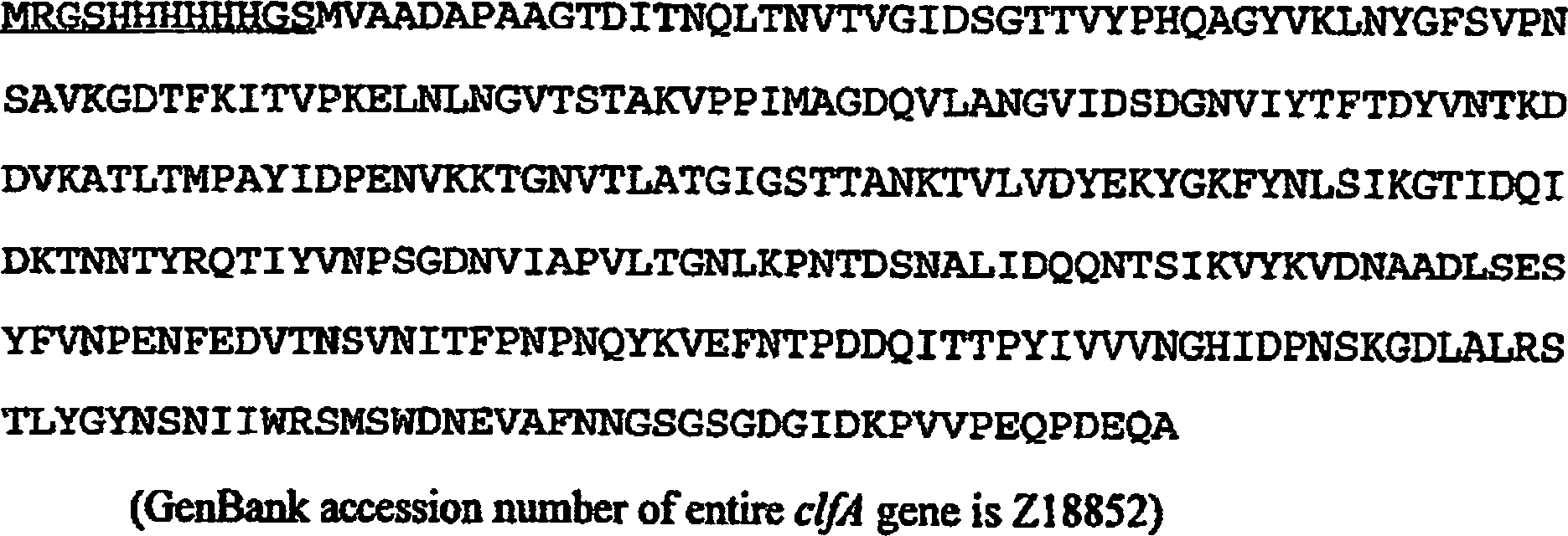
5.3.8
S. Aureus Fibronektin bindendes MSCRAMM Derivat PQD
(SEQ ID NO: 8) 
5.3.9 Verwendung der gereinigten Polyclonalen Kaninchen Hyperimmun anti-MSCRAMM IgG in der passiven Immunisierung5.3.9 Use of the purified Polyclonal rabbit hyperimmune anti-MSCRAMM IgG in passive immunization
5.3.9.1 Rindermastitis5.3.9.1 Bovine mastitis
Einige Studien haben nahe gelegt, dass die Zerstörung der Epithelzellen und die Exposition der ECM Moleküle innerhalb der Brustwarzenkanalöffnung und der Brustwarze kritische Faktoren sind, die zu der Entwicklung einer Mastitis führen (Gudding et al. 1984; Olmsted and Norcross 1992; Cifrian et al. 1995). Die S. Aureus Adhesion an Brustdrüsengewebe wird als erster Schritt in der Entwicklung einer Mastitis angesehen. Daher sind Adhesine, die die S. Aureus Bindung an das Rinderbrustdrüsengewebe vermitteln, entscheidende Ziele für die Entwicklung von blockierenden Antikörpern. Polyklonale Hyperimmun Antikörper, die gegen einige MSCRAMMs generiert worden sind, sind auf ihre Fähigkeit hin analysiert worden, die Bindung des S. Aureus Stammes M60 an kultivierte Rinderbrustsekretions-Epithelzellen zu inhibieren. Eine Dosisabhängige Abnahme in der Anhaftung von S. Aureus wurde mit dem polyklonalen Kaninchen Anti-MSCRAMM IgG gegen die CBPs der SEQ ID NO: 2, SEQ ID NO: 7 und SEQ ID NO: 8 gezeigt.Some Studies have suggested that the destruction of epithelial cells and the exposure of ECM molecules inside the nipple channel opening and the nipple are critical factors that contribute to the development cause mastitis (Gudding et al 1984, Olmsted and Norcross 1992, Cifrian et al. 1995). The S. aureus adhesion to mammary gland tissue is considered a first step viewed in the development of mastitis. Therefore, adhesins, which mediate the S. aureus binding to the bovine gland tissue, crucial goals for the Development of blocking antibodies. Polyclonal hyperimmune Antibody, which have been generated against some MSCRAMMs are based on their ability analyzed binding of S. aureus strain M60 cultured bovine breast secretion epithelial cells. A dose-dependent Decrease in the adhesion of S. aureus was with the polyclonal Rabbit anti-MSCRAMM IgG against the CBPs of SEQ ID NO: 2, SEQ ID NO: 7 and SEQ ID NO: 8.
5.3.9.2 Experimentelle Details5.3.9.2 Experimental details
In Kürze, 5 × 10⁴ sekretorische Epithelzellen wurden in 100 μl Kulturmedium einer flachbodigen, Col-beschichteten 96-Lochplatte hinzugefügt und bis zur Konfluenz bei 37° C gezüchtet. Die S. Aureus Stämme wurden über Nacht in Tryptikasesojabroth (TSB) bei 37° C gezüchtet. Die Über-Nacht-Kultur wurde mit frischem TSB verdünnt und wachsen gelassen, bis die Kultur die exponentielle Phase erreichte, die Organismen wurden geerntet und in 3 ml fischem Kulturmedium suspendiert. Die Bakterien (3,1 × 10⁸) wurden mit zunehmenden Mengen von Anti-MSCRAMM IgG für 30 Minuten bei 37° C inkubiert. Die vorbehandelten Bakterien wurden dann dem Zell-Monolayern hinzugefügt (4,1 × 10⁶ Epithelzellen) und für 3 Stunden bei 37° C inkubiert. Die Monolayer wurden dann fünfmal mit Phosphat gepufferter Saline gewaschen. Die Monolayer wurden mit Methanol fixiert und mit Giemsa angefärbt. Zwanzig Felder (100X Objektiv) wurden in jedem Monolayer auf die Präsenz von adherenten Bakterien hin untersucht.Briefly, 5x10 4 secretory epithelial cells were added to 100 μl culture medium of a flat-bottomed, Col-coated 96-well plate and grown to confluence at 37 ° C. The S. aureus strains were grown overnight in trypticase soyabroth (TSB) at 37 ° C. The overnight culture was diluted with fresh TSB and allowed to grow until the culture reached the exponential phase, the organisms were harvested and suspended in 3 ml of fischer culture medium. The bacteria (3.1 x 10 8 ) were incubated with increasing amounts of anti-MSCRAMM IgG for 30 minutes at 37 ° C. The pretreated bacteria were then added to cell monolayers (4.1 x 10 6 epithelial cells) and incubated for 3 hours at 37 ° C. The monolayers were then washed five times with phosphate buffered saline. The monolayers were fixed with methanol and stained with Giemsa. Twenty fields (100X objective) were examined in each monolayer for the presence of adherent bacteria.
5.3.10 Peritonitis5.3.10 Peritonitis
Dialyse Patienten (kontinuierliche ambulante peritoneale Dialyse, Hemodialyse) haben ein erhöhtes Risiko für die Entstehung einer Staphylokokken Infektion. Durch Verwendung eines Tiermodels einer Peritonitis (Menzies und Kernodle 1996) hatten wir gezeigt, dass die passive Immunisierung mit einer einzigen subkutanen Dosis eines anit-MSCRAMM IgGs die Mäuse gegen eine intraperitoneale S. Aureus Befall schützen. Wenn die Mäuse mit S. Aureus befallen werden, bekommen nur 27 % (10/37) der Mäuse, die passiv mit anti-MSCRAMM IgG immunisiert worden sind, eine Infektion. Umgekehrt bekamen 76 % der Mäuse, die passiv mit normalem Kaninchenserum immunisiert worden sind, eine Infektion. *Erfassung von drei seperaten Studien.Dialysis patients (continuous ambulatory peritoneal dialysis, hemodialysis) have an increased risk of developing a staph infection. Using an animal model of peritonitis (Menzies and Kernodle 1996), we demonstrated that passive immunization with a single subcutaneous dose of anit-MSCRAMM IgG protects the mice against intraperitoneal S. aureus infestation. When challenged with S. aureus, only 27% (10/37) of the mice passively immunized with anti-MSCRAMM IgG become infected. Conversely, 76% of the mice passively immunized with normal rabbit serum were infected. * Acquisition of three separate studies.
Männliche NIH Swiss-Mäuse, im Alter von 6–8 Wochen, mit einem Gewicht von 18–22 g (Harlan Sprague Dawley, Indianapolis, IN) wurden verwendet. Anti-MSCRAMM IgG wurde in Form einer 0,25 ml subkutanen (s.c.) Injektion in die Schenkel der Mäuse verabreicht. Kontrollmäuse erhielten eine äquivalente Menge von normalen Kaninchen IgG (Sigma Chemical Co. St. Louis, MO). 48 Stunden nach der Immunisierung wurden die Mäuse intraperitoneal (i.p.) mit S. Aureus befallen. Die bakteriellen Stämme wurden durch das Wachstum über Nacht in einem Gehirn-Herz-Infusionsbroth (Becton Dickinson Microbiology System, Cockeysville, MD) hergestellt, zweimal in PBS gewaschen und in PBS resuspendiert, und durch die Lichtdurchlässigkeit auf eine Konzentration von 6 × 10⁸ cfu/ml eingestellt. Mäuse wurden mit 0,5 ml der bakteriellen Suspension beimpft. Ein Aliquot der bakteriellen Suspension wurde auf Schafsblut-Agar plattiert, um die exakte cfu/ml zu bestimmen.Male NIH Swiss mice, aged 6-8 weeks, weighing 18-22 g (Harlan Sprague Dawley, Indianapolis, IN) were used. Anti-MSCRAMM IgG was administered as a 0.25 ml subcutaneous (sc) injection into the thighs of the mice. Control mice received an equivalent amount of normal rabbit IgG (Sigma Chemical Co. St. Louis, MO). 48 hours after immunization, the mice were challenged intraperitoneally (ip) with S. aureus. The bacterial strains were prepared by growth overnight in brain-heart infusion broth (Becton Dickinson Microbiology System, Cockeysville, MD), washed twice in PBS and resuspended in PBS, and transmittance to a concentration of 6 x 10 8 cfu / ml. Mice were inoculated with 0.5 ml of the bacterial suspension. An aliquot of the bacterial suspension was plated on sheep blood agar to determine the exact cfu / ml.
Die Mäuse wurden 48 Stunden nach der bakteriellen Beimpfung getötet. Es wurden beide Nieren wurden aus jeder Maus aseptisch entfernt, gewogen und in einer sterilen Tüte, welche 0,5 ml PBS enthält, plaziert und 30 Sekunden durch Verwendung eines Tekmar Tissumizer (Tekmar, Chincinnati, OH) homogenisiert. Das Homogenat wurde serienmäßig mit sterilem Wasser verdünnt und auf Schafsblut-Agar-Platten plattiert und bei 37° C inkubiert. Die Platten wurden 18–24 Stunden später gezählt. Die Homogenate der Nieren aus Mäusen, welche < 100 cfu/ml enthalten, wurden als negativ betrachtet. Die Ergebnisse sind in Tabelle 4 gezeigt.The Mice were Killed 48 hours after bacterial inoculation. There were both kidneys were removed aseptically from each mouse, weighed and placed in a sterile Bag, which Contains 0.5 ml of PBS, placed and 30 seconds by using a Tekmar Tissumizer (Tekmar, Chincinnati, OH) homogenized. The homogenate was standard with diluted in sterile water and plated on sheep blood agar plates and incubated at 37 ° C. The plates were 18-24 hours later counted. Mice kidney homogenates containing <100 cfu / ml, were considered negative. The results are in Table 4 shown.
Tabelle
4 
5.3.11 Demonstration der therapeutischen Wirksamkeit in einem Pneumonie-Model5.3.11 Demonstration of the therapeutic efficacy in a pneumonia model
Staphylocokkus Aureus ist ein lebensbedrohlicher Erreger der nosokomialen Pneumonie in immunsupprimierten Patienten. Häufig zeigt aus diesen Patienten isoliertes S. Aureus eine Resistenz gegen ein breites Spektrum Antibiotika, insbesondere Methizillin. Ein experimentelles Mausmodell einer Staphylocokken Pneumonie (Ramisse et al., 1993) wurde verwendet, um die Fähigkeit von Anti-MSCRAMM IgG neutropenische Mäuse gegen eine S. Aureus mediierte Pneumonie zu schützen, zu beurteilen. Mäuse, die 3 Stunden nach der bakteriellen Beimpfung intranasal mit anti-MSCRAMM IgG behandelt worden sind, zeigten eine 1000-fache Abnahme der Menge an Bakterien, die in ihren Lungen gefunden worden waren (p < 0,01), verglichen zu den PBS Kontrollbehandelten Tieren.Staphylocokkus Aureus is a life-threatening agent of nosocomial pneumonia in immunosuppressed patients. Frequently shows from these patients isolated S. aureus resistance to a broad spectrum of antibiotics, especially methicillin. An experimental mouse model of staphylococcal pneumonia (Ramisse et al., 1993) was used to assess the ability of anti-MSCRAMM IgG neutropenic mice to protect against a S. aureus mediated pneumonia, to assess. Mice that 3 hours after bacterial inoculation intranasally with anti-MSCRAMM IgG have been treated showed a 1000-fold decrease in the amount of bacteria found in their lungs (p <0.01) to the PBS control treated animals.
5.3.11.1 Experimentelle Details5.3.11.1 Experimental details
Weibliche, 4 Wochen alte BALB/c Mäuse wurden intravenös mit Cyklophosphamid, mit 150 mg/kg am Tag 4 und 75 mg/kg am Tag 1 vor dem baktiellen Befall behandelt. Cyklophosphamid induziert eine transiente Neutropenie in den Mäusen. S. Aureus wurde über Nacht bei 37° C in einen Tryptikase Soja Broth (TSB) wachsen gelassen. Die Kulturen wurden gewaschen und dann auf 6,3 × 10⁶ cfu/ml in PBS eingestellt. Ein Aliquot der bakteriellen Suspension wurde auf Schaftsblut-Agar plattiert, um die exakte cfu/ml zu bestimmen. Die Mäuse wurden anästhesiert und mit 15 μl der bakteriellen Suspension beimpft. 3 Stunden nach dem bakteriellen Befall erhielt jede Maus intranasal entweder 7,5 μg anti-MSCRAMM IgG, 75 μg anti-MSCRAMM IgG, oder PBS. Um die Kolonisation der Lungen durch die Bakterien zu kontrollieren wurden 5 Mäuse pro Zeitpunkt getötet. Die bakterielle Auszählung wurde aus Homogenaten der Lungen bestimmt (die Lungen wurden vorsichtig aus den Hauptbronchien präpariert), welche serienmäßig in PBS durch das Ausplattieren von 100 μl Aliquots auf Tryptikase Soja Agar verdünnt wurden und die cfu nach der 24 Stunden Inkubation bei 37° C gezählt wurden. Die bakterielle Auszählung wurde als arithmetisches Mittel (± SE) ausgedrückt. Die statistische Signifikanz wurde durch den Student's t-Test bestimmt. Die Ergebnisse sind in Tabelle 5 gezeigt.Female 4-week-old BALB / c mice were treated intravenously with cyclophosphamide at 150 mg / kg on day 4 and 75 mg / kg on day 1 prior to bacterial infestation. Cyclophosphamide induces transient neutropenia in the mice. S. aureus was grown overnight at 37 ° C in a trypticase soy broth (TSB). The cultures were washed and then adjusted to 6.3 x 10 6 cfu / ml in PBS. An aliquot of the bacterial suspension was plated on stock blood agar to determine the exact cfu / ml. The mice were anesthetized and inoculated with 15 μl of the bacterial suspension. Three hours after bacterial challenge, each mouse received intranasally either 7.5 μg anti-MSCRAMM IgG, 75 μg anti-MSCRAMM IgG, or PBS. To control the colonization of the lungs by the bacteria, 5 mice were killed per time point. Bacterial count was determined from homogenates of the lungs (the lungs were gently prepared from the main bronchi), which serially prepared in PBS by plating out 100 μl aliquots were diluted to trypticase soy agar and the cfu were counted after the 24 hour incubation at 37 ° C. The bacterial count was expressed as an arithmetic mean (± SE). Statistical significance was determined by Student's t-test. The results are shown in Table 5.
Tabelle
5 
5.3.12 Passive Immunisierung durch Verwendung von CBP Epitopen5.3.12 Passive immunization by using CBP epitopes
In
separaten Studien wurden, wie hierin beschrieben, Ratten mit M55
oder BSA als Kontrolle immunisiert. Sie wurden ausgeblutet und die
IgG Fraktion durch eine Amoniumsulfat Präzipitation erhalten. Die IgG Fraktion
(16 mg) wurde Mäusen
einen Tag vor dem IV Befall mit S. Aureus verabreicht. Diese passiven
Immunisierungsdaten bestätigen
die Wirksamkeit der aktiven Immunisierung – d. h., Antikörper gegen
M55 des CBP gerichtet schützen
gegen lethale Dosen von S. Aureus (
5.4. Beispiel 4 – Tierstudien, welche S. Aureus CBP involvieren5.4. Example 4 - Animal studies, which involve S. Aureus CBP
Die korneale Infektion ist eine Hauptursache des optischen Verlusts und ist ein bedeutendes Problem der öffentlichen Gesundheit in den United States. Bakterielle Keratitis entsteht, wenn mikrobielle Virulenzfaktoren den Abwehrmechanismus des Wirtes bewältigen. Das erfolgreiche korneale Pathogen bindet an die korneale Oberfläche, dadurch den Reinigungsmechanismus des Tränenfilms vermeidend. Spezifische bakterielle Oberflächenproteine binden an spezifische Komponenten der Kornea, wie z.B. Fibronektin, Fibrinogen und Col. Spezifische mikrobielle Adhesine mediieren diese Adherenz durch eine ausgeklügelte Interaktion mit den Molekülen des Wirtes.The Corneal infection is a major cause of optical loss and is a significant public health problem in the United States. Bacterial keratitis arises when microbial Virulenzfaktoren master the defense mechanism of the host. The successful corneal pathogen binds to the corneal surface, thereby the cleaning mechanism of the tear film avoidant. Specific bacterial surface proteins bind to specific Components of the cornea, e.g. Fibronectin, fibrinogen and col. Specific microbial adhesins mediate this adherence a sophisticated Interaction with the molecules of the host.
Die S. Aureus MSCRAMMs sind durch Verwendung verschiedener tierischer Modelle untersucht worden. Diese MSCRAMMs sind auf der Oberfläche von S. Aureus lokalisiert und wechselwirken mit den ECM Komponenten mit hoher Affinität und hoher Spezifität. MSCRAMMs die Fibronektin, Fibrinogen und Col erkennen, sind zuvor mit Hinsicht auf ihre strukturelle Organisation, Liganden-Bindungsdomänen, Bedeutung in der Kolonisation und Invasion des Wirtes, und ihrer biologischen Rolle als Virolenzfaktoren beschrieben worden.The S. aureus MSCRAMMs are by using various animal Models have been studied. These MSCRAMMs are on the surface of S. Aureus locates and interacts with the ECM components with high affinity and high specificity. MSCRAMMs that recognize fibronectin, fibrinogen and Col are previously in terms of their structural organization, ligand-binding domains, importance in the colonization and invasion of the host, and their biological Role as virulence factors have been described.
Die Erfinder haben wohl in vitro als auch in vivo Studien angewendet, um die Rolle von CBP in der Pathophysiologie der infektiösen Keratitis zu bestimmen.The Inventors have probably applied studies in vitro as well as in vivo, to the role of CBP in the pathophysiology of infectious keratitis to determine.
5.4.1 Col-Bindung durch okulare Isolate5.4.1 Col bond by ocular isolates
20 klinische Isolate von S. Aureus aus dem Cullen Eye Institut am Baylor College of Medicine (Houston, TX) wurden zufällig ausgewählt. Jedes wurde aus aus Fällen mit einer vorherigen bakterieller Keratitis mit klinischen Standard Techniken isoliert. Typ II Col wurde mit 125I durch die Chloramin-T-Methode markiert. Eine 5 ml Kultur von jedem Stamm wurde über Nacht in einem Gehirn-Herz Infusions-Broth wachsen gelassen. Die Zellen wurden zentrifugiert und in 1 ml PBS resuspendiert. Für jeden Assay wurden 50 μl der bakteriellen Zellen (annähernd 5 × 10⁸ cfu/ml) mit 400 μl PBS mit 0,1 % BSA und 0,1 % Tween 80® und 5 × 10⁴ cpm von dem 125I markierten Typ II Col inkubiert. Die Röhrchen wurden bei Raumtemperatur für 1 Stunde inkubiert und end-over rotiert. Die Reaktion wurde durch Zugabe von 3 ml eisgekühltem PBS, welches 0,1 % Tween 80® enthält, gestoppt und die Röhrchen wurden unverzüglich bei 1500 × g für 20 Minuten zentrifugiert. Nach dem Absaugen des Überstands wurden die Pellets, die die bakteriellen Zellen enthalten, auf ihre Radioaktivität in einem Gamma-Counter hin analysiert. Die Proben wurden in dreifacher Ausführung analysiert und die Hintergrundwerte, welche die Radioaktivität, die in den Röhrchen wieder erlangt wurde, die in Abwesenheit von Bakterien inkubiert worden sind, wurde subtrahiert.Twenty clinical isolates of S. aureus from the Cullen Eye Institute at Baylor College of Medicine (Houston, TX) were selected at random. Each was isolated from cases with a previous bacterial keratitis using standard clinical techniques. Type II Col was labeled with 125 I by the chloramine-T method. A 5 ml culture of each strain was grown overnight in a brain-heart infusion broth. The Cells were centrifuged and resuspended in 1 ml PBS. For each assay, 50 ul of the bacterial cells (approximately 5 × 10 8 cfu / ml) with 400 ul of PBS with 0.1% BSA and 0.1% Tween 80 ® and 5 x 10 4 cpm of the 125 I-labeled type II Col incubated. The tubes were incubated at room temperature for 1 hour and rotated end-over. The reaction was stopped by adding 3 ml of ice-cold PBS containing 0.1% Tween 80 ®, and the tubes were centrifuged for 20 minutes at 1500 x g without delay. After aspirating the supernatant, the pellets containing the bacterial cells were analyzed for their radioactivity in a gamma counter. The samples were analyzed in triplicate and the background levels which recovered the radioactivity recovered in the tubes which had been incubated in the absence of bacteria were subtracted.
Die Analyse der klinischen Isolate deutet darauf hin, dass die Bindung an Col ein „Alles oder gar Nichts" Phänomen ist. 30 % (6/20) der S. aureus-Isolate haben an markiertes Col gebunden. Zusätzlicher 18S. aureus Stämme, die aus dem Glaskörper der Patienten mit bakterieller Keratitis isoliert worden sind, wurden auch auf die Col-Bindung hin analysiert. Interessanterweise haben 72 % (13/18) von jenen Stämmen an Col gebunden. Zusammen genommen deuten diese Daten darauf hin, dass die Col-Bindung ein wichtiger, die Virulenz bestimmender Faktor in der Pathogenese der S. aureus-Augeninfektionen ist.The Analysis of clinical isolates indicates that binding at Col an "Everything or nothing "phenomenon is. 30% (6/20) of S. aureus isolates bound to labeled Col. additional 18S. aureus strains, the from the vitreous body Patients with bacterial keratitis have also been isolated analyzed for the Col bond. Interestingly, 72 have % (13/18) of those tribes tied to Col. Taken together, these data indicate Col-binding is an important virulence determining factor in the pathogenesis of S. aureus eye infections.
5.4.2 Tierstudien, die eine S. Aureus-Keratitis involvieren5.4.2 Animal studies that involve S. aureus keratitis
In nachfolgenden Studien haben die Erfinder untersucht, ob die Fähigkeit an Col zu binden, von großer Bedeutung in der Entwicklung von mikrobieller Keratitis im Kaninchen war. Die vorhergehenden Tiermodelle der S. aureus-Keratitis erforderten eine direkte intrastromale Injektion, um die Infektion zu induzieren. Mikrobielle Adhäsion an zerstörtes korneales Gewebe ist das höchst wahrscheinliche auslösende Ereignis in der Entstehung von Keratitis, daher wurde, um noch genauer den natürlichen Verlauf der Erkrankung zu imitieren, ein Tiermodell entwickelt, das keine intrastromale Injektion erfordert. Um zu bestimmen, ob das S. aureus-Col MSCRAMM als Virulenzfaktor in der Keratitis betrachtet werden kann, wurde für diese Studie ein Kaninchenmodell entwickelt. Weiche Kontaktlinsen wurden in Kulturmedien von dem S. aureus-Stamm Phillips (CBP+) und seinen isogenen Mutations Derivat PH 100 (CBP–) plaziert. Die Kontaktlinsen wurden 24 Stunden in den Kulturmedien inkubiert, welche annähernd 108-Bakterien enthielten. Dieses resultierte in 1 × 10⁶- an den Kontaktlinsen gebundenen Bakterien für PH 100 und 2 × 10⁵ an die Linsen gebundene Organismen für den Stamm Phillips. Dieser Unterschied war statistisch nicht signifikant. Die weichen Kontaktlinsen wurden mit PBS gewaschen, um jegliche locker gebundenen Organismen zu entfernen und wurden dann auf die de-epithelialisierten Kornea von New Zealand weißen Kaninchen plaziert. Die Nickhautmembranen der Kaninchen wurden entfernt, um eine Dislokation der Kontaktlinsen zu vermeiden und die Augenlider wurden mit 7-0 Vicryl zugenäht. In einer Blindstudie wurde eine Gesamtzahl von 16 Kaninchen, 8 in jeder Gruppe verwendet. Die Augen wurden 48 Stunden nach der Plazierung der Kontaktlinsen geöffnet. Korneale Abschabungen wurden durchgeführt und auf einen Blutagar plaziert, um das Vorhandensein einer Infektion zu bestätigen und die Korneas wurden für histologische Bestimmungen entfernt. Eines der Kaninchen, welches der CBP–-Gruppe zugeordnet war, entwickelte eine spontane Dehiszenz der Tarsorrhaphie-Schließung und Verlust der Kontaktlinsen, so dass das Tier aus der Studie entfernt wurde. 75 % (6/8) der Kaninchen mit Kontaktlinsen, welche mit dem Phillipsstamm (CBP+) inkubiert worden waren, entwickelten eine klinische mikrobielle Keratitis, wie durch eine dichte, zentrale eitrige stromale Keratitis gezeigt wurde. Kulturen bestätigten das Vorhandensein von S. aureus in allen infizierten Fällen. Umgekehrt, 0/7 Kaninchen mit Kontaktlinsen, die mit PH100 inkubiert worden waren, entwickelten eine eitrige Keratitis, obwohl in allen Fällen der epitheliale Defekt zurückblieb.In subsequent studies, the inventors examined whether the ability to bind Col was of great importance in the development of microbial keratitis in rabbits. The previous animal models of S. aureus keratitis required a direct intrastromal injection to induce the infection. Microbial adhesion to disrupted corneal tissue is the most likely triggering event in the development of keratitis, therefore, to more accurately mimic the natural course of the disease, an animal model has been developed that does not require intrastromal injection. To determine whether S. aureus Col MSCRAMM can be considered a virulence factor in keratitis, a rabbit model was developed for this study. Soft contact lenses were placed in culture media from the S. aureus strain Phillips (CBP + ) and its isogenic mutation derivative PH 100 (CBP - ). The contact lenses were incubated for 24 hours in the culture media containing approximately 10 8 bacteria. This resulted in 1 × 10 6 - contact lens bound bacteria for PH 100 and 2 × 10 5 lens bound organisms for Phillips strain. This difference was not statistically significant. The soft contact lenses were washed with PBS to remove any loosely bound organisms and were then placed on the de-epithelialized cornea of New Zealand white rabbits. The nasal membranes of the rabbits were removed to avoid dislocation of the contact lenses and the eyelids were sutured with 7-0 Vicryl. In a blind study, a total of 16 rabbits, 8 in each group, were used. The eyes were opened 48 hours after placement of the contact lenses. Corneal scrapings were performed and placed on a blood agar to confirm the presence of infection and the corneas were removed for histologic determinations. One of the rabbits assigned to the CBP - group developed a spontaneous dehiscence of tarsorrhaphy closure and loss of contact lenses, so that the animal was removed from the study. 75% (6/8) of rabbits with contact lenses incubated with the Phillips strain (CBP + ) developed clinical microbial keratitis as evidenced by dense central purulent stromal keratitis. Cultures confirmed the presence of S. aureus in all infected cases. Conversely, 0/7 rabbits with contact lenses incubated with PH100 developed purulent keratitis, although in all cases the epithelial defect remained.
Dieser Unterschied in dem Anteil der Keratitis war statistisch signifikant. (Fisher's Exakt Test p = 0,006).This Difference in the proportion of keratitis was statistically significant. (Fisher's Exact Test p = 0.006).
Die Wirksamkeit eines kleinen Molekülinhibitors, basierend auf der 3-D-Struktur von CBC(151–318) kann durch Verwendung des bakteriellen Keratitismodells getestet werden. Nach dem die Kontaktlinsen mit S. aureus inkubiert worden sind und gewaschen worden sind, um jegliche locker gebundenen Organismen zu entfernen, werden die kontaminierten Kontaktlinsen in einer Lösung gebracht, die den Inhibitor enthält. Der Inhibitor wird an die aktiven Stellen binden, dadurch die Col MSCRAMM sättigen, dadurch die Bakterien von der Anheftung an exponierte Col-Fasern in der zerstörten Kornea abhalten. Zusätzlich zu der Vorbeugung der S. aureus bakteriellen Keratitis würde der Inhibitor zu den Lösungen hinzugefügt, die im Allgemeinen durch Augenbanken verwendet werden, um Infektionen des Empfängers der Donorlinsen zu verhindern.The Effectiveness of a small molecule inhibitor, based on the 3-D structure of CBC (151-318) can be determined by using of the bacterial keratinization model. After the Contact lenses were incubated with S. aureus and washed have been used to remove any loosely bound organisms, the contaminated contact lenses are placed in a solution containing the inhibitor. The inhibitor will bind to the active sites, causing Col Saturate MSCRAMM, This causes the bacteria to attach to exposed Col fibers in the destroyed Discourage cornea. additionally for the prevention of S. aureus bacterial keratitis the Inhibitor to the solutions added which are generally used by eye banks to treat infections Recipient to prevent the donor lenses.
5.5 Beispiel 5 – Mausmodell einer septischen Arthritis5.5 Example 5 - Mouse Model a septic arthritis
Durch die Verwendung eines Mausmodells einer septischen Arthiritis (Bremell et al., 1992) haben die Erfinder die Verwendung von rekombinanten Domänen, CBD(151–297) und CBD(61–343) des S. aureus Col MSCRAMM als eine Impfstoffkomponente untersucht. 18 Mäuse wurden mit 100 μg von dem Protein (GST-61-343) im Freund'schen kompletten Adjuvants (FCA) an den Tagen -34, -21, -9 geimpft. 25 Kontrollmäusen wurde PBS-FCA am gleichen Tag injiziert. Die Mäuse wurden mit einer intravenösen Injektion vom S. aureus-Stamm Phillips am Tag 0 befallen. Die Mäuse, die mit GST-61-343 immunisiert worden waren, zeigten eine 50 %ige Reduktion in der Arthritis, im Vergleich zu den Kontrollmäusen. Zusätzliche Studien sind auch durchgeführt worden, welche verschiedene Domänen des S. aureus Col MSCRAMM verwenden.By using a mouse model of septic arthiritis (Bremell et al., 1992) The inventors examined the use of recombinant domains, CBD (151-297) and CBD (61-343) of the S. aureus Col MSCRAMM as a vaccine component. Eighteen mice were inoculated with 100 μg of the protein (GST-61-343) in Freund's complete adjuvant (FCA) on days -34, -21, -9. Twenty-five control mice were injected with PBS-FCA on the same day. The mice were infested with an intravenous injection of S. aureus strain Phillips on day 0. The mice immunized with GST-61-343 showed a 50% reduction in arthritis compared to control mice. Additional studies have also been carried out using different domains of the S. aureus Col MSCRAMM.
5.6 Beispiel 6 – Nachweis, dass nur bestimmte CBP-Epitope Schutz gegen eine S. aureus-Infektion verleihen5.6 Example 6 - Evidence that only certain CBP epitopes confer protection against S. aureus infection
Die folgenden Beispiele zeigen die wirksame Verwendung von CBP-Epitopen als Impfstoffkomponenten, und Zusammensetzungen, die in der Verleihung von Schutz an ein Tier gegen die Infektion durch S. aureus nützlich sind.The The following examples show the effective use of CBP epitopes as vaccine components, and compositions used in the award of protection to an animal against infection by S. aureus.
5.6.1 Maus Sepsis Modell – verwendete CBP-Epitope5.6.1 Mouse sepsis model - used CBP epitopes
- M17 umfasst die Aminosäuren 151–297 des vollständigen CBP (SEQ ID Nr. 2).M17 includes the amino acids 151-297 of the complete CBP (SEQ ID NO: 2).
- M31 umfasst die Aminosäuren 61–343 des vollständigen CBP (SEQ ID Nr. 4).M31 includes the amino acids 61-343 of the complete CBP (SEQ ID NO: 4).
- M55 umfasst die Aminosäuren 30–531 des vollständigen CBP (SEQ ID Nr. 6).M55 includes the amino acids 30-531 of the complete CBP (SEQ ID NO: 6).
- Die DNA-Segmente, welche die M17, M31 und M55 Epitope kodieren, sind jeweils in den Sequenzen SEQ ID Nr. 1, SEQ ID Nr. 3 und SEQ ID Nr. 5 offenbart.The DNA segments encoding the M17, M31 and M55 epitopes are each in the sequences SEQ ID NO: 1, SEQ ID NO: 3 and SEQ ID No. 5 discloses.
5.6.2 Immunisierungsplan5.6.2 Immunization plan
- Tag -31: 100μg/Maus eines CBP-Epitops (d. h. M17, M31 oder M55) oder BSA emulgiert mit Freund'schen komplette Adjuvants (Difco Laboratories) als Kontrolle.Day -31: 100μg / mouse a CBP epitope (i.e., M17, M31, or M55) or BSA emulsified with Freund's complete Adjuvants (Difco Laboratories) as a control.
- Tag -18: 100μg/Maus eines CBP-Epitops (d. h. M17, M31 oder M55) oder BSA gelöst ist steril Phosphat gepufferter Saline (PBS)Day -18: 100μg / mouse a CBP epitope (i.e., M17, M31, or M55) or BSA is sterile Phosphate Buffered Saline (PBS)
- Tag -7: 100μg/Maus eines CBP-Epitops (d. h. M17, M31 oder M55) oder BSA gelöst in PBS Tag 0: Intravenöse Beimpfung mit S. aureus-Stamm Phillips (welcher CBP exprimiert) (Dosis: 2,8 × 10⁷ cfu/Maus)Day -7: 100 μg / mouse of a CBP epitope (ie M17, M31 or M55) or BSA dissolved in PBS Day 0: Intravenous inoculation with S. aureus strain Phillips (which expresses CBP) (dose: 2.8 × 10 7 cfu / mouse)
- Tag 14: Ende der Studie; alle überlebenden Mäuse wurden eingeschläfert.Day 14: End of the study; all surviving mice were euthanized.
5.6.2 Ergebnisse5.6.2 Results
- 10/15 Mäuse starben in der Gruppe M17 Col bindendes MSCRAMM-10/15 mice died in group M17 Col binding MSCRAMM
- 12/14 Mäuse starben in der Gruppe M31 Col bindendes MSCRAMM12/14 mice died in the group M31 Col binding MSCRAMM
- 4/11 Mäuse starben in der Gruppe M55 Col bindendes MSCRAMM4/11 mice died in the group M55 Col binding MSCRAMM
- Alle 15 von 15 Mäusen starben in der BSA-Kontrollgruppe.All 15 out of 15 mice died in the BSA control group.
In einer Kontrollstudie wurden M55 und BSA-immunisierte Mäuse mit einem Stamm von S. aureus befallen, der nicht die das Col-bindende MSCRAMM exprimiert. Die Mortalität in der M55-Gruppe war 50 %, im Vergleich zu 30 % in der BSA-Gruppe. Wichtig ist, dass diese Daten darauf hinweisen, dass der Schutz direkt in Beziehung zu den Antikörpern steht, die gegen den M55-Teil des Col-bindenden MSCRAMM generiert wurde.In A control study included M55 and BSA immunized mice a strain of S. aureus that is not the Col-binding one MSCRAMM expressed. Mortality in the M55 group was 50%, compared to 30% in the BSA group. Importantly, this data indicates that the protection directly in relation to the antibodies which generates against the M55 part of the Col-binding MSCRAMM has been.
Im scharfen Kontrast zu der zuvor identifizierten vollständigen Sequenz, welche keinen Schutz gegen Sepsis in einem in vivo Tiermodell verleiht, zeigen diese Daten klar, dass M55 (nur die A-Domäne umfassend) sehr effektiv in der Vorbeugung gegen Sepsis war.in the sharp contrast to the previously identified complete sequence, which does not confer protection against sepsis in an in vivo animal model, These data clearly show that M55 (comprising only the A domain) is very effective was in the prevention of sepsis.
Überraschenderweise ist nur M55 hochprotektiv, obwohl alle der CBP-Fragmente (M17 und M31) innerhalb der M55-Proteinsequenz umfasst sind.Surprisingly only M55 is highly protective, although all of the CBP fragments (M17 and M31) within the M55 protein sequence.
5.7 Beispiel 7 – Opsonierung, Phagocytose und intrazelluläre Zerstörung von Bakterien5.7 Example 7 - Opsonization, Phagocytosis and intracellular destruction of bacteria
Der Phagocytosetest wurde durch eine Modifikation einer zuvor beschriebenen Methode gemacht (Lissner et al., 1983). In Kürze, peritoneale Makrophagen wurden aus der Peritonealhöhle durch i.p. Injektion von 3 ml eiskaltem Medium (Iscovés Medium, welches 10 % fetales Kälberserum und 100 μg/ml von Gentamycin enthält) gesammelt, nach einer Minute Massage des Abdomens wurde das Macrophagen-enthaltende Medium abgesaugt. Die Macrophagen wurden gewaschen und auf 2 × 10⁶ Zellen/ml eingestellt, in 200 μl Volumen in eine 24-Lochplatte gesät (Nunc, Roskilde, Denmark) und bei Raumtemperatur für 90 Minuten gelassen. 500 μl des Zellkulturenmediums wurde jedem Loch hinzugefügt und die Zellen wurden für 24 Stunden bei 37°C inkubiert. Das Medium wurde dann entfernt und durch 500 μl eines Mediums, welches frei von Antibiotika ist, ersetzt und die Zellen wurden dann über Nacht bei 37°C inkubiert. Am nächsten Tag wurden die Staphylokokken für 30 Minuten bei 4°C opsoniert mit entweder a) 50 % Hitze-inaktivierten Seren von Mäusen, die mit M55 hyperimmunisiert worden sind, oder b) mit Seren aus BSA hyperimmunisierten Mäusen, oder wahlweise c) mit Seren aus Mäusen, die eine Infektion mit dem Stamm Phillips ohne vorherige Immunisierung durchgemacht haben. 500 μl von opsonierten Staphylokokken wurden zu jedem Loch in einer Konzentration von 1,4 × 10⁷ Bakterien/ml hinzugefügt. Nach 50 Minuten Inkubation wurden die Macrophagen dreimal in Iscovés gewaschen, um nicht aufgenommene Bakterien zu entfernen. Danach wurden die Macrophagen analysiert, entwerder direkt nach der bakteriellen Inkubation oder 4 Stunden später. Zu den Kulturen, die für 4 Stunden inkubiert worden waren, wurde Iscoves-Medium mit einer minimalen inhibitorischen Konzentration von Gentamycin, passend für den S. aureus-Stamm Phillips (5 μg/ml), zugefügt, um eine extrazelluläre Reproduktion der Bakterien zu vermeiden. Die Macrophagen wurden mit destilliertem Wasser für 20 Minuten lysiert, und das Lysat 1/1, 1/10, 1/100 und 1/1000 verdünnt, wurde auf 5 % Pferdeblut Agarplatten kultiviert. Die Platten wurden über Nacht inkubiert und die Anzahl der Bakterien gezählt.The phagocyte assay was made by a modification of a previously described method (Lissner et al., 1983). Briefly, peritoneal macrophages were collected from the peritoneal cavity by ip injection of 3 ml of ice-cold medium (Iscovés medium containing 10% fetal calf serum and 100 μg / ml of gentamycin), after one minute massage of the abdomen, the macrophage-containing medium was aspirated , The macrophages were washed and adjusted to 2 × 10 6 cells / ml, seeded in 200 μl volumes in a 24-well plate (Nunc, Roskilde, Denmark) and gelated at room temperature for 90 minutes sen. 500 μl of the cell culture medium was added to each well and the cells were incubated for 24 hours at 37 ° C. The medium was then removed and replaced with 500 μl of antibiotics-free medium and the cells were then incubated overnight at 37 ° C. The next day, the staphylococci were opsonized for 30 minutes at 4 ° C with either a) 50% heat-inactivated sera of mice hyperimmunized with M55, or b) sera from BSA hyperimmunized mice, or optionally c) with sera from mice that have been infected with Phillips strain without prior immunization. 500 μl of opsonized staphylococci were added to each well at a concentration of 1.4 × 10 7 bacteria / ml. After 50 minutes of incubation, the macrophages were washed three times in Iscovés to remove non-ingested bacteria. Thereafter, the macrophages were analyzed, either directly after the bacterial incubation or 4 hours later. To the cultures that had been incubated for 4 hours, Iscoves medium with a minimal inhibitory concentration of gentamycin suitable for the S. aureus strain Phillips (5 μg / ml) was added to avoid extracellular reproduction of the bacteria , The macrophages were lysed with distilled water for 20 minutes and the lysate diluted 1/1, 1/10, 1/100 and 1/1000 was cultured on 5% horse blood agar plates. The plates were incubated overnight and the number of bacteria counted.
5.7.1 In Vitro Assays5.7.1 In Vitro Assays
In vitro Assays wurden durchgeführt, um den Einfluß spezifischer Antikörper gegen Kollagenadhäsion auf die Phagocytose und die intrazelluläre Zerstörungskapazität zu beurteilen. Kollagenadhäsions exprimierender Phillips-Stamm wurde mit entweder Serum, welches M55-spezifische Antikörper enthält oder Serum, welches BSA-Antikörper enthält, oder wahlweise Serum aus natürlichen Mäusen, welche eine Infektion durch Phillips durchgemacht haben, opsoniert.In vitro assays were performed to the influence of specific antibody against collagen adhesion to assess phagocytosis and intracellular destruction capacity. Kollagenadhäsions expressing Phillips strain was probed with either serum M55-specific antibodies contains or serum, which is BSA antibody contains or alternatively serum from natural mice, who have undergone an infection by Phillips, opsoniert.
Die
Ergebnisse (
5.8 Beispiel 8 – Detektion von CBP-Antikörpern in S. aureus-infizierten Mäusen5.8 Example 8 - Detection of CBP antibodies in S. aureus-infected mice
In dieser Studie wurden 15 Mäuse experimentell mit einer sub-lethalen Dosis von S. aureus infiziert, welche das Col-bindende MSCRAMM exprimiert. Anti-M55 (Col MSCRAMM) IgG konnte nicht in den Seren von den infizierten Tieren detektiert werden. Umgekehrt, Tiere, welche mit M55 immunisiert worden waren und mit einer sub-lethalen Dosis S. aureus infiziert worden waren, hatten einen anti-M55 IgG (Col MSCRAMM)-Titer von 32 × 109 Units/ml.In this study, 15 mice were experimentally infected with a sub-lethal dose of S. aureus expressing the Col-binding MSCRAMM. Anti-M55 (Col MSCRAMM) IgG could not be detected in the sera from the infected animals. Conversely, animals that had been immunized with M55 and infected with a sub-lethal dose of S. aureus had an anti-M55 IgG (Col MSCRAMM) titer of 32 x 10 9 units / ml.
Diese Daten deuten darauf hin, dass während des normalen Verlaufs einer Infektion das CBP vor einer immunologischen Erkennung geschützt ist. Die Induktion einer polyklonalen B-Zellaktivierung, als Konsequenz einer Infektion mit S. aureus, wird die spezifische Immunantwort auf viele bakterielle Zellwandkomponenten runter regulären, einschließlich des nativen CBP.These Data suggest that during the normal course of infection the CBP before an immunological Detection protected is. The induction of a polyclonal B-cell activation, as a consequence of a Infection with S. aureus, the specific immune response to many Downstream bacterial cell wall components, including the native CBP.
5.8.1 Experimentelle Details5.8.1 Experimental details
Die Serummengen von spezifischen Antikörpern gegen das Kollagenadhäsionspeptid M55 wurde durch einen Enzyme Linked Immunosorbent Assay (ELISA) gemessen. 96-Loch-Mikroplatten (Nunc) wurden über Nacht bei 4°C mit 2 μg/ml des M55-Peptids beschichtet. Blockiert wurde mit 0,5 % Ovalbumin (Sigma Chemical Co., St. Louis, MO) welches in 0,05 M Tris (pH 7,7) gelöst war. Seren, biotinylierte Antikörper und ExtrAvidin-Peroxidase (Sigma) wurden alle in 0,05 M Tris (pH 7,4)-0,015 M NaCl verdünnt. Die Platten wurden über Nacht bei 4°C mit den Seren inkubiert, gewaschen und schrittweise mit biotinyliertem Ziege-Anti-Maus IgG-Antikörper (Jackson Immuno Research Laboratories, Inc., West Grove, PA), ExtrAvidin-Peroxidase (0,5 μg/ml; Sigma) und ABTS-Substrat inkubiert. Das A405 wurde in einem Titertec Multiscan-Photometer (Flow Laboratories, McLean, VA) gemessen. Ein ähnliches ELISA-Verfahren, wie oben beschrieben, wurde verwendet, um Antikörper gegen M19, M31, als auch gegen die B1-Domäne der Kollagen-Adhäsion zu detektieren. OVA wurde als solides Kontroll Antigen verwendet.The Serum levels of specific antibodies to the collagen adhesion peptide M55 was analyzed by enzyme linked immunosorbent assay (ELISA) measured. 96-well microplates (Nunc) were over Night at 4 ° C with 2 μg / ml of the M55 peptide. Blocking was with 0.5% ovalbumin (Sigma Chemical Co., St. Louis, MO) which is dissolved in 0.05 M Tris (pH 7.7). solved was. Sera, biotinylated antibodies and ExtrAvidin-peroxidase (Sigma) were all dissolved in 0.05 M Tris (pH 7.4) -0.015 M NaCl. The plates were over Night at 4 ° C incubated with the sera, washed and biotinylated stepwise Goat anti-mouse IgG antibody (Jackson Immuno Research Laboratories, Inc., West Grove, PA), ExtrAvidin Peroxidase (0.5 μg / ml; Sigma) and ABTS substrate. The A405 was in a Titertec Multiscan photometer (Flow Laboratories, McLean, VA). A similar ELISA method, as described above, was used to challenge antibodies M19, M31, as well as against the B1 domain of collagen adhesion detect. OVA was used as a solid control antigen.
Darüber hinaus
wurden 96-Lochplatten mit Poly-L-Lysin (Sigma) beschichtet und dann
mit entweder 1,5 × 10⁷ S. aureus Stämmen Phillips oder LS-1 beschichtet.
Nach der Blockierungsprozedur wurden die Seren aus immunisierten
Mäusen
und nicht-immunisierten, aber infizieren Mäusen, als auch natürlichen
Maus-Seren inkubiert. Die Entwicklungsschritte wurden dann wie oben
beschrieben gemacht. Die Daten sind in
5.9 Beispiel 9 – Detektion der Antikörper gegen Col bindendes MSCRAMMs in mit S. aureus infizierten Menschen5.9 Example 9 - Detection the antibody Col-binding MSCRAMMs in S. aureus infected humans
Dieses Beispiel beschreibt die Ergebnisse von Studien, um Antikörper gegen Col bindendes MSCRAMM zu detektieren.This Example describes the results of studies to detect antibodies against Col binding MSCRAMM to detect.
Seren
aus 34 Patienten, bei welchen klinisch eine S. aureus Infektion
diagnostiziert wurde, wurden durch einen ELISA bestimmt. IgG, das
das immobilisierte M55 erkennt (Col MSCRAMM) konnte nur detektiert werden,
wenn außerordentlich
hohe Mengen von Antigenen in dem Assay verwendet wurden. Somit konnten, trotz
der Tatsache, dass diese Patienten eine klinisch diagnostiziere
S. aureus Infektion hatten, nur eine geringe Erhöhung im α-CBP-Titer detektiert werden.
Diese Daten (
6. Referenzen6. References
The following literature citations as well as those cited above are incorporated in pertinent part by reference herein for the reasons cited in the above text:The following literature citations as well as those cited above are incorporated in pertinent part by reference in for the reasons cited in the above text:
- U. S. Patent 3,791,932U.S. Patent 3,791,932
- U. S. Patent 3,949,064.U.S. Patent 3,949,064.
- U. S. Patent 4,174,384.U.S. Patent 4,174,384.
- U. S. Patent 4,196,265.U.S. Patent 4,196,265.
- U. S. Patent 4,271,147.U.S. Patent 4,271,147.
- U. S. Patent 4,554,101.U.S. Patent 4,554,101.
- U. S. Patent 4,578,770.U.S. Patent 4,578,770.
- U. S. Patent 4,546,792.U.S. Patent 4,546,792.
- U. S. Patent 4,599,230. U.S. Patent 4,599,230.
- U. S. Patent 4,599,231.U.S. Patent 4,599,231.
- U. S. Patent 4,601,903.U.S. Patent 4,601,903.
- U. S. Patent 4,608,251.U.S. Patent 4,608,251.
- U. S. Patent 4,683,195.U.S. Patent 4,683,195.
- U. S. Patent 4,683,202U.S. Patent 4,683,202
- Abraham et al., "Adherence of Streptococcus pyogenes, Escherichia coli, and Pseudomonas aeruginosa to Fibronectin-Coated and Uncoated Epithelial Cells," Infect. Immun, 41:1261–1268, 1983.Abraham et al., "Adherence of Streptococcus pyogenes, Escherichia coli, and Pseudomonas aeruginosa on Fibronectin-Coated and Uncoated Epithelial Cells, Infect. Immun., 41: 1261-1268, 1983.
- Aleljung et al., Curr. Microbiol., 28:231–236, 1994.Aleljung et al., Curr. Microbiol., 28: 231-236, 1994.
- Allen and Choun, "Large Unilamellar Liposmes with Low Uptake into the Reticuloendothelial System," FEBS Lett., 223:42–46, 1987.Allen and Choun, "Large Unilamellar liposome with low uptake into the reticuloendothelial System, "FEBS Lett., 223: 42-46, 1987th
- Allen et al., J. Bact., 173:916–920, 1991.Allen et al., J. Bact., 173: 916-920, 1991.
- Bayer and Wilchek, "The use of the avidin-biotin complex as a tool for molecular biology," In: Methods of Biochemical Analysis, Glick, D., Jobn Wiley and Sons, New York, 1980.Bayer and Wilchek, "The use of the avidin-biotin complex as a tool for molecular biology, "In: Methods of Biochemical Analysis, Glick, D., Jobn Wiley and Sons, New York, 1980.
- Bella et al., "Crystal and Molecular Structure of a Col-Like Peptide at 1.9 Å Resolution," Science, 266:75–81, 1994.Bella et al., "Crystal and Molecular Structure of a Col-like Peptides at 1.9 Å Resolution, Science, 266: 75-81, 1994.
- Bidanset, Guidry, Rosenberg, Choi, Timpl, Höök, "Binding of the Proteoglycan Decorin to Collagen Type VI," J. Biol. Chem., 267:5250–5256, 1992.Bidanset, Guidry, Rosenberg, Choi, Timpl, Höök, "Binding of the Proteoglycan Decorin to Collagen Type VI, "J. Biol. Chem., 267: 5250-5256, 1,992th
- Bolivar et al., Gene, 2:95, 1977.Bolivar et al., Gene, 2:95, 1977.
- Bremell et al., Infect. Immun., 59(8):2615–2623, 1991.Bremell et al., Infect. Immun., 59 (8): 2615-2623, 1991.
- Bremell et al., Infect. Immun., 62(7):2976–2985, 1992.Bremell et al., Infect. Immun., 62 (7): 2976-2985, 1992.
- Brunger et al., Science, 235:458–460, 1987.Brunger et al., Science, 235: 458-460, 1987.
- Brunger, "X-PLOR Manual," Version 3.1, Yale Univ., New Haven, CT, 1992.Brunger, "X-PLOR Manual, "version 3.1, Yale Univ., New Haven, CT, 1992.
- Campbell, "Monoclonal Antibody Technology, Laboratory Techniques in Biochemistry and Molecular Biology," Burden and Von Knippenberg, Eds., Elsevier, Amsterdam, 13:75–83, 1984.Campbell, "Monoclonal Antibody Technology, Laboratory Techniques in Biochemistry and Molecular Biology, "Burden and Von Knippenberg, Eds., Elsevier, Amsterdam, 13: 75-83, 1984.
- Capecchi, "High efficiency transformation by direct microinjection of DNA into cultured mammalian cells," Cell, 22(2):479–488, 1980.Capecchi, "High efficiency transformation by direct microinjection of DNA into cultured mammalian cells, Cell, 22 (2): 479-488, 1980.
- Carret et al., Ann. Inst. Pasteur Microbiol., 136A:241–45, 1985.Carret et al., Ann. Inst. Pasteur Microbiol., 136A: 241-45, 1985.
- Carter et al., Nucl. Acids Res., 12:4431–4443, 1985.Carter et al., Nucl. Acids Res., 12: 4431-4443, 1985.
- Chang et al., Nature, 375:615, 1978.Chang et al., Nature, 375: 615, 1978.
- Chen et al., "An energetic evaluation of a "Smith" collagen microfibril model," J. Protein Chem., 10:535–542, 1991.Chen et al., "An energetic evaluation of a "smith" collagen microfibril model, J. Protein Chem., 10: 535-542, 1991.
- China et al., Infect. Immun., 61(8):3129–3136, 1993.China et al., Infect. Immun., 61 (8): 3129-3136, 1993.
- Chou and Fasman, "Conformational Parameters for Amino Acids in Helical, β-Sheet, and Random Coil Regions Calculated from Proteins," Biochemistry, 13(2):211–222, 1974b.Chou and Fasman, "Conformational Parameters for Amino Acids in Helical, β-Sheet, and Random Coil Regions Calculated from Proteins, "Biochemistry, 13 (2): 211-222, 1974b.
- Chou and Fasman, "Empirical Predictions of Protein Conformation," Ann. Rev Biochem., 47:251–27b, 1978b.Chou and Fasman, "Empirical Predictions of Protein Conformation, Ann. Rev Biochem., 47: 251-27b, 1978b.
- Chou and Fasman, "Prediction of β-Turns," Biophys. J., 26:367–384, 1979.Chou and Fasman, "Prediction of β-Turns, "Biophys J., 26: 367-384, 1979.
- Chou and Fasman, "Prediction of Protein Conformation," Biochemistry, 13(2):222–245, 1974a.Chou and Fasman, "Prediction of Protein Conformation, "Biochemistry, 13 (2): 222-245, 1974a.
- Clapp, "Somatic gene therapy into hematopoietic cells. Current status and future implications," Clin. Perinatol., 20(1):155–168, 1993.Clapp, "Somatic gene therapy into hematopoietic cells. Current status and future implications, "Clin. Perinatol., 20 (1): 155-168, 1,993th
- Cole et. al., J. Bone and Joint Surg., 64B:218, 1982.Cole et. al., J. Bone and Joint Surg., 64B: 218, 1982.
- Connolly, "Analytical Molecular Surface Calculation," J. Appl. Cryst., 16:548–558, 1983.Connolly, "Analytical Molecular Surface Calculation, "J. Appl. Cryst., 16: 548-558, 1,983th
- Connolly, "The molecular surface package," J. Mol. Graphics, 11:139–141, 1993.Connolly, "The molecular surface package, "J. Mol. Graphics, 11: 139-141, 1,993th
- Couvreur et al., "Nanocapsules, a New Lysosomotropic Carrier," FEBS Lett., 84:323–326, 1977.Couvreur et al., "Nanocapsules, a New Lysosomotropic Carrier, "FEBS Lett., 84: 323-326, 1977th
- Couvreur, "Polyalkyleyanoacrylates as Colloidal Drug Carriers," Crit. Rev. Ther. Drug Carrier Syst., 5:1–20, 1988.Couvreur, "Polyalkyleyanoacrylates as Colloidal Drug Carriers, "Crit. Rev. Ther. Drug Carrier Syst., 5: 1-20, 1988.
- Cox et al., J. Virol., 67(9):5664–5667, 1993.Cox et al., J. Virol., 67 (9): 5664-5667, 1993.
- Curiel et al., "Adenovirus enhancement of transferrin-polylysine-mediated gene delivery," Proc. Natl. Acad. Sci. USA, 88(19):8850–8854, 1991.Curiel et al., "Adenovirus enhancement of transferrin-polylysine-mediated gene delivery, "Proc. Natl. Acad. Sci. USA, 88 (19): 8850-8854, 1,991th
- Emödy et al., J. Bact., 171(12):6674–6679, 1989.Emödy et al., J. Bact., 171 (12): 6674-6679, 1989th
- Fields et al., Biopolymers, 33:1695–1707, 1993.Fields et al., Biopolymers, 33: 1695-1707, 1993.
- Fiers et al., Nature, 273:113, 1978.Fiers et al., Nature, 273: 113, 1978.
- FRAMBO, Siemens Analytical X-Ray Instruments, 6300 Enterprise Lane, Madison, WI 53719, USA, 1989.FRAMBO, Siemens Analytical X-Ray Instruments, 6300 Enterprise Lane, Madison, WI 53719, USA, 1989.
- Fröman et al., "Binding of Escherichia coli to Fibronectin: A Mechanism of Tissue Adherence, "J. Biol. Chem., 259:14899–14905, 1984.Fröman et al., "Binding of Escherichia coli to fibronectin: A Mechanism of Tissue Adherence, J. Biol. Chem., 259: 14899-14905, 1984th
- Fromm et al., "Expression of genes transferred into monocot and dicot plant cells by electroporation," Proc. Natl. Acad Sci. USA, 82(17):5824–5828, 1985.Fromm et al., Expression of genes transferred into monocot and dicot plant cells by electroporation, "Proc. Natl. Acad Sci. USA, 82 (17): 5824-5828, 1985th
- Furey and Swaminathan, Amer. Crystal. Assac. Meet. Abstr., 18:73, 1990.Furey and Swaminathan, Amer. Crystal. Assac. Meet. Abstr., 18:73, 1990th
- Fynan et al., "DNA vaccines: protective immunizations by parenteral, mucosal, and gene gun inoculations," Proc. Natl. Acad. Sci. USA, 90(24):11478–11482, 1993.Fynan et al., "DNA vaccines: protective immunizations by parenteral, mucosal, and genes gun inoculations, "Proc. Natl. Acad. Sci. USA, 90 (24): 11478-11482, 1993.
- Gabizon and Papahadjopoulos, "Liposomes formulations with prolonged circulation time in blood and enhanced uptake by tumors," Proc. Natl. Acad. Sci. USA, 85:6949–6953, 1988.Gabizon and Papahadjopoulos, "Liposomes formulations with prolonged circulation time in blood and enhanced uptake by tumors, "Proc. Natl. Acad. Sci. USA, 85: 6949-6953, 1988th
- Goding, "Monoclonal Antibodies: Principles and Practice," 2nd Edition, Academic Press, Orlando, FL, pp. 60–74, 1986.Goding, "Monoclonal Antibodies: Principles and Practice, "2nd Edition, Academic Press, Orlando, FL, pp. 60-74, 1986th
- Goeddel et al., Nature, 281:544, 1979.Goeddel et al., Nature, 281: 544, 1979.
- Goeddel et al., Nucl. Acids Res., 8:4057, 1980.Goeddel et al., Nucl. Acids Res., 8: 4057, 1980.
- Goldenberg, Arthritis Rheum., 32:496–502, 1989.Goldenberg, Arthritis Rheum., 32: 496-502, 1989.
- Graham and van der Eb, "Transformation of rat cells by DNA of human adenovirus 5," Virology, 54(2):536–539, 1973.Graham and van der Eb, "Transformation of rat cells by DNA of human adenovirus 5, "Virology, 54 (2): 536-539, 1973.
- Granfors et al., J. Infect. Dis., 141:424–429, 1980.Granfors et al., J. Infect. Dis., 141: 424-429, 1980.
- Granfors et al., N. Engl. J. Med, 320:216–221, 1989.Granfors et al., N. Engl. J. Med. 320: 216-221, 1989.
- Harlow and Lane, "Antibodies: a Laboratory Manual," Cold Spring Harbor Laboratory, Cold Spring Harbor, NY, 1988.Harlow and Lane, "Antibodies: a Laboratory Manual, "Cold Spring Harbor Laboratory, Cold Spring Harbor, NY, 1988.
- Hay, "Cell Biology of Extracellular Matrix," New York, Plenum Press, 1991.Hay, "Cell Biology of Extracellular Matrix, "New York, Plenary Press, 1991.
- Hay, Cell Biology of Extracellular Matrix, 2nd ed., Plenum Press, New York, 1991.Hay, Cell Biology of Extracellular Matrix, 2nd ed., Plenum Press, New York, 1991.
- Hedborn and Heinegard, J. Biol. Chem., 264:6898–6905, 1989.Hedborn and Heinegard, J. Biol. Chem., 264: 6898-6905, 1989.
- Heidemann and Roth, "Synthesis and Investigation of Collagen Model Peptides," Adv. Polym. Sci., 43:143–203, 1982.Heidemann and Roth, "Synthesis and Investigation of Collagen Model Peptides, "Adv. Polym. Sci., 43: 143-203, 1982.
- Henry-Michelland et al., "Attachment of Antibiotics to Nanoparticles; Preparation, Drug-Release and Antimicrobial Activity in vitro," Int. J. Pharm, 35:121–127, 1987.Henry-Michelland et al., "Attachment of Antibiotics to Nanoparticles; Preparation, Drug-Release and Antimicrobial Activity in vitro, "Int. J. Pharm, 35: 121-127, 1987th
- Hess et al., J. Adv. Enzyme Reg., 7:149, 1968. Hitzeman et al., J. Biol. Chem., 255:2073, 1980.Hess et al., J. Adv. Enzyme Reg., 7: 149, 1968. Hitzeman et al. J. Biol. Chem., 255: 2073, 1980.
- Ho and Su, J. Amer. Med Assoc., 247:797–800, 1982,Ho and Su, J. Amer. Med Assoc., 247: 797-800, 1982,
- Ho et al., "Site-Directed Mutagenesis by Overlap Extension Using the Polymerase Chain Reaction" Gene, 77:51–59, 1989.Ho et al., "Site-Directed Mutagenesis by Overlap Extension Using the Polymerase Chain Reaction Gene, 77: 51-59, 1989.
- Hochuli et al., J. Chromatogr., 411:177–184, 1988.Hochuli et al., J. Chromatogr., 411: 177-184, 1988.
- Hodel et al., Acta Crystallogr., A48:851–858, 1992.Hodel et al., Acta Crystallogr., A48: 851-858, 1992.
- Holderbaum et al., Collagen Rel. Res., 5:261–271, 1985.Holderbaum et al., Collagen Rel. Res., 5: 261-271, 1985.
- Holland et al., Biachemistry, 17:4900, 1978.Holland et al., Biochemistry, 17: 4900, 1978.
- Hornick et al., Infect. Immun., 60(4):1577–1588, 1992.Hornick et al., Infect. Immun., 60 (4): 1577-1588, 1992.
- House-Pompeo, Boles, and Höök, "Characterization of Bacterial Adhesin Interactions with Extracellular Martix Components Utilizing Biosensor Technology," METHODS: A Companion to Meth. in Enzym, 6:134–142, 1994.House Pompeo, Boles, and Höök, "Characterization of Bacterial Adhesin Interactions with Extracellular Martix Components Utilizing Biosensor Technology, "METHODS: A Companion to Meth. In Enzyme, 6: 134-142, 1994.
- Ingham, Brew, Migliorini, J. Biol. Chem., 264:16977–16980, 1989.Ingham, Brew, Migliorini, J. Biol. Chem., 264: 16977-16980, 1989th
- Jameson and Wolf, Comp. Appl. Biosci., 4:181–186, 1988.Jameson and Wolf, Comp. Appl. Biosci., 4: 181-186, 1988.
- Jiang and Kim, "Soft Docking: Matching of Molecular Surface Cubes," J. Mol. Biol., 219:79–102, 1991.Jiang and Kim, "Soft Docking: Matching Molecular Surface Cubes, J. Mol. Biol., 219: 79-102, 1991.
- Joh et al., Biochemistry, 33(20):6086–6092, 1994.Joh et al., Biochemistry, 33 (20): 6086-6092, 1994.
- Johnson, Anal. Biochem., 206:215–225, 1992.Johnson, Anal. Biochem., 206: 215-225, 1992.
- Jones et al., Acta Cryst, A47:110–119, 1991.Jones et al., Acta Cryst, A47: 110-119, 1991.
- Jones, Genetics, 85:12 1977.Jones, Genetics, 85:12 1977.
- Kern et al., Eur. J. Biochem., 215:151–159, 1993.Kern et al., Eur. J. Biochem., 215: 151-159, 1993.
- Kingsman et al., Gene, 7:141, 1979.Kingsman et al., Gene, 7: 141, 1979.
- Kohler and Milstein, Eur. J. Immunol., 6:511–519, 1976.Kohler and Milstein, Eur. J. Immunol., 6: 511-519, 1976.
- Kohler and Milstein, Nature, 255:495–497, 1975.Kohler and Milstein, Nature, 255: 495-497, 1975.
- Kostrzynska et al., FEMS Microbiol. Lett., 59:229–234, 1989.Kostrzynska et al., FEMS Microbiol. Lett., 59: 229-234, 1989.
- Krumdieck et al., "The Proteoglycan Decorin Binds Clq and Inhibits the Activity of the C1 Complex," J. Immunol., 149:3595–3701, 1992.Krumdieck et al., "The Proteoglycan Decorin Binds Clq and Inhibits the Activity of the C1 Complex, "J. Immunol., 149: 3595-3701, 1,992th
- Kuby, "immunology," 2nd Edition, W. H. Freeman & Company, New York, 1994.Kuby, "Immunology," 2nd Edition, W. H. Freeman & Company, New York, 1994.
- Kyte and Doolittle, J. Mol. Biol., 157(1):105–132, 1982.Kyte and Doolittle, J. Mol. Biol., 157 (1): 105-132, 1982.
- Lantz et al., J. Bacteriol., 173(14):4263–4270, l991.Lantz et al., J. Bacteriol., 173 (14): 4263-4270, 1991.
- Laskowski et al., "PROCHECK: a program to check the stereochemical quality of protein structures," J. Appl. Cryst., 25:283–291, 1993.Laskowski et al., "PROCHECK: a program to check the stereochemical quality of protein structures, J. Appl. 25: 283-291, 1,993th
- Laskowski et al., J. Appl. Cryst., 26:283–291, 1993.Laskowski et al., J. Appl. Cryst., 26: 283-291, 1993.
- Liu and Gibbons, Oral Micro. and Immun, 5(3):131–135, 1990.Liu and Gibbons, Oral Micro. and Immun. 5 (3): 131-135, 1990.
- Liu et al., Oral Micro. and Immun, 5(3):143–148, 1990.Liu et al., Oral Micro. and Immun. 5 (3): 143-148, 1990.
- Malmquist, Nature, 361:186–187, 1993.Malmquist, Nature, 361: 186-187, 1,993th
- Maloy, et al., "Microbial Gsenetics," 2nd Edition, Jones and Bartlett Publishers, Boston, MA, 1994.Maloy, et al., "Microbial Gsenetics, "2nd Edition, Jones and Bartlett Publishers, Boston, MA, 1994.
- Maniatis et al., "Molecular Cloning: a Laboratory Manual," Cold Spring Harbor Laboratory, Cold Spring Harbor, NY, 1982.Maniatis et al., Molecular Cloning: a Laboratory Manual, "Cold Spring Harbor Laboratory, Cold Spring Harbor, NY, 1982.
- Maxe et al., "Specific Attachment of Staphylococcus aureus to Immabilized Fibronectin," Infect. Immun, 54:695–704, 1986.Maxe et al., "Specific Attachment of Staphylococcus aureus to Immabilized Fibronectin, Infect Immun, 54: 695-704, 1986.
- McRee, Practical Protein Crysiallogrophy, Academic Press, 1993. Merilahti-Palo, Ann. Rheum. Dis., 50:87–90, 1991.McRee, Practical Protein Crysiallogrophy, Academic Press, 1993. Merilahti-Palo, Ann. Rheum. Dis., 50: 87-90, 1991.
- Miettinen et al., Kidney, 43:592–600, 1993.Miettinen et al., Kidney, 43: 592-600, 1993.
- Mumby, Raugi, Bornstein, J. Cell Biol., 98:646–652, 1984.Mumby, Raugi, Bornstein, J. Cell Biol., 98: 646-652, 1984.
- Nakamura et al., "Enzyme Immunoassays: Heterogenous and Homogenous Systems," Chapter 27, 1987.Nakamura et al., "Enzymes Immunoassays: Heterogenous and Homogenous Systems, "Chapter 27, 1987.
- Nemethy et al., "Energy parameters in Polypeptides. 10. Improved Geometrical Parameters and Nonbonded Interactions for Use in the ECEPP/3 Algorithm, with Application to Proline-Containing Peptides," J. Phys Chem., 95:6472–6484, 1992.Nemethy et al., "Energy parameters in polypeptides. 10. Improved Geometrical Parameters Nonbonded Interactions for Use in the ECEPP / 3 Algorithm, with Application to Proline Containing Peptides, J. Phys. Chem., 95: 6472-6484, 1992.
- Nicholls et al., Proteins: Struct. Funct. Genet., 11:281–296, 1991.Nicholls et al., Protein: Struct. Funct. Genet., 11: 281-296, 1991.
- Nowicki et al., J. Exp. Med, 178(6):2115–2121, 1993.Nowicki et al., J. Exp. Med. 178 (6): 2115-2121, 1993.
- O'Shannessy, Anal. Biochem., 212:457–468, 1993.O'Shannessy, Anal. Biochem., 212: 457-468, 1,993th
- Oldberg et al., EMBOJ., 8:2601–2606, 1989.Oldberg et al., EMBOJ., 8: 2601-2606, 1989.
- Patthy, J. Mol. Biol., 198:567–577, 1987.Patthy, J. Mol. Biol., 198: 567-577, 1987.
- Patti et al., "Critical Residues in the Ligand-binding Site of the Staphylococcus aureus Collagen-binding Adhesin (MSCRAMM)," J. Biol. Chem., 270:12005–12011, 1995.Patti et al., Critical Residues in the Ligand-binding Site of the Staphylococcus aureus Collagen-binding Adhesin (MSCRAMM), J. Biol. Chem., 270: 12005-12011, 1995th
- Patti et al., "Molecular Characterization and Expression of a Gene Encoding a Staphylococcus aureus Collagen Adhesin," J. Biol. Chem., 267:4766–4772, 1992.Patti et al., Molecular Characterization and Expression of Gene Encoding a Staphylococcus aureus collagen adhesin, "J. Biol. Chem., 267: 4766-4772, 1,992th
- Patti et al., "The Staphylococcus aureus Collagen Adhesin is a Virulence Determinant in Experimental Septic Arthritis," Infect. Immun, 62:152–161, 1994.Patti et al., "The Staphylococcus aureus collagen Adhesin is a virulence determinant in Experimental Septic Arthritis, Infect. Immun., 62: 152-161, 1994.
- Patti et al., Biochemistry, 32(42): 11428–11435, 1993.Patti et al., Biochemistry, 32 (42): 11428-11435, 1993.
- Patti et al., Biol. Chem., 270:12005–12011, 1995.Patti et al., Biol. Chem., 270: 12005-12011, 1995.
- Patti et al., J. Biol. Chem., 267(7):4766–4772, 1992.Patti et al., J. Biol. Chem., 267 (7): 4766-4772, 1992.
- Patti, Allen, McGavin, Höök, Annu. Rev. Microbiol., 48:585–617. 1994.Patti, Allen, McGavin, Höök, Annu. Rev. Microbiol., 48: 585-617. 1994th
- Patti, Boles, Höök, "Identification and Biochemical Characterization of the Ligand Patti, Boles, Höök, "Identification and Biochemical Characterization of the Ligand
- Binding Domain of the Collagen Adhesin from Staphylococcus aureus," Binding Domain of the Collages Adhesin from Staphylococcus aureus, "
- Biochemistry, 32:11428–11435, 1993.Biochemistry, 32: 11428-11435, 1,993th
- Pilar Fernandez, Selmin, Martin, Yamada, Pfäffle, Deutzmann, Mallenhauer, von der Mark, J. Biol. Chem., 263:5921–5925, 1988.Pilar Fernandez, Selmin, Martin, Yamada, Pfäffle, Deutzmann, Mallenhauer, by Mark, J. Biol. Chem., 263: 5921-5925, 1988.
- Pilz et al., Infect. Immum, 60:189–195, 1992.Pilz et al., Infect. Immum, 60: 189-195, 1992.
- Porath et al., Nature, 258:598–599, 1975.Porath et al., Nature, 258: 598-599, 1975.
- Prokop and Bajpai, "Recombinant DNA Technology I" Ann. N. Y. Acad. Sci, Vol. 646, 1991.Prokop and Bajpai, "Recombinant DNA Technology I "Ann. N.Y. Acad. Sci, Vol. 646, 1991.
- Ramachandran and Reddi, "Biochemistry of Collagen," Plenum Press, New York, 1976.Ramachandran and Reddi, "Biochemistry of collages, "Plenum Press, New York, 1976.
- Richardson, "The anatomy and taxonomy of protein structure," Advances in Protein Chemistry, 34:167–339, 1981.Richardson, "The anatomy and taxonomy of protein structure, "Advances in Protein Chemistry, 34: 167-339, 1981.
- Richardson, Advances in Protein Chemistry, 34:297–306, Academic Press, 1981.Richardson, Advances in Protein Chemistry, 34: 297-306, Academic Press, 1981.
- Rubin, Höök, Öbrink, Timpl, "Substrate Adhesion of Rat Hepatocytes: Mechanism of Attachment to Collagen Substrates," Cell, 24:463–470, 1981.Rubin, Höök, Öbrink, Timpl, "Substrate Adhesion of Rat Hepatocytes: Mechanism of Attachment to Collagen Substrate, Cell, 24: 463-470, 1981.
- Rydén et al., Eur. J. Biochem, 184:331–336, 1989.Ryden et al., Eur. J. Biochem. 184: 331-336, 1989.
- Sack, J. Mol. Graphics, 6:224–225, 1988.Sack, J. Mol. Graphics, 6: 224-225, 1988.
- Sakakibara et al., "Synthesis of (Pro-Hyp-Gly)n of defined molecular weights. Evidence for the stabilization of collagen triple helix by hydroxypyroline," Biochim. Biophys Acta, 303:198–202, 1973.Sakakibara et al., "Synthesis of (Pro-Hyp-Gly) n of defined molecular weights." Evidence for the stabilization of collagen triple helix by hydroxypyroline, "Biochim. Biophys Acta, 303: 198-202, 1973.
- Sambrook et al., "Molecular Cloning: A Laboratory Manual," 2nd Edition, Chapter 12.6, Cold Spring Harbor Laboratory, Cold Spring Harbor, NY, 1989.Sambrook et al., Molecular Cloning: A Laboratory Manual, "2nd Edition, Chapter 12.6, Cold Spring Harbor Laboratory, Cold Spring Harbor, NY, 1989.
- Sanger, Proc. Natl. Acad Sci. USA, 74:5463–5467, 1977. Santoro, Cell, 46:913–920, 1986.Sanger, Proc. Natl. Acad Sci. USA, 74: 5463-5467, 1977. Santoro, Cell, 46: 913-920, 1986th
- Scatchard, Ann. N. Y. Acad. Sci., 51:660–672, 1949.Scatchard, Ann. N.Y. Acad. Sci., 51: 660-672, 1949.
- Schulze-Koops et al., Infect. Immun., 60:2153–2159, 1992.Schulze-Koops et al., Infect. Immun., 60: 2153-2159, 1992.
- Schulze-Koops et al., Infect. Immun., 61(6):2513–2519, 1993.Schulze-Koops et al., Infect. Immun., 61 (6): 2513-2519, 1993.
- Segal and Traub, "Polymers of Tripeptides as Collagen Models. VI. Synthesis and Structural Investigation of Poly(L-alanyl-L-prolyl-glycine)," J. Mol. Biol., 43:487–496, 1969.Segal and Traub, "Polymers of Tripeptides as Collagen Models. VI. Synthesis and Structural Investigation of poly (L-alanyl-L-prolyl-glycine), J. Mol. Biol., 43: 487-496, 1969.
- Segal, "Biochemical Calculations," 2nd Edition, John Wiley and Sons, New York, 1976.Segal, "Biochemical Calculations, "2nd Edition, John Wiley and Sons, New York, 1976.
- Smith et al., Arthritis Rheum, 25(4):441–446, 1982.Smith et al., Arthritis Rheum. 25 (4): 441-446, 1982.
- Smith et al., J. Bone & Joint, 69(7):1063–1068, 1987.Smith et al., J. Bone & Joint, 69 (7): 1063-1068, 1987th
- Speziale et al., "Binding of Collagen to Staphylococcus aureus," Cowan 1, J. Bacteriol, 167:77–81, 1986.Specials et al., "Binding of Collagen to Staphylococcus aureus, "Cowan 1, J. Bacteriol, 167: 77-81, 1986.
- Speziale et al., FEMS Microbiol. Lett., 48:47–51, 1987. Speziale et al., J. Bacteriol., 167:77–81, 1986. Stinchcomb et al., Nature, 282:39, 1979.Speziale et al., FEMS Microbiol. Lett., 48: 47-51, 1987. Speziale et al., J. Bacteriol., 167: 77-81, 1986. Stinchcomb et al., Nature, 282: 39, 1979.
- Switalski et al., "A collagen receptor on Staphylococcus aureus strains isolated from patients with septic arthritis mediates adhesion to cartilage," Mol. Microbiol., 7:99–107, 1993.Switalski et al., "A Collagen receptor of Staphylococcus aureus strains isolated from patients with septic arthritis mediates adhesion to cartilage, "Mol. Microbiol. 7: 99-107, 1,993th
- Switalski et al., Infect. Immun., 61(10):4119–4125, 1993.Switalski et al., Infect. Immun., 61 (10): 4119-4125, 1993.
- Switalski et al., J. Biol. Chem., 264(35):21080–21086, 1989.Switalski et al., J. Biol. Chem., 264 (35): 21080-21086, 1989th
- Switalski et al., Mol. Microbiol, 7(1):99–107, 1993.Switalski et al., Mol. Microbiol, 7 (1): 99-107, 1993.
- Takada and Hemler, J. Cell Biol., 109:397–407, 1989. Takagi et al., J. Biol. Chem., 266:5575–5579, 1991.Takada and Hemler, J. Cell Biol., 109: 397-407, 1989. Takagi et al., J. Biol. Chem., 266: 5575-5579, 1,991th
- Takagi, Biochem., 31:8530–8534, 1992.Takagi, Biochem., 31: 8530-8534, 1,992th
- Tamm er al., Mol. Microbiol., 10:995–1011, 1993.Tamm et al., Mol. Microbiol., 10: 995-1011, 1993.
- Tang et al., Nature, 356:152–154, 1992.Tang et al., Nature, 356: 152-154, 1992.
- Tarkkanen et al., Mol. Microbiol., 4(8):1353–1361, 1990.Tarkkanen et al., Mol. Microbiol., 4 (8): 1353-1361, 1990.
- Trust, et al., Mol. Microbiol., 7(4):593–600, 1993.Trust, et al., Mol. Microbiol., 7 (4): 593-600, 1993.
- Tschemper et al., Gene, 10:157, 1980.Chemper et al., Gene, 10: 157, 1980.
- Ulmer et al., "Heterologous Protection Against Influenza by Injection of DNA Encoding a Viral Protein," Science, 259:1745–1749, 1993.Ulmer et al., "Heterologous Protection Against Influenza by Injection of DNA Encoding a Viral Protein, "Science, 259: from 1745 to 1749, 1,993th
- Van Nhieu et al., "Bacterial Internalization Medicated by b1 Chain Integrins is Determined by Ligand Affinity and Receptor Density," EMBO J., 12:1887–1895, 1993.Van Nhieu et al., "Bacterial Internalization medicated by b1 Chain Integrins is Determined by Ligand Affinity and Receptor Density, "EMBO J., 12: 1887-1895, 1993.
- Vandenberg et al., "Characterization of a Type IV Collagen Major Cell Binding Site with Affinity to the α1β1 and the α2β1 Integrins," J. Cell Biol., 113:1475–1483, 1991.Vandenberg et al., "Characterization of a Type IV Collagen Major Cell Binding Site with Affinity to the α1β1 and the α2β1 Integrins, J. Cell Biol., 113: 1475-1483, 1991.
- Vanderrest and Garrone, FASEB J., 5:2814–2823, 1991.Vanderrest and Garrone, FASEB J., 5: 2814-2823, 1991.
- Velge, Parasitology, 97:255–268, 1988.Velge, Parasitology, 97: 255-268, 1988th
- Voytek et al., Biomaterials, 9:107–110, 1988.Voytek et al., Biomaterials, 9: 107-110, 1988.
- Wagner et al., "Coupling of adenovirus to transferrin-polylysine/DNA complexes greatly enhances receptor-mediated gene delivery and expression of transfected genes," Proc. Natl. Acad Sci. USA, 89(13):6099–6103, 1992.Wagner et al., "Coupling of adenovirus to transferrin-polylysine / DNA complexes greatly enhances receptor-mediated gene delivery and expression of transfected genes, "Proc. Natl. Acad Sci. USA, 89 (13): 6099-6103, 1,992th
- Waldvogel et al., N. Eng. J. Med, 303:360–369, 1980.Waldvogel et al., N. Eng. J. Med. 303: 360-369, 1980.
- Wang et al., J. Exp. Med., 177:699, 1993.Wang et al., J. Exp. Med., 177: 699, 1993.
- Wang et al., J. Immunol., 150:3022, 1993.Wang et al., J. Immunol., 150: 3022, 1993.
- Westerland et al., Mol. Microbiol., 3:329–337, 1989.Westerland et al., Mol. Microbiol., 3: 329-337, 1989.
- Whitton et al., J. Virol., 67(1):348–352, 1993.Whitton et al., J. Virol., 67 (1): 348-352, 1993.
- Wolf et al., Compu. Appl. Biosci., 4(1):187–91, 1988.Wolf et al., Compu. Appl. Biosci., 4 (1): 187-91, 1988.
- Wong and Neumann, "Electric field mediated gene transfer," Biochim. Biophys. Res Commun, 107(2):584–587, 1982.Wong and Neumann, "Electric field mediated gene transfer, "Biochim. Biophys. Res Commun, 107 (2): 584-587, 1982.
- Woody, Peptides, Polypeptides, and Proteins, New York, Wiley, 1974.Woody, Peptides, Polypeptides, and Proteins, New York, Wiley, 1974th
- Yamaguchi et al., Negative Regulation of Transforming Growth Factor-b by the Proteoglycan Decorin," Nature, (London), 346:281–284, 1990.Yamaguchi et al., Negative Regulation of Transforming Growth Factor-b by the Proteoglycan Decorin, "Nature, (London), 346: 281-284, 1990.
- Yang and Russel, Proc. Natl. Acad. Sci. USA, 87:4144–4148, 1990.Yang and Russel, Proc. Natl. Acad. Sci. USA, 87: 4144-4148, 1990.
- Bremell, T., Lange, S., Yacoub, A., Rydén, C. and Tarkowski, A. (1991) Experimental Staphylococcus aureus arthritis in mice. Infect. Immun. 59(8): 2615–2623.Bremell, T., Lange, S., Yacoub, A., Rydén, C. and Tarkowski, A. (1991) Experimental Staphylococcus aureus arthritis in mice. Infect. Immune. 59 (8): 2615-2623.
- Cifrian, E., Guidry, A.J., O'Brien, C.N. and Marquardt, W.W. (1995) Effect of alpha-toxin and capsular exoploysaccharide on the adherence of Staphylococcus aureus to cultered teat, ductal, and secretory mammary epithelial cells. Res. Vet. Sci. 58: 20–25.Cifrian, E., Guidry, A.J., O'Brien, C. N. and Marquardt, W.W. (1995) Effect of alpha-toxin and capsular exoploysaccharides on the adherence of Staphylococcus aureus to cultered Teat, ductal, and secretory mammary epithelial cells. Res. Vet. Sci. 58: 20-25.
- Falkow, S., Isberg, RR. and Portnoy, D.A. (1992) The Interaction of Bacteria with Mammalian Cells. Annual Review of Cell Biology 8: 333–363.Falkow, S., Isberg, RR. and Portnoy, D.A. (1992) The Interaction of Bacteria with Mammalian Cells. Annual Review of Cell Biology 8: 333-363.
- Fattom, A.I., Sarwar, J., Ortiz, A. and Naso, R. (1996) A Staphylococcus aureus capsular polysaccharide (CP) vaccine and CP-specific antibodies protect mice against bacterial challenge. Infect Immun 64(5):1659–1665.Fattom, A.I., Sarwar, J., Ortiz, A. and Naso, R. (1996) A Staphylococcus aureus capsular polysaccharide (CP) vaccine and CP-specific antibodies protect mice against bacterial challenge. Infect Immun 64 (5): 1659-1665.
- Foster, T.J. (1991) Potential for Vaccination Against Infections Caused by Staphylococcus aureus. Vaccine 9(4): 221–227.Foster, T.J. (1991) Potential for Vaccination Against Infections Caused by Staphylococcus aureus. Vaccine 9 (4): 221-227.
- Greco, D., Salmaso, S., Mastrantonio, P., Giuliano, M., Tozzi, A., et al. (1996) A controlled trial of two acellular vaccines and one whole-cell vaccine against pertussis. N. Engl. J. Med 334: 341–348.Greco, D., Salmaso, S., Mastrantonio, P., Giuliano, M., Tozzi, A., et al. (1996) A controlled trial of two acellular vaccines and one whole-cell vaccine against pertussis. N. Engl. J. Med. 334: 341-348.
- Greenberg, D.P., Ward, J.I. and Bayer, A.S. (1987) Influence of Staphylococcus aureus antibody on experimental endocarditis in rabbits. Infect. Immun 55: 3030–3034.Greenberg, D.P., Ward, J.I. and Bayer, A.S. (1987) Influence of Staphylococcus aureus antibody on experimental endocarditis in rabbits. Infect. Immun. 55: 3030-3034.
- Gudding, R., McDanald, J.D. and Cheville, N.F. (1984) Pathogenesis of Staphylococcus aureus mastitis: bacteriological, histological, and ultrstructural pathological findings. Am. J. Vet. Sci. 45: 2525–2531.Gudding, R., McDanald, J.D. and Cheville, N.F. (1984) Pathogenesis of Staphylococcus aureus mastitis: bacteriological, histological, and ultrstructural pathological findings. At the. J. Vet. Sci. 45: 2525-2531.
- Gustaffson, L., Hallander, H.O., Olin, P., Reizenstein, E. and Storsaeter, J. (1996) A controlled trial of a two-component acellular, a five-component acellular, and a whole-cell pertussis vaccine. N Engl. J. Med. 334: 349–355.Gustaffson, L., Hallander, H.O., Olin, P., Reizenstein, E. and Storsaeter, J. (1996) A controlled trial of a two-component acellular, a five-component acellular, and a whole cell pertussis vaccine. N Engl. J. Med. 334: 349-355.
- Joh, H.J., House-Pompeo, K., Patti, J.M., Gurusiddappa, S. and Hook, M. (1994) Fibronectin receptors from gram-positive bacteria: Comparison of active sites. Biochemistry 33(20): 6086–6092.Joh, H.J., House-Pompeo, K., Patti, J.M., Gurusiddappa, S. and Hook, M. (1994) Fibronectin receptors from gram-positive bacteria: Comparison of active sites. Biochemistry 33 (20): 6086-6092.
- Karakawa, W.W., Sutton, A., Schneerson, R, Karpas, A. and Vann, W.F. (1988) Capsular antibodies induce type-specific phagocytosis of capsulated Staphylococcus aureus by human polymorphonuclear leukocytes. Infect. Immun. 56: 1090–1094.Karakawa, W.W., Sutton, A., Schneerson, R, Karpas, A. and Vann, W. F. (1988) Capsular antibodies induce type-specific phagocytosis of capsulated Staphylococcus aureus by human polymorphonuclear leukocytes. Infect. Immune. 56: 1090-1094.
- Lepper, A.W.D., Atwell, J.L., Lehrbach, P.R., Schwartzkoff, C.L., Egerton, J.R., et al. (1995) The protective efficacy of cloned Moraxella bovis paill in monovalent and multivalent vaccine formulations against experimentally induced infections bovine keratoconjunctivitis (IBK). Vet Microbiol 45(2–3):129–138.Lepper, A.W.D., Atwell, J.L., Lehrbach, P.R., Schwartzkoff, C.L., Egerton, J.R., et al. (1995) The protective efficacy of cloned Moraxella bovis paill in monovalent and multivalent vaccine formulations against experimentally induced infections bovine keratoconjunctivitis (IBK). Vet Microbiol 45 (2-3): 129-138.
- McDevitt, D., Francois, P., Vaudaux, P. and Foster, T.J. (1994) Molecular characterization of the clumping factor (fibrinogen receptor) of Staphylococcus aureus. Mol. Micro. 11(2): 237–248.McDevitt, D., Francois, P., Vaudaux, P. and Foster, T.J. (1994) Molecular characterization of the clumping factor (fibrinogen receptor) of Staphylococcus aureus. Mol. Micro. 11 (2): 237-248.
- McQueen, C.E., Boedeker, E.C., Reid, R., Jarboe, D., Wolf, M., et al. (1993) Pili in microspheres protect rabbits from diarrhoea induced by E. coli strain RDDEC-1. Vaccine 11:202–206.McQueen, C.E., Boedeker, E.C., Reid, R., Jarboe, D., Wolf, M., et al. (1993) Pili in microspheres protect rabbits from diarrhea induced by E. coli strain RDDEC-1. Vaccine 11: 202-206.
- Menzies, B.E and Kernodle, D.S. (1996) Passive immunization with antiserum to a nontoxic alpha-toxin mutant from Staphylococcus aureus is protective in a murine model. Infect Immun 64(5): 1839–1841.Menzies, B.E. and Kernodle, D.S. (1996) Passive immunization with antiserum to a nontoxic alpha-toxin mutant from Staphylococcus aureus is protective in a murine model. Infect Immun 64 (5): 1839-1841.
- Olmsted, S.B. and Norcross, N.L. (1992) Effect of specific antibody on adherence of Staphylococcus aureus to bovine mammary epithelial cells. Infect. Immun. 60(1): 249–256.Olmsted, S.B. and Norcross, N.L. (1992) Effect of specific antibody on adherence of Staphylococcus aureus to bovine mammary epithelial cells. Infect. Immune. 60 (1): 249-256.
- Patti, J.M., House-Pompeo, K., Boles, J.O., Garza, N., Gurusiddappa, G., et al. (1995) Critical residues in the ligand binding site of the Staphylococcus aureus Col-binding adhesin (MSCRAMM). J. Biol. Chem. 270:12005–12001.Patti, J.M., House-Pompeo, K., Boles, J.O., Garza, N., Gurusiddappa, G., et al. (1995) Critical residues in the ligand binding site of the Staphylococcus aureus Col-binding adhesin (MSCRAMM). J. Biol. Chem. 270: 12005-12001.
- Poole-Warren, L.A., Hallett, M.D., Hone, P.W., Burden, S.H. and Farrell, P.C. (1991) Vaccination for prevention of CAPD associated staphylococcal infection: results of a prospective multicentre clinical trial. Clinical Nephrology 35: 198–206.Poole-Warren, L.A., Hallett, M.D., Hone, P.W., Burden, S.H. and Farrell, P.C. (1991) Vaccination for prevention of CAPD associated staphylococcal infection: results of a prospective multicentre clinical trial. Clinical Nephrology 35: 198-206.
- Ramisse, F., Szatanik, M., Binder, P. and Alonso, J.M. (1993) Passive Local Immunotherapy of Experimental Staphylococcal Pneumonia with Human Intravenous Immunoglobulin. Journal of Infectious Diseases 168(4):1030–1033.Ramisse, F., Szatanik, M., Binder, P. and Alonso, J.M. (1993) Passive Local Immunotherapy of Experimental Staphylococcal Pneumonia with Human Intravenous Immunoglobulin. Journal of Infectious Diseases 168 (4): 1030-1033.
- Ryding, U., Christensson, B., Soderquist, B. and Wadstrom, T. (1995) Antibody response to Staphylococcus aureus Col binding protein in patients with S-aureus septicaemia and Col binding properties of corresponding strains. J Med Microbiol 43(5): 328–334.Ryding, U., Christensson, B., Soderquist, B. and Wadstrom, T. (1995) Antibody response to Staphylococcus aureus Col binding protein in patients with S-aureus septicaemia and col binding properties of corresponding strains. J Med Microbiol 43 (5): 328-334.
- Sirakova, T., Kolattukudy, P.E., Murwin, D., Billy, J., Leake, E., et al. (1994) Role of Fimbriae Expressed by Nontypeable Haemophilus Influenzae in Pathogenesis of and Protection Against Otitis Media and Relatedness of the Fimbrin Subunit to Outer Membrane Protein a. Infect. Immun. 62(5): 2002–2020.Sirakova, T., Kolattukudy, P.E., Murwin, D., Billy, J., Leake, E., et al. (1994) Role of Fimbriae Expressed by Nontypeable Haemophilus Influenzae in Pathogenesis of and Protection Against Otitis Media and Relatedness of the Fimbrin Subunit to Outer Membrane Protein a. Infect. Immune. 62 (5): 2002-2020.
- Welch, P.G., Fattom. A., Moore, J., Schneerson, R., Shiloach, J., et al. (1996) Safety and immunogenicity of Staphylococcus aureus type 5 capsular polysaccharidepseudomonas aeruginosa recombinant exoprotein A conjugate vaccine in patients on hemodialysis. J Amer Soc Nephrol 7(2): 241–253.Welch, P.G., Fattom. A., Moore, J., Schneerson, R., Shiloach, J., et al. (1996) Safety and immunogenicity of Staphylococcus aureus type 5 capsular polysaccharide pseudomonas aeruginosa recombinant exoprotein A conjugate vaccine in patients on hemodialysis. J Amer Soc Nephrol 7 (2): 241-253.
7.
Sequenzurotokoll 


Sämtliche der hierin offenbarten und beanspruchten Zusammensetzungen und Methoden können ohne übermäßiges Experimentieren im Lichte der vorliegenden Offenbarung hergestellt und ausgeführt werden. Während die Zusammensetzungen und die Verfahren der Erfindung im Hinblick auf bevorzugte Ausführungsformen beschrieben worden sind, ist es für jene auf dem Fachgebiet ersichtlich, dass Abweichungen der Zusammensetzung, der Verfahren und in den Schritten oder der Sequenz von Schritten der hierin beschriebenen Methoden angewandt werden können, ohne von dem Konzept, dem Geist und dem Umfang der Erfindung abzuweichen. Noch spezieller, es ist ersichtlich, dass bestimmte Mittel, welche sowohl chemisch als auch physiologisch ähnlich sind, für die hierin beschriebenen Agentien substituiert werden können, während die gleichen oder ähnlichen Ergebnisse erreicht werden. Alle solche ähnlichen Ersatzstoffe und Modifikationen, die jenen auf dem Fachgebiet ersichtlich sind, werden als Inhalt des Geistes, des Umfangs und des Konzeptes der Erfindung betrachtet, wie durch die anhängenden Ansprüche definiert wurde. Dementsprechend sind die exklusiven Rechte, für die Patentschutz begehrt wird, in den Ansprüchen beschrieben.All the compositions and methods disclosed and claimed herein can without excessive experimentation in the light of the present disclosure. While the compositions and methods of the invention with regard to to preferred embodiments it is obvious to those skilled in the art, that deviations in the composition, the method and in the Steps or the sequence of steps described herein Methods can be applied without departing from the spirit, and scope of the invention. More specifically, it can be seen that certain means, which both chemically and physiologically similar to those herein described agents can be substituted while the same or similar Results are achieved. All such similar substitutes and modifications, which are apparent to those in the art are considered content the spirit, scope and concept of the invention, as by the attached claims was defined. Accordingly, the exclusive rights for patent protection is desired in the claims described.
Claims (22)
Applications Claiming Priority (3)
| Application Number | Priority Date | Filing Date | Title |
|---|---|---|---|
| US1767896P | 1996-05-16 | 1996-05-16 | |
| US17678P | 1996-05-16 | ||
| PCT/US1997/008210 WO1997043314A2 (en) | 1996-05-16 | 1997-05-14 | Collagen binding protein compositions and methods of use |
Publications (2)
| Publication Number | Publication Date |
|---|---|
| DE69734601D1 DE69734601D1 (en) | 2005-12-15 |
| DE69734601T2 true DE69734601T2 (en) | 2006-08-03 |
Family
ID=21783969
Family Applications (1)
| Application Number | Title | Priority Date | Filing Date |
|---|---|---|---|
| DE69734601T Expired - Fee Related DE69734601T2 (en) | 1996-05-16 | 1997-05-14 | COMPOSITION OF COLLAGEN BINDING PROTEIN AND METHODS OF THEIR USES |
Country Status (9)
| Country | Link |
|---|---|
| US (2) | US6288214B1 (en) |
| EP (1) | EP0950068B1 (en) |
| AT (1) | ATE309271T1 (en) |
| AU (1) | AU3126097A (en) |
| CA (1) | CA2255669A1 (en) |
| DE (1) | DE69734601T2 (en) |
| DK (1) | DK0950068T3 (en) |
| ES (1) | ES2252785T3 (en) |
| WO (1) | WO1997043314A2 (en) |
Families Citing this family (67)
| Publication number | Priority date | Publication date | Assignee | Title |
|---|---|---|---|---|
| DE69734601T2 (en) * | 1996-05-16 | 2006-08-03 | The Texas A & M University System, College Station | COMPOSITION OF COLLAGEN BINDING PROTEIN AND METHODS OF THEIR USES |
| US6610293B1 (en) * | 1997-06-16 | 2003-08-26 | The Henry M. Jackson Foundation For The Advancement Of Military Medicine | Opsonic and protective monoclonal and chimeric antibodies specific for lipoteichoic acid of gram positive bacteria |
| US6692739B1 (en) * | 1998-08-31 | 2004-02-17 | Inhibitex, Inc. | Staphylococcal immunotherapeutics via donor selection and donor stimulation |
| ES2322409T3 (en) * | 1998-08-31 | 2009-06-19 | Inhibitex, Inc. | MULTICOMPONENT VACCINES AGAINST STAPHYLOCOCCUS AUREUS. |
| EP1121149A4 (en) * | 1998-08-31 | 2002-03-20 | Inhibitex Inc | IMMUNOTHERAPY METHOD FOR STAPHYLOCOCCAL INFECTIONS INCLUDING DONOR SELECTION AND DONOR STIMULATION |
| US6703025B1 (en) * | 1998-08-31 | 2004-03-09 | Inhibitex, Inc. | Multicomponent vaccines |
| US20020092987A1 (en) * | 1998-09-05 | 2002-07-18 | Taehee Cho | Photo detect device using quantum dots and materialization method thereof |
| US6908994B1 (en) | 1999-05-10 | 2005-06-21 | The Texas A&M University System | Collagen-binding proteins from enterococcal bacteria |
| EP1177203B1 (en) * | 1999-05-10 | 2011-10-05 | The Texas A&M University System | Collagen-binding proteins from enterococcal bacteria |
| JP4393739B2 (en) | 1999-08-02 | 2010-01-06 | ソフトバンクBb株式会社 | Electronic payment system, payment apparatus and terminal |
| US20070077256A1 (en) * | 1999-11-19 | 2007-04-05 | Los Angeles Biomedical Research Institute | Pharmaceutical compositions and methods to vaccinate against disseminated candidiasis and other infectious agents |
| CA2403359A1 (en) * | 2000-03-17 | 2001-09-27 | Inhibitex, Inc. | Cross-reactive displacing antibodies from collagen-binding proteins and method of identification and use |
| GB0014907D0 (en) * | 2000-06-20 | 2000-08-09 | Univ Sheffield | Antigenic polypeptides |
| PT1377314E (en) | 2001-01-26 | 2012-01-02 | Inhibitex Inc | Monoclonal antibodies to the clfa protein and method of use in treating or preventing infections |
| JP2002253712A (en) * | 2001-03-02 | 2002-09-10 | Endo Mfg Co Ltd | Golf club |
| US6790448B2 (en) * | 2001-05-08 | 2004-09-14 | The Texas A&M University System University | Surface proteins from gram-positive bacteria having highly conserved motifs and antibodies that recognize them |
| WO2002092117A1 (en) | 2001-05-11 | 2002-11-21 | The Texas A & M University System | Method and compositions for inhibiting thrombin-induced coagulation |
| MXPA03011701A (en) | 2001-06-15 | 2004-12-06 | Nhibitex Inc | Cross-reactive monoclonal and polyclonal antibodies which recognize surface proteins from coagulase-negative staphylococci and staphylococcus aureus. |
| US7115264B2 (en) * | 2001-11-05 | 2006-10-03 | Inhibitex | Monoclonal antibodies to the fibronectin binding protein and method of use in treating or preventing infections |
| US20030153026A1 (en) * | 2002-01-04 | 2003-08-14 | Javier Alarcon | Entrapped binding protein as biosensors |
| US6855556B2 (en) | 2002-01-04 | 2005-02-15 | Becton, Dickinson And Company | Binding protein as biosensors |
| JP2006502968A (en) * | 2002-02-21 | 2006-01-26 | ユニヴエルシタ デリ スツディ ディ パヴィア | Monoclonal antibodies cross-reactive with bacterial collagen binding proteins |
| EP1481011A4 (en) * | 2002-03-05 | 2007-05-30 | Inhibitex Inc | MONOCLONAL AND POLYCLONAL ANTIBODIES RECOGNIZING NEGATIVE COAGULASE STAPHYLOCOCCUS PROTEINS |
| CA2517439C (en) | 2003-03-07 | 2013-07-23 | Wyeth Holdings Corporation | Polysaccharide - staphylococcal surface adhesin carrier protein conjugates for immunization against nosocomial infections |
| DE602005022704D1 (en) * | 2004-06-09 | 2010-09-16 | Dickinson And Co | SENSOR FOR SEVERAL ANALYTICS |
| NZ553776A (en) | 2004-09-22 | 2010-05-28 | Glaxosmithkline Biolog Sa | Immunogenic composition comprising staphylococcal PNAG and Type 5 and/or 8 Capsular polysaccharide or oligosaccharide. |
| US8007806B2 (en) * | 2005-01-20 | 2011-08-30 | Isconova Ab | Vaccine composition comprising a fibronectin binding protein or a fibronectin binding peptide |
| JP4726109B2 (en) * | 2005-02-10 | 2011-07-20 | 昭和電工株式会社 | External preparation for skin, method for preventing adhesion and proliferation of harmful skin microorganisms using the same |
| US8007811B2 (en) * | 2005-02-14 | 2011-08-30 | Epitopix, Llc | Polypeptides and immunizing compositions containing gram positive polypeptides and methods of use |
| WO2006138627A2 (en) * | 2005-06-16 | 2006-12-28 | Inhibitex, Inc. | Monoclonal antibodies recognizing a coagulase-negative staphylococcal protein |
| CA2614927A1 (en) * | 2005-07-25 | 2007-02-01 | Nanotechnology Victoria Pty Ltd | Microarray device |
| WO2007030012A2 (en) * | 2005-09-05 | 2007-03-15 | Stichting Voor De Technische Wetenscahappen | Extracellular matrix imaging |
| EP1996231A4 (en) * | 2006-02-22 | 2010-09-15 | Texas A & M Univ Sys | ANTIBODIES RECOGNIZING A HIGHLY EXPRESS PUTATIVE ANTIGEN OF SARM-C AND METHODS OF USE |
| EP2476433A1 (en) | 2006-03-30 | 2012-07-18 | GlaxoSmithKline Biologicals S.A. | Immunogenic composition |
| AU2007240316A1 (en) | 2006-04-20 | 2007-11-01 | Becton, Dickinson And Company | Thermostable proteins and methods of making and using thereof |
| US20180221466A9 (en) * | 2006-06-12 | 2018-08-09 | Glaxosmithkline Biologicals S.A. | Use of alpha-toxin for treating and preventing staphylococcus infections |
| US9181329B2 (en) | 2007-08-31 | 2015-11-10 | The University Of Chicago | Methods and compositions related to immunizing against Staphylococcal lung diseases and conditions |
| JP5658564B2 (en) * | 2007-08-31 | 2015-01-28 | ザ・ユニバーシティ・オブ・シカゴThe University Of Chicago | Methods and compositions related to immunity against staphylococcal lung disease and conditions |
| WO2010014304A1 (en) * | 2008-07-29 | 2010-02-04 | University Of Chicago | Compositions and methods related to staphylococcal bacterium proteins |
| EP2341929B1 (en) | 2008-10-06 | 2017-01-25 | University Of Chicago | Compositions and methods related to bacterial emp proteins |
| CN103897045A (en) * | 2009-01-12 | 2014-07-02 | 诺华股份有限公司 | Cna_b domain antigens in vaccines against gram positive bacteria |
| BRPI1011856A2 (en) | 2009-03-23 | 2020-11-03 | Epitopix, Llc | polypeptides and immunization compositions containing gram-positive polypeptides and methods of use |
| JP5747370B2 (en) * | 2009-03-31 | 2015-07-15 | 国立大学法人浜松医科大学 | Highly sensitive detection method for highly pathogenic oral bacteria |
| HUE026855T2 (en) | 2009-04-03 | 2016-07-28 | Univ Chicago | Preparations and method for Protein A (SPA) variants |
| GB0913680D0 (en) | 2009-08-05 | 2009-09-16 | Glaxosmithkline Biolog Sa | Immunogenic composition |
| EP2284193A1 (en) * | 2009-08-10 | 2011-02-16 | Kenta Biotech AG | Human monoclonal antibody against S. aureus derived apha-toxin and its use in treating or preventing abscess formation |
| WO2011111790A1 (en) | 2010-03-10 | 2011-09-15 | 国立大学法人浜松医科大学 | Production of enteritis evoking causal factor by highly pathogenic oral bacteria and high sensitivity detection method therefor |
| EP2555794A4 (en) | 2010-04-05 | 2014-01-15 | Univ Chicago | PROTEIN A (SPA) ANTIBODY COMPOSITIONS AND METHODS AS AN IMMUNE RESPONSE AMPLIFIER |
| CA2803298C (en) | 2010-07-02 | 2020-07-14 | The University Of Chicago | Compositions and methods related to protein a (spa) variants |
| EP2614074A1 (en) | 2010-09-09 | 2013-07-17 | The University of Chicago | Methods and compositions involving protective staphylococcal antigens |
| US8182842B1 (en) | 2010-11-10 | 2012-05-22 | The United States Of America As Represented By The Administrator Of The National Aeronautics And Space Administration | Physico-chemical-managed killing of penicillin-resistant static and growing gram-positive and gram-negative vegetative bacteria |
| US8440618B2 (en) * | 2011-01-19 | 2013-05-14 | New York Society For The Ruptured And Crippled Maintaining The Hospital For Special Surgery | Composition for the attachment of implants to collagen or other components of biological tissue |
| US8945588B2 (en) | 2011-05-06 | 2015-02-03 | The University Of Chicago | Methods and compositions involving protective staphylococcal antigens, such as EBH polypeptides |
| GEP201706766B (en) | 2011-07-22 | 2017-10-25 | Los Angeles Biomedical Res Center | Methods and compositions for vaccinating against staphylococcus aureus |
| BR112014003315A2 (en) | 2011-08-15 | 2017-03-01 | Univ Chicago | antibody-related compositions and methods for staphylococcal protein |
| JP6670106B2 (en) | 2012-04-26 | 2020-03-18 | ザ・ユニバーシティ・オブ・シカゴThe University Of Chicago | Staphylococcal coagulase antigen and method of use |
| CN104703622B (en) | 2012-04-26 | 2017-05-24 | 芝加哥大学 | Compositions and methods related to antibodies that neutralize coagulase activity during staphylococcus aureus disease |
| US10130691B2 (en) | 2013-03-15 | 2018-11-20 | Los Angeles Biomedical Research Institute At Harbor-Ucla Medical Center | Compositions and methods for treating fungal and bacterial pathogens |
| US11531028B2 (en) | 2013-05-10 | 2022-12-20 | Nordic Bioscience A/S | Collagen type X alpha-1 assay |
| US10260111B1 (en) | 2014-01-20 | 2019-04-16 | Brett Eric Etchebarne | Method of detecting sepsis-related microorganisms and detecting antibiotic-resistant sepsis-related microorganisms in a fluid sample |
| WO2017087838A2 (en) * | 2015-11-19 | 2017-05-26 | George Mason University | Dual inhibitory action peptidomimetic inhibitor for il-33 and il-1beta |
| EP3426287A4 (en) | 2016-03-09 | 2020-03-11 | Los Angeles Biomedical Research Institute at Harbor-UCLA Medical Center | METHODS AND KITS FOR USE IN THE PREVENTION AND TREATMENT OF VULVO-VAGINAL CANDIDOSIS |
| SG11202104136YA (en) | 2018-10-23 | 2021-05-28 | Dragonfly Therapeutics Inc | Heterodimeric fc-fused proteins |
| US12514914B2 (en) | 2019-05-14 | 2026-01-06 | The University Of Chicago | Methods and compositions comprising Staphylococcus protein a (SpA) variants |
| CN114929750B (en) | 2019-09-13 | 2024-11-22 | 芝加哥大学 | Methods and compositions for treating staphylococcal infections |
| JP2022550884A (en) | 2019-10-02 | 2022-12-05 | ヤンセン ファッシンズ アンド プリベンション ベーフェー | Staphylococcus peptides and methods of use |
| MX2022013112A (en) | 2020-04-22 | 2023-01-16 | Dragonfly Therapeutics Inc | Formulation, dosage regimen, and manufacturing process for heterodimeric fc-fused proteins. |
Family Cites Families (14)
| Publication number | Priority date | Publication date | Assignee | Title |
|---|---|---|---|---|
| US5189015A (en) * | 1984-05-30 | 1993-02-23 | Alfa-Laval Agri International Ab | Method for prophylactic treatment of the colonization of a Staphylococcus aureus bacterial strain by bacterial cell surface protein with fibronectin and fibrinogen binding ability |
| GB8516421D0 (en) | 1985-06-28 | 1985-07-31 | Biotechnology Interface Ltd | Fibronectins |
| US5300434A (en) * | 1987-11-06 | 1994-04-05 | Washington Research Foundation | Hybridoma cell line producing an antibody to type-I collagen amino-terminal telopeptide |
| US5270030A (en) * | 1988-12-29 | 1993-12-14 | Bio-Technology General Corp. | Fibrin binding domain polypeptide and method of producing |
| US5851794A (en) * | 1990-10-22 | 1998-12-22 | Alfa Laval Ab | Collagen binding protein as well as its preparation |
| SE9003374D0 (en) * | 1990-10-22 | 1990-10-22 | Alfa Laval Agri Int | A COLLAGEN BINDING PROTEIN AS WELL AS IT'S PREPARATION |
| US5980908A (en) * | 1991-12-05 | 1999-11-09 | Alfa Laval Ab | Bacterial cell surface protein with fibronectin, fibrinogen, collagen and laminin binding ability, process for the manufacture of the protein and prophylactic treatment |
| US5491130A (en) | 1992-11-10 | 1996-02-13 | The United States Of America As Represented By The Department Of Health And Human Services | Peptide inhibitors of fibronectin and related collagen-binding proteins |
| US5624904A (en) * | 1993-11-17 | 1997-04-29 | Massachusetts Institute Of Technology | Method for treating gram positive septicemia |
| US6008341A (en) * | 1994-08-22 | 1999-12-28 | The Provost, Fellows And Scholars Of The College Of The Holy And Undivided Trinity Of Queen Elizabeth Near Dublin | S. aureus fibrinogen binding protein gene |
| US5858709A (en) * | 1996-10-15 | 1999-01-12 | Smithkline Beecham P.L.C. | Fibronectin binding protein B compounds |
| US6013482A (en) * | 1996-10-15 | 2000-01-11 | Smithkline Beecham Plc | Cell surface protein compounds |
| DE69734601T2 (en) * | 1996-05-16 | 2006-08-03 | The Texas A & M University System, College Station | COMPOSITION OF COLLAGEN BINDING PROTEIN AND METHODS OF THEIR USES |
| US5789171A (en) * | 1996-06-20 | 1998-08-04 | Board Of Trustees Of The University Of Arkansas | Use of cna, fnba, fnbb, and hlb, gene probes for the strain-specific identification of Staphylococcus aureus |
-
1997
- 1997-05-14 DE DE69734601T patent/DE69734601T2/en not_active Expired - Fee Related
- 1997-05-14 AT AT97926514T patent/ATE309271T1/en not_active IP Right Cessation
- 1997-05-14 DK DK97926514T patent/DK0950068T3/en active
- 1997-05-14 AU AU31260/97A patent/AU3126097A/en not_active Abandoned
- 1997-05-14 ES ES97926514T patent/ES2252785T3/en not_active Expired - Lifetime
- 1997-05-14 EP EP97926514A patent/EP0950068B1/en not_active Expired - Lifetime
- 1997-05-14 CA CA002255669A patent/CA2255669A1/en not_active Abandoned
- 1997-05-14 US US08/856,253 patent/US6288214B1/en not_active Expired - Fee Related
- 1997-05-14 WO PCT/US1997/008210 patent/WO1997043314A2/en not_active Ceased
-
2001
- 2001-03-22 US US09/813,820 patent/US20020102262A1/en not_active Abandoned
Also Published As
| Publication number | Publication date |
|---|---|
| EP0950068A2 (en) | 1999-10-20 |
| US20020102262A1 (en) | 2002-08-01 |
| EP0950068B1 (en) | 2005-11-09 |
| US6288214B1 (en) | 2001-09-11 |
| AU3126097A (en) | 1997-12-05 |
| DE69734601D1 (en) | 2005-12-15 |
| WO1997043314A3 (en) | 1997-12-24 |
| WO1997043314A2 (en) | 1997-11-20 |
| ATE309271T1 (en) | 2005-11-15 |
| ES2252785T3 (en) | 2006-05-16 |
| CA2255669A1 (en) | 1997-11-20 |
| DK0950068T3 (en) | 2006-02-13 |
Similar Documents
| Publication | Publication Date | Title |
|---|---|---|
| DE69734601T2 (en) | COMPOSITION OF COLLAGEN BINDING PROTEIN AND METHODS OF THEIR USES | |
| DE69212495T2 (en) | METHOD AND COMPOSITIONS WITH REGARD TO USEFUL MORAXELLA CATARRHALIS ANTIGENE | |
| JP6694269B2 (en) | S. Antibodies to S. aureus surface determinants | |
| CA2769394C (en) | Human monoclonal antibody against s. aureus derived alpha-toxin and its use in treating or preventing abscess formation | |
| CN104640878B (en) | The Staphylococcus aureus antibody of cross reaction | |
| CA2341177A1 (en) | Staphylococcal immunotherapeutics via donor selection and donor stimulation | |
| DE69010001T2 (en) | SYNTHETIC PSEUDOMONAS AERUGINOSA PILINE PEPTIDE AND RELATED VACCINES AND DIAGNOSTICS. | |
| US20130156696A1 (en) | Human antibodies against pseudomonas aeruginosa lps derived from transgenic xenomouse | |
| US7128912B2 (en) | Fibronectin binding protein compositions and methods of use | |
| WO2021052461A1 (en) | Anti-alpha-hemolysin antibody and use thereof | |
| JP2018513168A (en) | Anti-staphylococcus aureus antibody combination preparation | |
| WO2017192594A1 (en) | Binding moieties for biofilm remediation | |
| WO2016154491A1 (en) | Binding moieties for biofilm remediation | |
| IL184774A (en) | Human monoclonal antibody specific for lipopolysaccharides (lps) of the pseudomonas aeruginosa iats 011 serotype | |
| JP5124062B2 (en) | Fibronectin binding protein compositions and methods of use | |
| CA2525657C (en) | Human monoclonal antibody specific for lipopolysaccharides (lps) of serotype iats o6 of pseudomonas aeruginosa | |
| JPH11509842A (en) | Palevin and tacitgulin | |
| CH677796A5 (en) | ||
| KR20240085798A (en) | Antibody molecule-drug conjugates and uses thereof | |
| US20240033354A1 (en) | A broadly neutralizing molecule against clostridium difficile toxin b | |
| WO2021233408A1 (en) | ANTI-α-HEMOLYSIN ANTIBODY AND STABILIZING PREPARATION THEREOF | |
| EP0450573A2 (en) | Antibodies for the treatment and diagnosis of Pseudomonas aeruginosa infections | |
| Hackbarth | Development of a cross-reactive synthetic peptide vaccine for the prevention of Pseudomonas aeruginosa infection | |
| Travassos | From yeast killer toxins to antibiobodies and beyond | |
| WO2003089473A1 (en) | Vaccine composition for preventing meningococcal disease |
Legal Events
| Date | Code | Title | Description |
|---|---|---|---|
| 8364 | No opposition during term of opposition | ||
| 8339 | Ceased/non-payment of the annual fee |