DE69632456T2 - NUCLEIC ACID SYNTHESIS USING MEDIUM-SHIFTABLE PROTECTION GROUPS - Google Patents
NUCLEIC ACID SYNTHESIS USING MEDIUM-SHIFTABLE PROTECTION GROUPS Download PDFInfo
- Publication number
- DE69632456T2 DE69632456T2 DE69632456T DE69632456T DE69632456T2 DE 69632456 T2 DE69632456 T2 DE 69632456T2 DE 69632456 T DE69632456 T DE 69632456T DE 69632456 T DE69632456 T DE 69632456T DE 69632456 T2 DE69632456 T2 DE 69632456T2
- Authority
- DE
- Germany
- Prior art keywords
- group
- nucleotide
- carbonate
- hydroxyl
- synthesis
- Prior art date
- Legal status (The legal status is an assumption and is not a legal conclusion. Google has not performed a legal analysis and makes no representation as to the accuracy of the status listed.)
- Expired - Fee Related
Links
- 238000001668 nucleic acid synthesis Methods 0.000 title abstract description 3
- 230000004224 protection Effects 0.000 title description 7
- 238000000034 method Methods 0.000 claims abstract description 49
- 108020004707 nucleic acids Proteins 0.000 claims abstract description 20
- 150000007523 nucleic acids Chemical class 0.000 claims abstract description 20
- 102000039446 nucleic acids Human genes 0.000 claims abstract description 20
- 150000001875 compounds Chemical class 0.000 claims abstract description 11
- 239000002773 nucleotide Substances 0.000 claims description 44
- 125000003729 nucleotide group Chemical group 0.000 claims description 43
- 230000015572 biosynthetic process Effects 0.000 claims description 30
- 239000002777 nucleoside Substances 0.000 claims description 30
- 238000003786 synthesis reaction Methods 0.000 claims description 30
- 150000003833 nucleoside derivatives Chemical class 0.000 claims description 16
- 125000003835 nucleoside group Chemical group 0.000 claims description 14
- 125000006239 protecting group Chemical group 0.000 claims description 14
- BVKZGUZCCUSVTD-UHFFFAOYSA-L Carbonate Chemical compound [O-]C([O-])=O BVKZGUZCCUSVTD-UHFFFAOYSA-L 0.000 claims description 13
- 239000000758 substrate Substances 0.000 claims description 8
- DHLXZZVQHLEFFQ-UHFFFAOYSA-N [2-(2-hydroxy-2-phenylacetyl)phenyl] hydrogen carbonate Chemical compound C=1C=CC=CC=1C(O)C(=O)C1=CC=CC=C1OC(O)=O DHLXZZVQHLEFFQ-UHFFFAOYSA-N 0.000 claims description 7
- 150000008300 phosphoramidites Chemical class 0.000 claims description 7
- RWQNBRDOKXIBIV-UHFFFAOYSA-N thymine Chemical group CC1=CNC(=O)NC1=O RWQNBRDOKXIBIV-UHFFFAOYSA-N 0.000 claims description 6
- ISAKRJDGNUQOIC-UHFFFAOYSA-N Uracil Chemical group O=C1C=CNC(=O)N1 ISAKRJDGNUQOIC-UHFFFAOYSA-N 0.000 claims description 4
- 150000002148 esters Chemical class 0.000 claims description 4
- UYTPUPDQBNUYGX-UHFFFAOYSA-N guanine Chemical group O=C1NC(N)=NC2=C1N=CN2 UYTPUPDQBNUYGX-UHFFFAOYSA-N 0.000 claims description 4
- 230000001678 irradiating effect Effects 0.000 claims description 4
- 150000004713 phosphodiesters Chemical class 0.000 claims description 3
- 229940113082 thymine Drugs 0.000 claims description 3
- 229930024421 Adenine Chemical group 0.000 claims description 2
- GFFGJBXGBJISGV-UHFFFAOYSA-N Adenine Chemical group NC1=NC=NC2=C1N=CN2 GFFGJBXGBJISGV-UHFFFAOYSA-N 0.000 claims description 2
- UGQMRVRMYYASKQ-KQYNXXCUSA-N Inosine Chemical group O[C@@H]1[C@H](O)[C@@H](CO)O[C@H]1N1C2=NC=NC(O)=C2N=C1 UGQMRVRMYYASKQ-KQYNXXCUSA-N 0.000 claims description 2
- 229930010555 Inosine Chemical group 0.000 claims description 2
- 229960000643 adenine Drugs 0.000 claims description 2
- 125000006615 aromatic heterocyclic group Chemical group 0.000 claims description 2
- 229960003786 inosine Drugs 0.000 claims description 2
- QJGQUHMNIGDVPM-UHFFFAOYSA-N nitrogen group Chemical group [N] QJGQUHMNIGDVPM-UHFFFAOYSA-N 0.000 claims description 2
- 229940035893 uracil Drugs 0.000 claims description 2
- WSWWDLYOCVZHQD-UHFFFAOYSA-N [2-[2-(2,3-dimethoxyphenyl)-2-hydroxyacetyl]phenyl] hydrogen carbonate Chemical compound COC1=CC=CC(C(O)C(=O)C=2C(=CC=CC=2)OC(O)=O)=C1OC WSWWDLYOCVZHQD-UHFFFAOYSA-N 0.000 claims 2
- OPTASPLRGRRNAP-UHFFFAOYSA-N cytosine Chemical group NC=1C=CNC(=O)N=1 OPTASPLRGRRNAP-UHFFFAOYSA-N 0.000 claims 2
- 229940104302 cytosine Drugs 0.000 claims 1
- 125000006502 nitrobenzyl group Chemical group 0.000 claims 1
- 239000000203 mixture Substances 0.000 abstract description 8
- 230000035772 mutation Effects 0.000 abstract description 7
- 238000004458 analytical method Methods 0.000 abstract description 4
- 238000003491 array Methods 0.000 abstract description 4
- 230000002194 synthesizing effect Effects 0.000 abstract 1
- JUJWROOIHBZHMG-UHFFFAOYSA-N Pyridine Chemical compound C1=CC=NC=C1 JUJWROOIHBZHMG-UHFFFAOYSA-N 0.000 description 14
- 230000008878 coupling Effects 0.000 description 13
- 238000010168 coupling process Methods 0.000 description 13
- 238000005859 coupling reaction Methods 0.000 description 13
- UHOVQNZJYSORNB-UHFFFAOYSA-N Benzene Chemical compound C1=CC=CC=C1 UHOVQNZJYSORNB-UHFFFAOYSA-N 0.000 description 12
- LFQSCWFLJHTTHZ-UHFFFAOYSA-N Ethanol Chemical compound CCO LFQSCWFLJHTTHZ-UHFFFAOYSA-N 0.000 description 12
- -1 phosphoramidite nucleic acid Chemical class 0.000 description 11
- 239000000178 monomer Substances 0.000 description 10
- 239000000047 product Substances 0.000 description 10
- 239000000243 solution Substances 0.000 description 10
- WEVYAHXRMPXWCK-UHFFFAOYSA-N Acetonitrile Chemical compound CC#N WEVYAHXRMPXWCK-UHFFFAOYSA-N 0.000 description 9
- OKKJLVBELUTLKV-UHFFFAOYSA-N Methanol Chemical compound OC OKKJLVBELUTLKV-UHFFFAOYSA-N 0.000 description 9
- ZMANZCXQSJIPKH-UHFFFAOYSA-N Triethylamine Chemical compound CCN(CC)CC ZMANZCXQSJIPKH-UHFFFAOYSA-N 0.000 description 9
- 108090000623 proteins and genes Proteins 0.000 description 8
- 238000010511 deprotection reaction Methods 0.000 description 7
- 238000009396 hybridization Methods 0.000 description 7
- UMJSCPRVCHMLSP-UHFFFAOYSA-N pyridine Natural products COC1=CC=CN=C1 UMJSCPRVCHMLSP-UHFFFAOYSA-N 0.000 description 7
- 239000000126 substance Substances 0.000 description 7
- WFDIJRYMOXRFFG-UHFFFAOYSA-N Acetic anhydride Chemical compound CC(=O)OC(C)=O WFDIJRYMOXRFFG-UHFFFAOYSA-N 0.000 description 6
- YMWUJEATGCHHMB-UHFFFAOYSA-N Dichloromethane Chemical compound ClCCl YMWUJEATGCHHMB-UHFFFAOYSA-N 0.000 description 6
- 238000013459 approach Methods 0.000 description 6
- ISAOCJYIOMOJEB-UHFFFAOYSA-N benzoin Chemical class C=1C=CC=CC=1C(O)C(=O)C1=CC=CC=C1 ISAOCJYIOMOJEB-UHFFFAOYSA-N 0.000 description 6
- 238000006243 chemical reaction Methods 0.000 description 5
- 239000011521 glass Substances 0.000 description 5
- 238000004519 manufacturing process Methods 0.000 description 5
- 239000000523 sample Substances 0.000 description 5
- IANQTJSKSUMEQM-UHFFFAOYSA-N 1-benzofuran Chemical compound C1=CC=C2OC=CC2=C1 IANQTJSKSUMEQM-UHFFFAOYSA-N 0.000 description 4
- IFDSZZKEBWQHJE-UHFFFAOYSA-N 4-nitro-5-(2,4,6-trimethylphenyl)sulfonyl-2h-triazole Chemical compound CC1=CC(C)=CC(C)=C1S(=O)(=O)C1=C([N+]([O-])=O)N=NN1 IFDSZZKEBWQHJE-UHFFFAOYSA-N 0.000 description 4
- HEDRZPFGACZZDS-UHFFFAOYSA-N Chloroform Chemical compound ClC(Cl)Cl HEDRZPFGACZZDS-UHFFFAOYSA-N 0.000 description 4
- KDLHZDBZIXYQEI-UHFFFAOYSA-N Palladium Chemical compound [Pd] KDLHZDBZIXYQEI-UHFFFAOYSA-N 0.000 description 4
- 125000000217 alkyl group Chemical group 0.000 description 4
- 125000003118 aryl group Chemical group 0.000 description 4
- 230000000295 complement effect Effects 0.000 description 4
- 201000010099 disease Diseases 0.000 description 4
- 208000037265 diseases, disorders, signs and symptoms Diseases 0.000 description 4
- 238000004128 high performance liquid chromatography Methods 0.000 description 4
- 125000001997 phenyl group Chemical group [H]C1=C([H])C([H])=C(*)C([H])=C1[H] 0.000 description 4
- 238000012163 sequencing technique Methods 0.000 description 4
- 239000007787 solid Substances 0.000 description 4
- 239000002904 solvent Substances 0.000 description 4
- 150000003536 tetrazoles Chemical class 0.000 description 4
- 238000011282 treatment Methods 0.000 description 4
- XLYOFNOQVPJJNP-UHFFFAOYSA-N water Substances O XLYOFNOQVPJJNP-UHFFFAOYSA-N 0.000 description 4
- 230000006820 DNA synthesis Effects 0.000 description 3
- RTZKZFJDLAIYFH-UHFFFAOYSA-N Diethyl ether Chemical compound CCOCC RTZKZFJDLAIYFH-UHFFFAOYSA-N 0.000 description 3
- XEKOWRVHYACXOJ-UHFFFAOYSA-N Ethyl acetate Chemical compound CCOC(C)=O XEKOWRVHYACXOJ-UHFFFAOYSA-N 0.000 description 3
- LYCAIKOWRPUZTN-UHFFFAOYSA-N Ethylene glycol Chemical compound OCCO LYCAIKOWRPUZTN-UHFFFAOYSA-N 0.000 description 3
- 238000005481 NMR spectroscopy Methods 0.000 description 3
- 108091034117 Oligonucleotide Proteins 0.000 description 3
- 229910019142 PO4 Inorganic materials 0.000 description 3
- VYPSYNLAJGMNEJ-UHFFFAOYSA-N Silicium dioxide Chemical compound O=[Si]=O VYPSYNLAJGMNEJ-UHFFFAOYSA-N 0.000 description 3
- 244000028419 Styrax benzoin Species 0.000 description 3
- 235000000126 Styrax benzoin Nutrition 0.000 description 3
- 235000008411 Sumatra benzointree Nutrition 0.000 description 3
- 125000002777 acetyl group Chemical group [H]C([H])([H])C(*)=O 0.000 description 3
- 238000000429 assembly Methods 0.000 description 3
- 230000000712 assembly Effects 0.000 description 3
- 230000000903 blocking effect Effects 0.000 description 3
- 238000005516 engineering process Methods 0.000 description 3
- 238000002474 experimental method Methods 0.000 description 3
- 235000019382 gum benzoic Nutrition 0.000 description 3
- RAXXELZNTBOGNW-UHFFFAOYSA-N imidazole Natural products C1=CNC=N1 RAXXELZNTBOGNW-UHFFFAOYSA-N 0.000 description 3
- 235000021317 phosphate Nutrition 0.000 description 3
- 238000002360 preparation method Methods 0.000 description 3
- 230000008569 process Effects 0.000 description 3
- 230000002441 reversible effect Effects 0.000 description 3
- 238000003756 stirring Methods 0.000 description 3
- JIVGSHFYXPRRSZ-UHFFFAOYSA-N 2,3-dimethoxybenzaldehyde Chemical compound COC1=CC=CC(C=O)=C1OC JIVGSHFYXPRRSZ-UHFFFAOYSA-N 0.000 description 2
- OWDMBYMZBXLZFT-UHFFFAOYSA-N 4-ethoxy-1-oxidopyridin-1-ium Chemical compound CCOC1=CC=[N+]([O-])C=C1 OWDMBYMZBXLZFT-UHFFFAOYSA-N 0.000 description 2
- QTBSBXVTEAMEQO-UHFFFAOYSA-M Acetate Chemical compound CC([O-])=O QTBSBXVTEAMEQO-UHFFFAOYSA-M 0.000 description 2
- QGZKDVFQNNGYKY-UHFFFAOYSA-N Ammonia Chemical compound N QGZKDVFQNNGYKY-UHFFFAOYSA-N 0.000 description 2
- XKRFYHLGVUSROY-UHFFFAOYSA-N Argon Chemical compound [Ar] XKRFYHLGVUSROY-UHFFFAOYSA-N 0.000 description 2
- CURLTUGMZLYLDI-UHFFFAOYSA-N Carbon dioxide Chemical compound O=C=O CURLTUGMZLYLDI-UHFFFAOYSA-N 0.000 description 2
- HMFHBZSHGGEWLO-SOOFDHNKSA-N D-ribofuranose Chemical compound OC[C@H]1OC(O)[C@H](O)[C@@H]1O HMFHBZSHGGEWLO-SOOFDHNKSA-N 0.000 description 2
- QOSSAOTZNIDXMA-UHFFFAOYSA-N Dicylcohexylcarbodiimide Chemical compound C1CCCCC1N=C=NC1CCCCC1 QOSSAOTZNIDXMA-UHFFFAOYSA-N 0.000 description 2
- XYFCBTPGUUZFHI-UHFFFAOYSA-N Phosphine Chemical compound P XYFCBTPGUUZFHI-UHFFFAOYSA-N 0.000 description 2
- PYMYPHUHKUWMLA-LMVFSUKVSA-N Ribose Natural products OC[C@@H](O)[C@@H](O)[C@@H](O)C=O PYMYPHUHKUWMLA-LMVFSUKVSA-N 0.000 description 2
- IQFYYKKMVGJFEH-XLPZGREQSA-N Thymidine Chemical compound O=C1NC(=O)C(C)=CN1[C@@H]1O[C@H](CO)[C@@H](O)C1 IQFYYKKMVGJFEH-XLPZGREQSA-N 0.000 description 2
- JLCPHMBAVCMARE-UHFFFAOYSA-N [3-[[3-[[3-[[3-[[3-[[3-[[3-[[3-[[3-[[3-[[3-[[5-(2-amino-6-oxo-1H-purin-9-yl)-3-[[3-[[3-[[3-[[3-[[3-[[5-(2-amino-6-oxo-1H-purin-9-yl)-3-[[5-(2-amino-6-oxo-1H-purin-9-yl)-3-hydroxyoxolan-2-yl]methoxy-hydroxyphosphoryl]oxyoxolan-2-yl]methoxy-hydroxyphosphoryl]oxy-5-(5-methyl-2,4-dioxopyrimidin-1-yl)oxolan-2-yl]methoxy-hydroxyphosphoryl]oxy-5-(6-aminopurin-9-yl)oxolan-2-yl]methoxy-hydroxyphosphoryl]oxy-5-(6-aminopurin-9-yl)oxolan-2-yl]methoxy-hydroxyphosphoryl]oxy-5-(6-aminopurin-9-yl)oxolan-2-yl]methoxy-hydroxyphosphoryl]oxy-5-(6-aminopurin-9-yl)oxolan-2-yl]methoxy-hydroxyphosphoryl]oxyoxolan-2-yl]methoxy-hydroxyphosphoryl]oxy-5-(5-methyl-2,4-dioxopyrimidin-1-yl)oxolan-2-yl]methoxy-hydroxyphosphoryl]oxy-5-(4-amino-2-oxopyrimidin-1-yl)oxolan-2-yl]methoxy-hydroxyphosphoryl]oxy-5-(5-methyl-2,4-dioxopyrimidin-1-yl)oxolan-2-yl]methoxy-hydroxyphosphoryl]oxy-5-(5-methyl-2,4-dioxopyrimidin-1-yl)oxolan-2-yl]methoxy-hydroxyphosphoryl]oxy-5-(6-aminopurin-9-yl)oxolan-2-yl]methoxy-hydroxyphosphoryl]oxy-5-(6-aminopurin-9-yl)oxolan-2-yl]methoxy-hydroxyphosphoryl]oxy-5-(4-amino-2-oxopyrimidin-1-yl)oxolan-2-yl]methoxy-hydroxyphosphoryl]oxy-5-(4-amino-2-oxopyrimidin-1-yl)oxolan-2-yl]methoxy-hydroxyphosphoryl]oxy-5-(4-amino-2-oxopyrimidin-1-yl)oxolan-2-yl]methoxy-hydroxyphosphoryl]oxy-5-(6-aminopurin-9-yl)oxolan-2-yl]methoxy-hydroxyphosphoryl]oxy-5-(4-amino-2-oxopyrimidin-1-yl)oxolan-2-yl]methyl [5-(6-aminopurin-9-yl)-2-(hydroxymethyl)oxolan-3-yl] hydrogen phosphate Polymers Cc1cn(C2CC(OP(O)(=O)OCC3OC(CC3OP(O)(=O)OCC3OC(CC3O)n3cnc4c3nc(N)[nH]c4=O)n3cnc4c3nc(N)[nH]c4=O)C(COP(O)(=O)OC3CC(OC3COP(O)(=O)OC3CC(OC3COP(O)(=O)OC3CC(OC3COP(O)(=O)OC3CC(OC3COP(O)(=O)OC3CC(OC3COP(O)(=O)OC3CC(OC3COP(O)(=O)OC3CC(OC3COP(O)(=O)OC3CC(OC3COP(O)(=O)OC3CC(OC3COP(O)(=O)OC3CC(OC3COP(O)(=O)OC3CC(OC3COP(O)(=O)OC3CC(OC3COP(O)(=O)OC3CC(OC3COP(O)(=O)OC3CC(OC3COP(O)(=O)OC3CC(OC3COP(O)(=O)OC3CC(OC3COP(O)(=O)OC3CC(OC3CO)n3cnc4c(N)ncnc34)n3ccc(N)nc3=O)n3cnc4c(N)ncnc34)n3ccc(N)nc3=O)n3ccc(N)nc3=O)n3ccc(N)nc3=O)n3cnc4c(N)ncnc34)n3cnc4c(N)ncnc34)n3cc(C)c(=O)[nH]c3=O)n3cc(C)c(=O)[nH]c3=O)n3ccc(N)nc3=O)n3cc(C)c(=O)[nH]c3=O)n3cnc4c3nc(N)[nH]c4=O)n3cnc4c(N)ncnc34)n3cnc4c(N)ncnc34)n3cnc4c(N)ncnc34)n3cnc4c(N)ncnc34)O2)c(=O)[nH]c1=O JLCPHMBAVCMARE-UHFFFAOYSA-N 0.000 description 2
- 150000001298 alcohols Chemical class 0.000 description 2
- 150000003973 alkyl amines Chemical class 0.000 description 2
- HMFHBZSHGGEWLO-UHFFFAOYSA-N alpha-D-Furanose-Ribose Natural products OCC1OC(O)C(O)C1O HMFHBZSHGGEWLO-UHFFFAOYSA-N 0.000 description 2
- 229960002130 benzoin Drugs 0.000 description 2
- 125000001797 benzyl group Chemical group [H]C1=C([H])C([H])=C(C([H])=C1[H])C([H])([H])* 0.000 description 2
- ZQAVAOYDHNUKHF-UHFFFAOYSA-N butan-1-amine;formic acid Chemical compound [O-]C=O.CCCC[NH3+] ZQAVAOYDHNUKHF-UHFFFAOYSA-N 0.000 description 2
- 150000004649 carbonic acid derivatives Chemical class 0.000 description 2
- 239000000969 carrier Substances 0.000 description 2
- 239000003054 catalyst Substances 0.000 description 2
- 230000003197 catalytic effect Effects 0.000 description 2
- 239000003153 chemical reaction reagent Substances 0.000 description 2
- HVYWMOMLDIMFJA-DPAQBDIFSA-N cholesterol Chemical compound C1C=C2C[C@@H](O)CC[C@]2(C)[C@@H]2[C@@H]1[C@@H]1CC[C@H]([C@H](C)CCCC(C)C)[C@@]1(C)CC2 HVYWMOMLDIMFJA-DPAQBDIFSA-N 0.000 description 2
- 210000000349 chromosome Anatomy 0.000 description 2
- 238000002425 crystallisation Methods 0.000 description 2
- 230000008025 crystallization Effects 0.000 description 2
- 238000001514 detection method Methods 0.000 description 2
- 239000003814 drug Substances 0.000 description 2
- 238000001704 evaporation Methods 0.000 description 2
- 230000008020 evaporation Effects 0.000 description 2
- 125000000524 functional group Chemical group 0.000 description 2
- 229910052736 halogen Inorganic materials 0.000 description 2
- 150000002367 halogens Chemical class 0.000 description 2
- 239000000463 material Substances 0.000 description 2
- PSHKMPUSSFXUIA-UHFFFAOYSA-N n,n-dimethylpyridin-2-amine Chemical compound CN(C)C1=CC=CC=N1 PSHKMPUSSFXUIA-UHFFFAOYSA-N 0.000 description 2
- 230000003287 optical effect Effects 0.000 description 2
- 230000003647 oxidation Effects 0.000 description 2
- 238000007254 oxidation reaction Methods 0.000 description 2
- 239000001301 oxygen Substances 0.000 description 2
- 229910052760 oxygen Inorganic materials 0.000 description 2
- 229910052763 palladium Inorganic materials 0.000 description 2
- NBIIXXVUZAFLBC-UHFFFAOYSA-K phosphate Chemical compound [O-]P([O-])([O-])=O NBIIXXVUZAFLBC-UHFFFAOYSA-K 0.000 description 2
- 239000010452 phosphate Substances 0.000 description 2
- XNGIFLGASWRNHJ-UHFFFAOYSA-N phthalic acid Chemical compound OC(=O)C1=CC=CC=C1C(O)=O XNGIFLGASWRNHJ-UHFFFAOYSA-N 0.000 description 2
- 238000006116 polymerization reaction Methods 0.000 description 2
- NROKBHXJSPEDAR-UHFFFAOYSA-M potassium fluoride Chemical compound [F-].[K+] NROKBHXJSPEDAR-UHFFFAOYSA-M 0.000 description 2
- 238000010992 reflux Methods 0.000 description 2
- 150000003839 salts Chemical class 0.000 description 2
- 241000894007 species Species 0.000 description 2
- KDYFGRWQOYBRFD-UHFFFAOYSA-L succinate(2-) Chemical compound [O-]C(=O)CCC([O-])=O KDYFGRWQOYBRFD-UHFFFAOYSA-L 0.000 description 2
- KDYFGRWQOYBRFD-UHFFFAOYSA-N succinic acid Chemical compound OC(=O)CCC(O)=O KDYFGRWQOYBRFD-UHFFFAOYSA-N 0.000 description 2
- 125000000037 tert-butyldiphenylsilyl group Chemical group [H]C1=C([H])C([H])=C([H])C([H])=C1[Si]([H])([*]C(C([H])([H])[H])(C([H])([H])[H])C([H])([H])[H])C1=C([H])C([H])=C([H])C([H])=C1[H] 0.000 description 2
- 229940104230 thymidine Drugs 0.000 description 2
- VXUYXOFXAQZZMF-UHFFFAOYSA-N titanium(IV) isopropoxide Chemical compound CC(C)O[Ti](OC(C)C)(OC(C)C)OC(C)C VXUYXOFXAQZZMF-UHFFFAOYSA-N 0.000 description 2
- DTGKSKDOIYIVQL-WEDXCCLWSA-N (+)-borneol Chemical compound C1C[C@@]2(C)[C@@H](O)C[C@@H]1C2(C)C DTGKSKDOIYIVQL-WEDXCCLWSA-N 0.000 description 1
- REPVLJRCJUVQFA-UHFFFAOYSA-N (-)-isopinocampheol Natural products C1C(O)C(C)C2C(C)(C)C1C2 REPVLJRCJUVQFA-UHFFFAOYSA-N 0.000 description 1
- WTLPAVBACRIHHC-VMPITWQZSA-N (ne)-n-[(4-nitrophenyl)methylidene]hydroxylamine Chemical compound O\N=C\C1=CC=C([N+]([O-])=O)C=C1 WTLPAVBACRIHHC-VMPITWQZSA-N 0.000 description 1
- SCYULBFZEHDVBN-UHFFFAOYSA-N 1,1-Dichloroethane Chemical compound CC(Cl)Cl SCYULBFZEHDVBN-UHFFFAOYSA-N 0.000 description 1
- AZGJGJCWPYIXLE-UHFFFAOYSA-N 1-(2,3-dimethylphenyl)-2-hydroxy-2-phenylethanone Chemical compound CC1=CC=CC(C(=O)C(O)C=2C=CC=CC=2)=C1C AZGJGJCWPYIXLE-UHFFFAOYSA-N 0.000 description 1
- UHDGCWIWMRVCDJ-UHFFFAOYSA-N 1-beta-D-Xylofuranosyl-NH-Cytosine Natural products O=C1N=C(N)C=CN1C1C(O)C(O)C(CO)O1 UHDGCWIWMRVCDJ-UHFFFAOYSA-N 0.000 description 1
- HRBGUGQWTMBDTR-UHFFFAOYSA-N 2,3,4-tri(propan-2-yl)benzenesulfonyl chloride Chemical compound CC(C)C1=CC=C(S(Cl)(=O)=O)C(C(C)C)=C1C(C)C HRBGUGQWTMBDTR-UHFFFAOYSA-N 0.000 description 1
- DYTUAOUIQFNOIH-UHFFFAOYSA-N 2,3-diethyl-2,3-dihydroxybutanedioic acid Chemical compound CCC(O)(C(O)=O)C(O)(CC)C(O)=O DYTUAOUIQFNOIH-UHFFFAOYSA-N 0.000 description 1
- HETOBZCTYNVVHF-UHFFFAOYSA-N 2,3-dimethoxy-4-phenyl-1-benzofuran Chemical compound C=12C(OC)=C(OC)OC2=CC=CC=1C1=CC=CC=C1 HETOBZCTYNVVHF-UHFFFAOYSA-N 0.000 description 1
- BTLOWLHZGAWZGN-UHFFFAOYSA-N 2-(3,5-dimethylphenyl)-2-hydroxy-1-phenylethanone Chemical compound CC1=CC(C)=CC(C(O)C(=O)C=2C=CC=CC=2)=C1 BTLOWLHZGAWZGN-UHFFFAOYSA-N 0.000 description 1
- GVNVAWHJIKLAGL-UHFFFAOYSA-N 2-(cyclohexen-1-yl)cyclohexan-1-one Chemical compound O=C1CCCCC1C1=CCCCC1 GVNVAWHJIKLAGL-UHFFFAOYSA-N 0.000 description 1
- SVBGTCHDVFYXDN-UHFFFAOYSA-N 2-amino-1,3,7,9-tetramethyl-2,8-dihydropurin-6-one Chemical compound CN1CN(C=2N(C(N(C(C12)=O)C)N)C)C SVBGTCHDVFYXDN-UHFFFAOYSA-N 0.000 description 1
- ASJSAQIRZKANQN-CRCLSJGQSA-N 2-deoxy-D-ribose Chemical compound OC[C@@H](O)[C@@H](O)CC=O ASJSAQIRZKANQN-CRCLSJGQSA-N 0.000 description 1
- 125000003903 2-propenyl group Chemical group [H]C([*])([H])C([H])=C([H])[H] 0.000 description 1
- ZCYVEMRRCGMTRW-UHFFFAOYSA-N 7553-56-2 Chemical compound [I] ZCYVEMRRCGMTRW-UHFFFAOYSA-N 0.000 description 1
- QTBSBXVTEAMEQO-UHFFFAOYSA-N Acetic acid Chemical compound CC(O)=O QTBSBXVTEAMEQO-UHFFFAOYSA-N 0.000 description 1
- 102000002260 Alkaline Phosphatase Human genes 0.000 description 1
- 108020004774 Alkaline Phosphatase Proteins 0.000 description 1
- DWRXFEITVBNRMK-UHFFFAOYSA-N Beta-D-1-Arabinofuranosylthymine Natural products O=C1NC(=O)C(C)=CN1C1C(O)C(O)C(CO)O1 DWRXFEITVBNRMK-UHFFFAOYSA-N 0.000 description 1
- VXYANLSTYWEUPQ-UHFFFAOYSA-N CN(CCl)OP(O)OC1=CC=CC=C1Cl Chemical compound CN(CCl)OP(O)OC1=CC=CC=C1Cl VXYANLSTYWEUPQ-UHFFFAOYSA-N 0.000 description 1
- 101150065749 Churc1 gene Proteins 0.000 description 1
- UHDGCWIWMRVCDJ-PSQAKQOGSA-N Cytidine Natural products O=C1N=C(N)C=CN1[C@@H]1[C@@H](O)[C@@H](O)[C@H](CO)O1 UHDGCWIWMRVCDJ-PSQAKQOGSA-N 0.000 description 1
- 238000000018 DNA microarray Methods 0.000 description 1
- 238000001712 DNA sequencing Methods 0.000 description 1
- 102000016928 DNA-directed DNA polymerase Human genes 0.000 description 1
- 108010014303 DNA-directed DNA polymerase Proteins 0.000 description 1
- 108090000790 Enzymes Proteins 0.000 description 1
- 102000004190 Enzymes Human genes 0.000 description 1
- 108010008488 Glycylglycine Proteins 0.000 description 1
- 229910004373 HOAc Inorganic materials 0.000 description 1
- UFHFLCQGNIYNRP-UHFFFAOYSA-N Hydrogen Chemical compound [H][H] UFHFLCQGNIYNRP-UHFFFAOYSA-N 0.000 description 1
- OAICVXFJPJFONN-UHFFFAOYSA-N Phosphorus Chemical compound [P] OAICVXFJPJFONN-UHFFFAOYSA-N 0.000 description 1
- 102100038239 Protein Churchill Human genes 0.000 description 1
- 230000006819 RNA synthesis Effects 0.000 description 1
- 239000007983 Tris buffer Substances 0.000 description 1
- 108010078814 Tumor Suppressor Protein p53 Proteins 0.000 description 1
- BQCKTDOMZUKHGQ-QEPJRFBGSA-N [(2r,3s,4r,5r)-5-(6-benzamidopurin-9-yl)-3,4-dihydroxyoxolan-2-yl]methyl acetate Chemical compound O[C@@H]1[C@H](O)[C@@H](COC(=O)C)O[C@H]1N1C2=NC=NC(NC(=O)C=3C=CC=CC=3)=C2N=C1 BQCKTDOMZUKHGQ-QEPJRFBGSA-N 0.000 description 1
- WHFDFYJBSORWIP-UHFFFAOYSA-N [nitro(phenyl)methyl] hydrogen carbonate Chemical compound OC(=O)OC([N+]([O-])=O)C1=CC=CC=C1 WHFDFYJBSORWIP-UHFFFAOYSA-N 0.000 description 1
- 238000010521 absorption reaction Methods 0.000 description 1
- 238000009825 accumulation Methods 0.000 description 1
- 239000002253 acid Substances 0.000 description 1
- 125000002252 acyl group Chemical group 0.000 description 1
- 230000010933 acylation Effects 0.000 description 1
- 238000005917 acylation reaction Methods 0.000 description 1
- 150000001408 amides Chemical class 0.000 description 1
- 125000003277 amino group Chemical group 0.000 description 1
- 229910021529 ammonia Inorganic materials 0.000 description 1
- 238000005571 anion exchange chromatography Methods 0.000 description 1
- 238000000137 annealing Methods 0.000 description 1
- 229910052786 argon Inorganic materials 0.000 description 1
- 238000011914 asymmetric synthesis Methods 0.000 description 1
- 230000001580 bacterial effect Effects 0.000 description 1
- 244000052616 bacterial pathogen Species 0.000 description 1
- 239000011324 bead Substances 0.000 description 1
- 230000008901 benefit Effects 0.000 description 1
- UENWRTRMUIOCKN-UHFFFAOYSA-N benzyl thiol Chemical compound SCC1=CC=CC=C1 UENWRTRMUIOCKN-UHFFFAOYSA-N 0.000 description 1
- IQFYYKKMVGJFEH-UHFFFAOYSA-N beta-L-thymidine Natural products O=C1NC(=O)C(C)=CN1C1OC(CO)C(O)C1 IQFYYKKMVGJFEH-UHFFFAOYSA-N 0.000 description 1
- 229940116229 borneol Drugs 0.000 description 1
- CKDOCTFBFTVPSN-UHFFFAOYSA-N borneol Natural products C1CC2(C)C(C)CC1C2(C)C CKDOCTFBFTVPSN-UHFFFAOYSA-N 0.000 description 1
- 230000005587 bubbling Effects 0.000 description 1
- 239000006227 byproduct Substances 0.000 description 1
- 150000001718 carbodiimides Chemical class 0.000 description 1
- 239000001569 carbon dioxide Substances 0.000 description 1
- 229910002092 carbon dioxide Inorganic materials 0.000 description 1
- 125000005587 carbonate group Chemical group 0.000 description 1
- PFKFTWBEEFSNDU-UHFFFAOYSA-N carbonyldiimidazole Chemical compound C1=CN=CN1C(=O)N1C=CN=C1 PFKFTWBEEFSNDU-UHFFFAOYSA-N 0.000 description 1
- 238000006555 catalytic reaction Methods 0.000 description 1
- 235000012000 cholesterol Nutrition 0.000 description 1
- 238000004587 chromatography analysis Methods 0.000 description 1
- 239000005289 controlled pore glass Substances 0.000 description 1
- 238000007796 conventional method Methods 0.000 description 1
- 238000001816 cooling Methods 0.000 description 1
- 150000001907 coumarones Chemical class 0.000 description 1
- 239000013058 crude material Substances 0.000 description 1
- 239000012043 crude product Substances 0.000 description 1
- SFVWPXMPRCIVOK-UHFFFAOYSA-N cyclododecanol Chemical compound OC1CCCCCCCCCCC1 SFVWPXMPRCIVOK-UHFFFAOYSA-N 0.000 description 1
- UHDGCWIWMRVCDJ-ZAKLUEHWSA-N cytidine Chemical compound O=C1N=C(N)C=CN1[C@H]1[C@H](O)[C@@H](O)[C@H](CO)O1 UHDGCWIWMRVCDJ-ZAKLUEHWSA-N 0.000 description 1
- 230000007547 defect Effects 0.000 description 1
- 238000007872 degassing Methods 0.000 description 1
- 238000001212 derivatisation Methods 0.000 description 1
- 230000001627 detrimental effect Effects 0.000 description 1
- 238000011161 development Methods 0.000 description 1
- 238000003745 diagnosis Methods 0.000 description 1
- 150000001990 dicarboxylic acid derivatives Chemical class 0.000 description 1
- 239000005546 dideoxynucleotide Substances 0.000 description 1
- 125000005442 diisocyanate group Chemical group 0.000 description 1
- BADXJIPKFRBFOT-UHFFFAOYSA-N dimedone Chemical compound CC1(C)CC(=O)CC(=O)C1 BADXJIPKFRBFOT-UHFFFAOYSA-N 0.000 description 1
- 239000000539 dimer Substances 0.000 description 1
- LIKFHECYJZWXFJ-UHFFFAOYSA-N dimethyldichlorosilane Chemical compound C[Si](C)(Cl)Cl LIKFHECYJZWXFJ-UHFFFAOYSA-N 0.000 description 1
- DTGKSKDOIYIVQL-UHFFFAOYSA-N dl-isoborneol Natural products C1CC2(C)C(O)CC1C2(C)C DTGKSKDOIYIVQL-UHFFFAOYSA-N 0.000 description 1
- 229940079593 drug Drugs 0.000 description 1
- 230000000694 effects Effects 0.000 description 1
- 230000002255 enzymatic effect Effects 0.000 description 1
- 238000006911 enzymatic reaction Methods 0.000 description 1
- 238000000605 extraction Methods 0.000 description 1
- 239000006260 foam Substances 0.000 description 1
- 239000012634 fragment Substances 0.000 description 1
- 230000005021 gait Effects 0.000 description 1
- 230000002068 genetic effect Effects 0.000 description 1
- YMAWOPBAYDPSLA-UHFFFAOYSA-N glycylglycine Chemical compound [NH3+]CC(=O)NCC([O-])=O YMAWOPBAYDPSLA-UHFFFAOYSA-N 0.000 description 1
- 125000000623 heterocyclic group Chemical group 0.000 description 1
- IIRDTKBZINWQAW-UHFFFAOYSA-N hexaethylene glycol Chemical compound OCCOCCOCCOCCOCCOCCO IIRDTKBZINWQAW-UHFFFAOYSA-N 0.000 description 1
- 239000001257 hydrogen Substances 0.000 description 1
- 229910052739 hydrogen Inorganic materials 0.000 description 1
- AFQIYTIJXGTIEY-UHFFFAOYSA-N hydrogen carbonate;triethylazanium Chemical compound OC(O)=O.CCN(CC)CC AFQIYTIJXGTIEY-UHFFFAOYSA-N 0.000 description 1
- 125000002887 hydroxy group Chemical group [H]O* 0.000 description 1
- LFKYBJLFJOOKAE-UHFFFAOYSA-N imidazol-2-ylidenemethanone Chemical class O=C=C1N=CC=N1 LFKYBJLFJOOKAE-UHFFFAOYSA-N 0.000 description 1
- 238000011065 in-situ storage Methods 0.000 description 1
- 238000009434 installation Methods 0.000 description 1
- 229910052740 iodine Inorganic materials 0.000 description 1
- 239000011630 iodine Substances 0.000 description 1
- 125000001449 isopropyl group Chemical group [H]C([H])([H])C([H])(*)C([H])([H])[H] 0.000 description 1
- 238000002372 labelling Methods 0.000 description 1
- 238000011068 loading method Methods 0.000 description 1
- 230000000873 masking effect Effects 0.000 description 1
- 238000004949 mass spectrometry Methods 0.000 description 1
- 230000001404 mediated effect Effects 0.000 description 1
- 125000001434 methanylylidene group Chemical group [H]C#[*] 0.000 description 1
- OIRDBPQYVWXNSJ-UHFFFAOYSA-N methyl trifluoromethansulfonate Chemical compound COS(=O)(=O)C(F)(F)F OIRDBPQYVWXNSJ-UHFFFAOYSA-N 0.000 description 1
- 230000011987 methylation Effects 0.000 description 1
- 238000007069 methylation reaction Methods 0.000 description 1
- 230000004048 modification Effects 0.000 description 1
- 238000012986 modification Methods 0.000 description 1
- 230000000869 mutational effect Effects 0.000 description 1
- CFPIZMWTMRWZRO-UHFFFAOYSA-N n,n-diethyl-4-nitroaniline Chemical compound CCN(CC)C1=CC=C([N+]([O-])=O)C=C1 CFPIZMWTMRWZRO-UHFFFAOYSA-N 0.000 description 1
- IJGRMHOSHXDMSA-UHFFFAOYSA-N nitrogen Substances N#N IJGRMHOSHXDMSA-UHFFFAOYSA-N 0.000 description 1
- 229910052757 nitrogen Inorganic materials 0.000 description 1
- LYGJENNIWJXYER-UHFFFAOYSA-N nitromethane Chemical compound C[N+]([O-])=O LYGJENNIWJXYER-UHFFFAOYSA-N 0.000 description 1
- 239000012038 nucleophile Substances 0.000 description 1
- 238000002515 oligonucleotide synthesis Methods 0.000 description 1
- 239000012074 organic phase Substances 0.000 description 1
- 125000001181 organosilyl group Chemical group [SiH3]* 0.000 description 1
- NWVVVBRKAWDGAB-UHFFFAOYSA-N p-methoxyphenol Chemical compound COC1=CC=C(O)C=C1 NWVVVBRKAWDGAB-UHFFFAOYSA-N 0.000 description 1
- 239000012071 phase Substances 0.000 description 1
- WVDDGKGOMKODPV-ZQBYOMGUSA-N phenyl(114C)methanol Chemical compound O[14CH2]C1=CC=CC=C1 WVDDGKGOMKODPV-ZQBYOMGUSA-N 0.000 description 1
- ANRQGKOBLBYXFM-UHFFFAOYSA-M phenylmagnesium bromide Chemical compound Br[Mg]C1=CC=CC=C1 ANRQGKOBLBYXFM-UHFFFAOYSA-M 0.000 description 1
- 125000006245 phosphate protecting group Chemical group 0.000 description 1
- UEZVMMHDMIWARA-UHFFFAOYSA-M phosphonate Chemical compound [O-]P(=O)=O UEZVMMHDMIWARA-UHFFFAOYSA-M 0.000 description 1
- 150000003013 phosphoric acid derivatives Chemical class 0.000 description 1
- 229910052698 phosphorus Inorganic materials 0.000 description 1
- 239000011574 phosphorus Substances 0.000 description 1
- 229910000073 phosphorus hydride Inorganic materials 0.000 description 1
- 230000003711 photoprotective effect Effects 0.000 description 1
- 239000011148 porous material Substances 0.000 description 1
- 235000003270 potassium fluoride Nutrition 0.000 description 1
- 239000011698 potassium fluoride Substances 0.000 description 1
- 238000001556 precipitation Methods 0.000 description 1
- 230000037452 priming Effects 0.000 description 1
- ILVXOBCQQYKLDS-UHFFFAOYSA-N pyridine N-oxide Chemical compound [O-][N+]1=CC=CC=C1 ILVXOBCQQYKLDS-UHFFFAOYSA-N 0.000 description 1
- 239000011541 reaction mixture Substances 0.000 description 1
- 230000035484 reaction time Effects 0.000 description 1
- 238000011160 research Methods 0.000 description 1
- 239000003579 shift reagent Substances 0.000 description 1
- 239000000741 silica gel Substances 0.000 description 1
- 229910002027 silica gel Inorganic materials 0.000 description 1
- 239000000377 silicon dioxide Substances 0.000 description 1
- 239000003998 snake venom Substances 0.000 description 1
- 238000010532 solid phase synthesis reaction Methods 0.000 description 1
- 238000001228 spectrum Methods 0.000 description 1
- 108010068698 spleen exonuclease Proteins 0.000 description 1
- 238000010561 standard procedure Methods 0.000 description 1
- 125000003011 styrenyl group Chemical group [H]\C(*)=C(/[H])C1=C([H])C([H])=C([H])C([H])=C1[H] 0.000 description 1
- 238000006467 substitution reaction Methods 0.000 description 1
- 150000003890 succinate salts Chemical class 0.000 description 1
- 239000001384 succinic acid Substances 0.000 description 1
- 238000004381 surface treatment Methods 0.000 description 1
- CIHOLLKRGTVIJN-UHFFFAOYSA-N tert‐butyl hydroperoxide Chemical compound CC(C)(C)OO CIHOLLKRGTVIJN-UHFFFAOYSA-N 0.000 description 1
- 150000003573 thiols Chemical class 0.000 description 1
- DVKJHBMWWAPEIU-UHFFFAOYSA-N toluene 2,4-diisocyanate Chemical compound CC1=CC=C(N=C=O)C=C1N=C=O DVKJHBMWWAPEIU-UHFFFAOYSA-N 0.000 description 1
- YNJBWRMUSHSURL-UHFFFAOYSA-N trichloroacetic acid Chemical compound OC(=O)C(Cl)(Cl)Cl YNJBWRMUSHSURL-UHFFFAOYSA-N 0.000 description 1
- ZIBGPFATKBEMQZ-UHFFFAOYSA-N triethylene glycol Chemical compound OCCOCCOCCO ZIBGPFATKBEMQZ-UHFFFAOYSA-N 0.000 description 1
- 239000013638 trimer Substances 0.000 description 1
- LEIMLDGFXIOXMT-UHFFFAOYSA-N trimethylsilyl cyanide Chemical compound C[Si](C)(C)C#N LEIMLDGFXIOXMT-UHFFFAOYSA-N 0.000 description 1
- LENZDBCJOHFCAS-UHFFFAOYSA-N tris Chemical compound OCC(N)(CO)CO LENZDBCJOHFCAS-UHFFFAOYSA-N 0.000 description 1
- OEGPRYNGFWGMMV-UHFFFAOYSA-N veratryl alcohol Natural products COC1=CC=C(CO)C=C1OC OEGPRYNGFWGMMV-UHFFFAOYSA-N 0.000 description 1
- 244000052613 viral pathogen Species 0.000 description 1
Classifications
-
- C—CHEMISTRY; METALLURGY
- C07—ORGANIC CHEMISTRY
- C07H—SUGARS; DERIVATIVES THEREOF; NUCLEOSIDES; NUCLEOTIDES; NUCLEIC ACIDS
- C07H19/00—Compounds containing a hetero ring sharing one ring hetero atom with a saccharide radical; Nucleosides; Mononucleotides; Anhydro-derivatives thereof
- C07H19/02—Compounds containing a hetero ring sharing one ring hetero atom with a saccharide radical; Nucleosides; Mononucleotides; Anhydro-derivatives thereof sharing nitrogen
- C07H19/04—Heterocyclic radicals containing only nitrogen atoms as ring hetero atom
- C07H19/06—Pyrimidine radicals
- C07H19/10—Pyrimidine radicals with the saccharide radical esterified by phosphoric or polyphosphoric acids
-
- C—CHEMISTRY; METALLURGY
- C07—ORGANIC CHEMISTRY
- C07H—SUGARS; DERIVATIVES THEREOF; NUCLEOSIDES; NUCLEOTIDES; NUCLEIC ACIDS
- C07H19/00—Compounds containing a hetero ring sharing one ring hetero atom with a saccharide radical; Nucleosides; Mononucleotides; Anhydro-derivatives thereof
- C07H19/02—Compounds containing a hetero ring sharing one ring hetero atom with a saccharide radical; Nucleosides; Mononucleotides; Anhydro-derivatives thereof sharing nitrogen
- C07H19/04—Heterocyclic radicals containing only nitrogen atoms as ring hetero atom
- C07H19/16—Purine radicals
- C07H19/20—Purine radicals with the saccharide radical esterified by phosphoric or polyphosphoric acids
-
- C—CHEMISTRY; METALLURGY
- C07—ORGANIC CHEMISTRY
- C07H—SUGARS; DERIVATIVES THEREOF; NUCLEOSIDES; NUCLEOTIDES; NUCLEIC ACIDS
- C07H21/00—Compounds containing two or more mononucleotide units having separate phosphate or polyphosphate groups linked by saccharide radicals of nucleoside groups, e.g. nucleic acids
-
- Y—GENERAL TAGGING OF NEW TECHNOLOGICAL DEVELOPMENTS; GENERAL TAGGING OF CROSS-SECTIONAL TECHNOLOGIES SPANNING OVER SEVERAL SECTIONS OF THE IPC; TECHNICAL SUBJECTS COVERED BY FORMER USPC CROSS-REFERENCE ART COLLECTIONS [XRACs] AND DIGESTS
- Y02—TECHNOLOGIES OR APPLICATIONS FOR MITIGATION OR ADAPTATION AGAINST CLIMATE CHANGE
- Y02P—CLIMATE CHANGE MITIGATION TECHNOLOGIES IN THE PRODUCTION OR PROCESSING OF GOODS
- Y02P20/00—Technologies relating to chemical industry
- Y02P20/50—Improvements relating to the production of bulk chemicals
- Y02P20/55—Design of synthesis routes, e.g. reducing the use of auxiliary or protecting groups
Landscapes
- Chemical & Material Sciences (AREA)
- Organic Chemistry (AREA)
- Molecular Biology (AREA)
- Health & Medical Sciences (AREA)
- Biochemistry (AREA)
- Life Sciences & Earth Sciences (AREA)
- General Health & Medical Sciences (AREA)
- Genetics & Genomics (AREA)
- Engineering & Computer Science (AREA)
- Biotechnology (AREA)
- Saccharide Compounds (AREA)
- Preparation Of Compounds By Using Micro-Organisms (AREA)
- Apparatus Associated With Microorganisms And Enzymes (AREA)
- Measuring Or Testing Involving Enzymes Or Micro-Organisms (AREA)
- Luminescent Compositions (AREA)
- Silicon Polymers (AREA)
- Carbon And Carbon Compounds (AREA)
Abstract
Description
TECHNISCHES GEBIETTECHNICAL TERRITORY
Die vorliegende Erfindung bezieht sich allgemein auf ein Verfahren zur Synthese einer Nucleinsäure und insbesondere auf ein Verfahren zum Bewirken einer 5' zu 3'-Synthese einer Nucleinsäure. Das Verfahren kann benutzt werden, um Anordnungen von Oligomeren, die an einen Träger über ihr 5'-Ende gebunden sind, herzustellen. Die Erfindung bezieht sich auch auf ein Verfahren zur Mutationsanalyse, das solche Anordnungen benutzt. Die Erfindung bezieht sich ausserdem auf Verbindungen und Zusammensetzungen, die für einen Gebrauch bei solchen Verfahren geeignet sind.The The present invention relates generally to a method for Synthesis of a nucleic acid and in particular to a method of effecting 5 'to 3' synthesis of a nucleic acid. The Methods can be used to construct arrays of oligomers that to a carrier over her Tied 5'-end are to manufacture. The invention also relates to a method for mutational analysis using such arrangements. The invention also relates to compounds and compositions which for a use are suitable in such methods.
HINTERGRUNDBACKGROUND
Auf Grund der Fortschritte auf dem Gebiet der DNA-Technologie in den 80iger Jahren des 20. Jahrhundert, ist es jetzt möglich, das menschliche Genom zu kartographieren, alle darin enthaltenen Gene zu identifizieren und ihre Funktionen zu untersuchen. Sobald alle diese Gene bekannt sind, ist es möglich, zu untersuchen, wie sie zusammenwirken, was zu enormen Fortschritten für das Verständnis von Krankheiten führen wird. Man kann erwarten, dass sich die Medizin in der Tat im nächsten Jahrhundert in zunehmendem Maße auf die DNA konzentrieren wird. Die Fähigkeit, zu synthetisieren, Sequenzen zu bilden und die Bedeutung die DNA zu verstehen wird ein wesentliches Werkzeug in klinischen Laboratorien, der Arzneimittelindustrie und den Forschungslabors darstellen.On Reason for progress in the field of DNA technology in the 80s of the 20th century, it is now possible that to map the human genome, all the genes in it to identify and examine their functions. Once everyone These genes are known, it is possible to study how they work together, resulting in tremendous progress for the understanding of Diseases will lead. One can expect that medicine will indeed be in the next century increasingly the DNA will be concentrated. The ability to synthesize To form sequences and understand the meaning of the DNA an essential tool in clinical laboratories, the drug industry and the research laboratories.
Die Entwicklung detaillierter genetischer Karten von jedem der 24 Chromosomen wird dabei helfen, spezifische Krankheitsgene zu verfolgen. Physische Karten des Genoms sind ein wesentlicher intermediärer Schritt zum Erhalten des Gens. Bibliotheken sich überlappender klonierter DAN, für die jedes Gen im Chromosom bekannt ist, stellen geeignete physische Karten dar. Wenn die Gene für einzelne Klone lokalisiert worden sind, können sie sequenziert werden. Da Wildtypsequenzen zur Verfügung stehen werden, kann diese Basisinformation bei der präsymptomatischen Diagnose von genetisch basierten Krankheiten benutzt werden.The Development of detailed genetic maps of each of the 24 chromosomes will help to track specific disease genes. physical Maps of the genome are an essential intermediate step to get the gene. Libraries of overlapping cloned DAN, for the Every gene in the chromosome is known to provide appropriate physical Maps. When the genes for individual clones have been localized, they can be sequenced. Because wild-type sequences are available can stand, this basic information in the presymptomatic Diagnosis of genetically based diseases can be used.
Der Schlüssel für den Erfolg bei dem oben beschriebenen Verfahren ist die Zurverfügungstellung schneller, genauer und einfacher DNA-Sequenzierungstechniken. Eines der am meisten begrüßten, laufend vorgeschlagenen Verfahren für die DNA-Analyse ist ein Microchip, der für die Sequenzierung durch Hybridisierung benutzt werden kann (SBH) (Bains et al., J. Theor. Biol. 135: 303 (1988; Drmanac et al., Genomics 4: 414 (1989; Krapko et al. FEBS Lett. 256: 118 (1989)). Theoretisch erlaubt es ein Chip, der einen kompletten Satz von n-mer-Oligonucleotiden trägt, die Sequenzierung von DNA durch Duplexbildung mit seinen Watson-Crick-Komplementen in einer Ziel-DNA durchzuführen, wobei die einzigen Begrenzungen die Wiederholungen derselben Sequenzen und Passagen identischer Basen sind, die länger als n sind.Of the key for the Success in the method described above is the provision of faster, accurate and simple DNA sequencing techniques. One of the most welcomed, running proposed Procedure for The DNA analysis is a microchip used for sequencing by hybridization can be used (SBH) (Bains et al., J. Theor. Biol. 135: 303 (1988; Drmanac et al., Genomics 4: 414 (1989; Krapko et al., FEBS Lett. 256: 118 (1989)). Theoretically, a chip that allows one complete set of n-mer oligonucleotides carrying sequencing of DNA by duplexing with its Watson-Crick complements in one Perform target DNA, where the only boundaries are the repetitions of the same sequences and passages of identical bases are longer than n.
In der Theorie kann die SBH-Methode entweder mit den immobilisierten Sonden und dem Ziel in Lösung (reverser Blot) oder umgekehrt angewendet werden. In der Tat sind anfänglich beide Experimente benutzt worden, um diese Technologie zu demonstrieren. Eine Lichtsynthese (USP 5,143, 854; WO-A-92110092; Fodor et al., Science 251/767 (1991)), welche es erlaubt, parallel an tausenden von Orten die Chemie der durchzuführenden DNA-Synthese durchzuführen, erfordert eine Immobilisierung der Probe. Die Anzahl der präparierten Sequenzen, die diese Technologie benutzen, überschreitet bei weitem die Anzahl der geforderten chemischen Reaktionen. In der Tat ist für die Licht-DNA-Synthese von Oligomeren der Länge "1" die Anzahl der präparierten Sequenzen 41, aber die Anzahl der erforderlichen Schritte ist nur 4 × 1.In The theory can be the SBH method with either the immobilized Probes and the target in solution (reverse blot) or vice versa. In fact they are initially both experiments have been used to demonstrate this technology. Light synthesis (USP 5,143,854; WO-A-92110092; Fodor et al. Science 251/767 (1991)), which allows thousands of people to study in parallel from places to perform the chemistry of the DNA synthesis to be performed requires an immobilization of the sample. The number of prepared Sequences that use this technology far exceed the Number of required chemical reactions. In fact, for light DNA synthesis of oligomers of length "1" the number of prepared sequences 41, but the number of steps required is only 4 × 1.
Kürzlich haben Pease et al. (Proc. Natl. Acad. Sci. USA 91: 5022 (1994)) die Ergebnisse anfänglicher Bemühungen bei der Herstellung von DNA-Chips durch eine Lichtsynthese dargelegt und sie für Pseudo-Sequenzierungsversuche benutzt. Unter Benutzung der Phosphoramidit-Chemie, die durch den Einschluss der durch Licht entfernbaren MeNPOC-Gruppe modifiziert worden war, haben Pease und seine Kollegen Anordnungen von 256 Oktameren hergestellt (4 gemischte Nucleotidpositionen, flanklert von zwei CG-Klammern). Sie haben gefunden, dass die fluoreszenz-markierte Ziel-DNA sich selektiv an ihre Komplemente in der Anordnung bindet. Einige einbasige Fehlbindungen zeigen jedoch 20% des Fluoreszenzhybridisierungssignals des vollständigen Komplements. Das ergibt sich aus der Tatsache, dass die Hybridisierung von den genauen Sequenzen der Proben, den Hybridisierungsbedingungen und dem Ort der Fehltreffer abhängt (Ausfransen am 5'-Ende ist üblich bei einer Fehlhybridisierung (Wood et al., Proc. Natl. Acad. Sci. USA 82: 1585 (1985)). Während eine Fehlhybridisierung für Ziele, die nur ein Komplement in der Anordnung haben, kontrollierbar ist, so könnte es die Interpretierung von hunderten von Hybridisierungspunkten, die bei kompletten Oktamer- oder Dekamer-Anordnungen und Kb DNA-Zielen erzeugt werden, sehr schwierig machen.Recently Pease et al. (Proc Natl Acad Sci USA 91: 5022 (1994)) initial efforts at the production of DNA chips by a light synthesis set forth and she for Used pseudo-sequencing experiments. Using phosphoramidite chemistry, by the inclusion of the photoremovable MeNPOC group had been modified, Pease and his colleagues have orders of 256 octamers (4 mixed nucleotide positions, flanked by two CG-brackets). They have found that the fluorescently-labeled Target DNA selectively binds to its complements in the array. However, some monobasic defects show 20% of the fluorescence hybridization signal of the complete Complement. That stems from the fact that hybridization from the exact sequences of the samples, the hybridization conditions and the place that misses (Fraying at the 5'-end is common in case of mis-hybridization (Wood et al., Proc. Natl. Acad Sci. USA 82: 1585 (1985)). While a false hybridization for Goals that have only one complement in the arrangement are controllable is so could it's the interpretation of hundreds of hybridization points, those with complete octamer or decamer arrays and Kb DNA targets be made very difficult.
Ein zweites neues Verfahren für eine Sequenzierung mit hoher Durchsatzleistung ergab sich auf der Basis des reversiblen Endes des Primeransatzes. Entsprechend diesem Verfahren wird eine DNA-Polymerase-Reaktion mit einem Primer, Template und vier Terminatoren durchgeführt, die herkömmliche Deoxynucleotide mit einer blockierenden Gruppe am 3'-Ende sind. Es sind keine dNTPs enthalten. Auf der Basis der Template/Primer-Sequenzen und der Genauigkeit der Polymerase wird nur ein blockiertes Deoxynucleotid eingebaut. Die Identität der eingebauten Terminatoren kann bestimmt werden, indem sie mit verschiedenartig gefärbten Fluorophoren markiert werden. Die blockierende Gruppe wird entfernt (unter Bedingungen, die die DNA nicht beschädigen), um ein freies 3'-Ende für einen anderen Polymerase-Zyklus zu erhalten. Eine vernünftige Strategie ist der Einbau der basenspezifischen Farbe in die blockierende Gruppe.One second new procedure for sequencing with high throughput was found on the base the reversible end of the primer mixture. According to this procedure is a DNA polymerase reaction with a primer, template and four terminators performed, the conventional one Deoxynucleotides having a blocking group at the 3 'end are. There are do not contain dNTPs. Based on the template / primer sequences and the accuracy of the polymerase becomes only a blocked deoxynucleotide built-in. The identity The built-in terminators can be determined by using differently colored Fluorophores are labeled. The blocking group is removed (under conditions that do not damage the DNA) to give a free 3 'end for one to get another polymerase cycle. A reasonable strategy is the installation the base-specific color in the blocking group.
Das Verfahren weist eine Anzahl von experimentellen Fallen auf, wobei die wichtigste die Umkehrbarkeit der DNA-Polymerisierung bei Enzymanwesenheit ist. Das bezieht sich nicht auf die 5' zu 3' Exonuklease-Aktivität, die aus vielen kommerziellen Polymerase-Präparierungen technisch entfernt worden ist, sondern vielmehr auf die natürliche Umkehrbarkeit von chemischen Reaktionen. Bei normalen Primeransatz-Bedingungen ist diese Umkehrung unsichtbar, da es die Anwesenheit von dNTP den degradierten Strängen erlaubt, sich wieder zu bilden. Selbst wenn es nur wenig Umkehrungen in einem Zyklus gibt, so wird die Anhäufung solcher Irrtümer doch bedeutsam bei den hunderten oder tausenden von Zyklen, die erforderlich sind, um ein Template mit einer signifikanten Länge zu erhalten.The Method has a number of experimental traps, wherein the most important reversibility of DNA polymerization in enzyme presence is. This does not refer to the 5 'to 3' exonuclease activity that results from many commercial Polymerase preparations by technically removed, but rather to natural reversibility of chemical reactions. For normal primer priming conditions This reversal is invisible, as it is the presence of dNTP degraded strands allowed to reform. Even if there are few reversals in one cycle, the accumulation of such errors nevertheless becomes Significant in the hundreds or thousands of cycles required are to get a template with a significant length.
J. Chem. Soc. Chem. Commun. 495–7 (1995) offenbart eine 5' zu 3'-Synthese von Oligonucleotiden auf einem festen Träger auf der Basis der Phosporamidit-Methode. Die entsprechende Phosphonat-Methode wird näher in Gazz. Chim. Ital. 116, 643 (1986) beschrieben.J. Chem. Soc. Chem. Commun. 495-7 (1995) discloses a 5 'to 3'-synthesis of Oligonucleotides on a solid support based on the phosphoramidite method. The corresponding Phosphonate method is getting closer in Gazz. Chim. Ital. 116, 643 (1986).
Die vorliegende Erfindung liefert einen neuen Ansatz für eine photochemische Synthese von Nucleinsäuren und für die Herstellung von Anordnungen hoher Qualität von Oligomeren, die eine schnelle Analyse von Genen ermöglicht, wobei die mit eingeschlossen sind, bei denen Mutationen Krankheiten erzeugen. Diese Erfindung liefert also neue photochemisch entfernbare Schutzgruppen, die für den gegenwärtigen Ansatz für die Nucleinsäuresynthese benutzt werden können.The The present invention provides a novel approach to a photochemical Synthesis of nucleic acids and for the preparation of high quality assemblies of oligomers containing a rapid analysis of genes allows including those where mutations are diseases produce. This invention thus provides new photochemically removable Protecting groups for the current one Approach for the nucleic acid synthesis can be used.
ZUSAMMENFASSUNG DER ERFINDUNGSUMMARY THE INVENTION
Die vorliegende Erfindung bezieht sich in einer Ausgestaltung auf ein Verfahren zur 5' zu 3'-Synthese einer Nucleinsäure.The The present invention relates in one embodiment to a Procedure for 5 'too 3 'synthesis of a Nucleic acid.
Das Verfahren umfasst:
- i) Anbringen an einem Träger eines Nucleotids, umfassend eine durch Licht entfernbare 3'-Hydroxyl-Schutzgruppe, wobei die Anbringung über das 5'-Hydroxyl des Nucleosids erfolgt;
- ii) Bestrahlen des aus Schritt (i) resultierenden, trägergebundenen Nucleosids, so dass die Schutzgruppe entfernt wird und die 3'-Hydroxylgruppe dadurch freigesetzt wird; und
- iii) Kontaktieren des aus Schritt (iii) resultierenden, trägergebundenen Nucleosids mit einem Nucleotid, umfassend ein 5'-Phosphoramidit, unter solchen Bedingungen, dass das 5'-Phosporamidit mit einem freien 3'-Hydroxyl reagiert, so dass ein Dinucleotid gebildet wird.
- i) attaching to a support of a nucleotide comprising a photo-removable 3'-hydroxyl protecting group, attachment being via the 5'-hydroxyl of the nucleoside;
- ii) irradiating the carrier-bound nucleoside resulting from step (i) such that the protecting group is removed and the 3'-hydroxyl group is thereby released; and
- iii) contacting the carrier-bound nucleoside resulting from step (iii) with a nucleotide comprising a 5'-phosphoramidite under such conditions that the 5'-phosphoramidite reacts with a free 3'-hydroxyl to form a dinucleotide.
In einer anderen Ausgestaltung bezieht sich die vorliegende Erfindung auf ein Verfahren zur 5' zu 3'-Synthese, das folgende Schritte umfasst:
- i) Anbringen eines ersten Nucleotids an einem Träger über das 5'-Hydroxyl des Nucleotids, wobei das Nucleotid einen 3'-Phosphotriester umfasst, wobei einer der Ester der 3'-Phosphotriester eine durch Licht entfernbare Gruppe ist;
- ii) Bestrahlen des aus Schritt (i) resultierenden, trägergebundenen Nucleotids, so dass die durch Licht entfernbare Gruppe entfernt wird und dadurch ein 3'-Phosphodiester gebildet wird;
- iii) Kontaktieren des aus Schritt (ii) resultierenden, trägergebundenen Nucleotids mit einem zweiten Nucleotid, umfassend eine 5'-Hydroxylgruppe, welche mit dem 3'-Phosphodiester des aus Schritt (ii) resultierenden, trägergebundenen Nucleotids resultiert, so dass ein Dinucleotid gebildet wird.
- i) attaching a first nucleotide to a support via the 5'-hydroxyl of the nucleotide, wherein the nucleotide comprises a 3'-phosphotriester, wherein one of the esters of the 3'-phosphotriester is a photoremovable group;
- ii) irradiating the carrier-bound nucleotide resulting from step (i) such that the photoremovable group is removed to form a 3'-phosphodiester;
- iii) contacting the carrier-bound nucleotide resulting from step (ii) with a second nucleotide comprising a 5'-hydroxyl group which results in the 3'-phosphodiester of the carrier-bound nucleotide resulting from step (ii) to form a dinucleotide ,
In
noch einer anderen Ausgestaltung bezieht sich die vorliegende Erfindung
auf eine Verbindung mit folgender Formel: 
X: H, OH oder ein geschütztes OH
ist;
Y ein Benzoinylcarbonat ist; und
Z ein Phosphoramidit
ist.In yet another embodiment, the present invention relates to a compound having the formula:
X: H, OH or a protected OH;
Y is a benzoinyl carbonate; and
Z is a phosphoramidite.
In noch einer anderen Ausgestaltung bezieht sich die vorliegende Erfindung auf ein Phosphodiester- oder Phosphotriester, umfassend eine O-Phosphorylaryloxybenzoinylgruppe an der 3'-Position und eine-OH-Gruppe an der 5'-Position.In yet another embodiment, the present invention relates to a phosphodiester or phosphotriester comprising an O-phosphorylaryloxybenzoinyl group at the 3'-position and an -OH group at the 5'-position.
In noch einer anderen Ausgestaltung bezieht sich die vorliegende Erfindung auf eine Anordnung, umfassend ein Substrat und eine Vielzahl von Nucleotiden oder Nucleosiden, daran angebracht über eine 5'-Hydroxylgruppe der Nucleoside oder Nucleotide.In yet another embodiment, the present invention relates to an assembly comprising a substrate and a plurality of Nucleotides or nucleosides attached thereto via a 5'-hydroxyl group of the nucleosides or Nucleotides.
AUSFÜHRLICHE BESCHREIBUNG DER ERFINDUNGDETAILED DESCRIPTION OF THE INVENTION
Die vorliegende Erfindung bezieht sich auf ein Verfahren zum Bewirken einer 5' zu 3'-Synthese einer Nucleinsäure, z. B. einer Nucleinsäure, die auf einem festen Träger angebracht ist. In einer bevorzugten Ausgestaltung bezieht sich die Erfindung auf ein Verfahren zur Herstellung von Anordnungen von Nucleinsäureoligomeren. Die Oligomere sind auf dem Substrat (Träger) der Anordnung mit ihren 5'-Enden angebracht, wobei ihre 3'-Hydroxylgruppen für eine Reaktion, einschliesslich einer enzymatischen Reaktion, (d. h. Bindung und Polymerisierung) präsentiert werden. Vorzugsweise wird diese Orientierung technisch realisiert, indem Monomernucleotide hergestellt werden, die ein Phosphoramidit auf dem 5'-Sauerstoff, und auf dem 3'-Sauerstoff, ein Dimethyloxynitryl (DMTr), Benzoinylcarbonat (d. h. ein Dimethylbenzoin(DMB)-Carbonat), MeNPOC, Nitrobenzylcarbonat oder eine Styrysilgruppe wie sie in der Anmeldung N° 08/339,216 (siehe auch J. Org. Chem. 58: 6961 (1993)) beschrieben worden ist, tragen. Alternativ kann ein synthetischer umgekehrter (5' zu 3') Phosphotriester-Ansatz benutzt werden, wobei die Monomere z. B. 3'-O-Phosphorylaryloxybenzoinyl- oder Aryloxynitrobenzoinyl-nucleoside oder ein 3'-Phosphorylcyanoethoxybenzoinylnucleosid sind. Anordnungen der Erfindung haben eine Vielzahl von Anwendungen, einschliesslich der Entdeckung von Mutationen bei Nucleinsäurezielproben.The The present invention relates to a method of effecting a 5 'to 3' synthesis of a nucleic acid, e.g. A nucleic acid, the on a solid carrier is appropriate. In a preferred embodiment relates The invention relates to a method for the production of arrangements of nucleic acid oligomers. The oligomers are on the substrate (support) of the assembly with their 5 'ends attached, their 3'-hydroxyl groups for one Reaction, including an enzymatic reaction (i.e., binding and polymerization) become. Preferably, this orientation is realized technically, by producing monomer nucleotides which are a phosphoramidite on the 5'-oxygen, and on the 3'-oxygen, a dimethyloxynitryl (DMTr), benzoinyl carbonate (i.e., a dimethylbenzoin (DMB) carbonate), MeNPOC, nitrobenzyl carbonate or a styrenyl group as in the application N ° 08 / 339,216 (see also J. Org. Chem. 58: 6961 (1993)), wear. Alternatively, a synthetic reverse (5 'to 3') phosphotriester approach be used, wherein the monomers z. B. 3'-O-Phosphorylaryloxybenzoinyl- or Aryloxynitrobenzoinyl nucleosides or a 3'-phosphorylcyanoethoxybenzoinyl nucleoside are. Arrangements of the invention have a variety of applications, including the detection of mutations in nucleic acid target samples.
Die Synthese von Nucleinsäuren auf einem festen Träger erfordert folgendes: chemische Bedingungen bei denen die wachsende Kette an den Träger gebunden wird; chemische Bedingungen zum Bewirken von Bindungen zwischen den Nucleotiden (Bindung zwischen Nucleotiden), einschließlich der Bildung von Verbindungen, und chemische Bedingungen zum Schutz der funktionellen Gruppen an den heterozylischen Basen. Während diese chemischen Bedingungen in diesem Text unter Bezugnahme auf eine DNA-Synthese beschrieben werden, so können die benutzten Ansätze auch für eine RNS-Synthese benutzt werden unter Hinzufügung einer Schutzgruppe für das 2'-Hydroxyl der Ribose (Narang, "Synthese und Anwendung von DNA und RNS" Kapitel 5, Academic Press, New York (1987)). Da Oligo-Anordnungen direkt benutzt werden, ist es wichtig, dass die Oligomere so rein wie möglich sind. Ein Fachmann wird verstehen, dass dafür genaue quantitative Mengen bei jedem Schutzgruppenabspaltungs- und Kupplungs-Schritt erforderlich sind.The Synthesis of nucleic acids on a solid carrier requires the following: chemical conditions in which the growing Chain to the carrier is bound; chemical conditions for effecting bonds between the nucleotides (binding between nucleotides), including the Formation of compounds, and chemical conditions for the protection of functional groups on the heterocyclic bases. While these Chemical conditions in this text with reference to a DNA synthesis, so the approaches used can also for one RNA synthesis can be used with the addition of a protecting group for the 2'-hydroxyl of the ribose (Narang, "Synthesis and Application of DNA and RNA "chapter 5, Academic Press, New York (1987)). Because oligo arrangements directly It is important that the oligomers are as pure as possible. One skilled in the art will understand that there are accurate quantitative quantities required at each deprotection and coupling step are.
Die für das Bewirken der 5' zu 3' Synthese der Phosporamiditnucleinsäure der Erfindung bevorzugten Monomeren zerfallen in drei Klassen:
- a) eine zur Initialisierung der Synthese 3'-DMB-Carbonat
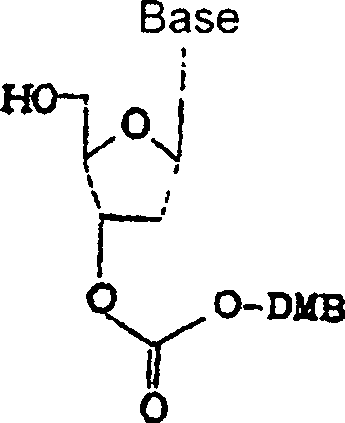
- b) eine zur Vergrößerung der
wachsenden Nucleinsäurekette 3'-DMB-Carbonat-5'-Phosphoramidat
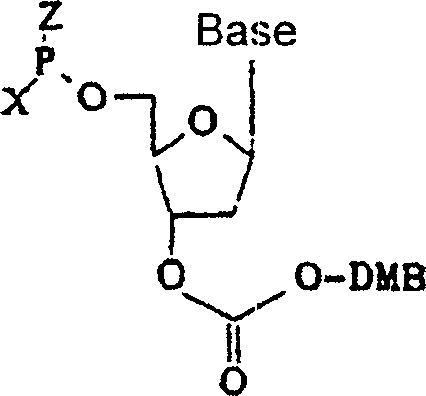
- c) eine zur Beendigung des Kettenwachstums 3'-Allylcarbonat

- a) one for the initialization of the synthesis 3'-DMB carbonate
- b) one to increase the growing nucleic acid chain 3'-DMB carbonate-5'-phosphoramidate
- c) one to end the chain growth 3'-allyl carbonate
"Base" in den vorhergehenden
Strukturen bezieht sich auf jede beliebige der aromatischen heterozyklischen
Stickstoff-Substanzen in den Nucleinsäuren, d. h. Adenin, Guanin,
Thymin, Cytidin, Inosin, Uracil, usw. Die Aminogruppen werden, wenn
sie auf den Basen vorliegen, durch Gruppen geschützt, die ohne Beschädigung des
DNA-Gerüsts
oder der Anbringung auf dem Träger
entfernt werden können.
Geeignete Schutzgruppen umfassen Isobutyryl, Acetyl, Phenoxyacetyl
oder bevorzugt Allyloxycarbonyl (AOC) (AOC wird leicht durch eine
katalytische Menge eines Palladiumkomplexes und eine Vielzahl von
Nucleophilen einschließlich
Butylammoniumformiat oder Dimedon entfernt (Tsuji et al., Acc. Chem.
Res. 20: 140 (1987)). Der Zucker an den die Basen in den obigen
Formeln gebunden ist, kann Ribose, Deoxyribose, oder Modifikationen, z.
B. 2'O-Alkylribose
oder 2'Haloribose,
z. B. 2'-Fluoribose
sein, "X" in den obigen Strukturen
(b) und (c) ist R2N, wobei die R, die gleich
oder verschieden sein können,
Alkyl oder Aryl, bevorzugt C1-C4-Alkyl
(z. B. Isopropyl) oder Phenyl sind. "Z" in
den Strukturen (b) und (c) ist O-Allyl, O-Cyanoethyl oder O-Chlorophenyl. "Allyl" in der Struktur
(c) ist 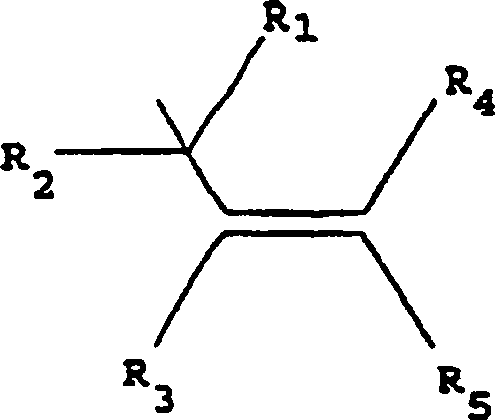
R1 =
H, Alkyl (z. B. C1-C4 Alkyl)
oder Aryl (z. B. Phenyl);
R2 = H;
R3 = H, Halogen, Alkyl (z. B. C1-C4 Alkyl) oder Aryl (z. B. Phenyl);
R4 = H;
R5 =
H, Halogen, Alkyl (z. B. C1-C4 Alkyl)
oder Aryl (z. B. Phenyl) sind. Bevorzugt sind R1–R5 Wasserstoff."Base" in the preceding structures refers to any of the aromatic nitrogen heterocyclic substances in the nucleic acids, ie, adenine, guanine, thymine, cytidine, inosine, uracil, etc. The amino groups, when present on the bases, are represented by groups protected, which can be removed without damaging the DNA scaffold or attachment to the carrier. Suitable protecting groups include isobutyryl, acetyl, phenoxyacetyl or, preferably, allyloxycarbonyl (AOC) (AOC is readily removed by a catalytic amount of a palladium complex and a variety of nucleophiles, including butylammonium formate or dimedone (Tsuji et al., Acc. Chem. Res. The sugar to which the bases in the above formulas are bonded can be ribose, deoxyribose, or modifications, for example 2'O-alkylribose or 2'Haloribose, eg 2'-fluoribose, " X "in the above structures (b) and (c), R 2 is N wherein the Rs, which may be the same or different, are alkyl or aryl, preferably C 1 -C 4 alkyl (e.g., isopropyl) or phenyl "Z" in the structures (b) and (c) is O-allyl, O-cyanoethyl or O-chlorophenyl. "Allyl" in the structure (c)
R 1 = H, alkyl (eg C 1 -C 4 alkyl) or aryl (eg phenyl);
R 2 = H;
R 3 = H, halogen, alkyl (eg C 1 -C 4 alkyl) or aryl (eg phenyl);
R 4 = H;
R 5 = H, halogen, alkyl (eg C 1 -C 4 alkyl) or aryl (eg phenyl). Preferably, R 1 -R 5 are hydrogen.
Ein
Ansatz für
die Herstellung der obigen Monomere von AOC-geschützten Basen
wird im Folgenden gegeben: 
Die Synthese (5' zu 3') kann unter Benutzung der obigen geschützten Spezies (a), (b) und (c) folgendermassen ausgeführt werden. Ein 3'-DMB-Carbonat ((a) oben) wird über einen geeigneten Linker an dem Träger angebracht. Der Träger wird dann mit einer Wellenlänge über 300 nm bestrahlt, um 3'-Hydroxyl vom trägergebundenen Nucleosid zu befreien. Ein zweites Nucleotid wird als 3'-DMB-Carbonat-5'-Phosporamidit ((b) oben) hinzugefügt und es wird eine mit Hilfe von Tetrazol vermittelte Kupplung hergestellt. Der sich ergebende Phosphotriester wird in Phosphat oxidiert (z. B. unter Benutzung von t-Butylhydroperoxid oder I2/H2O/Pyridin). Nicht gebundene 3' Enden werden z. B. unter Benutzung von Essigsäureanhydrid/Pyridin gekappt. Eine weitere Bestrahlung hat das Erscheinen eines neuen 3' Endes für die nächste Kupplung zur Folge. Der Bestrahlungs-, Kupplungs-, Kappungs- und Oxydationsprozess wird wiederholt, um die vorletzte Sequenz zu erhalten. Dann wird das letzte Nucleotid hinzugefügt, z. B. 3'-Allylcarbonat. Die Basis und die Phosphat-Schutzgruppen zwischen den Nucleotiden können gleichzeitig mit dem 3'-Allylcarbonat z. B, durch Behandlung mit einem Palladiumkatalysator und Butylammoniumformiat entfernt werden (Hajakawa et al. J. Am. Chem. Soc. 112 1691–1696 (1990)).The synthesis (5 'to 3') can be carried out using the above protected species (a), (b) and (c) as follows. A 3'-DMB carbonate ((a) above) is attached to the support via a suitable linker. The support is then irradiated at a wavelength above 300 nm to free 3'-hydroxyl from the supported nucleoside. A second nucleotide is added as 3'-DMB-carbonate-5'-phosphoramidite ((b) above) and a tetrazole-mediated coupling is made. The resulting phosphotriester is oxidized in phosphate (eg, using t-butyl hydroperoxide or I 2 / H 2 O / pyridine). Unbound 3 'ends are z. B. capped using acetic anhydride / pyridine. Further irradiation results in the appearance of a new 3 'end for the next clutch. The irradiation, coupling, capping and oxidation process is repeated to obtain the penultimate sequence. Then the last nucleotide is added, e.g. B. 3'-allyl carbonate. The base and the phosphate protecting groups between the nucleotides can be used simultaneously with the 3'-allyl carbonate e.g. B, by treatment with a palladium catalyst and butyl ammonium formate (Hajakawa et al., J. Am. Chem. Soc., 112, 1691-1696 (1990)).
Wenn die Phosphotriester-Chemie benutzt wird, um die 5' zu 3'-Synthese einer Nucleinsäure auszuführen, werden die Monomere durch 3'-Phosphotrieser geschützt, von denen einer durch Licht entfernbar ist. Bevorzugte, durch Licht entfernbare Schutzgruppen für Phosphate sind Aryloxybenzoinylgruppen, vorteilhafterweise Dialkoxybenzoinylgruppen (z. B. 3', 5' oder 2',3-Dimethoxybenzoinylgruppen) oder eine Methylnitropiperonylgruppe. Wie es in Beispiel 1 beschrieben wird, kann der 3'-Phosphotrieser aus den 5'-O-DMT-basisgeschützten Nucleosiden hergestellt werden. Für die Synthese können die Schutzgruppen an der 5'-Position aus den aus dem Stand der Technik bekannten Schutzgruppen einschließlich TBDPS oder DMTr gewählt werden.If phosphotriester chemistry is used to perform the 5 'to 3' synthesis of a nucleic acid the monomers by 3'-Phosphotrieser protected, one of which is removable by light. Preferred, by light removable protection groups for Phosphates are aryloxybenzoinyl groups, advantageously dialkoxybenzoinyl groups (eg 3 ', 5' or 2 ', 3-dimethoxybenzoinyl groups) or a methylnitropiperonyl group. As described in Example 1 can, the 3'-Phosphotrieser from the 5'-O-DMT base-protected nucleosides getting produced. For the synthesis can the protecting groups at the 5'-position the protecting groups known in the art including TBDPS or DMTr become.
Beispielhaft kann die Synthese von zwei Dinucleotiden (5'-G-T-3' und T-T) folgendermassen beschrieben werden. 5'-tert-Butyldiphenylsilyl-N'-allyloxycarbonyl-O6-allyldeoxyguanin-3'-cyanoethyl (Dimethoxybenzoin)-phosphat (300 mg, 0,295 mmol) werden in 100 ml Benzol/1 ml Pyridin gelöst. Die Lösung wird durch Durchblasen von Ar entgast und während 30 Minuten in einem Rayonetreaktor mit einer 350 nm-Lampe bestrahlt. Das Lösungsmittel wird entfernt und der Rückstand mit 90 : 9 : 1 CH2Cl2 : EtOH : Et3N auf einer mit Triethylamin behandelten Siliziumsäule chromatographiert, um ein Produkt mit einem großen Et3N·HCl-Anteil zu erhalten, das durch Ausfällung aus Ethylacetat entfernt wird. Es wird eine einzige saubere Phosporlinie bei 31P NMR beobachtet und dieses Material für den nächsten Schritt benutzt. Dieses dG-Salz, Deoxythymidin-3'-cyanoethyl(dimethoxybenzoin)phosphat (0.278 g 0,443 mmol) und 4-Ethoxypyridin-N-oxyd (0,205 g 1,48 mmol) werden dreimal aus Pyridin azeotrop destilliert und in 12 ml Dichloroethan aufgenommen. Es wird (Triisopropyl)benzolsulfonylchlorid (0,183 g 1,48 mmol) hinzugefügt und die Mischung unter Ar über Nacht gerührt. TLC zeigt drei Flecken: das 5'-Sulfonat des T-Monomers, das gewünschte Produkt und den Überschuss an dT-Monomer. Das Lösungsmittel wird entfernt und der Rückstand mit 95 : 5 CH2Cl2 : EtOH auf Siliziumgel chromatographiert, um das Produkt (5'-G-T-3', 305 mg, 75%) als weissen Schaum zu erhalten, der Spektren und HMRS (FAB) zeigt, die mit der strukturellen Zuordnung übereinstimmen. Die vorhergehende Prozedur kann auch auf 5'-Tert-butyldiphenylsilyldeoxythimidin-3'-cyanoethyl(dimethoxybenzoin)phosphat (0,35 mmol) angewendet werden, um 262 mg (68%) T-T zu ergeben. Das Trinucleotid, 5'-G-T-3', kann durch Lösen von 5'-G-T-3'-Dinucleotid (240 mg, 0,175 mmol) in 100 ml Benzol/1 ml Pyridin und Entgasung mit Ar hergestellt werden. Die Bestrahlung wird wie oben durchgeführt, 1 ml Et3N wird hinzugefügt und das Lösemittel entfernt. Das Salz, Deoxycytidin-3'-cyanoethyl(dimethoxybenzoin)phosphat (0,35 mmol, und 4-Ethoxypyridin N-oxyd wird dreimal aus Pyridin azeotrop destilliert und dann in 10 ml Dichlorethan aufgenommen. (Triisopropyl)benzolsulfonylchlorid (106 mg, 0,350 mmol) wird hinzugefügt und die Mischung wird über Nacht gerührt. Die oben beschriebene Chromatographie liefert 219 mg (69%) 5'-G-T-C-3'.By way of example, the synthesis of two dinucleotides (5'-GT-3 'and TT) can be described as follows. 5'-tert-butyldiphenylsilyl-N'-allyloxycarbonyl-O 6 -allydeoxyguanine-3'-cyanoethyl (dimethoxybenzoin) phosphate (300 mg, 0.295 mmol) are dissolved in 100 ml of benzene / 1 ml of pyridine. The solution is degassed by bubbling Ar and irradiated for 30 minutes in a Rayonet reactor with a 350 nm lamp. The solvent is removed and the residue is chromatographed on a triethylamine treated silica column with 90: 9: 1 CH 2 Cl 2 : EtOH: Et 3 N to give a product with a large Et 3 N · HCl content, which is purified by precipitation is removed from ethyl acetate. A single clean phosphine line is observed at 31 P NMR and this material is used for the next step. This dG salt, deoxythymidine-3'-cyanoethyl (dimethoxybenzoin) phosphate (0.278 g 0.443 mmol) and 4-ethoxypyridine N-oxide (0.205 g 1.48 mmol) are azeotroped three times from pyridine and taken up in 12 ml dichloroethane. Add (triisopropyl) benzenesulfonyl chloride (0.183 g, 1.48 mmol) and stir the mixture under Ar overnight. TLC shows three spots: the 5'-sulfonate of the T-monomer, the desired product, and the excess of dT monomer. The solvent is removed and the residue chromatographed on silica gel with 95: 5 CH 2 Cl 2 : EtOH to give the product (5'-GT-3 ', 305 mg, 75%) as a white foam, the spectra and HMRS ( FAB) that match the structural assignment. The previous procedure can also be applied to 5'-tert-butyldiphenylsilyldeoxythimidine-3'-cyanoethyl (dimethoxybenzoin) phosphate (0.35 mmol) to give 262 mg (68%) of TT. The trinucleotide, 5'-GT-3 ', can be prepared by dissolving 5'-GT-3'-dinucleotide (240 mg, 0.175 mmol) in 100 ml benzene / 1 ml pyridine and degassing with Ar. The irradiation is carried out as above, 1 ml Et 3 N is added and the solvent removed. The salt, deoxycytidine-3'-cyanoethyl (dimethoxybenzoin) phosphate (0.35 mmol, and 4-ethoxypyridine N-oxide is azeotroped three times from pyridine and then taken up in 10 mL of dichloroethane (triisopropyl) benzenesulfonyl chloride (106 mg, 0.350 mmol The mixture is stirred overnight and the chromatography described above yields 219 mg (69%) of 5'-GTC-3 '.
Wie oben angegeben, erfordert das vorliegende Verfahren zur Synthese einer Nucleinsäure die Bindung eines ersten Monomers (z. B. (a) oben) an einen Träger (Substrat), direkt oder über einen geeigneten Linker. Die Anbringung auf dem Träger geschieht über das 5'-Hydroxyl des Monomers. Geeignete Träger umfassen ein Glas, dessen Porosität mit Hilfe eines langkettigen Alkylamins kontrolliert wird. In USP 5,143,854 beschriebene Substrate sind für die hierige Benutzung geeignet, ebenso wie die hier beschriebenen Substratoberflächenbehandlungen. Vorgezogen wird ein an die Funktion angepasstes Glasplättchen (z. B. ein mit Aminopropylat behandeltes Glasplättchen).As above, requires the present method for synthesis a nucleic acid the binding of a first monomer (eg (a) above) to a support (substrate), directly or via a suitable linker. The attachment on the carrier is done via the 5'-hydroxyl of the Monomer. Suitable carriers include a glass whose porosity with the help of a long-chain Alkylamine is controlled. Substrates described in USP 5,143,854 are for the use here, as well as the ones described here Substrate surface treatments. Preference is given to a function adapted to the glass plate (z. B. a treated with aminopropylate glass flakes).
Linkermoleküle sind, wenn sie benutzt werden, Dicarboxylsäurederivate, wie Bernsteinsäure oder Phthalsäure und Amide, oder Bis-Addukte von Diisocyanaten, wie Toluendiisocyanat. Es wird Succinat vorgezogen. In USP 5,143,854 angegebene Linker sind für eine Benutzung in der vorliegenden Erfindung geeignet. Ethylenglycololigomere (z. B. Triethylenglycol), Succinate ((z. B. Diglycinsuccinat) und Tris(aminohexonat) werden vorgezogen.Are linker molecules, when used, dicarboxylic acid derivatives such as succinic acid or phthalic acid and Amides, or bis-adducts of diisocyanates, such as toluene diisocyanate. Succinate is preferred. In USP 5,143,854 indicated linker are for a use in the present invention suitable. ethylene glycol oligomers (e.g., triethylene glycol), succinates (e.g., diglycine succinate), and Tris (aminohexonate) are preferred.
Geeignete Linker für die Benutzung in der vorliegenden Erfindung werden mit einer Schutzgruppe, d. h. einer durch Licht entfernbaren Gruppe (d. h. DMB-Carbonat, MeNPDC, usw.) an einem Endhydroxyl zur Verfügung gestellt. In USP 5,143,854 beschriebene Schutzgruppen sind hier anwendbar. Bevorzugt trägt der Linker ein DMB-Carbonat oder ein DMB-Phosphat, oder eine durch Licht entfernbare Styrylsilylgruppe, wie es in Nr. 08/339,216 beschrieben worden ist (siehe auch J. Org. Chem. 58: 6961 (1993)).suitable Left for the use in the present invention are with a protecting group, d. H. a photoremovable group (i.e., DMB carbonate, MeNPDC, etc.) on an end-hydroxyl. In USP 5,143,854 described protecting groups are applicable here. Preferably, the linker carries a DMB carbonate or a DMB phosphate, or a photoremovable Styrylsilyl group as described in No. 08 / 339,216 (See also J. Org. Chem. 58: 6961 (1993)).
Die Anbringung von Succinatlinkern an dem Substrat kann unter Benutzung von Dicyclohexylcarbodiimid oder anderen Carbodiimiden vorgenommen werden. Es können die z. B. in USP 5,143,854 beschriebenen Anbringungsprotokolle benutzt werden.The Attachment of succinate linkers to the substrate may be carried out using of dicyclohexylcarbodiimide or other carbodiimides become. It can the z. As used in USP 5,143,854 described mounting protocols become.
Die photochemische 5' zu 3' Synthese von Nucleinsäureanordnungen von den oben beschriebenen Monomeren kann ausgeführt werden, wenn eine direkte streifenförmige Maskierung benutzt wird. Im Allgemeinen wird ein Träger mit der geeigneten funktionellen Gruppendichte mit einem geschützten Nucleosid behandelt, um die erste Basis zu befestigen. Der Träger wird dann durch eine Maske bestrahlt (z. B. eine 5 mm-gestreifte Maske) und mit der nächsten Basis gekoppelt. Der Vorgang wird solange wiederholt, bis ein Oligomer mit der gewünschten Länge (z. B. 8 bis 12 Basen) hergestellt worden ist.The photochemical 5 'to 3' synthesis of nucleic acid assemblies from the monomers described above can be carried out using direct stripe masking. In general, a carrier having the appropriate functional group density is treated with a protected nucleoside delt to attach the first base. The support is then irradiated through a mask (eg, a 5 mm striped mask) and coupled to the next base. The process is repeated until an oligomer of the desired length (eg 8 to 12 bases) has been prepared.
Anordnungen von Oligomeren, die z. B. wie oben beschrieben hergestellt worden sind, können dazu benutzt werden, Mutationen in Proben von Zielnucleinsäuren (z. B. das p53-Tumorsuppressorgen) zu detektieren. Jeder einen Primer (Oligomer) tragende Anordnungsort der komplementär zu einem Ort mit einer Zielnucleinsäure ist, kann benutzt werden, eine Bindung von einer von vier detektierbar markierten Dideoxynucleotiden zu begünstigen, die von einer Polymerase katalysiert worden ist. Wenn die Fluoreszenz als detektierbare Markierung benutzt worden ist, kann man mit Hilfe der Farbe an jedem Ort das Nucleotid am Mutationsort identifizieren. Alternativ kann man die Gegenwart von Fluoreszenzmarkierungen benutzen, um Oligomeranordnungen zu identifizieren, die zum Ziel komplementäre Sequenzen aufweisen. Bei Benutzung dieser Methode geben Oligomere, die keine Markierung annehmen, eine Unstimmigkeit im Ziel an, das auf eine Mutation des Templates zurückzuführen ist. Die Kenntnis der Primersequenz an jeder Nullposition erlaubt die Ortsbestimmung der Mutation.arrangements of oligomers, the z. B. as described above are, can be used to detect mutations in samples of target nucleic acids (e.g. The p53 tumor suppressor gene). Each a primer (Oligomer) bearing locus which is complementary to a locus having a target nucleic acid, can be used to detect a binding of one in four labeled dideoxynucleotides favored by a polymerase has been catalyzed. If the fluorescence is detectable as a label has been used, you can with the help of color in each place Identify nucleotide at the site of mutation. Alternatively you can the Use the presence of fluorescent labels to form oligomer assemblies to identify those having complementary sequences to the target. at Using this method, oligomers that do not accept labeling an inconsistency in the target, that is due to a mutation of the template is due. The knowledge of the primer sequence at each zero position allows the Location of the mutation.
Außer der vorhergehenden Benutzungen, können die Verfahren der Erfindung und die sich ergebenden Anordnungen dazu benutzt werden, die Anwesenheit einer spezifischen Sequenz in einer Probe, z. B. für ein bakterielles oder virales Pathogen, zu detektieren.Except the previous uses the methods of the invention and the resulting arrangements to be used, the presence of a specific sequence in a sample, e.g. For example bacterial or viral pathogen.
Gewisse Aspekte der vorliegenden Erfindung werden in den nachfolgenden nicht begrenzenden Beispielen beschrieben. Das Beispiel I bezieht sich auf die 5' zu 3'-Synthese eines Phosphotriesters unter Benutzung von 3'-O-Phosphorylaryloxybenzoinylnucleosiden.Certain Aspects of the present invention are not discussed in the following delimiting examples. Example I relates on the 5 'to 3' synthesis of a phosphotriester under Use of 3'-O-phosphorylaryloxybenzoinyl nucleosides.
Das Beispiel II bezieht sich auf die Herstellung und Benutzung (als 5'-Schutzstoffe) von Dimethoxybenzoinylcarbonaten und das Beispel III bezieht sich auf die 5' zu 3'-Synthese von Phosporamidit unter Benutzung von Benzoinylcarbonaten als 3'-Hydroxyl-Schutzgruppen. (Siehe auch Pirrung und Shuey, J. Org. Cem. 59: 3890 (1994)).The Example II relates to the manufacture and use (as 5'-protective substances) of dimethoxybenzoinylcarbonates and Example III on the 5 'to 3' synthesis of phosphoramidite using of benzoinyl carbonates as 3'-hydroxyl protecting groups. (See also Pirrung and Shuey, J. Org. Cem. 59: 3890 (1994)).
Beispiel IExample I
Asymetrische Synthese von Dimethoxybenzoinen, Erzeugung von Phospotriestern und die Synthese von DinucleotidAsymmetric synthesis of dimethoxybenzoins, generation of phosphotriesters and synthesis of dinucleotide
Es wurde die Methode von Hayashi et al, J. Chem. Soc. Chem. Commun. 1364 (1990) benutzt. Im Wesentlichen wurden Trimethylcyanohydrine durch Behandlung von Dimethoxybenzaldehyd mit Trimethylsilylcyanid, Titanisopropoxid und Diethyltartrat hergestellt. Die Silylcyanohydrine wurden mit 2 Mol-Äquivalenten von Phenylmagnesiumbromid in Diethyläther bei 0°C während 1 h behandelt und in 2 N HCl während 6 h bei Raumtemperatur hydrolysiert, um das substituierte Benzoin zu erhalten (wobei der Alkohol mit DMBOH bezeichnet wird). Die so erzeugten Benzoine wurden auf optische Reinheit unter Benutzung des optisch aktiven NMR-Shiftreagenzes Eu(fod)3 analysiert. Für die Verbindungen, die nicht optisch rein waren, wurde die Kristallisierung der Racemate benutzt, um den enantiomerischen Überschuss zu erhöhen.It the method of Hayashi et al, J. Chem. Soc. Chem. Commun. 1364 (1990). In essence, trimethylcyanohydrins by treating dimethoxybenzaldehyde with trimethylsilyl cyanide, Titanium isopropoxide and Diethyltartrat produced. The silyl cyanohydrins were with 2 molar equivalents of phenylmagnesium bromide in diethyl ether at 0 ° C for 1 h and treated in 2N HCl during Hydrolyzed at room temperature for 6 h to give the substituted benzoin to obtain (the alcohol is called DMBOH). The way Benzoins produced were used for optical purity of the optically active NMR shift reagent Eu (fod) 3 analyzed. For the compounds that were not optically pure became crystallization the racemate is used to increase the enantiomeric excess.

Die Bildung von Derivaten der 5'-geschützten, basisgeschützten Nucleosiden wurde folgendermaßen durchgeführt. N-Benzoyl-5'-O-acetyl-adenosin wurde mit dem Letsingerreagenz, Chlordimethylamino(o-chlorphenyl)phosphit (1,2 Äquivalente) in Acetonitril bei Raumtemperatur während 2 h behandelt. Das optisch aktive Benzoin (1,4 Äquivalente) wurde in Anwesenheit von einer katalytischen Menge Tetrazol hinzugefügt, mit einer Kupplungsdurchführung über Nacht. Die Oxidation in einen Phosphotriester wurde mit einer 5%-Lösung von Iodin in 1 : 1 THF/Wasser durchgeführt. Das Produkt wurde durch Hinzufügung von Wasser und Chloroformextraktion isoliert (siehe unten). Nach dem Verdunsten des Lösemittels wurde das Rohprodukt in Methanol suspendiert und einige Tropfen Triethylamin hinzugegeben. Nach einer Stunde bei Raumtemperatur war die Reaktionsmischung konzentriert und das Produkt aus wasserhaltigem Ethanol kristallisiert. Die NMR-Analyse zeigte eine Verdoppelung der Signale für Methin in der Benzoingruppe und das 3'-Methin in dem Nucleosid wegen des Diastereomerengemisches am Phosphor. Diese konnten nicht durch chromatographische oder Kristallisierungstechniken getrennt werden. Diese Verbindungen sind 3'-O-PArBenz(phosphorylaryloxybenzoinyl)nucleoside.The formation of derivatives of the 5'-protected base-protected nucleosides was performed as follows. N-Benzoyl-5'-O-acetyl-adenosine was treated with the Letsinger reagent, chlorodimethylamino (o-chlorophenyl) phosphite (1.2 equivalents) in acetonitrile at room temperature for 2 h. The optically active benzoin (1.4 equivalents) was added in the presence of a catalytic amount of tetrazole, with a coupling run overnight. Oxidation into a phosphotriester was performed with a 5% solution of iodine in 1: 1 THF / water. The product was isolated by addition of water and chloroform extraction (see below). After evaporation of the solvent, the crude product was suspended in methanol and a few drops of triethylamine were added. After one hour at room temperature, the reaction mixture was concentrated and the product crystallized from hydrous ethanol. The NMR analysis showed a doubling of the signals for methine in the benzoin group and the 3'-methine in the nucleoside because of the diastereomeric mixture on the phosphorus. These could not be separated by chromatographic or crystallization techniques. These compounds are 3'-O-ParrBenz (phosphorylaryloxybenzoinyl) nucleosides.

Die photochemische Synthese von einem Dinucleotid wurde durch das folgende Experiment demonstriert. 5'-O-Acetyl-3'-O-PArBenz-thymidin wurde in Benzol bei einer Leistung von 10 mW/cm2 mit 365 nm während 10 Minuten bestrahlt, um 3'-O-Phosphatdiester herzustellen. Zu der Lösung wurde direkt N-Benzoyladenosin-3'-O-PArBenz (1 Äquvalent), Mesitylensulfonylnitrotriazol (MSNT, 1 Äquivalent) und Pyridin-N-oxyd (0,05 Äquivalent) hinzugefügt. Nach dem Rühren während 2 Stunden bei Raumtemperatur, wurde die Mischung in Wasser abgekühlt, mit Chloroform extrahiert und das Produkt durch Evaporation der kombinierten organischen Phasen isoliert. Das Rohmaterial wurde dann in Methanol/Wasser (1 : 1) gelöst und 0,1 M p-Nitrobenzaldehydeoxim/Tetramethylguanin hinzugefügt. Nach dem Umrühren bei 40°C während 2 Stunden zeigte die HPLC-Analyse, dass die O-Chlorophenyl-, Acetyl- und Benzylgruppen vollständig entfernt waren. Das Produkt wurde isoliert mit einer Ausbeute von > 94% durch die Anionenaustauschchromatographie (DEAE-Sephasil), elutiert mit pH 5,5 Triethylammoniumbicarbonat.The photochemical synthesis of a dinucleotide was demonstrated by the following experiment. 5'-O-acetyl-3'-O-PArBenz-thymidine was irradiated in benzene at a power of 10 mW / cm 2 at 365 nm for 10 minutes to prepare 3'-O-phosphate diester. To the solution was added directly N-benzoyladenosine-3'-O-PArBenz (1 equiv.), Mesitylenesulfonylnitrotriazole (MSNT, 1 equiv.) And pyridine-N-oxide (0.05 equiv.). After stirring for 2 hours at room temperature, the mixture was cooled in water, extracted with chloroform and the product isolated by evaporation of the combined organic phases. The crude material was then dissolved in methanol / water (1: 1) and 0.1M p-nitrobenzaldehyde oxime / tetramethylguanine added. After stirring at 40 ° C for 2 hours, HPLC analysis showed that the O-chlorophenyl, acetyl and benzyl groups were completely removed. The product was isolated in> 94% yield by anion exchange chromatography (DEAE-Sephasil) eluted with pH 5.5 triethylammonium bicarbonate.
Für die Festphasensynthese von Nucleinsäuren wurden Perlen oder Plättchen aus Glas derivatisiert (funktionalisiert) mit 10% Dimethyldichlorosilan und Hexaethylenglycol, gefolgt von einem Tempern bei 110°C während 2 Stunden und Abkühlung unter Argon. Der Träger wurde dann mit Letsinger-Reagenz bei Raumtemperatur während 2 Stunden behandelt, gefolgt von einem 5'-OH-3'-O-ParBenz-Nucleosid bei Raumtemperatur über Nacht. Mit dieser Prozedur wurde das erste Nucleosid auf dem Träger über seine 5'-Hydroxylgruppe angebracht. Der Träger wurde dann während 10 Minuten bei 365 nm mit einer Leistung von 10 mW/cm2 im Kontakt mit einer Lösung, die Triethylamin und p-Diethylaminonitrobenzol enthielt, bestrahlt (die Bestrahlungszeit für die Produktion von Phosphodiester für die Kupplung ist wichtig, 6 Minuten wurden als optimal gefunden). Wenn der Träger ein Plättchen ist, kann die Bestrahlung durch eine Maske ausgeführt werden, um der Oberfläche ein Muster aufzuerlegen. Der Träger wurde mit reinem Methylenchlorid gewaschen. Eine Lösung eines 5'-OH-3'-O-PArBenz-Nucleosids und Mesitylensulfonylnitrotriazol (MSNT) (0,1 M Lösung in DMF) wird dann auf dem Träger hinzugefügt und blieb während 2 Stunden bei Raumtemperatur stehen. Der Träger wird wieder mit Methylenchlorid zur Vorbereitung des nächsten Bestrahlungszyklus gewaschen. Auf dieser Stufe liegt ein Dinucleotid vor, das eine 3'-O-PArBenzgruppe trägt und die vorhergehende Prozedur kann wiederholt werden, um die gewünschte Sequenz aufzubauen. Nachdem die komplette Sequenz zusammengebaut worden ist, entfernt eine letzte Bestrahlung die 3'-photolabile Gruppe und eine Behandlung mit Nitrobenzaldehydroxin, wie sie vorher beschrieben worden ist, hebt den Schutz des trägergebundenen Oligonucleotids auf.For solid phase synthesis of nucleic acids, glass beads or flakes were derivatized (functionalized) with 10% dimethyldichlorosilane and hexaethylene glycol, followed by annealing at 110 ° C for 2 hours and cooling under argon. The support was then treated with Letsinger's reagent at room temperature for 2 hours, followed by a 5'-OH-3'-O-ParBenz nucleoside at room temperature overnight. With this procedure, the first nucleoside was attached to the support via its 5'-hydroxyl group. The support was then irradiated for 10 minutes at 365 nm with a power of 10 mW / cm 2 in contact with a solution containing triethylamine and p-diethylaminonitrobenzene (the irradiation time for the production of phosphodiester for coupling is important, 6 minutes were found to be optimal). When the carrier is a wafer, irradiation through a mask may be performed to remove the upper surface to impose a pattern. The support was washed with pure methylene chloride. A solution of a 5'-OH-3'-O-ParrBenz nucleoside and mesitylenesulfonylnitrotriazole (MSNT) (0.1 M solution in DMF) is then added to the support and allowed to stand at room temperature for 2 hours. The support is washed again with methylene chloride to prepare the next irradiation cycle. At this stage, there is a dinucleotide bearing a 3'-O-Parr group and the previous procedure can be repeated to build the desired sequence. After the complete sequence has been assembled, a final irradiation removes the 3'-photolabile group and treatment with nitrobenzaldehydroxine, as previously described, abolishes the protection of the support bound oligonucleotide.
Die Sequenz dieses Nucleotids wurde auf zwei Arten hergestellt. Träger, die nur eine Sequenz enthielten, wurden mit wässrigem Kaliumfluorid behandelt, um alle DNA-Ketten zu befreien. Die DNA wurde mit Ethanol ausgefällt und einer FAB-Massenspektrometrie unterzogen. Diese DNA-Moleküle können auch als PCR-Primer benutzt werden, und durch Vergleich mit bekannten Mengen derselben Sequenz durch konventionelle Methoden hergestellt und gereinigt werden, und es wurde eine Abschätzung der Menge der gewünschten Sequenz und deshalb der Reinheit der erhaltenen Sequenz gemacht.The Sequence of this nucleotide was prepared in two ways. Carriers that containing only one sequence were treated with aqueous potassium fluoride, around all DNA chains to free. The DNA was precipitated with ethanol and FAB mass spectrometry subjected. These DNA molecules can also as a PCR primer be used, and by comparison with known amounts thereof Sequence prepared and purified by conventional methods and it became an estimate the amount of the desired Sequence and therefore the purity of the sequence obtained.
Die Ergiebigkeit eines Synthesezyklus auf dem Träger wurde durch Kupplung einer Hydroxyloberfläche mit Thymin, das eine 3'-PArBenz-Gruppe trägt, hergestellt. Der Schutz in einem Streifen wurde entfernt und mit einem 3'-Acetylthymin gekoppelt. Die Acetylgruppe wurde mit MeOH/Et3N und mit 3'-Hydroxyl fluoreszierend gemacht. Das Substrat wurde photochemisch in einem zweiten überlappenden und rechtwinklig zum ersten stehenden Streifen entschützt, und die 3'-Hydroxyle wurden fluoreszierend gemacht. Sofern die Schutzgruppenabspaltung und Kopplung in beiden Schritten vollständig sind, sollte das Ergebnis ein Querschnitt der einheitlichen Gesamtfluoreszenz sein. Falls die Schutzgruppenabspaltung nicht vollständig ist, sollte der Zentralbereich fluoreszierender sein, weil er doppelt gekoppelt war.The yield of a synthetic cycle on the support was prepared by coupling a hydroxy surface with thymine bearing a 3'-PArBenz group. The protection in a strip was removed and coupled with a 3'-acetylthymine. The acetyl group was made fluorescent with MeOH / Et 3 N and with 3'-hydroxyl. The substrate was photochemically deprotected in a second overlapping band at right angles to the first, and the 3'-hydroxyls were made fluorescent. If deprotection and coupling are complete in both steps, the result should be a cross-section of the total uniform fluorescence. If deprotection is not complete, the central region should be more fluorescent because it was doubly coupled.
Beispiel IIExample II
DimethoxybenzoincarbonateDimethoxybenzoincarbonate
Durch Methylierung aktiviertes Carbonyliimidazol (Saha et al., J. Am. Chem. Soc. 111: 4856 (1989)) in Nitomethan ergab eine einzelne Acylierung von DMB (eine Stunde Raumtemperatur), um das untere „1" zu liefern, das sogar stabil bei Rückflusstemperaturen war (gleich 1 unten). Hinzufügung einer Lösung von Alkohol (0,5 Äq.) gefolgt von Pyridin führt zu einer Acylsubstitution, um das DMB-Carbonat innerhalb einer Stunde bei Raumtemperatur zu erzeugen (gleich 2 unten). Primäre, sekundäre und Arylalkohole und -Thiole (einschliesslich Benzylalkohol, Benzylmercaptan, p-Methoxyphenol, Cholesterol, Cyclododecanol und Borneol) wurden bei großer Ausbeute geschützt. Diese Verbindungen wurden leicht von der Schutzgruppe befreit durch eine Bestrahlung mit 350 nm-Lampen (Rayonet-Reaktor) als schwache (≤ 3 mM) Lösungen in Benzol oder Acetonitril. Typische Reaktionszeiten waren eine Stunde auf einer 0,25 mmol Skala (zweimal länger in Acetonitril) und die isolierten Ausbeuten der Alkohole waren einheitlich hoch (> 96%). Parallele Bestrahlungen von DMB-Acetat und Benzyl-DMB-Carbonat bei niedriger Konzentration zeigen im wesentlichen denselben Schutzgruppenabspaltungsgrad, was nahe legt, dass die Mengenausbeute der Schutzgruppenabspaltung für diese Carbonate ähnlich ist wie die, die für Acetat, d. h. 0,64, beschrieben worden ist. Ein bedeutender Vorteil dieser Benzoingruppe verglichen mit den Nitrobenzylen ist das inerte Phenyldimethoxybenzofuran-Nebenprodukt. Sein Absorptionsvermögen für lange Wellenlängen (300 nm) und die intensive 396-nm-Fluoreszenz erlaubt seine Detektion bei so niedrigen Konzentrationen wie 1 μM, wodurch die Ergiebigkeit einer photochemischen Schutzgruppenabspaltung direkt durch optische Verfahren gemessen werden kann.By Methylation activated carbonylimidazole (Saha et al., J. Am. Chem. Soc. 111: 4856 (1989)) in nitomethane gave a single acylation from DMB (one hour room temperature) to deliver the lower "1", the even stable at reflux temperatures was (equal to 1 below). addition a solution of alcohol (0.5 eq.) followed by pyridine to an acyl substitution to the DMB carbonate within one hour at room temperature to produce (equal to 2 below). Primary, secondary and aryl alcohols and thiols (including benzyl alcohol, benzylmercaptan, p-methoxyphenol, Cholesterol, cyclododecanol and borneol) were in high yield protected. These compounds were easily freed from the protecting group irradiation with 350 nm lamps (Rayonet reactor) as weak (≤ 3 mM) solutions in Benzene or acetonitrile. Typical reaction times were one hour on a 0.25 mmol scale (twice longer in acetonitrile) and the isolated yields of the alcohols were uniformly high (> 96%). Parallel irradiations of DMB acetate and benzyl DMB carbonate at low concentration show essentially the same degree of deprotection, which suggests that the quantitative yield of deprotection for this Carbonates similar is like the ones for Acetate, d. H. 0.64, has been described. A significant advantage of this Benzoin group compared to the nitrobenzylene is the inert phenyldimethoxybenzofuran by-product. Its absorption capacity for long wavelength (300 nm) and the intense 396 nm fluorescence allows its detection at concentrations as low as 1 μM, thereby increasing the yield a photochemical deprotection directly by optical Method can be measured.
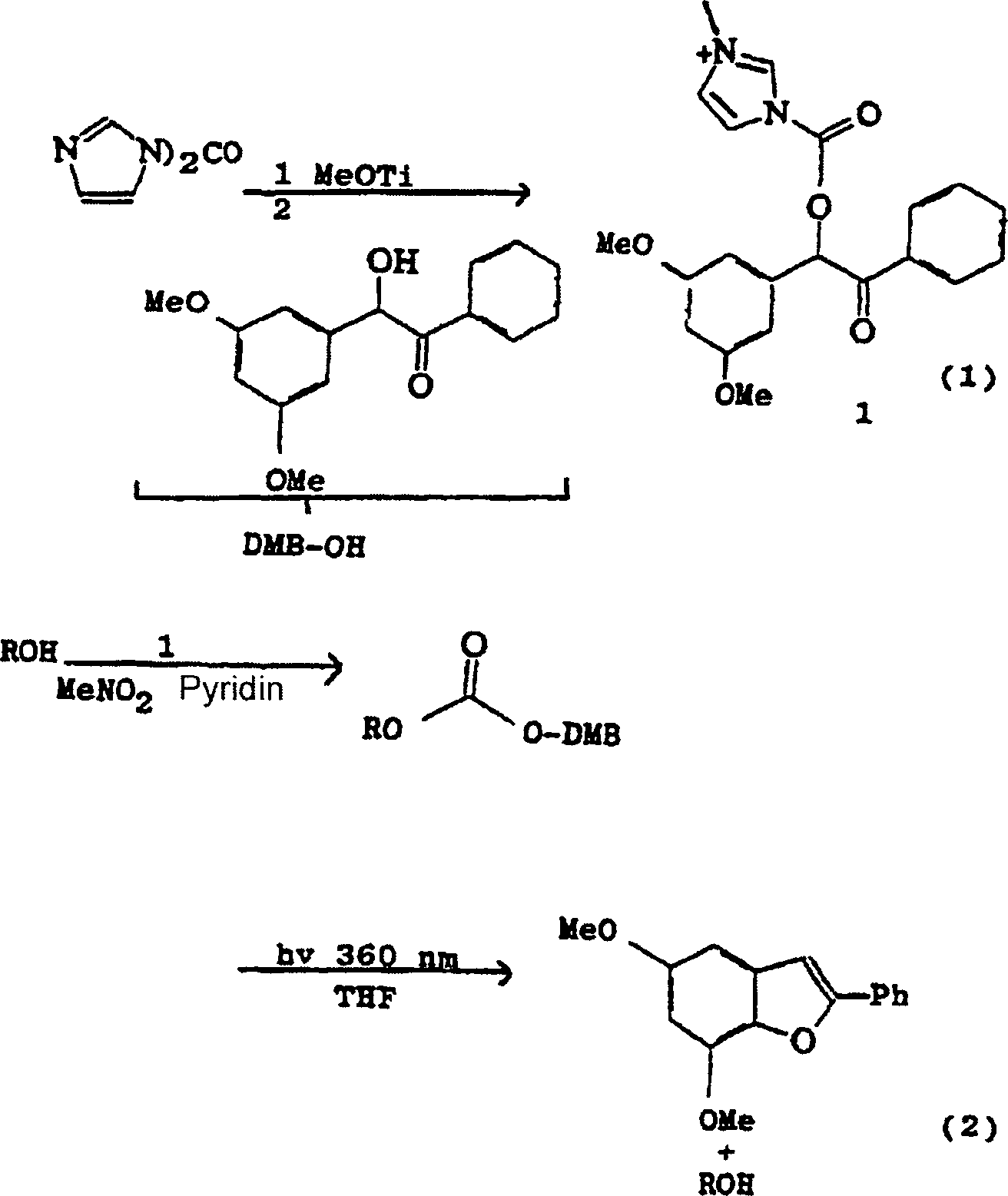
Es wurden zwei Trimere hergestellt, um die Nützlichkeit von DMB-Carbonatschutzgruppen für die photochemische Synthese von DNA auf festen Trägern zu zeigen. Die Derivatisierung von Thymidin am 5'-Alkohol mit dem DMB-Carbonat und die Konversion des sich ergebenden „3" unten zum 3'-Phosporamidit „4" wurde durch Standardverfahren erreicht (gleich 3 (Gait „Oligonucleotide Synthesis: A Practical Approach" IRL Press Oxford 1984; Narang, „Synthesis and Applications of DNA and RNA" Academic Press, New York (1987); Gassen and Lang, „Chemical and Enzymatic Synthesis of Gene Fragments„ Verlag-Chemie, Weinheim (1982); Caruthers, Science 230: 281 (1985)). Kommerzielle Perlen aus Glas mit kontrollierten Poren und langkettigem Alkylamin (lcaa-cpg), die mit 5'-DMTr-T derivatisiert waren, (25 μmol/g) wurden mit Säure behandelt und mit dem unteren „4" gekoppelt bei Tetrazolkatalyse und mit Essigsäureanhydrid/Dimethylaminopyridin (DMAP)-Kappung. Bestrahlung (gleich 4 unten) und Kupplung mit 5'-DMTr-Bz-Cytosin-3'-CE-Phosporamidit gab ein Trinucleotid. Die Schutzgruppen und Bindungen wurden mit Ammoniak gespalten und das Produkt einer HPLC Reinigung unterzogen (umgekehrte Phase, 0,1MEt3N·HOAc/24–32% CH3CN). Das Absorptionsvermögen der Fraktion, die die Sequenz 5'-DMTr-CTT enthält, wurde verglichen mit dem einer bekannten Konzentration einer authentischen Probe (durch konventionelle DMTr-Synthese hergestellt), wodurch eine Gesamtausbeute von 76,5% festgestellt wurde. Die Sequenz 5'-ATT-3' wurde hergestellt, indem zuerst ein lcaa-cpg-Träger mit 5'-DMB-CO2-T beladen wurde (184 nmol durch Freigabe von Benzofuran), und zwar durch sein 3'-Succinat durch Behandlung mit Dicyclohexylcarbodiimid. Die Bestrahlung (t ½ = 2,7 Minuten; Gesamtzeit = 30 Minuten) und Kupplung mit dem unteren „4" wurden wie oben ausgeführt. Eine zweite Bestrahlung (t ½ = 3,3 Minuten, Gesamtzeit = 45 Minuten) und Kupplung (167 nmol durch Freigabe von Benzofuran) mit 5'-DMTr-Bz-Adenosin-3'-CE-Phosphoramidit ergab ein Trinicleotid. Es wurde vom Träger getrennt, durch HPLC analysiert und zeigte einen einzigen Peak. Dieses Produkt wurde auch unter Benutzung einer OPC-Kartusche (Applied Biosystems, Foster City USA) gereinigt und mit Schlangengift-Phosphosiesterase/alkalischer Phosphathase verdaut (Cadet et al., Can. J. Chem. 63: 2861 (1985)). Die Nucleoside in den sich ergebenden Proben wurden durch HPLC analysiert. Es wurde ein Verhältnis von 64,5%/35,5% (T/A) beobachtet, übereinstimmend mit der erwarteten Sequenz. Trotz der benachbarten T-Reste in diesen beiden Sequenzen, ist die photochemische Schutzgruppenabspaltung nicht schädlich für die DNA, was durch die Abwesenheit von irgendwelchem T-T-Dimerprodukt durch Vergleich mit einer authentischen Probe festgestellt wurde. (Greenberg et al. J. Org. Chem. 59: 746 (1994)).Two trimers were prepared to demonstrate the utility of DMB carbonate protecting groups for the photochemical synthesis of DNA on solid supports. Derivatization of thymidine on the 5'-alcohol with the DMB carbonate and conversion of the resulting "3" below to the 3'-phosphoramidite "4" was achieved by standard procedures (equal to 3 (Gait "Oligonucleotide Synthesis: A Practical Approach" IRL Press Oxford 1984; Narang, "Synthesis and Applications of DNA and RNA" Academic Press, New York (1987); Gassen and Lang, "Chemical and Enzymatic Synthesis of Gene Fragments" Verlag-Chemie, Weinheim (1982); Caruthers, Science 230 : 281 (1985)). "Commercial pore glass controlled-pore glass and long-chain alkylamine (lcaa-cpg) derivatized with 5'-DMTr-T (25 μmol / g) were treated with acid and treated with the lower" 4 Coupled with tetrazole catalysis and with acetic anhydride / dimethylaminopyridine (DMAP) capping, irradiation (equal to 4 below) and coupling with 5'-DMTr-Bz-cytosine-3'-CE-phosphoramidite gave a trinucleotide The protecting groups and bonds were treated with ammonia cleaved and the product of a HPLC Rei (reversed phase, 0.1 MEt 3 N • HOAc / 24-32% CH 3 CN). The absorbency of the fraction containing the sequence 5'-DMTr-CTT was compared to that of a known concentration of an authentic sample (prepared by conventional DMTr synthesis), indicating an overall yield of 76.5%. The sequence 5'-ATT-3 'was prepared by first loading a lcaa-cpg support with 5'-DMB-CO 2 -T (184 nmol by release of benzofuran) through its 3'-succinate Treatment with dicyclohexylcarbodiimide. The irradiation (t½ = 2.7 minutes, total time = 30 minutes) and coupling with the lower "4" were carried out as above, a second irradiation (t½ = 3.3 minutes, total time = 45 minutes) and coupling (167 nmol by release of benzofuran) with 5'-DMTr-Bz-adenosine-3'-CE-phosphoramidite yielded a trinicleotide, which was separated from the support, analyzed by HPLC, and showed a single peak, this product was also purified using an OPC. Cartridge (Applied Biosystems, Foster City, USA) and digested with snake venom phosphosiesterase / alkaline phosphatase (Cadet et al., Can J. Chem., 63: 2861 (1985)) .The nucleosides in the resulting samples were analyzed by HPLC A ratio of 64.5% / 35.5% (T / A) was observed, consistent with the expected sequence Despite the adjacent T residues in these two sequences, the photoprotective deprotection is not detrimental to the DNA by the absence of any TT-Dim product was determined by comparison with an authentic sample. (Greenberg et al., J. Org. Chem. 59: 746 (1994)).
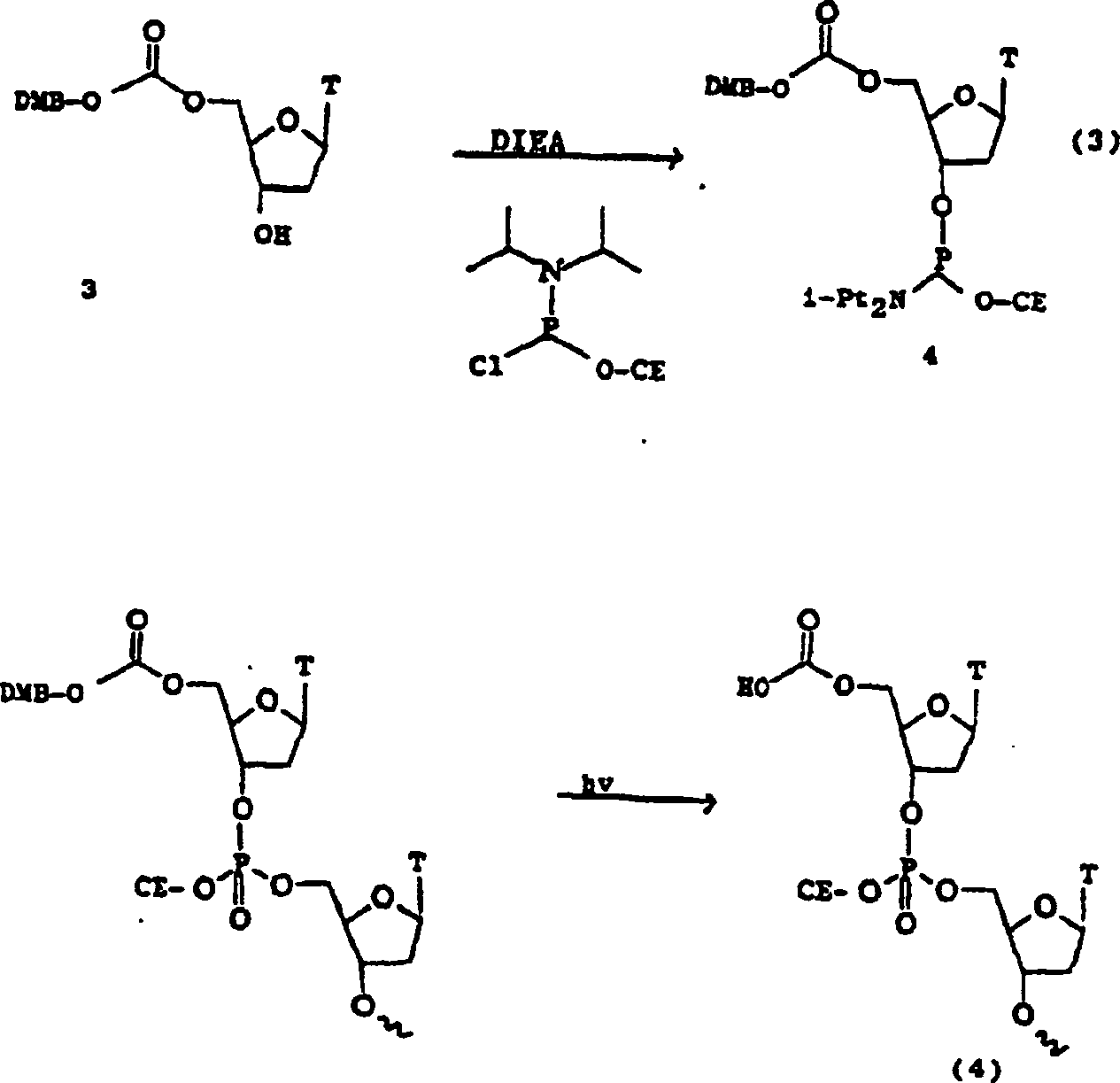
Sekundäre Dimere wurden ebenfalls geschützt mit dem obigen „1" und durch Bestrahlung von der Schutzgruppe befreit.Secondary dimers were also protected with the above "1" and by irradiation removed from the protective group.
Beispiel IIIExample III
Schutz des 3'-Alkohols eines Nucleotids mit einem durch Licht entfernbaren Carbonatderivat, Schutz des 5'-Alkohols mit einem Phosporamidit und Kupplung des 5'-Phosphorderivats mit einem 3'-AlhoholProtection of the 3'-alcohol of a nucleotide with a photo-removable carbonate derivative, protection of the 5'-alcohol with a Phosphoramidite and coupling of the 5'-phosphorus derivative with a 3'-Alhohol
Carbonyldiimidazol wird in Nitromethan mit Methyltriflat behandelt, um das N-Alkylimidazoliumderivat zu erzeugen (siehe Beispiel II oben). Die in situ-Behandlung dieser Spezies mit 3',5'-Dimethylbenzoin erzeugt eine Carbonatester-/Imidazolmischung. Dann wird ein 5'-geschütztes Nucleosid zugegeben und die Lösung zwei Stunden unter Rückfluss gehalten, um das gemischte Carbonat aus DMB und dem 3'-Hydroxyl des Nucleosids zu erzeugen. Dieses Material kann am 5'- Ende von seiner Schutzgruppe befreit und außerdem am 5'-Hydroxyl mit einem Phosphoramiditreagenz (Caruthers, Science 230: 281 (1985)) derivatisiert werden. Die Kupplung dieses 5'-Phosphorderivats mit einem 3'-Alkohol eines zweiten Nucleosids wird mit einem Tetrazolkatalysator durchgeführt. Die entstehende DNA-Kette wird durch Bestrahlung mit Licht mit einer Wellenlänge > 300 nm, wodurch ein Benzofuranderivat, Kohlendioxyd und die freie 3'-OH-Gruppe erzeugt wird, für einen weiteren anderen Kupplungszyklus vorbereitet. Das vorher Gesagte kann benutzt werden, um andere Alkohole zu schützen, einschließlich den 5'-Alkohol eines Nucleosids (siehe Beispiel II). Ein Thiolschutz kann ebenfalls wie oben beschrieben ausgeführt werden.carbonyldiimidazole is treated with methyl triflate in nitromethane to add the N-alkylimidazolium derivative generate (see Example II above). The in situ treatment of this Species with 3 ', 5'-dimethylbenzoin produces a carbonate ester / imidazole mixture. Then a 5'-protected nucleoside added and the solution two Hours under reflux held to the mixed carbonate of DMB and the 3'-hydroxyl of the nucleoside to create. This material can be at the 5'-end freed from its protecting group and also on 5'-hydroxyl with a Phosphoramiditreagenz (Caruthers, Science 230: 281 (1985)). The coupling this 5'-Phosphorus derivative with a 3'-alcohol a second nucleoside is carried out with a tetrazole catalyst. The resulting DNA chain is by irradiation with light having a wavelength> 300 nm, causing a Benzofuran derivative, carbon dioxide and the free 3'-OH group is generated, for another prepared for another coupling cycle. The previously said can be used to protect other alcohols, including the 5'-alcohol one Nucleosides (see Example II). A Thiolschutz can also like described above executed become.
Claims (24)

Applications Claiming Priority (3)
| Application Number | Priority Date | Filing Date | Title |
|---|---|---|---|
| US08/406,327 US5908926A (en) | 1995-03-16 | 1995-03-16 | 5'to 3' nucleic acid synthesis using 3'-photoremovable protecting group |
| US406327 | 1995-03-16 | ||
| PCT/US1996/003496 WO1996028457A1 (en) | 1995-03-16 | 1996-03-15 | Nucleic acid synthesis using photoremovable protecting groups |
Publications (2)
| Publication Number | Publication Date |
|---|---|
| DE69632456D1 DE69632456D1 (en) | 2004-06-17 |
| DE69632456T2 true DE69632456T2 (en) | 2005-07-14 |
Family
ID=23607492
Family Applications (1)
| Application Number | Title | Priority Date | Filing Date |
|---|---|---|---|
| DE69632456T Expired - Fee Related DE69632456T2 (en) | 1995-03-16 | 1996-03-15 | NUCLEIC ACID SYNTHESIS USING MEDIUM-SHIFTABLE PROTECTION GROUPS |
Country Status (9)
| Country | Link |
|---|---|
| US (1) | US5908926A (en) |
| EP (1) | EP0815114B1 (en) |
| JP (1) | JPH11501936A (en) |
| AT (1) | ATE266671T1 (en) |
| AU (1) | AU5422896A (en) |
| CA (1) | CA2215657A1 (en) |
| DE (1) | DE69632456T2 (en) |
| DK (1) | DK0815114T3 (en) |
| WO (1) | WO1996028457A1 (en) |
Families Citing this family (31)
| Publication number | Priority date | Publication date | Assignee | Title |
|---|---|---|---|---|
| US20030232361A1 (en) * | 1993-10-26 | 2003-12-18 | Affymetrix, Inc. | Nucleic acid array preparation using purified phosphoramidites |
| EP0946286B1 (en) * | 1996-11-14 | 2003-03-19 | Affymetrix, Inc. | Chemical amplification for the synthesis of patterned arrays |
| US6326489B1 (en) | 1997-08-05 | 2001-12-04 | Howard Hughes Medical Institute | Surface-bound, bimolecular, double-stranded DNA arrays |
| US6432360B1 (en) | 1997-10-10 | 2002-08-13 | President And Fellows Of Harvard College | Replica amplification of nucleic acid arrays |
| US6511803B1 (en) | 1997-10-10 | 2003-01-28 | President And Fellows Of Harvard College | Replica amplification of nucleic acid arrays |
| US6485944B1 (en) | 1997-10-10 | 2002-11-26 | President And Fellows Of Harvard College | Replica amplification of nucleic acid arrays |
| US6222030B1 (en) * | 1998-08-03 | 2001-04-24 | Agilent Technologies, Inc. | Solid phase synthesis of oligonucleotides using carbonate protecting groups and alpha-effect nucleophile deprotection |
| US6255476B1 (en) | 1999-02-22 | 2001-07-03 | Pe Corporation (Ny) | Methods and compositions for synthesis of labelled oligonucleotides and analogs on solid-supports |
| AU2998800A (en) | 1999-03-24 | 2000-10-09 | Government Of The United States Of America, As Represented By The Secretary Of The Department Of Health And Human Services, The | N-acylphosphoramidites and their use in oligonucleotide synthesis |
| US7932213B2 (en) * | 1999-05-11 | 2011-04-26 | President And Fellows Of Harvard College | Small molecule printing |
| US6824987B1 (en) * | 1999-05-11 | 2004-11-30 | President And Fellows Of Harvard College | Small molecule printing |
| US6306599B1 (en) | 1999-07-16 | 2001-10-23 | Agilent Technologies Inc. | Biopolymer arrays and their fabrication |
| US6451998B1 (en) | 1999-10-18 | 2002-09-17 | Agilent Technologies, Inc. | Capping and de-capping during oligonucleotide synthesis |
| WO2001055451A1 (en) * | 2000-01-28 | 2001-08-02 | Linden Technologies, Inc. | C-3' protected monomeric nucleotides and synthesis of oligonucleotides on solid support |
| US7135565B2 (en) * | 2000-07-28 | 2006-11-14 | Agilent Technologies, Inc. | Synthesis of polynucleotides using combined oxidation/deprotection chemistry |
| US20020081589A1 (en) * | 2000-10-12 | 2002-06-27 | Jing-Shan Hu | Gene expression monitoring using universal arrays |
| US20020136772A1 (en) * | 2001-03-26 | 2002-09-26 | Tai-Nang Huang | Polymer synthesis |
| US6838447B2 (en) | 2001-03-26 | 2005-01-04 | Linden Technologies, Inc. | Particulate compositions for chemical synthesis |
| US6852850B2 (en) | 2001-10-31 | 2005-02-08 | Agilent Technologies, Inc. | Use of ionic liquids for fabrication of polynucleotide arrays |
| US6858720B2 (en) | 2001-10-31 | 2005-02-22 | Agilent Technologies, Inc. | Method of synthesizing polynucleotides using ionic liquids |
| WO2003048179A2 (en) * | 2001-12-03 | 2003-06-12 | The Government Of The United States Of America, Represented By The Secretary Of The Department Of Health And Human Services | Thermolabile hydroxyl protecting groups and methods of use |
| US20030170637A1 (en) * | 2002-03-06 | 2003-09-11 | Pirrung Michael C. | Method of analyzing mRNA splice variants |
| EP1635765B1 (en) | 2003-05-23 | 2013-07-17 | Board Of Regents, The University Of Texas System | Structure based and combinatorially selected oligonucleoside phosphorothioate and phosphorodithioate aptamer targeting ap-1 transcription factors |
| EP1660512A4 (en) * | 2003-06-02 | 2009-12-23 | Isis Pharmaceuticals Inc | Oligonucleotide Synthesis with Alternative Solvents |
| US20090317873A1 (en) * | 2004-05-04 | 2009-12-24 | Sridhar Govindarajan | Design, synthesis and assembly of synthetic nucleic acids |
| US20060094024A1 (en) * | 2004-11-01 | 2006-05-04 | Pirrung Michael C | Electrochemical arrays |
| US9809824B2 (en) * | 2004-12-13 | 2017-11-07 | The United States Of America, Represented By The Secretary, Department Of Health And Human Services | CpG oligonucleotide prodrugs, compositions thereof and associated therapeutic methods |
| WO2008013569A2 (en) * | 2006-01-03 | 2008-01-31 | The President And Fellows Of Harvard College | Small molecule printing |
| US8097711B2 (en) * | 2006-09-02 | 2012-01-17 | Agilent Technologies, Inc. | Thioether substituted aryl carbonate protecting groups |
| KR20100025328A (en) * | 2008-08-27 | 2010-03-09 | 삼성전자주식회사 | Method of producing microarray having immoblized double strand nucleic acids comprising double strand region and terminal single strand region |
| US8158391B2 (en) | 2009-05-06 | 2012-04-17 | Dna Twopointo, Inc. | Production of an α-carboxyl-ω-hydroxy fatty acid using a genetically modified Candida strain |
Family Cites Families (8)
| Publication number | Priority date | Publication date | Assignee | Title |
|---|---|---|---|---|
| US4415732A (en) * | 1981-03-27 | 1983-11-15 | University Patents, Inc. | Phosphoramidite compounds and processes |
| US5143854A (en) * | 1989-06-07 | 1992-09-01 | Affymax Technologies N.V. | Large scale photolithographic solid phase synthesis of polypeptides and receptor binding screening thereof |
| US5744101A (en) * | 1989-06-07 | 1998-04-28 | Affymax Technologies N.V. | Photolabile nucleoside protecting groups |
| US5242974A (en) * | 1991-11-22 | 1993-09-07 | Affymax Technologies N.V. | Polymer reversal on solid surfaces |
| US5547839A (en) * | 1989-06-07 | 1996-08-20 | Affymax Technologies N.V. | Sequencing of surface immobilized polymers utilizing microflourescence detection |
| DE69132531T2 (en) * | 1990-12-06 | 2001-09-13 | Affymetrix, Inc. (N.D.Ges.D.Staates Delaware) | Compounds and their use in a binary synthesis strategy |
| DE69132905T2 (en) * | 1990-12-06 | 2002-08-01 | Affymetrix, Inc. (N.D.Ges.D.Staates Delaware) | Detection of nucleic acid sequences |
| US5486633A (en) * | 1994-11-10 | 1996-01-23 | Duke University | Photochemically-removable silyl protecting groups |
-
1995
- 1995-03-16 US US08/406,327 patent/US5908926A/en not_active Expired - Fee Related
-
1996
- 1996-03-15 AT AT96911307T patent/ATE266671T1/en not_active IP Right Cessation
- 1996-03-15 JP JP8527819A patent/JPH11501936A/en not_active Withdrawn
- 1996-03-15 AU AU54228/96A patent/AU5422896A/en not_active Abandoned
- 1996-03-15 DK DK96911307T patent/DK0815114T3/en active
- 1996-03-15 EP EP96911307A patent/EP0815114B1/en not_active Expired - Lifetime
- 1996-03-15 DE DE69632456T patent/DE69632456T2/en not_active Expired - Fee Related
- 1996-03-15 WO PCT/US1996/003496 patent/WO1996028457A1/en not_active Ceased
- 1996-03-15 CA CA002215657A patent/CA2215657A1/en not_active Abandoned
Also Published As
| Publication number | Publication date |
|---|---|
| ATE266671T1 (en) | 2004-05-15 |
| EP0815114A4 (en) | 1999-02-24 |
| DE69632456D1 (en) | 2004-06-17 |
| CA2215657A1 (en) | 1996-09-19 |
| EP0815114B1 (en) | 2004-05-12 |
| US5908926A (en) | 1999-06-01 |
| DK0815114T3 (en) | 2004-08-30 |
| WO1996028457A1 (en) | 1996-09-19 |
| JPH11501936A (en) | 1999-02-16 |
| AU5422896A (en) | 1996-10-02 |
| EP0815114A1 (en) | 1998-01-07 |
Similar Documents
| Publication | Publication Date | Title |
|---|---|---|
| DE69632456T2 (en) | NUCLEIC ACID SYNTHESIS USING MEDIUM-SHIFTABLE PROTECTION GROUPS | |
| EP0399330B1 (en) | Modified phosphoramidite process for preparing modified nucleic acids | |
| DE69635744T2 (en) | Modified nucleic acid probes | |
| DE69725866T2 (en) | SOLID PHASE SYNTHESIS | |
| DE3689715T2 (en) | Methods and reagents for the in vitro synthesis of oligonucleotides. | |
| DE69026963T2 (en) | METHOD FOR PRODUCING OLIGONUCLEOTIDES, APPLICABLE FOR SERIAL PRODUCTION | |
| DE69619141T2 (en) | SOLID PHASE SYNTHESIS OF OLIGONUCLEOTIDE N3'-P5'-PHOSPHORAMIDATES | |
| EP0152459B1 (en) | Process for producing oligonucleotides | |
| DE69131164T2 (en) | INTRODUCTION OF SELECTIVELY FISSILE POINTS IN OLIGONUCLEOTIDE CHAINS AND REAGENTS THEREFOR | |
| DE69406544T2 (en) | LABELING REAGENT AND DETECTION METHOD | |
| JP3081882B2 (en) | Orthogonal removal of hydroxyl protecting groups by reduction and their use in the chemical synthesis of oligonucleotides | |
| US6166198A (en) | Methods for oligonucleotide synthesis | |
| DE69724218T2 (en) | UNIVERSAL FIXED CARRIERS AND METHOD FOR THEIR USE | |
| DE69116864T2 (en) | METHOD AND MEANS FOR THE SYNTHESIS OF OLIGONUCLEOTIDES | |
| DE112004000265B4 (en) | Novel photolabile protecting groups for improved methods of making oligonucleotide arrays | |
| DE69824843T2 (en) | PROCESS FOR PRODUCING MODIFIED P-CHIRAL NUCLEOTIDE ANALOGUE | |
| DE69402177T2 (en) | SYNTHESIS OF DIMER BLOCKS AND THEIR USE IN THE COMPOSITION OF OLIGONUCLEOTIDES | |
| DE3881691T2 (en) | POLYDEOXYRIBONUCLEOTIDES, PHARMACEUTICAL COMPOSITIONS, USE AND PRODUCTION OF POLYDEOXYRIBONUCLEOTIDES. | |
| EP0649855A1 (en) | Use of nucleosides and nucleoside derivatives with enzymatically cleavable protecting groupes in the synthesis of oligonucleotiden | |
| DE69613971T2 (en) | OLIGONUCELOTIDES WITH TRANSVERSALCOVALENT BINDING, METHOD FOR THE PRODUCTION THEREOF AND SYNTHONES USED therein | |
| DE3824110A1 (en) | Process for the preparation and purification of oligo- and polynucleotide sequences phosphorylated on their 5-ends and reagents for carrying out the process | |
| DE10041539A1 (en) | New amidite derivatives for the synthesis of polymers on surfaces | |
| EP0475443B1 (en) | Chemical synthesis of oligonucleotides | |
| US5726301A (en) | CAC H-phosphonate and its use in the synthesis of oligonucleotides | |
| US7456309B2 (en) | Reusable universal polymer support for repetitive oligonucleotide synthesis |
Legal Events
| Date | Code | Title | Description |
|---|---|---|---|
| 8339 | Ceased/non-payment of the annual fee |