DE69532970T2 - SPRAY-DRYED ERYTHROPOIETIN - Google Patents
SPRAY-DRYED ERYTHROPOIETIN Download PDFInfo
- Publication number
- DE69532970T2 DE69532970T2 DE69532970T DE69532970T DE69532970T2 DE 69532970 T2 DE69532970 T2 DE 69532970T2 DE 69532970 T DE69532970 T DE 69532970T DE 69532970 T DE69532970 T DE 69532970T DE 69532970 T2 DE69532970 T2 DE 69532970T2
- Authority
- DE
- Germany
- Prior art keywords
- rhepo
- spray
- dried
- drying
- fragments
- Prior art date
- Legal status (The legal status is an assumption and is not a legal conclusion. Google has not performed a legal analysis and makes no representation as to the accuracy of the status listed.)
- Expired - Lifetime
Links
- OXCMYAYHXIHQOA-UHFFFAOYSA-N potassium;[2-butyl-5-chloro-3-[[4-[2-(1,2,4-triaza-3-azanidacyclopenta-1,4-dien-5-yl)phenyl]phenyl]methyl]imidazol-4-yl]methanol Chemical compound [K+].CCCCC1=NC(Cl)=C(CO)N1CC1=CC=C(C=2C(=CC=CC=2)C2=N[N-]N=N2)C=C1 OXCMYAYHXIHQOA-UHFFFAOYSA-N 0.000 title claims description 13
- 102000003951 Erythropoietin Human genes 0.000 title description 9
- 108090000394 Erythropoietin Proteins 0.000 title description 9
- 229940105423 erythropoietin Drugs 0.000 title description 9
- 238000000034 method Methods 0.000 claims abstract description 36
- 239000007921 spray Substances 0.000 claims abstract description 22
- 239000000843 powder Substances 0.000 claims abstract description 15
- 238000001035 drying Methods 0.000 claims description 30
- 239000000203 mixture Substances 0.000 claims description 29
- 238000009472 formulation Methods 0.000 claims description 23
- 239000000243 solution Substances 0.000 claims description 23
- XLYOFNOQVPJJNP-UHFFFAOYSA-N water Substances O XLYOFNOQVPJJNP-UHFFFAOYSA-N 0.000 claims description 17
- DHMQDGOQFOQNFH-UHFFFAOYSA-N Glycine Chemical compound NCC(O)=O DHMQDGOQFOQNFH-UHFFFAOYSA-N 0.000 claims description 16
- 239000007864 aqueous solution Substances 0.000 claims description 13
- 239000007788 liquid Substances 0.000 claims description 11
- 239000012634 fragment Substances 0.000 claims description 9
- 239000004471 Glycine Substances 0.000 claims description 8
- FBPFZTCFMRRESA-KVTDHHQDSA-N D-Mannitol Chemical compound OC[C@@H](O)[C@@H](O)[C@H](O)[C@H](O)CO FBPFZTCFMRRESA-KVTDHHQDSA-N 0.000 claims description 7
- 229930195725 Mannitol Natural products 0.000 claims description 7
- 230000004071 biological effect Effects 0.000 claims description 7
- 239000000594 mannitol Substances 0.000 claims description 7
- 235000010355 mannitol Nutrition 0.000 claims description 7
- XEEYBQQBJWHFJM-UHFFFAOYSA-N Iron Chemical compound [Fe] XEEYBQQBJWHFJM-UHFFFAOYSA-N 0.000 claims description 6
- 238000004519 manufacturing process Methods 0.000 claims description 5
- 101000987586 Homo sapiens Eosinophil peroxidase Proteins 0.000 claims description 3
- 210000003743 erythrocyte Anatomy 0.000 claims description 3
- 102000044890 human EPO Human genes 0.000 claims description 3
- 229910052742 iron Inorganic materials 0.000 claims description 3
- 239000002245 particle Substances 0.000 claims description 3
- 150000003839 salts Chemical class 0.000 claims description 3
- 238000003860 storage Methods 0.000 claims description 3
- 102000001554 Hemoglobins Human genes 0.000 claims description 2
- 108010054147 Hemoglobins Proteins 0.000 claims description 2
- 230000015572 biosynthetic process Effects 0.000 claims description 2
- 210000002798 bone marrow cell Anatomy 0.000 claims description 2
- 210000001995 reticulocyte Anatomy 0.000 claims description 2
- 238000003786 synthesis reaction Methods 0.000 claims description 2
- 108010092408 Eosinophil Peroxidase Proteins 0.000 claims 1
- 102100031939 Erythropoietin Human genes 0.000 claims 1
- 101000920686 Homo sapiens Erythropoietin Proteins 0.000 claims 1
- 238000010521 absorption reaction Methods 0.000 claims 1
- 239000000654 additive Substances 0.000 claims 1
- 238000000889 atomisation Methods 0.000 claims 1
- 238000001694 spray drying Methods 0.000 description 22
- 102000004169 proteins and genes Human genes 0.000 description 14
- 108090000623 proteins and genes Proteins 0.000 description 14
- 239000007787 solid Substances 0.000 description 12
- 239000011230 binding agent Substances 0.000 description 10
- 238000004108 freeze drying Methods 0.000 description 9
- 239000008215 water for injection Substances 0.000 description 9
- 238000000502 dialysis Methods 0.000 description 8
- 239000003814 drug Substances 0.000 description 6
- 238000002360 preparation method Methods 0.000 description 6
- 238000003127 radioimmunoassay Methods 0.000 description 6
- 238000001262 western blot Methods 0.000 description 6
- 239000012527 feed solution Substances 0.000 description 5
- 238000005507 spraying Methods 0.000 description 4
- 238000012360 testing method Methods 0.000 description 4
- 230000001225 therapeutic effect Effects 0.000 description 4
- OKKJLVBELUTLKV-UHFFFAOYSA-N Methanol Chemical compound OC OKKJLVBELUTLKV-UHFFFAOYSA-N 0.000 description 3
- 239000000020 Nitrocellulose Substances 0.000 description 3
- 241000283973 Oryctolagus cuniculus Species 0.000 description 3
- 239000007979 citrate buffer Substances 0.000 description 3
- 150000001860 citric acid derivatives Chemical class 0.000 description 3
- 229940079593 drug Drugs 0.000 description 3
- 238000012377 drug delivery Methods 0.000 description 3
- 238000001704 evaporation Methods 0.000 description 3
- 230000008020 evaporation Effects 0.000 description 3
- 239000000463 material Substances 0.000 description 3
- 239000012528 membrane Substances 0.000 description 3
- 229920001220 nitrocellulos Polymers 0.000 description 3
- 229920000136 polysorbate Polymers 0.000 description 3
- 102000004196 processed proteins & peptides Human genes 0.000 description 3
- 108090000765 processed proteins & peptides Proteins 0.000 description 3
- 241000283707 Capra Species 0.000 description 2
- KRKNYBCHXYNGOX-UHFFFAOYSA-K Citrate Chemical compound [O-]C(=O)CC(O)(CC([O-])=O)C([O-])=O KRKNYBCHXYNGOX-UHFFFAOYSA-K 0.000 description 2
- 102000003886 Glycoproteins Human genes 0.000 description 2
- 108090000288 Glycoproteins Proteins 0.000 description 2
- 241000699666 Mus <mouse, genus> Species 0.000 description 2
- FAPWRFPIFSIZLT-UHFFFAOYSA-M Sodium chloride Chemical compound [Na+].[Cl-] FAPWRFPIFSIZLT-UHFFFAOYSA-M 0.000 description 2
- 239000007983 Tris buffer Substances 0.000 description 2
- 239000004480 active ingredient Substances 0.000 description 2
- 239000012298 atmosphere Substances 0.000 description 2
- 238000004166 bioassay Methods 0.000 description 2
- 239000000872 buffer Substances 0.000 description 2
- 125000000837 carbohydrate group Chemical group 0.000 description 2
- 239000003795 chemical substances by application Substances 0.000 description 2
- 238000013270 controlled release Methods 0.000 description 2
- 239000000945 filler Substances 0.000 description 2
- 229920001600 hydrophobic polymer Polymers 0.000 description 2
- 238000001727 in vivo Methods 0.000 description 2
- 238000002347 injection Methods 0.000 description 2
- 239000007924 injection Substances 0.000 description 2
- 238000012792 lyophilization process Methods 0.000 description 2
- 239000008194 pharmaceutical composition Substances 0.000 description 2
- 239000000825 pharmaceutical preparation Substances 0.000 description 2
- 229920001184 polypeptide Polymers 0.000 description 2
- 238000012545 processing Methods 0.000 description 2
- 239000002994 raw material Substances 0.000 description 2
- 210000002966 serum Anatomy 0.000 description 2
- 239000007790 solid phase Substances 0.000 description 2
- 239000002904 solvent Substances 0.000 description 2
- 238000013112 stability test Methods 0.000 description 2
- 102000002260 Alkaline Phosphatase Human genes 0.000 description 1
- 108020004774 Alkaline Phosphatase Proteins 0.000 description 1
- IJGRMHOSHXDMSA-UHFFFAOYSA-N Atomic nitrogen Chemical compound N#N IJGRMHOSHXDMSA-UHFFFAOYSA-N 0.000 description 1
- 229920000858 Cyclodextrin Polymers 0.000 description 1
- 206010013786 Dry skin Diseases 0.000 description 1
- 108090000790 Enzymes Proteins 0.000 description 1
- 102000004190 Enzymes Human genes 0.000 description 1
- 238000001159 Fisher's combined probability test Methods 0.000 description 1
- 241000699670 Mus sp. Species 0.000 description 1
- 239000002202 Polyethylene glycol Substances 0.000 description 1
- 108020004511 Recombinant DNA Proteins 0.000 description 1
- 240000004808 Saccharomyces cerevisiae Species 0.000 description 1
- DBMJMQXJHONAFJ-UHFFFAOYSA-M Sodium laurylsulphate Chemical compound [Na+].CCCCCCCCCCCCOS([O-])(=O)=O DBMJMQXJHONAFJ-UHFFFAOYSA-M 0.000 description 1
- 241000473945 Theria <moth genus> Species 0.000 description 1
- 238000013019 agitation Methods 0.000 description 1
- 150000001413 amino acids Chemical class 0.000 description 1
- 238000003556 assay Methods 0.000 description 1
- 239000012620 biological material Substances 0.000 description 1
- 210000004027 cell Anatomy 0.000 description 1
- 238000012512 characterization method Methods 0.000 description 1
- 239000013626 chemical specie Substances 0.000 description 1
- 238000005352 clarification Methods 0.000 description 1
- 230000000536 complexating effect Effects 0.000 description 1
- 229920001577 copolymer Polymers 0.000 description 1
- 239000002577 cryoprotective agent Substances 0.000 description 1
- 238000013461 design Methods 0.000 description 1
- 239000003085 diluting agent Substances 0.000 description 1
- 229910001873 dinitrogen Inorganic materials 0.000 description 1
- 230000000694 effects Effects 0.000 description 1
- 238000001962 electrophoresis Methods 0.000 description 1
- 238000002474 experimental method Methods 0.000 description 1
- 235000013861 fat-free Nutrition 0.000 description 1
- 238000007710 freezing Methods 0.000 description 1
- 230000008014 freezing Effects 0.000 description 1
- 239000007789 gas Substances 0.000 description 1
- 229940088597 hormone Drugs 0.000 description 1
- 239000005556 hormone Substances 0.000 description 1
- 239000007943 implant Substances 0.000 description 1
- 238000000338 in vitro Methods 0.000 description 1
- 238000010348 incorporation Methods 0.000 description 1
- 238000011534 incubation Methods 0.000 description 1
- 230000004941 influx Effects 0.000 description 1
- 210000003734 kidney Anatomy 0.000 description 1
- 239000006193 liquid solution Substances 0.000 description 1
- 238000005259 measurement Methods 0.000 description 1
- MYWUZJCMWCOHBA-VIFPVBQESA-N methamphetamine Chemical compound CN[C@@H](C)CC1=CC=CC=C1 MYWUZJCMWCOHBA-VIFPVBQESA-N 0.000 description 1
- 244000005700 microbiome Species 0.000 description 1
- 239000004005 microsphere Substances 0.000 description 1
- 239000008267 milk Substances 0.000 description 1
- 210000004080 milk Anatomy 0.000 description 1
- 235000013336 milk Nutrition 0.000 description 1
- 238000012544 monitoring process Methods 0.000 description 1
- 238000004806 packaging method and process Methods 0.000 description 1
- 230000002572 peristaltic effect Effects 0.000 description 1
- 239000000546 pharmaceutical excipient Substances 0.000 description 1
- 229940127557 pharmaceutical product Drugs 0.000 description 1
- 239000012071 phase Substances 0.000 description 1
- 229920001200 poly(ethylene-vinyl acetate) Polymers 0.000 description 1
- 229920002401 polyacrylamide Polymers 0.000 description 1
- 229920001223 polyethylene glycol Polymers 0.000 description 1
- 239000002861 polymer material Substances 0.000 description 1
- 235000010482 polyoxyethylene sorbitan monooleate Nutrition 0.000 description 1
- 229920000053 polysorbate 80 Polymers 0.000 description 1
- 230000002685 pulmonary effect Effects 0.000 description 1
- 238000005086 pumping Methods 0.000 description 1
- 239000000523 sample Substances 0.000 description 1
- 239000012488 sample solution Substances 0.000 description 1
- 238000013341 scale-up Methods 0.000 description 1
- HFHDHCJBZVLPGP-UHFFFAOYSA-N schardinger α-dextrin Chemical compound O1C(C(C2O)O)C(CO)OC2OC(C(C2O)O)C(CO)OC2OC(C(C2O)O)C(CO)OC2OC(C(O)C2O)C(CO)OC2OC(C(C2O)O)C(CO)OC2OC2C(O)C(O)C1OC2CO HFHDHCJBZVLPGP-UHFFFAOYSA-N 0.000 description 1
- 150000003384 small molecules Chemical class 0.000 description 1
- 239000011780 sodium chloride Substances 0.000 description 1
- 239000011343 solid material Substances 0.000 description 1
- 238000012430 stability testing Methods 0.000 description 1
- 239000003381 stabilizer Substances 0.000 description 1
- 229910001220 stainless steel Inorganic materials 0.000 description 1
- 239000010935 stainless steel Substances 0.000 description 1
- 239000000126 substance Substances 0.000 description 1
- 239000000758 substrate Substances 0.000 description 1
- 239000004094 surface-active agent Substances 0.000 description 1
- 238000012546 transfer Methods 0.000 description 1
Classifications
-
- A—HUMAN NECESSITIES
- A61—MEDICAL OR VETERINARY SCIENCE; HYGIENE
- A61K—PREPARATIONS FOR MEDICAL, DENTAL OR TOILETRY PURPOSES
- A61K38/00—Medicinal preparations containing peptides
- A61K38/16—Peptides having more than 20 amino acids; Gastrins; Somatostatins; Melanotropins; Derivatives thereof
- A61K38/17—Peptides having more than 20 amino acids; Gastrins; Somatostatins; Melanotropins; Derivatives thereof from animals; from humans
- A61K38/18—Growth factors; Growth regulators
- A61K38/1816—Erythropoietin [EPO]
Landscapes
- Health & Medical Sciences (AREA)
- Life Sciences & Earth Sciences (AREA)
- Proteomics, Peptides & Aminoacids (AREA)
- General Health & Medical Sciences (AREA)
- Chemical & Material Sciences (AREA)
- Engineering & Computer Science (AREA)
- Bioinformatics & Cheminformatics (AREA)
- Immunology (AREA)
- Medicinal Chemistry (AREA)
- Pharmacology & Pharmacy (AREA)
- Zoology (AREA)
- Epidemiology (AREA)
- Animal Behavior & Ethology (AREA)
- Gastroenterology & Hepatology (AREA)
- Public Health (AREA)
- Veterinary Medicine (AREA)
- Medicines That Contain Protein Lipid Enzymes And Other Medicines (AREA)
- Medicinal Preparation (AREA)
- Medicines Containing Material From Animals Or Micro-Organisms (AREA)
- Peptides Or Proteins (AREA)
- Organic Low-Molecular-Weight Compounds And Preparation Thereof (AREA)
- Vaporization, Distillation, Condensation, Sublimation, And Cold Traps (AREA)
- Acyclic And Carbocyclic Compounds In Medicinal Compositions (AREA)
Abstract
Description
Diese Erfindung betrifft ein Verfahren für die Herstellung von sprühgetrocknetem Erythropoietin und dem dadurch hergestellten trockenen Erythropoietin-Pulver.These The invention relates to a process for the preparation of spray-dried Erythropoietin and the dry erythropoietin powder produced thereby.
Hintergrund der Erfindungbackground the invention
Erythropoietin (EPO) ist ein Glycoproteinhormon, das in erster Linie in der Niere synthetisiert wird und ein Hauptregulator der Produktion von Erythrozyten im Körper ist. Kommerziell erhältliches menschliches EPO wird vermittels rekombinanter DNA-Techniken hergestellt und ist als rekombinantes menschliches EPO (rhEPO) bekannt. rhEPO weist eine Molekülmasse von etwa 36.000 Dalton auf, wie durch SDS-PAGE bestimmt. Die Molekülmasse des Proteinrückgrates beträgt 18.398 Dalton, was anzeigt, dass das ganze Molekül umfänglich glycosylisiert ist. Die Kohlenhydratseitenketten sind für die biologische in vivo-Aktivität wichtig.erythropoietin (EPO) is a glycoprotein hormone found primarily in the kidney is synthesized and a major regulator of erythrocyte production in the body is. Commercially available Human EPO is produced by recombinant DNA techniques and is known as recombinant human EPO (rhEPO). rhEPO has a molecular mass of about 36,000 daltons as determined by SDS-PAGE. The molecular mass of the protein backbone is 18,398 daltons, indicating that the entire molecule is circumferentially glycosylated. The carbohydrate side chains are important for in vivo biological activity.
Proteine, wie beispielsweise rhEPO, in wässriger Lösung oder in fester Phase in ihrem nativen Zustand zu halten, ist eine große Herausforderung für jene, die auf dem Gebiet der pharmazeutischen Formulierungen arbeiten. Die Existenz eines Proteins in seinem nativen Zustand hängt von der Proteinkonzentration, der Temperatur und der Art des Lösungsmittels, Ionenstärke des Puffers etc. ab. Änderungen in einem jeden dieser Parameter können die Stabilität eines Proteins in Lösung oder in fester Phase beeinträchtigen.proteins, such as rhEPO, in aqueous solution or to keep it in its native state in solid phase is one size Challenge for those who work in the field of pharmaceutical formulations. The existence of a protein in its native state depends on protein concentration, temperature and type of solvent, ionic strength of the buffer etc. amendments in each of these parameters can be the stability of a Protein in solution or in solid phase.
Kommerzielle Präparate von rhEPO werden derzeit entweder als verdünnte wässrige Lösungen oder in einer lyophilisierten Form verkauft, die verwendet wird, um eine verdünnte wässrige Lösung zu bilden, wobei beide dem Körper durch Injektion zugeführt werden. Die Konzentration von rhEPO in diesen Präparaten ist sehr gering und das rhEPO wird vergleichsweise schnell nach der Verabreichung aus dem Körper entfernt. Infolge dieser Beschränkung der derzeitigen Präparate besteht ein Bedarf für konzentrierte Formulierungen von rhEPO, z. B. für jene, die größere Mengen an rhEPO enthalten, die in alternativen Wirkstoffabgabesystemen verwendet werden können. Wir verwendeten Sprühtrocknungstechniken, um derartige Präparate herzustellen.commercial preparations rhEPO are currently being used either as dilute aqueous solutions or in a lyophilized Sold form, which is used to form a dilute aqueous solution, both the body supplied by injection become. The concentration of rhEPO in these preparations is very low and the rhEPO turns out comparatively fast after administration the body away. As a result of this restriction the current preparations there is a need for concentrated formulations of rhEPO, e.g. For those who use larger quantities contained in rhEPO used in alternative drug delivery systems can be. We used spray drying techniques, to such preparations manufacture.
Das Sprühtrocknen von pharmazeutischen Produkten ist in der Technik bekannt. Siehe z. B. Broadhead, J. et al., „The Spray Drying of Pharmaceuticals", in Drug Dev. Ind. Pharm, 18 (11) & (12), 1169–1206 (1992). Neben kleinen Molekülen, die als Pharmazeutika verwendet werden, sind eine Vielzahl von biologischen Materialien sprühgetrocknet worden und diese umfassen: Enzyme, Seren, Plasma, Mikroorganismen und Hefen. Das Sprühtrocknen ist eine nützliche Technik, da es flüssige pharmazeutische Präparate in einem einstufigen Verfahren in feine, staubfreie oder agglomerierte Pulver umwandeln kann. Die Basistechnik umfasst die folgenden vier Schritte:
- a) Zersprühen der Zufuhrlösung in eine Sprühflüssigkeit;
- b) Sprühflüssigkeit-Luft-Kontakt;
- c) Trocknen der Sprühflüssigkeit; und
- d) Abtrennen des getrockneten Produktes von der Trocknungsluft.
- a) spraying the feed solution into a spray liquid;
- b) spray liquid-air contact;
- c) drying the spray liquid; and
- d) separating the dried product from the drying air.
Obwohl es auf dem Gebiet der Pharmazeutika bekannt ist, ist das Sprühtrocknen für therapeutische Proteine, wie beispielsweise rhEPO, nicht umfänglich verwendet worden. Ein offensichtlicher Grund dafür sind die Bedenken, dass derartige Proteine thermisch durch die beim Sprühtrocknungsprozess verwendeten hohen Temperaturen abgebaut werden könnten. Dies gilt insbesondere für komplexe Glycoproteine, wie beispielsweise rhEPO, die, zusätzlich zu ihrem Polypeptid-Rückgrat, auch komplex verzweigte Kohlenhydratanteile aufweisen, die für die biologische Aktivität erforderlich sind. Die Verfügbarkeit von Lyophilisierung als eine einfache Alternative brachte die auf dem Gebiet Tätigen noch weiter davon ab, Sprühtrocknung für pharmazeutische Proteine zu verwenden. Das Sprühtrocknen geht jedoch mit Vorteilen gegenüber der Lyophilisierung insoweit einher, als dass es ökonomischer ist, schneller und leichter im Maßstab zu vergrößern ist. Außerdem sind sprühgetrocknete Pulver oft dem weiteren Verarbeiten zugänglicher als lyophilisierte Pulver.Even though it is known in the field of pharmaceuticals, is spray-drying for therapeutic proteins, such as rhEPO, have not been used extensively. One obvious reason for that are the concerns that such proteins thermally by the Spray drying process used high temperatures could be reduced. This is especially true for complex Glycoproteins, such as rhEPO, which, in addition to their polypeptide backbone, also have complexed carbohydrate moieties that are responsible for the biological activity required are. The availability of lyophilization as a simple alternative brought up the the area even further, spray drying for pharmaceutical proteins to use. The spray drying however, comes with advantages Lyophilization insofar as it is more economical is faster and easier to scale up. Furthermore are spray-dried Powders often more accessible than lyophilized for further processing Powder.
Es ist üblicherweise nicht praktisch, Formulierungen nur basierend auf der Lyophilisierung des Rohwirkstoffes zu konzipieren. Dies ist so, weil viele Peptide vergleichsweise instabil sind, wenn sie in niedrigen Konzentrationen lyophilisiert sind und sie an die Produktverpackung adsorbieren können und an Aktivität verlieren. Um diese Probleme zu vermeiden, vertrauen viele lyophilisierte pharmazeutische Zusammensetzungen auf die Verwendung von festen Verdünnungsmitteln, Kryoschutzmitteln oder Füllstoffen, um die Menge an während des Lyophilisierungsverfahrens vorhandenen Feststoffen zu erhöhen. Als ein Ergebnis enthält das lyophilisierte Material einen geringen Prozentsatz (w/w) des aktiven Wirkstoffes gemischt mit einem größeren Prozentsatz von anderen festen Materialien.It is usually not practical, formulations based on lyophilization only to design the crude drug. This is so because many peptides are relatively unstable when in low concentrations lyophilized and adsorb them to the product packaging can and activity to lose. To avoid these problems, many rely on lyophilized ones pharmaceutical compositions on the use of solid Diluents, Cryoprotectants or fillers, about the amount of during increase the solids present in the lyophilization process. As a Result contains the lyophilized material has a low percentage (w / w) of active ingredient mixed with a greater percentage of others solid materials.
Im Gegensatz dazu liefert die vorliegende Erfindung ein Verfahren zum Herstellen eines rhEPO-Pulvers aus rhEPO-Rohwirkstoff, wobei das Pulver reines oder im Wesentlichen reines rhEPO ist oder einen höheren Prozentsatz (w/w) von rhEPO aufweist als unter Verwendung herkömmlicher Lyophilisierungstechniken hergestellt werden kann.in the In contrast, the present invention provides a method for Producing a rhEPO powder from rhEPO raw material, wherein the Powder is pure or substantially pure rhEPO or a higher percentage (w / w) of rhEPO than using conventional Lyophilization techniques can be produced.
Zusammenfassung der ErfindungSummary the invention
Die vorliegende Erfindung stellt ein Verfahren zum Herstellen von stabilem, sprühgetrocknetem rhEPO und das dadurch hergestellte rhEPO-Pulver bereit.The The present invention provides a method for producing stable, spray dried rhEPO and the rhEPO powder produced thereby.
Das Verfahren der vorliegenden Erfindung umfasst zuerst das Bereitstellen einer wässrigen Lösung von rhEPO mit einer Konzentration innerhalb des Bereichs von etwa 20 mg/ml bis etwa 100 mg/ml. Diese Lösung wird dann in eine Sprühflüssigkeit zersprüht und die Sprühflüssigkeit wird mit Heißluft getrocknet, um das Wasser aus der Sprühflüssigkeit zu verdampfen. Das dadurch hergestellte getrocknete rhEPO wird dann von der Trocknungsluft entfernt.The Method of the present invention includes providing first an aqueous Solution of rhEPO with a concentration within the range of about 20 mg / ml to about 100 mg / ml. This solution is then poured into a spray liquid atomized and the spray liquid is with hot air dried to evaporate the water from the spray liquid. The Dried rhEPO prepared thereby is then removed from the drying air away.
Die anfängliche wässrige Lösung kann, zusätzlich zu rhEPO, Bindemittel wie beispielsweise Mannitol, Glycin und/oder ein oberflächenaktives Mittel enthalten. Die getrocknete rhEPO-Zusammensetzung, die durch das Verfahren der vorliegenden Erfindung hergestellt wird, umfasst rhEPO in einer Konzentration im Bereich von 4,0% bis 100% (w/w) und weist einen Restfeuchtegehalt innerhalb des Bereichs von etwa 3% bis etwa 5% (w/w) auf. Die Größe der Partikel der Zusammensetzung ist innerhalb des Bereichs von etwa 2,0 μm bis etwa 6,0 μm.The initial aqueous solution can, in addition to rhEPO, binders such as mannitol, glycine and / or a surface active Contain funds. The dried rhEPO composition obtained by the method of the present invention comprises rhEPO in one Concentration in the range of 4.0% to 100% (w / w) and has one Residual moisture content within the range of about 3% to about 5% (w / w) on. The size of the particles The composition is within the range of about 2.0 μm to about 6.0 μm.
Detaillierte Beschreibung der Erfindungdetailed Description of the invention
Eine konzentrierte rhEPO-Lösung mit wenigstens 20 mg/ml wurde für das Sprühtrocknen verwendet. Die konzentrierte wässrige Lösung wurde in feine Tröpfchen zersprüht, indem sie mit Druckluft durch eine Düse gepumpt wurde. Die Tröpfchen traten dann in eine Trockenkammer ein und das Wasser wurde verdampft durch die heiße Trocknungsluft, die im Gleichstrom mit der Zufuhrlösung strömte. Während das Wasser verdampfte, trennte sich das feste rhEPO und, sofern vorhanden, die Bindemittel von den wässrigen Tröpfchen. Das getrocknete rhEPO wurde durch den Trocknungsluftstrom in einen Zyklonabscheider zum Klären getragen, d. h. das getrocknete rhEPO wurde von der Trocknungsluft abgetrennt und das getrocknete Produkt wurde in dem Sammelgefäß gesammelt, das am Boden des Zyklonabscheiders angebracht war. Die Trocknungsluft wurde dann durch einen Feingutwäscher in die Atmosphäre ausgestoßen.A concentrated rhEPO solution with at least 20 mg / ml was used for the spray drying used. The concentrated aqueous solution was in fine droplets atomized, by pumping it through a nozzle with compressed air. The droplets came then into a drying chamber and the water was evaporated by the hot one Drying air flowing in cocurrent with the feed solution. While that Water evaporated, separated the solid rhEPO and, if present, the binders of the aqueous Droplet. The Dried rhEPO was passed through the drying air stream into a cyclone separator to clear up worn, d. H. The dried rhEPO was removed from the drying air separated and the dried product was collected in the collecting vessel, which was attached to the bottom of the cyclone separator. The drying air was then through a fine material scrubber into the atmosphere pushed out.
Wie
hierin verwendet, bezeichnet der Begriff „rhEPO" ein jegliches Protein, das das vollständige oder einen
Teil des Polypeptidrückgrates
aufweist, wie es für
rhEPO in
Die durch die vorliegende Erfindung produzierten konzentrierten rhEPO-Pulver können in alternativen Wirkstoffabgabesystemen verwendet werden, um das rhEPO abzugeben. Ein derartiges System ist ein Abgabesystem mit kontrollierter Freigabe, das rhEPO mit einer vorher bestimmten Geschwindigkeit für eine bestimmte Zeitspanne in den Körper abgibt. Alternativ können die konzentrierten rhEPO-Pulver mit Wasser zur Injektion oder normaler Saline rekonstruiert werden, um wässrige Lösungen zu bilden, die für die humantherapeutische Anwendung geeignet sind. Es wird ins Auge gefasst, dass die oben erwähnten kontrollierten Freisetzungssysteme rhEPO enthalten, das in einem Polymermaterial, Vesikel oder einer Miniaturpumpe plaziert ist, ebenso wie makromolekulare Konjugate von rhEPO und anderen Polymermaterialien. Diese Systeme können dann als subdermale Reservoirimplantate aus konzentriertem rhEPO verwendet werden. Nicht beschränkende Beispiele für derartige Systeme umfassen Matrizen aus festen hydrophoben Polymeren, die das rhEPO umgeben, wie beispielsweise nicht-abbaubare Ethylen- Vinylacetat-Copolymere oder abbaubare Milchsäure-Glycolsäure-Copolymere. Derartige hydrophobe Polymere können zusätzlich die Form von Mikrosphären einnehmen.The concentrated rhEPO powder produced by the present invention can be used in alternative drug delivery systems to the deliver rhEPO. Such a system is a delivery system with controlled release, the rhEPO at a predetermined rate for one certain amount of time in the body emits. Alternatively you can the concentrated rhEPO powder with water for injection or more normal Saline can be reconstructed to form aqueous solutions suitable for human therapeutic Application are suitable. It is envisaged that the above mentioned rhEPO controlled release systems contained in a Polymer material, vesicles or a miniature pump is placed, as well as macromolecular conjugates of rhEPO and other polymeric materials. These systems can then as subdermal reservoir implants of concentrated rhEPO be used. Non-limiting examples for such systems include matrices of solid hydrophobic polymers, surrounding the rhEPO, such as non-degradable ethylene-vinyl acetate copolymers or degradable lactic acid-glycolic acid copolymers. Such hydrophobic polymers can additionally take the form of microspheres.
Die vorliegende Erfindung stellt stabile rhEPO-Pulver bereit. Wie hierin verwendet, bedeutet „stabil", dass das rhEPO seine biologische Aktivität über die Zeit aufrechterhält und seine Struktur in seinem nativen Zustand beibehalten wird, d. h. es wird nicht oxidiert oder anderweitig in eine andere chemische Spezies umgewandelt. Die Stabilität kann durch RIA, Western Blot und in vivo oder in vitro Bioassays bewiesen werden.The present invention provides stable rhEPO powders. As used herein, "stable" means that the rhEPO maintains its biological activity over time and maintains its structure in its native state, ie it is not oxidized or otherwise converted into another chemical species. Stability can be demonstrated by RIA, Western blot and in vivo or in vitro bioassays.
Die folgenden Beispiele werden angeführt, um die vorliegende Erfindung zu veranschaulichen. Die Erfindung soll nicht durch diese Beispiele, sondern lediglich durch die beigefügten Ansprüche als beschränkt erachtet werden.The the following examples are given to illustrate the present invention. The invention is not intended by these examples, but only by the appended claims as limited be considered.
BEISPIEL 1EXAMPLE 1
SPRÜHTROCKNUNGSPROZESS FÜR rhEPOSPRAY DRYING PROCESS FOR rhEPO
Dieses Beispiel beschreibt ein Verfahren zum Sprühtrocknen, das verwendet wird, um amorphes rhEPO ausschließlich in fester Form oder in Verbindung mit inerten, pharmazeutisch akzeptablen Bindemitteln herzustellen. Der solchermaßen formulierte amorphe rhEPO-Rohwirkstoff ist für wenigstens sechs Monate bei 5°C Lagerung (Kühlschrank) stabil. Die derzeitige Literatur, die Sprühtrocknung von therapeutischen Proteinen beschreibt, ist beschränkt und diskutiert die Stabilität von therapeutischen Proteinen in der getrockneten Form bei höheren Konzentrationen, wie beispielsweise 25% (w/w) und größer, nicht. Siehe, z. B., Mumenthaler, et al., Pharm. Res. 11: 12–20 (1994). Weiterhin liefert die derzeitige Literatur keinen ausreichenden Beweis für die Stabilität dieser Proteine in der festen Form. Tatsächlich zeigen einige Literaturstellen eine nicht zufriedenstellende Stabilität, die den Bindemitteln oder den Verarbeitungsbedingungen, die verwendet wurden, zugeschrieben werden können. Zum Beispiel ist bekannt, dass bestimmte anorganische Salze, Aminosäuren, oberflächenaktive Mittel etc. Proteine in Lösung stabilisieren. Die Anwesenheit bestimmter Citratsalze in rhEPO-Rohwirkstoff ergab kein stabiles sprühgetrocknetes rhEPO. Deshalb wurde der rhEPO-Rohwirkstoff vor dem Sprühtrocknen in Wasser für Injektionszwecke dialysiert. Um eine zufriedenstellende Ausbeute des Produktes nach dem Sprühtrocknen zu erhalten, wurde die Dialyse fortgesetzt, bis die Konzentration des rhEPO innerhalb des Bereichs von 20–100 mg/ml lag. Diese konzentrierten Lösungen von rhEPO-Rohwirkstoff in Wasser für Injektionszwecke zeigten nach Lagerung bei 5°C für wenigstens sechs Monate eine zufriedenstellende Stabilität. Eine alternative Technik zum Herstellen von trockenen Proteinen, nämlich Gefriertrocknen, war für rhEPO infolge seiner geringen Stabilität nicht geeignet, unabhängig von der Anwesenheit von Citratsalzen (siehe Beispiel 2).This Example describes a method of spray-drying that is used around amorphous rhEPO exclusively in solid form or in combination with inert, pharmaceutically acceptable Make binders. The amorphous rhEPO raw drug thus formulated is for at least six months at 5 ° C Storage (fridge) stable. The current literature, the spray-drying of therapeutic Proteins is limited and discuss stability of therapeutic proteins in the dried form at higher concentrations, such as 25% (w / w) and larger, not. See, eg. B., Mumenthaler, et al., Pharm. Res. 11: 12-20 (1994). Furthermore, the current literature does not provide sufficient Proof of that stability these proteins in the solid form. In fact, some references show unsatisfactory stability to the binders or attributed to the processing conditions that were used can be. For example, it is known that certain inorganic salts, amino acids, surfactants Medium, etc. Proteins in solution stabilize. The presence of certain citrate salts in rhEPO crude did not give a stable spray-dried rhEPO. Therefore, the rhEPO crude was before spray-drying in water for Injections dialysed. To achieve a satisfactory yield of the product after spray-drying to maintain, dialysis was continued until the concentration of the rhEPO was within the range of 20-100 mg / ml. These concentrated solutions of rhEPO raw material in water for Injections after storage at 5 ° C for at least six months satisfactory stability. An alternative technique for producing dry proteins, namely Freeze drying was for rhEPO not suitable due to its low stability, regardless of the presence of citrate salts (see Example 2).
Das Verfahren zum Herstellen von festem rhEPO und rhEPO-Pulver mit Bindemitteln bestand aus den zwei Schritten:
- A. Dialyse und Konzentrieren von rhEPO-Rohwirkstoff; und
- B. Sprühtrocknen des dialysierten rhEPO-Rohwirkstoffes.
- A. Dialysis and concentration of rhEPO crude drug; and
- B. spray-drying the dialyzed crude rhEPO agent.
A. Dialyse und KonzentrierungA. Dialysis and Concentration
rhEPO-Rohwirkstoff, der in 20 mM Citratpuffer bereitgestellt war, wurde dialysiert, um das gesamte Citrat zu entfernen, und durch Wasser für Injektionszwecke ersetzt. Die Dialyse wurde wie folgt durchgeführt:bulk rhEPO, which was provided in 20 mM citrate buffer was dialyzed, to remove all citrate, and water for injections replaced. The dialysis was carried out as follows:
rhEPO-Rohwirkstoff, (200 ml) in Citratpuffer (ungefähre Konzentration 2,0 mg/ml) wurde in einem Amicon®-Dialysator aufgenommen, der mit einer Dialysemembran mit einem Cut-off-Molekulargewicht von 10.000 versehen war. Diese Dialysezelle wurde an einem Gefäß aus rostfreiem Stahl angebracht, das Wasser für Injektionszwecke enthielt, und das Gefäß wurde mit einem Stickstoff-Gastank verbunden. Die Dialyse wurde bei 30–40 psi durchgeführt und fortgesetzt, bis wenigstens 2000 ml Dialysat gesammelt waren. Die sich ergebende wässrige Lösung von rhEPO, frei von jeglichem Citrat, wurde dann auf eine Endkonzentration von etwa 20 bis etwa 100 mg/ml rhEPO konzentriert. Die resultierende konzentrierte wässrige Lösung von rhEPO wurde dann bei 5°C gelagert, bis sie sprühgetrocknet wurde. Die konzentrierten rhEPO-Lösungen wurden auch hinsichtlich rhEPO-Stabilität bei 5°C überwacht.bulk rhEPO (200 mL) in citrate buffer (approximate concentration 2.0 mg / ml) was added to an Amicon ® dialyzer, which was equipped with a dialysis membrane having a cut-off molecular weight of 10,000. This dialysis cell was attached to a stainless steel vessel containing water for injection, and the vessel was connected to a nitrogen gas tank. Dialysis was performed at 30-40 psi and continued until at least 2000 ml of dialysate was collected. The resulting aqueous solution of rhEPO, free of any citrate, was then concentrated to a final concentration of about 20 to about 100 mg / ml rhEPO. The resulting concentrated aqueous solution of rhEPO was then stored at 5 ° C until it was spray-dried. The concentrated rhEPO solutions were also monitored for rhEPO stability at 5 ° C.
B. SprühtrocknungB. spray drying
Das Sprühtrocknungsverfahren bestand aus den folgenden Schritten:
- 1. Zersprühen der Zufuhrlösung;
- 2. Sprühflüssigkeit-Luft-Kontakt;
- 3. Verdampfen des Lösungsmittels;
- 4. Klären des getrockneten Feststoffes von den Trocknungsgasen. Ein Labormaßstabs-Sprühtrockner (Buchi®, Modell 190) wurde bei diesem Verfahren verwendet.
- 1. spraying the feed solution;
- 2. spray liquid-air contact;
- 3. evaporation of the solvent;
- 4. Clarify the dried solid from the drying gases. A laboratory scale spray dryer (Buchi ®, Model 190) was used in this method.
1. Zersprühen1. Spraying
Wässrige rhEPO-Lösung wurde der Düse des Zersprühers (0,5 mm I. D.) bei Raumtemperatur unter Verwendung einer Peristaltikpumpe zugeführt. Der flüssige Zustrom wurde durch Hochdruckluft in kleine Tröpfchen zersprüht. Eine derartige Zersprühung kann auch unter Verwendung einer rotierenden Scheibe erreicht werden.Aqueous rhEPO solution was added the nozzle the sprayer (0.5 mm I.D.) at room temperature using a peristaltic pump fed. The liquid Influx was sprayed by high pressure air into small droplets. A such spraying can also be achieved using a rotating disk.
2. Sprühflüssigkeit-Luft-Kontakt und Verdampfen2. Spray liquid-air contact and evaporation
Während die Tröpfchen in die Verdampfungskammer (105 mm I. D. × 450 mm L) eintraten, wurde das Wasser verdampft, indem heiße Trocknungsluft in gleicher Richtung strömte. Die Temperatur der Trocknungsluft schwankte von 64–80°C. Während das Wasser verdampfte, trennte sich der Feststoff aus der flüssigen Lösung in der Form von Kugeln oder Halbkugeln ab. Das Trocknen kann auch durch Gegenstromtechniken durchgeführt werden, wo der Trocknungsluftstrom und der Zufuhrlösungsstrom in entgegengesetzten Richtungen geführt werden.While the droplet entered the evaporation chamber (105 mm I.D. × 450 mm L) the water evaporates by hot Drying air flowed in the same direction. The temperature of the drying air fluctuated from 64-80 ° C. While that Water evaporated, the solid separated from the liquid solution in the shape of spheres or hemispheres. The drying can also be done by Countercurrent techniques performed where the drying air stream and the feed solution stream be guided in opposite directions.
3. Klären3. Clarify
Das getrocknete Pulver wurde durch den Trocknungsluftstrom in einen Zyklonabscheider zum Klären getragen. Im Zyklonabscheider wurde die getrocknete Feststoffmasse von der Trocknungsluft abgetrennt. Das getrocknete Produkt wurde in einem Sammelgefäß gesammelt, das am Boden des Zyklonabscheiders angebracht war. Die Trocknungsluft (ohne das getrocknete Produkt) wurde durch einen Feingutwäscher in die Atmosphäre geblasen.The dried powder was through the drying air flow in a Cyclone separator worn for clarification. In the cyclone separator, the dried solid mass of the Drying air separated. The dried product was in a Collection container collected, which was attached to the bottom of the cyclone separator. The drying air (without the dried product) was passed through a fine scrubber in the atmosphere blown.
C. Chemische CharakterisierungC. Chemical characterization
Eine bekannte Menge des sprühgetrockneten rhEPO wurde in Wasser für Injektionszwecke gelöst. Diese wässrige Lösung wurde dann wie folgt analysiert:A known amount of the spray-dried rhEPO was in water for Injections solved. These aqueous solution was then analyzed as follows:
1. Radioimmunoassay (RIA)1. Radioimmunoassay (RIA)
Das verwendete Verfahren war das von Egrie et al., J. Immunol. Meth., 99: 235–241, (1987). Dieses Verfahren besteht aus dem Komplexieren von rhEPO mit polyklonalem Kaninchenantikörper (gegen rhEPO gerichtet). Dies wurde erreicht durch Inkubieren von rhEPO mit dem polyklonalen Kaninchenantikörper über Nacht bei Kühlschranktemperatur. Die Inkubation wurde nach Zugabe von 125I-EPO für einen weiteren zusätzlichen Tag unter den gleichen Bedingungen fortgesetzt. Der Antigen-Antikörper-Komplex wurde durch Ziegen-anti-Kaninchen-Antikörper, normales Kaninchenserum und Polyethylenglycol präzipitiert. Der präzipitierte Komplex wurde gewaschen und die Menge an gebundenem 125I-EPO unter Verwendung eines γ-Zählers bestimmt. Das Verfahren wurde für Standard-rhEPO-Lösungen mit bekannten Konzentrationen und Testprobenlösungen wiederholt. rhEPO-Konzentrationen der Testproben wurden berechnet durch Vergleich der γ-Zähler-Ablesungen mit jenen von Standard-rhEPO-Lösungen.The method used was that of Egrie et al., J. Immunol. Meth., 99: 235-241, (1987). This procedure consists of complexing rhEPO with rabbit polyclonal antibody (directed against rhEPO). This was accomplished by incubating rhEPO with the rabbit polyclonal antibody overnight at refrigerator temperature. Incubation was continued after the addition of 125 I-EPO for an additional one day under the same conditions. The antigen-antibody complex was precipitated by goat anti-rabbit antibody, normal rabbit serum and polyethylene glycol. The precipitated complex was washed and the amount of bound125 I-EPO determined using a gamma counter. The procedure was repeated for standard rhEPO solutions with known concentrations and test sample solutions. rhEPO concentrations of the test samples were calculated by comparing the γ counter readings with those of standard rhEPO solutions.
2. Western Blot2. Western blot
Das verwendete Verfahren war jenes, das von Egrie et al. in Immunobiol. 172: 213–224 (1986) beschrieben worden ist. Ein Aliquot von 0,5 μg denaturiertem rhEPO wurde auf ein Standard (12,5%) Natriumdodecylsulfat-Polyacrylamidgel (SDS-PAGE) geladen. Elektrophorese wurde durchgeführt und das Gel wurde auf eine Nitrozellulosemembran unter Verwendung eines Transferpuffers geblottet, der aus TRIS, Glycin und Methanol bestand. Diese Nitrozellulosemembran wurde mit 5% fettfreier Milch in TRIS-gepufferter Saline geblockt. Der geblockte Nitrozelluloseblot, der rhEPO enthielt, wurde dann mit monoklonalem Maus-anti-Human-Antikörper konjugiert, gefolgt von polyklonalem Ziegen-anti-Maus-Antikörper. Dieser Komplex wurde dann unter Verwendung eines Substratkits für ein Konjugat aus alkalischer Phosphatase verwendet. Ein jeder Blot enthielt ein Standard-rhEPO, Standard-rhEPO enthaltend eine bekannte Menge von rhEPO-Aggregaten, und Testprobe(n). Die Intensität des rhEPO-Standards und der Aggregatsstandard wurden mit den Testproben verglichen.The The method used was that described by Egrie et al. in immunobiol. 172: 213-224 (1986). An aliquot of 0.5 μg denatured rhEPO was assayed on a standard (12.5%) sodium dodecyl sulfate polyacrylamide gel (SDS-PAGE). Electrophoresis was performed and the gel was applied to a nitrocellulose membrane using a Transfer buffer blotted, which consisted of TRIS, glycine and methanol. This nitrocellulose membrane was TRIS-buffered with 5% nonfat milk Saline blocked. The blocked nitrocellulose blot containing rhEPO, was then conjugated with mouse monoclonal anti-human antibody, followed by polyclonal goat anti-mouse antibody. This Complex was then made using a substrate kit for a conjugate used from alkaline phosphatase. Each blot contained one Standard rhEPO, Standard rhEPO containing a known amount of rhEPO aggregates, and Test sample (s). The intensity rhEPO standard and aggregate standard were compared to the test samples.
3. Maus-Bioassay3. Mouse bioassay
Eine bekannte Menge von sprühgetrocknetem rhEPO wurde in Wasser für Injektionszwecke rekonstituiert. Die biologische Aktivität dieser Lösung wurde durch Überwachen der Einbaugeschwindigkeit von Eisen in exhypoxischen Mäusen nach Injektion der rhEPO-Lösung gemessen. Das verwendete Verfahren war jenes von Cotes et al., Nature, 191: 1065–1067 (1961).A known amount of spray-dried rhEPO was reconstituted in water for injection. The biological activity of this solution was monitored by monitoring the rate of incorporation of iron measured in exhypoxic mice after injection of the rhEPO solution. The method used was that of Cotes et al., Nature, 191: 1065-1067 (1961).
TABELLE
1
Formulierungsbeispiele 
BeachteNote
- WFIWFI
- Wasser für InjektionszweckeWater for injections
Formulierung II wurde bei zwei unterschiedlichen Einlasstemperaturen von 64 und 80°C getrocknet.formulation II was at two different inlet temperatures of 64 and 80 ° C dried.
Fünf Lösungen,
eine zu einer Zeit, wurden hergestellt durch Auflösen von
Bindemitteln wie beispielsweise Mannitol, Glycin und/oder Tween®80
in konzentrierten Lösungen
von rhEPO unter mildem Rühren.
Im Falle der Formulierung III wurden keine Bindemittel hinzugegeben.
Die Formulierungen für
diese Lösungen sind
oben in Tabelle 1 angegeben. Alle diese Lösungen wurden gemäß den Sprühtrocknungsparametern sprühgetrocknet,
die wie folgt aufgelistet sind:
Nach dem Sprühtrocknen betrug der Endgehalt an festem rhEPO für die Formulierungen I und II etwa 4% w/w, für Formulierung III 100% w/w und für Formulierungen IV und V 25% w/w rhEPO. Der Restfeuchtegehalt schwankte von 3,0% bis 5,0% (w/w), wie durch das Verfahren nach Karl-Fisher bestimmt (USP XX III-NF XVII, S. 1840–1843, Verfahren 1a (1995)). Die Partikelgröße betrug 4,1 μm ± 1,89 für sprühgetrocknete Formulierung III.To the spray drying was the final content of solid rhEPO for Formulations I and II about 4% w / w, for Formulation III 100% w / w and for Formulations IV and V 25% w / w rhEPO. The residual moisture content fluctuated from 3.0% to 5.0% (w / w) as by the Karl Fisher method determined (USP XX III-NF XVII, p 1840-1843, method 1a (1995)). The particle size was 4.1 μm ± 1.89 for spray dried Formulation III.
Vorläufige Experimente unter Verwendung von rhEPO-Rohwirkstoff enthaltend Citratpuffer ergaben kein stabiles sprühgetrocknetes rhEPO mit Mannitol, Glycin und/oder Tween®80. Deshalb war die Dialyse des rhEPO-Rohwirkstoffes für das Sprühtrocknen essentiell, um Citratsalze zu entfernen. Um eine gute Ausbeute nach Sprühtrocknung zu erhalten, musste die Zufuhrlösung einen Feststoffgehalt von wenigstens 2% aufweisen. Deshalb wurde die dialysierte rhEPO-Lösung auf 20–100 mg/ml konzentriert.Preliminary experiments using bulk rhEPO containing citrate buffer did not yield stable spray dried rhEPO with mannitol, glycine and / or Tween ® 80. Therefore, dialysis of the rhEPO Rohwirkstoffes for spray drying was essential to remove citrate salts. In order to obtain a good yield after spray-drying, the feed solution had to have a solids content of at least 2%. Therefore, the dialyzed rhEPO solution was concentrated to 20-100 mg / ml.
Es wurde durch Vergleich von Stabilitätsdaten von Formulierungen I und II und Formulierungen IV und V bestimmt, dass Tween®80 nicht erforderlich war, um stabiles sprühgetrocknetes rhEPO zu erzeugen. Auch legen die Sechs-Monats-Stabilitätsdaten von reinem rhEPO nahe, dass Mannitol und/oder Glycin für das Herstellen von stabilem sprühgetrocknetem rhEPO nicht notwendig sind. Wenn sie verwendet werden, scheinen somit Mannitol und Glycin lediglich als Füllstoffe (als isotonische/isoosmotische Einstellagenzien) zu dienen, die verwendet werden können, um die rhEPO-Konzentration in der letztendlichen sprühgetrockneten rhEPO-Formulierung zu ändern.It was determined by comparing stability data on formulations I and II and formulations IV and V determined that Tween ® 80 was not necessary to produce stable spray dried rhEPO. Also, the six month stability data of pure rhEPO suggests that mannitol and / or glycine are not necessary for producing stable spray dried rhEPO. Thus, when used, mannitol and glycine appear to serve merely as fillers (as isotonic / isoosmotic adjusting agents) which can be used to alter the rhEPO concentration in the final spray-dried rhEPO formulation.
Das sprühgetrocknete rhEPO der vorliegenden Erfindung weist gegenüber lyophilisiertem rhEPO Vorteile auf. Zum Vergleich wurden Formulierungen I, II und III ebenfalls lyophilisiert (siehe Beispiel 2). RIA-Daten für die für zwei Monate bei 5°C gelagerten lyophilisierten Proben reichten jedoch von 73–78% der Etikettenangabe (LC). Diese niedrigen EPO-Wirksamkeitswerte (wie durch RIA bestimmt) bei einer so kurzen Lagerzeit zeigen eine Instabilität an. Auch zeigten die lyophilisierten Sechs-Monats-Proben nach Rekonstitution mehr als 2% EPO-Aggregate auf SDS-PAGE. Dies zeigt die Instabilität des rekonstituierten rhEPO an. Somit waren sprühgetrocknete Formulierungen stabiler als gefriergetrocknete Formulierungen der selben Zusammensetzung.The spray-dried rhEPO of the present invention has advantages over lyophilized rhEPO on. For comparison, formulations I, II and III were also used lyophilized (see Example 2). RIA data for those stored at 5 ° C for two months However, lyophilized samples ranged from 73-78% of the label (LC). These low EPO efficacy values (as determined by RIA) Such a short storage time indicates instability. Also showed the lyophilized Six-month samples after reconstitution more than 2% EPO aggregates on SDS-PAGE. This demonstrates the instability of the reconstituted rhEPO at. Thus were spray-dried Formulations more stable than freeze-dried formulations of same composition.
Stabilitätstabellen der sprühgetrockneten Formulierungen mit den Nummern III und IV, wie oben angegeben, sind unten angeführt. In beiden Fällen wurden die Proben bei 5°C gelagert und die Gegenwart von rhEPO mit weniger als 2% Aggregaten wurde bei einer jeden Messung vermittels Western Blot-Analyse bestätigt.stability tables the spray-dried Formulations Nos. III and IV are as indicated above listed below. In both cases the samples were at 5 ° C stored and the presence of rhEPO with less than 2% aggregates was confirmed at each measurement by Western blot analysis.
TABELLE
2
Stabilitätsdaten
für Formulierung
#4 
TABELLE
3
Stabilitätsdaten
für Formulierung
#3 
BEISPIEL 2EXAMPLE 2
LYOPHILISIERUNGSVERFAHREN FÜR EPOlyophilization FOR EPO
Das Verfahren beschreibt ein Lyophilisierungsverfahren, das verwendet wurde, um getrocknetes rhEPO in reiner Form herzustellen oder mit einer Kombination aus pharmazeutisch akzeptablen Bindemitteln. Die Stabilität des rhEPO, das lyophilisiert wurde, wurde bestimmt und die Ergebnisse sind unten angegeben. Alle rhEPO-Formulierungen, die in diesem Beispiel verwendet wurden, wurden auch wie oben beschrieben sprühgetrocknet. Die RIA- und Western Blot-Verfahren wurden im Wesentlichen durchgeführt, wie oben für das sprühgetrocknete rhEPO-Beispiel beschrieben.The Method describes a lyophilization process using was to produce dried rhEPO in pure form or with a combination of pharmaceutically acceptable binders. The stability of rhEPO, which was lyophilized was determined and the results are given below. All rhEPO formulations, in this example were also spray dried as described above. The RIA and Western blotting procedures were essentially performed as above for the spray-dried rhEPO example described.
Ein typischer Lyophilisierungszyklus zum Gefriertrocknen von rhEPO-Lösungen ohne Bindemittel begann damit, dass die Lösung auf etwa –40°C eingefroren und bei dieser Temperatur für etwa drei Stunden gehalten wurde, um zu gewährleisten, dass die Lösung vollständig gefroren war. Als die Lösung gefroren war, wurde die Kühlertemperatur auf etwa –50°C abgesenkt. Die erste Trocknung wurde durchgeführt, indem der Druck in der Trocknungskammer auf etwa 200 mTorr abgesenkt wurde und man erlaubte, dass sich das System für etwa drei Stunden stabilisierte. Die Temperatur wurde dann auf etwa –30°C mit einer Geschwindigkeit von etwa 0,1°C/Minute erhöht. Das Trocknen (durch Sublimieren von Eis zu Wasserdampf) wurde für etwa 60 Stunden fortgesetzt. Ein zweites Trocknen wurde durchgeführt, indem die Temperatur des Produktes auf etwa 15°C bei einer Geschwindigkeit von etwa 0,5°C/Minute erhöht wurde. Der Druck in der Trocknungskammer wurde weiter von etwa 200 mTorr auf etwa 100 mTorr verringert. Die zweite Trocknungsphase wurde für etwa 16 Stunden fortgesetzt, um ein vollständiges Trocknen zu gewährleisten. Nach dem zweiten Trocknen wurden die Glasfläschchen mit einer Kappe versehen und versiegelt. Die versiegelten Glasfläschchen wurden bei etwa 5°C gespeichert, bevor sie für die unten beschriebene Stabilitätsuntersuchung entnommen wurden. Für die Stabilitätsuntersuchung wurden die Inhalte des Glasfläschchens mit Wasser rekonstituiert und durch RIA und Western Blot analysiert. Die Ergebnisse des Stabilitätstests wurden als ein Prozentsatz des verbliebenen rhEPO zusammengestellt. Geringere Prozentsätze von verbleibendem rhEPO zeigen eine geringe Stabilität an. Western Blot-Ergebnisse bestimmen, ob rhEPO in einer aktiven Form vorliegt oder in einer denaturierten, aggregierten Form. Proben von rhEPO, die verglichen mit einem 2% aggregierten rhEPO-Standard mehr als 2% Aggregate aufweisen, werden als eine geringe Stabilität aufweisend bestimmt. Die Ergebnisse der an lyophilisiertem rhEPO in verschiedenen Formulierungen durchgeführten Stabilitätstests sind in Tabelle IV dargestellt.A typical lyophilization cycle for freeze-drying rhEPO solutions without binders began by freezing the solution to about -40 ° C and holding it at that temperature for about three hours to ensure that the solution was completely frozen. When the solution was frozen, the cooler temperature was lowered to about -50 ° C. The first drying was carried out by lowering the pressure in the drying chamber to about 200 mTorr and allowing the system to stabilize for about three hours. The temperature was then raised to about -30 ° C at a rate of about 0.1 ° C / minute. Drying (by sublimating ice to water vapor) was continued for about 60 hours. A second drying was performed by raising the temperature of the product to about 15 ° C at a rate of about 0.5 ° C / minute. The pressure in the drying chamber was further reduced from about 200 mTorr to about 100 mTorr. The second drying phase was continued for about 16 hours to ensure complete drying. After the second drying, the vials were capped and sealed. The sealed vials were stored at about 5 ° C before being removed for the stability assay described below. For stability testing, the contents of the vial were reconstituted with water and analyzed by RIA and Western blot. The results of the stability test were compiled as a percentage of the remaining rhEPO. Lower percentages of residual rhEPO indicate low stability. Western blot results determine whether rhEPO is in an active form or in a denatured, aggregated form. Samples of rhEPO that have more than 2% aggregates compared to a 2% aggregated rhEPO standard are determined to have low stability. The results of the stability tests performed on lyophilized rhEPO in various formulations are presented in Table IV.
TABELLE
4
Stabilität
als % der Etikettenangabe von EPO in gefriergetrockneter Formulierung
bei 5°C 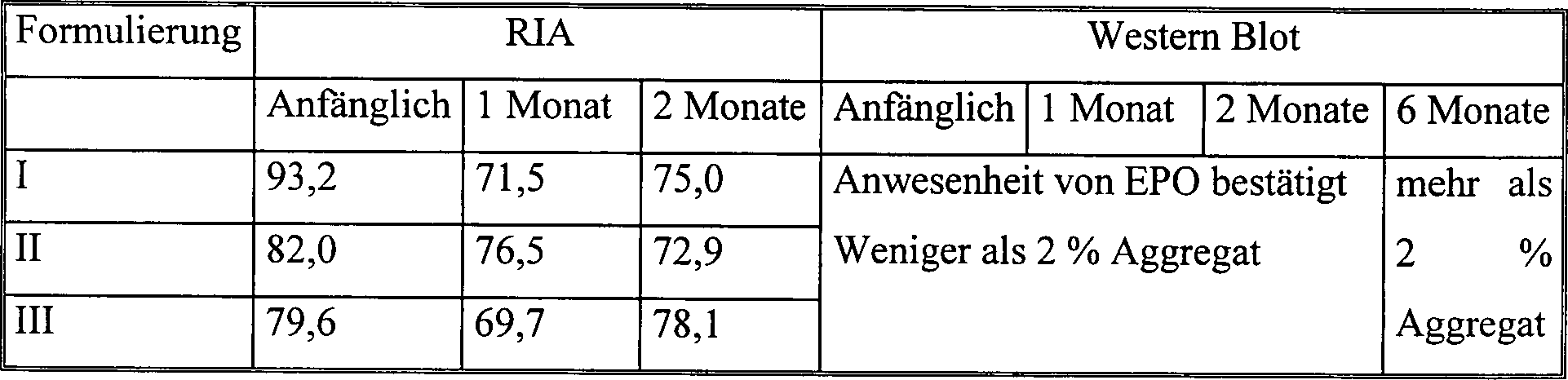
Die in Tabelle 4 gezeigten Daten belegen, dass lyophilisiertes rhEPO nicht so stabil bleibt wie sprühgetrocknetes rhEPO. Deshalb liefert Sprühtrocknen von rhEPO ein stabileres Produkt verglichen mit Lyophilisierung. Die vorliegende Erfindung stellt deshalb ein stabiles sprühgetrocknetes rhEPO bereit, welches hergestellt werden kann ohne das Hinzufügen von irgendwelchen Bindemitteln oder Stabilisatoren, wie beispielsweise Cyclodextrin, Glycin, Mannitol oder Tween 80. Eine Bindemittel-freies Präparat von rhEPO ist für bestimmte Wirkstoffabgabesysteme wünschenswert, wie beispielsweise Abgabe über die pulmonare Route, die üblicherweise erfordert, dass der Wirkstoff von Bindemitteln so frei wie möglich ist.The Data shown in Table 4 demonstrate that lyophilized rhEPO not as stable as spray-dried rhEPO. Therefore, spray drying provides From rhEPO a more stable product compared to lyophilization. The present invention therefore provides a stable spray-dried rhEPO ready, which can be made without adding any binders or stabilizers, such as Cyclodextrin, glycine, mannitol or Tween 80. A binder-free preparation by rhEPO is for certain drug delivery systems desirable, such as Levy over the pulmonary route, usually requires that the active ingredient of binders be as free as possible.
Die Erfindung ist unter Bezugnahme auf bestimmte bevorzugte Ausführungsformen und Beispiele beschrieben worden. Da offensichtliche Variationen den Fachleuten auf dem Gebiet einfallen werden, soll die Erfindung nicht darauf, sondern nur durch die folgenden Ansprüche beschränkt verstanden werden.The The invention is with reference to certain preferred embodiments and examples have been described. Because obvious variations will occur to those skilled in the art, the invention not limited thereto, but only limited by the following claims become.
Claims (14)
Applications Claiming Priority (4)
| Application Number | Priority Date | Filing Date | Title |
|---|---|---|---|
| US35794794A | 1994-12-16 | 1994-12-16 | |
| US357947 | 1994-12-16 | ||
| PCT/US1995/016416 WO1996018647A1 (en) | 1994-12-16 | 1995-12-15 | Spray dried erythropoietin |
| EP95943452A EP0805822B2 (en) | 1994-12-16 | 1995-12-15 | Spray dried erythropoietin |
Publications (3)
| Publication Number | Publication Date |
|---|---|
| DE69532970D1 DE69532970D1 (en) | 2004-06-03 |
| DE69532970T2 true DE69532970T2 (en) | 2005-06-09 |
| DE69532970T3 DE69532970T3 (en) | 2012-02-09 |
Family
ID=23407689
Family Applications (1)
| Application Number | Title | Priority Date | Filing Date |
|---|---|---|---|
| DE69532970T Expired - Lifetime DE69532970T3 (en) | 1994-12-16 | 1995-12-15 | SPRAY-DRYED ERYTHROPOIETIN |
Country Status (19)
| Country | Link |
|---|---|
| US (2) | US6001800A (en) |
| EP (1) | EP0805822B2 (en) |
| JP (1) | JP4039686B2 (en) |
| CN (1) | CN1117762C (en) |
| AT (1) | ATE265468T1 (en) |
| AU (1) | AU697287B2 (en) |
| CA (1) | CA2207615C (en) |
| DE (1) | DE69532970T3 (en) |
| DK (1) | DK0805822T4 (en) |
| ES (1) | ES2219672T5 (en) |
| FI (1) | FI119723B (en) |
| HU (1) | HU222370B1 (en) |
| IL (1) | IL116085A (en) |
| NO (1) | NO319895B1 (en) |
| NZ (1) | NZ298981A (en) |
| PT (1) | PT805822E (en) |
| TW (1) | TW425287B (en) |
| WO (1) | WO1996018647A1 (en) |
| ZA (1) | ZA9510708B (en) |
Families Citing this family (47)
| Publication number | Priority date | Publication date | Assignee | Title |
|---|---|---|---|---|
| DE19539574A1 (en) * | 1995-10-25 | 1997-04-30 | Boehringer Mannheim Gmbh | Preparations and processes for stabilizing biological materials by means of drying processes without freezing |
| US6081536A (en) * | 1997-06-20 | 2000-06-27 | Tantivy Communications, Inc. | Dynamic bandwidth allocation to transmit a wireless protocol across a code division multiple access (CDMA) radio link |
| US6151332A (en) | 1997-06-20 | 2000-11-21 | Tantivy Communications, Inc. | Protocol conversion and bandwidth reduction technique providing multiple nB+D ISDN basic rate interface links over a wireless code division multiple access communication system |
| US6542481B2 (en) | 1998-06-01 | 2003-04-01 | Tantivy Communications, Inc. | Dynamic bandwidth allocation for multiple access communication using session queues |
| EP0913177A1 (en) * | 1997-11-03 | 1999-05-06 | Roche Diagnostics GmbH | Process for producing dry, amorphous products comprising biological active materials by means of convection drying technique, especially spray drying |
| US8175120B2 (en) | 2000-02-07 | 2012-05-08 | Ipr Licensing, Inc. | Minimal maintenance link to support synchronization |
| US7936728B2 (en) | 1997-12-17 | 2011-05-03 | Tantivy Communications, Inc. | System and method for maintaining timing of synchronization messages over a reverse link of a CDMA wireless communication system |
| US6222832B1 (en) | 1998-06-01 | 2001-04-24 | Tantivy Communications, Inc. | Fast Acquisition of traffic channels for a highly variable data rate reverse link of a CDMA wireless communication system |
| US7496072B2 (en) | 1997-12-17 | 2009-02-24 | Interdigital Technology Corporation | System and method for controlling signal strength over a reverse link of a CDMA wireless communication system |
| US9525923B2 (en) | 1997-12-17 | 2016-12-20 | Intel Corporation | Multi-detection of heartbeat to reduce error probability |
| US7394791B2 (en) | 1997-12-17 | 2008-07-01 | Interdigital Technology Corporation | Multi-detection of heartbeat to reduce error probability |
| US8134980B2 (en) | 1998-06-01 | 2012-03-13 | Ipr Licensing, Inc. | Transmittal of heartbeat signal at a lower level than heartbeat request |
| US7773566B2 (en) | 1998-06-01 | 2010-08-10 | Tantivy Communications, Inc. | System and method for maintaining timing of synchronization messages over a reverse link of a CDMA wireless communication system |
| US6526034B1 (en) | 1999-09-21 | 2003-02-25 | Tantivy Communications, Inc. | Dual mode subscriber unit for short range, high rate and long range, lower rate data communications |
| US8155096B1 (en) | 2000-12-01 | 2012-04-10 | Ipr Licensing Inc. | Antenna control system and method |
| US7551663B1 (en) | 2001-02-01 | 2009-06-23 | Ipr Licensing, Inc. | Use of correlation combination to achieve channel detection |
| US6954448B2 (en) | 2001-02-01 | 2005-10-11 | Ipr Licensing, Inc. | Alternate channel for carrying selected message types |
| DE60219961T8 (en) * | 2001-02-02 | 2008-04-17 | Ortho-Mcneil Pharmaceutical, Inc. | TREATMENT OF NEUROLOGICAL FUNCTIONAL DISORDERS WITH FRUCTOPYRANOSESULFAMATE AND ERYTHROPOETIN |
| ES2624979T3 (en) | 2001-06-13 | 2017-07-18 | Intel Corporation | Apparatus for transmitting a heartbeat signal at a lower level than the heartbeat request |
| DE60332358D1 (en) | 2002-09-09 | 2010-06-10 | Hanall Pharmaceutical Co Ltd | PROTEASE-RESISTANT MODIFIED INTERFERON ALPHA POLYPEPTIDE |
| WO2004060343A1 (en) * | 2002-12-31 | 2004-07-22 | Nektar Therapeutics | Antibody-containing particles and compositions |
| JP4745826B2 (en) | 2003-11-14 | 2011-08-10 | 中外製薬株式会社 | Cross-linked polysaccharide microparticles and method for producing the same |
| BRPI0519430A2 (en) | 2004-12-22 | 2009-02-10 | Ambrx Inc | modified human growth hormone |
| EP2399893B1 (en) | 2004-12-22 | 2018-08-15 | Ambrx, Inc. | Compositions containing, methods involving, and uses of non-natural amino acids and polypeptides |
| DK2339014T3 (en) | 2005-11-16 | 2015-07-20 | Ambrx Inc | Methods and compositions comprising non-natural amino acids |
| CN106008699A (en) | 2006-09-08 | 2016-10-12 | Ambrx公司 | Modified human plasma polypeptide or Fc scaffolds and their uses |
| WO2008065372A2 (en) | 2006-11-28 | 2008-06-05 | Nautilus Biotech, S.A. | Modified erythropoietin polypeptides and uses thereof for treatment |
| CN107501407B (en) | 2007-03-30 | 2022-03-18 | Ambrx公司 | Modified FGF-21 polypeptides and uses thereof |
| US8114630B2 (en) | 2007-05-02 | 2012-02-14 | Ambrx, Inc. | Modified interferon beta polypeptides and their uses |
| CA2711984A1 (en) | 2008-01-15 | 2009-07-23 | Abbott Gmbh & Co. Kg | Powdered protein compositions and methods of making same |
| CN102159230A (en) | 2008-07-23 | 2011-08-17 | Ambrx公司 | Modified bovine G-CSF polypeptides and uses thereof |
| PT104350A (en) * | 2009-01-23 | 2010-07-23 | Hovione Farmaci Ncia S A | TIGECYCIN ISOLATION PROCESS |
| MX349301B (en) | 2009-12-21 | 2017-07-21 | Ambrx Inc | Modified bovine somatotropin polypeptides and their uses. |
| BR112012015597A2 (en) | 2009-12-21 | 2017-01-31 | Ambrx Inc | modified porcine somatotropin peptides and their uses |
| TWI480288B (en) | 2010-09-23 | 2015-04-11 | Lilly Co Eli | Formulations for bovine granulocyte colony stimulating factor and variants thereof |
| US8709310B2 (en) | 2011-01-05 | 2014-04-29 | Hospira, Inc. | Spray drying vancomycin |
| WO2013126552A1 (en) | 2012-02-21 | 2013-08-29 | Auburn University | Buprenorphine nanoparticle composition and methods thereof |
| CN104043104B (en) | 2013-03-15 | 2018-07-10 | 浙江创新生物有限公司 | The spray dried powder and its industrialized process for preparing of hydrochloric vancomycin |
| CN114805532A (en) | 2014-10-24 | 2022-07-29 | 百时美施贵宝公司 | Modified FGF-21 polypeptides and uses thereof |
| CN104984323B (en) * | 2015-06-12 | 2018-05-01 | 北京四环生物制药有限公司 | Injection Recombinant Human Erythropoietin freeze drying powder injection |
| CN105311624A (en) * | 2015-11-23 | 2016-02-10 | 哈药集团生物工程有限公司 | Pharmaceutical composition containing recombinant human erythropoietin |
| CA3111576A1 (en) | 2018-09-11 | 2020-03-19 | Ambrx, Inc. | Interleukin-2 polypeptide conjugates and their uses |
| JP2022512746A (en) | 2018-10-19 | 2022-02-07 | アンブルックス,インコーポレイテッド | Interleukin-10 polypeptide complex, its dimer, and their use |
| CA3128081A1 (en) | 2019-02-12 | 2020-08-20 | Ambrx, Inc. | Compositions containing, methods and uses of antibody-tlr agonist conjugates |
| EP4117732A1 (en) | 2020-03-11 | 2023-01-18 | Ambrx, Inc. | Interleukin-2 polypeptide conjugates and methods of use thereof |
| JP2023538071A (en) | 2020-08-20 | 2023-09-06 | アンブルックス,インコーポレイテッド | Antibody-TLR agonist conjugates, methods and uses thereof |
| CA3213805A1 (en) | 2021-04-03 | 2022-10-06 | Feng Tian | Anti-her2 antibody-drug conjugates and uses thereof |
Family Cites Families (5)
| Publication number | Priority date | Publication date | Assignee | Title |
|---|---|---|---|---|
| JPS57149228A (en) * | 1981-03-11 | 1982-09-14 | Ajinomoto Co Inc | Novel erythropoietin and its preparation |
| JPS6197229A (en) * | 1984-10-18 | 1986-05-15 | Chugai Pharmaceut Co Ltd | Stable erythropoietin preparation |
| DE3729863A1 (en) * | 1987-09-05 | 1989-03-16 | Boehringer Mannheim Gmbh | STABILIZED ERYTHROPOIETIN LYOPHILISATES |
| GB9001987D0 (en) * | 1990-01-29 | 1990-03-28 | Janssen Pharmaceutica Nv | Improved cyclodextrin based erythropietin formulation |
| US5354934A (en) * | 1993-02-04 | 1994-10-11 | Amgen Inc. | Pulmonary administration of erythropoietin |
-
1995
- 1995-11-21 IL IL11608595A patent/IL116085A/en not_active IP Right Cessation
- 1995-12-15 ES ES95943452T patent/ES2219672T5/en not_active Expired - Lifetime
- 1995-12-15 CA CA2207615A patent/CA2207615C/en not_active Expired - Lifetime
- 1995-12-15 AU AU44713/96A patent/AU697287B2/en not_active Expired
- 1995-12-15 JP JP51929496A patent/JP4039686B2/en not_active Expired - Lifetime
- 1995-12-15 NZ NZ298981A patent/NZ298981A/en not_active IP Right Cessation
- 1995-12-15 ZA ZA9510708A patent/ZA9510708B/en unknown
- 1995-12-15 CN CN95197638.9A patent/CN1117762C/en not_active Expired - Lifetime
- 1995-12-15 PT PT95943452T patent/PT805822E/en unknown
- 1995-12-15 HU HU9800996A patent/HU222370B1/en active IP Right Grant
- 1995-12-15 WO PCT/US1995/016416 patent/WO1996018647A1/en not_active Ceased
- 1995-12-15 AT AT95943452T patent/ATE265468T1/en active
- 1995-12-15 DE DE69532970T patent/DE69532970T3/en not_active Expired - Lifetime
- 1995-12-15 DK DK95943452.3T patent/DK0805822T4/en active
- 1995-12-15 EP EP95943452A patent/EP0805822B2/en not_active Expired - Lifetime
-
1996
- 1996-06-06 TW TW085106816A patent/TW425287B/en not_active IP Right Cessation
- 1996-12-15 US US08/894,023 patent/US6001800A/en not_active Expired - Lifetime
-
1997
- 1997-06-13 NO NO19972725A patent/NO319895B1/en not_active IP Right Cessation
- 1997-06-16 FI FI972557A patent/FI119723B/en not_active IP Right Cessation
-
1999
- 1999-10-12 US US09/415,726 patent/US6235710B1/en not_active Expired - Lifetime
Also Published As
Similar Documents
| Publication | Publication Date | Title |
|---|---|---|
| DE69532970T2 (en) | SPRAY-DRYED ERYTHROPOIETIN | |
| DE69435033T2 (en) | EUROPE HORMONE DRUG COMPOSITION | |
| DE69736177T2 (en) | STYBERIZED ERYTHROPOIETIN SOLUTION WITH AMINO ACIDS | |
| DE69334134T2 (en) | Aqueous formulation containing human growth hormone | |
| DE69231507T2 (en) | Process for the preparation of microspheres containing biologically active components | |
| EP1455824B1 (en) | Lyophilized preparation containing antibodies to the egf receptor | |
| DE69008346T3 (en) | DRUG DELIVERY COMPOSITIONS. | |
| DE68918853T2 (en) | FORMULATION OF HUMAN GROWTH HORMONES. | |
| DE69938452T2 (en) | Spray-dried insulin microparticles for inhalation | |
| US5456922A (en) | Water dispersible and water soluble carbohydrate polymer compositions for parenteral administration of growth hormone | |
| DE3729863A1 (en) | STABILIZED ERYTHROPOIETIN LYOPHILISATES | |
| JPH08507064A (en) | Excipient stabilization of polypeptides treated with organic solvents | |
| DE69029765T2 (en) | Stabilization of highly purified proteins | |
| EP0131864B1 (en) | Denaturation-resistant aqueous solutions of proteins, process for preparing them and their use | |
| WO1997014429A1 (en) | Stable pharmaceutical forms of administration containing parathormone | |
| DE69637450T2 (en) | Dry compositions with hydrophobic stabilizers | |
| DE69420872T2 (en) | PHARMACEUTICAL PREPARATIONS CONTAINING HGH | |
| DE69101784T2 (en) | STABILIZED COMPOSITION CONTAINING A FIBROBLAST GROWTH FACTOR. | |
| EP0420049B1 (en) | Stabilized leucocyte-interferon | |
| EP1806361B1 (en) | Erythropoietin liquid formulation | |
| DE19513659A1 (en) | Microparticle formulations of aggregation-sensitive polypeptides | |
| EP0458949B1 (en) | Stabilization of k1k2p pro | |
| WO1991008764A1 (en) | SOLUBILIZATION OF t-PA | |
| MXPA97004504A (en) | Aspected eritropoyetin | |
| US6207151B1 (en) | Aqueous solution of t-PA |
Legal Events
| Date | Code | Title | Description |
|---|---|---|---|
| 8363 | Opposition against the patent | ||
| 8328 | Change in the person/name/address of the agent |
Representative=s name: BOEHMERT & BOEHMERT, 28209 BREMEN |
|
| R102 | Epo decision maintaining patent in amended form now final |
Ref document number: 805822 Country of ref document: EP Effective date: 20110615 |