Gebiet der
ErfindungTerritory of
invention
Die
vorliegende Erfindung bezieht sich im Allgemeinen auf eine Tondetektion
und im Besonderen auf eine Mehrkomponententondetektion.The
The present invention generally relates to sound detection
and in particular to a multi-component detonation.
Hintergrund
der Erfindungbackground
the invention
Diese
Anmeldung bezieht sich auf die am 24. Juni 2002 eingereichte US-Patentanmeldung 2004001450
mit dem Titel "Monitoring
and control of an Adaptive Filter in a Communication System", die am 24. Juni
2002 eingereichte US-Patentanmeldung
200323529 mit dem Titel "Method
and Apparatus for Pure Delay Estimation in a Communication System", die am 24. Juni
2002 eingereichte US-Patentanmeldung 2003235312 mit dem Titel "Method and Apparatus
for Tone Indication",
die am 24. Juni 2002 eingereichte US-Patentanmeldung 2003235244
mit dem Titel "Method
and Apparatus for Performing Adaptive Filtering" und die am 24. Juni 2002 eingereichte
US-Patentanmeldung 2003235295 mit dem Titel "Method and Apparatus for Non-Linear
Processing of an Audio Signal",
die alle ihrem augenblicklichen Abtretungsempfänger gehören.These
Application refers to US patent application 2004001450 filed on June 24, 2002
entitled "Monitoring
and Control of an Adaptive Filter in a Communication System, "June 24
Filed in 2002 US patent application
200323529 entitled "Method
and Apparatus for Pure Delay Estimation in a Communication System ", June 24
US patent application 2003235312 filed in 2002 entitled "Method and Apparatus
for Tone Indication ",
US patent application 2003235244 filed on June 24, 2002
entitled "Method
and Apparatus for Performing Adaptive Filtering "and submitted on June 24, 2002
U.S. Patent Application 2003235295 entitled "Method and Apparatus for Non-Linear
Processing of an Audio Signal ",
all belonging to their current assignee.
In
vielen Systemen, wie zum Beispiel Telekommunikationsnetzwerken,
gibt es einen Bedarf zum Detektieren von Signalisierungstönen, die
durch mehrere Sinuskomponenten gebildet werden. Zum Beispiel ist Doppeltonmehrfrequenz
(DTMF), die über
Zweitonkomponenten verfügt,
ein Satz von Standardsignalisierungstönen, die durch Telefongesellschaften übernommen
worden sind, die erzeugt werden, wenn eine Taste auf einer Telefonausrüstung gedrückt wird.
Eine gedrückte
Taste erzeugt einen Doppelfrequenzton, der aus einer Niederfrequenzkomponente
und einer Hochfrequenzkomponente gebildet wird. Andere Beispiele
von Tonformaten, die über
Signalisierungstöne
verfügen,
die durch mehrere Sinuskomponenten gebildet werden, umfassen Mehrfachfrequenz
(MF-R1, MF-R2),
Töne mit
AM-Modulation (zum Beispiel 3-Ton-Komponenten) und "Telefon ausgehängt"-Warntöne (zum
Beispiel vier Komponenten).In
many systems, such as telecommunications networks,
There is a need to detect signaling tones that
be formed by several sine components. For example, dual tone is multi-frequency
(DTMF) over
Has two-tone components,
a set of standard signaling tones taken over by telephone companies
which are generated when a button on a telephone equipment is pressed.
A depressed
Button generates a double-frequency tone consisting of a low-frequency component
and a high frequency component is formed. Other examples
of sound formats that over
signaling tones
feature,
which are formed by a plurality of sine components include multiple frequency
(MF-R1, MF-R2),
Tones with
AM modulation (for example, 3-tone components) and "phone posted" warning tones (for
Example four components).
Eine
Lösung
versucht eine Mehrkomponententondetektion basierend auf Standard-Fourier-Transformationsverfahren
durchzuführen.
Einige dieser Verfahren sind jedoch im Allgemeinen nicht auf mehr
als zwei Komponenten anwendbar, oder können andere wichtige Zweikomponentenfälle außerhalb
von DTMF nicht handhaben. Außerdem
erfordern diese Fourier-Transformationsverfahren
ein Puffern von früheren
Abtastwerten, womit die Komplexität und die Zeit einer Tondetektion
zunimmt. Weiterhin sind die heute zur Verfügung stehenden Lösungen,
die versuchen, Mehrkomponententöne
zu de tektieren, komplex und nicht allgemein genug, um auf verschiedene
andere Tonformate zuzutreffen, die über verschiedene Zahlen von
Tonkomponenten verfügen.
Es gibt daher einen Bedarf an einem verbesserten Mehrkomponententondetektor,
der imstande ist, Mehrkomponententöne von verschiedenen anderen
Tonformaten zu detektieren. Die US 2002/018555 beschreibt ein Verfahren
zum Detektieren einer Frequenz, oder einer Kombination von Frequenzen,
in einem Signal unter Verwendung eines Algorithmus' der kleinsten mittleren
Quadrate und eines Betriebs eines Berechnens eines euklidischen
Abstandes.A
solution
attempts a multi-component sound detection based on standard Fourier transform techniques
perform.
However, some of these methods are generally not more
as two components applicable, or other important two-component cases outside
not handle by DTMF. Furthermore
require these Fourier transform methods
a buffer from earlier ones
Samples, with which the complexity and the time of a sound detection
increases. Furthermore, the solutions available today,
the try multicomponent tones
to deceive, complex and not general enough to be different
to apply other sound formats that differ across different numbers
Sound components feature.
There is therefore a need for an improved multicomponent probe detector,
which is capable of multicomponent tones of various others
To detect sound formats. US 2002/018555 describes a method
for detecting a frequency, or a combination of frequencies,
in a signal using a least mean algorithm
Squares and an operation of calculating an Euclidean
Distance.
Zusammenfassung
der ErfindungSummary
the invention
Die
vorliegende Erfindung stellt ein Verfahren zum Durchführen einer
Tondetektion und einen Tondetektor zum Detektieren eines Tones gemäß den begleitenden
Ansprüchen
zur Verfügung.The
The present invention provides a method for performing a
Tone detection and a Tondetektor for detecting a sound according to the accompanying
claims
to disposal.
Kurze Beschreibung
der ZeichnungenShort description
the drawings
Die
vorliegende Erfindung wird beispielhaft dargestellt und ist durch
die begleitenden Abbildungen, in denen gleiche Bezugszeichen gleiche
Elemente anzeigen, nicht begrenzt.The
The present invention is exemplified and is by
the accompanying drawings, in which like reference numerals are the same
Show items, not limited.
1 stellt
ein Kommunikationssystem gemäß einer
Ausführungsform
der vorliegenden Erfindung in Form eines Blockdiagramms dar; 1 Fig. 12 illustrates a communication system in block diagram form according to one embodiment of the present invention;
2 stellt
einen Tondetektor des Kommunikationssystems von 1 gemäß einer
Ausführungsform der
vorliegenden Erfindung in Form eines Blockdiagramms dar; 2 represents a tone detector of the communication system of 1 according to an embodiment of the present invention in the form of a block diagram;
3 stellt
eine Vorverarbeitungseinheit des Tondetektors von 2 gemäß einer
Ausführungsform der
vorliegenden Erfindung in Form eines Blockdiagramms dar; 3 represents a preprocessing unit of the tone detector of 2 according to an embodiment of the present invention in the form of a block diagram;
4 stellt
einen AM-FM-Demodulator des Tondetektors von 2 gemäß einer
Ausführungsform der
vorliegenden Erfindung in Form eines Blockdiagramms dar; 4 represents an AM-FM demodulator of the tone detector of 2 according to an embodiment of the present invention in the form of a block diagram;
5 stellt
eine Selbstabgleicheinheit des Tondetektors von 2 gemäß einer
Ausführungsform
der vorliegenden Erfindung in Form eines Blockdiagramms dar; 5 represents a self-tuning unit of the tone detector of 2 according to an embodiment of the present invention in the form of a block diagram;
6 stellt
DTMF-Ziffern in graphischer Form dar; 6 represents DTMF digits in graphical form;
7 stellt
ein allgemeines Beispiel einer Abbildung von Mehrkomponentenziffern
in graphischer Form dar; 7 Figure 4 illustrates a general example of mapping multicomponent numbers in graphical form;
8 stellt
ein Verfahren zum Detektieren eines Mehrkomponententones in Form
eines Flussdiagramms dar; und 8th Fig. 12 illustrates a method for detecting a multi-component tone in the form of a flowchart; and
9–10 stellen
ein Verfahren zum Validieren der Detektion eines Mehrkomponententones
von 8 in Form eines Flussdiagramms dar. 9 - 10 set forth a method for validating the detection of a multicomponent clay of 8th in the form of a flowchart.
Dem
Fachmann auf dem Gebiet ist klar, dass Elemente in den Abbildungen
aus Gründen
der Einfachheit und Klarheit dargestellt und nicht notwendigerweise
maßstabsgetreu
wiedergegeben werden. Zum Beispiel können die Dimensionen einiger
der Elemente relativ zu anderen Elementen übertrieben sein, um das Verstehen
der Ausführungsformen
der vorliegenden Erfindung zu erleichtern.the
One skilled in the art is clear that elements in the pictures
for reasons
simplicity and clarity and not necessarily
to scale
be reproduced. For example, the dimensions of some
the elements may be exaggerated relative to other elements in order to understand
the embodiments
of the present invention.
Ausführliche Beschreibung der bevorzugten
AusführungsformenDetailed description of the preferred
embodiments
Wie
hierin verwendet, wird der Ausdruck "Bus" verwendet,
um auf eine Mehrzahl von Signalen oder Leitern hinzuweisen, die
verwendet werden können,
um eine oder mehrere verschiedene Arten von Informationen zu übertragen,
wie zum Beispiel Daten, Adressen, eine Steuerung oder einen Zustand.
Die hierin diskutierten Leiter können
mit Bezug darauf dargestellt oder beschrieben werden, dass sie ein
einzelner Leiter, eine Mehrzahl von Leitern, unidirektionale Leiter
oder bidirektionale Leiter sind. Jedoch können verschiedene Ausführungsformen
die Implementierung der Leiter variieren. Zum Beispiel können getrennte
unidirektionale Leiter anstatt bidirektionale Leiter verwendet werden
und umgekehrt. Außerdem
kann eine Mehrzahl von Leitern durch einen einzelnen Leiter ersetzt
werden, der mehrere Signale seriell oder gemäß einem Zeitmultiplexverfahren überträgt. Ebenso
können
einzelne Leiter, die mehrere Signale tragen, in verschiedene andere
Leiter aussortiert werden, die Untermengen dieser Signale tragen.
Es gibt daher viele Optionen, um Signale zu übertragen.As
used herein, the term "bus" is used
to indicate a plurality of signals or conductors that
can be used
to transmit one or more different types of information,
such as data, addresses, a controller, or a state.
The conductors discussed herein may
be illustrated or described with reference thereto
single conductor, a plurality of conductors, unidirectional conductors
or bidirectional conductors. However, different embodiments may be used
the implementation of the ladder vary. For example, can be separate
unidirectional conductors are used instead of bidirectional conductors
and vice versa. Furthermore
For example, a plurality of conductors may be replaced by a single conductor
which transmits a plurality of signals serially or according to a time division multiplex method. As well
can
individual conductors carrying multiple signals into different others
Heads are removed, carry the subsets of these signals.
There are therefore many options for transmitting signals.
Die
Ausdrücke "behaupten" und "negieren" (oder "aufheben") werden verwendet,
wenn auf das Rendering eines Signals, Zustandsbits, oder einer ähnlichen
Vorrichtung, in ihren logisch wahren, beziehungsweise logisch falschen,
Zustand hingewiesen wird. Wenn der logisch wahre Zustand ein Logikpegel
Eins ist, ist der logisch falsche Zustand ein Logikpegel Null, und
wenn der logisch wahre Zustand ein Logikpegel Null ist, ist der
logisch falsche Zustand ein Logikpegel Eins.The
Expressions "claim" and "negate" (or "cancel") are used
when to the rendering of a signal, status bits, or the like
Device, in its logically true, or logically wrong,
State is pointed out. When the logical true state is a logic level
One is, the logically wrong state is a logic zero, and zero
if the logical true state is a logic zero, the
Logically wrong state Logic level one.
Konnektivitätconnectivity
1 stellt
ein Kommunikationssystem 10 gemäß einer Ausführungsform
der vorliegenden Erfindung in Form eines Blockdiagramms dar. Das
Kommunikationssystem 10 umfasst einen Sender/Empfänger 12,
einen Tondetektor 14, ein Kommunikati onsnetzwerk 16,
einen Tondetektor 18, einen Sender/Empfänger 20 und einen
Steuerbus 22. Der Steuerbus 22 ist bidirektional
an den Sender/Empfänger 12,
den Tondetektor 14, das Kommunikationsnetzwerk 16,
den Tondetektor 18 und den Sender/Empfänger 20 gekoppelt.
Der Sender/Empfänger 12 ist
bidirektional an den Tondetektor 14 gekoppelt, der bidirektional
an das Kommunikationsnetzwerk 16 gekoppelt ist, das bidirektional
an den Tondetektor 18 gekoppelt ist, der bidirektional
an den Sender/Empfänger 20 gekoppelt
ist. 1 represents a communication system 10 according to an embodiment of the present invention in the form of a block diagram. The communication system 10 includes a transmitter / receiver 12 , a tone detector 14 , a communication network 16 , a tone detector 18 , a transmitter / receiver 20 and a tax bus 22 , The tax bus 22 is bidirectional to the transmitter / receiver 12 , the tone detector 14 , the communication network 16 , the tone detector 18 and the transceiver 20 coupled. The transmitter / receiver 12 is bidirectional to the tone detector 14 coupled, bidirectional to the communication network 16 coupled, bidirectional to the Tondetektor 18 is coupled, bidirectional to the transceiver 20 is coupled.
2 stellt
den Tondetektor 14 gemäß einer
Ausführungsform
der vorliegenden Erfindung in Form eines Blockdiagramms dar. Der
Tondetektor 14 umfasst eine optische Vorverarbeitungseinheit 26,
den Filter1 28, den FilterN 32, den AM-FM-Demodulator1 30, den AM-FM-DemodulatorN 34, die Selbstabgleicheinheit 36 und die
Tondetektionsentscheidungseinheit 38. Es ist zu beachten,
dass der Tondetektor 14, wie benötigt, N Filter und N AM-FM-Demodulatoren
umfasst. Die Vorverarbeitungseinheit 26 (wenn vorhanden)
ist über
den Leiter 42 an jeden der Filter, Filter1 28 bis
FilterN 32, und über den
Leiter 40 an die Tondetektionsentscheidungseinheit 38 gekoppelt.
Der Filter1 28 ist über den
Leiter 44 an den AM-FM-Demodulator1 30 gekoppelt
und der AM-FM-Demodulator1 30 ist über die Leiter 46 an
die Selbstabgleicheinheit 36 gekoppelt. Der FilterN 32 ist über den Leiter 52 an
den AM-FM-DemodulatorN 34 gekoppelt
und der AM-FM-DemodulatorN 34 ist über die
Leiter 54 an die Selbstabgleicheinheit 36 gekoppelt.
Die Filter, Filter1 28 bis FilterN 32, empfangen jeder r und m von der
Selbstabgleicheinheit 36 und die Demodulatoren, AM-FM-Demodulator1 30 bis AM-FM-DemodulatorN 34, empfangen jeder α von der
Selbstabgleicheinheit 36. Die Tondetektionsentscheidungseinheit 38 ist
gekoppelt, um m' von
der Selbstabgleicheinheit 36 zu empfangen, und ist gekoppelt,
um dem Steuerbus 22 über
die Leiter 50 ein erfasstes Symbol zur Verfügung zu
stellen. Der Tondetektor 14 ist außerdem gekoppelt, um Informationen
von dem Steuerbus 22 über
die Leiter 48 bereitzustellen und zu empfangen. 2 sets the tone detector 14 in accordance with an embodiment of the present invention in block diagram form. The tone detector 14 includes an optical preprocessing unit 26 , the filter 1 28 , the filter N 32 , the AM-FM demodulator 1 30 , the AM-FM demodulator N 34 , the self-adjustment unit 36 and the tone detection decision unit 38 , It should be noted that the tone detector 14 as required, includes N filters and N AM-FM demodulators. The preprocessing unit 26 (if available) is above the ladder 42 to each of the filters, filter 1 28 to filter N 32 , and about the leader 40 to the tone detection decision unit 38 coupled. The filter 1 28 is about the leader 44 to the AM-FM demodulator 1 30 coupled and the AM-FM demodulator 1 30 is about the ladder 46 to the self-adjustment unit 36 coupled. The filter N 32 is about the leader 52 to the AM-FM demodulator N 34 coupled and the AM-FM demodulator N 34 is about the ladder 54 to the self-adjustment unit 36 coupled. The filters, filters 1 28 to filter N 32 , each r and m receive from the auto-matching unit 36 and the demodulators, AM-FM demodulator 1 30 to AM-FM demodulator N 34 Each α is received by the self-tuning unit 36 , The tone detection decision unit 38 is coupled to m 'from the self-tuning unit 36 to receive, and is coupled to the control bus 22 over the ladder 50 to provide a detected symbol. The tone detector 14 is also coupled to information from the control bus 22 over the ladder 48 to provide and receive.
3 stellt
die Vorverarbeitungseinheit 26 gemäß einer Ausführungsform
der vorliegenden Erfindung in Form eines Blockdiagramms dar. Die
Vorverarbeitungseinheit 26 ist optional und umfasst einen
optionalen Dezimator ("decimator") 62, eine
optionale AGC-Einheit 64 (AGC = automatische Verstärkungssteuerung), eine
Energieberechnungseinheit 66, ein Tiefpassfilter (LPF) 68 und
einen Energiedetektor 70. Der Dezimator 62 ist
an die AGC 64 gekoppelt. Die AGC 64 ist an die
Energieberechnungseinheit 66 gekoppelt, die den Filtern,
Filter1 28 bis FilterN 32,
x(n) zur Verfügung
stellt. Es ist zu beachten, dass sowohl der Dezimator 62 als auch
die AGC 64 optional sind, und wenn es beide nicht gibt,
wird x'(n) den Filtern,
Filter1 28 bis Filter 32,
direkt als x(n) zur Verfügung
gestellt und die Energieberechnungseinheit 66 empfängt x'(n) als x(n). Die
Energieberechnungseinheit 66 ist an den LPF 68 gekoppelt,
der gekoppelt ist, um dem Energiedetektor 70 Px zur
Verfügung
zu stellen. Der Energiedetektor 70 stellt der Tondetektionsentscheidungseinheit 38 m' zur Verfügung. 3 represents the preprocessing unit 26 according to an embodiment of the present invention in the form of a block diagram. The preprocessing unit 26 is optional and includes an optional decimator 62 , an optional AGC unit 64 (AGC = automatic gain control), an energy calculation unit 66 , a low-pass filter (LPF) 68 and an energy detector 70 , The decimator 62 is to the AGC 64 coupled. The AGC 64 is to the energy calculation unit 66 coupled to the filters, filters 1 28 to filter N 32 , x (n) provides. It should be noted that both the decimator 62 as well as the AGC 64 are optional, and if both do not exist, x '(n) becomes the filter, filter 1 28 until filter 32 , provided directly as x (n) and the energy calculation unit 66 receives x '(n) as x (n). The energy calculation unit 66 is at the LPF 68 coupled, which is coupled to the energy detector 70 P x to provide. The energy detector 70 represents the tone detection decision unit 38 m 'available.
4 stellt
den AM-FM-Demodulator1 30 von 2 gemäß einer
Ausführungsform
der vorliegenden Erfindung in Form eines Blockdiagramms dar. Es
ist zu beachten, dass 4 den AM-FM-Demodulator1 30 als ein Beispiel darstellt;
das Blockdiagramm von 4 kann jedoch auf einen beliebigen
der Demodulatoren, AM-FM-Demodulator1 30 bis
AM- FM-DemodulatorN 34, zutreffen. Das heißt, das
selbe Blockdiagramm und die selbe Funktionalität trifft für alle die Demodulatoren zu.
Der AM-FM-Demodulator1 30 empfängt x1(n), entsprechend einer ersten Tonkomponente
von x(n), über
den Leiter 44 von dem Filter1 28.
Der AM-FM-Demodulator1 30 umfasst
eine "gleitender
Zweipunktdurchschnitt"-Einheit 72,
eine Energieberechnungseinheit 74, einen LPF 76,
einen Multiplizierer 84, einen LPF 86, eine Energieberechnungseinheit 78,
einen LPF 80, eine Inverse-Abschätzungseinheit 82,
einen Addierer 88, eine Inverse-Abschätzungseinheit 89,
einen Multiplizierer 90 und einen LPF 92. Die "gleitender Zweipunktdurchschnitt"-Einheit 72 und
die Energieberechnungseinheit 78 empfangen beide x1(n) über
den Leiter 44. Die "gleitender
Zweipunktdurchschnitt"-Einheit 72 ist
an die Energieberechnungseinheit 74 gekoppelt, die an den
LPF 76 gekoppelt ist, der an den Multiplizierer 84 gekoppelt
ist. Die Energieberechnungseinheit 78 ist an den LPF 80 gekoppelt,
der an den Multiplizierer 90 und die Inverse-Abschätzungseinheit 82 gekoppelt
ist. Die Inverse-Abschätzungseinheit 82 ist
an den Multiplizierer 84 gekoppelt, der an den LPF 86 gekoppelt
ist. Der LPF 86 ist gekoppelt, um der Selbstabgleicheinheit 36 über den
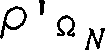
Leiter 46 ρ'Ω1 (entsprechend
einer Funktion der Frequenz der ersten Tonkomponente von x(n)) zur
Verfügung
zu stellen, und an den Addierer 88 gekoppelt. Der Addierer 88 empfängt eine
1 (die fest verdrahtet oder in einer Speichereinheit gespeichert
sein kann) und ist an die Inverse-Abschätzungseinheit 89 gekoppelt,
die an den Multiplizierer 90 gekoppelt ist. Der Multiplizierer 90 ist
an den LPF 92 gekoppelt, der der Selbstabgleichvorrichtung 36 über die
Leiter 46 ρ'A1 (entsprechend
einer Funktion der Amplitude der ersten Tonkomponente von x(n))
zur Verfügung
stellt. Die LPFs 80, 76, 86 und 92 sind
geschaltet, um von der Selbstabgleichvorrichtung 36 zu
empfangen. 4 represents the AM-FM demodulator 1 30 from 2 according to one embodiment of the present invention in the form of a block diagram. It should be noted that 4 the AM-FM demodulator 1 30 as an example; the block diagram of 4 however, can be applied to any of the demodulators, AM-FM demodulator. 1 30 to AM-FM demodulator N 34 , hold true. That is, the same block diagram and functionality applies to all the demodulators. The AM-FM demodulator 1 30 receives x 1 (n), corresponding to a first sound component of x (n), over the conductor 44 from the filter 1 28 , The AM-FM demodulator 1 30 includes a "two-point moving average" unit 72 , an energy calculation unit 74 , an LPF 76 , a multiplier 84 , an LPF 86 , an energy calculation unit 78 , an LPF 80 , an inverse estimator 82 , an adder 88 , an inverse estimator 89 , a multiplier 90 and an LPF 92 , The "two-point moving average" unit 72 and the energy calculation unit 78 receive both x 1 (n) over the conductor 44 , The "two-point moving average" unit 72 is to the energy calculation unit 74 coupled to the LPF 76 coupled to the multiplier 84 is coupled. The energy calculation unit 78 is at the LPF 80 coupled to the multiplier 90 and the inverse estimator 82 is coupled. The inverse estimator 82 is to the multiplier 84 coupled to the LPF 86 is coupled. The LPF 86 is coupled to the self-tuning unit 36 over the ladder 46 ρ ' Ω1 (corresponding to a function of the frequency of the first sound component of x (n)) and to the adder 88 coupled. The adder 88 receives a 1 (which may be hard-wired or stored in a memory unit) and is to the inverse estimator 89 coupled to the multiplier 90 is coupled. The multiplier 90 is at the LPF 92 coupled, the self-balancing device 36 over the ladder 46 provides ρ ' A1 (corresponding to a function of the amplitude of the first sound component of x (n)). The LPFs 80 . 76 . 86 and 92 are switched to by the auto-balance device 36 to recieve.
5 stellt
die Selbstabgleichvorrichtung 36 von 2 gemäß einer
Ausführungsform
der vorliegenden Erfindung in Form eines Blockdiagramms dar. Die
Selbstabgleichvorrichtung 36 umfasst den Speicher 100,
einen Minimalabstandsdetektor 102, einen Detektionszähler 104,
eine LPF-Bandbreitensteuerung 106 und
eine Filtersteuerung 108. Der Minimalabstandsdetektor ist
gekoppelt, um bis über die
Leiter 46 und 54, entsprechend Funktionen der
Amplitude der Tonkomponenten 1 bis N von x(n), zu empfangen, und
ist gekoppelt, um bis über die
Leiter 46 und 54, entsprechend Funktionen der
Frequenz der Tonkomponenten 1 bis N von x(n), zu empfangen. Der
Minimalabstandsdetektor 102 ist an den Speicher 100,
den Detektionszähler 104,
die Filtersteuerung 108 und den Frequenztoleranzprüfer 107 gekoppelt.
Die Filtersteuerung 108 ist gekoppelt, um dem Frequenztoleranztester 107 und
den Filtern, Filter1 28 bis FilterN 32, m zur Verfügung zu stellen, und den Filtern,
Filter1 28 bis FilterN 32,
r zur Verfügung
zu stellen. Der Frequenztoleranzprüfer 107 ist an die
Filtersteuerung 108 gekoppelt, um m zu empfangen, an den
Minimalabstandsdetektor 102 gekoppelt, um über die
Leiter 112 ein Frequenztoleranzflag zu empfangen, und stellt
der Tondetektorentscheidungseinheit 38 m' zur Verfügung. Die
LPF-Bandbreitensteuerung 106 ist gekoppelt, um den Demodulatoren, AM-FM-Demodulator1 30 bis AM-FM-DemodulatorN 34, ☐ zur Verfügung zu
stellen. 5 provides the auto-balance device 36 from 2 in accordance with an embodiment of the present invention in block diagram form. The self-tuning device 36 includes the memory 100 , a minimum distance detector 102 , a detection counter 104 , an LPF bandwidth control 106 and a filter controller 108 , The minimum distance detector is coupled to to over the ladder 46 and 54 , according to functions of the amplitude of the sound components 1 to N of x (n), and is coupled to to over the ladder 46 and 54 to receive functions corresponding to the frequency of the sound components 1 to N of x (n). The minimum distance detector 102 is at the store 100 , the detection counter 104 , the filter control 108 and the frequency tolerance controller 107 coupled. The filter control 108 is coupled to the frequency tolerance tester 107 and the filters, filters 1 28 to filter N 32 to provide m, and the filters, filters 1 28 to filter N 32 to provide r. The frequency tolerance checker 107 is to the filter control 108 coupled to receive m, to the minimum distance detector 102 coupled to the ladder 112 receive a frequency tolerance flag, and provide the tone detector decision unit 38 m 'available. The LPF bandwidth control 106 is coupled to the demodulators, AM-FM demodulator. 1 30 to AM-FM demodulator N 34 To provide ☐.
Es
ist zu beachten, dass 1–5 eine Ausführungsform
von Kästen
darstellen, die in dem Kommunikationssystem 10 und dem
Tondetektor 14 vorkommen. Alternative Ausführungsformen
können,
in Abhängigkeit
von der gewünschten
Funktionalität,
verschiedene andere Elemente umfassen, als die dargestellten, mehr
Elemente umfassen, als die dargestellten, oder weniger Elemente
umfassen, als die dargestellten. Weiterhin können die Kästen in den 1–5 anders
gruppiert oder verbunden werden und dennoch ähnliche Ergebnisse erreichen.
Daher sollen 1–5 nur Beispiele
zur Verfügung
stellen, die verwendet werden, um das Konzept darzustellen, das
unten diskutiert wird. Außerdem
kann, obwohl die Verbindungen in 1–5 als
ein einzelner Leiter (unidirektional oder bidirektional) oder als
mehrere Leiter (unidirektional oder bidirektional) dargestellt sein
können,
eine Mehrzahl verschiedener Verbindungen verwendet werden. Zum Beispiel
kann ein Mehrfachleiter durch eine Vielfalt verschiedener unidirektionaler
oder bidirektionaler Einzelleiter ersetzt werden. Ebenso können Einzelleiter
zu unidirektionalen oder bidirektionalen Mehrfachleitern erweitert
werden. Signale können
seriell über
einen Einzelleiter oder parallel über Mehrfachleiter kommuniziert
werden. Außerdem
können
Signale unter Verwendung eines Zeitmultiplexverfahrens über Einzel-
oder Mehrfachleiter kommuniziert werden. Daher können die in 1–5 dargestellten
Verbindungen auf eine Vielfalt unterschiedlicher Weisen implementiert
werden, während
sie dennoch die gewünschte
Funktionalität erreichen.
Außerdem
können,
wie weiter unten beschrieben, die Konstruktionen von 1–5 in
einer Hardware, Software, oder einer Kombination aus Hardware und
Software implementiert werden.It should be noted that 1 - 5 represent an embodiment of boxes used in the communication system 10 and the tone detector 14 occurrence. Alternative embodiments may, in Ab Depending on the desired functionality, various other elements include, as the illustrated, more elements than the illustrated, or include fewer elements than those shown. Furthermore, the boxes in the 1 - 5 be grouped or joined differently and still achieve similar results. Therefore, should 1 - 5 just provide examples that will be used to illustrate the concept discussed below. In addition, though the connections in 1 - 5 may be represented as a single conductor (unidirectional or bi-directional) or as multiple conductors (unidirectional or bidirectional), a plurality of different connections may be used. For example, a multiple conductor can be replaced by a variety of different unidirectional or bi-directional single conductors. Likewise, single conductors can be extended to unidirectional or bidirectional multiple conductors. Signals can be communicated serially via a single conductor or in parallel via multiple conductors. In addition, signals can be communicated over a single or multiple conductor using time division multiplexing. Therefore, the in 1 - 5 can be implemented in a variety of different ways while still achieving the desired functionality. In addition, as described below, the constructions of 1 - 5 be implemented in hardware, software, or a combination of hardware and software.
Betriebbusiness
Es
wird erneut auf 1 Bezug genommen, darin tauscht
der Sender/Empfänger 12 Datensignale über den
Tondetektor 14 mit dem Kommunikationsnetzwerk 16 aus.
Genauso tauscht der Sender/Empfänger 20 Datensignale über den
Tondetektor 18 mit dem Kommunikationsnetzwerk 16 aus.
Daher sind die Sender/Empfänger 12 und 20 in
der Lage, durch das Kommunikationsnetzwerk 16 miteinander
zu kommunizieren. Der Sender/Empfänger 12 und der Sender/Empfänger 20 können jeweils
jede beliebige Vorrichtung sein, die zum Kommunizieren über das
Kommunikationsnetzwerk 16 verwendet wird, wie zum Beispiel
ein Telefon, ein Modem, und so weiter. Außerdem kann das Kommunikationsnetzwerk 16 ein
Pakettelefonienetzwerk (das zum Beispiel Sprache-über-IP (IP
= Internetprotokoll), Daten-über-Paket,
asynchrones Datenübertragungsverfahren
(ATM), und so weiter umfasst und entweder für drahtlose oder für Wireline-Systeme
gilt), oder ein öffentliches
Telefonnetz (PSTN) umfassen. In alternativen Ausführungsformen
kann sich das Kommunikationssystem 10 auf eine beliebige
Art von Kommunikationssystem beziehen.It will be up again 1 Referring to this, the transmitter / receiver exchanges 12 Data signals via the tone detector 14 with the communication network 16 out. The same way the transmitter / receiver exchanges 20 Data signals via the tone detector 18 with the communication network 16 out. Therefore, the transmitter / receiver 12 and 20 able through the communication network 16 communicate with each other. The transmitter / receiver 12 and the transceiver 20 each may be any device capable of communicating over the communications network 16 is used, such as a phone, a modem, and so on. In addition, the communication network 16 a packet telephony network (e.g., Internet Protocol over IP, Data Over Packet, Asynchronous Data Transfer (ATM) method, and so forth, and either for wireless or wireline systems) or a public switched telephone network ( PSTN). In alternative embodiments, the communication system may 10 refer to any type of communication system.
Der
Steuerbus 22 stellt einen Steuerpfad zwischen dem Sender/Empfänger 12 und 20,
den Tondetektoren 14 und 18 und dem Kommunikationsnetzwerk 16 zur
Verfügung. Über den
Steuerbus 22 übertragene Steuersignale
sind im Allgemeinen keine Inline-Signale. Zum Beispiel kann der
Steuerbus 22 ein Freigabe-/Sperrsignal sein, um den Tondetektor 14 oder 18 freizugeben
oder zu sperren, oder kann Signale umfassen, die zwischen verschiedenen
Teilen der Tondetektoren 14 oder 18 kommuniziert
werden müssen.
Die Steuerung 22 kann außer dem ein Signal umfassen,
um anzuzeigen, ob das Telefon ein- oder ausgehängt ist.The tax bus 22 provides a control path between the transceiver 12 and 20 , the sound detectors 14 and 18 and the communication network 16 to disposal. About the tax bus 22 transmitted control signals are generally not inline signals. For example, the control bus 22 an enable / disable signal to the tone detector 14 or 18 enable or disable, or may include signals between different parts of the sound detectors 14 or 18 must be communicated. The control 22 It may also include a signal to indicate whether the phone is on or off.
Es
ist zu beachten, dass der Betrieb des Senders/Empfängers 12 und
des Tondetektors 14 analog zu dem Betrieb des Senders/Empfängers 20 und
des Tondetektors 18 ist. Das heißt, das Kommunikationssystem 10,
wie in 1 dargestellt, ist symmetrisch. Daher werden die
Beschreibungen von 2–9 mit Bezug auf
den Sender/Empfänger 12 und
den Tondetektor 14 vorgenommen; es ist jedoch klar, dass
die Beschreibungen auch auf den Sender/Empfänger 20 und den Tondetektor 18 zutreffen.
In 1 stellt der Sender/Empfänger 12 dem Tondetektor 14 ein
als x'(n) bezeichnetes
Sendesignal zur Verfügung.
Das Signal x'(n)
kann normale Sprache oder einen Ton eines bestimmten Tonformates,
wie zum Beispiel DTMF, MF-R1, MF-R2, und so weiter, umfassen. Zum
Beispiel stellt der Sender/Empfänger 12,
wenn eine Telefonnummer innerhalb der Vereinigten Staaten gewählt wird,
jedes mal, wenn eine Taste auf dem Telefon gedrückt wird, dem Tondetektor 14 einen
Ton in dem DTMF-Format zur Verfügung.
Wie oben beschrieben, ist jeder Ton in einem DTMF-Format ein Doppelfrequenzton
und der Tondetektor 14 identifiziert die Hoch- und Niederfrequenzkomponenten
des empfangenen Tones und identifiziert dann, welche Taste gedrückt wurde
(unter der Annahme, dass der empfangene Ton einer gültigen Taste
entspricht). Alternativ kann der Tondetektor 14 verwendet
werden, um Mehrkomponententöne
(das heißt,
Töne, die über mehrere
Frequenzkomponenten verfügen)
zu detektieren und identifizieren, die über ein beliebiges Tonformat
verfügen,
und er ist nicht auf ein DTMF-Format begrenzt.It should be noted that the operation of the transmitter / receiver 12 and the tone detector 14 analogous to the operation of the transmitter / receiver 20 and the tone detector 18 is. That is, the communication system 10 , as in 1 shown is symmetrical. Therefore, the descriptions of 2 - 9 with respect to the transmitter / receiver 12 and the tone detector 14 performed; However, it is clear that the descriptions also apply to the sender / receiver 20 and the tone detector 18 hold true. In 1 represents the transmitter / receiver 12 the tone detector 14 a transmit signal called x '(n) is available. The signal x '(n) may include normal speech or a sound of a particular sound format, such as DTMF, MF-R1, MF-R2, and so forth. For example, the transmitter / receiver represents 12 when a telephone number is dialed within the United States, each time a key on the telephone is pressed, the tone detector 14 a sound in the DTMF format available. As described above, each tone in a DTMF format is a dual frequency tone and the tone detector 14 identifies the high and low frequency components of the received sound and then identifies which key was pressed (assuming that the received sound corresponds to a valid key). Alternatively, the tone detector 14 can be used to detect and identify multicomponent tones (that is, tones that have multiple frequency components) that have any audio format, and is not limited to a DTMF format.
Wie
in 6 zu sehen, wird ein Beispiel von DTMF-Wähltönen auf einem zweidimensionalen
Netz zur Verfügung
gestellt, wobei die Niederfrequenzwerte (697 Hz bis 941 Hz) auf
der horizontalen Achse und die Hochfrequenzwerte (1209 Hz bis 1633
Hz) auf der vertikalen Achse zur Verfügung gestellt werden. Jedes
der 16 gültigen
DTMF-Symbole (0–9,
A–D, #
und *) wird in der graphischen Darstellung bei einem Punkt aufgetragen,
der seinen zwei Frequenzkomponenten entspricht. Zum Beispiel entspricht
das DTMF-Symbol '3' einem Ton, der aus
einer ersten (niedrigen) Frequenzkomponente, die über eine
Frequenz von 697 Hz verfügt,
und einer zweiten (hohen) Frequenzkomponente, die über eine
Frequenz von 1477 Hz verfügt,
zusammengesetzt ist. Daher entspricht jedes der 16 DTMF-Symbole
einem Ton, der aus zwei Sinuswellenformen, die über zwei verschiedene Frequenzen
verfügen,
zusammengesetzt ist, eine ausgewählt
aus 697 Hz, 770 Hz, 852 Hz und 941 Hz, und die andere ausgewählt aus
1209 Hz, 1336 Hz, 1477 Hz und 1633 Hz. Daher werden 8 verschiedene
Frequenzen in DTMF verwendet, um 16 verschiedene Signalisierungstöne zur Verfügung zu
stellen. (Es ist zu beachten, dass die DTMF-Symbole durch zwei Frequenzkomponenten
dargestellt werden, ungeachtet einer Amplitude. In alternativen
Tonformaten können
Signalisierungstöne
jedoch mehrere Frequenzkomponenten umfassen, wobei Amplituden ebenfalls
berücksichtigt
werden, wie weiter unten diskutiert wird.) Der Tondetektor 14 kann
daher verwendet werden, um zu detektieren, wann Töne empfangen
werden, und zu identifizieren, welche Symbole durch die Töne angezeigt
werden. Zum Beispiel wird, wenn der Tondetektor 14 eine erste
Frequenzkomponente bei 852 Hz und eine zweite Frequenzkomponente
bei 1477 Hz detektiert, ein DTMF-Symbol von '9' angezeigt
(un ter der Annahme, dass die Töne
für eine
bestimmte Zeitdauer nach einer gültigen
Pause detektiert werden, wie durch das DTMF-Tonformat definiert).As in 6 an example of DTMF dial tones is provided on a two-dimensional network, where the low frequency values (697 Hz to 941 Hz) are provided on the horizontal axis and the high frequency values (1209 Hz to 1633 Hz) on the vertical axis , Each of the 16 valid DTMF symbols (0-9, A-D, # and *) is plotted in the graph at a point corresponding to its two frequency components. For example, the DTMF symbol '3' corresponds to a sound composed of a first (low) frequency component having a frequency of 697 Hz and a second (high) frequency component having a frequency of 1477 Hz is. Therefore, each of the 16 DTMF symbols corresponds to a sound composed of two sine waveforms having two different frequencies, one selected from 697 Hz, 770 Hz, 852 Hz, and 941 Hz, and the other selected from 1209 Hz, 1336 Hz, 1477 Hz and 1633 Hz. Therefore, 8 different frequencies are used in DTMF to provide 16 different signaling tones. (Note that the DTMF symbols are represented by two frequency components regardless of amplitude.) In alternative audio formats, however, signaling tones may include multiple frequency components, with amplitudes also considered, as discussed further below.) The tone detector 14 Therefore, it can be used to detect when sounds are received and to identify which symbols are indicated by the sounds. For example, when the tone detector 14 detecting a first frequency component at 852 Hz and a second frequency component at 1477 Hz, a DTMF symbol of '9' is displayed (assuming that the tones are detected for a certain period of time after a valid pause, such as the DTMF tone format Are defined).
7 stellt
ein Beispiel eines generischen Tonformates dar, wobei jedes der
gültigen
Symbole (von denen jedes über
zwei Frequenzkomponenten verfügt,
die ρΩ1 und ρΩ2 entsprechen)
auf einem zweidimensionalen Netz aufgetragen sind. Das Netz von 7 verwendet,
anstatt tatsächliche
Frequenzwerte für
die horizontale und die vertikale Achse zu verwenden, eine Funktion
der Frequenzen für
jede Achse. Das heißt, ρΩ1 stellt
eine Funktion der Frequenz Ω1 entlang der horizontalen Achse dar und ρΩ2 stellt
eine Funktion der Frequenz Ω2 entlang der vertikalen Achse dar. Zum Beispiel
ist in einer Ausführungsform,
die unten ausführlicher beschrieben
wird, ρΩ1 =
cos2(bΩ1) und ρΩ2 =
cos2(bΩ2), wobei b eine Konstante ist. (Es ist zu
beachten, dass ρΩ1 und ρΩ2 überlappenden
oder nicht-überlappenden
Frequenzbereichen entsprechen können.)
Daher ist jedes gültige
Symbol, wie zum Beispiel das Symbol, das dem Punkt 124 entspricht,
aus zwei Frequenzkomponenten zusammengesetzt: und entsprechend
bestimmten Werten von ρΩ1 beziehungsweise ρΩ2.
(Es ist zu beachten, dass in einigen Ausführungsformen die Frequenzkomponenten
bestimmten Werten von ρΩ1 und ρΩ2 innerhalb
vorbestimmter Toleranzen entsprechen, wie zum Beispiel +/– 1,5% der
Nominalfrequenz f, was wiederum einen asymmetrischen Toleranzbereich
um den nominalen Wert von ρΩ definiert.
In diesem Beispiel würde
das Symbol, das dem Punkt 124 entspricht, detektiert, wenn
eine Frequenzkomponente, die +/– 1,5% von
f1,3 entspricht, und eine andere Fre quenzkomponente,
die +/– 1,5% von
f2,2 entspricht, beide detektiert werden.) 7 FIG. 12 illustrates an example of a generic audio format, wherein each of the valid symbols (each having two frequency components corresponding to ρ Ω1 and ρΩ2 ) are plotted on a two-dimensional network. The network of 7 instead of using actual frequency values for the horizontal and vertical axes, uses a function of the frequencies for each axis. That is, ρ Ω1 represents a function of the frequency Ω 1 along the horizontal axis, and ρ Ω2 represents a function of the frequency Ω 2 along the vertical axis. For example, in an embodiment described in more detail below, ρ Ω1 = cos 2 (bΩ 1 ) and ρ Ω2 = cos 2 (bΩ 2 ), where b is a constant. (It should be noted that ρ Ω1 and ρ Ω2 may correspond to overlapping or non-overlapping frequency ranges.) Therefore, any valid symbol, such as the symbol, is the point 124 corresponds, composed of two frequency components: and according to specific values of ρ Ω1 or ρ Ω2 . (Note that in some embodiments, the frequency components correspond to certain values of ρ Ω1 and ρ Ω2 within predetermined tolerances, such as +/- 1.5% of the nominal frequency f, which in turn creates an asymmetric tolerance around the nominal value of ρ Ω defined. In this example would be the icon that point to the 124 corresponds detected when a frequency component, the +/- 1.5% of f 1.3 , and another frequency component, the +/- 1.5% of f 2.2 , both detected.)
Jedes
der 16 auf dem Netz von 7 aufgetragenen Symbole (angezeigt
durch das "+"s) entspricht daher
zwei Frequenzkomponenten: eine angezeigt durch einen eindeutigen
Wert von ρΩ1 (zum
Beispiel , , oder )
und die andere angezeigt durch einen eindeutigen Wert von ρΩ2 (zum
Beispiel , , oder ).
Jeder dieser Werte ist entsprechend dem verwendeten Tonformat vordefiniert
und kann in einer Tabelle in einer Speichereinheit, wie zum Beispiel
dem Speicher 100 (in 5), oder
einer Speichereinheit anderswo in dem Tondetektor 14, gespeichert
werden. In diesem Beispiel würde
die Tabelle jedes der 16 Symbole und ihre entsprechenden Werte für ρΩ1 und ρΩ2 speichern.
Unter Betriebsbedingungen, wenn dem Tondetektor 14 ein
Mehrkomponententon entsprechend dem Zielpunkt 122 zur Verfügung gestellt
wird (wie zum Beispiel durch den Sender/Empfänger 12), ist der
Tondetektor 14 in der Lage, die Anwesenheit des Mehrkomponententones
zu detektieren und zu identifizieren, ob ein gültiges Symbol entsprechend
dem Zielpunkt 122 angezeigt wird.Each of the 16 on the net of 7 plotted symbols (indicated by the "+" s) therefore corresponds to two frequency components: one indicated by a unique value of ρ Ω1 (for example . . or ) and the other indicated by a unique value of ρ Ω2 (for example . . or ). Each of these values is predefined according to the tone format used and can be stored in a table in a memory unit, such as the memory 100 (in 5 ), or a storage unit elsewhere in the sound detector 14 , get saved. In this example, the table would store each of the 16 symbols and their corresponding values for ρ Ω1 and ρ Ω2 . Under operating conditions, when the tone detector 14 a multi-component tone corresponding to the target point 122 is made available (such as by the transmitter / receiver 12 ), is the tone detector 14 able to detect the presence of the multicomponent tone and identify if a valid symbol corresponding to the target point 122 is shown.
Unter
Bezug auf 7 wird zum Beispiel angenommen,
dass der Zielpunkt 122 einem Symbol entspricht, dessen
Töne in
den Tondetektor 14 eingegeben werden. Daher wird ein Ton,
der über
die Komponenten und verfügt (oder
innerhalb einer Toleranz dieser Werte liegt), als x'(n) in den Tondetektor 14 eingegeben.
Anfänglich
wird der Startpunkt 120 (der zufällig als der Startpunkt ausgewählt werden
kann), der über
die Komponenten und verfügt, als
ein Startpunkt zur Verfügung
gestellt, der verwendet wird, um in Kombination mit dem aktuellen
empfangenen Abtastwert x'(n)
Werte für ρΩ1 und ρΩ2 abzuschätzen, die
mit beziehungsweise bezeichnet
werden. (Es ist zu beachten, dass die Berechnungen dieser Werte
unten zur Verfügung
gestellt werden.) In dem aktuellen Beispiel wird angenommen, dass
die obigen Abschätzungen
Werte entsprechend dem Punkt 125 des Netzes von 7 zur
Verfügung
stellen, wobei, bestimmt wird,
ein Wert zwischen und zu
sein (jedoch näher
bei als
bei )
und bestimmt
wird, ein Wert zwischen und zu
sein (jedoch näher
bei als
bei ).
Der Tondetektor 14 bestimmt dann, welches Symbol des aktuellen
Tonformates sich am nächsten
bei dem abgeschätzten
Punkt 125 befindet. In dem Beispiel von 7 befindet
sich das Symbol, das dem Punkt 124 entspricht, am nächsten (im
Vergleich zu einem beliebigen anderen Punkt, wie zum Beispiel den
Punkten 130, 132 und 134).With reference to 7 For example, assume that the destination point 122 corresponds to a symbol whose notes are in the tone detector 14 be entered. Therefore, a sound that goes beyond the components and has (or is within a tolerance of these values) as x '(n) in the tone detector 14 entered. Initially, the starting point 120 (which can be randomly selected as the starting point), over the components and has been provided as a starting point which is used to estimate, in combination with the current received sample x '(n), values for ρ Ω1 and ρ Ω2 , which are denoted by respectively be designated. (Note that the calculations of these values are provided below.) In the current example, it is assumed that the above estimates are values corresponding to the point 125 of the network of 7 provide, is determined, a value between and to be (but closer to as at ) and is determined, a value between and to be (but closer to as at ). The tone detector 14 then determines which symbol of the current audio format is closest to the estimated point 125 located. In the example of 7 there is the symbol that is the point 124 corresponds to, closest to (compared to any other point, such as the points 130 . 132 and 134 ).
Der
Punkt 124 wird daher rückgekoppelt,
sodass der Tondetektor 14 den Punkt 124 in Kombination
mit dem nächsten
empfangenen Abtastwert x'(n)
verwendet, um neue abgeschätzte
Werte für ρΩ1 und ρΩ2 (das heißt, neue
Werte für und )
zu bestimmen. In dem aktuellen Beispiel entsprechen die neuen abgeschätzten Werte
dem abgeschätzten
Punkt 128, der dem Zielpunkt 122 am nächsten ist
(wie durch den Minimalabstand 126 angezeigt). Daher wird
der Zielpunkt 122 rückgekoppelt,
sodass der Tondetektor 14 den Punkt 122 in Kombination
mit dem nächsten
empfangenen Abtastwert x'(n)
verwendet, um neue abgeschätzte
Werte für ρΩ1 und ρΩ2 zu
bestimmen. In dem aktuellen Beispiel entsprechen die neuen abgeschätzten Werte
dem abgeschätzten
Punkt 129, der sich ebenfalls am nächsten bei dem Zielpunkt 122 befindet.The point 124 is therefore fed back so that the tone detector 14 the point 124 in combination with the next received sample x '(n) is used to obtain new estimated values for ρ Ω1 and ρ Ω2 (that is, new values for and ). In the current example, the new ones correspond estimated values to the estimated point 128 , the target point 122 closest is (as by the minimum distance 126 displayed). Therefore, the destination point becomes 122 fed back so that the tone detector 14 the point 122 in combination with the next received sample x '(n) is used to determine new estimated values for ρ Ω1 and ρ Ω2 . In the current example, the new estimated values correspond to the estimated point 129 , which is also closest to the destination point 122 located.
Wenn,
nach einer vorbestimmten Zahl von Iterationen, die neuen abgeschätzten Werte
( und )
Punkte zur Verfügung
stellen, die einem selben Punkt am nächsten liegen (wie zum Beispiel
dem Zielpunkt 122 in dem aktuellen Beispiel), dann wird
eine Tonsperre angezeigt. Wenn dem Tondetektor 14 ein Ton zur
Verfügung
gestellt wird, wiederholt daher der Tondetektor 14 neue
Abschätzungen
für ρΩ1 und ρΩ2 iterativ unter
Verwendung des ankommenden Signals x'(n), was gewährleistet, dass die Abschätzungen
auf den aktuellen Ton konvergieren. Wenn es keinen gültigen Ton
in x'(n) gibt, dann
konvergieren die Abschätzungen
für ρΩ1 und ρΩ2 nicht
und es wird kein Ton detektiert. Einzelheiten dieser Berechnungen
werden mit Bezug auf 8–10 in
Verbindung mit 2–5 zur Verfügung gestellt.If, after a predetermined number of iterations, the new estimated values ( and ) Provide points closest to a same point (such as the target point) 122 in the current example), a sound lock will be displayed. If the tone detector 14 a tone is provided, therefore, the tone detector repeats 14 new estimates for ρ Ω1 and ρ Ω2 iteratively using the incoming signal x '(n), which ensures that the estimates converge to the current tone. If there is no valid tone in x '(n), then the estimates for ρ Ω1 and ρ Ω2 do not converge and no sound is detected. Details of these calculations will be made with reference to 8th - 10 combined with 2 - 5 made available.
Es
ist zu beachten, dass die Beispiele von 6 und 7 zweidimensionale
Graphen darstellen, wobei jedes Symbol einem Ton entspricht, der über zwei
Frequenzkomponenten verfügt.
In alternativen Tonformaten jedoch, kann jeder Ton über mehr
als zwei Frequenzkomponenten verfügen. Zum Beispiel kann ein
Tonformat, in dem jeder Ton drei Frequenzkomponenten umfasst, auf
einem dreidimensionalen Graphen abgebildet werden. Außerdem kann
in einigen Tonformaten jeder Ton nicht nur Frequenzkomponenten,
sondern außerdem
Amplitudenkomponenten umfassen. In diesem Falle kann jeder Ton vordefinierten
Werten einer Funktion der Frequenz (wie zum Beispiel , ,
und so weiter) zusätzlich
zu vordefinierten Werten einer Funktion der Amplitude (wie zum Beispiel , ,
und so weiter) entsprechen. Daher kann jedes Tonformat über eine entsprechende
Tabelle verfügen,
in der Symbole des Tonformates durch vordefinierte Werte definiert
sind, die sich auf eine Frequenz und Amplitude beziehen. Somit definiert
der Tondetektor 14 einen universellen (das heißt, generischen)
Detektor, der verwendet werden kann, um Töne innerhalb einer Vielfalt
von verschiedenen Tonformaten, einfach durch Verwenden verschiedener
Tabellen von Informationen bezüglich
verschiedener Tonformate, zu detektieren und identifizieren. Das
heißt,
das selbe System (und der selbe Algorithmus) kann verwendet werden,
um Töne
von verschiedenen Tonformaten einfach durch Speichern verschiedener
Tabellen entsprechend den verschiedenen Tonformaten und Auswählen einer
anderen Tabelle für
jedes Tonformat zu detektieren. Außerdem kann das Tonformat jedes
Symbol so definieren, dass es über
Frequenzkomponenten verfügt,
deren Frequenzbänder
nicht überlappen
(wie zum Beispiel das DTMF-Tonformat), oder alternativ kann das
Tonformat jedes Symbol so definieren, dass es über eine Mehrzahl von Frequenzkomponenten
verfügt, die über überlappende
Frequenzbänder
verfügen
(wie zum Beispiel die MF-R1- oder MF-R2-Tonformate). (Es ist zu beachten,
dass die hierin beschriebenen Ausführungsformen Frequenzkomponenten
als eine Funktion einer Frequenz abschätzen, wie zum Beispiel , ,
und so weiter; alternative Ausführungsformen
können die
Frequenzkomponenten jedoch als die Frequenz selbst, anstatt einer
Funktion der Frequenz, abschätzen.)It should be noted that the examples of 6 and 7 represent two-dimensional graphs, each symbol corresponding to a tone having two frequency components. However, in alternative sound formats, each sound can have more than two frequency components. For example, a sound format in which each sound comprises three frequency components can be mapped onto a three-dimensional graph. In addition, in some sound formats, each sound may include not only frequency components but also amplitude components. In this case, each sound can be predefined values of a function of frequency (such as . , and so on) in addition to predefined values of a function of the amplitude (such as . , and so on). Therefore, each sound format may have a corresponding table in which symbols of the sound format are defined by predefined values relating to a frequency and amplitude. Thus, the tone detector defines 14 a universal (ie, generic) detector that can be used to detect and identify sounds within a variety of different sound formats, simply by using different tables of information regarding different sound formats. That is, the same system (and the same algorithm) can be used to detect sounds of different tone formats simply by storing different tables according to the different tone formats and selecting another table for each tone format. In addition, the sound format may define each symbol to have frequency components whose frequency bands do not overlap (such as the DTMF sound format), or alternatively, the sound format may define each symbol to have a plurality of frequency components that over overlapping frequency bands (such as the MF-R1 or MF-R2 audio formats). (It should be noted that the embodiments described herein estimate frequency components as a function of frequency, such as . , and so on; however, alternative embodiments may estimate the frequency components as the frequency itself, rather than a function of the frequency.)
2 stellt
den Tondetektor 14 gemäß einer
Ausführungsform
der vorliegenden Erfindung in Form eines Blockdiagramms dar. Das
Eingangssignal x'(n)
wird durch die Vorverarbeitungseinheit 26 (wenn vorhanden)
empfangen. Wenn vorhanden, kann die Vorverarbeitungseinheit 26 verschiedene
Arten einer Vorverarbeitung des Eingangssignals x'(n) durchführen, um
das vorverarbeitete Eingangssignal x(n) zu erzeugen. Daher wird
in alternativen Ausführungsformen
keine Vorverarbeitung durchgeführt
und das Eingangssignal x'(n) den
Filtern 28 bis 32 direkt als Eingangssignal x(n)
zur Verfügung
gestellt. In der dargestellten Ausführungsform von 2 ist
die Vorverarbeitungseinheit 26 jedoch vorhanden und wird
mit Bezug auf 3 und 8 unten
ausführlicher
diskutiert. Die Vorverarbeitungseinheit 26 von 2 bestimmt
außerdem,
ob die Signalleistung für
eine weitere Verarbeitung groß genug
ist, und wenn nicht, wird der Wert des aktuellen Symbols, m', auf 0 gesetzt (wodurch
eine ungültige
Ziffer in der aktuellen Ausführungsform
angezeigt wird) und über
den Leiter 40 der Tondetektionsentscheidungseinheit 38 zur
Verfügung
gestellt, wodurch die normale Signalverarbeitung von x(n) zwischen
der Vorverarbeitungseinheit 26 und der Tondetektionsentscheidungseinheit 38 überbrückt wird.
(Es ist zu beachten, dass in der aktuellen Ausführungsform ein Wert von 0 für m' verwendet wird, um
eine ungültige
Ziffer anzuzeigen; in alternativen Ausführungsformen können jedoch
andere Werte verwendet werden, um eine ungültige Ziffer anzuzeigen.) 2 sets the tone detector 14 in accordance with an embodiment of the present invention in block diagram form. The input signal x '(n) is provided by the preprocessing unit 26 (if available) received. If present, the pre-processing unit can 26 perform various types of preprocessing of the input signal x '(n) to produce the preprocessed input signal x (n). Therefore, in alternative embodiments, no preprocessing is performed and the input signal x '(n) is applied to the filters 28 to 32 directly provided as an input signal x (n). In the illustrated embodiment of 2 is the preprocessing unit 26 however, present and will be related to 3 and 8th discussed in more detail below. The preprocessing unit 26 from 2 Also determines if the signal power is large enough for further processing, and if not, sets the value of the current symbol, m ', to 0 (indicating an invalid digit in the current embodiment) and the ladder 40 the tone detection decision unit 38 providing normal signal processing of x (n) between the preprocessing unit 26 and the tone detection decision unit 38 is bridged. (Note that in the current embodiment, a value of 0 is used for m 'to indicate an invalid digit, but in alternative embodiments other values may be used to indicate an invalid digit.)
Das
vorverarbeitete Eingangssignal x(n) wird den Filtern, Filter1 28 bis FilterN 32,
und dann jeweils den Demodulatoren, AM-FM-Demodulator1 30 bis
AM-FM-DemodulatorN 34, zur Verfügung gestellt.
Jeder der Demodulatoren, AM-FM-Demodulator1 30 bis AM-FM-DemodulatorN 34, stellt jeweils Werte für , bis , zur
Verfügung.
Der Tondetektor 14 kann daher über jede beliebige Zahl von
Filtern und AM-FM-Demodulatoren verfügen, wie benötigt. Im
Allgemeinen werden ein Filter und AM-FM-Demodulator für die Zahl von
Frequenzkomponenten eines Tones innerhalb eines be stimmten Tonformates
benötigt.
Zum Beispiel werden in dem DTMF-Format, in dem jedes Symbol über zwei
Frequenzkomponenten verfügt,
ein Filter und ein AM-FM-Demodulator für jede Frequenzkomponente verwendet
(einer für
die Hochfrequenzkomponente und einer für die Niederfrequenzkomponente).
Daher werden in dem DTMF-Format 2 Filter und 2 AM-FM-Demodulatoren verwendet.
Jeder Filter stellt seinem entsprechenden AM-FM-Demodulator ein
Signal zur Verfügung, das
die gewünschte
Frequenz enthält.
Der entsprechende AM-FM-Demodulator
erzeugt gemessene oder abgeschätzte
Werte von und (wobei
die gemessenen oder abgeschätzten
Werte als und bezeichnet
werden) basierend auf dem aktuellen empfangenen Abtastwert von x(n)
und auf einem aktuellen Ziffernwert, m. Diese abgeschätzten Werte und und
die gespeicherten Tabellen entsprechend dem DTMF-Tonformat werden dann durch die Selbstabgleicheinheit 36 verwendet,
um einen nächsten
Ziffernwert (m) zu bestimmen, der der Tondetektionsentscheidungseinheit 38 zur
Verfügung
gestellt wird (als m',
wobei m' = m oder
0, wie unten beschrieben) und zu den Filtern, Filter1 28 bis
FilterN 32, zur Verwendung mit
dem nächsten
empfangenen Abtastwert von x(n) rückgekoppelt.The preprocessed input signal x (n) becomes the filters, filter 1 28 to filter N 32 , and then the respective demodulators, AM-FM demodulator. 1 30 to AM-FM demodulator N 34 , made available. Each of the demodulators, AM-FM demodulator 1 30 to AM-FM demodulator N 34 , each represents values for . to . to disposal. The tone detector 14 Therefore, it can have any number of filters and AM-FM demodulators as needed. In general, a filter and AM-FM demodulator are needed for the number of frequency components of a sound within a particular sound format. For example, who in the DTMF format, where each symbol has two frequency components, a filter and an AM-FM demodulator are used for each frequency component (one for the high frequency component and one for the low frequency component). Therefore, 2 filters and 2 AM-FM demodulators are used in the DTMF format. Each filter provides its respective AM-FM demodulator with a signal containing the desired frequency. The corresponding AM-FM demodulator generates measured or estimated values of and (with the measured or estimated values as and based on the current received sample of x (n) and on a current digit value, m. These estimated values and and the stored tables according to the DTMF sound format are then passed through the self-tuning unit 36 is used to determine a next digit value (m) of the tone detection decision unit 38 is provided (as m ', where m' = m or 0, as described below) and to the filters, filter 1 28 to filter N 32 fed back from x (n) for use with the next received sample.
Die
Tondetektionsentscheidungseinheit 38 validiert dann die
empfangenen Eingangsziffern, m',
um zu bestimmen, wann ein gültiges
DTMF-Symbol detektiert wird, und gibt dieses detektierte Symbol über den
Leiter 50 an den Steuerbus 22 aus. Das heißt, wie
unten beschrieben, eine Ziffer, m', wird auf einer Abtastwertbasis bereitgestellt.
In dem aktuellen Beispiel wird eine Abtastrate (fs)
von 8 kHz für
x(n) angenommen. Daher wird alle 125 Mikrosekunden (μs) ein Abtastwert
für x(n)
empfangen. Ein gültiges
DTMF-Symbol wird jedoch erst detektiert, nachdem eine bestimmte
Ziffer für
eine minimale Zeitdauer (zum Beispiel 40 Millisekunden (ms)), im
Anschluss an eine gültige "Pause" und mit minimalen
Unterbrechungen (Unterbrechungen, deren Gesamtdauer 10 ms nicht überschreiten)
empfangen worden ist. Diese Einzelheiten werden mit Bezug auf die Flussdiagramme
von 9–10 ausführlicher
diskutiert. Daher, wie hierin verwendet, bezieht sich "Ziffer" auf den Wert von
m, der auf einer Abtastwertbasis bestimmt wird, und "Symbol" bezieht sich auf
ein detektiertes gültiges
Symbol, basierend auf einer Sequenz von Ziffern, die über mehrere
Abtastwerte empfangen werden.The tone detection decision unit 38 then validates the received input digits, m ', to determine when a valid DTMF symbol is detected, and passes this detected symbol over the conductor 50 to the tax bus 22 out. That is, as described below, a digit, m ', is provided on a sample basis. In the current example, a sampling rate (f s ) of 8 kHz is assumed for x (n). Therefore, every 125 microseconds (μs) a sample will be received for x (n). However, a valid DTMF symbol will not be detected until after a particular digit has been in a minimum amount of time (eg 40 milliseconds (ms)), following a valid "pause" and with minimal interruptions (interrupts whose total duration does not exceed 10 ms). has been received. These details will be described with reference to the flowcharts of 9 - 10 discussed in more detail. Therefore, as used herein, "numeral" refers to the value of m determined on a sample basis, and "symbol" refers to a detected valid symbol based on a sequence of digits received over multiple samples.
Die
Einzelheiten des Betriebs von 2–5 können besser
mit Bezug auf die Flussdiagramme von 8–10 verstanden
werden. 8 stellt einen Fluss 150 gemäß einem
Verfahren zum Detektieren eines Mehrkomponententones gemäß einer
Ausführungsform
der vorliegenden Erfindung dar. Der Fluss 150 beginnt mit
dem Start 152 und geht zu dem Kasten 154 weiter,
wo die aktuelle Ziffer m, und andere Variable (zum Beispiel α, r, N, und
so weiter) initialisiert werden. In einer Ausführungsform kann m zu einem
beliebigen Symbol initialisiert werden, wie zum Beispiel dem Symbol
entsprechend dem Startpunkt 120. Der Startpunkt 120 kann
zufällig
oder gemäß einem
vorbestimmten Algorithmus ausgewählt
werden. Alternativ kann irgendein Punkt als der Startpunkt verwendet
werden. Zum Beispiel kann stattdessen irgendeines der Symbole bei
dem "+"s von 7 als
ein Startpunkt verwendet werden. Der Kasten 154 kann zum
Beispiel bei dem Start einer jeden Kommunikationssitzung (zum Beispiel
eines Telefonanrufes) durchgeführt
werden. Das heißt,
die Initia lisierungen müssen
nicht auf einer Abtastwertbasis durchgeführt werden.The details of the operation of 2 - 5 can better with reference to the flowcharts of 8th - 10 be understood. 8th makes a river 150 according to a method for detecting a multicomponent clay according to an embodiment of the present invention. The flow 150 starts with the start 152 and goes to the box 154 where the current digit m, and other variables (for example, α, r, N, and so forth) are initialized. In one embodiment, m may be initialized to any symbol, such as the symbol corresponding to the starting point 120 , The starting point 120 can be selected at random or according to a predetermined algorithm. Alternatively, any point may be used as the starting point. For example, any of the symbols may instead be at the "+" s of 7 be used as a starting point. The box 154 For example, it may be performed at the start of each communication session (for example, a telephone call). That is, the initializations need not be performed on a sample basis.
Der
Fluss geht dann zu dem Kasten 156 weiter, wo ein erster
Abtastwert, x'(n),
empfangen wird (wobei sich n auf den aktuellen Abtastwert bezieht).
Es ist zu beachten, dass die Abtastrate hierin 8 kHz beträgt, aber andere
Kommunikationssysteme können über andere
Abtastraten verfügen.
Der Fluss geht dann zu den Kästen 158 und 160 und
dem Entscheidungsdiamanten 162 weiter. Es ist zu beachten,
dass die Schritte in den Kästen 158 und 160 und
dem Entscheidungsdiamanten 162 durch die Vorverarbeitungseinheit 26 von 2, die
in 3 ausführlicher
dargestellt wird, durchgeführt
werden kann. Der Fluss geht zuerst zu dem Kasten 158 weiter,
in dem das Eingangssignal x'(n)
dezimiert und seine Signalverstärkung
angepasst werden kann. Es ist zu beachten, dass diese Schritte optional
sind.The river then goes to the box 156 where a first sample, x '(n), is received (where n refers to the current sample). It should be noted that the sampling rate herein is 8 kHz, but other communication systems may have different sampling rates. The river then goes to the boxes 158 and 160 and the decision diamond 162 further. It should be noted that the steps in the boxes 158 and 160 and the decision diamond 162 through the preprocessing unit 26 from 2 , in the 3 is shown in more detail, can be performed. The river goes first to the box 158 continue, in which the input signal x '(n) decimated and its signal gain can be adjusted. It should be noted that these steps are optional.
Daher
wird, unter Bezug auf 3, dem Dezimator 62 und
der AGC 64 (wenn vorhanden) x'(n) zur Verfügung gestellt, um ein dezimiertes
und verstärkungsangepasstes
Eingangssignal x(n) zu erzeugen (das heißt, x(n) = Gx'(kn)). Es ist zu
beachten, dass der Fluss von 8 daher
eine Unterratenverarbeitung verwenden kann, sodass der Fluss nur
bei jedem k-ten Abtastwert durchgeführt wird, wobei k dem Dezimator 62 entspricht.
Daher wird der Dezimator 62 verwendet, um eine Verarbeitungskomplexität zu verringern,
sodass nur jeder k-te Abtastwert verarbeitet wird. Zum Beispiel
ist in einer Ausführungsform
k = 2, wobei nur jeder zweite Eingangsabtastwert verarbeitet wird.
Jedoch kann k ein beliebiger Wert sein (der 1 umfasst, was anzeigt,
dass keine Unterratenverarbeitung verwendet wird, weil jeder Abtastwert
verarbeitet wird). Daher kann jeder k-te Abtast wert als ein Unterratenabtastwert
angesehen werden. In den hierin verwendeten Gleichungen wird jedoch
x(n) verwendet, wobei, wenn der Dezimator 62 vorhanden
ist, sich n auf den Unterratenabtastwert bezieht. Die AGC 64 kann
verwendet werden, um den dynamischen Bereich durch Verstärken der
Eingangsabtastwerte zu verbessern. In einer Ausführungsform kann dies durch
Verschieben der Variablen getan werden, sodass die Verstärkung zwischen
1 und 8 variiert. Es ist zu beachten, dass in einer Ausführungsform
die Verstärkung
von x'(n) vor einer
Verstärkung überwacht
wird, sodass sie, wenn nötig,
verringert werden kann, um eine Verstümmelung zu vermeiden. Für einen
auf der aktuellen Ausführungsform
basierenden DTMF-Detektor verursacht diese Amplitudenmodulation
eine vorübergehende
Periode, die unbedeutend ist. Für
einen auf der aktuellen Ausführungsform
basierenden DTMF-Detektor ohne die AGC 64 begrenzen außerdem 16-Bit-gerundete Variablen
den Detektor auf 18 dB, während
der dynamische Bereich mit der AGC 64 größer als
25 dB wird. Wie unter Bezug auf 3 zu sehen
ist, wird, wenn der Dezimator 62 und die AGC 64 nicht
vorhanden sind, x'(n)
den Filtern, Filter1 bis FilterN,
direkt (das heißt,
unmodifiziert) als x(n) zur Verfügung
gestellt. (Es ist zu beachten, dass, wenn die AGC 64 nicht
vorhanden ist, die Abtastwerte des Eingangssignals, x'(n), nicht gespeichert
zu werden brauchen. Das heißt,
ohne die AGC 64 wird keine Pufferung des Eingangssignals
benötigt.)Therefore, with reference to 3 , the decimator 62 and the AGC 64 (if present) x '(n) are provided to produce a decimated and gain-matched input signal x (n) (that is, x (n) = Gx' (kn)). It should be noted that the river of 8th Therefore, it can use subrate processing so that the flux is performed only every kth sample, where k is the decimator 62 equivalent. Therefore, the decimator becomes 62 is used to reduce processing complexity such that only every kth sample is processed. For example, in one embodiment, k = 2, where only every other input sample is processed. However, k may be any value (including 1, indicating that subrate processing is not used because each sample is processed). Therefore, every kth sample can be considered as a subrate sample. In the equations used herein, however, x (n) is used, where if the decimator 62 is present, n refers to the subrate sample. The AGC 64 can be used to improve the dynamic range by amplifying the input samples. In one embodiment, this can be done by shifting the variables so that the gain varies between 1 and 8. It should be noted that in one embodiment Ver Strengthening of x '(n) is monitored prior to amplification so that it can be reduced, if necessary, to avoid mutilation. For a DTMF detector based on the current embodiment, this amplitude modulation causes a transient period that is insignificant. For a DTMF detector based on the current embodiment without the AGC 64 In addition, 16-bit rounded variables limit the detector to 18 dB, while the dynamic range uses the AGC 64 greater than 25 dB. As with respect to 3 is seen, when the decimator 62 and the AGC 64 are not present, x '(n) the filters, filters 1 through filters N , directly (that is, unmodified) as x (n) provided. (It should be noted that if the AGC 64 is not present, the samples of the input signal, x '(n), need not be stored. That is, without the AGC 64 No buffering of the input signal is needed.)
Es
wird erneut auf den Fluss 150 von 8 Bezug
genommen, darin geht der Fluss von dem Kasten 158 zu dem
Kasten 160 weiter, in dem die Leistung (Px)
des Eingangssignals x(n) berechnet wird. Wenn, bei dem Entscheidungsdiamanten 162,
die Leistung groß genug
ist, um eine Verarbei tung fortzuführen, geht der Fluss von dem
Entscheidungsdiamanten 162 zu dem Kasten 166 weiter.
Wenn jedoch die Leistung nicht groß genug ist, um fortzufahren,
geht der Fluss von dem Entscheidungsdiamanten 162 zu dem
Kasten 164 weiter, in dem m' auf 0 gesetzt wird (eine ungültige Ziffer
anzeigend), und der Fluss geht zu dem Kasten 174 weiter, wobei
die Kästen 166, 168, 170 und 172 überbrückt werden.
Daher wird, unter erneuter Bezugnahme auf die Vorverarbeitungseinheit 26 von 3,
bei dem Ausgang der AGC 64, wenn vorhanden, der Energieberechnungseinheit 66,
in der die Energie (das heißt,
die Leistung) berechnet wird (Kasten 160), x(n) zur Verfügung gestellt.
Eine Ausführungsform
verwendet eine Polynomfunktion des Tones, wie zum Beispiel einen
modifizierten Teager-Kaiser-Energieoperator, wie unten in Gleichung
1 gezeigt: Ψk(x(n)) = x2(n – k) – x(n)x(n – 2k) Gleichung 1 It is again on the river 150 from 8th Referring to this, the flow goes from the box 158 to the box 160 Next, in which the power (P x ) of the input signal x (n) is calculated. If, at the decision diamond 162 If the power is high enough to continue processing, the flow goes from the decision diamond 162 to the box 166 further. However, if the power is not large enough to continue, the flow goes from the decision diamond 162 to the box 164 next, setting m 'to 0 (indicating an invalid digit), and the flow goes to the box 174 continue, with the boxes 166 . 168 . 170 and 172 be bridged. Therefore, again referring to the preprocessing unit 26 from 3 , at the output of the AGC 64 , if available, the energy calculation unit 66 in which the energy (that is, the power) is calculated (box 160 ), x (n) provided. One embodiment uses a polynomial function of the sound, such as a modified Teager-Kaiser energy operator, as shown below in Equation 1: Ψ k (x (n)) = x 2 (n - k) - x (n) x (n - 2k) Equation 1
Wenn
x(n) ein Einkomponententon ist, das heißt, wenn x(n) = Acos(nΩ + ϕ), Ψk(x(n)) = A2sin2(kΩ),
was sowohl von der Größe A als
auch der normalisierten Frequenz Ω des Tones abhängt (wobei Ω = 2πf/fs, wobei f die Tonfrequenz und fs die
Abtastfrequenz ist). Es ist zu beachten, dass Ψk(x(n))
nicht von der Phase ϕ abhängt. Der Parameter k definiert
die zugrunde liegende Unterratenverarbeitung. Jedoch ist der Effekt
eines Anwendens von Ψk(·)
bei einer Abtastrate fs einem Anwenden von Ψ1(·)
bei einer Abtastrate von fs/k äquivalent. Wie
oben diskutiert, kann eine Unterratenverarbeitung verwendet werden,
um Rechenerfordernisse zu verringern; eine Unterratenverarbeitung
ist jedoch optional. Die Ausgabe der Energieberechnungseinheit wird
dann dem LPF 68 zur Verfügung gestellt, um Rauschen
herauszufiltern. Zum Beispiel wird in einer Ausführungsform ein einpo liger LPF
von der Art verwendet, wie in Gleichung 2 unten gezeigt.If x (n) is a one-component tone, that is, if x (n) = Acos (nΩ + φ), Ψ k (x (n)) = A 2 sin 2 (kΩ), which is of magnitude A as well the normalized frequency Ω of the sound (where Ω = 2πf / f s , where f is the audio frequency and f s is the sampling frequency). It should be noted that Ψ k (x (n)) does not depend on the phase φ. The parameter k defines the underlying subrate processing. However, the effect of applying Ψ k (·) at a sampling rate f s is equivalent to applying Ψ 1 (·) at a sampling rate of f s / k. As discussed above, subrate processing can be used to reduce computational requirements; However, subrate processing is optional. The output of the energy calculation unit is then sent to the LPF 68 provided to filter out noise. For example, in one embodiment, a single-port LPF of the type as shown in Equation 2 below is used.
Die
Filterausgabe Px des LPF 68 wird
dem Energiedetektor 70 zur Verfügung gestellt, der verwendet werden
kann, um zu bestimmen, ob die Leistung groß genug ist (Entscheidungsdiamant 162).
Der Energiedetektor bestimmt, ob die Energie Px von
x(n) groß genug
ist, dadurch, dass er sie mit einem Minimalenergie-Schwellenwert
vergleicht. Zum Beispiel wird in einer Ausführungsform dieser Minimalenergie-Schwellenwert
auf 1/64 eingestellt. Wenn bestimmt wird, dass die Energie von x(n)
geringer als der Minimalenergie-Schwellenwert ist, dann stellt der
Energiedetektor 70 m' auf
0 ein und stellt m' über den
Leiter 40 von 2 der Tondetektionsentscheidungseinheit 38,
unter Überbrückung der
Filter, Filter1 28 bis FilterN 32, der Demodulatoren, AM-FM-Demodulator1 30 bis AM-FM-DemodulatorN 34, und der Selbstabgleicheinheit 36,
zur Verfügung.The filter output P x of the LPF 68 becomes the energy detector 70 which can be used to determine if the performance is large enough (decision diamond 162 ). The energy detector determines if the energy P x of x (n) is large enough by comparing it to a minimum energy threshold. For example, in one embodiment, this minimum energy threshold is set to 1/64. If it is determined that the energy of x (n) is less than the minimum energy threshold, then the energy detector 70 m 'to 0 and put m' over the ladder 40 from 2 the tone detection decision unit 38 , bypassing the filters, filter 1 28 to filter N 32 , the demodulators, AM-FM demodulator 1 30 to AM-FM demodulator N 34 , and the self-adjustment unit 36 , to disposal.
Es
ist zu beachten, dass oben in der Gleichung 1 x(n) aus einer Frequenz
aufgebaut ist; der Teager-Kaiser-Energieoperator kann jedoch erweitert
werden, um den Fall abzudecken, in dem x(n) aus mehr als einer Frequenz
zusammengesetzt wird. In diesem Falle,sodass wobei die Funktion φ(·) den
Energieoperator zeitabhängig
macht, wodurch eine zusätzliche
Schwierigkeit eingeführt
wird, um die N Komponenten zu trennen. Es kann gezeigt werden, dass φ(·) gegeben
wird durch:It should be noted that at the top of the equation, 1 x (n) is composed of one frequency; however, the Teager-Kaiser energy operator can be extended to cover the case where x (n) is composed of more than one frequency. In this case, so that where the function φ (·) makes the energy operator time-dependent, creating an additional difficulty is performed to separate the N components. It can be shown that φ (·) is given by:
Ein
wichtiger zu berücksichtigender
Fall ist, wenn für
alle Komponenten Ω1 = Ω und
A1 = giA, was φ(·) unabhängig von
n macht. In diesem Falle wird der Energieoperator von x(n) c = 1, ..., N was bedeutet,
dass, wenn mehrere Komponenten über
die selbe Frequenz, aber eine andere Verstärkung und Verzögerung hinsichtlich
einer gegebenen Referenzkomponente c verfügen, dann der Energieoperator
des Signals x(n) einfach eine skalierte Version des Energieoperators
einer Referenzkomponente xc(n) = Accos(nΩc + ϕc),
c = 1, ..., N ist. Diese Skalierungskonstante wird wirksam entfernt, wenn
die Verhältnisse ρ bestimmt
werden (zum Beispiel ρ'Ω,
unten ausführlicher
beschrieben). Dieses Ergebnis impliziert, dass der Energieoperator Ψk(·)
in der Lage ist, mehrere Echos eines Einfrequenztones zu handhaben.An important case to consider is when for all components Ω 1 = Ω and A 1 = g i A, which makes φ (·) independent of n. In this case, the energy operator of x (n) c = 1, ..., N meaning that if multiple components have the same frequency but different gain and delay with respect to a given reference component c, then the energy operator of the signal x (n) will simply be a scaled version of the energy operator a reference component x c (n) = A c cos (n Ω c + φ c ), c = 1, ..., N. This scaling constant is effectively removed when the ratios ρ are determined (for example, ρ ' Ω , described in more detail below). This result implies that the energy operator Ψ k (·) is able to handle several echoes of a single-frequency tone.
Daher,
wie unten unter Bezug auf 2 und 8 ausführlicher
beschrieben, kann dieser Energieoperator verwendet werden, um mehrere
Komponenten dadurch zu detektieren, dass zuerst das Signal x(n)
mit N unabhängigen
Filtern gefiltert wird, sodass jede Komponente xc(n)
wirksam extrahiert werden kann. Nachdem die N Komponenten extrahiert
sind, werden ihre Größen- und
Frequenzabschätzungen
( und )
berechnet.Therefore, as below with reference to 2 and 8th described in more detail, this energy operator can be used to detect multiple components by first filtering the signal x (n) with N independent filters so that each component x c (n) can be efficiently extracted. After the N components have been extracted, their size and frequency estimates ( and ).
Es
wird erneut auf 8 Bezug genommen, darin geht
der Fluss, wenn die Leistung groß genug war (mindestens der
Minimalenergie-Schwellenwert) von dem Entscheidungsdiamanten 162 zu
dem Kasten 166 weiter, in dem die Amplituden (ρA)-
und die Frequenz (ρΩ)-Komponenten
des Eingangssignals x(n) abgeschätzt werden
(um ρ'Ω und ρ'A zu
bestimmen). Der Kasten 166 von 8 wird unter
Bezug auf 2 und 4 ausführlicher
beschrieben. Wie oben, wird das DTMF-Tonformat als ein Beispiel
zur einfacheren Erklärung
verwendet. Daher umfasst 2 zur Verwendung mit DTMF zwei
Pfade für
x(n) (entsprechend N = 2): einen durch den Filter1 28 und
den AM-FM-Demodulator1 30 und einen
anderen durch den Filter2 (nicht gezeigt)
und den AM-FM-Demodulator2 (nicht gezeigt).
Da das DTMF-Tonformat Tönen
mit zwei Frequenzkomponenten entspricht, stellt der Ausgang des
AM-FM-Demodulators1 30 einen abgeschätzten Wert
für (als bezeichnet)
und der Ausgang des AM-FM-Demodulators2 einen
abgeschätzten
Wert für (als bezeichnet) zur
Verfügung.
Die Größenabschätzungen und werden
in dem aktuellen Beispiel nicht verwendet, aber sie können als
Teil des Detektionsprozesses enthalten sein, wenn benötigt.It will be up again 8th With reference to FIG. 1, if the power was high enough (at least the minimum energy threshold), the flux will go from the decision diamond 162 to the box 166 in which the amplitudes (ρ A ) and the frequency (ρ Ω ) components of the input signal x (n) are estimated (to determine ρ ' Ω and ρ' A ). The box 166 from 8th is referring to 2 and 4 described in more detail. As above, the DTMF tone format is used as an example for ease of explanation. Therefore includes 2 for use with DTMF two paths for x (n) (corresponding to N = 2): one through the filter 1 28 and the AM-FM demodulator 1 30 and another through the filter 2 (not shown) and the AM-FM demodulator 2 (not shown). Since the DTMF tone format corresponds to tones with two frequency components, the output of the AM-FM demodulator 1 30 an estimated value for (when and the output of the AM-FM demodulator 2 has an estimated value for (when designated) available. The size estimates and are not used in the current example, but they can be included as part of the detection process if needed.
Zur
einfacheren Erklärung
werden die Berechnungen mit Bezug auf den Filter1 28 und
den AM-FM-Demodulator1 30 beschrieben.For ease of explanation, the calculations related to the filter 1 28 and the AM-FM demodulator 1 30 described.
Der
Filter1 28 filtert x(n), sodass
eine erste Komponente x1(n) extrahiert werden
kann. Genauso filtert der Filter2 x(n),
sodass eine zweite Komponente x2(n) extrahiert
werden kann. Daher wird jeder Filter verwendet, um eine entsprechende
Komponente xc(n) zu extrahieren, die auch
als eine Tonkomponente bezeichnet wird. (Daher sind, in dem Falle
eines Tonformates, in dem jeder Ton N = 5 Komponenten umfasst, 5
Filter vorhanden, wobei jeder verwendet wird, um eine entsprechende
Tonkomponente zu extrahieren.) Nachdem die Komponenten extrahiert
sind, werden und bestimmt.
Zum Beispiel werden in einer Ausführungsform Kammfilter für jeden
der Filter, Filter1 und Filter2,
verwendet, sodass ein gegebener Filterungspfad alle die unerwünschten
Komponenten von den anderen Pfaden entfernt. Zum Beispiel ist, unter
erneutem Bezug auf 7, in der der Startwert von
m als der Startpunkt 120 entsprechend und ρ2,3 zur
Verfügung
gestellt wird (anzeigend, dass m zu dem Startpunkt 120 initialisiert
wurde), der Filter1 (entsprechend der ersten
Frequenzkomponente )
ein Kammfilter, der die Frequenz entsprechend herausfiltert,
sodass, wenn ein Ton entsprechend dem Punkt 120 in x(n)
vorhanden ist, nur die erste Komponente von x(n) entsprechend (das heißt, x1(n)) dem AM-FM-Demodulator1 ohne
die zweite Komponente entsprechend ρ⦰2,3 zur
Verfügung
gestellt wird. Genauso ist der Filter2 (entsprechend
der zweiten Frequenzkomponente )
ein Kammfilter, der die Frequenzen entsprechend herausfiltert,
sodass dem AM-FM-Demodulator2 nur die zweite
Komponente von x(n) entsprechend (das
heißt,
x2(n)), ohne die erste Komponente entsprechend ,
zur Verfügung
gestellt wird. Auf diese Art und Weise berechnet jeder AM-FM-Demodulator
seine entsprechenden Werte von ρ'Ω, ohne
dass die anderen Frequenzkomponenten des Tones entsprechend einem
aktuellen Wert von m vorhanden sind. Daher kann ein Kammfilter für jeden
Filterc (c = 1, ..., N) ein allgemeines
Format haben, wie unten in der Gleichung 3 gezeigt.The filter 1 28 filters x (n) so that a first component x 1 (n) can be extracted. Likewise, the filter filters 2 x (n) so that a second component x 2 (n) can be extracted. Therefore, each filter is used to extract a corresponding component x c (n), also referred to as a sound component. (Therefore, in the case of a sound format in which each sound comprises N = 5 components, there are 5 filters, each being used to extract a corresponding sound component.) After the components are extracted and certainly. For example, in one embodiment, comb filters are used for each of the filters, Filter 1 and Filter 2 , such that a given filtering path removes all the unwanted components from the other paths. For example, referring again to 7 in which the starting value of m is the starting point 120 corresponding and ρ 2,3 is provided (indicating that m is to the starting point 120 initialized), the filter 1 (corresponding to the first frequency component ) a comb filter that matches the frequency filters out, so if a sound corresponding to the point 120 is present in x (n), corresponding only to the first component of x (n) (that is, x 1 (n)) is provided to the AM-FM demodulator 1 without the second component corresponding to ρ ⦰ 2, 3 becomes. Likewise, the filter is 2 (corresponding to the second frequency component ) a comb filter corresponding to the frequencies filters out, so that the AM-FM demodulator 2 only the second component of x (n) accordingly (that is, x 2 (n)), without the first component accordingly , is provided. In this way, each AM-FM demodulator calculates its corresponding values of ρ ' Ω without the other frequency components of the sound corresponding to a current value of m. Therefore, a comb filter for each filter c (c = 1, ..., N) may have a general format as shown below in Equation 3.
In
der obigen Gleichung existiert für
jedes i = 1 bis N, für
i ≠ c, 0 < r < 1 und ein Produktterm.
Daher gibt es in dem Falle eines DTMF-Tonformates, in dem N = 2
(zwei Frequenzkomponenten), nur einen Produktterm für jeden
Filter. Für
c = 1 gibt es nur einen Produktterm entsprechend i = 2 und für c = 2
gibt es nur einen Produktterm entsprechend i = 1. (In dem Falle
eines Tonformates, das über
drei Frequenzkomponenten verfügt,
umfasst die Übertragungsfunktion,
H, eines jeden Filters ein Produkt von zwei Termen.) In der obigen Gleichung
gilt außerdem
bi,j = 2cos(Ωi,j),
wobei i dem Index der Produktterme entspricht (und ≠ c ist) und
j eine Funktion der aktuellen Ziffer m ist, wobei j einem Wert 1,
2, 3, oder 4 entspricht, in Abhängigkeit
von der aktuellen Ziffer m. Zum Beispiel verfügt der Filter1 (entsprechend
c = 1) in dem Falle des Startpunktes 120 über eine Übertragungsfunktion
der FormEs ist zu beachten, dass
in diesem Beispiel i gleich 2 ist, weil das Produkt für i = 1
bis 2, für
i ≠ c, gebildet
wird, wobei nur ein einzelner Produktterm entsprechend i = 2 übrig bleibt.
Außerdem
ist b2,3 = 2cos(Ω2,3),
wobei j = 3, weil die aktuelle Ziffer m (entsprechend dem Startpunkt 120) über eine
zweite Komponente bei verfügt, wobei
die Zahl 3 in dem Index von Ω dem Wert entspricht, der j
zugewiesen ist. (Es ist zu beachten, dass dieser Wert von 3, das
heißt,
die zweite Zahl in dem Index von Ω, von dem Wert der aktuellen
Ziffer m abhängt.
Wenn die aktuelle Ziffer m dem Punkt direkt unterhalb des Startpunktes 120 entspricht,
dann würde
j der Wert von 2 zugewiesen werden.) Es ist zu beachten, dass in
der aktuellen Ausführungsform
die Koeffizienten der Kammfilter adaptiv sind und sich daher in
Abhängigkeit
von der aktuellen Ziffer m ändern.In the above equation, for each i = 1 to N, for i ≠ c, 0 <r <1 and a product term exists. Therefore, in the case of a DTMF sound format in which N = 2 (two frequency components), there is only one product term for each filter. For c = 1, there is only one product term corresponding to i = 2, and for c = 2, there is only one product term corresponding to i = 1. (In the case of a sound format having three frequency components, the transfer function, H, of each filter a product of two terms.) In the above equation, b i, j = 2 cos (Ω i, j ), where i is the index of product terms (and c is), and j is a function of the current digit m, where j equals 1, 2, 3, or 4, depending on the current digit m. For example, the filter has 1 (corresponding to c = 1) in the case of the starting point 120 via a transfer function of the form It should be noted that in this example i equals 2, because the product is formed for i = 1 to 2, for i ≠ c, leaving only a single product term corresponding to i = 2. In addition, b is 2.3 = 2cos (Ω 2.3 ), where j = 3 because the current digit m (corresponding to the starting point 120 ) via a second component has, where the number 3 in the index of Ω corresponds to the value assigned to j. (Note that this value of 3, that is, the second number in the index of Ω, depends on the value of the current digit m.) If the current digit m is the point just below the starting point 120 then, j would be assigned the value of 2.) It should be noted that in the current embodiment, the coefficients of the comb filters are adaptive and therefore change depending on the current digit m.
Daher
filtert jeder Filter alle Frequenzkomponenten aus, außer eine
von den Frequenzkomponenten, die dem aktuellen Wert von m entspricht
(der in dem aktuellen Beispiel von 7 der Startpunkt 120 ist).
In einer Ausführungsform
wird Γ (m) / c ausgewählt, sodassdas heißt, die Entfernung der unerwünschten
Komponenten i ≠ c
bringt keine Verstärkungsvorspannung
in die Zielkomponente c ein. Es kann gezeigt werden, dassTherefore, each filter filters out all frequency components except one of the frequency components corresponding to the current value of m (which in the current example of FIG 7 the starting point 120 is). In one embodiment, Γ (m) / c is selected so that that is, removal of the unwanted components i ≠ c does not introduce gain bias into the target component c. It can be shown that
Für den Zweikomponentenfall
(N = 2) ist zu beachten, dass Γ (m) / 1 = Γ (m) / 2 ... m. Die
Werte von Γ (m) / c und
die Koeffizienten bc,j, c = 1, ..., N, können vorberechnet
und in einer Referenztabelle gespeichert werden. wenn keine Größenabschätzungen
verwendet werden, können
die Verstärkungen Γ (m) / c ignoriert
werden.For the two-component case (N = 2) it should be noted that Γ (m) / 1 = Γ (m) / 2 ... m. The values of Γ (m) / c and the coefficients b c, j , c = 1, ..., N, can be precalculated and stored in a reference table. if no size estimates are used, the gains Γ (m) / c can be ignored.
Um
einen gegebenen Mehrkomponententon erfolgreich zu detektieren, wird
ein Selbstabgleichmechanismus zum Suchen des optimalen Satzes von
Frequenzen verwendet, der eine Variabilität der Frequenzdetektorausgaben
minimiert. Dies ist so, weil ein Einfrequenzton einen konstanten
Wert erzeugt, nachdem er durch den Teager-Kaiser-Energieoperator
verar beitet worden ist. Der Betrieb der Selbstabgleicheinheit 36 wird unten
beschrieben.In order to successfully detect a given multicomponent tone, a self-tuning mechanism is used to search for the optimum set of frequencies, which minimizes variability in frequency detector outputs. This is because a single-frequency tone produces a constant value after being processed by the Teager-Kaiser energy operator. The operation of the self-balancing unit 36 is described below.
Jeder
Kammfilter gestattet daher nur jenen Komponenten von x(n), die den
Frequenzkomponenten der aktuellen Ziffer, m, entsprechen, den AM-FM-Demodulatoren
zur Verfügung
gestellt zu werden. Daher empfängt
der AM-FM-Demodulator1 30 x1(n), der der Frequenz Ω1 der
ersten Frequenzkomponente von m
entspricht (der der Startpunkt 120 in dem aktuellen Beispiel
ist). Der AM-FM-Demodulator2 empfängt x2(n), der der Frequenz Ω2 der
zweiten Frequenzkomponente von
m entspricht. Der AM-FM-Demodulator1 30 empfängt x1(n) und bestimmt ,
wie in 4 dargestellt.Each comb filter therefore allows only those components of x (n) that match the frequency components the current digit, m, correspond to be provided to the AM-FM demodulators. Therefore, the AM-FM demodulator 1 receives 30 x 1 (n), the frequency Ω 1 of the first frequency component of m (which is the starting point 120 in the current example). The AM-FM demodulator 2 receives x 2 (n), that of the frequency Ω 2 of the second frequency component of m corresponds. The AM-FM demodulator 1 30 receives x 1 (n) and determines , as in 4 shown.
Es
wird auf 4 Bezug genommen, darin wird
eine Ausführungsform
des AM-FM-Demodulators1 30 dargestellt,
in der x1(n) der "gleitender Zweipunktdurchschnitt"-Einheit 72 und
der Energieberechnungseinheit 78 über den Leiter 44 zur
Verfügung
gestellt wird. Es ist zu beachten, dass, in Abhängigkeit von der Größe A des
Eingangstones, der Energieoperator, Ψk(∃), verschiedene
Pegel für
die selbe normalisierte Frequenz Ω erzeugt. Daher muss, um Ω abzuschätzen, diese
Größenabhängigkeit
beseitigt werden (das heißt,
extrahiert werden). Daher wird die "gleitender Zweipunktdurchschnitt"-Einheit 72 verwendet,
um die Größenabhängigkeit von
dem ankommenden Signal zu beseitigen. Dies kann, wie in der Gleichung
4 unten gezeigt, getan werden.It will open 4 Referring to FIG. 1 , an embodiment of the AM-FM demodulator 1 will be described 30 in which x 1 (n) is the "two-point moving average" unit 72 and the energy calculation unit 78 over the ladder 44 is made available. It should be noted that, depending on the size A of the input tone, the energy operator, Ψ k (∃), produces different levels for the same normalized frequency Ω. Therefore, to estimate Ω, this size dependence must be eliminated (that is, extracted). Therefore, the "two-point moving average" unit 72 used to eliminate the size dependence of the incoming signal. This can be done as shown in Equation 4 below.
Es
ist zu beachten, dass in der obigen Gleichung d1 einen
ersten Verzögerungswert
und d2 einen zweiten Verzögerungswert
darstellt, sodass ein Mittelwert zwischen zwei Abtastwerten von
x1(n), die durch "d1–d2" voneinander
getrennt sind, bestimmt wird. Die Energieberechnungseinheit 74 bestimmt
dann die Energie des gleitenden Zweipunktdurchschnitts, die von
der "gleitender
Zweipunktdurchschnitt"-Einheit 72 erhalten
wird, wie in der folgenden Gleichung zu sehen ist.It should be noted that in the above equation d 1 represents a first delay value and d 2 represents a second delay value such that an average between two samples of x 1 (n) separated by "d 1 -d 2 " is determined becomes. The energy calculation unit 74 then determines the energy of the two-point moving average obtained from the "two-point moving average" unit 72 is obtained, as seen in the following equation.
Genauso
bestimmt die Energieberechnungseinheit 78 die Energie der
ankommenden Signalkomponente x1(n), wie
unten in der Gleichung 6 zu sehen ist. Ψk(x)1(n)) Gleichung 6: The same applies to the energy calculation unit 78 the energy of the incoming signal component x 1 (n), as seen in Equation 6 below. Ψ k (X) 1 (n)) Equation 6:
Daher
ist zu beachten, dass in der aktuellen Ausführungsform ein modifizierter
Teager-Kaiser-Energieoperator, wie er oben in der Vorverarbeitungseinheit 26 verwendet
wurde, auch in dem AM-FM-Demodulator1 30 verwendet
werden kann. Die Ausgaben der Energieberechnungseinheit 74 und
der Energieberechnungseinheit 78 werden dem LPF 76 beziehungsweise
dem LPF 80 zur Verfügung
gestellt. Beide, der LPF 76 und der LPF 80, können mit
der obigen Gleichung 2 implementiert werden und arbeiten, um Rauschen
von den Signalen zu entfernen, um eine bessere Tondetektion zu erreichen.
Der Ausgang des LPF 80 wird dem Multiplizierer 90 und
der Inverse-Abschätzungseinheit 82 zur
Verfügung
gestellt. Die Inverse-Abschätzungseinheit 82 wird
daher verwendet, um 1/Ψk(x1(n)) abzuschätzen.Therefore, note that in the current embodiment, a modified Teager-Kaiser energy operator, as described above in the preprocessing unit 26 was also used in the AM-FM demodulator. 1 30 can be used. The expenses of the energy calculation unit 74 and the energy calculation unit 78 become the LPF 76 or the LPF 80 made available. Both, the LPF 76 and the LPF 80 , can be implemented with Equation 2 above and operate to remove noise from the signals to achieve better tone detection. The output of the LPF 80 becomes the multiplier 90 and the inverse estimator 82 made available. The inverse estimator 82 is therefore used to estimate 1 / Ψ k (x 1 (n)).
Die
Ausgänge
des LPF 76 und der Inverse-Abschätzungseinheit 82 werden
dem Multiplizierer 84 zur Verfügung gestellt, dessen Ausgabe
dem LPF 86 zur Verfügung
gestellt wird, um das Ergebnis zu glätten. Daher stellt der Ausgang des
LPF 86 ρ'⦰1 zur
Verfügung,
der wie folgt ausgedrückt
werden kann:The outputs of the LPF 76 and the inverse estimator 82 become the multiplier 84 made available to the LPF 86 is provided to smooth the result. Therefore, the output of the LPF 86 ρ ' ⦰1 , which can be expressed as follows:
Es
ist zu beachten, dass der Wert von dann
verwendet wird, um zu
bestimmen (wenn erforderlich). Es ist zu beachten, dass in der für das DTMF-Tonformat
verwendeten Ausführungsform
Amplitudenkomponentenmessungen nicht erforderlich sind; für alternative
Tonformate jedoch, können
sowohl Frequenz- als auch Amplitudenkomponenten benötigt werden.
Daher wird der Ausgang des LPF 86 ()
dem Addierer 88 zur Verfügung gestellt, sodass er von
1 subtrahiert werden kann, um "1 – " zu erzeugen. Die
Ausgabe des Addierers 88 wird der Inverse-Abschätzungseinheit 89 zur
Verfügung
gestellt, die 1/(1 – )
abschätzt und
dieses Ergebnis dem Multiplizierer 90 zur Verfügung stellt.
Der Multiplizierer 90 multipliziert die Ausgabe des LPF 80, Ψk(x1(n)), mit der
Ausgabe der Inverse-Abschätzungseinheit 89 und
stellt das Ergebnis dem LPF 92 zur Verfügung, um das Ergebnis zu glätten. Daher
stellt der LPF 92 zur
Verfügung,
der wie folgt ausgedrückt
werden kann:It should be noted that the value of then used to to determine (if necessary). It should be noted that amplitude component measurements are not required in the embodiment used for the DTMF tone format; however, for alternative audio formats, both frequency and amplitude components may be needed. Therefore, the output of the LPF 86 ( ) the adder 88 so that it can be subtracted from 1 to "1 - The output of the adder 88 becomes the inverse estimator 89 provided that 1 / (1 - ) and estimates this result to the multiplier 90 provides. The multiplier 90 multiplies the output of the LPF 80 , Ψ k (x 1 (n)), with the output of the inverse estimator 89 and put the result to the LPF 92 available to smooth the result. Therefore, the LPF 92 available, which can be expressed as follows:
Es
ist zu beachten, dass jeder der LPFs 76, 80, 86 und 92 den
Parameter α empfängt, der
die Bandbreite des Tiefpassfilters beeinflusst. Wenn dieser Wert
nahe bei 1 liegt, verringert er die Bandbreite. Daher können in
Abhängigkeit
von der gewünschten
Bandbreite verschiedene Werte von α verwendet werden. Zum Beispiel
verwendet eine Ausführungs form
zwei Werte für α, in Abhängigkeit
von der gewünschten
Bandbreite. Zum Beispiel kann eine kleinere Bandbreite gewünscht werden,
nachdem die selbe Ziffer m als eine neue Ziffer für eine vorbestimmte
Menge von Iterationen ausgewählt
worden ist, wie mit Bezug auf die Selbstabgleicheinheit 36 zu
sehen sein wird. Daher wird α in
einer Ausführungsform
für einen
normalen Betrieb auf 0,88 eingestellt und nachdem eine kleinere
Bandbreite gewünscht
wird, kann α zu
einem Wert, wie zum Beispiel 0,92, geändert werden. Alternativ können, in
Abhängigkeit
von dem Tonformat, für
jeden Filter andere Werte für α verwendet
werden.It should be noted that each of the LPFs 76 . 80 . 86 and 92 receives the parameter α, which affects the bandwidth of the low-pass filter. If this value is close to 1, it reduces the bandwidth. Therefore, depending on the desired bandwidth, different values of α may be used. For example, one embodiment uses two values of α, depending on the desired bandwidth. For example, a smaller bandwidth may be desired after the same digit m has been selected as a new digit for a predetermined amount of iterations, as with respect to the self-tuning unit 36 will be seen. Therefore, in one embodiment, α is set to 0.88 for normal operation, and after a smaller bandwidth is desired, α can be changed to a value such as 0.92. Alternatively, depending on the tone format, different values of α may be used for each filter.
Es
ist außerdem
zu beachten, dass eine Ausführungsform
der Inverse-Abschätzungseinheiten 82 und 89 eine
Polynom-Approximation
verwendet, um ein Verhältnis
q = N/D zwischen einem Zähler
N und einem Nenner D zu berechnen, wie in der folgenden Gleichung
gezeigt.It should also be noted that one embodiment of the inverse estimation units 82 and 89 used a polynomial approximation to calculate a ratio q = N / D between a numerator N and a denominator D, as shown in the following equation.
In
der obigen Gleichung ist D' =
D2b der zu dem Bereich zwischen ½ und 1
normalisierte Nenner, b die entsprechende Zahl von führenden
Bits der Normalisierung und ρ(·) eine
Polynom-Approximation der Funktion f(x) = ½x für ½ ≤ x ≤ 1. In der aktuellen Ausführungsform
wird ein Polynom dritter Ordnung ausgewählt, sodass:In the above equation, D '= D2 b is the denominator normalized to the range between ½ and 1, b is the corresponding number of leading bits of normalization, and ρ (·) is a polynomial approximation of the function f (x) = ½x for ½ ≤ x ≤ 1. In the current embodiment, a third-order polynomial is selected such that:
In
der obigen Gleichung werden die Koeffizienten zu einem Bereich zwischen –1 und +1
normalisiert, was zu zusätzlichen
3 Verschiebungen führt
(das heißt,
2b+1 ändert
sich zu 2b+4). Eine Ausführungsform verwendet die folgenden
normalisierten Koeffizienten: a0 = 0,2248,
a1 = 0,6695, a2 = –0,7357
und a3 = 0,3532. Daher können die Inverse-Abschätzungseinheiten 82 und 89 diese
Approximation verwenden, um die Inverse effizient und wirksam abzuschätzen.In the above equation, the coefficients are normalized to a range between -1 and +1, resulting in an additional 3 shifts (that is, 2 b + 1 changes to 2 b + 4 ). One embodiment uses the following normalized coefficients: a 0 = 0.2248, a 1 = 0.6695, a 2 = -0.7357, and a 3 = 0.3532. Therefore, the inverse estimation units 82 and 89 use this approximation to estimate the inverse efficiently and effectively.
Die
selben Beschreibungen wie oben gelten auch für den AM-FM-Demodulator2 (nicht gezeigt), um und zu
erzeugen (und für
den AM-FM-DemodulatorN 34, um und zu
erzeugen). Diese Werte werden dann über die Leiter 46 und 54 der
Selbstabgleicheinheit 36 zur Verfügung gestellt, wie in 2 zu
sehen.The same descriptions as above also apply to the AM-FM demodulator 2 (not shown) and to generate (and for the AM-FM demodulator N 34 , around and to create). These values are then transmitted via the ladder 46 and 54 the self-adjustment unit 36 provided as in 2 to see.
Es
wird erneut auf den Fluss 150 von 8 Bezug
genommen, darin geht der Fluss von dem Kasten 166 zu den
Kästen 168, 170 und 172 weiter,
die alle durch die Selbstabgleicheinheit 36 durchgeführt werden können. In
dem Kasten 168 wird eine neue Ziffer m bestimmt. Der Fluss
geht zu dem Kasten 170 weiter, in dem eine Selbstabgleichverarbeitung
angewendet wird, und dann geht der Fluss zu dem Kasten 172 weiter, in
dem eine Frequenztoleranzprüfung
durchgeführt
wird. Diese Schritte werden unter Bezug auf 5 ausführlicher
beschrieben, in der eine Ausführungsform
der Selbstabgleicheinheit 36 dargestellt wird.It is again on the river 150 from 8th Referring to this, the flow goes from the box 166 to the boxes 168 . 170 and 172 continue, all through the self-matching unit 36 can be performed. In the box 168 a new number m is determined. The river goes to the box 170 Next, in which self-tuning processing is applied, and then the flow goes to the box 172 continue, in which a frequency tolerance test is performed. These steps are explained with reference to 5 described in more detail in which an embodiment of the self-tuning unit 36 is pictured.
Es
wird auf 5 Bezug genommen, darin ist
der Minimalabstandsdetektor 102 gekoppelt, um Informationen
aus dem Speicher 100 zu empfangen, und gekoppelt, um die
Eingaben , bis , zu empfangen.
Der Speicher 100 enthält
die Tabellen entsprechend der Tonformate, wie oben beschrieben.
Zum Beispiel umfasst der Speicher 100 für eine DTMF-Tonformat-Tondetektion
eine Tabelle, die über
jedes der 16 DTMF-Symbole und die zwei entsprechenden Frequenzkomponenten
für jedes
Symbol verfügt.
Für den
allgemeinen Fall von 7 umfasst eine Tabelle in dem
Speicher 100 jedes der 16 Symbole des Tonformates, gekennzeichnet
durch "+"s in 7,
und die zwei entsprechenden Frequenzkomponenten eines jeden Symbols. Zum
Beispiel wird das Symbol, das dem Startpunkt 120 entspricht,
zusammen mit Werten für und ρ⦰2,3 gespeichert
(das heißt,
minimalen, nominalen und maximalen Werten, in Abhängigkeit
von den Frequenztoleranzerfordernissen). Der Speicher 100 kann
außerdem
andere Werte, wie zum Beispiel den α-Parameter für den Tiefpassfilter, oder
andere Parameterwerte für
die hierin beschriebenen Gleichungen, speichern. Der Speicher 100 kann
innerhalb der Selbstabgleicheinheit 36 lokalisiert sein,
oder ein Speicher außerhalb
des Tondetektors 14 sein.It will open 5 Reference is made to the minimum distance detector 102 coupled to information from the memory 100 to receive, and coupled to the inputs . to . to recieve. The memory 100 contains the tables according to the sound formats as described above. For example, the memory includes 100 for a DTMF tone format tone detection, a table having each of the 16 DTMF symbols and the two corresponding frequency components for each symbol. For the general case of 7 includes a table in the memory 100 each of the 16 symbols of the sound format, characterized by "+" s in 7 , and the two corresponding frequency components of each symbol. For example, the icon becomes the starting point 120 matches, along with values for and ρ ⦰2,3 (that is, minimum, nominal, and maximum values, depending on frequency tolerance requirements ). The memory 100 may also store other values, such as the α-parameter for the low-pass filter, or other parameter values for the equations described herein. The memory 100 can within the auto balance unit 36 be located or a memory outside the tone detector 14 be.
Der
Minimalabstandsdetektor 102 empfängt die Eingaben , bis , und
bestimmt das Symbol, das den Eingangswerten am nächsten ist (entsprechend dem
Kasten 168 von 8). Zum Beispiel empfängt der
Minimalabstandsdetektor in dem Beispiel von 7 entsprechend
einem Tonformat, das über zwei
Frequenzkomponenten (und keine Amplitudenkomponenten) verfügt, wie
zum Beispiel dem DTMF-Tonformat, und .
Diese Werte werden mit der Tabelle verglichen, die dem geeigneten
Tonformat entspricht. In dem aktuellen Beispiel würden sie
mit der Tabelle verglichen, die den Werten von 7 entsprechen.
In dem aktuellen Beispiel entsprechen die unter Verwendung des Startpunktes 120 bestimmten
Werte von und dem
Punkt 125. Das heißt, liegt
zwischen und und liegt
zwischen und .
Unter der Annahme, dass näher bei als
bei ρ1,4 und näher bei als
bei liegt, ist
das dem Punkt 125 nächstgelegene
Symbol das Symbol, das dem Punkt 124 entspricht (der über die
Frequenzkomponente und verfügt). Daher
wird der neue Wert von m (das heißt, der nächsten Ziffer), der für die nachfolgende
Iteration durch den Fluss 150 von 8 verwendet
wird (und zu den Filtern, Filter1 28 bis
FilterN 32, rückgekoppelt wird) auf das Symbol
eingestellt, das dem Punkt 124 entspricht. Somit werden und in
den Berechnungen der nächsten
Iteration verwendet. Es ist zu beachten, dass Töne von verschiedenen Formaten
durch ein einfaches Auswählen
der geeigneten Tabelle aus dem Speicher 100 detektiert werden
können.
Daher kann der selbe Prozess, der oben unter Bezug auf DTMF und
das Beispiel von 7 beschrieben wurde, auf jedes
beliebige Tonformat angewendet werden. Zusätzlich zu einem Bereitstellen
des nächsten
Symbols m, stellt er außerdem
dem Frequenztoleranzprüfer 107 ein
Frequenztoleranzflag 112 zur Verfügung. Das Frequenztoleranzflag
wird auf Eins eingestellt, wenn sich alle Frequenzkomponentenwerte
innerhalb einer vordefinierten Toleranz befinden, andernfalls wird
das Frequenztoleranzflag auf Null eingestellt, was ein ungültiges Symbol
anzeigt.The minimum distance detector 102 receives the inputs . to . and determines the symbol closest to the input values (corresponding to the box 168 from 8th ). For example, the minimum distance detector in the example of FIG 7 according to a sound format having two frequency components (and no amplitude components), such as the DTMF sound format, and , These values are compared to the table corresponding to the appropriate tone format. In the current example, they would be compared to the table that matches the values of 7 correspond. In the current example, they are the same as using the starting point 120 certain values of and the point 125 , This means, lies between and and lies between and , Assuming that closer to as at ρ 1,4 and closer to as at is that the point 125 nearest symbol is the symbol corresponding to the point 124 corresponds (via the frequency component and features). Therefore, the new value of m (that is, the next digit) that is required for the subsequent iteration by the flow 150 from 8th is used (and to the filters, filter 1 28 to filter N 32 , is fed back) to the icon set to the point 124 equivalent. Thus be and used in the calculations of the next iteration. It should be noted that sounds of different formats by simply selecting the appropriate table from the memory 100 can be detected. Therefore, the same process described above with respect to DTMF and the example of 7 has been described, can be applied to any sound format. In addition to providing the next symbol m, it also provides the frequency tolerance checker 107 a frequency tolerance flag 112 to disposal. The frequency tolerance flag is set to one if all frequency component values are within a predefined tolerance, otherwise the frequency tolerance flag is set to zero, indicating an invalid symbol.
Der
neue Wert von m wird dem Detektionszähler 104 und der Filtersteuerung 108 über den
Leiter 110 zur Verfügung
gestellt. Die Filtersteuerung 108 modifiziert m und r,
wie notwendig, und stellt sie erneut den Filtern, Filter1 bis FilterN, zur
Verfügung.
Der neue Wert von m, der durch einen Minimalabstandsdetektor bestimmt
wird (der der selbe gewesen sein kann, wie der vorherige Wert von
m), und ein neuer Wert von r werden durch die Filtersteuerung 108 zur
Verfügung
gestellt. In einer Ausführungsform
ist r einfach ein fester Wert (zum Beispiel 0,35), der während des
Be triebs des Tondetektors 14 nicht modifiziert wird. Es
ist zu beachten, dass r in der Kammfiltergleichung (Gleichung 3)
verwendet wird und den Rundungsgrad der Einkerbungen des Kammfilters
beeinflusst. Das heißt,
die Einkerbungen des Kammfilters können, in Abhängigkeit
von dem Wert von r, schärfer
oder gerundeter gemacht werden. Daher kann die Filtersteuerung 108 in
einigen Ausführungsformen
den Wert von r wie gewünscht
modifizieren.The new value of m becomes the detection counter 104 and the filter control 108 over the ladder 110 made available. The filter control 108 modifies m and r as necessary, and re-provides them to the filters, Filter 1 to Filter N. The new value of m determined by a minimum distance detector (which may have been the same as the previous value of m) and a new value of r are passed through the filter control 108 made available. In one embodiment, r is simply a fixed value (for example, 0.35) during operation of the tone detector 14 is not modified. It should be noted that r is used in the comb filter equation (Equation 3) and affects the roundness degree of the notches of the comb filter. That is, the notches of the comb filter may be made sharper or more rounded depending on the value of r. Therefore, the filter control 108 in some embodiments, modify the value of r as desired.
Der
Detektionszähler 104 empfängt den
neuen Wert von m und wird inkrementiert, wenn der neue Wert von
m der selbe wie der vorherige Wert von m ist. wenn der Wert von
m für eine
vorbestimmte Zahl von Abtastwerten (oder Unterraten-Abtastwerten,
wenn eine Unterraten-Verarbeitung verwendet wird) der selbe Wert
gewesen ist, dann wird eine Tonsperre angezeigt. Das heißt, wenn
die gemessenen Werte von und kontinuierlich
das selbe Symbol zur Verfügung
stellen, wie das nächste
Symbol, (für
eine vorbestimmte Zahl von Abtastwerten, wie zum Beispiel 100 Abtastwerten),
dann wird eine Sperre auf diesem Symbol der LPF-Bandbreitensteuerung 106 angezeigt.
Die LPF-Bandbreitensteuerung 106 modifiziert den Wert von α basierend
darauf, ob eine Sperre erreicht wird. Daher resultiert, wie oben
erwähnt,
der Vorgabewert von α (zum Beispiel
0,88) in einer bestimmten Bandbreite und wenn eine Sperre erreicht
wird, kann der Wert von α modifiziert
werden (zum Beispiel zu 0,92), sodass die Bandbreite verringert
wird. Dies gestattet eine weitere Verringerung des Rauschens, nachdem
eine bestimmte Ziffer für
eine ausreichende Zahl von Abtastwerten als m angezeigt wird. Der
Wert von α wird
dann den Demodulatoren, AM-FM-Demodulator1 bis
AM-FM-DemodulatorN, zur Verfügung gestellt
und, wie oben beschrieben, verwendet. Daher kann die Kombination
des Detektionszählers 104,
der LPF-Bandbreitensteuerung 106 und der Filtersteuerung 108 verwendet
werden, um den Selbstabgleich des Kastens 170 von 8 durchzuführen.The detection counter 104 receives the new value of m and is incremented if the new value of m is the same as the previous value of m. if the value of m has been the same value for a predetermined number of samples (or subrate samples if subrate processing is used), then a tone lock is displayed. That is, when the measured values of and continuously providing the same symbol as the next symbol (for a predetermined number of samples, such as 100 samples), then a lock on that symbol of the LPF bandwidth control becomes 106 displayed. The LPF bandwidth control 106 modifies the value of α based on whether a lock is reached. Therefore, as mentioned above, the default value of α (for example, 0.88) results in a certain bandwidth, and when a lock is achieved, the value of α can be modified (for example, 0.92), so that the bandwidth is reduced , This allows a further reduction in noise after a certain number is displayed for a sufficient number of samples as m. The value of α is then provided to the demodulators, AM-FM demodulator 1 through AM-FM demodulator N , and used as described above. Therefore, the combination of the detection counter 104 , the LPF bandwidth control 106 and the filter control 108 used to self-balance the box 170 from 8th perform.
Der
Wert von m von der Filtersteuerung 108 und das Frequenztoleranzflag 112 von
dem Minimalabstandsdetektor 102 werden dann dem Frequenztoleranzprüfer 107 zur
Verfügung
gestellt. Der Frequenztoleranzprüfer
bestimmt, ob die abgeschätzten
Frequenzkomponenten bis innerhalb
einer vorbestimmten Toleranz der Frequenzkomponenten von m liegen.
In Abhängigkeit
von dem Tonformat können bis außerdem erforderlich
sein, um spezifische Toleranzerfordernisse hinsichtlich eines nominalen
Pegels und einer maximal zulässigen
Variation darum herum zu passieren. Daher werden, in dem aktuellen
Beispiel von 7, die abgeschätzten Frequenzkomponenten
des abgeschätzten
Punktes 128, die dem Zielpunkt 122 am nächsten sind,
mit den Frequenzkomponenten des Zielpunktes 122 und ihren
Frequenztoleranzen verglichen. Zum Beispiel kann, in einer Ausführungsform,
jedes Symbol über
eine Frequenztoleranz von 1,5% verfügen. In diesem Falle, wenn
die Frequenzkomponenten und des
abgeschätzten
Punktes 128 innerhalb von +/– 1,5% von
f1,3 und +/– 1,5% von
f2,4 liegen, wird das Frequenztoleranzflag
auf Eins eingestellt und dem Frequenztoleranzprüfer 107 durch die
Leiter 112 von 5 zur Verfügung gestellt, sodass der Wert
von m entsprechend dem Zielpunkt 122 der Tondetektorentscheidungseinheit 38 zur
Tondetektionsverarbeitung (als m')
zur Verfügung
gestellt wird. Wenn die Frequenzkomponenten jedoch außerhalb
der zulässigen
Toleranzen liegen, wird das Frequenztole ranzflag 112 auf
Null eingestellt, sodass ein Wert von 0 (das heißt, ungültig) als m' der Tonentscheidungseinheit 38 zur
Verfügung
gestellt wird. Daher wird jeder Wert von m, der durch den Minimalabstandsdetektor 102 bestimmt
wird, gegen die Frequenztoleranzen geprüft, bevor er als m' zur Tondetektionsverarbeitung
zur Verfügung
gestellt wird. (Es ist zu beachten, dass diese Frequenztoleranzprüfung optional
ist und jeder Wert von m, der durch den Minimalabstandsdetektor 102 bestimmt
wird, als m' zur
Tondetektionsverarbeitung ohne eine Frequenztoleranzprüfung zur
Verfügung
gestellt werden kann.)The value of m from the filter control 108 and the frequency tolerance flag 112 from the minimum distance detector 102 then become the frequency tolerance controller 107 made available. The frequency tolerance checker determines whether the estimated frequency components to are within a predetermined tolerance of the frequency components of m. Depending on the sound format can to also be required to pass specific tolerance requirements for a nominal level and a maximum allowable variation around it. Therefore, in the current example of 7 , the estimated frequency components of the estimated point 128 that the destination point 122 are closest to the frequency components of the target point 122 and their frequency tolerances compared. For example, in one embodiment, each symbol may have a frequency tolerance of 1.5%. In this case, if the frequency components and the estimated point 128 within +/- 1.5% of f 1.3 and +/- 1.5% of f 2.4 , the frequency tolerance flag becomes one set and the frequency tolerance controller 107 through the ladder 112 from 5 provided that the value of m corresponding to the destination point 122 the tone detector decision unit 38 for tone detection processing (as m ') is provided. However, if the frequency components are outside the allowable tolerances, the Frequenztole ranzflag 112 set to zero, so that a value of 0 (that is, invalid) as m 'of the tone decision unit 38 is made available. Therefore, any value of m passing through the minimum distance detector 102 is determined, checked against the frequency tolerances before being provided as m 'to the tone detection processing. (Note that this frequency tolerance check is optional and any value of m passing through the minimum distance detector 102 is determined as m 'can be provided for tone detection processing without a frequency tolerance check.)
Es
wird erneut auf 8 Bezug genommen, darin geht
der Fluss von dem Kasten 172 zu dem Kasten 174 weiter,
in dem eine Tondetektionsentscheidungsverarbeitung (das heißt, eine
Ziffernvalidierung) durchgeführt
wird, wie mit Bezug auf 9 unten ausführlicher diskutiert wird. Das
heißt,
die Selbstabgleicheinheit 36 (oder die Vorverarbeitungseinheit 26,
in dem Falle, dass eine Verarbeitung überbrückt wird) stellt einen Ziffernwert
für m' auf einer pro-Abtastwert-Basis
zur Verfügung.
Daher wird, nachdem die Tondetektionsentscheidungseinheit 38 bei
jeder Abtastung m' empfangen
hat, dieser empfangene Wert von m' verarbeitet, um zu bestimmen, ob ein
gültiges
Symbol entsprechend dem aktuellen Tonformat detektiert worden ist.
Zum Beispiel, wie oben beschrieben, kann ein gültiges DTMF-Symbol nur vorkommen,
nachdem eine Pause empfangen wird, und dann nur, wenn eine bestimmte
Ziffer (Wert von m')
für mindestens
eine vorbestimmte Zeitdauer mit nicht mehr als einer vorbestimmten
Zahl von Unterbrechungen empfangen wird. Daher verarbeitet die Tondetektionsentscheidungseinheit 38 die
Reihe von Ziffern m',
die durch die Selbstabgleicheinheit 36 und die Vorverarbeitungseinheit 26 bestimmt
wird, um zu bestimmen, wann gültige
Symbole über
x(n) empfangen werden. Wenn ein gültiges Symbol detektiert wird,
wird es als ein detektiertes Symbol über den Leiter 50 ausgegeben, wie
inIt will be up again 8th Referring to this, the flow goes from the box 172 to the box 174 in which a tone detection decision processing (that is, a number validation) is performed as described with reference to FIG 9 will be discussed in more detail below. That is, the self-adjustment unit 36 (or the preprocessing unit 26 in the event that processing is bypassed) provides a digit value for m 'on a per-sample basis. Therefore, after the tone detection decision unit 38 at each sample m ', processes this received value of m' to determine if a valid symbol corresponding to the current audio format has been detected. For example, as described above, a valid DTMF symbol may occur only after a pause is received and then only if a particular digit (value of m ') for at least a predetermined period of time with no more than a predetermined number of interrupts Will be received. Therefore, the tone detection decision unit processes 38 the series of digits m 'that pass through the auto-matching unit 36 and the preprocessing unit 26 is determined to determine when valid symbols are received over x (n). When a valid symbol is detected, it is referred to as a detected symbol over the conductor 50 spent as in
2 zu
sehen. Es ist daher zu beachten, dass die Ziffernwerte für m' auf einer Abtastwertbasis
zur Verfügung
gestellt werden (was in dem Beispiel von 8 kHz, verarbeitet mit
einem Dezimator von k = 2, in einem Ziffernwert für m alle
4 kHz resultiert). 2 to see. It is therefore to be noted that the digit values for m 'are provided on a sample basis (resulting in the example of 8 kHz, processed with a decimator of k = 2, in a digit value for m every 4 kHz).
Daher
wird, unter erneutem Bezug auf das Beispiel von 7,
in dem x(n) einem Ton entspricht, der das Symbol bei dem Zielpunkt 122 anzeigt,
der neue Wert von m, entsprechend dem Punkt 124, den Filtern, Filter1 bis FilterN, erneut
als m zur Verfügung
gestellt. (Wenn m die Frequenztoleranzprüfung passiert, wird m der Tondetektorentscheidungseinheit 38 als
m' zur Verfügung gestellt;
andernfalls wird ein Wert von 0, eine ungültige Ziffer anzeigend, der
Tondetektorentscheidungseinheit 38 als m' zur Verfügung gestellt.)
Der oben beschriebene Prozess (mit Bezug auf 8) wird
dann wiederholt und in dem Beispiel von 7 resultieren die
neuen Werte von und in
dem abgeschätzten
Punkt 128. Das heißt,
der neue Wert von tritt zwischen und (jedoch
näher bei als
bei )
auf und der neue Wert von tritt
zwischen und (jedoch
näher bei als
bei )
auf. Der abgeschätzte
Punkt 128, basierend auf der in dem Speicher 100 gespeicherten
Tabelle, wird bestimmt, dem Zielpunkt 122 am nächsten zu
sein. Da in dem aktuellen Beispiel angenommen wird, dass das Eingangssignal
x(n) einen Ton zur Verfügung
stellt, der dem Symbol bei dem Zielpunkt 122 entspricht, konvergieren
die Prozessiterationen in Richtung auf den Zeitpunkt 122, und
nach einem Bereitstellen des neuen Wertes von m, entsprechend dem
Zielpunkt 122, zurück
an die Filter, Filter1 bis FilterN, resultieren die neuen Werte von und basierend
auf diesem neuen m, in einem anderen abgeschätzten Punkt, der dem Zielpunkt 122 am
nächsten
ist (wie zum Beispiel der Punkt 129). Nachdem der Zielpunkt 122 eine
vorbestimmte Zahl von Malen (das heißt, für eine vorbestimmte Zahl von
Abtastungen, wie zum Beispiel für
100 Abtastungen) angezeigt worden ist, wird eine Tonsperre angezeigt
und der LPF-Parameter α wird
modifiziert, um so die Bandbreite des Tiefpassfilters zu verringern.Therefore, referring again to the example of 7 in which x (n) corresponds to a tone representing the symbol at the destination point 122 indicates the new value of m, according to the point 124 , the filters, filters 1 through filters N , again provided as m. (When m passes the frequency tolerance check, m becomes the tone detector decision unit 38 provided as m '; otherwise, a value of 0, indicating an invalid digit, of the tone detector decision unit 38 provided as m '.) The process described above (with reference to 8th ) is then repeated and in the example of 7 result in the new values of and in the estimated point 128 , That is, the new value of occurs between and (but closer to as at ) and the new value of occurs between and (but closer to as at ) on. The estimated point 128 based on the in the memory 100 stored table, is determined to the destination point 122 to be closest. Since it is assumed in the current example that the input signal x (n) provides a sound corresponding to the symbol at the destination point 122 Corresponds to the process iterations converge towards the time 122 , and after providing the new value of m, corresponding to the destination point 122 , back to the filters, filter 1 to filter N , the new values of and based on this new m, in another estimated point, the target point 122 closest is (such as the point 129 ). After the destination point 122 a predetermined number of times (that is, for a predetermined number of samples, such as 100 samples) has been indicated, a tone lock is displayed and the LPF parameter α is modified so as to reduce the bandwidth of the low pass filter.
Daher
konvergiert, so lange wie ein Ton in den Tondetektor 14 entsprechend
einem gültigen
Symbol des aktuellen Tonformates, das detektiert wird, eingegeben
wird, der Fluss 150 von 8 zu der
geeigneten Ziffer. Wenn jedoch ungültige Töne, Niederleistungssignale,
oder normale Sprache empfangen werden, dann wird keine Tonsperre
erreicht, weil die Werte von m nicht zu einem Zielpunkt konvergieren.
Somit wird kein Ton detektiert, bis ein gültiger Ton empfangen wird.
Es ist außerdem
zu beachten, dass die selbe Selbstabgleicheinheit 36 verwendet
werden kann, um Töne
von verschiedenen anderen Tonformaten durch einfaches Verwenden
einer geeigneten Tabelle in dem Speicher 100 entsprechend
dem gewünschten
Tonformat zu detektieren.Therefore, as long as a sound converges in the tone detector 14 according to a valid symbol of the current sound format that is detected is input, the flow 150 from 8th to the appropriate number. However, if invalid tones, low power signals, or normal speech are received, then no tone lock will be achieved because the values of m do not converge to a target point. Thus, no sound is detected until a valid sound is received. It should also be noted that the same self-tuning unit 36 can be used to make sounds of various other sound formats by simply using a suitable table in the memory 100 to detect according to the desired sound format.
Es
wird erneut auf 8 Bezug genommen, darin geht
der Fluss von dem Kasten 174 zu dem Entscheidungsdiamanten 176 weiter,
in dem bestimmt wird, ob es einen nächsten Abtastwert von x'(n) gibt. Wenn nicht,
endet der Fluss bei dem Kasten 178. Wenn jedoch ein anderer
Abtastwert empfan gen wird, kehrt der Fluss zu dem Kasten 158 zurück, in dem
der Prozess unter Verwendung des neuen Wertes von m und des nächsten empfangenen
Abtastwertes, wie oben beschrieben, fortfährt.It will be up again 8th Referring to this, the flow goes from the box 174 to the decision diamond 176 in which it is determined if there is a next sample of x '(n). If not, the flow ends at the box 178 , However, if another sample is received, the Flow to the chest 158 back in which the process continues using the new value of m and the next received sample as described above.
Es
ist zu beachten, dass der Fluss von 8 verwendet
werden kann, um Mehrkomponententöne
von einer Vielfalt verschiedener Tonformate zu detektieren. Das
heißt,
der selbe Fluss von 8 kann verwendet werden, um
einen Ton (und daher ein entsprechendes Symbol) von einem ersten
Tonformat unter Verwendung einer ersten Tabelle entsprechend dem
ersten Tonformat und einen Ton (und ein entsprechendes Symbol) von einem
zweiten Tonformat unter Verwendung einer zweiten Tabelle entsprechend
dem zweiten Tonformat zu detektieren. Sowohl die erste als auch
die zweite Tabelle kann in dem Speicher 100 gespeichert
und wie benötigt
ausgewählt
werden. Außerdem
ist die dargestellte Ausführungsform
der Tondetektion von 8 nicht-linear und benötigt keine
Fourier-Transformationsberechnungen. Da keine Fourier-Berechnungen
benötigt
werden, ist die Zeitdauer, die benötigt wird, um eine Frequenzkomponente
der Tonkomponente xc(n) abzuschätzen, unabhängig von
der Frequenz der Tonkomponente xc(n). Zum
Beispiel erfordert für
jene Verfahren, die Standard-Fourier-Transformationsverfahren verwenden,
ein Niedrigfrequenzton einen langen Puffer (um mehr Abtastwerte
des Eingangssignals zu empfangen und zu speichern), um eine hinreichende
Genauigkeit zum Erhalten der Frequenz zu erhalten. In der aktuellen
in 8 dargestellten Ausführungsform jedoch, die eine Polynomfunktion
des Tones verwendet (wie zum Beispiel den modifizierten Teager-Kaiser-Energieoperator), beeinflussen Änderungen
in der Frequenz den Pegel des cos2(·)-Ergebnisses
(siehe Gleichung 7 oben) der Frequenzkomponente, aber beeinflussen
nicht die Zahl benötigter
Abtastwerte des Eingangssignals x'(n).It should be noted that the river of 8th can be used to detect multicomponent tones of a variety of different tone formats. That is, the same river of 8th may be used to assign a tone (and therefore a corresponding symbol) from a first tone format using a first table corresponding to the first tone format and a tone (and a corresponding symbol) from a second tone format using a second table corresponding to the second tone format detect. Both the first and second tables may be in memory 100 saved and selected as needed. In addition, the illustrated embodiment of the clay detection of 8th nonlinear and does not require Fourier transform calculations. Since no Fourier calculations are needed, the time required to estimate a frequency component of the sound component x c (n) is independent of the frequency of the sound component x c (n). For example, for those methods using standard Fourier transform techniques, a low frequency tone requires a long buffer (to receive and store more samples of the input signal) to obtain sufficient accuracy to obtain the frequency. In the current in 8th However, in the embodiment shown using a polynomial function of the tone (such as the modified Teager-Kaiser energy operator), changes in frequency affect the level of the cos 2 (·) result (see Equation 7 above) of the frequency component, but do not affect it the number of required samples of the input signal x '(n).
9 und 10 stellen
ein Verfahren einer Verarbeitung der empfangenen Ziffern m' von dem Kasten 172,
oder dem Kasten 164, von 8 gemäß einer
Ausführungsform
der vorliegenden Erfindung dar. Die Ausführungsform von 9 und
10 stellen ein Beispiel einer Verarbeitung der empfangenen Ziffern
m' entsprechend
dem DTMF-Tonformat dar. Es können
viele verschiedene Ausführungsformen
verwendet werden, um die empfangenen Ziffern entsprechend dem DTMF-Format angemessen
zu verarbeiten. Außerdem
können
andere Ausführungsformen
das Verfahren von 9 und 10 durch
andere Ziffernverarbeitungsverfahren entsprechend den detektierten
Tonformaten ersetzen. Es ist zu beachten, dass die folgende Beschreibung
von 9 und 10 entsprechend dem DTMF-Tonformat
vorgenommen wird. 9 and 10 provide a method of processing the received digits m 'from the box 172 or the box 164 , from 8th according to one embodiment of the present invention. The embodiment of 9 and Figure 10 illustrates an example of processing the received digits m 'according to the DTMF tone format. Many different embodiments may be used to adequately process the received digits according to the DTMF format. In addition, other embodiments may use the method of 9 and 10 replace with other digit processing methods corresponding to the detected tone formats. It should be noted that the following description of 9 and 10 according to the DTMF sound format.
Der
DTMF-Standard (ITU-T Q.24) legt mit Bezug auf ein Signalempfangs-Timing
folgendes fest:
Der Austausch sollte Signale erkennen, deren
Dauer den erwarteten Minimalwert von Teilnehmern überschreitet.
Um falschen Signalanzeigen vorzubeugen, sollte der Austausch nicht
auf Signale antworten, deren Dauer geringer als ein spezifizierter
Maximalwert ist. Genauso sollten Pausenintervalle, die größer als
ein spezifizierter Minimalwert sind, durch den Austausch erkannt
werden. Um eine fehlerhafte Doppelregistrierung eines Signals zu
minimieren, wenn ein Empfang durch eine kurze Unterbrechung in der Überbringung
oder durch einen Rauschimpuls unterbrochen wird, dürfen Unterbrechungen,
die kürzer
als ein spezifizierter Maximalwert sind, nicht erkannt werden. Die
maximale Rate, bei der Signale empfangen werden können (Signalgeschwindigkeit) kann
auf die obigen Minimalwerte bezogen sein. Alle diese Werte können außerdem durch
Teilnehmermerkmalserfordernisse bestimmt werden.The DTMF standard (ITU-T Q.24) specifies the following with respect to signal reception timing:
The replacement should detect signals whose duration exceeds the expected minimum value of subscribers. To prevent false signal indications, the replacement should not respond to signals whose duration is less than a specified maximum value. Likewise, pause intervals greater than a specified minimum value should be recognized by the exchange. To minimize erroneous double registration of a signal when reception is interrupted by a brief interruption in transmission or by a noise pulse, interrupts shorter than a specified maximum value may not be detected. The maximum rate at which signals can be received (signal speed) may be related to the above minimum values. All of these values may also be determined by subscriber feature requirements.
Das
ITU-T Q.24-Dokument stellt außerdem
die folgenden Erfordernisse für
ein Signalempfangstiming zur Verfügung:
1) gültige Signale
mit einer Dauer von mindestens 40 ms sollen detektiert werden, 2)
gültige
Signale mit einer Dauer von weniger als 23 ms sollen abgewiesen
werden, 3) die Pausendauer soll mindestens 40 ms betragen, 4) das
Signal soll nicht durch mehr als 10 ms unterbrochen werden, und
5) die Signalisierungsgeschwindigkeit sollte mindestens 93 ms/Ziffer
betragen. Die Flussdiagramme von 9 und 10 stellen
daher ein Beispiel der Implementierung des ITU-T Q.24-DTMF-Standards
dar. Einige der in den Flussdiagrammen von 8–10 verwendeten
Werte umfassen eine Detektionsschwelle (10 Abtastungen), eine Unterbrechungsdauer
(40 Abtastungen), eine erwartete minimale Pausendauer (70 Abtastungen)
und eine erwartete Symboldauer (110 Abtastungen). Es ist zu beachten,
dass die obigen Zahlen, aufgrund der Tatsache, dass die Vorverarbeitungseinheit 26 das
Signal durch 2 dezimiert, einer Abtastrate von 4 kHz entspricht.
Daher entsprechen in der aktuellen Ausführungsform 10 Abtastungen 2,5
ms, 40 Abtastungen 10 ms, 70 Abtastungen 17,5 ms und 110 Abtastungen
27,5 ms. Es ist zu beachten, dass diese Zahlen nicht genau die selben
sind, wie jene, die oben von dem ITU-T Q.24-Dokument zur Verfügung gestellt
werden, da sie angepasst sind, um das spezifische Verhalten der
aktuellen Implementierung zu berücksichtigen,
die in 9 und 10 dargestellt ist. Es ist zu
beachten, dass alternative Ausführungsformen,
in Abhängigkeit
von der Imp lementierung, verschiedene Werte oder gänzlich verschiedene
Variablen verwenden können.The ITU-T Q.24 document also provides the following requirements for signal reception timing:
1) valid signals with a duration of at least 40 ms should be detected, 2) valid signals with a duration of less than 23 ms should be rejected, 3) the pause duration should be at least 40 ms, 4) the signal should not be exceeded by more than 10 ms, and 5) the signaling speed should be at least 93 ms / digit. The flowcharts of 9 and 10 therefore, illustrate an example of the implementation of the ITU-T Q.24 DTMF standard. Some of the in the flowcharts of 8th - 10 values used include a detection threshold (10 samples), an interrupt time (40 samples), an expected minimum pause duration (70 samples), and an expected symbol duration (110 samples). It should be noted that the above figures, due to the fact that the preprocessing unit 26 the signal decimated by 2, corresponding to a sampling rate of 4 kHz. Therefore, in the current embodiment, 10 samples are 2.5 ms, 40 samples are 10 ms, 70 samples are 17.5 ms, and 110 samples are 27.5 ms. It should be noted that these numbers are not exactly the same as those provided above by the ITU-T Q.24 document, since they are adapted to account for the specific behavior of the current implementation in 9 and 10 is shown. It should be noted that alternative embodiments, depending on the implementation, may use different values or entirely different variables.
Der
Fluss von 9 beginnt mit dem Kasten 200,
in dem ein aktueller Wert von m' als
m_aktuell von dem Kasten 172 oder 164 von 8 empfangen
wird (das heißt,
von dem Frequenztoleranzprüfer 107,
beziehungsweise der Vorverarbeitungseinheit 26). Daher
bezeichnet m_aktuell eine aktuelle Ziffer, die verarbeitet wird.
Außerdem
werden, vor einem Eintreten in den Fluss von 9 (wie zum
Beispiel in dem Kasten 154 von 8) innerhalb
von 9 und 10 verwendete Variable initialisiert.
Zum Beispiel können
eine Dauer, eine Unterbrechungsdauer, ein Unterbrechungsdauerschwellenwert,
ein Detektionsschwellenwert, m_vorher und m_erwartet initialisiert
werden, wie zum Beispiel zu 0 in dem Kasten 154 von 8.
wie hierin verwendet, bezeichnet m_aktuell die aktuelle Ziffer,
die verarbeitet wird, ist m_vorher der vorherige Wert von m_aktuell
(das heißt,
der Wert von m_aktuell während
der vorherigen Iteration) und ist m_erwartet der Wert eines möglichen gültigen Symbols,
das aktuell detektiert wird (das heißt, m_erwartet ist der Wert
eines infrage kommenden aktuellen Symbols, das schließlich, in
Abhängigkeit
von den nachfolgend empfangenen Werten von m_aktuell, als ein detektiertes
gültiges
Symbol validiert wird). Die Variablen s_min, s_Flanke und s_aktuell
werden verwendet, um verschiedene Standorte in der empfangenen Reihe
von Werten für
m_aktuell anzuzeigen. Zum Beispiel können, in einer Ausführungsform,
die Werte von m_aktuell gespeichert bleiben und s_min, s_Flanke und
s_aktuell können
Zeiger auf diese Speicherplätze
sein, die verwendet werden, um bestimmte Werte von m_aktuell zu
verfolgen. Wie hierin verwendet, ist s_aktuell ein Zeiger auf m_aktuell,
s_min ein Zeiger auf das erste Auftreten des aktuellen m_erwartet-wertes
und s_Flanke ein Zeiger auf einen Standort entsprechend einer vorherigen
Veränderung
in einem Wert in der Reihe von empfangenen Werten von m_aktuell
(einen Standort, an dem m_aktuell nicht das selbe wie m_vorher ist).The river of 9 starts with the box 200 in which a current value of m 'as m_actual from the box 172 or 164 from 8th is received (that is, from the frequency tolerance checker 107 , relate the preprocessing unit 26 ). Therefore, m_aktuell denotes a current digit being processed. In addition, before entering the river of 9 (such as in the box 154 from 8th ) within 9 and 10 used variable initialized. For example, a duration, an interrupt duration, an interrupt duration threshold, a detection threshold, m_previous, and m_expected may be initialized, such as 0 in the box 154 from 8th , As used herein, m_actual means the current digit being processed, m_ is previously the previous value of m_actual (that is, the value of m_actual during the previous iteration), and m_expected is the value of a valid valid symbol currently being detected (i.e. that is, the expected value of a candidate current symbol is finally validated as a detected valid symbol, depending on the subsequently received values of m_actual). The variables s_min, s_flank, and s_actual are used to indicate different locations in the received set of m_actual values. For example, in one embodiment, the values of m_actual may remain stored, and s_min, s_flank, and s_actual may be pointers to those locations that are used to keep track of particular values of m_new. As used herein, s_actual is a pointer to m_actual, s_min is a pointer to the first occurrence of the current m_expected value, and s_Flank is a pointer to a location corresponding to a previous change in a value in the set of received values of m_naturally (a location) m_aktuell not the same as m_vorher).
Zum
Beispiel kann, bei einer gegebenen gespeicherten Reihe von Werten
für m_aktuell
von: 33333333355556, m_aktuell 6 sein (unter der Annahme, dass die
Reihe in der Reihenfolge von ältesten
Werten zu neuesten Werten von m_aktuell geordnet ist), m_vorher
ist 5 und m_erwartet kann 3 sein (unter der Annahme, dass der Algorithmus
früher
dafür gesorgt
hat, dass genügend
3-en empfangen worden waren, um die Möglichkeit anzuzeigen, dass
ein gültiges
Symbol '3' detektiert werden
könnte).
Genauso zeigt s_aktuell den Standort von m_aktuell an, das heißt, die
6, zeigt s_Flanke die vorherige Änderung
von 3 zu 5 an und zeigt s_min die erste 3 an. Dies ist nur ein Beispiel
der variablen Werte. Die Verwendung dieser Variablen wird in der
Beschreibung von 9 und 10 klarer
werden.For example, for a given stored series of values for m_actual of: 33333333355556, m_actual may be 6 (assuming the row is ordered in order from oldest values to latest values of m_new), m_ previously is 5, and m_ can wait 3 (assuming that the algorithm earlier made sure that enough 3's had been received to indicate the possibility that a valid symbol '3' could be detected). Similarly, s_actual indicates the location of m_actual, that is, the 6, s_flank indicates the previous change from 3 to 5 and displays s_min the first 3. This is just one example of the variable values. The use of these variables is described in the description of 9 and 10 become clearer.
Daher
wird, unter erneutem Bezug auf 9, in dem
Kasten 202 eine Dauer berechnet, wobei die Dauer bei diesem
Punkt in dem Fluss der Dauer von m_vorher entspricht. Das heißt, in dem
Beispiel des vorherigen Abschnittes ist m_vorher 5 und die Dauer
von m_vorher (die Dauer des Wertes von 5) beträgt 4 Abtastungen (das heißt, 1 ms
in dem aktuellen Beispiel). Der Fluss geht dann zu dem Entscheidungsdiamanten 204 weiter,
in dem bestimmt wird, ob m_aktuell gleich m_vorher ist. Wenn nicht,
geht der Fluss zu dem Entscheidungsdiamanten 212 weiter,
in dem m_aktuell weiter verarbeitet wird. Wenn jedoch m_aktuell
gleich m_vorher ist, geht der Fluss zu dem Entscheidungsdiamanten 206 weiter.
Im Allgemeinen wird, wenn m_aktuell gleich m_vorher ist, m_aktuell
nicht verarbeitet und der Fluss fährt mit einer nächsten Iteration
fort, in der ein neuer m_aktuell bestimmt wird. Daher wird m_aktuell
im Allgemeinen nur verarbeitet, wenn er von m_vorher verschieden
ist (wenn er m_vorher unterbrach).Therefore, referring again to 9 in the box 202 calculates a duration, the duration at which point in the flow corresponds to the duration of m_presence. That is, in the example of the previous section, m_previous is 5, and the duration of m_previous (the duration of the value of 5) is 4 samples (that is, 1 ms in the current example). The river then goes to the decision diamond 204 in which it is determined whether m_aktuell is equal to m_vorher. If not, the river goes to the decision diamond 212 continue, in which m_aktuell further processed. However, if m_aktuell is equal to m_previous, the flow goes to the decision diamond 206 further. In general, if m_actual is equal to m_before, m_actual is not processed and the flow continues with a next iteration in which a new m_actual is determined. Therefore m_aktuell is generally only processed if it is different from m_before (if it interrupted m_previously).
Bei
dem Entscheidungsdiamanten 206 wird bestimmt, ob m_aktuell
0 ist (wodurch eine ungültige
Ziffer in der aktuellen Ausführungsform
angezeigt wird), und wenn er 0 ist, ob seine Dauer (das heißt, wie
viele 0-en empfangen worden sind) größer als eine erwartete minimale
Pausendauer ist (die, wie oben erwähnt, in dem aktuellen Beispiel
auf 70 Abtastungen eingestellt ist). wenn ja, geht der Fluss zu
dem Kasten 208 weiter, in dem die Pause detektiert worden
ist, somit wird das Pause_Flag auf 1 eingestellt. Außerdem wird
m_erwartet zu 0 initialisiert und s_min und s_Flanke werden initialisiert,
um auf den selben Standort wie s_aktuell zu zeigen. Es ist zu beachten,
dass ein gültiges
Symbol nur detektiert werden kann, nachdem zuerst eine gültige Pause
empfangen worden ist. Daher wird das Pausenflag eingestellt, um
anzuzeigen, dass nun ein gültiges Symbol
detektiert werden kann. Nach dem Kasten 208 geht der Fluss
zu dem Kasten 209 weiter. Wenn bei dem Entscheidungsdiamanten 206 entweder
m_aktuell nicht 0 ist, oder die Dauer von 0-en geringer als die minimale
Pausendauer oder gleich der minimalen Pausendauer ist, geht der
Fluss zu dem Kasten 209 weiter, in dem s_aktuell inkrementiert
wird, sodass er auf den neuen Wert von m_aktuell zeigt, der in der
nächsten Iteration
zu bestimmen ist. Der Fluss geht dann zu dem Kasten 210 weiter,
in dem der Fluss zu dem Entscheidungsdia manten 176 von 8 zurückkehrt.
Daher wird s_aktuell im Allgemeinen fortlaufend inkrementiert, bis
ein m_aktuell empfangen wird, der von m_vorher verschieden ist.At the decision diamond 206 determines whether m_actual is 0 (indicating an invalid digit in the current embodiment), and if it is 0, whether its duration (that is, how many 0s have been received) is greater than an expected minimum pause duration ( which, as mentioned above, is set to 70 samples in the current example). if so, the river goes to the box 208 continue, in which the break has been detected, thus the Pause_Flag is set to 1. Also, m_expected is initialized to 0 and s_min and s_flank are initialized to point to the same location as s_actual. It should be noted that a valid symbol can only be detected after a valid pause has been received first. Therefore, the pause flag is set to indicate that a valid symbol can now be detected. After the box 208 the river goes to the box 209 further. If at the decision diamond 206 either m_actual is not 0 or the duration of 0's is less than the minimum pause duration or equal to the minimum pause duration, the flow goes to the box 209 Next, s_currently increments to point to the new value of m_actual to be determined in the next iteration. The river then goes to the box 210 continue, where the river to the decision slide manten 176 from 8th returns. Therefore, s_actual is generally incremented continuously until a m_actual is received that is different from m_ before.
Bei
dem Entscheidungsdiamanten 204, wenn m_aktuell nicht gleich
m_vorher ist (wodurch angezeigt wird, dass eine "Flanke" detektiert wird), geht der Fluss zu
dem Entscheidungsdiamanten 212 weiter, in dem eine Verarbeitung
von m_vorher beginnt. Bei dem Entscheidungsdiamanten 212 geht,
wenn die Dauer (in dem Kasten 202 berechnet) geringer als
der detektierte Schwellenwert ist, der Fluss zu dem Kasten 222 weiter,
in dem die Dauer (die die Dauer von m_vorher ist) zu der Unterbrechungsdauer
hinzuaddiert wird (weil m_vorher, wenn kurz genug, als eine unwesentliche
Unterbrechung von m_erwartet angesehen werden kann). Dann geht der
Fluss zu dem Entscheidungsdiamanten 224 weiter, in dem,
wenn m_vorher ein gültiges
Symbol ist (das heißt,
keine 0 ist) und die Unterbrechungsdauer größer als der Unterbrechungsdauerschwellenwert
ist (der die maximal zulässige
Unterbrechung ist), dann der Fluss zu dem Kasten 226 weiter
geht, wodurch angezeigt wird, dass die Dauer von m_vorher zu lang
war und somit nicht ignoriert werden kann. Daher wird, in dem Kasten 226,
m_erwartet auf 0 neu eingestellt (da es nicht länger einen aktuellen m_erwartet
gibt, weil m_erwartet gerade, aufgrund der zu vielen Unterbrechungen,
die dazu führen,
dass die Unterbrechungsdauer die Unterbrechungsdauerschwellenwerte übertreffen,
für ungültig erklärt wurde).
Außerdem
wird s_min auf den Standort von "s_aktuell-Dauer" neu eingestellt,
der dem Anfangsstandort von m_vorher entspricht. Daher wird, in
dem oben gegebenen Beispiel 33333333355556, wenn die Unterbrechungen
von 5-en zu lang sind oder verursachen, dass die Gesamtunterbrechungs dauer
den Unterbrechungsdauerschwellenwert übersteigt, s_min so eingestellt,
dass er auf die erste 5 zeigt. Die der 5 vorausgehenden 3-en werden
daher nicht berücksichtigt. Der
Fluss geht dann zu dem Kasten 228 weiter, in dem s_Flanke
aktualisiert wird, um auf den Standort von s_aktuell zu zeigen,
weil dieser nun die neue vorherige Flanke in der Reihe von empfangenen
Werten für m_aktuell
wird, und die Dauer wird neu berechnet, um "s_Flanke – s_min" zu sein, was die Dauer von m_vorher
ist. Daher wird in diesem Falle m_erwartet neu eingestellt und die
Reihe von Werten vor dem neu eingestellten Standort von s_min wird
ignoriert.At the decision diamond 204 if m_new is not equal to m_previous (indicating that a "flank" is detected), the flow goes to the decision diamond 212 continue, in which processing starts from m_vorher. At the decision diamond 212 goes when the duration (in the box 202 calculated) is less than the detected threshold, the flow to the box 222 continue, in which the duration (which is the duration of m_previous) is added to the duration of the interrupt (because m_ can be considered previously, if short enough, as an insubstantial interruption of m_expected). Then goes the river to the decision diamond 224 further, where m_ is previously a valid symbol (that is, is not 0) and the interrupt duration is greater than the interrupt duration threshold (which is the maximum allowable interruption), then the flow to the box 226 goes on, indicating that the duration of m_ was previously too long and thus can not be ignored. Therefore, in the box 226 , m_expected, reset to 0 (since there is no longer a current m_expected because m_expected is being invalidated due to too many interrupts that cause the interrupt duration to exceed the interrupt duration thresholds). In addition, s_min is reset to the location of "s_actual-duration" that corresponds to the initial location of m_before. Therefore, in the example given above, 33333333355556, if the interrupts of 5s are too long or cause the total interupt duration to exceed the interrupt duration threshold, s_min is set to point to the first 5. The 5 preceding 3-s are therefore not considered. The river then goes to the box 228 continue in which s_flank is updated to point to the location of s_actual, because this is now the new previous flank in the set of received values for m_actual, and the duration is recalculated to be "s_flank -s_min" which is the duration of m_forher. Therefore, in this case m_expected is reset and the set of values before the newly set location of s_min is ignored.
Wenn
jedoch, bei dem Entscheidungsdiamanten 224, m_vorher ungültig ist
(das heißt,
0), oder wenn die Unterbrechungsdauer nicht größer als der Unterbrechungsdauerschwellenwert
ist, dann kann die Unterbrechung von m_vorher vernachlässigt werden
und der Fluss geht zu dem Kasten 228 weiter. In dem Kasten 228,
wie oben beschrieben, wird s_Flanke auf den Standort von s_aktuell
eingestellt, weil, wie oben, dieser nun die neue vorherige Flanke
in der Reihe von empfangenen Werten von m_aktuell wird. Außerdem wird
die Dauer neu berechnet; da die Unterbrechung klein genug war, entspricht
die neue Dauer jedoch der Gesamtdauer von m_erwartet. Das heißt, die
neue Dauer entspricht der bislang angesammelten Dauer eines aktuellen Symbols,
das möglicherweise
als ein gültiges
detektiertes Symbol detektiert wird. Daher wird, in diesem Falle, die
Dauer des vernachlässigbaren
m_vorher (das heißt,
betrachtet als eine vernachlässigbare
Unterbrechung) einfach zu der Dauer des gesamten berechneten m_erwartet
hinzu addiert. Von dem Kasten 228 geht der Fluss zu dem
Punkt B von 10 weiter.If, however, in the decision diamond 224 is previously invalid (that is, 0), or if the interrupt duration is not greater than the interrupt duration threshold, then the interruption of m_ may be previously neglected and the flow is passed to the box 228 further. In the box 228 As described above, s_flank is set to the location of s_actual because, as above, this will now become the new previous flank in the set of received values of m_new. In addition, the duration is recalculated; however, since the interruption was small enough, the new duration equals the total duration of m_expected. That is, the new duration corresponds to the accumulated duration of a current symbol that may be detected as a valid detected symbol. Therefore, in this case, the duration of the negligible m_previous (that is, considered as a negligible interruption) is simply added to the duration of the total m_expected computed. From the box 228 the river goes to point B of 10 further.
Es
wird erneut auf den Entscheidungsdiamanten 212 Bezug genommen,
darin kann es sein, dass, wenn die Dauer (von m_vorher, in dem Kasten 202 berechnet)
größer als
der detektierte Schwellenwert oder gleich dem detektierten Schwellenwert
ist, m_vorher nicht einfach eine Unterbrechung, sondern der Beginn
eines neuen zu detektierenden möglichen
Symbols ist. Daher geht, wenn die Dauer größer als der detektierte Schwellenwert
oder gleich dem detektierten Schwellenwert ist, der Fluss zu dem
Entscheidungsdiamanten 214 weiter. Bei dem Entscheidungsdiamanten 214 geht,
wenn m_vorher 0 ist und die Dauer geringer als die maximale Unterbrechungsdauer
ist, der Fluss zu dem Kasten 222 weiter, in dem der Fluss
bei dem Kasten 222, wie oben beschrieben, fortfährt. Das
heißt,
wenn m_vorher 0 ist und die Dauer geringer als die maximale Unterbrechungsdauer
ist, kann die Unterbrechung durch eine 0 als vernachlässigbar
angesehen werden und wird ebenfalls nicht als der mögliche Beginn
eines neuen Symbols angesehen. Wenn jedoch m_vorher ein gültiges Symbol
(das heißt,
nicht 0) ist, oder wenn, ungeachtet des Wertes von m_vorher, die
Dauer die maximale Unterbrechungsdauer überschreitet, dann geht der
Fluss zu dem Kasten 216 weiter, wodurch angezeigt wird, dass
m_vorher zu lang ist, um eine Unterbrechung zu sein, und als ein
möglicher
Beginn eines neuen einzugebenen Symbols angesehen werden sollte.It will be back on the decision diamond 212 It may be that, if the duration (from m_previous, in the box 202 calculated) is greater than the detected threshold value or equal to the detected threshold value, m_previously is not simply an interruption but the beginning of a new possible symbol to be detected. Therefore, if the duration is greater than the detected threshold or equal to the detected threshold, the flow goes to the decision diamond 214 further. At the decision diamond 214 if m_previous is 0 and the duration is less than the maximum interruption duration, flow to the box 222 Next, where the river at the box 222 , as described above, continues. That is, if m_ is previously 0 and the duration is less than the maximum interruption duration, the interruption by a 0 may be considered negligible and is also not considered to be the possible beginning of a new symbol. However, if m_ is previously a valid symbol (that is, not 0), or if, irrespective of the value of m_before, the duration exceeds the maximum interrupt duration, then the flow goes to the box 216 indicating that m_ is previously too long to be an interrupt and should be considered as a possible start of a new symbol to be entered.
Bei
dem Kasten 216 wird die Unterbrechungsdauer auf 0 eingestellt
und der Fluss geht zu dem Entscheidungsdiamanten 218 weiter.
Bei dem Entscheidungsdiamanten 218 wird bestimmt, ob m_vorher
gleich m_erwartet ist. Wenn ja, dann kann m_vorher eine Fortsetzung
von m_erwartet gewesen sein, und der Fluss geht zu dem Kasten 228 weiter,
in dem s_Flan ke auf den Standort von s_aktuell neu eingestellt wird,
und die Dauer wird auf den Wert von "s_Flanke – s_min" neu eingestellt, der die volle Dauer
von s_min umfasst, der die Dauer von m_vorher umfasst. Wenn jedoch
bei dem Entscheidungsdiamanten 218 m_vorher nicht gleich m_erwartet
ist, dann geht der Fluss zu dem Kasten 220 weiter, in dem
m_erwartet auf m_vorher neu eingestellt wird. In diesem Falle wird
m_vorher nicht länger
als eine Unterbrechung von m_erwartet, sondern als der Beginn eines
neuen möglichen
Symbols angesehen (das heißt,
eines neuen m_erwartet). Außerdem
wird in dem Kasten 220 s_min neu eingestellt, um den Standort
von s_Flanke anzuzeigen, da dieser Standort dem Beginn von m_vorher
entspricht, der nun dem Beginn des neuen möglichen Symbols entspricht.
Nach dem Kasten 220 geht der Fluss zu dem Kasten 228 weiter,
in dem s_Flanke auf s_aktuell neu eingestellt wird, und die Dauer wird
neu berechnet. Es ist zu beachten, dass in diesem Falle die Dauer
die Dauer von m_vorher ist (die nun der Dauer einer neuen m_erwartet
entspricht), wobei die Reihe von Werten, die vor dem neuen Standort
von s_min auftreten, ignoriert werden und nicht in den neuen Wert
einer Dauer eingefügt
werden.At the box 216 the interruption period is set to 0 and the flow goes to the decision diamond 218 further. At the decision diamond 218 it is determined whether m_ was previously expected to be m. If so, then m_ may have previously been a continuation of m_expected, and the flow goes to the box 228 continue, in which s_flan ke is reset to the location of s_actual, and the duration is reset to the value of "s_flank - s_min", which includes the full duration of s_min, which includes the duration of m_forward. If, however, in the decision diamond 218 m_previously not expected, then the river goes to the box 220 continue, in which m_expected is reset to m_before. In this case, m_ is not expected to be longer than an interruption of m_, but is considered to be the beginning of a new possible symbol (that is, a new m_expected). Also, in the box 220 s_min is reset to show the location of s_Flanke, since this location corresponds to the beginning of m_before, which now corresponds to the beginning of the new possible icon. After the box 220 the river goes to the box 228 Continue, in which s_Flanke is reset to s_aktuell, and the duration is recalculated. It should be noted that in this case the duration is the duration of m_previous (which now equals the duration of a new m_expected), ignoring the set of values that occur before the new location of s_min, and not the new value be inserted into a duration.
Nach
dem Block 228 geht der Fluss zu dem Punkt B von 10 weiter,
wobei der aktuelle Wert einer Dauer der vollen Dauer eines möglichen
zu detektierenden Symbols entspricht (mit irgendwelchen vernachlässigbaren
Unterbrechungen). Das heißt,
er entspricht nicht länger
nur der Dauer von m_vorher, sondern stattdessen der vollen Dauer
des aktuellen Symbols, das entsprechend m_erwartet detektiert wird.
Daher beginnt 10 mit dem Entscheidungsdiamanten 230,
in dem bestimmt wird, ob m_erwartet 0 ist. Wenn ja, geht der Fluss
zu dem Entscheidungsdiamanten 232 weiter, in dem, wenn
die Dauer (die Gesamtdauer von m_erwartet mit jeder beliebigen zulässigen Unterbrechung)
größer als
die erwartete minimale Pausendauer ist, eine Pause detektiert wird,
und das Pausenflag wird in dem Kasten 234 auf 1 eingestellt.
Daher wird, immer dann, wenn ein Wert von 0 (mit einer beliebigen
zulässigen
Unterbrechung) für
eine hinreichende Dauer (größer als
die minimale Pausendauer) detektiert wird, eine Pause detektiert.
(Es ist zu beachten, dass, wenn das Pause_Flag bereits auf 1 eingestellt
ist, es 1 bleibt.) Wenn, bei dem Entscheidungsdiamanten 232 die
Dauer nicht größer als
die erwartete minimale Pausendauer ist, geht der Fluss zu dem Kasten 244 weiter,
in dem m_vorher auf den Wert von m_aktuell eingestellt wird, und
der Fluss geht schließlich
zu dem Entscheidungsdiamanten 176 von 8 weiter
(über den
Punkt A und den Kasten 210 von 9), in dem
ein neuer Abtastwert in einer nächsten
Iteration empfangen wird, und schließlich wird ein neuer Wert von
m_aktuell bestimmt.After the block 228 the river goes to point B of 10 and the current value corresponds to a duration of the full duration of a possible symbol to be detected (with any negligible interruptions). That is, it no longer corresponds only to the duration of m_previous, but instead to the full duration of the current symbol, which is correspondingly detected m_expected. Therefore begins 10 with the decision diamond 230 in which it is determined if m_expected is 0. If so, the river goes to the decision diamond 232 Further, if the duration (the total duration of m_expected with any allowable break) is greater than the expected minimum pause duration, a pause is detected, and the pause flag is in the box 234 set to 1. Therefore, whenever a value of 0 (with any allowable interruption) is detected for a sufficient duration (greater than the minimum pause duration), a pause is detected. (Note that if the Pause_Flag is already set to 1, it will remain 1.) If, at the Decision diamond 232 the duration is not greater than the expected minimum pause duration, the flow goes to the box 244 continue, in which m_previously set to the value of m_actual, and the flow eventually goes to the decision diamond 176 from 8th continue (over the point A and the box 210 from 9 ), in which a new sample is received in a next iteration, and finally a new value of m_new is determined.
Es
wird erneut auf den Entscheidungsdiamanten 230 von 10 Bezug
genommen, wenn m_erwartet nicht 0 ist, dann geht der Fluss zu dem
Entscheidungsdiamanten 236 weiter, um zu bestimmen, ob
m_erwartet tatsächlich
ein gültiges
detektiertes Symbol, anstatt nur ein mögliches gültiges Symbol, wird. Bei dem
Entscheidungsdiamanten 236 wird daher bestimmt, ob eine
Dauer (von m_erwartet, was jede beliebige zulässige Unterbrechung umfasst)
länger
als die erwartete Symboldauer ist. Es ist zu beachten, dass m_erwartet
nur als ein gültiges
detektiertes Symbol angesehen werden kann, wenn seine Dauer größer als
eine minimale Dauer ist, die in diesem Falle durch eine erwartete
Symboldauer dargestellt wird. Zum Beispiel entspricht in dem DTMF-Standard
eine mi nimale Dauer 40 ms. wenn die Dauer nicht länger als
die erwartete Symboldauer ist, geht der Fluss zu dem Kasten 244 weiter,
in dem m_vorher auf den Wert von m_aktuell eingestellt wird, und der
Fluss kehrt zu dem Entscheidungsdiamanten 176 von 8 zurück (über den
Punkt A und den Kasten 210 von 9), in dem
ein nächster
Abtastwert empfangen wird. wenn die Dauer jedoch länger als
die erwartete Symboldauer ist, geht der Fluss zu dem Entscheidungsdiamanten 238 weiter,
in dem bestimmt wird, ob das Pause_Flag auf 1 eingestellt wird.
Auch wenn die Dauer länger
als die erwartete Symboldauer sein kann, kann ein gültiges Symbol
nur detektiert werden, wenn eine Pause schon detektiert worden ist.
Daher geht, wenn bei dem Entscheidungsdiamanten 238 das
Pause_Flag auf 1 eingestellt ist, wodurch angezeigt wird, dass eine
Pause vorher detektiert wurde, der Fluss zu dem Kasten 240 weiter,
in dem m_erwartet bei dem Ausgang der Tondetektionsentscheidungseinheit 38 (über den
Leiter 50) als das detektierte Symbol zur Verfügung gestellt
wird. In dem Kasten 240, wird das Pausenflag ebenfalls
auf 0 neu eingestellt, weil eine weitere Pause detektiert werden
muss, bevor ein anderes gültiges
Symbol detektiert werden kann. Der Fluss geht dann zu dem Kasten 242 weiter.It will be back on the decision diamond 230 from 10 Referring, if m_expected is not 0, then the flow goes to the decision diamond 236 to determine if m_expected actually becomes a valid detected symbol rather than just a possible valid symbol. At the decision diamond 236 Therefore, it is determined whether a duration (of m_expected, including any allowable break) is longer than the expected symbol duration. It should be noted that m_expected can only be regarded as a valid detected symbol if its duration is greater than a minimum duration, which in this case is represented by an expected symbol duration. For example, in the DTMF standard, a minimum duration is 40 ms. if the duration is not longer than the expected symbol duration, the flow goes to the box 244 in which m_ is previously set to the value of m_actual and the flow returns to the decision diamond 176 from 8th back (about the point A and the box 210 from 9 ) in which a next sample is received. however, if the duration is longer than the expected symbol duration, the flow goes to the decision diamond 238 in which it is determined whether the Pause_Flag is set to 1. Even if the duration can be longer than the expected symbol duration, a valid symbol can only be detected if a pause has already been detected. Therefore, if goes with the decision diamond 238 the Pause_Flag is set to 1, indicating that a pause was previously detected, the flow to the box 240 in which m_expected at the output of the tone detection decision unit 38 (over the ladder 50 ) is provided as the detected symbol. In the box 240 , the pause flag is also reset to 0 because another pause must be detected before another valid symbol can be detected. The river then goes to the box 242 further.
Wenn
jedoch bei dem Entscheidungsdiamanten 238 das Pause_Flag
nicht auf 1 eingestellt wurde, wodurch angezeigt wird, dass vor
m_erwartet keine Pause detektiert wurde, wird m_erwartet nicht als
ein detektiertes Symbol ausgegeben, weil es nicht als ein gültiges Symbol
angesehen wird. In diesem Falle geht der Fluss direkt zu dem Kasten 242 von
dem Entscheidungsdiamanten 238 weiter. In dem Kasten 242 wird
s_min auf den Standort von s_aktuell neu eingestellt, um den Beginn
eines neuen m_erwartet anzuzeigen, und m_erwartet wird auf den aktuellen
Wert von m_aktuell eingestellt, weil m_aktuell ein Beginn einer
neuen m_erwartet sein kann. Der Fluss geht dann zu dem Kasten 244 weiter,
in dem m_vorher auf den Wert von m_aktuell eingestellt wird, und
der Fluss kehrt zu dem Kasten 156 von 8 zurück (über den
Punkt A und den Kasten 210 von 9), um einen
nächsten
Abtastwert zu empfangen.If, however, in the decision diamond 238 the Pause_Flag has not been set to 1, indicating that no pause was detected before m_expected, m_expected is not outputted as a detected symbol because it is not considered to be a valid symbol. In this case the river goes directly to the box 242 from the decision diamond 238 further. In the box 242 s_min is reset to s_aktuell's location to indicate the beginning of a new m_expected, and m_expected is set to the current value of m_new, because m_actual may be a start of a new m_expected. The river then goes to the box 244 continue, in which m_previously set to the value of m_actual, and the flow returns to the box 156 from 8th back (about the point A and the box 210 from 9 ) to receive a next sample.
Obwohl
die Erfindung mit Bezug auf Kommunikationssysteme beschrieben worden
ist, ist zu beachten, dass der Tondetektor 14 in jedem
beliebigen System verwendet werden kann, das eine Mehrkomponententondetektion
erfordert. Daher kann der Tondetektor 14 in jeder beliebigen
Art von Datenverarbeitungssystem verwendet werden. Weiterhin kann
der Tondetektor 14 in Hardware, Software, Firmware, oder
jeder ihrer Kombinationen implementiert werden. Zum Beispiel können die
Flussdiagramme von 8 und 9 in Software,
oder in Hardware, oder in einer Kombination von beidem durchgeführt werden.Although the invention has been described with reference to communication systems, it should be noted that the tone detector 14 can be used in any system requiring multi-component sound detection. Therefore, the tone detector 14 be used in any type of data processing system. Furthermore, the Tondetektor 14 in hardware, software, firmware, or any of their combinations. For example, the flowcharts of 8th and 9 in software, or in hardware, or in a combination of both.
In
der vorangehenden Spezifizierung ist die Erfindung mit Bezug auf
spezifische Ausführungsformen beschrieben
worden. Dem Fachmann auf dem Gebiet ist jedoch klar, dass verschiedene
Modifikationen und Änderungen
vorgenommen werden können,
ohne von dem Umfang der vorliegenden Erfindung abzuweichen, wie
in den Ansprüchen
unten dargelegt. Zum Beispiel kann jedes der hierin offenbarten
Verfahren als Software auf Computerfestplatten und/oder Disketten,
3,5''-Disketten, Computerspeicherbändern, Magnettrommeln, statischen
Schreib-/Lesespeicherzellen (SRAM-Zellen), dynamischen Schreib-/Lesespeicherzellen (DRAM-Zellen),
elektrisch löschbaren
(EEPROM, EPROM, Blitz) Zellen, nicht flüchtigen Zellen, ferroelektrischen
oder ferromagnetischen Speichern, CDs, Laserscheiben, Bildplatten,
und jedem beliebigen derartigen computerlesbaren Medium enthalten
sein. Außerdem
können
die Blockdiagramme über
andere Kästen
als die dargestellten verfügen, über mehr
oder weniger Kästen
verfügen,
oder anders angeordnet sein. Außerdem können die
Flussdiagramme auch anders angeordnet sein, mehr oder weniger Schritte
umfassen, anders angeordnet sein, oder über Schritte verfügen, die
in mehrere Schritte getrennt werden können, oder über Schritte verfügen, die
gleichzeitig durchgeführt
werden können.
Dementsprechend sind die Spezifizierung und Abbildungen in einem
beschreibenden anstatt einem beschränkenden Sinn anzusehen und
alle solche Modifikationen sollen in dem Umfang der vorliegenden
Erfindung enthalten sein.In the foregoing specification, the invention has been described with reference to specific embodiments. However, it will be apparent to those skilled in the art that various modifications and changes can be made without departing from the scope of the present invention as set forth in the claims below. For example, any of the methods disclosed herein may be implemented as software on computer hard drives and / or floppy disks, 3.5 "floppy disks, computer storage tapes, magnetic drums, static random access memory (SRAM) cells, dynamic random access memory cells (DRAM cells), electrically erasable (EEPROM, EPROM, flash) cells, nonvolatile cells, ferroelectric or ferromagnetic memories, CDs, laser discs, optical discs, and any such computer readable medium. In addition, the block diagrams may have boxes other than those shown, have more or fewer boxes, or be arranged differently. In addition, the flowcharts may be rearranged differently, include more or fewer steps, be rearranged, or have steps that can be separated into multiple steps, or have steps that can be performed simultaneously. Accordingly, the specification and illustrations are to be considered in a descriptive rather than a limiting sense, and all such modifications are intended to be included within the scope of the present invention.
Nutzen,
andere Vorteile und Lösungen
für Probleme
sind oben bezüglich
spezifischer Ausführungsformen
beschrieben worden. Die Nutzen, Vorteile, Lösungen für Probleme und jedes beliebige
Element, das verursacht, dass irgendein Nutzen, Vorteil, oder irgendeine
Lösung
vorkommt oder deutlicher wird, sollen jedoch nicht als ein kritisches,
erforderliches, oder wesentliches Merkmal oder Element irgendeines
Anspruches oder aller Ansprüche
gedeutet werden. Wie hierin verwendet, sollen die Ausdrücke "umfasst", "umfassend", oder jede andere
Variation davon, eine nicht exklusive Einbeziehung abdecken, sodass
ein Prozess, ein Verfahren, ein Artikel, oder eine Vorrichtung,
die eine Liste von Elementen umfassen, nicht nur solche Elemente
enthalten, sondern weitere Elemente enthalten können, die nicht ausdrücklich aufgelistet
sind, oder in solch einem Prozess, Verfahren, Artikel, oder Vorrichtung
systemimmanent sind.Use,
other advantages and solutions
for problems
are up regarding
specific embodiments
been described. The benefits, benefits, solutions to problems and any
Element that causes any benefit, advantage, or any
solution
occurs or becomes clearer, but should not be considered a critical,
required, or essential feature or element of any
Claim or all claims
be interpreted. As used herein, the terms "comprising", "comprising", or any other
Variation of which cover a non-exclusive inclusion, so
a process, a process, an article, or a device,
which comprise a list of elements, not just such elements
but may contain other elements that are not explicitly listed
are, or in such a process, process, article, or device
are systemically immanent.