DE202021002835U1 - Polyolefin blister packaging and its uses - Google Patents
Polyolefin blister packaging and its uses Download PDFInfo
- Publication number
- DE202021002835U1 DE202021002835U1 DE202021002835.8U DE202021002835U DE202021002835U1 DE 202021002835 U1 DE202021002835 U1 DE 202021002835U1 DE 202021002835 U DE202021002835 U DE 202021002835U DE 202021002835 U1 DE202021002835 U1 DE 202021002835U1
- Authority
- DE
- Germany
- Prior art keywords
- film
- blister packs
- until
- cycloolefin
- packs according
- Prior art date
- Legal status (The legal status is an assumption and is not a legal conclusion. Google has not performed a legal analysis and makes no representation as to the accuracy of the status listed.)
- Active
Links
- 229920000098 polyolefin Polymers 0.000 title claims abstract description 50
- 238000004806 packaging method and process Methods 0.000 title claims description 23
- 239000010408 film Substances 0.000 claims abstract description 112
- 229920000089 Cyclic olefin copolymer Polymers 0.000 claims abstract description 79
- 239000013039 cover film Substances 0.000 claims abstract description 33
- 238000003856 thermoforming Methods 0.000 claims abstract description 9
- 239000004743 Polypropylene Substances 0.000 claims description 50
- 239000010410 layer Substances 0.000 claims description 49
- 229920001155 polypropylene Polymers 0.000 claims description 49
- -1 polyethylene Polymers 0.000 claims description 48
- 239000004698 Polyethylene Substances 0.000 claims description 41
- 229920000573 polyethylene Polymers 0.000 claims description 40
- 239000000463 material Substances 0.000 claims description 32
- 229920001577 copolymer Polymers 0.000 claims description 28
- 230000004888 barrier function Effects 0.000 claims description 25
- 229920000642 polymer Polymers 0.000 claims description 24
- 239000000203 mixture Substances 0.000 claims description 21
- 238000004064 recycling Methods 0.000 claims description 16
- 238000007789 sealing Methods 0.000 claims description 16
- VGGSQFUCUMXWEO-UHFFFAOYSA-N Ethene Chemical compound C=C VGGSQFUCUMXWEO-UHFFFAOYSA-N 0.000 claims description 12
- 239000005977 Ethylene Substances 0.000 claims description 12
- 230000009477 glass transition Effects 0.000 claims description 10
- 239000002356 single layer Substances 0.000 claims description 10
- JFNLZVQOOSMTJK-KNVOCYPGSA-N norbornene Chemical compound C1[C@@H]2CC[C@H]1C=C2 JFNLZVQOOSMTJK-KNVOCYPGSA-N 0.000 claims description 9
- XLYOFNOQVPJJNP-UHFFFAOYSA-N water Chemical compound O XLYOFNOQVPJJNP-UHFFFAOYSA-N 0.000 claims description 7
- 229910052751 metal Inorganic materials 0.000 claims description 5
- 239000002184 metal Substances 0.000 claims description 5
- 239000003814 drug Substances 0.000 claims description 4
- 229920005606 polypropylene copolymer Polymers 0.000 claims description 4
- 229910044991 metal oxide Inorganic materials 0.000 claims description 3
- 150000004706 metal oxides Chemical class 0.000 claims description 3
- BPQQTUXANYXVAA-UHFFFAOYSA-N Orthosilicate Chemical compound [O-][Si]([O-])([O-])[O-] BPQQTUXANYXVAA-UHFFFAOYSA-N 0.000 claims description 2
- 239000011888 foil Substances 0.000 description 42
- 239000000178 monomer Substances 0.000 description 20
- 229920003023 plastic Polymers 0.000 description 17
- 239000004033 plastic Substances 0.000 description 17
- 229910052782 aluminium Inorganic materials 0.000 description 14
- XAGFODPZIPBFFR-UHFFFAOYSA-N aluminium Chemical compound [Al] XAGFODPZIPBFFR-UHFFFAOYSA-N 0.000 description 14
- 238000000034 method Methods 0.000 description 12
- 239000002699 waste material Substances 0.000 description 12
- 229920001903 high density polyethylene Polymers 0.000 description 11
- 239000004700 high-density polyethylene Substances 0.000 description 11
- QQONPFPTGQHPMA-UHFFFAOYSA-N propylene Natural products CC=C QQONPFPTGQHPMA-UHFFFAOYSA-N 0.000 description 10
- 230000008569 process Effects 0.000 description 9
- WKBPZYKAUNRMKP-UHFFFAOYSA-N 1-[2-(2,4-dichlorophenyl)pentyl]1,2,4-triazole Chemical compound C=1C=C(Cl)C=C(Cl)C=1C(CCC)CN1C=NC=N1 WKBPZYKAUNRMKP-UHFFFAOYSA-N 0.000 description 8
- 239000000853 adhesive Substances 0.000 description 8
- 230000001070 adhesive effect Effects 0.000 description 8
- 238000002844 melting Methods 0.000 description 8
- 125000004805 propylene group Chemical group [H]C([H])([H])C([H])([*:1])C([H])([H])[*:2] 0.000 description 8
- 239000004711 α-olefin Substances 0.000 description 8
- 229910052739 hydrogen Inorganic materials 0.000 description 7
- 239000001257 hydrogen Substances 0.000 description 7
- 238000006116 polymerization reaction Methods 0.000 description 7
- UFHFLCQGNIYNRP-UHFFFAOYSA-N Hydrogen Chemical compound [H][H] UFHFLCQGNIYNRP-UHFFFAOYSA-N 0.000 description 6
- 239000003054 catalyst Substances 0.000 description 6
- 238000002425 crystallisation Methods 0.000 description 6
- 230000008025 crystallization Effects 0.000 description 6
- 125000004122 cyclic group Chemical group 0.000 description 6
- 230000008018 melting Effects 0.000 description 6
- 239000000654 additive Substances 0.000 description 5
- 125000000217 alkyl group Chemical group 0.000 description 5
- 238000007334 copolymerization reaction Methods 0.000 description 5
- 150000001925 cycloalkenes Chemical class 0.000 description 5
- 238000004519 manufacturing process Methods 0.000 description 5
- 229920001179 medium density polyethylene Polymers 0.000 description 5
- 239000004701 medium-density polyethylene Substances 0.000 description 5
- LIKMAJRDDDTEIG-UHFFFAOYSA-N 1-hexene Chemical compound CCCCC=C LIKMAJRDDDTEIG-UHFFFAOYSA-N 0.000 description 4
- 239000004831 Hot glue Substances 0.000 description 4
- PPBRXRYQALVLMV-UHFFFAOYSA-N Styrene Chemical compound C=CC1=CC=CC=C1 PPBRXRYQALVLMV-UHFFFAOYSA-N 0.000 description 4
- 150000001875 compounds Chemical class 0.000 description 4
- HGCIXCUEYOPUTN-UHFFFAOYSA-N cyclohexene Chemical compound C1CCC=CC1 HGCIXCUEYOPUTN-UHFFFAOYSA-N 0.000 description 4
- 229920001971 elastomer Polymers 0.000 description 4
- 239000000806 elastomer Substances 0.000 description 4
- 229920001519 homopolymer Polymers 0.000 description 4
- 229920001684 low density polyethylene Polymers 0.000 description 4
- 239000004702 low-density polyethylene Substances 0.000 description 4
- 239000004800 polyvinyl chloride Substances 0.000 description 4
- 229920000915 polyvinyl chloride Polymers 0.000 description 4
- VXNZUUAINFGPBY-UHFFFAOYSA-N 1-Butene Chemical compound CCC=C VXNZUUAINFGPBY-UHFFFAOYSA-N 0.000 description 3
- 125000001931 aliphatic group Chemical group 0.000 description 3
- 230000015572 biosynthetic process Effects 0.000 description 3
- 125000004432 carbon atom Chemical group C* 0.000 description 3
- 230000000694 effects Effects 0.000 description 3
- 238000010438 heat treatment Methods 0.000 description 3
- 239000000155 melt Substances 0.000 description 3
- 238000000926 separation method Methods 0.000 description 3
- 239000000126 substance Substances 0.000 description 3
- 229910017107 AlOx Inorganic materials 0.000 description 2
- 229920001328 Polyvinylidene chloride Polymers 0.000 description 2
- VYPSYNLAJGMNEJ-UHFFFAOYSA-N Silicium dioxide Chemical compound O=[Si]=O VYPSYNLAJGMNEJ-UHFFFAOYSA-N 0.000 description 2
- 239000002318 adhesion promoter Substances 0.000 description 2
- 238000004026 adhesive bonding Methods 0.000 description 2
- 239000012790 adhesive layer Substances 0.000 description 2
- 239000001752 chlorophylls and chlorophyllins Substances 0.000 description 2
- 238000001816 cooling Methods 0.000 description 2
- 238000005336 cracking Methods 0.000 description 2
- ZSWFCLXCOIISFI-UHFFFAOYSA-N cyclopentadiene Chemical compound C1C=CC=C1 ZSWFCLXCOIISFI-UHFFFAOYSA-N 0.000 description 2
- 238000000113 differential scanning calorimetry Methods 0.000 description 2
- 229910052736 halogen Inorganic materials 0.000 description 2
- 150000002367 halogens Chemical class 0.000 description 2
- 229920000092 linear low density polyethylene Polymers 0.000 description 2
- 239000004707 linear low-density polyethylene Substances 0.000 description 2
- 239000012968 metallocene catalyst Substances 0.000 description 2
- YWAKXRMUMFPDSH-UHFFFAOYSA-N pentene Chemical compound CCCC=C YWAKXRMUMFPDSH-UHFFFAOYSA-N 0.000 description 2
- 239000000825 pharmaceutical preparation Substances 0.000 description 2
- 229940127557 pharmaceutical product Drugs 0.000 description 2
- 239000002985 plastic film Substances 0.000 description 2
- 229920006255 plastic film Polymers 0.000 description 2
- 239000005033 polyvinylidene chloride Substances 0.000 description 2
- 238000003825 pressing Methods 0.000 description 2
- 238000012545 processing Methods 0.000 description 2
- 229920001384 propylene homopolymer Polymers 0.000 description 2
- 239000002994 raw material Substances 0.000 description 2
- 230000000717 retained effect Effects 0.000 description 2
- 238000007151 ring opening polymerisation reaction Methods 0.000 description 2
- 229910052814 silicon oxide Inorganic materials 0.000 description 2
- 239000007787 solid Substances 0.000 description 2
- 239000003826 tablet Substances 0.000 description 2
- XBFJAVXCNXDMBH-UHFFFAOYSA-N tetracyclo[6.2.1.1(3,6).0(2,7)]dodec-4-ene Chemical compound C1C(C23)C=CC1C3C1CC2CC1 XBFJAVXCNXDMBH-UHFFFAOYSA-N 0.000 description 2
- 229920001169 thermoplastic Polymers 0.000 description 2
- 239000004416 thermosoftening plastic Substances 0.000 description 2
- BUHVIAUBTBOHAG-FOYDDCNASA-N (2r,3r,4s,5r)-2-[6-[[2-(3,5-dimethoxyphenyl)-2-(2-methylphenyl)ethyl]amino]purin-9-yl]-5-(hydroxymethyl)oxolane-3,4-diol Chemical compound COC1=CC(OC)=CC(C(CNC=2C=3N=CN(C=3N=CN=2)[C@H]2[C@@H]([C@H](O)[C@@H](CO)O2)O)C=2C(=CC=CC=2)C)=C1 BUHVIAUBTBOHAG-FOYDDCNASA-N 0.000 description 1
- KWKAKUADMBZCLK-UHFFFAOYSA-N 1-octene Chemical compound CCCCCCC=C KWKAKUADMBZCLK-UHFFFAOYSA-N 0.000 description 1
- 229920000219 Ethylene vinyl alcohol Polymers 0.000 description 1
- 229920006798 HMWPE Polymers 0.000 description 1
- 239000004705 High-molecular-weight polyethylene Substances 0.000 description 1
- 229920010126 Linear Low Density Polyethylene (LLDPE) Polymers 0.000 description 1
- 239000006057 Non-nutritive feed additive Substances 0.000 description 1
- 229920000034 Plastomer Polymers 0.000 description 1
- 239000012963 UV stabilizer Substances 0.000 description 1
- 239000004699 Ultra-high molecular weight polyethylene Substances 0.000 description 1
- 230000002730 additional effect Effects 0.000 description 1
- 125000003545 alkoxy group Chemical group 0.000 description 1
- AZDRQVAHHNSJOQ-UHFFFAOYSA-N alumane Chemical group [AlH3] AZDRQVAHHNSJOQ-UHFFFAOYSA-N 0.000 description 1
- 239000003963 antioxidant agent Substances 0.000 description 1
- 239000002216 antistatic agent Substances 0.000 description 1
- 101150059062 apln gene Proteins 0.000 description 1
- 125000003118 aryl group Chemical group 0.000 description 1
- 125000002619 bicyclic group Chemical group 0.000 description 1
- SFFFIHNOEGSAIH-UHFFFAOYSA-N bicyclo[2.2.1]hept-2-ene;ethene Chemical group C=C.C1C2CCC1C=C2 SFFFIHNOEGSAIH-UHFFFAOYSA-N 0.000 description 1
- 239000003139 biocide Substances 0.000 description 1
- IAQRGUVFOMOMEM-UHFFFAOYSA-N butene Natural products CC=CC IAQRGUVFOMOMEM-UHFFFAOYSA-N 0.000 description 1
- 239000002775 capsule Substances 0.000 description 1
- 238000000576 coating method Methods 0.000 description 1
- 230000000052 comparative effect Effects 0.000 description 1
- 239000002131 composite material Substances 0.000 description 1
- 125000000753 cycloalkyl group Chemical group 0.000 description 1
- KOMDZQSPRDYARS-UHFFFAOYSA-N cyclopenta-1,3-diene titanium Chemical compound [Ti].C1C=CC=C1.C1C=CC=C1 KOMDZQSPRDYARS-UHFFFAOYSA-N 0.000 description 1
- ZMMRKRFMSDTOLV-UHFFFAOYSA-N cyclopenta-1,3-diene zirconium Chemical compound [Zr].C1C=CC=C1.C1C=CC=C1 ZMMRKRFMSDTOLV-UHFFFAOYSA-N 0.000 description 1
- 238000009826 distribution Methods 0.000 description 1
- 239000000428 dust Substances 0.000 description 1
- 239000000975 dye Substances 0.000 description 1
- 238000005516 engineering process Methods 0.000 description 1
- 229920001038 ethylene copolymer Polymers 0.000 description 1
- 238000011156 evaluation Methods 0.000 description 1
- 239000000945 filler Substances 0.000 description 1
- 239000003063 flame retardant Substances 0.000 description 1
- 229920002313 fluoropolymer Polymers 0.000 description 1
- 239000004811 fluoropolymer Substances 0.000 description 1
- 230000008014 freezing Effects 0.000 description 1
- 238000007710 freezing Methods 0.000 description 1
- 239000007789 gas Substances 0.000 description 1
- 239000000499 gel Substances 0.000 description 1
- 150000002431 hydrogen Chemical class 0.000 description 1
- 238000005984 hydrogenation reaction Methods 0.000 description 1
- 239000007788 liquid Substances 0.000 description 1
- 239000006224 matting agent Substances 0.000 description 1
- 125000002496 methyl group Chemical group [H]C([H])([H])* 0.000 description 1
- 239000003921 oil Substances 0.000 description 1
- 230000035515 penetration Effects 0.000 description 1
- 230000035699 permeability Effects 0.000 description 1
- 239000000049 pigment Substances 0.000 description 1
- 239000004014 plasticizer Substances 0.000 description 1
- 125000003367 polycyclic group Chemical group 0.000 description 1
- 239000005020 polyethylene terephthalate Substances 0.000 description 1
- 229920000139 polyethylene terephthalate Polymers 0.000 description 1
- 229920002959 polymer blend Polymers 0.000 description 1
- 230000008092 positive effect Effects 0.000 description 1
- 239000003755 preservative agent Substances 0.000 description 1
- 229920005653 propylene-ethylene copolymer Polymers 0.000 description 1
- 239000012744 reinforcing agent Substances 0.000 description 1
- 238000007142 ring opening reaction Methods 0.000 description 1
- 229920006395 saturated elastomer Polymers 0.000 description 1
- 229920006126 semicrystalline polymer Polymers 0.000 description 1
- 238000004544 sputter deposition Methods 0.000 description 1
- 230000000707 stereoselective effect Effects 0.000 description 1
- 238000003860 storage Methods 0.000 description 1
- 239000000829 suppository Substances 0.000 description 1
- 229920000785 ultra high molecular weight polyethylene Polymers 0.000 description 1
- 238000007740 vapor deposition Methods 0.000 description 1
- 239000001993 wax Substances 0.000 description 1
Classifications
-
- B—PERFORMING OPERATIONS; TRANSPORTING
- B65—CONVEYING; PACKING; STORING; HANDLING THIN OR FILAMENTARY MATERIAL
- B65D—CONTAINERS FOR STORAGE OR TRANSPORT OF ARTICLES OR MATERIALS, e.g. BAGS, BARRELS, BOTTLES, BOXES, CANS, CARTONS, CRATES, DRUMS, JARS, TANKS, HOPPERS, FORWARDING CONTAINERS; ACCESSORIES, CLOSURES, OR FITTINGS THEREFOR; PACKAGING ELEMENTS; PACKAGES
- B65D75/00—Packages comprising articles or materials partially or wholly enclosed in strips, sheets, blanks, tubes or webs of flexible sheet material, e.g. in folded wrappers
- B65D75/28—Articles or materials wholly enclosed in composite wrappers, i.e. wrappers formed by associating or interconnecting two or more sheets or blanks
- B65D75/30—Articles or materials enclosed between two opposed sheets or blanks having their margins united, e.g. by pressure-sensitive adhesive, crimping, heat-sealing, or welding
- B65D75/32—Articles or materials enclosed between two opposed sheets or blanks having their margins united, e.g. by pressure-sensitive adhesive, crimping, heat-sealing, or welding one or both sheets or blanks being recessed to accommodate contents
- B65D75/325—Articles or materials enclosed between two opposed sheets or blanks having their margins united, e.g. by pressure-sensitive adhesive, crimping, heat-sealing, or welding one or both sheets or blanks being recessed to accommodate contents one sheet being recessed, and the other being a flat not- rigid sheet, e.g. puncturable or peelable foil
-
- B—PERFORMING OPERATIONS; TRANSPORTING
- B65—CONVEYING; PACKING; STORING; HANDLING THIN OR FILAMENTARY MATERIAL
- B65D—CONTAINERS FOR STORAGE OR TRANSPORT OF ARTICLES OR MATERIALS, e.g. BAGS, BARRELS, BOTTLES, BOXES, CANS, CARTONS, CRATES, DRUMS, JARS, TANKS, HOPPERS, FORWARDING CONTAINERS; ACCESSORIES, CLOSURES, OR FITTINGS THEREFOR; PACKAGING ELEMENTS; PACKAGES
- B65D2565/00—Wrappers or flexible covers; Packaging materials of special type or form
- B65D2565/38—Packaging materials of special type or form
- B65D2565/381—Details of packaging materials of special type or form
- B65D2565/385—Details of packaging materials of special type or form especially suited for or with means facilitating recycling
Landscapes
- Chemical & Material Sciences (AREA)
- Composite Materials (AREA)
- Engineering & Computer Science (AREA)
- Mechanical Engineering (AREA)
- Laminated Bodies (AREA)
- Packages (AREA)
- Wrappers (AREA)
Abstract
Blisterverpackungen aufgebaut aus einer Bodenfolie, welche ein oder mehrere durch Thermoformen erzeugte Vertiefungen zur Aufnahme des zu verpackenden Guts aufweist, und aus einer mit der Bodenfolie verbundenen Deckfolie, dadurch gekennzeichnet, dass die Bodenfolie und die Deckfolie im Wesentlichen aus Polyolefin bestehen und dass die Deckfolie zumindest zu 50 Gew. % aus Cycloolefinpolymer besteht.Blister packs made up of a base film, which has one or more depressions produced by thermoforming for receiving the goods to be packaged, and a cover film connected to the base film, characterized in that the base film and the cover film consist essentially of polyolefin and that the cover film at least 50% by weight of cycloolefin polymer.
Description
Die vorliegende Erfindung betrifft Blisterverpackungen aus Kunststoff, deren Kunststoffmaterial vollständig aus Polyolefinen besteht und die besonders gut rezyklierbar sind.The present invention relates to blister packs made of plastic, the plastic material of which consists entirely of polyolefins and which are particularly easy to recycle.
Unter einer Durchdrückverpackung oder auch als Blisterverpackung bezeichnet versteht man eine Produktverpackung, die es dem Kunden erlaubt, die verpackte Ware einzeln aus der Verpackung zu entnehmen.Push-through packaging or blister packaging is understood to be product packaging that allows the customer to remove the packaged goods individually from the packaging.
Blisterverpackungen werden zum Verpacken von Produkten unterschiedlichster Art eingesetzt. So werden beispielsweise pharmazeutische Blisterverpackungen häufig für die Verpackung von Tabletten verwendet.Blister packs are used to pack a wide variety of products. For example, pharmaceutical blister packs are often used for packaging tablets.
Das Produkt wird dabei vor einer meist mit Informationen bedruckten Deckfolie oder Deckelfolie präsentiert und mit einem Kunststofffolienformteil, der sogenannten Bodenfolie fixiert. Bei manchen Durchdrückverpackungen besteht Deckfolie aus Kunststofffolie, bei Arzneimitteln oft aus einer Aluminiumfolie.The product is presented in front of a cover film or cover film, which is usually printed with information, and is fixed with a plastic film molded part, the so-called bottom film. In some push-through packaging, the cover film is made of plastic film; in the case of pharmaceuticals, it is often made of aluminum foil.
Blisterverpackungen können in Schweißverpackungen, Klemmverpackungen und Heftverpackungen unterschieden werden. Bei Schweißverpackungen werden Deck- und Bodenfolie miteinander verbunden, was gleichzeitig ein Warensiegel darstellt. Bei Klemmverpackungen werden die Ränder der Bodenfolien um die Deckfolie herumgebogen, indem man den Kunststoff erwärmt. Bei Heftverpackungen werden Deck- und Bodenfolie mittels Heftklammern miteinander verbunden.Blister packs can be divided into welded packs, clip packs and staple packs. In the case of weldable packaging, the top and bottom foil are connected to one another, which at the same time represents a product seal. With clip-on packaging, the edges of the base film are bent around the cover film by heating the plastic. In the case of staple packaging, the top and bottom film are connected to one another using staples.
Die Formgebung der Bodenfolie geschieht per Thermoformtechnik.The bottom foil is shaped using thermoforming technology.
Das Thermoformen oder Warmformen ist ein Verfahren zur Umformung thermoplastischer Kunststoffe unter Wärmeeinwirkung sowie mit Hilfe von Druckluft, Vakuum oder Stempel. Thermoformen wird auch als Tiefziehen bezeichnet.Thermoforming or hot forming is a process for forming thermoplastics under the influence of heat and with the help of compressed air, vacuum or stamps. Thermoforming is also known as deep drawing.
Blisterverpackungen bestehen also aus einer thermogeformten Bodenfolie und einer Deck- oder Deckelfolie, die durch Drücken partiell zerstört und damit geöffnet werden kann, um das in der Verpackung enthaltene Gut entnehmen zu können.Blister packs therefore consist of a thermoformed base film and a cover or cover film, which can be partially destroyed by pressing and thus opened in order to be able to remove the goods contained in the packaging.
Aktuelle Lösungen wurden mit dem Fokus auf deren Funktionalität entwickelt, d.h. sie weisen eine Barrierefunktion zum Schutz des Inhalts auf und sind einfach zu öffnen zur Entnahme des Inhalts, und sind in einigen Fällen mit zusätzlichen Eigenschaften wie Merkmalen zur Fälschungssicherheit versehen. Um diese individuellen Anforderungen zu erfüllen, werden bei den aktuellen technischen Lösungen typischerweise verschiedene Materialien verwendet und kombiniert, wie z. B. verschiedene Arten von Kunststoffen, Aluminium, Klebstoffe und Drucke.Current solutions have been developed with the focus on their functionality, i.e. they have a barrier function to protect the content and are easy to open to remove the content, and in some cases are provided with additional properties such as anti-counterfeiting features. In order to meet these individual requirements, various materials are typically used and combined in current technical solutions, such as: B. Various types of plastics, aluminum, adhesives and prints.
Diese Materialkombinationen sind zwar funktional und kosteneffizient, aber gleichzeitig auch problematisch, da sie verschiedene Kunststoffe und Metallfolien kombinieren, was die Abfalltrennung und das Recycling erschwert oder unmöglich macht, da die Komponenten untrennbar miteinander verbunden sind. Diese Blister landen typischerweise in der Verbrennung oder auf der Mülldeponie. Daher besteht ein Bedarf, funktionale Blisterverpackungen mit verbesserter Recyclingfähigkeit zu entwickeln.These material combinations are functional and cost-efficient, but at the same time problematic because they combine different plastics and metal foils, which makes waste separation and recycling difficult or impossible, since the components are inextricably linked. These blisters typically end up in the incinerator or on the landfill. There is therefore a need to develop functional blister packs with improved recyclability.
Typische bei herkömmlichen Blisterverpackungen eingesetzte Materialien für die thermogeformte Bodenfolie sind eine Vielzahl unterschiedlicher Polymere, z.B. Polyvinylchlord, Polyvinylidenchlorid, Polyethylenterephthalat, Polyolefine einschließlich von Cycloolefinpolymeren, Fluorpolymere, Ethylen-Vinylalkohol-Copolymere oder Kombinationen davon.Typical materials used in conventional blister packs for the thermoformed bottom sheet are a variety of different polymers, e.g., polyvinyl chloride, polyvinylidene chloride, polyethylene terephthalate, polyolefins including cycloolefin polymers, fluoropolymers, ethylene-vinyl alcohol copolymers, or combinations thereof.
Ein typisches bei herkömmlichen Blisterverpackungen eingesetztes Material für die Abdeckfolie ist Aluminium, wobei die Aluminiumfolie häufig mit einer separaten polymeren Siegel- oder Klebstoffschicht für das Verbinden mit der Bodenfolie beschichtet ist. Aluminiumfolie erfüllt perfekt die geforderten Eigenschaften, d.h. hohe Schutz-/Barrierefunktion und einfaches Öffnen, so dass einzelne Produkte durch lokales Brechen der Folie herausgenommen werden können. Blisterpackungen, die aus einer Kunststoffbodenfolie und einer Aluminium-Abdeckungsfolie aufgebaut sind, haben jedoch den Nachteil, dass sie schwer zu recyceln oder sinnvoll zu entsorgen sind, da beide Komponenten untrennbar miteinander verbunden sind. Andere bekannte Lösungen basieren auf Kunststoff oder Papier. So sind z.B. Blisterverpackungen mit PP als Deckel- und Basisfolie bekannt. Dieses System lässt sich gut recyceln, aber das Tiefziehverfahren ist problematisch. Auch ist die Barrierewirkung schwächer als bei anderen Systemen. Papier als Deckelfolie hat keine Barrierewirkung und wird in einem Blistersystem nur als Staubschutz verwendet.A typical material used for the cover foil in conventional blister packs is aluminum, the aluminum foil often being coated with a separate polymeric sealing or adhesive layer for connecting to the bottom foil. Aluminum foil perfectly fulfills the required properties, i.e. high protection / barrier function and easy opening, so that individual products can be removed by breaking the foil locally. However, blister packs that are made up of a plastic base film and an aluminum cover film have the disadvantage that they are difficult to recycle or sensibly disposed of, since the two components are inextricably linked. Other known solutions are based on plastic or paper. For example, blister packs with PP as the lid and base film are known. This system is easy to recycle, but the deep drawing process is problematic. The barrier effect is also weaker than with other systems. Paper as a cover film has no barrier effect and is only used as a dust protection in a blister system.
Die Deckelfolie sollte eine ähnlich hohe Barrierewirkung haben wie die thermogeformte, ausgedünnte Bodenfolie, um das Eindringen von Wasserdampf oder anderen Gasen auszuschließen. Darüber hinaus sollte sie aus einem ähnlichen Material wie die Bodenfolie bestehen, um eine optimale Recyclingfähigkeit des gesamten Blisters zu erreichen.The cover film should have a similarly high barrier effect as the thermoformed, thinned bottom film in order to exclude the penetration of water vapor or other gases. In addition, it should be made of a material similar to the base film in order to ensure that the entire blister can be optimally recycled.
Auch eine gegebenenfalls vorhandene Klebe-/Siegelschicht sollte aus ähnlichen Rohstoffen wie die Boden- und Deckelfolie hergestellt sein, um eine Monomaterialzusammensetzung für eine vollständige Recyclingfähigkeit zu erhalten.Any adhesive / sealing layer that may be present should also be made from raw materials similar to the base and cover film in order to obtain a mono-material composition for complete recyclability.
Neben Aluminiumfolien als Material für die Deckfilme von Blisterverpackungen wurden bereits Kunststoffe vorgeschlagen.In addition to aluminum foils as a material for the cover films of blister packs, plastics have already been proposed.
So beschreibt
Aus der
Während sich Materialkombinationen herkömmlicher Blisterverpackungen als funktional und kosteneffizient erwiesen haben, sind sie gleichzeitig aber auch problematisch, da in der Regel die Abfalltrennung und das Recycling erschwert bzw. unmöglich gemacht werden. Derartige Blisterverpackungen enden in der Regel in der Verbrennung oder auf einer Deponie.While material combinations of conventional blister packs have proven to be functional and cost-effective, they are also problematic at the same time, since waste separation and recycling are usually made difficult or impossible. Such blister packs usually end up in incineration or in a landfill.
Im Rahmen einer sich verschärfenden Gesetzgebung auf dem Gebiet der Abfallentsorgung und Wiederverwertung besteht ein dringender Bedarf nach neuen Lösungen für Verpackungen, die eine verbesserte Recyclingfähigkeit aufweisen.In the context of tightening legislation in the field of waste disposal and recycling, there is an urgent need for new solutions for packaging that have improved recyclability.
Kunststoffverpackungen mit verbesserter Recyclingfähigkeit sind bereits vorgeschlagen worden.Plastic packaging with improved recyclability has already been proposed.
So offenbart
Die
Wie oben dargelegt, sind diverse Teillösungen von Polyolefin Deck- oder Bodenfolien bekannt, aber kein im Sinne der vorliegenden Anforderungen rezyklierbares Gesamtsystem.As stated above, various partial solutions of polyolefin cover or base films are known, but not an overall system that can be recycled in the sense of the present requirements.
Mit der vorliegenden Erfindung werden weitere thermogeformte Blisterverpackungen mit verbesserter Recyclingfähigkeit zur Verfügung gestellt. Diese zeichnen sich durch eine hohe Wasserdampfbarriere zum Schutz des verpackten Guts aus, bestehen im Wesentlichen oder vollständig aus Polyolefinen und sind kompatibel mit Sortier- und Recyclingsystemen für Polyolefin-Abfallströme.The present invention provides further thermoformed blister packs with improved recyclability. These are characterized by a high water vapor barrier to protect the packaged goods, consist essentially or entirely of polyolefins and are compatible with sorting and recycling systems for polyolefin waste streams.
Damit bietet die vorliegende Erfindung eine Monomaterial-Polyolefin-Durchdrück-Blisterverpackung an, die voll funktionsfähig ist und bei der die verbesserte Recyclingfähigkeit nicht durch funktionale Nachteile erkauft werden muss, wie z.B. bei
Insbesondere stellt die erfindungsgemäße Lösung eine Barriere-Blisterverpackung bereit, die mit etablierten Sortierprozessen (NIR-Scanner und Metallseparatoren) und Recyclingverfahren mit den Polyolefin-Abfallströmen kompatibel ist. In Deutschland sind diese Abfallströme im Mindeststandard für die Bemessung der Recyclingfähigkeit von systembeteiligungspflichtigen Verpackungen gemäß § 21 Abs. 3 VerpackG definiert. Die relevanten Ströme sind 310 (DE), 324 (DE) und 323 (DE) (PE, PP oder MPO (Mixed Polyolefin)). Die Blisterverpackung besteht also aus einer Materialkombination, die mit diesen Abfallströmen kompatibel ist.In particular, the solution according to the invention provides a barrier blister pack that is compatible with established sorting processes (NIR scanners and metal separators) and recycling processes with the polyolefin waste streams. In Germany, these waste streams are defined in the minimum standard for assessing the recyclability of packaging subject to system participation in accordance with Section 21, Paragraph 3 of the Packaging Act. The relevant flows are 310 (DE), 324 (DE) and 323 (DE) (PE, PP or MPO (Mixed Polyolefin)). The blister pack consists of a combination of materials that is compatible with these waste streams.
Aufgabe der vorliegenden Erfindung ist es daher, ein rein polyolefinisches Blistersystem mit hoher Feuchtigkeitsbarriere bereitzustellen, das sich auf PVC-Thermoformanlagen tiefziehen lässt, die Empfehlungen des VDMA Einheitsblatts 8747 erfüllt, gute Durchdrückeigenschaften aufweist, den Nachteil der fehlenden Recyclingfähigkeit vermeidet und nach der Sortierung mittels NIR und/oder Wirbelstrom als Monomaterial im PE-, PP- oder MPO-Strom landet.The object of the present invention is therefore to provide a purely polyolefinic blister system with a high moisture barrier that can be thermoformed on PVC thermoforming systems, meets the recommendations of VDMA standard sheet 8747, has good push-through properties, avoids the disadvantage of lack of recyclability and after sorting by means of NIR and / or eddy currents end up as monomaterial in the PE, PP or MPO stream.
Überraschenderweise hat sich herausgestellt, dass Cycloolefinpolymer-basierte Deckfolien in Kombination mit einer Polyolefin-Bodenfolie, insbesondere mit einer Cycloolefinpolymer-haltigen Bodenfolie, die vorzugsweise mit innovativen Siegelschichten verbunden sind, alle Vorteile für ein hervorragend rezyklierbares, rein polyolefinisches Blistersystem mit PVC-artigen Thermoformeigenschaften vereinen.Surprisingly, it has been found that cycloolefin polymer-based cover films in combination with a polyolefin base film, in particular with a cycloolefin polymer-containing base film, which are preferably combined with innovative sealing layers, combine all the advantages for an outstandingly recyclable, purely polyolefinic blister system with PVC-like thermoforming properties .
Eine metallisierte oder eine anderweitig, z.B. mit AlOx oder SiOx beschichtete COC/PE/COC- oder COC/PP/COC-Folie bietet selbst bei einer Dicke von 20 µm eine vergleichbare Barriere wie eine tiefgezogene PE/COC/PE- oder PP/COC/PP-Bodenfolie und das Gesamtsystem wird in der Recyclingsortierung (NIR, Wirbelstrom) als PE, PP oder MPO erkannt. Diese Sortierpfade sind im deutschen Recyclingsystem definiert und tragen die Bezeichnungen 310 (DE), 323 (DE), 324 (DE). Die erfindungsgemäße Blisterverpackung besteht aus Material, das voll mit dem Abfallstrom kompatibel ist und das wertvolles Material für das Recycling liefert.A metalized or otherwise coated COC / PE / COC or COC / PP / COC film, for example with AlO x or SiO x, offers a barrier comparable to that of a deep-drawn PE / COC / PE or PP even with a thickness of 20 µm / COC / PP floor film and the entire system is recognized in the recycling sorting (NIR, eddy current) as PE, PP or MPO. These sorting paths are defined in the German recycling system and have the designations 310 (DE), 323 (DE), 324 (DE). The blister pack according to the invention consists of material which is fully compatible with the waste stream and which supplies the valuable material for recycling.
Darüber hinaus wurde überraschenderweise festgestellt, dass Cycloolefinpolymer-Elastomer oder Blends davon sowie PP-Copolymere hervorragende Siegelschichten zwischen dem PE bzw. PP und Cycloolefinpolymer sind. Dies gewährleistet einen Blister, bei dem die drei Komponenten Bodenfolie, Deckelfolie und Klebstoff aus der gleichen Rohstoffbasis hergestellt sind und somit einen vollständig rezyklierbaren Monomaterialblister bilden.In addition, it was surprisingly found that cycloolefin polymer elastomer or blends thereof and PP copolymers are excellent sealing layers between the PE or PP and the cycloolefin polymer. This is ensured by a blister in which the three components base film, cover film and adhesive are made from the same raw material base and thus form a completely recyclable mono-material blister.
Die vorliegende Erfindung betrifft Blisterverpackungen aufgebaut aus einer Bodenfolie, welche ein oder mehrere durch Thermoformen erzeugte Vertiefungen zur Aufnahme des zu verpackenden Guts aufweist, und aus einer mit der Bodenfolie verbundenen Deckfolie. Die erfindungsgemäßen Blisterverpackungen sind dadurch gekennzeichnet, dass die Bodenfolie und die Deckfolie im Wesentlichen aus Polyolefin bestehen und dass die Deckfolie zumindest zu 50 Gew. % aus Cycloolefinpolymer besteht.The present invention relates to blister packs made up of a base film, which has one or more depressions produced by thermoforming for receiving the goods to be packaged, and of a cover film connected to the base film. The blister packs according to the invention are characterized in that the base film and the cover film consist essentially of polyolefin and that the cover film consists of at least 50% by weight of cycloolefin polymer.
Unter dem Begriff „Folie im Wesentlichen bestehend aus Polyolefin(en)“ wird im Rahmen der vorliegenden Beschreibung eine Folie verstanden, die zu mindestens 96 Gew.-%, insbesondere zu mindestens 98 Gew.-% und ganz besonders bevorzugt zu mindestens 99 Gew.-% aus diesem Material besteht. Dabei kann es sich um Einschichtfolien oder um Mehrschichtfolien handeln.In the context of the present description, the term “film consisting essentially of polyolefin (s)” is understood to mean a film which is at least 96% by weight, in particular at least 98% by weight and very particularly preferably at least 99% by weight. -% consists of this material. These can be single-layer films or multilayer films.
Unter „Polyolefinen“ werden im Rahmen der vorliegenden Beschreibung von ethylenisch ungesättigten aliphatischen und/oder cycloaliphatischen Monomeren abgeleitete Homo- oder Copolymere verstanden. Neben den von alpha-Olefinen, beispielsweise von Ethylen oder Propylen, abgeleiteten Kunststoffen zählen dazu auch von ungesättigten bicyclischen Verbindungen, wie Norbornen, abgeleitete Kunststoffe, beispielsweise Cycloolefinpolymere.In the context of the present description, “polyolefins” are understood to mean homopolymers or copolymers derived from ethylenically unsaturated aliphatic and / or cycloaliphatic monomers. In addition to the plastics derived from alpha-olefins, for example from ethylene or propylene, these also include plastics derived from unsaturated bicyclic compounds, such as norbornene, for example cycloolefin polymers.
Die Dicke der erfindungsgemäß eingesetzten Deck- und Bodenfolien kann in weiten Bereichen variieren. Bodenfolien sind in der Regel dicker als Deckfolien. Typische Dicken für Deckfolien liegen im Bereich von 10 µm bis 100 µm. Typische Dicken für Bodenfolien liegen im Bereich von 50 bis 600 µm, vorzugsweise im Bereich von 100 bis 600µm. Diese Angaben beziehen sich bei Mehrschichfolien auf die Gesamtdicke der Folie. Die Dicke der Folien muss so gewählt werden, dass ein Ausdrücken des Inhalts möglich ist, d.h. die Bodenfolie muss ausreichend flexibel sein und die Deckelfolie muss ausreichend spröde sein.The thickness of the top and bottom films used according to the invention can vary within wide ranges. Bottom foils are usually thicker than top foils. Typical thicknesses for cover films are in the range from 10 µm to 100 µm. Typical thicknesses for floor foils are in the range from 50 to 600 μm, preferably in the range from 100 to 600 μm. In the case of multilayer films, this information relates to the total thickness of the film. The thickness of the foils must be chosen so that the contents can be expressed, i.e. the bottom foil must be sufficiently flexible and the lid foil must be sufficiently brittle.
Die erfindungsgemäße Lösung bietet eine Blisterverpackung, die durch übliche Sortierprozesse, wie durch den Einsatz von NIR-Scannern und nachgeschalteten Abscheidern und Trennsystemen, in Polyolefin-Abfallströme (z.B. PE, PP oder MPO (gemischtes Polyolefin) aufgetrennt werden kann. Diese Sortierpfade sind beispielsweise im deutschen Recyclingsystem definiert und tragen die Bezeichnungen 310, 323, 324. Die erfindungsgemäße Blisterverpackung besteht aus Material, das voll mit dem Abfallstrom kompatibel ist und das wertvolles Material für das Recycling liefert.The solution according to the invention offers a blister pack that can be separated into polyolefin waste streams (e.g. PE, PP or MPO (mixed polyolefin) by conventional sorting processes, such as the use of NIR scanners and downstream separators and separation systems. These sorting paths are for example in German recycling system and are designated 310, 323, 324. The blister pack according to the invention consists of material that is fully compatible with the waste stream and provides the valuable material for recycling.
Vorzugsweise weist die erfindungsgemäßen Blisterverpackung einen Blisterbodenteil und eine gegen das Blisterbodenteil gesiegelte durchdrückbare Deckfolie auf, wobei Blisterbodenteil und Deckfolie zu mindestens 99 Gew.-% aus Polyolefinen bestehen.The blister pack according to the invention preferably has a blister base part and a push-through cover film sealed against the blister base part, the blister base part and cover film being at least 99% by weight of polyolefins.
Die erfindungsgemäßen Blisterverpackungen bestehen aus Materialien, welche mit den Abfallströmen in Sortierprozessen, die in die Polyolefin-Abfallströme PE, PP oder MPO sortieren, vollständig kompatibel sind und darüber hinaus wertvolles Material für das Recycling bereitstellen. Solche Blisterverpackungen erzielen im Bewertungsprogramm RecyClass die Bewertungsnote „grün“.The blister packs according to the invention consist of materials which are completely compatible with the waste streams in sorting processes which sort into the polyolefin waste streams PE, PP or MPO and which also provide valuable material for recycling. Such blister packs achieve the rating “green” in the RecyClass evaluation program.
Bei den erfindungsgemäß eingesetzten Cycloolefinpolymeren, handelt es sich um an sich bekannte Polymere. Dabei kann es sich um Polymere abgeleitet von einem Monomer oder von zwei oder mehr unterschiedlichen Monomeren handeln.The cycloolefin polymers used according to the invention are polymers known per se. These can be polymers derived from one monomer or from two or more different monomers.
Die Cycloolefinpolymeren werden durch ringöffnende oder insbesondere durch ringerhaltende Polymerisation hergestellt, vorzugsweise durch ringerhaltende Copolymerisation von cyclischen Olefinen, wie Norbornen, mit nicht-cyclischen Olefinen, wie alpha-Olefinen, insbesondere Ethylen.The cycloolefin polymers are produced by ring-opening or, in particular, by ring-retaining polymerization, preferably by ring-retaining copolymerization of cyclic olefins, such as norbornene, with acyclic olefins, such as alpha-olefins, in particular ethylene.
Durch die Wahl der Katalysatoren kann in an sich bekannter Weise gesteuert werden, ob der olefinische Ring des cyclischen Monomeren bei der Polymerisation erhalten bleibt oder geöffnet wird. Beispiele für Verfahren der ringöffnenden Polymerisation von Cycloolefinen findet man in
Unter dem Begriff „Cycloolefinpolymer“ sind im Rahmen dieser Beschreibung auch solche Polymere zu verstehen, welche nach der Polymerisation einer Hydrierung unterworfen worden sind, um noch vorhandene Doppelbindungen zu reduzieren.In the context of this description, the term “cycloolefin polymer” is also to be understood as meaning those polymers which, after the polymerization, have been subjected to hydrogenation in order to reduce any double bonds that are still present.
Bei den erfindungsgemäß in den Deckfolien und Bodenfolien eingesetzten Cycloolefinpolymeren handelt es sich um Thermoplaste, die sich durch eine außerordentlich hohe Transparenz auszeichnen.The cycloolefin polymers used according to the invention in the cover films and base films are thermoplastics which are distinguished by an extraordinarily high level of transparency.
Die Glasübergangstemperatur (nachstehend auch „Tg“ genannt) der Cycloolefinpolymeren kann vom Fachmann in an sich bekannter Weise durch Auswahl von Art und Menge der Monomeren, z.B. von Art und Menge von cyclischen und nicht-cyclischen Monomeren eingestellt werden. So ist beispielsweise von Norbornen-Ethylen-Copolymeren bekannt, dass die Glasübergangstemperatur umso höher ist, je höher der Anteil an Norbornen-Komponente im Copolymer ist. Entsprechendes gilt für Kombinationen anderer cyclischer Monomerer mit nicht-cyclischen Monomeren.The glass transition temperature (hereinafter also referred to as “T g ”) of the cycloolefin polymers can be set by the person skilled in the art in a manner known per se by selecting the type and amount of monomers, for example the type and amount of cyclic and non-cyclic monomers. For example, it is known from norbornene-ethylene copolymers that the glass transition temperature is higher, the higher the proportion of norbornene component in the copolymer. The same applies to combinations of other cyclic monomers with non-cyclic monomers.
Unter Glasübergangstemperatur ist im Rahmen der vorliegenden Beschreibung die nach ISO 11357 mit der Differential-Scanning-Calorimetrie (DSC) Methode bestimmte Temperatur zu verstehen, wobei die Aufheizgeschwindigkeit 10 K/Minute beträgt.In the context of the present description, the glass transition temperature is to be understood as the temperature determined in accordance with ISO 11357 using the differential scanning calorimetry (DSC) method, the heating rate being 10 K / minute.
In den Deckfolien und Bodenfolien der erfindungsgemäßen Blisterverpackungen können vorzugsweise amorphe Cycloolefinpolymere mit Glasübergangstemperaturen von größer als 30 °C eingesetzt werden. Amorphous cycloolefin polymers with glass transition temperatures of greater than 30.degree. C. can preferably be used in the top and bottom foils of the blister packs according to the invention.
Vorzugsweise betragen die Glasübergangstemperaturen 40 bis 140°C, besonders bevorzugt 60 bis 140°C.The glass transition temperatures are preferably from 40 to 140.degree. C., particularly preferably from 60 to 140.degree.
Erfindungsgemäß können in Siegelschichten auch Cycloolefinpolymere mit Glasübergangstemperaturen von 30°C oder darunter, vorzugsweise von 20 bis -20°C eingesetzt werden. Dabei handelt es sich um elastomere Cycloolefinpolymere, beispielsweise um das Produkt TOPAS E-140 mit einer Glasübergangstemperatur von 6°C.According to the invention, cycloolefin polymers with glass transition temperatures of 30.degree. C. or below, preferably from 20.degree. To -20.degree. C., can also be used in sealing layers. These are elastomeric cycloolefin polymers, for example the product TOPAS E-140 with a glass transition temperature of 6 ° C.
In einer weiteren bevorzugten Ausführungsform der erfindungsgemäßen Blistererpackung werden Cycloolefincopolymere (nachstehend auch „COC“ genannt) eingesetzt, die sich von der ringerhaltenden Copolymerisation von mindestens einem Cycloolefin der allgemeinen Formel (I) mit mindestens einem alpha-Olefin der Formel (II) ableiten
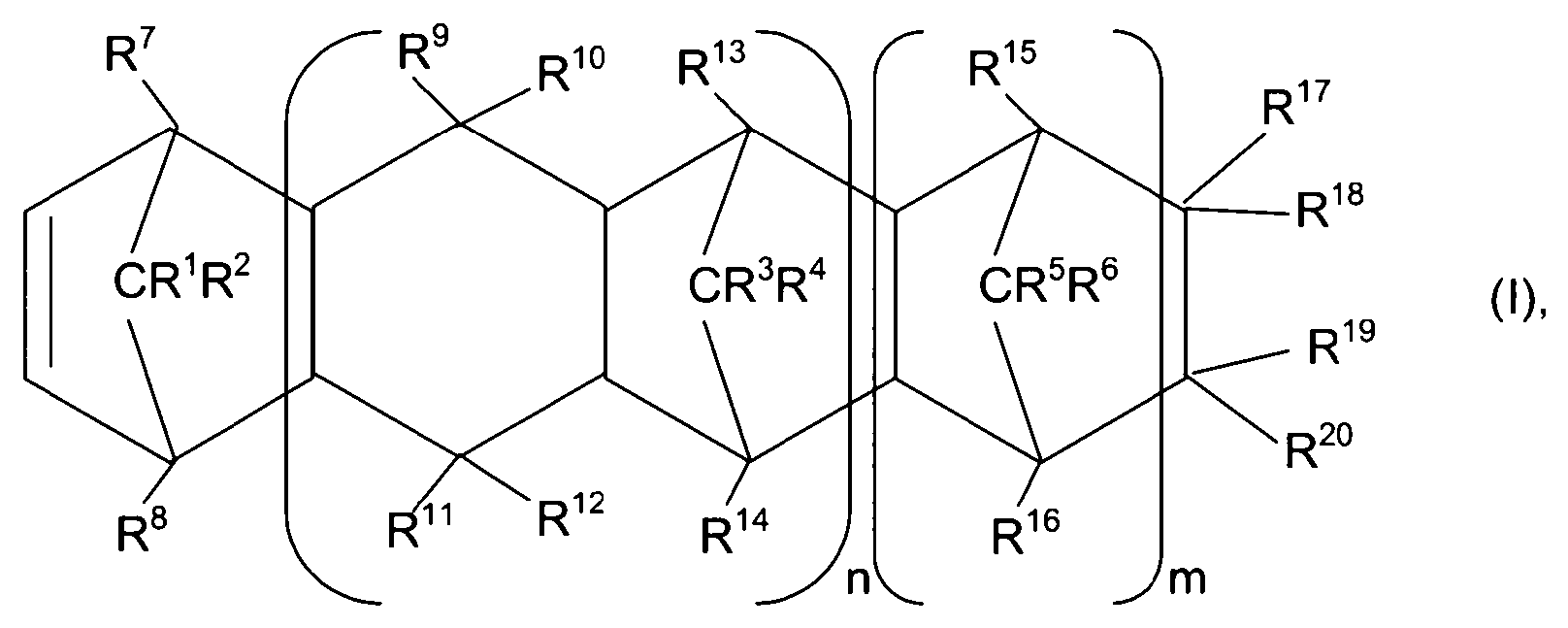
worin
n 0 oder 1 bedeutet,
m für 0 oder eine positive ganze Zahl ist, insbesondere 0 oder 1,
R1, R2, R3, R4, R5, R6 unabhängig voneinander Wasserstoff, Halogen, Alkylgruppen, Cycloalkylgruppen, Arylgruppen und Alkoxygruppen bedeuten, R7, R8, R9, R10, R11, R12, R13, R14, R15, R16 unabhängig voneinander Wasserstoff und Alkylgruppen bedeuten,
R17, R18, R19, R20 unabhängig voneinander Wasserstoff, Halogen und Alkylgruppen bedeuten,
wobei R17 und R19 auch aneinander gebunden sein können, derart dass sie einen einfachen Ring oder ein Ringsystem mit mehreren Ringen bilden, wobei
der Ring oder die Ringe gesättigt oder ungesättigt sein können,
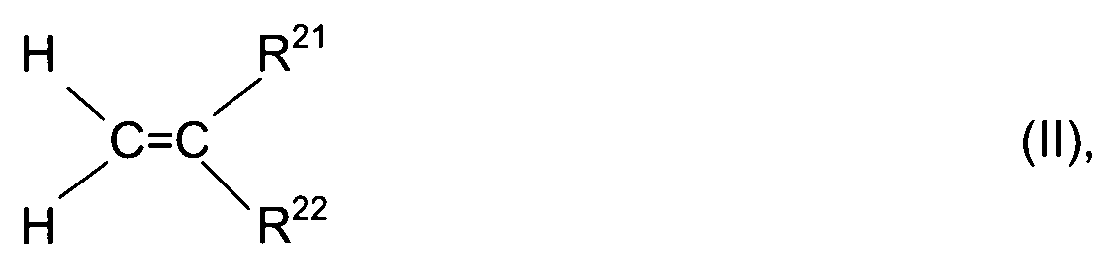
worin R21 und R22 unabhängig voneinander Wasserstoff und Alkylgruppen bedeuten.
In einer besonders bevorzugten Ausführungsform werden Cycloolefincopolymere eingesetzt, die sich von Verbindungen der Formeln I und II ableiten, worin n 0 ist, m 0 oder 1 bedeutet, R21 und R22 beide Wasserstoff bedeuten oder R21 Wasserstoff ist und R22 eine Alkylgruppe mit einem bis acht Kohlenstoffatomen ist, und R1, R2, R5 bis R8 und R15 bis R20 vorzugsweise Wasserstoff bedeuten.
In einer ganz besonders bevorzugten Ausführungsform werden Cycloolefincopolymere eingesetzt, welche sich von Verbindungen der Formeln I und 11 ableiten, worin die Verbindung der Formel I Norbornen oder Tetracyclododecen ist und die Verbindung der Formel II Ethylen ist.In a further preferred embodiment of the blister pack according to the invention, cycloolefin copolymers (also called “COC” below) are used which are derived from the ring-preserving copolymerization of at least one cycloolefin of the general formula (I) with at least one alpha-olefin of the formula (II)
wherein
n means 0 or 1,
m is 0 or a positive integer, in particular 0 or 1,
R 1 , R 2 , R 3 , R 4 , R 5 , R 6 independently of one another denote hydrogen, halogen, alkyl groups, cycloalkyl groups, aryl groups and alkoxy groups, R 7 , R 8 , R 9 , R 10 , R 11 , R 12 , R 13 , R 14 , R 15 , R 16 independently of one another denote hydrogen and alkyl groups,
R 17 , R 18 , R 19 , R 20 independently of one another denote hydrogen, halogen and alkyl groups,
where R 17 and R 19 can also be bonded to one another in such a way that they form a simple ring or a ring system with several rings, wherein
the ring or rings may be saturated or unsaturated,
wherein R 21 and R 22 independently of one another denote hydrogen and alkyl groups.
In a particularly preferred embodiment, cycloolefin copolymers are used which are derived from compounds of the formulas I and II in which n is 0, m is 0 or 1, R 21 and R 22 are both hydrogen or R 21 is hydrogen and R 22 is an alkyl group is one to eight carbon atoms, and R 1 , R 2 , R 5 to R 8 and R 15 to R 20 are preferably hydrogen.
In a very particularly preferred embodiment, cycloolefin copolymers are used which are derived from compounds of the formulas I and II, in which the compound of the formula I is norbornene or tetracyclododecene and the compound of the formula II is ethylene.
Ganz besonders bevorzugt werden Copolymere des vorstehend definierten Typs eingesetzt, wobei deren Copolymerisation in Gegenwart eines Metallocenkatalysators erfolgt ist.Copolymers of the type defined above are very particularly preferably used, the copolymerization of which has taken place in the presence of a metallocene catalyst.
Bevorzugte Typen von Cycloolefin-Copolymeren sind in der
Es lassen sich auch Mischungen verschiedener Cycloolefinpolymerer einsetzen, insbesondere Mischungen verschiedener Cycloolefincopolymerer.Mixtures of different cycloolefin polymers can also be used, in particular mixtures of different cycloolefin copolymers.
Die Herstellung der erfindungsgemäß bevorzugt eingesetzten Cycloolefincopolymeren erfolgt unter ringerhaltender Polymerisation, d.h. die bi- oder polycyclische Struktur der eingesetzten Monomereinheiten bleiben bei der Polymerisation erhalten. Beispiele für Katalysatoren sind Titanocen-, Zirkonocen- oder Hafnocen-Katalysatoren, die in der Regel kombiniert mit Aluminoxanen als Co-Katalysatoren eingesetzt werden. Diese Herstellungsweise ist bereits vielfach beschrieben, beispielsweise in dem weiter oben erwähnten Patentdokument.The cycloolefin copolymers preferably used according to the invention are prepared with ring-retaining polymerization, ie the bi- or polycyclic structure of the monomer units used are retained during the polymerization. Examples of catalysts are titanocene, zirconocene or hafnocene catalysts, which are generally used in combination with aluminoxanes as cocatalysts. These The production method has already been described many times, for example in the patent document mentioned above.
Typische Beispiele für Cycloolefincopolymere sind Copolymere aus Norbornen oder Tetracyclododecen mit Ethylen. Derartige Polymere sind kommerziell erhältlich, beispielsweise unter den Handelsnamen APEL® oder TOPAS®.Typical examples of cycloolefin copolymers are copolymers of norbornene or tetracyclododecene with ethylene. Such polymers are commercially available, for example under the tradename APEL ® or TOPAS ®.
Weitere Beispiele sind Cycloolefinpolymere, die sich von ringöffnender Polymerisation von Cyclopentadien oder von Norbornen ableiten. Derartige Polymere sind ebenfalls kommerziell erhältlich, beispielsweise unter den Handelsnamen ARTONⓇ, ZEONEX® oder ZEONOR® Further examples are cycloolefin polymers derived from ring-opening polymerization of cyclopentadiene or of norbornene. Such polymers are also commercially available, for example under the trade name ARTON Ⓡ, ZEONEX ® or ZEONOR ®
Bevorzugt werden Cycloolefincopolymere eingesetzt, die von den oben beschriebenen Monomeren der Formeln I und II abgeleitet sind, wobei diese Monomeren I : II im Molverhältnis von 95 : 5 bis 5 : 95 eingesetzt worden sind und die gegebenenfalls noch geringe Anteile von Struktureinheiten aufweisen, beispielsweise bis zu 10 Mol.%, bezogen auf die gesamte Monomermenge, welche von weiteren Monomeren, wie Propylen, Penten, Hexen, Cyclohexen und/oder Styrol abgeleitet sind.Cycloolefin copolymers are preferably used which are derived from the monomers of the formulas I and II described above, these monomers I: II having been used in a molar ratio of 95: 5 to 5:95 and which may still have small proportions of structural units, for example up to 10 mol%, based on the total amount of monomers derived from other monomers such as propylene, pentene, hexene, cyclohexene and / or styrene.
Besonders bevorzugt werden Cycloolefincopolymere eingesetzt, die im Wesentlichen aus Norbornen und Ethylen bestehen, und die gegebenenfalls noch geringe Anteile, z.B. bis zu 5 Gew. %, bezogen auf die Gesamtmonomermenge, von Struktureinheiten aufweisen, welche von weiteren Monomeren, wie Propylen, Penten, Hexen, Cyclohexen und/oder Styrol abgeleitet sind.Cycloolefin copolymers are particularly preferably used which consist essentially of norbornene and ethylene and which optionally also have small proportions, for example up to 5% by weight, based on the total amount of monomers, of structural units which are derived from further monomers such as propylene, pentene, hexene , Cyclohexene and / or styrene are derived.
Boden- und Deckfolie bestehen im Wesentlichen aus Polyolefinen, wobei in der Deckfolie mindestens ein Cycloolefinpolymer vorhanden sein muss, welches mindestens 50 Gew. % der Deckfolie ausmacht. Bei der Deckfolie kann es sich um eine einschichtige Folie oder um eine mehrschichtige Folie handeln. Bei Mehrschichtfolien besteht mindestens eine der Schichten zu mindestens 50 Gew. % aus Cycloolefinpolymer.The base and cover sheets consist essentially of polyolefins, with at least one cycloolefin polymer having to be present in the cover sheet which makes up at least 50% by weight of the cover sheet. The cover film can be a single-layer film or a multilayer film. In the case of multilayer films, at least one of the layers consists of at least 50% by weight of cycloolefin polymer.
Die ein- oder mehrschichtige Bodenfolie kann COC enthalten, Gesamtanteil COC bevorzugt > 50%, besonders bevorzugt mindestens 80%.The single or multilayer floor film can contain COC, total COC content preferably> 50%, particularly preferably at least 80%.
Als erfindungsgemäß eingesetzte Cycloolefinpolymer-basierte (Durchdrück)-Deckfolien können an sich bekannte Folien eingesetzt werden, beispielsweise Folien aus den Dokumenten
Das Cycloolefinpolymere in der Deckschicht sorgt für eine ausreichende Sprödigeit und damit gute Durchdrückeigenschaften der Folie.The cycloolefin polymer in the top layer ensures sufficient brittleness and thus good push-through properties of the film.
Bevorzugt eingesetzte Deckfolien weisen eine Wasserdampfdurchlässigkeit bei 38°C und einer relativen Feuchte von 90% von kleiner gleich 0.20 g/m2/d auf.Cover films which are preferably used have a water vapor permeability at 38 ° C. and a relative humidity of 90% of less than or equal to 0.20 g / m 2 / d.
Die Reißdehnung der bevorzugt eingesetzten Deckfolien beträgt größer als 1% und kleiner als 6% (gemessen nach
Bevorzugte Deckfolien sind Monoschichtfolien enthaltend mindestens 50 Gew. %, vorzugsweise mindestens 70 Gew. % und ganz besonders bevorzugt mindestens 90 Gew. % Cycloolefinpolymer oder Mehrschichtfolien enthaltend mindestens eine Schicht enthaltend mindestens 50 Gew. %, vorzugsweise mindestens 70 Gew. % und ganz besonders bevorzugt mindestens 90 Gew. % Cycloolefinpolymer, wobei die Folie bei einer relativen Feuchte von 85 % und einer Temperatur von 23°C eine Wasserdampfpermeation von kleiner gleich 0,035 g*mm/m2d, eine Durchstoßfestigkeit von kleiner gleich 300 N/mm und eine Dicke von kleiner gleich 100 µm aufweist. Derartige Deckfolien sind aus der
Die Bodenfolie besteht im Wesentlichen aus Polyolefin(en). Dabei kann es sich um von alpha-ethylenisch ungesättigten aliphatischen Monomeren abgeleitete Polymere handeln und/oder es können Cycloolefinpolymere oder Mischungen aus verschiedenen Polyolefinen eingesetzt werden.The bottom film consists essentially of polyolefin (s). These can be polymers derived from alpha-ethylenically unsaturated aliphatic monomers and / or cycloolefin polymers or mixtures of different polyolefins can be used.
Bevorzugt eingesetzte Cycloolefinpolymere sind weiter oben eingehend beschrieben worden.Cycloolefin polymers used with preference have been described in detail above.
Auch bei der Bodenfolie kann es sich um ein- oder mehrschichtige Folien handeln. Mehrschichtfolien können aus unterschiedlichen Polyolefinen aufgebaut sein.The bottom foil can also be single-layer or multilayer foils. Multi-layer films can be made up of different polyolefins.
Die Bodenfolienkomponente der erfindungsgemäßen Lösung kann aus unterschiedlichen thermogeformten Polyolefinfolien bestehen. Diese Folien sind ebenfalls an sich bekannt. So können je nach geforderter Barriere und dem Verarbeitungsverhalten beispielsweise ein Mehrschichtverbund, wie PP/COC/PP, oder eine reine Polyolefinfolie, wie PP-Folie, eingesetzt werden.The bottom film component of the solution according to the invention can consist of different thermoformed polyolefin films. These films are also known per se. For example, a multi-layer composite such as PP / COC / PP or a pure polyolefin film such as PP film can be used, depending on the required barrier and the processing behavior.
Die plastische Verformbarkeit, die Schrumpfwerte (
Bei den alpha-ethylenisch ungesättigten aliphatischen Monomeren abgeleiteten Polymeren handelt es sich im Allgemeinen um teilkristalline Polymere. Diese können Polyethylene, Polypropylene oder Ethylen-Propylen-Copolymere sein.The polymers derived from alpha-ethylenically unsaturated aliphatic monomers are generally semicrystalline polymers. These can be polyethylenes, polypropylenes or ethylene-propylene copolymers.
Vorzugsweise werden für die Bodenfolie ausgewählte Polyethylene (PE) und/oder Polypropylene (PP) eingesetzt oder es werden Kombinationen von Cycloolefinpolymeren mit ausgewählten Polyethylenen und/oder Polypropylenen eingesetzt oder es werden ein oder mehrere Cycloolefinpolymere eingesetzt.Preferably selected polyethylenes (PE) and / or polypropylenes (PP) are used for the bottom sheet or combinations of cycloolefin polymers with selected polyethylenes and / or polypropylenes are used or one or more cycloolefin polymers are used.
Bevorzugt werden ein- bis fünfschichtige Bodenfolien eingesetzt, die aus PP, PE, PP/COC/PP, PE/COC/PE, PP/HV/COC/HV/PP, PE/HV/COC/HV/PE oder Blends dieser Komponenten und Haftvermittlern (HV) aus dieser Materialgruppe bestehenOne to five-layer floor films made from PP, PE, PP / COC / PP, PE / COC / PE, PP / HV / COC / HV / PP, PE / HV / COC / HV / PE or blends of these components are preferred and adhesion promoters (HV) consist of this material group
Diese Bodenfolien werden bevorzugt mit einer ein- bis dreischichtigen Durchdrück-Deckfolie, beispielsweise aus COC/PE/COC oder COC/PP/COC oder Blends dieser Komponenten in den Innen- und Außenschichten kombiniert.These floor films are preferably combined with a one to three-layer push-through cover film, for example made of COC / PE / COC or COC / PP / COC or blends of these components in the inner and outer layers.
Bei den ausgewählten Polyethylenen und/oder Polypropylenen kann es sich um teilkristalline Ethylen-Homopolymere handeln, die vorzugsweise eine Kristallitschmelztemperatur von 130 bis 140°C aufweisen, um teilkristalline Ethylen-C3-C8- alpha-Olefin-Copolymere, die vorzugsweise eine Kristallit-Schmelztemperatur von 50 bis 130°C aufweisen, um teilkristalline PropylenHomopolymere, die vorzugsweise eine Kristallit-Schmelztemperatur von 160 bis 165°C weisen und/oder um teilkristalline Propylen- C4-C8-alpha-Olefin-Copolymere, die vorzugsweise eine Kristallit-Schmelztemperatur von 100 bis 160°C aufweisen .The selected polyethylenes and / or polypropylenes can be partially crystalline ethylene homopolymers, which preferably have a crystallite melting temperature of 130 to 140 ° C., and partially crystalline ethylene-C 3 -C 8 -alpha-olefin copolymers, which are preferably a crystallite -Melting temperature of 50 to 130 ° C to partially crystalline propylene homopolymers, which preferably have a crystallite melting temperature of 160 to 165 ° C and / or to partially crystalline propylene C 4 -C 8 -alpha-olefin copolymers, which are preferably a crystallite -Melting temperature of 100 to 160 ° C.
Unter Kristallitschmelztemperatur ist im Rahmen der vorliegenden Beschreibung die nach ISO 11357 mit der Differential-Scanning-Calorimetrie (DSC) Methode bestimmte Temperatur zu verstehen, wobei die Aufheizgeschwindigkeit 10 K/Minute beträgt.In the context of the present description, the crystallite melting temperature is to be understood as the temperature determined in accordance with ISO 11357 using the differential scanning calorimetry (DSC) method, the heating rate being 10 K / minute.
Beispiele für C3-C8-alpha-Olefine sind Propylen, Buten-1, Hexen-1,Octen-1 . Es können Homo- oder Copolymere auf der Basis von Ethylen oder Propylen eingesetzt werden.Examples of C 3 -C 8 -alpha-olefins are propylene, butene-1, hexene-1, octene-1. Homopolymers or copolymers based on ethylene or propylene can be used.
Bei den für die Bodenfolie eingesetzten Polyolefinen handelt es sich um lineare oder um verzweigte Typen. Die Abfolge unterschiedlicher Monomereinheiten in diesen Polyolefinen kann statistisch oder in der Form von Blöcken sein. Die einzelnen Monomereinheiten können sterisch unterschiedlich angeordnet sein, beispielsweise isotaktisch, syndiotaktisch oder ataktisch.The polyolefins used for the bottom film are linear or branched types. The sequence of different monomer units in these polyolefins can be random or in the form of blocks. The individual monomer units can be arranged sterically differently, for example isotactically, syndiotactically or atactically.
Bevorzugte Polyolefine sind Polyolefinhomopolymere abgeleitet von Ethylen oder Propylen oder Polyolefincopolymere abgeleitet von Ethylen und/oder Propylen mit einem Anteil von bis zu 10 Gew. % an höheren alpha-Olefinen mit 4-8-C-Atomen. Unter Copolymeren sind in diesem Zusammenhang auch Polymere zu verstehen, die sich von drei oder mehr unterschiedlichen Monomeren ableiten.Preferred polyolefins are polyolefin homopolymers derived from ethylene or propylene or polyolefin copolymers derived from ethylene and / or propylene with a proportion of up to 10% by weight of higher alpha-olefins having 4-8 carbon atoms. In this context, copolymers are also to be understood as meaning polymers which are derived from three or more different monomers.
Ganz besonders bevorzugt eingesetzte Polyethylene sind Polyethylen mit hoher Dichte (HDPE), mittlerer Dichte (MDPE) und niedriger Dichte (LDPE). Diese Polyethylene werden nach dem Nieder- oder Hochdruckverfahren mit entsprechenden Katalysatoren hergestellt und zeichnen sich durch niedrige Dichte im Vergleich mit anderen Kunststoffen (<0,96 g/cm3), durch hohe Zähigkeit und Reißdehnung, durch sehr gute elektrische und dielektrische Eigenschaften, durch sehr gute Chemikalienbeständigkeit, und je nach Typ durch hohe Beständigkeit gegen Spannungsrissbildung und gute Ver- und Bearbeitbarkeit aus.Polyethylenes used with particular preference are high-density (HDPE), medium-density (MDPE) and low-density (LDPE) polyethylene. These polyethylenes are manufactured using the low-pressure or high-pressure process with appropriate catalysts and are characterized by their low density compared to other plastics (<0.96 g / cm 3 ), high toughness and elongation at break, and very good electrical and dielectric properties very good chemical resistance and, depending on the type, high resistance to stress cracking and good processability and machinability.
Die Polyethylen-Moleküle enthalten Verzweigungen. Der Grad der Verzweigung der Molekülketten und die Länge der Seitenketten beeinflussen die Eigenschaften des Polyethylens wesentlich. Die HDPE- und MDPE-Typen sind wenig und nur mit kurzen Seitenketten verzweigt.The polyethylene molecules contain branches. The degree of branching of the molecular chains and the length of the side chains have a significant influence on the properties of polyethylene. The HDPE and MDPE types are not very branched and only have short side chains.
Polyethylen kristallisiert beim Abkühlen aus der Schmelze. Dabei ordnen sich die langen Molekülketten in Teilbereichen gefaltet und bilden sehr kleine Kristallite, die zusammen mit amorphen Zonen zu Überstrukturen, den sogenannten Sphärolithen verbunden sind. Die Kristallisation ist umso besser möglich, je kürzer die Ketten sind und je geringer der Verzweigungsgrad ist. Der kristalline Anteil weist eine höhere Dichte auf als der amorphe Anteil. Man erhält daher unterschiedliche Dichten, abhängig vom kristallinen Anteil. Dieser Kristallisationsgrad beträgt je nach Polyethylen-Typ zwischen 35 % und 80 %. Polyethylene crystallizes from the melt on cooling. The long molecular chains are folded in partial areas and form very small crystallites which, together with amorphous zones, are connected to form superstructures, the so-called spherulites. The shorter the chains and the lower the degree of branching, the better the crystallization. The crystalline part has a higher density than the amorphous part. Different densities are therefore obtained, depending on the crystalline content. This degree of crystallization is between 35% and 80%, depending on the type of polyethylene.
Bei Polyethylen hoher Dichte (HDPE) werden 60 % bis 80 % Kristallisationsgrad bei Dichten zwischen 0,940 g/cm3 und 0,97 g/cm3 erreicht. Bei Polyethylen mittlerer Dichte (MDPE) werden 50 % bis 60 % Kristallisationsgrad bei 0,930 g/cm3 bis 0,940 g/cm3 Dichte erreicht. Bei Polyethylen niedriger Dichte (LDPE) werden 40 % bis 50 % Kristallisationsgrad bei Dichten zwischen 0,915 g/cm3 und 0,935 g/cm3 erreicht. Bei diesem Typ handelt es sich um stark verzweigte Polymerketten, welche eine niedrige Dichte zur Folge haben.In the case of high-density polyethylene (HDPE), a 60% to 80% degree of crystallization is achieved at densities between 0.940 g / cm 3 and 0.97 g / cm 3 . With medium density polyethylene (MDPE), 50% to 60% degree of crystallization is achieved at 0.930 g / cm 3 to 0.940 g / cm 3 density. In the case of low-density polyethylene (LDPE), a 40% to 50% degree of crystallization is achieved at densities between 0.915 g / cm 3 and 0.935 g / cm 3 . This type consists of highly branched polymer chains, which result in a low density.
Darüber hinaus kennt man noch lineares Polyethylen niedriger Dichte (LLDPE). Dessen Polymermolekül weist nur kurze Verzweigungen auf. Diese Verzweigungen werden durch Copolymerisation von Ethylen und höheren α-Olefinen, wie Buten, Hexen oder Octen, hergestellt. Der Kristallisationsgrad dieses Typs beträgt 10 bis 50 % und die Dichte liegt im Bereich von 0,87 g/cm3 bis 0,940 g/cm3.Linear low-density polyethylene (LLDPE) is also known. Its polymer molecule has only short branches. These branches are produced by the copolymerization of ethylene and higher α-olefins such as butene, hexene or octene. The degree of crystallization of this type is 10 to 50% and the density is in the range from 0.87 g / cm 3 to 0.940 g / cm 3 .
Die Eigenschaften von Polyethylen werden vorwiegend durch Dichte, Molmasse und Molmassenverteilung bestimmt. So nimmt z. B. die Schlag- und Kerbschlagzähigkeit, Reißfestigkeit, die Reißdehnung und der Widerstand gegen Spannungsrissbildung mit der Molmasse zu. Engverteiltes HDPE mit geringem niedermolekularem Anteil ist schlagzäher, auch bei tiefer Temperatur, als breitverteiltes innerhalb gleicher Bereiche für Schmelzindex und Viskositätszahl. Breitverteilte Typen wiederum sind leichter verarbeitbar.The properties of polyethylene are mainly determined by density, molar mass and molar mass distribution. So takes z. B. the impact and notched impact strength, tear strength, the elongation at break and the resistance to stress cracking with the molecular weight. Narrowly distributed HDPE with a low, low-molecular content is more impact-resistant, even at low temperatures, than broadly distributed HDPE within the same ranges for melt index and viscosity number. Widely distributed types, on the other hand, are easier to process.
Polypropylen ist ein mit Hilfe stereospezifisch wirkender Katalysatoren hergestelltes isotaktisches, syndiotaktisches oder ataktisches Polypropylen. Besonders bevorzugt wird das isotaktische Polypropylen, bei dem alle Methylgruppen auf einer Seite der zickzackförmig gedachten Molekülkette angeordnet sind, in den Bodenfolien der erfindungsgemäßen Blisterverpackungen eingesetzt.Polypropylene is an isotactic, syndiotactic or atactic polypropylene produced with the aid of stereospecific catalysts. Isotactic polypropylene, in which all methyl groups are arranged on one side of the imaginary zigzag molecular chain, is particularly preferably used in the bottom foils of the blister packs according to the invention.
Bei Abkühlen aus der Schmelze begünstigt der regelmäßige Aufbau des isotaktischen Polypropylens das Entstehen kristalliner Bereiche. Die Kettenmoleküle werden jedoch selten in ganzer Länge in einen Kristallit eingebaut, da sie auch nicht-isotaktische und damit nicht kristallisationsfähige Anteile enthalten. Außerdem entstehen amorphe Bereiche durch die Verschlaufungen der Ketten in der Schmelze, besonders bei hohem Polymerisationsgrad. Der kristalline Anteil ist von den Herstellbedingungen der Formteile abhängig und beträgt 50 % bis 70 %. Der teilkristalline Aufbau bewirkt wegen der hohen Sekundärkräfte im Kristallit etwas Festigkeit und Steifheit; während die ungeordneten Bereiche mit der höheren Beweglichkeit ihrer Kettensegmente oberhalb der Einfriertemperatur Flexibilität und Zähigkeit ergeben.When cooling from the melt, the regular structure of the isotactic polypropylene favors the formation of crystalline areas. However, the chain molecules are seldom built into a crystallite over their entire length, as they also contain non-isotactic and therefore non-crystallizable components. In addition, amorphous areas are created by the entanglement of the chains in the melt, especially with a high degree of polymerization. The crystalline proportion depends on the manufacturing conditions of the molded parts and is 50% to 70%. Because of the high secondary forces in the crystallite, the partially crystalline structure causes some strength and rigidity; while the disordered areas with the higher mobility of their chain segments give flexibility and toughness above the freezing temperature.
Die Dichte von Polypropylen ist sehr niedrig und liegt zwischen 0,895 g/cm3 und 0,92 g/cm3. Formkörper aus Polypropylen zeichnen sich im Vergleich mit Formkörpern aus Polyethylenen durch höhere Steifigkeit, Härte und Festigkeit aus. Polypropylen hat eine Glasübergangstemperatur von 0 bis -10°C. Der Kristallit-Schmelzbereich liegt bei 160 bis 165 °C. Diese Temperaturen können durch Copolymerisation modifiziert werden; dem Fachmann sind die Maßnahmen dafür bekannt.The density of polypropylene is very low and lies between 0.895 g / cm 3 and 0.92 g / cm 3 . Molded bodies made of polypropylene are distinguished by greater rigidity, hardness and strength compared with molded bodies made of polyethylenes. Polypropylene has a glass transition temperature of 0 to -10 ° C. The crystallite melting range is 160 to 165 ° C. These temperatures can be modified by copolymerization; the measures for this are known to the person skilled in the art.
Bevorzugt eingesetzte Polyolefine sind HDPE, MDPE, LDPE, LLDPE, HMWPE, UHMWPE, Propylenhomopolymere, Propylencopolymere mit 1-10 Gew. % an Struktureinheiten, die von 1-Alkenen mit 4-8 C-Atomen abgeleitet sind, Propylenethylencopolymere mit 10 bis 90 Gew. % an von Propylen abgeleiteten Struktureinheiten sowie Kombinationen von zwei oder mehreren davon.Polyolefins used with preference are HDPE, MDPE, LDPE, LLDPE, HMWPE, UHMWPE, propylene homopolymers, propylene copolymers with 1-10 wt.% Of structural units derived from 1-alkenes with 4-8 carbon atoms, propylene ethylene copolymers with 10 to 90 wt .% of structural units derived from propylene and combinations of two or more thereof.
Bei der Kombination verschiedener Polyolefine entstehen in der Regel unverträgliche Polymergemische. Das bedeutet die Bildung von heterogenen Systemen. Die erfindungsgemäßen Zusammensetzungen sind in der Regel daher trüb.The combination of different polyolefins usually results in incompatible polymer mixtures. That means the formation of heterogeneous systems. The compositions according to the invention are therefore generally cloudy.
So besitzen Cycloolefinpolymere hohe Transparenz und niedrige Trübungswerte. Mischungen aus Cycloolefinpolymeren und anderen Polyolefinen werden aufgrund der Multiphasen-Natur dieser Mischungen weniger transparent sein. In den Mischungen werden verschiedene Komponenten diskrete Phasen der einzelnen Materialien bilden. Diese Eigenschaft führt zu reduzierter Transparenz der Mischungen von diesen Komponenten.Cycloolefin polymers, for example, have high transparency and low haze values. Blends of cycloolefin polymers and other polyolefins will be less transparent because of the multiphase nature of these blends. In the mixtures, different components are discrete phases of each Form materials. This property leads to reduced transparency of the mixtures of these components.
In einer besonders bevorzugten Ausführungsform werden in den erfindungsgemäß eingesetzten Bodenfolien Polyolefine eingesetzt, deren Brechungsindizes sich nicht oder nur wenig unterscheiden. Diese Zusammensetzungen weisen eine deutlich höhere Transparenz auf als Zusammensetzungen aus Polyolefinen mit deutlich unterschiedlichen Brechungsindizes.In a particularly preferred embodiment, polyolefins are used in the floor foils used according to the invention, the refractive indices of which do not differ or differ only slightly. These compositions have a significantly higher transparency than compositions made from polyolefins with significantly different refractive indices.
Bei der Bodenfolie kann es sich um eine einschichtige Folie oder um eine mehrschichtige Folie handeln.The bottom film can be a single-layer film or a multilayer film.
Bevorzugte Bodenfolien sind Monoschichtfolien bestehend zu 96 Gew. %, vorzugsweise zu mindestens 98 Gew. % und ganz besonders bevorzugt zu mindestens 99 Gew. % aus Polyethylen, Polypropylen, Cycloolefinpolymer oder aus Gemischen von zwei oder mehreren dieser Polyolefine oder Mehrschichtfolien bestehend zu mindestens 96 Gew. %, vorzugsweise zu mindestens 98 Gew. %, oder und ganz besonders bevorzugt zu mindestens 99 Gew. % aus Polyolefinen bestehen, wobei die Polymeren in den einzelnen Schichten aus Polyethylen, Polypropylen, Cycloolefinpolymer oder aus Gemischen von zwei oder mehreren dieser Polyolefine bestehen.Preferred floor films are monolayer films consisting of 96% by weight, preferably at least 98% by weight and very particularly preferably at least 99% by weight of polyethylene, polypropylene, cycloolefin polymer or mixtures of two or more of these polyolefins or multilayer films consisting of at least 96% by weight .%, preferably at least 98% by weight, or and very particularly preferably at least 99% by weight consist of polyolefins, the polymers in the individual layers consisting of polyethylene, polypropylene, cycloolefin polymer or mixtures of two or more of these polyolefins.
Neben den zwingend vorhandenen Polyolefin(en) kann die Deck- und/oder Bodenfolie gegebenenfalls noch an sich übliche Zusatzstoffe enthalten. Der Gesamtanteil dieser Zusatzstoffe beträgt üblicherweise bis zu 4 Gew. %, bezogen auf die Gesamtmischung, vorzugsweise bis zu 1 Gew. %.In addition to the necessarily present polyolefin (s), the cover and / or base film can optionally also contain additives which are customary per se. The total proportion of these additives is usually up to 4% by weight, based on the total mixture, preferably up to 1% by weight.
Zusatzstoffe, auch Hilfsstoffe oder Additive genannt, sind Stoffe, die dem Polyolefin in geringen Mengen zugesetzt werden, um bestimmte Eigenschaften zu erreichen oder zu verbessern, beispielsweise um einen positiven Effekt auf Herstellung, Lagerung, Verarbeitung oder Produkteigenschaften während und nach der Gebrauchsphase zu erreichen.Additives are substances that are added to the polyolefin in small amounts in order to achieve or improve certain properties, for example to achieve a positive effect on production, storage, processing or product properties during and after the use phase.
Bei den Zusatzstoffen kann es sich um Verarbeitungshilfsmittel handeln, wie beispielsweise um Öle oder Wachse, oder um Zusätze, welche der erfindungsgemäß eingesetzten Polyolefinfolie eine bestimmte Funktion verleihen, wie Weichmacher, UV-Stabilisatoren, Mattierungsmittel, Konservierungsmittel, Biozide, Antioxidationsmittel, Antistatika, Flammschutzmittel, Verstärkungsmittel, Füllstoffe, Pigmente oder Farbstoffe.The additives can be processing aids, such as oils or waxes, or additives which give the polyolefin film used according to the invention a certain function, such as plasticizers, UV stabilizers, matting agents, preservatives, biocides, antioxidants, antistatic agents, flame retardants, Reinforcing agents, fillers, pigments or dyes.
Als Deckfolien können Folien aus Cycloolefinpolymer verwendet werden, die nach der Herstellung nicht verstreckt, oder ein- oder mehrfach verstreckt worden sind.Cycloolefin polymer films which have not been stretched after production or have been stretched one or more times can be used as cover films.
Als Bodenfolien können Folien aus Polyolefin, vorzugsweise aus Cycloolefinpolymer verwendet werden, die nach der Herstellung üblicherweise tiefgezogen worden sind.Foils made of polyolefin, preferably of cycloolefin polymer, which have usually been deep-drawn after production, can be used as bottom foils.
Die Deckfolie kann ohne weitere Vorbehandlung mit der tiefgezogenen Bodenfolie, welche bereits das zu verpackende Gut enthalten, verbunden werden. Die Verbindung von Deck- und Bodenfolie kann durch Verkleben, insbesondere durch Heißsiegeln, Klemmen oder Heften erfolgen. Bevorzugt erfolgt die Verbindung durch Verkleben. Dem Fachmann sind diese Vorgehensweisen bekannt.The cover film can be connected to the deep-drawn base film, which already contains the goods to be packaged, without further pretreatment. The connection of the top and bottom foil can be done by gluing, in particular by heat sealing, clamping or stapling. The connection is preferably made by gluing. These procedures are known to the person skilled in the art.
Vorzugsweise setzt man als Deckfolien die aus der
Vorzugsweise wird die Deckfolie vor einem Verbinden mit der Bodenfolie noch mit ein oder mehreren Barriereschichten und/oder Klebstoffschichten versehen.The cover film is preferably also provided with one or more barrier layers and / or adhesive layers before it is connected to the base film.
Als Barriereschichten eignen sich vor allem dünne Metall- oder Metalloxidschichten oder SiOx-Beschichtungen. Diese werden üblicherweise durch Aufdampfen oder Sputtern auf die Deckfolie aufgebracht. Dem Fachmann sind diese Barriereschichten bekannt. Die Dicke dieser Schichten bewegt sich im Bereich von 1 nm bis 1 µm, insbesondere von 3 nm bis 100 nm.Thin metal or metal oxide layers or SiO x coatings are particularly suitable as barrier layers. These are usually applied to the cover film by vapor deposition or sputtering. These barrier layers are known to the person skilled in the art. The thickness of these layers ranges from 1 nm to 1 μm, in particular from 3 nm to 100 nm.
Zum Verbinden von Deck- und Bodenfolie kann zwischen beiden Folien eine Verbindungsschicht angebracht sein. Diese kann durch einen Klebstoff gebildet werden, der vor dem Verbinden der Folien auf Deck- und/oder Bodenfolie aufgebracht worden ist oder dieser wird in Form einer Folie zwischen Deck- und Bodenfolie vorgelegt. Als Klebstoffe eignen sich Schmelzkleber, Adhäsionsklebstoffe oder chemisch härtende Klebstoffe. Vorzugsweise werden Schmelzkleber verwendet. Diese werden Insbesondere in Form einer Folie zwischen Deck- und Bodenfolie vorgelegt. Als Schmelzkleber eignen sich verschiedene Polyolefine. Deren Schmelzpunkt liegt unterhalb des Schmelzpunktes des Materials der Deck- und Bodenfolie.A connecting layer can be attached between the two foils to connect the top and bottom foils. This can be formed by an adhesive that has been applied to the top and / or bottom film before the films are joined, or this is placed in the form of a film between the top and bottom film. Hot melt adhesives, adhesive adhesives or chemically curing adhesives are suitable as adhesives. Hot-melt adhesives are preferably used. These are presented in particular in the form of a film between the top and bottom film. Various polyolefins are suitable as hot melt adhesives. Their melting point is below the melting point of the material of the top and bottom foil.
Bevorzugte Verbindungsschichten, auch Haftvermittler- oder Siegelschichten genannt, können aus PP-Plastomer, COC-Elastomeren oder Blends dieser Komponenten bestehen.Preferred connecting layers, also called adhesion promoter or sealing layers, can consist of PP plastomer, COC elastomers or blends of these components.
Vorzugsweise wird als Schmelzkleber ein Cycloolefinpolymer eingesetzt, insbesondere ein elastomeres Cycloolefinpolymer, beispielsweise das Produkt Topas® E140 von Topas Advanced Polymers GmbH, Frankfurt am Main.A cycloolefin polymer is preferably used as the hot melt adhesive, in particular an elastomeric cycloolefin polymer, for example the product Topas® E140 from Topas Advanced Polymers GmbH, Frankfurt am Main.
Bevorzugte Blisterverpackungen haben Deckfolien, welche eine Barriereschicht aufweisen, insbesondere Barriereschichten, die aus einer aufgedampften Metallschicht oder Metalloxidschicht oder aus einer Silikatschicht bestehen.Preferred blister packs have cover films which have a barrier layer, in particular barrier layers which consist of a vapor-deposited metal layer or metal oxide layer or of a silicate layer.
Weitere bevorzugte Blisterverpackungen sind dadurch gekennzeichnet, dass die Bodenfolie im Wesentlichen aus Polyethylen, Polyethylen-Polypropylen-Copolymeren, Polypropylen, Cycloolefinpolymer oder Mischungen von zwei oder mehreren dieser Polymeren besteht.Further preferred blister packs are characterized in that the bottom film consists essentially of polyethylene, polyethylene-polypropylene copolymers, polypropylene, cycloolefin polymer or mixtures of two or more of these polymers.
Bevorzugte Blisterverpackungen sind solche, bei denen der Gewichtsanteil an Polyolefin in der Deckfolie und in der Bodenfolie mindestens jeweils 99 % beträgt.Preferred blister packs are those in which the weight proportion of polyolefin in the cover film and in the base film is at least 99% each.
Besonders bevorzugte Blisterverpackungen sind dadurch gekennzeichnet, dass das Cycloolefinpolymer ein Cycloolefincopolymer ist, insbesondere ein Cycloolefin-Copolymer, das aus Struktureinheiten besteht, die von Ethylen und Norbornen abgeleitet sind.Particularly preferred blister packs are characterized in that the cycloolefin polymer is a cycloolefin copolymer, in particular a cycloolefin copolymer, which consists of structural units which are derived from ethylene and norbornene.
Weitere besonders bevorzugte Blisterverpackungen sind dadurch gekennzeichnet, dass das Cyclolefinpolymer eine Glasübergangstemperatur zwischen 60 und 140 °C aufweist, vorzugsweise zwischen 75 und 115 °CFurther particularly preferred blister packs are characterized in that the cyclolefin polymer has a glass transition temperature between 60 and 140 ° C, preferably between 75 and 115 ° C
Bei einer bevorzugten Variante der erfindungsgemäßen Blisterverpackungen ist die Bodenfolie eine einschichtige Folie, die 5 bis 30 Gew. %, Cyclolefinpolymer und 95 bis 70% Polyethylen und/oder Polypropylen enthält..In a preferred variant of the blister packs according to the invention, the bottom film is a single-layer film which contains 5 to 30% by weight, cyclolefin polymer and 95 to 70% polyethylene and / or polypropylene.
Bei einer weiteren bevorzugten Variante der erfindungsgemäßen Blisterverpackungen ist die Bodenfolie eine mehrschichtige Folie, von der mindestens eine Schicht zu mindestens 90 Gew. %, vorzugsweise zu mindestens 95 Gew. % und ganz besonders bevorzugt zu mindestens 99 Gew. % aus Cycloolefinpolymer besteht und die übrigen Schichten zu mindestens 90 Gew. %, vorzugsweise zu mindestens 95 Gew. % und ganz besonders bevorzugt zu mindestens 99 Gew. % aus Polyethylen, Polypropylen, Polyethylen-Polypropylen-Copolymeren bestehen.In a further preferred variant of the blister packs according to the invention, the bottom film is a multilayer film, of which at least one layer consists of at least 90% by weight, preferably at least 95% by weight and very particularly preferably at least 99% by weight of cycloolefin polymer and the rest Layers consist of at least 90% by weight, preferably at least 95% by weight and very particularly preferably at least 99% by weight of polyethylene, polypropylene, polyethylene-polypropylene copolymers.
Weitere bevorzugte erfindungsgemäße Blisterverpackungen sind dadurch gekennzeichnet, dass diese zwischen Deck- und Bodenfolie eine Siegelschicht aufweisen, deren Material zu mindestens 90 Gew. %, vorzugsweise zu mindestens 95 Gew. % und ganz besonders bevorzugt zu mindestens 99 Gew. % aus Polyolefin besteht, vorzugsweise zu mindestens 90 Gew. %, vorzugsweise zu mindestens 95 Gew. % und ganz besonders bevorzug zu mindestens 99 Gew. % aus Cycloolefinpolymer und ganz besonders bevorzugt zu mindestens 90 Gew. %, vorzugsweise zu mindestens 95 Gew. % und ganz besonders bevorzug zu mindestens 99 Gew. % aus elastomerem Cycloolefincopolymer.Further preferred blister packs according to the invention are characterized in that they have a sealing layer between the top and bottom film, the material of which consists of at least 90% by weight, preferably at least 95% by weight and very particularly preferably at least 99% by weight of polyolefin, preferably at least 90% by weight, preferably at least 95% by weight and very particularly preferably at least 99% by weight of cycloolefin polymer and very particularly preferably at least 90% by weight, preferably at least 95% by weight and very particularly preferably at least 99% by weight of elastomeric cycloolefin copolymer.
Die erfindungsgemäßen Blisterverpackungen eignen sich zum Verpacken von Gütern aller Art. Vorzugsweise werden Feststoffe verpackt. Es kann sich aber auch um Flüssigkeiten oder um Gele handeln.The blister packs according to the invention are suitable for packaging goods of all types. Solids are preferably packaged. But it can also be liquids or gels.
Bevorzugt enthalten die erfindungsgemäßen Blisterverpackungen pharmazeutische Produkte, wie Verbandsstoffe, sterile Instrumente oder insbesondere Arzneimittel, vorzugsweise in fester Form, wie in der Form von Tabletten, Kapseln oder Zäpfchen.The blister packs according to the invention preferably contain pharmaceutical products, such as bandages, sterile instruments or, in particular, medicaments, preferably in solid form, such as in the form of tablets, capsules or suppositories.
Bevorzugte Blisterverpackungen enthalten die Abbildung eines Entnahmeplans für die pharmazeutischen Produkte auf der Verpackung.Preferred blister packs contain an illustration of a removal plan for the pharmaceutical products on the packaging.
Die Erfindung betrifft vorzugsweise die Verwendung der oben beschriebenen Blisterverpackungen zum Verpacken von Arzneimitteln.The invention preferably relates to the use of the blister packs described above for packaging medicaments.
Die nachstehenden Beispiele erläutern die Erfindung, ohne diese zu begrenzen.The following examples illustrate the invention without limiting it.
Die untersuchten Blistersysteme wurden durch das RecyClass Bewertungstool klassifiziert (https://recvclass.eu/de/recvclass-online-tool/). Für die nachstehend beschriebenen erfindungsgemäßen Blistersysteme wurde dabei stets die Gesamtnote „grün“ erzielt, während die nachstehend beschriebenen Blistersysteme des Standes der Technik entweder nicht rezyklierbar sind (Note „rot“) oder zwar die Note „grün“ erhalten, allerdings lediglich den Niedrigbarrierebereich abdecken.The examined blister systems were classified by the RecyClass evaluation tool (https://recvclass.eu/de/recvclass-online-tool/). For the blister systems according to the invention described below, the overall rating “green” was always achieved, while the blister systems of the prior art described below are either not recyclable (rating “red”) or received the rating “green”, but only cover the low barrier range.
Vergleichsbeispiele V1 bis V3Comparative examples V1 to V3
Dabei handelt es sich um thermogeformte Bodenfolien, die mit Aluminiumfolie von 20 µm Dicke versiegelt waren.These are thermoformed floor foils that were sealed with aluminum foil 20 µm thick.
Beispiel V1: Bodenfolie aus PVC / PE / PVDC (90g)Example V1: Floor film made of PVC / PE / PVDC (90g)
Beispiel V2: Bodenfolie aus PP 250 µmExample V2: floor film made of PP 250 µm
Beispiel V3: Bodenfolie aus PP 30 µm / COC 240 µm / PP 30 µmExample V3: Floor film made of PP 30 µm / COC 240 µm / PP 30 µm
Alle diese Blistersysteme sind aufgrund der Aluminiumfolienschichtdicke von > 5 µm nicht zur Bewertung des Recyclingverhaltens geeignet. Moderne Wirbelstromsortierer, die von Recyclern betrieben werden, erfassen alle dicken Aluminiumteile und trennen sie in die Aluminiumfraktion. Daher gelangen Kunststoffverpackungen mit einer dicken Aluminiumschicht in den Aluminium-Recyclingstrom und die Kunststoffe gehen verloren.All of these blister systems are unsuitable for evaluating recycling behavior due to the aluminum foil layer thickness of> 5 µm. Modern eddy current sorters operated by recyclers capture all thick aluminum parts and separate them into the aluminum fraction. Therefore, plastic packaging with a thick aluminum layer ends up in the aluminum recycling stream and the plastics are lost.
Erfindungsgemäße Beispiele 1 und 2Examples 1 and 2 according to the invention
Dabei handelt es sich um innovative Barriereblistersysteme mit barrierebeschichteter Polyolefin-Deckfolie anstelle von Aluminium und mit voll rezyklierbaren Siegel-Schichten.These are innovative barrier blister systems with a barrier-coated polyolefin cover film instead of aluminum and with fully recyclable sealing layers.
Beispiel 1:Example 1:
Bodenfolie: PP 30 µm / HV 10 µm / COC 240 µm / HV 10 µm / PP 30 µm versiegelt mit Deckfolie 20 µm COC / PP + HV + COC / COC AlOx oder SiOx HV = PP-Elastomer Blend Bemerkung: Variante PP 30 µm / HV 10 µm / COC 240 µm möglich, sofern Barriere und Rezyklierfähigkeit der Materialen gegeben RecyClass Einstufung „grün CLASS A, falls Größe des sortierten Blisters > 50 × 50 mm CLASS B, falls Größe des sortierten Blisters zwischen 20 × 20 und 50 × 50 mmBottom foil: PP 30 µm / HV 10 µm / COC 240 µm / HV 10 µm / PP 30 µm sealed with cover foil 20 µm COC / PP + HV + COC / COC AlOx or SiOx HV = PP-elastomer blend Comment: Variant PP 30 µm / HV 10 µm / COC 240 µm possible if barrier and recyclability of the materials are given RecyClass classification "green CLASS A, if the size of the sorted blister> 50 × 50 mm CLASS B, if the size of the sorted blister is between 20 × 20 and 50 × 50 mm
Beispiel 2:Example 2:
Bodenfolie: PE 30 µm / HV 10 µm/ COC 240 µm/ HV 10 µm / PE 30 µm versiegelt mit Deckfolie 20 µm COC / PE / COC AlOx oder SiOxBottom foil: PE 30 µm / HV 10 µm / COC 240 µm / HV 10 µm / PE 30 µm sealed with cover foil 20 µm COC / PE / COC AlOx or SiOx
HV = COC-Elastomer
Bemerkung: Variante PE 30 µm / HV 10 µm / COC 240 µm möglich, sofern Barriere und Rezyklierfähigkeit der Materialen gegeben
RecyClass Einstufung „grün”
CLASS A, falls Größe des sortierten Blisters > 50 × 50 mm
CLASS B, falls Größe des sortierten Blisters zwischen 20 × 20 und 50 × 50 mmHV = COC elastomer
Note: PE 30 µm / HV 10 µm / COC 240 µm variant possible, provided that the materials are barrier and recyclable
RecyClass classification "green"
CLASS A, if the size of the sorted blister> 50 × 50 mm
CLASS B, if the size of the sorted blister is between 20 × 20 and 50 × 50 mm
Die Folien in den erfindungsgemäßen Blisterverpackungen der Beispiele 1 und 2 bestehen zu mindestens 99% aus Polyolefinen und vereinen damit hervorragendes Rezyklierverhalten mit einer hohen Wasserdampfbarriere, einem guten Siegelverhalten, guten Durchdrückeigenschaften und die Bodenfilme sind auf Standard PVC-Thermoformanlagen nach den Vorgaben des VDMA Einheitsblatts 8747 tiefziehbar.The films in the blister packs according to the invention in Examples 1 and 2 consist of at least 99% polyolefins and thus combine excellent recycling behavior with a high water vapor barrier, good sealing behavior, good push-through properties and the bottom films are on standard PVC thermoforming systems according to the specifications of VDMA standard sheet 8747 deep-drawable.
ZITATE ENTHALTEN IN DER BESCHREIBUNGQUOTES INCLUDED IN THE DESCRIPTION
Diese Liste der vom Anmelder aufgeführten Dokumente wurde automatisiert erzeugt und ist ausschließlich zur besseren Information des Lesers aufgenommen. Die Liste ist nicht Bestandteil der deutschen Patent- bzw. Gebrauchsmusteranmeldung. Das DPMA übernimmt keinerlei Haftung für etwaige Fehler oder Auslassungen.This list of the documents listed by the applicant was generated automatically and is included solely for the better information of the reader. The list is not part of the German patent or utility model application. The DPMA assumes no liability for any errors or omissions.
Zitierte PatentliteraturPatent literature cited
- EP 0838293 A2 [0016, 0059, 0099]EP 0838293 A2 [0016, 0059, 0099]
- WO 2009/000403 A1 [0017]WO 2009/000403 A1 [0017]
- WO 2020/148260 A1 [0021]WO 2020/148260 A1 [0021]
- EP 3808680 A1 [0022]EP 3808680 A1 [0022]
- WO 002020014826 A1 [0025]WO 002020014826 A1 [0025]
- EP 0827975 A2 [0040]EP 0827975 A2 [0040]
- DE 10242730 A1 [0050]DE 10242730 A1 [0050]
- WO 2009/000403 [0059]WO 2009/000403 [0059]
- WO 2017/140427 A1 [0059]WO 2017/140427 A1 [0059]
- EP 838293 A2 [0063]EP 838293 A2 [0063]
Zitierte Nicht-PatentliteraturNon-patent literature cited
- Pure Appl. Chem., Vol. 77, No. 5, pp. 801-814 (2005) [0040]Pure Appl. Chem., Vol. 77, no. 5, pp. 801-814 (2005) [0040]
- DIN ENISO 527-1 [0062]DIN ENISO 527-1 [0062]
- DIN 53377 [0068]DIN 53377 [0068]
- DIN EN ISO 2411 [0068]DIN EN ISO 2411 [0068]
Claims (18)
Priority Applications (3)
| Application Number | Priority Date | Filing Date | Title |
|---|---|---|---|
| DE202021002835.8U DE202021002835U1 (en) | 2021-09-01 | 2021-09-01 | Polyolefin blister packaging and its uses |
| PCT/EP2022/000063 WO2023030669A1 (en) | 2021-09-01 | 2022-07-20 | Polyolefin blister pack and use thereof |
| EP22754779.1A EP4396105A1 (en) | 2021-09-01 | 2022-07-20 | Polyolefin blister pack and use thereof |
Applications Claiming Priority (1)
| Application Number | Priority Date | Filing Date | Title |
|---|---|---|---|
| DE202021002835.8U DE202021002835U1 (en) | 2021-09-01 | 2021-09-01 | Polyolefin blister packaging and its uses |
Publications (1)
| Publication Number | Publication Date |
|---|---|
| DE202021002835U1 true DE202021002835U1 (en) | 2021-09-09 |
Family
ID=77919876
Family Applications (1)
| Application Number | Title | Priority Date | Filing Date |
|---|---|---|---|
| DE202021002835.8U Active DE202021002835U1 (en) | 2021-09-01 | 2021-09-01 | Polyolefin blister packaging and its uses |
Country Status (3)
| Country | Link |
|---|---|
| EP (1) | EP4396105A1 (en) |
| DE (1) | DE202021002835U1 (en) |
| WO (1) | WO2023030669A1 (en) |
Cited By (2)
| Publication number | Priority date | Publication date | Assignee | Title |
|---|---|---|---|---|
| WO2022256474A1 (en) | 2021-06-03 | 2022-12-08 | Tekni-Plex, Inc. | Recyclable blister package |
| EP4321337A1 (en) * | 2022-08-10 | 2024-02-14 | SÜDPACK Medica AG | Cover film and base film for a blister package and blister package |
Families Citing this family (1)
| Publication number | Priority date | Publication date | Assignee | Title |
|---|---|---|---|---|
| WO2025119235A1 (en) * | 2023-12-08 | 2025-06-12 | 浙江大学杭州国际科创中心 | Sealing process for well plate, high-throughput screening method, well plate heat sealing device, and high-throughput screening system |
Citations (8)
| Publication number | Priority date | Publication date | Assignee | Title |
|---|---|---|---|---|
| EP0827975A2 (en) | 1996-08-23 | 1998-03-11 | Nippon Zeon Co., Ltd. | Cycloolefin-based polymer and process for producing the same |
| EP0838293A2 (en) | 1996-10-28 | 1998-04-29 | Ticona GmbH | Mono- or multilayer film |
| DE10242730A1 (en) | 2002-09-13 | 2004-03-25 | Ticona Gmbh | A thermally formable thermoplastic polyolefin film useful as a carrier film and having very good thermal formability, good barrier properties against water, and outstanding punching behavior |
| WO2009000403A1 (en) | 2007-06-22 | 2008-12-31 | Alcan Technology & Management Ltd. | Outer film for blister packs |
| WO2017140427A1 (en) | 2016-02-17 | 2017-08-24 | Giesecke & Devrient Gmbh | Blister packaging, cover film and production method |
| WO2020014826A1 (en) | 2018-07-16 | 2020-01-23 | 罗春晖 | Melting end treating machine |
| WO2020148260A1 (en) | 2019-01-16 | 2020-07-23 | Huhtamaki Flexible Packaging Germany Gmbh & Co. Kg | Recycling-friendly blister packaging |
| EP3808680A1 (en) | 2019-10-14 | 2021-04-21 | GSK Consumer Healthcare S.A. | Sustainable blister packaging |
Family Cites Families (2)
| Publication number | Priority date | Publication date | Assignee | Title |
|---|---|---|---|---|
| US9511914B2 (en) * | 2009-09-01 | 2016-12-06 | Philip Morris Usa Inc. | Thermoformable multilayer films and blister packs produced therefrom |
| US20170158400A1 (en) * | 2015-12-07 | 2017-06-08 | Bemis Company, Inc. | Product packaging with coc-coc sealing interface |
-
2021
- 2021-09-01 DE DE202021002835.8U patent/DE202021002835U1/en active Active
-
2022
- 2022-07-20 WO PCT/EP2022/000063 patent/WO2023030669A1/en not_active Ceased
- 2022-07-20 EP EP22754779.1A patent/EP4396105A1/en active Pending
Patent Citations (8)
| Publication number | Priority date | Publication date | Assignee | Title |
|---|---|---|---|---|
| EP0827975A2 (en) | 1996-08-23 | 1998-03-11 | Nippon Zeon Co., Ltd. | Cycloolefin-based polymer and process for producing the same |
| EP0838293A2 (en) | 1996-10-28 | 1998-04-29 | Ticona GmbH | Mono- or multilayer film |
| DE10242730A1 (en) | 2002-09-13 | 2004-03-25 | Ticona Gmbh | A thermally formable thermoplastic polyolefin film useful as a carrier film and having very good thermal formability, good barrier properties against water, and outstanding punching behavior |
| WO2009000403A1 (en) | 2007-06-22 | 2008-12-31 | Alcan Technology & Management Ltd. | Outer film for blister packs |
| WO2017140427A1 (en) | 2016-02-17 | 2017-08-24 | Giesecke & Devrient Gmbh | Blister packaging, cover film and production method |
| WO2020014826A1 (en) | 2018-07-16 | 2020-01-23 | 罗春晖 | Melting end treating machine |
| WO2020148260A1 (en) | 2019-01-16 | 2020-07-23 | Huhtamaki Flexible Packaging Germany Gmbh & Co. Kg | Recycling-friendly blister packaging |
| EP3808680A1 (en) | 2019-10-14 | 2021-04-21 | GSK Consumer Healthcare S.A. | Sustainable blister packaging |
Non-Patent Citations (4)
| Title |
|---|
| DIN 53377 |
| DIN EN ISO 2411 |
| DIN ENISO 527-1 |
| Pure Appl. Chem., Vol. 77, No. 5, pp. 801-814 (2005) |
Cited By (2)
| Publication number | Priority date | Publication date | Assignee | Title |
|---|---|---|---|---|
| WO2022256474A1 (en) | 2021-06-03 | 2022-12-08 | Tekni-Plex, Inc. | Recyclable blister package |
| EP4321337A1 (en) * | 2022-08-10 | 2024-02-14 | SÜDPACK Medica AG | Cover film and base film for a blister package and blister package |
Also Published As
| Publication number | Publication date |
|---|---|
| WO2023030669A1 (en) | 2023-03-09 |
| EP4396105A1 (en) | 2024-07-10 |
Similar Documents
| Publication | Publication Date | Title |
|---|---|---|
| DE19613959C2 (en) | packaging | |
| EP4396105A1 (en) | Polyolefin blister pack and use thereof | |
| EP1351823B1 (en) | Label film with improved adhesion | |
| EP1539867B1 (en) | Method for the production of a packaging made of thermoformable film having high thermal stability and water- vapour barrier | |
| EP0321843B1 (en) | Opaque multi-layer film with inherent resistance to delamination | |
| AT403266B (en) | MULTILAYER PACKAGING FILM BASED ON POLYPROPYLENE AND THEIR USE | |
| EP1531987B1 (en) | Multiply polyolefin sheet, method for making same and related use | |
| EP3360681B1 (en) | Heat-shrinkable multi-layer film | |
| EP1388415A1 (en) | Heat sealable foil for tearable packagings | |
| WO2000013886A1 (en) | Packaging material with a foamed polyolefin layer | |
| EP3214125A1 (en) | Cycloolefincopolymer - elastomer compositions for the preparation of moulded products and their applications. | |
| DE602005003618T2 (en) | Resin composition and film obtained therefrom | |
| DE69412465T2 (en) | POLYOLEFIN MIXTURES FOR THE PRODUCTION OF CAPS | |
| CA2138424A1 (en) | Polypropylene films suitable for packaging | |
| DE102008051399A1 (en) | Foil, useful e.g. as packing foil, comprises a layer containing a mixture of first cyclo-olefin copolymer and second cyclo-olefin copolymer, where both the copolymers have specific glass transition temperature and tear elongation | |
| EP0757703B1 (en) | Use of a foil for the production of blister packs | |
| DE69705646T2 (en) | 4-methyl-1-pentene resin composition and laminates containing this composition | |
| EP0858394B1 (en) | Paper-like thermoformable multilayer barrier film | |
| EP0524488A1 (en) | Sealable, peelable polymeric foil | |
| DE102010034643A1 (en) | Cycloolefin polymer compositions, molded articles and their use | |
| EP1238796B1 (en) | Multilayered deep-drawn film | |
| DE69319061T2 (en) | Heat shrinkable composite film, process for its production and use for packaging | |
| DE19859334A1 (en) | Composite sheet with sealing- and sheet layers also includes heat resisting, reinforcing and adhesive layers and is designed to seal packages reliably, whilst offering uniform, easy tear-off characteristics to consumer | |
| EP4506142A1 (en) | Stretched film | |
| WO2023161142A1 (en) | Film packaging having cavities and being oriented in the direction of movement of the machine |
Legal Events
| Date | Code | Title | Description |
|---|---|---|---|
| R081 | Change of applicant/patentee |
Owner name: TOPAS ADVANCED POLYMERS GMBH, DE Free format text: FORMER OWNER: TOPAS ADVANCED POLYMERS GMBH, 65479 RAUNHEIM, DE |
|
| R207 | Utility model specification | ||
| R150 | Utility model maintained after payment of first maintenance fee after three years |