DE112014003233T5 - Light emitting device - Google Patents

Light emitting device Download PDF

Info

Publication number
DE112014003233T5
DE112014003233T5 DE112014003233.6T DE112014003233T DE112014003233T5 DE 112014003233 T5 DE112014003233 T5 DE 112014003233T5 DE 112014003233 T DE112014003233 T DE 112014003233T DE 112014003233 T5 DE112014003233 T5 DE 112014003233T5
Authority
DE
Germany
Prior art keywords
light
flexibility
strip
flexible light
emitting panel
Prior art date
Legal status (The legal status is an assumption and is not a legal conclusion. Google has not performed a legal analysis and makes no representation as to the accuracy of the status listed.)
Ceased
Application number
DE112014003233.6T
Other languages
German (de)
Inventor
Yoshiharu Hirakata
Akio Endo
Current Assignee (The listed assignees may be inaccurate. Google has not performed a legal analysis and makes no representation or warranty as to the accuracy of the list.)
Semiconductor Energy Laboratory Co Ltd
Original Assignee
Semiconductor Energy Laboratory Co Ltd
Priority date (The priority date is an assumption and is not a legal conclusion. Google has not performed a legal analysis and makes no representation as to the accuracy of the date listed.)
Filing date
Publication date
Application filed by Semiconductor Energy Laboratory Co Ltd filed Critical Semiconductor Energy Laboratory Co Ltd
Publication of DE112014003233T5 publication Critical patent/DE112014003233T5/en
Ceased legal-status Critical Current

Links

Images

Classifications

    • HELECTRICITY
    • H05ELECTRIC TECHNIQUES NOT OTHERWISE PROVIDED FOR
    • H05BELECTRIC HEATING; ELECTRIC LIGHT SOURCES NOT OTHERWISE PROVIDED FOR; CIRCUIT ARRANGEMENTS FOR ELECTRIC LIGHT SOURCES, IN GENERAL
    • H05B33/00Electroluminescent light sources
    • H05B33/02Details
    • FMECHANICAL ENGINEERING; LIGHTING; HEATING; WEAPONS; BLASTING
    • F21LIGHTING
    • F21VFUNCTIONAL FEATURES OR DETAILS OF LIGHTING DEVICES OR SYSTEMS THEREOF; STRUCTURAL COMBINATIONS OF LIGHTING DEVICES WITH OTHER ARTICLES, NOT OTHERWISE PROVIDED FOR
    • F21V15/00Protecting lighting devices from damage
    • F21V15/01Housings, e.g. material or assembling of housing parts
    • F21V15/012Housings with variable shape or dimensions, e.g. by means of elastically deformable materials or by movement of parts forming telescopic extensions of the housing body
    • HELECTRICITY
    • H04ELECTRIC COMMUNICATION TECHNIQUE
    • H04WWIRELESS COMMUNICATION NETWORKS
    • H04W72/00Local resource management
    • H04W72/20Control channels or signalling for resource management
    • H04W72/23Control channels or signalling for resource management in the downlink direction of a wireless link, i.e. towards a terminal
    • HELECTRICITY
    • H04ELECTRIC COMMUNICATION TECHNIQUE
    • H04WWIRELESS COMMUNICATION NETWORKS
    • H04W72/00Local resource management
    • H04W72/50Allocation or scheduling criteria for wireless resources
    • H04W72/56Allocation or scheduling criteria for wireless resources based on priority criteria
    • H04W72/566Allocation or scheduling criteria for wireless resources based on priority criteria of the information or information source or recipient
    • H04W72/569Allocation or scheduling criteria for wireless resources based on priority criteria of the information or information source or recipient of the traffic information
    • HELECTRICITY
    • H05ELECTRIC TECHNIQUES NOT OTHERWISE PROVIDED FOR
    • H05BELECTRIC HEATING; ELECTRIC LIGHT SOURCES NOT OTHERWISE PROVIDED FOR; CIRCUIT ARRANGEMENTS FOR ELECTRIC LIGHT SOURCES, IN GENERAL
    • H05B33/00Electroluminescent light sources
    • H05B33/12Light sources with substantially two-dimensional [2D] radiating surfaces
    • HELECTRICITY
    • H10SEMICONDUCTOR DEVICES; ELECTRIC SOLID-STATE DEVICES NOT OTHERWISE PROVIDED FOR
    • H10KORGANIC ELECTRIC SOLID-STATE DEVICES
    • H10K50/00Organic light-emitting devices
    • H10K50/10OLEDs or polymer light-emitting diodes [PLED]
    • H10K50/19Tandem OLEDs
    • HELECTRICITY
    • H10SEMICONDUCTOR DEVICES; ELECTRIC SOLID-STATE DEVICES NOT OTHERWISE PROVIDED FOR
    • H10KORGANIC ELECTRIC SOLID-STATE DEVICES
    • H10K59/00Integrated devices, or assemblies of multiple devices, comprising at least one organic light-emitting element covered by group H10K50/00
    • H10K59/90Assemblies of multiple devices comprising at least one organic light-emitting element
    • FMECHANICAL ENGINEERING; LIGHTING; HEATING; WEAPONS; BLASTING
    • F21LIGHTING
    • F21YINDEXING SCHEME ASSOCIATED WITH SUBCLASSES F21K, F21L, F21S and F21V, RELATING TO THE FORM OR THE KIND OF THE LIGHT SOURCES OR OF THE COLOUR OF THE LIGHT EMITTED
    • F21Y2105/00Planar light sources
    • FMECHANICAL ENGINEERING; LIGHTING; HEATING; WEAPONS; BLASTING
    • F21LIGHTING
    • F21YINDEXING SCHEME ASSOCIATED WITH SUBCLASSES F21K, F21L, F21S and F21V, RELATING TO THE FORM OR THE KIND OF THE LIGHT SOURCES OR OF THE COLOUR OF THE LIGHT EMITTED
    • F21Y2115/00Light-generating elements of semiconductor light sources
    • F21Y2115/10Light-emitting diodes [LED]
    • FMECHANICAL ENGINEERING; LIGHTING; HEATING; WEAPONS; BLASTING
    • F21LIGHTING
    • F21YINDEXING SCHEME ASSOCIATED WITH SUBCLASSES F21K, F21L, F21S and F21V, RELATING TO THE FORM OR THE KIND OF THE LIGHT SOURCES OR OF THE COLOUR OF THE LIGHT EMITTED
    • F21Y2115/00Light-generating elements of semiconductor light sources
    • F21Y2115/20Electroluminescent [EL] light sources
    • HELECTRICITY
    • H10SEMICONDUCTOR DEVICES; ELECTRIC SOLID-STATE DEVICES NOT OTHERWISE PROVIDED FOR
    • H10KORGANIC ELECTRIC SOLID-STATE DEVICES
    • H10K2102/00Constructional details relating to the organic devices covered by this subclass
    • H10K2102/301Details of OLEDs
    • H10K2102/302Details of OLEDs of OLED structures
    • H10K2102/3023Direction of light emission
    • H10K2102/3026Top emission
    • HELECTRICITY
    • H10SEMICONDUCTOR DEVICES; ELECTRIC SOLID-STATE DEVICES NOT OTHERWISE PROVIDED FOR
    • H10KORGANIC ELECTRIC SOLID-STATE DEVICES
    • H10K2102/00Constructional details relating to the organic devices covered by this subclass
    • H10K2102/301Details of OLEDs
    • H10K2102/311Flexible OLED
    • HELECTRICITY
    • H10SEMICONDUCTOR DEVICES; ELECTRIC SOLID-STATE DEVICES NOT OTHERWISE PROVIDED FOR
    • H10KORGANIC ELECTRIC SOLID-STATE DEVICES
    • H10K59/00Integrated devices, or assemblies of multiple devices, comprising at least one organic light-emitting element covered by group H10K50/00
    • H10K59/10OLED displays
    • H10K59/12Active-matrix OLED [AMOLED] displays
    • H10K59/1201Manufacture or treatment
    • HELECTRICITY
    • H10SEMICONDUCTOR DEVICES; ELECTRIC SOLID-STATE DEVICES NOT OTHERWISE PROVIDED FOR
    • H10KORGANIC ELECTRIC SOLID-STATE DEVICES
    • H10K59/00Integrated devices, or assemblies of multiple devices, comprising at least one organic light-emitting element covered by group H10K50/00
    • H10K59/10OLED displays
    • H10K59/12Active-matrix OLED [AMOLED] displays
    • H10K59/121Active-matrix OLED [AMOLED] displays characterised by the geometry or disposition of pixel elements
    • H10K59/1213Active-matrix OLED [AMOLED] displays characterised by the geometry or disposition of pixel elements the pixel elements being TFTs
    • HELECTRICITY
    • H10SEMICONDUCTOR DEVICES; ELECTRIC SOLID-STATE DEVICES NOT OTHERWISE PROVIDED FOR
    • H10KORGANIC ELECTRIC SOLID-STATE DEVICES
    • H10K59/00Integrated devices, or assemblies of multiple devices, comprising at least one organic light-emitting element covered by group H10K50/00
    • H10K59/40OLEDs integrated with touch screens
    • YGENERAL TAGGING OF NEW TECHNOLOGICAL DEVELOPMENTS; GENERAL TAGGING OF CROSS-SECTIONAL TECHNOLOGIES SPANNING OVER SEVERAL SECTIONS OF THE IPC; TECHNICAL SUBJECTS COVERED BY FORMER USPC CROSS-REFERENCE ART COLLECTIONS [XRACs] AND DIGESTS
    • Y02TECHNOLOGIES OR APPLICATIONS FOR MITIGATION OR ADAPTATION AGAINST CLIMATE CHANGE
    • Y02EREDUCTION OF GREENHOUSE GAS [GHG] EMISSIONS, RELATED TO ENERGY GENERATION, TRANSMISSION OR DISTRIBUTION
    • Y02E10/00Energy generation through renewable energy sources
    • Y02E10/50Photovoltaic [PV] energy
    • Y02E10/549Organic PV cells

Landscapes

  • Engineering & Computer Science (AREA)
  • General Engineering & Computer Science (AREA)
  • Computer Networks & Wireless Communication (AREA)
  • Signal Processing (AREA)
  • Physics & Mathematics (AREA)
  • Optics & Photonics (AREA)
  • Manufacturing & Machinery (AREA)
  • Microelectronics & Electronic Packaging (AREA)
  • Electroluminescent Light Sources (AREA)
  • Devices For Indicating Variable Information By Combining Individual Elements (AREA)
  • Fastening Of Light Sources Or Lamp Holders (AREA)
  • Planar Illumination Modules (AREA)
  • Thin Film Transistor (AREA)
  • Non-Portable Lighting Devices Or Systems Thereof (AREA)
  • Illuminated Signs And Luminous Advertising (AREA)
  • Surgical Instruments (AREA)
  • Led Device Packages (AREA)
  • Led Devices (AREA)

Abstract

Eine Licht emittierende Vorrichtung beinhaltet einen streifenförmigen Bereich mit hoher Flexibilität und einen streifenförmigen Bereich mit geringer Flexibilität, welche abwechselnd in einer Richtung angeordnet sind. Der Bereich mit hoher Flexibilität beinhaltet ein flexibles, Licht emittierendes Feld. Der Bereich mit geringer Flexibilität beinhaltet das Licht emittierende Feld und ein Trägerteil, das eine geringere Flexibilität aufweist als das Licht emittierende Feld und das Licht emittierende Feld überlappt. Es ist vorzuziehen, dass das Licht emittierende Feld eine externe Verbindungselektrode beinhaltet und dass die in der Richtung gemessene Länge eines Bereichs A mit geringer Flexibilität, der die externe Verbindungselektrode überlappt, länger ist als die in der Richtung gemessene Länge eines Bereichs B mit geringer Flexibilität, der am nächsten an dem Bereich A ist.A light-emitting device includes a strip-shaped region with high flexibility and a strip-shaped region with low flexibility, which are arranged alternately in one direction. The high flexibility area includes a flexible, light emitting panel. The low-flexibility region includes the light-emitting field and a support part that has less flexibility than the light-emitting field and overlaps the light-emitting field. It is preferable that the light-emitting panel includes an external connection electrode, and that the length measured in the direction of a region A of low flexibility overlapping the external connection electrode is longer than the direction-measured length of a region B of low flexibility. which is closest to the area A.

Description

Technisches GebietTechnical area

Die vorliegende Erfindung betrifft eine Licht emittierende Vorrichtung, eine Anzeigevorrichtung, eine elektronische Vorrichtung, eine Beleuchtungsvorrichtung oder ein Herstellungsverfahren dafür. Im Besonderen betrifft die vorliegende Erfindung eine Licht emittierende Vorrichtung, eine Anzeigevorrichtung, eine elektronische Vorrichtung oder eine Beleuchtungsvorrichtung, welche Elektrolumineszenz (EL) nützt, oder ein Herstellungsverfahren dafür.The present invention relates to a light-emitting device, a display device, an electronic device, a lighting device or a manufacturing method thereof. More particularly, the present invention relates to a light-emitting device, a display device, an electronic device or a lighting device that uses electroluminescence (EL), or a manufacturing method thereof.

Stand der TechnikState of the art

Es wird erwartet, dass neueste Licht emittierende Vorrichtungen und Anzeigevorrichtungen in verschiedener Weise eingesetzt werden und sich verbreiten.It is expected that recent light emitting devices and display devices will be used and distributed in a variety of ways.

Beispielsweise ist es erforderlich, dass Licht emittierende Vorrichtungen und Anzeigevorrichtungen für tragbare Vorrichtungen und dergleichen dünn und leicht sind und mit geringerer Wahrscheinlichkeit beschädigt werden.For example, light emitting devices and portable device display devices and the like are required to be thin, lightweight, and less likely to be damaged.

Licht emittierende Elemente, die EL nützen (auch als EL-Elemente bezeichnet), haben Vorteile, nämlich eine leichte Verringerung der Dicke und des Gewichts, eine schnelle Antwort auf ein Eingangssignal sowie Betrieb mit einer Gleichstrom-Niederspannungsquelle; deshalb ist der Einsatz der Licht emittierenden Elemente für Licht emittierende Vorrichtungen und Anzeigevorrichtungen vorgeschlagen worden.Light-emitting elements that use EL (also referred to as EL elements) have advantages, namely, a slight reduction in thickness and weight, a fast response to an input signal, and operation with a DC low-voltage source; therefore, the use of the light-emitting elements for light-emitting devices and display devices has been proposed.

Beispielsweise offenbart Patentdokument 1 eine flexible Licht emittierende Aktivmatrix-Vorrichtung, bei der ein organisches EL-Element und ein Transistor, der als Schaltelement dient, über einem Foliensubstrat bereitgestellt sind.For example, Patent Document 1 discloses a flexible light emitting active matrix device in which an organic EL element and a transistor serving as a switching element are provided over a film substrate.

[Referenz][Reference]

[Patentdokument][Patent Document]

  • Patentdokument 1: Japanische Patentoffenlegungsschrift Nr.2003-174153 Patent Document 1: Japanese Patent Laid-Open Publication No. 2003-174153

Offenbarung der ErfindungDisclosure of the invention

Beispielsweise kann eine Anzeigevorrichtung, deren Größe zur besseren Tragbarkeit verringert ist und deswegen einen kleinen Anzeigebereich aufweist, weniger Informationen auf einem Bildschirm anzeigen und ist weniger übersichtlich.For example, a display device whose size is reduced for better portability and therefore has a small display area can display less information on a screen and is less clear.

Eine Aufgabe einer Ausführungsform der vorliegenden Erfindung ist, eine leicht tragbare Licht emittierende Vorrichtung, Anzeigevorrichtung, elektronische Vorrichtung oder Beleuchtungsvorrichtung bereitzustellen. Eine weitere Aufgabe einer Ausführungsform der vorliegenden Erfindung ist, eine sehr übersichtliche Licht emittierende Vorrichtung, Anzeigevorrichtung oder elektronische Vorrichtung bereitzustellen. Eine weitere Aufgabe einer Ausführungsform der vorliegenden Erfindung ist, eine leicht tragbare und sehr übersichtliche Licht emittierende Vorrichtung, Anzeigevorrichtung oder elektronische Vorrichtung bereitzustellen.An object of an embodiment of the present invention is to provide an easily portable light-emitting device, display device, electronic device, or lighting device. Another object of one embodiment of the present invention is to provide a very clear light emitting device, display device or electronic device. Another object of one embodiment of the present invention is to provide an easily portable and very clear light emitting device, display device or electronic device.

Eine Aufgabe einer Ausführungsform der vorliegenden Erfindung ist, eine neuartige Licht emittierende Vorrichtung, Anzeigevorrichtung, elektronische Vorrichtung oder Beleuchtungsvorrichtung bereitzustellen. Eine weitere Aufgabe einer Ausführungsform der vorliegenden Erfindung ist, eine leichte Licht emittierende Vorrichtung, Anzeigevorrichtung, elektronische Vorrichtung oder Beleuchtungsvorrichtung bereitzustellen. Eine weitere Aufgabe einer Ausführungsform der vorliegenden Erfindung ist, eine hochzuverlässige Licht emittierende Vorrichtung, Anzeigevorrichtung, elektronische Vorrichtung oder Beleuchtungsvorrichtung bereitzustellen. Eine weitere Aufgabe einer Ausführungsform der vorliegenden Erfindung ist, eine Licht emittierende Vorrichtung, Anzeigevorrichtung, elektronische Vorrichtung oder Beleuchtungsvorrichtung, welche mit geringerer Wahrscheinlichkeit beschädigt wird, bereitzustellen. Eine weitere Aufgabe einer Ausführungsform der vorliegenden Erfindung ist, eine dünne Licht emittierende Vorrichtung, Anzeigevorrichtung, elektronische Vorrichtung oder Beleuchtungsvorrichtung bereitzustellen. Eine weitere Aufgabe einer Ausführungsform der vorliegenden Erfindung ist, eine flexible Licht emittierende Vorrichtung, Anzeigevorrichtung, elektronische Vorrichtung oder Beleuchtungsvorrichtung bereitzustellen. Eine weitere Aufgabe einer Ausführungsform der vorliegenden Erfindung ist, eine Licht emittierende Vorrichtung oder Beleuchtungsvorrichtung, welche einen nahtlosen großen Licht emittierenden Bereich aufweist, oder eine Anzeigevorrichtung oder elektronische Vorrichtung, welche einen nahtlosen großen Anzeigebereich aufweist, bereitzustellen. Eine weitere Aufgabe einer Ausführungsform der vorliegenden Erfindung ist, eine Licht emittierende Vorrichtung, Anzeigevorrichtung, elektronische Vorrichtung oder Beleuchtungsvorrichtung mit niedrigem Stromverbrauch bereitzustellen.An object of an embodiment of the present invention is to provide a novel light-emitting device, display device, electronic device, or lighting device. Another object of one embodiment of the present invention is to provide a light emitting device, display device, electronic device, or lighting device. Another object of one embodiment of the present invention is to provide a highly reliable light-emitting device, display device, electronic device, or lighting device. Another object of one embodiment of the present invention is to provide a light-emitting device, display device, electronic device, or lighting device that is less likely to be damaged. Another object of one embodiment of the present invention is to provide a thin light emitting device, display device, electronic device, or lighting device. Another object of one embodiment of the present invention is to provide a flexible light emitting device, display device, electronic device, or lighting device. Another object of one embodiment of the present invention is to provide a light emitting device or lighting device having a seamless large light emitting area or a display device or electronic device having a seamless large display area. Another object of one embodiment of the present invention is to provide a low-power light-emitting device, display device, electronic device, or lighting device.

Bei einer Ausführungsform der vorliegenden Erfindung ist es unnötig, alle Aufgaben zu erfüllen.In one embodiment of the present invention, it is unnecessary to accomplish all the tasks.

Eine Licht emittierende Vorrichtung einer Ausführungsform der vorliegenden Erfindung beinhaltet einen streifenförmigen Bereich mit hoher Flexibilität und einen streifenförmigen Bereich mit geringer Flexibilität, welche abwechselnd angeordnet sind. Die Licht emittierende Vorrichtung kann gefaltet werden, indem der Bereich mit hoher Flexibilität gebogen wird. Eine Licht emittierende Vorrichtung einer Ausführungsform der vorliegenden Erfindung ist im gefalteten Zustand leicht tragbar, und sie ist im geöffneten Zustand sehr übersichtlich, weil sie einen nahtlosen großen Licht emittierenden Bereich aufweist. Bei einer Ausführungsform der vorliegenden Erfindung kann die Tragbarkeit einer Vorrichtung erhöht werden, ohne dass die Größe eines Licht emittierenden Bereichs oder eines Anzeigebereichs reduziert wird.A light-emitting device of an embodiment of the present invention includes a strip-shaped region having high flexibility and a striped region low flexibility, which are arranged alternately. The light-emitting device can be folded by bending the region with high flexibility. A light emitting device of one embodiment of the present invention is easily portable in the folded state, and is very clear when opened because it has a seamless large light emitting area. In one embodiment of the present invention, the portability of a device can be increased without reducing the size of a light emitting area or a display area.

Eine Ausführungsform der vorliegenden Erfindung ist insbesondere eine Licht emittierende Vorrichtung, die ein flexibles, Licht emittierendes Feld und eine Vielzahl von Trägerteilen beinhaltet, die voneinander getrennt sind und das Licht emittierende Feld tragen. Das Trägerteil weist eine geringere Flexibilität auf als das Licht emittierende Feld.In particular, an embodiment of the present invention is a light-emitting device that includes a flexible light-emitting panel and a plurality of support members that are separate from each other and support the light-emitting panel. The carrier part has a lower flexibility than the light-emitting field.

Eine Ausführungsform der vorliegenden Erfindung ist eine Licht emittierende Vorrichtung, die einen streifenförmigen Bereich mit hoher Flexibilität und einen streifenförmigen Bereich mit geringer Flexibilität beinhaltet, welche abwechselnd in einer ersten Richtung angeordnet sind. Der Bereich mit hoher Flexibilität beinhaltet ein flexibles, Licht emittierendes Feld. Der Bereich mit geringer Flexibilität beinhaltet das Licht emittierende Feld und ein Trägerteil, das eine geringere Flexibilität aufweist als das Licht emittierende Feld und das Licht emittierende Feld überlappt.An embodiment of the present invention is a light-emitting device including a strip-shaped region with high flexibility and a strip-shaped region with low flexibility, which are arranged alternately in a first direction. The high flexibility area includes a flexible, light emitting panel. The low-flexibility region includes the light-emitting field and a support part that has less flexibility than the light-emitting field and overlaps the light-emitting field.

Es ist vorzuziehen, dass die vorstehende Licht emittierende Vorrichtung ferner eine Schutzschicht, die eine höhere Flexibilität aufweist als das Trägerteil, beinhaltet und dass der Bereich mit hoher Flexibilität und der Bereich mit geringer Flexibilität das Licht emittierende Feld und die Schutzschicht, die das Licht emittierende Feld überlappt, beinhalten.It is preferable that the above light-emitting device further includes a protective layer having higher flexibility than the carrier part, and that the high flexibility region and the low flexibility region include the light-emitting panel and the protective layer, the light-emitting panel overlaps include.

Eine weitere Ausführungsform der vorliegenden Erfindung ist eine Licht emittierende Vorrichtung, die einen streifenförmigen Bereich mit hoher Flexibilität und einen streifenförmigen Bereich mit geringer Flexibilität beinhaltet, welche abwechselnd in einer ersten Richtung angeordnet sind. Der Bereich mit hoher Flexibilität beinhaltet ein flexibles, Licht emittierendes Feld. Der Bereich mit geringer Flexibilität beinhaltet ein Trägerteil, das eine geringere Flexibilität aufweist als das Licht emittierende Feld, und das Licht emittierende Feld, das von dem Trägerteil gehalten wird.Another embodiment of the present invention is a light-emitting device including a strip-shaped region with high flexibility and a strip-shaped region with low flexibility, which are arranged alternately in a first direction. The high flexibility area includes a flexible, light emitting panel. The low-flexibility region includes a support member having less flexibility than the light-emitting panel and the light-emitting panel held by the support member.

Es ist vorzuziehen, dass die vorstehende Licht emittierende Vorrichtung ferner ein Paar von Schutzschichten beinhaltet und dass die Schutzschicht eine höhere Flexibilität aufweist als das Trägerteil. Es ist auch vorzuziehen, dass in dem Bereich mit geringer Flexibilität das Paar von Schutzschichten von dem Trägerteil gehalten wird und dass das Licht emittierende Feld zwischen dem Paar von Schutzschichten platziert ist.It is preferable that the above light-emitting device further includes a pair of protective layers, and that the protective layer has higher flexibility than the carrier part. It is also preferable that in the low flexibility region, the pair of protective layers is held by the support part, and the light emitting field is placed between the pair of protection layers.

Eine weitere Ausführungsform der vorliegenden Erfindung ist eine Licht emittierende Vorrichtung, die einen streifenförmigen Bereich mit hoher Flexibilität und einen streifenförmigen Bereich mit geringer Flexibilität beinhaltet, welche abwechselnd in einer ersten Richtung angeordnet sind. Der Bereich mit hoher Flexibilität beinhaltet ein flexibles, Licht emittierendes Feld. Der Bereich mit geringer Flexibilität beinhaltet ein Paar von Trägerteilen und das Licht emittierende Feld zwischen dem Paar von Trägerteilen. Das Trägerteil weist eine geringere Flexibilität auf als das Licht emittierende Feld.Another embodiment of the present invention is a light-emitting device including a strip-shaped region with high flexibility and a strip-shaped region with low flexibility, which are arranged alternately in a first direction. The high flexibility area includes a flexible, light emitting panel. The low flexibility region includes a pair of support parts and the light emitting field between the pair of support parts. The carrier part has a lower flexibility than the light-emitting field.

Es ist vorzuziehen, dass die vorstehende Licht emittierende Vorrichtung ferner ein Paar von Schutzschichten beinhaltet und dass die Schutzschicht eine höhere Flexibilität aufweist als das Trägerteil. Es ist auch vorzuziehen, dass in dem Bereich mit geringer Flexibilität das Paar von Schutzschichten zwischen dem Paar von Trägerteilen und das Licht emittierende Feld zwischen dem Paar von Schutzschichten platziert sind.It is preferable that the above light-emitting device further includes a pair of protective layers, and that the protective layer has higher flexibility than the carrier part. It is also preferable that in the low flexibility region, the pair of protective layers are placed between the pair of support parts and the light-emitting panel between the pair of protection layers.

Bei jeder der vorstehenden Licht emittierenden Vorrichtungen ist das Folgende vorzuziehen: Wenn einer von zwei benachbarten Bereichen mit hoher Flexibilität nach innen und der andere nach außen gebogen werden, überlappen ein Kreis, dessen Radius dem Krümmungsradius des Licht emittierenden Feldes in dem einen Bereich mit hoher Flexibilität entspricht, und ein Kreis, dessen Radius dem Krümmungsradius des Licht emittierenden Feldes in dem anderen Bereich mit hoher Flexibilität entspricht, einander, indem sie in einer Richtung parallel zu einer Trägerfläche der Licht emittierenden Vorrichtung bewegt werden.In each of the above light-emitting devices, the following is preferable: When one of two adjacent regions is bent inward with high flexibility and the other outward, a circle whose radius overlaps the radius of curvature of the light-emitting field in the one region having high flexibility and a circle whose radius corresponds to the radius of curvature of the light-emitting panel in the other region having high flexibility is moved by being moved in a direction parallel to a support surface of the light-emitting device.

Es sei angemerkt, dass in dieser Beschreibung mit „nach innen gebogen” eine Biegung gemeint ist, bei der eine Licht emittierende Oberfläche eines Licht emittierenden Feldes nach innen zeigt, und mit „nach außen gebogen” eine Biegung gemeint ist, bei der eine Licht emittierende Oberfläche eines Licht emittierenden Feldes nach außen zeigt. Eine Licht emittierende Oberfläche eines Licht emittierenden Feldes oder einer Licht emittierenden Vorrichtung bezieht sich auf eine Oberfläche, durch die Licht, das von einem Licht emittierenden Element emittiert wird, extrahiert wird.It is to be noted that in this specification, "inwardly bent" means a bend in which a light emitting surface of a light emitting panel faces inward, and "outwardly bent" means a bend in which a light emitting Surface of a light-emitting field to the outside shows. A light-emitting surface of a light-emitting panel or a light-emitting device refers to a surface through which light emitted from a light-emitting element is extracted.

Bei jeder der vorstehenden Licht emittierenden Vorrichtungen ist das Folgende vorzuziehen: Wenn eine Vielzahl von Bereichen mit hoher Flexibilität abwechselnd nach innen und nach außen gebogen wird, erfüllt der kürzeste Abstand L zwischen einer Oberfläche des Licht emittierenden Feldes, die am nächsten an einer Trägerfläche der Licht emittierenden Vorrichtung ist, und einer Oberfläche des Licht emittierenden Feldes, die am weitesten entfernt von der Trägerfläche ist, L < 2(D + T). Dabei repräsentiert D die Summe der Krümmungsradien des Licht emittierenden Feldes in der Vielzahl von Bereichen mit hoher Flexibilität, und T repräsentiert die Dicke des Licht emittierenden Feldes.In each of the above light-emitting devices, the following is preferable: When a plurality of regions of high flexibility are alternately bent inward and outward, the shortest distance L is satisfied a surface of the light-emitting panel closest to a support surface of the light-emitting device and a surface of the light-emitting field farthest from the support surface L <2 (D + T). Here, D represents the sum of the radii of curvature of the light-emitting field in the plurality of regions of high flexibility, and T represents the thickness of the light-emitting field.

Bei jeder der vorstehenden Licht emittierenden Vorrichtungen ist vorzuziehen, dass das Licht emittierende Feld eine externe Verbindungselektrode beinhaltet und dass die in der ersten Richtung gemessene Länge eines Bereichs A mit geringer Flexibilität, der die externe Verbindungselektrode überlappt, länger ist als die in der ersten Richtung gemessene Länge eines Bereichs B mit geringer Flexibilität, der am nächsten an dem Bereich A ist.In each of the above light-emitting devices, it is preferable that the light-emitting panel includes an external connection electrode and that the length measured in the first direction of a region A of low flexibility overlapping the external connection electrode is longer than that measured in the first direction Length of a region B with low flexibility, which is closest to the region A.

Bei der vorstehenden Licht emittierenden Vorrichtung ist vorzuziehen, dass unter dem Bereich A, dem Bereich B und einem Bereich C mit geringer Flexibilität, der am weitesten entfernt von dem Bereich A ist, die in der ersten Richtung gemessene Länge des Bereichs A am längsten ist und die in der ersten Richtung gemessene Länge des Bereichs C am zweitlängsten ist.In the above light-emitting device, it is preferable that, among the region A, the region B, and a region C of low flexibility farthest from the region A, the length of the region A measured in the first direction is the longest and the length of the region C measured in the first direction is the second longest.

Bei den vorstehenden Licht emittierenden Vorrichtungen ist vorzuziehen, dass unter einer Vielzahl von Bereichen mit geringer Flexibilität die in der ersten Richtung gemessene Länge des Bereichs A am längsten ist.In the above light-emitting devices, it is preferable that, among a plurality of regions of low flexibility, the length of the region A measured in the first direction is the longest.

Ausführungsformen der vorliegenden Erfindung umfassen auch eine elektronische Vorrichtung, die die vorstehende Licht emittierende Vorrichtung beinhaltet, und eine Beleuchtungsvorrichtung, die die vorstehende Licht emittierende Vorrichtung beinhaltet. Außerdem fungiert in einigen Fällen die vorstehende Licht emittierende Vorrichtung selbst als elektronische Vorrichtung oder als Beleuchtungsvorrichtung.Embodiments of the present invention also include an electronic device including the above light-emitting device, and a lighting device including the above light-emitting device. In addition, in some cases, the above light-emitting device itself functions as an electronic device or a lighting device.

Es sei angemerkt, dass die Kategorie der Licht emittierenden Vorrichtung in dieser Beschreibung eine Anzeigevorrichtung, bei der ein Licht emittierendes Element verwendet wird, umfasst. Des Weiteren umfasst die Kategorie der Licht emittierenden Vorrichtung in dieser Beschreibung ein Modul, bei dem ein Licht emittierendes Element mit einem Verbinder, wie z. B. einem anisotropen leitenden Film oder einem TOP (Tape Carrier Package), versehen ist, ein Modul mit einem TOP, dessen Ende mit einer gedruckten Leiterplatte versehen ist, und ein Modul, bei dem ein IC (integrated circuit bzw. integrierter Schaltkreis) durch ein COG-(Chip-on-Glass-)Verfahren direkt auf einem Licht emittierenden Element montiert ist. Darüber hinaus umfasst die Kategorie eine Licht emittierende Vorrichtung, die bei einer Beleuchtungseinrichtung oder dergleichen verwendet wird.It should be noted that the category of the light-emitting device in this specification includes a display device using a light-emitting element. Further, in this specification, the category of the light-emitting device includes a module in which a light-emitting element is provided with a connector such as a connector. An anisotropic conductive film or a TOP (Tape Carrier Package), a module having a TOP whose end is provided with a printed circuit board, and a module in which an IC (Integrated Circuit) a COG (chip-on-glass) method is mounted directly on a light-emitting element. In addition, the category includes a light-emitting device used in a lighting device or the like.

Bei einer Ausführungsform der vorliegenden Erfindung kann eine leicht tragbare Licht emittierende Vorrichtung, Anzeigevorrichtung, elektronische Vorrichtung oder Beleuchtungsvorrichtung bereitgestellt werden. Bei einer Ausführungsform der vorliegenden Erfindung kann eine sehr übersichtliche Licht emittierende Vorrichtung, Anzeigevorrichtung oder elektronische Vorrichtung bereitgestellt werden. Bei einer Ausführungsform der vorliegenden Erfindung kann eine leicht tragbare und sehr übersichtliche Licht emittierende Vorrichtung, Anzeigevorrichtung oder elektronische Vorrichtung bereitgestellt werden.In one embodiment of the present invention, an easily portable light-emitting device, display device, electronic device, or lighting device may be provided. In one embodiment of the present invention, a very clear light emitting device, display device or electronic device can be provided. In one embodiment of the present invention, an easily portable and very clear light-emitting device, display device, or electronic device can be provided.

Bei einer Ausführungsform der vorliegenden Erfindung kann eine neuartige Licht emittierende Vorrichtung, Anzeigevorrichtung, elektronische Vorrichtung oder Beleuchtungsvorrichtung bereitgestellt werden. Bei einer Ausführungsform der vorliegenden Erfindung kann eine leichte Licht emittierende Vorrichtung, Anzeigevorrichtung, elektronische Vorrichtung oder Beleuchtungsvorrichtung bereitgestellt werden. Bei einer Ausführungsform der vorliegenden Erfindung kann eine hochzuverlässige Licht emittierende Vorrichtung, Anzeigevorrichtung, elektronische Vorrichtung oder Beleuchtungsvorrichtung bereitgestellt werden. Bei einer Ausführungsform der vorliegenden Erfindung kann eine Licht emittierende Vorrichtung, Anzeigevorrichtung, elektronische Vorrichtung oder Beleuchtungsvorrichtung, welche mit geringerer Wahrscheinlichkeit beschädigt wird, bereitgestellt werden. Bei einer Ausführungsform der vorliegenden Erfindung kann eine dünne Licht emittierende Vorrichtung, Anzeigevorrichtung, elektronische Vorrichtung oder Beleuchtungsvorrichtung bereitgestellt werden. Bei einer Ausführungsform der vorliegenden Erfindung kann eine flexible Licht emittierende Vorrichtung, Anzeigevorrichtung, elektronische Vorrichtung oder Beleuchtungsvorrichtung bereitgestellt werden. Bei einer Ausführungsform der vorliegenden Erfindung kann eine Licht emittierende Vorrichtung oder Beleuchtungsvorrichtung, welche einen nahtlosen großen Licht emittierenden Bereich aufweist, oder eine Anzeigevorrichtung oder elektronische Vorrichtung, welche einen nahtlosen großen Anzeigebereich aufweist, bereitgestellt werden. Bei einer Ausführungsform der vorliegenden Erfindung kann eine Licht emittierende Vorrichtung, Anzeigevorrichtung, elektronische Vorrichtung oder Beleuchtungsvorrichtung mit niedrigem Stromverbrauch bereitgestellt werden.In one embodiment of the present invention, a novel light-emitting device, display device, electronic device, or lighting device may be provided. In one embodiment of the present invention, a light emitting device, display device, electronic device, or lighting device may be provided. In one embodiment of the present invention, a highly reliable light-emitting device, display device, electronic device, or lighting device may be provided. In one embodiment of the present invention, a light-emitting device, display device, electronic device, or lighting device that is less likely to be damaged may be provided. In one embodiment of the present invention, a thin light emitting device, display device, electronic device, or lighting device may be provided. In an embodiment of the present invention, a flexible light emitting device, display device, electronic device, or lighting device may be provided. In one embodiment of the present invention, a light emitting device or lighting device having a seamless large light emitting area, or a display device or electronic device having a seamless large display area may be provided. In one embodiment of the present invention, a light-emitting device, display device, electronic device, or low-power lighting device may be provided.

Kurze Beschreibung der ZeichnungenBrief description of the drawings

1A bis 1C stellen eine Licht emittierende Vorrichtung dar. 1A to 1C represent a light-emitting device.

2 stellt eine Licht emittierende Vorrichtung dar. 2 represents a light-emitting device.

3A bis 3F stellen Licht emittierende Vorrichtungen dar. 3A to 3F represent light-emitting devices.

4A bis 4D stellen Licht emittierende Vorrichtungen dar. 4A to 4D represent light-emitting devices.

5A bis 5D stellen Licht emittierende Vorrichtungen dar. 5A to 5D represent light-emitting devices.

6A und 6B stellen Licht emittierende Vorrichtungen dar. 6A and 6B represent light-emitting devices.

7A und 7B stellen ein Licht emittierendes Feld dar. 7A and 7B represent a light-emitting field.

8A und 8B stellen jeweils ein Licht emittierendes Feld dar. 8A and 8B each represent a light-emitting field.

9A und 9B stellen jeweils ein Licht emittierendes Feld dar. 9A and 9B each represent a light-emitting field.

10A und 10B stellen jeweils ein Licht emittierendes Feld dar. 10A and 10B each represent a light-emitting field.

11A bis 11C stellen ein Verfahren zum Herstellen eines Licht emittierenden Feldes dar. 11A to 11C illustrate a method for producing a light-emitting panel.

12A bis 12C stellen ein Verfahren zum Herstellen eines Licht emittierenden Feldes dar. 12A to 12C illustrate a method for producing a light-emitting panel.

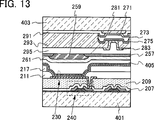
13 stellt ein Licht emittierendes Feld dar. 13 represents a light emitting field.

14A bis 14C stellen eine Licht emittierende Vorrichtung dar. 14A to 14C represent a light-emitting device.

15 stellt eine Licht emittierende Vorrichtung dar. 15 represents a light-emitting device.

16A bis 16F stellen Licht emittierende Vorrichtungen dar. 16A to 16F represent light-emitting devices.

17A und 17B stellen Licht emittierende Vorrichtungen dar. 17A and 17B represent light-emitting devices.

18A und 18B stellen ein Licht emittierendes Feld dar. 18A and 18B represent a light-emitting field.

19A bis 19D zeigen eine Licht emittierende Vorrichtung. 19A to 19D show a light-emitting device.

20A bis 20C stellen eine Licht emittierende Vorrichtung dar. 20A to 20C represent a light-emitting device.

21A bis 21C stellen eine Licht emittierende Vorrichtung dar. 21A to 21C represent a light-emitting device.

22 stellt eine Licht emittierende Vorrichtung dar. 22 represents a light-emitting device.

Beste Art der Ausführung der ErfindungBest mode of execution of the invention

Ausführungsformen werden unter Bezugnahme auf die Zeichnungen detailliert beschrieben. Es sei angemerkt, dass die vorliegende Erfindung nicht auf die folgende Beschreibung beschränkt ist, und es erschließt sich einem Fachmann ohne Weiteres, dass verschiedene Änderungen und Modifikationen durchgeführt werden können, ohne vom Gedanken und Schutzbereich der vorliegenden Erfindung abzuweichen. Dementsprechend soll die vorliegende Erfindung nicht als auf die Beschreibung der nachstehenden Ausführungsformen beschränkt angesehen werden.Embodiments will be described in detail with reference to the drawings. It should be noted that the present invention is not limited to the following description, and it will be readily apparent to one skilled in the art that various changes and modifications can be made without departing from the spirit and scope of the present invention. Accordingly, the present invention should not be construed as being limited to the description of the following embodiments.

Es sei angemerkt, dass bei den Strukturen der im Folgenden beschriebenen Erfindung gleiche Teile oder Teile mit ähnlichen Funktionen in unterschiedlichen Zeichnungen mit gleichen Bezugszeichen gekennzeichnet sind und dass die Beschreibung dieser Teile nicht wiederholt wird. Zudem wird gleiche Schraffur für Teile mit ähnlichen Funktionen verwendet, und in einigen Fällen sind diese Teile nicht gesondert mit Bezugszeichen gekennzeichnet.It should be noted that, in the structures of the invention described below, like parts or parts having similar functions are denoted by like reference characters in different drawings, and the description of these parts will not be repeated. In addition, equal hatching is used for parts having similar functions, and in some cases these parts are not separately identified by reference numerals.

Außerdem ist in einigen Fällen die Position, die Größe, der Bereich oder dergleichen jeder in Zeichnungen und dergleichen gezeigten Struktur zum leichten Verständnis nicht genau dargestellt. Die offenbarte Erfindung ist daher nicht notwendigerweise auf die Position, die Größe, den Bereich oder dergleichen beschränkt, welche in den Zeichnungen und dergleichen offenbart sind.In addition, in some cases, the position, size, area, or the like of each structure shown in drawings and the like is not shown in detail for easy understanding. Therefore, the disclosed invention is not necessarily limited to the position, size, range or the like disclosed in the drawings and the like.

(Ausführungsform 1)(Embodiment 1)

Bei dieser Ausführungsform werden Licht emittierende Vorrichtungen nach Ausführungsformen der vorliegenden Erfindung beschrieben.In this embodiment, light-emitting devices according to embodiments of the present invention will be described.

Eine Licht emittierende Vorrichtung einer Ausführungsform der vorliegenden Erfindung beinhaltet einen streifenförmigen Bereich mit hoher Flexibilität und einen streifenförmigen Bereich mit geringer Flexibilität, welche abwechselnd angeordnet sind. Die Licht emittierende Vorrichtung kann gefaltet werden, indem der Bereich mit hoher Flexibilität gebogen wird. Eine Licht emittierende Vorrichtung einer Ausführungsform der vorliegenden Erfindung ist im gefalteten Zustand leicht tragbar, und sie ist im geöffneten Zustand sehr übersichtlich, weil sie einen nahtlosen großen Licht emittierenden Bereich aufweist.A light-emitting device of an embodiment of the present invention includes a strip-shaped region with high flexibility and a strip-shaped region with low flexibility, which are arranged alternately. The light-emitting device can be folded by bending the region with high flexibility. A light emitting device of one embodiment of the present invention is easily portable in the folded state, and is very clear when opened because it has a seamless large light emitting area.

Bei der Licht emittierenden Vorrichtung einer Ausführungsform der vorliegenden Erfindung kann der Bereich mit hoher Flexibilität sowohl nach innen als auch nach außen gebogen werden.In the light-emitting device of one embodiment of the present invention, the high flexibility region can be bent both inwardly and outwardly.

Wenn die Licht emittierende Vorrichtung einer Ausführungsform der vorliegenden Erfindung nicht verwendet wird, kann sie derart gefaltet werden, dass eine Licht emittierende Oberfläche eines Licht emittierenden Feldes nach innen zeigt, wodurch verhindert werden kann, dass die Licht emittierende Oberfläche beschädigt oder verschmutzt wird. When the light-emitting device of one embodiment of the present invention is not used, it can be folded such that a light-emitting surface of a light-emitting panel faces inward, whereby the light-emitting surface can be prevented from being damaged or soiled.

Wenn die Licht emittierende Vorrichtung einer Ausführungsform der vorliegenden Erfindung verwendet wird, kann sie geöffnet werden, so dass der gesamte nahtlose große Licht emittierende Bereich verwendet wird, oder sie kann derart gefaltet werden, dass die Licht emittierende Oberfläche des Licht emittierenden Feldes nach außen zeigt, damit der Licht emittierende Bereich teilweise verwendet werden kann. Indem die Licht emittierende Vorrichtung gefaltet wird und ein Teil des Licht emittierenden Bereichs, der vor einem Benutzer verborgen wird, in einen Zustand eines kein Licht emittierenden Bereiches versetzt wird, kann der Stromverbrauch der Licht emittierenden Vorrichtung verringert werden.When the light-emitting device of one embodiment of the present invention is used, it may be opened so as to use the entire seamless large-sized light-emitting region, or it may be folded so that the light-emitting surface of the light-emitting panel faces outside, so that the light-emitting area can be partially used. By folding the light-emitting device and placing a part of the light-emitting area hidden from a user in a non-light-emitting region state, power consumption of the light-emitting device can be reduced.

Im Folgenden wird beispielhaft eine Licht emittierende Vorrichtung beschrieben, die in drei Teile gefaltet werden kann und zwei streifenförmige Bereiche mit hoher Flexibilität und drei streifenförmige Bereiche mit geringer Flexibilität beinhaltet.The following is an example of a light-emitting device that can be folded in three parts and includes two strip-shaped areas with high flexibility and three strip-shaped areas with low flexibility.

1A stellt die Licht emittierende Vorrichtung dar, die geöffnet ist. 1B stellt die Licht emittierende Vorrichtung beim Öffnen oder Falten dar. 1C stellt die Licht emittierende Vorrichtung dar, die gefaltet ist. 2 ist eine perspektivische Darstellung der Bestandteile der Licht emittierenden Vorrichtung. 3A ist eine Draufsicht auf die Licht emittierende Oberflächenseite der Licht emittierenden Vorrichtung, und 3B ist eine Draufsicht auf die der Licht emittierenden Oberflächenseite entgegengesetzte Seite der Licht emittierenden Vorrichtung. 3C, 3D und 3F sind Beispiele für eine Seitenansicht der Licht emittierenden Vorrichtung in 3A, die in Pfeilrichtung betrachtet wird. 3E ist eine Querschnittsansicht entlang der Strichpunktlinie A–B in 3A. 4A, 4C und 4D sind Beispiele für eine Seitenansicht der Licht emittierenden Vorrichtung in 1C, die in Pfeilrichtung betrachtet wird. 1A represents the light-emitting device that is open. 1B represents the light-emitting device when opening or folding. 1C represents the light-emitting device that is folded. 2 is a perspective view of the components of the light-emitting device. 3A FIG. 12 is a plan view of the light-emitting surface side of the light-emitting device, and FIG 3B FIG. 12 is a plan view of the light emitting surface side opposite side of the light emitting device. FIG. 3C . 3D and 3F are examples of a side view of the light-emitting device in FIG 3A which is considered in the direction of the arrow. 3E is a cross-sectional view taken along the dashed line A-B in FIG 3A , 4A . 4C and 4D are examples of a side view of the light-emitting device in FIG 1C which is considered in the direction of the arrow.

14A, 14B und 14C zeigen Varianten von 1A, 1B bzw. 1C. 14A stellt die Licht emittierende Vorrichtung dar, die geöffnet ist. 14B stellt die Licht emittierende Vorrichtung beim Öffnen oder Falten dar. 14C stellt die Licht emittierende Vorrichtung dar, die gefaltet ist. 15 ist eine perspektivische Darstellung der Bestandteile der Licht emittierenden Vorrichtung. 16A ist eine Draufsicht auf die Licht emittierende Oberflächenseite der Licht emittierenden Vorrichtung, und 16B ist eine Draufsicht auf die der Licht emittierenden Oberflächenseite entgegengesetzte Seite der Licht emittierenden Vorrichtung. 16C und 16D sind Beispiele für eine Seitenansicht der Licht emittierenden Vorrichtung in 16A, die in Pfeilrichtung betrachtet wird. 16E ist eine Querschnittsansicht entlang der Strichpunktlinie A–B in 16A. 16F zeigt eine Variante der Licht emittierenden Vorrichtung, die in 16C und dergleichen gezeigt ist. 14A . 14B and 14C show variants of 1A . 1B respectively. 1C , 14A represents the light-emitting device that is open. 14B represents the light-emitting device when opening or folding. 14C represents the light-emitting device that is folded. 15 is a perspective view of the components of the light-emitting device. 16A FIG. 12 is a plan view of the light-emitting surface side of the light-emitting device, and FIG 16B FIG. 12 is a plan view of the light emitting surface side opposite side of the light emitting device. FIG. 16C and 16D are examples of a side view of the light-emitting device in FIG 16A which is considered in the direction of the arrow. 16E is a cross-sectional view taken along the dashed line A-B in FIG 16A , 16F shows a variant of the light-emitting device, which in 16C and the like.

Die Licht emittierende Vorrichtung in 1A bis 1C und die Licht emittierende Vorrichtung in 14A bis 14C beinhalten jeweils ein flexibles, Licht emittierendes Feld 11, eine Vielzahl von Trägerteilen 15a und eine Vielzahl von Trägerteilen 15b. Die Trägerteile 15a und 15b weisen jeweils eine geringere Flexibilität auf als das Licht emittierende Feld 11. Die Vielzahl von Trägerteilen 15a sind voneinander getrennt. Die Vielzahl von Trägerteilen 15b sind voneinander getrennt.The light-emitting device in 1A to 1C and the light-emitting device in FIG 14A to 14C each contain a flexible, light-emitting field 11 , a variety of support parts 15a and a variety of support parts 15b , The carrier parts 15a and 15b each have a lower flexibility than the light-emitting field 11 , The variety of support parts 15a are separated from each other. The variety of support parts 15b are separated from each other.

Die Licht emittierende Vorrichtung beinhaltet, wie in 3A gezeigt, Bereiche E1 mit hoher Flexibilität und Bereiche E2 mit geringer Flexibilität, welche abwechselnd angeordnet sind. Bei dem Bereich mit hoher Flexibilität und dem Bereich mit geringer Flexibilität handelt es sich um streifenförmige Bereiche (sie bilden Streifen). Bei dieser Ausführungsform sind eine Vielzahl von Bereichen mit hoher Flexibilität und eine Vielzahl von Bereichen mit geringer Flexibilität parallel zueinander; jedoch sind die Bereiche nicht notwendigerweise parallel zueinander angeordnet.The light-emitting device includes, as in 3A shown, areas E1 with high flexibility and areas E2 with low flexibility, which are arranged alternately. The high flexibility area and the low flexibility area are strip areas (they form stripes). In this embodiment, a plurality of high flexibility regions and a plurality of low flexibility regions are parallel to each other; however, the areas are not necessarily arranged parallel to each other.

Der Bereich E1 mit hoher Flexibilität in der Licht emittierenden Vorrichtung beinhaltet mindestens ein flexibles, Licht emittierendes Feld. Ein Licht emittierendes Feld, bei dem organische EL-Elemente verwendet werden, wird besonders bevorzugt, weil es nicht nur hohe Flexibilität und Stoßbeständigkeit aufweist, sondern auch dünner und leichter werden kann. Beispiele für eine Struktur eines Licht emittierenden Feldes werden bei den Ausführungsformen 2 und 3 detailliert.The high flexibility region E1 in the light-emitting device includes at least one flexible light-emitting panel. A light-emitting panel using organic EL elements is particularly preferred because it not only has high flexibility and impact resistance, but also becomes thinner and lighter. Examples of a structure of a light-emitting panel are detailed in Embodiments 2 and 3.

Der Bereich E2 mit geringer Flexibilität in der Licht emittierenden Vorrichtung beinhaltet mindestens ein flexibles, Licht emittierendes Feld und ein Trägerteil, das eine geringere Flexibilität aufweist als das Licht emittierende Feld und das Licht emittierende Feld überlappt.The low flexibility region E2 in the light-emitting device includes at least a flexible light-emitting panel and a support member having less flexibility than the light-emitting panel and overlapping the light-emitting panel.

Die Licht emittierende Vorrichtung beinhaltet, wie in 16A gezeigt, einen Bereich mit hoher Flexibilität und einen Bereich mit geringer Flexibilität, welche abwechselnd in einer Richtung angeordnet sind.The light-emitting device includes, as in 16A shown, a region of high flexibility and a region of low flexibility, which are arranged alternately in one direction.

In 16A repräsentieren W1 bis W3 die Längen der Bereiche mit geringer Flexibilität in der Richtung, in der der Bereich mit hoher Flexibilität und der Bereich mit geringer Flexibilität angeordnet sind.In 16A W1 to W3 represent the lengths of the areas of low flexibility in the Direction in which the area with high flexibility and the area with low flexibility are arranged.

Zusätzlich beinhaltet der Bereich mit geringer Flexibilität vorzugsweise eine externe Verbindungselektrode des Licht emittierenden Feldes. Dabei entspricht die externe Verbindungselektrode beispielsweise einer leitenden Schicht 157 in 7B.In addition, the low-flexibility region preferably includes an external connection electrode of the light-emitting panel. In this case, the external connection electrode corresponds, for example, to a conductive layer 157 in 7B ,

In 16A beinhaltet der Bereich mit geringer Flexibilität, der die Länge W1 aufweist, die externe Verbindungselektrode. Bei der Licht emittierenden Vorrichtung ist die Länge W1 eines Bereichs A mit geringer Flexibilität, der die externe Verbindungselektrode überlappt, länger als die Länge W3 eines Bereichs B mit geringer Flexibilität, der näher an dem Bereich A ist.In 16A The low flexibility region having the length W1 includes the external connection electrode. In the light emitting device, the length W1 of a low flexibility region A overlapping the external connection electrode is longer than the length W3 of a low flexibility region B closer to the region A.

Wäre dabei bei der Licht emittierenden Vorrichtung im gefalteten Zustand ein Endabschnitt (auch als gefalteter Abschnitt oder dergleichen bezeichnet) des Licht emittierenden Feldes 11 weiter außen positioniert als Endabschnitte der Trägerteile 15a und 15b, so würde in einigen Fällen das Licht emittierende Feld 11 beschädigt, oder ein Element, das in dem Licht emittierenden Feld 11 enthalten ist, würde defekt werden.In the case of the light-emitting device in the folded state, there would be an end portion (also referred to as a folded portion or the like) of the light-emitting panel 11 positioned further outward than end portions of the support members 15a and 15b So, in some cases, the light emitting field would be 11 damaged, or an element that is in the light-emitting field 11 contained, would be broken.

Bei der Licht emittierenden Vorrichtung im gefalteten Zustand in 1C ist der Endabschnitt des Licht emittierenden Feldes 11 auf die Endabschnitte der Trägerteile 15a und 15b über und unter dem Licht emittierenden Feld 11 ausgerichtet. Diese Struktur kann Schäden an dem Licht emittierenden Feld 11, einen Bruch eines Elementes, das in dem Licht emittierenden Feld 11 enthalten ist, und dergleichen verhindern.In the light-emitting device in the folded state in 1C is the end portion of the light-emitting field 11 on the end portions of the carrier parts 15a and 15b above and below the light emitting field 11 aligned. This structure can damage the light-emitting field 11 , a fraction of an element that is in the light-emitting field 11 is included, and prevent such.

Außerdem ist bei der Licht emittierenden Vorrichtung im gefalteten Zustand in 14C der Endabschnitt des Licht emittierenden Feldes 11 weiter innen positioniert als die Endabschnitte der Trägerteile 15a und 15b. Diese Struktur kann Schäden an dem Licht emittierenden Feld 11, einen Bruch eines Elementes, das in dem Licht emittierenden Feld 11 enthalten ist, und dergleichen weiter verhindern.In addition, in the light-emitting device in the folded state in FIG 14C the end portion of the light-emitting panel 11 positioned further inward than the end portions of the support members 15a and 15b , This structure can damage the light-emitting field 11 , a fraction of an element that is in the light-emitting field 11 is included, and further prevent such.

Folglich ist bei der Licht emittierenden Vorrichtung vorzugsweise die Länge W1 des Bereichs A mit geringer Flexibilität, der die externe Verbindungselektrode überlappt, länger als die Länge W3 des Bereichs B mit geringer Flexibilität, der näher an dem Bereich A ist. Besonders bevorzugt ist unter der Länge W1 des Bereichs A, der Länge W3 des Bereichs B und der Länge W2 eines Bereichs C mit geringer Flexibilität, der weiter entfernt von dem Bereich A ist, W1 am längsten und W2 ist am zweitlängsten.Thus, in the light emitting device, preferably, the length W1 of the low flexibility region A overlapping the external connection electrode is longer than the length W3 of the low flexibility region B closer to the region A. More preferably, among the length W1 of the region A, the length W3 of the region B, and the length W2 of a region C of low flexibility farther away from the region A, W1 is the longest and W2 is the second longest.

Das Trägerteil ist auf der Licht emittierenden Oberflächenseite und/oder der der Licht emittierenden Oberflächenseite entgegengesetzten Seite des Licht emittierenden Feldes angeordnet.The support member is disposed on the light-emitting surface side and / or the light-emitting surface side opposite side of the light-emitting panel.

Das Licht emittierende Feld weist vorzugsweise Trägerteile wie die Trägerteile 15a und 15b in 3C oder 16C sowohl auf der Licht emittierenden Oberflächenseite als auch auf der der Licht emittierenden Oberflächenseite entgegengesetzten Seite auf, in welchem Falle das Licht emittierende Feld zwischen einem Paar von Trägerteilen liegen kann; dementsprechend wird die mechanische Festigkeit des Bereichs mit geringer Flexibilität erhöht, und es wird weniger wahrscheinlich, dass die Licht emittierende Vorrichtung beschädigt wird.The light-emitting panel preferably has carrier parts such as the carrier parts 15a and 15b in 3C or 16C both on the light emitting surface side and on the light emitting surface side opposite side, in which case the light emitting field may be between a pair of carrier parts; accordingly, the mechanical strength of the low flexibility region is increased, and the light emitting device is less likely to be damaged.

Alternativ kann statt der Trägerteile 15a und 15b auch ein Trägerteil 15 in 3D oder 16D verwendet werden, und das Licht emittierende Feld 11 kann von dem Trägerteil 15 gehalten werden.Alternatively, instead of the carrier parts 15a and 15b also a carrier part 15 in 3D or 16D used, and the light-emitting field 11 can from the carrier part 15 being held.

Beispielsweise liegen in 1A, 2 und 3C Seitenflächen einer Schutzschicht und des Licht emittierenden Feldes in dem Bereich E2 mit geringer Flexibilität frei; jedoch ist eine Ausführungsform der vorliegenden Erfindung nicht darauf beschränkt. Wie in 3F gezeigt, können Seitenflächen der Schutzschicht und des Licht emittierenden Feldes mit dem Trägerteil 15 (oder einem oder beiden der Trägerteile 15a und 15b) in dem Bereich E2 mit geringer Flexibilität bedeckt sein. 21A bis 21C stellen eine konkrete Struktur einer Licht emittierenden Vorrichtung dar, bei der Seitenflächen der Schutzschicht und des Licht emittierenden Feldes mit dem Trägerteil 15b bedeckt sind. 21A stellt die Licht emittierende Vorrichtung dar, die geöffnet ist. 21B stellt die Licht emittierende Vorrichtung beim Öffnen oder Falten dar. 21C stellt die Licht emittierende Vorrichtung dar, die gefaltet ist. 22 ist eine perspektivische Darstellung der Bestandteile der Licht emittierenden Vorrichtung.For example, lie in 1A . 2 and 3C Side surfaces of a protective layer and the light-emitting panel are free in the region E2 with little flexibility; however, an embodiment of the present invention is not limited thereto. As in 3F shown, side surfaces of the protective layer and the light-emitting panel with the support part 15 (or one or both of the carrier parts 15a and 15b ) in the region E2 with little flexibility. 21A to 21C illustrate a concrete structure of a light-emitting device in which side surfaces of the protective layer and the light-emitting panel with the support part 15b are covered. 21A represents the light-emitting device that is open. 21B represents the light-emitting device when opening or folding. 21C represents the light-emitting device that is folded. 22 is a perspective view of the components of the light-emitting device.

Das Licht emittierende Feld weist vorzugsweise das Trägerteil entweder auf der Licht emittierenden Oberflächenseite oder auf der der Licht emittierenden Oberflächenseite entgegengesetzten Seite auf, da die Licht emittierende Vorrichtung dünner oder leichter sein kann. Beispielsweise kann eine Licht emittierende Vorrichtung eingesetzt werden, die, wie in 16F gezeigt, die Vielzahl von Trägerteilen 15b beinhaltet und nicht die Vielzahl von Trägerteilen 15a beinhaltet.The light-emitting panel preferably has the support member either on the light-emitting surface side or on the side opposite to the light-emitting surface side because the light-emitting device may be thinner or lighter. For example, a light-emitting device may be used which, as shown in FIG 16F shown the variety of support parts 15b includes and not the variety of support parts 15a includes.

Der Bereich E1 mit hoher Flexibilität und der Bereich E2 mit geringer Flexibilität beinhalten vorzugsweise das Licht emittierende Feld und eine Schutzschicht, die eine höhere Flexibilität aufweist als das Trägerteil und das Licht emittierende Feld überlappt. In diesem Fall kann bei der Licht emittierenden Vorrichtung der Bereich E1 mit hoher Flexibilität eine hohe mechanische Festigkeit sowie eine Flexibilität aufweisen, und es wird weniger wahrscheinlich, dass die Licht emittierende Vorrichtung beschädigt wird. Diese Struktur macht es weniger wahrscheinlich, dass die Licht emittierende Vorrichtung durch eine äußere Kraft oder dergleichen in dem Bereich mit hoher Flexibilität sowie in dem Bereich mit geringer Flexibilität verformt wird und beschädigt wird.The high flexibility region E1 and the low flexibility region E2 preferably include the light emitting field and a protective layer that has higher flexibility than the carrier part and overlaps the light emitting field. In this case, in the light emitting device, the high flexibility region E1 can have high mechanical strength as well have a flexibility, and it is less likely that the light-emitting device is damaged. This structure makes it less likely that the light-emitting device will be deformed and damaged by an external force or the like in the high flexibility region as well as in the low flexibility region.

Zum Beispiel ist unter dem Licht emittierenden Feld, dem Trägerteil und der Schutzschicht vorzugsweise das Trägerteil am dicksten und das Licht emittierende Feld ist am dünnsten. Alternativ weist zum Beispiel unter dem Licht emittierenden Feld, dem Trägerteil und der Schutzschicht vorzugsweise das Trägerteil die geringste Flexibilität auf und das Licht emittierende Feld weist die höchste Flexibilität auf. Eine derartige Struktur erhöht die Differenz zwischen der Flexibilität des Bereichs mit hoher Flexibilität und derjenigen des Bereichs mit geringer Flexibilität. Dementsprechend kann die Licht emittierende Vorrichtung sicher an dem Bereich mit hoher Flexibilität gefaltet werden, so dass verhindert wird, dass der Bereich mit geringer Flexibilität gebogen wird. Folglich kann die Zuverlässigkeit der Licht emittierenden Vorrichtung verbessert werden. Eine derartige Struktur verhindert auch, dass die Licht emittierende Vorrichtung an einem unerwünschten Teil gebogen wird.For example, under the light-emitting panel, the support member and the protective layer, it is preferable that the support member is thickest and the light-emitting panel is thinnest. Alternatively, for example, among the light-emitting panel, the support member and the protective layer, preferably, the support member has the least flexibility, and the light-emitting panel has the highest flexibility. Such a structure increases the difference between the flexibility of the high flexibility region and that of the low flexibility region. Accordingly, the light-emitting device can be securely folded at the region of high flexibility, so that the region with low flexibility is prevented from being bent. Consequently, the reliability of the light-emitting device can be improved. Such a structure also prevents the light-emitting device from being bent at an undesirable part.

Das Licht emittierende Feld weist vorzugsweise Schutzschichten sowohl auf der Licht emittierenden Oberflächenseite als auch auf der der Licht emittierenden Oberflächenseite entgegengesetzten Seite auf, in welchem Falle das Licht emittierende Feld zwischen einem Paar von Schutzschichten liegen kann; dementsprechend weist die Licht emittierende Vorrichtung eine erhöhte mechanische Festigkeit auf, und es wird weniger wahrscheinlich, dass sie beschädigt wird.The light-emitting panel preferably has protective layers on both the light-emitting surface side and the side opposite the light-emitting surface side, in which case the light-emitting panel may be sandwiched between a pair of protective layers; accordingly, the light-emitting device has increased mechanical strength and is less likely to be damaged.

Zum Beispiel sind, wie in 3C oder 16C gezeigt, in dem Bereich E2 mit geringer Flexibilität vorzugsweise ein Paar von Schutzschichten 13a und 13b zwischen dem Paar von Trägerteilen 15a und 15b und das Licht emittierende Feld (nicht gezeigt) zwischen dem Paar von Schutzschichten 13a und 13b platziert.For example, as in 3C or 16C In the low flexibility region E2, it is preferable to have a pair of protective layers 13a and 13b between the pair of support parts 15a and 15b and the light-emitting panel (not shown) between the pair of protective layers 13a and 13b placed.

Alternativ ist vorzuziehen, dass, wie in 3D oder 16D gezeigt, in dem Bereich E2 mit geringer Flexibilität das Paar von Schutzschichten 13a und 13b von dem Trägerteil 15 gehalten wird und das Licht emittierende Feld (nicht gezeigt) zwischen dem Paar von Schutzschichten 13a und 13b platziert ist.Alternatively, it is preferable that, as in 3D or 16D shown in the region E2 with low flexibility, the pair of protective layers 13a and 13b from the carrier part 15 and the light emitting panel (not shown) between the pair of protective layers 13a and 13b is placed.

Das Licht emittierende Feld weist vorzugsweise die Schutzschicht entweder auf der Licht emittierenden Oberflächenseite oder auf der der Licht emittierenden Oberflächenseite entgegengesetzten Seite auf, da die Licht emittierende Vorrichtung dünner oder leichter sein kann. Beispielsweise kann eine Licht emittierende Vorrichtung eingesetzt werden, die die Schutzschicht 13b beinhaltet und nicht die Schutzschicht 13a beinhaltet.The light-emitting panel preferably has the protective layer either on the light-emitting surface side or on the side opposite to the light-emitting surface side because the light-emitting device may be thinner or lighter. For example, a light-emitting device may be used, which is the protective layer 13b includes and not the protective layer 13a includes.

Wenn es sich bei der Schutzschicht 13a auf der Licht emittierenden Oberflächenseite des Licht emittierenden Feldes um einen lichtundurchlässigen Film handelt, kann verhindert werden, dass ein kein Licht emittierender Bereich des Licht emittierenden Feldes mit Außenlicht bestrahlt wird. Diese Struktur wird bevorzugt, weil sie eine Photodegradation eines Transistors und dergleichen einer Treiberschaltung verhindert, die in dem kein Licht emittierenden Bereich enthalten ist.When it comes to the protective layer 13a On the light emitting surface side of the light emitting panel is an opaque film, it is possible to prevent a non-light emitting portion of the light emitting panel from being irradiated with outside light. This structure is preferable because it prevents photodegradation of a transistor and the like of a driving circuit included in the non-light-emitting region.

Wie in 2, 3E, 15 oder 16E gezeigt, überlappt eine Öffnung in der Schutzschicht 13a, die auf der Licht emittierenden Oberflächenseite des Licht emittierenden Feldes 11 angeordnet ist, einen Licht emittierenden Bereich 11a des Licht emittierenden Feldes. Die Schutzschicht 13a überlappt einen kein Licht emittierenden Bereich 11b, der den Licht emittierenden Bereich 11a wie ein Rahmen umgibt. Die Schutzschicht 13b, die auf der der Licht emittierenden Oberflächenseite entgegengesetzten Seite des Licht emittierenden Feldes 11 angeordnet ist, überlappt den Licht emittierenden Bereich 11a und den kein Licht emittierenden Bereich 11b. Die Schutzschicht 13b ist in einem großen Bereich, bevorzugt an der gesamten Oberfläche auf der der Licht emittierenden Oberflächenseite entgegengesetzten Seite bereitgestellt, um das Licht emittierende Feld mit Sicherheit zu schützen; daher kann die Zuverlässigkeit der Licht emittierenden Vorrichtung verbessert werden.As in 2 . 3E . 15 or 16E shown overlaps an opening in the protective layer 13a located on the light-emitting surface side of the light-emitting panel 11 is arranged a light emitting area 11a of the light-emitting field. The protective layer 13a overlaps a non-light emitting area 11b that the light emitting area 11a how a frame surrounds. The protective layer 13b located on the light-emitting surface side opposite side of the light-emitting field 11 is arranged, overlaps the light-emitting area 11a and the non-light emitting area 11b , The protective layer 13b is provided in a wide range, preferably on the entire surface on the opposite side of the light-emitting surface side, to protect the light-emitting panel with certainty; therefore, the reliability of the light-emitting device can be improved.

Bei der Licht emittierenden Vorrichtung einer Ausführungsform der vorliegenden Erfindung ist das Folgende vorzuziehen: Wenn eine Vielzahl von Bereichen mit hoher Flexibilität abwechselnd nach innen und nach außen gebogen wird, erfüllt der kürzeste Abstand L zwischen einer Oberfläche des Licht emittierenden Feldes, die am nächsten an einer Trägerfläche der Licht emittierenden Vorrichtung ist, und einer Oberfläche des Licht emittierenden Feldes, die am weitesten entfernt von der Trägerfläche ist, L < 2(D + T). Dabei repräsentiert D die Summe der Krümmungsradien des Licht emittierenden Feldes in der Vielzahl von Bereichen mit hoher Flexibilität, und T repräsentiert die Dicke des Licht emittierenden Feldes. In diesem Fall kann die Licht emittierende Vorrichtung dünner gemacht werden.In the light emitting device of one embodiment of the present invention, the following is preferable: When a plurality of high flexibility regions are alternately bent inward and outward, the shortest distance L between a surface of the light emitting field closest to one meets Carrier surface of the light-emitting device, and a surface of the light-emitting field, which is farthest from the support surface, L <2 (D + T). Here, D represents the sum of the radii of curvature of the light-emitting field in the plurality of regions of high flexibility, and T represents the thickness of the light-emitting field. In this case, the light-emitting device can be made thinner.

Die Licht emittierende Vorrichtung in 4A befindet sich in einem Zustand, in dem ein Bereich mit hoher Flexibilität nach innen und ein Bereich mit hoher Flexibilität nach außen gebogen sind. In 4A ist das Licht emittierende Feld an der Grenzfläche zwischen der Schutzschicht 13a und der Schutzschicht 13b platziert. Ein Durchmesser D1 und ein Durchmesser D2 in 4A werden ausführlich anhand von 4B beschrieben. D1 repräsentiert den Durchmesser eines Kreises, dessen Radius dem Krümmungsradius des Licht emittierenden Feldes in dem nach innen gebogenen Bereich mit hoher Flexibilität entspricht. D2 repräsentiert den Durchmesser eines Kreises, dessen Radius dem Krümmungsradius des Licht emittierenden Feldes in dem nach außen gebogenen Bereich mit hoher Flexibilität entspricht. T repräsentiert die Dicke des Licht emittierenden Feldes 11. Da die Summe des Durchmessers D1 und des Durchmessers D2 dem Doppelten der Summe D der Krümmungsradien des Licht emittierenden Feldes in der Vielzahl von Bereichen mit hoher Flexibilität entspricht, korrespondiert L < 2(D + T) mit L < D1 + D2 + 2T. Dabei wird der kürzeste Abstand L1 zwischen einer Oberfläche, die am nächsten an einer Trägerfläche der Licht emittierenden Vorrichtung ist, und einer Oberfläche des Licht emittierenden Feldes in 4A, die am weitesten entfernt von der Trägerfläche ist, durch D1 + D2 + 3T repräsentiert.The light-emitting device in 4A is in a state where an area with high flexibility is bent inward and an area with high flexibility is bent outward. In 4A is the light-emitting field at the interface between the protective layer 13a and the protective layer 13b placed. A diameter D1 and a diameter D2 in 4A be detailed by 4B described. D1 represents the diameter of a circle whose radius corresponds to the radius of curvature of the light-emitting field in the inward-bent region with high flexibility. D2 represents the diameter of a circle whose radius corresponds to the radius of curvature of the light-emitting field in the outwardly-bent region with high flexibility. T represents the thickness of the light-emitting panel 11 , Since the sum of the diameter D1 and the diameter D2 is twice the sum D of radii of curvature of the light emitting field in the plurality of high flexibility regions, L <2 (D + T) corresponds to L <D1 + D2 + 2T. Here, the shortest distance L1 between a surface closest to a support surface of the light-emitting device and a surface of the light-emitting field in 4A farthest from the support surface represented by D1 + D2 + 3T.

Indem beispielsweise die Dicken der Trägerteile 15a und 15b oder die Dicken der Schutzschichten 13a und 13b verringert werden oder die Breite des Bereichs mit geringer Flexibilität zwischen dem nach innen gebogenen Bereich mit hoher Flexibilität und dem nach außen gebogenen Bereich mit hoher Flexibilität verschmälert wird, kann der kürzeste Abstand L2 zwischen einer Oberfläche, die am nächsten an einer Trägerfläche der Licht emittierenden Vorrichtung ist, und einer Oberfläche des Licht emittierenden Feldes in 4C, die am weitesten entfernt von der Trägerfläche ist, L2 < D1 + D2 + 3T oder sogar L2 < D1 + D2 + 2T, d. h. L2 < 2(D + T), erfüllen.By, for example, the thicknesses of the carrier parts 15a and 15b or the thicknesses of the protective layers 13a and 13b or narrowing the width of the low flexibility region between the inward flexing region having high flexibility and the outward flexing region having high flexibility, the shortest distance L2 between a surface closest to a support surface of the light emitting device may be decreased is, and a surface of the light emitting field in 4C farthest from the support surface, satisfy L2 <D1 + D2 + 3T or even L2 <D1 + D2 + 2T, ie L2 <2 (D + T).

Dabei ist bei der Licht emittierenden Vorrichtung das Folgende vorzuziehen: Unter den Bereichen mit geringer Flexibilität, die beim Falten der Licht emittierenden Vorrichtung einander überlappen, ist ein Paar von Bereichen mit geringer Flexibilität, die auf der Außenseite positioniert sind, parallel zur Trägerfläche der Licht emittierenden Vorrichtung, und ein Bereich mit geringer Flexibilität, der auf der Innenseite positioniert ist, ist nicht parallel zur Trägerfläche.Here, in the light-emitting device, the following is preferable: Among the low-flexibility regions which overlap each other when the light-emitting device is folded, a pair of low-flexibility regions positioned on the outside are parallel to the surface of the light-emitting ones Device, and a region of low flexibility, which is positioned on the inside, is not parallel to the support surface.

Bei der Licht emittierenden Vorrichtung einer Ausführungsform der vorliegenden Erfindung ist das Folgende vorzuziehen: Wenn einer von zwei benachbarten Bereichen mit hoher Flexibilität nach innen und der andere nach außen gebogen werden, überlappen ein Kreis, dessen Radius dem Krümmungsradius des Licht emittierenden Feldes in dem einen Bereich mit hoher Flexibilität entspricht, und ein Kreis, dessen Radius dem Krümmungsradius des Licht emittierenden Feldes in dem anderen Bereich mit hoher Flexibilität entspricht, einander, indem sie in einer Richtung parallel zu einer Trägerfläche der Licht emittierenden Vorrichtung bewegt werden. In diesem Fall kann die Licht emittierende Vorrichtung dünner gemacht werden.In the light-emitting device of one embodiment of the present invention, the following is preferable: When one of two adjacent regions is bent inward with high flexibility and the other outward, a circle whose radius overlaps the radius of curvature of the light-emitting field in the one region overlaps with high flexibility, and a circle whose radius corresponds to the radius of curvature of the light-emitting panel in the other high flexibility area is moved by being moved in a direction parallel to a support surface of the light-emitting device. In this case, the light-emitting device can be made thinner.

Wie in 4D gezeigt, überlappen ein Kreis mit dem Durchmesser D1 und ein Kreis mit dem Durchmesser D2 einander, indem sie in einer Richtung parallel zur Trägerfläche der Licht emittierenden Vorrichtung (hier in horizontaler Richtung der Zeichnung) bewegt werden. Der Krümmungsradius des Licht emittierenden Feldes in dem nach innen gebogenen Bereich mit hoher Flexibilität und der Krümmungsradius des Licht emittierenden Feldes in dem nach außen gebogenen Bereich mit hoher Flexibilität entsprechen den Radien der zwei Kreise; daher kann man sagen, dass die Licht emittierende Vorrichtung in 4D dünn ist.As in 4D 2, a circle of diameter D <b> 1 and a circle of diameter D <b> 2 overlap each other by being moved in a direction parallel to the support surface of the light-emitting device (here, in the horizontal direction of the drawing). The radius of curvature of the light-emitting field in the inwardly-bent region with high flexibility and the radius of curvature of the light-emitting field in the outwardly bent region with high flexibility correspond to the radii of the two circles; therefore, it can be said that the light-emitting device in 4D is thin.

Der kürzeste Abstand L3 zwischen einer Oberfläche, die am nächsten an einer Trägerfläche der Licht emittierenden Vorrichtung ist, und einer Oberfläche des Licht emittierenden Feldes in 4D, die am weitesten entfernt von der Trägerfläche ist, kann L3 < D1 + D2 + 3T oder sogar L3 < D1 + D2 + 2T, d. h. L3 < 2(D + T), erfüllen. Es 1 sei angemerkt, dass in 4D die Schutzschicht 13a und die Schutzschicht 13b insgesamt als Schutzschicht 13 gezeigt sind.The shortest distance L3 between a surface closest to a support surface of the light-emitting device and a surface of the light-emitting field in FIG 4D farthest from the support surface can satisfy L3 <D1 + D2 + 3T or even L3 <D1 + D2 + 2T, ie L3 <2 (D + T). It should be noted that in 4D the protective layer 13a and the protective layer 13b overall as a protective layer 13 are shown.

Die Schutzschicht und das Trägerteil können unter Verwendung von Kunststoff, Gummi, eines Metalls, einer Legierung oder dergleichen ausgebildet werden. Kunststoff, Gummi oder dergleichen wird vorzugsweise verwendet, da er/es eine Schutzschicht oder ein Trägerteil bilden kann, die/das leicht ist und mit geringerer Wahrscheinlichkeit beschädigt wird. Beispielsweise kann man Silikongummi für die Schutzschicht und Edelstahl oder Aluminium für das Trägerteil verwenden.The protective layer and the support member may be formed using plastic, rubber, a metal, an alloy or the like. Plastic, rubber, or the like is preferably used because it can form a protective layer or carrier that is lightweight and less likely to be damaged. For example, one can use silicone rubber for the protective layer and stainless steel or aluminum for the carrier part.

Die Schutzschicht und das Trägerteil werden vorzugsweise unter Verwendung eines Materials mit hoher Festigkeit ausgebildet. In diesem Fall kann eine Licht emittierende Vorrichtung, die eine hohe Stoßbeständigkeit aufweist und mit geringerer Wahrscheinlichkeit beschädigt wird, bereitgestellt werden. Wenn beispielsweise ein organisches Harz, ein dünnes Metallmaterial oder ein dünnes Legierungsmaterial für die Schutzschicht und das Trägerteil verwendet wird, kann die Licht emittierende Vorrichtung leicht sein, und es kann weniger wahrscheinlich sein, dass sie beschädigt wird. Aus einem ähnlichen Grund wird auch ein Substrat des Licht emittierenden Feldes vorzugsweise unter Verwendung eines Materials mit hoher Festigkeit ausgebildet.The protective layer and the support member are preferably formed by using a high-strength material. In this case, a light-emitting device which has high impact resistance and is less likely to be damaged can be provided. For example, when an organic resin, a thin metal material or a thin alloy material is used for the protective layer and the support member, the light-emitting device may be light and less likely to be damaged. For a similar reason, a substrate of the light-emitting panel is also preferably formed by using a high-strength material.

Die Schutzschicht und das Trägerteil auf der Licht emittierenden Oberflächenseite weisen nicht notwendigerweise eine Lichtdurchlässigkeit auf, falls sie nicht den Licht emittierenden Bereich des Licht emittierenden Feldes überlappen. Wenn die Schutzschicht und das Trägerteil auf der Licht emittierenden Oberflächenseite mindestens einen Teil des Licht emittierenden Bereichs überlappen, werden sie vorzugsweise unter Verwendung eines Materials ausgebildet, das Licht durchlässt, das von dem Licht emittierenden Feld emittiert wird. Es gibt keine Beschränkung hinsichtlich der Lichtdurchlässigkeit der Schutzschicht und des Trägerteils auf der der Licht emittierenden Oberflächenseite entgegengesetzten Seite.The protective layer and the support member on the light-emitting surface side do not necessarily have light transmittance unless they are the light-emitting portion of the light overlap the emitting field. When the protective layer and the support member on the light-emitting surface side overlap at least a part of the light-emitting region, they are preferably formed by using a material that transmits light emitted from the light-emitting panel. There is no limitation to the light transmittance of the protective layer and the support member on the side opposite to the light-emitting surface side.

Wenn zwei von der Schutzschicht, dem Trägerteil und dem Licht emittierenden Feld miteinander verbunden werden, können verschiedene Klebstoffe verwendet werden, wobei beispielsweise ein aushärtendes Harz, das bei Raumtemperatur aushärtend ist (z. B. ein zwei Komponenten enthaltendes Harz), ein lichthärtendes Harz, ein wärmehärtendes Harz oder dergleichen verwendet werden kann. Als Alternative kann auch eine Klebefolie verwendet werden. Alternativ können Bestandteile der Licht emittierenden Vorrichtung beispielsweise mit einer Schraube, die zwei oder mehr von der Schutzschicht, dem Trägerteil und dem Licht emittierenden Feld durchdringt, oder mit einem Stift oder einer Klammer, welcher/welche diese hält, fixiert werden.When two of the protective layer, the support member and the light-emitting panel are bonded together, various adhesives may be used, for example, a thermosetting resin which is thermosetting at room temperature (e.g., a two-component resin), a photocuring resin, a thermosetting resin or the like can be used. As an alternative, an adhesive film may also be used. Alternatively, components of the light-emitting device may be fixed, for example, with a screw that penetrates two or more of the protective layer, the support member, and the light-emitting panel, or with a pin or clip that holds them.

Die Licht emittierende Vorrichtung einer Ausführungsform der vorliegenden Erfindung kann verwendet werden, wobei ein Licht emittierendes Feld (ein Licht emittierender Bereich) in zwei oder mehr Bereiche an einem/mehreren gefalteten Abschnitt/en geteilt ist. Zum Beispiel ist es möglich, den Bereich, der beim Falten der Licht emittierenden Vorrichtung verborgen wird, in einen kein Licht emittierenden Zustand und nur den freiliegenden Bereich in einen Licht emittierenden Zustand zu versetzen. Demzufolge kann der Strom verringert werden, der von einem Bereich verbraucht wird, den ein Benutzer nicht verwendet.The light-emitting device of one embodiment of the present invention may be used wherein a light-emitting panel (a light-emitting panel) is divided into two or more areas at one folded portion (s). For example, it is possible to put the area which is hidden when the light-emitting device is folded into a non-light-emitting state and only the exposed area to a light-emitting state. As a result, the power consumed by an area which a user does not use can be reduced.

Die Licht emittierende Vorrichtung einer Ausführungsform der vorliegenden Erfindung kann einen Sensor beinhalten, um zu bestimmen, ob der Bereich mit hoher Flexibilität jeweils gebogen ist oder nicht. Der Sensor kann beispielsweise aus einem Schalter, einem MEMS-Drucksensor, einem Drucksensor oder dergleichen bestehen.The light-emitting device of one embodiment of the present invention may include a sensor for determining whether the high-flexibility region is bent or not. The sensor may for example consist of a switch, a MEMS pressure sensor, a pressure sensor or the like.

Bei den oben beschriebenen Beispielen beinhaltet die Licht emittierende Vorrichtung zwei Bereiche mit hoher Flexibilität; jedoch ist eine Ausführungsform der vorliegenden Erfindung nicht darauf beschränkt. Zum Beispiel beinhaltet, wie in 5A gezeigt, die Licht emittierende Vorrichtung mindestens einen Bereich E1 mit hoher Flexibilität. Ausführungsformen der vorliegenden Erfindung umfassen auch eine Licht emittierende Vorrichtung, die, wie in 5B oder 17A gezeigt, drei Bereiche E1 mit hoher Flexibilität beinhaltet und in vier Teile gefaltet werden kann, und eine Licht emittierende Vorrichtung, die, wie in 5C oder 17B gezeigt, vier Bereiche E1 mit hoher Flexibilität beinhaltet und in fünf Teile gefaltet werden kann.In the examples described above, the light-emitting device includes two regions of high flexibility; however, an embodiment of the present invention is not limited thereto. For example, as in 5A 1, the light-emitting device has at least one region E1 with high flexibility. Embodiments of the present invention also include a light-emitting device which, as shown in FIG 5B or 17A shown includes three regions E1 with high flexibility and can be folded into four parts, and a light-emitting device, which, as in 5C or 17B shown, four areas includes E1 with high flexibility and can be folded into five parts.

Beispielsweise ist bei der Licht emittierenden Vorrichtung in 17A unter den Längen W1 bis W4 W1 am längsten, W2 ist am zweitlängsten, und W3 und W4 sind am kürzesten. Die Längen W3 und W4 können unterschiedliche Längen sein.For example, in the light-emitting device in FIG 17A is the longest among the lengths W1 to W4 W1, W2 is the second longest, and W3 and W4 are the shortest. The lengths W3 and W4 can be different lengths.

Außerdem ist bei der Licht emittierenden Vorrichtung in 17B unter den Längen W1 bis W5 W1 am längsten, W2 ist am zweitlängsten, und W3, W4 und W5 sind am kürzesten. Die Längen W3, W4 und W5 können unterschiedliche Längen sein.In addition, in the light emitting device in FIG 17B is the longest among the lengths W1 to W5 W1, W2 is the second longest, and W3, W4 and W5 are the shortest. The lengths W3, W4 and W5 may be different lengths.

6A und 6B stellen jeweils ein Beispiel dar, bei dem die Licht emittierende Vorrichtung in 5C in fünf Teile gefaltet ist. 6A and 6B each illustrate an example in which the light-emitting device in FIG 5C folded into five parts.

In 6A wird der kürzeste Abstand L4 zwischen einer Oberfläche des Licht emittierenden Feldes, die am nächsten an einer Trägerfläche der Licht emittierenden Vorrichtung ist, und einer Oberfläche des Licht emittierenden Feldes, die am weitesten entfernt von der Trägerfläche ist, durch 2D + 5T repräsentiert. Dabei repräsentiert D die Summe der Krümmungsradien des Licht emittierenden Feldes in der Vielzahl von Bereichen mit hoher Flexibilität, und T repräsentiert die Dicke des Licht emittierenden Feldes. Es sei angemerkt, dass 2D = D1 + D2 + D3 + D4 gilt.In 6A For example, the shortest distance L4 between a surface of the light-emitting panel closest to a support surface of the light-emitting device and a surface of the light-emitting field farthest from the support surface is represented by 2D + 5T. Here, D represents the sum of the radii of curvature of the light-emitting field in the plurality of regions of high flexibility, and T represents the thickness of the light-emitting field. It should be noted that 2D = D1 + D2 + D3 + D4.

Indem beispielsweise die Dicken der Trägerteile 15a und 15b oder die Dicken der Schutzschichten 13a und 13b verringert werden oder die Breite des Bereichs mit geringer Flexibilität zwischen dem nach innen gebogenen Bereich mit hoher Flexibilität und dem nach außen gebogenen Bereich mit hoher Flexibilität verschmälert wird, kann der kürzeste Abstand L5 zwischen einer Oberfläche des Licht emittierenden Feldes in 6B, die am nächsten an einer Trägerfläche der Licht emittierenden Vorrichtung ist, und einer Oberfläche des Licht emittierenden Feldes, die am weitesten entfernt von der Trägerfläche ist, L5 < D1 + D2 + D3 + D4 + 5T oder sogar L5 < D1 + D2 + D3 + D4 + 2T, d. h. L5 < 2D + 2T, erfüllen. Dabei repräsentiert D die Summe der Krümmungsradien des Licht emittierenden Feldes in der Vielzahl von Bereichen mit hoher Flexibilität, und T repräsentiert die Dicke des Licht emittierenden Feldes.By, for example, the thicknesses of the carrier parts 15a and 15b or the thicknesses of the protective layers 13a and 13b or narrowing the width of the low flexibility region between the high flexibility flexed region and the high flexure flexed region, the shortest distance L5 between a surface of the light emitting field may be decreased 6B closest to a support surface of the light-emitting device and a surface of the light-emitting field farthest from the support surface are L5 <D1 + D2 + D3 + D4 + 5T or even L5 <D1 + D2 + D3 + D4 + 2T, ie L5 <2D + 2T. Here, D represents the sum of the radii of curvature of the light-emitting field in the plurality of regions of high flexibility, and T represents the thickness of the light-emitting field.

In 6B überlappen ein Kreis mit dem Durchmesser D1 und ein Kreis mit dem Durchmesser D2 einander, indem sie in einer Richtung parallel zur Trägerfläche der Licht emittierenden Vorrichtung (hier in horizontaler Richtung der Zeichnung) bewegt werden. Außerdem überlappen ein Kreis mit dem Durchmesser D3 und ein Kreis mit dem Durchmesser D4 einander, indem sie in einer Richtung parallel zur Trägerfläche der Licht emittierenden Vorrichtung bewegt werden. Wenn einer der zwei benachbarten Bereiche mit hoher Flexibilität nach innen und der andere nach außen gebogen werden, entsprechen der Radius des Kreises mit dem Durchmesser D1 und der Radius des Kreises mit dem Durchmesser D2 dem Krümmungsradius des Licht emittierenden Feldes in dem nach innen gebogenen Bereich mit hoher Flexibilität und dem Krümmungsradius des Licht emittierenden Feldes in dem nach außen gebogenen Bereich mit hoher Flexibilität; daher kann man sagen, dass die Licht emittierende Vorrichtung in 6B dünn ist. Das kann man auch aus dem Radius des Kreises mit dem Durchmesser D3 und dem Radius des Kreises mit dem Durchmesser D4 feststellen.In 6B A circle of diameter D1 and a circle of diameter D2 overlap each other by being moved in a direction parallel to the support surface of the light-emitting device (here, in the horizontal direction of the drawing). In addition, a circle with the diameter D3 and a circle with the overlap Diameter D4 each other by being moved in a direction parallel to the support surface of the light-emitting device. When one of the two adjacent regions is bent inward with high flexibility and the other is bent outward, the radius of the circle of diameter D1 and the radius of the circle of diameter D2 correspond to the radius of curvature of the light-emitting field in the inwardly bent region high flexibility and the radius of curvature of the light-emitting field in the outwardly bent region with high flexibility; therefore, it can be said that the light-emitting device in 6B is thin. This can also be determined from the radius of the circle with the diameter D3 and the radius of the circle with the diameter D4.

Darüber hinaus kann die Licht emittierende Vorrichtung noch dünner gemacht werden, indem, wie in 6B gezeigt, im Vergleich zu einem Paar von Bereichen mit geringer Flexibilität auf der äußersten Seite der Licht emittierenden Vorrichtung die Breiten der sonstigen Bereiche mit geringer Flexibilität verringert werden.In addition, the light-emitting device can be made even thinner by, as in 6B As compared to a pair of regions of low flexibility on the outermost side of the light-emitting device, the widths of the other regions with low flexibility are reduced.

Beim Falten der Licht emittierenden Vorrichtung müssen ferner die Bereiche mit hoher Flexibilität nicht unbedingt abwechselnd nach innen und nach außen gebogen werden; beispielsweise kann, wie in 5D gezeigt, jeder Bereich mit hoher Flexibilität nach innen gebogen werden. Wenn beispielsweise die Licht emittierende Vorrichtung in einem derartigen Zustand transportiert wird, kann verhindert werden, dass die Licht emittierende Oberfläche der Licht emittierenden Vorrichtung beschädigt oder verschmutzt wird.Further, when folding the light-emitting device, the regions of high flexibility need not necessarily be alternately bent inward and outward; for example, as in 5D Each area with high flexibility can be bent inwards. For example, when the light-emitting device is transported in such a state, the light-emitting surface of the light-emitting device can be prevented from being damaged or soiled.

Bei der Licht emittierenden Vorrichtung dieser Ausführungsform kann ein Licht emittierendes Feld einmal oder mehrmals gefaltet werden. Der Krümmungsradius in diesem Fall kann beispielsweise größer als oder gleich 1 mm und kleiner als oder gleich 150 mm sein.In the light-emitting device of this embodiment, a light-emitting panel may be folded once or more. The radius of curvature in this case may be, for example, greater than or equal to 1 mm and less than or equal to 150 mm.

Diese Ausführungsform kann gegebenenfalls mit jeder anderen Ausführungsform kombiniert werden.This embodiment may optionally be combined with any other embodiment.

(Ausführungsform 2)(Embodiment 2)

Bei dieser Ausführungsform werden Licht emittierende Felder anhand von 7A und 7B, 8A und 8B, 9A und 9B, 10A und 10B, 11A bis 11C sowie 12A bis 12C beschrieben. Wenn das bei dieser Ausführungsform beschriebene Licht emittierende Feld gebogen wird, kann der minimale Krümmungsradius eines gebogenen Abschnitts des Licht emittierenden Feldes größer als oder gleich 1 mm und kleiner als oder gleich 150 mm, größer als oder gleich 1 mm und kleiner als oder gleich 100 mm, größer als oder gleich 1 mm und kleiner als oder gleich 50 mm, größer als oder gleich 1 mm und kleiner als oder gleich 10 mm oder größer als oder gleich 2 mm und kleiner als oder gleich 5 mm sein. Das Licht emittierende Feld dieser Ausführungsform ist frei von Bruch eines Elementes, auch wenn es mit einem kleinen Krümmungsradius (z. B. größer als oder gleich 2 mm und kleiner als oder gleich 5 mm) gebogen wird, und weist hohe Zuverlässigkeit auf. Das Biegen des Licht emittierenden Feldes mit einem kleinen Krümmungsradius kann die Licht emittierende Vorrichtung einer Ausführungsform der vorliegenden Erfindung dünn machen. Es gibt keine Beschränkung hinsichtlich der Richtung, in der das Licht emittierende Feld dieser Ausführungsform gebogen wird. Des Weiteren kann die Anzahl von gebogenen Abschnitten eins oder größer als eins sein.In this embodiment, light emitting fields are determined by 7A and 7B . 8A and 8B . 9A and 9B . 10A and 10B . 11A to 11C such as 12A to 12C described. When the light-emitting panel described in this embodiment is bent, the minimum radius of curvature of a bent portion of the light-emitting panel may be greater than or equal to 1 mm and less than or equal to 150 mm, greater than or equal to 1 mm, and less than or equal to 100 mm , greater than or equal to 1 mm and less than or equal to 50 mm, greater than or equal to 1 mm and less than or equal to 10 mm or greater than or equal to 2 mm and less than or equal to 5 mm. The light-emitting panel of this embodiment is free from breakage of an element even if it is bent with a small radius of curvature (eg, greater than or equal to 2 mm and less than or equal to 5 mm), and has high reliability. The bending of the light-emitting field having a small radius of curvature can thin the light-emitting device of one embodiment of the present invention. There is no limitation on the direction in which the light-emitting panel of this embodiment is bent. Furthermore, the number of bent portions may be one or more than one.

<Konkretes Beispiel 1><Concrete example 1>

7A ist eine Draufsicht auf das Licht emittierende Feld 11, das beispielhaft bei der Ausführungsform 1 beschrieben worden ist, und 7B ist ein Beispiel für eine Querschnittsansicht entlang der Strichpunktlinie A1–A2 in 7A. 7A is a plan view of the light emitting field 11 , which has been described by way of example in the embodiment 1, and 7B is an example of a cross-sectional view along the dashed-dotted line A1-A2 in FIG 7A ,

Das Licht emittierende Feld in 7B beinhaltet eine Elementschicht 101, eine Klebeschicht 105 und ein Substrat 103. Die Elementschicht 101 beinhaltet ein Substrat 201, eine Klebeschicht 203, eine isolierende Schicht 205, eine Vielzahl von Transistoren, die leitende Schicht 157, eine isolierende Schicht 207, eine isolierende Schicht 209, eine Vielzahl von Licht emittierenden Elementen, eine isolierende Schicht 211, eine Dichtungsschicht 213, eine isolierende Schicht 261, eine Farbschicht 259, eine lichtundurchlässige Schicht 257 und eine isolierende Schicht 255.The light emitting field in 7B includes an element layer 101 , an adhesive layer 105 and a substrate 103 , The element layer 101 includes a substrate 201 , an adhesive layer 203 , an insulating layer 205 , a variety of transistors, the conductive layer 157 , an insulating layer 207 , an insulating layer 209 , a plurality of light-emitting elements, an insulating layer 211 , a sealing layer 213 , an insulating layer 261 , a color layer 259 , an opaque layer 257 and an insulating layer 255 ,

Die leitende Schicht 157 ist über einen Verbinder 215 elektrisch mit einer FPC 108 verbunden.The conductive layer 157 is via a connector 215 electrically with an FPC 108 connected.

Ein Licht emittierendes Element 230 beinhaltet eine untere Elektrode 231, eine EL-Schicht 233 und eine obere Elektrode 235. Die untere Elektrode 231 ist elektrisch mit einer Source-Elektrode oder einer Drain-Elektrode eines Transistors 240 verbunden. Ein Endabschnitt der unteren Elektrode 231 ist mit der isolierenden Schicht 211 bedeckt. Das Licht emittierende Element 230 hat eine Top-Emission-Struktur. Die obere Elektrode 235 weist eine Lichtdurchlässigkeit auf und lässt Licht durch, das von der EL-Schicht 233 emittiert wird.A light-emitting element 230 includes a lower electrode 231 , an EL layer 233 and an upper electrode 235 , The lower electrode 231 is electrically connected to a source electrode or a drain electrode of a transistor 240 connected. An end portion of the lower electrode 231 is with the insulating layer 211 covered. The light-emitting element 230 has a top emission structure. The upper electrode 235 has a translucency and transmits light, that of the EL layer 233 is emitted.

Die Farbschicht 259 ist derart angeordnet, dass sie das Licht emittierende Element 230 überlappt, und die lichtundurchlässige Schicht 257 ist derart angeordnet, dass sie die isolierende Schicht 211 überlappt. Die Farbschicht 259 und die lichtundurchlässige Schicht 257 sind mit der isolierenden Schicht 261 bedeckt. Der Raum zwischen dem Licht emittierenden Element 230 und der isolierenden Schicht 261 ist mit der Dichtungsschicht 213 gefüllt.The color layer 259 is arranged to be the light-emitting element 230 overlaps, and the opaque layer 257 is arranged such that it the insulating layer 211 overlaps. The color layer 259 and the opaque layer 257 are with the insulating layer 261 covered. The space between the light-emitting element 230 and the insulating layer 261 is with the sealing layer 213 filled.

Das Licht emittierende Feld beinhaltet eine Vielzahl von Transistoren einschließlich des Transistors 240 in einem Lichtextraktionsabschnitt 104 und einem Treiberschaltungsabschnitt 106. Der Transistor 240 ist über der isolierenden Schicht 205 angeordnet. Die isolierende Schicht 205 und das Substrat 201 sind mit der Klebeschicht 203 aneinander angebracht. Die isolierende Schicht 255 und das Substrat 103 sind mit der Klebeschicht 105 aneinander angebracht. Vorzugsweise werden Filme mit geringer Wasserdurchlässigkeit für die isolierende Schicht 205 und die isolierende Schicht 255 verwendet, in welchem Falle verhindert werden kann, dass eine Verunreinigung, wie z. B. Wasser, in das Licht emittierende Element 230 oder den Transistor 240 eindringt; daher wird die Zuverlässigkeit des Licht emittierenden Feldes verbessert. Die Klebeschicht 203 kann unter Verwendung eines Materials, das demjenigen der Klebeschicht 105 ähnlich ist, ausgebildet werden.The light-emitting panel includes a plurality of transistors including the transistor 240 in a light extraction section 104 and a driver circuit section 106 , The transistor 240 is over the insulating layer 205 arranged. The insulating layer 205 and the substrate 201 are with the adhesive layer 203 attached to each other. The insulating layer 255 and the substrate 103 are with the adhesive layer 105 attached to each other. Preferably, films with low water permeability for the insulating layer 205 and the insulating layer 255 used, in which case it can be prevented that an impurity such. As water, in the light-emitting element 230 or the transistor 240 penetrates; therefore, the reliability of the light-emitting panel is improved. The adhesive layer 203 can be done using a material similar to that of the adhesive layer 105 is similar, to be trained.

Das Licht emittierende Feld des konkreten Beispiels 1 kann auf die folgende Weise hergestellt werden: Die isolierende Schicht 205, der Transistor 240 und das Licht emittierende Element 230 werden über einem Bildungssubstrat mit hoher Wärmebeständigkeit ausgebildet; das Bildungssubstrat wird abgetrennt; und die isolierende Schicht 205, der Transistor 240 und das Licht emittierende Element 230 werden auf das Substrat 201 übertragen und mit der Klebeschicht 203 daran angebracht. Das Licht emittierende Feld des konkreten Beispiels 1 kann auf die folgende Weise hergestellt werden: Die isolierende Schicht 255, die Farbschicht 259 und die lichtundurchlässige Schicht 257 werden über einem Bildungssubstrat mit hoher Wärmebeständigkeit ausgebildet; das Bildungssubstrat wird abgetrennt; und die isolierende Schicht 255, die Farbschicht 259 und die lichtundurchlässige Schicht 257 werden auf das Substrat 103 übertragen und mit der Klebeschicht 105 daran angebracht.The light-emitting panel of the concrete example 1 can be manufactured in the following manner: The insulating layer 205 , the transistor 240 and the light-emitting element 230 are formed over a formation substrate having high heat resistance; the formation substrate is separated; and the insulating layer 205 , the transistor 240 and the light-emitting element 230 be on the substrate 201 transferred and with the adhesive layer 203 attached to it. The light-emitting panel of the concrete example 1 can be manufactured in the following manner: The insulating layer 255 , the color layer 259 and the opaque layer 257 are formed over a formation substrate having high heat resistance; the formation substrate is separated; and the insulating layer 255 , the color layer 259 and the opaque layer 257 be on the substrate 103 transferred and with the adhesive layer 105 attached to it.

In dem Fall, in dem ein Material mit geringer Wärmebeständigkeit (z. B. Harz) für ein Substrat verwendet wird, ist es schwierig, das Substrat einer hohen Temperatur im Herstellungsprozess auszusetzen. Deswegen gibt es eine Beschränkung hinsichtlich der Bedingungen, unter denen ein Transistor und ein isolierender Film über dem Substrat ausgebildet werden. Ferner wird in dem Fall, in dem ein Material mit hoher Wasserdurchlässigkeit (z. B. Harz) für ein Substrat einer Licht emittierenden Vorrichtung verwendet wird, vorzugsweise ein Film mit geringer Wasserdurchlässigkeit bei einer hohen Temperatur zwischen dem Substrat und einem Licht emittierenden Element ausgebildet. Beim Herstellungsverfahren dieser Ausführungsform können ein Transistor und dergleichen über einem Bildungssubstrat, das eine hohe Wärmebeständigkeit aufweist, ausgebildet werden; demzufolge können ein hochzuverlässiger Transistor und ein isolierender Film mit ausreichend geringer Wasserdurchlässigkeit bei einer hohen Temperatur ausgebildet werden. Danach werden der Transistor und der isolierende Film auf ein Substrat mit geringer Wärmebeständigkeit übertragen, wodurch ein hochzuverlässiges, Licht emittierendes Feld hergestellt werden kann. Auf diese Weise kann einer Ausführungsform der vorliegenden Erfindung entsprechend eine dünne oder/und leichte Licht emittierende Vorrichtung mit hoher Zuverlässigkeit bereitgestellt werden. Die Einzelheiten des Herstellungsverfahrens werden später beschrieben.In the case where a material having low heat resistance (eg, resin) is used for a substrate, it is difficult to expose the substrate to a high temperature in the manufacturing process. Therefore, there is a limitation on the conditions under which a transistor and an insulating film are formed over the substrate. Further, in the case where a high water permeability material (eg, resin) is used for a substrate of a light emitting device, preferably, a low water permeability film is formed at a high temperature between the substrate and a light emitting element. In the manufacturing method of this embodiment, a transistor and the like may be formed over a formation substrate having high heat resistance; Accordingly, a highly reliable transistor and an insulating film having sufficiently low water permeability can be formed at a high temperature. Thereafter, the transistor and the insulating film are transferred to a substrate having low heat resistance, whereby a highly reliable light-emitting panel can be produced. In this way, according to an embodiment of the present invention, a thin and / or light-emitting device with high reliability can be provided. The details of the manufacturing process will be described later.

Das Substrat 103 und das Substrat 201 werden jeweils vorzugsweise unter Verwendung eines Materials mit hoher Festigkeit ausgebildet. In diesem Fall kann ein Licht emittierendes Feld, das eine hohe Stoßbeständigkeit aufweist und mit geringerer Wahrscheinlichkeit beschädigt wird, bereitgestellt werden. Wenn es sich beispielsweise bei dem Substrat 103 um ein organisches Harzsubstrat und bei dem Substrat 201 um ein Substrat handelt, das unter Verwendung eines dünnen Metallmaterials oder eines dünnen Legierungsmaterials ausgebildet wird, kann das Licht emittierende Feld leicht sein, und es kann im Vergleich zu dem Fall, in dem ein Glassubstrat verwendet wird, weniger wahrscheinlich sein, dass das Licht emittierende Feld beschädigt wird.The substrate 103 and the substrate 201 are each preferably formed using a high-strength material. In this case, a light-emitting panel which has high impact resistance and is less likely to be damaged can be provided. For example, if it is the substrate 103 around an organic resin substrate and the substrate 201 Being a substrate formed by using a metal thin material or a thin alloy material, the light-emitting panel may be light, and it may be less likely that the light-emitting panel will be compared with the case where a glass substrate is used Field is damaged.

Ein Metallmaterial und ein Legierungsmaterial, welche eine hohe Wärmeleitfähigkeit aufweisen, werden bevorzugt, da sie Wärme leicht in das ganze Substrat leiten und somit einen lokalen Temperaturanstieg in dem Licht emittierenden Feld verhindern können. Die Dicke eines Substrats, für das ein Metallmaterial oder ein Legierungsmaterial verwendet wird, ist bevorzugt größer als oder gleich 10 μm und kleiner als oder gleich 200 μm, stärker bevorzugt größer als oder gleich 20 μm und kleiner als oder gleich 50 μm.A metal material and an alloy material having a high thermal conductivity are preferred because they can easily conduct heat into the entire substrate and thus prevent local temperature rise in the light-emitting panel. The thickness of a substrate for which a metal material or an alloy material is used is preferably greater than or equal to 10 μm and less than or equal to 200 μm, more preferably greater than or equal to 20 μm and less than or equal to 50 μm.

Des Weiteren kann dann, wenn ein Material mit hohem Wärmeemissionsgrad für das Substrat 201 verwendet wird, verhindert werden, dass die Oberflächentemperatur des Licht emittierenden Feldes ansteigt; dementsprechend wird ein Bruch oder eine Abnahme der Zuverlässigkeit des Licht emittierenden Feldes verhindert. Das Substrat 201 kann beispielsweise eine mehrschichtige Struktur aus einem Metallsubstrat und einer Schicht mit hohem Wärmeemissionsgrad haben (die Schicht kann beispielsweise unter Verwendung eines Metalloxids oder eines Keramikmaterials ausgebildet werden).Furthermore, if a material having a high thermal emissivity for the substrate 201 is used, the surface temperature of the light-emitting panel is prevented from rising; accordingly, a break or a decrease in the reliability of the light-emitting panel is prevented. The substrate 201 For example, it may have a multi-layer structure of a metal substrate and a high-heat-emissive layer (the layer may be formed using, for example, a metal oxide or a ceramic material).

<Konkretes Beispiel 2> <Concrete example 2>

8A zeigt ein weiteres Beispiel für den Lichtextraktionsabschnitt 104 in dem Licht emittierenden Feld. Das Licht emittierende Feld in 8A ist zur Touch-Bedienung geeignet. Bei den folgenden konkreten Beispielen wird die Beschreibung der Bestandteile, die denjenigen des konkreten Beispiels 1 ähnlich sind, weggelassen. 8A shows another example of the light extraction section 104 in the light-emitting field. The light emitting field in 8A is suitable for touch operation. In the following concrete examples, the description of the constituents similar to those of the concrete example 1 will be omitted.

Das Licht emittierende Feld in 8A beinhaltet die Elementschicht 101, die Klebeschicht 105 und das Substrat 103. Die Elementschicht 101 beinhaltet das Substrat 201, die Klebeschicht 203, die isolierende Schicht 205, eine Vielzahl von Transistoren, die isolierende Schicht 207, die isolierende Schicht 209, eine Vielzahl von Licht emittierenden Elementen, die isolierende Schicht 211, eine isolierende Schicht 217, die Dichtungsschicht 213, die isolierende Schicht 261, die Farbschicht 259, die lichtundurchlässige Schicht 257, eine Vielzahl von Licht empfangenden Elementen, eine leitende Schicht 281, eine leitende Schicht 283, eine isolierende Schicht 291, eine isolierende Schicht 293, eine isolierende Schicht 295 und die isolierende Schicht 255.The light emitting field in 8A includes the element layer 101 , the adhesive layer 105 and the substrate 103 , The element layer 101 includes the substrate 201 , the adhesive layer 203 , the insulating layer 205 , a variety of transistors, the insulating layer 207 , the insulating layer 209 , a variety of light-emitting elements, the insulating layer 211 , an insulating layer 217 , the sealing layer 213 , the insulating layer 261 , the color layer 259 , the opaque layer 257 , a variety of light-receiving elements, a conductive layer 281 , a conductive layer 283 , an insulating layer 291 , an insulating layer 293 , an insulating layer 295 and the insulating layer 255 ,

Das konkrete Beispiel 2 beinhaltet die isolierende Schicht 217 über der isolierenden Schicht 211. Der Zwischenraum zwischen dem Substrat 103 und dem Substrat 201 kann mit der isolierenden Schicht 217 reguliert werden.The concrete example 2 includes the insulating layer 217 over the insulating layer 211 , The space between the substrate 103 and the substrate 201 can with the insulating layer 217 be regulated.

8A zeigt ein Beispiel, bei dem ein Licht empfangendes Element zwischen der isolierenden Schicht 255 und der Dichtungsschicht 213 angeordnet ist. Da das Licht empfangende Element derart platziert werden kann, dass es einen kein Licht emittierenden Bereich (z. B. einen Bereich, in dem das Licht emittierende Element nicht angeordnet ist, wie z. B. einen Bereich, in dem ein Transistor oder eine Leitung angeordnet ist) des Licht emittierenden Feldes überlappt, kann das Licht emittierende Feld mit einem Berührungssensor versehen werden, ohne dass das Öffnungsverhältnis eines Pixels (des Licht emittierenden Elementes) reduziert wird. 8A shows an example in which a light-receiving element between the insulating layer 255 and the sealing layer 213 is arranged. Since the light-receiving element can be placed to have a non-light-emitting region (eg, a region where the light-emitting element is not disposed, such as a region where a transistor or a line disposed) of the light-emitting panel, the light-emitting panel can be provided with a touch sensor without reducing the aperture ratio of a pixel (the light-emitting element).

Als Licht empfangendes Element, das in dem Licht emittierenden Feld enthalten ist, kann beispielsweise eine PN-Photodiode oder eine PIN-Photodiode verwendet werden. Bei dieser Ausführungsform wird als Licht empfangendes Element eine PIN-Photodiode verwendet, die eine p-Typ-Halbleiterschicht 271, eine i-Typ-Halbleiterschicht 273 und eine n-Typ-Halbleiterschicht 275 beinhaltet.As a light-receiving element included in the light-emitting panel, for example, a PN photodiode or a PIN photodiode may be used. In this embodiment, as the light-receiving element, a PIN photodiode which is a p-type semiconductor layer is used 271 , an i-type semiconductor layer 273 and an n-type semiconductor layer 275 includes.

Es sei angemerkt, dass es sich bei der i-Typ-Halbleiterschicht 273 um einen Halbleiter handelt, bei dem die Konzentration einer Verunreinigung, die p-Typ-Leitfähigkeit verleiht, und diejenige einer Verunreinigung, die n-Typ-Leitfähigkeit verleiht, jeweils 1 × 1020 cm–3 oder weniger betragen und dessen Photoleitfähigkeit das Hundertfache oder mehr der Dunkelleitfähigkeit ist. Die i-Typ-Halbleiterschicht 273 umfasst in ihrer Kategorie auch einen Halbleiter, der ein Verunreinigungselement enthält, das zur Gruppe 13 oder Gruppe 15 des Periodensystems gehört. Mit anderen Worten: Da ein i-Typ-Halbleiter geringe elektrische Leitfähigkeit vom n-Typ aufweist, wenn kein Verunreinigungselement zum Steuern von Valenzelektronen bewusst zugesetzt wird, umfasst die i-Typ-Halbleiterschicht 273 in ihrer Kategorie einen Halbleiter, dem bei der Abscheidung oder nach der Abscheidung ein p-Typ-Leitfähigkeit verleihendes Verunreinigungselement bewusst oder unbewusst zugesetzt wird.It should be noted that the i-type semiconductor layer 273 is a semiconductor in which the concentration of impurity imparting p-type conductivity and that of impurity imparting n-type conductivity are each 1 × 10 20 cm -3 or less, and its photoconductivity is one hundred times or so more of the dark conductivity is. The i-type semiconductor layer 273 also includes in its category a semiconductor containing an impurity element belonging to Group 13 or Group 15 of the Periodic Table. In other words, since an i-type semiconductor has low n-type electric conductivity when no impurity element for controlling valence electrons is deliberately added, the i-type semiconductor layer comprises 273 in their category, a semiconductor to which a p-type conductivity impurity element imparting p-type conductivity during deposition or after deposition is consciously or unconsciously added.

Die lichtundurchlässige Schicht 257 ist näher an dem Substrat 201 als das Licht empfangende Element und überlappt das Licht empfangende Element. Die lichtundurchlässige Schicht 257 zwischen dem Licht empfangenden Element und der Dichtungsschicht 213 kann verhindern, dass das Licht empfangende Element mit Licht, das von dem Licht emittierenden Element 230 emittiert wird, bestrahlt wird.The opaque layer 257 is closer to the substrate 201 as the light-receiving element and overlaps the light-receiving element. The opaque layer 257 between the light-receiving element and the sealing layer 213 can prevent the light receiving element from receiving light from the light emitting element 230 is emitted, is irradiated.

Die leitende Schicht 281 und die leitende Schicht 283 sind elektrisch mit dem Licht empfangenden Element verbunden. Die leitende Schicht 281 lässt vorzugsweise Licht durch, das auf das Licht empfangende Element einfällt. Die leitende Schicht 283 blockiert vorzugsweise das auf das Licht empfangende Element einfallende Licht.The conductive layer 281 and the conductive layer 283 are electrically connected to the light receiving element. The conductive layer 281 preferably passes light incident on the light-receiving element. The conductive layer 283 preferably blocks the light incident on the light-receiving element.

Vorzugsweise wird ein optischer Berührungssensor zwischen dem Substrat 103 und der Dichtungsschicht 213 angeordnet, da der optische Berührungssensor mit geringerer Wahrscheinlichkeit von dem Licht, das von dem Licht emittierenden Element 230 emittiert wird, beeinflusst wird und ein verbessertes S/N-Verhältnis aufweisen kann.Preferably, an optical touch sensor is interposed between the substrate 103 and the sealing layer 213 since the optical touch sensor is less likely to receive the light emitted by the light-emitting element 230 is emitted, is affected and may have an improved S / N ratio.

<Konkretes Beispiel 3><Concrete example 3>

8B zeigt ein weiteres Beispiel für den Lichtextraktionsabschnitt 104 in dem Licht emittierenden Feld. Das Licht emittierende Feld in 8B ist zur Touch-Bedienung geeignet. 8B shows another example of the light extraction section 104 in the light-emitting field. The light emitting field in 8B is suitable for touch operation.

Das Licht emittierende Feld in 8B beinhaltet die Elementschicht 101, die Klebeschicht 105 und das Substrat 103. Die Elementschicht 101 beinhaltet das Substrat 201, die Klebeschicht 203, die isolierende Schicht 205, eine Vielzahl von Transistoren, die isolierende Schicht 207, eine isolierende Schicht 209a, eine isolierende Schicht 209b, eine Vielzahl von Licht emittierenden Elementen, die isolierende Schicht 211, die isolierende Schicht 217, die Dichtungsschicht 213, die Farbschicht 259, die lichtundurchlässige Schicht 257, eine Vielzahl von Licht empfangenden Elementen, eine leitende Schicht 280, die leitende Schicht 281 und die isolierende Schicht 255.The light emitting field in 8B includes the element layer 101 , the adhesive layer 105 and the substrate 103 , The element layer 101 includes the substrate 201 , the adhesive layer 203 , the insulating layer 205 , a variety of transistors, the insulating layer 207 , an insulating layer 209a , an insulating layer 209b , a variety of light-emitting elements, the insulating layer 211 , the insulating layer 217 , the sealing layer 213 , the color layer 259 , the opaque layer 257 , a variety light-receiving elements, a conductive layer 280 , the conductive layer 281 and the insulating layer 255 ,

8B zeigt ein Beispiel, bei dem ein Licht empfangendes Element zwischen der isolierenden Schicht 205 und der Dichtungsschicht 213 angeordnet ist. Da das Licht empfangende Element zwischen der isolierenden Schicht 205 und der Dichtungsschicht 213 angeordnet ist, können eine leitende Schicht, mit der das Licht empfangende Element elektrisch verbunden ist, und eine photoelektrische Umwandlungsschicht, die in dem Licht empfangenden Element enthalten ist, unter Verwendung der gleichen Materialien und derselben Schritte wie eine leitende Schicht und eine Halbleiterschicht ausgebildet werden, welche in dem Transistor 240 enthalten sind. Daher kann das Licht emittierende Feld, das zur Touch-Bedienung geeignet ist, ohne wesentliche Erhöhung der Anzahl von Herstellungsschritten hergestellt werden. 8B shows an example in which a light-receiving element between the insulating layer 205 and the sealing layer 213 is arranged. As the light receiving element between the insulating layer 205 and the sealing layer 213 a conductive layer to which the light-receiving element is electrically connected and a photoelectric conversion layer contained in the light-receiving element can be formed by using the same materials and the same steps as a conductive layer and a semiconductor layer, which in the transistor 240 are included. Therefore, the light-emitting panel suitable for touch operation can be manufactured without substantially increasing the number of manufacturing steps.

<Konkretes Beispiel 4><Concrete example 4>

9A zeigt ein weiteres Beispiel für ein Licht emittierendes Feld. Das Licht emittierende Feld in 9A ist zur Touch-Bedienung geeignet. 9A shows another example of a light-emitting field. The light emitting field in 9A is suitable for touch operation.

Das Licht emittierende Feld in 9A beinhaltet die Elementschicht 101, die Klebeschicht 105 und das Substrat 103. Die Elementschicht 101 beinhaltet das Substrat 201, die Klebeschicht 203, die isolierende Schicht 205, eine Vielzahl von Transistoren, eine leitende Schicht 156, die leitende Schicht 157, die isolierende Schicht 207, die isolierende Schicht 209, eine Vielzahl von Licht emittierenden Elementen, die isolierende Schicht 211, die isolierende Schicht 217, die Dichtungsschicht 213, die Farbschicht 259, die lichtundurchlässige Schicht 257, die isolierende Schicht 255, eine leitende Schicht 272, eine leitende Schicht 274, eine isolierende Schicht 276, eine isolierende Schicht 278, eine leitende Schicht 294 und eine leitende Schicht 296.The light emitting field in 9A includes the element layer 101 , the adhesive layer 105 and the substrate 103 , The element layer 101 includes the substrate 201 , the adhesive layer 203 , the insulating layer 205 , a variety of transistors, a conductive layer 156 , the conductive layer 157 , the insulating layer 207 , the insulating layer 209 , a variety of light-emitting elements, the insulating layer 211 , the insulating layer 217 , the sealing layer 213 , the color layer 259 , the opaque layer 257 , the insulating layer 255 , a conductive layer 272 , a conductive layer 274 , an insulating layer 276 , an insulating layer 278 , a conductive layer 294 and a conductive layer 296 ,

9A zeigt ein Beispiel, bei dem ein kapazitiver Berührungssensor zwischen der isolierenden Schicht 255 und der Dichtungsschicht 213 angeordnet ist. Der kapazitive Berührungssensor beinhaltet die leitende Schicht 272 und die leitende Schicht 274. 9A shows an example in which a capacitive touch sensor between the insulating layer 255 and the sealing layer 213 is arranged. The capacitive touch sensor includes the conductive layer 272 and the conductive layer 274 ,

Die leitende Schicht 156 und die leitende Schicht 157 sind über den Verbinder 215 elektrisch mit der FPC 108 verbunden. Die leitende Schicht 294 und die leitende Schicht 296 sind über leitfähige Partikel 292 elektrisch mit der leitenden Schicht 274 verbunden. Daher kann der kapazitive Berührungssensor über die FPC 108 betrieben werden.The conductive layer 156 and the conductive layer 157 are over the connector 215 electrically with the FPC 108 connected. The conductive layer 294 and the conductive layer 296 are over conductive particles 292 electrically with the conductive layer 274 connected. Therefore, the capacitive touch sensor may be via the FPC 108 operate.

<Konkretes Beispiel 5><Concrete example 5>

9B zeigt ein weiteres Beispiel für ein Licht emittierendes Feld. Das Licht emittierende Feld in 9B ist zur Touch-Bedienung geeignet. 9B shows another example of a light-emitting field. The light emitting field in 9B is suitable for touch operation.

Das Licht emittierende Feld in 9B beinhaltet die Elementschicht 101, die Klebeschicht 105 und das Substrat 103. Die Elementschicht 101 beinhaltet das Substrat 201, die Klebeschicht 203, die isolierende Schicht 205, eine Vielzahl von Transistoren, die leitende Schicht 156, die leitende Schicht 157, die isolierende Schicht 207, die isolierende Schicht 209, eine Vielzahl von Licht emittierenden Elementen, die isolierende Schicht 211, die isolierende Schicht 217, die Dichtungsschicht 213, die Farbschicht 259, die lichtundurchlässige Schicht 257, die isolierende Schicht 255, eine leitende Schicht 270, die leitende Schicht 272, die leitende Schicht 274, die isolierende Schicht 276 und die isolierende Schicht 278.The light emitting field in 9B includes the element layer 101 , the adhesive layer 105 and the substrate 103 , The element layer 101 includes the substrate 201 , the adhesive layer 203 , the insulating layer 205 , a variety of transistors, the conductive layer 156 , the conductive layer 157 , the insulating layer 207 , the insulating layer 209 , a variety of light-emitting elements, the insulating layer 211 , the insulating layer 217 , the sealing layer 213 , the color layer 259 , the opaque layer 257 , the insulating layer 255 , a conductive layer 270 , the conductive layer 272 , the conductive layer 274 , the insulating layer 276 and the insulating layer 278 ,

9B zeigt ein Beispiel, bei dem ein kapazitiver Berührungssensor zwischen der isolierenden Schicht 255 und der Dichtungsschicht 213 angeordnet ist. Der kapazitive Berührungssensor beinhaltet die leitende Schicht 272 und die leitende Schicht 274. 9B shows an example in which a capacitive touch sensor between the insulating layer 255 and the sealing layer 213 is arranged. The capacitive touch sensor includes the conductive layer 272 and the conductive layer 274 ,

Die leitende Schicht 156 und die leitende Schicht 157 sind über einen Verbinder 215a elektrisch mit einer FPC 108a verbunden. Die leitende Schicht 270 ist über einen Verbinder 215b elektrisch mit einer FPC 108b verbunden. Daher können das Licht emittierende Element 230 und der Transistor 240 über die FPC 108a betrieben werden, und der kapazitive Berührungssensor kann über die FPC 108b betrieben werden.The conductive layer 156 and the conductive layer 157 are via a connector 215a electrically with an FPC 108a connected. The conductive layer 270 is via a connector 215b electrically with an FPC 108b connected. Therefore, the light-emitting element 230 and the transistor 240 about the FPC 108a can be operated, and the capacitive touch sensor can via the FPC 108b operate.

<Konkretes Beispiel 6><Concrete example 6>

10A zeigt ein weiteres Beispiel für den Lichtextraktionsabschnitt 104 in dem Licht emittierenden Feld. 10A shows another example of the light extraction section 104 in the light-emitting field.

Das Licht emittierende Feld in 10A beinhaltet die Elementschicht 101, das Substrat 103 und die Klebeschicht 105. Die Elementschicht 101 beinhaltet ein Substrat 202, die isolierende Schicht 205, eine Vielzahl von Transistoren, die isolierende Schicht 207, eine leitende Schicht 208, die isolierende Schicht 209a, die isolierende Schicht 209b, eine Vielzahl von Licht emittierenden Elementen, die isolierende Schicht 211, die Dichtungsschicht 213 und die Farbschicht 259.The light emitting field in 10A includes the element layer 101 , the substrate 103 and the adhesive layer 105 , The element layer 101 includes a substrate 202 , the insulating layer 205 , a variety of transistors, the insulating layer 207 , a conductive layer 208 , the insulating layer 209a , the insulating layer 209b , a variety of light-emitting elements, the insulating layer 211 , the sealing layer 213 and the color layer 259 ,

Das Licht emittierende Element 230 beinhaltet die untere Elektrode 231, die EL-Schicht 233 und die obere Elektrode 235. Die untere Elektrode 231 ist über die leitende Schicht 208 elektrisch mit der Source-Elektrode oder der Drain-Elektrode des Transistors 240 verbunden. Ein Endabschnitt der unteren Elektrode 231 ist mit der isolierenden Schicht 211 bedeckt. Das Licht emittierende Element 230 hat eine Bottom-Emission-Struktur. Die untere Elektrode 231 weist eine Lichtdurchlässigkeit auf und lässt Licht durch, das von der EL-Schicht 233 emittiert wird.The light-emitting element 230 includes the lower electrode 231 , the EL layer 233 and the upper electrode 235 , The lower electrode 231 is over the conductive layer 208 electrically connected to the source electrode or the drain electrode of the transistor 240 connected. An end portion of the lower electrode 231 is with the insulating layer 211 covered. The light-emitting element 230 has a bottom-emission structure. The lower electrode 231 has a translucency and transmits light, that of the EL layer 233 is emitted.

Die Farbschicht 259 ist derart angeordnet, dass sie das Licht emittierende Element 230 überlappt, und Licht, das von dem Licht emittierenden Element 230 emittiert wird, wird von der Seite des Substrats 103 aus durch die Farbschicht 259 extrahiert. Der Raum zwischen dem Licht emittierenden Element 230 und dem Substrat 202 ist mit der Dichtungsschicht 213 gefüllt. Das Substrat 202 kann unter Verwendung eines Materials, das demjenigen des Substrats 201 ähnlich ist, ausgebildet werden.The color layer 259 is arranged to be the light-emitting element 230 overlaps, and light coming from the light-emitting element 230 is emitted from the side of the substrate 103 out through the paint layer 259 extracted. The space between the light-emitting element 230 and the substrate 202 is with the sealing layer 213 filled. The substrate 202 can be done using a material similar to that of the substrate 201 is similar, to be trained.

<Konkretes Beispiel 7><Specific Example 7>

10B zeigt ein weiteres Beispiel für ein Licht emittierendes Feld. 10B shows another example of a light-emitting field.

Das Licht emittierende Feld in 10B beinhaltet die Elementschicht 101, die Klebeschicht 105 und das Substrat 103. Die Elementschicht 101 beinhaltet das Substrat 202, die isolierende Schicht 205, eine leitende Schicht 310a, eine leitende Schicht 310b, eine Vielzahl von Licht emittierenden Elementen, die isolierende Schicht 211, eine leitende Schicht 212 und die Dichtungsschicht 213.The light emitting field in 10B includes the element layer 101 , the adhesive layer 105 and the substrate 103 , The element layer 101 includes the substrate 202 , the insulating layer 205 , a conductive layer 310a , a conductive layer 310b , a variety of light-emitting elements, the insulating layer 211 , a conductive layer 212 and the sealing layer 213 ,

Die leitende Schicht 310a und die leitende Schicht 310b, welche externe Verbindungselektroden des Licht emittierenden Feldes sind, können jeweils elektrisch mit einer FPC oder dergleichen verbunden werden.The conductive layer 310a and the conductive layer 310b which are external connection electrodes of the light-emitting panel may be electrically connected to an FPC or the like, respectively.

Das Licht emittierende Element 230 beinhaltet die untere Elektrode 231, die EL-Schicht 233 und die obere Elektrode 235. Ein Endabschnitt der unteren Elektrode 231 ist mit der isolierenden Schicht 211 bedeckt. Das Licht emittierende Element 230 hat eine Bottom-Emission-Struktur. Die untere Elektrode 231 weist eine Lichtdurchlässigkeit auf und lässt Licht durch, das von der EL-Schicht 233 emittiert wird. Die leitende Schicht 212 ist elektrisch mit der unteren Elektrode 231 verbunden.The light-emitting element 230 includes the lower electrode 231 , the EL layer 233 and the upper electrode 235 , An end portion of the lower electrode 231 is with the insulating layer 211 covered. The light-emitting element 230 has a bottom-emission structure. The lower electrode 231 has a translucency and transmits light, that of the EL layer 233 is emitted. The conductive layer 212 is electrically connected to the lower electrode 231 connected.

Das Substrat 103 kann als Lichtextraktionsstruktur eine halbkugelförmige Linse, ein Mikrolinsenarray, einen Film mit einer unebenen Oberflächenstruktur, eine Diffusionsfolie oder dergleichen aufweisen. Zum Beispiel kann das Substrat 103 mit einer Lichtextraktionsstruktur ausgebildet werden, indem die vorstehende Linse oder der vorstehende Film mit einem Klebstoff oder dergleichen, der im Wesentlichen den gleichen Brechungsindex wie das Substrat oder die Linse bzw. der Film aufweist, an einem Harzsubstrat angebracht wird.The substrate 103 For example, as the light extraction structure, it may be a hemispherical lens, a microlens array, a film having an uneven surface structure, a diffusion sheet, or the like. For example, the substrate 103 is formed with a light extracting structure by attaching the above lens or film to an resin substrate with an adhesive or the like having substantially the same refractive index as the substrate or the lens or the film.

Die leitende Schicht 212 wird vorzugsweise, jedoch nicht notwendigerweise, bereitgestellt, weil ein Spannungsabfall aufgrund des Widerstandes der unteren Elektrode 231 verhindert werden kann. Für einen ähnlichen Zweck kann zusätzlich eine leitende Schicht, die elektrisch mit der oberen Elektrode 235 verbunden ist, über der isolierenden Schicht 211, der EL-Schicht 233, der oberen Elektrode 235 oder dergleichen bereitgestellt werden.The conductive layer 212 is preferably, but not necessarily, provided because of a voltage drop due to the resistance of the lower electrode 231 can be prevented. For a similar purpose, in addition, a conductive layer that is electrically connected to the upper electrode 235 is connected, over the insulating layer 211 , the EL layer 233 , the upper electrode 235 or the like.

Die leitende Schicht 212 kann eine Einzelschicht oder eine Schichtanordnung sein, welche unter Verwendung eines Materials, das aus Kupfer, Titan, Tantal, Wolfram, Molybdän, Chrom, Neodym, Scandium, Nickel und Aluminium ausgewählt wird, eines Legierungsmaterials, das ein beliebiges dieser Materialien als seinen Hauptbestandteil enthält, oder dergleichen ausgebildet wird. Die Dicke der leitenden Schicht 212 kann beispielsweise größer als oder gleich 0,1 μm und kleiner als oder gleich 3 μm, bevorzugt größer als oder gleich 0,1 μm und kleiner als oder gleich 0,5 μm sein.The conductive layer 212 may be a single layer or a layer arrangement selected by using a material selected from copper, titanium, tantalum, tungsten, molybdenum, chromium, neodymium, scandium, nickel and aluminum, an alloy material containing any of these materials as its main component , or the like is formed. The thickness of the conductive layer 212 may for example be greater than or equal to 0.1 microns and less than or equal to 3 microns, preferably greater than or equal to 0.1 microns and less than or equal to 0.5 microns.

Wenn eine Paste (z. B. Silberpaste) als Material für die leitende Schicht, die elektrisch mit der oberen Elektrode 235 verbunden wird, verwendet wird, führen Metallpartikel, die die leitende Schicht bilden, zur Aggregation; die Oberfläche der leitenden Schicht ist demzufolge rau und weist viele Spalte auf. Deshalb ist es beispielsweise dann, auch wenn die leitende Schicht über der isolierenden Schicht 211 ausgebildet wird, für die EL-Schicht 233 schwierig, die leitende Schicht vollständig zu bedecken; daher werden die obere Elektrode und die leitende Schicht leicht elektrisch miteinander verbunden, was bevorzugt wird.If a paste (for example, silver paste) as the material for the conductive layer, which is electrically connected to the upper electrode 235 is used, metal particles forming the conductive layer lead to aggregation; the surface of the conductive layer is consequently rough and has many gaps. Therefore, for example, even if the conductive layer is over the insulating layer 211 is formed, for the EL layer 233 difficult to completely cover the conductive layer; therefore, the upper electrode and the conductive layer are easily electrically connected to each other, which is preferable.

<Beispiele für Materialien><Examples of materials>

Als Nächstes werden Materialien und dergleichen beschrieben, die für ein Licht emittierendes Feld verwendet werden können. Es sei angemerkt, dass die Beschreibung der Bestandteile, die bereits bei dieser Ausführungsform beschrieben worden sind, weggelassen wird.Next, materials and the like that can be used for a light-emitting panel will be described. It should be noted that the description of the components already described in this embodiment will be omitted.

Die Elementschicht 101 beinhaltet mindestens ein Licht emittierendes Element. Als Licht emittierendes Element kann ein selbstleuchtendes Element verwendet werden, und ein Element, dessen Leuchtdichte durch Strom oder Spannung gesteuert wird, ist in der Kategorie des Licht emittierenden Elementes enthalten. Beispielsweise kann eine Leuchtdiode (LED), ein organisches EL-Element, ein anorganisches EL-Element oder dergleichen verwendet werden.The element layer 101 includes at least one light-emitting element. As the light-emitting element, a self-luminous element may be used, and an element whose luminance is controlled by current or voltage is included in the category of the light-emitting element. For example, a light emitting diode (LED), an organic EL element, an inorganic EL element or the like may be used.

Die Elementschicht 101 kann ferner einen Transistor zum Betreiben des Licht emittierenden Elementes, einen Berührungssensor oder dergleichen beinhalten.The element layer 101 may further comprise a transistor for operating the light-emitting Element, a touch sensor or the like.

Die Struktur der Transistoren in dem Licht emittierenden Feld ist nicht besonders beschränkt. Beispielsweise kann ein Forward-Staggered-Transistor oder ein Inverted-Staggered-Transistor verwendet werden. Es kann ein Transistor mit oberem Gate oder ein Transistor mit unterem Gate verwendet werden. Ein Halbleitermaterial, das für die Transistoren verwendet wird, ist nicht besonders beschränkt, und beispielsweise kann Silizium oder Germanium verwendet werden. Alternativ kann auch ein Oxidhalbleiter, der mindestens eines von Indium, Gallium und Zink enthält, wie z. B. ein Metalloxid auf In-Ga-Zn-Basis, verwendet werden.The structure of the transistors in the light-emitting panel is not particularly limited. For example, a forward staggered transistor or an inverted staggered transistor may be used. An upper gate transistor or a lower gate transistor may be used. A semiconductor material used for the transistors is not particularly limited, and for example, silicon or germanium may be used. Alternatively, an oxide semiconductor containing at least one of indium, gallium and zinc, such as. For example, an In-Ga-Zn-based metal oxide can be used.

Es gibt keine besondere Beschränkung hinsichtlich der Kristallinität eines Halbleitermaterials, das für die Transistoren verwendet wird, und man kann einen amorphen Halbleiter oder einen Halbleiter mit Kristallinität (einen mikrokristallinen Halbleiter, einen polykristallinen Halbleiter, einen einkristallinen Halbleiter oder einen Halbleiter, der teilweise Kristallbereiche enthält) verwenden. Vorzugsweise wird ein Halbleiter mit Kristallinität verwendet, in welchem Falle eine Verschlechterung der Transistoreigenschaften unterdrückt werden kann.There is no particular limitation on the crystallinity of a semiconductor material used for the transistors, and there may be an amorphous semiconductor or a semiconductor having crystallinity (a microcrystalline semiconductor, a polycrystalline semiconductor, a monocrystalline semiconductor or a semiconductor partially containing crystal regions). use. Preferably, a semiconductor having crystallinity is used, in which case deterioration of the transistor characteristics can be suppressed.

Das Licht emittierende Element, das in dem Licht emittierenden Feld enthalten ist, beinhaltet ein Paar von Elektroden (die untere Elektrode 231 und die obere Elektrode 235) und die EL-Schicht 233 zwischen dem Paar von Elektroden. Eine des Paars von Elektroden dient als Anode, und die andere dient als Kathode.The light-emitting element included in the light-emitting panel includes a pair of electrodes (the lower electrode 231 and the upper electrode 235 ) and the EL layer 233 between the pair of electrodes. One of the pair of electrodes serves as the anode and the other serves as the cathode.

Das Licht emittierende Element kann eine Top-Emission-Struktur, eine Bottom-Emission-Struktur oder eine Dual-Emission-Struktur haben. Ein leitender Film, der sichtbares Licht durchlässt, wird als Elektrode verwendet, durch die Licht extrahiert wird. Ein leitender Film, der sichtbares Licht reflektiert, wird vorzugsweise als Elektrode verwendet, durch die kein Licht extrahiert wird.The light-emitting element may have a top-emission structure, a bottom-emission structure, or a dual-emission structure. A conductive film that transmits visible light is used as an electrode by which light is extracted. A conductive film that reflects visible light is preferably used as an electrode by which no light is extracted.

Der leitende Film, der sichtbares Licht durchlässt, kann beispielsweise unter Verwendung von Indiumoxid, Indiumzinnoxid (indium tin oxide, ITO), Indiumzinkoxid, Zinkoxid oder Zinkoxid, dem Gallium zugesetzt ist, ausgebildet werden. Alternativ kann auch ein Film aus einem Metallmaterial, wie z. B. Gold, Silber, Platin, Magnesium, Nickel, Wolfram, Chrom, Molybdän, Eisen, Kobalt, Kupfer, Palladium oder Titan, einer Legierung, die ein beliebiges dieser Metallmaterialien enthält, oder einem Nitrid eines beliebigen dieser Metallmaterialien (z. B. Titannitrid) dünn ausgebildet werden, um eine Lichtdurchlässigkeit aufzuweisen. Alternativ kann auch ein mehrschichtiger Film aus beliebigen der vorstehenden Materialien als leitender Film verwendet werden. Zum Beispiel wird vorzugsweise ein mehrschichtiger Film, der ITO und eine Legierung aus Silber und Magnesium enthält, verwendet, in welchem Falle die Leitfähigkeit erhöht werden kann. Als weitere Alternative kann Graphen oder dergleichen verwendet werden.The conductive film which transmits visible light may be formed, for example, by using indium oxide, indium tin oxide (ITO), indium zinc oxide, zinc oxide or zinc oxide added with gallium. Alternatively, a film of a metal material, such. As gold, silver, platinum, magnesium, nickel, tungsten, chromium, molybdenum, iron, cobalt, copper, palladium or titanium, an alloy containing any of these metal materials, or a nitride of any of these metal materials (eg. Titanium nitride) are made thin to have a light transmittance. Alternatively, a multilayer film of any of the above materials may be used as the conductive film. For example, a multilayer film containing ITO and an alloy of silver and magnesium is preferably used, in which case the conductivity can be increased. As another alternative, graphene or the like can be used.

Für den leitenden Film, der sichtbares Licht reflektiert, kann beispielsweise ein Metallmaterial, wie z. B. Aluminium, Gold, Platin, Silber, Nickel, Wolfram, Chrom, Molybdän, Eisen, Kobalt, Kupfer oder Palladium, oder eine Legierung, die ein beliebiges dieser Metallmaterialien enthält, verwendet werden. Ferner kann Lanthan, Neodym, Germanium oder dergleichen dem Metallmaterial oder der Legierung zugesetzt werden. Zudem kann eine Aluminium enthaltende Legierung (eine Aluminiumlegierung), wie z. B. eine Legierung aus Aluminium und Titan, eine Legierung aus Aluminium und Nickel oder eine Legierung aus Aluminium und Neodym, oder eine Silber enthaltende Legierung, wie z. B. eine Legierung aus Silber und Kupfer, eine Legierung aus Silber, Kupfer und Palladium oder eine Legierung aus Silber und Magnesium, für den leitenden Film verwendet werden. Eine Legierung aus Silber und Kupfer wird aufgrund ihrer hohen Wärmebeständigkeit bevorzugt. Des Weiteren kann dann, wenn ein Metallfilm oder ein Metalloxidfilm auf und in Kontakt mit einem Aluminiumlegierungsfilm angeordnet ist, eine Oxidation des Aluminiumlegierungsfilms verhindert werden. Beispiele für ein Material für den Metallfilm oder den Metalloxidfilm sind Titan und Titanoxid. Alternativ können der vorstehende leitende Film, der sichtbares Licht durchlässt, und ein Film, der ein Metallmaterial enthält, übereinander geschichtet werden. Zum Beispiel kann ein mehrschichtiger Film aus Silber und ITO oder ein mehrschichtiger Film, der eine Legierung aus Silber und Magnesium und ITO enthält, verwendet werden.For the conductive film that reflects visible light, for example, a metal material such. Aluminum, gold, platinum, silver, nickel, tungsten, chromium, molybdenum, iron, cobalt, copper or palladium, or an alloy containing any of these metal materials. Further, lanthanum, neodymium, germanium or the like may be added to the metal material or the alloy. In addition, an aluminum-containing alloy (an aluminum alloy), such as. Example, an alloy of aluminum and titanium, an alloy of aluminum and nickel or an alloy of aluminum and neodymium, or a silver-containing alloy, such. For example, an alloy of silver and copper, an alloy of silver, copper and palladium or an alloy of silver and magnesium may be used for the conductive film. An alloy of silver and copper is preferred because of its high heat resistance. Further, when a metal film or a metal oxide film is disposed on and in contact with an aluminum alloy film, oxidation of the aluminum alloy film can be prevented. Examples of a material for the metal film or the metal oxide film are titanium and titanium oxide. Alternatively, the above conductive film which transmits visible light and a film containing a metallic material may be stacked one upon the other. For example, a multilayer film of silver and ITO or a multilayer film containing an alloy of silver and magnesium and ITO may be used.

Jede der Elektroden kann durch ein Verdampfungsverfahren oder ein Sputterverfahren ausgebildet werden. Alternativ kann auch ein Ausstoßverfahren, wie z. B. ein Tintenstrahlverfahren, ein Druckverfahren, wie z. B. ein Siebdruckverfahren, oder ein Plattierungsverfahren verwendet werden.Each of the electrodes may be formed by an evaporation method or a sputtering method. Alternatively, an ejection method, such. As an ink-jet method, a printing method such. As a screen printing method, or a plating method can be used.

Wenn eine Spannung, die höher ist als die Schwellenspannung des Licht emittierenden Elementes, zwischen der unteren Elektrode 231 und der oberen Elektrode 235 angelegt wird, werden Löcher von der Anodenseite und Elektronen von der Kathodenseite in die EL-Schicht 233 injiziert. Die injizierten Elektronen und Löcher rekombinieren in der EL-Schicht 233, und eine Licht emittierende Substanz, die in der EL-Schicht 233 enthalten ist, emittiert Licht.When a voltage higher than the threshold voltage of the light-emitting element is between the lower electrode 231 and the upper electrode 235 is applied, holes from the anode side and electrons from the cathode side into the EL layer 233 injected. The injected electrons and holes recombine in the EL layer 233 , and a light-emitting substance contained in the EL layer 233 contained, emits light.

Die EL-Schicht 233 umfasst mindestens eine Licht emittierende Schicht. Zusätzlich zu der Licht emittierenden Schicht kann die EL-Schicht 233 ferner eine oder mehrere Schicht/en umfassen, die eine beliebige der folgenden Substanzen enthält/enthalten: eine Substanz mit einer hohen Lochinjektionseigenschaft, eine Substanz mit einer hohen Lochtransporteigenschaft, ein lochblockierendes Material, eine Substanz mit einer hohen Elektronentransporteigenschaft, eine Substanz mit einer hohen Elektroneninjektionseigenschaft, eine Substanz mit einer bipolaren Eigenschaft (eine Substanz mit einer hohen Elektronen- und Lochtransporteigenschaft) und dergleichen.The EL layer 233 comprises at least one light-emitting layer. In addition to the light-emitting layer, the EL layer 233 and further comprising one or more layers containing any one of: a substance having a high hole-injecting property, a substance having a high hole transporting property, a hole-blocking material, a substance having a high electron-transporting property, a substance having a high electron-injecting property , a substance having a bipolar property (a substance having a high electron and hole transport property) and the like.

Für die EL-Schicht 233 kann entweder eine niedermolekulare Verbindung oder eine hochmolekulare Verbindung verwendet werden, und eine anorganische Verbindung kann auch verwendet werden. Jede der Schichten, die in der EL-Schicht 233 enthalten sind, kann durch ein beliebiges der folgenden Verfahren ausgebildet werden: ein Verdampfungsverfahren (darunter auch ein Vakuumverdampfungsverfahren), ein Transferverfahren, ein Druckverfahren, ein Tintenstrahlverfahren, ein Beschichtungsverfahren und dergleichen.For the EL layer 233 For example, either a low-molecular compound or a high-molecular compound can be used, and an inorganic compound can also be used. Each of the layers in the EL layer 233 may be formed by any of the following methods: an evaporation method (including a vacuum evaporation method), a transfer method, a printing method, an ink-jet method, a coating method and the like.

Bei der Elementschicht 101 ist das Licht emittierende Element vorzugsweise zwischen einem Paar von isolierenden Filmen mit geringer Wasserdurchlässigkeit angeordnet. In diesem Fall kann verhindert werden, dass eine Verunreinigung, wie z. B. Wasser, in das Licht emittierende Element eindringt; dementsprechend wird eine Abnahme der Zuverlässigkeit der Licht emittierenden Vorrichtung verhindert.At the element layer 101 For example, the light-emitting element is preferably disposed between a pair of insulating films having low water permeability. In this case, it can be prevented that an impurity such. As water, penetrates into the light-emitting element; accordingly, a decrease in the reliability of the light-emitting device is prevented.

Als isolierender Film mit geringer Wasserdurchlässigkeit kann ein Film, der Stickstoff und Silizium enthält (z. B. ein Siliziumnitridfilm oder ein Siliziumnitridoxidfilm), ein Film, der Stickstoff und Aluminium enthält (z. B. ein Aluminiumnitridfilm), oder dergleichen verwendet werden. Als Alternative kann auch ein Siliziumoxidfilm, ein Siliziumoxynitridfilm, ein Aluminiumoxidfilm oder dergleichen verwendet werden.As the insulating film with low water permeability, a film containing nitrogen and silicon (eg, a silicon nitride film or a silicon nitride oxide film), a film containing nitrogen and aluminum (eg, an aluminum nitride film), or the like may be used. Alternatively, a silicon oxide film, a silicon oxynitride film, an alumina film or the like may be used.

Der Wasserdampfdurchlässigkeitsgrad des isolierenden Films mit geringer Wasserdurchlässigkeit ist beispielsweise niedriger als oder gleich 1 × 10⁻⁵ [g/m2·Tag], bevorzugt niedriger als oder gleich 1 × 10⁻⁶ [g/m2·Tag], stärker bevorzugt niedriger als oder gleich 1 × 10⁻⁷ [g/m2·Tag], noch stärker bevorzugt niedriger als oder gleich 1 × 10⁻⁸ [g/m2·Tag].The water vapor transmission rate of the low water permeability insulating film is, for example, lower than or equal to 1 × 10 -5 [g / m 2 · day], preferably lower than or equal to 1 × 10 -6 [g / m 2 · day], more preferably lower greater than or equal to 1 x 10 -7 [g / m 2 .day], even more preferably less than or equal to 1 x 10 -8 [g / m 2 .day].

Das Substrat 103 weist eine Lichtdurchlässigkeit auf und lässt mindestens Licht durch, das von dem in der Elementschicht 101 enthaltenen Licht emittierenden Element emittiert wird. Das Substrat 103 kann ein flexibles Substrat sein. Der Brechungsindex des Substrats 103 ist höher als derjenige der Luft.The substrate 103 has a light transmittance and transmits at least light, that of the in the element layer 101 contained light-emitting element is emitted. The substrate 103 can be a flexible substrate. The refractive index of the substrate 103 is higher than that of the air.

Ein organisches Harz, das leichter ist als Glas, wird vorzugsweise für das Substrat 103 verwendet, in welchem Falle die Licht emittierende Vorrichtung leicht sein kann, im Vergleich zu dem Fall, in dem Glas verwendet wird.An organic resin lighter than glass is preferred for the substrate 103 in which case the light-emitting device may be light compared to the case in which glass is used.

Beispiele für ein Material, das Flexibilität und eine Lichtdurchlässigkeit für sichtbares Licht aufweist, umfassen Glas, das dünn genug ist, um Flexibilität aufzuweisen, Polyesterharze, wie z. B. Polyethylenterephthalat (PET) und Polyethylennaphthalat (PEN), ein Polyacrylnitrilharz, ein Polyimidharz, ein Polymethylmethacrylatharz, ein Polycarbonat-(PC-)Harz, ein Polyethersulfon-(PES-)Harz, ein Polyamidharz, ein Cycloolefinharz, ein Polystyrolharz, ein Polyamidimidharz und ein Polyvinylchloridharz. Im Besonderen wird ein Material bevorzugt, dessen Wärmeausdehnungskoeffizient gering ist, und beispielsweise kann ein Polyamidimidharz, ein Polyimidharz oder PET vorteilhaft verwendet werden. Man kann auch ein Substrat, bei dem eine Glasfaser mit einem organischen Harz imprägniert ist, oder ein Substrat verwenden, dessen Wärmeausdehnungskoeffizient durch Mischen eines organischen Harzes mit einem anorganischen Füllmaterial verringert ist.Examples of a material that has flexibility and visible light transmittance include glass that is thin enough to have flexibility, polyester resins such as polyester resins. Polyethylene terephthalate (PET) and polyethylene naphthalate (PEN), a polyacrylonitrile resin, a polyimide resin, a polymethylmethacrylate resin, a polycarbonate (PC) resin, a polyethersulfone (PES) resin, a polyamide resin, a cycloolefin resin, a polystyrene resin, a polyamideimide resin and a polyvinyl chloride resin. In particular, a material whose thermal expansion coefficient is small is preferable, and for example, a polyamideimide resin, a polyimide resin or PET can be advantageously used. Also, a substrate in which a glass fiber is impregnated with an organic resin or a substrate whose thermal expansion coefficient is reduced by mixing an organic resin with an inorganic filler may be used.

Das Substrat 103 kann eine mehrschichtige Struktur haben, die eine Schicht aus einem beliebigen der oben genannten Materialien sowie eine Hartschicht (z. B. eine Siliziumnitridschicht), die eine Oberfläche der Licht emittierenden Vorrichtung vor Schäden oder dergleichen schützt, eine Schicht (z. B. eine Aramidharzschicht), die den Druck verteilen kann, oder dergleichen umfasst. Um eine Verkürzung der Lebensdauer des Licht emittierenden Elementes aufgrund von Feuchtigkeit und dergleichen zu unterdrücken, kann ferner der isolierende Film mit geringer Wasserdurchlässigkeit in der mehrschichtigen Struktur enthalten sein.The substrate 103 may have a multi-layered structure including a layer of any of the above-mentioned materials and a hard layer (eg, a silicon nitride layer) protecting a surface of the light-emitting device from damage or the like, a layer (e.g., an aramid resin layer ), which may distribute the pressure, or the like. Further, in order to suppress a shortening of the life of the light-emitting element due to moisture and the like, the insulating film with low water permeability may be contained in the multilayered structure.

Die Klebeschicht 105 weist eine Lichtdurchlässigkeit auf und lässt mindestens Licht durch, das von dem in der Elementschicht 101 enthaltenen Licht emittierenden Element emittiert wird. Der Brechungsindex der Klebeschicht 105 ist höher als derjenige der Luft.The adhesive layer 105 has a light transmittance and transmits at least light, that of the in the element layer 101 contained light-emitting element is emitted. The refractive index of the adhesive layer 105 is higher than that of the air.

Für die Klebeschicht 105 kann ein aushärtendes Harz, das bei Raumtemperatur aushärtend ist (z. B. ein zwei Komponenten enthaltendes Harz), ein lichthärtendes Harz, ein wärmehärtendes Harz oder dergleichen verwendet werden. Beispiele für derartige Harze umfassen ein Epoxidharz, ein Acrylharz, ein Silikonharz und ein Phenolharz. Im Besonderen wird ein Material mit geringer Feuchtigkeitsdurchlässigkeit, wie z. B. ein Epoxidharz, bevorzugt.For the adhesive layer 105 For example, a thermosetting resin which is curing at room temperature (for example, a two-component-containing resin), a photocuring resin, a thermosetting resin, or the like can be used. Examples of such resins include an epoxy resin, an acrylic resin, a silicone resin, and a phenolic resin. In particular, a material with low moisture permeability, such. As an epoxy resin, preferably.

Außerdem kann das Harz ein Trocknungsmittel enthalten. Beispielsweise kann eine Substanz, die durch eine chemische Adsorption Feuchtigkeit adsorbiert, wie z. B. ein Oxid eines Erdalkalimetalls (z. B. Calciumoxid oder Bariumoxid), verwendet werden. Alternativ kann auch eine Substanz, die durch eine physikalische Adsorption Feuchtigkeit adsorbiert, wie z. B. Zeolith oder Kieselgel, verwendet werden. Das Trocknungsmittel ist vorzugsweise enthalten, da es verhindern kann, dass eine Verunreinigung, wie z. B. Feuchtigkeit, in das Licht emittierende Element eindringt; somit kann die Zuverlässigkeit der Licht emittierenden Vorrichtung verbessert werden.In addition, the resin may contain a drying agent. For example, a substance that is hydrated by a chemical adsorption adsorbed, such. For example, an oxide of an alkaline earth metal (eg, calcium oxide or barium oxide) may be used. Alternatively, a substance which adsorbs moisture by a physical adsorption, such as. As zeolite or silica gel. The desiccant is preferably included since it can prevent contamination such as. Moisture, entering the light-emitting element; thus, the reliability of the light-emitting device can be improved.

Zusätzlich wird vorzugsweise ein Füllmaterial mit einem hohen Brechungsindex (z. B. Titanoxid) in das Harz gemischt, in welchem Falle die Effizienz der Lichtextraktion von dem Licht emittierenden Element verbessert werden kann.In addition, it is preferable to mix a filler having a high refractive index (eg, titanium oxide) in the resin, in which case the efficiency of light extraction from the light-emitting element can be improved.

Die Klebeschicht 105 kann auch einen streuenden Teil zur Lichtstreuung enthalten. Es kann sich bei der Klebeschicht 105 beispielsweise um eine Mischung aus dem vorstehenden Harz und Partikeln mit einem Brechungsindex handeln, der sich von demjenigen des Harzes unterscheidet. Die Partikel dienen als streuender Teil zur Lichtstreuung.The adhesive layer 105 may also contain a scattering part for light scattering. It can affect the adhesive layer 105 for example, a mixture of the above resin and particles having a refractive index different from that of the resin. The particles serve as a scattering part for light scattering.

Die Differenz zwischen dem Brechungsindex des Harzes und demjenigen der Partikel mit einem Brechungsindex, der sich von demjenigen des Harzes unterscheidet, ist bevorzugt 0,1 oder mehr, stärker bevorzugt 0,3 oder mehr. Insbesondere kann ein Epoxidharz, ein Acrylharz, ein Imidharz, Silikon oder dergleichen als Harz verwendet werden, und als Partikel kann Titanoxid, Bariumoxid, Zeolith oder dergleichen verwendet werden.The difference between the refractive index of the resin and that of the particles having a refractive index different from that of the resin is preferably 0.1 or more, more preferably 0.3 or more. In particular, an epoxy resin, an acrylic resin, an imide resin, silicone or the like may be used as the resin, and as the particle, titanium oxide, barium oxide, zeolite or the like may be used.

Titanoxid- oder Bariumoxidpartikel werden bevorzugt, weil sie Licht sehr gut streuen. Wenn Zeolith verwendet wird, kann er Wasser, das in dem Harz und dergleichen enthalten ist, adsorbieren, wodurch die Zuverlässigkeit des Licht emittierenden Elementes verbessert wird.Titanium oxide or barium oxide particles are preferred because they scatter light very well. When zeolite is used, it can adsorb water contained in the resin and the like, thereby improving the reliability of the light-emitting element.

Die isolierende Schicht 205 und die isolierende Schicht 255 können jeweils unter Verwendung eines anorganischen Isoliermaterials ausgebildet werden. Besonders bevorzugt wird der isolierende Film mit geringer Wasserdurchlässigkeit verwendet, in welchem Falle ein hochzuverlässiges, Licht emittierendes Feld bereitgestellt werden kann.The insulating layer 205 and the insulating layer 255 may each be formed using an inorganic insulating material. More preferably, the low water permeability insulating film is used, in which case a highly reliable light emitting panel can be provided.

Die isolierende Schicht 207 hat eine Wirkung zum Verhindern einer Diffusion von Verunreinigungen in einen Halbleiter, der in dem Transistor enthalten ist. Als die isolierende Schicht 207 kann ein anorganischer isolierender Film, wie z. B. ein Siliziumoxidfilm, ein Siliziumoxynitridfilm, ein Siliziumnitridfilm, ein Siliziumnitridoxidfilm oder ein Aluminiumoxidfilm, verwendet werden.The insulating layer 207 has an effect of preventing diffusion of impurities into a semiconductor contained in the transistor. As the insulating layer 207 For example, an inorganic insulating film such as e.g. For example, a silicon oxide film, a silicon oxynitride film, a silicon nitride film, a silicon nitride oxide film, or an aluminum oxide film may be used.

Als jede der isolierenden Schichten 209, 209a und 209b wird vorzugsweise ein isolierender Film mit einer Planarisierungsfunktion gewählt, um eine Oberflächenunebenheit aufgrund des Transistors oder dergleichen zu verringern. Beispielsweise kann ein organisches Material, wie z. B. ein Polyimidharz, ein Acrylharz oder ein Harz auf Benzocyclobuten-Basis, verwendet werden. Abgesehen von derartigen organischen Materialien kann auch ein Material mit niedriger Dielektrizitätskonstante (ein Material mit niedrigem k) oder dergleichen verwendet werden. Es sei angemerkt, dass der isolierende Planarisierungsfilm eine mehrschichtige Struktur haben kann, die isolierende Filme, die aus diesen Materialien ausgebildet sind, und anorganische isolierende Filme umfasst.As each of the insulating layers 209 . 209a and 209b For example, an insulating film having a planarization function is preferably selected to reduce surface unevenness due to the transistor or the like. For example, an organic material, such. For example, a polyimide resin, an acrylic resin or a benzocyclobutene-based resin can be used. Besides such organic materials, a low-dielectric-constant material (a low-k material) or the like may also be used. It should be noted that the insulating planarization film may have a multilayered structure comprising insulating films formed of these materials and inorganic insulating films.

Die isolierende Schicht 211 ist derart angeordnet, dass sie einen Endabschnitt der unteren Elektrode 231 bedeckt. Damit die isolierende Schicht 211 vorteilhaft mit der EL-Schicht 233 und der darüber ausgebildeten oberen Elektrode 235 bedeckt werden kann, weist eine Seitenwand der isolierenden Schicht 211 vorzugsweise eine geneigte Oberfläche mit einer kontinuierlichen Krümmung auf.The insulating layer 211 is disposed so as to have an end portion of the lower electrode 231 covered. So that the insulating layer 211 advantageous with the EL layer 233 and the upper electrode formed above 235 can be covered, has a side wall of the insulating layer 211 preferably an inclined surface with a continuous curvature.

Als Material für die isolierende Schicht 211 kann ein Harz oder ein anorganisches Isoliermaterial verwendet werden. Als Harz kann beispielsweise ein Polyimidharz, ein Polyamidharz, ein Acrylharz, ein Siloxanharz, ein Epoxidharz oder ein Phenolharz verwendet werden. Im Besonderen wird vorzugsweise entweder ein negatives lichtempfindliches Harz oder ein positives lichtempfindliches Harz verwendet, um die Ausbildung der isolierenden Schicht 211 zu vereinfachen.As a material for the insulating layer 211 For example, a resin or an inorganic insulating material may be used. As the resin, for example, a polyimide resin, a polyamide resin, an acrylic resin, a siloxane resin, an epoxy resin or a phenol resin may be used. In particular, it is preferable to use either a negative photosensitive resin or a positive photosensitive resin for the formation of the insulating layer 211 to simplify.

Es gibt keine besondere Beschränkung hinsichtlich des Verfahrens zum Ausbilden der isolierenden Schicht 211; es kann ein Photolithographieverfahren, ein Sputterverfahren, ein Verdampfungsverfahren, ein Tröpfchenausstoßverfahren (z. B. ein Tintenstrahlverfahren), ein Druckverfahren (z. B. ein Siebdruckverfahren oder ein Offsetdruckverfahren) oder dergleichen verwendet werden.There is no particular limitation on the method of forming the insulating layer 211 ; For example, a photolithography method, a sputtering method, an evaporation method, a drop ejection method (e.g., an inkjet method), a printing method (e.g., a screen printing method or an offset printing method), or the like may be used.

Die isolierende Schicht 217 kann unter Verwendung eines anorganischen Isoliermaterials, eines organischen Isoliermaterials oder dergleichen ausgebildet werden. Als organisches Isoliermaterial kann beispielsweise ein negatives oder positives lichtempfindliches Harz, ein nicht-lichtempfindliches Harz oder dergleichen verwendet werden. Statt der isolierenden Schicht 217 kann auch eine leitende Schicht ausgebildet werden. Beispielsweise kann die leitende Schicht unter Verwendung eines Metallmaterials, wie z. B. Titan oder Aluminium, ausgebildet werden. Wenn eine leitende Schicht statt der isolierenden Schicht 217 verwendet und elektrisch mit der oberen Elektrode 235 verbunden wird, kann ein Spannungsabfall aufgrund des Widerstandes der oberen Elektrode 235 verhindert werden. Die isolierende Schicht 217 kann entweder eine sich verjüngende Form oder eine sich nach unten verjüngende Form haben.The insulating layer 217 can be formed using an inorganic insulating material, an organic insulating material or the like. As the organic insulating material, for example, a negative or positive photosensitive resin, a non-photosensitive resin or the like can be used. Instead of the insulating layer 217 can also be formed a conductive layer. For example, the conductive layer using a metal material, such as. As titanium or aluminum, are formed. If a conductive layer instead of the insulating layer 217 used and electrically connected to the upper electrode 235 can be connected a voltage drop due to the resistance of the upper electrode 235 be prevented. The insulating layer 217 may have either a tapering shape or a tapering shape.

Die isolierenden Schichten 276, 278, 291, 293 und 295 können jeweils unter Verwendung eines anorganischen Isoliermaterials oder eines organischen Isoliermaterials ausgebildet werden. Besonders bevorzugt wird ein isolierender Film mit einer Planarisierungsfunktion für jede der isolierenden Schichten 278 und 295 verwendet, um eine Oberflächenunebenheit aufgrund eines Sensorelementes zu verringern.The insulating layers 276 . 278 . 291 . 293 and 295 may each be formed using an inorganic insulating material or an organic insulating material. Particularly preferred is an insulating film having a planarization function for each of the insulating layers 278 and 295 used to reduce surface roughness due to a sensor element.

Für die Dichtungsschicht 213 kann ein Harz, das bei Raumtemperatur aushärtend ist (z. B. ein zwei Komponenten enthaltendes Harz), ein lichthärtendes Harz, ein wärmehärtendes Harz oder dergleichen verwendet werden. Beispielsweise kann ein Polyvinylchlorid-(PVC-)Harz, ein Acrylharz, ein Polyimidharz, ein Epoxidharz, ein Silikonharz, ein Polyvinylbutyral-(PVB-)Harz, ein Ethylenvinylacetat-(EVA-)Harz oder dergleichen verwendet werden. Ein Trocknungsmittel kann in der Dichtungsschicht 213 enthalten sein. In dem Fall, in dem Licht, das von dem Licht emittierenden Element 230 emittiert wird, durch die Dichtungsschicht 213 nach außen extrahiert wird, enthält die Dichtungsschicht 213 vorzugsweise ein Füllmaterial mit einem hohen Brechungsindex oder einen streuenden Teil. Materialien für das Trocknungsmittel, das Füllmaterial mit einem hohen Brechungsindex und der streuende Teil sind ähnlich den Materialien, die für die Klebeschicht 105 verwendet werden können.For the sealing layer 213 For example, a resin which is thermosetting at room temperature (for example, a two-component-containing resin), a photocuring resin, a thermosetting resin, or the like can be used. For example, a polyvinyl chloride (PVC) resin, an acrylic resin, a polyimide resin, an epoxy resin, a silicone resin, a polyvinyl butyral (PVB) resin, an ethylene vinyl acetate (EVA) resin, or the like can be used. A desiccant may be present in the sealing layer 213 be included. In the case where light is emitted from the light-emitting element 230 is emitted through the sealing layer 213 extracted to the outside, contains the sealing layer 213 preferably a filler material with a high refractive index or a scattering part. Materials for the desiccant, the high refractive index filler, and the diffusing portion are similar to the materials used for the adhesive layer 105 can be used.

Die leitenden Schichten 156, 157, 294 und 296 können jeweils unter Verwendung des gleichen Materials und desselben Schritts wie eine leitende Schicht ausgebildet werden, die in dem Transistor oder dem Licht emittierenden Element enthalten ist. Die leitende Schicht 280 kann unter Verwendung des gleichen Materials und desselben Schritts wie eine leitende Schicht ausgebildet werden, die in dem Transistor enthalten ist.The conductive layers 156 . 157 . 294 and 296 may each be formed using the same material and the same step as a conductive layer contained in the transistor or the light-emitting element. The conductive layer 280 can be formed using the same material and the same step as a conductive layer contained in the transistor.

Beispielsweise kann jede der leitenden Schichten in einer einschichtigen oder mehrschichtigen Struktur ausgebildet werden, bei der ein Metallmaterial, wie z. B. Molybdän, Titan, Chrom, Tantal, Wolfram, Aluminium, Kupfer, Neodym oder Scandium, oder ein Legierungsmaterial, das ein beliebiges dieser Elemente enthält, verwendet wird. Jede der leitenden Schichten kann unter Verwendung eines leitenden Metalloxids ausgebildet werden. Als leitendes Metalloxid kann Indiumoxid (z. B. In2O3), Zinnoxid (z. B. SnO2), Zinkoxid (z. B. ZnO), ITO, Indiumzinkoxid (z. B. In2O3-ZnO) oder ein beliebiges dieser Metalloxidmaterialien, das Siliziumoxid enthält, verwendet werden.For example, each of the conductive layers may be formed in a single-layered or multi-layered structure in which a metal material, such as a metal substrate, may be formed. Molybdenum, titanium, chromium, tantalum, tungsten, aluminum, copper, neodymium or scandium, or an alloy material containing any of these elements. Each of the conductive layers may be formed using a conductive metal oxide. Indium oxide (eg In 2 O 3 ), tin oxide (eg SnO 2 ), zinc oxide (eg ZnO), ITO, indium zinc oxide (eg In 2 O 3 -ZnO) may be used as the conductive metal oxide. or any of these metal oxide materials containing silica may be used.

Die leitenden Schichten 208, 212, 310a und 310b können jeweils auch unter Verwendung eines beliebigen der vorstehenden Metallmaterialien, Legierungsmaterialien und leitenden Metalloxide ausgebildet werden.The conductive layers 208 . 212 . 310a and 310b Each may also be formed using any of the above metal materials, alloy materials and conductive metal oxides.

Es handelt sich bei jeder der leitenden Schichten 272, 274, 281 und 283 um eine leitende Schicht mit einer Lichtdurchlässigkeit. Die leitende Schicht kann beispielsweise unter Verwendung von Indiumoxid, ITO, Indiumzinkoxid, Zinkoxid, Zinkoxid, dem Gallium zugesetzt ist, oder dergleichen ausgebildet werden. Die leitende Schicht 270 kann unter Verwendung des gleichen Materials und desselben Schritts wie die leitende Schicht 272 ausgebildet werden.It is with each of the conductive layers 272 . 274 . 281 and 283 around a conductive layer with a light transmission. The conductive layer may be formed using, for example, indium oxide, ITO, indium zinc oxide, zinc oxide, zinc oxide, gallium, or the like. The conductive layer 270 can be made using the same material and the same step as the conductive layer 272 be formed.

Als die leitfähigen Partikel 292 werden Partikel eines organischen Harzes, Silica-Partikel oder dergleichen verwendet, welche mit einem Metallmaterial beschichtet sind. Vorzugsweise wird Nickel oder Gold als Metallmaterial verwendet, da der Kontaktwiderstand verringert werden kann. Es wird auch bevorzugt, Partikel zu verwenden, die jeweils mit Schichten aus zwei oder mehr Arten von Metallmaterialien beschichtet sind, so beispielsweise Partikel, die mit Nickel und weiter mit Gold beschichtet sind.As the conductive particles 292 For example, particles of an organic resin, silica particles or the like coated with a metal material are used. Preferably, nickel or gold is used as the metal material since the contact resistance can be reduced. It is also preferred to use particles each coated with layers of two or more types of metal materials, such as particles coated with nickel and further with gold.

Für den Verbinder 215 kann ein pastöses oder blatfförmiges Material verwendet werden, das durch Mischen von Metallpartikeln in ein wärmehärtendes Harz erhalten wird und dem durch Thermokompressionsbonden eine anisotrope elektrische Leitfähigkeit verliehen worden ist. Als Metallpartikel werden vorzugsweise Partikel verwendet, bei denen zwei oder mehr Arten von Metallen geschichtet sind, so beispielsweise Nickelpartikel, die mit Gold beschichtet sind.For the connector 215 For example, a pasty or pearled material obtained by mixing metal particles into a thermosetting resin and having been given anisotropic electrical conductivity by thermocompression bonding can be used. As the metal particles, there are preferably used particles in which two or more kinds of metals are layered, for example, nickel particles coated with gold.

Es handelt sich bei der Farbschicht 259 um eine gefärbte Schicht, die Licht in einem spezifischen Wellenlängenbereich durchlässt. Beispielsweise kann ein roter (R) Farbfilter zum Durchlassen von Licht in einem roten Wellenlängenbereich, ein grüner (G) Farbfilter zum Durchlassen von Licht in einem grünen Wellenlängenbereich, ein blauer (B) Farbfilter zum Durchlassen von Licht in einem blauen Wellenlängenbereich oder dergleichen verwendet werden. Jede Farbschicht wird mittels eines beliebigen verschiedener Materialien durch ein Druckverfahren, ein Tintenstrahlverfahren, ein Ätzverfahren unter Verwendung eines Photolithographieverfahrens oder dergleichen in einer gewünschten Position ausgebildet.It is the color layer 259 a colored layer that transmits light in a specific wavelength range. For example, a red (R) color filter for transmitting light in a red wavelength region, a green (G) color filter for transmitting light in a green wavelength region, a blue (B) color filter for transmitting light in a blue wavelength region, or the like can be used , Each color layer is formed in a desired position by any one of various materials by a printing method, an ink-jet method, an etching method using a photolithography method, or the like.

Die lichtundurchlässige Schicht 257 ist zwischen den benachbarten Farbschichten 259 angeordnet. Die lichtundurchlässige Schicht 257 blockiert Licht, das von dem benachbarten Licht emittierenden Element emittiert wird, und verhindert dadurch eine Mischung der Farben der benachbarten Pixel. Dabei ist die Farbschicht 259 derart angeordnet, dass ihr Endabschnitt die lichtundurchlässige Schicht 257 überlappt, wodurch eine Lichtleckage verringert werden kann. Die lichtundurchlässige Schicht 257 kann unter Verwendung eines Materials ausgebildet werden, das Licht blockiert, das von dem Licht emittierenden Element emittiert wird, so beispielsweise eines Metallmaterials, eines Harzmaterials, das ein Pigment oder einen Farbstoff enthält, oder dergleichen. Es sei angemerkt, dass, wie in 7B dargestellt, die lichtundurchlässige Schicht 257 vorzugsweise in einem anderem Bereich als dem Lichtextraktionsabschnitt 104, wie z. B. in dem Treiberschaltungsabschnitt 106, angeordnet ist, in welchem Falle eine unerwünschte Leckage von geleitetem Licht oder dergleichen verhindert werden kann.The opaque layer 257 is between the adjacent color layers 259 arranged. The opaque layer 257 blocks light emitted from the adjacent light-emitting element, thereby preventing mixing of the colors of the adjacent pixels. Here is the color layer 259 arranged such that its end portion of the opaque layer 257 overlaps, whereby a light leakage can be reduced. The opaque layer 257 can be formed by using a material which blocks light emitted from the light-emitting element, such as a metal material, a resin material containing a pigment or a dye, or the like. It should be noted that, as in 7B represented, the opaque layer 257 preferably in a region other than the light extraction section 104 , such as In the driver circuit section 106 , in which case undesirable leakage of conducted light or the like can be prevented.

Vorzugsweise ist die isolierende Schicht 261, die die Farbschicht 259 und die lichtundurchlässige Schicht 257 bedeckt, bereitgestellt, da sie verhindern kann, dass eine Verunreinigung, wie z. B. ein in der Farbschicht 259 oder der lichtundurchlässigen Schicht 257 enthaltenes Pigment, in das Licht emittierende Element oder dergleichen diffundiert. Für die isolierende Schicht 261 wird ein lichtdurchlässiges Material verwendet, wobei ein anorganisches Isoliermaterial oder ein organisches Isoliermaterial verwendet werden kann. Der isolierende Film mit geringer Wasserdurchlässigkeit kann auch für die isolierende Schicht 261 verwendet werden. Es sei angemerkt, dass die isolierende Schicht 261 nicht notwendigerweise bereitgestellt wird.Preferably, the insulating layer 261 that the color layer 259 and the opaque layer 257 covered, since it can prevent contamination such. B. in the color layer 259 or the opaque layer 257 contained pigment diffuses into the light-emitting element or the like. For the insulating layer 261 For example, a transparent material is used, and an inorganic insulating material or an organic insulating material may be used. The insulating film with low water permeability can also be used for the insulating layer 261 be used. It should be noted that the insulating layer 261 is not necessarily provided.

<Beispiel für ein Herstellungsverfahren><Example of a manufacturing process>

Als Nächstes wird ein Beispiel für ein Verfahren zum Herstellen eines Licht emittierenden Feldes anhand von 11A bis 11C und 12A bis 12C beschrieben. Hier wird das Herstellungsverfahren unter Verwendung des Licht emittierenden Feldes des konkreten Beispiels 1 (7B) als Beispiel beschrieben.Next, an example of a method for producing a light-emitting panel will be described with reference to FIG 11A to 11C and 12A to 12C described. Here, the manufacturing method using the light-emitting panel of the concrete Example 1 ( 7B ) as an example.

Zunächst wird eine Trennschicht 303 über einem Bildungssubstrat 301 ausgebildet, und die isolierende Schicht 205 wird über der Trennschicht 303 ausgebildet. Anschließend werden die Vielzahl von Transistoren, die leitende Schicht 157, die isolierende Schicht 207, die isolierende Schicht 209, die Vielzahl von Licht emittierenden Elementen und die isolierende Schicht 211 über der isolierenden Schicht 205 ausgebildet. Eine Öffnung wird in den isolierenden Schichten 211, 209 und 207 ausgebildet, um die leitende Schicht 157 freizulegen (11A).First, a separation layer 303 over an educational substrate 301 formed, and the insulating layer 205 is above the separation layer 303 educated. Subsequently, the plurality of transistors, the conductive layer 157 , the insulating layer 207 , the insulating layer 209 , the plurality of light-emitting elements and the insulating layer 211 over the insulating layer 205 educated. An opening is made in the insulating layers 211 . 209 and 207 formed to the conductive layer 157 to expose ( 11A ).

Außerdem wird eine Trennschicht 307 über einem Bildungssubstrat 305 ausgebildet, und die isolierende Schicht 255 wird über der Trennschicht 307 ausgebildet. Anschließend werden die lichtundurchlässige Schicht 257, die Farbschicht 259 und die isolierende Schicht 261 über der isolierenden Schicht 255 ausgebildet (11B).It also becomes a release layer 307 over an educational substrate 305 formed, and the insulating layer 255 is above the separation layer 307 educated. Subsequently, the opaque layer 257 , the color layer 259 and the insulating layer 261 over the insulating layer 255 educated ( 11B ).

Das Bildungssubstrat 301 und das Bildungssubstrat 305 können jeweils ein Glassubstrat, ein Quarzsubstrat, ein Saphirsubstrat, ein Keramiksubstrat, ein Metallsubstrat oder dergleichen sein.The educational substrate 301 and the educational substrate 305 may each be a glass substrate, a quartz substrate, a sapphire substrate, a ceramic substrate, a metal substrate, or the like.

Für das Glassubstrat kann beispielsweise ein Glasmaterial, wie z. B. Aluminosilikatglas, Aluminoborosilikatglas oder Bariumborosilikatglas, verwendet werden. Wenn die Temperatur einer später durchgeführten Wärmebehandlung hoch ist, wird vorzugsweise ein Substrat verwendet, das eine untere Entspannungsgrenze (strain point) von 730°C oder höher aufweist.For the glass substrate, for example, a glass material such. As aluminosilicate glass, aluminoborosilicate or barium borosilicate glass, are used. When the temperature of a heat treatment performed later is high, a substrate having a strain point of 730 ° C. or higher is preferably used.

Es sei angemerkt, dass das Glassubstrat wärmebeständig und praktischer sein kann, wenn es eine große Menge an Bariumoxid (BaO) enthält. Alternativ kann auch kristallisiertes Glas oder dergleichen verwendet werden.It should be noted that the glass substrate may be heat-resistant and more practical if it contains a large amount of barium oxide (BaO). Alternatively, crystallized glass or the like may be used.

In dem Fall, in dem ein Glassubstrat als Bildungssubstrat verwendet wird, wird vorzugsweise ein isolierender Film, wie z. B. ein Siliziumoxidfilm, ein Siliziumoxynitridfilm, ein Siliziumnitridfilm oder ein Siliziumnitridoxidfilm, zwischen dem Bildungssubstrat und der Trennschicht ausgebildet, in welchem Falle eine Kontamination durch das Glassubstrat verhindert werden kann.In the case where a glass substrate is used as the forming substrate, it is preferable to use an insulating film such as an insulating film. For example, a silicon oxide film, a silicon oxynitride film, a silicon nitride film or a silicon nitride oxide film is formed between the formation substrate and the separation layer, in which case contamination by the glass substrate can be prevented.

Die Trennschicht 303 und die Trennschicht 307 haben jeweils eine einschichtige oder mehrschichtige Struktur, enthaltend ein Element, das aus Wolfram, Molybdän, Titan, Tantal, Niob, Nickel, Kobalt, Zirconium, Zink, Ruthenium, Rhodium, Palladium, Osmium, Iridium und Silizium ausgewählt wird, ein Legierungsmaterial, das ein beliebiges der Elemente enthält, oder ein Verbindungsmaterial, das ein beliebiges der Elemente enthält. Eine Kristallstruktur einer Silizium enthaltenden Schicht kann amorph, mikrokristallin oder polykristallin sein.The separation layer 303 and the separation layer 307 each have a single-layered or multi-layered structure containing an element selected from tungsten, molybdenum, titanium, tantalum, niobium, nickel, cobalt, zirconium, zinc, ruthenium, rhodium, palladium, osmium, iridium, and silicon, an alloy material contains any of the elements, or a compound material containing any of the elements. A crystal structure of a silicon-containing layer may be amorphous, microcrystalline or polycrystalline.

Die Trennschicht kann durch ein Sputterverfahren, ein Plasma-CVD-Verfahren, ein Beschichtungsverfahren, ein Druckverfahren oder dergleichen ausgebildet werden. Es sei angemerkt, dass ein Rotationsbeschichtungsverfahren, ein Tröpfchenausstoßverfahren und ein Dispenserverfahren zum Beschichtungsverfahren gehören.The separation layer may be formed by a sputtering method, a plasma CVD method, a coating method, a printing method, or the like. It should be noted that a spin coating method, a droplet ejecting method, and a dispensing method belong to the coating method.

In dem Fall, in dem die Trennschicht eine einschichtige Struktur hat, wird vorzugsweise eine Wolframschicht, eine Molybdänschicht oder eine Schicht, die eine Mischung aus Wolfram und Molybdän enthält, ausgebildet. Alternativ kann auch eine Schicht, die ein Oxid oder ein Oxynitrid von Wolfram enthält, eine Schicht, die ein Oxid oder ein Oxynitrid von Molybdän enthält, oder eine Schicht, die ein Oxid oder ein Oxynitrid einer Mischung aus Wolfram und Molybdän enthält, ausgebildet werden. Es sei angemerkt, dass die Mischung aus Wolfram und Molybdän beispielsweise einer Legierung aus Wolfram und Molybdän entspricht.In the case where the separation layer has a single-layer structure, it is preferable to use a tungsten layer, a molybdenum layer or a layer. which contains a mixture of tungsten and molybdenum. Alternatively, a layer containing an oxide or an oxynitride of tungsten, a layer containing an oxide or an oxynitride of molybdenum, or a layer containing an oxide or an oxynitride of a mixture of tungsten and molybdenum may also be formed. It should be noted that the mixture of tungsten and molybdenum corresponds, for example, to an alloy of tungsten and molybdenum.

In dem Fall, in dem die Trennschicht in einer mehrschichtigen Struktur ausgebildet wird, die eine Wolfram enthaltende Schicht und eine ein Oxid von Wolfram enthaltende Schicht umfasst, kann die ein Oxid von Wolfram enthaltende Schicht wie folgt ausgebildet werden: Zuerst wird die Wolfram enthaltende Schicht ausgebildet, und ein isolierender Film aus einem Oxid wird darüber ausgebildet, so dass die ein Oxid von Wolfram enthaltende Schicht an der Grenzfläche zwischen der Wolframschicht und dem isolierenden Film ausgebildet wird. Alternativ kann die ein Oxid von Wolfram enthaltende Schicht ausgebildet werden, indem eine thermische Oxidationsbehandlung, eine Sauerstoffplasmabehandlung, eine Distickstoffoxid-(N2O-)Plasmabehandlung, eine Behandlung mit einer stark oxidierenden Lösung, wie z. B. Ozonwasser, oder dergleichen, an der Oberfläche der Wolfram enthaltenden Schicht durchgeführt wird. Eine Plasmabehandlung oder eine Wärmebehandlung kann in einer Atmosphäre von Sauerstoff, Stickstoff oder Distickstoffoxid selbst oder in einem Gasgemisch aus einem beliebigen dieser Gase und einem weiteren Gas durchgeführt werden. Der Oberflächenzustand der Trennschicht wird durch die Plasmabehandlung oder die Wärmebehandlung verändert, wodurch die Adhäsion zwischen der Trennschicht und der später ausgebildeten isolierenden Schicht gesteuert werden kann.In the case where the separation layer is formed in a multilayered structure comprising a tungsten-containing layer and a tungsten-containing layer, the layer containing an oxide of tungsten may be formed as follows: First, the tungsten-containing layer is formed and an insulating film of an oxide is formed over it, so that the layer containing an oxide of tungsten is formed at the interface between the tungsten layer and the insulating film. Alternatively, the layer containing an oxide of tungsten can be formed by subjecting a thermal oxidation treatment, an oxygen plasma treatment, a nitrous oxide (N 2 O) plasma treatment, a treatment with a strongly oxidizing solution, such as e.g. Ozone water, or the like, is carried out on the surface of the tungsten-containing layer. A plasma treatment or a heat treatment may be carried out in an atmosphere of oxygen, nitrogen or nitrous oxide itself or in a gas mixture of any of these gases and another gas. The surface state of the separation layer is changed by the plasma treatment or the heat treatment, whereby the adhesion between the separation layer and the later-formed insulating layer can be controlled.

Jede der isolierenden Schichten kann durch ein Sputterverfahren, ein Plasma-CVD-Verfahren, ein Beschichtungsverfahren, ein Druckverfahren oder dergleichen ausgebildet werden. Zum Beispiel wird die isolierende Schicht durch ein Plasma-CVD-Verfahren bei einer Temperatur von höher als oder gleich 250°C und niedriger als oder gleich 400°C ausgebildet, wodurch es sich bei der isolierenden Schicht um einen dichten Film mit sehr geringer Wasserdurchlässigkeit handeln kann.Each of the insulating layers may be formed by a sputtering method, a plasma CVD method, a coating method, a printing method, or the like. For example, the insulating layer is formed by a plasma CVD method at a temperature higher than or equal to 250 ° C and lower than or equal to 400 ° C, whereby the insulating layer is a dense film having a very low water permeability can.

Danach wird ein Material für die Dichtungsschicht 213 auf eine Oberfläche des Bildungssubstrats 305, über dem die Farbschicht 259 und dergleichen ausgebildet sind, oder eine Oberfläche des Bildungssubstrats 301 aufgebracht, über dem das Licht emittierende Element 230 und dergleichen ausgebildet sind; das Bildungssubstrat 301 und das Bildungssubstrat 305 werden derart aneinander angebracht, dass diese zwei Oberflächen einander zugewandt sind, wobei die Dichtungsschicht 213 dazwischen positioniert ist (11C).Thereafter, a material for the sealing layer 213 on a surface of the educational substrate 305 , above which the color layer 259 and the like, or a surface of the forming substrate 301 applied, over which the light-emitting element 230 and the like are formed; the educational substrate 301 and the educational substrate 305 are attached to each other so that these two surfaces face each other, wherein the sealing layer 213 positioned in between ( 11C ).

Anschließend wird das Bildungssubstrat 301 abgetrennt, und die freiliegende isolierende Schicht 205 und das Substrat 201 werden mit der Klebeschicht 203 aneinander angebracht. Des Weiteren wird das Bildungssubstrat 305 abgetrennt, und die freiliegende isolierende Schicht 255 und das Substrat 103 werden mit der Klebeschicht 105 aneinander angebracht. Obwohl in 12A das Substrat 103 die leitende Schicht 157 nicht überlappt, kann das Substrat 103 die leitende Schicht 157 überlappen.Subsequently, the educational substrate 301 separated, and the exposed insulating layer 205 and the substrate 201 be with the adhesive layer 203 attached to each other. Furthermore, the educational substrate 305 separated, and the exposed insulating layer 255 and the substrate 103 be with the adhesive layer 105 attached to each other. Although in 12A the substrate 103 the conductive layer 157 does not overlap, the substrate may be 103 the conductive layer 157 overlap.

Verschiedene Verfahren können gegebenenfalls für den Trennungsprozess verwendet werden. Wenn beispielsweise eine Schicht, die einen Metalloxidfilm umfasst, als Trennschicht auf der Seite in Kontakt mit der abzutrennenden Schicht ausgebildet wird, wird der Metalloxidfilm durch Kristallisation brüchig, wodurch die abzutrennende Schicht von dem Bildungssubstrat abgetrennt werden kann. Alternativ wird dann, wenn ein Wasserstoff enthaltender amorpher Siliziumfilm als Trennschicht zwischen dem Bildungssubstrat, das eine hohe Wärmebeständigkeit aufweist, und der abzutrennenden Schicht ausgebildet wird, der amorphe Siliziumfilm durch eine Bestrahlung mit Laserlicht oder ein Ätzen entfernt, wodurch die abzutrennende Schicht von dem Bildungssubstrat abgetrennt werden kann. Alternativ wird, nachdem eine Schicht, die einen Metalloxidfilm umfasst, als Trennschicht auf der Seite in Kontakt mit der abzutrennenden Schicht ausgebildet worden ist, der Metalloxidfilm durch Kristallisation brüchig, und ein Teil der Trennschicht wird durch ein Ätzen unter Verwendung einer Lösung oder eines Fluoridgases, wie z. B. NF3, BrF3 oder ClF3, entfernt, wodurch die Trennung an dem brüchigen Metalloxidfilm auftreten kann. Ferner kann ein Verfahren verwendet werden, bei dem ein Film, der Stickstoff, Sauerstoff, Wasserstoff oder dergleichen enthält (zum Beispiel ein Wasserstoff enthaltender amorpher Siliziumfilm, ein Wasserstoff enthaltender Legierungsfilm, ein Sauerstoff enthaltender Legierungsfilm oder dergleichen), als Trennschicht verwendet wird und bei dem die Trennschicht mit Laserlicht bestrahlt wird, um den in der Trennschicht enthaltenen Stickstoff, Sauerstoff oder Wasserstoff als Gas abzugeben, wodurch die Trennung zwischen der abzutrennenden Schicht und dem Bildungssubstrat gefördert wird. Alternativ ist es auch möglich, ein Verfahren, bei dem das Bildungssubstrat, das mit der abzutrennenden Schicht versehen ist, mechanisch oder durch ein Ätzen unter Verwendung einer Lösung oder eines Fluoridgases, wie z. B. NF3, BrF3 oder ClF3, entfernt wird, oder dergleichen zu verwenden. In diesem Fall wird die Trennschicht nicht notwendigerweise bereitgestellt.Various methods may optionally be used for the separation process. For example, when a layer comprising a metal oxide film is formed as a release layer on the side in contact with the layer to be separated, the metal oxide film becomes brittle by crystallization, whereby the layer to be separated can be separated from the formation substrate. Alternatively, when a hydrogen-containing amorphous silicon film is formed as a separation layer between the formation substrate having high heat resistance and the layer to be separated, the amorphous silicon film is removed by irradiation with laser light or etching, whereby the layer to be separated is separated from the formation substrate can be. Alternatively, after a layer comprising a metal oxide film has been formed as a release layer on the side in contact with the layer to be separated, the metal oxide film becomes brittle by crystallization, and a part of the separation layer is removed by etching using a solution or a fluoride gas. such as As NF 3 , BrF 3 or ClF 3 , removed, whereby the separation of the brittle metal oxide film can occur. Further, a method may be used in which a film containing nitrogen, oxygen, hydrogen or the like (for example, a hydrogen-containing amorphous silicon film, a hydrogen-containing alloy film, an alloy-containing alloy film or the like) is used as the release layer and in which the separation layer is irradiated with laser light to release the nitrogen, oxygen or hydrogen contained in the separation layer as a gas, whereby the separation between the layer to be separated and the formation substrate is promoted. Alternatively, it is also possible to use a method in which the formation substrate provided with the layer to be separated is formed mechanically or by etching using a solution or a fluoride gas such as fluoride gas. B. NF 3 , BrF 3 or ClF 3 , or the like to use. In this case, the separation layer is not necessarily provided.

Überdies kann der Trennungsprozess durch Kombination der oben beschriebenen Trennverfahren leicht ausgeführt werden. Mit anderen Worten: Die Trennung kann mit physikalischer Kraft (durch eine Maschine oder dergleichen) durchgeführt werden, nachdem die Trennschicht einer Bestrahlung mit Laserlicht, einem Ätzen mit einem Gas, einer Lösung oder dergleichen oder einer mechanischen Entfernung mit einem scharfen Messer, Skalpell oder dergleichen unterzogen worden ist, so dass die Trennschicht und die abzutrennende Schicht leicht voneinander abgetrennt werden können.Moreover, the separation process can be achieved by combining the above-described Separation method can be easily performed. In other words, the separation can be performed with physical force (by a machine or the like) after the separation layer is irradiated with laser light, etching with a gas, solution or the like or mechanical removal with a sharp knife, scalpel or the like has been subjected, so that the release layer and the separated layer can be easily separated from each other.

Die Trennung der abzutrennenden Schicht von dem Bildungssubstrat kann ausgeführt werden, indem die Grenzfläche zwischen der Trennschicht und der abzutrennenden Schicht mit einer Flüssigkeit gefüllt wird. Ferner kann die Trennung ausgeführt werden, während eine Flüssigkeit, wie z. B. Wasser, gegossen wird.The separation of the layer to be separated from the formation substrate may be carried out by filling the interface between the separation layer and the layer to be separated with a liquid. Furthermore, the separation can be carried out while a liquid, such. As water is poured.

Als weiteres Trennverfahren wird vorzugsweise in dem Fall, in dem die Trennschicht unter Verwendung von Wolfram ausgebildet wird, die Trennung durchgeführt, während die Trennschicht unter Verwendung eines Lösungsgemisches aus Ammoniakwasser und einer Wasserstoffperoxidlösung geätzt wird.As another separation method, preferably, in the case where the separation layer is formed by using tungsten, the separation is performed while the separation layer is etched using a mixed solution of ammonia water and a hydrogen peroxide solution.

Es sei angemerkt, dass die Trennschicht nicht notwendig ist, falls die Trennung an der Grenzfläche zwischen dem Bildungssubstrat und der abzutrennenden Schicht möglich ist. Zum Beispiel wird Glas als Bildungssubstrat verwendet, ein organisches Harz, wie z. B. Polyimid, Polyester, Polyolefin, Polyamid, Polycarbonat oder Acryl, wird in Kontakt mit dem Glas ausgebildet, und ein isolierender Film, ein Transistor und dergleichen werden über dem organischen Harz ausgebildet. In diesem Fall erfolgt durch eine Erwärmung des organischen Harzes die Trennung an der Grenzfläche zwischen dem Bildungssubstrat und dem organischen Harz. Alternativ kann auch eine Trennung an der Grenzfläche zwischen einer Metallschicht und dem organischen Harz auf die folgende Weise durchgeführt werden: Die Metallschicht wird zwischen dem Bildungssubstrat und dem organischen Harz angeordnet, und ein Strom wird zum Fließen in der Metallschicht gebracht, so dass die Metallschicht erwärmt wird. Das organische Harz, das von dem Bildungssubstrat abgetrennt worden ist, kann als Substrat des Licht emittierenden Feldes verwendet werden. Alternativ kann das organische Harz mit einem Klebstoff an einem Substrat angebracht werden.It should be noted that the separation layer is not necessary if the separation is possible at the interface between the formation substrate and the layer to be separated. For example, glass is used as a formation substrate, an organic resin such as, for example, an organic resin. Polyimide, polyester, polyolefin, polyamide, polycarbonate or acrylic, is formed in contact with the glass, and an insulating film, a transistor and the like are formed over the organic resin. In this case, by heating the organic resin, the separation occurs at the interface between the formation substrate and the organic resin. Alternatively, a separation at the interface between a metal layer and the organic resin may be performed in the following manner: The metal layer is disposed between the formation substrate and the organic resin, and a current is caused to flow in the metal layer, so that the metal layer is heated becomes. The organic resin which has been separated from the formation substrate can be used as a substrate of the light-emitting panel. Alternatively, the organic resin may be attached to a substrate with an adhesive.

Schließlich wird eine Öffnung in der isolierenden Schicht 255 und der Dichtungsschicht 213 ausgebildet, um die leitende Schicht 157 freizulegen (12B). In dem Fall, in dem das Substrat 103 die leitende Schicht 157 überlappt, wird die Öffnung auch in dem Substrat 103 und der Klebeschicht 105 ausgebildet, so dass die leitende Schicht 157 freigelegt wird (12C). Das Verfahren zum Ausbilden der Öffnung ist nicht besonders beschränkt und kann beispielsweise ein Laserabscheidungsverfahren, ein Ätzverfahren, ein Ionenstrahlsputterverfahren oder dergleichen sein. Bei einem weiteren Verfahren kann ein Schlitz mit einem scharfen Messer oder dergleichen in einem Film über der leitenden Schicht 157 geschnitten werden und kann ein Teil des Films durch eine physikalische Kraft abgetrennt werden.Finally, an opening in the insulating layer 255 and the sealing layer 213 formed to the conductive layer 157 to expose ( 12B ). In the case where the substrate 103 the conductive layer 157 overlaps, the opening is also in the substrate 103 and the adhesive layer 105 formed so that the conductive layer 157 is exposed ( 12C ). The method of forming the opening is not particularly limited, and may be, for example, a laser deposition method, an etching method, an ion beam sputtering method, or the like. In another method, a slit may be formed with a sharp knife or the like in a film over the conductive layer 157 can be cut and a part of the film can be separated by a physical force.

Auf die oben beschriebene Weise kann das Licht emittierende Feld hergestellt werden.In the manner described above, the light-emitting panel can be manufactured.

Wie oben beschrieben, beinhaltet das Licht emittierende Feld dieser Ausführungsform zwei Substrate; eines ist das Substrat 103, und das andere ist das Substrat 201 oder das Substrat 202. Das Licht emittierende Feld kann mit zwei Substraten ausgebildet werden, auch wenn es einen Berührungssensor beinhaltet. Da eine minimale Anzahl von Substraten verwendet wird, können eine Verbesserung der Lichtextraktionseffizienz und eine Verbesserung der Bildschärfe leicht erzielt werden.As described above, the light-emitting panel of this embodiment includes two substrates; one is the substrate 103 , and the other is the substrate 201 or the substrate 202 , The light-emitting panel may be formed with two substrates even if it includes a touch sensor. Since a minimum number of substrates are used, improvement in light extraction efficiency and image sharpness improvement can be easily achieved.

Diese Ausführungsform kann gegebenenfalls mit jeder anderen Ausführungsform kombiniert werden.This embodiment may optionally be combined with any other embodiment.

(Ausführungsform 3)(Embodiment 3)

Bei dieser Ausführungsform wird ein Licht emittierendes Feld anhand von 13 beschrieben.In this embodiment, a light emitting panel is determined by 13 described.

Das Licht emittierende Feld in 13 beinhaltet ein Substrat 401, den Transistor 240, das Licht emittierende Element 230, die isolierende Schicht 207, die isolierende Schicht 209, die isolierende Schicht 211, die isolierende Schicht 217, einen Raum 405, die isolierende Schicht 261, die lichtundurchlässige Schicht 257, die Farbschicht 259, ein Licht empfangendes Element (das die p-Typ-Halbleiterschicht 271, die i-Typ-Halbleiterschicht 273 und die n-Typ-Halbleiterschicht 275 beinhaltet), die leitende Schicht 281, die leitende Schicht 283, die isolierende Schicht 291, die isolierende Schicht 293, die isolierende Schicht 295 und ein Substrat 403.The light emitting field in 13 includes a substrate 401 , the transistor 240 , the light-emitting element 230 , the insulating layer 207 , the insulating layer 209 , the insulating layer 211 , the insulating layer 217 , a room 405 , the insulating layer 261 , the opaque layer 257 , the color layer 259 , a light-receiving element (the p-type semiconductor layer 271 , the i-type semiconductor layer 273 and the n-type semiconductor layer 275 includes), the conductive layer 281 , the conductive layer 283 , the insulating layer 291 , the insulating layer 293 , the insulating layer 295 and a substrate 403 ,

Das Licht emittierende Feld beinhaltet eine Klebeschicht (nicht gezeigt), die in Rahmenform zwischen dem Substrat 401 und dem Substrat 403 derart ausgebildet ist, dass sie das Licht emittierende Element 230 und das Licht empfangende Element umgibt. Das Licht emittierende Element 230 ist von der Klebeschicht, dem Substrat 401 und dem Substrat 403 abgedichtet.The light-emitting panel includes an adhesive layer (not shown) in frame form between the substrate 401 and the substrate 403 is formed so that it is the light-emitting element 230 and the light-receiving element surrounds. The light-emitting element 230 is from the adhesive layer, the substrate 401 and the substrate 403 sealed.

Bei dem Licht emittierenden Feld dieser Ausführungsform weist das Substrat 403 eine Lichtdurchlässigkeit auf. Licht, das von dem Licht emittierenden Element 230 emittiert wird, wird durch die Farbschicht 259, das Substrat 403 und dergleichen in die Luft extrahiert.In the light-emitting panel of this embodiment, the substrate 403 a light transmission on. Light emitted by the light element 230 is emitted through the paint layer 259 , the substrate 403 and the like are extracted into the air.

Das Licht emittierende Feld dieser Ausführungsform ist zur Touch-Bedienung geeignet. Mit dem Licht empfangenden Element kann insbesondere eine Nähe oder ein Kontakt eines Objekts an einer Oberfläche des Substrats 403 erkannt werden.The light-emitting panel of this embodiment is suitable for touch operation. With the light-receiving element, in particular, a proximity or a contact of an object on a surface of the substrate 403 be recognized.

Ein optischer Berührungssensor ist sehr haltbar und wird bevorzugt, weil seine Erfassungsgenauigkeit nicht durch Schäden an einer Oberfläche, die von einem Objekt berührt wird, beeinflusst wird. Ein optischer Berührungssensor hat auch Vorteile, dass er zur kontaktlosen Erfassung geeignet ist, dass er die Bildschärfe nicht verschlechtert, wenn er bei einer Anzeigevorrichtung verwendet wird und dass er für große Licht emittierende Felder und Anzeigevorrichtungen eingesetzt werden kann.An optical touch sensor is very durable and is preferred because its detection accuracy is not affected by damage to a surface touched by an object. An optical touch sensor also has advantages that it is suitable for non-contact detection, that it does not deteriorate the image sharpness when used in a display device, and that it can be used for large light-emitting panels and display devices.

Vorzugsweise wird ein optischer Berührungssensor zwischen dem Substrat 403 und dem Raum 405 angeordnet, da der optische Berührungssensor von Licht, das von dem Licht emittierenden Element 230 emittiert wird, mit geringerer Wahrscheinlichkeit beeinflusst wird und ein verbessertes S/N-Verhältnis aufweisen kann.Preferably, an optical touch sensor is interposed between the substrate 403 and the room 405 arranged because the optical touch sensor of light emitted by the light-emitting element 230 is emitted, is less likely to be affected and may have an improved S / N ratio.

Die lichtundurchlässige Schicht 257 ist näher an dem Substrat 401 als das Licht empfangende Element und überlappt das Licht empfangende Element. Die lichtundurchlässige Schicht 257 kann verhindern, dass das Licht empfangende Element mit Licht, das von dem Licht emittierenden Element 230 emittiert wird, bestrahlt wird.The opaque layer 257 is closer to the substrate 401 as the light-receiving element and overlaps the light-receiving element. The opaque layer 257 can prevent the light receiving element from receiving light from the light emitting element 230 is emitted, is irradiated.

Es gibt keine besondere Beschränkung hinsichtlich der Materialien, die für die Substrate 401 und 403 verwendet werden. Das Substrat, durch das das von dem Licht emittierenden Element emittierte Licht extrahiert wird, wird unter Verwendung eines Materials ausgebildet, das das Licht durchlässt. Beispielsweise kann ein Material, wie z. B. Glas, Quarz, Keramik, Saphir oder ein organisches Harz, verwendet werden. Da das Substrat, durch das kein Licht extrahiert wird, keine Lichtdurchlässigkeit benötigt, kann neben den oben genannten Substraten auch ein Metallsubstrat oder dergleichen verwendet werden, für das ein Metallmaterial oder ein Legierungsmaterial verwendet wird. Außerdem kann auch ein beliebiges der Materialien für die Substrate, die bei den vorstehenden Ausführungsformen angegeben worden sind, für die Substrate 401 und 403 verwendet werden.There is no particular restriction on the materials used for the substrates 401 and 403 be used. The substrate by which the light emitted from the light-emitting element is extracted is formed by using a material that transmits the light. For example, a material such. Glass, quartz, ceramics, sapphire or an organic resin. Since the substrate by which light is not extracted does not require light transmission, besides the above-mentioned substrates, a metal substrate or the like using a metal material or an alloy material may be used. In addition, any of the materials for the substrates given in the above embodiments may also be used for the substrates 401 and 403 be used.

Es besteht keine Beschränkung hinsichtlich eines Verfahrens zum Abdichten des Licht emittierenden Feldes, und entweder Massivdichtung oder Hohldichtung kann zum Einsatz kommen. Beispielsweise kann als Dichtungsmaterial ein Glasmaterial, wie z. B. eine Glasfritte, oder ein Harzmaterial, wie z. B. ein Harz, das bei Raumtemperatur aushärtend ist (z. B. ein zwei Komponenten enthaltendes Harz), ein lichthärtendes Harz oder ein wärmehärtendes Harz, verwendet werden. Der Raum 405 kann mit einem Inertgas, wie z. B. Stickstoff oder Argon, oder mit einem Harz oder dergleichen gefüllt werden, das dem für die Dichtungsschicht 213 verwendeten Harz ähnlich ist. Das Harz kann ferner das Trocknungsmittel, das Füllmaterial mit einem hohen Brechungsindex oder den streuenden Teil enthalten.There is no limitation on a method of sealing the light-emitting panel, and either a solid gasket or a hollow gasket may be used. For example, as a sealing material, a glass material, such. As a glass frit, or a resin material such. For example, a resin which is curing at room temperature (for example, a two-component resin), a photocuring resin or a thermosetting resin may be used. The space 405 can with an inert gas, such. As nitrogen or argon, or be filled with a resin or the like, that for the sealing layer 213 resin used is similar. The resin may further contain the desiccant, the high refractive index filler or the diffusing portion.

Diese Ausführungsform kann gegebenenfalls mit jeder anderen Ausführungsform kombiniert werden.This embodiment may optionally be combined with any other embodiment.

[Beispiel][Example]

Bei diesem Beispiel wurde eine Licht emittierende Vorrichtung einer Ausführungsform der vorliegenden Erfindung hergestellt. Die Licht emittierende Vorrichtung dieses Beispiels kann als eine Anzeige mit dreifach faltbarem Bildschirm (tri-fold folding screen type display) bezeichnet werden.In this example, a light-emitting device of one embodiment of the present invention was fabricated. The light-emitting device of this example may be referred to as a tri-fold folding screen type display.

18A und 18B stellen ein Licht emittierendes Feld der bei diesem Beispiel hergestellten Licht emittierenden Vorrichtung dar. Die bei diesem Beispiel hergestellte Licht emittierende Vorrichtung unterscheidet sich von dem bei der Ausführungsform 2 beschriebenen konkreten Beispiel 1 (7B) darin, dass das Substrat 103 und das Substrat 201 unterschiedliche Größen aufweisen und dass die isolierende Schicht 217 zwischen Pixeln für unterschiedliche Farben angeordnet ist. Bezüglich der sonstigen Bestandteile kann man auf die Beschreibung des konkreten Beispiels 1 und dergleichen Bezug nehmen. Bezüglich der isolierenden Schicht 217 kann man auf die Beschreibung des konkreten Beispiels 2 und dergleichen Bezug nehmen. 18A and 18B FIG. 12 illustrates a light-emitting panel of the light-emitting device manufactured in this example. The light-emitting device manufactured in this example differs from the concrete example 1 described in Embodiment 2 (FIG. 7B ) in that the substrate 103 and the substrate 201 have different sizes and that the insulating layer 217 is arranged between pixels for different colors. With regard to the other ingredients, reference may be made to the description of concrete example 1 and the like. Regarding the insulating layer 217 may be referred to the description of the concrete example 2 and the like.

Das Licht emittierende Feld wurde mittels des bei der Ausführungsform 2 beschriebenen Herstellungsverfahrens hergestellt.The light-emitting panel was produced by the manufacturing method described in Embodiment 2.

Zunächst wurde die Trennschicht 303 über einem Glassubstrat ausgebildet, das als das Bildungssubstrat 301 diente, und eine abzutrennende Schicht wurde über der Trennschicht 303 ausgebildet. Außerdem wurde die Trennschicht 307 über einem Glassubstrat ausgebildet, das als das Bildungssubstrat 305 diente, und eine abzutrennende Schicht wurde über der Trennschicht 307 ausgebildet. Anschließend wurden das Bildungssubstrat 301 und das Bildungssubstrat 305 derart aneinander angebracht, dass die Oberflächen, auf denen die abzutrennenden Schichten ausgebildet waren, einander zugewandt waren. Die zwei Bildungssubstrate wurden dann von den abzutrennenden Schichten abgetrennt, und flexible Substrate wurden an den abzutrennenden Schichten angebracht. Im Folgenden werden Materialien für die einzelnen Schichten beschrieben.First, the separation layer 303 formed over a glass substrate serving as the forming substrate 301 served and a layer to be separated over the release layer 303 educated. In addition, the separation layer became 307 formed over a glass substrate serving as the forming substrate 305 served and a layer to be separated over the release layer 307 educated. Subsequently, the educational substrate 301 and the educational substrate 305 attached to each other so that the surfaces on which the layers to be separated were formed faced each other. The two forming substrates were then separated from the layers to be separated, and flexible substrates were attached to the attached to layers to be separated. The following describes materials for each layer.

Wie bei jeder der Trennschichten 303 und 307 wurde eine mehrschichtige Struktur aus einem Wolframfilm und einem Wolframoxidfilm über dem Wolframfilm ausgebildet.As with each of the release layers 303 and 307 For example, a multi-layered structure of a tungsten film and a tungsten oxide film was formed over the tungsten film.

Bei der mehrschichtigen Struktur der Trennschicht tritt die Trennung gleich nach der Abscheidung nicht leicht auf; jedoch verändert eine durch eine Wärmebehandlung hervorgerufene Reaktion mit einem anorganischen isolierenden Film den Zustand der Grenzfläche zwischen der Trennschicht und dem anorganischen isolierenden Film, so dass sie brüchig wird. Dann erfolgt eine physikalische Trennung, indem ein Anfangspunkt der Trennung ausgebildet wird.In the multi-layered structure of the separation layer, the separation does not easily occur just after the deposition; however, a reaction with an inorganic insulating film caused by a heat treatment changes the state of the interface between the release layer and the inorganic insulating film to become brittle. Then, a physical separation is made by forming a starting point of the separation.

Als abzutrennende Schicht über der Trennschicht 303 wurden die isolierende Schicht 205, ein Transistor und ein organisches EL-Element, das als das Licht emittierende Element 230 diente, ausgebildet. Als abzutrennende Schicht über der Trennschicht 307 wurden die isolierende Schicht 255, ein Farbfilter (der Farbschicht 259 entsprechend) und dergleichen ausgebildet.As a layer to be separated over the release layer 303 were the insulating layer 205 , a transistor and an organic EL element serving as the light-emitting element 230 served, trained. As a layer to be separated over the release layer 307 were the insulating layer 255 , a color filter (the color layer 259 accordingly) and the like.

Eine mehrschichtige Struktur, die einen Siliziumoxynitridfilm, einen Siliziumnitridfilm und dergleichen umfasste, wurde als jede der isolierenden Schichten 205 und 255 verwendet.A multi-layered structure comprising a silicon oxynitride film, a silicon nitride film and the like became as each of the insulating layers 205 and 255 used.

Als Transistor wurde ein Transistor verwendet, der einen kristallinen Oxidhalbleiter mit Ausrichtung bezüglich der c-Achse (c-axis aligned crystalline oxide semiconductor, CAAC-OS) enthielt. Da der CAAC-OS, der nicht amorph ist, wenige Defektzustände aufweist, kann die Verwendung des CAAC-OS die Zuverlässigkeit des Transistors verbessern. Da der CAAC-OS keine Korngrenze aufweist, erzeugt außerdem eine Beanspruchung, die durch Biegung einer flexiblen Vorrichtung verursacht wird, nicht leicht einen Riss in einem CAAC-OS-Film.As the transistor, a transistor including a c-axis aligned crystalline oxide semiconductor (CAAC-OS) crystalline oxide semiconductor was used. Since the CAAC-OS, which is not amorphous, has few defect states, the use of the CAAC-OS can improve the reliability of the transistor. In addition, since the CAAC-OS has no grain boundary, stress caused by bending a flexible device does not easily create a crack in a CAAC-OS film.

Es handelt sich bei einem CAAC-OS um einen Oxidhalbleiter, der eine Ausrichtung bezüglich der c-Achse in einer Richtung im Wesentlichen senkrecht zur Filmoberfläche aufweist. Es ist festgestellt worden, dass Oxidhalbleiter, neben einer amorphen Struktur und einer einkristallinen Struktur, verschiedene Kristallstrukturen haben. Ein Beispiel für derartige Strukturen ist eine nanokristalline(nano-crystal, nc-)Struktur, die ein Aggregat von Mikrokristallen im Nanobereich ist. Die Kristallinität einer CAAC-Struktur ist niedriger als diejenige einer einkristallinen Struktur, aber höher als diejenige einer amorphen Struktur und diejenige einer nc-Struktur.A CAAC-OS is an oxide semiconductor that has alignment with the c-axis in a direction substantially perpendicular to the film surface. It has been found that oxide semiconductors, apart from an amorphous structure and a monocrystalline structure, have different crystal structures. An example of such structures is a nanocrystalline (nano-crystal, nc) structure, which is an aggregate of nanocrystalline microcrystals. The crystallinity of a CAAC structure is lower than that of a monocrystalline structure but higher than that of an amorphous structure and that of an nc structure.

Bei diesem Beispiel wurde ein kanalgeätzter Transistor (channel-etched transistor) verwendet, der ein Oxid auf In-Ga-Zn-Basis enthielt. Der Transistor kann bei einer Prozesstemperatur von niedriger als 500°C über einem Glassubstrat hergestellt werden.In this example, a channel-etched transistor was used which contained an In-Ga-Zn-based oxide. The transistor can be fabricated at a process temperature lower than 500 ° C over a glass substrate.

Bei einem Verfahren zum Herstellen eines Elementes, wie z. B. eines Transistors, direkt über einem organischen Harz, wie z. B. einem Kunststoffsubstrat, muss die Temperatur im Prozess zum Herstellen des Elementes niedriger sein als die obere Temperaturgrenze des organischen Harzes. Bei dem Bildungssubstrat dieses Beispiels handelt es sich um ein Glassubstrat, und die Trennschicht, die ein anorganischer Film ist, weist eine hohe Wärmebeständigkeit auf; deshalb kann der Transistor bei einer Temperatur hergestellt werden, die gleich der Temperatur ist, bei der ein Transistor über einem Glassubstrat hergestellt wird. Daher können die Leistung und Zuverlässigkeit des Transistors leicht sichergestellt werden.In a method for producing an element, such. B. a transistor, directly over an organic resin such. As a plastic substrate, the temperature in the process for producing the element must be lower than the upper temperature limit of the organic resin. The formation substrate of this example is a glass substrate, and the release layer, which is an inorganic film, has high heat resistance; therefore, the transistor can be made at a temperature equal to the temperature at which a transistor is fabricated over a glass substrate. Therefore, the performance and reliability of the transistor can be easily ensured.

Als das Licht emittierende Element 230 wurde ein organisches Tandem-EL-Element verwendet, das eine Fluoreszenz emittierende Einheit, die eine blaues Licht emittierende Schicht umfasst, und eine Phosphoreszenz emittierende Einheit, die eine grünes Licht emittierende Schicht und eine rotes Licht emittierende Schicht umfasst, beinhaltet. Das Licht emittierende Element 230 hat eine Top-Emission-Struktur. Als die untere Elektrode 231 des Licht emittierenden Elementes 230 wurden ein Aluminiumfilm, ein Titanfilm über dem Aluminiumfilm und ein als optische Anpassungsschicht dienender ITO-Film über dem Titanfilm geschichtet. Die Dicke der optischen Anpassungsschicht variierte in Abhängigkeit von der Farbe des Pixels. Dank der Kombination eines Farbfilters und einer Mikrokavitätsstruktur (microcavity structure) kann Licht mit hoher Farbreinheit von dem bei diesem Beispiel hergestellten Licht emittierenden Feld extrahiert werden. Als jedes der Substrate 103 und 201 wurde ein 20 μm dicker flexibler organischer Harzfilm verwendet.As the light-emitting element 230 For example, an organic tandem EL element including a fluorescence emitting unit comprising a blue light emitting layer and a phosphorescence emitting unit comprising a green light emitting layer and a red light emitting layer has been used. The light-emitting element 230 has a top emission structure. As the lower electrode 231 the light-emitting element 230 For example, an aluminum film, a titanium film over the aluminum film, and an ITO film serving as an optical matching layer were stacked over the titanium film. The thickness of the optical matching layer varied depending on the color of the pixel. Thanks to the combination of a color filter and a microcavity structure, high color purity light can be extracted from the light emitting panel produced in this example. As each of the substrates 103 and 201 For example, a 20 μm thick flexible organic resin film was used.

Bei dem hergestellten Licht emittierenden Feld hatte ein Licht emittierender Bereich (Pixelabschnitt) eine Größe von 5,9 Zoll in der Diagonale, und es betrugen die Anzahl von Pixeln 720×1280×3 (RGB), der Pixelabstand 0,102 mm×0,102 mm, die Auflösung 249 ppi und das Öffnungsverhältnis 45,2%. Verwendet wurden ein integrierter Abtasttreiber (built-in scan driver) und ein externer Source-Treiber, der durch Chip-on-Film (COF) angebracht wurde.In the manufactured light emitting panel, a light emitting area (pixel portion) had a size of 5.9 inches in the diagonal, and the number of pixels was 720 × 1280 × 3 (RGB), the pixel pitch 0.102 mm × 0.102 mm Resolution 249 ppi and the aperture ratio 45.2%. We used a built-in scan driver and an external source driver mounted by chip-on-film (COF).

19A bis 19D sind Fotografien, die die Anzeige auf der bei diesem Beispiel hergestellten Licht emittierenden Vorrichtung zeigen. 19A zeigt die Licht emittierende Vorrichtung, die geöffnet ist, 19B und 19C zeigen jeweils die Licht emittierende Vorrichtung beim Falten, und 19D zeigt die Licht emittierende Vorrichtung, die gefaltet ist. Der Krümmungsradius eines gefalteten Abschnitts war 4 mm. Die Licht emittierende Vorrichtung dieses Beispiels hatte kein Problem beim Anzeigen und Betrieb, auch wenn sie während der Anzeige eines Bildes gefaltet wurde. Die Licht emittierende Vorrichtung dieses Beispiels weist Funktionen auf, um mit einem Sensor zu erfassen, ob sie sich im geöffneten Zustand oder im gefalteten Zustand befindet, und um dem Zustand entsprechend verschiedene Bilder anzuzeigen. Dank dieser Funktionen weist die Licht emittierende Vorrichtung auch eine Funktion auf, um Strom zu sparen, indem der Betrieb eines Bereichs des Licht emittierenden Feldes unterbrochen wird, der im gefalteten Zustand verborgen ist. 19A to 19D are photographs showing the display on the light-emitting device manufactured in this example. 19A shows the light-emitting device that is open, 19B and 19C each show the light-emitting device when folding, and 19D shows the light-emitting device that is folded. The radius of curvature of a folded portion was 4 mm. The light-emitting device of this example had no problem in displaying and operating even if it was folded during the display of an image. The light-emitting device of this example has functions to detect with a sensor whether it is in the opened state or in the folded state, and to display various images according to the state. Thanks to these functions, the light-emitting device also has a function of conserving power by interrupting the operation of a portion of the light-emitting panel hidden in the folded state.

Wäre dabei das Licht emittierende Feld mit einem Paar von Schutzschichten und/oder einem Paar von Trägerteilen vollständig fixiert, so würde das Licht emittierende Feld in einigen Fällen beim Falten der Licht emittierenden Vorrichtung unter Spannung beschädigt werden. Beim Öffnen der Licht emittierenden Vorrichtung würde sich außerdem das Licht emittierende Feld in einigen Fällen durch eine Kraft in einer Richtung zusammenziehen, so dass es beschädigt werden würde. Das Licht emittierende Feld der bei diesem Beispiel hergestellten Licht emittierenden Vorrichtung ist mit einem Paar von Schutzschichten und/oder einem Paar von Trägerteilen nicht vollständig fixiert. Dementsprechend verschiebt sich das Licht emittierende Feld beim Falten oder Öffnen der Licht emittierenden Vorrichtung derart, dass sich die Position des Licht emittierenden Feldes in Bezug auf das Paar von Schutzschichten und/oder das Paar von Trägerteilen verändert. Folglich kann verhindert werden, dass das Licht emittierende Feld durch eine Kraft beschädigt wird.In this case, if the light-emitting panel were completely fixed with a pair of protective layers and / or a pair of support members, the light-emitting panel would be damaged in tension when the light-emitting device is folded in some cases. In addition, when opening the light emitting device, the light emitting field would in some cases contract by a force in one direction, so that it would be damaged. The light-emitting panel of the light-emitting device manufactured in this example is not completely fixed with a pair of protective layers and / or a pair of support members. Accordingly, when the light-emitting device is folded or opened, the light-emitting panel shifts so that the position of the light-emitting panel changes with respect to the pair of protective layers and / or the pair of support members. Consequently, the light-emitting panel can be prevented from being damaged by a force.

20A bis 20C stellen eine Licht emittierende Vorrichtung einer Ausführungsform der vorliegenden Erfindung dar. Dabei ist das Licht emittierende Feld 11 nicht mit einem Paar von Trägerteilen 15a(1) und 15b(1) fixiert. Das Licht emittierende Feld 11 ist von einem Paar von Trägerteilen 15a(2) und 15b(2), einem Paar von Trägerteilen 15a(3) und 15b(3) oder den beiden Paaren getragen. Obwohl die Licht emittierende Vorrichtung einer Ausführungsform der vorliegenden Erfindung mehrere Paare von Trägerteilen beinhaltet, ist es nur notwendig, dass das Licht emittierende Feld mit mindestens einem Paar von Trägerteilen fixiert ist. 20A to 20C illustrate a light-emitting device of an embodiment of the present invention. Here, the light-emitting field 11 not with a pair of support parts 15a (1) and 15b (1) fixed. The light-emitting field 11 is from a pair of vehicle parts 15a (2) and 15b (2) , a pair of support parts 15 (3) and 15b (3) or worn by the two couples. Although the light-emitting device of one embodiment of the present invention includes a plurality of pairs of support parts, it is only necessary that the light-emitting field be fixed with at least one pair of support parts.

Die Anzeige auf dem Licht emittierenden Feld 11, die sich bei der Licht emittierenden Vorrichtung im geöffneten Zustand in 20A entlang der Strichpunktlinie M1–N1 befindet, befindet sich beim Falten der Licht emittierenden Vorrichtung an einer Position entlang der Strichpunktlinie M2–N2, wie in 20B gezeigt. Bei der Licht emittierenden Vorrichtung im gefalteten Zustand in 20C befindet sich ferner die Anzeige entlang der Strichpunktlinie M3–N3. Auf diese Weise verschiebt sich beim Falten oder Öffnen der Licht emittierenden Vorrichtung einer Ausführungsform der vorliegenden Erfindung das Licht emittierende Feld, da das Licht emittierende Feld mit einem Paar von Schutzschichten und/oder einem Paar von Trägerteilen nicht vollständig fixiert ist. Dementsprechend verändert sich die Position des Licht emittierenden Feldes in Bezug auf das Paar von Schutzschichten und/oder das Paar von Trägerteilen. Folglich kann verhindert werden, dass das Licht emittierende Feld durch eine Kraft beschädigt wird.The indicator on the light emitting field 11 , which in the light-emitting device in the open state in 20A is located along the dot-and-dash line M1-N1 when the light-emitting device is folded at a position along the dot-and-dash line M2-N2 as shown in FIG 20B shown. In the light-emitting device in the folded state in 20C Furthermore, the display is along the dashed line M3-N3. In this way, when the light-emitting device of one embodiment of the present invention is folded or opened, the light-emitting panel shifts because the light-emitting panel is not completely fixed with a pair of protective layers and / or a pair of support members. Accordingly, the position of the light-emitting panel changes with respect to the pair of protective layers and / or the pair of support members. Consequently, the light-emitting panel can be prevented from being damaged by a force.

Erläuterung der BezugszeichenExplanation of the reference numbers

  • 11: Licht emittierendes Feld, 11a: Licht emittierender Bereich, 11b: kein Licht emittierender Bereich, 13: Schutzschicht, 13a: Schutzschicht, 13b: Schutzschicht, 15: Trägerteil, 15a: Trägerteil, 15b: Trägerteil, 101: Elementschicht, 103: Substrat, 104: Lichtextraktionsabschnitt, 105: Klebeschicht, 106: Treiberschaltungsabschnitt, 108: FPC, 108a: FPC, 108b: FPC, 156: leitende Schicht, 157: leitende Schicht, 201: Substrat, 202: Substrat, 203: Klebeschicht, 205: isolierende Schicht, 207: isolierende Schicht, 208: leitende Schicht, 209: isolierende Schicht, 209a: isolierende Schicht, 209b: isolierende Schicht, 211: isolierende Schicht, 212: leitende Schicht, 213: Dichtungsschicht, 215: Verbinder, 215a: Verbinder, 215b: Verbinder, 217: isolierende Schicht, 230: Licht emittierendes Element, 231: untere Elektrode, 233: EL-Schicht, 235: obere Elektrode, 240: Transistor, 255: isolierende Schicht, 257: lichtundurchlässige Schicht, 259: Farbschicht, 261: isolierende Schicht, 270: leitende Schicht, 271: p-Typ-Halbleiterschicht, 272: leitende Schicht, 273: i-Typ-Halbleiterschicht, 274: leitende Schicht, 275: n-Typ-Halbleiterschicht, 276: isolierende Schicht, 278: isolierende Schicht, 280: leitende Schicht, 281: leitende Schicht, 283: leitende Schicht, 291: isolierende Schicht, 292: leitfähige Partikel, 293: isolierende Schicht, 294: leitende Schicht, 295: isolierende Schicht, 296: leitende Schicht, 301: Bildungssubstrat, 303: Trennschicht, 305: Bildungssubstrat, 307: Trennschicht, 310a: leitende Schicht, 310b: leitende Schicht, 401: Substrat, 403: Substrat, 405: Raum. 11 : Light emitting field, 11a : Light emitting area, 11b : no light emitting area, 13 : Protective layer, 13a : Protective layer, 13b : Protective layer, 15 : Carrier part, 15a : Carrier part, 15b : Carrier part, 101 : Element layer, 103 : Substrate, 104 : Light extraction section, 105 : Adhesive layer, 106 : Driver circuit section, 108 : FPC, 108a : FPC, 108b : FPC, 156 : conductive layer, 157 : conductive layer, 201 : Substrate, 202 : Substrate, 203 : Adhesive layer, 205 : insulating layer, 207 : insulating layer, 208 : conductive layer, 209 : insulating layer, 209a : insulating layer, 209b : insulating layer, 211 : insulating layer, 212 : conductive layer, 213 : Sealing layer, 215 : Interconnects, 215a : Interconnects, 215b : Interconnects, 217 : insulating layer, 230 : Light emitting element, 231 : lower electrode, 233 Photos: EL layer, 235 : upper electrode, 240 : Transistor, 255 : insulating layer, 257 : opaque layer, 259 : Color layer, 261 : insulating layer, 270 : conductive layer, 271 : p-type semiconductor layer, 272 : conductive layer, 273 : i-type semiconductor layer, 274 : conductive layer, 275 : n-type semiconductor layer, 276 : insulating layer, 278 : insulating layer, 280 : conductive layer, 281 : conductive layer, 283 : conductive layer, 291 : insulating layer, 292 : conductive particles, 293 : insulating layer, 294 : conductive layer, 295 : insulating layer, 296 : conductive layer, 301 Image: Education substrate, 303 : Separating layer, 305 Image: Education substrate, 307 : Separating layer, 310a : conductive layer, 310b : conductive layer, 401 : Substrate, 403 : Substrate, 405 : Room.

Diese Anmeldung basiert auf der japanischen Patentanmeldung mit der Seriennr. 2013-146291 , eingereicht beim japanischen Patentamt am 12. Juli 2013, der japanischen Patentanmeldung mit der Seriennr. 2013-146293 , eingereicht beim japanischen Patentamt am 12. Juli 2013, und der japanischen Patentanmeldung mit der Seriennr. 2013-249155 , eingereicht beim japanischen Patentamt am 2. Dezember 2013, deren gesamter Inhalt hiermit zum Gegenstand der vorliegenden Offenlegung gemacht ist.This application is based on the Japanese Patent Application Serial No. 2013-146291 filed with the Japanese Patent Office on 12 July 2013, the Japanese Patent Application Serial No. 2013-146293 , filed with the Japanese Patent Office on 12 July 2013, and the Japanese Patent Application Serial No. 2013-249155 filed with the Japanese Patent Office on 2 December 2013, the entire contents of which are hereby the subject of this disclosure.

Claims (25)

Licht emittierende Vorrichtung, die umfasst: ein flexibles, Licht emittierendes Feld, wobei das flexible Licht emittierende Feld eine erste Oberfläche auf einer Seite des flexiblen Licht emittierenden Feldes und eine zweite Oberfläche auf der anderen Seite des flexiblen Licht emittierenden Feldes beinhaltet, und wobei das flexible Licht emittierende Feld derart faltbar ist, dass ein erster Abschnitt der ersten Oberfläche und ein zweiter Abschnitt der ersten Oberfläche einander zugewandt sind und dass ein erster Abschnitt der zweiten Oberfläche und ein zweiter Abschnitt der zweiten Oberfläche einander zugewandt sind.Light emitting device comprising: a flexible, light-emitting field, wherein the flexible light emitting panel includes a first surface on one side of the flexible light emitting panel and a second surface on the other side of the flexible light emitting panel, and wherein the flexible light-emitting panel is foldable such that a first portion of the first surface and a second portion of the first surface face each other and a first portion of the second surface and a second portion of the second surface face each other. Licht emittierende Vorrichtung nach Anspruch 1, wobei das flexible Licht emittierende Feld beinhaltet: einen ersten Licht emittierenden Abschnitt; einen zweiten Licht emittierenden Abschnitt; einen dritten Licht emittierenden Abschnitt zwischen dem ersten Licht emittierenden Abschnitt und dem zweiten Licht emittierenden Abschnitt; einen ersten biegsamen Abschnitt zwischen dem ersten Licht emittierenden Abschnitt und dem dritten Licht emittierenden Abschnitt; und einen zweiten biegsamen Abschnitt zwischen dem dritten Licht emittierenden Abschnitt und dem zweiten Licht emittierenden Abschnitt.The light emitting device of claim 1, wherein the flexible light emitting panel includes: a first light emitting section; a second light emitting section; a third light-emitting portion between the first light-emitting portion and the second light-emitting portion; a first flexible portion between the first light emitting portion and the third light emitting portion; and a second flexible portion between the third light-emitting portion and the second light-emitting portion. Licht emittierende Vorrichtung nach Anspruch 2, wobei der erste biegsame Abschnitt Licht emittieren kann, und wobei der zweite biegsame Abschnitt Licht emittieren kann.Light emitting device according to claim 2, wherein the first flexible portion can emit light, and wherein the second flexible portion is capable of emitting light. Licht emittierende Vorrichtung nach Anspruch 2, wobei ein Kantenbereich des dritten Licht emittierenden Abschnitts von einem Träger gehalten wird.A light-emitting device according to claim 2, wherein an edge portion of said third light-emitting portion is held by a carrier. Licht emittierende Vorrichtung nach Anspruch 1, wobei es sich bei der ersten Oberfläche des flexiblen Licht emittierenden Feldes um eine Licht emittierende Oberfläche handelt, und wobei es sich bei der zweiten Oberfläche des flexiblen Licht emittierenden Feldes um keine Licht emittierende Oberfläche handelt.Light emitting device according to claim 1, wherein the first surface of the flexible light emitting panel is a light emitting surface, and wherein the second surface of the flexible light emitting panel is not a light emitting surface. Licht emittierende Vorrichtung nach Anspruch 1, wobei dann, wenn das flexible Licht emittierende Feld derart gefaltet wird, dass zwischen einem ersten Ende des flexiblen Licht emittierenden Feldes und einem ersten gebogenen Abschnitt des flexiblen Licht emittierenden Feldes der erste Abschnitt der ersten Oberfläche und der zweite Abschnitt der ersten Oberfläche einander zugewandt sind und dass zwischen einem zweiten Ende des flexiblen Licht emittierenden Feldes und einem zweiten gebogenen Abschnitt des flexiblen Licht emittierenden Feldes der erste Abschnitt der zweiten Oberfläche und der zweite Abschnitt der zweiten Oberfläche einander zugewandt sind, der Zwischenabstand zwischen dem ersten Abschnitt der ersten Oberfläche und dem zweiten Abschnitt der ersten Oberfläche in einer Position, die näher an dem ersten gebogenen Abschnitt ist als an dem ersten Ende, groß ist, im Vergleich zu einer Position, die näher an dem ersten Ende ist als an dem ersten gebogenen Abschnitt.The light emitting device of claim 1, wherein when the flexible light emitting panel is folded such that between a first end of the flexible light emitting panel and a first bent portion of the flexible light emitting panel, the first portion of the first surface and the second portion of the first surface facing each other, and that between a second end of the flexible light emitting panel and a second bent portion of the flexible light emitting panel, the first portion of the second surface and the second portion of the second surface face each other, the spacing between the first portion the first surface and the second portion of the first surface are large in a position closer to the first bent portion than to the first end, as compared to a position closer to the first end than to the first bent portion , Licht emittierende Vorrichtung nach Anspruch 1, wobei dann, wenn das flexible Licht emittierende Feld derart gefaltet wird, dass zwischen einem ersten Ende des flexiblen Licht emittierenden Feldes und einem ersten gebogenen Abschnitt des flexiblen Licht emittierenden Feldes der erste Abschnitt der ersten Oberfläche und der zweite Abschnitt der ersten Oberfläche einander zugewandt sind und dass zwischen einem zweiten Ende des flexiblen Licht emittierenden Feldes und einem zweiten gebogenen Abschnitt des flexiblen Licht emittierenden Feldes der erste Abschnitt der zweiten Oberfläche und der zweite Abschnitt der zweiten Oberfläche einander zugewandt sind, der kürzeste Abstand zwischen dem ersten Abschnitt der ersten Oberfläche und dem ersten Abschnitt der zweiten Oberfläche kleiner ist als die Summe der Dicke des flexiblen Licht emittierenden Feldes und des Doppelten der Summe der Krümmungsradien des flexiblen Licht emittierenden Feldes in dem ersten gebogenen Abschnitt und dem zweiten gebogenen Abschnitt, und wobei der erste Abschnitt der ersten Oberfläche zwischen dem ersten Ende und dem ersten gebogenen Abschnitt und der erste Abschnitt der zweiten Oberfläche zwischen dem zweiten Ende und dem zweiten gebogenen Abschnitt positioniert sind.Light emitting device according to claim 1, wherein, when the flexible light-emitting panel is folded such that between a first end of the flexible light-emitting panel and a first bent portion of the flexible light-emitting panel, the first portion of the first surface and the second portion of the first surface face each other, and in that between a second end of the flexible light-emitting panel and a second bent portion of the flexible light-emitting panel, the first portion of the second surface and the second portion of the second surface face each other, the shortest distance between the first portion of the first surface and the first Portion of the second surface is smaller than the sum of the thickness of the flexible light-emitting panel and twice the sum of the radii of curvature of the flexible light-emitting panel in the first bent portion and the second bent portion, and wherein the first portion of the first surface is positioned between the first end and the first bent portion and the first portion of the second surface is positioned between the second end and the second bent portion. Licht emittierende Vorrichtung, die umfasst: einen ersten streifenförmigen Bereich mit hoher Flexibilität, einen ersten streifenförmigen Bereich mit geringer Flexibilität und einen zweiten streifenförmigen Bereich mit hoher Flexibilität, welche in dieser Reihenfolge in einer Richtung angeordnet sind, wobei der erste streifenförmige Bereich mit hoher Flexibilität einen ersten Teil eines flexiblen Licht emittierenden Feldes beinhaltet, wobei der erste streifenförmige Bereich mit geringer Flexibilität einen zweiten Teil des flexiblen Licht emittierenden Feldes und ein Trägerteil beinhaltet, das eine geringere Flexibilität aufweist als der zweite Teil des flexiblen Licht emittierenden Feldes und den zweiten Teil des flexiblen Licht emittierenden Feldes überlappt, wobei der zweite streifenförmige Bereich mit hoher Flexibilität einen dritten Teil des flexiblen Licht emittierenden Feldes beinhaltet, und wobei die Flexibilität des ersten streifenförmigen Bereichs mit geringer Flexibilität geringer ist als die Flexibilität des ersten streifenförmigen Bereichs mit hoher Flexibilität und die Flexibilität des zweiten streifenförmigen Bereichs mit hoher Flexibilität.A light-emitting device comprising: a first strip-shaped region having high flexibility, a first strip-shaped region having low flexibility, and a second strip-shaped region having high flexibility arranged in this order in one direction, the first strip-shaped region having high flexibility first part of a flexible light-emitting panel, wherein the first strip-shaped region having low flexibility includes a second part of the flexible light-emitting panel and a support member having less flexibility than the second part of the flexible light-emitting panel and the second part of the flexible Light-emitting field overlaps, wherein the second strip-shaped region with high flexibility includes a third part of the flexible light-emitting field, and wherein the flexibility of the first strip-shaped region with less Flexibility is less than the flexibility of the first strip-shaped area with high flexibility and the flexibility of the second strip-shaped area with high flexibility. Licht emittierende Vorrichtung nach Anspruch 8, die ferner eine Schutzschicht umfasst, die eine höhere Flexibilität aufweist als das Trägerteil, wobei der erste streifenförmige Bereich mit hoher Flexibilität einen ersten Teil der Schutzschicht beinhaltet, der den ersten Teil des flexiblen Licht emittierenden Feldes überlappt, wobei der erste streifenförmige Bereich mit geringer Flexibilität einen zweiten Teil der Schutzschicht beinhaltet, der den zweiten Teil des flexiblen Licht emittierenden Feldes überlappt, und wobei der zweite streifenförmige Bereich mit hoher Flexibilität einen dritten Teil der Schutzschicht beinhaltet, der den dritten Teil des flexiblen Licht emittierenden Feldes überlappt.A light emitting device according to claim 8, further comprising a protective layer having a higher flexibility than the carrier part, wherein the first strip-shaped region having high flexibility includes a first part of the protective layer that overlaps the first part of the flexible light-emitting field, wherein the first strip-shaped region of low flexibility includes a second part of the protective layer that overlaps the second part of the flexible light-emitting field, and wherein the second high-flexibility strip-shaped region includes a third part of the protective layer that overlaps the third part of the flexible light-emitting field. Licht emittierende Vorrichtung nach Anspruch 8, wobei das flexible Licht emittierende Feld eine erste Oberfläche auf einer Seite des flexiblen Licht emittierenden Feldes und eine zweite Oberfläche auf der anderen Seite des flexiblen Licht emittierenden Feldes beinhaltet, und wobei dann, wenn das flexible Licht emittierende Feld derart gefaltet wird, dass zwischen einem ersten Ende des flexiblen Licht emittierenden Feldes und einem ersten gebogenen Abschnitt des flexiblen Licht emittierenden Feldes ein erster Abschnitt der ersten Oberfläche und ein zweiter Abschnitt der ersten Oberfläche einander zugewandt sind und dass zwischen einem zweiten Ende des flexiblen Licht emittierenden Feldes und einem zweiten gebogenen Abschnitt des flexiblen Licht emittierenden Feldes ein erster Abschnitt der zweiten Oberfläche und ein zweiter Abschnitt der zweiten Oberfläche einander zugewandt sind, der Zwischenabstand zwischen dem ersten Abschnitt der ersten Oberfläche und dem zweiten Abschnitt der ersten Oberfläche in einer Position, die näher an dem ersten gebogenen Abschnitt ist als an dem ersten Ende, groß ist, im Vergleich zu einer Position, die näher an dem ersten Ende ist als an dem ersten gebogenen Abschnitt.Light emitting device according to claim 8, wherein the flexible light emitting panel includes a first surface on one side of the flexible light emitting panel and a second surface on the other side of the flexible light emitting panel, and wherein, when the flexible light-emitting panel is folded such that between a first end of the flexible light-emitting panel and a first bent portion of the flexible light-emitting panel, a first portion of the first surface and a second portion of the first surface face each other, and in that between a second end of the flexible light-emitting panel and a second bent portion of the flexible light-emitting panel, a first portion of the second surface and a second portion of the second surface face each other, the spacing between the first portion of the first surface and the second portion of the first surface in a position closer to the first bent portion than to the first end is large compared to a position closer to the first end than to the first bent portion. Licht emittierende Vorrichtung nach Anspruch 8, wobei das flexible Licht emittierende Feld eine erste Oberfläche auf einer Seite des flexiblen Licht emittierenden Feldes und eine zweite Oberfläche auf der anderen Seite des flexiblen Licht emittierenden Feldes beinhaltet, wobei dann, wenn das flexible Licht emittierende Feld derart gefaltet wird, dass zwischen einem ersten Ende des flexiblen Licht emittierenden Feldes und einem ersten gebogenen Abschnitt des flexiblen Licht emittierenden Feldes ein erster Abschnitt der ersten Oberfläche und ein zweiter Abschnitt der ersten Oberfläche einander zugewandt sind und dass zwischen einem zweiten Ende des flexiblen Licht emittierenden Feldes und einem zweiten gebogenen Abschnitt des flexiblen Licht emittierenden Feldes ein erster Abschnitt der zweiten Oberfläche und ein zweiter Abschnitt der zweiten Oberfläche einander zugewandt sind, der kürzeste Abstand zwischen dem ersten Abschnitt der ersten Oberfläche und dem ersten Abschnitt der zweiten Oberfläche kleiner ist als die Summe der Dicke des flexiblen Licht emittierenden Feldes und des Doppelten der Summe der Krümmungsradien des flexiblen Licht emittierenden Feldes in dem ersten gebogenen Abschnitt und dem zweiten gebogenen Abschnitt, und wobei der erste Abschnitt der ersten Oberfläche zwischen dem ersten Ende und dem ersten gebogenen Abschnitt und der erste Abschnitt der zweiten Oberfläche zwischen dem zweiten Ende und dem zweiten gebogenen Abschnitt positioniert sind.Light emitting device according to claim 8, wherein the flexible light emitting panel includes a first surface on one side of the flexible light emitting panel and a second surface on the other side of the flexible light emitting panel, wherein, when the flexible light-emitting panel is folded such that between a first end of the flexible light-emitting panel and a first bent portion of the flexible light-emitting panel, a first portion of the first surface and a second portion of the first surface face each other, and in that between a second end of the flexible light-emitting panel and a second bent portion of the flexible light-emitting panel, a first portion of the second surface and a second portion of the second surface face each other, the shortest distance between the first portion of the first surface and the first Portion of the second surface is smaller than the sum of the thickness of the flexible light-emitting panel and twice the sum of the radii of curvature of the flexible light-emitting panel in the first bent portion and the second bent portion, and wherein the first portion of the first surface is positioned between the first end and the first bent portion and the first portion of the second surface is positioned between the second end and the second bent portion. Licht emittierende Vorrichtung nach Anspruch 8, die ferner umfasst: einen zweiten streifenförmigen Bereich mit geringer Flexibilität, der dem ersten streifenförmigen Bereich mit geringer Flexibilität benachbart ist, wobei der zweite streifenförmige Bereich mit hoher Flexibilität dazwischen liegt, wobei das flexible Licht emittierende Feld eine externe Verbindungselektrode umfasst, wobei der zweite streifenförmige Bereich mit geringer Flexibilität die externe Verbindungselektrode überlappt, wobei eine Länge in der Richtung des zweiten streifenförmigen Bereichs mit geringer Flexibilität länger ist als eine Länge in der Richtung des ersten streifenförmigen Bereichs mit geringer Flexibilität, und wobei die Flexibilität des zweiten streifenförmigen Bereichs mit geringer Flexibilität geringer ist als die Flexibilität des ersten streifenförmigen Bereichs mit hoher Flexibilität und die Flexibilität des zweiten streifenförmigen Bereichs mit hoher Flexibilität.The light emitting device of claim 8, further comprising: a second strip-shaped region of low flexibility adjacent to the first strip-shaped region of low flexibility, the second strip-shaped region of high flexibility intervening therebetween, wherein the flexible light-emitting panel comprises an external connection electrode, wherein the second strip-shaped region of low flexibility overlaps the external connection electrode, wherein a length in the direction of the second strip-shaped region of low flexibility is longer than a length in the direction of the first strip-shaped region of low flexibility, and wherein the flexibility of the second strip-shaped region with low flexibility is less than the flexibility of the first strip-shaped region with high flexibility and the flexibility of the second strip-shaped region with high flexibility. Licht emittierende Vorrichtung nach Anspruch 12, die ferner umfasst: einen dritten streifenförmigen Bereich mit geringer Flexibilität, der dem ersten streifenförmigen Bereich mit geringer Flexibilität benachbart ist, wobei der erste streifenförmige Bereich mit hoher Flexibilität dazwischen liegt, wobei die in der Richtung gemessene Länge des zweiten streifenförmigen Bereichs mit geringer Flexibilität länger ist als die in der Richtung gemessene Länge des dritten streifenförmigen Bereichs mit geringer Flexibilität, und wobei die Flexibilität des dritten streifenförmigen Bereichs mit geringer Flexibilität geringer ist als die Flexibilität des ersten streifenförmigen Bereichs mit hoher Flexibilität und die Flexibilität des zweiten streifenförmigen Bereichs mit hoher Flexibilität.The light emitting device of claim 12, further comprising: a third strip-shaped region of low flexibility adjacent to the first strip-shaped region of low flexibility, the first strip-shaped region of high flexibility intervening therebetween, wherein the length measured in the direction of the second strip-shaped region with low flexibility is longer than the length measured in the direction of the third strip-shaped region with low flexibility, and wherein the flexibility of the third strip-shaped region with low flexibility is less than the flexibility of the first strip-shaped region with high flexibility and the flexibility of the second strip-shaped region with high flexibility. Licht emittierende Vorrichtung, die umfasst: einen ersten streifenförmigen Bereich mit hoher Flexibilität, einen ersten streifenförmigen Bereich mit geringer Flexibilität und einen zweiten streifenförmigen Bereich mit hoher Flexibilität, welche in dieser Reihenfolge in einer Richtung angeordnet sind, wobei der erste streifenförmige Bereich mit hoher Flexibilität einen ersten Teil eines flexiblen Licht emittierenden Feldes beinhaltet, und wobei der erste streifenförmige Bereich mit geringer Flexibilität einen zweiten Teil des flexiblen Licht emittierenden Feldes und ein Trägerteil beinhaltet, das eine geringere Flexibilität aufweist als der zweite Teil des flexiblen Licht emittierenden Feldes, wobei der zweite Teil des flexiblen Licht emittierenden Feldes von dem Trägerteil gehalten wird, wobei der zweite streifenförmige Bereich mit hoher Flexibilität einen dritten Teil des flexiblen Licht emittierenden Feldes beinhaltet, und wobei die Flexibilität des ersten streifenförmigen Bereichs mit geringer Flexibilität geringer ist als die Flexibilität des ersten streifenförmigen Bereichs mit hoher Flexibilität und die Flexibilität des zweiten streifenförmigen Bereichs mit hoher Flexibilität.Light emitting device comprising: a first strip-shaped region with high flexibility, a first strip-shaped region with low flexibility and a second strip-shaped region with high flexibility, which are arranged in this order in one direction, wherein the first strip-shaped region with high flexibility forms a first part of a flexible light-emitting field and wherein the first strip-shaped region having low flexibility includes a second part of the flexible light-emitting panel and a support part having less flexibility than the second part of the flexible light-emitting panel, the second part of the flexible light-emitting panel being of the Carrier part is held, wherein the second strip-shaped area with high flexibility includes a third part of the flexible light-emitting field, and wherein the flexibility of the first strip-shaped area with low flexibility ge The flexibility of the first strip-shaped region with high flexibility and the flexibility of the second strip-shaped region with high flexibility are more advantageous. Licht emittierende Vorrichtung nach Anspruch 14, die ferner ein Paar von Schutzschichten umfasst, wobei das Paar von Schutzschichten eine höhere Flexibilität aufweist als das Trägerteil, und wobei in dem ersten streifenförmigen Bereich mit geringer Flexibilität das Paar von Schutzschichten zwischen dem Trägerteil und dem flexiblen Licht emittierenden Feld und das flexible Licht emittierende Feld zwischen dem Paar von Schutzschichten platziert sind.A light emitting device according to claim 14, further comprising a pair of protective layers, wherein the pair of protective layers have a higher flexibility than the carrier part, and wherein, in the first strip-shaped region of low flexibility, the pair of protective layers between the support part and the flexible light-emitting panel and the flexible light-emitting panel are placed between the pair of protective layers. Licht emittierende Vorrichtung nach Anspruch 14, wobei das flexible Licht emittierende Feld eine erste Oberfläche auf einer Seite des flexiblen Licht emittierenden Feldes und eine zweite Oberfläche auf der anderen Seite des flexiblen Licht emittierenden Feldes beinhaltet, und wobei dann, wenn das flexible Licht emittierende Feld derart gefaltet wird, dass zwischen einem ersten Ende des flexiblen Licht emittierenden Feldes und einem ersten gebogenen Abschnitt des flexiblen Licht emittierenden Feldes ein erster Abschnitt der ersten Oberfläche und ein zweiter Abschnitt der ersten Oberfläche einander zugewandt sind und dass zwischen einem zweiten Ende des flexiblen Licht emittierenden Feldes und einem zweiten gebogenen Abschnitt des flexiblen Licht emittierenden Feldes ein erster Abschnitt der zweiten Oberfläche und ein zweiter Abschnitt der zweiten Oberfläche einander zugewandt sind, der Zwischenabstand zwischen dem ersten Abschnitt der ersten Oberfläche und dem zweiten Abschnitt der ersten Oberfläche in einer Position, die näher an dem ersten gebogenen Abschnitt ist als an dem ersten Ende, groß ist, im Vergleich zu einer Position, die näher an dem ersten Ende ist als an dem ersten gebogenen Abschnitt.A light emitting device according to claim 14, wherein the flexible light emitting panel includes a first surface on one side of the flexible light emitting panel and a second surface on the other side of the flexible light emitting panel, and wherein, when the flexible light-emitting panel is folded such that between a first end of the flexible light-emitting panel and a first bent portion of the flexible light-emitting panel, a first portion of the first surface and a second portion of the first surface face each other, and in that between a second end of the flexible light-emitting panel and a second bent portion of the flexible light-emitting panel, a first portion of the second surface and a second portion of the second surface face each other, the spacing between the first portion of the first surface and the second portion of the first surface in a position closer to the first bent portion than to the first end is large compared to a position closer to the first end than to the first bent portion. Licht emittierende Vorrichtung nach Anspruch 14, wobei das flexible Licht emittierende Feld eine erste Oberfläche auf einer Seite des flexiblen Licht emittierenden Feldes und eine zweite Oberfläche auf der anderen Seite des flexiblen Licht emittierenden Feldes beinhaltet, wobei dann, wenn das flexible Licht emittierende Feld derart gefaltet wird, dass zwischen einem ersten Ende des flexiblen Licht emittierenden Feldes und einem ersten gebogenen Abschnitt des flexiblen Licht emittierenden Feldes ein erster Abschnitt der ersten Oberfläche und ein zweiter Abschnitt der ersten Oberfläche einander zugewandt sind und dass zwischen einem zweiten Ende des flexiblen Licht emittierenden Feldes und einem zweiten gebogenen Abschnitt des flexiblen Licht emittierenden Feldes ein erster Abschnitt der zweiten Oberfläche und ein zweiter Abschnitt der zweiten Oberfläche einander zugewandt sind, der kürzeste Abstand zwischen dem ersten Abschnitt der ersten Oberfläche und dem ersten Abschnitt der zweiten Oberfläche kleiner ist als die Summe der Dicke des flexiblen Licht emittierenden Feldes und des Doppelten der Summe der Krümmungsradien des flexiblen Licht emittierenden Feldes in dem ersten gebogenen Abschnitt und dem zweiten gebogenen Abschnitt, und wobei der erste Abschnitt der ersten Oberfläche zwischen dem ersten Ende und dem ersten gebogenen Abschnitt und der erste Abschnitt der zweiten Oberfläche zwischen dem zweiten Ende und dem zweiten gebogenen Abschnitt positioniert sind.A light emitting device according to claim 14, wherein the flexible light emitting panel includes a first surface on one side of the flexible light emitting panel and a second surface on the other side of the flexible light emitting panel, wherein, when the flexible light-emitting panel is folded such that between a first end of the flexible light-emitting panel and a first bent portion of the flexible light-emitting panel, a first portion of the first surface and a second portion of the first surface face each other, and in that between a second end of the flexible light-emitting panel and a second bent portion of the flexible light-emitting panel, a first portion of the second surface and a second portion of the second surface face each other, the shortest distance between the first portion of the first surface and the first Portion of the second surface is smaller than the sum of the thickness of the flexible light-emitting panel and twice the sum of the radii of curvature of the flexible light-emitting panel in the first bent portion and the second bent portion, and wherein the first portion of the first surface is positioned between the first end and the first bent portion and the first portion of the second surface is positioned between the second end and the second bent portion. Licht emittierende Vorrichtung nach Anspruch 14, die ferner umfasst: einen zweiten streifenförmigen Bereich mit geringer Flexibilität, der dem ersten streifenförmigen Bereich mit geringer Flexibilität benachbart ist, wobei der zweite streifenförmige Bereich mit hoher Flexibilität dazwischen liegt, wobei das flexible Licht emittierende Feld eine externe Verbindungselektrode umfasst, wobei der zweite streifenförmige Bereich mit geringer Flexibilität die externe Verbindungselektrode überlappt, wobei die in der Richtung gemessene Länge des zweiten streifenförmigen Bereichs mit geringer Flexibilität länger ist als die in der Richtung gemessene Länge des ersten streifenförmigen Bereichs mit geringer Flexibilität, und wobei die Flexibilität des zweiten streifenförmigen Bereichs mit geringer Flexibilität geringer ist als die Flexibilität des ersten streifenförmigen Bereichs mit hoher Flexibilität und die Flexibilität des zweiten streifenförmigen Bereichs mit hoher Flexibilität.The light emitting device of claim 14, further comprising: a second strip-shaped region of low flexibility adjacent to the first strip-shaped region of low flexibility, the second strip-shaped region of high flexibility intervening therebetween, wherein the flexible light-emitting panel comprises an external connection electrode, wherein the second strip-shaped region of low flexibility overlaps the external connection electrode, wherein the length measured in the direction of the second strip-shaped region with little flexibility is longer than the length measured in the direction of the first strip-shaped region with little flexibility, and wherein the flexibility of the second strip-shaped region with low flexibility is less than the flexibility of the first strip-shaped region with high flexibility and the flexibility of the second strip-shaped region with high flexibility. Licht emittierende Vorrichtung nach Anspruch 18, die ferner umfasst: einen dritten streifenförmigen Bereich mit geringer Flexibilität, der dem ersten streifenförmigen Bereich mit geringer Flexibilität benachbart ist, wobei der erste streifenförmige Bereich mit hoher Flexibilität dazwischen liegt, wobei die in der Richtung gemessene Länge des zweiten streifenförmigen Bereichs mit geringer Flexibilität länger ist als die in der Richtung gemessene Länge des dritten streifenförmigen Bereichs mit geringer Flexibilität, und wobei die Flexibilität des dritten streifenförmigen Bereichs mit geringer Flexibilität geringer ist als die Flexibilität des ersten streifenförmigen Bereichs mit hoher Flexibilität und die Flexibilität des zweiten streifenförmigen Bereichs mit hoher Flexibilität. The light emitting device of claim 18, further comprising: a third strip area of low flexibility adjacent to the first strip area of low flexibility, the first strip area of high flexibility being therebetween, the length measured in the direction of the second strip-shaped area with low flexibility is longer than the lengthwise direction of the third strip-shaped area with low flexibility, and wherein the flexibility of the third strip-shaped area with low flexibility is less than the flexibility of the first strip-shaped area with high flexibility and the flexibility of the second strip-shaped area with high flexibility. Licht emittierende Vorrichtung, die umfasst: einen ersten streifenförmigen Bereich mit hoher Flexibilität, einen ersten streifenförmigen Bereich mit geringer Flexibilität und einen zweiten streifenförmigen Bereich mit hoher Flexibilität, welche in dieser Reihenfolge in einer Richtung angeordnet sind, wobei der erste streifenförmige Bereich mit hoher Flexibilität einen ersten Teil eines flexiblen Licht emittierenden Feldes beinhaltet, wobei der erste streifenförmige Bereich mit geringer Flexibilität ein Paar von Trägerteilen und einen zweiten Teil des flexiblen Licht emittierenden Feldes zwischen dem Paar von Trägerteilen beinhaltet, wobei das Paar von Trägerteilen eine geringere Flexibilität aufweist als das flexible Licht emittierende Feld, wobei der zweite streifenförmige Bereich mit hoher Flexibilität einen dritten Teil des flexiblen Licht emittierenden Feldes beinhaltet, und wobei die Flexibilität des ersten streifenförmigen Bereichs mit geringer Flexibilität geringer ist als die Flexibilität des ersten streifenförmigen Bereichs mit hoher Flexibilität und die Flexibilität des zweiten streifenförmigen Bereichs mit hoher Flexibilität.Light emitting device comprising: a first strip-shaped region with high flexibility, a first strip-shaped region with low flexibility and a second strip-shaped region with high flexibility, which are arranged in this order in one direction, wherein the first strip-shaped region having high flexibility includes a first part of a flexible light-emitting field, wherein the first strip-shaped region of low flexibility includes a pair of support members and a second portion of the flexible light-emitting panel between the pair of support members, the pair of support members having less flexibility than the flexible light-emitting panel, wherein the second strip-shaped region of high flexibility includes a third part of the flexible light-emitting field, and wherein the flexibility of the first strip-shaped region with low flexibility is less than the flexibility of the first strip-shaped region with high flexibility and the flexibility of the second strip-shaped region with high flexibility. Licht emittierende Vorrichtung nach Anspruch 20, die ferner ein Paar von Schutzschichten umfasst, wobei das Paar von Schutzschichten eine höhere Flexibilität aufweist als das Paar von Trägerteilen, und wobei in dem ersten streifenförmigen Bereich mit geringer Flexibilität das Paar von Schutzschichten zwischen dem Paar von Trägerteilen und das flexible Licht emittierende Feld zwischen dem Paar von Schutzschichten platziert sind.A light emitting device according to claim 20, further comprising a pair of protective layers, wherein the pair of protective layers have a higher flexibility than the pair of carrier parts, and wherein in the first strip-shaped region of low flexibility, the pair of protective layers are placed between the pair of support parts and the flexible light-emitting field between the pair of protection layers. Licht emittierende Vorrichtung nach Anspruch 20, wobei das flexible Licht emittierende Feld eine erste Oberfläche auf einer Seite des flexiblen Licht emittierenden Feldes und eine zweite Oberfläche auf der anderen Seite des flexiblen Licht emittierenden Feldes beinhaltet, und wobei dann, wenn das flexible Licht emittierende Feld derart gefaltet wird, dass zwischen einem ersten Ende des flexiblen Licht emittierenden Feldes und einem ersten gebogenen Abschnitt des flexiblen Licht emittierenden Feldes ein erster Abschnitt der ersten Oberfläche und ein zweiter Abschnitt der ersten Oberfläche einander zugewandt sind und dass zwischen einem zweiten Ende des flexiblen Licht emittierenden Feldes und einem zweiten gebogenen Abschnitt des flexiblen Licht emittierenden Feldes ein erster Abschnitt der zweiten Oberfläche und ein zweiter Abschnitt der zweiten Oberfläche einander zugewandt sind, der Zwischenabstand zwischen dem ersten Abschnitt der ersten Oberfläche und dem zweiten Abschnitt der ersten Oberfläche in einer Position, die näher an dem ersten gebogenen Abschnitt ist als an dem ersten Ende, groß ist, im Vergleich zu einer Position, die näher an dem ersten Ende ist als an dem ersten gebogenen Abschnitt.Light emitting device according to claim 20, wherein the flexible light emitting panel includes a first surface on one side of the flexible light emitting panel and a second surface on the other side of the flexible light emitting panel, and wherein, when the flexible light-emitting panel is folded such that between a first end of the flexible light-emitting panel and a first bent portion of the flexible light-emitting panel, a first portion of the first surface and a second portion of the first surface face each other, and in that between a second end of the flexible light-emitting panel and a second bent portion of the flexible light-emitting panel, a first portion of the second surface and a second portion of the second surface face each other, the spacing between the first portion of the first surface and the second portion of the first surface in a position closer to the first bent portion than to the first end is large compared to a position closer to the first end than to the first bent portion. Licht emittierende Vorrichtung nach Anspruch 20, wobei das flexible Licht emittierende Feld eine erste Oberfläche auf einer Seite des flexiblen Licht emittierenden Feldes und eine zweite Oberfläche auf der anderen Seite des flexiblen Licht emittierenden Feldes beinhaltet, wobei dann, wenn das flexible Licht emittierende Feld derart gefaltet wird, dass zwischen einem ersten Ende des flexiblen Licht emittierenden Feldes und einem ersten gebogenen Abschnitt des flexiblen Licht emittierenden Feldes ein erster Abschnitt der ersten Oberfläche und ein zweiter Abschnitt der ersten Oberfläche einander zugewandt sind und dass zwischen einem zweiten Ende des flexiblen Licht emittierenden Feldes und einem zweiten gebogenen Abschnitt des flexiblen Licht emittierenden Feldes ein erster Abschnitt der zweiten Oberfläche und ein zweiter Abschnitt der zweiten Oberfläche einander zugewandt sind, der kürzeste Abstand zwischen dem ersten Abschnitt der ersten Oberfläche und dem ersten Abschnitt der zweiten Oberfläche kleiner ist als die Summe der Dicke des flexiblen Licht emittierenden Feldes und des Doppelten der Summe der Krümmungsradien des flexiblen Licht emittierenden Feldes in dem ersten gebogenen Abschnitt und dem zweiten gebogenen Abschnitt, und wobei der erste Abschnitt der ersten Oberfläche zwischen dem ersten Ende und dem ersten gebogenen Abschnitt und der erste Abschnitt der zweiten Oberfläche zwischen dem zweiten Ende und dem zweiten gebogenen Abschnitt positioniert sind.Light emitting device according to claim 20, wherein the flexible light emitting panel includes a first surface on one side of the flexible light emitting panel and a second surface on the other side of the flexible light emitting panel, wherein when the flexible light emitting panel is folded such that between a first end of the flexible light emitting panel and a first bent portion of the flexible light emitting panel, a first portion of the first surface and a second portion of the first surface face each other, and that between a second end of the flexible light emitting panel and a second bent portion of the flexible light emissive field, a first portion of the second surface and a second portion of the second surface facing each other, the shortest distance between the first portion of the first surface and the first portion of the second surface is smaller than the sum of Thickness of the flexible light-emitting panel and twice the sum of the radii of curvature of the flexible light-emitting panel in the first bent portion and the second bent portion, and wherein the first portion of the first surface between the first end and the first bent portion and the first portion the second surface are positioned between the second end and the second bent portion. Licht emittierende Vorrichtung nach Anspruch 20, die ferner umfasst: einen zweiten streifenförmigen Bereich mit geringer Flexibilität, der dem ersten streifenförmigen Bereich mit geringer Flexibilität benachbart ist, wobei der zweite streifenförmige Bereich mit hoher Flexibilität dazwischen liegt, wobei das flexible Licht emittierende Feld eine externe Verbindungselektrode umfasst, wobei der zweite streifenförmige Bereich mit geringer Flexibilität die externe Verbindungselektrode überlappt, wobei die in der Richtung gemessene Länge des zweiten streifenförmigen Bereichs mit geringer Flexibilität länger ist als die in der Richtung gemessene Länge des ersten streifenförmigen Bereichs mit geringer Flexibilität, und wobei die Flexibilität des zweiten streifenförmigen Bereichs mit geringer Flexibilität geringer ist als die Flexibilität des ersten streifenförmigen Bereichs mit hoher Flexibilität und die Flexibilität des zweiten streifenförmigen Bereichs mit hoher Flexibilität.The light emitting device of claim 20, further comprising: a second strip-shaped region of low flexibility adjacent to the first strip-shaped region of low flexibility, the second strip-shaped region of high flexibility intervening therebetween, wherein the flexible light-emitting panel comprises an external connection electrode, wherein the second strip-shaped region of low flexibility overlaps the external connection electrode, wherein the length measured in the direction of the second strip-shaped region with little flexibility is longer than the length measured in the direction of the first strip-shaped region with little flexibility, and wherein the flexibility of the second strip-shaped region with low flexibility is less than the flexibility of the first strip-shaped region with high flexibility and the flexibility of the second strip-shaped region with high flexibility. Licht emittierende Vorrichtung nach Anspruch 24, die ferner umfasst: einen dritten streifenförmigen Bereich mit geringer Flexibilität, der dem ersten streifenförmigen Bereich mit geringer Flexibilität benachbart ist, wobei der erste streifenförmige Bereich mit hoher Flexibilität dazwischen liegt, wobei die in der Richtung gemessene Länge des zweiten streifenförmigen Bereichs mit geringer Flexibilität länger ist als die in der Richtung gemessene Länge des dritten streifenförmigen Bereichs mit geringer Flexibilität, und wobei die Flexibilität des dritten streifenförmigen Bereichs mit geringer Flexibilität geringer ist als die Flexibilität des ersten streifenförmigen Bereichs mit hoher Flexibilität und die Flexibilität des zweiten streifenförmigen Bereichs mit hoher Flexibilität.The light emitting device of claim 24, further comprising: a third strip-shaped region of low flexibility adjacent to the first strip-shaped region of low flexibility, the first strip-shaped region of high flexibility intervening therebetween, wherein the length measured in the direction of the second strip-shaped region with low flexibility is longer than the length measured in the direction of the third strip-shaped region with low flexibility, and wherein the flexibility of the third strip-shaped region with low flexibility is less than the flexibility of the first strip-shaped region with high flexibility and the flexibility of the second strip-shaped region with high flexibility.
DE112014003233.6T 2013-07-12 2014-06-27 Light emitting device Ceased DE112014003233T5 (en)

Applications Claiming Priority (7)

Application Number Priority Date Filing Date Title
JP2013-146293 2013-07-12
JP2013146291 2013-07-12
JP2013-146291 2013-07-12
JP2013146293 2013-07-12
JP2013249155 2013-12-02
JP2013-249155 2013-12-02
PCT/JP2014/067853 WO2015005230A1 (en) 2013-07-12 2014-06-27 Light-emitting device

Publications (1)

Publication Number Publication Date
DE112014003233T5 true DE112014003233T5 (en) 2016-04-21

Family

ID=52276957

Family Applications (1)

Application Number Title Priority Date Filing Date
DE112014003233.6T Ceased DE112014003233T5 (en) 2013-07-12 2014-06-27 Light emitting device

Country Status (7)

Country Link
US (10) US9719665B2 (en)
JP (11) JP6463915B2 (en)
KR (6) KR20260009401A (en)
CN (2) CN108615744A (en)
DE (1) DE112014003233T5 (en)
TW (8) TWI844396B (en)
WO (1) WO2015005230A1 (en)

Families Citing this family (74)

* Cited by examiner, † Cited by third party
Publication number Priority date Publication date Assignee Title
KR102398137B1 (en) 2013-07-02 2022-05-17 가부시키가이샤 한도오따이 에네루기 켄큐쇼 Data processing device
TWI667644B (en) 2013-07-19 2019-08-01 日商半導體能源研究所股份有限公司 Data processing device
KR20220025259A (en) 2013-07-19 2022-03-03 가부시키가이샤 한도오따이 에네루기 켄큐쇼 Semiconductor device
US9395070B2 (en) 2013-07-19 2016-07-19 Semiconductor Energy Laboratory Co., Ltd. Support of flexible component and light-emitting device
US9356049B2 (en) 2013-07-26 2016-05-31 Semiconductor Energy Laboratory Co., Ltd. Display device with a transistor on an outer side of a bent portion
US9377817B2 (en) 2013-08-20 2016-06-28 Semiconductor Energy Laboratory Co., Ltd. Display device
US9229481B2 (en) 2013-12-20 2016-01-05 Semiconductor Energy Laboratory Co., Ltd. Semiconductor device
KR102358935B1 (en) 2014-02-12 2022-02-04 가부시키가이샤 한도오따이 에네루기 켄큐쇼 Electronic device
TWI654736B (en) 2014-02-14 2019-03-21 Semiconductor Energy Laboratory Co., Ltd. Illuminating device
US9588549B2 (en) 2014-02-28 2017-03-07 Semiconductor Energy Laboratory Co., Ltd. Electronic device
KR102293958B1 (en) 2014-02-28 2021-08-27 가부시키가이샤 한도오따이 에네루기 켄큐쇼 Electronic device
WO2015166376A1 (en) 2014-05-02 2015-11-05 Semiconductor Energy Laboratory Co., Ltd. Display device and input/output device
KR20210068638A (en) 2014-10-28 2021-06-09 가부시키가이샤 한도오따이 에네루기 켄큐쇼 Light-emitting device
KR102298367B1 (en) * 2015-01-05 2021-09-06 삼성디스플레이 주식회사 Display device
KR102417119B1 (en) * 2015-02-11 2022-07-06 삼성디스플레이 주식회사 Flexible display device
KR102273053B1 (en) 2015-02-16 2021-07-06 삼성디스플레이 주식회사 Display apparatus
CN104733503B (en) * 2015-03-17 2018-05-08 京东方科技集团股份有限公司 A kind of display panel and curved face display panel
USD789925S1 (en) * 2015-06-26 2017-06-20 Intel Corporation Electronic device with foldable display panels
JP6850587B2 (en) * 2015-11-18 2021-03-31 株式会社半導体エネルギー研究所 Electronics
JP6412036B2 (en) 2015-12-21 2018-10-24 株式会社ジャパンディスプレイ Display device
US9837475B2 (en) * 2015-12-21 2017-12-05 Japan Display Inc. Display device
KR102505585B1 (en) * 2015-12-31 2023-03-02 엘지디스플레이 주식회사 Organic light emitting display panel and organic light emitting display device
KR102458892B1 (en) * 2016-04-27 2022-10-26 삼성디스플레이 주식회사 Flexible display device and method of manufacturing the same
JP6918560B2 (en) * 2016-04-28 2021-08-11 株式会社半導体エネルギー研究所 Information processing device
CN106057855B (en) * 2016-05-30 2019-02-19 武汉华星光电技术有限公司 Foldable display device and its driving method
KR102595137B1 (en) * 2016-10-11 2023-10-31 삼성디스플레이 주식회사 Flexible display device
CN117666709A (en) * 2016-10-27 2024-03-08 株式会社半导体能源研究所 Data processing device, display device, and electronic apparatus
JP2018072663A (en) * 2016-11-01 2018-05-10 東洋紡株式会社 Folding display and mobile terminal device
WO2018163005A1 (en) 2017-03-10 2018-09-13 株式会社半導体エネルギー研究所 Touch panel system, electronic device, and semiconductor device
KR102381286B1 (en) * 2017-05-18 2022-03-31 삼성디스플레이 주식회사 Display device
CN108953864B (en) * 2017-05-23 2021-02-19 元太科技工业股份有限公司 Bearing device and display
JP6556812B2 (en) * 2017-11-28 2019-08-07 Nissha株式会社 Film type touch sensor with hard coat and flexible device using the same
KR102438259B1 (en) * 2017-12-04 2022-08-30 엘지디스플레이 주식회사 Display Unit
CN108417485B (en) * 2018-01-18 2020-12-15 云谷(固安)科技有限公司 Flexible substrate processing method and flexible display screen
USD857979S1 (en) * 2018-03-05 2019-08-27 Intellytech Llc Foldable light emitting mat
TWI652529B (en) * 2018-03-07 2019-03-01 緯創資通股份有限公司 Flexible display device and method for dividing flexible display
CN108493213A (en) * 2018-03-13 2018-09-04 武汉华星光电半导体显示技术有限公司 Display screen component and terminal device
US10734441B1 (en) * 2018-03-15 2020-08-04 Intellytech Llc Selectively adjustable lighting system
USD857980S1 (en) * 2018-04-05 2019-08-27 Intellytech Llc Foldable light emitting mat
CN108461531B (en) * 2018-04-09 2019-09-06 京东方科技集团股份有限公司 Flexible array substrate and its preparation method and flexible display panel
KR20250126874A (en) * 2018-04-27 2025-08-25 가부시키가이샤 한도오따이 에네루기 켄큐쇼 Electronic device
CN112513961A (en) * 2018-06-15 2021-03-16 深圳市柔宇科技股份有限公司 Flexible screen dustproof mechanism, electronic device and manufacturing method of flexible screen dustproof mechanism
CN108766249B (en) * 2018-08-09 2020-12-29 武汉天马微电子有限公司 A foldable display panel and a foldable display device
JP6686084B2 (en) * 2018-08-31 2020-04-22 レノボ・シンガポール・プライベート・リミテッド Electronics
EP3939819A1 (en) * 2018-12-10 2022-01-19 Corning Incorporated Dynamically bendable automotive interior display systems
US11204627B2 (en) 2019-01-08 2021-12-21 Samsung Display Co., Ltd. Foldable device
TWI908556B (en) 2019-03-26 2025-12-11 日商半導體能源研究所股份有限公司 Display device and its working method
KR102777238B1 (en) * 2019-04-02 2025-03-06 삼성디스플레이 주식회사 Display device
TWI872058B (en) 2019-04-19 2025-02-11 日商半導體能源研究所股份有限公司 Flexible member support tool and display device
KR102756865B1 (en) * 2019-05-27 2025-01-20 주식회사 루멘스 Flexible micro light emitting device module
KR102668512B1 (en) * 2019-08-30 2024-05-22 엘지디스플레이 주식회사 Foldable Display
US11076494B2 (en) * 2019-08-30 2021-07-27 Wuhan China Star Optoelectronics Semiconductor Display Technology Co., Ltd. Foldable display device
US11139129B2 (en) * 2019-09-26 2021-10-05 Apple Inc. Membrane sealed keyboard
US11842002B2 (en) 2019-10-04 2023-12-12 Semiconductor Energy Laboratory Co., Ltd. Display device
CN110602918B (en) * 2019-10-28 2024-07-26 深圳精智达技术股份有限公司 Bionic fixture, bionic system and control method of bionic system
JP6734605B1 (en) * 2019-12-13 2020-08-05 株式会社デジメット Information terminal device
CN112987957B (en) * 2019-12-17 2025-09-05 群创光电股份有限公司 electronic devices
CN111128030B (en) * 2020-01-02 2021-11-19 武汉天马微电子有限公司 Display module and display device
US12019483B2 (en) 2020-01-10 2024-06-25 Semiconductor Energy Laboratory Co., Ltd. Angle adjustment device, support, and display device
US11395421B2 (en) 2020-05-26 2022-07-19 Wuhan China Star Optoeleetronics Semiconductor Display Technology Co., Ltd. Sliding flexible display device
CN111613142B (en) * 2020-05-26 2021-11-23 武汉华星光电半导体显示技术有限公司 Sliding flexible display device
CN111722674B (en) * 2020-06-16 2024-01-30 京东方科技集团股份有限公司 Backboard of display module assembly, flexible display screen and electronic equipment
KR20220001038A (en) * 2020-06-26 2022-01-05 삼성디스플레이 주식회사 Display device
EP4202598A4 (en) 2020-11-06 2024-02-21 Samsung Electronics Co., Ltd. ELECTRONIC DEVICE COMPRISING A FLEXIBLE SCREEN
KR102932865B1 (en) 2020-11-16 2026-03-04 삼성디스플레이 주식회사 Display device
EP4192212B1 (en) * 2021-01-27 2026-04-22 Samsung Electronics Co., Ltd. Electronic apparatus including sealing member
CN113066373B (en) * 2021-03-25 2023-05-12 京东方科技集团股份有限公司 Flexible supporting layer and flexible display device
WO2022216120A1 (en) * 2021-04-09 2022-10-13 삼성전자 주식회사 Electronic device including display side protection member
KR20230011523A (en) * 2021-07-13 2023-01-25 삼성디스플레이 주식회사 Electronic device
CN113503900B (en) * 2021-07-14 2024-07-05 苏州大学 Method for manufacturing three-dimensional sensor and sensor
EP4322139B1 (en) * 2021-09-01 2025-10-01 Samsung Electronics Co., Ltd. Electronic device including foldable display
CN115164166B (en) * 2022-07-01 2024-01-30 固安翌光科技有限公司 Lighting device
JPWO2024228089A1 (en) 2023-05-02 2024-11-07
WO2026065239A1 (en) * 2024-09-29 2026-04-02 京东方科技集团股份有限公司 Display screen support structural member, display module, and display device

Family Cites Families (95)

* Cited by examiner, † Cited by third party
Publication number Priority date Publication date Assignee Title
JPH0343687A (en) 1989-07-10 1991-02-25 Hitachi Ltd Refrigerant compressor and its capacity control method
JPH0343687U (en) * 1989-09-06 1991-04-24
KR100481994B1 (en) 1996-08-27 2005-12-01 세이코 엡슨 가부시키가이샤 Stripping method, transfer method of thin film device, and thin film device, thin film integrated circuit device and liquid crystal display device manufactured using the same
JPH10207389A (en) 1997-01-20 1998-08-07 Sony Corp Image display terminal
WO2001053919A2 (en) 2000-01-24 2001-07-26 Spotware Technologies, Inc. Compactable/convertible modular pda
JP4304852B2 (en) 2000-09-04 2009-07-29 コニカミノルタホールディングス株式会社 Non-flat liquid crystal display element and method for manufacturing the same
US7053874B2 (en) 2000-09-08 2006-05-30 Semiconductor Energy Laboratory Co., Ltd. Light emitting device and driving method thereof
TW522577B (en) 2000-11-10 2003-03-01 Semiconductor Energy Lab Light emitting device
US7211828B2 (en) 2001-06-20 2007-05-01 Semiconductor Energy Laboratory Co., Ltd. Light emitting device and electronic apparatus
JP2003086356A (en) * 2001-09-06 2003-03-20 Semiconductor Energy Lab Co Ltd Light emitting device and electronic equipment
TW548860B (en) 2001-06-20 2003-08-21 Semiconductor Energy Lab Light emitting device and method of manufacturing the same
JP4027740B2 (en) 2001-07-16 2007-12-26 株式会社半導体エネルギー研究所 Method for manufacturing semiconductor device
US8415208B2 (en) 2001-07-16 2013-04-09 Semiconductor Energy Laboratory Co., Ltd. Semiconductor device and peeling off method and method of manufacturing semiconductor device
US6819304B2 (en) 2001-10-11 2004-11-16 International Business Machines Corporation Adjustable display device with display adjustment function and method therefor
US7446757B2 (en) * 2002-09-17 2008-11-04 Brother Kogyo Kabushiki Kaisha Foldable display, input device provided with the display and foldable keyboard, and personal computer provided with the input device
JP2004110305A (en) * 2002-09-17 2004-04-08 Brother Ind Ltd Input device with foldable display and keyboard, and personal computer with the input device
JP3816457B2 (en) * 2003-03-18 2006-08-30 株式会社東芝 Display device
US8665247B2 (en) 2003-05-30 2014-03-04 Global Oled Technology Llc Flexible display
JP2005114759A (en) * 2003-10-02 2005-04-28 Canon Inc Display device, mobile phone, and electronic device
JP2005112251A (en) * 2003-10-09 2005-04-28 Mitsubishi Automob Eng Co Ltd Display device for instrument panel
KR100614898B1 (en) * 2004-06-01 2006-08-25 김시환 Portable display
JP2006072115A (en) * 2004-09-03 2006-03-16 Fuji Photo Film Co Ltd Image display device
JP2006208424A (en) * 2005-01-25 2006-08-10 Sony Corp Display device and electronic device
JP2006174506A (en) * 2005-02-08 2006-06-29 Columbus No Tamagotachi:Kk Portable communication terminal comprising flexible display
JP5049792B2 (en) 2005-02-11 2012-10-17 クリエーター テクノロジー ビー ヴィ Wrapped display system with flexible display
JP2006287982A (en) 2005-07-13 2006-10-19 Columbus No Tamagotachi:Kk Portable communication terminal with flexible display
JP3911515B2 (en) 2005-10-13 2007-05-09 パイオニア株式会社 Display control apparatus, display method, display program, and recording medium
KR20070042233A (en) * 2005-10-18 2007-04-23 삼성전자주식회사 Manufacturing method of plastic liquid crystal display
US20070097014A1 (en) 2005-10-31 2007-05-03 Solomon Mark C Electronic device with flexible display screen
JP2007140220A (en) * 2005-11-21 2007-06-07 Hitachi Ltd Display device
JP2007212775A (en) * 2006-02-09 2007-08-23 Fujifilm Corp Portable device
JP2007226068A (en) * 2006-02-26 2007-09-06 Sharp Corp Display device
KR20080035709A (en) 2006-10-20 2008-04-24 김종억 3-fold cell phone with flexible display
US7787917B2 (en) * 2006-12-28 2010-08-31 Intel Corporation Folding electronic device with continuous display
JP2008293680A (en) * 2007-05-22 2008-12-04 Konica Minolta Holdings Inc Organic electroluminescence device and method for manufacturing the same
US9823833B2 (en) 2007-06-05 2017-11-21 Immersion Corporation Method and apparatus for haptic enabled flexible touch sensitive surface
TWI424194B (en) * 2007-07-20 2014-01-21 Ind Tech Res Inst Electronic device, display and manufacturing method thereof
EP2220547B1 (en) 2007-11-29 2020-04-15 Samsung Electronics Co., Ltd. Electronic apparatus comprising collapsible display with non-deformable active areas
KR100978929B1 (en) 2008-06-24 2010-08-30 한국전자통신연구원 Method of registering reference gesture data, driving method of mobile terminal and mobile terminal performing the same
KR101472021B1 (en) 2008-09-02 2014-12-24 엘지전자 주식회사 Mobile terminal equipped with flexible display and controlling method thereof
US8933874B2 (en) 2008-09-08 2015-01-13 Patrik N. Lundqvist Multi-panel electronic device
US8803816B2 (en) 2008-09-08 2014-08-12 Qualcomm Incorporated Multi-fold mobile device with configurable interface
US8836611B2 (en) * 2008-09-08 2014-09-16 Qualcomm Incorporated Multi-panel device with configurable interface
US8947320B2 (en) 2008-09-08 2015-02-03 Qualcomm Incorporated Method for indicating location and direction of a graphical user interface element
US8866840B2 (en) 2008-09-08 2014-10-21 Qualcomm Incorporated Sending a parameter based on screen size or screen resolution of a multi-panel electronic device to a server
JP5323445B2 (en) * 2008-10-21 2013-10-23 富士フイルム株式会社 Ultrasonic diagnostic equipment
JP2010157060A (en) 2008-12-26 2010-07-15 Sony Corp Display device
JPWO2010106590A1 (en) 2009-03-17 2012-09-13 シャープ株式会社 Display device
JP5593630B2 (en) * 2009-04-01 2014-09-24 セイコーエプソン株式会社 Organic EL device and electronic device
JP2010276908A (en) * 2009-05-29 2010-12-09 Victor Co Of Japan Ltd Casing structure and image display device
KR101155907B1 (en) 2009-06-04 2012-06-20 삼성모바일디스플레이주식회사 Organic light emitting diode display and method for manufacturing the same
TW201110802A (en) 2009-06-24 2011-03-16 Seiko Epson Corp Electro-optical device, electronic device, and illumination apparatus
JP5533073B2 (en) * 2010-03-16 2014-06-25 セイコーエプソン株式会社 Electro-optical device and illumination device
JP5360687B2 (en) * 2009-07-07 2013-12-04 セイコーエプソン株式会社 Electronics
JP5712509B2 (en) 2009-07-09 2015-05-07 コニカミノルタ株式会社 Barrier film manufacturing method
KR101979327B1 (en) 2009-09-16 2019-05-16 가부시키가이샤 한도오따이 에네루기 켄큐쇼 Light-emitting device and manufacturing method thereof
EP2487671A1 (en) 2009-10-08 2012-08-15 Sharp Kabushiki Kaisha Light emitting panel device wherein a plurality of panels respectively having light emitting sections are connected , and image display device and illuminating device provided with the light emitting panel device
EP2315186B1 (en) 2009-10-26 2016-09-21 Lg Electronics Inc. Mobile terminal with flexible body for inputting a signal upon bending said body
WO2011055637A1 (en) 2009-11-06 2011-05-12 Semiconductor Energy Laboratory Co., Ltd. Touch panel and driving method of touch panel
US9075258B2 (en) 2009-11-12 2015-07-07 Sharp Kabushiki Kaisha Display unit and display device
JP5446790B2 (en) * 2009-12-02 2014-03-19 セイコーエプソン株式会社 Electro-optical device and electronic apparatus
US8253329B2 (en) * 2010-01-21 2012-08-28 General Electric Company Enhanced edge seal design for organic light emitting diode (OLED) encapsulation
US20110241998A1 (en) 2010-03-30 2011-10-06 Mckinney Susan Flexible portable communication device
JP2011221189A (en) * 2010-04-07 2011-11-04 Seiko Epson Corp Display device
TWI383343B (en) * 2010-05-21 2013-01-21 Wistron Corp Electronic device capable of providing a display panel with planar support
KR101227644B1 (en) 2010-08-10 2013-01-30 유상규 Rollable flexible display device
DE102010048162A1 (en) 2010-10-11 2012-04-12 Osram Opto Semiconductors Gmbh conversion component
KR101170480B1 (en) * 2010-11-09 2012-08-02 (주) 유원컴텍 Forder type portable terminal with hinged type display
TWI434250B (en) * 2010-12-15 2014-04-11 Au Optronics Corp Flexible display panel
CN103477304A (en) 2011-02-10 2013-12-25 三星电子株式会社 Portable device including touch screen display and method of controlling it
KR102010429B1 (en) 2011-02-25 2019-08-13 가부시키가이샤 한도오따이 에네루기 켄큐쇼 Light-emitting device and electronic device using light-emitting device
TWI438740B (en) 2011-04-13 2014-05-21 Wistron Corp Flexible electronic device
KR101839615B1 (en) * 2011-04-14 2018-03-19 삼성전자주식회사 Portable communication device having flexible display
US9176535B2 (en) 2011-06-03 2015-11-03 Microsoft Technology Licensing, Llc Flexible display flexure assembly
JP5783813B2 (en) * 2011-06-13 2015-09-24 キヤノン株式会社 Display device
US10061356B2 (en) 2011-06-30 2018-08-28 Samsung Display Co., Ltd. Flexible display panel and display apparatus including the flexible display panel
US8787016B2 (en) 2011-07-06 2014-07-22 Apple Inc. Flexible display devices
US20130172068A1 (en) 2011-11-02 2013-07-04 Tiger T G Zhou Wearable personal digital flexible cloud game, multimedia, communication and computing device
KR101881865B1 (en) 2011-08-30 2018-07-25 삼성전자주식회사 Device and method for changing user interface in wireless terminal
JP5887790B2 (en) * 2011-09-21 2016-03-16 ソニー株式会社 Display device and electronic device
KR101773088B1 (en) * 2011-09-22 2017-08-31 삼성디스플레이 주식회사 Organic light emitting display apparatus and the method for manufacturing the same
KR101876540B1 (en) * 2011-12-28 2018-07-10 삼성디스플레이 주식회사 Flexible display apparatus and the method of manufacturing the same
KR20140044237A (en) 2012-10-04 2014-04-14 삼성전자주식회사 Flexible apparatus and the flexible apparatus controlling method
GB201218004D0 (en) 2012-10-08 2012-11-21 Plastic Logic Ltd Foldable electronic display
KR20140046327A (en) 2012-10-10 2014-04-18 삼성전자주식회사 Multi display apparatus, input pen, multi display apparatus controlling method and multi display system
US8804349B2 (en) * 2012-10-19 2014-08-12 Samsung Display Co., Ltd. Foldable display device
TWI566134B (en) 2013-02-05 2017-01-11 財團法人工業技術研究院 Foldable display, flexible display and icons controlling methods
KR102131825B1 (en) 2013-03-20 2020-07-09 엘지전자 주식회사 Foldable display device providing adaptive touch sensitive region and method for controlling the same
TWI515615B (en) 2013-04-30 2016-01-01 財團法人工業技術研究院 Touch apparatus and touch sensing method thereof
KR102145568B1 (en) 2013-05-27 2020-08-31 삼성디스플레이 주식회사 Flexable display device having guide function of gesture command and method thereof
US10628103B2 (en) 2013-06-07 2020-04-21 Semiconductor Energy Laboratory Co., Ltd. Information processor and program
KR20220025259A (en) 2013-07-19 2022-03-03 가부시키가이샤 한도오따이 에네루기 켄큐쇼 Semiconductor device
CN105452981B (en) 2013-08-02 2021-08-24 株式会社半导体能源研究所 display device
KR102288238B1 (en) * 2013-09-03 2021-08-09 가부시키가이샤 한도오따이 에네루기 켄큐쇼 Light-emitting device
KR102234317B1 (en) * 2014-06-10 2021-03-31 삼성디스플레이 주식회사 Flexible display device including folding area

Also Published As

Publication number Publication date
WO2015005230A1 (en) 2015-01-15
US10119683B2 (en) 2018-11-06
US20240337366A1 (en) 2024-10-10
KR20200000476A (en) 2020-01-02
JP2021028721A (en) 2021-02-25
TW201508451A (en) 2015-03-01
TWI913069B (en) 2026-01-21
JP7788588B2 (en) 2025-12-18
US20190086059A1 (en) 2019-03-21
KR20160031001A (en) 2016-03-21
JP7749301B2 (en) 2025-10-06
KR20190142457A (en) 2019-12-26
US20250271122A1 (en) 2025-08-28
US20210247054A1 (en) 2021-08-12
JP2022140627A (en) 2022-09-26
JP2015130320A (en) 2015-07-16
KR102233048B1 (en) 2021-03-30
JP2020149978A (en) 2020-09-17
TW202416082A (en) 2024-04-16
JP2025179246A (en) 2025-12-09
JP2026026409A (en) 2026-02-16
TW202445844A (en) 2024-11-16
US20220287077A1 (en) 2022-09-08
KR102493535B1 (en) 2023-02-01
JP7118219B2 (en) 2022-08-15
JP2021168298A (en) 2021-10-21
JP6463915B2 (en) 2019-02-06
TW202020612A (en) 2020-06-01
US12018818B2 (en) 2024-06-25
US20170268750A1 (en) 2017-09-21
US20200109838A1 (en) 2020-04-09
TWI827386B (en) 2023-12-21
JP6999058B2 (en) 2022-01-18
US11371678B2 (en) 2022-06-28
TWI756614B (en) 2022-03-01
US10125955B2 (en) 2018-11-13
CN108615744A (en) 2018-10-02
KR102287424B1 (en) 2021-08-10
TW202541648A (en) 2025-10-16
US11143387B2 (en) 2021-10-12
KR20250047413A (en) 2025-04-03
JP2019067775A (en) 2019-04-25
JP6931117B2 (en) 2021-09-01
TWI871955B (en) 2025-02-01
US20230258319A1 (en) 2023-08-17
TWI641939B (en) 2018-11-21
KR20260009401A (en) 2026-01-19
US20180231216A1 (en) 2018-08-16
JP2024177481A (en) 2024-12-19
CN105379420B (en) 2018-05-22
TWI796711B (en) 2023-03-21
US12297981B2 (en) 2025-05-13
JP2021119581A (en) 2021-08-12
TW202138957A (en) 2021-10-16
TW202314438A (en) 2023-04-01
TWI737930B (en) 2021-09-01
US20150016126A1 (en) 2015-01-15
JP2021119578A (en) 2021-08-12
TWI844396B (en) 2024-06-01
US11639785B2 (en) 2023-05-02
US9719665B2 (en) 2017-08-01
JP6890618B2 (en) 2021-06-18
CN105379420A (en) 2016-03-02
JP7001862B2 (en) 2022-01-20
KR102790055B1 (en) 2025-04-03
US10711980B2 (en) 2020-07-14
KR20210070393A (en) 2021-06-14
TW201921216A (en) 2019-06-01

Similar Documents

Publication Publication Date Title
DE112014003233T5 (en) Light emitting device
DE102013113462B4 (en) ORGANIC LIGHT-EMITTING DIODE DEVICE AND METHOD FOR MANUFACTURING THE SAME
DE112014003328B4 (en) Data processing device
DE102018128304B4 (en) Organic light-emitting display device
US10229965B2 (en) Method fabricating organic light emitting diode display device
DE102020134206B4 (en) FLEXIBLE DISPLAY DEVICE
DE10307504B4 (en) Method for producing an organic electroluminescent component and component produced in this way
DE102013111943B4 (en) Flexible organic electroluminescent device and method of making the same
DE112014003928T5 (en) display device
DE102012106131B4 (en) ORGANIC LIGHT EMITTING DISPLAY DEVICE AND METHOD OF MANUFACTURING THE SAME
DE102018121544B4 (en) Organic light emitting element and organic light emitting display device using it
DE102018129857A1 (en) Organic light-emitting diode display
DE112017005659T5 (en) Display device and method of operation of the display device
DE102015103124B4 (en) Bi-directional organic display devices and methods for producing double-sided organic display devices
DE102020133167A1 (en) DISPLAY DEVICE
DE112019002238B4 (en) DISPLAY DEVICE
CN109212842A (en) Display device
DE102023119773A1 (en) LIGHT EMISSION DISPLAY DEVICE
DE102020128843A1 (en) Flexible display device
DE102018128809B4 (en) LIGHTING DEVICE AND DISPLAY DEVICE
DE102021115479B4 (en) FLEXIBLE DISPLAY DEVICE AND METHOD FOR MANUFACTURING THE SAME
DE102021129221A1 (en) ELECTROLUMINESCENCE DISPLAY DEVICE
WO2015000815A1 (en) Optoelectronic component and method for producing an optoelectronic component
KR20210154304A (en) Ink composite organic material display device using the same, and manufacturing of the display device
DE102015101463A1 (en) Organic light emitting diode device and method of manufacturing an organic light emitting diode device

Legal Events

Date Code Title Description
R012 Request for examination validly filed
R016 Response to examination communication
R130 Divisional application to

Ref document number: 112014007362

Country of ref document: DE

R016 Response to examination communication
R002 Refusal decision in examination/registration proceedings
R003 Refusal decision now final