TECHNISCHES GEBIETTECHNICAL AREA
Die
vorliegende Offenbarung betrifft im Allgemeinen Bildbeschreiber.The
The present disclosure generally relates to image writers.
STAND DER TECHNIKSTATE OF THE ART
Aufgrund
der weit verbreiteten Verwendung von Digitalkameras, Bildbearbeitungssoftware
und anderer betreffender Technologien, Vorrichtungen oder beidem
müssen
Nutzer Digitalbilder verwalten und manipulieren. Es ist ein wichtiger
Aspekt von Digitalbildvorrichtungen, -anwendungen, oder beidem,
einem Nutzer die Möglichkeit
zu verschaffen, Bilder effizient und effektiv zu verwalten, zu holen,
zu manipulieren und zu verwenden. Demzufolge gibt es Bemühungen,
effiziente und einfache Verfahren zum Holen von Bildern von einer Speichervorrichtung
zu entwickeln. In dem Bereich der Bildverarbeitung hat beispielsweise
die Moving Picture Experts Group (MPEG) verschiedene Arten von Bildholanwendungen
entwickelt.by virtue of
the widespread use of digital cameras, image editing software
and other related technologies, devices or both
have to
Manage and manipulate digital images. It is an important one
Aspect of digital imaging devices, applications, or both,
a user the opportunity
to manage and retrieve images efficiently and effectively,
to manipulate and use. As a result, there are efforts
efficient and simple method for fetching images from a storage device
to develop. For example, in the field of image processing
the Moving Picture Experts Group (MPEG) various types of image capture applications
developed.
Eine
typische Bildholanwendung kann einen Beschreiber eines Bildes zum
Indizieren und Holen des Bildes erzeugen. Die Gestalt eines Bildes
ist eine nützliche
Eigenschaft zur Verwendung beim Beschreiben eines Bildes. Eine Gestalt
kann ein Bild nur in geografischer Form beschreiben, ohne dass weitere
Merkmale des Bildes wie zum Beispiel Farben, Texturen oder Ähnliches
enthalten sind. MPEG übernimmt
beispielsweise verschiedene Beschreiber einschließlich dem
bekannten CSS-Beschreiber (Curvature Scale Space) (Krümmungsskalierungsraum)
und dem ART-Beschreiber (Angular Radial Transform) Winkelradialtransformation).A
Typical image grabbing application may be a descriptor of an image
Generate indexing and fetching the image. The figure of a picture
is a useful one
Property for use in describing an image. A figure
can describe an image only in geographic form without any further
Characteristics of the image such as colors, textures or the like
are included. MPEG takes over
for example, various descriptors including the
known CSS writers (curvature scale space)
and the ART (Angular Radial Transform) Angle Radial Transformer).
Der
CSS-Beschreiber extrahiert Merkmale eines Bildes auf der Grundlage
von Informationen betreffend einer oder mehrerer Umrisslinien des
Bildes. Andererseits verwendet der ART-Beschreiber nicht direkt die
Informationen über
Konturlinie(n), sondern verwendet stattdessen bereichspezifische
Informationen über ein
Bild wie zum Beispiel eine Winkelkomponente und eine Radialkomponente
eines Pixelwertes, die sich mit dem Ort des Pixels in dem Bild ändern. Der
ART kann somit noch allgemeiner für ver schiedene Bilder unabhängig von
der Anzahl der Umrisslinien in dem Bild verwendet werden.Of the
CSS descriptor extracts features of an image based on
of information concerning one or more outlines of the
Image. On the other hand, the ART descriptor does not directly use the
information about
Contour line (s), but instead uses area-specific
Information about a
Image such as an angle component and a radial component
of a pixel value that changes with the location of the pixel in the image. Of the
ART is thus even more general for different images regardless of
the number of outlines used in the image.
Der
herkömmliche
ART-Beschreiber weist jedoch Grenzen auf. Für Bilder beispielsweise, die
relativ einfache Merkmale aufweisen, wie zum Beispiel ein Bild,
das eine Umrisslinie aufweist, kann der ART-Beschreiber die gewünschte Genauigkeit
beim Beschreiben einer Gestalt eines Bildes nicht erzielen. Dieses kommt
daher, dass, um einen genauen ART-Beschreiber zu erhalten, Informationen
betreffend verschiedener Aspekte eines Bildes extrahiert werden
müssen.
Außerdem
ist der ART-Beschreiber auf einen relativ komplizierten numerischen
Algorithmus angewiesen, der wesentliche Rechenressourcen benötigt. Daher
besteht der Bedarf, die Genauigkeit des ART-Beschreibers zu verbessern, so dass
Bilder auf eine effektivere und effizientere Weise beschrieben,
indiziert und geholt werden können,
wobei ebenfalls die Komplexität
des den Beschreiber betreffenden Algorithmus verringert wird.Of the
conventional
However, ART descriptor has limitations. For pictures, for example, the
have relatively simple features, such as an image,
having an outline, the ART descriptor can provide the desired accuracy
failing to describe a shape of an image. This is coming
therefore, to obtain an accurate ART descriptor, information
concerning various aspects of an image
have to.
Furthermore
is the ART descriptor on a relatively complicated numeric
Allocated algorithm that requires significant computational resources. Therefore
There is a need to improve the accuracy of the ART descriptor so that
Describe pictures in a more effective and efficient way,
can be indexed and fetched,
while also the complexity
the descriptor-related algorithm is reduced.
KURZE BESCHREIBUNG DER ZEICHNUNGENBRIEF DESCRIPTION OF THE DRAWINGS
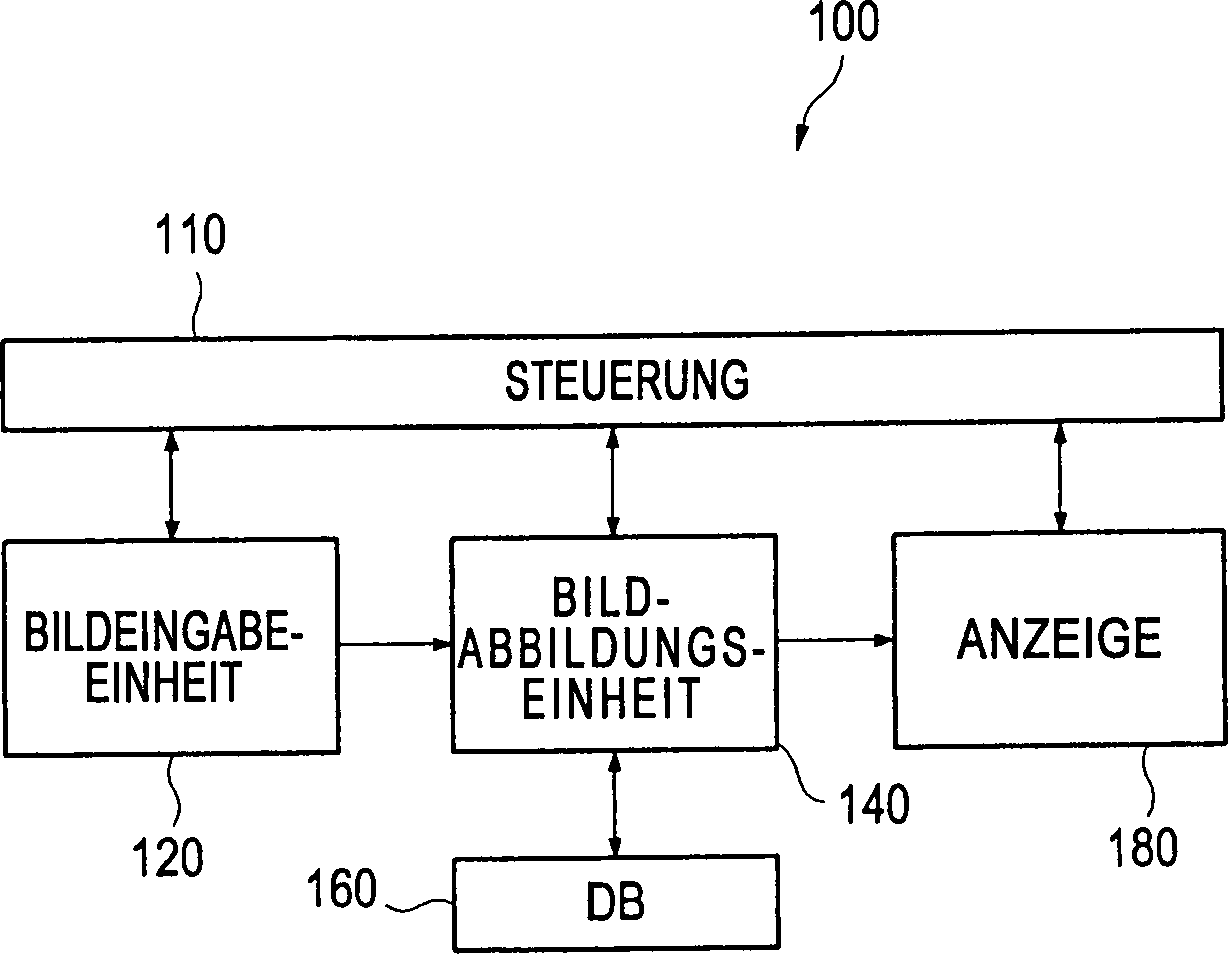
1 zeigt
ein schematisches Blockdiagramm eines Bildholsystems gemäß einer
Ausführungsform; 1 shows a schematic block diagram of a Bildholsystems according to an embodiment;
2 ist
ein schematisches Blockdiagramm einer Bildabbildungsvorrichtung
eines Bildholsystems gemäß einer
Ausführungsform; 2 FIG. 10 is a schematic block diagram of an image-forming apparatus of a picture-taking system according to an embodiment; FIG.
3 ist
ein schematisches Diagramm, das die Anwendung einer Distanztransformation
(DT) (Distance Transform) gemäß einer
Ausführungsform
darstellt; 3 FIG. 10 is a schematic diagram illustrating the application of a distance transform (DT) (Distance Transform) according to an embodiment; FIG.
4 ist
ein schematisches Diagramm, das die Anwendung einer Distanztransformation
zum Umwandeln eines Binärbildes
in ein Zwischenbild gemäß einer
Ausführungsform
darstellt; 4 Fig. 10 is a schematic diagram illustrating the application of a distance transformation to convert a binary image to an intermediate image according to an embodiment;
5 zeigt
beispielhafte Bilder, die die Ergebnisse der DT gemäß einer
Ausführungsform
darstellen; 5 Fig. 12 shows exemplary images illustrating the results of the DT according to an embodiment;
6 zeigt
Beispiele von Basisfunktionen des ART, der in einer Ausführungsform
verwendet wird; 6 shows examples of basic functions of the ART used in one embodiment;
7 ist
ein Flussdiagramm, das ein Verfahren zum Erzeugen eines Beschreibers
gemäß einer
Ausführungsform
darstellt; 7 FIG. 10 is a flowchart illustrating a method of generating a descriptor according to an embodiment; FIG.
8 ist
ein Flussdiagramm, das ein Verfahren zum Holen eines Bildes unter
Verwendung eines Beschreibers gemäß einer Ausführungsform
darstellt; 8th FIG. 10 is a flow chart illustrating a method of fetching an image using a descriptor according to an embodiment; FIG.
9 ist
eine Tabelle, die vergleichend die Datenbanksuchleistungsfähigkeit
des GART-Beschreibers (Gray-level Angular Radial Transform) (Graustufen
Winkelradialtransformation) gemäß einer
Ausführungsform einer
Vorrichtung und eines Verfahrens der vorliegenden Offenbarung und
eines herkömmlichen
ART-Beschreibers, gemessen mit der BEP (Bull's Eye Performance) darstellt. 9 FIG. 10 is a table comparing the gray-level angular radial transformation (GART) descriptor capability of one embodiment of a device and method of the present disclosure and a conventional ART descriptor as measured by the BEP (Bull's Eye Performance ).
ZUSAMMENFASSUNGSUMMARY
In
einer Ausführungsform
wird eine Distanztransformationseinheit (DT-Einheit) verwendet,
um ein Zwischenbild zu erzeugen, das zusätzliche Merkmale (beispielsweise
Beschreiberparameter) für
ein Eingangsanfragebild schafft. Die DT-Einheit kann das Eingangsanfragebild
in das Zwischenbild umwandeln, das verschiedene Pixelwerte in Abhängigkeit
von den Orten der Pixel in dem Bild aufweist. Die verschiedenen
Pixelwerte, die in dem Zwischenbild erzeugt werden, werden als zusätzliche
Bildattribute oder Beschreiberparameter verwendet, die zur effizienteren
und effektiveren Erzeugung eines Bildbeschreibers für das Anfragebild
verwendet werden können.In
an embodiment
if a distance transformation unit (DT unit) is used,
to generate an intermediate image having additional features (e.g.
Descriptor parameter) for
creates an input request image. The DT unit may request the input request image
into the intermediate image, the different pixel values depending on
from the locations of pixels in the image. The different
Pixel values generated in the intermediate image are added as additional
Used image attributes or descriptor parameters that are more efficient
and more effectively generating an image descriptor for the query image
can be used.
Die
Bildbeschreibererzeugungsvorrichtung kann einen ART-Beschreibererzeugungsalgorithmus
auf das Zwischenbild anwenden, wodurch ein Beschreiber des Eingangsanfragebildes
erzeugt wird.The
Image describer generating means may include an ART descriptor generation algorithm
Apply to the intermediate image, creating a descriptor of the input request image
is produced.
In
einer anderen Ausführungsform
enthält
ein Bildholsystem eine Bildeingabeeinheit, eine Beschreiberbestimmungseinheit,
eine Bildvergleichseinheit und eine Holeinheit. Die Bildeingabeeinheit
ist ausgelegt, ein Bild als Eingabe zu empfangen. Die Be schreiberbestimmungseinheit
ist ausgelegt, das Bild zu empfangen und dieses in ein Zwischenbild
unter Verwendung einer DT-Einheit zu wandeln, um einen Beschreiber
des Bildes zu erzeugen. Eine Bildvergleichseinheit ist ausgelegt,
das Bild mit einem oder mehreren Bildern, die in einer Datenbank
gespeichert sind, beispielsweise durch Vergleichen des Beschreibers
des Anfragebildes mit Beschreibern der Bilder, die in der Datenbank
gespeichert sind, zu vergleichen. Schließlich ist eine Holeinheit ausgelegt,
auf der Grundlage des Vergleiches der Beschreiber ein oder mehrere
Kandidatenbilder zu holen, die stark mit dem eingegebenen Bild übereinstimmen
oder diesem ähneln.In
another embodiment
contains
an image retrieval system, an image input unit, a descriptor determination unit,
an image comparison unit and a scoring unit. The image input unit
is designed to receive an image as input. The beeper determination unit
is designed to receive the image and this in an intermediate image
using a DT unit to convert to a descriptor
of the picture. An image comparison unit is designed
the image with one or more images stored in a database
are stored, for example by comparing the descriptor
of the request image with descriptors of the images stored in the database
are stored, compare. Finally, a fetching unit is designed
based on the comparison of the descriptors one or more
To get candidate pictures that strongly match the entered picture
or similar.
Diese
Zusammenfassung ist vorgesehen, um in vereinfachter Form in eine
Auswahl von Konzepten einzuführen,
die unten in der genauen Beschreibung weiter beschrieben werden.
Diese Zusammenfassung soll nicht Schlüsselmerkmale oder wesentliche
Merkmale des beanspruchten Gegenstandes identifizieren, und sie
soll nicht den Bereich des beanspruchten Gegenstandes begrenzen.These
Summary is intended to be simplified in one
To introduce selection of concepts
which will be further described below in the detailed description.
This summary is not intended to be key or essential
Identify features of the claimed subject matter, and they
is not intended to limit the scope of the claimed subject matter.
GENAUE BESCHREIBUNGPRECISE DESCRIPTION
Es
ist selbstverständlich,
dass die Komponenten der vorliegenden Offenbarung, wie sie hier
allgemein beschrieben und in den Figuren dargestellt sind, in einer
breiten Vielzahl von unterschiedlichen Konfigurationen angeordnet
und ausgelegt sein können.
Somit soll die folgende genauere Beschreibung der Ausführungsformen
der Vorrichtungen und Verfahren gemäß der vorliegenden Offenbarung,
wie sie in den Figuren dargestellt sind, den Bereich der Offenbarung,
wie er beansprucht ist, nicht begrenzen, sondern dient nur zum Darstellen
bestimmter Beispiele derzeitiger Ausführungsformen gemäß der Offenbarung.
Die vorliegend beschriebenen Ausführungsformen können durch
Bezugnahme auf die Zeichnungen verstanden werden, wobei gleiche
Teile durchgängig
mit gleichen Bezugszeichen bezeichnet sind.It
is self-evident,
that the components of the present disclosure, as here
generally described and illustrated in the figures, in a
arranged wide variety of different configurations
and can be designed.
Thus, the following more detailed description of the embodiments is intended
the devices and methods according to the present disclosure,
as shown in the figures, the realm of the Revelation,
as it is claimed, not limit, but only serves to represent
certain examples of current embodiments according to the disclosure.
The presently described embodiments can by
Reference to the drawings are understood, wherein the same
Parts throughout
are denoted by the same reference numerals.
In 1 ist
eine Ausführungsform
eines Bildholsystems 100 dargestellt. Das Bildholsystem 100 kann eine
Steuerung 110, eine Bildeingabeeinheit 120, eine
Bildabbildungseinheit 140, eine Datenbank (DB; 160) als
eine Speichervorrichtung und eine Anzeige 180 enthalten.
Jede der Komponenten 110, 120, 140, 160 und 180 kann
als eine einzelne Einheit oder Vorrichtung oder als eine oder mehrere
Einheiten oder Vorrichtungen in Abhängigkeit von den gewünschten
Implementierungen vorgesehen sein. Die Bildabbildungseinheit 140 und die
DB 160 können
beispielsweise in einer einzelnen integrierten Vorrichtung zusammen
mit der Bildeingabeeinheit 120 implementiert sein. Alternativ
können
die Bildabbildungseinheit 140 und die DB 160 getrennt
und fern von der Bildholeinheit 120 implementiert sein.In 1 is an embodiment of a Bildholsystems 100 shown. The image retrieval system 100 can be a controller 110 , an image input unit 120 , an image-imaging unit 140 , a database (DB; 160 ) as a storage device and a display 180 contain. Each of the components 110 . 120 . 140 . 160 and 180 may be provided as a single unit or device or as one or more units or devices depending on the desired implementations. The image-imaging unit 140 and the DB 160 For example, in a single integrated device together with the image input unit 120 be implemented. Alternatively, the image imaging unit 140 and the DB 160 separated and away from the Bildholeinheit 120 be implemented.
In
der Praxis kann ein Nutzer ein Bild für die Eingabe in das Bildholsystem 100 unter
Verwendung der Bildeingabeeinheit 120 auswählen. Die
Bildeingabeeinheit 120 kann verschiedene Arten von Eingabevorrichtungen
einschließlich,
aber nicht einschränkend,
einem Tastenfeld, einer Tastatur, einer Maus, einem berührungssensitiven
Feld, einem berührungssensitiven
Bildschirm, einer Zeigevorrichtung, einem Trackball, einem Lichtstift,
einem Joystick, einer Spracherkennungsvorrichtung, einem Schreibgerät, einem
Augen- und Kopfbewegungsverfolger, einem Digitalisierungstablett,
einem Strichkodeleser und Ähnlichem
enthalten, die jeweils dem Nutzer eine Schnittstelle zum Eingeben
eines gewünschten
Anfragebildes bereitstellen können.
Die Bildeingabeeinheit 120 kann dann das eingegebene Bild
an die Bildabbildungseinheit 140 liefern, wie sie ausgelegt
oder von der Steuerung 110 programmiert ist.In practice, a user can take an image for input to the image retrieval system 100 using the image input unit 120 choose. The image input unit 120 may include various types of input devices, including, but not limited to, a keypad, a keyboard, a mouse, a touch-sensitive panel, a touch-sensitive screen, a pointing device, a trackball Light pen, a joystick, a voice recognition device, a writing device, an eye and head movement tracker, a digitizer, a bar code reader and the like, each of which can provide the user with an interface for entering a desired request image. The image input unit 120 can then input the input image to the image imaging unit 140 deliver as designed or from the controller 110 is programmed.
In
ausgewählten
Ausführungsformen,
in denen die Bildabbildungseinheit 140 auf einer entfernten
Vorrichtung oder einem entfernten Server getrennt von der Bildeingabeeinheit 120 installiert
ist, kann das Eingangsbild von der Bildeingabeeinheit 120 an
die Bildabbildungseinheit 140 über ein drahtgebundenes oder drahtloses
Kommunikationsprotokoll übertragen
werden. Es kann beispielsweise ein Kommunikationsprotokoll (entweder
drahtgebunden oder drahtlos) durch Verwendung eines digitalen Schnittstellenprotokolls
wie zum Beispiel eines seriellen Ports, parallelen Ports, PS/2-Ports,
einer USB-Verbindung (universal serial bus) (universeller serieller
Bus), einer Firewire- oder IEEE-1394-Verbindung oder einer drahtlosen
Schnittstellenverbindung wie zum Beispiel einer Infrarotschnittstelle,
BlueTooth, ZigBee, HDMI (high definition multimedia Interface),
HDCP (high bandwidth digital contents projection), Wi-Fi (wireless
fidelity) oder Ähnlichem
implementiert sein. Alternativ kann ein Bild an die Bildabbildungseinheit 140 durch
mobile Kommunikationssysteme wie zum Beispiel dem globalen System
für Mobilkommunikationen
(GSM), einem globalem Positionierungssystem (GPS), digitales mobiles
Multimedia (DMB), Kodemultiplexzugriff (CDMA), Hochgeschwindigkeits- Downlink-Zugriff
(HSDPA), Wi-Bro Drahtlos-Breitband und Ähnlichem übertragen werden.In selected embodiments, in which the image imaging unit 140 on a remote device or a remote server separate from the image input unit 120 is installed, the input image from the image input unit 120 to the image imaging unit 140 be transmitted via a wired or wireless communication protocol. For example, it may be a communication protocol (either wired or wireless) using a digital interface protocol such as a serial port, parallel ports, PS / 2 ports, a Universal Serial Bus (USB) connection, a Firewire interface. or IEEE 1394 connection or a wireless interface connection such as an infrared interface, BlueTooth, ZigBee, high definition multimedia interface (HDMI), high bandwidth digital contents (HDCP), wireless fidelity or the like. Alternatively, an image may be sent to the image imaging unit 140 by mobile communication systems such as the Global System for Mobile Communications (GSM), Global Positioning System (GPS), Digital Mobile Multimedia (DMB), Code Division Multiple Access (CDMA), High Speed Downlink Access (HSDPA), Wi-Bro Wireless Broadband and Similar be transferred.
Die
Bildabbildungseinheit 140 kann ein Bild (beispielsweise
ein Anfragebild) empfangen und bestimmen, ob das empfangene Bild
einen Beschreiber zum Identifizieren oder Abbilden der Bilder enthält. Wenn
die Bildabbildungseinheit 140 keinen Beschreiber erfasst,
kann die Bildabbildungseinheit 140 dann den Prozess zum
Erhalten eines Beschreibers für
das Anfragebild durch Anwenden eines Beschreibererzeugungsalgorithmus
auf das Anfragebild starten. Die Bildabbildungseinheit 140 vergleicht
den Beschreiber des Anfragebildes mit Beschreibern von Kandidatenbildern,
die in der DB 160 gespeichert sind, um mindestens ein abgebildetes bzw. übereinstimmendes
Bild auszuwählen.
Das abgebildete Bild wird beispielsweise zur Ansicht durch den Nutzer
an die Anzeige 180 geliefert.The image-imaging unit 140 may receive an image (eg, a request image) and determine whether the received image includes a descriptor for identifying or mapping the images. If the picture imaging unit 140 If no descriptor is detected, the image imaging unit may 140 then start the process of obtaining a descriptor for the request image by applying a descriptor generation algorithm to the request image. The image-imaging unit 140 compares the descriptor of the query image with descriptors of candidate images stored in the DB 160 are stored to select at least one mapped or matching image. For example, the imaged image becomes for display by the user 180 delivered.
2 zeigt
eine Ausführungsform
der Bildabbildungseinheit 140. In einigen Ausführungsformen
kann die Bildabbildungseinheit 140 eine Beschreibererzeugungseinheit 280 und
eine Ähnlichkeitsvergleichseinheit 260 enthalten.
Wie es in 2 gezeigt ist, kann die Beschreibererzeugungseinheit 280 eine
Distanztransformationseinheit (DT-Einheit) 220 und eine Winkelradialtransformationseinheit
(ART-Einheit) 240 enthalten. Die Bildabbildungseinheit 140 empfängt ein
Anfragebild 210 von der Bildeingabeeinheit 120 und
führt einen
Prozess zum Abbilden des Anfragebildes 210 auf Kandidatenbilder,
die in der DB 160 gespeichert sind, durch. Die Bildabbildungseinheit 140 kann
beispielsweise das Anfragebild 210 durch Vergleichen eines
Beschreibers des Anfragebildes 210 mit Beschreibern der
Kandidatenbilder auf Kandidatenbilder abbilden (auf Übereinstimmung
prüfen).
Die Bildabbildungseinheit 140 liefert das abgebildete Bild 270 an
die Anzeige 180. 2 shows an embodiment of the image imaging unit 140 , In some embodiments, the image imaging unit 140 a descriptor generation unit 280 and a similarity comparison unit 260 contain. As it is in 2 can be shown, the descriptor generating unit 280 a distance transformation unit (DT unit) 220 and an angular radial transformation unit (ART unit) 240 contain. The image-imaging unit 140 receives a request image 210 from the image input unit 120 and performs a process of mapping the request image 210 on candidate pictures in the DB 160 are saved by. The image-imaging unit 140 For example, the request image 210 by comparing a descriptor of the request image 210 map to candidate pictures using descriptors of the candidate pictures (check for consistency). The image-imaging unit 140 provides the pictured image 270 to the ad 180 ,
In
ausgewählten
Ausführungsformen
wandelt, wenn die Beschreibererzeugungseinheit 280 das
Anfragebild 210 empfängt,
die DT-Einheit 220 in der Beschreibererzeugungseinheit 280 das
Anfragebild 210 in ein Zwischenbild um und liefert das
Zwischenbild an die ART-Einheit 240. Die DT-Einheit 220 kann
beispielsweise das Eingangsanfragebild in ein binäres Bild
modifizieren, das eine der Gestalt des eingegebenen Bildes entsprechende
aufweist, und das Binärbild
in ein Zwischenbild umwandeln, das verschiedene Pixelwerte in Abhängigkeit
von den Orten der Pixel in Bezug auf die Grenze des Binärbildes
aufweist. Die ART-Einheit 240 kann einen ART-Beschreibererzeugungsalgorithmus
für das
Zwischenbild durchführen,
wodurch ein Beschreiber des Eingangsanfragebildes 210 für den letztendlichen
Vergleich und das Abbilden mit den Bildern, die in der Datenbank
gespeichert sind, erzeugt wird. Die ART-Einheit 240 kann den breiten
Bereich von Pixelwerten des Zwischenbildes als zusätzliche
Merkmale oder Parameter verwenden, um einen Beschreiber für das eingegebene
Originalbild (d. h. das Anfragebild 210) zu erzeugen. Die
ART-Einheit 240 liefert den Beschreiber und das Anfragebild
an die Ähnlichkeitsvergleichseinheit 260.
Die Ähnlichkeitsvergleichseinheit 260 kann
dann durch Vergleichen des Beschreibers des Anfragebildes 210 mit
Beschreibern der Bilder, die in der DB 160 gespeichert
sind, nach Kandidatenbildern in der DB 160 suchen, die
dem Anfragebild 210 am meisten ähneln, und diese Kandidatenbilder
aus der DB 160 holen. Die Beschreiber der Kandidatenbilder
können
im Voraus in der DB 160 zusammen mit den Kandidatenbildern
gespeichert werden. Alternativ kann die Bildabbildungseinheit 140 eines
der Kandidatenbilder zufällig
oder unter Verwendung einer Folgennummer, die an das Kandidatenbild,
das in der DB 160 gespeichert ist, angehängt ist,
auswählen.
Die Bildabbildungseinheit 140 verwendet dieselben Prozesse
wie diejenigen, die verwendet werden, um einen Beschreiber des Anfragebildes 210 zu erzeugen,
um einen Beschreiber des Kandidatenbildes zu erzeugen. Auf diese
Weise kann die Bildabbildungseinheit 140 den Beschreiber
für das
Kandidatenbild zu dem Zeitpunkt (oder etwa zu demselben Zeitpunkt),
zu dem das Anfragebild mit dem Kandidatenbild verglichen wird, erhalten.
In jedem Fall kann die Ähnlichkeitsvergleichseinheit 260 auf
das Vergleichen der Beschreiber des Anfragebildes 210 mit
den Kandidatenbildern hin Kandidatenbilder holen, die am stärksten mit
dem Anfragebild 210 übereinstimmen
oder diesem ähneln.In selected embodiments, when the descriptor generation unit converts 280 the request picture 210 receives the DT unit 220 in the descriptor generation unit 280 the request picture 210 into an intermediate image and delivers the intermediate image to the ART unit 240 , The DT unit 220 For example, it may modify the input request image into a binary image having one of the shape of the input image and convert the binary image into an intermediate image having different pixel values depending on the locations of the pixels with respect to the boundary of the binary image. The ART unit 240 can perform an ART descriptor generation algorithm for the intermediate image, whereby a descriptor of the input request image 210 for the final comparison and mapping with the images stored in the database. The ART unit 240 may use the wide range of pixel values of the intermediate image as additional features or parameters to provide a descriptor for the input original image (ie, the request image 210 ) to create. The ART unit 240 supplies the descriptor and the request image to the similarity comparison unit 260 , The similarity comparison unit 260 can then by comparing the descriptor of the request image 210 with descriptors of the images in the DB 160 stored, according to candidate images in the DB 160 search the request image 210 most similar, and these candidate images from the DB 160 pick up. The descriptors of the candidate images can be pre-set in the DB 160 stored together with the candidate pictures. Alternatively, the image imaging unit 140 one of the candidate pictures randomly or using a sequence number attached to the candidate picture in the DB 160 is stored, is attached, select. The image-imaging unit 140 uses the same processes as those used to create a descriptor of the request image 210 to generate a descriptor of the candidate image. In this way, the image imaging unit 140 the descriptor for the candidate image at the time (or about the same time), too the request image is compared with the candidate image obtained. In any case, the similarity comparison unit 260 on comparing the descriptors of the request image 210 Get candidate pictures with the candidate pictures, the strongest with the request picture 210 match or resemble it.
Nachdem
die Ähnlichkeitsvergleichseinheit 260 den
Bildbeschreiber des Anfragebildes 210 und sämtliche
oder einige der Bildbeschreiber, die in der DB 160 gespeichert
sind, verglichen hat, holt die Ähnlichkeitsvergleichseinheit 260 mindestens
ein Bild (d. h. ein abgebildetes bzw. übereinstimmendes Bild 270),
das dem Anfragebild 210 am meisten ähnelt, aus der DB 160 und
gibt das geholte Bild oder die geholten Bilder an die Anzeige 180 aus.
Als ein Beispiel kann die Ähnlichkeitsvergleichseinheit 260 eine
Distanz zwischen dem Beschreiber des Eingangsanfragebildes 210 und
Beschreibern der Kan didatenbilder bestimmen, um das abgebildete
Bild 270, das die kürzeste
Distanz aufweist, zu bestimmen. Die Ähnlichkeitsvergleichseinheit 260 kann das
Eingangsanfragebild 210 in der DB 160 zusammen
mit dem Beschreiber zum Beschreiben des eingegebenen Bildes 210 speichern.
Die Ähnlichkeitsvergleichseinheit 260 liefert
das abgebildete Bild an die Anzeige 180.After the similarity comparison unit 260 the image descriptor of the request image 210 and all or some of the image descriptors that are in the DB 160 stored, gets the similarity comparison unit 260 at least one image (ie a mapped or matching image 270 ), the request picture 210 most resembles, from the DB 160 and displays the fetched picture or pictures 180 out. As an example, the similarity comparison unit 260 a distance between the descriptor of the input request image 210 and Describers of Kan didatenbilder determine the image 270 which has the shortest distance to determine. The similarity comparison unit 260 can the input request image 210 in the DB 160 together with the descriptor to describe the input image 210 to save. The similarity comparison unit 260 delivers the picture to the display 180 ,
In
einigen Ausführungsformen
kann die Beschreibererzeugungseinheit 280 anfänglich das
Anfragebild 210 von der Bildeingabeeinheit 120 mittels
verschiedener Verfahren einschließlich direkter Verbindungs-
oder Kommunikationsprotokolle empfangen. Die DT-Einheit 220 in
der Beschreibererzeugungseinheit 280 kann dann das Anfragebild 210 in
ein Zwischenbild umwandeln, um das Originalanfragebild 210 mit
mehr Parametern oder Merkmalen zusätzlich zu denjenigen, die von
dessen einem oder mehreren Grenz- oder Umrisslinien extrahiert werden,
versehen. Die Beschreibererzeugungseinheit 280 wandelt
beispielsweise das Anfragebild 210 in ein Binärbild um.
Die DT-Einheit 210 kann das Binärbild in ein Zwischenbild,
das Graustufen aufweist, umwandeln. Mit anderen Worten wandelt die
DT-Einheit 210 das Originalanfragebild 210 derart
um, dass es Grenzen aufweist, die sich graduell in Abhängigkeit
von dem Abstand zu Umrisslinien des Binärbildes ändern. Die DT-Einheit 220 kann
das Eingangsanfragebild 210 in das Zwischenbild, das graue
Pixelwerte (von reinem Weiß bis
reinem Schwarz) aufweist, in Abhängigkeit
von den Orten der Pixel (oder auf der Grundlage der Abstände bzw.
Distanzen der Pixel von den äußeren Grenzen
oder Umrisslinien) umwandeln. Auf diese Weise kann die DT-Einheit 220 zusätzliche
Parameter oder Merkmale zu denjenigen des Anfragebildes 210 schaffen, um
das Zwischenbild wie zum Beispiel das Graustufenbild zu erzeugen.
Obwohl das Zwischenbild zur Vereinfachung der Beschreibung als ein
Graustufenbild beschrieben ist, kann das Zwischenbild jegliche umgewandelten
Bilder beinhalten, die zusätzliche
Merkmale zu denjenigen des Anfragebildes 210 aufweisen,
beispielsweise ein Bild, das sich graduell ändernde Grenzen aufweist, ein
Bild, dem Farbe hinzugefügt
ist, oder ein Bild, dem Luminanz hinzugefügt ist, solange wie sich derartige
Merkmale (beispielsweise eine Graustufe, Farbe, Luminanz und Ähnliches)
mit den Orten der Pixel in dem Bild ändern. Es können beispielsweise unterschiedliche
Schattierungen, Intensitäten
oder Stärken
der Farbe einen jeweiligen Pixelwerts in Abhängigkeit von dem Abstand bzw.
der Distanz zu der Grenze des Bildes zugewiesen werden.In some embodiments, the descriptor generation unit 280 initially the request image 210 from the image input unit 120 received by various methods including direct connection or communication protocols. The DT unit 220 in the descriptor generation unit 280 can then the request image 210 Convert to an intermediate image to the original request image 210 with more parameters or features in addition to those extracted from its one or more boundary or contour lines. The descriptor generation unit 280 converts the request image, for example 210 into a binary image. The DT unit 210 The binary image can be converted to an intermediate image that has gray levels. In other words, the DT unit converts 210 the original request picture 210 such that it has boundaries that change gradually as a function of the distance to outlines of the binary image. The DT unit 220 can the input request image 210 into the intermediate image, which has gray pixel values (from pure white to pure black), depending on the locations of the pixels (or based on the distances of the pixels from the outer boundaries or outlines). That way, the DT unit can 220 additional parameters or features to those of the request image 210 create to create the intermediate image such as the grayscale image. Although the intermediate image is described as a gray scale image for ease of description, the intermediate image may include any converted images that have additional features to those of the image request 210 For example, an image having gradually varying boundaries, an image to which color is added, or an image to which luminance is added as long as such features (eg, gray scale, color, luminance, and the like) coincide with the locations of the images Change pixels in the image. For example, different shades, intensities or intensities of the color may be assigned to a respective pixel value depending on the distance to the boundary of the image.
Wenn
das Zwischenbild einmal wie oben beschrieben erzeugt ist, wird es
an die ART-Einheit 240 geliefert,
die einen Algorithmus auf das Zwischenbild anwendet, wodurch ein
ART-Beschreiber für
das Zwischenbild erzeugt wird. Ein derartiger ART-Beschreiber kann
als ein GART-Beschreiber (Graustufen-Winkelradialtransformations-Beschreiber)
zum Beschreiben des Anfragebildes 210 bezeichnet werden.
Der GART-Beschreiber und das Originalanfragebild 210 werden
an die Ähnlichkeitsvergleichseinheit 260 weitergeleitet.
Die Ähnlichkeitsvergleichseinheit 260 vergleicht
den GART-Beschreiber des Anfragebildes 210 mit einem oder mehreren
Beschreibern des bzw. der Kandidatenbild(er), der bzw. die in der
DB 160 gespeichert ist bzw. sind. Die Ähnlichkeitsvergleichseinheit 260 kann
somit ein oder mehrere Kandidatenbilder, die in der DB 160 gespeichert
sind, bestimmen, die am Besten (oder am Stärksten) mit dem Anfragebild 210 übereinstimmen.
Die Ähnlichkeitsvergleichseinheit 260 kann
beispielsweise die Distanz oder Differenz zwischen dem Beschreiber
des Anfragebildes 210 und den Beschreibern der Kandidatenbilder
bestimmen, um das abgebildete Bild 270, das eine kürzeste Distanz
oder kleinste Differenz zu diesen aufweist, zu bestimmen. Die Ähnlichkeitsvergleichseinheit 260 liefert
das abgebildete Bild 270 (d. h. das oder die Kandidatenbilder,
das oder die als am Meisten dem Anfragebild 210 ähnelnd oder
als sehr ähnlich
bestimmt wird bzw. werden) an die Anzeigeeinheit 180 mittels
verschiedener Verfahren einschließlich direkter Verbindungs-
oder Kommunikationsprotokolle, wie es von der Steuerung 110 programmiert
oder ausgelegt ist, liefern.Once the intermediate image is created as described above, it is sent to the ART unit 240 which applies an algorithm to the intermediate image, thereby creating an ART descriptor for the intermediate image. Such an ART descriptor may act as a GART descriptor (grayscale angle radial transform descriptor) for describing the query image 210 be designated. The GART descriptor and the original request image 210 are sent to the similarity comparison unit 260 forwarded. The similarity comparison unit 260 compares the GART descriptor of the request image 210 with one or more descriptors of the candidate image (s) in the DB 160 is stored or are. The similarity comparison unit 260 Thus one or more candidate images can be found in the DB 160 determine the best (or fittest) with the request image 210 to match. The similarity comparison unit 260 For example, the distance or difference between the descriptor of the request image 210 and determine the descriptors of the candidate images to the imaged image 270 to determine a shortest distance or smallest difference to them. The similarity comparison unit 260 provides the pictured image 270 (ie, the candidate image (s), the one or the most as the request image 210 similar or very similar) to the display unit 180 using various methods, including direct connection or communication protocols, as provided by the controller 110 programmed or designed to deliver.
In
ausgewählten
Ausführungsformen,
bei denen die Anzeige 180 in einer fernen Vorrichtung getrennt von
der Bildabbildungseinheit 140 installiert ist, kann das
abgebildete Bild oder können
verschiedene beste Kandidatenbilder an die Anzeige 180 mittels
eines drahtgebundenen oder drahtlosen Kommunikationsprotokolls übertragen
werden. In alternativen Ausführungsformen
können
die Bildeingabeeinheit 120 und die Anzeige 180 in
einer einzigen Vorrichtung implementiert sein, die die Möglichkeit
zur Kommunikation aufweist, beispielsweise in einem Mobiltelefon,
einem PDA, einem drahtlosen Terminal oder Ähnlichem.In selected embodiments, where the display 180 in a remote device separate from the image imaging unit 140 is installed, can display the picture or can display various best candidate pictures to the display 180 be transmitted by means of a wired or wireless communication protocol. In alternative embodiments, the image input unit 120 and the ad 180 be implemented in a single device that has the ability to communicate, for example in a mobile phone, a PDA, a wireless terminal or the like.
In 3 ist
das Konzept oder die Anwendung einer Distanztransformation (DT),
die von der DT-Einheit 220 verwendet wird, dargestellt. 3 zeigt
ein Binärbild
des Eingangs anfragebildes 210 (links) und ein Zwischenbild
nach der Durchführung
der DT-Anwendung
(rechts). Wie es in 3 gezeigt ist, kann das Anfragebild 210 in
binärer
Form dargestellt werden, bei der die Grenzpixel einer Gestalt in
dem Anfragebild 210 mit einem „0”-Pixelwert angegeben sind
und der Rest der Pixel mit einem „1”-Pixelwert angegeben ist.
In ausgewählten
Ausführungsformen
kann die DT-Einheit 220 eine binäre Form des Anfragebildes 210 in
ein Graustufenbild (d. h. das Zwischenbild) derart umwandeln, dass
jedes Pixel in dem binären
Anfragebild 210 einen Wert aufweist, der dem Abstand bzw.
der Distanz zwischen einer Grenze des Binärbildes und diesem Pixel entspricht.
Die DT-Einheit 220 kann ein Graustufenbild ausgeben, wie
es auf der rechten Seite der 3 gezeigt ist.
Das Graustufenbild weist Pixelwerte auf, die dem Abstand zu der
Grenze der Gestalt in dem Bild entsprechen, so dass das Pixel, das
am nächsten
zu der Mitte der Gestalt angeordnet ist, den größten Pixelwert (in diesem Fall „3”) aufweist.
Auf diese Weise kann das binäre
Originalanfragebild in das Graustufenbild umgewandelt werden, das
modifizierte Pixelwerte in Abhängigkeit
von dem Abstand dieser zu der Grenze aufweist.In 3 is the concept or application of a distance transformation (DT) performed by the DT unit 220 used is shown. 3 shows a binary image of the input request image 210 (left) and an intermediate image after the execution of the DT application (right). As it is in 3 can be shown, the request picture 210 in binary form, where the boundary pixels of a shape in the query image 210 are indicated with a "0" pixel value and the remainder of the pixels are indicated with a "1" pixel value. In selected embodiments, the DT unit 220 a binary form of the request image 210 into a grayscale image (ie, the intermediate image) such that each pixel in the binary query image 210 has a value corresponding to the distance between a boundary of the binary image and this pixel. The DT unit 220 can output a grayscale image as it is on the right side of the 3 is shown. The grayscale image has pixel values corresponding to the distance to the boundary of the shape in the image such that the pixel located closest to the center of the shape has the largest pixel value ("3" in this case). In this way, the original binary request image may be converted to the grayscale image having modified pixel values as a function of the distance to the boundary.
4 zeigt
ein anderes Beispiel der Darstellung der Anwendung einer Distanztransformation
(DT), um ein Binärbild
in ein Zwischenbild (beispielsweise ein Graustufenbild) umzuwandeln.
Das Binärbild,
das links gezeigt ist, weist einen ersten Pixelwert „A” an Pixeln
entlang einer Grenze des Bildes und einen zweiten Pixelwert „B” an dem
Rest der Pixel auf. Die DT-Einheit 220 kann jedes der Pixelwerte
in Abhängigkeit
von einem Abstand zwischen der Grenze und einer jeweiligen Position
des entsprechenden Pixels umwandeln, so dass das Zwischenbild nach
der DT (rechts) einen ersten Pixelwert „A” an den Pixeln direkt benachbart
zu der Grenze und verschiedene andere Pixelwerte für den Rest
der Pixel, die nicht in direkter Nachbarschaft zu der Grenze liegen,
aufweist. Das Binärbild
kann beispielsweise in das Zwischenbild derart umgewandelt werden,
dass dieses Pixelwerte aufweist, die sich in Abhängigkeit von den Positionen
der Pixel ändern,
so dass die Pixel in dem DT-angewendeten bzw. DT-bearbeiteten Bild
den zweiten Wert „B” an den
Pixeln diagonal benachbart zu der Grenze (nur die Ecken sind benachbart
zu der Grenze), einen dritten Pixelwert „C” an Pixelpositionen direkt benachbart
zu den Pixeln, die die Werte „A” aufweisen,
und einen vierten Pixelwert „D” an Pixelpositionen
direkt benachbart zu den Pixeln, die die Werte „C” aufweisen, aufweisen. Auf
diese Weise kann das DT-bearbeitete Bild (das Zwischenbild) zusätzliche
Pi xelwerte aufweisen, die von „A” bis „D” reichen,
und die verschiedenen Pixelwert können die Positionen der Pixel
angeben, so dass geometrische Komponenten des Bildes, beispielsweise
eine Winkel- und eine Radialkomponente der Pixel größerer Auflösungen aufweisen
können,
um dadurch das Bild noch genauer zu beschreiben. 4 FIG. 12 shows another example of the representation of the application of a distance transformation (DT) to convert a binary image into an intermediate image (for example, a gray scale image). The binary image shown on the left has a first pixel value "A" of pixels along a boundary of the image and a second pixel value "B" on the remainder of the pixels. The DT unit 220 may convert each of the pixel values depending on a distance between the boundary and a respective position of the corresponding pixel, such that the intermediate image after the DT (right) has a first pixel value "A" at the pixels immediately adjacent to the boundary and various other pixel values for the rest of the pixels that are not in close proximity to the boundary. For example, the binary image may be converted to the intermediate image to have pixel values that change in response to the positions of the pixels, such that the pixels in the DT-applied image process the second value "B" to the pixel Pixels diagonally adjacent to the boundary (only the corners are adjacent to the boundary) have a third pixel value "C" at pixel locations immediately adjacent to the pixels having the values "A" and a fourth pixel value "D" directly adjacent to pixel locations to the pixels having the values "C". In this way, the DT-processed image (the intermediate image) may have additional pixel values ranging from "A" to "D" and the various pixel values may indicate the positions of the pixels such that geometric components of the image, such as an angle - And have a radial component of the pixels of larger resolutions, thereby to describe the image in more detail.
In 5 sind
die Ergebnisse der Anwendung der DT gemäß einer Ausführungsform
der vorliegenden Offenbarung dargestellt. 5 zeigt
Bilder, die Gestalten vor (links) und nach (rechts) der Anwendung
der DT auf jede der Gestalten in dem binären Anfragebild aufweisen.
Wie es in 5 gezeigt ist, weist das DT-bearbeitete
Bild (das Zwischenbild, das auf der rechten Seite gezeigt ist) eine
sanfte Abstufung der Grenzen der Gestalten in dem Bild auf, was
zusätzliche
geometrische Komponenten für
das Anfragebild schaffen kann. Auf diese Weise kann das Zwischenbild
einen breiteren Bereich an Pixelwerten als das Anfragebild oder
verschiedene Arten aufweisen. Ein derartiger breiter Bereich von
Pixelwerten kann zusätzliche
Parameter oder Attribute zum noch genaueren Beschreiben des Anfragebildes
schaffen. Somit kann das DT-bearbeitete Bild zusätzliche Parameter- oder Attributpegel
an jedem Pixelwert aufweisen, so dass ein ART-Beschreiber, der von dem DT-bearbeiteten
Bild erhalten wird, das Originalbild noch genauer beschreiben kann.
In einigen Ausführungsformen
sind die Gestalten des Bildes auf der linken Seite mit schwarzen
und weißen
Farben dargestellt, und Informationen, die aus den Pixeln des Bildes
extrahiert werden könnten,
können
auf der Grundlage der Farbänderung
zwischen schwarz und weiß angeben,
wo die Grenzen der Gestalten vorhanden sind. In dem DT-bearbeiteten
Bild auf der rechten Seite der 5 sind die
Grenzen des Bildes abgestuft, wodurch zusätzliche Informationen über das
Bild, wie zum Beispiel eine Umrisslinie, eine Mittelachse, ein Skelett
oder Ähnliches
bereitgestellt werden. Da das DT-bearbeitete Bild beispielsweise
größere Pixelwerte
aufweist, wenn die Positionen der Pixel von den Grenzen des Anfragebildes
weiter entfernt sind, können
die Pixel, die die größten Werte
aufweisen, der Mittelachse des Bildes entsprechen. Auf diese Weise
kann die Beschreibererzeugungseinheit 280 das Bild noch
genauer charakterisieren, so dass das Bildholsystem 100 das
Bild unter Verwendung des genaueren Beschreibers noch genauer holen
kann.In 5 The results of applying the DT according to one embodiment of the present disclosure are shown. 5 FIG. 12 shows images having shapes before (left) and after (right) the application of the DT to each of the shapes in the binary query image. As it is in 5 4, the DT-processed image (the intermediate image shown on the right) has a smooth gradation of the boundaries of the shapes in the image, which can provide additional geometric components for the query image. In this way, the intermediate image may have a wider range of pixel values than the query image or different types. Such a broad range of pixel values may provide additional parameters or attributes for further describing the query image. Thus, the DT-edited image may have additional parameter or attribute levels at each pixel value, such that an ART descriptor obtained from the DT-edited image may still more accurately describe the original image. In some embodiments, the shapes of the image on the left are shown in black and white colors, and information that could be extracted from the pixels of the image may indicate based on the color change between black and white where the boundaries of the shapes exist are. In the DT edited image on the right side of the 5 For example, the boundaries of the image are graded, providing additional information about the image, such as an outline, a central axis, a skeleton, or the like. For example, because the DT-processed image has larger pixel values when the positions of the pixels are farther from the boundaries of the query image, the pixels having the largest values may correspond to the center axis of the image. In this way, the descriptor generation unit 280 to characterize the picture more precisely, so that the image retrieval system 100 can get the picture even more accurate using the closer descriptor.
In
bestimmten Ausführungsformen
führt die
ART-Einheit 240 einen Algorithmus zum Erzeugen eines ART-Beschreibers
für das
DT-bearbeitete Bild durch, wodurch ein GART-Beschreiber für das Anfragebild 210 erhalten
wird. Die ART-Einheit 240 kann beispielsweise das Graustufenbild
als f(ρ, θ) unter
Verwendung einer Polarkoordinate (ρ, θ) darstellen. Durch Verwenden
von ART-Basisfunktionen Vnm(ρ, θ) können Merkmalskoeffizienten
Fnm des Graustufenbildes in einem Polarkoordinatensystem
wie folgt dargestellt werden. [Gleichung
1] wobei die ART-Basisfunktionen Vnm(ρ, θ) wie folgt
berechnet werden können; Vnm(ρ, θ) = Am (θ)Rn(ρ)und
wobei jedes Element der ART-Basisfunktionen Vnm(ρ, θ) durch
die folgende Gleichung berechnet oder definiert wird: wobei n einen Pegel bzw.
eine Ebene von Winkeln und m einen Pegel bzw. eine Ebene von Radien
angibt.In certain embodiments, the ART unit performs 240 an algorithm for generating an ART descriptor for the DT-edited image, whereby a GART descriptor for the request image 210 is obtained. The ART unit 240 For example, the gray scale image may be represented as f (ρ, θ) using a polar coordinate (ρ, θ). By using ART basic functions V nm (ρ, θ), feature coefficients F nm of the gray scale image in a polar coordinate system can be represented as follows. [Equation 1] wherein the ART basis functions V nm (ρ, θ) can be calculated as follows; V nm (ρ, θ) = A m (Θ) R n (Ρ) and wherein each element of the ART basis functions V nm (ρ, θ) is calculated or defined by the following equation: where n indicates a level of angles and m indicates a level of radii.
Beispielsweise
können
in einem Fall, in dem n = 0, 1, 2; und m = 0, 1, ..., 11 gilt, insgesamt
36 Basisfunktionen erzeugt werden, wie es in der 6 gezeigt
ist. Durch Verwenden der Basisfunktionen werden die Amplituden ai der Merkmalskoeffizienten, die in der obigen
Gleichung (1) für
m und n (n = 0, 1, 2; und m = 0, 1, ..., 11) erhalten werden, gesammelt,
um den GART-Beschreiber für
das j-te Bild zu bilden, wie es im Folgenden angegeben ist: For example, in a case where n = 0, 1, 2; and m = 0, 1, ..., 11 applies, a total of 36 basic functions are generated, as described in the 6 is shown. By using the basis functions, the amplitudes a i of the feature coefficients obtained in the above equation (1) for m and n (n = 0, 1, 2, and m = 0, 1, ..., 11) are collected to form the GART descriptor for the jth image, as indicated below:
[Gleichung 2][Equation 2]
-
Aj = [a1j a2j ...
a35j a36j ]A j = [a 1 j a 2 j ...
a 35 j a 36 j ]
-
wobei j ein Beschreiberindex ist, der das j-te Bild angibt.
Obwohl die 36 Basisfunktionen verwendet werden, um die ART-Operationen
zu beschreiben, ist es für
einen Fachmann ersichtlich, dass er eine andere Anzahl von Basisfunktionen
verwenden könnte,
ohne auf eine spezielle Anzahl beschränkt zu sein.where j is a descriptor index indicating the jth image.
Although the 36 basic functions are used to perform the ART operations
to describe it is for
One skilled in the art will recognize that it has a different number of basic functions
could use
without being limited to a specific number.
In 2 liefert
die ART-Einheit 240 einen GART-Beschreiber für das Anfragebild 210 an
die Ähnlichkeitsvergleichseinheit 260.
In ausgewählten
Ausführungsformen
kann die Ähnlichkeitsvergleichseinheit 260 das
Anfragebild mit Kandidatenbildern durch Messen der „Distanz” zwischen
dem Anfragebild und den Kandidatenbildern vergleichen. Um die Distanz
zu messen, berechnet die Ähnlichkeitsvergleichseinheit 260 tatsächlich die
Distanz unter Verwendung von GART-Beschreibern der Bilder. Die Distanz
kann beispielsweise unter Verwendung der Summe der Differenzen zwischen
den Koeffizienten, die denselben Index (m, n) aufweisen, wie folgt
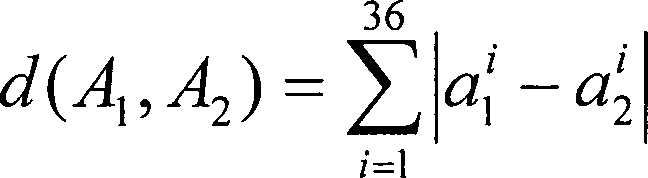
berechnet werden: [Gleichung
3] für
die beiden GART-Beschreiber des Anfragebildes und eines der Kandidatenbilder,
wie es in einer Vektorform A1 = [a11 a21 ...
a351 a361 ] und A2 = [a12 a22 ... a352 a362 ] jeweils
dargestellt werden kann. Die Ähnlichkeitsvergleichseinheit 260 kann
dasjenige Kandidatenbild auswählen,
das als das abgebildete Bild die kleinste Distanz (beispielsweise
Länge des
Distanzvektors) zu dem Anfragebild aufweist. Alternativ kann die Ähnlichkeitsvergleichseinheit 260 die
Kandidatenbilder auswählen,
die kleinere Distanzen als eine Schwellendistanz aufweisen, und
sämtliche
oder einige der ausgewählten
Bilder als die abgebildeten Bilder oder das abgebildete Bild bestimmen.
Die Ähnlichkeitsvergleichseinheit 260 kann
beliebige abgebildete Bilder zu der Anzeige 270 übertragen,
um es dem Nutzer zu ermöglichen,
diese zu betrachten.In 2 delivers the ART unit 240 a GART descriptor for the request image 210 to the similarity comparison unit 260 , In selected embodiments, the similarity comparison unit 260 compare the query image with candidate images by measuring the "distance" between the query image and the candidate images. To measure the distance, the similarity comparison unit calculates 260 actually the distance using GART descriptors of the images. For example, the distance can be calculated using the sum of the differences between the coefficients having the same index (m, n) as follows: [Equation 3] for the two GART descriptors of the request image and one of the candidate images, as in a vector form A 1 = [a 1 1 a 2 1 ... a 35 1 a 36 1 ] and A 2 = [a 1 2 a 2 2 ... a 35 2 a 36 2 ] each can be shown. The similarity comparison unit 260 For example, the candidate image having the smallest distance (e.g., length of the distance vector) to the request image as the imaged image may be selected. Alternatively, the similarity comparison unit 260 select the candidate images having smaller distances than a threshold distance and designate all or some of the selected images as the imaged images or the imaged image. The similarity comparison unit 260 can display any imaged images to the ad 270 to allow the user to view them.
In 7 mit
Bezug auf 1 wird ein Verfahren zum Erzeugen
eines GART-Beschreibers
eines Bildes gemäß einer
Ausführungsform
der vorliegenden Offenbarung dargestellt. Im Schritt 710 kann
ein Nutzer anfänglich
ein Bild in das Bildholsystem 100 unter Verwendung der
Bildeingabeeinheit 120 eingeben. Der Nutzer kann verschiedene
Eingabevorrichtungen wie zum Beispiel ein Tastenfeld, eine Tastatur,
eine Maus oder Ähnliches
verwenden, um das gewünschte
Bild in das Bildholsystem 100 einzugeben. Optional kann
der Nutzer das gewünschte
Bild an ein fernes System übertragen,
um eines oder mehrere Bilder, die in einer Datenbank des fernen
Systems gespeichert sind, zu holen. In einem derartigen Fall kann
das gewünschte
Bild in eine tragbare Vorrichtung wie zum Beispiel ein Mobiltelefon,
einen PDA oder Ähnliches
eingegeben und dann zu dem Bildholsystem 200 unter Verwendung
eines drahtlosen oder drahtgebundenen Kommunikationsprotokolls übertragen
werden.In 7 regarding 1 A method for generating a GART descriptor of an image according to an embodiment of the present disclosure is illustrated. In step 710 a user can initially get an image into the image retrieval system 100 using the image input unit 120 enter. The user can use various input devices, such as a keypad, a keyboard, a mouse, or Use similar to the desired image in the image retrieval system 100 enter. Optionally, the user may transmit the desired image to a remote system to fetch one or more images stored in a remote system database. In such a case, the desired image may be input to a portable device such as a mobile phone, a PDA, or the like, and then to the image retrieval system 200 be transmitted using a wireless or wired communication protocol.
Die
Bildeingabeeinheit 120 kann das Anfragebild 210 an
die Bildabbildungseinheit 140 übertragen. Im Schritt 720 kann
die DT-Einheit 220 (die in der Bildabbildungseinheit 140 implementiert
sein kann) eine Distanztransformation (DT) hinsichtlich des Anfragebildes 210 durchführen, um
ein Zwischenbild zu erzeugen. Wenn beispielsweise das Anfragebild
ein Binärbild
ist, kann die DT-Einheit 210 das Binärbild in ein Graustufenbild
umwandeln. Die DT-Einheit 220 kann irgendein geeignetes
Verfahren zum Durchführen
der DT unter Verwendung von Hardware, Softwareimplementierungen
oder einer Kombination daraus verwenden. Im Schritt 730 empfängt die
ART-Einheit 240 das DT-bearbeitete
Bild und führt
einen ART-Beschreibererzeugungsalgorithmus hinsichtlich des DT-bearbeiteten
Bildes (beispielsweise das Graustufenbild) durch.The image input unit 120 can the request picture 210 to the image imaging unit 140 transfer. In step 720 can the DT unit 220 (in the image imaging unit 140 can be implemented) a distance transformation (DT) with respect to the request image 210 to create an intermediate image. For example, if the request image is a binary image, the DT unit may 210 convert the binary image into a grayscale image. The DT unit 220 may use any suitable method of performing the DT using hardware, software implementations, or a combination thereof. In step 730 receives the ART unit 240 the DT-processed image and performs an ART descriptor generation algorithm on the DT-processed image (for example, the gray scale image).
Im
Schritt 740 kann die ART-Einheit 240 den ART-Beschreiber
des DT-bearbeiteten Bildes erhalten, wodurch ein GART-Beschreiber
für das
Anfragebild erhalten wird. In ausgewählten Ausführungsformen kann die ART-Einheit 240 das
DT-bearbeitete Bild unter Verwendung eines Polarkoordinatensystems
darstellen. Die ART-Einheit 240 kann numerische Operationen
hinsichtlich der Polarkoordinatendarstellung des DT- bearbeiteten Bildes
durchführen.
Beispielsweise kann die ART-Einheit 240 die Polarkoordinatendarstellung
des DT-bearbeiteten Bildes mit einer der Basisfunktionen multiplizieren,
um die multiplizierte Funktion zu erhalten, und dann die multiplizierte
Funktion integrieren, um den einen der GART-Koeffizienten zu berechnen,
wie es durch die Gleichung (1) oben angegeben ist. Eine derartige
Operation wird für
jede der unterschiedlichen Basisfunktionen durchgeführt, um
einen oder mehrere GART-Koeffizienten zu erhalten. In der Operation 750 bestimmt
die ART-Einheit 240 einen Beschreiber für das Anfragebild 210 auf
der Grundlage der Koeffizienten. Mit anderen Worten kann die ART-Einheit 240 die
GART-Koeffizienten sammeln, um eine Vektorform des GART-Beschreibers für das Anfragebild 210,
wie es durch die Gleichung (2) oben angegeben ist, zu bilden.In step 740 can the ART unit 240 get the ART descriptor of the DT-edited image, thereby obtaining a GART descriptor for the request image. In selected embodiments, the ART unit 240 display the DT-edited image using a polar coordinate system. The ART unit 240 can perform numerical operations on the polar coordinate representation of the DT-processed image. For example, the ART unit 240 multiply the polar coordinate representation of the DT-processed image by one of the basis functions to obtain the multiplied function, and then integrate the multiplied function to calculate the one of the GART coefficients, as indicated by equation (1) above. Such an operation is performed for each of the different basis functions to obtain one or more GART coefficients. In the operation 750 determines the ART unit 240 a descriptor for the request image 210 based on the coefficients. In other words, the ART unit 240 Gather the GART coefficients to be a vector form of the GART descriptor for the request image 210 , as indicated by the equation (2) above.
In 8 ist
ein Verfahren zum Holen eines Bildes unter Verwendung eines GART-Beschreibers gemäß einer
Ausführungsform
der vorliegenden Offenbarung dargestellt. Anfänglich kann im Schritt 810 ein
Nutzer ein Anfragebild 210 in die Bildeingabeeinheit 120 des
Bildholsystems 100 eingeben. Die Bildeingabeeinheit 120 überträgt das Anfragebild
an die Bildabbildungseinheit 140 mittels verschiedener
Einrichtungen einschließlich
beispielsweise direkter Verbindungs- oder Kommunikationsprotokolle.
Im Schritt 820 bestimmt die Beschreibererzeugungseinheit 280 in
der Bildabbildungseinheit 140 einen Beschreiber des Anfragebildes 210. Die
DT-Einheit 220 führt
die DT-Transformation
des Anfragebildes 210 durch, um ein Zwischenbild zu erzeugen.
Wenn beispielsweise das Anfragebild ein Binärbild ist, kann die DT-Einheit 210 das
Binärbild
in ein Graustufenbild transformieren bzw. umwandeln (wie es beispielsweise
in 5 gezeigt ist). Die ART-Einheit 240 führt den
ART-Beschreibererzeugungsalgorithmus hinsichtlich des Graustufenbildes
durch, um einen GART-Beschreiber für das Anfragebild 210 zu
erzeugen.In 8th A method for fetching an image using a GART descriptor according to an embodiment of the present disclosure is illustrated. Initially, in step 810 a user a request image 210 in the image input unit 120 of the image retrieval system 100 enter. The image input unit 120 transmits the request image to the image imaging unit 140 by various means including, for example, direct connection or communication protocols. In step 820 determines the descriptor generation unit 280 in the image imaging unit 140 a descriptor of the request image 210 , The DT unit 220 performs the DT transformation of the request image 210 to create an intermediate image. For example, if the request image is a binary image, the DT unit may 210 transform or convert the binary image into a grayscale image (as described, for example, in US Pat 5 is shown). The ART unit 240 performs the ART descriptor generation algorithm on the grayscale image to provide a GART descriptor for the request image 210 to create.
Im
Schritt 830 kann die Ähnlichkeitsvergleichseinheit 260 dann
den GART-Beschreiber des Anfragebildes 210 mit den Beschreibern
von Kandidatenbildern, die in der DB 160 gespeichert sind,
vergleichen. Eine derartige Operation kann durch Messen der Distanz
zwischen dem GART-Beschreiber des Anfragebildes 210 und
den GART-Beschreibern der Kandidatenbilder erzielt werden. Um diese
Distanz zu messen, berechnet die Ähnlichkeitsvergleichseinheit 260 beispielsweise
den euklidischen Abstand zwischen den Vektordarstellungen der beiden
GART-Beschreiber, wie es oben in der Gleichung (3) dargestellt ist.
Dieser Prozess kann fortgesetzt werden, bis die Ähnlichkeitsvergleichseinheit 260 die
größte Übereinstimmung
unter den Kandidatenbildern (d. h. ein Bild, das einen ausreichend
kleinen Abstand (Distanz) erzeugt) findet. Im Schritt 840 kann
der Nutzer dann das am stärksten übereinstimmende
bzw. abgebildete Bild 270 auf der Grundlage der Ergebnisse,
die in der Operation 830 bereitgestellt werden, holen.
Dieses Bild kann an eine Anzeige 180 des Bildholsystems 100 geliefert
werden, um es einem Nutzer zu ermöglichen, das Bild 270 visuell
zu identifizieren und weitere anschließende Tätigkeiten durchzuführen.In step 830 can the similarity comparison unit 260 then the GART descriptor of the request image 210 with the descriptors of candidate images in the DB 160 are stored, compare. Such an operation may be accomplished by measuring the distance between the GART descriptor of the request image 210 and the GART descriptors of the candidate images. To measure this distance, calculate the similarity comparison unit 260 for example, the Euclidean distance between the vector representations of the two GART descriptors, as shown above in equation (3). This process can continue until the similarity comparison unit 260 the largest match among the candidate images (ie, an image that produces a sufficiently small distance). In step 840 the user can then choose the most consistent or mapped image 270 based on the results obtained in the surgery 830 be prepared, pick. This image can be sent to an ad 180 of the image retrieval system 100 be delivered to allow a user the picture 270 visually identify and perform subsequent activities.
In
bestimmten Ausführungsformen
kann die Anzeige 180 in einer tragbaren Vorrichtung (zum
Beispiel einem Mobiltelefon oder einem PDA) implementiert sein.
In derartigen Ausführungsformen
kann die Bildabbildungseinheit 140 das abgebildete Bild 270 an
eine tragbare Vorrichtung wie zum Beispiel einen Personalcomputer,
einen Laptop, ein Mobiltelefon über
ein Kommunikationsprotokoll wie zum Beispiel BlueTooth, ZigBee, GSM,
CDMA oder Ähnliches übertragen.
Um die Datenbanksuchleistungsfähigkeit
des GART-Beschreibers auszuwerten, wurde ein Datenbanksuchtest unter
Verwendung einer Datenbank, die derzeitig von der MPEG-7 verwendet
wird, durchgeführt.
Die Datenbank, die verwendet wurde, enthält 1300 Bilder, die in 4 Ebenen
kategorisiert sind, deren hierarchische Struktur 8 oberste Kategorien
und 102 untere oder „Blatt”-Kategorien enthält. Es wurde
eine Bull's-Eye-Performance
(BEP), die von der MPEG-7 verwendet wird, als Leistungsauswertungsmessung
verwendet. Ein höherer
BEP-Wert bedeutet eine größere Leistungsfähigkeit.In certain embodiments, the display 180 in a portable device (for example a mobile phone or a PDA). In such embodiments, the image imaging unit 140 the pictured picture 270 to a portable device such as a personal computer, a laptop, a mobile phone via a communication protocol such as BlueTooth, ZigBee, GSM, CDMA, or the like. To evaluate the database search capability of the GART descriptor, a database search was performed using a database currently available from the MPEG-7 is used. The database used contains 1300 images categorized into 4 levels whose hierarchical structure contains 8 top categories and 102 bottom or "leaf" categories. A bull's-eye performance (BEP) used by the MPEG-7 was used as the power evaluation measurement. A higher BEP value means greater performance.
9 vergleicht
die Suchleistungsfähigkeit
zwischen dem GART-Beschreiber in einer Ausführungsform und einem herkömmlichen
ART-Beschreiber für
26 Bilder. Wie es aus der 8 ersichtlich
ist, ist die Leistungsfähigkeit
des GART-Beschreibers, wie sie durch das BEP gemessen wurde, dem
herkömmlichen ART-Beschreiber überlegen
(um etwa 3% Ähnlichkeit
in diesem speziellen Beispiel). 9 compares the search performance between the GART descriptor in one embodiment and a conventional ART descriptor for 26 images. As it is from the 8th As can be seen, the performance of the GART descriptor as measured by the BEP is superior to the conventional ART descriptor (by about 3% similarity in this particular example).
Im
Lichte der vorliegenden Offenbarung wird der Fachmann erkennen,
dass die Systeme, Vorrichtungen und Verfahren, die hier beschrieben
sind, mittels Hardware, Software, Firmware, Middleware oder Kombinationen
aus diesen implementiert und in Sys temen, Untersystemen, Komponenten
oder Unterkomponenten davon verwendet werden können. Ein mittels Software
implementiertes Verfahren kann beispielsweise einen Computercode
zum Durchführen
der Operationen des Verfahrens enthalten. Dieser Computercode kann
auf einem maschinenlesbaren Medium wie zum Beispiel einem prozessorlesbaren
Medium oder einem Computerprogrammprodukt gespeichert oder als ein
Computerdatensignal, das in einer Trägerwelle verkörpert ist, oder
ein Signal, das von einem Träger
moduliert ist, über
ein Übertragungsmedium
oder eine Kommunikationsverbindung übertragen werden. Das maschinenlesbare
Medium oder prozessorlesbare Medium kann ein beliebiges Medium beinhalten,
das in der Lage ist, Informationen in einer von einer Maschine (beispielsweise einem
Prozessor, einem Computer, etc.) lesbaren und ausführbaren
Form zu speichern.in the
In light of the present disclosure, those skilled in the art will recognize
that the systems, devices and procedures described here
are, by hardware, software, firmware, middleware or combinations
implemented from these and in systems, subsystems, components
or subcomponents thereof can be used. One by software
implemented method may, for example, a computer code
to perform
the operations of the procedure included. This computer code can
on a machine readable medium such as a processor readable
Medium or a computer program product stored or as a
Computer data signal embodied in a carrier wave, or
a signal coming from a carrier
is modulated over
a transmission medium
or a communication connection are transmitted. The machine-readable
Medium or processor-readable medium may include any medium,
that is capable of storing information in one of a machine (such as a
Processor, a computer, etc.) readable and executable
Save shape.
Die
vorliegende Offenbarung kann in anderen speziellen Formen ausgeführt sein,
ohne von den grundlegenden Merkmalen oder wesentlichen Eigenschaften
abzuweichen. Somit sind die beschriebenen Ausführungsformen nur beispielhaft
und nicht einschränkend.
Der Bereich der Offenbarung ist daher durch die zugehörigen Ansprüche anstatt
durch die vorherige Beschreibung angegeben. Sämtliche Änderungen innerhalb der Bedeutung
und des Bereiches der Äquivalenz
der Ansprüche
sind von deren Bereich umfasst.The
present disclosure may be embodied in other specific forms,
without of the basic characteristics or essential characteristics
departing. Thus, the described embodiments are exemplary only
and not restrictive.
The scope of the disclosure is therefore defined by the appended claims
indicated by the previous description. All changes within the meaning
and the area of equivalence
the claims
are covered by their scope.
ZusammenfassungSummary
Ein
Bildholsystem enthält
eine Bildeingabeeinheit, die ausgelegt ist, ein Bild einzugeben.
Eine Beschreiberbestimmungseinheit empfängt das Bild und transformiert
das Bild in ein Zwischenbild, um einen Beschreiber des Bildes beispielsweise
unter Verwendung der Distanztransformationsanwendung (DT) zu erzeugen.
Eine Bildvergleichseinheit vergleicht das Bild mit mehreren Kandidatenbildern
durch Vergleichen des Beschreibers des Bildes mit Beschreibern der
Kandidatenbilder. Schließlich
holt eine Holeinheit eines oder mehrere Kandidatenbilder, die dem
eingegebenen Bild ähneln,
auf der Grundlage des Vergleiches von deren Beschreibern.One
Bildholsystem contains
an image input unit configured to input an image.
A descriptor determination unit receives the image and transforms
the picture in an intermediate picture, for example, a descriptor of the picture
using the Distance Transformation Application (DT).
An image comparison unit compares the image with a plurality of candidate images
by comparing the descriptor of the image with descriptors of the image
Candidate images. After all
a fetching unit fetches one or more candidate pictures, which the
resemble the input image,
based on the comparison of their descriptors.