DE10231711A1 - New 4-amino-quinazoline or quinoline derivatives, are tyrosine kinase-mediated signal transduction inhibitors useful e.g. for treating tumors or respiratory or gastrointestinal diseases - Google Patents
New 4-amino-quinazoline or quinoline derivatives, are tyrosine kinase-mediated signal transduction inhibitors useful e.g. for treating tumors or respiratory or gastrointestinal diseases Download PDFInfo
- Publication number
- DE10231711A1 DE10231711A1 DE2002131711 DE10231711A DE10231711A1 DE 10231711 A1 DE10231711 A1 DE 10231711A1 DE 2002131711 DE2002131711 DE 2002131711 DE 10231711 A DE10231711 A DE 10231711A DE 10231711 A1 DE10231711 A1 DE 10231711A1
- Authority
- DE
- Germany
- Prior art keywords
- alkyl
- group
- amino
- substituted
- oxo
- Prior art date
- Legal status (The legal status is an assumption and is not a legal conclusion. Google has not performed a legal analysis and makes no representation as to the accuracy of the status listed.)
- Withdrawn
Links
- KCXAZEJYKXXQIS-UHFFFAOYSA-N COCC(N(CC1)CCC1Oc(c(OC)c1)cc2c1ncnc2Nc(cc1Cl)ccc1F)=O Chemical compound COCC(N(CC1)CCC1Oc(c(OC)c1)cc2c1ncnc2Nc(cc1Cl)ccc1F)=O KCXAZEJYKXXQIS-UHFFFAOYSA-N 0.000 description 1
- WZBWYRUTRBGTAL-UHFFFAOYSA-N COc(c(OC1COCCC1)c1)cc2c1c(Nc(cc1)cc(Cl)c1F)ncn2 Chemical compound COc(c(OC1COCCC1)c1)cc2c1c(Nc(cc1)cc(Cl)c1F)ncn2 WZBWYRUTRBGTAL-UHFFFAOYSA-N 0.000 description 1
Classifications
-
- C—CHEMISTRY; METALLURGY
- C07—ORGANIC CHEMISTRY
- C07D—HETEROCYCLIC COMPOUNDS
- C07D401/00—Heterocyclic compounds containing two or more hetero rings, having nitrogen atoms as the only ring hetero atoms, at least one ring being a six-membered ring with only one nitrogen atom
- C07D401/02—Heterocyclic compounds containing two or more hetero rings, having nitrogen atoms as the only ring hetero atoms, at least one ring being a six-membered ring with only one nitrogen atom containing two hetero rings
- C07D401/12—Heterocyclic compounds containing two or more hetero rings, having nitrogen atoms as the only ring hetero atoms, at least one ring being a six-membered ring with only one nitrogen atom containing two hetero rings linked by a chain containing hetero atoms as chain links
-
- A—HUMAN NECESSITIES
- A61—MEDICAL OR VETERINARY SCIENCE; HYGIENE
- A61P—SPECIFIC THERAPEUTIC ACTIVITY OF CHEMICAL COMPOUNDS OR MEDICINAL PREPARATIONS
- A61P1/00—Drugs for disorders of the alimentary tract or the digestive system
-
- A—HUMAN NECESSITIES
- A61—MEDICAL OR VETERINARY SCIENCE; HYGIENE
- A61P—SPECIFIC THERAPEUTIC ACTIVITY OF CHEMICAL COMPOUNDS OR MEDICINAL PREPARATIONS
- A61P1/00—Drugs for disorders of the alimentary tract or the digestive system
- A61P1/04—Drugs for disorders of the alimentary tract or the digestive system for ulcers, gastritis or reflux esophagitis, e.g. antacids, inhibitors of acid secretion, mucosal protectants
-
- A—HUMAN NECESSITIES
- A61—MEDICAL OR VETERINARY SCIENCE; HYGIENE
- A61P—SPECIFIC THERAPEUTIC ACTIVITY OF CHEMICAL COMPOUNDS OR MEDICINAL PREPARATIONS
- A61P1/00—Drugs for disorders of the alimentary tract or the digestive system
- A61P1/16—Drugs for disorders of the alimentary tract or the digestive system for liver or gallbladder disorders, e.g. hepatoprotective agents, cholagogues, litholytics
-
- A—HUMAN NECESSITIES
- A61—MEDICAL OR VETERINARY SCIENCE; HYGIENE
- A61P—SPECIFIC THERAPEUTIC ACTIVITY OF CHEMICAL COMPOUNDS OR MEDICINAL PREPARATIONS
- A61P11/00—Drugs for disorders of the respiratory system
-
- A—HUMAN NECESSITIES
- A61—MEDICAL OR VETERINARY SCIENCE; HYGIENE
- A61P—SPECIFIC THERAPEUTIC ACTIVITY OF CHEMICAL COMPOUNDS OR MEDICINAL PREPARATIONS
- A61P11/00—Drugs for disorders of the respiratory system
- A61P11/06—Antiasthmatics
-
- A—HUMAN NECESSITIES
- A61—MEDICAL OR VETERINARY SCIENCE; HYGIENE
- A61P—SPECIFIC THERAPEUTIC ACTIVITY OF CHEMICAL COMPOUNDS OR MEDICINAL PREPARATIONS
- A61P11/00—Drugs for disorders of the respiratory system
- A61P11/08—Bronchodilators
-
- A—HUMAN NECESSITIES
- A61—MEDICAL OR VETERINARY SCIENCE; HYGIENE
- A61P—SPECIFIC THERAPEUTIC ACTIVITY OF CHEMICAL COMPOUNDS OR MEDICINAL PREPARATIONS
- A61P27/00—Drugs for disorders of the senses
- A61P27/16—Otologicals
-
- A—HUMAN NECESSITIES
- A61—MEDICAL OR VETERINARY SCIENCE; HYGIENE
- A61P—SPECIFIC THERAPEUTIC ACTIVITY OF CHEMICAL COMPOUNDS OR MEDICINAL PREPARATIONS
- A61P35/00—Antineoplastic agents
-
- A—HUMAN NECESSITIES
- A61—MEDICAL OR VETERINARY SCIENCE; HYGIENE
- A61P—SPECIFIC THERAPEUTIC ACTIVITY OF CHEMICAL COMPOUNDS OR MEDICINAL PREPARATIONS
- A61P37/00—Drugs for immunological or allergic disorders
- A61P37/08—Antiallergic agents
-
- A—HUMAN NECESSITIES
- A61—MEDICAL OR VETERINARY SCIENCE; HYGIENE
- A61P—SPECIFIC THERAPEUTIC ACTIVITY OF CHEMICAL COMPOUNDS OR MEDICINAL PREPARATIONS
- A61P43/00—Drugs for specific purposes, not provided for in groups A61P1/00-A61P41/00
-
- C—CHEMISTRY; METALLURGY
- C07—ORGANIC CHEMISTRY
- C07D—HETEROCYCLIC COMPOUNDS
- C07D239/00—Heterocyclic compounds containing 1,3-diazine or hydrogenated 1,3-diazine rings
- C07D239/70—Heterocyclic compounds containing 1,3-diazine or hydrogenated 1,3-diazine rings condensed with carbocyclic rings or ring systems
- C07D239/72—Quinazolines; Hydrogenated quinazolines
- C07D239/86—Quinazolines; Hydrogenated quinazolines with hetero atoms directly attached in position 4
- C07D239/94—Nitrogen atoms
-
- C—CHEMISTRY; METALLURGY
- C07—ORGANIC CHEMISTRY
- C07D—HETEROCYCLIC COMPOUNDS
- C07D403/00—Heterocyclic compounds containing two or more hetero rings, having nitrogen atoms as the only ring hetero atoms, not provided for by group C07D401/00
- C07D403/02—Heterocyclic compounds containing two or more hetero rings, having nitrogen atoms as the only ring hetero atoms, not provided for by group C07D401/00 containing two hetero rings
- C07D403/12—Heterocyclic compounds containing two or more hetero rings, having nitrogen atoms as the only ring hetero atoms, not provided for by group C07D401/00 containing two hetero rings linked by a chain containing hetero atoms as chain links
-
- C—CHEMISTRY; METALLURGY
- C07—ORGANIC CHEMISTRY
- C07D—HETEROCYCLIC COMPOUNDS
- C07D405/00—Heterocyclic compounds containing both one or more hetero rings having oxygen atoms as the only ring hetero atoms, and one or more rings having nitrogen as the only ring hetero atom
- C07D405/02—Heterocyclic compounds containing both one or more hetero rings having oxygen atoms as the only ring hetero atoms, and one or more rings having nitrogen as the only ring hetero atom containing two hetero rings
- C07D405/12—Heterocyclic compounds containing both one or more hetero rings having oxygen atoms as the only ring hetero atoms, and one or more rings having nitrogen as the only ring hetero atom containing two hetero rings linked by a chain containing hetero atoms as chain links
-
- C—CHEMISTRY; METALLURGY
- C07—ORGANIC CHEMISTRY
- C07D—HETEROCYCLIC COMPOUNDS
- C07D405/00—Heterocyclic compounds containing both one or more hetero rings having oxygen atoms as the only ring hetero atoms, and one or more rings having nitrogen as the only ring hetero atom
- C07D405/14—Heterocyclic compounds containing both one or more hetero rings having oxygen atoms as the only ring hetero atoms, and one or more rings having nitrogen as the only ring hetero atom containing three or more hetero rings
-
- C—CHEMISTRY; METALLURGY
- C07—ORGANIC CHEMISTRY
- C07D—HETEROCYCLIC COMPOUNDS
- C07D413/00—Heterocyclic compounds containing two or more hetero rings, at least one ring having nitrogen and oxygen atoms as the only ring hetero atoms
- C07D413/02—Heterocyclic compounds containing two or more hetero rings, at least one ring having nitrogen and oxygen atoms as the only ring hetero atoms containing two hetero rings
- C07D413/12—Heterocyclic compounds containing two or more hetero rings, at least one ring having nitrogen and oxygen atoms as the only ring hetero atoms containing two hetero rings linked by a chain containing hetero atoms as chain links
-
- C—CHEMISTRY; METALLURGY
- C07—ORGANIC CHEMISTRY
- C07D—HETEROCYCLIC COMPOUNDS
- C07D491/00—Heterocyclic compounds containing in the condensed ring system both one or more rings having oxygen atoms as the only ring hetero atoms and one or more rings having nitrogen atoms as the only ring hetero atoms, not provided for by groups C07D451/00 - C07D459/00, C07D463/00, C07D477/00 or C07D489/00
- C07D491/02—Heterocyclic compounds containing in the condensed ring system both one or more rings having oxygen atoms as the only ring hetero atoms and one or more rings having nitrogen atoms as the only ring hetero atoms, not provided for by groups C07D451/00 - C07D459/00, C07D463/00, C07D477/00 or C07D489/00 in which the condensed system contains two hetero rings
- C07D491/08—Bridged systems
Landscapes
- Organic Chemistry (AREA)
- Chemical & Material Sciences (AREA)
- Health & Medical Sciences (AREA)
- Animal Behavior & Ethology (AREA)
- Veterinary Medicine (AREA)
- Public Health (AREA)
- Chemical Kinetics & Catalysis (AREA)
- General Chemical & Material Sciences (AREA)
- Nuclear Medicine, Radiotherapy & Molecular Imaging (AREA)
- General Health & Medical Sciences (AREA)
- Life Sciences & Earth Sciences (AREA)
- Pharmacology & Pharmacy (AREA)
- Medicinal Chemistry (AREA)
- Engineering & Computer Science (AREA)
- Bioinformatics & Cheminformatics (AREA)
- Pulmonology (AREA)
- Immunology (AREA)
- Gastroenterology & Hepatology (AREA)
- Pharmaceuticals Containing Other Organic And Inorganic Compounds (AREA)
- Plural Heterocyclic Compounds (AREA)
Abstract
Description
Gegenstand der vorliegenden Erfindung
sind bicyclische Heterocyclen der allgemeinen Formel 
Säuren, welche wertvolle pharmakologische Eigenschaften aufweisen, insbesondere eine Hemmwirkung auf die durch Tyrosinkinasen vermittelte Signaltransduktion, deren Verwendung zur Behandlung von Krankheiten, insbesondere von Tumorerkrankungen sowie der benignen Prostatahyperplasie (BPH), von Erkrankungen der Lunge und der Atemwege und deren Herstellung.acids, which have valuable pharmacological properties, in particular an inhibitory effect on signal transduction mediated by tyrosine kinases, their use for the treatment of diseases, in particular of Tumor diseases and benign prostatic hyperplasia (BPH), of diseases of the lungs and respiratory tract and their production.
In der obigen allgemeinen Formel
I bedeutet
Ra ein Wasserstoffatom oder
eine C1–4-Alkylgruppe,
Rb eine Phenyl- oder 1-Phenylethylgruppe,
in denen der Phenylkern jeweils durch die Reste R1 bis
R3 substituiert ist, wobei
R1 und R2, die gleich
oder verschieden sein können,
jeweils ein Wasserstoff-, Fluor-, Chlor-, Brom- oder Jodatom,
eine
C1–4-Alkyl-,
Hydroxy-, C1–4-Alkoxy-,
C2
–3-Alkenyl- oder C2–3-Alkinylgruppe,
eine
Aryl-, Aryloxy-, Arylmethy1- oder Arylmethoxygruppe,
eine Heteroaryl-,
Heteroaryloxy-, Heteroarylmethyl- oder Heteroarylmethoxygruppe,
eine
durch 1 bis 3 Fluoratome substituierte Methyl- oder Methoxygruppe
oder
eine Cyano-, Nitro- oder Aminogruppe, und
R3 ein Wasserstoff-, Fluor-, Chlor- oder Bromatom
oder
eine Methyl- oder Trifluormethylgruppe darstellen,
Rc eine Cyclobutyl-, Cyclopentyl- oder Cyclohexylgruppe,
die jeweils durch eine Gruppe R4-N-R5 substituiert ist, wobei
R4 ein
Wasserstoffatom oder eine C1–3-Alkylgruppe und
R5 ein Wasserstoffatom oder eine C1–3-Alkylgruppe,
eine
Aminocarbonyl-C1–3-alkyl-, C1–3-Alkylaminocarbonyl-C1–3-alkyl-,
Di-(C1–3-alkyl)aminocarbonyl-C1–3-alkyl-, Pyrrolidin-1-ylcarbonyl-C1–3-alkyl-,
Piperidin-1-ylcarbonyl-C1–3-alkyl-,
Homopiperidin-1-ylcarbonyl-C1–3-alkyl-, Morpholin-4-yl-carbonyl-C1–3-alkyl-,
Homomorpholin-4-ylcarbonyl-C1–3-alkyl-, Piperazin-1-ylcarbonyl-C1–3-alkyl-,
4-C1–3-Alkyl-piperazin-l-ylcarbonyl-C1–3-alkyl-,
Homopiperazin-1-yl-carbonyl-C1–3-alkyl-
oder eine 4-C1–3-Alkyl-homopiperazin-1-ylcarbonyl-C1–3-alkylgruppe,
eine
Hydroxy-C2–4-alkyl-,
C1–3-Alkyloxy-C2–4-alkyl-,
Amino-C2–4-alkyl-,
C1–3-Alkylamino-C2–4-alkyl-,
Di-(C1–3-alkyl)amino-C2–4-alkyl-,
C1–3-Alkylcarbonylamino-C2–4-alkyl-,
C1–3-Alkylsulfonyl-C2–4-alkyl-
oder eine C1–3-Alkylsulfonylamino-C2–4-alkylgruppe,
eine
(2-Oxo-pyrrolidin-1-yl)-C2–4-alkyl-, (2-Oxopiperidin-1-yl)-C2–4-alkyl-,
(3-Oxo-morpholin-4-yl)-C2–4-alkyl-, (2-Oxo-imidazolidin-1-yl)-C2–4-alkyl-,
(2-Oxo-3-C1–3-alkyl-imidazolidin-1-yl)-C2–4-alkyl-,
(2-Oxo-hexahydropyrimidin-1-yl)-C2–4-alkyl-
oder eine (2-Oxo-3-C1–3-alkyl-hexahydropyrimidin-1-yl)-C2–4-alkylgruppe,
eine
C1–4-Alkylsulfonyl-,
Chlor-C1–4-alkylsulfonyl-,
Brom-C1–4-alkylsulfonyl-,
Amino-C1–4-alkylsulfonyl-,
C1–3-Alkylamino-C1–4-alkylsulfonyl-,
Di-(C1–3-alkyl)amino-C1–4-alkylsulfonyl-,
(Pyrrolidin-1-yl)-C1–4-alkylsulfonyl-, (Piperidin-1-yl)-C1–4-alkylsulfonyl-,
(Homopiperidin-1-yl)-C1–4-alkylsulfonyl-, (Morpholin-4-yl)-C1–4-alkylsulfonyl-,
(Homomorpholin-4-yl)-C1–4-alkylsulfonyl-, (Piperazin-l-yl)-C1–4-alkylsulfonyl-,
(4-C1–3-Alkyl-piperazin-1-yl)-C1–4-alkylsulfonyl-,
(Homopiperazin-1-yl)-C1–4-alkylsulfonyl-
oder eine (4-C1–3-Alkyl-homopiperazin-1-yl)-C1–4-alkylsulfonylgruppe,
eine
C1–4-Alkyloxycarbonylgruppe,
eine
Formyl-, C1–4-Alkyl-carbonyl-,
C1–3-Alkyloxy-C1–4-alkyl-carbonyl-,
Amino-C1–4-alkyl-carbonyl-,
C1–3-Alkylamino-C1–4-alkyl-carbonyl-,
Di-(C1–3-alkyl)amino-C1–4-alkyl-carbonyl-,
Pyrrolidin-1-yl-C1–4-alkyl-carbonyl-, Piperidin-1-yl-C1–4-alkyl-carbonyl-, (Homopiperidin-1-yl)-C1–4-alkyl-carbonyl-,
Morpholin-4-yl-C1–4-alkyl-carbonyl-, (Homomorpholin-4-yl)-C1–4-alkyl-carbonyl-,
(Piperazin-1-yl)-C1–4-alkyl-carbonyl-, (4-C1–3-Alkyl-piperazin-1-yl)-C1–4-alkyl-carbonyl-,
(Homopiperazin-1-yl)-C1–4-alkyl-carbonyl-,
(4-C1–3-Alkyl-homopiperazin-1-yl)-C1–4-alkyl-carbonyl-
oder eine C1–3-Alkylsulfonyl-C1–4-alkyl-carbonylgruppe,
eine
Cyano-, Aminocarbonyl-, C1–3-Alkyl-aminocarbonyl-,
Di-(C1–3-alkyl)aminocarbonyl-,
Pyrrolidin-1-ylcarbonyl-, Piperidin-1-ylcarbonyl-, Homopiperidin-1-ylcarbonyl-, Morpholin-4-ylcarbonyl-,
Homomorpholin-4-ylcarbonyl-, Piperazin-1-ylcarbonyl-, 4-C1–3-Alkyl-piperazin-1-ylcarbonyl-,
Homopiperazin-1-ylcarbonyl-, 4-C1–3-Alkyl-homopiperazin-1-ylcarbonyl-,
Aminosulfonyl-, C1–3-Alkyl-aminosulfonyl-,
Di-(C1–3-alkyl)amino-sulfonyl-,
Pyrrolidin-1-yl-sulfonyl-, Piperidin-1-ylsulfonyl-, Homopiperidin-1-ylsulfonyl-,
Morpholin-4-ylsulfonyl-, Homomorpholin-4-ylsulfonyl-, Piperazin-1-ylsulfonyl-,
4-C1–3-Alkyl-piperazin-1-ylsulfonyl-,
Homopiperazin-1-ylsulfonyl- oder
eine 4-C1–3-Alkyl-homopiperazin-1-ylsulfonylgruppe
darstellen,
eine Cyclobutyl-, Cyclopentyl- oder Cyclohexylgruppe,
die jeweils durch eine Gruppe R6 substituiert
ist, wobei
R6 eine 2-Oxo-pyrrolidin-1-yl-,
2-Oxopiperidin-1-yl-, 3-Oxo-morpholin-4-yl-, 2-Oxo-imidazolidin-1-yl-, 2-Oxo-3-C1–3-alkyl-imidazolidin-1-yl-,
2-Oxo-hexahydropyrimidin-1-yl- oder eine 2-Oxo-3-C1–3-alkyl-hexahydropyrimidin-1-ylgruppe
darstellt,
eine Azetidin-3-ylgruppe, die in 1-Stellung durch
den Rest R5 substituiert ist, wobei R5 wie
vorstehend erwähnt definiert
ist,
eine Pyrrolidin-3-ylgruppe, die in 1-Stellung durch den
Rest R5 substituiert ist, wobei R5 wie vorstehend
erwähnt
definiert ist,
eine Piperidin-3-ylgruppe, die in 1-Stellung
durch den Rest R5 substituiert ist, wobei
R5 wie vorstehend erwähnt definiert ist,
eine
Piperidin-4-ylgruppe, die in 1-Stellung durch den Rest R5 substituiert ist, wobei R5 wie
vorstehend erwähnt definiert
ist,
oder eine Tetrahydrofuran-3-yl-, Tetrahydropyran-3-yl-
oder Tetrahydropyran-4-ylgruppe,
Rd ein
Wasserstoffatom oder ein Fluor-, Chlor- oder Bromatom, eine C1–4-Alkyloxygruppe,
eine
durch 1 bis 3 Fluoratome substituierte Methoxygruppe,
eine
durch 1 bis 5 Fluoratome substituierte Ethyloxygruppe,
eine
C2–4-Alkyloxygruppe,
die durch einen Rest R6 oder R7 substituiert
ist, wobei
R6 wie vorstehend erwähnt definiert
ist und
R7 eine Hydroxy-, C1–3-Alkyloxy-,
C3–
6-Cycloalkyloxy-, Amino-, C1–3-Alkylamino-,
Di-(C1–3-alkyl)amino-, Bis-(2-methoxyethyl)-amino-,
Pyrrolidin-1-yl-, Piperidin-1-yl-,
Homopiperidin-1-yl-, Morpholin-4-yl-, Homomorpholin-4-yl-, 2-Oxa-5-aza-bicyclo[2.2.1]hept-5-yl-,
3-Oxa-8-aza-bicyclo[3.2.1]oct-8-yl-, 8-Oxa-3-aza-bicyclo[3.2.1]oct-3-yl-,
Piperazin-1-yl-, 4-C1–3-Alkyl-piperazin-1-yl-,
Homopiperazin-1-yl- oder
C1–3-Alkyl-homopiperazin-1-ylgruppe
darstellt,
eine C3–7-Cycloalkyloxy- oder
C3–7-Cycloalkyl-C1–4-alkyloxygruppe,
eine
Tetrahydrofuran-3-yloxy-, Tetrahydropyran-3-yloxy- oder Tetrahydropyran-4-yloxygruppe,
eine
Tetrahydrofuranyl-C1–4-alkyloxy- oder Tetrahydropyranyl-C1–4-alkyloxygruppe,
eine
C1–4-Alkoxygruppe,
die durch eine in 1-Stellung durch den Rest R8 substituierte
Pyrrolidinyl-, Piperidinyl- oder Homopiperidinylgruppe substituiert
ist, wobei
R8 ein Wasserstoffatom oder
eine C1–3-Alkylgruppe
darstellt,
oder eine C1–4-Alkoxygruppe, die
durch eine in 4-Stellung durch den Rest R8 substituierte
Morpholinylgruppe substituiert ist, wobei R8 wie
vorstehend erwähnt
definiert ist, und
X eine durch eine Cyanogruppe substituierte
Methingruppe oder ein Stickstoffatom bedeuten, und
wobei unter
den bei der Definition der vorstehend genannten Reste erwähnten Arylgruppen
jeweils eine Phenylgruppe zu verstehen ist, die durch R9 mono-
oder disubstituiert ist, wobei die Substituenten gleich oder verschieden
sein können
und
R9 ein Wasserstoffatom, ein Fluor-,
Chlor-, Brom- oder Jodatom oder eine C1–3-Alkyl-,
Hydroxy-, C1–3-Alkyloxy-, Difluormethyl-,
Trifluormethyl-, Difluormethoxy-, Trifluormethoxy- oder Cyanogruppe
darstellt,
unter den bei der Definition der vorstehend genannten
Reste erwähnten
Heteroarylgruppen eine Pyridyl-, Pyridazinyl-, Pyrimidinyl- oder
Pyrazinylgruppe zu verstehen ist, wobei die vorstehend erwähnten Heteroarylgruppen
jeweils durch den Rest R9 mono- oder disubstituiert
sind, wobei die Substituenten gleich oder verschieden sein können und
R9 wie vorstehend erwähnt definiert ist, und
soweit
nichts anderes erwähnt
wurde, die vorstehend erwähnten
Alkylgruppen geradkettig oder verzweigt sein können.In the above general formula I means
R a is a hydrogen atom or a C 1-4 alkyl group,
R b is a phenyl or 1-phenylethyl group in which the phenyl nucleus is in each case substituted by the radicals R 1 to R 3 , where
R 1 and R 2 , which may be the same or different, each have a hydrogen, fluorine, chlorine, bromine or iodine atom,
a C 1-4 alkyl, hydroxy, C 1-4 alkoxy, C 2 -3 alkenyl or C 2-3 alkynyl group,
an aryl, aryloxy, arylmethy1 or arylmethoxy group,
a heteroaryl, heteroaryloxy, heteroarylmethyl or heteroarylmethoxy group,
a methyl or methoxy group substituted by 1 to 3 fluorine atoms or
a cyano, nitro or amino group, and
R 3 is a hydrogen, fluorine, chlorine or bromine atom or
represent a methyl or trifluoromethyl group,
R c is a cyclobutyl, cyclopentyl or cyclohexyl group, each of which is substituted by a group R 4 -NR 5 , where
R 4 is a hydrogen atom or a C 1-3 alkyl group and
R 5 represents a hydrogen atom or a C 1-3 alkyl group,
an aminocarbonyl C 1-3 alkyl, 1-3 alkylaminocarbonyl-C 1-3 alkyl C, di- (C 1-3 -alkyl) aminocarbonyl-C 1-3 alkyl, pyrrolidin-1 ylcarbonyl-C 1-3 alkyl-, piperidin-1-ylcarbonyl-C 1-3 alkyl, homopiperidin-1-ylcarbonyl-C 1-3 alkyl-, morpholin-4-yl-carbonyl-C 1-3 -alkyl-, homomorpholin-4-ylcarbonyl-C 1-3 alkyl-, piperazin-1-ylcarbonyl-C 1-3 alkyl-, 4-C 1-3 alkyl-piperazin-l-ylcarbonyl-C 1- 3- alkyl-, homopiperazin-1-yl-carbonyl-C 1-3 alkyl or a 4-C 1-3 alkyl-homopiperazin-1-ylcarbonyl-C 1-3 alkyl group,
a hydroxy-C 2-4 alkyl, C 1-3 alkyloxy-C 2-4 alkyl, amino C 2-4 alkyl, C 1-3 alkylamino C 2-4 alkyl , Di (C 1-3 alkyl) amino C 2-4 alkyl, C 1-3 alkylcarbonylamino C 2-4 alkyl, C 1-3 alkylsulfonyl C 2-4 alkyl or a C 1-3 alkylsulfonylaminoC 2-4 alkyl group,
a (2-oxopyrrolidin-1-yl) -C 2-4 alkyl, (2-oxopiperidin-1-yl) -C 2-4 alkyl, (3-oxomorpholin-4-yl) -C 2–4 -alkyl-, (2-oxo-imidazolidin-1-yl) -C 2–4 -alkyl-, (2-oxo-3-C 1–3 -alkyl-imidazolidin-1-yl) - C 2-4 alkyl, (2-oxo-hexahydropyrimidin-1-yl) -C 2-4 alkyl or one (2-oxo-3-C 1-3 alkyl-hexahydropyrimidin-1-yl) - C 2-4 alkyl group,
a C 1-4 alkylsulphonyl, chloro-C 1-4 -alkylsulfonyl, C 1-4 -alkylsulfonyl bromine, amino-C 1-4 -alkylsulfonyl, C 1-3 -alkylamino-C 1-4 -alkylsulfonyl-, di- (C 1-3 alkyl) amino-C 1-4 -alkylsulfonyl-, (pyrrolidin-1-yl) -C 1-4 -alkylsulfonyl-, (piperidin-1-yl) -C 1 -4- alkylsulfonyl-, (homopiperidin-1-yl) -C 1-4 -alkylsulfonyl-, (morpholin-4-yl) -C 1-4 -alkylsulfonyl-, (homomorpholin-4-yl) -C 1-4 -alkylsulfonyl-, (piperazin-l-yl) -C 1-4 -alkylsulfonyl-, (4-C 1-3 alkylpiperazin-1-yl) -C 1-4 -alkylsulfonyl-, (homopiperazin-1- yl) -C 1-4 alkylsulfonyl or a (4-C 1-3 alkyl homopiperazin-1-yl) -C 1-4 alkylsulfonyl group,
a C 1-4 alkyloxycarbonyl group,
a formyl, C 1-4 alkylcarbonyl, C 1-3 alkyloxyC 1-4 alkylcarbonyl, aminoC 1-4 alkylcarbonyl, C 1-3 alkylamino C 1-4 alkylcarbonyl-, di- (C 1-3 alkyl) amino-C 1-4 alkylcarbonyl-, pyrrolidin-1-yl-C 1-4 alkylcarbonyl-, piperidine- 1-yl-C 1-4 alkyl-carbonyl-, (homopiperidin-1-yl) -C 1-4 -alkyl-carbonyl-, morpholin-4-yl-C 1-4 -alkyl-carbonyl-, (homomorpholine -4-yl) -C 1-4 -alkyl-carbonyl-, (piperazin-1-yl) -C 1-4 -alkyl-carbonyl-, (4-C 1-3 alkyl-piperazin-1-yl) -C 1-4 alkyl-carbonyl-, (homopiperazin-1-yl) -C 1-4 -alkyl-carbonyl-, (4-C 1-3 alkyl-homopiperazin-1-yl) -C 1-4 alkyl carbonyl or a C 1-3 alkylsulfonylC 1-4 alkyl carbonyl group,
a cyano, aminocarbonyl, C 1-3 alkyl aminocarbonyl, di (C 1-3 alkyl) aminocarbonyl, pyrrolidin-1-ylcarbo nyl-, piperidin-1-ylcarbonyl-, homopiperidin-1-ylcarbonyl-, morpholin-4-ylcarbonyl-, homomorpholin-4-ylcarbonyl-, piperazin-1-ylcarbonyl-, 4-C 1-3 alkylpiperazin-1 -ylcarbonyl-, homopiperazin-1-ylcarbonyl-, 4-C 1-3 alkyl-homopiperazin-1-ylcarbonyl-, aminosulfonyl-, C 1-3 alkyl-aminosulfonyl-, di- (C 1-3 alkyl) amino-sulfonyl-, pyrrolidin-1-yl-sulfonyl-, piperidin-1-ylsulfonyl-, homopiperidin-1-ylsulfonyl-, morpholin-4-ylsulfonyl-, homomorpholin-4-ylsulfonyl-, piperazin-1-ylsulfonyl-, 4 Represent C 1-3 alkyl-piperazin-1-ylsulfonyl, homopiperazin-1-ylsulfonyl or a 4-C 1-3 alkyl-homopiperazin-1-ylsulfonyl group,
a cyclobutyl, cyclopentyl or cyclohexyl group, each of which is substituted by a group R 6 , where
R 6 is 2-oxopyrrolidin-1-yl, 2-oxopiperidin-1-yl, 3-oxomorpholin-4-yl, 2-oxo-imidazolidin-1-yl, 2-oxo-3 Represents C 1-3 alkyl-imidazolidin-1-yl, 2-oxo-hexahydropyrimidin-1-yl or a 2-oxo-3-C 1-3 alkyl-hexahydropyrimidin-1-yl group,
an azetidin-3-yl group which is substituted in the 1-position by the radical R 5 , where R5 is defined as mentioned above,
a pyrrolidin-3-yl group which is substituted in the 1-position by the radical R 5 , where R5 is defined as mentioned above,
a piperidin-3-yl group which is substituted in the 1-position by the radical R 5 , where R 5 is defined as mentioned above,
a piperidin-4-yl group which is substituted in the 1-position by the radical R 5 , where R 5 is defined as mentioned above,
or a tetrahydrofuran-3-yl, tetrahydropyran-3-yl or tetrahydropyran-4-yl group,
R d is a hydrogen atom or a fluorine, chlorine or bromine atom, a C 1-4 alkyloxy group,
a methoxy group substituted by 1 to 3 fluorine atoms,
an ethyloxy group substituted by 1 to 5 fluorine atoms,
a C 2-4 alkyloxy group which is substituted by a radical R 6 or R 7 , wherein
R 6 is defined as mentioned above and
R 7 is hydroxy, C 1-3 alkyloxy-, C 3- 6 cycloalkyloxy, amino, C 1-3 alkylamino, di- (C 1-3 alkyl) amino, bis- (2 methoxyethyl) amino, pyrrolidin-1-yl, piperidin-1-yl, homopiperidin-1-yl, morpholin-4-yl, homomorpholin-4-yl, 2-oxa-5-aza bicyclo [2.2.1] hept-5-yl-, 3-oxa-8-aza-bicyclo [3.2.1] oct-8-yl-, 8-oxa-3-aza-bicyclo [3.2.1] oct- 3-yl, piperazin-1-yl, 4-C 1-3 alkylpiperazin-1-yl, homopiperazin-1-yl or C 1-3 alkyl homopiperazin-1-yl group,
a C 3-7 cycloalkyloxy or C 3-7 cycloalkyl-C 1-4 alkyloxy group,
a tetrahydrofuran-3-yloxy, tetrahydropyran-3-yloxy or tetrahydropyran-4-yloxy group,
a tetrahydrofuranyl-C 1-4 alkyloxy or tetrahydropyranyl-C 1-4 alkyloxy group,
a C 1-4 alkoxy group which is substituted by a pyrrolidinyl, piperidinyl or homopiperidinyl group substituted in the 1-position by the radical R 8 , where
R 8 represents a hydrogen atom or a C 1-3 alkyl group,
or a C 1-4 alkoxy group which is substituted by a morpholinyl group substituted in the 4-position by the radical R 8 , where R 8 is defined as mentioned above, and
X represents a methine group or a nitrogen atom substituted by a cyano group, and
wherein the aryl groups mentioned in the definition of the abovementioned radicals are each to be understood as a phenyl group which is mono- or disubstituted by R 9 , where the substituents can be identical or different and
R 9 is a hydrogen atom, a fluorine, chlorine, bromine or iodine atom or a C 1-3 alkyl, hydroxy, C 1-3 alkyloxy, difluoromethyl, trifluoromethyl, difluoromethoxy, trifluoromethoxy or cyano group represents,
the heteroaryl groups mentioned in the definition of the abovementioned radicals are to be understood as meaning a pyridyl, pyridazinyl, pyrimidinyl or pyrazinyl group, the heteroaryl groups mentioned above in each case being mono- or disubstituted by the radical R 9 , the substituents being identical or different can and R 9 is defined as mentioned above, and
unless stated otherwise, the alkyl groups mentioned above can be straight-chain or branched.
Bevorzugte Verbindungen der obigen
allgemeinen Formel I sind diejenigen, in denen
Ra ein
Wasserstoffatom,
Rb eine durch die
Reste R1 bis R3 substituierte
Phenylgruppe, wobei
R1 ein Wasserstoff-,
Fluor-, Chlor- oder Bromatom,
eine Methyl-, Trifluormethyl-
oder Ethinylgruppe,
eine Phenyloxy- oder Phenylmethoxygruppe,
wobei der Phenylteil der vorstehend erwähnten Gruppen gegebenenfalls
durch ein Fluor- oder Chloratom substituiert ist, oder
eine
Pyridyloxy- oder Pyridinylmethoxygruppe, wobei der Pyridinylteil
der vorstehend erwähnten
Gruppen gegebenenfalls durch eine Methyl- oder Trifluormethylgruppe
substituiert ist,
R2 ein Wasserstoff-,
Fluor- oder Chloratom und
R3 ein Wasserstoffatom
darstellen,
Rc eine Cyclopentylgruppe,
die in 3-Stellung durch eine Gruppe R4-N-R5 substituiert ist, wobei
R4 ein
Wasserstoffatom oder eine C1–3-Alkylgruppe und
R5 ein Wasserstoffatom oder eine C1–3-Alkylgruppe,
eine Aminocarbonyl-C1–3-alkyl-, C1–3-Alkylaminocarbonyl-C1–3-alkyl-,
Di-(C1–3-alkyl)aminocarbonyl-C1–3-alkyl-,
Pyrrolidin-1-ylcarbonyl-C1–3-alkyl-, Piperidin-1-ylcarbonyl-C1–3-alkyl-
oder Morpholin-4-ylcarbonyl-C1–3-alkylgruppe,
eine
Hydroxy-C2–4-alkyl-,
C1–3Alkyloxy-C2–4-alkyl-,
Amino-C2–4-alkyl-,
C1–3-Alkylamino-C2–4-alkyl-,
Di-(C1–3-alkyl)amino-C2–4-alkyl-,
C1–3Alkylcarbonylamino-C2–4-alkyl-,
C1–3-Alkylsulfonyl-C2–4-alkyl-
oder C1–3-Alkylsulfonylamino-C2–4-alkylgruppe,
eine
(2-Oxo-pyrrolidin-1-yl)-C2–4-alkyl-, (2-Oxopiperidin-1-yl)-C2–4-alkyl-,
(3-Oxomorpholin-4-yl)-C2–4-alkyl-, (2-Oxo-imidazolidin-1-yl)-C2–4-alkyl-,
(2-Oxo-3-methylimidazolidin-1-yl)-C2–4-alkyl-,
(2-Oxo-hexahydropyrimidin-l-yl)-C2–4-alkyl-
oder (2-Oxo-3-methyl-hexahydropyrimidin-1-yl)-C2–4-alkylgruppe,
eine
C1–3-Alkylsulfonyl-,
Chlor-C2–4-alkylsulfonyl-,
Brom-C2–4-alkylsulfonyl-,
Amino-C2–4-alkylsulfonyl-,
C1–3-Alkylamino-C2–4-alkylsulfonyl-,
Di-(C1–3-alkyl)amino-C2–4-alkylsulfonyl-,
(Pyrrolidin-1-yl)-C2–4-alkylsulfonyl-, (Piperidin-1-yl)-C2–4-alkylsulfonyl-
oder (Morpholin-4-yl)-C2–4-alkylsulfonylgruppe,
eine
C1–4-Alkyloxy-carbonylgruppe,
eine
Formyl-, C1–3-Alkyl-carbonyl-,
C1–3-Alkyloxy-C1–3-alkyl-carbonyl-,
Amino-C1–3-alkyl-carbonyl-,
C1–3-Alkylamino-C1–3-alkyl-carbonyl-,
Di-(C1–3-alkyl)amino-C1–3-alkyl-carbonyl-,
Pyrrolidin-1-yl-C1–3-alkyl-carbonyl-, Piperidin-1-yl-C1–3-alkylcarbonyl-,
Morpholin-4-yl-C1–3-alkyl-carbonyl- oder
eine C1–3-Alkylsulfonyl-C1–3-alkyl-carbonylgruppe,
eine
Cyano-, Aminocarbonyl-, C1–3-Alkyl-aminocarbonyl-,
Di-(C1–3-alkyl)aminocarbonyl-,
Pyrrolidin-1-ylcarbonyl-, Piperidin-l-ylcarbonyl, Morpholin-4-ylcarbonyl-,
Aminosulfonyl-, C1–3-Alkyl-aminosulfonyl-,
Di-(C1–3-alkyl)amino-sulfonyl-,
Pyrrolidin-1-yl-sulfonyl-, Piperidin-1-ylsulfonyl- oder eine Morpholin-4-ylsulfonylgruppe darstellen,
oder
eine Cyclopentylgruppe, die in 3-Stellung durch eine Gruppe
R6 substituiert ist, wobei
R6 eine 2-Oxo-pyrrolidin-1-yl-, 2-Oxopiperidin-1-yl-,
3-Oxo-morpholin-4-yl-, 2-Oxo-imidazolidin-1-yl-, 2-Oxo-3-methyl-imidazolidin-1-yl-,
2-Oxo-hexahydropyrimidin-1-yl- oder eine 2-Oxo-3-methyl-hexahydropyrimidin-1-ylgruppe
darstellt,
eine Cyclohexylgruppe, die in 3-Stellung oder in
4-Stellung durch eine Gruppe R4-N-R5 substituiert ist, wobei R4 und
R5 wie vorstehend erwähnt definiert sind,
eine
Cyclohexylgruppe, die in 3-Stellung oder in 4-Stellung durch eine
Gruppe R6 substituiert ist, wobei R6 wie vorstehend erwähnt definiert ist,
eine
Pyrrolidin-3-ylgruppe, die in 1-Stellung durch den Rest R5 substituiert ist, wobei R5 wie
vorstehend erwähnt definiert
ist,
eine Piperidin-3-ylgruppe, die in 1-Stellung durch den
Rest R5 substituiert ist, wobei R5 wie vorstehend erwähnt definiert ist,
eine
Piperidin-4-ylgruppe, die in 1-Stellung durch den Rest R5 substituiert ist, wobei R5 wie
vorstehend erwähnt definiert
ist, oder
eine Tetrahydrofuran-3-yl-, Tetrahydropyran-3-yl-
oder Tetrahydropyran-4-ylgruppe,
Rd ein
Wasserstoffatom,
eine C1–3-Alkyloxygruppe,
eine
Ethyloxygruppe, die in 2-Stellung durch einen Rest R6 oder
R7 substituiert ist, wobei R6 wie
vorstehend erwähnt
definiert ist und
R7 eine Hydroxy-,
C1–3-Alkyloxy-,
Amino-, C1–3-Alkylamino-,
Di-(C1–3-alkyl)amino-,
Bis-(2-methoxyethyl)-amino-, Pyrrolidin-1-yl-, Piperidin-1-yl-,
Morpholin-4-yl-, Homomorpholin-4-yl-, 2-Oxa-5-aza-bicyclo[2.2.1]hept-5-yl-, 3-Oxa-8-aza-bicyclo[3.2.1]oct-8-yl-,
8-Oxa-3-aza-bicyclo[3.2.1]oct-3-yl-, Piperazin-1-yl- oder eine 4-C1–3-Alkyl-piperazin-1-ylgruppe
darstellt,
eine Propyloxygruppe, die in 3-Stellung durch einen
Rest R6 oder R7 substituiert
ist, wobei R6 und R7 wie
vorstehend erwähnt
definiert sind, oder
eine Butyloxygruppe, die in 4-Stellung
durch einen Rest R6 oder R7 substituiert
ist, wobei R6 und R7 wie
vorstehend erwähnt
definiert sind, und
X ein Stickstoffatom bedeuten,
wobei,
soweit nichts anderes erwähnt
wurde, die vorstehend erwähnten
Alkylgruppen geradkettig oder verzweigt sein können,
deren Tautomere,
deren Stereoisomere, deren Gemische und deren Salze.Preferred compounds of the above general formula I are those in which
R a is a hydrogen atom,
R b is a phenyl group substituted by the radicals R 1 to R 3 , where
R 1 is a hydrogen, fluorine, chlorine or bromine atom,
a methyl, trifluoromethyl or ethynyl group,
a phenyloxy or phenylmethoxy group, where the phenyl part of the above-mentioned groups is optionally substituted by a fluorine or chlorine atom, or
a pyridyloxy or pyridinylmethoxy group, the pyridinyl part of the above-mentioned groups optionally being substituted by a methyl or trifluoromethyl group,
R 2 is a hydrogen, fluorine or chlorine atom and
R 3 represents a hydrogen atom,
R c is a cyclopentyl group which is substituted in the 3-position by a group R 4 -NR 5 , where
R 4 is a hydrogen atom or a C 1-3 alkyl group and
R 5 represents a hydrogen atom or a C 1-3 alkyl group, an aminocarbonylC 1-3 alkyl, C 1-3 alkylaminocarbonylC 1-3 alkyl, di (C 1-3 alkyl) aminocarbonyl -C 1-3 alkyl, pyrrolidin-1-ylcarbonyl-C 1-3 alkyl, piperidin-1-ylcarbonyl-C 1-3 alkyl or morpholin-4-ylcarbonyl-C 1-3 alkyl group,
a hydroxy-C 2-4 alkyl, C 1-3 alkyloxy C 2-4 alkyl, amino C 2-4 alkyl, C 1-3 alkylamino C 2-4 alkyl, Di (C 1-3 alkyl) amino C 2-4 alkyl, C 1-3 alkylcarbonylamino C 2-4 alkyl, C 1-3 alkylsulfonyl C 2-4 alkyl or C 1-3 alkylsulfonylamino-C 2-4 alkyl group,
a (2-oxopyrrolidin-1-yl) -C 2-4 alkyl, (2-oxopiperidin-1-yl) -C 2-4 alkyl, (3-oxomorpholin-4-yl) -C 2-4 alkyl, (2-oxo-imidazolidin-1-yl) -C 2-4 alkyl, (2-oxo-3-methylimidazolidin-1-yl) -C 2-4 alkyl, ( 2-oxo-hexahydropyrimidin-l-yl) -C 2-4 alkyl or (2-oxo-3-methyl-hexahydropyrimidin-1-yl) -C 2-4 alkyl group,
a C 1-3 alkylsulphonyl, chloro-C 2-4 -alkylsulfonyl, C 2-4 -alkylsulfonyl bromine, amino-C 2-4 -alkylsulfonyl, C 1-3 -alkylamino-C 2-4 alkylsulfonyl, di (C 1-3 alkyl) aminoC 2-4 alkylsulfonyl, (pyrrolidin-1-yl) C 2-4 alkylsulfonyl, (piperidin-1-yl) C 2 -4 alkylsulfonyl or (morpholin-4-yl) -C 2-4 alkylsulfonyl group,
a C 1-4 alkyloxy carbonyl group,
a formyl, C 1-3 alkylcarbonyl, C 1-3 alkyloxy-C 1-3 alkylcarbonyl, aminoC 1-3 alkylcarbonyl, C 1-3 alkylamino C 1-3 alkylcarbonyl-, di- (C 1-3 alkyl) amino-C 1-3 alkylcarbonyl-, pyrrolidin-1-yl-C 1-3 alkylcarbonyl-, piperidine- 1-yl-C 1-3 alkylcarbonyl, morpholin-4-yl-C 1-3 alkylcarbonyl or a C 1-3 alkylsulfonyl-C 1-3 alkylcarbonyl group,
a cyano, aminocarbonyl, C 1-3 alkyl aminocarbonyl, di (C 1-3 alkyl) aminocarbonyl, pyrrolidin-1-ylcarbonyl, piperidin-l-ylcarbonyl, morpholin-4-ylcarbonyl, Aminosulfonyl, C 1-3 alkyl aminosulfonyl, di (C 1-3 alkyl) aminosulfonyl, pyrrolidin-1-yl-sulfonyl, piperidin-1-ylsulfonyl or a morpholin-4-ylsulfonyl group represent, or
a cyclopentyl group which is substituted in the 3-position by a group R 6 , where
R 6 is 2-oxopyrrolidin-1-yl, 2-oxopiperidin-1-yl, 3-oxomorpholin-4-yl, 2-oxo-imidazolidin-1-yl, 2-oxo-3 represents methyl imidazolidin-1-yl, 2-oxo-hexahydropyrimidin-1-yl or a 2-oxo-3-methyl-hexahydropyrimidin-1-yl group,
a cyclohexyl group which is substituted in the 3-position or in the 4-position by a group R 4 -NR 5 , where R 4 and R 5 are defined as mentioned above,
a cyclohexyl group which is substituted in the 3-position or in the 4-position by a group R 6 , where R 6 is defined as mentioned above,
a pyrrolidin-3-yl group which is substituted in the 1-position by the radical R 5 , where R 5 is defined as mentioned above,
a piperidin-3-yl group which is substituted in the 1-position by the radical R 5 , where R 5 is defined as mentioned above,
a piperidin-4-yl group which is substituted in the 1-position by the radical R 5 , where R 5 is as defined above, or
a tetrahydrofuran-3-yl, tetrahydropyran-3-yl or tetrahydropyran-4-yl group,
R d is a hydrogen atom,
a C 1-3 alkyloxy group,
an ethyloxy group which is substituted in the 2-position by a radical R 6 or R 7 , where R 6 is defined as mentioned above and
R 7 is a hydroxy, C 1-3 alkyloxy, amino, C 1-3 alkylamino, di (C 1-3 alkyl) amino, bis (2-methoxyethyl) amino, pyrrolidine -1-yl-, piperidin-1-yl-, morpholin-4-yl-, homomorpholin-4-yl-, 2-oxa-5-aza-bicyclo [2.2.1] hept-5-yl-, 3- Oxa-8-aza-bicyclo [3.2.1] oct-8-yl-, 8-oxa-3-aza-bicyclo [3.2.1] oct-3-yl-, piperazin-1-yl- or a 4- Represents C 1-3 alkyl-piperazin-1-yl group,
a propyloxy group which is substituted in the 3-position by a radical R 6 or R 7 , where R 6 and R 7 are defined as mentioned above, or
a butyloxy group which is substituted in the 4-position by a radical R 6 or R 7 , where R 6 and R 7 are defined as mentioned above, and
X represents a nitrogen atom,
unless stated otherwise, the alkyl groups mentioned above can be straight-chain or branched,
their tautomers, their stereoisomers, their mixtures and their salts.
Besonders bevorzugte Verbindungen
der obigen allgemeinen Formel I sind diejenigen, in denen
Ra ein Wasserstoffatom,
Rb eine
3-Ethinylphenyl-, 3-Bromphenyl-, 3,4-Difluorphenyl- oder 3-Chlor-4-fluorphenylgruppe,
eine
3-Chlor-4-benzyloxy-phenyl-, eine 3-Chlor-4-[(3-fluor-benzyl)oxy]-phenyl-,
4-(Pyridin-3-yloxy)-phenyl-, 4-[(6-Methyl-pyridin-3-yl)oxy]-phenyl-,
3-Methyl-4-(pyridin-3-yloxy)-phenyl-
oder 3-Methyl-4-[(6-methyl-pyridin-3-yl)oxy]-phenylgruppe,
Rc eine Cyclohexylgruppe, die in 4-Stellung
durch eine Gruppe R4-N-R5 substituiert
ist, wobei
R4 ein Wasserstoffatom oder
eine Methylgruppe und
R5 ein Wasserstoffatom,
eine Methyl-, Aminocarbonylmethyl-, Methylaminocarbonylmethyl-,
Dimethylaminocarbonylmethyl-, Pyrrolidin-1-ylcarbonylmethyl-, Morpholin-4-ylcarbonylmethyl-
oder 3-(Morpholin-4-yl-carbonyl)propylgruppe,
eine Ethyl-,
2-Hydroxyethyl-, 3-Hydroxypropyl-, 2-Methoxyethyl-, 3-Methoxypropyl-,
2-Aminoethyl-, 3-Aminopropyl-, 2-(Acetylamino)ethyl-, 3-(Acetylamino)propyl-,
2-(Methylsulfonyl)ethyl-, 3-(Methylsulfonyl)propyl-, 2-(Methylsulfonylamino)ethyl-
oder eine 3-(Methylsulfonylamino)propylgruppe,
eine 2-(2-Oxo-pyrrolidin-1-yl)ethyl-,
2-(2-Oxopiperidin-1-yl)ethyl-, 2-(3-Oxomorpholin-4-yl)ethyl-, 2-(2-Oxo-imidazolidin-1-yl)ethyl-,
2-(2-Oxo-3-methylimidazolidin-1-yl)ethyl-, 2-(2-Oxo-hexahydropyrimidin-1-yl)ethyl-
oder eine 2-(2-Oxo-3-methyl-hexahydropyrimidin-1-yl)ethylgruppe,
eine
3-(2-Oxo-pyrrolidin-1-yl)propyl-, 3-(2-Oxopiperidin-1-yl)propyl-,
3-(3-Oxomorpholin-4-yl)propyl-, 3-(2-Oxo-imidazolidin-1-yl)propyl-,
3-(2-Oxo-3-methylimidazolidin-1-yl)propyl-, 3-(2-Oxo-hexahydropyrimidin-1-yl)propyl-
oder eine 3-(2-Oxo-3-methyl-hexahydropyrimidin-1-yl)propylgruppe,
eine
Methylsulfonyl-, Ethylsulfonyl-, 3-Chlorpropylsulfonyl-, 2-(Morpholin-4-yl)ethylsulfonyl-
oder eine 3-(Morpholin-4-yl)-propylsulfonylgruppe,
eine Butyloxycarbonylgruppe,
eine
Formyl-, Acetyl-, Methoxyacetyl-, Aminoacetyl-, Methylaminoacetyl-,
Dimethylaminoacetyl-, Morpholin-4-ylacetyl- oder eine Methylsulfonylacetylgruppe,
eine
Cyano-, Aminocarbonyl-, Methylaminocarbonyl-, Dimethylaminocarbonyl-,
Morpholin-4-ylcarbonyl-, Aminosulfonyl-, Methylaminosulfonyl-, Dimethylaminosulfonyl-
oder eine Morpholin-4-ylsulfonylgruppe darstellen,
eine Cyclohexylgruppe,
die in 4-Stellung durch eine Gruppe R6 substituiert
ist, wobei
R6 eine 2-Oxo-pyrrolidin-1-yl-,
2-Oxopiperidin-1-yl-, 3-Oxo-morpholin-4-yl-, 2-Oxo-imidazolidin-1-yl-, 2-Oxo-3-methyl-imidazolidin-1-yl-,
2-Oxo-hexahydropyrimidin-1-yl- oder eine 2-Oxo-3-methyl-hexahydropyrimidin-1-ylgruppe
darstellt,
eine Pyrrolidin-3-ylgruppe, die in 1-Stellung durch
den Rest R5 substituiert ist, wobei R5 wie vorstehend erwähnt definiert ist,
eine
Piperidin-3-ylgruppe, die in 1-Stellung durch den Rest R5 substituiert ist, wobei R5 wie
vorstehend erwähnt definiert
ist,
eine Piperidin-4-ylgruppe, die in 1-Stellung durch den
Rest R5 substituiert ist, wobei R5 wie vorstehend erwähnt definiert ist,
eine
Tetrahydrofuran-3-yl-, Tetrahydropyran-3-yl- oder Tetrahydropyran-4-ylgruppe,
Rd ein Wasserstoffatom,
eine Methoxy-
oder Ethyloxygruppe,
eine Ethyloxygruppe, die in 2-Stellung
durch einen Rest R6 oder R7 substituiert
ist, wobei R6 wie vorstehend erwähnt definiert
ist und
R7 eine Hydroxy-, Methoxy-,
Ethoxy-, Dimethylamino-, Diethylamino-, Bis-(2-methoxyethyl)-amino-, Pyrrolidin-1-yl-,
Piperidin-1-yl-, Morpholin-4-yl-, Homo morpholin-4-yl-, 2-Oxa-5-aza-bicyclo[2.2.1]hept-5-yl-, 3-Oxa-8-aza-tiicyclo[3.2.1]
oct-8-yl-, 8-Oxa-3-aza-bicyclo[3.2.1]oct-3-yl-, Piperazin-1-yl-,
4-Methylpiperazin-1-yl-
oder 4-Ethylpiperazin-1-ylgruppe darstellt,
eine Propyloxygruppe,
die in 3-Stellung durch einen Rest R6 oder
R7 substituiert ist, wobei R6 und
R7 wie vorstehend erwähnt definiert sind, oder
eine
Butyloxygruppe, die in 4-Stellung durch einen Rest R6 oder
R7 substituiert ist, wobei R6 und
R7 wie vorstehend erwähnt definiert sind, und
X
ein Stickstoffatom bedeuten,
wobei, soweit nichts anderes erwähnt wurde,
die vorstehend erwähnten
Alkylgruppen geradkettig oder verzweigt sein können,
deren Tautomere,
deren Stereoisomere, deren Gemische und deren Salze.Particularly preferred compounds of the general formula I above are those in which
R a is a hydrogen atom,
R b is a 3-ethynylphenyl, 3-bromophenyl, 3,4-difluorophenyl or 3-chloro-4-fluorophenyl group,
a 3-chloro-4-benzyloxy-phenyl-, a 3-chloro-4 - [(3-fluoro-benzyl) oxy] -phenyl-, 4- (pyridin-3-yloxy) -phenyl-, 4 - [( 6-methyl-pyridin-3-yl) oxy] phenyl, 3-methyl-4- (pyridin-3-yloxy) phenyl or 3-methyl-4 - [(6-methyl-pyridin-3-yl ) oxy] phenyl group,
R c is a cyclohexyl group which is substituted in the 4-position by a group R 4 -NR 5 , where
R 4 is a hydrogen atom or a methyl group and
R 5 is a hydrogen atom, a methyl, aminocarbonylmethyl, methylaminocarbonylmethyl, dimethylaminocarbonylmethyl, pyrrolidin-1-ylcarbonylmethyl, morpholin-4-ylcarbonylmethyl or 3- (morpholin-4-yl-carbonyl) propyl group,
an ethyl, 2-hydroxyethyl, 3-hydroxypropyl, 2-methoxyethyl, 3-methoxypropyl, 2-aminoethyl, 3-aminopropyl, 2- (acetylamino) ethyl, 3- (acetylamino) propyl, 2- (methylsulfonyl) ethyl, 3- (methylsulfonyl) propyl, 2- (methylsulfonylamino) ethyl or a 3- (methylsulfonylamino) propyl group,
a 2- (2-oxopyrrolidin-1-yl) ethyl, 2- (2-oxopiperidin-1-yl) ethyl, 2- (3-oxomorpholin-4-yl) ethyl, 2- (2- Oxo-imidazolidin-1-yl) ethyl, 2- (2-oxo-3-methylimidazolidin-1-yl) ethyl, 2- (2-oxo-hexahydropyrimidin-1-yl) ethyl or a 2- (2nd -oxo-3-methyl-hexahydropyrimidine-1-yl) ethyl group,
a 3- (2-oxopyrrolidin-1-yl) propyl, 3- (2-oxopiperidin-1-yl) propyl, 3- (3-oxomorpholin-4-yl) propyl, 3- (2- Oxo-imidazolidin-1-yl) propyl-, 3- (2-oxo-3-methylimidazolidin-1-yl) propyl-, 3- (2-oxo-hexahydropyrimidin-1-yl) propyl- or a 3- (2nd -oxo-3-methyl-hexahydropyrimidine-1-yl) propyl group,
a methylsulfonyl, ethylsulfonyl, 3-chloropropylsulfonyl, 2- (morpholin-4-yl) ethylsulfonyl or a 3- (morpholin-4-yl) propylsulfonyl group,
a butyloxycarbonyl group,
a formyl, acetyl, methoxyacetyl, aminoacetyl, methylaminoacetyl, dimethylaminoacetyl, morpholin-4-ylacetyl or a methylsulfonylacetyl group,
represent a cyano, aminocarbonyl, methylaminocarbonyl, dimethylaminocarbonyl, morpholin-4-ylcarbonyl, aminosulfonyl, methylaminosulfonyl, dimethylaminosulfonyl or a morpholin-4-ylsulfonyl group,
a cyclohexyl group which is substituted in the 4-position by a group R 6 , where
R 6 is 2-oxopyrrolidin-1-yl, 2-oxopiperidin-1-yl, 3-oxomorpholin-4-yl, 2-oxo-imidazolidin-1-yl, 2-oxo-3 represents methyl imidazolidin-1-yl, 2-oxo-hexahydropyrimidin-1-yl or a 2-oxo-3-methyl-hexahydropyrimidin-1-yl group,
a pyrrolidin-3-yl group which is substituted in the 1-position by the radical R 5 , where R 5 is defined as mentioned above,
a piperidin-3-yl group which is substituted in the 1-position by the radical R 5 , where R 5 is defined as mentioned above,
a piperidin-4-yl group which is substituted in the 1-position by the radical R 5 , where R 5 is defined as mentioned above,
a tetrahydrofuran-3-yl, tetrahydropyran-3-yl or tetrahydropyran-4-yl group,
R d is a hydrogen atom,
a methoxy or ethyloxy group,
an ethyloxy group which is substituted in the 2-position by a radical R 6 or R 7 , where R 6 is defined as mentioned above and
R 7 is a hydroxy, methoxy, ethoxy, dimethylamino, diethylamino, bis (2-methoxyethyl) amino, pyrrolidin-1-yl, piperidin-1-yl, morpholin-4-yl, Homo morpholin-4-yl-, 2-oxa-5-aza-bicyclo [2.2.1] hept-5-yl-, 3-oxa-8-aza-tiicyclo [3.2.1] oct-8-yl-, 8-oxa-3-aza-bicyclo [3.2.1] oct-3-yl, piperazin-1-yl, 4-methylpiperazin-1-yl or 4-ethylpiperazin-1-yl group,
a propyloxy group which is substituted in the 3-position by a radical R 6 or R 7 , where R 6 and R 7 are defined as mentioned above, or
a butyloxy group which is substituted in the 4-position by a radical R 6 or R 7 , where R 6 and R 7 are defined as mentioned above, and
X represents a nitrogen atom,
unless stated otherwise, the alkyl groups mentioned above can be straight-chain or branched,
their tautomers, their stereoisomers, their mixtures and their salts.
Ganz besonders bevorzugte Verbindungen
der allgemeinen Formel I sind diejenigen, in denen
Ra ein Wasserstoffatom,
Rb eine
3-Chlor-4-fluor-phenylgruppe,
Rc eine
Cyclohexylgruppe, die in 4-Stellung durch eine Amino-, tert.-Butyloxycarbonylamino-,
Methylsulfonylamino-, 3-Chlorpropylsulfonylamino- oder [3-(Morpholin-4-yl)-propyl]sulfonylaminogruppe
substituiert ist,
eine Piperidin-4-ylgruppe,
eine Piperidin-4-ylgruppe,
die in 1-Stellung durch eine Methyl-, Cyano-, Acetyl-, Methoxyacetyl-,
Dimethylaminocarbonyl-, Morpholin-4-ylcarbonyl-, tert.-Butyloxycarbonyl-,
Methylsulfonyl-, Dimethylaminosulfonyl- oder Morpholin-4-ylsulfonylgruppe
substituiert ist, oder
eine Tetrahydrofuran-3-yl-, Tetrahydropyran-3-yl-
oder Tetrahydropyran-4-ylgruppe,
Rd ein
Wasserstoffatom oder eine Methoxygruppe und
X ein Stickstoffatom
bedeuten,
deren Tautomere, deren Stereoisomere, deren Gemische
und deren Salze.Very particularly preferred compounds of the general formula I are those in which
R a is a hydrogen atom,
R b is a 3-chloro-4-fluorophenyl group,
R c is a cyclohexyl group which is substituted in the 4-position by an amino, tert-butyloxycarbonylamino, methylsulfonylamino, 3-chloropropylsulfonylamino or [3- (morpholin-4-yl) propyl] sulfonylamino group,
a piperidin-4-yl group,
a piperidin-4-yl group which is in the 1-position by a methyl, cyano, acetyl, methoxyacetyl, dimethylaminocarbonyl, morpholin-4-ylcarbonyl, tert-butyloxycarbonyl, methylsulfonyl, dimethylaminosulfonyl or morpholine or 4-ylsulfonyl group is substituted, or
a tetrahydrofuran-3-yl, tetrahydropyran-3-yl or tetrahydropyran-4-yl group,
R d is a hydrogen atom or a methoxy group and
X represents a nitrogen atom,
their tautomers, their stereoisomers, their mixtures and their salts.
Insbesondere bevorzugte Verbindungen
der allgemeinen Formel I sind diejenigen, in denen
Ra ein Wasserstoffatom,
Rb eine
3-Chlor-4-fluor-phenylgruppe,
Rc eine
Cyclohexylgruppe, die in 4-Stellung durch eine Amino-, Methylsulfonylamino- oder [3-(Morpholin-4-yl)-propyl]sulfonylaminogruppe
substituiert ist,
eine Piperidin-4-ylgruppe,
eine Piperidin-4-ylgruppe,
die in 1-Stellung durch eine Methyl-, Cyano-, Acetyl-, Methoxyacetyl-,
Dimethylaminocarbonyl-, Morpholin-4-ylcarbonyl-, Methylsulfonyl-,
Dimethylaminosulfonyl- oder Morpholin-4-ylsulfonylgruppe substituiert
ist, oder
eine Tetrahydrofuran-3-yl-, Tetrahydropyran-3-yl-
oder Tetrahydropyran-4-ylgruppe,
Rd eine
Methoxygruppe und
X ein Stickstoffatom bedeuten,
deren
Tautomere, deren Stereoisomere, deren Gemische und deren Salze.Particularly preferred compounds of the general formula I are those in which
R a is a hydrogen atom,
R b is a 3-chloro-4-fluorophenyl group,
R c is a cyclohexyl group which is substituted in the 4-position by an amino, methylsulfonylamino or [3- (morpholin-4-yl) propyl] sulfonylamino group,
a piperidin-4-yl group,
a piperidin-4-yl group which is substituted in the 1-position by a methyl, cyano, acetyl, methoxyacetyl, dimethylaminocarbonyl, morpholin-4-ylcarbonyl, methylsulfonyl, dimethylaminosulfonyl or morpholin-4-ylsulfonyl group, or
a tetrahydrofuran-3-yl, tetrahydropyran-3-yl or tetrahydropyran-4-yl group,
R d is a methoxy group and
X represents a nitrogen atom,
their tautomers, their stereoisomers, their mixtures and their salts.
Beispielsweise seien folgende besonders
bevorzugte Verbindungen der allgemeinen Formel I erwähnt:
(1)
4-[(3-Chlor-4-fluor-phenyl)amino]-6-((S)-tetrahydrofuran-3-yloxy)-7-methoxychinazolin,
(2)
4-[(3-Chlor-4-fluor-phenyl)amino]-6-(tetrahydropyran-4-yloxy)-7-methoxychinazolin,
(3)
4-[(3-Chlor-4-fluor-phenyl)amino]-6-((R)-tetrahydrofuran-3-yloxy)-7-methoxychinazolin,
(4)
4-[(3-Chlor-4-fluor-phenyl)amino]-6-(trans-4-amino-cyclohexan-1-yloxy)-7-methoxy-chinazolin,
(5)
4-[(3-Chlor-4-fluor-phenyl)amino]-6-(trans-4-methansulfonylamino-cyclohexan-1-yloxy)-7-methoxy-chinazolin,
(6)
4-[(3-Chlor-4-fluor-phenyl)amino]-6-(piperidin-4-yloxy)-7-methoxy-chinazolin,
(7)
4-[(3-Chlor-4-fluor-phenyl)amino]-6-(1-methansulfonyl-piperidin-4-yloxy)-7-methoxy-chinazolin,
(8)
4-[(3-Chlor-4-fluor-phenyl)amino]-6-(cis-4-{[3-(morpholin-4-yl)-propyl]sulfonylamino}-cyclohexan-1-yloxy)-7-methoxy-chinazolin,
(9)
4-[(3-Chlor-4-fluor-phenyl)amino]-6-(tetrahydropyran-3-yloxy)-7-methoxychinazolin,
(10) 4-[(3-Chlor-4-fluor-phenyl)amino]-6-(trans-4-{[3-(morpholin-4-yl)-propyl]sulfonylamino}-cyclohexan-1-yloxy)-7-methoxy-chinazolin
sowie
deren Salze.Examples of the following particularly preferred compounds of the general formula I are mentioned:
(1) 4 - [(3-chloro-4-fluorophenyl) amino] -6 - ((S) -tetrahydrofuran-3-yloxy) -7-methoxyquinazoline,
(2) 4 - [(3-chloro-4-fluorophenyl) amino] -6- (tetrahydropyran-4-yloxy) -7-methoxyquinazoline,
(3) 4 - [(3-chloro-4-fluorophenyl) amino] -6 - ((R) -tetrahydrofuran-3-yloxy) -7-methoxyquinazoline,
(4) 4 - [(3-chloro-4-fluorophenyl) amino] -6- (trans-4-amino-cyclohexan-1-yloxy) -7-methoxy-quinazoline,
(5) 4 - [(3-chloro-4-fluorophenyl) amino] -6- (trans-4-methanesulfonylamino-cyclohexan-1-yloxy) -7-methoxy-quinazoline,
(6) 4 - [(3-chloro-4-fluorophenyl) amino] -6- (piperidin-4-yloxy) -7-methoxy-quinazoline,
(7) 4 - [(3-chloro-4-fluorophenyl) amino] -6- (1-methanesulfonylpiperidin-4-yloxy) -7-methoxy-quinazoline,
(8) 4 - [(3-chloro-4-fluorophenyl) amino] -6- (cis-4 - {[3- (morpholin-4-yl) propyl] sulfonylamino} cyclohexan-1-yloxy) -7-methoxy-quinazoline,
(9) 4 - [(3-chloro-4-fluorophenyl) amino] -6- (tetrahydropyran-3-yloxy) -7-methoxyquinazoline,
(10) 4 - [(3-chloro-4-fluorophenyl) amino] -6- (trans-4 - {[3- (morpholin-4-yl) propyl] sulfonylamino} cyclohexan-1-yloxy) -7-methoxy-quinazoline
and their salts.
Die Verbindungen der allgemeinen
Formel I lassen sich beispielsweise nach folgenden Verfahren herstellen:
Umsetzung
einer Verbindung der allgemeinen Formel

Ra,
Rb, Rd und X wie
eingangs erwähnt
definiert sind, mit einer Verbindung der allgemeinen Formel
Rc wie eingangs erwähnt definiert
ist und Z1 eine Austrittsgruppe wie ein
Halogenatom, z.B. ein Chlor- oder Bromatom, eine Sulfonyloxygruppe
wie eine Methansulfonyloxy- oder
p-Toluolsulfonyloxygruppe oder eine Hydroxygruppe darstellt.The compounds of the general formula I can be prepared, for example, by the following processes:
Implementation of a compound of the general formula
R a , R b , R d and X are defined as mentioned at the outset, with a compound of the general formula
R c is defined as mentioned at the beginning and Z 1 represents a leaving group such as a halogen atom, for example a chlorine or bromine atom, a sulfonyloxy group such as a methanesulfonyloxy or p-toluenesulfonyloxy group or a hydroxyl group.
Mit einer Verbindung der allgemeinen Formel III, in der Z1 eine Hydroxygruppe darstellt, wird die Umsetzung in Gegenwart eines wasserentziehenden Mittels, vorzugsweise in Gegenwart eines Phosphins und eines Azodicarbonsäurederivates wie z.B. Triphenylphosphin/Azodicarbonsäurediethylester, zweckmäßigerweise in einem Lösungsmittel wie Methylenchlorid, Acetonitril, Tetrahydrofuran, Dioxan, Toluol oder Ethylenglycoldiethylether bei Temperaturen zwischen –50 und 150°C, vorzugsweise jedoch bei Temperaturen zwischen –20 und 80°C, durchgeführt.With a compound of the general formula III in which Z 1 represents a hydroxyl group, the reaction is carried out in the presence of a dehydrating agent, preferably in the presence of a phosphine and an azodicarboxylic acid derivative such as, for example, triphenylphosphine / diethyl azodicarboxylate, advantageously in a solvent such as methylene chloride, acetonitrile, tetrahydrofuran, Dioxane, toluene or ethylene glycol diethyl ether at temperatures between -50 and 150 ° C, but preferably at temperatures between -20 and 80 ° C.
Erhält man erfindungsgemäß eine Verbindung
der allgemeinen Formel 1, die eine Amino-, Alkylamino- oder Iminogruppe
enthält,
so kann diese mittels Acylierung, Cyanierung oder Sulfonylierung
in eine entsprechende Acyl-, Cyano- oder Sulfonylverbindung der
allgemeinen Formel I übergeführt werden
und/oder
eine Verbindung der allgemeinen Formel I, die eine
Amino-, Alkylamino- oder Iminogruppe enthält, so kann diese mittels Alkylierung
oder reduktiver Alkylierung in eine entsprechende Alkylverbindung
der allgemeinen Formel I übergeführt werden
und/oder
eine Verbindung der allgemeinen Formel I, die eine
Chlor-C1–4-alkylsulfonyl-
oder Brom-C1–4-alkylsulfonylgruppe
enthält,
so kann diese durch Umsetzung mit einem Amin in eine entsprechende
Amino-C1–4-alkylsulfonylverbindung übergeführt werden.If, according to the invention, a compound of general formula 1 is obtained which contains an amino, alkylamino or imino group, this can be converted into one by means of acylation, cyanation or sulfonylation acyl, cyano or sulfonyl compound of the general formula I are converted and / or
a compound of the general formula I which contains an amino, alkylamino or imino group, this can be converted into a corresponding alkyl compound of the general formula I by means of alkylation or reductive alkylation and / or
a compound of the general formula I which contains a chloro-C 1-4 alkylsulfonyl or bromo C 1-4 alkylsulfonyl group, this can be converted into a corresponding amino-C 1-4 alkylsulfonyl compound by reaction with an amine ,
Bei den vorstehend beschriebenen Umsetzungen können gegebenenfalls vorhandene reaktive Gruppen wie Hydroxy-, Amino-, Alkylamino- oder Iminogruppen während der Umsetzung durch übliche Schutzgruppen geschützt werden, welche nach der Umsetzung wieder abgespalten werden.In the above Implementations can optionally present reactive groups such as hydroxy, amino, Alkylamino or imino groups during the implementation by usual Protected groups protected which are split off after the implementation.
Beispielsweise kommen als Schutzrest für eine Hydroxygruppe die Trimethylsilyl-, Acetyl-, Trityl-, Benzyl- oder Tetrahydropyranylgruppe in Betracht.For example, come as a protective residue for one Hydroxy group the trimethylsilyl, acetyl, trityl, benzyl or Tetrahydropyranyl group.
Als Schutzreste für eine Amino-, Alkylamino- oder Iminogruppe kommen beispielsweise die Formyl-, Acetyl-, Trifluoracetyl-, Ethoxycarbonyl-, tert.-Butoxycarbonyl-, Benzyloxycarbonyl-, Benzyl-, Methoxybenzyl- oder 2,4-Dimethoxybenzylgruppe in Betracht.As protective residues for an amino, alkylamino or imino group are, for example, the formyl, acetyl, trifluoroacetyl, Ethoxycarbonyl, tert-butoxycarbonyl, benzyloxycarbonyl, benzyl, Methoxybenzyl or 2,4-dimethoxybenzyl group into consideration.
Die gegebenenfalls anschließende Abspaltung eines verwendeten Schutzrestes erfolgt beispielsweise hydrolytisch in einem wässrigen Lösungsmittel, z.B. in Wasser, Isopropanol/Wasser, Essigsäure/Wasser, Tetrahydrofuran/Wasser oder Dioxan/Wasser, in Gegenwart einer Säure wie Trifluoressigsäure, Salzsäure oder Schwefelsäure oder in Gegenwart einer Alkalibase wie Natriumhydroxid oder Kaliumhydroxid oder aprotisch, z.B. in Gegenwart von Jodtrimethylsilan, bei Temperaturen zwischen 0 und 120°C, vorzugsweise bei Temperaturen zwischen 10 und 100°C.The subsequent subsequent splitting, if applicable of a protective residue used is, for example, hydrolytic in an aqueous Solvent, e.g. in water, isopropanol / water, acetic acid / water, tetrahydrofuran / water or dioxane / water, in the presence of an acid such as trifluoroacetic acid, hydrochloric acid or sulfuric acid or in the presence of an alkali base such as sodium hydroxide or potassium hydroxide or aprotic, e.g. in the presence of iodotrimethylsilane, at temperatures between 0 and 120 ° C, preferably at temperatures between 10 and 100 ° C.
Die Abspaltung eines Benzyl-, Methoxybenzyl- oder Benzyloxycarbonylrestes erfolgt jedoch beispielsweise hydrogenolytisch, z.B. mit Wasserstoff in Gegenwart eines Katalysators wie Palladium/Kohle in einem geeigneten Lösungsmittel wie Methanol, Ethanol, Essigsäureethylester oder Eisessig gegebenenfalls unter Zusatz einer Säure wie Salzsäure bei Temperaturen zwischen 0 und 100°C, vorzugsweise jedoch bei Raumtemperaturen zwischen 20 und 60°C, und bei einem Wasserstoffdruck von 1 bis 7 bar, vorzugsweise jedoch von 3 bis 5 bar. Die Abspaltung eines 2,4-Dimethoxybenzylrestes erfolgt jedoch vorzugsweise in Trifluoressigsäure in Gegenwart von Anisol.The cleavage of a benzyl, methoxybenzyl or benzyloxycarbonyl radical, for example, takes place hydrogenolytically, e.g. with hydrogen in the presence of a catalyst such as palladium / carbon in a suitable solvent such as methanol, ethanol, ethyl acetate or glacial acetic acid, optionally with the addition of an acid such as hydrochloric acid at temperatures between 0 and 100 ° C, but preferably at room temperatures between 20 and 60 ° C, and at a hydrogen pressure of 1 to 7 bar, but preferably of 3 to 5 bar. A 2,4-dimethoxybenzyl radical is split off however, preferably in trifluoroacetic acid in the presence of anisole.
Die Abspaltung eines tert.-Butyl- oder tert.-Butyloxycarbonylrestes erfolgt vorzugsweise durch Behandlung mit einer Säure wie Trifluoressigsäure oder Salzsäure oder durch Behandlung mit Jodtrimethylsilan gegebenenfalls unter Verwendung eines Lösungsmittels wie Methylenchlorid, Dioxan, Methanol oder Diethylether.The cleavage of a tert-butyl or tert-butyloxycarbonyl radical is preferably carried out by treatment with an acid such as trifluoroacetic acid or hydrochloric acid or by treatment with iodotrimethylsilane, if necessary Use of a solvent such as methylene chloride, dioxane, methanol or diethyl ether.
Die Abspaltung eines Trifluoracetylrestes erfolgt vorzugsweise durch Behandlung mit einer Säure wie Salzsäure gegebenenfalls in Gegenwart eines Lösungsmittels wie Essigsäure bei Temperaturen zwischen 50 und 120°C oder durch Behandlung mit Natronlauge gegebenenfalls in Gegenwart eines Lösungsmittels wie Tetrahydrofuran bei Temperaturen zwischen 0 und 50°C.The cleavage of a trifluoroacetyl residue is preferably carried out, if appropriate, by treatment with an acid such as hydrochloric acid in the presence of a solvent like acetic acid at temperatures between 50 and 120 ° C or by treatment with Sodium hydroxide solution optionally in the presence of a solvent such as tetrahydrofuran at temperatures between 0 and 50 ° C.
Ferner können die erhaltenen Verbindungen der allgemeinen Formel I, wie bereits eingangs erwähnt wurde, in ihre Enantiomeren und/oder Diastereomeren aufgetrennt werden. So können beispielsweise cis-/trans-Gemische in ihre cis- und trans-Isomere, und Verbindungen mit mindestens einem optisch aktiven Kohlenstoffatom in ihre Enantiomeren aufgetrennt werden.Furthermore, the compounds obtained general formula I, as already mentioned at the beginning, be separated into their enantiomers and / or diastereomers. So can for example cis / trans mixtures in their cis and trans isomers, and compounds with at least one optically active carbon atom be separated into their enantiomers.
So lassen sich beispielsweise die erhaltenen cis-/trans-Gemische durch Chromatographie in ihre cis- und trans-Isomeren, die erhaltenen Verbindungen der allgemeinen Formel I, welche in Racematen auftreten, nach an sich bekannten Methoden (siehe Allinger N. L. und Eliel E. L. in "Topics in Stereochemistry", Vol. 6, Wiley Interscience, 1971)) in ihre optischen Antipoden und Verbindungen der allgemeinen Formel I mit mindestens 2 asymmetrischen Kohlenstoffatomen auf Grund ihrer physikalisch-chemischen Unterschiede nach an sich bekannten Methoden, z.B. durch Chromatographie und/oder fraktionierte Kristallisation, in ihre Diastereomeren auftrennen, die, falls sie in racemischer Form anfallen, anschließend wie oben erwähnt in die Enantiomeren getrennt werden können..For example, the obtained cis / trans mixtures by chromatography in their cis and trans isomers, the compounds of the general formula obtained I, which occur in racemates, according to methods known per se (see Allinger N.L. and Eliel E.L. in "Topics in Stereochemistry", Vol. 6, Wiley Interscience, 1971)) in their optical antipodes and compounds of general Formula I based on at least 2 asymmetric carbon atoms their physico-chemical Differences according to known methods, e.g. by chromatography and / or fractional crystallization, separate into their diastereomers, which, if they occur in racemic form, then like mentioned above can be separated into the enantiomers ..
Die Enantiomerentrennung erfolgt vorzugsweise durch Säulentrennung an chiralen Phasen oder durch Umkristallisieren aus einem optisch aktiven Lösungsmittel oder durch Umsetzen mit einer, mit der racemischen Verbindung Salze oder Derivate wie z.B. Ester oder Amide bildenden optisch aktiven Substanz, insbesondere Säuren und ihre aktivierten Derivate oder Alkohole, und Trennen des auf diese Weise erhaltenen diastereomeren Salzgemisches oder Derivates, z.B. auf Grund von verschiedenen Löslichkeiten, wobei aus den reinen diastereomeren Salzen oder Derivaten die freien Antipoden durch Einwirkung geeigneter Mittel freigesetzt werden können. Besonders gebräuchliche, optisch aktive Säuren sind z.B. die D- und L-Formen von Weinsäure oder Dibenzoylweinsäure, Di-o-Tolylweinsäure, Äpfelsäure, Mandelsäure, Camphersulfonsäure, Glutaminsäure, Asparaginsäure oder Chinasäure. Als optisch aktiver Alkohol kommt beispielsweise (+)- oder (–)-Menthol und als optisch aktiver Acylrest in Amiden beispielsweise (+)- oder (–)-Menthyloxycarbonyl in Betracht.The enantiomers are separated preferably by column separation on chiral phases or by recrystallization from an optical active solvent or by reaction with a, with the racemic compound salts or derivatives such as Esters or amides forming optically active Substance, especially acids and their activated derivatives or alcohols, and separating the diastereomeric salt mixture or derivative obtained in this way, e.g. due to different solubilities, whereby from the pure diastereomeric salts or derivatives the free antipodes can be released by the action of suitable agents. Especially common, optically active acids are e.g. the D and L forms of tartaric acid or dibenzoyl tartaric acid, di-o-tolyltartaric acid, malic acid, mandelic acid, camphorsulfonic acid, glutamic acid, aspartic acid or China acid. The optically active alcohol is, for example, (+) - or (-) - menthol and as an optically active acyl radical in amides, for example (+) - or (-) - menthyloxycarbonyl into consideration.
Desweiteren können die erhaltenen Verbindungen der Formel I in ihre Salze, insbesondere für die pharmazeutische Anwendung in ihre physiologisch verträglichen Salze mit anorganischen oder organischen Säuren, übergeführt werden. Als Säuren kommen hierfür beispielsweise Salzsäure, Bromwasserstoffsäure, Schwefelsäure, Methansulfonsäure, Phosphorsäure, Fumarsäure, Bernsteinsäure, Milchsäure, Zitronensäure, Weinsäure oder Maleinsäure in Betracht.Furthermore, the compounds of formula I obtained in their salts, especially for the pharmaceutical application can be converted into their physiologically compatible salts with inorganic or organic acids. Examples of suitable acids for this purpose are hydrochloric acid, hydrobromic acid, sulfuric acid, methanesulfonic acid, phosphoric acid, fumaric acid, succinic acid, lactic acid, citric acid, tartaric acid or maleic acid.
Wie bereits eingangs erwähnt, weisen die erfindungsgemäßen Verbindungen der allgemeinen Formel I und ihre physiologisch verträglichen Salze wertvolle pharmakologische Eigenschaften auf, insbesondere eine Hemmwirkung auf die durch den Epidermal Growth Factor-Rezeptor (EGF-R) vermittelte Signaltransduktion, wobei diese beispielsweise durch eine Inhibition der Ligandenbindung, der Rezeptordimerisierung oder der Tyrosinkinase selbst bewirkt werden kann. Außerdem ist es möglich, daß die Signalübertragung an weiter abwärtsliegenden Komponenten blockiert wird.As already mentioned at the beginning, point the compounds of the invention of the general formula I and its physiologically compatible Salts valuable pharmacological properties, in particular an inhibitory effect on the epidermal growth factor receptor (EGF-R) mediated signal transduction, for example by inhibiting ligand binding, receptor dimerization or the tyrosine kinase itself can be caused. Besides, is it possible that the signal transmission on further down Components is blocked.
Die biologischen Eigenschaften der neuen Verbindungen wurden wie folgt geprüft: Die Hemmung der humanen EGF-Rezeptorkinase wurde mit Hilfe der cytoplasmatischen Tyrosinkinase-Domäne (Methionin 664 bis Alanin 1186 basierend auf der in Nature 309 (1984), 418 publizierten Sequenz) bestimmt. Hierzu wurde das Protein in Sf9 Insektenzellen als GST-Fusionsprotein unter Verwendung des Baculovirus-Expressionssystems exprimiert.The biological properties of the New compounds were tested as follows: The inhibition of human EGF receptor kinase was identified using the cytoplasmic tyrosine kinase domain (methionine 664 to alanine 1186 based on that in Nature 309 (1984), 418 published sequence). For this the protein in Sf9 Insect cells expressed as a GST fusion protein using the baculovirus expression system.
Die Messung der Enzymaktivität wurde in Gegenwart oder Abwesenheit der Testverbindungen in seriellen Verdünnungen durchgeführt. Das Polymer pEY (4:1) von SIGMA wurde als Substrat verwendet. Biotinyliertes pEY (bio-pEY) wurde als Tracer-Substrat zugesetzt. Jede 100 μl Reaktionslösung enthielt 10 μl des Inhibitors in 50% DMSO, 20 μl der Substrat-Lösung (200 mM HEPES pH 7.4, 50 mM Magnesiumacetat, 2.5 mg/ml poly(EY), 5 μg/ml bio-pEY) und 20 μl Enzympräparation. Die Enzymreaktion wurde durch Zugabe von 50 μl einer 100 μM ATP Lösung in 10 mM Magnesiumchlorid gestartet. Die Verdünnung der Enzympräparation wurde so eingestellt, daß der Phosphat-Einbau in das bio-pEY hinsichtlich Zeit und Enzymmenge linear war. Die Enzympräparation wurde in 20 mM HEPES pH 7.4, 1 mM EDTA, 130 mM Kochsalz, 0.05% Triton X-100, 1 mM DTT und 10% Glycerin verdünnt.The measurement of enzyme activity was made in the presence or absence of the test compounds in serial dilutions carried out. The polymer pEY (4: 1) from SIGMA was used as the substrate. biotinylated pEY (bio-pEY) was added as a tracer substrate. Each contained 100 ul reaction solution 10 ul of the inhibitor in 50% DMSO, 20 ul the substrate solution (200 mM HEPES pH 7.4, 50 mM magnesium acetate, 2.5 mg / ml poly (EY), 5 μg / ml bio-pEY) and 20 μl Enzyme preparation. The enzyme reaction was carried out by adding 50 μl of a 100 μM ATP solution in 10 mM magnesium chloride started. The dilution the enzyme preparation set so that the Incorporation of phosphate into the bio-pEY in terms of time and amount of enzyme was linear. The enzyme preparation was in 20 mM HEPES pH 7.4, 1 mM EDTA, 130 mM common salt, 0.05% Triton X-100, 1mM DTT and 10% glycerin diluted.
Die Enzymassays wurden bei Raumtemperatur über einen Zeitraum von 30 Minuten ausgeführt und durch Zugabe von 50 μl einer Stopplösung (250 mM EDTA in 20 mM HEPES pH 7.4) beendet. 100 μl wurden auf eine Streptavidin-beschichtete Mikrotiterplatte gebracht und 60 Minuten bei Raumtemperatur inkubiert. Danach wurde die Platte mit 200 μl einer Waschlösung (50 mM Tris, 0.05% Tween 20) gewaschen. Nach Zugabe von 100 μl eines HRPO-gelabelten anti-PY Antikörpers (PY20H Anti-PTyr:HRP von Transduction Laborstories, 250 ng/ml) wurde 60 Minuten inkubiert. Danach wurde die Mikrotiterplatte dreimal mit je 200 μl Waschlösung gewaschen. Die Proben wurden dann mit 100 μl einer TMB-Peroxidase-Lösung (A:B = 1:1, Kirkegaard Perry Laborstories) versetzt. Nach 10 Minuten wurde die Reaktion gestoppt. Die Extinktion wurde bei OD450nm mit einem ELISA-Leser gemessen. Alle Datenpunkte wurden als Triplikate bestimmt.The enzyme assays were carried out at room temperature over a period of 30 minutes and ended by adding 50 μl of a stop solution (250 mM EDTA in 20 mM HEPES pH 7.4). 100 μl were placed on a streptavidin-coated microtiter plate and incubated for 60 minutes at room temperature. The plate was then washed with 200 μl of a washing solution (50 mM Tris, 0.05% Tween 20). After addition of 100 μl of an HRPO-labeled anti-PY antibody (PY20H Anti-PTyr: HRP from Transduction Laborstories, 250 ng / ml), the mixture was incubated for 60 minutes. The microtiter plate was then washed three times with 200 μl of washing solution each. The samples were then mixed with 100 μl of a TMB peroxidase solution (A: B = 1: 1, Kirkegaard Perry laboratory stories). After 10 minutes the reaction was stopped. The absorbance was measured at OD 450nm with an ELISA reader. All data points were determined as triplicates.
Die Daten wurden mittels einer iterativen Rechnung unter Verwendung eines Analysenprogrammes für sigmoidale Kurven (Graph Pad Prism Version 3.0) mit variabler Hill-Steigung angepaßt. Alle freigegebenen Iterationsdaten wiesen einen Korrelationskoeffizienten von über 0.9 auf und die Ober- und Unterwerte der Kurven zeigten eine Spreizung von mindestens einem Faktor von 5. Aus den Kurven wurde die Wirkstoffkonzentration abgeleitet, die die Aktivität der EGF-Rezeptorkinase zu 50% hemmt (IC50).The data were adjusted using an iterative calculation using an analysis program for sigmoidal curves (Graph Pad Prism Version 3.0) with a variable hill slope. All released iteration data had a correlation coefficient of over 0.9 and the upper and lower values of the curves showed a spread of at least a factor of 5. The active substance concentration was derived from the curves, which inhibits the activity of the EGF receptor kinase by 50% (IC 50 ).
Folgende Ergebnisse wurden erhalten: 
Die erfindungsgemäßen Verbindungen sind auch nützlich zur Vorbeugung und Behandlung von Erkrankungen der Atemwege und der Lunge, die mit einer vermehrten oder veränderten Schleimproduktion einhergehen, die durch Stimulation von Tyrosinkinasen hervorgerufen wird, wie z.B. bei entzündlichen Erkrankungen der Atemwege wie chronische Bronchitis, chronisch obstruktive Bronchitis, Asthma, Bronchiektasien, allergische oder nicht-allergische Rhinitis oder Sinusitis, zystische Fibrose, α1-Antitrypsin-Mangel, oder bei Husten, Lungenemphysem, Lungenfibrose und hyperreaktiven Atemwegen.The compounds of the invention are also useful for the prevention and treatment of diseases of the respiratory tract and the lungs, which are accompanied by increased or changed mucus production, which is caused by stimulation of tyrosine kinases, such as e.g. with inflammatory Respiratory diseases such as chronic bronchitis, chronic obstructive Bronchitis, asthma, bronchiectasis, allergic or non-allergic Rhinitis or sinusitis, cystic fibrosis, α1-antitrypsin deficiency, or at Cough, emphysema, pulmonary fibrosis and hyperreactive airways.
Die Verbindungen sind auch geeignet für die Behandlung von Erkrankungen des Magen-Darm-Traktes und der Gallengänge und -blase, die mit einer gestörten Aktivität der Tyrosinkinasen einhergehen, wie sie z.B. bei chronisch entzündlichen Veränderungen zu finden sind, wie Cholezystitis, M. Crohn, Colitis ulcerosa, und Geschwüren im Magen-Darm-Trakt oder wie sie bei Erkrankungen des Magen-Darm-Traktes, die mit einer vermehrten Sekretion einhergehen, vorkommen, wie M. Menetrier, sezernierende Adenome und Proteinverlustsyndrome.The connections are also suitable for the Treatment of diseases of the gastrointestinal tract and bile ducts and -bubble with a disturbed activity associated with tyrosine kinases, e.g. in chronic inflammatory changes such as cholecystitis, Crohn's disease, ulcerative colitis, and ulcers in the gastrointestinal tract or as in gastrointestinal disorders associated with increased secretion associated, occur, such as M. Menetrier, secreting adenomas and protein loss syndromes.
Außerdem können die Verbindungen der allgemeinen Formel I und deren physiologisch verträglichen Salze zur Behandlung anderer Krankheiten verwendet werden, die durch aberrante Funktion von Tyrosinkinasen verursacht werden, wie z.B. epidermaler Hyperproliferation (Psoriasis), benigner Prostatahyperplasie (BPH), inflammatorischer Prozesse, Erkrankungen des Immunsystems, Hyperproliferation hämatopoetischer Zellen etc.In addition, the compounds of the general Formula I and its physiologically tolerable salts for treatment other diseases used by aberrant function caused by tyrosine kinases, e.g. epidermal hyperproliferation (Psoriasis), benign prostatic hyperplasia (BPH), inflammatory Processes, diseases of the immune system, hyperproliferation of hematopoietic cells Etc.
Auf Grund ihrer biologischen Eigenschaften können die erfindungsgemäßen Verbindungen allein oder in Kombination mit anderen pharmakologisch wirksamen Verbindungen angewendet werden, beispielsweise in der Tumortherapie in Monotherapie oder in Kombination mit anderen Anti-Tumor Therapeutika, beispielsweise in Kombination mit Topoisomerase-Inhibitoren (z.B. Etoposide), Mitoseinhibitoren (z.B. Vinblastin), mit Nukleinsäuren interagierenden Verbindungen (z.B. cis-Platin, Cyclophosphamid, Adriamycin), Hormon-Antagonisten (z.B. Tamoxifen), Inhibitoren metabolischer Prozesse (z.B. 5-FU etc.), Zytokinen (z.B. Interferonen), Antikörpern etc. Für die Behandlung von Atemwegserkrankungen können diese Verbindungen allein oder in Kombination mit anderen Atemwegstherapeutika, wie z.B. sekretolytisch, broncholytisch und/oder entzündungshemmend wirksamen Substanzen angewendet werden. Für die Behandlung von Erkrankungen im Bereich des Magen-Darm-Traktes können diese Verbindungen ebenfalls alleine oder in Kombination mit Motilitäts- oder Sekretions-beeinflussenden Substanzen gegeben werden. Diese Kombinationen können entweder simultan oder sequentiell verabreicht werden.Because of their biological properties, the compounds according to the invention can be used alone or in combination with other pharmacologically active compounds, for example in tumor therapy in monotherapy or in combination with other anti-tumor therapeutic agents, for example in combination with topoisomerase inhibitors (for example etoposide), mitotic inhibitors (e.g. vinblastine), compounds interacting with nucleic acids (e.g. cis-platinum, cyclophosphamide, adriamycin), hormone anta gonists (e.g. tamoxifen), inhibitors of metabolic processes (e.g. 5-FU etc.), cytokines (e.g. interferons), antibodies etc. For the treatment of respiratory diseases, these compounds can be used alone or in combination with other respiratory therapeutic agents such as secretolytic, broncholytic and / or anti-inflammatory substances. For the treatment of diseases in the gastrointestinal tract, these compounds can also be given alone or in combination with substances affecting motility or secretion. These combinations can be administered either simultaneously or sequentially.
Die Anwendung dieser Verbindungen entweder alleine oder in Kombination mit anderen Wirkstoffen kann intravenös, subkutan, intramuskulär, intraperitoneal, intranasal, durch Inhalation oder transdermal oder oral erfolgen, wobei zur Inhalation insbesondere Aerosolformulierungen geeignet sind.The application of these connections either alone or in combination with other active ingredients intravenously, subcutaneously, intramuscularly, intraperitoneally, intranasally, by inhalation or transdermally or orally take place, for inhalation in particular aerosol formulations are suitable.
Bei der pharmazeutischen Anwendung werden die erfindungsgemäßen Verbindungen in der Regel bei warmblütigen Wirbeltieren, insbesondere beim Menschen, in Dosierungen von 0.01–100 mg/kg Körpergewicht, vorzugsweise bei 0.1–15 mg/kg verwendet. Zur Verabreichung werden diese mit einem oder mehreren üblichen inerten Trägerstoffen und/oder Verdünnungsmitteln, z.B. mit Maisstärke, Milchzucker, Rohrzucker, mikrokristalliner Zellulose, Magnesiumstearat, Polyvinylpyrrolidon, Zitronensäure, Weinsäure, Wasser, Wasser/Ethanol, Wasser/Glycerin, Wasser/Sorbit, Wasser/Polyethylenglykol, Propylenglykol, Stearylalkohol, Carboxymethylcellulose oder fetthaltigen Substanzen wie Hartfett oder deren geeigneten Gemischen in übliche galenische Zubereitungen wie Tabletten, Dragees, Kapseln, Pulver, Suspensionen, Lösungen, Sprays oder Zäpfchen eingearbeitet.In pharmaceutical application become the compounds of the invention usually in warm-blooded Vertebrates, especially in humans, in doses of 0.01-100 mg / kg Body weight, preferably at 0.1-15 mg / kg used. For administration, these are used with one or more common inert carriers and / or diluents, e.g. with cornstarch, Milk sugar, cane sugar, microcrystalline cellulose, magnesium stearate, Polyvinyl pyrrolidone, citric acid, Tartaric acid, Water, water / ethanol, water / glycerin, water / sorbitol, water / polyethylene glycol, Propylene glycol, stearyl alcohol, carboxymethyl cellulose or fatty Substances such as hard fat or their suitable mixtures in conventional galenic Preparations such as tablets, coated tablets, capsules, powders, suspensions, Solutions, Sprays or suppositories incorporated.
Die nachfolgenden Beispiele sollen
die vorliegende Erfindung näher
erläutern
ohne diese zu beschränken: Beispiel
1
4-[(3-Chlor-4-fluor-phenyl)amino]-6-((S)-tetrahydrofuran-3-yloxy)-7-methoxy-chinazolin 
300 mg 4-[(3-Chlor-4-fluor-phenyl)amino]-6-hydroxy-7-methoxy-chinazolin
in 6 ml Acetonitril werden mit 114 μl (R)-3-Hydroxy-tetrahydrofuran
und 370 mg Triphenylphosphin versetzt. Anschließend werden 234 μl Azodicarbonsäurediethylester
zugegeben und das Reaktionsgemisch wird über Nacht bei Raumtemperatur gerührt. Zur
Aufarbeitung wird das Reaktionsgemisch filtriert und das Filtrat
im Vakuum eingeengt. Das Rohprodukt wird chromatographisch über eine
Kieselgelsäule
mit Essigester/Methanol (95:5) als Laufmittel gereinigt.
Ausbeute:
53 mg (15 % der Theorie)
Schmelzpunkt: 178°C
Massenspektrum (ESI+): m/z = 390, 392 [M+H]+ 300 mg of 4 - [(3-chloro-4-fluorophenyl) amino] -6-hydroxy-7-methoxy-quinazoline in 6 ml of acetonitrile are mixed with 114 μl of (R) -3-hydroxy-tetrahydrofuran and 370 mg of triphenylphosphine , Then 234 μl of diethyl azodicarboxylate are added and the reaction mixture is stirred at room temperature overnight. For working up, the reaction mixture is filtered and the filtrate is concentrated in vacuo. The crude product is purified by chromatography on a silica gel column using ethyl acetate / methanol (95: 5) as the eluent.
Yield: 53 mg (15% of theory)
Melting point: 178 ° C
Mass spectrum (ESI + ): m / z = 390, 392 [M + H] +
Analog Beispiel 1 werden folgende
Verbindungen erhalten: (1) 4-[(3-Chlor-4-fluor-phenyl)amino]-6-(tetrahydropyran-4-yloxy)-7-methoxychinazolin 
Massenspektrum
(ESI+): m/z = 404, 406 [M+H]+
(2)
4-[(3-Chlor-4-fluor-phenyl)amino]-6-[cis-4-(tert.-butyloxycarbonylamino)cyclohexan-1-yloxy]-7-methoxy-chinazolin 
Massenspektrum (ESI+):
m/z = 517, 519 [M+H]+
(3) 4-[(3-Chlor-4-fluor-phenyl)amino]-6-((R)-tetrahydrofuran-3-yloxy)-7-methoxy-chinazolin 
Massenspektrum
(ESI+): m/z = 390, 392 [M+H]+
(4)
4-[(3-Chlor-4-fluor-phenyl)amino]-6-[traps-4-(tent.-butyloxycarbonylamino)-cyclohexan-1-yloxy]-7-methoxy-chinazolin 
Massenspektrum
(ESI+): m/z = 517, 519 [M+H]+
(5)
4-[(3-Chlor-4-fluor-phenyl)amino]-6-[1-(tert.-butyloxycarbonyl)-piperidin-4-yloxy]-7-methoxy-chinazolin 
Massenspektrum
(ESI+): m/z = 503, 505 [M+H]+
(6)
4-[(3-Chlor-4-fluor-phenyl)amino]-6-(tetrahydropyran-3-yloxy)-7-methoxy-chinazolin 
Massenspektrum
(ESI+): m/z = 404, 406 [M+H]+
(7)
4-[(3-Chlor-4-fluor-phenyl)amino]-6-(1-methyl-piperidin-4-yloxy)-7-methoxy-chinazolin 
Massenspektrum
(ESI+): m/z = 417, 419 [M+H]+ The following compounds are obtained analogously to Example 1: (1) 4 - [(3-chloro-4-fluorophenyl) amino] -6- (tetrahydropyran-4-yloxy) -7-methoxyquinazoline
Mass spectrum (ESI + ): m / z = 404, 406 [M + H] +
(2) 4 - [(3-chloro-4-fluorophenyl) amino] -6- [cis-4- (tert-butyloxycarbonylamino) cyclohexan-1-yloxy] -7-methoxy-quinazoline
Mass spectrum (ESI + ): m / z = 517, 519 [M + H] +
(3) 4 - [(3-chloro-4-fluorophenyl) amino] -6 - ((R) -tetrahydrofuran-3-yloxy) -7-methoxy-quinazoline
Mass spectrum (ESI + ): m / z = 390, 392 [M + H] +
(4) 4 - [(3-Chloro-4-fluorophenyl) amino] -6- [traps-4- (tent-butyloxycarbonylamino) cyclohexan-1-yloxy] -7-methoxy-quinazoline
Mass spectrum (ESI + ): m / z = 517, 519 [M + H] +
(5) 4 - [(3-chloro-4-fluorophenyl) amino] -6- [1- (tert-butyloxycarbonyl) piperidin-4-yloxy] -7-methoxy-quinazoline
Mass spectrum (ESI + ): m / z = 503, 505 [M + H] +
(6) 4 - [(3-chloro-4-fluorophenyl) amino] -6- (tetrahydropyran-3-yloxy) -7-methoxy-quinazoline
Mass spectrum (ESI + ): m / z = 404, 406 [M + H] +
(7) 4 - [(3-Chloro-4-fluorophenyl) amino] -6- (1-methyl-piperidin-4-yloxy) -7-methoxy-quinazoline
Mass spectrum (ESI + ): m / z = 417, 419 [M + H] +
Beispiel
2
4-[(3-Chlor-4-fluor-phenyl)amino]-6-(cis-4-amino-cyclohexan-1-yloxy)-7-methoxy-chinazolin × Trifluoressigsäure 
Hergestellt durch Behandlung von
4-[(3-Chlor-4-fluor-phenyl)amino]-6-[cis-4-(tert.-butyloxycarbonylamino)-cyclohexan-1-yloxy]-7-methoxy-chinazolin
mit Trifluoressigsäure
in Methylenchlorid bei Raumtemperatur.
Schmelzpunkt: 221°C
Massenspektrum
(ESI+): m/z = 417, 419 [M+H]+s Prepared by treating 4 - [(3-chloro-4-fluorophenyl) amino] -6- [cis-4- (tert-butyloxycarbonylamino) cyclohexan-1-yloxy] -7-methoxy-quinazoline with trifluoroacetic acid in Methylene chloride at room temperature.
Melting point: 221 ° C
Mass spectrum (ESI + ): m / z = 417, 419 [M + H] + s
Analog Beispiel 2 werden folgenden
Verbindungen erhalten:
(1) 4-[(3-Chlor-4-fluor-phenyl)amino]-6-(trans-4-amino-cyclohexan-l-yloxy)-7-methoxy-chinazolin 
(2) 4-[(3-Chlor-4-fluor-phenyl)amino]-6-(piperidin-4-yloxy)-7-methoxy-chinazolin
x.-Trifluoressigsäure

Massenspektrum
(ESI+): m/z = 403, 405 [M+H]+ The following compounds are obtained analogously to Example 2:
(1) 4 - [(3-chloro-4-fluorophenyl) amino] -6- (trans-4-amino-cyclohexan-1-yloxy) -7-methoxy-quinazoline
(2) 4 - [(3-chloro-4-fluorophenyl) amino] -6- (piperidin-4-yloxy) -7-methoxy-quinazoline x.-trifluoroacetic acid
Mass spectrum (ESI + ): m / z = 403, 405 [M + H] +
Beispiel
3
4-[(3-Chlor-4-fluor-phenyl)amino]-6-(cis-4-methansulfonylamino-cyclohexan-1-yloxy)-7-methoxy-chinazolin 
Hergestellt durch Umsetzung von 4-[(3-Chlor-4-fluor-phenyl)amino]-6-(cis-4-aminocyclohexan-1-yloxy)-7-methoxy-chinazolin × Trifluoressigsäure mit
Methansulfonsäurechlorid
in Gegenwart von Hünigbase
in Tetrahydrofuran bei Raumtemperatur.
Rf-Wert:
0.77 (Kieselgel, Essigester/Methanol/konz. wässriges Ammoniak = 40:10:1)
Massenspektrum
(ESI+): m/z = 495, 497 [M+H]+ Prepared by reacting 4 - [(3-chloro-4-fluorophenyl) amino] -6- (cis-4-aminocyclohexan-1-yloxy) -7-methoxy-quinazoline × trifluoroacetic acid with methanesulfonic acid chloride in the presence of Hunig base in tetrahydrofuran at room temperature.
R f value: 0.77 (silica gel, ethyl acetate / methanol / concentrated aqueous ammonia = 40: 10: 1)
Mass spectrum (ESI + ): m / z = 495, 497 [M + H] +
Analog Beispiel 3 werden folgenden
Verbindungen erhalten:
(1) 4-[(3-Chlor-4-fluor-phenyl)amino]-6-(trans-4-methansulfonylamino-cyclohexan-1-yloxy)-7-methoxy-chinazolin

Massenspektrum (ESI+):
m/z = 495, 497 [M+H]+
(2) 4-[(3-Chlor-4-fluor-phenyl)amino]-6-(1-methansulfonyl-piperidin-4-yloxy)-7-methoxy-chinazolin 
Massenspektrum
(ESI+): m/z = 481, 483 [M+H]+
(3)
4-[(3-Chlor-4-fluor-phenyl)amino]-6-{cis-4-[(3-chlor-propyl)sulfonylamino]cyclohexan-1-yloxy}-7-methoxy-chinazolin 
(1) 4 - [(3-Chloro-4-fluorophenyl) amino] -6- (trans-4-methanesulfonylamino-cyclohexan-1-yloxy) -7-methoxy-quinazoline
Mass spectrum (ESI + ): m / z = 495, 497 [M + H] +
(2) 4 - [(3-chloro-4-fluorophenyl) amino] -6- (1-methanesulfonyl-piperidin-4-yloxy) -7-methoxy-quinazoline
Mass spectrum (ESI + ): m / z = 481, 483 [M + H] +
(3) 4 - [(3-chloro-4-fluoro-phenyl) amino] -6- {cis-4 - [(3-chloro-propyl) sulfonylamino] cyclohexan-1-yloxy} -7-methoxy-quinazoline
Die Umsetzung erfolgt mit 3-Chlorpropansulfonylchlorid.
Rf-Wert: 0.79 (Kieselgel, Essigester/Methanol
= 9:1)
Massenspektrum (ESI–):
m/z = 555, 557, 559 [M-H]–
(4) 4-[(3-Chlor-4-fluor-phenyl)amino]-6-{trans-4-[(3-chlor-propyl)sulfonylamino]-cyclohexan-1-yloxy}-7-methoxy-chinazolin 
R f value: 0.79 (silica gel, ethyl acetate / methanol = 9: 1)
Mass spectrum (ESI - ): m / z = 555, 557, 559 [MH] -
(4) 4 - [(3-Chloro-4-fluorophenyl) amino] -6- {trans-4 - [(3-chloro-propyl) sulfonylamino] cyclohexan-1-yloxy} -7-methoxy-quinazoline
Die Umsetzung erfolgt mit 3-Chlorpropansulfonylchlorid.
Rf-Wert: 0.42 (Kieselgel, Essigester)
Massenspektrum
(ESI+): m/z = 557, 559, 561 [M+H]+
(5) 4-[(3-Chlor-4-fluor-phenyl)amino]-6-(1-methylcarbonyl-piperidin-4-yloxy)-7-methoxy-chinazolin 
R f value: 0.42 (silica gel, ethyl acetate)
Mass spectrum (ESI + ): m / z = 557, 559, 561 [M + H] +
(5) 4 - [(3-chloro-4-fluorophenyl) amino] -6- (1-methylcarbonyl-piperidin-4-yloxy) -7-methoxy-quinazoline
Die Umsetzung erfolgt mit Acetanhydrid.
Schmelzpunkt:
216°C
Massenspektrum
(ESI+): m/z = 445, 447 [M+H]+
(6)
4-[(3-Chlor-4-fluor-phenyl)amino]-6-{1-[(dimethylamino)carbonyl]-piperidin-4-yl-oxy}-7-methoxy-chinazolin 
Melting point: 216 ° C
Mass spectrum (ESI + ): m / z = 445, 447 [M + H] +
(6) 4 - [(3-Chloro-4-fluorophenyl) amino] -6- {1 - [(dimethylamino) carbonyl] piperidin-4-yl-oxy} -7-methoxy-quinazoline
Die Umsetzung erfolgt mit N,N-Dimethylcarbamoylchlorid.
Rf-Wert: 0.28 (Reversed Phase DC-Fertigplatte
(E. Merck), Acetonitril/Wasser/Trifluoressigsäure = 50:50:1)
Massenspektrum
(ESI+): m/z = 474, 476 (M+H]+
(7)
4-[(3-Chlor-4-fluor-phenyl)amino]-6-{1-[(morpholin-4-yl)carbonyl]-piperidin-4-yl-oxy}-7-methoxy-chinazolin 
R f value: 0.28 (reversed phase DC finished plate (E. Merck), acetonitrile / water / trifluoroacetic acid = 50: 50: 1)
Mass spectrum (ESI + ): m / z = 474, 476 (M + H] +
(7) 4 - [(3-Chloro-4-fluorophenyl) amino] -6- {1 - [(morpholin-4-yl) carbonyl] piperidin-4-yl-oxy} -7-methoxy-quinazoline
Die Umsetzung erfolgt mit (Morpholin-4-yl)carbonylchlorid
in Acetonitril.
Rf-Wert: 0.37 (Reversed
Phase DC-Fertigplatte (E. Merck), Acetonitril/Wasser/Trifluoressigsäure = 50:50:1)
Massenspektrum
(ESI+): m/z = 516, 518 [M+H]+
(8)
4-[(3-Chlor-4-fluor-phenyl)amino]-6-{1-[(methoxymethyl)carbonyl]-piperidin-4-yl-oxy}-7-methoxy-chinazolin 
R f value: 0.37 (reversed phase DC finished plate (E. Merck), acetonitrile / water / trifluoroacetic acid = 50: 50: 1)
Mass spectrum (ESI + ): m / z = 516, 518 [M + H] +
(8) 4 - [(3-chloro-4-fluorophenyl) amino] -6- {1 - [(methoxymethyl) carbonyl] piperidin-4-yl-oxy} -7-methoxy-quinazoline
Die Umsetzung erfolgt mit Methoxyessigsäurechlorid.
Rf-Wert: 0.80 (Kieselgel, Methylenchlorid/Methanol
= 9:1)
Massenspektrum (ESI+): m/z =
475, 477 [M+H]+
(9) 4-[(3-Chlor-4-fluor-phenyl)amino]-6-(1-cyano-piperidin-4-yloxy)-7-methoxychinazolin
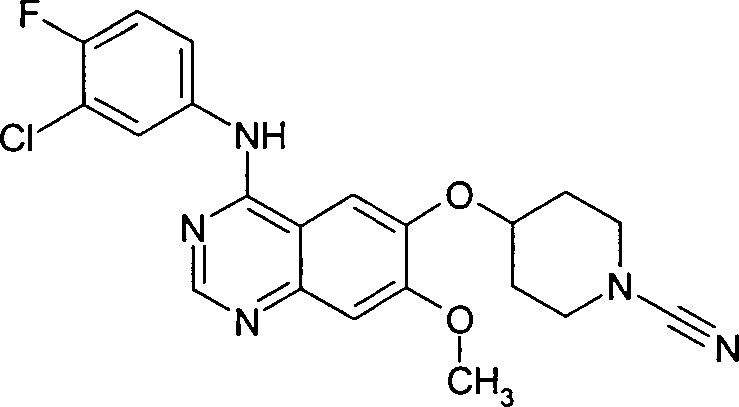
R f value: 0.80 (silica gel, methylene chloride / methanol = 9: 1)
Mass spectrum (ESI + ): m / z = 475, 477 [M + H] +
(9) 4 - [(3-Chloro-4-fluorophenyl) amino] -6- (1-cyano-piperidin-4-yloxy) -7-methoxyquinazoline
Die Umsetzung erfolgt mit Bromcyan
in Methylenchlorid.
Rf-Wert: 0.40 (Reversed
Phase DC-Fertigplatte (E. Merck), Acetonitril/Wasser/Trifluoressigsäure = 50:50:1)
Massenspektrum
(ESI+): m/z = 428, 430 [M+H]+
(10)
4-[(3-Chlor-4-fluor-phenyl)amino]-6-{1-[(dimethylamino)sulfonyl]-piperidin-4-yl-oxy}-7-methoxy-chinazolin 
R f value: 0.40 (reversed phase DC finished plate (E. Merck), acetonitrile / water / trifluoroacetic acid = 50: 50: 1)
Mass spectrum (ESI + ): m / z = 428, 430 [M + H] +
(10) 4 - [(3-Chloro-4-fluorophenyl) amino] -6- {1 - [(dimethylamino) sulfonyl] piperidin-4-yl-oxy} -7-methoxy-quinazoline
Die Umsetzung erfolgt mit N,N-Dimethylsulfamoylchlorid
in Acetonitril.
Rf-Wert: 0.24 (Reversed Phase DC-Fertigplatte
(E. Merck), Acetonitril/Wasser/Trifluoressigsäure = 50:50:1)
Massenspektrum
(ESI+): m/z = 510, 512 [M+H]+
(11)
4-[(3-Chlor-4-fluor-phenyl)amino]-6-{1-[(morpholin-4-yl)sulfonyl]-piperidin-4-yl-oxy}-7-methoxy-chinazolin 
Rf value: 0.24 (reversed phase DC finished plate (E. Merck), acetonitrile / water / trifluoroacetic acid = 50: 50: 1)
Mass spectrum (ESI + ): m / z = 510, 512 [M + H] +
(11) 4 - [(3-Chloro-4-fluorophenyl) amino] -6- {1 - [(morpholin-4-yl) sulfonyl] piperidin-4-yl-oxy} -7-methoxy-quinazoline
Die Umsetzung erfolgt mit (Morpholin-4-yl)sulfonylchlorid
in Acetonitril.
Rf-Wert: 0.29 (Reversed
Phase DC-Fertigplatte (E. Merck), Acetonitril/Wasser/Trifluoressigsäure = 50:50:1)
Massenspektrum
(ESI+): m/z = 552, 554 [M+H]+ The reaction is carried out with (morpholin-4-yl) sulfonyl chloride in acetonitrile.
R f value: 0.29 (reversed phase DC finished plate (E. Merck), acetonitrile / water / trifluoroacetic acid = 50: 50: 1)
Mass spectrum (ESI + ): m / z = 552, 554 [M + H] +
Beispiel
4
4-[(3-Chlor-4-fluor-phenyl)amino]-6-(cis-4-{[3-(morpholin-4-yl)-propyl]sulfonylamino}cyclohexan-1-yloxy)-7-methoxy-chinazolin 
Zu 60 mg 4-[(3-Chlor-4-fluor-phenyl)amino]-6-{cis-4-[(3-chlor-propyl)sulfonylamino]cyclohexan-1-yloxy}-7-methoxy-chinazolin
in 2 ml Acetonitril werden 23 μl
Morpholin gegeben und das Reaktionsgemisch wird über Nacht unter Rückfluß erhitzt.
Zur Aufarbeitung wird das Gemisch in Essigester aufgenommen und
mit Wasser gewaschen. Die organische Phase wird über Magnesiumsulfat getrocknet
und eingeengt. Das Rohprodukt wird über eine Kieselgelsäule mit
Methylenchlorid/Methanol (9:1) als Laufmittel gereinigt.
Ausbeute:
18 mg (27% der Theorie)
Rf-Wert: 0.36
(Kieselgel, Methylenchlorid/Methanol = 9:1)
Massenspektrum
(ESI+): m/z = 608, 610 [M+H]+ To 60 mg of 4 - [(3-chloro-4-fluorophenyl) amino] -6- {cis-4 - [(3-chloro-propyl) sulfonylamino] cyclohexan-1-yloxy} -7-methoxy-quinazoline in 2 ml of acetonitrile are added to 23 μl of morpholine and the reaction mixture is heated under reflux overnight. For working up, the mixture is taken up in ethyl acetate and washed with water. The organic phase is dried over magnesium sulfate and concentrated. The crude product is purified on a silica gel column using methylene chloride / methanol (9: 1) as the eluent.
Yield: 18 mg (27% of theory)
R f value: 0.36 (silica gel, methylene chloride / methanol = 9: 1)
Mass spectrum (ESI + ): m / z = 608, 610 [M + H] +
Analog Beispiel 4 werden folgenden
Verbindungen erhalten:
(1) 4-[(3-Chlor-4-fluor-phenyl)amino]-6-(trans-4-{[3-(morpholin-4-yl)-propyl]sulfonylamino}-cyclohexan-1-yloxy)-7-methoxy-chinazolin 
Massenspektrum
(ESI+): m/z = 608, 610 [M+H]+ The following compounds are obtained analogously to Example 4:
(1) 4 - [(3-chloro-4-fluorophenyl) amino] -6- (trans-4 - {[3- (morpholin-4-yl) propyl] sulfonylamino} cyclohexan-1-yloxy) -7-methoxy-quinazoline
Mass spectrum (ESI + ): m / z = 608, 610 [M + H] +
Analog den vorstehend genannten Beispielen
und anderen literaturbekannten Verfahren können auch folgende Verbindungen
hergestellt werden: 


Beispiel 5Example 5
- Dragees mit 75 mg WirksubstanzDragees with 75 mg of active substance
Zusammensetzung 
Herstellungmanufacturing
Die Wirksubstanz wird mit Calciumphosphat,
Maisstärke,
Polyvinylpyrrolidon, Hydroxypropylmethylcellulose und der Hälfte der
angegebenen Menge Magnesiumstearat gemischt. Auf einer Tablettiermaschine werden
Preßlinge
mit einem Durchmesser von ca. 13 mm hergestellt, diese werden auf
einer geeigneten Maschine durch ein Sieb mit 1.5-mm-Maschenweite
gerieben und mit der restlichen Menge Magnesiumstearat vermischt.
Dieses Granulat wird auf einer Tablettiermaschine zu Tabletten mit
der gewünschten
Form gepreßt.
Kerngewicht:
230 mg
Stempel: 9 mm, gewölbtThe active substance is mixed with calcium phosphate, corn starch, polyvinylpyrrolidone, hydroxypropylmethyl cellulose and half of the stated amount of magnesium stearate. Pressings with a diameter of approx. 13 mm are produced on a tabletting machine, these are rubbed through a sieve with a 1.5 mm mesh size on a suitable machine and mixed with the remaining amount of magnesium stearate. This granulate is pressed on a tablet machine into tablets of the desired shape.
Core weight: 230 mg
Stamp: 9 mm, domed
Die so hergestellten Dragéekerne
werden mit einem Film überzogen,
der im wesentlichen aus Hydroxypropylmethylcellulose besteht. Die
fertigen Filmdragées werden mit Bienenwachs geglänzt.
Dragéegewicht:
245 mg.The dragee cores thus produced are coated with a film which essentially consists of hydroxypropylmethyl cellulose. The finished film coated tablets are polished with beeswax.
Sugar weight: 245 mg.
Beispiel 6Example 6
- Tabletten mit 100 mg WirksubstanzTablets with 100 mg of active substance
Zusammensetzung 
Herstellungsverfahrenproduction method
Wirkstoff, Milchzucker und Stärke werden
gemischt und mit einer wäßrigen Lösung des
Polyvinylpyrrolidons gleichmäßig befeuchtet.
Nach Siebung der feuchten Masse (2.0 mm-Maschenweite) und Trocknen
im Hordentrockenschrank bei 50°C
wird erneut gesiebt (1 .5 mm-Maschenweite) und das Schmiermittel
zugemischt. Die preßfertige
Mischung wird zu Tabletten verarbeitet.
Tablettengewicht: 220
mg
Durchmesser: 10 mm, biplan mit beidseitiger Facette und
einseitiger Teilkerbe.Active ingredient, milk sugar and starch are mixed and moistened evenly with an aqueous solution of the polyvinylpyrrolidone. After sieving the moist mass (2.0 mm mesh size) and drying in a rack drying cabinet at 50 ° C, sieving is again carried out (1.5 mm mesh size) and the lubricant is added. The ready-to-press mixture is processed into tablets.
Tablet weight: 220 mg
Diameter: 10 mm, biplane with facet on both sides and partial notch on one side.
Beispiel 7Example 7
- Tabletten mit 150 mg WirksubstanzTablets with 150 mg of active substance
Zusammensetzung 

Herstellungmanufacturing
Die mit Milchzucker, Maisstärke und Kieselsäure gemischte Wirksubstanz wird mit einer 20%igen wäßrigen Polyvinylpyrrolidonlösung befeuchtet und durch ein Sieb mit 1.5 mm-Maschenweite geschlagen.The ones with milk sugar, cornstarch and silica mixed active substance is moistened with a 20% aqueous solution of polyvinylpyrrolidone and passed through a sieve with a mesh size of 1.5 mm.
Das bei 45°C getrocknete Granulat wird
nochmals durch dasselbe Sieb gerieben und mit der angegebenen Menge
Magnesiumstearat gemischt. Aus der Mischung werden Tabletten gepreßt.
Tablettengewicht:
300 mg
Stempel: 10 mm, flachThe granules dried at 45 ° C are rubbed through the same sieve again and mixed with the specified amount of magnesium stearate. Tablets are pressed from the mixture.
Tablet weight: 300 mg
Stamp: 10 mm, flat
Beispiel 8Example 8
- Hartgelatine-Kapseln mit 150 mg WirksubstanzHard gelatin capsules with 150 mg of active substance
Zusammensetzung 
Herstellungmanufacturing
Der Wirkstoff wird mit den Hilfsstoffen vermengt, durch ein Sieb von 0.75-mm-Maschenweite gegeben und in einem geeigneten Gerät homogen gemischt.The active ingredient comes with the excipients blended, passed through a 0.75 mm mesh sieve and in a suitable device homogeneously mixed.
Die Endmischung wird in Hartgelatine-Kapseln
der Größe 1 abgefüllt.
Kapselfüllung: ca.
320 mg
Kapselhülle:
Hartgelatine-Kapsel Größe 1.The final mix is filled into size 1 hard gelatin capsules.
Capsule filling: approx. 320 mg
Capsule shell: hard gelatin capsule size 1.
Beispiel 9Example 9
- Suppositorien mit 150 mg WirksubstanzSuppositories with 150 mg of active substance
Zusammensetzung 
Herstellungmanufacturing
Nach dem Aufschmelzen der Suppositorienmasse wird der Wirkstoff darin homogen verteilt und die Schmelze in vorgekühlte Formen gegossen.After the suppository mass has melted the active ingredient is distributed homogeneously and the melt in pre-cooled forms cast.
Beispiel 10Example 10
- Suspension mit 50 mg WirksubstanzSuspension with 50 mg of active substance
Zusammensetzungcomposition
-
100 ml Suspension enthalten: 100 ml suspension contain:

Herstellungmanufacturing
Destilliertes Wasser wird auf 70°C erhitzt.
Hierin wird unter Rühren
p-Hydroxybenzoesäuremethylester und
-propylester sowie Glycerin und Carboxymethylcellulose-Natriumsalz gelöst. Es wird
auf Raumtemperatur abgekühlt
und unter Rühren
der Wirkstoff zugegeben und homogen dispergiert. Nach Zugabe und
Lösen des Zuckers,
der Sorbitlösung
und des Aromas wird die Suspension zur Entlüftung unter Rühren evakuiert.
5
ml Suspension enthalten 50 mg Wirkstoff.Distilled water is heated to 70 ° C. P-Hydroxybenzoic acid methyl ester and propyl ester as well as glycerol and carboxymethyl cellulose sodium salt are dissolved therein with stirring. It is cooled to room temperature and the active ingredient is added with stirring and dispersed homogeneously. After adding and dissolving the sugar, the sorbitol solution and the aroma, the suspension is evacuated with stirring for deaeration.
5 ml of suspension contain 50 mg of active ingredient.
Beispiel 11Example 11
- Ampullen mit 10 mg WirksubstanzAmpoules with 10 mg of active substance
Zusammensetzung 
Herstellungmanufacturing
Die Wirksubstanz wird in der erforderlichen Menge 0.01 n HCl gelöst, mit Kochsalz isotonisch gestellt, sterilfiltriert und in 2 ml Ampullen abgefüllt.The active substance is required in the Amount of 0.01 n HCl dissolved, made isotonic with sodium chloride, sterile filtered and in 2 ml ampoules bottled.
Beispiel 12Example 12
- Ampullen mit 50 mg WirksubstanzAmpoules with 50 mg of active substance
Zusammensetzung 
Herstellungmanufacturing
Die Wirksubstanz wird in der erforderlichen Menge 0.01 n HCl gelöst, mit Kochsalz isotonisch gestellt, sterilfiltriert und in 10 ml Ampullen abgefüllt.The active substance is required in the Amount of 0.01 n HCl dissolved, made isotonic with sodium chloride, sterile filtered and in 10 ml ampoules bottled.
Beispiel 13Example 13
-
Kapseln zur Pulverinhalation mit 5 mg Wirksubstanz
1
Kapsel enthält: Capsules for powder inhalation with 5 mg of active substance 1 capsule contains:

Herstellungmanufacturing
Die Wirksubstanz wird mit Lactose
für Inhalationszwecke
gemischt. Die Mischung wird auf einer Kapselmaschine in Kapseln
(Gewicht der Leerkapsel ca. 50 mg) abgefüllt.
Kapselgewicht: 70.0
mg
Kapselgröße: 3The active substance is mixed with lactose for inhalation purposes. The mixture is filled into capsules on a capsule machine (weight of the empty capsule approx. 50 mg).
Capsule weight: 70.0 mg
Capsule size: 3
Beispiel 14Example 14
-
Inhalationslösung
für Handvernebler
mit 2.5 mg Wirksubstanz
1 Hub enthält: Inhalation solution for hand-held nebulizers with 2.5 mg active substance 1 stroke contains:

Herstellungmanufacturing
Die Wirksubstanz und Benzalkoniumchlorid
werden in Ethanol/Wasser (50/50) gelöst. Der pH-Wert der Lösung wird
mit 1 N-Salzsäure
eingestellt. Die eingestellte Lösung
wird filtriert und in für
den Handvernebler geeignete Behälter
(Kartuschen) abgefüllt.
Füllmasse
des Behälters:
4.5 gThe active substance and benzalkonium chloride are dissolved in ethanol / water (50/50). The pH the solution is adjusted with 1 N hydrochloric acid. The adjusted solution is filtered and filled into containers (cartridges) suitable for the hand-held nebuliser.
Filling mass of the container: 4.5 g
Claims (11)


Priority Applications (33)
| Application Number | Priority Date | Filing Date | Title |
|---|---|---|---|
| DE2002131711 DE10231711A1 (en) | 2002-07-13 | 2002-07-13 | New 4-amino-quinazoline or quinoline derivatives, are tyrosine kinase-mediated signal transduction inhibitors useful e.g. for treating tumors or respiratory or gastrointestinal diseases |
| CN038072424A CN1642552B (en) | 2002-03-30 | 2003-03-25 | 4- (N-phenylamino) -quinazolines/quinolines as tyrosine kinase inhibitors |
| PCT/EP2003/003062 WO2003082290A1 (en) | 2002-03-30 | 2003-03-25 | 4-(n-phenylamino)-quinazolines / quinolines as tyrosine kinase inhibitors |
| YUP-854/04A RS85404A (en) | 2002-03-30 | 2003-03-25 | 4-(n-phenylamino)- quinazolines/quinolines as tyrosine kinase inhibitors |
| HR20040898A HRP20040898A2 (en) | 2002-03-30 | 2003-03-25 | 4-(n-phenylamino)-quinazolines/quinolines as tyrosine kinase inhibitors |
| MEP-472/08A MEP47208A (en) | 2002-03-30 | 2003-03-25 | 4-(n-phenylamino)-quinazolines / quinolines as tyrosine kinase inhibitors |
| EA200401191A EA009300B1 (en) | 2002-03-30 | 2003-03-25 | 4-(n-phenylamino)-quinazolines/quinolines as tyrosine kinase inhibitors |
| MXPA04009536A MXPA04009536A (en) | 2002-03-30 | 2003-03-25 | 4-(n-phenylamino)-quinazolines / quinolines as tyrosine kinase inhibitors. |
| CA2476008A CA2476008C (en) | 2002-03-30 | 2003-03-25 | Bicyclic heterocyclic compounds, pharmaceutical compositions containing these compounds, their use and process for preparing them |
| NZ536114A NZ536114A (en) | 2002-03-30 | 2003-03-25 | 4-(N-phenylamino)-quinazolines / quinolines as tyrosine kinase inhibitors |
| PL03371188A PL371188A1 (en) | 2002-03-30 | 2003-03-25 | 4-(n-phenylamino)-quinazolines / quinolines as tyrosine kinase inhibitors |
| EA200701302A EA200701302A1 (en) | 2002-03-30 | 2003-03-25 | 4- (N-PHYLENAMINO) QUINAZOLIN / -CHINOLINE AS THYROSINKINASE INHIBITORS |
| BR0308902-9A BR0308902A (en) | 2002-03-30 | 2003-03-25 | 4- (n-phenylamino) -quinazolines / quinolines as tyrosine kinase inhibitors |
| UA20041008767A UA79455C2 (en) | 2002-07-13 | 2003-03-25 | 4-(n-phenylamino)quinazolines or -quinolines as tyrosine kinase inhibitors |
| HK05111036.8A HK1079095B (en) | 2002-03-30 | 2003-03-25 | 4-(n-phenylamino)-quinazolines/quinolines as tyrosine kinase inhibitors |
| JP2003579827A JP4776882B2 (en) | 2002-03-30 | 2003-03-25 | Bicyclic heterocyclic compounds, pharmaceutical compositions containing these compounds, their use and methods for their preparation |
| KR1020047015565A KR101064530B1 (en) | 2002-03-30 | 2003-03-25 | 4- (N-phenylamino) -quinazolin / quinoline as a tyrosine kinase inhibitor, pharmaceutical compositions containing the same and methods for preparing the same |
| AU2003226705A AU2003226705B2 (en) | 2002-03-30 | 2003-03-25 | 4-(N-phenylamino)-quinazolines / quinolines as tyrosine kinase inhibitors |
| EP03745271A EP1492536B1 (en) | 2002-03-30 | 2003-03-25 | 4-(n-phenylamino)-quinazolines / quinolines as tyrosine kinase inhibitors |
| IL16416703A IL164167A0 (en) | 2002-03-30 | 2003-03-25 | 4-(N-phenylamino)-quinazolines/ quinolines as tyrosine kinase inhibitors |
| AT03745271T ATE557008T1 (en) | 2002-03-30 | 2003-03-25 | 4- ( N-PHENYLAMINO )-CHINAZOLINES/QUINOLINES AS TYROSINE KINASE INHIBITORS |
| US10/400,370 US6924285B2 (en) | 2002-03-30 | 2003-03-27 | Bicyclic heterocyclic compounds, pharmaceutical compositions containing these compounds, their use and process for preparing them |
| UY27737A UY27737A1 (en) | 2002-03-30 | 2003-03-27 | BICYCLIC HETEROCICLES, MEDICATIONS CONTAINING THESE COMPOUNDS, THEIR USE AND PROCEDURES FOR THEIR PREPARATION. |
| MYPI20031160A MY127771A (en) | 2002-03-30 | 2003-03-28 | Bicyclic heterocyclic compounds, pharmaceutical compositions containing these compounds, their use and process for preparing them |
| TW099102687A TW201024269A (en) | 2002-03-30 | 2003-03-28 | Bicyclic heterocyclic compounds, pharmaceutical compositions containing these compounds, their use and process for preparing them |
| ARP030101100A AR039187A1 (en) | 2002-03-30 | 2003-03-28 | BICYCLE HETEROCICLES, MEDICATIONS CONTAINING THESE COMPOUNDS, ITS USE AND PROCEDURES FOR THEIR PREPARATION |
| TW092107113A TWI331604B (en) | 2002-03-30 | 2003-03-28 | Bicyclic heterocyclic compounds, pharmaceutical compositions containing these compounds, their use and process for preparing them |
| PE2003000322A PE20040169A1 (en) | 2002-03-30 | 2003-03-28 | QUINAZOLIN-4-AMINE DERIVATIVES AS INHIBITORS OF SIGNAL TRANSDUCTION INDUCED BY TYROSINQUINASES |
| NO20043997A NO329271B1 (en) | 2002-03-30 | 2004-09-23 | 4- (N-Phenylamino) quinazolines / quinolines, the preparation thereof, pharmaceutical preparations containing them and the use thereof for the manufacture of medicaments for the treatment of disease |
| US11/083,247 US7119084B2 (en) | 2002-03-30 | 2005-03-17 | Bicyclic heterocyclic compounds, pharmaceutical compositions containing these compounds, their use and process for preparing them |
| US11/497,727 US20060270672A1 (en) | 2002-03-30 | 2006-08-02 | Bicyclic heterocyclic compounds, pharmaceutical compositions containing these compounds, their use and process for preparing them |
| US12/072,510 US7910731B2 (en) | 2002-03-30 | 2008-02-26 | Bicyclic heterocyclic compounds, pharmaceutical compositions containing these compounds, their use and process for preparing them |
| US12/961,109 US8343982B2 (en) | 2002-03-30 | 2010-12-06 | Bicyclic heterocyclic compounds pharmaceutical compositions containing these compounds, their use and process for preparing the same |
Applications Claiming Priority (1)
| Application Number | Priority Date | Filing Date | Title |
|---|---|---|---|
| DE2002131711 DE10231711A1 (en) | 2002-07-13 | 2002-07-13 | New 4-amino-quinazoline or quinoline derivatives, are tyrosine kinase-mediated signal transduction inhibitors useful e.g. for treating tumors or respiratory or gastrointestinal diseases |
Publications (1)
| Publication Number | Publication Date |
|---|---|
| DE10231711A1 true DE10231711A1 (en) | 2004-01-22 |
Family
ID=29761936
Family Applications (1)
| Application Number | Title | Priority Date | Filing Date |
|---|---|---|---|
| DE2002131711 Withdrawn DE10231711A1 (en) | 2002-03-30 | 2002-07-13 | New 4-amino-quinazoline or quinoline derivatives, are tyrosine kinase-mediated signal transduction inhibitors useful e.g. for treating tumors or respiratory or gastrointestinal diseases |
Country Status (2)
| Country | Link |
|---|---|
| DE (1) | DE10231711A1 (en) |
| UA (1) | UA79455C2 (en) |
Cited By (1)
| Publication number | Priority date | Publication date | Assignee | Title |
|---|---|---|---|---|
| WO2005011701A1 (en) * | 2003-07-28 | 2005-02-10 | Boehringer Ingelheim International Gmbh | Use of quinazoline tyrosine kinase inhibitors in the treatment of inflammatory processes |
-
2002
- 2002-07-13 DE DE2002131711 patent/DE10231711A1/en not_active Withdrawn
-
2003
- 2003-03-25 UA UA20041008767A patent/UA79455C2/en unknown
Cited By (1)
| Publication number | Priority date | Publication date | Assignee | Title |
|---|---|---|---|---|
| WO2005011701A1 (en) * | 2003-07-28 | 2005-02-10 | Boehringer Ingelheim International Gmbh | Use of quinazoline tyrosine kinase inhibitors in the treatment of inflammatory processes |
Also Published As
| Publication number | Publication date |
|---|---|
| UA79455C2 (en) | 2007-06-25 |
Similar Documents
| Publication | Publication Date | Title |
|---|---|---|
| EP1280798B1 (en) | Bicyclic heterocylces, medicaments containing said compounds, the use thereof and method for producing them | |
| EP1492536B1 (en) | 4-(n-phenylamino)-quinazolines / quinolines as tyrosine kinase inhibitors | |
| EP1315718B1 (en) | Bicyclic heterocycles, medicaments containing these compounds, their use, and methods for the production thereof | |
| EP1194418A1 (en) | Bicyclic heterocycles, medicaments containing these compounds, their use and methods for the production thereof | |
| EP1597240B1 (en) | Bicyclic heterocycles, medicaments containing said compounds, use thereof, and method for the production thereof | |
| DE10063435A1 (en) | Chinazoline derivatives, pharmaceuticals containing these compounds, their use and process for their preparation | |
| EP1315705A1 (en) | Bicyclic heterocycles, medicaments containing these compounds, their use, and methods for the production thereof | |
| DE10217689A1 (en) | Bicyclic heterocycles, medicaments containing these compounds, their use and processes for their preparation | |
| DE10042062A1 (en) | Bicyclic heterocycles, medicaments containing these compounds, their use and methods of preparation | |
| EP1315716A1 (en) | Bicyclic heterocycles, medicaments containing these compounds, their use, and methods for the production thereof | |
| DE10326186A1 (en) | Bicyclic heterocycles, medicaments containing these compounds, their use and processes for their preparation | |
| DE10214412A1 (en) | Bicyclic heterocycles, pharmaceutical compositions containing these compounds, their use and process for their preparation | |
| EP2118075A1 (en) | Bicyclic heterocycles, drugs containing said compounds, use thereof, and method for production thereof | |
| DE10017539A1 (en) | Bicyclic heterocycles, medicaments containing these compounds, their use and processes for their preparation | |
| WO2005033096A1 (en) | Quinoline derivatives and quinazoline derivatives, medicaments containing said compounds, use thereof, and method for the production thereof | |
| EP1919900A2 (en) | Bicyclic heterocycles medicaments comprising said compounds use and method for production thereof | |
| DE10231711A1 (en) | New 4-amino-quinazoline or quinoline derivatives, are tyrosine kinase-mediated signal transduction inhibitors useful e.g. for treating tumors or respiratory or gastrointestinal diseases | |
| DE10040525A1 (en) | New 6-acylamino-4-amino-quinazoline or quinoline derivatives, are tyrosine kinase-mediated signal transduction inhibitors useful e.g. for treating tumors or respiratory or gastrointestinal diseases | |
| DE19954816A1 (en) | New 4-amino-quinazoline or quinoline derivatives, are tyrosine kinase-mediated signal transduction inhibitors useful e.g. for treating tumors, polyps or respiratory or gastrointestinal diseases | |
| DE10023085A1 (en) | Arylamino and aralkylamino substituted quinoline and quinazoline derivatives, useful for the treatment of e.g. tumors, pulmonary, respiratory and gastrointestinal disorders and psoriasis | |
| EP1956010A1 (en) | Bicyclical heterocycles, medicines containing these compounds, their application and method for their production |
Legal Events
| Date | Code | Title | Description |
|---|---|---|---|
| 8141 | Disposal/no request for examination |