DE102024107855A1 - FABRICS FOR A SHOE UPPER, SHOE UPPER AND SHOE - Google Patents
FABRICS FOR A SHOE UPPER, SHOE UPPER AND SHOE Download PDFInfo
- Publication number
- DE102024107855A1 DE102024107855A1 DE102024107855.3A DE102024107855A DE102024107855A1 DE 102024107855 A1 DE102024107855 A1 DE 102024107855A1 DE 102024107855 A DE102024107855 A DE 102024107855A DE 102024107855 A1 DE102024107855 A1 DE 102024107855A1
- Authority
- DE
- Germany
- Prior art keywords
- sock
- fabric
- shoe
- foot
- leg
- Prior art date
- Legal status (The legal status is an assumption and is not a legal conclusion. Google has not performed a legal analysis and makes no representation as to the accuracy of the status listed.)
- Pending
Links
Images




Classifications
-
- A—HUMAN NECESSITIES
- A43—FOOTWEAR
- A43B—CHARACTERISTIC FEATURES OF FOOTWEAR; PARTS OF FOOTWEAR
- A43B9/00—Footwear characterised by the assembling of the individual parts
- A43B9/08—Turned footwear
-
- A—HUMAN NECESSITIES
- A43—FOOTWEAR
- A43B—CHARACTERISTIC FEATURES OF FOOTWEAR; PARTS OF FOOTWEAR
- A43B1/00—Footwear characterised by the material
- A43B1/02—Footwear characterised by the material made of fibres or fabrics made therefrom
- A43B1/04—Footwear characterised by the material made of fibres or fabrics made therefrom braided, knotted, knitted or crocheted
-
- A—HUMAN NECESSITIES
- A43—FOOTWEAR
- A43B—CHARACTERISTIC FEATURES OF FOOTWEAR; PARTS OF FOOTWEAR
- A43B23/00—Uppers; Boot legs; Stiffeners; Other single parts of footwear
- A43B23/02—Uppers; Boot legs
- A43B23/0245—Uppers; Boot legs characterised by the constructive form
-
- A—HUMAN NECESSITIES
- A43—FOOTWEAR
- A43B—CHARACTERISTIC FEATURES OF FOOTWEAR; PARTS OF FOOTWEAR
- A43B3/00—Footwear characterised by the shape or the use
- A43B3/0036—Footwear characterised by the shape or the use characterised by a special shape or design
Landscapes
- Footwear And Its Accessory, Manufacturing Method And Apparatuses (AREA)
- Socks And Pantyhose (AREA)
Abstract
Ein für ein Obermaterial mit integrierter Zunge eines Schuhs verwendetes Gewebe 10 weist ein schlauchförmiges Gewebeelement 20 auf. Das schlauchförmige Gewebeelement 20 weist einen ersten Sockenteil 1 und einen zweiten Sockenteil 2 auf, der erste Sockenteil 1 weist einen ersten Fußteil 11 und einen ersten Beinteil 21 auf, der zweite Sockenteil 2 weist einen zweiten Fußteil 12 und einen zweiten Beinteil 22 auf, und der erste Fußteil 11, der erste Beinteil 21, der zweite Beinteil 22 und der zweite Fußteil 12 sind kontinuierlich in dieser Reihenfolge ausgebildet. Die Mittelachse S1 des ersten Beinteiles 21 und die Mittelachse S2 des zweiten Beinteiles 22 fallen nicht miteinander zusammen und sind nicht zueinander parallel, und wenn der erste Sockenteil und der zweite Sockenteil übereinander platziert werden, bildet der erste Sockenteil eine erste Schicht, die an der Fußseite eines Obermaterials angeordnet ist, und bildet der zweite Sockenteil eine zweite Schicht, welche angeordnet ist, die erste Schicht abzudecken.

Description
Gebiet der Erfindungfield of the invention
Die vorliegende Erfindung betrifft ein Gewebe, das für ein Schuh-Obermaterial verwendet wird, ein Schuh-Obermaterial, und einen Schuh, und genauer gesagt ein Gewebe für ein Schuh-Obermaterial. Das Gewebe ist, wenn es für ein Obermaterial mit integrierter Zunge eines Schuhes verwendet wird, dazu in der Lage, sowohl einen Schuh bereitzustellen, der einfach angezogen werden kann, als auch ein Schuh Obermaterial und einen Schuh bereitzustellen.The present invention relates to a fabric used for a shoe upper, a shoe upper, and a shoe, and more particularly to a fabric for a shoe upper. The fabric, when used for a tongue-integrated upper of a shoe, is capable of providing a shoe that can be easily put on as well as providing a shoe upper and a shoe.
Beschreibung des Standes der TechnikDescription of the state of the art
Obermaterialien für Schuhe, und insbesondere Sportschuhe, werden im Allgemeinen in einer dreidimensionalen Form gebildet, um zu der Form des Fußes zu passen, in dem verschiedene Materialien und Elemente durch Nähen oder dergleichen miteinander verbunden werden. Nähen, Verkleben oder dergleichen von verschiedenen Materialien nimmt Zeit und Arbeit in Anspruch, und es ist ein Behelf erforderlich, um mit Stufen an Verbindungsabschnitten und dergleichen umzugehen. Weiter besteht ein wachsender Bedarf zur Verbesserung nicht nur im Hinblick auf das Anpassen an die Form des Fußes, sondern auch an die Anpassbarkeit an Änderungen in der Form des Fußes, und insbesondere der Weichheit eines Abschnittes, der mit der Fußoberfläche in Kontakt kommt. Aus diesem Grund wurden Obermaterialien aus Gewebe vorgeschlagen. Beispielsweise offenbart die
Jedoch ist in der
Um die vorstehend beschriebenen Probleme zu adressieren betrifft die vorliegende Erfindung ein Gewebe für ein Schuh-Obermaterial, wobei das Gewebe, wenn es für ein Obermaterial mit integrierter Zunge eines Schuhes verwendet wird, dazu geeignet ist, einen Schuh bereitzustellen, dessen Stützeigenschaften und dessen Leichtigkeit des Anziehens und Ausziehens des Schuhs leicht angepasst und geändert werden kann, sowie ein Schuh-Obermaterial und einen Schuh.In order to address the problems described above, the present invention relates to a fabric for a shoe upper, the fabric, when used for an upper with an integrated tongue of a shoe, being suitable for providing a shoe whose support properties and ease of putting on and taking off the shoe can be easily adjusted and changed, as well as a shoe upper and a shoe.
Kurzbeschreibung der ErfindungBrief description of the invention
Die vorliegende Erfindung betrifft ein Gewebe, welches für ein Obermaterial mit integrierter Zunge eines Schuhes verwendet wird, wobei das Gewebe ein schlauchförmiges Gewebeelement aufweist. Das schlauchförmige Gewebeelement weist einen ersten Sockenteil und einen zweiten Sockenteil auf. Der erste Sockenteil weist einen ersten Fuß(teil) und einen ersten Bein(teil) auf, der zweite Sockenteil weißt einen zweiten Fuß(teil) und einen zweiten Bein(teil) auf, und der erste Fußteil, der erste Beinteil, der zweite Beinteil und der zweite Fußteil sind in dieser Reihenfolge kontinuierlich gebildet. Eine Mittelachse des ersten Beinteiles und eine Mittelachse des zweiten Beinteiles fallen nicht miteinander zusammen und sind nicht parallel zueinander, und wenn der erste Sockenteil so bewegt wird, dass er sich innerhalb der Wand zu befinden, welche den zweiten Sockenteil festlegt, bildet der erste Sockenteil eine erste Schicht, die an einer Fußseite des Obermaterials angeordnet ist, und bildet der zweite Sockenteil eine zweite Schicht, welche angeordnet ist, die erste Schicht abzudecken.The present invention relates to a fabric used for a tongue-integrated upper of a shoe, the fabric comprising a tubular fabric member. The tubular fabric member comprises a first sock part and a second sock part. The first sock part has a first foot and a first leg, the second sock part has a second foot and a second leg, and the first foot part, the first leg part, the second leg part and the second foot part are continuously formed in this order. A central axis of the first leg part and a central axis of the second leg part do not coincide with each other and are not parallel to each other, and when the first sock part is moved to be located within the wall defining the second sock part, the first sock part forms a first layer arranged on a foot side of the upper, and the second sock part forms a second layer arranged to cover the first layer.
Die vorliegende Erfindung betrifft ein Schuh-Obermaterial, welches das vorstehend beschriebene Gewebe für ein Schuh-Obermaterial umfasst, wobei das Obermaterial eine erste Schicht aufweist, die aus dem ersten Sockenteil gebildet ist und an einer Fußseite angeordnet ist, und eine zweite Schicht aufweist, die aus dem zweiten Sockenteil gebildet ist, und angeordnet ist, die erste Schicht abzudecken. Eine Fersen-Seite und eine Rist-Seite einer Anziehöffnung, die in der Nähe einer Grenze zwischen dem ersten Beinteil und dem zweiten Beinteil ausgebildet ist, befinden sich nicht auf dem gleichen horizontalen Niveau.The present invention relates to a shoe upper comprising the above-described fabric for a shoe upper, wherein the upper has a first layer formed from the first sock part and arranged on a foot side, and a second layer formed from the second sock part, and arranged to cover the first layer. A heel side and an instep side of a donning opening formed near a boundary between the first leg part and the second leg part are not at the same horizontal level.
Die vorliegende Erfindung betrifft einen Schuh, in welchem das vorstehend beschriebene Schuh-Obermaterial und eine Sohle als ein einziger Körper ausgebildet sind.The present invention relates to a shoe in which the above-described shoe upper and a sole are formed as a single body.
Gemäß einer oder mehrerer Ausführungsformen der vorliegenden Erfindung betrifft die vorliegende Erfindung ein Gewebe für ein Schuh-Obermaterial. Das Gewebe ist, wenn es für ein Obermaterial mit integrierter Zunge eines Schuhes verwendet wird, dazu in der Lage, einen Schuh bereitzustellen, dessen Stützeigenschaften und dessen Leichtigkeit des Anziehens und Ausziehens des Schuhs leicht angepasst und geändert werden kann, sowie ein Schuh-Obermaterial und einen Schuh.According to one or more embodiments of the present invention, the present invention relates to a fabric for a shoe upper. The fabric, when used for an upper with an integrated tongue of a shoe, is capable of providing a shoe whose support properties and ease of putting on and taking off the shoe can be easily adjusted and changed, as well as a shoe upper and a shoe.
Kurze Beschreibung der ZeichnungenShort description of the drawings
-
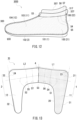
1 ist eine schematische Ansicht, die einen Zustand zeigt, in dem ein Gewebe gemäß einer Ausführungsform der vorliegenden Erfindung flach so ausgebreitet ist, dass ein Fersenteil eines ersten Sockenteils und ein Fersenteil eines zweiten Sockenteils an der Oberseite jeweils an gegenüberliegenden lateralen Seitenenden angeordnet sind.1 is a schematic view showing a state in which a fabric according to an embodiment of the present invention is flatly spread out such that a heel part of a first sock part and a heel part of a second sock part are arranged on the upper side at opposite lateral side ends, respectively. -
2 ist eine schematische Grafik, die einen Schritt des Bildens eines Obermaterials unter Verwendung des Gewebes darstellt.2 is a schematic diagram showing a step of forming an upper using the fabric. -
3 ist eine schematische laterale Seitenansicht eines Obermaterials (eines linken Fußes), welches aus dem Gewebe gebildet ist.3 is a schematic lateral side view of an upper (of a left foot) formed from the fabric. -
4 ist eine schematische Querschnittsansicht des Obermaterials, welche entlang der Linie A-A' genommen wurde.4 is a schematic cross-sectional view of the upper taken along line AA'. -
5 ist eine schematische Ansicht von unten auf das Obermaterial.5 is a schematic view from below of the upper material. -
6 ist eine schematische laterale Seitenansicht eines Schuhes (eines linken Fußes), welcher das Obermaterial verwendet.6 is a schematic lateral side view of a shoe (a left foot) using the upper material. -
7 ist eine schematische Ansicht, die einen Zustand zeigt, in welchem ein Gewebe gemäß einer Ausführungsform der vorliegenden Erfindung flach so ausgebreitet ist, dass ein Fersenteil eines ersten Sockenteils und ein Fersenteil eines zweiten Sockenteils an der Oberseite jeweils an gegenüberliegenden lateralen Seitenenden angeordnet sind.7 is a schematic view showing a state in which a fabric according to an embodiment of the present invention is flatly spread out such that a heel part of a first sock part and a heel part of a second sock part are arranged on the upper side at opposite lateral side ends, respectively. -
8 ist eine schematische Seitenansicht eines aus dem Gewebe gebildeten Obermaterials.8 is a schematic side view of an upper material formed from the fabric. -
9 ist eine schematische laterale Seitenansicht eines Schuhes (eines linken Fußes), welcher das Obermaterial verwendet.9 is a schematic lateral side view of a shoe (a left foot) using the upper material. -
10 ist eine schematische Ansicht eines Zustandes, in dem ein Gewebe gemäß einer Ausführungsform der vorliegenden Erfindung flach so ausgebreitet ist, dass ein Fersenteil eines ersten Sockenteils und ein Fersenteil eines zweiten Sockenteils an der Oberseite jeweils an gegenüberliegenden lateralen Seitenenden angeordnet sind.10 is a schematic view of a state in which a fabric according to an embodiment of the present invention is flatly spread out such that a heel part of a first sock part and a heel part of a second sock part are arranged on the upper side at opposite lateral side ends, respectively. -
11 ist eine schematische Seitenansicht eines aus dem Gewebe gebildeten Obermaterials.11 is a schematic side view of an upper material formed from the fabric. -
12 ist eine schematische laterale Seitenansicht eines Schuhes (eines linken Fußes), welcher das Obermaterial verwendet.12 is a schematic lateral side view of a shoe (a left foot) using the upper material. -
13 ist eine schematische Ansicht, welche einen Zustand zeigt, in dem ein Gewebe gemäß einer Ausführungsform der vorliegenden Erfindung flach so ausgebreitet ist, dass ein Fersenteil eines ersten Sockenteils und ein Fersenteil eines zweiten Sockenteils an der Oberseite jeweils an gegenüberliegenden lateralen Seitenenden angeordnet sind.13 is a schematic view showing a state in which a fabric according to an embodiment of the present invention is flatly spread out such that a heel part of a first sock part and a heel part of a second sock part are arranged on the upper side at opposite lateral side ends, respectively. -
14 ist eine schematische Seitenansicht eines Obermaterials, welches aus dem Gewebe gebildet ist.14 is a schematic side view of an upper formed from the fabric. -
15 ist eine schematische laterale Seitenansicht eines Schuhes (eines linken Fußes), welcher das Obermaterial verwendet.15 is a schematic lateral side view of a shoe (a left foot) using the upper material. -
16 ist eine schematische Ansicht, die einen Zustand zeigt, in dem ein Gewebe gemäß einer Ausführungsform der vorliegenden Erfindung flach so ausgebreitet ist, dass ein Fersenteil eines ersten Sockenteils und ein Fersenteil eines zweiten Sockenteils an der Oberseite jeweils an gegenüberliegenden lateralen Seitenenden angeordnet sind.16 is a schematic view showing a state in which a fabric according to an embodiment of the present invention is flatly spread out such that a heel part of a first sock part and a heel part of a second sock part are arranged on the upper side at opposite lateral side ends, respectively. -
17 ist eine schematische Seitenansicht eines aus dem Gewebe gebildeten Obermaterials.17 is a schematic side view of an upper material formed from the fabric. -
18 ist eine schematische laterale Seitenansicht eines Schuhes (eines linken Fußes), welcher das Obermaterial verwendet.18 is a schematic lateral side view of a shoe (a left foot) using the upper material.
Detaillierte Beschreibung der ErfindungDetailed description of the invention
Die Erfinder der vorliegenden Anmeldung haben eine tiefgehende Forschung betrieben, um das Anziehen eines Obermaterials mit integrierter Zunge zu erleichtern. Im Ergebnis haben die Erfinder herausgefunden, dass dies gelingt, wenn ein schlauchförmiges Gewebeelement, welches einen ersten Sockenteil umfasst, der einen ersten Fußteil und einen ersten Beinteil aufweist, und welches einen zweiten Sockenteil umfasst, das einen zweiten Fußteil und einen zweiten Beinteil aufweist, so ausgebildet ist, dass die Mittelachsen des kontinuierlich ausgebildeten ersten Beinteiles und zweiten Beinteiles nicht zusammenfallen und auch nicht parallel zueinander sind. Wenn der erste Sockenteil eine erste Schicht bildet, die an einer Fußseite eines Obermaterials angeordnet ist, und der zweite Sockenteil eine zweite Schicht bildet, welche angeordnet ist die erste Schicht abzudecken, befinden sich eine Fersen-Seite und eine Rist-Seite einer Anziehöffnung nicht auf dem gleichen horizontalen Niveau, was es leicht macht, die Stützeigenschaften und die Leichtigkeit des Anziehens und Ausziehens anzupassen und zu ändern.
Insbesondere kann, wenn sich die Fersen-Seite der Anziehöffnung auf einem höheren Niveau als die Rist-Seite der Anziehöffnung befindet, ein Schuh erhalten werden, der sich weniger leicht löst und zudem verbesserte Knöchel-Halte-Eigenschaften aufweist. Andererseits kann, wenn sich die Fersen-Seite der Anziehöffnung auf einem niedrigeren Niveau als die Rist-Seite der Anziehöffnung befindet, ein Schuh erhalten werden, der es erlaubt einen Fuß einfach einzuführen.The inventors of the present application have conducted in-depth research to facilitate the donning of an upper with an integrated tongue. As a result, the inventors have found that this can be achieved when a tubular fabric element comprising a first sock part having a first foot part and a first leg part, and which a second sock part having a second foot part and a second leg part, formed such that the center axes of the continuously formed first leg part and second leg part do not coincide and are also not parallel to each other. When the first sock part forms a first layer arranged on a foot side of an upper and the second sock part forms a second layer arranged to cover the first layer, a heel side and an instep side of a donning opening are not at the same horizontal level, making it easy to adjust and change the support properties and the ease of donning and doffing.
In particular, if the heel side of the pull-on opening is at a higher level than the instep side of the pull-on opening, a shoe that is less likely to come off and also has improved ankle-holding properties can be obtained. On the other hand, if the heel side of the pull-on opening is at a lower level than the instep side of the pull-on opening, a shoe that allows a foot to be easily inserted can be obtained.
(Gewebe)(Tissue)
Ein Gewebe gemäß einer oder mehrerer Ausführungsformen der vorliegenden Verwendung wird für ein Obermaterial mit integrierter Zunge eines Schuhs verwendet. Das Gewebe weist ein schlauchförmiges Gewebeelement auf. Das schlauchförmige Gewebeelement weist einen ersten Sockenteil und einen zweiten Sockenteil auf. Der erste Sockenteil weist einen ersten Fußteil und einen ersten Beinteil auf. Der zweite Sockenteil weist einen zweiten Fußteil und einen zweiten Beinteil auf. Der erste Fußteil, der erste Beinteil, der zweite Beinteil und der zweite Fußteil sind in dieser Reihenfolge kontinuierlich ausgebildet. Die Mittelachse des ersten Beinteiles und die Mittelachse des zweiten Beinteiles fallen nicht miteinander zusammen und sind zueinander nicht parallel. Das Merkmal, dass der erste Fußteil, der erste Beinteil, der zweite Beinteil und der zweite Fußteil in dieser Reihenfolge kontinuierlich ausgebildet sind bedeutet, dass der erste Beinteil und der zweite Beinteil miteinander verbunden sind, so dass der erste Sockenteil und der zweite Sockenteil eine schlauchförmige Struktur bilden.A fabric according to one or more embodiments of the present use is used for an upper with an integrated tongue of a shoe. The fabric comprises a tubular fabric element. The tubular fabric element comprises a first sock part and a second sock part. The first sock part comprises a first foot part and a first leg part. The second sock part comprises a second foot part and a second leg part. The first foot part, the first leg part, the second leg part and the second foot part are formed continuously in this order. The central axis of the first leg part and the central axis of the second leg part do not coincide with each other and are not parallel to each other. The feature that the first foot part, the first leg part, the second leg part and the second foot part are formed continuously in this order means that the first leg part and the second leg part are connected to each other so that the first sock part and the second sock part form a tubular structure.
Das Merkmal, dass die Mittelachse des ersten Beinteiles und die Mittelachse des zweiten Beinteiles nicht miteinander zusammenfallen und nicht zueinander parallel sind wird in einem Zustand bestimmt, in dem das für das Obermaterial verwendete Gewebe flach so hingelegt ist, dass ein Fersenteil des ersten Sockenteils und ein Fersenteil des zweiten Sockenteils an der Oberseite jeweils an gegenüberliegenden lateralen Seitenden angeordnet sind. Es ist bevorzugt, dass die Formulierung „die Mittelachse des ersten Beinteiles und die Mittelachse des zweiten Beinteiles fallen nicht miteinander zusammen und sind nicht zueinander parallel“ insbesondere bedeutet, dass, wenn das Gewebe flach so hingelegt ist, dass der Fersenteil des ersten Sockenteiles und der Fersenteil des zweiten Sockenteiles an der Oberseite jeweilig an gegenüberliegenden lateralen Seitenenden angeordnet sind, ein durch den ersten Beinteil und den zweiten Beinteil gebildetes oberes Ende eines Beines einen nach oben vorragenden gekrümmten Abschnitt aufweist (hierin auch als Vorsprung bezeichnet) oder einen nach unten zurückspringenden gekrümmten Abschnitt aufweist (hierin auch als Rücksprung bezeichnet), und der Scheitel (höchster Punkt) des Vorsprungs oder der unterste Punkt (niedrigster Punkt) des Rücksprungs auf der Grenzlinie (auch als Verbindungslinie bezeichnet) zwischen dem ersten Sockenteil und dem zweiten Sockenteil liegt. Mit diesem Aufbau liegen die Fersen-Seite und die Rist-Seite einer Anziehöffnung eines Obermaterials, welches dadurch gebildet wird, dass der erste Sockenteil im Inneren der Wand angeordnet wird, welche den zweiten Sockenteil festlegt, auf unterschiedlichen Niveaus, was die Leichtigkeit des Anziehens erleichtert. Bei dem Obermaterial, welches dadurch gebildet wird, dass der erste Sockenteil im Inneren der Wand angeordnet wird, welche den zweiten Sockenteil festlegt, wird die äußere Oberfläche des ersten Sockenteiles des Gewebes für das Obermaterial zu der Oberfläche, die dem Fuß eines Trägers während der Verwendung zugewandt ist, wohingegen die innere Oberfläche des ersten Sockenteiles des Gewebes zu der Oberfläche wird, welche dem zweiten Sockenteil zugewandt ist.The feature that the center axis of the first leg part and the center axis of the second leg part do not coincide with each other and are not parallel to each other is determined in a state in which the fabric used for the upper is laid flat so that a heel part of the first sock part and a heel part of the second sock part are arranged on the upper side at opposite lateral side ends, respectively. It is preferable that the phrase "the center axis of the first leg part and the center axis of the second leg part do not coincide with each other and are not parallel to each other" means in particular that when the fabric is laid flat so that the heel part of the first sock part and the heel part of the second sock part are arranged on the top at opposite lateral side ends, respectively, an upper end of a leg formed by the first leg part and the second leg part has an upwardly projecting curved portion (also referred to herein as a projection) or has a downwardly recessed curved portion (also referred to herein as a recess), and the apex (highest point) of the projection or the lowest point (lowest point) of the recess lies on the boundary line (also referred to as a connecting line) between the first sock part and the second sock part. With this structure, the heel side and the instep side of a donning opening of an upper formed by disposing the first sock part inside the wall defining the second sock part are at different levels, facilitating ease of donning. In the upper formed by disposing the first sock part inside the wall defining the second sock part, the outer surface of the first sock part of the fabric for the upper becomes the surface facing the foot of a wearer during use, whereas the inner surface of the first sock part of the fabric becomes the surface facing the second sock part.
Alternativ ist es vorteilhaft, dass die Formulierung „die Mittelachse des ersten Beinteiles und die Mittelachse des zweiten Beinteiles fallen nicht miteinander zusammen und sind nicht zueinander parallel“ insbesondere bedeutet, dass, wenn das Gewebe flach so hingelegt wird, dass der Fersenteil des ersten Sockenteiles und der Fersenteil des zweiten Sockenteiles jeweils auf der Oberseite an gegenüberliegenden lateralen Seitenenden angeordnet sind, in einem unteren Abschnitt von einem oder beiden von dem ersten Beinteil und/oder dem zweiten Beinteil in der Nähe der Grenzlinie zwischen dem ersten Sockenteil und dem zweiten Sockenteil ein Knickabschnitt ausgebildet ist. Mit diesem Aufbau weist die Anziehöffnung des durch Anordnen des ersten Sockenteiles im Inneren der Wand, welche den zweiten Sockenteil festlegt, gebildeten Obermaterials einen gekrümmten Abschnitt (gekrümmte Form) auf, was die Leichtigkeit des Anziehens und die Anpassbarkeit vereinfacht. Bei dem Obermaterial, welches gebildet wird, in dem der erste Sockenteil im Inneren der Wand angeordnet wird, welche den zweiten Sockenteil festlegt, wird die äußere Oberfläche des ersten Sockenteils des Gewebes für das Obermaterial zu der Oberfläche, welche bei der Verwendung dem Fuß des Trägers zugewandt ist, wohingegen die innere Oberfläche des ersten Sockenteiles des Gewebes zu der Oberfläche wird, welche dem zweiten Sockenteil zugewandt ist.Alternatively, it is advantageous that the phrase "the center axis of the first leg part and the center axis of the second leg part do not coincide with each other and are not parallel to each other" means in particular that when the fabric is laid flat so that the heel part of the first sock part and the heel part of the second sock part are respectively arranged on the upper side at opposite lateral side ends, a bending portion is formed in a lower portion of one or both of the first leg part and/or the second leg part near the boundary line between the first sock part and the second sock part. With this structure, the donning opening of the upper formed by disposing the first sock part inside the wall defining the second sock part has a curved portion (curved shape), which facilitates ease of donning and adjustability. In the upper formed by disposing the first sock part inside the wall defining the second sock part defines the second sock portion, the outer surface of the first sock portion of the fabric for the upper becomes the surface which, in use, faces the wearer's foot, whereas the inner surface of the first sock portion of the fabric becomes the surface which faces the second sock portion.
Wenn das Gewebe flach so hingelegt wird, dass der Fersenteil des ersten Sockenteiles und der Fersenteil des zweiten Sockenteiles jeweils an der Oberseite an gegenüberliegenden lateralen Seitenenden angeordnet sind, können die Längen eines oberen Endes des ersten Beinteiles und die Länge eines oberen Endes des zweiten Beinteiles gleich oder unterschiedlich sein. Es ist bevorzugt, dass die Länge des oberen Endes des ersten Beinteiles und die Länge des oberen Endes des zweiten Beinteiles unterschiedlich sind, da es dies einfach macht, zu veranlassen, dass die erste Schicht und die zweite Schicht an der Anziehöffnung unterschiedliche Höhen haben. Es ist noch bevorzugter, dass die Länge des oberen Endes des ersten Beinteiles länger als die Länge des oberen Endes des zweiten Beinteiles ist, da es dies erleichtert, zu veranlassen, dass die erste Schicht, welche auf der Fußseite anzuordnen ist, höher ist.When the fabric is laid flat so that the heel part of the first sock part and the heel part of the second sock part are respectively arranged on the upper side at opposite lateral side ends, the lengths of an upper end of the first leg part and the length of an upper end of the second leg part may be the same or different. It is preferable that the length of the upper end of the first leg part and the length of the upper end of the second leg part are different because this makes it easy to cause the first layer and the second layer to have different heights at the donning opening. It is even more preferable that the length of the upper end of the first leg part is longer than the length of the upper end of the second leg part because this makes it easier to cause the first layer to be arranged on the foot side to be higher.
Der erste Fußteil kann in einer Zehenspitze oder in der Nähe seiner Fußsohlenseite eine erste Öffnung aufweisen, und der zweite Fußteil kann an einer Zehenspitze oder in der Nähe seiner Fußsohlenseite eine zweite Öffnung aufweisen. Weiter können die erste Öffnung und/oder die zweite Öffnung durch Vernähen oder durch Verwendung eines Klebstoffes oder dergleichen verschlossen sein.The first foot part may have a first opening in a toe tip or near the plantar side thereof, and the second foot part may have a second opening in a toe tip or near the plantar side thereof. Furthermore, the first opening and/or the second opening may be closed by sewing or by using an adhesive or the like.
Ein rundgestricktes Gewebe, das unter Verwendung einer Rundstrickmaschine wie beispielsweise einer Sockenstrickmaschine oder dergleichen gestrickt ist, kann als das schlauchförmige Gewebeelement verwendet werden. Es besteht keine bestimmte Beschränkung hinsichtlich der Struktur des rundgestrickten Gewebes, und Beispiele davon umfassen drei grundlegende Strickwarenstrukturen, eine Leinwand-Struktur (engl. plain structure) (Jersey-Struktur), eine Rips-Struktur (engl. rip structure) und eine Linksstichstruktur (engl. purl structure), sowie modifizierte Strukturen wie beispielsweise eine grobe Rips-Struktur (engl. broad rip structure), eine Steppstich-Struktur (engl tuck structure), eine Flottungs-Struktur (engl. float structure), eine Steppmaschen-Struktur (engl tuck mesh structure), eine Lochstruktur (engl eyelet structure) und eine Jacquard-Maschen-Struktur.A circular knitted fabric knitted using a circular knitting machine such as a sock knitting machine or the like can be used as the tubular fabric member. There is no particular limitation on the structure of the circular knitted fabric, and examples thereof include three basic knit fabric structures, a plain structure (jersey structure), a rip structure, and a purl structure, and modified structures such as a broad rip structure, a tuck structure, a float structure, a tuck mesh structure, an eyelet structure, and a jacquard mesh structure.
Es besteht keine besondere Beschränkung hinsichtlich der Fasern, welche das rundgestrickte Gewebe bilden, und beispielsweise Polyesterfasern wie beispielsweise Polyethylenterephthalat, Polytrimethylenterephthalat und Polybutylenterephthalat, Polyurethan-Fasern, Polyamid-Fasern, Acetat-Fasern, Baumwoll-Fasern, Viskose-Fasern, Ethylen-Vinylalkohol-Fasern, Nylon-Fasern und dergleichen können verwendet werden.There is no particular limitation on the fibers constituting the circular knitted fabric, and, for example, polyester fibers such as polyethylene terephthalate, polytrimethylene terephthalate and polybutylene terephthalate, polyurethane fibers, polyamide fibers, acetate fibers, cotton fibers, viscose fibers, ethylene-vinyl alcohol fibers, nylon fibers and the like can be used.
Das zur Herstellung des rundgestrickten Gewebes verwendete Garn kann ein Spinnfaser-Garn sein, aber es ist bevorzugt ein Filament. Das Filament kann ein Mono-Filament oder ein Multi-Filament sein. Das Garn, das verwendet wird, um das rundgewebte Gewebe herzustellen, weist vorzugsweise ein Hitze-verschmelzbares Garn auf, da es einfach ist, ein Hitze-verschmelzbares Garn in eine dreidimensionale Form zu formen, die der Fußform entspricht, ohne ein Verstärkungsmaterial zu verwenden. Jedes Hitze-verschmerzbare Garn (auch als Heiß-Schmelzgarn bezeichnet) kann verwendet werden, solange es Hitze-verschmelzbare Fasern aufweist, und Beispiele der Hitze-verschmelzbaren Fasern umfassen Fasern, die wenigstens ein Harz mit niedrigem Schmelzpunkt aufweisen, welches ausgewählt ist aus der Gruppe bestehend aus Polyester, Polyamid und Polyolefin, wie beispielsweise Polypropylen. Die Hitze-verschmelzbaren Fasern können Fasern sein, die jeweils einen Kern und einen Mantel umfassen, wobei der Mantel aus einem Harz mit niedrigem Schmelzpunkt besteht und der Kern aus einem thermoplastischen Harz besteht, das einen höheren Schmelzpunkt hat, als das Harz mit niedrigem Schmelzpunkt, welches den Mantel bildet. Es ist wünschenswert, dass das Hitze-verschmelzbare Garn beispielsweise bei einer Temperatur von 60° bis 200°C schmelzgebunden ist. Der hier verwendete Begriff „schmelzgebunden“ bedeutet einen Zustand, in dem infolge von auf den Hitze-verschmelzbaren Fasern beaufschlagter Hitze, oder Hitze gemeinsam mit Druck, an einem Kontaktabschnitt zwischen Hitze-verschmelzbaren Fasern wenigstens ein Teil einer Faser an einem Teil einer anderen Faser anhaftet, oder damit verschweißt und in engem Kontakt zu einem Teil einer anderen Faser ist.The yarn used to produce the circular-knitted fabric may be a spun yarn, but it is preferably a filament. The filament may be a monofilament or a multifilament. The yarn used to produce the circular-knitted fabric preferably comprises a heat-fusible yarn because it is easy to form a heat-fusible yarn into a three-dimensional shape conforming to the foot shape without using a reinforcing material. Any heat-fusible yarn (also called a hot-melt yarn) can be used as long as it comprises heat-fusible fibers, and examples of the heat-fusible fibers include fibers comprising at least one low-melting point resin selected from the group consisting of polyester, polyamide, and polyolefin such as polypropylene. The heat-fusible fibers may be fibers each comprising a core and a sheath, the sheath being made of a low-melting-point resin and the core being made of a thermoplastic resin having a higher melting point than the low-melting-point resin constituting the sheath. It is desirable that the heat-fusible yarn is melt-bonded at, for example, a temperature of 60° to 200°C. The term "melt-bonded" as used herein means a state in which, as a result of heat applied to the heat-fusible fibers, or heat together with pressure, at a contact portion between heat-fusible fibers, at least a part of one fiber adheres to, or is welded to, and is in close contact with a part of another fiber.
Das rundgestrickte Gewebe kann zusätzlich zu dem Hitze-verschmelzbaren Garn ein elastisches Garn oder ein nicht-elastisches Garn aufweisen. Das elastische Garn weist vorzugsweise eine Bruchdehnung von beispielsweise 20% oder mehr und weiter bevorzugt 20% bis 50% auf. Obwohl es im Hinblick auf das elastische Garn keine besondere Beschränkung gibt, umfassen Beispiele davon elastische Garne, die gebildet werden von Polyurethan-basierenden elastischen Garnen (auch als Elasthanfasern bezeichnet), Polyetherester basierenden elastischen Fasern, Nylonfasern und dergleichen. Das elastische Garn kann nur durch elastische Fasern gebildet werden, oder kann ein Garn sein, das erhalten wird, in dem elastische Fasern mit nicht-elastischen Fasern kombiniert werden, was nachfolgend beschrieben werden wird. Das nicht-elastische Garn weist vorzugsweise eine Bruchdehnung von beispielsweise weniger als 20% auf. Obwohl es im Hinblick auf das nicht-elastische Garn keine besondere Beschränkung gibt, umfassen Beispiele davon nicht-elastische Garne, die aus nicht-elastischen Fasern bestehen, wie beispielsweise Polyester-basierende Fasern wie beispielsweise Polyethylenterephthalat-Fasern und Polytrimethylenterephthalat-Fasern; Polyamidbasierende Fasern; Polyolefin-basierende Fasern wie beispielsweise PolypropylenFasern; zellulosebasierende Fasern wie beispielsweise Kupferammonium-Viskose-Fasern, Viskose-Fasern, Baumwolle-Fasern und Bambus-Fasern; und Tierhaarbasierende Fasern wie beispielsweise Woll-Fasern.The circular knitted fabric may comprise an elastic yarn or a non-elastic yarn in addition to the heat-fusible yarn. The elastic yarn preferably has an elongation at break of, for example, 20% or more, and more preferably 20% to 50%. Although there is no particular limitation on the elastic yarn, examples thereof include elastic yarns formed from polyurethane-based elastic yarns (also referred to as spandex fibers), polyetherester-based elastic fibers, nylon fibers, and the like. The elastic yarn may be formed by elastic fibers only, or may be a yarn obtained by combining elastic fibers with non-elastic fibers, which will be described below. The non-elastic yarn preferably has an elongation at break of, for example, less than 20%. Although there is no particular limitation on the non-elastic yarn, examples thereof include non-elastic yarns made of non-elastic fibers such as polyester-based fibers such as polyethylene terephthalate fibers and polytrimethylene terephthalate fibers; polyamide-based fibers; polyolefin-based fibers such as polypropylene fibers; cellulose-based fibers such as cuprammonium viscose fibers, viscose fibers, cotton fibers and bamboo fibers; and animal hair-based fibers such as wool fibers.
(Obermaterial)(engl. upper)(upper material)
Ein Obermaterial gemäß einer oder mehrerer Ausführungsformen der vorliegenden Erfindung ist ein Obermaterial mit integrierter Zunge und weist ein Gewebe gemäß einer oder mehrerer Ausführungsformen der vorliegenden Erfindung auf. Das Obermaterial besitzt eine erste Schicht, die aus dem ersten Sockenteil gebildet ist und an der Fußseite angeordnet ist, und eine zweite Schicht, die aus dem zweiten Sockenteil gebildet und angeordnet ist, die erste Schicht abzudecken. Die Fersen-Seite und die Rist-Seite der in der Nähe der Grenze zwischen dem ersten Beinteil und dem zweiten Beinteil (auf die auch als Grenzlinie zwischen dem ersten Sockenteil und dem zweiten Sockenteil Bezug genommen wird) ausgebildete Anziehöffnung befinden sich nicht auf dem gleichen horizontalen Niveau. Der Begriff „Niveau“ der hier verwendet wird, meint die Höhe von einer horizontalen Ebene, die gemessen wird, wenn die sohlenwärtige Seite (untere Oberflächenseite) des Obermaterials auf der horizontalen Ebene angeordnet wird. Das Obermaterial kann hergestellt werden, in dem der erste Sockenteil in den zweiten Sockenteil eingeführt wird, d. h. durch Bewegen des ersten Sockenteils so, dass er sich in der Wand befindet, welche den zweiten Sockenteil festlegt. Bei dem Obermaterial welches gebildet wird, in dem der erste Sockenteil ins Innere der Wand bewegt wird, welche den zweiten Sockenteil festlegt, wird die äußere Oberfläche des ersten Sockenteils des Gewebes für das Obermaterial zur derjenigen Oberfläche, welche dem Fuß eines Trägers in der Verwendung zugewandt ist, wohingegen die innere Oberfläche des ersten Sockenteils des Gewebes zur derjenigen Oberfläche wird, welche dem zweiten Sockenteil zugewandt ist.An upper according to one or more embodiments of the present invention is a tongue-integrated upper and comprises a fabric according to one or more embodiments of the present invention. The upper has a first layer formed from the first sock part and arranged on the foot side, and a second layer formed from the second sock part and arranged to cover the first layer. The heel side and the instep side of the pull-on opening formed near the boundary between the first leg part and the second leg part (also referred to as the boundary line between the first sock part and the second sock part) are not on the same horizontal level. The term "level" used here means the height from a horizontal plane measured when the sole-facing side (lower surface side) of the upper is arranged on the horizontal plane. The upper can be manufactured by inserting the first sock part into the second sock part, i.e. by moving the first sock portion so that it is located within the wall defining the second sock portion. In the upper formed by moving the first sock portion inside the wall defining the second sock portion, the outer surface of the first sock portion of the fabric for the upper becomes the surface facing the foot of a wearer in use, whereas the inner surface of the first sock portion of the fabric becomes the surface facing the second sock portion.
Genauer gesagt bildet der erste Fußteil des ersten Sockenteils einen Vorderfuß(teil) und einen Mittelfuß(teil) der zweiten Schicht des Obermaterials, und der zweite Fußteil des zweiten Sockenteils bildet einen Vorderfußteil und einen Mittelfußteil der zweiten Schicht des Obermaterials. Der erste Beinteil des ersten Sockenteils bildet einen Hinterfuß(teil) der ersten Schicht des Obermaterials, und der zweite Beinteil des zweiten Sockenteils bildet einen Hinterfußteil der zweiten Schicht des Obermaterials. Die erste Öffnung des erstens Sockenteils und die zweite Öffnung des zweiten Sockenteils sind an einer Zehenspitze des Obermaterials oder in der Nähe der sohlenwärtigen Seite der Zehenspitze angeordnet, und können so vernäht sein, wie sie sind, oder können über ein Gewebeabschluss-Element (engl. end fabric element) vernäht sein.More specifically, the first foot part of the first sock part forms a forefoot part and a midfoot part of the second layer of the upper material, and the second foot part of the second sock part forms a forefoot part and a midfoot part of the second layer of the upper material. The first leg part of the first sock part forms a rear foot part of the first layer of the upper material, and the second leg part of the second sock part forms a rear foot part of the second layer of the upper material. The first opening of the first sock part and the second opening of the second sock part are located at a toe tip of the upper material or near the sole side of the toe tip, and may be sewn as they are or may be sewn via an end fabric element.
Die Fersen-Seite der Anziehöffnung kann an einem höheren Niveau als die Rist-Seite der Anziehöffnung sein. Mit dieser Konfiguration kann ein Schuh erhalten werden, der sich weniger leicht löst und auch verbesserte Knöchelhalteeigenschaften aufweist. Alternativ kann die Rist-Seite der Anziehöffnung an einem höheren Niveau als die Fersen-Seite der Anziehöffnung sein. Mit dieser Konfiguration kann ein Schuh erhalten werden, der es erlaubt, dass ein Fuß leicht eingeführt werden kann. Weiter kann ein oberes Ende der Anziehöffnung eine gekrümmte Form (gekrümmten Abschnitt) aufweisen, bei welcher die Fersen-Seite und die Rist-Seite an höheren Niveaus sind als der übrige Abschnitt. Mit dieser Konfiguration kann ein Schuh erhalten werden, der sich weniger leicht löst und verbesserte Knöchelhalteeigenschaften und Passform aufweist. Der niedrigste Punkt des gekrümmten Abschnittes (Rücksprung) ist vorzugsweise näher an der Fersen-Seite angeordnet (mit anderen Worten näher an der Rückseite), oder näher an der Rist-Seite (mit anderen Worten näher an der Vorderseite). Wenn der niedrigste Punkt des gekrümmten Abschnittes (Rücksprung) näher an der Rist-Seite angeordnet ist, kann ein Schuh erhalten werden, der sich weniger leicht löst und verbesserte Stützeigenschaften aufweist. Wenn der unterste Punkt des gekrümmten Abschnittes (Rücksprung) näher an der Fersen-Seite angeordnet ist, kann ein Schuh erhalten werden, der leicht angezogen werden kann.The heel side of the pull-on opening may be at a higher level than the instep side of the pull-on opening. With this configuration, a shoe that is less likely to come off and also has improved ankle-holding properties can be obtained. Alternatively, the instep side of the pull-on opening may be at a higher level than the heel side of the pull-on opening. With this configuration, a shoe that allows a foot to be easily inserted can be obtained. Further, an upper end of the pull-on opening may have a curved shape (curved portion) in which the heel side and the instep side are at higher levels than the remaining portion. With this configuration, a shoe that is less likely to come off and has improved ankle-holding properties and fit can be obtained. The lowest point of the curved portion (return) is preferably located closer to the heel side (in other words, closer to the back), or closer to the instep side (in other words, closer to the front). If the lowest point of the curved portion (return) is located closer to the instep side, a shoe that is less likely to come off and has improved support properties can be obtained. If the lowest point of the curved portion (return) is located closer to the heel side, a shoe that can be easily put on can be obtained.
Es ist bevorzugt, wenn die erste Schicht und die zweite Schicht an der Anziehöffnung eine doppelte Struktur aufweisen. Mit dieser Konfiguration weist die Anziehöffnung einen vierlagig gefalteten Strukturabschnitt auf, und somit können die Knöchelhalteeigenschaften auf einfache Weise verbessert werden. Zusätzlich können, wenn die Grenze zwischen dem vierlagig gefalteten Strukturabschnitt und einem zweilagigen Strukturabschnitt des Obermaterials unterhalb des Knöchels angeordnet ist, und entlang der Grenze ein aus einer Nahtlinie bestehender Saum ausgebildet ist, die Knöchelhalteeigenschaften auf einfache Weise weiter verbessert werden.It is preferable that the first layer and the second layer have a double structure at the donning opening. With this configuration, the donning opening has a four-layer folded structural portion, and thus the ankle support properties can be easily improved. In addition, when the boundary between the four-layer folded structural portion and a two-layer structural portion of the upper is located below the ankle, and a seam consisting of a seam line is formed along the boundary, the ankle support properties can be easily further improved.
An der Anziehöffnung können ein oberes Ende der ersten Schicht und ein oberes Ende der zweiten Schicht auf demselben horizontalen Niveau sein, aber um ein geschmeidiges Gefühl zu haben, wenn ein Schuh angezogen wird, ist es bevorzugt, dass sich das obere Ende der ersten Schicht an einem höheren Niveau als das obere Ende der zweiten Schicht befindet.At the tightening opening, an upper end of the first layer and an upper end of the second layer may be at the same horizontal level, but in order to have a smooth feeling when putting on a shoe, it is preferred that the top of the first layer be at a higher level than the top of the second layer.
(Schuh)(Shoe)
In einem Schuh gemäß einer oder mehrerer Ausführungsformen der vorliegenden Erfindung sind das Obermaterial gemäß einer der mehrerer Ausführungsformen der vorliegenden Erfindung und eine Sohle als ein einziger Körper ausgebildet. In der Folge kann ein Schuh erhalten werden, der einen guten Kontakt zwischen einem Fuß und dem Schuh aufweist, und bei dem sowohl die Einfachheit des Anziehens und Ausziehens als auch die Stützeigenschaften auf einfache Weise erhalten werden können. Es gibt keine besondere Beschränkung hinsichtlich der Sohle, und eine Sohle für einen Schuh kann verwendet werden, wie sie geeignet ist. Es gibt auch keine bestimmte Beschränkung hinsichtlich des Verfahrens zum Formen des Obermaterials und der Sohle als einen einzigen Körper, und beispielsweise können das Obermaterial und die Sohle unter Verwendung einer herkömmlichen verklebten Konstruktionsmethode oder dergleichen als ein einziger Körper gebildet werden.In a shoe according to one or more embodiments of the present invention, the upper according to one of the several embodiments of the present invention and a sole are formed as a single body. As a result, a shoe can be obtained which has good contact between a foot and the shoe and in which both the ease of putting on and taking off and the support properties can be easily obtained. There is no particular limitation on the sole, and a sole for a shoe can be used as appropriate. There is also no particular limitation on the method of forming the upper and the sole as a single body, and for example, the upper and the sole can be formed as a single body using a conventional bonded construction method or the like.
Im Folgenden werden ein oder mehrere Ausführungsformen der vorliegenden Erfindung im weiteren Detail auf Grundlage der Zeichnungen beschrieben. Die vorliegende Erfindung ist jedoch nicht auf die nachstehend beschriebenen Ausführungsformen beschränkt. In den Zeichnungen bezeichnen gleiche Bezugszeichen gleiche oder entsprechende Teile, und auf ihre wiederholten Beschreibungen wird verzichtet.Hereinafter, one or more embodiments of the present invention will be described in further detail based on the drawings. However, the present invention is not limited to the embodiments described below. In the drawings, like reference numerals designate like or corresponding parts, and their repeated descriptions will be omitted.
Ein Gewebe 10 dieser Ausführungsform weist ein schlauchförmiges Gewebeelement 20 auf, und das schlauchförmige Gewebeelement 20 weist einen ersten Sockenteil und einen zweiten Sockenteil auf. Der erste Sockenteil 1 weist einen ersten Fußteil 11 und einen ersten Beinteil 21 auf. Der zweite Sockenteil 2 weist einen zweiten Fußteil 12 und einen zweiten Beinteil 22 auf. Der erste Fußteil 11, der erste Beinteil 21, der zweite Beinteil 22 und der zweite Fußteil 12 sind kontinuierlich in dieser Reihenfolge ausgebildet. Die Mittelachse S1 des ersten Beinteiles 21 und die Mittelachse S2 des zweiten Beinteiles 22 fallen nicht miteinander zusammen und sind nicht zueinander parallel. Der erste Fußteil 11 weist auf der sohlenwärtigen Seite in der Nähe einer Zehenspitze eine erste Öffnung 21 auf. Der zweite Fußteil 12 weist auf der sohlenwärtigen Seite in der Nähe einer Zehenspitze eine zweite Öffnung 32 auf. In dieser Ausführungsform ist die zweite Öffnung 32 durch Nähen verschlossen.A
Wie in
Wie in
Es wird eine Konfiguration angenommen, bei welcher die Grenzlinie S3 zwischen dem ersten Sockenteil 1 und dem zweiten Sockenteil 2 mit einer Knöchellinie S4 des ersten Sockenteils und einer Knöchellinie S5 des zweiten Sockenteils zusammenfällt, und eine obere Anziehöffnungs-Begrenzungslinie S6 des ersten Sockenteils und eine obere Anziehöffnungs-Begrenzungslinie S7 des zweiten Sockenteils jeweils mit einer oberen Anziehöffnungs-Begrenzungslinie der ersten Schicht und mit einer oberen Anziehöffnungs-Begrenzungslinie der zweiten Schicht zusammenfällt. Mit dieser Konfiguration, wie sie in
Die Mittelachse S1 des ersten Beinteiles 21 und die Mittelachse S2 des zweiten Beinteiles 22 fallen nicht miteinander zusammen und sind nicht zueinander parallel, und daher befinden sich die Fersen-Seite und die Rist-Seite der Anziehöffnung 107 auf unterschiedlichen Niveaus. Zusätzlich wird in dieser Ausführungsform das Gewebe 10 verwendet, bei welchem die Länge L1 des oberen Endes des ersten Beinteiles 21 länger als die Länge L2 des oberen Endes des zweiten Beinteiles ist, und somit befindet sich an der Anziehöffnung 107 die Position eines oberen Endes der ersten Schicht 117 auf einem höheren Niveau als die Position eines oberen Endes der zweiten Schicht 127.The center axis S1 of the
Wie in
Wie in
Das Gewebe gemäß der einen oder mehreren Ausführungsformen der vorliegenden Erfindung wird für ein Obermaterial mit integrierter Zunge verwendet, ein das Gewebe verwendendes Obermaterial kann gut als ein Obermaterial für einen Sportschuh wie beispielsweise einen Laufschuh verwendet werden, und ein das Obermaterial verwendender Schuh kann gut als Sportschuh wie beispielsweise einen Laufschuh verwendet werden.The fabric according to the one or more embodiments of the present invention is used for a tongue-integrated upper, an upper using the fabric can be well used as an upper for a sports shoe such as a running shoe, and a shoe using the upper can be well used as a sports shoe such as a running shoe.
Die Erfindung kann ohne von ihrem Grundgedanken oder ihren wesentlichen Merkmalen abzuweichen in anderer Weise verwirklicht werden. Die in dieser Anmeldung offenbarten Ausführungsformen sind in jeder Hinsicht als beispielhaft und nicht beschränkend anzusehen. Der Schutzbereich der Erfindung wird durch die angehängten Ansprüche statt durch die vorangehende Beschreibung bestimmt, und alle Änderungen die innerhalb des Sinngehalts und des Bereichs der Äquivalenz der Ansprüche fallen, sollen hiervon umfasst sein.The invention may be embodied in other ways without departing from the spirit or essential characteristics thereof. The embodiments disclosed in this application are to be considered in all respects as illustrative and not restrictive. The scope of the invention is determined by the appended claims rather than by the foregoing description, and all changes which come within the spirit and range of equivalence of the claims are intended to be embraced therein.
ZITATE ENTHALTEN IN DER BESCHREIBUNGQUOTES INCLUDED IN THE DESCRIPTION
Diese Liste der vom Anmelder aufgeführten Dokumente wurde automatisiert erzeugt und ist ausschließlich zur besseren Information des Lesers aufgenommen. Die Liste ist nicht Bestandteil der deutschen Patent- bzw. Gebrauchsmusteranmeldung. Das DPMA übernimmt keinerlei Haftung für etwaige Fehler oder Auslassungen.This list of documents listed by the applicant was generated automatically and is included solely for the better information of the reader. The list is not part of the German patent or utility model application. The DPMA assumes no liability for any errors or omissions.
Zitierte PatentliteraturCited patent literature
- JP 2012512698 T [0002, 0003, 0004]JP 2012512698 T [0002, 0003, 0004]
- JP 2016504106 T [0002, 0003, 0004]JP 2016504106 T [0002, 0003, 0004]
Claims (10)
Applications Claiming Priority (2)
| Application Number | Priority Date | Filing Date | Title |
|---|---|---|---|
| JP2023-058820 | 2023-03-31 | ||
| JP2023058820A JP7733049B2 (en) | 2023-03-31 | 2023-03-31 | Shoe upper fabric, shoe upper and shoe |
Publications (1)
| Publication Number | Publication Date |
|---|---|
| DE102024107855A1 true DE102024107855A1 (en) | 2024-10-02 |
Family
ID=92712988
Family Applications (1)
| Application Number | Title | Priority Date | Filing Date |
|---|---|---|---|
| DE102024107855.3A Pending DE102024107855A1 (en) | 2023-03-31 | 2024-03-19 | FABRICS FOR A SHOE UPPER, SHOE UPPER AND SHOE |
Country Status (3)
| Country | Link |
|---|---|
| US (1) | US12433367B2 (en) |
| JP (1) | JP7733049B2 (en) |
| DE (1) | DE102024107855A1 (en) |
Citations (2)
| Publication number | Priority date | Publication date | Assignee | Title |
|---|---|---|---|---|
| JP2012512698A (en) | 2008-12-18 | 2012-06-07 | ナイキ インターナショナル リミテッド | Footwear products having uppers incorporating knit components |
| JP2016504106A (en) | 2012-12-21 | 2016-02-12 | サロモン エス.エー.エス. | Shoes made from socks and reinforced structures |
Family Cites Families (20)
| Publication number | Priority date | Publication date | Assignee | Title |
|---|---|---|---|---|
| JPS5327844A (en) * | 1976-08-24 | 1978-03-15 | Etsuo Shintaku | Method of producing double socks |
| JPS5354244U (en) * | 1976-10-07 | 1978-05-10 | ||
| US4615188A (en) * | 1981-02-13 | 1986-10-07 | Foster-Boyd, Inc. | Two-ply athletic sock |
| US4843844A (en) * | 1982-03-29 | 1989-07-04 | Foster-Boyd, Inc. | Anti-friction two-ply athletic sock |
| US4571960A (en) * | 1982-09-30 | 1986-02-25 | Foster-Boyd, Inc. | Two-ply athletic sock with low-friction interface surfaces |
| US5778702A (en) * | 1996-09-06 | 1998-07-14 | Wrightenberry; Jerry O. | Double ply sock and method of making same |
| JP2005508455A (en) * | 2001-11-09 | 2005-03-31 | レジェンド・ケア・アイ・ピー・リミテッド | socks |
| JP3118168U (en) * | 2005-10-31 | 2006-01-26 | 景化 山本 | boots |
| JP3127628U (en) * | 2006-09-27 | 2006-12-07 | 株式会社タイコー | Socks |
| US9365960B2 (en) * | 2011-04-20 | 2016-06-14 | Nike, Inc. | Sock with zones of varying layers |
| EP2805638B1 (en) * | 2012-01-20 | 2017-03-15 | Shima Seiki Mfg., Ltd | Footwear, and knitting method for knit fabric |
| FR3024022B1 (en) * | 2014-07-22 | 2017-04-28 | Salomon Sas | FOOTWEAR WITH IMPROVED STRUCTURE |
| US11445779B2 (en) * | 2016-07-21 | 2022-09-20 | Nike, Inc. | Article of footwear with multiple layers, retention system for an article of footwear, and methods of manufacture |
| EP4524308A3 (en) * | 2016-07-21 | 2025-05-07 | NIKE Innovate C.V. | Article of footwear with multiple layers, retention system for an article of footwear |
| US10077512B2 (en) * | 2016-08-15 | 2018-09-18 | Aknit International Ltd. | Method for knitting integral shoe upper fabric by circular knitting machine and integral shoe upper fabric thereof |
| CN106723611A (en) * | 2017-01-20 | 2017-05-31 | 信泰(福建)科技有限公司 | A kind of seamless three-dimensional flies to knit vamp and preparation method thereof |
| US10130144B1 (en) * | 2017-05-19 | 2018-11-20 | Dah Lih Puh Co., Ltd. | Method for making a shoe in a three dimensional manner |
| US10327498B2 (en) * | 2017-05-20 | 2019-06-25 | Wolverine Outdoors, Inc. | Method of making knit footwear having an integral footbed |
| IT201800007798A1 (en) * | 2018-08-03 | 2020-02-03 | Lonati Spa | PROCESS FOR THE REALIZATION OF SEMI-FINISHED PRODUCTS FOR THE PRODUCTION OF SHOE-TYPE PRODUCTS, FOOT-SAVING SOCKS, NO-SHOW SOCKS, FOOTWEAR OR SIMILAR TO DOUBLE THICKNESS WITH A CIRCULAR MACHINE FOR Hosiery AND SEMI-FINISHED PROCESS. |
| DE102019220470B4 (en) * | 2019-12-20 | 2023-05-17 | Adidas Ag | Knitted shoe upper with integral eyelets |
-
2023
- 2023-03-31 JP JP2023058820A patent/JP7733049B2/en active Active
-
2024
- 2024-03-07 US US18/598,745 patent/US12433367B2/en active Active
- 2024-03-19 DE DE102024107855.3A patent/DE102024107855A1/en active Pending
Patent Citations (2)
| Publication number | Priority date | Publication date | Assignee | Title |
|---|---|---|---|---|
| JP2012512698A (en) | 2008-12-18 | 2012-06-07 | ナイキ インターナショナル リミテッド | Footwear products having uppers incorporating knit components |
| JP2016504106A (en) | 2012-12-21 | 2016-02-12 | サロモン エス.エー.エス. | Shoes made from socks and reinforced structures |
Also Published As
| Publication number | Publication date |
|---|---|
| JP2024146104A (en) | 2024-10-15 |
| US12433367B2 (en) | 2025-10-07 |
| JP7733049B2 (en) | 2025-09-02 |
| US20240324717A1 (en) | 2024-10-03 |
Similar Documents
| Publication | Publication Date | Title |
|---|---|---|
| DE102019209275B4 (en) | Shoe and shoe upper with optimized shape-retaining properties | |
| DE102013207163B4 (en) | shoe upper | |
| DE69409388T2 (en) | SOCK FOR CUSHIONING AND METHOD FOR THEIR KNITTING | |
| DE202014011576U1 (en) | Footwear having a knitted component with an integrally knitted tongue | |
| DE69916315T2 (en) | FOOTWEAR AND METHOD FOR THE PRODUCTION THEREOF | |
| DE202009018763U1 (en) | An article of footwear having an upper in which a knitted component is incorporated | |
| DE19636722C2 (en) | Nonwoven composite for clothing, process for its production and its use | |
| EP1668998B1 (en) | Knitted sock | |
| EP2138613A1 (en) | Method for producing a nude sock | |
| DE102013107803A1 (en) | Elastic shoe | |
| DE102017223743B4 (en) | Method for producing a sporting goods component | |
| DE102017223750B4 (en) | Knitted or crocheted component | |
| DE102018200453A1 (en) | Custom-designed shoe or custom-designed apparel | |
| DE10316979B4 (en) | Knitted footwear, in particular sock or stocking | |
| DE102020211263A1 (en) | Article comprising a knit element | |
| DE102013107800A1 (en) | Production of a shoe with a shaft of a three-dimensionally shaped knit fabric | |
| DE102021128741A1 (en) | shoe | |
| DE102017210821A1 (en) | Specially-designed braided hose | |
| DE102018213242B4 (en) | Shoe upper | |
| DE102024107855A1 (en) | FABRICS FOR A SHOE UPPER, SHOE UPPER AND SHOE | |
| DE3832798C2 (en) | ||
| DE4204339A1 (en) | Medical stocking - has circular knit with outer layers to extract dampness away from the limb | |
| DE102021106871A1 (en) | shoes | |
| DE7433912U (en) | CLOTHING FOR THE LOWER PART OF THE HUMAN BODY | |
| DE6602989U (en) | TIGHTS |
Legal Events
| Date | Code | Title | Description |
|---|---|---|---|
| R012 | Request for examination validly filed |