DE102020211596A1 - Method for generating a trained neural convolution network with an invariant integration layer for classifying objects - Google Patents
Method for generating a trained neural convolution network with an invariant integration layer for classifying objects Download PDFInfo
- Publication number
- DE102020211596A1 DE102020211596A1 DE102020211596.6A DE102020211596A DE102020211596A1 DE 102020211596 A1 DE102020211596 A1 DE 102020211596A1 DE 102020211596 A DE102020211596 A DE 102020211596A DE 102020211596 A1 DE102020211596 A1 DE 102020211596A1
- Authority
- DE
- Germany
- Prior art keywords
- invariant
- integration layer
- neural
- digital image
- layer
- Prior art date
- Legal status (The legal status is an assumption and is not a legal conclusion. Google has not performed a legal analysis and makes no representation as to the accuracy of the status listed.)
- Pending
Links
Images

Classifications
-
- G—PHYSICS
- G06—COMPUTING OR CALCULATING; COUNTING
- G06N—COMPUTING ARRANGEMENTS BASED ON SPECIFIC COMPUTATIONAL MODELS
- G06N3/00—Computing arrangements based on biological models
- G06N3/02—Neural networks
- G06N3/08—Learning methods
-
- G—PHYSICS
- G06—COMPUTING OR CALCULATING; COUNTING
- G06N—COMPUTING ARRANGEMENTS BASED ON SPECIFIC COMPUTATIONAL MODELS
- G06N3/00—Computing arrangements based on biological models
- G06N3/02—Neural networks
- G06N3/04—Architecture, e.g. interconnection topology
- G06N3/045—Combinations of networks
-
- G—PHYSICS
- G06—COMPUTING OR CALCULATING; COUNTING
- G06N—COMPUTING ARRANGEMENTS BASED ON SPECIFIC COMPUTATIONAL MODELS
- G06N3/00—Computing arrangements based on biological models
- G06N3/02—Neural networks
- G06N3/04—Architecture, e.g. interconnection topology
- G06N3/0464—Convolutional networks [CNN, ConvNet]
-
- G—PHYSICS
- G06—COMPUTING OR CALCULATING; COUNTING
- G06N—COMPUTING ARRANGEMENTS BASED ON SPECIFIC COMPUTATIONAL MODELS
- G06N3/00—Computing arrangements based on biological models
- G06N3/02—Neural networks
- G06N3/08—Learning methods
- G06N3/09—Supervised learning
-
- G—PHYSICS
- G06—COMPUTING OR CALCULATING; COUNTING
- G06V—IMAGE OR VIDEO RECOGNITION OR UNDERSTANDING
- G06V10/00—Arrangements for image or video recognition or understanding
- G06V10/70—Arrangements for image or video recognition or understanding using pattern recognition or machine learning
- G06V10/82—Arrangements for image or video recognition or understanding using pattern recognition or machine learning using neural networks
Landscapes
- Engineering & Computer Science (AREA)
- Theoretical Computer Science (AREA)
- Physics & Mathematics (AREA)
- Evolutionary Computation (AREA)
- General Health & Medical Sciences (AREA)
- Health & Medical Sciences (AREA)
- Artificial Intelligence (AREA)
- Software Systems (AREA)
- General Physics & Mathematics (AREA)
- Computing Systems (AREA)
- Biomedical Technology (AREA)
- Molecular Biology (AREA)
- Data Mining & Analysis (AREA)
- General Engineering & Computer Science (AREA)
- Computational Linguistics (AREA)
- Mathematical Physics (AREA)
- Biophysics (AREA)
- Life Sciences & Earth Sciences (AREA)
- Computer Vision & Pattern Recognition (AREA)
- Databases & Information Systems (AREA)
- Medical Informatics (AREA)
- Multimedia (AREA)
- Image Analysis (AREA)
Abstract
Es wird ein Verfahren zum Generieren eines trainierten neuronalen Faltungs-Netzwerks mit zumindest einer invarianten Integrationsschicht zum Klassifizieren von Objekten eines digitalen Bildes einer Umgebung einer mobilen Plattform mit einer Vielzahl von Trainings-Zyklen vorgeschlagen, wobei jeder Trainings-Zyklus die Schritte aufweist:
Bereitstellen eines digitalen Bildes einer Umgebung einer mobilen Plattform mit zumindest einem Objekt;
Bereitstellen eines zu dem digitalen Bild zugeordneten Referenz-Bildes, wobei das zumindest eine Objekt in dem Referenzbild gelabelt ist;
Bereitstellen des digitalen Bildes als Eingangssignal des neuronalen Faltungs-Netzwerks mit zumindest einer invarianten Integrationsschicht; und
Adaptieren des neuronalen Faltungs-Netzwerks mit zumindest einer invarianten Integrationsschicht, um bei dem Klassifizieren des zumindest einen Objekts des digitalen Bildes eine Abweichung der Klassifizierung von dem jeweiligen zugeordneten Referenz-Bild zu minimieren.
Providing a digital image of an environment of a mobile platform with at least one object;
Providing a reference image assigned to the digital image, the at least one object being labeled in the reference image;
Providing the digital image as an input signal of the neural convolution network with at least one invariant integration layer; and
Adapting the neural convolution network with at least one invariant integration layer in order to minimize a discrepancy between the classification and the respective assigned reference image when the at least one object of the digital image is classified.
Description
Die Erfindung betrifft ein Verfahren zum Generieren eines trainierten neuronalen Faltungs-Netzwerks mit zumindest einer invarianten Integrationsschicht zum Klassifizieren von Objekten eines digitalen Bildes einer Umgebung einer mobilen PlattformThe invention relates to a method for generating a trained neural convolution network with at least one invariant integration layer for classifying objects of a digital image of an environment of a mobile platform
Stand der TechnikState of the art
Für eine Steuerung einer zumindest teilautomatisierten mobilen Plattform können tiefe neuronale Netze (engl. deep neural network DNN) für verschiedene Aufgaben einschließlich der Klassifikation von Objekten verwendet werden, z.B. zur Erkennung und Klassifizierung umliegender Verkehrsteilnehmer, also einer Objekterkennung. Die zumindest teilautomatisierte mobile Plattform kann dann anhand des Ergebnisses der Objekterkennung gesteuert werden. DNNs müssen unter Verwendung einer großen Menge von gelabelten Daten trainiert werden. Das Labeln der Daten ist jedoch arbeitsintensiv, mühsam und zeitaufwendig. Daher ist es wichtig, die Dateneffizienz beim Training von DNNs zu erhöhen, um die Menge der benötigten gelabelten Daten zu reduzieren, um die gewünschte Leistung zu erzielen.To control an at least partially automated mobile platform, deep neural networks (DNN) can be used for various tasks, including the classification of objects, e.g. for recognizing and classifying surrounding road users, i.e. object recognition. The at least partially automated mobile platform can then be controlled on the basis of the result of the object recognition. DNNs must be trained using a large amount of labeled data. However, labeling the data is labor-intensive, tedious and time-consuming. Therefore, it is important to increase data efficiency when training DNNs to reduce the amount of labeled data required to achieve the desired performance.
Offenbarung der ErfindungDisclosure of the invention
Entsprechend Aspekten der Erfindung wird ein Verfahren zum Generieren eines trainierten neuronalen Faltungs-Netzwerks mit zumindest einer invarianten Integrationsschicht zum Klassifizieren von Objekten, ein Verfahren zum Klassifizieren von Objekten in einem zweidimensionalen digitalen Bild, eine Verwendung eines neuronalen Faltungs-Netzwerks zur Klassifizierung von Objekten, eine Verwendung eines neuronalen Faltungs-Netzwerks zum Bereitstellen eines Steuersignals, ein neuronales Faltungs-Netzwerk, eine Vorrichtung, ein Computerprogrammprodukt und ein maschinenlesbares Speichermedium, gemäß den Merkmalen der unabhängigen Ansprüche, vorgeschlagen. Vorteilhafte Ausgestaltungen sind Gegenstand der abhängigen Ansprüche sowie der nachfolgenden Beschreibung.According to aspects of the invention, a method for generating a trained neural convolution network with at least one invariant integration layer for classifying objects, a method for classifying objects in a two-dimensional digital image, a use of a neural convolution network for classifying objects, a Use of a neural convolution network for providing a control signal, a neural convolution network, a device, a computer program product and a machine-readable storage medium, according to the features of the independent claims, proposed. Advantageous configurations are the subject of the dependent claims and the following description.
Es wird ein Verfahren zum Generieren eines trainierten neuronalen Faltungs-Netzwerks mit zumindest einer invarianten Integrationsschicht zum Klassifizieren von Objekten eines digitalen Bildes einer Umgebung einer mobilen Plattform mit einer Vielzahl von Trainings-Zyklen vorgeschlagen, wobei jeder Trainings-Zyklus die folgenden Schritte aufweist:
- In einem Schritt des Trainings-Zyklus wird ein digitales Bild einer Umgebung einer mobilen Plattform mit zumindest einem Objekt bereitgestellt. In einem weiteren Schritt des Trainings-Zyklus wird ein zu dem digitalen Bild zugeordnetes Referenz-Bild bereitgestellt, wobei das zumindest eine Objekt in dem Referenzbild gelabelt ist. In einem weiteren Schritt des Trainings-Zyklus wird das digitale Bild als Eingangssignal des neuronalen Faltungs-Netzwerks mit zumindest einer invarianten Integrationsschicht bereitgestellt. In einem weiteren Schritt des Trainings-Zyklus wird das neuronale Faltungs-Netzwerk mit zumindest einer invarianten Integrationsschicht adaptiert, um bei dem Klassifizieren des zumindest einen Objekts des digitalen Bildes eine Abweichung der Klassifizierung von dem jeweiligen zugeordneten Referenz-Bild zu minimieren.
- In one step of the training cycle, a digital image of the surroundings of a mobile platform with at least one object is provided. In a further step of the training cycle, a reference image assigned to the digital image is provided, the at least one object being labeled in the reference image. In a further step of the training cycle, the digital image is provided as an input signal of the neural convolution network with at least one invariant integration layer. In a further step of the training cycle, the neural convolution network is adapted with at least one invariant integration layer in order to minimize a deviation of the classification from the respective assigned reference image when the at least one object of the digital image is classified.
Zum Klassifizieren von Objekten eines digitalen Bildes können neuronale Faltungs-Netzwerke eingesetzt werden. Zum Trainieren eines solchen Netzes werden Referenz-Bilder, also Bilder in denen die Objekte gelabelt sind verwendet.Neural convolution networks can be used to classify objects in a digital image. Reference images, i.e. images in which the objects are labeled, are used to train such a network.
Ein neuronales Netzwerk stellt einen Rahmen für viele verschiedene Algorithmen zum maschinellen Lernen, zum Zusammenarbeiten und für die Verarbeitung komplexer Dateneingaben zur Verfügung. Solche Neuronalen Netzwerke lernen, Aufgaben anhand von Beispielen auszuführen, ohne typischerweise mit aufgabenspezifischen Regeln programmiert worden zu sein.A neural network provides a framework for many different algorithms for machine learning, for collaboration, and for processing complex data inputs. Such neural networks learn to carry out tasks using examples without typically having been programmed with task-specific rules.
Ein solches neuronales Netz basiert auf einer Sammlung verbundener Einheiten oder Knoten, die als künstliche Neurone bezeichnet werden. Jede Verbindung kann ein Signal von einem künstlichen Neuron zu einem anderen übertragen. Ein künstliches Neuron, das ein Signal empfängt, kann es verarbeiten und dann weitere damit verbundene künstliche Neuronen aktivieren.Such a neural network is based on a collection of connected units or nodes called artificial neurons. Each connection can carry a signal from one artificial neuron to another. An artificial neuron that receives a signal can process it and then activate other artificial neurons connected to it.
Bei herkömmlichen Implementierungen von neuronalen Netzen ist das Signal an einer Verbindung künstlicher Neuronen eine reelle Zahl, und der Ausgang eines künstlichen Neurons wird durch eine nichtlineare Funktion der Summe seiner Eingänge berechnet. Die Verbindungen der künstlichen Neurone haben typischerweise ein Gewicht, das sich mit fortschreitendem Lernen anpasst. Das Gewicht erhöht oder verringert die Stärke des Signals an einer Verbindung. Künstliche Neuronen können eine Schwelle aufweisen, so dass ein Signal nur dann ausgegeben wird, wenn das Gesamtsignal diese Schwelle überschreitet. Typischerweise wird eine Vielzahl von künstlichen Neuronen in Schichten zusammengefasst. Unterschiedliche Schichten führen möglicherweise unterschiedliche Arten von Transformationen für ihre Eingaben durch. Signale wandern von der ersten Schicht, der Eingabeschicht, zur letzten Schicht, der Ausgabeschicht, möglicherweise nach mehrmaligem Durchlaufen der Schichten.In conventional neural network implementations, the signal on an artificial neuron junction is a real number and the output of an artificial neuron is calculated by a non-linear function of the sum of its inputs. The connections between the artificial neurons typically have a weight that adapts as learning progresses. The weight increases or decreases Strength of the signal on a connection. Artificial neurons can have a threshold so that a signal is only output if the total signal exceeds this threshold. Typically, a large number of artificial neurons are grouped together in layers. Different layers may perform different types of transformations on their inputs. Signals travel from the first layer, the input layer, to the last layer, the output layer, possibly after passing through the layers several times.
Die Architektur eines solchen künstlichen neuronalen Netzes kann ein neuronales Netz sein, das entsprechend einem Multi-Layer-Perceptron (MLP) Netz aufgebaut ist. Ein Multi-Layer-Perceptron (MLP) Netz gehört zur Familie der künstlichen feed-forward neuronalen Netzwerken. Grundsätzlich bestehen MLPs aus mindestens drei Schichten von Neuronen: einer Eingabe-Schicht, einer Zwischen-Schicht (hidden layer) und einer Ausgabe-Schicht. Das bedeutet alle Neuronen des Netzwerks sind in Schichten eingeteilt, wobei ein Neuron einer Schicht immer mit allen Neuronen der nächsten Schicht verbunden ist. Es gibt keine Verbindungen zur vorherigen Schicht und keine Verbindungen, die eine Schicht überspringen. Bis auf die Eingabeschicht bestehen die unterschiedlichen Schichten aus Neuronen, die einer nichtlinearen Aktivierungsfunktion unterliegen, und mit den Neuronen der nächsten Schicht verbunden sind. Ein tiefes neuronales Netz kann viele solcher Zwischen-Schichten aufweisen.The architecture of such an artificial neural network can be a neural network that is constructed in accordance with a multi-layer perceptron (MLP) network. A multi-layer perceptron (MLP) network belongs to the family of artificial feed-forward neural networks. In principle, MLPs consist of at least three layers of neurons: an input layer, an intermediate layer (hidden layer) and an output layer. This means that all neurons of the network are divided into layers, whereby a neuron of one layer is always connected to all neurons of the next layer. There are no connections to the previous layer and no connections that skip a layer. Except for the input layer, the different layers consist of neurons that are subject to a non-linear activation function and are connected to the neurons of the next layer. A deep neural network can have many such intermediate layers.
Solche neuronalen Faltungs-Netzwerke müssen für ihre spezifische Aufgabe trainiert werden. Dabei erhält jedes Neuron der entsprechenden Architektur des neuronalen Netzes z. B. ein zufälliges Anfangs-Gewicht. Dann werden die Eingangs-Daten in das Netz gegeben, und jedes Neuron gewichtet die EingangsSignale mit seinem Gewicht und gibt das Ergebnis weiter an die Neuronen der nächsten Schicht. An der Output-Schicht wird dann das Gesamt-Ergebnis bereitgestellt. Die Größe des Fehlers kann berechnet werden, sowie der Anteil, den jedes Neuron an diesem Fehler hatte, und dann das Gewicht jedes Neurons in die Richtung verändern, die den Fehler minimiert. Dann erfolgen rekursiv Durchläufe, erneute Messungen des Fehlers und Anpassung der Gewichte bis der Fehler unter einer vorgegebenen Grenze liegt.Such neural convolution networks have to be trained for their specific task. Each neuron receives the corresponding architecture of the neural network z. B. a random initial weight. The input data are then fed into the network, and each neuron weights the input signals with its weight and forwards the result to the neurons on the next layer. The overall result is then made available at the output layer. The size of the error can be calculated, as well as the contribution each neuron contributed to that error, and then changing the weight of each neuron in the direction that minimizes the error. Then recursive runs, renewed measurements of the error and adjustment of the weights take place until the error is below a specified limit.
Eine invariante Integrationsschicht ist eine Schicht des neuronalen Netzwerks, die eine Gruppenmittelwert-Matrix mittels einer Integration über eine Transformationsgruppe der Ausgangs-Merkmalskarten der Faltungsschicht unter Zuhilfenahme einer invarianten Funktion bestimmt, wobei die invariante Integrationsschicht weiter unten noch genauer dargestellt wird. Dabei werden bei dem Adaptieren des neuronalen Faltungsnetzes mit der invarianten Integrationsschicht auch Parameter der invarianten Integrationsschicht adaptiert.An invariant integration layer is a layer of the neural network that determines a group mean matrix by means of an integration over a transformation group of the output feature maps of the convolution layer with the aid of an invariant function, the invariant integration layer being shown in more detail below. When adapting the neural convolution network with the invariant integration layer, parameters of the invariant integration layer are also adapted.
Durch die Verwendung neuronaler Faltungs-Netzwerke mit einer neuartigen Schicht des neuronalen Faltungs-Netzwerkes, die eine invariante Integration durchführt, wird geometrisches Vorwissen einbezogen, indem Invarianzeigenschaften der zu klassifizierenden Objekte, wie eine Rotationsinvarianz und/oder eine Translationsinvarianz und/oder eine Skalierungsinvarianz und/oder eine Invarianz zu affinen Transformationen explizit sichergestellt werden. Dabei wird die Dateneffizienz erhöht, indem für das Training des neuronalen Netzwerks weniger Daten für eine definierte Genauigkeit benötigt werden und/oder bei gleicher Anzahl von Daten die Genauigkeit erhöht wird.
Die Verwendung dieses Verfahrens ermöglicht somit den Zeit- und Kostenaufwand für das Labeln von Trainingsdaten zu reduzieren, da die Menge der benötigten gelabelten Daten reduziert werden kann, um eine gewünschte Leistung des so aufgebauten neuronalen Netzes zu erzielen.By using neural convolution networks with a novel layer of the neural convolution network that carries out an invariant integration, prior geometrical knowledge is included by adding invariance properties of the objects to be classified, such as a rotational invariance and / or a translation invariance and / or a scaling invariance and / or an invariance to affine transformations can be explicitly ensured. The data efficiency is increased in that less data is required for a defined accuracy for training the neural network and / or the accuracy is increased with the same number of data.
The use of this method thus makes it possible to reduce the time and costs involved in labeling training data, since the amount of labeled data required can be reduced in order to achieve the desired performance of the neural network constructed in this way.
Dabei ist die hier beschriebene Netzwerkschicht mit der invarianten Integration differenzierbar, um damit das Adaptieren des neuronalen Faltungs-Netzwerks mittels Backpropagation zu ermöglichen.The network layer described here can be differentiated with the invariant integration in order to enable the adaptation of the neural convolution network by means of backpropagation.
In dieser gesamten Beschreibung der Erfindung ist die Abfolge von Verfahrensschritten nun so dargestellt, dass das Verfahren leicht nachvollziehbar ist. Der Fachmann wird aber erkennen, dass viele der Verfahrensschritte auch in einer anderen Reihenfolge durchlaufen werden können und zu dem gleichen oder einem entsprechenden Ergebnis führen. In diesem Sinne kann die Reihenfolge der Verfahrensschritte entsprechend geändert werden. Einige Merkmale sind mit Zählwörtern versehen, um die Lesbarkeit zu verbessern oder die Zuordnung eindeutiger zu machen, dies impliziert aber nicht ein Vorhandensein bestimmter Merkmale.In this entire description of the invention, the sequence of method steps is now shown in such a way that the method is easy to understand. However, the person skilled in the art will recognize that many of the method steps can also be carried out in a different order and lead to the same or a corresponding result. In this sense, the sequence of the process steps can be changed accordingly. Some features are provided with counting words to improve readability or to make the assignment clearer, but this does not imply the presence of certain features.
Gemäß einem Aspekt des Verfahrens wird vorgeschlagen, dass das neuronale Faltungs-Netzwerk mit zumindest einer invarianten Integrationsschicht zumindest eine Faltungsschicht und eine invariante Integrationsschicht aufweist, und die invariante Integrationsschicht eine Gruppenmittelwert-Matrix mittels einer Integration über eine Transformationsgruppe der Ausgangs-Merkmalskarten der Faltungsschicht unter Zuhilfenahme einer invarianten Funktion der Faltungsschicht bestimmt.
Dabei kann die Gruppenmittelwert-Matrix entsprechend der folgenden Formel bestimmt werden:

Wobei der Gruppenmittelwert A durch Integration einer invarianten Funktion f über Transformationen g ∈ G definiert ist, die auf den Eingangsraum x einwirkt.
Die Invariante Integrationsschicht wird also auf einem gruppenäquivarianten neuronalen Netzwerk-Feature-Raum verwendet, der mit Hilfe äquivarianter Faltungsschichten berechnet wird.
Das Expertenwissen über Invarianzen wie beispielsweise eine Rotationsinvarianz und/oder eine Translationsinvarianz und/oder eine Skalierungsinvarianz und/oder eine Invarianz zu affinen Transformationen kann somit über die Transformationsgruppe G in Hinblick auf ein vorliegendes Problem eingebracht werden.According to one aspect of the method, it is proposed that the neural convolution network with at least one invariant integration layer has at least one convolution layer and one invariant integration layer, and the invariant integration layer has a group mean value matrix by means of an integration via a transformation group of the output feature maps of the convolution layer with the aid an invariant function of the convolution layer is determined.
The group mean matrix can be determined using the following formula:
The group mean value A is defined by integrating an invariant function f via transformations g ∈ G, which acts on the input space x.
The invariant integration layer is therefore used on a group-equivalent neural network feature space that is calculated with the aid of equivariant convolution layers.
The expert knowledge of invariances such as a rotational invariance and / or a translation invariance and / or a scaling invariance and / or an invariance to affine transformations can thus be introduced via the transformation group G with regard to a problem at hand.
Die Gruppentheorie bildet die Grundlage der invarianten Integration. Eine Gruppe G ist eine mathematische Abstraktion, die aus einer Menge von Elementen besteht, auf die eine Operation unter den Axiomen der Abgeschlossenheit, Assoziativität, neutrale Element und Umkehrbarkeit wirkt.
Eine Funktion f gilt als äquivariant in Bezug auf eine Gruppe G von Transformationen, wenn wir eine genaue Beziehung zwischen den Transformationen g ∈ G des Eingangs x (die Merkmalskarten als Vielzahl; Merkmalsraum) der Funktion und einer entsprechenden Transformation g' ∈ G des Ausgangs der Funktion bestimmen können. Wobei der Strich andeuten soll, dass die Transformation des Ausgangs nicht genau gleich ist wie die des Eingangs x;
Dabei ergibt sich die mathematische Definition der Äquivarianz zu:

Bei äquivarianten Funktionen ist die Ausgabetransformation vorherbestimmbar, bei invarianten Funktionen, ist sie die Identität (z.B. eine 1 bei einer Multiplikation). Die mathematische Definition der Invarianz ergibt sich folglich zu:

Ein Merkmalsraum wird als vollständig definiert, wenn alle Muster, die in Bezug auf eine Transformationsgruppe G äquivalent sind, auf denselben Punkt im Merkmalsraum abgebildet werden, während alle unterschiedlichen Muster auf verschiedene Punkte abgebildet werden. Dies bedeutet, dass ein kompletter Merkmalsraum invariant gegenüber Transformationen g ∈ G des Eingangssignals ist.Group theory forms the basis of invariant integration. A group G is a mathematical abstraction consisting of a set of elements on which an operation acts under the axioms of closure, associativity, neutral element and reversibility.
A function f is considered to be equivariant with respect to a group G of transformations if we have a precise relationship between the transformations g ∈ G of the input x (the feature maps as a multitude; feature space) of the function and a corresponding transformation g '∈ G of the output of the Determine the function. The dash should indicate that the transformation of the output is not exactly the same as that of input x;
The mathematical definition of the equivariance results in:
In the case of equivariant functions, the output transformation can be predetermined; in the case of invariant functions, it is the identity (eg a 1 for a multiplication). The mathematical definition of the invariance results from:
A feature space is defined as complete if all patterns which are equivalent with respect to a transformation group G are mapped onto the same point in the feature space, while all different patterns are mapped onto different points. This means that a complete feature space is invariant to transformations g ∈ G of the input signal.
Die Eingabemerkmale können dazu normalisiert werden, wobei das kanalweise Minimum verwendet wird, das während des Trainings bestimmt wird.

Gemäß einem Aspekt des Verfahrens wird vorgeschlagen, dass die invariante Funktion f ein Monom der Ausgangs-Merkmalskarten der Faltungsschicht ist.
Dabei ist ein Monom eine besondere Form eines Polynoms, das nur aus einem Glied besteht und folgendermaßen definiert ist:

A monomial is a special form of a polynomial that consists of only one term and is defined as follows:
Für die invariante Funktion f stellt die Menge aller möglichen Monome m(x) eine gute Wahl zur Erzeugung eines vollständigen Merkmalsraums dar.For the invariant function f, the set of all possible monomials m (x) is a good choice for generating a complete feature space.
Gruppentheoretisch kann gezeigt werden, das bei der Verwendung von Monomen bei der invarianten Integration transformationsinvariante Merkmale durch die invariante Integration unterdrückt werden, und damit die Unterschiede von Merkmalen, die transformationsinvariant zu anderen Merkmalen sind, verstärkt werden.In terms of group theory, it can be shown that when monomials are used in invariant integration, transformation-invariant features are suppressed by the invariant integration, and thus the differences between features that are transformation-invariant to other features are reinforced.
Die obere Grenze für die Anzahl aller möglichen Monome ist

Gemäß einem Aspekt des Verfahrens wird vorgeschlagen, dass die Transformation eine Rotation und/oder Translation ist.
Dabei kann die Gruppenmittelwert-Matrix bzw. der Gruppenmittelwert-Vektor entsprechend der folgenden Formel bestimmt werden:
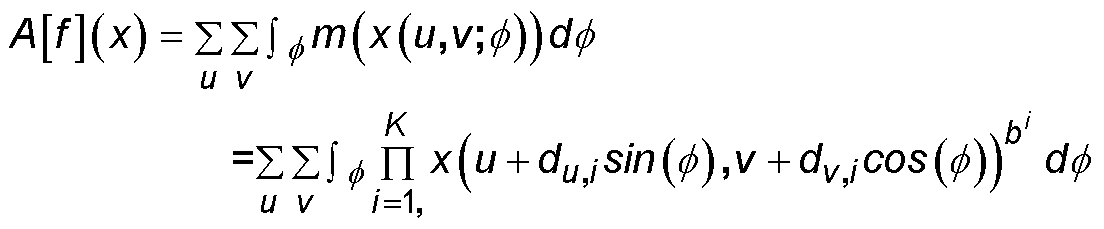
The group mean value matrix or the group mean value vector can be determined according to the following formula:
Gemäß einem Aspekt des Verfahrens wird vorgeschlagen, dass die Transformation eine Rotation und/oder Translation und/oder Skalierung ist.According to one aspect of the method, it is proposed that the transformation be a rotation and / or translation and / or scaling.
Dabei kann die Gruppenmittelwert-Matrix bzw. der Gruppenmittelwert-Vektor entsprechend der folgenden Formel bestimmt werden:

Die Invariante Integrationsschicht berechnet den Gruppenmittelwert, um einen invarianten Merkmalsraum unter Verwendung eines Satzes von Monomen m(x) explizit zu erzwingen, z.B. durch Integration über die Gruppe der zweidimensionalen Translationen (u, v) , Skalierungen (s) und Rotationen φ. Dabei kann der Gruppendurchschnitt unter Verwendung von Monomen für eine beliebige Transformationsgruppe G berechnet werden.The invariant integration layer calculates the group mean in order to explicitly enforce an invariant feature space using a set of monomials m (x), e.g. through integration over the group of two-dimensional translations (u, v), scalings (s) and rotations φ. The Group mean using monomials for any transformation group G can be calculated.
Vorteilhafterweise ergibt sich aus dieser invarianten Integrationsschicht, dass eine Objekterkennung invariant gegenüber einer Rotation, Skalierung und einer Translation der betreffenden Objekte ist. Beispielsweise ist dadurch aus der Vogelperspektive ein Fahrzeug unabhängig von seiner Ausrichtung auf dem digitalen Bild bei der Objekt-Klassifizierung.This invariant integration layer advantageously results in object recognition being invariant with respect to a rotation, scaling and translation of the relevant objects. For example, from a bird's eye view, a vehicle is independent of its orientation in the digital image during object classification.
Gemäß einem Aspekt des Verfahrens wird vorgeschlagen, dass die invariante Integration A(x) durch die in Formel 1 beschriebenen Zusammenhänge bestimmt wird:

Gemäß einem Aspekt des Verfahrens wird vorgeschlagen, dass die invariante Integration A(x) durch die in Formel 2 beschriebenen Zusammenhänge bestimmt wird:

Gemäß einem Aspekt des Verfahrens wird vorgeschlagen, dass das Monom parametrisiert ist und die Parameter der Monome zufällig generiert werden und optimierte Parameter aus den zufällig generierten Parametern ausgewählt werden. Die Parameter der Monome, d.h. die Ordnungen, die Distanzen und die Exponenten, werden mithilfe eines iterativen Ansatzes ausgewählt.
Werden M Monome benötigt (z.B. M = 5), so werden M+1 (z.B. 6) Parameterkombinationen zufällig ausgewählt. Für jede der M+1 möglichen Kombinationen bestehend aus M Parametern wird ein linearer Klassifikator und dessen Validierungsgenauigkeit berechnet. Die Parameterkombination, welche beim am besten abschneidenden Klassifikator nicht verwendet wurde, wird verworfen und durch eine neue, zufällig ausgewählte Kombination ersetzt. Dieser Vorgang wird eine bestimmte Anzahl (z.B. 100mal) von Schritten wiederholt, um die bestmöglichen M Parameterkombinationen zu finden.
Dieses Verfahren zur Auswahl der Parameter der Monome, d.h. die Ordnungen, die Distanzen und die Exponenten, ist einfach und schnell.According to one aspect of the method, it is proposed that the monomial is parameterized and the parameters of the monomials are generated randomly and optimized parameters are selected from the randomly generated parameters. The parameters of the monomials, ie the orders, the distances and the exponents, are selected using an iterative approach.
If M monomials are required (eg M = 5), M + 1 (eg 6) parameter combinations are selected at random. A linear classifier and its validation accuracy are calculated for each of the M + 1 possible combinations consisting of M parameters. The parameter combination that was not used in the best performing classifier is discarded and replaced by a new, randomly selected combination. This process is repeated a certain number (eg 100 times) of steps in order to find the best possible M parameter combinations.
This method of selecting the parameters of the monomials, ie the orders, the distances and the exponents, is quick and easy.
Alternativ werden die Parameter der Monome, d.h. die Ordnungen, die Distanzen und die Exponenten, mithilfe eines Pruning-Ansatzes ausgewählt. Werden M Monome benötigt (z.B. M = 5), so werden N>M (z.B. 100) Parameterkombinationen zufällig ausgewählt. Das neuronale Netz wird mithilfe der N Monome vortrainiert und mittels eines Pruning-Verfahrens werden die N Parameterkombinationen, die den größten Beitrag zur korrekten Klassifikation des Netzwerkes leisten, entweder direkt oder iterativ bestimmt. Der Beitrag zur Klassifikation kann beispielsweise durch die Summe der Absolutwerte der Gewichte am Ausgang eines Monoms bestimmt werden. Diese Verfahren zur Auswahl der Parameter der Monome d.h. die Ordnungen, die Distanzen und die Exponenten, ist einfach, schnell und ermöglicht ein direktes Ende-zu-Ende Training des Netzwerkes.Alternatively, the parameters of the monomials, i.e. the orders, the distances and the exponents, are selected using a pruning approach. If M monomials are required (e.g. M = 5), then N> M (e.g. 100) parameter combinations are selected at random. The neural network is pre-trained using the N monomials and the N parameter combinations that make the greatest contribution to the correct classification of the network are determined either directly or iteratively using a pruning process. The contribution to the classification can be determined, for example, by the sum of the absolute values of the weights at the output of a monomial. This method for selecting the parameters of the monomials, i.e. the orders, the distances and the exponents, is simple, fast and enables direct end-to-end training of the network.
Gemäß einem Aspekt des Verfahrens wird vorgeschlagen, dass das neuronale Faltungs-Netzwerk eine Mehrzahl von Faltungsschichten aufweist, die für die Klassifikation des Objektes relevante Merkmale hervorheben, bevor die invariante Integrationsschicht eine Gruppenmittelwert-Matrix bestimmt. Dadurch werden die für die Objektklassifikation relevanten Merkmale hervorgehoben.
Dieses Verfahren der Extraktion für die Klassifikation relevanter Merkmale reduziert den Rechenaufwand für die Berechnung der invarianten Integration. Beispielsweise werden dabei nicht für die Klassifikation relevante Informationen über eine Translation und/oder Farben der Objekte verworfen.According to one aspect of the method, it is proposed that the neural convolution network has a plurality of convolution layers which emphasize features relevant to the classification of the object before the invariant integration layer determines a group mean matrix. This highlights the features relevant for object classification.
This method of extraction for the classification of relevant features reduces the computational effort for calculating the invariant integration. For example, information about a translation and / or colors of the objects that is not relevant for the classification is discarded.
Es wird ein Verfahren zum Klassifizieren von Objekten in einem, insbesondere zweidimensionalen, digitalen Bild einer Umgebung einer mobilen Plattform vorgeschlagen, dass die folgenden Schritte aufweist:
- In einem ersten Schritt wird das digitale Bild der Umgebung der mobilen Plattform bereitgestellt. In einem weiteren Schritt wird das digitale Bild entsprechend einer Mehrzahl von Objektklassen mittels eines trainierten neuronalen Faltungs-Netzwerks mit zumindest einer invarianten Integrationsschicht entsprechend einem der oben beschriebenen Verfahren und dem digitalen Bild als Eingangssignal des neuronalen Faltungs-Netzwerks mit zumindest einer invarianten Integrationsschicht klassifiziert, wobei das neuronale Faltungs-Netzwerk mit zumindest einer invarianten Integrationsschicht mittels einer Vielzahl von digitalen Referenz-Bildern und klassifizierten Objekten der jeweiligen digitalen Referenz-Bilder trainiert wurde, Objekte der digitalen Referenz-Bilder in Bezug auf die Mehrzahl von Objektklassen zu klassifizieren; und die Objekte des digitalen Bildes klassifiziert.
- In a first step, the digital image of the surroundings of the mobile platform is provided. In a further step, the digital image is classified according to a plurality of object classes by means of a trained neural convolution network with at least one invariant integration layer according to one of the methods described above and the digital image as an input signal of the neural convolution network with at least one invariant integration layer, with the neural convolution network with at least one invariant integration layer was trained by means of a plurality of digital reference images and classified objects of the respective digital reference images to classify objects of the digital reference images in relation to the plurality of object classes; and classify the objects of the digital image.
Ein solches Verfahren zur Klassifizierung von Objekten eignet sich insbesondere für zumindest teilautomatisierte mobile Plattformen wie beispielsweise für ein autonomes Fahrzeug.Such a method for classifying objects is particularly suitable for at least partially automated mobile platforms such as, for example, an autonomous vehicle.
Es wird eine Verwendung eines neuronalen Faltungs-Netzwerks mit zumindest einer invarianten Integrationsschicht zur Klassifizierung von Objekten in digitalen Bildern einer Umgebung einer mobilen Plattform vorgeschlagen, das entsprechend einem der oben beschriebenen Verfahren trainiert wurde.A use of a neural convolution network with at least one invariant integration layer for classifying objects in digital images of an environment of a mobile platform is proposed, which has been trained in accordance with one of the methods described above.
Dadurch dass die invariante Integrationsschicht Teil des neuronalen Faltungsnetzwerks ist, ergibt sich der Vorteil einer höheren Genauigkeit wie schon weiter oben ausgeführt wurde bzw. es werden weniger gelabelte Daten notwendig um eine bestimmte Genauigkeit der Klassifizierungsaufgabe zu erfüllen.The fact that the invariant integration layer is part of the neural convolution network results in the advantage of a higher accuracy, as already explained above, or less labeled data are necessary in order to fulfill a certain accuracy of the classification task.
Es wird eine Verwendung des neuronalen Faltungs-Netzwerks mit zumindest einer invarianten Integrationsschicht, das entsprechend einem der oben beschriebenen Verfahren trainiert wurde, zur Klassifizierung von Objekten in digitalen Bildern einer Umgebung einer mobilen Plattform vorgeschlagen, wobei basierend auf dem Ergebnis der Klassifizierung ein Steuerungssignal zur Ansteuerung einer zumindest teilautomatisierten mobilen Plattform bereitgestellt wird und/oder basierend auf dem Ergebnis der Klassifizierung ein Warnsignal zur Warnung eines Insassen einer zumindest teilautomatisierten mobilen Plattform bereitgestellt wird.A use of the neural convolution network with at least one invariant integration layer, which was trained according to one of the methods described above, is proposed for classifying objects in digital images of a mobile platform environment, with a control signal for activation based on the result of the classification an at least partially automated mobile platform is provided and / or based on the result of the classification, a warning signal for warning an occupant of an at least partially automated mobile platform is provided.
Der Begriff „basierend auf“ ist in Bezug auf das Merkmal, dass ein Steuersignal basierend auf dem Ergebnis der Klassifizierung bereitgestellt wird, breit zu verstehen. Er ist so zu verstehen, dass abhängig von dem Ergebnis der Klassifizierung, jedwede Bestimmung oder Berechnung eines Steuersignals herangezogen wird, wobei das nicht ausschließt, dass auch noch andere Eingangsgrößen für diese Bestimmung des Steuersignals herangezogen werden. Dies gilt entsprechend für die Bereitstellung eines Warnsignals.The term “based on” is to be understood broadly in relation to the feature that a control signal is provided based on the result of the classification. It is to be understood that, depending on the result of the classification, any determination or calculation of a control signal is used, although this does not exclude that other input variables are also used for this determination of the control signal. This applies accordingly to the provision of a warning signal.
Vorteilhafterweise ergibt sich aus der Klassifikation von Objekten einer Umgebung einer zumindest teilautomatisierten mobilen Plattform die Möglichkeit die Steuerung der mobilen Plattform abhängig von dem klassifizierten und detektieren Objekt zu machen, beispielsweise um einen Unfall zu vermeiden.The classification of objects in an environment of an at least partially automated mobile platform advantageously results in the possibility of making the control of the mobile platform dependent on the classified and detected object, for example in order to avoid an accident.
Gemäß einem Aspekt wird ein neuronales Faltungs-Netzwerk mit zumindest einer invarianten Integrationsschicht angegeben, das entsprechend einem der oben beschriebenen Verfahren trainiert wurde.
Mit einem solchen neuronalen Faltungs-Netzwerk kann die beschriebene Klassifikationsaufgabe leicht in unterschiedliche Systeme integriert werden.According to one aspect, a neural convolution network with at least one invariant integration layer is specified, which was trained according to one of the methods described above.
With such a neural convolution network, the described classification task can easily be integrated into different systems.
Gemäß einem Aspekt wird eine Vorrichtung angegeben, die ein neuronales Faltungs-Netzwerk mit zumindest einer invarianten Integrationsschicht aufweist, das entsprechend einem der oben beschriebenen Verfahren trainiert wurde.
Mit einer solchen Vorrichtung kann das entsprechende Verfahren leicht in unterschiedliche Systeme integriert werden.According to one aspect, a device is specified which has a neural convolution network with at least one invariant integration layer that has been trained in accordance with one of the methods described above.
With such a device, the corresponding method can easily be integrated into different systems.
Gemäß einem Aspekt wird ein Computerprogramm angegeben, das Befehle umfasst, die bei der Ausführung des Computerprogramms durch einen Computer diesen veranlassen, eines der oben beschriebenen Verfahren auszuführen. Ein solches Computerprogramm ermöglicht den Einsatz des beschriebenen Verfahrens in unterschiedlichen Systemen.According to one aspect, a computer program is specified which comprises instructions which, when the computer program is executed by a computer, cause the computer to execute one of the methods described above. Such a computer program enables the described method to be used in different systems.
Es wird ein maschinenlesbares Speichermedium angegeben, auf dem das oben beschriebene Computerprogramm gespeichert ist. Mittels eines solchen maschinenlesbaren Speichermediums ist das oben beschriebene Computerprogramm transportabel.A machine-readable storage medium is specified on which the computer program described above is stored. The computer program described above is transportable by means of such a machine-readable storage medium.
Unter einer mobilen Plattform kann ein zumindest teilweise automatisiertes System verstanden werden, welches mobil ist, und/oder ein Fahrerassistenzsystem. Ein Beispiel kann ein zumindest teilweise automatisiertes Fahrzeug bzw. ein Fahrzeug mit einem Fahrerassistenzsystem sein. Das heißt, in diesem Zusammenhang beinhaltet ein zumindest teilweise automatisiertes System eine mobile Plattform in Bezug auf eine zumindest teilweise automatisierte Funktionalität, aber eine mobile Plattform beinhaltet auch Fahrzeuge und andere mobile Maschinen einschließlich Fahrerassistenzsysteme. Weitere Beispiele für mobile Plattformen können Fahrerassistenzsysteme mit mehreren Sensoren, mobile Multisensor-Roboter wie z.B. Roboterstaubsauger oder Rasenmäher, ein Multisensor-Überwachungssystem, eine Fertigungsmaschine, ein persönlicher Assistent oder ein Zugangskontrollsystem sein. Jedes dieser Systeme kann ein vollständig oder teilweise automatisiertes System sein.A mobile platform can be understood to mean an at least partially automated system which is mobile and / or a driver assistance system. An example can be at least in part be an automated vehicle or a vehicle with a driver assistance system. That is, in this context an at least partially automated system includes a mobile platform with regard to an at least partially automated functionality, but a mobile platform also includes vehicles and other mobile machines including driver assistance systems. Further examples of mobile platforms can be driver assistance systems with several sensors, mobile multi-sensor robots such as robotic vacuum cleaners or lawn mowers, a multi-sensor monitoring system, a production machine, a personal assistant or an access control system. Each of these systems can be a fully or partially automated system.
Es wird eine Vorrichtung angegeben, die eingerichtet ist, eines der oben beschriebenen Verfahren durchzuführen.
Mittels einer solchen Vorrichtung ist es möglich, die oben beschriebenen Verfahren zum Beispiel für den Einbau in eine mobile Plattform verfügbar zu machen.A device is specified which is set up to carry out one of the methods described above.
By means of such a device it is possible to make the above-described methods available, for example, for installation in a mobile platform.
Es wird ein Computerprogramm angegeben, welches Befehle umfasst, die bei der Ausführung des Programms durch einen Computer diesen veranlassen, eines der oben beschriebenen Verfahren auszuführen.A computer program is specified which comprises instructions which, when the program is executed by a computer, cause the computer to execute one of the methods described above.
Mittels eines solchen Computerprogramms können die oben beschriebenen Verfahren auf eine einfache Art und Weise zum Beispiel einer mobilen Plattform verfügbar gemacht werden.By means of such a computer program, the methods described above can be made available in a simple manner, for example to a mobile platform.
Es wird ein maschinenlesbares Speichermedium angegeben, auf dem das oben beschriebene Computerprogramm gespeichert ist.
Mittels eines solchen maschinenlesbaren Speichermediums ist das oben beschriebene Computerprogrammprodukt transportabel.A machine-readable storage medium is specified on which the computer program described above is stored.
The computer program product described above is transportable by means of such a machine-readable storage medium.
AusführungsbeispielEmbodiment
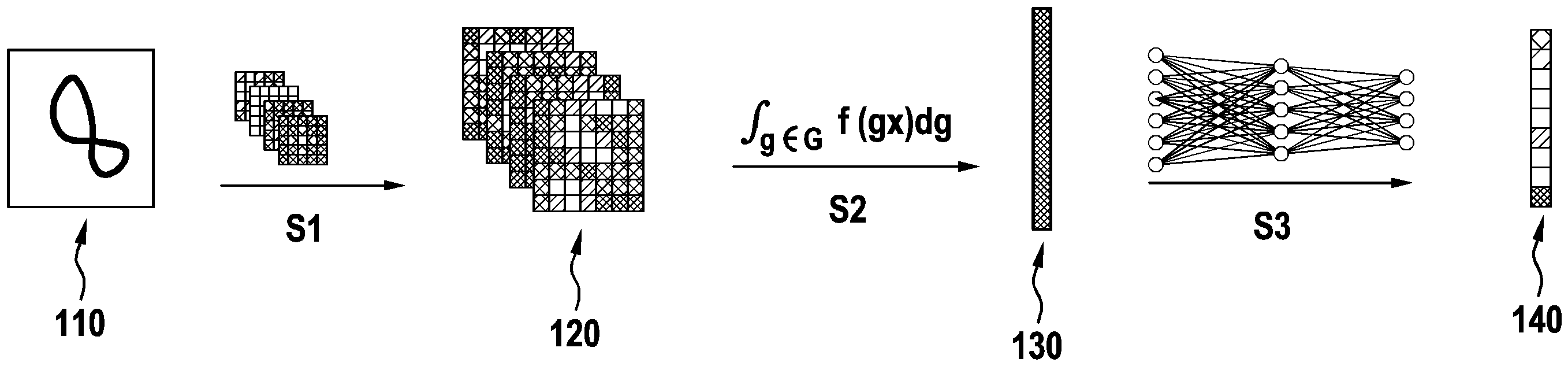
Ein Ausführungsbeispiel der Erfindung wird mit Bezug auf die
-
1 ein Verfahren zum Klassifizieren von Objekten eines digitalen Bildes einer Umgebung einer mobilen Plattform mit einem trainierten neuronalen Faltungs-Netzwerks mit zumindest einer invarianten Integrationsschicht.
-
1 a method for classifying objects of a digital image of an environment of a mobile platform with a trained neural convolution network with at least one invariant integration layer.
Die
Eine Architektur eines invarianten neuronalen Netzwerks zur Klassifikation ist typischerweise aus 2 Teilen aufgebaut. Der erste Teil ist eine Sequenz von äquivarianten Schichten zum Heruntersampeln des Signals hin zu kleineren Auflösungen, mit dem Ziel, die erwünschte Information zu erhalten und redundante Information zu verwerfen. Durch die Äquivarianz der Schichten ändert sich der Ausgang der Faltungsschichten vorhersagbar, wenn der Eingang der Schicht in einer vorherbestimmten Weise (z. B. Rotation) transformiert wird.An architecture of an invariant neural network for classification is typically made up of 2 parts. The first part is a sequence of equivariate layers for downsampling the signal to lower resolutions with the aim of obtaining the desired information and discarding redundant information. Because of the equivariance of the layers, the output of the convolution layers changes predictably when the input of the layer is transformed in a predetermined manner (e.g. rotation).
Im zweiten Teil wird der äquivariante Merkmalsraum in einen invarianten Merkmalsraum, der sich bei Transformationen des Eingangs nicht verändert, überführt. Hierzu wird der Invariant Integration Layer verwendet. Auf Basis der in dieser Weise gewonnenen Merkmale werden mehrere vollvernetzte Schichten eingesetzt, um ein Klassifikationsergebnis zu gewinnen.In the second part, the equivariant feature space is converted into an invariant feature space that does not change when the input is transformed. The Invariant Integration Layer is used for this. On the basis of the features obtained in this way, several fully cross-linked layers are used to obtain a classification result.
Ein Beispiel für eine Architektur des invarianten neuronalen Netzwerkes ist in Tabelle 1 aufgeführt. Der Teil zur äquivarianten Merkmalsgewinnung besteht aus d Schichten von aufeinanderfolgenden äquivarianten Faltungen (z.B. d=6) mit Kernelgrößen N1 bis N_d (z.B. N1=24, N2=32, ...). Zwischen den Schichten kommen ReLU, BatchNormalisierung und MaxPooling zum Einsatz.An example of an architecture of the invariant neural network is shown in Table 1. The part for the equivariate feature extraction consists of d layers of consecutive equivariate folds (e.g. d = 6) with kernel sizes N1 to N_d (e.g. N1 = 24, N2 = 32, ...). ReLU, batch normalization and MaxPooling are used between the shifts.
Der Invariant Integration Layer nutzt 5 Monome, um den äquivarianten Merkmalsraum in einen invarianten eindimensionalen Merkmalsvektor zu überführen. Auf dessen Basis werden k vollvernetzte Blöcke mit Neuronen M1 bis M_k (z.B. M1=90, M2=90) verwendet, um Klassifikations-Scores aus den invarianten Merkmalen zu gewinnen.
Das überwachte Training eines neuronalen Netzes verwendet einen Trainingssatz von Eingangssignalen und gewünschten Ausgangssignalen (bekannt als „Ground Truth“) des neuronalen Faltungs-Netzwerks mit invarianter Integrationsschicht. Die gewünschten Ausgangssignale können z.B. Klassifikationsetiketten sein. Abhängig von den tatsächlichen Ausgangswerten des neuronalen Faltungs-Netzwerks mit invarianter Integrationsschicht und den gewünschten Ausgangssignalen wird eine sogenannte Verlustfunktion berechnet, die zu optimieren ist, d.h. die Parameter bzw. Gewichte des neuronalen Faltungs-Netzwerks mit invarianter Integrationsschicht, die zur Optimierung der Verlustfunktion berechnet werden. Die Optimierung erfolgt durch Berechnung der Gradienten der Verlustfunktion mit den Gewichten, was durch iterative Anwendung der Kettenregel erfolgen kann. Dieses Verfahren wird auch als Backpropagation bezeichnet.The monitored training of a neural network uses a training set of input signals and desired output signals (known as “ground truth”) of the neural convolutional network with an invariant integration layer. The desired output signals can be, for example, classification labels. Depending on the actual output values of the neural convolution network with invariant integration layer and the desired output signals, a so-called loss function is calculated, which is to be optimized, i.e. the parameters or weights of the neural convolution network with invariant integration layer, which are calculated to optimize the loss function . The optimization takes place by calculating the gradients of the loss function with the weights, which can be done by iterative application of the chain rule. This process is also known as back propagation.
Damit die Invariante Integrationsschicht innerhalb eines tiefen neuronalen Netzes eingesetzt werden kann und die vorhergehenden Schichten mittels des Backpropagation-Algorithmus optimierbar bleiben, müssen die Monome mit Bezug auf ihre Eingangsdaten ableitbar sein. Diese Ableitung berechnet sich zu:

Weiterhin lässt sich zeigen, dass auch die Ableitung mit Bezug auf die Monomexponenten bi definiert ist. Diese können daher während des Trainingsvorgangs des neuronalen Netzes optimiert werden.

Daher wird die obenstehend erwähnte Verschiebung der Merkmalskarten eingesetzt:

Furthermore, it can be shown that the derivative is also defined with reference to the monomial exponent b i . These can therefore be optimized during the training process of the neural network.
Therefore, the above-mentioned shift of the feature maps is used:
Claims (14)

Priority Applications (3)
| Application Number | Priority Date | Filing Date | Title |
|---|---|---|---|
| US17/999,646 US12579435B2 (en) | 2020-05-27 | 2021-05-26 | Method for generating a trained convolutional neural network including an invariant integration layer for classifying objects |
| CN202180037998.0A CN115552482B (en) | 2020-05-27 | 2021-05-26 | Method for generating convolutional neural network with invariable integral layer for object classification |
| PCT/EP2021/064013 WO2021239795A1 (en) | 2020-05-27 | 2021-05-26 | Method for generating a trained convolutional neural network having an invariant integration layer for classifying objects |
Applications Claiming Priority (2)
| Application Number | Priority Date | Filing Date | Title |
|---|---|---|---|
| DE102020206631 | 2020-05-27 | ||
| DE102020206631.0 | 2020-05-27 |
Publications (1)
| Publication Number | Publication Date |
|---|---|
| DE102020211596A1 true DE102020211596A1 (en) | 2021-12-02 |
Family
ID=78509128
Family Applications (1)
| Application Number | Title | Priority Date | Filing Date |
|---|---|---|---|
| DE102020211596.6A Pending DE102020211596A1 (en) | 2020-05-27 | 2020-09-16 | Method for generating a trained neural convolution network with an invariant integration layer for classifying objects |
Country Status (4)
| Country | Link |
|---|---|
| US (1) | US12579435B2 (en) |
| CN (1) | CN115552482B (en) |
| DE (1) | DE102020211596A1 (en) |
| WO (1) | WO2021239795A1 (en) |
Families Citing this family (1)
| Publication number | Priority date | Publication date | Assignee | Title |
|---|---|---|---|---|
| CN114419605B (en) * | 2022-03-29 | 2022-07-19 | 之江实验室 | Visual enhancement method and system based on multi-network vehicle-connected space alignment feature fusion |
Family Cites Families (11)
| Publication number | Priority date | Publication date | Assignee | Title |
|---|---|---|---|---|
| JP4599110B2 (en) * | 2004-07-30 | 2010-12-15 | キヤノン株式会社 | Image processing apparatus and method, imaging apparatus, and program |
| US8335949B2 (en) * | 2009-11-06 | 2012-12-18 | Trellisware Technologies, Inc. | Tunable early-stopping for decoders |
| CN103093480B (en) * | 2013-01-15 | 2016-04-20 | 沈阳大学 | Particle Filter Video Image Tracking Method Based on Dual Model |
| US10510018B2 (en) * | 2013-09-30 | 2019-12-17 | Manyworlds, Inc. | Method, system, and apparatus for selecting syntactical elements from information as a focus of attention and performing actions to reduce uncertainty |
| NL2015087B1 (en) * | 2015-06-05 | 2016-09-09 | Univ Amsterdam | Deep receptive field networks. |
| US12314834B1 (en) * | 2015-08-03 | 2025-05-27 | Steven D. Flinn | Iterative attention-based neural network training and processing |
| FR3059128B1 (en) * | 2016-11-24 | 2020-01-10 | Universite D'aix-Marseille | METHOD FOR CHARACTERIZING THE ANISOTROPY OF THE TEXTURE OF A DIGITAL IMAGE |
| US20180293908A1 (en) * | 2017-04-10 | 2018-10-11 | Pearson Education, Inc. | Electronic handwriting processor with derivative coordinate modeling |
| KR101977174B1 (en) * | 2017-09-13 | 2019-05-10 | 이재준 | Apparatus, method and computer program for analyzing image |
| US11709854B2 (en) * | 2018-01-02 | 2023-07-25 | Bank Of America Corporation | Artificial intelligence based smart data engine |
| JP7394542B2 (en) * | 2019-05-30 | 2023-12-08 | キヤノン株式会社 | Imaging device, notification device, notification method, and program |
-
2020
- 2020-09-16 DE DE102020211596.6A patent/DE102020211596A1/en active Pending
-
2021
- 2021-05-26 US US17/999,646 patent/US12579435B2/en active Active
- 2021-05-26 CN CN202180037998.0A patent/CN115552482B/en active Active
- 2021-05-26 WO PCT/EP2021/064013 patent/WO2021239795A1/en not_active Ceased
Also Published As
| Publication number | Publication date |
|---|---|
| US12579435B2 (en) | 2026-03-17 |
| WO2021239795A1 (en) | 2021-12-02 |
| CN115552482B (en) | 2026-04-14 |
| CN115552482A (en) | 2022-12-30 |
| US20230206063A1 (en) | 2023-06-29 |
Similar Documents
| Publication | Publication Date | Title |
|---|---|---|
| EP3748453B1 (en) | Method and device for automatically executing a control function of a vehicle | |
| DE102019214402A1 (en) | METHOD AND DEVICE FOR PROCESSING DATA BY MEANS OF A NEURONAL CONVOLUTIONAL NETWORK | |
| DE102019209462A1 (en) | Method for determining a confidence value of a detected object | |
| WO2019206775A1 (en) | Method and device for determining a network configuration of a neural network | |
| DE102019216379A1 (en) | Method for training a neural convolution network to determine a localization pose | |
| DE112020006045T5 (en) | FORMAL SECURE SYMBOLIC REINFORCEMENT LEARNING THROUGH VISUAL INPUTS | |
| EP3748454B1 (en) | Method and device for automatically executing a control function of a vehicle | |
| DE102019205962A1 (en) | Method for generating digital image pairs as training data for neural networks | |
| EP3985558B1 (en) | Method and device for classifying sensor data | |
| DE102017128082A1 (en) | Meta-architecture design for a CNN network | |
| EP4569494A1 (en) | Method for determining a parking space and a target position for a vehicle in the parking space | |
| DE102019209463A1 (en) | Method for determining the trust value of an object of a class | |
| DE102020127051A1 (en) | Method for determining safety-critical output values using a data analysis device for a technical entity | |
| EP4000011B1 (en) | Component-based processing of input variables | |
| DE102020211596A1 (en) | Method for generating a trained neural convolution network with an invariant integration layer for classifying objects | |
| DE102021207613A1 (en) | Process for quality assurance of a system | |
| DE102021212483A1 (en) | Data processing device and method and program for deep learning of a neural network | |
| DE102022123499B3 (en) | Computer-implemented method, processor circuit and computer program for processing measurement points received from an environment sensor, in particular radar measurement points, for object detection and a correspondingly equipped motor vehicle | |
| EP4498289A1 (en) | Method for training a machine learning model for classifying sensor data | |
| DE102019114049A1 (en) | Method for validating a driver assistance system using further generated test input data sets | |
| EP4049186B1 (en) | Method for making a neural network more robust against adversarial disruptions | |
| DE102019202747A1 (en) | Method and device for the classification of input data | |
| EP4323862A1 (en) | Method for quality assurance of a system | |
| DE102020208765A1 (en) | Image classifier with variable receptive fields in convolutional layers | |
| DE102019215256A1 (en) | Method for generating a digital localization map for determining a location of an at least partially automated mobile platform |