DE102020210121A1 - Micromechanical system, method for operating a micromechanical system - Google Patents
Micromechanical system, method for operating a micromechanical system Download PDFInfo
- Publication number
- DE102020210121A1 DE102020210121A1 DE102020210121.3A DE102020210121A DE102020210121A1 DE 102020210121 A1 DE102020210121 A1 DE 102020210121A1 DE 102020210121 A DE102020210121 A DE 102020210121A DE 102020210121 A1 DE102020210121 A1 DE 102020210121A1
- Authority
- DE
- Germany
- Prior art keywords
- damping
- finger
- micromechanical system
- control electrode
- electrode
- Prior art date
- Legal status (The legal status is an assumption and is not a legal conclusion. Google has not performed a legal analysis and makes no representation as to the accuracy of the status listed.)
- Pending
Links
Images




Classifications
-
- G—PHYSICS
- G01—MEASURING; TESTING
- G01C—MEASURING DISTANCES, LEVELS OR BEARINGS; SURVEYING; NAVIGATION; GYROSCOPIC INSTRUMENTS; PHOTOGRAMMETRY OR VIDEOGRAMMETRY
- G01C19/00—Gyroscopes; Turn-sensitive devices using vibrating masses; Turn-sensitive devices without moving masses; Measuring angular rate using gyroscopic effects
- G01C19/56—Turn-sensitive devices using vibrating masses, e.g. vibratory angular rate sensors based on Coriolis forces
- G01C19/5642—Turn-sensitive devices using vibrating masses, e.g. vibratory angular rate sensors based on Coriolis forces using vibrating bars or beams
- G01C19/5656—Turn-sensitive devices using vibrating masses, e.g. vibratory angular rate sensors based on Coriolis forces using vibrating bars or beams the devices involving a micromechanical structure
-
- G—PHYSICS
- G01—MEASURING; TESTING
- G01C—MEASURING DISTANCES, LEVELS OR BEARINGS; SURVEYING; NAVIGATION; GYROSCOPIC INSTRUMENTS; PHOTOGRAMMETRY OR VIDEOGRAMMETRY
- G01C19/00—Gyroscopes; Turn-sensitive devices using vibrating masses; Turn-sensitive devices without moving masses; Measuring angular rate using gyroscopic effects
- G01C19/56—Turn-sensitive devices using vibrating masses, e.g. vibratory angular rate sensors based on Coriolis forces
- G01C19/5719—Turn-sensitive devices using vibrating masses, e.g. vibratory angular rate sensors based on Coriolis forces using planar vibrating masses driven in a translation vibration along an axis
- G01C19/5733—Structural details or topology
- G01C19/5755—Structural details or topology the devices having a single sensing mass
-
- G—PHYSICS
- G01—MEASURING; TESTING
- G01P—MEASURING LINEAR OR ANGULAR SPEED, ACCELERATION, DECELERATION, OR SHOCK; INDICATING PRESENCE, ABSENCE, OR DIRECTION, OF MOVEMENT
- G01P1/00—Details of instruments
- G01P1/003—Details of instruments used for damping
-
- G—PHYSICS
- G01—MEASURING; TESTING
- G01P—MEASURING LINEAR OR ANGULAR SPEED, ACCELERATION, DECELERATION, OR SHOCK; INDICATING PRESENCE, ABSENCE, OR DIRECTION, OF MOVEMENT
- G01P15/00—Measuring acceleration; Measuring deceleration; Measuring shock, i.e. sudden change of acceleration
- G01P15/02—Measuring acceleration; Measuring deceleration; Measuring shock, i.e. sudden change of acceleration by making use of inertia forces using solid seismic masses
- G01P15/08—Measuring acceleration; Measuring deceleration; Measuring shock, i.e. sudden change of acceleration by making use of inertia forces using solid seismic masses with conversion into electric or magnetic values
- G01P15/0802—Details
-
- G—PHYSICS
- G01—MEASURING; TESTING
- G01P—MEASURING LINEAR OR ANGULAR SPEED, ACCELERATION, DECELERATION, OR SHOCK; INDICATING PRESENCE, ABSENCE, OR DIRECTION, OF MOVEMENT
- G01P15/00—Measuring acceleration; Measuring deceleration; Measuring shock, i.e. sudden change of acceleration
- G01P15/02—Measuring acceleration; Measuring deceleration; Measuring shock, i.e. sudden change of acceleration by making use of inertia forces using solid seismic masses
- G01P15/08—Measuring acceleration; Measuring deceleration; Measuring shock, i.e. sudden change of acceleration by making use of inertia forces using solid seismic masses with conversion into electric or magnetic values
- G01P15/125—Measuring acceleration; Measuring deceleration; Measuring shock, i.e. sudden change of acceleration by making use of inertia forces using solid seismic masses with conversion into electric or magnetic values by capacitive pick-up
-
- G—PHYSICS
- G01—MEASURING; TESTING
- G01P—MEASURING LINEAR OR ANGULAR SPEED, ACCELERATION, DECELERATION, OR SHOCK; INDICATING PRESENCE, ABSENCE, OR DIRECTION, OF MOVEMENT
- G01P15/00—Measuring acceleration; Measuring deceleration; Measuring shock, i.e. sudden change of acceleration
- G01P15/02—Measuring acceleration; Measuring deceleration; Measuring shock, i.e. sudden change of acceleration by making use of inertia forces using solid seismic masses
- G01P15/08—Measuring acceleration; Measuring deceleration; Measuring shock, i.e. sudden change of acceleration by making use of inertia forces using solid seismic masses with conversion into electric or magnetic values
- G01P2015/0862—Measuring acceleration; Measuring deceleration; Measuring shock, i.e. sudden change of acceleration by making use of inertia forces using solid seismic masses with conversion into electric or magnetic values being provided with particular means being integrated into a MEMS accelerometer structure for providing particular additional functionalities to those of a spring mass system
- G01P2015/0871—Measuring acceleration; Measuring deceleration; Measuring shock, i.e. sudden change of acceleration by making use of inertia forces using solid seismic masses with conversion into electric or magnetic values being provided with particular means being integrated into a MEMS accelerometer structure for providing particular additional functionalities to those of a spring mass system using stopper structures for limiting the travel of the seismic mass
-
- G—PHYSICS
- G01—MEASURING; TESTING
- G01P—MEASURING LINEAR OR ANGULAR SPEED, ACCELERATION, DECELERATION, OR SHOCK; INDICATING PRESENCE, ABSENCE, OR DIRECTION, OF MOVEMENT
- G01P15/00—Measuring acceleration; Measuring deceleration; Measuring shock, i.e. sudden change of acceleration
- G01P15/02—Measuring acceleration; Measuring deceleration; Measuring shock, i.e. sudden change of acceleration by making use of inertia forces using solid seismic masses
- G01P15/08—Measuring acceleration; Measuring deceleration; Measuring shock, i.e. sudden change of acceleration by making use of inertia forces using solid seismic masses with conversion into electric or magnetic values
- G01P2015/0862—Measuring acceleration; Measuring deceleration; Measuring shock, i.e. sudden change of acceleration by making use of inertia forces using solid seismic masses with conversion into electric or magnetic values being provided with particular means being integrated into a MEMS accelerometer structure for providing particular additional functionalities to those of a spring mass system
- G01P2015/0882—Measuring acceleration; Measuring deceleration; Measuring shock, i.e. sudden change of acceleration by making use of inertia forces using solid seismic masses with conversion into electric or magnetic values being provided with particular means being integrated into a MEMS accelerometer structure for providing particular additional functionalities to those of a spring mass system for providing damping of vibrations
Landscapes
- Physics & Mathematics (AREA)
- General Physics & Mathematics (AREA)
- Engineering & Computer Science (AREA)
- Radar, Positioning & Navigation (AREA)
- Remote Sensing (AREA)
- Micromachines (AREA)
- Gyroscopes (AREA)
Abstract
Es wird ein mikromechanisches System beansprucht, umfassend eine beweglich aufgehängte Masse, dadurch gekennzeichnet, dass das mikromechanische System eine Dämpfungsanordnung umfasst, wobei die Dämpfungsanordnung eine beweglich aufgehängte Dämpfungsstruktur aufweist, wobei die Dämpfungsstruktur durch Anlegen einer elektrischen Spannung auslenkbar ist, wobei die Dämpfungsstruktur derart ausgebildet ist, dass mithilfe einer Auslenkung der Dämpfungsstruktur ein Frequenzverhalten und/oder eine Dämpfung der beweglich aufgehängten Masse veränderbar ist.A micromechanical system is claimed, comprising a movably suspended mass, characterized in that the micromechanical system comprises a damping arrangement, the damping arrangement having a movably suspended damping structure, the damping structure being deflectable by applying an electrical voltage, the damping structure being designed in this way that with the aid of a deflection of the damping structure, a frequency response and/or a damping of the movably suspended mass can be changed.
Description
Stand der TechnikState of the art
Die Erfindung geht aus von einem mikromechanischen System nach dem Oberbegriff des Anspruchs 1.The invention is based on a micromechanical system according to the preamble of
Mikromechanische Systeme sind beispielsweise als Inertialsensoren zur Messung von Beschleunigungen oder Drehraten weit verbreitet und werden in vielen Bereichen der Technik, etwa in Mobiltelefonen oder Automobilen, zur Erkennung eines Bewegungszustands eingesetzt. Dabei ist häufig eine gezielte Einstellung des Frequenzverhaltens, insbesondere der Eigenfrequenz und Güte bzw. Dämpfung, erforderlich, um den Sensor an die jeweilige Applikation anzupassen. Beispielsweise muss ein Beschleunigungssensor, der im Automobilbereich zur Auslösung eines Airbags verwendet wird, in der Regel eine überkritische Dämpfung aufweisen, so dass ein eventuelles Nachschwingen des Sensors nach Eintreffen des eigentlichen Schocks verhindert wird, um eine Verfälschung des Messsignals zu vermeiden.Micromechanical systems are widely used, for example, as inertial sensors for measuring acceleration or yaw rates, and are used in many areas of technology, for example in mobile phones or automobiles, to detect a state of motion. A targeted setting of the frequency behavior, in particular the natural frequency and quality or damping, is often necessary in order to adapt the sensor to the respective application. For example, an acceleration sensor that is used in the automotive sector to trigger an airbag must generally have supercritical damping so that any oscillation of the sensor after the actual shock has occurred is prevented in order to avoid falsification of the measurement signal.
Stand der Technik ist dabei eine einmalige Abstimmung des Sensors zur Einstellung eines bestimmten Frequenzverhaltens, die häufig bereits durch das Design des Sensors bei der Fertigung festgelegt wird.The state of the art is a one-off tuning of the sensor to set a specific frequency behavior, which is often already determined by the design of the sensor during production.
Offenbarung der ErfindungDisclosure of Invention
Es ist eine Aufgabe der vorliegenden Erfindung, ein mikromechanisches System bereitzustellen, wobei ein Verhalten einer beweglich aufgehängten Masse des Sensors vorteilhaft und insbesondere flexibel angepasst werden kann.It is an object of the present invention to provide a micromechanical system in which a behavior of a movably suspended mass of the sensor can be adapted advantageously and in particular flexibly.
Das erfindungsgemäße mikromechanische System gemäß dem Hauptanspruch hat gegenüber dem Stand der Technik den Vorteil, dass eine verbesserte und flexible Anpassung eines Frequenzverhaltens und/oder der Dämpfung der beweglich aufgehängten Masse vorgenommen werden kann. Das Frequenzverhalten der beweglich aufgehängten Masse ist insbesondere derart veränderbar, dass sich in Abhängigkeit der Auslenkung der Dämpfungsstruktur eine Dämpfung einer Schwingung der beweglich aufgehängten Masse und/oder eine Frequenz einer Schwingung der beweglich aufgehängten Masse ändert.The micromechanical system according to the invention according to the main claim has the advantage over the prior art that an improved and flexible adaptation of a frequency response and/or the damping of the movably suspended mass can be undertaken. The frequency behavior of the movably suspended mass can be changed in particular in such a way that a damping of a vibration of the movably suspended mass and/or a frequency of a vibration of the movably suspended mass changes depending on the deflection of the damping structure.
Es ist erfindungsgemäß möglich, dass die Dämpfungsstruktur durch Anlegen der elektrischen Spannung relativ zum Substrat ausgelenkt wird und somit auch ihre Position relativ zur beweglich aufgehängten Masse (insbesondere bezüglich der Ruhelage der beweglich aufgehängten Masse) verändert. Hierdurch ändert sich eine elektrostatische Krafteinwirkung der Dämpfungsstruktur auf die beweglich aufgehängte Masse, was das Frequenzverhalten und/oder die Dämpfung der beweglich aufgehängten Masse verändert. Insbesondere kann die Dämpfung der beweglich aufgehängten Masse somit durch die Auslenkung bzw. Verschiebung der Dämpfungsstruktur aus einer Ruhelage der Dämpfungsstruktur erhöht werden.It is possible according to the invention that the damping structure is deflected relative to the substrate by applying the electrical voltage and thus also changes its position relative to the movably suspended mass (in particular with respect to the rest position of the movably suspended mass). This changes an electrostatic force effect of the damping structure on the movably suspended mass, which changes the frequency response and/or the damping of the movably suspended mass. In particular, the damping of the movably suspended mass can thus be increased by the deflection or displacement of the damping structure from a rest position of the damping structure.
Bei dem mikromechanischen System kann es sich insbesondere um ein mikroelektromechanisches System (MEMS), insbesondere einen Sensor und/oder Aktor, handeln. Vorzugsweise ist es denkbar, dass das mikromechanische System einen Beschleunigungssensor und/oder Drehratensensor umfasst. Erfindungsgemäß ist es somit vorzugsweise möglich, das Frequenzverhalten eines Sensors mittels beweglicher Dämpfungselektroden (bzw. der Dämpfungsstruktur) zu verändern. Dies kann unter anderem zur Anpassung des Frequenzverhaltens an bestimmte Applikationen verwendet werden oder dem Ausgleich von alterungsbedingten Veränderungen des Frequenzverhaltens dienen. Insbesondere ist erfindungsgemäß auch ein Anpassen einer Frequenz und/oder Dämpfung in der Applikation des Sensors, also nach einer Herstellung und/oder nach einem Einbau des Sensors in ein Produkt, durch Anlegen einer externen Spannung möglich.The micromechanical system can in particular be a microelectromechanical system (MEMS), in particular a sensor and/or actuator. It is preferably conceivable that the micromechanical system includes an acceleration sensor and/or yaw rate sensor. According to the invention, it is thus preferably possible to change the frequency response of a sensor by means of movable damping electrodes (or the damping structure). Among other things, this can be used to adapt the frequency behavior to specific applications or to compensate for age-related changes in the frequency behavior. In particular, it is also possible according to the invention to adapt a frequency and/or damping in the application of the sensor, ie after manufacture and/or after installation of the sensor in a product, by applying an external voltage.
Erfindungsgemäß sind somit elektrostatisch bewegliche Dämpfungsstrukturen denkbar, die auf eine die mechanische Übertragungsfunktion verändernde Art und Weise an die zur Bewegungsdetektion verwendeten seismischen Massen, angekoppelt sind. Damit lässt sich mittels extern steuerbarer elektrischer Spannungen das Frequenzverhalten des Sensors einstellen bzw. korrigieren, was für viele Applikationen, bei denen es auf ein definiertes Frequenzverhalten der eingesetzten Sensoren ankommt (wie beispielsweise Airbagauslösung, Stabilitätskontrolle oder Körperschalldetektion) von Vorteil ist.According to the invention, electrostatically movable damping structures are thus conceivable, which are coupled to the seismic masses used for motion detection in a manner that changes the mechanical transmission function. This allows the frequency behavior of the sensor to be adjusted or corrected using externally controllable electrical voltages, which is advantageous for many applications in which a defined frequency behavior of the sensors used is important (such as airbag deployment, stability control or structure-borne noise detection).
Vorteilhafte Ausgestaltungen und Weiterbildungen der Erfindung sind den Unteransprüchen sowie der Beschreibung unter Bezugnahme auf die Zeichnungen entnehmbar.Advantageous configurations and developments of the invention can be found in the subclaims and the description with reference to the drawings.
Dadurch, dass gemäß einer Ausführungsform der vorliegenden Erfindung die beweglich aufgehängte Masse eine Elektrodenstruktur umfasst, wobei die Elektrodenstruktur derart eingerichtet ist, dass sich bei der Auslenkung der Dämpfungsstruktur eine Dämpfungskraft zwischen der Elektrodenstruktur und der Dämpfungsstruktur ändert, sodass sich mithilfe der Auslenkung der Dämpfungsstruktur das Frequenzverhalten und/oder die Dämpfung der beweglich aufgehängten Masse verändert, ist es vorteilhafterweise möglich, dass die Dämpfungsstruktur durch Anlegen der elektrischen Spannung relativ zum Substrat und/oder zur beweglich aufgehängten Masse ausgelenkt werden kann. Durch die Änderung der Position der Dämpfungsstruktur relativ zur beweglich aufgehängten Masse ändert sich eine Kraftwirkung zwischen der Dämpfungsstruktur und der Masse. Durch diese veränderte Kraftwirkung wird das Frequenzverhalten und/oder die Dämpfung der beweglich aufgehängten Masse (bzw. einer Schwingung der Masse) verändert, insbesondere erhöht. Somit kann das Frequenzverhalten und/oder die Dämpfung in vorteilhafter Weise variiert und eingestellt werden.The fact that, according to one embodiment of the present invention, the movably suspended mass comprises an electrode structure, the electrode structure being set up in such a way that when the damping structure is deflected, a damping force between the electrode structure and the damping structure changes, so that the frequency response changes with the aid of the deflection of the damping structure and/or the damping of the movably suspended mass changes, it is advantageously possible that the damping structure can be deflected relative to the substrate and/or to the movably suspended mass by applying the electrical voltage. By changing the position of the damping structure relative to the movably suspended mass, a force effect between the damping structure and the mass changes. This changed force effect changes, in particular increases, the frequency behavior and/or the damping of the movably suspended mass (or a vibration of the mass). In this way, the frequency response and/or the damping can advantageously be varied and adjusted.
Dadurch, dass gemäß einer Ausführungsform der vorliegenden Erfindung die Dämpfungsanordnung eine Kontrollelektrodenstruktur umfasst, wobei die Dämpfungsstruktur durch Anlegen der Spannung an der Kontrollelektrodenstruktur und/oder Dämpfungsstruktur auslenkbar ist, ist es möglich, eine kontrollierbare Auslenkung der Dämpfungsstruktur durch eine elektrostatische Kraft zwischen der Kontrollelektrodenstruktur und der Dämpfungsstruktur zu ermöglichen, was eine vorteilhafte präzise Einstellung des Frequenzverhaltens und/oder der Dämpfung der beweglich aufgehängten Masse ermöglicht. Die Kontrollelektrodenstruktur ist insbesondere fest und unbeweglich mit dem Substrat verbunden. Durch Anlagen der Spannung U kann somit die Dämpfungsstruktur aus ihrer Ruhelage (für U = 0 V) ausgelenkt werden. Es ist bevorzugt, dass die Spannung U an der Kontrollelektrodenstruktur angelegt wird, wobei die Dämpfungsstruktur und die Elektrodenstruktur besonders bevorzugt auf dem gleichen Potential gehalten werden.Due to the fact that, according to one embodiment of the present invention, the damping arrangement comprises a control electrode structure, the damping structure being deflectable by applying the voltage to the control electrode structure and/or damping structure, it is possible to achieve a controllable deflection of the damping structure by an electrostatic force between the control electrode structure and the To allow damping structure, which allows an advantageous precise adjustment of the frequency response and / or the damping of the movably suspended mass. In particular, the control electrode structure is firmly and immovably connected to the substrate. By applying the voltage U, the damping structure can be deflected from its rest position (for U = 0 V). It is preferred that the voltage U is applied to the control electrode structure, with the damping structure and the electrode structure being particularly preferably kept at the same potential.
Gemäß einer Ausführungsform der vorliegenden Erfindung ist es möglich, dass die Dämpfungsstruktur mithilfe einer oder mehrere Federstrukturen aufgehängt ist. Die Federstrukturen ermöglichen eine vorteilhafte Auslenkung der Dämpfungsstruktur relativ zum Substrat.According to an embodiment of the present invention, it is possible for the damping structure to be suspended using one or more spring structures. The spring structures enable an advantageous deflection of the damping structure relative to the substrate.
Dadurch, dass gemäß einer Ausführungsform der vorliegenden Erfindung die Dämpfungsstruktur einen Dämpfungsfinger, insbesondere eine Gruppe von Dämpfungsfingern, umfasst, wobei die Elektrodenstruktur einen Elektrodenfinger, insbesondere eine Gruppe von Elektrodenfingern umfasst, ist es möglich, Plattenkondensator- und/oder Kammstrukturen zu verwenden, die vorteilhaft hergestellt werden können. Die Gruppe von Dämpfungsfingern und die Gruppe von Elektrodenfingern greifen vorzugsweise ineinander. Es ist vorzugsweise denkbar, dass die Dämpfungsfinger der Gruppe von Dämpfungsfingern (oder zumindest die jeweiligen Hauptkörper der Dämpfungsfinger der Gruppe von Dämpfungsfingern) und/oder die Elektrodenfinger der Gruppe von Elektrodenfingern jeweils balkenförmig ausgebildet sind. Gemäß einer Ausführungsform ist es vorgesehen, dass sich der Dämpfungsfinger oder zumindest der Hauptkörper des Dämpfungsfingers parallel zu dem Elektrodenfinger erstrecket, wobei sich vorzugsweise die Dämpfungsfinger der Gruppe von Dämpfungsfingern oder zumindest die jeweiligen Hauptkörper der Dämpfungsfinger der Gruppe von Dämpfungsfingern parallel zu den Elektrodenfingern der Gruppe von Elektrodenfingern erstrecken. Es ist dementsprechend möglich, dass Platten- und/oder Kammanordnungen von Elektroden für die Dämpfungsstruktur zur Anwendung kommen, die sich entweder kontinuierlich oder abrupt bzw. bimodal in ihrer Position verändern lassen.The fact that, according to one embodiment of the present invention, the damping structure comprises a damping finger, in particular a group of damping fingers, with the electrode structure comprising an electrode finger, in particular a group of electrode fingers, it is possible to use plate capacitor and/or comb structures which are advantageous can be produced. The set of damping fingers and the set of electrode fingers are preferably interdigitated. It is preferably conceivable that the damping fingers of the group of damping fingers (or at least the respective main bodies of the damping fingers of the group of damping fingers) and/or the electrode fingers of the group of electrode fingers are each bar-shaped. According to one embodiment, it is provided that the damping finger or at least the main body of the damping finger extends parallel to the electrode finger, the damping fingers of the group of damping fingers or at least the respective main bodies of the damping fingers of the group of damping fingers preferably extending parallel to the electrode fingers of the group of Electrode fingers extend. Accordingly, it is possible for plate and/or comb arrangements of electrodes to be used for the damping structure, the position of which can be changed either continuously or abruptly or bimodally.
Dadurch, dass gemäß einer Ausführungsform der vorliegenden Erfindung die Gruppe von Dämpfungsfingern einen weiteren Dämpfungsfinger umfasst, wobei die Kontrollelektrodenstruktur eine Kontrollelektrode umfasst, wobei die Kontrollelektrode zwischen dem Dämpfungsfinger und dem weiteren Dämpfungsfinger angeordnet ist, ist es möglich, dass Finger- bzw. Kammstrukturen zur Anwendung kommen, um eine Auslenkung der Dämpfungsstruktur zu ermöglichen. Der Dämpfungsfinger und der weitere Dämpfungsfinger sind vorzugsweise benachbarte Dämpfungsfinger. Die Kontrollelektrode ist bevorzugt in Schwingungsrichtung der beweglich aufgehängten Masse zwischen dem Dämpfungsfinger und dem weiteren Dämpfungsfinger angeordnet. Die Kontrollelektrode ist vorzugsweise balkenförmig ausgebildet.Because, according to one embodiment of the present invention, the group of damping fingers comprises a further damping finger, the control electrode structure comprising a control electrode, the control electrode being arranged between the damping finger and the further damping finger, it is possible for finger or comb structures to be used come to allow a deflection of the damping structure. The damping finger and the further damping finger are preferably adjacent damping fingers. The control electrode is preferably arranged in the vibration direction of the movably suspended mass between the damping finger and the further damping finger. The control electrode is preferably bar-shaped.
Dadurch, dass gemäß einer Ausführungsform der vorliegenden Erfindung ein Abstand zwischen dem Dämpfungsfinger und der Kontrollelektrode kleiner ist als ein weiterer Abstand zwischen dem weiteren Dämpfungsfinger und der Kontrollelektrode, ist es möglich, dass die Kontrollelektrode asymmetrisch zwischen den beiden Dämpfungsfingern angeordnet ist. Beim Anlegen einer Spannung U dominiert die Kraft zwischen dem Dämpfungsfinger und der Kontrollelektrode gegenüber der Kraft zwischen dem weiteren Dämpfungsfinger und der Kontrollelektrode, sodass die Dämpfungsstruktur in eine Richtung ausgelenkt wird. Hierdurch wird eine Auslenkung der Dämpfungsstruktur aus ihrer Ruheposition durch Anlegen einer elektrischen Spannung U besonders vorteilhaft ermöglicht. Because, according to one embodiment of the present invention, a distance between the damping finger and the control electrode is smaller than a further distance between the further damping finger and the control electrode, it is possible for the control electrode to be arranged asymmetrically between the two damping fingers. When a voltage U is applied, the force between the damping finger and the control electrode dominates over the force between the further damping finger and the control electrode, so that the damping structure is deflected in one direction. This enables the damping structure to be deflected from its rest position by applying an electrical voltage U in a particularly advantageous manner.
Gemäß einer Ausführungsform der vorliegenden Erfindung ist es vorgesehen, dass sich die Kontrollelektrode parallel zu dem Dämpfungsfinger erstreckt, oder dass sich die Kontrollelektrode senkrecht zu dem Dämpfungsfinger und/oder senkrecht zu einem Hauptkörper des Dämpfungsfingers erstreckt, wobei der Dämpfungsfinger vorzugsweise eine oder mehrere Fingerstrukturen aufweist, die sich besonders bevorzugt parallel zu der Kontrollelektrode erstrecken. Die Kontrollelektrode ist gemäß einer Ausgestaltung somit insbesondere parallel zu dem Dämpfungsfinger ausgerichtet und angeordnet und von diesem beabstandet. Gemäß einer alternativen Ausgestaltung ist die Kontrollelektrode senkrecht zu dem Dämpfungsfinger und/oder senkrecht zu einem Hauptkörper des Dämpfungsfingers angeordnet und ausgerichtet. Der Dämpfungsfinger umfasst bei dieser alternativen Ausgestaltung bevorzugt eine oder mehrere Fingerstrukturen, die sich senkrecht vom Hauptkörper des Dämpfungsfingers aus erstrecken und somit parallel zu der Kontrollelektrode ausgebildet sind. Die Kontrollelektrode ist insbesondere zwischen zwei der Fingerstrukturen angeordnet und von diesen jeweils beabstandet ausgebildet.According to one embodiment of the present invention, it is provided that the control electrode extends parallel to the damping finger, or that the control electrode extends perpendicular to the damping finger and/or perpendicular to a main body of the damping finger, with the damping finger preferably having one or more finger structures, which particularly preferably extend parallel to the control electrode. According to one embodiment, the control electrode is therefore in particular aligned and disposed parallel to and spaced from the dampening finger. According to an alternative embodiment, the control electrode is arranged and aligned perpendicular to the damping finger and/or perpendicular to a main body of the damping finger. In this alternative configuration, the damping finger preferably comprises one or more finger structures which extend perpendicularly from the main body of the damping finger and are thus formed parallel to the control electrode. The control electrode is arranged in particular between two of the finger structures and is formed at a distance from them.
Dadurch, dass gemäß einer Ausführungsform der vorliegenden Erfindung der Elektrodenfinger zwischen dem Dämpfungsfinger und dem weiteren Dämpfungsfinger angeordnet ist, wobei ein Fingerabstand zwischen dem Elektrodenfinger und dem Dämpfungsfinger kleiner oder gleich groß oder größer ist als der Abstand zwischen dem Dämpfungsfinger und der Kontrollelektrode, ist es möglich, sowohl jeweils mindestens einen Elektrodenfinger der beweglich aufgehängten Masse als auch mindestens eine Kontrollelektrode im Zwischenraum zwischen zwei benachbarten Dämpfungsfingern anzuordnen. Somit ist eine besonders platzsparende Anordnung möglich.The fact that, according to one embodiment of the present invention, the electrode finger is arranged between the damping finger and the further damping finger, with a finger spacing between the electrode finger and the damping finger being less than or equal to or greater than the spacing between the damping finger and the control electrode, it is possible to arrange both at least one electrode finger of the movably suspended mass and at least one control electrode in the space between two adjacent damping fingers. A particularly space-saving arrangement is thus possible.
Dadurch, dass gemäß einer Ausführungsform der vorliegenden Erfindung das mikromechanische System eine Stoppervorrichtung umfasst, wobei mithilfe der Stoppervorrichtung die Auslenkung der Dämpfungsstruktur begrenzbar ist, ist es möglich, dass die Dämpfungsstruktur maximal soweit ausgelenkt wird, bis sie auf die Stoppervorrichtung trifft bzw. mit dieser in Kontakt kommt. Eine weitere Auslenkung wird dann durch die Stoppervorrichtung mechanisch verhindert. Hierfür kann die Dämpfungsstruktur vorzugsweise einen Vorsprung oder einen Finger aufweisen, der bei einer Auslenkung der Dämpfungsstruktur mit der Stoppervorrichtung in Kontakt kommt, um eine definierte Aufprallfläche zu realisieren.Due to the fact that, according to one embodiment of the present invention, the micromechanical system comprises a stopper device, with the stopper device being able to limit the deflection of the damping structure, it is possible for the damping structure to be deflected at most until it hits the stopper device or is in contact with it contact comes. A further deflection is then mechanically prevented by the stopper device. For this purpose, the damping structure can preferably have a projection or a finger, which comes into contact with the stopper device when the damping structure is deflected, in order to realize a defined impact surface.
Mithilfe der Stoppervorrichtung ist gemäß einer Ausführungsform der vorliegenden Erfindung eine bimodale Funktion der Dämpfungsstruktur denkbar. Die Dämpfungsstruktur kann dabei zwischen einem ersten nicht ausgelenkten Zustand, indem sie in ihrer Ruhelage ist und keine elektrische Spannung U angelegt ist, und einem zweiten ausgelenkten Zustand, in dem eine elektrische Spannung U angelegt ist und die Dämpfungsstruktur soweit ausgelenkt ist, dass sie mit der Stoppervorrichtung in Kontakt ist, geschaltet werden. Die Stoppervorrichtung ist insbesondere fest und unbeweglich mit dem Substrat verbunden.According to one embodiment of the present invention, a bimodal function of the damping structure is conceivable with the aid of the stopper device. The damping structure can be switched between a first undeflected state, in which it is in its rest position and no electrical voltage U is applied, and a second deflected state, in which an electrical voltage U is applied and the damping structure is deflected to such an extent that it Stopper device is in contact to be switched. The stopper device is in particular firmly and immovably connected to the substrate.
Dadurch, dass gemäß einer Ausführungsform der vorliegenden Erfindung das mikromechanische System eine weitere Dämpfungsanordnung umfasst, wobei die weitere Dämpfungsanordnung eine weitere Dämpfungsstruktur umfasst, wobei die weitere Dämpfungsstruktur derart ausgebildet ist, dass mithilfe einer Auslenkung der weiteren Dämpfungsstruktur das Frequenzverhalten und/oder die Dämpfung der beweglich aufgehängten Masse veränderbar ist, wobei die weitere Dämpfungsstruktur durch Anlegen der elektrischen Spannung bevorzugt entgegengesetzt zur Dämpfungsstruktur auslenkbar ist, wobei die weitere Dämpfungsanordnung besonders bevorzugt spiegelsymmetrisch zur Dämpfungsanordnung ausgebildet ist, ist es vorteilhafterweise möglich, dass sich bei einer Bewegung der Masse in Schwingungsrichtung und entgegengesetzt zur Schwingungsrichtung aus Symmetriegründen die gleiche Dämpfung ergibt. Somit kann ein verbessertes Schwingverhalten der Masse erreicht werden.The fact that, according to one embodiment of the present invention, the micromechanical system comprises a further damping arrangement, the further damping arrangement comprising a further damping structure, the further damping structure being designed in such a way that, with the aid of a deflection of the further damping structure, the frequency response and/or the damping of the movable suspended mass can be changed, with the further damping structure preferably being able to be deflected in the opposite direction to the damping structure by applying the electrical voltage, with the further damping arrangement particularly preferably being mirror-symmetrical to the damping arrangement, it is advantageously possible that when the mass moves in the direction of vibration and in the opposite direction to Direction of vibration for reasons of symmetry results in the same damping. Thus, an improved vibration behavior of the mass can be achieved.
Dadurch, dass gemäß einer Ausführungsform der vorliegenden Erfindung die Dämpfungsstruktur und die Kontrollelektrodenstruktur beidseitig um einen Kammrücken der Dämpfungsstruktur ausgebildet sind, ist es möglich, in vorteilhafter Weise zu verhindern, dass ungewünschte Drehmomente entstehen.Due to the fact that, according to one embodiment of the present invention, the damping structure and the control electrode structure are formed on both sides around a ridge of the damping structure, it is possible to advantageously prevent undesired torques from occurring.
Ein weiterer Gegenstand der vorliegenden Erfindung ist ein Verfahren zum Betreiben eines mikromechanischen Systems gemäß einer Ausführungsform der vorliegenden Erfindung, wobei die Dämpfungsstruktur durch Anlegen einer elektrischen Spannung ausgelenkt wird, wobei mithilfe der Auslenkung der Dämpfungsstruktur ein Frequenzverhalten und/oder eine Dämpfung der beweglich aufgehängten Masse verändert wird.Another subject matter of the present invention is a method for operating a micromechanical system according to an embodiment of the present invention, the damping structure being deflected by applying an electrical voltage, with the deflection of the damping structure changing a frequency response and/or damping of the movably suspended mass will.
Für das Verfahren zum Betreiben eines mikromechanischen Systems können dabei die Vorteile und Ausgestaltungen Anwendung finden, die bereits im Zusammenhang mit dem erfindungsgemäßen mikromechanischen System oder im Zusammenhang mit einer Ausführungsform des erfindungsgemäßen mikromechanisches Systems beschreiben worden sind.The advantages and refinements that have already been described in connection with the micromechanical system according to the invention or in connection with an embodiment of the micromechanical system according to the invention can be used for the method for operating a micromechanical system.
Ausführungsbeispiele der vorliegenden Erfindung sind in den Zeichnungen dargestellt und in der nachfolgenden Beschreibung näher erläutert.Exemplary embodiments of the present invention are illustrated in the drawings and explained in more detail in the following description.
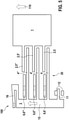
Figurenlistecharacter list
-
1 und2 zeigen schematische Darstellungen eines mikromechanischen Systems gemäß einem ersten Ausführungsbeispiel der vorliegenden Erfindung;1 and2 show schematic representations of a micromechanical system according to a first exemplary embodiment of the present invention; -
3 zeigt eine schematische Darstellung eines mikromechanischen Systems gemäß einem zweiten Ausführungsbeispiel der vorliegenden Erfindung;3 shows a schematic representation of a micromechanical system according to FIG a second embodiment of the present invention; -
4 und5 zeigen schematische Darstellungen eines mikromechanischen Systems gemäß einem dritten Ausführungsbeispiel der vorliegenden Erfindung;4 and5 show schematic representations of a micromechanical system according to a third exemplary embodiment of the present invention; -
6 und7 zeigen schematische Darstellungen eines mikromechanischen Systems gemäß einem vierten Ausführungsbeispiel der vorliegenden Erfindung;6 and7 show schematic representations of a micromechanical system according to a fourth exemplary embodiment of the present invention; -
8 zeigt eine schematische Darstellung eines mikromechanischen Systems gemäß einem fünften Ausführungsbeispiel der vorliegenden Erfindung;8th shows a schematic representation of a micromechanical system according to a fifth embodiment of the present invention; -
9 zeigt eine schematische Darstellung eines mikromechanischen Systems gemäß einem sechsten Ausführungsbeispiel der vorliegenden Erfindung.9 shows a schematic representation of a micromechanical system according to a sixth embodiment of the present invention.
Ausführungsformen der ErfindungEmbodiments of the invention
In den verschiedenen Figuren sind gleiche Teile stets mit den gleichen Bezugszeichen versehen und werden daher in der Regel auch jeweils nur einmal benannt bzw. erwähnt.In the various figures, the same parts are always provided with the same reference symbols and are therefore usually named or mentioned only once.
In den
Die zu bedämpfende beweglich aufgehängte Masse 1 ist Teil des mikromechanischen Systems 100, beispielsweise Teil eines Beschleunigungs- oder Drehratensensors, und ist beispielsweise über ein (hier nicht dargestelltes) Federsystem beweglich aufgehängt. An der beweglich aufgehängten Masse 1 ist die Elektrodenstruktur 2 angeordnet, die ihrerseits eine Gruppe von Elektrodenfingern 5, 5', 5" umfasst, die fest mit der Masse 1 verbunden sind. Die Masse 1 kann insbesondere parallel und antiparallel zu einer Schwingungsrichtung 110 schwingen. Auch weitere Schwingungsachsen sind prinzipiell denkbar. Das mikromechanische System 100 umfasst ferner eine Dämpfungsanordnung 20, die eine Dämpfungsstruktur 3 und eine Kontrollelektrodenstruktur 6 umfasst. Die Kontrollelektrodenstruktur 6 ist unbeweglich mit einem Substrat des mikromechanischen Systems verbunden und umfasst mehrere separate Kontrollelektroden 6', 6", 6'". Die Dämpfungsstruktur 3 ist mithilfe einer oder mehrerer Federn 16 beweglich aufgehängt. Die Dämpfungsstruktur 3 umfasst eine Gruppe von Dämpfungsfingern 4, 4', 4", die über einen Trägerbalken bzw. einen Kammrücken 15 miteinander verbunden sind. Die Gruppe von Elektrodenfingern 5, 5', 5" kann über die Gruppe von Dämpfungsfinger 4, 4', 4" bedämpft werden.The movably suspended
An die Kontrollelektrodenstruktur 6 kann eine externe elektrische Spannung U angelegt werden, um über die Spalte 30', 31' eine elektrostatische Anziehungskraft auf die Dämpfungsstruktur 3 auszuüben und die Dämpfungsstruktur 3 gegenüber der zu bedämpfenden Masse 1 auslenken zu können. Ein Abstand 30 zwischen dem Dämpfungsfinger 4 und der Kontrollelektrode 6' ist dabei kleiner als ein weiterer Abstand 31 zwischen dem weiteren Dämpfungsfinger 4' und der Kontrollelektrode 6'. Die Abstände 30, 31 der Spalte 30', 31' sind somit asymmetrisch gestaltet, sodass die Kraft über den kleineren Spalt 30' bei Anlegen einer Spannung U dominiert und die Dämpfungsstruktur 3 immer in die gleiche Richtung ausgelenkt wird. In den
Beträgt die Kontrollspannung U zwischen der Kontrollelektrodenstruktur 6 und den Dämpfungsfingern 4, 4', 4" U = 0 V, befindet sich das System im nicht ausgelenkten Zustand, wie in
Wird nun eine von 0 V abweichende Spannung U = U0 angelegt, wird über den Spalt 30' eine elektrostatische Kraft ausgeübt, die die Dämpfungsstruktur 3 entsprechend der in 
Auf diese Weise lässt sich durch Anlegen einer externen Spannung U die Dämpfung einer Schwingung der Masse 1 mithilfe der Spannung U kontinuierlich variieren bzw. einstellen und somit ein Frequenzverhalten und/oder eine Dämpfung der beweglich aufgehängten Masse 1 verändern. Aufgrund der Nichtlinearität der Auslenkung der Dämpfungsstruktur 3 mit der Spannung U kann die Auslenkung allerdings (zumindest für typische Dimensionen und Abstände) nur im Bereich von ca. einem Drittel des Abstands 30 zwischen dem Dämpfungsfinger 4 und der Kontrollelektrode 6' (also der Breite des Spalts 30' im nicht ausgelenkten Zustand) variiert werden. Darüber hinaus kommt es zum sogenannten „Schnappen“ des Dämpfungsfingers 4 in Richtung der Kontrollelektrode 6' und somit zum Schnappen der beweglichen Dämpfungsstruktur 3 an die Kontrollelektrodenstruktur 6. Ohne weitere Maßnahmen würde es in einem solchen Fall zu einem Berühren und einem Kurzschluss zwischen der Gruppe von Dämpfungsfingern 4, 4', 4" und der Kontrollelektrodenstruktur 6 kommen.In this way, by applying an external voltage U, the damping of an oscillation of the
Im ersten Ausführungsbeispiel gemäß den
In
In den
Die substratfesten Stoppervorrichtungen 12 befinden sich der beweglichen Dämpfungsstruktur 3 gegenüber, um deren Auslenkung zu begrenzen. Die Dämpfungsstruktur 3 umfasst einen Finger 11, der derart angeordnet ist, dass bei entsprechender Auslenkung der Dämpfungsstruktur 3 ein mechanischer Kontakt zwischen dem Finger 11 und der Stoppervorrichtung 12 ausgebildet wird, sodass die Dämpfungsstruktur 3 gestoppt wird und eine weitergehende Auslenkung der Dämpfungsstruktur 3 verhindert wird.The substrate-fixed
Mithilfe der Stoppervorrichtung 12 besteht ferner die Möglichkeit, ein gezieltes Dämpfungsniveau im „geschnappten“ Zustand zu definieren, also in dem Zustand, in dem die Stoppervorrichtung 12 und die Dämpfungsstruktur 3 in Kontakt kommen. Durch Wahl des Abstands zwischen Stoppervorrichtung 12 und Dämpfungsstruktur 3 (parallel zur Schwingungsrichtung 110) ist ein definierter Restabstand für den Fingerabstand 32 zwischen dem Elektrodenfinger 5 und dem Dämpfungsfinger 4 beim Kontakt der Stoppervorrichtung 12 und der Dämpfungsstruktur 3 einstellbar. Somit lässt sich mittels der Spannung U zwischen geringer Dämpfung (
Ein möglicher Nachteil der bisher dargestellten Ausführungsbeispiele ist eine asymmetrische Dämpfung bzgl. der Richtung der Auslenkung der zu bedämpfenden beweglich aufgehängten Masse 1. Im nach oben ausgelenkten Zustand der Masse 1 (insbesondere in Schwingungsrichtung 110) wäre die Dämpfung über den dominierenden Fingerabstand 32 größer als im nach unten ausgelenkten Zustand der Masse 1 (insbesondere entgegengesetzt zur Schwingungsrichtung 110). Dies führt zu einem nichtlinearen Verhalten des gesamten Sensors.A possible disadvantage of the previously illustrated embodiments is an asymmetrical damping with respect to the direction of the deflection movably suspended
In den
Bei den gezeigten Ausführungsbeispielen kann es beim Anlegen einer Spannung U an die Kontrollelektrodenstruktur 6 zu einem unerwünschten Drehmoment auf Grund einseitiger Kräfte kommen, da sich die Gruppe von Dämpfungsfingern 4, 4', 4" der Dämpfungsstruktur 3 nur auf einer Seite (rechts) des Trägerbalkens bzw. Kammrückens 15 befindet. In einer Weiterbildung ist es daher denkbar, die auf das System wirkende Kraft durch beidseitige Elektrodenanordnung zu symmetrisieren (beispielsweise durch Dämpfungsfinger, die beidseitig am Trägerbalken bzw. Kammrücken 15 angeordnet werden). In
In
Die Merkmale der verschiedenen Ausführungsbeispiele lassen sich beliebig miteinander kombinieren. Insbesondere ist es möglich, Kammelektroden gemäß
Claims (12)
Priority Applications (2)
| Application Number | Priority Date | Filing Date | Title |
|---|---|---|---|
| DE102020210121.3A DE102020210121A1 (en) | 2020-08-11 | 2020-08-11 | Micromechanical system, method for operating a micromechanical system |
| US17/393,629 US12031820B2 (en) | 2020-08-11 | 2021-08-04 | Micromechanical system, method for operating a micromechanical system |
Applications Claiming Priority (1)
| Application Number | Priority Date | Filing Date | Title |
|---|---|---|---|
| DE102020210121.3A DE102020210121A1 (en) | 2020-08-11 | 2020-08-11 | Micromechanical system, method for operating a micromechanical system |
Publications (1)
| Publication Number | Publication Date |
|---|---|
| DE102020210121A1 true DE102020210121A1 (en) | 2022-02-17 |
Family
ID=80000408
Family Applications (1)
| Application Number | Title | Priority Date | Filing Date |
|---|---|---|---|
| DE102020210121.3A Pending DE102020210121A1 (en) | 2020-08-11 | 2020-08-11 | Micromechanical system, method for operating a micromechanical system |
Country Status (2)
| Country | Link |
|---|---|
| US (1) | US12031820B2 (en) |
| DE (1) | DE102020210121A1 (en) |
Cited By (2)
| Publication number | Priority date | Publication date | Assignee | Title |
|---|---|---|---|---|
| WO2024052081A1 (en) * | 2022-09-09 | 2024-03-14 | Robert Bosch Gmbh | Method for calibrating a mirror array |
| DE102023212394A1 (en) * | 2023-12-08 | 2025-06-12 | Robert Bosch Gesellschaft mit beschränkter Haftung | Angular rate sensor for detecting a angular rate around a sensitive direction, comprising a substrate, a seismic mass and a drive |
Citations (5)
| Publication number | Priority date | Publication date | Assignee | Title |
|---|---|---|---|---|
| US20030217597A1 (en) | 2002-05-24 | 2003-11-27 | Mitsubishi Denki Kabushiki Kaisha | Inertia force sensor |
| US20090320592A1 (en) | 2008-06-26 | 2009-12-31 | Honeywell International, Inc | Multistage proof-mass movement deceleration within mems structures |
| US20100050771A1 (en) | 2006-12-05 | 2010-03-04 | Electronics And Telecommunications Research Instit | Capacitive accelerometer |
| US20150301075A1 (en) | 2012-10-16 | 2015-10-22 | Hitachi Automotive Systems, Ltd. | Inertial Sensor |
| DE102015001128A1 (en) | 2015-01-29 | 2016-08-04 | Northrop Grumman Litef Gmbh | Acceleration sensor with spring force compensation |
Family Cites Families (13)
| Publication number | Priority date | Publication date | Assignee | Title |
|---|---|---|---|---|
| US5008774A (en) * | 1989-02-28 | 1991-04-16 | United Technologies Corporation | Capacitive accelerometer with mid-plane proof mass |
| US5914553A (en) * | 1997-06-16 | 1999-06-22 | Cornell Research Foundation, Inc. | Multistable tunable micromechanical resonators |
| US20060266118A1 (en) * | 2005-03-29 | 2006-11-30 | Denison Timothy J | Capacitive sensor with damping |
| US7548011B2 (en) * | 2006-05-18 | 2009-06-16 | The Board Of Regents Of The University Of Texas System | Systems and methods for improved control of micro-electrical-mechanical system (MEMS) electrostatic actuator |
| WO2010138717A1 (en) * | 2009-05-27 | 2010-12-02 | King Abdullah University Of Science And Technology | Mems mass spring damper systems using an out-of-plane suspension scheme |
| DE102010039069B4 (en) * | 2010-08-09 | 2023-08-24 | Robert Bosch Gmbh | Acceleration sensor with a damping device |
| DE102011083487B4 (en) * | 2011-09-27 | 2023-12-21 | Robert Bosch Gmbh | Acceleration sensor and method for operating an acceleration sensor |
| US8875578B2 (en) * | 2011-10-26 | 2014-11-04 | Silicon Laboratories Inc. | Electronic damper circuit for MEMS sensors and resonators |
| FI125238B (en) * | 2012-06-29 | 2015-07-31 | Murata Manufacturing Co | Improved oscillating gyroscope |
| US9611139B2 (en) * | 2012-06-29 | 2017-04-04 | Murata Manufacturing Co., Ltd. | Resonator |
| US20170023606A1 (en) * | 2015-07-23 | 2017-01-26 | Freescale Semiconductor, Inc. | Mems device with flexible travel stops and method of fabrication |
| JP6661941B2 (en) * | 2015-09-29 | 2020-03-11 | セイコーエプソン株式会社 | Physical quantity sensor, method for manufacturing physical quantity sensor, sensor device, electronic device, and moving object |
| GB2560192A (en) * | 2017-03-03 | 2018-09-05 | Atlantic Inertial Systems Ltd | Vibration damping mount |
-
2020
- 2020-08-11 DE DE102020210121.3A patent/DE102020210121A1/en active Pending
-
2021
- 2021-08-04 US US17/393,629 patent/US12031820B2/en active Active
Patent Citations (5)
| Publication number | Priority date | Publication date | Assignee | Title |
|---|---|---|---|---|
| US20030217597A1 (en) | 2002-05-24 | 2003-11-27 | Mitsubishi Denki Kabushiki Kaisha | Inertia force sensor |
| US20100050771A1 (en) | 2006-12-05 | 2010-03-04 | Electronics And Telecommunications Research Instit | Capacitive accelerometer |
| US20090320592A1 (en) | 2008-06-26 | 2009-12-31 | Honeywell International, Inc | Multistage proof-mass movement deceleration within mems structures |
| US20150301075A1 (en) | 2012-10-16 | 2015-10-22 | Hitachi Automotive Systems, Ltd. | Inertial Sensor |
| DE102015001128A1 (en) | 2015-01-29 | 2016-08-04 | Northrop Grumman Litef Gmbh | Acceleration sensor with spring force compensation |
Cited By (2)
| Publication number | Priority date | Publication date | Assignee | Title |
|---|---|---|---|---|
| WO2024052081A1 (en) * | 2022-09-09 | 2024-03-14 | Robert Bosch Gmbh | Method for calibrating a mirror array |
| DE102023212394A1 (en) * | 2023-12-08 | 2025-06-12 | Robert Bosch Gesellschaft mit beschränkter Haftung | Angular rate sensor for detecting a angular rate around a sensitive direction, comprising a substrate, a seismic mass and a drive |
Also Published As
| Publication number | Publication date |
|---|---|
| US12031820B2 (en) | 2024-07-09 |
| US20220049958A1 (en) | 2022-02-17 |
Similar Documents
| Publication | Publication Date | Title |
|---|---|---|
| DE102010039069B4 (en) | Acceleration sensor with a damping device | |
| DE102009000606B4 (en) | Micromechanical structure | |
| DE19930779B4 (en) | Micromechanical component | |
| DE112019001785B4 (en) | Device for generating haptic feedback | |
| DE19739877C2 (en) | Mechanical resonator with variable resonance frequency | |
| DE102009028924A1 (en) | Capacitive sensor and actuator | |
| EP3250931B1 (en) | Acceleration sensor having spring force compensation | |
| EP3778469B1 (en) | Mems component, assembly comprising the mems component and method for operating the mems component | |
| DE102013007593B4 (en) | ACCELERATION SENSOR AND METHOD FOR MANUFACTURING ACCELERATION SENSOR | |
| DE10051973A1 (en) | Micromechanical component has seismic mass sprung-mounted by double U spring to be deflectable by external acceleration, stop(s) protrusion for limiting deflection of double U spring | |
| DE102009047018B4 (en) | Method for adjusting an acceleration sensor and an acceleration sensor | |
| DE102009026476A1 (en) | Micromechanical structure | |
| EP1307750B1 (en) | Micromechanical component | |
| DE102017220412A1 (en) | Micromechanical inertial sensor | |
| WO2018001875A1 (en) | Inertial sensor for measuring a rate of rotation and/or acceleration | |
| DE102020210121A1 (en) | Micromechanical system, method for operating a micromechanical system | |
| EP3080554B1 (en) | Operating device for an item of electrical equipment, in particular for a vehicle component | |
| DE102008054749A1 (en) | Rotation rate sensor and method for operating a rotation rate sensor | |
| EP1529217B1 (en) | Micromechanical component | |
| EP2425208B1 (en) | Measuring element | |
| EP3192770B1 (en) | Device for two-dimensional deflection of a laser beam | |
| DE102020211928A1 (en) | Damping device for micromechanical component | |
| DE19813941A1 (en) | Micromechanical acceleration sensor | |
| DE102011080982B4 (en) | Sensor arrangement | |
| WO2022117494A1 (en) | Micromechanical sensor structure with damping structure |
Legal Events
| Date | Code | Title | Description |
|---|---|---|---|
| R163 | Identified publications notified |