DE102016221669A1 - Apparatus and method for reversibly modifying the visual appearance of a garment - Google Patents
Apparatus and method for reversibly modifying the visual appearance of a garment Download PDFInfo
- Publication number
- DE102016221669A1 DE102016221669A1 DE102016221669.4A DE102016221669A DE102016221669A1 DE 102016221669 A1 DE102016221669 A1 DE 102016221669A1 DE 102016221669 A DE102016221669 A DE 102016221669A DE 102016221669 A1 DE102016221669 A1 DE 102016221669A1
- Authority
- DE
- Germany
- Prior art keywords
- garment
- shoe
- projecting
- component
- modifying
- Prior art date
- Legal status (The legal status is an assumption and is not a legal conclusion. Google has not performed a legal analysis and makes no representation as to the accuracy of the status listed.)
- Pending
Links
Images


Classifications
-
- A—HUMAN NECESSITIES
- A43—FOOTWEAR
- A43D—MACHINES, TOOLS, EQUIPMENT OR METHODS FOR MANUFACTURING OR REPAIRING FOOTWEAR
- A43D8/00—Machines for cutting, ornamenting, marking or otherwise working up shoe part blanks
- A43D8/16—Ornamentation
-
- A—HUMAN NECESSITIES
- A43—FOOTWEAR
- A43D—MACHINES, TOOLS, EQUIPMENT OR METHODS FOR MANUFACTURING OR REPAIRING FOOTWEAR
- A43D1/00—Foot or last measuring devices; Measuring devices for shoe parts
- A43D1/02—Foot-measuring devices
- A43D1/025—Foot-measuring devices comprising optical means, e.g. mirrors, photo-electric cells, for measuring or inspecting feet
-
- G—PHYSICS
- G06—COMPUTING OR CALCULATING; COUNTING
- G06F—ELECTRIC DIGITAL DATA PROCESSING
- G06F30/00—Computer-aided design [CAD]
- G06F30/20—Design optimisation, verification or simulation
-
- A—HUMAN NECESSITIES
- A41—WEARING APPAREL
- A41D—OUTERWEAR; PROTECTIVE GARMENTS; ACCESSORIES
- A41D15/00—Convertible garments
- A41D15/005—Convertible garments reversible garments
-
- A—HUMAN NECESSITIES
- A41—WEARING APPAREL
- A41D—OUTERWEAR; PROTECTIVE GARMENTS; ACCESSORIES
- A41D27/00—Details of garments or of their making
- A41D27/08—Trimmings; Ornaments
-
- A—HUMAN NECESSITIES
- A43—FOOTWEAR
- A43B—CHARACTERISTIC FEATURES OF FOOTWEAR; PARTS OF FOOTWEAR
- A43B23/00—Uppers; Boot legs; Stiffeners; Other single parts of footwear
- A43B23/24—Ornamental buckles; Other ornaments for shoes without fastening function
-
- A—HUMAN NECESSITIES
- A43—FOOTWEAR
- A43B—CHARACTERISTIC FEATURES OF FOOTWEAR; PARTS OF FOOTWEAR
- A43B3/00—Footwear characterised by the shape or the use
- A43B3/34—Footwear characterised by the shape or the use with electrical or electronic arrangements
-
- B—PERFORMING OPERATIONS; TRANSPORTING
- B25—HAND TOOLS; PORTABLE POWER-DRIVEN TOOLS; MANIPULATORS
- B25J—MANIPULATORS; CHAMBERS PROVIDED WITH MANIPULATION DEVICES
- B25J13/00—Controls for manipulators
- B25J13/08—Controls for manipulators by means of sensing devices, e.g. viewing or touching devices
- B25J13/085—Force or torque sensors
-
- G—PHYSICS
- G05—CONTROLLING; REGULATING
- G05B—CONTROL OR REGULATING SYSTEMS IN GENERAL; FUNCTIONAL ELEMENTS OF SUCH SYSTEMS; MONITORING OR TESTING ARRANGEMENTS FOR SUCH SYSTEMS OR ELEMENTS
- G05B19/00—Program-control systems
- G05B19/02—Program-control systems electric
- G05B19/18—Numerical control [NC], i.e. automatically operating machines, in particular machine tools, e.g. in a manufacturing environment, so as to execute positioning, movement or co-ordinated operations by means of program data in numerical form
- G05B19/402—Numerical control [NC], i.e. automatically operating machines, in particular machine tools, e.g. in a manufacturing environment, so as to execute positioning, movement or co-ordinated operations by means of program data in numerical form characterised by control arrangements for positioning, e.g. centring a tool relative to a hole in the workpiece, additional detection means to correct position
-
- G—PHYSICS
- G06—COMPUTING OR CALCULATING; COUNTING
- G06T—IMAGE DATA PROCESSING OR GENERATION, IN GENERAL
- G06T15/00—Three-dimensional [3D] image rendering
- G06T15/005—General purpose rendering architectures
-
- G—PHYSICS
- G06—COMPUTING OR CALCULATING; COUNTING
- G06T—IMAGE DATA PROCESSING OR GENERATION, IN GENERAL
- G06T17/00—Three-dimensional [3D] modelling for computer graphics
-
- G—PHYSICS
- G05—CONTROLLING; REGULATING
- G05B—CONTROL OR REGULATING SYSTEMS IN GENERAL; FUNCTIONAL ELEMENTS OF SUCH SYSTEMS; MONITORING OR TESTING ARRANGEMENTS FOR SUCH SYSTEMS OR ELEMENTS
- G05B2219/00—Program-control systems
- G05B2219/30—Nc systems
- G05B2219/31—From computer integrated manufacturing till monitoring
- G05B2219/31048—Project on workpiece, image of finished workpiece, info or a spot
-
- G—PHYSICS
- G05—CONTROLLING; REGULATING
- G05B—CONTROL OR REGULATING SYSTEMS IN GENERAL; FUNCTIONAL ELEMENTS OF SUCH SYSTEMS; MONITORING OR TESTING ARRANGEMENTS FOR SUCH SYSTEMS OR ELEMENTS
- G05B2219/00—Program-control systems
- G05B2219/30—Nc systems
- G05B2219/35—Nc in input of data, input till input file format
- G05B2219/35191—Project workpiece and gripper, control relative movement, store result
-
- G—PHYSICS
- G06—COMPUTING OR CALCULATING; COUNTING
- G06F—ELECTRIC DIGITAL DATA PROCESSING
- G06F3/00—Input arrangements for transferring data to be processed into a form capable of being handled by the computer; Output arrangements for transferring data from processing unit to output unit, e.g. interface arrangements
- G06F3/01—Input arrangements or combined input and output arrangements for interaction between user and computer
- G06F3/017—Gesture based interaction, e.g. based on a set of recognized hand gestures
-
- G—PHYSICS
- G06—COMPUTING OR CALCULATING; COUNTING
- G06T—IMAGE DATA PROCESSING OR GENERATION, IN GENERAL
- G06T7/00—Image analysis
- G06T7/0002—Inspection of images, e.g. flaw detection
- G06T7/0004—Industrial image inspection
- G06T7/0008—Industrial image inspection checking presence/absence
-
- G—PHYSICS
- G06—COMPUTING OR CALCULATING; COUNTING
- G06T—IMAGE DATA PROCESSING OR GENERATION, IN GENERAL
- G06T7/00—Image analysis
- G06T7/70—Determining position or orientation of objects or cameras
- G06T7/73—Determining position or orientation of objects or cameras using feature-based methods
Landscapes
- Engineering & Computer Science (AREA)
- Physics & Mathematics (AREA)
- General Physics & Mathematics (AREA)
- Theoretical Computer Science (AREA)
- Microelectronics & Electronic Packaging (AREA)
- Textile Engineering (AREA)
- Human Computer Interaction (AREA)
- Biophysics (AREA)
- Computer Graphics (AREA)
- Geometry (AREA)
- Life Sciences & Earth Sciences (AREA)
- Manufacturing & Machinery (AREA)
- Automation & Control Theory (AREA)
- Robotics (AREA)
- Mechanical Engineering (AREA)
- General Engineering & Computer Science (AREA)
- Evolutionary Computation (AREA)
- Computer Hardware Design (AREA)
- Software Systems (AREA)
- Footwear And Its Accessory, Manufacturing Method And Apparatuses (AREA)
- Processing Or Creating Images (AREA)
- User Interface Of Digital Computer (AREA)
Abstract
Die vorliegende Erfindung bezieht sich auf eine Vorrichtung zum reversiblen Modifizieren der optischen Erscheinung eines Kleidungsstücks, wobei die Vorrichtung ein Mittel zum Bestimmen der Position des Kleidungsstücks, ein Mittel zum Projizieren von Farben, Bildern und/oder Mustern auf das Kleidungsstück sowie ein Mittel zum Modifizieren der Form des Kleidungsstücks, insbesondere seiner Oberfläche, umfasst.The present invention relates to an apparatus for reversibly modifying the visual appearance of a garment, the apparatus comprising means for determining the position of the garment, means for projecting colors, images and / or patterns onto the garment, and means for modifying the garment Form of the garment, in particular its surface, comprises.
Description
Gebiet der ErfindungField of the invention
Die vorliegende Erfindung bezieht sich auf eine Vorrichtung und ein Verfahren zum reversiblen Modifizieren der optischen Erscheinung eines Kleidungsstücks.The present invention relates to an apparatus and method for reversibly modifying the visual appearance of a garment.
Stand der TechnikState of the art
Heutzutage spielt das Anbieten individueller Designs für Kleidungsstücke eine entscheidende Rolle bei der Kundenzufriedenheit. Die Branche unternimmt deshalb zahlreiche Anstrengungen, um Kunden so früh wie möglich in den Designprozess eines Kleidungsstücks mit einzubeziehen, was dem Kunden die Möglichkeit bietet, sein eigenes einzigartiges Kleidungsdesign zu entwickeln.Nowadays, offering individual designs for garments plays a crucial role in customer satisfaction. The industry is therefore making a lot of effort to involve customers in the design process of a garment as early as possible, giving the customer the opportunity to develop their own unique clothing design.
Eine übliche Vorgehensweise ist, computergestützte Verfahren zu nutzen, die ein visuelles Modellieren von Design-Vorschlägen erlauben, z.B. in einer 3D-Modellierungssoftware. Die Modelle können dann mit Farben, Texturen, Mustern, Bildern usw. versehen werden, um einen fast realistischen Eindruck des Kleidungsstücks zu erzeugen. Eine sinnvolle Beurteilung von Kleidungsdesigns auf einem Computerbildschirm gestaltet sich jedoch schwierig. Einerseits erfordert das Bedienen einer entsprechenden 3D-Modellierungssoftware fortgeschrittene Computerkenntnisse. Andererseits kann ein Computerbildschirm nur einen ungefähren Eindruck des Kleidungsstücks bieten.One common approach is to use computer-aided techniques that allow for visual modeling of design proposals, e.g. in a 3D modeling software. The models can then be provided with colors, textures, patterns, images, etc. to create an almost realistic impression of the garment. A meaningful assessment of clothing designs on a computer screen, however, is difficult. On the one hand, operating a corresponding 3D modeling software requires advanced computer skills. On the other hand, a computer screen can only provide an approximate impression of the garment.
Um Kunden und Bekleidungsdesignern einen realistischeren Eindruck eines Kleidungsstücks zu bieten, bevor es hergestellt wird, müssen echte Prototypen des Kleidungsstücks produziert werden. Solche Prototypen sind jedoch normalerweise unflexibel, da es schwierig oder gar unmöglich ist, sie zu modifizieren, wenn Veränderungen des Designs gewünscht sind.To provide customers and apparel designers with a more realistic impression of a garment before it is made, real prototypes of the garment must be produced. However, such prototypes are usually inflexible, as it is difficult or even impossible to modify them if design changes are desired.
Es wurden deshalb Verfahren und Systeme entwickelt, um ein Design auf ein 3D-Modell eines Kleidungsstücks zu projizieren, um seine Erscheinung durch Verändern der Projektion zu verändern.Therefore, methods and systems have been developed to project a design onto a 3D model of a garment to alter its appearance by altering the projection.
Ein solches Projektionsverfahren und eine entsprechende Vorrichtung sind in dem Online-Artikel „Mirror Mirror“ offenbart, der unter http://mid.kaist.ac.kr/projects/mirror/ abrufbar ist und zuletzt am 3. August 2016 aufgerufen wurde.Such a projection method and apparatus are disclosed in the online article "Mirror Mirror," which is available at http://mid.kaist.ac.kr/projects/mirror/ and was last accessed on August 3, 2016.
Ein weiteres Projektionsverfahren und eine entsprechende Vorrichtung sind in dem Online-Artikel „Projection-Based Augmented Reality FTW!“ offenbart, der unter http://www.augmented.org/blog/2012/06/projection-based-augmentedreality-ftw/ abrufbar ist und zuletzt am 4. August 2016 aufgerufen wurde; hier werden Farben auf die Oberfläche eines Schuhs projiziert.Another projection method and apparatus are disclosed in the online article "Projection-Based Augmented Reality FTW!" Available at http://www.augmented.org/blog/2012/06/projection-based-augmentedreality-ftw/ is available and was last accessed on 4 August 2016; here colors are projected onto the surface of a shoe.
Die beschriebenen Systeme weisen jedoch nach wie vor zahlreiche Einschränkungen bezüglich der Flexibilität eines Designers und/oder Kunden auf, das Gesamtdesign des Kleidungsstücks frei zu modifizieren und einen realistischen Eindruck seiner endgültigen Erscheinung zu gewinnen.However, the described systems still have numerous limitations on the flexibility of a designer and / or customer to freely modify the overall design of the garment and gain a realistic impression of its final appearance.
Ziel der vorliegenden Erfindung ist somit die Bereitstellung einer verbesserten Vorrichtung und eines entsprechenden Verfahrens zum reversiblen Modifizieren der Erscheinung eines Kleidungsstücks.It is therefore an object of the present invention to provide an improved apparatus and method for reversibly modifying the appearance of a garment.
ZusammenfassungSummary
Das oben erwähnte Problem wird zumindest teilweise gelöst durch eine Vorrichtung nach Anspruch 1, ein Verfahren nach Anspruch 16 und ein Computerprogramm nach Anspruch 26.The above-mentioned problem is at least partially solved by an apparatus according to claim 1, a method according to
Gemäß einem Aspekt der Erfindung wird eine Vorrichtung zum reversiblen Modifizieren der Erscheinung eines Kleidungsstücks bereitgestellt. Die Vorrichtung kann ein Mittel zum Bestimmen der Position des Kleidungsstücks, ein Mittel zum Projizieren von Farben, Bildern und/oder Mustern auf das Kleidungsstück sowie ein Mittel zum Modifizieren der Form des Kleidungsstücks, insbesondere seiner Oberfläche, umfassen.According to one aspect of the invention, there is provided an apparatus for reversibly modifying the appearance of a garment. The apparatus may include means for determining the position of the garment, means for projecting colors, images and / or patterns onto the garment, and means for modifying the shape of the garment, particularly its surface.
Abgesehen vom Verändern einer Projektion fand der Anmelder heraus, dass das Ermöglichen einer Modifikation der Form, insbesondere der Oberfläche des Kleidungsstücks, den gesamten Designprozess weiter verbessern kann. Das Kleidungsstück kann beispielsweise als ein im Wesentlichen einfarbiges physisches 3D-Modell bereitgestellt werden, das aus einer Vielzahl miteinander verbindbarer einzelner Elemente bestehen kann. Bei einer Ausführungsform kann das Kleidungsstück ein weißes oder im Wesentlichen einfarbiges Kleidungsstück sein. Eine anpassbare Form des Kleidungsstücks ermöglicht die Beurteilung einer großen Anzahl unterschiedlicher Designs in einem begrenzten Zeitraum. Der Schritt des Erzeugens eines neuen physischen 3D-Modells von Grund auf für einen neuen Designvorschlag auf Grundlage einer neuen Form kann entfallen. Stattdessen kann die Form des Kleidungsstücks beispielsweise modifiziert werden, indem zusätzliche Elemente an ein physisches 3D-(Grund-)Modell angebracht werden und seine Form somit verändert wird. Außerdem können bereits angebrachte Elemente wieder entfernt werden. Nach einer solchen Veränderung können Farben, Muster, Texturen, Bilder usw. wieder auf die modifizierte Form des Kleidungsstücks projiziert werden.Apart from changing a projection, Applicant has found that allowing a modification of the shape, particularly the surface of the garment, can further enhance the overall design process. For example, the garment may be provided as a substantially monochrome 3D physical model that may be comprised of a plurality of interconnectable individual elements. In one embodiment, the garment may be a white or substantially plain colored garment. An adaptable shape of the garment allows the evaluation of a large number of different designs in a limited period of time. The step of creating a new 3D physical model from scratch for a new design proposal based on a new shape may be eliminated. Instead, the shape of the garment may be modified, for example, by attaching additional elements to a physical 3D (base) model and thus changing its shape. In addition, already attached elements can be removed again. After such a change, colors, patterns, textures, images, etc. can be projected back onto the modified form of the garment.
Die ursprüngliche Position des Kleidungsstücks kann automatisch bestimmt werden. Die Projektion kann dann so angepasst werden, dass sie der bestimmten Position entspricht, was zu einer qualitativ hochwertigen Projektion der Farben, Texturen, Muster, Bilder usw. führt. Es besteht die Möglichkeit, nur das Kleidungsstück (und nicht seine Umgebung) durch das Mittel zum Projizieren zu beleuchten. Dies kann die Qualität des Eindrucks des beleuchteten Kleidungsstücks weiter verbessern, was zu einer im Wesentlichen realistischen Erscheinung führt. The original position of the garment can be determined automatically. The projection can then be adjusted to match the particular position, resulting in a high quality projection of colors, textures, patterns, images, and so forth. It is possible to illuminate only the garment (and not its surroundings) by the means for projecting. This can further improve the quality of the impression of the illuminated garment, resulting in a substantially realistic appearance.
Während die beschriebene Vorrichtung zur Beurteilung von Designs eines Kleidungsstücks wie z.B. eines Schuhs geeignet ist, kann sie im Allgemeinen auch für die Beurteilung der Designs anderer physischer Objekte wie Sportgeräte usw. verwendet werden.While the described apparatus for evaluating designs of a garment, such as a garment, has been described. a shoe, it can generally also be used to judge the designs of other physical objects such as sports equipment and so on.
Das Mittel zum Modifizieren der Form kann mindestens eine Komponente umfassen, die an das Kleidungsstück anbringbar ist, und/oder mindestens eine Komponente, die von dem Kleidungsstück abnehmbar ist. Bei dieser Ausführungsform können einzelne Komponenten flexibel an dem Kleidungsstück angebracht oder von dem Kleidungsstück entfernt werden, um dessen Form zu modifizieren. Es können z.B. dekorative Elemente wie Streifen oder funktionale Elemente an dem Kleidungsstück angebracht werden. Außerdem können bereits angebrachte Komponenten wieder entfernt und beispielsweise durch andere Komponenten ersetzt werden. Dies kann eine Modifikation der Form des Kleidungsstücks ermöglichen, ohne dass es von Grund auf wiederaufgebaut werden muss.The means for modifying the mold may comprise at least one component attachable to the garment and / or at least one component detachable from the garment. In this embodiment, individual components may be flexibly attached to the garment or removed from the garment to modify its shape. It can e.g. decorative elements such as stripes or functional elements are attached to the garment. In addition, already attached components can be removed again and replaced for example by other components. This may allow for modification of the garment shape without having to be rebuilt from the ground up.
Wenn die Form des Kleidungsstücks modifiziert wird, kann das Mittel zum Projizieren das Projizieren der Farben, Bilder und/oder Muster gemäß der modifizierten Form anpassen. Das Projizieren der Farben, Bilder und/oder Muster auf das Kleidungsstück kann das Projizieren unterschiedlicher Farben, Bilder und/oder Muster auf unterschiedliche Bereiche des Kleidungsstücks umfassen.When the shape of the garment is modified, the means for projecting may adjust the projecting of the colors, images and / or patterns according to the modified form. Projecting the colors, images and / or patterns on the garment may include projecting different colors, images and / or patterns onto different areas of the garment.
Wenn Komponenten an das Kleidungsstück angebracht oder von diesem abgenommen werden, können auf der Oberfläche des Kleidungsstücks neue Bereiche entstehen. Jeder beliebige Bereich des Kleidungsstücks kann mit einer individuellen Farbe oder einem individuellen Muster oder Bild beleuchtet werden. Außerdem können neue Bereiche definiert werden, indem bestehende Bereiche in zwei oder mehr neue Bereiche geteilt werden. Des Weiteren können bestehende Bereiche zusammengeführt werden, um einen einzigen Bereich zu bilden.When components are attached to or removed from the garment, new areas may be created on the garment surface. Any area of the garment may be illuminated with an individual color or an individual pattern or image. In addition, new areas can be defined by dividing existing areas into two or more new areas. Furthermore, existing areas can be merged to form a single area.
Außerdem kann das Kleidungsstück ein Schuh sein, und die mindestens eine Komponente, die an dem Schuh angebracht bzw. von diesem abgenommen werden kann, kann einen oder mehrere der folgenden Bestandteile umfassen: eine Ferse, eine Fersenkappe, ein Quartier, ein Oberteil, einen Schuhhals, ein Blatt, einen Rahmen, ein Seitengitter, eine Zehenkappe, eine Oberlinie, Schnürsenkel, eine Zunge und eine Sohle. All diese Komponenten beeinflussen die äußere Erscheinung und somit das Design eines Schuhs maßgeblich.In addition, the garment may be a shoe, and the at least one component that may be attached to or detached from the shoe may include one or more of the following: a heel, a heel cap, a quarter, an upper, a shoe neck , a leaf, a frame, a side rail, a toe cap, a top line, shoelaces, a tongue and a sole. All these components significantly influence the appearance and thus the design of a shoe.
Des Weiteren kann die mindestens eine Komponente, die an dem Kleidungsstück angebracht und/oder von dem Kleidungsstück abgenommen werden kann, einen Identifikationschip umfassen. Der Identifikationschip kann Informationen umfassen, welche die Vorrichtung in die Lage versetzen, die Art der mindestens einen Komponente zu bestimmen. Zusätzlich oder alternativ kann die mindestens eine Komponente einen von einem Sensor detektierbaren Marker umfassen, der zum Detektieren der Position und/oder der Ausrichtung der Komponente verwendbar ist.Further, the at least one component that may be attached to the garment and / or removed from the garment may include an identification chip. The identification chip may include information that enables the device to determine the nature of the at least one component. Additionally or alternatively, the at least one component may comprise a sensor detectable marker useful for detecting the position and / or orientation of the component.
Wenn eine Komponente an dem Kleidungsstück angebracht wird, kann die Form des Kleidungsstücks erweitert (oder reduziert, wenn eine Komponente abgenommen wird) und somit verändert werden. In solch einem Fall wird ein zusammengesetztes Kleidungsstück geschaffen, und die Vorrichtung muss die neue Form des zusammengesetzten Kleidungsstücks zum Anpassen der Projektion auf die Oberfläche des zusammengesetzten Kleidungsstücks bestimmen, um die Projektion mit der neuen Form in Übereinstimmung zu bringen. Es können jedoch auch bildanalytische Ansätze geeignet sein, um das Kleidungsstück oder eine Komponente zu identifizieren.When a component is attached to the garment, the shape of the garment can be widened (or reduced as a component is removed) and thus altered. In such a case, a composite garment is created and the device must determine the new shape of the composite garment to match the projection on the surface of the assembled garment to match the projection with the new shape. However, image analysis approaches may also be suitable for identifying the garment or component.
Außerdem kann sich die mindestens eine Komponente auf einem Gitter befinden, wobei das Gitter von einem visuellen Erkennungssystem überwacht wird, wobei das visuelle Erkennungssystem ausgestaltet sein kann zum Erkennen, dass die mindestens eine Komponente von dem Gitter entfernt wird.Additionally, the at least one component may be on a grid, the grid being monitored by a visual recognition system, wherein the visual recognition system may be configured to detect that the at least one component is removed from the grid.
Eine oder mehrere Komponenten können auf dem Gitter platziert werden. Das Gitter kann an die Vorrichtung angebracht und von einem geeigneten visuellen Erkennungssystem überwacht werden. Wenn eine oder mehrere Komponenten zum Anbringen an das Kleidungsstück ausgewählt und aus diesem Grund von dem Gitter entfernt werden, kann die Vorrichtung mittels des visuellen Erkennungssystems das Entfernen der Komponente von dem Gitter detektieren und weiß somit, dass die entfernte Komponente an das Kleidungsstück angebracht werden soll.One or more components can be placed on the grid. The grid may be attached to the device and monitored by a suitable visual recognition system. If one or more components are selected for attachment to the garment and, for this reason, removed from the grid, the device can detect removal of the component from the grid by the visual recognition system and thus know that the removed component is to be attached to the garment ,
Des Weiteren kann die Vorrichtung ein Mittel zum Modifizieren der Position des Kleidungsstücks und/oder ein Mittel zum Entgegennehmen eines Eingabebefehls umfassen.Furthermore, the device may include means for modifying the position of the garment and / or comprise means for accepting an input command.
Wenn sich beispielsweise die Form und/oder die Projektion verändert, muss das Ergebnis beurteilt werden, um zu bestimmen, ob es den Erwartungen des Kunden oder eines Bekleidungsdesigners entspricht und ob es wünschenswert sein könnte, das Kleidungsstück aus verschiedenen Perspektiven zu betrachten. Das Kleidungsstück kann deshalb bewegt werden, während der Kunde oder der Designer in ihrer ursprünglichen Position verbleiben können.For example, if the shape and / or the projection changes, the result must be judged to determine if it meets the expectations of the customer or a clothing designer and if it may be desirable to view the garment from different perspectives. The garment can therefore be moved while the customer or designer can remain in their original position.
Genauer gesagt kann die Veränderung der Position eine translationale Bewegung entlang einer oder mehrerer Achsen oder eine Drehung des Kleidungsstücks an einer oder mehreren Drehachsen umfassen. Des Weiteren können eine translationale Bewegung und eine Drehung gleichzeitig angewandt werden.More specifically, the change in position may include translational movement along one or more axes or rotation of the garment at one or more axes of rotation. Furthermore, translational movement and rotation can be applied simultaneously.
Die Veränderung der Position des Kleidungsstücks kann durch Eingabebefehle gesteuert werden, die an die Vorrichtung gerichtet werden, wodurch der Kunde oder der Bekleidungsdesigner an einem Ort stehenbleiben kann, während er das Kleidungsstück aus verschiedenen Richtungen beurteilt.The change in the position of the garment can be controlled by input commands directed to the device, whereby the customer or the clothing designer can stand in one place while judging the garment from different directions.
Das Mittel zum Bestimmen der Position kann so ausgestaltet sein, dass es eine Veränderung der Position des Kleidungsstücks bestimmt, und das Mittel zum Projizieren kann so ausgestaltet sein, dass es das Projizieren gemäß der bestimmten Veränderung der Position des Kleidungsstücks anpasst.The means for determining the position may be configured to determine a change in the position of the garment, and the means for projecting may be configured to adjust the projecting according to the determined change in the position of the garment.
Um die Projektion anzupassen während das Kleidungsstück umherbewegt wird, kann die Veränderung der Position bestimmt werden. Die detektierte Veränderung der Position kann dann an das Mittel zum Projizieren kommuniziert werden, z.B. ein Lasergerät oder ein Beamergerät oder einen anderen geeigneten Projektor, der dann die Projektion so anpassen kann, dass eine Projektion auf die Oberfläche des bewegten Kleidungsstücks an seiner neuen Position erzeugt werden kann. Des Weiteren kann eine Vielzahl von Projektoren verwendet werden, so dass jeder Projektor auf einen bestimmten Bereich des Kleidungsstücks projizieren kann.To adjust the projection while the garment is being moved, the change in position can be determined. The detected change in position may then be communicated to the means for projecting, e.g. a laser device or a projector or other suitable projector, which can then adjust the projection so that a projection can be made on the surface of the moving garment in its new position. Furthermore, a variety of projectors can be used so that each projector can project onto a specific area of the garment.
Das Anpassen der Projektion kann durch Prüfen der Entfernung einer oder mehrerer translationaler Bewegungen in eine beliebige Richtung und durch Prüfen des Winkels und der Richtung einer oder mehrerer Drehungen erreicht werden. Das Bestimmen einer Veränderung der Position des Kleidungsstücks und/oder das Anpassen des Projizierens kann in Echtzeit erfolgen.The adjustment of the projection can be accomplished by examining the removal of one or more translational motions in any direction and by examining the angle and direction of one or more rotations. Determining a change in the position of the garment and / or adjusting the projection may be done in real time.
Um einen geeigneten Eindruck aus dem Blickwinkel eines Kunden oder eines Bekleidungsdesigners aufrecht zu erhalten, auch während das Kleidungsstück bewegt wird, kann das Bestimmen der Veränderung der Position so durchgeführt werden, dass keine oder zumindest fast keine Verzögerung beim Anpassen der Projektion für das menschliche Auge erkennbar wird. Es ist bekannt, dass der Begriff „Echtzeit“ Toleranzen umfasst. Eine kurze Verzögerung während des Bestimmens der Veränderung der Position und des Anpassens der Projektion kann deshalb dennoch dazu führen, dass ein im Wesentlichen realistischer Eindruck für einen menschlichen Betrachter erzeugt wird, so dass der Betrachter glauben könnte, dass ein fertig hergestelltes Kleidungsstück umherbewegt wird, und nicht nur ein beleuchtetes Modell davon.In order to maintain a suitable impression from the perspective of a customer or clothing designer, even while the garment is being moved, determining the change in position may be accomplished so that there is no or at least almost no delay in adjusting the projection to the human eye becomes. It is known that the term "real time" includes tolerances. Nevertheless, a brief delay in determining the change in position and adjusting the projection may still result in producing a substantially realistic impression for a human viewer so that the viewer might believe that a finished garment is being moved around, and not just a lit model of it.
Das Mittel zum Bestimmen der Position kann mindestens eine Kamera umfassen, die so ausgestaltet ist, dass sie die Position und/oder die Veränderung der Position anhand von Bilderkennung, eines Tiefensensors, vorzugsweise eines photonischen Mischsensors und eines markerbasierten Verfolgungssystems bestimmt, wobei das markerbasierte Verfolgungssystem mindestens einen von einem Sensor detektierbaren Marker umfasst, der an dem Kleidungsstück und/oder an einer Komponente angebracht ist, sowie einen oder mehrere Sensoren, die zum Detektieren der Position und/oder der Veränderung der Position des Kleidungsstücks und/oder der Komponenten verwendet werden können.The means for determining the position may comprise at least one camera which is configured to determine the position and / or the change of the position based on image recognition, a depth sensor, preferably a photonic mixing sensor and a marker-based tracking system, wherein the marker-based tracking system at least includes a sensor detectable marker attached to the garment and / or a component, and one or more sensors that may be used to detect the position and / or change in the position of the garment and / or components.
Die Verwendung einer Kamera kann die Verwendung eines bildbasierten Erkennungsalgorithmus zum Bestimmen der Position oder der Veränderung der Position des Kleidungsstücks und/oder der Komponenten ermöglichen. Bei Verwendung eines Tiefensensors kann die Lichtlaufzeit bestimmt werden, und es können entsprechende Algorithmen verwendet werden, um die Position oder die Veränderung der Position des Kleidungsstücks und/oder der Komponenten zu bestimmen.The use of a camera may allow the use of an image-based detection algorithm to determine the position or change in the position of the garment and / or components. Using a depth sensor, the light transit time can be determined and appropriate algorithms used to determine the position or change in the position of the garment and / or components.
Das Kleidungsstück kann einen oder mehrere von einem Sensor detektierbare Marker umfassen. Ein solcher Marker kann ein Marker eines handelsüblichen Positionsverfolgungssystems sein. In und/oder auf dem Kleidungsstück oder den Komponenten kann auch eine Kombination unterschiedlicher Arten von Chips oder Markern umfasst sein. Eine Art von Chip kann dann zum Bestimmen der Position und Ausrichtung des Kleidungsstücks und/oder der Komponenten verwendet werden, während die andere Art von Chip zum Identifizieren der Art des Kleidungsstücks und/oder der Komponenten verwendet werden kann.The garment may comprise one or more markers detectable by a sensor. Such a marker may be a marker of a commercial position tracking system. A combination of different types of chips or markers may also be included in and / or on the garment or components. One type of chip may then be used to determine the position and orientation of the garment and / or components, while the other type of chip may be used to identify the type of garment and / or components.
Wenn das Kleidungsstück und/oder die Komponenten von einem Sensor detektierbare Marker eines Positionsverfolgungssystems umfassen, kann die Vorrichtung die Position und Ausrichtung des Kleidungsstücks (oder eines Kleidungsstücks, das aus einer Vielzahl von Komponenten zusammengesetzt ist) bestimmen, ohne die oben genannte Bilderkennung bzw. Messung der Lichtlaufzeit verwenden zu müssen. Dies kann die Bestimmung der Position verbessern, wenn unzureichende Lichtverhältnisse herrschen.If the garment and / or the components of a sensor comprise detectable markers of a position tracking system, the device may determine the position and orientation of the device Garment (or a garment, which is composed of a variety of components) determine without having to use the above-mentioned image recognition or measurement of the light transit time. This can improve the determination of the position when insufficient lighting conditions prevail.
Außerdem können die kamerabasierte, die tiefensensorbasierte und die sensorbasierte Bestimmung der Position kombiniert werden. Eine Kombination der beiden Vorgehensweisen kann die Genauigkeit der Bestimmung der Position weiter verbessern, was zu einer verbesserten Projektion führen kann, die an das Kleidungsstück angelegt wird.In addition, the camera-based, the low-sensor-based and the sensor-based determination of the position can be combined. A combination of the two approaches can further enhance the accuracy of determining the position, which can result in improved projection being applied to the garment.
Das Mittel zum Modifizieren der Position des Kleidungsstücks kann ein Roboterarm sein, wobei die modifizierte Position des Kleidungsstücks von dem Roboterarm bestimmt werden kann. Der Roboterarm kann einen Kraftmomentsensor zum weiteren Bestimmen der Position des Kleidungsstücks umfassen.The means for modifying the position of the garment may be a robotic arm, wherein the modified position of the garment may be determined by the robotic arm. The robotic arm may include a force moment sensor for further determining the position of the garment.
Anstatt das Kleidungsstück manuell zu bewegen, um seine Position zu verändern, kann ein Roboterarm verwendet werden. Der Roboterarm kann ein Gerät umfassen, das einer menschlichen Hand ähnlich ist und so ausgestaltet sein kann, dass es das Kleidungsstück greift. Der Roboterarm kann dann die Position des Kleidungsstücks modifizieren, indem er entweder auf Bewegungsbefehle reagiert, die von einem Kunden oder einem Bekleidungsdesigner gegeben werden, oder das Kleidungsstück entlang eines vorgegebenen Pfades bewegt. Die Verwendung eines Roboterarms zum Modifizieren der Position kann stabile Ansichten des Kleidungsstücks bereitstellen.Instead of manually moving the garment to change its position, a robotic arm can be used. The robotic arm may include a device that is similar to a human hand and that may be configured to grip the garment. The robotic arm may then modify the position of the garment by either responding to movement commands given by a customer or garment designer or by moving the garment along a predetermined path. The use of a robotic arm to modify the position can provide stable views of the garment.
Das Bereitstellen eines oder mehrerer Kraftmomentsensoren, beispielsweise in dem Roboterarm, kann das Bestimmen einer Veränderung der Position des Kleidungsstücks weiter verbessern.Providing one or more force moment sensors, for example in the robotic arm, can further enhance determining a change in the position of the garment.
Das oben beschriebene Mittel zum Entgegennehmen eines Eingangsbefehls kann außerdem so ausgestaltet sein, dass sie das Mittel zum Projizieren und/oder das Mittel zum Modifizieren der Position des Kleidungsstücks steuert.The above-described means for receiving an input command may also be configured to control the means for projecting and / or the means for modifying the position of the garment.
Neben dem Verändern der Position des Kleidungsstücks entlang eines vorgegebenen Pfades wie oben im Zusammenhang mit dem Roboterarm beschrieben kann ein Kunde bzw. ein Bekleidungsdesigner auch die an das Kleidungsstück angelegte Projektion steuern und verändern. Dies kann das Verändern oder Variieren der auf das Kleidungsstück projizierten Farben, Bilder und/oder Muster umfassen. Des Weiteren können Kontrast und Sättigung oder andere farbenbezogene Parameter modifiziert werden.In addition to altering the position of the garment along a predetermined path as described above in connection with the robotic arm, a customer or clothing designer may also control and alter the projection applied to the garment. This may involve altering or varying the colors, images and / or patterns projected onto the garment. Furthermore, contrast and saturation or other color-related parameters can be modified.
Das Mittel zum Entgegennehmen eines Eingabebefehls kann mindestens ein Bereich der Oberfläche des Kleidungsstücks selbst sein. Zusätzlich oder alternativ kann das Mittel zum Entgegennehmen eines Eingabebefehls ein Gestenerkennungssystem sein. Insbesondere kann der Eingabebefehl von einem Benutzer eingegeben werden.The means for receiving an input command may be at least a portion of the surface of the garment itself. Additionally or alternatively, the means for accepting an input command may be a gesture recognition system. In particular, the input command may be input by a user.
Um eine intuitive Möglichkeit zum Eingeben von Eingabebefehlen bereitzustellen, kann das Kleidungsstück als Eingabegerät verwendet werden. Wenn z.B. ein Kunde oder ein Designer möchte, dass ein bestimmter Bereich mit einer bestimmten Farbe beleuchtet wird, kann er diesen Bereich mit seinem Finger berühren. Die Vorrichtung kann dann diese Geste erkennen und in Antwort darauf die projizierte Farbe des Bereichs verändern. Auf dieselbe Weise können projizierte Bilder und/oder Muster verändert werden.To provide an intuitive way of entering input commands, the garment can be used as an input device. If e.g. a customer or a designer wants a particular area to be illuminated with a particular color, he can touch that area with his finger. The device can then detect this gesture and in response change the projected color of the area. In the same way, projected images and / or patterns can be changed.
Es gibt zahlreiche unterschiedliche Arten von Gesten, die zum Ausführen der oben beschriebenen Handlungen geeignet sein können. Die Bereiche des Kleidungsstückes können beispielsweise berührungsempfindlich sein. In diesem Fall können sich die Bereiche ähnlich wie gewöhnliche Touchscreens verhalten. Dies kann beispielsweise mit dem oben genannten Kraftmomentsensor des Roboterarms erreicht werden. Genauer gesagt, wenn ein Bereich des Kleidungsstücks, das von dem Roboterarm gehalten wird, mit Druck beaufschlagt wird, wird die resultierende Kraft (z.B. eine Rotationskraft) an den Roboterarm weitergeleitet, der dann mittels des Kraftmomentsensors den Bereich des Kleidungsstücks bestimmen kann, der mit dem Druck beaufschlagt wurde. Es kann jedoch auch berührungslose Gestenerkennung verwendet werden. Wenn ein Kunde oder ein Designer seinen Finger in Richtung eines bestimmten Bereiches bewegt oder einen bestimmten Bereich berührt, kann die oben beschriebene kamerabasierte Bilderkennung und/oder der Tiefensensor verwendet werden, um zu bestimmen, dass der Finger auf einen bestimmten Bereich zeigt oder den bestimmten Bereich berührt. In Antwort darauf können eine oder mehrere der oben beschriebenen Handlungen ausgeführt werden. Neben Zeige- oder Berührungsgesten können aber auch andere Gesten, wie z.B. Winken usw., zum Steuern der Vorrichtung geeignet sein.There are many different types of gestures that may be suitable for performing the actions described above. The areas of the garment may be touch-sensitive, for example. In this case, the areas may behave similarly to ordinary touchscreens. This can be achieved, for example, with the above-mentioned force moment sensor of the robot arm. More specifically, when a portion of the garment held by the robotic arm is pressurized, the resultant force (eg, a rotational force) is relayed to the robotic arm, which can then use the force moment sensor to determine the area of the garment that is in contact with the robotic arm Pressure was applied. However, non-contact gesture recognition can also be used. When a customer or designer moves his finger toward a particular area or touches a particular area, the above-described camera-based image recognition and / or depth sensor may be used to determine that the finger is pointing to a particular area or the particular area touched. In response, one or more of the actions described above may be performed. In addition to pointing or touch gestures, however, other gestures, e.g. Waving, etc., be suitable for controlling the device.
Gemäß einem anderen Aspekt der Erfindung wird eine Vorrichtung zum reversiblen Modifizieren der Erscheinung eines Kleidungsstücks bereitgestellt. Das Verfahren kann das Bestimmen der Position des Kleidungsstücks, das Projizieren von Farben, Bildern und/oder Mustern auf das Kleidungsstück sowie das Modifizieren der Form des Kleidungsstücks, insbesondere seiner Oberfläche, umfassen. Außerdem kann das Verfahren den optischen Eindruck bereitstellen, dass das Kleidungsstück aus einem Material besteht, das die projizierten Farben, Bilder und/oder Muster umfasst.According to another aspect of the invention, there is provided an apparatus for reversibly modifying the appearance of a garment. The method may include determining the position of the garment, projecting colors, images, and / or patterns onto the garment, as well as modifying the shape of the garment, particularly its surface. In addition, the method can provide the visual impression that the garment is made a material comprising the projected colors, images and / or patterns.
Das Modifizieren der Form kann das Anbringen mindestens einer Komponente an das Kleidungsstück und/oder das Entfernen mindestens einer Komponente von dem Kleidungsstück umfassen.Modifying the mold may include attaching at least one component to the garment and / or removing at least one component from the garment.
Wenn die Form des Kleidungsstücks modifiziert wird, kann das Projizieren von Farben, Bildern und/oder Mustern gemäß der modifizierten Form angepasst werden.When the shape of the garment is modified, the projecting of colors, images and / or patterns according to the modified form may be adjusted.
Das Projizieren der Farben, Bilder und/oder Muster auf das Kleidungsstück kann das Projizieren unterschiedlicher Farben, Bilder und/oder Muster auf unterschiedliche Bereiche des Kleidungsstücks umfassen.Projecting the colors, images and / or patterns on the garment may include projecting different colors, images and / or patterns onto different areas of the garment.
Bei dem Kleidungsstück kann es sich um einen Schuh handeln.The garment may be a shoe.
Das Verfahren kann ferner mindestens das Modifizieren der Position des Kleidungsstücks oder das Entgegennehmen eines Eingabebefehls umfassen.The method may further include at least modifying the position of the garment or accepting an input command.
Das Bestimmen der Position kann das Bestimmen einer Veränderung der Position des Kleidungsstücks umfassen, und das Projizieren kann das Anpassen gemäß der bestimmten Veränderung der Position des Kleidungsstücks umfassen.The determining the position may include determining a change in the position of the garment, and the projecting may include adjusting according to the determined change in the position of the garment.
Das Bestimmen einer Veränderung der Position des Kleidungsstücks und/oder das Anpassen des Projizierens kann in Echtzeit erfolgen.Determining a change in the position of the garment and / or adjusting the projection may be done in real time.
Das Entgegennehmen eines Eingangsbefehls kann das Verfahren dazu veranlassen, das Projizieren zu modifizieren und/oder die Position des Kleidungsstücks zu modifizieren.The acceptance of an input command may cause the method to modify the projecting and / or modify the position of the garment.
Der Eingangsbefehl kann an mindestens einen Bereich des Kleidungsstücks selbst angelegt werden und/oder der Eingangsbefehl kann von einem Gestenerkennungssystem detektiert werden und/oder wobei der Eingangsbefehl von einem Benutzer eingegeben wird.The input command may be applied to at least a portion of the garment itself and / or the input command may be detected by a gesture recognition system and / or the input command input by a user.
Dieses Verfahren kann in Verbindung mit der oben beschriebenen Vorrichtung ausgeführt werden und kann somit von denselben Aspekten profitieren, die bereits oben in Bezug auf die Vorrichtung beschrieben wurden.This method may be practiced in conjunction with the apparatus described above, and thus may benefit from the same aspects described above with respect to the apparatus.
Ein weiterer Aspekt der vorliegenden Erfindung bezieht sich auf ein Computerprogramm, das Anweisungen zum Ausführen der oben beschriebenen Verfahren aufweist.Another aspect of the present invention relates to a computer program having instructions for carrying out the methods described above.
Figurenlistelist of figures
Im Folgenden werden Ausführungsformen der vorliegenden Erfindung mit Bezugnahme auf die Figuren näher beschrieben, bei denen:
-
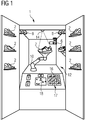
1 eine Vorrichtung gemäß einigen Ausführungsformen der vorliegenden Erfindung zeigt; -
2 und3 ein Kleidungsstück gemäß einigen Ausführungsformen der vorliegenden Erfindung zeigen; -
4 ein Kleidungsstück und Komponenten gemäß einigen Ausführungsformen der vorliegenden Erfindung zeigt;
-
1 shows an apparatus according to some embodiments of the present invention; -
2 and3 show a garment according to some embodiments of the present invention; -
4 a garment and components according to some embodiments of the present invention;
Detaillierte Beschreibung der AusfiihrungsformenDetailed Description of the Embodiments
Im Folgenden werden Ausführungsformen und Abwandlungen der vorliegenden Erfindung mit Bezugnahme auf die Figuren näher beschrieben.Hereinafter, embodiments and modifications of the present invention will be described with reference to the figures.
Wie in
Das Kleidungsstück kann praktisch jede beliebige Art von Kleidung sein. Es können jedoch grundsätzlich physische Objekte jeglicher Art, z.B. Sportgeräte und Schuhe
Wenn in der Vergangenheit beispielsweise ein neuer Schuh entwickelt wurde oder wenn ein Kunde die Erscheinung eines Schuhs individuell anpassen wollte, mussten zahlreiche reale physische Modelle des Schuhs gestaltet, hergestellt und beurteilt werden. Wenn das Oberflächendesign oder die Form als unpassend erachtet wurden, weil das Oberflächendesign oder die Form nicht den Wünschen des Kunden oder Bekleidungsdesigners entsprach, musste das physische Modell oftmals vollständig verworfen werden, weil es nicht möglich war, Veränderungen des Oberflächendesigns oder der Form in ein fertiggestelltes physisches Modell eines Schuhs
Um diese Probleme zu beseitigen, kann die Vorrichtung
Ein Schuh umfasst mehrere Bereiche
Während eine Veränderung eines Designs auf die Oberfläche des physischen Modells des Schuhs
Jede Komponente
Wenn das physische Modell des Schuhs
Außerdem kann jede Komponente
Jede Komponente
Zusätzlich oder alternativ können eine oder mehrere Komponenten
Neben der Verwendung eines Positionsverfolgungssystems zum Bestimmen und Verfolgen der Position und Ausrichtung des Markers
Insbesondere die Kamera
Nachdem die Position des physischen Modells des Schuhs
Das Bereitstellen einer exakten Projektion auf die unterschiedlichen Bereiche
Der oben beschriebene Identifikationschip, z.B. ein NFC-Chip, kann der Vorrichtung
Genauer gesagt können die formbezogenen Informationen der Komponenten
Wenn das physische Modell des Schuhs
Diese Vorgehensweise kann außerdem ein Austauschen der Komponenten
Neben Veränderungen der Form des physischen Modells des Schuhs
Eine Möglichkeit zum Auswählen von Farben, Bildern und/oder Designs für einen Bereich
Außer einem Touchscreen kann ein beliebiges anderes Eingabegerät verwendet werden, z.B. eine Maus, eine Tastatur usw.In addition to a touch screen, any other input device may be used, e.g. a mouse, a keyboard, etc.
Eine weitere Möglichkeit zum Auswählen unterschiedlicher Farben, Bilder und/oder Muster für einen Bereich
Es gibt zahlreiche unterschiedliche Arten von Gesten, die zum Ausführen des oben beschriebenen Veränderns von Farben, Bildern und Gesten geeignet sein können. Die Bereiche
Nachfolgend wird die Auswahl der Farbe, des Bildes und/oder des Musters näher beschrieben.The selection of the color, the picture and / or the pattern will be described in more detail below.
Die oben beschriebenen Gesten, die an einen bestimmten Bereich
Ein Farbsatz kann eine Vielzahl von Farben umfassen. Ein Bildsatz kann eine Vielzahl von Bildern, wie Fotos berühmter Sportler usw., umfassen. Mustersätze können eine Vielzahl unterschiedlicher Muster umfassen. Ein gemischter Satz kann Farben, Bilder und/oder Muster umfassen. Diese Sätze können von einem Kunden oder Designer definiert oder modifiziert werden, z.B. durch Verwendung der Benutzerschnittstelle
Angenommen, es ist ein Farbsatz vorausgewählt, dann kann sich, wenn ein Kunde oder Designer eine Geste wie oben beschrieben ausführt, die Farbe des entsprechenden Bereichs
Ein Kunde kann jedoch auch die verschiedenen Arten von Sätzen durchlaufen. Während das Durchlaufen der Elemente eines Satzes mittels einer ersten Art von Geste durchgeführt wird, kann das Durchlaufen der Sätze mittels einer zweiten Art von Geste durchgeführt werden. Wenn eine Geste gemäß der zweiten Art detektiert wird, wird die Projektion auf einen bestimmten Bereich
Ein solcher Mechanismus erlaubt es einem Kunden oder einem Bekleidungsdesigner, die Projektion auf einen bestimmten Bereich
Neben dem Modifizieren der Form des physischen Modells des Schuhs
Die Position des physischen Modells des Schuhs
Anstelle einer Plattform kann ein Roboterarm
Der vordefinierte Pfad kann die wichtigsten Positionen umfassen, die erforderlich sind, um das Gesamtdesign des physischen Modells des Schuhs
Die Verwendung eines Roboterarms
Außerdem kann der Roboterarm
Außerdem kann der Roboterarm
Außer einem Roboterarm
Wenn ein Design vollständig beurteilt wurde und den Wünschen eines Kunden oder eines Bekleidungsdesigners entspricht, können die Konfiguration des Designs, die eine oder mehrere Komponenten
Ein oder mehrere der oben beschriebenen Aspekte der vorliegenden Erfindung können in Hardware, in Software oder als Kombination aus Hardware und Software implementiert werden. Außerdem kann/können ein oder mehrere der oben beschriebenen Aspekte in der Vorrichtung oder in Form eines Verfahrens implementiert werden.One or more of the above-described aspects of the present invention may be implemented in hardware, in software, or as a combination of hardware and software. Additionally, one or more of the aspects described above may be implemented in the device or in the form of a method.
Claims (26)
Priority Applications (5)
| Application Number | Priority Date | Filing Date | Title |
|---|---|---|---|
| DE102016221669.4A DE102016221669A1 (en) | 2016-11-04 | 2016-11-04 | Apparatus and method for reversibly modifying the visual appearance of a garment |
| JP2017212335A JP6718423B2 (en) | 2016-11-04 | 2017-11-02 | Device and method for reversibly modifying the optical appearance of apparel |
| EP17199956.8A EP3318152B1 (en) | 2016-11-04 | 2017-11-03 | Apparatus and method for reversibly modifying the optical appearance of a shoe |
| US15/803,319 US20180125170A1 (en) | 2016-11-04 | 2017-11-03 | Reversibly Modifying the Optical Appearance of a Piece of Apparel |
| CN201711069387.6A CN108021734A (en) | 2016-11-04 | 2017-11-03 | Apparatus and method for the optical appearance for reversibly changing a piece of covering |
Applications Claiming Priority (1)
| Application Number | Priority Date | Filing Date | Title |
|---|---|---|---|
| DE102016221669.4A DE102016221669A1 (en) | 2016-11-04 | 2016-11-04 | Apparatus and method for reversibly modifying the visual appearance of a garment |
Publications (1)
| Publication Number | Publication Date |
|---|---|
| DE102016221669A1 true DE102016221669A1 (en) | 2018-05-09 |
Family
ID=60452353
Family Applications (1)
| Application Number | Title | Priority Date | Filing Date |
|---|---|---|---|
| DE102016221669.4A Pending DE102016221669A1 (en) | 2016-11-04 | 2016-11-04 | Apparatus and method for reversibly modifying the visual appearance of a garment |
Country Status (5)
| Country | Link |
|---|---|
| US (1) | US20180125170A1 (en) |
| EP (1) | EP3318152B1 (en) |
| JP (1) | JP6718423B2 (en) |
| CN (1) | CN108021734A (en) |
| DE (1) | DE102016221669A1 (en) |
Cited By (1)
| Publication number | Priority date | Publication date | Assignee | Title |
|---|---|---|---|---|
| DE102018200623A1 (en) * | 2018-01-16 | 2019-07-18 | Robert Bosch Gmbh | Interactive goods presentation device |
Families Citing this family (4)
| Publication number | Priority date | Publication date | Assignee | Title |
|---|---|---|---|---|
| US20180210997A1 (en) * | 2017-01-26 | 2018-07-26 | Wieden + Kennedy, Inc. | Object tracking for design image projection |
| US11626994B2 (en) | 2020-02-27 | 2023-04-11 | Sneakertopia Inc. | System and method for presenting content based on articles properly presented and verifiably owned by or in possession of user |
| DE102022128872B3 (en) * | 2022-11-01 | 2023-10-12 | Engelbert Strauss Gmbh & Co Kg | Process for making a toe cap |
| WO2024092371A1 (en) * | 2022-11-04 | 2024-05-10 | Avery Dennison Retail Information Services Llc | Computer projector system and method for custom labelling of apparel |
Citations (7)
| Publication number | Priority date | Publication date | Assignee | Title |
|---|---|---|---|---|
| US7079114B1 (en) * | 1998-08-21 | 2006-07-18 | Peter Smith | Interactive methods for design of automobiles |
| US20120053716A1 (en) * | 2010-02-24 | 2012-03-01 | Disney Enterprises, Inc. | Design and fabrication of materials with desired characteristics from base materials having determined characteristics |
| US20130132038A1 (en) * | 2011-11-18 | 2013-05-23 | Nike, Inc. | Automated 3-D Modeling Of Shoe Parts |
| US20130144424A1 (en) * | 2011-11-17 | 2013-06-06 | Stephane Jarbouai | Garment production system |
| US20150135447A1 (en) * | 2013-11-19 | 2015-05-21 | Nike, Inc. | Conditionally Visible Bite Lines For Footwear |
| US9460557B1 (en) * | 2016-03-07 | 2016-10-04 | Bao Tran | Systems and methods for footwear fitting |
| US20160292779A1 (en) * | 2015-03-31 | 2016-10-06 | Kyle Smith Rose | Modification of three-dimensional garments using gestures |
Family Cites Families (17)
| Publication number | Priority date | Publication date | Assignee | Title |
|---|---|---|---|---|
| WO1990003744A1 (en) * | 1988-10-03 | 1990-04-19 | Rbfpt, Inc. | Heat embossed shoes |
| JPH05247775A (en) * | 1992-03-09 | 1993-09-24 | Koutarou Hiranami | Formation of original drawing of design |
| JP2001245778A (en) * | 2000-03-03 | 2001-09-11 | Toray Ind Inc | Rugs |
| GB2395261A (en) * | 2002-11-11 | 2004-05-19 | Qinetiq Ltd | Ranging apparatus |
| DE102005051646A1 (en) * | 2005-10-26 | 2007-05-10 | Otto Bock Healthcare Ip Gmbh & Co. Kg | Procedure for checking the setting of a prosthetic knee joint |
| US20090051683A1 (en) * | 2007-07-16 | 2009-02-26 | Ravindra Stephen Goonetilleke | Method and system for foot shape generation |
| US8417487B2 (en) * | 2007-10-05 | 2013-04-09 | 3D Systems, Inc. | Replaceable fairing for prosthetic limb or brace |
| KR101158892B1 (en) * | 2009-05-15 | 2012-06-25 | 선문대학교 산학협력단 | Measuring method by using color filter |
| JP2011244902A (en) * | 2010-05-25 | 2011-12-08 | Simon Corp | Electrostatic shoe of double-layered outsole structure |
| CN101887477B (en) * | 2010-06-25 | 2015-02-18 | 温州大学 | Method for customizing digitalized shoe trees according to a plurality of images of foot shapes |
| AU2012229920A1 (en) * | 2011-03-14 | 2013-10-03 | Cadence Biomedical, Inc. | Orthosis |
| US8958901B2 (en) * | 2011-11-18 | 2015-02-17 | Nike, Inc. | Automated manufacturing of shoe parts |
| JP5952581B2 (en) * | 2012-02-16 | 2016-07-13 | 株式会社ブリヂストン | Decorative tire ordering system and decorative display method |
| US9070055B2 (en) * | 2012-07-25 | 2015-06-30 | Nike, Inc. | Graphic alignment for printing to an article using a first display device and a second display device |
| US10956956B2 (en) * | 2012-08-17 | 2021-03-23 | Ebay Inc. | System, method, and computer readable medium for recommendations based on wearable sensors |
| DE102013221020B4 (en) * | 2013-10-16 | 2020-04-02 | Adidas Ag | Speedfactory 3D |
| CN104573180A (en) * | 2014-12-02 | 2015-04-29 | 浙江工业大学 | Real-person shoe type copying device and shoe tree manufacturing method based on single-eye multi-angle-of-view robot vision |
-
2016
- 2016-11-04 DE DE102016221669.4A patent/DE102016221669A1/en active Pending
-
2017
- 2017-11-02 JP JP2017212335A patent/JP6718423B2/en active Active
- 2017-11-03 CN CN201711069387.6A patent/CN108021734A/en active Pending
- 2017-11-03 EP EP17199956.8A patent/EP3318152B1/en active Active
- 2017-11-03 US US15/803,319 patent/US20180125170A1/en not_active Abandoned
Patent Citations (7)
| Publication number | Priority date | Publication date | Assignee | Title |
|---|---|---|---|---|
| US7079114B1 (en) * | 1998-08-21 | 2006-07-18 | Peter Smith | Interactive methods for design of automobiles |
| US20120053716A1 (en) * | 2010-02-24 | 2012-03-01 | Disney Enterprises, Inc. | Design and fabrication of materials with desired characteristics from base materials having determined characteristics |
| US20130144424A1 (en) * | 2011-11-17 | 2013-06-06 | Stephane Jarbouai | Garment production system |
| US20130132038A1 (en) * | 2011-11-18 | 2013-05-23 | Nike, Inc. | Automated 3-D Modeling Of Shoe Parts |
| US20150135447A1 (en) * | 2013-11-19 | 2015-05-21 | Nike, Inc. | Conditionally Visible Bite Lines For Footwear |
| US20160292779A1 (en) * | 2015-03-31 | 2016-10-06 | Kyle Smith Rose | Modification of three-dimensional garments using gestures |
| US9460557B1 (en) * | 2016-03-07 | 2016-10-04 | Bao Tran | Systems and methods for footwear fitting |
Cited By (2)
| Publication number | Priority date | Publication date | Assignee | Title |
|---|---|---|---|---|
| DE102018200623A1 (en) * | 2018-01-16 | 2019-07-18 | Robert Bosch Gmbh | Interactive goods presentation device |
| DE102018200623B4 (en) | 2018-01-16 | 2025-01-02 | Robert Bosch Gmbh | Interactive product presentation device |
Also Published As
| Publication number | Publication date |
|---|---|
| CN108021734A (en) | 2018-05-11 |
| EP3318152B1 (en) | 2021-01-27 |
| JP6718423B2 (en) | 2020-07-08 |
| US20180125170A1 (en) | 2018-05-10 |
| JP2018094396A (en) | 2018-06-21 |
| EP3318152A1 (en) | 2018-05-09 |
Similar Documents
| Publication | Publication Date | Title |
|---|---|---|
| DE102016221669A1 (en) | Apparatus and method for reversibly modifying the visual appearance of a garment | |
| DE102018109463B3 (en) | Method for using a multi-unit actuated kinematics, preferably a robot, particularly preferably an articulated robot, by a user by means of a mobile display device | |
| DE102007059478B4 (en) | Method and system for aligning a virtual model with a real object | |
| DE102016209671B4 (en) | Device for designing a pattern for a portable object | |
| DE102015213832A1 (en) | Method and device for generating an artificial image | |
| DE112016004249T5 (en) | GENERATION OF THREE-DIMENSIONAL FASHION OBJECTS BY DRAWING IN A VIRTUAL REALITY ENVIRONMENT | |
| DE102009043798A1 (en) | Method for detecting hand gestures | |
| Jimeno-Morenilla et al. | Augmented and virtual reality techniques for footwear | |
| DE10339241A1 (en) | Jaw movement measuring device for diagnosis and treatment of patient, photographs relative movement of movement marker which cooperates with motion of lower jaw, and processes photographed image signal | |
| WO2012150147A1 (en) | Method for determining the relative position of an object in an area, and optical input system | |
| CN104656890A (en) | Virtual realistic intelligent projection gesture interaction all-in-one machine | |
| CH714038B1 (en) | Method and system for the interactive design of garments. | |
| DE102018105289A1 (en) | INFORMATION PROCESSING DEVICE, INFORMATION PROCESSING PROCESS AND PROGRAM | |
| DE102013215301B4 (en) | Method and computer program product for extruding a model through a two-dimensional scene | |
| EP2876526A1 (en) | Device for gesture recognition and method for recognition of gestures | |
| DE102014114131A1 (en) | Information processing and electronic device | |
| DE19635753A1 (en) | Virtual imaging device for selecting clothing from catalogue | |
| EP3972924B1 (en) | Method and device for visualising replacement parts | |
| EP3179450A1 (en) | Method and system for multi sensory representation of an object | |
| US11833761B1 (en) | Optimizing interaction with of tangible tools with tangible objects via registration of virtual objects to tangible tools | |
| DE102016207530B4 (en) | System and method for representing a virtual vehicle interior | |
| DE102018133626B4 (en) | METHOD AND APPARATUS FOR TRANSFERRING PATTERNS TO FABRIC, AND A COMPUTER PROGRAM PRODUCT TO SUPPORT THE PROPOSED METHOD | |
| DE112020003967T5 (en) | DATA PROCESSING EQUIPMENT, DATA PROCESSING PROCEDURE AND PROGRAM | |
| DE102013211046B4 (en) | Method and device for obtaining a control signal from an operating gesture | |
| AT505672B1 (en) | COMPUTER-ASSISTED INTERFACE SYSTEM |
Legal Events
| Date | Code | Title | Description |
|---|---|---|---|
| R012 | Request for examination validly filed | ||
| R016 | Response to examination communication | ||
| R079 | Amendment of ipc main class |
Free format text: PREVIOUS MAIN CLASS: G06F0019000000 Ipc: G16Z0099000000 |