DE102010042703A1 - Process for the continuous production of 2-butanone in hot high pressure water with added electrolyte - Google Patents
Process for the continuous production of 2-butanone in hot high pressure water with added electrolyte Download PDFInfo
- Publication number
- DE102010042703A1 DE102010042703A1 DE102010042703A DE102010042703A DE102010042703A1 DE 102010042703 A1 DE102010042703 A1 DE 102010042703A1 DE 102010042703 A DE102010042703 A DE 102010042703A DE 102010042703 A DE102010042703 A DE 102010042703A DE 102010042703 A1 DE102010042703 A1 DE 102010042703A1
- Authority
- DE
- Germany
- Prior art keywords
- butanone
- ppm
- butanediol
- reaction
- addition
- Prior art date
- Legal status (The legal status is an assumption and is not a legal conclusion. Google has not performed a legal analysis and makes no representation as to the accuracy of the status listed.)
- Withdrawn
Links
- ZWEHNKRNPOVVGH-UHFFFAOYSA-N 2-Butanone Chemical compound CCC(C)=O ZWEHNKRNPOVVGH-UHFFFAOYSA-N 0.000 title claims abstract description 29
- XLYOFNOQVPJJNP-UHFFFAOYSA-N water Substances O XLYOFNOQVPJJNP-UHFFFAOYSA-N 0.000 title claims abstract description 17
- 238000000034 method Methods 0.000 title claims abstract description 12
- 239000003792 electrolyte Substances 0.000 title claims abstract description 9
- 238000010924 continuous production Methods 0.000 title abstract description 3
- OWBTYPJTUOEWEK-UHFFFAOYSA-N butane-2,3-diol Chemical compound CC(O)C(C)O OWBTYPJTUOEWEK-UHFFFAOYSA-N 0.000 claims abstract description 19
- 150000001875 compounds Chemical class 0.000 claims abstract description 3
- 238000006243 chemical reaction Methods 0.000 claims description 43
- 239000007858 starting material Substances 0.000 claims description 6
- 239000002000 Electrolyte additive Substances 0.000 claims description 4
- 238000002360 preparation method Methods 0.000 claims description 3
- XEEYBQQBJWHFJM-UHFFFAOYSA-N iron Substances [Fe] XEEYBQQBJWHFJM-UHFFFAOYSA-N 0.000 description 20
- QTBSBXVTEAMEQO-UHFFFAOYSA-N Acetic acid Chemical compound CC(O)=O QTBSBXVTEAMEQO-UHFFFAOYSA-N 0.000 description 12
- AMIMRNSIRUDHCM-UHFFFAOYSA-N Isopropylaldehyde Chemical compound CC(C)C=O AMIMRNSIRUDHCM-UHFFFAOYSA-N 0.000 description 12
- 229910000368 zinc sulfate Inorganic materials 0.000 description 12
- 229960001763 zinc sulfate Drugs 0.000 description 12
- 239000000243 solution Substances 0.000 description 10
- NWONKYPBYAMBJT-UHFFFAOYSA-L zinc sulfate Chemical compound [Zn+2].[O-]S([O-])(=O)=O NWONKYPBYAMBJT-UHFFFAOYSA-L 0.000 description 10
- DIZPMCHEQGEION-UHFFFAOYSA-H aluminium sulfate (anhydrous) Chemical compound [Al+3].[Al+3].[O-]S([O-])(=O)=O.[O-]S([O-])(=O)=O.[O-]S([O-])(=O)=O DIZPMCHEQGEION-UHFFFAOYSA-H 0.000 description 7
- OZECDDHOAMNMQI-UHFFFAOYSA-H cerium(3+);trisulfate Chemical compound [Ce+3].[Ce+3].[O-]S([O-])(=O)=O.[O-]S([O-])(=O)=O.[O-]S([O-])(=O)=O OZECDDHOAMNMQI-UHFFFAOYSA-H 0.000 description 7
- 229910052782 aluminium Inorganic materials 0.000 description 6
- XAGFODPZIPBFFR-UHFFFAOYSA-N aluminium Chemical compound [Al] XAGFODPZIPBFFR-UHFFFAOYSA-N 0.000 description 6
- 230000018044 dehydration Effects 0.000 description 6
- 238000006297 dehydration reaction Methods 0.000 description 6
- 229910000358 iron sulfate Inorganic materials 0.000 description 6
- BAUYGSIQEAFULO-UHFFFAOYSA-L iron(2+) sulfate (anhydrous) Chemical compound [Fe+2].[O-]S([O-])(=O)=O BAUYGSIQEAFULO-UHFFFAOYSA-L 0.000 description 6
- 229910052742 iron Inorganic materials 0.000 description 5
- LGQLOGILCSXPEA-UHFFFAOYSA-L nickel sulfate Chemical compound [Ni+2].[O-]S([O-])(=O)=O LGQLOGILCSXPEA-UHFFFAOYSA-L 0.000 description 5
- 229910000363 nickel(II) sulfate Inorganic materials 0.000 description 5
- 239000000047 product Substances 0.000 description 5
- NBIIXXVUZAFLBC-UHFFFAOYSA-N Phosphoric acid Chemical compound OP(O)(O)=O NBIIXXVUZAFLBC-UHFFFAOYSA-N 0.000 description 4
- QAOWNCQODCNURD-UHFFFAOYSA-N Sulfuric acid Chemical compound OS(O)(=O)=O QAOWNCQODCNURD-UHFFFAOYSA-N 0.000 description 4
- 238000004128 high performance liquid chromatography Methods 0.000 description 4
- 239000000203 mixture Substances 0.000 description 4
- 150000003839 salts Chemical class 0.000 description 4
- 239000007864 aqueous solution Substances 0.000 description 3
- ZTQSAGDEMFDKMZ-UHFFFAOYSA-N butyric aldehyde Natural products CCCC=O ZTQSAGDEMFDKMZ-UHFFFAOYSA-N 0.000 description 3
- 238000002474 experimental method Methods 0.000 description 3
- 150000002500 ions Chemical class 0.000 description 3
- 239000000463 material Substances 0.000 description 3
- OWBTYPJTUOEWEK-ZXZARUISSA-N meso-butane-2,3-diol Chemical compound C[C@@H](O)[C@H](C)O OWBTYPJTUOEWEK-ZXZARUISSA-N 0.000 description 3
- 239000010935 stainless steel Substances 0.000 description 3
- 229910001220 stainless steel Inorganic materials 0.000 description 3
- OWBTYPJTUOEWEK-IMJSIDKUSA-N (S,S)-butane-2,3-diol Chemical compound C[C@H](O)[C@H](C)O OWBTYPJTUOEWEK-IMJSIDKUSA-N 0.000 description 2
- ZGHFDIIVVIFNPS-UHFFFAOYSA-N 3-Methyl-3-buten-2-one Chemical compound CC(=C)C(C)=O ZGHFDIIVVIFNPS-UHFFFAOYSA-N 0.000 description 2
- MHAJPDPJQMAIIY-UHFFFAOYSA-N Hydrogen peroxide Chemical compound OO MHAJPDPJQMAIIY-UHFFFAOYSA-N 0.000 description 2
- 229920000557 Nafion® Polymers 0.000 description 2
- NBBJYMSMWIIQGU-UHFFFAOYSA-N Propionic aldehyde Chemical compound CCC=O NBBJYMSMWIIQGU-UHFFFAOYSA-N 0.000 description 2
- HCHKCACWOHOZIP-UHFFFAOYSA-N Zinc Chemical compound [Zn] HCHKCACWOHOZIP-UHFFFAOYSA-N 0.000 description 2
- 229910000147 aluminium phosphate Inorganic materials 0.000 description 2
- 229910000323 aluminium silicate Inorganic materials 0.000 description 2
- 230000015572 biosynthetic process Effects 0.000 description 2
- BMRWNKZVCUKKSR-UHFFFAOYSA-N butane-1,2-diol Chemical compound CCC(O)CO BMRWNKZVCUKKSR-UHFFFAOYSA-N 0.000 description 2
- WERYXYBDKMZEQL-UHFFFAOYSA-N butane-1,4-diol Chemical compound OCCCCO WERYXYBDKMZEQL-UHFFFAOYSA-N 0.000 description 2
- 230000000694 effects Effects 0.000 description 2
- 239000012530 fluid Substances 0.000 description 2
- 239000000383 hazardous chemical Substances 0.000 description 2
- 125000002887 hydroxy group Chemical group [H]O* 0.000 description 2
- 238000006386 neutralization reaction Methods 0.000 description 2
- 229920005862 polyol Polymers 0.000 description 2
- 150000003077 polyols Chemical class 0.000 description 2
- XOJVVFBFDXDTEG-UHFFFAOYSA-N pristane Chemical compound CC(C)CCCC(C)CCCC(C)CCCC(C)C XOJVVFBFDXDTEG-UHFFFAOYSA-N 0.000 description 2
- 238000010626 work up procedure Methods 0.000 description 2
- 239000011701 zinc Substances 0.000 description 2
- BUHVIAUBTBOHAG-FOYDDCNASA-N (2r,3r,4s,5r)-2-[6-[[2-(3,5-dimethoxyphenyl)-2-(2-methylphenyl)ethyl]amino]purin-9-yl]-5-(hydroxymethyl)oxolane-3,4-diol Chemical compound COC1=CC(OC)=CC(C(CNC=2C=3N=CN(C=3N=CN=2)[C@H]2[C@@H]([C@H](O)[C@@H](CO)O2)O)C=2C(=CC=CC=2)C)=C1 BUHVIAUBTBOHAG-FOYDDCNASA-N 0.000 description 1
- SSYDTHANSGMJTP-ZXZARUISSA-N (3s,4r)-oxolane-3,4-diol Chemical compound O[C@H]1COC[C@H]1O SSYDTHANSGMJTP-ZXZARUISSA-N 0.000 description 1
- DNIAPMSPPWPWGF-GSVOUGTGSA-N (R)-(-)-Propylene glycol Chemical compound C[C@@H](O)CO DNIAPMSPPWPWGF-GSVOUGTGSA-N 0.000 description 1
- WFUGQJXVXHBTEM-UHFFFAOYSA-N 2-hydroperoxy-2-(2-hydroperoxybutan-2-ylperoxy)butane Chemical compound CCC(C)(OO)OOC(C)(CC)OO WFUGQJXVXHBTEM-UHFFFAOYSA-N 0.000 description 1
- RHLVCLIPMVJYKS-UHFFFAOYSA-N 3-octanone Chemical compound CCCCCC(=O)CC RHLVCLIPMVJYKS-UHFFFAOYSA-N 0.000 description 1
- HBAQYPYDRFILMT-UHFFFAOYSA-N 8-[3-(1-cyclopropylpyrazol-4-yl)-1H-pyrazolo[4,3-d]pyrimidin-5-yl]-3-methyl-3,8-diazabicyclo[3.2.1]octan-2-one Chemical class C1(CC1)N1N=CC(=C1)C1=NNC2=C1N=C(N=C2)N1C2C(N(CC1CC2)C)=O HBAQYPYDRFILMT-UHFFFAOYSA-N 0.000 description 1
- UNXHWFMMPAWVPI-QWWZWVQMSA-N D-Threitol Natural products OC[C@@H](O)[C@H](O)CO UNXHWFMMPAWVPI-QWWZWVQMSA-N 0.000 description 1
- UNXHWFMMPAWVPI-UHFFFAOYSA-N Erythritol Natural products OCC(O)C(O)CO UNXHWFMMPAWVPI-UHFFFAOYSA-N 0.000 description 1
- WYURNTSHIVDZCO-UHFFFAOYSA-N Tetrahydrofuran Chemical class C1CCOC1 WYURNTSHIVDZCO-UHFFFAOYSA-N 0.000 description 1
- SMEGJBVQLJJKKX-HOTMZDKISA-N [(2R,3S,4S,5R,6R)-5-acetyloxy-3,4,6-trihydroxyoxan-2-yl]methyl acetate Chemical compound CC(=O)OC[C@@H]1[C@H]([C@@H]([C@H]([C@@H](O1)O)OC(=O)C)O)O SMEGJBVQLJJKKX-HOTMZDKISA-N 0.000 description 1
- DHKHKXVYLBGOIT-UHFFFAOYSA-N acetaldehyde Diethyl Acetal Natural products CCOC(C)OCC DHKHKXVYLBGOIT-UHFFFAOYSA-N 0.000 description 1
- 150000001241 acetals Chemical class 0.000 description 1
- 229940081735 acetylcellulose Drugs 0.000 description 1
- 239000002253 acid Substances 0.000 description 1
- 239000000654 additive Substances 0.000 description 1
- 230000000996 additive effect Effects 0.000 description 1
- 150000001299 aldehydes Chemical class 0.000 description 1
- CDQSJQSWAWPGKG-UHFFFAOYSA-N butane-1,1-diol Chemical compound CCCC(O)O CDQSJQSWAWPGKG-UHFFFAOYSA-N 0.000 description 1
- 239000006227 byproduct Substances 0.000 description 1
- 239000003054 catalyst Substances 0.000 description 1
- 229920002301 cellulose acetate Polymers 0.000 description 1
- VZDYWEUILIUIDF-UHFFFAOYSA-J cerium(4+);disulfate Chemical compound [Ce+4].[O-]S([O-])(=O)=O.[O-]S([O-])(=O)=O VZDYWEUILIUIDF-UHFFFAOYSA-J 0.000 description 1
- 229910000355 cerium(IV) sulfate Inorganic materials 0.000 description 1
- 229920001429 chelating resin Polymers 0.000 description 1
- 239000007795 chemical reaction product Substances 0.000 description 1
- 238000004587 chromatography analysis Methods 0.000 description 1
- 238000011109 contamination Methods 0.000 description 1
- 238000005260 corrosion Methods 0.000 description 1
- 230000007797 corrosion Effects 0.000 description 1
- 238000000354 decomposition reaction Methods 0.000 description 1
- 230000003247 decreasing effect Effects 0.000 description 1
- 150000002009 diols Chemical class 0.000 description 1
- HNPSIPDUKPIQMN-UHFFFAOYSA-N dioxosilane;oxo(oxoalumanyloxy)alumane Chemical compound O=[Si]=O.O=[Al]O[Al]=O HNPSIPDUKPIQMN-UHFFFAOYSA-N 0.000 description 1
- 238000004821 distillation Methods 0.000 description 1
- UNXHWFMMPAWVPI-ZXZARUISSA-N erythritol Chemical compound OC[C@H](O)[C@H](O)CO UNXHWFMMPAWVPI-ZXZARUISSA-N 0.000 description 1
- 239000002816 fuel additive Substances 0.000 description 1
- 238000010574 gas phase reaction Methods 0.000 description 1
- 231100001261 hazardous Toxicity 0.000 description 1
- 238000010438 heat treatment Methods 0.000 description 1
- 229910001385 heavy metal Inorganic materials 0.000 description 1
- 239000002638 heterogeneous catalyst Substances 0.000 description 1
- XLYOFNOQVPJJNP-UHFFFAOYSA-M hydroxide Chemical compound [OH-] XLYOFNOQVPJJNP-UHFFFAOYSA-M 0.000 description 1
- 229910001026 inconel Inorganic materials 0.000 description 1
- 230000003993 interaction Effects 0.000 description 1
- 238000005342 ion exchange Methods 0.000 description 1
- RUTXIHLAWFEWGM-UHFFFAOYSA-H iron(3+) sulfate Chemical compound [Fe+3].[Fe+3].[O-]S([O-])(=O)=O.[O-]S([O-])(=O)=O.[O-]S([O-])(=O)=O RUTXIHLAWFEWGM-UHFFFAOYSA-H 0.000 description 1
- 229910000360 iron(III) sulfate Inorganic materials 0.000 description 1
- 150000002576 ketones Chemical class 0.000 description 1
- 239000010687 lubricating oil Substances 0.000 description 1
- 125000002496 methyl group Chemical group [H]C([H])([H])* 0.000 description 1
- DNIAPMSPPWPWGF-UHFFFAOYSA-N monopropylene glycol Natural products CC(O)CO DNIAPMSPPWPWGF-UHFFFAOYSA-N 0.000 description 1
- SYSQUGFVNFXIIT-UHFFFAOYSA-N n-[4-(1,3-benzoxazol-2-yl)phenyl]-4-nitrobenzenesulfonamide Chemical class C1=CC([N+](=O)[O-])=CC=C1S(=O)(=O)NC1=CC=C(C=2OC3=CC=CC=C3N=2)C=C1 SYSQUGFVNFXIIT-UHFFFAOYSA-N 0.000 description 1
- 125000000449 nitro group Chemical group [O-][N+](*)=O 0.000 description 1
- 229920001220 nitrocellulos Polymers 0.000 description 1
- 239000003973 paint Substances 0.000 description 1
- 239000004033 plastic Substances 0.000 description 1
- 229920003023 plastic Polymers 0.000 description 1
- 239000003505 polymerization initiator Substances 0.000 description 1
- 239000001294 propane Substances 0.000 description 1
- 235000013772 propylene glycol Nutrition 0.000 description 1
- 238000004445 quantitative analysis Methods 0.000 description 1
- 239000000376 reactant Substances 0.000 description 1
- 230000035484 reaction time Effects 0.000 description 1
- 229920005989 resin Polymers 0.000 description 1
- 239000011347 resin Substances 0.000 description 1
- 239000007787 solid Substances 0.000 description 1
- 239000002904 solvent Substances 0.000 description 1
Images




Classifications
-
- C—CHEMISTRY; METALLURGY
- C07—ORGANIC CHEMISTRY
- C07C—ACYCLIC OR CARBOCYCLIC COMPOUNDS
- C07C45/00—Preparation of compounds having >C = O groups bound only to carbon or hydrogen atoms; Preparation of chelates of such compounds
- C07C45/51—Preparation of compounds having >C = O groups bound only to carbon or hydrogen atoms; Preparation of chelates of such compounds by pyrolysis, rearrangement or decomposition
- C07C45/52—Preparation of compounds having >C = O groups bound only to carbon or hydrogen atoms; Preparation of chelates of such compounds by pyrolysis, rearrangement or decomposition by dehydration and rearrangement involving two hydroxy groups in the same molecule
-
- C—CHEMISTRY; METALLURGY
- C07—ORGANIC CHEMISTRY
- C07C—ACYCLIC OR CARBOCYCLIC COMPOUNDS
- C07C45/00—Preparation of compounds having >C = O groups bound only to carbon or hydrogen atoms; Preparation of chelates of such compounds
- C07C45/51—Preparation of compounds having >C = O groups bound only to carbon or hydrogen atoms; Preparation of chelates of such compounds by pyrolysis, rearrangement or decomposition
- C07C45/511—Preparation of compounds having >C = O groups bound only to carbon or hydrogen atoms; Preparation of chelates of such compounds by pyrolysis, rearrangement or decomposition involving transformation of singly bound oxygen functional groups to >C = O groups
- C07C45/512—Preparation of compounds having >C = O groups bound only to carbon or hydrogen atoms; Preparation of chelates of such compounds by pyrolysis, rearrangement or decomposition involving transformation of singly bound oxygen functional groups to >C = O groups the singly bound functional group being a free hydroxyl group
-
- C—CHEMISTRY; METALLURGY
- C07—ORGANIC CHEMISTRY
- C07C—ACYCLIC OR CARBOCYCLIC COMPOUNDS
- C07C49/00—Ketones; Ketenes; Dimeric ketenes; Ketonic chelates
- C07C49/04—Saturated compounds containing keto groups bound to acyclic carbon atoms
- C07C49/10—Methyl-ethyl ketone
Landscapes
- Chemical & Material Sciences (AREA)
- Organic Chemistry (AREA)
- Organic Low-Molecular-Weight Compounds And Preparation Thereof (AREA)
- Conductive Materials (AREA)
Abstract
Die Erfindung betrifft ein Verfahren zur kontinuierlichen Herstellung von 2-Butanon aus 2,3-Butandiol in heißem Hochdruckwasser mit Elektrolytzusatz, dadurch gekennzeichnet, dass als Elektrolytzusatz eine Verbindung ausgewählt aus der Gruppe Ce(SO4)2, Fe2(SO4)3, Al2(SO4) eingesetzt wird.The invention relates to a process for the continuous production of 2-butanone from 2,3-butanediol in hot high-pressure water with addition of electrolyte, characterized in that a compound selected from the group Ce (SO4) 2, Fe2 (SO4) 3, Al2 ( SO4) is used.
Description
Die Erfindung betrifft ein Verfahren zur kontinuierlichen Herstellung von 2-Butanon aus 2,3-Butandiol in heißem Hochdruckwasser mit Elektrolytzusatz.The invention relates to a process for the continuous preparation of 2-butanone from 2,3-butanediol in hot high pressure water with addition of electrolyte.
2-Butanon wird hauptsächlich als Kraftstoffadditiv und als Lösemittel für Lacke, Kunststoffe, Harze, Nitro- und Acetylcellulose verwendet. Weiterhin dient es auch zur Entparaffinierung von Schmierölen. Ein wesentlich geringerer Anteil an 2-Butanon wird als Ausgangsstoff zur Herstellung von Methylisopropenylketon, Methyl-, und Ethylamylketon verwendet. In Anwesenheit von Wasserstoffperoxid wird Methylethylketon zu Methylethylketonperoxid, einem Polymerisationsinitiator, umgesetzt.2-butanone is mainly used as a fuel additive and as a solvent for paints, plastics, resins, nitro and acetylcellulose. Furthermore, it also serves for dewaxing of lubricating oils. A much lower proportion of 2-butanone is used as starting material for the preparation of methyl isopropenyl ketone, methyl and ethyl amyl ketone. In the presence of hydrogen peroxide, methyl ethyl ketone is converted to methyl ethyl ketone peroxide, a polymerization initiator.
Die Umsetzung von Polyolen mit Hydroxygruppen in 1,4-Stellung, wie zum Beispiel 1,4-Butandiol, führt zu den entsprechenden Tetrahydrofuranderivaten. Im Gegensatz dazu erhält man bei der Dehydratisierung von Diolen mit benachbarten Hydroxylgruppen, wie zum Beispiel 1,2-Propan- und 1,2-Butandiol, das entsprechende Aldehyd beziehungsweise Keton.The reaction of polyols with hydroxy groups in the 1,4-position, such as, for example, 1,4-butanediol, leads to the corresponding tetrahydrofuran derivatives. In contrast, in the dehydration of diols with adjacent hydroxyl groups, such as 1,2-propane and 1,2-butanediol, the corresponding aldehyde or ketone is obtained.
Die Dehydratisierung von 2,3-Butandiol wurde bereits heterogen und homogen katalysiert durchgeführt. Als heterogene Katalysatoren wurden Alumosilicate (
Es ist ferner bekannt, dass durch Zugabe von Zink- und Nickelsulfat in nah- und überkritischem Wasser die Umsetzung von Polyolen sowie die Ausbeute erhöht werden kann. Bei der Dehydratisierung von meso-Erythritol zum Hauptprodukt 1,4-Anhydroerythritol in Wasser beträgt die maximale Ausbeute 55% bei 360°C, 340 bar und mit 988 ppm (g g–1) Zinksulfat. Die maximal erzielte Ausbeute an Propionaldehyd liegt bei 90%, ausgehend vom 1,2-Propandiol in nah- und überkritischem Wasser, bei 360°C, 340 bar, 120 s Verweilzeit und mit 400 ppm (g g–1) Zinksulfat. Bei 320°C, 34 MPa und einer Verweilzeit von 90 s beträgt der Umsatz ca. 70% und die Ausbeute liegt bei 70% (
Aufgabe der Erfindung ist es, ein Verfahren zur Verfügung zu stellen, welches die kontinuierliche Herstellung von 2-Butanon aus 2,3-Butandiol in heißem Hochdruckwasser mit Elektrolytzusatz optimiert.The object of the invention is to provide a process which optimizes the continuous production of 2-butanone from 2,3-butanediol in hot high-pressure water with added electrolyte.
Die Aufgabe wird gelöst durch ein Verfahren, bei dem ein Gemisch enthaltend 2,3-Butandiol in heißem Hochdruckwasser zu 2-Butanon umgesetzt wird, dadurch gekennzeichnet, dass als Elektrolytzusatz eine Verbindung ausgewählt aus der Gruppe Ce(SO4)2, Fe2(SO4)3, Al2(SO4)3 eingesetzt wird.The object is achieved by a process in which a mixture containing 2,3-butanediol is reacted in hot high-pressure water to 2-butanone, characterized in that a compound selected from the group Ce (SO 4 ) 2 , Fe 2 (II) as the electrolyte additive SO 4 ) 3 , Al 2 (SO 4 ) 3 is used.
Vorzugsweise wird der Elektrolytzusatz in einer Konzentration von 200–1100 ppm (g g–1) eingesetzt, wobei Eisensulfat vorzugsweise in einer Konzentration von 200–800 ppm (g g–1) (0,5–2 mmol L–1), besonders bevorzugt 200 ppm (g g–1) (0,5 mmol L–1), Aluminiumsulfat vorzugsweise in einer Konzentration von 200–1064 ppm (g g–1) (0,58–3,11 mmol L–1), besonders bevorzugt 200 ppm (g g–1) (0,58 mmol L–1), und Cersulfat vorzugsweise in einer Konzentration von 800 ppm (g g–1) (2,41 mmol L–1) eingesetzt wird. Die Umsetzung mit Eisen- und Aluminiumsulfat erfolgt aufgrund der Hydroxidbildung vorzugsweise in einer Lösung mit einem pH < 7, besonders bevorzugt einer 5% (g g–1) Essigsäurelösung, während Cersulfat vorzugsweise als Lösung in Wasser eingesetzt wird.Preferably, the addition of electrolytes in a concentration of 200-1100 ppm (gg -1 ) is used, iron sulfate preferably in a concentration of 200-800 ppm (gg -1 ) (0.5-2 mmol L -1 ), more preferably 200 ppm (gg -1 ) (0.5 mmol L -1 ), aluminum sulfate preferably in a concentration of 200-1064 ppm (gg -1 ) (0.58-3.11 mmol L -1 ), particularly preferably 200 ppm ( gg -1) (0.58 mmol L -1), and cerium sulfate, preferably in a concentration of 800 ppm (gg-1) (2.41 mmol L -1) is used. The reaction with iron and aluminum sulfate is preferably carried out in a solution having a pH <7, more preferably a 5% (gg -1 ) acetic acid solution, while cerium sulfate is preferably used as a solution in water due to the formation of hydroxide.
Als Edukt wird im erfindungsgemäßen Verfahren vorzugsweise eine Lösung von 0,5–20% (g g–1) bzw. 0,056–2,22 mol L–1 2,3-Butandiol in Wasser eingesetzt. 2,3-Butandiol kommt in drei Stereoisomeren vor, die biochemisch voneinander isoliert werden können; die beiden Enantiomere(R,R)- und (S,S)-2,3-Butandiol sowie eine meso-Form(R,S)-2,3-Butandiol. Im erfindungsgemäßen Verfahren wird vorzugsweise ein Isomerengemisch aus (R,R)- und (S,S)-2,3-Butandiol sowie der meso-Form(R,S)-2,3-Butandiol eingesetzt, welches in der Anmeldung auch als rac-meso-2,3-Butandiol bezeichnet wird.The starting material used in the process according to the invention is preferably a solution of 0.5-20% (gg -1 ) or 0.056-2.22 mol L -1 2,3-butanediol in water. 2,3-butanediol occurs in three stereoisomers, which can be isolated biochemically from each other; the two enantiomers (R, R) - and (S, S) -2,3-butanediol and a meso-form (R, S) -2,3- Butanediol. In the process of the invention is preferably a mixture of isomers of (R, R) - and (S, S) -2,3-butanediol and the meso-form (R, S) -2,3-butanediol used, which in the application also as rac-meso-2,3-butanediol is called.
Die Umsetzung erfolgt unter Bedingungen, bei denen heißes Hochdruckwasser vorliegt. Es handelt sich dabei vorzugsweise um eine Temperatur von 300°C bis 400°C, besonders bevorzugt 320°C, und einem Druck von vorzugsweise 300 bis 400 bar, besonders bevorzugt 340 bar.The reaction takes place under conditions in which hot high-pressure water is present. It is preferably a temperature of 300 ° C to 400 ° C, more preferably 320 ° C, and a pressure of preferably 300 to 400 bar, particularly preferably 340 bar.
Die Reaktionszeit (hydrodynamische Verweilzeit im Reaktionsraum) beträgt vorzugsweise 5–200 s.The reaction time (hydrodynamic residence time in the reaction space) is preferably 5-200 s.
Eine Dehydratisierung von 2,3-Butandiol in nah- und überkritischem Wasser (Hochdruckwasser) ist vorteilhaft, weil eine biochemisch hergestellte verdünnte wässrige Butandiollösung ohne vorherige Wasserabtrennung direkt in einer Hochdruckapparatur zum 2-Butanon umgesetzt werden kann. Besonders vorteilhaft an der Reaktion in nah- und überkritischem Wasser ist, dass bei der Aufarbeitung keine zusätzliche Neutralisation notwendig ist.A dehydration of 2,3-butanediol in near- and supercritical water (high-pressure water) is advantageous because a biochemically prepared dilute aqueous butanediol can be reacted without prior removal of water directly in a high pressure apparatus for 2-butanone. Particularly advantageous in the reaction in near- and supercritical water is that in the workup no additional neutralization is necessary.
Bei der Verwendung von Eisen- und Aluminiumsulfat ist von Vorteil, dass diese Salze sehr preiswert sind. Aluminiumsulfat ist ebenso wie Eisensulfat gemäß der Gefahrstoffordnung ökologisch unbedenklich im Vergleich zum Zink- und Nickelsulfat.When using iron and aluminum sulfate is an advantage that these salts are very inexpensive. Aluminum sulfate is just as iron sulfate according to the Hazardous Substances ecologically safe compared to zinc and nickel sulfate.
Durch den erfindungsgemäßen Zusatz von Aluminium-, Eisen- und Cersulfat können gleiche Ausbeuten von bis zu 70 mol-% an 2-Butanon erhalten werden wie mit Zinksulfat. Dies ist aus
Die folgenden Beispiele dienen der weiteren Erläuterung der Erfindung.The following examples serve to further illustrate the invention.
Die Versuche wurden in einer in
Mit Hilfe von HPLC-Pumpen (Kontron®, Pumpenkopf 10 mL) (
With the help of HPLC pumps (Kontron ® ,
Anschließend wurde die Reaktionslösung in einem Wärmetauscher auf 7°C abgekühlt und über ein Überströmventil (
Es ergab sich ein über die Fördermenge der Pumpe (
Die aus dem Reaktor (
Beispiel 1example 1
Eine wässrige Lösung bestehend aus 0,5 (g g–1) rac-meso-2,3-Butandiol und 200–1064 ppm (g g–1) Aluminiumsulfat (0,58–3,11 mmol L–1) in 5% (g g–1) Essigsäurelösung wurde wie oben beschrieben bei 320°C und 34 MPa umgesetzt.An aqueous solution consisting of 0.5 (gg -1 ) rac-meso-2,3-butanediol and 200-1064 ppm (gg -1 ) aluminum sulfate (0.58-3.11 mmol L -1 ) in 5% ( gg -1 ) acetic acid solution was reacted as described above at 320 ° C and 34 MPa.
Als Hauptprodukt wurde 2-Butanon und als Nebenprodukt Isobutyraldehyd identifiziert und mittels HPLC quantifiziert.The main product identified was 2-butanone and by-product isobutyraldehyde and quantified by HPLC.
Bei einer Verweilzeit von 120 s, 34 MPa und 320°C ohne Elektrolytzusatz wurde ein Umsatz von 2 mol-% erzielt. Der Umsatz nach 120 s bei 320°C war vollständig bei Aluminiumsulfatzugabe (0,58 mmol L–1 = ca. 200 ppm (g g–1) Al2(SO4)3). Bereits nach einer Verweilzeit von 15 s wurde ein Umsatz in Höhe von 55 mol-% erreicht.
Die maximale Ausbeute am gewünschten Hauptprodukt 2-Butanon lag bei 320°C mit 270 ppm (g g–1) Aluminiumsulfatzusatz bei ca. 70 mol-%. Die maximale Selektivität bezüglich des 2-Butanons bei 360°C mit Salzzusatz lag bei 70 mol-%.
Beispiel 2:Example 2:
Die Umsetzung erfolgte analog Beispiel 1. Als Edukt wurde rac-meso-2,3-Butandiol in wässrigen 5%-iger (g g–1) Essigsäurelösung eingesetzt. Die Reaktion fand bei 320°C, 34 MPa und unter Zugabe von 200–800 ppm (g g–1) Eisen(III)sulfat (0,50–2,00 mmol L–1) statt. Bei 320°C konnte durch Zugabe des Eisensulfates der Umsatz deutlich erhöht werden. Bei einer Zugabe von 400 und 800 ppm (g g–1) Fe2(SO4)3 wurde bei einer Verweilzeit von 120 s vollständiger Umsatz erreicht.
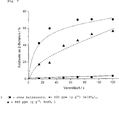
Die Ausbeute an 2-Butanon konnte durch Zugabe von 200 ppm (g g–1) (0,5 mmol L–1) Fe2(SO4)3 von 3 auf 21 mol-% erhöht werden. Durch Zugabe von 800 ppm (g g–1) (2 mmol L–1) Fe2(SO4)3 wurde bei einer Verweilzeit von 90 s eine maximale Ausbeute von 70 mol-% erreicht. Diese Ergebnisse sind in
Beispiel 3:Example 3:
Die Umsetzung erfolgte entsprechend Beispiel 1. Als Edukt wurde rac-meso-2,3-Butandiol eingesetzt. Die Reaktion fand bei 320°C, 34 MPa und unter Zugabe von 800 ppm (g g–1) Cersulfat (2,41 mmol L–1) statt. Zum Vergleich wurde die Umsetzung analog mit Zinksulfatzusatz durchgeführt.
Beispiel 4:Example 4:
Die Umsetzung erfolgte entsprechend Beispiel 1. Bei der Umsetzung unter Zugabe von Aluminium- bzw. Eisensulfat wurde eine wässrige Lösung bestehend aus 0,5% (g g–1) rac-meso-2,3-Butandiol und 200 ppm (g g–1) Aluminium- bzw. Eisensulfat (0,58 bzw. 0,5 mmol L–1) in 5% (g g–1) Essigsäurelösung verwendet. Als weiterer Zusatz wurden 800 ppm (g g–1) Cersulfat in einer wässrigen Lösung bestehend aus 0,5% (g g–1) rac-meso-2,3-Butandiol benutzt. Die Reaktion fand bei 320°C, 34 MPa und unter der Zugabe des entsprechenden Elektrolyten statt. Zum Vergleich wurde die Umsetzung analog mit Zinksulfatzusatz durchgeführt.
ZITATE ENTHALTEN IN DER BESCHREIBUNG QUOTES INCLUDE IN THE DESCRIPTION
Diese Liste der vom Anmelder aufgeführten Dokumente wurde automatisiert erzeugt und ist ausschließlich zur besseren Information des Lesers aufgenommen. Die Liste ist nicht Bestandteil der deutschen Patent- bzw. Gebrauchsmusteranmeldung. Das DPMA übernimmt keinerlei Haftung für etwaige Fehler oder Auslassungen.This list of the documents listed by the applicant has been generated automatically and is included solely for the better information of the reader. The list is not part of the German patent or utility model application. The DPMA assumes no liability for any errors or omissions.
Zitierte Nicht-PatentliteraturCited non-patent literature
- A. N. Bourns, R. V. V. Nicholls, Can. J. Res. B 1946–1947, 24–25, 80 ff [0004] AN Bourns, RVV Nicholls, Can. J. Res. B 1946-1947, 24-25, 80 et seq. [0004]
- I. Bucsi, A. Molnár, M. Bartók, Tetrahedron 1994, 50, 27, 8195 ff [0004] I. Bucsi, A. Molnar, M. Bartok, Tetrahedron 1994, 50, 27, 8195 et seq. [0004]
- A. C. Neish, V. C. Haskell, F. J. MacDonald, Can. J. Res. B 1945, 23, 281 ff [0004] AC Neish, VC Haskell, FJ MacDonald, Can. J. Res. B 1945, 23, 281 et seq. [0004]
- E. R. Alexander, D. C. Dittmer, J. Am. Chem. Soc. 1951, 73, 1665 ff [0004] Alexander, DC Dittmer, J. Am. Chem. Soc. 1951, 73, 1665 et seq. [0004]
- L. Ott, S. Kohl, M. Bicker, H. Vogel, Chem. Eng. Technol. 2005, 28, 1561 [0005] Ott, S. Kohl, M. Bicker, H. Vogel, Chem. Eng. Technol. 2005, 28, 1561 [0005]
- L. Ott, V. Lehr, S. Urfels, M. Bicker, H. Vogel, J. Supercrit. Fluids 2006, 38, 80ff [0005] Ott, V. Lehr, S. Urfels, M. Bicker, H. Vogel, J. Supercrit. Fluids 2006, 38, 80ff [0005]
Claims (5)
Priority Applications (7)
| Application Number | Priority Date | Filing Date | Title |
|---|---|---|---|
| DE102010042703A DE102010042703A1 (en) | 2010-10-20 | 2010-10-20 | Process for the continuous production of 2-butanone in hot high pressure water with added electrolyte |
| BR112013009341A BR112013009341A2 (en) | 2010-10-20 | 2011-10-17 | method for the continuous production of 2-butanone in hot pressurized water containing an added electrolyte |
| KR1020137003655A KR20130035270A (en) | 2010-10-20 | 2011-10-17 | Method for the continuous production of 2-butanone in hot pressurized water having an added electrolyte |
| PCT/EP2011/068115 WO2012052404A1 (en) | 2010-10-20 | 2011-10-17 | Method for the continuous production of 2-butanone in hot pressurized water having an added electrolyte |
| EP11773445.9A EP2630112A1 (en) | 2010-10-20 | 2011-10-17 | Method for the continuous production of 2-butanone in hot pressurized water having an added electrolyte |
| CN2011800425133A CN103080059A (en) | 2010-10-20 | 2011-10-17 | Method for the continuous production of 2-butanone in hot pressurized water having an added electrolyte |
| US13/820,260 US8664449B2 (en) | 2010-10-20 | 2011-10-17 | Method for the continuous production of 2-butanone in hot pressurized water having an added electrolyte |
Applications Claiming Priority (1)
| Application Number | Priority Date | Filing Date | Title |
|---|---|---|---|
| DE102010042703A DE102010042703A1 (en) | 2010-10-20 | 2010-10-20 | Process for the continuous production of 2-butanone in hot high pressure water with added electrolyte |
Publications (1)
| Publication Number | Publication Date |
|---|---|
| DE102010042703A1 true DE102010042703A1 (en) | 2012-04-26 |
Family
ID=45509415
Family Applications (1)
| Application Number | Title | Priority Date | Filing Date |
|---|---|---|---|
| DE102010042703A Withdrawn DE102010042703A1 (en) | 2010-10-20 | 2010-10-20 | Process for the continuous production of 2-butanone in hot high pressure water with added electrolyte |
Country Status (7)
| Country | Link |
|---|---|
| US (1) | US8664449B2 (en) |
| EP (1) | EP2630112A1 (en) |
| KR (1) | KR20130035270A (en) |
| CN (1) | CN103080059A (en) |
| BR (1) | BR112013009341A2 (en) |
| DE (1) | DE102010042703A1 (en) |
| WO (1) | WO2012052404A1 (en) |
-
2010
- 2010-10-20 DE DE102010042703A patent/DE102010042703A1/en not_active Withdrawn
-
2011
- 2011-10-17 BR BR112013009341A patent/BR112013009341A2/en not_active IP Right Cessation
- 2011-10-17 WO PCT/EP2011/068115 patent/WO2012052404A1/en not_active Ceased
- 2011-10-17 KR KR1020137003655A patent/KR20130035270A/en not_active Ceased
- 2011-10-17 US US13/820,260 patent/US8664449B2/en not_active Expired - Fee Related
- 2011-10-17 CN CN2011800425133A patent/CN103080059A/en active Pending
- 2011-10-17 EP EP11773445.9A patent/EP2630112A1/en not_active Withdrawn
Non-Patent Citations (6)
| Title |
|---|
| A. C. Neish, V. C. Haskell, F. J. MacDonald, Can. J. Res. B 1945, 23, 281 ff |
| A. N. Bourns, R. V. V. Nicholls, Can. J. Res. B 1946-1947, 24-25, 80 ff |
| E. R. Alexander, D. C. Dittmer, J. Am. Chem. Soc. 1951, 73, 1665 ff |
| I. Bucsi, A. Molnár, M. Bartók, Tetrahedron 1994, 50, 27, 8195 ff |
| L. Ott, S. Kohl, M. Bicker, H. Vogel, Chem. Eng. Technol. 2005, 28, 1561 |
| L. Ott, V. Lehr, S. Urfels, M. Bicker, H. Vogel, J. Supercrit. Fluids 2006, 38, 80ff |
Also Published As
| Publication number | Publication date |
|---|---|
| US20130197273A1 (en) | 2013-08-01 |
| EP2630112A1 (en) | 2013-08-28 |
| CN103080059A (en) | 2013-05-01 |
| US8664449B2 (en) | 2014-03-04 |
| KR20130035270A (en) | 2013-04-08 |
| WO2012052404A1 (en) | 2012-04-26 |
| BR112013009341A2 (en) | 2016-07-26 |
Similar Documents
| Publication | Publication Date | Title |
|---|---|---|
| EP0412337B1 (en) | Method for the production of 1,3-propandiol | |
| DE112019002562B4 (en) | Process for the production of unsaturated ketones | |
| EP3548473B1 (en) | Process for preparing hmf | |
| DE3130805A1 (en) | NEW RUTHENIUM / COAL HYDRATING CATALYSTS, THEIR PRODUCTION AND USE FOR THE SELECTIVE HYDROGENATION OF UNSATURATED CARBONYL COMPOUNDS | |
| EP2574609B1 (en) | Method for manufacturing furan compounds from renewable resources | |
| EP2837618B1 (en) | Hydrolysis of the residues of production of isophorone for the recovery of isophorone and acetone | |
| DE60223825T2 (en) | ETHYNYLIERUNGSVERFAHREN | |
| WO2011141470A1 (en) | Process for preparing neopentyl glycol | |
| DE102010042703A1 (en) | Process for the continuous production of 2-butanone in hot high pressure water with added electrolyte | |
| DE2630835A1 (en) | NEW MUSKY FRAGRANCES AND METHODS FOR PRODUCING THEM | |
| EP3095773B1 (en) | Preparation of limonene derivatives | |
| DE1246724B (en) | Process for the production of cyclohexene, methyl or dimethyl cyclohexene | |
| DE69806957T2 (en) | VINYL ETHER DERIVATE | |
| EP0001291B1 (en) | Process for the preparation of tetrahydrofurane from 1,4-butanediol | |
| DE1153740B (en) | Process for the production of fluorocarbon epoxies | |
| DE1668730A1 (en) | Process for the preparation of alpha-o-disubstituted alkanes | |
| DE890945C (en) | Process for the production of ethylene glycol | |
| DE2848095A1 (en) | Substd. per-hydro-naphtho-furan derivs. - used as stable amber-type perfumes, prepd. by cyclisation of cyclohexanol derivs. and hydrogenation | |
| DE3242618C2 (en) | Process for the preparation of 2-trifluoromethylpropanol by vapor phase hydrogenation of 2-trifluoromethylpropanal | |
| EP0929505A1 (en) | Process for preparing alkyne diols or mixtures of alkyne diols with alkyne monools | |
| DE2416584A1 (en) | HEXAMETHYLTETRACOSANE DIOL DERIVATIVES AND PROCESS FOR THE PREPARATION | |
| DE2357752A1 (en) | Trans-3-methyl-2-butene-1,4-dial 1-acetals prepn. - by selenium dioxide oxidation of 3-methyl-2-buten-1-al acetals | |
| DE4023255A1 (en) | METHOD FOR THE PRODUCTION OF GLYCOLES, IN PARTICULAR PROPYLENE GLYCOL FROM FORMALDEHYDE | |
| DE2106243C2 (en) | Process for the production of aldehydes | |
| DE2426863A1 (en) | PROCESS FOR CLEAVING CYCLOALIPHATIC HDROPEROXIDES |
Legal Events
| Date | Code | Title | Description |
|---|---|---|---|
| R119 | Application deemed withdrawn, or ip right lapsed, due to non-payment of renewal fee |
Effective date: 20140501 |