DE102008013281A1 - Sealing arrangement for high temperature fuel cell stacks - Google Patents
Sealing arrangement for high temperature fuel cell stacks Download PDFInfo
- Publication number
- DE102008013281A1 DE102008013281A1 DE102008013281A DE102008013281A DE102008013281A1 DE 102008013281 A1 DE102008013281 A1 DE 102008013281A1 DE 102008013281 A DE102008013281 A DE 102008013281A DE 102008013281 A DE102008013281 A DE 102008013281A DE 102008013281 A1 DE102008013281 A1 DE 102008013281A1
- Authority
- DE
- Germany
- Prior art keywords
- solder
- sealing arrangement
- addition
- ceramic layer
- mol
- Prior art date
- Legal status (The legal status is an assumption and is not a legal conclusion. Google has not performed a legal analysis and makes no representation as to the accuracy of the status listed.)
- Withdrawn
Links
Classifications
-
- H—ELECTRICITY
- H01—ELECTRIC ELEMENTS
- H01M—PROCESSES OR MEANS, e.g. BATTERIES, FOR THE DIRECT CONVERSION OF CHEMICAL ENERGY INTO ELECTRICAL ENERGY
- H01M8/00—Fuel cells; Manufacture thereof
- H01M8/02—Details
- H01M8/0271—Sealing or supporting means around electrodes, matrices or membranes
- H01M8/028—Sealing means characterised by their material
- H01M8/0282—Inorganic material
-
- B—PERFORMING OPERATIONS; TRANSPORTING
- B23—MACHINE TOOLS; METAL-WORKING NOT OTHERWISE PROVIDED FOR
- B23K—SOLDERING OR UNSOLDERING; WELDING; CLADDING OR PLATING BY SOLDERING OR WELDING; CUTTING BY APPLYING HEAT LOCALLY, e.g. FLAME CUTTING; WORKING BY LASER BEAM
- B23K1/00—Soldering, e.g. brazing, or unsoldering
- B23K1/0008—Soldering, e.g. brazing, or unsoldering specially adapted for particular articles or work
-
- B—PERFORMING OPERATIONS; TRANSPORTING
- B23—MACHINE TOOLS; METAL-WORKING NOT OTHERWISE PROVIDED FOR
- B23K—SOLDERING OR UNSOLDERING; WELDING; CLADDING OR PLATING BY SOLDERING OR WELDING; CUTTING BY APPLYING HEAT LOCALLY, e.g. FLAME CUTTING; WORKING BY LASER BEAM
- B23K1/00—Soldering, e.g. brazing, or unsoldering
- B23K1/008—Soldering within a furnace
-
- F—MECHANICAL ENGINEERING; LIGHTING; HEATING; WEAPONS; BLASTING
- F16—ENGINEERING ELEMENTS AND UNITS; GENERAL MEASURES FOR PRODUCING AND MAINTAINING EFFECTIVE FUNCTIONING OF MACHINES OR INSTALLATIONS; THERMAL INSULATION IN GENERAL
- F16J—PISTONS; CYLINDERS; SEALINGS
- F16J15/00—Sealings
- F16J15/02—Sealings between relatively-stationary surfaces
- F16J15/06—Sealings between relatively-stationary surfaces with solid packing compressed between sealing surfaces
- F16J15/064—Sealings between relatively-stationary surfaces with solid packing compressed between sealing surfaces the packing combining the sealing function with other functions
-
- F—MECHANICAL ENGINEERING; LIGHTING; HEATING; WEAPONS; BLASTING
- F16—ENGINEERING ELEMENTS AND UNITS; GENERAL MEASURES FOR PRODUCING AND MAINTAINING EFFECTIVE FUNCTIONING OF MACHINES OR INSTALLATIONS; THERMAL INSULATION IN GENERAL
- F16J—PISTONS; CYLINDERS; SEALINGS
- F16J15/00—Sealings
- F16J15/02—Sealings between relatively-stationary surfaces
- F16J15/06—Sealings between relatively-stationary surfaces with solid packing compressed between sealing surfaces
- F16J15/10—Sealings between relatively-stationary surfaces with solid packing compressed between sealing surfaces with non-metallic packing
- F16J15/102—Sealings between relatively-stationary surfaces with solid packing compressed between sealing surfaces with non-metallic packing characterised by material
-
- H—ELECTRICITY
- H01—ELECTRIC ELEMENTS
- H01M—PROCESSES OR MEANS, e.g. BATTERIES, FOR THE DIRECT CONVERSION OF CHEMICAL ENERGY INTO ELECTRICAL ENERGY
- H01M8/00—Fuel cells; Manufacture thereof
- H01M8/10—Fuel cells with solid electrolytes
- H01M8/12—Fuel cells with solid electrolytes operating at high temperature, e.g. with stabilised ZrO2 electrolyte
- H01M2008/1293—Fuel cells with solid oxide electrolytes
-
- H—ELECTRICITY
- H01—ELECTRIC ELEMENTS
- H01M—PROCESSES OR MEANS, e.g. BATTERIES, FOR THE DIRECT CONVERSION OF CHEMICAL ENERGY INTO ELECTRICAL ENERGY
- H01M8/00—Fuel cells; Manufacture thereof
- H01M8/02—Details
- H01M8/0271—Sealing or supporting means around electrodes, matrices or membranes
- H01M8/0286—Processes for forming seals
-
- Y—GENERAL TAGGING OF NEW TECHNOLOGICAL DEVELOPMENTS; GENERAL TAGGING OF CROSS-SECTIONAL TECHNOLOGIES SPANNING OVER SEVERAL SECTIONS OF THE IPC; TECHNICAL SUBJECTS COVERED BY FORMER USPC CROSS-REFERENCE ART COLLECTIONS [XRACs] AND DIGESTS
- Y02—TECHNOLOGIES OR APPLICATIONS FOR MITIGATION OR ADAPTATION AGAINST CLIMATE CHANGE
- Y02E—REDUCTION OF GREENHOUSE GAS [GHG] EMISSIONS, RELATED TO ENERGY GENERATION, TRANSMISSION OR DISTRIBUTION
- Y02E60/00—Enabling technologies; Technologies with a potential or indirect contribution to GHG emissions mitigation
- Y02E60/30—Hydrogen technology
- Y02E60/50—Fuel cells
-
- Y—GENERAL TAGGING OF NEW TECHNOLOGICAL DEVELOPMENTS; GENERAL TAGGING OF CROSS-SECTIONAL TECHNOLOGIES SPANNING OVER SEVERAL SECTIONS OF THE IPC; TECHNICAL SUBJECTS COVERED BY FORMER USPC CROSS-REFERENCE ART COLLECTIONS [XRACs] AND DIGESTS
- Y10—TECHNICAL SUBJECTS COVERED BY FORMER USPC
- Y10T—TECHNICAL SUBJECTS COVERED BY FORMER US CLASSIFICATION
- Y10T428/00—Stock material or miscellaneous articles
- Y10T428/31504—Composite [nonstructural laminate]
- Y10T428/31678—Of metal
Landscapes
- Engineering & Computer Science (AREA)
- Mechanical Engineering (AREA)
- General Engineering & Computer Science (AREA)
- Chemical & Material Sciences (AREA)
- Sustainable Development (AREA)
- Manufacturing & Machinery (AREA)
- Life Sciences & Earth Sciences (AREA)
- Sustainable Energy (AREA)
- Chemical Kinetics & Catalysis (AREA)
- Electrochemistry (AREA)
- General Chemical & Material Sciences (AREA)
- Inorganic Chemistry (AREA)
- Fuel Cell (AREA)
Abstract
Die Erfindung betrifft eine Dichtungsanordnung für metallische Bauteile, wobei die Dichtungsanordnung eine elektrische Isolationswirkung aufweist und wobei die Dichtungsanordnung eine keramische Schicht sowie ein darauf angeordnetes Lotbasismaterial umfasst, welches einen Zusatz von Germanium aufweist. Der Zusatz von Germanium liegt vorteilhaft im Bereich von 0,1 bis 5,0 Mol-%, bevorzugt zwischen 0,5 bis 2,5 Mol-%.
Eine besondere Ausgestaltung der Erfindung sieht den Einsatz eines Lotes vor, welches zusätzlich Silizium im Bereich von > 0 bis 2,5 Mol-%, bevorzugt zwischen 0,1 und 0,9 Mol-%, aufweist. Darüber hinaus hat sich ein Lot mit einem weiteren Zusatz von 10 bis 40 Vol.-% Al2TiO5, bevorzugt zwischen 20 bis 30 Vol.-% Al2TiO5, als besonders geeignet für diese Dichtungsanordnung herausgestellt.
Die Verwendung der besonderen Lotzusammensetzung innerhalb der Dichtungsanordnung führt regelmäßig zu reproduzierbar dichten und isolierenden Fügungen mit folgenden Eigenschaften:
a) Lotaustritte werden vermieden und Lotverläufe verringert,
b) die Porosität im Lot (überwiegend Einzelporen bzw. schmale Porenzeilen) wird deutlich verringert,
c) die Lötverbindungen weisen einen ausreichenden elektrischen Widerstand auf und
d) die Lötverbindungen snd regelmäßig ausreichend gasdicht (Leckrate beim He-Lecktest < 10-3 mbar*1*s-1).The invention relates to a sealing arrangement for metallic components, wherein the sealing arrangement has an electrical insulation effect and wherein the sealing arrangement comprises a ceramic layer and a solder base material arranged thereon, which has an addition of germanium. The addition of germanium is advantageously in the range of 0.1 to 5.0 mol%, preferably between 0.5 to 2.5 mol%.
A particular embodiment of the invention provides for the use of a solder, which additionally has silicon in the range of> 0 to 2.5 mol%, preferably between 0.1 and 0.9 mol%. In addition, a solder with a further addition of 10 to 40% by volume of Al 2 TiO 5 , preferably of 20 to 30% by volume of Al 2 TiO 5 , has proven particularly suitable for this sealing arrangement.
The use of the special solder composition within the sealing arrangement regularly leads to reproducibly dense and insulating joints with the following properties:
a) Lot leakage is avoided and Lotverläufe reduced
b) the porosity in the solder (predominantly individual pores or narrow pore lines) is significantly reduced,
c) the solder joints have a sufficient electrical resistance and
d) the solder joints snd regularly sufficiently gas-tight (leakage rate at He-leak test <10 -3 mbar * 1 * s -1 ).
Description
Die Erfindung betrifft ein Hochtemperatur-Brennstoffzellensystem, insbesondere eine Dichtungsanordnung für einen Brennstoffzellenstapel (Stack) mit oxidkeramischen Elektrolyten (SOFC = Solid Oxid Fuel Cell) sowie ein Verfahren zu dessen Herstellung.The The invention relates to a high-temperature fuel cell system, in particular a sealing arrangement for a fuel cell stack (Stack) with oxide ceramic electrolytes (SOFC = Solid Oxide Fuel Cell) and a method for its production.
Stand der TechnikState of the art
Brennstoffzellen sind elektrische Stromquellen, in denen durch elektrochemische Oxidation einer leicht oxidierbaren Substanz, meist Wasserstoff mit Sauerstoff, chemische Energie in elektrische Energie umgewandelt wird. Aufgrund der geringen Spannung, die eine einzelne Brennstoffzelle liefert, werden in der Regel viele Brennstoffzellen über so genannte Interkonnektoren zur Steigerung der elektrischen Leistung in Reihe geschaltet und dabei elektrisch isolierend mit Glaslot verbunden und abgedichtet. Diese werden dann Brennstoffzellenstapel oder auch Stack genannt. Die einzelnen Zellebenen, das heißt die keramischen Zellen mit dem metallischen Interkonnektor, werden auch Kassetten genannt. Beim Stapelaufbau ist es erforderlich, die einzelnen Kassetten längs einer Stapelrichtung nicht nur elektrisch isoliert, sondern auch gasdicht aufeinander zu fügen. Es ist notwendig, die Brenngaskanäle des Brennstoffzellenstapels gasdicht von den Oxidationsmittelräumen der Brennstoffzelleneinheiten und die Oxidationsmittelkanäle des Brennstoffzellenstapels von den Brennstoffzelleneinheiten zu trennen. Die Gasversorgungsöffnungen in den Kassetten werden hierbei gleichzeitig durch die aufgebrachten Dichtungen miteinander verbunden.fuel cells are electrical power sources in which by electrochemical oxidation an easily oxidizable substance, usually hydrogen with oxygen, chemical energy is converted into electrical energy. by virtue of the low voltage that a single fuel cell delivers, usually many fuel cells are so-called over Interconnectors for increasing the electrical power connected in series while electrically insulating connected and sealed with glass solder. These are then called fuel cell stacks or stack. The individual cell levels, that is, the ceramic cells with the metallic interconnector, also called cassettes. When stacking it is necessary, the individual cassettes along a stacking direction not only electrically isolated, but also gas tight to each other. It is necessary, the fuel gas channels the fuel cell stack gas-tight from the oxidant spaces the fuel cell units and the oxidant channels of the fuel cell stack from the fuel cell units separate. The gas supply openings in the cassettes will be this simultaneously by the applied seals together connected.
Die Betriebstemperatur eines Hochtemperatur-Brennstoffzellenstapels (SOFC-Stacks) liegt im Bereich von 700 bis 900°C. Ein SOFC-Stack mit Planaren Brennstoffzellen besteht üblicherweise aus keramischen Zellen und metallischen Interkonnektoren. Die keramische Zelle ist dabei in einem metallischen Rahmen eingebaut, der wiederum mit dem Interkonnektor verbunden ist. Bei bekannten Brennstoffzellenstapeln werden Dicht- und Isolationselemente aus Glaslot oder aus keramischen Dichtmaterialien verwendet, um die erforderliche elektrische Isolationswirkung und die erforderliche Gasdichtigkeit zu bewirken.The Operating temperature of a high-temperature fuel cell stack (SOFC stacks) is in the range of 700 to 900 ° C. A SOFC stack Planar fuel cells usually consist of ceramic cells and metallic interconnectors. The ceramic Cell is built into a metallic frame, which in turn connected to the interconnector. In known fuel cell stacks are sealing and insulating elements made of glass solder or ceramic Sealing materials used to achieve the required electrical insulation effect and to effect the required gas tightness.
Es ist in der Regel zweckmäßig, Abdichtung und elektrische Isolation voneinander zu trennen. Die elektrische Isolierung kann in einem solchen Fall, beispielsweise durch ein Keramik element, vorgenommen werden, welches durch Verlötung mit den Blechteilen verbunden wird. Durch eine gasdichte Verlötung wird hierbei gleichzeitig die Abdichtung der Gasversorgungsöffnungen bewerkstelligt. Hierbei besteht die Möglichkeit, die Keramik im Vakuum durch Einsatz von Aktivloten direkt mit den Stahlbauteilen zu verlöten.It is usually convenient, sealing and electrical Isolation from each other. The electrical insulation can in such a case, for example by a ceramic element, be made, which by soldering with the sheet metal parts is connected. By a gas-tight soldering is here at the same time the sealing of the gas supply openings accomplished. Here is the possibility of the ceramic in vacuum by using active solders directly with the steel components to solder.
Da bei der Fügung der Stackebenen bzw. der Kassetten miteinander die keramischen Zellen regelmäßig schon in die entsprechenden Fügepartner integriert sind, ist bei einer Lötung eine irreversible Schädigung der Zelle im Vakuum durch thermo-chemische Vorgänge (Reduktion) möglich. Deshalb sollte im Beisein der Zelle stets unter oxidierender Atmosphäre, beispielsweise Luft, gefügt werden.There at the joining of the stack levels or the cassettes with each other the ceramic cells already in the are integrated with corresponding mating partners is at a Soldering irreversible damage to the cell in vacuum by thermo-chemical processes (reduction) possible. Therefore, in the presence of the cell always under oxidizing atmosphere, For example, air, be joined.
Nach dem Stand der Technik können für diese Fügung in Luft auch Silberbasislote verwendet werden. Diese Lote gestatten das Löten an Luft, wenn sie Beimengungen von Zusätzen, wie z. B. Kupferoxid, enthalten, die die Benetzung fördern. Diese Lote werden dann als RAB-Lote (Reactive Air Brazing) bezeichnet.To The state of the art can be used for this purpose in air also silver base solders are used. Permit these solders soldering in air when adding additives, such as As copper oxide, which promote wetting. These solders are then called RAB (Reactive Air Brazing) solders.
Je nach Herstellung der Isolationskeramik kann diese Poren bzw. Spalte aufweisen. Dies ist beispielsweise dann der Fall, wenn die Keramikschicht durch einen thermischen Spritzprozess auf die zu isolierenden Metallteile aufgebracht wird. Je nach Kapillaraktivität des verwendeten Lotes kann dieses dann in die vorhandenen Spalte eindringen und Kurzschlüsse verursachen. Dies ist insbesondere bei Silberloten der Fall.ever after preparation of the insulating ceramic, these pores or column exhibit. This is the case, for example, when the ceramic layer by a thermal spraying process on the metal parts to be insulated is applied. Depending on the capillary activity of the used Lotes can then penetrate this into the existing column and Cause short circuits. This is especially true for silver solders the case.
Durch
das Aufbringen von Sperrschichten auf die eigentliche Isolationsschicht
kann das Eindringen des Lotes regelmäßig verhindert
werden. Hierdurch wird jedoch das Beschichtungsverfahren aufwändiger
als bei Verwendung von nur einer keramischen Isolationsschicht.
Aus
Ebenso kann aber auch der Lotaustritt aus dem Fügespalt während des Lötprozesses zu einem Kurzschluss führen.As well but can also be the Lotaustritt from the joint gap during the soldering process lead to a short circuit.
Die keramische Zelle besteht in der Regel aus Nickelcermet (Hauptanteil Zirkonoxid mit Nebenanteil Nickeloxid bzw. Nickel) und hat eine relativ gleichmäßige relative Wärmedeh nung im Temperaturbereich von RT bis 1000°C, d. h. einen temperaturunabhängigen thermischen Ausdehnungskoeffizienten von α = 12 × 10–6 K–1. Der metallische Blechrahmen besteht überwiegend aus dem ferritischem Chromstahl (Fe mit 22% Cr und weiteren Spurenanteilen) und hat eine mit der Temperatur zunehmende relative Wärmedehnung. Der Ausdehnungskoeffizienten steigt von α = 11 × 10–6 K–1, bei tiefen Temperaturen auf α = 14 × 10–6 K–1 bei 1000°C.The ceramic cell is usually made of nickel cermet (main component zirconium oxide with minor proportion nickel oxide or nickel) and has a relatively uniform relative Wärmedeh tion in the temperature range of RT to 1000 ° C, ie a temperature-independent thermal expansion coefficient of α = 12 × 10 -6 K -1 . The metallic sheet metal frame consists mainly of ferritic chrome steel (Fe with 22% Cr and other trace amounts) and has a relative thermal expansion which increases with temperature. The expansion coefficient increases from α = 11 × 10 -6 K -1 , at low temperatures to α = 14 × 10 -6 K -1 at 1000 ° C.
Das
Glaslot kann in der Regel nicht exakt in seinem Ausdehnungskoeffizienten
mit dem Ausdehnungskoeffizienten des Stahls in Übereinstimmung
gebracht werden. Aus
Die Nachteile aus dem bekannten Stand der Technik lassen sich wie folgt zusammenfassen:
- • Die verwendeten Lote (RAB) führen zu unkontrollierbaren Lotaustritten und Lotverläufen, woraus sich Kurzschlüsse, z. B. durch Brückenbildung zwischen den metallischen Bauelementen ergeben können.
- • Bei den bisherigen Lötungen (RAB) entstehen relativ großvolumige Poren bzw. Porenansammlungen, die als Anrisspunkte die mechanische Belastbarkeit der Verbindung verringern und zu Leckagen führen (insbesondere bei offener Porosität).
- • Durch die Kapillarität bzw. Reaktivität des Lotes kann es zur Infiltration, insbesondere in die Poren und Korngrenzen der Keramik kommen.
- • Durch Zusammenziehen (Kohäsion) des Lotes und Benetzungsprobleme können Ungänzen in der Lotspur und somit Leckagen entstehen.
- • The solders used (RAB) lead to uncontrollable Lotaustritten and Lotverläufen, resulting in short circuits, z. B. can result from bridging between the metallic components.
- • In previous soldering processes (RAB), relatively large-volume pores or pores accumulate, which as tear points reduce the mechanical load-bearing capacity of the connection and lead to leaks (especially with open porosity).
- • The capillarity or reactivity of the solder can lead to infiltration, in particular into the pores and grain boundaries of the ceramic.
- • Contraction (cohesion) of the solder and wetting problems can cause discontinuities in the solder track and thus leaks.
Somit sind derzeit häufig keine reproduzierbare, dichte und isolierende Verbindungen herzustellen.Consequently are currently often not reproducible, dense and insulating Make connections.
Aufgabe und LösungTask and solution
Der Erfindung liegt die Aufgabe zugrunde, eine Dichtungsanordnung zu schaffen, welche auch bei Temperaturen oberhalb von 400°C, insbesondere oberhalb von 700°C, eine ausreichende elektrische Isolationswirkung, eine ausreichende mechanische Festigkeit sowie die Möglichkeit einer gasdichten Abdichtung schafft.Of the Invention is based on the object, a seal arrangement which even at temperatures above 400 ° C, especially above 700 ° C, a sufficient electrical Insulation effect, adequate mechanical strength as well the possibility of a gas-tight seal creates.
Der Erfindung liegt zudem die Aufgabe zugrunde, eine Dichtungsanordnung, insbesondere für einen Hochtemperatur-Brennstoffzellenstapel zu schaffen, welche die vorgenannten Eigenschaften auch bei den üblichen Betriebstemperaturen einer solchen Brennstoffzelle aufweist.Of the Invention is also based on the object, a seal assembly, especially for a high-temperature fuel cell stack to create, which the above-mentioned characteristics also with the usual ones Operating temperatures of such a fuel cell has.
Ferner ist es die Aufgabe der Erfindung, ein einfaches und kostengünstiges Verfahren zur Herstellung einer vorgenannten Dichtungsanordnung bereit zu stellen.Further It is the object of the invention, a simple and inexpensive Method for producing an aforementioned sealing arrangement to provide.
Die Aufgaben der Erfindung werden gelöst durch eine Dichtungsanordnung gemäß Hauptanspruch, sowie durch ein Verfahren zur Herstellung einer solchen Dichtungsanordnung gemäß Nebenanspruch. Vorteilhafte Ausgestaltungen des Verfahrens sowie der Dichtungsanordnung ergeben sich aus den jeweils rückbezogenen Ansprüchen.The Objects of the invention are achieved by a sealing arrangement according to the main claim, as well as by a method for producing such a seal arrangement according to the independent claim. Advantageous embodiments of the method and the seal assembly arise from the respective related claims.
Gegenstand der ErfindungSubject of the invention
Im Rahmen der Erfindung wurde gefunden, dass sich die Infiltration einer aus dem Stand der Technik bekannten keramischen Isolationsschicht durch eindringendes Lot bei thermisch gespritzten Schichten erstaunlicherweise deutlich vermindern lässt, wenn dem Lot Germanium oder besonders vorteilhaft Germanium und Silizium gleichzeitig in geeigneten Mengen zugesetzt werden.in the Under the invention, it was found that the infiltration a known from the prior art ceramic insulation layer by penetrating solder in thermally sprayed layers, surprisingly can significantly reduce, if the Lot Germanium or particularly advantageous germanium and silicon simultaneously in suitable Quantities are added.
Die erfindungsgemäße Dichtungsanordnung umfasst daher eine keramische Schicht sowie ein darauf angeordnetes Lotbasismaterial, welches einen Zusatz von Germanium aufweist. Die Anordnung wirkt elektrisch isolierend. Die dazu benötigten Mengen an Germanium können durch einen Fachmann durch wenige Versuche ermittelt werden, und liegen je nach Basislot und eingesetzter Keramik bevorzugt zwischen 0,5 und 2,5 Mol-% für Ge. Das zugesetzte Germanium weist insbesondere den Vorteil auf, dass es gleichzeitig die Porenbildung im Lot zurück drängt.The The sealing arrangement according to the invention therefore comprises a ceramic layer and a solder base material arranged thereon, which has an addition of germanium. The arrangement works electrically insulating. The required amounts of germanium can be detected by a professional by a few tries are preferred, and are preferred depending on the basic solder and ceramic used between 0.5 and 2.5 mole% for Ge. The added germanium has the particular advantage that it simultaneously pore formation pushing back in the lot.
Bei einer vorteilhaften Ausgestaltung der Erfindung weist das Basislot Zugaben von Ge und Silizium auf, wobei der Anteil an Silizium im Ausgangslot bis zu 2,5 Mol-%, bevorzugt zwischen 0,1 und 0,9 Mol-% beträgt. Als besonders günstige Lotverbindungen haben sich Lote mit der Zusammensetzung Ag-2CuO-1,5Ge-0,75Si oder Ag-4CuO-1,5Ge-0,75Si herausgestellt.at an advantageous embodiment of the invention, the base plumb bob Additions of Ge and silicon, with the proportion of silicon in the Starting solder up to 2.5 mol%, preferably between 0.1 and 0.9 mol% is. As a particularly favorable solder joints have solders with the composition Ag-2CuO-1.5Ge-0.75Si or Ag-4CuO-1.5Ge-0.75Si exposed.
Als besonders gut spreitungshemmend hat sich der Zusatz von Aluminiumtitanat erwiesen. Die Menge an zugegebenem Aluminiumtitanat, bezogen auf das Lot, wird hier regelmäßig in Vol.-% angegeben, lässt sich aber auch leicht in Gew.-% oder Mol-% umrechnen. Vorteilhafte Zugaben liegen im Bereich von 10 bis 40 Vol.-% Al2TiO5, bevorzugt zwischen 20 bis 30 Vol.-%.The addition of aluminum titanate has proven to be particularly effective in inhibiting spreading. The amount of aluminum titanate added, based on the solder, is stated here regularly in% by volume, but can also be easily converted into% by weight or mol%. Advantageous additions are in the range of 10 to 40 vol.% Al 2 TiO 5 , preferably between 20 to 30 vol.%.
Das Aluminiumtitanat wird dem Lot in der Regel als besonders feines Pulver zugemischt, da es beim Aufbringen und Löten selbst nicht zum Aufschmelzen kommt, und so eine homogene Verteilung innerhalb der Lotmischung sichergestellt werden kann.The Aluminum titanate is usually considered to be particularly fine to the solder Powder mixed as it is during application and soldering itself does not melt, and so a homogeneous distribution within the solder mixture can be ensured.
Die vorliegende Erfindung eignet sich für alle Verbindungen zwischen zwei metallischen Bauteilen, die elektrisch isolierend und dennoch gasdicht ausgestaltet werden müssen, insbesondere vorteilhaft für den Einsatz in einem Hochtemperatur-Brennstoffzellenstapel mit oxidkeramischen Elektrolyten (SOFC = Solid Oxid Fuel Cell).The present invention is suitable for all compounds between two metallic components that are electrically insulating and still have to be made gas-tight, in particular advantageous for use in a high-temperature fuel cell stack with oxide ceramic electrolytes (SOFC = Solid Oxide Fuel Cell).
In einer speziellen Ausgestaltung der Erfindung weist die Dichtungsanordnung ein Reactive Air Brazing (RAB)-Lot als Lotbasismaterial auf. Im Rahmen dieser Erfindung ist darunter ein Ag-Basis-Lot zu verstehen, welches durch das Verfahren RAB (also Löten an Luft) und Hinzulegieren von benetzungsaktiven Additiven zum RAB-Lot geworden ist.In a special embodiment of the invention, the seal assembly a Reactive Air Brazing (RAB) solder as a solder base material on. in the Under this invention is to be understood as an Ag base solder, which by the method RAB (ie soldering in air) and Add wetting-active additives to the RAB solder is.
Vorteilhaft handelt es sich bei der keramischen Isolationsschicht um eine Schicht, die vorzugsweise über ein thermisches Spritzverfahren aufgebracht wurde. Bei dieser kann es sich um eine atmosphärisch plasmagepritzte, vakuumgespritzte oder auch um eine flammgespritzte Schicht handeln. Weitere geeignete Aufbringungsverfahren für die keramische Schicht wären daneben der Sol-Gel Prozess oder auch PVD mit anschließender Sinterung.Advantageous is the ceramic insulation layer a layer, which preferably applied by a thermal spraying process has been. This can be an atmospheric plasma sprayed, Vacuum-sprayed or act around a flame-sprayed layer. Other suitable application methods for the ceramic Layer next to the sol-gel process or PVD with subsequent sintering.
Vorteilhaft ist die keramische Isolationsschicht schon selbst möglichst dicht, so dass eine möglichst geringe Porosität vorliegt. Darunter ist zu verstehen, dass keine offene Porosität bis zum Substrat (metallisches Bauteil)vorliegt und die Leckrate dieser keramischen Schicht bei einem He-Lecktest insgesamt unter 10–3 mbar × 1 × s–1 liegt.Advantageously, the ceramic insulation layer is even as close as possible, so that the lowest possible porosity exists. This is to be understood as meaning that there is no open porosity up to the substrate (metallic component) and the leakage rate of this ceramic layer is less than 10 -3 mbar × 1 × s -1 in the case of a He leak test.
Als weitere Ausgestaltung der geeigneten keramischen Schicht kann auch eine beidseitig eingelötete Folie genannt werden.When Further embodiment of the suitable ceramic layer can also a sheet soldered on both sides are called.
Die keramische Schicht weist insbesondere Nickeloxid, Zirkondioxid, Aluminiumoxid, Magnesiumoxid oder Siliziumoxid, oder eine Mischung der vorgenannten Oxide auf. In einer speziellen Ausgestaltung umfasst die keramische Schicht einen Aluminium-Magnesium-Spinell, wobei dieser optional auch noch zusätzlich mit einer Deckschicht aus einer Mischung aus Aluminium-Magnesium-Spinell und Titan bzw. einer Titanverbindung versehen sein kann.The ceramic layer comprises in particular nickel oxide, zirconium dioxide, Alumina, magnesia or silica, or a mixture the aforementioned oxides. In a special embodiment, the ceramic layer an aluminum-magnesium spinel, this one Optionally also with a cover layer a mixture of aluminum-magnesium spinel and titanium or a Titanium compound may be provided.
Der besonders vorteilhafte Lot-Zusatz von Silizium und Germanium lässt sich einfach durch direktes Beimischen der entsprechenden metallischen Pulver zu dem Rohpulver der Lötbasis bewirken. Falls erforderlich, kann das so gemischte Lotpulver in einem Bindemittel suspendiert als Paste, z. B. durch Siebdruck oder mit einem Dispenser, aufgetragen werden.Of the particularly advantageous solder addition of silicon and germanium simply by direct mixing of the corresponding metallic Make powder to the raw powder of the solder base. If necessary, For example, the thus mixed solder powder can be suspended in a binder as a paste, for. B. by screen printing or with a dispenser applied become.
Als Ausgangslotmaterial bieten sich Silberbasislote mit oder ohne Zusatz von Kupferoxid an, die zur Verkleinerung des Randwinkels, und damit zur besseren Benetzbarkeit führen. Beispiele für solche Silberbasislote sind (in Mol-%) Ag-4CuO oder Ag-8CuO.When Starting solder material offer silver base solders with or without additive of copper oxide, which is used to reduce the contact angle, and thus lead to better wettability. examples for such silver-based solders are (in mol%) Ag-4CuO or Ag-8CuO.
Weiterhin haben sich Zusätze in Form von V2O5 und Ti, z. B. in Form von TiH2, als vorteilhaft für die Benetzung der Keramik herausgestellt. Diese Verbindungen wirken hauptsächlich benetzend. Zur Herstellung der erfindungsgemäßen Lote wird ein inniges Gemenge der entsprechenden Komponenten in Pulverform verwendet. Aus diesem Gemenge bildet sich dann in situ die Lotlegierung. Bei Zusatz von Titanhydrid wandelt sich dies bei Temperaturen um 400°C in metallisches Titan, bzw. an Luft in Titanoxid um.Furthermore, additives in the form of V 2 O 5 and Ti, z. B. in the form of TiH 2 , found to be advantageous for the wetting of the ceramic. These compounds are mainly wetting. To prepare the solders according to the invention, an intimate mixture of the corresponding components in powder form is used. From this mixture then forms the solder alloy in situ. When titanium hydride is added, this changes to metallic titanium at temperatures around 400 ° C, or to titanium oxide in air.
Als Basis für die Lotlegierung ohne elementares Kupfer, dafür aber mit CuO und Titan, sind insbesondere auch folgende Zusammensetzungen geeignet (in Mol-%): Ag-4CuO-0,5TiH2 oder Ag-8CuO-0,5TiH2.As a basis for the solder alloy without elemental copper, but with CuO and titanium, in particular the following compositions are suitable (in mol%): Ag-4CuO-0.5TiH 2 or Ag-8CuO-0.5TiH 2 .
Eine Verbesserung des Lötprozesses kann zudem vorteilhaft durch Verminderung der Fließfähigkeit des Lotes im flüssigen Zustand (Spreiten) erreicht werden. Dies wird durch Zusatz eines geeigneten Keramikpulvers, z. B. Aluminiumtitanat, erzielt. Durch diese Maßnahme werden Kurzschlüsse durch austretendes Lot weitgehend vermieden.An improvement of the soldering process can also be advantageously achieved by reducing the fluidity of the solder in the liquid state (spreading). This is done by adding a suitable ceramic powder, eg. B. aluminum titanate achieved. By this measure, short circuits are caused by escaping solder largely avoided.
Die Einflüsse der unterschiedlichen Lotzusätze können wie folgt zusammengefasst werden, wobei der Zusatz von Germanium für die Ausgestaltung des erfindungsgemäßen Lots zwingend ist:
- • Bestandteile, die die Infiltration begrenzen (entnetzende Wirkung), z. B.: Si
- • Bestandteile, die die Porenbildung verringern, z. B.: Ge
- • Bestandteile, die die Benetzung in besonderer Weise beeinflussen (benetzend), z. B.: CuO, V2O5, Ti (Zusatz z. B. als TiH2)
- • Füllstoffe, die das Spreiten (Ausbreiten) des flüssigen Lotes verhindern, z. B.: Al2 TiO5.
- • Components that limit infiltration (de-wetting effect), eg. B .: Si
- • Components that reduce pore formation, eg. B .: Ge
- • Ingredients that affect the wetting in a special way (wetting), z. B: CuO, V 2 O 5 , Ti (additive eg as TiH 2 )
- • Fillers that prevent spreading (spreading) of the liquid solder, z. B: Al 2 TiO 5 .
Das Aufbringen des Lötmaterials auf die isolierende Keramikschicht zur Bildung der erfindungsgemäßen Dichtanordnung kann auf unterschiedliche Weise erfolgen.The Applying the soldering material to the insulating ceramic layer for forming the sealing arrangement according to the invention can be done in different ways.
Das Lötmaterial kann beispielsweise als Paste mittels eines Dispensers auf der Oberseite der isolierenden Keramischschicht aufgebracht werden. Alternativ kann die Auftragung des Lötmaterials durch ein Musterdruckverfahren, beispielsweise über ein Siebdruckverfahren, auf die isolierende Keramikschicht erfolgen. Ferner ist auch die Möglichkeit gegeben, das Lotmaterial in Form einer Lötfolie auf der Oberfläche der isolierenden Keramikschicht anzuordnen. Außerdem ist auch eine Applikation auf dem metallischen Fügepartner möglich.The Solder can, for example, as a paste by means of a Dispensers applied to the top of the insulating ceramic layer become. Alternatively, the application of the soldering material by a pattern printing process, for example via a Screen printing process, take place on the insulating ceramic layer. Further is also given the opportunity, the solder material in shape a solder foil on the surface of the insulating Ceramic layer to arrange. There is also an application possible on the metallic joining partner.
Die Verwendung der besonderen Lotzusammensetzung innerhalb der Dichtungsanordnung fuhrt regelmäßig zu reproduzierbar dichten und isolierenden Fügungen mit folgenden Eigenschaften:
- • Lotaustritte werden vermieden und Lotverläufe verringert, die Porosität im Lot (überwiegend Einzelporen bzw. schmale Porenzeilen) wird deutlich verringert,
- • die Lötverbindungen weisen einen ausreichenden elektrischen Widerstand auf,
- • die Lötverbindungen sind regelmäßig ausreichend gasdicht, das bedeutet eine Leckrate kleiner als 10–3 mbar·1·s–1 (He-Lecktest).
- • Lot leaks are avoided and solder traces are reduced, the porosity in the solder (predominantly single pores or narrow pore lines) is significantly reduced,
- The solder joints have sufficient electrical resistance,
- • The solder joints are regularly sufficiently gas-tight, which means a leakage rate of less than 10 -3 mbar · 1 · s -1 (He leak test).
Spezieller BeschreibungsteilSpecial description part
Bei der folgenden Beschreibung spezieller Ausgestaltungen der Erfindung besteht die Isolationsschicht der Dichtungsanordnung für einen Hochtemperatur-Brennstoffzellenstapel beispielhaft aus mehreren Lagen thermisch aufgespritzter Keramik, z. B. aus einem Aluminium-Magnesium-Spinell mit einer Schichtdicke von insgesamt 20 μm bis 150 μm, bevorzugt 30 μm bis 70 μm.at the following description of specific embodiments of the invention If the insulating layer of the seal assembly for a high-temperature fuel cell stack example of several layers thermally sprayed ceramic, z. B. from an aluminum-magnesium spinel with a total layer thickness of 20 μm to 150 μm, preferably 30 μm to 70 μm.
Die erfindungsgemäßen Lote für die Dichtungsanordnung wurden durch sorgfältige und innige Mischung der entsprechenden Rohstoffpulver hergestellt. Falls erforderlich, können die Lotpulver in einem Bindemittel suspendiert als Paste z. B. durch Siebdruck oder mit einem Dispenser aufgetragen werden. Als Ausgangslote wurden Silberbasislote eingesetzt.The solders according to the invention for the seal arrangement were by careful and intimate mixture of the corresponding Produced raw material powder. If necessary, can the solder powder suspended in a binder as a paste z. B. by Screen printing or applied with a dispenser. As starting points Silver base solders were used.
Korngrößen
der eingesetzten Rohpulver:
Die
Stoffmengenanteile sind in Mol-% angegeben, für Silberbasislot:
Untersuchte
Beispiele eines Lots mit vermindertem Infiltrationsvermögen:
Untersuchte
Beispiele von Loten mit vermindertem Infiltrationsvermögen
und verminderter Spreitungsneigung:
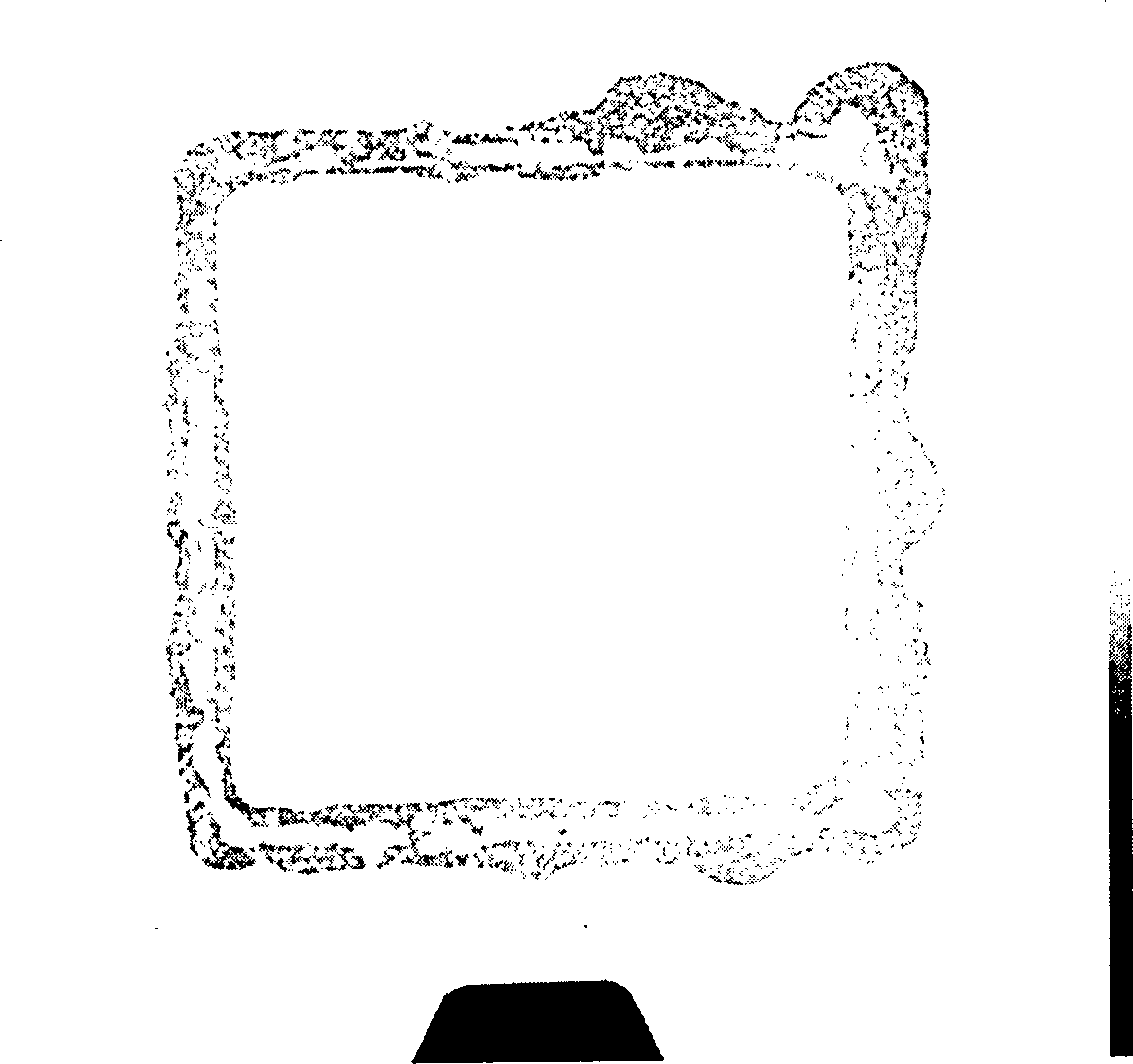
Nachfolgend werden zwei der vorgenannten Untersuchungsergebnisse exemplarisch gegenübergestellt, die die Vorteile der Erfindung eindeutig wiedergeben. Es handelt sich dabei um zwei Metall-Keramik-Lötverbunde, die mit invertierten Durchstrahlungsaufnahmen von Kleinproben verglichen werden:following Two of the aforementioned test results become exemplary contrasted, the advantages of the invention clearly play. These are two metal-ceramic solder joints, compared with inverted radiographic images of small samples become:
Probe Nr. V105: „Standard” (
- Metallische Komponente: Crofer22APU, 0,5 mm dick,Metallic component: Crofer22APU, 0.5 mm thick,
- Keramische Komponente: Substrat Crofer 22APU, 0,5 mm mit einer VPS-Beschichtung Al-Mg-Spinell und einer Deckschicht aus einer Mischung von Al-Mg-Spinell und Titanhydrid.Ceramic component: substrate Crofer 22APU, 0.5 mm with a VPS coating Al-Mg spinel and a topcoat of a mixture of Al-Mg spinel and titanium hydride.
- Lot: Ag4CuO (Paste)Lot: Ag4CuO (Paste)
- Lötergebnis: Dicht und isolierend, zeigt jedoch nachteilig einen deutlichen Lotverlauf und eine gewisse Porosität.Soldering result: Tight and insulating, but shows disadvantageous a clear Lotverlauf and a certain porosity.
Probe Nr. V135: „Erfindungsgemäß” (
- Metallische Komponente: Crofer 22APU, 0,5 mm dick,Metallic component: Crofer 22APU, 0.5 mm thick,
- Keramische Komponente: Substrat Crofer22APU, 0,5 mm mit einer VPS-Beschichtung Al-Mg-SpinellCeramic component: substrate Crofer22APU, 0.5 mm with a VPS coating Al-Mg spinel
- Lot: Ag-4CuO-1,5Ge-0,75Si + 20 Vol.-% Al2TiO5 (Paste)Lot: Ag-4CuO-1.5Ge-0.75Si + 20 vol% Al 2 TiO 5 (paste)
- Lötergebnis: Dicht und isolierend, zeigt zudem kaum Lotverlauf und eine nur geringe Porosität.Soldering result: Dense and insulating, barely shows Lotverlauf and only a small porosity.
ZITATE ENTHALTEN IN DER BESCHREIBUNGQUOTES INCLUDE IN THE DESCRIPTION
Diese Liste der vom Anmelder aufgeführten Dokumente wurde automatisiert erzeugt und ist ausschließlich zur besseren Information des Lesers aufgenommen. Die Liste ist nicht Bestandteil der deutschen Patent- bzw. Gebrauchsmusteranmeldung. Das DPMA übernimmt keinerlei Haftung für etwaige Fehler oder Auslassungen.This list The documents listed by the applicant have been automated generated and is solely for better information recorded by the reader. The list is not part of the German Patent or utility model application. The DPMA takes over no liability for any errors or omissions.
Zitierte PatentliteraturCited patent literature
- - US 2007/0003811 A1 [0008] US 2007/0003811 A1 [0008]
- - US 2007/0065707 A1 [0008] US 2007/0065707 A1 [0008]
- - WO 2006/086037 [0011] WO 2006/086037 [0011]
Claims (27)
Priority Applications (8)
| Application Number | Priority Date | Filing Date | Title |
|---|---|---|---|
| DE102008013281A DE102008013281A1 (en) | 2008-03-08 | 2008-03-08 | Sealing arrangement for high temperature fuel cell stacks |
| DK09720824.3T DK2260530T3 (en) | 2008-03-08 | 2009-02-18 | SEALING DEVICE FOR HIGH TEMPERATURE FUEL CELL STACK |
| AT09720824T ATE552621T1 (en) | 2008-03-08 | 2009-02-18 | SEALING ARRANGEMENT FOR HIGH TEMPERATURE FUEL CELL STACKS |
| CN200980108228.XA CN101960660B (en) | 2008-03-08 | 2009-02-18 | The sealing device of high-temperature fuel cell stack |
| PCT/DE2009/000221 WO2009112005A1 (en) | 2008-03-08 | 2009-02-18 | Sealing arrangement for high-temperature fuel cell stack |
| US12/735,643 US9112193B2 (en) | 2008-03-08 | 2009-02-18 | Sealing arrangement for high-temperature fuel cell stack |
| JP2010549009A JP5470278B2 (en) | 2008-03-08 | 2009-02-18 | Sealing mechanism for high temperature fuel cell stacks |
| EP09720824A EP2260530B9 (en) | 2008-03-08 | 2009-02-18 | Sealing arrangement for high-temperature fuel cell stack |
Applications Claiming Priority (1)
| Application Number | Priority Date | Filing Date | Title |
|---|---|---|---|
| DE102008013281A DE102008013281A1 (en) | 2008-03-08 | 2008-03-08 | Sealing arrangement for high temperature fuel cell stacks |
Publications (1)
| Publication Number | Publication Date |
|---|---|
| DE102008013281A1 true DE102008013281A1 (en) | 2009-09-17 |
Family
ID=40766055
Family Applications (1)
| Application Number | Title | Priority Date | Filing Date |
|---|---|---|---|
| DE102008013281A Withdrawn DE102008013281A1 (en) | 2008-03-08 | 2008-03-08 | Sealing arrangement for high temperature fuel cell stacks |
Country Status (8)
| Country | Link |
|---|---|
| US (1) | US9112193B2 (en) |
| EP (1) | EP2260530B9 (en) |
| JP (1) | JP5470278B2 (en) |
| CN (1) | CN101960660B (en) |
| AT (1) | ATE552621T1 (en) |
| DE (1) | DE102008013281A1 (en) |
| DK (1) | DK2260530T3 (en) |
| WO (1) | WO2009112005A1 (en) |
Families Citing this family (9)
| Publication number | Priority date | Publication date | Assignee | Title |
|---|---|---|---|---|
| CN104364895B (en) * | 2012-06-04 | 2017-09-26 | 日立金属株式会社 | Sealing ring and method for manufacturing the sealing ring |
| DK2892098T3 (en) | 2012-08-31 | 2019-03-11 | Ngk Spark Plug Co | FUEL CELL WITH SEPARATOR, METHOD OF PRODUCING SAME, AND FUEL CELL STACK |
| US20140069988A1 (en) * | 2012-09-12 | 2014-03-13 | General Electric Company | Methods of using active braze techniques for making high temperature rechargeable batteries |
| EP2972278B1 (en) * | 2013-03-12 | 2020-10-14 | Robert Bosch GmbH | Method for producing a solid electrolyte sensor element for detecting at least one property of a measuring gas in a measuring gas chamber with a plasma torch |
| CN110629150B (en) * | 2018-05-31 | 2021-07-23 | 上海电气集团股份有限公司 | Ceramic coating on surface of metal end plate of fuel cell and preparation method thereof |
| CN109822260A (en) * | 2019-04-09 | 2019-05-31 | 哈尔滨工业大学 | Solder and its method for welding for air atmosphere soldering SiC ceramic |
| CN112928299B (en) * | 2019-12-06 | 2022-10-18 | 中国科学院大连化学物理研究所 | High-temperature composite sealing material and application thereof |
| DE102022204534A1 (en) * | 2022-05-09 | 2023-11-09 | Robert Bosch Gesellschaft mit beschränkter Haftung | Process for producing a bipolar plate |
| CN117410517B (en) * | 2023-12-15 | 2024-03-15 | 中石油深圳新能源研究院有限公司 | Seal for solid oxide fuel cell and preparation method thereof |
Citations (8)
| Publication number | Priority date | Publication date | Assignee | Title |
|---|---|---|---|---|
| DE2349966A1 (en) * | 1972-10-04 | 1974-04-11 | Atomic Energy Commission | FILLING ALLOYS FOR NUMPER-FREE HARD SOLDERING OF ALUMINUM AND ALUMINUM ALLOYS |
| DE10000988A1 (en) * | 1999-02-17 | 2001-07-19 | Euromat Gmbh | Method for producing a protective layer on the surface of a component or the like workpiece, solder material for this and their use |
| DE102004047539A1 (en) * | 2004-09-30 | 2006-04-06 | Elringklinger Ag | A fuel cell stack seal assembly and method of making a fuel cell stack |
| WO2006086037A1 (en) | 2004-11-30 | 2006-08-17 | The Regents Of The University Of California | Braze system with matched coefficients of thermal expansion |
| DE102005029762A1 (en) * | 2005-06-20 | 2006-12-21 | Elringklinger Ag | Sealing arrangement for a fuel cell has a high temperature gasket seal produced of a mix of ceramic and alloy metal particles |
| US20070065707A1 (en) | 2005-09-21 | 2007-03-22 | Elringklinger Ag | Method of producing a sealing arrangement for a fuel cell stack and a sealing arrangement for a fuel cell stack |
| DE102005048213A1 (en) * | 2005-09-29 | 2007-04-05 | Elringklinger Ag | Sealing arrangement for a fuel cell stack comprises a housing part of a first fuel cell unit made from a metallic material provided with a coating made from a ceramic material |
| DE102006039339A1 (en) * | 2006-08-24 | 2008-03-06 | Bayerische Motoren Werke Ag | Hard solder joining components in solid oxide fuel cells used e.g. in electric vehicles, contains ceramic particles, fibers or intermediate layer with reduced coefficient of thermal expansion |
Family Cites Families (13)
| Publication number | Priority date | Publication date | Assignee | Title |
|---|---|---|---|---|
| JPS6029434A (en) | 1983-07-27 | 1985-02-14 | Kyocera Corp | Brazing filler metal |
| US6410161B1 (en) | 1999-04-15 | 2002-06-25 | Fuelcell Energy, Inc. | Metal-ceramic joint assembly |
| SE523855C2 (en) * | 2000-11-10 | 2004-05-25 | Alfa Laval Corp Ab | Iron-based brazing material for joining elm and soldered product made herewith |
| DE10116046A1 (en) | 2001-03-30 | 2002-10-24 | Elringklinger Ag | poetry |
| CA2465672A1 (en) * | 2001-09-19 | 2003-03-27 | Henry Ford Health System | Cardiac transplantation of stem cells for the treatment of heart failure |
| US7055733B2 (en) | 2002-01-11 | 2006-06-06 | Battelle Memorial Institute | Oxidation ceramic to metal braze seals for applications in high temperature electrochemical devices and method of making |
| JP3857960B2 (en) * | 2002-02-22 | 2006-12-13 | 日本特殊陶業株式会社 | Solid oxide fuel cell |
| JP2005190862A (en) * | 2003-12-26 | 2005-07-14 | Nissan Motor Co Ltd | Solid oxide fuel cell |
| EP1753451A4 (en) * | 2004-06-07 | 2008-11-12 | Conor Medsystems Inc | LOCAL DELIVERY OF GROWTH FACTORS FOR THE TRANSPLANTATION OF STEM CELLS |
| AU2005332026B2 (en) * | 2004-11-30 | 2011-06-09 | The Regents Of The University Of California | Sealed joint structure for electrochemical device |
| CN1887499A (en) * | 2006-07-13 | 2007-01-03 | 番禺得意精密电子工业有限公司 | Welding flux |
| JP2008202097A (en) * | 2007-02-20 | 2008-09-04 | Japan Fine Ceramics Center | Conductive seal material and structure having gas seal structure |
| JP5242952B2 (en) * | 2007-06-27 | 2013-07-24 | 日本特殊陶業株式会社 | Solid electrolyte fuel cell and manufacturing method thereof |
-
2008
- 2008-03-08 DE DE102008013281A patent/DE102008013281A1/en not_active Withdrawn
-
2009
- 2009-02-18 WO PCT/DE2009/000221 patent/WO2009112005A1/en not_active Ceased
- 2009-02-18 EP EP09720824A patent/EP2260530B9/en not_active Not-in-force
- 2009-02-18 DK DK09720824.3T patent/DK2260530T3/en active
- 2009-02-18 CN CN200980108228.XA patent/CN101960660B/en not_active Expired - Fee Related
- 2009-02-18 JP JP2010549009A patent/JP5470278B2/en not_active Expired - Fee Related
- 2009-02-18 AT AT09720824T patent/ATE552621T1/en active
- 2009-02-18 US US12/735,643 patent/US9112193B2/en not_active Expired - Fee Related
Patent Citations (9)
| Publication number | Priority date | Publication date | Assignee | Title |
|---|---|---|---|---|
| DE2349966A1 (en) * | 1972-10-04 | 1974-04-11 | Atomic Energy Commission | FILLING ALLOYS FOR NUMPER-FREE HARD SOLDERING OF ALUMINUM AND ALUMINUM ALLOYS |
| DE10000988A1 (en) * | 1999-02-17 | 2001-07-19 | Euromat Gmbh | Method for producing a protective layer on the surface of a component or the like workpiece, solder material for this and their use |
| DE102004047539A1 (en) * | 2004-09-30 | 2006-04-06 | Elringklinger Ag | A fuel cell stack seal assembly and method of making a fuel cell stack |
| WO2006086037A1 (en) | 2004-11-30 | 2006-08-17 | The Regents Of The University Of California | Braze system with matched coefficients of thermal expansion |
| DE102005029762A1 (en) * | 2005-06-20 | 2006-12-21 | Elringklinger Ag | Sealing arrangement for a fuel cell has a high temperature gasket seal produced of a mix of ceramic and alloy metal particles |
| US20070003811A1 (en) | 2005-06-20 | 2007-01-04 | Elringklinger Ag | Sealing arrangement for a fuel cell stack and process for the production of such a sealing arrangement |
| US20070065707A1 (en) | 2005-09-21 | 2007-03-22 | Elringklinger Ag | Method of producing a sealing arrangement for a fuel cell stack and a sealing arrangement for a fuel cell stack |
| DE102005048213A1 (en) * | 2005-09-29 | 2007-04-05 | Elringklinger Ag | Sealing arrangement for a fuel cell stack comprises a housing part of a first fuel cell unit made from a metallic material provided with a coating made from a ceramic material |
| DE102006039339A1 (en) * | 2006-08-24 | 2008-03-06 | Bayerische Motoren Werke Ag | Hard solder joining components in solid oxide fuel cells used e.g. in electric vehicles, contains ceramic particles, fibers or intermediate layer with reduced coefficient of thermal expansion |
Also Published As
| Publication number | Publication date |
|---|---|
| EP2260530B1 (en) | 2012-04-04 |
| CN101960660A (en) | 2011-01-26 |
| US20110003228A1 (en) | 2011-01-06 |
| EP2260530B9 (en) | 2012-07-04 |
| WO2009112005A1 (en) | 2009-09-17 |
| JP2011522353A (en) | 2011-07-28 |
| US9112193B2 (en) | 2015-08-18 |
| JP5470278B2 (en) | 2014-04-16 |
| DK2260530T3 (en) | 2012-05-07 |
| EP2260530A1 (en) | 2010-12-15 |
| ATE552621T1 (en) | 2012-04-15 |
| CN101960660B (en) | 2015-09-09 |
Similar Documents
| Publication | Publication Date | Title |
|---|---|---|
| DE60308335T2 (en) | Method for joining ceramic and metal parts | |
| EP2260530B9 (en) | Sealing arrangement for high-temperature fuel cell stack | |
| EP2676318B1 (en) | Layered structure and use thereof to form a ceramic layered structure between an interconnect and a cathode of a high-temperature fuel cell | |
| JP2014509440A5 (en) | ||
| DE10324396A1 (en) | Fuel cell e.g. solid oxide fuel cell, has support substrate which is made of iron and/or iron group metal oxides along with rare earth oxides | |
| EP1662596B1 (en) | Seal arrangement for a high temperature fuel cell stack and process to manufacture such a stack | |
| DE102005029762A1 (en) | Sealing arrangement for a fuel cell has a high temperature gasket seal produced of a mix of ceramic and alloy metal particles | |
| EP1829112A2 (en) | Joining of dissimilar materials | |
| DE4334438A1 (en) | Composite/glass solder, the use of the composite/glass solder, and process for joining the components | |
| EP1738428B1 (en) | Electrically conductive steel-ceramic connection and method for the production thereof | |
| EP1768204A2 (en) | Gasket structure for a fuel cell stack and method for its preparation | |
| EP1923944B1 (en) | Sealing device comprising silver braze with titanium for a high-temperature fuel cell and method for producing a fuel cell stack | |
| DE19805142A1 (en) | Long life high temperature fuel cell with mechanically and chemically stable joint | |
| WO2001017045A2 (en) | Layer between a cathode and an interconnector of a fuel cell and method for producing a layer of this type | |
| EP2210308B1 (en) | Functional layer for high-temperature fuel cells and method for production | |
| DE102007026233A1 (en) | Process for producing a gastight solid electrolyte layer and solid electrolyte layer | |
| EP2248212B1 (en) | Method for producing an electrically insulating sealing arrangement for a fuel cell stack and sealing arrangement for a fuel cell stack | |
| DE10302519B3 (en) | Ceramic layer system for gas sensor elements, has two oxide ceramic layers separated by electrically insulating intermediate layer | |
| DE10343655B4 (en) | Method for producing a solder joint between a substrate and a contact element of a fuel cell unit and fuel cell unit | |
| DE102009008672A1 (en) | Method for producing an electrically insulating sealing arrangement and sealing arrangement for sealing between two components of a fuel cell stack | |
| DE102006055836B4 (en) | Electrically conductive structure consisting of two components and method for producing the structure | |
| DE102011116290A1 (en) | Method for producing a composite material | |
| DE102010043103A1 (en) | Method for manufacturing sensor element for detecting characteristic of gas in measuring gas area, particularly for detecting portion of gas component of gas, involves manufacturing electrode of sensor element |
Legal Events
| Date | Code | Title | Description |
|---|---|---|---|
| OP8 | Request for examination as to paragraph 44 patent law | ||
| R120 | Application withdrawn or ip right abandoned | ||
| R120 | Application withdrawn or ip right abandoned |
Effective date: 20130215 |