DE102007035592A1 - Temperature stable phosphor and light source with such phosphor - Google Patents
Temperature stable phosphor and light source with such phosphor Download PDFInfo
- Publication number
- DE102007035592A1 DE102007035592A1 DE102007035592A DE102007035592A DE102007035592A1 DE 102007035592 A1 DE102007035592 A1 DE 102007035592A1 DE 102007035592 A DE102007035592 A DE 102007035592A DE 102007035592 A DE102007035592 A DE 102007035592A DE 102007035592 A1 DE102007035592 A1 DE 102007035592A1
- Authority
- DE
- Germany
- Prior art keywords
- phosphor
- sio2
- phosphor according
- baco3
- mixture
- Prior art date
- Legal status (The legal status is an assumption and is not a legal conclusion. Google has not performed a legal analysis and makes no representation as to the accuracy of the status listed.)
- Granted
Links
Classifications
-
- C—CHEMISTRY; METALLURGY
- C09—DYES; PAINTS; POLISHES; NATURAL RESINS; ADHESIVES; COMPOSITIONS NOT OTHERWISE PROVIDED FOR; APPLICATIONS OF MATERIALS NOT OTHERWISE PROVIDED FOR
- C09K—MATERIALS FOR MISCELLANEOUS APPLICATIONS, NOT PROVIDED FOR ELSEWHERE
- C09K11/00—Luminescent materials, e.g. electroluminescent or chemiluminescent
- C09K11/08—Luminescent materials, e.g. electroluminescent or chemiluminescent containing inorganic luminescent materials
- C09K11/0883—Arsenides; Nitrides; Phosphides
-
- C—CHEMISTRY; METALLURGY
- C09—DYES; PAINTS; POLISHES; NATURAL RESINS; ADHESIVES; COMPOSITIONS NOT OTHERWISE PROVIDED FOR; APPLICATIONS OF MATERIALS NOT OTHERWISE PROVIDED FOR
- C09K—MATERIALS FOR MISCELLANEOUS APPLICATIONS, NOT PROVIDED FOR ELSEWHERE
- C09K11/00—Luminescent materials, e.g. electroluminescent or chemiluminescent
- C09K11/08—Luminescent materials, e.g. electroluminescent or chemiluminescent containing inorganic luminescent materials
- C09K11/77—Luminescent materials, e.g. electroluminescent or chemiluminescent containing inorganic luminescent materials containing rare earth metals
- C09K11/7715—Luminescent materials, e.g. electroluminescent or chemiluminescent containing inorganic luminescent materials containing rare earth metals containing cerium
- C09K11/77217—Silicon Nitrides or Silicon Oxynitrides
-
- C—CHEMISTRY; METALLURGY
- C09—DYES; PAINTS; POLISHES; NATURAL RESINS; ADHESIVES; COMPOSITIONS NOT OTHERWISE PROVIDED FOR; APPLICATIONS OF MATERIALS NOT OTHERWISE PROVIDED FOR
- C09K—MATERIALS FOR MISCELLANEOUS APPLICATIONS, NOT PROVIDED FOR ELSEWHERE
- C09K11/00—Luminescent materials, e.g. electroluminescent or chemiluminescent
- C09K11/08—Luminescent materials, e.g. electroluminescent or chemiluminescent containing inorganic luminescent materials
- C09K11/77—Luminescent materials, e.g. electroluminescent or chemiluminescent containing inorganic luminescent materials containing rare earth metals
- C09K11/7728—Luminescent materials, e.g. electroluminescent or chemiluminescent containing inorganic luminescent materials containing rare earth metals containing europium
- C09K11/7734—Aluminates
-
- C—CHEMISTRY; METALLURGY
- C09—DYES; PAINTS; POLISHES; NATURAL RESINS; ADHESIVES; COMPOSITIONS NOT OTHERWISE PROVIDED FOR; APPLICATIONS OF MATERIALS NOT OTHERWISE PROVIDED FOR
- C09K—MATERIALS FOR MISCELLANEOUS APPLICATIONS, NOT PROVIDED FOR ELSEWHERE
- C09K11/00—Luminescent materials, e.g. electroluminescent or chemiluminescent
- C09K11/08—Luminescent materials, e.g. electroluminescent or chemiluminescent containing inorganic luminescent materials
- C09K11/77—Luminescent materials, e.g. electroluminescent or chemiluminescent containing inorganic luminescent materials containing rare earth metals
- C09K11/7728—Luminescent materials, e.g. electroluminescent or chemiluminescent containing inorganic luminescent materials containing rare earth metals containing europium
- C09K11/77347—Silicon Nitrides or Silicon Oxynitrides
-
- C—CHEMISTRY; METALLURGY
- C09—DYES; PAINTS; POLISHES; NATURAL RESINS; ADHESIVES; COMPOSITIONS NOT OTHERWISE PROVIDED FOR; APPLICATIONS OF MATERIALS NOT OTHERWISE PROVIDED FOR
- C09K—MATERIALS FOR MISCELLANEOUS APPLICATIONS, NOT PROVIDED FOR ELSEWHERE
- C09K11/00—Luminescent materials, e.g. electroluminescent or chemiluminescent
- C09K11/08—Luminescent materials, e.g. electroluminescent or chemiluminescent containing inorganic luminescent materials
- C09K11/77—Luminescent materials, e.g. electroluminescent or chemiluminescent containing inorganic luminescent materials containing rare earth metals
- C09K11/7728—Luminescent materials, e.g. electroluminescent or chemiluminescent containing inorganic luminescent materials containing rare earth metals containing europium
- C09K11/77348—Silicon Aluminium Nitrides or Silicon Aluminium Oxynitrides
-
- C—CHEMISTRY; METALLURGY
- C09—DYES; PAINTS; POLISHES; NATURAL RESINS; ADHESIVES; COMPOSITIONS NOT OTHERWISE PROVIDED FOR; APPLICATIONS OF MATERIALS NOT OTHERWISE PROVIDED FOR
- C09K—MATERIALS FOR MISCELLANEOUS APPLICATIONS, NOT PROVIDED FOR ELSEWHERE
- C09K11/00—Luminescent materials, e.g. electroluminescent or chemiluminescent
- C09K11/08—Luminescent materials, e.g. electroluminescent or chemiluminescent containing inorganic luminescent materials
- C09K11/77—Luminescent materials, e.g. electroluminescent or chemiluminescent containing inorganic luminescent materials containing rare earth metals
- C09K11/7743—Luminescent materials, e.g. electroluminescent or chemiluminescent containing inorganic luminescent materials containing rare earth metals containing terbium
- C09K11/77497—Silicon Nitrides or Silicon Oxynitrides
-
- H—ELECTRICITY
- H01—ELECTRIC ELEMENTS
- H01J—ELECTRIC DISCHARGE TUBES OR DISCHARGE LAMPS
- H01J1/00—Details of electrodes, of magnetic control means, of screens, or of the mounting or spacing thereof, common to two or more basic types of discharge tubes or lamps
- H01J1/54—Screens on or from which an image or pattern is formed, picked-up, converted, or stored; Luminescent coatings on vessels
- H01J1/62—Luminescent screens; Selection of materials for luminescent coatings on vessels
- H01J1/63—Luminescent screens; Selection of materials for luminescent coatings on vessels characterised by the luminescent material
-
- H—ELECTRICITY
- H01—ELECTRIC ELEMENTS
- H01J—ELECTRIC DISCHARGE TUBES OR DISCHARGE LAMPS
- H01J61/00—Gas-discharge or vapour-discharge lamps
- H01J61/02—Details
- H01J61/38—Devices for influencing the colour or wavelength of the light
- H01J61/42—Devices for influencing the colour or wavelength of the light by transforming the wavelength of the light by luminescence
- H01J61/44—Devices characterised by the luminescent material
-
- H—ELECTRICITY
- H10—SEMICONDUCTOR DEVICES; ELECTRIC SOLID-STATE DEVICES NOT OTHERWISE PROVIDED FOR
- H10H—INORGANIC LIGHT-EMITTING SEMICONDUCTOR DEVICES HAVING POTENTIAL BARRIERS
- H10H20/00—Individual inorganic light-emitting semiconductor devices having potential barriers, e.g. light-emitting diodes [LED]
- H10H20/80—Constructional details
- H10H20/85—Packages
- H10H20/851—Wavelength conversion means
- H10H20/8511—Wavelength conversion means characterised by their material, e.g. binder
- H10H20/8512—Wavelength conversion materials
-
- H—ELECTRICITY
- H10—SEMICONDUCTOR DEVICES; ELECTRIC SOLID-STATE DEVICES NOT OTHERWISE PROVIDED FOR
- H10W—GENERIC PACKAGES, INTERCONNECTIONS, CONNECTORS OR OTHER CONSTRUCTIONAL DETAILS OF DEVICES COVERED BY CLASS H10
- H10W72/00—Interconnections or connectors in packages
- H10W72/851—Dispositions of multiple connectors or interconnections
- H10W72/874—On different surfaces
- H10W72/884—Die-attach connectors and bond wires
-
- H—ELECTRICITY
- H10—SEMICONDUCTOR DEVICES; ELECTRIC SOLID-STATE DEVICES NOT OTHERWISE PROVIDED FOR
- H10W—GENERIC PACKAGES, INTERCONNECTIONS, CONNECTORS OR OTHER CONSTRUCTIONAL DETAILS OF DEVICES COVERED BY CLASS H10
- H10W90/00—Package configurations
- H10W90/701—Package configurations characterised by the relative positions of pads or connectors relative to package parts
- H10W90/731—Package configurations characterised by the relative positions of pads or connectors relative to package parts of die-attach connectors
- H10W90/736—Package configurations characterised by the relative positions of pads or connectors relative to package parts of die-attach connectors between a chip and a stacked lead frame, conducting package substrate or heat sink
-
- H—ELECTRICITY
- H10—SEMICONDUCTOR DEVICES; ELECTRIC SOLID-STATE DEVICES NOT OTHERWISE PROVIDED FOR
- H10W—GENERIC PACKAGES, INTERCONNECTIONS, CONNECTORS OR OTHER CONSTRUCTIONAL DETAILS OF DEVICES COVERED BY CLASS H10
- H10W90/00—Package configurations
- H10W90/701—Package configurations characterised by the relative positions of pads or connectors relative to package parts
- H10W90/751—Package configurations characterised by the relative positions of pads or connectors relative to package parts of bond wires
- H10W90/756—Package configurations characterised by the relative positions of pads or connectors relative to package parts of bond wires between a chip and a stacked lead frame, conducting package substrate or heat sink
Landscapes
- Chemical & Material Sciences (AREA)
- Inorganic Chemistry (AREA)
- Engineering & Computer Science (AREA)
- Materials Engineering (AREA)
- Organic Chemistry (AREA)
- Luminescent Compositions (AREA)
- Vessels And Coating Films For Discharge Lamps (AREA)
Abstract
Ein neuartiger Leuchtstoff aus der Klasse der Oxinitride hat die Ansatzstöchiometrie Mo-SiO2-Si3N4. Dabei ist M insbesondere Ba. Durch diese im Vergleich zu bekannten Verbindungen geänderte Ansatzstöchiometrie wird eine Verbesserung vieler Eigenschaften erzielt.A novel phosphor from the class of oxynitrides has the approach stoichiometry Mo-SiO2-Si3N4. M is especially Ba. This approach stoichiometry, which is altered in comparison with known compounds, results in an improvement of many properties.
Description
Technisches GebietTechnical area
Die Erfindung geht aus von einem temperaturstabilen Leuchtstoff, bevorzugt zum Einsatz bei Lichtquellen, gemäß dem Oberbegriff des Anspruchs 1. Die Erfindung betrifft einen hocheffizienten Leuchtstoff aus der Klasse der Sione gemäß dem Oberbegriff des Anspruchs 1. Weiter betrifft die Erfindung eine damit hergestellte Lichtquelle und ein Verfahren zur Herstellung eines derartigen Leuchtstoffs.The The invention is based on a temperature-stable phosphor, preferably for use with light sources, according to the preamble of claim 1. The invention relates to a high-efficiency phosphor from the class of the sione according to the generic term of claim 1. Furthermore, the invention relates to a manufactured therewith Light source and a method for producing such a phosphor.
Stand der TechnikState of the art
Darstellung der ErfindungPresentation of the invention
Die Aufgabe der vorliegenden Erfindung ist es, einen schmalbandigen, temperaturstabilen Leuchtstoff, der vorzugsweise im Grünen emittiert, anzugeben. Dabei soll der Leuchtstoff zur Verwendung mit UV- und Blau-LEDs besonders geeignet sein. Aber auch andere Anwendungen sind nicht ausgeschlossen.The The object of the present invention is to provide a narrowband, temperature-stable phosphor, preferably in the open issued. It should be the phosphor for use be particularly suitable with UV and blue LEDs. But others too Applications are not excluded.
Diese Aufgabe wird gelöst durch kennzeichnenden Merkmale des Anspruchs 1.These Task is solved by characterizing features of Claim 1.
Besonders vorteilhafte Ausgestaltungen finden sich in den abhängigen Ansprüchen.Especially advantageous embodiments can be found in the dependent Claims.
Die bisher bekannten Systeme zeichnen sich im Fall der Nitride durch sehr hohe Effizienz und Temperaturstabilität aus. Allerdings sind derzeit noch keine effizienten, schmalbandig emittierende Systeme mit einer Peak-Wellenlänge bei 525–535 nm bekannt. Die grünen Orthosilikate und Thiogallate emittieren zwar schmalbandig und bei Zimmertemperatur auch sehr effizient, besitzen aber ein sehr schlechtes Temperaturverhalten. Das heißt, ihre Lumineszenzeffizienz LE sinkt sehr stark mit zunehmender Temperatur (typisch ist LE < 10% bei 225°C). Allerdings ist die Temperaturstabilität der Lumineszenz schlechter als bei den Nitriden. Außerdem ist eine kurzwelligere Emission in bestimmten Anwendungen wünschenswert, insbesondere um einen höheren visuellen Nutzeffekt zu erzielen.The Previously known systems are characterized in the case of nitrides very high efficiency and temperature stability. Indeed At present, there are no efficient, narrow-band emitting systems with a peak wavelength at 525-535 nm known. True, the green orthosilicates and thiogallates emit narrowband and also very efficient at room temperature but a very bad temperature behavior. This means, their luminescence efficiency LE decreases very much with increasing temperature (typically LE <10% at 225 ° C). However, the temperature stability the luminescence worse than the nitrides. Besides that is a shorter wavelength emission in certain applications desirable especially to achieve a higher visual benefit.
Für viele Anwendungen, z. B. in LCD-Backlights oder für RPTV (rear projection television), werden blau- oder im nahen UV anregbare, sehr temperaturstabile Leuchtstoffe mit einer Peakwellenlänge zwischen 525 und 535 nm benötigt. Diese Wellenlänge passt ideal zu den üblichen Farbfiltern und ermöglicht eine gute Farbwiedergabe. Die gute Temperaturstabilität ist notwendig, da sich der Leuchtstoff bedingt durch hohe Chip-Temperaturen bei hohen Leistungen und bedingt durch im Leuchtstoffkorn entstehende Wärme bei hohen Strahlungsflüssen stark erwärmen kann. Dabei können sich Temperaturen bis 200°C ergeben.For many applications, eg. In LCD backlights or for RPTV (rear projection television), become blue or near UV excitable, very temperature stable phosphors with a peak wavelength needed between 525 and 535 nm. This wavelength fits perfectly with the usual color filters and allows a good color rendering. The good temperature stability is necessary because the phosphor is due to high chip temperatures at high power levels and due to caused in the phosphor grain Heat strongly at high radiation fluxes can. At temperatures of up to 200 ° C result.
Ursache des zweiten Erwärmungsmechanismus ist der sogenannte Stokes-Shift, also die Energiedifferenz zwischen absorbiertem und emittiertem Photon, die im Leuchtstoff in Wärme umgesetzt wird.reason the second heating mechanism is the so-called Stokes shift, So the energy difference between absorbed and emitted Photon, which is converted into heat in the phosphor.
Bisher gibt es keinen einzigen bekannten, schmalbandigen Grünleuchtstoff, der auch bei hohen Temperaturen, vorzugsweise mindestens 125°C, insbesondere bei mindestens 175°C, noch hohe Effizienzen aufweist, und zwar mindestens 80%, insbesondere sogar mindestens 90% der Effizienz bei Raumtemperatur. Mit schmalbandig ist eine FWHM von höchstens 70 nm gemeint. Mit Grünleuchtstoff ist ein Leuchtstoff gemeint, dessen Peakwellenlänge im Bereich 520 bis 540 nm liegt, insbesondere in einem Bereich von 525 bis 535 nm.So far there is no single known narrowband green phosphor, even at high temperatures, preferably at least 125 ° C, especially at least 175 ° C, still high efficiencies has, at least 80%, in particular even at least 90% of the efficiency at room temperature. With narrowband is one FWHM of at most 70 nm. With green phosphor is meant a phosphor whose peak wavelength is Range 520 to 540 nm, in particular in a range of 525 to 535 nm.
Es wurde ein völlig neuartiger Leuchtstoff im Phasensystem BaO-SiO2-Si3N4 entdeckt. Dieser Leuchtstoff unterscheidet sich vom bekannten BaSi2O2N2 durch einen wesentlich höheren Sauerstoffgehalt und von den bekannten Silikaten wie Ba2SiO4, BaSi2O5 und BaSiO3 durch einen signifikanten Anteil an Stickstoff im Wirtsgitter. Die neue Phase weist ein von allen bekannten Silikaten und SiONen abweichendes XRD-Reflexmuster auf. Letzteres lässt auf eine hohe Symmetrie der neuen Verbindung schließen. Möglicherweise kann das zugehörige Kristallgitter durch kubische Raumgruppen beschrieben werden.It became a completely novel phosphor in the phase system BaO-SiO2-Si3N4 discovered. This phosphor is different from known BaSi2O2N2 by a much higher oxygen content and from the known silicates such as Ba2SiO4, BaSi2O5 and BaSiO3 a significant proportion of nitrogen in the host lattice. The new Phase has a different from all known silicates and SiONs XRD reflex pattern on. The latter allows for a high symmetry of the new Close connection. Maybe that can associated crystal lattice described by cubic space groups become.
Der neuartige Leuchtstoff weist gegenüber bekannten grünen Leuchtstoffen wie dem (Sr,Ba)2SiO4:Eu (Orthosilikat) bzw. SrGa2(S,Se)4:Eu (Thiogallat-Typ) eine erheblich bessere Temperaturstabilität auf. Während die besten auf dem Markt erhältlichen Orthosilikate bei 175°C noch ca. 25–30% ihrer Raumtemperatur-Effizienz aufweisen, liegt die neue Verbindung hier bei 80–90% und stellt damit einen technologischen Durchbruch dar.The novel phosphor has significantly better temperature stability than known green phosphors such as (Sr, Ba) 2SiO 4: Eu (orthosilicate) or SrGa 2 (S, Se) 4: Eu (thiogallate type). currency Although the best available orthosilicates on the market at 175 ° C still about 25-30% of their room temperature efficiency, the new compound is here at 80-90% and thus represents a technological breakthrough.
Der neuartige Leuchtstoff zeigt sehr gute thermische u. chem. Stabilität. Er lässt sich sehr gut für beispielsweise Weiße LEDs, Color-On-Demand (COD), RPTV/TV-Backlighting-LEDs und elektrische Lampen wie Leuchtstofflampen anwenden.Of the novel phosphor shows very good thermal u. chem. Stability. He is very good for example whites LEDs, color-on-demand (COD), RPTV / TV backlight LEDs and electrical Use lamps such as fluorescent lamps.
Angegeben wird weiterhin ein Herstellverfahren für den neuartigen Leuchtstoff.stated continues to be a manufacturing process for the novel Phosphor.
Kurze Beschreibung der ZeichnungenBrief description of the drawings
Im Folgenden soll die Erfindung anhand eines Ausführungsbeispiels näher erläutert werden. Die Figuren zeigen:in the The invention is based on an embodiment be explained in more detail. The figures show:
Bevorzugte Ausführung der ErfindungPreferred embodiment the invention
Ein konkreter neuartiger Leuchtstoff ist BaSi2,3O4,3N0,9:Eu(2%) = Ba2Si4.6O8.6N1.8:Eu(2%). Dessen Herstellung soll nachfolgend näher beschrieben werden.One Concrete novel phosphor is BaSi2,3O4,3N0,9: Eu (2%) = Ba2Si4.6O8.6N1.8: Eu (2%). Its production will be described in more detail below.
Die Ausgangsstoffe 11,784 g BaCO3, 6,102 g SiO2, 1,900 g Si3N4 und 0,214 g Eu2O3 werden, evtl. unter Zugabe üblicher Schmelzmittel, mehrere Stunden lang, insbesondere 2 bis 8 Stunden lang, homogenisiert.The Starting materials 11.784 g BaCO3, 6.102 g SiO2, 1.900 g Si3N4 and 0.214 g Eu2O3, possibly with the addition of conventional flux, Homogenized for several hours, especially for 2 to 8 hours.
Die Ansatzmischung wird in Al2O3-Tiegeln mit Deckel unter reduzierenden Bedingungen (Formiergas (4% H2)) bei etwa 1200 bis 1350°C für mehrere Stunden, insbesondere 3 bis 7 Stunden, geglüht.The Batch mixture is reduced in Al2O3 crucibles with lid under Conditions (forming gas (4% H2)) at about 1200 to 1350 ° C annealed for several hours, especially 3 to 7 hours.
Der Glühkuchen wird in üblicher Weise gemahlen und das Leuchtstoff-Pulver dann ggf. einer zweiten Glühung bei 850 bis 1450°C unter reduzierenden Bedingungen (Formiergas (4% H2)) unterzogen.Of the Gingerbread is ground in the usual way and the phosphor powder then possibly a second annealing at 850 to 1450 ° C under reducing conditions (forming gas (4% H2)).
In
einem zweiten Ausführungsbeispiel ist das Herstellverfahren ähnlich,
jedoch wird für die Zielstöchiometrie Ba2Si5O9N2
folgende Einwaage der Ausgangsstoffe gewählt:
11,473
BaCO3, 6,238 g SiO2, 2,081 g Si3N4 und 0,209 g Eu2O3.In a second exemplary embodiment, the production method is similar, but the following initial weight of the starting materials is chosen for the target stoichiometry Ba 2 Si 5 O 9 N 2:
11.483 BaCO3, 6.238 g SiO2, 2.081 g Si3N4 and 0.209 g Eu2O3.
Vorteilhaft ist der Einsatz typischer Schmelzmittel wie Fluoride, Chloride und Oxide (siehe Tab. 1). Konkrete Ausführungsbeispiele sind BaF2 oder auch BaCl2. sowie weitere in Tab. 1 untersuchte Verbindungen.The use of typical fluxes such as fluorides, chlorides and oxides is advantageous (see Tab. 1). Specific embodiments are BaF 2 or BaCl 2 . as well as other compounds investigated in Tab.
Die
Ansatzstöchiometrie ist nicht identisch mit der Produktstöchiometrie,
dient aber als grober Anhaltspunkt. Beispielsweise führt
die Ansatzstöchiometrie BaSi2,3O4,3N0,9 gemäß Elementaranalyse
zu einem Leuchtstoff der ungefähren Produktstöchiometrie
Ba2Si5O9N2. Tab. 1
Tab.
2 zeigt die Reflexe mit Lage der Reflexe mit Netzebenenabständen
dhkl und abgeschätzte Peakintenistäten.
Die Fehler in den Netzebenenabständen können bis
zu +–2% betragen. Tab. 2: Reflexlagen und Intensitäten
Die zwei wichtigsten bereits bekannten Leuchtstoffphasen in diesem System sind:
- – das blaugrüne BaSi2O2N2:Eu sowie das blaugrüne Ba2SiO4:Eu. Diese beiden sind mit Pfeilen gekennzeichnet. Beide Systeme zeigen ein deutlich schlechteres Temperaturverhalten als der erfindungsgemäße Leuchtstoff. Der Kreis kennzeichnet den Bereich besonders hoher Effizienz der neuen Phase. Nahezu oder vollständig reinphasige neuartige Leuchtstoffe sind mit einem schwarzen Kreis gekennzeichnet, Mischphasen mit anderen Phasen mit einem schraffierten Kreis und alleine andere Phasen mit einem weißen Kreis. Die anderen Phasen sind je nach Ansatzstöchiometrie Si3N4, Ba-Orthosilikat, SiO2, Ba2Si5N8, BaSiO3, BaSi2O5, BaO, Ba3SiO5 sowie Ba2Si3O8. Gute Ergebnisse für die neuartige Phase liefert eine Ansatzstöchiometrie, die etwa in einem Quadrat mit den folgenden Eckpunkten liegt: (1) SiO2: SiN4/3:BaCO3 = 0,525:0,25:0,225 (entspricht Ba1.8Si6.2O10.2N2.67); (2) SiO2:SiN4/3:BaCO3 = 0,425:0,25:0,325 (entspricht Ba2.6Si5.4O9.4N2.67); (3) SiO2:SiN4/3:BaCO3 = 0,475:0,15:0,375 (entspricht Ba3Si5O10.6N1.6); (4) SiO2:SiN4/3:BaCO3 = 0,575:0,15:0,275 (entspricht Ba2.2Si5.8O11.4N1.6).
- - the blue-green BaSi2O2N2: Eu and the blue-green Ba2SiO4: Eu. These two are marked with arrows. Both systems show a significantly poorer temperature behavior than the phosphor according to the invention. The circle marks the area of particularly high efficiency of the new phase. Nearly or completely pure-phase novel phosphors are marked with a black circle, mixed phases with other phases with a hatched circle, and only other phases with a white circle. Depending on the stoichiometry, the other phases are Si3N4, Ba-orthosilicate, SiO2, Ba2Si5N8, BaSiO3, BaSi2O5, BaO, Ba3SiO5 and Ba2Si3O8. Good results for the novel phase provide a stoichiometry of approach approximately in a square with the following vertices: (1) SiO 2: SiN 4/3: BaCO 3 = 0.525: 0.25: 0.225 (equivalent to Ba 1.8 Si 6.2 O 10.2 N 2.67 ); (2) SiO2: SiN4 / 3: BaCO3 = 0.425: 0.25: 0.325 (equivalent to Ba2.6Si5.4O9.4N2.67); (3) SiO 2: SiN 4/3: BaCO 3 = 0.475: 0.15: 0.375 (corresponds to Ba 3 Si 5 O 10.6 N 1.6); (4) SiO2: SiN4 / 3: BaCO3 = 0.575: 0.15: 0.275 (corresponds to Ba2.2Si5.8O11.4N1.6).
Die neuartige Phasenzusammensetzung ist besonders reinphasig ausgeprägt, wenn das BaCO3:SiO2-Verhältnis bei den Ansatzmischungen zwischen 1:1,5 und 1:2 beträgt. Dazu wird dann SiN4/3 zugemischt. Insgesamt sollte der SiN4/3-Anteil mindestens 15% betragen, maximal 55%. Die besten Proben ergeben sich bei 15–30% SiN4/3.The novel phase composition is particularly pure phase, when the BaCO3: SiO2 ratio in the batch mixtures between 1: 1.5 and 1: 2. SiN4 / 3 is then mixed in. Overall, the SiN4 / 3 content should be at least 15%, maximum 55%. The best samples are obtained at 15-30% SiN4 / 3.
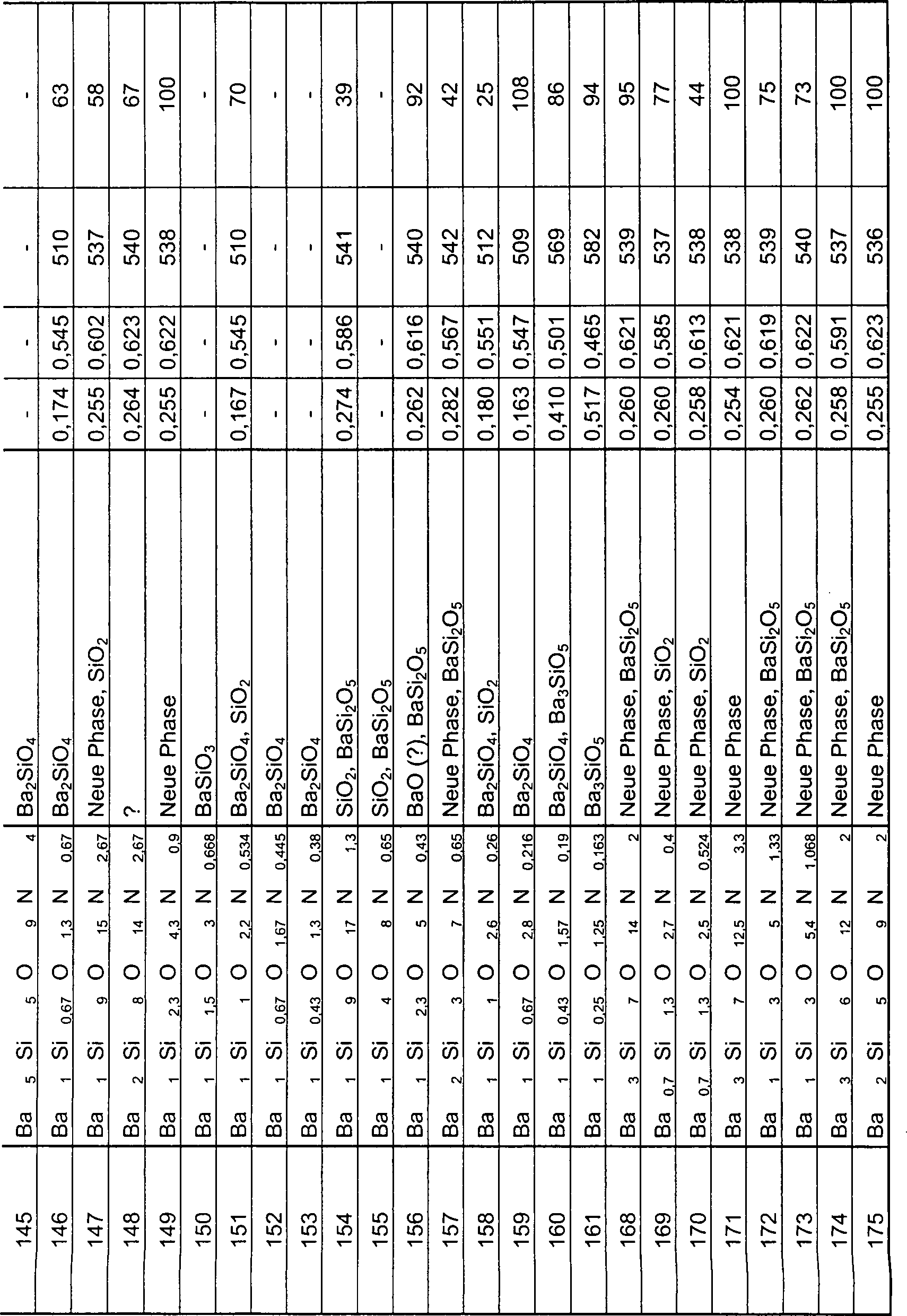
Tab. 3 zeigt ein Screening des Phasenraums, wobei die Leuchtstoffeffizienzen, die Farbörter und die dominante Emissionswellenlänge für 400 nm Anregung bei 2% Eu-Aktivatorkonzentration (Substitution of Ba-Platz) angegeben sind.Tab. Fig. 3 shows a phase space screening wherein the phosphor efficiencies, the colors and the dominant emission wavelength for 400 nm excitation at 2% Eu activator concentration (substitution of Ba square).
Die neue Phase emittiert, bei einer Dotierung von 2% Eu, typischerweise bei etwa λdom = 537 ± 3 nm. Alle anderen bekannten reinen Eu-dotierten Ba-Silikate und Ba-SiONe emittieren deutlich kurzwelliger. Es wird hierzu auf Probe BP128/07 verwiesen, die nur Ba-Orthosilikat als leuchtende Verbindung zeigt. Der Leuchtstoff BaSi2O2N2:Eu (ca. 500 nm) entsteht bei den gewählten Synthesebedingungen – insbesondere bei dieser niedrigen Temperatur – erst gar nicht.The new phase emitted, with a doping of 2% Eu, typically at about λdom = 537 ± 3 nm. All other known pure Eu-doped Ba silicates and Ba-SiONe emit significantly shortwave. Reference is made to sample BP128 / 07, which only Ba-orthosilicate shows as a luminous compound. The phosphor BaSi2O2N2: Eu (about 500 nm) arises under the chosen synthesis conditions - in particular at this low temperature - not at all.
Tab. 4a/4b zeigt die Effizienzen ausgewählter Ansatzstöchiometrien (hohe Phasenreinheit) für verschiedene Eu-Konzentrationen und zwar für 400 bzw. 460 nm Anregungswellenlänge.Tab. 4a / 4b shows the efficiencies of selected batch stoichiometries (high phase purity) for different Eu concentrations namely for 400 and 460 nm excitation wavelength.
Eine zweite Glühung (Proben mit Index 'a') verbessert i. allg die Kristallinität und erhöht so die Effizienz der Proben. Bei 460 nm Anregung sind i. allg. etwas höhere Eu-Konzentrationen vorteilhaft. Dies deckt sich mit dem Befund bei Untersuchung der Anregungsspektren.A second annealing (samples with index 'a') improves i. general the crystallinity, thus increasing the efficiency of the Rehearse. At 460 nm excitation i. generally a bit higher Eu concentrations advantageous. This coincides with the findings Examination of the excitation spectra.
Die erfindungsgemäßen Leuchtstoffe können auch in Zusammenhang mit anderen UV- oder Blau-Lichtquellen wie Molekularstrahlern (z. B. In-Entladungslampe), blauen OLEDs oder in Kombination mit blauen EL-Leuchtstoffen eingesetzt werden.The Phosphors according to the invention can also in conjunction with other UV or blue light sources such as Molecular radiators (eg In-discharge lamp), blue OLEDs or used in combination with blue EL phosphors.
Sie ermöglichen die Herstellung von farbstabilen, effizienten LEDs bzw. LED-Modulen auf Basis einer Konversions-LED. Weitere Anwendungsbereiche sind LEDs mit guter Farbwiedergabe, Color-on-demand-LEDs oder weiße OLEDs. Weiter lässt sich der neue Leuchtstoff bei konventionellen Lampen, insbesondere Leuchtstofflampen, aber auch für elektrische Geräte wie CRT, PDP, FED etc. anwenden.she enable the production of color-stable, efficient LEDs or LED modules based on a conversion LED. Other applications are LEDs with good color rendering, color-on-demand LEDs or white OLEDs. Next, the new phosphor can be used in conventional Lamps, in particular fluorescent lamps, but also for electric Use devices such as CRT, PDP, FED etc.
Der
Aufbau einer Lichtquelle für grünes Licht ist
in
Analog lässt sich damit auch eine Lichtquelle für weißes Licht realisieren, indem drei Leuchtstoffe verwendet werden, die von der UV-Strahlungsquelle angeregt werden, rot, grün und blau zu emittieren. Der grüne Leuchtstoff ist das neuartige Ba-Sion Ba2Si5O9N2:Eu, der rote ist beispielsweise Ca5Al4Si8N18:Eu oder ein Nitridosilikat (Ca,Sr)2Si5N8:Eu und der blaue ist beispielsweise ein Aluminat- oder Phosphat-Leuchtstoff wie BAM:Eu oder SCAP:Eu o. ä.Analogous It can also be a source of light for white Realize light by using three phosphors, the be excited by the UV radiation source, red, green and emit blue. The green phosphor is the novel Ba-Sion Ba2Si5O9N2: Eu, the red is for example Ca5Al4Si8N18: Eu or a nitridosilicate (Ca, Sr) 2Si5N8: Eu and the blue is, for example an aluminate or phosphate phosphor such as BAM: Eu or SCAP: Eu o.
Der
Aufbau einer anderen Lichtquelle für weißes Licht
ist in
Der besondere Vorteil der Verwendung einer langwelligen primären Lichtquelle (450 bis 465 nm) für die Lumineszenzkonversions-LED ist, dass hier Probleme mit Alterung und Degradation von Gehäuse und Harz bzw. Leuchtstoff vermieden werden, so dass eine lange Lebensdauer erzielt wird.Of the particular advantage of using a long-wave primary Light source (450 to 465 nm) for the luminescence conversion LED is that here are problems with aging and degradation of housing and resin or phosphor can be avoided, so that a long life is achieved.
In einem anderen Ausführungsbeispiel wird als primäre Lichtquelle eine UV-LED (etwa 380 nm) für eine weiße RGB Lumineszenzkonversions-LED verwendet, wobei hier Probleme mit Alterung und Degradation von Gehäuse und Harz bzw. Leuchtstoff durch zusätzliche an sich bekannte Maßnahmen möglichst weitgehend vermieden werden müssen wie sorgfältige Wahl des Gehäusematerials, Zugabe UV-resistenter Harzkomponenten. Der große Vorteil dieser Lösung ist die geringe Blickwinkelabhängigkeit der Emissionsfarbe und die hohe Farbstabilität.In another embodiment is called primary Light source one UV LED (about 380 nm) for a white RGB luminescence conversion LED used, with problems with Aging and degradation of housing and resin or phosphor by additional measures known per se as possible must be largely avoided as careful Choice of housing material, adding UV-resistant resin components. The big advantage of this solution is the low View angle dependence of the emission color and the high Color stability.
Dieses
Leuchtstoff-System ist einerseits der Indium-Strahlung angepasst,
weil diese wesentliche Anteile sowohl im UV als auch im blauen Spektralbereich
hat, die beide gleichermaßen gut absorbiert werden. diese
Mischung eignet sich aber auch für konventionelle Leuchtstofflampen.
Möglich ist auch die Anwendung bei einer Indium-Lampe auf
Hochdruck-Basis wie an sich aus
Weitere Informationen sind in der nächsten Tab. 4a und 4b enthalten. Tab. 4a bezieht sich auf eine Anregung mit einer Wellenlänge von 400 nm. Tab. 4b bezieht sich auf eine Anregung mit einer Wellenlänge von 460 nm. Beide Tabellen zeigen für verschiedene Ausführungsbeispiele die Einwaagenstöchiometrie, die Konzentration des Aktivators, die Farbortkomponenten x und y, die dominante Wellenlänge, die relative Quanteneffizienz Q. E. und die relative Helligkeit in Prozent.Further Information is contained in the next tab. 4a and 4b. Tab. 4a refers to excitation with one wavelength of 400 nm. Table 4b refers to excitation with a wavelength of 460 nm. Both tables show for different embodiments the weighted stoichiometry, the concentration of the activator, the color locus components x and y, the dominant wavelength, the relative quantum efficiency Q.E. and the relative brightness in percent.
Ein weiteres Ausführungsbeispiel ist ein LED-Modul, bestehend aus mindestens einem Satz von drei rot, grün und blau emittierenden LEDs. Diese RGB-Modul wird für die Anregung von LCD-Bildschirmen oder RPTV-Geräten verwendet. Die grüne LED ist eine primär UV-emittierende pc-LED (Phosphor-conversion-LED), die mittels eines neuartigen grünen Ba-Sions in grüne Strahlung umgewandelt wird. Die Peakwellenlänge der UV-LED ist insbesondere 400 nm. Die Temperatur im Betrieb des Moduls steigt leicht auf 200°C, was der temperaturstabile Leuchtstoff problemlos bewältigt.One Another embodiment is an LED module consisting from at least one set of three red, green and blue emitting LEDs. This RGB module is used for the excitation of LCD screens or RPTV devices. The green LED is a primary UV-emitting pc-LED (phosphor conversion LED), which turns into green by means of a novel green Ba-sion Radiation is converted. The peak wavelength of the UV LED is in particular 400 nm. The temperature during operation of the module increases slightly at 200 ° C, which is the temperature-stable phosphor mastered easily.
Grundsätzlich ist es auch möglich, Si zumindest teilweise durch Ge zu ersetzen. Auch ein vollständiger Ersatz ist möglich.in principle It is also possible, Si at least partially by Ge replace. Even a complete replacement is possible.
Anstatt Ca und/oder Mg kann auch Zn und/oder Cu Bestandteil des Kations M sein.Instead of Ca and / or Mg can also Zn and / or Cu component of the cation M be.
Anstatt mit Eu und/oder Ce kann der neuartige Leuchtstoff auch mit Mn zusätzlich kodotiert sein. Gute Ergebnisse liefert insbesondere die Kodotierung Eu, Mn. Außerdem kann auch Tb3+ als Aktivator verwendet werden, allein oder in Kombination mit den anderen. Während die Dotierung mit Ce zu einem UV- bis blau- emittierenden Leuchtstoff bei UV-Anregung, insbesondere bei der bekannten Hg-Linie 254 nm, führt, emittiert die reine Tb-Variante bei derselben UV-Anregung grün.Instead of with Eu and / or Ce, the novel phosphor can also with Mn in addition be codoped. Good results are provided in particular by codoping Eu, Mn. In addition, Tb3 + can also be used as an activator alone or in combination with the others. While the Doping with Ce to give a UV to blue emitting phosphor with UV excitation, in particular with the known Hg line 254 nm, leads, the pure Tb variant emits at the same UV excitation green.
Dieses
Ausführungsbeispiel leuchtet blau-violett.
In Tab. 5 sind verschieden dotierte Leuchtstoffe des Typs Ba2Si5O9N2:D mit den Dotierungen D = Eu, bzw. D = Ce bzw. D = Tb sowie D = (Eu,Mn) und D = (Eu,Ce) gegenübergestellt. Es ist jeweils die Farbortkomponente x und y angegeben. Dabei dient das Eu-dotierte Ausführungsbeispiel als Referenz. Verglichen damit zeigt eine (Eu,Ce)-kodotierte Probe keine Verschiebung des Farborts, da die Ce-Bande bei Anregung im Bereich 370 bis 400 nm nicht signifikant ist.In Tab. 5 are differently doped phosphors of the type Ba2Si5O9N2: D with the dopants D = Eu, or D = Ce or D = Tb and D = (Eu, Mn) and D = (Eu, Ce). It is the color locus component x and y are specified. The Eu-doped embodiment is used here for reference. Compared with this shows an (Eu, Ce) codoped sample no shift of the color locus, since the Ce band excites in the Range 370 to 400 nm is not significant.
Die Ce-dotierte Probe leuchtet blau-violett. Die Tb-dotierte Probe zeigt sich als grüner Linienstrahler. Der Einbau von Mn2+ als Kodotierung zu Eu2+ ist in kleinen Mengen möglich. Ce-dotierte und Ce,Tb-kodotierte Leuchtstoffe eignen sich auch für Leuchtstofflampen oder andere UV-Lichtquellen wie Excimerstrahler, die im fernen UV anregen und beispielsweise eine Dreibandenmischung verwenden. Mittels des neuartigen Ce-dotierten und Ce,Tb-kodotierten Sion-Leuchtstoffs kann damit sogar eine Lichtquelle für nahes UV oder mit Peak-Emission bei etwa 380 bis 390 nm realisiert werden Dabei ist das Sion der einzige Leuchtstoff. Die Anregung, die im Bereich 250 bis 375 nm gut möglich ist, gelingt besonders effizient im Bereich 290 bis 340 nm.The Ce-doped sample glows blue-violet. The Tb-doped sample shows itself as a green line radiator. The incorporation of Mn2 + as Co-doping to Eu2 + is possible in small quantities. Ce-doped and Ce, Tb codoped phosphors are also suitable for Fluorescent lamps or other UV light sources such as Excimerstrahler, the in the far UV stimulate and for example a three-band mixture use. By means of the novel Ce-doped and Ce, Tb-codoped Sion phosphor can even be a light source for realized close UV or peak emission at about 380 to 390 nm The Sion is the only fluorescent. The suggestion which is well possible in the range 250 to 375 nm succeeds particularly efficient in the range 290 to 340 nm.
Generell lässt sich die Effizienz insbesondere der Tb3+ und Ce3+-dotierten Ausführungsbeispiele optimieren, wenn kleine Mengen an Li+ und/oder Na+ dazu eingebaut werden, die der Ladungskompnesation dienen. Die zusätzliche posi tive Ladung kann generell entweder über einwertige Ionen wie Li oder Na eingebracht werden, alternativ kann außerdem eine leichte Änderung des Ba/Si-Verhältnisses oder eine leichte Änderung des O/N-Verhältnisses erfolgen.As a general rule In particular, the efficiency of the Tb3 + and Ce3 + doped can be optimized Optimize embodiments when small amounts of Li + and / or Na + are added to it, which serve the charge com- pensation. The additional positive charge can generally either over monovalent ions such as Li or Na can be introduced, alternatively also a slight change in the Ba / Si ratio or a slight change in the O / N ratio respectively.



ZITATE ENTHALTEN IN DER BESCHREIBUNGQUOTES INCLUDE IN THE DESCRIPTION
Diese Liste der vom Anmelder aufgeführten Dokumente wurde automatisiert erzeugt und ist ausschließlich zur besseren Information des Lesers aufgenommen. Die Liste ist nicht Bestandteil der deutschen Patent- bzw. Gebrauchsmusteranmeldung. Das DPMA übernimmt keinerlei Haftung für etwaige Fehler oder Auslassungen.This list The documents listed by the applicant have been automated generated and is solely for better information recorded by the reader. The list is not part of the German Patent or utility model application. The DPMA takes over no liability for any errors or omissions.
Zitierte PatentliteraturCited patent literature
- - EP 1413618 A [0002] - EP 1413618 A [0002]
- - WO 02/10374 [0062] WO 02/10374 [0062]
- - US 4810938 [0063] US 4810938 [0063]
- - US 6958575 B [0063] - US 6958575 B [0063]
Claims (9)
Priority Applications (8)
| Application Number | Priority Date | Filing Date | Title |
|---|---|---|---|
| DE102007035592.2A DE102007035592B4 (en) | 2007-07-30 | 2007-07-30 | Temperature-stable phosphor, use of a phosphor and method for producing a phosphor |
| PCT/EP2008/059726 WO2009016096A1 (en) | 2007-07-30 | 2008-07-24 | Temperature-stable oxynitride phosphor and light source comprising a corresponding phosphor material |
| US12/671,685 US8808577B2 (en) | 2007-07-30 | 2008-07-24 | Thermally stable oxynitride phosphor and light source comprising such a phosphor |
| JP2010518629A JP5361886B2 (en) | 2007-07-30 | 2008-07-24 | Thermally stable oxynitride phosphor and light source having such a phosphor |
| EP08775336A EP2171017B1 (en) | 2007-07-30 | 2008-07-24 | Temperature-stable oxynitride phosphor and light source comprising a corresponding phosphor material |
| CN2008800214342A CN101688116B (en) | 2007-07-30 | 2008-07-24 | Temperature-stable oxynitride phosphor and light source comprising a corresponding phosphor material |
| KR1020107004563A KR101226193B1 (en) | 2007-07-30 | 2008-07-24 | Temperature-stable oxynitride phosphor and light source comprising a corresponding phosphor material |
| TW097128556A TW200911960A (en) | 2007-07-30 | 2008-07-29 | Temperature-stable phosphor and light source with such phosphor |
Applications Claiming Priority (1)
| Application Number | Priority Date | Filing Date | Title |
|---|---|---|---|
| DE102007035592.2A DE102007035592B4 (en) | 2007-07-30 | 2007-07-30 | Temperature-stable phosphor, use of a phosphor and method for producing a phosphor |
Publications (2)
| Publication Number | Publication Date |
|---|---|
| DE102007035592A1 true DE102007035592A1 (en) | 2009-02-05 |
| DE102007035592B4 DE102007035592B4 (en) | 2023-05-04 |
Family
ID=39876525
Family Applications (1)
| Application Number | Title | Priority Date | Filing Date |
|---|---|---|---|
| DE102007035592.2A Active DE102007035592B4 (en) | 2007-07-30 | 2007-07-30 | Temperature-stable phosphor, use of a phosphor and method for producing a phosphor |
Country Status (8)
| Country | Link |
|---|---|
| US (1) | US8808577B2 (en) |
| EP (1) | EP2171017B1 (en) |
| JP (1) | JP5361886B2 (en) |
| KR (1) | KR101226193B1 (en) |
| CN (1) | CN101688116B (en) |
| DE (1) | DE102007035592B4 (en) |
| TW (1) | TW200911960A (en) |
| WO (1) | WO2009016096A1 (en) |
Cited By (9)
| Publication number | Priority date | Publication date | Assignee | Title |
|---|---|---|---|---|
| WO2013053601A3 (en) * | 2011-10-12 | 2013-05-30 | Osram Opto Semiconductors Gmbh | Optoelectronic component and luminescent substances |
| DE102012218053A1 (en) | 2012-10-02 | 2014-01-30 | Bundesdruckerei Gmbh | Security feature, the security feature-containing value and / or security product and method for producing the value and / or security product |
| DE102012218615A1 (en) | 2012-10-12 | 2014-04-30 | Bundesdruckerei Gmbh | Security feature for a value and / or security product with gradient structure and the security feature exhibiting value and / or security document |
| DE102013200895A1 (en) | 2013-01-21 | 2014-07-24 | Bundesdruckerei Gmbh | Value or security product and method for producing a security feature on or in the value or security product |
| DE102013201945A1 (en) | 2013-02-06 | 2014-08-07 | Bundesdruckerei Gmbh | Security feature for a value or security product and method of making the security feature |
| DE102013206130A1 (en) | 2013-04-08 | 2014-10-09 | Bundesdruckerei Gmbh | Multiluminescent security element and value or security document containing the same |
| DE102013205329A1 (en) * | 2013-03-26 | 2014-10-16 | Siemens Aktiengesellschaft | Method for producing a phosphor ceramic |
| DE102015212492A1 (en) | 2015-07-03 | 2017-01-05 | Bundesdruckerei Gmbh | Security or value document with a luminescent feature and method for checking the authenticity of the security or value document |
| US11060025B2 (en) | 2017-12-26 | 2021-07-13 | Nichia Corporation | Oxynitride fluorescent material, light emitting device, and method for producing oxynitride fluorescent material |
Families Citing this family (16)
| Publication number | Priority date | Publication date | Assignee | Title |
|---|---|---|---|---|
| CN101379163B (en) | 2006-02-02 | 2013-01-02 | 三菱化学株式会社 | Composite oxynitride phosphor, light-emitting device using same, image display device, lighting device, composition containing phosphor, and composite oxynitride |
| WO2009017206A1 (en) * | 2007-08-01 | 2009-02-05 | Mitsubishi Chemical Corporation | Phosphor and method for producing the same, crystalline silicon nitride and method for producing the same, phosphor-containing composition, light-emitting device using the phosphor, image display device, and illuminating device |
| DE102009055185A1 (en) | 2009-12-22 | 2011-06-30 | Osram Gesellschaft mit beschränkter Haftung, 81543 | Phosphor and light source with such phosphor |
| TW201144408A (en) * | 2010-06-03 | 2011-12-16 | qi-rui Cai | Photovoltaic panel and transparent light conversion powder thereof |
| ES2663783T3 (en) * | 2010-12-21 | 2018-04-17 | Valoya Oy | Method and means for acclimatization of seedlings for outdoor life |
| KR101883337B1 (en) * | 2011-12-05 | 2018-07-30 | 엘지이노텍 주식회사 | Oxynitride phosphor, and light-emitting device package comprising the same |
| DE102012202927B4 (en) * | 2012-02-27 | 2021-06-10 | Osram Gmbh | LIGHT SOURCE WITH LED CHIP AND LUMINOUS LAYER |
| TWI468842B (en) | 2013-05-07 | 2015-01-11 | 台達電子工業股份有限公司 | Method for regulating the wavelength of light emitted from a projection device |
| JP5768846B2 (en) * | 2013-08-23 | 2015-08-26 | 日亜化学工業株式会社 | Phosphor and light emitting device using the same |
| JP2015131898A (en) * | 2014-01-10 | 2015-07-23 | 電気化学工業株式会社 | Fluorescent material and light-emitting device |
| TWI614918B (en) * | 2015-06-08 | 2018-02-11 | 歐司朗光電半導體公司 | Composite oxynitride ceramic converter and light source having the same |
| DE102015110258A1 (en) | 2015-06-25 | 2016-12-29 | Osram Gmbh | Phosphor, method for producing a phosphor and use of a phosphor |
| US11901492B2 (en) | 2015-09-10 | 2024-02-13 | Intematix Corporation | High color rendering white light emitting devices and high color rendering photoluminescence compositions |
| DE102015120775B4 (en) | 2015-11-30 | 2025-04-30 | OSRAM Opto Semiconductors Gesellschaft mit beschränkter Haftung | Optoelectronic component and backlight for a display |
| EP3178904A1 (en) | 2015-12-09 | 2017-06-14 | Merck Patent GmbH | Phosphor |
| US12595409B2 (en) | 2021-06-04 | 2026-04-07 | Bridgelux, Inc. | High luminous efficacy phosphor converted white LEDs |
Citations (4)
| Publication number | Priority date | Publication date | Assignee | Title |
|---|---|---|---|---|
| US4810938A (en) | 1987-10-01 | 1989-03-07 | General Electric Company | High efficacy electrodeless high intensity discharge lamp |
| WO2002010374A2 (en) | 2000-08-02 | 2002-02-07 | University Of Southern California | Gene silencing using mrna-cdna hybrids |
| EP1413618A1 (en) | 2002-09-24 | 2004-04-28 | Osram Opto Semiconductors GmbH | Luminescent material, especially for LED application |
| US6958575B2 (en) | 2001-12-20 | 2005-10-25 | Koninklijke Philips Electronics N.V. | Metal halide lamp with improved red rendition and CRI |
Family Cites Families (9)
| Publication number | Priority date | Publication date | Assignee | Title |
|---|---|---|---|---|
| JP4524468B2 (en) * | 2004-05-14 | 2010-08-18 | Dowaエレクトロニクス株式会社 | Phosphor, method for producing the same, light source using the phosphor, and LED |
| JP5105347B2 (en) * | 2004-09-22 | 2012-12-26 | 独立行政法人物質・材料研究機構 | Phosphor, method for producing the same, and light emitting device |
| JP4754919B2 (en) * | 2004-09-29 | 2011-08-24 | 昭和電工株式会社 | Oxynitride phosphor and method for producing the same |
| DE112005002246T5 (en) | 2004-09-29 | 2007-08-16 | Showa Denko K.K. | Oxynitride based fluorescent material and method of making the same |
| US8277687B2 (en) | 2005-08-10 | 2012-10-02 | Mitsubishi Chemical Corporation | Phosphor and light-emitting device using same |
| DE102005059521A1 (en) * | 2005-12-13 | 2007-06-14 | Patent-Treuhand-Gesellschaft für elektrische Glühlampen mbH | Red emitting phosphor and light source with such a phosphor |
| CN101379163B (en) | 2006-02-02 | 2013-01-02 | 三菱化学株式会社 | Composite oxynitride phosphor, light-emitting device using same, image display device, lighting device, composition containing phosphor, and composite oxynitride |
| JP4733535B2 (en) * | 2006-02-24 | 2011-07-27 | パナソニック株式会社 | Oxynitride phosphor, method for manufacturing oxynitride phosphor, semiconductor light emitting device, light emitting device, light source, illumination device, and image display device |
| JP5071709B2 (en) * | 2007-07-17 | 2012-11-14 | 独立行政法人物質・材料研究機構 | Phosphors and light emitting devices |
-
2007
- 2007-07-30 DE DE102007035592.2A patent/DE102007035592B4/en active Active
-
2008
- 2008-07-24 CN CN2008800214342A patent/CN101688116B/en active Active
- 2008-07-24 US US12/671,685 patent/US8808577B2/en active Active
- 2008-07-24 WO PCT/EP2008/059726 patent/WO2009016096A1/en not_active Ceased
- 2008-07-24 JP JP2010518629A patent/JP5361886B2/en active Active
- 2008-07-24 EP EP08775336A patent/EP2171017B1/en active Active
- 2008-07-24 KR KR1020107004563A patent/KR101226193B1/en active Active
- 2008-07-29 TW TW097128556A patent/TW200911960A/en unknown
Patent Citations (4)
| Publication number | Priority date | Publication date | Assignee | Title |
|---|---|---|---|---|
| US4810938A (en) | 1987-10-01 | 1989-03-07 | General Electric Company | High efficacy electrodeless high intensity discharge lamp |
| WO2002010374A2 (en) | 2000-08-02 | 2002-02-07 | University Of Southern California | Gene silencing using mrna-cdna hybrids |
| US6958575B2 (en) | 2001-12-20 | 2005-10-25 | Koninklijke Philips Electronics N.V. | Metal halide lamp with improved red rendition and CRI |
| EP1413618A1 (en) | 2002-09-24 | 2004-04-28 | Osram Opto Semiconductors GmbH | Luminescent material, especially for LED application |
Cited By (18)
| Publication number | Priority date | Publication date | Assignee | Title |
|---|---|---|---|---|
| WO2013053601A3 (en) * | 2011-10-12 | 2013-05-30 | Osram Opto Semiconductors Gmbh | Optoelectronic component and luminescent substances |
| DE102012218053A1 (en) | 2012-10-02 | 2014-01-30 | Bundesdruckerei Gmbh | Security feature, the security feature-containing value and / or security product and method for producing the value and / or security product |
| DE102012218053B4 (en) | 2012-10-02 | 2025-02-06 | Bundesdruckerei Gmbh | Security feature, valuable and/or security product containing the security feature and process for producing the valuable and/or security product |
| US9842451B2 (en) | 2012-10-02 | 2017-12-12 | Bundesdruckerei Gmbh | Security feature and value product and/or security product containing the security feature |
| US9757972B2 (en) | 2012-10-12 | 2017-09-12 | Bundesdruckerei Gmbh | Security feature with a color progression structure for a value product and/or security product, and value product and/or security document having the security feature |
| DE102012218615A1 (en) | 2012-10-12 | 2014-04-30 | Bundesdruckerei Gmbh | Security feature for a value and / or security product with gradient structure and the security feature exhibiting value and / or security document |
| DE102012218615B4 (en) | 2012-10-12 | 2019-03-28 | Bundesdruckerei Gmbh | Security feature for a value and / or security product with gradient structure and the security feature exhibiting value and / or security document |
| DE102013200895A1 (en) | 2013-01-21 | 2014-07-24 | Bundesdruckerei Gmbh | Value or security product and method for producing a security feature on or in the value or security product |
| DE102013201945A1 (en) | 2013-02-06 | 2014-08-07 | Bundesdruckerei Gmbh | Security feature for a value or security product and method of making the security feature |
| WO2014122112A1 (en) | 2013-02-06 | 2014-08-14 | Bundesdruckerei Gmbh | Security feature for a value product or security product and method for producing the security feature |
| DE102013205329A1 (en) * | 2013-03-26 | 2014-10-16 | Siemens Aktiengesellschaft | Method for producing a phosphor ceramic |
| WO2014166794A1 (en) | 2013-04-08 | 2014-10-16 | Bundesdruckerei Gmbh | Multi-luminescent security element and value or security product containing said security element |
| DE102013206130B4 (en) | 2013-04-08 | 2018-06-21 | Bundesdruckerei Gmbh | Multiluminescent security element and value or security document containing the same |
| DE102013206130A1 (en) | 2013-04-08 | 2014-10-09 | Bundesdruckerei Gmbh | Multiluminescent security element and value or security document containing the same |
| DE102015212492A1 (en) | 2015-07-03 | 2017-01-05 | Bundesdruckerei Gmbh | Security or value document with a luminescent feature and method for checking the authenticity of the security or value document |
| WO2017005633A1 (en) | 2015-07-03 | 2017-01-12 | Bundesdruckerei Gmbh | Security or value document comprising a luminescent feature and method for checking the authenticity of the security or value document |
| DE102015212492A9 (en) | 2015-07-03 | 2017-02-16 | Bundesdruckerei Gmbh | Security or value document with a luminescent feature and method for checking the authenticity of the security or value document |
| US11060025B2 (en) | 2017-12-26 | 2021-07-13 | Nichia Corporation | Oxynitride fluorescent material, light emitting device, and method for producing oxynitride fluorescent material |
Also Published As
| Publication number | Publication date |
|---|---|
| DE102007035592B4 (en) | 2023-05-04 |
| KR101226193B1 (en) | 2013-01-24 |
| CN101688116A (en) | 2010-03-31 |
| EP2171017B1 (en) | 2012-08-29 |
| KR20100038463A (en) | 2010-04-14 |
| WO2009016096A1 (en) | 2009-02-05 |
| JP5361886B2 (en) | 2013-12-04 |
| EP2171017A1 (en) | 2010-04-07 |
| US8808577B2 (en) | 2014-08-19 |
| JP2010534755A (en) | 2010-11-11 |
| CN101688116B (en) | 2013-11-06 |
| TW200911960A (en) | 2009-03-16 |
| US20110186778A1 (en) | 2011-08-04 |
Similar Documents
| Publication | Publication Date | Title |
|---|---|---|
| EP2171017B1 (en) | Temperature-stable oxynitride phosphor and light source comprising a corresponding phosphor material | |
| DE112007001638B4 (en) | Phosphorus from the class of nitridosilicates, process for producing a phosphor from the class of nitridosilicates and use of such a phosphor in a light source | |
| EP1987114B1 (en) | Illuminant and light source containing the same, and method for producing said illuminant | |
| EP1664239B1 (en) | White-emitting led having a defined color temperature | |
| EP2585554B9 (en) | Luminescent substance and light source having such a luminescent substance | |
| EP1670876B1 (en) | Highly efficient luminous substance | |
| EP1670875A1 (en) | Highly efficient led-based illumination system featuring improved color rendering | |
| DE112011103143B4 (en) | SIALON PHONOMATIC SUBSTANCE, METHOD OF PRODUCING THE SAME AND LIGHT-EMMITTING DEVICE USING THE SAME | |
| EP2718396B9 (en) | Illumination unit | |
| WO2006081803A1 (en) | Illuminant emitting yellow light and light source provided with such an illuminant | |
| EP2275512B1 (en) | Green-emitting LED | |
| EP2356196A1 (en) | Sr2s15n8 luminous substance emitting red and light source comprising a luminous substance of said kind and method for producing the luminous substance | |
| DE102006016548B4 (en) | Blue to yellow-orange emitting phosphor and light source with such a phosphor | |
| EP2220191B1 (en) | Wavelength-converted LED | |
| EP2217678B1 (en) | Luminophore and illumination system having such a luminophore | |
| DE102019208285A1 (en) | YELLOW LUMINANT AND LIGHT SOURCE |
Legal Events
| Date | Code | Title | Description |
|---|---|---|---|
| R081 | Change of applicant/patentee |
Owner name: OSRAM GMBH, DE Free format text: FORMER OWNER: OSRAM GESELLSCHAFT MIT BESCHRAENKTER HAFTUNG, 81543 MUENCHEN, DE Effective date: 20111205 |
|
| R081 | Change of applicant/patentee |
Owner name: OSRAM GMBH, DE Free format text: FORMER OWNER: OSRAM AG, 81543 MUENCHEN, DE Effective date: 20130205 |
|
| R081 | Change of applicant/patentee |
Owner name: OSRAM GMBH, DE Free format text: FORMER OWNER: OSRAM GMBH, 81543 MUENCHEN, DE Effective date: 20130821 |
|
| R012 | Request for examination validly filed |
Effective date: 20140407 |
|
| R016 | Response to examination communication | ||
| R016 | Response to examination communication | ||
| R016 | Response to examination communication | ||
| R016 | Response to examination communication | ||
| R016 | Response to examination communication | ||
| R079 | Amendment of ipc main class |
Free format text: PREVIOUS MAIN CLASS: C09K0011590000 Ipc: C09K0011790000 |
|
| R018 | Grant decision by examination section/examining division | ||
| R020 | Patent grant now final |