DE102007022130B4 - Process for the preparation of polycarbonate after the melt transesterification process - Google Patents
Process for the preparation of polycarbonate after the melt transesterification process Download PDFInfo
- Publication number
- DE102007022130B4 DE102007022130B4 DE200710022130 DE102007022130A DE102007022130B4 DE 102007022130 B4 DE102007022130 B4 DE 102007022130B4 DE 200710022130 DE200710022130 DE 200710022130 DE 102007022130 A DE102007022130 A DE 102007022130A DE 102007022130 B4 DE102007022130 B4 DE 102007022130B4
- Authority
- DE
- Germany
- Prior art keywords
- radical
- hydroxyphenyl
- bis
- alkyl
- acid
- Prior art date
- Legal status (The legal status is an assumption and is not a legal conclusion. Google has not performed a legal analysis and makes no representation as to the accuracy of the status listed.)
- Active
Links
- AMROQXXVWUJZAS-UHFFFAOYSA-N COC(ONOC)=O Chemical compound COC(ONOC)=O AMROQXXVWUJZAS-UHFFFAOYSA-N 0.000 description 1
Classifications
-
- C—CHEMISTRY; METALLURGY
- C08—ORGANIC MACROMOLECULAR COMPOUNDS; THEIR PREPARATION OR CHEMICAL WORKING-UP; COMPOSITIONS BASED THEREON
- C08G—MACROMOLECULAR COMPOUNDS OBTAINED OTHERWISE THAN BY REACTIONS ONLY INVOLVING UNSATURATED CARBON-TO-CARBON BONDS
- C08G64/00—Macromolecular compounds obtained by reactions forming a carbonic ester link in the main chain of the macromolecule
- C08G64/20—General preparatory processes
- C08G64/30—General preparatory processes using carbonates
-
- C—CHEMISTRY; METALLURGY
- C08—ORGANIC MACROMOLECULAR COMPOUNDS; THEIR PREPARATION OR CHEMICAL WORKING-UP; COMPOSITIONS BASED THEREON
- C08G—MACROMOLECULAR COMPOUNDS OBTAINED OTHERWISE THAN BY REACTIONS ONLY INVOLVING UNSATURATED CARBON-TO-CARBON BONDS
- C08G64/00—Macromolecular compounds obtained by reactions forming a carbonic ester link in the main chain of the macromolecule
- C08G64/20—General preparatory processes
- C08G64/30—General preparatory processes using carbonates
- C08G64/307—General preparatory processes using carbonates and phenols
-
- G—PHYSICS
- G11—INFORMATION STORAGE
- G11B—INFORMATION STORAGE BASED ON RELATIVE MOVEMENT BETWEEN RECORD CARRIER AND TRANSDUCER
- G11B7/00—Recording or reproducing by optical means, e.g. recording using a thermal beam of optical radiation by modifying optical properties or the physical structure, reproducing using an optical beam at lower power by sensing optical properties; Record carriers therefor
- G11B7/24—Record carriers characterised by shape, structure or physical properties, or by the selection of the material
- G11B7/241—Record carriers characterised by shape, structure or physical properties, or by the selection of the material characterised by the selection of the material
- G11B7/252—Record carriers characterised by shape, structure or physical properties, or by the selection of the material characterised by the selection of the material of layers other than recording layers
- G11B7/253—Record carriers characterised by shape, structure or physical properties, or by the selection of the material characterised by the selection of the material of layers other than recording layers of substrates
- G11B7/2533—Record carriers characterised by shape, structure or physical properties, or by the selection of the material characterised by the selection of the material of layers other than recording layers of substrates comprising resins
- G11B7/2534—Record carriers characterised by shape, structure or physical properties, or by the selection of the material characterised by the selection of the material of layers other than recording layers of substrates comprising resins polycarbonates [PC]
-
- Y—GENERAL TAGGING OF NEW TECHNOLOGICAL DEVELOPMENTS; GENERAL TAGGING OF CROSS-SECTIONAL TECHNOLOGIES SPANNING OVER SEVERAL SECTIONS OF THE IPC; TECHNICAL SUBJECTS COVERED BY FORMER USPC CROSS-REFERENCE ART COLLECTIONS [XRACs] AND DIGESTS
- Y10—TECHNICAL SUBJECTS COVERED BY FORMER USPC
- Y10T—TECHNICAL SUBJECTS COVERED BY FORMER US CLASSIFICATION
- Y10T428/00—Stock material or miscellaneous articles
- Y10T428/31504—Composite [nonstructural laminate]
- Y10T428/31652—Of asbestos
- Y10T428/31667—Next to addition polymer from unsaturated monomers, or aldehyde or ketone condensation product
Landscapes
- Chemical & Material Sciences (AREA)
- Health & Medical Sciences (AREA)
- Chemical Kinetics & Catalysis (AREA)
- Medicinal Chemistry (AREA)
- Polymers & Plastics (AREA)
- Organic Chemistry (AREA)
- Polyesters Or Polycarbonates (AREA)
- Optical Record Carriers And Manufacture Thereof (AREA)
- Compositions Of Macromolecular Compounds (AREA)
Abstract
Verfahren zur Herstellung von Polycarbonat nach dem Schmelzeumesterungsverfahren, wobei wenigstens eine Dihydroxyarylverbindung mit wenigstens einem Diarylcarbonat unter Verwendung wenigstens eines Katalysators in einem mehrstufigen Prozess umgesetzt werden, dadurch gekennzeichnet, dass der Schmelze vor der letzten Reaktionsstufe wenigstens ein Inhibitor zugesetzt wird und nach der letzten Reaktionsstufe eine oder mehrere aromatische Hydroxycarbonsäuren oder deren Derivate zugesetzt werden, wobei es sich bei der oder den aromatischen Hydroxycarbonsäure(n) oder deren Derivat(en) um eine oder mehrere Verbindung(en) der allgemeinen Formel (VI), (VII) oder (VIII) handelt,worin R1, R1' für H, R2, R2' unabhängig voneinander für einen linearen oder verzweigten C1-C10-Alkyl-, C6-C34-Aralkylrest, bevorzugt für einen linearen oder verzweigten C1-C4-Alkylrest, R3, R3' unabhängig voneinander für H, einen linearen oder verzweigten C1-C10-Alkylcarbonyl- oder C6-C34-Arylcarbonylrest, bevorzugt für H oder einen Methylcarbonyl-, Ethylcarbonyl-, Propylcarbonyl-, Phenylcarbonyl-, Butylcarbonylrest und ganz besonders bevorzugt für H oder einen Methylcarbonylrest, R4 für H, l für 1 oder 2 bevorzugt für 1, n für 0 oder eine ganze Zahl von 1 bis 3, bevorzugt für 0 oder 1, m für 1 oder 2, bevorzugt für 1, Y für einen aus 1 bis 8 C- und/oder Hetero-Atomen bestehenden divalenten Rest, bevorzugt für -C(R5)(R6)-, -(CR5R6)m-, -O-, -S-, -S(=O)-, -S(=O)2-, -(C=O)-, -O(C=O)O-, -O-C(R5R6)O-, insbesondere bevorzugt für -C(R5)(R6)- steht, worin R5 und R6 unabhängig voneinander für einen C1-C10-Alkylrest, bevorzugt für einen C1-C6-Alkylrest, besonders bevorzugt für Methyl stehen, und X für einen C1-C10-Alkyl-, C1-C10-Alkylphenyl- oder einen Phenylrest, besonders bevorzugt für einen Phenylrest steht.A process for producing polycarbonate by the melt transesterification process, wherein at least one dihydroxyaryl compound is reacted with at least one diaryl carbonate using at least one catalyst in a multi-stage process, characterized in that at least one inhibitor is added to the melt before the last reaction stage and after the last reaction stage or more aromatic hydroxycarboxylic acids or derivatives thereof, wherein the aromatic hydroxycarboxylic acid (s) or their derivative (s) are one or more compounds of general formula (VI), (VII) or (VIII) in which R 1, R 1 'for H, R 2, R 2' independently of one another represent a linear or branched C 1 -C 10 -alkyl, C 6 -C 34 -aralkyl radical, preferably a linear or branched C 1 -C 4 -alkyl radical, R 3, R 3 ' independently of one another are H, a linear or branched C1-C10-alkylcarbonyl or C6-C34-arylcarbonyl radical t is H or a methylcarbonyl, ethylcarbonyl, propylcarbonyl, phenylcarbonyl, butylcarbonyl radical and most preferably H or a methylcarbonyl radical, R4 is H, I is 1 or 2, preferably 1, n is 0 or an integer of 1 to 3, preferably 0 or 1, m is 1 or 2, preferably 1, Y is a divalent radical consisting of 1 to 8 C and / or hetero atoms, preferably -C (R 5) (R 6) -, - (CR5R6) m-, -O-, -S-, -S (= O) -, -S (= O) 2-, - (C = O) -, -O (C = O) O-, -OC (R5R6) O-, especially preferably -C (R5) (R6) -, in which R5 and R6, independently of one another, are a C1-C10-alkyl radical, preferably a C1-C6-alkyl radical, particularly preferably methyl and X is a C1-C10-alkyl, C1-C10-alkylphenyl or a phenyl radical, particularly preferably a phenyl radical.
Description
Gegenstand der Erfindung ist ein Verfahren zur Herstellung von Polycarbonat nach dem Schmelzeumesterungsverfahren, Polycarbonat mit niedriger elektrostatischer Aufladung erhältlich nach diesem Verfahren sowie Formteile oder Extrudate, insbesondere optische Datenspeicher oder Streulichtscheiben aus diesem Polycarbonat.The invention relates to a process for the production of polycarbonate by the melt transesterification process, polycarbonate with low electrostatic charge obtainable by this process and moldings or extrudates, in particular optical data storage or scattered light disks made of this polycarbonate.
Optische Datenaufzeichnungsmaterialien werden zunehmend als variables Aufzeichnungs- und/oder Archivierungsmedium für große Datenmengen verwendet. Beispiele für diese Art von optischen Datenspeichern sind CD, Super-Audio-CD, CD-R, CD-RW, DVD, DVD–R, DVD+R, DVD–RW, DVD+RW, HD-DVD und BD.Optical data recording materials are increasingly used as a variable recording and / or archiving medium for large amounts of data. Examples of this kind of optical data storage are CD, Super Audio CD, CD-R, CD-RW, DVD, DVD-R, DVD + R, DVD-RW, DVD + RW, HD-DVD and BD.
Transparente thermoplastische Kunststoffe wie zum Beispiel Polycarbonat, Polymethylmethacrylat und chemische Modifikationen hiervon werden typischerweise für optische Speichermedien eingesetzt. Polycarbonat als Substratmaterial eignet sich insbesondere für einmal beschreibbare und mehrfach auslesbare sowie auch für mehrfach beschreibbare optische Disks sowie für die Herstellung von Formteilen aus dem Bereich des Automotive Glazings, wie z. B. von Streulichtscheiben. Dieser thermoplastische Kunststoff verfügt über eine ausgezeichnete mechanische Stabilität, ist wenig anfällig gegenüber Dimensionsveränderungen und zeichnet sich durch eine hohe Transparenz und Schlagzähigkeit aus.Transparent thermoplastics such as polycarbonate, polymethylmethacrylate and chemical modifications thereof are typically used for optical storage media. Polycarbonate as a substrate material is particularly suitable for write once and multi-read as well as rewritable optical discs and for the production of moldings from the field of automotive glazings, such. B. of scattered light disks. This thermoplastic material has excellent mechanical stability, is less prone to dimensional changes and is characterized by high transparency and impact resistance.
Gemäß
Ein weiteres industriell genutztes Verfahren zur Herstellung von Polycarbonat ist das Schmelzeumesterungsverfahren. Polycarbonat hergestellt nach diesem Verfahren kann grundsätzlich für die Herstellung von optischen Datenspeichern der oben beschriebenen Formate wie z. B. für Compact Disks (CD) oder Digital Versatile Disks (DVD) verwendet werden.Another industrially used process for the production of polycarbonate is the melt transesterification process. Polycarbonate produced by this process can in principle for the production of optical data storage of the formats described above such. B. for Compact Discs (CD) or Digital Versatile Disks (DVD) are used.
Dieses Verfahren hat allerdings bisher den Nachteil, dass es Polycarbonate liefert, welche nach Verarbeitung zu Spritzgusskörpern die Eigenschaft haben, hohe elektrische Felder an der Oberfläche der Spritzgussartikel aufzubauen. So bauen z. B. Disks für optische Datenspeicher aus diesem Polycarbonat während ihrer Herstellung im Spritzgussverfahren ein hohes elektrisches Feld auf. Diese hohe Feldstärke auf dem Substrat führt während der Herstellung der optischen Datenspeicher, z. B. zur Anziehung von Staub aus der Umgebung bzw. zum Verkleben der Spritzgussartikel, beispielsweise der Disks untereinander, was die Qualität der fertigen Spritzgussartikel mindert und das Spritzgussverfahren zudem erschwert.However, this process has hitherto had the disadvantage that it supplies polycarbonates which, after being processed into injection-molded bodies, have the property of building up high electric fields on the surface of the injection-molded articles. To build z. B. discs for optical data storage from this polycarbonate during their production by injection molding a high electric field. This high field strength on the substrate leads during the production of optical data storage, for. As for attracting dust from the environment or for bonding the injection molded articles, for example, the discs with each other, which reduces the quality of the finished injection molded article and also complicates the injection molding process.
Des Weiteren führt die elektrostatische Aufladung insbesondere von Disks (für optische Datenträger) zu einer mangelnden Benetzbarkeit vor allem mit unpolaren Medien, wie z. B. einem unpolaren Farbstoff oder einem Farbstoffauftrag aus Lösungsmitteln, wie z. B. Dibutylether, Ethylcyclohexan, Tetrafluorpropanol, Cyclohexan, Methylcyclohexan oder Octafluorpropanol. So verursacht eine hohe elektrische Aufladung an der Oberfläche des Substrates während des Farbstoffauftrags bei beschreibbaren Datenspeichern zum Beispiel eine unregelmäßige und unvollständige Beschichtung mit Farbstoff und führt damit zu Defekten in der Informationsschicht.Furthermore, the electrostatic charge leads in particular of discs (for optical media) to a lack of wettability, especially with non-polar media such. B. a non-polar dye or dye application from solvents such. As dibutyl ether, ethylcyclohexane, tetrafluoropropanol, cyclohexane, methylcyclohexane or octafluoropropanol. For example, high levels of electrical charge on the surface of the substrate during dye application to recordable data storage devices cause an irregular and incomplete coating of dye, resulting in defects in the information layer.
Im Falle eines optischen Datenspeichers bei dem ein beschreibbarer Farbstoff auf der Oberfläche in einem Spin Coating Prozess aufgetragen wird, ist daher eine niedrige absolute elektrische Feldstärke erforderlich, um die gleichmäßige Auftragung der beschreibbaren Schicht zu gewährleisten und einen störungsfreien Produktionsprozess sicherzustellen.In the case of an optical data memory in which a writable dye is applied on the surface in a spin coating process, therefore, a low absolute electric field strength is required to ensure the uniform application of the recordable layer and to ensure a trouble-free production process.
Die elektrostatische Aufladung eines Substratmaterials führt zu einem elektrischen Feld welches durch Messung in einem bestimmten Abstand zur Substratoberfläche quantifiziert werden kann.The electrostatic charge of a substrate material leads to an electric field which can be quantified by measuring at a certain distance from the substrate surface.
Ein weiterer Nachteil eines solchen hohen elektrischen Feldes ist aufgrund der oben beschriebenen Fakten zudem in Ausbeuteverlusten hinsichtlich des Substratmaterials zu sehen. Dies führt zu Produktionsausfällen und verursacht demnach entsprechende Zusatzkosten.Another disadvantage of such a high electric field is due to the facts described above also seen in yield losses in terms of the substrate material. This leads to production losses and thus causes corresponding additional costs.
Das elektrische Feld, welches im Laufe des Spritzgussprozesses auf den jeweiligen Spritzgussteilen entsteht, ist während des Produktionsprozesses nicht konstant, sondern folgt einem bestimmten Feldstärkenverlauf. So zeigt sich, dass die Feldstärke auf den jeweiligen Disks nach Beginn des Spritzgussprozesses (Einsetzen einer neuen Matrize vorausgesetzt) ansteigt und nach einem gewissen Zeitraum ein Plateau erreicht oder nur noch wenig ansteigt. Dies ist ein wichtiges Kriterium für die Performance des Spritzgussteils im nachfolgenden Produktionsschritt, in welchem z. B. der Farbstoff auf das Substrat aufgetragen wird. Die zeitabhängige Aufladung von Spritzgusskörpern hergestellt aus Polycarbonat nach dem Schmelzeumesterungsprozess unterscheidet sich von Spritzgusskörpern hergestellt aus Polycarbonat nach dem Phasengrenzflächenverfahren. Der Startwert der Feldstärke im Falle von Polycarbonat nach dem Schmelzeumesterungsprozess bei Beginn des Spritzgussprozesses liegt meist deutlich niedriger als im Falle von Polycarbonat hergestellt nach dem Phasengrenzflächenverfahren. Der Plateauwert, welcher sich nach einer gewissen Laufzeit einstellt, wie z. B. nach 2 Stunden eines kontinuierlichen Spritzgussprozesses, liegt im Gegensatz zu Polycarbonat, hergestellt nach dem Phasengrenzflächenverfahren, häufig deutlich im negativen Bereich (negative Feldstärke).The electric field which arises in the course of the injection molding process on the respective injection molded parts, is not constant during the production process, but follows a certain field strength course. Thus, it can be seen that the field strength on the respective discs increases after the start of the injection molding process (assuming the insertion of a new die) and reaches a plateau after a certain period of time or only slightly increases. This is an important criterion for the performance of the injection molded part in the subsequent production step, in which z. B. the dye is applied to the substrate. The time-dependent charging of injection molded articles produced from polycarbonate after the melt transesterification process differs from injection molded articles produced from polycarbonate by the phase boundary process. The starting value of the field strength in the case of polycarbonate after the melt transesterification process at the beginning of the injection molding process is usually much lower than in the case of polycarbonate produced by the interfacial process. The plateau value, which occurs after a certain period, such. B. after 2 hours of a continuous injection molding process, in contrast to polycarbonate, prepared by the interfacial process, often clearly in the negative range (negative field strength).
Um das Problem einer hohen elektrostatischen Aufladung zu lösen, wurden mehrere Ansätze verfolgt. Im Allgemeinen werden dem Substratmaterial Antistatika als Additive zugesetzt. Solche mit Antistatika versetzten Polycarbonat-Zusammensetzungen werden z. B. in
In
Die beschriebenen Additive können sich jedoch nachteilig auf die Eigenschaften des Substratmaterials auswirken, da sie bei hohen Temperaturen dazu neigen, aus dem Material auszutreten und dadurch zu Belagsbildung oder mangelhafter Abformung führen können. Weiterhin kann auch der Gehalt an Oligomeren im Polycarbonat zu einem schlechteren mechanischen Eigenschaftsniveau und zu einer Absenkung der Glasübergangstemperatur führen. Ferner können diese Additive als Zusätze Nebenreaktionen verursachen. Dadurch kann die thermische Stabilität des Basismaterials herabgesetzt werden. Das nachträgliche „Endcapping” von Polycarbonat, welches aus dem Umesterungsprozess gewonnen wurde, ist aufwendig. Die dazu notwendigen Substanzen müssen hergestellt werden, was mit zuzsätzlichen Kosten und einem zusätzlichen Verfahrensschritt für das nachträgliche „Endcapping” verbunden ist.However, the additives described may be detrimental to the properties of the substrate material, as they tend to leak out of the material at high temperatures and thereby lead to deposit formation or poor impression taking. Furthermore, the content of oligomers in the polycarbonate can lead to a poorer mechanical property level and to a lowering of the glass transition temperature. Furthermore, these additives can cause side reactions as additives. As a result, the thermal stability of the base material can be reduced. The subsequent "endcapping" of polycarbonate, which was obtained from the transesterification process, is complicated. The necessary substances must be produced, which is associated with additional costs and an additional process step for the subsequent "endcapping".
In
Um eine gute Beschichtbarkeit von optischen Datenspeichern im Produktionsprozess zu gewährleisten, werden häufig sogenannte Ionisatoren eingesetzt, welche einen ionisierten Luftstrom über die Disks leiten. Der Einsatz von Ionisatoren verteuert jedoch den Produktionsprozess, so dass für ein wirtschaftliches Verfahren die Anzahl der zu verwendenden Ionisatoren auf ein Minimum reduziert sein sollte.In order to ensure a good coatability of optical data storage in the production process, so-called ionizers are often used, which conduct an ionized air flow over the discs. However, the use of ionizers makes the production process more expensive, so that, for an economical process, the number of ionizers to be used should be kept to a minimum.
Somit bestand weiterhin Bedarf nach einem Verfahren zur Herstellung von Polycarbonat nach dem Schmelzeumesterungsverfahren, welches für die Verarbeitung zu Formkörpern bzw. Extrudaten mit niedriger elektrostatischer Aufladung geeignet ist. Zudem wäre wünschenswert, dass bei der Verarbeitung zu Formkörpern bzw. Extrudaten möglichst wenig Ablagerungen an Werkzeugen oder auf den entsprechenden Formteilen auftreten.Thus, there has remained a need for a process for producing polycarbonate by the melt transesterification process which is suitable for processing into low electrostatic charge molded articles or extrudates. In addition, it would be desirable that as little as possible deposits on tools or on the corresponding molded parts occur during processing into moldings or extrudates.
Es bestand daher die Aufgabe, ein Schmelzeumesterungsverfahren sowie ein mittels diesem Verfahren hergestelltes Polycarbonat bereitzustellen, welches nach Verarbeitung zu einem Formkörper bzw. Extrudat den Anforderungen einer möglichst niedrigen Aufladung an der Substratoberfläche genügt und die vorangehend beschriebenen Nachteile vermeidet.It is an object of the present invention to provide a melt transesterification process and a polycarbonate produced by means of this process which, after being processed into a shaped body or extrudate, satisfy the requirements of the lowest possible charging on the substrate surface and avoids the disadvantages described above.
Diese Aufgabe wird überraschend dadurch gelöst, dass in einem mehrstufigen Schmelzeumesterungsverfahren der Schmelze vor der letzten Reaktionsstufe wenigstens ein Inhibitor und nach der letzten Reaktionsstufe eine oder mehrere aromatische Hydroxycarbonsäuren oder deren Derivate zugesetzt werden. Polycarbonate hergestellt gemäß erfindungsgemäßem Verfahren zeigen die vorangehend aufgeführten Nachteile nicht und eigenen sich hervorragend für die Verarbeitung zu Formkörpern bzw. Extrudaten mit niedriger elektrostatischer Aufladung. This object is surprisingly achieved in that in a multi-stage melt transesterification of the melt prior to the last reaction stage at least one inhibitor and after the last reaction stage one or more aromatic hydroxycarboxylic acids or derivatives thereof are added. Polycarbonates prepared according to the process of the invention do not exhibit the disadvantages listed above and are outstandingly suitable for processing into moldings or extrudates with a low electrostatic charge.
Gegenstand der vorliegenden Erfindung ist daher ein Verfahren zur Herstellung von Polycarbonat nach dem Schmelzeumesterungsverfahren, wobei wenigstens eine Dihydroxyarylverbindung mit wenigstens einem Diarylcarbonat unter Verwendung wenigstens eines Katalysators in einem mehrstufigen Prozess umgesetzt werden, dadurch gekennzeichnet, dass der Schmelze vor der letzten Reaktionsstufe wenigstens ein Inhibitor zugesetzt wird und nach der letzten Reaktionsstufe eine oder mehrere aromatische Hydroxycarbonsäuren oder deren Derivate zugesetzt werden, wobei es sich bei der oder den aromatischen Hydroxycarbonsäure(n) oder deren Derivat(en) um eine oder mehrere Verbindung(en) der allgemeinen Formel (VI), (VII) oder (VIII) handelt, 

R1, R1' für H,
R2, R2' unabhängig voneinander für einen linearen oder verzweigten C1-C10-Alkyl-, C6-C34-Aralkylrest, bevorzugt für einen linearen oder verzweigten C1-C4-Alkylrest,
R3, R3' unabhängig voneinander für H, einen linearen oder verzweigten C1-C10-Alkylcarbonyl- oder C6-C34-Arylcarbonylrest, bevorzugt für H oder einen Methylcarbonyl-, Ethylcarbonyl-, Propylcarbonyl-, Phenylcarbonyl-, Butylcarbonylrest und ganz besonders bevorzugt für H oder einen Methylcarbonylrest,
R4 für H,
l für 1 oder 2 bevorzugt für 1,
n für 0 oder eine ganze Zahl von 1 bis 3, bevorzugt für 0 oder 1,
m für 1 oder 2, bevorzugt für 1,
Y für einen aus 1 bis 8 C- und/oder Hetero-Atomen bestehenden divalenten Rest, bevorzugt für -C(R5)(R6)-, -(CR5R6)m-, -O-, -S-, -S(=O)-, -S(=O)2-, -(C=O)-, -O(C=O)O-, -O-C(R5R6)O-, insbesondere bevorzugt für -C(R5)(R6)- steht, worin R5 und R6 unabhängig voneinander für einen C1-C10-Alkylrest, bevorzugt für einen C1-C6-Alkylrest, besonders bevorzugt für Methyl stehen, und
X für einen C1-C10-Alkyl-, C1-C10-Alkylphenyl- oder einen Phenylrest, besonders bevorzugt für einen Phenylrest steht.The present invention therefore provides a process for preparing polycarbonate by the melt transesterification process, wherein at least one dihydroxyaryl compound is reacted with at least one diaryl carbonate using at least one catalyst in a multistage process, characterized in that at least one inhibitor is added to the melt before the last reaction stage and, after the last reaction stage, one or more aromatic hydroxycarboxylic acids or their derivatives are added, the aromatic hydroxycarboxylic acid (s) or their derivative (s) being one or more compound (s) of the general formula (VI) (VII) or (VIII),
R 1 , R 1 ' for H,
R 2 , R 2 ' independently of one another represent a linear or branched C 1 -C 10 -alkyl, C 6 -C 34 -aralkyl radical, preferably a linear or branched C 1 -C 4 -alkyl radical,
R 3 , R 3 ' independently of one another are H, a linear or branched C 1 -C 10 -alkylcarbonyl or C 6 -C 34 -arylcarbonyl radical, preferably H or a methylcarbonyl, ethylcarbonyl, propylcarbonyl, phenylcarbonyl, butylcarbonyl radical and very particularly preferably for H or a methylcarbonyl radical,
R 4 for H,
1 for 1 or 2 for 1,
n is 0 or an integer from 1 to 3, preferably 0 or 1,
m is 1 or 2, preferably 1,
Y is a divalent radical consisting of 1 to 8 C and / or hetero atoms, preferably -C (R 5 ) (R 6 ) -, - (CR 5 R 6 ) m -, -O-, -S- , -S (= O) -, -S (= O) 2 -, - (C = O) -, -O (C = O) O-, -OC (R 5 R 6 ) O-, especially preferred for -C (R 5 ) (R 6 ) - in which R 5 and R 6 independently of one another are a C 1 -C 10 -alkyl radical, preferably a C 1 -C 6 -alkyl radical, more preferably methyl, and
X is a C 1 -C 10 -alkyl, C 1 -C 10 -alkylphenyl or a phenyl radical, particularly preferably a phenyl radical.
Das erfindungsgemäße Verfahren erfolgt nach dem Schmelzeumesterungsverfahren. Die Herstellung von aromatischen Oligo- bzw. Polycarbonaten nach dem Schmelzumesterungsverfahren ist literaturbekannt und beispielsweise in der Encyclopedia of Polymer Science, Vol. 10 (1969), Chemistry and Physics of Polycarbonates, Polymer Reviews, H. Schnell, Vol. 9, John Wiley and Sons, Inc. (1964), S. 44–51. sowie in der
Gemäß diesem Verfahren werden aromatische Dihydroxyverbindungen, mit Kohlensäurediestern unter Zuhilfenahme von geeigneten Katalysatoren und gegebenenfalls weiteren Zusatzstoffen in der Schmelze umgeestert.According to this process, aromatic dihydroxy compounds are transesterified with carbonic acid diesters with the aid of suitable catalysts and optionally further additives in the melt.
Das Verfahren erfolgt mehrstufig, in der Regel in hintereinander geschalteten Reaktoren, in denen stufenweise das Molekulargewicht und damit die Viskosität des Polycarbonates erhöht wird. The process is carried out in several stages, usually in successive reactors in which the molecular weight and thus the viscosity of the polycarbonate is gradually increased.
Zur Durchführung des erfindungsgemäßen Verfahrens kann beispielsweise eine Anlagenkonzeption, wie sie in
Für das erfindungsgemäße Verfahren geeignete Dihydroxyarylverbindungen solche der allgemeinen Formel (I),
Beispiele für geeignete Dihydroxyarylverbindungen sind: Dihydroxybenzole, Dihydroxydiphenyle, Bis-(hydroxyphenyl)-alkane, Bis-(hydroxyphenyl)-cycloalkane, Bis-(hydroxyphenyl)-aryle, Bis-(hydroxyphenyl)-ether, Bis-(hydroxyphenyl)-ketone, Bis-(hydroxyphenyl)-sulfide, Bis-(hydroxyphenyl)-sulfone, Bis-(hydroxyphenyl)-sulfoxide, 1,1'-Bis-(hydroxyphenyl)-diisopropylbenzole, sowie deren kemalkylierte und kernhalogenierte Verbindungen.Examples of suitable dihydroxyaryl compounds are: dihydroxybenzenes, dihydroxydiphenyls, bis (hydroxyphenyl) alkanes, bis (hydroxyphenyl) -cycloalkanes, bis (hydroxyphenyl) -aryls, bis (hydroxyphenyl) ethers, bis (hydroxyphenyl) -ketones, Bis (hydroxyphenyl) sulfides, bis (hydroxyphenyl) sulfones, bis (hydroxyphenyl) sulfoxides, 1,1'-bis (hydroxyphenyl) diisopropylbenzenes, and their kemalkylated and nuclear halogenated compounds.
Diese und weitere geeignete andere Dihydroxyarylverbindungen sind z. B. in
Bevorzugte Dihydroxyarylverbindungen sind beispielsweise Resorcin, 4,4'-Dihydroxydiphenyl, Bis-(4-hydroxyphenyl)-methan, Bis-(3,5-dimethyl-4-hydroxyphenyl)-methan, Bis-(4-hydroxyphenyl)-diphenyl-methan, 1,1-Bis-(4-hydroxyphenyl)-1-phenyl-ethan, 1,1-Bis-(4-hydroxyphenyl)-1-(1-naphthyl)-ethan, 1,1-Bis-(4-hydroxyphenyl)-1-(2-naphthyl)-ethan, 2,2-Bis-(4-hydroxyphenyl)-propan, 2,2-Bis-(3-methyl-4-hydroxyphenyl)-propan, 2,2-Bis-(3,5-dimethyl-4-hydroxyphenyl)-propan, 2,2-Bis-(4-hydroxyphenyl)-1-phenyl-propan, 2,2-Bis-(4-hydroxyphenyl)-hexafluor-propan, 2,4-Bis-(4-hydroxyphenyl)-2-methyl-butan, 2,4-Bis-(3,5-dimethyl-4-hydroxyphenyl)-2-methylbutan, 1,1-Bis-(4-hydroxyphenyl)-cyclohexan, 1,1-Bis-(3,5-dimethyl-4-hydroxyphenyl)-cylohexan, 1,1-Bis-(4-hydroxyphenyl)-4-methyl-cylohexan, 1,1-Bis-(4-hydroxyphenyl)-3,3,5-trimethyl-cyclohexan, 1,3-Bis-[2-(4-hydroxyphenyl)-2-propyl]-benzol, 1,1'-Bis-(4-hydroxyphenyl)-3-diisopropyl-benzol, 1,1'-Bis-(4-hydroxyphenyl)-4-diisopropyl-benzol, 1,3-Bis-[2-(3,5-dimethyl-4-hydroxyphenyl)-2-propyl]-benzol, Bis-(4-hydroxyphenyl)-ether, Bis-(4-hydroxyphenyl)-sulfid, Bis-(4-hydroxyphenyl)-sulfon, Bis-(3,5-dimethyl-4-hydroxyphenyl)-sulfon und 2,2',3,3'-Tetrahydro-3,3,3',3'-tetramethyl-1,1'-spirobi-[1H-inden]-5,5'-diol.Preferred dihydroxyaryl compounds are, for example, resorcinol, 4,4'-dihydroxydiphenyl, bis (4-hydroxyphenyl) methane, bis (3,5-dimethyl-4-hydroxyphenyl) methane, bis (4-hydroxyphenyl) diphenylmethane , 1,1-bis (4-hydroxyphenyl) -1-phenyl-ethane, 1,1-bis (4-hydroxyphenyl) -1- (1-naphthyl) -ethane, 1,1-bis (4-bis) hydroxyphenyl) -1- (2-naphthyl) ethane, 2,2-bis- (4-hydroxyphenyl) -propane, 2,2-bis (3-methyl-4-hydroxyphenyl) -propane, 2,2-bis - (3,5-dimethyl-4-hydroxyphenyl) -propane, 2,2-bis (4-hydroxyphenyl) -1-phenyl-propane, 2,2-bis (4-hydroxyphenyl) -hexafluoro-propane, 2 , 4-bis (4-hydroxyphenyl) -2-methylbutane, 2,4-bis (3,5-dimethyl-4-hydroxyphenyl) -2-methylbutane, 1,1-bis (4-hydroxyphenyl) cyclohexane, 1,1-bis (3,5-dimethyl-4-hydroxyphenyl) -cylohexane, 1,1-bis (4-hydroxyphenyl) -4-methyl-cyclohexane, 1,1-bis (4-bis) hydroxyphenyl) -3,3,5-trimethylcyclohexane, 1,3-bis- [2- (4-hydroxyphenyl) -2-propyl] -benzene, 1,1'-bis (4-hydroxyphenyl) -3- diisopropylbenzene, 1,1'-bis (4-hydroxyphenyl) -4-diisopropylbenzene, 1,3-bis- [2- (3,5-dim ethyl-4-hydroxyphenyl) -2-propyl] -benzene, bis (4-hydroxyphenyl) ether, bis (4-hydroxyphenyl) sulfide, bis (4-hydroxyphenyl) sulfone, bis (3,5 -dimethyl-4-hydroxyphenyl) sulfone and 2,2 ', 3,3'-tetrahydro-3,3,3', 3'-tetramethyl-1,1'-spirobi- [1H-indene] -5,5 'diol.
Besonders bevorzugte Dihydroxyarylverbindungen sind Resorcin, 4,4'-Dihydroxydiphenyl, Bis-(4-hydroxyphenyl)-diphenyl-methan, 1,1-Bis-(4-hydroxyphenyl)-1-phenyl-ethan, Bis-(4-hydroxyphenyl)-1-(1-naphthyl)-ethan, Bis-(4-hydroxyphenyl)-1-(2-naphthyl)-ethan, 2,2-Bis-(4-hydroxyphenyl)-propan, 2,2-Bis(3,5-dimethyl-4-hydroxyphenyl)-propan, 1,1-Bis-(4-hydroxyphenyl)-cyclohexan, 1,1-Bis-(3,5-dimethyl-4-hydroxyphenyl)-cyclohexan, 1,1-Bis-(4-hydroxyphenyl)-3,3,5-trimethyl-cyclohexan, 1,1'-Bis-(4-hydroxyphenyl)-3-diisopropyl-benzol und 1,1'-Bis-(4-hydroxyphenyl)-4-diisopropyl-benzol.Particularly preferred dihydroxyaryl compounds are resorcinol, 4,4'-dihydroxydiphenyl, bis- (4-hydroxyphenyl) -diphenyl-methane, 1,1-bis- (4-hydroxyphenyl) -1-phenyl-ethane, bis- (4-hydroxyphenyl) -1- (1-naphthyl) ethane, bis- (4-hydroxyphenyl) -1- (2-naphthyl) -ethane, 2,2-bis (4-hydroxyphenyl) -propane, 2,2-bis (3 , 5-dimethyl-4-hydroxyphenyl) -propane, 1,1-bis (4-hydroxyphenyl) -cyclohexane, 1,1-bis (3,5-dimethyl-4-hydroxyphenyl) -cyclohexane, 1,1- Bis (4-hydroxyphenyl) -3,3,5-trimethylcyclohexane, 1,1'-bis (4-hydroxyphenyl) -3-diisopropylbenzene and 1,1'-bis (4-hydroxyphenyl) - 4-diisopropyl-benzene.
Ganz besonders bevorzugte Dihydroxyarylverbindungen sind 4,4'-Dihydroxydiphenyl, 2,2-Bis-(4-hydroxyphenyl)-propan und Bis-(4-hydroxyphenyl)-3,3,5-trimethyl-cyclohexan.Very particularly preferred dihydroxyaryl compounds are 4,4'-dihydroxydiphenyl, 2,2-bis (4-hydroxyphenyl) propane and bis (4-hydroxyphenyl) -3,3,5-trimethylcyclohexane.
Es können sowohl eine Dihydroxyarylverbindung unter Bildung von Homopolycarbonaten als auch verschiedene Dihydroxyarylverbindungen unter Bildung von Copolycarbonaten verwendet werden.Both a dihydroxyaryl compound to form homopolycarbonates and various dihydroxyaryl compounds to form copolycarbonates can be used.
Die Dihydroxyarylverbindungen können auch mit Restgehalten der Monohydroxyarylverbindungen, aus denen sie hergestellt wurden, bzw. die niedermolekularen Oligocarbonate mit Restgehalten der Monohydroxyarylverbindungen, die bei der Herstellung der Oligomeren abgespalten wurden, eingesetzt werden. Die Restgehalte der Monohydroxyarylverbindungen können bis zu 20 Gew.-%, vorzugsweise bis zu 10 Gew.-%, besonders bevorzugt bis zu 5 Gew.-% und ganz besonders bevorzugt bis zu 2 Gew.-% betragen.The dihydroxyaryl compounds can also be used with residual contents of the monohydroxyaryl compounds from which they were prepared, or the low molecular weight oligocarbonates with residual contents of the monohydroxyaryl compounds which have been split off in the preparation of the oligomers. The Residual contents of the monohydroxyaryl compounds can be up to 20% by weight, preferably up to 10% by weight, more preferably up to 5% by weight and very particularly preferably up to 2% by weight.
Die für die Umsetzung mit den Dihydroxyarylverbindungen geeigneten Diarylcarbonate sind solche der allgemeinen Formel (II) 
R, R' und R'' unabhängig voneinander gleich oder verschieden für Wasserstoff, lineares oder verzweigtes C1-C34-Alkyl, C7-C34-Alkylaryl oder C6-C34-Aryl stehen, R weiterhin auch -COO-R''' bedeuten kann, wobei R''' für Wasserstoff, lineares oder verzweigtes C1-C34-Alkyl, C7-C34-Alkylaryl oder C6-C34-Aryl steht.Suitable diaryl carbonates for the reaction with the dihydroxyaryl compounds are those of the general formula (II)
R, R 'and R''are each, independently of one another or different, hydrogen, linear or branched C 1 -C 34 -alkyl, C 7 -C 34 -alkylaryl or C 6 -C 34 -aryl, R furthermore also -COO- R ''', where R''' is hydrogen, linear or branched C 1 -C 34 -alkyl, C 7 -C 34 -alkylaryl or C 6 -C 34 -aryl.
Bevorzugte Diarylcarbonate sind beispielsweise Diphenylcarbonat, Methylphenyl-phenyl-carbonate und Di-(methylphenyl)-carbonate, 4-Ethylphenyl-phenyl-carbonat, Di-(4-ethylphenyl)-carbonat, 4-n-Propylphenyl-phenyl-carbonat, Di-(4-n-propylphenyl)-carbonat, 4-iso-Propylphenyl-phenyl-carbonat, Di-(4-iso-propylphenyl)-carbonat, 4-n-Butylphenyl-phenyl-carbonat, Di-(4-n-butylphenyl)-carbonat, 4-iso-Butylphenyl-phenyl-carbonat, Di-(4-iso-butylphenyl)-carbonat, 4-tert-Butylphenyl-phenyl-carbonat, Di-(4-tert-butylphenyl)-carbonat, 4-n-Pentylphenyl-phenyl-carbonat, Di-(4-n-pentylphenyl)-carbonat, 4-n-Hexylphenyl-phenyl-carbonat, Di-(4-n-hexylphenyl)-carbonat, 4-iso-Octylphenyl-phenyl-carbonat, Di-(4-iso-octylphenyl)-carbonat, 4-n-Nonylphenyl-phenyl-carbonat, Di-(4-n-nonylphenyl)-carbonat, 4-Cyclohexylphenyl-phenyl-carbonat, Di-(4-cyclohexylphenyl)-carbonat, 4-(1-Methyl-1-phenylethyl)-phenyl-phenyl-carbonat, Di-[4-(1-methyl-1-phenylethyl)-phenyl]-carbonat, Biphenyl-4-yl-phenyl-carbonat, Di-(biphenyl-4-yl)-carbonat, 4-(1-Naphthyl)-phenyl-phenyl-carbonat, 4-(2-Naphthyl)-phenyl-phenyl-carbonat, Di-[4-(1-naphthyl)-phenyl]-carbonat, Di-[4-(2-naphthyl)phenyl]-carbonat, 4-Phenoxyphenyl-phenyl-carbonat, Di-(4-phenoxyphenyl)-carbonat, 3-Pentadecylphenyl-phenyl-carbonat, Di-(3-pentadecylphenyl)-carbonat, 4-Tritylphenyl-phenyl-carbonat, Di-(4-tritylphenyl)-carbonat, Methylsalicylat-phenyl-carbonat, Di-(methylsalicylat)-carbonat, Ethylsalicylat-phenyl-carbonat, Di-(ethylsalicylat)-carbonat, n-Propylsalicylat-phenyl-carbonat, Di-(n-propylsalicylat)-carbonat, iso-Propylsalicylat-phenyl-carbonat, Di-(iso-propylsalicylat)-carbonat, n-Butylsalicylat-phenyl-carbonat, Di-(n-butylsalicylat)-carbonat, iso-Butylsalicylat-phenyl-carbonat, Di-(iso-butylsalicylat)-carbonat, tert-Butylsalicylat-phenyl-carbonat, Di-(tert-butylsalicylat)-carbonat, Di-(phenylsalicylat)-carbonat und Di-(benzylsalicylat)-carbonat.Preferred diaryl carbonates are, for example, diphenyl carbonate, methylphenyl phenyl carbonates and di (methylphenyl) carbonates, 4-ethylphenyl phenyl carbonate, di (4-ethylphenyl) carbonate, 4-n-propylphenyl phenyl carbonate, di- (4-n-propylphenyl) carbonate, 4-iso-Propylphenyl-phenyl carbonate, di- (4-iso-propylphenyl) carbonate, 4-n-butylphenyl-phenyl carbonate, di- (4-n-butylphenyl ) carbonate, 4-isobutylphenyl phenyl carbonate, di (4-isobutylphenyl) carbonate, 4-tert-butylphenyl phenyl carbonate, di- (4-tert-butylphenyl) carbonate, 4- n-pentylphenyl phenyl carbonate, di (4-n-pentylphenyl) carbonate, 4-n-hexylphenyl phenyl carbonate, di (4-n-hexylphenyl) carbonate, 4-iso-octylphenyl-phenyl carbonate, di- (4-iso-octylphenyl) carbonate, 4-n-nonylphenyl-phenyl carbonate, di (4-n-nonylphenyl) carbonate, 4-cyclohexylphenyl-phenyl carbonate, di- (4-cyclohexylphenyl ) carbonate, 4- (1-methyl-1-phenylethyl) -phenyl-phenyl-carbonate, di- [4- (1-methyl-1-phenylethyl) -phenyl] -carbonate, biphenyl-4-yl-phenyl- carbonate, di- (biphenyl 1- (4-yl) carbonate, 4- (1-naphthyl) phenyl phenyl carbonate, 4- (2-naphthyl) phenyl phenyl carbonate, di- [4- (1-naphthyl) phenyl] carbonate, di- [4- (2-naphthyl) phenyl] carbonate, 4-phenoxyphenyl phenyl carbonate, di- (4-phenoxyphenyl) carbonate, 3-pentadecylphenyl phenyl carbonate, di- (3-pentadecylphenyl ) carbonate, 4-trityl phenyl phenyl carbonate, di (4-trityl phenyl) carbonate, methyl salicylate phenyl carbonate, di (methyl salicylate) carbonate, ethyl salicylate phenyl carbonate, di (ethyl salicylate) carbonate, n-propyl salicylate phenyl carbonate, di (n-propyl salicylate) carbonate, iso-propyl salicylate phenyl carbonate, di (iso-propyl salicylate) carbonate, n-butyl salicylate phenyl carbonate, di- (n-butylsalicylate ) carbonate, iso-butyl salicylate phenyl carbonate, di- (iso-butylsalicylate) carbonate, tert-butyl salicylate phenyl carbonate, di- (tert-butylsalicylate) carbonate, di (phenyl salicylate) carbonate and di- (benzyl) carbonate.
Besonders bevorzugte Diarylverbindungen sind Diphenylcarbonat, 4-tert-Butylphenyl-phenyl-carbonat, Di-(4-tert-butylphenyl)-carbonat, Biphenyl-4-yl-phenyl-carbonat, Di-(biphenyl-4-yl)-carbonat, 4-(1-Methyl-1-phenylethyl)-phenyl-phenyl-carbonat, Di-[4-(1-methyl-1-phenylethyl)-phenyl]-carbonat und Di-(methylsalicylat)-carbonat.Particularly preferred diaryl compounds are diphenyl carbonate, 4-tert-butylphenyl phenyl carbonate, di (4-tert-butylphenyl) carbonate, biphenyl-4-yl phenyl carbonate, di (biphenyl-4-yl) carbonate, 4- (1-Methyl-1-phenylethyl) -phenyl-phenyl-carbonate, di- [4- (1-methyl-1-phenylethyl) -phenyl] -carbonate and di- (methyl-salicylate) -carbonate.
Ganz besonders bevorzugt ist Diphenylcarbonat.Very particular preference is given to diphenyl carbonate.
Es können sowohl ein Diarylcarbonat als auch verschiedene Diarylcarbonate verwendet werden.Both a diaryl carbonate and various diaryl carbonates can be used.
Die Diarylcarbonate können auch mit Restgehalten der Monohydroxyarylverbindungen, aus denen sie hergestellt wurden, eingesetzt werden. Die Restgehalte der Monohydroxyarylverbindungen können bis zu 20 Gew.-%, vorzugsweise bis zu 10 Gew.-%, besonders bevorzugt bis zu 5 Gew.-% und ganz besonders bevorzugt bis zu 2 Gew.-% betragen.The diaryl carbonates can also be used with residual contents of the monohydroxyaryl compounds from which they were prepared. The residual contents of the monohydroxyaryl compounds can be up to 20% by weight, preferably up to 10% by weight, more preferably up to 5% by weight and very particularly preferably up to 2% by weight.
Bezogen auf die Dihydroxyarylverbindung(en) werden im Allgemeinen 1,02 bis 1,30 Mol des oder der Diarylcarbonat(e), bevorzugt 1,04 bis 1,25 Mol, besonders bevorzugt 1,045 bis 1,22 Mol, ganz besonders bevorzugt 1,05 bis 1,20 Mol pro Mol Dihydroxyarylverbindung eingesetzt. Es können auch Mischungen der oben genannten Diarylcarbonate eingesetzt werden, wobei die vorangehend aufgeführten Molangaben pro Mol Dihydroxyarylverbindung sich dann auf die Gesamtstoffmenge der Mischung der Diarylcarbonate beziehen.Based on the dihydroxyaryl compound (s), generally 1.02 to 1.30 moles of the diaryl carbonate (s), preferably 1.04 to 1.25 moles, more preferably 1.045 to 1.22 moles, very particularly preferably 1, 05 to 1.20 moles per mole of dihydroxyaryl used. It is also possible to use mixtures of the abovementioned diaryl carbonates, with the abovementioned molar statements per mole of dihydroxyaryl compound then being based on the total amount of the mixture of diaryl carbonates.
Zur Steuerung bzw. Veränderung der Endgruppen können zusätzlich eine oder mehrere Monohydroxyarylverbindung(en) eingesetzt werden, die nicht zur Herstellung des oder der verwendeten Diarylcarbonat(e) verwendet wurde(n). Dabei kann es sich um solche der allgemeinen Formel (III) handeln, 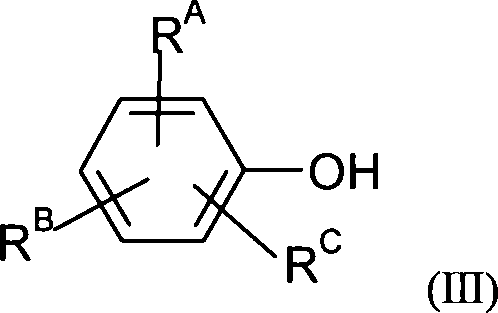
RA für lineares oder verzweigtes C1-C34-Alkyl, C7-C34-Alkylaryl, C6-C34-Aryl oder für -COO-RD steht, wobei RD für Wasserstoff, lineares oder verzweigtes C1-C34-Alkyl, C7-C34-Alkylaryl oder C6-C34-Aryl steht, und
RB, RC unabhängig voneinander gleich oder verschieden für Wasserstoff, lineares oder verzweigtes C1-C34-Alkyl, C7-C34-Alkylaryl oder C6-C34-Aryl stehen. In order to control or modify the end groups, it is additionally possible to use one or more monohydroxyaryl compounds which have not been used to prepare the diaryl carbonate (s) used. These may be those of the general formula (III),
R A is linear or branched C 1 -C 34 -alkyl, C 7 -C 34 -alkylaryl, C 6 -C 34 -aryl or -COO-R D , where R D is hydrogen, linear or branched C 1 - C 34 alkyl, C 7 -C 34 alkylaryl or C 6 -C 34 aryl, and
R B , R C independently of one another are identical or different for hydrogen, linear or branched C 1 -C 34 -alkyl, C 7 -C 34 -alkylaryl or C 6 -C 34 -aryl.
Solche Monohydroxyarylverbindungen sind beispielsweise 1-, 2- oder 3-Methylphenol, 2,4-Dimethylphenol 4-Ethylphenol, 4-n-Propylphenol, 4-iso-Propylphenol, 4-n-Butylphenol, 4-isoButylphenol, 4-tert-Butylphenol, 4-n-Pentylphenol, 4-n-Hexylphenol, 4-iso-Octylphenol, 4-n-Nonylphenol, 3-Pentadecylphenol, 4-Cyclohexylphenol, 4-(1-Methyl-1-phenylethyl)-phenol, 4-Phenylphenol, 4-Phenoxyphenol, 4-(1-Naphthyl)-phenol, 4-(2-Naphthyl)-phenol, 4-Tritylphenol, Methylsalicylat, Ethylsalicylat, n-Propylsalicylat, iso-Propylsalicylat, n-Butylsalicylat, iso-Butylsalicylat, tert-Butylsalicylat, Phenylsalicylat und Benzylsalicylat.Such Monohydroxyarylverbindungen are, for example, 1-, 2- or 3-methylphenol, 2,4-dimethylphenol 4-ethylphenol, 4-n-propylphenol, 4-iso-propylphenol, 4-n-butylphenol, 4-isoButylphenol, 4-tert-butylphenol , 4-n-pentylphenol, 4-n-hexylphenol, 4-iso-octylphenol, 4-n-nonylphenol, 3-pentadecylphenol, 4-cyclohexylphenol, 4- (1-methyl-1-phenylethyl) -phenol, 4-phenylphenol , 4-phenoxyphenol, 4- (1-naphthyl) -phenol, 4- (2-naphthyl) -phenol, 4-tritylphenol, methyl salicylate, ethyl salicylate, n-propyl salicylate, iso-propyl salicylate, n-butyl salicylate, iso-butyl salicylate, tert Butyl salicylate, phenyl salicylate and benzyl salicylate.
Bevorzugt sind 4-tert-Butylphenol, 4-iso-Octylphenol und 3-Pentadecylphenol.Preference is given to 4-tert-butylphenol, 4-iso-octylphenol and 3-pentadecylphenol.
Die Monohydroxyarylverbindung(en) sind dabei so zu wählen, dass deren Siedepunkt über dem der Monohydroxyarylverbindung liegt, die zur Herstellung des verwendeten Diarylcarbonats eingesetzt wurde. Die Monohydroxyarylverbindung kann zu jedem Zeitpunkt im Reaktionsverlauf zugegeben werden. Sie wird bevorzugt zu Beginn der Reaktion zugegeben. Der Anteil an freier Monohydroxyarylverbindung kann 0,2 bis 20 Mol-%, bevorzugt 0,4 bis 10 Mol-% bezogen auf die Dihydroxyarylverbindung betragen.The Monohydroxyarylverbindung (s) are to be chosen so that their boiling point is above that of Monohydroxyarylverbindung, which was used to prepare the diaryl carbonate used. The monohydroxyaryl compound can be added at any time in the course of the reaction. It is preferably added at the beginning of the reaction. The proportion of free Monohydroxyarylverbindung can be 0.2 to 20 mol%, preferably 0.4 to 10 mol% based on the Dihydroxyarylverbindung.
Es ist zudem möglich, die Endgruppen der resultierenden Polycarbonate auch durch Zugabe wenigstens eines zusätzlichen Diarylcarbonats, dessen Basis-Monohydroxyarylverbindung einen höheren Siedepunkt aufweist als die Basis-Monohydroxyarylverbindung des hauptsächlich eingesetzten Diarylcarbonates, verändert werden. Auch hier kann das zusätzliche Diarylcarbonat zu jedem Zeitpunkt im Reaktionsverlauf zugegeben werden. Es wird bevorzugt zu Beginn der Reaktion zugegeben. Der Anteil des Diarylcarbonates mit der höher siedenden Basis-Monohydroxyarylverbindung an der gesamt eingesetzten Diarylcarbonatmenge kann 1 bis 40 Mol-%, bevorzugt 1 bis 20 Mol-% und besonders bevorzugt 1 bis 10 Mol-% betragen.It is also possible to change the end groups of the resulting polycarbonates by adding at least one additional diaryl carbonate whose base monohydroxyaryl compound has a higher boiling point than the base monohydroxyaryl compound of the main diaryl carbonate. Again, the additional diaryl carbonate can be added at any time during the course of the reaction. It is preferably added at the beginning of the reaction. The proportion of the diaryl carbonate with the higher-boiling base monohydroxyaryl compound in the total amount of diaryl carbonate used can be from 1 to 40 mol%, preferably from 1 to 20 mol% and particularly preferably from 1 to 10 mol%.
Als Katalysatoren können im Schmelzumesterungsverfahren zur Herstellung von Polycarbonaten die in der Literatur bekannten basischen Katalysatoren wie beispielsweise Alkali- und Erdalkalihydroxyde und -oxyde und/oder Oniumsalze, wie z. B. Ammonium- oder Phosphoniumsalze, eingesetzt werden. Bevorzugt werden bei der Synthese Oniumsalze, besonders bevorzugt Phosphoniumsalze eingesetzt. Solche Phosphoniumsalze sind beispielsweise solche der allgemeinen Formel (IV) 
R7-10 für gleiche oder verschiedene gegebenenfalls substituierte C1-C10-Alkyl-, C6-C14-Aryl-, C7-C15-Arylalkyl- oder C5-C6-Cycloalkylreste, bevorzugt für Methyl oder C6-C14-Aryl, besonders bevorzugt Methyl oder Phenyl stehen und
X– für ein Anion ausgewählt aus der Gruppe Hydroxyd, Sulfat, Hydrogensulfat, Hydrogencarbonat, Carbonat, Halogenid, bevorzugt Chlorid, und Alkylat oder Arylat der Formel -OR11 stehen, wobei R11 für einen gegebenenfalls substituierten C6-C14-Aryl-, C7-C15-Arylalkyl- oder C5-C6-Cycloalkylrest, C1-C20-Alkyl, bevorzugt Phenyl, steht.As catalysts in the melt transesterification for the production of polycarbonates known in the literature basic catalysts such as alkali and alkaline earth hydroxides and oxides and / or onium salts, such as. For example, ammonium or phosphonium salts, are used. Onium salts, more preferably phosphonium salts, are preferably used in the synthesis. Such phosphonium salts are, for example, those of the general formula (IV)
R 7-10 represents identical or different optionally substituted C 1 -C 10 -alkyl, C 6 -C 14 -aryl, C 7 -C 15 -arylalkyl or C 5 -C 6 -cycloalkyl radicals, preferably methyl or C 6 -C 14 -aryl, particularly preferably methyl or phenyl and
X - is an anion selected from the group of hydroxide, sulfate, hydrogen sulfate, bicarbonate, carbonate, halide, preferably chloride, and alkylate or arylate of the formula -OR 11 , wherein R 11 is a optionally substituted C 6 -C 14 -aryl, C 7 -C 15 -arylalkyl or C 5 -C 6 -cycloalkyl, C 1 -C 20 -alkyl, preferably phenyl.
Besonders bevorzugte Katalysatoren sind Tetraphenylphosphoniumchlorid, Tetraphenylphosphoniumhydroxid und Tetraphenylphosphoniumphenolat, ganz besonders bevorzugt ist Tetraphenylphosphoniumphenolat.Particularly preferred catalysts are tetraphenylphosphonium chloride, tetraphenylphosphonium hydroxide and tetraphenylphosphonium phenolate, with very particular preference being given to tetraphenylphosphonium phenolate.
Die Katalysatoren werden bevorzugt in Mengen von 10–8 bis 10–3 mol, besonders bevorzugt in Mengen von 10–7 bis 10–4 mol, bezogen auf ein mol Dihydroxyarylverbindung, eingesetzt.The catalysts are preferably used in amounts of from 10 -8 to 10 -3 mol, particularly preferably in amounts of from 10 -7 to 10 -4 mol, based on one mol Dihydroxyarylverbindung.
Es können gegebenenfalls auch Cokatalysatoren verwendet werden, um die Geschwindigkeit der Polykondensation zu erhöhen.Optionally, cocatalysts may also be used to increase the rate of polycondensation.
Dies können beispielsweise alkalisch wirkende Salze von Alkalimetallen und Erdalkalimetallen, wie Hydroxyde, gegebenenfalls substituierte C1-C10-Alkoxyde und C6-C14-Aryloxyde von Lithium, Natrium und Kalium, vorzugsweise Hydroxyde, gegebenenfalls substituierte C1-C10-Alkoxyde oder C6-C14-Aryloxyde von Natrium sein. Bevorzugt sind Natriumhydroxyd, Natriumphenolat oder das Dinatriumsalz des 2,2-Bis-(4-hydroxyphenyl)-propans.These may be, for example, alkaline salts of alkali metals and alkaline earth metals, such as hydroxides, optionally substituted C 1 -C 10 -alkoxides and C 6 -C 14 -aryl oxides of lithium, sodium and potassium, preferably hydroxides, optionally substituted C 1 -C 10 -alkoxides or C 6 -C 14 aryl oxides of sodium. Preference is given to sodium hydroxide, sodium phenolate or the disodium salt of 2,2-bis (4-hydroxyphenyl) propane.
Falls Alkali- oder Erdalkalimetallionen in Form ihrer Salze zugeführt werden, beträgt die Menge an Alkali- oder Erdalkaliionen, bestimmt z. B. durch Atomabsorptionspektroskopie, 1 bis 500 ppb, vorzugsweise 5 bis 300 ppb und am meisten bevorzugt 5 bis 200 ppb, bezogen auf zu bildendes Polycarbonat. In bevorzugten Ausführungsformen des erfindungsgemäßen Verfahrens werden allerdings keine Alkalisalze verwendet.If alkali or alkaline earth metal ions are supplied in the form of their salts, the amount of alkali or alkaline earth metal ions, determined z. By atomic absorption spectroscopy, 1 to 500 ppb, preferably 5 to 300 ppb, and most preferably 5 to 200 ppb, based on the polycarbonate to be formed. In preferred embodiments of the method according to the invention, however, no alkali metal salts are used.
Im Rahmen der vorliegenden Erfindung sind unter ppb und ppm – soweit nichts anderes angegeben – Gewichtsteile zu verstehen.In the context of the present invention, ppb and ppm are parts by weight unless otherwise stated.
Die alkalisch wirkenden Salze von Alkalimetallen und Erdalkalimetallen können schon bei der Herstellung der Oligocarbonate, das heißt zu Beginn der Synthese oder in einem späteren Verfahrensschritt, zugemischt werden, um unerwünschte Nebenreaktionen zu unterdrücken. Die Gesamtmenge an Katalysator kann auch in mehreren Schritten dem Verfahren zugegeben werden.The alkaline salts of alkali metals and alkaline earth metals can already be mixed in the preparation of the oligocarbonates, that is to say at the beginning of the synthesis or in a later process step, in order to suppress unwanted side reactions. The total amount of catalyst can also be added to the process in several steps.
Weiter besteht auch die Möglichkeit, zusätzlich zu den vorangehend bereits genannten Katalysatoren und Katalysatormengen ergänzende Mengen Oniumkatalysatoren vor der Polykondensation zuzugeben. Für den Fall, dass es sich bereits bei oben genanntem Katalysator um einen Oniumkatalysator handelt, kann es sich bei dem in ergänzenden Mengen vor der Polykondensation zugegebenen Oniumkatalysator um den gleichen oben genannten oder einen von diesem verschiedenen Oniumkatalysator handeln.Furthermore, it is also possible, in addition to the above-mentioned catalysts and amounts of catalyst, to add additional amounts of onium catalysts prior to the polycondensation. In the case where the above-mentioned catalyst is an onium catalyst, the onium catalyst added in supplemental amounts prior to the polycondensation may be the same one or different from the onium catalyst mentioned above.
Die Zugabe der Katalysatoren erfolgt vorzugsweise in Lösung, um bei der Dosierung schädliche Überkonzentrationen zu vermeiden. Die Lösungsmittel sind bevorzugt system- und verfahrensinhärente Verbindungen wie beispielsweise die verwendeten Dihydroxyarylverbindungen, Diarylcarbonate oder gegebenenfalls Monohydroxyarylverbindungen. Besonders geeignet sind Monohydroxyarylverbindungen, weil dem Fachmann geläufig ist, dass sich die Dihydroxyarylverbindungen und Diarylcarbonate bei schon leicht erhöhten Temperaturen, insbesondere unter Katalysatoreinwirkung, leicht zu verändern und zersetzen beginnen. Hierunter können die Polycarbonatqualitäten leiden. In einer besonders bevorzugten Ausführungsform des erfindungsgemäßen Verfahrens ist das Lösungsmittel für den Katalysator Phenol. Phenol bietet sich in dieser Ausführungsform des erfindungsgemäßen Verfahrens insbesondere an, weil der vorzugsweise in dieser Ausführungsform verwendete Katalysator Tetraphenylphosphoniumphenolat bei seiner Herstellung als Mischkristall mit Phenol isoliert wird.The addition of the catalysts is preferably carried out in solution in order to avoid harmful excess concentrations during the metering. The solvents are preferably system- and process-inherent compounds such as, for example, the dihydroxyaryl compounds used, diaryl carbonates or optionally monohydroxyaryl compounds. Monohydroxyaryl compounds are particularly suitable because it is familiar to the person skilled in the art that the dihydroxyaryl compounds and diaryl carbonates begin to change and decompose readily at already slightly elevated temperatures, in particular under the action of a catalyst. This may suffer from the polycarbonate qualities. In a particularly preferred embodiment of the process according to the invention, the solvent for the catalyst is phenol. Phenol is particularly useful in this embodiment of the process according to the invention because the catalyst tetraphenylphosphonium phenolate preferably used in this embodiment is isolated in its preparation as a mixed crystal with phenol.
Die Polycarbonate, die nach diesem Verfahren erhalten werden, zeichnen sich strukturell dadurch aus, dass sie neben den durch Phenole der Formel (III) verkappten Kettenenden auch einen bestimmten Anteil unverkappter phenolischer Endgruppen tragen. Dieses Strukturelement kann beispielhaft durch folgende Formel (V) beschrieben werden, 
Der Gehalt an phenolischen OH-Endgruppen beträgt bevorzugt mehr als 150 ppm, besonders bevorzugt mehr als 200 ppm, ganz besonders bevorzugt mehr als 250 ppm (bezogen auf das Gewicht des Polycarbonats) bestimmt durch Infraspektroskopie.The content of phenolic OH end groups is preferably more than 150 ppm, particularly preferably more than 200 ppm, very particularly preferably more than 250 ppm (based on the weight of the polycarbonate) determined by means of infrared spectroscopy.
Die Polycarbonate können gezielt verzweigt werden, indem der Reaktionsmischung geeignete Verzweiger zugegeben werden. Geeignete Verzweiger für die Polycarbonatherstellung sind dem Fachmann bekannt. Es handelt sich dabei um Verbindungen mit drei und mehr funktionellen Gruppen, vorzugsweise solche mit drei oder mehr Hydroxylgruppen.The polycarbonates can be selectively branched by adding suitable branching agents to the reaction mixture. Suitable branching agents for the preparation of polycarbonates are known to the person skilled in the art. These are compounds with three or more functional groups, preferably those with three or more hydroxyl groups.
Geeignete Verbindungen mit drei oder mehr phenolischen Hydroxylgruppen sind beispielsweise Phloroglucin, 4,6-Dimethyl-2,4,6-tri-(4-hydroxyphenyl)-hepten-2, 4,6-Dimethyl-2,4,6-tri-(4-hydroxyphenyl)-heptan, 1,3,5-Tri-(4-hydroxyphenyl)-benzol, 1,1,1-Tri-(4-hydroxyphenyl)-ethan, Tri-(4-hydroxyphenyl)-phenylmethan, 2,2-Bis-(4,4-bis-(4-hydroxyphenyl)-cyclohexyl]-propan, 2,4-Bis-(4-hydroxyphenyl-isopropyl)-phenol und Tetra-(4-hydroxyphenyl)-methan.Suitable compounds having three or more phenolic hydroxyl groups are, for example, phloroglucinol, 4,6-dimethyl-2,4,6-tri- (4-hydroxyphenyl) -hepten-2, 4,6-dimethyl-2,4,6-tri- (4-hydroxyphenyl) -heptane, 1,3,5-tri (4-hydroxyphenyl) -benzene, 1,1,1-tri- (4-hydroxyphenyl) -ethane, tri- (4-hydroxyphenyl) -phenylmethane, 2,2-bis (4,4-bis (4-hydroxyphenyl) cyclohexyl] propane, 2,4-bis (4-hydroxyphenyl-isopropyl) -phenol and tetra (4-hydroxyphenyl) -methane.
Sonstige geeignete Verbindungen mit drei und mehr funktionellen Gruppen sind beispielsweise 2,4-Dihydroxybenzoesäure, Trimesinsäure, Cyanurchlorid und 3,3-Bis-(3-methyl-4-hydroxyphenyl)-2-oxo-2,3-dihydroindol.Other suitable compounds having three or more functional groups are, for example, 2,4-dihydroxybenzoic acid, trimesic acid, cyanuric chloride and 3,3-bis (3-methyl-4-hydroxyphenyl) -2-oxo-2,3-dihydroindole.
Bevorzugte Verzweiger sind 3,3-Bis-(3-methyl-4-hydroxyphenyl)-2-oxo-2,3-dihydroindol und 1,1,1-Tri-(4-hydroxyphenyl)-ethan.Preferred branching agents are 3,3-bis (3-methyl-4-hydroxyphenyl) -2-oxo-2,3-dihydroindole and 1,1,1-tri- (4-hydroxyphenyl) -ethane.
Die Verzweiger werden im Allgemeinen in Mengen von beispielsweise 0,02 bis 3,6 Mol-%, bezogen auf die Dihydroxyarylverbindung, eingesetzt.The branching agents are generally employed in amounts of, for example, from 0.02 to 3.6 mol%, based on the dihydroxyaryl compound.
Die verwendeten Dihydroxyarylverbindungen, Diarylcarbonate, Monohydroxyarylverbindungen sowie auch alle anderen der Synthese zugesetzten Rohstoffe, Chemikalien und Hilfsstoffe können mit aus ihrer eigenen Synthese, Handhabung und Lagerung stammenden Verunreinigungen kontaminiert sein und ohne weitere Reinigung eingesetzt werden. Es ist jedoch wünschenswert, aber nicht zwingend erforderlich mit möglichst sauberen Rohstoffen, Chemikalien und Hilfsstoffen zu arbeiten.The dihydroxyaryl compounds, diaryl carbonates, monohydroxyaryl compounds used and also all other raw materials, chemicals and auxiliaries added to the synthesis can be contaminated with impurities originating from their own synthesis, handling and storage and used without further purification. However, it is desirable but not essential to work with as clean as possible raw materials, chemicals and excipients.
Der Zusatz wenigstens eines Inhibitors erfolgt vor der letzten Reaktionsstufe. Im Rahmen der Erfindung bedeutet dies, dass die Zugabe in wenigstens einer Reaktionsstufe vor der letzten Reaktionsstufe oder auch zwischen zwei Reaktionsstufen erfolgen kann. Bevorzugt erfolgt dieser Zusatz in der Reaktionsstufe unmittelbar vor der letzten Reaktionsstufe oder zwischen der vorletzten und letzten Reaktionsstufe.The addition of at least one inhibitor takes place before the last reaction stage. In the context of the invention, this means that the addition can be carried out in at least one reaction stage before the last reaction stage or between two reaction stages. This addition is preferably carried out in the reaction stage immediately before the last reaction stage or between the penultimate and last reaction stage.
Polycarbonate, die über das Schmelzeumesterungsverfahren hergestellt werden, können nach der Herstellung katalytisch aktive, basische Verunreinigungen enthalten. Dabei kann es sich zum einen um geringfügige nicht abgetrennte Verunreinigungen der Ausgangssubstanzen, nicht abgetrennte basische Reste von thermisch zersetzbaren Katalysatoren oder nicht abgetrennte stabile basische Katalysatorsalze handeln. Unter thermisch zersetzbaren Katalysatoren sind zum Beispiel die oben beschriebenen Oniumsalze zu verstehen. Unter thermisch stabilen Katalysatoren sind beispielsweise alkalisch wirkende Salze der Alkali- bzw. Erdalkalimetalle zu verstehen. Zur Inhibierung dieser katalytisch aktiven, basischen Verunreinigungen können den Polycarbonaten prinzipiell zu verschiedenen Zeitpunkten in den jeweiligen Verfahren bestimmte Inhibitoren zugesetzt werden.Polycarbonates prepared by the melt transesterification process may contain catalytically active basic impurities after production. These may be on the one hand to minor non-separated impurities of the starting materials, not separated basic residues of thermally decomposable catalysts or not separated stable basic catalyst salts. Thermally decomposable catalysts are, for example, the onium salts described above. Under thermally stable catalysts are, for example, alkaline salts of alkali or alkaline earth metals to understand. To inhibit these catalytically active, basic impurities, certain inhibitors may in principle be added to the polycarbonates at different times in the respective processes.
Als Inhibitoren geeignet sind Säurekomponenten wie Lewis- oder Brönstedsäuren oder Ester starker Säuren. Der pKa-Wert des Inhibitors sollte nicht größer als 5, bevorzugt kleiner 3 sein. Die Säurekomponente wird bzw. deren Ester werden zugegeben, um die vorangehend genannten basischen Verunreinigungen bei Erreichen des gewünschten Molekulargewichts zu deaktivieren und damit die Reaktion im Idealfall zum Erliegen zu bringen. Solche Inhibitoren sind z. B. in
Beispiele für geeignete Säurekomponenten sind ortho-Phosphorsäure, phosphorige Säure, Pyrophosphorsäure, Hypophosphorsäure, Polyphosphorsäuren, Benzolphosphonsäure, Natriumdihydrogenphosphat, Borsäure, Arylboronsäuren, Salzsäure (Chlorwasserstoff), Schwefelsäure, Benzolsulfonsäure, Toluolsulfonsäure, Dodekylbenzolsulfonsäure und alle sonstigen Phenylsubstituierten Benzolsulfonsäuren, Salpetersäure, Säurechloride wie Chlorameisensäurephenylester, Acetoxy-BP-A, Benzoylchlorid sowie Ester, Halbester und verbrückte Ester der oben genannten Säuren wie beispielsweise Toluolsulfonsäureester, Phosphorsäureester, Phosphorigsäureester, Phosphonsäureester, Dimethylsulfat, Borsäureester, Arylboronsäureester und andere unter Wassereinfluss säuregenerierende Komponenten wie Tri-iso-octylphosphin, Ultranox 640 und BDP (Bisphenoldiphosphat-Oligomer).Examples of suitable acid components are ortho-phosphoric acid, phosphorous acid, pyrophosphoric acid, hypophosphoric acid, polyphosphoric acids, benzenephosphonic acid, sodium dihydrogenphosphate, boric acid, arylboronic acids, hydrochloric acid (hydrochloric acid), sulfuric acid, benzenesulphonic acid, toluenesulphonic acid, dodecylbenzenesulphonic acid and all other phenyl-substituted benzenesulphonic acids, nitric acid, acid chlorides such as phenyl chloroformate, Acetoxy-BP-A, benzoyl chloride and esters, half esters and bridged esters of the above-mentioned acids such as toluenesulfonic acid ester, phosphoric acid ester, phosphorous acid ester, phosphonic acid ester, dimethyl sulfate, boric acid ester, arylboronic acid ester and other acidifying components such as triisoctylphosphine, Ultranox 640 and BDP (bisphenol diphosphate oligomer).
Bevorzugt werden als Inhibitoren organische schwefelhaltige Säuren, Ester von organischen schwefelhaltigen Säuren oder Mischungen aus diesen eingesetzt. Bei den organischen schwefelhaltigen Säuren kann es sich z. B. um Bezolsulfonsäure, Toluolsulfonsäure, Trifluormethansulfonsäure, Naphthalinsulfonsäure oder sulfoniertes Polystyrol handeln. Bei den Ester von organischen schwefelhaltigen Säuren kann es sich z. B. um Dimethylsulfonat, Diethylsulfonat, Methyl-, Ethyl-, Propyl-, Butyl-, Octyl-, oder Phenylester von p-Toluolsulfonsäure oder Benzolsulfonsäure handeln. Ferner kann es sich um Voll- oder Teilester mehrwertiger Alkohole wie z. B. Glycerintribenzolsulfonsäureester, Glycerindibenzolsulfonsäureester, Glycerinmonobenzolsulfonsäureester, Glycerin-tri-p-toluolsulfonsäureester, Glycerin-di-p-toluolsulfonsäureester, Glycerin-mono-p-toluolsulfonsäureester, Ethylenglykoldibenzolsulfonsäureester, Ethylenglykolmonobenzolsulfonsäureester, Ethylenglykoldi-p-toluolsulfonsäureester, Ethylenglykolmono-p-toluolsulfonsäureester, Pentaerythrittetrabenzolsulfonsäureester, Pentaerythrittribenzolsulfonsäureester, Pentaerythritdibenzolsulfonsäureester, Pentaerythritmonobenzolsulfonsäureester, Pentaerythrittetra-p-toluolsulfonsäureester, Pentaerythrittri-p-toluolsulfonsäureester, Pentaerythritdi-p-toluolsulfonsäureester, Pentaerythritmono-p-toluolsulfonsäureester, Trimethylolpropantribenzolsulfonsäureester, Trimethylolpropandibenzolsulfonsäureester, Trimethylolpropanmonobenzolsulfonsäureester, Trimethylolpropantri-p-toluolsulfonsäureester, Trimethylolpropandi-p-toluolsulfonsäureester, Trimethylolpropanmono-p-toluolsulfonsäureester, Neopentylglykoldibenzolsulfonsäureester, Neopentylglykolmonobenzolsulfonsäureester, Neopentylglykoldi-p-toluolsulfonsäureester, Neopentylglykolmono-p-toluolsulfonsäureester sowie deren Mischungen handeln. Darüber hinaus können diese Mischungen noch Reste der Ausgangsverbindungen (Säurekomponente und/oder Alkoholkomnponente) enthalten. Solche Inhibitoren sind beispielsweise aber nicht limitierend auch in
Die beschriebenen Inhibitoren können einzeln oder in beliebigen Mischungen untereinander oder mehreren verschiedenen Mischungen der Polymerschmelze zugesetzt werden.The inhibitors described can be added individually or in any desired mixtures with one another or with a plurality of different mixtures of the polymer melt.
Die Inhibitoren können in Mengen von kleiner 100 ppm bezogen auf das Polycarbonat eingesetzt werden, bevorzugt in Mengen von 0,1 bis 50 ppm bezogen auf das Polycarbonat, besonders bevorzugt 0,5 bis 10 ppm und ganz besonders bevorzugt in Mengen von 1 bis 5 ppm.The inhibitors may be used in amounts of less than 100 ppm based on the polycarbonate, preferably in amounts of 0.1 to 50 ppm based on the polycarbonate, more preferably 0.5 to 10 ppm and most preferably in amounts of 1 to 5 ppm ,
Bezüglich der Zugabeform der Inhibitoren gibt es keine Limitierung. Die Inhibitoren können als Feststoff, z. B. als Pulver, in Lösung oder als Schmelze der Polymerschmelze zugesetzt werden. Eine andere Art der Dosierung ist die Verwendung eines Masterbatches, d. h. einer Vermischung des Inhibitors mit dem Polymer, vorzugsweise mit Polycarbonat, welche über eine Compoundierung homogenisiert wurde, das auch weitere Additive, wie beispielsweise andere Stabilisatoren oder Entformungsmittel enthalten kann.Regarding the form of addition of the inhibitors, there is no limitation. The inhibitors may be used as a solid, e.g. As a powder, in solution or as a melt of the polymer melt can be added. Another type of dosage is the use of a masterbatch, i. H. a mixing of the inhibitor with the polymer, preferably with polycarbonate, which has been homogenized via a compounding, which may also contain other additives, such as other stabilizers or mold release agents.
Bevorzugt werden die Ester von organischen schwefelhaltigen Säuren in flüssiger Form zugegeben. Da die zu dosierenden Mengen sehr gering sind, werden vorzugsweise Lösungen der Ester oder Masterbatche verwendet.Preferably, the esters of organic sulfur-containing acids are added in liquid form. Since the amounts to be metered are very low, solutions of the esters or masterbatches are preferably used.
Vorzugsweise werden solche Verbindungen als Lösemittel gewählt, die bereits als andere Komponente in den jeweiligen Prozessen verwendet werden. Eventuell verbleibende Reste mindern, je nach Anforderungsprofil des herzustellenden Produktes, nicht die Qualität.Preferably, such compounds are selected as solvents, which are already used as other component in the respective processes. Depending on the requirement profile of the product to be produced, any remaining residues do not reduce the quality.
Geeignete Verbindungen, welche schon im jeweiligen Prozess verwendet wurden, sind vorzugsweise solche, die chemisch inert sind und schnell verdampfen. Als solche in bevorzugten Ausführungsformen geeignet sind beispielsweise Phenol oder Diphenylcarbonat.Suitable compounds which have already been used in the respective process are preferably those which are chemically inert and evaporate rapidly. Suitable as such in preferred embodiments are, for example, phenol or diphenyl carbonate.
Als weitere Lösemittel kommen alle organischen Lösemittel mit einem Siedepunkt bei Normaldruck von 30 bis 300°C, bevorzugt von 30 bis 250°C und besonders bevorzugt von 30 bis 200°C sowie auch Wasser – dazu zählt auch Kristallwasser – in Frage.Further solvents all organic solvents having a boiling point at atmospheric pressure of 30 to 300 ° C, preferably from 30 to 250 ° C and more preferably from 30 to 200 ° C and water - including water of crystallization - in question.
Geeignete Lösemittel können beispielsweise Wasser oder gegebenenfalls substituierte Alkane, Cycloalkane oder Aromaten sein. Die Substituenten können aliphatische, cycloaliphatische oder aromatische Reste in unterschiedlicher Kombination sowie Halogene oder Hydroxylgruppen sein. Heteroatome, wie beispielsweise Sauerstoff, können auch zwischen aliphatischen, cycloaliphatischen oder aromatischen Resten Brückenglieder sein, wobei die Reste gleich oder unterschiedlich sein können. Weitere Lösemittel können auch Ketone und Ester organischer Säuren sowie cyclische Carbonate sein. Weiterhin kann der Inhibitor auch in Glycerinmonostearat gelöst und zudosiert werden. Als Lösemittel können auch Mischungen aus den vorangehend genannten verwendet werden.Suitable solvents may be, for example, water or optionally substituted alkanes, cycloalkanes or aromatics. The substituents may be aliphatic, cycloaliphatic or aromatic radicals in various combinations as well as halogens or hydroxyl groups. Heteroatoms, such as oxygen, may also be bridge members between aliphatic, cycloaliphatic or aromatic radicals, where the radicals may be the same or different. Other solvents can also Ketones and esters of organic acids and cyclic carbonates. Furthermore, the inhibitor can also be dissolved in glycerol monostearate and added. As solvents it is also possible to use mixtures of the abovementioned.
Beispiele für solche Lösemittel sind neben Wasser n-Pentan, n-Hexan, n-Heptan und deren Isomere, Chlorbenzol, Methanol, Ethanol, Propanol, Butanol und deren Isomere, Phenol, o-, m- und p-Kresol, Aceton, Diethylether, Dimethylketon, Polyethylenglycole, Polypropylenglycole, Essigsäureethylester, Ethylencarbonat, Propylencarbonat und Mischungen aus diesen.Examples of such solvents are, in addition to water, n-pentane, n-hexane, n-heptane and their isomers, chlorobenzene, methanol, ethanol, propanol, butanol and their isomers, phenol, o-, m- and p-cresol, acetone, diethyl ether , Dimethyl ketone, polyethylene glycols, polypropylene glycols, ethyl acetate, ethylene carbonate, propylene carbonate and mixtures thereof.
Bevorzugt geeignet sind Wasser, Phenol, Propylencarbonat, Ethylencarbonat, Toluol und Mischungen aus diesen.Preferably suitable are water, phenol, propylene carbonate, ethylene carbonate, toluene and mixtures of these.
Besonders bevorzugt geeignet sind Wasser, Phenol, Propylencarbonat und Mischungen aus diesen.Particularly suitable are water, phenol, propylene carbonate and mixtures of these.
Zur wirksamen Einmischung des Inhibitors sind beispielsweise statische Mischer oder andere zu einer homogenen Einmischung führende dynamische Mischer, wie beispielsweise Extruder, geeignet.For effective mixing of the inhibitor, for example, static mixers or other dynamic mixing leading to a homogeneous mixing, such as extruders, are suitable.
Nach der letzten Reaktionsstufe des erfindungsgemäßen Verfahrens werden der Reaktionsmischung eine oder mehrere aromatische Hydroxycarbonsäure(n) oder deren Derivat(e) zugegeben, wobei es sich bei der oder den aromatischen Hydroxycarbonsäure(n) oder deren Derivat(en) um eine oder mehrere Verbindung(en) der allgemeinen Formel (VI), (VII) oder (VIII) handelt. Die Zugabe erfolgt demnach vorzugsweise im sogenannten Finishreaktor oder nach dem Finishreaktor, insbesondere bevorzugt nach dem Finishreaktor.After the last reaction stage of the process according to the invention, one or more aromatic hydroxycarboxylic acid (s) or their derivative (s) are added to the reaction mixture, the aromatic hydroxycarboxylic acid (s) or their derivative (s) being one or more compounds ( en) of the general formula (VI), (VII) or (VIII). Accordingly, the addition preferably takes place in the so-called finishreactor or after the finishreactor, in particular preferably after the finishreactor.
Unter Derivaten von aromatischen Hydroxycarbonsäuren sind beispielsweise Ester, Amide, Halogenide oder Anhydride der entsprechenden Säuren, bevorzugt Ester der entsprechenden Säuren, oder aber an der Hydroxygruppe derivatisierte Carbonsäuren, wie beispielsweise Alkoxycarbonsäuren oder Alkyloxycarbonyl- bzw. Aryloxycarbonylcarbonsäuren zu verstehenDerivatives of aromatic hydroxycarboxylic acids include, for example, esters, amides, halides or anhydrides of the corresponding acids, preferably esters of the corresponding acids, or carboxylic acids derivatized on the hydroxy group, for example alkoxycarboxylic acids or alkyloxycarbonyl or aryloxycarbonylcarboxylic acids
Die aromatischen Hydroxycarbonsäuren oder deren Derivate sind solche der allgemeinen Formeln (VI), (VII) oder (VIII), 
R1, R1' für H,
R2, R2' unabhängig voneinander für einen linearen oder verzweigten C1-C10-Alkyl-, C6-C34-Aralkylrest, bevorzugt für einen linearen oder verzweigten C1-C4-Alkylrest,
R3, R3' unabhängig voneinander für H, einen linearen oder verzweigten C1-C10-Alkylcarbonyl- oder C6-C34-Arylcarbonylrest, bevorzugt für H oder einen Methylcarbonyl-, Ethylcarbonyl-, Propylcarbonyl-, Phenylcarbonyl-, Butylcarbonylrest und ganz besonders bevorzugt für H oder einen Methylcarbonyl-,
R4 für H,
l für 1 oder 2 bevorzugt für 1,
n für 0 oder eine ganze Zahl von 1 bis 3, bevorzugt für 0 oder 1,
m für 1 oder 2, bevorzugt für 1,
Y für einen aus 1 bis 8 C- und/oder Hetero-Atomen bestehenden divalenten Rest, bevorzugt für -C(R5)(R6)-, -(CR5R6)m-, -O-, -S-, -S(=O)-, -S(=O)2-, -(C=O)-, -O(C=O)O-, -O-C(R5R6)O-, insbesondere bevorzugt für -C(R5)(R6)- steht, worin R5 und R6 unabhängig voneinander für einen C1-C10-Alkylrest, bevorzugt für einen C1-C6-Alkylrest, besonders bevorzugt für Methyl stehen, und
X für einen C1-C10-Alkyl-, C1-C10-Alkylphenyl- oder einen Phenylrest, besonders bevorzugt für einen Phenylrest steht.The aromatic hydroxycarboxylic acids or their derivatives are those of the general formulas (VI), (VII) or (VIII),
R 1 , R 1 ' for H,
R 2 , R 2 ' independently of one another represent a linear or branched C 1 -C 10 -alkyl, C 6 -C 34 -aralkyl radical, preferably a linear or branched C 1 -C 4 -alkyl radical,
R 3 , R 3 ' independently of one another are H, a linear or branched C 1 -C 10 -alkylcarbonyl or C 6 -C 34 -arylcarbonyl radical, preferably H or a methylcarbonyl, ethylcarbonyl, propylcarbonyl, phenylcarbonyl, butylcarbonyl radical and most preferably H or methylcarbonyl,
R 4 for H,
1 for 1 or 2 for 1,
n is 0 or an integer from 1 to 3, preferably 0 or 1,
m is 1 or 2, preferably 1,
Y is a divalent radical consisting of 1 to 8 C and / or hetero atoms, preferably -C (R 5 ) (R 6 ) -, - (CR 5 R 6 ) m -, -O-, -S- , -S (= O) -, -S (= O) 2 -, - (C = O) -, -O (C = O) O-, -OC (R 5 R 6 ) O-, especially preferred for -C (R 5 ) (R 6 ) - in which R 5 and R 6 independently of one another are a C 1 -C 10 -alkyl radical, preferably a C 1 -C 6 -alkyl radical, more preferably methyl, and
X is a C 1 -C 10 -alkyl, C 1 -C 10 -alkylphenyl or a phenyl radical, particularly preferably a phenyl radical.
Besonders bevorzugte aromatische Hydroxycarbonsäuren oder deren Derivate sind beispielsweise 2,4-Dihydroxybenzoesäure, 3,5-Dihydroxybenzoesäure, 3,5-Diisopropylsalicylsäure, 5,5-Methylendisalicylsäure, Salicylsäure und Acetylsalicylsäure.Particularly preferred aromatic hydroxycarboxylic acids or their derivatives are, for example, 2,4-dihydroxybenzoic acid, 3,5-dihydroxybenzoic acid, 3,5-diisopropylsalicylic acid, 5,5-methylenedisalicylic acid, salicylic acid and acetylsalicylic acid.
Die aromatischen Hydroxycarbonsäuren oder deren Derivate werden beispielsweise in Mengen von 5 bis 500 ppm, bevorzugt 10 bis 300 ppm, besonders bevorzugt 20 bis 200 ppm, bezogen auf das Polycarbonat, nach der letzten Reaktionsstufe des erfindungsgemäßen Verfahrens eingesetzt.The aromatic hydroxycarboxylic acids or their derivatives are used, for example, in amounts of 5 to 500 ppm, preferably 10 to 300 ppm, particularly preferably 20 to 200 ppm, based on the polycarbonate, after the last reaction stage of the process according to the invention.
Durch diese Kombination der Zugabe von wenigstens einem Inhibitor in einer Reaktionsstufe vor der letzten Reaktionsstufe und der Zugabe wenigstens einer aromatischen Hydroxycarbonsäure oder deren Derivat in der letzten Reaktionsstufe können mittels Schmelzeumesterungsverfahren Polycarbonate erhalten werden, die bei der weiteren Verarbeitung, beispielsweise mittels Spritzguss, zu Formteilen mit niedriger elektrostatischer Aufladung auf der Oberfläche führen. Eine solche Kombination von Inhibitoren und zusätzlichen aromatischen Hydroxycarbonsäuren oder deren Derivate in dieser bestimmten zeitlichen Abfolge innerhalb des Verfahrens ist in der Literatur bisher nicht beschrieben. Der Effekt der niedrigen elektrostatischen Aufladung auf der Oberfläche der resultierenden Formkörper oder Extrudate ist umso überraschender als beispielsweise der Zusatz von Inhibitoren der oben genannten Art vor dem Finishreaktor bereits bekannt ist (vgl. z. B.
Das erfindungsgemäße Verfahren kann diskontinuierlich oder auch kontinuierlich durchgeführt werden.The process according to the invention can be carried out batchwise or else continuously.
Nachdem die Dihydroxyarylverbindungen und Diarylcarbonate, gegebenenfalls mit weiteren Verbindungen, wie beispielsweise einer höhersiedenden Monohydroxyarylverbindung, als Schmelze vorliegen, wird in Gegenwart wenigstens eines geeigneten Katalysators die Umsetzung gestartet. Der Umsatz bzw. das Molekulargewicht wird bei steigenden Temperaturen und fallenden Drucken in geeigneten Apparaten und Vorrichtungen durch Abführen der sich abspaltenden Monohydroxyarylverbindung solange erhöht, bis der angestrebte Endzustand, d. h. der gewünschte Umsatz bzw. das gewünschte Molekulargewicht erreicht ist. Durch Wahl des Verhältnisses Dihydroxyarylverbindung zu Diarylcarbonat, der durch Wahl der Verfahrensweise bzw. Anlage zur Herstellung des Polycarbonats gegebenen Verlustrate des Diarylcarbonats über die Brüden und gegebenenfalls zugesetzter weiterer Verbindungen, wie beispielsweise einer höhersiedenden Monohydroxyarylverbindung, werden die Endgruppen in Art und Konzentration geprägt.After the dihydroxyaryl compounds and diaryl carbonates, optionally with other compounds, such as, for example, a higher-boiling monohydroxyaryl compound, are in the form of a melt, the reaction is started in the presence of at least one suitable catalyst. The conversion or the molecular weight is increased with increasing temperatures and falling pressures in suitable apparatus and devices by discharging the cleaving Monohydroxyarylverbindung until the desired final state, d. H. the desired conversion or the desired molecular weight has been reached. By selecting the ratio of dihydroxyaryl compound to diaryl carbonate, the rate of loss of the diaryl carbonate given by the choice of the method or preparation for producing the polycarbonate via the vapors and optionally added further compounds, such as, for example, a higher-boiling monohydroxyaryl compound, the end groups are shaped in type and concentration.
C1-C4-Alkyl steht im Rahmen der Erfindung beispielsweise für Methyl, Ethyl, n-Propyl, iso-Propyl, n-Butyl, sec.-Butyl, tert.-Butyl, C1-C6-Alkyl darüber hinaus beispielsweise für n-Pentyl, 1-Methylbutyl, 2-Methylbutyl, 3-Methylbutyl, neo-Pentyl, 1-Ethylpropyl, Cyclohexyl, Cyclopentyl, n-Hexyl, 1,1-Dimethylpropyl, 1,2-Dimethylpropyl, 1,2-Dimethylpropyl, 1-Methylpentyl, 2-Methylpentyl, 3-Methylpentyl, 4-Methylpentyl, 1,1-Dimethylbutyl, 1,2-Dimethylbutyl, 1,3-Dimethylbutyl, 2,2-Dimethylbutyl, 2,3-Dimethylbutyl, 3,3-Dimethylbutyl, 1-Ethylbutyl, 2-Ethylbutyl, 1,1,2-Trimethylpropyl, 1,2,2-Trimethylpropyl, 1-Ethyl-1-methylpropyl, 1-Ethyl-2-methylpropyl oder 1-Ethyl-2-methylpropyl, C1-C10-Alkyl darüber hinaus beispielsweise für n-Heptyl und n-Octyl, Pinakyl, Adamantyl, die isomeren Menthyle, n-Nonyl, n-Decyl, C1-C34-Alkyl darüber hinaus beispielsweise für n-Dodecyl, n-Tridecyl, n-Tetradecyl, n-Hexadecyl oder n-Octadecyl. Gleiches gilt für den entsprechenden Alkylrest beispielsweise in Aralkyl- bzw. Alkylaryl-, Alkylphenyl- oder Alkylcarbonylresten. Alkylenreste in den entsprechenden Hydroxyalkyl- oder Aralkyl- bzw. Alkylarylresten stehen beispielsweise für die den vorangehenden Alkylresten entsprechenden Alkylenreste.In the context of the invention, C 1 -C 4 -alkyl is, for example, methyl, ethyl, n-propyl, isopropyl, n-butyl, sec-butyl, tert-butyl, C 1 -C 6 -alkyl, moreover, for example for n-pentyl, 1-methylbutyl, 2-methylbutyl, 3-methylbutyl, neo-pentyl, 1-ethylpropyl, cyclohexyl, cyclopentyl, n-hexyl, 1,1-dimethylpropyl, 1,2-dimethylpropyl, 1,2-dimethylpropyl , 1-methylpentyl, 2-methylpentyl, 3-methylpentyl, 4-methylpentyl, 1,1-dimethylbutyl, 1,2-dimethylbutyl, 1,3-dimethylbutyl, 2,2-dimethylbutyl, 2,3-dimethylbutyl, 3,3 Dimethylbutyl, 1-ethylbutyl, 2-ethylbutyl, 1,1,2-trimethylpropyl, 1,2,2-trimethylpropyl, 1-ethyl-1-methylpropyl, 1-ethyl-2-methylpropyl or 1-ethyl-2-methylpropyl , C 1 -C 10 alkyl additionally, for example, n-heptyl and n-octyl, Pinakyl, adamantyl, the isomeric Menthyle, n-nonyl, n-decyl, C 1 -C 34 -alkyl additionally for example, n-dodecyl , n-tridecyl, n-tetradecyl, n-hexadecyl or n-octadecyl. The same applies to the corresponding alkyl radical, for example in aralkyl or alkylaryl, alkylphenyl or alkylcarbonyl radicals. Alkylene radicals in the corresponding hydroxyalkyl or aralkyl or alkylaryl radicals are, for example, the alkylene radicals corresponding to the preceding alkyl radicals.
Aryl steht für einen carbocyclischen aromatischen Rest mit 6 bis 34 Gerüstkohlenstoffatomen. Gleiches gilt für den aromatischen Teil eines Arylalkylrestes, auch Aralkylrest genannt, sowie für Arylbestandteile komplexerer Gruppen, wie z. B. Arylcarbonylresten.Aryl represents a carbocyclic aromatic radical having 6 to 34 skeleton carbon atoms. The same applies to the aromatic part of an arylalkyl radical, also called aralkyl radical, as well as aryl components of more complex groups, such as. B. arylcarbonyl radicals.
Beispiele für C6-C34-Aryl sind Phenyl, o-, p-, m-Tolyl, Naphthyl, Phenanthrenyl, Anthracenyl oder Fluorenyl.Examples of C 6 -C 34 -aryl are phenyl, o-, p-, m-tolyl, naphthyl, phenanthrenyl, anthracenyl or fluorenyl.
Arylalkyl bzw. Aralkyl bedeutet jeweils unabhängig einen geradkettigen, cyclischen, verzweigten oder unverzweigten Alkyl-Rest nach vorstehender Definition, der einfach, mehrfach oder vollständig durch Aryl-Reste gemäß vorstehender Definition substituiert sein kann. Arylalkyl or aralkyl in each case independently denotes a straight-chain, cyclic, branched or unbranched alkyl radical as defined above, which may be monosubstituted, polysubstituted or completely substituted by aryl radicals as defined above.
Die vorangehenden Aufzählungen sind beispielhaft und nicht als Limitierung zu verstehen.The preceding listings are exemplary and not limiting.
Bezüglich der Art und Weise in welcher Anlage und nach welcher Verfahrensweise der Prozess ausgeführt wird, gibt es prinzipiell keine Limitierung und Einschränkung. Bevorzugt kann der Prozess wie im Folgenden beschrieben durchgeführt werden.Regarding the way in which plant and according to which procedure the process is carried out, there are in principle no limitation and restriction. Preferably, the process can be carried out as described below.
Des Weiteren gibt es keine spezielle Limitierung und Einschränkung bezüglich der Temperaturen und der Drucke für das erfindungsgemäße Verfahren. Jede Bedingung ist möglich, solange die gewählten Temperaturen, Drucke und Katalysatoren eine Schmelzeumesterung unter entsprechend schneller Entfernung der abgespaltenen Monohydroxyarylverbindung ermöglichen.Furthermore, there is no specific limitation and limitation on the temperatures and pressures for the inventive method. Each condition is possible as long as the selected temperatures, pressures and catalysts allow a melt transesterification with correspondingly rapid removal of the cleaved Monohydroxyarylverbindung.
Die Temperaturen über den gesamten Verfahrens liegen im Allgemeinen zwischen 180 und 330°C, die Drucke zwischen 15 bar, absolut und 0,01 mbar, absolut.The temperatures over the entire process are generally between 180 and 330 ° C, the pressures between 15 bar, absolute and 0.01 mbar, absolute.
Bevorzugt wird eine kontinuierliche Verfahrensweise gewählt, weil diese vorteilhaft für die Produktqualität sein kann.Preferably, a continuous procedure is chosen because it can be advantageous for the product quality.
Vorzugsweise ist ein solches kontinuierliches erfindungsgemäßes Verfahren in der Weise durchgeführt, dass eine oder mehrere Dihydroxyarylverbindungen mit einem oder mehreren Diarylcarbonat(en) und gegebenenfalls weiteren Reaktanden unter Verwendung von wenigstens einem Katalysator vorkondensiert werden und nach dieser Vorkondensation ohne Abtrennen der gebildeten Monohydroxyarylverbindung(en) in mehreren sich daran anschließenden Reaktions-Verdampfer-Stufen bei schrittweise steigenden Temperaturen und schrittweise fallenden Drucken das Molekulargewicht des Endproduktes bis zum gewünschten Niveau aufgebaut wird.Such a continuous process according to the invention is preferably carried out in such a way that one or more diaryl carbonate (s) and optionally further reactants are precondensed using at least one catalyst and after this precondensation without separation of the monohydroxyaryl compound (s) formed several adjoining reaction-evaporator stages at gradually increasing temperatures and gradually falling pressure, the molecular weight of the final product is built up to the desired level.
Die für die einzelnen Reaktions-Verdampfer-Stufen geeigneten Vorrichtungen, Apparate und Reaktoren sind entsprechend dem Verfahrensverlauf Wärmetauscher, Entspannungsapparate, Abscheider, Kolonnen, Verdampfer, Rührbehälter und Reaktoren oder sonstige käufliche Apparate, welche die nötige Verweilzeit bei ausgewählten Temperaturen und Drucken bereitstellen. Die gewählten Vorrichtungen müssen den nötigen Wärmeeintrag ermöglichen und so konstruiert sein, dass sie den kontinuierlich wachsenden Schmelzviskositäten gerecht werden.The apparatus, apparatus and reactors suitable for the individual reaction-evaporator stages are, according to the process course, heat exchangers, expansion apparatuses, separators, columns, evaporators, stirred vessels and reactors or other commercially available apparatus which provide the necessary residence time at selected temperatures and pressures. The chosen devices must provide the necessary heat input and be designed to meet the ever-increasing melt viscosities.
Alle Vorrichtungen sind über Pumpen, Rohrleitungen und Ventile miteinander verbunden. Die Rohrleitungen zwischen allen Einrichtungen sollten selbstverständlich so kurz wie möglich sein und die Anzahl der Krümmungen der Leitungen so gering wie möglich gehalten werden, um unnötig verlängerte Verweilzeiten zu vermeiden. Dabei sind die äußeren, d. h. technischen Rahmenbedingungen und Belange für Montagen chemischer Anlagen zu berücksichtigen.All devices are connected by pumps, piping and valves. Of course, the pipelines between all devices should be as short as possible and the number of bends of the lines should be kept as low as possible to avoid unnecessarily prolonged dwell times. Here are the outer, d. H. technical conditions and concerns for assembly of chemical plants.
Zur Durchführung des Verfahrens nach einer bevorzugten kontinuierlichen Verfahrensweise können die Reaktionspartner entweder gemeinsam aufgeschmolzen oder aber die feste(n) Dihydroxyarylverbindung(en) in der Diarylcarbonatschmelze oder das oder die feste Diarylcarbonat(e) in der Schmelze der Dihydroxyarylverbindung(en) gelöst werden oder beide Rohstoffe werden als Schmelze, bevorzugt direkt aus der Herstellung, zusammengeführt. Die Verweilzeiten der getrennten Schmelzen der Rohstoffe, insbesondere die der Schmelze der Dihydroxyarylverbindung, werden so kurz wie möglich eingestellt. Das Schmelzegemisch kann dagegen wegen des im Vergleich zu den einzelnen Rohstoffen erniedrigten Schmelzpunktes des Rohstoffgemisches bei entsprechend niedrigeren Temperaturen ohne Qualitätseinbussen länger verweilen.To carry out the process according to a preferred continuous procedure, the reactants may either be melted together or the solid dihydroxyaryl compound (s) in the diaryl carbonate melt or the solid diaryl carbonate (s) dissolved in the melt of the dihydroxyaryl compound (s) or both Raw materials are combined as a melt, preferably directly from the production. The residence times of the separate melts of the raw materials, in particular those of the melt of the dihydroxyaryl compound, are adjusted as short as possible. On the other hand, the melt mixture can stay longer due to the lower melting point of the raw material mixture compared with the individual raw materials at correspondingly lower temperatures without any loss of quality.
Danach wird der oder die Katalysator(en), vorzugsweise in einem geeigneten Lösemittel, wie z. B. Phenol, gelöst, zugemischt und die Schmelze auf die Reaktionstemperatur erhitzt.Thereafter, the or the catalyst (s), preferably in a suitable solvent, such as. As phenol, dissolved, mixed and the melt heated to the reaction temperature.
In bevorzugten Ausführungsformen des erfindungsgemäßen Verfahrens wird aus dem Schmelzestrom zwischen dem vorletzten Reaktor und dem Finishreaktor mittels einer Zahnradpumpe ein Teilstrom entnommen, in den wenigstens ein Inhibitor zudosiert wird. Das Gemisch wird direkt danach zur intensiven Vermischung über einen statischen Mischer in den Hauptstrom zurückgepumpt. Hinter der Eintrittsstelle folgt in Flussrichtung ein weiterer statischer Mischer, der die homogene Verteilung im Schmelzehauptstrom besorgt, welcher dann in den Endreaktor geleitet wird. Im Endreaktor, der zur Restmonomerreduzierung eingesetzt wird, werden dann bei Temperaturen von 260 bis 310°C, vorzugsweise bei 265 bis 300°C und besonders bevorzugt bei 270 bis 290°C und bei Drucken von 0,01 bis 3 mbar, bevorzugt von 0,2 bis 2,5 mbar und besonders bevorzugt von 0,4 bis 2 mbar die Restmonomeren reduziert. Die Füllstände werden in dem Endreaktor so niedrig wie verfahrenstechnisch möglich eingestellt. Die Verweilzeit im Endreaktor – auch Finishreaktor genannt – liegt in der Größenordnung von einigen Minuten bis Stunden, bevorzugt sind 5 bis 180 Minuten, besonders bevorzugt 10 bis 150 Minuten und ganz besonders bevorzugt 15 bis 120 Minuten. Ein möglicherweise gegebener geringfügiger Molekulargewichtsaufbau im Endreaktor, in dem vorwiegend die Ausdampfung der Restmonomeren erfolgen soll, kann dadurch ausgeglichen werden, dass das Eintrittsmolekulargewicht soweit abgesenkt wird, dass nach der Ausdampfung der Restmonomeren das gewünschte Endmolekulargewicht genau erreicht wird. Das fertige Polycarbonat wird mittels einer Pumpvorrichtung aus dem Endreaktor ausgetragen, bei Bedarf nach bekannten Verfahren mit Zuschlagstoffen zur Eigenschaftsverbesserung ausgestattet, als Strang gezogen, abgekühlt und granuliert. Als Pumpvorrichtung wird in der Regel eine Zahnradpumpe verwendet. Alternativ können auch Schnecken unterschiedlichster Bauart oder Verdrängerpumpen spezieller Bauart benutzt werden.In preferred embodiments of the method according to the invention, a partial flow is taken from the melt stream between the penultimate reactor and the finishreactor by means of a gear pump, in which at least one inhibitor is metered. The mixture is then directly pumped back into the main stream for intensive mixing via a static mixer. Behind the point of entry is followed by another static mixer in the flow direction, which provides the homogeneous distribution in the melt main stream, which is then passed into the final reactor. In the final reactor used for residual monomer reduction is, are then at temperatures of 260 to 310 ° C, preferably at 265 to 300 ° C and more preferably at 270 to 290 ° C and at pressures of 0.01 to 3 mbar, preferably from 0.2 to 2.5 mbar and particularly preferably from 0.4 to 2 mbar reduces the residual monomers. The levels are set in the final reactor as low as technically possible. The residence time in the final reactor - also called finite reactor - is in the order of a few minutes to hours, preferably 5 to 180 minutes, more preferably 10 to 150 minutes, and most preferably 15 to 120 minutes. A possibly given minor molecular weight buildup in the final reactor, in which predominantly the evaporation of the residual monomers is to take place, can be compensated for by reducing the entry molecular weight to such an extent that after the evaporation of the residual monomers the desired final molecular weight is exactly reached. The finished polycarbonate is discharged by means of a pumping device from the final reactor, equipped if necessary by known methods with additives to improve the properties, pulled as a strand, cooled and granulated. As a pumping device, a gear pump is usually used. Alternatively, it is also possible to use screws of very different design or displacement pumps of a specific design.
Die besonders bevorzugte Ausführungsform des erfindungsgemäßen Verfahrens, in der beispielsweise 2,2-Bis-(4-hydroxyphenyl)-propan (Bisphenol A, BPA) und Diphenylcarbonat (DPC) miteinander zu Polycarbonat umgesetzt werden, sei im Folgenden beispielhaft aber nicht einschränkend beschrieben:
Dabei beträgt die Reaktionstemperatur zu Beginn dieser besonders bevorzugten Ausführungsform 180 bis 220°C, vorzugsweise 190 bis 210°C, ganz besonders bevorzugt 190°C. Bei Verweilzeiten von 15 bis 90 min, vorzugsweise 30 bis 60 min, wird das Reaktionsgleichgewicht eingestellt, ohne dass die gebildete Hydroxyarylverbindung entnommen wird. Die Reaktion kann bei Atmosphärendruck, aber aus technischen Gründen auch bei Überdruck gefahren werden. Der bevorzugte Druck in technischen Anlagen beträgt 2 bis 15 bar absolut.The particularly preferred embodiment of the process according to the invention, in which, for example, 2,2-bis (4-hydroxyphenyl) propane (bisphenol A, BPA) and diphenyl carbonate (DPC) are reacted with one another to form polycarbonate, is described below by way of example but not by way of limitation:
The reaction temperature at the beginning of this particularly preferred embodiment is 180 to 220 ° C, preferably 190 to 210 ° C, most preferably 190 ° C. At residence times of 15 to 90 minutes, preferably 30 to 60 minutes, the reaction equilibrium is adjusted without the hydroxyaryl compound formed being removed. The reaction can be run at atmospheric pressure, but for technical reasons even at overpressure. The preferred pressure in technical systems is 2 to 15 bar absolute.
Das Schmelzegemisch wird in eine erste Vakuumkammer, deren Druck auf 100 bis 400 mbar, vorzugsweise auf 150 bis 300 mbar eingestellt wird, entspannt und direkt danach in einer geeigneten Vorrichtung bei gleichem Druck wieder auf die Eintrittstemperatur erhitzt. Bei dem Entspannungsvorgang wird die entstandene Hydroxyarylverbindung mit noch vorhandenen Monomeren verdampft. Nach einer Verweilzeit von 5 bis 30 min in einer Sumpfvorlage gegebenenfalls mit Umpumpung bei gleichem Druck und gleicher Temperatur wird das Reaktionsgemisch in eine zweite Vakuumkammer, deren Druck 50 bis 200 mbar, vorzugsweise 80 bis 150 mbar beträgt, entspannt und direkt danach in einer geeigneten Vorrichtung bei gleichem Druck auf eine Temperatur von 190 bis 250°C, bevorzugt 210 bis 240°C, besonders bevorzugt 210 bis 230°C, erwärmt. Auch hierbei wird die entstandene Hydroxyarylverbindung mit noch vorhandenen Monomeren verdampft. Nach einer Verweilzeit von 5 bis 30 Minuten in einer Sumpfvorlage, gegebenenfalls mit Umpumpung, bei gleichem Druck und gleicher Temperatur wird das Reaktionsgemisch in eine dritte Vakuumkammer, deren Druck 30 bis 150 mbar, vorzugsweise 50 bis 120 mbar beträgt, entspannt und direkt danach in einer geeigneten Vorrichtung bei gleichem Druck auf eine Temperatur von 220 bis 280°C, bevorzugt 240 bis 270°C, besonders bevorzugt 240 bis 260°C, erwärmt. Auch hierbei wird die entstandene Hydroxyarylverbindung mit noch vorhandenen Monomeren verdampft. Nach einer Verweilzeit von 5 bis 20 Minuten in einer Sumpfvorlage gegebenenfalls mit Umpumpung bei gleichem Druck und gleicher Temperatur wird das Reaktionsgemisch in eine weitere Vakuumkammer, deren Druck bei 5 bis 100 mbar, bevorzugt 15 bis 100 mbar, besonders bevorzugt 20 bis 80 mbar beträgt, entspannt und direkt danach in einer geeigneten Vorrichtung bei gleichem Druck auf eine Temperatur von 250 bis 300°C, vorzugsweise 260 bis 290°C, besonders bevorzugt 260 bis 280°C, erwärmt. Auch hierbei wird die entstandene Hydroxyarylverbindung mit noch vorhandenen Monomeren verdampft.The melt mixture is in a first vacuum chamber, the pressure of 100 to 400 mbar, preferably adjusted to 150 to 300 mbar, relaxed and then directly heated in a suitable device at the same pressure back to the inlet temperature. In the relaxation process, the resulting hydroxyaryl compound is evaporated with remaining monomers. After a residence time of 5 to 30 minutes in a sump template optionally with pumping at the same pressure and temperature, the reaction mixture in a second vacuum chamber whose pressure is 50 to 200 mbar, preferably 80 to 150 mbar, relaxed and directly thereafter in a suitable device at the same pressure to a temperature of 190 to 250 ° C, preferably 210 to 240 ° C, particularly preferably 210 to 230 ° C, heated. Again, the resulting Hydroxyarylverbindung is evaporated with remaining monomers. After a residence time of 5 to 30 minutes in a sump template, optionally with pumping, at the same pressure and temperature, the reaction mixture in a third vacuum chamber whose pressure is 30 to 150 mbar, preferably 50 to 120 mbar, relaxed and then directly in a suitable device at the same pressure to a temperature of 220 to 280 ° C, preferably 240 to 270 ° C, more preferably 240 to 260 ° C, heated. Again, the resulting Hydroxyarylverbindung is evaporated with remaining monomers. After a residence time of 5 to 20 minutes in a sump template optionally with pumping at the same pressure and same temperature, the reaction mixture is in a further vacuum chamber whose pressure at 5 to 100 mbar, preferably 15 to 100 mbar, particularly preferably 20 to 80 mbar, relaxed and then directly in a suitable device at the same pressure to a temperature of 250 to 300 ° C, preferably 260 to 290 ° C, more preferably 260 to 280 ° C, heated. Again, the resulting Hydroxyarylverbindung is evaporated with remaining monomers.
Die Zahl dieser Stufen, hier beispielhaft 4, kann zwischen 2 und 6 variieren. Die Temperaturen und Drucke sind bei Änderung der Stufigkeit entsprechend anzupassen, um vergleichbare Resultate zu erhalten. Die in diesen Stufen erreichte relative Viskosität des oligomeren Carbonats liegt zwischen 1,04 und 1,20, bevorzugt zwischen 1,05 und 1,15, besonders bevorzugt zwischen 1,06 bis 1,10.The number of these stages, here exemplarily 4, can vary between 2 and 6. The temperatures and pressures are to be adjusted accordingly when changing the step to obtain comparable results. The relative viscosity of the oligomeric carbonate achieved in these stages is between 1.04 and 1.20, preferably between 1.05 and 1.15, particularly preferably between 1.06 and 1.10.
Das so erzeugte Oligocarbonat wird nach einer Verweilzeit von 5 bis 20 min in einer Sumpfvorlage gegebenenfalls mit Umpumpung bei gleichem Druck und gleicher Temperatur wie in der letzten Flash-/Verdampferstufe in einen Scheiben- oder Korbreaktor gefördert und bei 250 bis 310°C, bevorzugt 250 bis 290°C, besonders bevorzugt 250 bis 280°C, bei Drucken von 1 bis 15 mbar, vorzugsweise 2 bis 10 mbar, bei Verweilzeiten von 30 bis 90 min, vorzugsweise 30 bis 60 Minuten, weiter aufkondensiert. Das Produkt erreicht eine relative Viskosität von 1,12 bis 1,28, bevorzugt 1,13 bis 1,26, besonders bevorzugt 1,13 bis 1,24.The oligocarbonate thus produced is after a residence time of 5 to 20 min in a sump template optionally pumped at the same pressure and same temperature as in the last flash / evaporator stage in a disk or basket reactor and at 250 to 310 ° C, preferably 250 to 290 ° C, more preferably 250 to 280 ° C, at pressures of 1 to 15 mbar, preferably 2 to 10 mbar, at residence times of 30 to 90 minutes, preferably 30 to 60 minutes, further condensed. The product achieves a relative viscosity of 1.12 to 1.28, preferably 1.13 to 1.26, particularly preferably 1.13 to 1.24.
Die diesen Reaktor verlassende Schmelze wird in einem weiteren Scheiben- oder Korbreaktor auf die gewünschte Endviskosität bzw. das Endmolekulargewicht gebracht. Die Temperaturen betragen 270 bis 330°C, bevorzugt 280 bis 320°C, besonders bevorzugt 280 bis 310°C, der Druck 0,01 bis 3 mbar, vorzugsweise 0,2 bis 2 mbar, bei Verweilzeiten von 60 bis 180 Minuten, vorzugsweise 75 bis 150 Minuten. Die rel. Viskositäten werden auf das für die vorgesehene Anwendung nötige Niveau eingestellt und betragen 1,18 bis 1,40, bevorzugt 1,18 bis 1,36, besonders bevorzugt 1,18 bis 1,34.The melt leaving this reactor is brought to the desired final viscosity or the final molecular weight in a further disk or basket reactor. The temperatures are from 270 to 330 ° C., preferably from 280 to 320 ° C., particularly preferably from 280 to 310 ° C., the pressure from 0.01 to 3 mbar, preferably 0.2 to 2 mbar, with residence times of 60 to 180 minutes, preferably 75 to 150 minutes. The rel. Viscosities are adjusted to the level required for the intended application and are 1.18 to 1.40, preferably 1.18 to 1.36, more preferably 1.18 to 1.34.
Das so erhaltene Polycarbonat enthält idealerweise weniger als 350 ppm Diphenylcarbonat (DPC), weniger als 40 ppm 2,2-Bis-(4-hydroxyphenyl)-propan (BPA) und weniger als 150 ppm Phenol, bevorzugt weniger als 300 ppm DPC, weniger als 30 ppm BPA, und weniger als 100 ppm Phenol, besonders bevorzugt weniger als 250 ppm DPC, weniger als 20 ppm BPA, und weniger als 80 ppm Phenol, sowie insbesondere besonders bevorzugt weniger als 200 ppm DPC, weniger als 15 ppm BPA und weniger als 70 ppm Phenol.The resulting polycarbonate ideally contains less than 350 ppm diphenyl carbonate (DPC), less than 40 ppm 2,2-bis (4-hydroxyphenyl) propane (BPA) and less than 150 ppm phenol, preferably less than 300 ppm DPC, less than 30 ppm BPA, and less than 100 ppm phenol, more preferably less than 250 ppm DPC, less than 20 ppm BPA, and less than 80 ppm phenol, and most preferably less than 200 ppm DPC, less than 15 ppm BPA, and less as 70 ppm phenol.
Die Funktion der beiden Korbreaktoren kann auch in einem Korbreaktor zusammengefasst werden.The function of the two basket reactors can also be summarized in a basket reactor.
Die Brüden aus allen Verfahrensstufen werden unmittelbar abgeleitet, gesammelt und aufgearbeitet. Diese Aufarbeitung erfolgt in der Regel destillativ, um hohe Reinheiten der rückgewonnenen Stoffe zu erreichen. Dies kann beispielsweise gemäß
Die Scheiben- oder Korbreaktoren zeichnen sich dadurch aus, dass sie bei hohen Verweilzeiten eine sehr große, sich ständig erneuernde Oberfläche am Vakuum bereitstellen. Die Scheiben- oder Korbreaktoren sind entsprechend den Schmelzviskositäten der Produkte geometrisch ausgebildet. Geeignet sind beispielsweise Reaktoren, wie sie in der
Die vorangehend beschriebene besonders bevorzugte Ausführungsform der erfindungsgemäßen Verfahrens kann auch auf die Umsetzung von anderen Dihydroxyarylverbindungen bzw. Diarylcarbonaten als 2,2-Bis-(4-hydroxyphenyl)-propan (Bisphenol A, BPA) und Diphenylcarbonat (DPC). Dabei können gegebenenfalls Anpassungen der Temperatur- und Druckeinstellungen in den einzelnen Verfahrensstufen erforderlich sein.The particularly preferred embodiment of the process according to the invention described above can also be based on the reaction of other dihydroxyaryl compounds or diaryl carbonates as 2,2-bis (4-hydroxyphenyl) propane (bisphenol A, BPA) and diphenyl carbonate (DPC). If necessary, adjustments to the temperature and pressure settings in the individual process stages may be required.
Die Oligocarbonate, auch sehr niedermolekulare, und die fertigen Polycarbonate werden in der Regel mittels Zahnradpumpen, Schnecken unterschiedlichster Bauart oder Verdrängerpumpen spezieller Bauart gefördert.The oligocarbonates, even very low molecular weight, and the finished polycarbonates are usually promoted by gear pumps, screws of various designs or positive displacement pumps special design.
Besonders geeignete Werkstoffe zur Herstellung der Apparate, Reaktoren, Rohrleitungen, Pumpen und Armaturen sind nicht rostende Stähle vom Typ Cr Ni (Mo) 18/10 wie z. B. 1.4571 oder 1.4541 (Stahlschlüssel 2001, Verlag: Stahlschlüssel Wegst GmbH, Th-Heuss-Strasse 36, D-71672 Marbach) und Ni-Basislegierungen vom Typ C, wie z. B. 2.4605 oder 2.4610 (Stahlschlüssel 2001, Verlag: Stahlschlüssel Wegst GmbH, Th-Heuss-Strasse 36, D-71672 Marbach). Die nicht rostenden Stähle werden bis zu Prozesstemperaturen von etwa 290°C und die Ni-Basislegierungen bei Prozesstemperaturen oberhalb von etwa 290°C benutzt.Particularly suitable materials for the production of apparatus, reactors, pipelines, pumps and valves are stainless steels of the type Cr Ni (Mo) 18/10 such. B. 1.4571 or 1.4541 (Stahlschlüssel 2001, Verlag: Stahlschlüssel Wegst GmbH, Th-Heuss-Strasse 36, D-71672 Marbach) and Ni-base alloys of the type C, such. B. 2.4605 or 2.4610 (Stahlschlüssel 2001, Publisher: Stahlschlüssel Wegst GmbH, Th-Heuss-Strasse 36, D-71672 Marbach). The stainless steels are used up to process temperatures of about 290 ° C and the Ni base alloys at process temperatures above about 290 ° C.
Die wesentlichen Verfahrensparameter wie Verhältnis Diarylcarbonat zu Dihydroxyarylverbindung zu Beginn des Prozesses, Druck, Temperatur und Verweilzeit sind in der Gesamtanlage vor dem End- bzw. Finishreaktor so zu wählen, dass vor Eintritt der Reaktionsschmelze in den End- bzw. Finishreaktor ein für die vorgesehene Anwendung des herzustellenden Produktes ausreichendes Molekulargewicht und bestimmte OH-Endgruppengehalte erreicht werden. Das Endmolekulargewicht ist im wesentlichen von der gewählten Austrittstemperatur des Reaktors, dem Druck und der OH-Endgruppenkonzentration abhängig. Diese Bedingungen sind also im vorletzten Reaktor so zu wählen, um das angestrebte Endprodukt herstellen zu können. Das mittlere Gewichtsmolekulargewicht Mw wird so eingestellt, dass maximal ein Mw von 40.000 g/mol, bevorzugt maximal ein Mw von 36.000 g/mol und besonders bevorzugt maximal ein Mw von 30.000 g/mol erreicht wird. Der Gehalt an OH-Endgruppen in den Polycarbonaten liegt bevorzugt oberhalb von 150 ppm, besonders bevorzugt oberhalb von 200 ppm, ganz besonders bevorzugt oberhalb von 250 ppm. Besonders bevorzugt ist ein OH-Endgruppengehalt zwischen 150 und 750 ppm, vorzugsweise zwischen 150 und 600 ppm, besonders bevorzugt zwischen 200 und 550 ppm und ganz besonders bevorzugt zwischen 250 und 500 ppm.The essential process parameters, such as ratio of diaryl carbonate to dihydroxyaryl compound at the beginning of the process, pressure, temperature and residence time are to be selected in the overall system before the final or final reactor so that before the reaction melt enters the final or final reactor for the intended application of the product to be produced sufficient molecular weight and certain OH end group contents can be achieved. The final molecular weight is essentially dependent on the reactor's selected exit temperature, pressure and OH end group concentration. These conditions must therefore be chosen in the penultimate reactor in order to produce the desired end product. The average weight molecular weight M w is adjusted so that a maximum M w of 40,000 g / mol, preferably at most a M w of 36,000 g / mol and more preferably a maximum M w of 30,000 g / mol is achieved. The content of OH end groups in the polycarbonates is preferably above 150 ppm, more preferably above 200 ppm, most preferably above 250 ppm. Particularly preferred is an OH end group content between 150 and 750 ppm, preferably between 150 and 600 ppm, more preferably between 200 and 550 ppm and most preferably between 250 and 500 ppm.
Um einen niedrigen Gehalt an Restmonomeren zu erhalten, ist die Schmelze vor dem Finishreaktor, bevorzugt zwischen vorletztem und letztem Reaktor bzw. vor einem Entgasungsapparat mit wenigstens einem der vorangehend genannten geeigneten Inhibitoren intensiv zu vermischen, um die Reaktion zu stoppen. Danach können im Finishreaktor (bzw. Entgasungsapparat) die Monomeren abgedampft werden.In order to obtain a low content of residual monomers, the melt before the finite reactor, preferably between penultimate and last reactor or before a degassing apparatus with at least one of the aforementioned suitable inhibitors to mix intensively to stop the reaction. Thereafter, the monomers can be evaporated in the finishreactor (or degassing apparatus).
Das mit dem erfindungsgemäßen Verfahren hergestellte Polycarbonat eignet sich insbesondere für gegebenenfalls wiederbeschreibbare optische Datenträger mit guter Beschicht- und Benetzbarkeit sowie geringer Verschmutzungsneigung. Zudem treten bei der Verarbeitung des Polycarbonats zu Formteilen bzw. Extrudaten wenig Ablagerungen an Werkzeugen oder auf den entsprechenden Formteilen bzw. Extrudaten auf. The polycarbonate produced by the process according to the invention is particularly suitable for optionally rewritable optical data carriers with good coating and wettability and low tendency to fouling. In addition, in the processing of the polycarbonate to form parts or extrudates occur little deposits on tools or on the corresponding moldings or extrudates.
Das nach dem erfindungsgemäßen Verfahren hergestellte Polycarbonat eignet sich zudem für die Herstellung von Spritzgussartikeln, welche überraschend niedrige Werte für die elektrische Feldstärke aufweisen. Für Spritzgussartikel, die mittels bekannter Spritzprozesse ohne Einsatz von Ionisatoren hergestellt wurden, können für die elektrische Feldstärke beispielsweise Werte in einem akzeptablen Bereich von –18 kV/m bis +18 kV/m erzielt werden.The polycarbonate produced by the process according to the invention is also suitable for the production of injection-molded articles which have surprisingly low values for the electric field strength. For injection-molded articles produced by means of known injection processes without the use of ionizers, for example, values in the acceptable range of -18 kV / m to +18 kV / m can be achieved for the electric field strength.
Solche Polycarbonate sind bisher mittels Schmelzeumesterungsverfahren sind verfügbar und in der Literatur nicht beschrieben.Such polycarbonates have hitherto been available by melt transesterification methods and are not described in the literature.
Ebenfalls Gegenstand der Erfindung sind daher die aus den erfindungsgemäßen Verfahren hergestellten Polycarbonate.The invention likewise relates to the polycarbonates prepared from the processes according to the invention.
Diese Polycarbonate weisen bevorzugt einen Gehalt an phenolischen OH-Endgruppen von mehr als 150 ppm, bevorzugt mehr als 200 ppm, besonders bevorzugt mehr als 250 ppm auf.These polycarbonates preferably have a content of phenolic OH end groups of more than 150 ppm, preferably more than 200 ppm, more preferably more than 250 ppm.
Die Bestimmung der Menge an OH-Endgruppen kann über NMR-Messung, IR-Messung oder durch on-line IR-Messung der OH-Endgruppen erfolgen. Ferner kann die Bestimmung der OH-Gruppen photometrisch erfolgen. Die IR- und die photometrische Methode ist in Horbach, A.; Veiel, U.; Wunderlich, H., Makromolekulare Chemie 1965, Band 88, S. 215–231 beschrieben. Die im Rahmen der Erfindung angegebenen Werte für den Gehalt an phenolischen OH-Gruppen wurden mittels IR-Messung bestimmt.The amount of OH end groups can be determined by NMR measurement, IR measurement or by on-line IR measurement of the OH end groups. Furthermore, the determination of the OH groups can be carried out photometrically. The IR and photometric methods are in Horbach, A .; Veiel, U .; Wunderlich, H., Macromolecular Chemistry 1965, Vol. 88, pp. 215-231. The values for the content of phenolic OH groups given in the context of the invention were determined by means of IR measurement.
Spritzgusskörper aus herkömmlichen Polycarbonat nach dem Schmelzeumesterungsprozess haben die Eigenschaft, hohe elektrische Felder an der Oberfläche der Spritzgussartikel aufzubauen. So bauen z. B. Disks für optische Datenspeicher aus diesem Polycarbonat während ihrer Herstellung im Spritzgussverfahren ein hohes elektrisches Feld auf. Diese hohe Feldstärke auf dem Substrat führt während der Herstellung der optischen Datenspeicher, z. B. zur Anziehung von Staub aus der Umgebung bzw. zum Verkleben der Spritzgussartikel, beispielsweise der Disks untereinander, was die Qualität der fertigen Spritzgussartikel mindert und das Spritzgussverfahren zudem erschwert.Injection molded articles from conventional polycarbonate after the melt transesterification process have the property of building up high electric fields on the surface of the injection-molded articles. To build z. B. discs for optical data storage from this polycarbonate during their production by injection molding a high electric field. This high field strength on the substrate leads during the production of optical data storage, for. As for attracting dust from the environment or for bonding the injection molded articles, for example, the discs with each other, which reduces the quality of the finished injection molded article and also complicates the injection molding process.
Des Weiteren führt die elektrostatische Aufladung insbesondere von Disks (für optische Datenträger) zu einer mangelnden Benetzbarkeit vor allem mit unpolaren Medien, wie z. B. einem unpolaren Farbstoff oder einem Farbstoffauftrag aus Lösungsmitteln, wie z. B. Dibutylether, Ethylcyclohexan, Tetrafluorpropanol, Cyclohexan, Methylcyclohexan oder Octafluorpropanol. So verursacht eine hohe elektrische Aufladung an der Oberfläche des Substrates während des Farbstoffauftrags bei beschreibbaren Datenspeichern zum Beispiel eine unregelmäßige und unvollständige Beschichtung mit Farbstoff und führt damit zu Defekten in der Informationsschicht.Furthermore, the electrostatic charge leads in particular of discs (for optical media) to a lack of wettability, especially with non-polar media such. B. a non-polar dye or dye application from solvents such. As dibutyl ether, ethylcyclohexane, tetrafluoropropanol, cyclohexane, methylcyclohexane or octafluoropropanol. For example, high levels of electrical charge on the surface of the substrate during dye application to recordable data storage devices cause an irregular and incomplete coating of dye, resulting in defects in the information layer.
Es hat sich gezeigt, dass die erfindungsgemäßen Polycarbonate besonders geeignet sind Spritzgussartikel zu liefern, die nach einem bestimmten Produktionszeitraum eine bestimmte elektrische Feldstärke, gemessen in einem definierten Abstand zur Substratoberfläche und bei definierter Temperatur und Luftfeuchtigkeit, nicht überschreiten. Um ein akzeptables Beschichtungsverhalten zu erreichen ist es wünschenswert, dass ±18 kV/m nach 2 Stunden eines kontinuierlichen Spritzgussprozesses nicht überschritten werden. Die für die erfindungsgemäßen Polycarbonate erreichten Werte liegen bevorzugt zwischen –18 und +18 kV/m nach 2 Stunden eines kontinuierlichen Spritzgussprozesses. Der Wert der elektrischen Feldstärke stellt sich im Allgemeinen innerhalb einer Stunde ein und verändert sich pro Zeiteinheit danach nur noch geringfügig oder gar nicht mehr. Die vorangehend genannten Werte der elektrischen Feldstärke für erfindungsgemäßen Substratmaterialien können zudem ohne den Einsatz von Ionisatoren erzielt werden, so dass bei der Weiterverarbeitung der Polycarbonate die Verwendung von Ionisatoren weitgehend reduziert werden kann.It has been found that the polycarbonates according to the invention are particularly suitable for supplying injection molded articles which, after a certain production period, do not exceed a certain electric field strength, measured at a defined distance from the substrate surface and at a defined temperature and humidity. In order to achieve acceptable coating performance, it is desirable that ± 18 kV / m is not exceeded after 2 hours of a continuous injection molding process. The values achieved for the polycarbonates according to the invention are preferably between -18 and +18 kV / m after 2 hours of a continuous injection molding process. The value of the electric field strength generally sets itself within one hour and then changes only slightly or not at all per unit time thereafter. In addition, the aforementioned values of the electric field strength for substrate materials according to the invention can be achieved without the use of ionizers, so that the use of ionizers can be substantially reduced in the further processing of the polycarbonates.
Ein Spritzgusskörper aus Polycarbonat, wie z. B. eine optische Disk, mit den oben genannten Eigenschaften bezüglich der elektrischen Feldstärke, zeichnet sich durch gute Beschichtbarkeit mit Farbstoffen aus. Dies ist wichtig, um eine fehlerfreie Auftragung der beschreibbaren Schicht und somit einen störungsfreien Produktionsprozess sicherzustellen. Dies führt zu einer deutlich verringerten Ausschussrate gegenüber herkömmlichen Substratmaterialien.An injection molded body made of polycarbonate, such as. As an optical disk, with the above-mentioned properties with respect to the electric field strength, characterized by good coatability with dyes. This is important to ensure a faultless application of the recordable layer and thus a trouble-free production process. This leads to a significantly reduced reject rate compared to conventional substrate materials.
Die elektrische Feldstärke hervorgerufen durch Oberflächenladungen auf dem entsprechenden Substrat ist von der Geometrie und den Dimensionen des Spritzgussformkörpers und Art des Spritzgussprozesses abhängig. Deshalb ist die Messung der elektrischen Feldstärke an einem gefertigten Spritzgussformkörper, wie z. B. einer Disk für einen optischen Datenträger, durchzuführen. The electric field strength caused by surface charges on the corresponding substrate is dependent on the geometry and dimensions of the injection molded article and the nature of the injection molding process. Therefore, the measurement of the electric field strength on a manufactured injection molded article, such. As a disc for an optical disk to perform.
Die niedrigen Werte für die elektrische Feldstärke sind insbesondere überraschend mit Blick auf den relativ hohen Gehalt an phenolischen OH-Gruppen in den erfindungsgemäßen Polycarbonaten.The low values for the electric field strength are particularly surprising in view of the relatively high content of phenolic OH groups in the polycarbonates according to the invention.
Das Gewichtsmittel des Molekulargewichts des Polycarbonats beträgt im Allgemeinen Mw = 10.000 bis 40.000 g/mol, bevorzugt 15.000 bis 36.000 und insbesondere bevorzugt 18.000 bis 35.000 g/mol. Das Gewichtsmittel des Molekulargewichts wird dabei über die Grenzviskosität nach der Mark-Houwink Korrelation bestimmt (G. V. Schulz, H. Horbach, Makromol. Chem. 1959, 29, 93). Die Grenzviskosität erhält man, wenn man die Viskosität einer Polycarbonatlösung in Methylenchlorid bei 25°C mittels eines Ubbelohde Kapillarviskosimeters nach DIN EN ISO 1628 bestimmt. Über die Mark-Houwink-Beziehung erhält man das Gewichtsmittel des Molekulargewichts für Polycarbonat nach [η] = K × Mw α ([η]: Grenzviskosität; K: 11,1 × 10⁻³ ml/g; α: 0,82).The weight average molecular weight of the polycarbonate is generally M w = 10,000 to 40,000 g / mol, preferably 15,000 to 36,000 and particularly preferably 18,000 to 35,000 g / mol. The weight-average molecular weight is determined by the intrinsic viscosity according to the Mark-Houwink correlation (GV Schulz, H. Horbach, Makromol, Chem., 1959, 29, 93). The intrinsic viscosity is obtained by determining the viscosity of a polycarbonate solution in methylene chloride at 25 ° C. by means of an Ubbelohde capillary viscometer in accordance with DIN EN ISO 1628. By the Mark-Houwink relationship, the weight average molecular weight for polycarbonate is calculated to be [η] = K × M w α ([η]: intrinsic viscosity, K: 11.1 × 10 -3 ml / g, α: 0.82 ).
Die Polycarbonate haben zudem bevorzugt einen äußerst geringen Gehalt von salzartigen Verunreinigungen. Die durch salzartige Verunreinigungen resultierende Menge an Alkali- oder Erdalkaliionen bestimmt durch Atomabsoptionspektroskopie sollte weniger als 60 ppb, bevorzugt von weniger als 40 ppb und besonders bevorzugt von weniger als 20 ppb betragen. Die salzartigen Verunreinigungen können beispielsweise aus Verunreinigungen aus den verwendeten Rohstoffen und den Phosphonium- und Ammoniumsalzen stammen. Weitere Ionen wie Fe-, Ni-, Cr-, Zn-, Sn, Mo-, Al-Ionen und ihre Homologen können in den Rohstoffen enthalten sein oder durch Abtrag oder Korrosion aus den Werkstoffen der benutzten Anlage stammen. Der Gehalt dieser Ionen ist in der Summe kleiner als 2 ppm, bevorzugt kleiner als 1 ppm und besonders bevorzugt kleiner 0,5 ppm.In addition, the polycarbonates preferably have an extremely low content of salt-like impurities. The amount of alkali or alkaline earth ions resulting from salt-like impurities determined by atomic absorption spectroscopy should be less than 60 ppb, preferably less than 40 ppb, and more preferably less than 20 ppb. The salt-like impurities can be derived, for example, from impurities from the raw materials used and from the phosphonium and ammonium salts. Other ions such as Fe, Ni, Cr, Zn, Sn, Mo, Al ions and their homologues can be contained in the raw materials or originate from the materials of the plant used by removal or corrosion. The content of these ions is less than 2 ppm in total, preferably less than 1 ppm and more preferably less than 0.5 ppm.
Als Anionen liegen solche von anorganischen Säuren und von organischen Säuren in äquivalenten Mengen vor (z. B. Chlorid, Sulfat, Carbonat, Phosphat, Phosphat, Oxalat, u. a.).Anions are those of inorganic acids and of organic acids in equivalent amounts (eg, chloride, sulfate, carbonate, phosphate, phosphate, oxalate, and the like).
Angestrebt werden geringste Mengen solcher Kationen und Anionen, weshalb die Verwendung möglichst reiner Rohstoffe vorteilhaft ist. Derart reine Rohstoffe können aus den teilweise verunreinigten technischen Rohstoffen beispielsweise durch zusätzliche Reinigungsoperationen vor deren Einsatz, wie z. B. durch Umkristallisieren, Destillieren, Umfällen mit Wäschen u. ä. erhalten werden.The aim is minimal amounts of such cations and anions, which is why the use of very pure raw materials is advantageous. Such pure raw materials can from the partially contaminated technical raw materials, for example, by additional cleaning operations before their use, such. B. by recrystallization, distilling, rinsing with washes u. Ä. be obtained.
Weiterhin kann das erfindungsgemäße Polycarbonat zur Veränderung von Eigenschaften mit weiteren, üblichen Additiven und Zusatzstoffen (z. B. Hilfs- und Verstärkungsstoffe) versehen werden. Der Zusatz von Additiven und Zuschlagsstoffen dient der Verlängerung der Nutzungsdauer (z. B. Hydrolyse- oder Abbaustabilisatoren), der Verbesserung der Farbstabilität (z. B. Thermo- und UV-Stabilisatoren), der Vereinfachung der Verarbeitung (z. B. Entformer, Fliesshilfsmittel), der Verbesserung der Gebrauchseigenschaften, der Verbesserung des Flammschutzes, der Beeinflussung des optischen Eindrucks (z. B. organische Farbmittel, Pigmente) oder der Anpassung der Polymereigenschaften an bestimmte Belastungen (Schlagzähmodifikatoren, fein zerteilte Mineralien, Faserstoffe, Quarzmehl, Glas- und Kohlenstofffasern). Solche Zuschlagstoffe und Additive werden z. B. in ”Plastics Additives”, R. Gächter und H. Müller, Hanser Publishers 1983, beschrieben.In addition, the polycarbonate according to the invention can be provided with other customary additives and additives (for example auxiliaries and reinforcing substances) for changing properties. The addition of additives and additives serves to prolong the useful life (eg hydrolysis or degradation stabilizers), to improve the color stability (eg thermal and UV stabilizers), to simplify the processing (eg demulsifier, Flow aids), improving the performance properties, improving the flame retardancy, influencing the visual impression (for example, organic colorants, pigments) or adapting the polymer properties to specific loads (impact modifiers, finely divided minerals, fibers, quartz powder, glass and carbon fibers). Such additives and additives are z. In "Plastics Additives", R. Gächter and H. Müller, Hanser Publishers 1983.
Die Mengen an Flammschutzmittel, Entformungsmittel, UV-Stabilisatioren, Thermostabilisatoren, werden derart gewählt, wie sie dem Fachmann für aromatische Polycarbonate bekannt sind. Allerdings ist aus den eingangs beschriebenen Gründen die Menge der eingesetzten Additive möglichst gering zu halten. Beispiele für derartige Additive sind Entformungsmittel auf Basis von Stearinsäure und/oder Stearinalkohol, besonders bevorzugt Pentaerythritstearat, Trimethylolpropantristearat, Pentaerytritdistearat, Stearylstearat, und Glycerinmonostearat, sowie übliche Thermostabilisatoren.The amounts of flame retardants, mold release agents, UV stabilizers, thermal stabilizers, are chosen as they are known in the art for aromatic polycarbonates. However, for the reasons described at the outset, the amount of additives used should be kept as low as possible. Examples of such additives are mold release agents based on stearic acid and / or stearic alcohol, particularly preferably pentaerythritol stearate, trimethylolpropane tristearate, pentaerythritol distearate, stearyl stearate, and glycerol monostearate, and customary heat stabilizers.
Um die gewünschten Eigenschaften zu erreichen können die unterschiedlichen Additive miteinander kombiniert werden. Diese Additive und Zuschlagstoffe können einzeln oder in beliebigen Mischungen oder mehreren verschiedenen Mischungen der Polymerschmelze zugesetzt werden und zwar direkt bei der Isolierung des Polymeren oder aber nach Aufschmelzung von Granulat in einem sogenannten Compoundierungsschritt.In order to achieve the desired properties, the different additives can be combined with each other. These additives and additives can be added individually or in any desired mixtures or several different mixtures of the polymer melt, namely directly in the isolation of the polymer or after melting of granules in a so-called compounding step.
Dabei können die Additive und Zuschlagstoffe beziehungsweise deren Mischungen als Feststoff, also als Pulver, oder als Schmelze der Polymerschmelze zugesetzt werden. Eine andere Art der Dosierung ist die Verwendung von Masterbatches, d. h. einer Vermischung des Additivs bzw. Zuschlagstoffes mit dem Polymer, bevorzugt mit Polycarbonat, welche über eine Compoundierung homogenisiert wurde, oder Mischungen von Masterbatches der Additive oder Additivmischungen.The additives and additives or mixtures thereof may be added as a solid, ie as a powder, or as a melt of the polymer melt. Another type of metering is the use of masterbatches, ie a mixing of the additive or additive with the polymer, preferably with polycarbonate, which has been homogenized via compounding, or mixtures of masterbatches of the additives or additive mixtures.
Der Zusatz dieser Stoffe erfolgt vorzugsweise auf herkömmlichen Aggregaten zum fertigen Polycarbonat erfolgen.The addition of these substances is preferably carried out on conventional aggregates for the finished polycarbonate.
Geeignete Additive sind beispielsweise beschrieben in Additives for Plastics Handbook, John Murphy, Elsevier, Oxford 1999 oder Plastics Additives Handbook Hans Zweifel, Hanser, München 2001.Suitable additives are described, for example, in Additives for Plastics Handbook, John Murphy, Elsevier, Oxford 1999 or Plastics Additives Handbook Hans Zweifel, Hanser, Munich 2001.
Die erfindungsgemäßen Polycarbonate eignen sich hervorragend als Substratmaterialien für transparente Spritzgussteile, insbesondere für zu beschichtende Spritzgussteile, wie z. B. transparente Platten, Linsen, optische Speichermedien bzw. Träger für optische Speichermedien oder auch Artikel aus dem Bereich des Automotive Glazings wie z. B. Streulichtscheiben. So lassen sich aus dem erfindungsgemäßen Polycarbonat insbesondere optische Speichermedien bzw. Träger für optische Speichermedien wie z. B. beschreibbare optische Datenspeicher herstellen, welche gute Beschichtbarkeit und Benetzungsfähigkeit aufweisen und z. B. für die Auftragung von Farbstoffen aus Lösung insbesondere aus unpolaren Medien geeignet sind. Zudem weisen die optischen Spritzgussteile, die aus diesen Polycarbonaten hergestellt wurden, eine geringere Verschmutzungsneigung auf.The polycarbonates according to the invention are outstandingly suitable as substrate materials for transparent injection-molded parts, in particular for injection-molded parts to be coated, such. As transparent plates, lenses, optical storage media or carriers for optical storage media or articles in the field of automotive glazings such. B. Scattered lenses. Thus, the polycarbonate according to the invention, in particular optical storage media or carriers for optical storage media such. B. recordable optical data storage, which have good coatability and wettability and z. B. are suitable for the application of dyes from solution in particular from non-polar media. In addition, the optical injection molded parts made from these polycarbonates have a lower tendency to fouling.
Ebenfalls Gegenstand der Erfindung sind daher auch die aus den erfindungsgemäßen Polycarbonaten hergestellten Formteile oder Extrudate wie z. B. Disks für beschreibbare optische Datenspeicher oder Materialien aus dem Bereich des Automotive Glazings wie z. B. Streulichtscheiben.Likewise subject of the invention are therefore also the moldings or extrudates produced from the polycarbonates according to the invention such as. As discs for recordable optical data storage or materials from the field of automotive glazings such. B. Scattered lenses.
Die nachfolgenden Beispiele dienen der beispielhaften Erläuterung der Erfindung, sind jedoch in keiner weise als Beschränkung aufzufassen.The following examples serve to exemplify the invention, but are in no way to be considered as limiting.
BeispieleExamples
Relative Lösungsviskosität:Relative solution viscosity:
Die relative Lösungsviskosität wurde in Dichlormethan bei einer Konzentration von 5 g/l bei 25°C bestimmt.The relative solution viscosity was determined in dichloromethane at a concentration of 5 g / l at 25 ° C.
Gehalt an phenolischen OH-Endgruppen:Content of phenolic OH end groups:
Der Gehalt an phenolischen OH-Endgruppen wurde durch IR-Messung erhalten. Zu diesem Zweck wurde eine Differenzmessung von einer Lösung aus 2 g Polymer in 50 ml Dichlormethan gegenüber reinem Dichlormethan vermessen und die Extinktionsdifferenz bei 3582 cm–1 bestimmt.The content of phenolic OH end groups was obtained by IR measurement. For this purpose, a difference measurement of a solution of 2 g of polymer in 50 ml of dichloromethane was measured against pure dichloromethane and the difference in extinction at 3582 cm -1 determined.
Belagstest:Surface Test:
Der Belagstest simuliert, wie sich das entsprechende Material im Spritzgussprozess hinsichtlich Belagsbildung verhält. Der Belagstest wurde wie folgt durchgeführt:
20 g Polymergranulat wurde nach Trocknung bei 120°C für 4 Stunden in ein Schälchen aus Aluminium mit 80 mm Durchmesser gegeben. Dieses Schälchen wurde anschließend in einen Metallblock, der eine kreisrunde Aussparung mit einem Durchmesser von 85 mm und einer Tiefe von 50 mm aufweist, gegeben, wobei der Metallblock schon elektrisch auf 300°C beheizt wurde.The pad test simulates how the corresponding material behaves in the injection molding process with regard to deposit formation. The pad test was carried out as follows:
20 g of polymer granules were added after drying at 120 ° C for 4 hours in a small bowl of aluminum with 80 mm diameter. This small bowl was then placed in a metal block having a circular recess 85 mm in diameter and 50 mm deep, with the metal block already electrically heated to 300 ° C.
Diese Vertiefung des Metallblockes wurde durch eine 0,03 mm dicke Aluminiumfolie abgedeckt und ihrerseits von der Rückseite mit einem kühlbaren Metallblock beaufschlagt. Dieser Metallblock ist mit Kühlkanälen versehen, durch die Wasser mit einer ungefähren Temperatur von 20°C fließt.This recess of the metal block was covered by a 0.03 mm thick aluminum foil and in turn acted upon from the back with a coolable metal block. This metal block is provided with cooling channels through which water flows at an approximate temperature of 20 ° C.
Während der Messzeit, die 4 Stunden beträgt, kondensieren aus dem Granulat ausdampfende, flüchtige Bestandteile an der Aluminiumfolie. Bei der Durchführung der Messung ist zu beachten, dass die Folie den Probenraum gut nach außen hin abdichtet.During the measuring time, which is 4 hours, condense out of the granules evaporating volatiles on the aluminum foil. When carrying out the measurement, it should be noted that the film seals the sample space well to the outside.
Anschließend wurde die Prüfapparatur auf Umgebungstemperatur heruntergekühlt. Nach Erreichen der Umgebungstemperatur wurde die Aluminiumfolie abgenommen und auf einer Mikrowaage ausgewogen. Die Kondensatmenge wurde aus der Gewichtsdifferenz der Folie vor und nach dem Test bestimmt. Der Belagswert ist das Gewicht des auf der Folie niedergeschlagenen Belages bezogen auf die eingewogene Granulatmenge in Prozent.Subsequently, the test apparatus was cooled down to ambient temperature. After reaching ambient temperature, the aluminum foil was removed and weighed on a microbalance. The amount of condensate was determined from the weight difference of the film before and after the test. The covering value is the weight of the deposited on the film deposit based on the weighed amount of granules in percent.
Messung der elektrischen Feldstärke:Measurement of the electric field strength:
Der Einfluss des erfindungsgemäßen Verfahrens wurde anhand von Messungen der elektrischen Feldstärke an fertigen Spritzgussteilen, im vorliegenden Fall an Disks, überprüft. Zur Herstellung dieser optischen Disks wurden folgende Spritzgussparameter und Bedingungen eingestellt:
Maschine: Netstal Discjet
Matritze: Audio-Stamper
Zykluszeit: 4,4 s
Massetemperatur: 310–330°C
Substratdimensionen: Audio-CD
Werkzeugtemperatur matrizenseitig: 60°CThe influence of the method according to the invention was checked by means of measurements of the electric field strength on finished injection-molded parts, in the present case on disks. The following injection molding parameters and conditions were set for the production of these optical disks:
Machine: Netstal Discjet
Matritze: Audio Stamper
Cycle time: 4.4 s
Melt temperature: 310-330 ° C
Substrate dimensions: Audio CD
Mold temperature on die side: 60 ° C
Vor Beginn des Spritzgussprozesses wurde ein neuer Audio-Stamper in die Maschine eingesetzt. Vor Einsetzen des neuen Stampers wurde die gesamte Spritzgussanlage von vorangegangenem Material gereinigt, damit die Messwerte nicht verfälscht wurden.Before the injection molding process began, a new audio stamper was inserted into the machine. Before inserting the new stamper, the entire injection molding line was cleaned of previous material so that the measured values were not falsified.
Zur Messung der elektrischen Feldstärke wurde ein Feldmeter der Firma Eltec (EMF 581230) verwendet. Unmittelbar nach Ende des Spritzgussprozesses wurde die Disk über einen Roboterarm entnommen, und abgelegt. Dabei durfte die Disk nicht mit Metall in Berührung kommen, da sonst die Messung beeinträchtigt wird. Ferner mussten gegebenenfalls vorhandene Ionisatoren abgeschaltet sein.To measure the electric field strength, a field meter from Eltec (EMF 581230) was used. Immediately after the end of the injection molding process, the disk was removed from a robot arm and dropped. The disc was not allowed to come into contact with metal, otherwise the measurement will be impaired. Furthermore, possibly existing ionizers had to be switched off.
Das Feldmeter wurde oberhalb der Disk in einem Abstand von 100 mm zur horizontalen Diskoberfläche positioniert. Der Abstand des Feldmeters zum Innenrand der Disk betrug dabei 29 mm und war damit mittig über der beschreibbaren Fläche ausgerichtet. Die Disk wurde dabei nicht bewegt. Die Messung des Feldes erfolgte somit in einem Zeitraum von 3–10 Sekunden nach Abschluss des Spritzgussprozesses.The field meter was positioned above the disk at a distance of 100 mm from the horizontal disk surface. The distance of the field meter to the inner edge of the disk was 29 mm and was thus aligned centrally above the recordable area. The disk was not moved. The measurement of the field was thus carried out in a period of 3-10 seconds after completion of the injection molding process.
Das Messgerät war an einen x/y-Schreiber angeschlossen, auf dem die jeweiligen Werte ausgedruckt wurden. Jeder gemessenen Disk wurde somit ein bestimmter integraler Wert des elektrischen Feldes zugeordnet. Zur Begrenzung der Datenmenge wurde nach Start des Prozesses 100 Messungen durchgeführt, d. h. von den 100 ersten Disks wurde die entsprechende elektrische Feldstärke auf der Oberfläche aufgenommen. Nach jeweils 60 Minuten wurden weitere 100 Messungen durchgeführt. Nach der 3. Messserie, d. h. nach ca. 2 Stunden wurde die Messung eingestellt.The meter was connected to an x / y recorder on which the respective values were printed. Each measured disk was thus assigned a particular integral value of the electric field. To limit the amount of data, 100 measurements were performed after the process started; H. Of the first 100 discs, the corresponding electric field strength was recorded on the surface. After every 60 minutes, another 100 measurements were taken. After the 3rd measurement series, d. H. After about 2 hours, the measurement was stopped.
Bei der Durchführung der Messung war zudem darauf zu achten, dass die Luftfeuchtigkeit während der Messung 20 bis 50% und die Raumtemperatur 22 bis 28°C betrug.When carrying out the measurement, it was also important to ensure that the humidity during the measurement was 20 to 50% and the room temperature 22 to 28 ° C.
Beispiel 1 (Vergleichsbeispiel)Example 1 (comparative example)
Aus einer Vorlage wurden 7500 kg/h Schmelzegemisch aus 3741 kg/h Diphenylcarbonat (17,45 kmol/h) und 3759 kg/h Bisphenol A (16,47 kmol/h), unter Zusetzen von 4,19 kg/h einer Katalysatormischung, durch einen Wärmetauscher gepumpt, auf 190°C erwärmt und durch eine Verweilkolonne bei 12 bar und 190°C geführt. Die mittlere Verweilzeit betrug 50 Minuten. Die Katalysatormischung bestand aus 0,52 kg des Phenoladdukts von Tetraphenylphosphoniumphenolat (enthaltend 65,5 Gew.-% Tetraphenylphosphoniumphenolat 0,786 mol) gelöst in 4,5 kg Phenol.From a receiver, 7500 kg / h melt mixture of 3741 kg / h diphenyl carbonate (17.45 kmol / h) and 3759 kg / h bisphenol A (16.47 kmol / h), adding 4.19 kg / h of a catalyst mixture , Pumped through a heat exchanger, heated to 190 ° C and passed through a dwell at 12 bar and 190 ° C. The mean residence time was 50 minutes. The catalyst mixture consisted of 0.52 kg of the phenol adduct of tetraphenylphosphonium phenolate (containing 65.5% by weight of tetraphenylphosphonium phenolate 0.786 mol) dissolved in 4.5 kg of phenol.
Die Schmelze wurde dann über ein Entspannungsventil in einen unter einem Druck von 200 mbar stehenden Abscheider geleitet. Die abfließende Schmelze wurde in einem, ebenfalls unter 200 mbar stehenden, Fallfilmverdampfer wieder auf 200°C erwärmt und in einer Vorlage aufgefangen. Nach einer Verweilzeit von 20 Minuten wurde die Schmelze in die nächsten drei, gleichartig aufgebauten Stufen gepumpt. Die Bedingungen Druck, Temperatur und Verweilzeit in der 2./3./4. Stufe waren 90/70/40 mbar; 223/252/279°C und 20/10/10 Minuten. Alle Brüden wurden über Druckregelungen in eine unter Vakuum stehende Kolonne geführt und als Kondensate abgeleitet.The melt was then passed through an expansion valve in a standing under a pressure of 200 mbar separator. The effluent melt was heated again to 200 ° C. in a falling-film evaporator which was also under 200 mbar and collected in a receiver. After a residence time of 20 minutes, the melt was pumped to the next three similarly constructed stages. The conditions pressure, temperature and residence time in the 2nd / 3rd / 4th Stage were 90/70/40 mbar; 223/252/279 ° C and 20/10/10 minutes. All vapors were passed through pressure controls in a column under vacuum and discharged as condensates.
Danach wurde das Oligomer in einem sich anschließenden Korbreaktor bei 280°C und 4,7 mbar bei einer Verweilzeit von 45 Minuten zu einem höhermolekularen Produkt aufkondensiert, dessen relative Viskosität 1,195 betrug. Die Brüden wurden kondensiert.Thereafter, the oligomer was condensed in a subsequent basket reactor at 280 ° C and 4.7 mbar at a residence time of 45 minutes to a higher molecular weight product whose relative viscosity was 1.195. The vapors were condensed.
Vom Schmelzestrom, der in einen weiteren Korbreaktor geleitet wurde, wurde mittels einer Zahnradpumpe ein Teilstrom von 150 kg/h Schmelze abgezweigt, mit 2,0 g/h 1,2,3-Propantriol-tris(4-benzolsulfonat) versetzt, über einen statischen Mischer mit einem Länge-zu-Durchmesser-Verhältnis von 20 geführt und wieder in den Hauptschmelzestrom zurückgeleitet. Direkt nach dem Zusammentreffen wurde das 1,2,3-Propantriol-tris(4-benzolsulfonat) im gesamten Schmelzestrom mittels eines weiteren statischen Mischers homogen verteilt. Die so behandelte Schmelze wurde in einem weiteren Korbreaktor bei 294°C, 0,7 mbar und bei einer mittleren Verweilzeit von 130 Minuten weiter den Prozessbedingungen ausgesetzt, ausgetragen und granuliert. From the melt stream, which was passed into another basket reactor, a partial flow of 150 kg / h melt was branched off by means of a gear pump, with 2.0 g / h of 1,2,3-propanetriol-tris (4-benzenesulfonate), via a static mixer with a length-to-diameter ratio of 20 out and returned to the main melt stream. Immediately after the meeting, the 1,2,3-propanetriol tris (4-benzenesulfonate) was homogeneously distributed throughout the melt stream by means of another static mixer. The melt thus treated was further exposed in a further basket reactor at 294 ° C, 0.7 mbar and with an average residence time of 130 minutes the process conditions, discharged and granulated.
Die Herstellung der optischen Formteile (Disks) und die Messung der elektrischen Feldstärke erfolgte wie oben beschrieben. Dazu wurde das erhaltene Granulat für 6 Stunden getrocknet und dann über eine Netstal Discjet Spritzgussmaschine (siehe vorne) bei einer Zykluszeit von 4,4 Sekunden unter den oben angegebenen Parameter zu Disks verarbeitet. Als Matritze wurde ein Audiostamper verwendet. Von den ersten 100 Disks wurde jeweils das elektrische Feld mit einem Feldmeter wie oben beschrieben gemessen. Nach einer Stunde wurden weitere 100 Disks aufeinanderfolgend gemessen; der Spritzgussprozess wurde dabei nicht unterbrochen. Nach einer weiteren Stunde wurden ebenfalls jeweils 100 Disks aufeinanderfolgend gemessen. Zur Bewertung wurden die Messwerte der letzten 100 Disks nach 2 Stunden kontinuierlichen Spritzgussprozess herangezogenThe preparation of the optical molded parts (disks) and the measurement of the electric field strength was carried out as described above. For this purpose, the resulting granules were dried for 6 hours and then processed via a Netstal Discjet injection molding machine (see above) at a cycle time of 4.4 seconds under the parameters given above to discs. As a Matritze an audio stamper was used. Of the first 100 disks, the electric field was measured with a field meter as described above. After one hour another 100 disks were measured consecutively; the injection molding process was not interrupted. After another hour, 100 discs were also successively measured. The measurements were taken from the last 100 disks after 2 hours of continuous injection molding
Der Mittelwert der elektrischen Feldstärke der letzten 100 Disks (nach 2 Stunden Spritzgussprozess) betrug –25,0 kV/m.The mean value of the electric field strength of the last 100 disks (after 2 hours injection molding process) was -25.0 kV / m.
Der Belagstest ergab ein Kondensat von 0,0967 Gew.-%.
Gehalt phenolische OH-Gruppen: 470 ppmThe plaque test gave a condensate of 0.0967 wt .-%.
Content phenolic OH groups: 470 ppm
Die Grenzviskosität des Polymers beträgt 36,5. Dies entspricht einem Molekulargewicht von ca. Mw = 19.450 g/mol.The intrinsic viscosity of the polymer is 36.5. This corresponds to a molecular weight of about M w = 19,450 g / mol.
Beispiel 2 (Vergleichsbeispiel)Example 2 (comparative example)
Es wurde wie in Beispiel 1 verfahren mit der Änderung, dass vor dem Finishreaktor 2 ppm 1,2,3-Propantriol-tris(4-benzolsulfonat) zugesetzt wurden. Zusätzlich wurde abweichend zu Beispiel 1 nach dem letzten Korbreaktor, d. h. dem letzten Verfahrensschritt, das Material mit weiteren 10 ppm 1,2,3-Propantriol-tris(4-benzolsulfonat) versetzt. Danach wurde abgesponnen und granuliert.The procedure was as in Example 1 except that 2 ppm of 1,2,3-propanetriol tris (4-benzenesulfonate) were added before the final reactor. In addition, contrary to Example 1 after the last basket reactor, d. H. the last step added to the material with another 10 ppm of 1,2,3-propanetriol tris (4-benzenesulfonate). Then it was spun off and granulated.
Die Herstellung der Disks und die Messung der elektrischen Feldstärke erfolgte wie oben beschrieben.The preparation of the discs and the measurement of the electric field strength was carried out as described above.
Der Mittelwert der elektrischen Feldstärke der letzten 100 Disks (nach 2 Stunden Spritzgussprozess) betrug –24,6 kV/m.The mean value of the electric field strength of the last 100 disks (after 2 hours of injection molding) was -24.6 kV / m.
Der Belagstest ergab ein Kondensat von 0,0957 Gew.-%.
Gehalt phenolische OH-Gruppen: 500 ppmThe plaque test gave a condensate of 0.0957 wt .-%.
Content phenolic OH groups: 500 ppm
Die Grenzviskosität des Polymers beträgt 35,4. Dies entspricht einem Molekulargewicht von ca. Mw = 18.740 g/mol.The intrinsic viscosity of the polymer is 35.4. This corresponds to a molecular weight of about M w = 18,740 g / mol.
Beispiel 3 (erfindungsgemäß)Example 3 (according to the invention)
Es wurde wie in Beispiel 1 verfahren mit der Änderung, dass nach dem letzten Korbreaktor, d. h. dem letzten Verfahrensschritt, das Material mit 300 ppm Salicylsäure versetzt wurde. Danach wurde abgesponnen und granuliert.The procedure was as in Example 1 with the change that after the last basket reactor, d. H. the last step, the material was mixed with 300 ppm salicylic acid. Then it was spun off and granulated.
Die Herstellung der Disks und die Messung der elektrischen Feldstärke erfolgte wie oben beschrieben.The preparation of the discs and the measurement of the electric field strength was carried out as described above.
Der Mittelwert der elektrischen Feldstärke der letzten 100 Disks (nach 2 Stunden Spritzgussprozess) betrug –15,8 kV/m.The mean value of the electric field strength of the last 100 disks (after 2 hours injection molding process) was -15.8 kV / m.
Der Belagstest ergab ein Kondensat von 0,0974 Gew.-%.
Gehalt phenolische OH-Gruppen: 470 ppmThe plaque test gave a condensate of 0.0974 wt .-%.
Content phenolic OH groups: 470 ppm
Die Grenzviskosität des Polymers beträgt 36,3. Dies entspricht einem Molekulargewicht von ca. Mw = 19.320 g/mol.The intrinsic viscosity of the polymer is 36.3. This corresponds to a molecular weight of about M w = 19,320 g / mol.
Beispiel 4 (erfindungsgemäß)Example 4 (according to the invention)
Es wurde wie in Beispiel 1 verfahren mit der Änderung, dass nach dem letzten Korbreaktor, d. h. dem letzten Verfahrensschritt, das Material mit 100 ppm Acetylsalicylsäure versetzt wurde. Danach wurde abgesponnen und granuliert.The procedure was as in Example 1 with the change that after the last basket reactor, d. H. the last step, the material with 100 ppm acetylsalicylic acid was added. Then it was spun off and granulated.
Die Herstellung der Disks und die Messung der elektrischen Feldstärke erfolgte wie oben beschrieben.The preparation of the discs and the measurement of the electric field strength was carried out as described above.
Der Mittelwert der elektrischen Feldstärke der letzten 100 Disks (nach 2 Stunden Spritzgussprozess) betrug –11,1 kV/m.The mean value of the electric field strength of the last 100 disks (after 2 hours injection molding process) was -11.1 kV / m.
Der Belagstest ergab ein Kondensat von 0,089 Gew.-%.
Gehalt phenolische OH-Gruppen: 470 ppmThe plaque test gave a condensate of 0.089 wt .-%.
Content phenolic OH groups: 470 ppm
Die Grenzviskosität des Polymers beträgt 36,1. Dies entspricht einem Molekulargewicht von ca. Mw = 19.190 g/mol.The intrinsic viscosity of the polymer is 36.1. This corresponds to a molecular weight of about M w = 19,190 g / mol.
Beispiel 5 (erfindungsgemäß)Example 5 (according to the invention)
Es wurde wie in Beispiel 1 verfahren mit der Änderung, dass nach dem letzten Korbreaktor, d. h. dem letzten Verfahrensschritt, das Material mit 300 ppm Acetylsalicylsäure versetzt wurde. Danach wurde abgesponnen und granuliert.The procedure was as in Example 1 with the change that after the last basket reactor, d. H. the last step, the material with 300 ppm acetylsalicylic acid was added. Then it was spun off and granulated.
Die Herstellung der Disks und die Messung der elektrischen Feldstärke erfolgte wie oben beschrieben.The preparation of the discs and the measurement of the electric field strength was carried out as described above.
Der Mittelwert der elektrischen Feldstärke der letzten 100 Disks (nach 2 Stunden Spritzgussprozess) betrug +9,0 kV/m.The mean value of the electric field strength of the last 100 disks (after 2 hours injection molding process) was +9.0 kV / m.
Der Belagstest ergab ein Kondensat von 0,0963 Gew.-%.
Gehalt phenolische OH-Gruppen: 460 ppm (Gew.)The pad test gave a condensate of 0.0963 wt .-%.
Content phenolic OH groups: 460 ppm (wt.)
Die Grenzviskosität des Polymers beträgt 36,0. Dies entspricht einem Molekulargewicht von ca. Mw = 19.130 g/mol.The intrinsic viscosity of the polymer is 36.0. This corresponds to a molecular weight of about M w = 19,130 g / mol.
Die vorangehenden erfindungsgemäßen Beispiele zeigen gegenüber den Vergleichsbeispielen überraschend eine deutliche niedrigere elektrostatische Aufladung und trotz zusätzlicher Additive vergleichbar geringe Ablagerungen auf den Discs.The preceding examples according to the invention surprisingly show, compared to the comparative examples, a significantly lower electrostatic charge and, in spite of additional additives, comparably low deposits on the discs.
Claims (9)


Priority Applications (9)
| Application Number | Priority Date | Filing Date | Title |
|---|---|---|---|
| DE200710022130 DE102007022130B4 (en) | 2007-05-11 | 2007-05-11 | Process for the preparation of polycarbonate after the melt transesterification process |
| RU2009145793/04A RU2468041C2 (en) | 2007-05-11 | 2008-05-07 | Method of producing polycarbonate by melt re-esterification |
| ES08749353.2T ES2546382T3 (en) | 2007-05-11 | 2008-05-07 | Polycarbonate preparation process according to the melt transesterification procedure |
| EP08749353.2A EP2147038B1 (en) | 2007-05-11 | 2008-05-07 | Method for the production of polycarbonate according to a melt transesterification process |
| PCT/EP2008/003632 WO2008138517A2 (en) | 2007-05-11 | 2008-05-07 | Method for the production of polycarbonate according to a melt transesterification process |
| KR20097023431A KR20100016395A (en) | 2007-05-11 | 2008-05-07 | Method for the production of polycarbonate according to a melt transesterification process |
| JP2010507825A JP5095815B2 (en) | 2007-05-11 | 2008-05-07 | Process for producing polycarbonate by melt transesterification |
| TW97117073A TWI428367B (en) | 2007-05-11 | 2008-05-09 | Process for the preparation of polycarbonate by the melt transesterification process |
| US12/117,798 US7814626B2 (en) | 2007-05-11 | 2008-05-09 | Process for the preparation of polycarbonate by the melt transesterification process |
Applications Claiming Priority (1)
| Application Number | Priority Date | Filing Date | Title |
|---|---|---|---|
| DE200710022130 DE102007022130B4 (en) | 2007-05-11 | 2007-05-11 | Process for the preparation of polycarbonate after the melt transesterification process |
Publications (2)
| Publication Number | Publication Date |
|---|---|
| DE102007022130A1 DE102007022130A1 (en) | 2008-11-13 |
| DE102007022130B4 true DE102007022130B4 (en) | 2015-02-19 |
Family
ID=39829383
Family Applications (1)
| Application Number | Title | Priority Date | Filing Date |
|---|---|---|---|
| DE200710022130 Active DE102007022130B4 (en) | 2007-05-11 | 2007-05-11 | Process for the preparation of polycarbonate after the melt transesterification process |
Country Status (9)
| Country | Link |
|---|---|
| US (1) | US7814626B2 (en) |
| EP (1) | EP2147038B1 (en) |
| JP (1) | JP5095815B2 (en) |
| KR (1) | KR20100016395A (en) |
| DE (1) | DE102007022130B4 (en) |
| ES (1) | ES2546382T3 (en) |
| RU (1) | RU2468041C2 (en) |
| TW (1) | TWI428367B (en) |
| WO (1) | WO2008138517A2 (en) |
Families Citing this family (18)
| Publication number | Priority date | Publication date | Assignee | Title |
|---|---|---|---|---|
| DE102007052968A1 (en) * | 2007-11-07 | 2009-05-14 | Bayer Materialscience Ag | Process for the preparation of polycarbonate after the melt transesterification process |
| US20090189321A1 (en) * | 2008-01-29 | 2009-07-30 | Dow Global Technologies Inc. | Thermoplastic composition and use for large parison blow molding applications |
| EP2558543B1 (en) | 2010-04-16 | 2017-08-30 | Valspar Sourcing, Inc. | Coating compositions for packaging articles and methods of coating |
| EP3878912B1 (en) | 2011-02-07 | 2023-04-05 | Swimc Llc | Coating compositions for containers and other articles and methods of coating |
| AU2013299578A1 (en) | 2012-08-09 | 2015-02-19 | Valspar Sourcing, Inc. | Compositions for containers and other articles and methods of using same |
| WO2014025410A1 (en) | 2012-08-09 | 2014-02-13 | Valspar Sourcing, Inc. | Stabilizer and coating compositions thereof |
| US9944749B2 (en) | 2012-08-09 | 2018-04-17 | Swimc, Llc | Polycarbonates |
| EP2882658B1 (en) | 2012-08-09 | 2021-09-08 | Swimc Llc | Container coating system |
| WO2014025406A1 (en) | 2012-08-09 | 2014-02-13 | Valspar Sourcing, Inc. | Dental materials and method of manufacture |
| EP2883113A4 (en) | 2012-08-09 | 2016-03-30 | Valspar Sourcing Inc | Developer for thermally responsive record materials |
| KR101346516B1 (en) * | 2013-01-18 | 2013-12-31 | 아주대학교산학협력단 | High molecular-weight aliphatic polycarbonates prepared using base catalysts |
| CN110790914A (en) | 2014-04-14 | 2020-02-14 | 宣伟投资管理有限公司 | Methods of making compositions for containers and other articles and methods of using the same |
| JP6666193B2 (en) * | 2015-04-22 | 2020-03-13 | 国立大学法人名古屋大学 | Transesterification catalyst and method for producing ester compound using the same |
| TWI614275B (en) | 2015-11-03 | 2018-02-11 | Valspar Sourcing Inc | Liquid epoxy resin composition for preparing a polymer |
| EP3464440B1 (en) * | 2016-05-24 | 2020-05-13 | Covestro Deutschland AG | Fillers containing polycarbonate compositions, a carboxylic acid and their glycerol or diglycerol esters |
| WO2018138699A1 (en) * | 2017-01-30 | 2018-08-02 | Sabic Global Technologies B.V. | Microneedles made from polycarbonate-polycarbonate/polysiloxane copolymer compositions |
| CN108359231A (en) * | 2018-02-09 | 2018-08-03 | 天津德迈特汽车零部件有限公司 | Plastic lens and preparation method thereof |
| CN109880074B (en) * | 2019-02-25 | 2020-08-11 | 浙江欧威家具股份有限公司 | Process for the preparation of polycarbonates |
Citations (3)
| Publication number | Priority date | Publication date | Assignee | Title |
|---|---|---|---|---|
| EP0980861A1 (en) * | 1997-04-04 | 2000-02-23 | Teijin Limited | Salicylic ester derivatives and process for producing the same |
| EP1436343B1 (en) * | 2001-10-10 | 2006-11-02 | General Electric Company A Corporation of the State of New York | Method for end-capping polycarbonate resins and composition for use in same |
| DE60126431T2 (en) * | 2000-12-28 | 2007-08-23 | General Electric Co. | PROCESS FOR PREPARING POLYCARBONATE |
Family Cites Families (38)
| Publication number | Priority date | Publication date | Assignee | Title |
|---|---|---|---|---|
| US3022272A (en) | 1962-02-20 | Process for the production of high | ||
| DE1031512B (en) | 1955-12-21 | 1958-06-04 | Bayer Ag | Process for the production of high molecular weight fiber and film forming polycarbonates |
| NL152889B (en) | 1967-03-10 | 1977-04-15 | Gen Electric | PROCESS FOR PREPARING A LINEAR POLYCARBONATE COPOLYMER AND ORIENTABLE TEXTILE FIBER OF THIS COPOLYMER. |
| DE2119799A1 (en) | 1971-04-23 | 1972-11-02 | Flamme, Peter, 8000 München | Propulsion for water vehicles |
| JPH0692530B2 (en) | 1986-03-06 | 1994-11-16 | 三菱化成株式会社 | Polycarbonate resin composition for optical disk |
| DE3844633A1 (en) | 1988-08-12 | 1990-04-19 | Bayer Ag | Dihydroxydiphenylcycloalkanes, their preparation, and their use for the preparation of high-molecular-weight polycarbonates |
| JPH0692529B2 (en) | 1989-12-28 | 1994-11-16 | 日本ジーイープラスチックス株式会社 | Method for producing aromatic polycarbonate |
| DE4238123C2 (en) | 1992-11-12 | 2000-03-09 | Bayer Ag | Process for the production of thermoplastic polycarbonates |
| DE4312390A1 (en) | 1993-04-16 | 1994-10-20 | Bayer Ag | Two-step process for the preparation of thermoplastic polycarbonate |
| EP0640646B1 (en) | 1993-08-26 | 2002-11-06 | Teijin Limited | Process for production of stabilized polycarnonate |
| DE4438545A1 (en) | 1994-10-28 | 1996-05-02 | Bayer Ag | Process for the production of thermoplastic polycarbonate |
| DE4447422C2 (en) | 1994-12-30 | 1996-10-31 | Fischer Karl Ind Gmbh | Reactor device for flowable media |
| JP3533297B2 (en) * | 1995-09-19 | 2004-05-31 | 帝人株式会社 | Method for producing polycarbonate |
| EP0764673B1 (en) * | 1995-09-19 | 1999-11-17 | Teijin Limited | Process for the production of polycarbonate |
| JP3399803B2 (en) * | 1997-09-26 | 2003-04-21 | 帝人株式会社 | Aromatic polycarbonate composition |
| JPH11158262A (en) * | 1997-11-28 | 1999-06-15 | Hitachi Ltd | Method for producing polycarbonate |
| JP4230578B2 (en) | 1997-12-12 | 2009-02-25 | ゼネラル・エレクトリック・カンパニイ | Antistatic polycarbonate composition |
| EP0982340A4 (en) * | 1998-03-17 | 2001-09-26 | Teijin Ltd | Process for producing aromatic polycarbonate |
| JP2000129112A (en) * | 1998-10-28 | 2000-05-09 | Teijin Ltd | Stabilized polycarbonate resin composition and formed product |
| US6140457A (en) | 1999-02-26 | 2000-10-31 | General Electric Company | Static-resistant polycarbonates having DI-t-alkylphenyl end groups |
| US6022943A (en) | 1999-04-07 | 2000-02-08 | General Electric Company | Optical quality polycarbonates with reduced static charge and method for making same |
| DE10100404A1 (en) | 2001-01-05 | 2002-07-11 | Bayer Ag | Process for the production of polycarbonate |
| US6403754B1 (en) * | 2001-01-29 | 2002-06-11 | General Electric Company | Optimization of polycarbonate preparation by transesterification |
| DE10114804A1 (en) * | 2001-03-26 | 2002-10-10 | Bayer Ag | Process for the production of polycarbonates |
| DE10119851A1 (en) | 2001-04-24 | 2002-10-31 | Bayer Ag | Process for the continuous production of polycarbonates by the melt transesterification process |
| US6525163B1 (en) * | 2001-09-07 | 2003-02-25 | General Electric Company | Process for the production of polycarbonate |
| EP1304358B1 (en) | 2001-10-22 | 2005-06-22 | Mitsubishi Chemical Corporation | Polycarbonate composition, write once read many optical disc substrate and write once read many optical disc using the same and process for production of write once read many optical disc |
| EP1612213B1 (en) | 2003-04-10 | 2012-04-04 | Central Glass Company, Limited | Process for producing 2'-deoxy-2'-fluorouridine |
| RU2326133C2 (en) * | 2003-08-21 | 2008-06-10 | Мицубиси Кемикал Корпорейшн | Method of obtaining aromatic polycarbonate |
| DE10357161A1 (en) * | 2003-12-06 | 2005-06-30 | Bayer Materialscience Ag | Process for the preparation of polycarbonates with a low content of volatile compounds by the transesterification process |
| DE102004022673A1 (en) * | 2004-05-07 | 2005-11-24 | Bayer Materialscience Ag | Copolycarbonates with improved flowability |
| EP1609818B1 (en) | 2004-06-24 | 2010-03-10 | Bayer MaterialScience AG | Heat stabilised polycarbonate compositions |
| EP1612231B1 (en) | 2004-07-01 | 2010-03-24 | Bayer MaterialScience AG | Inhibition of catalyst-active impurities in polycarbonate transesterification process |
| DE102004061713A1 (en) | 2004-12-22 | 2006-07-20 | Bayer Materialscience Ag | Polycarbonates with good wettability |
| DE102004061754A1 (en) * | 2004-12-22 | 2006-07-06 | Bayer Materialscience Ag | Substrate materials for transparent injection molded parts |
| DE102004061753A1 (en) | 2004-12-22 | 2006-07-06 | Bayer Materialscience Ag | Substrate materials for transparent injection molded parts |
| DE102004061714A1 (en) | 2004-12-22 | 2006-07-20 | Bayer Materialscience Ag | Polycarbonates with good wettability |
| DE102004061715A1 (en) * | 2004-12-22 | 2006-07-06 | Bayer Materialscience Ag | Process for the preparation of polycarbonates |
-
2007
- 2007-05-11 DE DE200710022130 patent/DE102007022130B4/en active Active
-
2008
- 2008-05-07 EP EP08749353.2A patent/EP2147038B1/en active Active
- 2008-05-07 KR KR20097023431A patent/KR20100016395A/en not_active Abandoned
- 2008-05-07 ES ES08749353.2T patent/ES2546382T3/en active Active
- 2008-05-07 RU RU2009145793/04A patent/RU2468041C2/en not_active IP Right Cessation
- 2008-05-07 WO PCT/EP2008/003632 patent/WO2008138517A2/en not_active Ceased
- 2008-05-07 JP JP2010507825A patent/JP5095815B2/en active Active
- 2008-05-09 US US12/117,798 patent/US7814626B2/en not_active Expired - Fee Related
- 2008-05-09 TW TW97117073A patent/TWI428367B/en not_active IP Right Cessation
Patent Citations (3)
| Publication number | Priority date | Publication date | Assignee | Title |
|---|---|---|---|---|
| EP0980861A1 (en) * | 1997-04-04 | 2000-02-23 | Teijin Limited | Salicylic ester derivatives and process for producing the same |
| DE60126431T2 (en) * | 2000-12-28 | 2007-08-23 | General Electric Co. | PROCESS FOR PREPARING POLYCARBONATE |
| EP1436343B1 (en) * | 2001-10-10 | 2006-11-02 | General Electric Company A Corporation of the State of New York | Method for end-capping polycarbonate resins and composition for use in same |
Also Published As
| Publication number | Publication date |
|---|---|
| WO2008138517A2 (en) | 2008-11-20 |
| US20080319156A1 (en) | 2008-12-25 |
| JP5095815B2 (en) | 2012-12-12 |
| EP2147038B1 (en) | 2015-07-01 |
| ES2546382T3 (en) | 2015-09-23 |
| DE102007022130A1 (en) | 2008-11-13 |
| WO2008138517A3 (en) | 2009-02-12 |
| KR20100016395A (en) | 2010-02-12 |
| RU2009145793A (en) | 2011-06-20 |
| US7814626B2 (en) | 2010-10-19 |
| EP2147038A2 (en) | 2010-01-27 |
| JP2010526920A (en) | 2010-08-05 |
| TW200911878A (en) | 2009-03-16 |
| TWI428367B (en) | 2014-03-01 |
| RU2468041C2 (en) | 2012-11-27 |
Similar Documents
| Publication | Publication Date | Title |
|---|---|---|
| DE102007022130B4 (en) | Process for the preparation of polycarbonate after the melt transesterification process | |
| EP1609818B1 (en) | Heat stabilised polycarbonate compositions | |
| EP2268706B1 (en) | Polycarbonates having rearrangement structures, cyclic and linear oligomers and also improved flow behaviour | |
| EP2058363B1 (en) | Method of manufacturing polycarbonate using the melting ester interchange method | |
| WO2001005866A1 (en) | Method for producing modified polycarbonates | |
| EP1383821B1 (en) | Method for producing polycarbonates | |
| DE19913533A1 (en) | Highly branched polycondensates | |
| EP2285865A1 (en) | Alkyl phenol for adjusting the molecular weight and copolycarbonate having improved properties | |
| EP1692205B1 (en) | Method for producing polycarbonates having a low content of volatile compounds according to the transesterification process | |
| EP1612231B1 (en) | Inhibition of catalyst-active impurities in polycarbonate transesterification process | |
| EP2250210B1 (en) | Polycarbonates comprising cyclic oligomers and having an improved flow behavior | |
| DE102009043513A1 (en) | Polycarbonate compositions with improved optical properties | |
| DE102004030664A1 (en) | Composition, useful to prepare e.g. molded parts (optical components, foils, photometric applications, safety disks, electrical junction boxes or lamp covers), comprises a polycarbonate and an ester of organic sulfur containing acids | |
| EP2343328B1 (en) | Method and device for producing polycarbonate | |
| DE102004032125A1 (en) | Use of esters of organic sulfur-containing acids to inhibit catalytically active impurities in polycarbonate production by melt transesterification | |
| EP1565510A1 (en) | Production of polycarbonate with particularly little damage due to oxygen | |
| DE102004057348A1 (en) | Use of esters of organic sulfur-containing acids to inhibit catalytically active impurities in polycarbonate production by melt transesterification | |
| DE102004057349A1 (en) | Composition, useful to prepare e.g. molded parts (optical components, foils, photometric applications, safety disks, electrical junction boxes or lamp covers), comprises a polycarbonate and an ester of organic sulfur containing acids | |
| DE102004013526A1 (en) | Production of particularly little polycarbonate damaged by oxygen |
Legal Events
| Date | Code | Title | Description |
|---|---|---|---|
| OP8 | Request for examination as to paragraph 44 patent law | ||
| R081 | Change of applicant/patentee |
Owner name: COVESTRO DEUTSCHLAND AG, DE Free format text: FORMER OWNER: BAYER MATERIALSCIENCE AKTIENGESELLSCHAFT, 51373 LEVERKUSEN, DE Effective date: 20140317 Owner name: BAYER INTELLECTUAL PROPERTY GMBH, DE Free format text: FORMER OWNER: BAYER MATERIALSCIENCE AKTIENGESELLSCHAFT, 51373 LEVERKUSEN, DE Effective date: 20140317 |
|
| R016 | Response to examination communication | ||
| R016 | Response to examination communication | ||
| R018 | Grant decision by examination section/examining division | ||
| R020 | Patent grant now final | ||
| R081 | Change of applicant/patentee |
Owner name: COVESTRO DEUTSCHLAND AG, DE Free format text: FORMER OWNER: BAYER INTELLECTUAL PROPERTY GMBH, 40789 MONHEIM, DE |