DE102005053962A1 - Catalyst for the preparation of pentafluoro-ethane and process for its preparation - Google Patents
Catalyst for the preparation of pentafluoro-ethane and process for its preparation Download PDFInfo
- Publication number
- DE102005053962A1 DE102005053962A1 DE102005053962A DE102005053962A DE102005053962A1 DE 102005053962 A1 DE102005053962 A1 DE 102005053962A1 DE 102005053962 A DE102005053962 A DE 102005053962A DE 102005053962 A DE102005053962 A DE 102005053962A DE 102005053962 A1 DE102005053962 A1 DE 102005053962A1
- Authority
- DE
- Germany
- Prior art keywords
- catalyst
- oxide
- hydroxide
- chromium
- temperature
- Prior art date
- Legal status (The legal status is an assumption and is not a legal conclusion. Google has not performed a legal analysis and makes no representation as to the accuracy of the status listed.)
- Ceased
Links
Classifications
-
- B—PERFORMING OPERATIONS; TRANSPORTING
- B01—PHYSICAL OR CHEMICAL PROCESSES OR APPARATUS IN GENERAL
- B01J—CHEMICAL OR PHYSICAL PROCESSES, e.g. CATALYSIS OR COLLOID CHEMISTRY; THEIR RELEVANT APPARATUS
- B01J23/00—Catalysts comprising metals or metal oxides or hydroxides, not provided for in group B01J21/00
- B01J23/16—Catalysts comprising metals or metal oxides or hydroxides, not provided for in group B01J21/00 of arsenic, antimony, bismuth, vanadium, niobium, tantalum, polonium, chromium, molybdenum, tungsten, manganese, technetium or rhenium
- B01J23/24—Chromium, molybdenum or tungsten
- B01J23/26—Chromium
-
- B—PERFORMING OPERATIONS; TRANSPORTING
- B01—PHYSICAL OR CHEMICAL PROCESSES OR APPARATUS IN GENERAL
- B01J—CHEMICAL OR PHYSICAL PROCESSES, e.g. CATALYSIS OR COLLOID CHEMISTRY; THEIR RELEVANT APPARATUS
- B01J37/00—Processes, in general, for preparing catalysts; Processes, in general, for activation of catalysts
- B01J37/0009—Use of binding agents; Moulding; Pressing; Powdering; Granulating; Addition of materials ameliorating the mechanical properties of the product catalyst
-
- B—PERFORMING OPERATIONS; TRANSPORTING
- B01—PHYSICAL OR CHEMICAL PROCESSES OR APPARATUS IN GENERAL
- B01J—CHEMICAL OR PHYSICAL PROCESSES, e.g. CATALYSIS OR COLLOID CHEMISTRY; THEIR RELEVANT APPARATUS
- B01J23/00—Catalysts comprising metals or metal oxides or hydroxides, not provided for in group B01J21/00
- B01J23/16—Catalysts comprising metals or metal oxides or hydroxides, not provided for in group B01J21/00 of arsenic, antimony, bismuth, vanadium, niobium, tantalum, polonium, chromium, molybdenum, tungsten, manganese, technetium or rhenium
- B01J23/24—Chromium, molybdenum or tungsten
-
- B—PERFORMING OPERATIONS; TRANSPORTING
- B01—PHYSICAL OR CHEMICAL PROCESSES OR APPARATUS IN GENERAL
- B01J—CHEMICAL OR PHYSICAL PROCESSES, e.g. CATALYSIS OR COLLOID CHEMISTRY; THEIR RELEVANT APPARATUS
- B01J23/00—Catalysts comprising metals or metal oxides or hydroxides, not provided for in group B01J21/00
- B01J23/16—Catalysts comprising metals or metal oxides or hydroxides, not provided for in group B01J21/00 of arsenic, antimony, bismuth, vanadium, niobium, tantalum, polonium, chromium, molybdenum, tungsten, manganese, technetium or rhenium
- B01J23/24—Chromium, molybdenum or tungsten
- B01J23/28—Molybdenum
-
- B—PERFORMING OPERATIONS; TRANSPORTING
- B01—PHYSICAL OR CHEMICAL PROCESSES OR APPARATUS IN GENERAL
- B01J—CHEMICAL OR PHYSICAL PROCESSES, e.g. CATALYSIS OR COLLOID CHEMISTRY; THEIR RELEVANT APPARATUS
- B01J23/00—Catalysts comprising metals or metal oxides or hydroxides, not provided for in group B01J21/00
- B01J23/70—Catalysts comprising metals or metal oxides or hydroxides, not provided for in group B01J21/00 of the iron group metals or copper
- B01J23/76—Catalysts comprising metals or metal oxides or hydroxides, not provided for in group B01J21/00 of the iron group metals or copper combined with metals, oxides or hydroxides provided for in groups B01J23/02 - B01J23/36
- B01J23/84—Catalysts comprising metals or metal oxides or hydroxides, not provided for in group B01J21/00 of the iron group metals or copper combined with metals, oxides or hydroxides provided for in groups B01J23/02 - B01J23/36 with arsenic, antimony, bismuth, vanadium, niobium, tantalum, polonium, chromium, molybdenum, tungsten, manganese, technetium or rhenium
- B01J23/85—Chromium, molybdenum or tungsten
- B01J23/86—Chromium
-
- B—PERFORMING OPERATIONS; TRANSPORTING
- B01—PHYSICAL OR CHEMICAL PROCESSES OR APPARATUS IN GENERAL
- B01J—CHEMICAL OR PHYSICAL PROCESSES, e.g. CATALYSIS OR COLLOID CHEMISTRY; THEIR RELEVANT APPARATUS
- B01J23/00—Catalysts comprising metals or metal oxides or hydroxides, not provided for in group B01J21/00
- B01J23/70—Catalysts comprising metals or metal oxides or hydroxides, not provided for in group B01J21/00 of the iron group metals or copper
- B01J23/76—Catalysts comprising metals or metal oxides or hydroxides, not provided for in group B01J21/00 of the iron group metals or copper combined with metals, oxides or hydroxides provided for in groups B01J23/02 - B01J23/36
- B01J23/84—Catalysts comprising metals or metal oxides or hydroxides, not provided for in group B01J21/00 of the iron group metals or copper combined with metals, oxides or hydroxides provided for in groups B01J23/02 - B01J23/36 with arsenic, antimony, bismuth, vanadium, niobium, tantalum, polonium, chromium, molybdenum, tungsten, manganese, technetium or rhenium
- B01J23/85—Chromium, molybdenum or tungsten
- B01J23/86—Chromium
- B01J23/862—Iron and chromium
-
- B—PERFORMING OPERATIONS; TRANSPORTING
- B01—PHYSICAL OR CHEMICAL PROCESSES OR APPARATUS IN GENERAL
- B01J—CHEMICAL OR PHYSICAL PROCESSES, e.g. CATALYSIS OR COLLOID CHEMISTRY; THEIR RELEVANT APPARATUS
- B01J23/00—Catalysts comprising metals or metal oxides or hydroxides, not provided for in group B01J21/00
- B01J23/70—Catalysts comprising metals or metal oxides or hydroxides, not provided for in group B01J21/00 of the iron group metals or copper
- B01J23/76—Catalysts comprising metals or metal oxides or hydroxides, not provided for in group B01J21/00 of the iron group metals or copper combined with metals, oxides or hydroxides provided for in groups B01J23/02 - B01J23/36
- B01J23/84—Catalysts comprising metals or metal oxides or hydroxides, not provided for in group B01J21/00 of the iron group metals or copper combined with metals, oxides or hydroxides provided for in groups B01J23/02 - B01J23/36 with arsenic, antimony, bismuth, vanadium, niobium, tantalum, polonium, chromium, molybdenum, tungsten, manganese, technetium or rhenium
- B01J23/85—Chromium, molybdenum or tungsten
- B01J23/88—Molybdenum
-
- B—PERFORMING OPERATIONS; TRANSPORTING
- B01—PHYSICAL OR CHEMICAL PROCESSES OR APPARATUS IN GENERAL
- B01J—CHEMICAL OR PHYSICAL PROCESSES, e.g. CATALYSIS OR COLLOID CHEMISTRY; THEIR RELEVANT APPARATUS
- B01J37/00—Processes, in general, for preparing catalysts; Processes, in general, for activation of catalysts
- B01J37/02—Impregnation, coating or precipitation
- B01J37/03—Precipitation; Co-precipitation
- B01J37/031—Precipitation
-
- B—PERFORMING OPERATIONS; TRANSPORTING
- B01—PHYSICAL OR CHEMICAL PROCESSES OR APPARATUS IN GENERAL
- B01J—CHEMICAL OR PHYSICAL PROCESSES, e.g. CATALYSIS OR COLLOID CHEMISTRY; THEIR RELEVANT APPARATUS
- B01J37/00—Processes, in general, for preparing catalysts; Processes, in general, for activation of catalysts
- B01J37/22—Halogenating
- B01J37/26—Fluorinating
-
- C—CHEMISTRY; METALLURGY
- C07—ORGANIC CHEMISTRY
- C07C—ACYCLIC OR CARBOCYCLIC COMPOUNDS
- C07C17/00—Preparation of halogenated hydrocarbons
- C07C17/093—Preparation of halogenated hydrocarbons by replacement by halogens
- C07C17/20—Preparation of halogenated hydrocarbons by replacement by halogens of halogen atoms by other halogen atoms
- C07C17/202—Preparation of halogenated hydrocarbons by replacement by halogens of halogen atoms by other halogen atoms two or more compounds being involved in the reaction
- C07C17/206—Preparation of halogenated hydrocarbons by replacement by halogens of halogen atoms by other halogen atoms two or more compounds being involved in the reaction the other compound being HX
-
- B—PERFORMING OPERATIONS; TRANSPORTING
- B01—PHYSICAL OR CHEMICAL PROCESSES OR APPARATUS IN GENERAL
- B01J—CHEMICAL OR PHYSICAL PROCESSES, e.g. CATALYSIS OR COLLOID CHEMISTRY; THEIR RELEVANT APPARATUS
- B01J37/00—Processes, in general, for preparing catalysts; Processes, in general, for activation of catalysts
- B01J37/04—Mixing
Landscapes
- Chemical & Material Sciences (AREA)
- Organic Chemistry (AREA)
- Chemical Kinetics & Catalysis (AREA)
- Engineering & Computer Science (AREA)
- Materials Engineering (AREA)
- Organic Low-Molecular-Weight Compounds And Preparation Thereof (AREA)
- Catalysts (AREA)
- Low-Molecular Organic Synthesis Reactions Using Catalysts (AREA)
Abstract
Es wird ein Verfahren zur Herstellung eines Chromoxidkatalysators für die Herstellung von Pentafluorethan unter Verwendung einer Chlorethanverbindung offenbart, das die Wärmebehandlung von pulverförmigen Chromhydroxid bei einer Temperatur von nicht mehr als 300 DEG C, wodurch pulverförmiges Chromoxid erhalten wird, die Wärmebehandlung von Metallhydroxid, das aus Magnesiumhydroxid, Eisenhydroxid, Molybdänhydroxid, Vanadiumhydroxid und Aluminiumhydroxid ausgewählt ist, bei einer Temperatur von nicht mehr als 300 DEG C, wodurch pulverförmiges Metalloxid erhalten wird, das aus Magnesiumoxid, Eisenoxid, Molybdänoxid, Vanadiumoxid und Aluminiumoxid ausgewählt ist, das Mischen von 85 APPROX 99,5 Gew.-% des pulverförmigen Chromoxids mit 0,5 APPROX 15 Gew.-% des pulverförmigen Metalloxids, wodurch ein Gemisch erhalten wird, das Formen des Gemischs zu einem Granulat, das Kalzinieren des Granulats bei 200 APPROX 300 DEG C unter Verwendung von Stickstoffgas und das Fluorieren des Granulats bei 300 APPROX 320 DEG C unter Verwendung eines Gasgemischs, das N¶2¶ und HF einschließt, und danach bei 320 APPROX 380 DEG C unter Verwendung von HF-Gas einschließt. Der unter Anwendung dieses erfindungsgemäßen Verfahrens hergestellte Katalysator für das Fluorieren kann wirksam dazu verwendet werden, Pentafluorethan mit hoher Ausbeute herzustellen, wobei eine Chlorethanverbindung verwendet wird.A process for the production of a chromium oxide catalyst for the production of pentafluoroethane using a chloroethane compound is disclosed, which heat treatment of powdery chromium hydroxide at a temperature of not more than 300 ° C., whereby powdery chromium oxide is obtained, the heat treatment of metal hydroxide, which is made from magnesium hydroxide , Iron hydroxide, molybdenum hydroxide, vanadium hydroxide and aluminum hydroxide is selected at a temperature of not more than 300 ° C, thereby obtaining powdery metal oxide selected from magnesium oxide, iron oxide, molybdenum oxide, vanadium oxide and aluminum oxide, mixing 85 APPROX 99.5 % By weight of the powdery chromium oxide with 0.5 APPROX 15% by weight of the powdery metal oxide, whereby a mixture is obtained, the molding of the mixture into granules, the calcination of the granules at 200 APPROX 300 ° C. using nitrogen gas and fluorinating the granules at 300 APPROX 320 ° C using a gas mixture that includes N¶2¶ and HF, and then at 320 includes APPROX 380 ° C using HF gas. The fluorination catalyst prepared using this process of the present invention can be effectively used to produce pentafluoroethane in high yield using a chloroethane compound.
Description
Allgemeiner Stand der TechnikGeneral state of the technology
1. Gebiet der Erfindung1. Field of the invention
Die vorliegende Erfindung betrifft im allgemeinen einen Katalysator für die Herstellung von Pentafluorethan und ein Verfahren zu dessen Herstellung. Insbesondere betrifft die vorliegende Erfindung einen Katalysator, der für die Verwendung bei der Herstellung Pentafluorethan (CF3CHF2, hier nachstehend als "HFC-125" bezeichnet) geeignet ist, das durch die Umsetzung von Perchlorethan (C2Cl4, hiernachstehend als "PCE" bezeichnet) oder 1,1-Dichlor-2,2,2-trifluorethan (CHCl2CF3, hier nachstehend als "HCFC-123" bezeichnet) mit HF entsteht, und ein Verfahren zur Herstellung eines solchen Katalysators.The present invention generally relates to a catalyst for the production of pentafluoroethane and a process for its preparation. In particular, the present invention relates to a catalyst suitable for use in the preparation of pentafluoroethane (CF 3 CHF 2 , hereinafter referred to as "HFC-125") obtained by the reaction of perchloroethane (C 2 Cl 4 , hereinafter referred to as " PCE ") or 1,1-dichloro-2,2,2-trifluoroethane (CHCl 2 CF 3 , hereinafter referred to as" HCFC-123 ") with HF, and a process for producing such a catalyst.
2. Beschreibung des einschlägigen Fachgebietes2. Description of the relevant field
Im allgemeinen enthält HFC-125 kein Chlor im Molekül und hat somit einen sehr geringen Einfluß auf die Erderwärmung und die Abnahme von Ozon. HFC-125, das ein alternatives Material für einen Fluorchlorkohlenstoff oder Fluorchlorkohlenwasserstoff darstellt, der als herkömmliche Kühlmittel, Schaumbildner oder Blähmittel verwendet wird, wird mit Difluormethan (CH2F2, hier nachstehend als "HFC-32" bezeichnet) gemischt, wodurch es als Material für gemischte Kühlmittel dient.In general, HFC-125 contains no chlorine in the molecule and thus has a very low influence on global warming and the decrease of ozone. HFC-125, which is an alternative material for a chlorofluorocarbon or chlorofluorocarbon used as conventional refrigerants, foaming agents or blowing agents, is mixed with difluoromethane (CH 2 F 2 , hereinafter referred to as "HFC-32"), thereby serving as the Material for mixed coolant is used.
Katalysatoren für die Verwendung bei der Herstellung von HFC-125 unter Verwendung von Chlorethanverbindungen als Ausgangsmaterial sind bekannt, fast alle davon umfassen Chromoxide.catalysts for the Use in the production of HFC-125 using Chloroethane compounds as starting material are known, almost all thereof include chromium oxides.
Die offengelegte Japanische Patentveröffentlichung Nr. Hei. 2-178237 offenbart einen Katalysator für die Herstellung von HFC-125 unter Verwendung einer Chlorethanverbindung, wobei Beispiele des Katalysators Cr2O3-BaO-Al2O3, Cr2O3-MgO-Al2O3, Cr2O3-SrO-Al2O3, Cr2O3-CaO-Al2O3, Cr2O3-Fe2O3, Cr2O3-Al2O3 und Cr2O3-MgO lauten.Japanese Laid-Open Patent Publication No. Hei. 2-178237 discloses a catalyst for the production of HFC-125 using a chloroethane compound, examples of which are Cr 2 O 3 -BaO-Al 2 O 3 , Cr 2 O 3 -MgO-Al 2 O 3 , Cr 2 O 3 -SRO-Al 2 O 3 , Cr 2 O 3 -CaO-Al 2 O 3 , Cr 2 O 3 -Fe 2 O 3 , Cr 2 O 3 -Al 2 O 3 and Cr 2 O 3 -MgO.
Der Katalysator Cr2O3-Al2O3 wird hergestellt, indem Cr(NO3)3·9H2O und Al(NO3)3·9H2O in Wasser gelöst werden, unter Rühren Ammoniakwasser zugesetzt wird, wodurch ein Niederschlag von Cr(OH)3 und Al(OH)3 gebildet wird, der dann mit Wasser gewaschen, getrocknet und danach 5 Stunden bei 450°C kalziniert wird, wodurch pulverförmiges Cr2O3-Al2O3 erhalten wird, das Pulver zu Pellets bzw. Granulat (nachstehend als Granulat bezeichnet) geformt und das Granulat dann mit einem Gasgemisch aus N2 und HF fluoriert wird.The catalyst Cr 2 O 3 -Al 2 O 3 is prepared by dissolving Cr (NO 3 ) 3 .9H 2 O and Al (NO 3 ) 3 .9H 2 O in water, adding ammonia water with stirring to give a precipitate of Cr (OH) 3 and Al (OH) 3, which is then washed with water, dried and then calcined at 450 ° C for 5 hours to obtain powdery Cr 2 O 3 -Al 2 O 3 , the powder is added Pellets or granules (hereinafter referred to as granules) molded and then the granules are fluorinated with a gas mixture of N 2 and HF.
US-P-6,433,233 offenbart die Katalysatoren Cr2O3/Al2O3, Cr2O3/In2O3, Cr2O3/Ga2O3, Cr2O3/CoO, Cr2O3/NiO und Cr2O3/ZnO.US-P-6,433,233 discloses the catalysts Cr 2 O 3 / Al 2 O 3 , Cr 2 O 3 / In 2 O 3 , Cr 2 O 3 / Ga 2 O 3 , Cr 2 O 3 / CoO, Cr 2 O 3 / NiO and Cr 2 O 3 / ZnO.
Von diesen Katalysatoren wird der Katalysator Cr2O3/Al2O3 wie folgt hergestellt.Of these catalysts, the catalyst Cr 2 O 3 / Al 2 O 3 is prepared as follows.
Zuerst wird Ammoniakwasser zu einer wäßrigen Lösung von Cr(NO3)3 gegeben wodurch ein Niederschlag von Cr(OH3)3 erhalten wird, der dann filtriert und getrocknet wird, wodurch festes Cr(OH)3 erhalten wird, das dann zu pulverförmigen Cr(OH3)3 gemahlen wird. Anschließend wird das Pulver einer wäßrigen Lösung von Al(NO3)3 zugegeben, 12 Stunden stehen gelassen, getrocknet und mit einer geringen Graphitmenge versetzt, wodurch ein Granulat erzeugt wird. Das so erhaltene Granulat wird 2 Stunden mit gasförmigem N2 kalziniert und dann fluoriert, wobei ein Gasgemisch aus N2 + HF verwendet wird, womit der gewünschte Katalysator Cr2O3/Al2O3 erhalten wird.First, ammonia water is added to an aqueous solution of Cr (NO 3 ) 3 , whereby a precipitate of Cr (OH 3 ) 3 is obtained, which is then filtered and dried to give solid Cr (OH) 3 , which is then converted into powdery Cr (OH 3 ) 3 is ground. Subsequently, the powder is added to an aqueous solution of Al (NO 3 ) 3 , allowed to stand for 12 hours, dried and added with a small amount of graphite, thereby producing granules. The granules thus obtained are calcined with gaseous N 2 for 2 hours and then fluorinated, using a gas mixture of N 2 + HF, whereby the desired catalyst Cr 2 O 3 / Al 2 O 3 is obtained.
Gemäß herkömmlicher Verfahren zur Herstellung eines binären Chromoxidkatalysators, wie Cr2O3-Al2O3, oder eines ternären Chromoxidkatalysators, werden auf diese Weise Cr(NO3)3 und Al(NO3)3 in Wasser gelöst, worauf die erhaltene Lösung unter Verwendung von Ammoniak einer Mitfällung unterzogen wird, wodurch ein mitgefällter Niederschlag von Cr(OH3)3-Al(OH)3 erhalten wird, der dann kalziniert wird, wodurch der Katalysator Cr2O3-Al2O3 erhalten wird (offengelegte Japanische Patentveröffentlichung Nr. Hei. 2-178237). Außerdem wird pulverförmiges Cr(OH)3 mit einer wäßrigen Lösung von Al(NO3)3 imprägniert und danach getrocknet, wodurch die Zusammensetzung Cr(OH)3/Al(OH)3 erhalten wird, die dann kalziniert wird, wodurch der Katalysator Cr2O3/Al2O3 erhalten wird (US-P-6,433,233).According to conventional methods for producing a binary chromium oxide catalyst, such as Cr 2 O 3 -Al 2 O 3 , or a ternary chromium oxide catalyst, in this way Cr (NO 3 ) 3 and Al (NO 3 ) 3 are dissolved in water, whereupon the resulting solution coprecipitates using ammonia to give a co-precipitated Cr (OH 3 ) 3 -Al (OH) 3 , which is then calcined to give the catalyst Cr 2 O 3 -Al 2 O 3 (disclosed in U.S. Pat Japanese Patent Publication No. Hei. 2-178237). In addition, powdery Cr (OH) 3 is impregnated with an aqueous solution of Al (NO 3 ) 3 and then dried to obtain the composition Cr (OH) 3 / Al (OH) 3 , which is then calcined, whereby the catalyst Cr 2 O 3 / Al 2 O 3 is obtained (US Pat. No. 6,433,233).
Es ist bekannt, daß die Aktivität des Chromoxidkatalysators eng mit der Kristallstruktur des Katalysators und der Wertigkeit von Cr in Zusammenhang steht.It is known that the activity of the chromium oxide catalyst is closely related to the crystal structure of the catalyst and the value of Cr is related.
Im aktiven Zentrum des in US-P-6,433,233 offenbarten Chromoxidkatalysators hat Chrom eine Wertigkeit im Bereich von +3,5 bis +5,0 und liegt in einem amorphen Zustand vor.in the active center of the chromium oxide catalyst disclosed in US Pat. No. 6,433,233 Chromium has a valence in the range of +3.5 to +5.0 and lies in an amorphous state.
Außerdem ist bekannt, daß die Aktivität des Katalysators Cr2O3/Al2O3 von Wertigkeit von Chrom abhängt und daß Aluminiumoxid als Träger wirkt.It is also known that the activity of the catalyst Cr 2 O 3 / Al 2 O 3 depends on the valence of chromium and that aluminum oxide acts as a carrier.
Die binären oder ternären Chromkatalysatoren, die unter Anwendung von Imprägnierungs- oder Mitfällungsverfahren hergestellt werden, haben jedoch Nachteile, da sie eine geringe Aktivität und Selektivität für eine Umwandlungsreaktion von Chlorethan aufweisen. Somit ist der vorstehend genannte Katalysator für die Verwendung bei kommerziellen Herstellungsverfahren ungeeignet.The binary or ternary Chromium catalysts produced by impregnation or coprecipitation However, they have disadvantages because they have a low activity and selectivity for one Have conversion reaction of chloroethane. Thus, the above called catalyst for the use in commercial production processes unsuitable.
Insbesondere wenn HFC-125 unter Verwendung von PCE in Gegenwart des vorstehend genannten Katalysators hergestellt wird, sind die Umwandlung und Selektivität gering. Außerdem zeigen herkömmliche Katalysatoren keine ausreichende Aktivität beim Fluorieren.Especially when HFC-125 using PCE in the presence of the above said catalyst is the conversion and selectivity low. Furthermore show conventional catalysts not enough activity during fluorination.
Die Verwendung des Chromoxidkatalysators (offengelegte Japanische Patentveröffentlichung Nr. Hei. 2-178237), der durch Mitfällen von binären oder ternären Oxiden entsteht, führt zu folgender Umwandlung und Selektivität, wenn PCE als Ausgangsmaterial verwendet wird.The Use of the Chromium Oxide Catalyst (Japanese Patent Laid-Open Publication No. Hei. 2-178237), by Mitfall of binary or ternary Oxides arises, leads to the following conversion and selectivity, if PCE as starting material is used.

Die Verwendung des Chromoxidkatalysators (US-P-6,433,233), der durch das Imprägnieren von binären oder ternären Oxiden entsteht, führt zu folgender Selektivität, wenn HCFC-123 als Ausgangsmaterial verwendet wird.The Use of the chromium oxide catalyst (US Pat. No. 6,433,233) obtained by the impregnation from binary or ternary Oxides arises, leads to the following selectivity, when HCFC-123 is used as the starting material.

Das heißt, wenn das Ausgangsmaterial PCE ist, beträgt die Selektivität für HFC-125 weniger als 20 %. Die Verwendung von HCFC-123 als Ausgangsmaterial führt demgegenüber zu einer Selektivität für HFC-125 von bis zu 70 %.The is called, when the starting material is PCE, the selectivity is for HFC-125 less than 20%. The use of HCFC-123 as starting material leads to a contrast selectivity for HFC-125 of up to 70 %.
Somit besteht Bedarf nach der Entwicklung eines Katalysators, der die Umwandlung einer Chlorethanverbindung und eine Verbesserung der Selektivität für HFC-125 beim Fluorieren ermöglicht.Consequently There is a need for the development of a catalyst that the Conversion of a chloroethane compound and an improvement of selectivity for HFC-125 during fluorination allows.
Kurze Beschreibung der ErfindungShort description the invention
Für diese Erfindung haben die hier genannten Erfinder eine intensive und gründliche Forschung bei Katalysatoren für das Fluorieren mit dem Ziel durchgeführt, die Probleme der unzureichenden Aktivität von Chromoxidkatalysatoren zu vermeiden, die aus binären oder ternären Oxiden durch Mitfällungs- oder Imprägnierungsverfahren hergestellt werden, da die Art der heterogenen Metallkomponente, die mit Chrom gemischt ist, oder das Zusammensetzungsverhältnis des Katalysators ungeeignet ist, um das aktive Zentrum des Katalysators zu erzeugen oder zu erhalten und da auch der Chromkatalysator, obwohl die Metallkomponente geeignet ausgewählt ist, in Abhängigkeit vom Fluorierungs- und Herstellungsverfahren unzureichend aktiviert sein kann oder sein aktives Zentrum durch Sintern verschwinden kann, was im Stand der Technik auftritt, dies führte zu der Erkenntnis, daß Cr(OH)3 in einem Temperaturbereich wärmebehandelt wird, der den amorphen Zustand von Chromoxid aufrechterhalten kann, wodurch Cr2O3 erzeugt wird, das dann mechanisch mit dem ausgewählten heterogenen Metalloxid gemischt wird, gefolgt vom Fluorieren, wodurch die Aktivität des Chromoxidkatalysators verbessert wird.For this invention, the present inventors have conducted intensive and thorough research on fluorination catalysts with the aim of avoiding the problems of insufficient activity of chromium oxide catalysts prepared from binary or ternary oxides by coprecipitation or impregnation processes, as the art the heterogeneous metal component mixed with chromium or the composition ratio of the catalyst is inappropriate to produce or maintain the active center of the catalyst, and also that the chromium catalyst, although the metal component is appropriately selected, becomes insufficient depending on the fluorination and production process may be activated or its active center may disappear by sintering, which occurs in the prior art, this has led to the finding that Cr (OH) 3 is heat treated in a temperature range which can maintain the amorphous state of chromium oxide, w is Cr 2 O 3 , which is then mixed mechanically with the selected heterogeneous metal oxide, followed by fluorination, thereby improving the activity of the chromium oxide catalyst.
Folglich besteht eine Aufgabe der vorliegenden Erfindung in der Bereitstellung eines Katalysators für das Fluorieren, der bei der Herstellung von HFC-125 sowohl eine Erhöhung der Umwandlung als auch der Selektivität ermöglicht, wenn eine Chlorethanverbindung als Ausgangsmaterial verwendet wird.consequently It is an object of the present invention to provide a catalyst for the Fluorinating, which in the production of HFC-125 both an increase in the Conversion as well as the selectivity allows when a chloroethane compound is used as starting material.
Eine weitere Aufgabe der vorliegenden Erfindung besteht darin, ein Verfahren zur Herstellung eines solchen Katalysators für das Fluorieren bereitzustellen.A Another object of the present invention is a method for preparing such a fluorination catalyst.
Kurze Beschreibung der ZeichnungShort description the drawing
Beschreibung der bevorzugten Ausführungsformendescription of the preferred embodiments
Die vorliegende Erfindung betrifft einen Katalysator für das Fluorieren, der für die Verwendung bei der Herstellung von HFC-125 durch Fluorieren einer Chlorethanverbindung, wie PCE oder HCFC-123, geeignet ist und ein Verfahren zu dessen Herstellung.The The present invention relates to a catalyst for fluorinating, the for the use in the production of HFC-125 by fluorination a chloroethane compound such as PCE or HCFC-123, and a method for its production.
Der erfindungsgemäße Katalysator ist amorph und ein Chromoxid-Mischkatalysator, der Chromoxid als Hauptkomponente und ein Oxid eines Metalls umfaßt, das aus Magnesium, Eisen, Molybdän, Vanadium und Aluminium ausgewählt ist.Of the catalyst according to the invention is amorphous and a mixed chromium oxide catalyst, the chromium oxide as the main component and an oxide of a metal comprising magnesium, iron, molybdenum, Vanadium and aluminum selected is.
Gemäß der vorliegenden Erfindung umfaßt das Verfahren zur Herstellung des Katalysators die Wärmebehandlung des in Chromoxid zu überführenden Chromhydroxids, das Mischen des so erhaltenen Chromoxids mit einem Oxid von Magnesium, Eisen, Molybdän, Vanadium oder Aluminium, und das anschließende Fluorieren des Gemischs, wodurch ein Chromoxid-Mischkatalysator mit einer spezifischen Oberfläche von 10 ~ 30 m2/g hergestellt wird, wobei Chrom eine durchschnittliche Wertigkeit im Bereich von dreiwertig bis fünfwertig aufweist und im amorphen Zustand vorliegt. Dieser Katalysator ist vorteilhaft, da er die Umwandlung von PCE und HCFC-123 und die Selektivität für HFC-125 verbessern kann. Da sich die Aktivität des Katalysators mit den Bedingungen des Fluorierungsprozesses des Katalysators ändert, ist bei der Herstellung des Katalysators eine optimale Fluorierungsbehandlung erforderlich.According to the present invention, the process for preparing the catalyst comprises heat treating the chromium hydroxide to be converted into chromium oxide, mixing the chromium oxide thus obtained with an oxide of magnesium, iron, molybdenum, vanadium or aluminum, and then fluorinating the mixture, thereby obtaining a chromium oxide Mixed catalyst is produced with a specific surface area of 10 ~ 30 m 2 / g, wherein chromium has an average valence in the range of trivalent to pentavalent and is in the amorphous state. This catalyst is advantageous because it can improve the conversion of PCE and HCFC-123 and the selectivity for HFC-125. Since the activity of the catalyst changes with the conditions of the fluorination process of the catalyst, optimum fluorination treatment is required in the preparation of the catalyst.
Nachfolgend wird das erfindungsgemäße Verfahren zur Herstellung des Katalysators beschrieben. Zuerst wird eine wäßrige Lösung von in Wasser gelöstem Chromnitrat (Cr(NO3)3·9H2O) mit Ammoniakwasser (NH4OH) versetzt, wodurch ein blaugrauer Niederschlag von Chromhydroxid erhalten wird, der dann filtriert wird. Dieser filtrierte Niederschlag wird ausreichend mit heißem Wasser gewaschen und getrocknet. Das Trocknungsverfahren wird 24 ~ 72 h und vorzugsweise 72 h vorzugsweise bei 80 ~ 150°C in Luft und stärker bevorzugt bei etwa 100°C durchgeführt. Wenn der Niederschlag von Chromhydroxid in einem unzureichend gewaschenen und getrockneten Zustand wärmebehandelt wird, führen die darin verbleibenden Nitrate und Ammoniumsalze zur Bildung von überschüssigem NOx, wobei ein Teil davon zurückbleiben kann. Das ausreichend getrocknete Chromhydroxid wird in einen Ofen oder einer Heizvorrichtung gegeben und dann 2 h bei 300°C wärmebehandelt. Dabei ist es bevorzugt, daß die Temperatur in Abständen von 20°C allmählich auf bis zu 300°C erhöht wird. Beim Temperaturerhöhungsprozeß wird, wenn die Temperatur etwa 200°C erreicht, eine große Menge gelbes gasförmiges NOx abgegeben, das für die Entsorgung zu einer Gasabsorptionskolonne zirkuliert. Wenn Verunreinigungen (Nitrate, Ammoniumsalze, Wasser usw.) aus dem Katalysator entfernt werden, wird Chromoxid hergestellt, bei dem die durchschnittliche Wertigkeit von Chrom im Bereich von dreiwertig bis fünfwertig liegt. Wenn insbesondere die restlichen Verunreinigungen nicht ausreichend entfernt werden, entsteht beim Fluorieren des Katalysators auf unerwünschte Weise NOx, wodurch die Festigkeit des Katalysators abnimmt und große Mengen von Nebenprodukten erzeugt werden. Deshalb müssen die Verunreinigungen gründlich entfernt werden. Nach der Wärmebehandlung wird Chromhydroxid fein gemahlen und mit 0,5 ~ 15 Gew.-% eines anderen Metalloxids, das nach den gleichen Verfahren erhalten wurde, und danach mit einer geringen Wassermenge gemischt, danach wird das Gemisch zu Granulat geformt. Wasser, das in kleinen Mengen zugesetzt wird, bewirkt als solches eine Erhöhung des Agglomerationsgrades und der Festigkeit des Granulats. Das Granulat wird so geformt, daß es eine zylindrische Struktur mit einem Durchmesser von etwa 12 mm und einer Höhe von 12 mm hat. Der in Granulatform hergestellte Katalysator wird getrocknet.The process according to the invention for the preparation of the catalyst is described below. First, an aqueous solution of chromium nitrate (Cr (NO 3 ) 3 .9H 2 O) dissolved in water is added with ammonia water (NH 4 OH), whereby a blue-gray precipitate of chromium hydroxide is obtained, which is then filtered. This filtered precipitate is sufficiently washed with hot water and dried. The drying process is carried out at 80-150 ° C in air for 24 ~ 72 hours, and preferably for 72 hours, and more preferably at about 100 ° C. When the precipitate of chromium hydroxide is heat-treated in an insufficiently washed and dried state, remaining therein nitrates and ammonium salts lead to the formation of excess NO x, wherein a part thereof may remain. The sufficiently dried chromium hydroxide is placed in an oven or heater and then added for 2 hours 300 ° C heat treated. It is preferred that the temperature is gradually increased at intervals of 20 ° C to up to 300 ° C. In the temperature increasing process, when the temperature reaches about 200 ° C, a large amount of yellow gaseous NO x is discharged, which circulates to a gas absorption column for disposal. When impurities (nitrates, ammonium salts, water, etc.) are removed from the catalyst, chromium oxide is produced in which the average valence of chromium is in the range of trivalent to pentavalent. In particular, if the residual impurities are not sufficiently removed, NO x is undesirably produced upon fluorination of the catalyst, thereby decreasing the strength of the catalyst and generating large amounts of by-products. Therefore, the contaminants must be removed thoroughly. After the heat treatment, chromium hydroxide is finely ground and mixed with 0.5~15% by weight of another metal oxide obtained by the same method and then with a small amount of water, after which the mixture is shaped into granules. As such, water added in small amounts causes an increase in the degree of agglomeration and the strength of the granules. The granules are shaped to have a cylindrical structure with a diameter of about 12 mm and a height of 12 mm. The granulated catalyst is dried.
Der in Form eines Granulats hergestellte Katalysator wird in einen Reaktor gegeben und dann 2 h bei 200°C unter Verwendung von Stickstoffgas und danach 3 h bei 300°C unter Verwendung von Stickstoffgas wärmebehandelt. Danach wird die Temperatur auf 320°C erhöht, und Stickstoffgas und Fluorwasserstoffgas werden gleichzeitig zugeführt, wodurch das Fluorieren des Katalysators beginnt. Wenn die Temperatur allmählich auf 380°C erhöht wird, wird nur Fluorwasserstoffgas ohne Stickstoffgas zugeführt, wodurch der Katalysator vollständig fluoriert wird. Je höher Temperatur und Druck, desto höher die Fluorierungsrate. Eine deutliche Temperaturänderung führt jedoch zu einem beeinträchtigtem Katalysator. Somit ist es bevorzugt, daß die Temperatur allmählich erhöht wird. Der fluorierte Katalysator hat eine spezifische Oberfläche von 10 ~ 30 m2/g.The catalyst prepared in the form of granules is placed in a reactor and then heat-treated at 200 ° C for 2 hours using nitrogen gas and then at 300 ° C for 3 hours using nitrogen gas. Thereafter, the temperature is raised to 320 ° C, and nitrogen gas and hydrogen fluoride gas are simultaneously supplied, thereby starting to fluorinate the catalyst. When the temperature is gradually raised to 380 ° C, only hydrogen fluoride gas without nitrogen gas is supplied, whereby the catalyst is completely fluorinated. The higher the temperature and pressure, the higher the fluorination rate. However, a significant change in temperature leads to a compromised catalyst. Thus, it is preferable that the temperature is gradually increased. The fluorinated catalyst has a specific surface area of 10 ~ 30 m 2 / g.
Für die Synthese von HFC-125 wird in Gegenwart des unter Anwendung des erfindungsgemäßen Verfahrens hergestellten Katalysators PCE oder HCFC-123 als Ausgangsmaterial verwendet. Die Umwandlung des verwendeten Ausgangsmaterials und die Selektivität für HFC-125 ändern sich mit den Molverhältnissen der Reaktanten, den Reaktionstemperaturen, den Kontaktzeiten, dem Reaktionsdruck, den Arten der Fluorierungsbehandlung usw. Die optimale Reaktionstemperatur liegt im Bereich von 350 bis 400°C, und das optimale Molverhältnis zwischen HF und PCE/HCFC-123 liegt im Bereich von 8/1 bis 15/1. Die Kontaktzeit liegt vorzugsweise im Bereich von 2 ~ 20 s, wobei der maximale Wirkungsgrad bei 5 s auftritt. Besonders bevorzugte Reaktionsergebnisse werden bei Atmosphärendruck erhalten. Die Selektivität für HFC-125 steigt im Verhältnis zu einer zunehmenden Reaktionstemperatur und Kontaktzeit. Wenn der Reaktionsdruck jedoch höher als Atmosphärendruck ist, nimmt die Umwandlungsrate zu HFC-125 ab.For the synthesis of HFC-125 is in the presence of using the method of the invention prepared catalyst PCE or HCFC-123 as starting material used. The conversion of the used starting material and the selectivity for HFC-125 are changing with the molar ratios of Reactants, reaction temperatures, contact times, reaction pressure, the types of fluorination treatment, etc. The optimum reaction temperature is in the range of 350 to 400 ° C, and the optimum molar ratio between HF and PCE / HCFC-123 is in the range of 8/1 to 15/1. The contact time is preferably in the range of 2 ~ 20 s, wherein the maximum efficiency occurs at 5 s. Especially preferred Reaction results are obtained at atmospheric pressure. The selectivity for HFC-125 rises in proportion to an increasing reaction temperature and contact time. If the Reaction pressure, however, higher as atmospheric pressure is, the conversion rate to HFC-125 decreases.
Die vorliegende Erfindung wird anhand der folgenden Beispiele besser verständlich, die aufgeführt sind, um die vorliegende Erfindung zu erläutern, jedoch nicht einzuschränken.The The present invention will be better understood from the following examples understandable, that are listed, to illustrate, but not limit, the present invention.
Beispiel 1example 1
Die
fluorierten Katalysatoren 1 ∽ 5
wurden nach den Verfahren hergestellt, die in
Zu einer wäßrigen Lösung von 1 kg Chrom(III)-nitrat (Cr(NO3)3·9H2O), das in destilliertem Wasser gelöst war, wurde tropfenweise 0,391 kg Ammoniakwasser (NH4OH) gegeben, wodurch ein blaugrauer Niederschlag aus Chromhydroxid (Cr(OH)3) erhalten wurde. Dieser Niederschlag wurde ausreichend mit heißem destilliertem Wasser gewaschen, filtriert und 24 h bei etwa 100°C getrocknet, wodurch Chromhydroxid in der festen Phase hergestellt wurde. Das so hergestellte Chromhydroxid wurde mit einer Kugelmühle oder einem Mörser zu Pulver zermahlen, darauf folgte eine Wärmebehandlung. Die Wärmebehandlung wurde durchgeführt, wobei die Reaktionstemperatur in Abständen von 20°C allmählich auf 300°C erhöht und die Temperatur 2 h bei 300°C gehalten wurde. Während der Wärmebehandlung wurde, falls NOx durch die in Chromhydroxid verbleibenden Nitrate erzeugt wurde, dieses für die Entsorgung zu einer Absorptionskolonne zirkuliert. Nach Abschluß der Wärmebehandlung wurde das entstandene Material mit einer Mühle gemahlen. Getrennt davon wurde Magnesiumnitrat [Mg(NO3)2·6H2O] in der gleichen Weise wie bei den vorstehend aufgeführten Verfahren behandelt, wodurch Magnesiumhydroxid erhalten wurde, das dann wie vorstehend aufgeführt wärmebehandelt wurde, wodurch pulverförmiges Magnesiumoxid (MgO) erhalten wurde.To an aqueous solution of 1 kg of chromium (III) nitrate (Cr (NO 3 ) 3 .9H 2 O) dissolved in distilled water was added dropwise 0.391 kg of ammonia water (NH 4 OH), thereby giving a blue-gray precipitate Chromium hydroxide (Cr (OH) 3 ) was obtained. This precipitate was sufficiently washed with hot distilled water, filtered and dried at about 100 ° C for 24 hours to prepare chromium hydroxide in the solid phase. The chromium hydroxide thus prepared was ground to powder with a ball mill or mortar, followed by heat treatment. The heat treatment was carried out by gradually raising the reaction temperature to 300 ° C at intervals of 20 ° C and maintaining the temperature at 300 ° C for 2 hours. During the heat treatment, if NO x was produced by the nitrates remaining in chromium hydroxide, it was circulated to an absorption column for disposal. After completion of the heat treatment, the resulting material was ground with a mill. Separately, magnesium nitrate [Mg (NO 3 ) 2 .6H 2 O] was treated in the same manner as in the above-mentioned processes to obtain magnesium hydroxide, which was then heat-treated as mentioned above to obtain powdery magnesium oxide (MgO).
98 Gew.-% Chromoxid wurden mit 2 Gew.-% Magnesiumoxidpulver gemischt, danach wurde Wasser in einer ausreichenden Menge zugegeben, um die beiden Oxide zu vermischen, wodurch ein Reaktionsgemisch erhalten wurde, das dann mit einem Granulator zu Granulat geformt wurde. Das Granulat hatte eine zylindrische Form mit einem Durchmesser von etwa 12 mm und einer Höhe von 12 mm und wurde dann etwa 48 h bei 100°C getrocknet, bevor es in einen Reaktor gegeben wurde. In einen zylindrischen Reaktor mit den Maßen 25,4 mm (1 inch) und 500 mm wurden etwa 150 g des so erhaltenen Katalysators gegeben und dann in Gegenwart von Stickstoff 2 h bei 200°C und danach 3 h bei 300°C kalziniert. Danach wurde die Tempe ratur auf 320°C erhöht, und Fluorwasserstoffgas und Stickstoffgas wurden gleichzeitig zugeführt, damit das Fluorieren des Katalysators beginnt. Der Katalysator wurde etwa 30 Minuten mit dem Gasgemisch, das Fluorwasserstoffgas und Stickstoffgas aufwies, und danach ohne Stickstoffgas nur mit Fluorwasserstoffgas umgesetzt. Die Temperatur wurde schrittweise auf 380°C erhöht, und Fluorwasserstoffgas wurde kontinuierlich zugeführt, wodurch der Katalysator vollständig fluoriert wurde. Nach Abschluß des Fluorierens wurde Stickstoffgas zugeführt, um nicht umgesetztes Fluorwasserstoffgas und gasförmige Verunreinigungen auszutragen, wodurch der gewünschte Katalysator 1 hergestellt wurde. Mit einem Röntgenbeugungsmeßgerät wurde bestätigt, daß der so hergestellte Katalysator amorph war. Außerdem hatte der Katalysator eine spezifische Oberfläche im Bereich von 10 bis 30 m2/g, die unter Verwendung eines Analysegerätes für die Oberfläche (BET) gemessen wurde.98% by weight of chromium oxide was mixed with 2% by weight of magnesium oxide powder, after which water was added in an amount sufficient to mix the two oxides to obtain a reaction mixture, which was then granulated into a granule. The granules had a cylindrical shape with a diameter of about 12 mm and a height of 12 mm and were then dried at 100 ° C for about 48 hours before being placed in a reactor. Into a cylindrical reactor measuring 25.4 mm (1 inch) and 500 mm, about 150 g of the catalyst thus obtained was added and then calcined at 200 ° C for 2 hours in the presence of nitrogen and then at 300 ° C for 3 hours. Thereafter, the temperature was increased to 320 ° C, and hydrogen fluoride gas and nitrogen gas were supplied simultaneously to start the fluorination of the catalyst. The catalyst was reacted with the gas mixture containing hydrogen fluoride gas and nitrogen gas for about 30 minutes and then with hydrogen fluoride gas without nitrogen gas. The temperature was gradually increased to 380 ° C, and hydrogen fluoride gas was continuously supplied, whereby the catalyst was completely fluorinated. After completion of the fluorination, nitrogen gas was supplied to discharge unreacted hydrogen fluoride gas and gaseous impurities, thereby preparing the desired catalyst 1. It was confirmed by an X-ray diffractometer that the catalyst thus prepared was amorphous. In addition, the catalyst had a specific surface area in the range of 10 to 30 m 2 / g, which was measured using a surface area analyzer (BET).
Beispiel 2Example 2
Herstellung des Katalysators 2 (Chromoxid-Eisenoxid-Katalysator)Preparation of the catalyst 2 (chromium oxide-iron oxide catalyst)
Der Katalysator 2 wurde in der gleichen Weise wie in Beispiel 1 hergestellt, außer daß anstelle von Magnesiumnitrat Eisennitrat [Fe(NO3)2·6H2O] verwendet wurde.Catalyst 2 was prepared in the same manner as in Example 1 except that iron nitrate [Fe (NO 3 ) 2 .6H 2 O] was used in place of magnesium nitrate.
Beispiel 3Example 3
Herstellung des Katalysators 3 (Chromoxid-Molybdänoxid-Katalysator)Preparation of the catalyst 3 (chromium oxide-molybdenum oxide catalyst)
Der Katalysator 3 wurde in der gleichen Weise wie in Beispiel 1 hergestellt, außer daß anstelle von Magnesiumnitrat Ammoniummolybdat [(NH4)6Mo7O24] verwendet wurde.Catalyst 3 was prepared in the same manner as in Example 1 except that instead of magnesium nitrate, ammonium molybdate [(NH 4 ) 6 Mo 7 O 24 ] was used.
Beispiel 4Example 4
Herstellung des Katalysators 4 (Chromoxid-Vanadiumoxid-Katalysator)Preparation of the catalyst 4 (chromium oxide-vanadium oxide catalyst)
Der Katalysator 4 wurde in der gleichen Weise wie in Beispiel 1 hergestellt, außer daß anstelle von Magnesiumnitrat Ammoniumvanadat (NH4VO3) verwendet wurde.Catalyst 4 was prepared in the same manner as in Example 1 except that ammonium vanadate (NH 4 VO 3 ) was used instead of magnesium nitrate.
Beispiel 5Example 5
Herstellung des Katalysators 5 (Chromoxid-Aluminiumoxid-Katalysator)Preparation of the catalyst 5 (chromium oxide-alumina catalyst)
Der Katalysator 5 wurde in der gleichen Weise wie in Beispiel 1 hergestellt, außer daß anstelle von Magnesiumnitrat Aluminiumnitrat [Al(NO3)3·9H2O] verwendet wurde.Catalyst 5 was prepared in the same manner as in Example 1 except that instead of magnesium nitrate, aluminum nitrate [Al (NO 3 ) 3 .9H 2 O] was used.
Die Kristallstruktur und die spezifische Oberfläche jedes der in den Beispielen 2 ~ 4 hergestellten Katalysatoren wurde mit amorph bzw. 10 30 m2/g bestimmt, wobei ein Röntgenbeugungsmeßgerät bzw. BET verwendet wurde.The crystal structure and specific surface area of each of the catalysts prepared in Examples 2~4 were determined to be amorphous and 10 30 m 2 / g, respectively, using an X-ray diffractometer or BET.
Versuchsbeispielexperimental example
Fluorieren von PCEFluorinating PCE
PCE wurde in Gegenwart von jedem der in den Beispielen 1 ~ 5 erhaltenen Katalysatoren 1 ~ 5 bei folgenden Reaktionsbedingungen mit HF-Gas fluoriert.PCE was obtained in the presence of each of those obtained in Examples 1-5 Catalysts 1 ~ 5 under the following reaction conditions with HF gas fluorinated.
Reaktionsbedingungen:Reaction conditions:
- Katalysatormenge: 150 gAmount of catalyst: 150 g
- Reaktor: 25,4 mm (ID), SUS 316L Reactor: 25.4 mm (ID), SUS 316L
- reaktives Gas: PCE (6,9 g/min), HF (300 Ncm3)Reactive gas: PCE (6.9 g / min), HF (300 Ncm 3 )
- Kontaktzeit: 10 sContact time: 10 s
- Reaktionstemperatur: 350°C, 300°CReaction temperature: 350 ° C, 300 ° C
- Reaktionsdruck: AtmosphärendruckReaction pressure: atmospheric pressure
Nachdem PCE bei den vorstehend aufgeführten Reaktionsbedingungen fluoriert worden war, wurde das entstandene Gas durch eine wäßrige Kaliumhydroxidlösung außerhalb des Reaktors geleitet, und danach wurde das gasförmige Reaktionsprodukt durch Gaschromatographie analysiert. Die Ergebnisse bei einer Reaktionstemperatur von 300°C sind in der nachfolgenden Tabelle 1 aufgeführt, und die bei einer Reaktionstemperatur von 350°C in der nachfolgenden Tabelle 2.After this PCE in the above Reaction conditions had been fluorinated, the resulting Gas through an aqueous potassium hydroxide solution outside passed the reactor, and then the gaseous reaction product was passed through Gas chromatography analyzed. The results at a reaction temperature of 300 ° C are listed in Table 1 below, and those at a reaction temperature of 350 ° C in the following Table 2.
Tabelle
1 
Tabelle
2 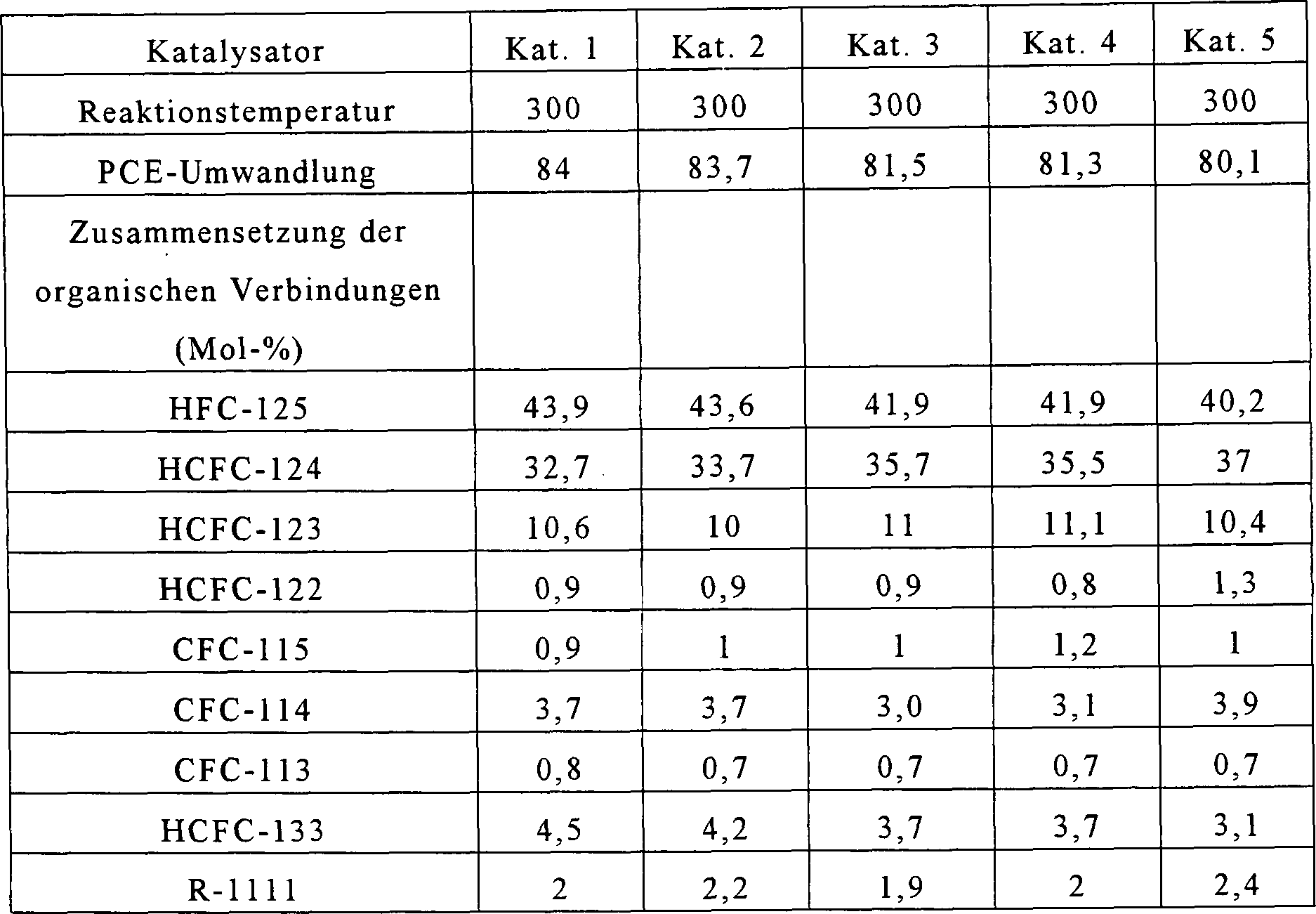
Wenn HFC-125 mit PCE als Ausgangsmaterial in Gegenwart des wie vorstehend hergestellten Katalysators synthetisiert wurde, betrug die Umwandlung von PCE bei einer Reaktionstemperatur von 350°C 94,9 % oder mehr, und die Umwandlung von PCE betrug bei einer Reaktionstemperatur von 300°C 80,1 % oder mehr. Die Selektivität für HFC-125 betrug bei 350°C bzw. 300°C 61 % bzw. 40,2 %. Anhand dieser Ergebnisse ist ersichtlich, daß die Verwendung von PCE als Ausgangsmaterial in Gegenwart des erfindungsgemäßen Katalysators zu einer Selektivität führt, die der bei der Verwendung von HCFC-123 als Ausgangsmaterial in Gegenwart eines herkömmlichen Chromoxid-Mischkatalysators ähnlich ist. Angesichts der Tatsache, daß die Synthese von HFC-125 unter Verwendung von PCE problematischer als bei der Verwendung von HCFC-123 ist, kann die Aktivität des erfindungsgemäßen Katalysators jedoch als sehr hoch angesehen werden. Der erfindungsgemäße Katalysator, der Chromoxid und nur 2 Gew.-% eines Oxids von Mg, Fe, Mo, V oder Al umfaßt, damit er eine hohe Katalysatoraktivität aufweist, kann die Aktivität und Selektivität für HFC-125 bei dieser Reaktion verbessern. Obwohl dem Chromoxid Metalloxid in einer geringen Menge von 0,5 Gew.-% zugesetzt wird, kann die Selektivität verbessert werden. Die Zugabe von Metalloxid mit mehr als 15 Gew.-% verringert jedoch andererseits die Aktivität und Selektivität. Somit wird die Metalloxidmenge in bezug auf die Chromoxidmenge vorzugsweise im Bereich von 0,5 ~ 15 Gew.-% bestimmt. Außerdem ist der erfindungsgemäße Katalysator von Vorteil, da er einen Induktionszeitraum aufweist, der während der anfänglichen Reaktion zu einer gleichmäßigen Ausbeute und Selektivität führen kann, der bei den gleichen Reaktionsbedingungen viel kürzer als bei einem reinen Chromoxidkatalysator ist. Die Katalysatoraktivität des verwendeten Metalloxids nimmt in der folgenden Reihenfolge zu Mg > Fe > V > Mo > Al.If HFC-125 with PCE as the starting material in the presence of as above produced catalyst was the conversion of PCE at a reaction temperature of 350 ° C 94.9% or more, and the Conversion of PCE was at a reaction temperature of 300 ° C 80.1% or more. The selectivity for HFC-125 was at 350 ° C or 300 ° C 61% and 40.2% respectively. From these results it can be seen that the use of PCE as starting material in the presence of the catalyst according to the invention to a selectivity leads, the when using HCFC-123 as the starting material in Presence of a conventional Chromium mixed catalyst is similar. Given the fact that the synthesis of HFC-125 using PCE more problematic than the Use of HCFC-123, the activity of the catalyst of the invention however, are considered very high. The catalyst according to the invention, the chromium oxide and only 2 wt .-% of an oxide of Mg, Fe, Mo, V or Al includes, so he has a high catalyst activity may have activity and selectivity for HFC-125 improve on this reaction. Although the chromium oxide metal oxide is added in a small amount of 0.5 wt .-%, the selectivity be improved. The addition of metal oxide with more than 15 wt .-% on the other hand, however, reduces the activity and selectivity. Consequently For example, the amount of metal oxide relative to the amount of chromium oxide is preferably in the range of 0.5 ~ 15% by weight. In addition, the catalyst of the invention advantageous because it has an induction period during the initial Reaction to a uniform yield and selectivity to lead can be much shorter than that at the same reaction conditions in a pure chromium oxide catalyst. The catalyst activity of the used Metal oxide takes Mg> Fe> V> Mo> Al in the following order.
Test der Katalysatoraktivität durch die Art der FluorierungsbehandlungTest the catalyst activity by the type of fluorination treatment
Um die Aktivität des Katalysators bei der Reaktion bei geänderten Arten der Fluorierungsbehandlung zu untersuchen, wurde eine Fluorierung mit HF-Gas und HCFC-123 mit dem Katalysator 2 bei folgenden Reaktionsbedingungen durchgeführt.Around the activity the catalyst in the reaction with changed types of fluorination treatment was subjected to fluorination with HF gas and HCFC-123 with the catalyst 2 is carried out under the following reaction conditions.
Reaktionsbedingungen:Reaction conditions:
- verwendeter Katalysator: Katalysator 2used catalyst: catalyst 2
- Kontaktzeit: 5 sContact time: 5 s
- Reaktor: 25,4 mm (ID), SUS 316LReactor: 25.4 mm (ID), SUS 316L
- reaktives Gas: HCFC-123 (12,5 g/min), HF (590 Ncm3)Reactive gas: HCFC-123 (12.5 g / min), HF (590 Ncm 3 )
- Reaktionstemperatur: 350°CReaction temperature: 350 ° C
- Reaktionsdruck: AtmosphärendruckReaction pressure: atmospheric pressure
Art
der Fluorierungsbehandlung des Katalysators 
Die Testergebnisse sind in der nachfolgenden Tabelle 3 aufgeführt.The Test results are listed in Table 3 below.
Tabelle
3 
Wie anhand der vorstehend aufgeführten Ergebnisse deutlich wird, beeinflußt die Art der Fluorierungsbehandlung des Katalysators die Aktivität und Selektivität des Katalysators außerordentlich. Beim Typ A der Fluorierungsbehandlung wird, da das Fluorieren bei einer hohen Temperatur, nicht weniger als 400°C, über einen langen Zeitraum durchgeführt wird, Chromoxid zu einer Kristallstruktur von Cr2O3 deformiert, die zu einer deutlich geringeren Aktivität und Selektivität des Katalysators führt. Bei den Arten B, C und D der Fluorierungsbehandlung wird andererseits festgestellt, daß die Aktivität des Katalysators hervorragend ist, der für kurze Zeit bei einer Temperatur von weniger als 400°C fluoriert worden ist. Da der Katalysator, der durch 60 ~ 180-minütiges Fluorieren bei 380°C erhalten worden ist, im amorphen Zustand vorliegt, können eine hohe Umwandlung von PCE oder HCFC-123 und eine hohe Selektivität für HFC-125 festgestellt werden. Auf diese Weise wird festgestellt, daß die Aktivität des Katalysators von der Behandlungszeit sowie auch der Behandlungstemperatur beim Fluorieren beeinflußt wird. Das heißt, wenn das Fluorieren des Granulats unter Verwendung von HF-Gas bei 380°C für einen Zeitraum durchgeführt wird, der 3 h nicht übersteigt, kann das Maximum der Katalysatoraktivität festgestellt werden.As is clear from the above results, the type of fluorination treatment of the catalyst greatly affects the activity and selectivity of the catalyst. In the type A fluorination treatment, since the fluorination is carried out at a high temperature not lower than 400 ° C for a long period of time, chromium oxide is deformed into a crystal structure of Cr 2 O 3 resulting in significantly lower catalyst activity and selectivity leads. On the other hand, in the types B, C and D of the fluorination treatment, it is found that the activity of the catalyst which has been fluorinated at a temperature of less than 400 ° C for a short time is excellent. Since the catalyst obtained by fluorinating at 380 ° C for 60~180 minutes is in the amorphous state, high conversion of PCE or HCFC-123 and high selectivity for HFC-125 can be found. In this way it is found that the activity of the catalyst is influenced by the treatment time as well as the treatment temperature during fluorination. That is, when the fluorination of the granules is carried out using HF gas at 380 ° C for a period not exceeding 3 hours, the maximum of the catalyst activity can be detected.
Um den Einfluß der Aktivität des Katalysators in Abhängigkeit von der Reaktionstemperatur zu untersuchen, wurde die Reaktion außerdem mit dem Katalysator 2 bei folgenden Reaktionsbedingungen durchgeführt.Around the influence of activity of the catalyst in dependence from the reaction temperature, the reaction was also with the catalyst 2 is carried out under the following reaction conditions.
Reaktionsbedingungen:Reaction conditions:
- verwendeter Katalysator: Katalysator 2used catalyst: catalyst 2
- Kontaktzeit: 10 sContact time: 10 s
- Reaktor: 25,4 mm (ID), SUS 316LReactor: 25.4 mm (ID), SUS 316L
- reaktives Gas: PCE (6,9 g/min), HF (300 Ncm3)Reactive gas: PCE (6.9 g / min), HF (300 Ncm 3 )
- Reaktionstemperatur: 300°C, 330°C, 350°CReaction temperature: 300 ° C, 330 ° C, 350 ° C
- Reaktionsdruck: AtmosphärendruckReaction pressure: atmospheric pressure
Die Ergebnisse sind in der nachfolgenden Tabelle 4 aufgeführt.The Results are shown in Table 4 below.
Tabelle
4 
Wie anhand von Tabelle 4 deutlich wird, sind die Selektivität für HFC-125 und die Umwandlung von PCE um so höher, je höher die Reaktionstemperatur ist.As From Table 4, the selectivity for HFC-125 and the conversion are of PCE higher, The higher the reaction temperature is.
Wie vorstehend beschrieben, stellt die vorliegende Erfindung einen Katalysator für die Herstellung von HFC-125 und ein Verfahren zu dessen Herstellung bereit. Der unter Anwendung des erfindungsgemäßen Verfahrens hergestellt Katalysator für das Fluorieren kann wirksam dazu verwendet werden, HFC-125 mit hoher Ausbeute herzustellen, wobei als Ausgangsmaterial eine Chlorethanverbindung verwendet wird.As As described above, the present invention provides a catalyst for the Preparation of HFC-125 and a process for its preparation ready. The prepared using the method according to the invention Catalyst for The fluorination can be effectively used to HFC-125 in high yield wherein starting material is a chloroethane compound is used.
Obwohl die bevorzugten Ausführungsformen der vorliegenden Erfindung zur Erläuterung offenbart worden sind, ist es für den Fachmann selbstverständlich, daß verschiedene Modifikationen, Ergänzungen und Substitutionen möglich sind, ohne vom Umfang und Gedanken der Erfindung abzuweichen, wie sie in den beigefügten Ansprüchen offenbart sind.Even though the preferred embodiments have been disclosed for illustration of the present invention, is it for the expert of course, that different Modifications, additions and substitutions possible are without departing from the scope and spirit of the invention they in the attached claims are disclosed.
Claims (5)
Applications Claiming Priority (2)
| Application Number | Priority Date | Filing Date | Title |
|---|---|---|---|
| KR1020050088698A KR100680766B1 (en) | 2005-09-23 | 2005-09-23 | Process for preparing catalyst for pentafluoroethane |
| KR10-2005-0088698 | 2005-09-23 |
Publications (1)
| Publication Number | Publication Date |
|---|---|
| DE102005053962A1 true DE102005053962A1 (en) | 2007-04-05 |
Family
ID=37852833
Family Applications (1)
| Application Number | Title | Priority Date | Filing Date |
|---|---|---|---|
| DE102005053962A Ceased DE102005053962A1 (en) | 2005-09-23 | 2005-11-11 | Catalyst for the preparation of pentafluoro-ethane and process for its preparation |
Country Status (6)
| Country | Link |
|---|---|
| JP (1) | JP4410782B2 (en) |
| KR (1) | KR100680766B1 (en) |
| CN (1) | CN1935360B (en) |
| DE (1) | DE102005053962A1 (en) |
| FR (1) | FR2891163B1 (en) |
| IT (1) | ITBO20060029A1 (en) |
Families Citing this family (8)
| Publication number | Priority date | Publication date | Assignee | Title |
|---|---|---|---|---|
| FR2998815B1 (en) * | 2012-12-03 | 2017-01-27 | Arkema France | CATALYST PREPARED BY REAGENT MILLING |
| CN105214659A (en) * | 2015-10-30 | 2016-01-06 | 苏州莲池环保科技发展有限公司 | A kind of preparation method of auto-exhaust catalyst of sulfur resistive |
| CN108057435B (en) * | 2017-11-10 | 2020-07-07 | 乳源东阳光氟有限公司 | Preparation method of gas phase fluorination catalyst |
| CN109675592B (en) * | 2018-12-26 | 2022-02-08 | 乳源东阳光氟有限公司 | Metal oxide/C composite fluorination catalyst and preparation method and application thereof |
| CN114644544A (en) * | 2020-12-17 | 2022-06-21 | 陕西中化蓝天化工新材料有限公司 | Preparation method of fluoroalkane |
| CN114054052B (en) * | 2021-12-03 | 2023-11-03 | 湖南有色郴州氟化学有限公司 | Method for removing ammonia nitrogen by catalytic oxidation of chromium oxyfluoride |
| CN114084948B (en) * | 2021-12-03 | 2023-09-15 | 湖南有色郴州氟化学有限公司 | Method for removing ammonia nitrogen by catalytic oxidation |
| CN114229985B (en) * | 2021-12-15 | 2023-09-19 | 湖南有色郴州氟化学有限公司 | Method for removing ammonia nitrogen by catalytic oxidation of magnesium-based oxyfluoride |
Family Cites Families (8)
| Publication number | Priority date | Publication date | Assignee | Title |
|---|---|---|---|---|
| DK0513823T3 (en) * | 1991-05-17 | 1996-02-05 | Hoechst Ag | Process for producing pentafluoroethane (R 125) |
| FR2700770B1 (en) * | 1993-01-27 | 1995-03-24 | Atochem Elf Sa | Process for the production of 1,1,1,2-tetrafluoro-2-chloroethane and pentafluoroethane. |
| FR2713633B1 (en) * | 1993-12-09 | 1996-01-19 | Atochem Elf Sa | Gas phase fluorination using crystallized catalysts. |
| DE19510024C2 (en) * | 1995-03-20 | 1997-02-06 | Hoechst Ag | Process for the preparation of pentafluoroethane (R 125) |
| IT1276174B1 (en) * | 1995-11-28 | 1997-10-27 | Ausimont Spa | PROCESS FOR THE PREPARATION OF PENTAFLUOROETHANE |
| JPH10113562A (en) | 1996-04-17 | 1998-05-06 | Ausimont Spa | Catalyst for fluorination of halogenated hydrocarbons |
| US7074974B2 (en) * | 2002-03-11 | 2006-07-11 | Showa Denko K.K. | Process for the production of fluoroethane and use of the same |
| CN100372607C (en) * | 2004-12-23 | 2008-03-05 | 西安近代化学研究所 | Fluorination catalyst and its production method and use |
-
2005
- 2005-09-23 KR KR1020050088698A patent/KR100680766B1/en not_active Expired - Lifetime
- 2005-11-11 CN CN2005101191948A patent/CN1935360B/en not_active Expired - Fee Related
- 2005-11-11 DE DE102005053962A patent/DE102005053962A1/en not_active Ceased
-
2006
- 2006-01-17 IT IT000029A patent/ITBO20060029A1/en unknown
- 2006-04-13 FR FR0603314A patent/FR2891163B1/en not_active Expired - Lifetime
- 2006-09-22 JP JP2006257278A patent/JP4410782B2/en not_active Expired - Fee Related
Also Published As
| Publication number | Publication date |
|---|---|
| CN1935360A (en) | 2007-03-28 |
| KR100680766B1 (en) | 2007-02-09 |
| JP2007083233A (en) | 2007-04-05 |
| CN1935360B (en) | 2011-05-25 |
| JP4410782B2 (en) | 2010-02-03 |
| ITBO20060029A1 (en) | 2007-03-24 |
| FR2891163A1 (en) | 2007-03-30 |
| FR2891163B1 (en) | 2009-12-18 |
Similar Documents
| Publication | Publication Date | Title |
|---|---|---|
| EP1005908B1 (en) | Catalyst comprising a multimetal oxide mass for gas phase oxidation of organic compounds | |
| DE19847656B4 (en) | Use of an ammoxidation catalyst in the production of acrylonitrile or methacrylonitrile from propane or isobutane by ammoxidation | |
| DE69636206T2 (en) | Process for the preparation of a catalyst | |
| DE2505249C2 (en) | Process for the production of acrylonitrile | |
| DE2321101C2 (en) | Process for the preparation of essentially unsupported cobalt catalysts | |
| EP1165231B1 (en) | Nickel catalyst for hydrogenating functional groups and method for producing same | |
| EP0130532B1 (en) | Process for the preparation of catalysts for fluorination and/or dismutation reactions of halogenated hydrocarbons | |
| DE2741132C3 (en) | Catalyst with an active phase of the formula Bi ↓ 2 ↓ Mo ↓ 2 ↓ Fe ↓ 2 ↓ O ↓ 12 ↓ and possibly the phases CoMoO ↓ 4 ↓, Fe ↓ 2 ↓ (MoO ↓ 4 ↓) ↓ 3 ↓, Bi ↓ 2 ↓ (MoO ↓ 4 ↓) ↓ 3 ↓ and its use for the production of α-β unsaturated aldehydes by oxidation of olefins in the gas phase | |
| DE69513172T2 (en) | METHOD FOR PRODUCING METHACROLEIN | |
| DE60018531T2 (en) | Oxydkomplex as catalyst and process for the production of acrylic acid | |
| DE69415748T2 (en) | Chromium-based fluorination catalyst, process for producing this catalyst and fluorination process using this catalyst | |
| DE69429180T2 (en) | Ammoxidation CATALYST COMPOSITION | |
| EP0849224A1 (en) | Monoclinc zirconium dioxide with high surface area | |
| DE102010049824A1 (en) | Process for the preparation of a catalyst for the production of methacrylic acid and process for the preparation of methacrylic acid | |
| EP0668104A1 (en) | Multimetal oxide masses | |
| DE2547314C3 (en) | Molybdenum and phosphorus containing catalyst for the vapor phase oxidation of unsaturated aldehydes | |
| DE2044130A1 (en) | Process for the production of catalysts of the iron molybdate type and their use for the catalytic oxidation of alcohols to aldehydes | |
| DE112005000007B4 (en) | Catalyst for partial oxidation, process for producing the same and use of the catalyst | |
| DE2935903C2 (en) | Oxidation catalyst and its use in the manufacture of methacrolein | |
| DE3042686C2 (en) | Process for the production of a catalyst containing copper oxide, zinc oxide and aluminum oxide and optionally also boron oxide | |
| DE2147480C2 (en) | Process for the production of acrylonitrile and methacrylonitrile | |
| EP0059414B1 (en) | Catalysts for the preparation of 3-cyanopyridine | |
| DE102005053962A1 (en) | Catalyst for the preparation of pentafluoro-ethane and process for its preparation | |
| DE19504283A1 (en) | Process for the preparation of cyanopyridines and suitable catalysts therefor | |
| DE3107756C2 (en) |
Legal Events
| Date | Code | Title | Description |
|---|---|---|---|
| OP8 | Request for examination as to paragraph 44 patent law | ||
| 8127 | New person/name/address of the applicant |
Owner name: FOOSUNG CO., LTD., SEOUL, KR |
|
| R002 | Refusal decision in examination/registration proceedings | ||
| R003 | Refusal decision now final |
Effective date: 20130323 |